Longford House, Beltra, Co Sligo – ruin and Airbnb coach house
Mark Bence-Jones. A Guide to Irish Country Houses (originally published as Burke’s Guide to Country Houses volume 1 Ireland by Burke’s Peerage Ltd. 1978); Revised edition 1988 Constable and Company Ltd, London.
p. 190. “(Crofton, Bt, of Longford House/PB) A house of two storeys over a high basement built 1782, which was intended to be flanked by two large wings of which only one was built. Front with three sided bow and pedimented doorcase; other front with rusticated Venetian loggia in basement. Lime avenue; old castle in grounds, also a ruined oratory; Elizabethan or Jacobean Crofton chimneypiece removed from Mote, Co Roscommon, near house. The main block of the house was gutted by fire early in C19, the windows, however, have been replaced and it has been given a flat roof and is used as a store. After the fire, the wing was remodelled to serve as a house.”
Longford House, County Sligo, photograph courtesy of Mark Bence-Jones, A Guide to Irish Country Houses.
Detached five-bay three-storey stone former mansion, built c. 1782, now in ruins. Full-height central canted bay projects from east elevation, two-storey canted bay projects from east side of south elevation. Main roof and chimneystacks missing, lead roof to south bay. Squared rubble stone walling, corbelled ashlar limestone eaves cornice, V-jointed polished ashlar quoins above first floor string course, vermiculated quoins below, chamfered plinth. Doric columns, entablature and blocking course to south canted bay. Square-headed window openings, shouldered architraves, stone sills, pedimented tripartite window over west entrance, timber sash windows missing. Round-headed door opening to west, flanked by narrow square-headed sidelights, rusticated channel-jointed surround, moulded string at impost. Square-headed door opening at first floor east elevation, stone door case with Doric columns, frieze and triangular pediment. Virtually no original internal features survive, steel beams, concrete floors and stairs introduced c. 1960. Located on forty-five acre estate. Two-storey occupied house to north-east.
Appraisal
This splendid example of restrained classicism is an impressive sight. Its scale and quality of craftsmanship bear testimony to the importance the Crofton family once held. The house is composed of graceful Classical proportions and is without superfluous detailing. Furthermore, the regular distribution of openings adds a rhythmic quality to the piece. The house is attractively set in its own grounds. Announcing the house on the road side is a fine gateway that contributes greatly to the character of the locality. The primary residence in the locality, Longford House is of further social interest having historically provided much employment in the region.
Detached three-bay two-storey rendered house, built c. 1810. Double-pile south-facing main house, two-storey north-east wing with hipped roof in line with main house, two-storey north-west wing with pitched roof perpendicular to main house. Hipped slate roofs, clay ridge and hip tiles, unpainted smooth-rendered corbelled chimneystacks with clay pots, gabled dormers with painted timber decorative barges to east and west ends of south block, half-round cast-iron gutters on projecting stone eaves carried on triangular stone corbels to south elevation, extruded profiled aluminium gutters on corbelled eaves to other elevations. Painted roughcast walling to south elevation, chamfered stone string course over smooth-rendered plinth, ashlar limestone rusticated quoins. Unpainted smooth-rendered walling to east and west elevations. Evidence of entrance portico having been removed. Square-headed window openings, dressed limestone sills, painted six-over-six timber sash windows to ground floor, six-over-three to first floor south elevation, tripartite to east and west elevations. Square-headed entrance door opening, painted timber half-glazed double doors c. 1995. Round-headed porch opening to west elevation. Gravelled stable courtyard to rear with various sheds and outbuildings. Gravelled forecourt, lawns, original Longford House to south-west. A fireplace with the inscription ‘GEORGE CROFTON 1632 ELIZABETH CROFTON’, presumably removed from the old house, is set against a wall to the west.
Appraisal
This sprawling house appears to have a complex evolution as evidenced in its various blocks and details. Stone corbelling and quoins on the front elevation are of particular interest. Original sash windows survive.
Detached single-bay single-storey former chapel house, built c. 1650, no longer in use. Pitched slate roof, stone ridge tiles. Rubble limestone walling, eaves corbel course. Pointed-arch window openings to east and west elevations, slit window on south gable. Pointed-arch door opening on north gable. Exposed stonework with medieval carvings and inscriptions. Located on Longford Demesne to south of main house, south gable to public road.
Appraisal
It appears that this little building is an assembly of parts gleaned from other buildings. The stone carvings to the interior are of artistic significance and may be of special interest.
In Blake, Tarquin. Abandoned Mansions of Ireland II: More Portraits of Forgotten Stately Homes. Collins Press, Cork, 2012.
Longford House was built in the mid-18th century but was destroyed in a fire in the early 19th century,c1816. It is this house to which Wilson refers as the seat of Mr. Crofton in 1786. Another house was built adjacent to the original. McTernan notes that this house also suffered fire damage in both 1840 and again in 1916. At the time of Griffith’s Valuation a house at Longford Demesne was valued at £13 and was the property of Sir Malby Crofton. In 1906 this was the property of Sir Malby Crofton and was valued at £30. The later Longford House is still extant and occupied. The original is an impressive ruin.
Lady of the Manor determined to restore Longford House to former glory
October 11 2002 12:11 AM by Paul Deering It’s probably one of Sligo’s least known country manors but Longford House in Beltra, West Sligo is nonetheless just as significant.Its current owner has spent thousands of euro on restoring most of the property to its former glory but she desperately needs help with saving a substantial portion of the property from ruin.With no state funding available, the chances of major restoration work being carried out are slim but Lady Sally Crofton, owner of the magnificent estate, remains determined. A whole series of proposals are floating around in her mind about how best to maximise the use of the property including its use as a concert venue.Longford House is an imposing sight set amongst 45 acres of wooded grounds and gardens. The property comprises three buildings, a Georgian house built around 1783, the original mansion nearby which was severely damaged by fire in 1916 and another building called the Smoke House which lies adjacent to the entrance. There’s even a lake on the grounds.Lady Crofton’s husband, Sir. Malby Crofton, died last year aged 78. Longford House has been in the ownership of the Croftons since the 1500’s.Born in Middlesex, Lady Crofton has an interesting life story to tell but prefers instead to talk about her house and her plans for it.The original estate contained around 40,000 acres but over the years this has dwindled to around 45. Close to the Smoke House is a large mound upon which was located a Celtic fort and later a 12th century castle.
This was demolished by the Croftons in the early 17th Century and the stone was re-used in later houses. It is known that a number of rooms and extensive passages run from beneath this site to other forts, one of which is located close to the lake. The entrance to these tunnels was backfilled in the late 19th century.
Given its tranquil setting, it’s no surprise that it inspired the writer, Sydney Owenson (Lady Morgan). The well known 19th century poet and novelist and author of the Wild Irish Girl, lived as a governess to the young Croftons at Longford House for a number of years during which she penned a number of her works.
The approach to the property is through an impressive set of gates and along a magnificent avenue of mature lime trees. Views of West Sligo immediately come into view and also very visible are Ben Bulben and Knocknarea in the distance.
Neglected
Both the Smoke House and the Georgian House have been extensively re-fitted and decorated but the large mansion closeby lies neglected.
There are interesting facets all over the estate including an ancient Prayer House which was part of the original castle. A number of interesting native religious carvings are very visible on its inside walls and it is known that family weddings were held in this small building as recently as the 1920’s.
Lady Crofton studied sculpture in Paris as a young girl before joining the advertising world in London as an accounts executive. Amongst the many interesting accounts she looked after was Britain’s Milk Marketing Board.
The slogan, “Drink a Pinta” was dreamed up by a copy writer during Lady Crofton’s time there.
She later travelled to Africa where she established her own advertising and P.R. agency.
Her husband, Sir Malby Crofton was a former mayor of Kensington and Chelsea. When they came over to live in the property at Beltra there was no heating and water was seeping down the walls.
‘Absolute wreck’
“It was an absolute wreck. We moved into one room and started renovating,” she recalls.
They had married In May 1998 and during the summer they thought about moving to their idyllic setting in the West of Ireland.
Lady Crofton, a well known interior designer, wants to make use of the fine restored house and earn enough money to tackle the mansion nearby. So far no grants have been allocated to preserving the buildings.
“If I could just get enough money together to replace the roof so that it would prevent further deterioration I would be very happy,” she said.
Family week-end breaks with fishing on the lake included, is one idea she has hit upon to make use of her property. The house can sleep up to 20. Other revenue earners include the hosting of company parties, especially at Christmas time. Weddings and Christenings are also in the pipeline.
The most audacious of her proposals would be the hosting of concerts in the expansive grounds.
“It would make a great hotel but it needs to be saved not just for our family but for Sligo. It would be simply terrible if it fell into ruin altogether. It is a heritage building and I have spent so much already restoring the rest of the estate.
“I am determined to put Longford on the map. Like Lissadell, Templehouse and Markree Castle, it is of tremendous heritage value to Sligo,” she says.
Lady Crofton was forced to put the entire estate up for sale during the summer but has now decided to open it to the public for special occasions. She’s determined to keep it and turn it into one of Sligo’s best known landmarks.
Mark Bence-Jones. A Guide to Irish Country Houses (originally published as Burke’s Guide to Country Houses volume 1 Ireland by Burke’s Peerage Ltd. 1978); Revised edition 1988 Constable and Company Ltd, London.
p. 286. “(Kirkwood/LGI1958) The seat of the Kirkwoods, featured in David Thompson’s widely acclaimed evocation of Anglo-Irish life, Woodbrook. No longer owned by the family.”
Keenehan and others state that Woodbrook House was built around 1780 by the Phibbs family although there may have been an earlier house on the site. The Kirkwood family purchased the property sometime in the early nineteenth century. At the time of Griffith’s Valuation Sarah Mary Kirkwood was leasing a house at Usna, barony of Boyle, valued at £14, from Robert H. Brewster French. From the 1890s-1911 Woodbrook was a very successful racing stables run by Colonel Tom Kirkwood. Life in the house in the post-WWI era has been made famous by the memoir ”Woodbrook” written by the Scottish author David Thomson, a tutor to the daughters of the family. In 1946 over 50 acres of the estate was sold to the local golf club while the Land Commission subsequently divided the remainder. Woodbrook House is still extant.
Woodbrook House, near Ardcarne, just north of Carrick-on-Shannon, on the road to Boyle. The setting for David Thomson’s classic autobiographical love story and social history, Woodbrook, published in 1974, Thomson came to Woodbrook as a tutor to the Kirkwoods in the 1930’s. This photo appears in the final chapter of my book: ‘The Landed Estates of County Roscommon’. Woodbrook is still extant albeit without the wings shown in this photo. (see details of Thomson and his book here: https://www.independent.ie/…/books-delicate-intriguing-tale… )
Marlfield House, Clonmel, Co Tipperary, photograph courtesy of Ireland Sotheby’s International Realty.Marlfield, Clonmel, County Tipperary, photograph by Robert French, (between ca. 1865-1914), Lawrence Photograph Collection, National Library of Ireland.
Mark Bence-Jones. A Guide to Irish Country Houses (originally published as Burke’s Guide to Country Houses volume 1 Ireland by Burke’s Peerage Ltd. 1978); Revised edition 1988 Constable and Company Ltd, London.
p. 203. “(Bagwell/IFR) A late C18 house built by col John Bagwell, MP; consisting of a centre blow of three storeys over a basement joined to single-storey wings by long partly curving links. Seven bay entrance front, three bay breakfront, fanlighted doorway with side lights and two engaged columns. Links consisting of short one bay sections and curved sweeps with blind arcading and niches; wings each with a breakfront centre of blind arcading and niches, surmounted by a die and urn; and with one bay on either side. Garden front of centre block with one bay on either side of central curved bow; conservatory on one side, arcaded single-storey wing on the other. Handsome entrance gates, with twin Doric lodges, built 1833 for John Bagwell, MP, to the design of William Tinsley of Clonmel. The centre block was burnt 1923, and rebuilt 1925 by Senator John Bagwell with a flat roof and a simple pedimented doorway with two columns and no fanlight. Sold ca 1985.”
Marlfield House, Clonmel, Co Tipperary, photograph courtesy of Ireland Sotheby’s International Realty.Marlfield House, Clonmel, Co Tipperary, photograph courtesy of Ireland Sotheby’s International Realty.Marlfield House, Clonmel, Co Tipperary, photograph courtesy of Ireland Sotheby’s International Realty.Marlfield, Clonmel, County Tipperary, photograph by Robert French, (between ca. 1865-1914), Lawrence Photograph Collection, National Library of Ireland.Marlfield, Clonmel, County Tipperary, photograph by Robert French, (between ca. 1865-1914), Lawrence Photograph Collection, National Library of Ireland.
Detached Palladian-style seven-bay three-storey over basement country house, built c.1790, with three-bay breakfront, five-bay side elevations, five-bay rear elevation with three-bay full-height bow, and having single-storey quadrants and pavilions. Conservatory and stables to west and orangery and former servants quarters to east. Burnt in 1923 and rebuilt in 1925. Now converted into apartments. Flat roof with rendered chimneystacks, moulded limestone cornice and cut limestone parapet. Painted smooth rendered walls, painted to front elevation. Square-headed window openings with timber sliding sash windows, three-over-six pane to second floor, six-over-six pane to first floor, six-over-nine pane to ground floor front and timber casement windows to ground floor of rear and side elevations, all having painted sills and moulded render surrounds, ground floor openings also having cornices. Carved ashlar limestone doorcase to main entrance, comprising square-headed timber panelled double-leaf door with six-pane overlight, flanked by engaged limestone Corinthian columns surmounted by pediment, with stone paving to front and accessed by limestone steps. Second doorway at east end of front elevation, having moulded render surround, with cornice, plinths, timber panelled double-leaf doors with six-pane overlight, and accessed by concrete steps with cast-iron railings. Square-headed doorway in rear elevation set into moulded render doorcase with moulded cornice and having timber French doors. Quadrants are connected to house by slightly projecting single-bay single-storey links and links, quadrants and pavilions have continuous cut limestone eaves course with string course to base and coping. Quadrants have six recessed round-headed openings with limestone impost course, western having five blind inset with round-headed niches and one having square-headed timber panelled double-leaf door with spoked fanlights and having steps with cast-iron railings, eastern having six blind openings with niches, one having square-headed timber door. East pavilion is L-plan and both have five-bay front and three-bay end elevations. Hipped slate roofs, lead flashing, carved limestone entablature, with carved urn over doorway to front elevation. Painted smooth rendered walls. Central bays of front elevations slightly advanced and having round-headed arcade of doorway flanked by recessed blind openings with inset round-headed niches, middle having square-headed double-leaf timber panelled door with overlight, carved limestone patera to tympanum, carved limestone surround, the three openings having moulded limestone archivolts and impost course. End bays have square-headed nine-over-six pane timber sliding sash windows, one fixed fifteen-pane to east pavilion, and three-bay end elevations have round-headed niches flanking round-headed six-over-six pane timber sliding sash window with spoked fanlight and set into recessed surround, all windows having limestone sills. Round-headed windows to orangery, end bays having cobweb fanlights and all having double timber sliding sash four-over-six pane windows. Conservatory designed by Turner, with glazed five-bay front and rear elevations, glazed barrel-shaped roof with decorative cast-iron cresting to ridge and to west gable, walling comprising cast-iron columns presenting in elevation as Ionic pilasters flanking glazed windows and central doorway, latter double-leaf and timber glazed and panelled and reached by steps. Palmette detailing to frieze and moulded cornice to eaves. Interior spanned by arches gathered together in centralcolumns in form of palm trees, and with radiating fanlights to west gable. Yard to west, behind pavilion, entered through decorative cast-iron double-leaf entrance gates set to cut sandstone gate piers with plinths and caps, with cut limestone wheel guards. Two-storey L-plan stable block, with three-bay ground and one-bay first floor, hipped slate roof and rubble sandstone walls, two segmental-arched carriage entrances with brick voussoirs and double-leaf timber battened doors with segmental relieving arches above, square-headed windows to first floor, one six-over-six pane timber sliding sash, and lunettes to ground floor. Multiple-bay single-storey block to west, having hipped slate roof with roof vents and rubble sandstone walls with lunette windows. Spoked timber frames to lunettes, and square-headed timber panelled doors, one to round-headed opening. Small yard at east end of complex entered through elliptical-arched sandstone gateway having dressed stone jambs and cut-stone voussoirs and imposts, with string course to parapet and surmounted by rubble stone bellcote. Remains of gardens to east, with pointed arch entrance having cast-iron double-leaf gates and with ruin of marl fernery to gardens. Underground segmental-vaulted tunnel to north-west, with pointed arch entrance having marl voussoirs and cast-iron gates.
Marlfield House, Clonmel, Co Tipperary, photograph courtesy of Ireland Sotheby’s International Realty.
Appraisal
Located just south of the old Cork to Clonmel road this fine house is a striking feature on the landscape. Designed to the classical layout of Palladianism this house exhibits many notable features which contribute to its architectural significance. Burnt in 1923 by rebel forces, the main house was rebuilt in 1925, creating an excellent reproduction of late-eighteenth century features such as the timber sash windows. The impressive conservatory is an fine example of the work of Turner, with its ornate curving arches and radiating fanlights. The blind niches to the quadrants and the façades of the pavilions, with their entablatures and urns, display direct influences from Classical architecture, enlivening the appearance of the building. The grandeur of the house is further enhanced by the related outbuildings, fernery, garden entrance and tunnel, all contributing to the setting of the house.
Garden front, Marlfield House, Clonmel, Co Tipperary, photograph courtesy of Ireland Sotheby’s International Realtyand REA Stokes & Quirke. Marlfield House, Clonmel, Co Tipperary, photograph courtesy of Ireland Sotheby’s International Realtyand REA Stokes & Quirke. The Turner designed conservatory/orangerie. Marlfield House, Clonmel, Co Tipperary, photograph courtesy of Ireland Sotheby’s International Realtyand REA Stokes & Quirke. Marlfield House, Clonmel, Co Tipperary, photograph courtesy of Ireland Sotheby’s International Realtyand REA Stokes & Quirke.
Built by Colonel John Bagwell MP in the late 18th century in the Palladian style. It was the seat of the Bagwell family of Clonmel in the 19th and 20th centuries, held from the Moores of Barne and valued at almost £83 in the early 1850s. The central part of the house was burnt in 1923 and rebuilt in 1925 and is now in use as an apartment complex.
Price: €1.35 million
What: an imposing 18th-century, Palladian-style Georgian mansion on the banks of the River Suir, Marlfield extends to some 2,100 square metres including the central house and the flanking pavilions. It sits on about 31 acres with fishing rights and a lake. The sprawling residence includes grand reception rooms, 14 bedrooms divided via partition walls into a number of apartments, an Orangery, vaulted wine cellars, a basement tunnel linking to the stable yard in the west pavilion block, and a great many period details including ornate cornicing and plasterwork detail, marble fireplaces and internal columns.
Outside, the grounds incorporate well-maintained gardens, outbuildings, fernery and parklands.
Marlfield House, Clonmel, Co Tipperary, photograph courtesy of Ireland Sotheby’s International Realty.
Marlfield at Clonmel in Co Tipperary, which was on offer in 2014 for €8m with 390 acres attached, has just returned to market, minus most of the farmland, for a much more managable €1m.
It means that for the price of a four-bed semi in Dublin 4, a buyer now has the chance to acquire a true country mansion big enough to house an entire estate of family homes inside. With a square footage of 22,600 sq ft, Marfield’s accommodation equates to that of of 22 average family semis.
For this, a buyer gets the 14-bedroom 18th century house, one of the finest Georgian Palladian homes in Munster, plus 31 acres.
This house was famously the seat of the wealthy Bagwell family, who strove unsuccessfully for generations to gain a nobility title; manoeuvres over which included the construction of the vast mansion itself.
Among its owners was the 18th century Tipperary MP Colonel John Bagwell – better known by his well earned nickname: “Old Bags.” The owner of the then 3,500 acre Marlfield Estate (he had another 1,500 acres elsewhere in Ireland) caused ructions during the run up to the introduction of the Act of Union in 1799 and 1800 when he very publicly u-turned on his position to support the dissolution of the Irish parliament and usher in the Union. He then u-turned on his u-turn.
Lord Lieutenant Cornwallis who was in charge of bribery in order to secure the Union vote for the authorities in London took public issue with Old Bags for changing sides from the pro dissolution to the anti dissolution/pro Irish parliament camp.
The problem was that Cornwallis had already paid Bagwell off from the London Exchequer for his vote but the latter had then been offered €9,000 by the opposition to change sides. Old Bags suggested he would revert for €10,000 – along with prestigious appointments for his sons and friends. Society was shocked. But Bagwell’s vote was bought (again) and the Act of Union was passed. To put it in context, earning £25 per year, it would have taken his average estate worker 400 years to realise this amount.
Bagwell was a builder who made money constructing flour mills but he desperately wanted a title. To this end, Old Bags began to take the usual steps – in 1785 he completed Marlfield with one of the widest frontages of any Irish country seat. He founded the local loyalist militia of which he made himself colonel and he began lobbying anyone and everyone who would listen to his case for a peerage. But Bags’ opportunistic ways saw his path blocked again and again. In 1809 the viceroy eventually stated overtly that Bagwell was “not quite the most proper person” (to place among the peers). His death as a commoner in 1818 saw the chief secretary of the day assert that he had lost a peerage “through a nickname”.
The house remained in the family until the 1970s when the Kent family bought it. The house with larger acreage had more recently been the subject of a hotel and golf club plan that faltered.
Many of the services had already been put in place to facilitate the scheme with one source suggesting that this is the “best serviced Palladian mansion in Ireland”. The other most notable feature about Marlfield is its Richard Turner designed glass conservatory. He also designed the principal glass houses at the National Botanic Gardens in Dublin.
The accommodation includes a great hall, a formal dining room, a drawing room, a sitting room, study and the massive Turner glasshouse conservatory. In the basement is a games room, a gym, the kitchens and a range of ancillary rooms. There are 13 bedrooms overhead, many of which have ensuites attached and there is a vaulted wine cellar and basement.
Entrance hall, Marlfield House, Clonmel, Co Tipperary, photograph courtesy of Ireland Sotheby’s International Realty.Entrance hall, Marlfield House, Clonmel, Co Tipperary, photograph courtesy ofXIBid realty.Marlfield House, Clonmel, Co Tipperary, photograph courtesy of Ireland Sotheby’s International Realty.
The house has 20 acres of pleasure gardens and these include an ornate duck pond of some size. There’s two apartments of two bedrooms each in the right side wing and the stables and another one bed contained in the other. It also faces right on to the River Suir which has obvious potential for outdoor sporting activities.
Marlfield House, Clonmel, Co Tipperary, photograph courtesy of Ireland Sotheby’s International Realty.
On the downside, Marlfield still needs needs a substantial amount of work put into it. A full survey would, of course, be paramount, but those who have looked at it already estimate that it will require another €1m, at least, put into it to bring it up to modern requirements.
To bag Marlfield for a million talk to either of the joint agents REA Stokes & Quirke and Sothebys.
Marlfield House, Clonmel, Co Tipperary, photograph courtesy of Ireland Sotheby’s International Realty.Marlfield House, Clonmel, Co Tipperary, photograph courtesy of Ireland Sotheby’s International Realtyand REA Stokes & Quirke.
4/11/2019 Eircode: E91HW63
REA Stokes & Quirke
Tel: 052 612 1788
PSRA Licence No. 003294
2100 sq m
€1,350,000
A classical Georgian Mansion built in the Palladian style and enjoying a riverside position fronting onto the River Suir and stunning views over the surrounding verdant countryside, including the Comeragh Mountains and the Galtees to the west.
In all about 31 acres or 12.5 hectares. Marlfield House is a most attractive and imposing 18th century Georgian Mansion set on the banks of the river Suir and including a stretch with fishing rights and a lake within the village of Marlfield. Marlfield represents a wonderful example of Irish architectural excellence and significance with William Tinsley, one of Ireland’s finest architects, and Richard Turner, a highly regarded designer and manufacturer of Glass Houses or Orangeries, were both commissioned works on the house and wider estate.
Built by Col. John Bagwell, MP the central block was burnt circa 1923 and then rebuilt, by Senator John Bagwell, in 1925. The Bagwells were a wealthy and politically influential family in south Tipperary from the 18th to the 20th centuries. The fire in January 1923 was an arson attack by anti-Treaty IRA forces during the Irish Civil War, the house being targeted as John Bagwell was a Senator in the new Irish Free State. Following the rebuilding Marlfield remained in the family until the 1970s when the house and estate lands were sold. Subsequently the first and second floors were divided into apartments but the ground floor and basement remain largely unchanged. The newer sub-divisions on the upper floors being in stud-partitions and seemingly reversible. Joint Agent with Sotheby’s International Realty – David Ashmore 353(0) 1 9059790
Reception Rooms – The principal reception rooms retain their original form with generous proportions, high ceilings, large sliding sash windows, decorative ceiling plaster work, carved architraves and Adams style chimney pieces and a magnificent Richard Turner conservatory. A large and impressive reception hall leads to the principal reception rooms and the stair hall. The south entire south elevation of the core central block is comprised with the dining room, drawing room and library. The drawing room incorporating a marvellous curved bow and each having large French doors to the south garden and interconnecting doors, the library in turn connecting to the Orangery to create a magnificent and impressive suite of reception rooms. The Orangery or conservatory is hugely impressive and exotic with growing ferns, palms and vines. The basement benefits from good ceiling height and is well lit from natural light along the south elevation. Original wine cellars and a tunnel linking to the stable yard in the west pavilion block remain intact. The segmental-vaulted tunnel having marl voussoirs.
Bedroom Accommodation – The bedroom accommodation on the first and second floors has been altered from the original form to create a number of independent apartments but the divisions were created with stud partitioning and great care seems to have been taken to maintain the integrity of ceiling cornices when divided. Subject to any necessary permission[s] the changes seems inherently reversible or adaptable, the generous number of bathrooms in the current form giving great scope for a myriad of layout configurations. When rebuilding the house in 1925 a flat roof was installed behind the raised parapet’s giving a marvellous viewing platform and accessed from a permanent staircase. Central – Curving quadrants with round-headed recess opening link the central house block to the flanking pavilions, the eastern pavilion originally comprising the kitchen block and the western one stabling. Designed to the classical layout of Palladianism Marlfield House exhibits many notable features which contribute to its architectural significance. The blind niches to the quadrants and the façades of the pavilions, with their entablatures and urns, display direct influences from Classical architecture, enlivening the appearance of the building. The grandeur of the house is further enhanced by the related outbuildings, fernery, garden entrance and tunnel, all contributing to the setting of the house.
Features
There is mains electricity connected to the property. Telephone line and broadband is available. Foul drainage is treated in a private system. Oil fired central heating. The fitted carpets are included in the sale. All furniture, light fittings and any garden statues together with the chattels within the house are excluded from the freehold sale but may be available to a purchaser by separate negotiation.
Marlfield, Clonmel, Co Tipperary
Asking price: €1m
Agent: REA Stokes and Quirke (049) 4380038 and Sothebys Internationial Realty (01) 9059790
For sale by BidX1 sold for €950,000
06/10/2023
18th Century country estate on approximately 5.44 hectares (13.44 acres) of land. Comprising 14 x self contained apartments within Marlfield House together with 8 x external chalet dwellings. Marlfield House extending to approximately 1,450 sq m (15,607 sq ft). Marlfield Lake situated approximately 1.4km north of Marlfield House. Contained within Folio TY10577F. 3 x apartments within Marlfield House occupied under terms unknown with vacant possession of 11 x apartments. 7 x chalet houses occupied under terms unknown with vacant possession of 1 x chalet house.
Marlfield House, Clonmel, Co Tipperary, photograph courtesy of Ireland Sotheby’s International Realty.Marlfield House, Clonmel, Co Tipperary, photograph courtesy of Ireland Sotheby’s International Realty.Marlfield House, Clonmel, Co Tipperary, photograph courtesy ofXIBid realty.Marlfield House, Clonmel, Co Tipperary, photograph courtesy ofXIBid realty.Marlfield House, Clonmel, Co Tipperary, photograph courtesy of Ireland Sotheby’s International Realty.Marlfield House, Clonmel, Co Tipperary, photograph courtesy ofXIBid realty.Marlfield House, Clonmel, Co Tipperary, photograph courtesy ofXIBid realty.Marlfield House, Clonmel, Co Tipperary, photograph courtesy ofXIBid realty.Marlfield House, Clonmel, Co Tipperary, photograph courtesy ofXIBid realty.Marlfield House, Clonmel, Co Tipperary, photograph courtesy ofXIBid realty.Marlfield House, Clonmel, Co Tipperary, photograph courtesy ofXIBid realty.Marlfield House, Clonmel, Co Tipperary, photograph courtesy ofXIBid realty.Marlfield House, Clonmel, Co Tipperary, photograph courtesy ofXIBid realty.Marlfield House, Clonmel, Co Tipperary, photograph courtesy ofXIBid realty.Marlfield House, Clonmel, County Tipperary, photograph courtesy ofXIBid realty.Marlfield House, Clonmel, Co Tipperary, photograph courtesy ofXIBid realty.Marlfield House, Clonmel, Co Tipperary, photograph courtesy ofXIBid realty.
Located just 10 minutes’ drive from the bustling town of Clonmel, where good local amenities including, museums, theatres, shopping and many sports clubs are provided. Golf and equestrian enthusiasts are well catered for with the Clonmel and Cahir golf courses and three large equestrian centres within 20 minutes’ drive. Annual music and film festivals also contribute to Clonmel’s bustling atmosphere. The town is also known internationally for being the home of the award winning Bulmers/Magners Cider. GPS location 52.343043,-7.759331 (52°20’35.0”N 7°45’33.6”W) 16 km / 10 miles from Cahir [M8 Motorway access], 55 km / 34 miles west of Waterford and 80 km / 49 miles east of Limerick. Cork city 102 km / 63 miles, Kilkenny city 60 km / 37 miles, Limerick city 80 km / 49 miles Cork airport 55 minutes driving, Shannon airport 1 hr 30 minutes driving, Dublin airport 2 hours driving, Waterford airport 1 hours driving, Cork ferry port 1 hr 11 minutes driving, Rosslare ferry port 1 hr 50 minutes driving
The Tipperary Gentry. Volume 1. By William Hayes and Art Kavanagh. Published by Irish Family Names, c/o Eneclann, Unit 1, The Trinity Enterprise Centre, Pearse St, Dublin 2, 11 Emerald Cottages, Grand Canal St, Dublin 4 and Market Square, Bunclody, Co Wexford, Ireland. 2003.
Bagwell of Marlfield
p. 16. The John Bagwell, who was the scion of the family in the mid 1700s, had so far deviated from his Quaker roots that he bloodied his hands fighting duels. He was known to have fought at least three [ see W.P. Burke – History of Clonmel]. He also became the cutting edge of the military and extreme right wing Protestantism that peaked during that period with the extraordinary trial and executio of Fr Nicholas Sheedy, parish priest of Clogheen…. Originally the Bgwells were a Quaker merchant family. John of Clonmel had two brothers, William, who was a merchant in Dublin and Phineas. He had one sister, Mrs. Airy. Burke [History of Clonmel] goes on to day that the earlier ancestors, given in Burke’s Landed Gentry, are imaginary.
In 1729 John Bagwell [ he was married to a Miss Shaw and had two sons, John and William. William went on to become an MP in 1756] a merchant of Clonmel, bought 900 acres of the ancestral lands of Lord Dunboyne for under £6000. [ the Bunboynes were Butlers and close relatives of the Ormondes. In the early decades of the 18th century they had incurred huge debts. In order to alleviate the debts Lord Dunboyne was forced to sell the lands in Middelthird Barony. See T. Power in Land, Politics and Society in 18th century Tipperary.] This purchase marked the entry of the family into the landed class. In addition to his business activities John Bagwell was a Munster correspondent for the Dublin banking firm of La Touche and Kane. [p. 16] At a later stage Bagwell purchased 1500 acres centred on Kilmore near Clonmel, the estate of John Slattery, a Catholic lawyer and agent of Lord Cahir. He also acquired an addition 413 acres so taht before the end of the third decade of the century he had a substantial rural estate of 2,730 acres.
A residence was established at Kilmore for the eldest son, John, when he got married in 1736 to a daughter of Hamilton Lowe. John died in 1738 and left two sons. It was his eldest son, John, who attained notoriety during the Fr Sheehy affair.
In 1747 in the company of the Rialls, a banking family [John Bagwell’s sister Mary was married to William Riall], they contrived to have a mayor of Clonmel (Jeremiah Morgan) elected in opposition to the Moore interest. Hitherto the town of Clonmel was almost completely controlled by the Moores. During Morgan’s tenure an important set of by-laws was enacted in an attempt by the Bagwells and Rialls to ensure perpetual influence over the corporation and the return of members to Parliament. This led to a victory for Wm Bagwell in a by-election of 1754, but he died shortly afterwards adn teh seat went to his opponent Guy Moore. The bagwells had to wait until 1799 to gain control over he borough when the bought it from Stephen Moore, the Second Earl fo Mount Cashell. [ Stephen moore grandfrather of the 2nd Earl ws made Viscount Mount Cashell in 1764].
John Bagwell, MP for Tulsk, was Sheriff of the county in 1763. He was the grandson of John the Quaker… Insofar as he was head tenant on th O’Callaghan and Cahir estates he was in the forefront of confrontations with the Whiteboys. …
Like so many Anglo-Irish families, the Bagwells claimed descent from a captain in the Cromwellian army who settled in Ireland in the 1650s. This ancestor, John Bagwell or Backwell, is said to have been the brother of a London banker and it is true that there was a prominent London goldsmith and banker called Edward Backwell (c.1618-83) at the right time, who had an elder brother called John. Unfortunately, this John seems to have had no connection with Ireland, and lived at Tyringham in Buckinghamshire, where he died in 1703. There is indeed, no reason to suppose that the family’s surname was changed when they came to Ireland, and it seems probable that the first of the family to settle in Ireland – who may well have been a Cromwellian soldier – came from the Devon-Somerset area, where the name Bagwell is historically most common.
It is, however, easy to see why the family came to connect their origins with Edward Backwell, because within three generations the Irish Bagwell family were certainly bankers themselves, at Clonmel (Tipperary). John Bagwell (d. 1754), who is also recorded as a draper and merchant, was probably the first of the family to move into banking, as a way of usefully employing the capital he had accumulated from his other business ventures. He acquired an estate called The Burgagery which a little later was said to be worth £20,000. His son, William Bagwell (c.1728-56), married the heiress of the Harper family, who were the leading banking family in Cork, and when he and his wife both died young it was the Harper family who brought up their children. Like many of the leading merchants of Clonmel and Cork at this time, the Bagwells and the Harpers were Protestant nonconformists, and Col. John Bagwell (1751-1816) was brought up in this tradition. He soon recognised, however, that he needed to conform to the Church of Ireland if he was going to realise his political and social aspirations. He set out to use the wealth generated by the family bank to buy influence and social status in an unusually direct way, so that his career – and to a lesser extent that of his sons – is a textbook illustration of the venality and patronage of 18th century politics. He bought an estate at Marlfield and build a remarkably grand new house there which proclaimed his wealth and claims to social consideration. His key step, however, was to invest in properties which brought a controlling interest in some of the small local boroughs, and then to ensure his own election and that of his two eldest sons to parliament in 1799. The Government was keen to push through the union of Britain and Ireland in that parliamentary session, and needed to achieve a majority in the Irish House of Commons to achieve this. The vote was close, and the Government resorted to promising favours to shore up its vote, in the way of appointment to positions of influence or salaried posts (many of which were complete sinecures) for MPs, their families and friends. Bagwell and his sons had initially opposed the Union, and by operating as a block they could make a difference of six votes between the two sides, and were thus much courted. They eventually agreed to support the Government in exchange for posts worth £9,000 a year, although there were rumours that the Government might be outbid at the last moment. In the end, however, they kept their word and voted for the Union.
In return for his support over Union and subsequent key issues, John Bagwell’s ultimate ambition was to secure a peerage, but in this he never succeeded, as his background in commerce – and in particular the nicknames he gained as a result – were held to threaten the dignity of the peerage. He did, however, gain a range of appointments for his sons in the army, politics and the church. His eldest son, William Bagwell (1776-1826) made a career in parliament, and became a privy councillor in 1809. He held a sinecure appointment as Muster Master General for Ireland, with a salary of £4,000 a year, and when the value of this appointment was reduced by administrative reforms, he was additional appointed as a trustee of the Irish linen manufacture. William died unmarried, and his estates passed to his nephew, John Bagwell (1811-83), who came of age in 1832. The properties John inherited included not only Marlfield, but also his great-aunt’s houses at Belgrove and Eastgrove, on an estate on the Great Island in Cork Harbour, which had belonged to the Harper family. Belgrove was let, but Eastgrove formed an agreeable summer retreat for the family, which was much used in the 19th century. Like his uncle and grandfather, John became a long-serving MP, sitting for Clonmel between 1857 and 1874 in the reformed Westminster parliament. For three years he held office as a member of the Liberal government, serving as one of the Lords of the Treasury.
John Bagwell divided his property been his two sons, with the elder, Richard Bagwell (1840-1918), who trained as a barrister and later held several senior posts in the civil service, receiving Marlfield, and the younger, William Bagwell (1849-1928), Belgrove and Eastgrove. Richard’s principal claim to fame was as an historian, and his books Ireland under the Tudors and Ireland under the Stuarts were for long standard works on the history of those troubled times. As the struggle for Irish independence gathered momentum in the early 20th century, he also emerged as a stalwart defender of Unionism, and by the time of his death he held office as Chairman of the Southern Unionist Committee. Taking such a public stance in a highly charged and frequently violent debate, he must have known that he was putting his life and property at stake, but in fact he felt no repercussions. He left Marlfield to his son, John Philip Bagwell (1874-1946), who was a senior manager in the Irish railway industry. When the Irish Free State was established in 1922, he became a Senator in the upper house of the new Irish parliament, and it was this appointment which unleashed violence on the family. In January 1923, a group of 30-40 men from an anti-treaty IRA faction broke into Marlfield at night, gave Mrs. Bagwell and the servants ten minutes to gather together some personal possessions, and then burned the house down. A few weeks later, Mr Bagwell was kidnapped at gunpoint on the road near his Dublin home, and after several days in captivity (during which the Government threatened reprisals if he was not released) he either escaped or was allowed to escape, and wisely left the country until tensions had eased. The Irish state paid compensation for the damage to Marlfield, which was rebuilt in 1925, and remained in the family until it was sold in 1981, after the death of his son, Lt.-Cdr. William Bagwell (1905-79).
Eastgrove and Belgrove passed in 1883 to William Bagwell (1849-1928). Belgrove continued to be let to the Gumbleton family until 1911, but once they gave up their lease it proved increasingly difficult to find suitable tenants.
Eastgrove remained the family home, and passed in due course to Lt-Col. John Bagwell (1884-1949), who retired from the army after the First World War and devoted himself to a life of sport: hunting, polo, golf and sailing -for which last Eastgrove was admirably situated. By the time his son, William Edward Gumbleton Bagwell (1919-85) inherited, Belgrove had long been unoccupied and was in poor condition. Mr Bagwell took the decision to demolish the old house, and sold off its site and grounds, on which a smaller new house was subsequently built. A few years later, he also sold Eastgrove, and bought instead Millbrook House at Straffan (Co. Kildare), a modest three-bay house of about 1840, which was more convenient for his work as a stockbroker in Dublin. Millbrook House remains in the family today.
Marlfield House, Clonmel, Co. Tipperary
Marlfield House: entrance front, as rebuilt with a flat roof in 1925.
A late 18th century house built in about 1785-90 by Col. John Bagwell MP (1751-1816), consisting of a centre block of three storeys over a basement joined to single-storey wings by long, partly curving links. The entrance front had seven bays, with a three-bay breakfront, and a fanlighted doorway with sidelights and two engaged columns. The links to the wings consist of short one-bay sections and then curved sweeps with blind arcading and niches; the wings each have a breakfront centre of blind arcading and niches, surmounted by a blind panel and an urn, with one bay either side.
Marlfield House: garden front, facing across lawns to the River Suir.
On the garden front, the centre block has one bay either side of a broad central bow, with a conservatory (made by Richard Turner) on one side and a single-storey wing on the other. In 1833 the estate was given handsome entrance gates with twin Doric lodges to the designs of William Tinsley of Clonmel. The centre block of the house was burnt in 1923 and rebuilt in 1925 with a flat roof and a simplified pedimented doorway on the entrance front with no fanlight.
Marlfield House: entrance hall
Marlfield House: saloon on the garden front.
The interiors of the principal ground floor rooms were recreated to an exceptional standard. After the house was sold by the family in 1981, the upper floors were converted into apartments, but the whole house is currently for sale with potential for reconversion to a single dwelling.
Descent: Col. John Bagwell (1751-1816); to son, Col. the Rt. Hon. William Bagwell (1775-1825); to nephew, John Bagwell (1811-83); to son, Richard Bagwell (1840-1918); to son, John Philip Bagwell (1874-1946); to second son, Lt-Cdr. William Bagwell (1905-79); to widow, Mary Bagwell, who sold 1981 to Dennis English; for sale 2016-18 and again 2023.
Eastgrove, Cobh, Co. Cork
Eastgrove House, seen from the waters of Cork Harbour
An early 19th century house in a sub-cottage orné style, on the edge of the Ballinacurra River, a heavily-wooded backwater of Cork Harbour. It was built for Dorcas Bousfield on land which had belonged to her mother’s family estate at Belgrove, probably soon after she was widowed in 1805. The house has shallow gables with bargeboards and a trellised iron veranda on the front. A low polygonal drum tower with an pyramidal roof was added at one end of the house a few years later; its name, the Waterloo Tower, suggests a date of about 1815-16. It contains a large and impressive dining room with curved walls, and an elaborate plaster ceiling with an unusual geometric pattern suggestive of a net.
Eastgrove House: dining room in the Wellington Tower
Eastgrove House: drawing room
There is also a large and handsome drawing room set behind a bay window. To the north of the house is a range of castellated outbuildings with a slender tower like a folly, and there is another tower in the woods. The house was restored and modernised for Lewis Glucksman in 2000-03 to the designs of FMP Architects.
Descent: Dorcas Bagwell (c.1750-1829), wife of Benjamin Bousfield (d. 1805); given to nephew, Rt Hon. William Bagwell (1776-1826); to nephew, John Bagwell (1811-83); given to son, William Bagwell (1849-1928); to son, John Bagwell (1884-1949); to son, William Edward Gumbleton Bagwell (1919-85), who sold 1958 to Robin Jenkinson; sold to Dermot Griffith…sold 2000 to Lewis Glucksman (d. 2006); to widow, Loretta Brennan Glucksman, who sold 2012.
Belgrove, Cobh, Co. Cork
Belgrove: the view across the Ballinacurra River to Belgrove in the early 19th century
Belgrove: the house in the late 19th century
A Georgian house consisting of a two-storey main block with a long curved wing overlooking the Ballinacurra River. The house had an impressive and graceful bifurcating timber staircase, and fine gardens, with an 18th century terrace. In the later 19th century, the house was famous for its experimental gardens, where William Edward Gumbleton (1840-1911) undertook trials of new plant varieties and published the results in the gardening press. After the house reverted to the Bagwells in 1911, it proved difficult to find long-term tenants, and after it had been empty for many years, it was demolished c.1954. The site was subsequently sold and a smaller modern house built there for James Butler.
Descent: John Harper… Dorcas Bousfield (c.1750-1829); given to nephew, Col. Rt Hon. William Bagwell (1776-1826); to nephew, John Bagwell (1811-83); to son, William Bagwell (1849-1928); to son, John Bagwell (1884-1949); to son, William Edward Gumbleton Bagwell (1919-85), who demolished it; site sold to James Butler and a new smaller house built. The estate was let for much of the 19th century to Rev. G. Gumbleton and his son, William Edward Gumbleton (1840-1911).
Bagwell family of Marlfield
Bagwell, William (c.1728-56). Second son of John Bagwell (d. 1754) of Clonmel and Burgagery (Co. Tipperary), draper, merchant and banker, and his wife, daughter of the Rev. [forename unknown] Shaw, a Presbyterian clergyman, born about 1728. He was made a Freeman of Fethard (Co. Tipperary) in 1737 and of Clonmel, 1748. MP for Clonmel in the Irish Parliament, January-July 1756. He married, 1749 (settlement 9 April), Jane, daughter and co-heiress of John Harper (head of the Harper & Armistead bank, Cork), of Belgrove (Co. Cork), and had issue: (1) Dorcas Bagwell (c.1750-1827) [for whom see below, Bagwell family of Eastgrove]; (2) Col. John Bagwell (1751-1816) (q.v.); (3) Jane Bagwell; married, June 1769, John Kelly of Lismore (Co. Waterford); (4) Isabella Bagwell (b. 1754); married, 26 March 1770, Arthur Gethin Creagh (1746-1833) of Laurentinum, Waterford, and had issue four sons and five daughters; living in 1796. He probably lived The Burgagery, Clonmel. He died in 1756. His wife is said to have died in 1753. Bagwell, Col. John (1751-1816). Only son of William Bagwell (d. 1756) and his wife Jane, daughter and co-heiress of John Harper of Belgrove (Co. Cork), born 1751. Orphaned at the age of five, he was raised by his mother’s family, the Harpers of Cork, in the nonconformist tradition, though he subsequently conformed to the Church of Ireland. Educated at Christ Church, Oxford (admitted 1768; MA 1771). MP for Co. Tipperary, 1790-1800 in the Irish Parliament and 1801-06 in the UK Parliament, in which capacity he exhibited an exceptional appetite for favours to secure his vote and that of his sons. Col. of the Tipperary Militia, 1793-1805, when he resigned in favour of his eldest son. Governor of Co. Tipperary, 1793-1816 (jointly, 1793-6 and 1800-16); High Sheriff of Co. Tipperary, 1793-94. Although he was not himself in trade, his background in commerce and his construction of flour mills early in his career told against him in Society; he attracted several nicknames, including ‘the miller’, ‘Old Bags’ and ‘Marshal Sacks’. Perhaps as a consequence, he was sensitive of his honour as a gentleman and fought at least three duels, and it was his background as ‘a low man’ rather than his political venality that meant he was thought not sufficiently ‘proper’ for the prize he desired most, an Irish peerage. He married, 4 February 1774, Mary (1752-1812), eldest daughter of Richard Hare of Ennismore (Co. Kerry) and sister of 1st Earl of Listowel, and had issue: (1) Margaret Bagwell (b. 1775), born about 10 January 1775; married, September 1800, John Keily of Belgrove (Co. Cork); (2) Col. the Rt. Hon. William Bagwell (1776-1826) (q.v.); (3) Very Rev. Richard Bagwell (1777-1825) (q.v.); (4) John Bagwell (c.1778-1806); an officer in the army (Capt., 1794; Maj., 1794; Lt-Col., 1796; retired on half-pay, 1803; deputy adjutant-general, 1803); MP for Cashel, 1801-02; died near Exeter, 4 March 1806, being killed outright by a fall from his horse; (5) Jane Bagwell; married, 25 August 1805, as his second wife, Lt-Gen. Sir Eyre Coote MP (1759-1823), kt., of West Park (Hants), and had issue one son; (6) Catherine Adeline Bagwell; married, 14 September 1807, John Croker JP (1784-1858) of Ballynagarde and Raleighstown (Co. Limerick) and had issue one son; (7) Mary Bagwell; married, 3 July 1807 at Clonmel, as his second wife, Henry Grace Langley (1756-1821) of Brittas Castle (Co. Tipperary), but had no issue; (8) Benjamin Bagwell (d. 1832); an officer in the Tipperary militia (paymaster, 1806; Lt-Col. by 1811); High Sheriff of Co. Tipperary, 1811-12; Collector of Customs, 1820; married ‘privately and unknown to any person save the clergyman who performed the ceremony and one witness’, 1826, Anne Carew of Clonmel, and had issue two daughters; died near London, ‘after a tedious illness’, 8 April 1832; will proved in the PCC, 13 April 1833. He purchased the site of Marlfield in 1784 and built corn mills and a biscuit factory there; he built Marlfield House c.1785-90. In 1800 he purchased the whole town of Clonmel from the Earl of Ormonde’s trustees; an investment that was said to be worth £18,000 a year by 1812. He died 21 December 1816. His wife died 14 February 1812. Bagwell, Col. the Rt. Hon. William (1776-1826). Elder son of Col. John Bagwell of Marlfield and his wife Mary, eldest daughter of Richard Hare of Ennismore (Co. Kerry), born March 1776. Educated at Westminster Sch. and in Germany. MP for Rathcormack, 1798-1800 in the Irish Parliament; and for Clonmel, 1801-19 and Co. Tipperary, 1819-26, in the UK Parliament; sworn of the Irish Privy Council, 17 January 1809. He was initially opposed to the Union of Ireland and the UK, but followed his father in changing sides when a sufficient inducement was offered by the Government. At Westminster, he was a consistent supporter of the Pitt and Portland ministries; though he ceased to oppose Catholic Emancipation after 1810, apparently with a view to securing election for Co. Tipperary. He was rewarded for his parliamentary support with a number of sinecure posts, including Muster Master-General for Ireland, 1807-26 (with a salary of £4,000 a year) and the colonelcy of the Tipperary Militia (Lt-Col., 1794-1805; Col. 1805-25), where he succeeded his father. After reform reduced the value of his sinecures, he was also made a trustee of the Irish Linen Manufacture, 1818-25. He was Governor of Co. Tipperary, 1807; Mayor of Clonmel, 1825; and was appointed a Director of the Provincial Bank of Ireland, 1825. In 1819 he fought a duel with the Earl of Donoughmore. He was unmarried and without issue. He inherited Marlfield from his father in 1816 and appears to have been given Eastgrove and Belgrove by his aunt before her death in 1829. At his death, his estates passed to his nephew, John Bagwell (1811-83). He died at Eastgrove, 4 November 1826. Bagwell, Very Rev. Richard (1777-1825). Second son of Col. John Bagwell (1751-1816) of Marlfield and his wife Mary, eldest daughter of Richard Hare of Ennismore (Co. Kerry), born 1777. Educated at Trinity College, Dublin (admitted 1793; BA 1797). MP for Cashel, 1799-1800, but accepted the Stewardship of the Chiltern Hundreds when he was ordained and thus ceased to be eligible to sit as a member of Parliament, 1800. Vicar of Urney and Annagelliffe, 1804-05; Dean of Kilmacduagh, 1804-06; Precentor of Cashel, 1805-25 and Dean of Clogher, 1805-25; Mayor of Clonmel, 1803; Member of Royal Irish Academy. He married, 1808, Margaret (1786-1863), elder daughter of Edward Croker of Ballynagarde (Co. Limerick), and had issue: (1) John Bagwell (1811-83) (q.v.); (2) Margaret Bagwell (c.1812-84), born about 1812; married, 4 August 1838 at St Peter, Dublin, Joseph Gore (d. 1847) of Derrymore (Co. Clare) and had issue one son and one daughter; died 28 August 1884; will proved 23 September 1884 (effects £10,272); (3) Mary Bagwell (c.1814-91), born about 1814; married, 26 October 1835 at Cork, George Gough (1814-94) of Birdhill (Limerick) and later Woodstown (Co. Limerick), eldest son of Maj. George Gough of Woodstown, but had no issue; died Apr-Jun 1891; (4) Jane Bagwell (c.1816-91), born about 1816; married, 13 November 1842, Benjamin Bunbury Frend (1813-75) of Rocklow and Ardsallagh (Co. Limerick) and had issue one son and two daughters; died 12 March 1891; will proved 22 April 1891 (effects £4,615); (5) Edward Bagwell (later Bagwell-Purefoy) (1819-83), born 2 August 1819; educated at Harrow; JP and DL for Co. Tipperary; an officer in 3rd Dragoon Guards (Cornet, 1838; Lt., 1843; Capt. 1847), Lt. Col. of Tipperary Militia; High Sheriff of Tipperary, 1856; assumed name of Purefoy by royal licence in 1847 on succeeding to estate of Col. Purefoy (d. 1846) at Greenfields (Tipperary); married 1st, 10 July 1854, Isabella Petronella (d. 1859), youngest daughter of Maj. Henry Langley of Brittas Castle (Co. Tipperary) and 2nd, 20 July 1861, Charlotte (d. Nov. 1881), daughter of John Green Wilkinson DL, and had issue three sons and one daughter by his second wife; died 2 July 1883. He died 25 December 1825 and was buried in the churchyard of Clogher Cathedral; his will was proved in Dublin, 1826. His wife died in 1863; her will was proved at Waterford, 1863.
John Bagwell MP (1811-83)
Bagwell, John (1811-83). Elder son of Very Rev. Richard Bagwell (1777-1873), Dean of Clogher, and his wife Margaret, elder daughter of Edward Croker of Ballynagarde (Co. Limerick), born 3 April 1811. Educated at Winchester. JP and DL for Co. Tipperary; High Sheriff of Co. Tipperary, 1834; Liberal MP for Clonmel, 1857-74; a Lord of the Treasury, 1859-62. He married, 21 June 1838 at St Ann, Dublin, Hon. Frances Eliza (c.1814-1901) (who was granted the style and precedence of the daughter of a Baron by Royal Warrant 1855), youngest daughter of Hon. Francis Aldborough Prittie DL MP and sister of 3rd Baron Dunalley, and had issue: (1) Elizabeth Bagwell (c.1839-86); lived in Chelsea (Middx); died unmarried, 2 August 1886; will proved in London, 3 November 1886 (effects in England £6,451), and sealed in Dublin (effects in Ireland £6,147); (2) Richard Bagwell (1840-1918) (q.v.); (3) Margaret Bagwell (c.1842-1904); married, 17 July 1862 at St Ann, Dublin, John Thornton Rogers (1834-1900) of Riverhill (Kent) and had issue one son and three daughters; died 23 June 1904; will proved 12 August 1904 (estate £7,140); (4) Emily Bagwell (1843-1926), born 7 November 1843; married, 5 August 1873 at St Ann, Dublin, John Carrington Ley (c.1841-1932), barrister-at-law and HM Inspector of Schools, and had issue three daughters; died 8 November 1926; will proved 24 December 1926 (estate £642); (5) William Bagwell (1849-1928) [for whom see below, Bagwell family of Eastgrove]. (6) Fanny Bagwell (1853-1944), born 12 November 1853; died unmarried aged 90, 20 July 1944; will proved 16 September 1944 (estate £11,504). He inherited Marlfield, Eastgrove and Belgrove from his uncle in 1825, and came of age in 1832. He died 2 March 1883. His widow died 17 April 1901. Bagwell, Richard (1840-1918). Elder son of John Bagwell (1811-83) of Marlfield and his wife Frances Eliza, youngest daughter of Hon. Francis Aldborough Prittie DL JP MP, born 9 December 1840. Educated at Harrow, Christ Church, Oxford (matriculated 1859; BA 1864; MA 1872) and Inner Temple (admitted 1862; called to bar, 1866). An officer in the Tipperary Artillery (Capt.). Barrister-at-law; Special Local Government Commissioner, 1898-1903; Commissioner for National Education, 1905-18; DL for Tipperary (from 1884) and JP (from 1872) for Tipperary and Waterford; High Sheriff of Tipperary, 1869-70. Historian and author of Ireland under the Tudors, Ireland under the Stuarts etc.; he was awarded honorary doctorates of literature by the University of Oxford and Trinity College, Dublin. In politics he was active in the cause of Unionism and in his last years was Chairman of the Southern Unionist Committee. A freemason from 1862. He married, 9 January 1873, Harriette Philippa Jocelyn (c.1852-1937), fourth daughter of Philip Jocelyn Newton JP DL of Dunleckney Manor (Co. Carlow), and had issue: (1) John Philip Bagwell (1874-1946) (q.v.); (2) Emily Georgiana Bagwell (1877-1943), born 29 August 1877; died unmarried, 15 May 1943; will proved 29 November 1943 (estate £8,267); (3) Margaret Bagwell (1884-1949), born 23 June 1884; died unmarried, 8 or 14 July 1949; will proved 29 November 1949 (effects in Ireland £2,842); (4) Lilla Minnie Bagwell (1888-1974), born 10 June 1888; married, 4 October 1915, Capt. John Perry MC (d. 1965) of Birdhill, Clonmel (Co. Tipperary) and had issue one daughter (who married, as his second wife, her first cousin, Lt-Cdr. William Bagwell (q.v.)); died 30 August 1974; will proved 16 January 1975 (estate £1,186). He lived at Innislonaght House, Clonmel, from his marriage until he inherited Marlfield from his father in 1883. He died at Clontarf (Dublin), 4 December 1918 and was buried at Marlfield; his will was proved in Dublin and sealed in London, 25 August 1918 (effects in England £243). His widow died 12 February 1937; her will was proved 26 May 1937 (effects £3,860). Bagwell, John Philip (1874-1946). Only son of Richard Bagwell (1840-1918) and his wife Harriette Philipps Jocelyn, daughter of Philip Jocelyn Newton JP DL of Dunleckney Manor (Co. Carlow), born 11 August 1874. Educated at Harrow, 1888-91 and Trinity College, Oxford (matriculated 1893). An officer in 4th (militia) Battn, Royal Irish Regiment (2nd Lt., 1900; Lt., 1900). JP and DL for Co. Tipperary. Asst. Superintendent of Line, Midland Railway, 1905-09; Superintendent of Passenger Service, 1910-11; General Manager, Great Northern Railway of Ireland, 1911-26; Independent Senator of Irish Free State, 1922-36. In January 1923 Marlfield was burned by an anti-treaty faction of the IRA, and at the end of the month he was kidnapped by a similar group, prompting a proclamation by the Irish government that if he was not released unharmed, reprisals would be taken; he was released or (by his own account) escaped five days later. He married, 23 January 1901 at Holy Trinity, Chelsea (Middx), Louisa (1862-1948), youngest daughter of Maj-Gen. George Shaw CB, and had issue: (1) Richard Bagwell (1901-55), born 21 October 1901; educated at Harrow, Brasenose College, Oxford and Inner Temple (admitted 1923); Assistant Commercial Manager, Midland Region, British Railways; lived latterly at Thornleigh, Wetheral (Cumbld); died unmarried, 26 January 1955; administration of goods granted 28 January 1957 to his brother (estate £75); (2) Lilla Cecily Bagwell (1902-72), born 26 October 1902; died unmarried, 5 March 1972; administration of her goods granted to her brother William (estate in England & Wales, £6,366); (3) Lt-Cdr. William Bagwell (1905-79) (q.v.). He inherited Marlfield from his father in 1918, but the house was burned by the IRA on 9 January 1923, destroying the important library built up by his father; he claimed compensation from the Irish state (eventually settled at £36,000) and rebuilt it in 1925. He also had a house near Dublin. He died 22 August 1946; his will was proved 21 December 1946 (estate £13,411). His widow died 13 March 1948; her will was proved 5 May 1948 (estate £125). Bagwell, Lt-Cdr William (1905-79). Second son of John Philip Bagwell (1874-1946) and his wife Louisa, youngest daughter of Maj-Gen. George Shaw CB, born 2 March 1905. Educated at Royal Naval Colleges, Osborne and Dartmouth. An officer in the Royal Navy from 1918-32 (Lt; retired invalid, 1932) and 1939-41 (Lt-Cdr.; invalided, 1941). He married 1st, 6 November 1933, Evelyn Irene Hamilton (1896-1965), daughter of Arthur James Hamilton Wills of London and widow of Wilfred Francis Herbert Watson (by whom she had one son), and 2nd, 27 June 1972, his first cousin, Mary Lilla (b. 1919), only daughter of Capt. John Perry MC of Birdhill, Clonmel (Co. Tipperary) and widow of Ronald Gordon Barratt, and had issue: (1.1) Hugh William Bagwell (b. 1934), born 26 November 1934; educated at Harrow; emigrated to New Zealand; married, 19 April 1961, Claire Erica, only daughter of Gerald C. Gallan of Havelock North (NZ) and had issue five daughters; (1.2) Pamela Eve Irene Bagwell (b. 1938), born 18 June 1938; educated at St Hilda’s College, Oxford (BA 1959; DipEd 1960); married, 30 December 1961, John Barnard Bush (b. 1937) of Fullingbridge Farm, Heywood (Wilts), Lord Lieutenant of Wiltshire, 2004-12, son of Barnard Robert Swanton Bush of Norton St. Philip (Somerset), and had issue one son and one daughter. He inherited Marlfield from his father in 1946, but his widow sold it in 1981. He died 24 May 1979; his will was proved in 1979 (estate £115,493). His first wife died 6 September 1965. His widow’s date of death is unknown.
Bagwell family of Eastgrove
Dorcas Bagwell by A. Kauffmann
Bagwell, Dorcas (c.1750-1827). Eldest daughter of William Bagwell (d. 1756) and his wife Jane, daughter and co-heiress of John Harper of Belgrove (Co. Cork), born about 1750. Her portrait was painted by Angelica Kauffmann, probably when the painter visited Ireland in the autumn of 1771. She married, 1769 at Cork, Benjamin Bousefield (1748-1805) of Lakelands (Co. Cork), but had no issue. She appears to have inherited Belgrove in the late 18th century, but let it and built Eastgrove House on part of the estate, probably soon after she was widowed in 1805. At her death she left both houses to her nephew, Rt. Hon. William Bagwell [for whom see above]. She died in 1829; administration of her goods was granted in 1829 to John Kiely, and a further grant was made 31 March 1865 of a portion of the estate left unadministered. Her husband died in 1805. Bagwell, William (1849-1928). Younger son of John Bagwell (1811-83) of Marlfield and his wife Frances Eliza, youngest daughter of Hon. Francis Aldborough Prittie DL JP MP, born 5 March 1849. Educated at Harrow. An officer in the Rifle Brigade (Ensign, 1869; Lt.; retired 1878). JP for Co. Cork. He married, 1 June 1881 at St Ann, Dublin, Mary (c.1854-1923), daughter of C. Spring Rice of Marlhill (Co. Tipperary) and had issue: (1) Dorcas Bousfield Bagwell (1882-1953), born 2 August 1882; lived at St Helens, East Farleigh (Kent); died unmarried, 18 August 1953; will proved 3 February 1954 (estate £4,346); (2) John Bagwell (1884-1949) (q.v.); (3) Frances Bagwell (1886-1977), born 11/13 February and baptised at Chelsea (Middx), 14 March 1886; lived at Jamesbrook House, Ballinacurra (Co. Cork); died unmarried, 26 April 1977. He inherited Eastgrove and Belgrove from his father in 1883 (although he was probably resident at Eastgrove earlier) and gained possession of Belgrove in 1911. He died of pneumonia, 27 December 1928; his will was proved 6 April 1929 (estate in England & Wales £2,843) and 16 April 1929 (estate in Ireland £18,317). His wife died 23 October 1923; her will was proved 20 December 1923 (estate in Ireland, £3,152) and 29 January 1924 (estate in England & Wales £1,878). Bagwell, Lt-Col. John (1884-1949). Only son of William Bagwell (1849-1928) of Eastgrove House, and his wife Mary, daughter of C. Spring Rice of Marlhill (Co. Tipperary), born 3 March 1884. Educated at Harrow and RMC Sandhurst; an officer in the Royal Norfolk Regt., 1903-18 (2nd Lt., 1903; Lt., 1905; Capt., 1912; Bt. Maj., 1914; retired, 1914; returned to colours, 1914; retired as Lt. Col., 1918) who served in Somaliland, 1908-10 and First World War (mentioned in despatches four times); in the Second World War he commanded the 1st Down Battn of Ulster Home Guard. Appointed MVO, 1909; MC 1916; and a Chevalier of Legion d’honneur; awarded Order of White Eagle of Serbia. He was a keen sportsman, hunting, playing polo and golf, and yachting; he was Admiral of the Royal Cork Yacht Club. He married, 27 April 1914 at Holy Trinity, Sloane St., London, Mary Ethel (1883-1975), younger daughter of Samuel Kingan DL JP of Glenganagh, Bangor (Co. Down), and had issue: (1) Barbara Elspeth Mary Bagwell (1915-2003), born 19 February 1915; married, 25 April 1959, as his second wife, Dr. Bernard Wilson Roffey (1898-1980) of Fir Lodge, Hopesay (Shropshire), only son of James Robert Roffey RN of Havant (Hants), but had no issue; died 3 April 2003; will proved 31 July 2003; (2) William Edward Gumbleton Bagwell (1919-85) (q.v.). He inherited Eastgrove and Belgrove from his father in 1928. He died of pneumonia, 4 July 1949; his will was proved 2 May 1950 (estate in Ireland £7,491). His widow died 3 September 1975 aged 92; her will was proved 5 December 1975 (estate in England & Wales £26,995). Bagwell, William Edward Gumbleton (1919-85). Only son of Lt-Col. John Bagwell (1884-1949) of Eastgrove House, and his wife Mary Ethel, younger daughter of Samuel Kingan DL JP of Glenganagh, Bangor (Co. Down), born 5 May 1919. Educated at Harrow, Balliol College, Oxford (BA 1948; MA 1948) and Inner Temple (called to bar, 1953). An officer in Royal Norfolk Regt. in Second World War (2nd Lt., 1939; Lt., 1945; Capt., 1946; wounded; retired disabled as Maj., 1946; mentioned in despatches; MC 1946). Stockbroker; partner in Goodbody, Dublin, 1968-85. He married, 11 June 1955 at Skibbereen (Co. Cork), Katharine Mary (b. 1932), only daughter of Brig. Morgan John Winthrop O’Donovan MC, The O’Donovan, of Hollybrook House, Skibbereen, and had issue: (1) John Bagwell (b. 1956), born 12 March 1956; educated at Harrow; investment management professional living in London; (2) Jane Mary Bagwell (b. 1957), born 26 August 1957; director in music promotion industry; married Apr-Jun 1983, Peter J. Busby, and had issue two sons and one daughter; (3) William Henry Bagwell (b. 1960), born 7 August 1960; educated at Harrow; company director; married, Oct-Dec. 1987, Melissa Anne (b. 1959), daughter of Ivan Peachey of London, and had issue one son and one daughter; (4) Rupert Thomas Richard Bagwell (b. 1963), born 13 June 1963; perhaps the artist of this name based at Liscannor (Co. Clare); (5) Charles Edward Bagwell (b. 1968), born 26 April 1968; lives at Millbrook (Co. Kildare). He inherited Eastgrove and Belgrove from his father in 1949, but demolished Belgrove in 1954 and sold Eastgrove in 1958. He lived subsequently at Millbrook, Straffan (Co. Kildare). He died in London, 7 May 1985; his will was proved 18 September 1985 (estate in England & Wales, £506,184). His widow is now living.
Sources
Burke’s Irish Landed Gentry, 1976, pp. 50-51; M. Bence-Jones, A guide to Irish country houses, 2nd edn, 1990, pp. 36-37, 118, 160, 203, 206; E.M. Johnston-Liik, History of the Irish Parliament 1692-1800, 2002, vol. 3, pp. 125-29.
Location of archives
Bagwell family of Marlfield: estate papers, rentals and accounts, 18th-20th cents. [National Library of Ireland]
Coat of arms
Paly of six argent and azure on a chief gules, a lion passant argent.
Pair of single-storey single-bay gate lodges, built c.1830, with pedimented ends to road. Eastern lodge has multiple-bay extension to south and western has multiple-bay extension to west. Hipped slate roofs, with cut sandstone octagonal chimneystacks. and carved sandstone entablature and carved urn to east elevation of west lodge. Painted ruled-and-lined rendered walls. Front and gateside elevations and south elevation of west lodge have round-headed recesses with square-headed windows, opposing elevations having carved sandstone plaques above sandstone course and flanked by gate pier to one side and round-headed niche to other, both of latter with square panels above. South elevation of west lodge has sandstone imposts to pilasters flanking recessed opening. Road gables comprising slightly advanced ashlar sandstone blind porticoes each having central round-headed niche with carved impost course and archivolt, flanked by engaged columns with ornate capitals and surmounted by carved frieze with paterae and fluting and pediment topped with octagonal chimneystacks. Replacement timber casement windows. Entrance gates comprise channelled ashlar sandstone piers with plinths, moulded cornices and cut-stone caps with carved wheel detail to forward-facing block, decorative cast-iron double-leaf gates and flanked by decorative cast-iron railings terminating in half-piers and having decorative metal arch detail spanning piers over railings. Pebbledashed flanking quadrant walls with smooth rendered plinths and rendered copings, punctuated by channelled sandstone piers with caps and plinths and terminating in wider ashlar sandstone piers with round-headed niches with moulded impost course, cornice, capping and ball finial flanked by recessed channelled sandstone piers with scrolls, in turn flanked by rubble sandstone boundary walling with hedging.
Appraisal
Designed by the renowned architect William Tinsley these gates and lodges have been executed to the highest standard. The pedimented gables draw there design from Classical influences through detailing such as the Doric columns, niches and carved frieze. The lodges themselves have not been overlooked and have been designed to mirror the main house with the addition of carved eaves courses and urns, surviving to the west lodge. The sweep of the gateway terminating in niches with carved scroll and ball finials creates a dramatic entrance into Marlfield House emphasising its grandeur.
Complex of two-storey outbuildings, formerly part of Marlfield Demesne, comprising U-plan arrangement of ranges to west and stable block to east, built c.1820. U-plan arrangement consists of eight-over-ten bay north block, five-bay west and nine-bay south block, eastern five bays being two dwelling houses. Hipped slate roof, slightly lower to west block, and cast-iron rainwater goods, with rendered chimneystacks to dwelling. Roughcast lime rendered walls with smooth rendered plinths. Square-headed window openings with limestone sills, having timber sliding sash windows to dwellings, three-over-six pane to first floor and six-over-six pane to ground. Square-headed door openings, having replacement glazed timber doors to dwellings and paned overlights to timber battened doors elsewhere. Segmental-arch carriage openings throughout ground floor of west range and to centre of north range, some having timber battened double-leaf doors. Some blocked window openings to north range. Flight of sandstone steps to western end of south block, with wrought-iron railing and with round-headed door opening beneath steps with spoked fanlight and timber battened door. Stableblock to east is nine-bay with pedimented central breakfront. Hipped slate roof with lead flashing, cast-iron rainwater goods and having metal weather vane to pediment. Rubble sandstone walls, breakfront having cut limestone quoins and pediment. Square-headed openings to first floor having red brick surrounds, limestone sills and louvred fittings. Round opening to pediment with spoked timber window. Segmental-arch carriage entrances and elliptical-arch entrances, some blocked, to alternate bays, with cut limestone surround and voussoirs with raised keystone to central arch, and dressed sandstone voussoirs to other arches. Depressed-arch entrance to farmyard having ashlar sandstone walls, voussoirs and string course, with tooled limestone wheel guards. Wrought-iron gates in gap between U-plan arrangement and stable block. Walled garden to east of yard, with rubble limestone walls having red brick inner leaf to western end. Elliptical-arch opening to west wall with red brick voussoirs and timber battened door.
Appraisal
The variety of related outbuildings in this farmyard complex forms an interesting and diverse group. Many of the outbuildings are of apparent architectural design, and create a picturesque setting. The survival of many notable features and materials, such as slate roofs, timber sash windows, and sandstone entrance archway, enhances the significance of the group. The stable block is unusually well designed with a pedimented centre. This farmyard complex forms part of a larger group with Marlfield House and its gate lodges.
Marlfield stable complex, County Tipperary, photograph by Robert O’Byrne, Irish Aesthete.
A pair of coach houses in the stableyard of Marlfield, County Tipperary. Dating from the last decades of the 18th century, the house was occupied by successive generation sof the Bagwell family until burnt by anti-Treaty forces in January 1923. One of the country’s finest libraries in private hands was lost in the fire, along with a valuable collection of Old Master paintings. Three weeks later, John Philip Bagwell, who was a Senator in the Free State Dail as well as General Manager of the Great Northern Railways, was kidnapped by the same group that had burnt his home, and held hostage in the Dublin Mountains. After some days he managed (or was allowed) to escape following the threat of reprisals from the government. Marlfield was subsequently rebuilt in a simplified form but the Bagwells eventually sold the estate and more recently the house has been subject to further alterations. It is now for sale.
Marlfield stable complex, County Tipperary, photograph by Robert O’Byrne, Irish Aesthete.
Marlfield gates, County Tipperary, photograph by Robert O’Byrne, Irish Aesthete.
One of a pair of sandstone ornamental niches terminating the main entrance into Marlfield House, County Tipperary. Each niche is linked to a gate lodge by a sweeping quadrant, the whole making a dramatic impression on arrival. Dating from c.1830 Marlfield’s entrance was designed by local architect William Tinsley (1804-85) who subsequently moved to the United States where he received a number of important commissions, including the design of Bascom Hall on the campus of the University of Wisconsin-Madison. Every bungalow in Ireland is now accessed via a set of preposterously super-sized gates but in this case the scale was justified by what lay beyond. Dating from the 1780s and former residence of the Bagwell family, Marlfield was deliberately burnt down by anti-Treaty forces in 1923 with the loss of all contents including a priceless library. The main block was subsequently rebuilt and has since been converted into apartments for rent.
Marlfield gates, County Tipperary, photograph by Robert O’Byrne, Irish Aesthete.
Newhaggard House in Trim, Co Meath, photograph courtesy Sherry Fitzgerald, April 2023.
Newhaggard House in Trim, Co Meath, which is on the market for €1.95 million
As though plucked from the scene of a period drama, the splendid Newhaggard House estate on the banks of the River Boyne in Trim, Co Meath, comes with 39 acres of paddocks, a pretty stable block and the ruins of a four-storey ancient tower house.
Newhaggard House in Trim, Co Meath, photograph courtesy Sherry Fitzgerald, April 2023.Newhaggard House in Trim, Co Meath, photograph courtesy Sherry Fitzgerald, April 2023.Newhaggard House in Trim, Co Meath, photograph courtesy Sherry Fitzgerald, April 2023.
The two-storey, over-basement Georgian residence extends to a whopping 525 square metres and offers elegant reception rooms, five bedrooms, a wine cellar, games room and that 21st century essential – a home office.
The property has just been brought to the market by Sherry FitzGerald Country Homes and is guiding €1.95 million.
Newhaggard House in Trim, Co Meath, photograph courtesy Sherry Fitzgerald, April 2023.
Built in about 1780, Newhaggard House exemplifies true Georgian style and has been well maintained over time. The graceful reception rooms have perfect period era proportions, with high ceilings on the ground floor and tall windows to let in maximum light.
The estate is entered via a private, sweeping driveway which culminates in a turning circle to a parking area. The ample tarmac drive is bordered with ornate iron railings, and leads to the gardens.
A large, gravelled parking area at the front of the house leads to a short flight of stone steps rising to a carved stone doorcase with Ionic columns set around a soft pink period front door with a detailed fanlight.
This opens to a wide, L-shaped entrance hall with polished stone floor tiles and a typical Georgian arch, beyond which the tiles give way to wide-plank timber floors and a feature staircase.
The space has high ceilings, panelling, cornicing, architraves and generous proportions and opens to a family room and drawing room at the front of the house on either side of the entrance, both with shuttered sash windows and impressive fireplaces. The snug family room has a biscuit coloured carpet, while the large, dual aspect drawing room boasts original timber floors.
Newhaggard House in Trim, Co Meath, photograph courtesy Sherry Fitzgerald, April 2023.Newhaggard House in Trim, Co Meath, photograph courtesy Sherry Fitzgerald, April 2023.
With similar proportions but from the rear of the house, the dual aspect dining room has another ornate fireplace, timber floors and four tall, shuttered sash windows.
Newhaggard House in Trim, Co Meath, photograph courtesy Sherry Fitzgerald, April 2023.
A generous kitchen beside it is similarly dressed and has fitted modern, Shaker-style base and wall-mounted units in palest green and cream, polished granite worktops, a Rayburn range, and an adjacent utility space, WC and cloakroom.
Newhaggard House in Trim, Co Meath, photograph courtesy Sherry Fitzgerald, April 2023.Newhaggard House in Trim, Co Meath: The two-storey, over-basement Georgian residence extends to 525 square metres and offers elegant reception rooms, five bedrooms, a wine cellar, games room and a home office. Pictures: Eamonn Gosling, Business Post.
From the hallway, the grand staircase with its arched sash window leads upstairs where there are two large principal suites, both with an adjoining bathroom, and three further double bedrooms, all generous in size and with excellent views over the estate.
Newhaggard House in Trim, Co Meath, photograph courtesy Sherry Fitzgerald, April 2023.
The same staircase leads down to the basement, where there is access to the stables, located on the left side of the house. The basement offers ample, flexible space for a variety of uses. The space is currently used as a tack room, wine cellar, games room and for storage.
Newhaggard House in Trim, Co Meath, photograph courtesy Sherry Fitzgerald, April 2023.
Outside, the house is surrounded by manicured lawns and mature planting which rolls down to the banks of the River Boyne. The wider grounds are surrounded by mature hedging and trees.
There is a generous stone-slabbed patio garden at the kitchen side of the house, which overlooks the paddock that retains the ruins of the ancient castle tower house on the south bank of the River Boyne.
Newhaggard House in Trim, Co Meath, photograph courtesy Sherry Fitzgerald, April 2023.Newhaggard House in Trim, Co Meath, photograph courtesy Sherry Fitzgerald, April 2023.Newhaggard House in Trim, Co Meath, photograph courtesy Sherry Fitzgerald, April 2023.
The outbuildings, including the stone stable block with eight old-fashioned stables, are on the opposite side, to the left of the entrance of the house.
Newhaggard’s listed castle once belonged to the estate of Mary Newgent, according to the Civil Survey (1654-1656), which spanned 199 acres at the time and incorporated two mills, an orchard and some small cabins. Newhaggard House was constructed in 1780 as the miller’s residence.
The estate is 2km from the thriving market town of Trim. Nearby Navan has good shopping facilities, while larger shopping centres at Blanchardstown and Liffey Valley are within easy reach.
There is a good choice in both Trim and Navan of a number of private schools within a 40-minute drive.
Co Meath is home to Fairyhouse Racecourse, Navan Racecourse, Bellewstown Racecourse and Tattersalls Ireland. Golf enthusiasts can enjoy a number of courses close by, including Royal Tara Golf Course, Knightsbrook Golf and Leisure Centre and the famous Killeen Castle, home of the Solheim Cup 2011.
Newhaggard House is on the market guiding €1.95 million with Philip Guckian of Sherry FitzGerald Country Homes at 01-2376308.
Tobertynan House, County Meath, photograph courtesy of Ganley Walters.
Mark Bence-Jones. A Guide to Irish Country Houses (originally published as Burke’s Guide to Country Houses volume 1 Ireland by Burke’s Peerage Ltd. 1978); Revised edition 1988 Constable and Company Ltd, London.
“(MacEvoy, sub De Stacpoole/IFR) A small castellated house of two storeys over a basement and three bays, with battlements and cylindrical corner turrets, and with a three storey battlemented addition at one side. Mainly built ca 1810 by Francis MacEvoy, a distinguished surgeon, afterwards the home of his brother James, the father-in-law of Sir Bernard Burke, Ulster King of Arms and Editor of Burke’s series fo genealogical publications. Passed to the de Stacpooles with the marriage of Pauline MacEvoy to 4th Duke de Stacpoole. Sold 1962.”
Tobertynan House, County Meath, photograph courtesy of Ganley Walters.
Record of Protected Structures:
Townland: Tobertynan, town: Rathmoylan
Detached three-bay two-storey over basement house, built c1780.
Tobertynan House, County Meath, photograph courtesy of Ganley Walters.
Not in National Inventory
Tobertynan House, County Meath, photograph courtesy of Ganley Walters.Tobertynan House, County Meath, photograph courtesy of Ganley Walters.Tobertynan House, County Meath, photograph courtesy of Ganley Walters.Tobertynan House, County Meath, photograph courtesy of Ganley Walters.Tobertynan House, County Meath, photograph courtesy of Ganley Walters.Tobertynan House, County Meath, photograph courtesy of Ganley Walters.Tobertynan House, County Meath, photograph courtesy of Ganley Walters.Tobertynan House, County Meath, photograph courtesy of Ganley Walters.
Francis McEvoy was the son of Edward McEvoy of Dring, Co. Longford. Francis, a distinguished surgeon, was one of the founders and later President of the Royal College of Surgeons. Francis married Anne Featherstonhaugh of Bracklyn castle. Their son, Edward, died unmarried and the estate went to James McEvoy, brother of Francis, of Frankford in 1808. He married Theresa, youngest daughter and co-heiress of Sir Joshua Coles Meredyth, 8th Baronet. James died in 1834 while his widow lived on until 1896, surviving her husband by sixty two years. Their second son, Joshua, married Mary Netterville, only daughter and heiress to the 7th Viscount Netterville and took the name Netterville. In 1852 Richard Gradwell of Dowth Hall married Maria Theresa, elder daughter of James and Theresa. In 1856 Barbara Frances, the younger daughter of James and Theresa, married Sir Bernard Burke who was Ulster King at Arms and editor of Burke’s Peerage.
James was succeeded at Tobertynan by his widow and then his son, Edward Francis McEvoy. In 1835 Tobertynan House was described as a handsome mansion house in the centre of the demesne. About half the townland was laid out as a park with trees.
In 1850 Edward Francis McEvoy married Eliza Theresa Browne of Mount Hazel, heiress to that estate. Edward McEvoy attended Cambridge and served in the 6th Carabiniers Dragoon Guards. He then served as MP for Meath 1855-1874 as an independent.
While serving in the Dragoon Guards Edward was friendly with Roger Tichborne. Roger lost his life when his ship went down in the South Atlantic. His mother was distraught and advertised widely believing that he had not died. A man claiming to be Roger Tichborne arrived from Australia and the mother welcomed him but there was a huge legal case to claim the assets of Roger Tichborne and it was proved that the man was an imposter. It was a very famous case in the late 19th century. Edward McEvoy knew him for an imposter and was a very important witness against the claimant at the trial.
In 1876 Edward McEvoy of Tobertynan held owned 2,411 acres in Meath, over 300 acres in Leitrim and also lands in Longford. The Empress of Austria visited Tobertynan while staying at Summerhill. At that time there was a lily pond, thatched summerhouse, a statue of Mercury and a tower which was possibly a folly on the outer lawn.
Fr. Charles Houben, a Passionist, became a regular correspondent with the McEvoys. In thanksgiving for the birth of their daughter, Pauline, Edward and Eliza erected a shrine to Our Lady of Lourdes on a Scots Pine tree in the woods at Tobertynan in 1868, ten years after the apparations at Lourdes. Fr. Charles blessed the shrine. Fr. Charles became a saint when he was beatified in 1988.
Pauline, the only surviving child of Edward MacEvoy was brought up at Tobertynan, by governesses. She could play the piano and talk French, the two accomplishments required of a young lady at that period. Pauline Mary McEvoy married George de Stacpoole on 1 December 1883.
The de Stacpoole family were linked to Limerick from the 13th century. Richard de Stacpoole was created a Viscount by Pope Louis XVIII in 1826 and a Papal Marquis by Leo XII in 1828 then a Papal Duke by Gregory XVI in 1830. Richard de Stacpoole spent £40,000 to rebuild “St Paul’s without the walls” and also repaired the main bridge over the Tiber and the restoration of the fountains which had been out of action, since Napoleonic times. Richard 1st Duke de Stacpoole died July 1848. George de Stacpoole, only son of the 3rd Duke, was born in Paris in 1860. He was the grandson of Richard de Stacpoole, of Mount Hazel, Co. Galway, whom Leo XII created a Duke of the Papal States in 1830.
George de Stacpoole met Miss Pauline McEvoy of Tobertynan in Dublin where he had established a base for hunting with the Meaths and the Wards. After their marriage in 1883 they went to live at St. Wandrille, Normandy, as his father, the real owner, was by this time a priest. Stanislaus was Domestic Prelate to Pope Pius IX in Rome and on his deathbed asked his son George to use the title of count. George and Pauline’s eldest child Gertrude was born at St. Wandrille. By this time however, Pauline was getting tired of living abroad. Her own mother Elizabeth McEvoy missed her very much in Ireland and she offered her son-in-law her Mount Hazel property, provided he would live there. The couple moved to Mount Hazel and there they raised their family of six children. Pauline had taken a fancy to a house opposite St. Columbus Church in London but thought that the bells might disturb her. The church was a Scottish Presbyterian church – a denomination which does not use bells. Instead they purchased a house in Cadogan Gardens. The fourth Duke de Stacpoole wrote his autobiography “Irish and other memories” which was published in 1922. He presented the Sultan of Turkey with a St. Bernard dog. The dog did not like the heat and the Sultan had a tunnel constructed to generate a cooling draft. When the Sultan was deposed after the First World War he took the St. Bernard dog into exile with him. In 1920 Tobertynan House was raided by intruders during the troubled times. The items stolen were recovered and returned by the Irish Volunteers.
They had six children. The fifth Duke, George Edward Joseph Patrick de Stacpoole, was born on 8 March 1886. He was the son of George and Pauline Stacpoole. He married Eileen Palmer on 12 November 1915. He served as Captain in the Connaught Rangers during World War I. Two of his younger brothers were killed during the war. Another two brothers also served in the war. He was a member of the Irish Turf Club and Irish National Hunt Committee. He died on 3 April 1965 aged 79.
The sixth duke, Major George Duc de Stacpoole, died in July 2005 and was buried in Roundstone, Co. Galway. George was born in 1916 in the middle of the First World War that claimed his uncles Roderick and Robert. Educated at St Gerard’s in Dublin and then at Downside. He was an accomplished soldier and continued the de Stacpoole tradition of service with Irish regiments. He became a regular soldier with the Royal Ulster Rifles and one of the few Catholic officers in that regiment. During the Second World War, and afterward, he served in Afghanistan, Mesopotamia, Palestine and Malaya. It is said that he kept his coffin in his bedroom at Tobertynan.
After a spell at school mastering he returned to his family home, Tobertynan, in Meath, where his father wanted him to run the farm, a strange career move as he was not familiar with agriculture. His sister got a judgement of his competence from the herd, a man called Healy, who said “Ah, he’ll be fine when he learns the difference between a heifer and a bullock”.
With the sale of Tobertynan, George moved to the family’s summer home, Errisbeg House, and with his mother and son Richard around him, he embarked on a series of commercial ventures. His son, Richard, became the 7th Duke de Stacpoole and resides at Errisberg House, Roundstone, Co. Galway.
Tobertynan was sold by 6th Duke de Stacpoole in 1962 and then passed to Land Commission and then into private ownership. In 1998 Tobertynan House on 51 acres was sold prior to auction for around £750,000.
Liffey Valley Shopping Centre 40km, Dublin 45km (Distances are approximate)
Location
Tobertynan House sits in an exceptional location close to the quaint village of
Rathmoylon and the historic town of Trim. It’s a ten minute drive to Enfield and the M4
which has numerous daily trains to the city. Rathmoylon has churches, primary schools,
shops and pubs to service daily needs. A short drive brings you to the historic and
busy market town of trim, which has numerous shops, schools, pubs and restaurants.
The large Liffey Valley Shopping Centre and cinemas are a 25 minute drive.
Tobertynan is spoilt for choice for country pursuits. Local golf courses include
Rathcore Golf & country club, County Meath Golf club, Knightsbrook golf club and
slightly further afield is Carton house golf club. There is fantastic hunting with the Tara
Harriers The Meaths and the Ward Unions. There are a number of local shoots in the
area along with an abundance of sporting clubs.
History
There was a modest house at Tobertynan dating back to 1750. The house was majorly
upgraded in 1810 when the battlements and corner Turrets were added by James MacEvoy,
a distinguished surgeon who was one of the founders of the college of surgeons. It later
passed to his brother James the father in law of Sir Bernard Burke, Ulster King of Arms
and editor of Burkes series of genealogical publications. The property then passed to the
de Stacpoole’s with the marriage of Pauline MacEvoy to The 4th Duke de Stacpoole.
Tobertynan House is a castellated house of two storeys over basement of three bays with battlements. There are four magnificent cylindrical corner turrets and a three
storey battlemented addition to one side. One enters the property up a long tree lined avenue to a gravelled fore court to the front of the house. Granite steps lead up to
the front door with a very pretty original Georgian fanlight above.
The interior is spacious, with bright, well-proportioned rooms and coving and centre roses throughout. A large entrance hall with decoratively framed fan light leads to the
drawing room, which, like the dining room and study, has a wooden floor, and turret off. The breakfast room has large windows and a built-in bookcase, while the kitchen has
fitted units an oil-fired Rayburn and a utility room. Exposed pine beams adorn the landing upstairs with glazed side fanlights providing excellent natural light to this floor.
There are seven large light filled bedrooms and a family bathroom with a shower in the turret. The flagstone floored basement contains old kitchens, wine cellar, further
rooms and a door to outside which leads on to the car port and stables. The house will need a good deal of refurbishment.
Outside
Beside the house is a modern stable yard with 7 stables containing
automatic drinkers and feeds, a sand arena and fenced turn out
paddocks. Further down the avenue is the old cut stone stable yard
which sits next to a large farm yard with extensive old cut stone
buildings, 3 span hay barn and silage pit. All in need of renovation.
Land
The lands are all in grass in a number of fields, with plenty of
natural shelter. There is a magnificent array of beautiful mature
trees dotted throughout the entire property.
BER Details
BER Exempt (Listed Building)
Viewing
Strictly by Appointment.
Directions
Go through Rathmoylon village (post office on the right) to a major
T – Junction, turn left signed Longwood continue xx until you see
a red wall and a yellow sign with a deer on it turn left (L80325)
Continue to the end of the road and the entrance gate is on the left.
Ballysteen House, Ballysteen, Askeaton, Co. Limerick for sale in June 2025 courtesy Lisney Sotheby’s International Realty
€1,300,000V94 T62T 6 beds2 baths673 m2
An extremely pleasant and attractive late Georgian historic country house, built circa 1780 on the site of the earlier Ballysteen Castle within an extremely quiet and private estate extending to nearly 100-acres. Accommodation extends to some 7244 square feet or 673 square metres and includes 6 principal bedrooms. Home to the Westropp family since 1703 the estate is an extremely rare and unique example of quintessential gentry charm, with the features of the core-estate and late Georgian house largely intact and of considerable merit. A long circa .4 mile (.7 km) gravelled drive leads through well-timbered parkland to open onto a parking forecourt in front of Ballysteen House, or branching off into the stable and garaging courtyard. Architecturally the house is magnificent and retains the majority of the original features. Nearby Ballysteen village is a 2-minute drive, Askeaton town just an 8-minute drive and Limerick city a 30-minute drive. The large solid timber front door, set between carved timber pilasters below an overhead arched fanlight window, opens into a large reception hall with decorative ceiling cornices and a central rose and a marble chimneypiece. It links to the stair hall, dining room, drawing room and family room. The dining room has matching alcoves to each end, a marble chimneypiece with a wood stove insert and two large west facing windows. For dining it can seat 12 comfortably. The drawing room again has two large west facing windows and has a marble chimneypiece. The family room, originally likely a library, also faces west with two large windows and a marble chimneypiece. The principal receptions rooms are each grand with generous proportions, high ceilings (circa 14 feet) fine chimneypieces and ornate ceiling plasterwork combined create to allow for opulent entertaining but are contained enough to be extremely comfortable for private or family use. The family room has a lower ceiling height, circa 10.5 feet, giving it a snug feel and especially in winter with a lighting open fire. The stair hall connects to the dining room, reception hall and an inner hall, itself linking to the kitchen, pantries and sculleries and a link hall to an annexe apartment. Internally, the house benefits from little change since being first completed (circa 1809) so that the majority of the original features remain intact. Including, original timber sash windows (front façade), window shutters, ceiling cornices and decorative plasterwork, picture rails, timber flooring boards, timber doors and architraves, a fine dog-leg carved timber staircase and some original chimney pieces. Restoration is required, although structurally the main house seems in commendable condition. The original layout configuration of the principal reception rooms works well for contemporary living, aside from the kitchen that is largely original. Upstairs the larger principal rooms are paired with adjacent interconnecting small bedrooms or dressing rooms and creating bedrooms suites with integral bathrooms seems highly possible. The current configuration provides 6 bedrooms and a playroom on the first floor. The bathroom accessed on the mezzanine floor, off the staircase return. Two old staff bedrooms are accessed from the first floor or a secondary staircase in the kitchen. The adjacent and linked annexe apartment requires complete restoration. A gate lodge is now derelict but could provide further accommodation. The west façade or the back of the house has a pleasant enclosed formal garden space and includes a marvellous dovecote tower folly. An internal farm lane is sucken to ensure an unobstructed view. Similarly, at the front of the house, the telegraph lines have been placed underground. The adjacent courtyard has a coach house, stable block and a large barn and leads to an outer enclosed yard and orchard garden. Again much original integrity survives but restoration is required. For equestrians the layout is ideal with linked grazing. For boating enthusiasts Ballysteen Quay, accessing the Shannon Estuary is just a 5-minute drive. Limerick city is a 30 minute drive, Cork city a 1 hr 30 minute drive and Dublin city is a 2 hr 30 minute drive. Shannon International Airport 42 minutes driving (short flight path by helicopter), Cork International Airport 1 hr 45 minutes driving, Dublin International Airport 2 hr 20 minutes driving. For further information contact Selling Agents Eileen Neville and David Ashmore.
Detached five-bay two-storey county house, built c. 1780, with additions to north and south. Square-headed window openings with six-over-six timber sash windows and stone sills. Blind six-over-six timber sash window to ground floor. Round-headed door opening with timber panelled door and fanlight with engaged Tuscan columns. Hipped slate roof. Two-bay two-storey addition to south with timber sash window and square-headed door opening with timber door and margin lights. Two-bay two-storey addition to north with pitched slate roof. Rear with six-over-six timber sash and two-over-two timber sash windows. Outbuildings to rear.
Appraisal
Ballysteen House is of considerable architectural importance within the history of County Limerick. A significant number of features remain intact which adds to the house’s architectural wealth. A curious feature which remains which adds to the house’s history is the blind window on the ground floor. The retetion of timber panelled door and the columns adds further to the merit of this outstanding house.
Originally from Yorkshire, in 1657 Montifort Westropp settled in Limerick city and three years later was comptroller of the port there. Subsequently he purchased various parcels of land in Co. Clare where he held the office of High Sheriff in 1674 and 1690, as well as being appointed a Commissioner for the county by an Act of Irish Parliament in 1697. Following his death the following year, several of his sons continued to prosper: one son, also called Montifort – a forebear of the antiquarian Thomas Johnson Westropp – purchased the Attyflin estate near Patrickswell, County Limerick from the Chichester House Commissioners in 1703, and the same year, another son, Thomas Westropp bought an estate in the same county at Ballysteen. Some kind of castle or tower house evidently stood here, but it was replaced by the present building in the last quarter of the 18th century, perhaps by the original Thomas’s grandson (also called Thomas) who died in 1789.
Following Thomas Westropp’s death in 1789, the Ballysteen estate was inherited by his only surviving son, General John Westropp. However, when he died in 1825 without issue, Ballysteen reverted to one of the children of his sister Sara who in 1775 had married Colonel Thomas Odell of Ballingarry, County Limerick. The couple’s third son, Edmond, duly inherited his uncle’s estate and changed his name to Westropp. His grandson Edward also had no son but two daughters, one of whom, Elizabeth, in 1942 married Maurice Talbot, son of the Dean of Cashel and himself, from 1954, Dean of Limerick. Ballysteen was in due course inherited by the present generation of the family who have, for the first time in its history, offered the property for sale.
As seen today, Ballysteen is a two-storey, five-bay house, with east-facing rendered facade and a west-facing, four-bay garden front, as well as lower two-storey wings on either side of the main block. Internally, the house appears to have been last undergone alterations around 1820, or perhaps soon after 1825 when it was inherited by Edmond Odell Westropp. To the front, much of the space is taken up by a substantial, three-bay entrance hall, with the staircase in an adjacent area to the immediate north. Behind the entrance are the two principal reception rooms, drawing and dining, and all three have white marble chimneypieces typical of the late-18th/early 19th century. They also retain some mahogany furniture from the same period: the dining room, for example, has a pair of arched niches each of which holds an identical buffet with slender spiral twist legs, while the entrance hall has a pair of bookcases with similar decorative detail, suggesting they all came from the same workshop at the same time. A sitting room/library is accommodated in the south wing while the kitchen, pantry, scullery and so forth, together with the service staircase, can be found in its northern equivalent. Upstairs are six bedrooms, some with dressing rooms. Thanks to being left unaltered for so long, Ballysteen retains the appearance and character of an Irish country house once widespread but today something of a rarity. One must hope that whoever is fortunate to acquire the property, while updating some of the facilities, retains that wonderful character. It is too precious to lose.
Attached two-bay four-storey former house over basement, built c. 1780, having full-height hip-roofed closet return to rear. Now in use as offices. Pitched L-plan slate roof with terracotta ridge tiles, fronted by rebuilt brick parapet with granite coping. Parapet gutters, cast-iron hopper and downpipe. Large buff brick chimneystack to east party wall with yellow clay pots. Flemish bond red brick walling with granite plinth course, over painted rendered walling to basement; rendered to rear. Square-headed window openings, diminishing in height to upper floors, with brick voussoirs, granite sills and painted rendered reveals. Six-over-six pane timber sliding sash windows to lower floors with ogee horns and three-over-three pane to top floor. Decorative cast-iron balconettes to first floor and decorative cast-iron grilles to basement; apparently timber sash windows to rear. Round-headed door opening with projecting painted masonry doorcase comprising entablature with fluted frieze and rosettes over engaged Adamesque Ionic columns, leaded cobweb fanlight and replacement eight-panel timber door with beaded muntin and recent brass furniture. Granite entrance platform with cast-iron boot-scrape and three steps to street. Basement area enclosed by spear-headed cast-iron railings with decorative corner posts over granite plinth. Recent door and window to basement in slated single-pitched porch, accessed by replacement mild-steel steps. Yard to rear.
Appraisal
A modest late eighteenth-century Georgian house displaying well-balanced proportions and the graded fenestration typical of the period. The relatively plain façade is enriched by a good neo-Classical doorcase, pretty fanlight and ironwork setting features. In conjunction with Ely Place, Hume Street forms a T-plan arrangement of former residential streets, laid out in 1768 by the surgeon and property developer Gustavus Hume. Variations in scale, detailing and parapet height across this northern section of the street are indicative of the speculative and piecemeal nature of its construction. Despite some replacement fabric insertions, the overall character of No. 17 is largely well retained. The decorative doorcase and balconettes add visual interest to the facade and the setting is intact, contributing to the significant eighteenth-century character of Hume Street, which is largely well preserved on this northern section, and to the wider architectural heritage of south Dublin.
For sale June 2025 courtesy Knight Frank, D04V9F2
€1,900,000
3 Bed4 Bath236 m²
‘A rare opportunity to acquire a Georgian residence extending to approximately 236 sq. m / 2,540 sq. ft., situated beside St Stephen’s Green one of Dublin’s most sought-after and historic districts.’ No. 17 Hume Street is a distinguished four-storey over lower ground floor Georgian townhouse extending to approximately 236 sq. m / 2,540 sq. ft., situated in one of Dublin’s most sought-after and historic districts. Beautifully presented across its upper four floors, the property showcases elegant period features. The lower ground floor offers excellent potential to create a self-contained apartment, home office, or additional income generating accommodation. A flight of granite steps leads to the original Georgian panelled front door, complete with a classic Mahogany brass lock plate, opening into a gracious entrance hallway. Off the inner hall is the first reception room, featuring a period fireplace, along with a well-appointed bathroom. A staircase from the hallway leads to the lower ground level, which includes a living room, a kitchen, and a shower room. From the living room, a lobby area leads to a traditional coal store and provides direct access to the main street with generous under street storage. This level offers flexible usage and could enhance both the functionality and value of the property. On the first floor is a magnificent drawing room with a feature fireplace, perfect for entertaining or relaxing. A fully fitted kitchen is positioned to the rear. On the second floor is the principal bedroom with access to the main bathroom, also accessible from the landing. The third floor offers two further double bedrooms and a stylish shower room. This is a rare opportunity to acquire this elegant Georgian residence in such a prime central location. No. 17 Hume Street offers charm, character, and potential in abundance as a prestigious private residence, a stylish city home, or a valuable investment with flexible living arrangements. Location Few residential properties enjoy such a prime location. Just a stone’s throw away are St. Stephen’s Green and Merrion Square one of Dublin’s finest Georgian garden squares and home to the National Gallery of Ireland and Leinster House. Nearby, Grafton Street, Baggot Street, and Merrion Row offer some of the city’s best dining experiences, including renowned venues such as The Shelbourne and The Merrion Hotel, alongside a wide array of shops, bars, and cafés.The Iveagh Gardens are also close by, offering an additional peaceful retreat in the heart of the city, often referred to as Dublin’s Secret Garden’. The convenience of Hume Street cannot be overstated, with all the city’s key amenities within walking distance, including a Dublinbikes station on St. Stephen’s Green. Meanwhile, the superb shopping and leisure facilities of Grafton Street and St. Stephen’s Green are just a five-minute walk away. A number of prestigious educational institutions are also nearby, including Loreto College, the Royal College of Surgeons, and Trinity College Dublin.
Mark Bence-Jones. A Guide to Irish Country Houses (originally published as Burke’s Guide to Country Houses volume 1 Ireland by Burke’s Peerage Ltd. 1978); Revised edition 1988 Constable and Company Ltd, London.
“An old towerhouse with a plain three storey three bay gable-ended C18 wing. Battlemented porch.”
Skyrne Castle, Co Meath courtesy National Inventory.
Detached three-bay three-storey house, built c.1780. Remodelled c.1850, with castellated central porch addition, castellated chimneystack and pointed arch windows. Adjoining late medieval tower house with circular corner turret. Pitched tile roof with castellated chimneystacks. Roughcast rendered walls. Timber battened door set in pointed arch opening. Pointed arched windows to tower house. Stable blocks and outbuildings to east. Walled garden to south. Demesne bounded by rubble limestone walls with snecked limestone entrance and gate piers.
Appraisal
Skryne Castle represents the historical continuity that is a characteristic of many demesnes in Ireland. It incorporates an eighteenth-century block, the remains of a late medieval tower house, both of which have some nineteenth-century elements, and is located in close proximity to Adam de Fergo’s motte and castle. It forms part of an interesting group with the related structures in the demesne.
Skyrne Castle, Co Meath courtesy National Inventory.Skyrne Castle, Co Meath courtesy National Inventory.Skyrne Castle, Co Meath courtesy National Inventory.
Detached three-bay three-storey house, built c.1780. Remodelled c.1850, with castellated central porch addition. Adjoining late medieval tower house with circular corner Turret.
Skyrne Castle, Co Meath courtesy Eason Photographic Collection, NLI ref. EAS_3222, National Library of Ireland flickr.
Skryne Castle consists of a late medieval tower house to which was added a three storey Georgian about 1780 and the building was re-modelled about 1830 with battlements and Gothic windows being added to make the building more picturesque. The castle is close to the motte castle of Adam de Feypo, who was granted Skryne by High de Lacy in the 12th century. Mrs Elizabeth Hickey documented the medieval period in her book ‘Skryne and the early Normans.’ At the entrance is a single-storey gate lodge dating from about 1860. The first Ordnance Survey maps show an entrance direct to the front of the house. The current entrance approaches the house from the side. The first OS maps also show the site of a chapel in the field to the front of the house.
Skryne gets its name from ‘Scrín Cholm Cille’, meaning the shrine of St. Colmcille. This shrine was brought to Skryne in 875 to protect it from the attack by the Vikings. However the shrine was lost when the monastery as plundered by the Danes and rivals Irish clans. Adam de Feypo who was granted the lands here by Hugh de Lacy, founded an Augustinian monastery. The tower of this monastery sits on the summit of the hill. Skryne became a borough with its own mayor or provost. In the early 1800s fairs were held on March 17th, June 20th, and Oct. 12th, for livestock, the last being a very large fair for sheep. O’Connell’s traditional pub, located near the tower, features in the Guinness White Christmas ad on television.
The castle at Skryne was lived in by the Wilkinson family. A tune called ‘Planxty Wilkinson’ was composed by Turlough O’Carolan for the Wilkinsons of Tara and Skryne, Co.Meath.
There is supposed to be a ghost who haunts the castle. In 1740 a local squire turned his attention to Lilith Palmerston, a maid at the castle. When his advances were spurned he tried to strangle her, and was hanged for the crime. Shrieks are heard in the castle and a white figures sometimes appears.
In 1837 the old castle had been enlarged and modernised, and was occupied by a farmer. In 1856 Skryne castle and estate was the property of Peter Wilkinson who in 1876 held 586 acres in County Meath. In 1901 Alice Wilkinson and her daughter, Alice, were living at Skryne. In 1942 Skryne was the residence of Mrs. A. Wilkinson. The Wilkinson estate was taken over by the Land Commission in 1940.
In the early 1950s Mrs Elizabeth Hickey and family came to live in Skryne Castle. Mrs Hickey was a well known Meath historian and author. From the re-foundation of the Meath Archaeological and Historical Society in the mid 1950s she took an active role in local history. Probably the most famous of her works was the ‘The Green Cockatrice’ in which she suggested that the works of Shakespeare were actually written by an Irishman, named William Nugent. She died in 1999 aged 81 years.
Mark Bence-Jones. A Guide to Irish Country Houses (originally published as Burke’s Guide to Country Houses volume 1 Ireland by Burke’s Peerage Ltd. 1978); Revised edition 1988 Constable and Company Ltd, London.
supplement.
p. 298. “(Houghton/LG1863; Knox.IFR; Barrett-Hamilton/LGI1912) A three storey five bay breakfront Georgian house, with a triple window in the centre of the middle storey. C19 projecting porch. The side elevation, which is longer than the front, has a two storey centre with very high windows.”
Kilmannock House, County Wexford courtesy Sherry Fitzgerald
Kilmannock House On 82.5 Acres, Campile, Co. Wexford, Y34T271
Sold: €600,000Asking: AMV: €1,200,000
14 Bed5 Bath
Kilmannock House is a truly magnificent Georgian style residence offering a five bay, three storey over basement with Doric columns with a cement coating while still retaining its raised quoins. Dating back to 1735 on 82.5 acres, the property, which offers 14 bedrooms and very generous reception space also allows for an array of outbuildings and sheds.
Kilmannock House, which is positioned in South West Wexford, is near vibrant Campile Village and offers 82.5 acres in one block. The property itself will require upgrading, however it offers huge opportunities from several vantage points.
The Lands and out buildings: 82.5 acres of which c7acres is set out in woodland with the remainder in grass or tillage use.
Detached five-bay (three-bay deep) three-storey over basement country house, built 1780, on T-shaped plan centred on single-bay single-storey flat-roofed projecting porch to ground floor; single-bay (single-bay deep) full-height lean-to central return (west). Hipped slate roof on a quadrangular plan centred on lean-to slate roof (west), clay ridge tiles, paired granite ashlar central chimney stacks on granite ashlar chamfered bases having stringcourses below capping supporting terracotta or yellow terracotta pots, and cast-iron rainwater goods on timber eaves boards on rosette-detailed timber consoles with cast-iron downpipes. Roughcast coursed or snecked rubble stone walls on cut-granite chamfered cushion course on rendered, ruled and lined plinth with rusticated cut-granite quoins to corners. Segmental-headed central door opening in tripartite arrangement approached by flight of six cut-granite steps, doorcase with three quarter engaged Doric colonettes on plinths supporting ogee-detailed cornice on blind frieze on architrave, and concealed dressings framing timber panelled double doors having overlight with fixed-pane sidelights. Square-headed window opening in tripartite arrangement (first floor) with cut-granite sill, monolithic mullions, and rendered surround framing two-over-two timber sash window with blind side panels. Square-headed window opening in tripartite arrangement (top floor) with cut-granite sill, monolithic mullions, and rendered surround framing four-over-eight timber sash window having two-over-four sidelights. Square-headed window openings with cut-granite sills, and rendered surrounds framing one-over-one (ground floor), two-over-two (first floor) or three-over-six (top floor) timber sash windows. Interior including (ground floor): central hall retaining carved timber surrounds to door openings framing timber panelled doors, Ionic columnar screen (west), and plasterwork cornice to ceiling; and carved timber surrounds to door openings to remainder framing timber panelled doors with carved timber surrounds to window openings framing timber panelled shutters. Set in landscaped grounds.
Appraisal
A country house erected for Henry Thomas Houghton (d. 1798) representing an important component of the later eighteenth-century domestic built heritage of south County Wexford with the architectural value of the composition, one succeeding an earlier house (1735) annotated as “Kilmanick [of] Houghton Esquire” by Taylor and Skinner (1778 pl. 151), confirmed by such attributes as the deliberate alignment maximising on panoramic vistas overlooking the meandering Campile River with the medieval Dunbrody Abbey as a picturesque eye-catcher in the near distance [SMR WX039-03001-]; the symmetrical frontage centred on a Classically-detailed doorcase demonstrating good quality workmanship; the diminishing in scale of the openings on each floor producing a graduated visual impression; and the decorative timber work embellishing the roof: meanwhile, aspects of the composition clearly illustrate the “improvement” of the country house following its sale by George Powell Houghton (1816-63) through the Encumbered Estates Court (1862). Having been well maintained, the form and massing survive intact together with substantial quantities of the original fabric, both to the exterior and to the interior, including some shimmering glass in hornless sash frames: meanwhile, a screened hall; contemporary joinery; Classical-style chimneypieces; and decorative plasterwork enrichments, all highlight the artistic potential of the composition. Furthermore, nearby outbuildings (—-); a walled garden (see 15703913); and a gate lodge (1879) attributed to Sir Thomas Drew (1838-1910) of Dublin (Craig and Garner 1975, 62), all continue to contribute positively to the setting of an estate having subsequent connections with the Barrett-Hamilton family including Captain Samuel Barrett-Hamilton (1838-1906) ‘late of Kilmannock House Arthurstown County [Wexford]’ (Calendars of Wills and Administrations 1907, 15) and Major Gerald Edwin Hamilton Barrett-Hamilton (1871-1914) ‘late of Kilmanock [sic] Arthurstown County [Wexford] who died on South Georgia South America’ (Calendars of Wills and Administrations 1914, 19); and Major John Barnwell DSO (1885-1976).
Gateway, built 1879, on a symmetrical plan comprising pair of cut-granite monolithic piers having shallow pyramidal capping supporting spear head-detailed cast-iron double gates with cut-granite monolithic outer piers having shallow pyramidal capping supporting spear head-detailed cast-iron railings. Road fronted at entrance to grounds of Kilmannock House.
Appraisal
A gateway forming part of a self-contained group alongside an adjacent gate lodge attributed to Sir Thomas Drew (1838-1910) of Dublin (Craig and Garner 1975, 62) with the resulting ensemble making a pleasing visual statement in a sylvan street scene at the entrance on to the grounds of the Kilmannock House estate. NOTE: An armorial plaque carries the intertwined monogram (“SB”) of Captain Samuel Barrett-Hamilton JP DL (1838-1906).
Walled garden, extant 1840, on a square plan with creeper- or ivy-covered coursed rubble stone boundary wall to perimeter having overgrown coping centred on red brick Running bond piers having pyramidal capping; red brick Running bond surface finish to courtyard elevations. Now disused. Set in grounds shared with Kilmannock House.
Appraisal
A walled garden contributing positively to the setting of the Kilmannock House estate.
Kilmannock House was built in 1780 by Henry Thomas Haughton. Other occupiers were David Hewitson and M.W Knox. Capt. Samuel Barrett-Hamilton lived here from 1860 until 1921.
The ‘Barrett ‘ family coat of arms can be seen on the gable end of Clancy’s house at the entrance to the house. A self -portrait of Charlotte Barrett-Hamilton, who was a daughter of the landlord, can be seen inside. She is the ‘lady in blue’. Coursing was a very popular pastime with Barrett-Hamilton and a fine coursing ground was found here.
Hare Coursing and hunting were very popular in our parish. Kilmannock was one of the main coursing places in Ireland. The last meeting took place in 1827. Coursing also took place in Campile from 1930-1933. Bill Power from Ballinamona used sleep in a tent looking after the hares. The field was called Grennan’s Hare Field.
The following is taken from ‘Bassett’s Directory of County Wexford’ Published in 1885.
‘The Kilmannock Coursing Club holds two meetings a year. The first meeting takes place in April and the second one in October. Captain Samuel Barrett is President and Laurence Murphy of Ballykerogue is Secretary and Treasurer. There are 25 members.
The Captain takes great interest in coursing, but does not engage in it with his own dogs. The coursing ground is about 400 acres in extent and of its size is considered to be one of the best in Ireland. It takes in the estate of Captain Barrett’.
Barrett Hamilton Crest
Charlotte Barrett Hamilton Self-Portrait
In 1921 the estate, of up to 800 acres, was divided into five farms of 150 acres and two small farms of 25 acres. Major John Barnwell bought Kilmannock House and 150 acres. His father was a wheelwright in Co.Offaly. John had a distinguished army career in the Great War 1914-18.
He joined the army at Crinkle Barracks in Birr. In 1911 he was posted to India. When World War 1 started in 1914 he was sent back to Crinkle Barracks to train volunteers. He fought with the Leinster Regiment in the brutal campaign of Gallipoli and other parts of Eastern Europe. He was in the Machine Gun Corps and won the Military Cross medal in 1918. and the DSO (Distinguished Service Order). He met with Lawrence of Arabia in the Middle East. After the war John returned to Crinkle Barracks and was in charge of the garrison there from 1919 until 1922.
The barracks was burned by the I.R.A in 1922 and John’s regiment was disbanded. His son Desmond, who was sergeant in the Enniskillen Dragoons, was killed in Tunisia in 1942 during World War 2.
Major John died in 1976 at 91 years and his son Brian and wife Elizabeth, who reared a family of eight children, took over. Brian passed away in 1998 and his son Patrick and Edel took over the house.
Major Barnwell
Des Barnwell
The Late Major John Barnwell
Kilmannock is a grand three storey house with a basement. The second and third storeys have a tripartite window in the centre.
The fine porch was added later. The drawing room has a lovely Carrera marble fireplace and beautiful mouldings on the ceiling. The pitch pine stairs stands out also.
In the reception room can be seen the Belfast stove which burned from October to April and heated the whole house.
In all there are 28 apartments and 14 bedrooms in Kilmannock House. The basement was the servants quarters and they had a separate stairs. Each room had its own bell to ring for service. In the basement, the wine cellar, fine open fireplace, bells for room service and the ‘dumb waiter’ can be seen.
This waiter was a lift for carrying meals to the upstairs rooms.
Belfast Stove
Dumb Waiter
A secret tunnel can also be seen here which was probably used for hiding valuables. A water wheel was used to pump water from a well to a large tank on the roof.
The Barnwell family are to be thanked for the restoration work carried out on this magnificent house as its upkeep is costly and they make excellent hosts for their guesthouse!
The Leinster Regiment banner is a fine piece of tapestry which can be seen in the house
AMV €975,000
Kilmannock House On 82.5 Acres,Campile,New Ross,Co. Wexford,Y34 T271
14 beds 5baths
Kilmannock House, County Wexford courtesy Sherry Fitzgerald. Kilmannock House, County Wexford courtesy Sherry Fitzgerald. Kilmannock House, County Wexford courtesy Sherry Fitzgerald.
FOR SALE BY PUBLIC AUCTION AND ONLINE ON FRIDAY OCTOBER 21ST AT 3PM, 2022 IN OUR OFFICE AT WESTGATE, WEXFORD (UNLESS PREVIOUSLY SOLD) Kilmannock House is a truly magnificent Georgian style residence offering a five bay, three storey over basement with Doric columns with a cement coating while still retaining its raised quoins. Dating back to 1735 on 82.5 acres, the property, which offers 14 bedrooms and very generous reception space also allows for an array of outbuildings and sheds. Kilmannock House, which is positioned in South West Wexford, is near vibrant Campile Village and offers 82.5 acres in one block. The property itself will require upgrading, however it offers huge opportunities from several vantage points. The Lands and out buildings: 82.5 acres of which c7acres is set out in woodland with the remainder in grass or tillage use.
Kilmannock House, County Wexford courtesy Sherry Fitzgerald. Kilmannock House, County Wexford courtesy Sherry Fitzgerald. Kilmannock House, County Wexford courtesy Sherry Fitzgerald. Kilmannock House, County Wexford courtesy Sherry Fitzgerald. Kilmannock House, County Wexford courtesy Sherry Fitzgerald. Kilmannock House, County Wexford courtesy Sherry Fitzgerald. Kilmannock House, County Wexford courtesy Sherry Fitzgerald. Kilmannock House, County Wexford courtesy Sherry Fitzgerald. Kilmannock House, County Wexford courtesy Sherry Fitzgerald. Kilmannock House, County Wexford courtesy Sherry Fitzgerald. Kilmannock House, County Wexford courtesy Sherry Fitzgerald. Kilmannock House, County Wexford courtesy Sherry Fitzgerald. Kilmannock House, County Wexford courtesy Sherry Fitzgerald. Kilmannock House, County Wexford courtesy Sherry Fitzgerald. Kilmannock House, County Wexford courtesy Sherry Fitzgerald. Kilmannock House, County Wexford courtesy Sherry Fitzgerald. Kilmannock House, County Wexford courtesy Sherry Fitzgerald. Kilmannock House, County Wexford courtesy Sherry Fitzgerald. Kilmannock House, County Wexford courtesy Sherry Fitzgerald. Kilmannock House, County Wexford courtesy Sherry Fitzgerald. Kilmannock House, County Wexford courtesy Sherry Fitzgerald. Kilmannock House, County Wexford courtesy Sherry Fitzgerald. Kilmannock House, County Wexford courtesy Sherry Fitzgerald. Kilmannock House, County Wexford courtesy Sherry Fitzgerald. Kilmannock House, County Wexford courtesy Sherry Fitzgerald. Kilmannock House, County Wexford courtesy Sherry Fitzgerald. Kilmannock House, County Wexford courtesy Sherry Fitzgerald. Kilmannock House, County Wexford courtesy Sherry Fitzgerald. Kilmannock House, County Wexford courtesy Sherry Fitzgerald. Kilmannock House, County Wexford courtesy Sherry Fitzgerald. Kilmannock House, County Wexford courtesy Sherry Fitzgerald. Kilmannock House, County Wexford courtesy Sherry Fitzgerald. Kilmannock House, County Wexford courtesy Sherry Fitzgerald. Kilmannock House, County Wexford courtesy Sherry Fitzgerald.
Accommodation
MAIN HOUSE Entrance Porch 3.0m x 4.75m. With beautifully tiled flooring and ornate mouldings Grand Reception Hall 5.0m x 10.20m. With original wood flooring, ornate mouldings. Spacious with columns and a timber staircase making an effective back drop Drawing Room 8.50m x 9.50m. Offering great space and light while there are splendid ornate mouldings and beautifully crafted white Italian marble fireplace Dining Room 6.0m x 9.65m. With a classical essence, it is accessed from the main reception hall and features splendid decorative mouldings, original wood flooring and a beautiful cast iron fireplace Sitting Room 4.80m x 6.50m. With a south facing area, this room offers splendid mouldings and wood flooring Kitchen 3.90m x 4.7m. With modern waist and eye level fitted units, tiled Utility off 2.0m x 8.0m. Fully plumbed for facilities required Boiler 4.0m x 7.0m. Incorporating wc, whb and office Laundry 2.15m x 5.0m. Study 3.4m x 5.0m. GARDEN FLOOR/BASEMENT Entrance Hall 1.70m x 6.7m. Original flagstones Kitchen 5.20m x 6.40m. Scullery 2.60m x 6.0m. Servants Bedroom 2.70m x 6.0m. Hall 3.0m x 12.5m. Linen Room 4.85m x 7.0m. Wine Cellar 2.20m x 5.20m. Pantry 3.0m x 5.0m. Dairy 3.0m x 4.20m. Black Hole Room 2.50m x 4.4m. MAIN HOUSE FIRST FLOOR Landing 2.0m x 6.15m + 1.50m x 3.0m. Featuring a grand sweeping curved staircase leading from the main entrance/reception hall to the premium suites of the house. Ornate mouldings are the spectacle as you walk up to the first floor Bedroom One 2.80m x 5.20m. With spectacular views of the surrounding countryside featuring a marble fireplace with a cast iron inset Bedroom Two 5.90m x 6.20m. With original wood flooring, marble fireplace, ornate coving and imposing views Dressing Room 4.80m x 6.20m. With marble fireplace and cast ion inset Bedroom Three 5.65m x 5.90m. With a most attractive cast iron fireplace with a tiled inset, original flooring and decorative mouldings Bathroom 2.55m x 4.80m. With wc, whb and large cast iron bath Bedroom Four 6.0m x 6.80m. Original wood flooring, scenic views of countryside, marble fireplace GUEST HOUSE FIRST FLOOR Main Hall 1.20m x 12.0m. With oak wood antique flooring Bedroom One 3.80m x 4.0m. With an attractive marble fireplace with cast iron inset, wood flooring, fitted wardrobe, tv point and ornate moulding En-Suite 1.10m x 2.9m. With wc, whb, shower, fully tiled Bedroom Two 3.85m x 4.20m. With wood flooring, tv point, wardrobe and ornate coving En-Suite 1.50m x 2.90m. With wc, whb, shower, fully tiled Bedroom Three 2.85m x 4.80m. With wood flooring, tv point, ornate coving and fitted wardrobes Ensuite 1.50m x 2.9m. With wc, whb, shower, fully tiled Bedroom Four With wood flooring, tv point, ornate moulding and fitted wardrobes En-Suite 1.0m x 2.80m. With wc, whb, shower, fully tiled SECOND FLOOR RETURN Landing 2.3om x 3.70m. Toilet 1.40m x 2.0m. SECOND FLOOR Bedroom One 5.35m x 5.87m. Bedroom Two 3.80m x 3.50m. Bedroom Three 5.50m x 6.80m. Bedroom Four 4.90m x 6.80m. Bedroom Five 6.20m x 8.80m. With cast iron fireplace Bedroom Six 2.75m x 5.40m. Landing 3.0m x 14.0m. Attic Room 5.0m x 6.10m. With access to main roof
Features
Within easy access of some of the finest Blud flag beaches of the South coast of Ireland. Campile village offering shops, pubs, school, church Sporting Facilities such as golf, fishing, equestrian centres, horseracing, GAA, soccer, tennis, rugby and hockey clubs. OFCH, Septic tank sewage ESB, internet access
BER Details
BER: Exempt BER No: Performance Indicator:
Negotiator Details
John Radford
Viewing Information
Strictly by appointment with Sherry FitzGerald New Ross on 051 426161
Mark Bence-Jones. A Guide to Irish Country Houses (originally published as Burke’s Guide to Country Houses volume 1 Ireland by Burke’s Peerage Ltd. 1978); Revised edition 1988 Constable and Company Ltd, London.
p. 189. “(Filgate/IFR) A three storey seven bay red brick house of 1788-98, built by William Filgate onto the end of an earlier house with panelled rooms, and at right angles to it; forming a house with a T plan. The 1788-98 block had a pedimented and fanlighted tirpartile doorway and a parapeted roof. It was demolished 1974, leaving the earlier house to serve as the family residence. Two rooms have since been added to it.”
Lissrenny, Tallanstown, Co Louth courtesy National Inventory.
Detached eight-bay two-storey with attic house, built c. 1740. Three two-storey returns to south, single- and two-storey extension to west c. 1800, squared bay windows to ground floor north elevation, gable-fronted dormer windows, pitched slate roofs to south elevation, projecting entrance bay to south elevation of extension c. 1800. Pitched and hipped slate roofs, crested clay ridge tiles to main house, clay hip tiles, copper flashing, roughcast-rendered and brick corbelled chimneystacks, moulded cast-iron gutters on carved stone corbelled eaves course to main block, cast-iron hoppers and circular. Roughcast-rendered walling, projecting smooth rendered plinth to main block. Square-headed window openings, tooled stone sills, smooth rendered reveals, painted timber four-over-four sliding sash windows to first floor north elevation, metal casement windows to ground floor north elevation, six-over-six, six-over-three and four-over-two sliding sash windows to extension; chamfered ashlar limestone flush sills and surrounds to bay windows and entrance-bay south elevation, multiple-pane metal casement windows, separated by stone mullions within bay-windows. Square-headed door openings, main entrance to north, carved sandstone pedimented surround, painted timber door with four raised-and-fielded panels and four plain-glazed panels, accessed by stone step; door set at angle within south elevation, tooled limestone surround recessed within segmental-headed tooled limestone arch with decorative label stops, painted timber door with nine flat panels, accessed by curved stone steps. Walled garden to south. Multiple ranges of roughcast-rendered and stone outbuildings to east centred around cobbled stableyard, pitched slate roofs, square- and round-headed window openings, brick surrounds, square-headed door openings and segmental-headed carriage arches, stone surrounds, random rubble bellcote to south range. Two-bay two-storey roughcast-rendered farmhouse to east. House set in own extensive grounds, accessed through large decorative gates with gate lodge to north-west.
Appraisal
Lisrenny House is an extensive eighteenth-century house which has evolved over the centuries having been extended in various stages and the retention of various features from different periods adds to the architectural value of the house. The large complex of outbuildings, walled garden and farm house are all part of the original site context, and these associated buildings reveal the social importance of a once significant demesne which possibly provided much work for those in the locality.
Lissrenny, Tallanstown, Co Louth courtesy National Inventory. Lissrenny, Tallanstown, Co Louth courtesy National Inventory. Lissrenny, Tallanstown, Co Louth courtesy National Inventory. Lissrenny, Tallanstown, Co Louth courtesy National Inventory.
Detached three-bay single-storey former gate lodge, built c. 1850, now in private domestic use. Projecting entrance to north elevation, extension to south; entrance gate to north-east. Hipped slate roof, hidden by rendered crenellated parapet, smooth rendered chimneystacks with caps, gutter hidden by parapet, cast-iron hoppers, circular cast-iron and uPVC downpipes. Painted roughcast-rendered walling, roughly dressed limestone quoins, painted smooth rendered plinth, roughcast-rendered extension to south, granite quoins, smooth rendered plinth. Paired shouldered-arched window openings with chamfered reveals and soffits, granite sills, smooth rendered surround with mullions and transoms, hood-moulding, painted timber casement windows. Projecting entrance, ballustraded parapet, smooth rendered channelled walling, basket-arched door opening, surmounted by hood moulding, painted timber door with five raised-and-fielded panels, plain-glazed overlight, rendered steps to entrance; replacement timber panelled door with sidelights to east elevation. Entrance gate to north-east comprising four finely tooled fluted limestone Doric columns surmounted by decorative capping stones, limestone plinth surmounted by decorative cast-iron railings with quadrant railings to square-profile limestone piers with Greek key motif to frieze and carved capping stones. Cast-iron gates made by R Turner of Stephen’s Green, resting on tooled limestone bollards give access to Lisrenny House.
Appraisal
Tallanstown gate lodge terminates the vista of the road coming from the north and the gates give access to Lisrenny House. The former gate lodge itself is an attractive well designed structure and though modest in its scale, the decoration and detail afforded to it are impressive. The crenellated parapet and balustraded entrance porch add a formality to the structure which is complimented by the fine entrance gates with beautifully tooled column and decorative cast-iron gates. This attractive grouping of structures forms a focal point on this rural roadway and they make a positive contribution to the architectural heritage of County Louth.
Lissrenny, Tallanstown, Co Louth courtesy National Inventory. Lissrenny, Tallanstown, Co Louth courtesy National Inventory.


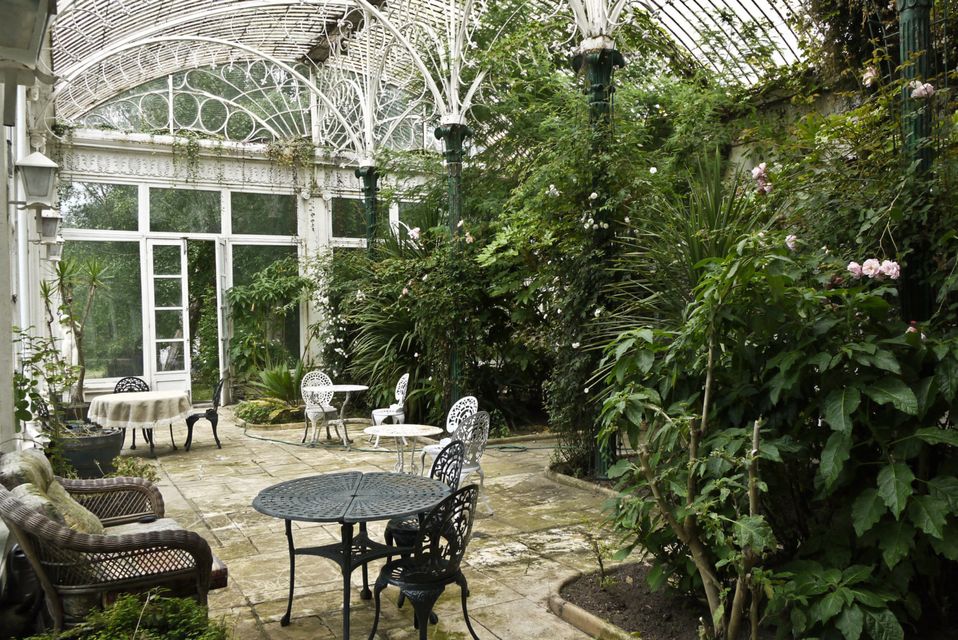


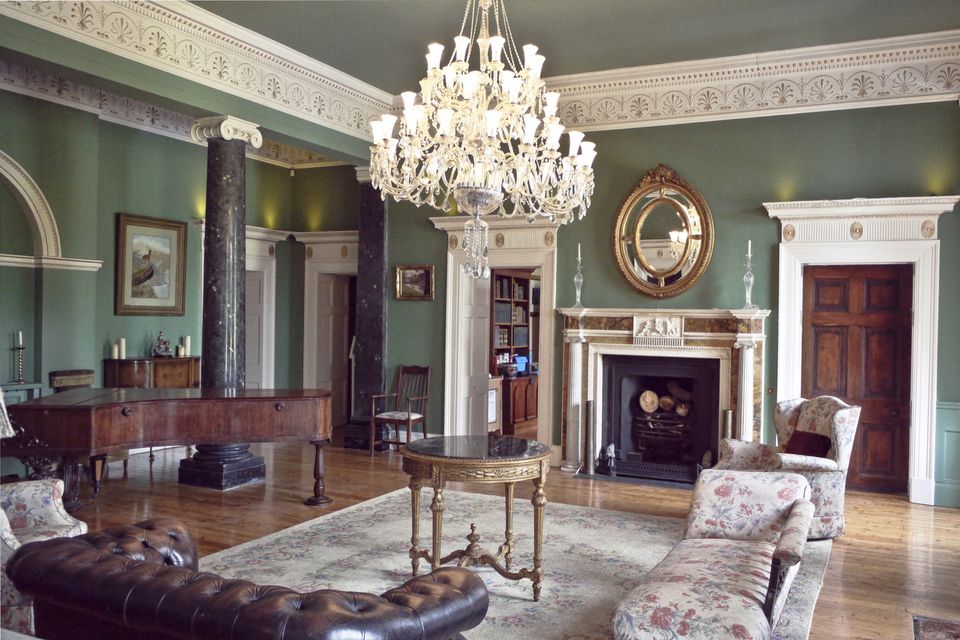


 Tobertynan


 Irish Historic Houses


