Accommodation and wedding venues in County Cavan

Places to stay, County Cavan

1. Cabra Castle, on section 482 – hotel and lodges

2. Clover Hill Gate Lodge, Cloverhill, Belturbet, Cavan

3. Farnham Estate, Farnham Estate, Cavanhotel

4. Killinagh House, McNean Court, Blacklion, County Cavanwhole house rental and lodge

5. Lismore House, Co Cavan – was a ruin. Place to stay: Peacock House on the demesne

6. Olde Post Inn, Cloverhill, County Cavan

Whole house rental County Cavan:

1. Killinagh House, McNean Court, Blacklion, County Cavanwhole house rental 

3. Virginia Park Lodge, Co Cavanweddings

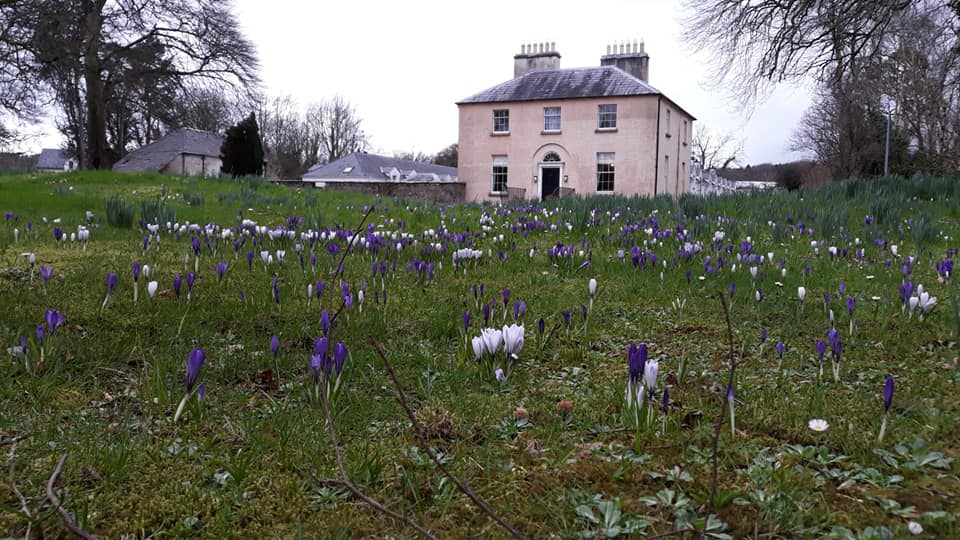
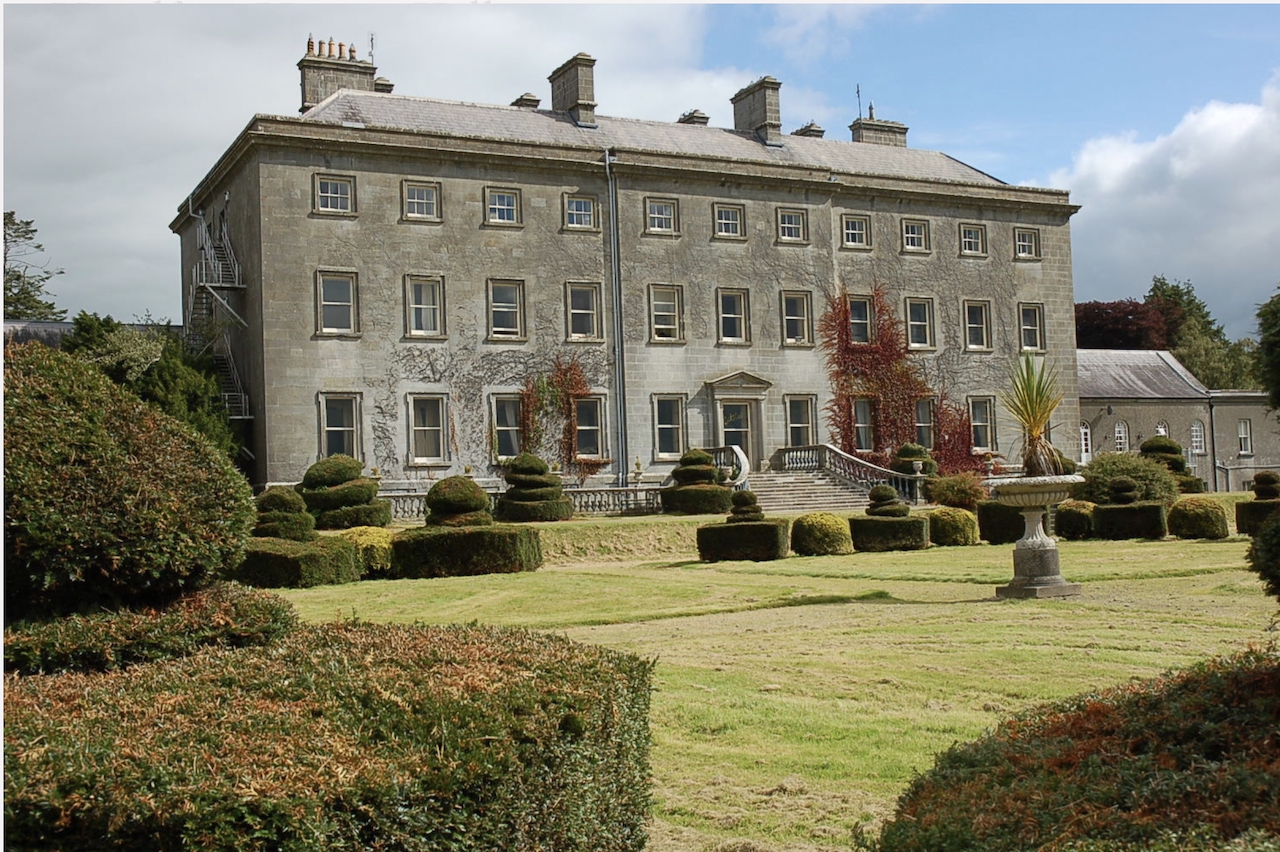
1. Cabra Castle, Kingscourt, Co. Cavan – section 482, hotel

This is a hotel but unlike some heritage house or castle hotels, they do allow visitors to view the building: the website states that they are open between 11am to 4pm for visitors for viewing all year round, except at Christmastime.
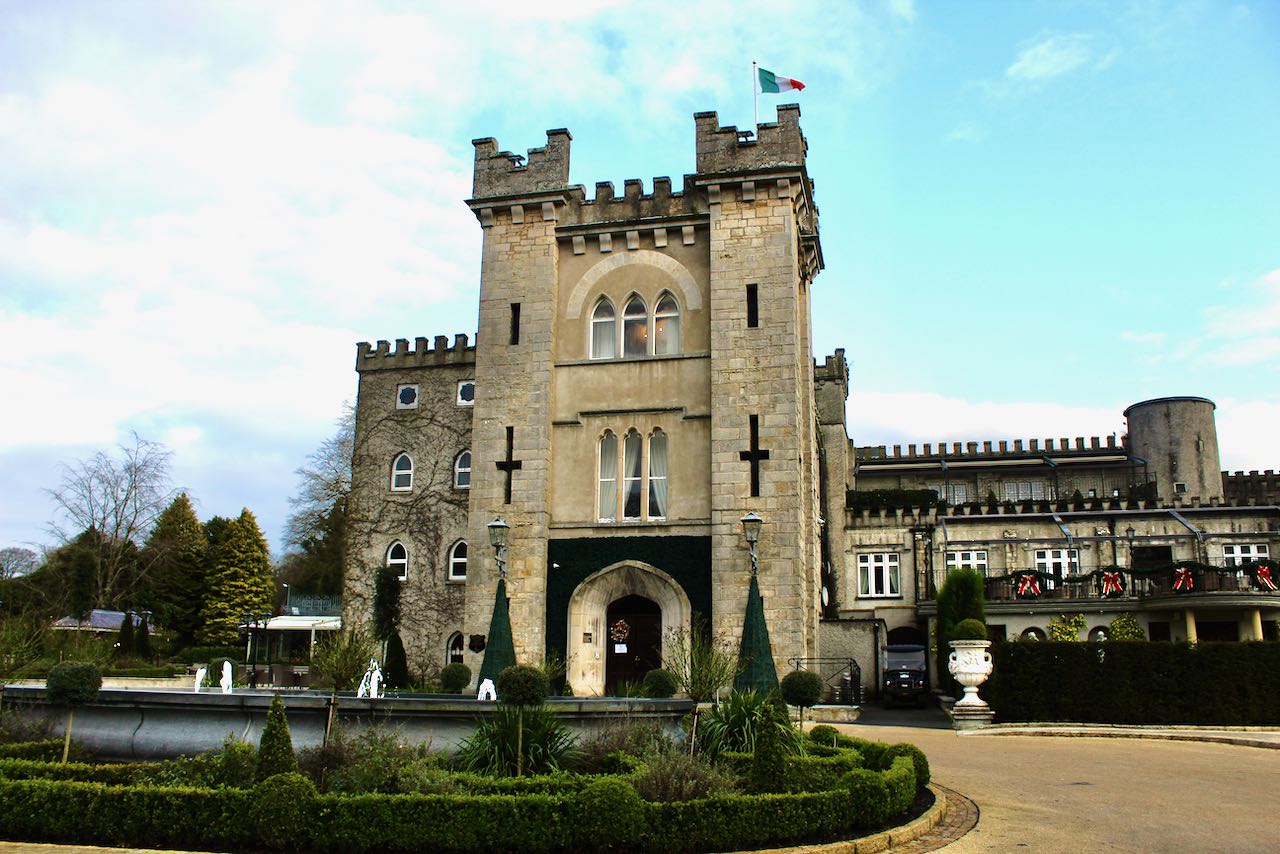
Cabra Castle, County Cavan, December 2020. Photograph © Jennifer Winder-Baggot, www.irishhistorichouses.com

see my write-up:

https://irishhistorichouses.com/2021/03/28/cabra-castle-kingscourt-county-cavan/

www.cabracastle.com
Open in 2026: all year, except Dec 24, 25, 26, 11am-4pm
Fee: Free to visit

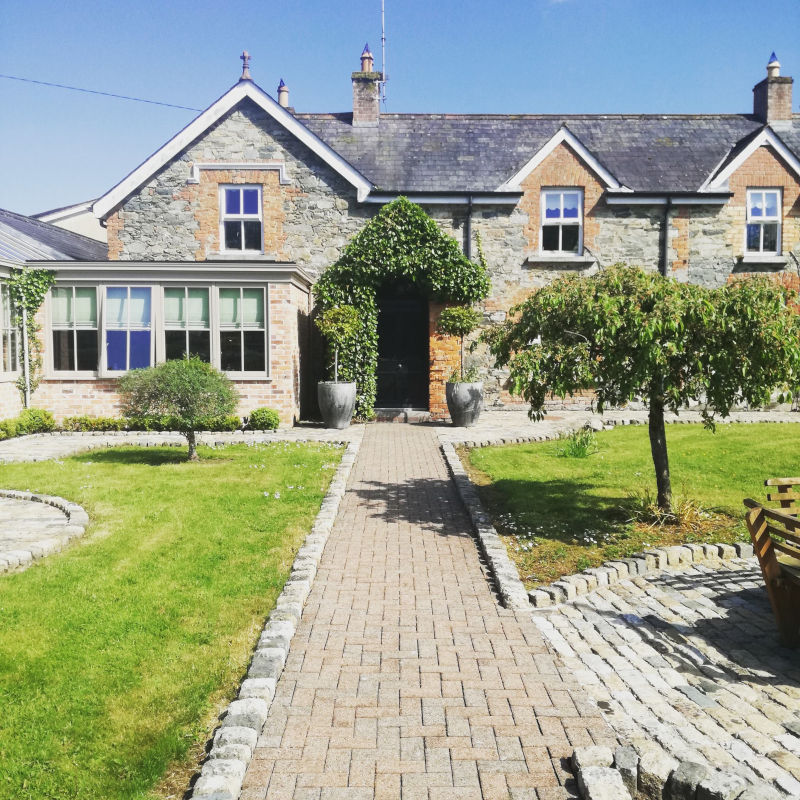
2. Clover Hill Gate Lodge, Cloverhill, Belturbet, Cavan – airbnb accommodation
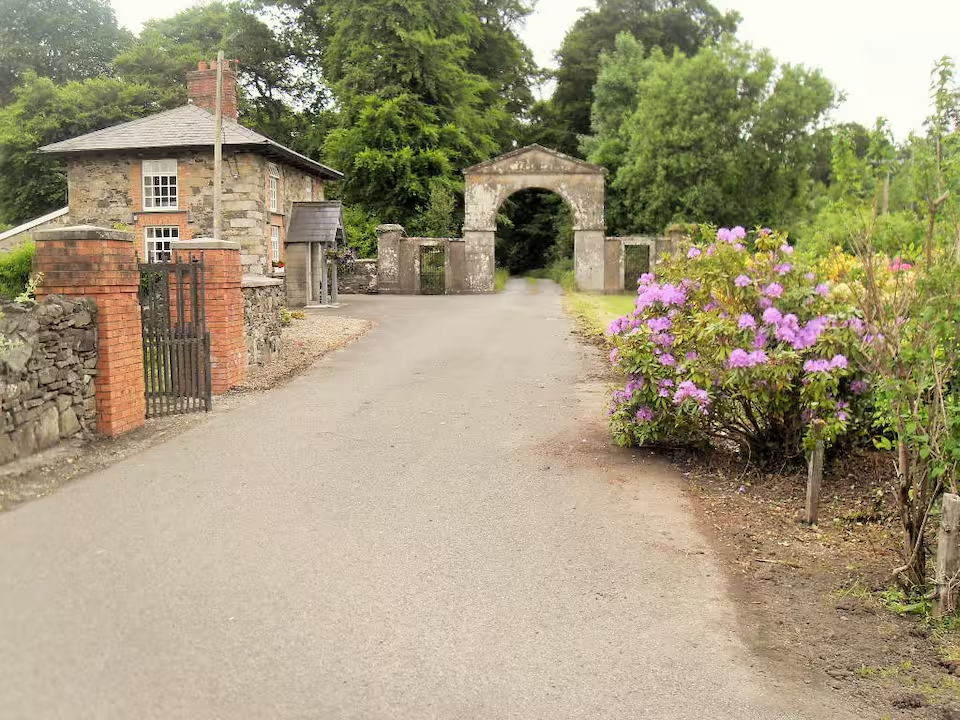
Cloverhill Gate Lodge, County Cavan, photograph courtesy airbnb website.

https://www.airbnb.ie/rooms/4962376?c=.pi0.pk314483168_127445633672&gclsrc=aw.ds&gad_source=1&gad_campaignid=314483168&gbraid=0AAAAADz55LkoVf9TCwAanNAoWG2eWN0AE&gclid=CjwKCAjwspPOBhB9EiwATFbi5CSHSojOSXZPWiu5LFh4sZKMByjLtZpuu_3AzyBVf60HB2uG0_JsNRoCwBwQAvD_BwE&source_impression_id=p3_1774518517_P3JcPlhtI0hbO-oV

The airbnb description tells us:

This old stone cottage built between 1830 -1850 is tucked away at the archway entrance to the Cloverhill Estate. This cottage is surrounded by gardens and woodland. The magic of this cottage is undeniable. Originally built for the Gate Keeper this cottage reflects heritage with rustic simplicity. Though some features and fittings have been replaced, the survival of historic features, including the label mouldings and timber bargeboards add to its character and charm.

Cloverhill House is now a ruin. Mark Bence-Jones tells us the house was built 1799-1804 for James Saunderson (1763-1842) to the design of Francis Johnston. [1] Robert O’Byrne adds that it was in fact extended in 1799, but built originally in 1758 (thus was built for James’s father Alexander, who married Lucy Madden of the Hilton Park House Madden family, another Section 482 property. A date stone gives us the date of 1758.) [2] Mark Bence-Jones tells us that the house passed by inheritance to the Purdons, and was sold by Major J.N. Purdon ca 1958. The National Inventory of Architectural Heritage tells us that the Sanderson family were instrumental in the development of Cloverhill village with the building of the Church of Ireland church and estate workers’ houses.
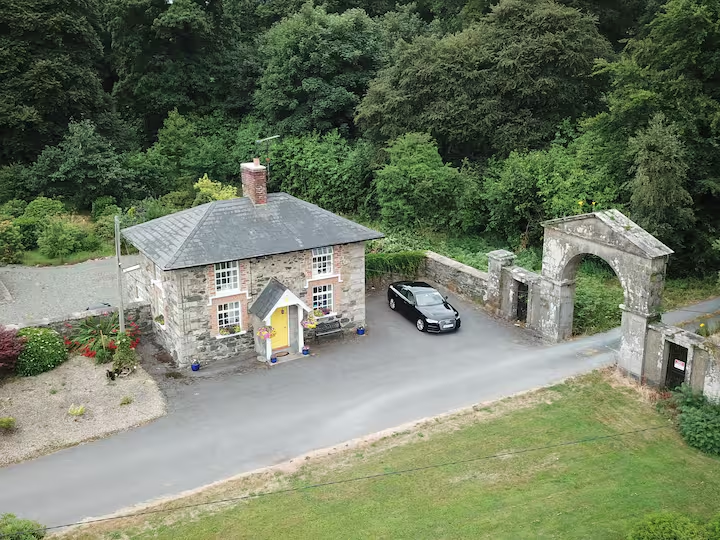
Cloverhill Gate Lodge, County Cavan, photograph courtesy airbnb website.

The house is featured in Tarquin Blake’s Abandoned Mansions of Ireland, Collins Press, Cork, 2010. 

From James Sanderson (1763-1842) the property passed down through the female line since the son, also named James, had no heirs. It passed first to Mary Anne, who was unmarried, and then to her sister’s son, Samuel Sanderson Winter (1834-1912), whose parents were Lucy Sanderson and Samuel Winter (1796-1867) of Agher, County Meath. Samuel Sanderson Winter married Ann, daughter of John Armytage Nicholson of Balrath Bury, County Meath (we came across this family before as Enniscoe in County Mayo was inherited by Jack Nicholson, of the Balrath Bury family). Samuel Sanderson Winter’s son died young so Cloverhill passed to the son of his sister, Elizabeth Ann Winter, who married George Nugent Purdon (1819-1910). This is how the house passed to the Purdon family.

The house passed to their son, John James Purdon, who died childless so it passed to his nephew, John Nugent Purdon, son of Charles Sanderson Purdon. John Nugent Purdon sold Cloverhill demesne  ca 1958 to Mr Thomas Mee. [3] 

3. Farnham Estate, Farnham Estate, Cavan – hotel
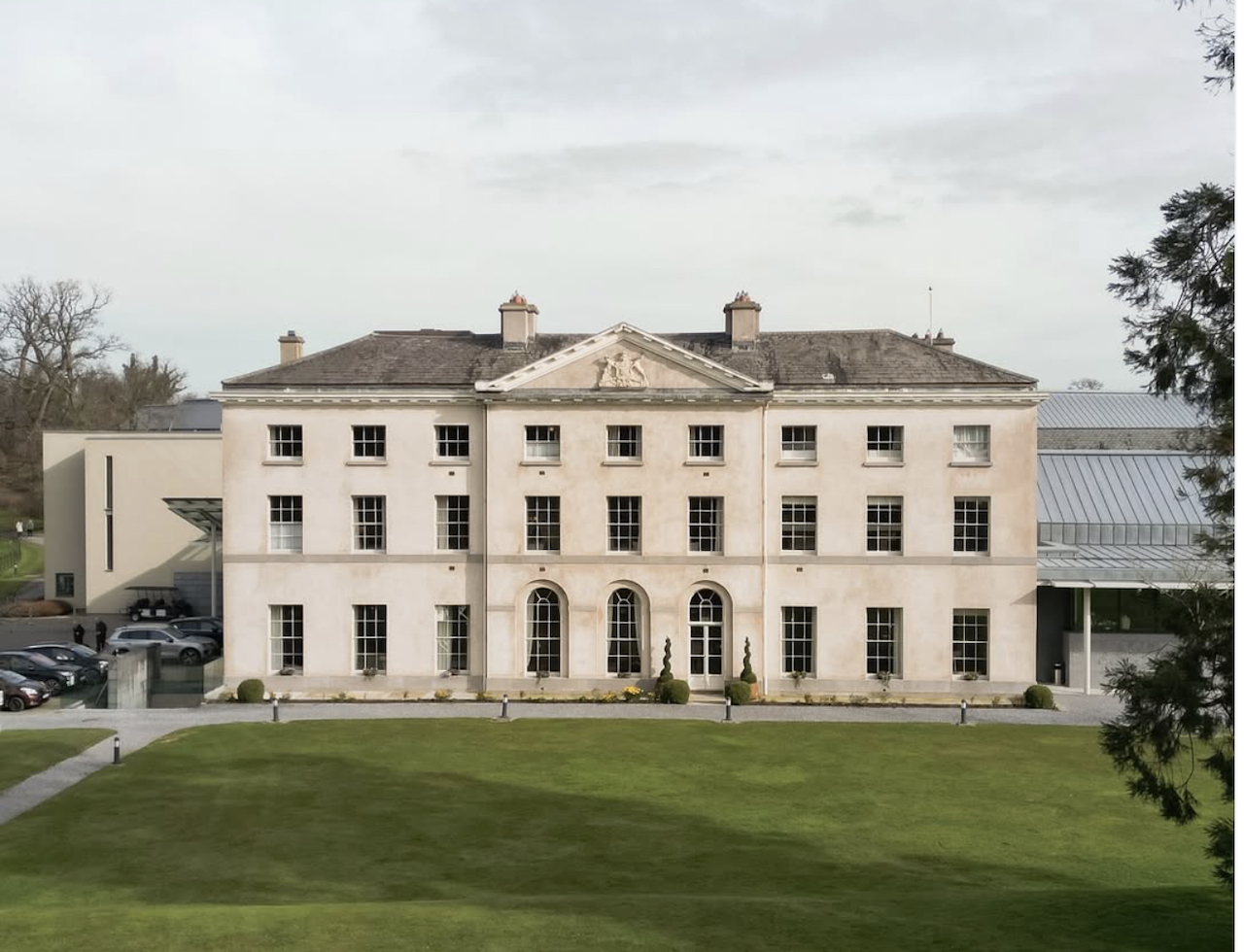
https://www.farnhamestate.ie

Farnham Estate, County Cavan, photograph courtesy of hotel Instagram page.
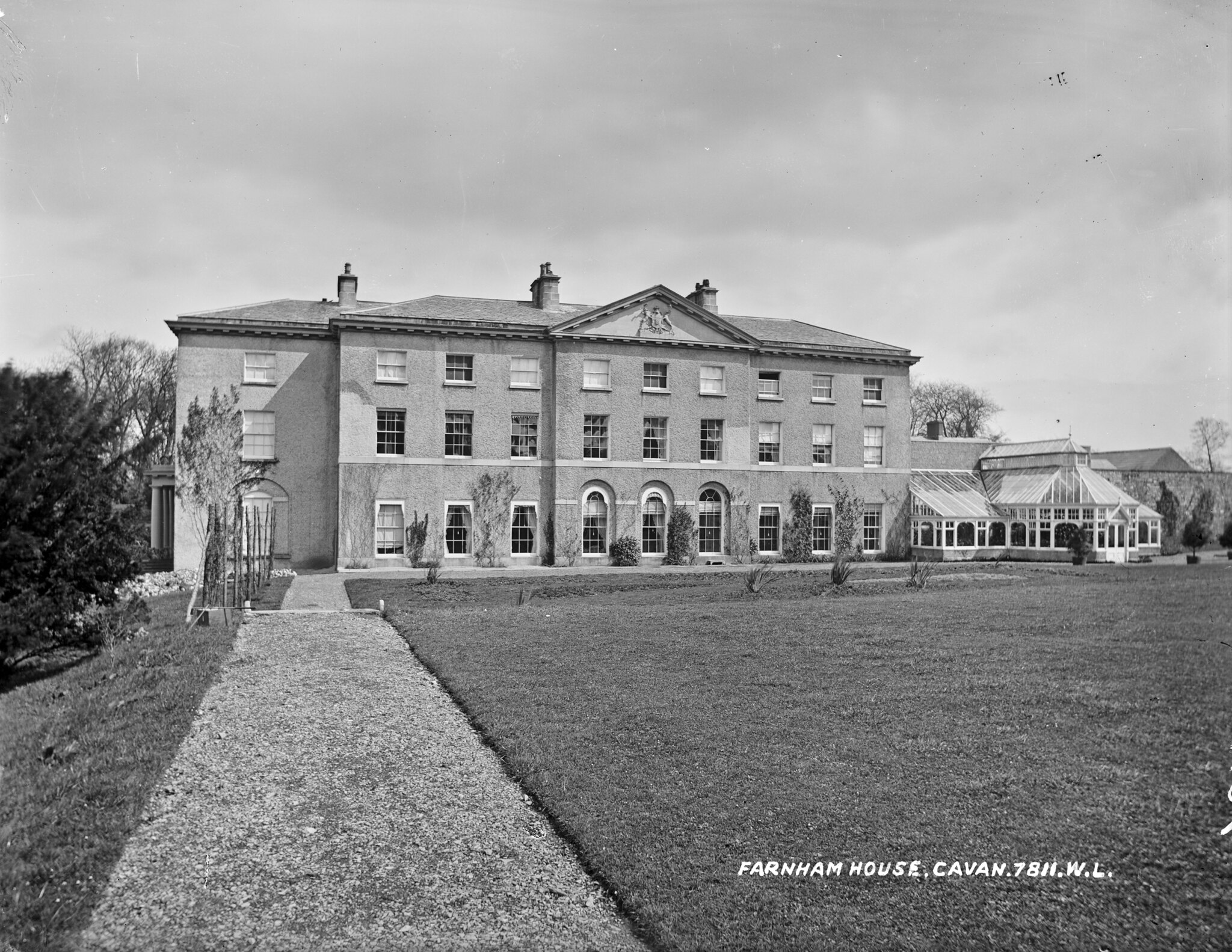
Farnham House, photograph from National Library of Ireland, flickr constant commons.

David Hicks tells us in his Irish Country Houses, A Chronicle of Change that the wing of Farnham House that survives today is the truncated section of a much larger mansion. Dry rot led to demolition of a substantial section of the Maxwell ancestral home. The family’s connection was severed in 2001.
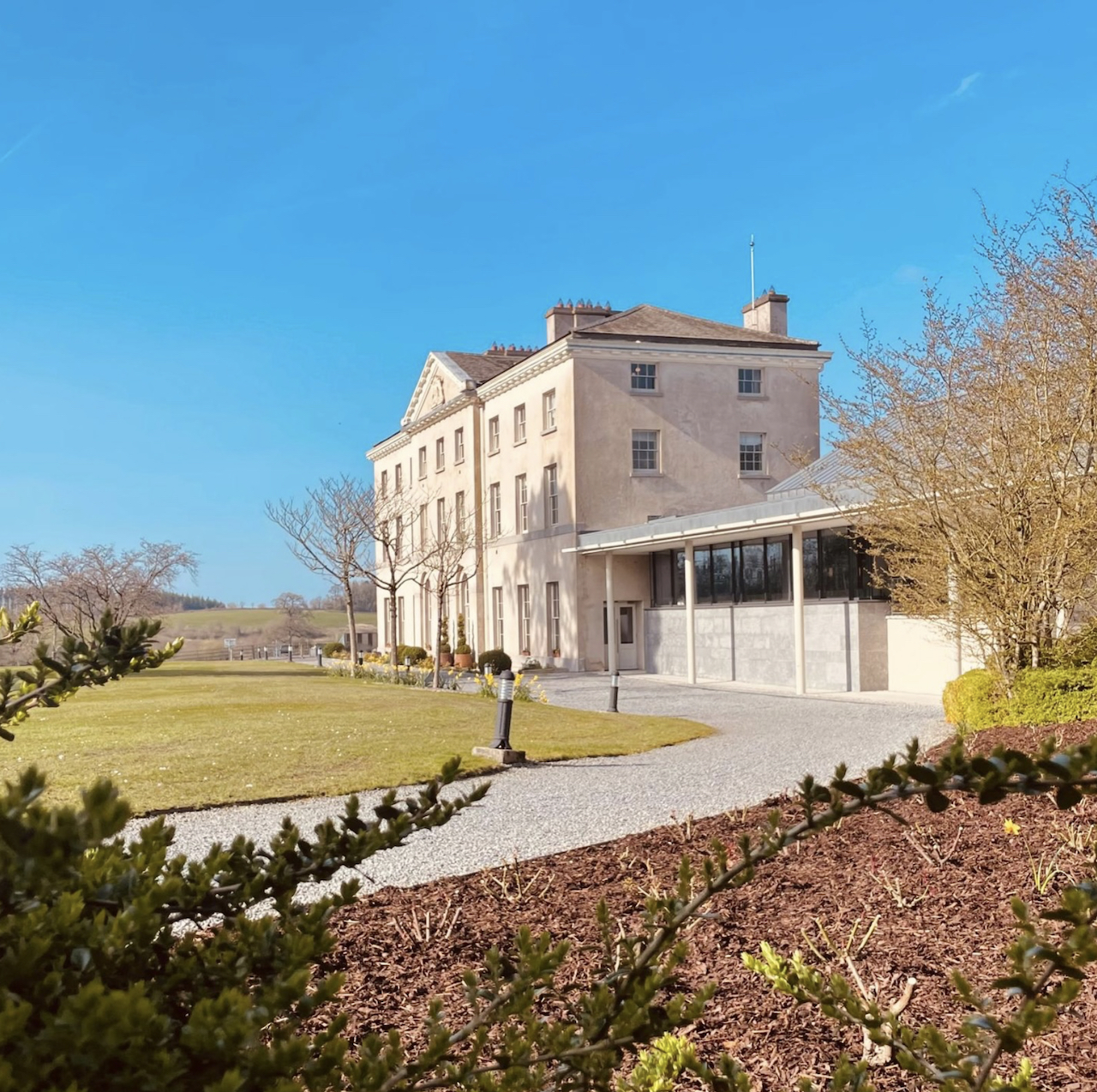
Farnham Estate, County Cavan, photograph courtesy of hotel Instagram page.

The estate was granted by King James I to the Waldron family in 1613. Henry Waldron named the estate after his wife’s family. The Waldrons built a castle here in 1620.

The website gives us a history of the estate:

“1664- The Waldrons of Dromellan Castle (early name of Farnham House) were forced to sell the estate to settle gambling debts. Bought by Bishop Robert Maxwell, thus beginning the Maxwell family connection that was to continue for more than 330 years (family motto is Je suis prêt – I am ready’).”
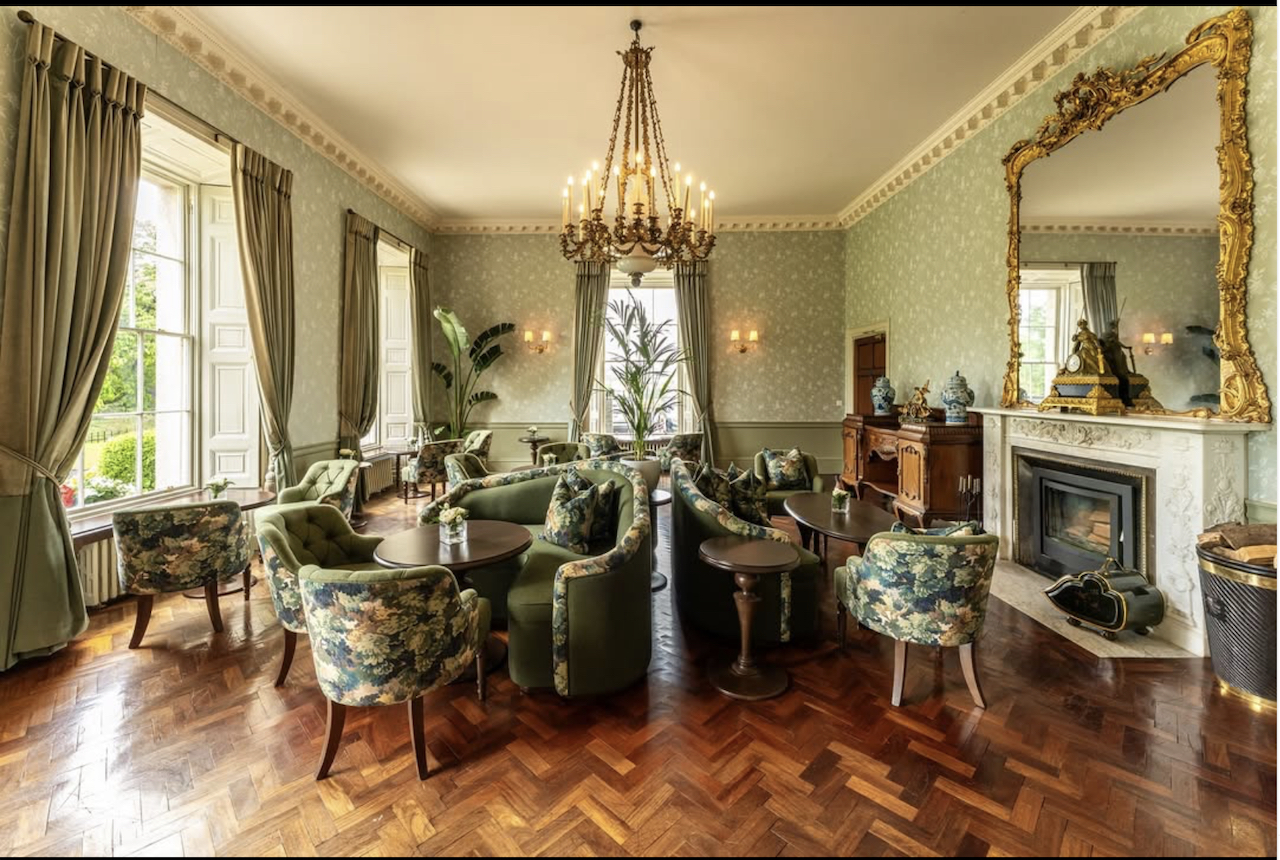
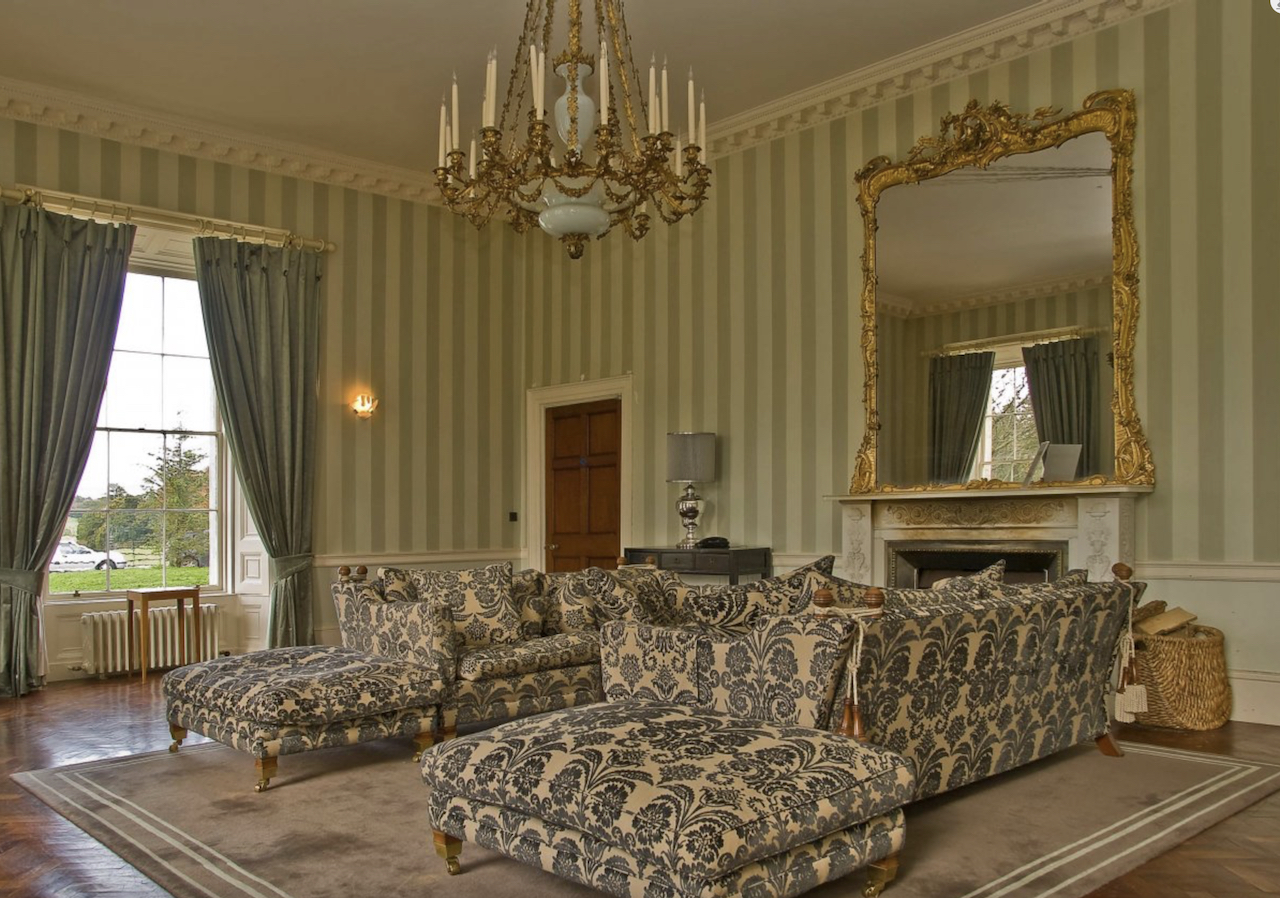
Farnham Estate drawing room, County Cavan, photograph courtesy of hotel Instagram page.

Mark Bence-Jones adds in his  A Guide to Irish Country Houses (1988, p. 123):

“…A few years later the estate was sold to Robert Maxwell [1598-1672], Bishop of Kilmore, whose cathedral was nearby. The Bishop’s son, John Maxwell, built a new house here ca 1700, which was improved ca 1780 by Barry Maxwell, 3rd Lord Farnham and first Earl of Farnham of 2nd creation, who added a library designed by James Wyatt.

Timothy William Ferres tells us of the Maxwell lineage:

John Maxwell of Farnham, High Sheriff of County Cavan, 1674, who dsp 1713, was succeeded by his nephew, The Reverend Doctor Robert Maxwell; who dsp 1737 and was succeeded by his cousin, John Maxwell (1687-1759), High Sheriff of County Cavan, 1757, MP for County Cavan 1727-56, who was elevated to the peerage, in 1756, in the dignity of Baron Farnham, of Farnham, County Cavan.

In 1719 he married Judith, heiress of James Barry (1660-1725) of Newtownbarry, County Wexford. Their son Robert succeeded as 2nd Baron Maxwell, and he was created Viscount in 1760 and 1st Earl of Farnham in 1763. Robert married Henrietta Cantillon, the widow of William Matthias Stafford-Howard, 3rd Earl of Stafford.
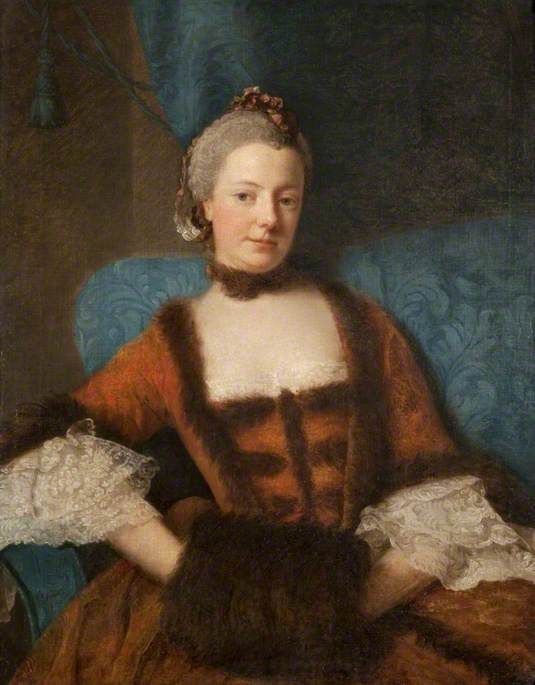
Henrietta Diana née Cantillon (1728–1761), Dowager Countess of Stafford by Allan Ramsay courtesy of Kelvingrove Art Gallery and Museum; http://www.artuk.org/artworks/henrietta-diana-17281761-dowager-countess-of-stafford-85788 She married, first, William Matthias Stafford-Howard, 3rd Earl of Stafford, and after his death, Robert Maxwell, 2nd Baron and 1st Earl of Farnham.

See also the wonderful book by Melanie Hayes, The Best Address in Town: Henrietta Street, Dublin and its First Residents 1720-80, published by Four Courts Press, Dublin 8, 2020. She has a chapter on John Maxwell, (1687-1759) 1st Baron Farnham.

The Farnham Estate website tells us that Robert was a keen agriculturalist and agent of improvement who put the most technologically and scientifically advanced agricultural methods into action. The website tells us:

“In 1777, noted agricultural scientist and topographer Arthur Young said of Farnham; “…upon the whole Farnham is one of the finest places that I have ever seen in Ireland; the water wood and hill are all in great stile and abound in a variety of capabilities. The woodland plantations of Derrygid coupled with the lakes of Farnham and Derrygid were noted by Young who described them as being ‘uncommonly beautiful; extensive and have a shore extremely varied.” In the 1770’s, approximately 100 labourers were employed in maintaining the landscape at Farnham.

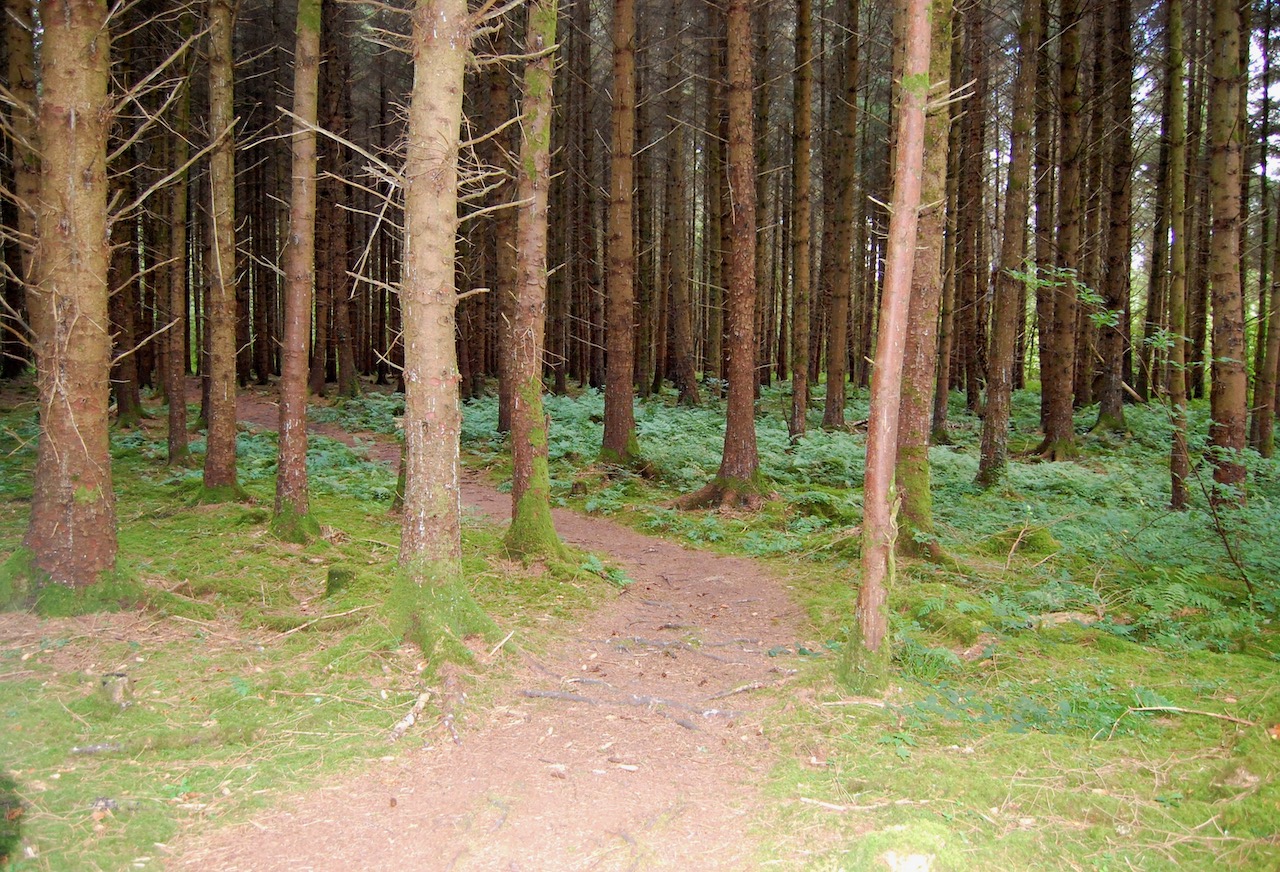
Walk on Farnham Estate, Cavan, Sept 2013. Photograph © Jennifer Winder-Baggot, www.irishhistorichouses.com

Robert 1st Earl and Henrietta’s daughter Henrietta married Denis Daly (1747-1791) of Dunsandle, County Galway.

Denis Daly (1747-1791) of Dunsandle, County Galway, attributed to Joshua Reynolds, courtesy of Christies 2012 Mount Congreve the London Sale.

The first Earl’s son John predeceased him and didn’t marry, so the 1st Earl’s brother Barry succeeded him. Barry Maxwell was a barrister and MP for County Cavan and later for Armagh city. When his mother Judith née Barry died in 1771 he must have inherited as he changed his name to Barry Barry. Then when his elder brother Robert Maxwell, 1st and last Earl of Farnham, died in 1779, he inherited and his name was changed back to Barry Maxwell, and he succeeded as the 3rd Baron Farnham, of Farnham, Co. Cavan. He was created 1st Earl of Farnham, Co. Cavan (Ireland, of the 2nd creation) on 22 June 1785.
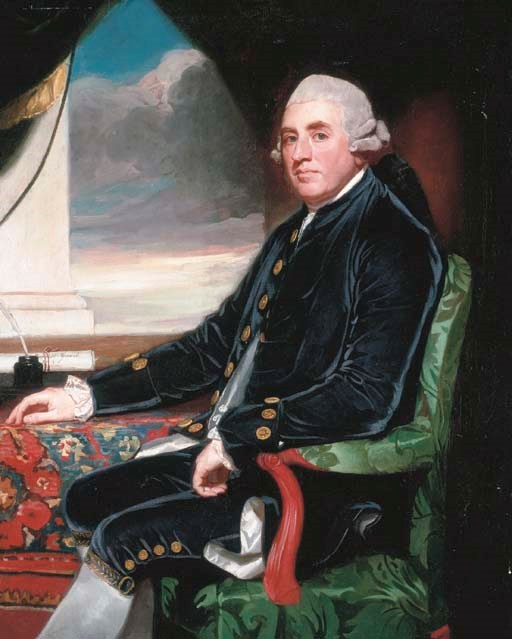
Portrait of Barry Maxwell (1723-1800) 1st Earl Farnham by George Romney courtesy of www.christies.com/en/lot/lot-4507942 He was the son of John Maxwell, 1st Baron Farnham and Judith Barry.

When Robert 1st Earl’s first wife Henrietta died, he married secondly, in 1771, Sarah, only daughter of Pole Cosby, of Stradbally Hall, Queen’s County, and sister of Lord Sydney, but they had no further children. Sarah had been previously married to Arthur Upton (d. 1763) of Castle Upton, County Antrim. After her second marriage she was known as the Countess of Farnham.
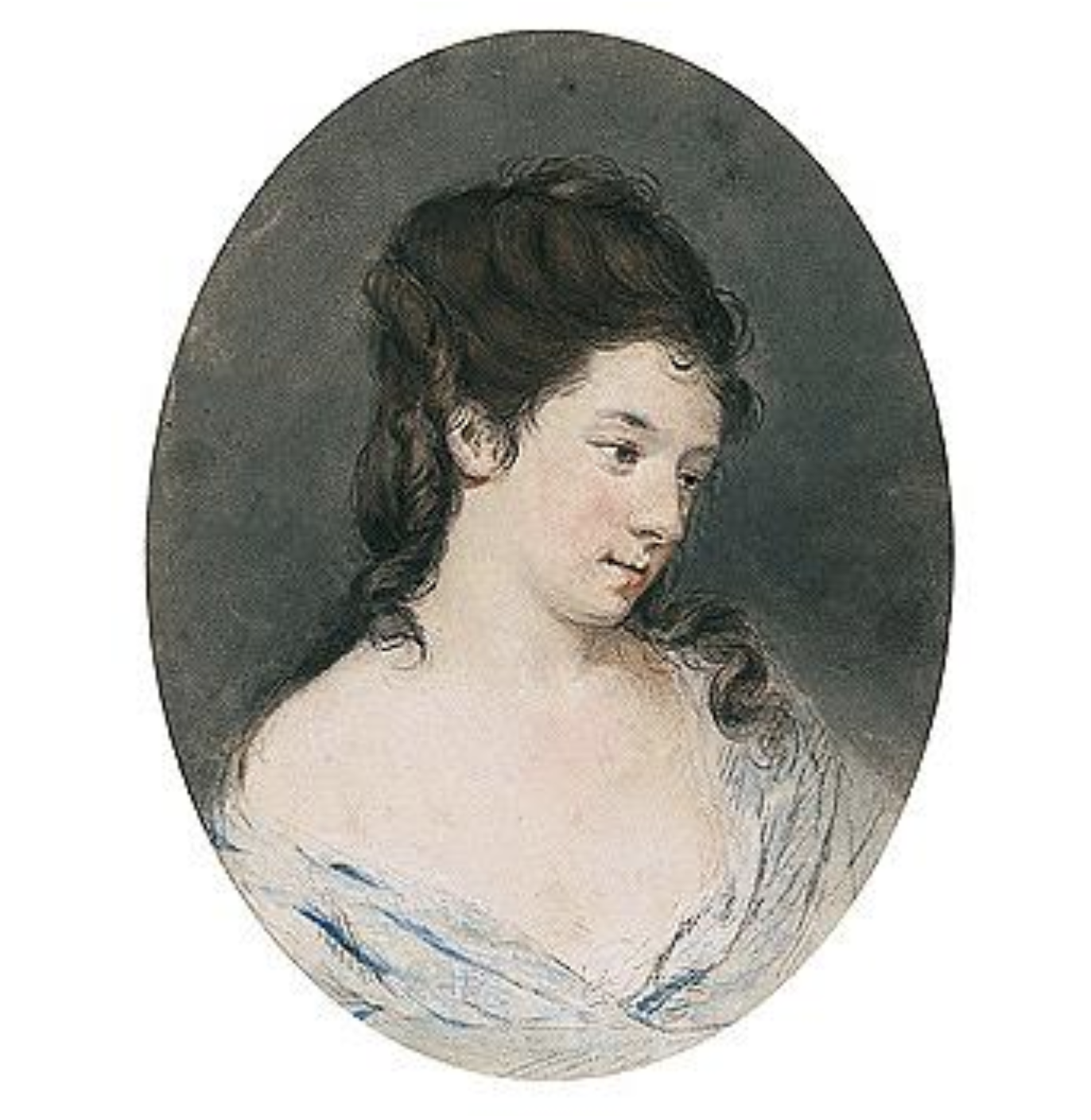
The Countess of Farnham, probably Sarah née Cosby, wife of Robert Maxwell, 1st and last Earl of Farnham (of the first creation), painted by Hugh Douglas Hamilton, courtesy of Sothebys 2001.

The first Earl had another brother Most Reverend Henry Maxwell (d. 1798), who became Bishop of Dromore and Bishop of Meath.
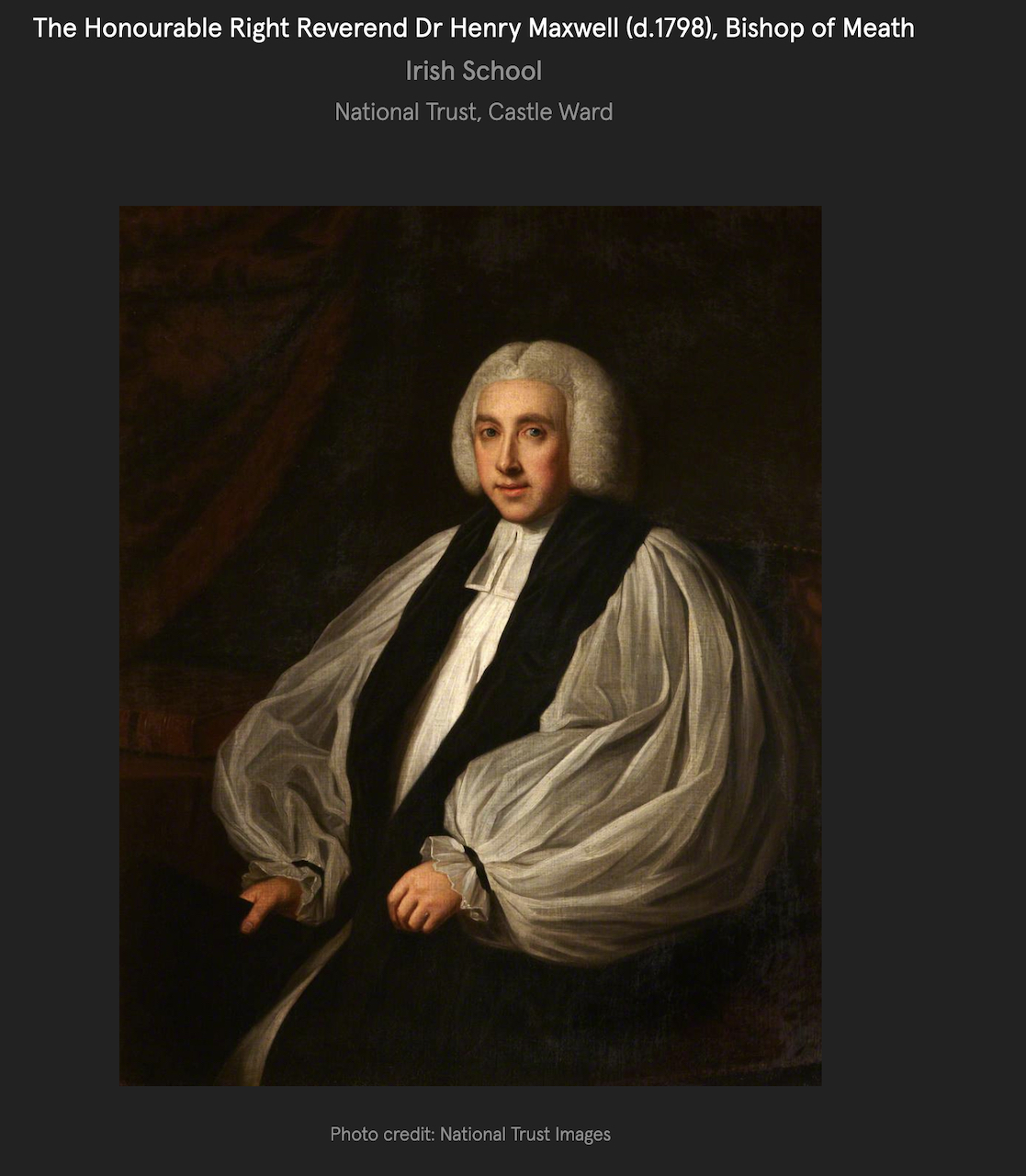
Right Reverend Henry Maxwell (d. 1798) Bishop of Meath, Irish school courtesy of National Trust Castle Ward

Reverend Henry Maxwell married Margaret Foster, daughter of Rt. Hon. Anthony Foster Chief Baron of the Irish Exchequer between 1766 and 1777, who lived in Collon in County Meath.

Their sons became respectively John Maxwell Barry Maxwell (1767-1838) 5th Baron Farnham and Reverend Henry Maxwell (d. 1838) 6th Baron Farnham, and the Baronetcy continued to their descendants. The Earldom was recreated for the elder brother Barry, 3rd Baron (1723-1800), who obtained a viscountcy and earldom, in 1780, as Viscount Farnham, and, in 1785, Earl of Farnham (2nd creation).
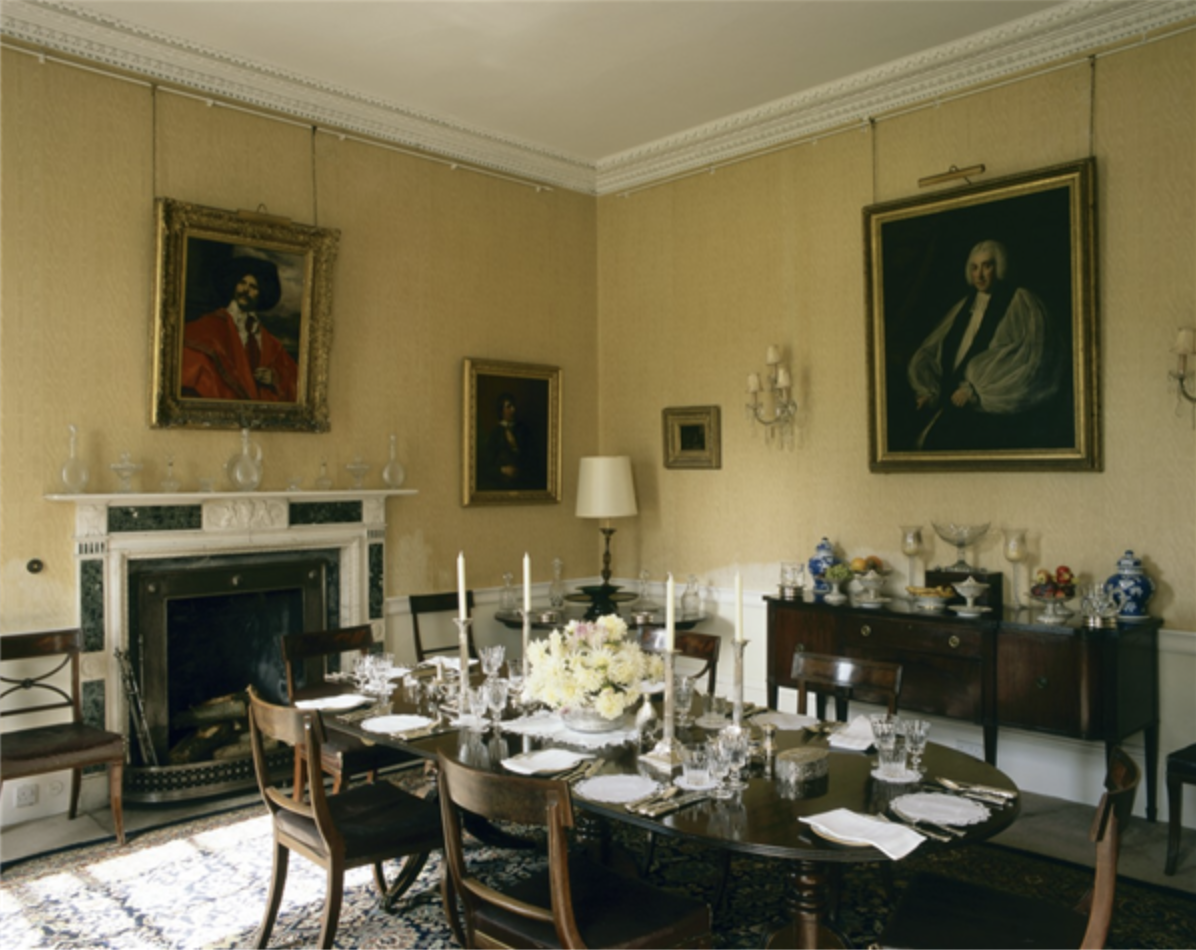
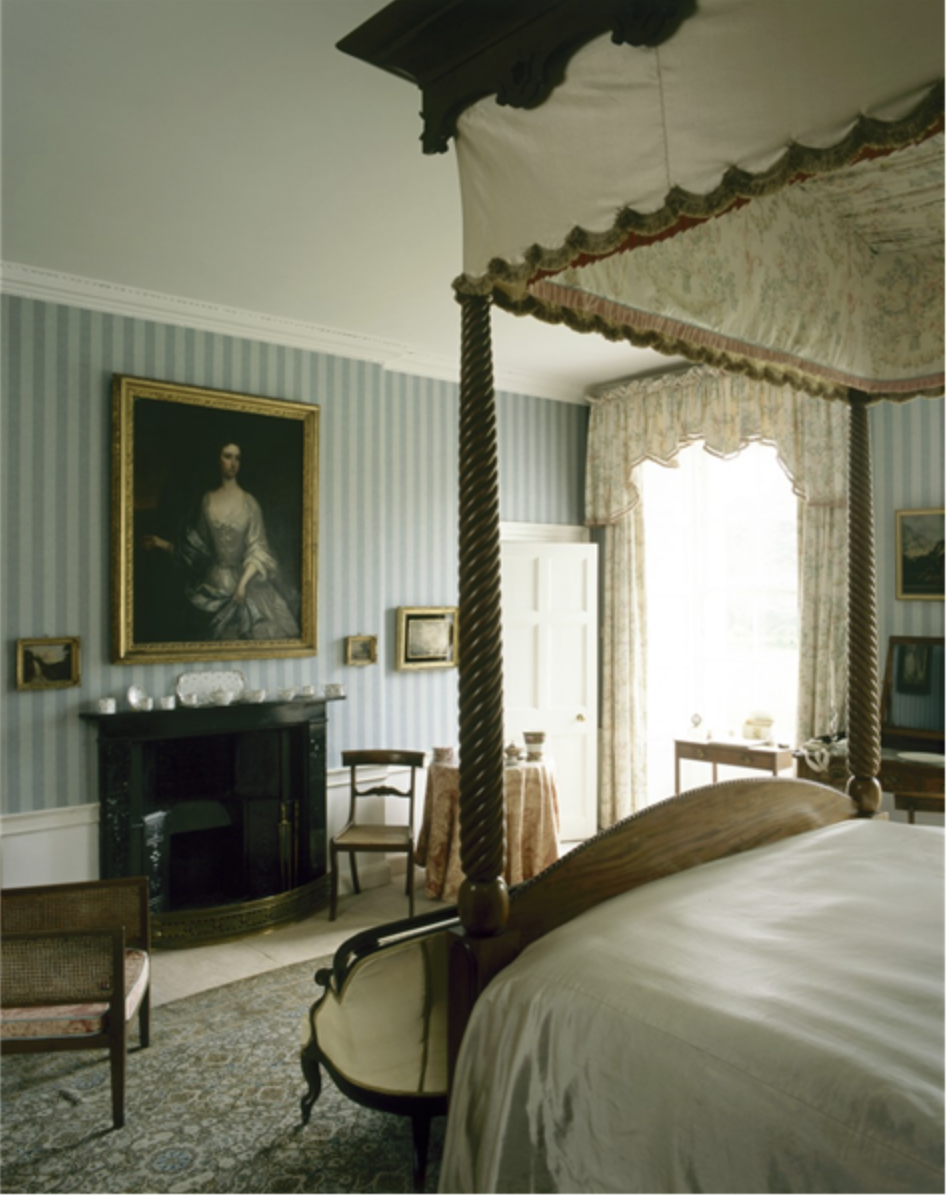
The dining room at Farnham House. Pub Orig Country Life 02/01/2003, volume CXCVII. Photographer Paul Barker. With portrait of Right Reverend Henry Maxwell (d. 1798) Bishop of Meath.

The three brothers, Robert 1st Earl, Barry 1st Earl of second creation and Reverend Henry had a sister, Anne, who married Owen Wynn (1723-1789) of Hazelwood, County Sligo.

Barry Maxwell, 1st Earl of Farnham served as MP and Privy Counsellor. He married first Margaret King of Drewstown, County Meath, who gave birth to their son and heir John James Maxwell (1759-1823) later 2nd Earl of Farnham. Barry married secondly Grace, daughter of Arthur Burdett. His son did not have children and the Earldom and Viscountcy became extinct on his death.
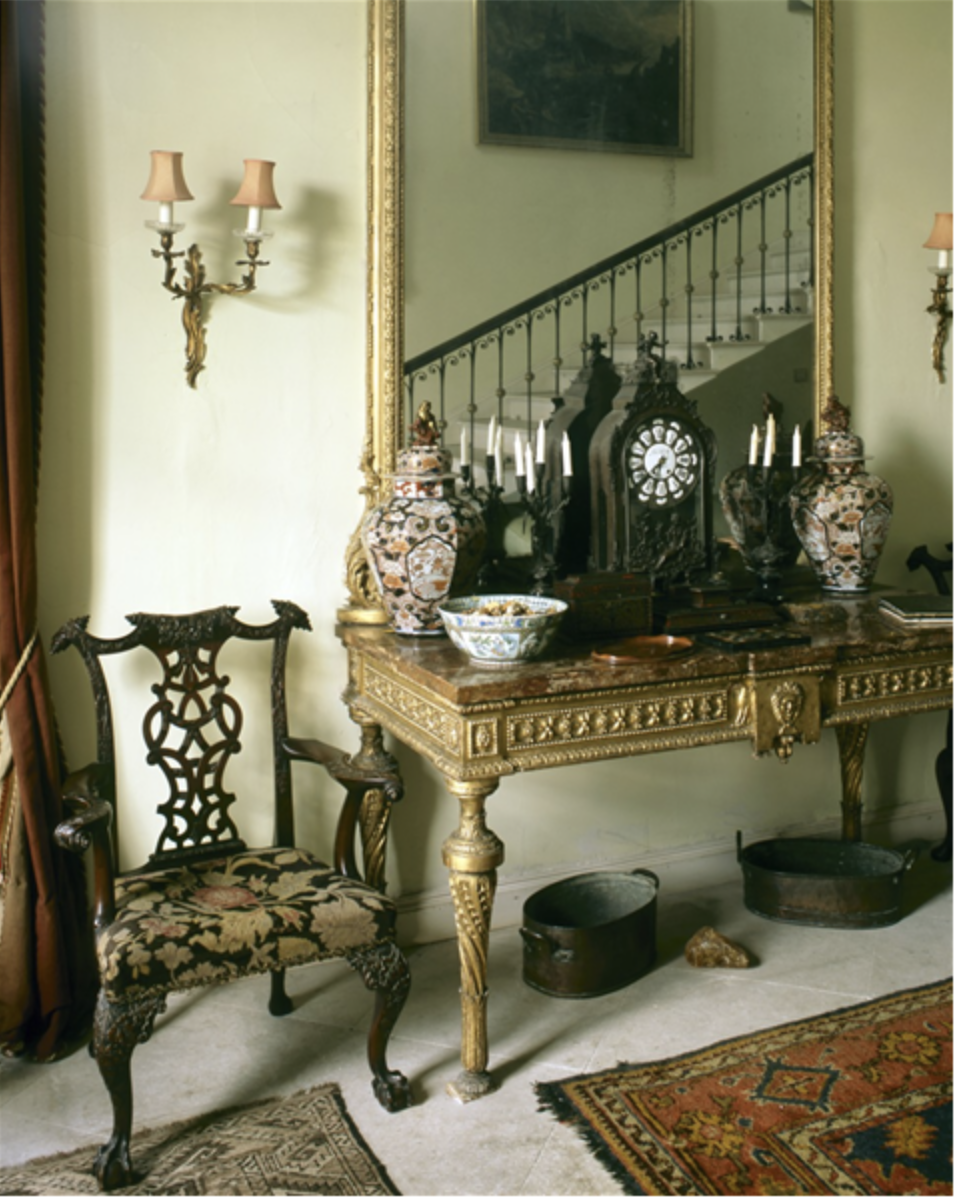
Photograph of Farnham House from Country Life, A Chinese Chippendale chair in the hall at Farnham House. Pub Orig CL 02/01/2003, volume CXCVII. Photographer Paul Barker. 

The website tells us of the building of Farham:

“In 1795, Earl of Farnham Barry [Barry Maxwell (1723-1800)] asked James Wyatt, one of the most fashionable architects of that time, to draw designs for three ceilings. Although there is no evidence of them being installed at Farnham, these plans are now housed in the Metropolitan Museum of Art in New York. Some work was undertaken by Wyatt though around the 1795 timeframe and to this day, a library case where his design has been noted stands inserted in an alcove on the staircase landing.

In the early 1800s, a coat of arms was incorporated onto the façade of the house. Comprised of the arms of the Maxwell and Barry family, they are supported by two bucks, with a buck’s head on top of the Baron’s coronet as the crest.

Barry’s son James John Barry 2nd Earl engaged Francis Johnston to build. The website tells us:

In 1802 Francis Johnston, architect for Dublin’s famous GPO building, was engaged to complete an extension of the existing house to provide an edifice to the southwest garden front. This is the latter day surviving Farnham House, which is now incorporated as the centrepiece of the hotel complex design.

Mark Bence-Jones describes the house as built by Francis Johnston:

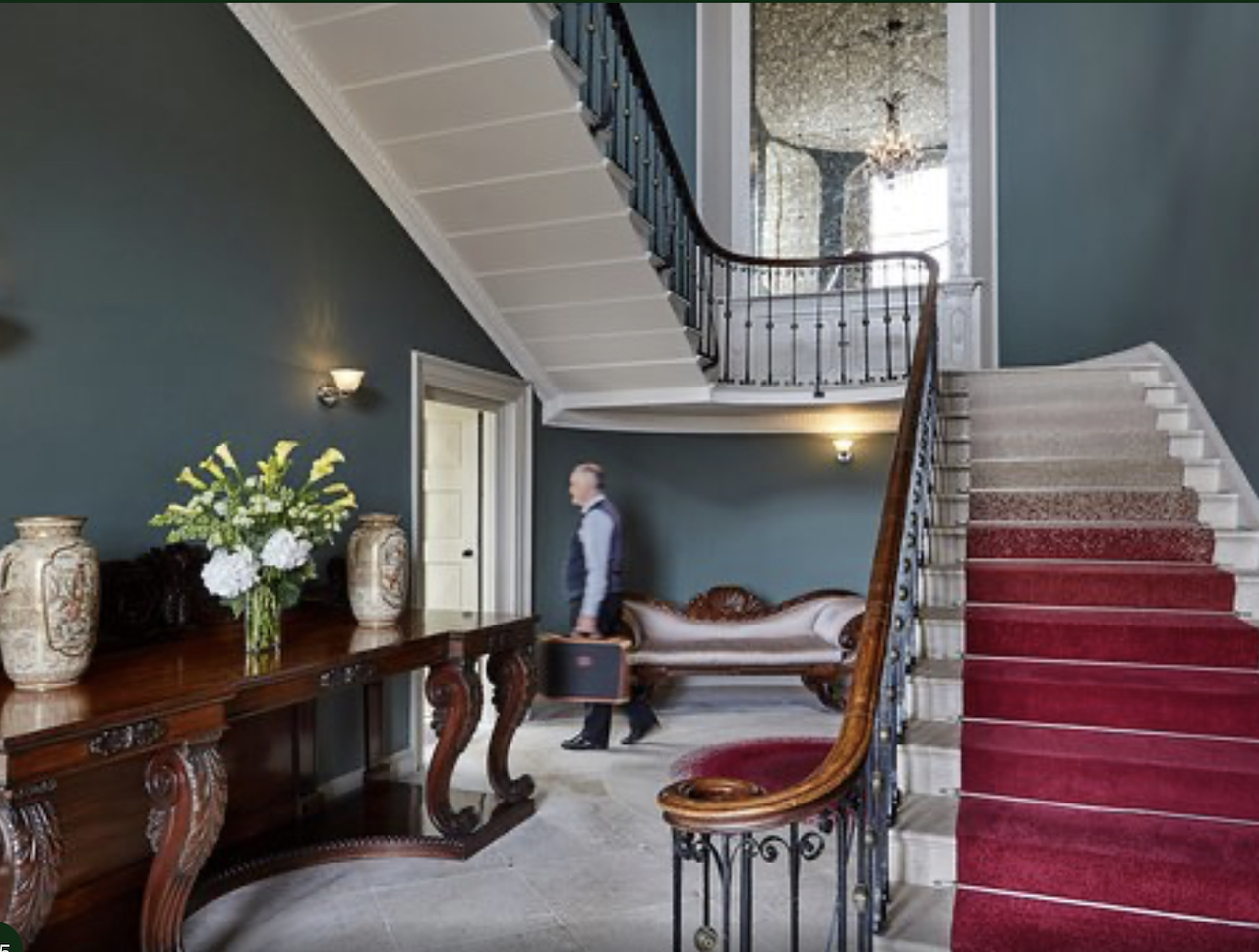
“Johnston produced a house consisting of two somewhat conservative three storey ranges at right angles to one another; one of them, which incorporated part of the earlier house, including Wyatt’s library, having a front of eight bays, with a die over a two bay breakfront, and a single-storey Doric portico; the other having a front of nine bays with a three bay pedimented breakfront; prolonged by one bay in the end of the adjoining range. The interior was spacious but restrained, the principal rooms having simple ovolo or dentil cornices. Elliptical staircase hall, with simple geometrical design in the ceiling; stone stair with elegant metal balustrade.

The staircase at Farnham House designed by Francis Johnston. Pub Orig Country Life 02/01/2003, volume CXCVII. Photographer Paul Barker.
Farnham Estate, County Cavan, photograph courtesy hotel.

The website continues: “In the depths of the earth beneath Farnham lies a myriad of passages. These passages were constructed to allow food, supplies and heating fuels to be brought into the mansion house by the servants. Such underground passages kept the servants out of sight from Lords and Ladies Farnham and their guests and no doubt were used by the servants to enjoy some activities of their own, which they would not have wanted Lord and Lady Farnham to witness!

When James John died childless in 1823, a cousin, John Maxwell Barry Maxwell (1767-1838), son of Rt. Rev. Henry Maxwell, became 5th Baron Farnham.

The website tells us: “In 1823, a new system of management for the Farnham estate was introduced, employing persons as inspectors of districts, buildings, bog and land and a moral agent! The main duties of the moral agent were to encourage the tenantry to adhere to the main principles contained in Lord Farnham’s address to them. These included: keeping of the Sabbath, responsibility towards the education of their children, imbuing within their children a strict moral sense and to ensure that they abstained from all evil habits, including cursing and the distillation or consumption of alcohol.

The 5th Baron Farnham died childless in 1838, so his brother Reverend Henry Maxwell became the 6th Baron Farnham. He married Anne Butler, daughter of the 3nd Earl of Carrick. Their son Henry became the 7th Baron Farnham (1799-1868). Their daughter Sarah Juliana married Alexander Saunderson of Castle Saunderson. The other sons Somerset and James became 8th and 9th Baron and then the son of their brother Richard Thomas Maxwell, Somerset Henry Maxwell, became the 10th Baron.

Mark Bence-Jones tells us: “In 1839, 7th Lord Farnham (a distinguished scholar and genealogist who, with his wife, was burnt to death 1868 when the Irish mail train caught fire at Abergele, North Wales), enlarged the house by building new offices in the re-entrant between the two ranges. Also probably at this time the main rooms were changed around; the library becoming the dining room, and losing any Wyatt decoration it might have had; Wyatt’s bookcases being moved to the former drawing room.

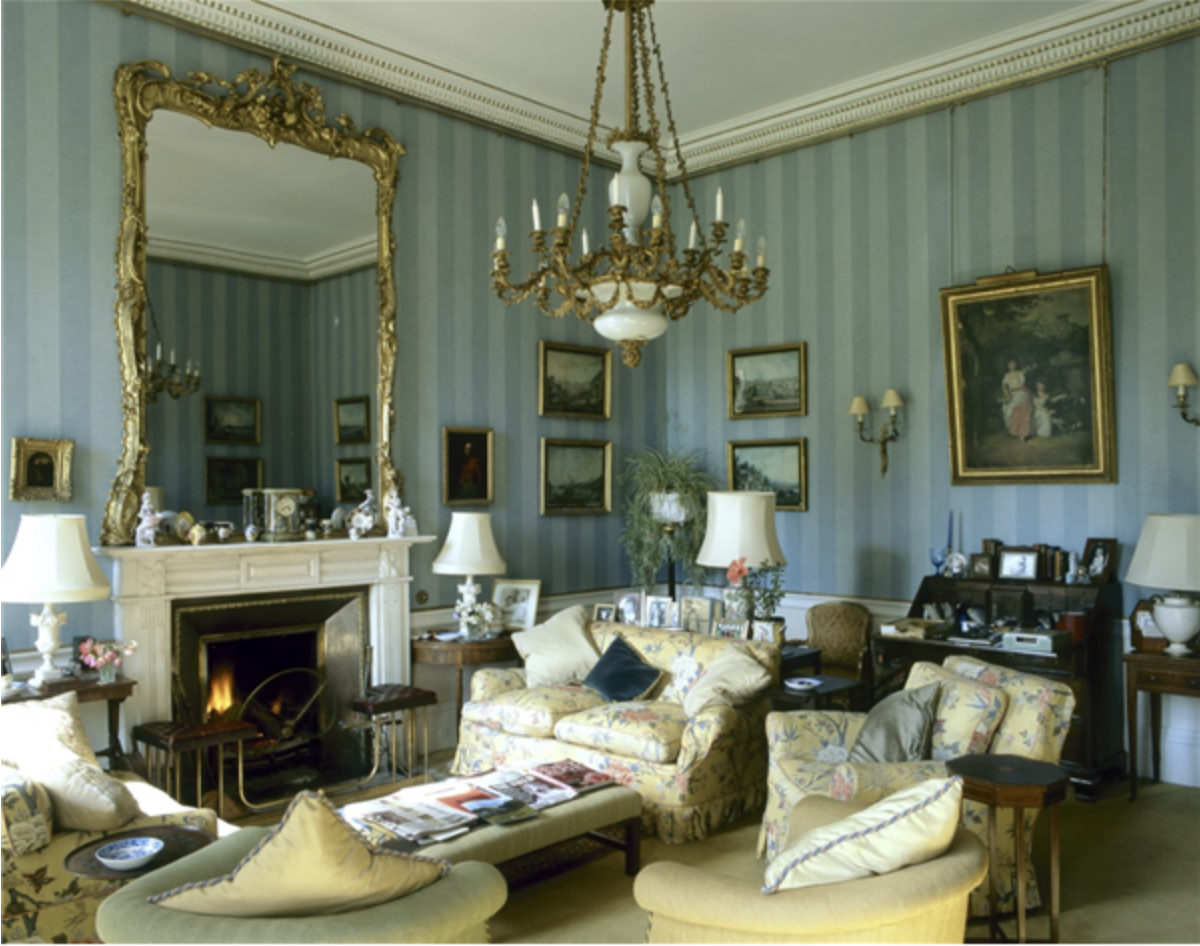
The drawing room at Farnham House. The portrait to the right is of thr Rt Hon John, 5th Baron Farnham by Sir Thomas Lawrence. Pub Orig Country Life 02/01/2003, volume CXCVII. Photographer Paul Barker.
Photograph of Farnham House from Country Life, Pub Orig Country Life 02/01/2003, volume CXCVII. Photographer Paul Barker.
Farnham Estate, County Cavan, photograph courtesy Bennett Contruction website.

Somerset Henry Maxwell, 10th Baron, married Florence Jane Taylour, daughter of Thomas Taylour, 3rd Marquess of Headfort. Their son, Arthur Kenlis Maxwell (1879-1957), became 11th Baron in 1900.

The website continues the timeline:

“1911- Records mention a staff of 11: butler, cook, governess, nursery maid, nurse, footman, ladies’ maid and several house and kitchen maids. Some 3,000 of Farnham’s then 24,000 statute acres were sold off.

1914-1918- Lord Farnham rejoined the military; he was captured, imprisoned and released after the Armistice. His political efforts failed to prevent the exclusion of three counties from the jurisdiction of Northern Ireland.

1921-1931- Lord and Lady Farnham left for England. They emptied the house of its furniture, due to widespread burning and looting of country houses. The 1923 Land Act would ultimately end landlordism in Ireland: by 1931, Lord Farnham retained only his demesne lands at Farnham, which he operated in a more intensive fashion in order to increase much-needed revenue.

Arthur Kenlis Maxwell managed to escape from a prisoner of war camp during the first world war. He and his family returned to Farnham estate in 1926 and began to renovate the house. His son and heir died in the second world war aged just 37, and the title passed to his grandson, Barry Owen Somerset Maxwell. Barry Owen’s mother died in a plane crash when he was just 21.

1950- Economic decline had by now affected the demesne. A Farnham Tintorreto ’Christ Washing the Feet of His Disciples’ was sold in 1955; the Canadian National Art Gallery in Ontario paid some $100,000. 1956- Barry Owen Somerset Maxwell, 12th Baron Farnham became the last member of the Maxwell family to reside at Farnham House.

In 1961, dry rot was discovered within the Farnham house and in an attempt to alleviate it, the oldest part of the house looking across the parkland, and the additions made to the house in 1839, were demolished.”

Mark Bence-Jones describes the changes: “Ca 1960, the present Lord Farnham, finding the house to be badly infested with dryrot, demolished the range where the entrance had formerly been situated, as well as the additions of 1839; and remodelled the surviving Johnston range to form a house in itself; being assisted in the work by Mr Philip Cullivan. The pedimented front is still the garden front, as it was formerly; the back of the range being now the entrance front, with the portico re-erected at one end of it; so that the entrance is directly into the staircase hall. The surviving range contains Johnston’s dining room, which has been the drawing room since 19C rearrangement; as well as the boudoir and the former study, now the dining room. One of Wyatt’s bookcases is now in the alcove of the former staircase window. The demesne of Farnham has long been famous for its beauty; a landscape of woods, distant mountain views and lakes, which are part of the great network of loughs and islands stretching southwards from Upper Lough Erne.

The entrance front of Farnham House, as remodelled in 1961. In an attempt to alleviate dry rot, the oldest part of the house was demolished. Pub Orig Country Life 02/01/2003, volume CXCVII. Photographer Paul Barker.
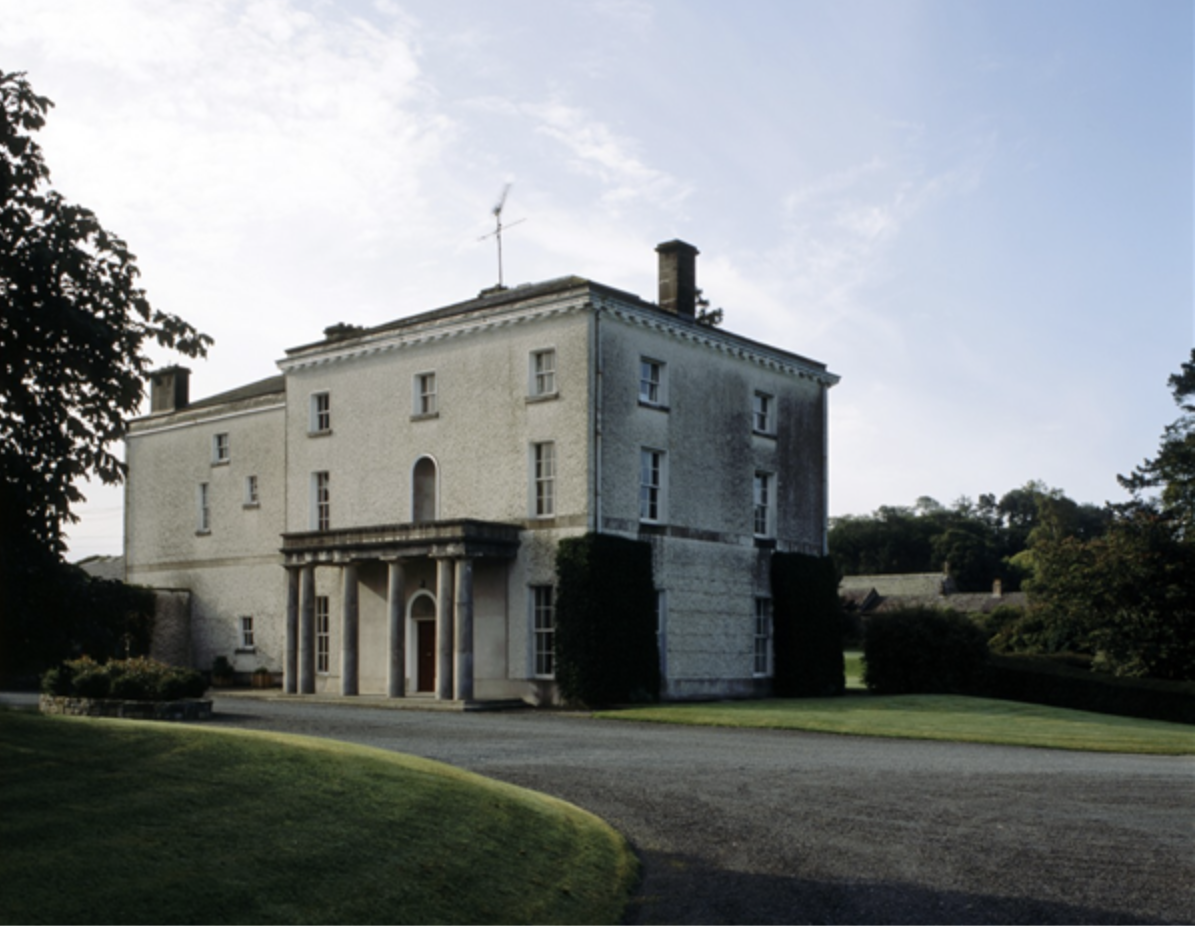
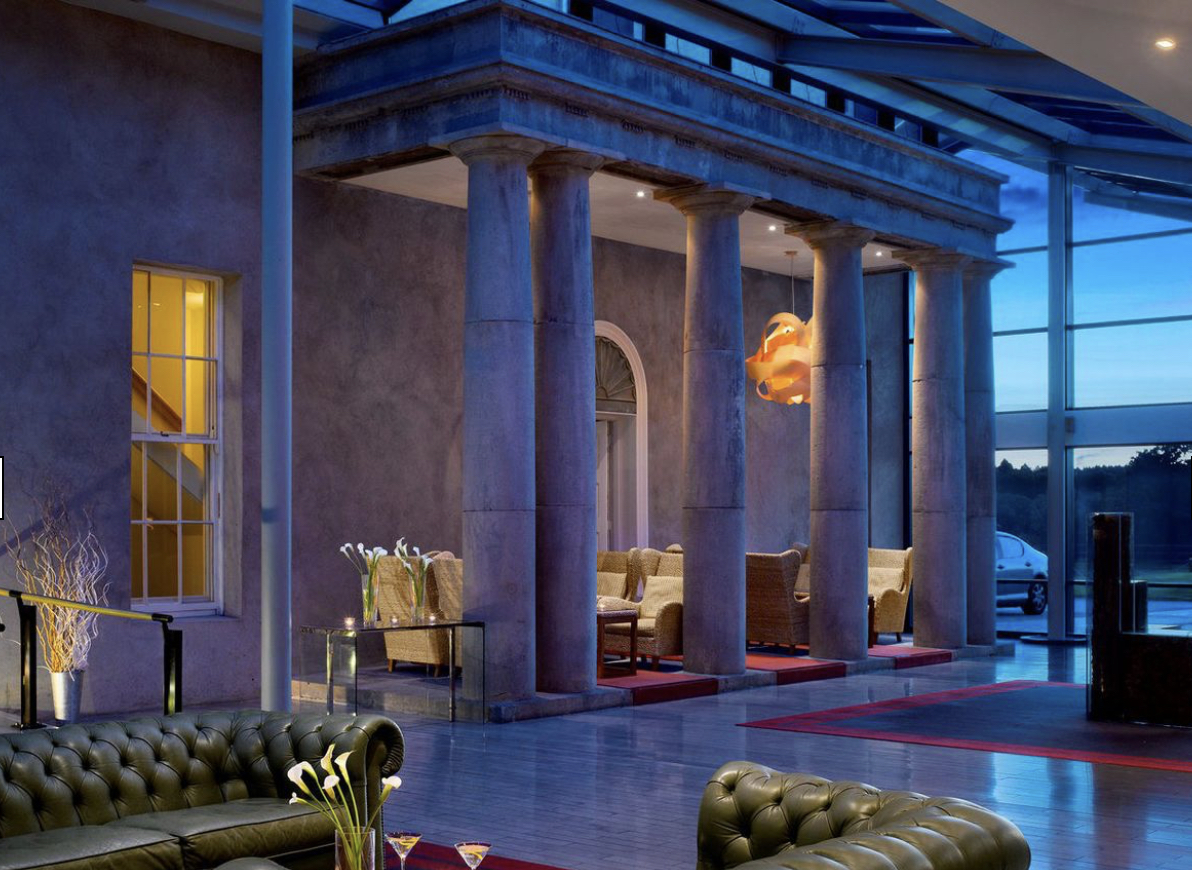
The portico that was on the original entrance front was moved to the rear of the garden front to form a new entrance when part of the house was demolished in 1942. It is now incorporated into the interior of Farnham Estate hotel. Photograph courtesy hotel.
Photograph of Farnham House from Country Life, Pub Orig Country Life 02/01/2003, volume CXCVII. Photographer Paul Barker.

The website continues:

1995 – 2001 – Lord Farnham abandoned farming and leased the agricultural lands to local farmers. One of his last acts on the Farnham demesne was the planting of a group of trees to mark the New Millennium. Lord Farnham died in March 2001 and his wife, Diana, Baroness Farnham now resides in England where she is a current Lady in Waiting to Queen Elizabeth II. Farnham House estate was sold to a local entrepreneur who developed it into a hotel resort.

Present Day – The resort is owned by Mr. Thomas Röggla and along with his team at the resort, every effort is made to provide genuine hospitality in this new phase in the evolution of this magnificent location. Thus, the indelible-mark made by the Maxwell family, as far back as 1664 on the landscape of Farnham Estate will continue to be appreciated by future generations.”

The multimillion refurbishment and extension was headed by architect Des Mahon of Gilroy McMahon, who had previously worked on the National Museum at Collins Barracks and the Hugh Lane Gallery extension.

As former Radisson Blu, Farnham Estate, Cavan 2013. Photograph © Jennifer Winder-Baggot, www.irishhistorichouses.com
Farnham estate. Photograph © Jennifer Winder-Baggot, www.irishhistorichouses.com
Walk on Farnham Estate, Cavan, Sept 2013. Photograph © Jennifer Winder-Baggot, www.irishhistorichouses.com

4. Killinagh House, McNean Court, Blacklion, County Cavanwhole house rental and a lodge

Killinagh House, County Cavan, built 1827, a former Glebe House, three-bay two-storey over basement. Photograph courtesy of Killinagh House facebook page.

https://www.discoverireland.ie/accommodation/killinagh-house

and Killinagh Lodge, https://killinaghlodge.com/facilities.html on the grounds of Killinagh House:

Killinagh Lodge is situated within 1 mile from the village of Blacklion in the picturesque grounds of Killinagh House, a former Church of Ireland manse dating back to Georgian times.

Set in the courtyard, Killinagh Lodge offers luxurious, purpose built, self catering accommodation on the shores of Lough MacNean. Boasting its own private access to the Lough, Killinagh Lodge is set in one of the most beautiful and tranquil locations where you can enjoy the grounds of the wider Estate.

The house website tells us:

Killinagh House is a unique, Georgian Country House, situated in the heart of the Marble Arch Global Geo Park, in west County Cavan. The perfect getaway for peace and relaxation. We cater for customer comforts, special requests and reasonable prices.

The perfect retreat to unwind and recharge the batteries. Peaceful and quiet with relaxed garden views. Killinagh House is at the heart of Marble Arch Global Geo Park, ideally located for outdoor pursuits, including golf, fishing and nature walks.”
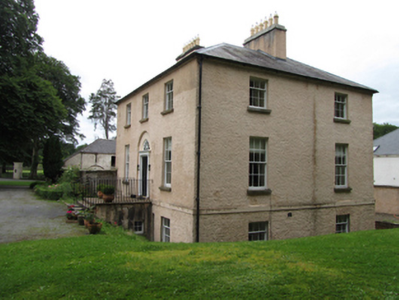
Killinagh House, County Cavan,Photograph from National Inventory of Architectural Heritage.

The National Inventory further describes it: “Roughcast rendered lime-washed walls with string course above basement. Three-over-six timber sash windows to first floor and six-over-six to ground floor all with stone sills and timber internal window shutters. Front door set in smooth-rendered segmental-arched recess, having four-panelled door in classical surround of slender Doric pilasters, metope frieze and cobweb fanlight above. Basement well to east, north and west side. Stone steps leading to entrance with recent metal railings.

5. Lismore House, Co Cavan – was a ruin. Place to stay: Peacock House on the demesne

Lismore House, Co Cavan – restored house (believed to have been the agent’s house) and a place to stay, Peacock House, available on airbnb. Of the original Lismore House, attributed to Edward Lovett Pearce (1699-1733), only the two wings and tower survive.

https://www.airbnb.ie/rooms/27674042?source_impression_id=p3_1646316758_vwGIKKMTwiWKK%2FB7
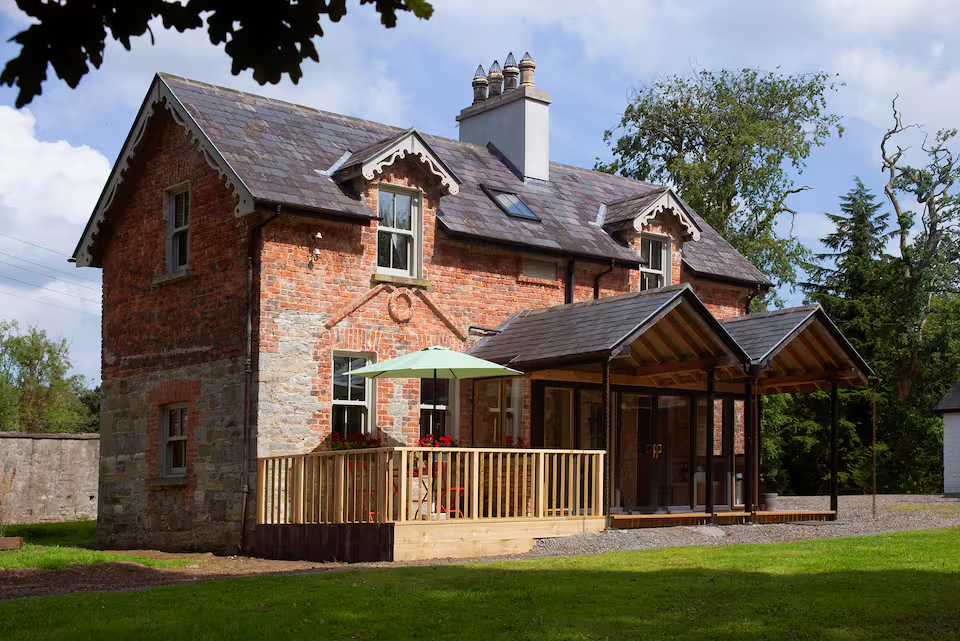
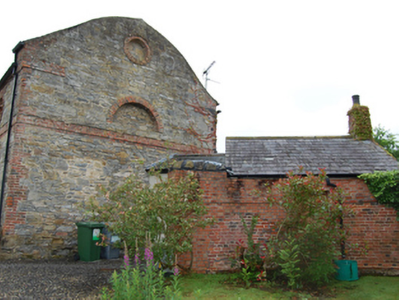
The Peacock House, workers cottage on Lismore Desmese, County Cavan. Photograph courtesy airbnb website.

The airbnb entry tells us of The Peacock House: “The Peacock House is located within the Lismore Demesne. It was once the dairy and workers cottage. From the 1980s onwards it was used to house peacocks, giving the cottage its name. After being left dormant for 80 years it was lovingly restored.” It has two bedrooms.

Lismore House, County Cavan, Photograph from National Inventory of Architectural Heritage. The Inventory tells us it is: “Symmetrical pair of detached six-bay two-storey flanking wings to former Lismore House, built c.1730, having advanced outermost end bays to each block, single-bay two-stage flanking tower formerly attached to south corner of house having single-bay extension to north…Rubble stone walls having red brick quoins, eaves course, and string course. Red brick surrounds to oculi at first floor over round-headed ground-floor windows and central segmental-headed door.

It was probably built for Thomas Nesbitt, (c. 1672-1750), of Grangemore, County Westmeath, High Sheriff of County Cavan, 1720, MP for Cavan Borough, 1715-50 [4].

The house was restored by Richard and Sonya Beer. [5]

Mark Bence-Jones writes about Lismore House in  A Guide to Irish Country Houses (1988), p. 186:

Originally the seat of the Nesbitts, passed to the Burrowes through the marriage of Mary [Mary Anne, born 1826, daughter of John Nesbitt and Elizabeth Tatam] Nesbitt to James Burrowes [1820-1860, of Stradone House, County Cavan] in 1854; Lismore passed to the Lucas-Clements family through the marriage of Miss Rosamund Burrowes to the late Major Shuckburgh Lucas-Clements in 1922.

Lismore House, County Cavan, Photograph from National Inventory of Architectural Heritage: “Blind lunette and oculus to gables facing former house.”

Mary Anne and James had a son, Thomas Cosby Burrowes (1856-1925). He married in 1885 Anna Frances, daughter of Richard Thomas Maxwell, and grand-daughter of the sixth Baron Farnham (of Farnham Estate), by whom he has issue two daughters. One daughter, Rosamund Charlotte Cosby Burrowes, of Lismore, married, in 1922, Major Shuckburgh Upton Lucas-Clements in 1922. [6] The main house was vacated c.1870 when the family relocated to Lismore Lodge, formerly the agent’s house. 
 
Mark Bence-Jones continues: “Having stood empty for many years, the house fell into ruin and was demolished ca 1952, with the exception of the “tower” wings. The office wings are now used as farm buildings, and the family now live in the former agent’s house, an early house with a Victorian wing and other additions.” 

Lismore House, County Cavan, Photograph from National Inventory of Architectural Heritage: “Tower having mansard slate roof, rubble stone walls with cut-stone platbands, cut-stone surrounds to window openings, round-headed openings with raised keystone and impost blocks to former ground floor, and segmental-headed openings to former basement level.”

6. Olde Post Inn, Cloverhill, County Cavan – accommodation, restaurant and wedding venue

https://www.theoldepostinn.com

The website tells us: “The Olde Post inn was built in the 1800s. It opened as a post office in 1884, grocery & residence. It had a number of owners and was for some time derelict before it was renovated into a restaurant with accommodation in early 1990s. It has been run as a restaurant since and was taken over by Gearoid & Tara Lynch in November 2002. Since then it has gone under further refurbishment and been extended to include two Hampton Conservatories.

The Old Post Inn, County Cavan, photograph courtesy of website.

8. Virginia Park Lodge, Co Cavan – wedding venue
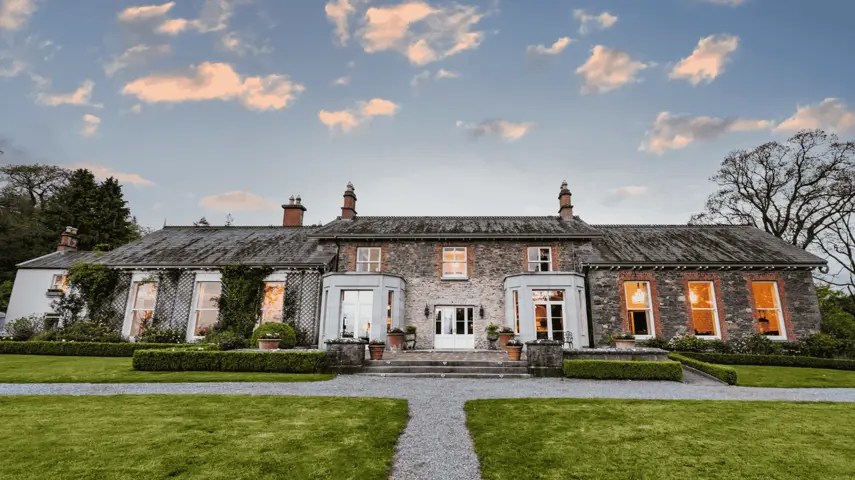
WWW.VIRGINIAPARKLODGE.COM

Virginia Park Lodge, County Cavan, photograph courtesy website.

This was formerly the hunting lodge of the Taylours, Marquess Headfort, who also owned Headfort House in County Meath. It was built for the First Earl of Bective, Thomas Taylour (1724-1795), son of Thomas Taylor 2nd Baronet Taylor, of Kells, County Meath, who served as MP for Kells and as a Privy Counsellor in Ireland. His mother was Sarah Graham from Platten, County Meath. Thomas the 1st Earl of Bective also served as Privy Counsellor. He married Jane Rowley, from Summerhill, County Meath.

Thomas Taylour (1724-1795) 1st Earl of Bective wearing the star and sash of the Order of St. Patrick by Gilbert Stuart and studio, courtesy of Sotheby’s. He built Virginia Park Lodge.
Headfort, County Meath, photograph courtesy of Irish Georgian Society.

It was their one of their younger sons, Reverend Henry Edward Taylour (1768-1852), who lived at Ardgillan Castle in Dublin. Their son Thomas the second earl became the 1st Marquess of Headfort, and added to Virginia Park Lodge and imported plants to create the parkland surrounding the Lodge.

Thomas Taylour (1757-1829) 1st Marquess of Headfort by Pompeo Batoni courtesy of Google Art Project Public Domain, https//:commons.wikimedia.org/w/index.php?curid=29800995
Ardgillan Castle, Dublin. Photograph © Jennifer Winder-Baggot, www.irishhistorichouses.com

The Marquess of Headfort married Mary Quin, from Quinsborough, County Clare. The Lodge passed through the family to the 4th Marquess, Geoffrey Thomas Taylour, son of the second wife of the 3rd Marquess. He married a music hall star, Rosie Boote, which scandalised society, but they moved to the Lodge and lived happily and had many children.

The Lodge was bought by chef Richard Corrigan in 2014, and he has undertaken much work to restore it to its former glory.

*************************

[1] Bence-Jones, Mark. A Guide to Irish Country Houses (originally published as Burke’s Guide to Country Houses volume 1 Ireland by Burke’s Peerage Ltd. 1978); Revised edition 1988 Constable and Company Ltd, London.

[2] https://theirishaesthete.com/2015/09/09/a-mere-shell/

[3]  see Timothy William Ferres: http://lordbelmontinnorthernireland.blogspot.com/2013/09/cloverhill-house.html

[4] ibid.

[5] https://www.anglocelt.ie/news/roundup/articles/2018/06/17/4157489-bringing-lismore-back-from-the-dead/ 

[6] https://nisbetts.co.uk/archives/nesalx.htm

Text © Jennifer Winder-Baggot, www.irishhistorichouses.com

Places to visit in County Cavan

On the map above:

blue: places to visit that are not section 482

purple: section 482 properties

red: accommodation

yellow: less expensive accommodation for two

orange: “whole house rental” i.e. those properties that are only for large group accommodations or weddings, e.g. 10 or more people.

green: gardens to visit

grey: ruins

County Cavan

1. Cabra Castle, Kingscourt, Co. Cavan (Hotel) – section 482

2. Castle Saunderson, Co. Cavan – a ruin 

3. Clough Oughter, County Cavan 

4. Corravahan House & Gardens, Drung, Ballyhaise, Co. Cavan – section 482

donation

Help me to pay the entrance fee to one of the houses on this website. This site is created purely out of love for the subject and I receive no payment so any donation is appreciated!

€15.00

1. Cabra Castle, Kingscourt, Co. Cavan – section 482

This is a hotel but unlike some heritage house or castle hotels, they do allow visitors to view the building: the website states that they are open between 11am to 4pm for visitors for viewing all year round, except at Christmastime.

Cabra Castle, County Cavan, December 2020. Photograph © Jennifer Winder-Baggot, www.irishhistorichouses.com
see my write-up:

https://irishhistorichouses.com/2021/03/28/cabra-castle-kingscourt-county-cavan/

www.cabracastle.com
Open in 2026: all year, except Dec 24, 25, 26, 11am-4pm
Fee: Free to visit

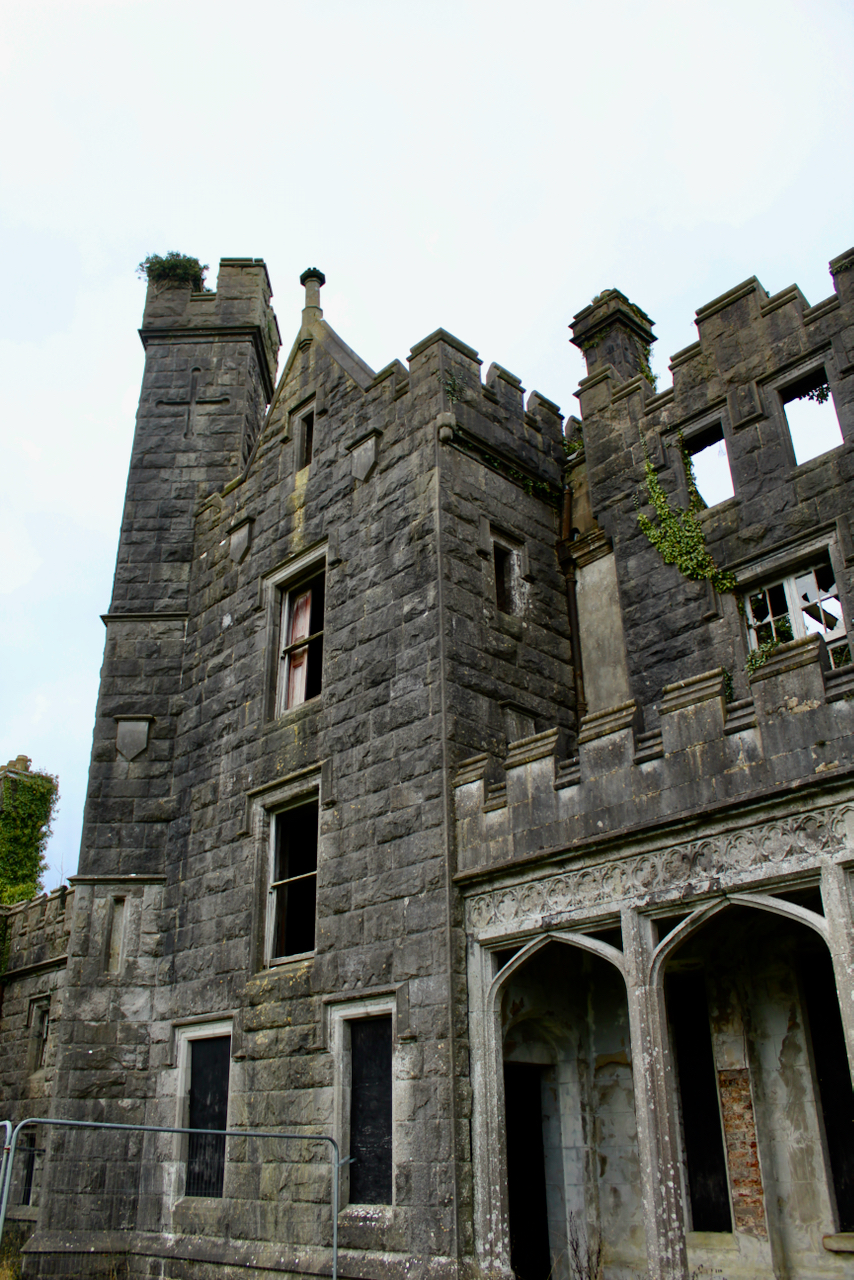
2. Castle Saunderson, Co. Cavan – a ruin 

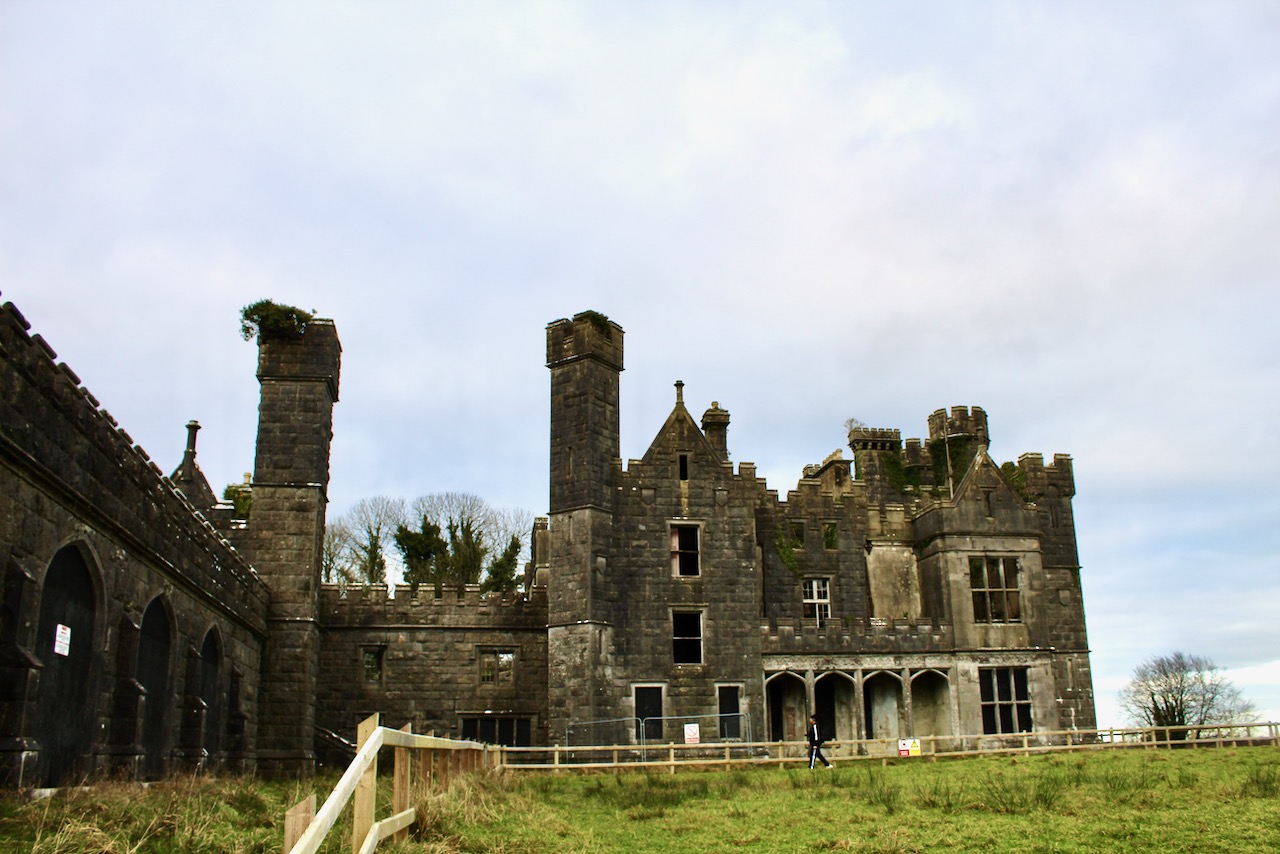
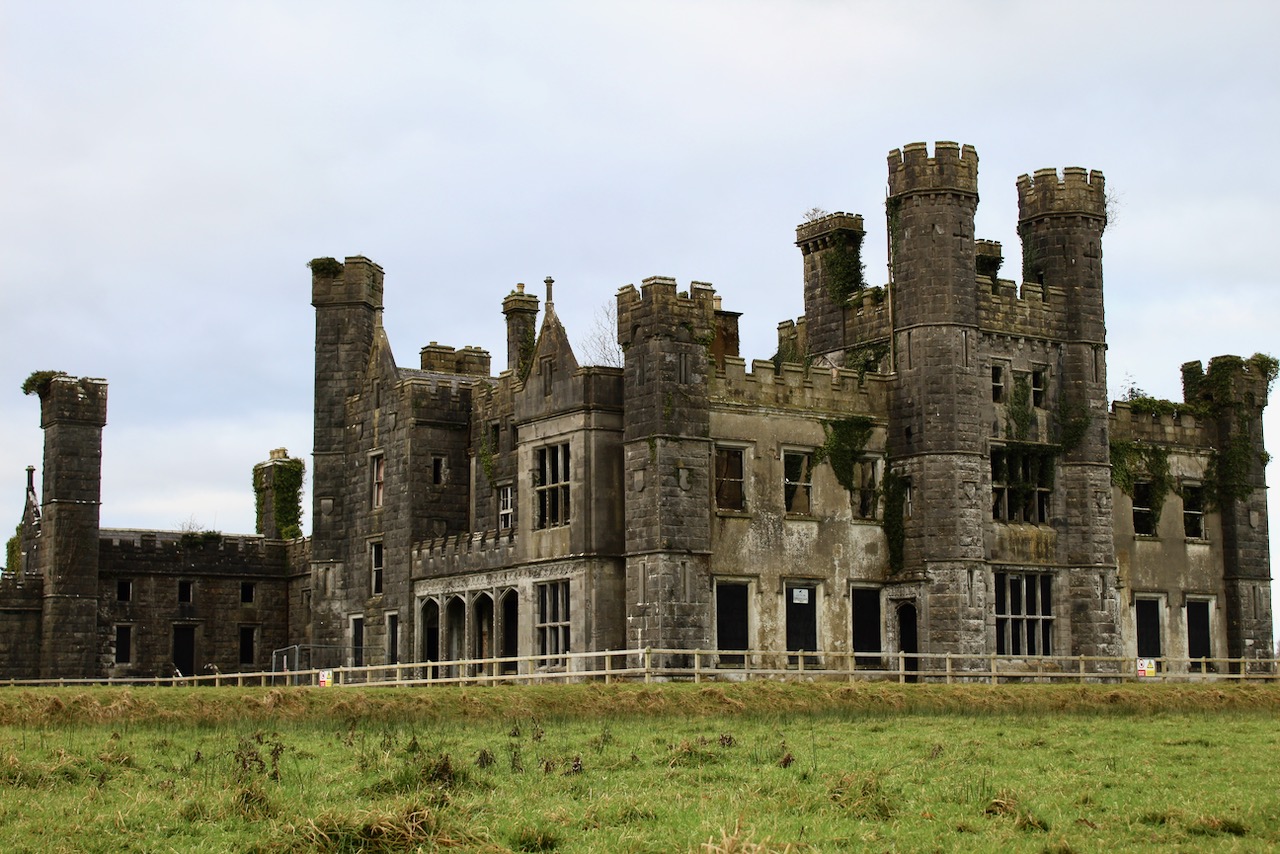
Castle Saunderson, County Cavan, December 2020. Photograph © Jennifer Winder-Baggot, www.irishhistorichouses.com
See my entry https://irishhistorichouses.com/2026/02/12/castle-saunderson-co-cavan-a-ruin/

https://www.thisiscavan.ie/fun/article/luanch-of-new-heritage-trail-at-castle-saunderson

Mark Bence-Jones writes in his A Guide to Irish Country Houses (1988):

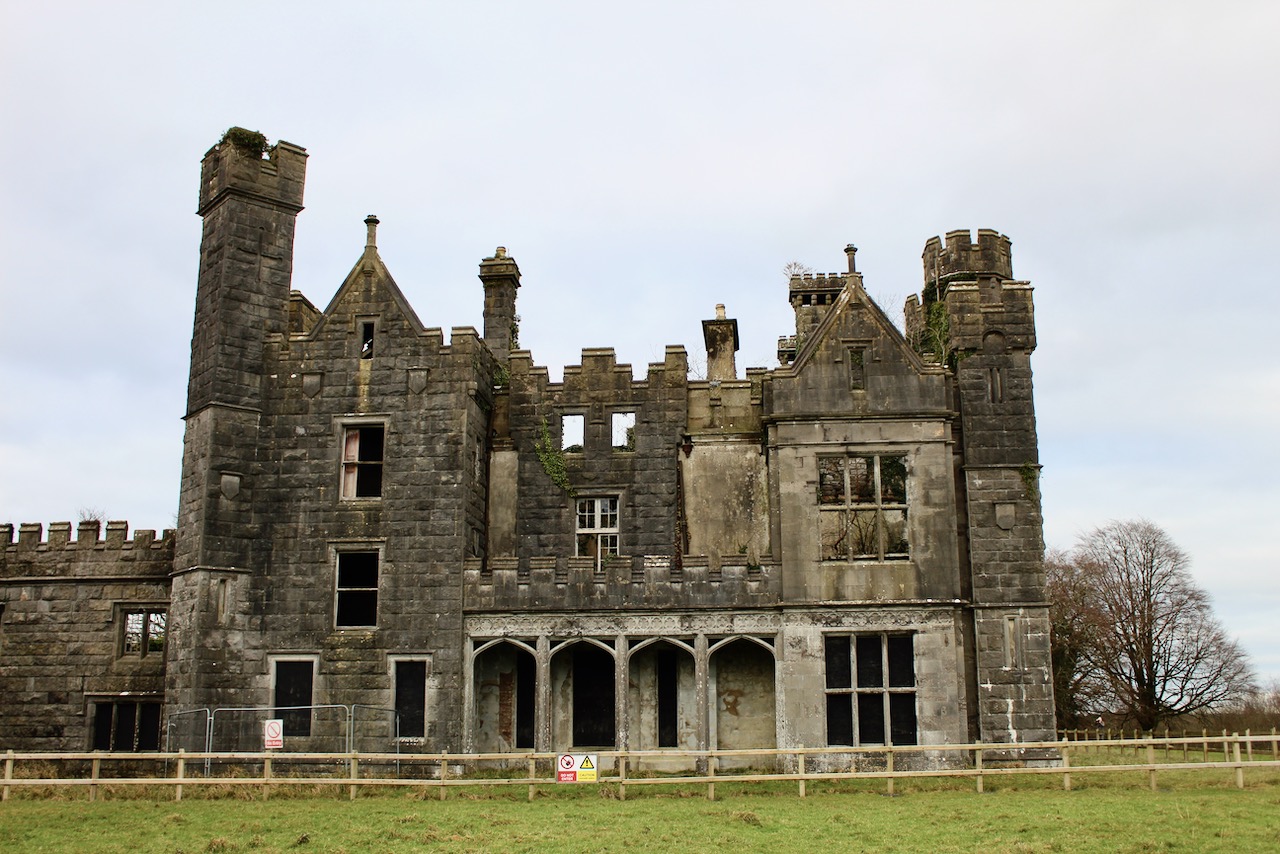
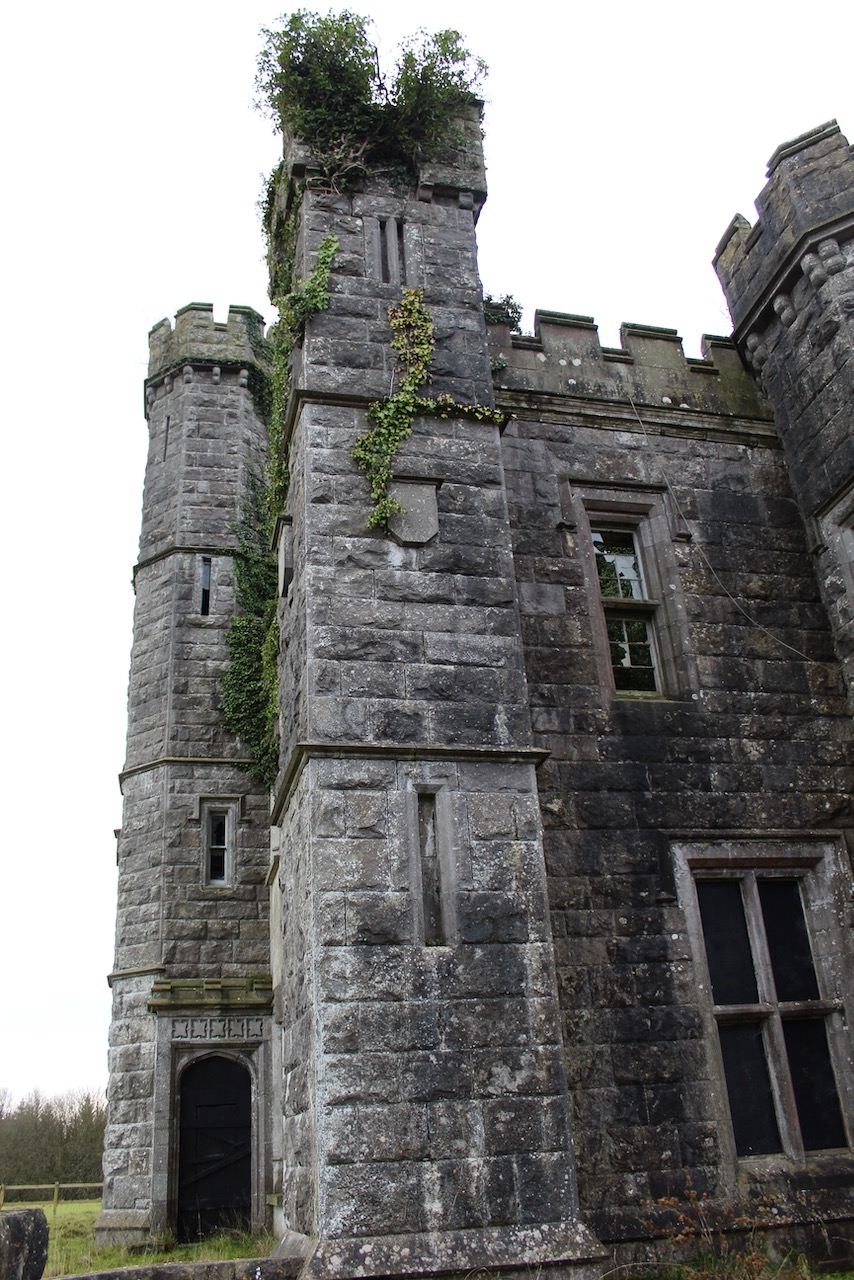
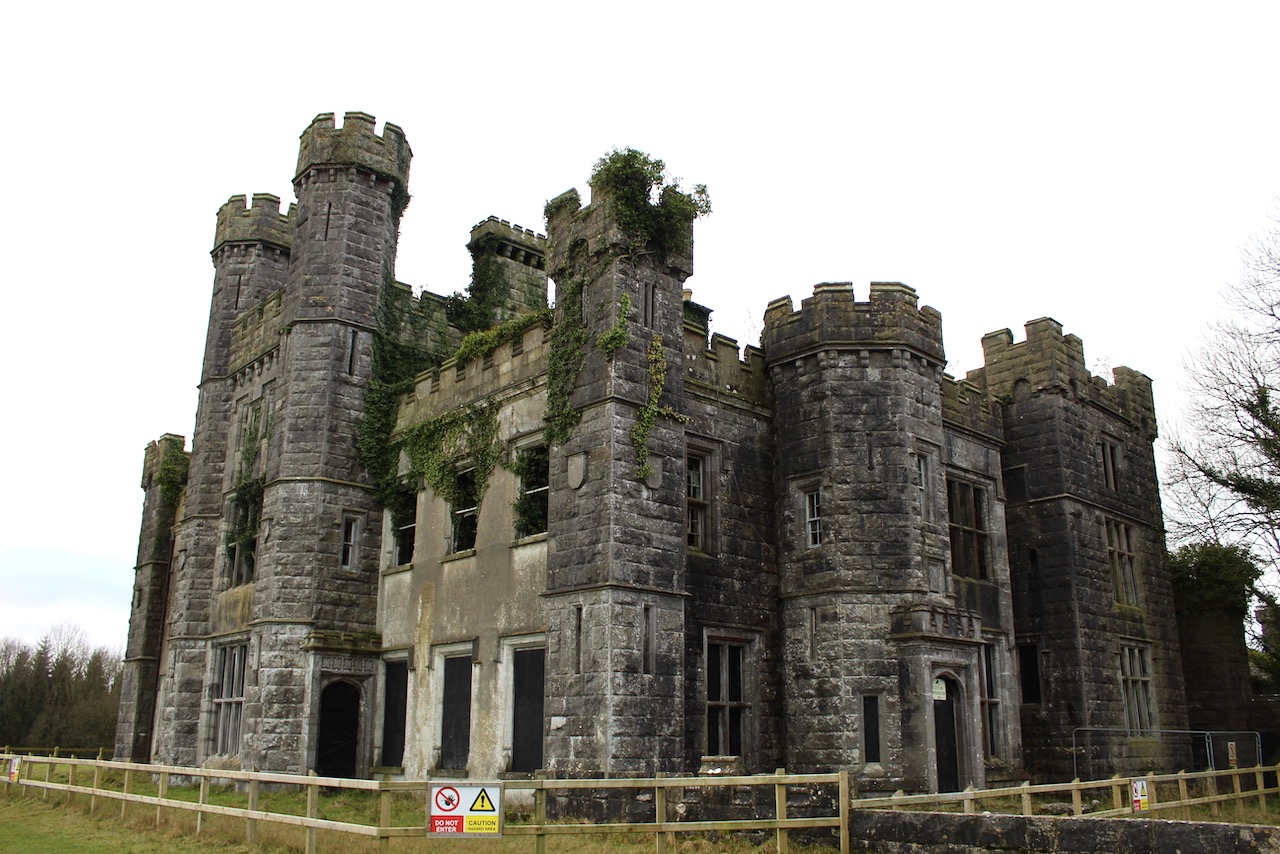
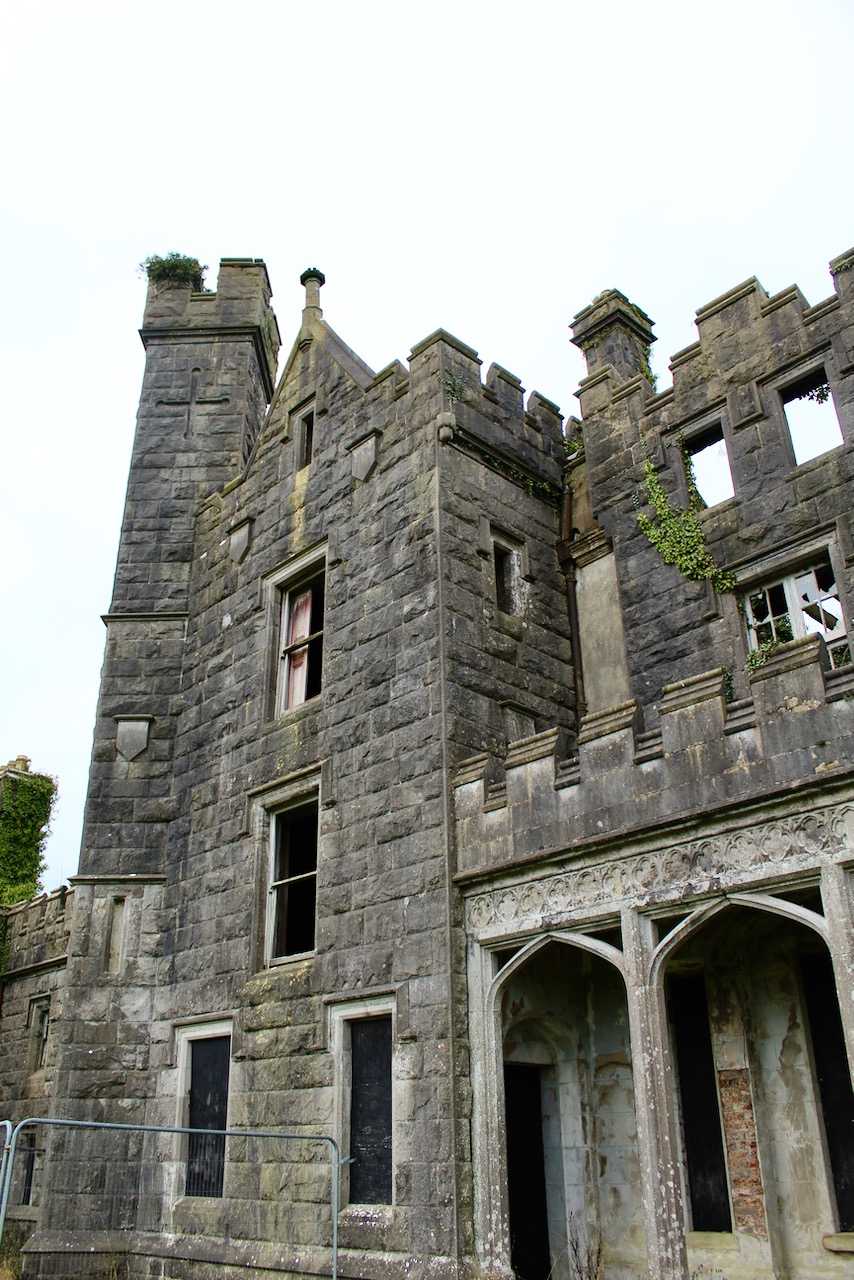
p. 75. “(Saunderson/IFR) A large castellated mansion combining both baronial and Tudor-Revival elements, built ca 1840; from its close stylistic resemlance  to Crom Casle, about five miles away in County Fermanagh, it can be attributed to Edward Blore. Entrance front symmetrical, with a battlemented parapet, square end turrets and a tall central gatehouse tower which is unusual in having the entrance door in its side rather than in its front. The adjoining garden front is more irregular, with a recessed centre between two projecting wings of unequal size and fenestration, each having a Tudor gable; the two wings being joined at ground floor level by a rather fragile Gothic arcade. To the left of this front, a lower “L”-shaped wing with a battlemented parapet and various turrets, ending in a long Gothic conservatory. Castle Saunderson has stood empty for years and is now semi-derelict.” [1]

Castle Saunderson, County Cavan, December 2020. Photograph © Jennifer Winder-Baggot, www.irishhistorichouses.com
3. Clough Oughter, County Cavan

https://www.discoverireland.ie/Activities-Adventure/clough-oughter-castle/48729

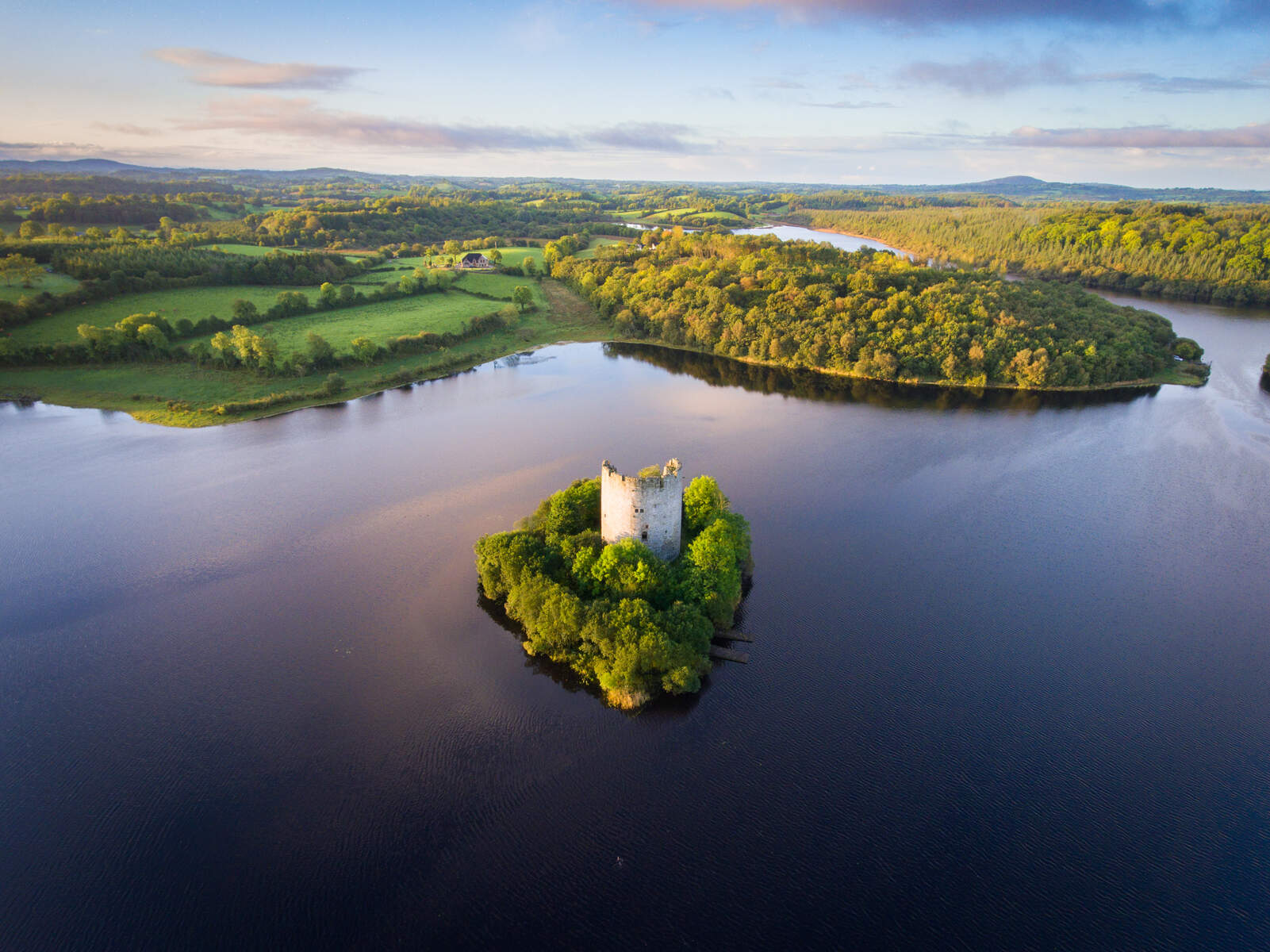
Clough Oughter Castle, County Cavan, photograph by Chris Hill 2018 for Tourism Ireland, from Ireland’s Content Pool. [2]

Clough Oughter Castle is a ruined circular castle, situated on a small island in Lough Oughter, four kilometres east of the town of Killeshandra in County Cavan.

The castle is located in what was once the historic Kingdom of Breifne. In the latter part of the 12th century, it was under the control of the O’Rourkes, but it seems to have come into the hands of the Anglo-Norman William Gorm de Lacy. While the exact date construction began is unknown, it is estimated to have started in the first quarter of the 13th century.  
 
“In 1233, the O’Reilly clan took possession of the area and completed the castle. They retained it for centuries in the midst of their ongoing conflicts with the O’Rourkes and with members of their own clan. It was there that Philip O’Reilly was imprisoned in the 1360s. 
 
Lough Oughter is regarded as the best inland example of a flooded drumlin landscape in Ireland and has rich and varied wildlife. The number of whooper swans which winter in the area represents about 3% of the total European population, while the lake also houses the largest concentration of breeding great crested grebes in the Republic of Ireland. 
 

Lough Oughter is a popular angling lake and is also popular with canoeists and boating enthusiasts. The Lough Oughter complex, along with Killykeen Forest Park, is a designated Natura 2000 habitat, Special Area for Conservation (SAC), and Special Protection Area (SPA) under EU legislation. 
 
Canoes and kayaks are available for hire from Cavan Canoe Centre, which also offers guided boat trips around the lake and out to the castle.” [3]

On the Discover Belturbet website, we are told the history of Clough Oughter:

Clough is the Gaelic word for stone, so literally this is Castle of Stone. The island was made by man, and the castle which sits upon it was also made by man and one can only speculate as to what a marvellous feat of engineering it took to accomplish such a build.  

The castle would have been part of the historical kingdom of Breifne, and specifically a part of  East Breifne, (Roughly speaking the same borders as modern day Cavan).  It is likely that the Crannog itself came sometime before the castle, and in the latter part of the 12th century, it was under the control of the O’Rourke clan, but with the invasion of the Anglo Normans, the crannog came to be controlled by the Anglo-Norman  William Gorm De Lacy. No concrete dates exist for the construction of the castle, but architectural elements from the lower two storeys suggest it was begun during the early 13th century.  

In 1233, the O’Reilly clan gained possession of the castle. They seem to have retained the castle for centuries throughout ongoing conflicts with the O’Rourkes, and indeed with members of their own clan. Philip O’Reilly was imprisoned here in the 1360’s with “no allowance save a sheaf of oats for day and night and a cup of water, so that he was compelled to drink his own urine”.  

After the Ulster Plantation, the castle was given to servitor Hugh Culme. Philip O’Reilly who was a Cavan MP and leader of the rebel forces during the Rebellion of 1641  seized control of the castle and kept it as an island fortress for the next decade. During this period it was mainly used as a prison. Its most notable prisoner would have been the Anglican Bishop of Kilmore, William Bedell, who was held here and is said to have died because of the harsh winter conditions in the prison.  

Clough Oughter castle became the last remaining stronghold for the rebels during the Cromwell era, but sometime in March of 1653 the castle fell to Cromwells canons. The castle walls were breached by the canon and the castle was never rebuilt after this point.  

Visitors will be astounded to note the thickness of the walls which can now be seen because of the canon bombardment. The island and the castle have received considerable refurbishments since 1987, making it safe to visit, and well worth the visit.” [4]

4. Corravahan House & Gardens, Drung, Ballyhaise, Co. Cavan H12 D860 – section 482

Corravahan, County Cavan, photograph from Ian Elliot.

see my write-up:

https://irishhistorichouses.com/2020/08/28/corravahan-house-and-gardens-drung-county-cavan/

www.corravahan.com
Open dates in 2026: Jan 8-9, 15-16, 22-23, 29-30, Feb 5-6, 12-13, 19-20, 26-27, Mar 5-6, 12-13, May 7-10, 14-17, 21-24, Aug 6-9, 13-23, 27-30, Sept 3-6, 10-13, 17

2pm-4pm

Fee: adult €10, OAP/student/child €5

Tours on the hour, or by appointment. Last admission 1 hour before closing time. CCTV in operation

*************************

[1] Bence-Jones, Mark. A Guide to Irish Country Houses (originally published as Burke’s Guide to Country Houses volume 1 Ireland by Burke’s Peerage Ltd. 1978); Revised edition 1988 Constable and Company Ltd, London.

[2] Ireland’s Content Pool, https://www.irelandscontentpool.com/en

[3] https://www.discoverireland.ie/Activities-Adventure/clough-oughter-castle/48729 

[4] http://www.discoverbelturbet.ie/unesco-geopark/clough-oughter/

Text © Jennifer Winder-Baggot, www.irishhistorichouses.com

Castle Saunderson, Co. Cavan – a ruin 

Castle Saunderson, Co. Cavan – a ruin 

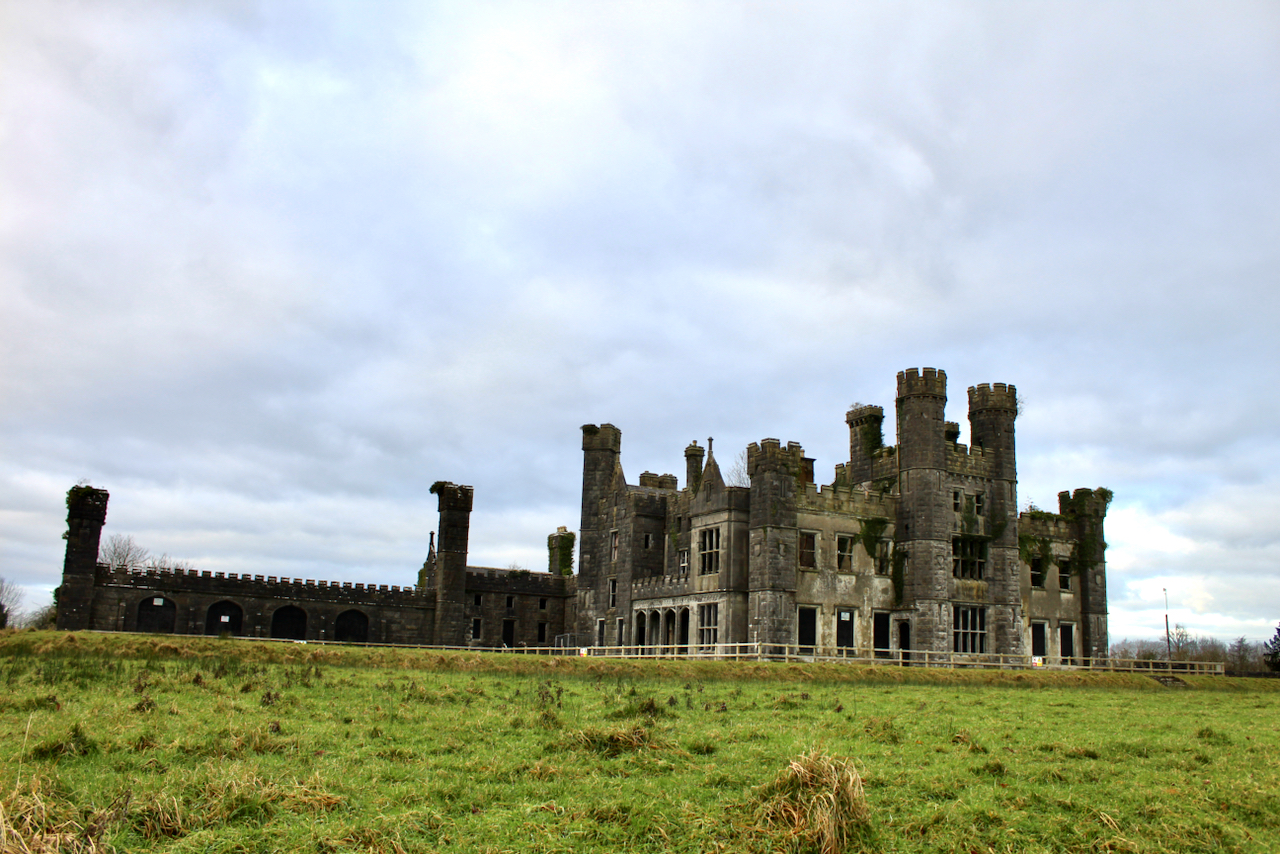
Castle Saunderson, County Cavan, December 2020. Photograph © Jennifer Winder-Baggot, www.irishhistorichouses.com
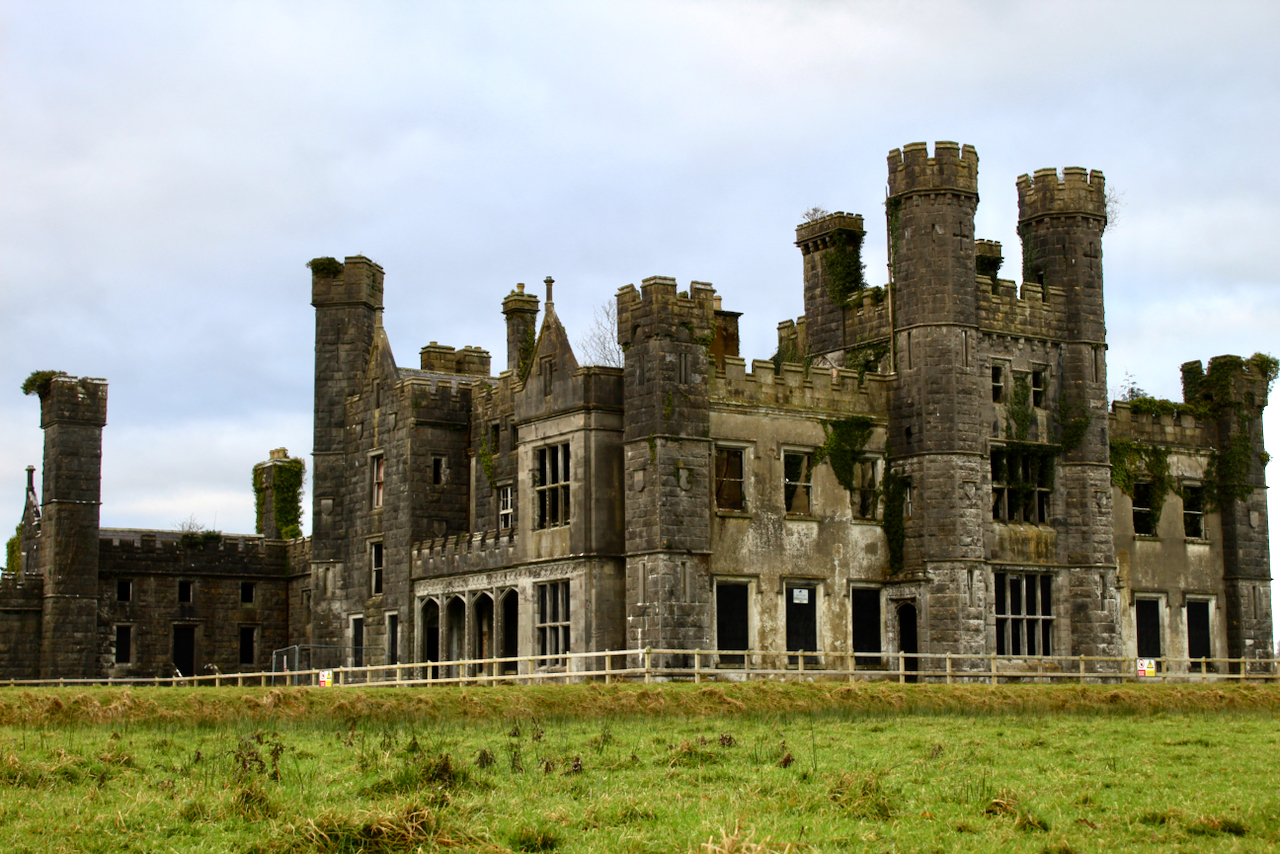
This property is not listed on the Section 482 Revenue list but is open to the public to visit, although at a distance, due to safety considerations. We visited in December 2020. Nearby, a World Peace Centre for the Scouts has been established. The castle was destroyed by fire in 1990.

The castle, which dates from 1840, was destroyed by fire in 1990.

https://www.thisiscavan.ie/fun/article/luanch-of-new-heritage-trail-at-castle-saunderson

Mark Bence-Jones writes in his  A Guide to Irish Country Houses (1988) that it’s a large castellated mansion combining both baronial and Tudor-Revival elements, built around 1840. He likens the style to that of Crom Castle, attributed to Edward Blore, which is only about five miles away in County Fermanagh. [1] The National Inventory tells us that the work on Castle Saunderson was carried out by George Sudden, but he may have worked according to designs by Blore.

Crom Castle, County Fermanagh, photograph by Robert French, (between ca. 1865-1914), Lawrence Photograph Collection, National Library of Ireland.

The Dictionary of Irish Architects tells us that Edward Blore (1787-1879), from London, designed Crom Castle in County Fermanagh from 1833-41, Ballydrain in County Antrim in 1837-8, additions at Castle Upton, County Antrim in 1836-7, and proposed the addition of a tower at Mallow Castle, County Cork in 1837. [2]

The Dictionary of Irish Biography tells us that George Sudden was Clerk of works, architect and stonemason, active in Counties Fermanagh and Monaghan in the 1830s and 1840s. In 1830 when Crom Castle, newly completed to designs by Edward Blore, was destroyed by fire, John Creighton appointed Sudden to rebuild the house to Blore’s specifications. [3]

The National Inventory of Architectural Heritage tells us that Castle Saunderson was built around 1835.

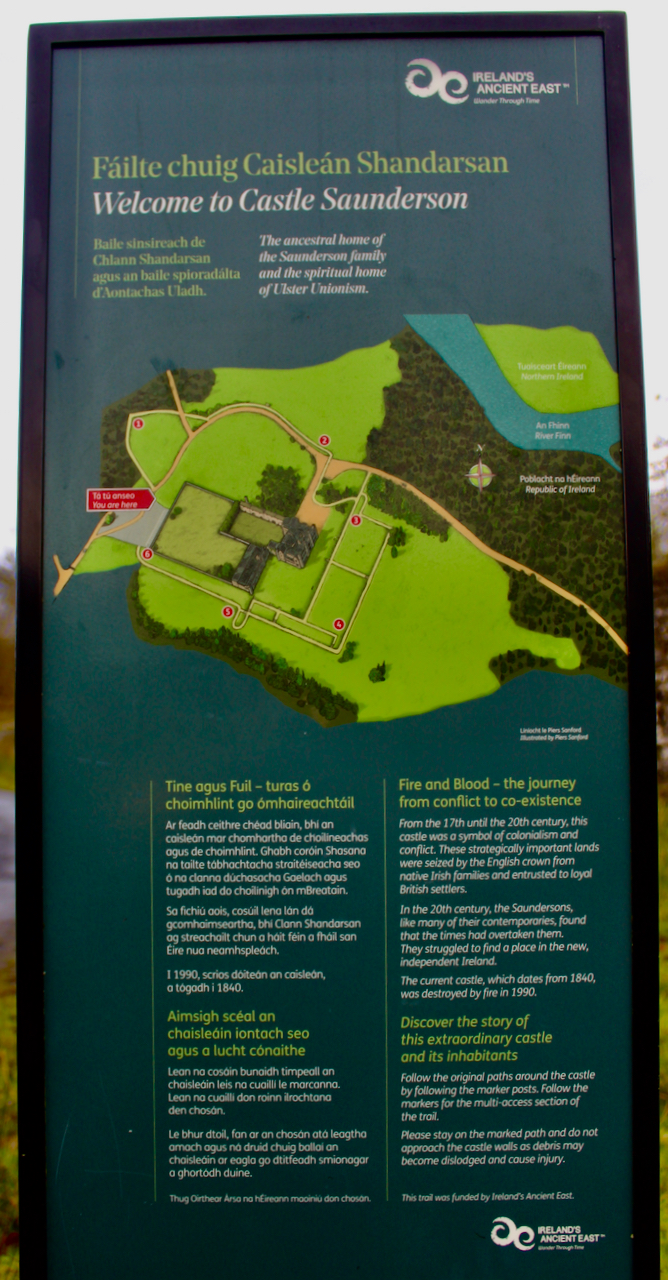
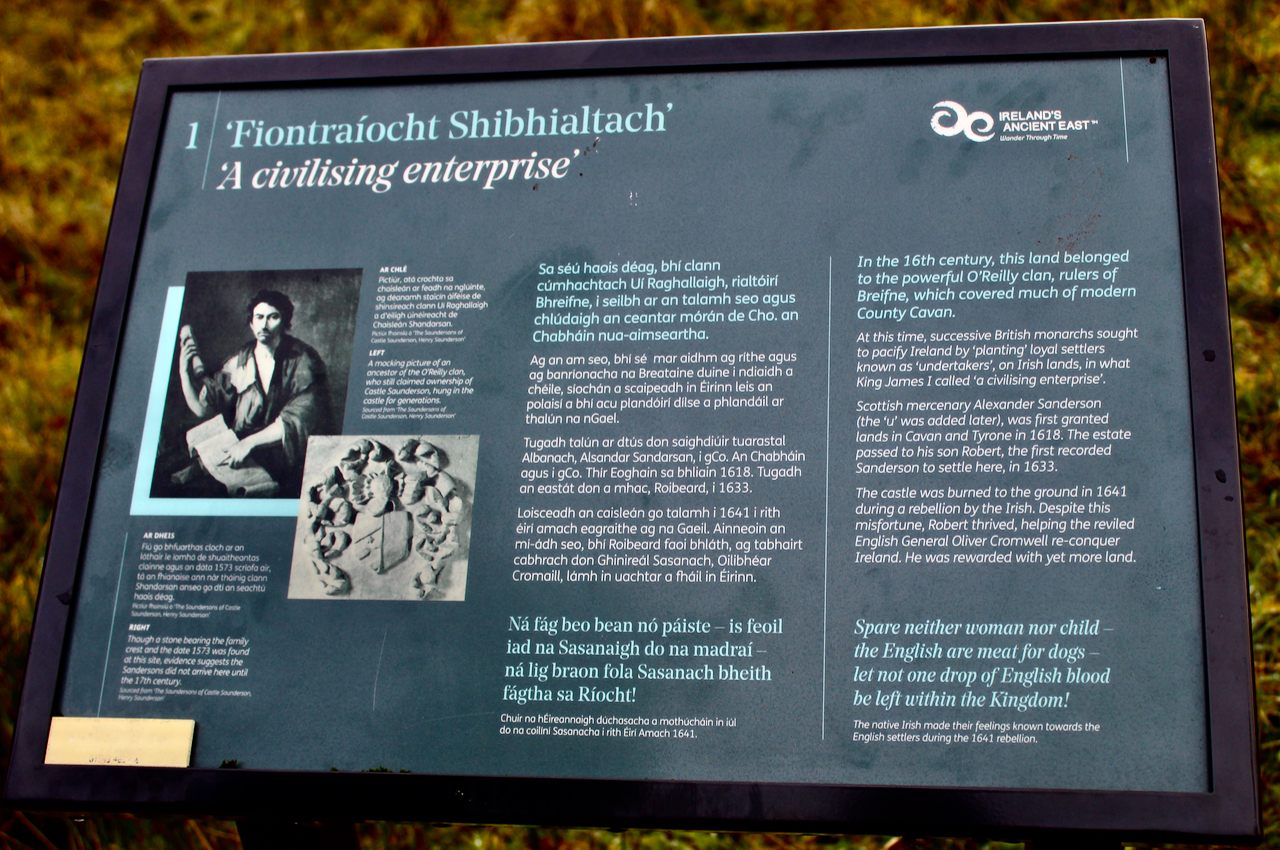
The land belonged to the O’Reilly clan in the 16th century, rulers of Breifne, which covered much of modern County Cavan. Scottish mercenatry Alexander Sanderson (the ‘u’ was added later), was first granted lands in Cavan and Tyrone in 1618. The estate passed to his son Robert, the first recorded Sanderson to live here, in 1633. The castle that was there at that time was burned to the ground in 1641 during the Rebellion. Robert Sanderson helped Oliver Cromwell’s troops to reconquer, and he was awarded with more land.

An information board tells us that the land belonged to the O’Reilly clan, rulers of Breifne, in the 16th century. Breifne covered much of modern County Cavan. Scottish mercenatry Alexander Sanderson (the ‘u’ was added later), was first granted lands in Cavan and Tyrone in 1618. He served as High Sheriff for County Tyrone.

The estate passed to his son Robert (c1602-c1676), the first recorded Sanderson to live here, in 1633. The castle that was there at that time was burned to the ground in 1641 during the Rebellion.

Castle Saunderson. Photograph © Jennifer Winder-Baggot, www.irishhistorichouses.com
Robert Sanderson was a colonel in the army of Gustavus Adolphus of Sweden. He served in Oliver Cromwell’s army, and was awarded with more land. [4] Another residence must have been built at the site: the Landed Estates database tells us that Robert Sanderson built Castle Sanderson near Belturbet in county Cavan in the mid-17th century.

Robert’s son, also named Robert (1653-1724), served as MP for County Cavan, and was a colonel of a regiment in William III’s army. He married Jane Leslie, daughter of the Right Rev John Leslie, Lord Bishop of Clogher, “The Fighting Bishop” (see my entry for Castle Leslie https://irishhistorichouses.com/2020/08/07/castle-leslie-glaslough-county-monaghan/ ). His heir to Castle Saunderson was his nephew, Alexander Sanderson. Alexander served as High Sheriff of County Cavan in 1714, and wedded Mabella, daughter of William Saunderson, of Moycashel, County Westmeath. He was buried at St Mary’s in Dublin in 1726 and was succeeded at Castle Saunderson by his son Francis (d. 1746). (see [4])

Francis served as High Sheriff of County Cavan in 1740 and espoused Anne, eldest daughter of Anthony Atkinson of Cangort, County Offaly. Francis died in 1746 and it was his son, Alexander, who changed the spelling of his name to Saunderson. (see [4])

Alexander married Rose Lloyd, daughter of Trevor Lloyd of Gloster in County Offaly, a section 482 property in 2025. Alexander Saunderson also served as High Sheriff for County Cavan.

The National Inventory tells us that the Castle Saunderson that we see today incorporates fabric of an older residence, a Georgian house dating from around 1780. This house may have been built by Alexander and Rose’s son and heir Francis Saunderson (1754-1827). He also served as High Sheriff for County Cavan, and he married Anne Bassett, daughter of Stephen White, of Miskin, Glamorgan, and heir of the Bassett estates in that county. (see [4])

It was then Francis and Anne’s son and heir, Alexander (1783-1857) who probably built the current Tudor-Gothic version of the castle around 1835.

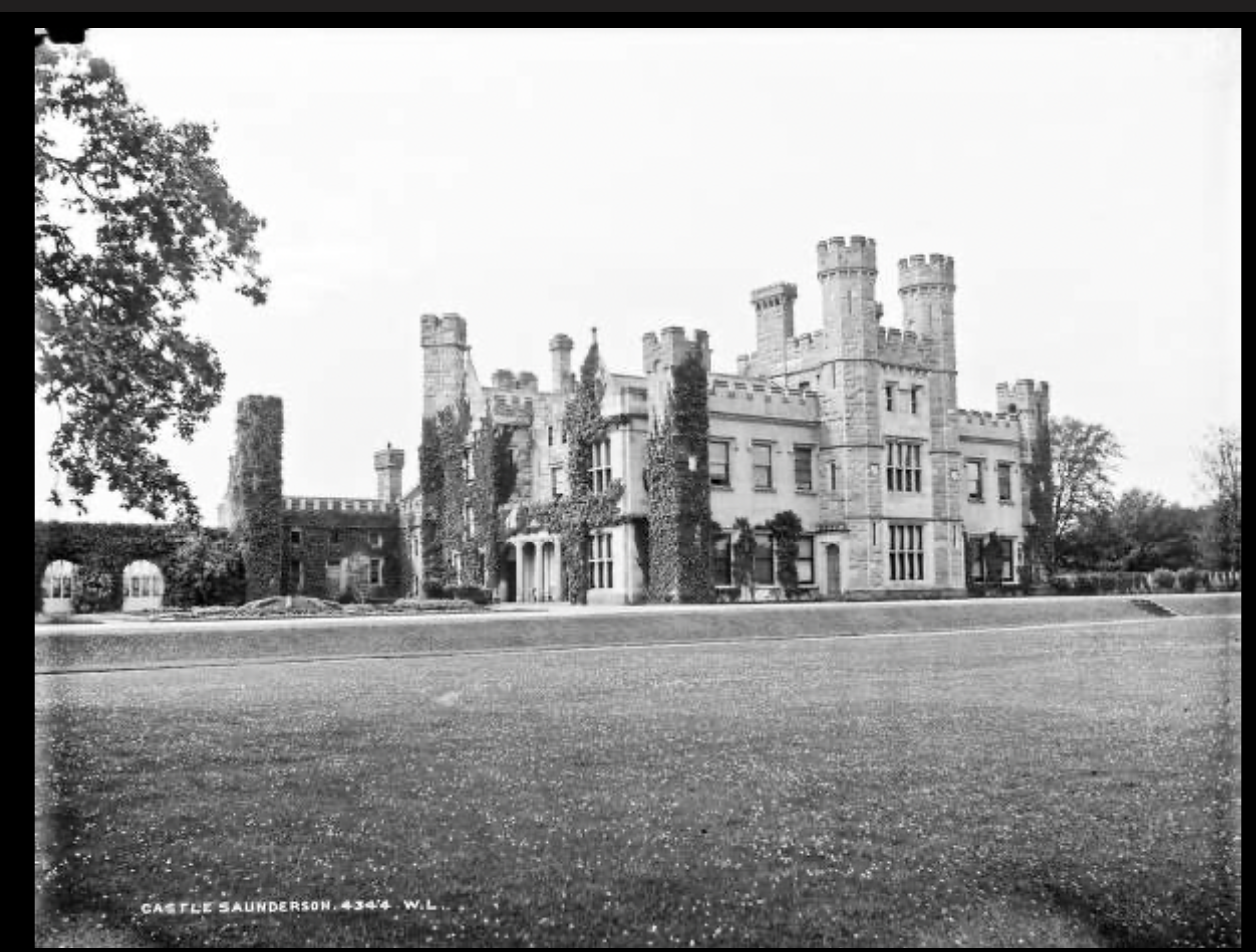
This is what Bence-Jones describes as the entrance front, Castle Saunderson, County Cavan, December 2020. It is symmetrical, with a battlemented parapet and square end turrets. In the centre is what Bence-Jones calls a tall central gatehouse tower. This has the two octagonal turrets on either side of large mullioned windows, with entrance doors on the outer sides of these central turrets. Castle Saunderson, County Cavan, photograph courtesy instagram @greatirishhouses.
Castle Saunderson, County Cavan, December 2020. Photograph © Jennifer Winder-Baggot, www.irishhistorichouses.com

Mark Bence-Jones describes:

p. 75. “Entrance front symmetrical, with a battlemented parapet, square end turrets and a tall central gatehouse tower which is unusual in having the entrance door in its side rather than in its front.” [1]

Castle Saunderson, County Cavan, photograph by Robert French, (between ca. 1865-1914), Lawrence Photograph Collection, National Library of Ireland.

It looks like there is an entrance door on either side of what Bence-Jones calls the central gatehouse tower.

Castle Saunderson, County Cavan, December 2020. Photograph © Jennifer Winder-Baggot, www.irishhistorichouses.com
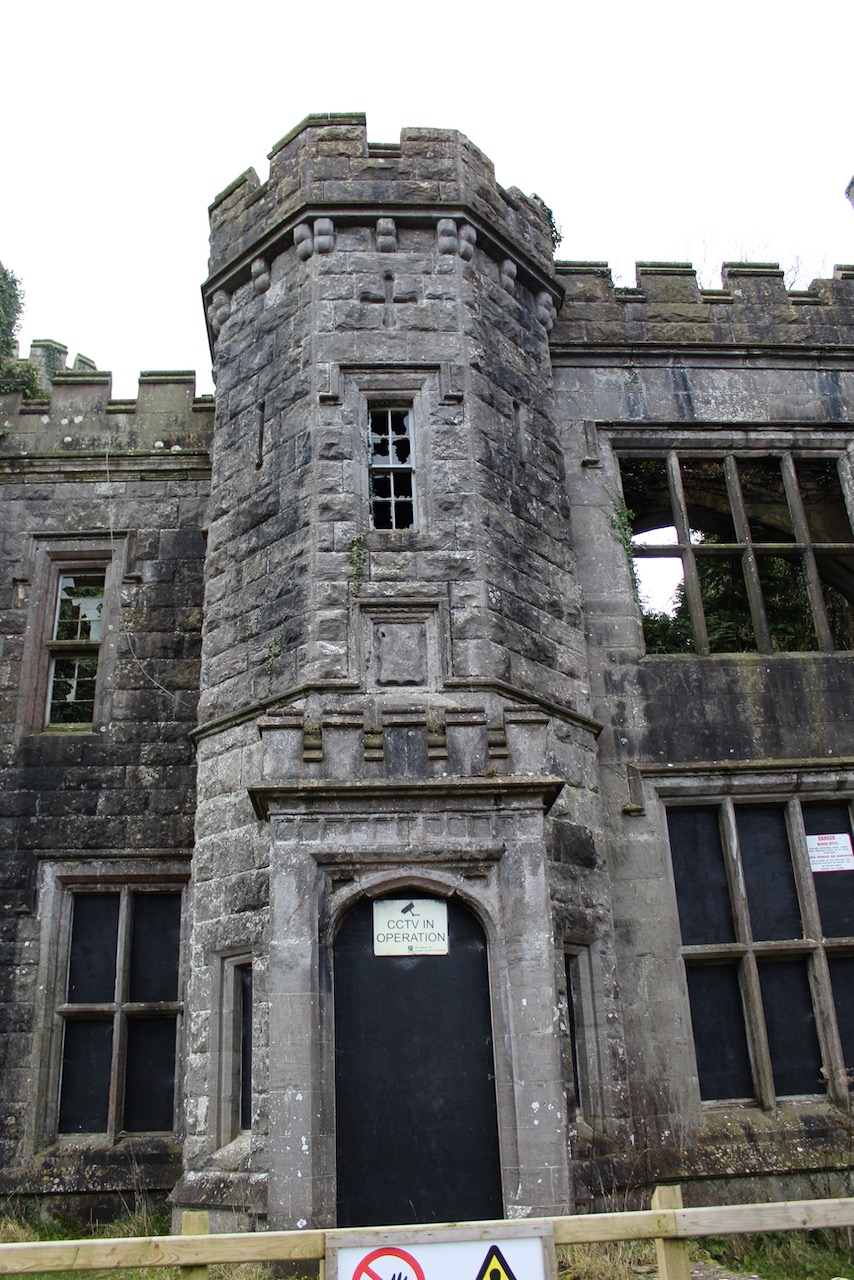
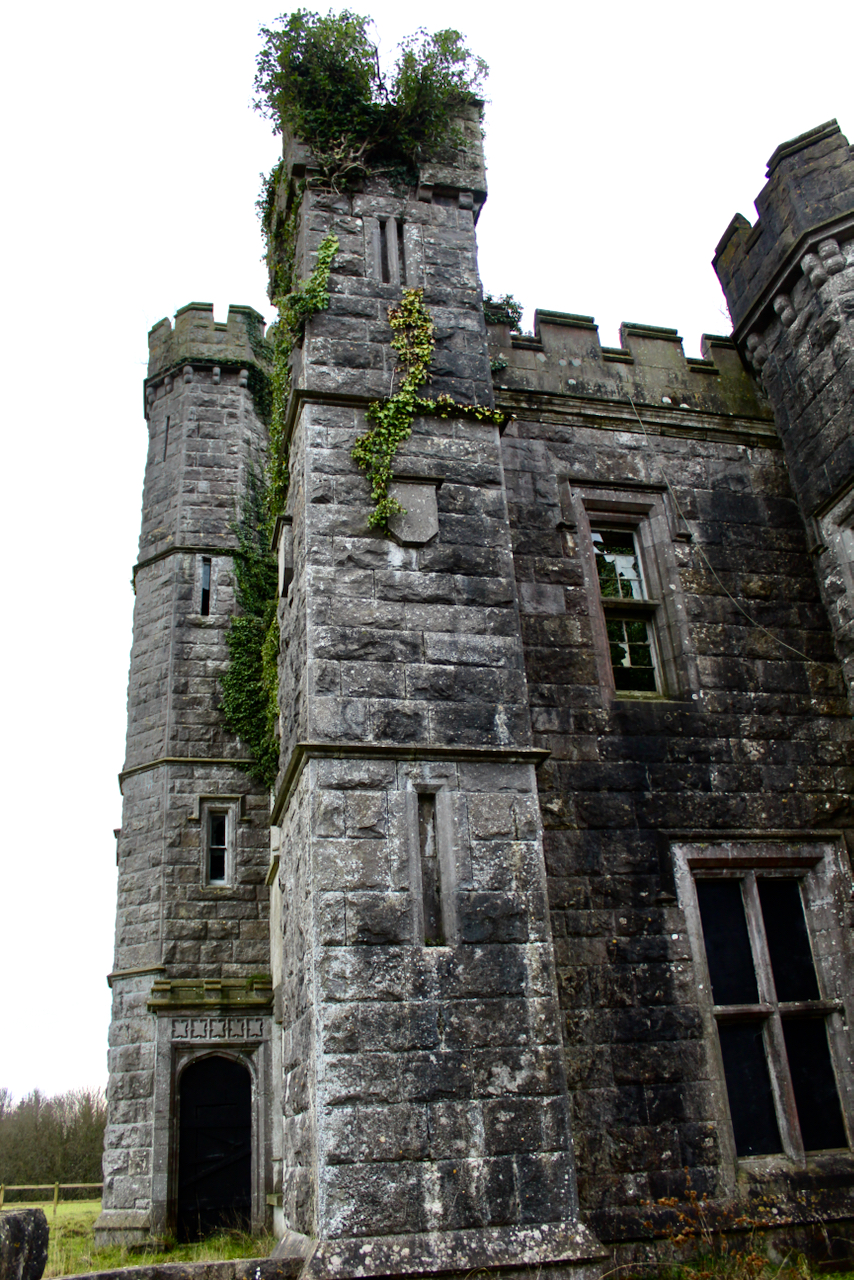
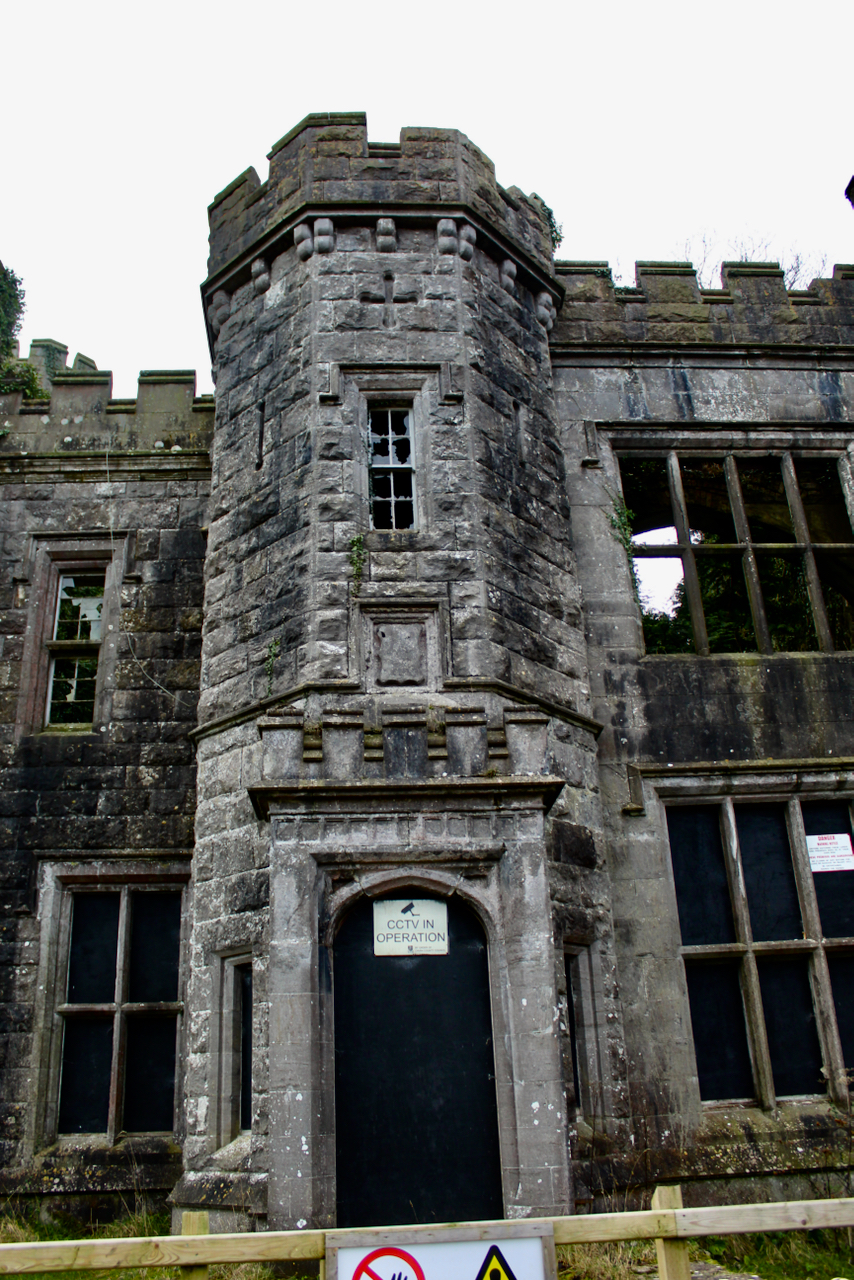
The side to the right of the entrance front has another octagonal tower with an entrance door, and another square tower. The National Inventory calls this side, the north elevation, the entrance side, describing it as: “Four-bay two-storey entrance elevation to north having advanced square-plan three-stage tower to west, corner turret to east and engaged octagonal-plan entrance tower with castellated doorcase, mullioned-and transomed hood-moulded windows of varying size and smaller incidental windows.” [5]

The doors have arched openings, and windows have hood mouldings.

On the left hand is what Mark Bence-Jones calls the entrance front, and to the right, the north facade, is what the National Inventory calls the entrance front. Castle Saunderson, County Cavan, December 2020. Photograph © Jennifer Winder-Baggot, www.irishhistorichouses.com
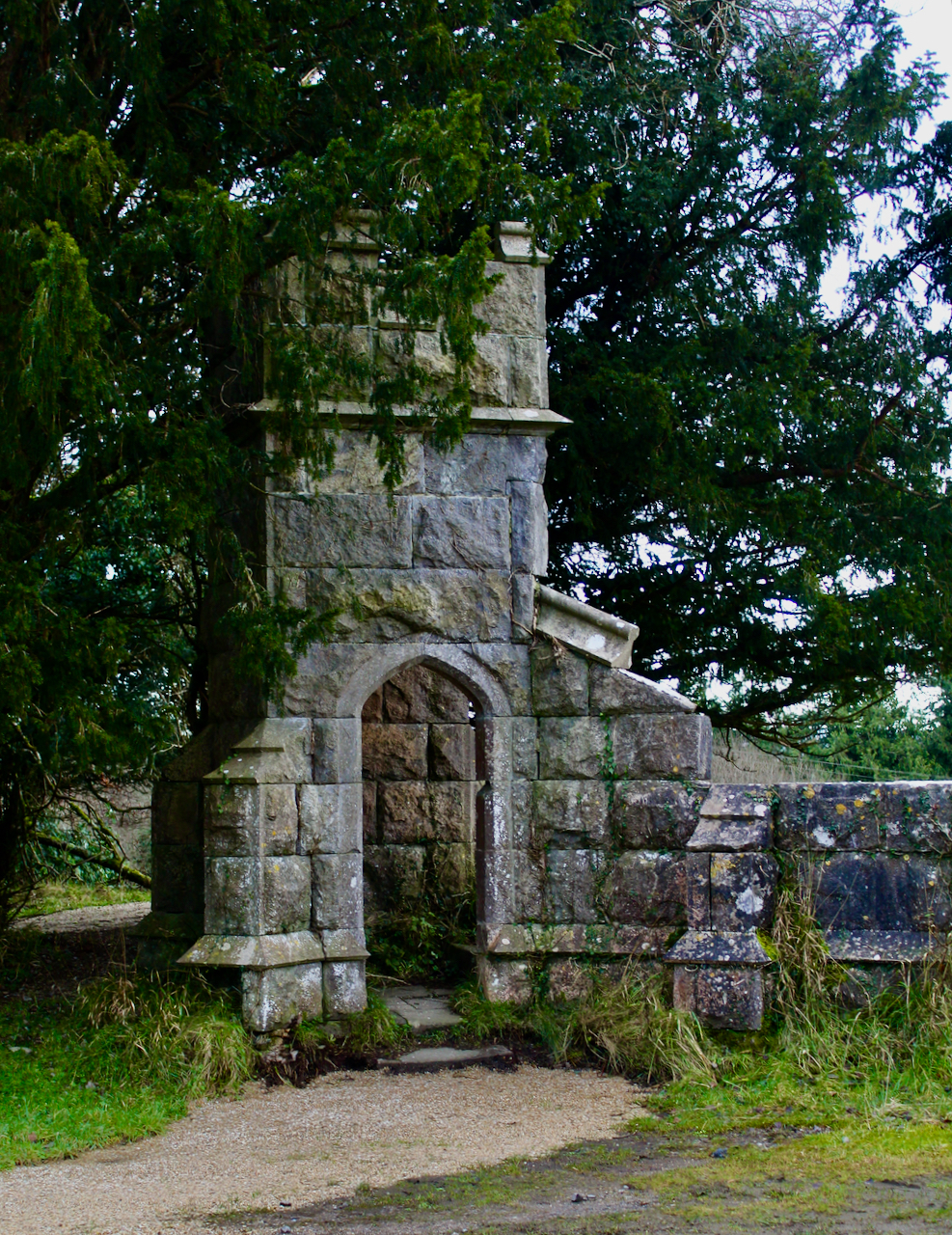
The entrance door on one of the central turrets of the entrance front. Castle Saunderson, County Cavan, December 2020. Photograph © Jennifer Winder-Baggot, www.irishhistorichouses.com
The octagonal-plan entrance tower with castellated doorcase, on the north facade, as described by the National Inventory. Castle Saunderson, County Cavan, December 2020. Photograph © Jennifer Winder-Baggot, www.irishhistorichouses.com
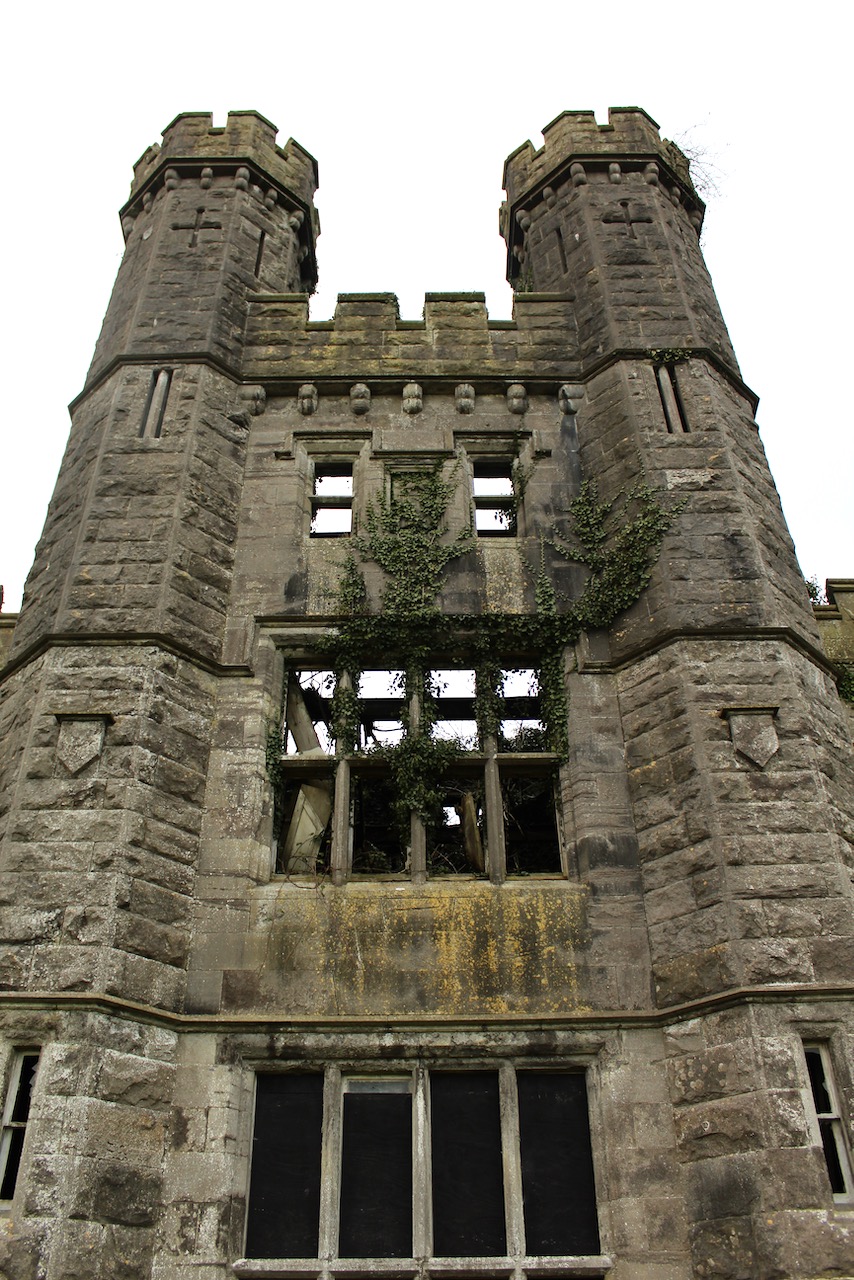
The square tower on the north side, Castle Saunderson, County Cavan, December 2020. Photograph © Jennifer Winder-Baggot, www.irishhistorichouses.com
Bence-Jones continues: “The adjoining garden front is more irregular, with a recessed centre between two projecting wings of unequal size and fenestration, each having a Tudor gable; the two wings being joined at ground floor level by a rather fragile Gothic arcade. To the left of this front, a lower “L”-shaped wing with a battlemented parapet and various turrets, ending in a long Gothic conservatory. Castle Saunderson has stood empty for years and is now semi-derelict.” [1]

The garden front, Castle Saunderson, County Cavan, December 2020. Photograph © Jennifer Winder-Baggot, www.irishhistorichouses.com
The long castellated arcade screening outbuildings extending to south terminate in a castellated turret. Castle Saunderson, County Cavan, December 2020. Photograph © Jennifer Winder-Baggot, www.irishhistorichouses.com
Castle Saunderson, County Cavan, December 2020. Photograph © Jennifer Winder-Baggot, www.irishhistorichouses.com
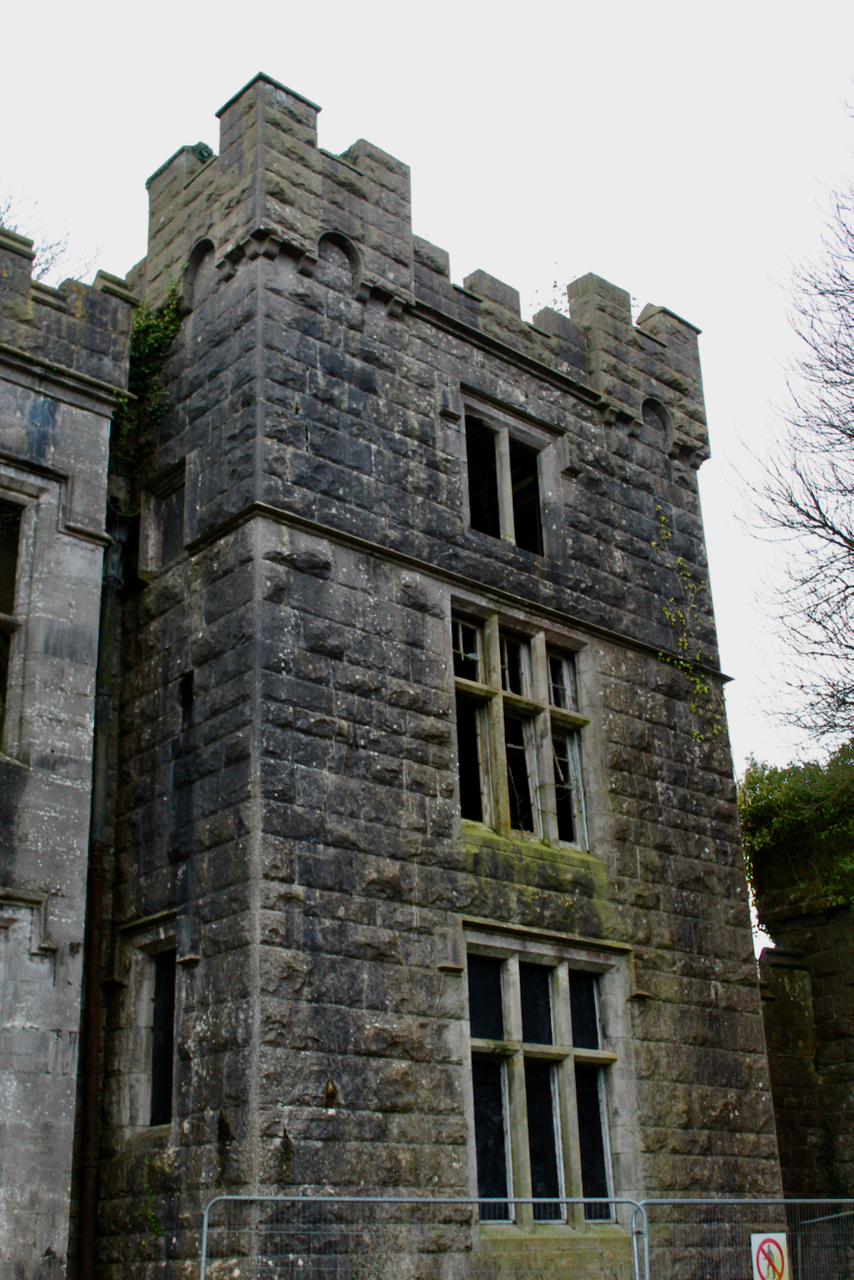
The various towers have “balistraria” cruciform and vertical arrow slit windows.

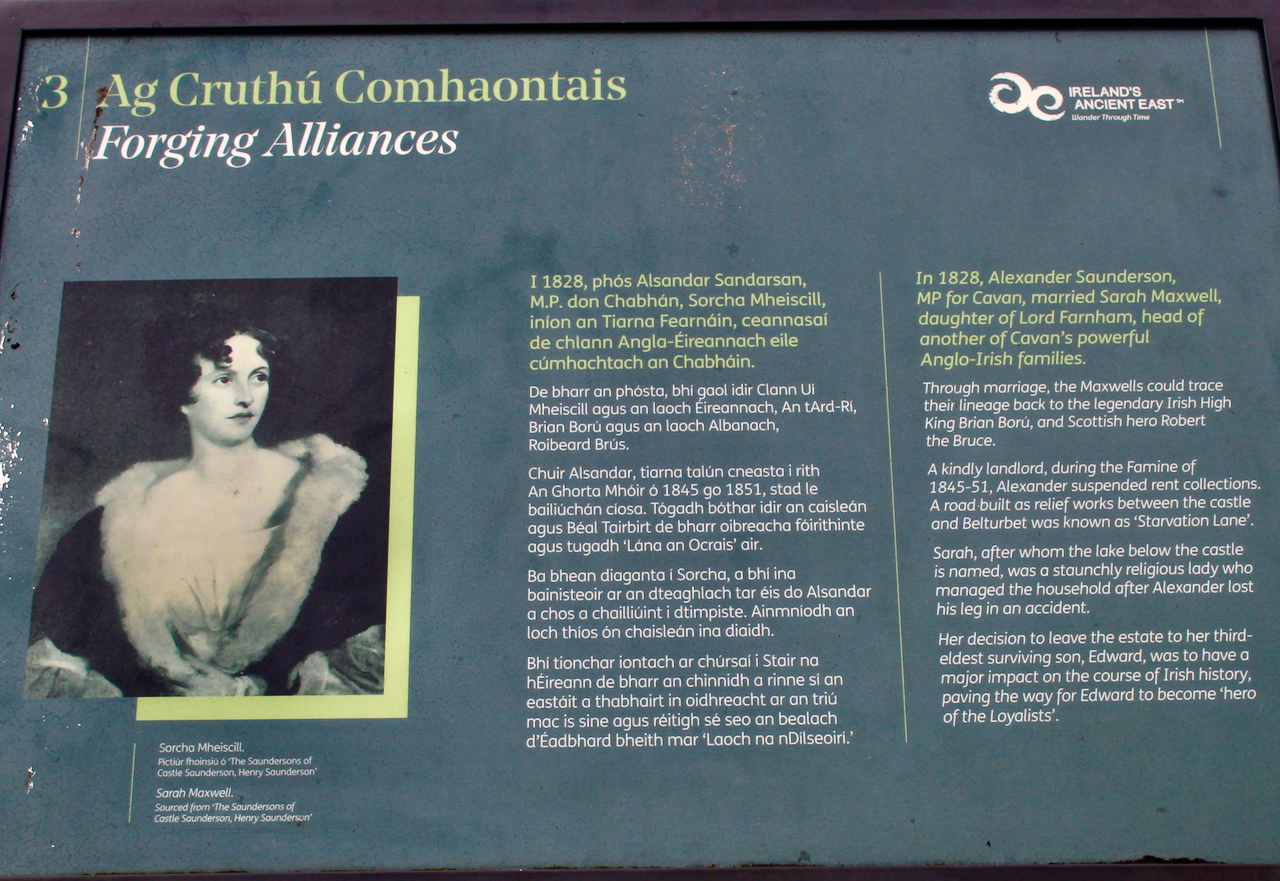
Alexander Saunderson (1783-1857) married Sarah Maxwell, the daughter of Reverend Henry Maxwell 6th Baron Farnham of Farnham in County Cavan.

In 1828, Alexander Saunderson, MP for Cavan, married Sarah Maxwell, daughter of Reverend Henry Maxwell 6th Baron Farnham, head of another of Cavan’s powerful Anglo-Irish families (Farnham Estate is now a hotel). Through marriage, the Maxwells are reputed to be able to trace their lineage back to the High King Brian Boru, and to the Scottish Robert Bruce. Alexander was a kind landlord, suspending rent collection from 1845-51 due to the famine.

The information board tells us that Alexander was a king landlord and the during the Famine of 1845-51, he suspended rent collection from his tenants. Alexander served as High Sheriff of County Cavan in 1818, and was MP for County Cavan.

Sarah decided to leave the estate to her third eldest surviving son, Edward. The older sons were Alexander de Bedick (1832-60) and Somerset Bassett (1834-92) – I am not sure why they did not inherit Castle Saunderson, but perhaps they inherited the Bassett estates in Glamorgan. The Landed Estates database tells us that in the mid-19th century the main part of Colonel Alexander (1783-1857) Saunderson’s estate was in the parishes of Annagelliff and Lavey in the barony of Upper Loughtee [Drumkeen], but he also held sizable portions of land in the parishes of Larah, Annagh and Killinkere [Castle Saunderson and Clover Hill]. He also bought some of the estate of the Earl of Mornington which was for sale in 1853. His brother, the Reverend Francis Saunderson, rector of Kildallan, county Cavan, held an estate in the parishes of Drumlane and Killashandra. [6]

Loreto College, formerly Drumkeen or Dromkeen, County Cavan, photograph courtesy of National Inventory.

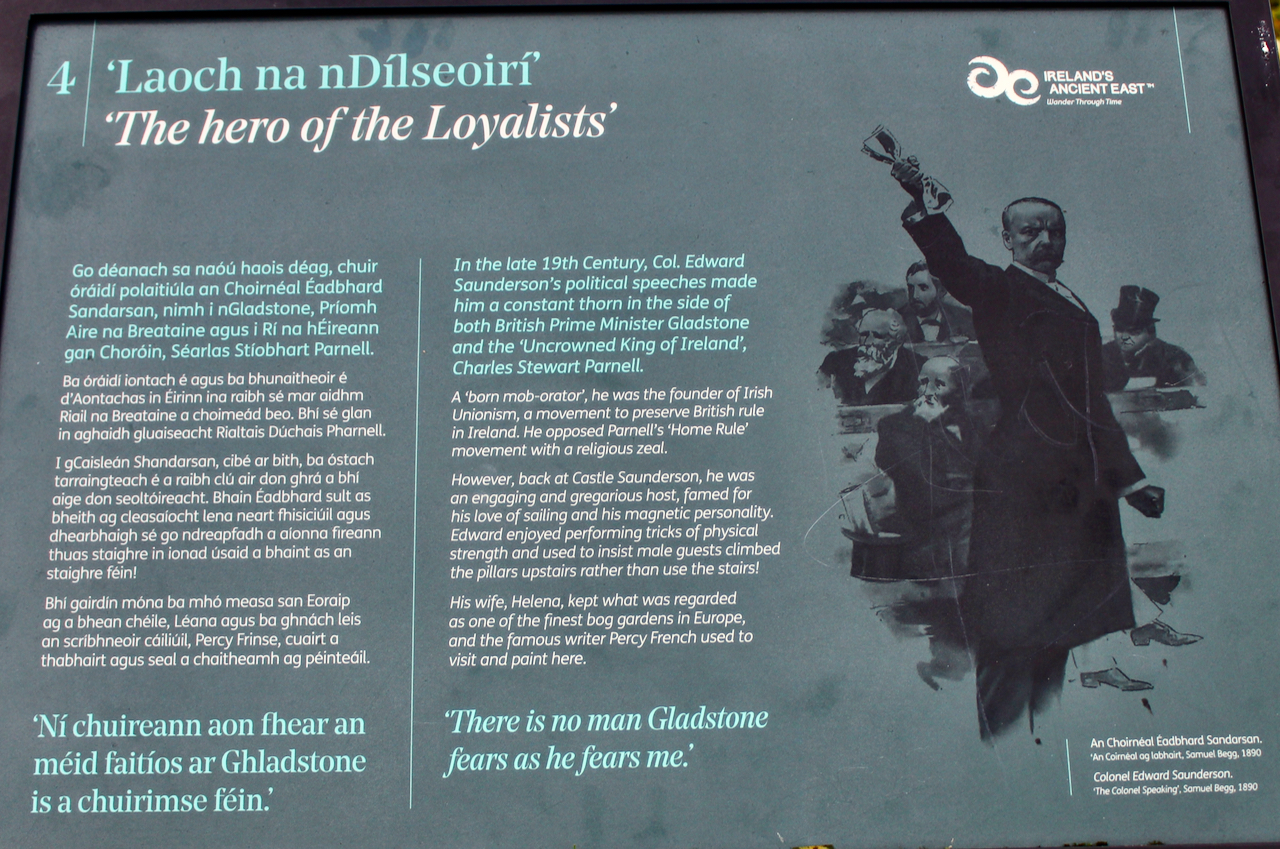
It was Edward Saunderson (1837-1906) who inherited Castle Saunderson. Edward Saunderson, the information board tells us, was the founder of British Unionism, the movement to preserve British rule in Ireland. He opposed Charles Stewart Parnell’s “Home Rule” movement, which sought to bring a parliament back to Ireland after it was abolished in 1800.

The notice board tells us that Edward enjoyed feats of strength, and made his male guests climb the pillars rather than using the stairs! His wife, Helena Emily de Moleyns, youngest daughter of Thomas, 3rd Baron Ventry, developed a bog garden, regarded as one of the finest in Europe, and the writer Percy French used to visit.

In the late 19th century, Colonel Edward Saunderson opposed Charles Stewart Parnell. Saunderson was the founder of Irish Unionism, a movement to preserve British rule in Ireland.
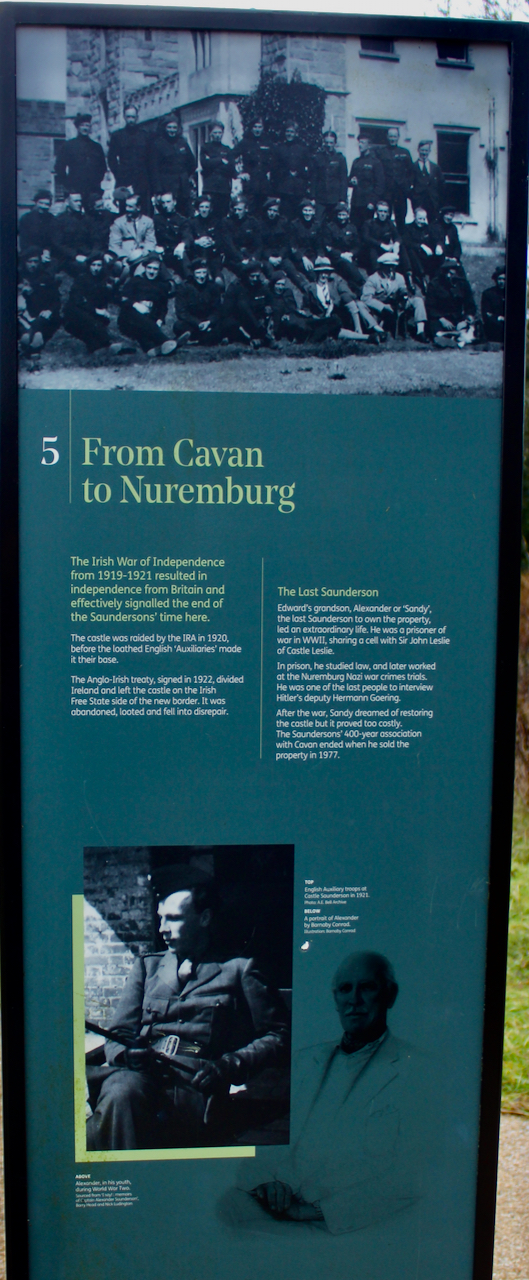
The last Saunderson, Alexander, or “Sandy,” was a prisoner of war in WWII, sharing a cell with Sir John Leslie of Castle Leslie. In prison he studied law and later worked at the Nuremburg Nazi war crimes trials.

Alexander Saunderson (1917-2004), the last of the family to live there, sold the property to a London-based businessman in 1977. (see [4]). The Castle was in a state of disrepair and plans to have it completely renovated as a private dwelling at this time never materialized. The estate was sold again in 1990 to be developed as a hotel. These plans were also abandoned after a fire gutted and destroyed most of the Castle interior. This was the third fire to take place in the history of the castle. (see[4]). The property was then sold to Scouts Ireland.

A Scout centre nearby has been established, and is a World Peace Centre for the Scouts.

[1] p. 75, Bence-Jones, Mark.  A Guide to Irish Country Houses (originally published as Burke’s Guide to Country Houses volume 1 Ireland by Burke’s Peerage Ltd. 1978); Revised edition 1988 Constable and Company Ltd, London. 

[2] https://www.dia.ie/architects/view/516/BLORE%2C+EDWARD+%23

[3] https://www.dia.ie/architects/view/5203/sudden%2C+george

[4] http://lordbelmontinnorthernireland.blogspot.com/2013/11/castle-saunderson.html

[5] https://www.buildingsofireland.ie/buildings-search/building/40401110/castle-saunderson-castlesaunderson-demesne-co-cavan

[6] https://landedestates.ie/estate/4008

See House (under Kilmore in Bence-Jones), Kilmore, Co Cavan

See House (under Kilmore in Bence-Jones), Kilmore, Co Cavan

Kilmore House or See House, County Cavan, photograph by Robert French, (between ca. 1865-1914), Lawrence Photograph Collection, National Library of Ireland.

Mark Bence-Jones. A Guide to Irish Country Houses (originally published as Burke’s Guide to Country Houses volume 1 Ireland by Burke’s Peerage Ltd. 1978); Revised edition 1988 Constable and Company Ltd, London.

p. 174. “The palace of the C of I Bishops of Kilmore, near their cathedral, which stands on a wooded hill surrounded by meadow – one of those cathedrals in the coutry that are a feature of Ireland. A three storey Grecian block of the 1830s, built “on a more eligible site” than the earlier palace; from its resemblance to Rathkenny, in the same county, it can fairly safely be attributed to William Farrell. Three bay entrance front; wide strip-pilasters at corners and framing centre bay, which is pedimented. Enclosed pilastered porch with die between two tripartite windows. Four bay side elevation with two bay breakfront; entablatures on console brackets over ground floor windows.” 

Kilmore House or See House, County Cavan, photograph by Robert French, (between ca. 1865-1914), Lawrence Photograph Collection, National Library of Ireland.

https://archiseek.com/2015/1837-bishops-palace-kilmore-co-cavan

1837 – Bishop’s Palace, Kilmore, Co. Cavan 

Architect: William Farrell 

See House, Kilmore, County Cavan, photograph courtesy of Archiseek.

Described in the late 1830s: “The new palace is built in the Grecian Doric style and covered with Roman cement. It appears too lofty, and in other respects is not well proportioned. The drive from the public road is badly managed, being tortured into short curves, for which the character of the ground is not fitted.” The rear elevation has pilasters flanking a wider east bay, and a shallow bow of three central bays. Now sits empty after a more manageable house was constructed closer to the cathedral. 

https://www.buildingsofireland.ie/buildings-search/building/40402506/see-house-kilmore-upper-co-cavan

See House, Kilmore, County Cavan, photograph courtesy of National Inventory.

Detached Grecian Revival three-bay three-storey over basement former bishop’s palace, built 1835-7, having pedimented central bay with single-storey limestone ashlar portico, recessed bay to west with single-storey side entrance. Irregular five-bay rear elevation with pilasters flanking wide east bay, shallow bow to central bays. Roof concealed by parapet, tall cut stone chimneystacks with cornice details, cast-iron rainwater goods hopper heads having egg-and-dart and bead-and-reel detail. Ruled-and-lined render over squared rubble stone walls. Ashlar pediment, tympanum having Episcopal coat of arms, ashlar cornice frieze and blocking course, with pilasters marking bays, having platband over ground floor and plinth course to basement. Graduated window openings having cut stone sills, with six-over-three sashes to second floor, six-over-six to first, tripartite windows to ground floor having nine-over-six sashes and corresponding side lights set in cut-stone surrounds comprising pilasters with entablature supported by fluted consoles. Ashlar portico having paired Doric pilasters, supporting entablature, and flanking four-panelled timber door with overpanel, approached by flight of cut stone steps, with six-over-nine barred windows to side. Entablatures supported on fluted consoles to ground floor windows to east side elevation. Tripartite window to east bay of rear elevation and round-headed window to west side elevation. Side door opening flanked by cut stone pilasters having entablature on fluted consoles with timber panelled door approached by cut stone steps. Complex of outbuildings with belfry to west. 

See House, Kilmore, County Cavan, photograph courtesy of National Inventory.

An impressive classical revival house in an austere Grecian style, attributed to the Dublin architect William Farrell (d.1851), on account of its similarity to Rathkenny House near Cootehill by the same architect. The former bishop’s palace is substantially intact, retaining its original character and form, and its setting within a mature demesne landscape. The architectural form of the house is enriched by many original features and materials, such as cut stone details, timber sashes with historic glass, panelled doors, and decorative rainwater goods. Built as the bishop’s palace of the Church of Ireland diocese of Kilmore, it has a long ecclesiastical association, having replaced an earlier bishop’s palace to the north of the former cathedral, and the later nineteenth-century Kilmore Cathedral. The house is the centrepiece of an architectural group consisting of fine outbuildings, gate lodge, and entrance gates, and is part of the significant ecclesiastical complex of Kilmore Cathedral, the old Cathedral, and nearby graveyard. 

See House, Kilmore, County Cavan, photograph courtesy of National Inventory.

€900,000 on 18/11/21 

15 beds 

See House, Kilmore, County Cavan, photograph courtesy of Colliers, 2021.

Kilmore Palace is a fine Georgian country property-built c. 1835. The three bay, three storey over basement property is set on approx. 16.5 acres (6.67ha) within a mature demesne landscape. Connected to the building are inner and outer courtyards. The entire is located 6.5km from Cavan town. ACCOMMODATION Kilmore Palace is an imposing three storey over basement Georgian residence, approached by a long sweeping avenue with beautiful verdant countryside views. On entering the property, the reception hall and the stairs hall are particularly fine, and the four reception rooms are bright and spacious with many special original features. The staircase is most elegant and leads to a return landing with a large window before separating in two to the 1st floor. On the first floor there are seven bedrooms and on the upper level off a central corridor with a large roof atrium are 8 further rooms with a variety of uses. The property has a bright and dry semi basement with high vaulted ceilings. Throughout the house are original Georgian features, including, exceptionally intricate cornices and ceiling roses, ornate antique fireplaces, recessed sash 9 over 6 pane windows with shutters and panelled doors with architrave surrounds. The main property has not been lived in in many years but remains in remarkably good condition. However, it will require full modernisation and refurbishment. Over the years upgrading was carried out as required, including a completely new roof and considerable window refurbishment. The property boasts huge potential as a manageable country house, boutique hotel, private retreat, or a wedding venue subject to planning.

HISTORY Kilmore Palace has a long ecclesiastical association, originally built as the Bishop’s Palace of the Church of Ireland diocese in Kilmore. Located in a very historic area, it is believed Kilmore was home to Ireland’s first church in the 6th or 7th century by St. Felim. In 1400 a church was built which the then Bishop of Kilmore, Andrew Mac Brady approved as his cathedral in 1454. This cathedral was replaced in 1860 as the original had become inadequate for the number of attending parishioners. Kilmore Palace has been home to each acting bishop ever since. LANDS The lands which extend to approx. 16.5 acres (6.67 ha) comprise of the area immediately surrounding the house including the courtyards, an attractive long avenue which leads to the front of the house and beyond to the courtyards. There is a field to the front of the house which is in grass and former gardens to the rear, bounded by mature woodland. OUT BUILDINGS There are two delightful cut-stone courtyards, which have been totally reroofed but otherwise requiring considerable refurbishment. The inner courtyard has four rooms including former bakery, washroom and laundry room with six further rooms over ground and first floor. The outer courtyard has two double coach houses, tack room, three cut stone barns with several standing stalls with overhead accommodation including five separate rooms.

THE LOCATION Kilmore Palace is located 6.5km south west of the busy Cavan Town, which is the principal centre in the North Midlands and will provide all daily requirements of shopping and dining. Nearby in the surrounding area, golf is available at Cavan Golf Club and the Farnham Estate Golf Course. Equestrian activity is available at Cavan Equestrian centre which hosts many weekly and international shows and hunting is available with the Ballymacads and Fermanagh Hunt. Fishing is renowned in Cavan with many lakes and rivers to choose from offering a boater’s paradise. The neighbouring Farnham Estate will also offer new owners a world class health spa and entertaining rooms. Crossdoney 4 km Cavan 6.5 km Dublin (M50) 120 km Dublin Airport 124 km 

BER Details 

BER: Exempt 

Viewing Details 

Please contact Marcus Magnier to arrange a viewing marcus.magnier@colliers.com 

See House, Kilmore, County Cavan, photograph courtesy of Colliers, 2021.

One of the lesser-known episodes of Irish history is the Tithe Wars of the 1830s. Tithes, a payment to support the religious establishment and its clergy, had existed in the pre-Reformation Roman Catholic church but from the 16th century onwards, this obligatory contribution went to the Church of Ireland even though its members were always in a minority of the population. The tithe payment was expected to represent ten per cent of the value of certain kinds of agricultural produce. Prior to the Tithe Composition Act of 1823 it was possible to pay tithes in kind instead of in cash. To complicate matters further, a tithe was not payable on all forms of land, and there was even variation from place to place on the types of land subject to tithes. After legislation passed in 1735, for example, pasture (usually held by landowners rather than tenants) was deemed exempt, while tillage land was not. Likewise only certain produce was judged taxable: potatoes, the most widely grown crop for the majority of the population, could be subject to a tithe in one part of the country and not in others. Following the Composition Act tithes were required to be monetary and surveys were carried out in each parish to assess its likely income. Understandably tithes were much resented, and not just by the majority non-Anglican population. Therefore following the Roman Catholic Relief Act of 1829 (popularly known as Catholic Emancipation) it was inevitable the payment of tithes would come under attack. 

St Feidhlimidh’s at Kilmore, County Cavan, photograph courtesy of Irish Aesthete.

One of what might be termed Ireland’s pocket cathedrals: that dedicated to St Feidhlimidh at Kilmore, County Cavan. The present building was designed by London-based architect William Slater who received a number of such commissions in this country. Consecrated in 1860, it replaced an older and much altered structure which by the mid-19th century was deemed unworthy of purpose and therefore almost entirely cleared away. The only surviving trace of its predecessor is a much-weathered Romanesque doorway set into the north wall of the chancel, although it has been proposed that this feature originally belonged to another church, that of the Premonstratensian Priory of Holy Trinity of nearby Lough Oughter (although this was founded about a century after the doorway was likely carved). The cathedral is one of a group of buildings on this site that also includes the now-empty early 19th century Bishop’s Palace, or See House (for more on this read See and Believe, September 14th 2015) and one section of a much older palace. The see’s most famous incumbent was William Bedell who as Bishop of Kilmore and Ardagh was responsible for commissioning the first Irish translation of the Old Testament. 

St Feidhlimidh’s at Kilmore, County Cavan, photograph courtesy of Irish Aesthete.

In the aftermath of the 1829 act, and with a rise in numbers of Roman Catholic clergy and the construction of many new churches throughout the country – both of these funded by local communities – opposition to the payment of tithes grew. Opposition was further stimulated by the publication of lists of defaulters and orders being issued collection for the seizure of goods and chattels, most often livestock. The first open resistance occurred in March 1831 in Graiguenamanagh, County Kilkenny where the civil authorities unsuccessfully attempted to seize 120 cattle from the local parish priest Fr Martin Doyle: he had arranged for the people of the area to place their livestock in his care. He had the support of a cousin James Warren Doyle, Bishop of Kildare and Leighlin who famously wrote of the Irish people to Thomas Spring Rice (then-Secretary of the Treasury), ‘An innate love of justice and of indomitable hatred of oppression is like a gem on the front of our nation which no darkness can obscure. To this firm reality I trace their hatred of tithe. May it be as lasting as their love of justice.’ The revolt against tithes soon spread and led to several ugly incidents: in June 1831, for instance, the Irish Constabulary fired on a crowd resisting the seizure of cattle in Bunclody, County Wexford, killing a number of them (the figure cited seems to vary from twelve to eighteen). Three years later in Rathcormac, County Cork a similar incident occurred (over the non-payment of a tithe valued at 40 shillings) which resulted in at least twelve deaths. Eventually in 1838 the Tithe Commutation Act for Ireland was passed. This reduced the amount payable directly by about a quarter and made the remainder payable in rent to landlords who would then pass on the funds to the relevant authorities. In effect, tithes thus became another form of rental payment but the outcome was an end to open confrontation. Tithes were not abolished until the Irish Church Act of 1869 which disestablished the Church of Ireland. 

See House, Kilmore, County Cavan, photograph courtesy of Irish Aesthete.

Astonishingly it was during this troubled period that George de la Poer Beresford, who had been Bishop of Kilmore, County Cavan since 1802, decided to embark on the construction of a new residence for himself and his successors. A bishop’s palace already existed close to the site of the present building; when John Wesley visited in 1787 he declared the earlier house, dating from the early 18th century, ‘is finely situated, has two fronts and is fit for a nobleman.’ But apparently not fit enough for Bishop Beresford who in the mid-1830s commissioned its replacement from the Dublin-born William Farrell. In 1823 the latter had been appointed the Board of First Fruits architect for the Church of Ireland ecclesiastical Province of Armagh (a position he held until 1843) and in this capacity designed a number of churches and other buildings in the region. Accordingly even if Beresford’s wish for a new house seems odd, it made sense for him to use Farrell. One suspects at least part of the reason for this expensive enterprise was so that the bishop could commemorate himself: the tympanum of the façade’s pediment carries the Beresford coat of arms. Writing in 1837, Jonathan Binns harshly passed judgement: ‘The Bishop has lately erected a palce in lieu of the old one. The new palace is built in the Grecian Doric style and covered with Roman cement. It appears too lofty and in other respects is not well proportioned.’ Apparently always known as the See House the building is unquestionably stark, of three storeys over semi-raised basement, its three-bay front is relieved a large limestone porch and flanking Wyatt windows on the ground floor. The garden front is asymmetrical owing to the insertion of an off-centre bay window with another tripartite window to one side but not the other. There are two fine yards, separated by a block with a clock tower. 

See House, Kilmore, County Cavan, photograph courtesy of Irish Aesthete.

The dominant feature of the See House’s interior is height: the ground floor ceilings must rise to some twenty feet. Beyond the porch, a square entrance hall has a circular ceiling supported on pendentives. Then comes the staircase hall from which open a series of reception rooms, all characterized by their severity and scale. Doors and chimneypieces shrink to insignificance in these spaces, as do the ceilings’ modest plasterwork and cornicing. The current empty condition of the building exacerbates this feature but it must always have been an echoing barn. The bifurcating staircase further emphasizes the See House’s overblown proportions, rising to a return lit by a vast round-headed window before climbing up to the spacious landing off which run a succession of bedrooms. The top floor, reached via stone service stairs is equally substantial, its centre gallery lit by a wonderful octagonal lantern. One of the rooms on this level, presumably used as a nursery or schoolroom, has walls painted with trees. Otherwise here, as elsewhere in the building, decoration is minimal. The See House appears to have been occupied by Bishops (since 1841 of the combined dioceses of Kilmore, Elphin and Ardagh) until the beginning of the present century. It is now in private hands and although not at present occupied has been well maintained. Perhaps the last episcopal residence built by an Anglican cleric in Ireland, the See House is an example of the purpose to which at least some of those much-hated tithes were put. 

See House, Kilmore, County Cavan, photograph courtesy of Irish Aesthete.

http://lordbelmontinnorthernireland.blogspot.com/2015/09/kilmore-palace.html 

THE bishopric of Kilmore was established in the 13th century, and in the 15th century changed its ancient name of Breffny into that of Kilmore.

It lies parallel to, and south of the diocese of Clogher, extending fifty-eight miles in length and between ten and twenty in breadth, through four counties, viz. Cavan, Leitrim, Meath, and Fermanagh in Northern Ireland. 
 
The See House, Kilmore, County Cavan, was built by the Right Rev George de la Poer Beresford, Lord Bishop of Kilmore, 1802-39, and of Kilmore and Ardagh, 1839-41. 
 
It was occupied by a further sixteen prelates. 

 
It is believed that the last bishop to reside at the palace was the Right Rev Michael Mayes, Bishop of Kilmore, Elphin and Ardagh from 1993-2000. 

A new see house was built at a different location near the cathedral hall in 2013. 

THE SEE HOUSE, Kilmore, County Cavan, is a Grecian-Revival mansion of three storeys over a basement. 
 
It was built between 1835-7. 
 
This former episcopal palace, attributed to William Farrell, comprises a three-bay entrance front. 

There is an irregular five-bay rear elevation with pilasters flanking wide east bay, and a shallow bow to central bays. 
 
The roof is concealed by a parapet. 
 
The house is rendered over squared rubble stone walls. 

An ashlar pediment, and tympanum with episcopal coat-of-arms. 
 
The ashlar portico has paired Doric pilasters. 
 
This is an impressive classical-revival house in an austere Grecian style. 

The former bishop’s palace is substantially intact, retaining its original character and form, and its setting on a wooded hill surrounded by meadow, near the Cathedral. 
 
The architectural form of the house is enriched by many original features and materials, such as cut stone details, timber sashes with historic glass, and panelled doors. 

The old see house has a long ecclesiastical association, having replaced an earlier episcopal palace to the north of the former cathedral and the later 19th-century Kilmore Cathedral. 
 
The old see house forms the centrepiece of an architectural group consisting of fine outbuildings, gate lodge, and entrance gates, and forms part of the significant ecclesiastical complex of Kilmore Cathedral, the old Cathedral, and nearby graveyard. 

Cloggy House, Cloggy, Ballinagh, County Cavan

Cloggy House, Cloggy, Ballinagh, County Cavan H12 XY89 For sale July 2023 photographs courtesy Smiths Estate Agent.

€750,000 3 beds3 baths230.77 m2  

Cloggy House, Cloggy, Ballinagh, County Cavan. For sale July 2023 photographs courtesy Smiths Estate Agent.

BEAUTIFUL THREE BEDROOM PERIOD RESIDENCE WITH MODERN AND TRADITIONAL DESIGN, FINISHED AND PRESENTED IN IMMACULATE CONDITION AND SET ON A BEAUTIFUL 1.8 ACRE MATURE SITE WITH RIVER ERNE FRONTAGE. LOCATED IN AN UNSPOILT RURAL SETTING CLOSE TO KILLYKEEN FOREST PARK, MANY LAKES AND RIVERS, 6KM FROM NEAREST VILLAGE BALLINAGH AND 13KM FROM CAVAN TOWN Cloggy House, originally called Riverview (in the townland of Cloggy) was build circa 1780 by the Faris family who farmed all the surrounding land. The Faris family were important producers of flax for the linen industry. In fact, the field at the front of the house was called the `bleaching green` and it was here that the flax was laid out to be bleached. In the early 1970s, the house was purchased by a French couple who used it as a holiday home. They redecorated the house in the rustic style of a French farmhouse, complete with shutters on the outside of all the windows. Smith Property are delighted to offer for sale this elegant renovated Georgian residence with courtyard that accommodates more than just rooms, it offers a lifestyle home with many features within the L – Shape passive solar design, with accommodation that extends to 2484 sq.ft / 230.8 sq.m. The property was fully refurbished and extended by the current owner in 2008/2009. A single storey modern link building was designed and constructed to connect the original dwelling to the vast range of outbuildings that are very suitable for many uses. A bright corner kitchen, dining with large window openings were cleverly placed to benefit full advantage of the lush surrounding gardens and floods of natural light. The room proportions are very generous with most rooms enjoying double or treble aspect orientation and views over the surrounding manicured lawns and countryside. All rooms are finished to high standards with great attention to detail featuring quality fixtures and finishes throughout. The extensive refurbishment undertaken included full mechanical and electrical installation, carpentry, roofing with solar panel installation, sash windows and significant insulation. The quality of finish with bespoke and excellent attention to detail for a building that now commands a B3 energy rating standard, rare for such a property and a testament to the consideration and quality of materials used. A range of cut stone outbuildings attach the main residence that extend to 186.8 sq. m (2011 sq. ft) over two floors. They are in excellent condition with secure wrought iron protection, a concrete first floor and multiple access doors. It offers further potential for living accommodation and or conversion to home office, gym, games room, private annex and much more. Each room enjoys dual aspect views to both the courtyard and the garden area.  

Cloggy House, Cloggy, Ballinagh, County Cavan. For sale July 2023 photographs courtesy Smiths Estate Agent.

A domestic garage ideal for garden equipment and tools extends to 29.2 sq. m (315 sq. ft). Cloggy house enjoys River Erne frontage with a stone cut building on the riverbanks overlooking Cloggy Bridge, recently restored suitable for many uses including office, games room or entertainment space. The 1.8 acres of parkland grounds with mature trees, planting and diversity of floral offers seasonal colour throughout the year. A main entrance together with two secondary entrances service this property. Located in a quaint rural setting, 6km from nearest village Ballinagh, 13km from Cavan town, 12km from Killeshandra, 2km from McSeains Pub, Shop and Pitch & Putt Course. Local Amenities and Attractions Located West of Cavan town, in a lush, green countryside surrounded by rich farmland, a short distance from the renowned and picturesque Lough Oughter, Lough Gowna and Killykeen Forest Park. A host of amenities are available in nearby principal towns such as Cavan, Longford and Mullinagr with the small villages of Ballinagh and Arvagh less than a ten minute drive. The property is located a short distance off the N55 (Cavan / Longford road) easily accessible to a good road network and within 40 minute drive of each of the aforementioned towns. It is also within a short distance from both the M3 and M4 Motorways allowing drive time to Dublin City and Airport of 95 minutes.  

Accommodation  

ENTRACE HALL Victorian arch doorway with traditional painted wood panelling Tiled floor Built in shelves RECEPTION ROOM Sweeping feature stairwell Tiled floor DRAWING ROOM – 23’6″ (7.16m) x 12’8″ (3.86m) Fully tiled porcelain flooring Fitted stove Coving SITTING ROOM – 23’6″ (7.16m) x 11’5″ (3.48m) Feature stone fireplace Tiled floor Coving Built in shelves DINING ROOM – 15’3″ (4.65m) x 13’7″ (4.14m) Full length glass windows surrounding walls with panoramic views KITCHEN – 16’7″ (5.05m) x 14’9″ (4.5m) Fitted floor & wall units with integrated oven & hob Breakfast island Tiled flooring Coving HALL Tiled floor Glass door into kitchen WC Tiled floor Half Mosaic tiled wall UTILITY ROOM – 13’11” (4.24m) x 13’2″ (4.01m) Wall and floor units Tiled floor Mosaic tiled backsplash on one wall LANDING Wooden floor BEDROOM 1 ( En-Suite & WIW ) – 12’5″ (3.78m) x 12’1″ (3.68m) Wooden floor Coving Fully tiled En-Suite BEDROOM 2 – 12’6″ (3.81m) x 11’3″ (3.43m) Carpet floor Coving BEDROOM 3 – 12’6″ (3.81m) x 11’9″ (3.58m) Carpet floor Coving BATHROOM – 9’7″ (2.92m) x 6’5″ (1.96m) Tiled floor Half Mosaic tiled wall HOTPRESS  

Features  

  • Excellent high speed broadband available  
  • Frontage and private access to the River Erne with cut stone cottage  
  • B3 energy rating – qualifies for green mortgage applicants  
  • 1.8 acres of lush mature lawns and grounds  
  • Fully refurbished in 2008/2009 to high standards  
  • Many period characteristics with certain modern improvements  
  • Unspoiled yet accessible rural location less than 6km from Ballinagh and N55 road networks  
  • Oil Fired Central Heating and Solar Panels  
  • Group water scheme  
  • Bio Cycle Sewerage System 

BER Details  

BER: B3 
BER No: 116565912 
Energy Performance Indicator: 141.96 kWh/m2/yr 

Negotiator  

Raymond Smith 

Smith Property 

Cloggy House, Cloggy, Ballinagh, County Cavan. For sale July 2023 photographs courtesy Smiths Estate Agent.

Billis Grange (or The Grange), Drumallaght, County Cavan 

Billis Grange, Drumallaght, County Cavan 

Billis Grange, Drumallaght, County Cavan for sale June 2024 photographs courtesy McPeake Auctioneers.

https://www.buildingsofireland.ie/buildings-search/building/40403305/billis-grange-drummallaght-co-cavan

Detached five-bay two-storey house, built c.1890, with projecting two-storey gabled outer bays flanking recent single-storey entrance, south gable probably post 1910, two-storey return to south-west. Alterations comprising two-storey rear extension and timber conservatory to south c.2000, single-storey outbuildings to west, south-west and north, converted c.2005, forming rectangular yard to rear. Pitched slate roof with perforated clay ridge tile, rendered replacement chimneystacks with recent stepped profiles and historic clay pots to front and rear sections. Roof overhangs at eaves and gables with decorative timber trusses to gables, recent timber bargeboards, replacement rainwater goods. Smooth rendered walls with channel jointed smooth quoins and smooth plinth. Two-over-two timber sash windows with stone sills. Bay windows to east gables with timber uprights at corners supporting slate roof with two-over-two timber sash windows. Windows above bays with recent pediments on brackets. Recent entrance porch with precast concrete columns, round-headed door opening with fanlight and recent timber door. Recent projection to south-east gable with timber doors flanked by precast concrete columns and balcony over. Outbuildings with replacement pitched slate roofs, altered and new openings with recent brick dressing, recent limestone sills and uPVC windows. Water channels connecting former mill race with lake in west and Nadreegeel Lough to south-west.  

Appraisal 

Despite having lost some of its original fabric, the house retains some of its original form and much of its landscape setting. It retains its picturesque character expressed with balanced elevation, projecting bays, and decorative elements. The house can be seen from the main road to the east across extensive picturesque parkland and adds to the historic character of the surrounding area. The landscape contains a number of historic water channels and a mill race that connect to lakes in the west and to a former corn mill to the east. 

Billis Grange, Drumallaght, County Cavan for sale June 2024 photographs courtesy McPeake Auctioneers, POA 

5 beds5 baths590 m2 

Billis Grange, Drumallaght, County Cavan for sale June 2024 photographs courtesy McPeake Auctioneers.

A truly exceptional fine Victorian Period Home, Dating from circa 1890 on 6.17 Acres of magnificent, landscaped grounds and parkland. The present owners carried out extensive restoration and building works to the property in 1999 /2000 to meticulous exacting standards. That embrace the best of the original structure with additional striking and deferential accommodation. The thoughtful appreciation of vintage and modern has created a truly magical family home in idyllic surroundings. In addition. This important sale also presents a unique opportunity to acquire a stunning Social, Commercial or Corporate Venue. The extensive accommodation comprises an imposing reception hall. formal drawing room and dining room. family room. recreation room. conservatory. study. large kitchen breakfast living room. 5 bedrooms.4 bathrooms. indoor swimming pool / ballroom. gymnasium. tennis court and pavilion. lake and boating amenity. mews house. carport. coach house. A logic gated entrance opens to a tree lined winding driveway, that invites you towards and across a picturesque bridge and stream, to the forecourt of the main house. The driveway bisects skirting around the parkland and grounds towards the lake and up to the outer rear yard and courtyard of the property. Decorative standard lamps illuminate the driveway and grounds. The parkland and gardens are beautifully presented and maintained with mature tree stands and shrubbery, pathways and sun patios. A lakeside gazebo and seating area offers the ultimate in quietude. 

Billis Grange, Drumallaght, County Cavan for sale June 2024 photographs courtesy McPeake Auctioneers.

Accommodation  

The main house measures 590 m2 approximately, laid out over two floors and a return, with five principal reception rooms and five bedrooms. An impressive portico frames the main entrance into an elegant and imposing and welcoming grand reception hall. Reception Hall 7.37 x 6.94 m with gas fire inset. Alcove with window seat and guest w.c. Drawing room 7.10 x 5.05 m. with bay window open fireplace and French Door to garden. Dining room 4.71 x 4.08 with bay window open fireplace. Kitchen Breakfast Living room 11.81 x 4.8 m. with Bespoke John Daly Kitchen.4 oven Aga and 2 ring hob. Built in Neff appliances and waste disposal unit and Liscannor stone floor. Hamptons Conservatory 4.47 X 3.16 m. with French door to garden. Rear hallway. Boot room 2.56 x 2.27 m. Utility room 3.60 x 2.52 m. Recreation room 6.65 x 5.21 m with stove and stairs to study. Family room 6.86 x 5.21 m. with floor to ceiling brick fireplace and solid fuel stove complimented by rustic timber ceiling beams and solid wood floor. Ballroom / Swimming Pool 17.00 x 9.30 with dressing room w.c. gallery and plant room. Original winding staircase. Landing return with full height fan window. First floor landing and corridor 5.617 x 1.24 m. Master Suite – Inner corridor 3.08 x 1.21 m. with storage. Spacious bright Master Bedroom 7.11 x 6.06 m. with Juliet Balcony. Bathroom 4.13 x 3.00 m. with twin pedestal wash basins, bath, shower and w.c. Bedroom 2. 4.69 x 4.03 m. with dual aspect. Bedroom 3. 4.97 x 2.73 m. overlooking the front grounds. Jack and Jill Bathroom 2.73 x 2.26 m. with shower, wash basin and w.c. Return. Corridor 6.214 x 3.764 m. Linen cupboard. Bedroom 4. 4.46 x 4.00 with rear aspect. Bathroom 3.00 x 2.55 m. with shower, wash basin and w.c. Bedroom 5. 4.24 x 4.18 m. with rear aspect and interconnecting door to study 4.16 x 3.45 m. Courtyard: Mews – Hall. Livingroom 6.59 x 4.70 m. with solid fuel stove and rustic ceiling beams. Kitchen 3.37 x 2.76 m. opening to Dining room 4.71 x 3.71 m. Shower room with w.c 2 Upper floor rooms 4.56 x 2.61 m. and 4.1 x 4.00 m. Shower room and w.c. 3 Bay Car Port 10.34 x 6.22 m. Gymnasium 10.33 x 5.58. Tennis Court. Pavilion 9.4 x 3.35 m. with shaded south facing veranda. Outer Yard – Coach house /store 12.8 x 3.8 m. 

Features  

Intricate ceiling roses with decorative cornicing complimented by chandeliers and typical floor to ceiling height. Moulded skirtings and architraves. High mantle marble Victorian style fireplaces. And solid wood floors to 3 main reception rooms. Original staircase. Iconic portico fan light. 5 Bay windows. Double glazed sash windows. Self-contained Master suite. Indoor swimming pool / ballroom. Tennis Court. Lake amenity. 

BER Details  

BER: C3 

Directions  

The property is discreetly tucked away off the Dublin / Cavan / Donegal Road between Virginia 6 km. and Cavan 23 km. A 50-minute drive to J6 M50 and 60 minutes to Dublin Airport. Hourly Dublin Bus Eireann service passes the gate. Airport Express service stop at Virginia. A wide choice of primary and post primary schools in the area and environs with a considerable range of shopping facilities and social amenities within easy proximity. Numerous leisure and sport pursuits at the doorstep. Hunting with the Ballymacad’s. Golf in Virginia, Slieve Russell and Headfort. Rugby and numerous other field sport options close by in Virginia and Cavan. Forest Walks at Virginia Lake and Killykeen Forest Park. Cuilcagh Mountain walks. In the county of the lakes, you can fish to your hearts content. Or perhaps just stay at home and enjoy the swimming pool, tennis, gymnasium or a leisurely boat trip and picnic on the lake! 

Viewing Details  

Strictly by prior appointment only with Gerard Farrelly. McPeake Auctioneers. 01 827 2300.

Billis Grange, Drumallaght, County Cavan for sale June 2024 photographs courtesy McPeake Auctioneers.

The Grange, Dromallard, Virginia, A82 FP46 836.92 m2 on 6.5 acres Cavan for sale Jan 2025 courtesy Colliers, €1,600,000

The Grange, Dromallard, Virginia, County Cavan for sale Jan 2025, photograph courtesy Colliers.

Delightful restored and extended period house (1890) together with guest cottage, indoor heated swimming pool, 6.5 acres of colourful grounds and lake frontage. Carried out over a 2 year period (1999/2000) the total restoration, with great care taken to preserve the period character, involved stripping the house back to the bare bones and virtually rebuilding, with concrete floors on the ground and first floors, reroofing, wiring, plumbing and the installation of oil fired central heating and double glazing throughout. Not satisfied with just undertaking the enormous restoration of the house the owners added a further sitting room and impressive entertainment room as well as the spacious indoor swimming pool which is currently floored for a family wedding. All outbuildings were also restored including the coach house which is now a 2 bedroom guest cottage/mews and the charming summer house which with its terrace overlooks the grounds. The property is discreetly tucked away off the Dublin/Cavan/Donegal Road between Virginia 6Km, and Cavan 23 Km. A 50-minute drive to J6 M50 and 60 minutes to Dublin Airport.

The Grange, Dromallard, Virginia, County Cavan for sale Jan 2025, photograph courtesy Colliers.

Accommodation 

The pillared entrance porch leads to the truly impressive reception hall with its feature marble fireplace and oak flooring. Off this radiate the comfortable drawing room, dining room, stairs hall with cloakroom and the fine staircase. The hall opens to the long open plan kitchen/breakfast room with living area which at one end opens to the south facing conservatory and at the other end leads to a boot room and utility room and the family room which in turn connects to the grand entertainment room with high beamed ceiling, feature open fireplace and mezzanine level. Upstairs there are 5 bedrooms, 2 share a Jack & Jill bathroom, the master is ensuite and there is a family bathroom.

The Grange, Dromallard, Virginia, County Cavan for sale Jan 2025, photograph courtesy Colliers.

Features 

• Totally restored and extended period house • Cut stone coach house/mews • Summer house with terrace • Hardcourt tennis court • Frontage to coarse fishing with landing stage • Delightful woodland and grounds • 3 bay car port with gym over

The Grange, Dromallard, Virginia, County Cavan for sale Jan 2025, photograph courtesy Colliers.

BER Details 

BER: C3 BER No.116788886 Energy Performance Indicator:206.9 kWh/m²/yr

Viewing Details 

Strictly by appointment through the joint sole selling agents: Please email Marcus Magnier to arrange a viewing Email: marcus.magnier@colliers.com

The Grounds 

The house is set well off the country road and is approached via a long tree lined avenue with a millrace on either side, each of which flowed to separate corn mills in Victorian times. The avenue leads to an extensive forecourt parking and divides going through the manicured grounds to the courtyard. The grounds are mainly in lawns with colourful beds interspersed with walkways leading to the lake. There is also a hardcourt tennis court.

The Grange, Dromallard, Virginia, County Cavan for sale Jan 2025, photograph courtesy Colliers.

The Mews 

A charming 2 storey cut stone building with on the ground floor a living room/dining room, kitchen, shower room and upstairs 2 bedrooms and a shower room. The upstairs also connects to the large gym

Outoffices 

The Swimming Pool This impressive structure of 158 sq. m. has a range of French doors opening to the grounds, a mezzanine area and a plant room. Currently a timber floor covers the pool as it was used recently for a family wedding. The Summer House The main room has exposed stone walls and folding patio doors opening to a large paved terrace. There is also a small snug bar with counter. Carport & Gym A modern 3 bay car port with stairs to 57 sqm gym.

Location 

The property is discreetly tucked away off the Dublin/Cavan/Donegal Road between Virginia 6Km, and Cavan 23 Km. A 50-minute drive to J6 M50 and 60 minutes to Dublin Airport. Hourly Dublin Bus Eireann service passes the gate. Airport Express service stop at Virginia. A wide choice of primary and post primary schools in the area and environs with a considerable rage of shopping facilities and social amenities within easy proximity. Numerous leisure and sport pursuits at the doorstep. Hunting with the Ballymacad’s. Golf in Virginia, Slieve Russell and Headfort. Or perhaps just stay at home and enjoy the swimming pool, tennis gymnasium or a leisurely boat trip and picnic on the lake!

The Grange, Dromallard, Virginia, County Cavan for sale Jan 2025, photograph courtesy Colliers.

Sandville House, Aghavoher, County Cavan

Sandville House:

https://www.buildingsofireland.ie/buildings-search/building/40401401/sandville-house-aghavoher-co-cavan

Detached T-plan three-bay two-storey house, built c.1850, with long return of equal height to rear. Hipped slate roof, clay ridge tiles, pair of rendered chimneys flanking centre bay, similar chimneystack to centre of return, timber rafters exposed at eaves of front block, cast-iron rainwater goods. Roughcast rendered walls. Two-over-two timber sash windows to front block with stone sills, some remaining in return, stair window to south-west of return replaced by single glass pane. Segmental arch to former main entrance with blind smooth-rendered tympanum over timber entrance screen having glazed double-leaf doors with single-pane overlight, flanked by decorative mullions and one-over-one sashes to side lights. Interior folding shutters to windows, stone flags to ground floor of return. Detached two-storey outbuilding to north with extension to north side. Hipped recent corrugated metal roof, rendered chimneystack, and rubble stone walls with one large segmental arch opening. Recent timber doors and windows. Outbuilding to west of house return attached to rubble stone wall running westwards, stone piers at west end of wall flanking south approach to yard.

Appraisal

A symmetrical, hipped roofed, regularly proportioned house of a prevailing type traditionally used for glebes or substantial farmhouses. The house retains many original features and presents a well composed symmetrical elevation seen across parkland from the road. The house replaced an earlier building some of which may have been integrated into the main front block. Together with its parkland setting the house contributes significantly to the architectural character of the area.

Stradone House, Stradone, Co Cavan – demolished, but a Grecian gate lodge survives

Stradone House, Stradone, Co Cavan – demolished, but a Grecian gate lodge survives

Bence-Jones, Mark. A Guide to Irish Country Houses (originally published as Burke’s Guide to Country Houses volume 1 Ireland by Burke’s Peerage Ltd. 1978); Revised edition 1988 Constable and Company Ltd, London.

p. 266. “(Burrowes/IFR) a late Georgian mansion by John B. Keane, with a two-storey front, and a large return with an extra mezzanine storey. The entrance front had five bays, the central bay recessed under a massive arch, beneath a pediment. The ground-floor windows on either side of the entrance were set in shallow arched recesses. 
Demolished, but a Grecian gate lodge survives.” 

Listed in Vanishing Country Houses of Ireland by The Knight of Glin, David J. Griffin and Nicholas K. Robinson, published by The Irish Architectural Archive and The Irish Georgian Society, 1988.

Large classical house designed in 1828 by John B. Keane for Major F. Burrows. Demolished.”

https://www.buildingsofireland.ie/buildings-search/building/40402107/drumlaunaght-upp-loughtee-by-stadone-co-cavan

is this the gate lodge Bence-Jones mentions? 

DRUMLAUNAGHT (UPP. LOUGHTEE BY.),STADONE, County Cavan 

Detached Greek Revival three-bay single-storey former gate lodge, built c.1845, with projecting entrance porch. Now in use as private house. Hipped slate roof with replacement ridge tiles, oversailing eaves supported on plain timber brackets, cut-stone central chimneystack and replacement rainwater goods. Walls now stripped to reveal red brick with brick cornice, having vertical ashlar strip of quoins raised to form antae, and cut-stone plinth all round. Two-stage windows flanking porch divided by stone lintel, to north bay small window over lintel with blind brick recess below, opposite arrangement to south bay. Replacement casement windows. Advanced flat-roofed porch with pilasters, full salient entablature and blocking course, and replacement timber panelled door with glazed upper sections. Corner antae framing a wide window on each gable with raised cutstone surround and stone sill, brick relieving arch over, and replacement tripartite casement windows. Rear elevation to road with same two-stage window recesses as front elevation having window to one upper section and all others as blind brick.  

Appraisal 

An important Grecian Style lodge in the style of Sir Richard Morrison, probably designed by J.B. Keane (d.1859) who had been an assistant in the Morrisons’ office. Keane designed Stradone House in 1828 for Major F. Burrows, as well as a contemporary porter’s lodge, both are now demolished. This finely executed gate lodge is an interesting survivor and has a number of striking features including the treatment of windows, the quoins expressed as antae on the elevations and the employment of the gable-facing entrance gates. The lodge retains much of its original form and materials and though small has a strong sense of scale suited to its roadside location. 

http://lordbelmontinnorthernireland.blogspot.com/2014/08/stradone-house.html

THE BURROWES’ WERE MAJOR LANDOWNERS IN COUNTY CAVAN, WITH 9,572 ACRES 

 
This family was established in Ireland by 
 
ROBERT BOROWES, who settled at Drumlane, County Cavan, on the settlement of Ulster by JAMES I. 
 
His eldest son and heir, 
 
THOMAS BOROWES, became possessed of Stradone, of which estate he also received a patent of confirmation from CHARLES I, 1638.  
 
THOMAS BURROWES, of Stradone House, High Sheriff of County Cavan, 1743, married Jane, daughter of Thomas Nesbitt, of Lismore House, County Cavan, and had issue, 
 

ROBERT, his heir
Thomas, of Dangan Castle
Arnold (Rev); 
Cosby; 
Margery; Anne; Martha; Jane. 

The eldest son, 
 
ROBERT BURROWES, of Stradone House, High Sheriff of County Cavan, 1773, married Sophia, daughter of the Ven Joseph Story, Archdeacon of Kilmore, and was father of 
 
MAJOR THOMAS BURROWES (1772-1836), of Stradone House, High Sheriff of County Cavan, 1803, who married, in 1807, Susan, daughter of the Rev Henry Seward, of Badsey, Worcestershire, and had issue, 
 

ROBERT, his heir
James Edward; 
Henry; 
Honora Seward. 

Mr Borrowes was succeeded by his eldest son, 
 
ROBERT BURROWES JP DL MP (1810-81), of Stradone House, High Sheriff of County Cavan, 1838, MP for Cavan, 1855-57, who wedded, in 1838, Anne Frances, only daughter of John Garden, of Barnane, County Tipperary, and had issue, 
 

Thomas, died in infancy
ROBERT JAMES, his heir
Arnold Henry (1846-48); 
Frances Susan; Honora; Mary Anne Cecilia. 

Mr Borrowes was succeeded by his only surviving son, 
 
ROBERT JAMES BURROWES JP DL (1844-93), of Stradone House, High Sheriff of County Cavan, 1883, Captain, 1st Dragoon Guards, who married, in 1876, Ella (44, Thurloe Square), daughter of Commodore Magruder, US Navy, and niece of Major-General JB Magruder, and had issue, 
 

THOMAS JAMES, his heir
Robert Philip; 
Helena Mary; Kathleen Fanny. 

Mr Borrowes was succeeded by his eldest son, 
 
THOMAS JAMES BURROWES JP DL (1880-1935), of Stradone House, High Sheriff of County Cavan, 1902,  who espoused, in 1920, Blanche Wilson, daughter of Joseph Charles Mappin, and had issue, 
 

Robert Philip (1920-91); 
James Edward; 
Anne Seward Francis; Susan Honora. 

STRADONE HOUSE, near Stradone, County Cavan, was a late Georgian mansion by John Keane, with a two-storey front, and a large return with an extra mezzanine storey. 
 
The entrance front had five bays, the central bay recessed under a massive arch, beneath a pediment. 
 
The ground-floor windows on either side of the entrance were set in shallow arched recesses. 

The house had an eaved roof on a bracket cornice. 
 
Stradone House is now demolished. 
 
Former London residence ~ 22 Lowndes Street. 
 
I’m seeking better images and information relating to Stradone House. 
 
First published in August, 2012. 

Rathkenny, Cootehill, Co Cavan

Rathkenny, Cootehill, Co Cavan

Bence-Jones, Mark. A Guide to Irish Country Houses (originally published as Burke’s Guide to Country Houses volume 1 Ireland by Burke’s Peerage Ltd. 1978); Revised edition 1988 Constable and Company Ltd, London.

p. 239. “(Lucas-Clements/IFR) a two storey Classical block of 1820s by William Farrell, built for Theophilus Lucas-Clements with money given to him by his cousin, Harriet, whose father, Capt John Clements, made a considerable fortune commanding a ship in the East India Company service. Pedimented entrance front; four bay side elevation; three bay garden front, facing the river. Strip-pilasters between windows and at corners; entablatures on console brackets over ground floor windows; roof largely concealed by parapet. The house was greatly prolonged by an office wing and conservatory, which were demolished 1920. High, well-proportioned rooms, compactly arranged; simple cornices; drawing room opening into library with double doors. Across the river from the house is a delightful early C18 garden, full of yew and box, with walls of faded red brick and a Georgian Gothic “tea house”. The garden, laid out by Elizabeth (nee Sandford), widow of Robert Clements, MP, who alighted on the previous house, which stood on the opposite bank of the river a short distance from the present one. Now, as at various times in the past, there is a bridge; but it is said that at one time in C18, the only way to get from the house to the garden was by boat; enabling the men to make merry in the tea house, in sight of their womenfolk, but out of their reach. Percy French wrote Ballyjamesduff while staying here.” 

https://www.buildingsofireland.ie/buildings-search/building/40401632/rathkenny-house-rakenny-co-cavan

Detached Regency-style three-bay two-storey country house, built 1829, with astylar pedimented breakfront and advanced end piers. Hipped slate roof with tall rendered stacks and terracotta pots behind blocking course over cornice and ashlar frieze with central pediment. Cast-iron rainwater goods. Rubble stone walls, formerly rendered, with sandstone ashlar quoins, and limestone ashlar plinth course to height of entrance steps. Ashlar sandstone block-and-start window surrounds to upper floor windows. Ashlar limestone surrounds to ground floor windows with panels under sills and bracketed entablatures. Six-over-six sliding-sash timber windows. Bracketed entablature motif elaborated over the entrance door and side lights having six-over-four timber sash windows, limestone architrave of door contrasts to sandstone of side-lights. Four-bay side elevations with advanced centre bays and end piers, bracketed entablatures over ground floor windows. Rear three-bay elevation facing river with bracketed entablatures to ground-floor windows and full-height pilasters between the bays. Lower two-storey return to north-west elevation. Retaining interior features and fittings. Stable and farmyards beyond to the west ranged along the river. Set in an older demesne straddling the Annalee River, sited across river from earlier house of which only the terraced walled gardens survive. Gardens set out in terraces with central path framed by yew trees reached by concrete footbridge in central axis. Gothic-style Georgian tea house aligned with central path faced in red brick with rusticated quoins and battlemented parapet with limestone copings over a wide plat band. Gardens originally aligned on the previous house open onto the river to the south with stone quay walls to river bank. 

Appraisal 

A sizeable four-square Regency-style house built for Theopholis Lucas-Clements to designs by William Farrell (d. 1851). The house has a finely executed formal exterior framed by double-height pilasters, using contrasting details in sandstone and finely wrought limestone. It is located within an historic older demesne, possibly dating to the Jacobean period when the Clements family were first established here. The terraced walled garden and Georgian tea house survive from an earlier formally designed landscape, predating the surrounding naturalistic park in the English landscape manner. A ringfort site enclosed by traces of an earthen bank located within a plantation of coniferous trees north-east of the walled garden forms an earlier layer to the palimpsest of this fascinating demesne straddling the Annalee River. The site also encompasses stable and farm courtyards of high quality as well as a gate lodge. 

Rathkenny House, County Cavan, photograph courtesy of National Inventory.

https://www.buildingsofireland.ie/buildings-search/building/40401637/rathkenny-house-rakenny-co-cavan

Rathkenny House, County Cavan, photograph courtesy of National Inventory.

Detached L-plan multiple-bay two-storey stable block, built c.1830, with later single-storey lean-to adjoining to the west, tall walls to south and east creating a courtyard. Pitched slate roof with clay ridge tiles and oversailing barge stones, rendered brick chimneystack with string courses, cast-iron rainwater goods. Limestone rubble walls with brick surrounds to square-headed window and door openings. Ground floor windows and door recessed within wider elliptical-headed brick arches. Some replacement casement windows, some louvred windows to upper floor, with stone sills. Limestone ashlar gate piers on plinth with square cap and plainly treated gate stops. Set beside the Annalee River to the west of Rathkenny House within the historic demesne 

Appraisal 

A well constructed stable block probably by William Farrell, who designed the main house for Theophilus Lucas-Clements in 1829. The stables built of rubble limestone with brick dressings and ashlar gate piers are well maintained and from part of a well-maintained demense ensemble which demonstrates the workings of a substantial country house of the early nineteenth century. 

https://www.buildingsofireland.ie/buildings-search/building/40401743/rathkenny-house-dernaskeagh-co-cavan

Rathkenny House, County Cavan, photograph courtesy of National Inventory.

Detached rectangular-plan three-bay single-storey tea house in Georgian Gothic style, built c.1730. Red brick walls with rusticated ashlar quoins and a battlemented parapet of brick merlons over a limestone platband. Tall lancet windows flanking central pointed arch doorway with timber battened tympanum over double-leaf doors with twin cusped pointed arched panels above short flight of limestone steps. Set between low quadrant walls terminating in urn-topped brick piers. Axially arranged terraced walled garden of earlier date, and approached by a metal footbridge on the central axis. Garden descends to river in three terraces terminating at a retaining quay wall level to the ground. Side walls descend to river with terminating octagonal ashlar piers with base at quay side having cornice and surmounting urn. Central path with flights of steps flanked by urn-topped brick piers and Irish yew trees rising to the summer house on the back wall of the garden. Located within Rathkenny Demesne on the opposite bank of the Annalee River to Rathkenny House.  

Appraisal 

A visitor in 1739 admired how the river at Rathkenny was ‘beautified by an elegant house, improvements and large plantations on the S shore, and on its N bank by extensive gardens and terraces’. While the rusticated quoins and plat band suggest that the tea house is of early Georgian date, the terraced gardens open to the river may retain elements of an earlier designed landscape, associated with an earlier Jacobean house. The Ordnance Survey map of 1836 records the foot bridge further to the west on a different alignment. It also records a ringfort east of the tea-house, indicating that this location was occupied at two different eras of the county’s history. A similar exotic garden landscape at nearby Ballyhaise survives only in a written description, making this intact formal demesne landscape all the more important. 

https://www.archiseek.com/1829-rathkenny-house-cootehill-co-cavan/

https://theirishaesthete.com/2016/10/10/rathkenny/

In 1739 an Anglican clergyman called William Henry wrote a descriptive account of the area around Ulster’s Upper Lough Erne in which he mentioned that a river (which he calls ‘of Ballyhaise’ but which is now known as the Annalee) ‘ murmurs by Rathkenny, the seat of the Clements’ family. Here the river is beautified by an elegant house, improvements and large plantations on the southern shore, and on its northern bank by extensive gardens and terraces.’ It appears that Daniel Clements, originally from Warwickshire, came to Ireland in the 1640s as a soldier and by 1657 was in possession of the estate of almost 2,000 acres at Rathkenny, County Cavan which remained in the possession of his descendants (whose name in the 19th century became Lucas-Clements) until sold just a few years ago. His son Robert succeeded to the property in 1680 and remained there until his own death in 1722. One of Robert’s sons was Nathaniel, of whom mention has been made here before (see A Man of Taste and Influence, August 3rd 2015). 

The Clements family would seem to have built a house for themselves on the south bank of the river which bisected their property. Nothing is known of the appearance or character of this building since it was demolished, likely around the late 1820s when work began on a new residence. This neo-classical block was designed by William Farrell who was the architect for a number of other such places in the vicinity. A sunken lawn to the immediate east appears to indicate where was the previous house but directly across the river is a survivor from the earlier property: a terraced walled garden. Today this is approached by a narrow concrete bridge but presumably something more elegant once offered access, since the garden itself is rather splendid. Cut limestone walls support banks on either side of limestone gate piers: paths to the immediate left and right lead to enclosing red brick walls which, on the river frontage, conclude in tall piers topped with urns. A gate to the east leads beyond the wall to the remains of a small pavilion built on the water’s edge; only one wall of this remains with a gothic arched window at its centre. One has a sense of what this little building must have been like since at the top and centre of the main terraces (supported by a sequence of low brick walls) is a summer house. Flanked by quadrant walls it is in the gothick style, constructed of brick with stone quoins, a battlemented parapet and arched windows on each side of the door. Inside is a single high-ceilinged room which once had further windows, since blocked up, and a chimneypiece which has gone. To the rear of the building there is access to another room below: one imagines this was used by servants looking after the needs of those upstairs. 

Relatively little is known of the history of the walled garden at Rathkenny: Lucas-Clements lore proposed that it dated to 1695, which means construction soon after Robert Clements returned from England (he had been attainted by James II’s parliament in 1689 and fled to England) and around the time he became high sheriff of County Cavan. Nothing like it survives in this part of the country, but evidently at one point it was not the only such terraced garden. In 1739 the aforementioned Rev. Henry wrote of Ballyhaise, some nine miles to the west, ‘‘This seat, for beauty and magnificence, may vie with any in Ireland. There is an ascent to it by several terraces from the river, which are adorned with ponds, jets d’eau, fruit and flowers.’ Designed for Colonel Brockhill Newburgh, probably in the third decade of the 18th century, and attributed to Sir Edward Lovett Pearce, the main house at Ballyhaise is of red brick with cut stone dressings: with later additions the building survives although the river-fronting terraced gardens are long gone (for more on Ballyhaise, see Made to Last For Ever, March 9th 2015). Then barely three miles to the east of Rathkenny is Bellamont Forest (La Belle au Bois Dormant, January 21st 2013), another red-brick and stone house almost certainly designed by Pearce, and then a few miles further north again are the remains of the former early 18th century stables at Dartrey, County Monaghan (Now Unstable, October 1st 2014), once more employing the same materials. One has the impression that even if the same architect was not involved in all these neighbouring estates, the same spirit was at work, and the same influences and tastes being shared. More research remains to be done in this area but meanwhile the terraced gardens at Rathkenny are a rare survivor from the early Georgian period. Thankfully the property’s new owner appreciates their significance and is ensuring that they will continue to offer us an insight into early 18th century horticultural design. 

https://www.irishtimes.com/life-and-style/homes-and-property/new-to-market/a-place-they-called-home-for-400-years-1.518028

A place they called home for 400 years 

May 10 2012 

CO CAVAN €2 MILLION:‘I will be very sorry to go, but it will be lovely if someone nice moves in. It needs to have a family in it,’ the owner of historic Georgian mansion tells EMMA CULLINANE 

AFTER SPENDING nearly 400 years in Rathkenny House, Tullyvin, Cootehill, Co Cavan, the Lucas-Clements family is selling up. 

The substantial eight-bedroom Georgian house on 256 acres is for sale asking in excess of €2 million through Knight Frank. 

This wasn’t the first house on the site though. That was a smaller Jacobian house (from the time of James I) on the other side of the Annalee River from the “new” house and there is still a Jacobian walled garden in the grounds, constructed in 1695. 

“The story has it,” says the current owner Rosemary Lucas-Clements, “that they got fed up with the first house, set up a canon and blew it up.” Luckily, she says, they were good shots because it is not too far from the current house, built between 1760 and 1820, “and they could have hit it”. 

The foundations of the old home are still there, if you dig down a bit, a task usually undertaken by dogs going about their investigations. 

This four-bay Georgian house – almost in a square but with a kitchen and bedroom wing – looks like a complete composition, but there was actually a much larger wing attached to it which was taken down in the 1920s. 

“There was an old girl left alone in it after her husband died,” says Ms Lucas-Clements, “and she wanted to downsize because everything was getting in a bad state and she wanted to keep the main part of the house going.” 

The river runs close to the front of the house which is reached via a gravel drive. 

While the house is huge, it works as a family home, a role it has played many times over the centuries. “Although it’s a big house it’s not a rambling one,” says Ms Lucas-Clements. “Every one who comes here says it has a good atmosphere. We’ve had good parties here.” 

Many of these have been held in the interconnecting library and drawing room on the ground floor which is to the right of the main hall. 

The house is laid out around an inner hall on the ground floor and a landing above, reached via a grand staircase passing a large window on the return. 

Also on the ground floor is a study to the left of the entrance hall and, at the back, is a dining room, kitchen and utility room. Upstairs, there are eight bedrooms and two bathrooms. 

There are period features throughout, including fireplaces, large sash windows and shutters, plasterwork, wooden architraves, flagstone floors and mahogany doors. The decor is in keeping with the house’s architectural style. 

The reception rooms have views of the river which, the day before our conversation had yielded one of its many trout for dinner, caught by a friend. And views from all of the rooms are of the surrounding parkland and trees. 

The property also includes a farm manager’s house (facing onto a courtyard), stables, a workshop, storerooms and outhouses. There is also a farmyard, with barns, milking parlour, cow houses, slatted sheds, cubicles, silage pits, an outdoor sand arena and saw mills. 

Over its centuries in the house, the family has been part of the local political scene, holding offices including Mayor of Cavan. 

Some of the Clements side of the family moved to Leitrim and, indeed, four of them bore the title Earl of Leitrim. 

The first earl, Nathaniel Clements, was chief ranger of Phoenix Park who built the viceroy lodge, now Áras an Uactaráin. 

Sadly, the third Earl let the family down for a while. A tough landlord, dubbed the Wicked Earl, he met an untimely death, when he was assassinated in 1878, along with his clerk and driver. 

So this house comes with plenty of history but happiness reigns here now. “It always had a nice friendly feeling,” says Ms Lucas-Clements. “I will be very sorry to go, but it will be lovely if someone nice moves in. It needs to have a family in it.” 

https://www.independent.ie/business/farming/rathkenny-treasure-sells-for-close-to-2m-28946853.htmlRathkenny treasure sells for close to €2m 

Jim O’Brien, Dec 11 2012 

Close to the €2m asking price is understood to have been paid for Rathkenny House on c.252ac at Tullyvin, Co Cavan. The property was sold by private treaty in the last week. 

The house and 240ac were bought by an Irish native based in Saudi Arabia. A parcel of 12ac was sold to a local person. 

The property has been in the same family since 1645 and this is the first time it has ever been sold, according to Robert Ganly of selling agents, Knight Frank. 

Rathkenny comprises a substantial period house on 252ac on the River Annalee. It is believed to have the earliest Jacobean walled garden and tearoom in the country, dating back to 1695. 

“This was the biggest farm to come on the market in Cavan in many years and the strength of the market is demonstrated by the number of viewings, totalling 54,” said Mr Ganly. 

There were three bidders for the house and lands, with the main contenders being the eventual purchaser and a customer based in Northern Ireland. 

Meanwhile, at Clerihan, Clonmel in south Tipperary a residential holding extending to 100ac with two dwellings and two farmyards sold at auction for €965,000. 

The property was initially offered in a number of lots but the primary interest was in the entire. It was bought by a local farmer for the equivalent of €9,650/ac. 

Auctioneer PF Quirke described the property as a fine grass farm originally set out in two holdings. 

One of the houses is in need of complete refurbishment while the other, a three-bedroom bungalow, is in relatively good repair. The two farmyards consist of a range of sheds and livestock accommodation. 

Northlands, Shercock, Co Cavan

Northlands, Shercock, Co Cavan

Bence-Jones, Mark. A Guide to Irish Country Houses (originally published as Burke’s Guide to Country Houses volume 1 Ireland by Burke’s Peerage Ltd. 1978); Revised edition 1988 Constable and Company Ltd, London.

p. 226. (Adams/IFR) A simple two storey there bay late-Georgian house with a projecting porch. Built 1822 by Very Rev Samuel Adams, Dean of Cashel.” 

not in national inventory