Mark Bence-Jones. A Guide to Irish Country Houses (originally published as Burke’s Guide to Country Houses volume 1 Ireland by Burke’s Peerage Ltd. 1978); Revised edition 1988 Constable and Company Ltd, London.
p. 30. “(Smith, sub Stannus/IFR) A two storey late Georgian house; five bay front, the centre bay breaking forward under a small pediment and having a Wyatt window above the entrance doorway. Roof on bracket cornice. The front prolonged by a lower two storey two bay addition, and then by a long two storey wing of six bays ending with a greenhouse. A seat of the Smith family, subsequently the home of Mr Kenneth Besson.”
Baltiboys House, BOYSTOWN OR BALTYBOYS LOWER, County Wicklow
Detached five-bay two-storey Classical style house, built c.1840; with pedimented gabled breakfront and hipped slated roof. The windows are flat-headed and are largely filled with six over six timber sash frames. The building is set within extensive grounds.
Appraisal
Late Georgian (or early Victorian) Classical style country house, of unremarkable design but seemingly well preserved.
The privately owned Baltyboys House was the home of Elisabeth Smith, author of one of the most complete contemporary accounts of daily life including household, local, national and international events during the famine years. Elisabeth married Henry Smith at Bombay Cathedral on June 5th 1829. Henry inherited Baltyboys House just after that and they moved to Wicklow to run the estate.
Elisabeth’s book entitled ‘The Wicklow World of Elisabeth Smith 1840-1850‘ represents a selection of extracts from her journal written at Baltyboys House covering the era before, during and after the famine. While the journal was originally written primarily by Elisabeth for her children to give guidance and instruction when they grew up; the frank and uninhibited writing provides a unique contemporary account of everyday life in mid-nineteenth century Ireland.
Elisabeth’s observations on the daily reality and struggles of the famine years for the tenants of the estate are meticulously recorded. But the journal offers a lot more with Elisabeth’s personal observations and opinions on many matters recorded in detail including her family’s daily life, politics of the day, the role of women in society and the complex nature of the relationship between landlord and tenant.
Elisabeth placed huge importance of the role of education and built two schools in Baltyboys and Lacken for the estate’s tenants. She was actively involved in the management of the schools and the content of the education provided to the children. She paid for the training of the teachers in Marlborough Street Model School and a visit by an inspector in 1841 to Baltyboys School reported that 32 children “were neat in appearance, answered well and up to their business”.
Elisabeth was the great grandmother of Ninette de Valois, founder of the London Royal Ballet. Ninette was born Edris Stannus on 6 June 1898 in Baltyboys. Her parents were Colonel Thomas Stannus, a British Army officer and Elisabeth’s granddaughter Elisabeth Graydon Smith. Ninette had a distinguished career as a dancer and choreographer and founded the Royal Ballet School in 1926.
Mark Bence-Jones. A Guide to Irish Country Houses (originally published as Burke’s Guide to Country Houses volume 1 Ireland by Burke’s Peerage Ltd. 1978); Revised edition 1988 Constable and Company Ltd, London.
p. 54. “[George/LGI1958] An early to mid-C19 Tudor-Gothic house, with gables and a tall battlemented tower.”
A seaside villa redesigned and enlarged into a small mock Tudor castle incorporating a fake “medieval” tower house at the centre. Now empty, it has served as a convent and a small hotel.
The building has been vacant for a number of years and does not appear to be maintained. Most of the external fabric remains, but there are obvious signs of deterioration such as slipped slates, vegetation growth, broken windows and vandalism. There are concerns that the building could suffer further decay leading to more serious problems.
Permission for hotel and housing development was granted in 2007 (20053397). It is a mid 19th century Tudor revival house rendered with stone dressings. Gabled roof line and battlement tower. It was vacated by St. John of God religious institution. This building urgently requires new uses to be identified to prevent further deterioration of its character.
The house was on put on the market in 2017 for €325,000 (Irish Independent, 2017). Current ownership status unknown.
Detached four-bay single-storey double-pile over basement country house with half-dormer attic, built 1841-4, on a rectangular plan off-centred on single-bay (two-bay deep) three-stage projecting tower on a rectangular plan with single-bay single-storey projecting porch to ground floor; five-bay full-height rear (east) elevation centred on single-bay full-height breakfront on an engaged half-octagonal plan. Occupied, 1911. Sold, 1956. In alternative use, 1956-67. Sold, 1967. In alternative use, 1967-2005. Sold, 2005. Now disused. Pitched double-pile (M-profile) slate roof including gablets to window openings to half-dormer attic (east) centred on half-octagonal slate roof behind parapet, lichen-covered clay ridge tiles, paired rendered octagonal central chimney stacks (east) on rendered bases having corbelled stepped stringcourses below capping supporting replacement crested terracotta pots, roll moulded cut-granite coping to gables on rendered, ruled and lined kneelers with octagonal finials to apexes, and cast-iron rainwater goods on cut-granite eaves on cut-granite beaded consoles retaining cast-iron hoppers and downpipes. Part creeper- or ivy-covered rendered, ruled and lined walls on cut-granite cushion course on rendered chamfered plinth. Tudor-headed off-central door opening approached by flight of four cut-granite steps, quatrefoil-detailed cut-granite surround having moulded reveals framing timber panelled double doors having overpanel. Elliptical-headed flanking window openings with cut-granite surrounds having chamfered reveals framing two-over-two timber sash windows without horns. Elliptical-headed window opening in tripartite arrangement (second stage), cut-granite surround having moulded reveals with hood moulding over framing four-over-four timber sash windows. Elliptical-headed window opening in bipartite arrangement (top stage), cut-granite surround having moulded reveals with hood moulding over framing four-over-four timber sash windows without horns. Elliptical-headed window openings in bipartite arrangement (ground floor), cut-granite surrounds having moulded reveals with hood mouldings over framing two-over-two timber sash windows without horns. Elliptical-headed window openings in bipartite arrangement (half-dormer attic) with cut-granite surrounds having moulded reveals framing four-over-four timber sash windows without horns. Interior including (ground floor anticlockwise): off-central entrance hall on a rectangular plan retaining carved timber surrounds to window openings framing timber panelled shutters with carved timber surrounds to opposing door openings framing timber panelled doors, rosette-detailed cut-veined grey marble Classical-style chimneypiece, and moulded plasterwork cornice to ceiling centred on “Acanthus”-detailed plasterwork ceiling rose; morning room or study (north-west) retaining carved timber surround to door opening framing timber panelled door with carved timber surrounds to window openings framing timber panelled shutters, cut-black marble Classical-style chimneypiece, and moulded plasterwork cornice to ceiling centred on “Acanthus”-detailed plasterwork ceiling rose; drawing room (north-east) retaining carved timber surround to door opening framing timber panelled door with carved timber surrounds to window openings framing timber panelled shutters, cut-white marble Classical-style chimneypiece, and moulded plasterwork cornice to ceiling centred on “Acanthus”-detailed plasterwork ceiling rose; library (east) on an elongated half-octagonal plan retaining carved timber surrounds to door openings framing timber panelled double doors with carved timber surrounds to window openings framing timber panelled shutters, and moulded plasterwork cornice to ceiling centred on “Acanthus”-detailed plasterwork ceiling rose; dining room (south-east) retaining carved timber surround to door opening framing timber panelled door with carved timber surrounds to window openings framing timber panelled shutters, cut-white marble Classical-style chimneypiece, and moulded plasterwork cornice to ceiling centred on “Acanthus”-detailed plasterwork ceiling rose; double-height staircase hall (south-west) on a square plan retaining carved timber surrounds to door openings framing timber panelled doors, cantilevered staircase on a dog leg plan with “Lotus”-detailed balusters supporting carved timber banister terminating in pillar, carved timber surround to window opening to half-landing framing timber panelled reveals, carved timber surrounds to door openings to landing framing timber panelled doors, and moulded plasterwork cornice to coved ceiling centred on “Acanthus”-detailed plasterwork ceiling rose; and (first floor): carved timber surrounds to door openings framing timber panelled doors with carved timber surrounds to window openings framing timber panelled shutters. Set in unkempt landscaped grounds.
A country house erected for John George QC (d. 1871) to a design by Daniel Robertson (d. 1849) representing an important component of the mid nineteenth-century domestic built heritage of County Wexford with the architectural value of the composition, one recalling the Robertson-designed Ballydarton House (1833-4) and Castletown Castle (1835-6) in neighbouring County Carlow, confirmed by such attributes as the deliberate alignment ‘[commanding] a view as far as Wicklow Head to the north with a much more extended view southwards’ (Hickey alias Doyle 1868, 150); the compact plan form off-centred on a faux “medieval” tower house with the symmetrical garden front eliciting comparisons with the Robertson-designed Carrigglas Manor (1837-44), County Longford; the diminishing in scale of the bipartite openings on each floor producing a graduated visual impression; and the finial-topped miniature gablets embellishing the roofline. A prolonged period of unoccupancy notwithstanding, the elementary form and massing survive intact together with substantial quantities of the original fabric, both to the exterior and to the interior sharing a layout in common with the Robertson-designed Ballinkeel House (see 15702655) where contemporary joinery; restrained chimneypieces; and decorative plasterwork enrichments, all highlight the artistic potential of the composition. Furthermore, adjoining outbuildings (extant 1904); a walled garden (extant 1904); “medieval” turrets (see 15701736); and a nearby gate lodge (see 15701737), all continue to contribute positively to the group and setting values of an estate having historic connections with the George family including Captain John D’Olier George JP (d. 1877), ‘Captain 60th Rifles late of Cahore House near Gorey County Wexford’ (Calendars of Wills and Administrations 1877, 261); Captain Richard D’Olier George JP (d. 1893), ‘Captain 7th Dragoon Guards late of Cahore Gorey County Wexford’ (Calendars of Wills and Administrations 1894, 310); and “The Three Grand Old Ladies” Elaine Georgiana (d. 1944), Brenda Rosalie (d. 1948) and Muriel (d. 1949).
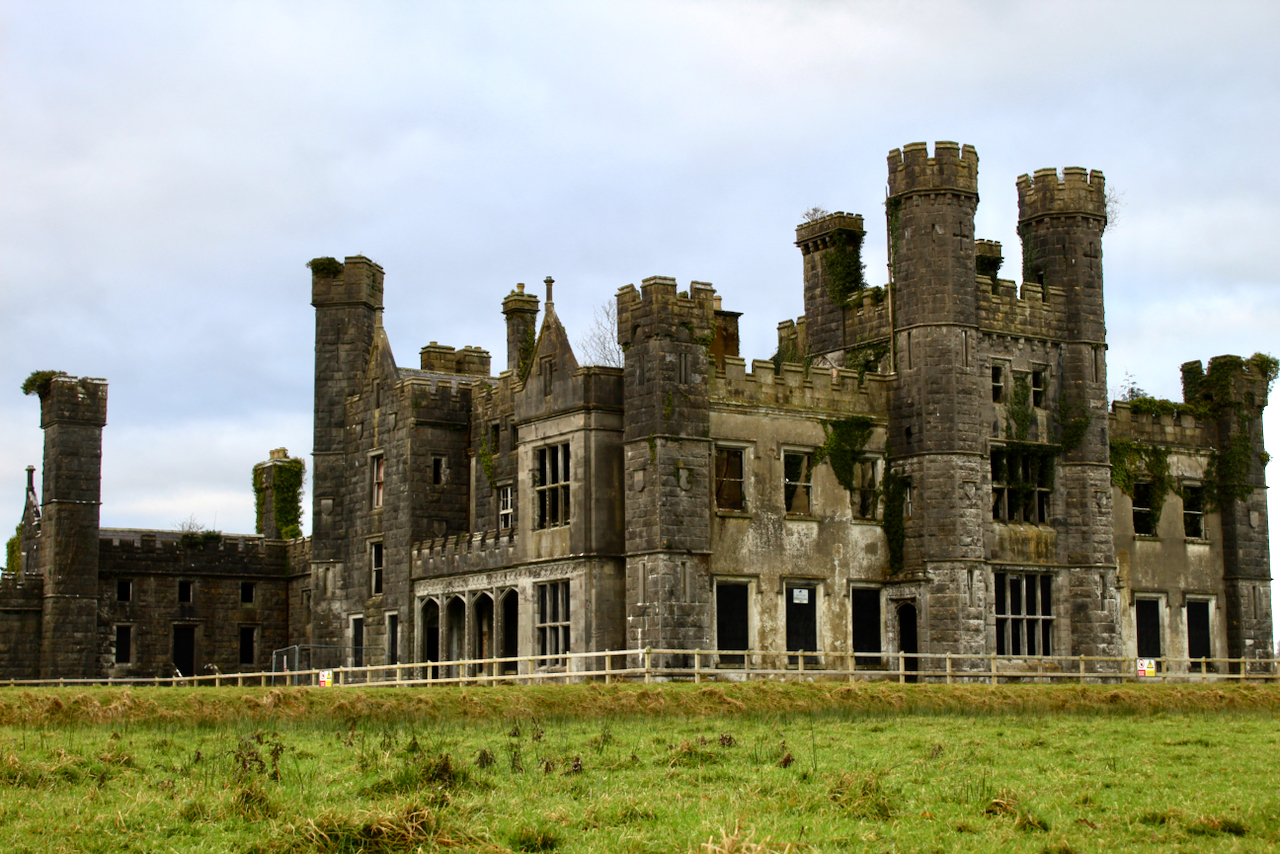
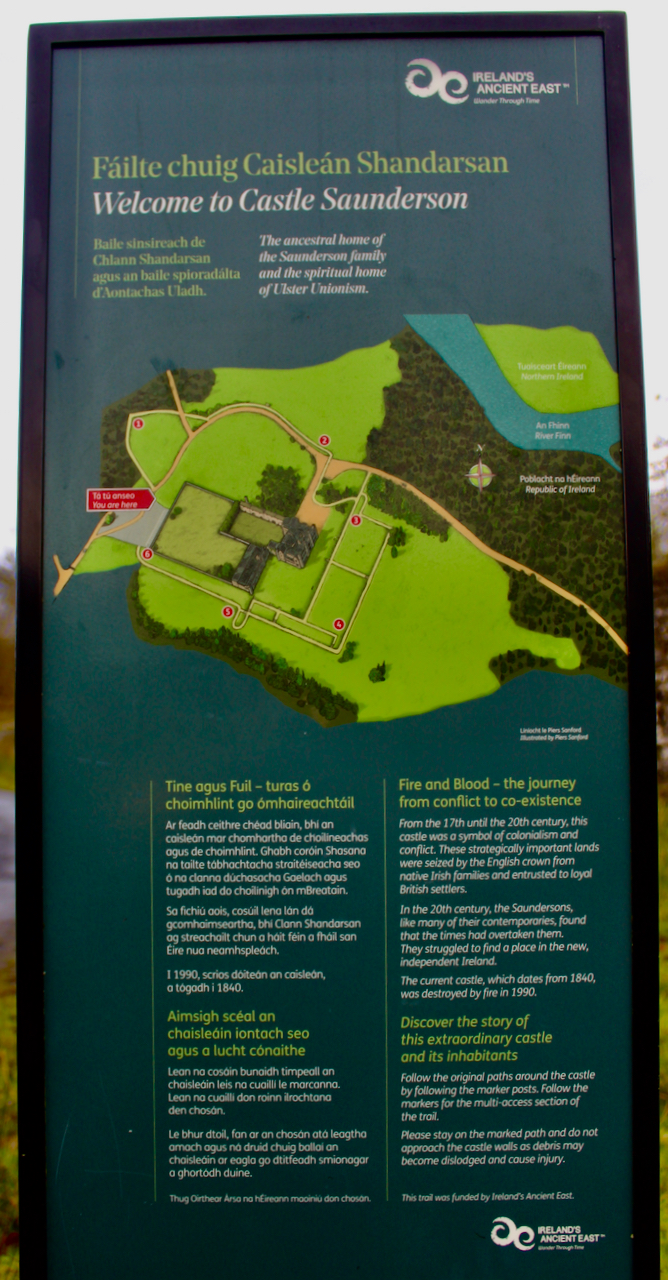
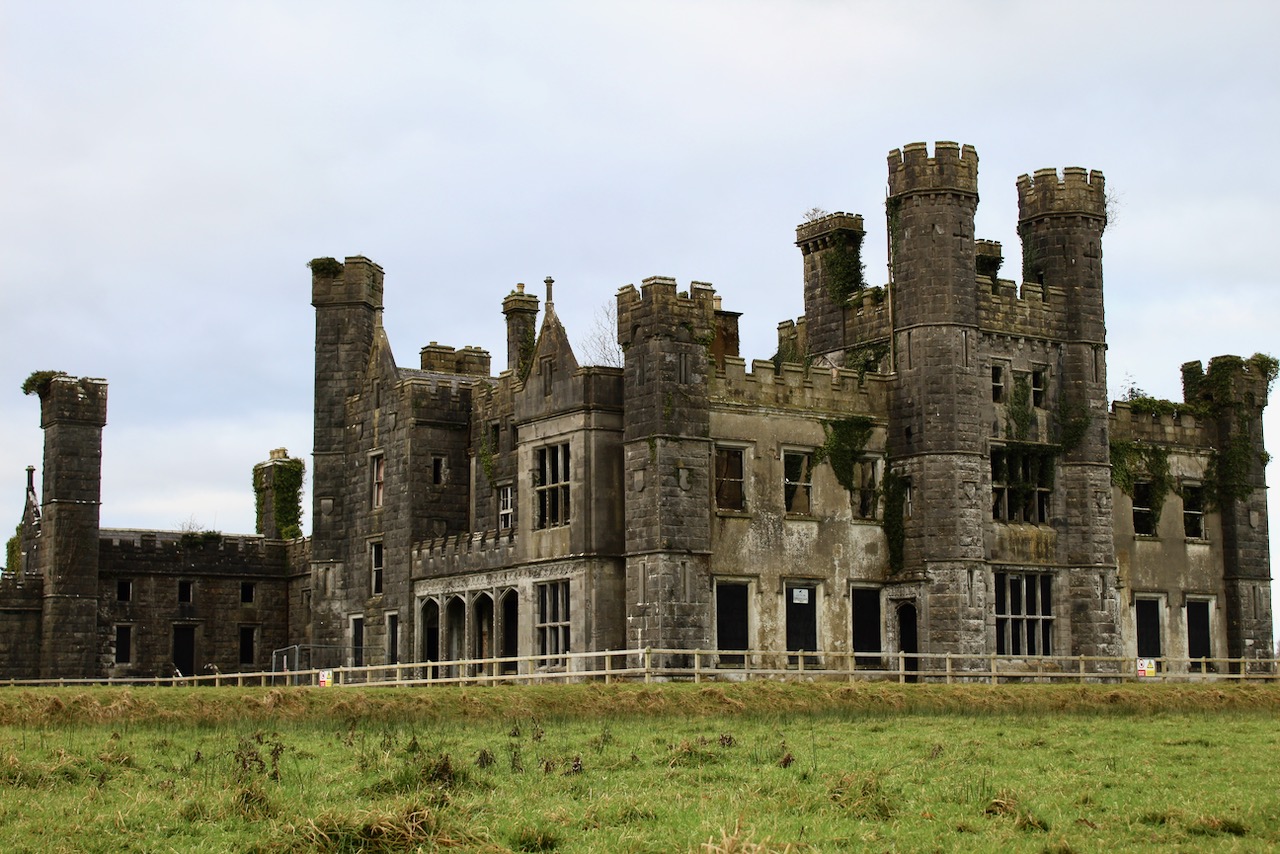
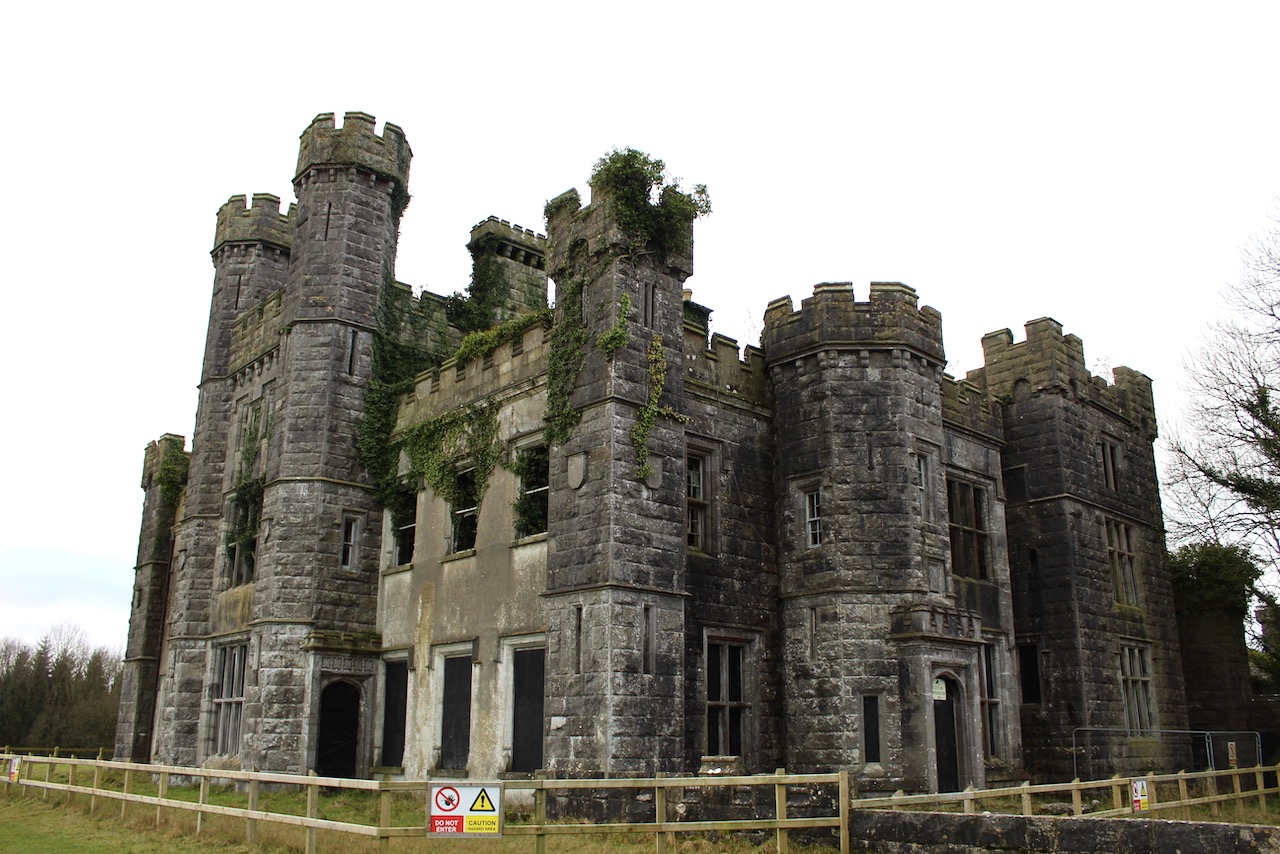
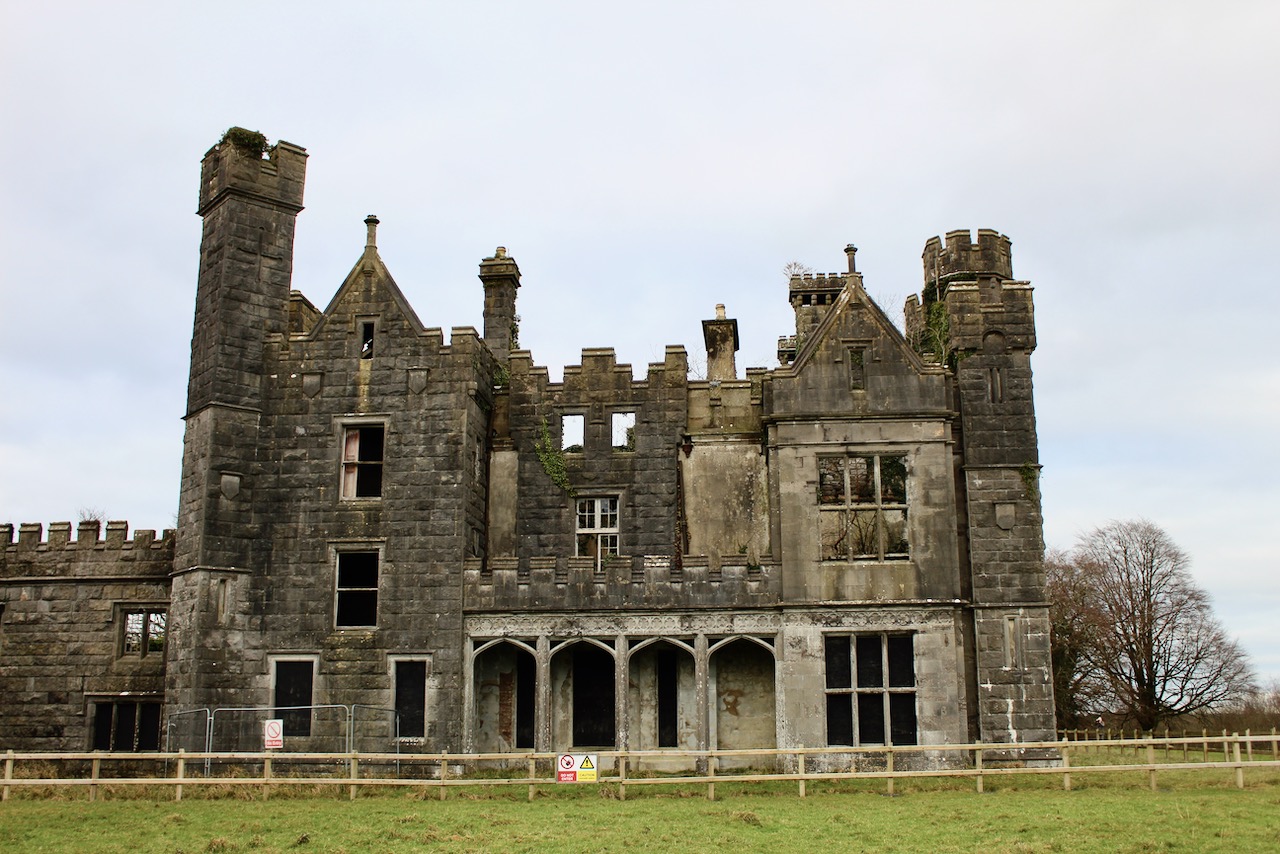
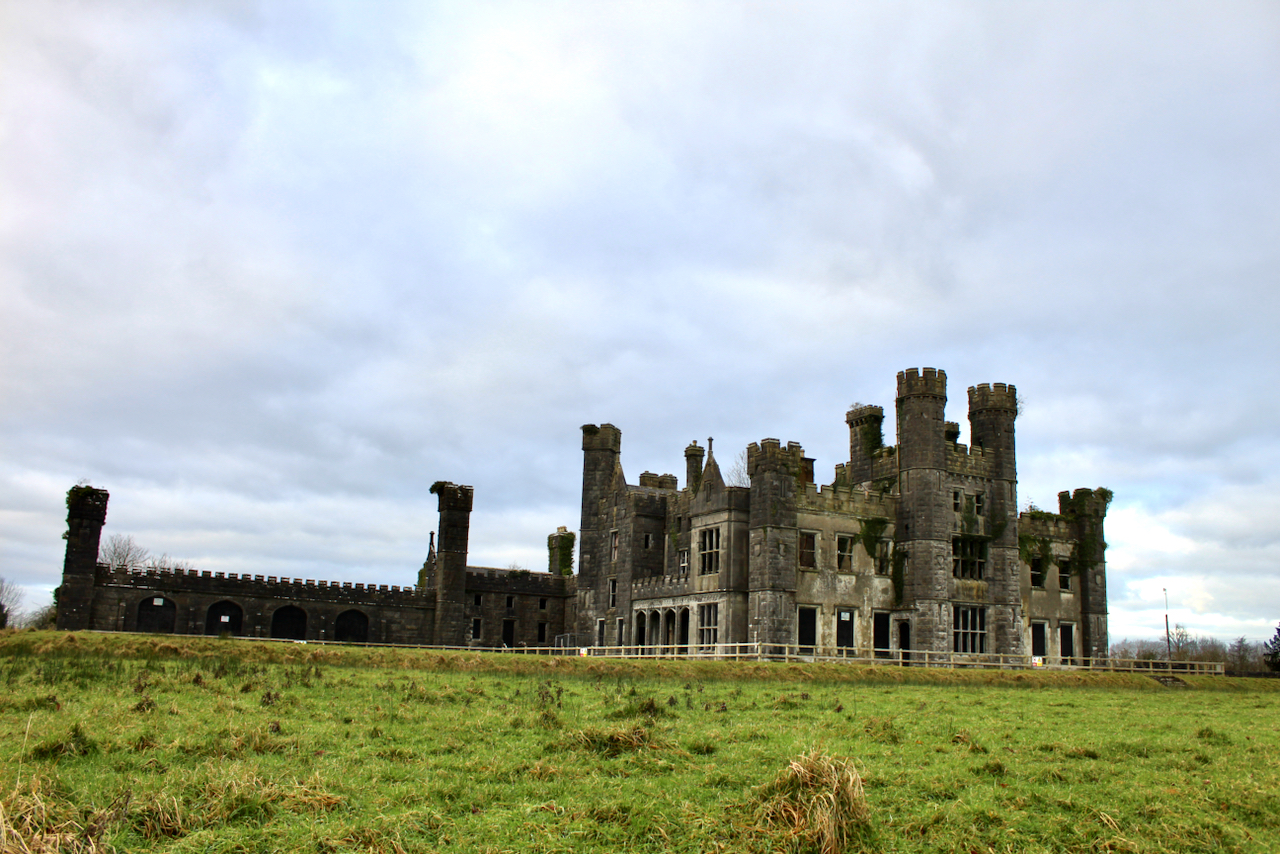
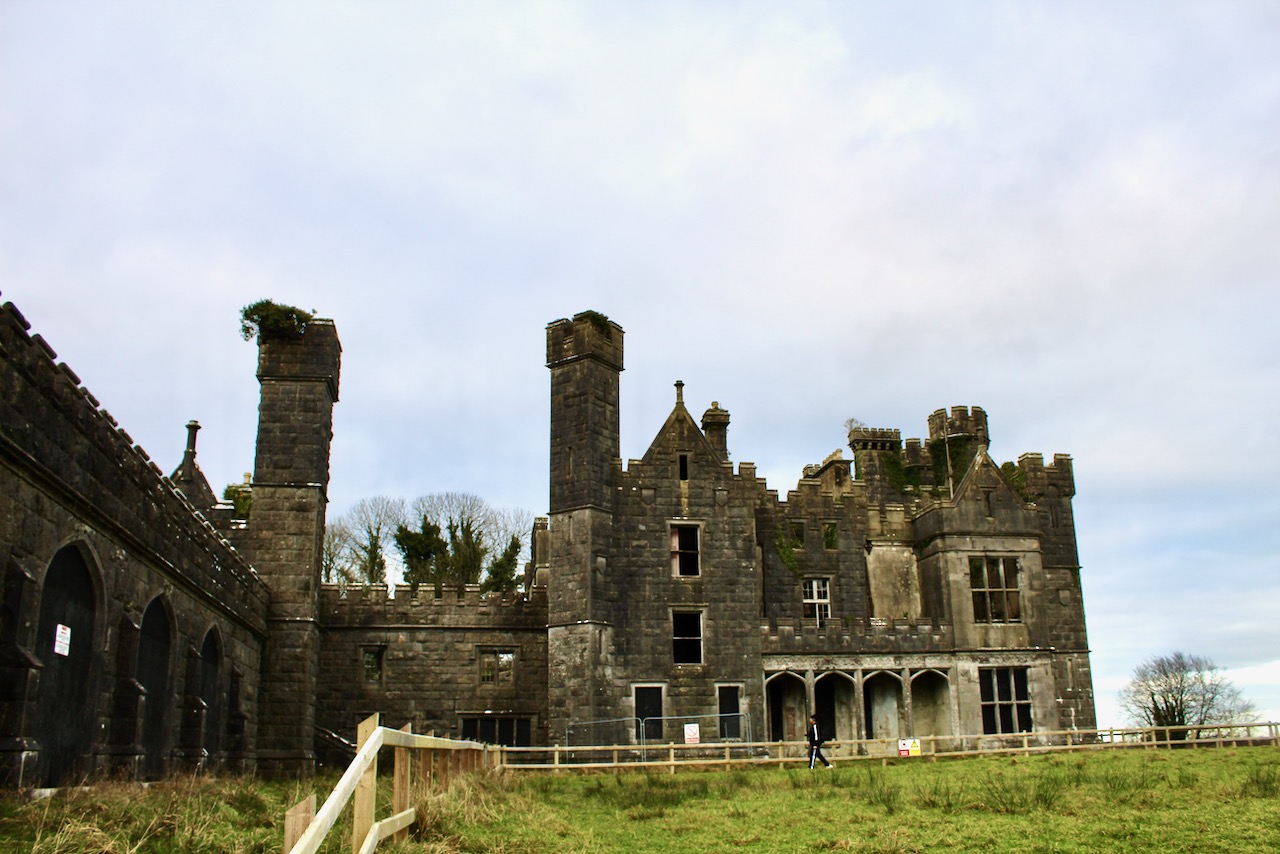
This property is not listed on the Section 482 Revenue list but is open to the public to visit, although at a distance, due to safety considerations. We visited in December 2020. Nearby, a World Peace Centre for the Scouts has been established. The castle was destroyed by fire in 1990.
The castle, which dates from 1840, was destroyed by fire in 1990.
Mark Bence-Jones writes in his A Guide to Irish Country Houses (1988) that it’s a large castellated mansion combining both baronial and Tudor-Revival elements, built around 1840. He likens the style to that of Crom Castle, attributed to Edward Blore, which is only about five miles away in County Fermanagh. [1] The National Inventory tells us that the work on Castle Saunderson was carried out by George Sudden, but he may have worked according to designs by Blore.
Crom Castle, County Fermanagh, photograph by Robert French, (between ca. 1865-1914), Lawrence Photograph Collection, National Library of Ireland.
The Dictionary of Irish Architects tells us that Edward Blore (1787-1879), from London, designed Crom Castle in County Fermanagh from 1833-41, Ballydrain in County Antrim in 1837-8, additions at Castle Upton, County Antrim in 1836-7, and proposed the addition of a tower at Mallow Castle, County Cork in 1837. [2]
The Dictionary of Irish Biography tells us that George Sudden was Clerk of works, architect and stonemason, active in Counties Fermanagh and Monaghan in the 1830s and 1840s. In 1830 when Crom Castle, newly completed to designs by Edward Blore, was destroyed by fire, John Creighton appointed Sudden to rebuild the house to Blore’s specifications. [3]
The National Inventory of Architectural Heritage tells us that Castle Saunderson was built around 1835.
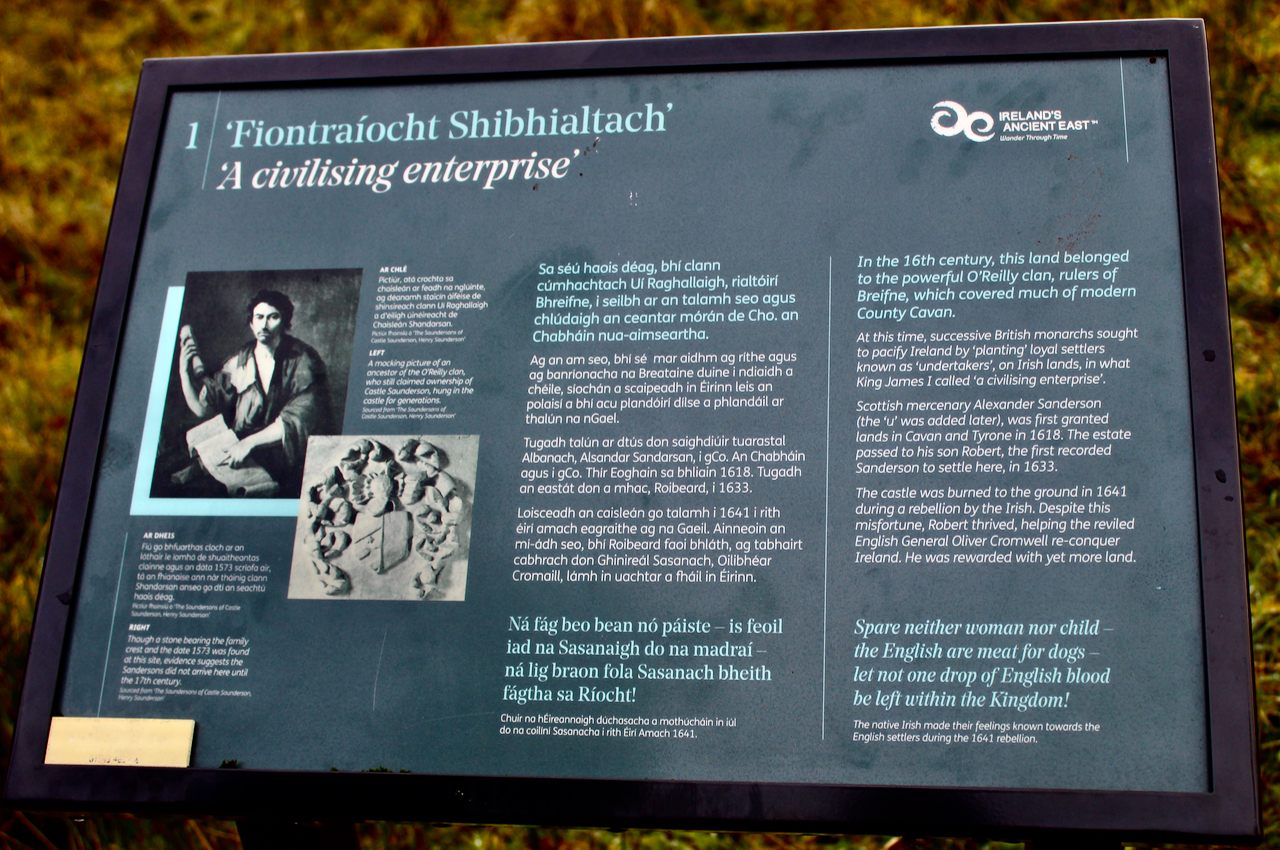
The land belonged to the O’Reilly clan in the 16th century, rulers of Breifne, which covered much of modern County Cavan. Scottish mercenatry Alexander Sanderson (the ‘u’ was added later), was first granted lands in Cavan and Tyrone in 1618. The estate passed to his son Robert, the first recorded Sanderson to live here, in 1633. The castle that was there at that time was burned to the ground in 1641 during the Rebellion. Robert Sanderson helped Oliver Cromwell’s troops to reconquer, and he was awarded with more land.
An information board tells us that the land belonged to the O’Reilly clan, rulers of Breifne, in the 16th century. Breifne covered much of modern County Cavan. Scottish mercenatry Alexander Sanderson (the ‘u’ was added later), was first granted lands in Cavan and Tyrone in 1618. He served as High Sheriff for County Tyrone.
The estate passed to his son Robert (c1602-c1676), the first recorded Sanderson to live here, in 1633. The castle that was there at that time was burned to the ground in 1641 during the Rebellion.
Robert Sanderson was a colonel in the army of Gustavus Adolphus of Sweden. He served in Oliver Cromwell’s army, and was awarded with more land. [4] Another residence must have been built at the site: the Landed Estates database tells us that Robert Sanderson built Castle Sanderson near Belturbet in county Cavan in the mid-17th century.
Robert’s son, also named Robert (1653-1724), served as MP for County Cavan, and was a colonel of a regiment in William III’s army. He married Jane Leslie, daughter of the Right Rev John Leslie, Lord Bishop of Clogher, “The Fighting Bishop” (see my entry for Castle Leslie https://irishhistorichouses.com/2020/08/07/castle-leslie-glaslough-county-monaghan/ ). His heir to Castle Saunderson was his nephew, Alexander Sanderson. Alexander served as High Sheriff of County Cavan in 1714, and wedded Mabella, daughter of William Saunderson, of Moycashel, County Westmeath. He was buried at St Mary’s in Dublin in 1726 and was succeeded at Castle Saunderson by his son Francis (d. 1746). (see [4])
Francis served as High Sheriff of County Cavan in 1740 and espoused Anne, eldest daughter of Anthony Atkinson of Cangort, County Offaly. Francis died in 1746 and it was his son, Alexander, who changed the spelling of his name to Saunderson. (see [4])
Alexander married Rose Lloyd, daughter of Trevor Lloyd of Gloster in County Offaly, a section 482 property in 2025. Alexander Saunderson also served as High Sheriff for County Cavan.
The National Inventory tells us that the Castle Saunderson that we see today incorporates fabric of an older residence, a Georgian house dating from around 1780. This house may have been built by Alexander and Rose’s son and heir Francis Saunderson (1754-1827). He also served as High Sheriff for County Cavan, and he married Anne Bassett, daughter of Stephen White, of Miskin, Glamorgan, and heir of the Bassett estates in that county. (see [4])
It was then Francis and Anne’s son and heir, Alexander (1783-1857) who probably built the current Tudor-Gothic version of the castle around 1835.
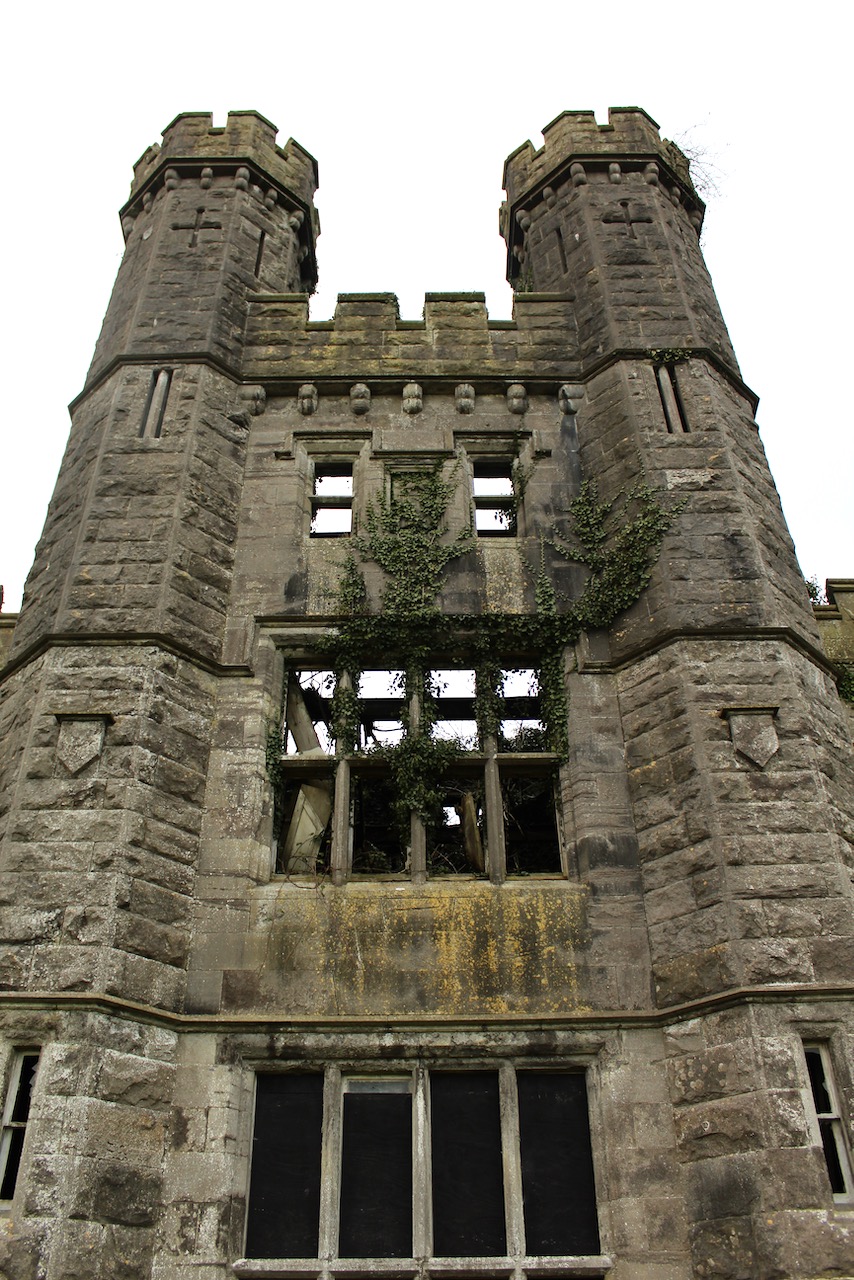
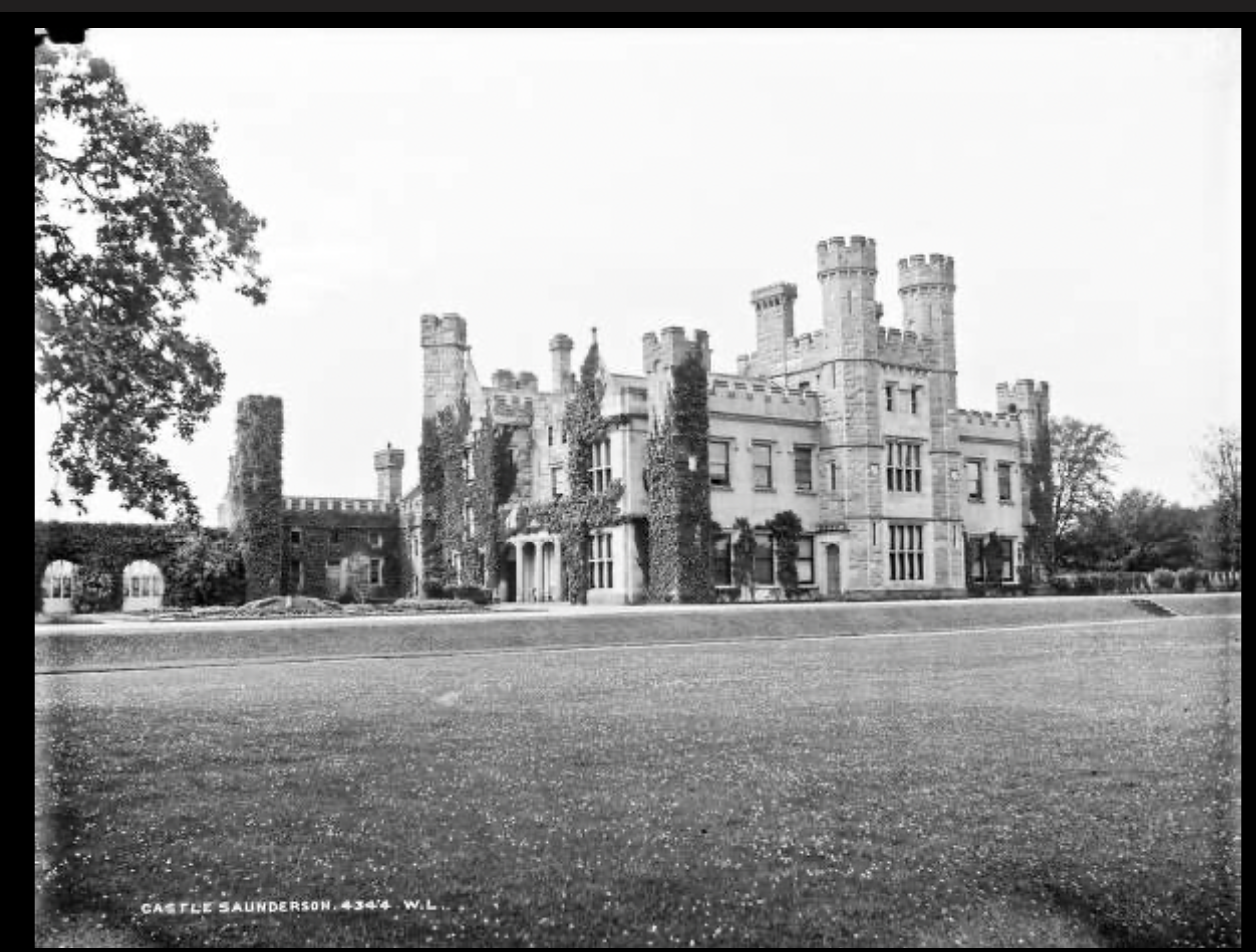
p. 75. “Entrance front symmetrical, with a battlemented parapet, square end turrets and a tall central gatehouse tower which is unusual in having the entrance door in its side rather than in its front.” [1]
Castle Saunderson, County Cavan, photograph by Robert French, (between ca. 1865-1914), Lawrence Photograph Collection, National Library of Ireland.
It looks like there is an entrance door on either side of what Bence-Jones calls the central gatehouse tower.
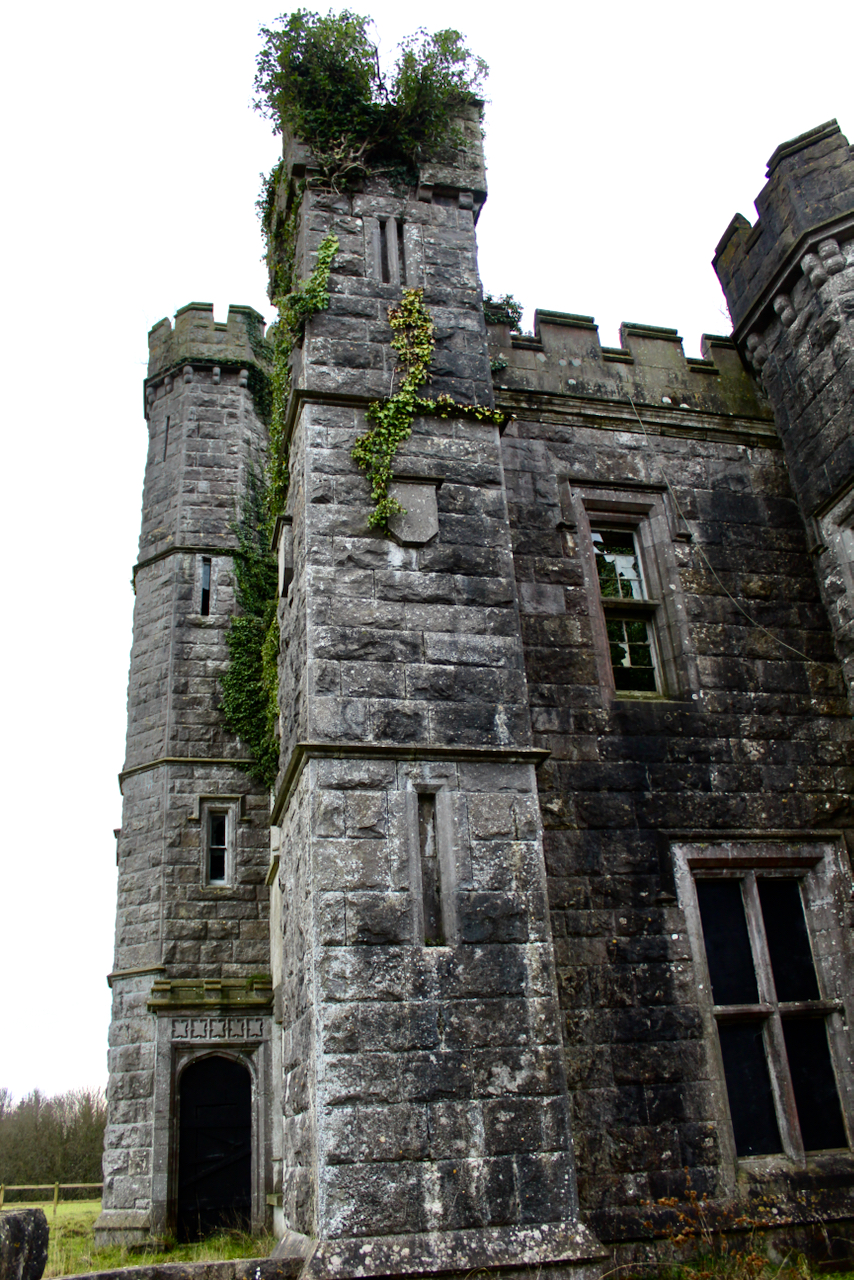
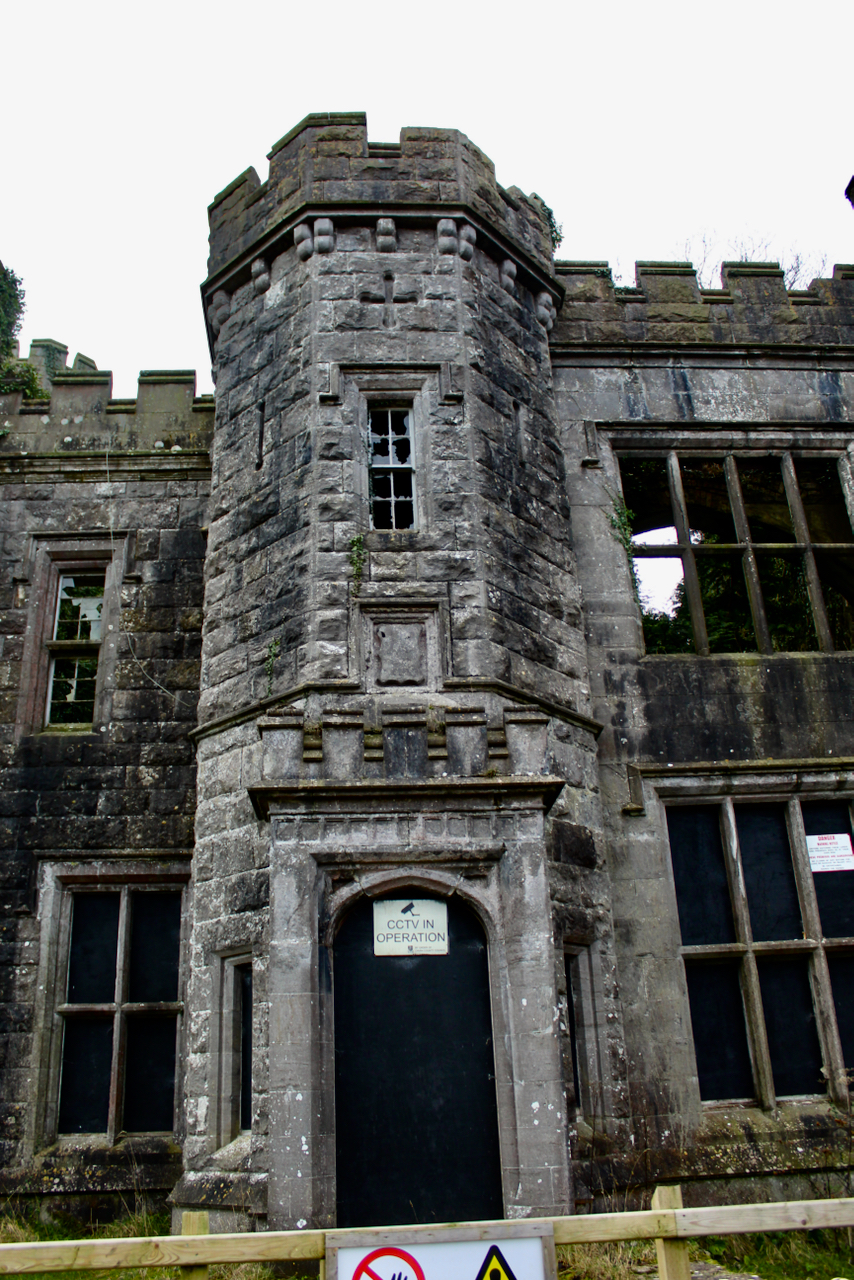
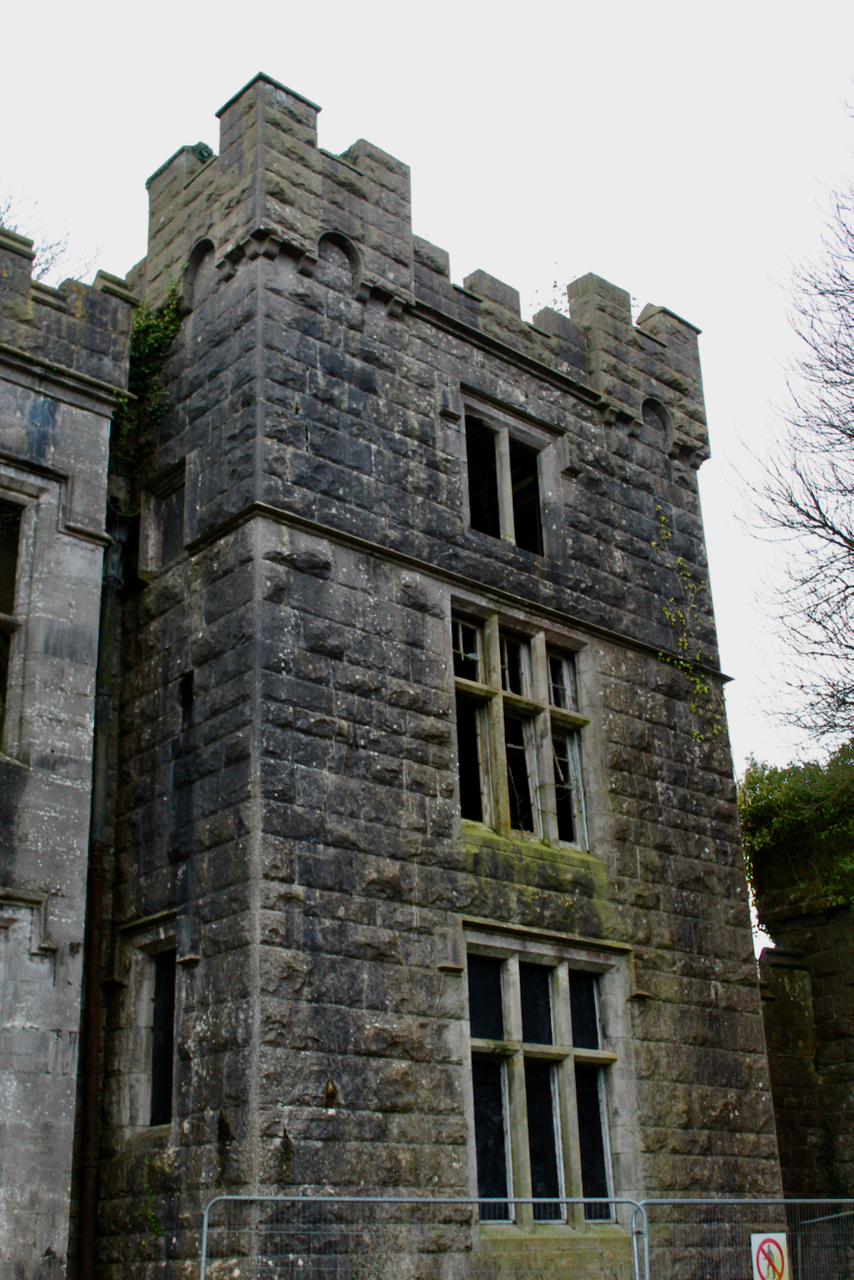
The side to the right of the entrance front has another octagonal tower with an entrance door, and another square tower. The National Inventory calls this side, the north elevation, the entrance side, describing it as: “Four-bay two-storey entrance elevation to north having advanced square-plan three-stage tower to west, corner turret to east and engaged octagonal-plan entrance tower with castellated doorcase, mullioned-and transomed hood-moulded windows of varying size and smaller incidental windows.” [5]
The doors have arched openings, and windows have hood mouldings.
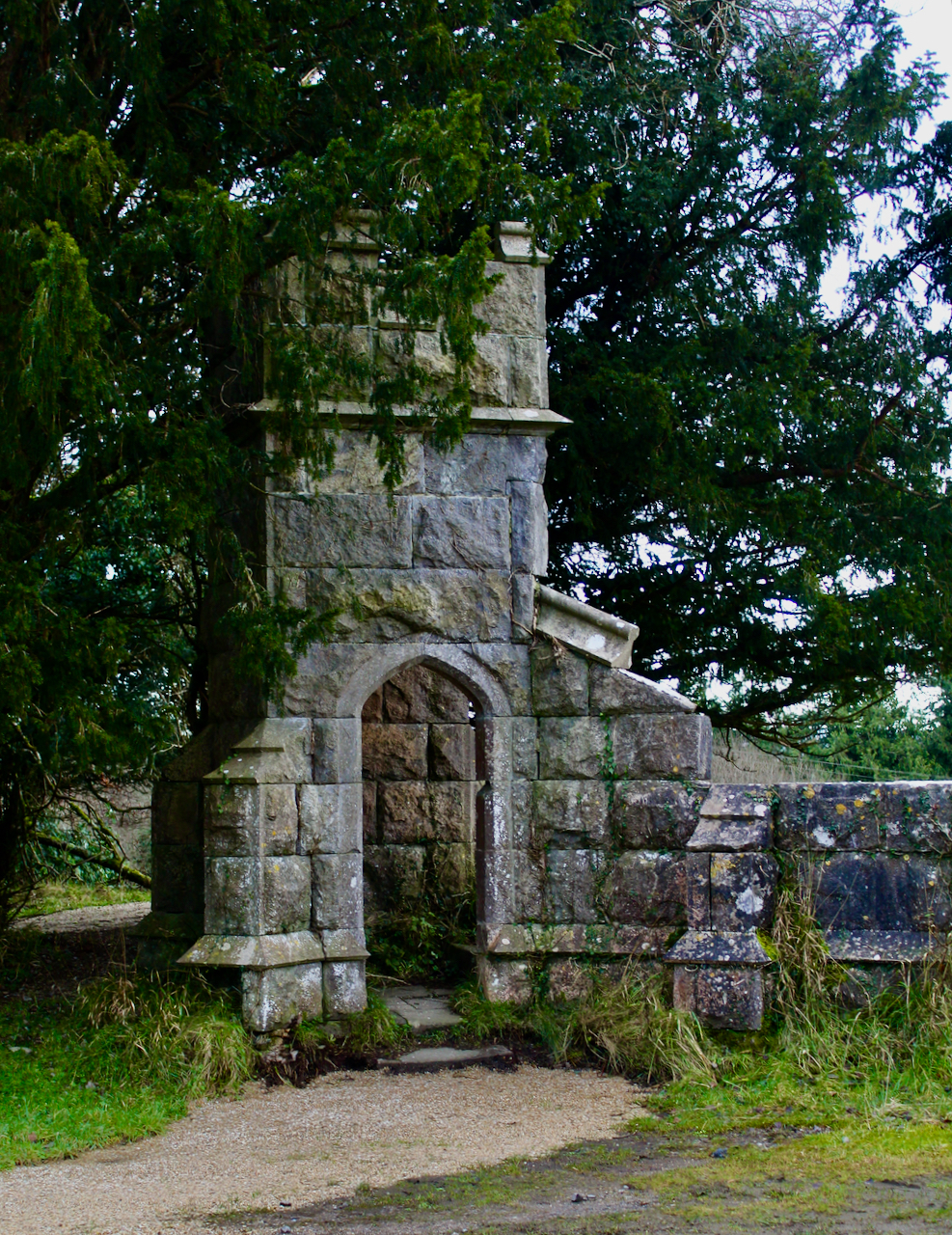
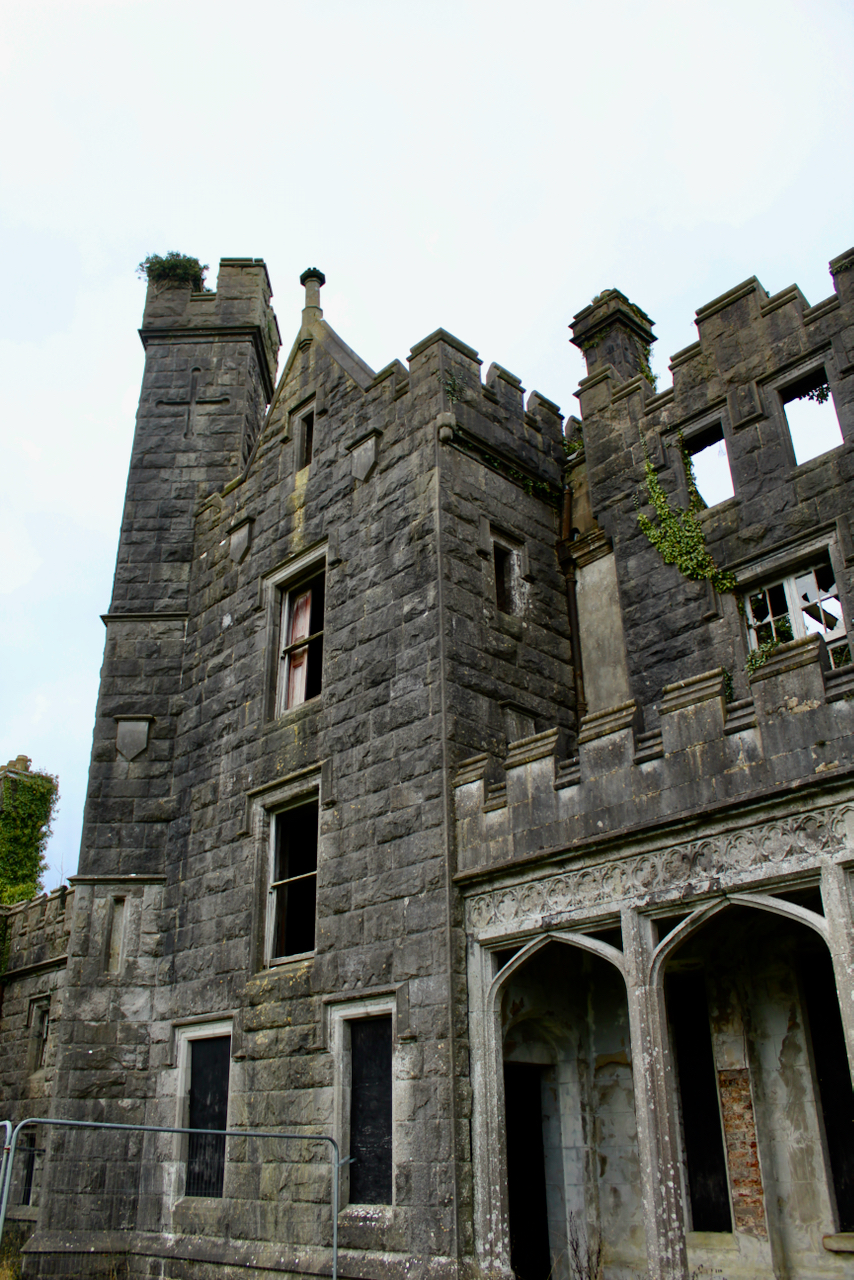
Bence-Jones continues: “The adjoining garden front is more irregular, with a recessed centre between two projecting wings of unequal size and fenestration, each having a Tudor gable; the two wings being joined at ground floor level by a rather fragile Gothic arcade. To the left of this front, a lower “L”-shaped wing with a battlemented parapet and various turrets, ending in a long Gothic conservatory. Castle Saunderson has stood empty for years and is now semi-derelict.” [1]
The various towers have “balistraria” cruciform and vertical arrow slit windows.
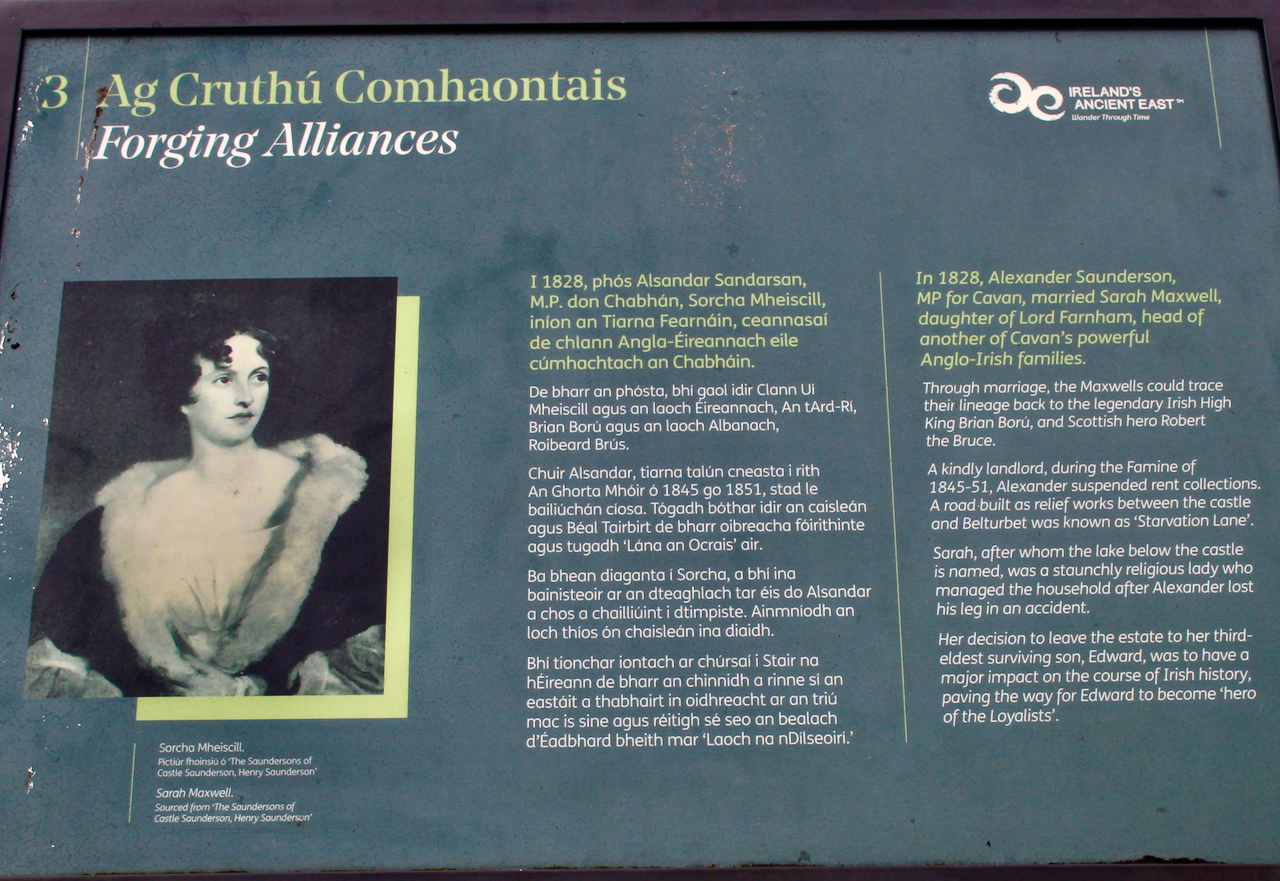
Alexander Saunderson (1783-1857) married Sarah Maxwell, the daughter of Reverend Henry Maxwell 6th Baron Farnham of Farnham in County Cavan.
In 1828, Alexander Saunderson, MP for Cavan, married Sarah Maxwell, daughter of Reverend Henry Maxwell 6th Baron Farnham, head of another of Cavan’s powerful Anglo-Irish families (Farnham Estate is now a hotel). Through marriage, the Maxwells are reputed to be able to trace their lineage back to the High King Brian Boru, and to the Scottish Robert Bruce. Alexander was a kind landlord, suspending rent collection from 1845-51 due to the famine.
The information board tells us that Alexander was a king landlord and the during the Famine of 1845-51, he suspended rent collection from his tenants. Alexander served as High Sheriff of County Cavan in 1818, and was MP for County Cavan.
Sarah decided to leave the estate to her third eldest surviving son, Edward. The older sons were Alexander de Bedick (1832-60) and Somerset Bassett (1834-92) – I am not sure why they did not inherit Castle Saunderson, but perhaps they inherited the Bassett estates in Glamorgan. The Landed Estates database tells us that in the mid-19th century the main part of Colonel Alexander (1783-1857) Saunderson’s estate was in the parishes of Annagelliff and Lavey in the barony of Upper Loughtee [Drumkeen], but he also held sizable portions of land in the parishes of Larah, Annagh and Killinkere [Castle Saunderson and Clover Hill]. He also bought some of the estate of the Earl of Mornington which was for sale in 1853. His brother, the Reverend Francis Saunderson, rector of Kildallan, county Cavan, held an estate in the parishes of Drumlane and Killashandra. [6]
Loreto College, formerly Drumkeen or Dromkeen, County Cavan, photograph courtesy of National Inventory.
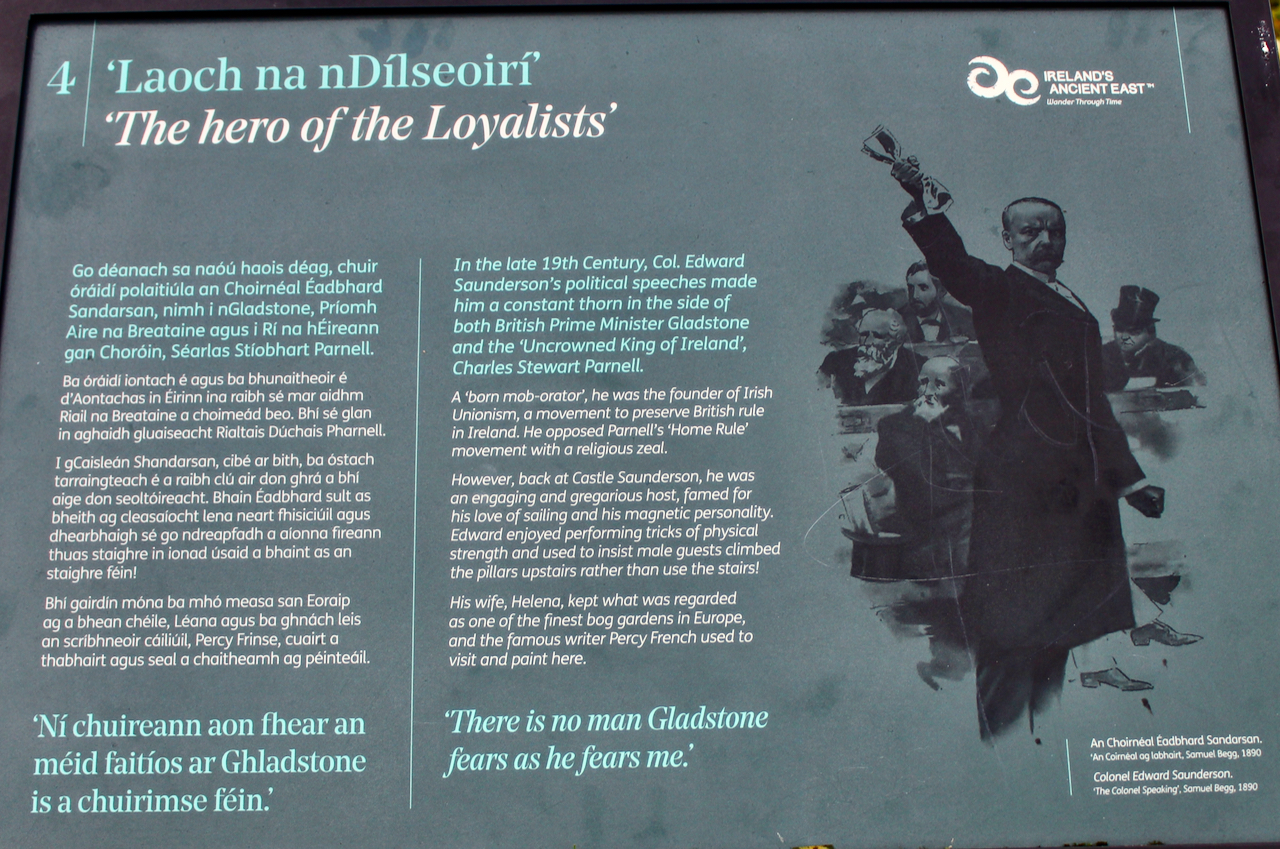
It was Edward Saunderson (1837-1906) who inherited Castle Saunderson. Edward Saunderson, the information board tells us, was the founder of British Unionism, the movement to preserve British rule in Ireland. He opposed Charles Stewart Parnell’s “Home Rule” movement, which sought to bring a parliament back to Ireland after it was abolished in 1800.
The notice board tells us that Edward enjoyed feats of strength, and made his male guests climb the pillars rather than using the stairs! His wife, Helena Emily de Moleyns, youngest daughter of Thomas, 3rd Baron Ventry, developed a bog garden, regarded as one of the finest in Europe, and the writer Percy French used to visit.
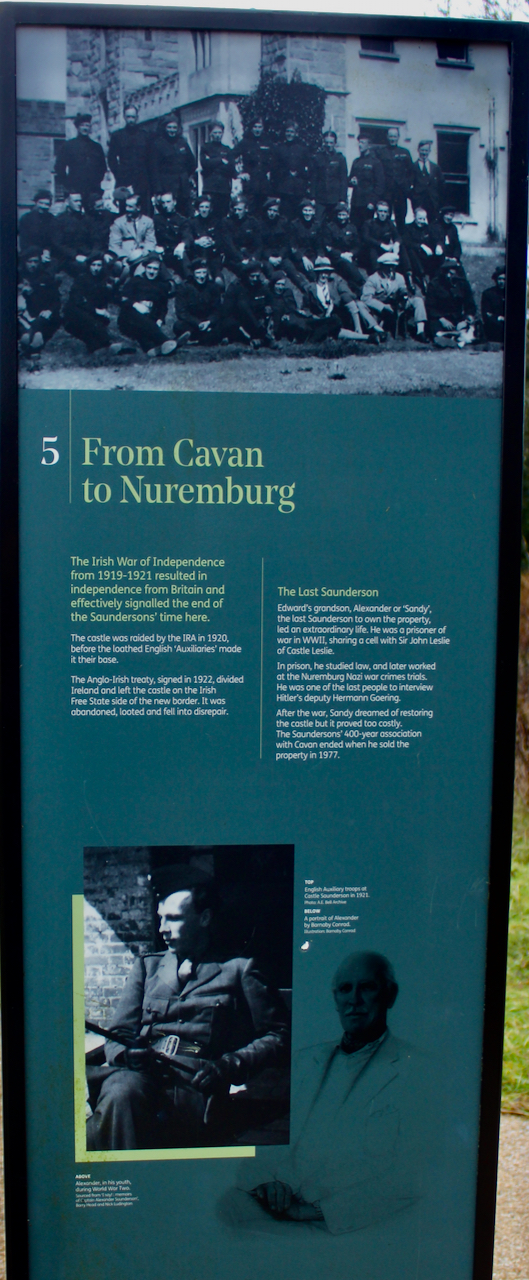
In the late 19th century, Colonel Edward Saunderson opposed Charles Stewart Parnell. Saunderson was the founder of Irish Unionism, a movement to preserve British rule in Ireland. The last Saunderson, Alexander, or “Sandy,” was a prisoner of war in WWII, sharing a cell with Sir John Leslie of Castle Leslie. In prison he studied law and later worked at the Nuremburg Nazi war crimes trials.
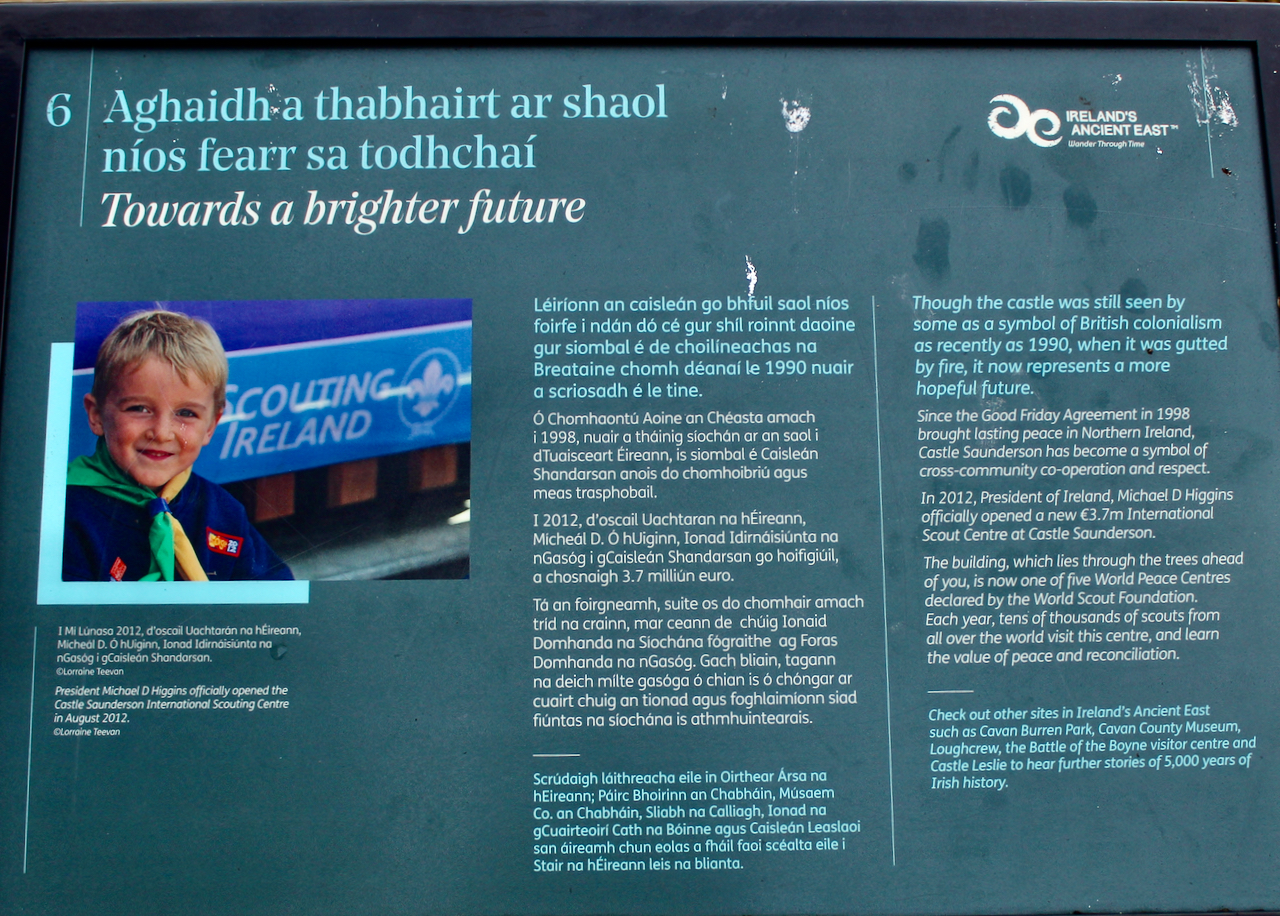
Alexander Saunderson (1917-2004), the last of the family to live there, sold the property to a London-based businessman in 1977. (see [4]). The Castle was in a state of disrepair and plans to have it completely renovated as a private dwelling at this time never materialized. The estate was sold again in 1990 to be developed as a hotel. These plans were also abandoned after a fire gutted and destroyed most of the Castle interior. This was the third fire to take place in the history of the castle. (see[4]). The property was then sold to Scouts Ireland.
A Scout centre nearby has been established, and is a World Peace Centre for the Scouts.
[1] p. 75, Bence-Jones, Mark. A Guide to Irish Country Houses (originally published as Burke’s Guide to Country Houses volume 1 Ireland by Burke’s Peerage Ltd. 1978); Revised edition 1988 Constable and Company Ltd, London.
Mark Bence-Jones. A Guide to Irish Country Houses (originally published as Burke’s Guide to Country Houses volume 1 Ireland by Burke’s Peerage Ltd. 1978); Revised edition 1988 Constable and Company Ltd, London.
p. 286. (Power/IFR; Gallwey/IFR) a two storey house of ca 1840, built by Michael Dobbin, barrister-at-law, on land leased from the Bolton family, the former owners fo the nearby Faithlegg House. Four bay front, single storey Doric portico of wood, now glazed to form a porch. Eaved roof. Two bay side elevation. Fine large drawing room and dining room Subsequently acquired by the Powers who had bought Faithlegg 1819, and used by them as a Dower House. The Powers added a wing at the back fo the house enclosing a courtyard, which has now been made into an attractive patio. The house is magnifienctly situated high above the estuary of the Suir, with views up both channels of the river on either side of the Island. Inherited by Mrs H.W.D. Gallwey (nee Power), along with Faithlegg; became the famly seat after Faithlegg was sold 1936. The home of her son, late Lt-Col Hubert Gallwey, editor of The Irish Genealogist, now of his widow.”
Mark Bence-Jones. A Guide to Irish Country Houses (originally published as Burke’s Guide to Country Houses volume 1 Ireland by Burke’s Peerage Ltd. 1978); Revised edition 1988 Constable and Company Ltd, London.
p. 284. “(Christmas/LG1863; Chavasse/IFR, Dawnay, sub Downe, V/PB) Originally the seat of the Christmas family who were among the richest of the Waterford merchants by the beginning of C18; and who, by 1746, when Charles Smith published his History of Waterford, had a “well-built” house here, its hall “painted in Clara Oscura with several of the heathen deities” and containing “two statues of Neptune and Amphitrite.” Around it was a garden with a large and beautiful canal, a “jet d’eau” a wilderness and shell house; the latter no doubt similar to that at Curraghmore. In 1830s the course of the road from Waterford to Cork was altered, and the new road cut off the house from the walled garden; so William Christmas built himself a new house ca 1841, on higer ground to the south of the new road; the old house being allowed to fall into ruin. His architect was Abraham Denny, of Dublin, who produced a delightful villa in the Greco-Italian style, well suited to its picturesque setting. The two outer bays of its two storey three bay entrance front are raised a storey higher than the centre to form two sturdy Italianate towers with shallow pyramidal roofs; their top storeys being in the form of three arched belvederes but with the arches glazed as windows. The roof parapet between the two towers is balustraded; below is a single-storey Ionic portico. The entrance front is prolonged beyond the right-hand tower by two more bays, set a little back, and then by a lower service wing. The adjoining front is of five bays and made lop-sided by the fact that it has a tower on one side but not on the other; but this adds to its “picturesqueness.” The three centre bays are recessed, with a single-storey curved bow fronted with a curved Ionic colonnade. The other front is of six bays. Apart from in the centre of the entrance front, the roof is eaved, on a plain cornice. Most of the windows have entablatures or pediments over them. The principal rooms are arranged round an impressive staircase hall with an imperial staircase; the gallery of which is supported by Corinthian columns and pilasters; there being more Corinthian pilasters framing the upstairs corridor openings. The reception rooms have ceilings of shallow coffering, in a simple geometrical design reminiscent of Soane. Romantic cliff-top garden with terraces. Leased 1897-1913 to the Chavasse family. Sold 1916 to Lady Susan Dawnay, who built a pleasant loggia at one end of the house and carried out various improvements to the garden. During the civil war, ater Whitfield had been occupied successively by units of the Republican and Free State armies, who fought a battle on the lawn…”
On an Taisce Buildings at Risk register
Vacant with no identified new use
Suffering from neglect and/or poor maintenance
Assessment
Condition of Structure: Very Poor
Level of Risk: High
Appraisal
The building is suffering from major conservation problems. Most of the external fabric remains, but there are obvious signs of deterioration such as slipped slates, vegetation growth, broken windows and vandalism. There is no immediate danger of collapse but condition is such that unless urgent remedial works are carried out the building will sharply deteriorate.
A distinguished 19th century house built for Christmas family circa 1840 with Italianate towers to entrance front, bow fronted elevation to terraced garden and top lit central Imperial staircase. Several planning applications have been proposed for this site but none have proceeded. The chimney pieces have been stolen from main rooms. Structural movement has occurred through water damage to the beam behind ground floor bow window that supports the upper floor. The property is currently for sale. This building urgently requires new uses to be identified to prevent further deterioration of its character.
There currently a legal dispute ongoing, between Anthony Sheedy and the receiver for the property relating to the sale of the house, reported in the Irish Independent in May 2017.
Detached three-bay two–storey Italianate house, built 1841 – 1843, on a complex plan retaining original aspect comprising single-bay two-storey entrance bay with single-storey prostyle tetrastyle flat-roofed Ionic portico to ground floor, two-bay two-storey recessed flanking end bay to south-west, five-bay two-storey side/Garden (north-east) elevation with three-bay single-storey recessed central bay having single-bay single-storey shallow bow to ground floor with prostyle tetrastyle Ionic frontispiece, and six-bay two-storey rear (south-east) elevation. Renovated, c.1865, with single-bay single-storey blocks added to top floor to end bays of Entrance (north-west) Front forming single-bay three-stage engaged corner ‘towers’ on square plans. Hipped slate roofs (behind parapet to entrance bay; pyramidal to ‘towers’) with clay ridge tiles, rendered chimney stacks, and cast-iron rainwater goods on overhanging cut-stone eaves having consoles to ‘towers’. Flat roofs to portico and to frontispiece not visible behind cornice parapet. Unpainted rendered, ruled and lined walls with cut-granite dressings including plinth, stringcourse to ground floor, quoins to corners, moulded stringcourse to first floor, frieze, and moulded cornice. Square-headed window openings with cut-stone sills forming sill courses (on consoles to ground floor), moulded cut-stone surrounds with some to ground floor having triangular and segmental pediments on consoles, and some to first floor having entablatures on pediments. 6/6 timber sash windows with 4/4 timber sash windows to ground floor rear (south-east) elevation. Grouped (three) round-headed window openings to top floor to ‘towers’ with cut-stone sills, moulded archivolts, and 6/6 timber sash windows. Square-headed door opening to entrance bay under cut-granite prostyle tetrastyle Ionic portico having entablature, frieze, moulded cornice, blocking course, moulded surround to door opening with entablature over on consoles, and timber panelled double doors. Square-headed door openings to bow to side/Garden (north-east) elevation behind cut-granite Ionic frontispiece having frieze and dentilated moulded cornice over, moulded surrounds, and glazed timber double doors with overlights. Interior with timber panelled shutters to window openings. Set back from road in own grounds with gravel forecourt, and landscaped grounds to site including terrace to north-east with flight of cut-stone steps. (ii) Attached three-bay two-storey lower service range, built 1841, to south-west retaining original aspect with single-bay two-storey advanced end bay to right (south-west). Pitched and hipped slate roofs with clay ridge tiles, rendered chimney stack, and cast-iron rainwater goods on rendered eaves. Unpainted rendered, ruled and lined walls with rendered quoins to ends, and to corners. Square-headed window openings with cut-stone sills, 3/6 and 6/6 timber sash windows.
A fine, well-appointed house built for William Christmas (n. d.) to designs prepared by Daniel Robertson (fl. 1820 – 1849), replacing an earlier house on site. The form and massing of the house as originally intended, including the incorporation of a service wing, recall Robertson’s contemporary work at Ballinkeele (House), Ballymurn, in neighbouring County Wexford. A highly-detailed, Italianate house, the composition is distinguished by features including an elegant portico, and a graceful bow, both incorporating the Ionic Classical order, all of which enhance the architectural quality of the site. Additions by Abraham Denny (1820 – 1892) producing ‘towers’ that draw parallels with the architect’s scheme for Saint Catherine’s Hall, Catherine Street/Waterside, Waterford (22504428/WD-5632-22-442), provide an elegant focal point to the Entrance (north-west) Front, yet are not successfully integrated when viewed from the north-east and south-west. Very well maintained, the house retains the original fabric, both to the exterior and to the interior, and remains an important element of the architectural heritage of the county.
To distinguish an Italianate house from that of any other, one would look for slight sloping roofs along with mild over-hanging eaves (supported by brackets or corbels) and cut stone dressings. Whitfield Court has all of the above with an ionic portico to ground floor. The highest floor of this home showcases another feature of the Italianate period, which is the tall rounded windows.
Whitfield Court was designed for William Christmas who apparently saw Robertson’s work on completed St. Matthias Church in Co. Dublin and was attracted to the new style of architecture. This place of worship had its design drawn up in 1840, a mere year previous to Whitfield Court.
As Robertson was not only an architect of homes but of gardens also, it is no surprise that he included a flight of cut-granite steps leading to the gardens which features in many of his works.
In recent years, Whitfield Court has unfortunately been subject to many acts of vandalism. After attempts to establish a prominent golf resort on the grounds were rejected due to appeals from locals, the house and grounds were placed into receivership and put up for sale. With no activity taking place at the site for almost a decade the house has suffered greatly, with rot and leaks being apparent. Some of the 19th century stone fire places were stolen along with extensive damage to the cast-iron balustrades.
Government body An Taisce have raised concerns about the future of Whitfield Court, as well as The Irish Georgian Society expressing how it would be a great investment for a developer who may have the resources to transform it into a stately hotel. As many of the original features have been lost due to negligence, damage or lack of funds, Whitfield Court would not be suitable to open to the public as it would not exude its original character.
Conservation specialists have been heavily involved in the restoration of Whitfield Court, it is hoped that following best practice guidelines will result in a positive outcome for this fine building.
Mark Bence-Jones. A Guide to Irish Country Houses (originally published as Burke’s Guide to Country Houses volume 1 Ireland by Burke’s Peerage Ltd. 1978); Revised edition 1988 Constable and Company Ltd, London.
p. 204. “An 1840s Italianate rebuilding of an earlier house by William Tinsley, of Clonmel,for a member of the Quaker family of Malcolmson who in early C19 founded the great cotton mills at Portlaw which brought great prosperity to the town. Of three storeys, with a tower projecting from the centre of the front; a composition which may have been inspired by the nearby Curraghmore. After emigrating to USA 1851, Tinsley repeated the Mayfield theme in several American college buildings.”
Mayfield House, County Waterford, photograph by Robert French, (between ca. 1865-1914), Lawrence Photograph Collection, National Library of Ireland.
Architect: William Tinsley / John Skipton Mulvany
Detached seven-bay three-storey over basement Italianate house incorporating fabric of earlier house constructed for the Malcomson family, whose cotton mills were nearby. Originally designed by William Tinsley, with later additions of 1857 including the tower by J.S. Mulvany. Now sadly ruined, the building has been largely stripped for architectural salvage. The tower remains a dramatic focal point.
Mayfield House, COOLROE (UPP. BY.) CLONAGAM PAR., Portlaw, County Waterford
Detached seven-bay three-storey over basement Italianate house, c.1840, on an almost-symmetrical plan incorporating fabric of earlier house, c.1740, with four-bay three-storey Garden elevation to south-west originally having service range to south-west. Renovated, 1857, with single-bay three-stage higher Italianate entrance tower added to centre on a square plan, seven-bay single-storey double-pile lateral wing to north-west having paired single-bay single-storey bows to north-west, seven-bay single-storey single-pile lateral wing to south-east (originally conservatory), and service range to south-west removed. Subsequently in use as offices. Now in ruins. Hipped slate roofs now gone behind parapets with granite ashlar chimney stacks, and traces of cast-iron rainwater goods. Remains of barrel-vaulted roof to wing to south-east with iron ribs on moulded cast-iron cornice. Roof to entrance tower not visible behind. Unpainted rendered walls with channelling to ground floor, stringcourse over, full-height corner pilasters to upper floors supporting plain frieze having projecting cornice with modillions, and blocking course to parapet. Unpainted rendered panelled parapets to wings on moulded cornices having rendered coping. Square-headed window openings to main block (in square-headed recesses to ground floor) with cut-stone sills on consoles (forming sill course to first floor), and moulded surrounds having segmental pediments to first floor on elongated consoles. Remains of 6/6 timber sash windows with some 2/2 timber sash windows to side (north-west) elevation. Round-headed window openings to second stage to entrance tower with projecting sills on consoles, moulded surrounds, and deep panelled hoods over. Square-headed window openings to top stage to entrance tower on consoled projecting course with segmental pediments on elongated consoles. Fittings now gone. Round-headed door openings to first stage to entrance tower (leading into barrel-vaulted corridor) with moulded surrounds having deep panelled hoods over. No fittings. Series of round-headed openings to front (north-east) elevation of wings (some blind) in round-headed recesses with square-headed window openings to remaining elevations. Fittings now gone. Interior now in ruins with some floors partly collapsed, outlines of red brick-lined fireplaces, and evidence of coved plaster ceilings on timber batons. Set back from road in own grounds with avenue to entrance, and overgrown grounds to site.
Appraisal
An imposing, well-composed, substantial house built for the Malcomson family to designs prepared by William Tinsley (1804 – 1885), and reputed to incorporate the fabric of an earlier house, thereby attesting to a long-standing presence on site. A range of stylistic features enhance the architectural design quality of the composition, including bow-ended wings, which are a trait common to further Malcomson properties, including Woodlock (House) (22803001/WD-08-03-01), and Villa Marina, Dock Road, Dunmore East (22817021/WD-27-17-21), and which attest to the later intervention by John Skipton Mulvany (1813 – 1871). The house is distinguished by the elegant entrance tower, which augments the Italianate Classical quality of the composition. Now in ruins, and having been exposed to architectural salvage, much of the original fabric has been lost, although the remains of some fine detailing to the openings survive intact, contributing to the design quality of the site. The construction of the barrel vault to one wing, now exposed, may be considered to be of some technical interest. The house forms an elegant centrepiece in extensive grounds originally accommodating the Malcomson cotton factory complex, and remains an imposing, although increasingly obscured, landmark of some Romantic quality in the townscape.
Mayfield House, Portlaw, County Waterford, photograph courtesy of National Inventory.
Detached three-bay single-storey Italianate gate lodge, c.1840, with single-bay single-storey half-octagonal entrance elevation to east, and three-bay single-storey side elevations to north and to south. Now disused and derelict. Hipped slate roof (half-polygonal to entrance elevation) on timber beams and batons with clay ridge tiles, rendered chimney stack, and remains of cast-iron rainwater goods on overhanging timber eaves. Painted rendered, ruled and lined walls with rendered quoins, and moulded rendered cornice. Square-headed window openings with stone sills, and moulded rendered surrounds. Fittings now gone. Square-headed door opening with rendered pilaster doorcase having shallow pediment over. Fittings now gone. Interior now derelict. Set back from line of road at entrance to grounds shared with Mayfield House and Portlaw Cotton Factory. Part overgrown grounds to site. (ii) Gateway, c.1840, to east comprising decorative cast-iron gate with sections of cast-iron flanking railings on granite plinth, decorative cast-iron open work piers forming flanking gateways with cast-iron double gates (on shallow concave plans operated by chain mechanism), and sections of cast-iron flanking railings leading to unpainted rendered panelled terminating piers having panelled friezes, moulded cornices, and remains of cast-iron gas lamp holders to capping.
Appraisal
A well-composed, small-scale gate lodge fashioned in an Italianate style, which complements the appearance of the main house to north-west (228030035/WD-08-03-35), suggesting that both compositions were built to designs prepared by John Skipton Mulvany (1813 – 1871). Although now disused, and in an advanced derelict state, the lodge retains its original form and massing, together with some important salient features and materials. The gateway to east, designed by Richard Turner (1798 – 1881), and fashioned at the Richard Turner Hammersmith Ironworks, Ballsbridge, Dublin, is an ornamental composition incorporating three sets of gates, the flanking double gates operated by a chain mechanism that survives on site, and which is of technical and engineering significance. The gates and railings are fine examples of early mass-produced cast-iron work and, together with the lodge, form a picturesque termination to the vista from Factory Road to the east.
Mayfield was held by William Malcolmson from the Medlicott estate at the time of Griffith’s Valuation, when it was valued at £50. Lewis refers to it as the seat of J. Malcolmson in 1837. In 1906 it was the property of William Malcomson and valued at £31. It is now a ruin.
Mayfield House, Portlaw, County Waterford, photographby Robert O’Byrne.
Portlaw, County Waterford and its association with the Malcomson family have been mentioned here before (see: A Shell, June 28th 2017). The Malcomsons were of Scottish Presbyterian origin but in the mid-18th century one branch became members of the Quaker community. A son of this line, David Malcomson, settled in Clonmel, County Tipperary where from 1793 onwards he became involved in the corn milling industry and enjoyed such success that when Richard Lalor Shiel visited the town in 1828 he could write ‘Malcomson’s Mill is I believe the finest in Ireland. Here half the harvest of the adjoining counties as well as Tipperary is powdered.’ By that date the family, fearful that the Corn Laws (restrictions on the import of grain which favoured domestic production) were to be revoked by parliament, had moved into another business in another part of the country. In 1825 Malcomson took a 999-year lease on a house called Mayfield and the adjacent 16 acres from a local landlord, John Medlycott. A small corn mill, damaged by fire, stood on the site and this was redeveloped as a vast, six-storey cotton mill, building a canal to utilize the power of the adjacent river Clodiagh. The enterprise required large numbers of employees and as a result the little village of Portlaw expanded rapidly. Around the time the Malcomsons began work on the mill, it comprised less than 400 residents living in 71 houses: by 1841 the population of Portlaw had grown to 3,647 souls occupying 458 houses, most of the latter built by the Malcomsons as part of a planned urban settlement. The family lived on the edge of the town and directly above the mill in Mayfield.
Mayfield House, Portlaw, County Waterford, photographby Robert O’Byrne.
Mayfield House, Portlaw, County Waterford, photographby Robert O’Byrne.
Mayfield House, Portlaw, County Waterford, photographby Robert O’Byrne.
Mayfield House, Portlaw, County Waterford, photographby Robert O’Byrne.
Mayfield House, Portlaw, County Waterford, photographby Robert O’Byrne.
The core of Mayfield was a classical house dating from c.1740 and it was here the Malcomsons initially lived. However, in 1849 Joseph Malcomson, who had assumed responsibility for the business, employed architect William Tinsley to enlarge the building. Like his client, Tinsley originally came from Clonmel and had built up a substantial practice in the area, so he was an obvious choice. However, by the time Joseph Malcomson decided on a further expansion of Mayfield, Tinsley was no longer available: in 1851 he had emigrated with his family to the United States where he enjoyed an equally successful career before dying in Cincinnati in 1885. So in 1857 Malcomson instead employed John Skipton Mulvany who specialized in a loosely-Italianate style architecture and who was responsible for giving the house its present appearance. Mulvany added many of Mayfield’s most striking features, not least a three-storey tower that served as an entrance on the house’s eastern front. This rises considerably higher than the rest of the three-storey over basement building which is of seven bays: the tower accordingly provided views both down to the factory and over to the village, allowing the Malcomsons a paternalistic prospect of their workers. Mulvany was also responsible for the single-storey over basement wings on either side of the main block: that to the south served as a conservatory, that to the north held a pair of reception rooms. However the family were not to enjoy this splendor for long, the cotton factory which generated their wealth being ruined in the aftermath of the American Civil War (the Malcomsons had extended credit to the losing side).
Mayfield House, Portlaw, County Waterford, photographby Robert O’Byrne.
Mayfield House, Portlaw, County Waterford, photographby Robert O’Byrne.
Mayfield House, Portlaw, County Waterford, photographby Robert O’Byrne.
Mayfield House, Portlaw, County Waterford, photographby Robert O’Byrne.
Mayfield House, Portlaw, County Waterford, photographby Robert O’Byrne.
In the last quarter of the 19th century the Portlaw factory was adapted for spinning but this enterprise didn’t last long and it was only in the early 1930s that a new purpose was found for the complex when it was acquired to act as a tannery by the Irish Leathers Group. Mayfield, which had for a period been occupied by members of the de la Poer Beresford family of nearby Curraghmore, now became an office premises for the new enterprise, and remained as such for the next half century. The tannery closed in the 1980s, and as a result Mayfield no longer had any purpose, although to the end of that decade a proposal was put forward to convert both factory and house into a retirement home. The scheme never took off and for the past thirty-odd years Mayfield has stood empty, falling into its present state of dereliction. As can be seen, little of the original mid-Victorian interiors remains other than fragments of plasterwork and rotting timbers. The exterior of the building has proven more sturdy, and retains the same appearance found in old photographs. But it is difficult to know what sort of future, if any, Mayfield might have. There is an old Irish expression Ní bhíonn cuimhne ar an arán a hitear, commonly translated as ‘Eaten bread is soon forgotten.’ Portlaw as seen today owes its existence to the enterprise and initiative of the Malcomsons: what a shame that so little has been done to acknowledge their contribution to the area.
Mayfield House, Portlaw, County Waterford, photographby Robert O’Byrne.
Mayfield House, Portlaw, County Waterford, for sale 2026 courtesy BidX1
The property is arranged to provide a historical estate located within an irregular shaped parcel of land. The lands are partially comprised within Folio WD39672F.
The house was originally built in 1740 and underwent improvements in the 1840s giving the distinguished Italian style that can still be seen today. It benefits from a large site area of approximately 10.5 hectares (26 acres) with former tannery buildings to the rear of the main house, offering significant development potential (subject to obtaining all necessary planning consents).
The property is located on the outskirts of Portlaw Town, approximately 18km North West of Waterford City.
Tenancy Vacant possession.
Zoning Under the WCCC Development Plan 2022 – 2028 the lands are zoned Part RE and part HA.
RE: Provide for enterprise and/or residential led regeneration. HA: Protect highly sensitive and scenic location from inappropriate development that would adversely affect the environmental quality of the locations.
Mark Bence-Jones. A Guide to Irish Country Houses (originally published as Burke’s Guide to Country Houses volume 1 Ireland by Burke’s Peerage Ltd. 1978); Revised edition 1988 Constable and Company Ltd, London.
p. 200. “(Bonaparte Wyse/IFR) A Tudor-Revival house by A.W. Pugin, built for Sir Thomas Wyse, MP, the politician, diplomat and author who married Napolean’s niece, Laetizia, daughter of Lucien Bonaparte. The house, which replaced an earlier house on a different site….[see below]. In the present century, the Bonaparte Wyses leased the house to Sir Henry Forde, and afterwards to Mr and Mrs Arthur Crosbie, who bought it 1947 and re-sold it to Waterford Corporation ca 1965.”
Saint John’s Manor, Church Road, WATERFORD CITY, Waterford, County Waterford
[no image available]
Detached five-bay two-storey red brick Gothic Revival house, c.1840, on a symmetrical plan with single-bay two-storey gabled projecting entrance bay to centre. Extensively renovated, 1998, to accommodate use as community centre. Now disused. Hipped roof to main block with replacement clay tile, 1998, clay ridge tiles, rendered chimney stacks, and replacement uPVC rainwater goods, 1998. Pitched (gabled) clay tile roof to entrance bay with decorative clay ridge tiles, cut-stone coping to gable having finial to apex, and replacement uPVC rainwater goods, 1998. Red brick Flemish bond walls to front (south-east) elevation with cut-limestone dressings including stringcourse to first floor, quoins to corners to entrance bay, and vitrified blue brick diamond panels to first floor flanking bays. Painted rendered walls to remainder. Square-headed window openings with cut-limestone block-and-start surrounds having hood mouldings over, mullions forming bipartite arrangement (pointed heads to first floor; tripartite arrangement to first floor entrance bay), and replacement uPVC casement windows, 1998. Triangular-headed opening to gable to entrance bay with cut-limestone surround having chamfered reveal, hood moulding over, and fitting not discerned. Ogee-headed door opening in square-headed recessed panel with two cut-limestone steps, cut-limestone block-and-start surround having hood moulding over, and replacement iron rolling door/shutter, 1998. Set back from road in own grounds.
Appraisal
A well-composed, middle-size house, attributable to Agustus Welby Northmore Pugin (1812 – 1852), which is distinguished by the construction in red brick with fine cut-limestone and vitrified blue brick dressings, producing an appealing polychromatic and textured effect. Now disused, the house nevertheless contributes to the character of an area that has been comprehensively developed in the late twentieth century. The house is of additional importance for its historical associations with the Wyse family.
Thomas Wyse is recorded as the lessor of this property in 1850 when it was vacant and valued at almost £32. . In 1814 Leet also noted it as the seat of Thomas Wyse. The house at the site is labelled Roanmore on the 1st edition Ordnance Survey map. A much larger property, labelled St. John’s Manor, appears on the 25-inch edition of the 1890s. This house was constructed in the nineteenth century to replace an ancient manor at the site, also belonging to the Wyse family. The building is still extant and now the focus of a Youth Services Project.
Mark Bence-Jones. A Guide to Irish Country Houses (originally published as Burke’s Guide to Country Houses volume 1 Ireland by Burke’s Peerage Ltd. 1978); Revised edition 1988 Constable and Company Ltd, London.
p. 58. “(Odell/LGI1863) An early C19 Tudor-Revival house of a pleasant pink-coloured stone, built for John Odell ante 1837, possibly to the design of Daniel Robertson, of Kilkenny. Symmetrical front; central feature in the form of a scaled-down gatetower, with slender turrets; gables; mullioned windows. Cantilevered staircase with brass balusters. Now the Bon Sauveur Convent.”
Bon Sauveur Convent (Carriglea House), CARRIGLEA (D. WT. BY.), County Waterford
Detached seven-bay two- and three-storey over basement house with dormer attic, c.1845, on a symmetrical plan comprising single-bay three-storey advanced central entrance bay with three-bay two-storey flanking bays to north-east and to south-west having single-bay two-storey side elevations, single-bay two-storey returns to north-west, and five-bay two-storey lower central return wing to north-west. Converted to use as convent, c.1915. Part refenestrated, c.1995. Pitched and hipped slate roofs (gabled to dormer attic windows; hipped to returns; pitched to return wing) with clay ridge tiles, paired and grouped (four) cut-sandstone polygonal chimney stacks, cut-sandstone coping, and cast-iron rainwater goods on cut-stone eaves. Sandstone ashlar walls with full-height polygonal corner piers to entrance bay, full-height battlemented corner piers to flanking bays, cut-sandstone stringcourse to first floor, and cut-sandstone stepped detailing to gables. Square-headed window openings with cut-sandstone chamfered flush sills, cut-sandstone chamfered surrounds having hood mouldings over, mullions and transoms. Lancet slit-style window openings to dormer attic with cut-sandstone chamfered surrounds. Timber casement windows to all window openings with some replacement uPVC casement windows, c.1995. Tudor-headed door opening with three cut-stone steps, cut-sandstone stepped flanking buttresses, moulded reveals, Gothic-style timber panelled double doors, battlemented stringcourse over, and lancet flanking window openings with chamfered flush sills, moulded reveals, and fixed-pane timber windows having margins. Interior with entrance hall having pointed-arch shallow niches, pointed-arch door opening with glazed timber panelled double doors and decorative overlights, decorative plasterwork cornice to ceiling, stairhall with cut-stone cantilevered staircase having brass balustrade with carved timber handrail, decorative plasterwork cornice to ceiling, and timber panelled shutters to all window openings. Set back from road in own grounds with tarmacadam forecourt, and landscaped grounds to site.
Appraisal
A well-composed, substantial house, built for John Odell (n. d.) in a Tudor Revival style attributable to Daniel Robertson (fl. 1812 – 1849). Centred on a low relief interpretation of a gate tower, the house incorporates further distinctive features including mullioned and transomed openings, gables, and slender piers, all of which enhance the architectural value of the composition. The construction in sandstone ashlar is indicative of high quality stone masonry, particularly to the fine detailing throughout. Although now serving an alternative use, the house retains most of its original form and fabric, both to the exterior and to the interior, although the gradual replacement of the early fittings to the openings with inappropriate modern articles threatens the external expression of the house. Fine decorative plasterwork and timber joinery to the interior enhances the artistic design quality of the site, while the construction of the staircase is a modest technical achievement. The house forms the centrepiece of a demesne that has been developed over the course of the twentieth century, and remains an important element of the architectural heritage of County Waterford. The house is of additional significance for its historic associations with the Odell family.
Mark Bence-Jones. A Guide to Irish Country Houses (originally published as Burke’s Guide to Country Houses volume 1 Ireland by Burke’s Peerage Ltd. 1978); Revised edition 1988 Constable and Company Ltd, London.
p. 55. “(Ussher/IFR; Dobbs/IFR) A two storey five bay mildly Italianate mid C19 house by Charles Lanyon on the Blackwater estuary. Roof on cornice. Imposing staircase hall.”
Camphire House, County Waterford, courtesy of National Inventory.
Detached three-bay two-storey house, c.1840, probably over basement retaining original fenestration with single-bay two-storey recessed central bay originally having single-bay single-storey projecting porch to ground floor, and five-bay two-storey side elevation to north. Renovated, 2003, with porch removed. Hipped slate roofs on a quadrangular plan with clay and rolled lead ridge tiles, rendered chimney stacks on axis with main ridge, and cast-iron rainwater goods on cut-stone overhanging eaves having consoles. Unpainted rendered, ruled and lined walls with rendered quoins to corners, moulded stringcourse to first floor, and cut-limestone fragments to entrance bay (remains of porch). Square-headed window openings with stone sills, moulded rendered surrounds, and 6/6 timber sash windows. Round-headed window openings to ground floor central bay (flanking door opening) with fixed-pane timber windows. Round-headed door opening with replacement timber panelled door, c.1990, and spoked fanlight. Interior with timber panelled shutters to window openings. Set back from road in own grounds with gravel forecourt, and landscaped grounds to site.
Appraisal
An elegantly-composed, substantial house of balanced proportions and reserved Classical detailing, attributed to Sir Charles Lanyon (1813 – 1889), which retains much of its original form and early fabric, both to the exterior and to the interior. However, the removal of the porch from the entrance bay has led to the loss of the focal point of the primary front. The house occupies a prominent site on the bank of the River Blackwater, and is a familiar landmark in the locality.
Camphire, County Waterford, photograph by Robert O’Byrne.
The entrance hall at Camphire, County Waterford. Dating from the 1840s and attributed to Sir Charles Lanyon the present house was built on the site of an earlier dwelling and beside a castle, parts of which still remain. A pair of Ionic columns separates the entrance from the staircase hall, the first floor of which features a four-sided gallery providing access to the main bedrooms, the whole being lit by a dome at the top of the building.
Carrickmore House (formerly Carrickmore Hall), Carrickmore, County Tyrone
Mark Bence-Jones. A Guide to Irish Country Houses (originally published as Burke’s Guide to Country Houses volume 1 Ireland by Burke’s Peerage Ltd. 1978); Revised edition 1988 Constable and Company Ltd, London.
p. 58. “(Stewart, Bt, of Athenree; Alexander/IFR; Scott/IFR) Plain two storey house of ca 1840, of sandstone ashlar, square in plan, with two small wings in rere. Three bay front, with projecting porch. Roof on plain cornice. Bold string course. Leased to H.G. S. Alexander. Used as Rectory from ca. 1923 to ca. 1970. Bought by Mr R.T.M. Scott, 1972.”





 Irish Historic Houses