Mark Bence-Jones. A Guide to Irish Country Houses (originally published as Burke’s Guide to Country Houses volume 1 Ireland by Burke’s Peerage Ltd. 1978); Revised edition 1988 Constable and Company Ltd, London.
p. 203. “(Pennefather/LGI1958) A two storey five bay early C18 house with a gabled C19 addition at one end. The C18 house has a fanlighted doorway with an entablature and a dormered attic in its high-pitched roof; the gable of C19 addition has a bargeboard.”
Detached five-bay two-storey house with half basement and dormer attic, built c.1730, with slightly projecting gable-fronted addition of 1912 to west end having canted-bay window to ground floor, two-bay first floor, single-bay attic floor and two-bay side elevation. Recent single-storey glazed conservatory to east gable. Pitched slate roofs, having decoratively carved bargeboards to over-sailing gables, rendered chimneystacks and cast-iron rainwater goods. Rendered walls with square-headed one-over-one pane timber sliding sash windows, barred to basement, all windows having limestone sills. Cut limestone date plaque to gable-front with inscription ‘Except the Lord build the house they labour in vain that built it 1912’. Entrance doorway has square-headed opening with rendered surround and cornice with slated rooflet, timber panelled door with spoked fanlight in rectangular opening, and limestone steps. Yard of outbuildings to rear and avenue to south. Cast-iron double-leaf gates to road.
Appraisal
This fine early eighteenth-century house bears evidence of having built in phases, this giving much visual, architectural and historical interest to the building. The fine doorcase to the earlier part, reached by a flight of steps, and the decorative bargeboards to the later provide decorative foci to the front facade. The retention of timber sash windows and timber panelled door enhance the architectural heritage value, and the date plaque to the later block, with the biblical inscription, adds further interest, and the various outbuildings add context.
An early 18th century house, the seat of a branch of the Pennefather family, with some early 20th century additions. Still extant, this house was the residence of Thomas Pennefather in 1814 and Edward Pennefather in the mid 19th century. He held the property in fee and the buildings were valued at £14. The Pennefathers were still resident at Marlow in the mid 20th century.
Dundrum House, County Tipperary – hotel – now closed
Mark Bence-Jones. A Guide to Irish Country Houses (originally published as Burke’s Guide to Country Houses volume 1 Ireland by Burke’s Peerage Ltd. 1978); Revised edition 1988 Constable and Company Ltd, London.
“(Maude, Hawarden, V/PB) A C18 Palladian mansion consisting of a centre block of two storeys over a high basement joined by short links to flanking wings or pavilions, very much in the style of Sir Edward Lovett Pearce: the seat of the Maude family, Viscounts Hawarden. Entrance front of seven bays, with a three-bay pedimented breakfront, links and wings of one bay each. Central, round-headed window with keystone above pedimented doorcase; similar windows on either side of door and in wings. Graceful perron in front of door with partly curving double stairs and iron railings. Oculi and camber-headed windows in basement; prominent quoins on centre block and wings. Large hall with compartmented ceiling. Impressive, double-pedimented stable block at right-angles to the entrance front.
An extra storey, treated as an attic above the continuous cornice, was added to the centre block about 1890 by the 4th Viscount Hawarden, who was 1st and last Earl de Montalt. This did away with the pediment and spoilt the proportions of the house; making the centre block massive and ungainly, so that it dwarfs the wings. After being sold by the Maudes, the house ws for many years a convent; but it is now in private occupation once more.”
Dundrum House, built in the early eighteenth century, was the centre of a fine estate once owned by a famous Irish Family; the O’Dwyers of Kilnamanagh. During the terrible period of Cromwellian occupation and confiscation of Ireland in the seventeenth century, Phillip O’Dwyer was the proprietor of the estate at Dundrum; he captured Cashel with his followers in 1641.
This attack on Cashel opened up a campaign in Munster and after a number of battles Phillip O’Dwyer of Dundrum House was sentenced to death. He cheated the gallows however, by dying before the completion of the Cromwellian conquest. The O’Dwyer estate was confiscated and Robert Maude Esq. was given all of Phillip’s land including the O’Dwyer Manor and Castle of Dundrum.
The Maude family was of Norman origin and they had conquered Flinstone for William the Conqueror in 1066. The Maude family at Dundrum rose to great eminence, attending to the rank of Viscounts Hawarden and Earls of Montalt in the peerage of the United Kingdom. The family has produced many distinguished soldiers including the famous general Maude, who fought a series of brilliant campaigns in the First World War.
In 1730 the Maude family built Dundrum House with 2400 acres. In 1844 the house was described as a capacious structure standing in the centre of one of the most expensive wooded parks in the country. In 1909, when Dundrum House demesne was put on the open market they were acquired by a religious order, who later established a Domestic Science College. Up to recently the building was used as a noviciate and a retreat house.
Having being acquired by Austin & Mary Crowe in 1978, with extensive renovation and restoration, Dundrum House was opened as a hotel in 1981. In April 2014 the property went into receivership and KPMG took over the management of the Resort. Following a fire in September 2015 during which the Hotel Ballroom and Kitchens were damaged, the Hotel building was closed to guests and visitors. The Golf Course, Venue Clubhouse Bar & Restaurant, Dundrum House Leisure Club and the Holm Oak Holiday Homes & Golf Lodges all remained open after the fire, and continue to operate as normal to this day.
The Resort was acquired, in March 2016, by Steelworks Investments Ltd. A multi-million euro refurbishment of the Hotel is planned with an estimate that the rebuild and refurbishment will commence in early 2019, with a view to reopening in 2020. Steelworks Investments Ltd look forward to restoring the property back to one of Ireland’s leading Resort properties. In the meantime, while many aspects of the property are currently closed for refurbishment, the Golf Club and Venue Clubhouse, remain open and operate as normal all year round.
Detached Palladian-style seven-bay three-storey over half-basement former country house, built c.1730, third storey being possibly an addition of c.1890 requiring removal of pediment. Three-bay breakfront and single-bay single-storey over half-basement links to similar flat-roofed wings and having U-plan perron staircase serving ground floor with cut limestone curving staircases having cast-iron railings. Now in use as hotel, and having various irregular single-storey and two-storey extensions to west and northwest. Hipped slate roof with cut limestone chimneystacks and cast-iron rainwater goods. Roughcast rendered walls with cut limestone cornice, quoins and sill course to second floor, and ashlar basement and perron, former with string course. Rear façade comprising roughcast rendered walls, cut limestone quoins and sill course. Square-headed window openings to front elevation, segmental-headed elsewhere and to basement, with moulded limestone surrounds and sills, having timber sliding sash nine-over-six pane windows to middle floors, six-over-six pane windows to second floor and three-over-three pane to basement. Round-headed window openings to either side of and above main entrance and to front of wings, with carved limestone sills, panelled pilasters with capitals and archivolt with keystones, having timber sliding sash nine-over-six pane windows. Basement windows have keystones set under string course. Blind windows to inner faces of wings and to part of southeast elevation. Oculi with cut limestone surrounds, keystones and fixed timber spoked windows to perron and to basement of wings. Round-headed window opening to central bay of first floor to both main elevations. Stained glass to ground floor windows of southeast elevation. Square-headed principal entrance has carved limestone pedimented doorcase, with imposts and lion head motifs to beaded panelled pilasters and scallop shell motif to panel over lintel, timber panelled door, and ornate lacework cobweb over-light in rectangular frame. Hall retains significant original features. Garden entrance has pedimented carved limestone shouldered doorcase, limestone step, and double-leaf timber margined glazed doors flanked by round-headed timber margined French windows with panelled pilasters with plinths and having archivolts, capitals and keystones. Cast-iron railings to rear entrance. Stable block linked to northwest corner of house. Remains of walled garden to southeast. Gravel car park to front of site, golf course to demesne. Ornate limestone entrance gates to site with lime-lined avenue to house.
Appraisal
This important and impressive early eighteenth-century Palladian-style country house was built by the school of the renowned Irish architect, Sir Edward Lovett Pearce. An elegant classically proportioned building, the house retains substantially intact within its demesne. The building displays excellent limestone walling and detailing. The decoration of the doorcases is of a very high order, and the elaborate perron staircase is a rare and accomplished example. The interior has many features of interest, the hall being especially intact. The site is historically and socially important as the seat of the O’Dwyer family, who were dispossessed during the era of Cromwellian confiscation, and subsequently the Maude family, who built the house. The latter family rose to great eminence, attaining ranks of Viscounts Hawarden and Earls of Montalt. As principal landowners in the area, they were generous benefactors of Dundrum village in the mid-nineteenth century.
U-plan stable-block, formerly detached and two-storey, built c.1840, now linked to northwest corner of house and having recently added third storey. Nine-bay main block having archway in central three-bay breakfront, flanked by seven-bay blocks with advanced two-bay ends. Original roof removed when third storey added. Roughcast rendered walls with cut limestone quoins, plinths and moulded cornice. Square-headed timber sliding sash windows with cut limestone sills, six-over-six pane to ground floor, six-over-three pane to first floor, with replacement uPVC windows to first floor of north block. Venetian window to ground floor of block ends having carved limestone surrounds with keystones with timber sliding sash windows, six-over-six pane flanked by one-over-two pane. Square-headed doorways to alternate bays of inner sides of courtyard.
Appraisal
This finely built and impressively-scaled stable block echoes is an important part of the setting of Dundrum House. The quality of craftsmanship and the symmetry, together with features such as the central arched entrance and advanced pavilion-like ends, complement the quality, and indeed the footprint, of the country house.
Decorative entrance gateway, erected c.1840, comprising two pairs of rectangular-plan carved ashlar limestone entrance gate piers having tapering recessed moulded panels, pedimented capstones and cast-iron lanterns, with ornate cast-iron piers and vehicular gates, flanked by similar ornate railings.
Appraisal
These imposing mid-nineteenth-century entrance gates form an important group with the early eighteenth-century Dundrum House and its demesne. The gates retain their original character and form.
Dundrum was the seat of the Viscounts Hawarden in county Tipperary in the 18th and 19th centuries. The Ordnance Survey Name Books mention that the demesne was well-planted in 1840. Dundrum was held in fee by Viscount Hawarden and valued at £85 at the time of Griffith’s Valuation. The Earl de Montalt was still resident in 1906 when the house was valued at £85. The Irish Tourist Association Survey states that it was bought from the Land Commission in 1908 and became St Michael’s Presentation Convent. This early 18th century Palladian house now functions as a hotel located in the grounds of the Tipperary golf club.
THE VISCOUNTS HAWARDEN WERE MAJOR LANDOWNERS IN COUNTY TIPPERARY, WITH 15,272 ACRES
The family of MAUDE deduces its descent from EUSTACE DE MONTE ALTO (c1045-1112), styled The Norman Hunter, who came to the assistance of Hugh Lupus, 1st Earl of Chester, at the period of the Conquest; and having participated in the glory of that great event, shared in the spoil, and obtained, amongst other considerable grants, the castle, lordship, and manor of Hawarden, Flintshire.
From the Visitation of York, by Glover, Somerset Herald, in 1585, it appears that
CONSTANTINE MONHAULT, alias MAUDE, of West Riddlesden, Yorkshire, married the daughter of Kighley of Newhall, and was succeeded by his son,
ARTHUR MAUDE, of West Riddlesden, who wedded the daughter of Lawrence Townley, and left a daughter, Agnes, and a son,
THOMAS MAUDE, of West Riddesden, who espoused Katherine, daughter of Roger Tempest, of Broughton, and had, with three daughters, three sons,
Arthur, of West Riddlesden;
Thomas;
CHRISTOPHER, of whom presently.
The third son,
CHRISTOPHER MAUDE, of Holling Hall and Woodhouse, patron of Ilkley in 1554, by Grace his wife, had issue,
THOMAS, his heir;
John;
Isabel.
The elder son,
THOMAS MAUDE, of West Riddlesden and Ripon, died in 1633.
His grandson,
ROBERT MAUDE, of West Riddlesden and Ripon, Yorkshire, patron of Ilkley, 1640, disposed of his English estates, and purchased others in counties Kilkenny and Tipperary, whither he removed.
He died in 1685, and was succeeded by his only son,
ANTHONY MAUDE (1638-1702), of Dundrum, High Sheriff of County Tipperary, 1686, MP for Cashel, 1695-9, who was succeeded by his only son and successor,
ROBERT MAUDE (1677-1750), MP for Gowran, 1703-13, St Canice, 1713-14, Bangor, 1727-50, who was created a baronet in 1705, designated of Dundrum, County Tipperary.
Sir Robert wedded Elizabeth, daughter and heir of Francis Cornwallis, of Abermarles, Carmarthenshire, by whom he had several children.
He was succeeded by his eldest son,
THE RT HON SIR THOMAS MAUDE, 2nd Baronet (1727-77), MP for Tipperary, 1761-76, High Sheriff of County Tipperary, 1765, Privy Counsellor, 1768, who was elevated to the peerage, in 1776, in the dignity of BARON DE MONTALT, of Hawarden; but dying without issue, the barony ceased, while the baronetcy devolved upon his brother,
SIR CORNWALLIS MAUDE (1729-1803), who represented the borough of Roscommon in parliament, and was elevated to the peerage, in 1793, in the dignity of VISCOUNT HAWARDEN.
His lordship married firstly, in 1756, Letitia, daughter of Thomas Vernon, of Hanbury Hall, Worcestershire, by whom he had one daughter, Elizabeth Letitia; and secondly, in 1766, Mary, daughter of Philip Allen, and niece of Ralph Allen, of Prior Park, Somerset, by whom he had further issue,
THOMAS RALPH, his successor; Sophia Maria; Emma.
His lordship wedded thirdly, Anne Isabella, daughter of Thomas Monck, barrister, and niece of the Viscount Monck, by whom he had further issue,
CORNWALLIS, of whom hereafter; ROBERT WILLIAM HENRY (Very Rev), 5th Viscount; James Ashley (Sir), Captain RN; KCH, CB; John Charles, in holy orders; Francis, Commander RN; CB; Isabella Elizabeth; Georgiana; Alicia; Charlotte; Mary Anne; Emily; Catherine.
His lordship died in 1803, and was succeeded by his eldest son,
THOMAS RALPH, 2nd Viscount (1767-1807), who espoused the Lady Frances Anne Agar, only daughter of His Grace Charles, Earl of Normanton, Lord Archbishop of Dublin; but dying without issue, the honours devolved upon his half-brother,
CORNWALLIS, 3rd Viscount (1780-1856), who wedded, in 1811, Jane, youngest daughter of Patrick Crawford Bruce, of Taplow lodge, Buckinghamshire, and had issue,
CORNWALLIS, his successor;
Isabella; Maria Adelaide; Florence Priscilla Alicia; Augusta.
His lordship was succeeded by his only son,
CORNWALLIS, 4th Viscount (1817-1905), who married, in 1845, Clementina Elphinstone, eldest daughter and co-heiress of Admiral the Hon Charles Fleeming, and had issue,
Cornwallis (1852-81), killed in action at the battle of Majuba Hill;
His lordship was advanced to the dignity of an earldom, in 1886, as EARL DE MONTALT.
He dspms 1905, when the Earldom expired, but the Viscountcy and the Barony devolved upon his cousin,
ROBERT HENRY MAUDE, as 5th Viscount (1842-1908), eldest surviving son of the Hon and Very Rev Robert William Henry Maude, Dean of Clogher, and next brother of 3rd Viscount, who espoused, in 1881, Caroline Anna Mary, daughter of Major Arthur Ogle, and had issue, an only son,
ROBERT CORNWALLIS, 6th Viscount (1890-1914), killed in action, 1914, when the titles reverted to his cousin,
EUSTACE WYNDHAM MAUDE, as 7th Viscount (1877-1958), JP, eldest son the Hon and Very Rev R W H Maude, and brother of 5th Viscount, who married, in 1920, Marion, daughter of Albert Leslie Wright, and had issue,
EUSTACE WYNDHAM, his successor;
Kathleen Emily; Elinor Louisa; Dorothy Caroline; Alice Charlotte.
His lordship was succeeded by his son,
EUSTACE WYNDHAM, 8th Viscount (1926-91), who wedded, in 1957, Susannah Caroline Hyde, daughter of Major Philip Charles Gardner, and had issue,
ROBERT CONNAN WYNDHAM LESLIE, his successor;
Thomas Patrick Cornwallis;
Sophia-Rose Eileen.
His lordship was succeeded by his eldest son,
ROBERT CONNAN WYNDHAM LESLIE, 9th Viscount (1961-), who married, in 1995, Judith Anne, daughter of John Bates, and has issue,
VARIAN JOHN CONNAN EUSTACE, born 1997;
Isetta Clementina Effijay; Avery Joan Constance Elita.
The 9th and present Viscount lives in Kent.
DUNDRUM HOUSE, near Cashel, County Tipperary, was built about 1730, the nucleus of a fine estate once owned by the the O’Dwyers of Kilnamanagh.
The O’Dwyer estate was subsequently confiscated and Robert Maude was given all of the O’Dwyer land, including the O’Dwyer manor and castle of Dundrum.
This is a Palladian mansion, comprising a centre block of two storeys over a high basement, joined by short links to flanking pavilions.
The entrance front has seven bays, with a three-bay, pedimented breakfront.
There is an impressive, double-pedimented stable block at right-angles to the entrance front.
An additional storey, treated as an attic above the cornice, was added to the main block about 1890 by the 4th Viscount Hawarden (later 1st and last Earl de Montalt).
Lord de Montalt was the last of the family to live at Dundrum House.
In 1909, when Dundrum House demesne was for sale, it was acquired by a religious order, who later established a Domestic Science College.
Having been acquired by Austin and Mary Crowe in 1978, with extensive renovation and restoration, Dundrum House was opened as a hotel in 1981.
The Tipperary Gentry. Volume 1. By William Hayes and Art Kavanagh. Published by Irish Family Names, c/o Eneclann, Unit 1, The Trinity Enterprise Centre, Pearse St, Dublin 2, 11 Emerald Cottages, Grand Canal St, Dublin 4 and Market Square, Bunclody, Co Wexford, Ireland. 2003.
Maude of Dundrum
p. 149. The Maudes owned Dundrum and several townlands in the neighbourhood of Mokarky, cooleky, Parkestown and part of Curragheen.
They were descended from Robert Maude of West Riddleston, Yorkshire, who bought lands in Kilkenny and Tipperary in the latter half of the 17th century. His wife was Frances Wandesforde, sister of Christopher Wandesforde 1st Lord Castlecomer. …
Sir Robert Maude 1st Bt was responsible for building Dundrum House, It is said tht the house was built adjacent to the O’Dwyer castle, which was knocked down and the castle stones were used for building the house. In the course of time the demesne was enclosed [p. 150] and contained 2,400 acres of which almost 1000 acres were planted. The original house consisted of a two storey block over a basement. It would seem tht Dundrum House, desgined by William Lovett Pearce, was built sometime between 1730-1750.
p. 150. Sir Thomas Maude and William Barker…were associated with schemes to promote Protestant settlement on their esattes. As early as Feb 1767, Maude was seeking Protestant manufacturers for settlement on his estate at Ballintemple, and in the 1770s he promoted the linen industry. This led to a period of sustained employment in he gneral area.
Between 1755 and 1775 Sir Thomas Maude accumulated debts of £27,000, which passed to his brother Cornwallis Maude, Viscount Hawarden (d. 1803) after 1777. A successful marriage by Thomas Ralph, 2nd Viscount (d. 1807) to the daughter of the Archbishop of Cashel (later Earl of Normanton) [Frances Anne Agar] may have served to reduce the debt, for the Hawarden estate survived intact to be one of the largest in the country in the 19th C.
p. 151. Most of the money spent by Sir Thomas was used to improve his estates. He sponsored large-scale remodelling of the landscape, drainage schemes, an estate village at Dundrum, new tenants, and resettlement. He developed a Deerpark in which he built three houses in which the estate workers lived. …
Following the murder of Ambrose Power in 1775 over sixty of Tipperary’s leading figures, including Thomas Maude adn Francis Mathew, pledged their lives and fortunes to suppress Whiteboyism. In the following months two developments strengthened the resolve of teh gentry. First, a revised and extended Whiteboy act was passed which added to teh list of felonies incurring the death penalty and increased the powers of the magistrates. In the following year 1776 a number of volunteer cops were formed and one of these was founded by Cornwallis Maude, the brother of Baron de Montalt. ..
Maude was a staunch government supporter and he was rewarded for his support by being elevated to the peerage in 1776 as Lord de Montalt. [at that period most of the Tipperary MPs were generally, though not always, governemtn supporters including Pennefather, John Damer, Peter Holmes and John Hely-Hutchinson, with only four in opposition: O’Callaghan, Prittie, Osborne and Mathew.]
Maude was one of 21 new peers created in that year as part of the government’s winning of support for delicate measures, notably the despatching of 4000 troops to America.
…p. 152. Sir Thomas Maude, Baron de Montalt, died in 1777 and his estate and honour of Baron de Montalt passed to his brother Cornwellis who was 47 at the time. Cornwallis was later given the title of 1st Viscount Hawarden in 1793.
Cornwallis was marrid three times. Unlike many of his peers who were married a number of times, Cornwallis did not rush into his second marriage. He waited nine years after his first wife’s death in 1757. The three wives were from mainland Britain and this would suggest that Cornwallis spent some considerable time in England. The fact that seven of his eight daughters married English gentlemen support that assumption. In addition to the eight daughters he had six sons, and while they too may have spent considerable time in England, the two who succeeded to the title must have spent a reasonable time in Ireland.
[Had trouble with Whiteboys and agrarian revolt].
p. 156. The Fourth Viscount became 1st Earl of Montalt in 1886. ..It was during his tenancy of the estates that the Land Acts came into force, compelling landlords to sell their farms to the tenants. Prior to these events he built an extra storey on Dundrum House in 1860 and carefully maintained hte gardens and lands. The Maude family was responsible for bringing the Great Southern and Western Railway through Dundrum.
Mark Bence-Jones. A Guide to Irish Country Houses (originally published as Burke’s Guide to Country Houses volume 1 Ireland by Burke’s Peerage Ltd. 1978); Revised edition 1988 Constable and Company Ltd, London.
p. 80. “(Willington/LGI1958) A tower-house with three storey three bay gable-ended Georgian wing. Low top storey, more like an attic; pedimented doorcase with rusticated piers.”
Detached country house, built c. 1730, comprising three-bay three-storey front elevation, five-bay three-storey over basement rear elevation, with later projecting single-bay towerhouse-style block to west end, built c. 1830, and two-storey extension to rear of latter. Pitched slate roof, lean-to west end and extension, with rendered chimneystacks. Crenellations and bartizan to west block. Roughcast rendered walls, with dressed limestone to west end of front and with cut limestone platband to front. Square-headed replacement uPVC windows with cut limestone sills, except for topmost front, and with label mouldings to front of west block. Square-headed door opening with channelled cut limestone strip pilasters and pediment, and with sidelights. Outbuildings to yard, latter entered through doorway with label moulding. Fifteenth-century tower house to site.
Appraisal
The form and proportions of this house are typical of the Georgian era. The diminishing windows, the symmetry of the openings, and the imposing scale are all features typical of the period. The castle-style block is of high quality craftsmanship, with appealling turrets and castellations, and gothic-style label mouldings.
This tower-house was originally four storeys high but in the early 17th century an extra floor was inserted above the third floor hall. The building stands to full height, and although the crenellations are fragmentary, many of the roof weepers are visible. The castle is partly covered with ivy which obscures much of the fenestration.
The pointed doorway in the west wall leads to a lobby which is protected by a murder-hole. To the south is a guardroom and to the north is another lobby. From this inner lobby a pointed doorway leads to the ground floor room. A second pointed doorway from the lobby leads to the spiral stairway in the NW corner. The castle is vaulted above the second floor. At the second floor thee is a two-light window in the east wall and single-light windows in the south and west walls. A doorway at the south side of the window embrasure leads to a mural chamber.
There are many original floor beams at this level. There are round bartizans at the NE and SW corners and a machicolation in the west wall protects the doorway.
The castle was known as Killowney until the early 18th century until the landlord, Wellington, built a house just to the SW. This became known as Castlewellington, which was later modified to Castle Willington, which name is now applied to all the buildings on the site. This house, which was built c1730, is a three-storey three-bay structure. About 100 years after its construction a projecting three-storey single-bay block was added at the west end. This is built in the tower-house style with crenellations, crenellated tourelles at the corners and square hood-moulds over the windows.
Barne, County Tipperary, photograph courtesy of Savills, 2023.Barne, County Tipperary, photograph courtesy of Savills, 2023.
Mark Bence-Jones. A Guide to Irish Country Houses (originally published as Burke’s Guide to Country Houses volume 1 Ireland by Burke’s Peerage Ltd. 1978); Revised edition 1988 Constable and Company Ltd, London.
p. 32. “(Thomson-Moore/IFR) A large three storey house of early C18 appearance with a front of 11 bays, the two end bays on either side projecting forwards. Central feature rather similar to that of Furness, Co Kildare, and Clermont, Co Wicklow, consisting of a frontispiece of paired engaged Doric columns and entablature, surmounted by an aedicule of two engaged Ionic columns and a pediment framing the central first floor window. In C19, the house was given a high-pitched roof in the French chateau style, with dormers.”
Thomas Moore of Barne, courtesy of Adam’s auction 15th Oct 2019. The son of Richard Moore and Henrietta Taylour, the sitter married Charlotte Spencer of Co. Down in 1777 but died in 1780 without issue.Barne, County Tipperary, photograph courtesy of Savills, 2023.
Detached U-plan eleven-bay three-storey country house, built c. 1730 but possibly incorporating a seventeenth-century house, with advanced two-bay ends, slightly lower central rear two-bay return, and dormer attic storey in French chateau style roof, latter added c. 1870. Rear has slightly lower two-bay three-storey return to west end with bowed rear gable, single-storey pitched roof addition between this and central return, and flat-roofed three-storey addition and single-storey lean-to and pitched roof additions to east end. Steep sprocketed hipped slate roof with clay ridge tiles, cast-iron finials to front gables of advanced ends, ornate rendered chimneystacks, and cast-iron rainwater goods. Decorative timber cornice with dentils to front and side elevations. Pebbledashed walls with smooth rendered eaves course. Cut limestone wheel guards to advanced bays. Dormer windows have hipped slate roofs with lead finials, timber dentils and square-headed paired timber casement windows. Square-headed window openings throughout, diminishing in size, blind to inner return walls of advanced ends and to part of west addition, timber sliding sash windows elsewhere, with cut sandstone sills, one-over-one pane to lower floors of front elevation, two-over-two pane to top floor, six-over-six pane to side and rear elevations, with three-over-six pane to top floor of west return to rear. Round spoked timber window to rear wall of main block. Variety of timber sliding sash and replacement uPVC windows to rear additions. Ornate render detail to entrance comprising paired engaged Tuscan columns with high bases and supporting an entablature surmounted by an aedicule of engaged ionic columns and dentillated pediment framing central first floor window. Square-headed timber panelled door to entrance opening. Shutters to interiors of windows. Courtyard of outbuildings to rear and to west, range of former workers’ houses to west and walled garden to north. Random rubble sandstone boundary walls with dressed limestone piers and wrought-iron double leaf gates to site.
Appraisal
This impressive country house, the former residence of S. Moore Esq., has many interesting early eighteenth-century and later nineteenth-century features. Of particular interest is the ornate door arrangement, a similar version of which is visible at Furness, Co. Kildare which is attributed to Francis Bindon circa 1731. The roof, a late nineteenth-century addition in the French Chateau style, adds a whimsical grandeur to the otherwise uniform, symmetrical façade. The outbuildings to the rear and west and the walled garden to the east, complete an attractive group, the history of which spans four centuries.
Barne, County Tipperary, photograph courtesy of Savills, 2023.
The seat of the Moore family in the 18th, 19th and 20th centuries. In 1786 Wilson refers to it as the seat of Thomas Moore In 1840 the Ordnance Survey Letter Books note that it had “a garden nursery and ornamental ground”. It was held by Stephen Moore in fee in the mid 19th century and valued at £49+. Randal K. Moore was resident in 1906 and Mr and Mrs Murray Moore in the early 1940s when the house contained a very fine library and antique art collection. Barn is still extant.
A family who were established in the Clonmel area of county Tipperary from the early 17th century. Richard Moore had two sons, the Earls of Mount Cashell descend from the elder, Stephen, and the Moores of Barne from the younger, Thomas. In 1833 Stephen Charles Moore of Barne married Anna, eldest daughter of Colonel Kingsmill Pennefather and they had three sons and three daughters. At the time of Griffith’s Valuation the Moore estate was mainly located in the parishes of Inishlounaght and Newchapel, barony of Iffa and Offa East. In the 1870s Stephen Moore of Barne owned 1,813 acres in county Tipperary and 167 acres in county Cork. His mother may be the Mrs Anne Moore of Silverspring, Clonmel, who owned 771 acres. The Right Honourable Richard Moore, uncle of Stephen Charles Moore, held land in the parishes of Graystown and St Johnbaptist, barony of Slievardagh, in the mid 19th century. The estate of Richard Roxborough Moore at Roxborough and Chancellorstown, barony of Iffa and Offa and at Graystown, barony of Slievardagh, were advertised for sale in June 1859.
Barne, County Tipperary, photograph courtesy of Savills, 2023.
For sale July 2023
€2,500,000 12 beds1572.8 m2
Imposing 17th Century house set in a commanding position on about 105 acres Barne House is an impressive period property occupying a commanding and elevated position amongst formal gardens, a feature lake and surrounding parkland.
In eleven bays, the three-storey mansion house, with a dormer attic storey, sits below a French Château-style roof which is believed to have been a late addition to the building in circa 1870 and incorporates a U-shaped design in its layout.
External features of the house include a steep sprocketed hipped slate roof with clay ridge tiles, ornate rendered chimneystacks, cast iron finials, ornate render detail to the entrance comprising paired engaged columns and a dentillated pediment framing the central first floor window. Accessed off the N24 Waterford to Limerick national road via a stone walled entrance flanked by piers with wrought-iron gates and railings, Barne House is approached along a sweeping driveway with mature parkland on either side and a feature lake to the west before ascending to the formal gardens and a parking area. With a south-facing position, the house has an outstanding outlook over the lake and beyond towards the rolling farmland and the Knockmealdown Mountains on the horizon.
Barne, County Tipperary, photograph courtesy of Savills, 2023.Barne, County Tipperary, photograph courtesy of Savills, 2023.Barne, County Tipperary, photograph courtesy of Savills, 2023.
The accommodation adapts to provide contained day to day family living whilst reserving generously proportioned reception rooms for entertaining and guest bedrooms for larger family gatherings. A key characteristic of the house is the extent and flexibility of the accommodation, with the empty rooms on the second and third floors offering the potential to provide further accommodation or be used for another purpose.
The house is entered through the elaborate front door which is attributed to the highly regarded architect Francis Bindon. It opens to a reception hall with a striking central staircase and a mezzanine above. The ground floor is mainly devoted to entertaining with formal reception rooms including a dining room and drawing room (both accessed off the central reception hall) while the west and east wings comprise a games room, morning room and library/study. Notable internal period features include sash windows, shutters, picture rails, architraves, cornicing, decorative fireplaces and hardwood floors. Doors flanking the staircase in the reception hall open to inner passages which provide access to a spacious dining kitchen and a range of service rooms and stores one would expect of a house of this scale and period.
Barne, County Tipperary, photograph courtesy of Savills, 2023.Barne, County Tipperary, photograph courtesy of Savills, 2023.Barne, County Tipperary, photograph courtesy of Savills, 2023.Barne, County Tipperary, photograph courtesy of Savills, 2023.Barne, County Tipperary, photograph courtesy of Savills, 2023.Barne, County Tipperary, photograph courtesy of Savills, 2023.
On the first floor are 8 bedrooms, with a further 4 bedrooms and a Lady’s drawing room on the second floor. The third floor/attic level was originally used for accommodating staff and along with the east wing of the second floor requires renovation works to bring it back to its former glory. The internal accommodation extends to approximately 16,930 square feet (1,572 square metres) as shown on the accompanying floorplans.
Barne, County Tipperary, photograph courtesy of Savills, 2023.Barne, County Tipperary, photograph courtesy of Savills, 2023.Barne, County Tipperary, photograph courtesy of Savills, 2023.Barne, County Tipperary, photograph courtesy of Savills, 2023.Barne, County Tipperary, photograph courtesy of Savills, 2023.Barne, County Tipperary, photograph courtesy of Savills, 2023.Barne, County Tipperary, photograph courtesy of Savills, 2023.
Outbuildings To the rear of the house is a historic courtyard, which would have originally been the coaching yard. The range of traditional outbuildings surrounding the courtyard provided staff accommodation, cobbled floor stabling, tack room, butchery and dairy buttery. The back avenue, accessed via the L3205 road, includes a further range of attractive outbuildings including stables, accommodation, bathroom, hayloft and storage. In total, the traditional outbuildings extend to approximately 9,942 square feet (924 square metres). Gardens & Grounds The impressive estate grounds surrounding Barne House include extensive formal gardens to the front which are laid to lawn and overlook the striking feature lake. The historic parkland beyond comprises outstanding specimen trees and mature woodland which provide privacy, colour and amenity. There is also a walled garden located to the rear of Barne House which is believed to date from circa 1870. The wall remains intact and is characterised by a stone outer leaf and brick inner leaf. To the rear of the house and adjacent to the walled garden is a tennis court, set amongst parkland laid with rhododendron, camellia and rose gardens. Farm Buildings A range of farm buildings are situated beyond the traditional outbuildings and are entered from the L3205 road, adjacent to the west entrance to Barne House. The farm buildings provide a workshop, machinery storage and include a former grain dryer store. Substantial traditional stone walls surrounding the entrance provide privacy and security. Please refer to the floorplans for a layout of the farm buildings. The estate benefits from a three-phase electricity supply. Land Lot 1 comprises a combination of tillage, parkland and woodland, extending to about 105 acres in total. The tillage land is in two divisions situated to the north and east of the house, separated by an area of parkland. The estate is located in an area known as the Golden Vale, given it has some of the most renowned land in Ireland for farming and being rich in agricultural diversity, with fertile light loam soil that lies over limestone. As such, the area is well served by grain merchants, agricultural machinery suppliers, milk processors and livestock markets. The estate is located close to the medieval town of Clonmel(6 km) which overlooks the River Suir, acting as the boundary between the counties of Tipperary and Waterford. The town offers an array of amenities including several shopping centres, excellent restaurants, hotels, traditional pubs, shops, boutique stores and a hospital. The historic town of Cashel, located 20 km north-west of the property, is home to the famous Rock of Cashel, one of Ireland’s most visited tourist attractions and the recently opened five-star Cashel Palace Hotel. Cashel provides a further range of amenities including restaurants, bars, supermarkets, professional services, schools and a hospital. There are few places in the world with a bloodstock breeding and racing tradition as rich as that in County Tipperary. It is home to some of the most iconic stud farms and training establishments in Europe, while the county features popular racecourses at Thurles, Tipperary and Clonmel. Tipperary is one of the leading economic contributors to the Irish breeding and racing industry with all core industry sectors well represented including the thoroughbred breeding industry for which Tipperary is best known. The estate is served by excellent transport links nearby including the M8 motorway (Junction 10) which is only 10 kilometres distant and connects Dublin to Cork via the M7 interchange. The area is also well-located for airports, including Cork Airport (95 km), Shannon Airport (101 km) and Dublin Airport (189 km). There is no shortage of exceptional golf courses nearby including Clonmel Golf Club (11 kilometres) and Cahir Park Golf Club (13 kilometres). The Championship Dundrum House Hotel Golf Club designed by 1995 Ryder Cup hero Philip Walton is located 30 kilometres from the property. The Jack Nicklaus designed Mount Juliet Estate is 50 kilometres from Barne Estate. There is excellent trout and salmon fishing nearby on the River Suir and the Blackwater River, while hill walkers will enjoy the range of peaks in the Galtee Mountains and nearby Slievenamon. Both national and secondary education is available in Clonmel. The area is also well served for private education including Rockwell College, Glenstal Abbey, Presentation Secondary School and Ursuline Secondary School, which offers education for both day pupils and full-time boarding.
Features
Imposing 17th century house set in a commanding position
4 principal reception rooms, 12 bedrooms and extensive ancillary accommodation
Formal gardens, tennis court, walled garden and tree-lined driveway
Idyllic parkland surroundings, including a feature lake
Detached six-bay two-storey country house over basement, built c.1730, with two-bay pedimented central breakfront. Hipped slate roof with rendered chimneystacks and carved limestone eaves course. Roughcast rendered walls. Timber sliding sash windows, six-over-six pane to ground and first floors and three-over-three pane to basement, with cut limestone sills set in square-headed openings. Lunette window to pediment. Timber panelled door with traceried fanlight and timber sash sidelights, having channelled limestone surround and open-bed pediment. Flight of carved limestone steps leading to entrance.
Appraisal
This country house retains its original form and many interesting features and materials such as the slate roof, limestone sills and timber sash windows. The door surround is particularly notable in that it is well designed and executed. The façade is enlivened by interesting architectural features such as the pedimented breakfront and lunette.
An elegant two-storey over basement Georgian residence dating back to circa 1730 together with stone cut outbuildings and 4.45ha (11 acres) of prime lands. “Donnybrook House” enjoys a secluded parkland setting. To the rear of the dwelling house there are a host of stabling / storage facilities and a holding yard. The house which is set back approximately 500 metres from the public road is approached over a private avenue. This magnificent Residence which has retained all of its original period features, boasts extensive views of open unspoilt countryside. It is pleasantly situated on a quiet country road within 8 km of M.7, 9.5 km of Toomevara, 20 km of Dromineer (on Lough Derg), 11 km of Nenagh, 56 km of Limerick and 154 km of Dublin. To those anxious to procure a compact country estate in a friendly rural district the Agents confidently recommend inspection.
Accommodation
Basement Entrance Hall 7.3m x 1.6m. with stairs to overhead accommodation Office/Living Room 4.0m x 3.8m. with cast iron fireplace with inset stove Kitchen/Dining Room 6.4m x 5.0m. with Stanley oil fired range, fitted kitchen units (hard wood) TV Room 3.9m x 3.8m. W.C /Utility 2.5m x 2.2m. with wc, handbasin & plumbing for washing machine Store Room/Pantry 6.4m x 2.1m. Ground Floor 16.0m x 6.8m. Entrance Hall 4.25m x 3.8m. with hardwood floor and door to stairs Drawing Room 6.6m x 5.3m. with marble fireplace with solid fuel stove, cornices, centrepiece & hardwood flooring Dining Room 6.7m x 5.3m. with black marble fireplace, solid fuel stove & hardwood flooring, coving and centrepiece 1st Floor large landing Bedroom One 5.4m x 3.7m. with hardwood floor, marble fireplace with cast iron inset and coving Bathroom 5.4m x 5.4m. with bath, double shower, wc and handbasin Bedroom Two 5.4m x 3.6m. with marble fireplace with cast iron inset, coving and hardwood floor Bedroom Three 5.35m x 2.8m. with carpeted floor 2nd Floor Landing area/Relaxation Room 6m x 3.75m. with hardwood flooring and stove with wooden fireplace surround Bedroom Four 6.6m x 5.4m. with open fireplace and hardwood floor Bedroom Five 6.5m x 5.5m. with open fireplace, marble fireplace, hardwood flooring and handbasin Outside Milking Parlour 5.7m x 19.6m. Cow Shed 5.5m x 5.3m. cobble floor 6 bay hay shed with enclosed storage Stone Built Coach House 11m x 5.5m. lofted Stone derelict outbuildings Two Stables 6.3m x 5.5m. fully lofted Floor area of house 385 sq m
Features
Services Water from private well, electricity, broadband, oil fired central heating and drainage by septic tank.
BER Details
BER: Exempt BER No: Performance Indicator:
Directions
From Nenagh proceed on R445 eastbound- passing The Abbey Court Hotel. Continue for 1km, turn left sign posted Cloughjordan, continue on this road for approx. 4km, take right turn after Fairways Bar/Restaurant. Proceed straight on until one reaches the next crossroads, go straight through and continue for 3kms, property on right hand side.
Negotiator Details
William Talbot
Viewing Information
Strictly by appointment with Sherry FitzGerald Nenagh on 067 31496
Georgian gem with colourful history on the market for €650,000
by Elizabeth Birdthistle Tues Sept 6th 2022
Donnybrook House, on 4.45 hectares near Nenagh, in Co Tipperary, has been partly modernised by its current owners.
Donnybrook House near Nenagh in Co Tipperary. It was originally built in 1730 for Thomas Poe, a lieutenant in Cromwell’s army.
Dating back to 1730, Donnybrook House, a fine Georgian gem on prime lands 11km from Nenagh in Co Tipperary, was described in Lewis’s Topographical Dictionary of 1837 as “a handsome mansion, pleasantly situated”.
It was built on lands owned by the Poe family, since Thomas Poe, a lieutenant in Cromwell’s army received grants of land (estimated to be about 600 acres originally) under the Act of Settlement during the reign of Charles II.
It has had quite an interesting array of residents over the years, including Ellen Poe, a granddaughter of the original owner. She is immortalised in the book The Doctor’s Wife Is Dead, by Andrew Tierney, a Nenagh-born archaeologist and descendant of the Poe family.
In the gritty legal drama, Tierney relates the story that shook the core of genteel Victorian society, when Ellen Poe’s husband, a violent, philandering monster of a man, Dr Charles Langley, sent a letter to the local coroner requesting an inquest into her death. An issue arose, though, as Ellen was still alive when Langley requested the inquest.
Donnybrook House, County Tipperary, photograph courtesy of Sherry Fitzgerald.
The property lies at the end of a 500m sweeping driveway
Front hall Donnybrook House, County Tipperary, photograph courtesy of Sherry Fitzgerald.Drawing room Donnybrook House, County Tipperary, photograph courtesy of Sherry Fitzgerald.Dining room Donnybrook House, County Tipperary, photograph courtesy of Sherry Fitzgerald.
The townspeople were so incensed by her death – through neglect – that they formed a mob and stormed the doctor’s residence as she was carried out in a pauper’s coffin. She had spent the last two months of her life confined to a garret “as small as the black hole of Calcutta”.
The townspeople were so incensed by her death – through neglect – that they formed a mob and stormed the doctor’s residence as she was carried out in a pauper’s coffin. She had spent the last two months of her life confined to a garret “as small as the black hole of Calcutta”.
After the Poe family, the Bayley household took up residence. One of the descendants of Rev H Bayley, who had fathered 23 children, was Helen Maria Bayley, who married the Irish mathematician William Rowan Hamilton.
He described her as being “not at all brilliant”, while a later woman of the Bayley family was the sole resident at Donnybrook House until her death. Legend has it her two black hounds watched over her body until it was discovered, and curiously two decorative canine heads now flank each side of the front door.
After this, the property was owned by Harry Howard, who penned his memoir And the Harvest is Done, giving a glimpse of life on the land in Tipperary.
It was eventually purchased by its current owners in 2019 for €400,000, according to the Property Price Register, and they undertook some modernisation and redecoration.
They replaced the open fires with stoves in the main reception rooms.
“For the first time, last Christmas we had to open the doors of the diningroom during dinner, and this has greatly added to the comfort of the house during winter,” says the owner, who is downsizing.
The house, which retains all its period features, is in a super location, at the end of half a kilometre of private driveway.
Kitchen Living room The property has five bedrooms Bathroom Courtyard
Set two storeys over a raised basement, the house has two bedrooms on an attic level with three further bedrooms on the first floor. The livingroom and kitchen lie in the basement, while two fine formal reception rooms lie at entrance level inside a flight of granite steps, where the two canine heads still survey the land.
“There is a lovely bog walk at the bottom of the drive where we walked our 5km every day,” says the owner, referring back to the times of Covid restrictions.
The 4.45 hectares (11 acres) of ground are teeming with wildlife including “a fox who patrols”, hares, rabbits, Eurasian kestrels and some buzzards, who survey their territory from an old oak tree that was struck by lightning.
“One afternoon a pine marten peered in the kitchen window and got as big a surprise as we did,” the owner recalls. “We think we also have barn owls, as we have found some of their pellets.”
Speaking of barns, to the rear of the house is a lovely courtyard, which has the possibility of conversion into two cottages. In addition, there is a walled garden which the family have cleared.
In its heyday “servants tended an extensive walled garden richly ornamented with formal parterres, providing fruit and vegetables for the kitchen, and a pleasant retreat for quiet walks and solitary retirement,” according to Tierney’s novel.
While new owners will more than likely want to upgrade the electrics, the heating and the windows at some point, it is still a very smart Georgian home on lovely grounds. It is Ber-exempt and is now on the market through Sherry FitzGerald Talbot seeking €650,000.
Dowth Hall, County Meath, courtesy Sherry Fitzgerald.Dowth Hall, County Meath, courtesy National Inventory.
Mark Bence-Jones. A Guide to Irish Country Houses (originally published as Burke’s Guide to Country Houses volume 1 Ireland by Burke’s Peerage Ltd. 1978); Revised edition 1988 Constable and Company Ltd, London.
p. 107. “Netterville, V/DEP; Gradwell/LGI1958) A small and extremely elegant mid-C18 house, built for 6th Viscount Netterville; with a two storey front, but with an extra storey fitted in as a mezzanine at the back. The front, of ashlar, is five bay; the lower storey is rusticated; the windows in the upper storey are higher than those below, and have alternate triangular and segmental pediments over them. Urns on roofline; pedimented doorway with Doric columns and frieze. Splendid interior plasterwork, possibly by Robert West, who may in fact have been the architect. Doric frieze in hall. Beautiful rococo decoration on walls and ceiling of drawing room. Dining room ceiling with birds and clouds. Library with simple rococo ceiling and swags on walls. A little way from the hosue is a famous prehistoric burial mound, one of several in the neighbourhood. 6th Viscount Netterville, who was a somewhat eccentric character, used to sit on top of it and “attend” mass by training a telescope on a distant chapel. Dowth Hall was acquired mid-19C by the Gradwell family, who sold it ca 1951. It subsequently became the home of Mr Clifford Cameron.”
Detached five-bay two-storey over basement country house, built c.1760, with additional mezzanine to the rear. Hipped slate roof with rendered chimneystacks and ashlar limestone parapets. Ashlar limestone walls with string courses having channelled ashlar to the entrance level. Timber sash windows, with alternating pediments to upper floor. Paired timber panelled doors. Carved limestone porch, comprising columns supporting entablature and pediment, approached by flight of limestone steps. Conservatory, c.1900, attached to south elevation. Outbuildings to north elevation.
Appraisal
This house was built by the sixth Viscount Netterville, and is a well designed building, which is representative of mid eighteenth-century architecture in Ireland. The building is articulated with ashlar limestone dressings, with channelling to the entrance level, string courses and alternating pediments to upper floor. The building retains many interesting features and materials, such as the slate roof, timber sash windows and timber conservatory. The building retains fine interior features, which have been attributed to Robert West.
Dowth Hall, County Meath, courtesy National Inventory.Dowth Hall, County Meath, courtesy National Inventory.Dowth Hall, County Meath, courtesy National Inventory.
Record of Protected Structures:
Dowth Hall, townland: Dowth.
Detached five-bay two-storey over basement country house, built c.1730. Conservatory, c.1900, attached to south elevation. Outbuildings to north elevation. Incl Stables and Gate lodge
Dowth Hall dates from c.1760 and was built for John, Viscount Netterville (1744-1826), and probably designed by George Darley. According to theirishaesthete.com: “The real delight of Dowth lies in its extravagantly decorated interiors, where a master stuccadore has been allowed free hand. The drawing room (originally dining room) is especially fanciful with rococo scrolls and tendrils covering wall panels and the ceiling’s central light fitting suspended from the claws of an eagle around which flutter other birds. None of the other ground floor rooms quite match this boldness but they all contain superlative plaster ornamentation, with looped garlands being a notable feature of the library. Again, the person responsible for this work is unknown, but on the basis of comparative similarities with contemporary stuccowork at 86 St Stephen’s Green in Dublin (on which George Darley is supposed to have worked) Dowth Hall’s decoration is usually attributed to Robert West (died 1790).”
featured in Georgian Mansions in Ireland with some account of the evolution af Georgian Architecture and Decoration by Thomas U. Sadleir and Page L. Dickinson. Dublin University Press, 1915. P. 61
“This is a plain, square mansion, with cut stone front, situated in County Meath, some four miles to the west of Drogheda, on the southern bank of the River Boyne. The hall is large, with grand stairs in three flights, ending on the first floor. The ceiling is without ornament, with Doric frieze, and all the doors have broken architraves, in which the principal feature is the cast iron stove, a nice specimen of Georgian workmanship, bearing what appears to be intended for the arms of the fifth Viscount Netterville and his wife, though, being of Continental manufacture, the heraldry is wrong and exhibits unmistakenly foreign characteristics. The door on the extreme right admits to the dining-room, which has a carved wood mantel, the ceiling being in free rococo, with a cornice of five enrichments.
“a remarkable display of rococo plaster is to be found in the drawing room, also on this floor, both walls and ceiling being quite covered with graceful scrolls and swags. ..There is a siena and white marble mantel, which, like the joinery, would appear to be original. To the left is the library, a small room, with rococo frieze, carved wood mantel, and mural decoration in festoons.
As regards the upstairs portion of the house, two of the bedrooms have ceilings slightly decorated in heavy relief, while one has the Bossi mantel and the original brass grate, set in white marble…
“Dowth is the ancient home of the Anglo-Norman family of Netterville, the estate, according to Burke’s “Visitation of Seats and Arms” being granted to them by Hugh de Lacy, Lord Justice of Ireland. [p. 62] Sir John Netterville was resident here in the thirteenth century, and from his descended a long line of owners. Several of the family were distinguished as lawyers, John Netterville of Dowth being a Justice of the King’s Bench, as was also his youngest son, Thomas, while Lucas Netterville was appointed second Justice of the Queen’s Bench in 1559.
“On 3rd April 1622 Nicholas Netterville, the then head of this ancient house,… was raised to the peerage of Ireland as Viscount Netterville of Dowth. In 1641, on the breaking out of the rebellion, he made protestations to the Crown, and expressed his readiness to assist in suppressing it; but, his offers of service being rejected, he took offence, and soon after joined the Confederates. As a result of this action he was deprived of his estates, and on 17 Nov 1642, declared an outlaw. Ten years later he was excepted from pardon by Cromwell’s Government.
“Sir John Netterville, Knight, who succeeded as second Viscount on his father’s decease in 1655, was for some time a prisoner in Dublin Castle, charged with treason, but obtained his liberty by sending a petition to the king. In this he stated that he had been living at Dowth when the insurrection broke out, and that during the siege of Drogheda by the rebels large parties of them more than once forced their way into his dwelling, and resided there against his will, so that he had been unjustly condemned for harbouring rebels in his house, since he had been unable to keep them out. He married, in 1623, Lady Elizabeth Weston, eldest daughter of Richard, Earl of Portland, who, being an Englishwoman, obtained an order under the Commonwealth to enjoy a fifth part of the revenues of her husband’s forfeited estates, and having no other place of residence, was permitted to remain in possession of Dowth. Lord Netterville [p. 63] died in Sept 1659, and was succeeded by his eldest son, Nicholas, the third Viscount, who, failing to obtain restitution of his estates at the Restoration, went to England and laid his case before the King, who was pleased to have it enacted by the Act of Explanation that he should be reinstated in all the lands and property, spiritual livings, tithes, rectories, and parsonages excepted, which had been enjoyed by the late lord or his father on the outbreak of the rebellion, to hold the same as if he had been adjudged innocent, and that he should be restored in blood to all intents and purposes. Notwithstanding, he was only able to regain possession of the fifth part previously held by his mother, for which he passed patent on 18 June 1666. Charles II also granted him a pension, which he retained under his successor, James II, who was pleased to appoint him a Privy Councillor in Ireland. He served in the Jacobite army at the siege of Derry, where he had the misfortune to be taken prisoner on 8th May 1689, and died soon afterwards… Some month later, however, he was found guilty of high treason before the Grand Jury of County Westmeath, and in consequence declared an outlaw; but, on a petition lodged by his children showing that he had in fact died before the indictment, his attainder was annulled.
“John, fourth Lord Netterville, who was a minor and at school on the Continent at the time of his father’s death, returned to Ireland, while still under age, in 1692. On 19 Jan 1715, he took the Oath of Allegiance in the Irish House of Lords, but declined to make the Declaration, and was accordingly debarred from taking his seat, and ordered to withdraw. On 30 May 1704, he married the Hon. Frances Parsons, eldest daughter of Richard, Viscount Rosse, by whom he had an only son.
Lord Netterville died of fever at Liege, in Flanders, on 12 Dec 1727, aged 54, and was buried in the Convent of Nuns there.
Nicholas, the fifth Viscount, who then succeeded his father in the title and at Dowth, spent two years at the university of Utrecht, returning to Ireland in Aug 1728, and, having conformed to the Established Church, took his seat in the Houes of Lords the following year. He married on 25 Feb 1731, Catherine, only daughter of Samuel Burton, of Burton Hall, Co Carlow, being described at the time as “a fool and a fop, but a lord with a tolerable estate.” [Autobiography and Correspondence of Mary Granville, Mrs Delany, vol. 1, p. 338]. On 1 Aug 1743, he was indicted for the murder of Michael Walsh, but after a trial, lasting fifteen hours, in the following February he was honourably acquitted by his peers. He died on 19 March 1750, aged 42, and was buried at Dowth. He is stated to have left £1000 per annum [p.64] and £5000 personalty, so that his only son John, sixth Viscount Netterville, who did not attain his majority till 1765, found himself in a more affluent position than most of his predecessors. He was some time an Ensign in the 122nd Regiment of Foot. On leaving the service, he settled at Dowth, where about 1780 he erected the present mansion. He appears, however, to have only resided there for a short period, and in or before 1812 he let the house and demesne to Roger Hamill, of Drogheda, for a term of 31 years, at £300 per annum.
“Lord Netterville never married, and on his death, 15 March 1826, the Viscountcy became dormant. By his will the old castle at Dowth, which in 1812, though somewhat ruinous, was still habitable, was fitted up as an Alms House for six aged women and six orphan boys, and for their support and the maintenance of a school he devised 60 acres of land. He also left his house in Blackhall Street, Dublin, which he had purchased in 1795 on disposing of his father’s residence in Sackville St, as a dispensary for the benefit of the poor. From 1826, and until he was dispossessed under a decree in Chancery, dated 19 June 1835, Dowth was occupied by John Netterville Blake, grandson of the last Lord’s only sister.
“His kinsman, James Netterville, succeeded as seventh Viscount by a decision of the House of Lords on 14 Aug 1834, but, although he obtained possession of the estates settled by his predecessor, he had lost so much money in establishing his claim to the peerage that the property became heavily mortgaged. It was finally sold in 1845 by the Court of Chancery, the purchaser being Richard Gradwell, a Lancashire gentleman, father of Robert B.G.A. Gradwell, Esq, the present proprietor.”
Dowth Hall, County Meath, courtesyof Georgian Mansions in Ireland with some account of the evolution af Georgian Architecture and Decoration by Thomas U. Sadleir and Page L. Dickinson. Dublin University Press, 1915.Dowth Hall, County Meath, courtesyof Georgian Mansions in Ireland with some account of the evolution af Georgian Architecture and Decoration by Thomas U. Sadleir and Page L. Dickinson. Dublin University Press, 1915.Dowth Hall, County Meath, courtesy Sherry Fitzgerald.Dowth Hall, County Meath, courtesy Sherry Fitzgerald.Dowth Hall, County Meath, courtesyof Georgian Mansions in Ireland with some account of the evolution af Georgian Architecture and Decoration by Thomas U. Sadleir and Page L. Dickinson. Dublin University Press, 1915.Dowth Hall, County Meath, courtesyof Georgian Mansions in Ireland with some account of the evolution af Georgian Architecture and Decoration by Thomas U. Sadleir and Page L. Dickinson. Dublin University Press, 1915.Dowth Hall, County Meath, courtesy Sherry Fitzgerald.Dowth Hall, County Meath, courtesyof Georgian Mansions in Ireland with some account of the evolution af Georgian Architecture and Decoration by Thomas U. Sadleir and Page L. Dickinson. Dublin University Press, 1915.Dowth Hall, County Meath, courtesy Sherry Fitzgerald.Dowth Hall, County Meath, courtesy Sherry Fitzgerald.Dowth Hall, County Meath, courtesy Sherry Fitzgerald.Dowth Hall, County Meath, courtesy Sherry Fitzgerald.
Located midway between Slane and Drogheda, and immediately north of the river Boyne Dowth is today known as the site of one of a number of important Neolithic passage tombs in County Meath, others in its immediate vicinity including Newgrange and Knowth. But Dowth deserves to be renowned also for an important mid-18th century house which is due to be auctioned at the end of January. Dowth Hall dates from c.1760 and was built for John, Viscount Netterville (1744-1826). His family, of Anglo-Norman origin, had been settled in the area since at least the 12th century: in 1217 Luke Netterville was selected to be Archbishop of Armagh and Primate of All Ireland. That religious streak remained with them and come the 16th century Reformation the Nettervilles remained determinedly Roman Catholic. For this adherence some of them suffered greatly; when Drogheda fell to Oliver Cromwell in September 1649 the Jesuit priest Robert Netterville was captured and tortured, subsequently dying of the injuries sustained. Nevertheless, the Nettervilles survived, and even acquired a viscouncy. They also held onto their estates, one of a number of families – the Plunketts of Killeen Castle and the Prestons of Gormanston spring to mind – who retained both their religious faith and their lands, thereby disproving the idea that Catholics automatically suffered displacement during the Penal era.
The sixth Viscount was only aged six on the death of his father, the latter dismissed by Mrs Delaney as ‘A fop and a fool, but a lord with a tolerable estate, who always wears fine clothes’ and otherwise only notable for having been indicted the year before his son’s birth for the murder of a valet (he was afterwards honourably acquitted by the House of Lords). The young Lord Netterville was raised by his widowed mother and spent much time in Dublin where the family owned a fine house at 29 Upper Sackville (now O’Connell) Street. The old castle in Dowth seems to have fallen into ruin and so a few years after coming of age Viscount Netterville undertook to construct a new house on his Meath estate. As is so often the case, information about the architect responsible for Dowth Hall is scanty. The common supposition is that the building was designed by George Darley (1730-1817), who had been employed for this purpose by Lord Netterville in Dublin where he was also the architect of a number of other houses. And indeed from the exterior Dowth Hall, rusticated limestone ground floor and tall ashlar first floor with windows alternately topped by triangular and segmental pediments, looks like an Italianate town palazzo transported into the Irish countryside; not least thanks to its plain sides, the house seems more attuned to the streets of Milan than the rich pasturelands of Meath.
The real delight of Dowth lies in its extravagantly decorated interiors, where a master stuccadore has been allowed free hand. The drawing room (originally dining room) is especially fanciful with rococo scrolls and tendrils covering wall panels and the ceiling’s central light fitting suspended from the claws of an eagle around which flutter other birds. None of the other ground floor rooms quite match this boldness but they all contain superlative plaster ornamentation, with looped garlands being a notable feature of the library. Again, the person responsible for this work is unknown, but on the basis of comparative similarities with contemporary stuccowork at 86 St Stephen’s Green in Dublin (on which George Darley is supposed to have worked) Dowth Hall’s decoration is usually attributed to Robert West (died 1790). Although not as extensive, there is even a certain amount of plasterwork decoration in the main bedrooms on the first floor, which is most unusual. And the house still retains its original chimneypieces (that in the entrance hall even has its Georgian basket grate), along with fine panelled doors and other elements from the property’s original construction. This makes it of enormous importance, since many other similar buildings underwent refurbishment and modernisation in the 19th century during which they lost older features.
There are reasons why Dowth Hall has survived almost unaltered since first built 250 years ago. The sixth Viscount Netterville, somewhat eccentric, fell into dispute with the local priest and was banned from the chapel on his own land; in retaliation, he built a ‘tea house’ on top of the Neolithic tomb from which he claimed to follow religious services through a telescope. But then he seems to have given up living at Dowth and moved back to Dublin. He never married and on dying at the age of 82 left a will with no less than nine codicils. One of these insisted that the Dowth estate go to whoever inherited the title, but it took eight years and a lot of litigation for the rightful heir, a distant cousin, to establish his claim. He did so at considerable cost and so, despite marrying an heiress, was obliged to offer Dowth for sale; the last Lord Netterville, another remote cousin, died also without heirs in 1882 and the title became extinct. Meanwhile Dowth was finally bought from the Chancery Court in 1850 by Richard Gradwell, younger son of a wealthy Catholic family from Lancashire. His heirs continued to live in the house for a century, but then sold up in the early 1950s when the place changed hands again. It did so one more time around twenty years later when acquired by two local bachelor farmers who moved into Dowth Hall. Following their respective deaths (the second at the start of last year), a local newspaper reported that the siblings had gone ‘to Drogheda every Saturday night, would attend the Fatima novena at 7.30pm then would walk over West Street to see what was going on, although they never took a drink or went to pubs.’ Now Dowth Hall is for sale, and there must be concern that it finds a sympathetic new owner because the house is in need of serious attention. It comes with some 420 acres of agricultural land, which means a sale is assured but that could be to the building’s disadvantage: it might fall into further desuetude if the farm alone was of interest to a purchaser. Too many instances of this have occurred in the past and it must not be allowed to happen here. One feels there ought to be some kind of vetting process to ensure prospective buyers demonstrate sufficient appreciation of the house. Only somebody with the same vision and flair as the sixth Lord Netterville should be permitted to acquire Dowth Hall. This last image is taken from Georgian Mansions in Ireland by Thomas Sadleir and Page Dickinson published in 1915.
Detached five-bay two-storey over basement country house, built c.1760, with additional mezzanine to the rear. Hipped slate roof with rendered chimneystacks and ashlar limestone parapets. Ashlar limestone walls with string courses having channelled ashlar to the entrance level. Timber sash windows, with alternating pediments to upper floor. Paired timber panelled doors. Carved limestone porch, comprising columns supporting entablature and pediment, approached by flight of limestone steps. Conservatory, c.1900, attached to south elevation. Outbuildings to north elevation
Appraisal
This house was built by the sixth Viscount Netterville, and is a well designed building, which is representative of mid eighteenth-century architecture in Ireland. The building is articulated with ashlar limestone dressings, with channelling to the entrance level, string courses and alternating pediments to upper floor. The building retains many interesting features and materials, such as the slate roof, timber sash windows and timber conservatory. The building retains fine interior features, which have been attributed to Robert West.
My novel is called December Girl and is set in Dowth, Drogheda and London. It’s inspired by the true story of an eviction that took place at Dowth in 1880 – and follows the life of fictional character Molly Thomas, who sees herself caught up in a web of murder, prostitution and the loss of her child, in her quest to come home.
Located midway between Slane and Drogheda, and immediately north of the river Boyne Dowth is today known as the site of one of a number of important Neolithic passage tombs in County Meath, others in its immediate vicinity including Newgrange and Knowth. But Dowth deserves to be renowned also for an important mid-18th century house which is due to be auctioned at the end of January. Dowth Hall dates from c.1760 and was built for John, Viscount Netterville (1744-1826). His family, of Anglo-Norman origin, had been settled in the area since at least the 12th century: in 1217 Luke Netterville was selected to be Archbishop of Armagh and Primate of All Ireland. That religious streak remained with them and come the 16th century Reformation the Nettervilles remained determinedly Roman Catholic. For this adherence some of them suffered greatly; when Drogheda fell to Oliver Cromwell in September 1649 the Jesuit priest Robert Netterville was captured and tortured, subsequently dying of the injuries sustained. Nevertheless, the Nettervilles survived, and even acquired a viscouncy. They also held onto their estates, one of a number of families – the Plunketts of Killeen Castle and the Prestons of Gormanston spring to mind – who retained both their religious faith and their lands, thereby disproving the idea that Catholics automatically suffered displacement during the Penal era.
The sixth Viscount was only aged six on the death of his father, the latter dismissed by Mrs Delaney as ‘A fop and a fool, but a lord with a tolerable estate, who always wears fine clothes’ and otherwise only notable for having been indicted the year before his son’s birth for the murder of a valet (he was afterwards honourably acquitted by the House of Lords). The young Lord Netterville was raised by his widowed mother and spent much time in Dublin where the family owned a fine house at 29 Upper Sackville (now O’Connell) Street. The old castle in Dowth seems to have fallen into ruin and so a few years after coming of age Viscount Netterville undertook to construct a new house on his Meath estate. As is so often the case, information about the architect responsible for Dowth Hall is scanty. The common supposition is that the building was designed by George Darley (1730-1817), who had been employed for this purpose by Lord Netterville in Dublin where he was also the architect of a number of other houses. And indeed from the exterior Dowth Hall, rusticated limestone ground floor and tall ashlar first floor with windows alternately topped by triangular and segmental pediments, looks like an Italianate town palazzo transported into the Irish countryside; not least thanks to its plain sides, the house seems more attuned to the streets of Milan than the rich pasturelands of Meath.
The real delight of Dowth lies in its extravagantly decorated interiors, where a master stuccadore has been allowed free hand. The drawing room (originally dining room) is especially fanciful with rococo scrolls and tendrils covering wall panels and the ceiling’s central light fitting suspended from the claws of an eagle around which flutter other birds. None of the other ground floor rooms quite match this boldness but they all contain superlative plaster ornamentation, with looped garlands being a notable feature of the library. Again, the person responsible for this work is unknown, but on the basis of comparative similarities with contemporary stuccowork at 86 St Stephen’s Green in Dublin (on which George Darley is supposed to have worked) Dowth Hall’s decoration is usually attributed to Robert West (died 1790). Although not as extensive, there is even a certain amount of plasterwork decoration in the main bedrooms on the first floor, which is most unusual. And the house still retains its original chimneypieces (that in the entrance hall even has its Georgian basket grate), along with fine panelled doors and other elements from the property’s original construction. This makes it of enormous importance, since many other similar buildings underwent refurbishment and modernisation in the 19th century during which they lost older features.
There are reasons why Dowth Hall has survived almost unaltered since first built 250 years ago. The sixth Viscount Netterville, somewhat eccentric, fell into dispute with the local priest and was banned from the chapel on his own land; in retaliation, he built a ‘tea house’ on top of the Neolithic tomb from which he claimed to follow religious services through a telescope. But then he seems to have given up living at Dowth and moved back to Dublin. He never married and on dying at the age of 82 left a will with no less than nine codicils. One of these insisted that the Dowth estate go to whoever inherited the title, but it took eight years and a lot of litigation for the rightful heir, a distant cousin, to establish his claim. He did so at considerable cost and so, despite marrying an heiress, was obliged to offer Dowth for sale; the last Lord Netterville, another remote cousin, died also without heirs in 1882 and the title became extinct. Meanwhile Dowth was finally bought from the Chancery Court in 1850 by Richard Gradwell, younger son of a wealthy Catholic family from Lancashire. His heirs continued to live in the house for a century, but then sold up in the early 1950s when the place changed hands again. It did so one more time around twenty years later when acquired by two local bachelor farmers who moved into Dowth Hall. Following their respective deaths (the second at the start of last year), a local newspaper reported that the siblings had gone ‘to Drogheda every Saturday night, would attend the Fatima novena at 7.30pm then would walk over West Street to see what was going on, although they never took a drink or went to pubs.’ Now Dowth Hall is for sale, and there must be concern that it finds a sympathetic new owner because the house is in need of serious attention. It comes with some 420 acres of agricultural land, which means a sale is assured but that could be to the building’s disadvantage: it might fall into further desuetude if the farm alone was of interest to a purchaser. Too many instances of this have occurred in the past and it must not be allowed to happen here. One feels there ought to be some kind of vetting process to ensure prospective buyers demonstrate sufficient appreciation of the house. Only somebody with the same vision and flair as the sixth Lord Netterville should be permitted to acquire Dowth Hall. This last image is taken from Georgian Mansions in Ireland by Thomas Sadleir and Page Dickinson published in 1915.
For those of you who have been concerned about the future of Dowth Hall (see my piece Netterville! Netterville! Where Have You Been? on December 24th last), the estate was sold at auction yesterday. Seemingly there were three interested bidders, the buyer is Irish and paid €5 million for Dowth and surrounding 420 acres (a considerably higher figure than the €3.75m guide price). A lot more will need to be spent if the house, with its ravishing rococo plasterwork, is to be brought back to good condition. Let us hope the new owner is prepared to undertake this task… *On Thursday February 7th The Irish Times reported that Dowth’s new owner is a County Meath resident, Owen Brennan, who owns a successful agri-technology business.
Dowth Hall is located to the east of Slane, near Dowth passage grave. Dowth Hall may have been designed by Robert West or George Darley. The plasterwork is similar to that of Newman House in St. Stephen’s Green, Dublin. The drawing room has a remarkable display of plasterwork. The entrance hall is large with a grand staircase. The joinery is similar to Dunboyne Castle. Bence–Jones described Dowth Hall as ‘a small and extremely elegant mid-eighteenth century house.’ The splendid interior plasterwork was possibly by Robert West who may also have been the architect according to Bence-Jones. Mulligan also suggested West for the plasterwork but says that George Darley is more likely as architect.
A conservatory with views to the west was added to the two-storey over basement house. A range of stables, set out around a central courtyard, date to 1760. The gate lodge dates to about 1830.
An ornamental temple erected on top of Dowth mound allowed Lord Netterville to attend Mass at the nearby chapel without actually being in the building. He could not then be accused of being a Catholic and having his lands confiscated.
The Nettervilles were the lords of Dowth from the fourteenth century and lived at Dowth Castle to the west of the present house. Nicholas Netterville was created Viscount Netterville of dowth in 1622 by James I. Nicholas Netterville, the fifth viscount, succeeded to the title following the death of his Catholic father in 1727. He conformed to the State religion and took his seat in the House of Lords in 1729. In 1731 Nicholas married Catherine Burton of Burton Hall, Carlow. He was described at the time as a ‘fool and a fop, but a lord with a tolerable estate.’ In 1743 he was indicted for murder but acquitted the following year. The mansion was erected before 1731 and the demesne was created over the following twenty years. The new house was partitioned from the old castle, church and tumulus by a plantation of trees. To the east of the house stands a large embanked enclosure. So much funds were expended on the house and demesne that the Nettervilles had to sell off some of their lands in Westmeath and put some of the Dowth lands into trusteeship. It would appear that this house lasted for about fifty years with a new house or a complete renovation taking place fifty years later about 1780.
Dowth House was erected about 1780 by John 6th Viscount Netterville. His father had been tried by the Irish House of Lords for murder and found innocent. He settled at Dowth after leaving the army. George Darley is believed to be the architect as he designed the Netterville townhouse in Dublin in 1767. In 1812 he let the house and demesne to Roger Hamill for a term of 31 years. In the same year he made his will leaving Dowth to a charity for six poor widows and six poor orphan boys. He died unmarried in 1826. His successor, a distant cousin, James had to take a case to the House of Lords to secure the title. As a result of the cost of court cases in order to secure the title Netterville was forced to sell Dowth in 1845.
In 1835 Dowth was occupied by Mr. Blake. A racecourse was developed at the east end of the demesne but it was dangerous as there was a sheer drop into a limestone quarry. The house was described as a modern three-storey slated house with a demesne of 259 acres. The house and demesne were not in a good state as a result of the ongoing legal dispute. In the south end of the demesne was a deerpark. The demesne also included the Neolithic tomb of Dowth.
Richard Gradwell purchased the house in 1845. The Gradwells originally came from Preston but also held lands at Carlanstown, Co. Westmeath. The family also held Mullaghmean, now a forestry plantation on the borders of Meath and Westmeath. His older brother, John Joseph Gradwell, purchased nearby Platten Hall about 1870.
Richard married Maria Theresa, eldest daughter of James McEvoy of Tobertynan House in 1852. In 1876 Richard Gradwell of Dowth Hall held 845 acres in County Meath and 3169 acres in Westmeath. Richard Gradwell died 1884 aged 60 years and was buried in the vault in St. Andrew’s Church, Westland row, Dublin. Maria Gradwell of Dowth Hall died in 1914 aged 88 and she too was buried in the vault in St. Andrew’s Church, Westland row, Dublin. Richard was succeeded by his son, Robert, who was appointed High Sheriff of Meath in 1892. Robert married Lady Henrietta Plunkett, daughter of the Earl of Fingal in 1884.
Robert died without an heir in 1935 and the property went to his cousin, Francis Gradwell of Beltichburn House, Drogheda, who was living in the house in 1941.
The house was sold about 1951 to Clifford Cameron family and then the Pidgeon family purchased the property.
For sale April 2023 A92 T2T7
Dowth Hall & Farm On C. 368 Acres, Dowth, Co. Meath
Dowth Hall, County Meath, courtesy Sherry Fitzgerald.Dowth Hall, County Meath, courtesy Sherry Fitzgerald.Dowth Hall, County Meath, courtesy Sherry Fitzgerald.Dowth Hall, County Meath, courtesy Sherry Fitzgerald.
With 6000 years of documented history and now home to ground-breaking food production research, Dowth Hall is a significant approx. 148 Hectares (368 Acre) Estate with the option of purchasing Netterville Manor and up to a further approx. 74 Hectares (184 Acres) of rolling lands and lush woodland with a breath-taking backdrop of the Boyne River and Valley in the heart of County Meath and within easy commute of Dublin City Centre. SPECIAL FEATURES • Approx. 148 Hectares (368 Acre) Estate with the option of purchasing Netterville Manor and up to a further approx. 74 Hectares (184 Acres) of rolling lands and lush woodland. • 2.59km of frontage onto the River Boyne, with private access and fishing rights to the river. • Historic 18th Century Georgian Country residence at the focal point of the Estate. • 7 bedrooms and 5 reception rooms extending to approx. 970 sq.m (10,440 sq.ft) • 1 of 12 exemplary sustainable farms worldwide, the Global Network of Lighthouse Farms • Productive lands suitable for several uses such as grazing or tillage. • Beautiful old walled garden, stables and 5 additional houses surrounding the main house. • Located just outside the historic town of Drogheda and village of Slane in the heart of County Meath • Approx. 47km from Dublin International Airport • Excellent road network throughout the lands • Lands very well laid out with the majority newly fenced and secure • Spectacular views over Newgrange Stone Age Passage Tomb • Full planning permission for the restoration of the Main Residence • Private grass airstrip on land directly adjacent to estate DESCRIPTION ONE OF THE OLDEST FARMS IN THE WORLD Ancient farming and civilisation at its genesis can be found at Dowth, dating back 6000 years ago. The 368 acres of roaming pasturelands and mystifying woodland are bounded by the River Boyne, with Dowth Hall at the focal point of the estate. Situated less than fifty-five kilometres from Dublin, Dowth is a rare architectural example of excellence in prehistoric architectural preservation with a stunning backdrop of the Boyne Valley and surrounding countryside a rare commodity on the market these days. The transformation from the Mesolithic period, characterised by hunter gatherers, to Neolithic farmers happened around 6,000 years ago in Ireland. For the first time settlements remained in permanent locations formed by farming communities. The three principal megalithic passage tombs of Newgrange, Knowth and Dowth dating from 5,500 years ago, that together form the world-renowned Brú na Bóinne UNESCO World Heritage Site, are a testament to the success of these first Irish farmers and the fertility of the rich Boyne Valley soil. Dowth Hall sits regally on the highest point on the estate, looking out over the spectacular Boyne Valley, a rich and royal landscape. Built in 1745, this 18th century country pile is the perfect example of a Georgian Country house. Whilst the historic finds around the house have been the centre of attention at Dowth, this period residence tells a story in itself and the owners have lovingly preserved and readied the structure for a full restoration. LOCATION Dowth is located between the townlands of Slane and Drogheda in County Meath which is named ‘The Royal County’ due to its history as the seat of the High King of Ireland. Meath was formed from the eastern part of the former Kingdom of Mide but now forms part of the province of Leinster. The seat of the High King of Ireland was located at Tara Hill which, is only some 10 km / 6 miles from Navan. Slane is a beautiful village and rich in history and is very well known throughout the world for the renowned concerts that Slane Castle holds regularly and now is also known for Slane Castle Whiskey. The Castle is the focal point of the village and attracts many tourists into the area creating a vibrant atmosphere all year round. The Conyngham Arms Hotel, Inside Out Restaurant and Village Inn are great spots for a bite to eat and the local bakery, Georges Patisserie is a popular spot for breakfast. Slane village stands on a steep hillside on the left bank of the River Boyne at the intersection of the N2 (Dublin to Monaghan Road) and the N51 (Drogheda to Navan road). Coming into the village from Dublin you pass over a beautiful stone bridge that goes over the River Boyne with the Old Mill to the right making it one of the most picturesque settings for entering a village in Ireland. The village centre dates from the 18th century. The village and surrounding area contain many historic sites dating back over 5,000 years. Drogheda is approx. a 10-minute drive and is known for its heritage, an active arts and culture scene and for shopping with both an attractive main street and two retail parks on its outskirts. County Meath is home to Fairyhouse Racecourse, Navan Racecourse, Bellewstown Racecourse and of course, Tattersalls Ireland. Nearby, for almost over one hundred and fifty years, the annual races are held on the strand at Laytown. County Meath is proud of it’s Horse Racing heritage and is the only county in Ireland with 4 racetracks. There are several excellent golf courses in Co. Meath. Killeen Castle, only a 35-minute drive, with its highly regarded Jack Nicklaus Signature Design 18 hole Championship golf course that hosted the 2011 Solheim Cup as well as the Ladies Irish Open from 2010 until 2012. Baltray Golf Course is a mere 25-minute drive from Dowth, famous for hosting the Irish Open in 2004 and 2009. With central Dublin only 55km away, the M1 and M2 (N2) offer a convenient route to the city. Dublin airport is a 35-minute drive. Access by helicopter is possible, co-ordinates available upon request • 8.5 km to the Slane • 9 km to Drogheda • 13.5 km to Duleek • 23 km to Navan • 38 km to Dundalk • 54 km to Dublin • 47 km to Dublin Airport
BRÚ NA BÓINNE Bounded on the south by a bend in the River Boyne, the prehistoric site of Brú na Bóinne is dominated by the three great burial mounds of Knowth, Newgrange and Dowth. Surrounded by around forty satellite passage tombs, they form a burial landscape recognized for its high ceremonial value, drawing later monuments from the Iron Age, early Christian, and medieval eras. The site is some 55 kilometres from Dublin, on a hill between the rivers Boyne and Mattock, and is surrounded by other prehistoric mounds. It is part of a region rich in tales about Ireland’s ancient history. The region, which is primarily agricultural at the moment, has been intensively examined by archaeologists and historians for more than a century, with excavation revealng several peculiarities and features. To give a brief history, the Knowth group, whose earliest features date from the Neolithic period and the most recent from the Anglo-Norman period, has produced thirty monuments and sites that are included in the official inventory, including petroglyph-adorned passage graves, enclosures, occupation sites, and field systems. With a ringfort, cursus, passage burials, and a now infamous henge, the Newgrange complex is entirely prehistoric. The Dowth group is comparable to Newgrange, but also has medieval remains in the shape of a church and a fortress. Dowth Hall is the largest land holding within the core area of the Unesco World Heritage site that is Brú Na Bóinne
DOWTH HALL Dowth Hall Estate is a significant country estate steeped in history through the centuries. At it’s heart is Dowth Hall – a true 4 bay, 3 storey over basement Georgian country house. Dating from 1745, this regal home was built by the 6th Viscount of Netterville. Thanks to the present owners, the home is in fine shape for a thorough restoration and will soon be restored to its former splendour. The main house is a substantial structure, a magnificent example of its era. Common belief holds that Lord Netterville employed the most renowned architect at the time, George Darley to design this country pile. Darley’s designs are also characteristically linked to the Tholsel building in Drogheda and to Dunboyne Castle, a mere 50 kilometres away. The formal front façade is treated with dressed Ardbraccan limestone, similar to Leinster House, the 1921 Custom House restoration and of course Ardbraccan House. The rest of the building is built in brick and treated minimally. Through the front door, the entrance hall features an ornate fireplace and a majestic staircase with further draws your eye to the striking coving designs. The principal reception rooms comprise of a drawing room, dining room and library, all light filled rooms with high ceilings. The drawing room in particular features special rococo stuccowork covering the wall panels. The ceiling boasts a light fitting suspended from the claws of an eagle, surrounded by smaller birds. The remaining rooms on the ground floor also boasts ornate plasterwork. The stuccodore attributed to this work in Dowth Hall is not confirmed, but rather speculated to be Robert West. The similarity in contemporary stuccowork at the Newman House, 86 St. Stephens Green is striking, on which George Darley supposedly worked on. George Darley’s designs were frequently complemented by Robert West’s work and not to mention, Robert West’s designs were flamboyant in design and frequently featured birds thanks to his passion for ornithology, all of which are characteristically present at Dowth Hall. The first floor with the higher elevation offering magnificent vantage points of the surrounding royal countryside in all its wonder. There are three principal bedrooms on the first floor, one of which is to the front of the house and two are to the rear. The layout could lend itself to allow for a larger master bedroom suite with living area, bathroom and a guest bedroom suite with bathrooms. The remaining four bedrooms are on the second floor. The basement features high ceilings, not a common occurrence in Georgian style abodes. Thus, the basement is bright in areas and provides an opportunity for additional living space on this floor. Two private drives lead to Dowth Hall the shorter North drive bringing you to the north side where a quaint courtyard lies to the side of the Hall. The longer, formal carriage drive takes you firstly through a restored Lime Tree quadrant in the racecourse field and further through the estate to the Georgian front facing east. The Courtyard cottage and stables have planning permission for renovations. The East gate lodge, West gate lodge, Redbrick Cottage, and Chapel House have potential to be renovated to provide further accommodation, subject to full planning permission from the local county council. The walled garden is vast in size and is ready to be planted, rejuvenated and reinstated to its former glory. LANDS AT DOWTH County Meath is dominated and characterised by both the quality of its agricultural land and its status as the heart of historical importance in Ireland. The ancient site of Newgrange is in sight, with Knowth and the Hilof Tara also in close proximity. The gardens and grounds at Dowth hold as much historic interest as the house and have a rich botanical and architectural story to tell. Home to Irelands first farmers some 6000 years ago, the Lands at Dowth have been exemplary to the farming industry in recent years thanks to Devenish Nutrition who are helping to shape sustainable farming and food production for the future. Devenish Nutrition have been operating at ‘Lands at Dowth’ Global Lighthouse Farm, striving to produce zercarbon beef and lamb by developing a dynamic and healthy ecosystem. The Devenish strategy ‘One Health,from Soil to Society’ emphasises the importance of maximising nutrient uptake in soil, plants, animals and the environment as key and interconnected components of the value foodchain. Their HeartLand project in particular has caught the attention of many. This project has been developed to create economically and environmentalsustainable livestock products of enhanced nutritional value through pasture-based production systems. Theused 36 hectares of land (86 Acres) in Dowth, splitting the lands into pastures with different grazing swards TECHNICAL INFORMAT IONServices and Features | The property is serviced by mains electricity, well water and drainage is to septic tanks within the grounds.Tenure and Possession | The property is offered for sale freehold by private treaty with vacant possession being given at the closing of the sale.Local Authority & Protected Status | Record of Protected Structures within World Heritage site Meath County Council AreaMH020-107 – Dowth Hall, Dowth – Detached five-bay two-storey over basement country house, built c.1765. Conservatory, c.1900. Outbuildings to north elevation. Incl Stables and Gate lodgeMapping And Rights Of Way | The property is offered for sale subject to and with the benefit of all matters and rights of way contained in or referred to in the Deeds.Building Energy Rating (BER) | • East Gate Lodge Exempt• West Gate Lodge Exempt• Redbrick Cottage Exempt• Courtyard Cottage Exempt• Chapel House – ExemptViewing Strictly By Appointment Only
Accommodation
BER Details
Exempt
Negotiator
Philip Guckian
Dowth Hall, County Meath, courtesy Sherry Fitzgerald.Dowth Hall, County Meath, courtesy Sherry Fitzgerald.Dowth Hall, County Meath, courtesy Sherry Fitzgerald.Dowth Hall, County Meath, courtesy Sherry Fitzgerald.Dowth Hall, County Meath, courtesy Sherry Fitzgerald.Dowth Hall, County Meath, courtesy Sherry Fitzgerald.Dowth Hall, County Meath, courtesy Sherry Fitzgerald.Dowth Hall, County Meath, courtesy Sherry Fitzgerald.Dowth Hall, County Meath, courtesy Sherry Fitzgerald.Dowth Hall, County Meath, courtesy Sherry Fitzgerald.Dowth Hall, County Meath, courtesy Sherry Fitzgerald.Dowth Hall, County Meath, courtesy Sherry Fitzgerald.Dowth Hall, County Meath, courtesy Sherry Fitzgerald.Dowth Hall, County Meath, courtesy Sherry Fitzgerald.
Dowth Hall, County Meath was first discussed here in December 2012, when the house and surrounding land were offered for sale. Now, more than a decade later, the place has come back on the market. Below is the original text, along with fresh photographs of Dowth Hall taken in recent weeks.
Located midway between Slane and Drogheda, and immediately north of the river Boyne, Dowth is today known as the site of one of a number of important Neolithic passage tombs in County Meath, others in its immediate vicinity including Newgrange and Knowth. But Dowth deserves to be renowned also for an important mid-18th century house. Dowth Hall dates from c.1760 and was built for John, Viscount Netterville (1744-1826). His family, of Anglo-Norman origin, had been settled in the area since at least the 12th century: in 1217 Luke Netterville was selected to be Archbishop of Armagh and Primate of All Ireland. That religious streak remained with them and come the 16th century Reformation, the Nettervilles remained determinedly Roman Catholic. For this adherence some of them suffered greatly; when Drogheda fell to Oliver Cromwell in September 1649 the Jesuit priest Robert Netterville was captured and tortured, subsequently dying of the injuries sustained. Nevertheless, the Nettervilles survived, and even acquired a viscountcy. They also held onto their estates, one of a number of families – the Plunketts of Killeen Castle and the Prestons of Gormanston spring to mind – who retained both their religious faith and their lands, thereby disproving the idea that all Catholics automatically suffered displacement during the Penal era.
The sixth Viscount was only aged six on the death of his father, the latter dismissed by Mrs Delaney as ‘A fop and a fool, but a lord with a tolerable estate, who always wears fine clothes’ and otherwise only notable for having been indicted the year before his son’s birth for the murder of a valet (he was afterwards honourably acquitted by the House of Lords). The young Lord Netterville was raised by his widowed mother and spent much time in Dublin where the family owned a fine house at 29 Upper Sackville (now O’Connell) Street. The old castle in Dowth seems to have fallen into ruin and so, a few years after coming of age, Viscount Netterville undertook to construct a new house on his Meath estate. As is so often the case, information about the architect responsible for Dowth Hall is scanty. The common supposition is that the building was designed by George Darley (1730-1817), who had been employed for this purpose by Lord Netterville in Dublin where he was also the architect of a number of other houses. And indeed, from the exterior Dowth Hall, rusticated limestone ground floor and tall ashlar first floor with windows alternately topped by triangular and segmental pediments, looks like an Italianate town palazzo transported into the Irish countryside; not least thanks to its plain sides, the house seems more attuned to the streets of Milan than to the rich pasturelands of Meath.
The real delight of Dowth lies in its extravagantly decorated interiors, where a master stuccadore has been allowed free hand. The drawing room (originally dining room) is especially fanciful with rococo scrolls and tendrils covering wall panels and the ceiling’s central light fitting suspended from the claws of an eagle around which flutter smaller birds. None of the other ground floor rooms quite match this boldness but they all contain superlative plaster ornamentation, with looped garlands being a notable feature of the library. Again, the person responsible for this work is unknown, but on the basis of comparative similarities with contemporary stuccowork at 86 St Stephen’s Green in Dublin (on which George Darley is supposed to have worked) Dowth Hall’s decoration is usually attributed to Robert West (died 1790). Although not as extensive, there is even a certain amount of plasterwork decoration in the main bedrooms on the first floor, which is most unusual. And the house still retains its original chimneypieces (that in the entrance hall even has its Georgian basket grate), along with fine panelled doors and other elements from the property’s original construction. This makes it of enormous importance, since many other similar buildings underwent refurbishment and modernisation in the 19th century during which they lost older features.
There are reasons why Dowth Hall has survived almost unaltered since first built 250 years ago. The sixth Viscount Netterville, somewhat eccentric, fell into dispute with the local priest and was banned from the chapel on his own land; in retaliation, he built a ‘tea house’ on top of the Neolithic tomb from which he claimed to follow religious services through a telescope. But then he seems to have given up living at Dowth and moved back to Dublin. He never married and on dying at the age of 82 left a will with no less than nine codicils. One of these insisted that the Dowth estate go to whoever inherited the title, but it took eight years and a lot of litigation for the rightful heir, a distant cousin, to establish his claim. He did so at considerable cost and so, despite marrying an heiress, was obliged to offer Dowth for sale; the last Lord Netterville, another remote cousin, again died without heirs in 1882 and the title became extinct. Meanwhile Dowth was finally bought from the Chancery Court in 1850 by Richard Gradwell, younger son of a wealthy Catholic family from Lancashire. His heirs continued to live in the house for a century, but then sold up in the early 1950s when the place again changed hands. It did so one more time around twenty years later when acquired by two local bachelor farmers who moved into Dowth Hall. Following their respective deaths (the second at the start of last year), a local newspaper reported that the siblings had gone to Drogheda ‘every Saturday night, would attend the Fatima novena at 7.30pm then would walk over West Street to see what was going on, although they never took a drink or went to pubs.’ Now Dowth Hall is for sale, and there must be concern that it finds a sympathetic new owner because the house is in need of serious attention. It comes with some 420 acres of agricultural land, which means a sale is assured but that could be to the building’s disadvantage: it might fall into further desuetude if the farm alone was of interest to a purchaser. Too many instances of this have occurred in the past and it must not be allowed to happen here. One feels there ought to be some kind of vetting process to ensure prospective buyers demonstrate sufficient appreciation of the house. Only somebody with the same vision and flair as the sixth Lord Netterville should be permitted to acquire Dowth Hall.
Dowth Hall, along with 420 acres, was sold in January for €5 million. Now with 552 acres, the house is back on the market for €10 million.
Monasteroris, Edenderry, County Offaly for sale May 2025 courtesy Sherry Fitzgerald, R45X384
€1,650,000
5 Bed
2 Bath
612 m²
Monasteroris, Edenderry, County Offaly for sale May 2025 courtesy Sherry Fitzgerald.
MONASTERORIS IS A COMPACT COUNTRY ESTATE WITH PERIOD RESIDENCE, GATE LODGE AND FARMYARD ON ABOUT 97 ACRES WITHIN CLOSE PROXIMITY OF THE BUSTLING TOWN OF EDENDERRY & 1 HOUR FROM DUBLIN CITY
Monasteroris, Edenderry, County Offaly for sale May 2025 courtesy Sherry Fitzgerald.
LOTTING • Lot 1: Period House on approx. 27.87 Hectares (68.8 Acres) of pasture • Lot 2: Grazing lands on approx. 11.37 Hectares (28 Acres) • The Entire: (Lot 1 & Lot 2) on a total land area of approx. 39 Hectares (96.9 Acres)
Monasteroris, Edenderry, County Offaly for sale May 2025 courtesy Sherry Fitzgerald.Monasteroris, Edenderry, County Offaly for sale May 2025 courtesy Sherry Fitzgerald.
SPECIAL FEATURES • Imposing 18th Century house-built c.1730 with extension to the rear c.1790. • Compact Country Estate with a manageable and well maintained house on prime agricultural lands. • Extensive history with the property. • Wonderful location close to the busy town of Edenderry in County Offaly. • Privately positioned on approx. 39 Hectares (96.9 Acres) with walled garden and fertile lands suitable for a variety of farming pursuits. • Residence and farmyard boast original period features, preserving all the charm and character of a classic country house • Excellently proportioned reception rooms creating good family spaces. • Located just 50km from the M50 motorway. • Easily accessible to several large towns and Dublin City / Airport. • Farmyard has great potential for many uses. • Possible long-term prospects with the land. • Close proximity to the new Canal Greenway for walking / cycling.
Monasteroris, Edenderry, County Offaly for sale May 2025 courtesy Sherry Fitzgerald.
LOCATION Monasteroris is located just on the periphery of Edenderry town in County Offaly. The town itself has a population of around 7,000 people and is known for its historical buildings. The town has a strong community spirit and hosts various events throughout the year, such as the annual Edenderry Agricultural Show. Additionally, Edenderry is surrounded by beautiful countryside, offering opportunities for outdoor activities such as hiking and cycling and is close to the Grand Canal Greenway which is very popular for family day trips.
Monasteroris, Edenderry, County Offaly for sale May 2025 courtesy Sherry Fitzgerald.
HISTORICAL AREA The residence and lands are adjacent to the former monastery; a medieval monastery founded in the 6th century by Saint Natalis and was originally a monastic settlement. The ruins of the monastery still stand today and are a popular historical site for visitors to explore. The monastery is known for its ornate stonework and intricate carvings, showcasing the craftsmanship of the monks who once lived there. Within close proximity is the Monasteroris Franciscan Abbey which is a historic site that dates back to the 13th century and was founded by the Franciscan Order. The abbey served as a place of worship and a centre of religious activities for the local community. Today, visitors can explore the ruins of the abbey and learn about its fascinating history.
Monasteroris, Edenderry, County Offaly for sale May 2025 courtesy Sherry Fitzgerald.
MONASTERORIS Monasteroris is approached via a winding avenue through a parkland setting. It is privately positioned surrounded by lovely mature trees and it comprises a detached eight-bay three-storey house, built c.1730, with an extension to the rear c.1790, a single-bay extension to west and two-bay extension to the east. The property retains its imposing symmetrical façade to the front and is full of charm, tradition, and character. The entrance hall is an impressive welcoming space with formal dining room to the left as you enter.
Monasteroris, Edenderry, County Offaly for sale May 2025 courtesy Sherry Fitzgerald.
The dining room is fully carpeted with an open fireplace and marble surround. Continuing from there is the tv room, just off the kitchen which is to the rear of the property.
Monasteroris, Edenderry, County Offaly for sale May 2025 courtesy Sherry Fitzgerald.Monasteroris, Edenderry, County Offaly for sale May 2025 courtesy Sherry Fitzgerald.Monasteroris, Edenderry, County Offaly for sale May 2025 courtesy Sherry Fitzgerald.Monasteroris, Edenderry, County Offaly for sale May 2025 courtesy Sherry Fitzgerald.Monasteroris, Edenderry, County Offaly for sale May 2025 courtesy Sherry Fitzgerald.
The tv room is ideal for families to relax together and has an open fireplace with wrought iron surround. The kitchen, at the heart of the home, offer sample storage, traditional tiled flooring which is in excellent condition, electric hob, oven, dishwasher and fridge/freezer and is complete with a large AGA which is a wonderful addition. Leading off the kitchen to the side of the property are the scullery and utility rooms. The dairy is accessible from the utility room. There is also a bathroom that includes a shower facility to the rear of the residence. Back through to the entrance hall there is a further front room that is currently being used as an office but could easily be used for any purpose. The main room on the ground floor is the superb drawing room to the rear. This is an exceptional south facing room with wonderful proportions. The high ceilings offer a classical feel and, with the good lighting coming from the ample windows, it makes for a very impressive setting. The room is fully carpeted with an open fireplace and ceiling coving and rose to finish. On this floor, there is also a wine cellar to the rear of the house. Overall the generously sized reception rooms offer excellent spaces for family gatherings. As you ascend the staircase to the first floor, you are greeted by the charming addition of a conservatory which overlooks the south facing gardens and provides a wonderful space for reading or simply relaxing.
Monasteroris, Edenderry, County Offaly for sale May 2025 courtesy Sherry Fitzgerald.Monasteroris, Edenderry, County Offaly for sale May 2025 courtesy Sherry Fitzgerald.Monasteroris, Edenderry, County Offaly for sale May 2025 courtesy Sherry Fitzgerald.
The following floor is as accommodating as the ground floor. The principal bedroom is a large space with ample room for wardrobes or furniture. There is a double bedroom (Bedroom 2) off this room that could be converted into a walk-in wardrobe and ensuite. Both rooms have open fireplaces and collectively would make a magnificent principle suite. Bedroom 3 to the front is a good sized double bedroom with a walk-in wardrobe/single bedroom just off this room. Bedroom 4 is also quite spacious, with an adjacent room that could be transformed into a walk-in-wardrobe or an ensuite bathroom. Each of the bedrooms provides ample space to meet all family needs. There is a family bathroom that complete this floor with wc, whb and bath. Above the drawing room there is a similar sized room that is fondly called ‘The Play Room’. This versatile room features wooden flooring, a large open fireplace with marble surround, and high ceilings, providing for wonderful light and a sense of spaciousness. The top floor of the house offers ample storage space and has great potential.
Monasteroris, Edenderry, County Offaly for sale May 2025 courtesy Sherry Fitzgerald.Monasteroris, Edenderry, County Offaly for sale May 2025 courtesy Sherry Fitzgerald.Monasteroris, Edenderry, County Offaly for sale May 2025 courtesy Sherry Fitzgerald.Monasteroris, Edenderry, County Offaly for sale May 2025 courtesy Sherry Fitzgerald.
THE GATE LODGE The gate lodge, entrance gates, walled garden and farmyard provide a suitable setting for Monasteroris. The original gate lodge building consisted of two rooms which were extended. The front façade retains the tradition Georgian period style, whilst the rear extension harmonises with the main house. The property consists of a kitchen, living room, bedroom, bathroom, hallway and has been recently renovated. MONASTERORIS GARDEN AND GROUNDS The large, walled and south facing gardens (with patio, mature trees/shrubs and fruit trees) to the rear of the residence offer privacy and are a wonderful family area that can be enjoyed in the summer months. The farmyard is located adjacent to the residence and provides several old stone buildings with lofts to include coach houses, garages, former veterinary surgery and stores. Most of these buildings are perfect for restoration. Having been constructed with limestone the potential to put them to another use is significant. There is also a cattle yard with crush and the farmyard has direct access onto the public roadway. The majority of the lands are in excellent condition and are suitable for all types of farming, including cattle, tillage and equestrian. They are well laid out with mature hedging. The land may also have some longer-term development potential as it adjoins the urban boundary for Edenderry along the southeastern side. The current Local Area Plan is up for review to cover the period 2024 – 2030. • M4 motorway 17km • Edenderry 2.5km • Enfield 18km • Kinnegad / M6 16km • Johnstownbridge 30km • Tullamore 35km • Naas 35km • Clane 31km • Maynooth 37km • Dublin Airport 66km • Dublin City 59km (Distances are approximates) FURTHER INFORMATION: Philip Guckian Sherry Fitzgerald Country Homes, Farms and Estates 176 Pembroke Road, Ballsbridge, Dublin D04 EN80 T: +353 (0)1 237 6308 E: philip.guckian@sherryfitz.ie Clive Kavanagh / Paddy Jordan Jordan Auctioneers Edward Street, Newbridge, Co. Kildare, Ireland T: +353 045 433 550 E: clive@jordancs.iehttp://www.jordancs.ie
Monasteroris, Edenderry, County Offaly for sale May 2025 courtesy Sherry Fitzgerald.Monasteroris, Edenderry, County Offaly for sale May 2025 courtesy Sherry Fitzgerald.Monasteroris, Edenderry, County Offaly for sale May 2025 courtesy Sherry Fitzgerald.Monasteroris, Edenderry, County Offaly for sale May 2025 courtesy Sherry Fitzgerald.Monasteroris, Edenderry, County Offaly for sale May 2025 courtesy Sherry Fitzgerald.Monasteroris, Edenderry, County Offaly for sale May 2025 courtesy Sherry Fitzgerald.Monasteroris, Edenderry, County Offaly for sale May 2025 courtesy Sherry Fitzgerald.Monasteroris, Edenderry, County Offaly for sale May 2025 courtesy Sherry Fitzgerald.Monasteroris, Edenderry, County Offaly for sale May 2025 courtesy Sherry Fitzgerald.Monasteroris, Edenderry, County Offaly for sale May 2025 courtesy Sherry Fitzgerald.Monasteroris, Edenderry, County Offaly for sale May 2025 courtesy Sherry Fitzgerald.
Detached eight-bay three-storey house, built c.1730, with extension to rear c.1840, and single-bay extension to west and two-bay extension to east. Flanked by screen walls. Situated amongst fields with mature trees and adjacent to site of former Monasteroris monastery. Pitched slate roof, hipped to west, with rendered chimneystacks. Hipped slate roof to rear extension with rendered chimneystacks. Pebbledashed walls with limestone ogee cornice. Square-headed window openings with tooled limestone sills and timber sash windows. Round-headed door opening to front elevation with limestone architrave surround with keystone and cornice. Timber panelled door and decorative batswing fanlight. Farmyard to north-east of house with single- and two-storey outbuildings with pitched and hipped slate roofs, and roughcast rendered walls. Outbuildings to north of yard with limestone flat arches to window and door openings. Walled garden to west of house. Gate lodge to south-west of house.
Appraisal
Monasteroris is an early eighteenth-century house, and although it has been extended and altered, it retains its imposing symmetrical façade. Architectural features such as the limestone door surround, tall pitched slate roof and diminishing window size and six-over-six timber sash windows with exposed window boxes are typical of architecture of this period and contribute to the architectural significance and character of the house. Located north-west of Edenderry, Monasteroris is positioned adjacent to a ruined mill and windmill and on the former lands of a monastery. The former monastery was a large important ecclesiastical complex serviced by the ruined mill, and its remains contribute an archaeological interest to the site. The gate lodge, entrance gates, walled garden and yard provide a suitable setting for Monasteroris.
For sale May 2024
€1,3000,000
Jordan Town and Country Estate Agent
“Monasteroris is a compact Country Estate with Period Residence, Gate Lodge and farmyard on about 68.8 acres within close proximity of the bustling town of Edenderry & 1 hour from Dublin City”. LOCATION Monasteroris is located just on the periphery of Edenderry town in County Offaly. The town itself has a population of around 7,000 people and is known for its historical buildings. The town has a strong community spirit and hosts various events throughout the year, such as the annual Edenderry Agricultural Show. Additionally, Edenderry is surrounded by beautiful countryside, offering opportunities for outdoor activities such as hiking and cycling and is close to the Grand Canal Greenway which is very popular for family day trips. • M4 motorway 17km • Edenderry 2.5km • Enfield 18km • Naas 35km • Clane 31km • Maynooth 37km • Dublin Airport 66km • Dublin City 59km (Distances are approximates) HISTORIACAL AREA The residence and lands are adjacent to the former monastery; a medieval monastery founded in the 6th century by Saint Natalis and was originally a monastic settlement. The ruins of the monastery still stand today and are a popular historical site for visitors to explore. The monastery is known for its ornate stonework and intricate carvings, showcasing the craftsmanship of the monks who once lived there. Within close proximity is the Monasteroris Franciscan Abbey which is a historic site that dates back to the 13th century and was founded by the Franciscan Order. The abbey served as a place of worship and a centre of religious activities for the local community. Today, visitors can explore the ruins of the abbey and learn about its fascinating history. MONASTERORIS Monasteroris is approached via a winding avenue through a parkland setting. It is privately positioned surrounded by lovely mature trees and it comprises a detached eight-bay three-storey house, built c.1730, with an extension to the rear c.1790, a single-bay extension to west and two-bay extension to the east.
The property retains its imposing symmetrical façade to the front and is full of charm, tradition, and character. The entrance hall is an impressive welcoming space with formal dining room to the left as you enter. The dining room is fully carpeted with an open fireplace and marble surround. Continuing from there is the room, just off the kitchen which is to the rear of the property. The tv room is ideal for families to relax together and has an open fireplace with wrought iron surround. The kitchen, at the heart of the home, offers ample storage, traditional tiled flooring, which is in excellent condition, electric hob, oven, dishwasher and fridge/freezer and is complete with a large AGA which is a wonderful addition. Leading off the kitchen to the side of the property are the scullery and utility rooms. The dairy is accessible from the utility room. There is also a bathroom that includes a shower facility to the rear of the residence. Back through to the entrance hall there isa further front room that is currently being used as an office but could easily be used for any purpose. The main room on the ground floor is the superb drawing room to the rear. This is an exceptional south facing room with wonderful proportions. The high ceilings offer a classical feel and, with the good lighting coming from the ample windows, it makes for a very impressive setting. The room is fully carpeted with an open fireplace and ceiling coving and rose to finish. On this floor, there is also a wine cellar to the rear of the house. Overall, the generously sized reception rooms offer excellent spaces for family gatherings. As you ascend the staircase to the first floor, you are greeted by the charming addition of a conservatory which overlooks the south facing gardens and provides a wonderful space for reading or simply relaxing. The following floor is as accommodating as the ground floor. The principal bedroom is a large space with ample room for wardrobes or furniture. There is a double bedroom (Bedroom 2) off this room that could be converted into a walk-in wardrobe and ensuite. Both rooms have open fireplaces and collectively would make a magnificent principal suite. Bedroom 3 to the front is a good-sized double bedroom with a walk-in wardrobe/single bedroom just off this room. Bedroom 4 is also quite spacious, with an adjacent room that could be transformed into a walk-in-wardrobe or an ensuite bathroom. Each of the bedrooms provides ample space to meet all family needs. There is a family bathroom that complete this floor with wc, whb and bath. Above the drawing room there is a similar sized room that is fondly called ‘The Playroom’. This versatile room features wooden flooring, a large open fireplace with marble surround, and high ceilings, providing for wonderful light and a sense of spaciousness. The top floor of the house offers ample storage space and has great potential. THE GATE LODGE The gate lodge, entrance gates, walled garden and farmyard provide a suitable setting for Monasteroris. The original gate lodge building consisted of two rooms which were extended. The front façade retains the tradition Georgian period style, whilst the rear extension harmonises with the main house. The property consists of a kitchen, living room, bedroom, bathroom, hallway and has been recently renovated. MONASTERORIS GARDEN AND GROUNDS The large, walled and south facing gardens (with patio, mature trees/shrubs and fruit trees) to the rear of the residence offer privacy and are a wonderful family area that can be enjoyed in the summer months. The farmyard is located adjacent to the residence and provides several old stone buildings with lofts to include coach houses, garages, former veterinary surgery and stores. Most of these buildings are perfect for restoration. Having been constructed with limestone the potential to put them to another use is significant. There is also a cattle yard with crush and the farmyard has direct access onto the public roadway. The majority of the lands are in excellent condition and are suitable for all types of farming, including cattle, tillage and equestrian. They are well laid out with mature hedging. The land may also have some longer-term development potential as it adjoins the urban boundary for Edenderry along the southeastern side. The current Local Area Plan is up for review to cover the period 2024 – 2030. SALE METHOD: By Private Treaty. FIXTURES & FITTINGS: The fitted carpets, curtains and any integrated items are included in the sale. SERVICES & FEATURES: Mains
electricity, septic tank for foul drainage, oil fired central heating, Mains water, AGA (Kerosene) TENURE: For Sale Freehold.
Features
Imposing 18th Century house-built c.1730 with extension to the rear c.1790. Compact Country Estate with a manageable and well-maintained house on prime agricultural lands. Extensive history with the property. Wonderful location close to the busy town of Edenderry in County Offaly. Privately positioned on approx. 27.87 Hectares (68.8 Acres) with walled garden and fertile lands suitable for a variety of farming pursuits. Residence and farmyard boast original period features, preserving all the charm and character of a classic country house. Excellently proportioned reception rooms creating good family spaces. Located just 50km from the M50 motorway. Easily accessible to several large towns and Dublin City / Airport. Farmyard has great potential for many uses. Possible long-term prospects with the land. Close proximity to the new Canal Greenway for walking / cycling
Mark Bence-Jones. A Guide to Irish Country Houses (originally published as Burke’s Guide to Country Houses volume 1 Ireland by Burke’s Peerage Ltd. 1978); Revised edition 1988 Constable and Company Ltd, London.
p. 19. “(Ball/IFR) A very good early C18 house of brick, two storeys over basement; solid roof parapet with shallow recessed panels. Fine triumphal arch at entrance to demesne, with armorial bearings in tympanum and wicket gate surmounted by oval recess. The seat of the Ball family.”
Detached double-pile five-bay two-storey over basement country house, built 1734. Canted bay windows to east elevation, lean-to returns to south elevation, curving crenellated stone and brick walling to east and west of south elevation. Double-pile hipped roof, lead flashing to ridges and hips to west pile, clay ridge and hip tiles to east pile; rendered corbelled chimneystacks; gutters concealed by parapet wall, circular cast-iron, aluminium and uPVC downpipes; moulded coping stones to parapet, six ashlar limestone pilasters on smooth rendered parapet to west elevation. Red brick walling laid in Flemish bond, smooth rendered basement walling, chamfered ashlar limestone plinth, string course to first floor window heads, frieze and cornice, block-and-start quoins; roughcast-rendered walling to north and east elevations; smooth rendered ruled-and-lined walling to south. Square-headed window openings to first and second floor north, east and west, segmental-headed window openings to basement; three limestone voussoirs to window head of west elevation, painted timber three-over-six sliding sash windows to first floor with exposed sliding sash boxes, six-over-six to ground floor, two-over-two to basement; single-storey crenellated canted bay windows to east, block-and-start window surrounds, painted timber overlights and casement windows, painted smooth rendered lugged-and-kneed pedimented window surrounds to first floor, three-over-six sliding sash windows; painted smooth rendered window surrounds to north; round- and square-headed window openings to south, painted timber casement windows, fixed fanlight with three panes below. Square-headed door opening to west, tooled ashlar limestone surround, frieze and cornice, multiple-paned fixed overlight, painted timber door with four flat panels, limestone bridging approach stair with curved quadrant walls, piers and cap stones; square-headed door opening top east, smooth rendered block-and-start surround, multiple-paned fix overlight, painted timber door with four flat panels, limestone flags to entrance. Ranges of stone former stable complex and farm buildings to south-east set around concrete yard; pitched slate roofs, random rubble stone walling, square-headed window and door openings, red brick surrounds. House approached from west, set in own mature grounds.
Appraisal
Ballsgrove House was built for the High Sheriff of Louth George Ball. It stands on an elevated site to the south-west of Drogheda town and is a mid-eighteenth-century house that has maintained its original classical proportion and form. The robust, masculine architectural style is enhanced by the symmetry of its façade, the central door opening creating a striking and elegant formal entrance into the house. The retention of the various sliding sash windows is worthy of note, especially those on the second floor, west elevation for they retain their exposed sash boxes. The canted bays to the east elevation are a late-nineteenth-century addition which show the evolution of domestic architectural styles. The outbuildings and farmyard complex are also worthy of particular note for they help maintain the original site context of the house, which was once an important residence, creating employment for many in the locality. The fine entrance gate to the north of Ballsgrove House, once created a prominent entrance way and is a significant feature connected to this architecturally important grouping.
To the south-west of Drogheda, on a site elevated above the River Boyne, stands this handsome five bay double pile house, built in 1734 for George Ball (1678-1760), who at first called it Mount Ball. The house has two storeys over a concealed basement, and there are curved curtain walls flanking the entrance court which terminate in square piers. The entrance front is of brick, articulated by stonework quoins at the angles, cornice and string-course, and the parapet is divided by short pedestals between each bay. There are regular sash windows except in the basement, where the windows are segment-headed. The rear elevation is rendered and has single-storey canted bay windows either side of the central doorcase. On the first floor are five regular sash windows set in architraves.
The grounds originally ran down to the river in a series of charming terraces, but a modern ring road has now been built along the river bank and much of the site has been lost to housing. In a letter of 1752 Mrs. Delany described her visit to the gardens:
“We then … went to what are called ‘Ball’s Walks’. You wind up a very steep hill (which otherwise would be insurmountable) planted with trees – some in walks, others in groves, so that part of it looks like a thick wood – on the top is a long level walk with old trees on each side of it, and at the end a pretty, clean house and spruce garden full of flowers, which belongs to Mr Ball, who is so obliging to the town as to permit that fine walk to be a public one, and it is the Mall of Drogheda. The view from it is surprisingly beautiful. At the foot of this fine hill winds the River Boyne”.
Still surviving, by the ring road, is the pedimented entrance arch, erected in 1804, with circular niches either side of the arch and the Ball arms in the tympanum.
Descent: built c.1734 for George Ball (1678-1760); to son, Robert Ball (1729-75); to son, George Ball (1775-1842); to son, George Ball (c.1809-85); to son, George de Belle Ball (1861-1942), who sold 1917… sold 1957 to Drogheda Council, who developed the grounds for housing from 1962, after which the house was sold back into private ownership… Mr & Mrs. Kane (fl. 2018).
Ball family of Ballygall and Ballsgrove
Ball, Bartholomew (c.1500-73). Son of Thomas Ball of Stephenstown, Balrothery (Co. Dublin) and his wife Margaret, daughter of Nicholas Birmingham of Rathronan (Co. Meath), born about 1500. A leading merchant and Alderman of Dublin (Sheriff 1541-42, Mayor and Keeper of the Keys of the Treasury, 1553-54); Auditor of the accounts of All Hallows monastery, Dublin, 1547-48. He married, c.1530, Margaret (d. 1584), daughter of Walter Bermingham of Corballis (Co. Meath) (who claimed a royal descent from King Edward I through his mother), and had issue including: (1) Walter Ball (1538-98) (q.v.); (2) Nicholas Ball (d. 1609) [for whom see below, Ball of Dublin, Mooreside and Reynoldstown] (3) Thomas Ball (d. 1595); barrister-at-law and counsellor to the city of Dublin; freeman of Dublin, 1587; Treasurer of City of Dublin, 1588; married Jane (d. 1595), daughter of Alderman Michael Penteney of Dublin, but died without issue, 29 October 1595; (4) Bartholomew Ball, of Sprinkleston alias Spicleston Castle (Co. Dublin), merchant of Dublin; joined in the rebellion of 1580 and was imprisoned in Dublin Castle and deprived of his estate, but later pardoned and restored to his property on payment of a heavy fine; married and had issue one daughter; (5) Katherine Ball; married Thomas Shelton of Dublin, merchant; (6) Elinor Ball (d. 1621); married Alderman Walter Segrave of Dublin; died 10 December 1621. He lived in a house on Merchants’ Quay in Dublin. He died in 1573 and was buried in St Audoen’s church, Dublin. His widow had a strong Roman Catholic faith for which she was twice imprisoned, and she died in prison in 1584 and was also buried in St. Audoen’s church. She was beatifiied by Pope John Paul II in 1992 as a martyr.
Ball, Walter (1538-98). Eldest son of Bartholomew Ball (c.1500-73) and his wife Margaret, daughter of Walter Birmingham of Corballis (Co. Meath), born 1538. A merchant and Alderman in Dublin (Sheriff, 1572; Alderman, 1573; Mayor 1580-81). Master of the Trinity Guild of Merchants, Dublin, 1593-94, 1596-97 and 1598. He was a Protestant in religion, despite his mother’s efforts to convert him to Catholicism, and he was appointed a Commissioner in Ecclesiastical Causes in 1581. It is said by some sources that he arrested and imprisoned his own mother for her religious views despite the protests of his siblings, but no authority is shown for this statement. Later, he was one of those who collected funds for the establishment of Trinity College, Dublin, and to whom the premises of All Hallows monastery was granted by Queen Elizabeth in 1592 as a site for the new institution. He married Eleanor (d. 1613), daughter of Robert Ussher of Santry (Co. Dublin), and had issue, with two other sons who died in infancy: (1) Robert Ball (1572-1636) (q.v.); (2) Edward (k/a Ned) Ball (d. 1625) of Dublin; merchant in Dublin; Warden of the Merchants’ Guild, 1610-11 and Master, 1623-24; admitted a freeman of Dublin, 1601; sheriff of Dublin, 1610-11; elected Alderman, 1616; Mayor 1621-22; inherited £300 from his father; married Alice, daughter of Nicholas Weston, mayor of Dublin in 1608, and had issue one daughter; died 1 December 1625; will proved April 1626; (3) George Ball; educated at Trinity College, Dublin (admitted by 1607) and Grays Inn (admitted 1610); inherited £300 from his father; probably died before 1625; (4) John Ball (d. c.1650); educated at Trinity College, Dublin; inherited £300 from his father; died unmarried c.1650; (5) Rose Ball (d. 1604); married Rev. Luke Challoner DD and had issue one surviving daughter (Phoebe Challoner, who married Archbishop James Ussher); died (with all but one of her children) of plague, 26 October 1604, and was buried in the chapel of Trinity College; (6) Katherine Ball (d. 1633); married Patrick Segrave of Killeglan; died 30 September 1633. He lived in Dublin, and also owned Ballygall, Finglas (Co. Dublin). He also rented land and houses from the corporation of Dublin. He died 8 December and was buried in St. Audoen’s church, Dublin, 10 December 1598; will proved in Dublin, December 1598. His widow married 2nd, Dr. Robert Conway, Master in Chancery in Ireland, and 3rd, Sir John Eliot, Baron of the Exchequer in Ireland, and died 5 December 1613.
Ball, Robert (1572-1636). Eldest son of Walter Ball (1538-98) and his wife Eleanor, daughter of Robert Ussher of Santry (Co. Dublin), born 1572. Merchant in Dublin. He was Master of the Merchants’ Guild, 1601-2, 1602-3 and Warden, 1607-8, 1611-12, 1614-15, 1616, 1621, 1622. Sheriff of Dublin, 1600-01; elected Alderman, 1604; Mayor of Dublin 1604-05 (in place of John Shelton, who was removed from office after four weeks for refusing to take the Oath of Supremacy) and 1609-10; Mayor of the Staple in the City of Dublin, 1622. He married 1st, before December 1598, Jane alias Jenet (d. 1620), daughter of Most Rev. Henry Ussher (c.1550-1613), Archbishop of Armagh, and 2nd, Margaret (d. 1650), daughter of Alderman Richard Barry of Dublin and widow of Nicholas Kerdiffe, sergeant-at-law, and had issue: (1.1) Mary Ball (b. 1602), born 1602; married James Kerdiffe of Killamanagh (Co. Dublin); (1.2) Walter Ball (b. 1603), born 1603; died without issue in the lifetime of his father; (1.3) Margaret Ball; married, c.1631, Henry Bennett of Dublin, merchant, son of John Bennett of Sanghall Massey (Cheshire), and had issue; (1.4) William Ball (1606-49) (q.v.); (1.5) George Ball (d. 1636) (q.v.); (1.6) Richard Ball (d. 1651), born after 1608; apprenticed to Robert Barnwall of Dublin and was made free of the Merchant’s Guild, 1632; inherited £150 from his father; probably the man who married, 19 August 1632 at St John, Dublin, Ann Salisbury (d. 1642), and had issue one son and two daughters; buried 1 September 1651; (1.7) Margery Ball (d. 1688); inherited £150 from her father; married 1st, Thomas Dowding of Dublin, gent., and 2nd, Richard Burder (fl. 1653), merchant, by whom she had issue two daughters; buried at St. Audoen, Dublin, 2 April 1688; (1.8) Eleanor Ball; inherited £150 from her father; died unmarried; (2.1) Elizabeth Ball; inherited £150 from her father; married Nicholas Browne and had issue one son and one daughter. He inherited Ballygall House, Finglas and a good deal of Dublin property from his father in 1598. He lived at Ballygall, and also in Dublin, where he acquired the site of the former Whitefriars convent in Ship St. At his death, Ballygall passed to his widow for life. He died 25 January 1635/6 and was buried at St Audoen, Dublin. His first wife died 5 June 1620. His widow died in 1650.
Ball, William (1606-49). Eldest surviving son of Robert Ball (1572-1636) and his first wife Jane alias Jenet, daughter of Most Rev. Henry Ussher, Archbishop of Armagh, born 1606. Educated at Leyden Univ. (admitted 1633). Barrister-at-law; MP for Kells (Co. Meath), 1642-49; High Sheriff of Co. Dublin, 1643. He was a Captain in Lord Castlestewart’s Regt. of Foot. He married, Ellinor (d. 1680), daughter of Christopher Bisse, Second Remembrancer of the Exchequer, and had issue: (1) Charles Ball (d. by 1652); died unmarried; administration of his goods granted 1666; (2) Christopher Ball (d. by 1652); administration of his goods granted to his aunt, Margery Dowding, in 1663; (3) Elizabeth Ball (d. by 1652); administration of her goods granted 1663. He inherited Ballygall House from his father. At his death his property passed to his children but on their deaths soon afterwards to his nephew Robert Ball (1645-99). He died in 1649; his will was proved 11 December 1649. His widow was buried at St Audoen, Dublin, 3 February 1679/80.
Ball, George (c.1608-36). Second surviving son of Robert Ball (1572-1636) and his first wife Jane alias Jenet, daughter of Most Rev. Henry Ussher, Archbishop of Armagh, born after 1607. He inherited £150 from his father in 1636. He married Jane (d. c.1653/4), daughter of William Rowles, Collector and Receiver of Fines in the Prerogative Court of Canterbury, and had issue: (1) Robert Ball (c.1635-99) (q.v.); He died in 1636. His widow died in 1653 or 1654.
Ball, Robert (c.1635-99). Only child of George Ball (c.1608-36) and his wife Jane, daughter of William Rowles, Collector and Receiver of Fines in the Prerogative Court of Canterbury, born about 1635. Merchant and alderman of Dublin; High Sheriff of County Dublin, 1673. He married, 24 April 1671, Anne, daughter of John Desminieres, Lord Mayor of Dublin in 1666, and widow of John Partington of Dublin, goldsmith, and had issue: (1) Jane Ball (b. 1672), born 9 April 1672; married, 6 July 1714 at St Audoen, Dublin, Edward Dudgeon (d. 1762) of Dublin, alderman and brewer; (2) Robert Ball (b. & d. c.1673); died in infancy; (3) Anne Ball (b. 1674), born 5 October 1674; married, as his second wife, Capt. Paul Espinasse (d. 1740) of Dublin, brewer; (4) George Ball (1676-78), born 19 April 1676 but died in infancy and was buried at St. Audoen, Dublin, 7 December 1678; (5) John Ball (1677-79), born 1677; died in infancy and was buried at St. Audoen, Dublin, 16 May 1679; (6) George Ball (1678-1760) (q.v.); (7) John Ball (1681-1755); an officer in Gen. Churchill’s Royal Regiment of Dragoons (Lt. by 1713; Capt.; retired about 1735); married, 10 July 1722 at Finglas (Co. Dublin), Elizabeth, daughter of Rev. Paul Duclos (d. 1717), rector of Rathdowney and Chancellor of Kilkenny Cathedral, and had issue one daughter, who died young; after leaving the army he lived in Dublin, where he died 9 March, and was buried at St. Audoen, Dublin, 11 March 1755; by his will he left his property among the children of his brothers George and Charles; (8) Rev. Charles Ball (1683-1758), born 1683; educated at Drogheda and Trinity College, Dublin (admitted 1700; BA 1704); ordained deacon, 1707; chaplain in the Royal Navy, c.1710-15; settled in Dublin and married, c.1725, Ellinor (d. 1788), daughter of Capt. Thomas RN, and had issue one son; buried at St Audoen, Dublin, 27 April 1758. He lived in Dublin, then at Ballygall House, and finally, after 1692, in Drogheda. He died intestate in May 1699 and was buried at St. Audoen, Dublin, 1 June 1699. His widow’s date of death is unknown.
Ball, George (1678-1760). Fourth, but eldest surviving, son of Robert Ball (c.1635-99) and his wife Anne, daughter of John Desminieres, Lord Mayor of Dublin in 1666, and widow of John Partington of Dublin, goldsmith, born 1678. High Sheriff of Co. Louth, 1722. He married, c.1725, Mary, daughter of Peter Roe of Drogheda, and had issue: (1) Jane Ball (b. 1726), born 12 January 1725/6 and was baptised at St Mary, Dublin; died unmarried and was buried at St Mary, Drogheda; (2) Anne Ball (1727-32), born 29 January 1726/7 and was baptised at St Mary, Dublin; died young and was buried at St. Audoen, 6 April 1732; (3) Mary Ball (b. 1728), born 23 February 1727/8 and was baptised at St Mary, Dublin; died young; (4) Robert Ball (1729-75) (q.v.); (5) John Ball (1730-1821), born 24 September 1730 and was baptised at St Mary, Dublin; married, 2 August 1761, Margaret (d. 1821), daughter of Brabazon Newcomen of Collinstown (Co. Louth), and had issue one son and two daughters; buried at St. George, Dublin, 1821; (6) Alice Ball (1731-54), born 8 December 1731 and was baptised at St Mary, Dublin; died unmarried and was buried at St. Audoen, Dublin, 27 September 1754; (7) Charles Ball (1733-64), born 8 December 1733 and was baptised at St Mary, Dublin; died unmarried at Clontarf and was buried at St. Audoen, 3 March 1764; administration of his goods granted to his mother, 2 March 1764; (8) George Ball (c.1738-1830), baptised at St John, Drogheda; an officer in the 59th Foot (Capt.); freeman of Drogheda, 1796; married Margaret, daughter of Richard Orson, of Tallonstown (Co. Louth) and widow of Robert Donaldson of Possextown (Co. Meath), and had issue three sons and four daughters; died in 1830; will proved 29 April 1831; (9) Edward Ball (c.1740-1815); born at Drogheda; an officer in 59th Foot (Lt. by 1773); freeman of Drogheda, 1787; lived at Donover (Co. Meath); married 1st, 1774 (licence 14 April), Bridget Plunkett (d. 1779) of Co. Roscommon, and had issue one son and three daughters; married 2nd, Mary Anne, daughter of John Chamney, Esq., of Plattin (Co. Meath); and married 3rd, Catherine, daughter of Ephraim Cuthbert; died 1815; will proved 1816; (10) Wilhelmina Ball (c.1740-97); born at Drogheda about 1740; married, February 1761, Dr. Arthur Magenis (d. 1809) of Drogheda and had issue one son and one daughter; buried at St. Audoen, Dublin, 15 February 1797. He inherited Ballygall House from his father in 1699, but sold it in 1725. He then lived in Dublin for some years while a new house was built for him at Drogheda, which he called Mount Ball but which was later known as Ballsgrove. After his death his widow lived in Dublin. He was buried in St Audoen, Dublin, 8 July 1760; his will was proved 6 August 1760. His widow died in 1771 and was also buried in St. Audoen.
Ball, Robert (1729-75). Eldest son of George Ball (1678-1760) of Ballsgrove, and his wife Mary, daughter of Peter Roe of Drogheda, born 1729. Master of the Boyne Hunt. He married 1st, 6 June 1757 at St Peter, Drogheda, Frances (d. 1765), daughter of Stephen Sibthorp of Dunsany (Co. Louth), and 2nd, 14 March 1766 at St Anne, Dublin, Frances, daughter of Joseph Neynoe of Dublin, and had issue: (2.1) Frances Ball (1767-1848), baptised 5 August 1767; married, 1788, Rev. William Coddington (1765-1847), vicar of Kilmoon, son of William Coddington of Drogheda, merchants, and had issue two sons and three daughters; died about February 1848; (2.2) Mary Ball (b. 1768), baptised 18 June 1768; married, 1789, Lawrence Steele (d. 1849) of Bankstown (Co. Louth), Rathbride (Co. Kildare) and of 4th Regt., High Sheriff of Co. Kildare, 1776; and had issue; (2.3) Jane Ball (1770-1847), married, 1797, Godfrey Massy of Ballinakill (Co. Limerick), and had issue two daughters; died 11 June 1847; (2.4) George Ball (1775-1842) (q.v.). He inherited Ballsgrove from his father in 1760. He died 6 November 1775 as the result of a coaching accident a year earlier in which both his legs were broken, and was buried at St Mary, Drogheda; his will was proved 5 August 1778. His widow married 2nd, 7 June 1777 at St Mary, Dublin, Capt. Alexander McLaine, and had further issue one son; her date of death is unknown.
Ball, George (1775-1842). Only son of Robert Ball (1729-75) and his second wife Frances, daughter of Joseph Neynoe of Dublin, born 8 February 1775. During his long minority, his guardians were his uncle, Dr. Magenis, and the Rev. Dr. Norris. Sheriff of Drogheda, 1806. He married 1st, 2 March 1794 at Portpatrick (Wigtowns.), Margaret (d. 1805), daughter of Richard Sadleir, of Sadleir’s Wells (Co. Tipperary), and 2nd, 22 February 1821, Sarah Webber (c.1773-1860), and had issue: (2.1) George Ball (c.1809-85) (q.v.); (2.2) Mary Jane Ball (c.1809-89); married, 24 November 1841 at St Anne, Dublin, Robert Sheppard of Bettystown (Meath); died aged 80, 11 February 1889; (2.3) Elizabeth Ball (c.1812-91?); married, 7 December 1843 at St Anne, Dublin, Frederick George Greene (1811-90), youngest son of Dr. James Greene MD of Drogheda, and had issue one son and one daughter; probably the woman of this name who died at Ballinroan (Co. Wicklow), 9 September 1891; (2.4) Louisa Ball (d. 1883); married, 31 May 1835 at Slane (Co. Meath), George Harpur of Killineer House (Co. Louth), but had no issue; died at Killineer House, 29 July 1883; administration of goods granted 9 April 1888 (effects £783). (2.5) Thomas Ball (c.1815-37); educated in Dublin, where he evidently ran up bills with local shopkeepers and obliged his father to publish notices in the Dublin press in 1829 warning tradesmen that he would not be responsible for his son’s future debts; died aged 22, 28 July 1837; He inherited Ballsgrove from his father in 1775 and came of age in 1796. He died at Ballsgrove, 25 September, and was buried at St Mary, Drogheda, 1 October 1842. His first wife died without issue, 5 March 1805. His widow died aged 86 at Bettystown House, Drogheda, 7 January, and was buried at St Mary, Drogheda, 13 January 1860.
Ball, George (c.1809-85). Elder son of George Ball (1775-1842) and his first wife, Margaret, daughter of Richard Sadleir of Sadleir’s Wells (Co. Tipperary), born about 1809. He became financially embarrassed and assigned his life interest in the Ballsgrove estate to trustees for his creditors in 1843. He married 1st, 30 September 1852 at Liverpool Registry Office, Mary Eliza (d. 1856), eldest daughter of Capt. William Morris of Milford (Pembs) and 2nd, 11 March 1858 at Kilbroney (Co. Down), Isabella Jane. daughter of Thomas Cockburn of Rostrevor, and had issue including: (1.1) A son (b. 1853), born 6 October 1853; died young; (2.1) Louisa Georgina Wilhelmina Sarah Jane De Bermingham Luttrell Ussher Ball Ball (b. 1859), born 4 April and baptised 3 July 1859; perhaps died young; (2.2) A son (b. 1860), born 17 August 1860; died young; (2.3) George de Belle Ball (1861-1942) (q.v.); (2.4) Robert de Belle Ball (b. 1864), born 6 March 1864. He inherited Ballsgrove from his father in 1842, but assigned his interest in it to trustees for his creditors the following year: it was leased to tenants from 1852 onwards. He died at Bettystown House, Drogheda, 26 March 1885; administration of his estate (with will annexed) was granted 10 March 1891 (effects £3,242). His first wife died 22 November 1856. His second wife’s date of death is unknown.
Ball, George (Joseph) de Belle (1861-1942). Only recorded son of George Ball (d. 1885) and his wife Isabella Cockburn, born 26 October 1861 and baptised at St Mary’s RC Pro-Cathedral, Dublin, 8 January 1884. An officer in the County Louth Militia (2nd Lt., 1879). He was active in promoting collective initiatives in farming in the late 19th and early 20th centuries, including (ultimately unsuccessful) garden allotments at Ballsgrove and a scheme during the First World War to collect herbs for pharmaceutical use. After the war he left Ballsgrove and moved to Suffolk, where he was active in promoting the establishment of the sugar beet industry. He married, 25 August 1885 at St Clement Danes, London (but sep. by 1913), his cousin, Caroline Elizabeth (d. 1945), daughter of Thomas Fairtlough of Drogheda, and had issue (with a stillborn daughter born in 1887): (1.1) Beatrice Caroline Louise Ball (1890-1976), born 10 January 1890; died unmarried, 24 February 1976 and was buried at Bromeswell (Suffk); will proved 29 June 1976 (estate £24,164); (1.2) Eileen Mabel Ball (1891-1979), born 18 February 1891; died unmarried, 19 January 1979 and was buried at Bromeswell (Suffk); will proved 25 April 1979 (estate £52834); (1.3) Margeurite Frances (k/a Rita) Ball (1892-1920), born 18 June 1892; office clerk; died of tuberculosis in Dublin, 24 May 1920; (1.4) Dorothy Monica Ball (1894-99), born 5 August 1894; died young, 15 December 1899. He inherited Ballsgrove from his father in 1885 and disentailed the estate the same year, but sold it in 1917 and moved to England. He died Oct-Dec 1942. His wife died in Liverpool, 21 January 1945; her will was proved 10 July 1945 (estate £3,362).
Now marooned on a bend in the riverside Ring Road of Drogheda, County Louth, this was formerly the entrance to the Ballsgrove estate. Dating from 1804 and taking the form of a triumphal arch, the limestone carriage arch is flanked by narrow pedestrian gates separated from above oval niches above by a Greek key impost course. In the tympanum of the pediment is the Ball family coat of arms. George Ball was responsible for erecting this entrance but it was his grandfather, also called George Ball, who built Ballsgrove, sometimes also called The Grove (altho’ a plaque in the wall here calls it The Ball). The latter was also responsible for laying out fine terraced gardens, which were sometimes open to the public. In 1752 Mrs Delany visited the site and reported in a letter, ‘You wind up a very steep hill (which otherwise would be insurmountable) planted with trees – some in walks, others in groves, so that part of it looks like a thick wood – on the top is a long level walk with old trees on each side of it, and at the end a pretty, clean house and spruce garden full of flowers, which belongs to Mr Ball, who is so obliging to the town as to permit that fine walk to be a public one, and it is the Mall of Drogheda. The view from it is surprisingly beautiful. At the foot of this fine hill winds the River Boyne.’ All a far cry from present circumstances here.
Today surrounded by architecturally inconsequential housing estates, this is Ballsgrove, built on raised ground overlooking Drogheda, County Louth. It was built as a country villa by George Ball, member of a family which had been prominent merchants and citizens of the town since the 14th century, although they also owned an estate called Ballygall near Glasnevin, Dublin. This was sold by George Ball in 1725, the proceeds seemingly being used to pay for the construction of Ballsgrove. Facing west, the house is of five bays and two storeys over raised basement. At some date in the 19th century the rear was given single-storey canted bays. These have castellations, as does the the little octagonal pavilion built on the south-east corner seen below.
Mark Bence-Jones. A Guide to Irish Country Houses (originally published as Burke’s Guide to Country Houses volume 1 Ireland by Burke’s Peerage Ltd. 1978); Revised edition 1988 Constable and Company Ltd, London.
p. 47. “(Achmuty/LG1850-53) A cut-stone house of two storeys over basement, with a dormered attic in a high-pitched roof; built 1731 for Samuel Achmuty, whose arms are incorporated in the modified Venetian doorway, above which there used to be a niche between two windows. Gibbsian window surrounds. After a fire in the present century, the house was reconstructed without the upper storey.”
Detached double-pile five-bay single-storey over half-basement country house, dated 1731, with three-bay single-storey ballroom addition built c. 1880 to southeast end having bowed end, with recent greenhouse extension to rear (southwest) elevation of ballroom. Two flat-roofed single-bay two-storey extensions to northwest side elevation. Hipped natural slate roof to main block with painted two rendered chimneystacks and cast-iron rainwater goods; natural slate roof to ballroom extension having curved roof profile to southeast end and red brick chimneystack with moulded cut limestone dressings and terracotta chimney pots. Painted roughcast rendered walls to ground floor, painted smooth rendered walls to half basement level. Cut limestone quoins to corners of main block and ballroom extension; cut limestone eaves course to main block; and sting course (separating basement and ground floor level) to main block and ballroom. Square-headed window openings having two-over-two pane timber sliding sash windows and cut limestone sills. Cut limestone Gibbsian window surrounds to front elevation of main block, and carved limestone window surrounds to ballroom block. Square-headed window openings at half-basement level with cut limestone surrounds, cut limestone sills and replacement windows. Central round-headed door opening to main block with cut limestone Gibbsian surround, cut limestone tympanum over with carved coat-of-arms, and square-headed doorway with replacement timber panelled door. Flight of limestone steps to main entrance. Steps flanked to either side by cut limestone parapet walls with moulded limestone coping over and terminated by cut limestone piers (on square-plan) with recessed rectangular panels and moulded limestone coping. Square-headed door opening to southeast end of ballroom block with carved limestone surround, replacement door and mature grounds to the northwest of Longford Town. Yard to the northwest of house (13401106). Main entrance gates to the southwest (13401107). Main approach avenue to house flanked by wrought-iron railings.
Appraisal
This interesting early eighteenth-century house retains much of its early character and form despite a rather chequered history. Originally a two-storey house over a basement with an attic storey and high-pitched roof with two dormer windows (Bence-Jones 1978, 47; Casey and Rowan 1993, 437), its lowered elevation is the result of rebuilding in the 1930’s after being partially burnt in 1922. The late nineteenth-century ballroom to the southeast survived the fire. Typical of many country houses in Ireland, cut limestone is used to emphasise the architectural form of the house, providing window surrounds, quoins and string courses. This house is so elaborately decorated that even the basement windows have cut limestone surrounds, and unusual feature for houses of its size. The entrance is emphasised by using a combination of two motifs popular in Palladianism, the Palladian window and the Gibbsian surround. The carved tympanum in place of a fanlight is a notable and unusual feature, and features the coat of arms of the original owner of the house, Samuel Achmuty (high sheriff of Longford in 1720/21), and the inscription reads ‘Dum Spiro Spero’, the Achmuty (or Auchmuty) family motto. There was formerly a niche above the doorcase, flanked to either side by window openings. Craig (1976) describes this building as standing Janus-like between the seventeenth-century (now thought to date from the early eighteenth-century) Dutch-inspired Beaulieu (County Louth NIAH 13902509) and the eighteenth-century Palladian classicism then becoming current through the influence of James Gibbs and William Kent. The present house replaced an earlier residence (associated with the Achmuty family at Brianstown (possibly built c. 1640 or 1654? – grant of fee farm at Brianstown from the Forbes family of Castle Forbes). The Achmuty family (from Fifeshire, Scotland) originally came to Ireland during the early seventeenth-century (c. 1625), and a Capt. A(u)chmuty was later involved in the defence of Castle Forbes during the war of 1641. The Achmuty family were an important family with a number of notable military connections (indeed the family were originally granted lands in Ireland as reward for military service); including Thomas Achmuty (d. 1766), a captain of the 27th Foot Regiment; Samuel Achmuty, a lieutenant-colonel in the Longford militia during the late-eighteenth and high sheriff of the county in 1789; and Samuel-Benjamin, an assistant-adjunct-general to a division in the British Army during the Peninsular Wars (1808 – 1814). The house was the residence of a Thomas Gordon Auchmuty, Esq., in 1837 (Lewis); a Capt. Henry Musters in 1846 (Slater’s Directory), a H. Aughmuty Musters in 1881 (Slater’s Directory), and a John G. Musters, J.P. in 1894 (Slater’s Directory). This distinctive and impressive building is an important element of the built heritage of County Longford, and forms the centrepiece of a group of related structures along with the outbuildings to the northwest (13401306), and the gateway (13401307)to the southeast. Set in mature grounds, this fine building is enhanced and contextualised by its surroundings.
Achmuty alias Auchmuty of Brianstown and Kilmore House
This family traces its descent from Capt. Arthur Auchmuty (1600-98), a descendant of an ancient Scottish family of that name from Fife, who settled at Brianstown (Co. Longford) in the reign of Charles I. The family name is spelled in a remarkable variety of forms, including Ahmuty, Achmuty, Auchmuty and Aghmooty. Brianstown was rebuilt as a two-storey Georgian house in 1731, by Samuel Achmuty (d. 1766). The estate passed from father to son until the mid 19th century, when on the death of Thomas Gordon Achmuty without male issue, it passed to his daughter Bridget Domvile Achmuty, who married Capt. Henry Musters (of the Chaworth-Musters of Annesley and Colwick family). The Musters seem to have sold up in the early 20th century, probably soon after the death of J.G. Musters in 1917.
Dr. Arthur Auchmuty (d. 1749), the brother of the builder of Brianstown, married Mary, the daughter and eventual sole heiress of James Lawler of Kilmore House (Roscommon). Either he or his son, Thomas Auchmuty (d. 1775) inherited Kilmore through this connection, and like Brianstown it descended through the generations, passing to James Auchmuty (d. 1809) and then to his brother, another Dr. Arthur Auchmuty (1769-1845), who as a naval surgeon amputated Lord Nelson’s right arm in 1797. Dr. Auchmuty had no sons, and the estate passed to his younger daughter, Judith (d. c.1864), who married Horatio Nelson Lawder (d. 1877) and thus carried the estate back to the family from which it had come more than a century before. Their son, Arthur Auchmuty Lawder (d. 1882), was the last member of the family to own the estate, which was sold after his death, apparently to John Jones (d. 1906) who had been the family’s agent at Kilmore and resident in the house after Horatio Nelson Lawder built a more modern residence at Aghamore (Leitrim).
The original house on the site (possibly built c.1640 or c.1654) was rebuilt in 1731 as a two-storey five bay house on a basement for Samuel Achmuty, whose arms and motto are in the tympanum above the door. It was gutted by fire in 1922 and rebuilt in the 1930s as a single storey above the basement, with a narrow entrance set between two small windows and held together by a border of raised quoins. Similar quoins frame the windows of the outer bays, and the top storey had them too. A high hipped roof was pierced by two dormer windows. The house looked very much like Barretstown (Kilkenny), and was on the cusp between the Dutch-inspired Beaulieu tradition and the 18th century Palladian classicism that was reaching Ireland in the 1730s.
Previous owners: Arthur Auchmuty (1600-98); to grandson, Thomas Achmuty (d. 1712); to son, Samuel Achmuty (d. 1766); to son, Thomas Achmuty (d. 1772?); to son, Samuel Achmuty, lieutenant-colonel of the Longford militia (d. 1829); to son Thomas Gordon Achmuty (d. after 1850); to daughter, Margaret Domvile Achmuty (d. 1883), first wife of Capt. Henry Musters (1812-96); to son John George Musters (1844-1917)… Andrew McHugh (fl. 2011).
Auchmuty of Brianstown
Achmuty, Capt. Arthur (c.1600-98) of Brianstown. Possibly the son of John Achmuty; born c.1600. Assisted the defence of Castle Forbes against the Irish rebels, 1641. Married Martha (parentage unknown) and had issue:
(1) Arthur Achmuty (d. 1696) (q.v.)
(2) Capt. John Achmuty MP (?1649-1722) of Newtown Flood (Longford), m. Isabella, daughter of Rev. James Stirling, rector of Temple Michael, and had issue five sons and two daughters;
(3) Catherine Achmuty, m. William Lawder esq. (d. 1715) of Bunnybeg (Leitrim)
He died in 1698 at an advanced age.
Achmuty, Arthur (d. 1696) of Brianstown. Son of Capt. Arthur Achmuty (c.1600-98) and his wife Martha. Married Elizabeth, daughter of David Rhynd of Enniskillen, merchant and had issue:
(1) Thomas Achmuty (1679-1712) (q.v.);
(2) Margaret Achmuty, m. Anthony Jessop esq. of Doory Hall, Ballymahon (Longford);
(3) Martha Achmuty m. Capt. Deane;
(4) Isabella Achmuty, m. Morgan Galbraith esq.;
(5) Jane Achmuty, m. Francis Fetherston esq.;
(6) Elizabeth Achmuty, m. Lt. Carruthers.
He died in 1696.
Achmuty, Thomas (1679-1712) of Brianstown. Son of Arthur Achmuty (d. 1696) and his wife Elizabeth, dau of David Rhynd of Enniskillen, merchant. Married Dorcas, daughter of Samuel Towneley of Moygne Hall (Cavan) by his wife Dorcas, daughter and co-heir of Roger Moygne, and had issue:
(1) Samuel Achmuty (d. 1766) (q.v.);
(2) John Achmuty, died at sea;
(3) Thomas Achmuty (d. 1758); married 9 February 1732, Ann King and had issue two daughters (one of whom married John Daniel (1734-90) and was ancestor of the Tyssen-Amherst family, Barons Amherst of Hackney); died 7 February 1758;
(4) Towneley Achmuty of Dublin (d. 1758), who married 1st Margaret French and had issue three sons and one daughter, and married 2nd Letitia Wetherall and had issue two sons and one daughter;
(5) Arthur Achmuty MD (d. 1749) of Shervogne [for whom see below, under Auchmuty of Kilmore House].
He died in 1712.
Achmuty, Samuel (1700-66) of Brianstown. Eldest son of Thomas Achmuty (d. 1712) and his wife Dorcas, dau of Samuel Towneley of Moygne Hall (Cavan); born 1700. He married 1st, Mary (d. 1761), eldest daughter of John King of Charlestown (Roscommon), grandson of Rt. Rev. Edward King, bishop of Elphin, and 2nd, 15 October 1763, Sarah Handcock (d. 1787), and had issue:
(1.1) Thomas Achmuty (d. 1762) (q.v.);
(1.2) Elizabeth Achmuty, m. as his first wife Sir Ralph Fetherston, 1st bt. (d. 1780) but had no issue;
(1.3) Frances Achmuty, m1, 1761, Robert Hanley and m2, Capt. Francis Piers.
(1.4) Dorcas Achmuty, m. 1766, John Bomford/Bombard esq. of Dublin;
(1.5) Col. Arthur Achmuty (1729-93), governor of Dynapore, m. 1766 at Calcutta, Ursula de Cruz and had issue 6s and 3d;
(1.6) Judith Achmuty (d. 1829), married her cousin, Thomas Achmuty (d. 1757) [for whom see below, under Auchmuty of Kilmore House];
(1.7) Rev. Samuel Achmuty (1740-1800), vicar of Ballymahon, married 1st, his cousin, Susannah Maria (1742-90), daughter of Francis Savage and had issue two sons and four daughters; married 2nd, Sarah King (d. 1799); died 9 May 1800.
He inherited Brianstown in 1712 and rebuilt the house.
He died 18 January 1766 in Jervis St., Dublin. His wife died 2 September 1761.
Achmuty, Thomas (d. 1762) of Brianstown. Son of Samuel Achmuty (d. 1766) and his first wife Mary, daughter of John King of Charlestown (Roscommon). Captain, 27th Regiment of Foot. He married Isabella (d. 1777), daughter and heir of Col. Archibald Gordon (who was a scion of the Earls of Huntly and was killed at the taking of Havanna in 1762) and had issue:
(1) Samuel Achmuty (1755-1829) (q.v.). He died in August 1762, in the lifetime of his father.
Achmuty, Samuel (1755-1829) of Brianstown. Son of Thomas Achmuty (d. 1762) and his wife Isabella, dau of Col. Archibald Gordon, born 1755. Lt-Col of the Longford militia; JP; High Sheriff of Co. Longford, 1789. He married February 1777, Elizabeth Domvile Savage (b. 1758), only daughter of Francis Savage esq. of Ballygawly, Co. Sligo by his second wife Bridget, daughter of Rear-Adm. Christopher Pocklington, and had issue:
(1) Thomas Gordon Achmuty (1778-1850) (q.v.);
(2) Gen. Sir Samuel Benjamin Achmuty (1781-1868); married Mary Buchanan (d. 1869)
(3) Francis Achmuty (d. 1788); (4) Archibald Gordon Achmuty (b. & d. 1785);
(4) Lt. Charles Achmuty (d. 1810), 7th Royal Fusiliers; died at Coimbra (Portugal)
(5) Anna Maria Auchmuty;
(6) Isabella Gordon Achmuty;
(7) Elizabeth Domvile Achmuty.
He died 16 February 1829.
Achmuty, Thomas Gordon (1778-1850) of Brianstown. Eldest son of Lt-Col. Samuel Achmuty (d. 1829) and his wife Elizabeth Domvile, dau of Francis Savage esq. of Ballygawly (Sligo), born 1778. Major, 3rd Dragoons; JP, DL; High Sheriff of Co. Longford 1824. He married, 2 Sept. 1811 in Worcester, Bridget Domvile Pocklington (d. 1873), seventh daughter of Charles Pocklington esq (who assumed the name of Domvile under the will of the Rt. Hon Sir Compton Domvile, bt), and had issue:
(1) Margaret Domvile Achmuty (c.1813-83), m. 28 May 1839 Col. Henry Musters (1813-96) of Colwick Hall (Notts) (q.v.) and had issue; died Jan-Mar 1883. He died after 1850.
Musters (né Chaworth), Col. Henry Musters (1813-96) of Brianstown (Longford). Son of John Musters (1777-1849) and his wife Mary Ann (1786-1832), dau of George Chaworth (d. 1791) of Annesley Hall (Notts). He married 1st, Margaret Domville (c.1813-83), daughter and heir of Thomas Gordon Achmuty of Brianstown, and 2nd, 2 August 1883, Maria Eliza Plunket (d 1892), daughter of John Atkinson of Dublin and widow of Patrick Plunket (d. 1859) and had issue:
(1.1) Auchmuty Henry Musters (1843-83)
(1.2) John George Musters (b. 1844), m. Edith Elizabeth Manders and had issue
(1.3) Charles Ralph Auchmuty Musters (1846-71); Lieutenant in Royal Marines;
(1.4) Caroline Alicia Victoria Musters (1849-98); married 1st, 1874, Capt. the Hon. Thomas Oliver Westenra Plunkett (d. 1889) and 2nd, 1892, her cousin Annesley Horace Packe.
On the death of his father-in-law in the 1850s he succeeded to the Brianstown estate in Co. Longford.
He died in Jersey, 11 May 1896.
Musters, John George (1844-1917) of Brianstown (Longford). Second son of Col. Henry Musters (1813-96) and his first wife, Margaret Domville (d. 1856), dau and heir of Thomas Gordon Achmuty of Brianstown; born 26 October 1844. He married 1st, 1888, Edith Elizabeth Manders, and 2nd, Mary Kennedy, and had issue: (1.1) John Domvile Auchmuty Musters (1892-1978), m. 1915 Olga Gertrude Helena (1894-1987), daughter of Cmdr. Benjamin Barnes RN and had issue. He inherited Brianstown from his father in 1896.
He died 16 November 1917 at Brianstown.
Auchmuty of Kilmore House
Auchmuty, Dr. Arthur (d. 1749). Youngest son of Thomas Achmuty (1679-1712) of Brianstown [for whom, see above] and his wife Dorcas, daughter of Samuel Towneley of Moygne Hall (Cavan). Doctor of Medicine. He married Mary, daughter and eventually sole heir of James Lawler of Kilmore (Roscommon), and had issue:
(1) Thomas Auchmuty (d. 1775) (q.v.);
(2) Deborah Auchmuty;
(3) Elizabeth Auchmuty.
He lived at Shervoge (Longford). Either he or his son inherited Kilmore House from his wife’s family.
His will was proved in 1749. His wife’s date of death is unknown.
Auchmuty, Thomas (d. 1775). Only son of Dr. Arthur Auchmuty (fl. 1712) and his wife Mary, daughter of James Lawder of Kilmore (Roscommon). He married, 17 November 1757, his cousin Judith (d. 1829), daughter of Samuel Achmuty of Brianstown, and had issue:
(1) James Auchmuty (d. 1809); married Marcella (who m2, November 1811, Richard Chaplin of Woodburn, Carrickfergus (Down)), daughter of James Lawder Kelly esq. of Churchborough (Roscommon) but had no issue; died 6 February 1809; will proved in the Prerogative Court of Ireland, 1810; (2) Sidney Eliza Auchmuty; married, 1797, John Kirkwood and had issue; (3) Letitia Forbes Auchmuty; married, 1794, Mark Anthony Tisdall of Dublin, barrister-at-law;
(4) Dr. Arthur Auchmuty (1769-1845) (q.v.).
Either he or his father inherited Kilmore House from his mother’s family, but he lived chiefly in Dublin. After his death, the estate passed to his two sons in turn.
He died 5 June 1775. His widow died in 1829.
Auchmuty, Dr. Arthur (1769-1845). Younger son of Thomas Auchmuty (d. 1775) and his wife Judith, daughter of Samuel Achmuty of Brianstown, born 29 September 1769. There is some suggestion that he was trained as a surgeon at Edinburgh, but his name does not appear on the official list of medical graduates of that university. He was a surgeon in the Royal Navy for fifteen years from 1796 and in 1797 he amputated Lord Nelson’s arm after he had been wounded; a sword given to him by the Admiral to commemorate this event was treasured in the family for several generations; the saw with which the deed was performed is now in the National Maritime Museum. JP for Roscommon and Leitrim. He married 1st, 26 June 1801, Emily, daughter of James Lawder Kelly esq. of Churchborough (Roscommon), and 2nd, 6 February 1812 at St Anne, Dublin, Harriet Bourne, and had issue:
(1.1) Alicia Jane Auchmuty (c.1807-73); married, 27 August 1822, Lt. Robert Ross Auchmuty RN (1789-1844) and had issue three sons and three daughters; died 10 January 1873; will proved 12 September 1873 (effects under £100)
(2.1) Judith Marcella Auchmuty (d. c.1864) (q.v.).
He inherited Kilmore House from his elder brother c.1806. He died at Kilmore House, 30 January 1845. His first wife died between 1809 and 1812. His second wife’s date of death is unknown.
Auchmuty, Judith Marcella (d. c.1864). Daughter of Dr. Arthur Auchmuty (1769-1845) and his second wife, Harriet Bourne. She married, 21 September 1842 at Kilmore, Horatio Nelson Lawder JP DL, and had issue:
(1) Arthur Auchmuty Lawder (d. 1882) (q.v.);
(2) Christopher Richard Lawder (d. 1891); died 9 January 1891; administration granted to his sister, 27 July 1891 (effects £438); (3) Harriet Alice Lawder (fl. 1891); married, March 1866, Thomas Whelan, sub-inspector of constabulary.
Her husband inherited Kilmore House in her right on the death of her father in 1845. He may have abandoned the house for a new one at Aghamore (Leitrim), on which it was said in 1884 that he had spent £2,500.
She died in about 1864. Her husband married 2nd, 9 May 1866, Barbara Mary, daughter of John Whelan of Rath (Wicklow) and 3rd, Katherine Louisa (d. 1900), fourth daughter of Dr. David Brereton MD of Dublin (who m2, Thomas Ievers of Dingle (Kerry)) and died 1 August 1877; administration of his goods was granted 24 August 1877 and again 12 June 1882.
Lawder, Arthur Auchmuty (d. 1882). Elder son of Horatio Nelson Lawder of Kilmore House and his wife Judith Marcella, younger daughter of Dr. Arthur Auchmuty (1769-1845) of Kilmore House, born after 1842. An officer in the Leitrim Rifle Regiment of Militia (Lt., 1865). He married, 10 May 1877 at St Stephen, Dublin, Martha Maria (b. 1858), youngest daughter of John Whelan of Rath (Wicklow), and had issue:
(1) Esther Lawder (b. 1878), born 27 June 1878.
He inherited Aghamore and Kilmore House from his parents; both were apparently sold in 1884 after his death.
He died at Maryborough (Co. Leix), 9 April 1882.
Sources
Burke’s Landed Gentry, 1850, p.2; M. Bence-Jones, A guide to Irish country houses, 2nd edn, 1988, p. 47; Casey & Rowan, The buildings of Ireland: North Leinster, 1993, p. 437; http://www.bomford.net/IrishBomfords/Chapters/Chapter14/Chapter14.htm#14.10.4 _The_Achmuty_Family_; http://www.buildingsofireland.ie/niah/search.jsp?type=record&county=LF®no=13401305;
Location of archives
Achmuty of Brianstown: miscellaneous deeds and family papers, 1696-1920 (Wiltshire & Swindon History Centre, 1040/100-102).
Coat of arms
Auchmuty of Brianstown and Kilmore House: Argent, a broken spear bendwise between two spur rowels of six points, azure, pierced of the field.
Casey, Christine and Alistair Rowan. The Buildings of Ireland: North Leinster. Penguin Books, London, 1993.
p. 437. Brianstown House. Built in 1731 for Samuel Achmuty, whose arms and motto are in the tympanum over the door. Formerly a two storey house, Brianstown was gutted by fire in the early C20 and became a single-storey house on a basement, with a shallow hipped roof. Five-bay front, with a narrow entrance set between two small windows and held together by a border of raised limestone quoins. Similar quoins frame the windows of the outer bays. Before its demolition the first floor continued this window pattern, with a niche between the two central windows. A high hipped roof was pierced by two dormer windows. A strong resemblance to Barretstown in Co Kilkenny has been remarked by Maurice Craig; both these early C18 Georgian houses stand Janus-like between the C17 Dutch inspired Beaulieau tradition and the C18 Palladian classicism then becoming current through the influence of James Gibbs and William Kemp.
Mark Bence-Jones. A Guide to Irish Country Houses (originally published as Burke’s Guide to Country Houses volume 1 Ireland by Burke’s Peerage Ltd. 1978); Revised edition 1988 Constable and Company Ltd, London.
p. 219. “(Hamilton Stubber/IFR; Hamilton/IFR) A two storey five bay early to mid-C18 house, with a baseless floating pediment containing an oculus, a central Venetian window and multiple voussoirs over the windows; enlarged late C19 by the addition of a two storey two bay wing at one side, and reconstructed after two successive fires 1888 and 1899. Enclosed porch with corner-pilasters and segmental pediment added to C18 façade; single-storey rectangular projections on the front and side of c19 wing. High-pitched roof with dormered attic. Long wing at back. Large hall with modillion cornice and panelling with stairs going out of it at one end. Large drawing room with good Adam-Revival ceiling. Dining room with frieze of plasterwork in late C18 style and carved wood chimneypiece in Elizabethan style.”
Detached five-bay two-storey house with dormer attic, built c.1730, with pedimented bay to centre having projecting porch to ground floor. Renovated and extended, c.1880, comprising two-bay two-storey wings with dormer attic to left having box bay windows to ground floor. Double-pitched and hipped slate roof with rolled lead ridge tiles and limestone ashlar chimneystacks. Roof is gabled to dormer attic windows. Rubble limestone walls. Square-headed window openings with limestone sills, limestone keystone and single-pane timber sash windows. Venetian-style window opening to entrance bay and oculus to pediment. Segmental pediment to door opening with timber panelled door. Interior not inspected. House is set back from road in own grounds; landscaped grounds to site. Stable complex to site including two-storey rubble stone ranges. One outbuilding renovated, c.1970, to accommodate residential use. Detached limestone ashlar lodge to site. Gateway to site comprising rusticated limestone piers with cast-iron gate.
THE HAMILTON-STUBBERS WERE MAJOR LANDOWNERS IN THE QUEEN’S COUNTY, WITH 7,388 ACRES
HUGH HAMILTON settled at Lisbane, County Down, during the reign of JAMES I, and was made a denizen of Ireland in 1616.
He died in 1655 and was buried at Bangor, County Down, leaving issue,
John, of Ballymenoch; ALEXANDER, of whom presently; Robert.
The second son,
ALEXANDER HAMILTON, of Killyleagh, County Down, married Jean, daughter of John Hamilton, of Belfast, and had issue,
HUGH, his heir; Jane, m William Sloane, of Chelsea.
Mr Hamilton died in 1676, and was succeeded by his son,
HUGH HAMILTON, of Ballybrenagh, who wedded Mary, sister of Robert Ross, of Rostrevor, and daughter of George Ross, of Portavo, by Ursula his wife, daughter of Captain Hans Hamilton, of Carnesure, and had issue,
ALEXANDER, his heir; George, of Tyrella; Jane.
Mr Hamilton died in 1728, and was succeeded by his elder son,
ALEXANDER HAMILTON, of Knock, County Dublin, and of Newtownhamilton, County Armagh, MP for Killyleagh, 1730-61, who espoused Isabella, daughter of Robert Maxwell, of Finnebrogue, County Down, by Jane, daughter of the Rev Simon Chichester, Vicar of Belfast (eldest son of Henry Chichester, of Marwood, by Jane, daughter of the Rt Rev Robert Maxwell, Lord Bishop of Kilmore).
He died in 1768, leaving four sons and three daughters, viz.
HUGH (Rt Rev), Lord Bishop of Ossory; ROBERT, of whom we treat; George; Charles; Isabella; Anne; Elizabeth.
The second son,
ROBERT HAMILTON, of Gloucester Street, Dublin, married Hester, daughter of Crewe Chetwood, of Woodbrook, Queen’s County, and had issue,
ALEXANDER CHETWOOD, his heir; Robert.
Mr Hamilton died in 1790, and was succeeded by his elder son,
THE REV ALEXANDER CHETWOOD HAMILTON, Rector of Thomastown, County Kilkenny, who married, in 1801, Eleanor, daughter and co-heir of THE REV SEWELL STUBBER, and assumed, in 1824, the surname of STUBBER in lieu of Hamilton, and the arms of Stubber only.
By her he had issue,
ROBERT, his heir; Sewell (Rev); William, of Roundwood, father of CHARLES PAULET HAMILTON; Alexander Chetwood; Richard Hugh (Rev); Hester Maria; Harriet Anne; Sophia Elizabeth; Anne Matilda.
The Rev Alexander Chetwood Hamilton died in 1830, and was succeeded by his eldest son,
ROBERT HAMILTON STUBBER JP DL (1803-63), of Moyne, High Sheriff of Queen’s County, 1831, who married, in 1840, Olivia, daughter of the Rev Edward Lucas, of the Castleshane family, and widow of Henry Smyth, of Mount Henry, Queen’s County, and had issue,
ROBERT HAMILTON, his heir; Olivia Harriet Florence Hamilton; Eleanor Frances Beatrice Hamilton.
Mr Hamilton-Stubber was succeeded by his son and heir,
ROBERT HAMILTON HAMILTON-STUBBER JP DL (1844-1916), of Moyne and Castle Fleming, Queen’s County, High Sheriff of Queen’s County, 1873, Lieutenant, Royal Dragoons, who espoused firstly, in 1877, Adèle Grainger, daughter of Alexander Duncan, of Knossington Grange, Leicestershire, and had issue,
ROBERT; Olive.
He wedded secondly, in 1885, Georgina Alice Mary, youngest daughter of George Power, sixth son of Sir John Power Bt, of Kilfane, County Kilkenny, and had issue, a daughter, Margery.
Mr Hamilton-Stubber sold the Moyne estate to his cousin,
CHARLES PAULET HAMILTON (1834-1907), grandson of the Rev A C Hamilton, who wedded, in 1878, Emily Louise, daughter of William Smyth-King, and had issue,
Maurice William Chetwode (1882-1955); HUBERT CHARLES; Elinor Frances; Kathleen Elizabeth; Alice Maude; Mary Beatrice.
Mr Hamilton’s younger son,
HUBERT CHARLES HAMILTON DSO (1887-1946), of Moyne, Barrister, wedded, in 1912, Honoria Eliza Sylvia Vera, daughter of Major Travers Robert Blackley, and had issue, an only child,
HUBERT CHARLES PAULET HAMILTON (1915-2007), of Moyne, Captain, Royal Irish Fusiliers, who married firstly, in 1941, Margaret Helen, daughter of Sir Owen Watkin Williams-Wynn Bt, and had issue,
ANDREW PAULET.
He espoused secondly, in 1950, Katharine Frances, daughter of William Evelyn Joseph Dobbs, and had further issue,
Hubert Kildare, b 1953; Dominick Charles, b 1954; Sophia Elinor, b 1960.
MOYNE HOUSE, near Durrow, County Laois, is a five-bay two-storey house with dormer attic, built ca 1730.
It has a pedimented central bay with a projecting porch.
Moyne was renovated and extended about 1880, with two-bay, two-storey wings and a dormer attic.
The house has a double-pitched and hipped slate roof, with rolled lead ridge tiles and limestone ashlar chimney-stacks.
The roof is gabled; rubble limestone walls; a Venetian-style window opening to entrance bay and oculus to pediment.
The house is set back from the main road in its own landscaped grounds.
It has a stable complex, including two-storey rubble stone ranges, one of which was renovated about 1970 to accommodate residential use.
Of its interior, the drawing-room is notable for its Adam-Revival ceiling; while the dining-room has a frieze of plasterwork in late 18th century style; and a carved wood chimney-piece in Elizabethan style.
Moyne Polo Club, established in 1996, is affiliated to the Hurlingham Polo Association.
A Midsummer Ball and one-day tournament is held in June; a two-day tournament on the penultimate weekend in July; and a tournament in August with the emphasis on junior polo.
Moyne House became the Hamilton family home in the early part of the 19th century, when Robert Hamilton-Stubber (1803-63) moved there from Kilkenny.
The house then descended via Robert Hamilton-Stubber (1846-1916) to Major Robert Hamilton-Stubber DSO (d 1963), who sold Moyne to his cousin, Hubert Charles Hamilton, in the 1920s; from whom the present branch of the family is descended.


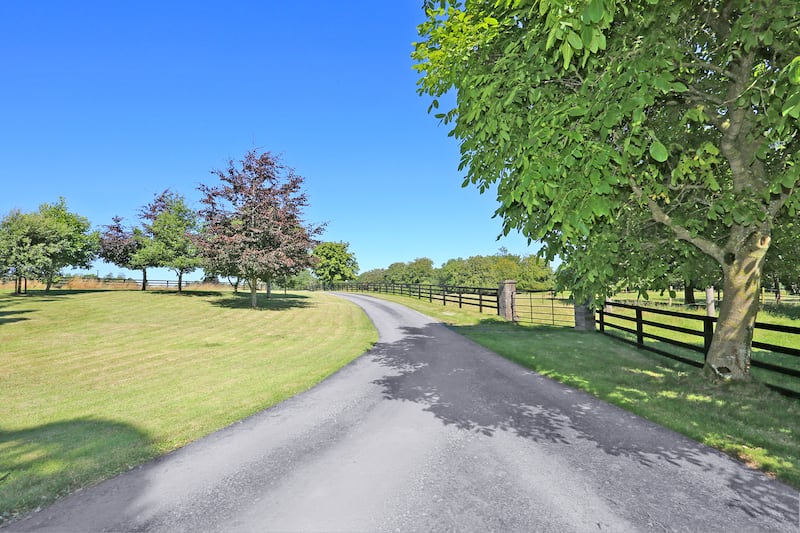
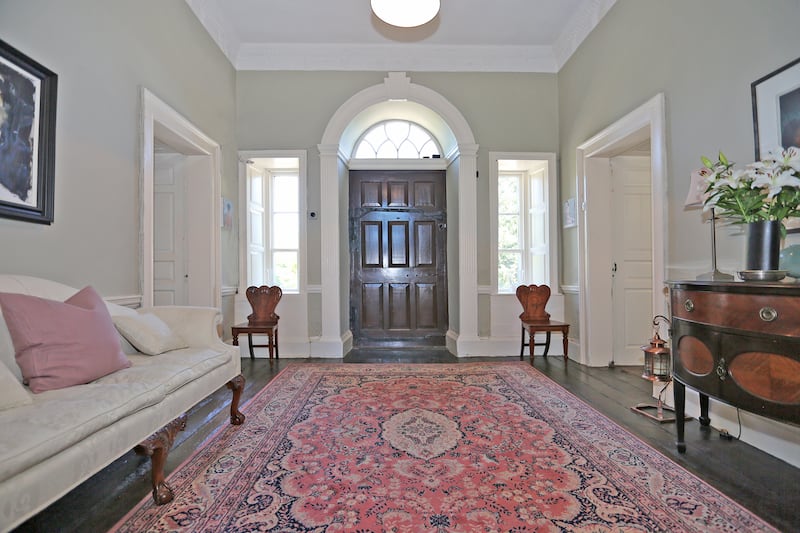
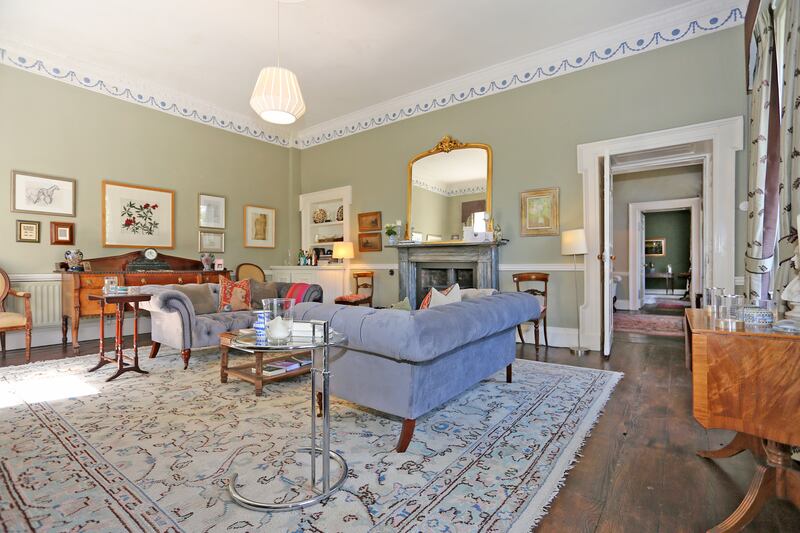
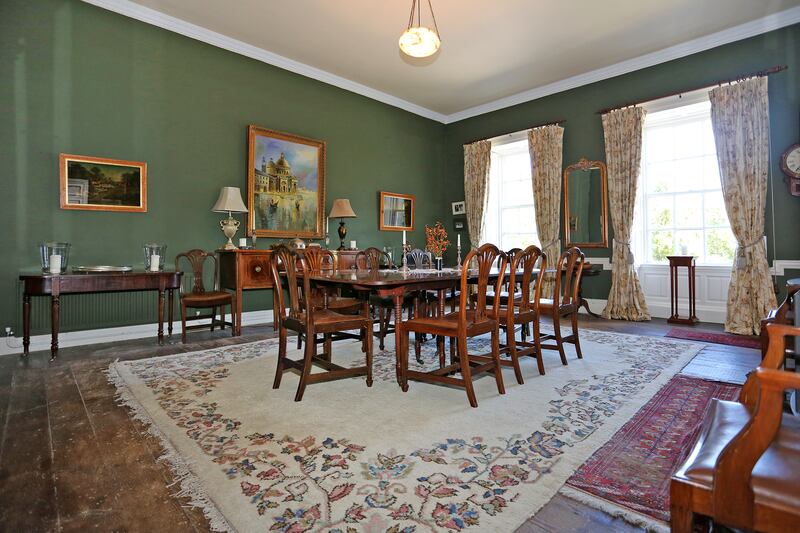
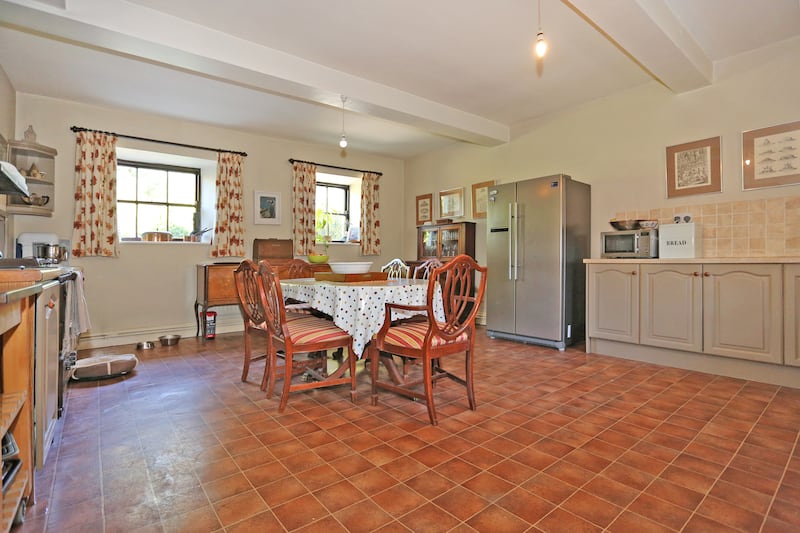
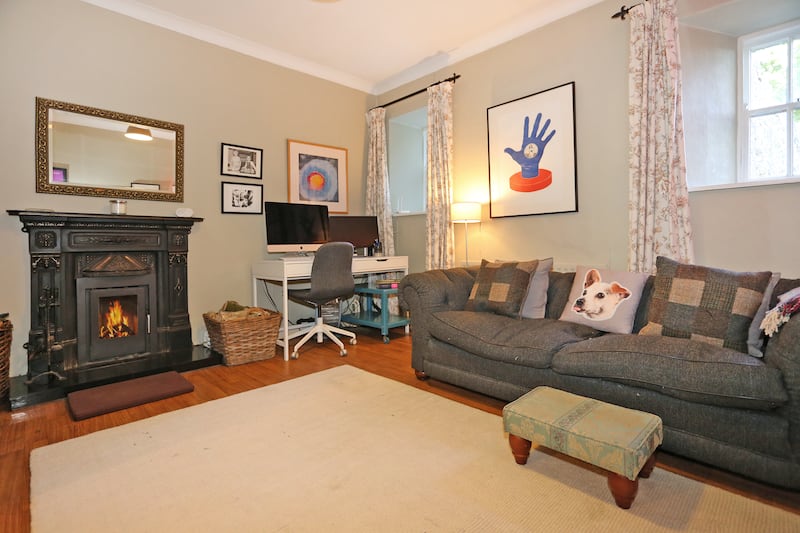
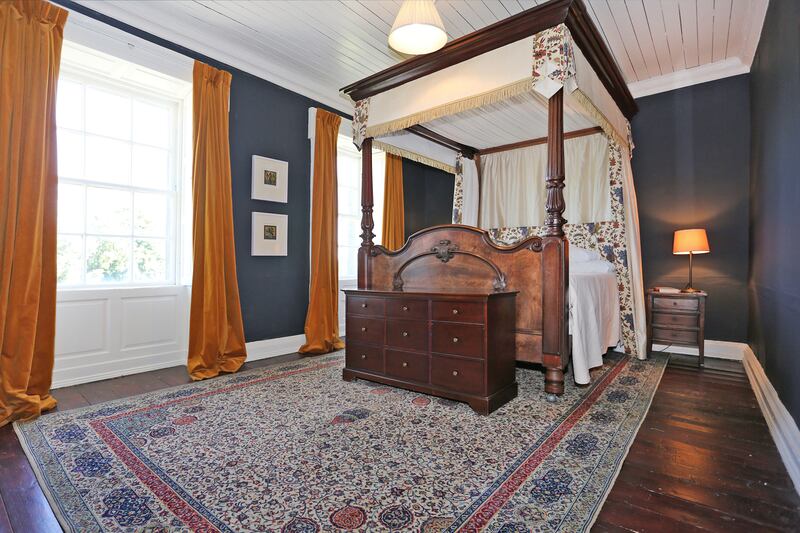
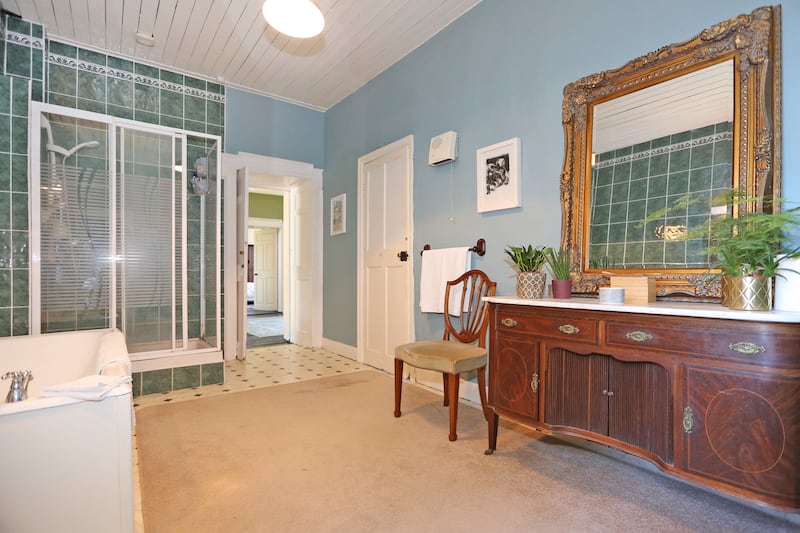
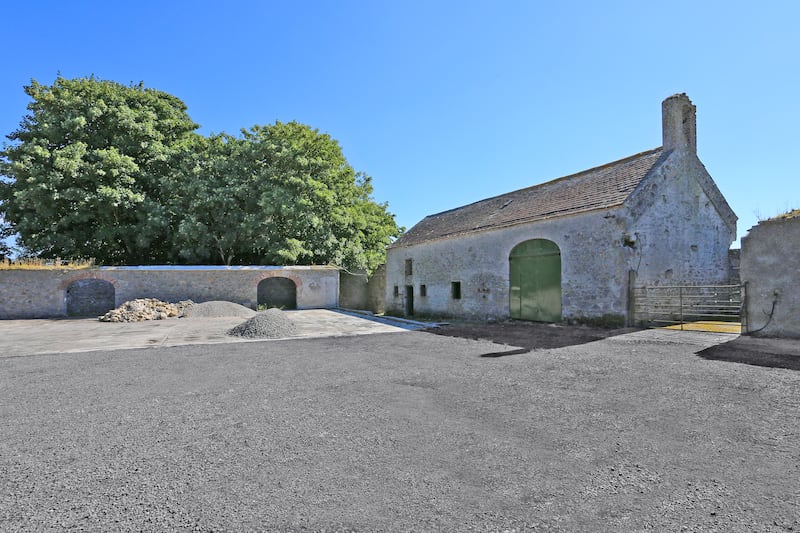


 Irish Historic Houses
