Barne, Clonmel, Tipperary

Barne, Clonmel, Tipperary

Barne, County Tipperary, photograph courtesy of Savills, 2023.

Mark Bence-Jones. A Guide to Irish Country Houses (originally published as Burke’s Guide to Country Houses volume 1 Ireland by Burke’s Peerage Ltd. 1978); Revised edition 1988 Constable and Company Ltd, London.

p. 32. “(Thomson-Moore/IFR) A large three storey house of early C18 appearance with a front of 11 bays, the two end bays on either side projecting forwards. Central feature rather similar to that of Furness, Co Kildare, and Clermont, Co Wicklow, consisting of a frontispiece of paired engaged Doric columns and entablature, surmounted by an aedicule of two engaged Ionic columns and a pediment framing the central first floor window. In C19, the house was given a high-pitched roof in the French chateau style, with dormers.” 

Thomas Moore of Barne, courtesy of Adam’s auction 15th Oct 2019. The son of Richard Moore and Henrietta Taylour, the sitter married Charlotte Spencer of Co. Down in 1777 but died in 1780 without issue.
Barne, County Tipperary, photograph courtesy of Savills, 2023.

https://www.buildingsofireland.ie/buildings-search/building/22207612/barne-park-barn-demesne-innishlounaght-pr-tipperary-south

Detached U-plan eleven-bay three-storey country house, built c. 1730 but possibly incorporating a seventeenth-century house, with advanced two-bay ends, slightly lower central rear two-bay return, and dormer attic storey in French chateau style roof, latter added c. 1870. Rear has slightly lower two-bay three-storey return to west end with bowed rear gable, single-storey pitched roof addition between this and central return, and flat-roofed three-storey addition and single-storey lean-to and pitched roof additions to east end. Steep sprocketed hipped slate roof with clay ridge tiles, cast-iron finials to front gables of advanced ends, ornate rendered chimneystacks, and cast-iron rainwater goods. Decorative timber cornice with dentils to front and side elevations. Pebbledashed walls with smooth rendered eaves course. Cut limestone wheel guards to advanced bays. Dormer windows have hipped slate roofs with lead finials, timber dentils and square-headed paired timber casement windows. Square-headed window openings throughout, diminishing in size, blind to inner return walls of advanced ends and to part of west addition, timber sliding sash windows elsewhere, with cut sandstone sills, one-over-one pane to lower floors of front elevation, two-over-two pane to top floor, six-over-six pane to side and rear elevations, with three-over-six pane to top floor of west return to rear. Round spoked timber window to rear wall of main block. Variety of timber sliding sash and replacement uPVC windows to rear additions. Ornate render detail to entrance comprising paired engaged Tuscan columns with high bases and supporting an entablature surmounted by an aedicule of engaged ionic columns and dentillated pediment framing central first floor window. Square-headed timber panelled door to entrance opening. Shutters to interiors of windows. Courtyard of outbuildings to rear and to west, range of former workers’ houses to west and walled garden to north. Random rubble sandstone boundary walls with dressed limestone piers and wrought-iron double leaf gates to site. 

Appraisal 

This impressive country house, the former residence of S. Moore Esq., has many interesting early eighteenth-century and later nineteenth-century features. Of particular interest is the ornate door arrangement, a similar version of which is visible at Furness, Co. Kildare which is attributed to Francis Bindon circa 1731. The roof, a late nineteenth-century addition in the French Chateau style, adds a whimsical grandeur to the otherwise uniform, symmetrical façade. The outbuildings to the rear and west and the walled garden to the east, complete an attractive group, the history of which spans four centuries. 

Barne, County Tipperary, photograph courtesy of Savills, 2023.

http://landedestates.nuigalway.ie/LandedEstates/jsp/property-list.jsp?letter=B

The seat of the Moore family in the 18th, 19th and 20th centuries. In 1786 Wilson refers to it as the seat of Thomas Moore In 1840 the Ordnance Survey Letter Books note that it had “a garden nursery and ornamental ground”. It was held by Stephen Moore in fee in the mid 19th century and valued at £49+. Randal K. Moore was resident in 1906 and Mr and Mrs Murray Moore in the early 1940s when the house contained a very fine library and antique art collection. Barn is still extant.   

A family who were established in the Clonmel area of county Tipperary from the early 17th century. Richard Moore had two sons, the Earls of Mount Cashell descend from the elder, Stephen, and the Moores of Barne from the younger, Thomas. In 1833 Stephen Charles Moore of Barne married Anna, eldest daughter of Colonel Kingsmill Pennefather and they had three sons and three daughters. At the time of Griffith’s Valuation the Moore estate was mainly located in the parishes of Inishlounaght and Newchapel, barony of Iffa and Offa East. In the 1870s Stephen Moore of Barne owned 1,813 acres in county Tipperary and 167 acres in county Cork. His mother may be the Mrs Anne Moore of Silverspring, Clonmel, who owned 771 acres. The Right Honourable Richard Moore, uncle of Stephen Charles Moore, held land in the parishes of Graystown and St Johnbaptist, barony of Slievardagh, in the mid 19th century. The estate of Richard Roxborough Moore at Roxborough and Chancellorstown, barony of Iffa and Offa and at Graystown, barony of Slievardagh, were advertised for sale in June 1859.  

Barne, County Tipperary, photograph courtesy of Savills, 2023.

For sale July 2023 

€2,500,000 12 beds1572.8 m2 

Imposing 17th Century house set in a commanding position on about 105 acres Barne House is an impressive period property occupying a commanding and elevated position amongst formal gardens, a feature lake and surrounding parkland.

In eleven bays, the three-storey mansion house, with a dormer attic storey, sits below a French Château-style roof which is believed to have been a late addition to the building in circa 1870 and incorporates a U-shaped design in its layout.

External features of the house include a steep sprocketed hipped slate roof with clay ridge tiles, ornate rendered chimneystacks, cast iron finials, ornate render detail to the entrance comprising paired engaged columns and a dentillated pediment framing the central first floor window. Accessed off the N24 Waterford to Limerick national road via a stone walled entrance flanked by piers with wrought-iron gates and railings, Barne House is approached along a sweeping driveway with mature parkland on either side and a feature lake to the west before ascending to the formal gardens and a parking area. With a south-facing position, the house has an outstanding outlook over the lake and beyond towards the rolling farmland and the Knockmealdown Mountains on the horizon.

Barne, County Tipperary, photograph courtesy of Savills, 2023.

The accommodation adapts to provide contained day to day family living whilst reserving generously proportioned reception rooms for entertaining and guest bedrooms for larger family gatherings. A key characteristic of the house is the extent and flexibility of the accommodation, with the empty rooms on the second and third floors offering the potential to provide further accommodation or be used for another purpose.

The house is entered through the elaborate front door which is attributed to the highly regarded architect Francis Bindon. It opens to a reception hall with a striking central staircase and a mezzanine above. The ground floor is mainly devoted to entertaining with formal reception rooms including a dining room and drawing room (both accessed off the central reception hall) while the west and east wings comprise a games room, morning room and library/study. Notable internal period features include sash windows, shutters, picture rails, architraves, cornicing, decorative fireplaces and hardwood floors. Doors flanking the staircase in the reception hall open to inner passages which provide access to a spacious dining kitchen and a range of service rooms and stores one would expect of a house of this scale and period.

Barne, County Tipperary, photograph courtesy of Savills, 2023.

On the first floor are 8 bedrooms, with a further 4 bedrooms and a Lady’s drawing room on the second floor. The third floor/attic level was originally used for accommodating staff and along with the east wing of the second floor requires renovation works to bring it back to its former glory. The internal accommodation extends to approximately 16,930 square feet (1,572 square metres) as shown on the accompanying floorplans.  

Barne, County Tipperary, photograph courtesy of Savills, 2023.

Outbuildings To the rear of the house is a historic courtyard, which would have originally been the coaching yard. The range of traditional outbuildings surrounding the courtyard provided staff accommodation, cobbled floor stabling, tack room, butchery and dairy buttery. The back avenue, accessed via the L3205 road, includes a further range of attractive outbuildings including stables, accommodation, bathroom, hayloft and storage. In total, the traditional outbuildings extend to approximately 9,942 square feet (924 square metres). Gardens & Grounds The impressive estate grounds surrounding Barne House include extensive formal gardens to the front which are laid to lawn and overlook the striking feature lake. The historic parkland beyond comprises outstanding specimen trees and mature woodland which provide privacy, colour and amenity. There is also a walled garden located to the rear of Barne House which is believed to date from circa 1870. The wall remains intact and is characterised by a stone outer leaf and brick inner leaf. To the rear of the house and adjacent to the walled garden is a tennis court, set amongst parkland laid with rhododendron, camellia and rose gardens. Farm Buildings A range of farm buildings are situated beyond the traditional outbuildings and are entered from the L3205 road, adjacent to the west entrance to Barne House. The farm buildings provide a workshop, machinery storage and include a former grain dryer store. Substantial traditional stone walls surrounding the entrance provide privacy and security. Please refer to the floorplans for a layout of the farm buildings. The estate benefits from a three-phase electricity supply. Land Lot 1 comprises a combination of tillage, parkland and woodland, extending to about 105 acres in total. The tillage land is in two divisions situated to the north and east of the house, separated by an area of parkland. The estate is located in an area known as the Golden Vale, given it has some of the most renowned land in Ireland for farming and being rich in agricultural diversity, with fertile light loam soil that lies over limestone. As such, the area is well served by grain merchants, agricultural machinery suppliers, milk processors and livestock markets. The estate is located close to the medieval town of Clonmel(6 km) which overlooks the River Suir, acting as the boundary between the counties of Tipperary and Waterford. The town offers an array of amenities including several shopping centres, excellent restaurants, hotels, traditional pubs, shops, boutique stores and a hospital. The historic town of Cashel, located 20 km north-west of the property, is home to the famous Rock of Cashel, one of Ireland’s most visited tourist attractions and the recently opened five-star Cashel Palace Hotel. Cashel provides a further range of amenities including restaurants, bars, supermarkets, professional services, schools and a hospital. There are few places in the world with a bloodstock breeding and racing tradition as rich as that in County Tipperary. It is home to some of the most iconic stud farms and training establishments in Europe, while the county features popular racecourses at Thurles, Tipperary and Clonmel. Tipperary is one of the leading economic contributors to the Irish breeding and racing industry with all core industry sectors well represented including the thoroughbred breeding industry for which Tipperary is best known. The estate is served by excellent transport links nearby including the M8 motorway (Junction 10) which is only 10 kilometres distant and connects Dublin to Cork via the M7 interchange. The area is also well-located for airports, including Cork Airport (95 km), Shannon Airport (101 km) and Dublin Airport (189 km). There is no shortage of exceptional golf courses nearby including Clonmel Golf Club (11 kilometres) and Cahir Park Golf Club (13 kilometres). The Championship Dundrum House Hotel Golf Club designed by 1995 Ryder Cup hero Philip Walton is located 30 kilometres from the property. The Jack Nicklaus designed Mount Juliet Estate is 50 kilometres from Barne Estate. There is excellent trout and salmon fishing nearby on the River Suir and the Blackwater River, while hill walkers will enjoy the range of peaks in the Galtee Mountains and nearby Slievenamon. Both national and secondary education is available in Clonmel. The area is also well served for private education including Rockwell College, Glenstal Abbey, Presentation Secondary School and Ursuline Secondary School, which offers education for both day pupils and full-time boarding. 

Features  

  • Imposing 17th century house set in a commanding position 
  • 4 principal reception rooms, 12 bedrooms and extensive ancillary accommodation 
  • Formal gardens, tennis court, walled garden and tree-lined driveway 
  • Idyllic parkland surroundings, including a feature lake 
  • Range of modern and traditional farm buildings 
  • 48 acres tillage, 26 acres pasture, 15 acres woods 

BER Details  

BER: Exempt BER No: Performance Indicator: 

Directions  

The Eircode is E91 CX96. 

Negotiator Details  

James Butler 

Viewing Information  

Strictly by appointment with Savills Dublin – Country on + 353 (0) 1 618 1300 

39 North Great George’s Street, Dublin – section 482

www.39northgreatgeorgesstreet.com

Open dates in 2026: May 11-24, June 12-21, July 6-19, Aug 9-30, 1pm-5pm

Fee: adult €7, student/OAP €5, child free with adult, group €5 per person

donation

Help me to pay the entrance fee to one of the houses on this website. This site is created purely out of love for the subject and I receive no payment so any donation is appreciated!

€15.00

2026 Diary of Irish Historic Houses (section 482 properties)

To purchase an A5 size 2026 Diary of Historic Houses (opening times and days are not listed so the calendar is for use for recording appointments and not as a reference for opening times) send your postal address to jennifer.baggot@gmail.com along with €20 via this payment button. The calendar of 84 pages includes space for writing your appointments as well as photographs of the historic houses. The price includes postage within Ireland. Postage to U.S. is a further €10 for the A5 size calendar, so I would appreciate a donation toward the postage – you can click on the donation link.

€20.00

North Great Georges Street, Dublin. Photograph © Jennifer Winder-Baggot, www.irishhistorichouses.com
39 North Great Georges Street, Dublin. Photograph © Jennifer Winder-Baggot, www.irishhistorichouses.com

Number 39 North Great Georges Street, a three bay four storey over basement house, was built in 1790 by Henry Darley (1721-1798) on land leased from the Archdall family. Darley also built numbers 41 and 42, and may have built number 43 for Theophilus Clements. We visited the street before when we saw another Section 482 property, number 11 (see my entry).

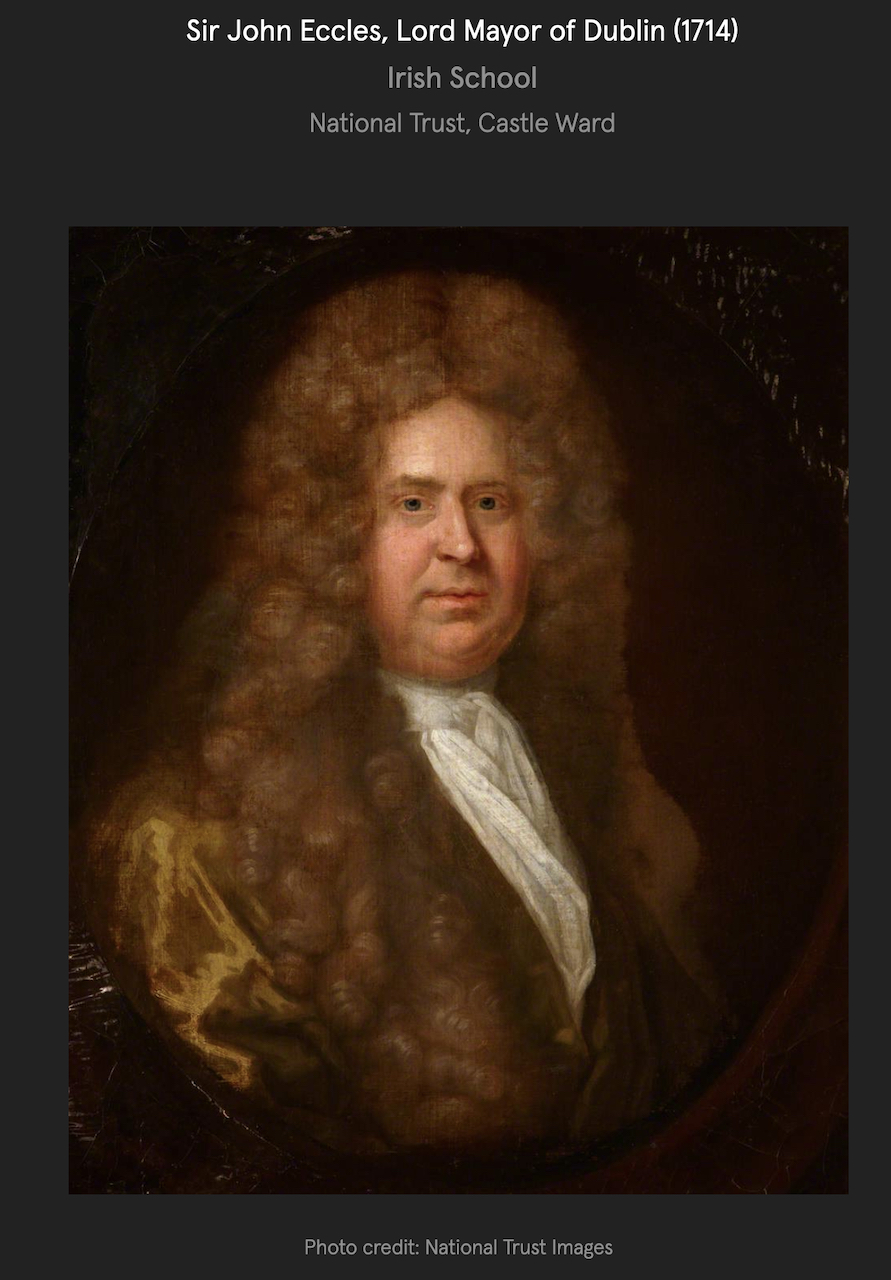
The land was owned at the beginning of the 18th century by John Eccles (1664-1727), Lord Mayor of Dublin in 1710, for whom Eccles Street was named, the street where Leopold Bloom lives in James Joyce’s Ulysses. The North Great Georges Street specially dedicated website with a history of the street written by Conor Lucey tells us that Eccles’ mansion of the same name survived into the first decades of the twentieth-century, and stood on the site now occupied by the diminutive two-storey building situated between the present Nos.43 and 46. [1]

John Eccles (1664-1727) Lord Mayor of Dublin (1714), Irish school, courtesy of National Trust Castle Ward.

The lease for the estate was purchased by Nicholas Archdall for a term of 999 years beginning on 1st August 1749. The North Great Georges Street website tells us:

Nicholas Archdall, an MP for Co. Fermanagh and one of the first ‘Home Rulers’, had in fact been born Nicholas Montgomery, assuming the name of Archdall upon his marriage in 1728 to the heiress Angel Archdall, a descendant of one of the foremost County Fermanagh families since the days of the Ulster Plantation. Following Angel Archdall’s death in 1748, Nicholas married Sarah Spurling, originally of London, and by her had eight children, one of whom, Edward, would later become a property developer, involved in the building of Nos.19 and 20 North Great George’s Street in the late 1780s. Nicholas Archdall died at Mount Eccles in 1763, and some years later his widow petitioned Parliament for the heads of a bill to enable her ‘to grant long leases for building on the said Premises.’ This decision to set out the ground as a commercial venture may have been inspired by the eminently fashionable, and ever-expanding, Gardiner estate, and motivated in particular by the opening up of Gardiner’s Row (adjoining the north west side of the Mount Eccles estate) in 1765. Sarah Archdall’s formal request was presented to the House of Commons on 12 February 1766 and stated:

“That the said Grounds and Premises lie contiguous to the City of Dublin, and from their Situation will be taken by Persons in Lots for building upon, if Power to make Building Leases thereof can be obtained. That all the Petitioners…are Minors, and the youngest about six Years of Age, and until they all come of age no Building Leases can be granted, and it will greatly tend to the Benefit of the Petitioner Sarah, and her Children, to have Power to grant Building Leases.”

The Journals of the House of Commons records that Royal Assent was granted on 7 June 1766 and the leasehold interest in the first building lots were advertised the following year, the notices highlighting both the advantage of the location and its proximity to established residential districts:

“To be Let in Lots for Building, the Lands of Mount Eccles, in Great Britain-street, opposite Marlborough-street, joining Palace-row and Cavendish-street, containing seven Acres, which for Situation, Air and Prospect, cannot be exceeded by any in or about Dublin, subject to no Manner of Tax, Hearth Money excepted. For further Particulars, enquire of Mrs. Archdale, at Mount Eccles, where a Plan of the whole may be seen.”

39 North Great Georges Street, Dublin. Photograph © Jennifer Winder-Baggot, www.irishhistorichouses.com

The North Great Georges Street website continues:

While building at the southern end of North Great George’s Street began from the mid-1770s, including Nos.22–27 (all now demolished) and Nos.33–35 (of which only No.35 survives), the majority date from the mid-1780s, including Nos.12–21 and Nos.36–43. In many cases, these later houses were built by some of the leading figures from Dublin’s late eighteenth-century building and house-decorating community, among them the renowned stuccodor Charles Thorp (Nos. 37 and 38), and Henry Darley, from the celebrated family of stonecutters (Nos.39 and 41–42).

Darley worked with James Gandon on the new Custom House in Dublin, from 1781-1791, before working on North Great Georges Street. The plasterwork inside may be by Charles Thorp (abt. 1772-1820), as he owned the house next door to number 39.

Charles Thorp, (abt. 1772-1820), Builder, Stuccodore and Lord Mayor of Dublin 1800-1801, engraver Patrick Maguire, Irish, fl.1783-1820. Photograph courtesy of the National Gallery of Ireland.
North Great Georges Street, Dublin. Photograph © Jennifer Winder-Baggot, www.irishhistorichouses.com

Conor Lucey describes the typical layout of the houses on the street:

By far the most common plan type is the ‘two room’ plan, composed of an axially- aligned entrance hall and stair hall, and flanked by front and rear parlours, the latter typically serving as the formal dining room. The principal staircase, customarily of timber open-string construction, is situated at the back of the house and rises from the ground floor – by way of the piano nobile or ‘drawing room storey’ – to the ‘attic’ or bedroom storey, with admittance to the ‘garret’ alone acquired by a smaller, subordinate stair.

Ceiling of the front hall, 39 North Great Georges Street. Photograph © Jennifer Winder-Baggot, www.irishhistorichouses.com

The first occupant of the house was Thomas Taylour (1757-1829), later created 1st Marquess of Headfort, of Headfort House in County Meath, in 1800 at the time of the Act of Union.

Thomas Taylour (1757-1829) 1st Marquess of Headfort by Pompeo Batoni courtesy of Google Art Project By Pompeo Batoni – 9QE_ZzFPQzDZiQ at Google Cultural Institute, Public Domain, https://commons.wikimedia.org/w/index.php?curid=29800995
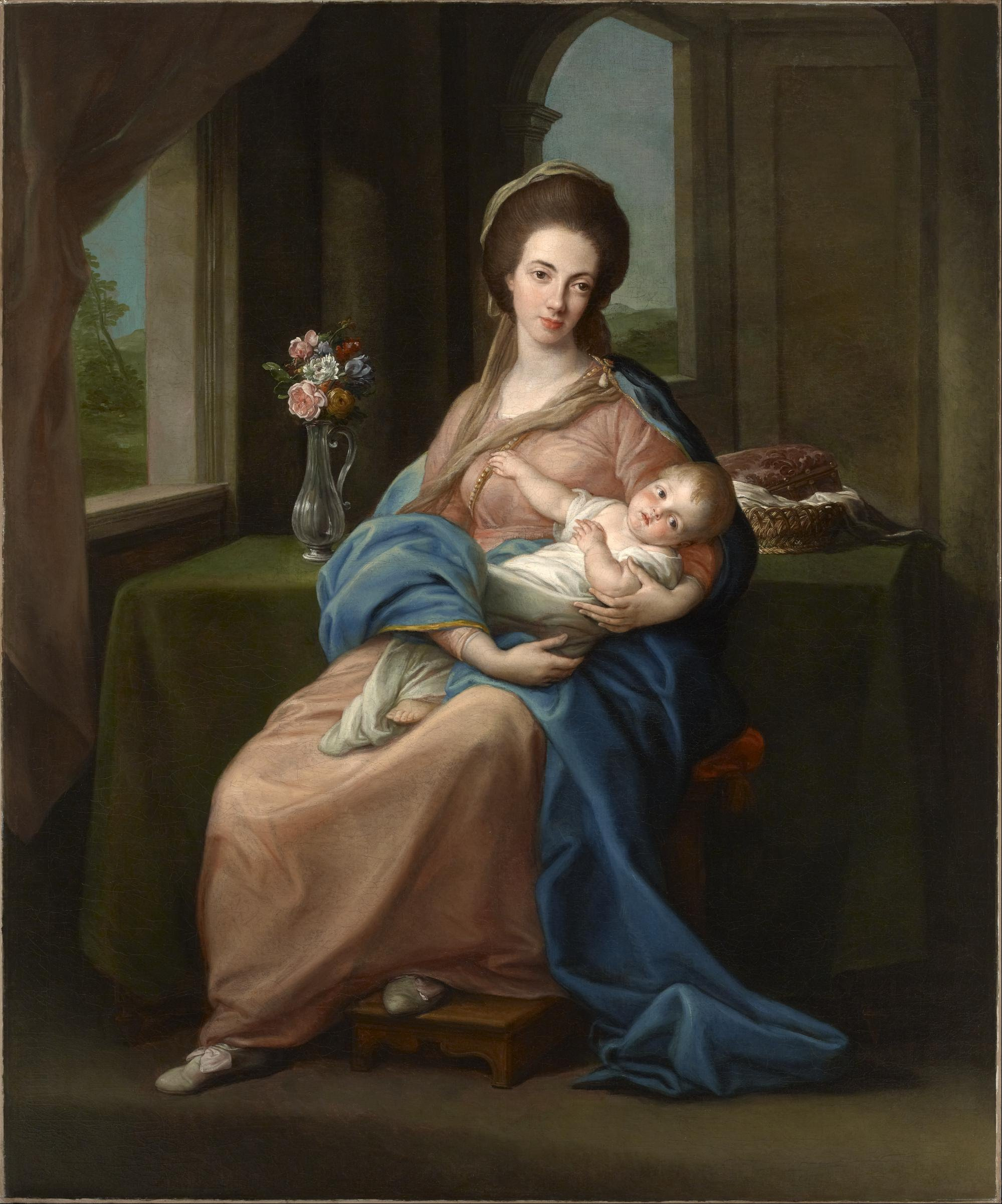
Mary née Quin (the daughter of George Quin and Caroline Cavendish) The Marchioness of Headfort, wife of Thomas Taylour (1757-1829) 1st Marquess of Headfort, holding her Daughter Mary, 1782, by Pompeo Batoni, Google_Art_Project 6wGvrQuQJ1yERA at Google Cultural Institute, Public Domain, https//:commons.wikimedia.org/w/index.php?curid=29801821.jpg

The front hall has an archway, built by Darley, and The Marquess of Headfort had him put in double doors and a fanlight.

The website for the house tells us that it was then occupied by Thomas Taylour’s first cousin, Stephen Moore of Barne Park, Clonmel, County Tipperary. [2] Thomas Taylour probably moved to Rutland Square (now Parnell Square), where his family had a townhouse which he inherited.

Thomas Taylour’s aunt Henrietta Taylour married Richard Moore (1714-1771) of Barne Park. They had a son Stephen (about 1748-1800), who married Salisbury Moore, and they had a son, Stephen Moore of Barne Park, who married Eleanor Westry. They had a son, Stephen Charles Moore (1808-1873). In 1833 Stephen Charles Moore of Barne married Anna, eldest daughter of Colonel Kingsmill Pennefather of Newpark, County Tipperary. Stephen Charles Moore was Justice of the Peace, High Sheriff and Deputy Lieutenant of County Tipperary. Mrs. Mary Moore of Barne Park is listed as living in the house in 1840.

Tom welcomed us to his home. He told us that the house was purchased by a Bishop who put it in trust for life. The house was continually let until the mid twentieth century. The house’s website tells us that:

By 1850, the house, now held in trust, was let to a barrister, Patrick Owen Cogan and in 1909, was being run as a boarding house by a Mrs. Hill, who lived there with her husband and daughters. It was afterwards occupied by a rector of St. Georges Church, and later by a doctor from the Childrens Hospital in Temple Street. In the 18th.c. when this house was built, there was no plumbing or sanitary facilities and it was probably towards the end of the 19th.c. that it became fashionable to install a bathroom, usually by thrusting out an extension from the 2nd. half landing on the stairs, hence the name “thrust out.” Such a bathroom was installed in No.39. This would have been the height of sophistication in the Edwardian era.

The National Inventory tells us it was run as a hotel called the “Windsor hotel” in the early 1900s, perhaps in the time of Mrs. Hill. The census in 1901 tells us it was divided in two parts, with the Hill family, Joseph and his wife Catherine, who are members of the Church of Ireland, and their daughters, in one part and boarders in the rest of the house – one of whom, Stephen Dawson, an engineering student, lists his religion as “free thinker”! In 1911 it was no longer occupied by the Hills, but by a family named Greer, a Rev. Fergus Greer who was rector of St. George’s church. He moved to no. 38, next door, after John Pentland Mahaffy vacated that house.

39 North Great Georges Street, Dublin. Photograph © Jennifer Winder-Baggot, www.irishhistorichouses.com

The website continues with the history of the house:

In 1939 the trust let the house to a builder, giving him permission to let it out in rooms. This was the final stage in a downward spiral that almost ended in its demolition. It had probably not been well maintained throughout the 19th.c. but the intensive use it was now subjected to led to a rapid deterioration and it soon became an “open door tenement,” with no lock on the front door and the interior common areas open to all. In 1948, there were 11 families living in the house, mostly one family per room. Many of these were large families. There were no services in any of the rooms, and with only the single bathroom off the half landing and a second wc at the door to the back yard conditions were grim. A sink had been installed outside the bathroom and leakage from this caused extensive rot on the staircase. Leaking rainwater downpipes caused further rot, and the roof slating had failed and been replaced with a temporary covering of chipboard and green mineral felt. In 1966 the trust sold the house for £200. It again changed hands in 1973, to an owner interested in its preservation. He had the remaining tenants rehoused and upgraded the house as offices and flats.

The present owners bought the house in 1976.

The present owners, the Kiernans, have done wonderful repairs to the house. They outline the repairs on the website. The roof was repaired and reslated, and the third floor bow wall in the back rebuilt. The owners had to contend with dry rot, and much work was done in the upper drawing room and the upper floors. They bought back the mews house, which had been sold previously, and they renovated that also. You can see photographs of various stages of the repair work on the website.

Tom Kiernan has been repairing the skirting, architraves and other woodwork, and also, I was delighted to learn, the plasterwork.

Tom has carried out repairs to the beautiful fireplace in the drawing room or “street parlour” on the ground floor. Photograph © Jennifer Winder-Baggot, www.irishhistorichouses.com
The repaired chimneypiece in the drawing room. The faces are copied from a house in Mountjoy Square. Photograph © Jennifer Winder-Baggot, www.irishhistorichouses.com
The street parlour. Photograph © Jennifer Winder-Baggot, www.irishhistorichouses.com
The dining room. Photograph © Jennifer Winder-Baggot, www.irishhistorichouses.com
The cornice and frieze of the dining room. Photograph © Jennifer Winder-Baggot, www.irishhistorichouses.com
Detail on the stairs, which Tom is repairing. Photograph © Jennifer Winder-Baggot, www.irishhistorichouses.com
Another decorative frieze. Photograph © Jennifer Winder-Baggot, www.irishhistorichouses.com
Double doors on the first floor landing. Photograph © Jennifer Winder-Baggot, www.irishhistorichouses.com
The impressive first floor drawing room with bow in the back. Photograph © Jennifer Winder-Baggot, www.irishhistorichouses.com
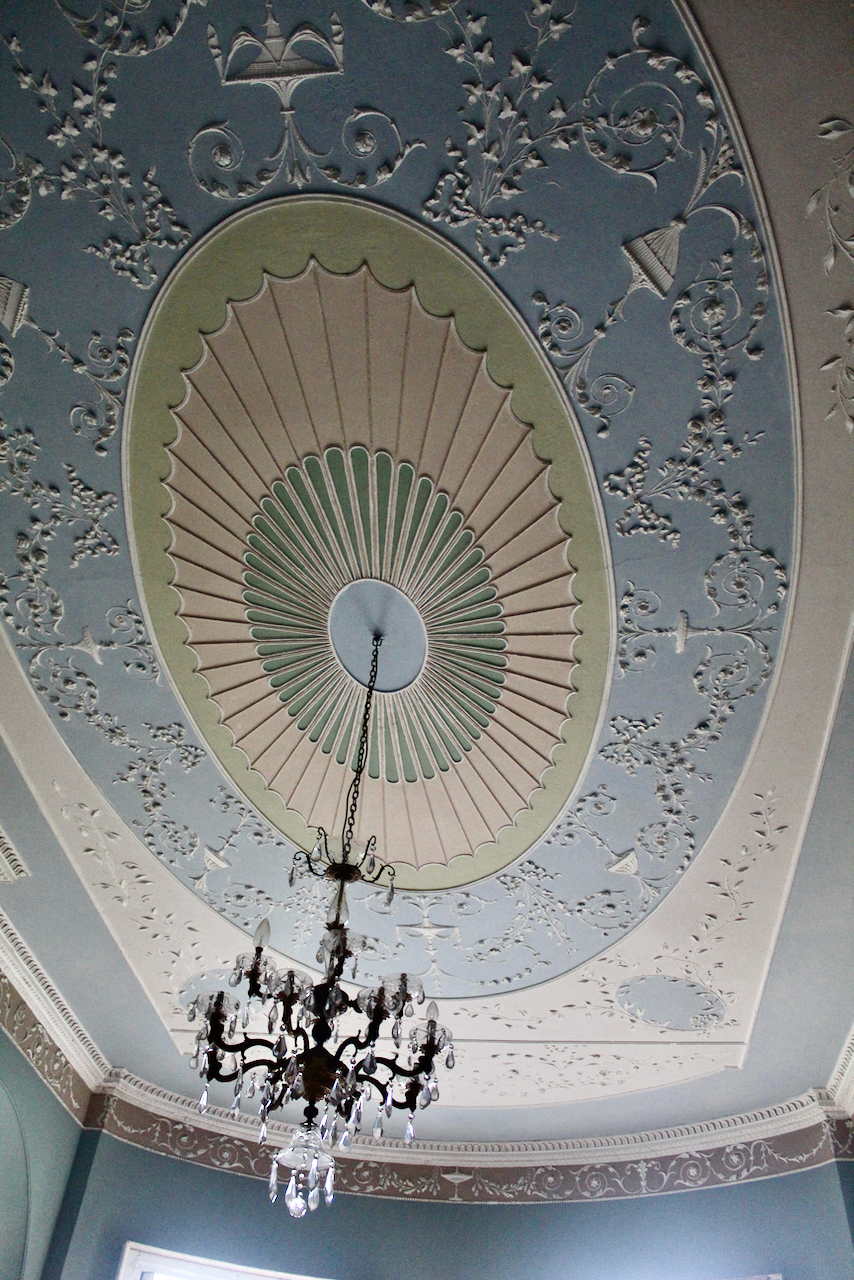
The beautiful ceiling of the upstairs drawing room. Photograph © Jennifer Winder-Baggot, www.irishhistorichouses.com
Some artefacts collected by Tom. Photograph © Jennifer Winder-Baggot, www.irishhistorichouses.com
Tom showed us how he is repairing the dado rail and plasterwork. He is creating a version cast from “composition ornament.” Photograph © Jennifer Winder-Baggot, www.irishhistorichouses.com
Repairing the woodwork, skirting boards and decorative elements. Photograph © Jennifer Winder-Baggot, www.irishhistorichouses.com
The return in the back. Photograph © Jennifer Winder-Baggot, www.irishhistorichouses.com
The impressive Neoclassical ceiling in the front drawing room upstairs. Photograph © Jennifer Winder-Baggot, www.irishhistorichouses.com
The front drawing room upstairs. Photograph © Jennifer Winder-Baggot, www.irishhistorichouses.com

[1] https://northgreatgeorgesstreet.ie/history/

[2] Barne Park, County Tipperary, https://www.buildingsofireland.ie/buildings-search/building/22207612/barne-park-barn-demesne-innishlounaght-pr-co-tipperary-south

A house built c. 1730 but possibly incorporating a seventeenth-century house, it is very impressive. It was built for Stephen Moore (1689-1747).

The house went up for sale in 2023! Here are some photographs courtesy of myhome.ie:

Barne, County Tipperary, photograph courtesy of myhome.ie in July 2023.
Barne, County Tipperary, photograph courtesy of myhome.ie in July 2023. The use of drones really helps in advertising a property for sale.
Barne, County Tipperary, photograph courtesy of myhome.ie in July 2023. I don’t know if the Moores still own it – it would be wonderful if those weapons and trophies are from the Moore family.
Barne, County Tipperary, photograph courtesy of myhome.ie in July 2023.
Barne, County Tipperary, photograph courtesy of myhome.ie in July 2023. I wonder who is painted in the portraits?
Thomas Taylour (1724-1795) 1st Earl of Bective wearing the star and sash of the Order of St. Patrick by Gilbert Stuart and studio courtesy of Sotheby’s. I see this portrait in the photograph from Barne!
Thomas Moore of Barne, courtesy of Adam’s auction 15th Oct 2019
Barne, County Tipperary, photograph courtesy of myhome.ie in July 2023.
Barne, County Tipperary, photograph courtesy of myhome.ie in July 2023. What a beautiful cabinet!
Barne, County Tipperary, photograph courtesy of myhome.ie in July 2023. The pelmets match the bed. I wonder if they are original to the house, and whose crest that is?

Text © Jennifer Winder-Baggot, www.irishhistorichouses.com