Viewmount, Paulstown, County Kilkenny

The main front of the house was built sometime around 1850. Viewmount, Paulstown, County Kilkenny For sale, photograph courtesy Boyds.
Viewmount, Paulstown, County Kilkenny

https://www.buildingsofireland.ie/buildings-search/building/12402107/view-mount-duninga-kilkenny

Detached three-bay two-storey Classical-style country house, c.1850, possibly incorporating fabric of earlier house, c.1725, on site with three-bay single-storey flat-roofed projecting porch to centre ground floor, single-bay two-storey advanced end bay to right, three-bay two-storey side elevations, three-bay two-storey lower parallel range along rear (east) elevation terminating in single-bay two-storey higher end bay having two-storey canted bay window, and three-bay single-storey service range with half-dormer attic to south-east. Now disused. Hipped slate roofs (half-octagonal to canted bay window; gabled to half-dormer attic windows to service range) with clay ridge tiles, rendered chimney stacks having cut-limestone stringcourses, rooflights, and cast-iron rainwater goods on slightly overhanging cut-limestone eaves. Roof to porch not visible behind parapet. Unpainted rendered, ruled and lined walls with cut-limestone stringcourse to first floor, cut-limestone band to eaves, limestone ashlar walls to porch having chamfered pilasters with moulded necking, moulded cornice on stringcourse, panelled parapet rising into gable to centre, and cut-limestone coping. Square-headed window openings (some paired; in camber-headed recesses to ground floor) with cut-limestone sills (forming sill course to first floor having panelled risers), chamfered reveals to ground floor, and one-over-one timber sash windows (square-headed window openings to service range with cut-limestone sills, and one-over-one timber sash windows). Square-headed openings to porch with two cut-limestone steps, timber panelled double doors having overlight, and one-over-one timber sash sidelights. Interior with timber panelled shutters to window openings. Set back from road in own grounds with tarmacadam forecourt, and landscaped grounds to site. (ii) Attached six-bay two-storey outbuilding wing, c.1850, to south on an L-shaped plan possibly incorporating fabric of earlier house, c.1725, on site with elliptical-headed carriageway to ground floor, and four-bay single-storey projecting range to left. Now disused. Pitched slate roof (hipped gabled to projecting range) with clay ridge tiles, rendered chimney stacks having rendered stringcourses, and cast-iron rainwater goods on rendered eaves. Unpainted roughcast walls over random rubble limestone construction. Square-headed window openings (some in bipartite arrangement) with cut-limestone sills, concealed yellow brick surrounds, and remains of two-over-two timber sash windows. Square-headed door opening with yellow brick block-and-start surround (originally concealed), and remains of timber door. Elliptical-headed carriageway to ground floor with no fittings.

Appraisal

An elegantly-appointed substantial country house redeveloped for the Flood family in the mid nineteenth century possibly incorporating an early eighteenth-century range in the grounds, thereby maintaining a long-standing presence on site. Stylistically reminiscent of the contemporary (c.1850) Barraghcore House (12402103/KK-21-03) nearby, thus suggesting the possibility of a shared architect or builder the architectural design value of the composition is identified by characteristics including the balanced arrangement of the pleasantly-proportioned openings, the paired arrangement of some openings, and so on, all centred on an enriched porch displaying high quality stone masonry. Having historically been very well maintained the house presents an early aspect with the original fabric surviving substantially intact both to the exterior and to the interior, thereby maintaining the character of a composition forming the centrepiece of a large-scale rural landholding. Despite having fallen into poor repair an attendant outbuilding range makes a positive contribution to the group and setting values of the house in the landscape.

https://www.myhome.ie/residential/brochure/viewmount-paulstown-kilkenny/3822183

Viewmount, Paulstown, County Kilkenny For sale courtesy Boyds

R95V670 11 beds5 baths800 m2

Viewmount House is an attractive, period residence with origins dating back to the 16th century. Situated in the verdant Kilkenny countryside, the property enjoys a delightful setting amongst 7 acres of quality parkland. The house retains a wealth of period features throughout,consistent with the age and style of the building including; originalsash windows, flagstone tiled floors, open fireplaces, ornate cornicing and ceiling roses. The property, whilst currently lived in will require some modernisation and updating. Viewmount House has all the basics required to create a wonderful family home in a delightful rural setting, offering a lifestyle which is increasingly hard to find. 

Accommodation 

On the ground floor is a large and beautifully tiled hall, off which are four principle reception rooms, each with marble fireplaces and large windows. The drawing room has a large bay window affording a bright and light filled entertaining space. A kitchen, pantry, utility room, boiler room and guest WC complete the main house ground floor accommodation. A separate wing to the rear of the house could be made into a into a self contained three bedroom annexe. Upstairs are eight large bright bedrooms, a shower room, bathroom and WC. 

Features 

Period residence on 7 acres Numerous original period features Own water supply from well Oil Central Heating Excellent location just off M9 Motorway and 15 minutes from Kilkenny City 

Viewmount, Paulstown, County Kilkenny For sale, photograph courtesy Boyds.

https://www.carlowlive.ie/news/property/433815/auction-contents-of-viewmount-house-on-carlow-kilkenny-border-to-go-under-the-hammer.html

25 Jul 2019 

The contents of the Victorian manor, Viewmount House, will go under the hammer at Goresbridge Antiques Auctions on July 29 on behalf of the Hanlon family and various other clients.

The stately residence was once the childhood home of award-winning author, poet and journalist Kildare Dobbs whose work was heavily influenced by his time spent in “rooms lit by lamps and candles, heated by log fires in marble chimney pieces” as depicted in his autobiography Running The Rapids: The Life Of A Writer.

The original dower house was built circa 1750 with the main house we see today added around 1850.

All original features have been maintained and changed little since Kildare Dobbs roamed its hallways including flagstone and tiled floors, marble fireplaces and superbly ornate cornicing all of which serves as a backdrop for the hundreds of items and objects of interest that form the contents clearance.

Another notable resident was renowned architect Vincent O’Callaghan, whose early architectural drawings, plans and instruments feature among the 800 lots on offer in the upcoming auction.

The sale will also include Georgian, Victorian, Edwardian Furniture, Quality Dining room, Sitting room, Bedroom and Occasional Furniture, Oil Paintings, Prints, Clocks, Glass, Pine, Brass, Porcelain, Mirrors, Waterford Crystal, Garden furniture, rugs many other collectable items.

Viewing takes place at Viewmount House while the auction itself will be held at the Goresbridge Sales Complex at 1pm Monday, July 29.

https://www.independent.ie/life/home-garden/homes/amazing-victorian-house-once-home-to-award-winning-writer-on-the-market-in-kilkenny-for-800k/35224162.html

Amazing Victorian house once home to award-winning writer on the market in Kilkenny for €800k

Writer’s beloved Victorian manse comes to market for €800k, writes Alison Gill

Fri 18 Nov 2016

The writer Kildare Dobbs was best known for his short stories, narrative non-fiction, travel books, poetry and journalism. His first book Running To Paradise won a Governor General’s Award in Canada in 1962, his adopted home until he was returned to Ireland for burial in Castlecomer in 2013.

Dobbs was born in India but spent most of his childhood at Viewmount House in Kilkenny. In his 2005 autobiography Running The Rapids: A Writer’s Life, he regales us with stories of his lamp-lit, big house youth after his family moved back to Ireland from India and bought the Victorian mansion in 1925.

“At last, we settled in Viewmount, near Gowran in Co Kilkenny. It was not far from Castlecomer, where father had grown up, and almost 11 miles from Kilkenny, where Grandpa had been bishop from 1911 to 1915. Once settled in, neat and welcoming with new paint, rich Indian carpets and family furniture taken out of storage, we were at home again. Life resumed its rhythm – regular meals, walks, church-goings and domestic music. The rooms were lit by lamps and candles, heated by log fires in marble chimney pieces.”

Life in Ireland took some adjusting to for Dobbs and his siblings, but his great love for his new Irish home is evident throughout the book.

“Viewmount was well named, sited in clear view of Mount Leinster. The changing light on the mountain – now purple, now blue, now brownish – was never the same from moment to moment. The mountain was framed on one side by the walled gardens with herbaceous borders in front, and on the left by tall trees, including a majestic Sequoia gigantean.”

He tells many tales of his strict upbringing and his home-schooling by his governess Miss Caldwell. Her constantly harsh manner caused Dobbs and his brother to rebel against the regime on one occasion. “One evil day, when our parents were away in Dublin, something snapped and we rose in revolt. After all, our country existed because of a rebellion. When Miss Caldwell tried to collar us, I whacked her on her corseted behind with a cricket stump, a disgraceful deed, though she was well-armoured.”

The Dobbs family sold the house in the mid-1950s to Vincent and Ann O’Callaghan, where they remained until the late 1970s. Viewmount was then taken over by Ann’s nephew Jim Hanlon and his wife Finousa. The Hanlons have kept the main house just as it was when little Dobbs used to gaze at Mount Leinster – with all original features still intact like the sash windows, flagstone tiled floors, open fireplaces and ornate cornicing and ceiling roses. Although it will be hard for them to part with such a property, they are looking forward to downsizing and no longer worrying about the upkeep of such an enormous home. The back part of the house is believed to date back to 1750 and it’s thought Viewmount was a dower house for one of the daughters of Francis Flood of Farmley, who took over the land around 1725. The main front of the house was built on sometime around 1850.

The floor area of the house is 3,000 sq ft and it comes with seven acres of land. The large tiled hall, with its fireplace and wooden staircase, has been beautifully maintained. There are four reception rooms off this, each with marble fireplaces and large windows. The kitchen, pantry, utility and boiler room complete the accommodation on the ground floor.

There is a separate wing to the side of the house, which could be converted into a self-contained annex as it is already laid out with a kitchen, bathroom and two bedrooms. This would be ideal for an elderly relative or could be done up as a luxury holiday let for extra income. Upstairs, there are eight large bedrooms, a shower room, bathroom and WC. New owners may want to add a few ensuite bathrooms and dressing rooms. Not surprisingly for a house of this age, it comes with a BER G, which will need to be addressed.

Outside, the inner courtyard has a number of outbuildings that are in need of restoration and water comes from a private well.

Viewmount House is on the market through joint agents Colliers International (01) 6333700 and REA Boyd’s in Kilkenny (056) 7764833.

Viewmount House

Paulstown, Co Kilkenny

Asking price: €800,000

The Odeon (formerly Harcourt Street Railway Station), Dublin 2, D02VE22 – Section 482

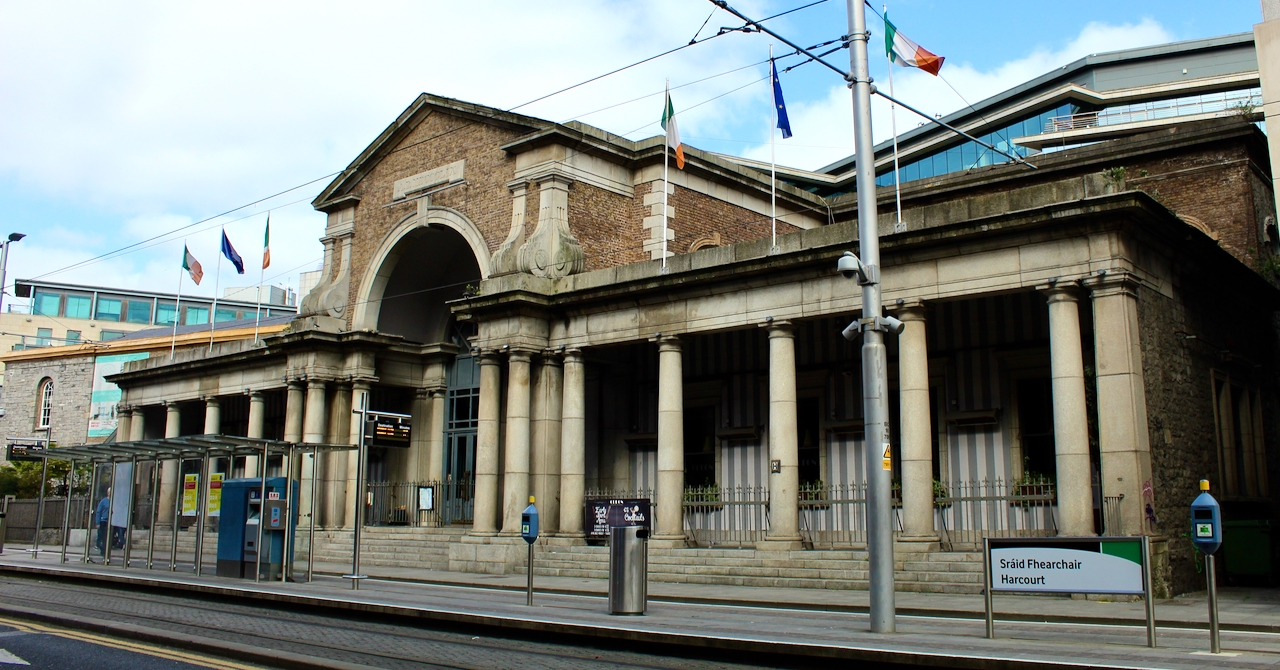
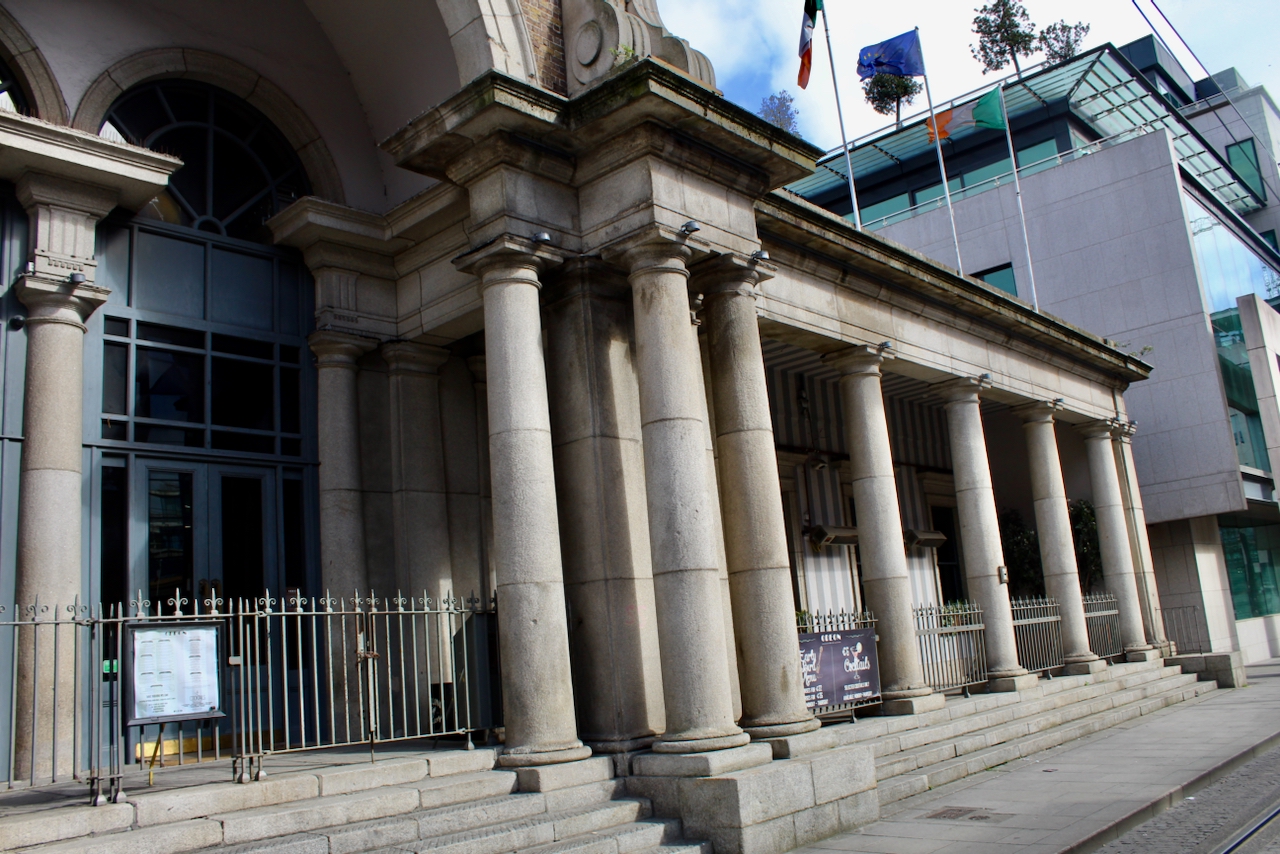
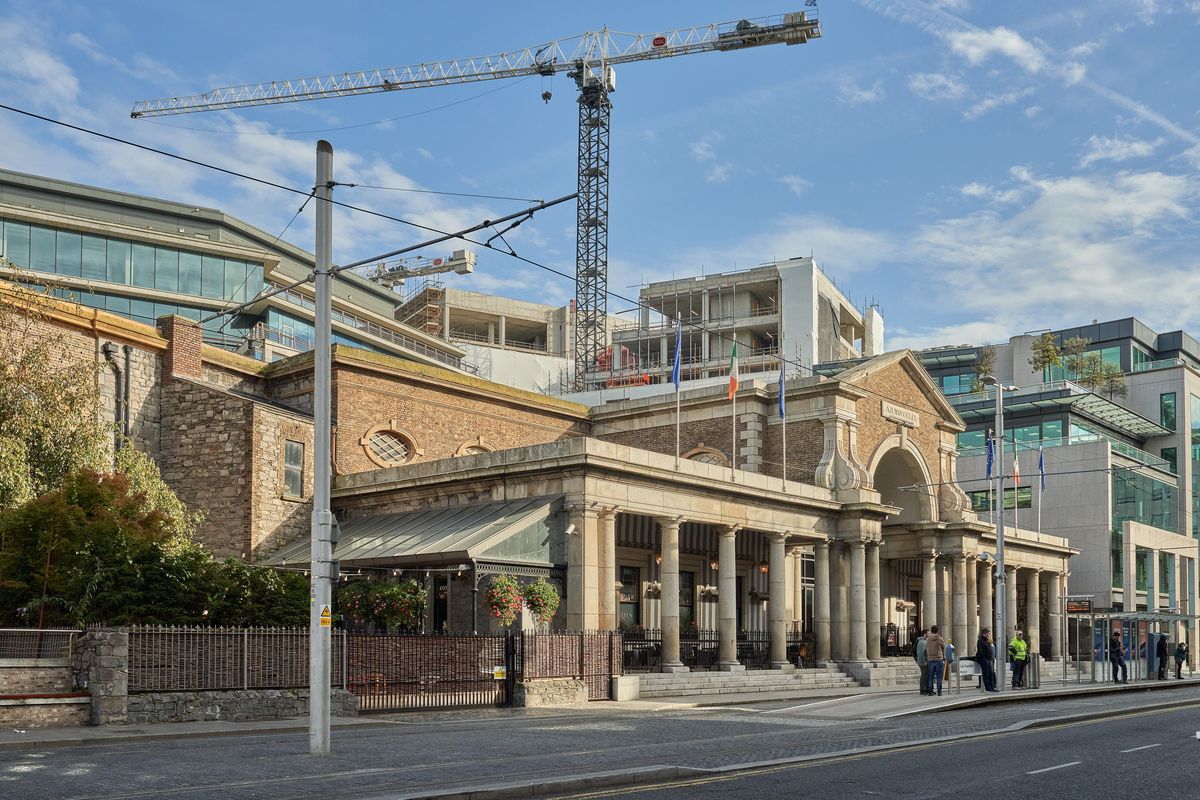
The Odeon, formerly Harcourt Street Railway Station.

Donation

Help me to fund my creation and update of this website. It is my “full time job” and created purely out of love for the subject and I receive no payment so any donation is appreciated! My costs include travelling to our destinations from Dublin, accommodation if we need to stay somewhere nearby, and entrance fees. Your donation could also help with the cost of the occasional book I buy for research (though I mostly use the library – thank you Kevin Street library!). Your donation could also help with my Irish Georgian Society membership or attendance for talks and lectures, or the Historic Houses of Ireland annual conference in Maynooth.

€15.00

I have created my 2026 Diary Calendar, which is available to order now. Please note that if you are purchasing from outside Ireland, I would appreciate a donation toward postage, by clicking on the donation button.

2026 Diary of Irish Historic Houses (section 482 properties)

To purchase an A5 size 2026 Diary of Historic Houses send your postal address to jennifer.baggot@gmail.com along with €20 via this payment button. The calendar of 84 pages includes space for writing your appointments as well as photographs of the historic houses. The price includes postage within Ireland. Postage to U.S. is a further €11 for the A5 size, so I would appreciate a donation toward the postage – you can click on the donation link.

€20.00

Donation towards accommodation

I receive no funding nor aid to create and maintain this website, it is a labour of love. I travel all over Ireland to visit Section 482 properties and sometimes this entails an overnight stay. A donation would help to fund my accommodation.

€150.00

The Odeon, 57 Harcourt Street, Dublin 2, D02VE22, formerly the Old Harcourt Street Railway Station, is now a bar and currently a Section 482 property:

Open in 2026: all year Tue-Sat, National Heritage Week, Aug 15-23, 12 noon-12 midnight

Fee: Free

www.odeon.ie

Last week Lisney Real Estate advertised the building for sale for €6,500,000. It’s a beautiful venue for a party.

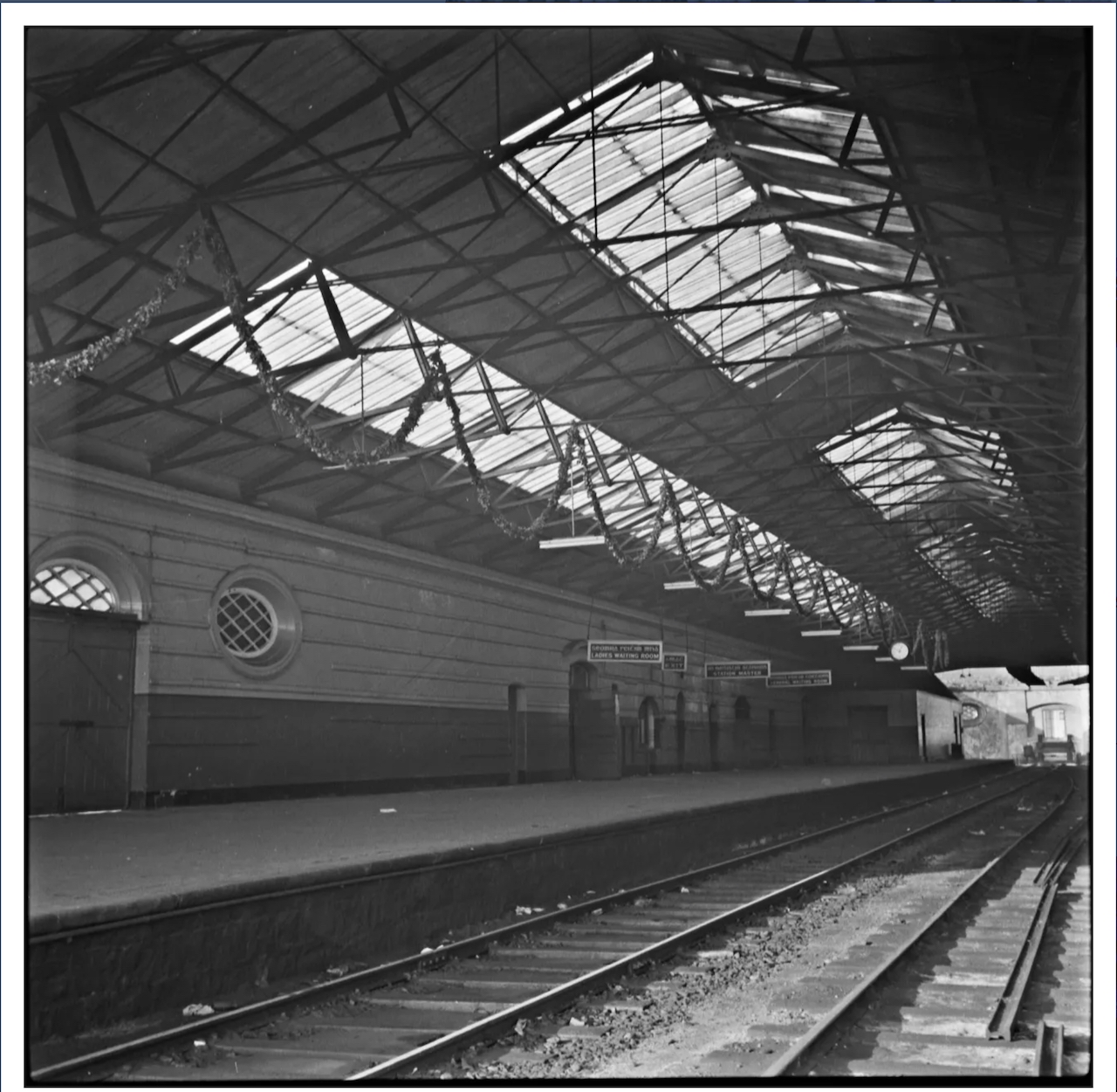
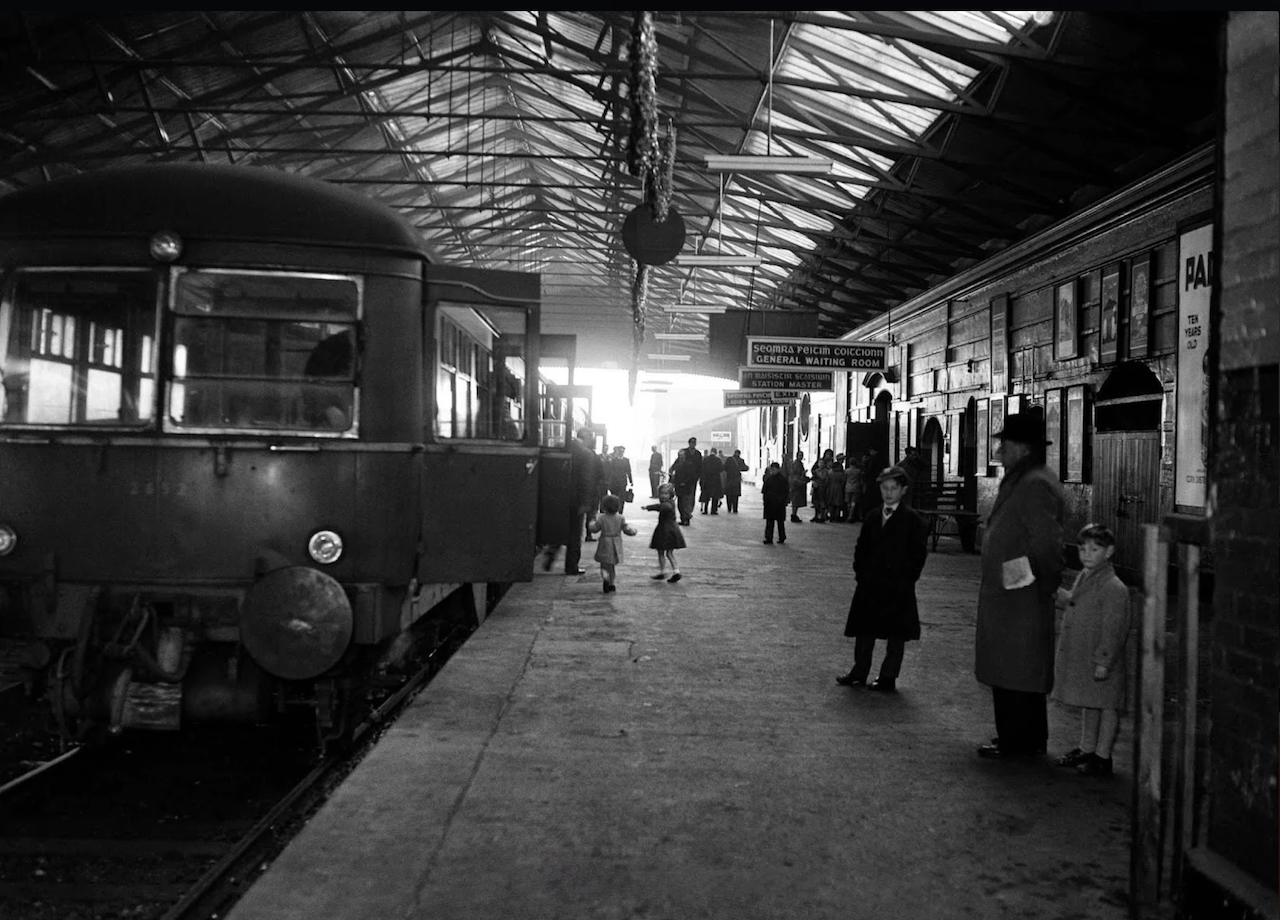
The Odeon, 1931, from the National Library archives, see flickr constant commons.
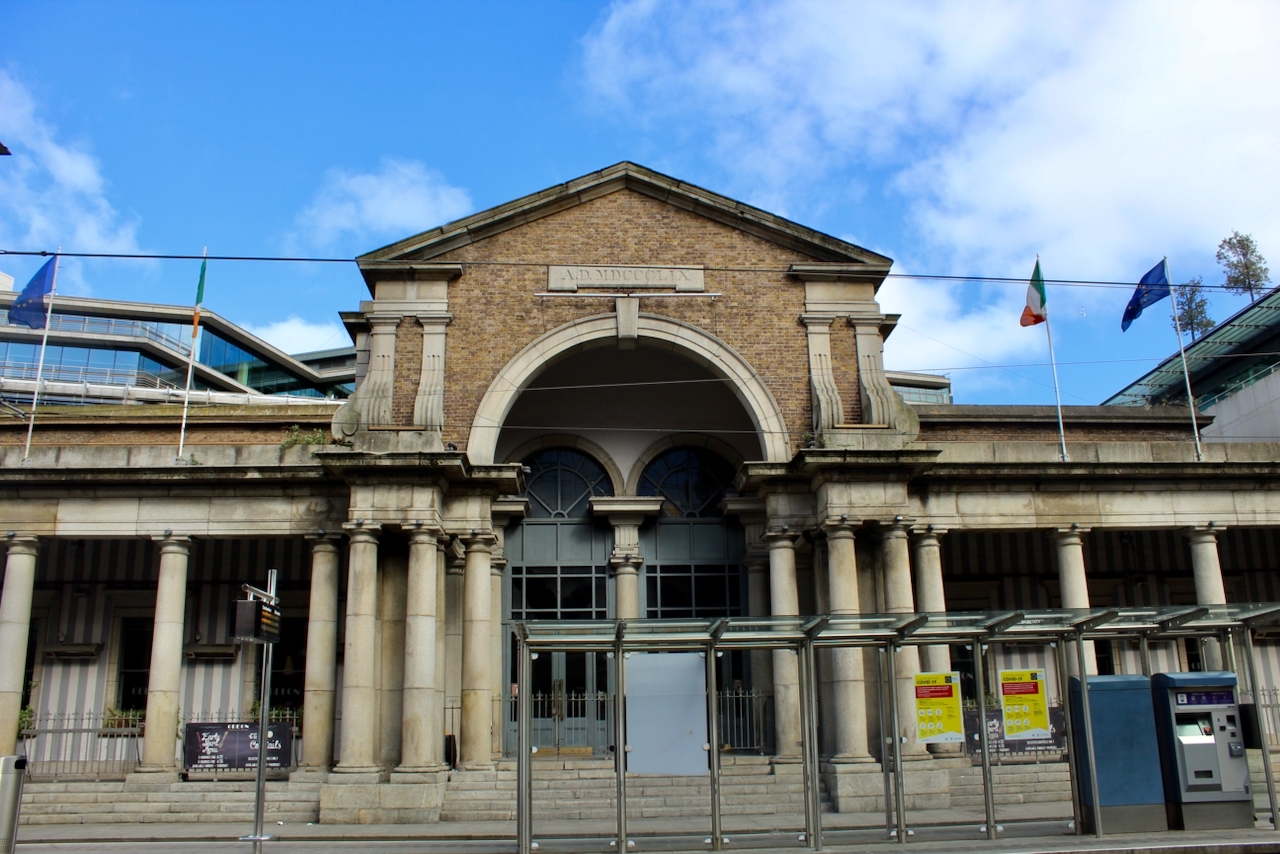
The Odeon, December 2020. Photograph © Jennifer Winder-Baggot, www.irishhistorichouses.com

Railways began in the 1550s as wooden rails used in mines to transport tubs carrying ore. That reminds me of the way Bord na Mona used trains to carry their turf on the bog, and the Guinness brewery also had its own train lines for transporting barrels of stout within the site.

The first public commuter railway system in Ireland launched in 1834 and ran between Dublin and Dún Laoghaire, formerly named Kingstown. [1] The Dublin and Kingstown Railway (D&KR) travelled from Westland Row in Dublin.

The Harcourt Street Station, built in 1859, was the terminus for the Dublin to Bray, County Wicklow train. Passengers could travel to the villages of Dundrum, Stillorgan and Milltown, and the train line helped to develop Bray into a seaside resort. An article in the Irish Independent, “Fascinating story of Harcourt Street line retold,” published 29th February 2012, tells us that two companies vied for the contract to run the train line. One company started building from Harcourt Street, the other from Bray. It was decided that the first to reach Dundrum would win the contract to run the Railway line. William Dargan was the successful contractor. [2]

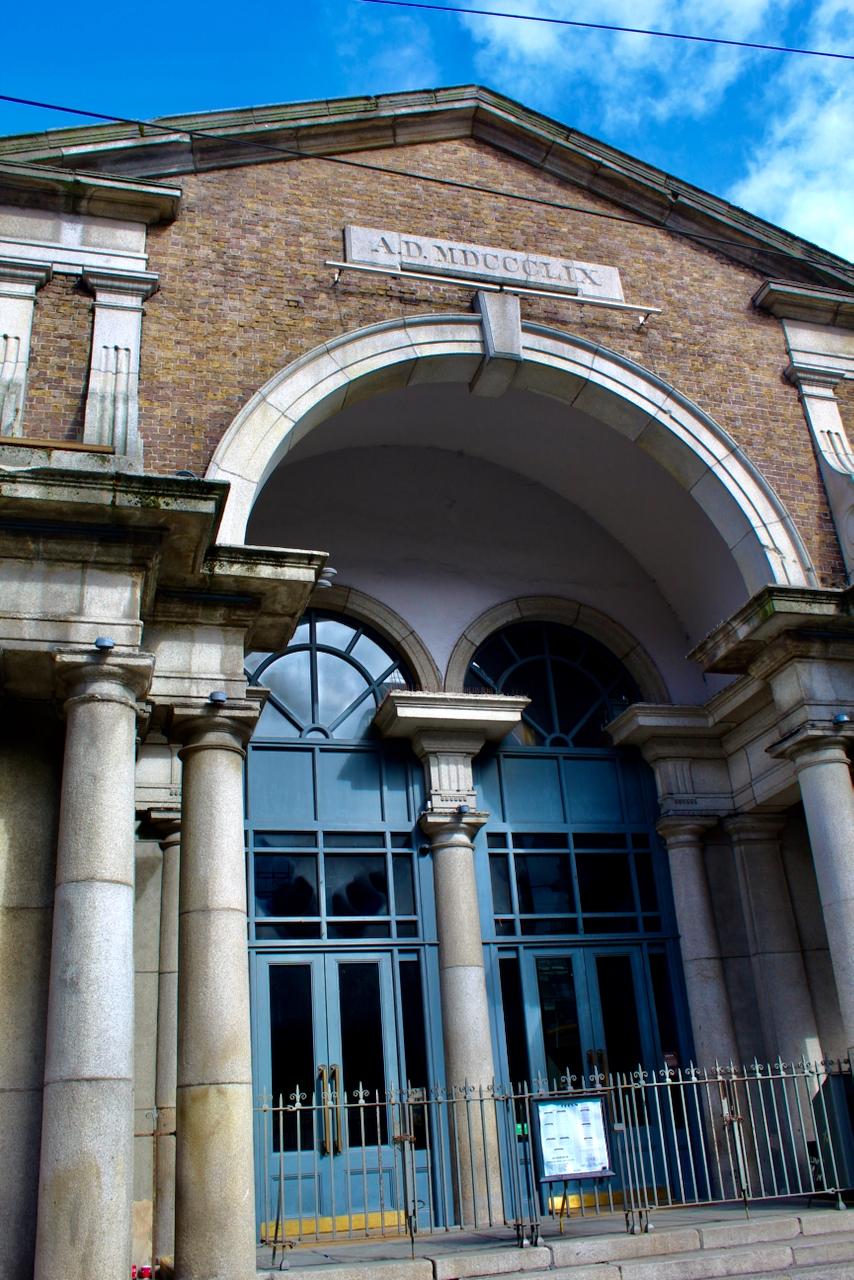
The Odeon, December 2020. Photograph © Jennifer Winder-Baggot, www.irishhistorichouses.com

Before trains, public transportation comprised of stagecoaches travelling specified routes between coaching inns and horse-drawn boats carried paying passengers along canals.

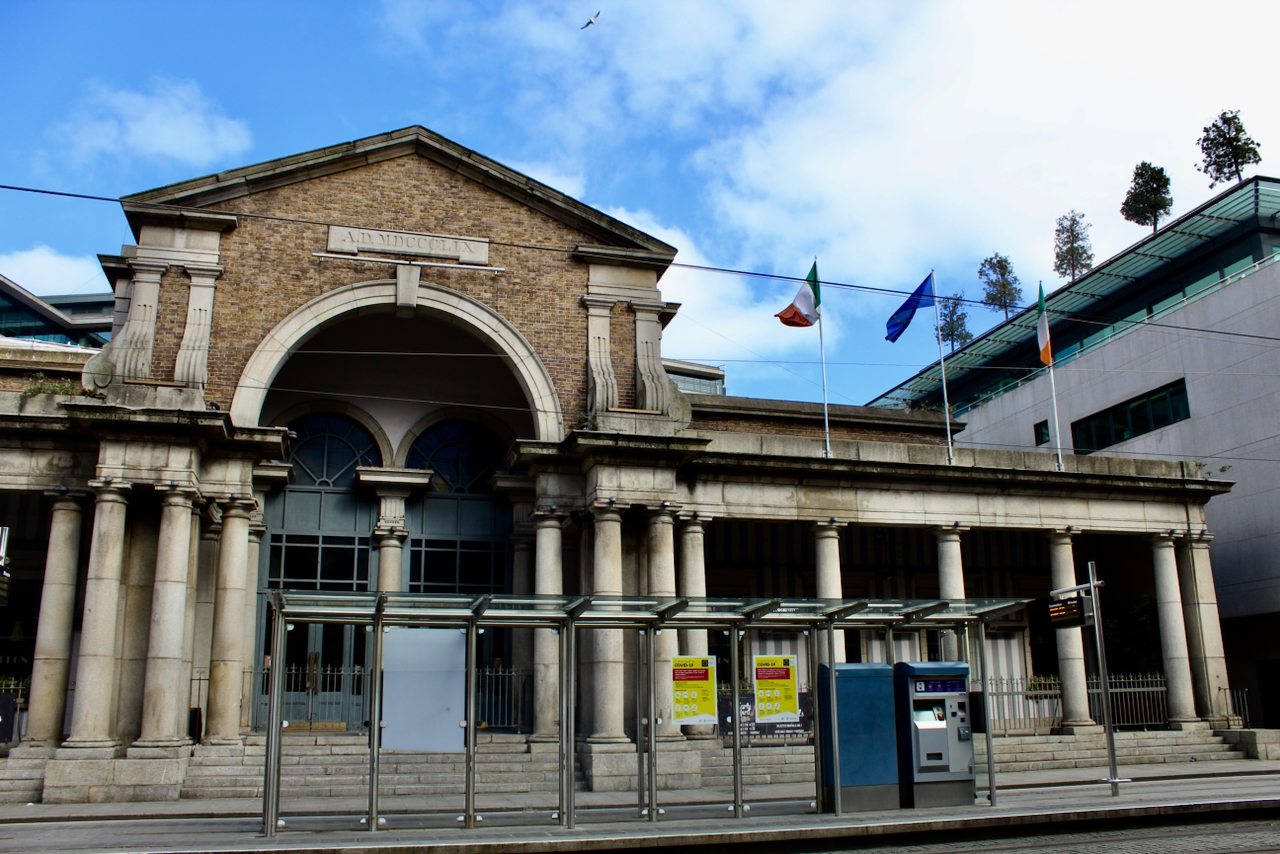
The Harcourt-Bray train travelled for a century, ceasing in 1959. Much of the former trackbed remained intact and now carries the Luas, the Dublin light rail, the modern version of the tram. The Luas station ‘furniture’ impedes photography of the building and my attempts to highlight its architectural features!

The Odeon, December 2020. Photograph © Jennifer Winder-Baggot, www.irishhistorichouses.com

An entry about Dublin tram history on the Dublin City Public Participation Network tells us that the idea of transporting people along a fixed route within a city began in Nantes, France, around 1823, when Stanislas Baudry opened a bath house outside the city and started a shuttle service that left the town centre on a regular schedule. [3] I’m glad that the first fixed route city public transport system was for bathing and not for work, as I would have expected!

After Baudry realised some passengers used the shuttle to travel to destinations along the route, he created the first urban transit service in 1826 in Nantes, calling his coaches the “Omnibus” (Latin for “for all”). He quickly expanded to Bordeaux, Lyon, and eventually Paris. [see 3]

Architect George Wilkinson (1840-1890) designed the Harcourt Street station. [4] After he built twenty-four workhouses in England, in 1839 the Poor Law Commission in Ireland invited Wilkinson to design 130 workhouses. After eleven years, the Commissioners of the Poor Law decided that they could no longer afford their own full-time architect, and in September 1855 Wilkinson was retired on a pension of £300 per annum. [5]

The Odeon, December 2020. Photograph © Jennifer Winder-Baggot, www.irishhistorichouses.com

Next, Wilkinson designed railway stations, mostly for the Midland Great Western Railway Company. As he acknowledged, a workhouse had to be “uniform and cheap, durable and unattractive” so that people would be discouraged from applying to them for aid and accommodation. He took pride in his work, however. To underline the painstaking attention he had given to the materials used in the construction of the workhouses, Wilkinson published in 1845 his Practical Geology and Ancient Architecture of Ireland, which included a detailed account of the building materials available in the different counties with tables of the experiments he had conducted on the principal Irish building stones. [see 5] He managed to insert an Italianate tower in the Carlow workhouse.

The Dictionary of Irish Architects tells us that in August 1860 Wilkinson was appointed architect to the Commissioners of Asylums for the Lunatic Poor at a salary of £300 per annum. He designed two identical asylums at Castlebar, Co. Mayo, and Letterkenny, Co. Donegal. He remained in the post until 1886. He appears to have done relatively little private work. A few houses are recorded in Bray and Dalkey and a marble staircase for the Marquess of Sligo at Westport House (1858) but he does not seem to have designed any commercial premises or churches. His last important recorded commission was the new agricultural hall for the Royal Dublin Society at Ballsbridge, built in 1879-80. [see 5]

The Odeon, December 2020. Photograph © Jennifer Winder-Baggot, www.irishhistorichouses.com

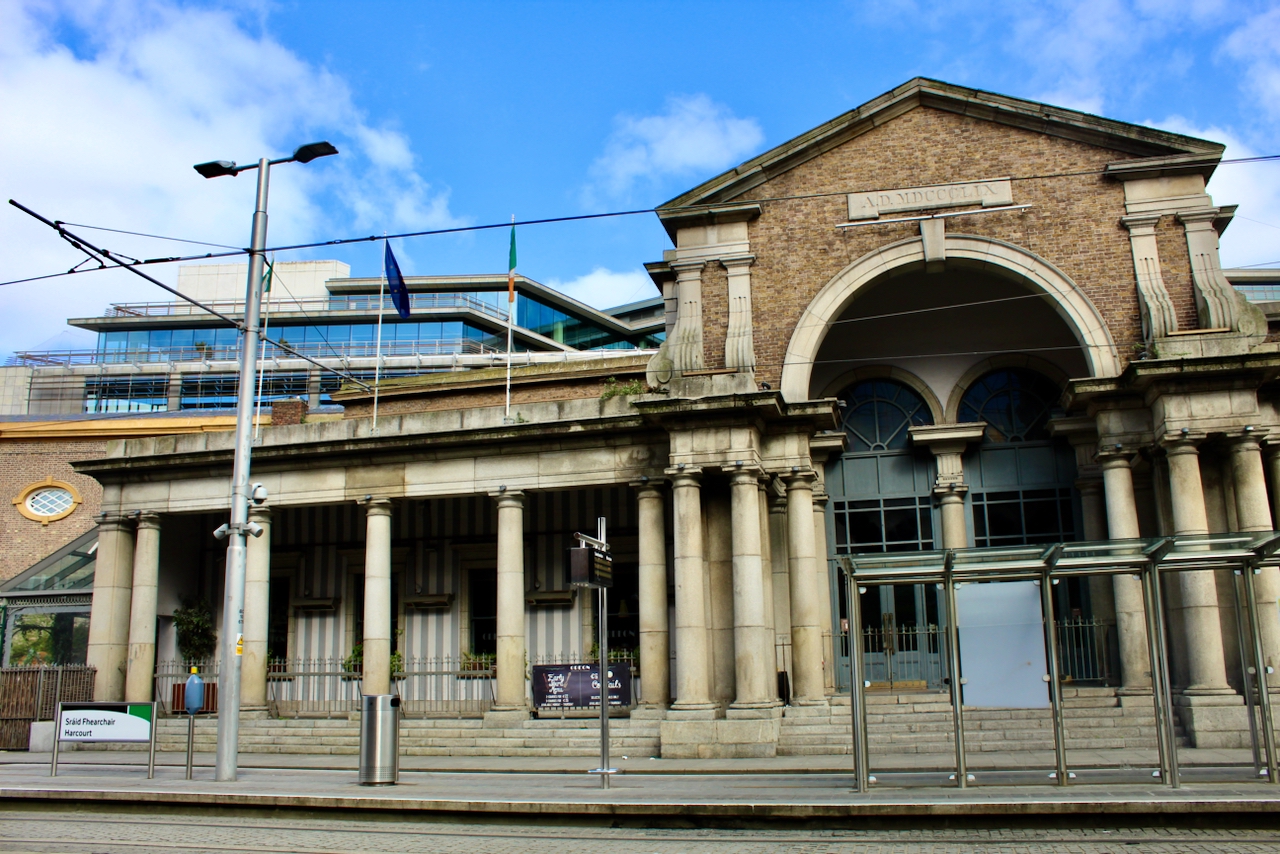
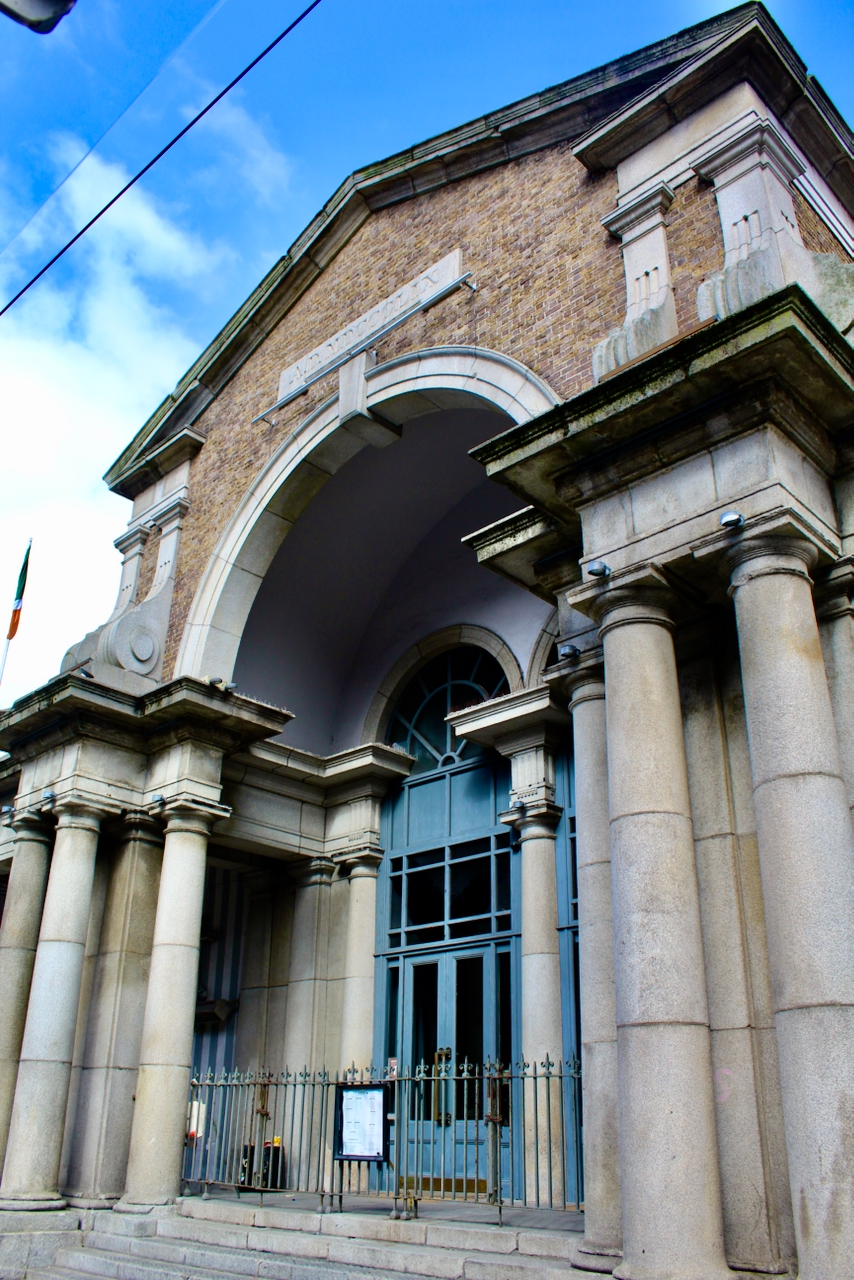
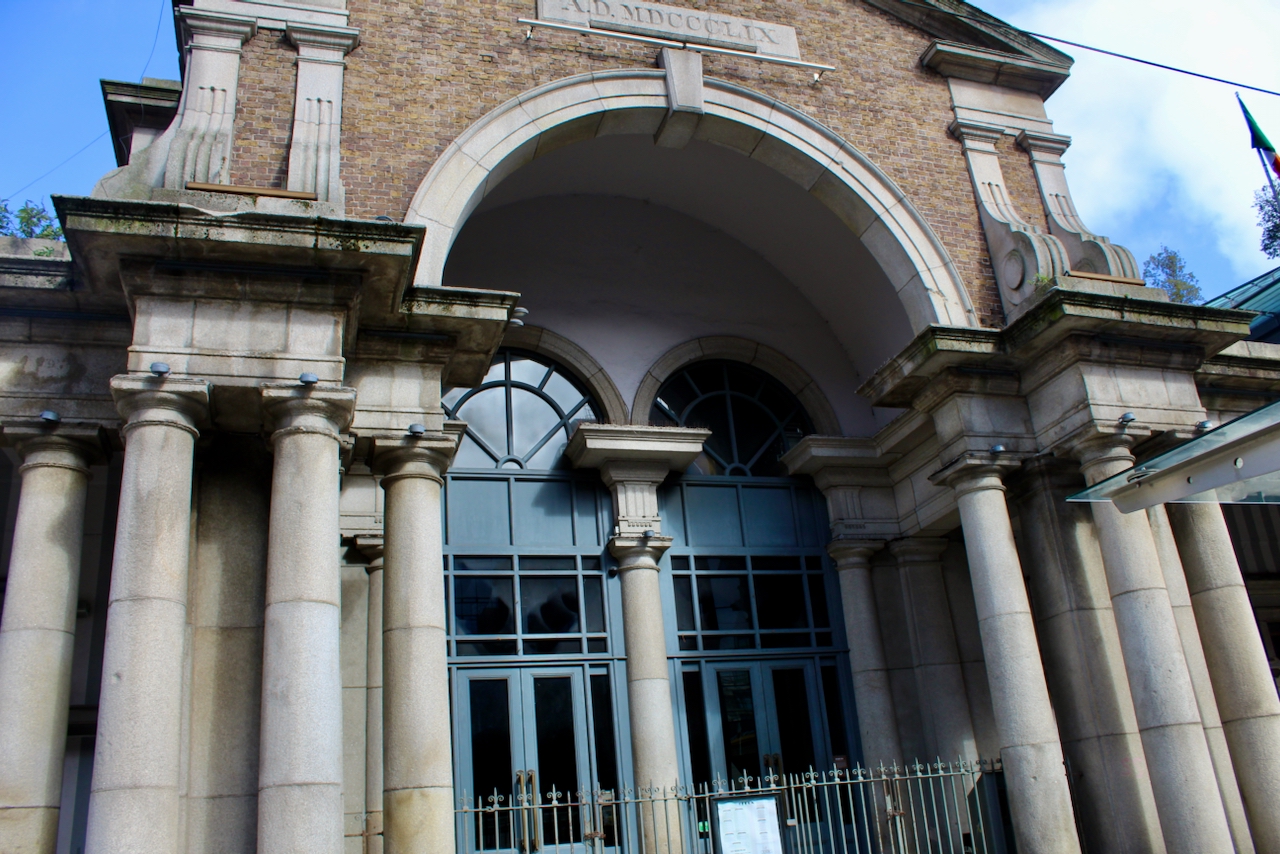
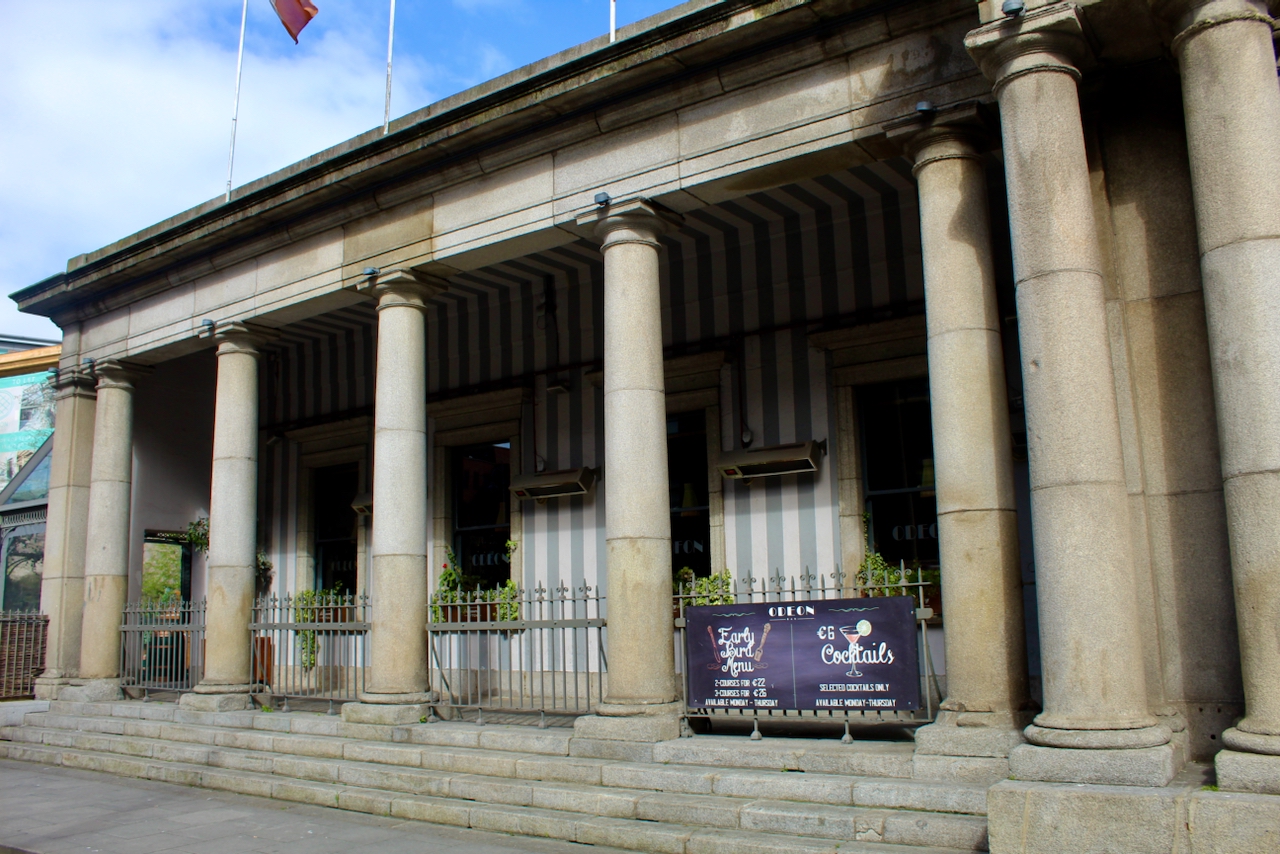
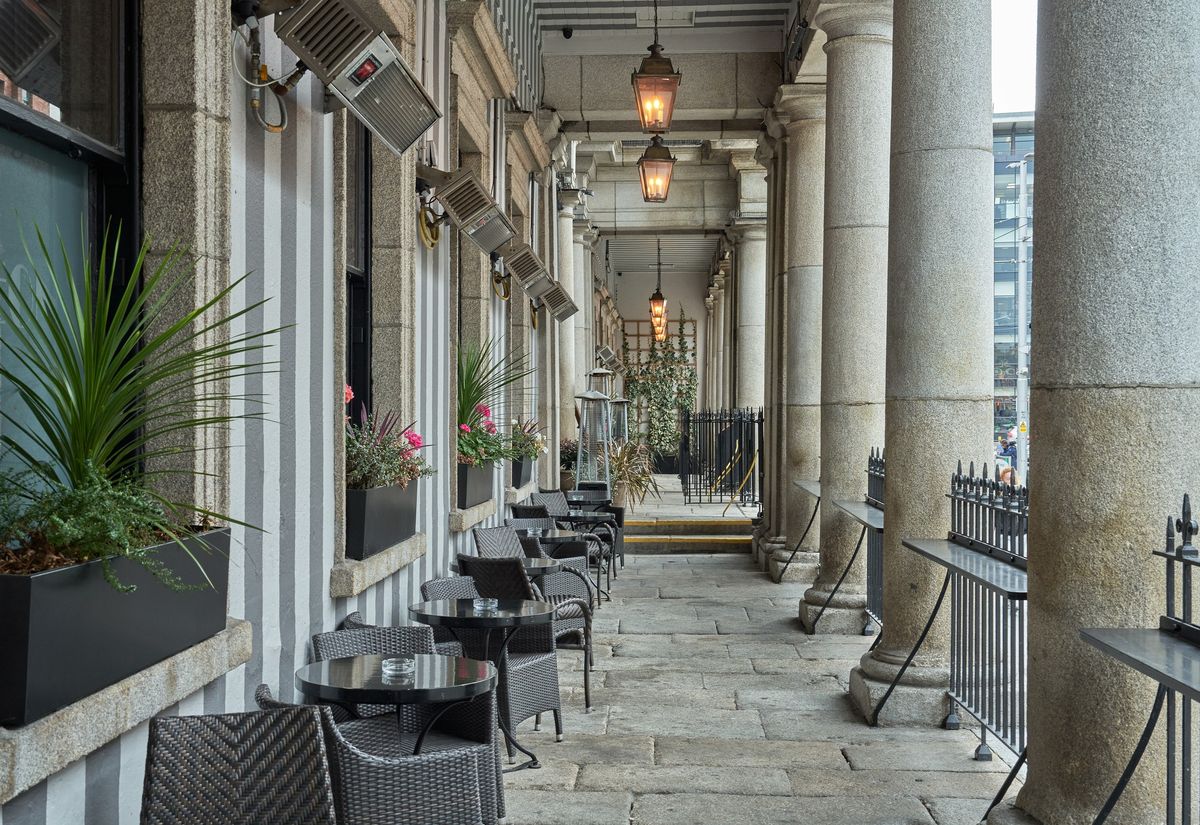
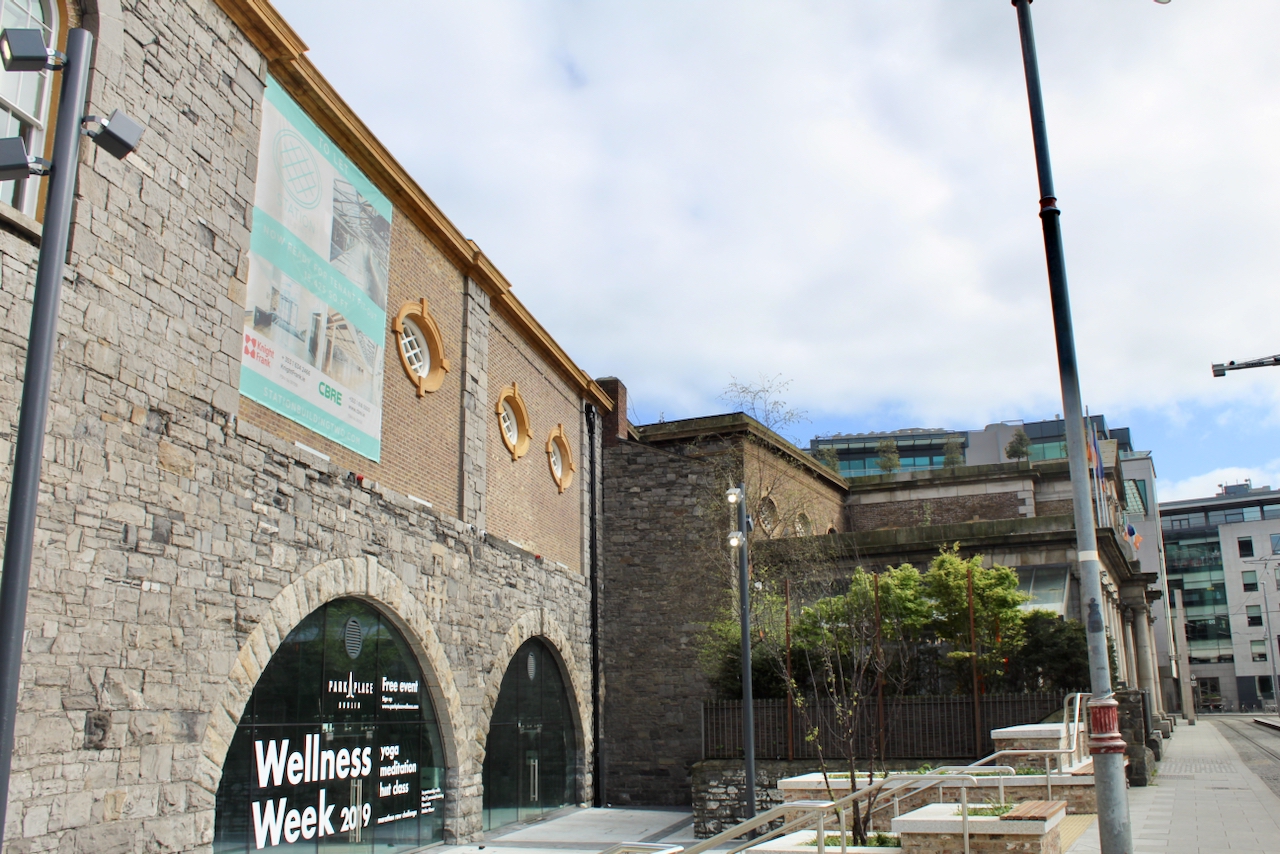
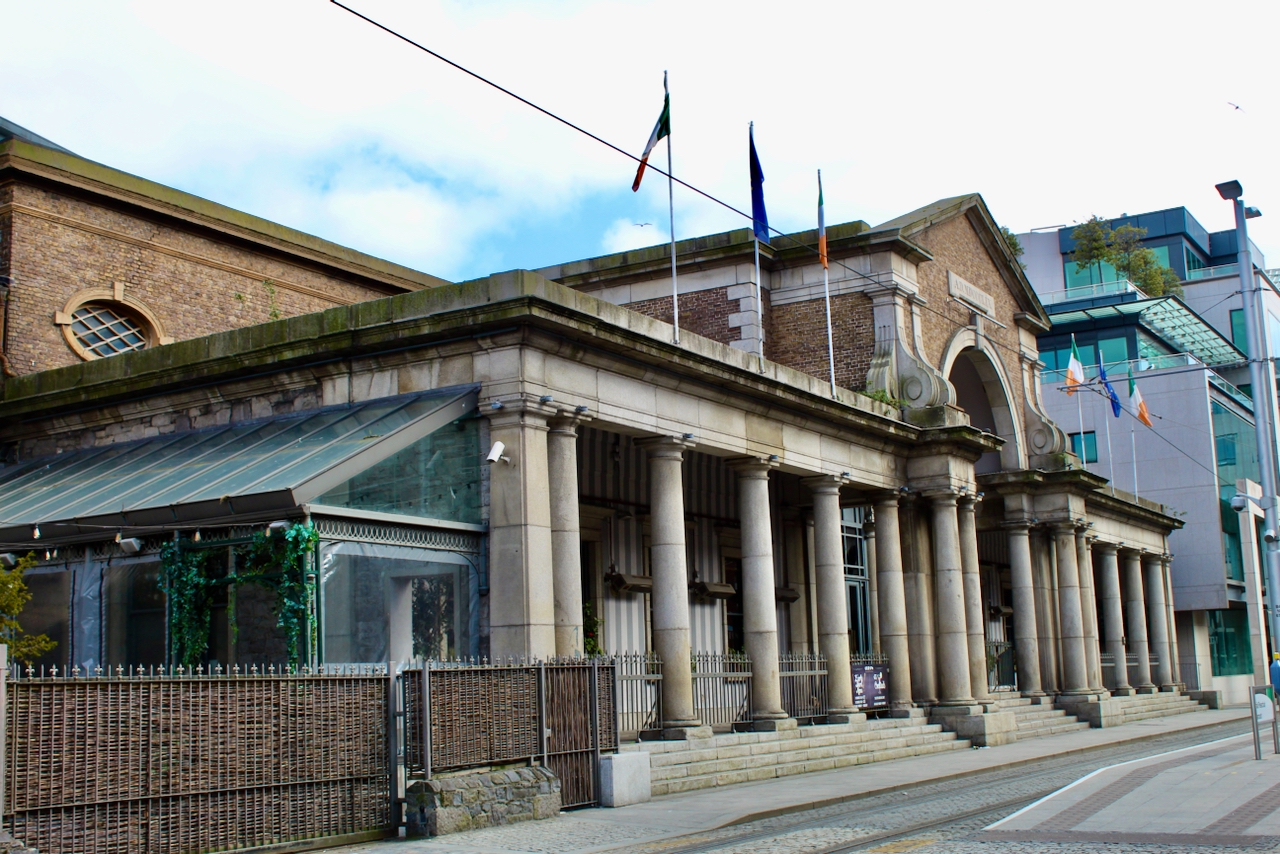
The building is brown brick with granite stone dressing. Two colonnades of Tuscan columns flank the central monumental arch porch which has the entrance doors inside under a further two stone arches. The building is fronted by stone steps as it was built on an embankment.

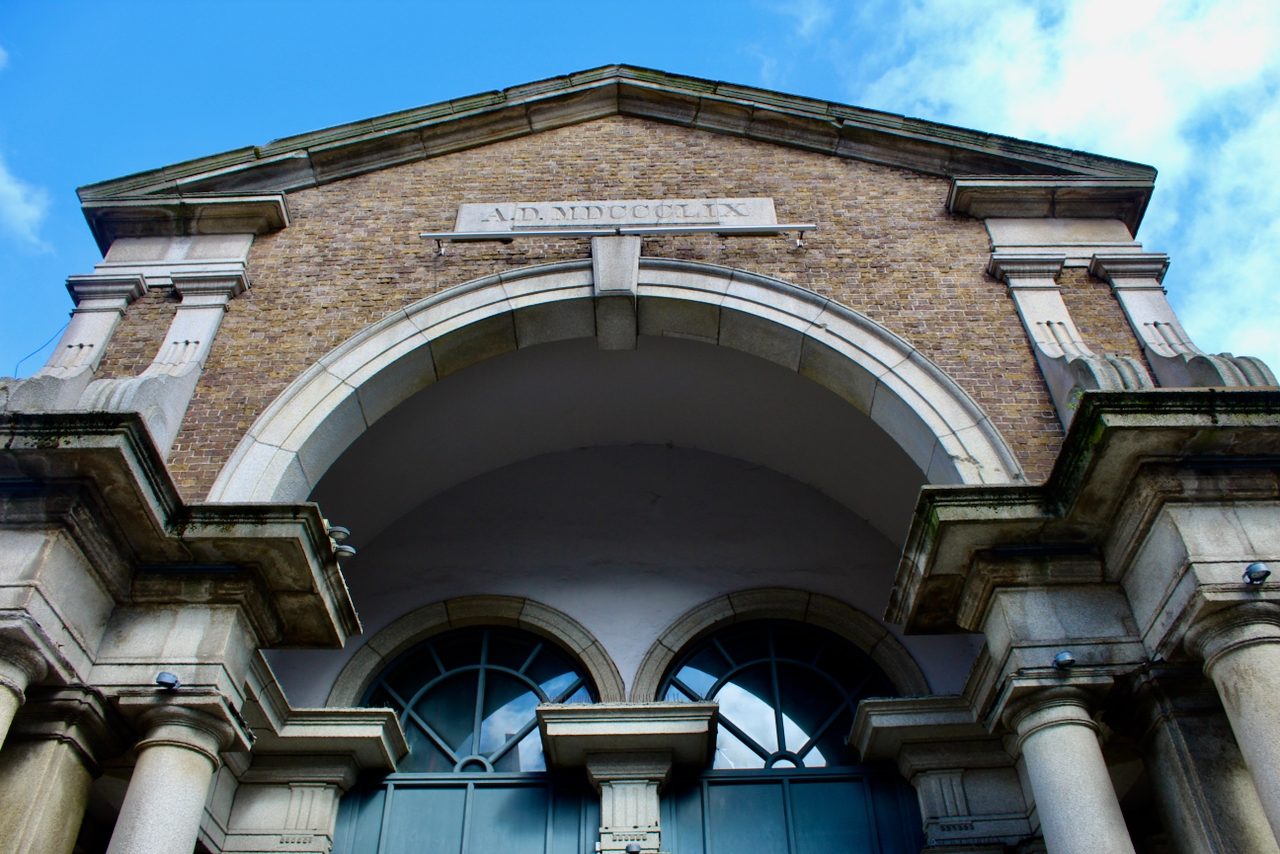
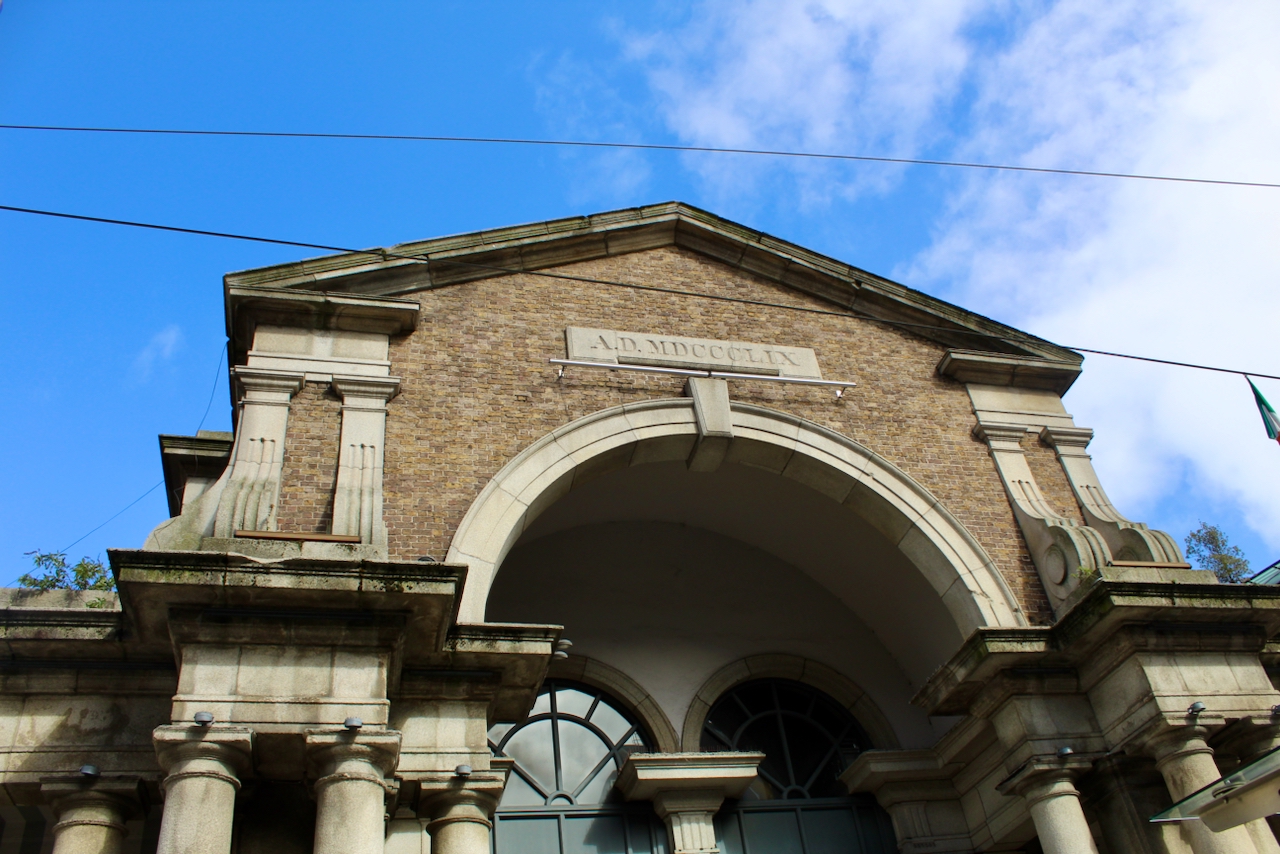
The central block is double height, topped by an open pediment portico which has ends sitting on a frieze on top of pairs of oversized granite scrolled “corbels.” The large entrance arch is supported on a structure of paired columns.

The Odeon, December 2020. Photograph © Jennifer Winder-Baggot, www.irishhistorichouses.com

A keystone in the cut granite arch sits under a granite plaque inscribed ‘MDCCCLIX’ (1859).

The Odeon, December 2020. Photograph © Jennifer Winder-Baggot, www.irishhistorichouses.com

The windows have granite architraves (decorative moulding around a window or door).

I like the added stripes inside the colonnades. The Odeon, December 2020. Photograph © Jennifer Winder-Baggot, www.irishhistorichouses.com
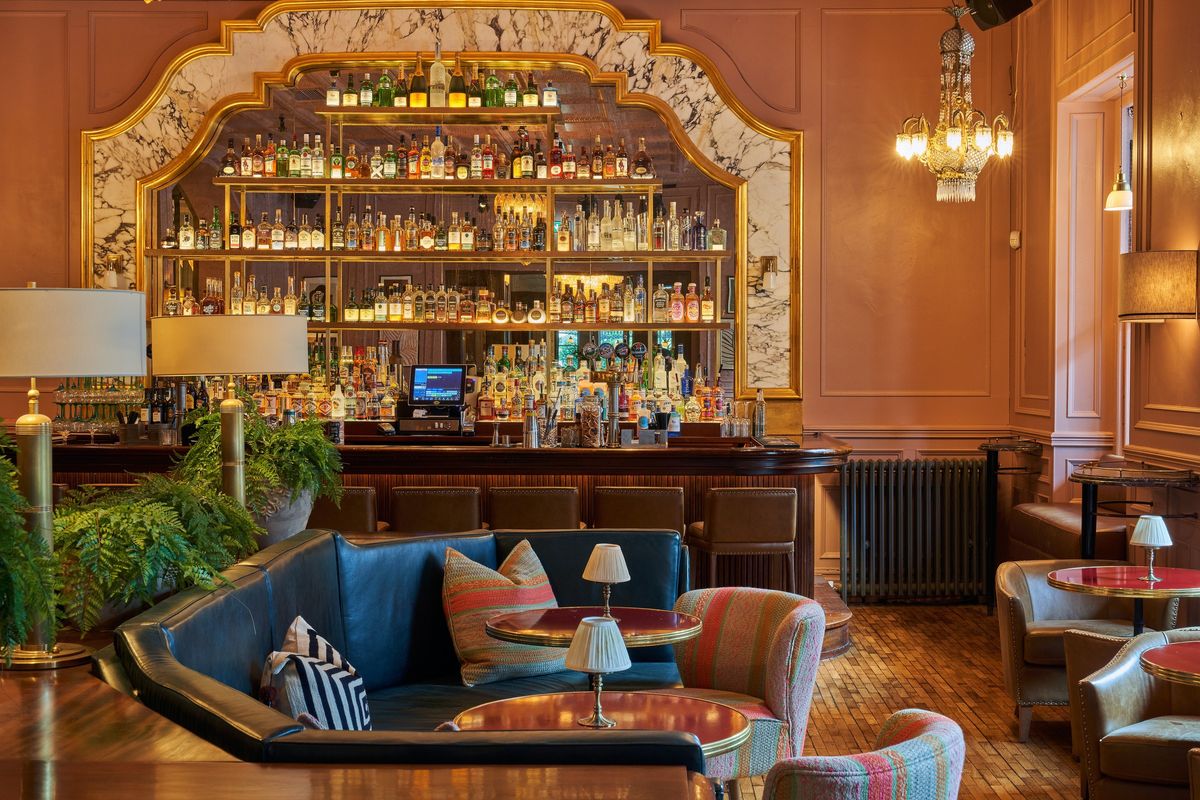
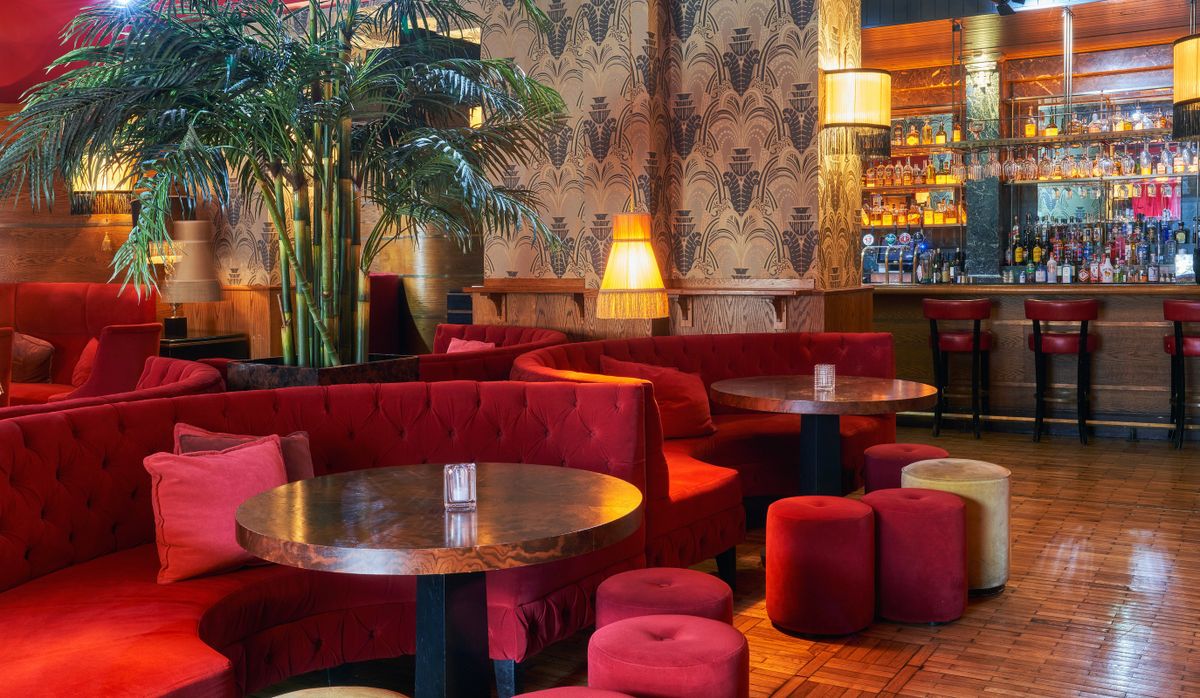
The Odeon, photograph courtesy of Lisney Commercial Real Estate, June 2025.
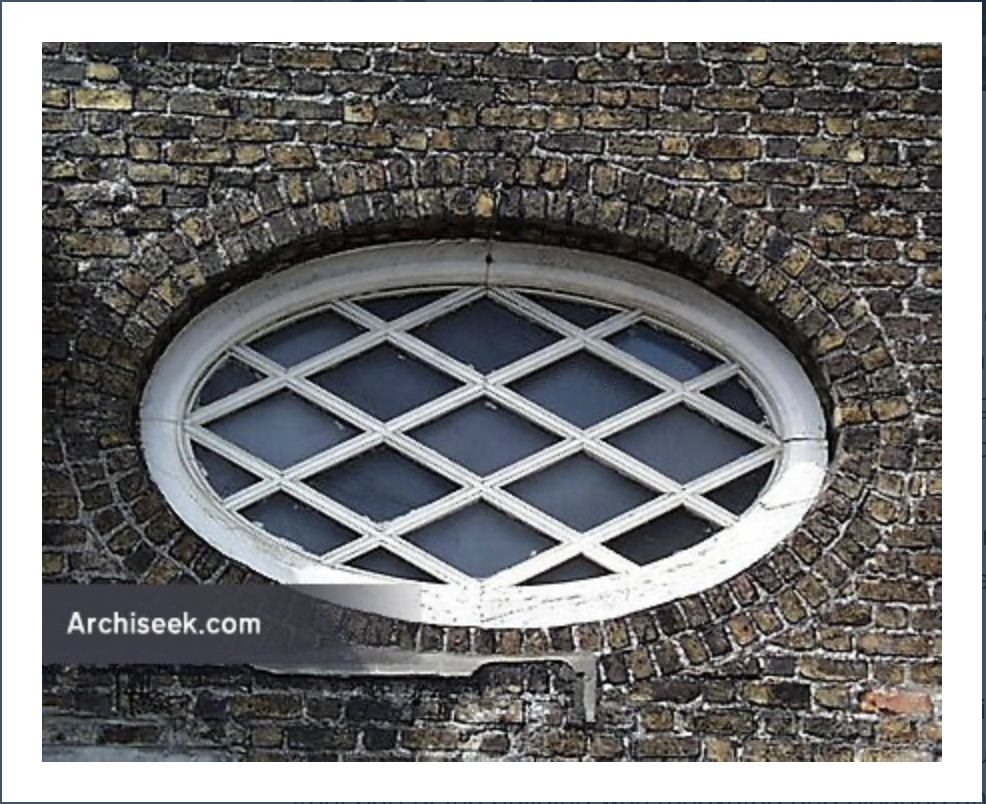
The building features lovely ovoid windows with wooden crosshatching. Photograph courtesy of Archiseek.

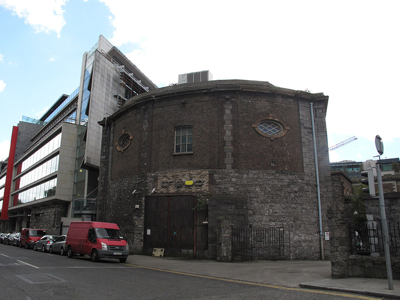
At the rear of Harcourt Street Station at Hatch Street is the curved end wall of the former trainshed. The curved is due to the placement of the former turntable upon which steam locomotives turned to travel in the opposite direction. [6] This engine shed was used at another time as a bonded warehouse.

Curved wall which housed the turntable for turning the trains, photograph courtesy of National Inventory.
The Odeon, the sheds and vaults are of brick and Calp (limestone) to contrast with the main building of brown brick with granite. December 2020. Photograph © Jennifer Winder-Baggot, www.irishhistorichouses.com
The Odeon, December 2020. Photograph © Jennifer Winder-Baggot, www.irishhistorichouses.com
The station platforms, photograph courtesy of Archiseek.
The Harcourt Street station, photograph courtesy of The Odeon website.

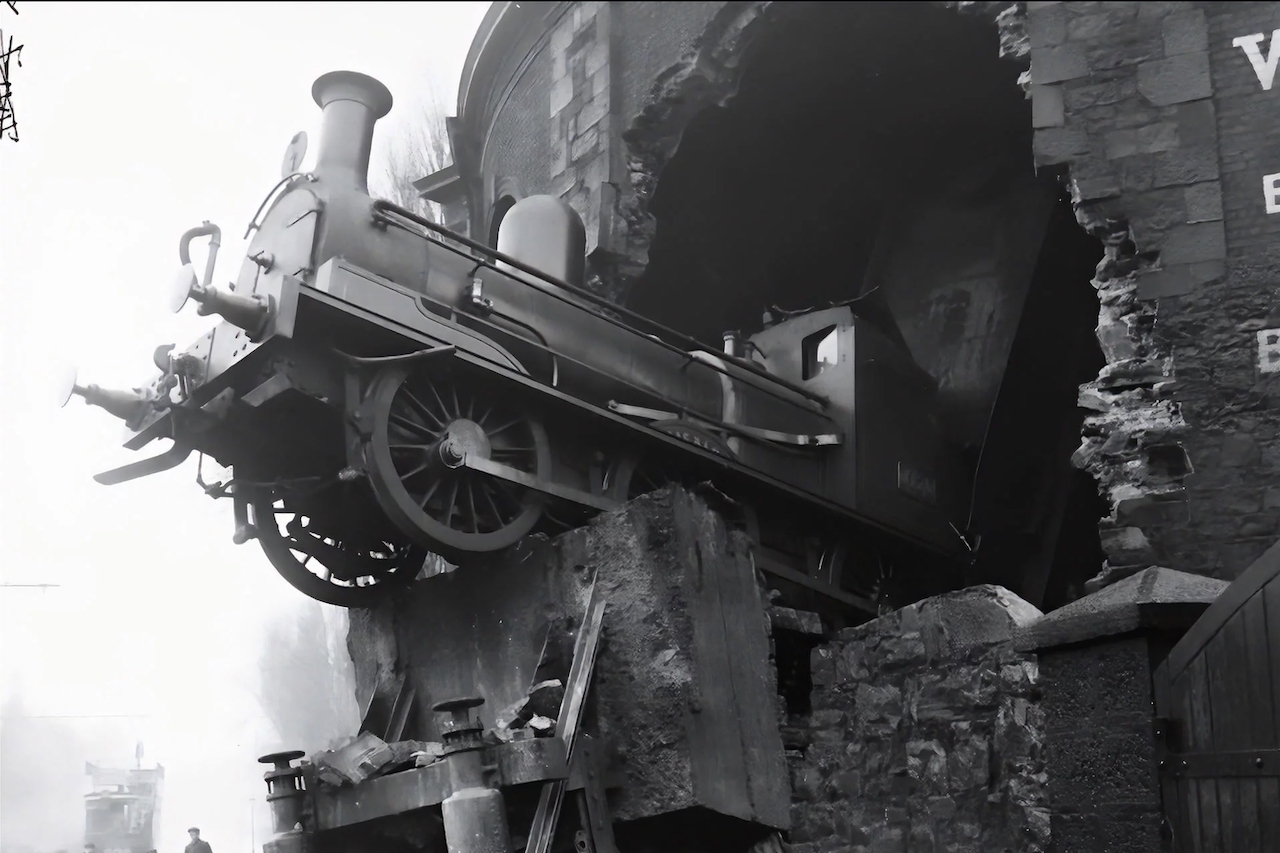
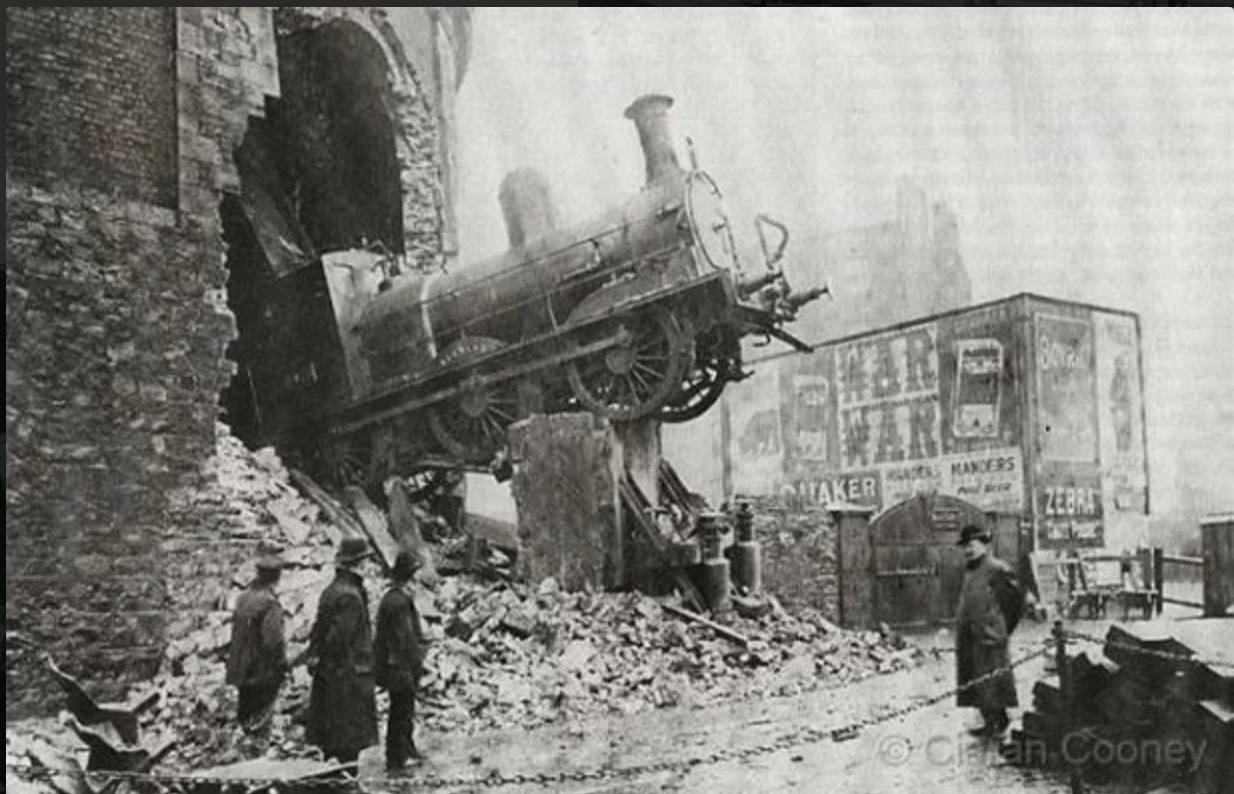
In 1900 an accident occurred, when a train failed to stop at the station due to the weight of 30 wagonloads of cattle.

The 1900 crash, photograph courtesy of Odeon website
The 1900 crash, photograph courtesy of Odeon website, copyright Ciaran Cooney.

Archiseek describes:

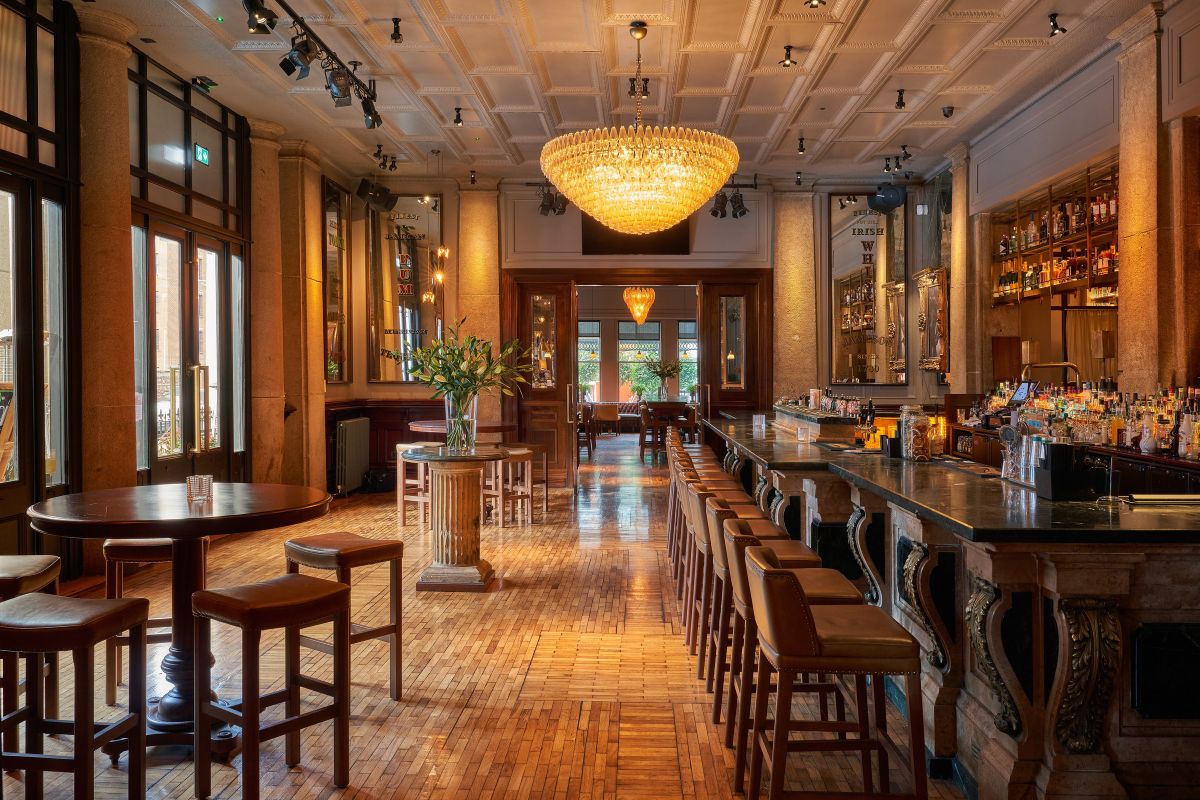
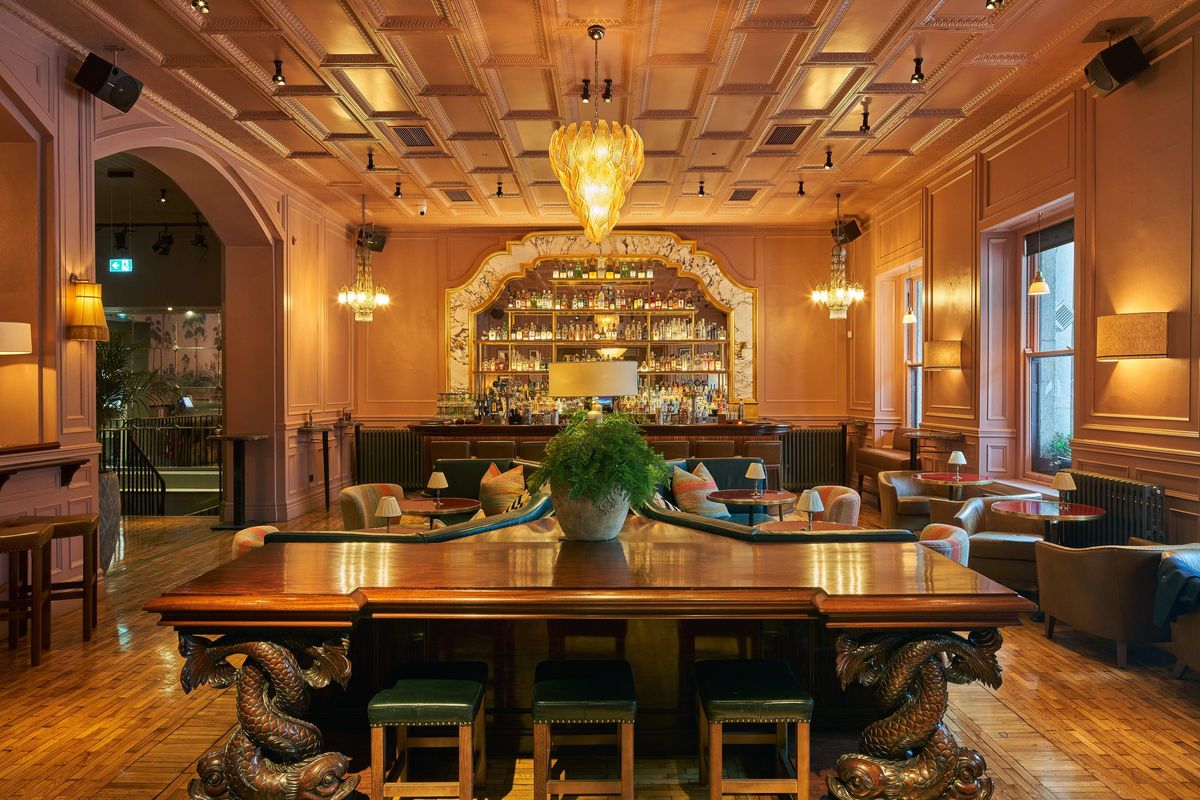
Beneath the station shed are excellent arched vaults originally designed as a bonded spirit store and now housing a wine merchants and one of Dublin’s trendiest nightspots. The main front part of the building has recently been renovated and cleaned and is now an enormous bar which looks and feels bigger that the external dimensions of the station would suggest. The bar design manages to be sympathetic to the original design suggesting a large ‘Gentleman’s Club’ of the Victorian era without descending to pastiche.

The rear of the station has various store buildings which were accessible from a raised ramp off Harcourt Road. Due for redevelopment, these stores are quite large containing many brick archways from area to area and were used by Dunlop for many years.” [4]

The Odeon, photograph courtesy of Lisney Commercial Real Estate, June 2025.

This entry makes me want to visit the Steam Museum in County Kildare, another Section 482 property! More next week on a different pub, Doheny and Nesbitt.

[1] https://modelrailwaymuseum.ie/history-of-irish-rail/

[2] https://www.independent.ie/regionals/wicklow/news/fascinating-story-of-harcourt-street-line-retold/27868681.html

[3] https://dublincityppn.ie/stories/the-rise-and-fall-of-the-first-dublin-tram-network-part-1-beginnings-to-one-network/

[4] https://www.archiseek.com/2010/1859-former-harcourt-street-station-dublin/

[5] https://www.dia.ie/architects/view/4918/Wilkinson-George

[6] http://eiretrains.com/Photo_Gallery/Railway%20Stations%20H/Harcourt%20Street/IrishRailwayStations.html#

Mount Hevey Hill, Hill of Down, County Meath 

Mount Hevey Hill, Hill of Down, County Meath 

Mark Bence-Jones. A Guide to Irish Country Houses (originally published as Burke’s Guide to Country Houses volume 1 Ireland by Burke’s Peerage Ltd. 1978); Revised edition 1988 Constable and Company Ltd, London.  

“A house of ca 1810; two storeys over basement, three bays. The seat of the Hevey Langan family.” 

https://www.buildingsofireland.ie/buildings-search/building/14404101/mount-hevey-kilnagallagh-co-meath

Mount Hevey, County Meath, courtesy National Inventory.

Detached three-bay two-storey over basement house, built c.1850. Gabled projecting central bay with Ionic entrance portico, approached by flight of limestone steps. Single-storey over basement projecting bay to west elevation, and two-storey over basement return to rear. Hipped slate roof with dentils to eaves soffits, and a pair of rendered chimneystacks. Rock-faced ashlar to first floor, with limestone strings courses and quoins. Timber sash windows with limestone sills. Three-bay outbuilding with dormer windows to rear. Limestone ashlar entrance piers with cast-iron gates. 

Appraisal 

The architectural form of this house is enhanced by architectural detailing. Each floor of the house is articulated with varying treatment of masonry and render. The entrance level is of apparent significance, with the channelled render and quoins, and is clearly defined from the floors above and below by the string courses. Rock-faced quoins have been employed at basement level, with ashlar quoins at first floor level. The breakfront and recessed window surrounds are interesting architectural details. The entrance porch adds artistic interest to the house. The house forms a group with the related garden structures and outbuildings. 

Mount Hevey, County Meath, courtesy National Inventory.

https://www.buildingsofireland.ie/buildings-search/building/14404102/mount-hevey-kilnagallagh-co-meath

Roughly dressed rubble limestone walled garden, built c.1890. Cast-iron railings and gates, limestone arch and glasshouse to south wall. Remains of garden building to north wall. Shell house inscribed ‘1912’. Limestone steps to south of walled garden. 

Appraisal 

The former walled garden, glass house and shell house, though now in poor condition, form an interesting group of related structures with Mount Hevey House and outbuildings. The cast-iron gates and railings of the walled garden are particularly elaborate. 

Mount Hevey, County Meath, courtesy National Inventory.

https://www.buildingsofireland.ie/buildings-search/building/14404103/mount-hevey-kilnagallagh-co-meath

Roughly dressed rubble limestone farmyard complex, built c.1850. Comprising a multiple-bay range running east-west to south, a three-bay range running east-west to north, and three ranges running north-west between the east-west ranges. Former farm labourer’s house to north-east corner. Weight machine to site. Roughly dressed rubble stone pier and cobbles to entrance. 

Appraisal 

This farmyard complex forms a group of related structures with the house and garden structures. The survival of many original features and materials, such as the slate roofs, stone dressings and timber sash windows enhance the form of these modest buildings. 

Mount Hevey, County Meath, courtesy National Inventory.

Record of protected structures: 

Mount Hevey, townland: Kilnagallagh, town: Kinnegad 

Detached three-bay two-storey over basement house, built c.1850. Three-bay outbuilding with dormer windows to rear. Limestone ashlar entrance piers with cast-iron gates. 

http://meathhistoryhub.ie/houses-k-p/ 

Mount Hevey is located at Hill of Down, Clonard, Kinnegad. The name of the townland is Kilnagallagh. Casey and Rowan describe Mount Hevey as a square Italianite villa of a type popularised by William Caldbeck in the 1850s.  The house consists of two storeys over a basement. The house dates to about 1860 but there was an earlier house which was incorporated into the farmyard. The farmyard complex dates from about 1860, the same time as the house was erected. A walled garden dates from about 1890. There is a shell house bearing the date “1912”. 

There is a record of a John Hevey, merchant, in Kinnegad in 1746. In 1805 there is a record of Garrett Hevey of Mount Hevey. Patrick Langan married Mary Hevey of Mount Hevey. Their son, Frederick Hevey Langan, inherited Mount Hevey from John Hevey, Mary’s father. 

In 1835 it was leased to Mr. Heavy of Mount Heavy by the owner Mr. McManus. In 1854 the townland was in the ownership of James McManus and Frederick H. Langan was renting the major part of the townland and he in turn was renting a house offices and land to Michael Hevey. The major house was the residence of Frederick H. Langan. 

Frederick Hevey Langan was born in 1825. He was a magistrate. In 1876 Frederick H. Langan of Mount Hevey held 929 acres in County Meath and 2051 acres in County Galway. He died in 1890. In 1901 John H. Langan and his wife were residing at Mount Hevey. The house had nineteen rooms, twenty two windows to the front and twenty eight outbuildings. John Francis Hevey Langan was the only son of Frederick Hevey Langan and was born in 1871. In 1900 he married Rowena Martin of Dublin and they had three children, two daughters and a son, Frederick. John was High Sheriff of Meath in 1913. The family also had property in Dublin. John died in 1955. His eldest son, Frederick Hevey Langan, married Myrrha Jepson about 1940. Frederick Hevey Langan was involved in the R.D.S. and was nominated as a candidate in a Senate election in 1970. Frederick died in 1978, a year after Mount Hevey was sold.  His only son, Peter St. John Hevey Langan, became a barrister and was called to the English Bar in 1967. Princess Margaret attended the ceremony. 

Williamstown House, Castlebellingham, Co Louth 

Williamstown House, Castlebellingham, Co Louth 

Mark Bence-Jones. A Guide to Irish Country Houses (originally published as Burke’s Guide to Country Houses volume 1 Ireland by Burke’s Peerage Ltd. 1978); Revised edition 1988 Constable and Company Ltd, London.

p. 285. “(Walsh/IFR) A mid-C19 Italianate house of two storeys over rusticated and vermiculated basement. Five bay front, with broken pediment above central Wyatt window and portico with Ionic columsn and Doric corner piers. Entablatures on console brackets over some windows. Windows with straight-arched heads in upper storey; rectangular windows below and camber-headed windows in basement. Eaved roof on bracket cornice.” 

https://www.buildingsofireland.ie/buildings-search/building/13901511/williamstown-house-williamstown-co-louth

Williamstown, County Louth, courtesy National Inventory.

Detached five-bay two-storey over basement house, built 1856-60. L-plan, single-bay three-storey over basement return to north, broken pedimented breakfront over projecting portico to south, lean-to single-storey return to north-east. Hipped slate roofs, clay ridge tiles, smooth rendered ruled-and-lined corbelled chimneystacks, stone caps and clay pots; projecting eaves on chequer-set brackets, painted timber soffit supporting moulded cast-iron gutters, circular cast-iron downpipes. Smooth rendered ruled-and-lined walling to ground and first floor, smooth rendered channelled basement, ashlar limestone plinth and stringcourse between ground and first floors, ashlar limestone rock-faced quoins to basement, channelled quoins ground floor, vertical banded quoins to first floor; random rubble stone walling to basement, north; family crest to tympanum of pediment, south. Segmental-headed windows openings to basement, vermiculated block-and-start rendered surrounds, rock-faced limestone keystones, limestone sills, multiple-pane metal casement windows; square-headed openings to ground floor, limestone sills over moulded panel, smooth rendered surround console brackets to limestone cornice, painted timber one-over-ones sliding sash windows; basket-arched openings to first floor, limestone sills over recessed panels, roll-moulded smooth rendered surrounds, painted timber two-over-two sliding sash windows; Wyatt window to breakfront, tooled limestone surround comprising panelled pilaster, console brackets, frieze and cornice, painted timber sliding sash windows; simple Wyatt windows to north elevation central return, tooled limestone mullions and surround, painted timber fixed windows with margin-lights. Tooled limestone entrance portico to south comprising paired Ionic columns flanked by Doric piers supporting frieze and dentil cornice, rounded carved detailing to roof of portico; round-headed door opening, moulded surround, console keystone, flanking Doric pilasters, round-headed sidelights in turn with flanking pilasters, egg-and-dart and dentil cornice; timber double doors with four decorative raised-and-fielded panels, etched glass fanlight; flight of stone steps to entrance flanked by tooled limestone vermiculated blocks. Enclosed yard to north bounded by random rubble stone wall containing ranges of brick and stone outbuildings. Walled garden to north-east, remains of glass house and gardener’s house to north-east corner. Three-bay single-storey gate lodge to south-west, central canted entrance bay, hipped roof (slates missing) painted timber bargeboards, smooth rendered ruled-and-lined walling. Elaborate wrought-iron gates flanked by squared smooth rendered piers, pyramidal caps and iron railings. 

Appraisal 

Designed by William Caldbeck this is a fine example of the Italianate architecture, popular in the mid-nineteenth century. Fine proportions and symmetry give this building elegance and the beautifully executed detailing around window and doors give artistic significance to the building. The striking limestone portico and elegant pedimented breakfront are features worthy of particular note. The existence of the outbuildings, walled garden, gardener’s house and gate lodge are also significant as they form the original context of Williamstown House which was once important to the local population, provided employment to the community. 

Casey, Christine and Alistair Rowan. The Buildings of Ireland: North Leinster. Penguin Books, London, 1993.  

p. 186 

Glebe House, Farrantemple, The Rower, Inistioge, Co Kilkenny

Glebe House, Farrantemple, The Rower, Inistioge, Co Kilkenny, for sale March 2025 courtesy Sherry Fitzgerald.

Glebe House, Farrantemple, The Rower, Inistioge, Co Kilkenny, for sale March 2025 courtesy Sherry Fitzgerald.

R95Y2V9, €850,000

4 Bed, 3 Bath, 257 m²

A wonderful opportunity has arisen to purchase a most gracious double fronted Victorian residence which dates back to Circa 1850. Glebe House is a warm, welcoming and stylish family home located in a picturesque countryside setting on edge of The Rower village close to Inistioge in County Kilkenny. The current owners purchased the property in 1997 and have painstakingly refurbished it to maintain all the period detail characteristic of the Victorian era including high ceiling with detailed ceiling cornicing, centre roses, sash windows with architraves and shutters and original fireplaces. The recent upgrades to Glebe House include a new oil burner, new bespoke made front door and new sash windows in the bathroom and the gable end window in bedroom one. The two external walls in bedroom three have been drylined and insulated. Bespoke made fitted wardrobes have been fitted in the dressing room for bedroom one. Solar Panels have been fitted on the roof of the coach house. An electric car charger has been installed in the courtyard.

GLEBE HOUSE: Internally, the accommodation extends to 257 sq. m. / 2,766 Sq. Ft. approx. and is laid over two levels. The layout at ground level comprises: entrance hall, drawing room, dining room, inner hall, guest wc, kitchen/dining room, pantry and a utility room. A family room located off the kitchen/dining room completes the ground floor accommodation. The layout at first floor level comprises: impressive landing area, shower room, three good sized double bedrooms and a single fourth bedroom. The first floor accommodation is completed with a dressing room and a family bathroom.

COACH HOUSE: The original coach has been completely refurbished to create a delightful three bedroomed residence extending to 136 Sq. M. / 1,460 Sq. Ft. approx. (not including the garage/workshop. The property has been separately BER rated to a D2 rating. The original stone walls have been exposed creating lots of character in the property. The layout at ground floor level comprises: entrance hall with staircase to first floor and a feature archway with open plan access through to a large kitchen/dining/living room. A guest wc and a utility room complete the accommodation at ground level. Underfloor heating throughout the ground floor. The layout at first floor level comprises: large landing area, three very generous sized double bedrooms (1 en-suite) and a main bathroom.

GARDENS AND GROUNDS: (Circa 2.25 Acres) The main house links seamlessly with the gardens and grounds with an abundance of sash windows offering plentiful sunlight and amazing views of the surrounding gardens and countryside. The magnificent walled garden is a truly outstanding feature of this fine property. The garden offers complete privacy, it is laid in lawn with a wonderful array of specimen plants, trees, shrubs, spring flowers, bulbs and a collection of herbaceous plants. The gardens are a haven of tranquillity for nature and wildlife and contain wilded paddock, and owl box (occupied in past 2 years and again this year). Anyone who buys this has to commit to continuing to facilitate the owls. The property is accessed through wrought-iron gates with a striking rebuilt stone wall running along with the boundary of the road. A sweeping gravelled driveway with post and rail fencing leads down to the front of the property. A large gravel parking area provides generous off-street parking for several cars. Double wrought-iron vehicular gate give access to the courtyard. The house links seamlessly with the impressive and secure courtyard with access to the coach house and garage/workshop. An old wrought-iron farm gate gives access to the field from the courtyard. THE AGRICULTURAL LAND: The land is located to the front and side of the house and offers excellent privacy from neighbouring properties. It extends to circa 3.75 Acres / 1.51 Hectares and is suitable for grazing of livestock such as horses or cattle.

LOCATION: Glebe House is located in the townland of Farrantemple on the edge of The Rower, a small village in County Kilkenny, Ireland. The Rower is on the R705 regional road, roughly 30 km from both Waterford and Kilkenny and roughly 40km from Wexford and Carlow, making it very central to all the main towns of the south-east. New Ross, Graiguenamanagh and Inistioge are all within 10 minutes’ drive away. It lies in the beautiful valley of the River Barrow and on the slopes of Brandon Hill with many amenities such as walking, boating, fishing and horse riding nearby. The Rower village has a primary school, The Rower Pre-School, two churches, public house, Post Office, GAA field and community hall. Viewing: Strictly by appointment only with Estate Agent.

GROUND FLOOR Entrance Hall 1.58m x 0.35m + 2.12m x 2.39m. A wooden door with decorative fanlight open into a welcoming entrance hallway. Detailed ceiling cornicing, centre rose and picture rail. Feature high ceiling. Fitted carpet. Drawing Room 3.81m x 5.38m + 3.14m x 3.77m. Gracious reception room located to the front of the property. Original sash window, architrave and panels. Feature original white marble fireplace cast-iron inset with decorative tiling and tiled hearth. Detailed ceiling cornicing, centre rose and picture rail. Feature high ceiling. Fitted carpet. This room has been extended to the side of the property and features a large bay window with French doors opening out to a large patio area and the walled garden. Dining Room 3.85m x 5.36m. Feature original black slate open fireplace with cast-iron inset and decorative tiling. Dual aspect with three original sash windows, architraves and panels. Detailed ceiling cornicing, centre rose and picture rail. Feature high ceiling and original American Pine floorboards. Inner Hall (including staircase) 2.12m x 5.24m. A solid door with decorative fanlight opens into a very impressive inner hall. A striking staircase gives access to the first floor. Decorative ceiling coving. Fitted carpet on stairs and the hall. Step down to a tiled area which gives access to a guest wc and the kitchen/dining room. Guest W.C. 1.14m x 1.43m + 0.52m x 0.95m. Comprising wc and wash hand basin. Tiled floor and part wood panel walls. Extractor fan. Kitchen/Dining Room 3.92m x 6.82m. Spacious and bright open plan room located to the rear of the property. Bespoke solid oak kitchen from Castle Cabinets in Kilkenny. It comprises fitted wall and floor units and a display cabinet with black granite counter tops, tiled splashbacks and centre island. Zanussi freestanding electric cooker with double oven and ceramic hob. Integrated extractor fan. Zanussi integrated dishwasher and under counter fridge. Window overlooking courtyard. Feature wooden beam ceiling with recessed lighting. The dining area is very spacious and can accommodate a large table and chairs for family dining and entertaining. Original sash window. Tiled floor. Wooden glass panelled door to pantry. Open plan access with a step down to the family room. Pantry 1.99m x 1.32m. Feature archway, tiled floor and recessed lighting. Floor to ceiling fitted shelving. Family Room 4.16m x 4.86m. A comfortable and spacious room with two windows located to the side of the property. Vaulted wood panel ceiling with a Velux window gives this room pleasant natural light. Tiled floor. Door to utility room. Utility Room 2.49m x 2.07m. Fitted cupboards and counter top. Plumbing for a washing machine and space for a tumble dryer, space for a large chest freezer or similar appliance. Tiled floor. A wooden glass panel door gives access to the courtyard and rear of the property. Adjoining the utility room to the rear of the house is a boiler room/pump house, with additional storage space. Adjoining that is an external wc.

FIRST FLOOR Landing 2.12m x 5.76m + 1.35m x 3.88m. Impressive and light filled area with original decorative arched sash window, architrave and shutters. Decorative ceiling coving and fitted carpet. Archway to an inner hall with original sash window, architrave and shutters. Shower Room 1.14m x 1.78m + 0.56m x 0.78m. Comprising enclosed double shower cubicle with a Triton T90 electric shower. Sash window. Bedroom One 3.86m x 5.49m. Spacious and light filled room located to the front with uninterrupted countryside views. Dual aspect with two sash windows (one recently replaced), architrave and panels. Decorative archway, ceiling coving and centre rose. Original slate fireplace with cast-iron inset and grate. Small built-in wardrobe. Dressing Room 2.14m x 1.79m. Original sash window, architrave and shutters. Bespoke made fitted wardrobes with hanging space, shelving and storage drawers. Bedroom Two 3.95m x 3.04m. Double room located to the front with impressive countryside views. Original sash window, architrave and shutters. Bespoke fitted wardrobes. Black slate fireplace with cast-iron insert and grate. Ceiling coving and centre rose. Fitted carpet. Bedroom Three 4.03m x 2.47m. Good sized single room located to the rear of the property. The two external walls have been insulated and drylined recently. Original sash window, architrave, shutters and picture rail. New fitted carpet. Bedroom Four 4.04m x 2.78m. Double room located to the rear of the property. Original sash window, architrave and shutters. Ceiling coving, centre rose and picture rail. Fitted carpet. Bathroom (including hot press) 2.55m x 3.83m. Impressive and spacious bathroom with a recently replace bespoke made sash window, architrave and shutters. Cast-iron freestanding ball claw bath, WC and wash hand basin and bidet. Access to a shelved hot-press, Solid Oak floor.

THE COACH HOUSE GROUND FLOOR Ent. Hall / Kit / Din / Living Room 10.09m x 4.74m. A wooden half door with fanlight open into a spacious and light filled entrance hall with a feature open plan archway with exposed stone wall through to the kitchen/dining/living room. Staircase to first floor. Tiled floor and recesssed lighting. Window to front of property. The kitchen is fitted with wall and floor units with a curved breakfast bar. Tricity Bendix freestanding electric cooker. Plumbing for dishwasher and space for an under counter fridge. The dining area is spacious and can accommodate a large table and chairs. Original archway fitted with French doors and fan light open out to the courtyard. Window to rear of property. Exposed original stone walls. Tiled floor and recessed lighting. Guest W.C. 1.86m x 1.74m. Comprising wc and wash hand basin. Exposed original stone wall. window to front of property. Tiled floor. Utility Room 1.86m x 2.86m. Plumbed for washing machine and space for tumble dryer. Fitted cupboard and also houses the oil burner. FIRST FLOOR Landing (including stairs) 8.91m x 1.68m + 2.20m x 3.15m. Spacious and light filled area with two windows and a large Velux window. French Pine floorboards. Exposed original stone walls. Bedroom One 3.70m x 4.93m. Large double bedroom with window to the front and a Velux window to the rear. French Pine floorboards. Exposed original stone walls. Bedroom Two 4.30m x 3.16m. Good sized double room with Velux window and French Pine floorboards. Bedroom Three 3.25m x 3.31m + 1.07m x 1.59m. Spacious double room with gable end window and Velux window to the front of the property. French Pine floorboards. Exposed original stone walls. En-Suite 1.98m x 1.44m. Comprising enclosed shower cubicle with shower, wc and wash hand basin. Velux window to rear or property. Bathroom 2.14m x 3.16m. Spacious room with enclosed shower cubicle with shower, wc and wash hand basin. Velux window to rear of property. Garage/workshop 3.67m x 4.94m. Original archway now fitted with Teak double doors gives access to a spacious garage/workshop. Fitted with power and plug sockets. Workbench and shelving.

Nantenan (or Nantinan), Ballinagrane, Co Limerick 

Nantenan House, County Limerick, courtesy Savills, photographs by Tom Coakley, Barrow Coakley Photo and Videos.

Nantenan (or Nantinan), Ballinagrane, Co Limerick 

Mark Bence-Jones. A Guide to Irish Country Houses (originally published as Burke’s Guide to Country Houses volume 1 Ireland by Burke’s Peerage Ltd. 1978); Revised edition 1988 Constable and Company Ltd, London. 

p. 222. “Royse/LG1850-3; White/IFR) A two storey mid-C19 house of the villa type, with an eaved roof on a bracket cornice. Three bay front and side; porch with two Ionic columns and corner piers, flanked by Wyatt windows. Impressive C18 entrance gates; tall piers with ball finials, Gothic-arched wickets, flanking walls with niches.”  

https://www.buildingsofireland.ie/buildings-search/building/21902012/nantinan-house-nantinan-co-limerick

Nantinan House, NANTINAN, County Limerick 

Nantinen House, County Limerick, courtesy National Inventory.

Detached three-bay two-storey over basement country house, built in 1858, having slightly recessed entrance bay to centre with portico to front (south) elevation. Five-bay two-storey block to east. Hipped slate roof having overhanging eaves with render brackets and rendered chimneystacks. Pitched slate roof to east block having rendered chimneystacks. Lined-and-ruled rendered walls with rusticated render quoins and limestone plinth course. Lined-and-ruled rendered walls to east block. Square-headed openings to end bays, first floor having six-over-six pane timber sliding sash windows and limestone sills, those to ground floor with tripartite four-over-four pane timber sliding sash windows and flanking two-over-two pane timber sliding sash windows with render surrounds and limestone sills. Segmental-headed opening to centre bay, first floor having six-over-six pane timber sliding sash windows and flanking square-headed openings with six-over-six timber sliding sash windows, all with limestone sills. Square-headed openings to rear, first floor having six-over-six timber sliding sash windows, those to ground floor with four-over-four pane timber sliding sash widows. Square-headed openings to west elevation, ground floor having tripartite four-over-four pane timber sliding sash windows and flanking two-over-two pane timber sliding sash windows with render surrounds and limestone sills. Square-headed openings to east block, first floor having three-over-six pane timber sliding sash windows and limestone sills. Square-headed openings to ground floor with six-over-six pane timber sliding sash windows. Portico comprising Ionic-style columns and Doric style pilasters supporting render architrave and entablature. Square-headed opening having render surround and half-glazed double-leaf timber panelled doors with flanking square-headed openings having render surrounds and four-over-four pane timber sliding sash windows. Limestone steps and geometric tiles to portico. Square-headed opening to east block, rear elevation with render surround and timber battened door. Limestone steps with carved walls to south garden. Pair of square-profile ashlar limestone piers having carved caps with ball finials and double-leaf wrought-iron gates having floral motifs, dating to the eighteenth century. Sweeping lined-and-ruled rendered walls having limestone copings, pointed arch pedestrian openings with wrought-iron single-leaf cast-iron gates, round-headed niches having render roll mouldings and limestone sills terminating in second pair of square-profile limestone piers. 

Appraisal 

Built by Lieutenant Colonel John White to replace an earlier house, Nantinan House was originally built by the Royse family. It is a pleasing house of balanced proportions and retains many interesting features, such as the timber sash windows, tripartite sash windows and impressive Ionic entrance porch exhibiting finely executed render detailing. The house, with its large and handsome entrance piers, gates and walls, which date to the eighteenth century, form an attractive composition in the landscape. 

Nantinen House, County Limerick, courtesy National Inventory.

 
http://landedestates.nuigalway.ie/LandedEstates/jsp/property-list.jsp?letter=N 

Bence Jones writes that this was a mid 19th century house of the villa type. The original Nantenan was the residence of Major Wilson in 1814. In 1786 Wilson refers to it as the seat of Mr. Royse. It was renovated by Thomas H. Royse in the 1830s. The Ordnance Survey Name Book [circa 1840] states that the house was built about 100 years previously and that the family arms were cut over the hall door. Lewis writes of ”the very interesting improvements” which ”have been made at great expense” by T. H. Royse. This Royse residence was valued at £30 at the time of Griffith’s Valuation and was held by Thomas Royse in fee. Advertised for sale in 1853 the house and 145 acres were purchased by John White for £3,800. He demolished the old house and built a new one in the late 1850s, which was still in the possession of the White family in the 20th century. In 1906 this house was valued at £48. In 1944 the author Dorothea Conyers is recorded as the owner (ITA).   

For sale 24/5/22 €1,600,000 

Nantenan House, County Limerick, courtesy Savills, photograph by Tom Coakley, Barrow Coakley Photo and Videos.

Nantenan Estate,Nantenan,Asketon, Co. Limerick,V94 W5D6 

The historic Nantenan Estate is a wonderful residential and agricultural estate with amenity, extending to about 208 acres in total. Situated in the southwest of Ireland, the estate is extremely accessible, with the N21 (Limerick to Tralee road)situated 5 kilometres to the south and Shannon International Airport also located close by (50 km). The estate occupies an attractive, private situation and is centred around an excellent Georgian house with beautifully proportioned and well-balanced accommodation. It also includes a former coach house and a range of farm buildings. A key feature of Nantenan Estate is the extent and combination of land comprising a mixture of silage ground, permanent pasture and forestry. Offering great potential for conservation opportunities, the varied nature and topography of the ring-fenced block of land contributes to the biodiversity of the environment, creating a habitat which is rich in flora, wildlife and birdlife. These natural assets may provide interesting opportunities for a future owner. Nantenan House Nantenan House is a substantial period property positioned in a private and tranquil setting surrounded by mature trees and extensive parkland. The house is entered from a minor public road through a bell-mouthed stone wall entrance with piers, decorative stone carved caps and wrought-iron gates which open onto a sweeping gravel driveway, flanked by overhanging mature trees and stud railing which leads to the front of the house. Dating back to the 19th Century, the two-storey property occupies a private, south-easterly facing position. 

Nantenan House, County Limerick, courtesy Savills, photograph by Tom Coakley, Barrow Coakley Photo and Videos.

 External features include a decorative Doric portico with shallow bows to either side, timber tripartite sash windows and a hip slated roof. 

Internally, the light-filled accommodation is of generous and elegant proportions spanning approximately 7,363 square feet and suitable for hosting lavish house parties and comfortable family living, in equal measure.  

Nantenan House, County Limerick, courtesy Savills, photograph by Tom Coakley, Barrow Coakley Photo and Videos.

The interior of the property has wonderful period features including corniced ceilings with centres roses, decorative fireplaces, architraves, sash and case windows and shutters. An impressive reception hall is the focal point of the house and provides access to the main reception rooms which include a cosy library, drawing room and dining room. The dual aspect drawing room and adjoining dining room have been designed with entertaining in mind and are perhaps the most spectacular rooms in the house. The light-filled reception rooms include period features such as beautiful fireplaces, picture rails and decorative cornicing.  

Nantenan House, County Limerick, courtesy Savills, photograph by Tom Coakley, Barrow Coakley Photo and Videos.

The spacious kitchen contains an extensive range of storage units, a moveable island, oil-fired AGA cooker and a wood burning stove. Accessed off the kitchen and to the rear of the house is a utility room, tool room and store.  

Nantenan House, County Limerick, courtesy Savills, photograph by Tom Coakley, Barrow Coakley Photo and Videos.

A unique feature to Nantenan House, is the chapel located on the ground floor. It includes an altar, hanging sanctuary lamp, cornicing and ornate ceiling mouldings.  

Nantenan House, County Limerick, courtesy Savills, photograph by Tom Coakley, Barrow Coakley Photo and Videos.

The bedroom accommodation is located on the first floor and can be accessed via a U-shaped staircase. It includes seven generous bedrooms, all with impressive views of the estate parkland, plus three bathrooms. Outbuildings A range of farm buildings lie to the north of the property. They include a redundant milking parlour and dairy, a hay shed, cubicle accommodation for up to 60 cattle, slurry store, hard standing and a derelict former cottage. There is also a substantial, two-storey former coach house which offers potential for conversion, subject to obtaining the necessary planning consents. There is water and electricity supplied to the farm buildings. Gardens The gardens that surround the main house are predominantly laid to lawn and are neatly landscaped. They create a wonderful parkland setting and include some wonderful specimen trees which provide, colour, shelter and privacy. A beautiful walled garden is situated to the rear of the house. 

The land at Nantenan Estate lies within a contiguous block and comprises good grassland plus mature woods, extending to about 208 acres in total. The topography is gently undulating with the western side of the farm being about 19 metres / 62 feet above sea-level while the eastern boundary is about 37 metres / 124 feet above sea level. The woods at Nantenan Estate extend to about 98 acres in total and are an attractive feature due to their age and variety of species. A feature of the land is the access throughout the estate, including extensive frontage onto the R518 and a network of internal roads and tracks. The land is laid out in fields of a varying size which are divided by electric fencing and mature hedging and contain water troughs. Nantenan Estate has a tranquil and rural setting in the heart of County Limerick, yet conveniently located just a short drive from Limerick City Centre which is the third largest city in Ireland. Limerick City is located at the head of the Shannon Estuary, where the river widens before it flows into the Atlantic Ocean. The village of Askeaton is just 5 kilometres north of Nantenan Estate. Built on the banks of the River Deel, which is just 3 kilometres upstream from the River Shannon estuary, Askeaton offers an array of amenities including restaurants, pubs, shops, schools and also a pool and leisure centre. The focal point of the historic town is the remains of a medieval fortress, Desmond Castle, which dates back to 1199. The popular heritage town of Adare (13 km) is located east of the estate and is renowned for its architecture, as well as being one of Ireland’s prettiest towns. Historically a market town, Adare contains an abundance of amenities including excellent hotels, restaurants, professional services, along with a small variety of boutiques and retail stores. Limerick City Centre is about 30 kilometres to the north-east of the estate and offers the full range of amenities, services and culture. Limerick has a main-line train station with regular services to Dublin. 

Features 

  • Beautiful early 19th Century house  
  • Walled garden 
  • Private, mature setting 
  • Traditional outbuildings & farm buildings 
  • A mixture of silage ground, pasture & woodland  
  • Potential for conservation opportunities and equestrianism 
Nantenan House, County Limerick, courtesy Savills, photograph by Tom Coakley, Barrow Coakley Photo and Videos.

Lawderdale House, County Leitrim 

Lawderdale House, County Leitrim 

Mark Bence-Jones. A Guide to Irish Country Houses (originally published as Burke’s Guide to Country Houses volume 1 Ireland by Burke’s Peerage Ltd. 1978); Revised edition 1988 Constable and Company Ltd, London.

p. 182. “[Lawder/ LGI 1912]  A plain 2 storey 3 bay early 19C house.” 

https://www.buildingsofireland.ie/buildings-search/building/30925001/lawderdale-house-mough-co-leitrim

Lawderdale House, County Leitrim, courtesy National Inventory.

Detached L-plan three-bay two-storey country house, built c.1850, with gabled projecting entrance bay. Hipped corrugated-iron roof with brick and ashlar chimneystacks, bargeboards and a tower, built in 1983. Roughcast and cement rendered walls. Timber sash windows with stone and concrete sills. Timber panelled door to entrance bay. Two-storey stone outbuildings to rear yard. Range to east built in 1875, abutted by lean-to outbuilding, built c.1980. Walled garden to east of house. Ruinous private chapel to adjacent field

Appraisal 

Formerly the seat of the Lawder family, Protestant landowners, this country house is all that remains of an estate of over five thousand acres. Although modified in recent years, the substantial residence still retains its character, which is contributed to by well-designed outbuildings with sandstone dressings, a ruinous chapel and walled garden. 

Lawderdale House, County Leitrim, courtesy National Inventory.

http://landedestates.nuigalway.ie/LandedEstates/jsp/property-list.jsp?letter=L 

The National Inventory of Architectural Heritage survey states that Lawderdale was built in the early 1850s and has a tower which was added in the 1870s. At the time of Griffith’s Valuation it was the property of William Lawder and was valued at £18. In 1906 it was the property of James Ormsby Lawder and was valued at £30. It is still extant.   

https://lordbelmontinnorthernireland.blogspot.com/2018/06/lawderdale-house.html

THE LAWDERS OWNED 3,748 ACRES OF LAND IN COUNTY LEITRIM 

WILLIAM LAWDER, of West Barns, Dunbar, Haddingtonshire, younger son of Sir Robert Lauder of the Bass, and Isabella, his wife, daughter of John, 1st Lord Hay of Yester, married Jonet Liddell, and had issue, 

MAURICE, his heir
Robert; 
Hugh; 
William; 
John. 

Mr Lawder died in 1556, and was succeeded by his eldest son, 

MAURICE LAWDER, of Balhaven and West Barns, Bailie of Dunbar, 1561, MP for Dunbar, 1585, who wedded firstly, Nichola Home, and had issue, 

WILLIAM, his heir
John; 
Robert; 
Jonet; Helen; Margaret; Nichola. 

He espoused secondly, Margaret Hamilton, who dsp 1580; and thirdly, Alison Cass, by whom he had issue, 

Jonet; Isobel. 

Mr Lawder died in 1602, and was succeeded by his eldest son, 

WILLIAM LAWDER, of Belhaven and West Barns, Bailie of Dunbar, 1602, who married firstly, Elizabeth Hepburn, and had issue, 

ALEXANDER, his heir
William. 

He wedded secondly, Margaret, daughter of James Hume, of Friarlands, Dunbar, and had issue, 

James. 

Mr Lawder died in 1618, at Clonyen, Killeshandra, County Cavan, and was succeeded by his eldest son, 

ALEXANDER LAWDER, of Balhaven, West Barns and Clonyen, who espoused Katherine Pringle, and had issue, 

GEORGE, his heir
Violet. 

Mr Lawder died in 1631, and was succeeded by his only son, 

GEORGE LAWDER, of Balhaven, West Barns, Haddingtonshire, and Mount Lawder, County Cavan, who married firstly, Elspeth Lawder, and had issue, 

Robert; 
Jane. 

He wedded secondly, Agnes Bothwell, and had issue, 

James, of West Barns; 
Catherine. 

Mr Lawder espoused thirdly, Isobel ________, and had issue, 

WILLIAM, of whom hereafter
Launcelot; 
Andrew; 
John; 
George. 

Mr Lawder died in 1649. 

His third son, 

WILLIAM LAWDER, of Bawnboy and Drumalee, County Cavan, High Sheriff of County Cavan, 1681, was, with his nephew Launcelot, attainted by the parliament assembled by JAMES II at Dublin in 1689. 

He married Dorothy Trench, and had issue, 

William; 
FREDERICK, of whom hereafter
James. 

Mr Lawder’s second son, 

FREDERICK LAWDER, of Cor, County Cavan, High Sheriff of County Leitrim, 1705, wedded Rebecca, daughter of David Rynd, of Derryvolan, County Fermanagh, and had issue, 

William; 
Thomas; 
FREDERICK, of whom we treat
Christopher; 
James. 

The third son, 

FREDERICK LAWDER, of Mough (or Lawderdale) House, County Leitrim, espoused, in 1744, Rebecca, daughter of Christopher Rynd, of Fenagh, County Leitrim, and had issue, 

RYND, his heir
Henry; 
Frederick; 
James; 
Deborah; Phœbe; Rebecca. 

The eldest son, 

RYND LAWDER (1746-1811), of Mough House, married Mary, daughter of John Beatty, and had issue, 

JOHN, his heir
Frederick, settled in the USA; 
Rynd, surgeon, 7th Hussars; 
James, surgeon, East India Company; 
William Henry; 
Rebecca; Maria; Marcella; Margaret. 

The eldest son, 

JOHN LAWDER (1776-1853), of Mough, wedded, in 1816, Ellen, daughter of Matthew Nesbitt, of Derrycarne, County Leitrim, and had issue, 

Rynd, dsp
MATTHEW NESBITT (Rev), succeeded his brother William
John, dsp
James, dsp
WILLIAM, of whom next
Francis; 
Henry; 
Edward; 
Ellen; Margaret. 

The fifth son, 

WILLIAM LAWDER JP DL (1824-76), of Mough, succeeded his father and changed the name of his residence to Lawderdale

Mr Lawder died unmarried, and was succeeded by his brother, 

THE REV MATTHRE NESBITT LAWDER (1820-81), of Lawderdale, who espoused, in 1848, Anne, daughter of John Gumley, though the marriage was without issue, and he was succeeded by his cousin, 

JAMES ORMSBY LAWDER JP DL (1847-), of Lawderdale, High Sheriff of County Leitrim, 1909, who married, in 1872, Jane Eliza, daughter of the Rev Edwin Thomas, Vicar of Carlingford, County Louth, and had issue, 

CECIL EDWARD; 
Violet; Pearl Edith. 

The only son and heir, 

CECIL EDWARD LAWDER, born in 1877, Lieutenant, Royal Fleet Auxiliary, wedded, in 1909, Violet Wood, second daughter of J Basden Orr, of Kelvinside, Glasgow. 

LAWDERDALE HOUSE, Ballinamore, County Leitrim, is a plain two-storey, three-bay house, built ca 1850, with a gabled projecting entrance bay. 

A hipped, corrugated-iron roof with brick and ashlar chimneystacks, bargeboards and a tower, were built in 1983. 

The walls are roughcast and cement rendered. 

There are two-storey stone outbuildings to the rear yard. 

A range to the east was built in 1875, abutted by a lean-to outbuilding built about 1980. 

Walled garden to east of house. 

Ruinous private chapel to adjacent field. 

Part of the former estate is now the Lawderdale Furniture Company

Rath House, Ballybrittas, Co Laois 

Rath House, Ballybrittas, Co Laois 

Mark Bence-Jones. A Guide to Irish Country Houses (originally published as Burke’s Guide to Country Houses volume 1 Ireland by Burke’s Peerage Ltd. 1978); Revised edition 1988 Constable and Company Ltd, London. 

p. 238. “(Dease, sub Bland/IFR) A C19 Classical house of two storeys over basement. Semi-circular pillared porch. Attractive Victorian domed conservatory at end of house, facing onto a formal garden. The other end of the front is prolonged by a range containing a domestic chapel in simple Gothic and an archway leading into the yard. Circular entrance hall; handsome library. The seat of a branch of the Deases of Turbotstown; inherited by Mr Rory Bland, of the Blandsfort family.” 

https://www.buildingsofireland.ie/buildings-search/building/12800914/rath-house-rathronshin-county-laois

Detached seven-bay two-storey over basement house, built c.1850. Extended, c.1890, with domed conservatory and private chapel added. Designed by Richard Turner. Detached gate lodge, c.1890, to site. Double-pitched and hipped slate roof with chimneystack to centre with decorative clay pots and overhanging eaves on paired timber brackets. Limestone ashlar walls with limestone quoins and stringcourses. Nap rendered to side elevations with ruled and lined detail. Square-headed window openings with limestone sills and single pane timber sash windows. Wyatt-style window opening to centre first floor. Square-headed door opening with timber panelled door. Timber panelled internal shutters with window openings; marble fireplace to room to front. Set back from road in own grounds; landscaped grounds to site; gravel drive and forecourt to approach. Group of detached outbuildings to site. Detached three-bay single-storey gate lodge with dormer attic to site with gabled projecting porch. 

Rynn, Rosenallis, Co Laois – demolished 

Rynn, Rosenallis, Co Laois – demolished 

Mark Bence-Jones. A Guide to Irish Country Houses (originally published as Burke’s Guide to Country Houses volume 1 Ireland by Burke’s Peerage Ltd. 1978); Revised edition 1988 Constable and Company Ltd, London.

“(Croasdaile/IFR) A house of 1855 in the Georgian style, with a portico; built to replace an earlier house on the same site which had been burnt. Sold 1935 and subsequently demolished.” 

Listed in Vanishing Country Houses of Ireland by The Knight of Glin, David J. Griffin and Nicholas K. Robinson, published by The Irish Architectural Archive and The Irish Georgian Society, 1988.

p. 97. A house built in 1855 for John Rynne. Demolished.

Oak Park, or Collis-Sandes House Tralee, Co Kerry 

Oak Park, or Collis-Sandes House Tralee, Co Kerry 

Mark Bence-Jones. A Guide to Irish Country Houses (originally published as Burke’s Guide to Country Houses volume 1 Ireland by Burke’s Peerage Ltd. 1978); Revised edition 1988 Constable and Company Ltd, London. 

p. 228. “(Bateman/LGI1912; Sandes and Collis-Sandes/LGI1912) A high Victorian Ruskinian-Gothic house of polychrome brick; built 1857-60 by M.F. Sandes, a younger son of the Sandes family of Sallow Glen, presumably with money which he had made as a layer in India. Designed by William Atkins, of Cork; whose initials are over the door. Large trefoil arched porch, on square piers; windows combining trefoil and ogee arches. Similar arches in the hall, on Gothic columns with polished marble shafts, screening the staircase, which is of wood, its balustrade decorated with brass flowers. The stables of the old Bateman house stand by the drive up to the later house. Oak Park is now the headquarters of the County Committee of Agriculture.” 

https://www.buildingsofireland.ie/buildings-search/building/21302907/collis-sandes-house-killeen-tr-by-tralee-county-kerry

Detached irregular-plan three-bay two-storey over raised platform Venetian Gothic Revival style house, built 1857-1860, with two-bay recessed bay having limestone ashlar box bay window to left, single-bay single-storey gabled projecting porte cochere to centre with trefoil-headed openings and single-bay two-storey advanced end bay to right with projecting canted bay window. Designed by William Atkins for Maurice Fitzgerald Sandes. Three-bay side elevations having single-bay full-height breakfront to south-east elevation with limestone ashlar flanking box bay windows. Seven-bay two-storey lateral wing to north-west elevation on a cruciform-plan with two-bay two-storey projecting bays to north-east and south-west elevations. Extended to south-east, c. 1925, comprising five-bay double-height red brick single-cell chapel return with lancet arch openings and single-bay full-height limestone ashlar polygonal apse. In use as convent, 1939. Now in use as school. Pitched and hipped intersecting slate roofs with clay ridge tiles, grouped brick chimneystack with limestone bands, and having cast-iron gutters, hoppers and square downpipes. Red brick English garden bond walls with limestone coved plinth, string courses, corner pilasters, projecting limestone cornice on brackets, and having inset crests and roundels. Ogee arch openings with alternating brick and limestone voussoirs. Cusped reveals to facades. Ashlar bay windows at ground floor. Trefoil-headed paired windows and timber one-over-one pane sliding sash windows with profiled limestone sills. Retaining interior features. Stable complex, built c. 1860, to north-west about a courtyard. Comprising detached five-bay two-storey limestone-built house retaining original aspect with door opening to centre having lancet arch relieving arch and segmental-headed openings to first floor. Attached five-bay single-storey limestone-built wing at right angles to south-west. Detached seven-bay single-storey limestone-built range retaining original aspect with segmental-headed door openings having lancet arch relieving arches and corrugated-iron roof. Gateway to stable courtyard comprising pair of red brick piers with iron gates. Terrace to garden front with brick and limestone walls and decorative urns and limestone steps. Garden converted to golf course. 

http://landedestates.nuigalway.ie/LandedEstates/jsp/property-list.jsp?letter=O 

Maurice Sandes was in possession of this property at the time of Griffith’s Valuation, when it was valued at £60. It is labelled as Oakpark on the 1st edition Ordnance Survey Map. In 1837 Lewis recorded Oakpark as the seat of John Bateman. Bary writes that, Killeen, the original house at this site, was a late seventeenth century house. It was followed by Oakpark, built by John Bateman in the 1820s. This is the house mentioned by Wilson in 1786 as the seat of Rowland Bateman. Maurice Sandes purchased the estate in the late 1840s and built the later Oakpark House c.1857. In 1906 this house was owned by Falkiner Sandes and valued at £112. The house was sold in 1922 and is now used as offices.