Abbeyleix House, County Laois

Abbeyleix House, County Laois 

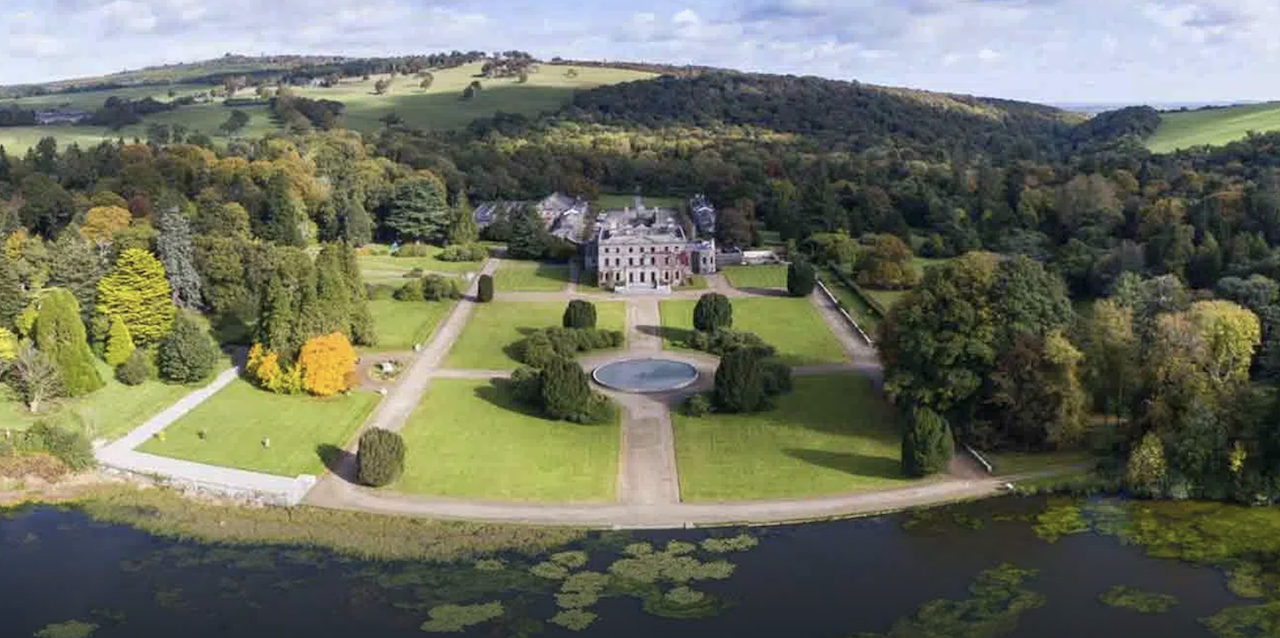
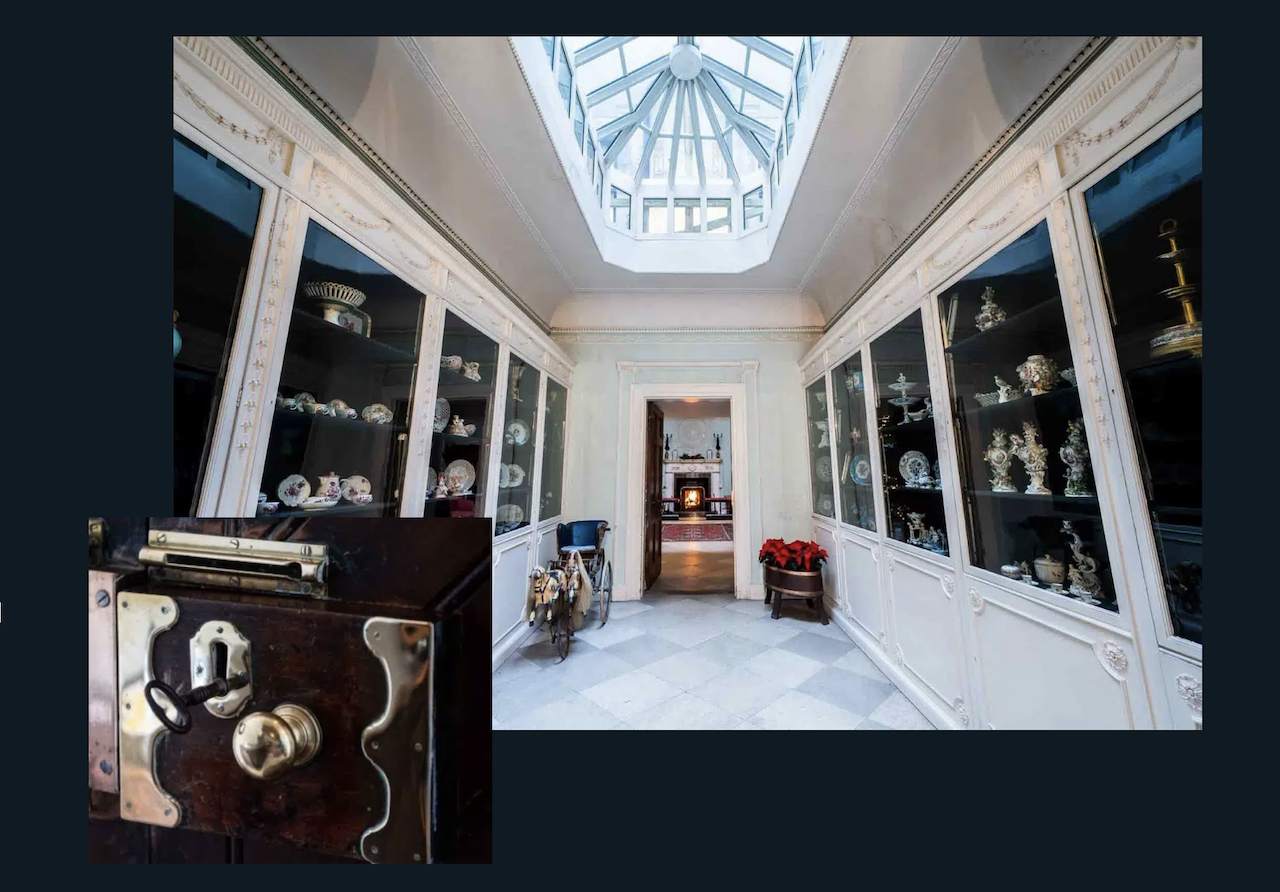
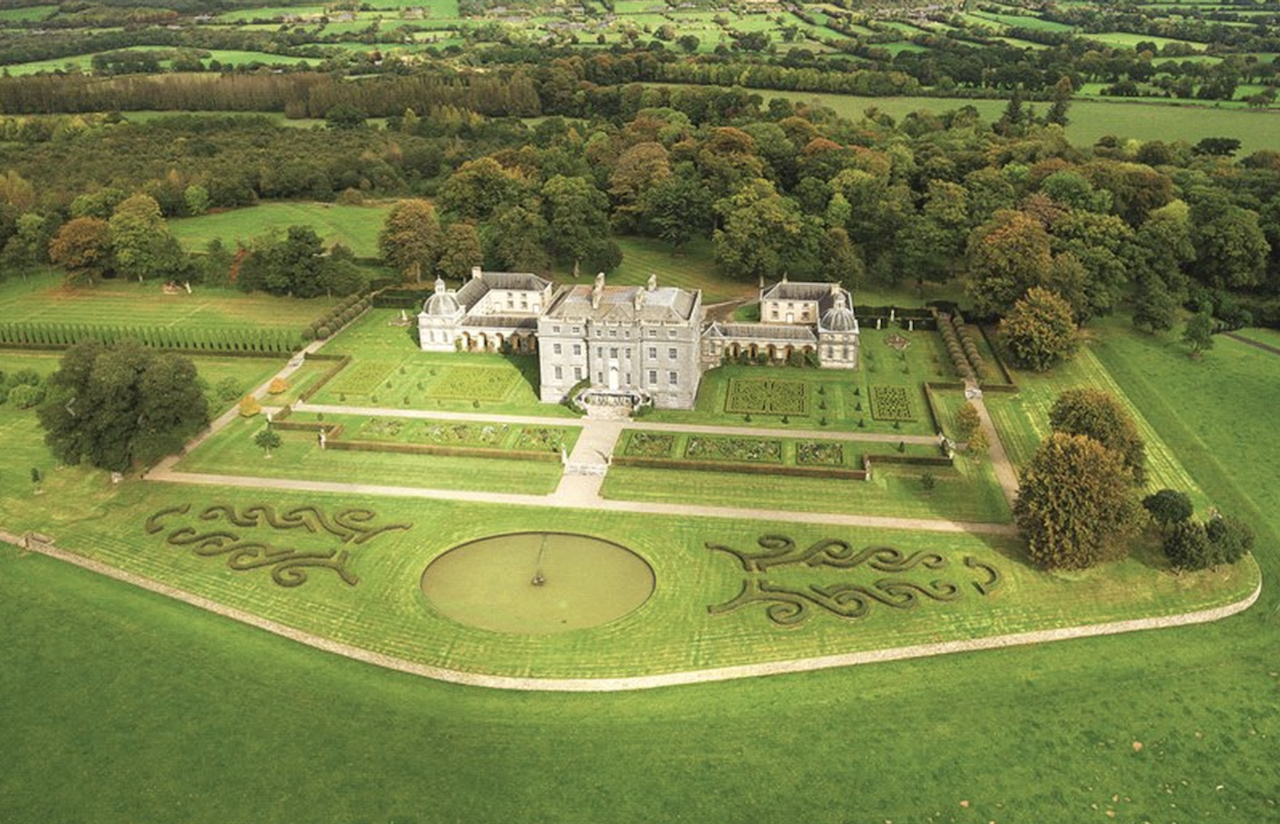
Abbeyleix House, County Laois, photograph courtesy of Colliers.

 
featured in Great Irish Houses. Forewards by Desmond FitgGerald, Desmond Guinness. IMAGE Publications, 2008. 

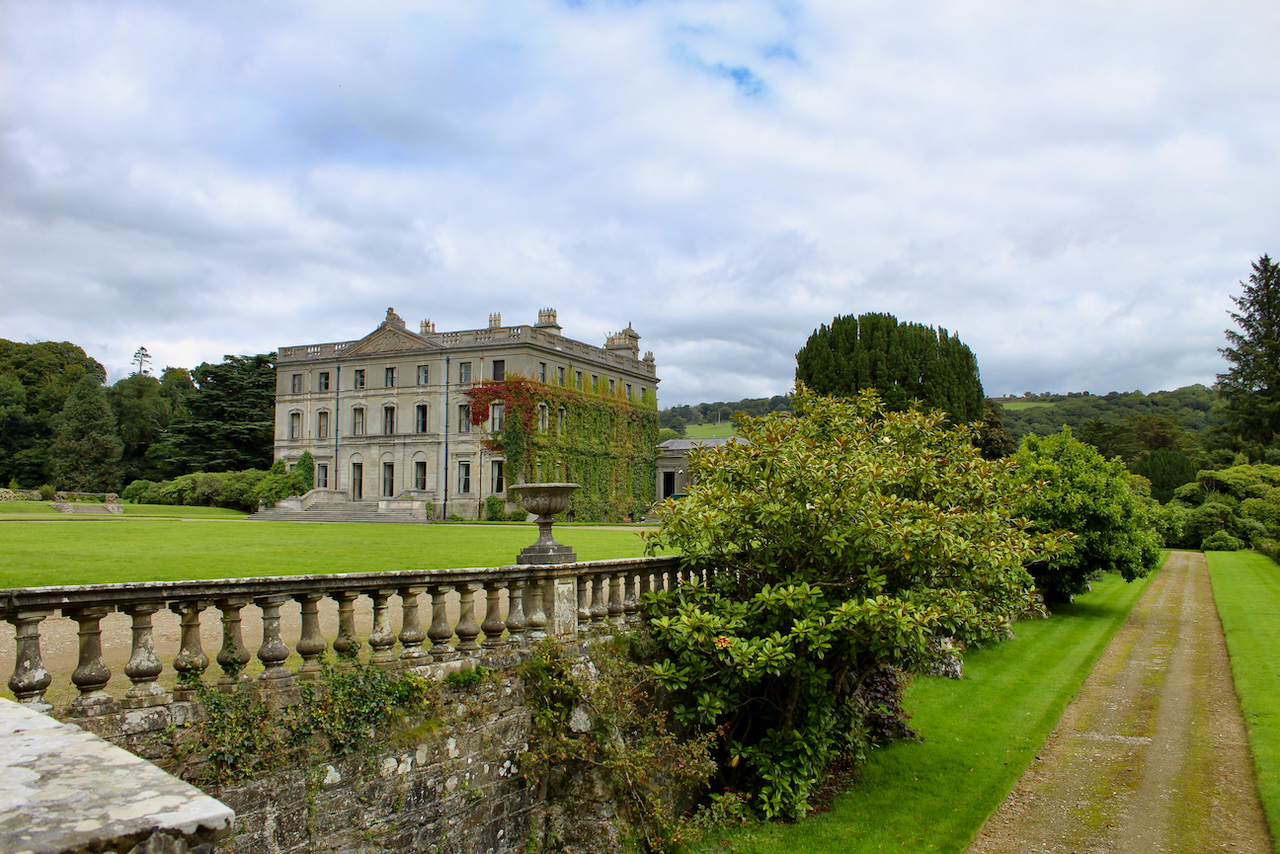
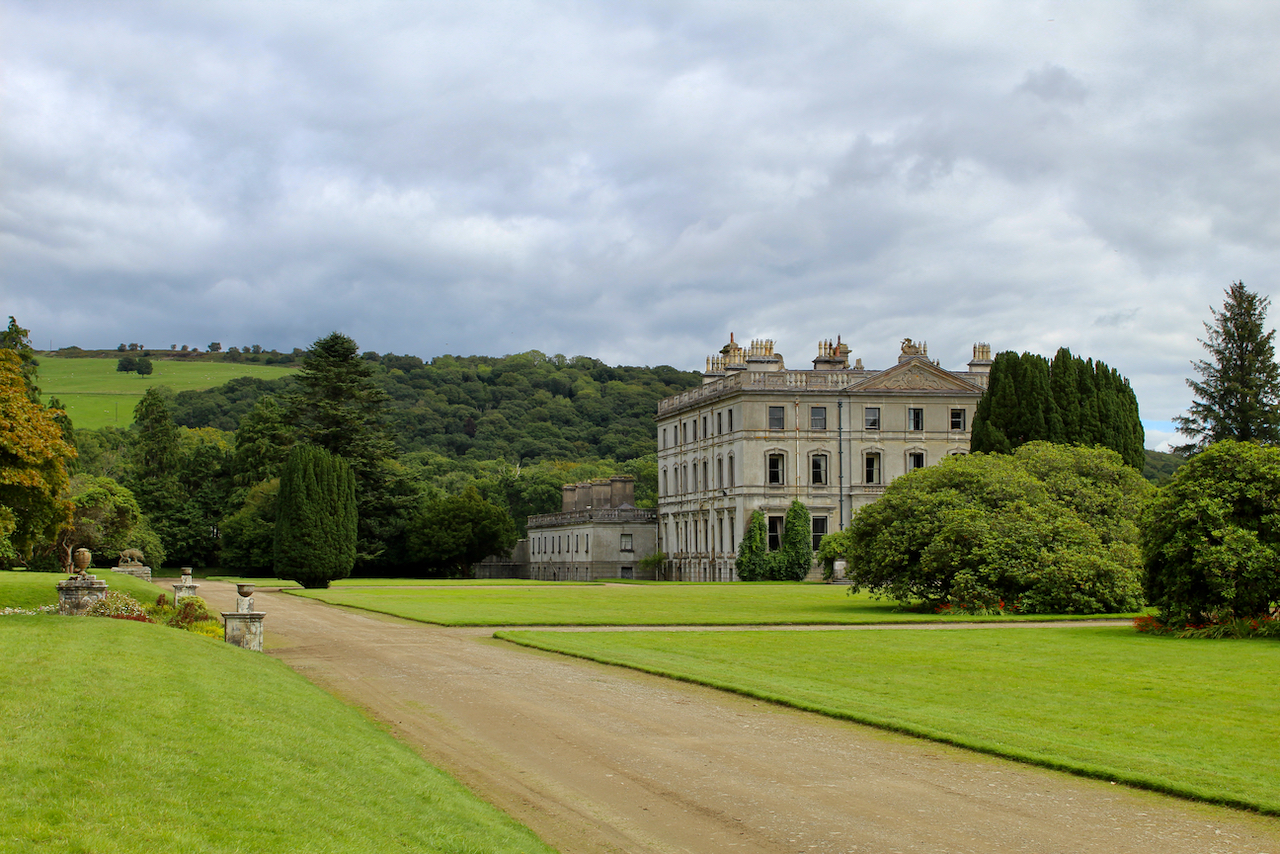
Designed by James Wyatt for Lord Knapton, later the 1st Viscount de Vesci, building began in 1773. Built between 1773 and 1778, it was a typical plain Georgian box. By the mid-19th century the De Vesci’s had grown wealthier and wanted the house to look somewhat grander.  

Many of the adornments – such as architraves and large ballast rails – were added in the 1840s to the design of  Thomas Wyatt, a nephew of James Wyatt, added these adornments. The De Vesci family retained the house until 1994 when the present owner Sir David Davies acquired the property and began the latest phase of restoration. 

When David Davies acquired the house in 1994, he employed John O’Connell, one of Ireland’s foremost conservation architects, to restore the building. 

Sir David was determined to preserve and reuse all the original architectural elements, which included acquiring at auction the 18th century original window sashes. Fortunately, the Penrose Wyatt Collection fo Drawings in the National Library of Ireland had office drawings relating to the gold room/saloon of Abbey Leix so they could be accurately returned to their 18th century states. 

One of the main decisions taken by Sir David was to alter a wing built in the mid 19th century to the west of the building. The original idea had been to drive the house more towards the west, with the addition of a new dining room, large library and billiard room beyond. This was never completed. Today it has become a wonderful and sympathetic addition to the main house. “It was a horrible concrete looking thing with three chimneys,” says Sir David. “John O’Connell was asked to make it look sympathetic with the rest of the house. I now call the finished product the John O’Connell wing!”  

The nearby courtyard and 19th century dairy have been retained, as has the area where carriages and service stores for the house were kept. What appears to be a single storey structure from the outside has two floors inside. It was dug out so its height would not impact on the lines of the main house. On the opposite side of the main house is an unusually short extension of the basement to the first floor. A mezzanine level allows movement between each floor. The grand forecourt, which has been executed to an Italianate design, provides a tremendous podium for the house to sit upon. 

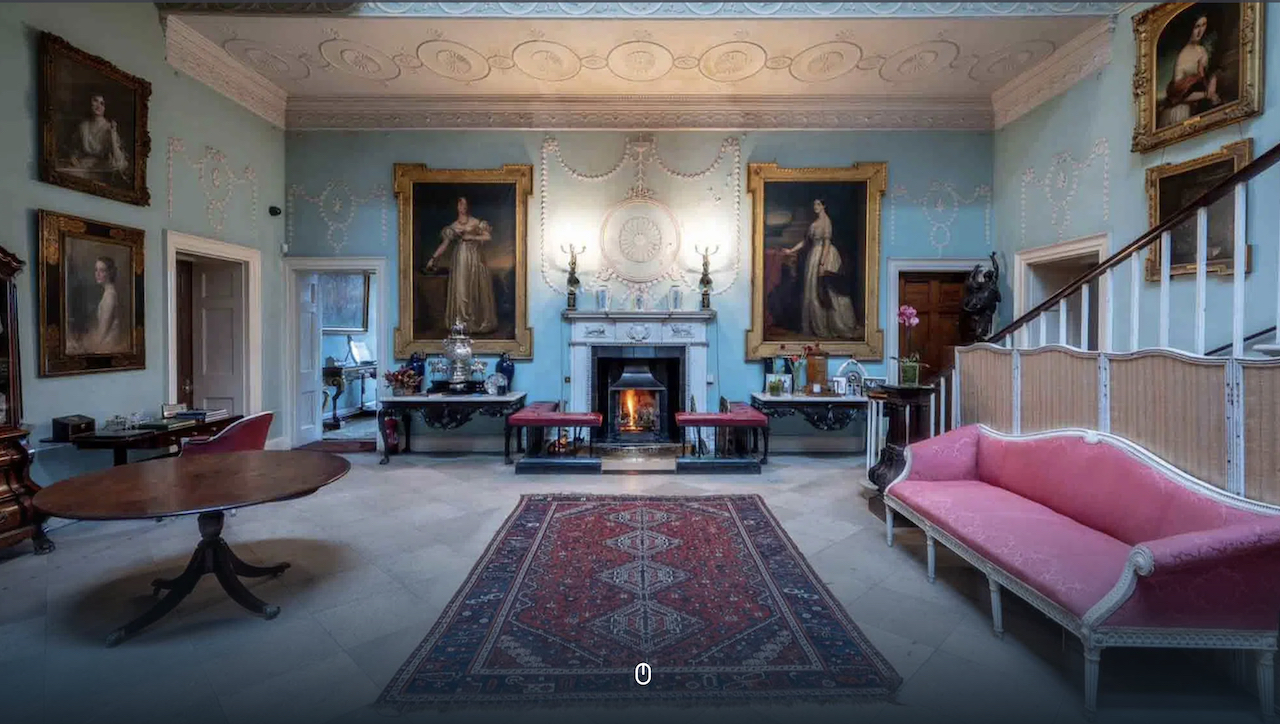
Inside, the entrance hall is very much the heart of the house. The hall floor, unlike many 18th century properties, is not Portland stone but French limestone. The fireplace, which is not original and dated earlier than the house, came from a De Vesci house in London. The screen columns are all original, while the stuccowork is a fine example of neo-Classical design. Great mahogany doors, many with original locks and handles, lead from the hall. 

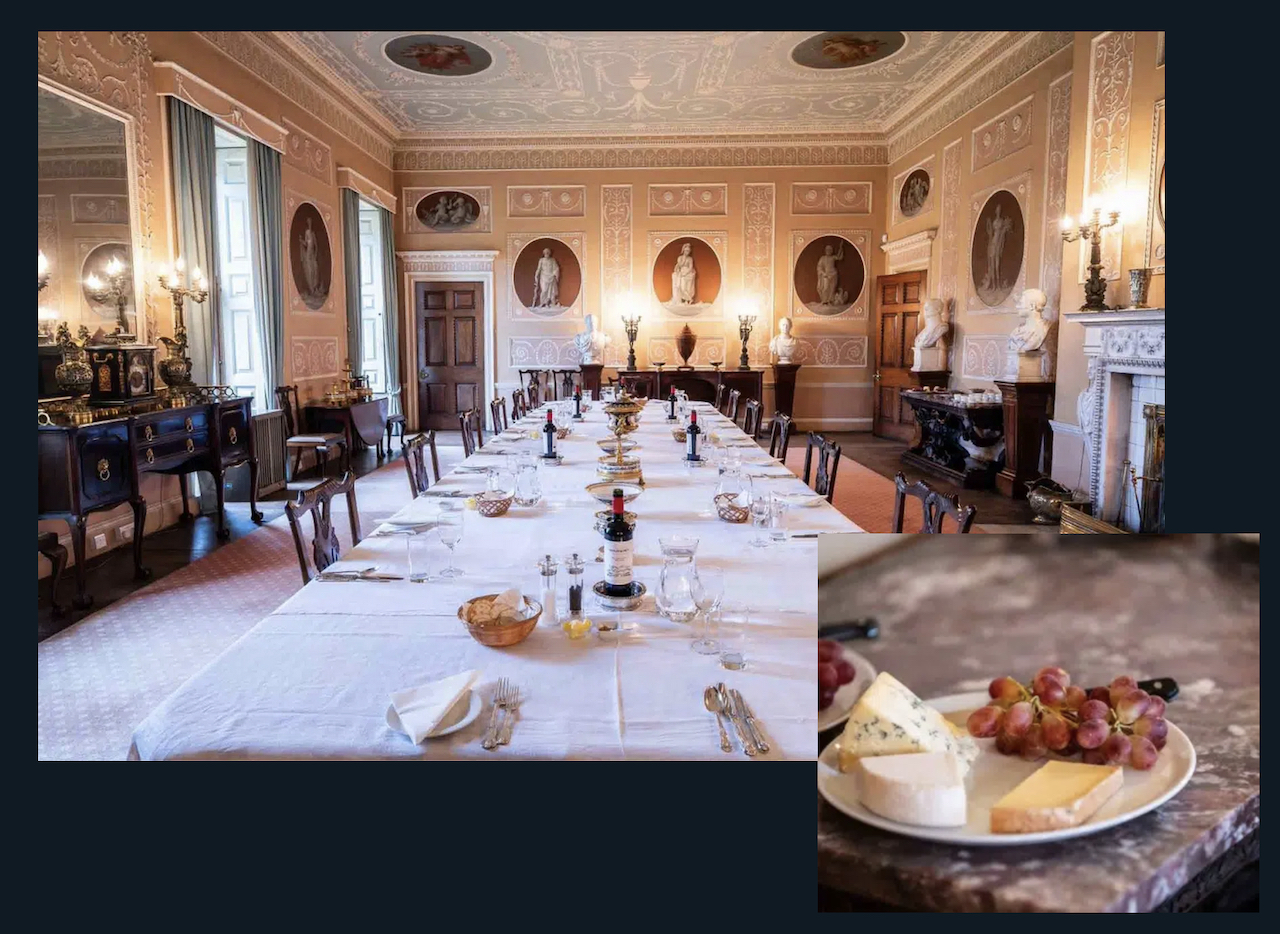
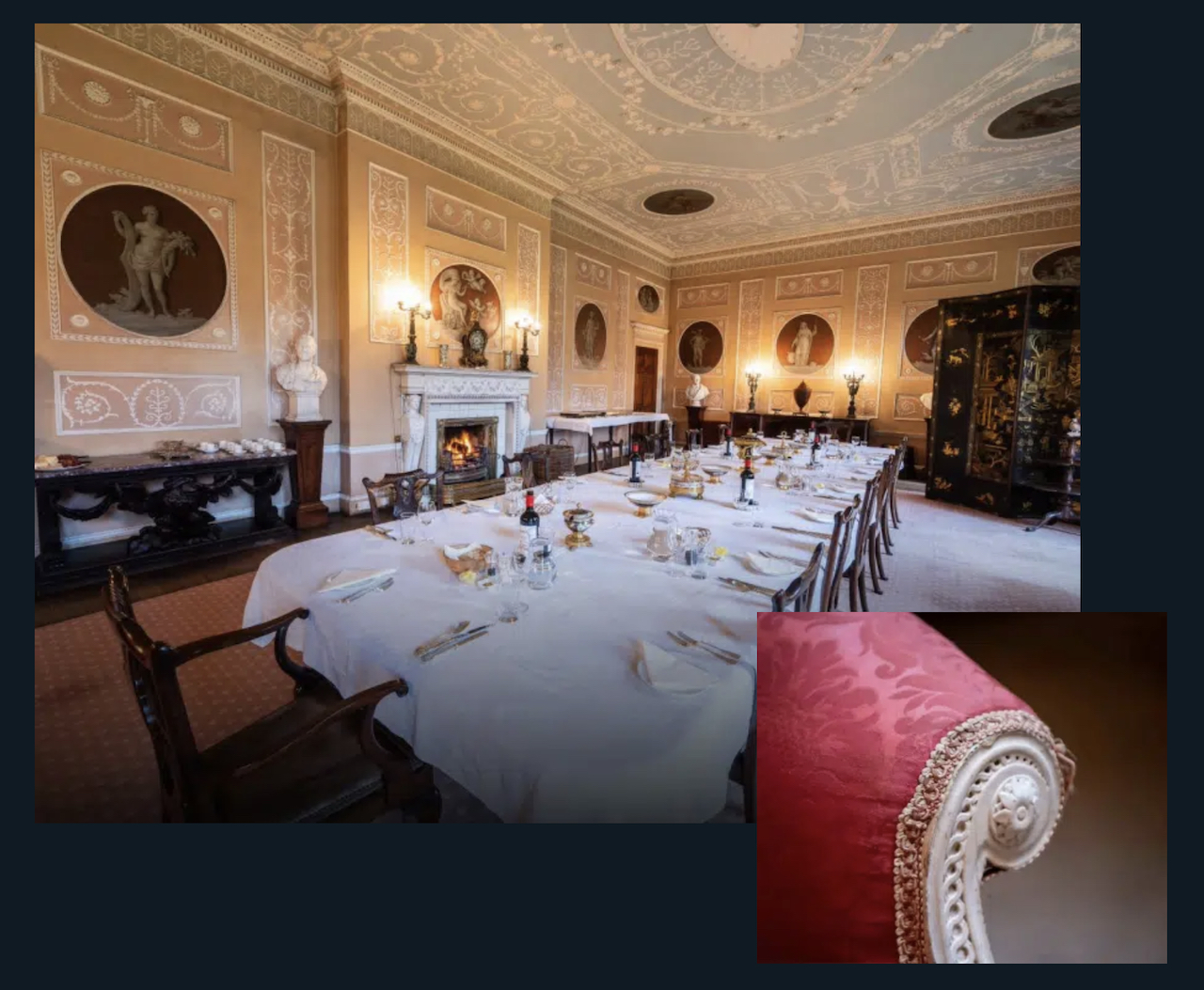
As was often the fashion at the time in the early 20th century, the entrance hall doubled as a sitting room in winter months, and large curtains across the entrance door helped retain the heat. Sir David has returned the hall to what it is likely to have looked like in 1770. There are two great Irish tables – one from 1720 is pine, painted to look like ebony, while the other is a slightly later piece, dating to 1750. A set of four chairs, designed by Wyatt for Dunsandle House in Co Galway, were bought from Russborough. The stone colouring is true to 18th century form. Indeed, the colouring is authentic throughout with the dining room primarily cream and the drawing room a plaster or rose pink colour. The original dining room was a long way from the kitchen ans so now its primary purpose is as a music room and sir David has held a number of concerts in it. 

[p. 39] The fireplace here is shown on early drawings for the room and it is fascinating to compare the vision for this great neo-classical room with the reality. The room has, however, been subjected to two great upheavals. The first was a fire in the 1950s but the second – and far more serious – occurred in 1996 during the restoration. 

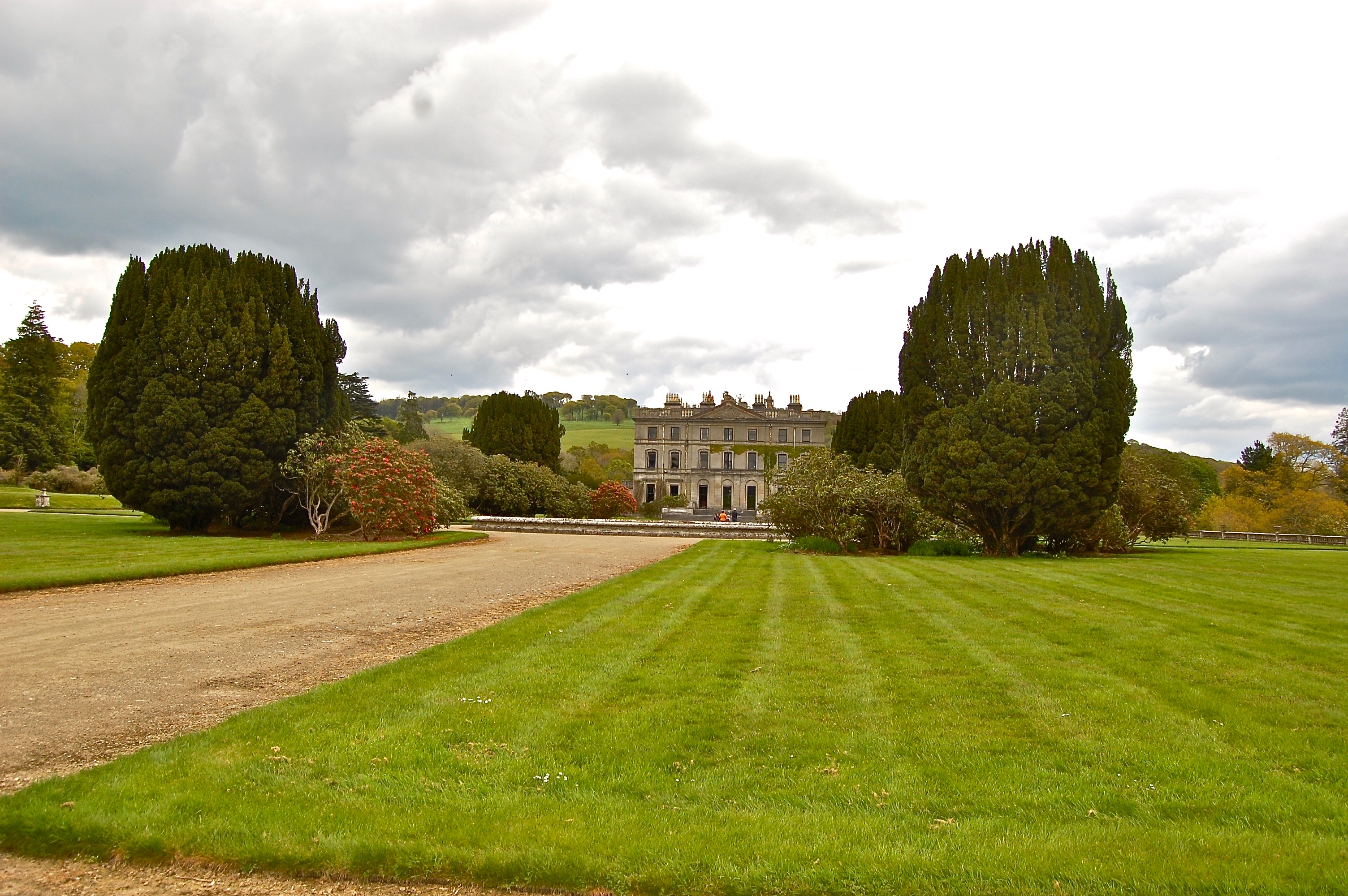
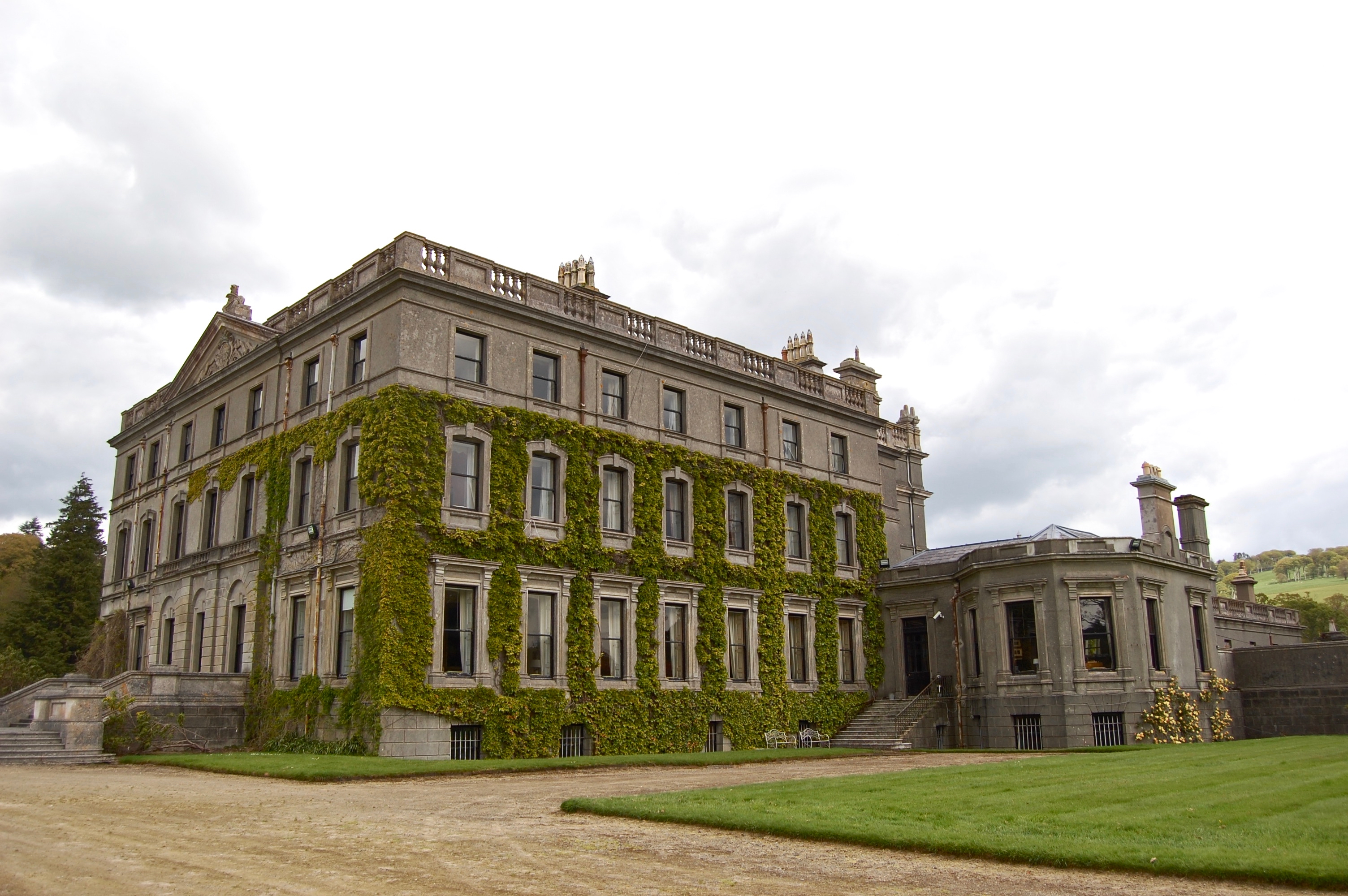
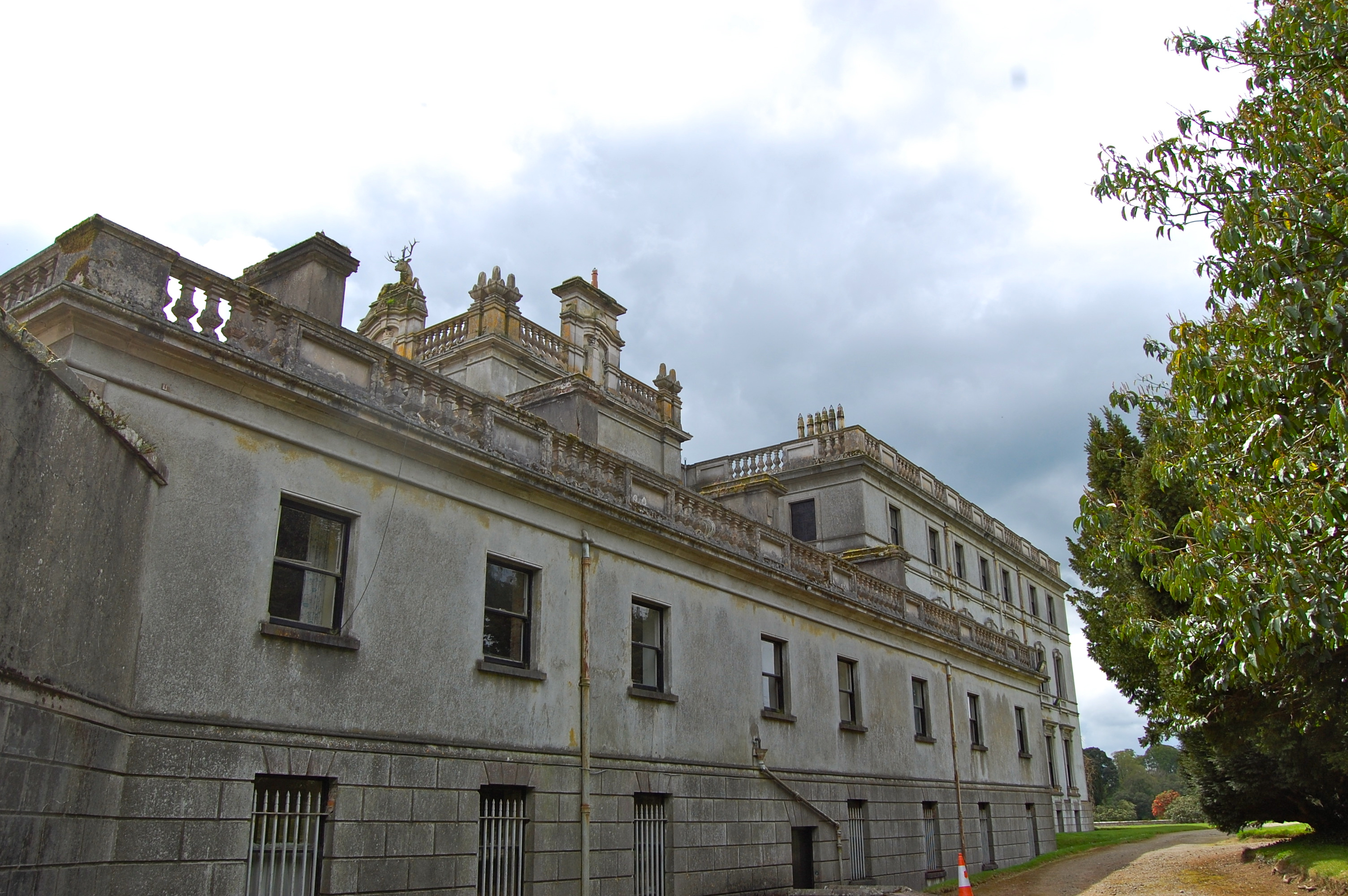
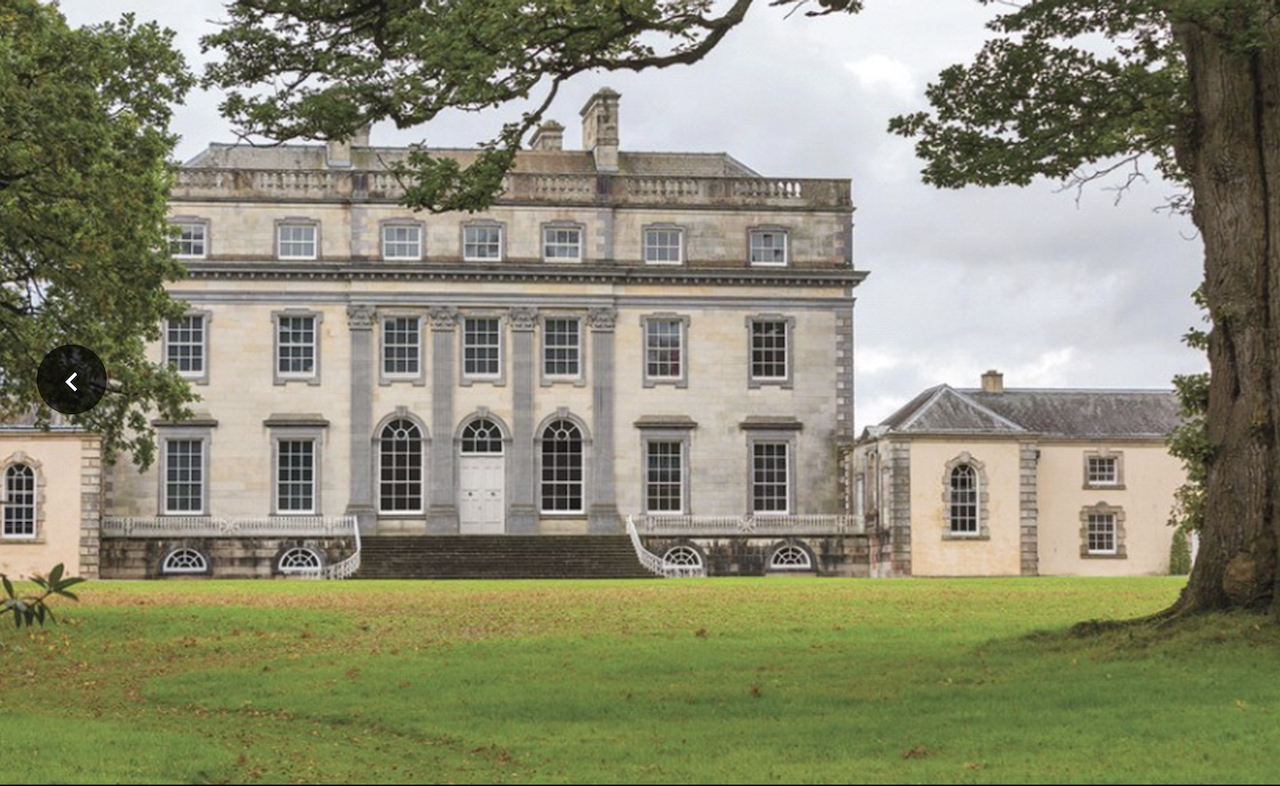
[picture credit: The front of the house shows the refacing, which took place in the 19th century. The façade is rendered and the finish gives the impression of sandstone. ] 

[grissailes by de Gree in the music room which was originally designed as a dining room] 

A smouldering fire, confined to this room and the one adjacent, resulted in the doors leading to the second suite of rooms being badly burned. The ceilings in both rooms also had to be taken down, cleaned and restored. As much of the ceiling design is executed in gold, it was resistant to the worse of the fire damage. Cliveden Conservation, a company specialising in restoration and renewal of plasterwork and marble fireplaces, restored the ceilings of the two great rooms after the fire, but also copied and carved the original Wyatt fireplace in the drawing room which was so badly damaged that it had to be replaced. Also reinstated were the French limestone tiles in the front hall. 

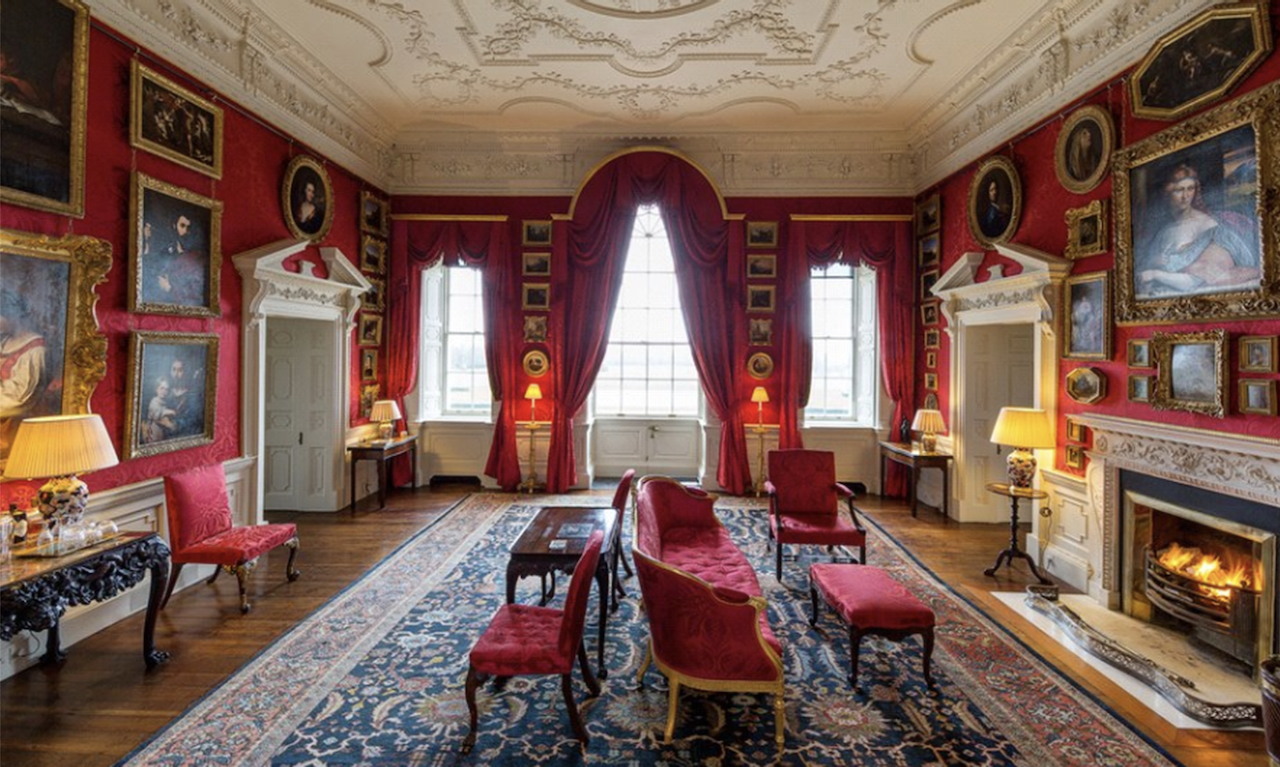
Primarily the music room was designed to have a typical ‘wedding cake’ interior with a strong emphasis on cream and gold colourings. Sir David has opted for more Adam colours such as pink and green and the result is magnificent. The pelmets were designed by O’Connell and have blended into the overall design seamlessly. Pull-up curtains have been installed as draw curtains would have taken up too much space. The double doors, with brass handles and carvings, were modelled from another Wyatt design. It is thought the mahogany came from Honduras and was already 1,000 years old when it was felled for the house in 1770. 

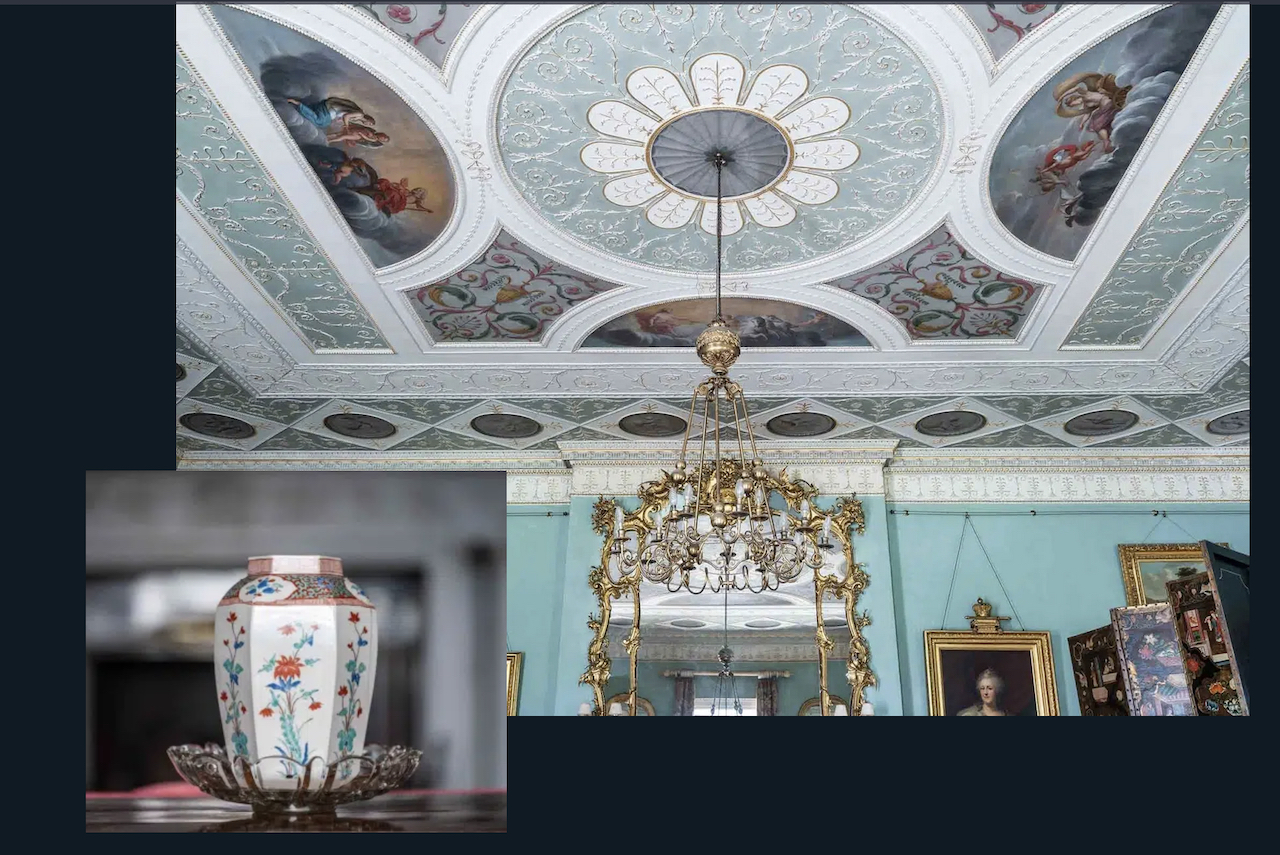
The drawing room is one of the most elegant and best proportioned rooms in the house. Sir David has a young family and so the room is also comfortable. The ceiling features a circular motif design with two large panels either side. The room also suffered extensive damage during the recent fire and required extensive restoration that took more than a year to complete. Many of the panels had to be removed and repaired or replaced.” 

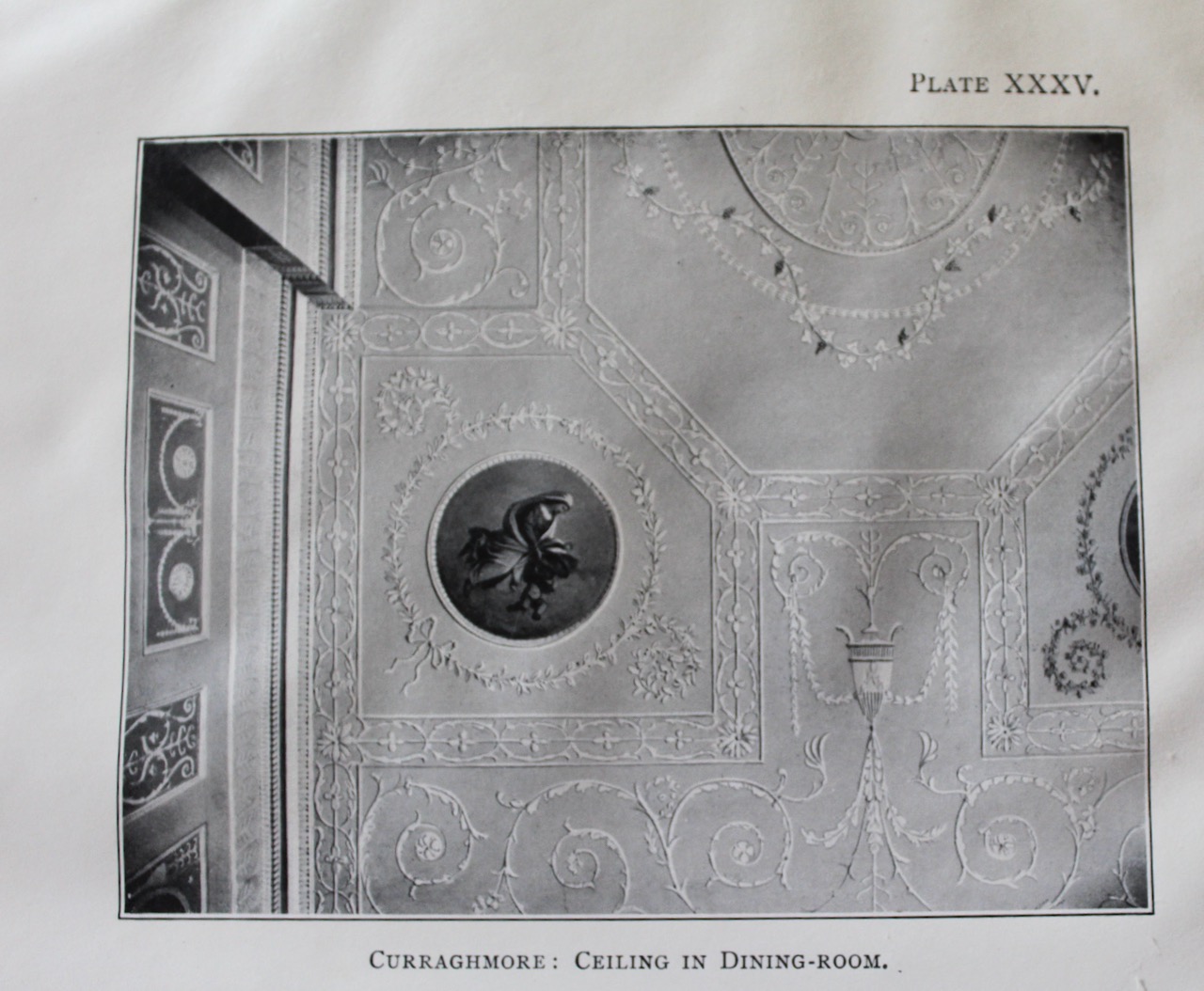
[picture caption: the music room showing the neo-classical plaster decoration designed by James Wyatt. According to John O’Connell it is probably the most authentic Wyatt room in Ireland, aside from the great dining room at Curraghmore.] 

[the study with the carved festoons in the style of Grinling Gibbons.] 

p. 40. “The original house ended where there is now a set of four scagliola columns when in the 1840s the De Vescies decided to create a long gallery through to where the glass conservatory once stood. Sir David decided to partition the gallery, given its proximity to the kitchen, in order to create a dining room with both a formal and informal dining space. The Knight of Glin helped with the furnishings. ‘All the furniture and paintings here have been brought in the last 25 years,” Sir David says. “It was a time when the Knight was persuading people to buy Irish furniture and paintings and bring them back to Ireland. Much of the stuff here was bought in America. It’s important these furnishings in the house don’t come across as a museum piece. This is very much a family home.” 

The great wing built off the house has the largest and longest butler’s pantry in Ireland, which leads to the upstairs kitchen. The floors in this area are of oak found on the estate. Beyond the kitchen is a wonderful family room in what was formerly the billiard room. The entire first floor is made up on family rooms, bedrooms, dressing rooms and en suite bathrooms. All the original bath and tap finishings have been retained, with slate flooring used under the baths to prevent damage. The real richness at work at Abbey Leix is the contrast between the formal and informal, between the everyday and the elaborate. In its simple elegance, it remains as true to the early 18th century original as any house in private ownership today.” 

[picture caption: The white chimneypiece in the drawing room is to the design of James Wyatt. The Irish mirror was designed by Francis and John Booker of Essexbridge, Dublin.] 

[The present dining room was a large tri-partite library in the mid 19th century.] 

[The formal dining table, which had a fine collection of Wyatt dining chairs, can seat up to 24 guests. The painting is of Sir David Davis by Lord Dunsany.] 

Abbeyleix House, County Laois, photograph courtesy of Colliers.

 
featured in Georgian Mansions in Ireland with some account of the evolution af Georgian Architecture and Decoration by Thomas U. Sadleir and Page L. Dickinson. Dublin University Press, 1915. 

Abbeyleix House, County Laois, photograph courtesy of Colliers.

 
Mark Bence-Jones. A Guide to Irish Country Houses.[originally published as Burke’s Guide to Country Houses volume 1 Ireland by Burke’s Peerage Ltd. 1978; Revised edition 1988 Constable and Company Ltd, London.] 

 
P. 1. Abbey Leix, Co Leix: “[Vesey, De Vesci, V/PB] A three storey late C18 block, built from 1773 onwards by Thomas Vesey, 2nd Lord Knapton and afterwards 1st Viscount de Vesci, with some interiors being designed by James Wyatt. Seven bay entrance front, with three bay pedimented breakfront; frontispiece of coupled Doric columns and entablature around entrance door. Five bay garden front with three bay breakfront. In C19 the elevations were made more ornate with a balustraded roof parapet, entablatures over the windows, balconies and other features. A large conservatory was also added at one side of the house, which was blown away by the “great wind” of 1902 and replaced by a wing containing a new dining room. The principal rooms in the main block have ceilings and, in the old dining room, walls decorated with Wyatt plasterwork. The hall has a screen of fluted Ionic columns;  

 
from myhome.ie. The fireplace mantel of siena and white marble in the front hall, with a well-carved centre panel,  is from a Dublin mansion [from Georgian Mansions in Ireland, as well as following information about paintings] There’s a portrait of Le Grand Dauphin by Pierre Mignard, and pictures of Michael Boyle, Archbishop of Armagh [ he was an ancestor of the family through the marriage of Sir Thomas Vesey, 1st Baronet, with his granddaughter Mary Muschamp]; of John Vesey, archbishop of Tuam; Sir Thomas Vesey, Bt, 1712, afterwards Bishop of Ossory the first Lord Knapton; Mrs Colclough, wife of Caesar Colclough, of Duffrey Hall, Co Wexford and sister of the first Lord Knapton; Agmondesham Vesey, father of Ann, Lady Bingham, as a child [also an ancestor of the Veseys of Lucan, which estate he acquired by his first marriage with Charlotte, daughter of William Sarsfield, who was the elder brother of the celebrated Patrick Sarsfield, Earl of Lucan, and by whom he had an only daughter, Anne, wife of Sir John Bingham, Baronet, ancestor of the present Earl of Lucan. He left the estate to his oldest son of his second marriage, so subsequent owners are not descended from the Sarsfields]; and of the Elizabeth, wife of the first Lord Knapton. This last painting is by Stephen Slaughter, and dates to 1744.  

BJ cont. “the drawing room is hung with a C19 blue wallpaper. The demesne contains some magnificent trees, including oaks which are part of a primeval forest. A formal garden with terraces and ironwork balustrades was laid out by Lady Emma Herbert, who married 3rd Viscount 1839; inspired by the garden of her Russian grandfather, Count Simon Woronzow, at Alupka, near Yalta, in the Crimea. Towards the end of C19, in the time of 4th Viscount, whose wife was Lady Evelyn Charteris, daughter of 10th Earl of Wemyss, Abbey Leix was the Irish outpost of the “Souls.” The garden is now open to the public.” 

Abbeyleix House, County Laois, photograph courtesy of Colliers.

Colliers International 

Tel: 01 633 3700 

PSRA Licence No. 001223 

€20,000,000 

9 beds, 10 baths, 2500 sq metres, 

Eircode: R32 E2W4
A splendid and most distinguished Irish 18th-century mansion positioned within a remarkable and ancient woodland demesne of over 1,000 acres. Abbey Leix is one of the most venerable 18th-century houses in Ireland and, following a spectacular restoration, it is also one of the most congenial. In any list of important Irish country houses Abbey Leix has a prominent place. The late-18th-century mansion, clothed in the Italianate manner in 1859-60, enjoys a remarkable position within a private estate comprising some 1,120 acres and includes some of Ireland’s most notable remaining ancient woodland and extensive frontage to the River Nore. The accommodation is grand and beautifully executed with the mansion comprising some 26,910 square feet or 2,500 square metres. 

Abbeyleix House, County Laois, photograph courtesy of Colliers.

The mansion is augmented by 10 lodges and cottages on the estate. Abbey Leix was designed in 1773 by the noted architect James Wyatt. The house is an elegant three-storey Classical mansion of seven bays, the three central bays under a triangular pediment. The arrangement of rooms is elegant and simple, with three major rooms on the park front. There is a deep hall, with a screen of columns separating it from the east-west-running staircase hall and corridor. The music room at the south-eastern corner of the house retains the light, decorative plasterwork for which Wyatt was so admired. Plaster roundels framed by swags of husks were decorated with grisaille by the artist De Gree a few years after completion, probably about 1785. In the middle of the 19th-century the Italianate character was adopted and the great Classical library and a conservatory were added. 

Abbeyleix House, County Laois, photograph courtesy of Colliers.

At the same time the front of the house was enclosed within an Entrance Court with terraces added to the rear. A comprehensive and sympathetic restoration was undertaken in 1995. The whole north-west corner of the accommodation was redesigned to provide a new family room (out of rooms subdivided in the 1966), kitchen, and butler’s pantry. A new state dining room was created out of two-thirds of the original library, the remainder now comprising a smaller library. A considerable programme of conservation of the major rooms followed. The works create a 21st-century family home with an appropriate balance between comfort and informality on the one hand and grandeur for entertaining and the display of art on the other. Abbey Leix has one of the most important collections of trees in Ireland. Whereas elsewhere in Ireland the primeval forests of oak, birch, alder and willow have been almost entirely depleted, the woods on Park Hill across the river from the house are among the last surviving remnants of Ireland’s ancient woodland. 

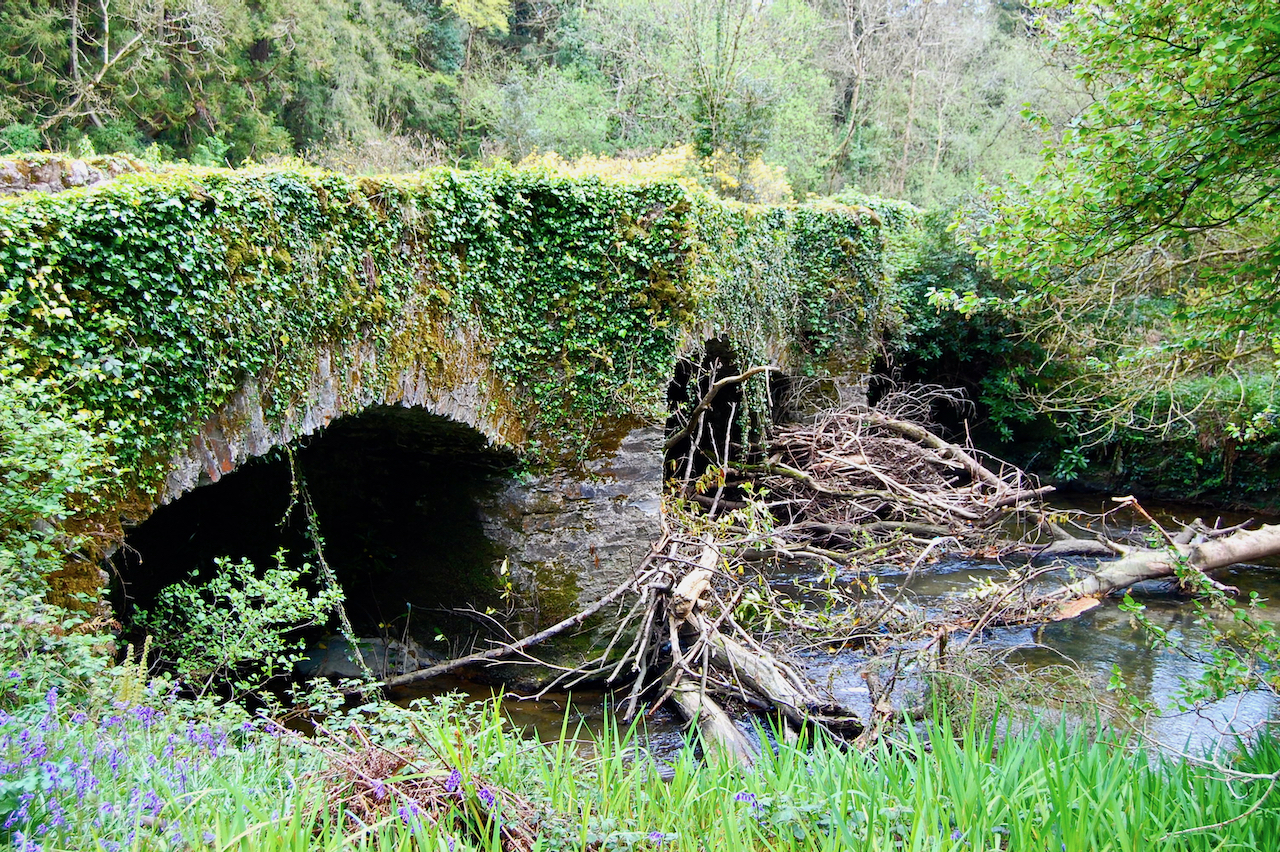
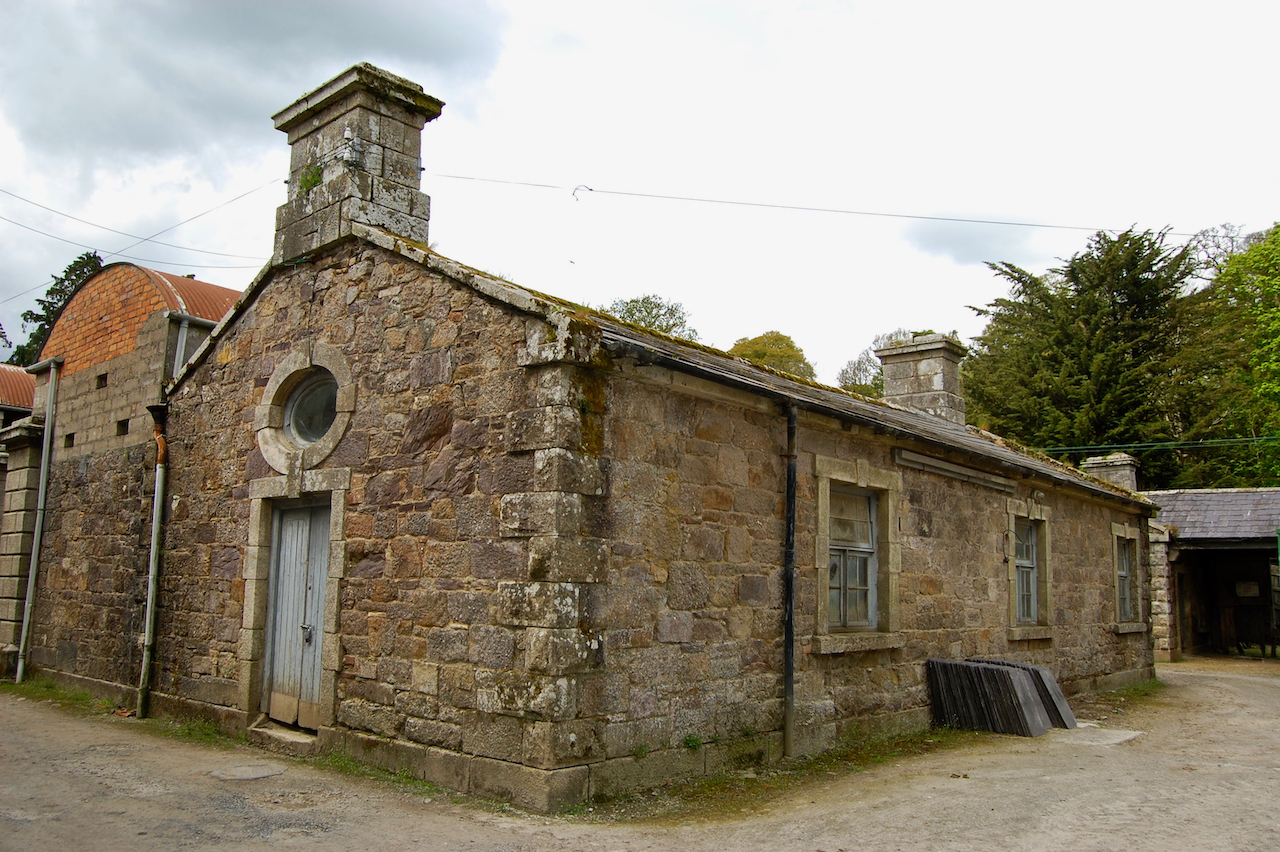
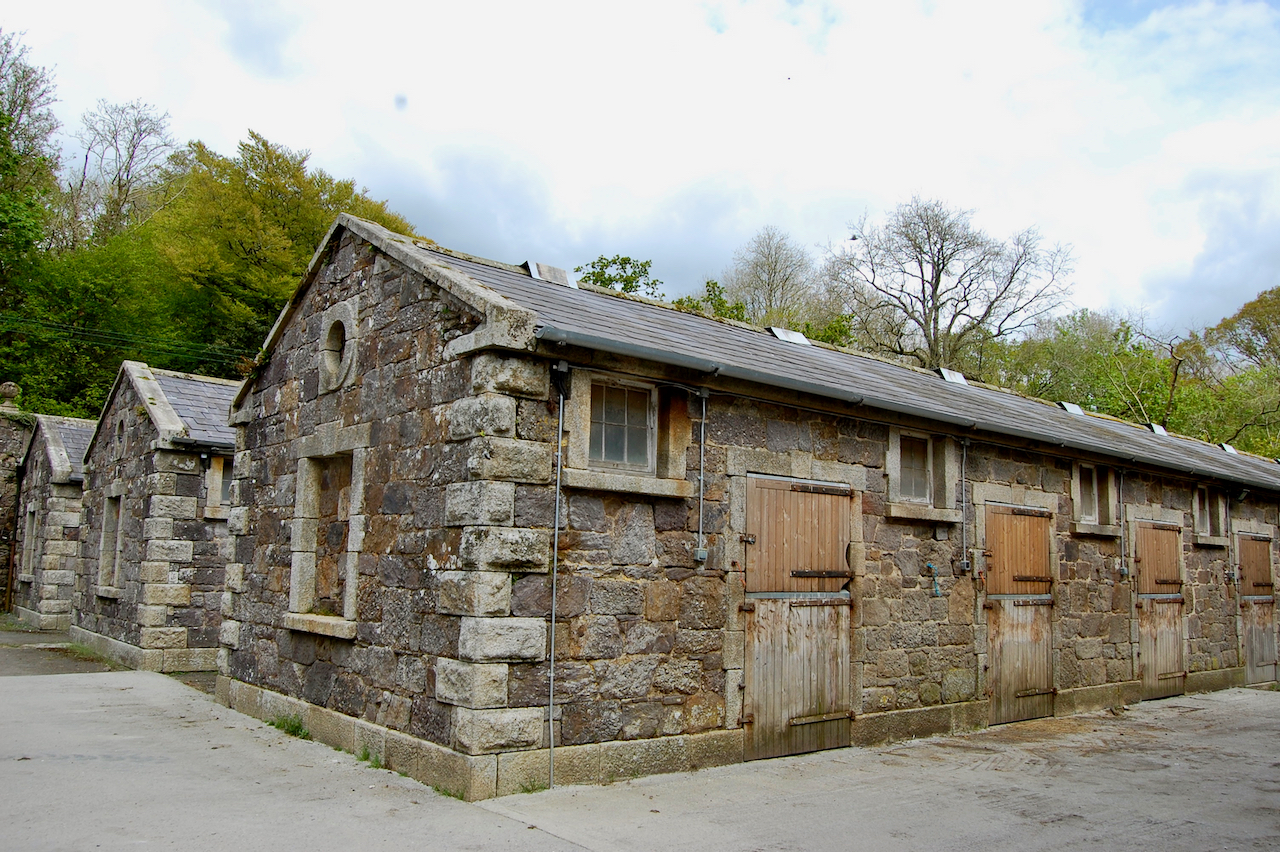
Abbey Leix, like so many places in Ireland, owes its origins to religious settlement, and specifically to the French Cistercian monks who came to Ireland in the mid-12th-century. An ancient stone bridge on the estate, known as Monk’s Bridge, marks where they located their abbey. The present demesne evolved out of the monastery’s granges, woods and fields. One tree, the oldest oak in Ireland still survives from this period. The de Vesci family fashioned a landscape as beautiful as the house they built during their ownership between 1675 and 1995. A stud farm is positioned within the original farmstead and includes an attractive range of cut-stone outbuildings. 

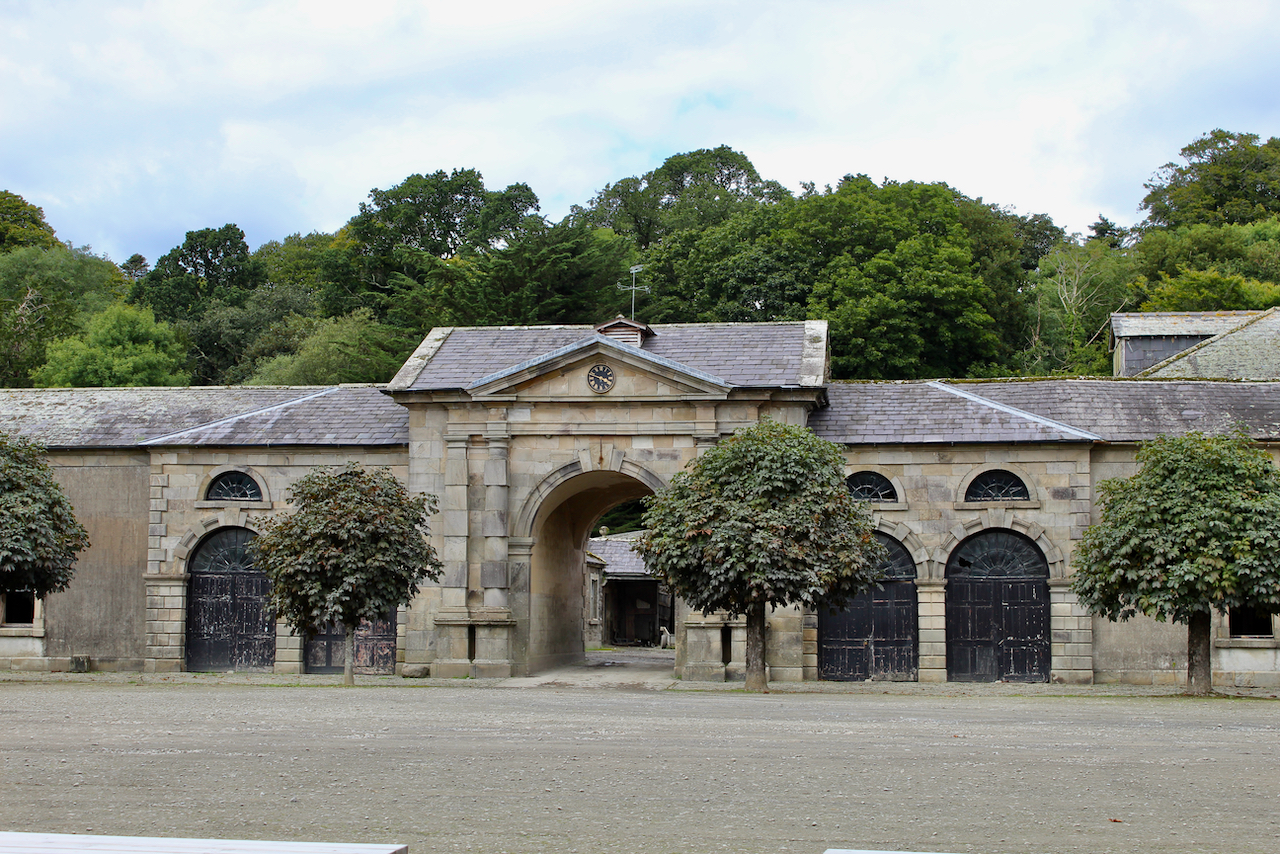
A beautiful principal yard, complete with a clock tower, was built of local limestone in 1822. The quadrangular yard contains 24 loose boxes. A separate farmyard has a range of farm sheds. The farmland provides good grazing. The limestone soil is highly fertile and ideal for rearing and keeping bloodstock, being well laid out in gently undulating fields and paddocks. The lands are well sheltered by the surrounding woodland. Positioned centrally within the estate the house is quiet and private, the wooded drive being c. 1 mile long. “As few places elsewhere, Abbey Leix gives a sense of the longue durée of Irish history. Having been home to French Monks, O’More Princes, Ormonde Earls, de Vesci Viscounts, and a Welsh Knight, the house, its park and woods form a microcosm of our past.” William Laffan, 2017. 

Abbeyleix House, County Laois, photograph courtesy of Colliers.

1773 – Abbeyleix House, Abbeyleix, Co. Laois 

Architect: James Wyatt 

A seven-bay, three-storey over basement with dormer attic Classical-style country house, begun 1773, with a pedimented breakfront having a cut stone Doric door-case to the ground floor. Originally brick, later rendered by Thomas Henry Wyatt. Five-bay elevation to garden front with breakfront having cut sandstone doorcase and Wyatt style window openings to flanking bays. 

A good landlord, and an improving man, his first care was to remove the old village on the banks of the Nore, and to build a new one, long known as New Abbeyleix, on a better site further from the river.f He also demolished the former family residence, and, in 1773, erected in its place the present mansion, which took several years to complete.” 

http://lordbelmontinnorthernireland.blogspot.com/2013/12/abbeyleix-house.html

THE VISCOUNTS DE VESCI WERE MAJOR LANDOWNERS IN THE QUEEN’S COUNTY, WITH 15,069 ACRES 

This and the illustrious family of De Burgh, Marquesses and Earls of Clanricarde, derive from a common progenitor; namely, 

JOHN, Earl of Comyn and Baron of Tonsburgh, Normandy, son of BALDWIN II of Boulogne, founder of the house of BLOIS, in France. 

From the eldest son of this noble John descended the house of Clanricarde; and from the younger, 

EUSTACE DE BURGE, Baron of Tonsburgh, that of which we are now to treat. 

This Eustace had two sons, Charles and John, both companions in arms of WILLIAM THE CONQUEROR. 

 
The elder son, 

CHARLES, built the castle of Knaresborough, in Yorkshire, and was succeeded by his brother, 

JOHN FITZ RICHARD, who wedded Margaret, aunt of King STEPHEN, and was succeeded by his eldest son, 

EUSTACE FITZ JOHN, feudal lord of Knaresborough, who espoused Beatrix, daughter and sole heir of Ivo de Vesci, by Alda, only daughter and heir of William Tyson, Lord of Alnwick, and was succeeded by his elder son, 

WILLIAM, who assumed the name and arms of VESCI, and had a grant from HENRY II of Alnwick Castle. 

He was sheriff of Northumberland during the greater part of that reign, and was a principal commander in the battle fought near Alnwick, wherein the Scottish army sustained a signal overthrow. 

This William’s elder son, 

EUSTACE DE VESCI (1169-1216), one of the twenty-five feudal barons appointed to enforce the observance of MAGNA CARTA, married Margaret, daughter of WILLIAM, King of Scotland. 

 
This nobleman was succeeded by his son, 

 
WILLIAM DE VESCI, who espoused firstly, Isabel, daughter of William Longespée, Earl of Salisbury; and secondly, Agnes, eldest daughter of William Ferrers, Earl of Derby; and in right of the latter had a share of those lands assigned to him in Ireland, belonging to William Marshal, Earl of Pembroke. 

 
He died in 1253, and was succeeded by his eldest son, 

 
JOHN DE VESCI, who was summoned to parliament, 1264, as Baron Vesci. 

 
His lordship dsp 1289, and was succeeded by his brother, 

 
WILLIAM DE VESCI, who was summoned to parliament in 1295, and was one of the competitors for the crown of Scotland during the reign of EDWARD I. 

 
This nobleman was Justice in Eyre for all the royal forests beyond Trent, and one of the Justices-Itinerant touching the pleas of the forest, Governor of Scarborough Castle, and Lord Justice of Ireland, where he was Lord of Kildare. 

 
His lordship died in 1297, leaving an only daughter, Isabel; and the male line of his family was continued by his brother, 

 
THOMAS DE VESCI, who settled in Newlands, Cumberland, where the family continued until his descendant, 

 
WILLIAM VESEY, having the misfortune to kill his antagonist in a duel, fled into Scotland, whence he removed to Ireland, in the reign of ELIZABETH I. 

 
He wedded a daughter of the family of Ker of Cessford, and was succeeded by his only son, 

THE VEN THOMAS VESEY, Archdeacon of Armagh, 1655; whose son and heir, 

THE MOST REV JOHN VESEY (1638-1716), was consecrated Lord Archbishop of Tuam. 

[Georgian Mansions in Ireland with some account of the evolution af Georgian Architecture and Decoration by Thomas U. Sadleir and Page L. Dickinson. Dublin University Press, 1915: 

“The Most Rev. John Vesey, Archbishop of Tuam, father of the purchaser (of Abbeyleix), may also be called the founder of this family in Ireland, for from him descended the Veseys of Lucan, Co Dublin; Hollymount, County Mayo; and Derrabard, Co Tyrone; as well as Baron Fitzgerald and Vesey, a title now extinct, and the family of Vesey-Fitzgerald. During the vice-royalty of Tyrconnell he suffered great hardships at the hands of the native Irish, though it was only when their lives were in danger that he and Bishop Tenison, of Killala, consented to quite Connaught. fn. see Dictionary of National Biography. Taking his wife and twelve children, he fled to London, where he lived in straightened circumstances, having no means of subsistence save a lectureship of £40 per annum, which the interest of his friends obtained for him. While in England he was attainted by James II’s Irish Parliament, but after the Revolution he returned to his diocese, and resumed the prominent part which he had been accustomed to take in the affairs of the country, of which he was twice appointed Lord Justice. It was probably as some recompense for his misfortunes that his eldest son, Thomas, when only 25 and during his father’s lifetime, was created a Baronet… He took great pleasure in laying out and planting his seat at Hollymount, Co Mayo, described by John Wesley, when he visited it some forty years afterwards, as “one of the pleasantest places in Ireland.” There he died on 28 March 1716, having been in failing health for two years. ] 

This learned prelate, who was thrice one of the Lords Justices of Ireland, left issue, 

THOMAS; 
Agmondisham, ancestor of the Earls of Lucan; 
John, in holy orders; 
William; 
Francis; 
Mary; Elizabeth; Anne. 

His Grace was succeeded by his eldest son, 

THOMAS VESEY (c1668-1730), who was created a baronet in 1698, denominated of Abbeyleix, Queen’s County. 

Sir Thomas, subsequently taking holy orders, was consecrated Lord Bishop of Killaloe in 1713, and translated to the see of Ossory in the following year. 

[Georgian Mansions in Ireland with some account of the evolution af Georgian Architecture and Decoration by Thomas U. Sadleir and Page L. Dickinson. Dublin University Press, 1915: 

p. 13. “The above-mentioned Sir Thomas Vesey had a singular career. Born at Cork in 1673 [ie. differs from webpage date], of which city his father was then Dean, he received his education at Eton, and Christ Church College in Oxford…. It is said that he had early intended to take Orders, but it was not until 1699, after he had returned to Ireland, that the young Baronet was ordained a deacon. Preferment in his father’s diocese naturally followed, and in the following year, soon after he was priested, he was presented to a Galway living, and preferred to the Archdeanery of Tuam – an office which he resigned in 1703. During the vice-royalty of the second Duke of Ormond he acted as his chaplain, and on his recommendation was appointed by Queen Anne to the Bishopric of Killaloe, which he held for little more than a year, beign translated in 1714 to the See of Ossory. Notwithstanding that his rapid promotion was due to court influence, his character both as a man and a prelate stood high, and he was greatly respected by his clergy. We have no records of his residence at Abbeyleix, though it is known to have been the birthplace of his only son, born in 1709 [fn. The Compete Baronetage, by G.E. C.], and it seems probable that he constantly lived there. Some difficulty appears to have arisen with regard to his title to the estate, for in 1711 he invoked the aid of Swift to assist him in getting an Act of Parliament to settle the matter. The Bishop died in Dublin on 6 Aug 1730, and was buried in St. Anne’s church.By his wife Mary Muschamp, who survived til 26 Feb 1749, he had one son and two daughters, of whom the younger, Elizabeth, a versatile and accomplished woman, married first William Handcock, of Willbrook [fn. now called Moydrum Castle, and the residence of his representative, Lord Castlemaine], Co Westmeath, and secondly he cousin Agmondesham Vesey, MP, of Lucan, Co Dublin. [fn. Kildare Journal of Archaeolgoy, vol. vii, no. 6, p. 404]. As Mrs Vesey, the friend of Dr. Johnson, she was long prominent in London society for her literary receptions, celebrated in the pages of Horace Walpole and Madame D’Arblay.”] 

He wedded Mary, only surviving daughter and heir of Denny Muschamp, of Horsley, Surrey, Muster-Master-General of Ireland, and his wife, Elizabeth, eldest daughter of the Most Rev Michael Boyle, Lord Archbishop of Armagh, by whom he had issue, two daughters, and a son, 

SIR JOHN DENNY VESEY, 2nd Baronet, who was elevated to the peerage, in 1750, by the title of Baron Knapton

[Georgian Mansions in Ireland with some account of the evolution af Georgian Architecture and Decoration by Thomas U. Sadleir and Page L. Dickinson. Dublin University Press, 1915:  

p. 13. Sir John Denny Vesey, 2nd Bt, of Abbeyleix, succeeded his father in the title and estates. He had matriculated as a Gentleman Commoner at Christ Church, Oxford, in July 1727, but relinquished his studies on entering the Irish Parliament as M.P. for Newtown Ards before the end of that year. For ths borough he sat for 23 years, and on 10 April 1750, in recognition of his political services, he was raised to the peerage as Baron Knapton, taking his title from a townland on his property adjoining Abbeyleix, which in its turn had been named from Knapton in Yorkshire, a former seat of the family… Lord Knapton, who had been appointed Governor and Custos Rotulorum of the Queen’s County in 1746, during the rebellion in Scotland, died on 25 June 1761, aged 52.] 

He espoused, in Elizabeth, daughter of William Brownlow MP, of Lurgan, County Armagh, by the Lady Elizabeth Hamilton, his wife, daughter of the 6th Earl of Abercorn, and had issue, 

THOMAS, his successor
Elizabeth; Anne; Jane. 

His lordship [who had been appointed Governor and Custos Rotulorum of Queen’s County in 1746, during the rebellion of Scotland]  

died in 1761, and was succeeded by his son, 

THOMAS, 2nd Baron (1735-1804), [the former’s only surviving son, second Lord Knapton] 

who was created, in 1776, VISCOUNT DE VESCI, of Abbey Leix

[Georgian Mansions in Ireland with some account of the evolution af Georgian Architecture and Decoration by Thomas U. Sadleir and Page L. Dickinson. Dublin University Press, 1915:  

“His only surviving son, Thomas, second Lord Knapton, served in Lord Drogheda’s Regiment of Horse, in which he was promoted to the rank of Captain Lieutenant a few months after his father’s death. He was subsequently a Captain in the 123rd Regiment of Foot. {fn. Kelly’s Almanack and Directory for 1795. In 1782 he acted as a General of Volunteers}. After he had retired from the service, on 24 April 1769, he married Selina Elizabeth. He had a town house in Dawon St, Dublin, inherited from his father, but on his marriage moved to a newer and more fashionable residence at 26 Merrion Square. A good landlord, and an improving man, his first care was to remove the old village on the banks of the Nore, and to build a new one, long known as New Abbeyleix, on a better site further from the river. (fn. History of Queens Co p. 154). He also demolished the former family residence, and, in 1773, erected in its place the present mansion, which took several years to complete. During the administration of the Marquess Townsend, Lord Knapton was in opposition, but he accorded his support to the measures of his successor, Earl Harcourt. [fn. The Irish Parliament in 1775, p. 174]. It was not, however, for political reasons, but for having “acted with great spirit and propriety in discountenancing and suppressing the outrageous proceedings of the White Boys” {fn. Harcourt Papers, vol. x p. 198}that he was, on 18 July 1776, advanced to the Viscounty of de Vesci. Besides being an active magistrate, he was a hospitable man, and frequently gathered round him parties of friends. ….Lord de Vesci died at Abbeyleix of a paralytic stroke on 13 Oct 1804. ] 

His lordship married, in 1769, Selina Elizabeth, eldest daughter and co-heir of the Rt Hon Sir Arthur Brooke Bt, of Colebrooke, County Fermanagh, by whom he had issue, 

JOHN, his successor
Arthur, in holy orders; 
Charles; 
Elizabeth; 
Selina, m Andrew Nugent, of Portaferry. 

The 1st Viscount was succeeded by his eldest son, 

JOHN, 2nd Viscount (1771-1855), of Abbey Leix, who wedded, in 1800, Frances Letitia, daughter of the Rt Hon William Brownlow, of Lurgan, County Armagh. 

[Georgian Mansions in Ireland with some account of the evolution af Georgian Architecture and Decoration by Thomas U. Sadleir and Page L. Dickinson. Dublin University Press, 1915:  

p. 16. Of the second Viscount we have the following account, written the year before he died, by an anonymous writer [ he died at Portaferry, Co Down, the residence of his son-in-law, Col Patrick Nugent]]: “,,,An ever resident landlord, he has spent all his life amidst his tenantry; and whereever you turn the fruits of his paternal care are seen.” His elder son, the 3rd Viscount de Vesci, died at 4 Carlton House Terrace, London, on 23 Dec 1875 [he was MP for Queens co, 1835-7, and 1841-52; a representative peer, and an Ecclesiastical Commissioner for Ireland] leaving, with other issue, John Robert William, 4th Viscount, H.M.L. for the Queen’s county, sometimes Lieut-Col of the Coldstream Guards, and of the Honorable Artillery Company of London, who was created Baron de Vesci of Abbeyleix in the peerage of the UK in 1884. On his decease, 6th July 1903, this barony expired, while the Irish honours devolved on his nephew, the 5th and present holder…. note that the 2nd Visciount was MP for the borough of Mayborough, 1796-97, a Representative Peer, and for many years, Lord Lieut. of Queen’s Co.] 

They had issue, 

THOMAS, his successor
William John; 
Catherine. 

His lordship was succeeded by his eldest son, 

THOMAS, 3rd Viscount (1803-75), 

The heir apparent is the present holder’s second son, the Hon Oliver Ivo Vesey. 

 
In a Country Life article of 1991, entitled Abbeyleix, County Laois …’, the late John Cornforth provided a short but still serviceable account of Vesey family history, largely based on the Public Record Office of Northern Ireland list of the de Vesci papers as it then stood: 

… The Veseys first appeared in Ireland in the second quarter of the 17th century and, like a surprising number of families, rose through service in the Church of Ireland. The first of them, the Venerable Thomas, ended up as Archdeacon of Armagh in 1655 and died in 1662. 

Both his sons followed him into the Church, the elder one, John, becoming Archbishop of Tuam [in 1679], a Privy Councillor and a Lord Justice of Ireland. Three of the Archbishop’s five sons also entered the church, with Thomas, the eldest, being made a baronet [in 1698] and a bishop [in 1713], in his father’s lifetime. He had the foresight to marry, [in 1699, Mary Muschamp], the granddaughter of an even more distinguished Archbishop, Michael Boyle, who was both Primate [1678-1702] and Lord Chancellor [1665-85]. … 

Through this marriage, Sir Thomas Vesey acquired the Abbeyleix estate, which was given to the couple as Mary’s marriage portion, by her father, Denny Muschamp. Muschamp was a tax farmer and land speculator as well as adviser to his father-in-law, Archbishop Boyle, and he became involved in Abbeyleix in 1675 through buying the rest of a 99-year Crown lease from the trustees of the will of Sir Edward Massey, an act that immediately led to litigation with the trustees and the beneficiaries of the will. That, together with other complications, led to a series of claims and counter-claims that caused the case to drag on until 1769. …  

In 1995, the 7th and present Lord de Vesci sold Abbey Leix sold most of the demesne (excluding, however, the part which went with Knapton). 

The purchasers were Sir David Davies, an Irish-born and based international banker and businessman, and his wife, Linda, whose ‘spectacular restoration’ of the house carried forward the de Vesci tradition of improvement and was the subject of an article by Jeremy Musson entitled ‘Abbeyleix, County Laois …’, published in Country Life on the 24th July, 2003.  

Prior to the sale of the house and its residual contents, Lord de Vesci had removed, among many other things, his collection of family portraits and the archive. 

However, later in 1995, agreement was reached for the sale of the latter to the National Library of Ireland, where it is now made more easily and widely accessible by the publication of the present catalogue.  

The de Vesci Papers are deposited at the NLI. 

 
Thomas Eustace Vesey, 7th and present Viscount de Vesci (b 1955) is managing director of Horticultural Coir Limited. 

 
ABBEYLEIX HOUSE is a seven-bay, three-storey over basement with dormer attic Classical-style country house, begun 1773, with a pedimented breakfront having a cut stone Doric door-case to the ground floor. 

 
Five-bay elevation to garden front with breakfront having cut sandstone doorcase and Wyatt style window openings to flanking bays. 

Two-bay single-storey wing to west, renovated ca 1840, with façade enrichments added. 

 
It was extended to the west, post-1902, comprising a seven-bay single-storey wing with breakfront having three-bay advanced centre bay. Balustraded forecourt of ca 1840, to the north. 


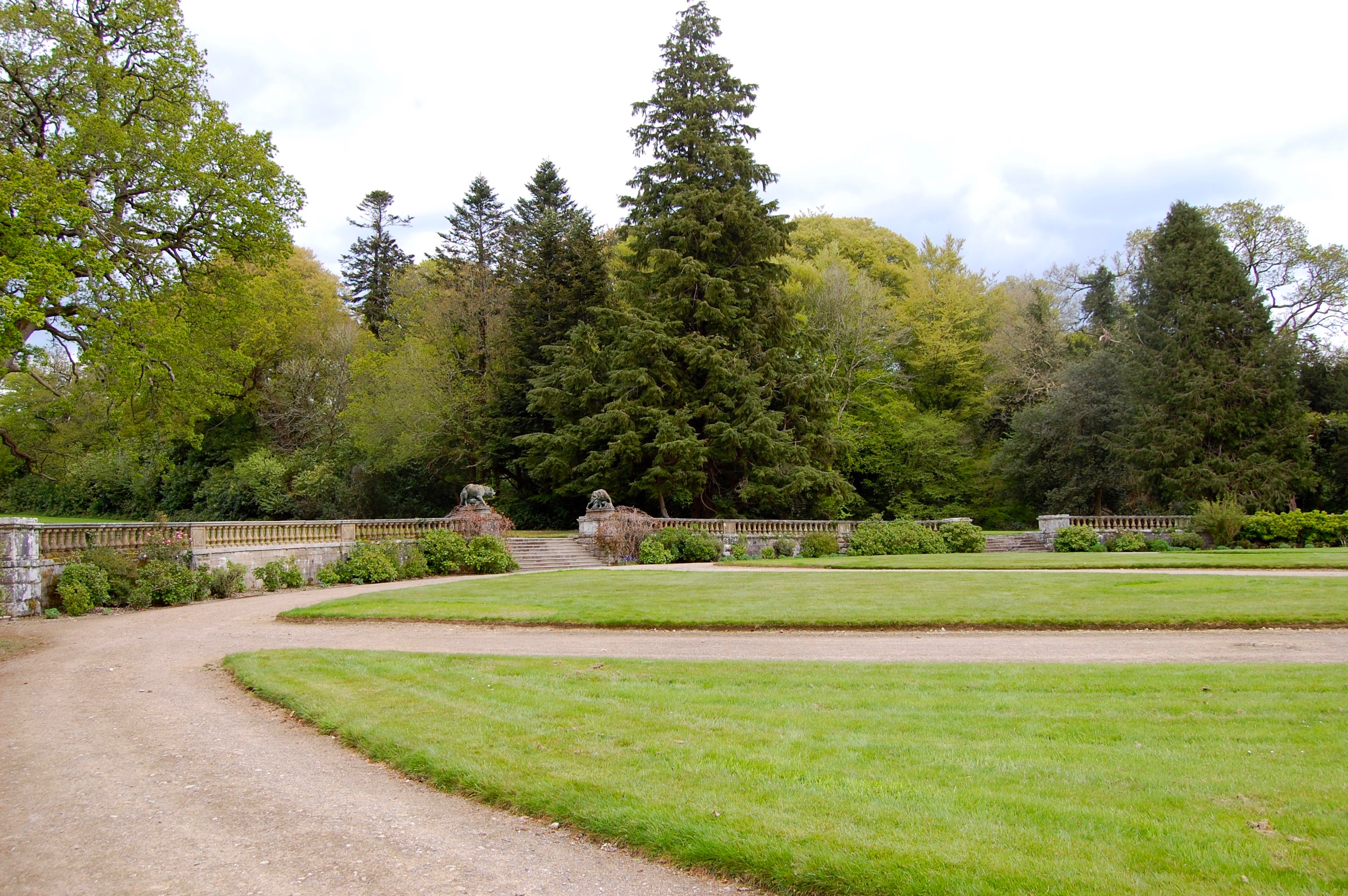
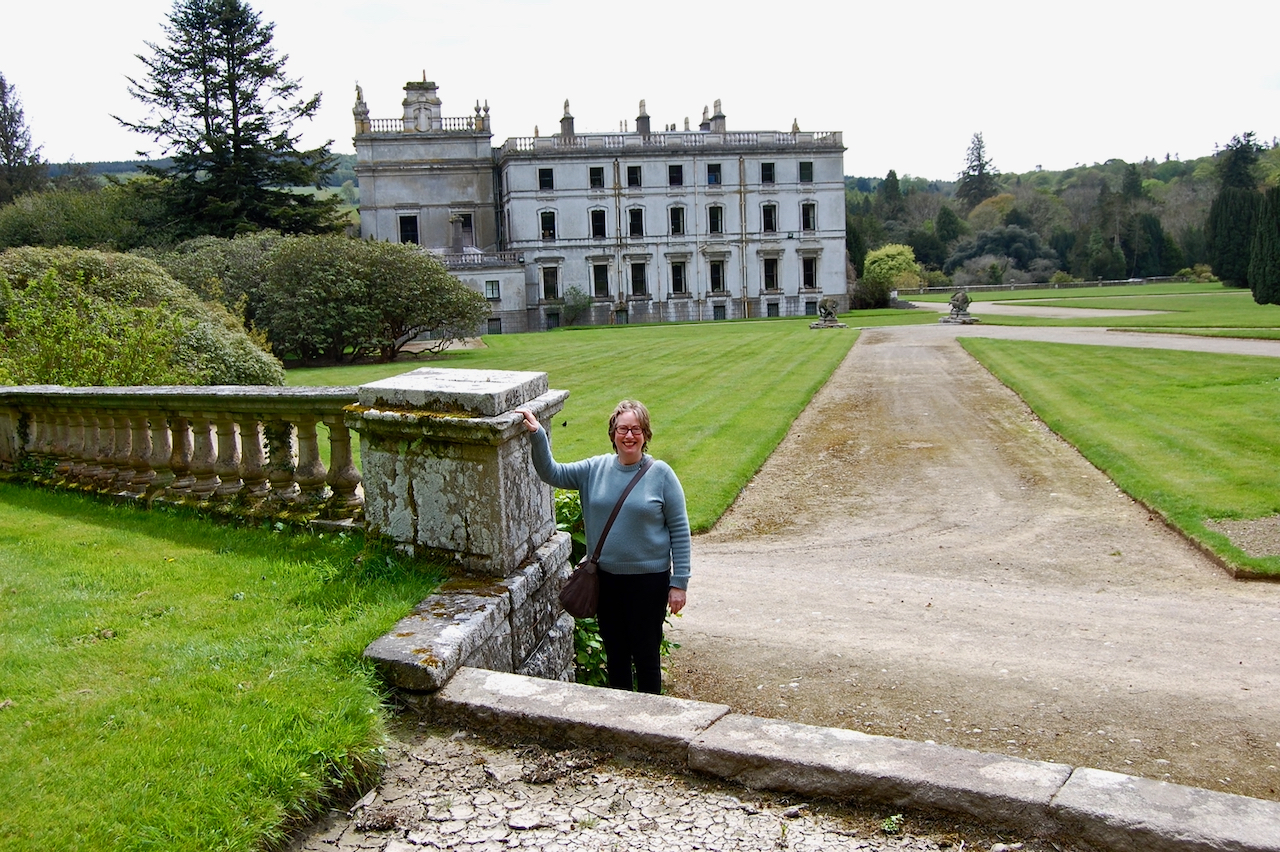
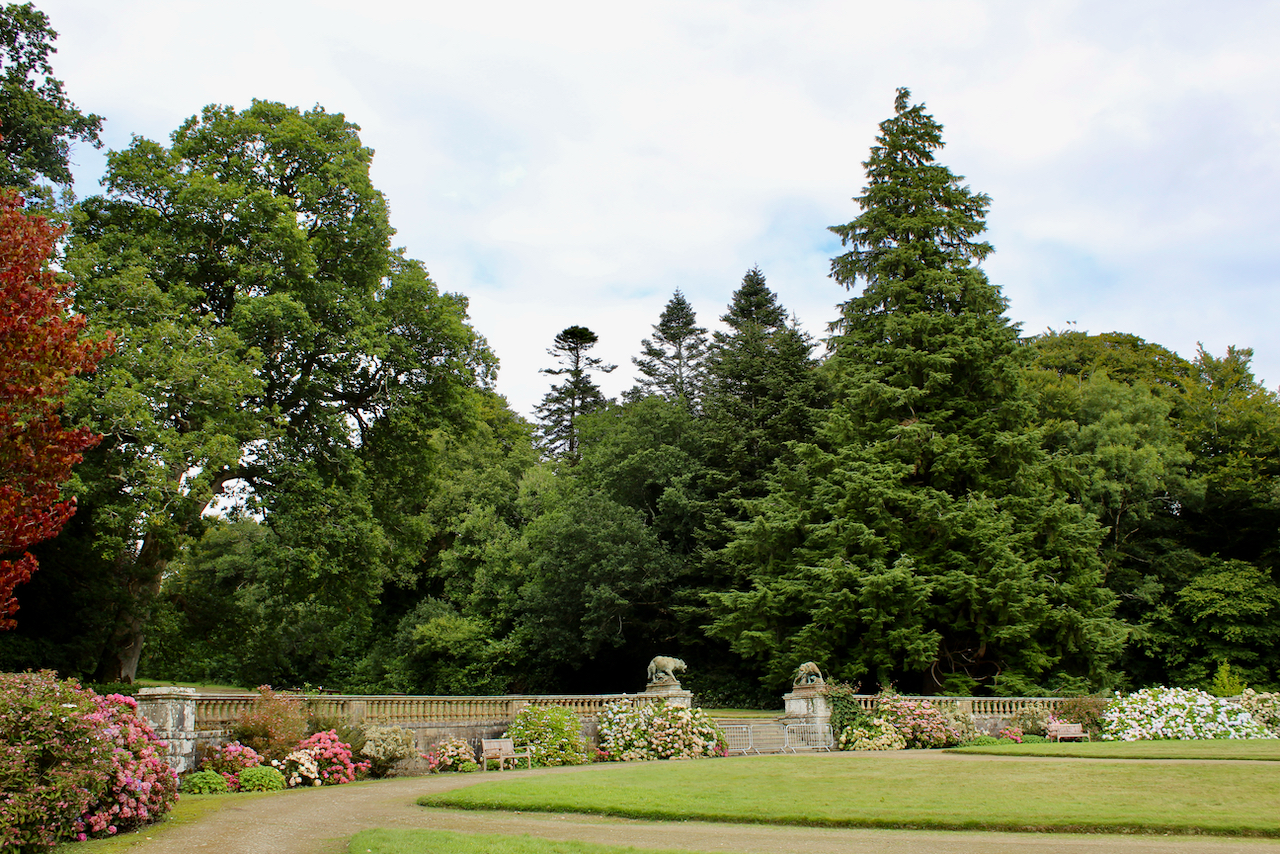
Formal gardens, post-1839, to south comprising series of artificial terraces with balustrades, flights of steps and ha-has. 

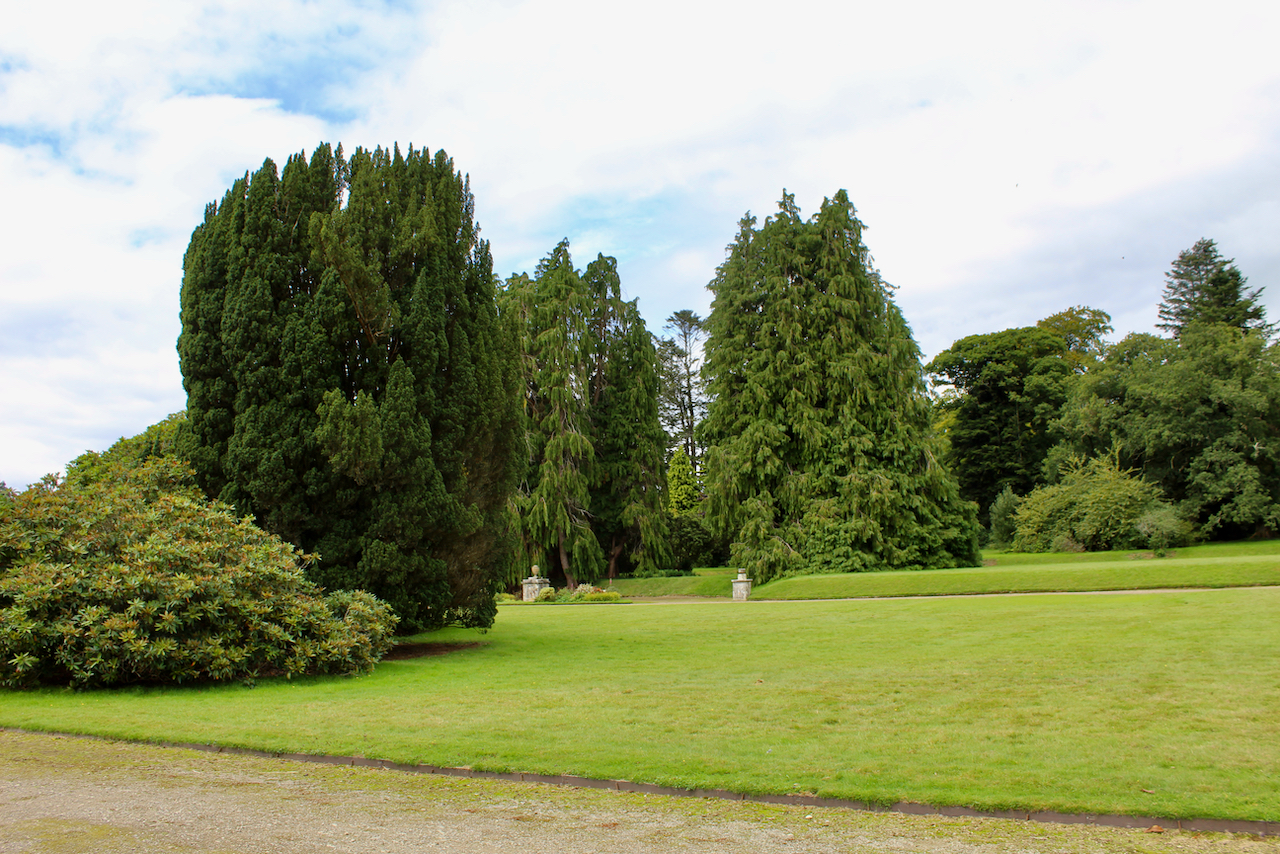
The house is set within a landscaped demesne approached by gravel drive; balustraded formal courtyard to Entrance Front with gravel drive and grass centrepiece; group of formal gardens to Garden Front including series of artificial terraces with balustrades, flights of steps and rubble stone ha-has; pond to sheltered garden to south-west.

4/11/2019 

 
from myhome.ie 
 
from myhome.ie 
 
from myhome.ie 

From Georgian Mansions in Ireland with some account of the evolution af Georgian Architecture and Decoration by Thomas U. Sadleir and Page L. Dickinson. Dublin University Press, 1915: 

 
P. 10. Abbeyleix house, the residence of the Viscount de Vesci, is a large four-storied rectangular building, situated in a splendid demesne, celebrated for its magnificent oaks, of over 700 acres, not far from the small but picturesque town from whence its name is derived. Externally it presents an uninteresting appearance for although constructed of red brick with a stone front, by plastering the whole it has entirely lost its Georgian character; internally, in spite of modern embellishment, much of the original work is still preserved. The character of the ornament is well shown in the Hall: two fluted columns support an entablature, and the Adam style appears both in the frieze and the fan decoration of the walls. There is a tall handsome mantel of siena and white marble, with well-carved centre panel, which was formerly in a Dublin mansion. Besides the masterly portrait of Le Grand Dauphin, by Pierre Mignard, a recent purchase of the present Viscount, this apartment contains pictures in oils of Michael Boyle, Archbishop of Armagh [an ancestor of the family through the marriage of Sir Thomas Vesey, 1st Bt, with his grand-daughter Mary Muschamp.]; John Vesey, Archbishop of Tuam; Sir Thomas Vesey, Bt, 1712, afterwards Bishop of Ossory; first Lord Knapton, in early manhood; Mrs Colclough, wife of Caesar Colclough of Duffrey Hall, County Wexford, and sister of teh first Lord Knapton; Agmondesham Vesey (father of Ann, Lady Bingham0, as a child; and Elizabeth, wife of teh first Lord Knapton [she was a daughter of William Brownlow of Lurgan, MP for county Armagh], by Stephen Slaughter, dated 1744. 

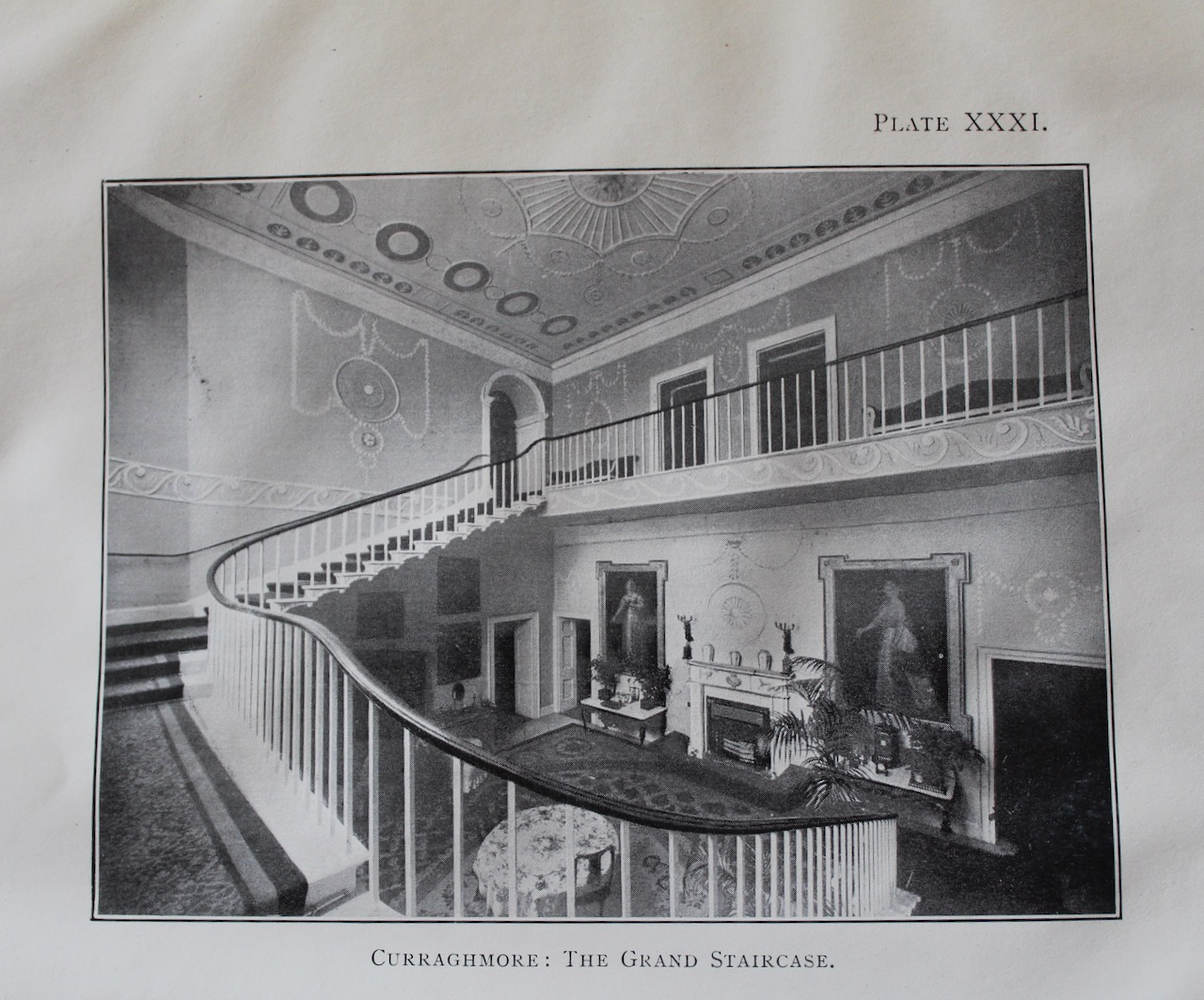
p. 11 “Passing to the left from the Hall we enter a large lofty sitting room, wiht three mahogany doors and carved wood overdoors; the decoration is in plaster panels enriched with Adam ornament. There is a conventional Adam ceiling and frieze, the mantel, doubtless contemporary, being of white marble carved. … At the opposite end of the house lies the grand staircase, in two flights, with light balustrade of iron and oak handrail, the plan being similar to that at Caledon.” 

 
from myhome.ie 
 
from myhome.ie 
 
from myhome.ie 
 
 
from myhome.ie 


Georgian Mansions in Ireland with some account of the evolution af Georgian Architecture and Decoration by Thomas U. Sadleir and Page L. Dickinson. Dublin University Press, 1915.: 

“The corridor bisecting the house passes through the staircase hall, and has been carried on to afford communication with a modern addition containing a library and breakfast room. In this corridor are a fine portrait of Nicholas de Launay, by Hyacinth Rigaud, and a pleasing picture, which has been engraved in mezzotint, of the Right Honourable William Brownlow, of Lurgan, Co Armagh, half-length seated, by Gilbert Stuart. [fn. He was father of Frances Letitia, Viscountess de Vesci, and ancestor of Lord Lurgan.]  

The drawing room and dining room, also on this floor, have a south aspect, and overlook the beautifully laid out pleasure grounds: the former, spacious apartment, though lacking in any Georgian interest, contains several oil-paintings, including Thomas, first Viscount de Vesci, by Gilbert Stuart; Margaret, wife of Sir Arthur Brooke, Bart., of Colebrook, Co Fermanagh. [fn. she was the only daughter of Thomas Fortescue, of Reynoldstown, Co Louth, and sister of the first Lord Clermont]. There is also a case of miniatures, in which are examples of the work of Nathaniel Hone, Adam Buck, Gervaise Spencer, and others. 

 
from myhome.ie 
 
from myhome.ie 
 
from myhome.ie 
 
from myhome.ie 

Georgian Mansions in Ireland with some account of the evolution af Georgian Architecture and Decoration by Thomas U. Sadleir and Page L. Dickinson. Dublin University Press, 1915: 

“In the bedrooms most of the joinery is modern, but the Georgian brass grates, in some cases black-leaded, have been well-preserved.” 

p. 11. Nothing now remains of the Abbey founded at Leix, in the territory of the O’Mores, by the Cistercians in 1183, though some of the buildings were not finally demolished till the last quarter of the eighteenth century. This establishment, caleld in some documents “the little Abbey of Lenix,” existed till the dissolution, when the site, which is said to be that of the present mansion, together with some 820 acres in the immediate neighbourhood, passed to the Crown, being granted in 1562 to Thomas, Earl of Ormond, [p. 12] “Black Tom,” for services against the rebels. It does not appear that it was ever a residence of the Butler family, but it remained in their possession till in or about 1698, when it became the property of Thomas Vesey, who had lately marrieed a wealthy heiress in the person of Mary, the only daughter of Denny Muschamp, of Horsley, Surrey, Muster-Master General in Ireland, and who in the same year was created a Baronet of Ireland. 

p. 12. The most reverent John Vesey, Archbishop of Tuam, father of the purchaser, may also be called the founder of the family in Ireland, for from him descended the Veseys of Lucan, County Dublin; Hollymount, County Mayo, and Derrabard, County Tyrone; as well as Baron FitzGerald and Vesey, a title now extinct, and the family of Vesey-Fitzgerald. During the vice-royalty of Tyrconnell, he suffered great hardships at the hands of the native Irish, though it was only when their lives were in dangerthat he and Bishop Tenison, of Killala, consented to quit Connaught. Taking his wife and twelve children, he fled to London, where he lived in straitened circumstances, having no means of subsistence save a lectureship of £40 per annum, which the interest of his friends obtained for him. When in England he was attainted by James II’s Irish Parliament, but after the Revolution he returned to his diocese, and resumed the prominent part which he had been accustomed to take in the affairs of the country, of which he was twice appointed Lord Justice. It was probably as some recompense for his misfortunes that his eldest son, Thomas, when only 25, and during his father’s lifetime, was created a Baronet. Swift occasionally mentions the Archbishop, who published several sermons, as well as a “Life of Primate Bramhall” and appears to have been a man of refined tastes. He took great pleasure in laying out and planting his seat at Hollymount, County Mayo, described by John Wesley, when he visited it some forty years afterwards, as “one of the pleasantest places in Ireland.” There he died on 28 March 1716, having been in failing health for two years. 

p. 13.  

 
from myhome.ie 
 
from myhome.ie 
 
from myhome.ie 
 
from myhome.ie 
 
from myhome.ie 
 
from myhome.ie 
 
from myhome.ie 
 
from myhome.ie 
  
 
from myhome.ie 
 
from myhome.ie 
 
from myhome.ie 
 
from myhome.ie 
 
from myhome.ie 

Single-arch rubble stone hump back road bridge over river, built c.1840, with cut granite voussoirs. Random rubble stone walls with cut granite voussoirs. Round-headed openings with cut granite voussoirs and rubble stone lining. Sited spanning river; iron gate to centre of bridge; cut stone retaining walls to river banks to north and to south; tubular steel cow grill to east. 

Freestanding six-bay single-storey boathouse, built c.1850, with yellow brick piers and open gable ends. Double-pitched slate roof with scalloped slate and red clay tiles, concrete ridge tiles, decorative cresting, timber eaves and decorative timber bargeboards and open framing to gable ends. Coursed rubble stone to base of walls with yellow brick intermittent piers. Square-headed window openings with concrete chamfered sills, yellow brick dressings to lintels and timber lattice panels. Yellow brick internal walls. Sited to west of river on an elevated site; section of iron railings to open gable end to west; gravel drive to east; grass river banks to north and to south. 

Detached seven-bay three-storey over basement with dormer attic Classical-style country house, begun 1773, with pedimented breakfront having cut stone Doric doorcase to ground floor. Five-bay elevation to garden front with breakfront having cut sandstone doorcase and Wyatt style window openings to flanking bays. Two-bay single-storey wing to west, renovated c.1840, with façade enrichments added. Extended to west, post-1902, comprising seven-bay single-storey wing with breakfront having three-bay advanced centre bay. Balustraded forecourt, c.1840, to north. Formal gardens, post-1839, to south comprising series of artificial terraces with balustrades, flights of steps and ha-has. Slate mansard roof hidden behind balustraded parapet with rolled lead ridge tiles, rendered panelled chimneystacks with yellow clay pots and cast-iron rainwater goods. Flat-roofed dormer attic windows, flat-roof to wing not visible behind guilloche parapet, roof to wing not visible behind guilloche parapet. Nap rendered walls with ruled and lined detail, unpainted, with sandstone dressings including quoins, quoins strips, stringcourses and cornice. Nap rendered to wings with ruled and lined detail. Square-headed window openings with stone sills on corbels. Gibbsian surrounds to ground floor windows, shouldered surrounds to first floor windows with balconettes to breakfront windows and architraves to top floor windows with keystones, all with three-over-three and six-over-six timber sash windows. Wyatt-style surrounds to Garden Front. Tripartite door arrangement, cut-limestone Doric frontispiece with entablature with timber panelled double doors and decorative overlight. Gibbsian surround to door opening to Garden Front with timber French door. Round-headed window openings to wing with concrete sills, pillared surrounds, moulded archivolts and timber casement windows with overlights. Timber panelled internal shutters to window openings; entrance hall: stone tiled floor; decorative marble fireplaces; Ionic screen wall; Wyatt-style plasterwork to walls and to ceiling. Abbeyleix House is set within landscaped demesne approached by gravel drive; balustraded formal courtyard to Entrance Front with gravel drive and grass centrepiece; group of formal gardens to Garden Front including series of artificial terraces with balustrades, flights of steps and rubble stone ha-has; pond to sheltered garden to south-west. 

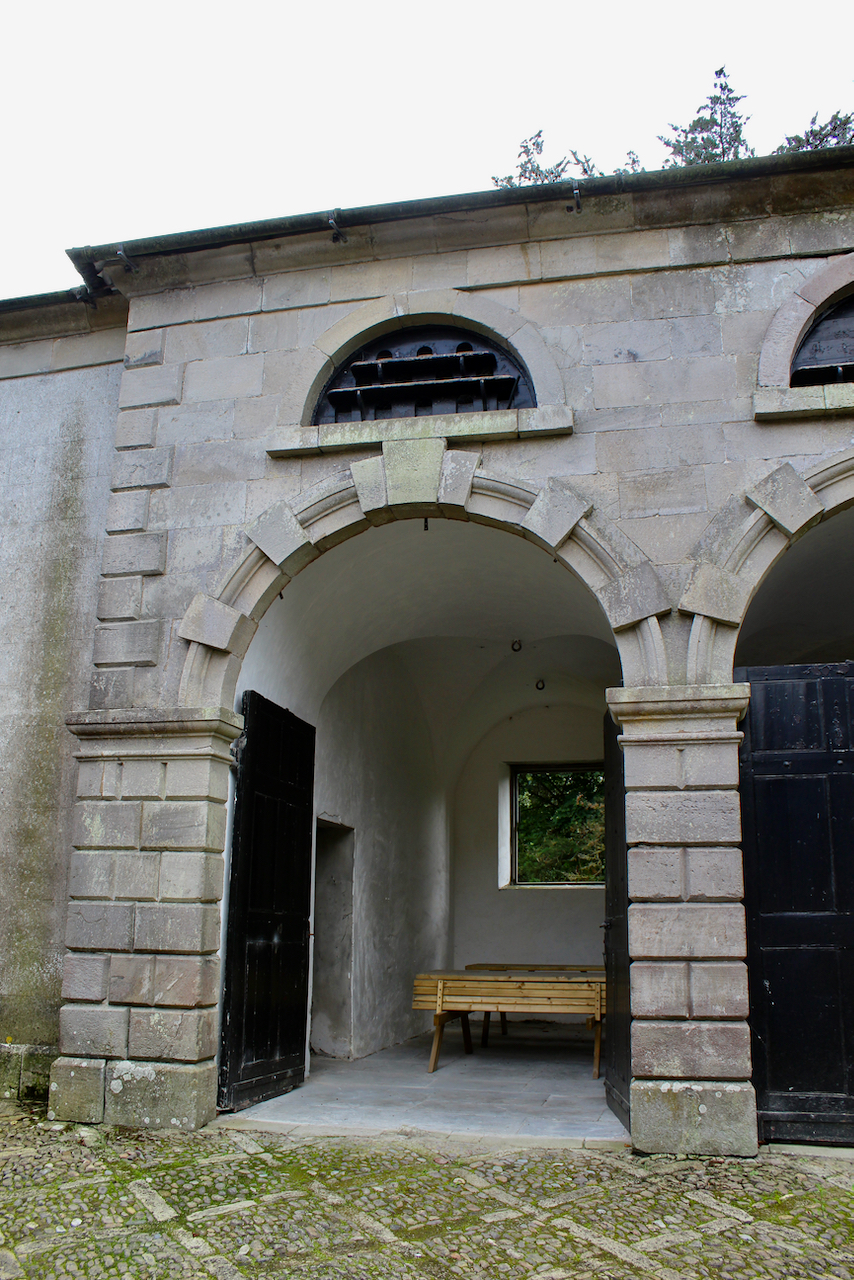
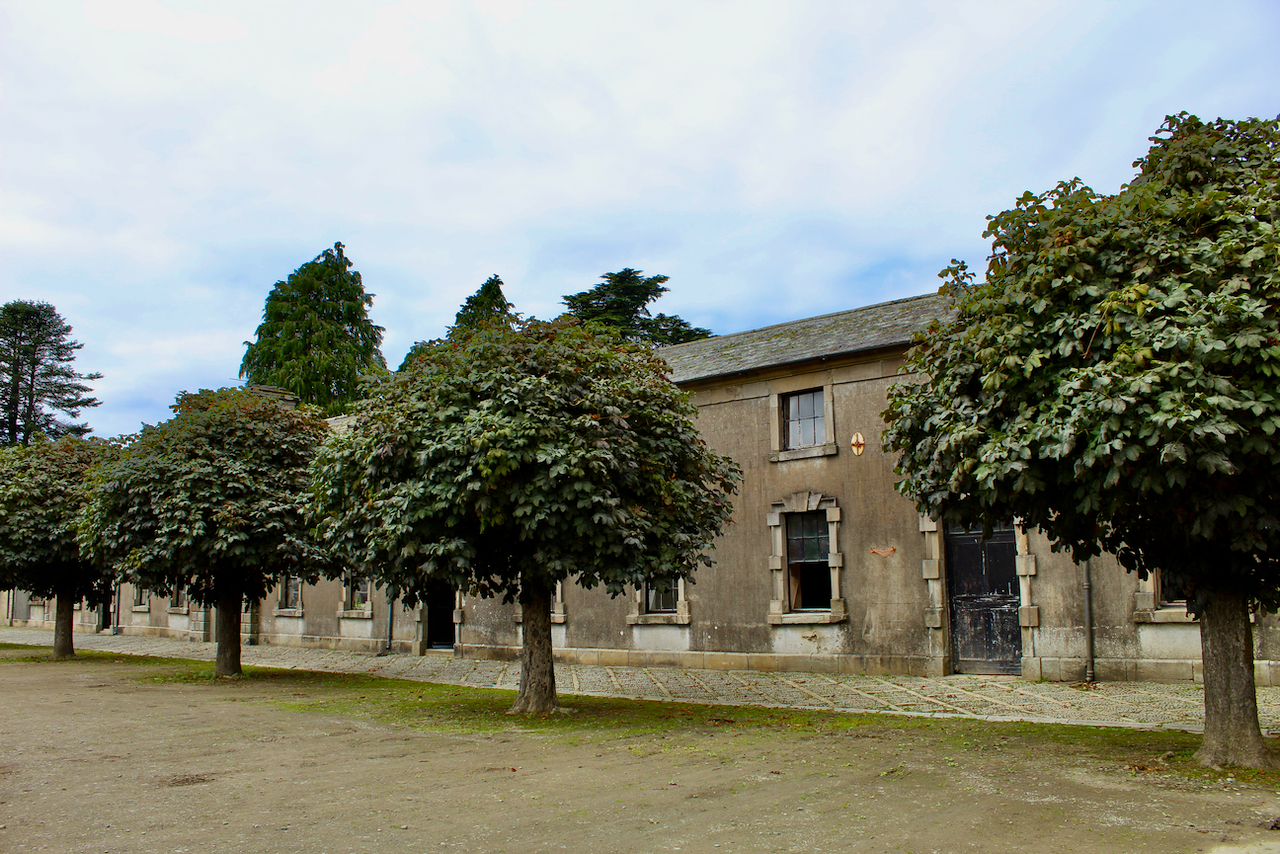
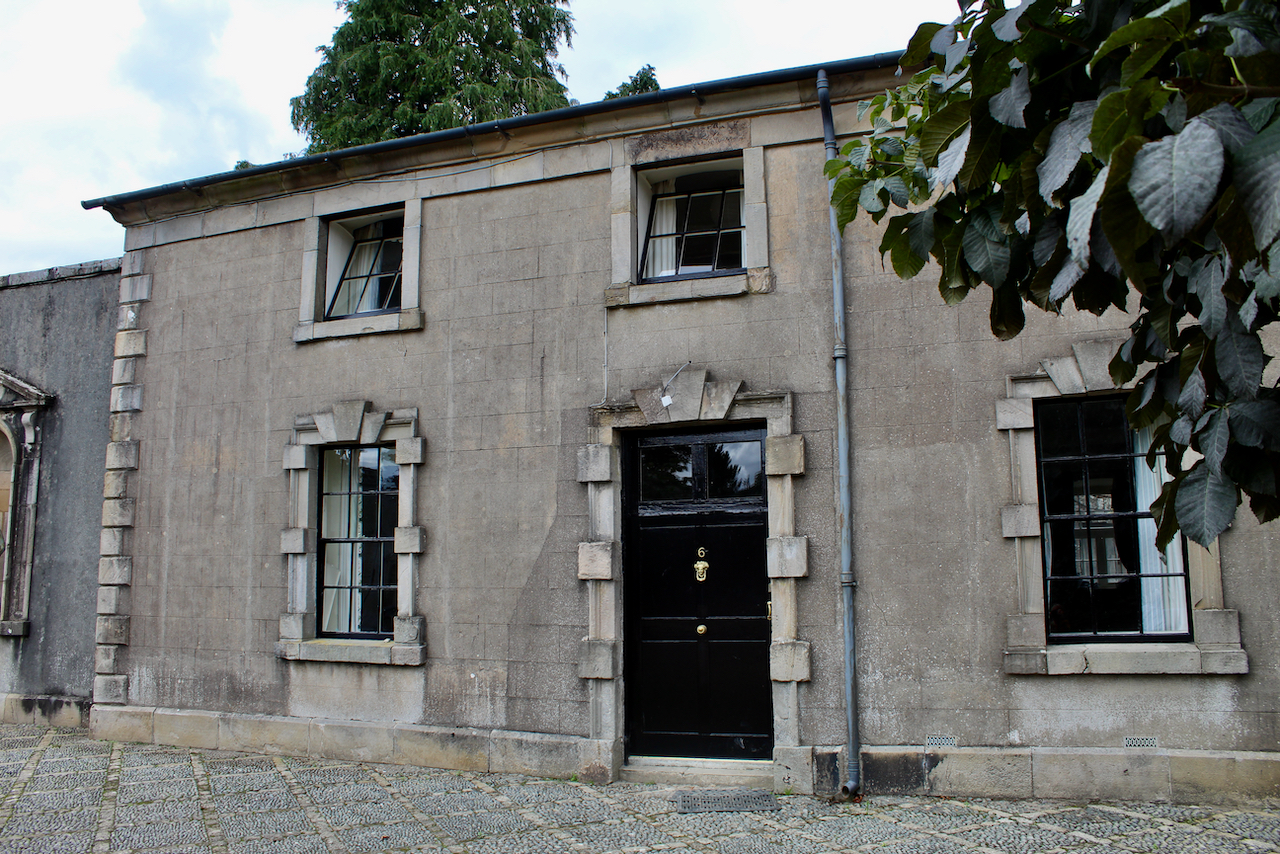
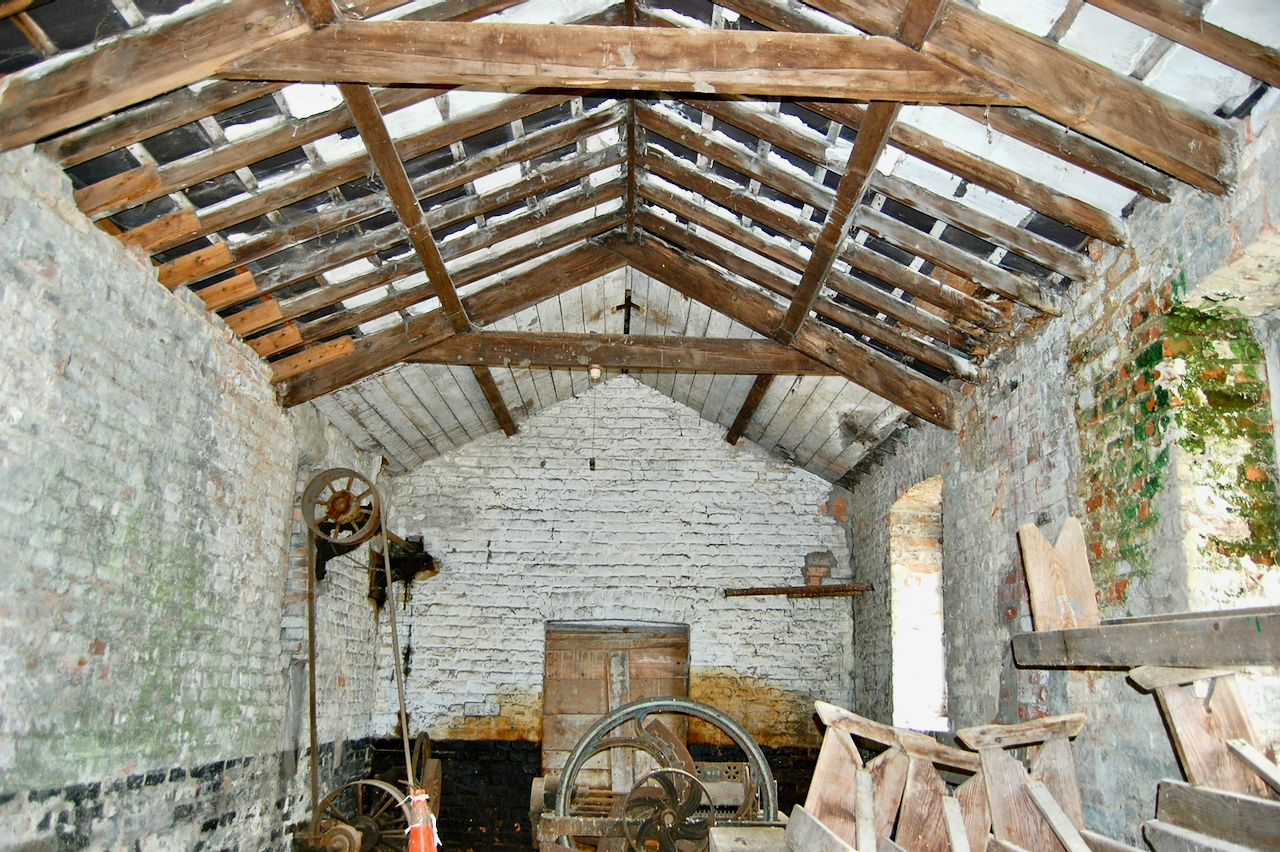
Multiple-bay two-storey stable complex, built c.1800, on a quadrangular plan with courtyard. Pair of round-headed integral carriageways with belfry and ogee dome to east and series of elliptical-headed carriageways. Multiple-bay two-storey range, c.1800, to east on a triangular plan with kitchen courtyard connecting to Abbeyleix House. Detached four-bay single-storey rubble stone stable range, c.1800, to west. Double-pitched slate roof on quadrangular and triangular plans with rolled lead ridge tiles, roughcast chimneystacks with red clay pots, timber eaves and cast-iron rainwater goods. Timber belfry to apex with corner pilasters and ogee dome. Double-pitched slate roof to stable range with concrete ridge tiles and timber eaves. Roughcast render over rubble stone walls, unpainted. Random rubble stone to stable range. Square-headed window openings with concrete sills, some rendered surrounds and two-over-two, three-over-three and three-over-six timber sash windows. Series of lunette window openings to first floor with concrete sills and timber fixed-pane windows. Round- and elliptical-headed carriageways (two integral) with rendered surrounds and timber panelled double doors. Square-headed door openings to stable range with timber panelled half-doors. Utilitarian interiors with timber stalls. Set adjacent to west of Abbey Leix House approached by gravel drive; tarmacadam and gravel courtyard to centre of quadrangular range; cobbled courtyard to centre of triangular range. 

https://theirishaesthete.com/2019/08/05/an-18th-century-house-guest/

‘I must return to give you an account of Lady De Vesci’s. I am quite in love with her and with their state of living. It is entirely without form, everybody doing as they please, and always a vast number of people in the house. Lady Knapton, his mother, lives with them, and seems no restraint upon anybody, she is so good-humoured. We were about six or seven ladies and as many gentlemen, divided into different parties about the room, some working, some reading, some playing cards, and the room being large and very full, it had a most comfortable appearance. It opens into the library on one side and the dining-room on the other. As it rained most of the time I was there I did not see much of the grounds, but the park is not laid out, as they have employed all their time and money in making a comfortable house first, which I think the most sensible plan. Lady De Vesci was very loth to let us go so soon, but Mr. Dawson had business at home that prevented our staying longer. However, we go again into their neighbourhood the end of next week, as Sir Robert and Lady Staples have been very pressing with their invitations, and insisted upon our naming the time, which we accordingly did, and Lady De Vesci begs we will come to her again after that, to meet Lord and Lady Tyrone, so you see we have enough to do; besides we have a ball to go to on Wednesday next, which a distant neighbour has invited us to, and when all this is over we meditate a trip to Dublin, to buy some things we have occasion for.’ 
From Lady Caroline Dawson to Lady Louisa Stuart, September 1778. 

The Irish Aesthete: Buildings of Ireland, Lost and Found. Robert O’Byrne. The Lilliput Press, Dublin, 2024.

p. 2. Abbeyleix House, County Laois – June 2016

“Abbey Leix was designed in 1773 by James Wyatt for Thomas Vesey, Lord Knapton (later first Viscount de Vesci). As originally built, the house was an elegant three-storey classical mansion of seven bays, the three central bays under a triangular pediment. In the middle of the nineteenth century the third Viscount de Vesci and his wife Emma, daughter of the 11th Earl of Pembroke, added a great classical library and a conservatory, extending the eighteenth-century library to twice its length. Their architect was T. H. Wyatt (descended from a cousin of James Wyatt).

“These alterations gave the building a more pronounced Italianate character through added features such as stone details, Gibbsian window surrounds, emphatic quoins and balconies. The most notable external work was the addition of a balustrade parapet running around the attic, thereby masking dormer windows on an additional storey to provide staff accommodation. Portland cement render applied to the exterior drew these changes together, giving the impression of a unified composition. At the same time as alterations were being made to the building, Lady de Vesci embarked on redesigning the gardens to the rear. Here, a series of elaborate formal terraces was introduced. It has been proposed that the design of these terraces was inspired by those at Alupka in the Crimea, the palace of Lady de Vesci’s Russian maternal grandfather, Prince Worontsov, although more likely they were the invention of Abbey Leix’s chatelaine. In the mid-1990s the house and estate were sold to Sir David Davies, who embarked on a thorough restoration of both. More recently, Abbey Leix was bought by Irish entrepreneur John Collison.”
Curraghmore, Portlaw, County Waterford – section 482

www.curraghmorehouse.ie

Open dates in 2026: May 1-4, 8-10, 15-17, 22-24, 29-31, June 1, 5-7, 12-14, 19-21, 26-28, July 3-5, 10-12, 17-19, 24-26, 31, Aug 1-3, 7-9, 14-23, 28-30, 10am-4pm

Fee: adult/OAP/student, full tour €22, garden tour €8, child under12 years free

DSC_0564
Curraghmore, 5th May 2019. Photograph © Jennifer Winder-Baggot, www.irishhistorichouses.com

According to the Curraghmore website:

Curraghmore House in Waterford is the historic home of the 9th Marquis of Waterford. His ancestors (the de la Poers) came to Ireland from Normandy after a 100-year stopover in Wales around 1170, or about 320 years before Columbus ‘discovered’ the New World.

Some 2,500 acres of formal gardens, woodland and grazing fields make this the largest private demesne in Ireland and one of the finest places to visit in Ireland….

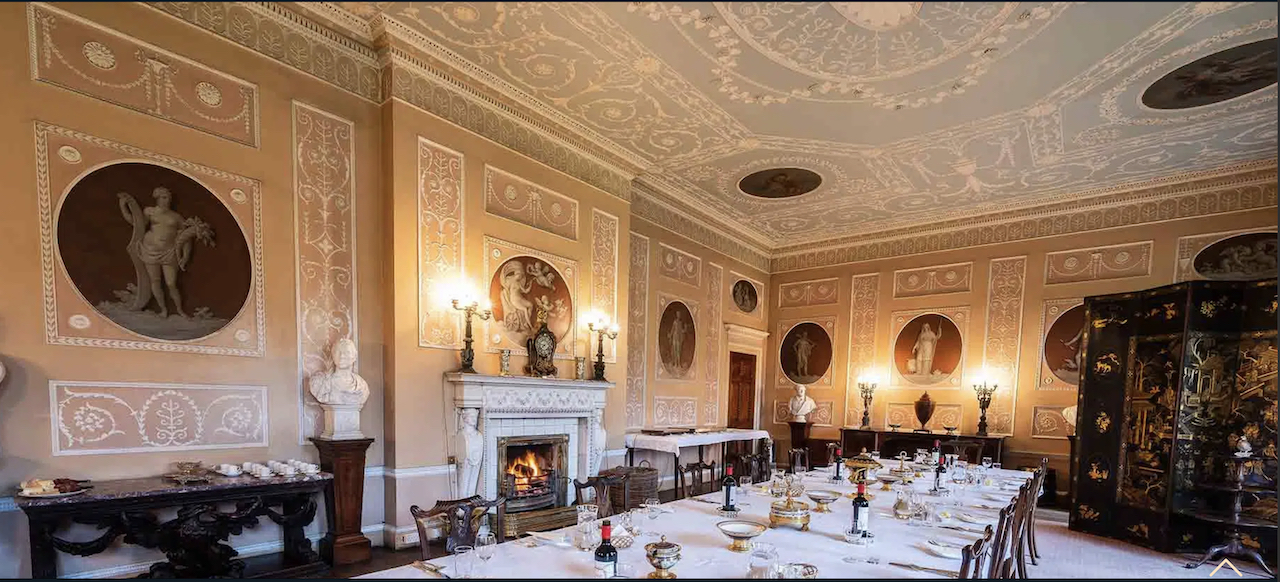
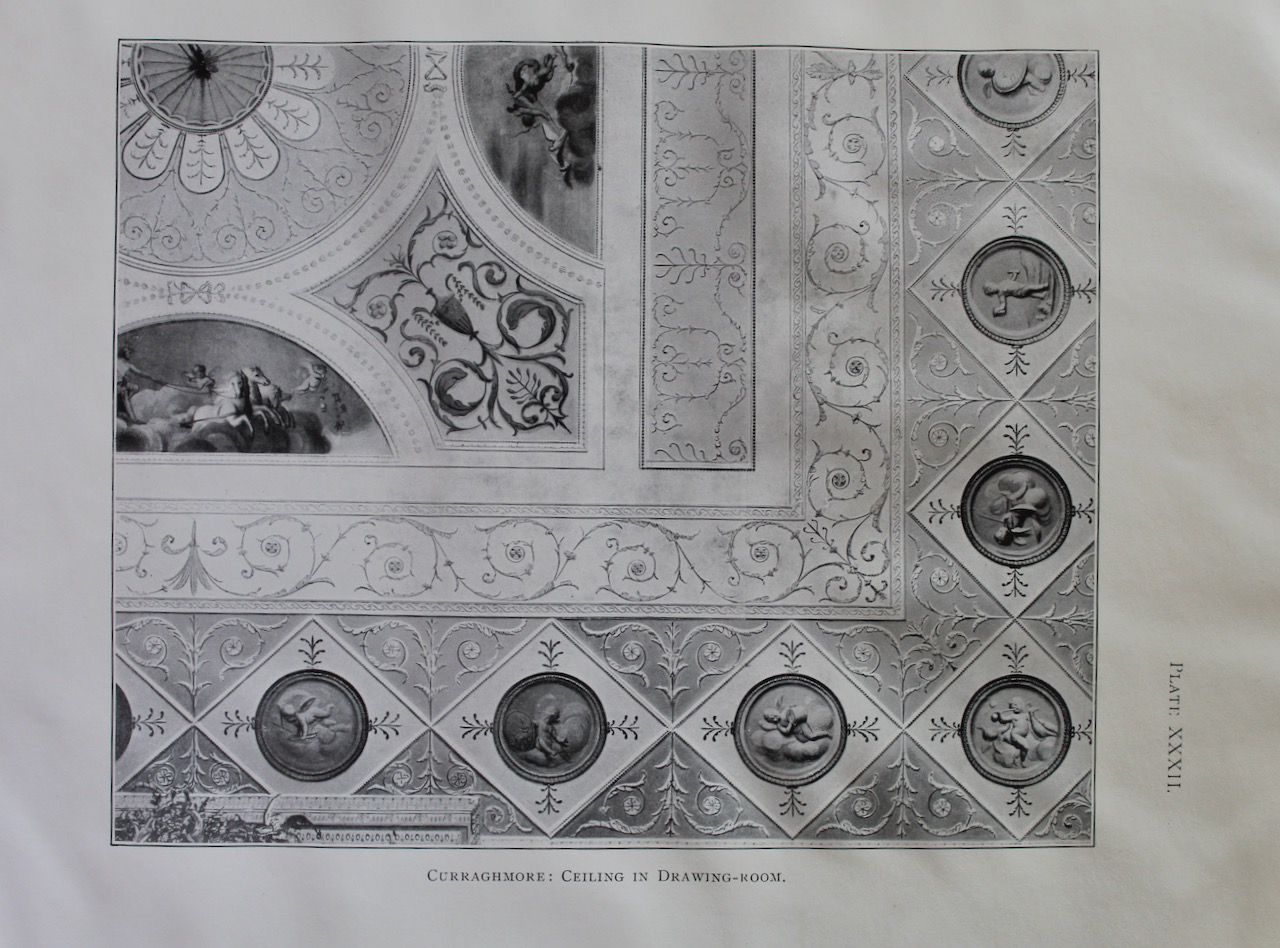
This tour takes in some of the finest neo-classical rooms in Ireland which feature the magnificent plaster work of James Wyatt and grisaille panels by Peter de Gree.” 

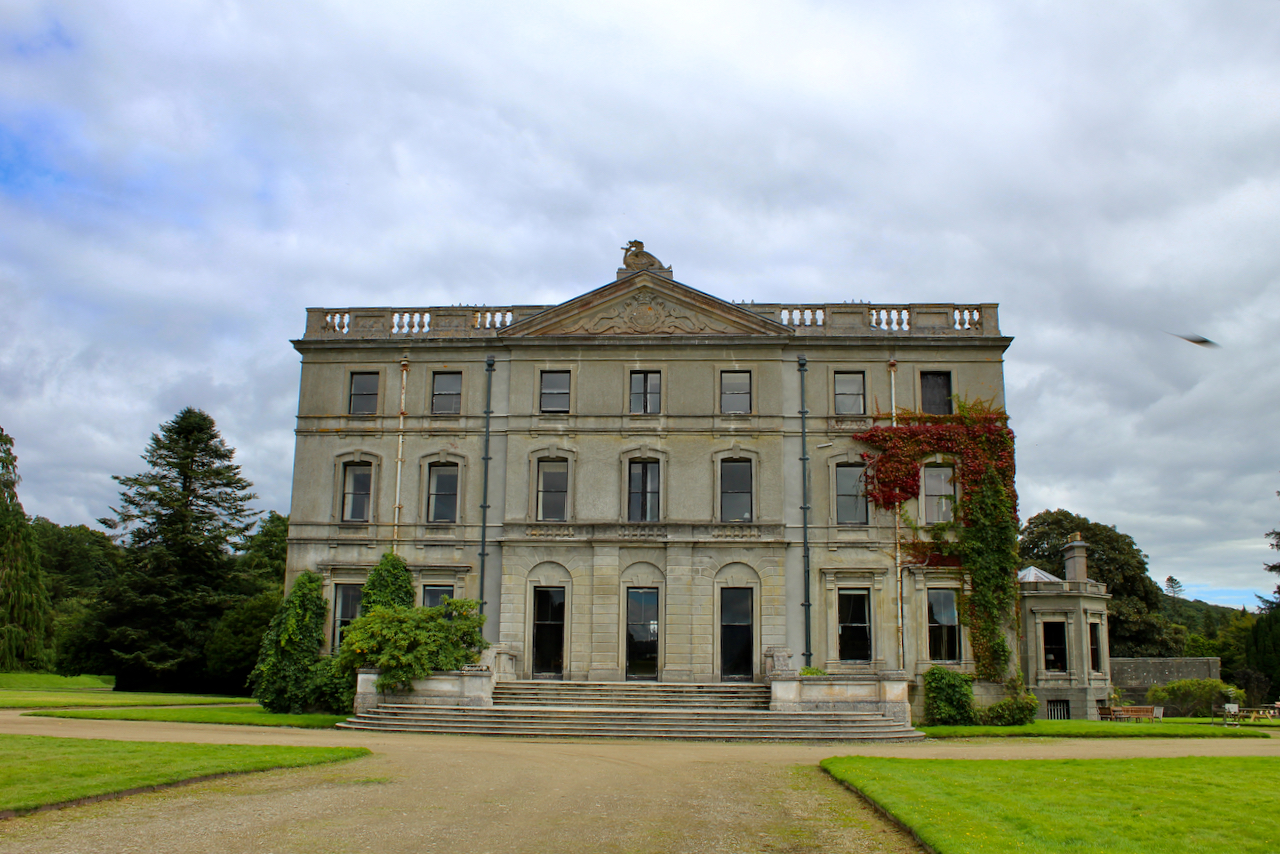
Curraghmore, the garden facing side of the house, designed by James Wyatt (1746-1813), 14th August 2023. Photograph © Jennifer Winder-Baggot, www.irishhistorichouses.com

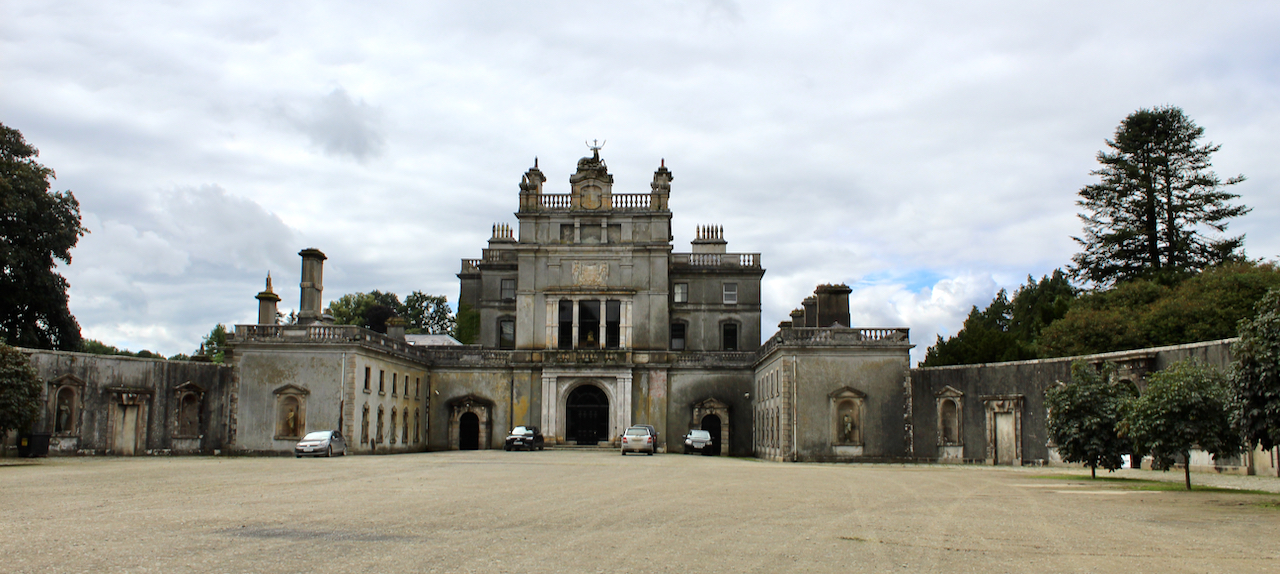
The website continues: “Curraghmore, meaning great bog, is the last of four castles built by the de la Poer family after their arrival in Ireland in 1167. The Castle walls are about 12 feet thick and within one, a tight spiral stairway connects the lower ground floor with the roof above. Of the many curious and interesting features of Curraghmore, the most  striking is the courtyard front of the house, where the original Castle is encased in a spectacular Victorian mansion with flanking Georgian ranges.

We came across a link to the De La Poer family, also called Le Poer or Power, in Salterbridge, and will meet them again in Powerscourt in Wicklow and Dublin.

Curraghmore, the courtyard facing side of the house, 14th Aug 2023. Photograph © Jennifer Winder-Baggot, www.irishhistorichouses.com

The core of the house is the medieval tower, visible from the courtyard facing side of the house, built by the original owners, the La Poers, and the house is still owned by the same family today. The tower may stretch back all the way to the original La Poer occupants from 1167. When we went inside, we stood in what was the original tower, and we could see the 12 foot thick walls.

It was difficult to find Curraghmore House. We drove two kilometres up a stony track; without the reassuring directions, we would not have believed we were on the right road. The road winds along by the River Clodagh. As our guide told us later, the distance from anything else in all directions is one reason the house remains intact. There are three entrances, and all have drives of about 1.5km to the house.

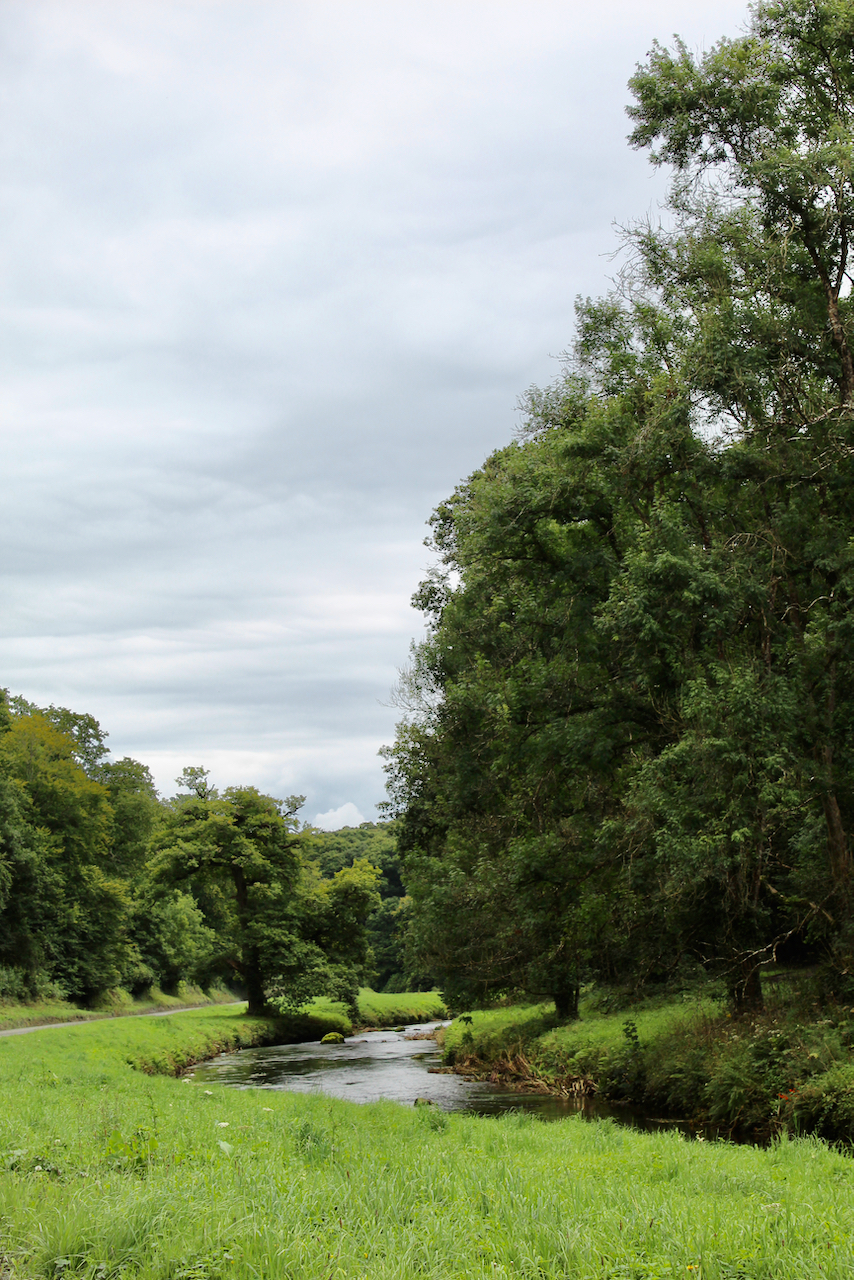
The River Clodagh on the drive to Curraghmore. Photograph © Jennifer Winder-Baggot, www.irishhistorichouses.com
DSC_0563
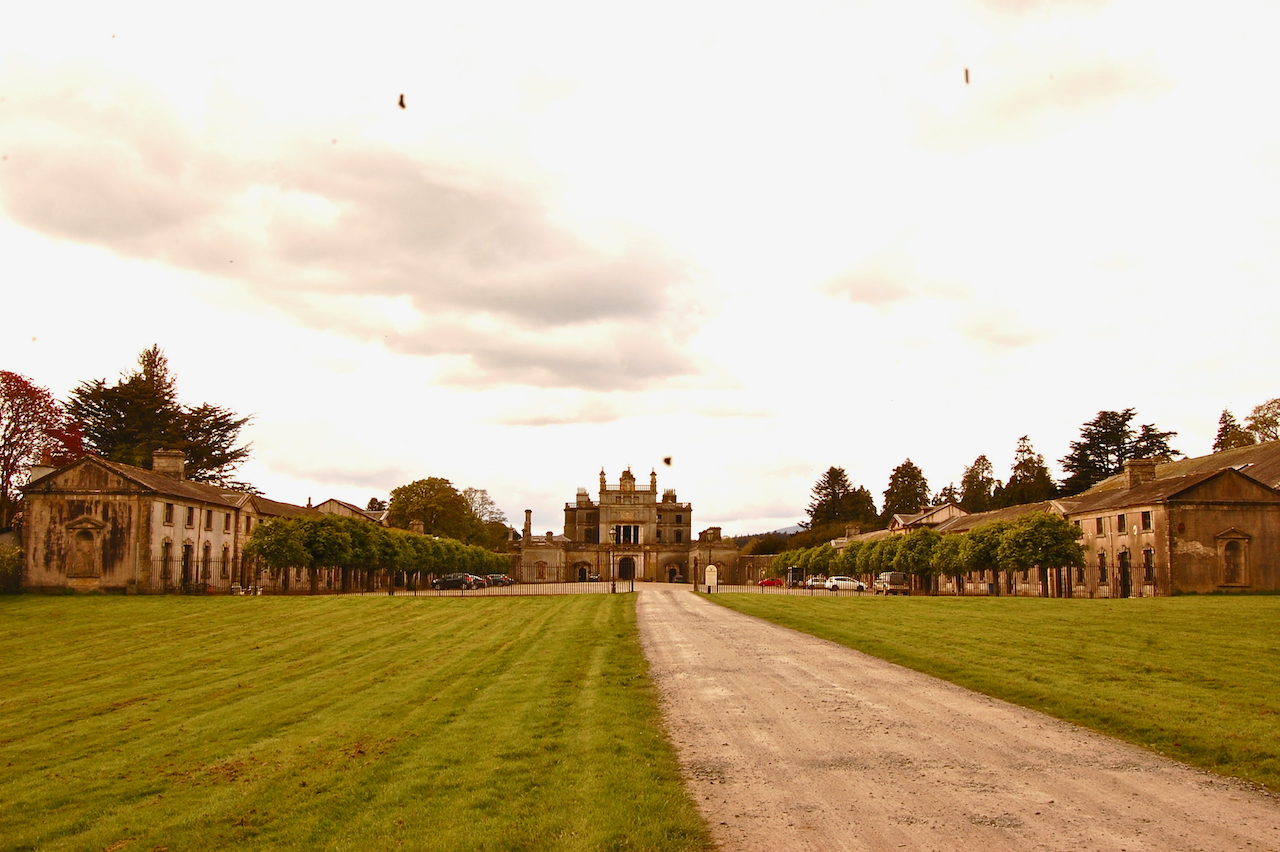
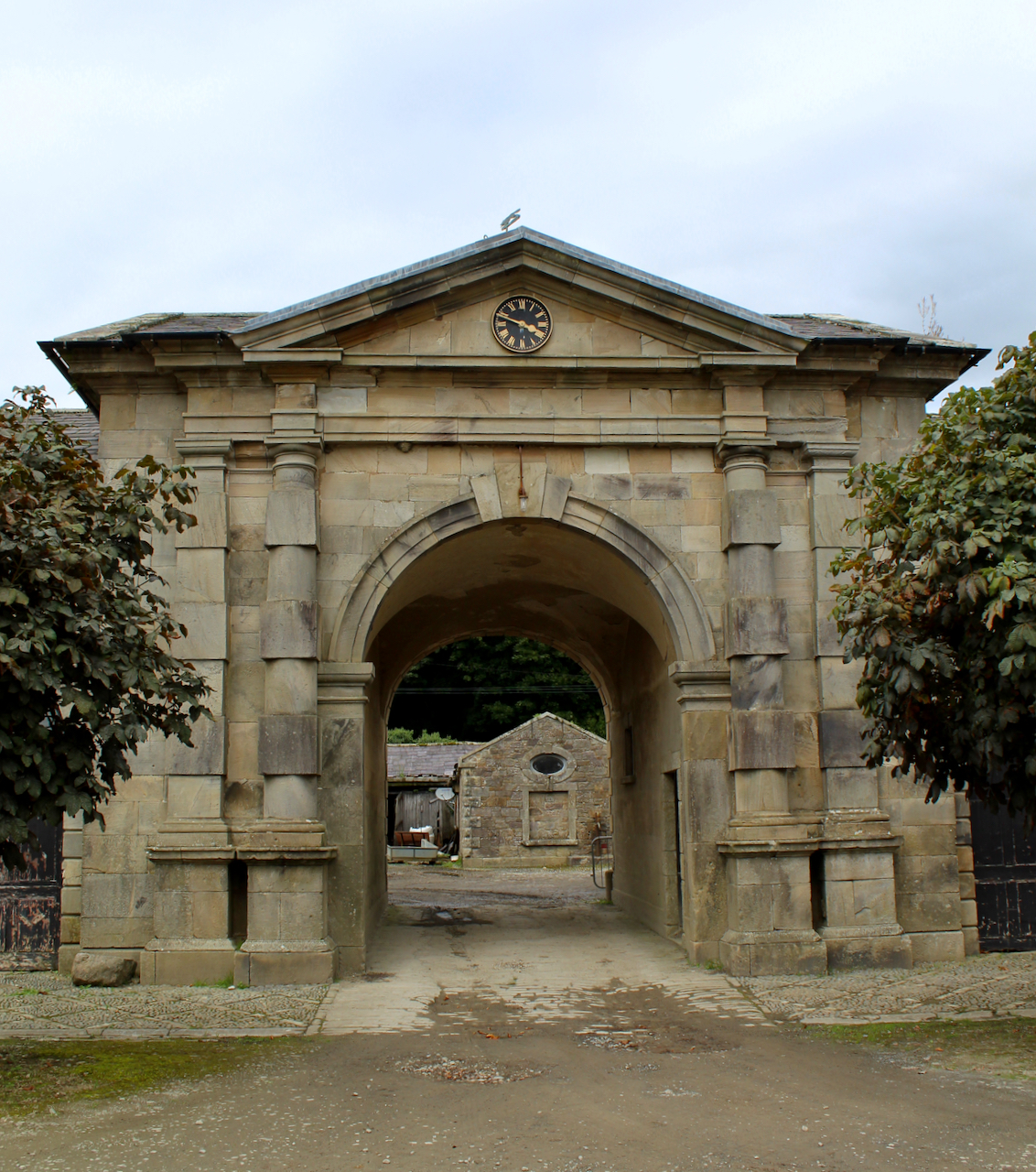
Entering Curraghmore, via servants’ quarters either side of courtyard, 5th May 2019. Photograph © Jennifer Winder-Baggot, www.irishhistorichouses.com
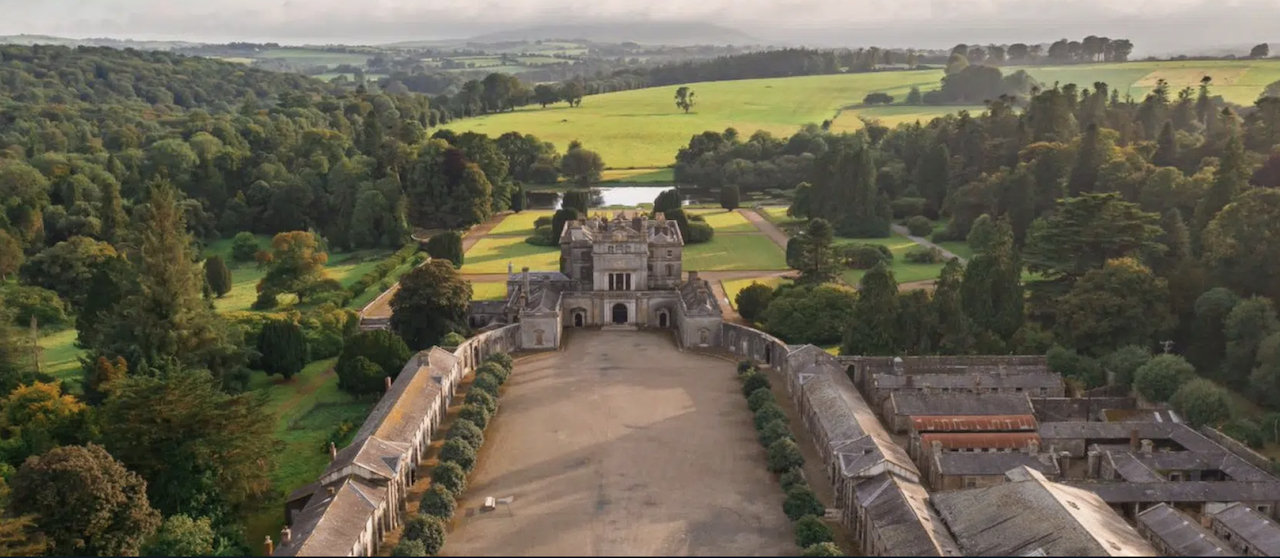
Photograph courtesy of Curraghmore website.
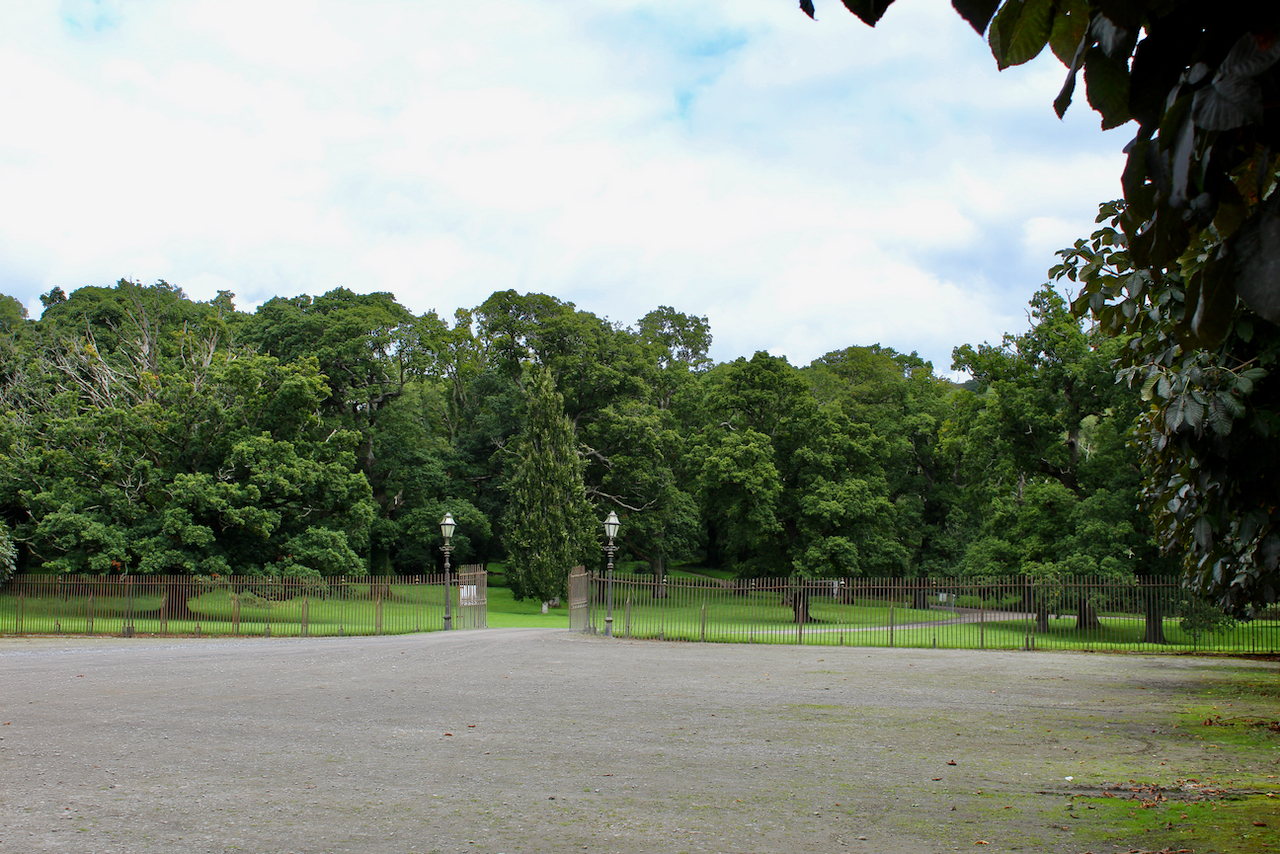
This is the gate one drives through into the courtyard of Curraghmore. Photograph © Jennifer Winder-Baggot, www.irishhistorichouses.com

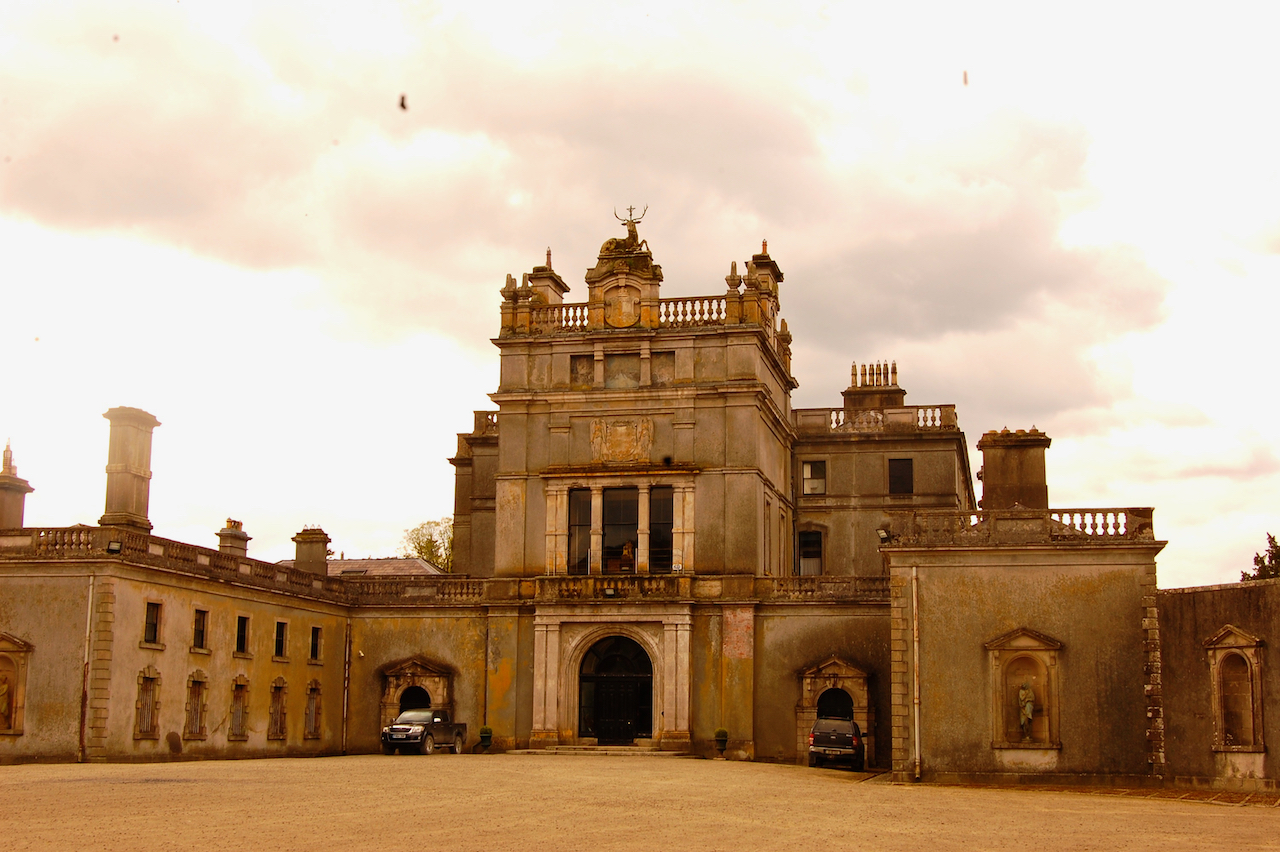
Mark Bence-Jones describes Curraghmore in A Guide to Irish Country Houses as a medieval tower with a large three storey house behind it. He writes that the “original Castle is encased in a spectacular Victorian mansion” with flanking Georgian ranges housing servants, stables, etc. [1] The house is seven bays wide (see garden front) and seven bays deep.

DSC_0612
Garden front, 5th May 2019. It has full height windows where there was the original door, I think. Photograph © Jennifer Winder-Baggot, www.irishhistorichouses.com

The guide told us that when James Wyatt added to the house, he specifically created windows and no door in the room that faces the garden, to avail of the view. However, the windows are deceptive and are actually “doors,” as they fully open to let in visitors.

Photograph courtesy of Curraghmore website.
DSC_0616
Curraghmore, 5th May 2019. Photograph © Jennifer Winder-Baggot, www.irishhistorichouses.com
The view takes in a sweeping lawns, a circular pond that once held a big fountain and a lake beyond, created by Wyatt, and the mountains in the distance. Photograph © Jennifer Winder-Baggot, www.irishhistorichouses.com
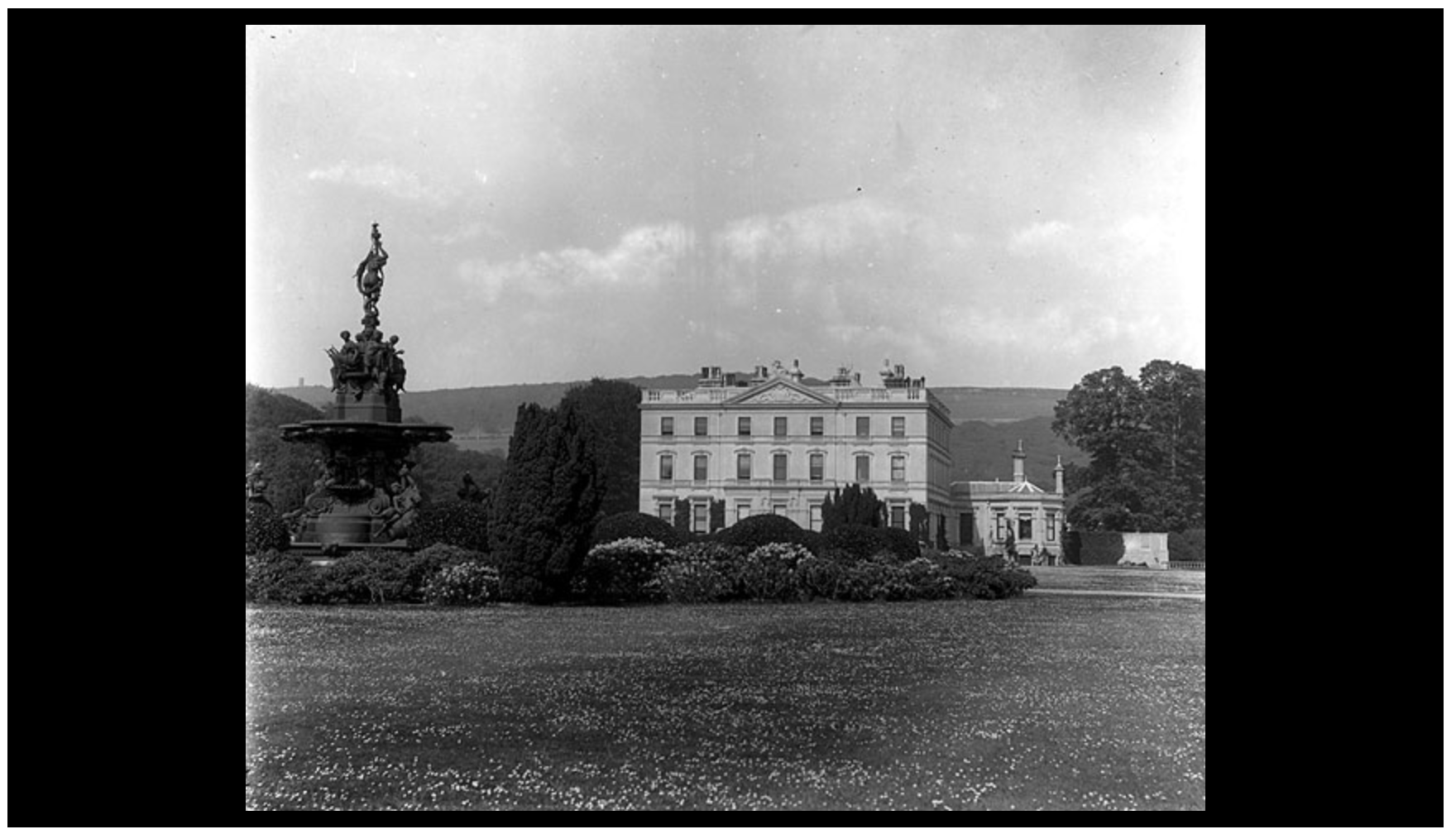
Curraghmore House and Fountain, Portlaw, Co. Waterford. Unfortunately the huge fountain has gone. Poole Collection National Library of Ireland, call no. pooleimp141.

Mark Bence-Jones writes that:

The tower survives from the old castle of the Le Poers or Powers; the house was in existence in 1654, but was rebuilt 1700 and subsequently enlarged and remodelled; it extends round three sides of a small inner court, which is closed on fourth side by the tower. The 1700 rebuilding was carried out by James Power, 3rd and last Earl of Tyrone of first creation, whose daughter and heiress, Lady Catherine Power, married Sir Marcus Beresford…The 1st Beresford Earl of Tyrone remodelled the interior of the old tower and probably had work done on the house as well.

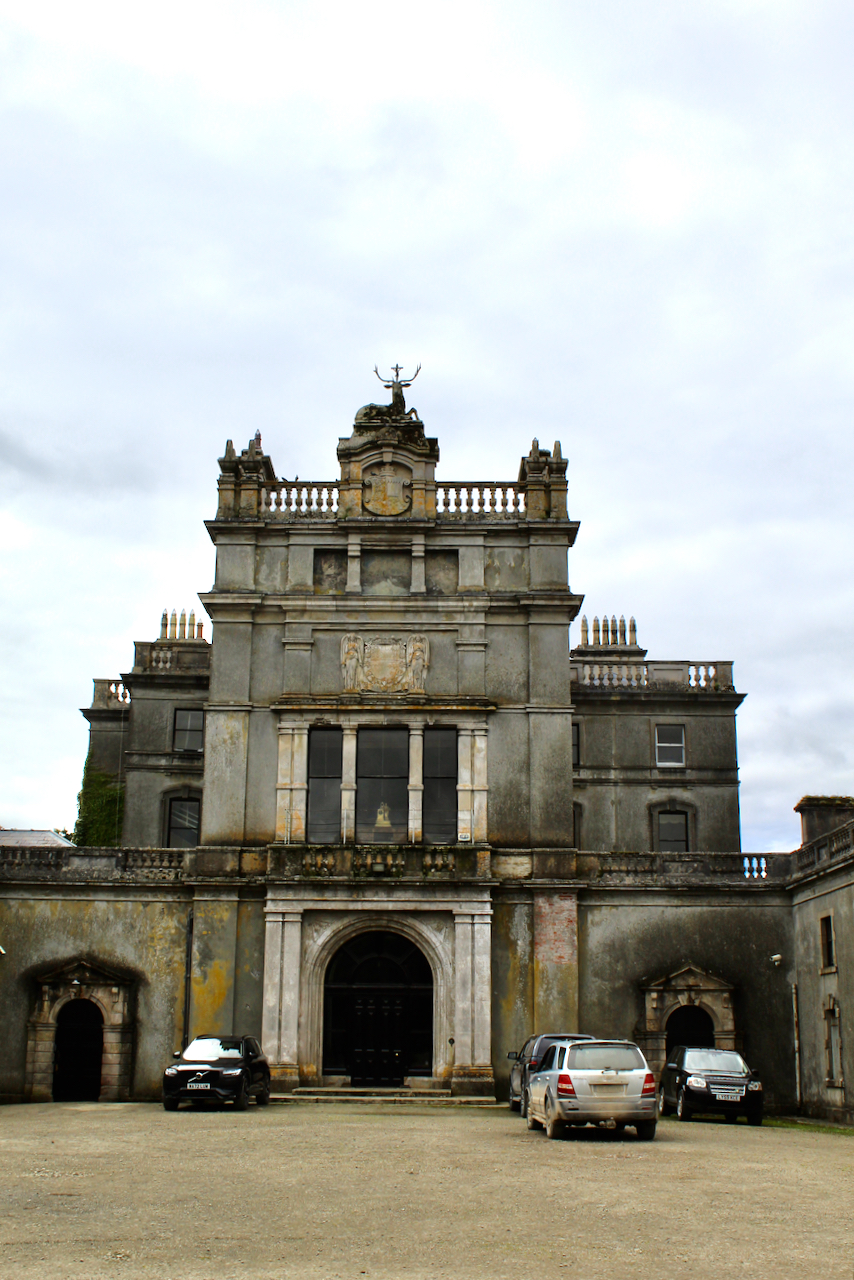
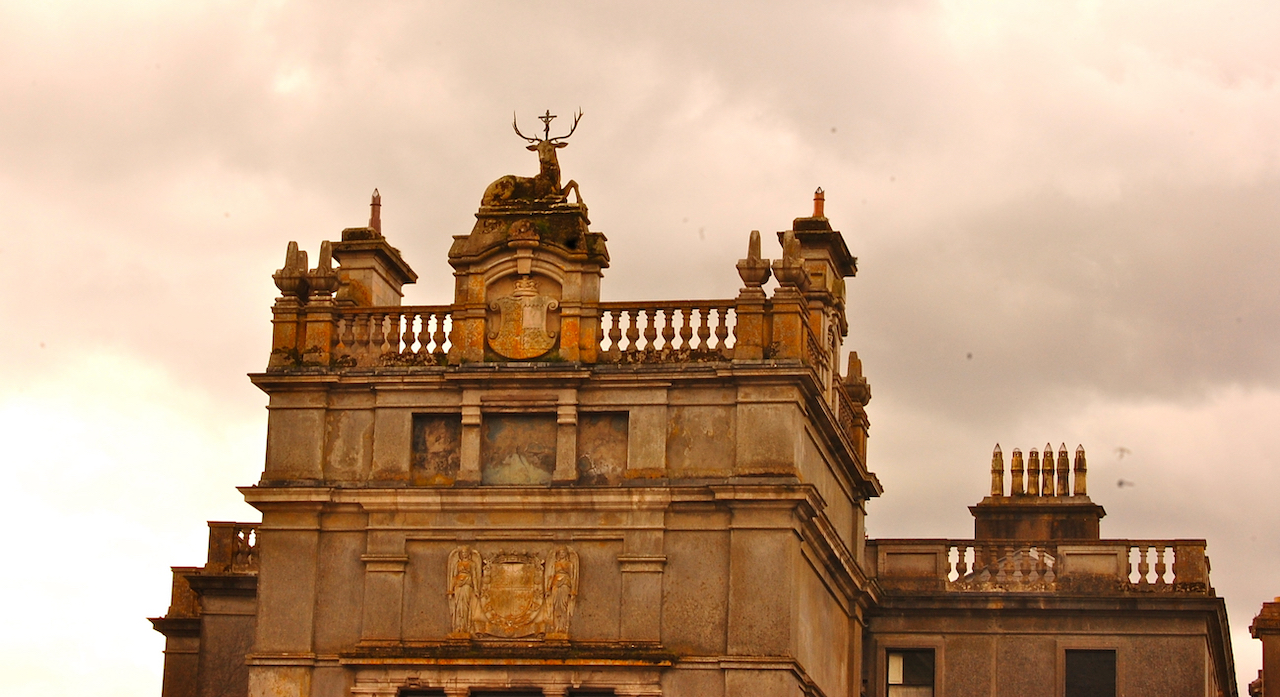
The tower has three tiers of pilasters framing the main entrance doorway and triple windows in the two storeys above it, and is surmounted by St. Hubert’s Stag, the family crest of the Le Poers. Photograph © Jennifer Winder-Baggot, www.irishhistorichouses.com
DSC_0565
St. Hubert’s Stag on top of Curraghmore. The crown below the stag, on top of the coat of arms, is the coronet of a Marquess, 5th May 2019. Photograph © Jennifer Winder-Baggot, www.irishhistorichouses.com
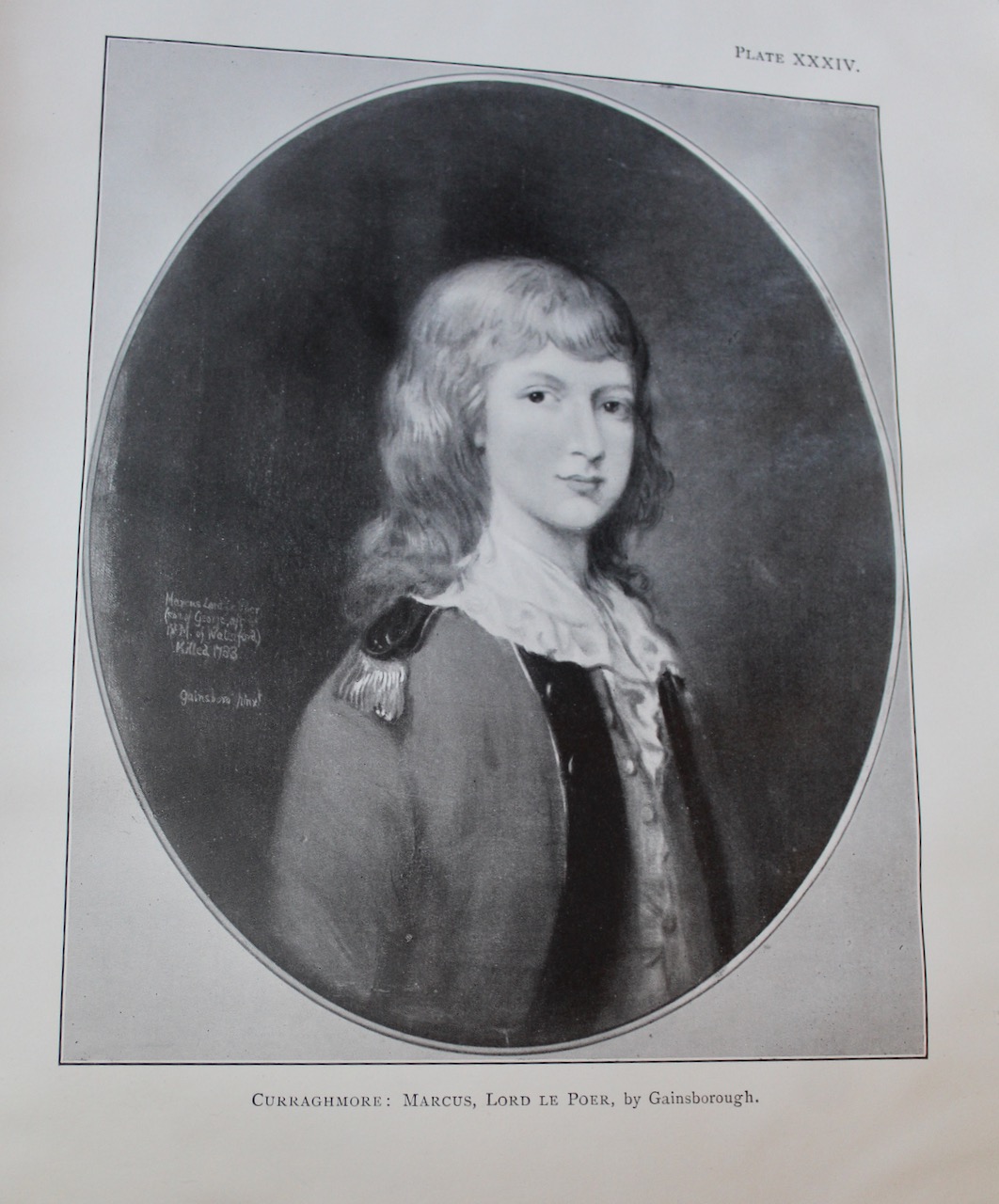
Rt. Hon. Marcus Beresford, 1st Earl of Tyrone, photograph courtesy of the Beresford family and creative commons and wikipedia.

Mark Bence-Jones continues his description of the house: “The tower and the house were both refaced mid-C19. The house has a pediment in the garden front; and, like the tower, a balustraded roof parapet. The tower has three tiers of pilasters framing the main entrance doorway and triple windows in the two storeys above it, and is surmounted by St. Hubert’s Stag, the family crest of the Le Poers.” (see [1])

DSC_0613
The house is very large as it is not only seven bays wide but seven bays deep, 5th May 2019. Photograph © Jennifer Winder-Baggot, www.irishhistorichouses.com
Photograph © Jennifer Winder-Baggot, www.irishhistorichouses.com

We explored the buildings flanking the courtyard while waiting for the guided tour, and found the entrance to the gardens, through an arch, with an honesty box, in which we duly deposited our fee. We had missed the earlier house tour so had a couple of hours to wait for the next tour. We wandered out into the gardens. The gardens are amazing, in their formal arrangement.

DSC_0619
Photograph © Jennifer Winder-Baggot, www.irishhistorichouses.com

I’ll write more about the gardens later, as we learned more about them on the tour.

We gathered with others for a tour. The tour guide was excellent. She told us that the gardens only opened to the public a few years ago, when the more private father of the current (ninth) Marquess died.

As usual, we were not permitted to take photographs inside, unfortunately. You can see some on the website. There is also a new book out, July 2019, it looks terrific! [2] More on the interior later – first I will tell you of the history of the house.

POWER AND MONEY AND MARRIAGE: Don’t be put off by the complications of Titles!

The estate was owned by the la Poer (or de la Poer or Le Poer – I have seen it written several ways) family for over 500 years, during which time the family gained the titles Baron la Poer (1535), Viscount Decies and Earl of Tyrone (1673, “second creation”, which means the line of the first Earls of Tyrone died out or the title was taken from them – in this case the previous Earl of Tyrone, Hugh O’Neill, rose up against the British throne during the Nine Years War and fled from Ireland when arrest was imminent, so lost his title).

The La Poer family was Norman originally, and the name has been sometimes Anglicised to “Power.”

Piers Power (or Le Poer) of Curraghmore, who held the office of Sheriff of County Waterford in 1482, cemented the family’s influence with a strategic marriage to the House of Fitzgerald. His wife, Katherine, was a daughter of Sir Gerald Fitzgerald, Lord of the Decies.

Piers’s son and heir, Richard, further strengthened the power of the family by marrying a daughter of the 8th Earl of Ormond (Piers Butler, d. 1539), Katherine. The rival families of Butler and Fitzgerald, into both of which the Le Poers had married, effectively ran the country at this time when English influence in Ireland had been in decline for several decades. [4]

Richard was created 1st Baron le Power and Coroghmore, Co. Waterford on 13 September 1535. [5]

Richard 1st Baron le Power and Coroghmore died on 10 November 1538, killed by Conor O’Callaghan while intervening (on the Crown’s behalf) in the issue of the succession of the Earldom of Desmond.

After Richard died, his wife married James John Fitzgerald, 13th Earl of Desmond, in 1549/50, who held the office of Lord High Treasurer of Ireland.

I shall intervene here to give a summary of the rank of titles, as I’m learning them through my research on houses. They rank as follows, from lowest to highest:

Baron –  female version: Baroness

Viscount – Viscountess

Earl – Countess

Marquess – Marchioness

Duke – Duchess

In 1538 Richard was succeeded by his eldest son, Piers (1526-1545). Piers was a soldier and fought in Boulogne in France for King Henry VIII. After Piers’s premature death in 1545, he was succeeded by his younger brother, John “Mor” Power (d. 1592), 3rd Baron. In 1576, Henry Sidney, the Lord Deputy of Ireland and father of the poet Philip Sidney, stayed with John Mor at Curraghmore. He wrote:

“The day I departed from Waterford I lodged that night at Curraghmore, the house that the Lord Power is baron of. The Poerne country is one of the best ordered countries in the English Pale, through the suppression of coyne and livery. The people are both willing and able to bear any reasonable subsidy towards the finding and entertaining of soldiers and civil ministers of the laws; and the lord of the country, though possessing far less territory than his neighbour (ie: Sir James Fitzgerald of the Decies, John Mor’s cousin) lives in show far more honourably and plentifully than he or any other in that province.” [6]

Sir Henry Sidney (1529-1586), Lord Deputy of Ireland, after painter Arnold Van Brounkhorst, courtesy of National Gallery of Ireland.

“Coign and livery” was the practice of getting a ruler’s subjects to host the ruler. I think Sidney must have meant that Lord Power’s subjects were willing to participate in entertainment because they were well treated by Lord Power.

Turtle Bunbury writes of the Le Poer family history in his blog (see [4]). I wonder if I can turn my blog into a way of learning Irish history, through Irish houses? I will continue to quote Mr. Bunbury’s blog here, so I can try to see connections between various house owners as I continue my travels around the country.

DSC_0607
When one enters the garden through the arch, one walks along the side of the house to the garden front, which originally held the front door of the house. Originally visitors would drive up to the house through the courtyard and then the horse and carriage would go through the arch to the garden front, to enter through the front door facing the gardens. Photograph © Jennifer Winder-Baggot, www.irishhistorichouses.com
DSC_0623
Curraghmore, 5th May 2019. Photograph © Jennifer Winder-Baggot, www.irishhistorichouses.com

It was a common practice at the time for the aristocracy to send their sons to the English Court. It was a way to for the artistocracy to secure favour and contacts, and for the King to secure the loyalty of the aristocracy and their Protestant faith. 

John Mor the 3rd Baron married Eleanor, daughter of James FitzGerald the 13th Earl of Desmond, who bore his heir. After she died, he married Ellen MacCartie, widow of the 3rd Viscount Barry. He died in 1592 and was succeeded by his son Richard (d. 1607), 4th Baron Le Poer. The 4th Baron married his step-sister, Katherine Barry, daughter of his step-mother Ellen MacCartie and her first husband the 3rd Viscount Barry.

The oldest son of the 4th Baron, John “Og”, died young, in 1600, predeceasing his father, but not before he married Helen Barry, daughter of the 5th Viscount Barry, Viscount Buttevant, and produced an heir. John “Og” was killed by Edmond FitzGibbon (The White Knight).

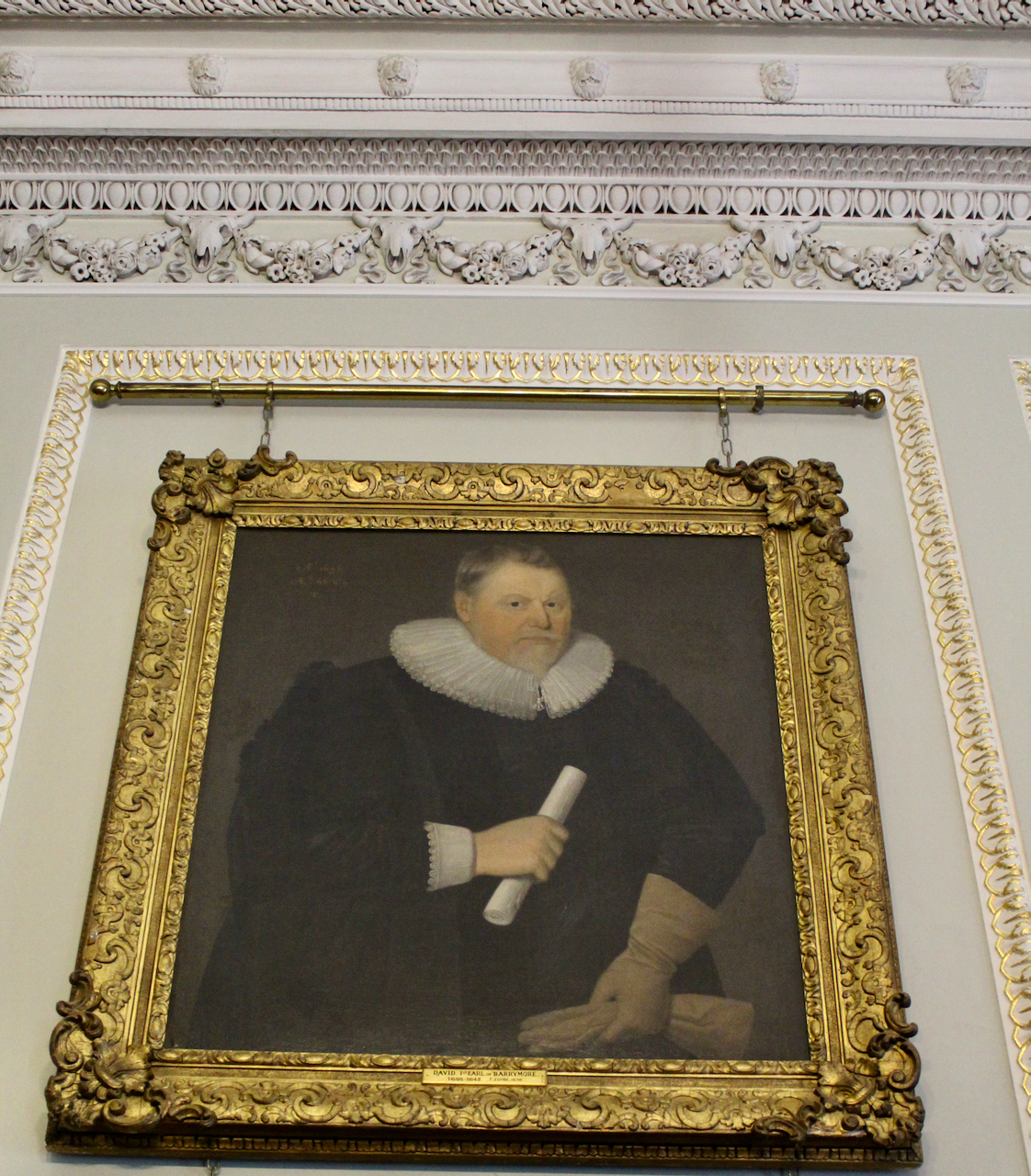
The 4th Baron’s other children married well. His daughter Elizabeth married David Barry and gave birth to David, 1st Earl of Barrymore.

David Barry (1605-1642) 6th Viscount Buttevant and 1st Earl of Barrymore. Photograph © Jennifer Winder-Baggot, www.irishhistorichouses.com

His daughter Gille married Thomas Fitzmaurice, 16th Baron of Kerry and Lixnaw. His son Piers married Katherine, daughter of Walter Butler the 11th Earl of Ormond.

After the 4th Baron died, his widow Helen remarried, espousing Thomas Butler the 10th Earl of Ormond, “Black Tom” (you can read more about him in my entry about the Ormond Castle in Carrick-on-Suir, an OPW property www.irishhistorichouses.com/2022/06/26/opw-sites-in-munster-clare-limerick-and-tipperary/). She married a third time, after he died, in 1631, to 1st (and last) Viscount Thomas Somerset, of Cashell, County Tipperary.

The family were very powerful and influential, and Catholic. Despite dying young, John “Og” and Helen had daughters, Ellen, who married Maurice Roche, 8th Viscount Roche of Fermoy (the Peerage website tells us that “She died in 1652, hanged by the Commonwealth regime on a trumped up charges of murder“) and Elinor who married Thomas Butler, 3rd Baron Caher.

King James I ordered Richard the 4th Baron to send his grandson and heir, John, the 5th Baron (born circa 1584), to England for his education, in order to convert John to Protestantism. John lived with a Protestant Archbishop in Lambeth. However, John didn’t maintain his Protestant faith. Furthermore, he later suffered from mental illness.

Julian Walton, in a talk I attended in Dromana House in Waterford (another section 482 house), told us about a powerful woman, Kinbrough Pyphoe (nee Valentine). [7] She is named after a Saxon saint, Kinbrough. Her unfortunate daughter Ruth was married to John Power of the “disordered wits” (the 5th Baron). In 1642, Kinbrough Pyphoe wrote for to the Lord Justices of Ireland for protection, explaining that Lord Le Poer had “these past twelve years been visited with impediments” which had “disabled him from intermeddling with his own estate.” As a result, when Oliver Cromwell arrived in Ireland, he issued a writ on 20th September 1649 decreeing that Lord Power and his family be “taken into his special protection.” In this way, Kinbrough Pyphoe saved the family and estates from being confiscated by the Cromwellian parliament or overtaken by Cromwellian soldiers.
Despite his mental illness, John and Ruth had a son Richard (1630-1690) (along with many other children), who succeeded as the 6th Baron. One of their daughters, Catherine (1641-1660), married John Fitzgerald (1642-1664), Lord of the Decies, of Dromana, County Waterford. We will come back to her later.

Richard (1630-1690) married Dorothy Annesley, daughter of Arthur, 1st Earl of Anglesey in 1654. Richard was Governor of Waterford City and County Waterford in 1661, and MP for County Waterford from 1661-1666.

Richard (1630-1690) married Dorothy Annesley, daughter of Arthur, 1st Earl of Anglesey: portrait of Arthur Annesley (1614-1686) 1st Earl of Anglesey, after John Michael Wright based on a work of 1676, NPG 3805.

In 1672 King Charles II made Richard the 1st Earl of Tyrone, and elevated Richard’s son John to the peerage as Viscount Decies.

Turtle Bunbury writes that Richard the 1st Earl of Tyrone sat on Charles II’s Privy Council from 1667-1679. However, Richard was forced to resign when somebody implicated him in the “Popish Plot.” The “Popish Plot” was caused by fear and panic. There never was a plot, but many people assumed to be sympathetic to Catholicism were accused of treason. In 1681, Richard Power was brought before the House of Commons and charged with high treason. He was imprisoned. He was released in 1684.
DSC_0652
Photograph © Jennifer Winder-Baggot, www.irishhistorichouses.com

WHO TO SUPPORT? CATHOLIC OR PROTESTANT? JAMES II OR WILLIAM III?

James II came to the throne after the death of his brother Charles II, and he installed Richard in the Irish Privy Council in 1686.

When William of Orange and Mary came to the throne, taking it from Mary’s father James II, Richard was again charged with high treason, this time for supporting James II, and he was imprisoned in the Tower of London and died there, in 1690. He was succeeded by his son 25-year-old son John, who became 2nd Earl of Tyrone.

John married his first cousin, the orphaned heiress Catherine Fitzgerald, daughter of above-mentioned Catherine (1641-1660) who married John Fitzgerald (1642-1664), Lord of the Decies, of Dromana, County Waterford. They were married as children in 1673, in order for John to marry Catherine’s wealth. However, Catherine managed to have the marriage declared null and void, so that she could marry in March 1676 her true love, Edward Villiers, son and heir of George, 4th Viscount Grandison [I write more on this in my entry on Dromana www.irishhistorichouses.com/2021/02/06/dromana-house-cappoquin-co-waterford/].

John died aged just 28 in 1693 and was succeeded by his brother James. Before he died, it is said that John made a prediction:

One night in 1693 when Nichola, Lady Beresford [nee Hamilton, wife of 3rd Baronet Beresford of Coleraine, daughter of Hugh Hamilton, 1st Viscount of Glenawly, Co Fermanagh], was staying in Gill Hall, her schoolday friend, John Power, [2nd] Earl of Tyrone, with whom she had made a pact that whoever died first should appear to the other to prove that there was an afterlife, appeared by her bedside and told her that he was dead, and that there was indeed an after-life. To convince her that he was a genuine apparition and not just a figment of her dreams, he made various prophecies, all of which came true: noteably that she would have a son who would marry his niece, the heiress of Curraghmore and that she would die on her 47th birthday. He also touched her wrist, which made the flesh and sinews shrink, so that for the rest of her life she wore a black ribbon to hide the place.” [8]
At the time of his death, his neice was not yet born! It makes a good story. She was born eight years later in 1701 to John’s brother James.

James, the 3rd Earl of Tyrone, married Anne Rickard, eldest daughter and co-heir of Andrew Rickard of Dangan Spidoge, County Kilkenny. He had fought with the Jacobites (supporters of James II), but when William III came to the throne, the 3rd Earl of Tyrone claimed that he had only supported James II because his father had forced him to (this is the father who died in the Tower of London for supporting James II). In 1697 James Le Poer received a Pardon under the Great Seal and he served as Governor of Waterford from 1697 until his death in 1704.

DEVELOPING THE CASTLE
In 1700 the 3rd Earl, James, commissioned the construction of the present house at Curraghmore on the site of the original castle. Mark Bence-Jones writes: “the house was in existence in 1654, but was rebuilt 1700 and subsequently enlarged and remodelled; it extends round three sides of a small inner court, which is closed on fourth side by the tower.“(see [1])

nli curraghmore house waterford
Photograph from flickr commons, National Library of Ireland, by Robert French, The Lawrence Photographic Collection, between ca. 1865-1914, ref. L_CAB_04065.

In 1704 the male line of the la Poers became extinct as James had no sons.

The predictions of John the 2nd Baron of Curraghmore came true. Lady Nichola did indeed die on her 47th birthday, and her son Marcus married John’s niece, Catherine Power, or de la Poer.

Catherine de la Poer (1701-1769), the sole child of her parents, could not officially inherit the property at the time. Her Catholic mother made a deal with a Bishop that Catherine would marry a Protestant of his choosing, in order to keep her land. Fortunately, the property was kept for her and she was married to Marcus Beresford (1694-1763), in 1717. This ensured that the house stayed in her family, as Marcus joined her to live in Curraghmore.

Sir Marcus Beresford of Coleraine (born 1694) was already a Baronet by descent in his family. After he married Catherine, he became Viscount Tyrone and 1st Baron Beresford, of Beresford, County Cavan. In 1746 he was created 1st Earl of Tyrone. Proud of her De La Poer background, when her husband died in 1763, Catherine, now titled the Dowager Countess of Tyrone, requested the title of Baroness La Poer.

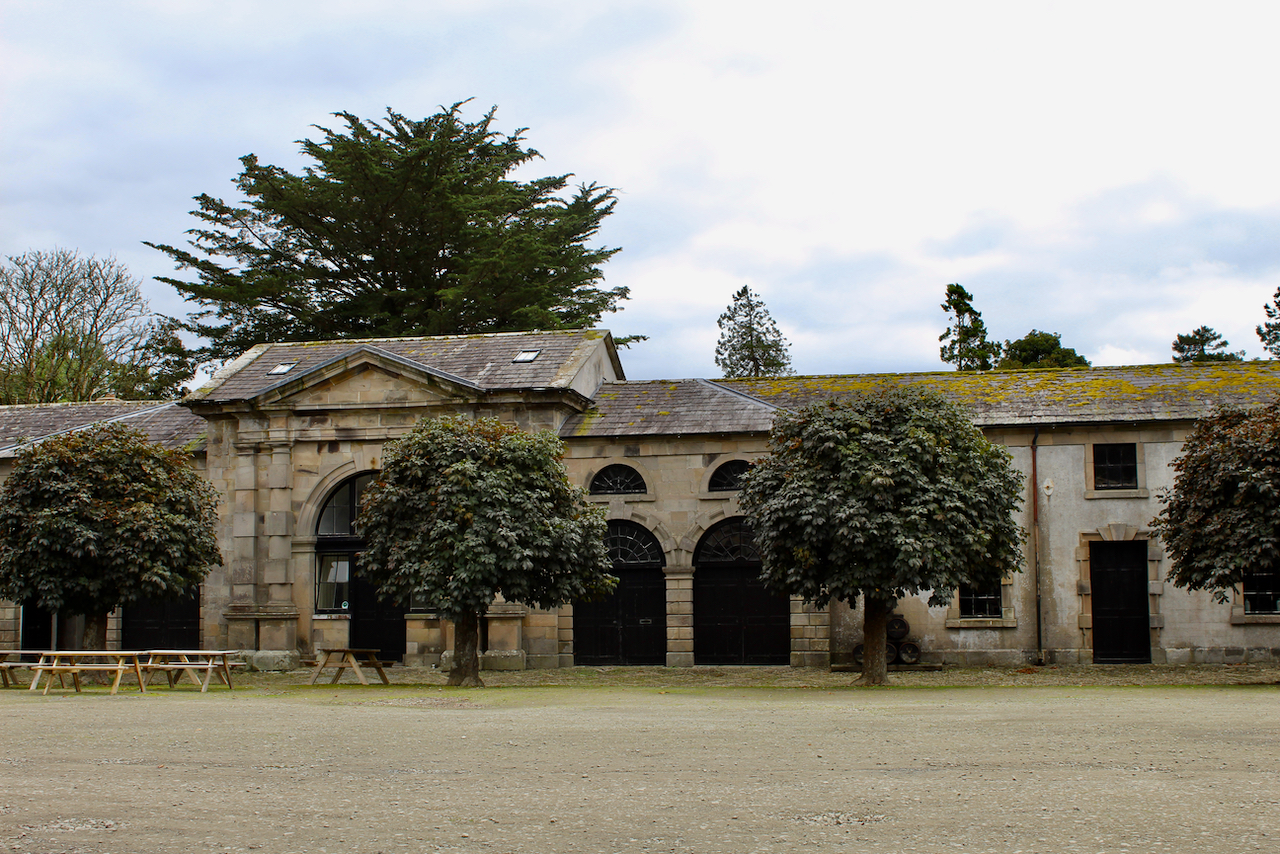
The block on the right contained servants’ quarters. Photograph © Jennifer Winder-Baggot, www.irishhistorichouses.com
St. Hubert’s Stag on top of Curraghmore, photograph courtesy of Curraghmore website.

The Guide told us a wonderful story of the stag on top of the house. It has a cross on its head, and is called a St. Hubert’s Stag. This was the crest of the family of Catherine de la Poer. To marry Marcus Beresford, she had to convert to Protestantism, but she kept the cross of her crest. The Beresford crest is in a sculpture on the front entrance, or back, of the house: a dragon with an arrow through the neck. The broken off part of the spear is in the dragon’s mouth.

DSC_0648
Dragon from the Beresford crest, atop the garden front of the house, 5th May 2019. Photograph © Jennifer Winder-Baggot, www.irishhistorichouses.com

The IRA came to set fire to the house at one point. They came through the courtyard at night. The moon was full, and the stag and cross cast a shadow. Seeing the cross, the rebels believed the occupants were Catholic and decided not to set fire to the house. The story illustrates that the rebels must not have been from the local area, as locals would have known that the family had converted to Protestantism centuries ago. It is lucky the invaders did not approach from the other side of the house!

When I was researching Blackhall Castle in County Kildare, I came across more information about St. Hubert’s Stag. The stag with the crucifix between its antlers that tops Curraghmore is in fact related to Saint Eustachius, a Roman centurion of the first century who converted to Christianity when he saw a miraculous stag with a crucifix between its antlers. This saint, Eustace, was probably the Patron Saint of the Le Poers since their family crest is the St. Eustace (otherwise called St. Hubert’s) stag. I did not realise that St. Eustace is also the patron saint of Newbridge College in Kildare, where my father attended school and where for some time in the 1980s and 90s my family attended mass!

IMG_0992
See the St. Eustace stag in the Newbridge College crest. Photograph © Jennifer Winder-Baggot, www.irishhistorichouses.com

I read in Irish Houses and Gardens, from the archives of Country Life by Sean O’Reilly, [Aurum Press, London: 1998, paperback edition 2008] that the St. Hubert Stag at Curraghmore was executed by Queen Victoria’s favourite sculptor, Sir Joseph Edgar Boehm. He was also responsible for the beautiful representation in the family chapel at Clonegam of the first wife of the 5th Marquess, who died in childbirth. [9]

THE INTERIOR OF THE HOUSE

The entrance hall, which is in the old tower, has a barrel vaulted ceiling covered with plasterwork rosettes in circular compartments which dates from 1750; it was one of the rooms redecorated by Marcus Beresford and his wife Catherine (see [1]). Sadleir and Dickinson tell us of the house and the Hall:

p. 49. “Careful remodelling has given to the back of the structure the lines of a complete architectural whole, but there can be no doubt from internal evidence that at least three important additions are in fact embodied; it is also probable that a portion of the centre, which differs in character from the surroundings, was rebuilt in consequence of a fire.

The entrance hall is part of the original tower house, and you can see the thickness of the walls. The hall now has a Georgian ceiling of bold, regular design. On the wall in the front hall is a huge portrait of Catherine, Marcus Beresford, and their children. Three stuffed lions stand guard, which were brought back from India by a descendant of Catherine and Marcus (more on the lions later).

Sadleir and Dickinson continue: “A flight of stone steps leads up to a corridor giving access to the spacious staircase hall, a late eighteenth century addition, with Adam ornament on the ceiling and walls. The grand staircase, which has a plain metal balustrade, is gracefully carried up along the wall to a gallery, giving access to the billiard room and bedrooms.” (see [6])
Photograph courtesy of Curraghmore website: the corridor from the front hall to the staircase hall.

The staircase hall wasn’t added until the next generation. Above the front hall in the tower house, Marcus Beresford had a magnificent room created, now the Billiard room. Unfortunately we didn’t see it on the tour, but there are photographs on the website.

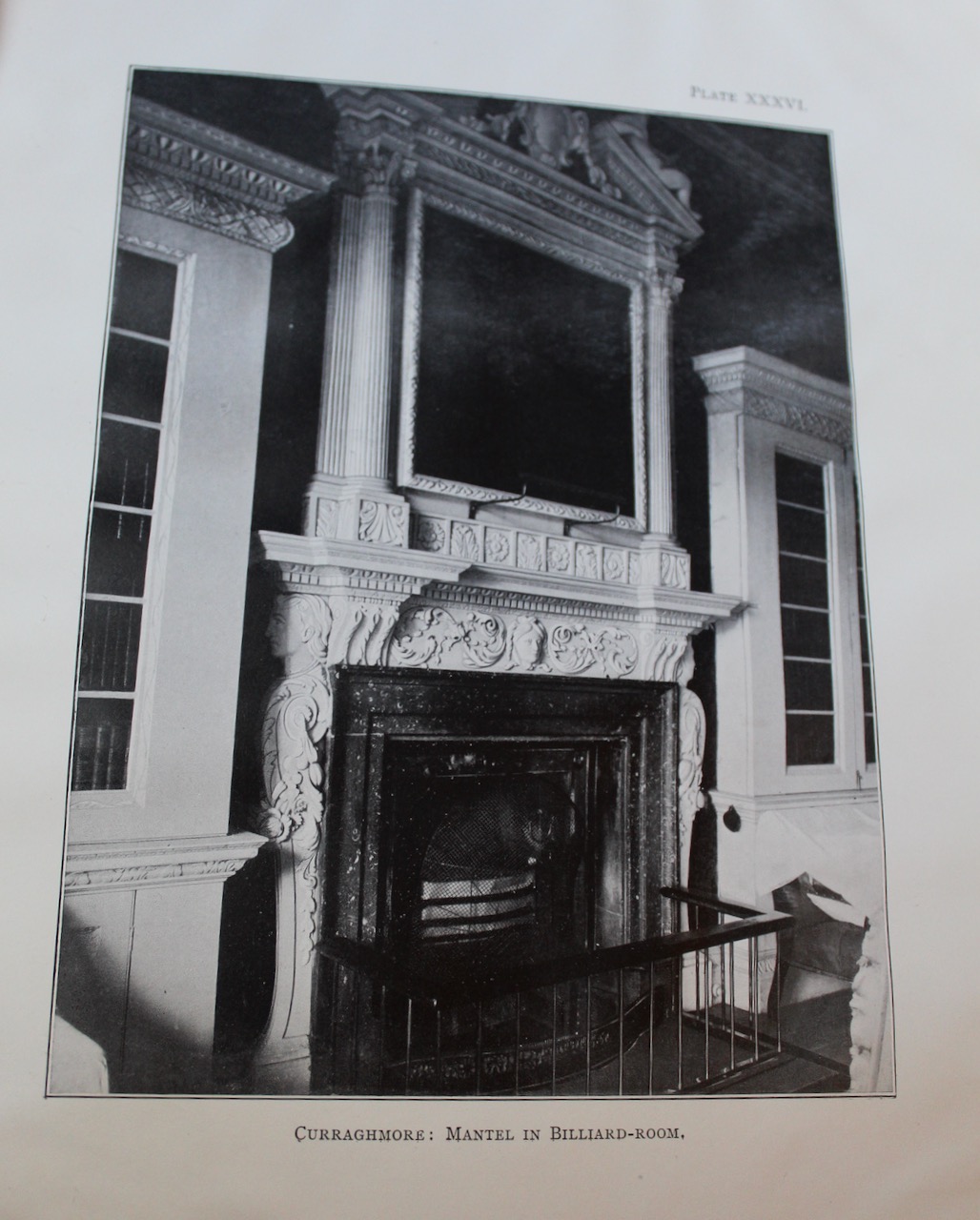
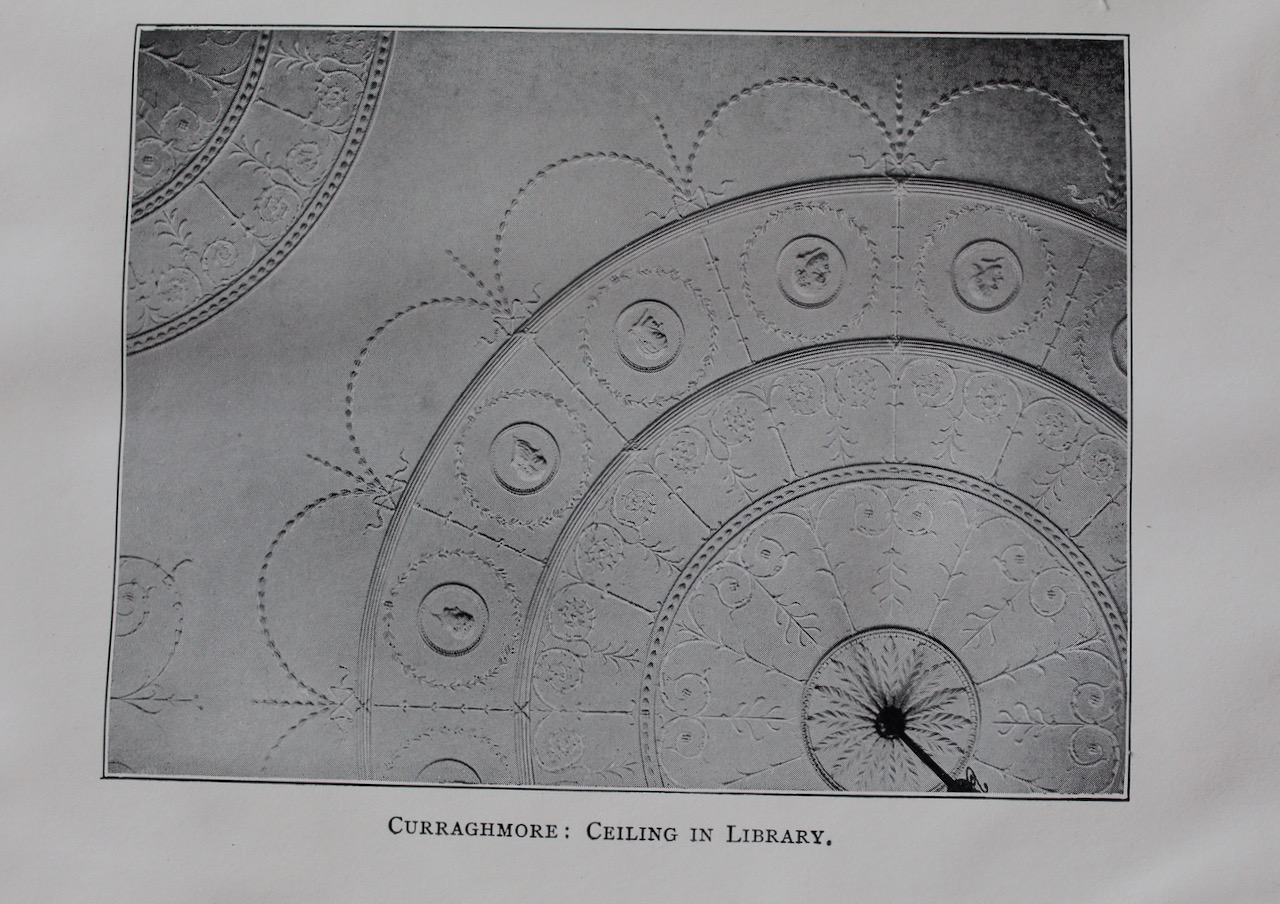
It has a tremendously impressive coved ceiling probably by Paul and Philip Francini, according to Mark Bence-Jones. The ceiling is decorated with rococo foliage, flowers, busts and ribbons in rectangular and curvilinear compartments. The chimneypiece, which has a white decorative  overmantel with a “broken” pediment (i.e. split into two with the top of the triangular pediment lopped off to make room for a decoration in between) and putti cherubs, is probably by John Houghton, German architect Richard Castle’s carver. Bence-Jones describes that the inner end of the room is a recess in the thickness of the old castle wall with a screen of fluted Corinthian columns. There is a similar recess in the hall below, in which a straight flight of stairs leads up to the level of the principal rooms of the house.

The Great Room in the old tower was transformed into a billiard room and has an exquisite 18th century plasterwork ceiling, Photograph courtesy of Curraghmore website.
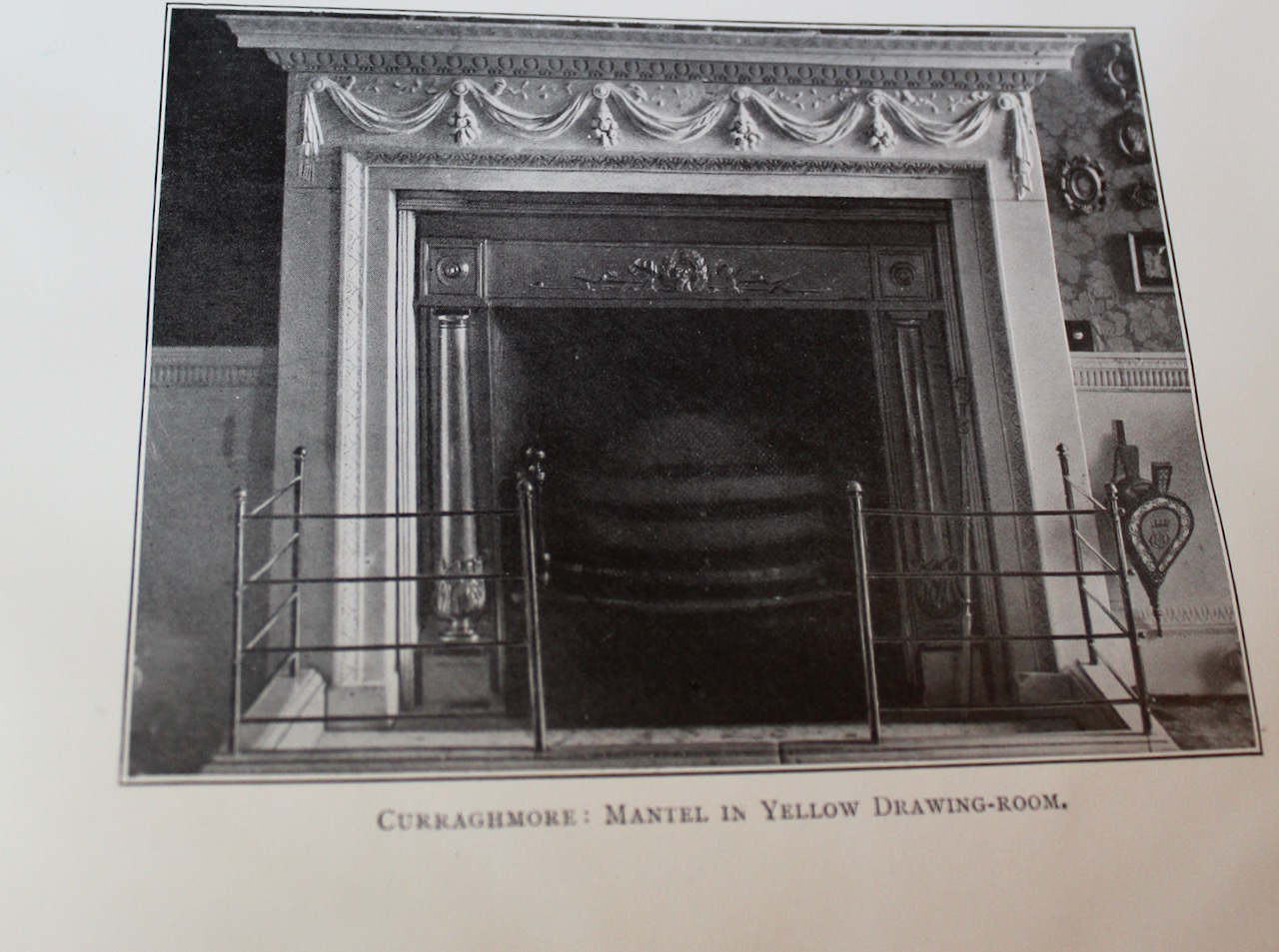
Photograph of Curraghmore mantel in billiard room from Georgian Mansions In Ireland by Thomas U. Sadleir and Page L. Dickinson, printed for the authors at the Dublin University Press, by Ponsonby & Gibbs, 1915. (see [6])
Photograph from Georgian Mansions In Ireland by Thomas U. Sadleir and Page L. Dickinson, printed for the authors at the Dublin University Press, by Ponsonby & Gibbs, 1915. Mark Bence-Jones writes that the ceiling in the billiards room was probably decorated by the Francini brothers. (see [6])

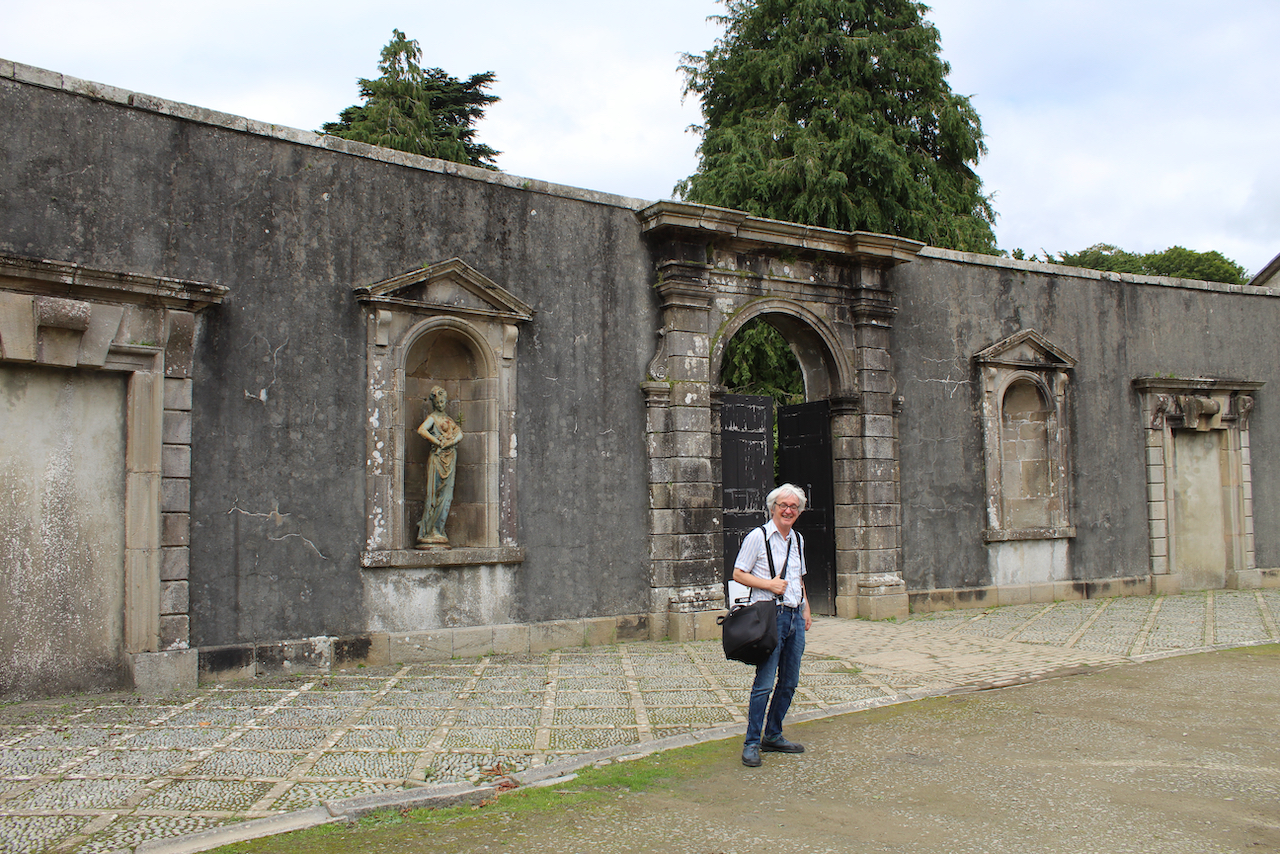
The entry via the servants’ quarters, which I thought odd, has indeed always been the approach to the house. Catherine had the houses in the forecourt built for her servants in 1740s or 50s. She cared for the well-being of her tenants and workers, and by having their houses built flanking the entrance courtyard, perhaps hoped to influence other landlords and employers.

The wing that contained servants’ quarters. The flanking wall has niches, and an archway leading to the garden. Photograph © Jennifer Winder-Baggot, www.irishhistorichouses.com
Stephen by the carriage entry to garden, 2023. Photograph © Jennifer Winder-Baggot, www.irishhistorichouses.com
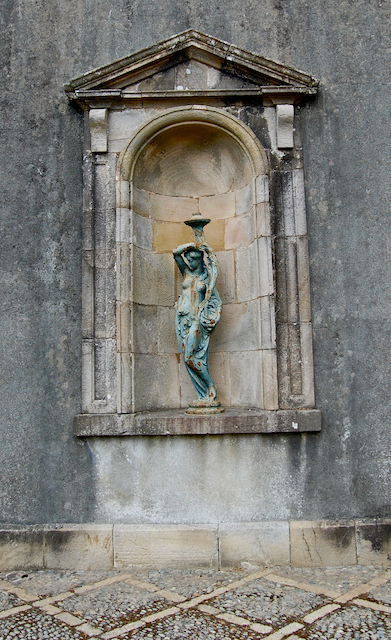
The sculptures were purchased at the Great Exhibition in Paris in 1889. Photograph © Jennifer Winder-Baggot, www.irishhistorichouses.com

Someone asked about the sculptures in the niches in the courtyard. Why are there only some in niches – are the others destroyed or stolen? That in itself was quite a story! A visitor said they could have the sculptures cleaned up, by sending them to England for restoration. The Marquess at the time agreed, but said only take every second one, to leave some in place, and when those are back, we’ll send the remaining ones. Just as well he did this, since the helper scuppered and statues were never returned.

DSC_0584
Curraghmore, 5th May 2019. Photograph © Jennifer Winder-Baggot, www.irishhistorichouses.com

Bence-Jones writes of the forecourt approach to the house:

“[The house] stands at the head of a vast forecourt, a feature which seems to belong more to France, or elsewhere on the Continent… having no counterpart in Ireland, and only one or two in Britain… It is by the Waterford architect John Roberts, and is a magnificent piece of architecture; the long stable ranges on either side being dominated by tremendous pedimented archways with blocked columns and pilasters. There are rusticated arches and window surrounds, pedimented niches with statues, doorways with entablatures; all in beautifully crisp stonework. The ends of the two ranges facing the front are pedimented and joined by a long railing with a gate in the centre.

The courtyard, designed by John Roberts: the long stable ranges on either side are dominated by tremendous pedimented archways with blocked columns and pilasters. Photograph © Jennifer Winder-Baggot, www.irishhistorichouses.com
Pedimented archways with blocked columns and pilasters, which leads to more stables. Photograph © Jennifer Winder-Baggot, www.irishhistorichouses.com
The archway leads through to the stableyard and ancilliary buildings. Photograph © Jennifer Winder-Baggot, www.irishhistorichouses.com
The doors have arched fanlights with semicircular windows above. Photograph © Jennifer Winder-Baggot, www.irishhistorichouses.com
Inside, the ceilings are vaulted. Photograph © Jennifer Winder-Baggot, www.irishhistorichouses.com
Part of the Café. Photograph © Jennifer Winder-Baggot, www.irishhistorichouses.com
The terrace contains servants’ quarters. Photograph © Jennifer Winder-Baggot, www.irishhistorichouses.com
Number 6, closest to the house, was the Butler’s Quarters. The Butler lived in the main house until he married, when he then was given the house in the courtyard. There was a Butler in the house until just five years ago, and he lived here until he retired. Photograph © Jennifer Winder-Baggot, www.irishhistorichouses.com
The terrace of buidings on the right hand side of the house. Photograph © Jennifer Winder-Baggot, www.irishhistorichouses.com
There are niches at the ends of each terrace. Photograph © Jennifer Winder-Baggot, www.irishhistorichouses.com
DSC_0587
Barrels in the forecourt picture the St. Hubert’s Stag, 5th May 2019. Photograph © Jennifer Winder-Baggot, www.irishhistorichouses.com

Since bad weather threatened on our visit in 2019 (and in 2023!), the tour guide took us out to the Shell House in the garden first. This was created by Catherine. A friend of Jonathan Swift, Mrs. Mary Delany, started a trend for shell grottoes, which progressed to shell houses.

Mary Delany (née Granville) (1700-1788) Paper collage artist; memoir and letter writer, by John Opie, 1792, courtesy of National Portrait Gallery NPG 1030.

Catherine had the house specially built, and she went to the docks nearby to ask the sailors to collect shells for her from all over the world, who obliged since their wages were paid by the Marquess. She then spent two hundred and sixty one days (it says this in a scroll that the marble sculpture holds in her hand) lining the structure with the shells (and some coral). The statue in the house is of Catherine herself, made of marble, by the younger John van Nost (he did many other sculptures and statues in Dublin, following in his father’s footsteps). Robert O’Byrne has a lovely video about shell grottoes and tells us more about this shell house on his website. [10]

DSC_0626
The Shell Grotto, 5th May 2019. Photograph © Jennifer Winder-Baggot, www.irishhistorichouses.com
Inside the shell grotto, statue by John van Nost of Catherine Le Poer Beresford, Countess of Tyrone. Photograph © Jennifer Winder-Baggot, www.irishhistorichouses.com
DSC_0627
Inside the shell grotto, statue by John van Nost of Catherine Le Poer Beresford, Countess of Tyrone. Photograph © Jennifer Winder-Baggot, www.irishhistorichouses.com
DSC_0630
Curraghmore. Photograph © Jennifer Winder-Baggot, www.irishhistorichouses.com
The scroll in the sculpture’s hand tells us that the shells were put up in 261 days by the Countess of Tyrone. Photograph © Jennifer Winder-Baggot, www.irishhistorichouses.com
DSC_0631
All the the shells were collected before Catherine started to put them up. Photograph © Jennifer Winder-Baggot, www.irishhistorichouses.com
Catherine also designed the pattern on the floor. Photograph © Jennifer Winder-Baggot, www.irishhistorichouses.com
Photograph © Jennifer Winder-Baggot, www.irishhistorichouses.com

Catherine also adorned the interior of Curraghmore with frescoes by the Dutch painter van der Hagen, and laid out the garden with canals, cascades, terraces and statues, which were swept away in the next century in the reaction against formality in the garden. In the nineteenth century, the formal layout was reinstated. [11]

Marcus and Catherine has many children. John de la Poer Beresford (1738-1805) served as first Commissioner of the Revenue.

John Beresford (1738-1805), first commissioner of the Revenue in Ireland, engraver Charles Howard Hodges, after Gilbe, courtesy of National Gallery of Ireland.
John Beresford (1738-1805), MP by Gilbert Stuart c. 1790, courtesy of National Gallery of Ireland NGI 1133
Barbara Montgomery (?1757-1788), second wife of John Beresford (1738-1805) by Hugh Douglas Hamilton, courtesy of National Gallery of Ireland P5547. His first wife was Anne Constantia Ligondes.
John Claudius Beresford, Lord Mayor of Dublin courtesy Adam’s 8 March 2006 in style of William Cuming PRHA. He was the son of John Beresford (1738-1805).
Elizabeth Cobbe née de la Poer Beresford (1736-1806), wife of Thomas Cobbe (1733-1814) of Newbridge House, Dublin, in a costume evocative of Mary Queen of Scots, miniature, Cobbe Collection. She is the daughter of Marcus Beresford 1st Earl of Tyrone.

Marcus Beresford was succeeded by his fourth but eldest surviving son, the second Earl, George Beresford (1734-1800), who also inherited the title Baron La Poer from his mother in 1769.

The Honourable George de la Poer Beresford (1735–1800), 2nd Earl of Tyrone, Later 1st Marquess of Waterford by Johann Zoffany, courtesy of National Trust Images.

He married Elizabeth Monck, only daughter and heiress of Henry Monck (1725-1787) of Charleville, another house on the Section 482 list which we visited www.irishhistorichouses.com/2020/09/18/charleville-county-wicklow/.]  

In 1786 he was created Baron Tyrone. Three years later he was made Marquess of Waterford in the Peerage of Ireland. He was therefore the 1st Marquess of Waterford. The titles descended in the direct line until the death of his grandson, the third Marquess, in 1859.

George de la Poer Beresford (1735-1800) First Marquess of Waterford by Gilbert Stuart, courtesy of Bonhams and commons.

Note on spelling of Marquis/Marquess: on the Curraghmore website “Marquis” is used, but in other references, I find “Marquess.” According to google:

A marquess is “a member of the British peerage ranking below a duke and above an earl. … A marquis is the French name for a nobleman whose rank was equivalent to a German margrave. They both referred to a ruler of border or frontier territories; in fact, the oldest sense of the English word mark is ‘a boundary land’.”

I shall therefore use the spelling “marquess.” If quoting – I’ll use the spelling used by the source. I prefer “marquis”,  as “marquess” sounds female to me, although it refers to a male!

George the 1st Marquess had the principal rooms of the house redecorated to the design of James Wyatt in the 1780s. Perhaps this was when the van der Hagen paintings were lost! We can see more of Van der Hagen’s work in a house sometimes open to the public, Beaulieu in County Louth. At the same time, George the 1st Marquess probably built the present staircase hall, which had been an open inner court, and carried out other structural alterations.

The Staircase Hall with its impressive sweeping staircase was created by James Wyatt in the 1780s, Curraghmore, County Waterford, Copyright Christopher Simon Sykes/The Interior Archive Ltd, PhotoShelter ID/ I0000CSsOaT_f.Fk, CS_GI14_39.
Photograph from Georgian Mansions In Ireland by Thomas U. Sadleir and Page L. Dickinson, printed for the authors at the Dublin University Press, by Ponsonby & Gibbs, 1915.

As Bence-Jones describes it, the principal rooms of the house lie on three sides of the great staircase hall, which has Wyatt decoration and a stair with a light and simple balustrade rising in a sweeping curve. Our tour paused here for the guide to point out the various portraits of the generations of Marquesses, and to tell stories about each.

Photograph courtesy of Curraghmore website. The large portraits of the women at the bottom of the stairs are the Stuart sisters. Louisa Stuart was wife of Henry, 3rd Marquess of Waterford. She was the daughter of Charles Stuart 1st and last Baron Stuart de Rothesay. Her sister Charlotte married Charles John Canning, 1st Viceroy to India. On the right had side of the photograph is Christiana née Leslie, wife of the 4th Marquess, who previously lived in Castle Leslie in County Monaghan.
Elizabeth Stuart née Yorke (1789-1867). Lady Stuart de Rothesay, with her daughters Charlotte (1817-1861) and Louisa (1818-1891) by George Hayter, photograph courtesy of UK Government Art Collection.
Photograph courtesy of Curraghmore website.

Bence-Jones writes that the finest of the Wyatt interiors are the dining room and the Blue drawing room, two of the most beautiful late eighteenth rooms in Ireland, he claims.

The dining room is decorated with grisaille panels by Peter de Gree and an ornamented ceiling. Photograph courtesy of Curraghmore website.

The walls have grissaille panels by Peter de Gree, which are imitations of bas-reliefs, so are painted to look as if they are sculpture. De Gree was born in Antwerp, Holland [12]. In Antwerp he met David de la Touche of Marlay, Rathfarnham, Dublin, who was on a grand tour. The first works of de Gree in Ireland were for David de la Touche for his house in St. Stephen’s Green in Dublin. [13]

Photograph courtesy of Curraghmore website.

The dining room has delicate plasterwork on the ceiling,  incorporating rondels attributed to Antonio Zucchi (1726-1795, an Italian painter and printmaker of the Neoclassic period) or his wife Angelica Kauffman (a Swiss Neoclassical painter who had a successful career in London and Rome).

Angelica Kauffmann (1741-1807) by Angelica Kauffmann, oil on canvas, circa 1770-1775, courtesy of National Portrait Gallery NPG 430.
Photograph from Georgian Mansions In Ireland by Thomas U. Sadleir and Page L. Dickinson, printed for the authors at the Dublin University Press, by Ponsonby & Gibbs, 1915.

The Blue Drawing Room has a ceiling incorporating roundels by de Gree and semi-circular panels attributed to Zucchi.

Sadlier and Dickinson tell us: “The principal drawing room is a large apartment, somewhat low, with three windows, four doors, and Adam overdoors; there is a pretty Adam ceiling in pale green and white, the work in relief being slightly gilt.

Photograph courtesy of Curraghmore website.
Photograph from Georgian Mansions In Ireland by Thomas U. Sadleir and Page L. Dickinson, printed for the authors at the Dublin University Press, by Ponsonby & Gibbs, 1915. The circular plaques are decorated in monochrome by De Gree, while four semi-circular compartments are believed to have been painted by Zucci, the husband of Angelica Kauffman.

Sadleir and Dickinson continue: “The circular plaques are decorated in monochrome by De Gree, while four semi-circular compartments are believed to have been painted by Zucci, the husband of Angelica Kauffman. The heavy white marble mantel, of classic design, is possibly contemporary with the decoration…A door communicates with the yellow drawing room, smaller but better proportioned, which has an uncoloured Adam ceiling, and a pretty linen-fold mantel in white marble [plate XXXI]. It is lighted by three windows … 

Photograph courtesy of Curraghmore website.
“A pretty linen-fold mantel in white marble” [plate XXXI] Photograph from Georgian Mansions In Ireland by Thomas U. Sadleir and Page L. Dickinson, printed for the authors at the Dublin University Press, by Ponsonby & Gibbs, 1915.

Sadleir and Dickinson continue the tour: “A door to the right gives access from the Hall to the library, which has an Adam ceiling with circular medallion heads, and an Adam mantel with added overshelf, the design of the frieze being repeated in the mantel and bookcases. Most of the books belonged to Lord John George Beresford, Archbishop of Armagh, whose portrait hangs over the fireplace.

John George Beresford was a son of George, the 1st Marquess.

John George Beresford was a son of George, the 1st Marquess.
Photograph courtesy of Curraghmore website.
The library, Photograph courtesy of Curraghmore website.
Photograph from Georgian Mansions In Ireland by Thomas U. Sadleir and Page L. Dickinson, printed for the authors at the Dublin University Press, by Ponsonby & Gibbs, 1915.

MARQUESSES OF WATERFORD

I am aided here by the wonderfully informative website of Timothy Ferres. [14]

George, 1st Marquess of Waterford had several children including some illegitimate. His illegitimate son Admiral Sir John de la Poer Beresford was raised to the British peerage as 1st Baronet Beresford, of Bagnall, Co. Waterford. His other illegitimate son was Lt.-Gen. William Carr Beresford, created 1st and last Viscount Beresford of Beresford. His first legitimate son died in a riding accident.

Harriet Elizabeth Peirse (1790-1825) Lady Beresford, wife of Admiral Sir John de la Poer Beresford (1766-1844) 1st Bt Beresford, of Bagnall, Co. Waterford, by Thomas Lawrence, courtesy of National Trust Hatchlands. Her husband was a son of the 1st Marquess.
The first legitimate son of the 1st Marquess, Marcus Gervais de la Poer Beresford (1771-1783), killed in a riding accident. Photograph from Georgian Mansions In Ireland by Thomas U. Sadleir and Page L. Dickinson, printed for the authors at the Dublin University Press, by Ponsonby & Gibbs, 1915.
Photograph courtesy of National Portrait Gallery, London, https://artuk.org/discover/artworks/search/keyword:de-la-poer–referrer:global-search

He was succeeded by his second legitimate son, Henry, 2nd Marquess (1772-1826), who wedded, in 1805, Susanna, only daughter and heiress of George Carpenter, 2nd Earl of Tyrconnell. Henry, who was a Knight of St Patrick, a Privy Counsellor in Ireland, Governor of County Waterford, and Colonel of the Waterford Militia, was succeeded by his eldest son, Henry, 3rd Marquess.

Henry de la Poer Beresford (1772-1826) 2nd Marquess of Waterford by William Beechy courtesy of Eton College.
Thought to be Elizabeth Louisa Reynell (1783-1856) née De La Poer and formerly wife of Sir Denis Pack, courtesy of Whyte’s Nov 2011. She was the daughter of the 1st Marquess of Waterford, and she married Denis Pack of County Kilkenny and later, Thomas Reynell, 6th Baronet.
James Beresford (1816-1841), 4th son of Henry De la Poer Beresford 2nd Marquess, by Joseph Clover, courtesy of Ingestrue Hall Residential Arts Centre.

In an interview with Patrick Freyne, the current Marquess, whom the townspeople call “Tyrone,” explained that it was the third Marquess, Henry who originated the phrase “painting the town red” while on a wild night in Miltown Mowbray in 1837: he literally painted the town red! [15]

I wonder was this the Marquess who, as a boy in Eton, was expelled, and took with him the “whipping bench,” which looks like a pew, from the school. It remains in the house, in the staircase hall! We can only hope that it meant than no more boys in Eton were whipped.

In 1842, Henry the third Marquess of Waterford married Louisa Stuart, daughter of the 1st Baron Stuart de Rothesay, and settled in Curraghmore House. Sadly, when she came to Curraghmore with her husband she had an accident which prevented her from having children.

Louisa Anne Beresford née Stuart (1818-1891) by Sir Francis Grant 1859-1860, NPG 3176. The National Portrait Gallery tells us: “Louisa Stuart was brought up mostly in Paris, where her father was British Ambassador to the French court. She was taught to draw from an early age and art, along with religion and philanthropy, was one of her main interests throughout her life. A gifted amateur watercolourist, she did not exhibit at professional galleries until the 1870s. With a strong interest in the welfare of the tenants on her Northumberland estate, she rebuilt the village of Ford. She provided a school and started a temperance society in the village. Her greatest artistic achievement was the decoration of the new school with life sized scenes from the Old and New testaments that used children and adults from the village as models.”

Louisa laid out the garden. She had been raised in France and modelled the gardens on those at Versailles.

According to the website:

After Wyatt’s Georgian developments, work at Curraghmore in the  nineteenth century concentrated on the gardens and the Victorian refacing to the front of the house.

Formal parterre, tiered lawns, lake, arboretum and kitchen gardens  were all developed during this time and survive to today. At this time some of Ireland’s most remarkable surviving trees were planted in the estate’s arboretum. Today these trees frame miles of beautiful river walks  (A Sitka Spruce overlooking King John’s Bridge is one of the tallest trees in Ireland).

DSC_0635
Curraghmore, 5th May 2019. Photograph © Jennifer Winder-Baggot, www.irishhistorichouses.com
Curraghmore, 14th August 2023. Photograph © Jennifer Winder-Baggot, www.irishhistorichouses.com
DSC_0615
Curraghmore, 5th May 2019. Photograph © Jennifer Winder-Baggot, www.irishhistorichouses.com
DSC_0625 (1)
Curraghmore, 5th May 2019. Photograph © Jennifer Winder-Baggot, www.irishhistorichouses.com
Curraghmore, 14th August 2023. Photograph © Jennifer Winder-Baggot, www.irishhistorichouses.com
Photograph © Jennifer Winder-Baggot, www.irishhistorichouses.com
The Lake was designed by James Wyatt, photograph 14th August 2023. Photograph © Jennifer Winder-Baggot, www.irishhistorichouses.com
DSC_0618
Curraghmore, 5th May 2019. Photograph © Jennifer Winder-Baggot, www.irishhistorichouses.com

Tragically, The 3rd Marquess broke his neck in a fall while hunting, in 1859, and died.

He was succeed by his younger brother, John (1814-1866), who became the 4th Marquess. It was this Marquess who bought the scarey statues in the garden. The tour guide told us that perhaps the choice of statue reflected the Marquis’s personality.

DSC_0609
There were horrible scary statues flanking a path – we learned later that they were bought by the fourth Marquis of Waterford in the World Fair in Paris. Photograph © Jennifer Winder-Baggot, www.irishhistorichouses.com
DSC_0608
Curraghmore, 5th May 2019. Photograph © Jennifer Winder-Baggot, www.irishhistorichouses.com
DSC_0621
Curraghmore, 5th May 2019. Photograph © Jennifer Winder-Baggot, www.irishhistorichouses.com
Curraghmore, 14th August 2023. Photograph © Jennifer Winder-Baggot, www.irishhistorichouses.com

The 4th Marquess had studied to join the clergy. He did not want to be the heir to the estate, with all of the responsibilites that came with it. He became more religious and more forboding as he aged.

John married Christiana Leslie in 1843, daughter of Charles Powell Leslie II of Castle Leslie (we will learn more about the Leslies in my write ups for Castle Leslie www.irishhistorichouses.com/2020/08/07/castle-leslie-glaslough-county-monaghan/ and Corravahan House in County Cavan www.irishhistorichouses.com/2020/08/28/corravahan-house-and-gardens-drung-county-cavan/).

John entered the ministry and served as Prebendary of St Patrick’s Cathedral, under his uncle, Lord John (John George de la Poer Beresford, Lord Archbishop of Armagh, the brother of his father the second Marquess).

Our guide told us that John forbade his wife from horseriding, which she adored. When he died in 1866, the sons were notified. Before they went to visit the body, when they arrived home they went straight to the stables. They took their father’s best horse and brought it inside the house, and up the grand staircase, right into their mother’s bedroom, where she was still in bed. It was her favourite horse! They “gave her her freedom.” She got onto the horse and rode it back down the staircase – one can still see a crack in the granite steps where the horse kicked one on the way down – and out the door and off into the countryside!

The oldest of these sons, John Henry de La Poer Beresford (1844-1895), became 5th Marquess, and also a Member of Parliament and Lord Lieutenant of Waterford. Wikipedia tells us that W. S. Gilbert of Gilbert and Sullivan fame refers to John Henry in his opera “Patience” as “reckless and rollicky” in Colonel Calverley’s song “If You Want A Receipt For That Popular Mystery”!

The second son, Admiral Charles William de la Poer Beresford, was created the 1st and last Baron Beresford of Metemmeh and Curraghmore, County Waterford in the British peerage. His daughter Kathleen Mary married Maj.-Gen. Edmund Raoul Blacque and in 1926 she purchased Castletown Cox, a Georgian classical mansion in County Kilkenny.

Kathleen Mary married Maj.-Gen. Edmund Raoul Blacque and in 1926 she purchased Castletown Cox, County Kilkenny, photograph courtesy of Knight Frank. It was designed by Davis Duckart, built 17567-71 for Michael Cox, Archbishop of Cashel, whose father, Sir Richard Cox, Lord Chancellor of Ireland, had obtained a lease of the estate from the Duke of Ormonde.
Castletown Cox, photograph courtesy of Knight Frank.
Castletown Cox, photograph courtesy of Knight Frank. It has fancy      
Castletown Cox, photograph courtesy of Knight Frank.

The 5th Marquess eloped with Florence Grosvenor Rowley, wife of John Vivian, an English Liberal politician, and married her on 9 August 1872. She died in 1873, and he married secondly, Lady Blanche Somerset, daughter of Henry Somerset, 8th Duke of Beaufort, on 21 July 1874. The second Lady Waterford suffered from a severe illness which left her an invalid. She had a special carriage designed to carry her around the estate at Curraghmore.

Lady Waterford in her specially designed invalid carriage 1896
Lady Blanche Waterford, daughter of the 8th Duke of Beaufort, wife of the 5th Marquess, John Henry, in her specially designed invalid carriage 1896, photograph courtesy of National Library of Ireland, from Flickr constant commons.

Sadly, John Henry killed himself when he was 51, leaving his son Henry to be 6th Marquess (1875-1911).

Henry the 6th Marquess served in the military. He married Beatrix Frances Petty-Fitzmaurice. He died tragically in a drowning  accident on the estate aged only 36. His daughter Blanche Maud de la Poer Beresford married Major Richard Desiré Girouard and had a son Mark Girouard, architectural historian, who worked for Country Life magazine.

curraghmore castle guests
January 10, 1902, Group shot of guests at a Fancy Dress Ball held at Curraghmore House, Portlaw, Co. Waterford, courtesy of National Library of Ireland.

His son John Charles became the 7th Marquess (1901-34). He too  died young. He served as a Second Lieutenant in the Royal Regiment of Horse Guards but died at age 33 in a shooting accident in the gun room at Curraghmore. He married Juliet Mary Lindsay. Their son John Hubert (1933-2015) thus became 8th Marquess at the age of just one year old.

A story is told that a woman’s son was hung, and she cursed the magistrate, the Marquess, by walking nine times around the courtyard of Curraghmore and cursing the family, wishing that the Marquess would have a painful death. It seems that her curse had some effect, as tragedy haunted the family. It was the fourth son who inherited the property and titles of Marcus Beresford, all other sons having died.

Provenance Originally housed at Castletown Cox, Co. Tipperary. Reputedly the sitter was the lady who put the curse on the Beresford Family of Curraghmore. Courtesy Fonsie Mealy Oct 2018.

The obituary of the 8th Marquis of Waterford gives more details on the curse, which was described to us by our guide, with the help of the portraits:

The 8th Marquis of Waterford, who has died aged 81, was an Irish peer and a noted player in the Duke of Edinburgh’s polo team.

That Lord Waterford reached the age he did might have surprised the superstitious, for some believed his family to be the object of a particularly malevolent curse. He himself inherited the title at only a year old, when his father, the 7th Marquis, died aged 33 in a shooting accident in the gun room at the family seat, Curraghmore, in Co Waterford.

The 3rd Marquis broke his neck in a fall in the hunting field in 1859; the 5th shot himself in 1895, worn down by years of suffering from injuries caused by a hunting accident which had left him crippled; and the 6th Marquis, having narrowly escaped being killed by a lion while big game hunting in Africa, drowned in a river on his estate in 1911 when he was 36.” [16]

The lion, along with some pals, stand in the front hallway in a museum style diorama!

the Hunt, Curraghmore House
The Hunt, January 11, 1902, courtesy of National Library of Ireland.
Otter Hunt, Curraghmore
According to the National Library, this is an Otter Hunt! At Curraghmore, May 14, 1901.

It is not all fun and games at the house, as in the pictures above! The guide told us a bit about the lives of the servants. In the 1901 census, she told us, not one servant was Irish. This would be because the maidservants were brought by their mistresses, who mostly came from England. The house still doesn’t have central heating, and tradition has it that the fireplace in the front hall can only be lit by the Marquis, and until it is lit, no other fires can be lit. The maids had to work in the cold if he decided to have a lie-in!

household staff of Curraghmore House, Portlaw, Co. Waterford, ca.1905, National Library of Ireland
Household staff of Curraghmore, around 1905, courtesy of National Library of Ireland.

John Hubert served as a lieutenant in the Royal Horse Guards’ Supplementary Reserve and was a skilled horseman. From 1960 to 1985, he was captain of the All-Ireland Polo Club, and he was a member of the Duke of Edinburgh’s Windsor Park team. After retiring from the Army, John Hubert, Lord Waterford, returned to Curraghmore and became director of a number of enterprises to provide local employment, among them the Munster Chipboard company, Waterford Properties (a hotel group) and, later, Kenmare Resources, an Irish oil and gas exploration company. He was a founder patron of the Waterford International Festival of Light Opera.

In 1957 he married Lady Caroline Olein Geraldine Wyndham-Quin, daughter of the 6th Earl of Dunraven and Mount-Earl, of Adare Manor in County Limerick. The 8th Marquess and his wife Caroline carried out restoration of the Library and Yellow Drawing Room. Lord Waterford devoted much of his time to maintaining and improving the Curraghmore estate, with its 2,500 acres of farmland and 1,000 acres of woodland.

He was succeeded by his son, Henry de La Pore Beresford (b. 1958), the current Marquess. He and his wife now live in the House and have opened it up for visitors. His son is also a polo professional, and is known as Richard Le Poer.

The website tells us, as did the Guide, of the current family:

The present day de la Poer Beresfords are country people by tradition. Farming, hunting, breeding  horses and an active social calendar continues as it did centuries ago. Weekly game-shooting parties are held every season (Nov. through Feb.) and in spring, calves, foals and lambs can be seen in abundance on Curraghmore’s verdant fields. Polo is still played on the estate in summer. Throughout Ireland’s turbulent history, this family have never been ‘absentee landlords’ and they still provide diverse employment for a number of local people. Change comes slowly to Curraghmore – table linen, cutlery and dishes from the early nineteenth century are still in use.

DSC_0645
Built in 1205, this stone-arched structure, spanning the Clodagh River, is the oldest bridge in Ireland, called King John’s Bridge, a 13th-century bridge built in anticipation of a visit from King John (he never came). Photograph © Jennifer Winder-Baggot, www.irishhistorichouses.com
DSC_0646
Curraghmore, 5th May 2019. Photograph © Jennifer Winder-Baggot, www.irishhistorichouses.com

THE OUTBUILDINGS

Behind the houses and stables on one side were more buildings, probably more accommodation for the workers, as well as more stables, riding areas and workplaces such as a forge. I guessed that one building had been a school but we later learned that the school for the workers’ children was in a different location, behind a the gate lodge by the entrance gate (nearly 2 km away, I think).

DSC_0594
Photograph © Jennifer Winder-Baggot, www.irishhistorichouses.com

We were lucky to be able to wander around the outbuildings.

DSC_0606
There were some interesting looking machines in sheds. Perhaps some of this machinery is for grain, or some could be for the wool trade. Turtle Bunbury writes of the wool trade in the 18th century and of the involvement by the de la Poer family in Curraghmore. [17] Photograph © Jennifer Winder-Baggot, www.irishhistorichouses.com

Other buildings were stables, or had been occupied as accommodation in the past, and some were used for storage.

DSC_0592
Amazing vaulted ceilings for stables! 5th May 2019. Photograph © Jennifer Winder-Baggot, www.irishhistorichouses.com
DSC_0597
The buildings above are behind the stables of the courtyard. 5th May 2019. Photograph © Jennifer Winder-Baggot, www.irishhistorichouses.com
DSC_0596
Curraghmore., 5th May 2019. Photograph © Jennifer Winder-Baggot, www.irishhistorichouses.com
DSC_0602
The Forge – see the bellows in the corner of the room, 5th May 2019. Photograph © Jennifer Winder-Baggot, www.irishhistorichouses.com

Last but not least, Curraghmore is now the venue for the latest music festival, Alltogethernow. There’s a stag’s head made by a pair of Native American artists, of wooden boughs that were gathered on the estate. It was constructed for the festival last year but still stands, ready for this year (2019)! Some of my friends will be at the festival. The house will be railed off for the event.

DSC_0636
Curraghmore, 5th May 2019. Photograph © Jennifer Winder-Baggot, www.irishhistorichouses.com
DSC_0638
Curraghmore, 5th May 2019. Photograph © Jennifer Winder-Baggot, www.irishhistorichouses.com
Remnants of Alltogethernow festival August 2023. Photograph © Jennifer Winder-Baggot, www.irishhistorichouses.com

Donation

Help me to fund my creation and update of this website. It is created purely out of love for the subject and I receive no payment so any donation is appreciated!

€10.00

[1] Mark Bence-Jones, A Guide to Irish Country Houses. (originally published as Burke’s Guide to Country Houses volume 1 Ireland by Burke’s Peerage Ltd. 1978); Revised edition 1988 Constable and Company Ltd, London.

[2] https://theirishaesthete.com/2019/07/03/now-available/

[3] Thomas U. Sadleir and Page L. Dickinson. Georgian Mansions in Ireland with some account of the evolution of Georgian Architecture and Decoration. Printed for the Authors at the Dublin University Press, by Ponsonby & Gibbs, 1915. 

[4] http://www.turtlebunbury.com/history/history_family/hist_family_delapoer.html

Turtle Bunbury on his website writes of the history of the family:

“On his death on 2nd August 1521, Sir Piers was succeeded as head of the family by his eldest son, Sir Richard Power, later 1st Baron le Poer and Coroghmore…. In 1526, five years after his father’s death, Sir Richard married Lady Katherine Butler, a daughter of Piers, 8th Earl of Ormonde, and aunt of ‘Black Tom’ Butler, Queen Elizabeth’s childhood sweetheart. The marriage occurred at a fortuitous time for Power family fortunes. English influence in Ireland had been in decline for several decades and the rival Houses of Butler and Fitzgerald effectively ran the country. The Powers of Curraghmore were intimately connected, by marriage, with both.”

[5] www.thepeerage.com

As a description of the times, and the issue of the succession of the Earls of Desmond, I shall include here some history panels I came across in the Desmond Banqueting Hall in Newcastle West in Limerick (see my entry on Office of Public Works properties in County Limerick):

Information panel on the Earls of Desmond, the Desmond Banqueting Hall in Newcastle West in Limerick.

[6] Quoted p. 51, Thomas U. Sadleir and Page L. Dickinson. Georgian Mansions in Ireland with some account of the evolution af Georgian Architecture and Decoration. Printed for the Authors at the Dublin University Press, by Ponsonby & Gibbs, 1915. 

[7] https://dromanahouse.com/2019/03/20/the-drawbacks-and-dangers-of-heiress-hunting/

[8] Mark Bence-Jones describes it in his book, A Guide to Irish Country Houses (originally published as Burke’s Guide to Country Houses volume 1 Ireland by Burke’s Peerage Ltd. 1978); Revised edition 1988 Constable and Company Ltd, London.

[9] see https://theirishaesthete.com/2019/07/01/curraghmore-church/

[10] https://theirishaesthete.com/2018/03/19/in-a-shell/

[11] Hugh Montgomery Massingberd and Christopher Simon Sykes. Great Houses of Ireland. Laurence King Publishing, London, 1999.

[12] https://theirishaesthete.com/2019/11/23/to-a-de-gree/

[13] https://www.libraryireland.com/irishartists/peter-de-gree.php

[14] from http://lordbelmontinnorthernireland.blogspot.com/search/label/County%20Waterford%20Landowners

[15] https://www.irishtimes.com/life-and-style/people/oh-lord-next-generation-takes-the-keys-to-waterford-county-1.2191959

[16] https://www.independent.ie/irish-news/news/obituary-the-irish-peer-who-outlived-curse-30998942.html

[17] http://www.turtlebunbury.com/history/history_family/hist_family_delapoer.html

[5] https://www.buildingsofireland.ie/buildings-search/building/22900816/curraghmore-house-curraghmore-co-waterford

Text © Jennifer Winder-Baggot, www.irishhistorichouses.com