Help me to pay the entrance fee to one of the houses on this website. This site is created purely out of love for the subject and I receive no payment so any donation is appreciated!
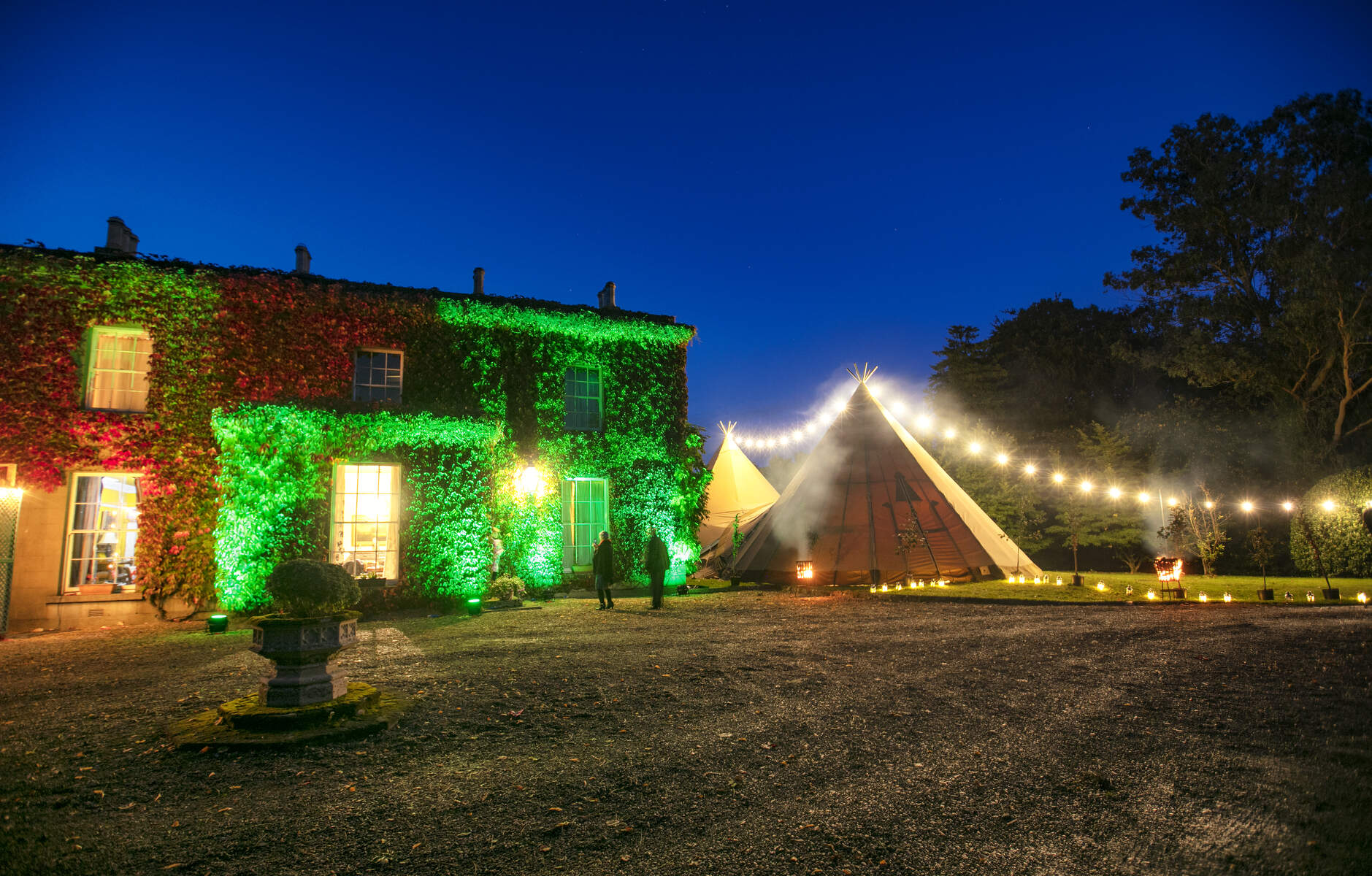
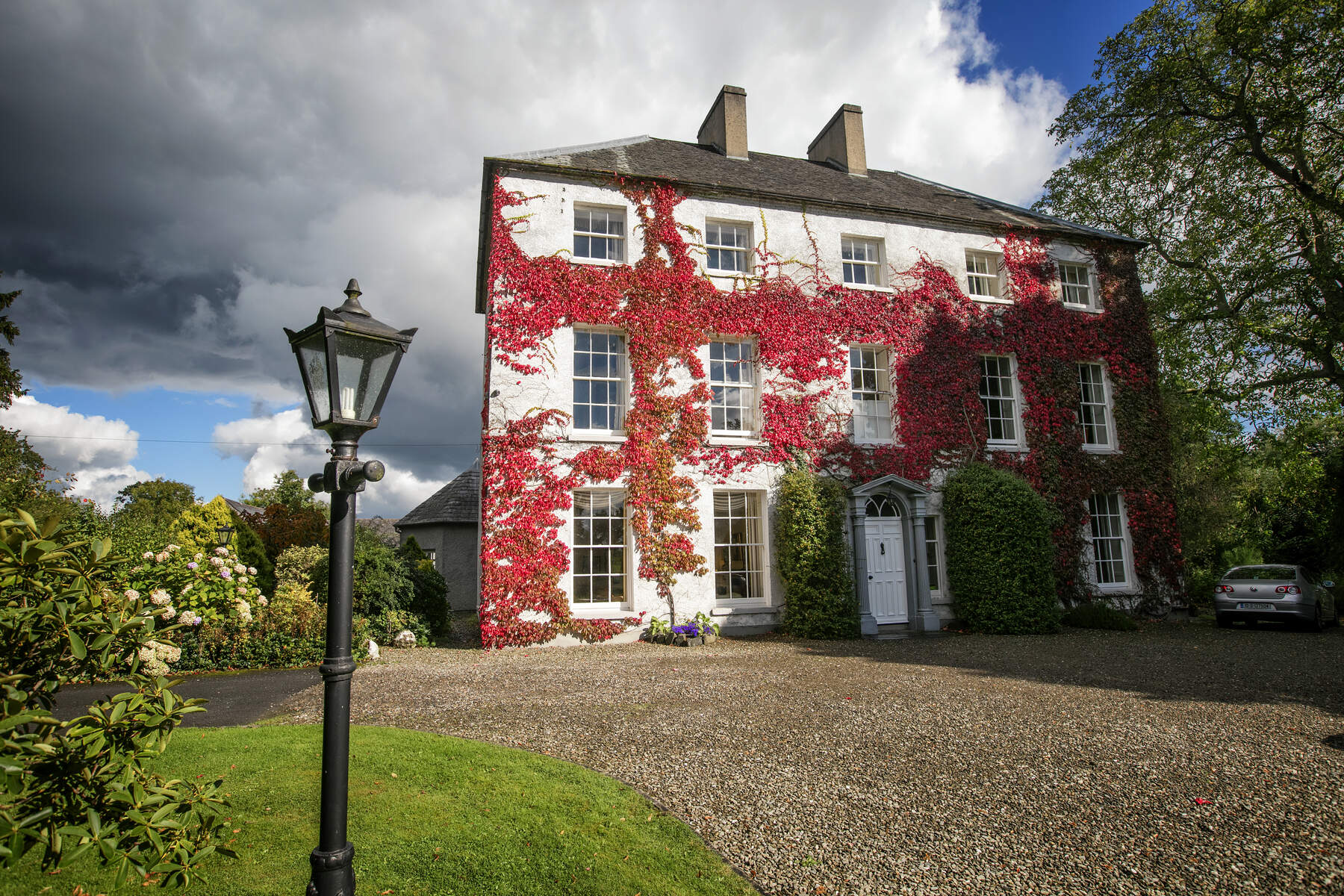
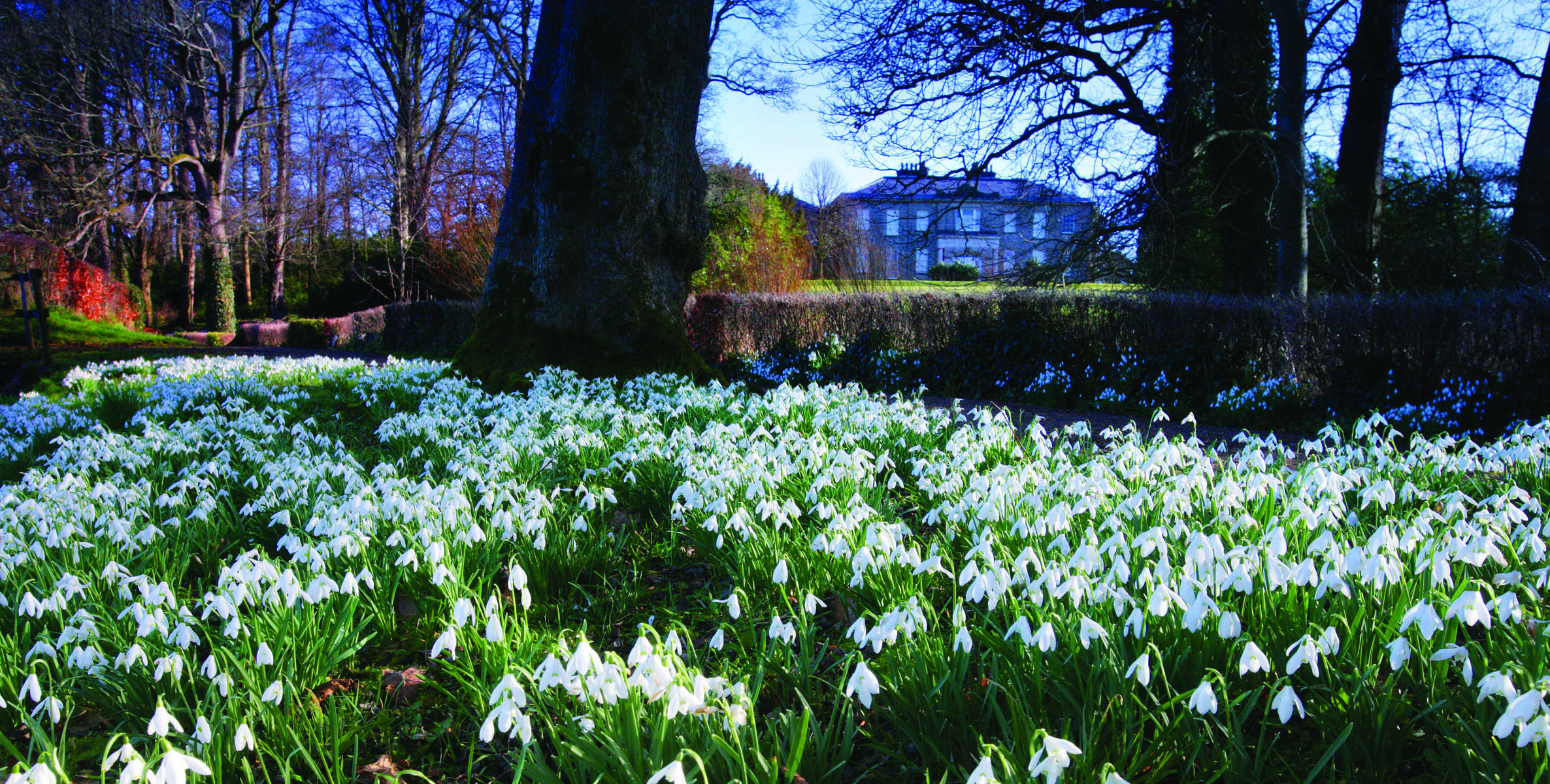
Crannagael House, photograph by Brian Morrison, 2018, for Tourism Ireland, Ireland’s Content Pool (see [3]).
The website tells us:
“Crannagael House, owned and occupied by Jane and John Nicholson, is nestled in the heart of the County Armagh countryside and is approximately 3 miles from M1 junction 13 and 5 miles from Portadown on the B28, Moy – Portadown Road.
“It is a grade 2 listed Georgian house and is still owned by the same family that built it in the mid 18th century. It is surrounded by gardens, parkland and mature woodland, and the accommodation overlooks an apple orchard – a delight when the blossom is out in May!
“Nicholsons have lived at Crannagael House since 1760. Subsequent generations were involved in the linen industry and then in 1884 one Henry Joseph Nicholson, the current owner’s great grandfather, imported the first 60 Bramley Seedling trees to Armagh from Southwell in Nottinghamshire, and the rest as they say is history!
“The self contained apartment on the East wing comprises several bedrooms, bathroom and downstairs shower with wc (both with wonderful views of the orchard!)and a fully fitted kitchen, dining area and lounge.”
“Killeavy Castle Estate is the perfect antidote to the modern fast paced world. As the centrepiece of 350 acres of mixed farm and woodland in County Armagh’s stunning Slieve Gullion, it’s the ideal place to escape, retreat, relax and unwind. Easily accessible only 10 minutes outside Newry City and one hour from both Belfast and Dublin Airports makes it Northern Irelands premier Hotel and Spa destination.
“At Killeavy Castle Estate we are all about living life more slowly and in the present; cherishing those ahhh moments for when the distractions of the modern world finally ebb away and you get closer to the things that matter most. Whether that’s nature, history, loved ones or even yourself, this secluded country Estate will provide everything you need to emerge fully rejuvenated.
“Perfect for a unique getaway, wedding or special celebration, take a closer look at everything the Estate has to offer from a beautifully restored Castle, boutique Hotel accommodation, superb cuisine with ingredients sourced from our local farm, Spa and endless opportunities for walking in a stunning location.”
“Killeavy Castle is a Grade A listed historical building originally designed in 1836 by architect George Papworth of Dublin. Formally known as Killeavy Lodge, the Foxall family had their home rebuilt in the style of the pre-Victorian Gosford Castle with towers, Tudor windows and a medieval-style door transforming the modest farmhouse into a home fit for a king.
“Situated on the eastern base of Slieve Gullion, the original castle and surrounding grounds brought a new element to the beautiful landscape. The building contained a basement level with a kitchen, store rooms, servant’s quarters and an underground tunnel to allow servants to enter and exit the building unseen. Above was a parlour and wine cellar, with an adjoining drawing room, library and conservatory. On the top level were six bedrooms, four dressing rooms and bathrooms. There was a beautiful walled garden and an ornamental water wheel.
“The Bell family took ownership of the property in 1881, but in recent years the building fell into disrepair. Fortunately, the facade remained intact and, surrounded by fir plantations and lush farmland, it has been returned to its former glory.
The Architect
“George Papworth (1781-1855) was the younger brother of English architect John Buonarotti Papworth. He established himself in Ireland and designed many notable buildings including Sir Patrick Dun’s Hospital and the King’s Bridge in Dublin. His drawings of Killeavy were exhibited in the Royal Hibernian Academy in 1836.
Killeavy’s Journey From Family Home to Historic Hotel
“We are proud to have brought a stunning piece of architectural heritage and Northern Ireland history back from the brink of ruin. When we took ownership of Killeavy Castle Estate, we saw its incredible potential and decided to restore it to its former glory.
“Our mission was to fully restore Killeavy Castle Estate so that locals and visitors alike could enjoy it for generations to come. In 2019, we opened the Killeavy Castle to the public as a historic hotel, wedding venue, spa and visitor attraction.
“Since then, we have welcomed countless visitors from around the world. Guests flock to our Estate to appreciate our meticulously restored 19th century Castle, manicured gardens, unspoiled woodlands, and authentic working farm.
Killeavy Castle Estate Today
“Today, the Killeavy Castle Estate comprises our 19th-century Castle, a four-star boutique-style Hotel with 45 guestrooms in our restored Mill and Coach House, and a three-guestroom luxury self catering Gatelodge.
“Our guests can also enjoy our fine dining restaurant, casual bistro bar and luxury spa facilities. Comfort and class are our guiding principles, bringing the opulence of days gone by to everyone who visits our Estate.“
From the website: “Welcome to Newforge House, a historic family-run country house offering warm hospitality, luxurious rooms and delicious local seasonal food in tranquil surroundings. Set on the edge of the small village of Magheralin, Newforge is an oasis of calm and the perfect location for your romantic break or a special occasion with friends and family. Our central location, only 30-minute drive from Belfast, makes Newforge an ideal base for touring Northern Ireland.”
Newforge House, County Armagh, photograph by Brian Morrison 2016, for Northern Ireland Tourism, Ireland’s Content Pool (see [3]).
[1] Mulligan, Kevin V. The Buildings of Ireland: South Ulster, Armagh, Cavan and Monaghan. Yale University Press, New Haven and London, 2013.
[2] p. 11. Bence-Jones, Mark. A Guide to Irish Country Houses (originally published as Burke’s Guide to Country Houses volume 1 Ireland by Burke’s Peerage Ltd. 1978); Revised edition 1988 Constable and Company Ltd, London.
[4] p. 12, Bence-Jones, Mark. A Guide to Irish Country Houses (originally published as Burke’s Guide to Country Houses volume 1 Ireland by Burke’s Peerage Ltd. 1978); Revised edition 1988 Constable and Company Ltd, London.
Today I’m continuing to split county entries into two pages: “Places to visit” and “Accommodation.”
On the map above:
blue: places to visit that are not section 482
purple: section 482 properties
red: accommodation
yellow: less expensive accommodation for two
orange: “whole house rental” i.e. those properties that are only for large group accommodations or weddings, e.g. 10 or more people.
green: gardens to visit
grey: ruins
donation
Help me to pay the entrance fee to one of the houses on this website. This site is created purely out of love for the subject and I receive no payment so any donation is appreciated!
€15.00
Armagh:
1. Ardress House, County Armagh
2. The Argory, County Armagh
3. Brownlow House, County Armagh
4. Derrymore House, Bessbrook, County Armagh – National Trust
5. Milford House, Armagh
Places to Visit in County Armagh
1. Ardress House, County Armagh
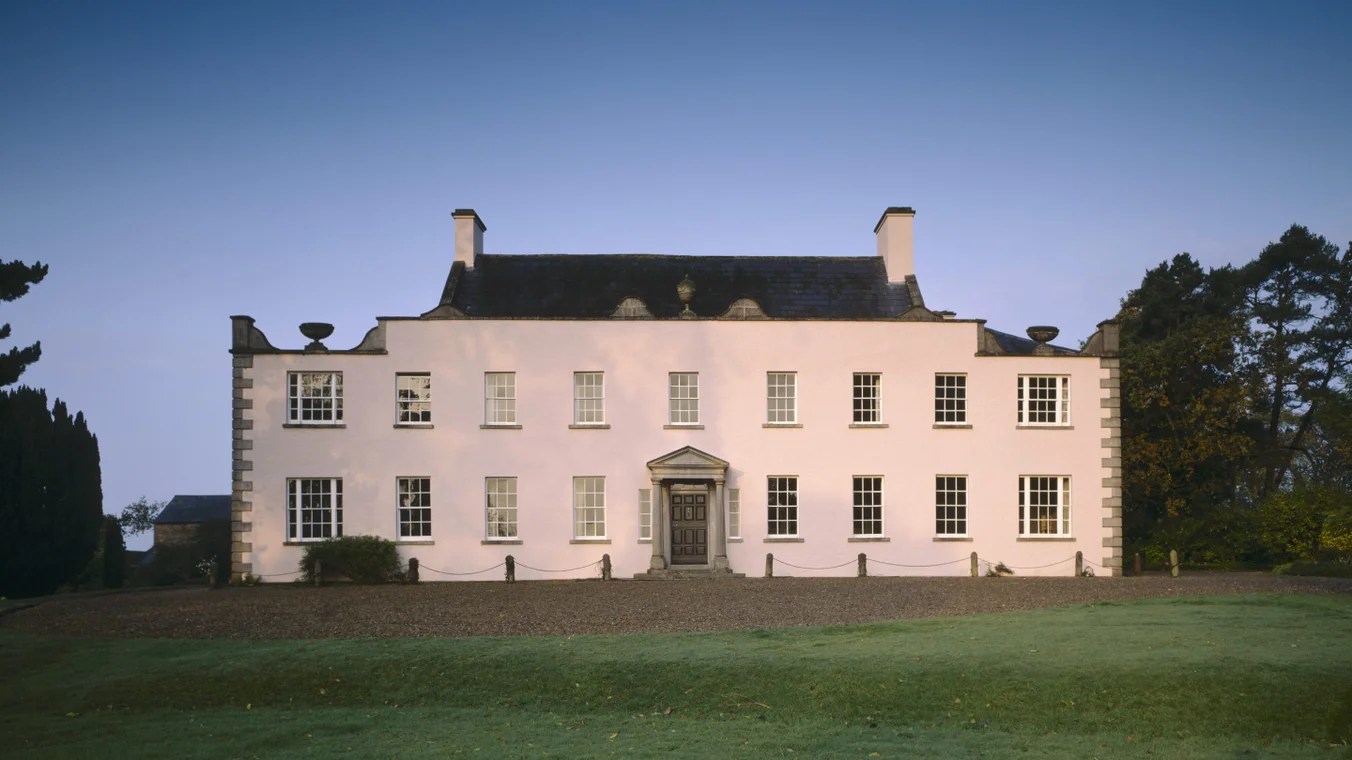
Ardress House, County Armagh, photograph courtesy of Ardress house website.
Kevin V. Mulligan writes in The Buildings of Ireland: South Ulster that Ardress is the best preserved example of a gentleman’s farmhouse in South Ulster, due to its ownership by the National Trust. [1] The house began with five bays, later enlarged to seven bays and eventually the nine bays we see today. It was probably built for Thomas Clarke.
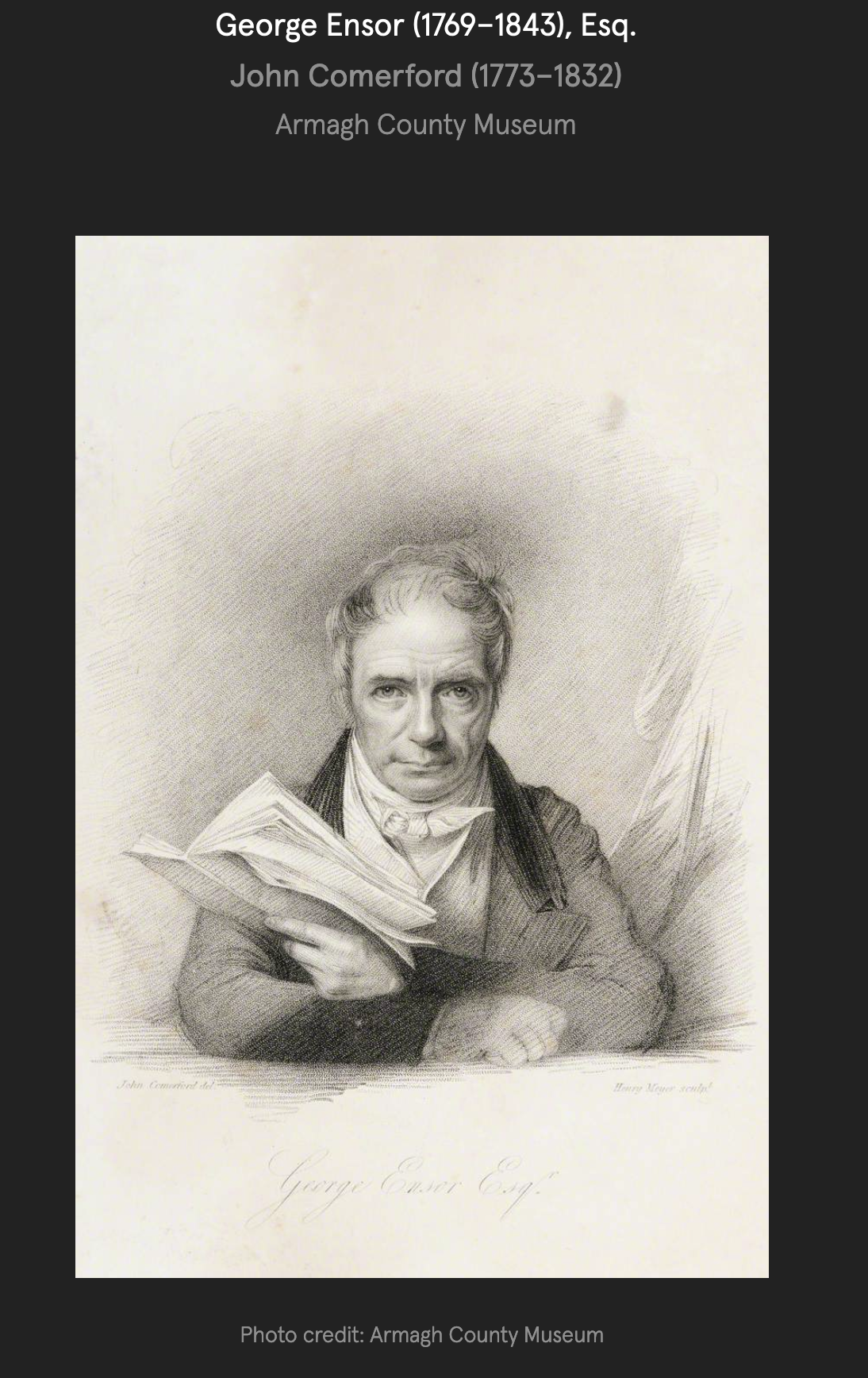
Mark Bence-Jones writes in his A Guide to Irish Country Houses (1988) that Ardress is a two storey five bay gable-ended house of ca. 1664 with two slight projections at the back; enlarged and modernized ca. 1770 by the Dublin architect, George Ensor – brother of better-known architect, John Ensor – for his own use. [2]
George Ensor (1769-1843), he wrote several books and pamphlets on radical topics including ‘Defence of the Irish and Anti-Union’. He died at the family seat Ardress House Co. Armagh in 1843.
Bence-Jones continues: “Ensor added a wing at one end of the front, and to balance it he built a screen wall with dummy windows at the other end. These additions were designed to give the effect of a centre block two bays longer than what the front was originally, with two storey one bay wings having Wyatt windows in both storeys. To complete the effect, he raised the façade to conceal the old high-pitched roof; decorating the parapet with curved upstands and a central urn; the parapet of the wings curving downwards on either side to frame other urns. Ensor also added a pedimented Tuscan porch and he altered the garden front, flanking it with curved sweeps. Much of the interior of the house was allowed to keep its simple, intimate scale; the oak staircase dates from before Ensor’s time. But he enlarged the drawing room, and decorated the walls and ceiling with Adamesque plasterwork and plaques of such elegance and quality that the work is generally assumed to have been carried out by the leading Irish artist in this style of work, Michael Stapleton. Ardress now belongs to the Northern Ireland National Trust and is open to the public.” [2]
The National Trust website tells us: “Clarke and Ensor families who lived at Ardress from the late 1600s to the mid 20th-century. See how the originally modest farmhouse was enlarged and re-modelled over the years. Some of the furnishings are original while others have made their way back here. Highlights include the drawing room, dining room and a fine collection of paintings on loan from Stuart Hall in County Tyrone.“
The discovernorthernireland website tells us that the house has an attractive garden with scenic woodland and riverside walks. The house includes an important collection of farm machinery and tools, and the 1799 table made for the speaker of the Irish Parliament, upon which King George V signed the Constitution of Northern Ireland on 22nd June 1921.
“Past our brand new visitor reception area you’ll find the traditional, cobbled farmyard. Pop into the different outbuildings such as the smithy, byre and threshing barn to get a flavour of old-time rural life. The whole family will love meeting the friendly chickens, goats and donkey, and there’s also a children’s play area.
“Bring your walking boots and set off on the Lady’s Mile (really three-quarters-of-a-mile, if you’re counting). This circular, woodland path is a real highlight of any visit, especially in spring when it’s full of wildflowers. There are some great views back to the house and look out for Frizzel’s Cottage, an 18th-century mud-walled house which is now fully refurbished.
“Ardress sits in the heart of Armagh’s rich apple-growing country. Visit in May to see the orchards burst into vibrant whites and pinks, truly a memorable sight. During Apple Blossom Sundays (12 and 19 May), there will be orchard tours, local cider, local honey, music, country crafts and family fun. Be sure to come back in October for the Apple Press Days, when you can pick your own apples. Kids can also press their own apple juice.”
2. The Argory, County Armagh
The Argory was built in the 1820s on a hill and has wonderful views over the gardens and 320 acre wooded riverside estate. This former home of the MacGeough – Bond family has a splendid stable yard with horse carriages, harness room, acetylene gas plant and laundry. Take a stroll around the delightful gardens or for the more energetic along the woodland and riverside way-marked trails. Photo by Brian Morrison 2009 for Tourism Ireland. [3]
“The Argory was built in the 1820s and its hillside location has wonderful views over the gardens and 320 acre wooded estate bordering the River Blackwater. This former home of the MacGeough–Bond family has a splendid stable yard with horse carriages, harness room, acetylene gas plant and laundry. Take a stroll around the delightful gardens or for the more energetic along the woodland and riverside way-marked trails.
Fascinating courtyard displays Garden, woodland and riverside walks with wonderful sweeping views Snowdrop walks and superb spring bulbs Adventure playground and environmental sculpture trail Enjoy afternoon tea and award winning scones in Lady Ada’s tea room
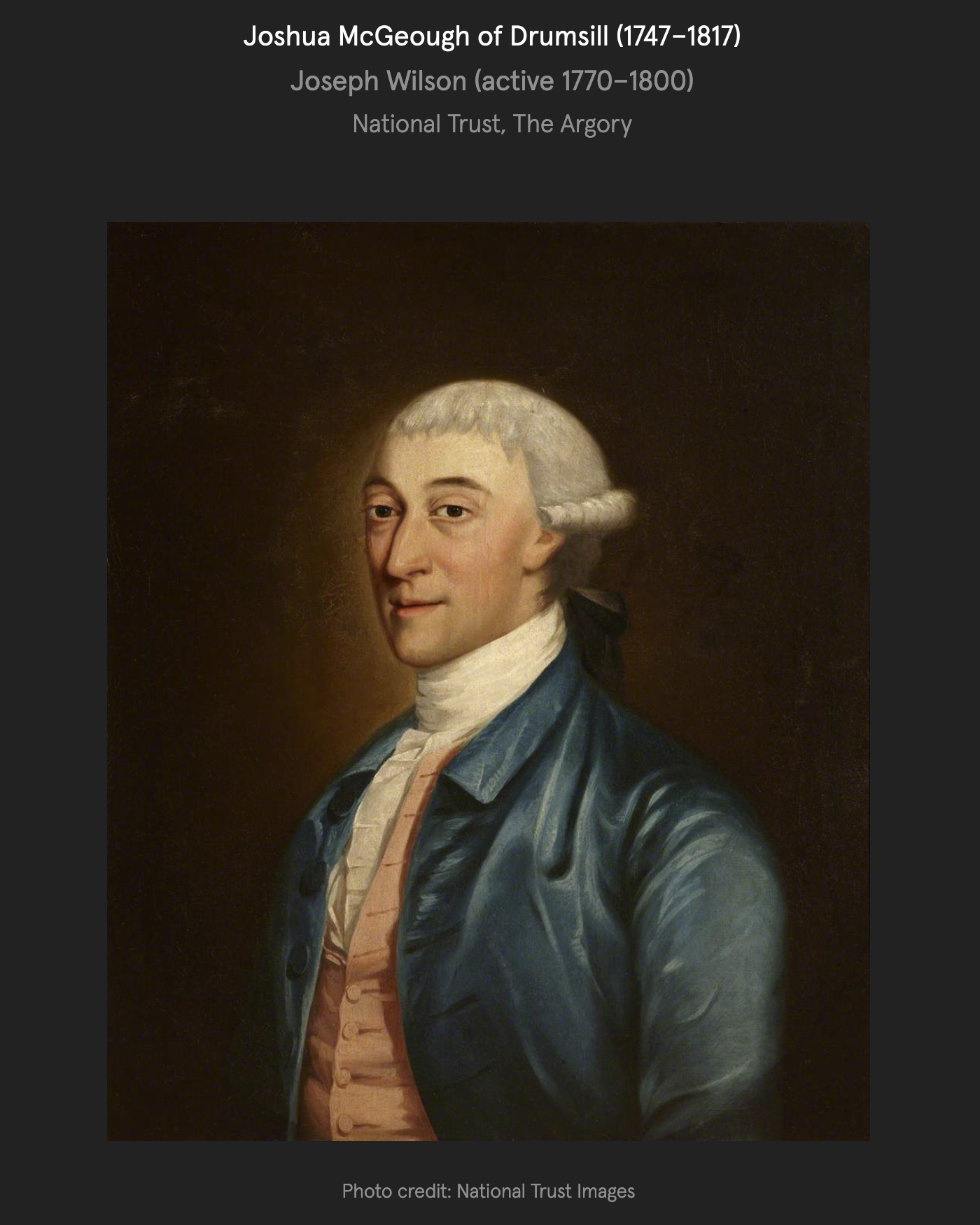
Joshua MacGeough (1747-1817), by Joseph Wilson, he was father of Walter MacGeough-Bond (1790-1866).Courtesy of National Trust, The Argory.
The National Trust website tells us: “The Argory is the home of Mr Bond, the last of four generations of the MacGeough Bond family. Designed by brothers Arthur and John Williamson of Dublin (who also did work for Emo Court in County Laois), the house was built by Mr Bond’s great-grandfather, Walter. The Argory was gifted to the National Trust in 1979. Designed in approximately 1819, started in 1820 and finished about 1824, The Argory came into existence due to a quirky stipulation in a will. Created with Caledon stone in coursed ashlar blocks with Navan limestone window sills, quoins and foundations, the interior of this understated and intimate house remains unchanged since 1900.
“The house was largely closed up at the end of the Second World War, with Mr Bond, the last owner, moving into the North Wing. What you see today is a result of four generations of collecting, treasured by Mr Bond, displayed as he remembers it from his childhood.”
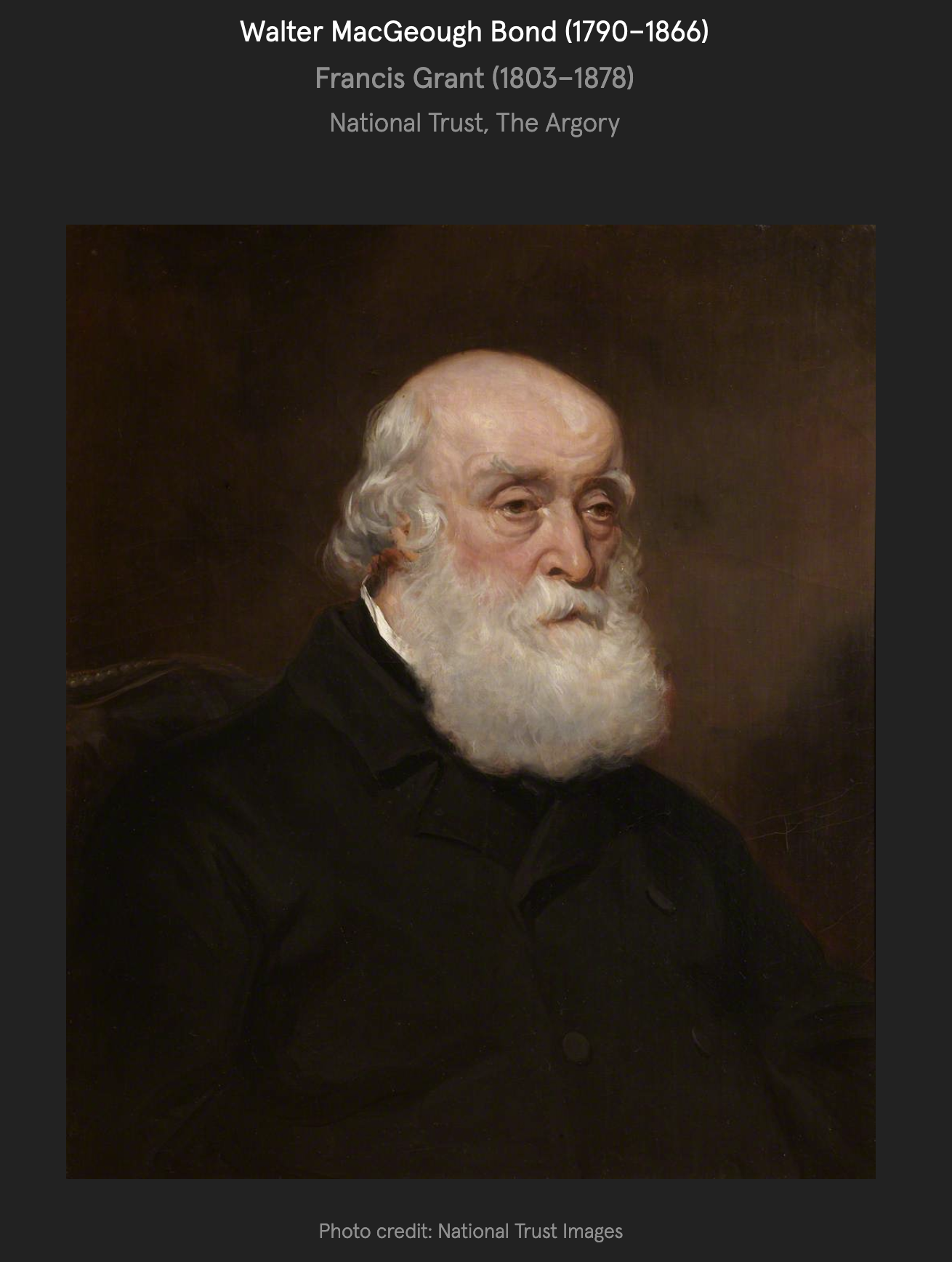
Walter MacGeogh-Bond (1790-1866) by Francis Grant courtesy of National Trust The Argory.
Walter MacGeough-Bond added Bond to his surname in 1824, so he must have inherited from his great-grandfather Walter Bond. He married twice, first to Mary Isabella Joy, with whom he had a daughter, and then to Anne Smyth, daughter of Ralph Smyth of Gaybrook, County Westmeath, and his wife Anna Maria Staples, daughter of Robert 7th Baronet Staples, of Lissan, Co. Tyrone. Walter and Anne had several more children.
Of The Argory, Mark Bence-Jones writes (1988):
p. 12. “(MacGeough Bond/IFR) Built ca. 1820 by Walter MacGeough (who subsequently assumed the surname of Bond), to the design of two architects, named A. and J. Williamson, one or both of whom worked in the office of Francis Johnston. A house with imposing and restrained Classical elevations, very much in the Johnston manner, of two storeys, and faced with ashlar. Main block has seven bay front, the centre bay breaking forward under a shallow pediment with acroteria; Wyatt window in centre above porch with Doric columns at corners. Unusual fenestration: the middle window in both storeys either side of the centre being taller than those to the left and right of it. Front prolonged by wing of same height as main block, but set back from it; of three bays, ending with a wide three-sided bow which has a chimneystack in its centre. Three bay end to main block; other front of main block also of seven bays, with a porch; prolonged by service wing flush with main block. Dining room has plain cornice with mutules; unusual elliptical overdoors with shells and fruit in plasterwork. Very extensive office ranges and courtyards at one corner of house; building with a pediment on each side and a clock tower with cupola; range with polygonal end pavilions; imposing archway. The interior is noted for a remarkable organ and for the modern art collection of the late owner. Now maintained by the National Trust.” [4]
The property passed through the family, to Joshua Walter MacGeough-Bond, to his son Walter William Adrian MacGeough Bond (1857-1945) and finally to his son, Walter Albert Nevill MacGeough Bond.
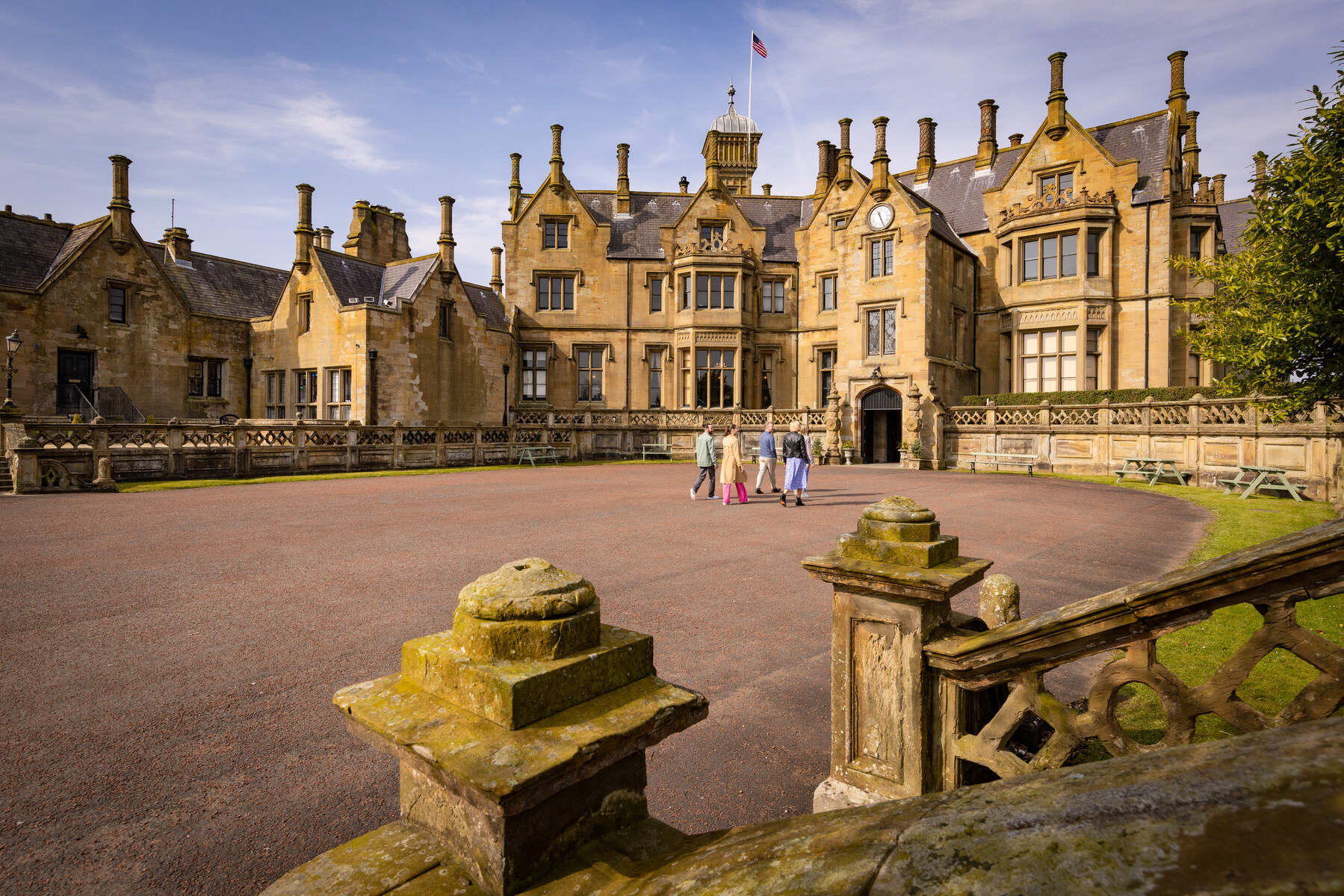
“Brownlow House or Lurgan Castle, so named presumably after the Rt. Hon. Charles Brownlow [1795-1847], who built it in 1833, was created Baron Lurgan in 1839, was owned by the Brownlow family until the turn of the century. Changing fortunes resulted in property being sold to the Lurgan Real Property Company Ltd. and subsequently the House and surrounding grounds were purchased on behalf of Lurgan Loyal Orange District Lodge. The legal document of conveyance is dated 11 July 1904. In appreciation of the effort of the late Sir William Allen, KBE, DSO, DL, MP in obtaining the House, an illuminated address was presented to him by District Lodge and now hangs in the Dining Room beside the portrait of Sir William painted by Frank McKelvey. He together with Messrs. Hugh Hayes, John Mehaffey, George Lunn Jun. and James Malcolm Jun. were the first Trustees.
“Brownlow House, built in an age of grandeur and cultured tastes, is an imposing building. It has retained much of the atmosphere of bygone days and one can readily pause and still imagine what life was like when it was occupied as a dwelling.”
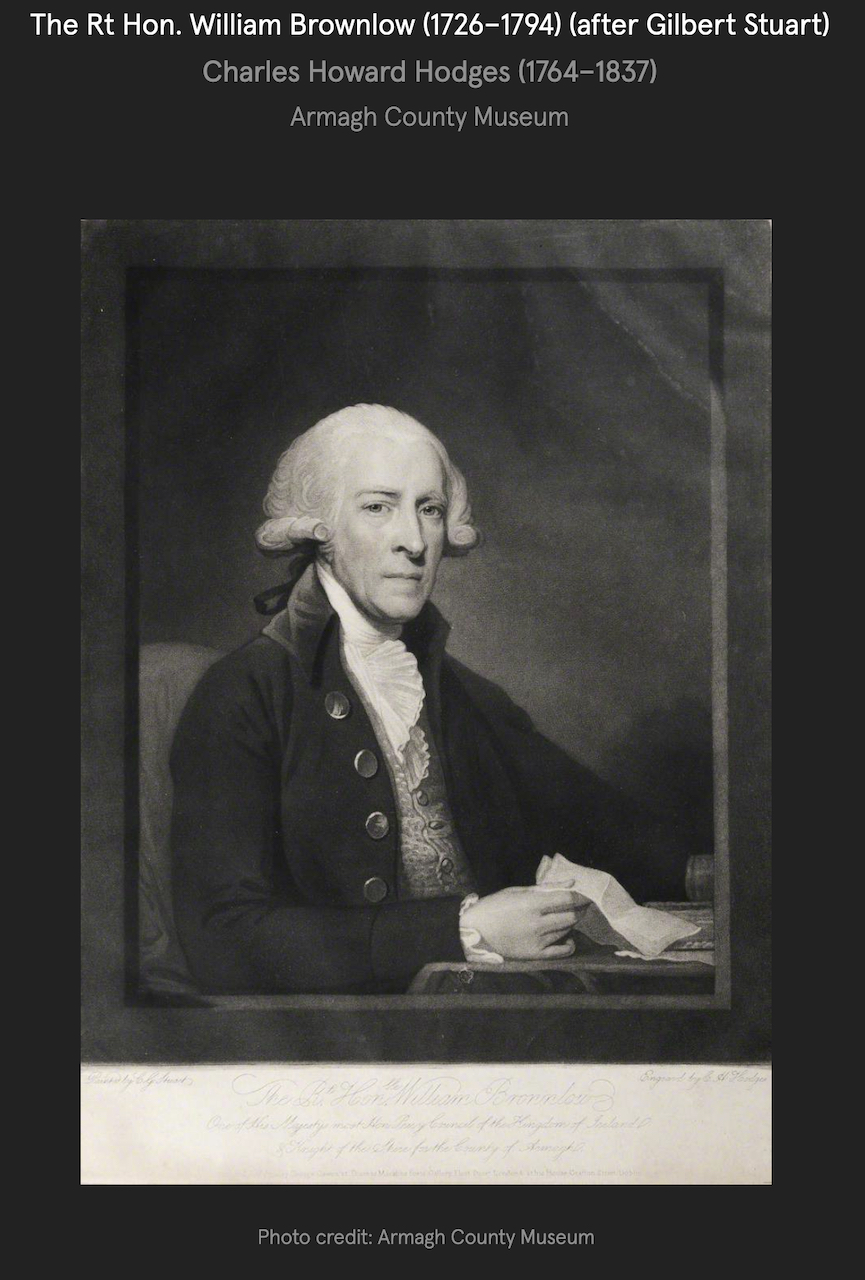
William Brownlow (1726-1794) (after Gilbert Stuart) by Charles Howard Hodges courtesy of Armagh County Museum.
Mark Bence-Jones writes of Brownlow House (1988):
p. 49. (Brownlow, Lurgan, B/PB) A large Elizabethan-revival house by William Playfair, of Edinburgh, built from 1836 onwards for Charles Brownlow, 1st Lord Lurgan, whose son, 2nd Baron, owned the famous greyhound Master McGrath, and whose brother-in-law, Maxwell Close, built Drumbanagher, also to the design of Playfair. Of honey coloured stone, with a romantic silhouette; many gables with tall finials; many tall chimneypots; oriels crowned with strapwork and a tower with a lantern and dome. The walls of three principal reception rooms are decorated with panels painted to resemble verd-antique; while the ceilings are grained to represent various woods. The grand staircase has brushwork decoration in the ceiling panesl, and the windows are filled with heraldic stained glass. Sold 1903 to the Orange Order, its present owners, by whom it is used for seasonal functions. Its grounds have become a public park.”
4. Derrymore House, Bessbrook, County Armagh – National Trust, open to public.
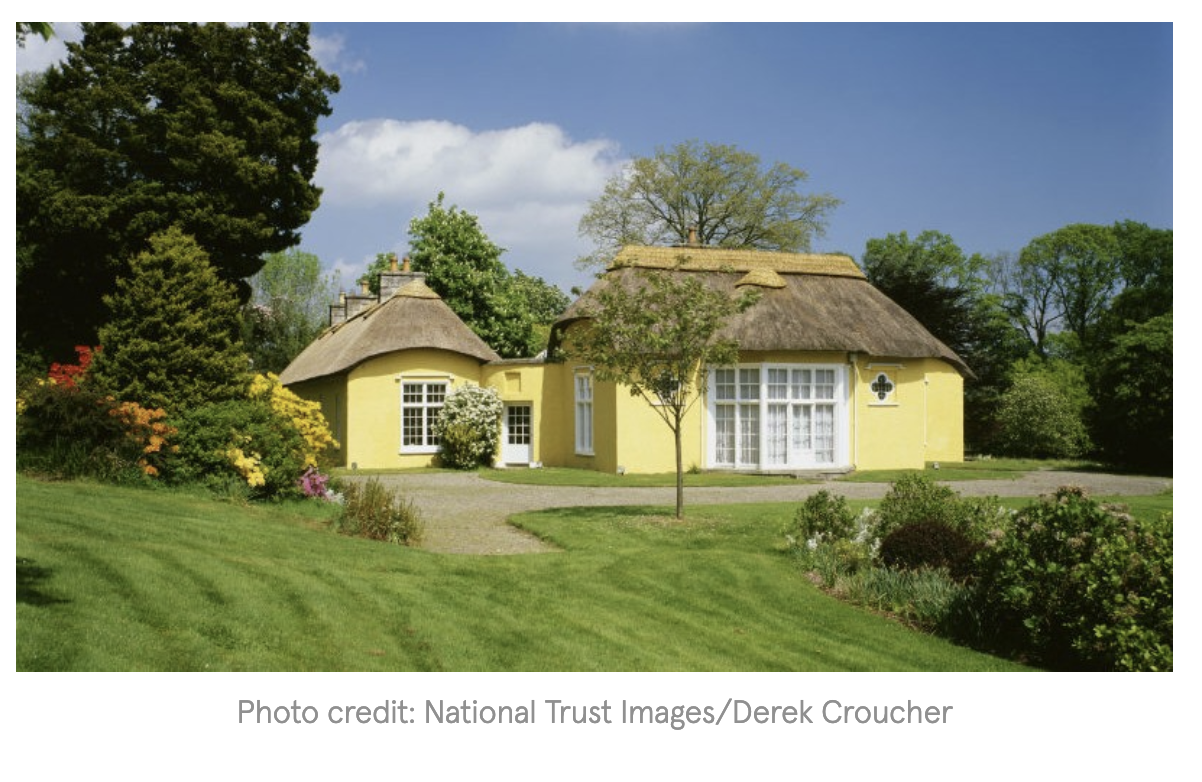
The National Trust website tells us that Derrymore House is a late 18th-century thatched house in gentrified vernacular style.
“The name Derrymore is derived from ‘doire’, the Irish for an oak grove and ‘mór’, meaning large. Derrymore was the home of Isaac Corry (1753-1813), MP for Newry from 1776. He commissioned John Sutherland (1745-1826), the leading landscape gardener of the day, to carry out improvements to the land. Sutherland enhanced the existing woodland by planting thousands more trees. Oak, chestnut, pine and beech trees now dominate the woodlands, which contain some very fine mature specimens. The picturesque thatched house was built for Corry, in the style of a ‘cottage orné’, which gives it a rather romantic feel. It is surprisingly large inside with reception and bedrooms on the ground floor, and service rooms in the basement.
“Isaac Corry was Chancellor of the Irish Exchequer in 1800, when the Act of Union with Britain was passed. It followed a time of extreme political unrest. The Act removed parliamentary control from Dublin to London, a highly contentious move. Many who supported the union were seen as betraying Ireland in the interests of economics and trade, while others saw it as an economic and political necessity. As MP for Newry and supporter of the linen industry, Corry was keen to ensure solid trade links. The Act was also meant to deliver Catholic Emancipation, but to the dismay of many, including Corry, this part of the Act was not ratified.
“Corry sold Derrymore in 1810 and retired to his Dublin house, where he died in 1813. After passing through several hands, Derrymore was bought by John Grubb Richardson (1815-1890), owner of the Bessbrook linen works and village and a member of the Society of Friends.
“By the mid-19th century the linen industry had become a major part of the Ulster economy. Industrialisation brought in ever more sophisticated engineering. The Craigmore Viaduct, visible from Derrymore demesne, opened in 1852, creating a major transport link between Dublin and Belfast. The linen business at Bessbrook grew from a small mill, with weaving carried out on looms in people’s own cottages (piece work), into an impressive series of flax, spinning and weaving mills, spear-heading new developments in damask weaving, and established a world-wide reputation for Richardson Linens.
“John G. Richardson invested heavily in Bessbrook, creating a model village around the large mill, run on Quaker principles of mutual respect between managers and workers. Good housing, religious tolerance, playing fields and schools helped create a thriving and settled community. No public house ensured that there was no need for a police station, nor for a pawnshop.
“John G. Richardson let Derrymore house to tenants and built The Woodhouse for his own family in the northern part of the demesne. He created informal gardens through the rocky woodland, making use of the granite rock from local quarries, enhanced the walled garden and built entrance lodges.
“In 1940, soldiers of the Fife and Forfar Yeomanry arrived in Bessbrook as a defence against German invasion of Northern Ireland from across the Irish border. In 1943, the troops were replaced by the US Army Quartermaster Depot Q111-D until August 1944.
“After the war, John S.W. Richardson, a descendant of John G Richardson, offered Derrymore House to the National Trust. In the 1970s the “Troubles” impacted Bessbrook and Derrymore. The mill was turned into a major base for the British Army and was known as the busiest military heliport in Europe. Corry’s association with the Act of Union led to bombs being planted at Derrymore house on several occasions between 1972 and 1979; one firebomb damaged the house. The caretaker, Mr Edmund Baillie and his two sisters lived in the house and luckily were unhurt, but their safety and the survival of the house were largely due to Mr Baillie’s personal courage in moving some of the bombs away from the building. The Trust was forced to close the house and remove the contents for safe keeping; it opened again in the late 1980s. In 1985 John Richardson generously bequeathed the rest of Derrymore demesne to the National Trust, including The Woodhouse, walled garden and various lodges.
“The National Trust has worked with a number of partners to enhance access to Derrymore Demesne with a focus on local visitors, providing better footpaths, parking, toilet facilities and a children’s play area to ensure that everyone can enjoy the beauty of Derrymore in harmony with nature and wildlife and its historic past.“
Mark Bence-Jones writes:
p. 102. “(Corry/LG1886) A single-storey thatched cottage ornee of Palladian form, consisting of a bow-fronted centre block and two flanking wings, joined to the main block by diminutive canted links. The central blow of the main block is three sided, and glazed down to the ground, with mullions and astragals; it is flanked by two quatrefoil windows, under hood mouldings. There is also a mullioned window in each wing. Built ante 1787 by Isaac Corry, MP for Newry and last Chancellor of the Irish Exchequer. The Act of Union is said to have been drafted in the fine drawing room here. Now owned by the Northern Ireland National Trust and open to the public.“
“Milford House was the one of its age. The most technologically advanced house in 19th century Ireland – the first in Ireland to be lit with hydro electricity. The creation of Robert Garmany McCrum, self made industrialist, benefactor and inventor who revolutionized the linen industry. His son William invented the penalty kick rule in football (which makes Milford world famous!) and his daughter Harriette was a founding member of the women’s suffragette movement in Ireland. By 1880 Milford House had six bathrooms each with a Jacuzzi and Turkish bath and a waterfall in the dining room. From 1936 to 1965 it was home to the Manor House School.
“Today Milford House is one of the top ten listed buildings at most serious risk in Northern Ireland.”
p. 206. “A two storey vaguely Italianate C19 house. Camber-headed windows; three sided bow; pedimented three bay projection. Elaborate range of glasshouses running out at right angles from the middle of the front. The seat of the McCrums, of the firm of McCrum, Watson & Mercer, damask manufacturers, of Belfast.”
[1] p. 83. Mulligan, Kevin V. The Buildings of Ireland: South Ulster, Armagh, Cavan and Monaghan. Yale University Press, New Haven and London, 2013.
[2] p. 11. Bence-Jones, Mark. A Guide to Irish Country Houses (originally published as Burke’s Guide to Country Houses volume 1 Ireland by Burke’s Peerage Ltd. 1978); Revised edition 1988 Constable and Company Ltd, London.
[4] p. 12, Bence-Jones, Mark. A Guide to Irish Country Houses (originally published as Burke’s Guide to Country Houses volume 1 Ireland by Burke’s Peerage Ltd. 1978); Revised edition 1988 Constable and Company Ltd, London.
BALDWIN ST GEORGE, one of the companions-in-arms of WILLIAM THE CONQUEROR, whose descendants flourished in England for several centuries, and frequently represented Cambridgeshire in Parliament.
SIR RICHARD ST GEORGE (c1550-1635), Clarenceux King of Arms (19th in lineal descent from Baldwin), married, in 1575, Elizabeth, daughter of Nicholas St John, of Lidiard Tregoze, Wiltshire, by whom he left at his decease three sons,
Henry, Garter King of Arms; George (Sir), of Carrickdrumrusk; RICHARD, of whom we treat.
The third son,
CAPTAIN RICHARD ST GEORGE (1590-1667), went over to Ireland in the beginning of the 17th century, in the Royal Army, and was appointed Governor of the town and castle of Athlone.
He was born at Hatley St George, Cambridgeshire, and wedded, in 1625, Anne, daughter of Michael Pinnock, of Turrock, County Roscommon, by which lady he had issue,
HENRY, his heir; Mary; Anne.
The only surviving son,
HENRY ST GEORGE (1638-1723), of Athlone, and of Woodsgift, County Kilkenny, MP for Athlone, 1715-23, was an officer in the Irish army of CHARLES II.
He espoused, in 1669, Anne, daughter of Alderman Ridgeley Hatfield, of the city of Dublin, and had issue,
Richard, of Kilrush; Henry; ARTHUR, of whom hereafter; George, of Woodsgift, MP.
The third son,
THE VERY REV DR ARTHUR ST GEORGE (1681-1772), Dean of Ross, married Jane, daughter of Sir Thomas Molyneux Bt, of Castle Dillon, County Armagh, and had issue,
Richard, of Kilrush;
THOMAS, of whom hereafter;
Capel;
Arthur;
Howard, ancestor of ST GEORGE of Kilrush;
Henry (Rev);
Catherine.
The second son,
THOMAS ST GEORGE (1738-85), MP for Clogher, 1776-85, Commissioner of Barracks, wedded, in 1776, Lucinda, fourth daughter of Archibald, 1st Viscount Gosford, and had issue,
Thomas Baldwin;
ACHESON, of whom we treat;
John;
Archibald;
William Molyneux.
The eldest surviving son,
ACHESON ST GEORGE (1778-), of Wood Park, Tynan, County Armagh, High Sheriff of County Armagh, 1826, espoused firstly, in 1810, Eleanor, daughter of Robert Gordon, of Clonmel, and had issue,
Thomas Gordon, Lieutenant-Colonel, East India Company;
William, East India Company;
ACHESON, of whom hereafter;
John, East India Company;
Lucinda Margaret; Eleanor Mary; Olivia.
He married secondly, in 1824, Jane, second daughter of the Hon and Very Rev John Hewitt, Dean of Cloyne (fourth son of James, 1st Viscount Lifford), and had one daughter,
Alicia Hewitt Caroline.
The third son,
ACHESON ST GEORGE (1819-1902), of Wood Park, County Armagh, married, in 1890, Jane Rebecca, only surviving child of Thomas Knox Armstrong, of Fellows Hall, County Armagh, and dsp 1902.
UMGOLA HOUSE, County Armagh (AP ARMAGH, BANBRIDGE and CRAIGAVON 03) A/036 REGISTERED GRADE B A small villa park of 7 acres (2.9ha) lying 0.3 miles (0.5km) west of the Palace Demesne in Armagh, north of the Monaghan Road with modern housing estates flanking its north and east sides. It has a very well maintained garden and is surrounded by mature trees. This villa (Listed HB 15/19/14 – includes a conservatory and glasshouse, gates and railings) is a substantial late-Victorian polychrome brick Freestyle mansion, built in 1890-1, possibly by J.H. Fullerton of Armagh, for John Compton, who had purchased the Umgola Damask Weaving Factory in 1882. It has bracketed eaves, and gables with elaborate ‘fretwork’ bargeboards. The house was extended in 1905, including a new entrance and porch to the south garden front and a fine iron-framed conservatory by Phillips & Sons of Belfast, the plans of which survive; this has a curved roof with somewhat exotic pointed dome entrance bay with coloured glass panes and a classical door case with pediment. The long line of greenhouses to the south-west of the house, containing vines and peaches, and the smaller (now demolished) one to the east were added in 1912. North of the garden is a large L-shaped two-storey brick-built stable yard and a pair of attractive semi- detached houses (probably for coachman and gardener), all contemporary with the main house. South of the house in the trees is a small square brick summer house with slated pyramidal roof, c.1912. One or two original features of the gardens have not been kept up, such as the Japanese garden and pond but there is a formal sunken garden, with a rectangular pond in lawns. The main entrance to the garden has pair of square stone piers with pyramidal caps and decorative iron gates. Originally this entrance opened directly off Monaghan Road, however the road was redirected roughly 25m southwards in the later 1900s.
SAMUEL COWDY, of Taughlumny, near Banbridge, County Down, was a sergeant in Cromwell’s army, from whom he received a farm of 273 acres at Taughlumny.
He married and had issue, his youngest son,
JOHN COWDY (c1770-1857), who married M Rollins, and was father of
ANTHONY COWDY (1809-92), who wedded Elizabeth, daughter of Mr Mahaffy, and had issue, an only son,
ANTHONY COWDY (1843-1908), who married Sarah Frances, daughter of Mr Jones, and was father of
EDWARD COWDY JP DL (1873-1934), of Summer Island, County Armagh, High Sheriff of County Armagh, 1920, who wedded, in 1903, Mary Jane, daughter of Robert McKean JP, of Rockwood, Benburb, County Tyrone.
Edward Cowdy (1873-1934)
His eldest son,
ROBERT McKEAN COWDY JP DL, of Summer Island, High Sheriff of County Armagh, 1947, married, in 1939, Diana Vera Gordon, elder daughter of John Ralph Cope, of Drumilly, County Armagh, and had issue,
SUMMER ISLAND, County Armagh (AP ARMAGH, BANBRIDGE and CRAIGAVON 03) A/043 REGISTERED GRADE A Late Georgian parkland on gently undulating land (87acres/35ha) with a later Regency house (Listed HB 15/01/001) at Annasamry (summer height), 2 miles (3.3km) south-east of Moy and 5.7 miles (9km) north of Armagh City. Well known for its charming pair of vernacular gothick lodges, c.1790, which give access at Hall’s Hill from the south. The park in its present form evidently largely dates to the late 1780s and must have been made for Thomas Clarke (d.1791), whose family had held lands here from at least 1664. The park is depicted with its south avenue and most of its plantations/clumps in place on a map of Annasamry dated 1794 by William Kigan for Thomas Clarke’s son William (d. circa 1804). Summer Island (a name that first appears in the 1760s) then passed through William’s sister to the O’Donnell family and sold in 1822 to Col. William Verner, who was responsible for re-building the present dwelling around 1825. Verner commissioned the cartographer William Armstrong to produce a map of the demesne in 1822 and this shows the carriage drive meandering axially though the park from the entrance, the shelter belts, woodland blocks and clumps and also a high number of isolated parkland trees dotted about. Many mature deciduous trees survive in today’s landscape, both in the open parkscape and woodland. These are mainly oak and beech but also chestnut, lime and ash. The woodland west of the house (‘The Jungle’) has a mixture of mature deciduous trees (oak mainly) and at the gate lodges end there are screens with very impressive mature lime trees (the woodland here is called Hunter’s Grove). As with the shelter belts and screens, the number of isolated mature parkland trees that survives at Summer Island is unusually impressive. The walled garden, not present in 1794, is first shown on Armstrong’s 1822 map and there pre-dates Verner’s time. No longer cultivated, it occupies a square area (1.24 acres/0.5ha) with north-south sloping ground and enclosing walls of stone and brick elsewhere using English Garden Bond; there are hot wall flues to be seen in places. The west corner is curved and in the apposite corner there is a small brick ‘necessary house’ or privy with gothick entrance. The top section of the long south-west side of the garden has a low wall surmounted by a good Victorian railing, a feature designed to allow views of the parkland from the walled garden (similar screens are also present at a number of other walled garden and usually date to the 1860s). Elsewhere on this south-west wall and also along the north-east wall of the garden, there is a narrow slip on the outside allowing woody plants to be planted to hide the wall from view. To the rere of the house is a large stable/farmyard and a collection of outbuildings most of which are shown on the 1822 map; the main exception being 20th century open sheds with Belfast Rood Trusses. After Col. Verner’s death in 1871, the property was leased by his son, William Verner, to Joseph Atkinson, Jnr., who remained there until 1908 when it was acquired by Edward Cowdy. As mentioned above, there are two matching lodges at the entrance (neither are in use),; these were described by JAK Dean as ‘The prettiest pair of surviving Georgian Gothick porters’ lodges in the Province’. Both the gate lodges and gates are listed (Listed HB 15/01/001). Private.
CONEY ISLAND, County Armagh (AP ARMAGH, BANBIDGE and CRAIGAVON 03) A/053 REGISTERED GRADE A The wooded island is in the south-west corner of Lough Neagh, a short distance by boat from Maghery and is 9 acres (3.6ha) in area. It was an island retreat with a house of 1895 surrounded by an ornamental garden and deciduous trees, once owned by the Caulfield family (Viscounts Charlemont). There are winding paths in the woodland, mostly adjacent to the lough with views across the water. The open space in front of the house once was a croquet lawn and there is a cottage-style garden at the house. The island is exposed to wind from all directions and some of the trees are getting old. The shelter that they afford is important to the maintenance of the site. The island has evidence of earlier occupation, with the remains of a small castle, Coney Keep
Register of Parks, Gardens and Demesnes of Special Historic Interest (NI) – November 2020 (SMR: ARM 2:2) and a motte; the latter is flat topped 21m overall diameter and 5m high; the flat top in the centre is the base for a flag pole. A shallow silted ditch 4m wide surrounds the mound, excavation show this was originally 3.80m wide and 3.65m deep A spiral path leads to the top of the motte and the monument is incorporated into the landscape. Archaeological excavation by Peter Addyman in 1962-63 between the motte and the castle revealed extensive prehistoric occupation, covering a long sequence from Mesolithic, Neolithic, Bronze Age to the early Christian period. Souterrain ware, glazed pottery and everted-rim ware found by Addyman all claimed to be associated with activity at the time the island was granted by Walter de Burgh, Earl of Ulster to the Archbishop of Armagh in 1265-66. It is in this grant that is the earliest name for the island ‘Inisdaville’ (island of the Blackwater). There was some ironworking on the island. The 16th century stone tower was apparently used by Shane O’Neill as a stronghold for his treasure; the interior of this castle is now occupied by the grave of the 7th Viscount Charlemont (1830-1913). There is evidence of a causeway, St Patrick’s Road. The dominant tree species on the island are sycamore, ash, horse chestnut, beech, oak (Q. petraea), wych elm and Scots pine, while alder is dominant around the island fringe. SMR: ARM 2:4 facing towards the County Armagh shore and references to a Pin Well SMR: ARM 2:6. The site is owned by the National Trust and kept up by the Borough Council with public access. A Biological Survey was undertaken in 1986. A heronry was present on the island in the 1980s and 90s.
BALDWIN ST GEORGE, one of the companions-in-arms of WILLIAM THE CONQUEROR, whose descendants flourished in England for several centuries, and frequently represented Cambridgeshire in Parliament.
SIR RICHARD ST GEORGE (c1550-1635), Clarenceux King of Arms (19th in lineal descent from Baldwin), married, in 1575, Elizabeth, daughter of Nicholas St John, of Lidiard Tregoze, Wiltshire, by whom he left at his decease three sons,
Henry, Garter King of Arms; George (Sir), of Carrickdrumrusk; RICHARD, of whom we treat.
The third son,
CAPTAIN RICHARD ST GEORGE (1590-1667), went over to Ireland in the beginning of the 17th century, in the Royal Army, and was appointed Governor of the town and castle of Athlone.
He was born at Hatley St George, Cambridgeshire, and wedded, in 1625, Anne, daughter of Michael Pinnock, of Turrock, County Roscommon, by which lady he had issue,
HENRY, his heir; Mary; Anne.
The only surviving son,
HENRY ST GEORGE (1638-1723), of Athlone, and of Woodsgift, County Kilkenny, MP for Athlone, 1715-23, was an officer in the Irish army of CHARLES II.
He espoused, in 1669, Anne, daughter of Alderman Ridgeley Hatfield, of the city of Dublin, and had issue,
Richard, of Kilrush; Henry; ARTHUR, of whom hereafter; George, of Woodsgift, MP.
The third son,
THE VERY REV DR ARTHUR ST GEORGE (1681-1772), Dean of Ross, married Jane, daughter of Sir Thomas Molyneux Bt, of Castle Dillon, County Armagh, and had issue,
Richard, of Kilrush;
THOMAS, of whom hereafter;
Capel;
Arthur;
Howard, ancestor of ST GEORGE of Kilrush;
Henry (Rev);
Catherine.
The second son,
THOMAS ST GEORGE (1738-85), MP for Clogher, 1776-85, Commissioner of Barracks, wedded, in 1776, Lucinda, fourth daughter of Archibald, 1st Viscount Gosford, and had issue,
Thomas Baldwin;
ACHESON, of whom we treat;
John;
Archibald;
William Molyneux.
The eldest surviving son,
ACHESON ST GEORGE (1778-), of Wood Park, Tynan, County Armagh, High Sheriff of County Armagh, 1826, espoused firstly, in 1810, Eleanor, daughter of Robert Gordon, of Clonmel, and had issue,
Thomas Gordon, Lieutenant-Colonel, East India Company;
William, East India Company;
ACHESON, of whom hereafter;
John, East India Company;
Lucinda Margaret; Eleanor Mary; Olivia.
He married secondly, in 1824, Jane, second daughter of the Hon and Very Rev John Hewitt, Dean of Cloyne (fourth son of James, 1st Viscount Lifford), and had one daughter,
Alicia Hewitt Caroline.
The third son,
ACHESON ST GEORGE (1819-1902), of Wood Park, County Armagh, married, in 1890, Jane Rebecca, only surviving child of Thomas Knox Armstrong, of Fellows Hall, County Armagh, and dsp 1902.
WOOD PARK, near Tynan, County Armagh, was a Georgian house to the south of the neighbouring estate of Fellows Hall.
Woodpark features in J A K Dean’s Plight of the Big House in Northern Ireland on Page 66.
Mark Bence-Jones. A Guide to Irish Country Houses (originally published as Burke’s Guide to Country Houses volume 1 Ireland by Burke’s Peerage Ltd. 1978); Revised edition 1988 Constable and Company Ltd, London.
p. 286. “A many gabled late-Victorian house with eaved roofs and elaborate bargeboards.”
Tynan Abbey, County Armagh, photograph by Robert French, (between ca. 1865-1914), Lawrence Photograph Collection, National Library of Ireland.
Mark Bence-Jones. A Guide to Irish Country Houses (originally published as Burke’s Guide to Country Houses volume 1 Ireland by Burke’s Peerage Ltd. 1978); Revised edition 1988 Constable and Company Ltd, London.
p. 279. “(Stronge, Bt/PB) A house built 1750 by Rev James Stronge; remodelled and enlarged in Tudor-Gothic ca 1820-30 by Sir James Stronge, 2nd Bt. Imposing two storey entrance front, battlemented and pinnacle; battlemented central tower with entrance doorway below corbelled oriel. Pointed Gothic windows; end of front canted, with very Gothic tracery windows of Perpendicular style rising through both storeys in the end and angle walls. Long side elevation; range with many steep dormer-gables recessed between the end of the entrance front, and a balancing, but not similar, projection; which ends with a church-like tower and spire. The two projections are joined at ground level by a cloister of segmental-pointed arches, interrupted in the centre by a three sided battlmented and gabled bow. Some alterations and extensions were carried out later in C19 to the design of William J. Barre. The seat of Sir Norman Stronge, 8th Bt, former Speaker of the Northern Ireland House of Commons.”
Tynan Abbey, County Armagh, photograph by Robert French, (between ca. 1865-1914), Lawrence Photograph Collection, National Library of Ireland.
TYNAN ABBEY, County Armagh (AP ARMAGH, BANBRIDGE and CRAIGAVON 03) A/035 REGISTERED GRADE A* Outstanding demesne parkland of 585 acres (237ha), noted for its fine trees. Its house is now gone, having been gutted by fire in 1981 and subsequently demolished in 1988. The demesne lies over a mile (2km) south Caledon Village on the east bank of the River Blackwater, contagious to the south-east side of Caledon demesne and south of the Cortynan Road and the former railway line (Portadown and Cavan Branch Line, GNR). There are at least two crannogs in the lake (formerly 16 acres/6.6ha extent) at Tynan suggesting an importance in medieval times, but there was no abbey here, the name being an early 19th century romantic invention. The first recorded house here, which belonged to a Captain Manson, dates to the 1680s and was known as ‘Fairview’; it was described by Ashe in 1703 as a modest two-storey “very pritty house, well tymber’d and regularly built”. The property passed through marriage into the Stronge family in 1747 and is believed on the basis of a datestone to have been re-modelled in 1750. No relics of this house or of an associated early formal landscape have been identified. Some of the present naturalised landscape park may belong to the later 18th century, but for the most part it evidently belongs to the late Regency, 1810-22, when the house was remodelled for Sir James Stronge, 2nd Bt. (1786-1864) in a Tudor-Gothic style, almost certainly by English architect, John Nash, (1752- 1835) who was also involved at Caledon at this time. That house faced east, while on the north side it looked out onto a shrubbery laid out in geometric patterns, removed by the 1850s; a ballaun stone of possible Early Christian date (ARM 015:045) may have originally been moved here to form a focal point of this garden. The south or garden front of the house, which boasted a conservatory and an open loggia of the kind often favoured by Nash, looked down upon a series of grass terraces with the parkland and its lake beyond. These terraces were later planted (probably in the 1840s) with box edged beds, planted annually for colour (geraniums and begonias), and clipped yews (in domes) running the whole terrace length with fastigiate Irish yews at each end; these yews still remain. At the west end of these terraces an Early Christian High Cross, c.700-900 AD was moved here in 1844 from Tynan Churchyard (scheduled ARM 015:001); it originally came from the nearby Glenarb monastic site. In the mid-1860s the Newry architect W.J. Barre (1830-67) undertook further ‘extensive alterations and additions’ to Tynan Abbey for Sir James Stronge, 3rd Bt. (1811-85), notably removing Nash’s orangery and raising that section on the south elevation with gables; in 1877 W.H. Lynn did some further work to the house. The stable yard (Listed HB 15/11/001), which lies detached from the house, 100m (330ft) north-west, is a collection of four, largely stone-built early 19th century ranges, possibly by Nash, mostly with slated hipped roofs, linked to form an attractive quadrangle. Since the 1981 loss of the main house this yard has served as the residence, the latter being focussed in the south range where it incorporates the former head gardener’s house, a tall cube-like three-storey dwelling house with an almost pyramidal oversailing roof rising to a central brick chimneystack. This building was flanked by glasshouses; to its east a lean-to conservatory and to its west a vinery, 82 ft/25m long which contained hot wall flues, demolished in the 1990s. This area is now occupied by a modern house conservatory and a storage building. These face south onto the original 18th century walled garden (not listed), a short-rectangular area (1acre/0.4ha) with enclosing stone walls, stepped to accommodate the slope on the south side, with internal brick lining (garden Flemish Bond) with ashlar block coping on the west side only. This enclosure, which in the late 19th century/early 20th century appears to have contained an ornamental garden, is now covered by a mowed lawn, save for a gravel terrace in front of the residence. To the west lies a second adjoining walled garden, rectangular in shape (0.9 acres/0.35ha) added in the 1840s (replacing an orchard) and this
Register of Parks, Gardens and Demesnes of Special Historic Interest (NI) – November 2020 garden was originally devoted entirely to fruit, flowers and vegetable produce. It has uncoursed stone walls with no internal brick lining and is now entirely under grass; a few apple, pear and plum trees remain. The north facing wall of this enclosure boasted a lean-to orchard house (100ft/32m long), now demolished, close to which, an attractive horse-shoe shaped entrance with cut-stone surround, leads to the former frame yard to the north. To the north-west of the main house site in the woods is an ice house, probably of early 19th century date (not listed). The walled garden and yards appear to have been designed as an integral part of the parkland design, and it is this parkland rather than any buildings that makes Tynan Abbey of outstanding heritage value. The parkland was professionally designed, possibly by the landscape gardener John Sutherland, who was responsible for the adjoining park at Caledon. No doubt the trees were supplied by a large nursery on the south side of the demesne in Coolkill; covering 17 acres (7ha) this was operated from at least 1806 by one Robert Neilson, but by 1844 had been taken over by George Clarke, a Drogheda nurseryman, but must have closed within ten years for by 1858 the area was integrated into the parkland. This parkland comprises thick woodland belts enclosing expansive open meadows dotted with clumps and isolated trees in the fashion of the Reptonian Picturesque. The ground undulates and there are excellent views to the lake in the centre of the park and beyond to distant woodland. To provide enjoyment of these views, the park was traversed by circuit drives and aside from a separate entrance to the stable yard, it was also crossed by three entrance carriage drives, one from the north; one from the south (disused) and one from the south-east off the Coolkill Road. The latter entrance ensemble (Listed HB 15/11/002), known as the Ballindarrang or Castle Lodge, is one of the most dramatic demesne entrance gates in Ulster. Probably designed by John Nash, c.1810, it comprises a large battlemented structure incorporating a square turret, polygonal tower and a double ‘portcullis’ gate in Tudor archway, The Lemnagore Lodge on the north (Listed HB 15/11/030) is a gabled one- and-half-storey ‘stockbroker Tudor’ lodge in the Picturesque manner, rebuilt c.1850 with adjacent limestone piers, the latter probably designed by Lynn in 1877 (Listed HB 15/11/031). The south lodge (Abbey Lodge), which lies close to the former nursery, is a two-storey gabled limestone building, probably designed by Barre in the 1860s (not listed). The park contains an unusually large number of mature deciduous trees both in the woodlands, screens and open parkscape. These include many oaks, mostly Quercus robur, some of which are of very considerable size; one of these in the park is currently designated the Irish height champion (77m x 5.90m girth); some others measure 26.5m x 7.25m and 24m x 8m girth. The park also boasts some large ash trees (Fraxinus excelsior) including the largest in Ireland (27.8m x 7.20m girth); another very close to the latter measures 17m x 6.03m. There are also some very large European larch (Larix decidua), one measuring 28.5m x 4.52m girth. Other large trees in the park include a Morinda Spruce (Picea smithiana) 30.5m x 3.55m; a Sitka Spruce (Picea sitchensis) 44.3m x 4.72m; a Giant Sequoia (Sequoiadendron giganteum) 42m x 7.92m; an Indian Bean Tree (Catalpa bignonioides) 8.2m x 1.62m and the largest Phellodendron in Ireland (Phellodendron amurense var. sachalinense), 13m x 1.64m girth. There is also an enormous Portugal Laurel (Prunus lusitanica) 13m x 2.67m, reckoned the Irish girth champion and second tallest in Ireland. In the early 1840s the Ulster Canal was built through the western fringe of the demesne and a decade later the Portadown and Cavan Branch Railway (later part of Great Northern Railway) was built through the north part of the demesne (closed 1953). Along the bank of the disused canal is a row of twelve very impressive Sweet Chestnut trees (Castanea sativa), one of which 18m high with girth of 6.66m; no doubt these were planted shortly after the canal was dug. The building of the canal may have been the stimulus to undertake further improvements in the park, for around this time an additional network of demesne paths was laid out, notably in the area south and south-west of the walled garden; one of these, immediately south of the walled garden, known as the ‘Abbot’s Walk’ is lined on one side with Irish fastigiate yews which have grown to enormous sizes. On the south side is beech backed by laurel and along the western wall of the garden is a row of large lime trees. The Early Christian High Crosses were also brought into the park at this time; one of
Register of Parks, Gardens and Demesnes of Special Historic Interest (NI) – November 2020 these from the ecclesiastical site of Glenarb, Co. Tyrone, was placed on the main avenue north of the house known as the ‘Well Cross’ as it is set on a vault over a spring (scheduled ARM 11:013). Another stone cross, also from Glenarb, known as the ‘Island Cross’ (scheduled ARM 15: 002), is placed on what was an island in the lake, but due to the lowering of the water level is no long an island. There was a boat house on the south shore of this lake in late Victorian times, but generally from the mid-19th century onwards, the park remained remarkably unaltered. Like many demesnes it was occupied by troops during World War Two and several structures from this period have survived, including a small Nissen hut just north of the stable yard, and several larger Nissen type buildings east of the drive, possibly used for vehicles. Tynan Abbey itself was gutted by fire in January 1981 in the wake of a terrorist attack which witnessed the murder of its owner, Sir Norman Stronge, and his son, James. Its ruined shell stood until November 1998, when, for reasons of public safety, it was demolished. The foundations of the house remain, along with a small section of the south side wall, a courtyard gateway to the north, and the (partially reconstructed) main entrance. Designated an ASSI in March 2010 with Caledon. SMR ARM 11:13 cross (not in situ), 11:15 Platform rath; 15:1 cross; 15:2 cross; 15:33 ?crannog and 15:47 crannog. Private.
Mark Bence-Jones. A Guide to Irish Country Houses (originally published as Burke’s Guide to Country Houses volume 1 Ireland by Burke’s Peerage Ltd. 1978); Revised edition 1988 Constable and Company Ltd, London.
p. 270. “(Montagu, Manchester, D?PB) A rather restrained C19 Baronial castle, built ca 1837 by 6th Duke of Manchester, as Viscount Mandeville, on the site of an ancient castle of the O’Hanlons. At one end, a sturdy machicolated tower; at the other, a gabled block rather reminiscent of a Tudor manor house; with a strange corbelled lookout turret at one corner. Now a potato-crisp factory.”
Tanderagee Castle, County Armagh, photograph by Robert French, (between ca. 1865-1914), Lawrence Photograph Collection, National Library of Ireland.
THE DUKES OF MANCHESTER WERE MAJOR LANDOWNERS IN COUNTY ARMAGH, WITH 12,298 ACRES
The house of Montacute is of an antiquity at least contemporary with the Norman conquest.
In the reign of EDWARD III, Sir William Montagu, alias de Montacute, was created Earl of Salisbury, which title continued in his descendants until HENRY VI, when the fourth and last Earl was slain at the siege of Orléans in France.
From a younger branch of this family was lineally descended
CHARLES, 4TH EARL OF MANCHESTER (c1662-1722), who married, in 1690, Doddington, daughter and co-heir of Robert Greville, 4th Baron Brooke, by whom he had issue,
WILLIAM, his successor;
ROBERT, succeeded his brother as 3rd Duke;
Doddington; Charlotte.
This nobleman opposing the measures of JAMES II, was one of the first who espoused the cause of the Prince of Orange, and he took an active part in the campaign in Ireland, being present at the battle of the Boyne, and the subsequently unsuccessful siege of Limerick.
In 1696, his lordship was appointed Ambassador to the Republic of Venice; in 1699, accredited Ambassador to the court of France; in 1701, he was constituted Secretary of State for the Southern Department.
Upon the accession of GEORGE I, his lordship was constituted in the Lord-Lieutenancy of Huntingdonshire, sworn of the Privy Council, appointed one of the Lords of His Majesty’s Bedchamber; and, finally, in 1719, created DUKE OF MANCHESTER.
His Grace was succeeded by his elder son,
WILLIAM, 2nd Duke (1700-39), KB, who espoused, in 1723, Isabella, daughter of John, 2nd Duke of Montagu, but had no issue.
His Grace died in 1739, when the honours devolved upon his brother,
ROBERT, 3rd Duke (c1710-62), who married, in 1735, Harriet, daughter and co-heir of Edmund Dunch, of Little Wittenham, Berkshire, and had issue,
GEORGE, his successor;
Charles Greville;
Caroline; Louisa.
His Grace was succeeded by his elder son,
GEORGE, 4th Duke (1737-88), Master of the Horse, 1780, who wedded, in 1762, Elizabeth, eldest daughter of Sir James Dashwood Bt, of Kirtlington Park, and had issue,
George, Viscount Mandeville (1763-72);
WILLIAM, his successor;
Frederick;
Caroline Maria; Anna Maria; Emily.
His Grace was succeeded by his elder son,
WILLIAM, 5th Duke (1771-1843), who wedded, in 1793, the Lady Susan Gordon, third daughter of Alexander, 4th Duke of Gordon, and had issue,
His Grace, who filled the offices of Governor of Jamaica, Collector of the Customs for the Port of London, and Lord-Lieutenant of Huntingdonshire, 1793-1841, was succeeded by his elder son,
GEORGE, 6TH DUKE (1799-1855), of Kimbolton Castle, Huntingdonshire, who married firstly, in 1822, Millicent, daughter of Brigadier-General Robert Bernard Sparrow, of Brampton Park, Huntingdonshire, by his wife, the Lady Olivia Acheson, eldest daughter of Arthur, 1st Earl of Gosford, of Gosford Castle, County Armagh, by which lady he had issue,
His Grace espoused secondly, in 1850, Harriet Sydney, daughter of Conway Richard Dobbs, of Castle Dobbs, County Antrim, and had further issue,
Sydney Charlotte; George Francis.
The site of Tandragee Castle in County Armagh – formerly spelt Tanderagee - once belonged to the O’Hanlon Clan, one of the most powerful clans in the history of Ulster.
A more detailed account of the O’Hanlon lineage is provided on their website.
In the interior, the entrance hall had a grand marble fireplace with Italian woodwork; while the ceiling panels displayed coats-of-arms of families formerly connected with the Castle.
The 7th Duke was appointed a Knight of St Patrick (KP) in 1877. As Prime Minister, Benjamin Disaeli appointed six Conservative peers to the Order: The Duke of Manchester; The Marquesses of Waterford and Londonderry; and the Earls of Erne, Mayo and Portarlington.
The site of Tandragee Castle in County Armagh – formerly spelt Tanderagee – once belonged to the O’Hanlon Clan, one of the most powerful clans in the history of Ulster.
A more detailed account of the O’Hanlon lineage is provided on their website.
*****
Two villagers, Samuel (Tucker) Croft and Edward Kelly, decided to start a football team in an organised league and approached the Duke of Manchester for a playing field.
The Duke, along with various other businessmen from the town decided to back them and both Samuel and Edward were invited to the Castle to discuss the question of a playing field.
Level fields were few and far between, and the right to use the old pitch on the Scarva Road was finally granted as long as it was required for a football team.
Tandragee Rovers was established in August 1909 and the pitch, secured from the Duke, was duly named Manchester Park.
The newly formed team also decided to adopt the coat-of-arms of the Duke of Manchester as their club badge.
The motto ”Disponendo me, non mutando me” dates back to the time of HENRY VIII, and is the most ancient of all the Montagu mottos.
It is said to have originated with Sir Edward Montagu, the executor of the King’s will.
The arms are still used as the Club’s badge.
In 1911, the 9th Duke brought John Stone, an eminent Scottish professional from Sandy Lodge Golf Club, London, to lay out a private golf course on his estate at Tandragee. In those days, there was no clubhouse and Mr. Stone, his wife and their two daughters collected fees at the Gate Lodge where they had set up residence.
The Duchess of Manchester, who was born in Cincinnati, Ohio, USA, even designed some of the original bunkers which were laid out in the shape of the Great Lakes and these remain to this day. The golf club received notice to quit the Duke’s estate, to take effect from 12th November, 1949.
Tandragee Castle remained a seat of the Dukes of Manchester until 1939.
In 1943 it became home to a garrison of the US Army.
The Montagu connection with Tandragee and Northern Ireland ended in 1955, when the 10th Duke sold the Castle to the founder of Tayto Crisps, Thomas Hutchinson.
TANDRAGEE CASTLE, County Armagh (AP ARMAGH, BANBRIDGE and CRAIGAVON 03) A/034 REGISTERED GRADE B Multi-phased demesne (158 acres/64ha) adjoining the west side of the village of Tandragree and lying 5 miles (8km) south-east of Portadown. The site is dominated by a hilltop with a little valley below on its south side; there has been a fortified residence on this hilltop from at least the 16th century. In 1610 ‘Tonregie’, or Ballymore, was granted to Sir Oliver St. John (d.c.1630), Viscount Grandison, who by 1619 had built a new ‘strong and commodious dwelling’ set within a ‘bawne of lyme and stone’, as well as a church, and new houses within the town’s ‘fair large street’. He also created a deer park, which the 1621 Inquisition referred to as a ‘park enclosed with a pale 8 foote in height, containing 300 acres of land’, which was ‘paled round about three miles compasse’. This deer park, by then walled, still existed in 1750, as shown on a map of that date, with its extensive woodland typically cut through with long vistas or lawns to facilitate hunting. This map
Register of Parks, Gardens and Demesnes of Special Historic Interest (NI) – November 2020 also showed the elaborate formal designed landscape that had by then been created ay Tandragee, both around and below the house. This was most undertaken by Sir Oliver St. John who inherited when his father Henry (1628-79) had been killed in 1679 by adherents of the local rebel Redmond O’Hanlon. By 1703 he had castellated the house, itself a replacement for the original house of 1618 and in the early decades of the 18th-century terraced the slopes south of the house, down to a pair of large canals formed out of a stream below. Relics of the lower or eastern canal are still present today in a much reduced and naturalised form (300ft/100m) long and 85ft (25m) wide; originally is lower or east canal, which lay immediately below the house and terraces, was 580ft (177m) long and about 90ft (27m) wide with straight side. Adjoining and on alignment with this was the much larger eastern or upper canal, 740ft (225m) long and 130ft (40m) wide. As was the fashion of the day, both would have had clean straight edges with a fringe of lawn and a footpaths al the way around, possibly also flanking some topiary. The terraces, now covered with trees and later adapted into pleasure grounds in the Victorian era, would originally also have been open with crisp paths, statuary, topiary, balustrades and so forth. Formal parterres would have also flanked the north side of the house with the kitchen garden here too. Oliver died in or before 1743 and was succeeded by Sir Francis St. John, who around 1745 built a new house, with it and its predecessor shown in some detail on a map of 1750; the former a largely one and a half-storey building with crow-stepped half-dormers and a (seemingly) two and a half-storey crow-stepped central entrance bay, the latter a typically mid-Georgian two-storey seven bay residence with a symmetrical frontage with Gibbsian entrance. As Sir Francis had no male heirs, the estate passed to his daughter Mary (c.1715-93) and to her husband Sir John Bernard (c.1695- 1766) and then to his grandson, Brigadier-General Robert Bernard Sparrow (1773-1805). It must have been Bernard Sparrow who late the century transformed the deer park into a typical ‘naturalised’ landscape park, making full use of what was by then well established old woodland in the old deer park; this involved leaving the woods on the west perimeter (where the old deer park wall became the demesne park boundary) and opening up large meadows to the west and south west of the old upper canal, which itself was drained, while the lower canal was naturalised. The large wood on the west side of the park (40 acres/16ha), which borders the Armagh Road, remarkably still survives intact as deciduous woodland and has been continuously under woodland since at least the 17th century. Sadly the other major block of woodland in the park (aside from the wood south of the castle), was destroyed to make way for the golf course. Sparrow’s daughter, Millicent (1798-1848), married George Montagu (1799-1845), 6th Duke of Manchester and it was they who demolished the 1740s house and built much of the present castle (Listed HB 15/05/007). Believed to be the work of architect Isaac Farrell of Dublin, this Victorian Baronial castle was largely constructed from 1830-38 for Viscount Mandeville (later the 6th Duke of Manchester). It was extended in the early 1850s by William Montagu (1823-90), 7th Duke, with a large tall five-stage tower-house like block to the south-east complete with corbelled castellations and square bartizan, with a larger but lower two and a half-storey over high basement manor house-like section stretching westwards. Close-by a recessed central bay originally having a conservatory. Also added in 1852 was the main gate to the east of the castle, which opens into The Square; the ‘Dark Walk’ lime avenue from the house to Town Gate may predate the 1850s however. North of the castle is a large rectangular court (now partly built over) surrounded by two-storey service ranges with the castle itself enclosing the southern side. The yard is entered from the east via a large two-storey gate house with octagonal corner buttresses rising to tall pinnacles with an octagonal turret rising from the north-western corner. To the south and east of the castle the 6th Duke made a balustraded terrace, with the corbelled stone balustrade now partly overgrown; this was part of the transformation of the terraces below into pleasure grounds with inter-linking flights of steps. The walled garden north of the castle was rebuilt in its present form around 1850 by the 7th Duke; it is a rectangular (2.68 acres/1.08ha) with stone walls lined internally with brick, and a slip garden on the north side that was formerly used as the frame yard; this walled garden sits on the site of a larger 18th-century kitchen garden
Register of Parks, Gardens and Demesnes of Special Historic Interest (NI) – November 2020 (5.57 acres/2.25ha) which is shown on the 1st OS map edition to have had a ‘hot house’ in the centre. Today the walls of the walled garden survive, but since the 1990s the area has been largely covered with an assortment of buildings. William (1823-90), 7th Duke was succeeded by his son, George (1853-92), 8th Duke, and then by his son, William (1877-1947), 9th Duke, who laid out a golf course within the parkland to the south in 1911. The Manchesters sold the contents of the castle in 1925 and vacated the building 1928. It lay empty until WWII when it was occupied by Allied troops, notably the American 6th Cavalry Mechanised Division from September 1943 to May 1944, who were visited there by General George Patton, who was guest of honour at a ball in the castle. By the end of the war, however, it was in a state of disrepair. It and part of the grounds were sold by Alexander (1902-77), 10th Duke in 1955 to three local businessmen who converted a section of the castle to a factory producing fruit juice, later changing to the production of potato crisps, initially within the castle courtyard with a purpose-built factory subsequently constructed to the north. The castle itself was damaged by fire in 1983 and is now largely a shell, although the courtyard buildings to the north remain in use. The southern portion of the demesne remains a golf course, with Tandragee Golf Club securing a lease of the course land in 1949 and buying it outright in 1975. Two 19th century gate lodges remain and the Markethill Road Lodge, is now the entrance to the golf club (Listed HB 15/5/025). SMR ARM 14:13 the castle. Private




 Irish Historic Houses