orange: “whole house rental” i.e. those properties that are only for large group accommodations or weddings, e.g. 10 or more people.
green: gardens to visit
grey: ruins
2026 Diary of Irish Historic Houses (section 482 properties)
To purchase an A5 size 2026 Diary of Historic Houses (opening times and days are not listed so the calendar is for use for recording appointments and not as a reference for opening times) send your postal address to jennifer.baggot@gmail.com along with €20 via this payment button. The calendar of 84 pages includes space for writing your appointments as well as photographs of the historic houses. The price includes postage within Ireland. Postage to U.S. is a further €10 for the A5 size calendar, so I would appreciate a donation toward the postage – you can click on the donation link.
€20.00
The province of Ulster contains counties Antrim, Armagh, Cavan, Derry, Donegal, Down, Fermanagh, Monaghan and Tyrone.
For places to stay, I have made a rough estimate of prices at time of publication:
Places to stay, County Derry
1. Ardtara Country House and restaurant, County Derry – B&B
2. Brown Trout Inn, Aghadowey, Nr Coleraine Co. Derry, BT51 4AD
3. Roselick Lodge, County Derry– whole house rentalfor 8 guests, three nights minuminimum
Whole House Rental or Wedding Venues, County Derry
2. Drenagh House, County Derry – whole house rental, 22 guests
donation
Help me to pay the entrance fee to one of the houses on this website. This site is created purely out of love for the subject and I receive no payment so any donation is appreciated!
€15.00
Places to stay, County Derry
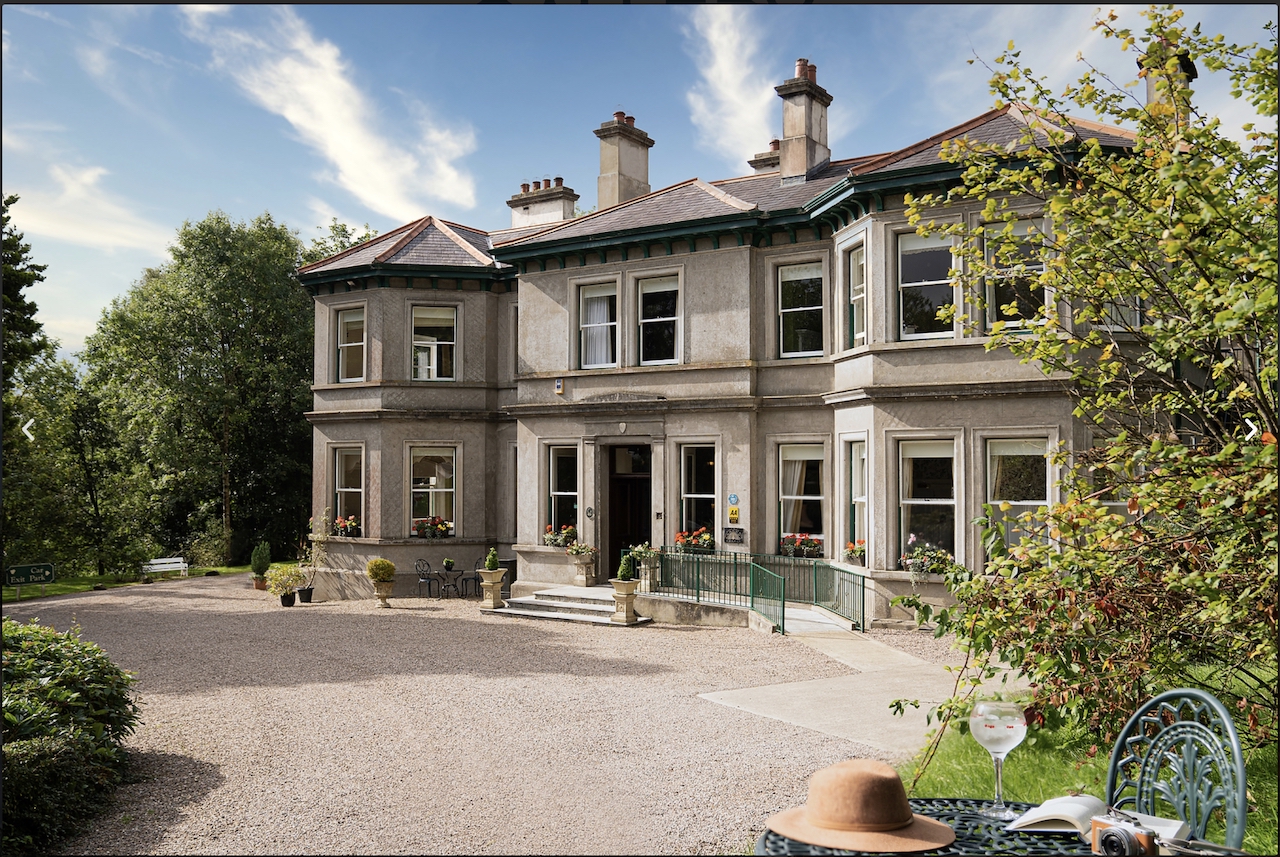
1. Ardtara Country House and restaurant, County Derry -B&B
“Ardtara is over 120 years old, but its story goes back much further. Back to the origins of the linen industry in Northern Ireland. The house was built by Harry Clark as a romantic and lively family home around 1896. Harry was a restless adventurer who was coerced to join his family’s linen business with promises of global travel and the freedom to pursue his ambitions. Clark’s linen business was already over 150 years old at the time and was famous for producing fine linens from Flax using the ancient process of beetling.”
Ardtara, County Derry, photograph courtesy of website.
2. Brown Trout Inn, Aghadowey, Nr Coleraine Co. Derry, BT51 4AD
“Whether it’s for a drink, dinner, a weekend break or a round of golf we want you to enjoy the Brown Trout experience.
“At the Brown Trout Inn we know that relaxing means different things to different people. For some, food and drink is all-important. Our menu offers fresh locally sourced produce ranging from ‘taste of Ulster’ favourites like honey-grilled gammon and buttery champ to slow-roasted lamb shanks and not forgetting fresh fish, including grilled trout of course.
“For others, putting their feet up is the closest thing to heaven. Our Courtyard accommodation offers space, comfort and quality – the cottages hold NITB four-star status. All our accommodation is easily accessible for wheelchair users and guests with disabilities and all rooms are dog-friendly. Wifi access is free throughtout the hotel.“
3. Roselick Lodge, County Derry – whole house rentalfor 8 guests, three night minimum
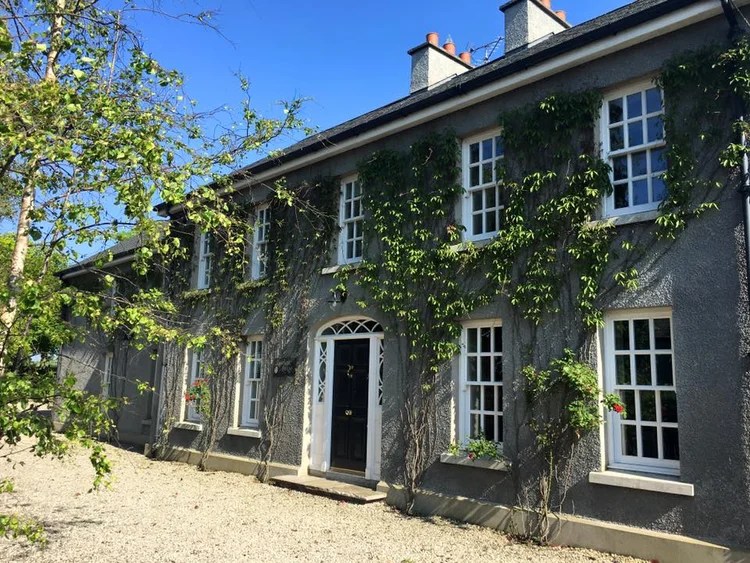
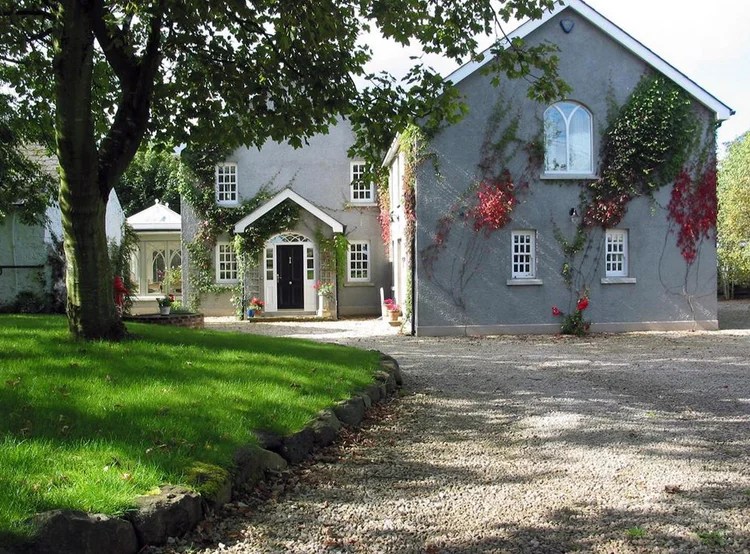
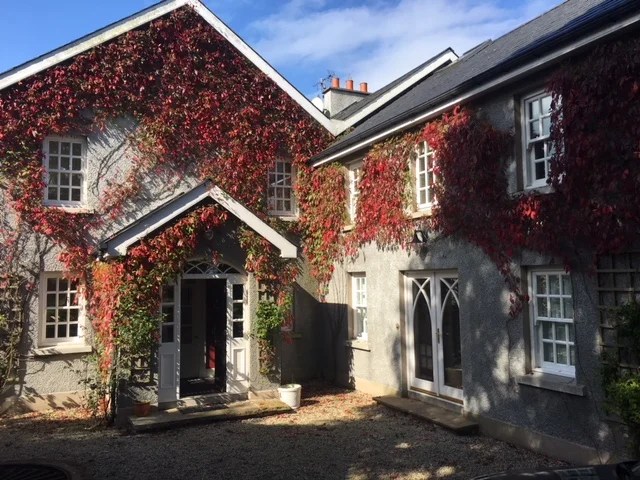
“Dating back to 1830, this sympathetically restored Georgian property offers a tranquil rural setting midway between Portstewart and Portrush. Whilst retaining many of the original features and charm, the open plan extension has been adapted to suit modern living. The accommodation comprises three main reception areas, a Magnificent Family Kitchen /Living and Dining area, a cosy and tastefully decorated Snug with open fire, access to south facing Orangery and large secluded cottage gardens. Upstairs are four well proportioned bedrooms sleeping up to eight guests and a spacious first floor balcony with sea views. Minimum 3 night stay.“
Roselick Lodge, County Derry, photograph courtesy of website.Roselick Lodge, County Derry, photograph courtesy of website.Roselick Lodge, County Derry, photograph courtesy of website.
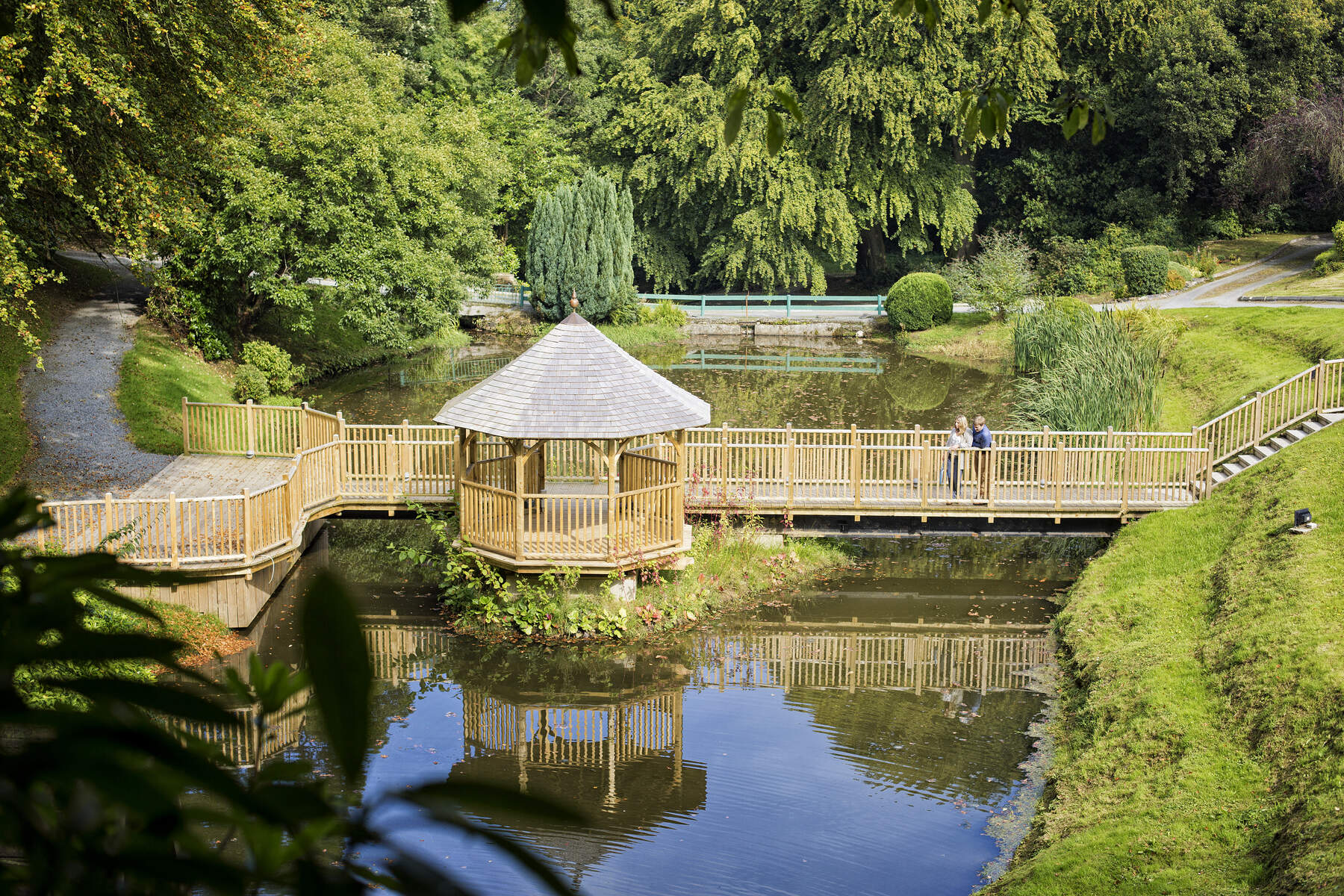
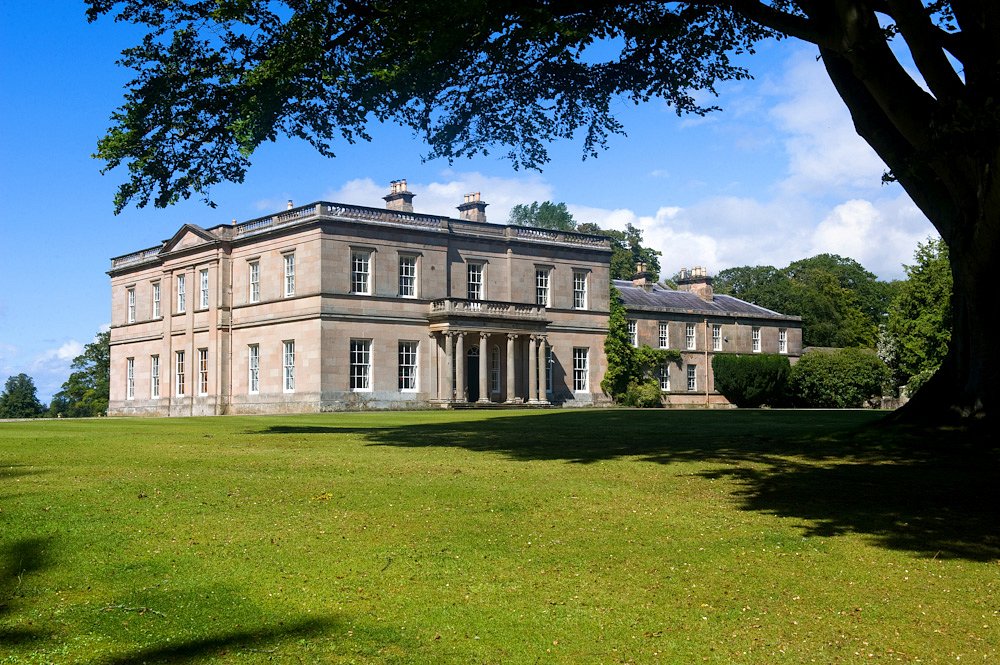
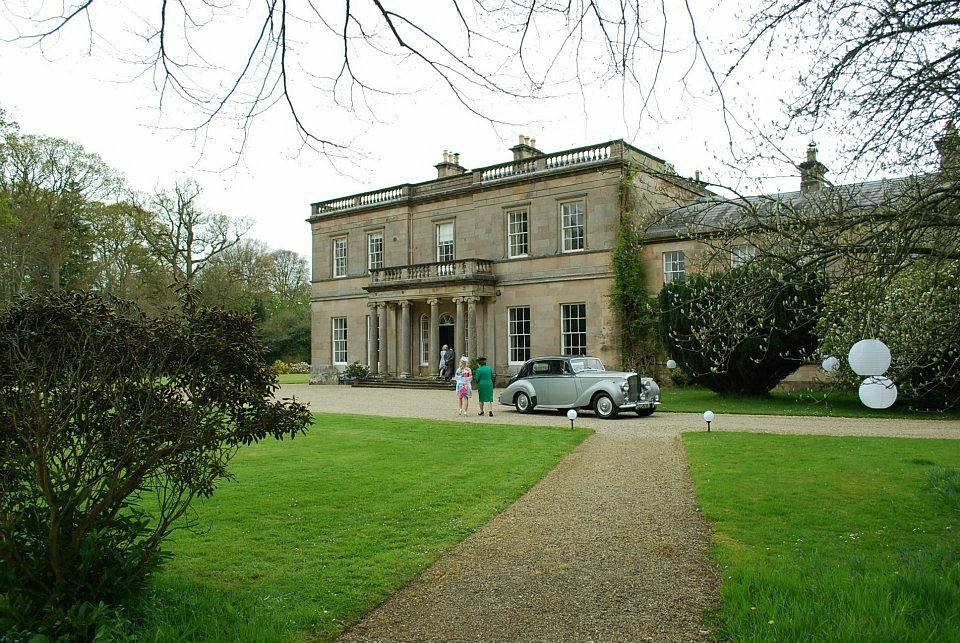
Drenagh, County Derry, photograph courtesy Tripadvisor.
Nestled in beautiful parkland where you will find our grand Georgian Mansion House which is perfect for weddings, family get togethers, corporate events and much more.
Mark Bence-Jones writes about Drenagh House (formerly Fruit Hill) in A Guide to Irish Country Houses (1988):
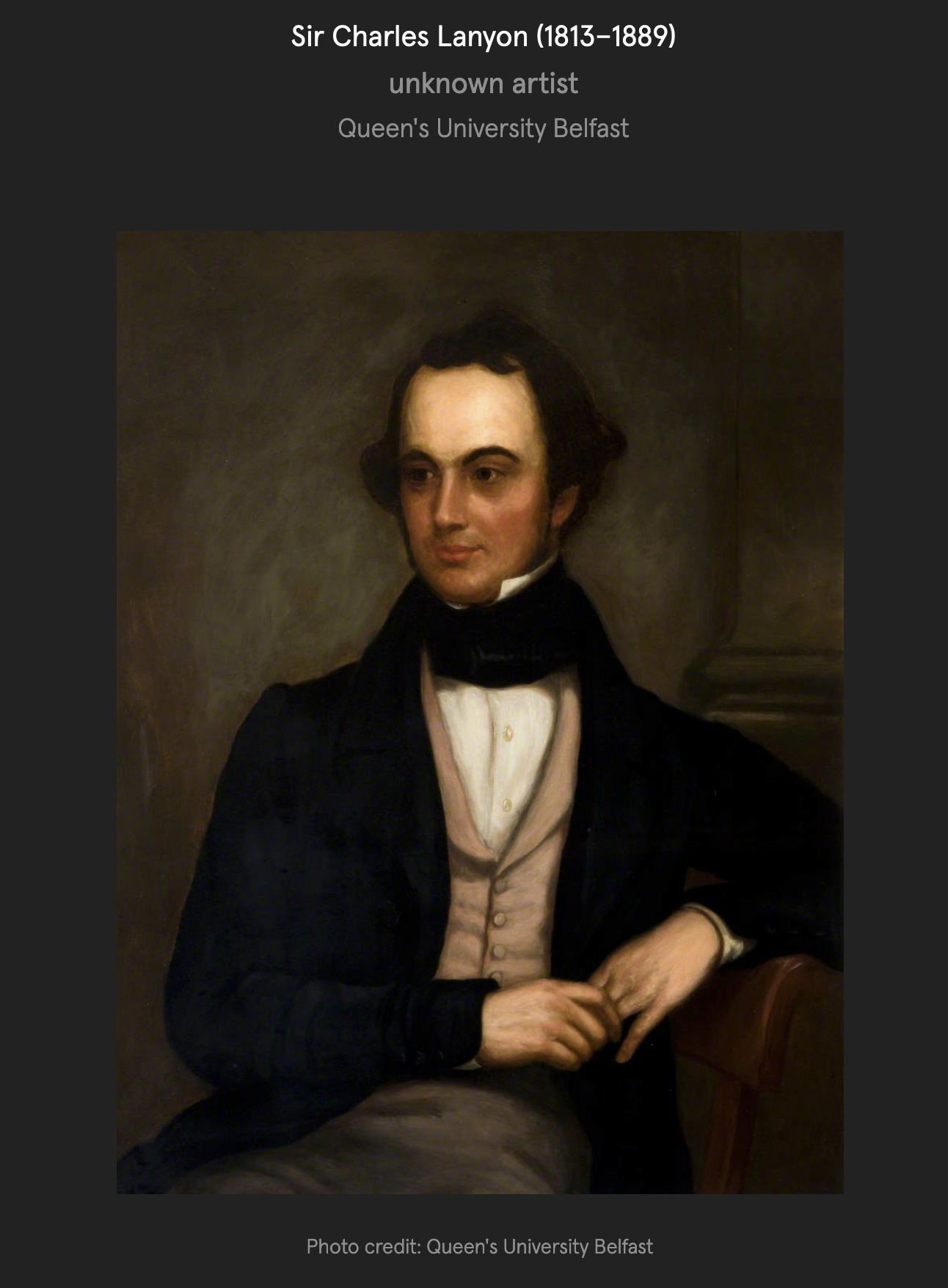
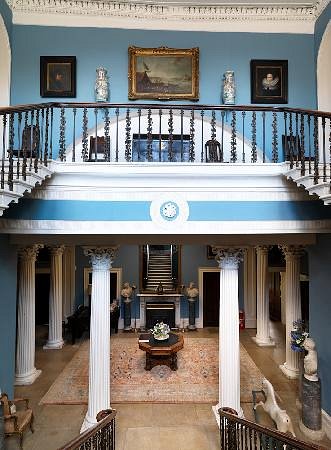
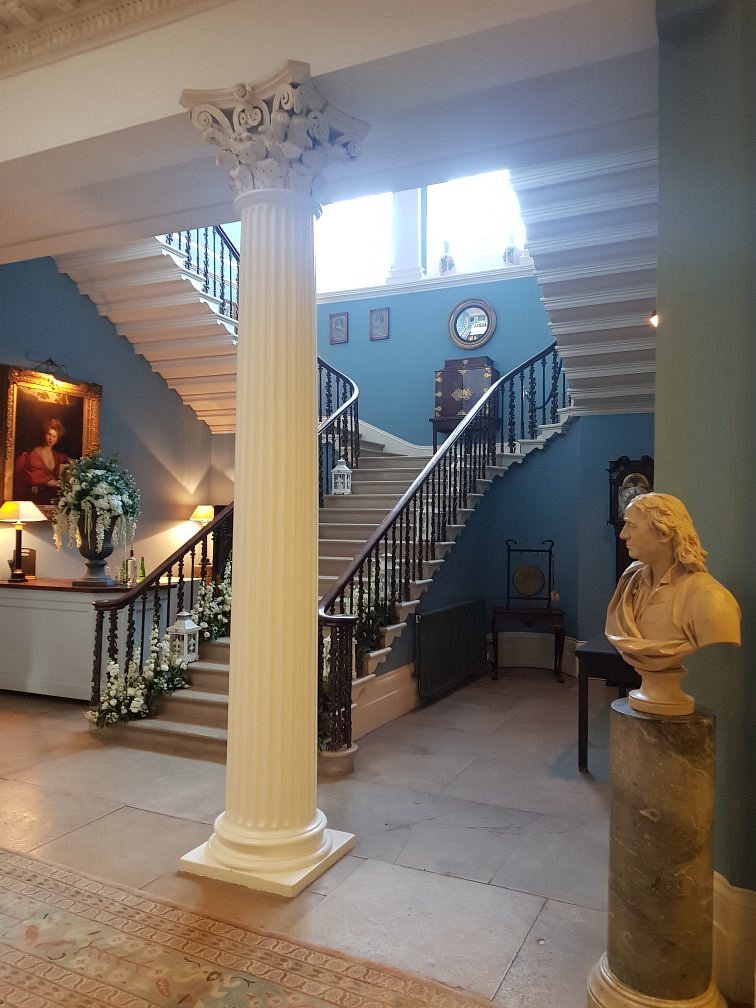
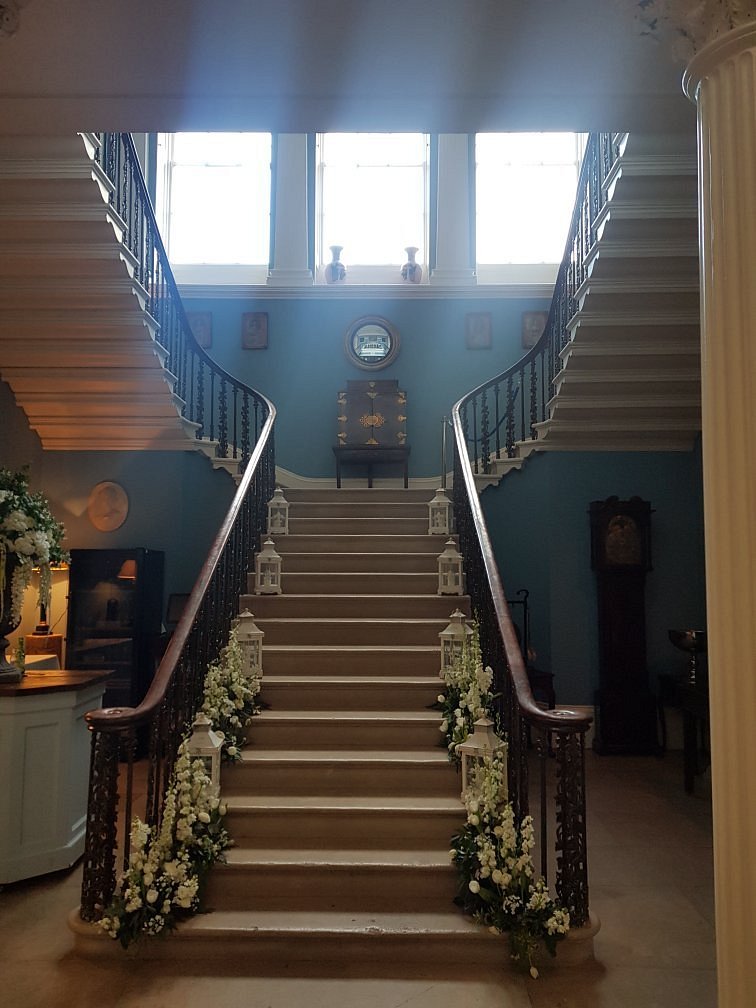
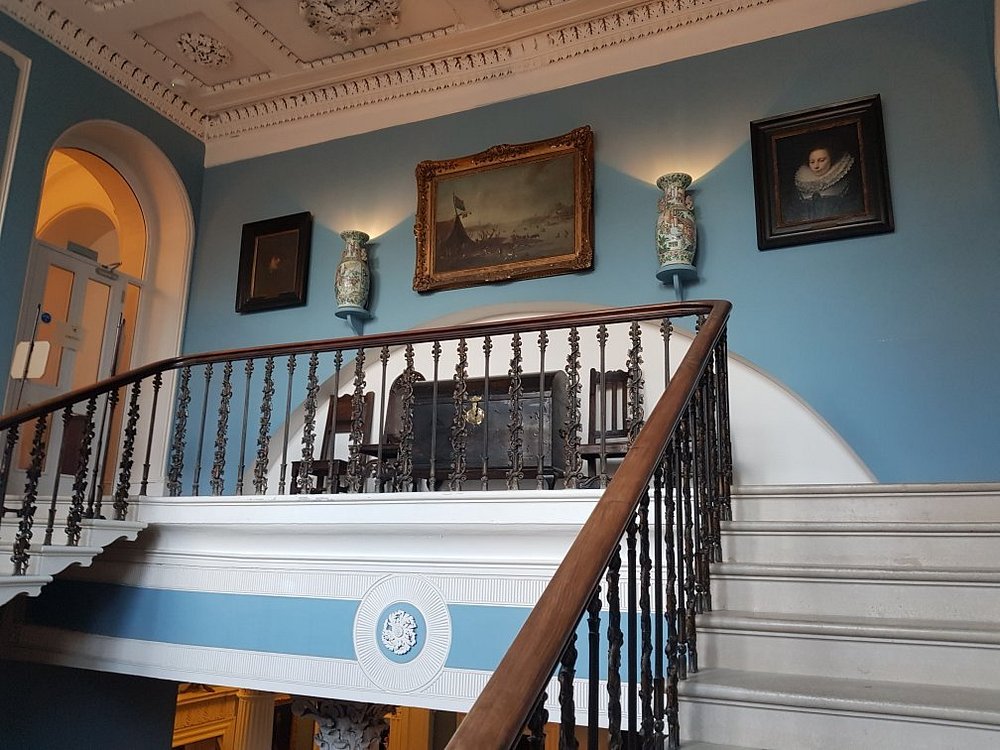
p. 107. “(McCausland/IFR) The earliest major country house by Charles Lanyon, built ca 1837 for Marcus McCausland, replacing an early C18 house on a different site. Of significance in the history of C19 Irish domestic architecture in that it is a competent late-Georgian design by an architect whose buildings in the following decade are definitely Victorian. Two storey; o an attractive pinkish sandstone ashlar. Five bay entrance front with the centre bay recessed and a single-storey Ionic portico in which the outer columns aer coupled. Adjoining front of six bays with two bay pedimented breakfront; the duality of the elevation being emphasised rather than resolved by the presence of three giant pilasters, supporting the pediment. Rear elevation of one bay between two three sided bows, with fanlighted tripartite garden door. Lower service wing at side. Balustraded parapet round roof and on portico. Single-storey top-lit central hall with screen of fluted Corinthian columns; graceful double staircase with elegant cast iron balusters rising from behind one of these screens. Rich plasterwork ceilings in hall, over staircase and in drawing room; simpler ceilings in morning room and dining room. At the head of the stairs, a bedroom corridor with a ceiling of plaster vaulting and shallow domes goes round the central court or well, the lower part of which is roofed over to form the hall. Very large and extensive outbuildings. Vista through gap in trees opposite entrance front of house to idyllic landscape far below, the ground falling steeply on this side; straight flight of steps on the axis of this vista leading down to bastion terrace with urns. Chinese garden with circular “moon gate,” laid out by Lady Margaret McCausland 1960s. Gate lodge by Lanyon with pedimented Ionic portico.”
Charles Lanyon (1813-1889) courtesy of Queen’s University Belfast.Drenagh, County Derry, photograph courtesy Tripadvisor.Drenagh, County Derry, photograph courtesy Tripadvisor.Drenagh, County Derry, photograph courtesy Tripadvisor.Drenagh, County Derry photograph courtesy Tripadvisor.Drenagh, County Derry, photograph courtesy Tripadvisor.Drenagh, County Derry, photograph courtesy Tripadvisor.
orange: “whole house rental” i.e. those properties that are only for large group accommodations or weddings, e.g. 10 or more people.
green: gardens to visit
grey: ruins
2026 Diary of Irish Historic Houses (section 482 properties)
To purchase an A5 size 2026 Diary of Historic Houses (opening times and days are not listed so the calendar is for use for recording appointments and not as a reference for opening times) send your postal address to jennifer.baggot@gmail.com along with €20 via this payment button. The calendar of 84 pages includes space for writing your appointments as well as photographs of the historic houses. The price includes postage within Ireland. Postage to U.S. is a further €10 for the A5 size calendar, so I would appreciate a donation toward the postage – you can click on the donation link.
€20.00
The province of Ulster contains counties Antrim, Armagh, Cavan, Derry, Donegal, Down, Fermanagh, Monaghan and Tyrone.
For places to stay, I have made a rough estimate of prices at time of publication:
Help me to pay the entrance fee to one of the houses on this website. This site is created purely out of love for the subject and I receive no payment so any donation is appreciated!
“Built around 1619 by Sir Baptist Jones, Bellaghy Bawn is a fortified house and bawn (the defensive wall surrounding an Irish tower house). What exists today is a mix of various building styles from different periods with the main house lived in until 1987.” Open on Sundays.
“Hezlett’s picturesque thatched cottage exterior hides a fascinating early timber frame dating from 1690, making it one of the oldest vernacular domestic buildings in Northern Ireland. The story of the house is told through the experiences of the people who lived there.“
The house at Liffock became home to the Hezletts in 1766 and stayed within the family for the next 200 years until the National Trust acquired it in 1976. The National Trust website tells us:
“Isaac Hezlett (1720-1790) was the first Hezlett to live in the cottage at Liffock. He acquired the dwelling and some land in 1766. At this point in his life he was married to his second wife Esther and had two sons; Samuel from his first marriage with Margaret Kerr and Jack, half-brother to Samuel.When Samuel’s father died, he inherited the farm at the age of 37 and about five years later he married Esther Steel. She was 22 years his junior and they had eight children.Samuel was intimidated by local insurgents to join the United Irishmen; his half-brother Jack was an ardent supporter. He was threatened to be hanged from the Spanish chestnut tree in his own garden.By 1798 the rebellion was at its height and the two brothers were on opposite sides of the war. 30,000 lives were lost when the rebels were finally defeated. Jack escaped to the recently created United States of America while Samuel remained with his family in their home at Liffock until he died in 1821.
“Samuel’s eldest son Isaac (1796-1883) married Jane Swan (1805-1896) in 1823. He built a two-storey extension to form a new self-contained unit for his mother and sisters. This extension could be regarded as forerunner of what we call today a ‘granny-flat’. Isaac also increased the acreage farmed at Liffock.Hugh (1825-1906), Samuel and Jane’s eldest son, increased the acreage of the farm once more. By putting his education to good use he made the farm more productive; more cash crops were grown and the herds of dairy cattle and sheep were increased. The outputs from the farm which generated income included the cash crops of flax, barley, potatoes, oats and turnips, in addition to wool, milk, calves, pigs and eggs. Hugh also oversaw an extensive re-modelling of the farmyard and outbuildings.In 1881 the Gladstone Land Act paved the way for further Acts which enabled tenant farmers to buy the land they had hitherto rented. So by the early 20th century the Hezletts were not tenant farmers but owner-occupiers.
“In 1976, with funds provided by Ulster Land fund and the Ulster Architectural Heritage Society the National Trust acquired the house from the third Hugh Hezlett (1911-1988).”
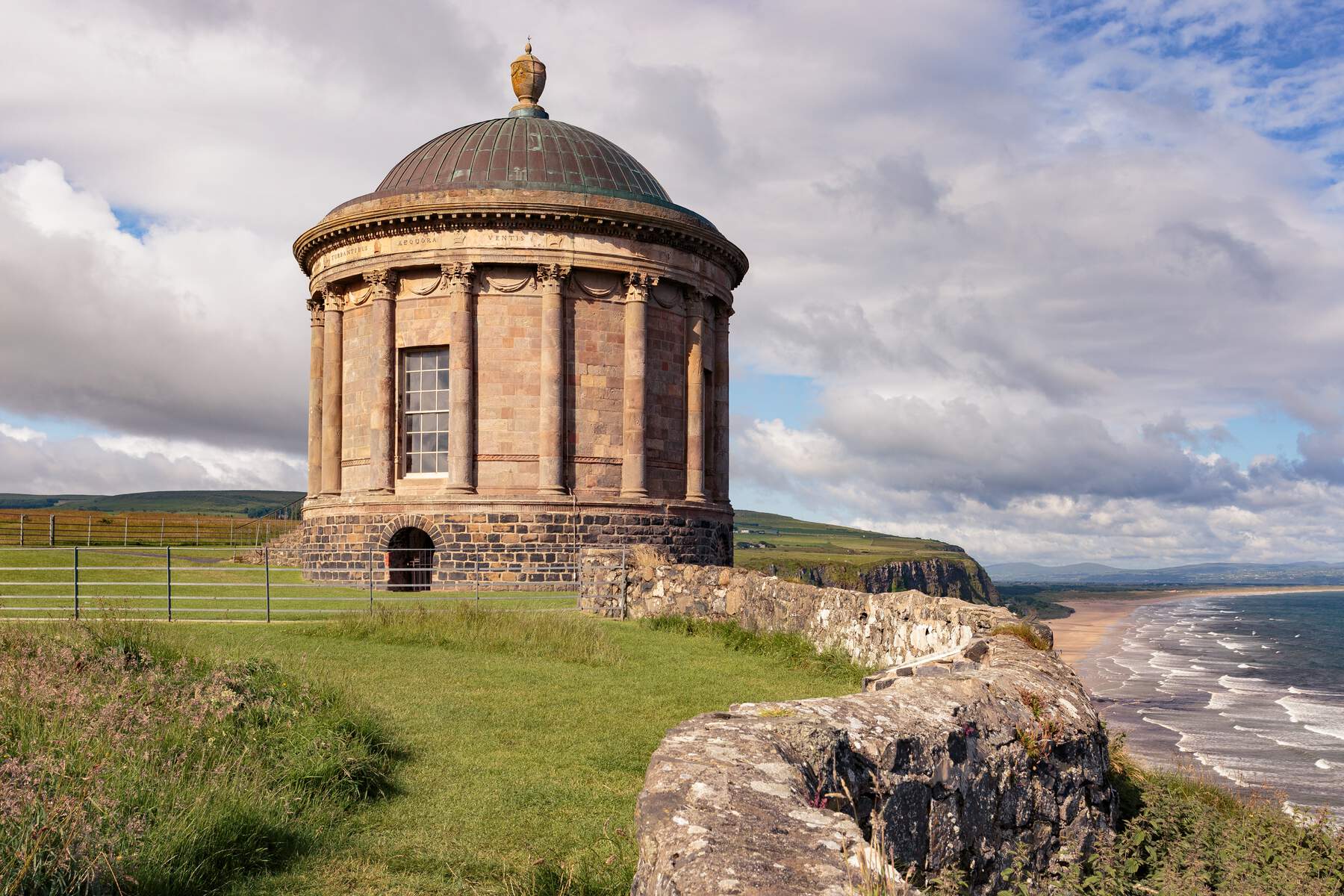
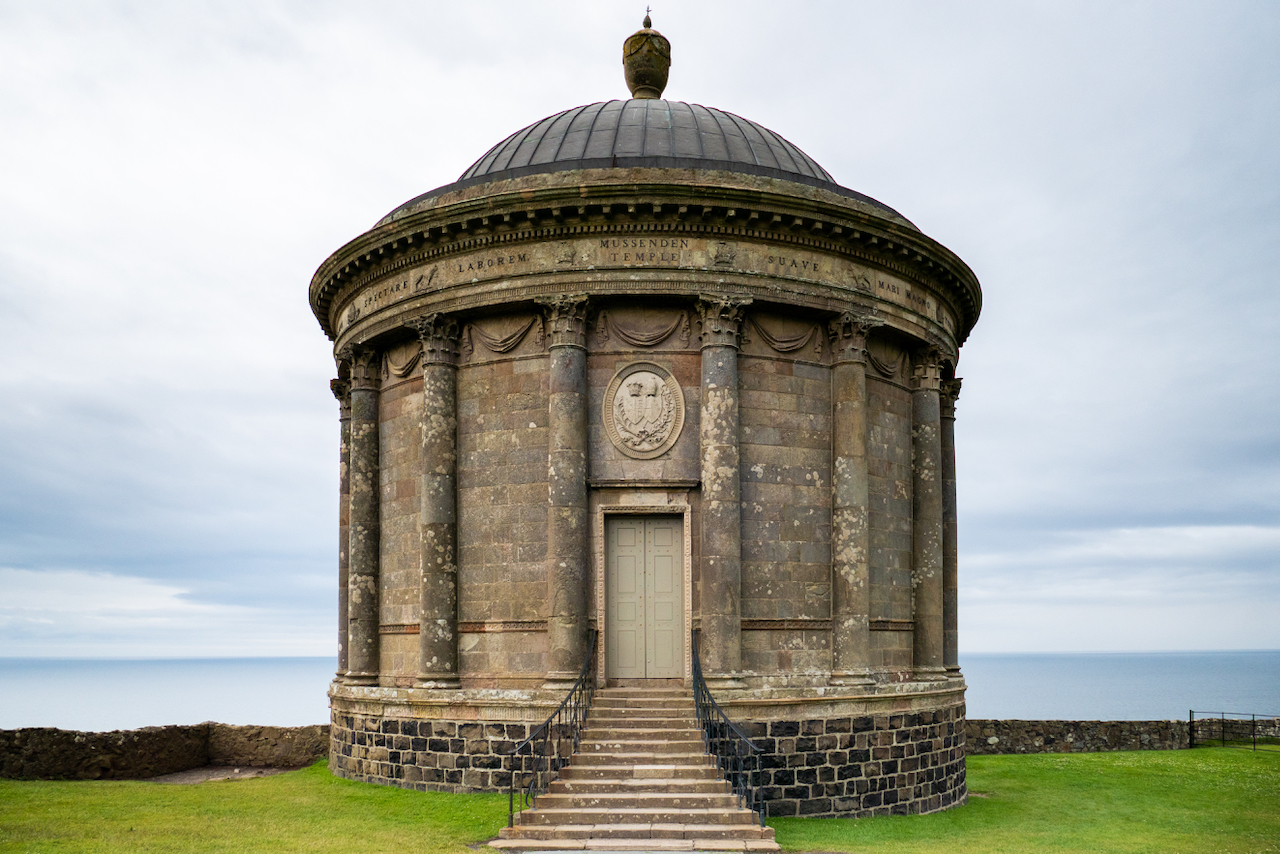
3. Mussenden Temple, Downhill Demesne, County Derry
Mussenden Temple by Matthew Woodhouse 2015 for Tourism Ireland.
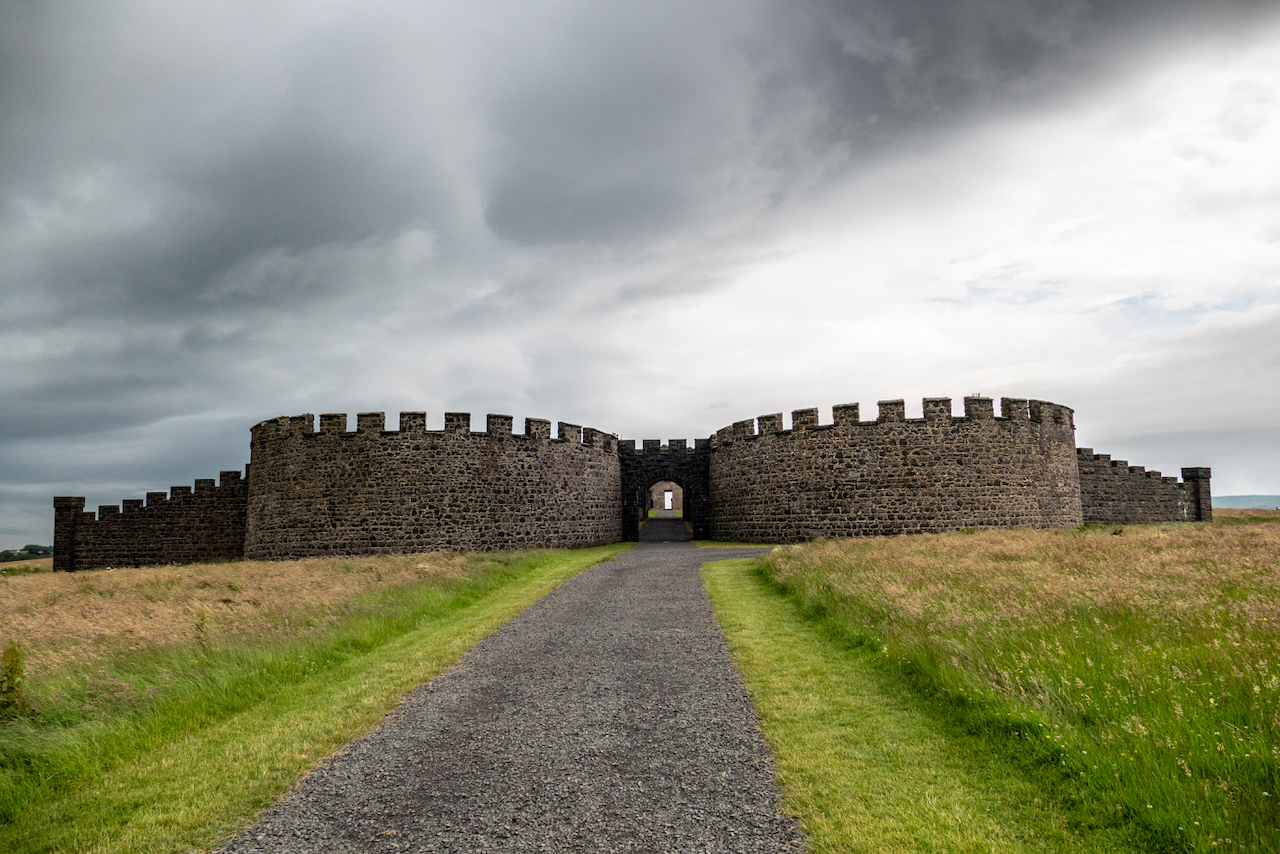
“Downhill Demesne delves into a life and landscape steeped in history and nature. There’s much to explore as you enter this enchanting estate. Wander around the 18th-century demesne and discover dovecotes and gardens as you stumble upon a spectacular temple.”
Downhill Demesne, County Derry, photograph byPocket Squares
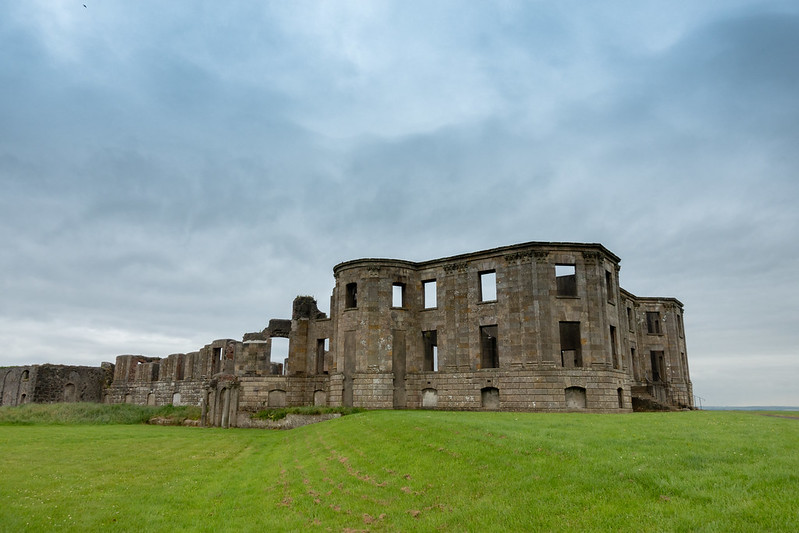
The house of Downhill is now a ruin.
Downhill House, County Derry, photograph byPocket Squares
The National Trust website tells us:
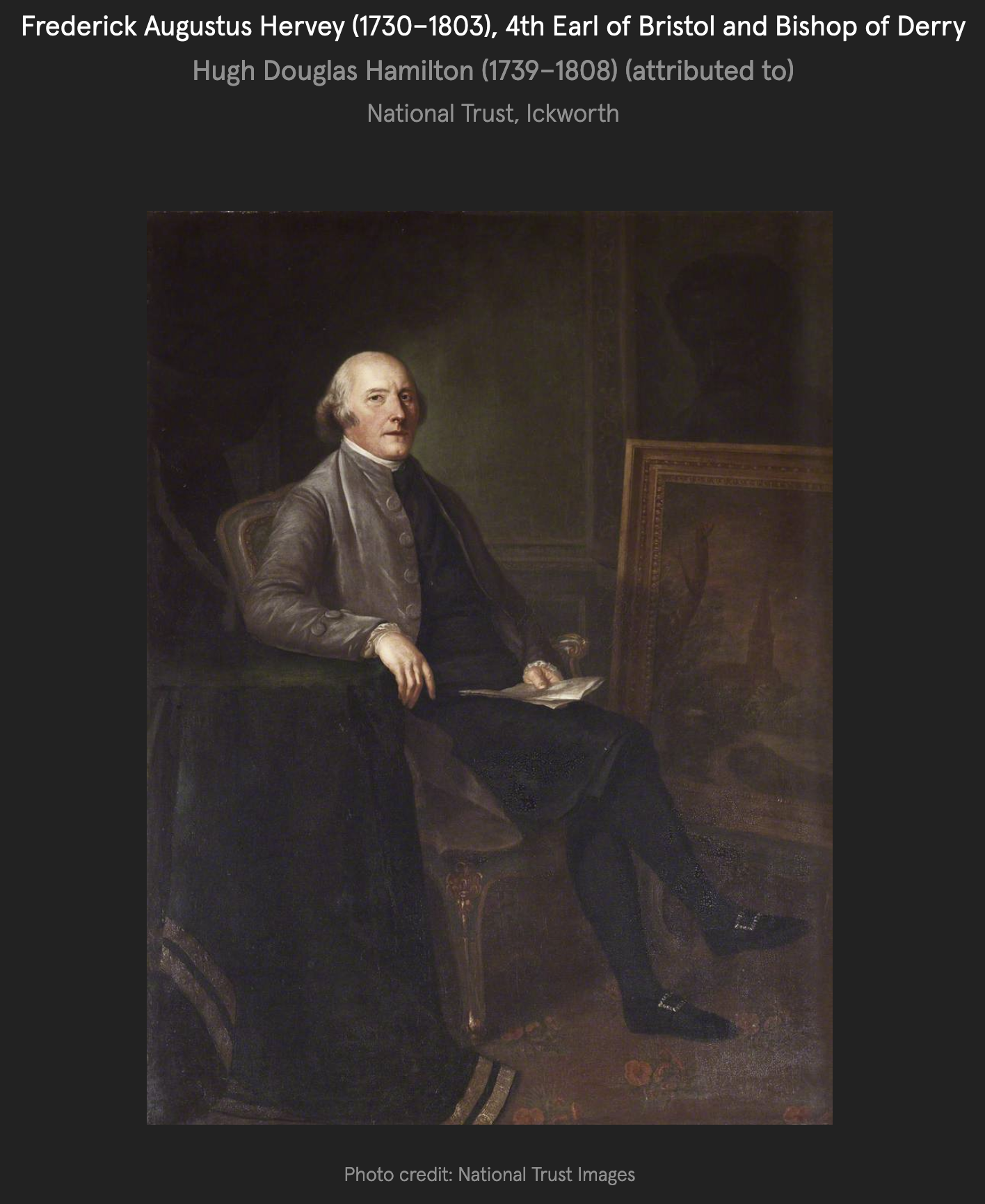
“2018 marked the 250th anniversary of the arrival of Frederick Augustus Hervey in the Diocese of Derry. He was consecrated as Bishop in St Columb’s Cathedral in March 1768. Frederick was a man of many parts as well as being a cleric he was a scientist with a deep interest in volcanology; he was a collector of art; he travelled extensively and spoke German, French and Italian fluently; he took a keen interest in Irish politics and music; he was a powerful proponent of religious equality; and he was a builder of churches, bridges and roads.
“He is remembered by us for his association with the Giant’s Causeway and the creation of the Downhill Demesne. A keen volcanologist, Frederick ‘discovered’ the Giant’s Causeway in the sense that he publicised what was then an isolated, seldom-visited spot and was the first to study it in a wider scientific context and pass on his findings to his learned friends throughout Europe. He also created Downhill House and the Mussenden Temple, Northern Ireland’s most iconic building, as his country retreat.
“The Earl Bishop is largely regarded as being his own architect at Downhill but it was the Cork born Michael Shanahan who drew up most of the building plans and was, for most of the time, his buildings works superintendent. The mason James McBlain executed all the decorative carving and much of the subsequent building for the Earl. Italian stuccadores were also employed, chief among whom was Placido Columbani.
“Downhill is characterised by a three storey front, facing south and with two long wings at the back of this. Originally these wings terminated in domes topped with ornamental chimney-pots. The wings were continued in ranges of outbuildings, forming inner and outer yards, and ending towards the sea in two immense curving bastions of basalt.
“The main house block was faced with freestone from Dungiven quarries, about 30 miles away. The basement is rusticated and the storeys above decorated with pairs of Corinthian pilasters, topped by Vitruvian scroll course, a cornice and parapet.
“Sadly the interior of the house shows little of its original character. The house was almost entirely gutted by a fire which broke out on a Sunday in May 1851. The library was completely destroyed and more than 20 pieces of sculpture had been ruined. Most of the paintings were rescued, but a Raphael, The Boar Hunt, was reported destroyed.
“In his later years, the Earl Bishop spent very little time in Ireland. His Irish estates were administered by a distant cousin, Henry Hervey Aston Bruce, who succeeded him following his death in 1803.
“In 1804 Henry Hervey Aston Bruce was created a baronet and Downhill remained with the Bruce family until at least 1948, though the family rarely lived there after around 1920.“
“The only other occupation of the house came about during WWII when the site was requisitioned by the RAF. The house was subsequently dismantled after the war and its roof removed in 1950.”
Frederick Augustus Hervey also built Ballyscullion in Derry and Ickworth in Suffolk, England. He built them not only to indulge his love of architecture, but to house his large collection of paintings, furniture and statues. He first encountered his architect, Michael Shanahan, when he was Bishop of Cloyne in Cork. David Hicks tells us in his Irish Country Houses, a Chronicle of Change that Hervey took Shanahan on a trip to Italy between 1770-1772 in order to make sketches of various items of interest that could be incorporated into his home. Shanahan took up residence in the Hervey estate in Derry and acted as the Earl Bishop’s architect in residence.
Mussenden Temple, Downhill Demesne, County Derry, photograph byPocket Squares
The Bishop created Mussenden Temple in memory of Mrs Frideswide Mussenden, a cousin who died in 1785. Shanahan was the architect. It is believed that the Bishop used it as a private library, and permitted local Catholics to use the ground floor for mass. He left Downhill and Ballyscullion to Mrs Mussenden’s brother, Reverend Henry Aston Bruce. In doing so, he disinherited his wife and son, with whom he had quarrelled.
Frideswide Mussenden was born Frideswide Bruce. Her parents were Henrietta Aston and James Bruce. Henrietta Aston was daughter of Rev. Hon. Henry Hervey-Aston, son of John Hervey, 1st Earl of Bristol, who was the brother of Bishop Frederick Augustus’s father. The Bishop’s heir was therefore only distantly related, quite a blow to the disinherited wife and son.
He was disinherited by his father the 4th Earl of Bristol.
Reverend Bruce who inherited Downhill and Ballyscullion dismantled the latter in 1813, perhaps due to window taxes, and transferred its furniture and art to Downhill. A fire in 1851 destroyed Downhill and much of its contents. The house was rebuilt to some degree to the design of John Lanyon between 1870-74.
Reverend Bruce was created a British Baronet in 1804. His son became 2nd Baronet and grandson, 3rd Baronet of Downhill. It was passed to the 4th, 5th and 6th Baronets. By the 1950s most of the contents of the house has been sold and the house dismantled and surrounding land sold. The estate is now in the care of the National Trust.
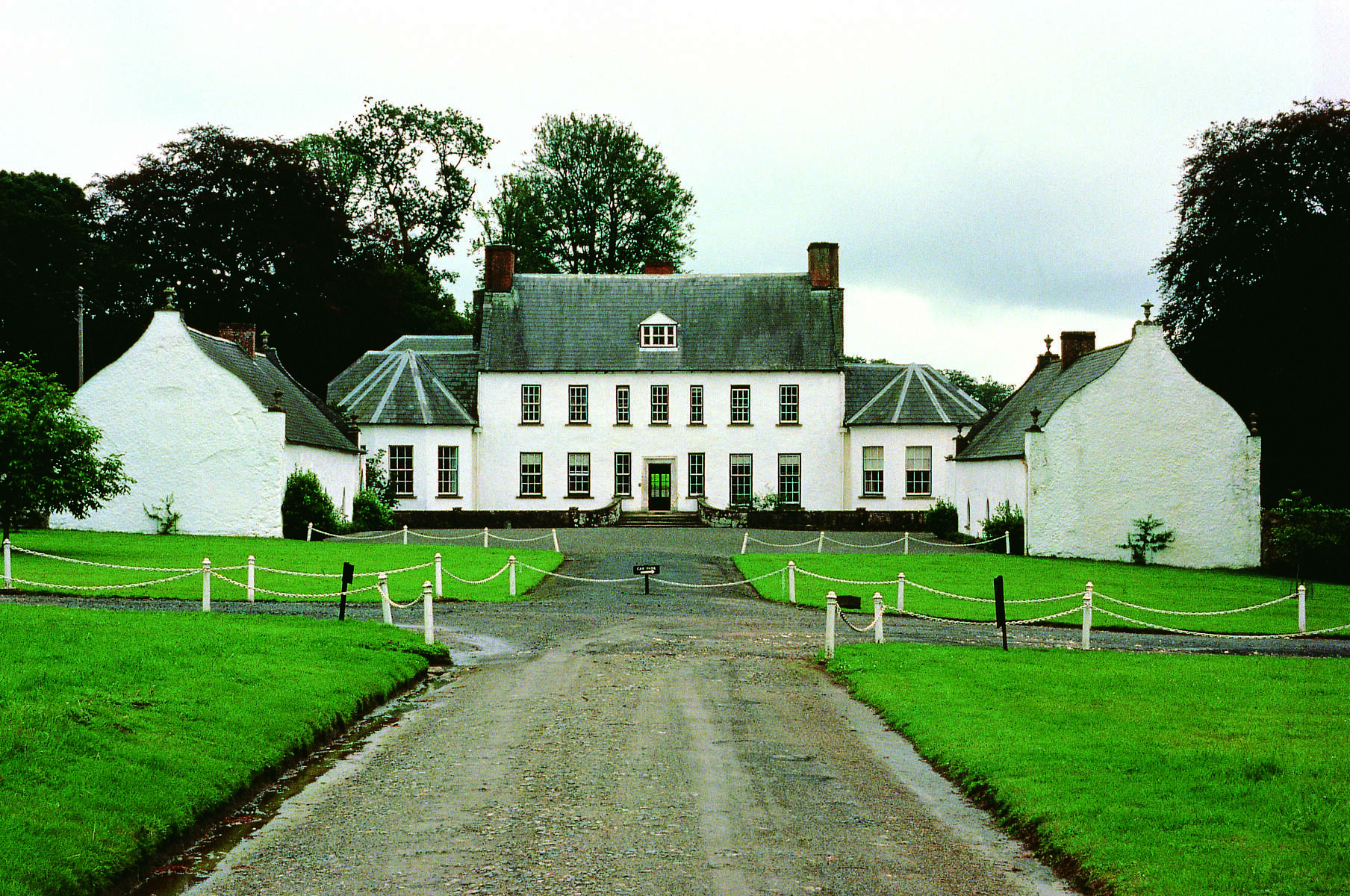
4. Springhill House, County Derry
Springhill House and Gardens Courtesy of Tourism Northern Ireland 2007.
“Springhill has a beguiling spirit that captures the heart of every visitor. Described as ‘one of the prettiest houses in Ulster’, its welcoming charm reveals a family home with portraits, furniture and decorative arts that bring to life the many generations of Lenox-Conynghams who lived here from 1680. The old laundry houses one of Springhill’s most popular attractions, the Costume Collection with some exceptionally fine 18th to 20th century pieces.
New Visitor Reception offering a retail and grab and go catering offer. Celebrated collection of costumes, from the 18th century to 1970s. Visit our second-hand bookshop and pick up a bargain.
Walks: Beautiful walled gardens and way marked paths through the parkland. Children’s adventure trail play park and natural play area. A variety of events throughout the year. There are three walks available: Beech Walk, Snowdrop Walk, Sawpit Hill Walk.“
Visitor Facilities: Historic house, garden, shop, refreshments, guided tours. Suitable for picnics and country walks. Programme of events available. House: admission by guided tour (last admission 1 hour before closing). Open Bank Holiday Mondays and all other public holidays in Northern Ireland. Closed 25 and 26 December. Visitor Centre has café and shop. See Information tab for full Opening Times and Prices. Access for visitors with disability and facilities for families. Dogs welcome on leads in grounds/garden only. Available for functions.
Mark Bence-Jones writes about Springhill House in A Guide to Irish Country Houses (1988):
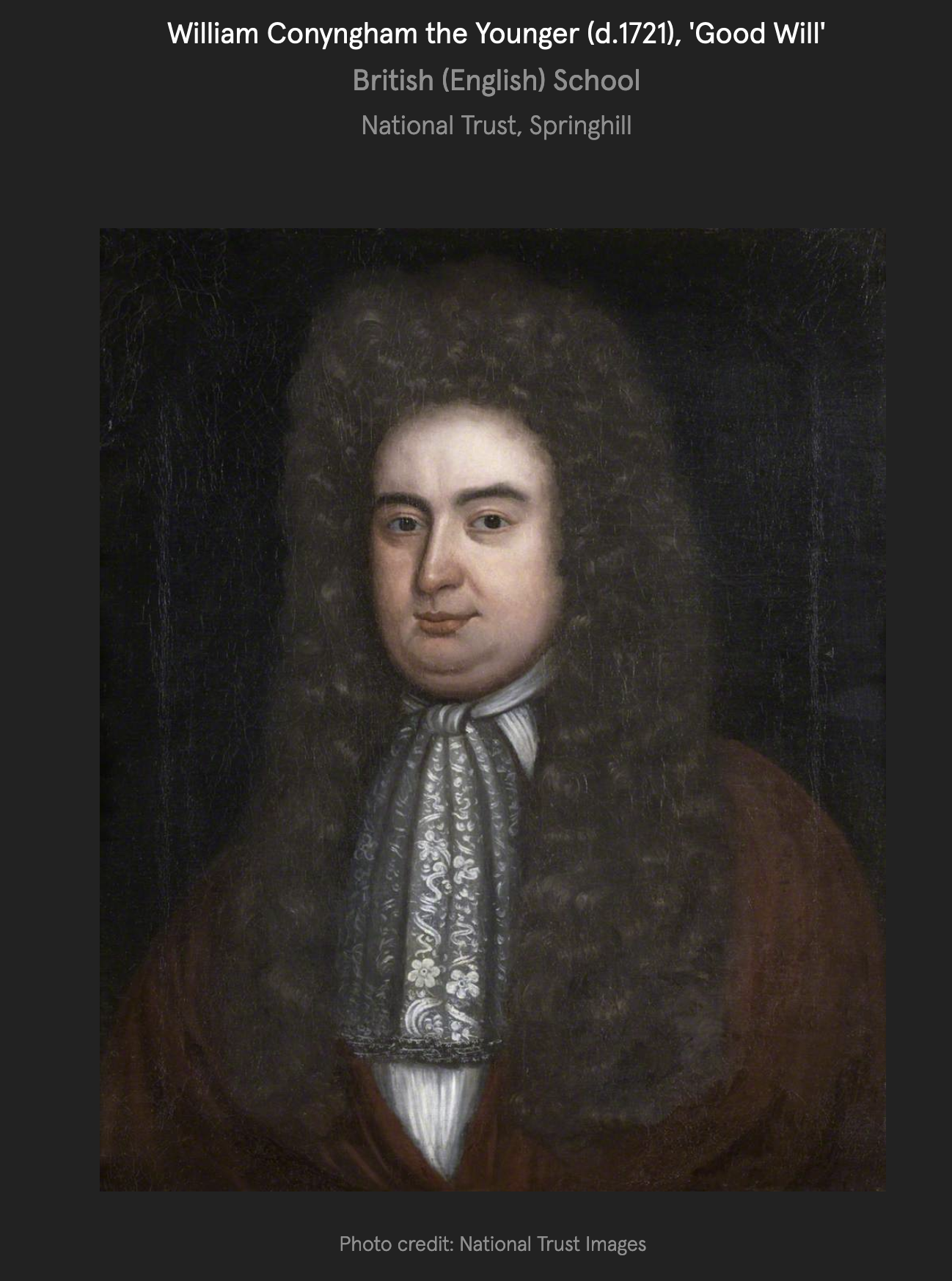
p. 263. “(Lenox-Conyngham/IFR) A low, white-washed, high roofed house with a sense of great age and peace; its nucleus late C17, built ca 1680 by “Good Will” Conyngham [1660-1721], who afterwards played a leading part in the defence of Derry during the Siege. Altered and enlarged at various times; the defensive enclosure or bawn with which it was originally surrounded was taken down, and two single storey free-standing office wings of stone with curvilinear end-gables were built early C18 flaking the entrance front, forming a deep forecourt. Col William Conyngham, MP, added two single-storey wings to the house ca 1765, which was when the entrance front assumed its present appearance: of seven bays, the windows on either side of the centre being narrower than the rest, and with a three sided bow in each of the wings. In the high roof, a single central dormer lighting the attic. The hall has C18 panelling; behind the hall is an early C18 staircase of oak and yew with alternate straight and spiral twisted balusters. The Gun Room has bolection moulded oak panelling which could be late C17 or early C18, though it cannot have been put into this room until much later, for there are remains of C18 wallpaper behind it. The large and lofty drawing room in the right-hand wing is a great contrast after the small, low-ceilinged rooms in the centre of the house; it has a modillion cornice and a handsome black marble chimneypiece. Though essentially a Georgian room, it has been given a Victorian character with a grey and green wallpaper of Victorian pattern. Next to the drawing room, in the garden front, is the dining room, added ca 1850 by William Lenox-Conygham; a large simple room of Georgian character, with a red flock paper and a chimneypiece of yellow marble brought from Herculaneum by the Earl of Bristol Bishop of Derry and presented by him to the family. The garden front, which is irregular, going in and out, facing along an old beech venue to a ruined tower which may originally have been a windmill. Transferred to the Northern Ireland Trust by W.L Lenox-Conygham, HML, shortly before his death in 1957. Springhill is featured in his mother, Mina’s book An Old Ulster Home and is open to the public.”
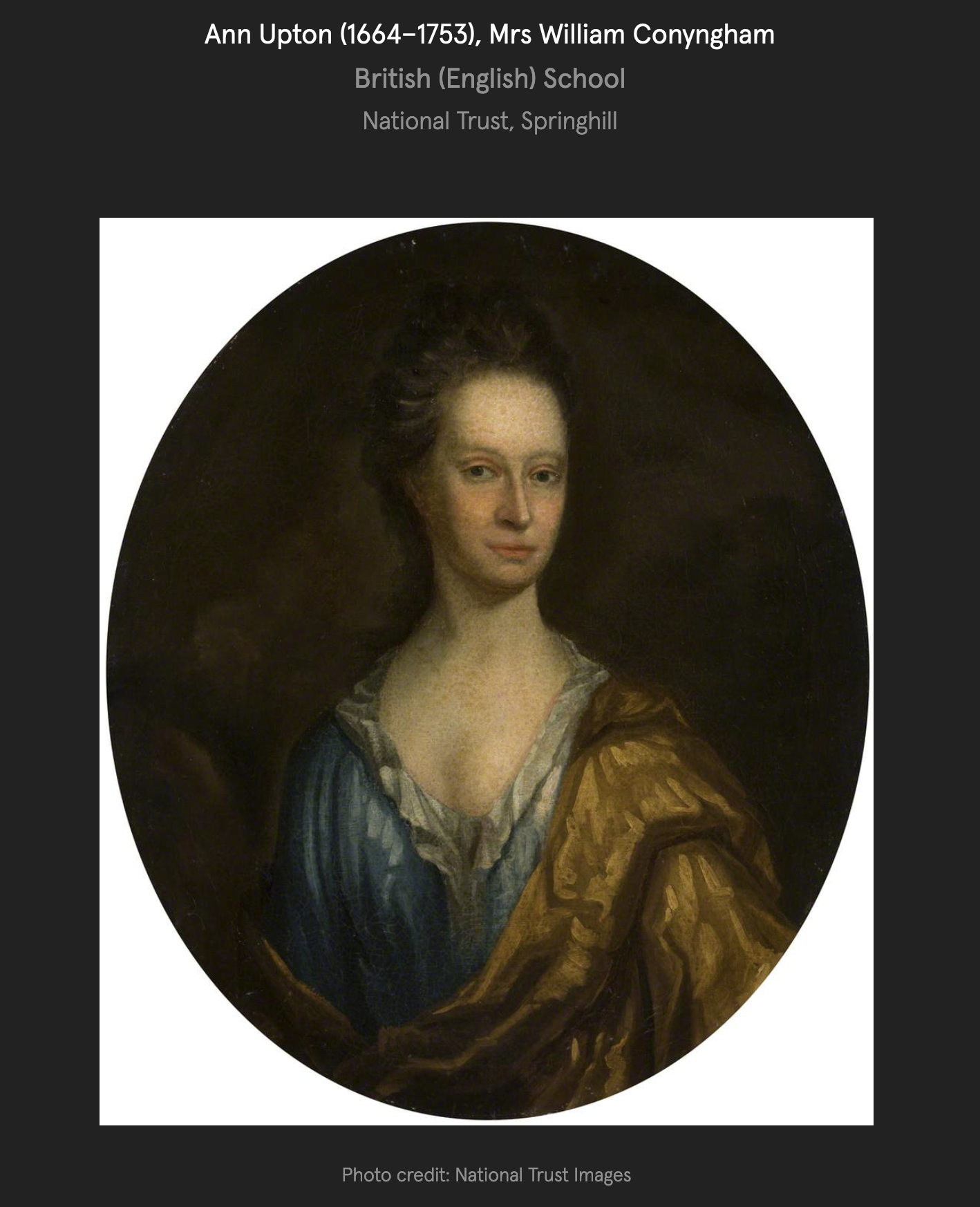
William Conyngham (d. 1721), “Good Will”, courtesy of National Trust. Springhill, County Derry.Ann Upton (1664-1753) wife of William “Goodwill” Conyngham (1660-1721), daughter of Arthur Upton (1623-1706) of Castle Upton, County Antrim, courtesy of National Trust. Springhill, County Derry.
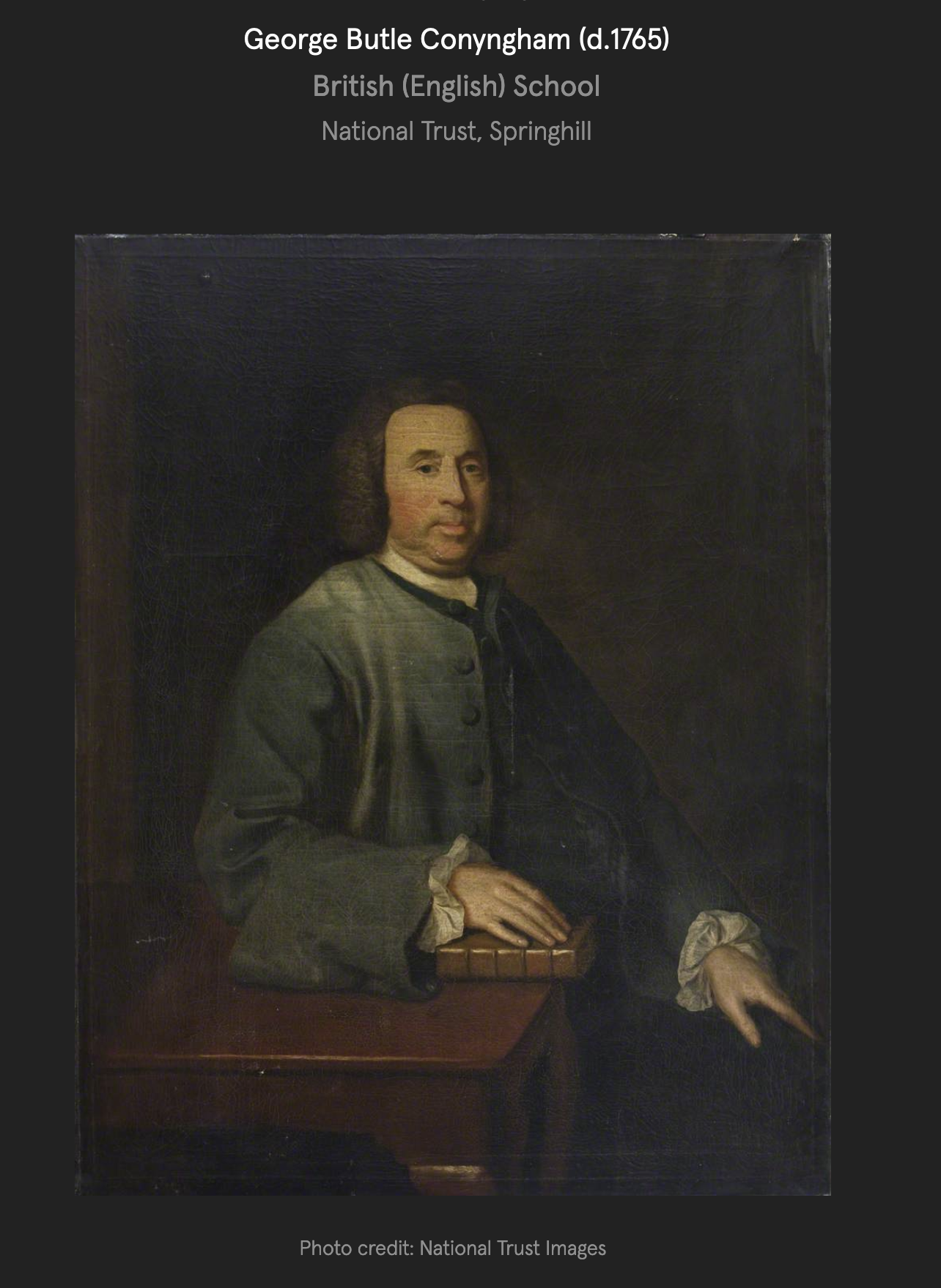
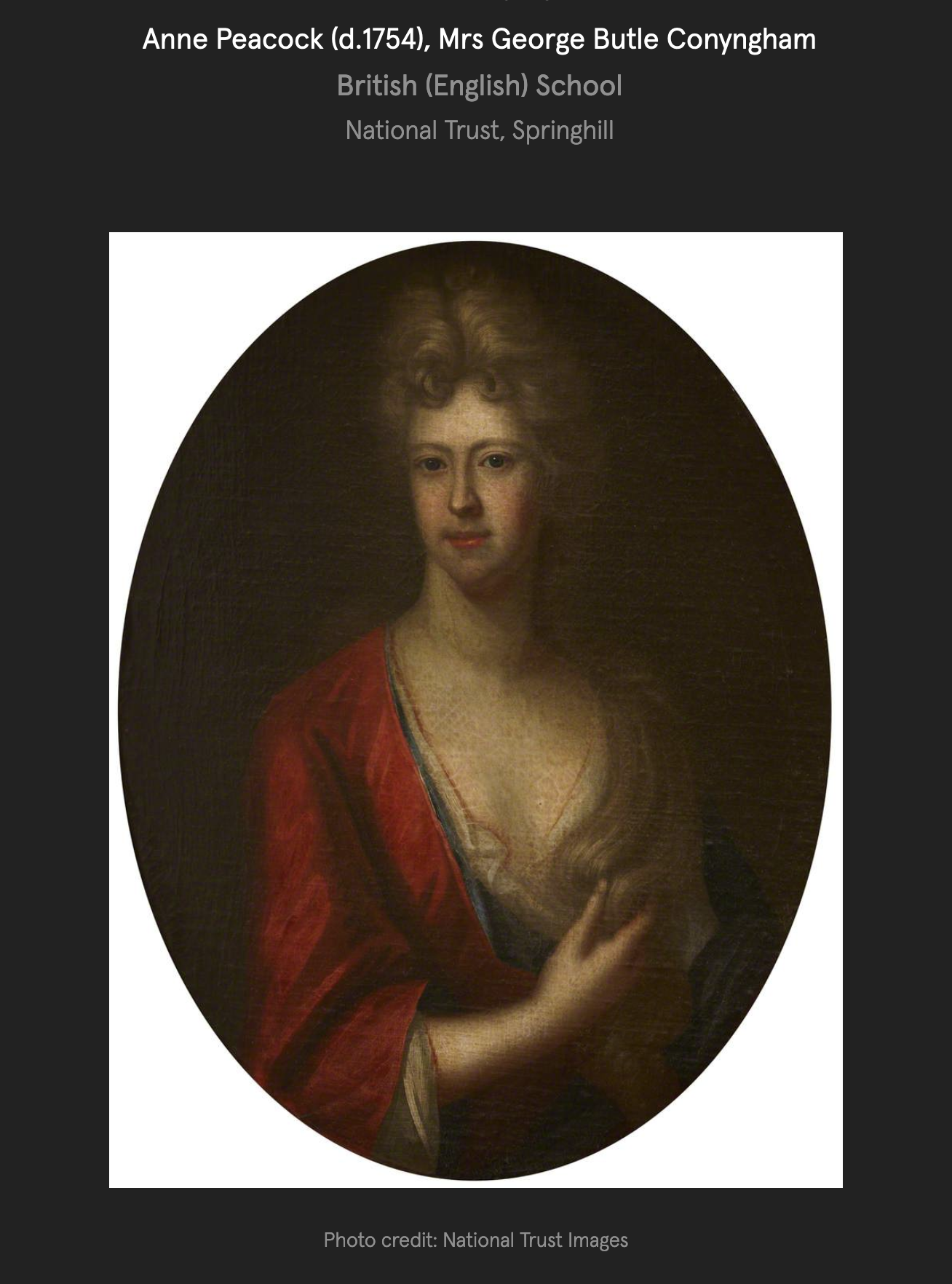
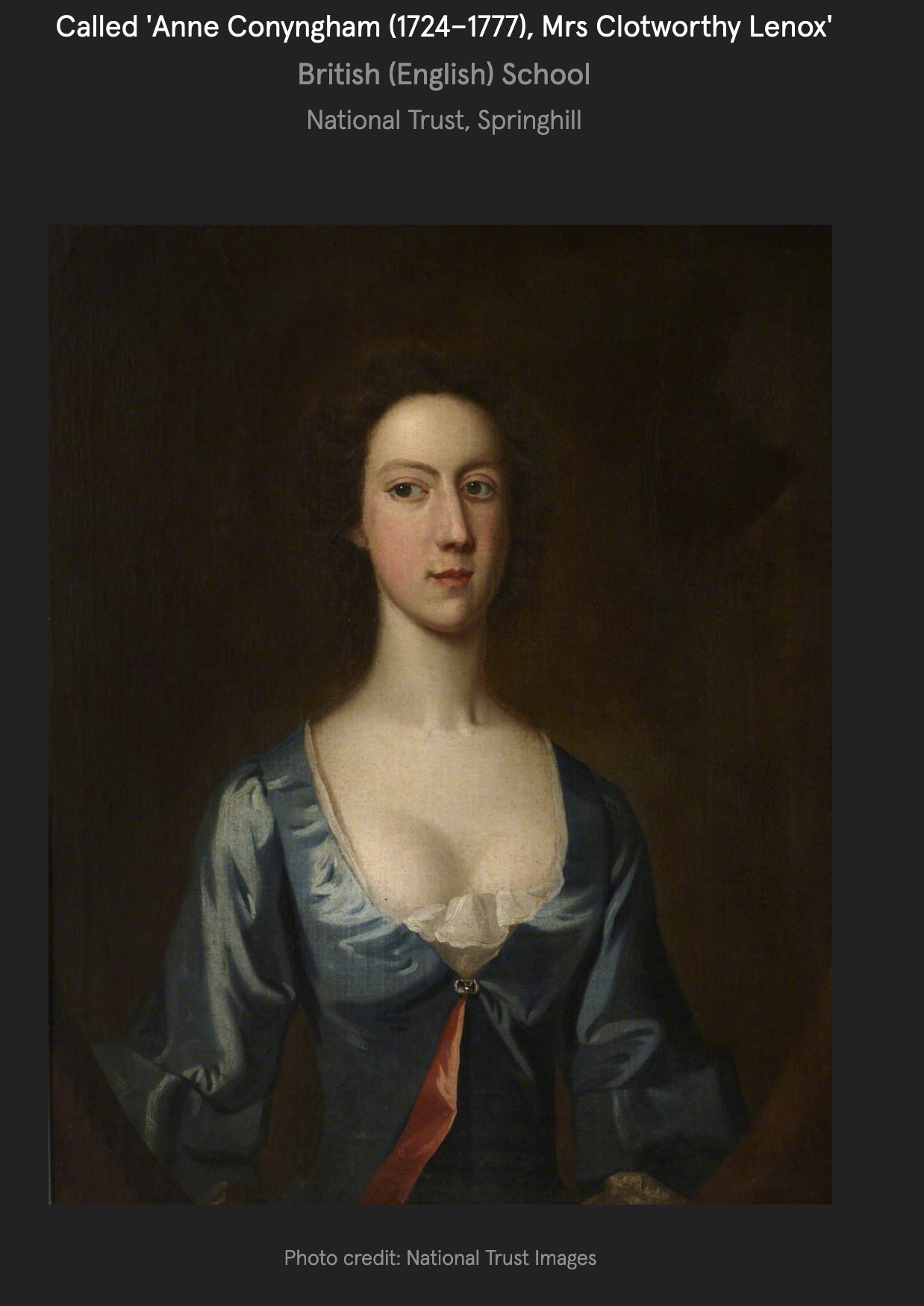
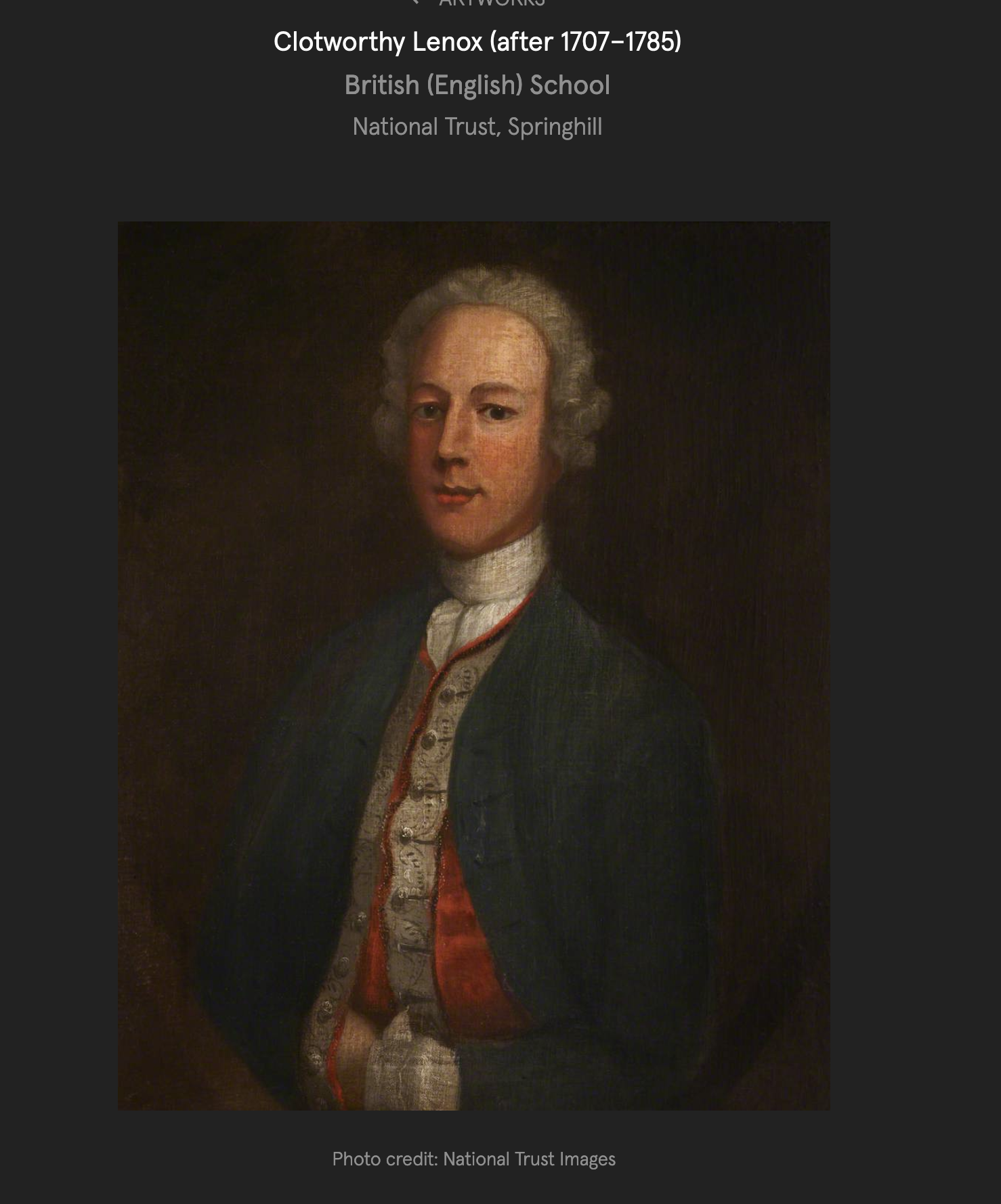
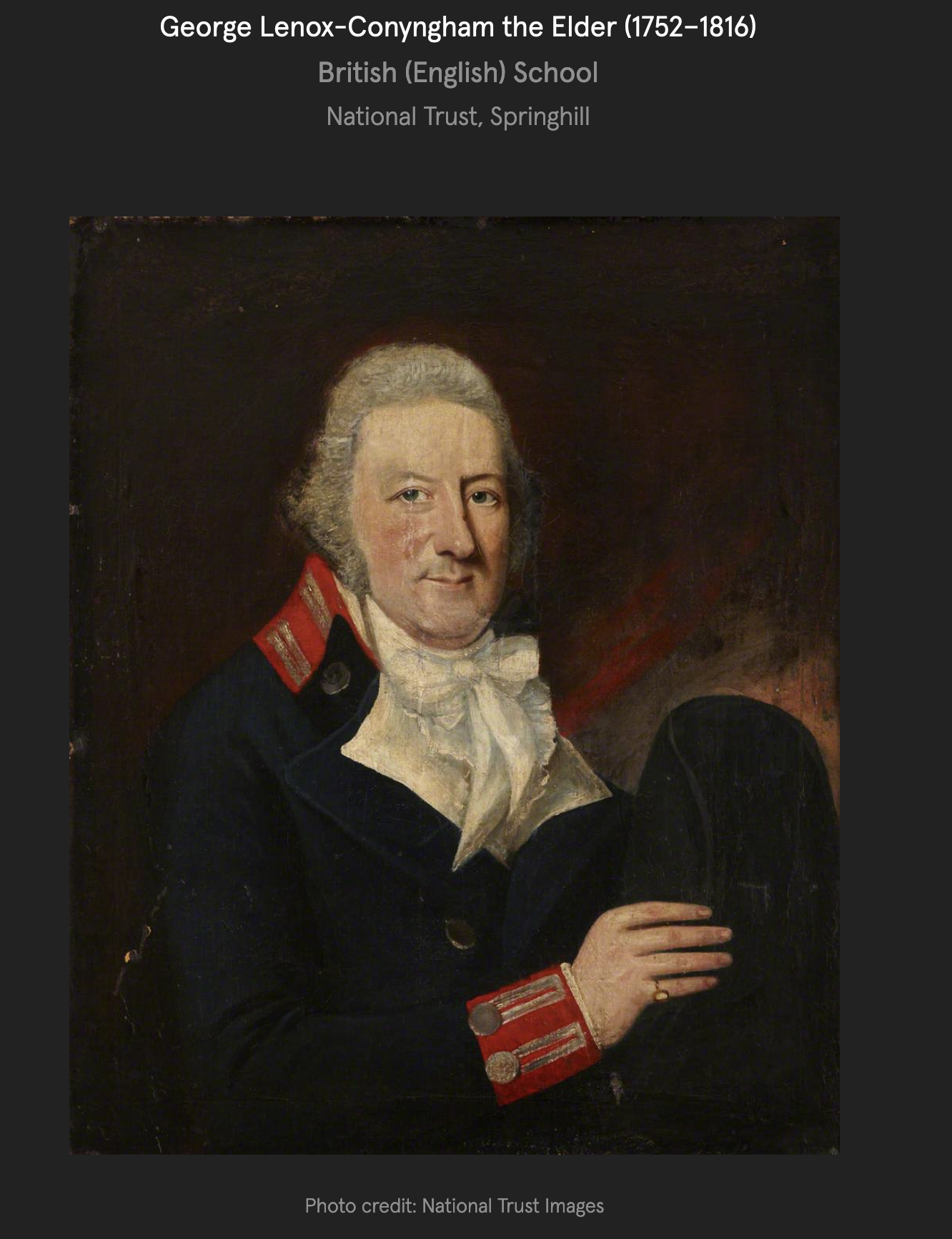
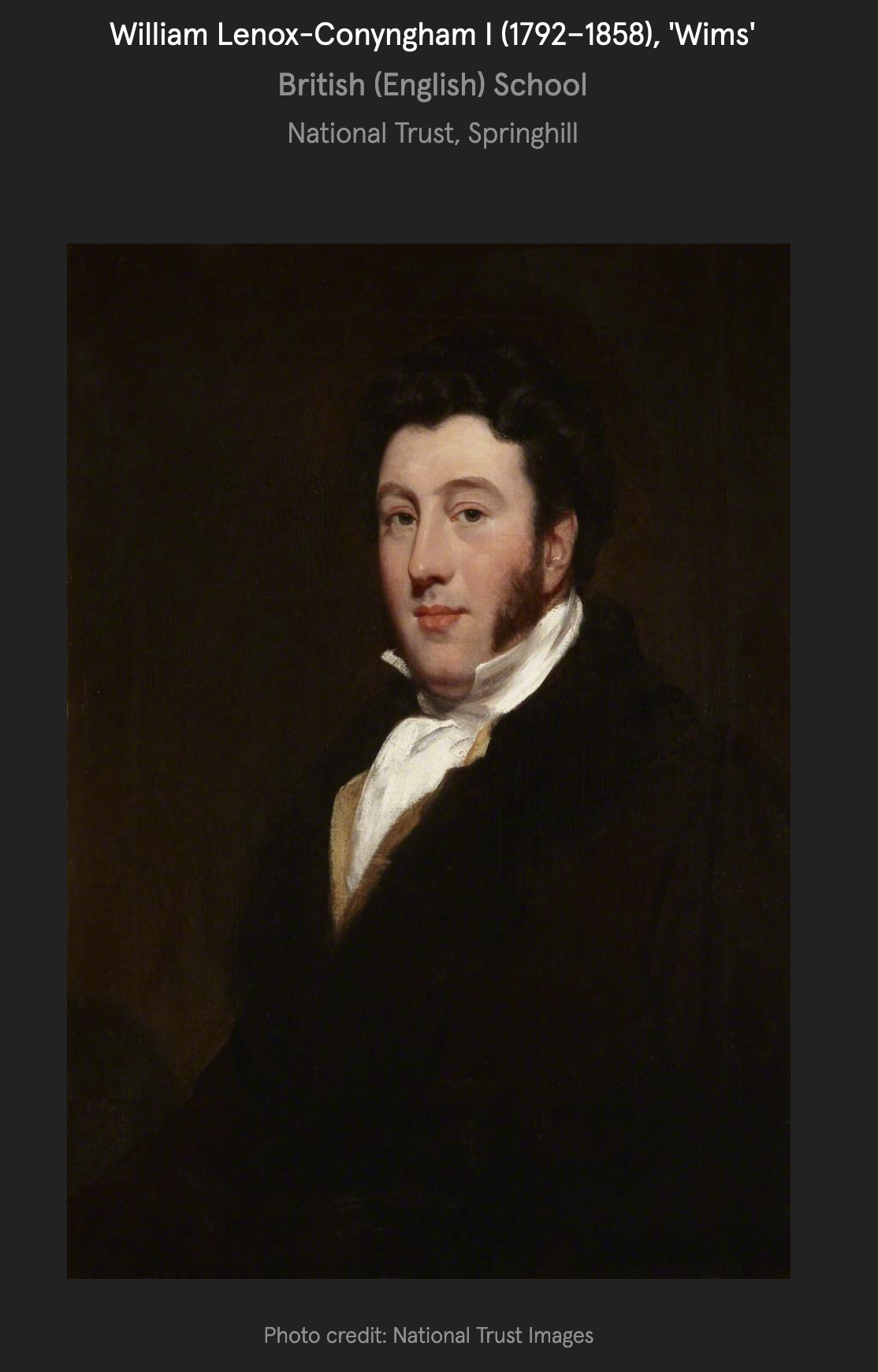
William Conyngham married Ann Upton, daughter of Arthur Upton of Castle Upton, County Antrim (this still exists and is privately owned), MP for County Antrim. Springhill passed to their daughter Anne who married David Butle, a merchant. Their son George took the name Conyngham and inherited Springhill. Although he had sons, Springhill passed through the line of his daughter, Ann (1724-1777) who married Clotworthy Lenox (1707-1785). Their son took the name George Lenox-Conyngham (1752-1816) when he inherited. George married twice: first to Jane Hamilton, and their son William Lenox-Conyngham (1792-1858) added the dining room to Springhill. George married secondly Olivia Irvine of Castle Irvine (also called Necarne; the park around Necarne Castle can freely be visited during daytime. The ruin of the castle itself is boarded up, so its interior can not be visited), County Fermanagh. One of their descendants was Jack Nicholson who inherited Enniscoe in County Mayo.
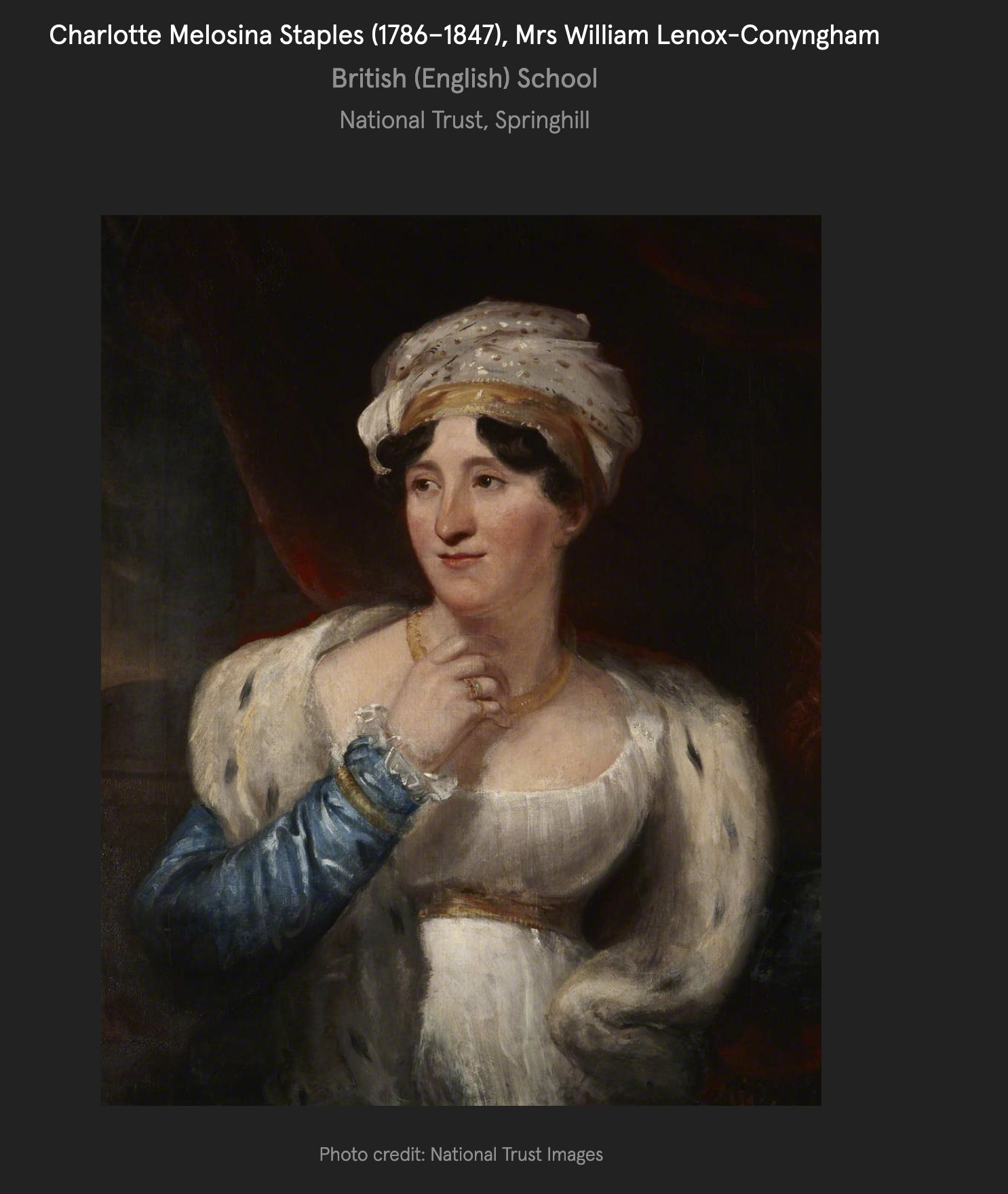
George Butle Conyngham (d. 1756), courtesy of National Trust. Springhill, County Derry.Anne Peacocke (d. 1754), Mrs George Butle Conyngham, courtesy of National Trust. Springhill, County Derry.Called Anne Conyngham (1724-1777) Mrs Clotworthy Lenox, courtesy of National Trust. Springhill, County Derry.Clotworthy Lenox, courtesy of National Trust. Springhill, County Derry.George Lenox-Conyngham (1752-1816) courtesy of National Trust. Springhill, County Derry.William Lenox-Conyngham (1792-1858) courtesy of National Trust. Springhill, County Derry.Charlotte Melosina Staples (1786-1847), wife of William Lenox-Conyngham (1792-1858), daughter of John Staples (1736-1820) of Lissan, County Tyrone, courtesy of National Trust. Springhill, County Derry.
Springhill passed then from William Lenox-Conyngham (1792-1858) and his wife Charlotte Mesolina Staples of Lissan, County Tyrone, to their son William Fitzwilliam Lenox-Conyngham, and it was his grandson William Lowry Lenox-Conyngham who left it to the Northern Ireland Trust.
Bence-Jones, Mark. A Guide to Irish Country Houses (originally published as Burke’s Guide to Country Houses volume 1 Ireland by Burke’s Peerage Ltd. 1978); Revised edition 1988 Constable and Company Ltd, London.
p. 298. “(Vane-Tempest-Stewart, Londonderry, M/PB) A house enlarged and remodelled 1875-76 by 5th Marquess of Londonderry to the design of Henry Chappell, of Newtownardsin a mixture of Gothic and Tudor with many slender turrets. On the hill above the demesne is the Scottish baronial Scrabo Tower, erected 1858 as a memorial to 3rd Marquess, a distinguished soldier and diplomatist, to the design of Sir Charles Lanyon and William Henry Lynn. Part of the demesne is now in the care of the national trust.”
Killynether House, Newtownards, Co Down for sale Feb 2025 courtesy Sherry FitzGerald Ltd. Christie’s International Real Estate
€3,747,582
Killynether House is situated in undoubtedly one of County Down’s most sought after semi-rural locations with its elevated setting and extensive views over rolling County Down countryside to Strangford Lough. Killynether House is set in grounds extending to c. 18 acres, and whilst enjoying all of the attributes of country living is a short distance from neighbouring towns.
Whilst enjoying impressive significance in terms of its stunning architecture the property is secluded from the road offering great privacy and exclusivity. The driveway sweeps past the cottages and lake up to the main house, and is bordered by mature shrub beds with specimen trees gracing the boundary.
The main house has been sympathetically restored to retain traditional features and offers extensive accommodation over two levels. The house has been beautifully presented and decorated with a high end interior designer finish throughout. There is an exceptionally high standard of fixtures and fittings, with designer appliances in the kitchen and bathrooms, luxury tiling and flooring. The accommodation in brief consists of an impressive entrance hall, four reception rooms, kitchen and dining room, study, utility room, cloakroom and pantry. On the first floor there are four large double bedrooms, master suite with a dressing room and ensuite, bedroom two with ensuite, laundry room and a family bathroom. In addition to the main house there are three self-contained cottages. Each offer fabulous accommodation with two bedrooms and ample living space. They would be perfect for relatives, guests or as an Airbnb venture. For entertaining purposes there is a superb pool house which houses a 30 foot swimming pool with changing facilities, WC, sauna and kitchen. From the swimming pool area there are sliding doors to a terrace with brick BBQ and patio space. In addition as part of the pool house is a large garage space with heating and air conditioning.
Externally the property offers ample outbuildings with a barn, stores, workshop and a greenhouse. Killynether House is only 20 minutes from Belfast City Airport, 45 minutes to Belfast International Airport. For everyday living it is a 5 minute drive to Newtownards, 10 minutes to Holywood, 10 minutes to Bangor and 20 minutes to Belfast City. All in all providing ease of access to all parts of the UK and International connections, as well as being close to local amenities.
This is a unique opportunity to acquire a magnificent country residence enjoying all the style and grandeur of a period home, yet benefiting from all the comforts and luxuries of modern day living.
For further information please contact Simon Brien or Tiffany Brien of Simon Brien Residential on [hidden information] or via email on [hidden information] & [hidden information].
• Exclusive residence is set in grounds of c. 18 acres on an elevated and semi-rural setting
• Extensive views over the County Down countryside to Strangford Lough
• Secluded surroundings with manicured gardens and lakes
• Accommodation comprises of a main house and three self-contained cottages
• Main house extends to c. 5800 sq ft
• Three cottages have two bedrooms each with ample living space and views across surrounding gardens and lakes
• Pool house with 30 foot swimming pool, changing facilities, WC, sauna and kitchen
• Large garage space with heating and air conditioning
• Outbuildings including barn, stores, workshop and greenhouse
• Convenient location a 5 minute drive to Newtownards, 10 minutes to Bangor and Holywood, 20 minutes to Belfast City Airport and 45 minutes to Belfast International Airport
Entrance Porch Glazed inner door and side panels to:
Entrance Hall 27’5” x 20’8” (8.36m x 6.3m) Marble fire surround with open fire and slate hearth, hardwood strip floor, ornate corniced ceiling, recessed lighting, wall light wiring, impressive staircase to first floor. Secret door to study.
Drawing Room 31’ x 19’5” (9.45m x 5.92m) Marble fire surround with slate inset, open fire and slate hearth, corniced ceiling, ornate ceiling detail, double opening doors to rear patio.
Secret Study 12’4” x 10’ (3.76m x 3.05m) Hardwood strip floor, fitted desk with drawers, controls for multimedia network.
Cloakroom 10’10” x 8’1” (3.3m x 2.46m) Traditional ’Sanitan’ WC and inset wash hand basin with vanity unit below and marble countertops, recessed lighting, corniced ceiling, chrome heated towel rail.
Dining Room 20’3” x 17’3” (6.17m x 5.26m) Corniced ceiling, ceiling detail, recessed lighting.
Living Room 16’10” x 14’6” (5.13m x 4.42m) Carved wood fire surround with marble and slate inset, open fire and slate hearth, built in book cases and cupboards in alcoves, corniced ceiling, recessed lighting.
Kitchen/ Dining 22’3” x 19’5” (6.78m x 5.92m) Hand painted kitchen with an excellent range of high and low level units and polished granite worktops, Brittania gas range, cooker with antique mirror splashback and beam mantle, twin Belfast sinks with mixer taps, large island with breakfast bar dining and stainless steel sink unit with mixer taps, integrated Neff dishwasher, integrated Bosch microwave oven and plate warmer, recess for American style fridge freezer, dining area for 4-6. Marble floor, corniced ceiling and recessed lighting. Open to living area, access to walk in pantry.
Living Area 22’4” x 20’3” (6.8m x 6.17m) Carved sandstone fire surround with wood burning stove and brick inset and stone hearth, marble floor, twin roof lanterns, corniced ceiling, recessed lighting, double opening doors to rear.
Walk in Pantry Fitted with shelving and fitted units with granite worktops, wine rack, marble floor, recess for wine fridge.
Utility Room 9’6” x 9’11” (2.9m x 3.02m) Fitted with an excellent range of hand painted units, solid and varnished worktops, twin Belfast sink with mixer taps, plumbed for dishwasher, space for tumble dryer, ceramic tiled floor, corniced ceiling, recessed lighting.
Gallery Landing Ornate detailed ceiling, study/reading space, impressive views across gardens over Strangford Lough , storage cupboards.
Bedroom 1 22’6” x 20’7” (6.86m x 6.27m) Corniced ceiling, recessed lighting, views.
Walk Through Dressing Room 12’5” x 9’10” (3.78m x 3m) Fitted with an excellent range of wardrobes, corniced ceiling.
Ensuite Bathroom 11’8” x 10’7” (3.56m x 3.23m) Traditional style suite comprising of low flush WC, bidet, twin inset wash hand basins with vanity unit below and granite worktops, fully tiled shower with chrome fitments, panelled bath, chrome heated towel rails, tiled floor, corniced ceiling, recessed lighting.
Bedroom 2 19’5” x 18’1” (5.92m x 5.5m) Corniced ceiling, recessed lighting, views.
Ensuite Shower Room 12’5” x 9’ (3.78m x 2.74m) Contemporary white suite comprising of: Low flush WC, twin wash hand basins with vanity unit, walk in fully tiled shower, fully tiled walls, tiled floor, chrome heated towel rail, recessed lighting.
Bedroom 3 17’4” x 14’10” (5.28m x 4.52m) Corniced ceiling, recessed lighting, views.
Bedroom 4 20’4” x 13’3” (6.2m x 4.04m) Recessed lighting, corniced ceiling.
Bathroom Traditional style suite comprising of ’Sanitan’ WC and pedestal wash hand basin, fully tiled shower with chrome fitments, panelled bath, corniced ceiling, recessed lighting, tiled floor, chrome heated towel rail.
Laundry Room 11’9” x 11’2” (3.58m x 3.4m) Good range of fitted units with solid oak worktops, Belfast sink with mixer taps, plumbed for washing machine, space for tumble dryer, tiled floor, corniced ceiling, recessed lighting.
Barns to Side Covered area with water supply.
Store 1 13’1” x 12’7” (4m x 3.84m)
Workshop 19’8” x 13’ (6m x 3.96m) Power and light.
Barn 19’10” x 13’ (6.05m x 3.96m) Power and light.
Greenhouse 19’7” x 12’ (5.97m x 3.66m)
Covered Barbecue Entertaining Area Power and light, paved, path leading from side, open fire, marble worktop with space for fridge.
Summer House 15’9” x 11’10” (4.8m x 3.6m) Exceptional views. Raised deck, power and light.
Covered Parking Bay To rear, access to side patio, access to hidden oil tank and gas cylinders.
Barnsby Cottages
Store 2 33’11” x 26’7” (10.34m x 8.1m) Lawnmower shed, power and light, wood store to side.
Pool House:
Porch PVC panelled entrance door, tiled floor, vaulted ceiling, glazed inner door to pool area.
Indoor Pool Area 47’4” x 31’7” (14.43m x 9.63m)
Pool 30’10” x 13’9” (9.4m x 4.2m) Underfloor heating, pitched ceiling with exposed beams, recessed lighting, twin sliding doors to entertaining terrace, access to garage, access to changing rooms.
Chamging Room 1 Fully tiled changing space with walk in shower.
Kitchen Fitted units with single drainer sink unit with mixer taps, fridge, tiled floor.
Control Room 8’7” x 7’9” (2.62m x 2.36m) Filtration system. Boiler. Tiled floor.
Sauna
Garage 39’3” x 19’7” (11.96m x 5.97m) Twin opening barn style doors, power and light, air conditioning unit, heated, tiled floor.
Outside Store 11’5” x 5’6” (3.48m x 1.68m) Access from outside, tiled floor, power and light, access to roofspace.
Entertaining Terrace Built in brick barbecue area, patio space.
Cottage 1:
Entrance Door Barn style entrance door wtih glazed side panels to porch.
Porch Tiled floor, wall light wiring, doors to cottages 2 & 3. Inner door to:
Entrance Hall 22’2” x 21’5” (6.76m x 6.53m) At widest points. Tiled floor, wood burning stove with stone surround and beam mantle, impressive hand made staircase with steel balustrades and hardwood banister with dramatic gallery landing and pitched tongue and groove ceiling. Double opening panelled doors to garden room.
Garden Room 14’ x 11’4” (4.27m x 3.45m) At widest points. Glazed walls and door overlooking manicured gardens and pond. Tiled floor, recessed lighting
Gallery Landing Hardwood strip floor, views across rolling North Down countryside, pitched tongue and groove panelled ceiling, door to main living space.
Open Plan Kitchen/Livivng/Dining 3434’7” x 19’9” (1046.86m x 6.02m) At widest points. Solid oak country style kitchen with polished black granite worktops, Belfast sink wwith brass mixer taps, Black gas range cooker with tiled splashback and wood beam mantle, integrated dishwasher, integrated dishwasher, American style fridge freezer, fitted dresser unit, dining space for 6-8. Living space with fully glazed walls overlooking gardens and Strangford Lough, tiled floor, exposed beams, feature exposed brick wall.
Utility Room 9’ x 7’5” (2.74m x 2.26m) Tiled floor, excellent range of shelving, plumbed for washing machine, space for tumble dryer.
Sitting Room 22’1” x 16’2” (6.73m x 4.93m) Open fire with slate hearth and wood beam mantle, recessed lighting, views across gardens and Strangford Lough.
Rear Hallway Recessed lighting, storage cupboard with hot water tank and shelving.
Bedroom 2 16’4” x 13’ (4.98m x 3.96m) Average. Recessed lighting, views, built in wardrobes.
Bathroom Traditional style white suite comprising of Low flush WC, pedestal wash hand basin, panelled bath with chrome mixer taps and hand held shower attachment, fully tiled shower with thermostatic shower, tiled floor, fully tiled walls, heated towel rail, recessed lighting
Bedroom 1 22’2” x 15’11” (6.76m x 4.85m) At widest points. Walk in wardrobe with ample hanging space, double opening doors to balcony, views across gardens and Strangford Lough, recessed lighting, wired for wall lights.
Ensuite Bathroom 11’3” x 9’5” (3.43m x 2.87m) Traditional style white suite comprising of low flush WC, bidet, pedestal wash hand basin, panelled bath with mixer taps and hand held shower attachment, fully tiled shower with thermostatic shower unit, fully tiled walls, tiled floor, recessed lighting, heated towel rail.
Garage 24’11” x 8’7” (7.6m x 2.62m) Barn style doors, power and light, oil fired boiler, wood and bin store to side.
Bence-Jones, Mark. A Guide to Irish Country Houses (originally published as Burke’s Guide to Country Houses volume 1 Ireland by Burke’s Peerage Ltd. 1978); Revised edition 1988 Constable and Company Ltd, London.
p. 23. “(Anderson/LGI1958) A two storey, five bay C18 house with an single bay wing set back. The main block has a porch with Ionic pilasters, and the wing has a miniature breakfront, with pediment.”
Bence-Jones, Mark. A Guide to Irish Country Houses (originally published as Burke’s Guide to Country Houses volume 1 Ireland by Burke’s Peerage Ltd. 1978); Revised edition 1988 Constable and Company Ltd, London.
p. 261. “(Torrens/LGI1912) A C19 villa deriving from the villas of Richard Morrison. Two storey; three bay, bow-ended front; three sided bow in centre incorporating entrance door. The seat of the Richardson family, passed through marriage to the Torrens family.”
Bence-Jones, Mark. A Guide to Irish Country Houses (originally published as Burke’s Guide to Country Houses volume 1 Ireland by Burke’s Peerage Ltd. 1978); Revised edition 1988 Constable and Company Ltd, London.
p. 257. “(Gaussen/LGI1912) A two storey C18 house of coursed rubble; ashlar window surrounds with blocking.”
Roe Park (formerly Daisy Hill), Limavady, County Derry
Bence-Jones, Mark. A Guide to Irish Country Houses (originally published as Burke’s Guide to Country Houses volume 1 Ireland by Burke’s Peerage Ltd. 1978); Revised edition 1988 Constable and Company Ltd, London.
p. 245. “(Conolly/LGI1912; McCausland/IFR; Macnaghten, Bt/PB; Alexander/IFR) A long, irregular, two-storey house of different periods of Georgian, of which its nucleus appears to be a five-bay house originally known as Daisy Hill, built at the beginning of the 18th century by Rt Hon William Conolly, Speaker of the Irish House of Commons and builder of Castletown, Co Kildare. Additions were subsequently built by Marcus McCausland, whose son, Dominick, added a dining room post 1782. A drawing room was added by Sir Francis Macnaghten, 1st Bt, 1826. The two main exterior features are a three-sided end bow and a curved pedimented and pillared doorcase. Victorian Classical plasterwork in drawing room and dining room.
large and imposing pedimented stableyard. Roe Park is now an old peoples’ home.”
Bence-Jones, Mark. A Guide to Irish Country Houses (originally published as Burke’s Guide to Country Houses volume 1 Ireland by Burke’s Peerage Ltd. 1978); Revised edition 1988 Constable and Company Ltd, London.
p. 220. “(Dawson, sub Chichester-Clark/IFR) A handsome two storey C18 house, of courses rubble with ashlar dressing. Five bay entrance front, three bay pedimented breakfront; pedimented porch on Doric columns added later. Three sided bow in side elevation. Solid roof parapet; flush quoins and window surrounds with blocking. The home of Lord Moyola (formerly Major James Chichester-Clark), Prime Minister of Norhtern Ireland 1969-71.”
Rock Castle, Portstewart, County Derry, photograph by Robert French, (between ca. 1865-1914), Lawrence Photograph Collection, National Library of Ireland.
Bence-Jones, Mark. A Guide to Irish Country Houses (originally published as Burke’s Guide to Country Houses volume 1 Ireland by Burke’s Peerage Ltd. 1978); Revised edition 1988 Constable and Company Ltd, London.
p. 195. “A two storey late-Georgian seaside villa, with a bow like a round tower at either end of its front; originally battlemented. The bows contain circular rooms. The birthplace of Field Marshal Sir George White, VC, the defender of Ladysmith. (see also Rock Castle).
Rock Castle, Portstewart, County Derry, photograph by Robert French, (between ca. 1865-1914), Lawrence Photograph Collection, National Library of Ireland.
Bence-Jones, Mark. A Guide to Irish Country Houses (originally published as Burke’s Guide to Country Houses volume 1 Ireland by Burke’s Peerage Ltd. 1978); Revised edition 1988 Constable and Company Ltd, London.
p. 189. “(Stronge, Bt/PB) A two storey C19 house in the Georgian style. Five bay front, centre breakfront with two narrow windows above and plain projecting porch below. Three sided bow in side elevation. Eaved roof on plain cornice.”




 Irish Historic Houses