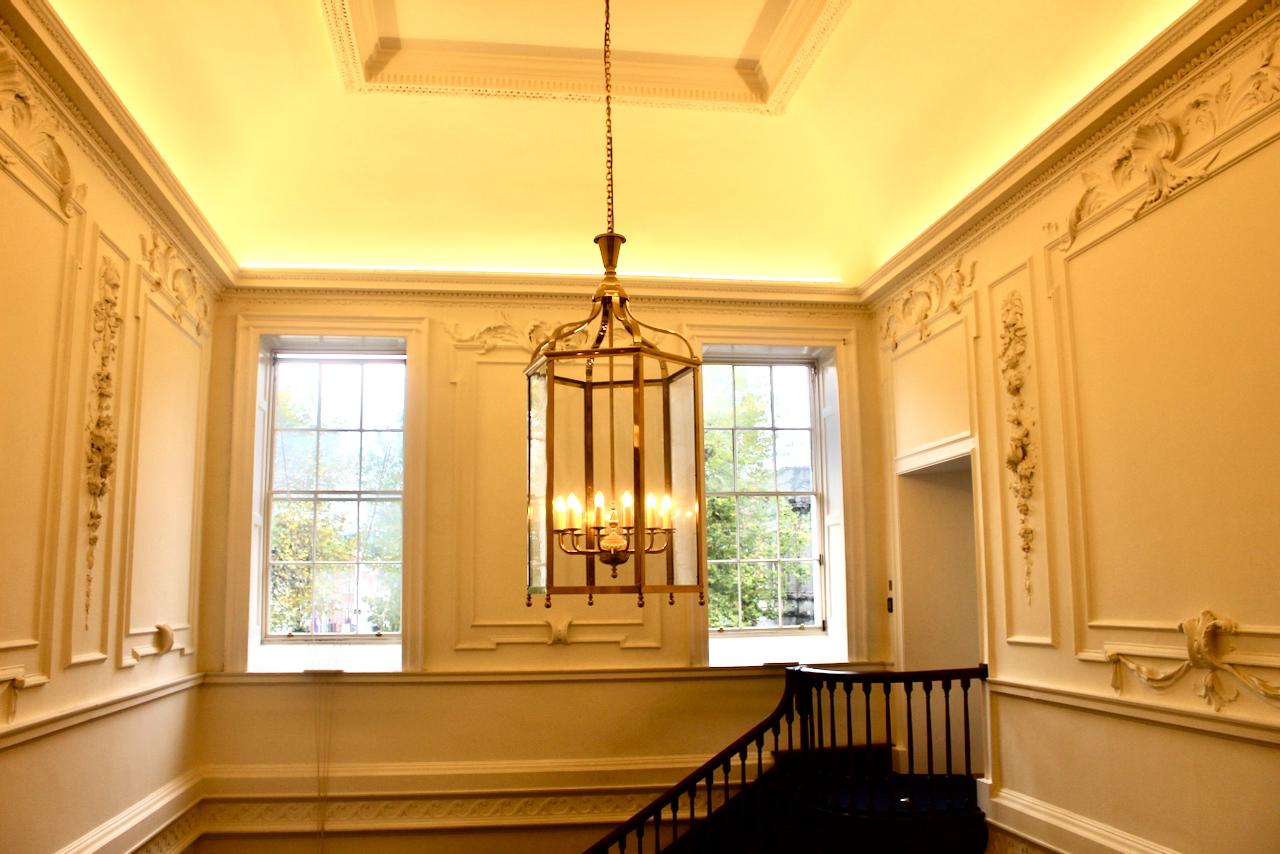
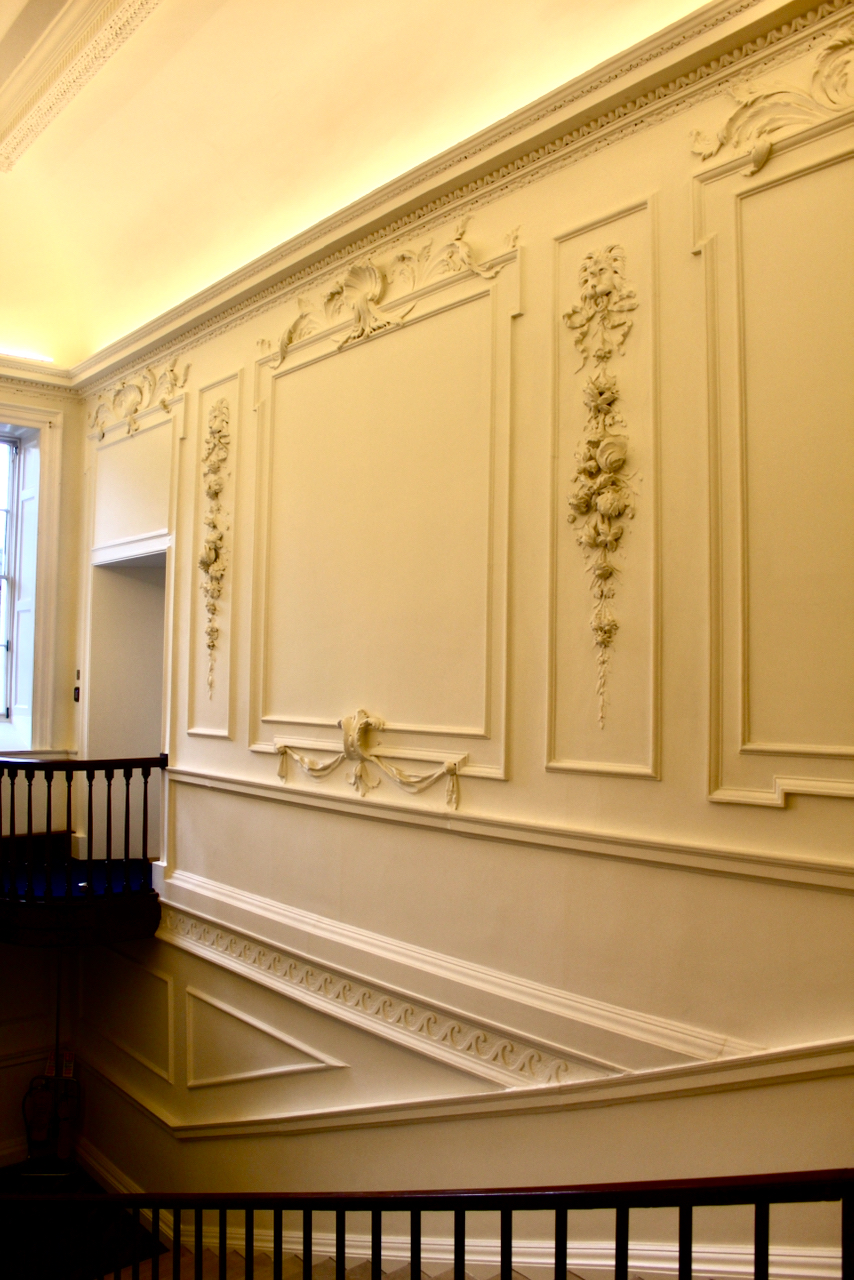
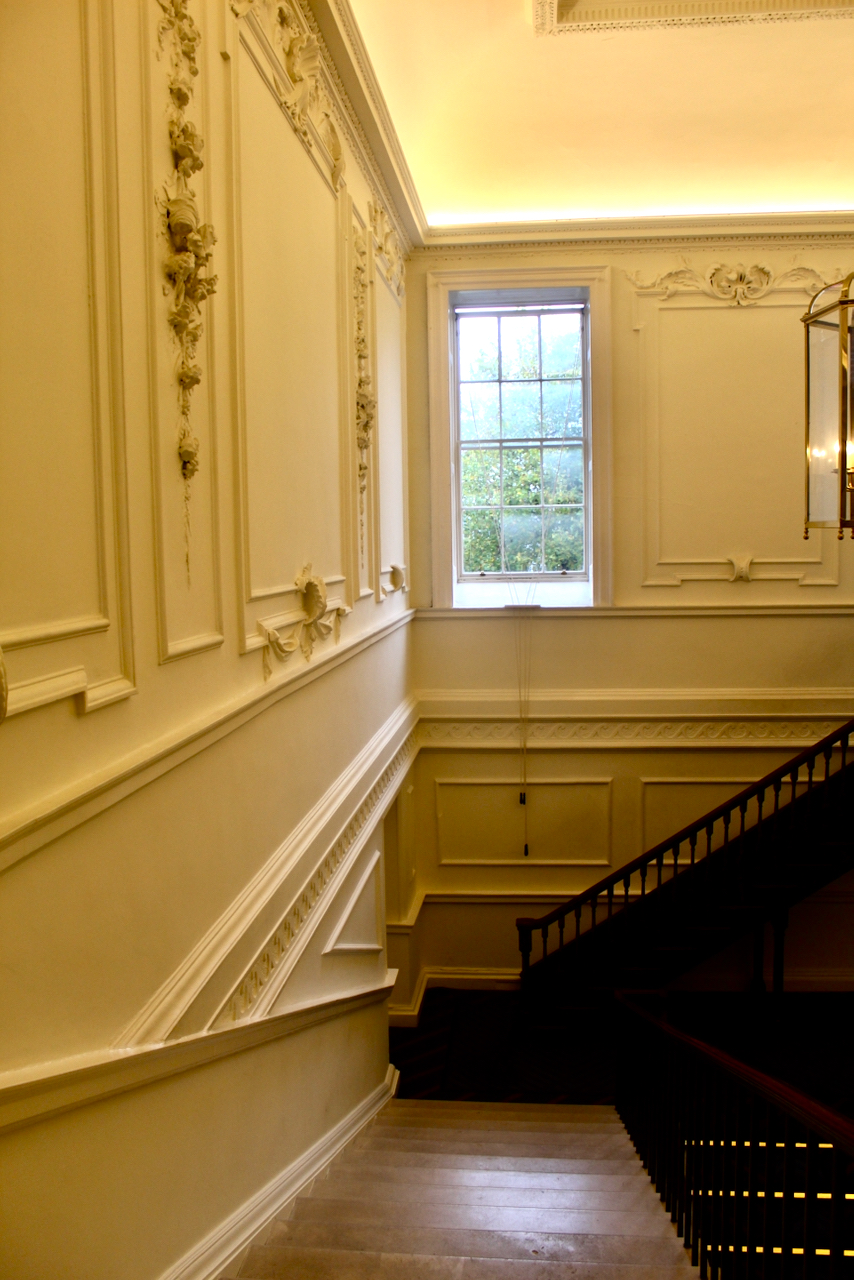
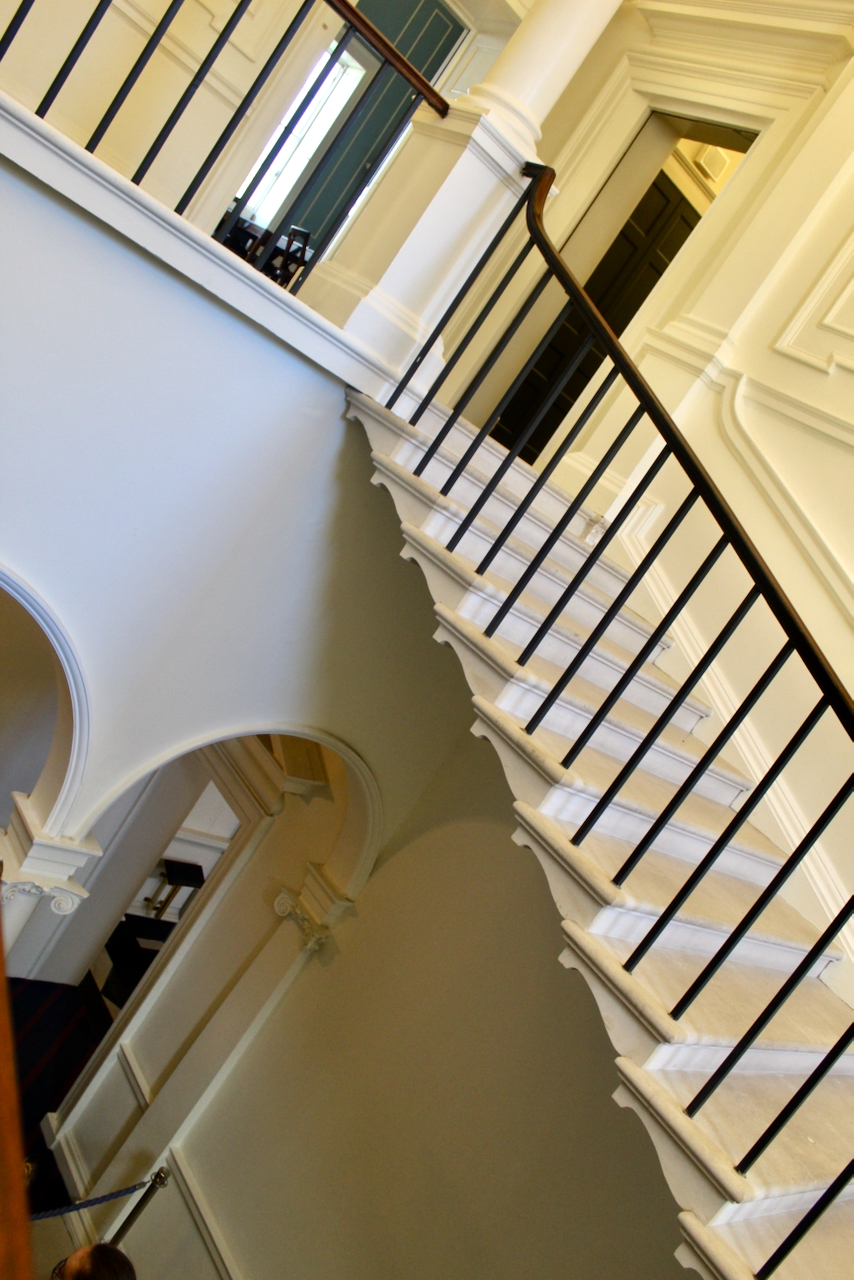
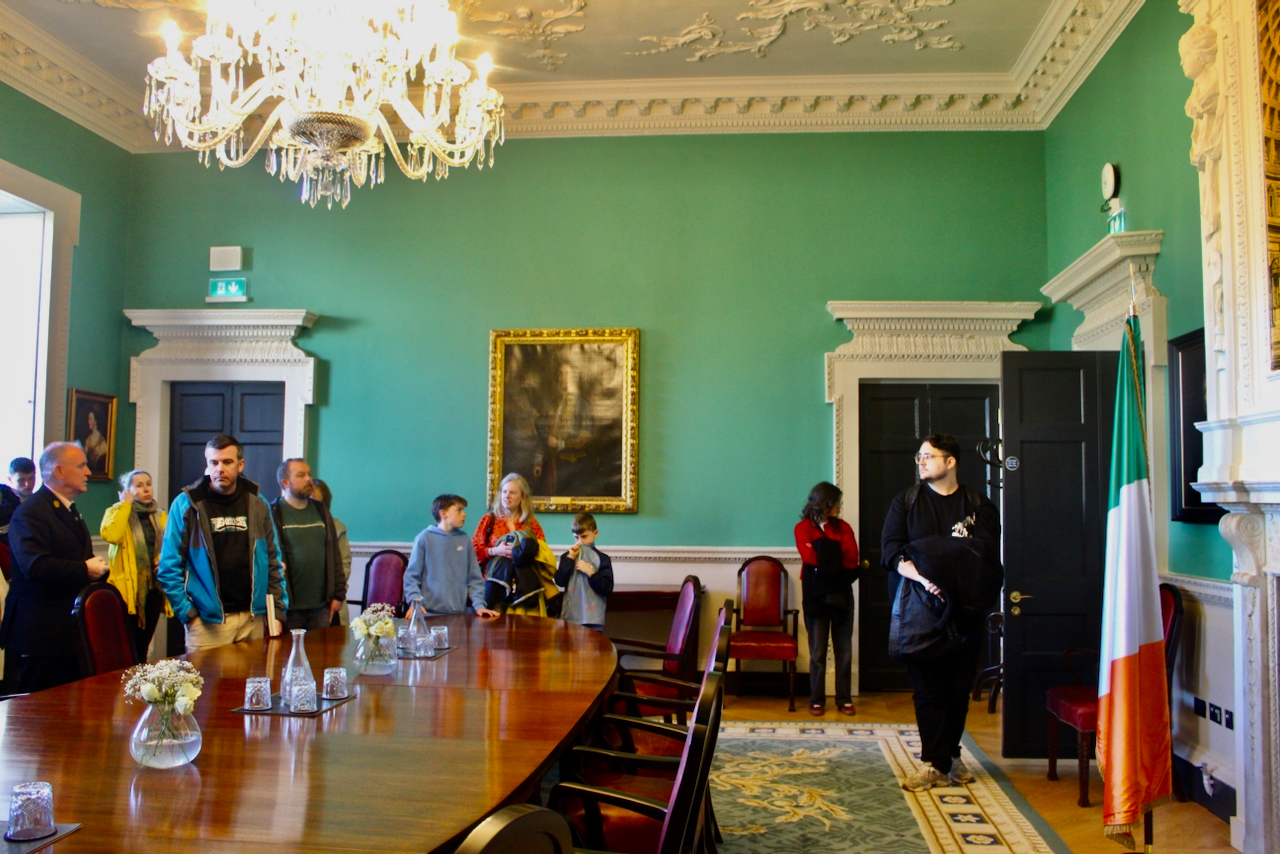
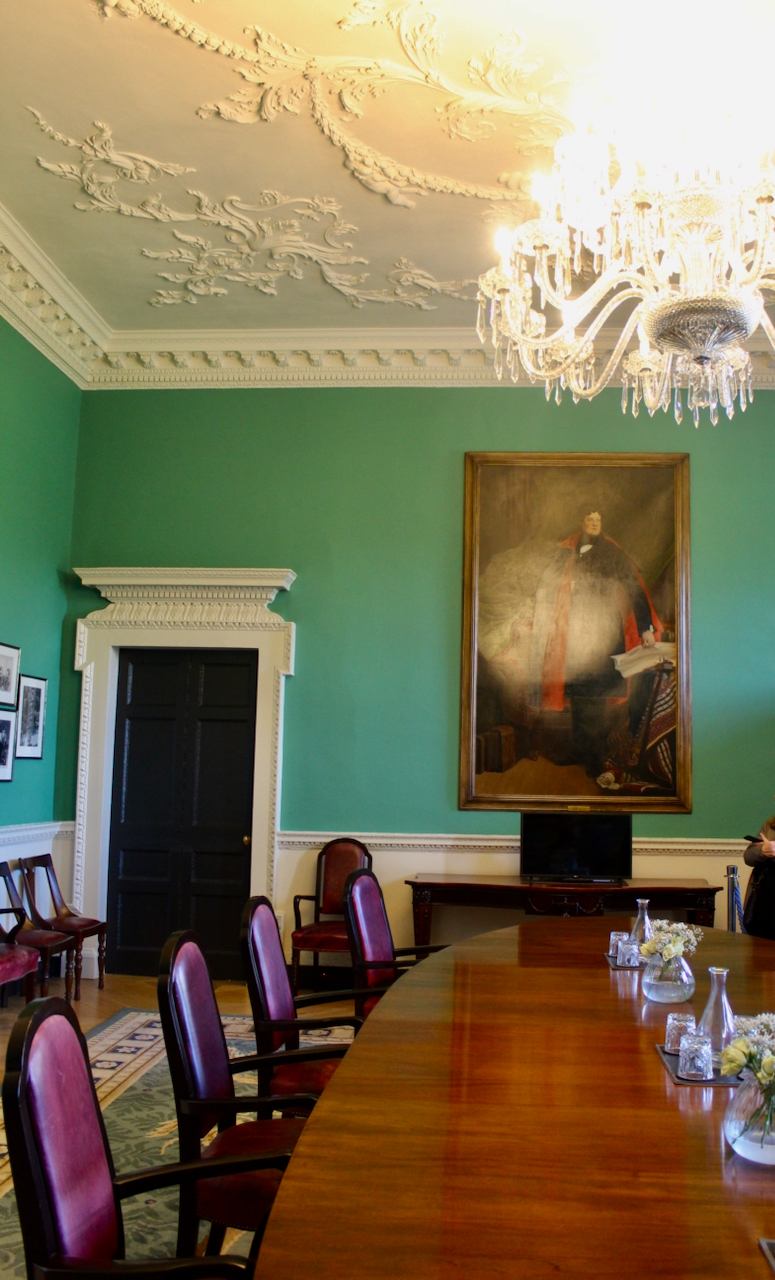
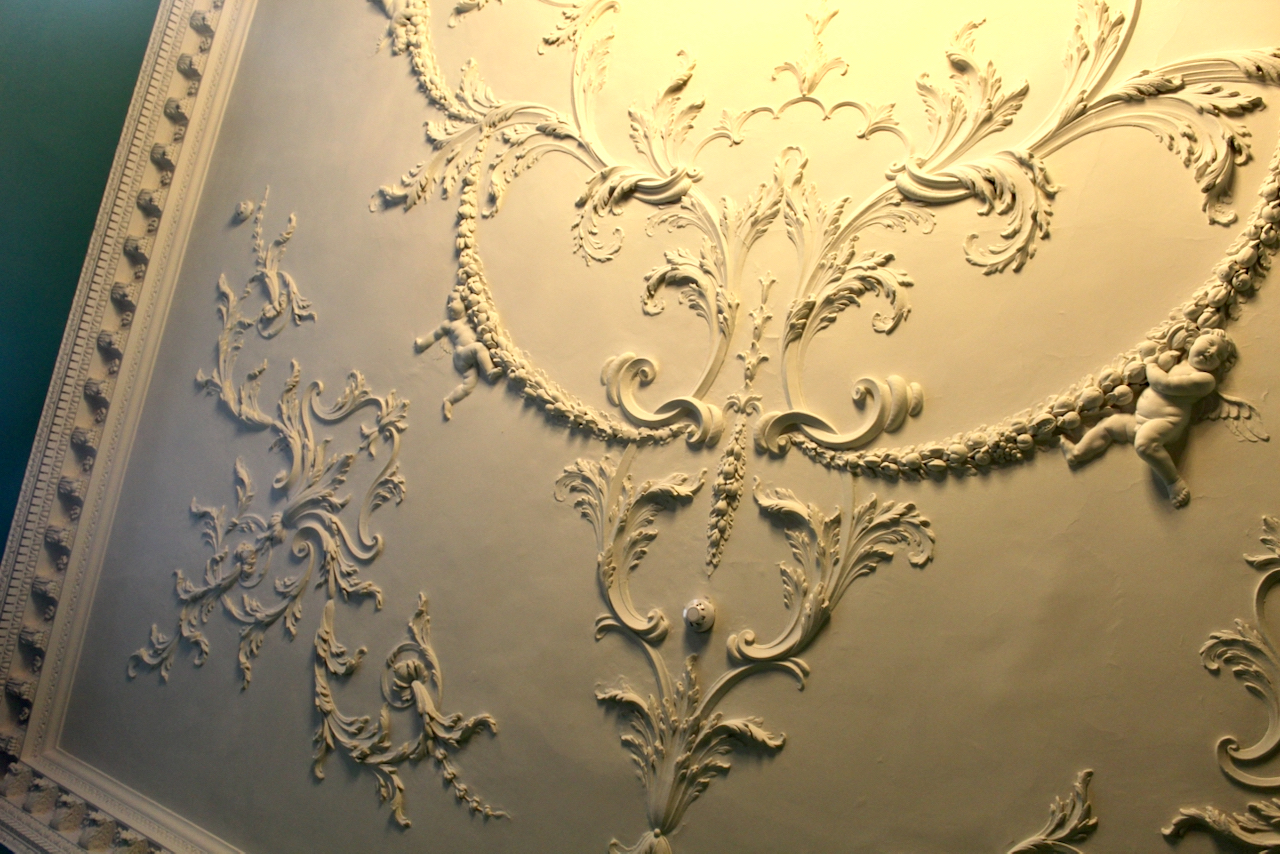
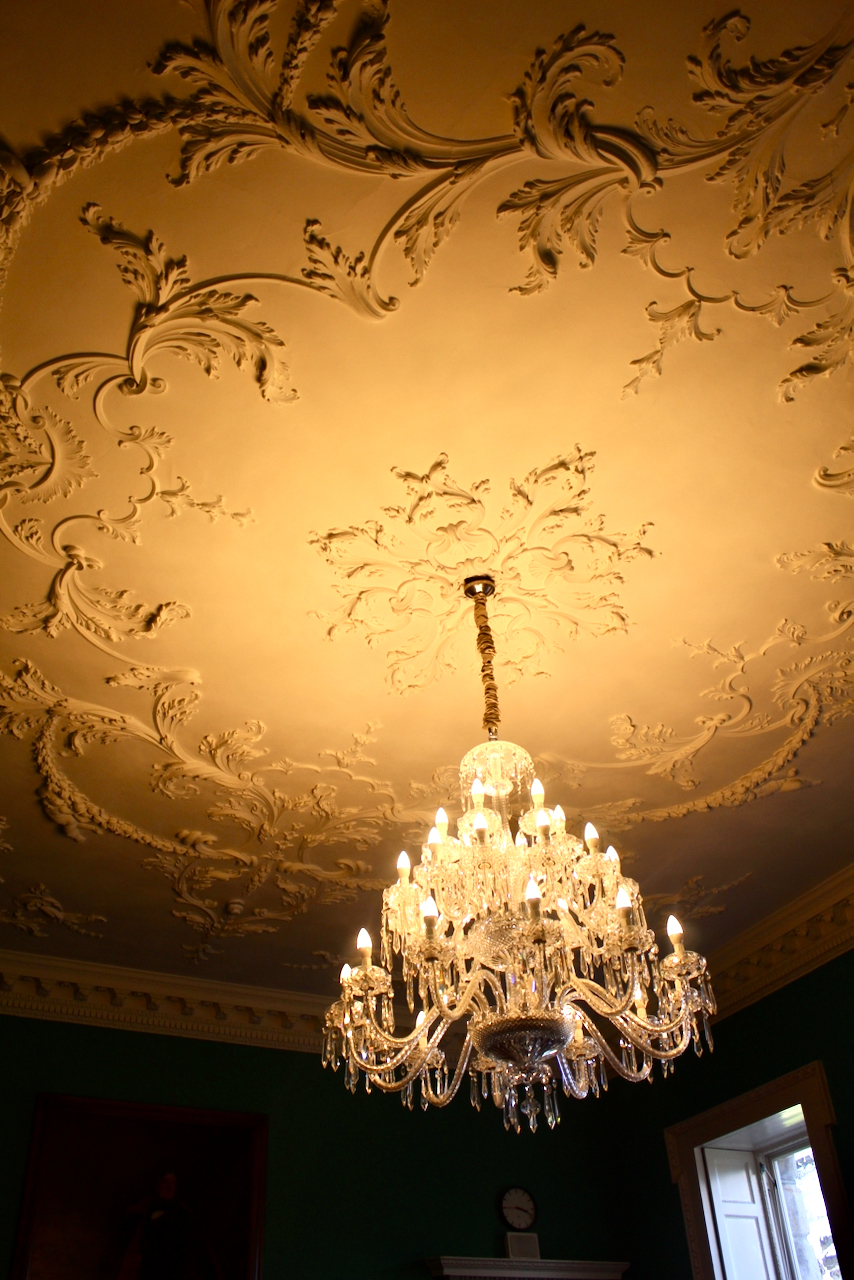
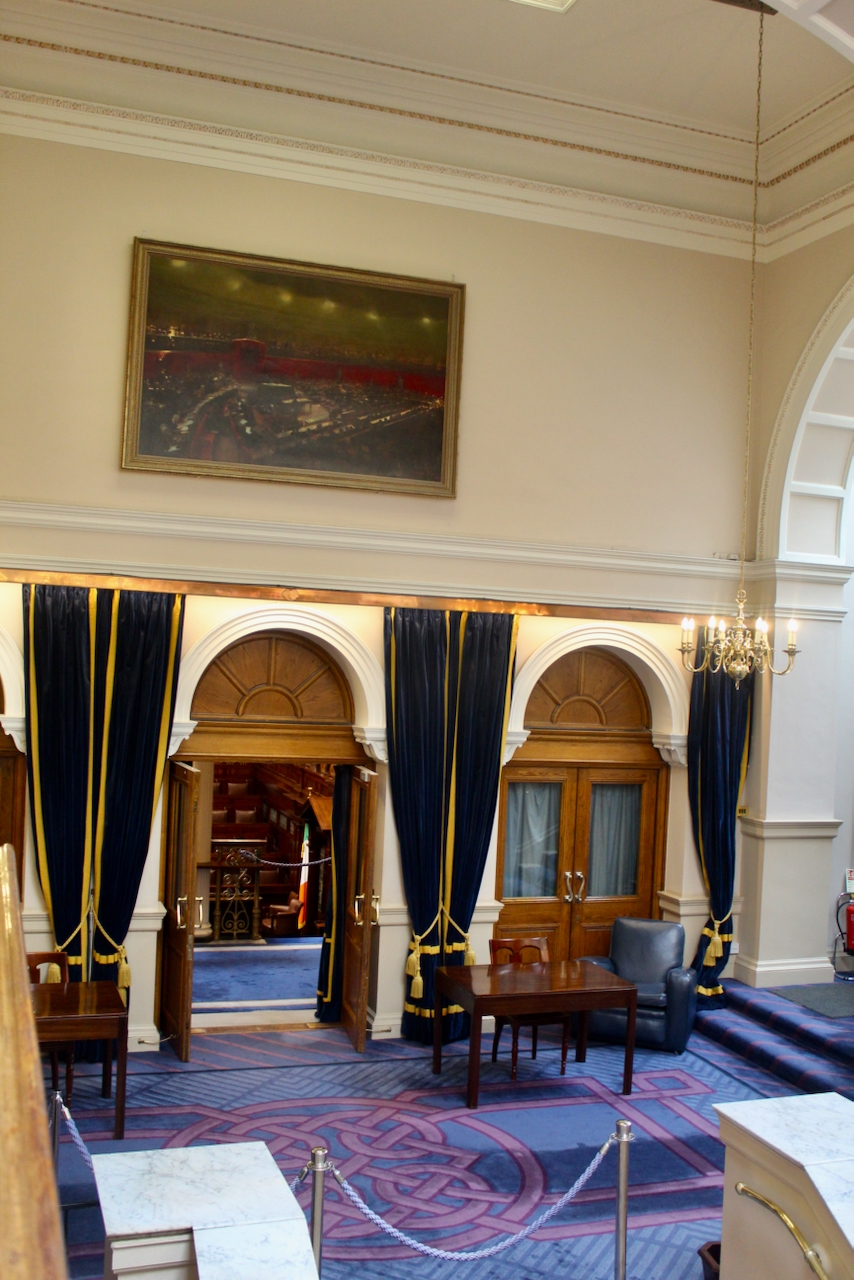
Oldbridge Hall, County Meath, site of the Battle of the Boyne Visitor centre

Battle of the Boyne site and visitor centre, Oldbridge Hall, County Meath.
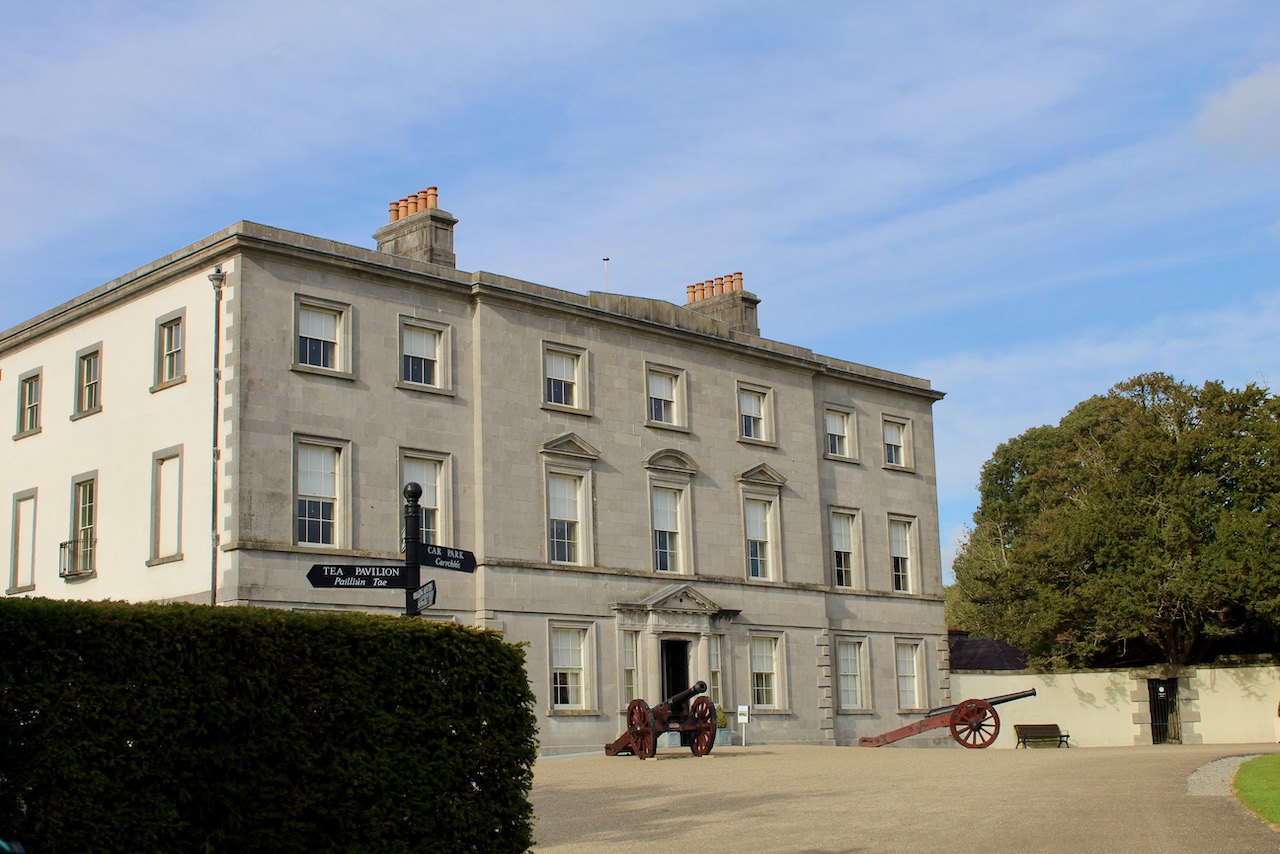
Oldbridge Hall, County Meath, October 2019. Photograph © Jennifer Winder-Baggot, www.irishhistorichouses.com

The Battle of the Boyne museum is housed in Oldbridge Hall, which is built on the site where the battle of the took place. The house is maintained by the Office of Public Works.

https://heritageireland.ie/places-to-visit/battle-of-the-boyne-visitor-centre-oldbridge-estate/

Stephen and I have a personal connection, as Oldbridge was built by the Coddington family, and a daughter from the house, Elizabeth Coddington (1774-1857), married Stephen’s great great grandfather Edward Winder (1775-1829).

Battle of the Boyne painted by Jan Wyck, in the National Gallery of Ireland. The point of view is that of the Williamites who were based on high ground north of the River Boyne, looking southwards towards Donore Hill where James II and his troops were based.

The Battle of the Boyne, 1st July 1690, was just one of several battles that took place in Ireland when the rule of King James II was challenged by his son-in-law, a Dutch Protestant Prince, William of Orange. James II was Catholic, and he attempted to introduce freedom of religion, but this threatened families who had made gains under the reformed Protestant church. When James’s wife gave birth to a male heir in 1688, many feared a permanent return to Catholic monarchy and government. In November 1688, seven English lords invited William of Orange to challenge the monarchy of James II. William landed in England at the head of an army and King James feld to France and then to Ireland. William followed him over to Ireland in June 1690.

There were 36,000 men on the Williamite side and 25,000 on the side of King James, the Jacobites. William’s army included English, Scottish, Dutch, Danes and Huguenots (French Protestants). Jacobites were mainly Irish Catholics, reinforced by 6,500 French troops sent by King Louis XIV. Approximately 1,500 soldiers were killed at the battle.

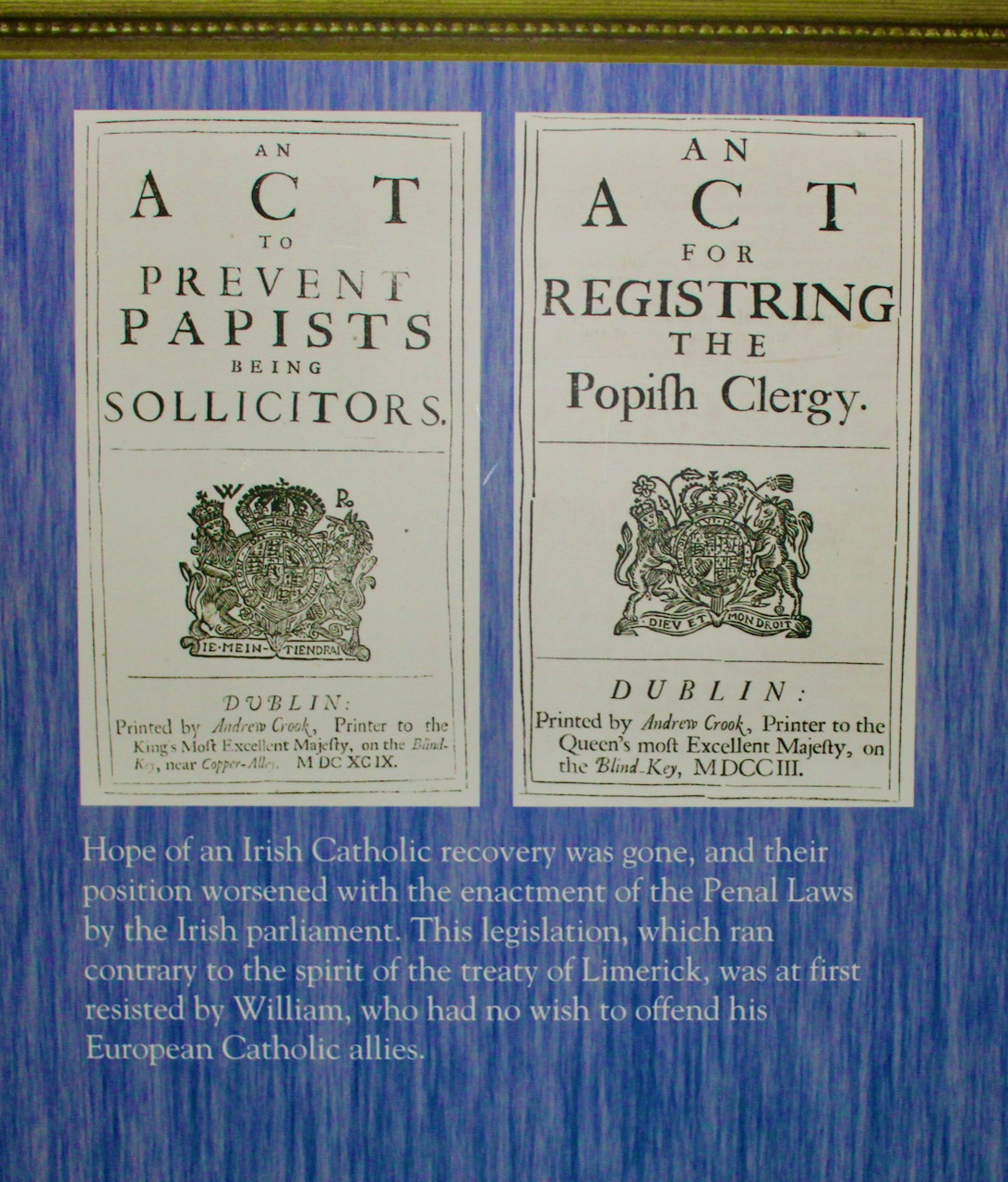
After winning the battle, William gained control of Dublin and the east of Ireland. However, the war continued until the Battle of Aughrim in July 1691, which led to the surrender at Limerick the following autumn. The surrender terms promised limited guarantees to Irish Catholics and allowed the soldiers to return home or to go to France. The Irish Parliament however then enacted the Penal Laws, which ran contrary to the treaty of Limerick and which William first resisted, as he had no wish to offend his European Catholic allies.
Oldbridge House, County Meath.
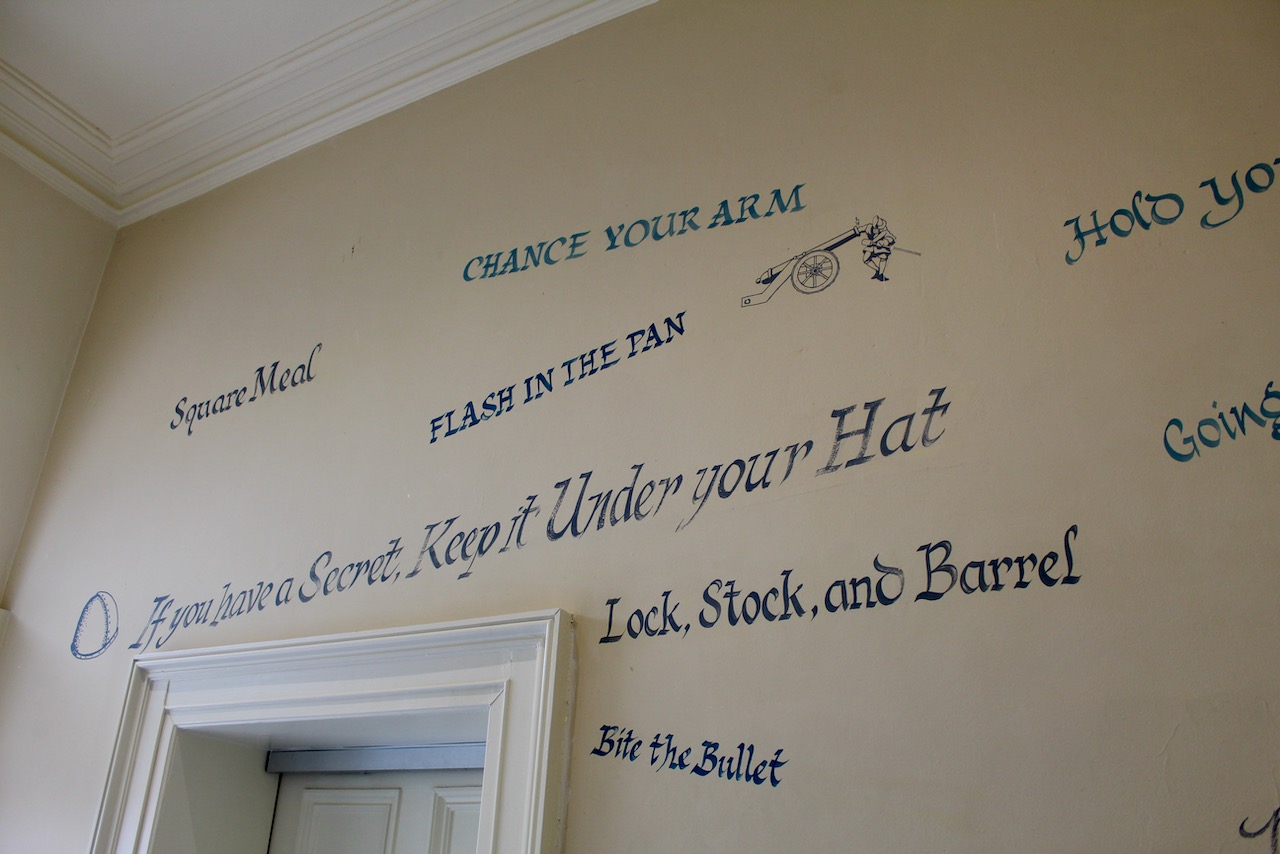
Many phrases can be traced back to the Battle of the Boyne, such as those written on the wall in the museum. Photograph © Jennifer Winder-Baggot, www.irishhistorichouses.com

John Coddington (1691-1740) purchased the land in 1729 from Henry Moore the 4th Earl of Drogheda. John’s father Dixie (1665-1728) fought in the Battle of the Boyne in 1690 on the side of King William III. The unusual name “Dixie” comes from the maternal side, as Dixie’s father Captain Nicholas Coddington of Holm Patrick (now Skerries) in Dublin married as his second wife Anne Dixie, possibly a daughter of Sir Wolstan Dixie, 1st Baronet (1602-1682).

John married Frances Osbourne in 1710, and with the marriage came property in County Meath including Tankardstown. Tankardstown House is a boutique hotel and a section 482 property (see my entry https://irishhistorichouses.com/2020/07/11/tankardstown-estate-demesne-rathkenny-slane-co-meath/ ). John Coddington served as High Sheriff of County Meath in 1725, before he acquired the property at Oldbridge.

John’s son, also named John, predeceased him, tragically drowning in the Boyne. In the Meath History Hub Noel French recounts a story about how a young woman refused to marry John because she dreamed that he would die, as he did, before the age of twentyone. [1] I have obtained most of my information in today’s entry from the wonderfully informative Meath History Hub website.

Noel French tells us that the office of High Sheriff had judicial, electoral, ceremonial and administrative functions and executed high court writs. The usual procedure for appointing the sheriff from 1660 onwards was that three persons were nominated at the beginning of each year from the county and the Lord Lieutenant then appointed his choice as High Sheriff for the remainder of the year. Often the other nominees were appointed as under-sheriffs. Members of the Coddington family held the position in 1725, 1754, 1785, 1798, 1843, 1848 and 1922. [see 1]

After John’s death in 1740 the house at Oldbridge was advertised for lease, described as the house, gardens and demesne, so the house must have been built by this time. [see 1] The property passed to John’s brother Nicholas’s son, Dixie Coddington (1725-1794).

I am confused about the date of construction. According to the notice for lease, a house stood at the site in 1740. Evidence that the current house was built around 1750 however was found in an inscription on piece of baseboard of a stair removed during repairs carried out in 1960s that reads: ‘ December  1836  Patrick Kelly of the City of Dublin / Put up these Staircases. / I worked at this building from April  / till now. / 86 years from the first / Building of this house/ till now as we see by a stick like this  found.’

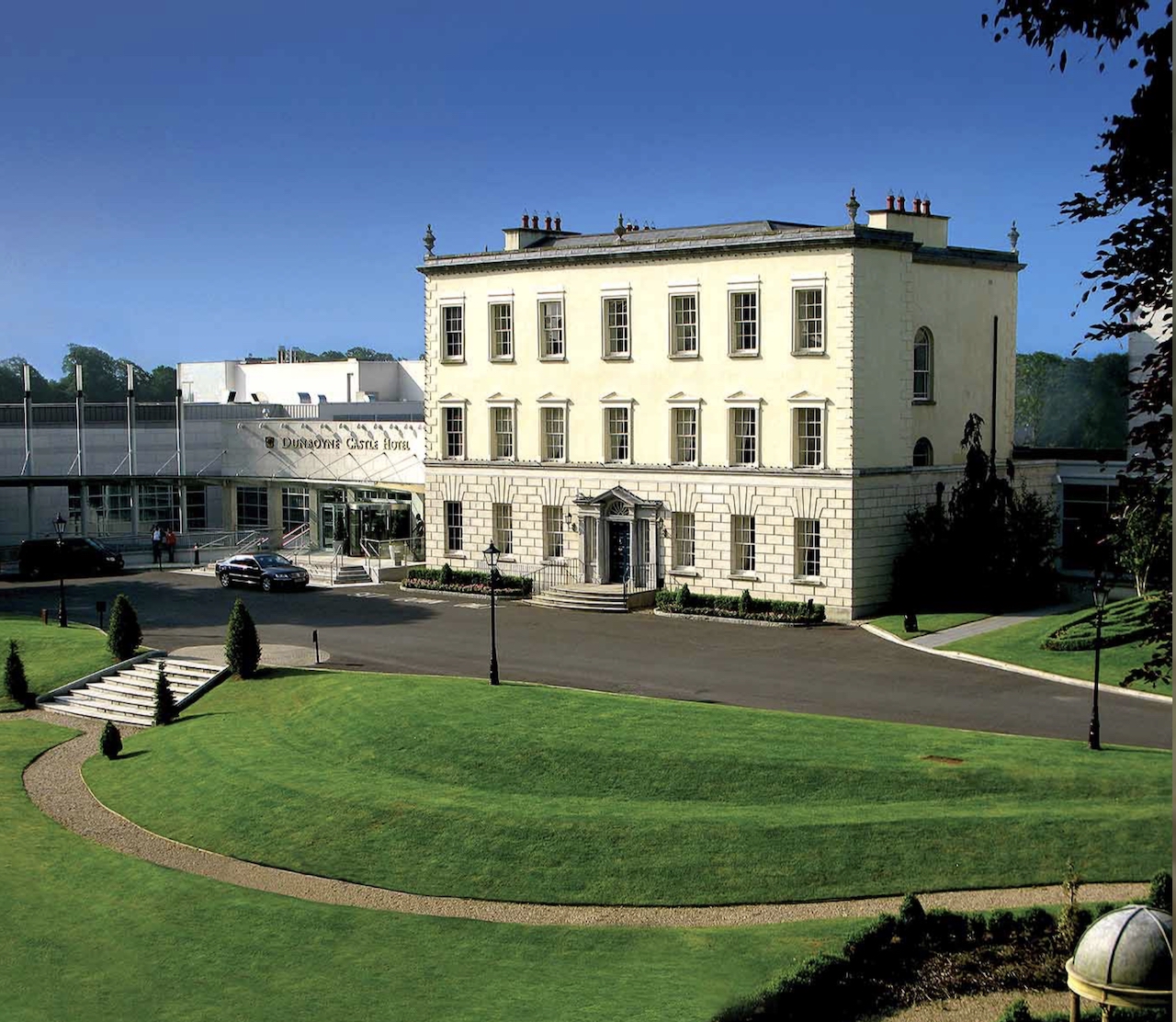
In The Buildings of Ireland: North Leinster, The Counties of Longford, Louth, Meath and Westmeath (published in 1993), Casey and Rowan accept that the house was built around 1750. They suggest that it may have been designed by George Darley (1730-1817), due to affinities with Dowth Hall nearby and to Dunboyne Castle.
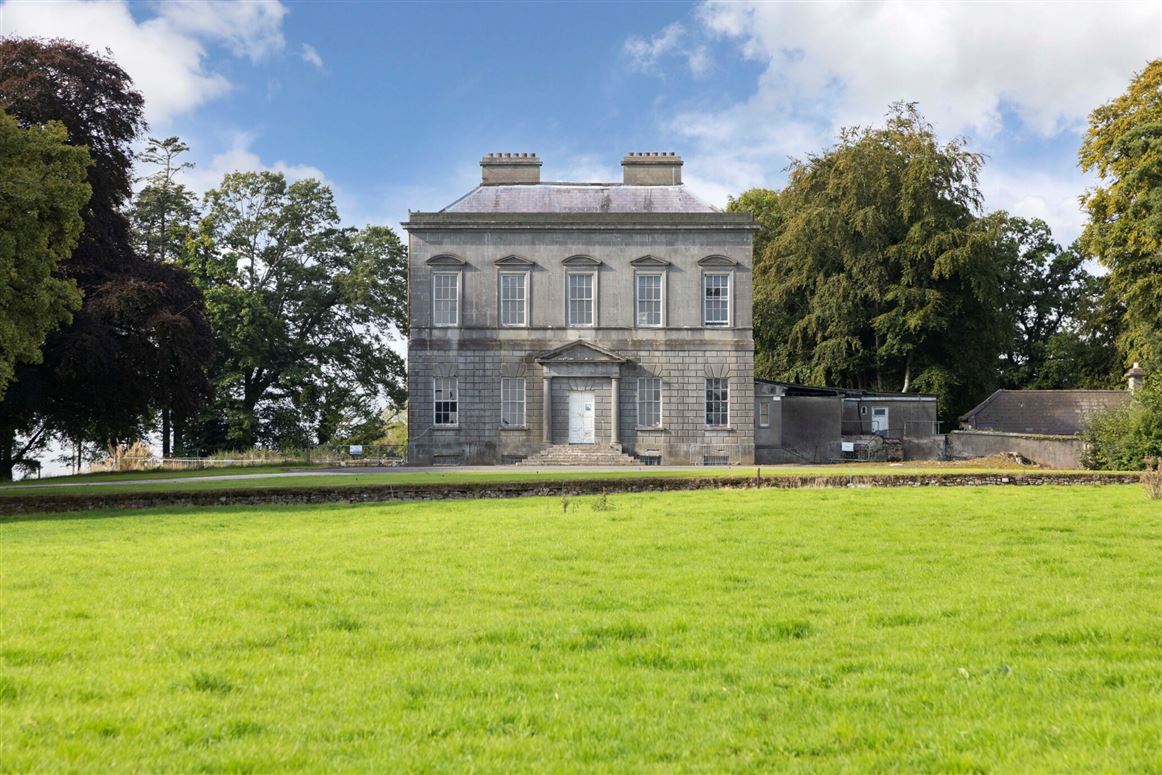
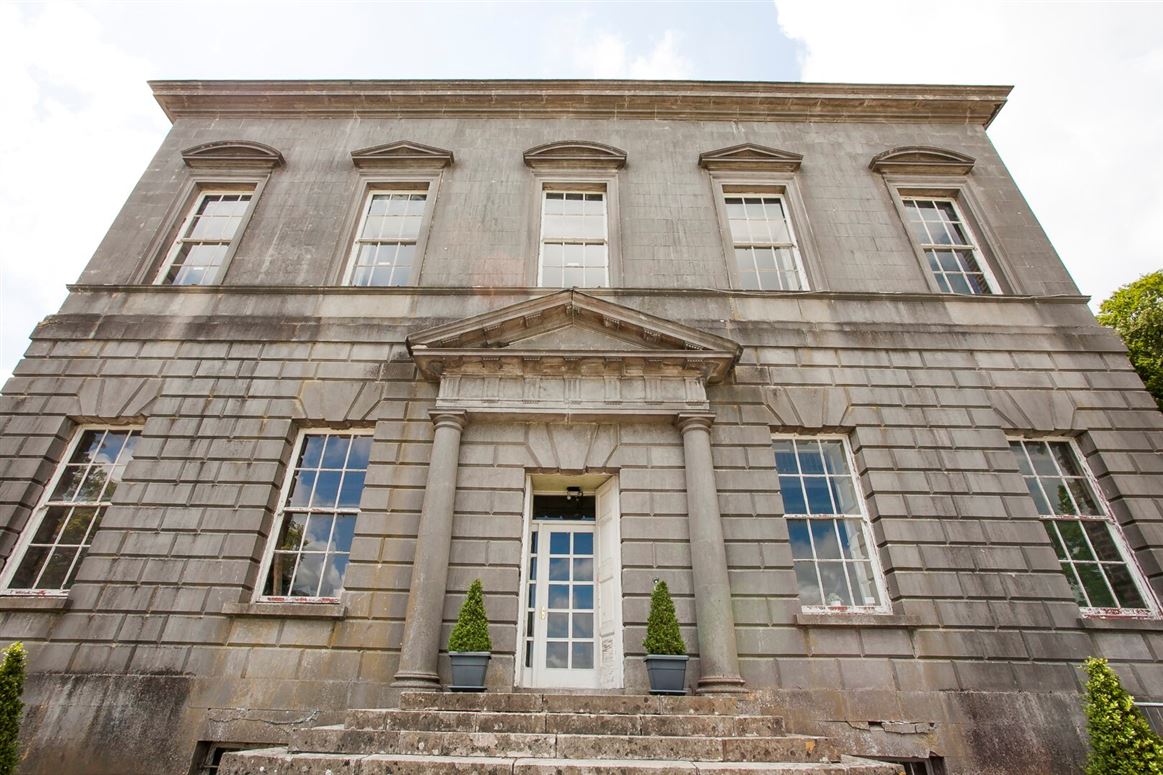
Dowth Hall, County Meath, photograph courtesy Sherry Fitzgerald.
Dunboyne Castle, County Meath, now a hotel, photograph courtesy of hotel website.
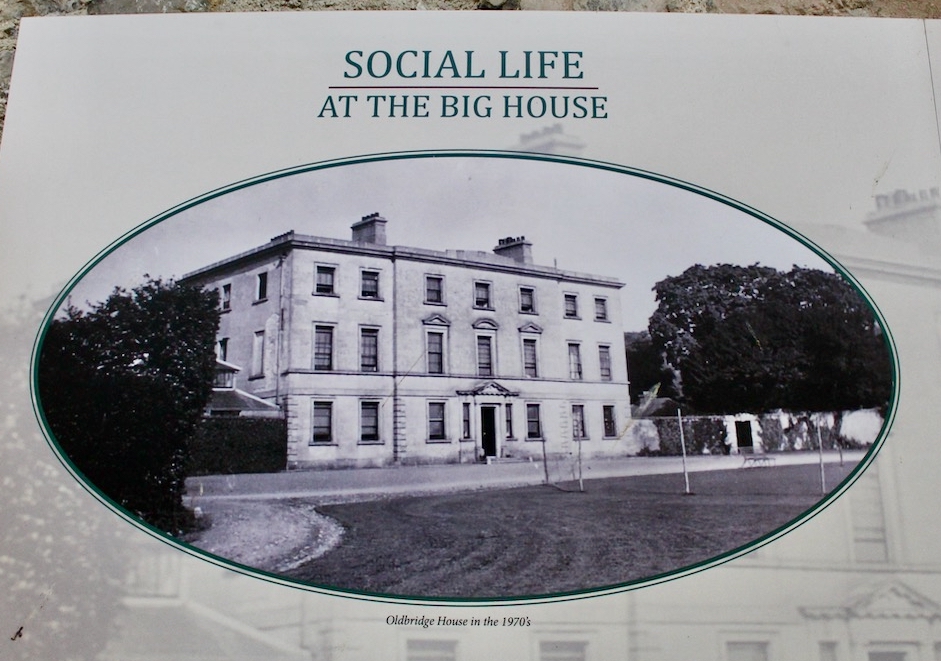
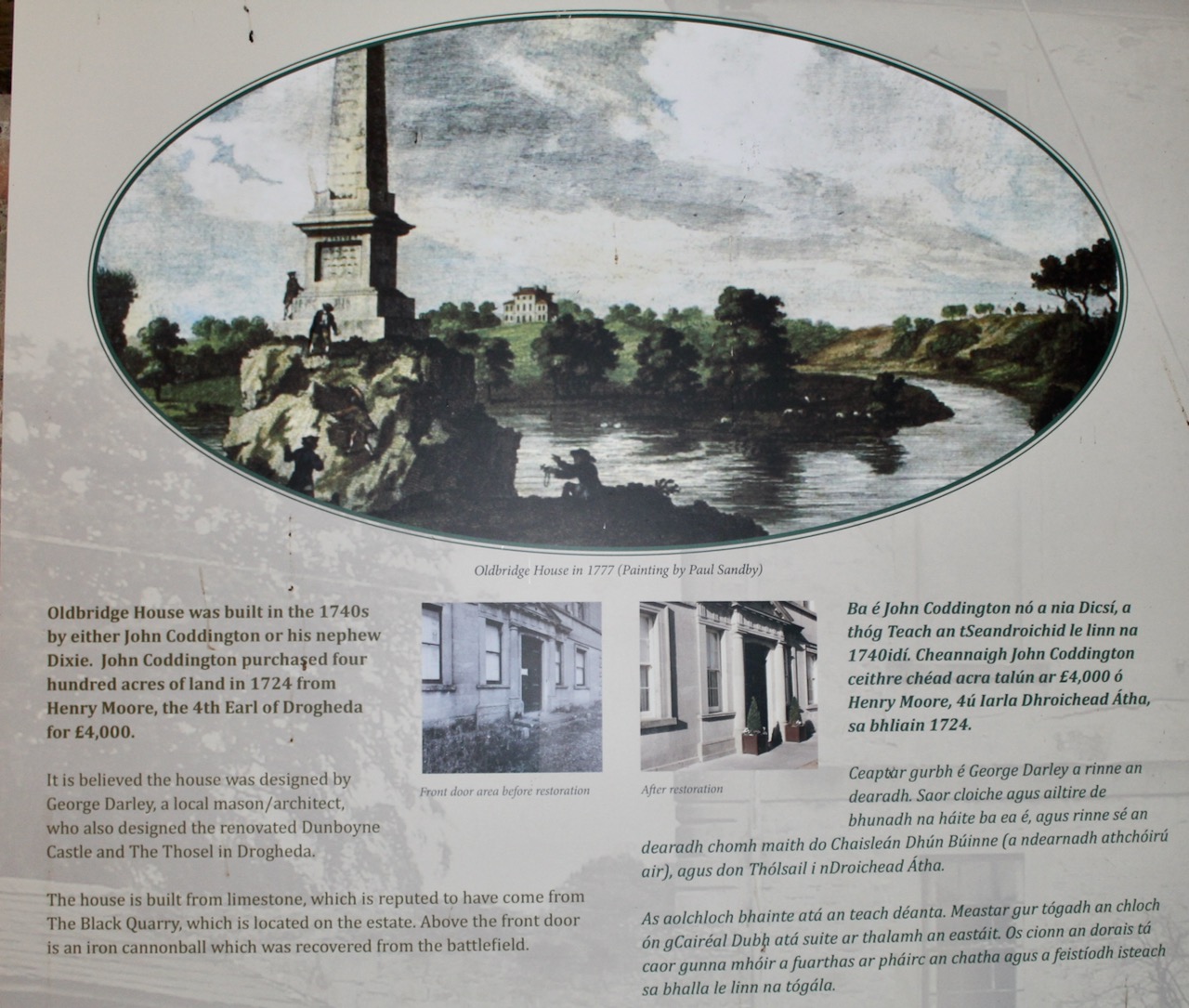
Signage at Oldbridge House, County Meath, including an old photograph of the house.

The house is three storey with a plain ashlar frontage of seven bays, with the centre three slightly advanced. Christine Casey and Alistair Rowan tell us in The Buildings of Ireland: North Leinster, The Counties of Longford, Louth, Meath and Westmeath (published in 1993) that the house was originally designed as a three bay three storey block with low single-storey wings, and the upper stories of the wings were added later. [2]

In the early nineteenth century two floors were added to each wing. Casey and Rowan tell us that this was apparently carried out by Frederick Darley (1798-1872).

Quadrant walls link the house to its park, with rusticated doors.
Photograph © Jennifer Winder-Baggot, www.irishhistorichouses.com

It has a centrally located tripartite doorcase with pilasters surmounted by a closed pediment, which holds a canonball from the fields of the Battle of the Boyne. It has a string course between ground and first floors and sill course to first floor, and three central windows on first floor with stone architraves. [3]
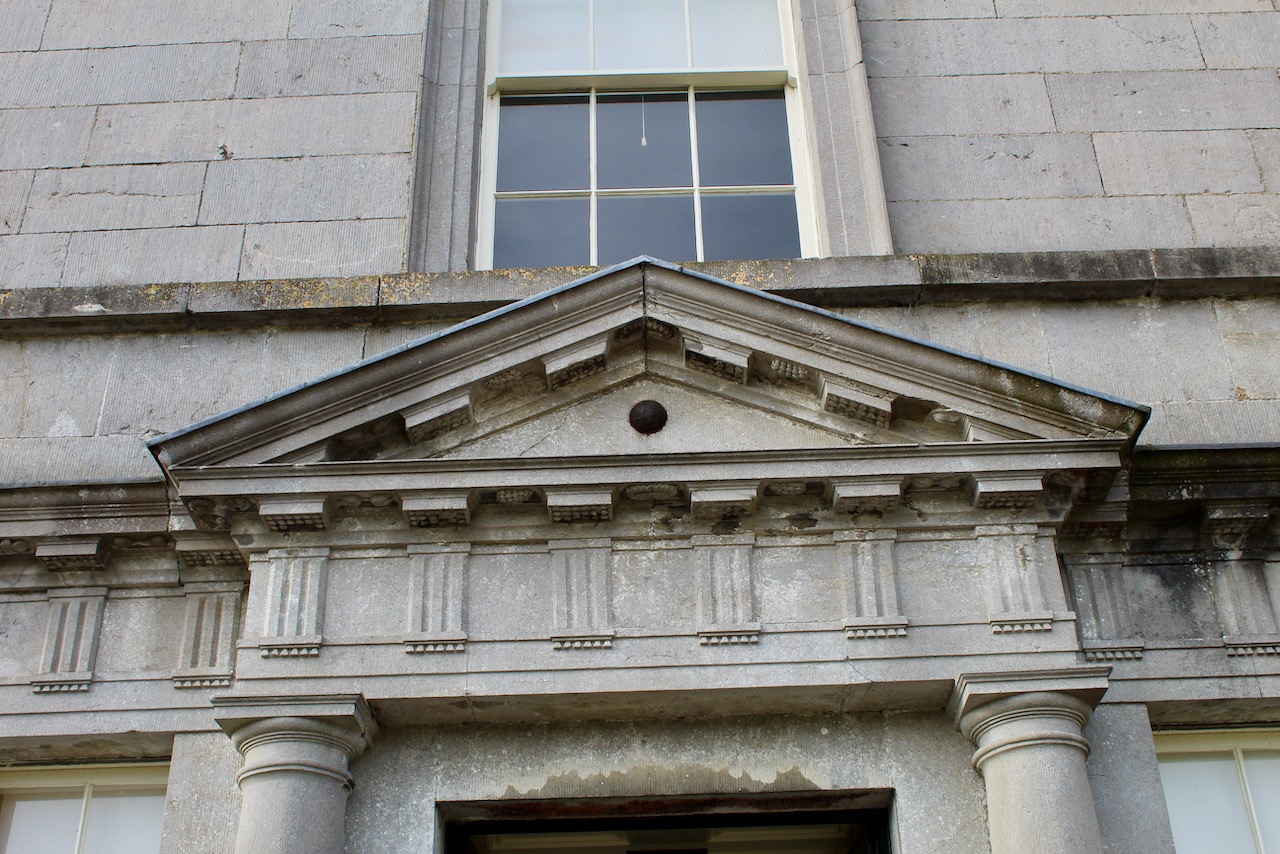
Oldbridge House, County Meath, October 2019. The inset canonball was recovered from the field from the Battle of the Boyne. Photograph © Jennifer Winder-Baggot, www.irishhistorichouses.com

Dixie Coddington (1725-1794) married Catherine Burgh, daughter of Thomas Burgh (1696-1754) of Burgh (or Bert) house in County Kildare. Burgh Quay in Dublin is named after a sister of Thomas Burgh’s, Elizabeth, who was the wife of the Speaker of the House in Ireland, Anthony Foster. Thomas Burgh’s uncle, another Thomas Burgh (1670-1730), was Surveyor General and architect.

On 13 April 1757 Dixie Coddington of Oldbridge sold Tankardstown. [see 1]

Dixie Coddington served as MP for Dunleer, County Louth. He and his wife had several daughters who all died in infancy, and no son, so Oldbridge passed to his brother, Henry Coddington (1728-1816). Dixie had previously leased Oldbridge to his brother, and has spent most of his life living in Dublin on Raglan Road. [see 1]

Henry Coddington (1728-1816) was father to Stephen’s ancestor Elizabeth. Henry was a barrister, and served as MP for Dunleer, County Louth, and he married Elizabeth Blacker from Ratheskar, County Louth. He served as High Sheriff for County Louth, then for County Meath, and was Deputy Serjeant-at-Arms between 1791 and 1800. He served as Justice of the Peace also for Counties Louth and Meath.

Henry and Elizabeth’s son Nicholas (1765-1837) followed in his father’s footsteps, and served as MP for Dunleer before the Act of Union in 1800, and also served as high sheriff for counties Louth and Meath. Nicholas and his son, Henry Barry, carried out a number of improvements on the estate. The house was re-modelled in the 1830s to the drawing of Frederick Darley. [see 1]

The Oldbridge Estate then passed to Henry-Barry Coddington, son of Nicholas. Henry-Barry Coddington was born on May 22nd in the year 1802; he was the eldest surviving son of Nicholas Coddington and Laetitia Barry. Henry Barry took a Grand Tour of Europe and kept a diary. He married Maria Crawford, eldest daughter of William Crawford of Bangor Co. Down in 1827.

Noel French tells us of Maria Crawford’s father and his role in tenant land rights:

William Sharman Crawford, was the owner of 5,748 acres in County Down … as well as 754 acres at Stalleen in County Meath. William Sharman Crawford took an active interest in politics. He is best known for his advocacy of Tenant Right – the Ulster Custom which gave a tenant greater security through the three “f”s: fair rent, fixity of tenure and free sale of goodwill. Crawford called this “The darling object of my heart”. This idea was not popular with other landlords, but Crawford remained a strong advocate of it for the rest of his life. In 1843 Crawford managed to persuade Sir Robert Peel, the Conservative prime minister, to establish the Devon Commission to investigate the Irish land question. Tenant right, the subject of eight successive bills drafted by Sharman Crawford, was eventually conceded in the Land Acts of 1870 and 1881.”

Despite the admirable work of his father-in-law, Henry-Barry Coddington was a slave owner. He inherited an estate in Jamaica from his great uncle, Fitzherbert Richards. The estate, Creighton Hall in the parish of St. Davids in Jamaica, had previously belonged to Fitzherbert’s brother Robert Richards. The estate was 1165 acres. 399 acres was planted with sugar cane in 1790. The plantation produced sugar, rum, molasses, cotton, ginger, coffee, cocoa and pimento. [see 1]

In A Parliamentary Return of 1837-38, which listed names of those who claimed a loss of “property” after slavery was abolished in 1834, Henry-Barry Coddington was recorded as the `Master` to 235 enslaved individuals. It seems, however, that Coddington was unsuccessful in his claim for compensation.

The property at Oldbridge passed to a son, John Nicholas Coddington (1828-1917) and then to his son Arthur Francis by his first wife, Lelia Jane Naper (d. 1879) of nearby Loughcrew House, a Section 482 property (see my entry https://irishhistorichouses.com/2023/09/21/loughcrew-house-loughcrew-old-castle-co-meath/ ).

Oldbridge House was occupied by the National Army in July 1922. In 1923 Arthur F. Coddington of Oldbridge brought a claim against the government for damages done by the National Army forces when they occupied Oldbridge House. The repairs included slates, plumbing, painting and six trees felled.[see 1]
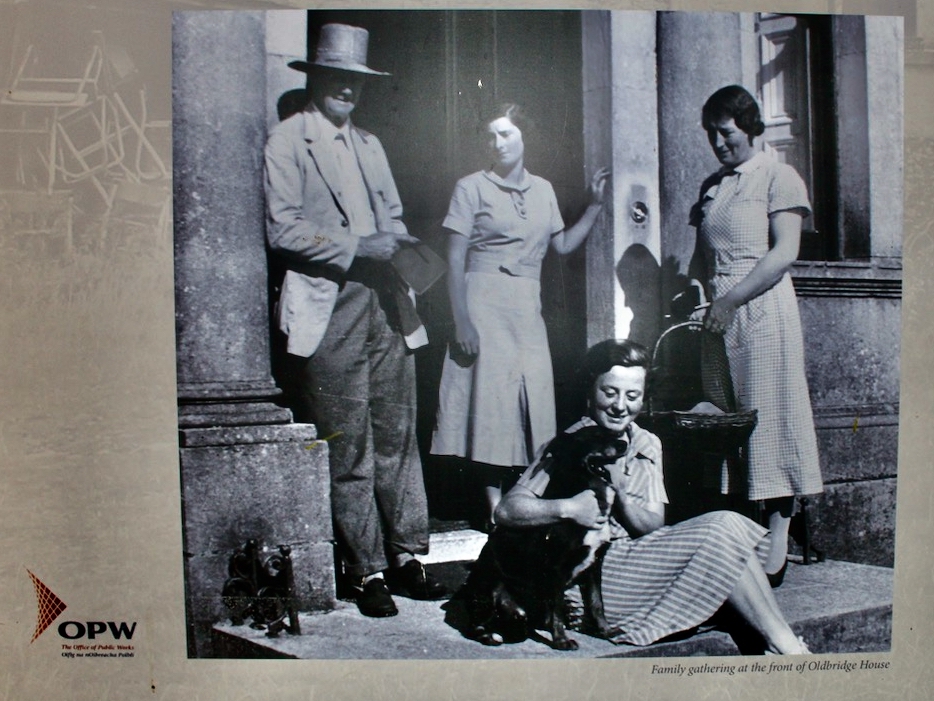
Captain Arthur Coddington, his daughter Diana with the dog, Arthur’s wife Dorothea née Osborne from Smithstown, Julianstown in County Meath, and possibly Denise another daughter.

Arthur’s son Dixie fought in World War II then returned to live in Oldbridge, where he began a commercial market gardening business, and where he trained young people in horticulture.

The Meath History hub tells us that in 1982 a gang broke into Oldbridge House and stole £600,00 in antiques. Two years later, Dixie’s son Nicholas and his wife were held at gunpoint for eleven terrifying hours in their house. Among the items stolen was an eight-foot picture of King William III, dating back to 1700, a number of landscape paintings and a number of family portraits. The haul included items that had been recovered from the robbery two years previously. In 1984 Nicholas Coddington put the house and contents up for sale.

Oldbridge House was purchased by the state in 2000 as part of the Good Friday Peace Agreement, and renovation began.
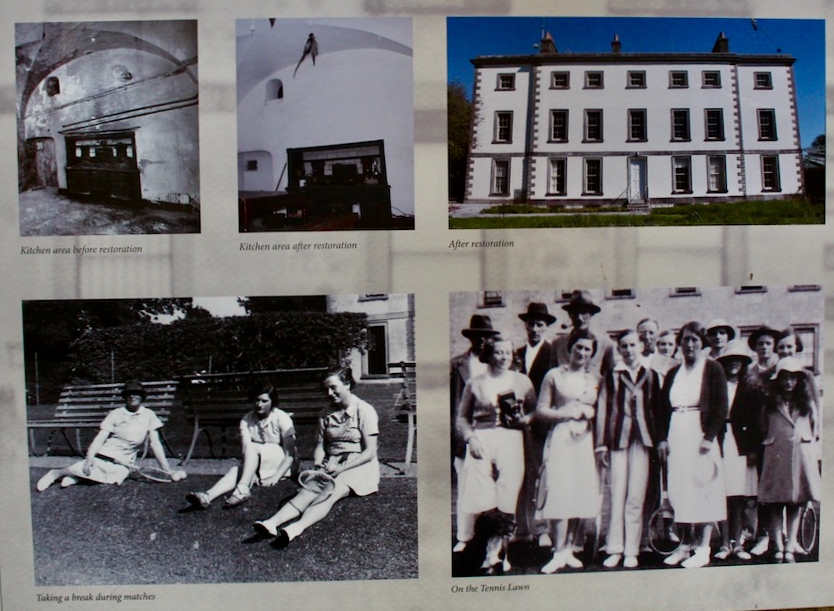
Oldbridge House, County Meath. Coddington photographs of a tennis match at the house.

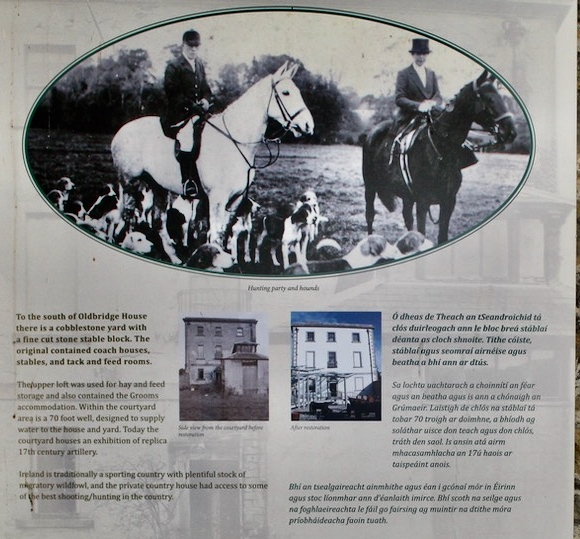
To the left of the house there is a cobble stone stable yard with fine cut stable block. This originally contained coach houses, stables, tack and feed rooms.

To the right of the house is a small enclosed courtyard which contains the former butler’s house.
Oldbridge House, County Meath.
Oldbridge, County Meath, October 2019. Photograph © Jennifer Winder-Baggot, www.irishhistorichouses.com

The gardens of Oldbridge House have been restored, with an unusual sunken octagonal garden, peach house, orchard and herbaceous borders, with a tearoom in the old stable block. Throughout the year outdoor theatre, workshops and events such a cavalry displays and musket demonstrations help to recreate a sense of what it might have been like on that day in July 1690.

Oldbridge, County Meath, October 2019. Photograph © Jennifer Winder-Baggot, www.irishhistorichouses.com

[1] https://meathhistoryhub.ie/coddingtons-of-old-bridge/

[2] p. 446. Casey, Christine and Alistair Rowan, The Buildings of Ireland: North Leinster, The Counties of Longford, Louth, Meath and Westmeath. Penguin Books, UK, 1993.
[3] https://www.buildingsofireland.ie/buildings-search/building/14402016/oldbridge-house-oldbridge-sheephouse-co-meath

Leinster House, Dublin

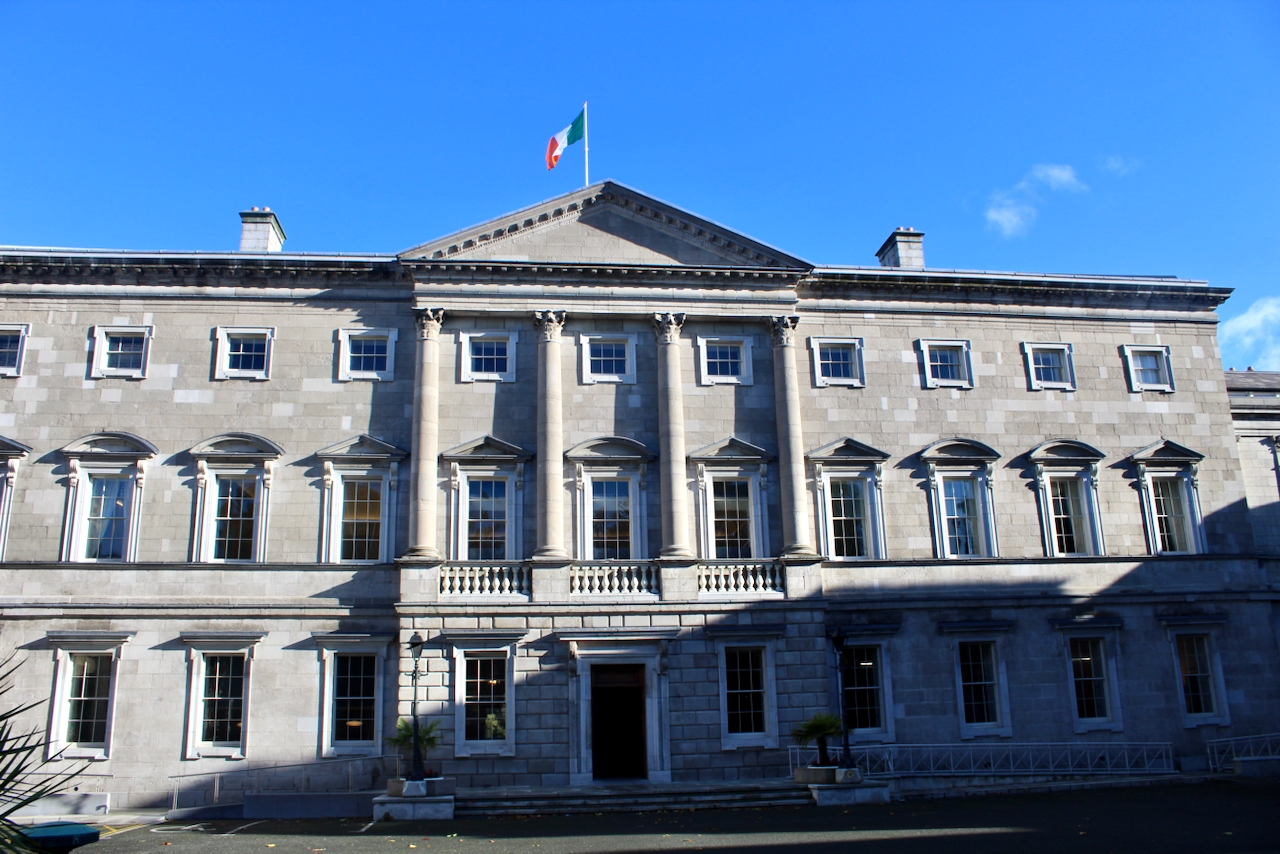
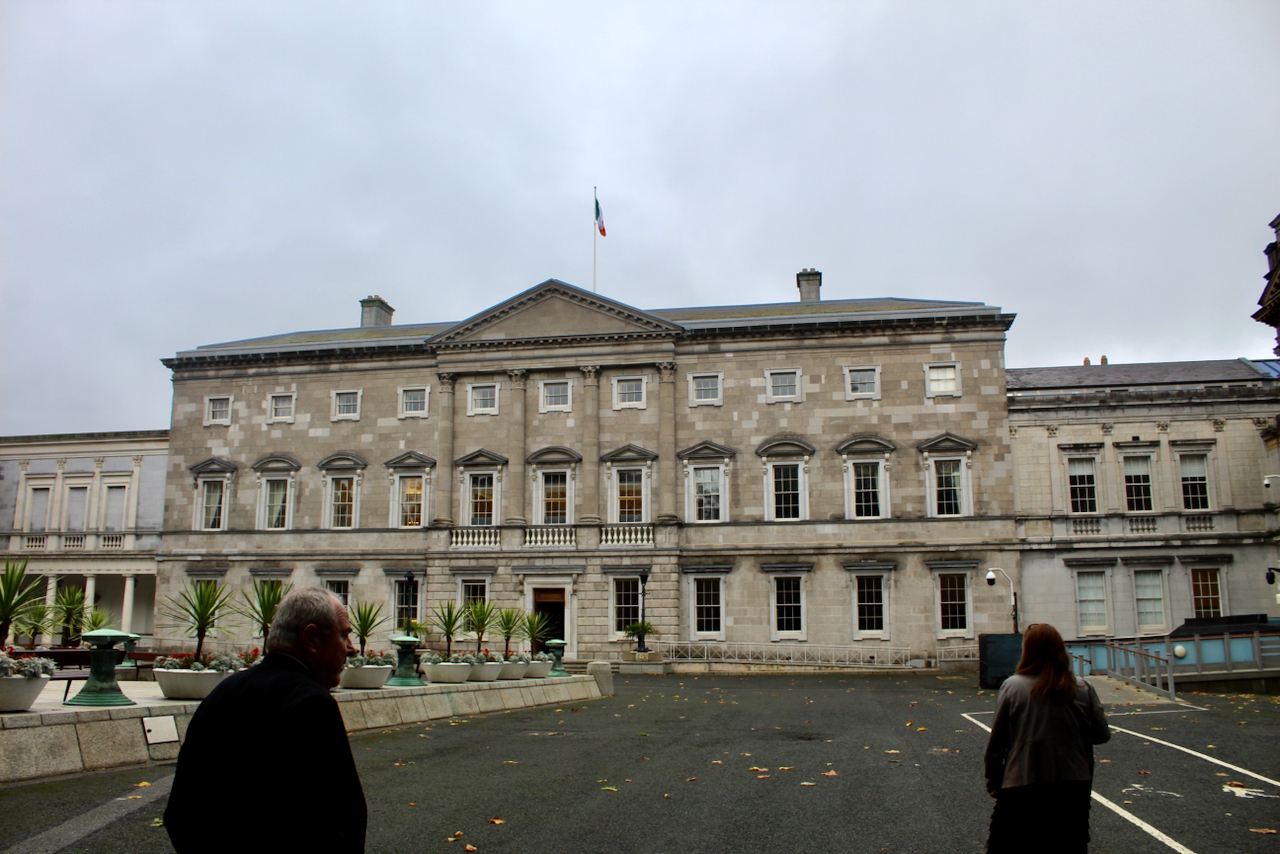
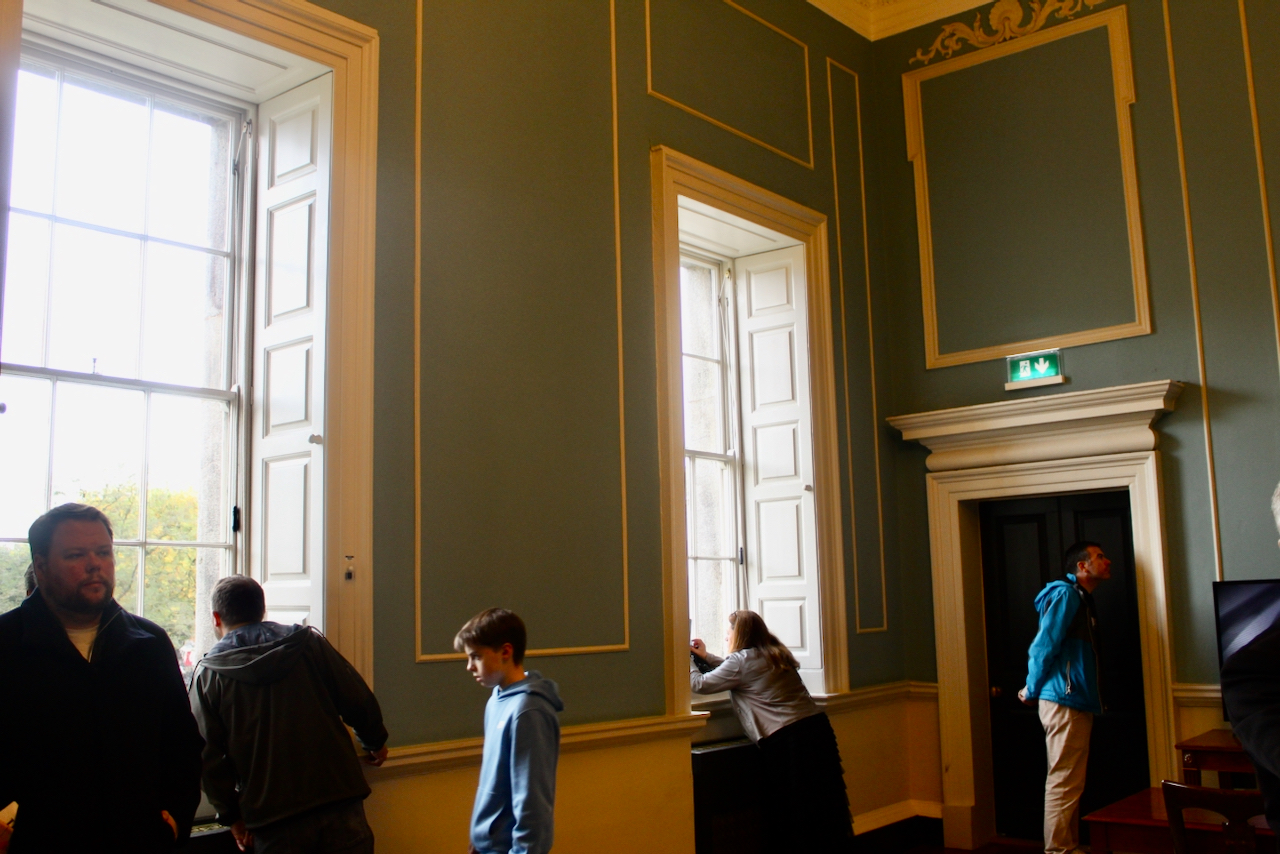
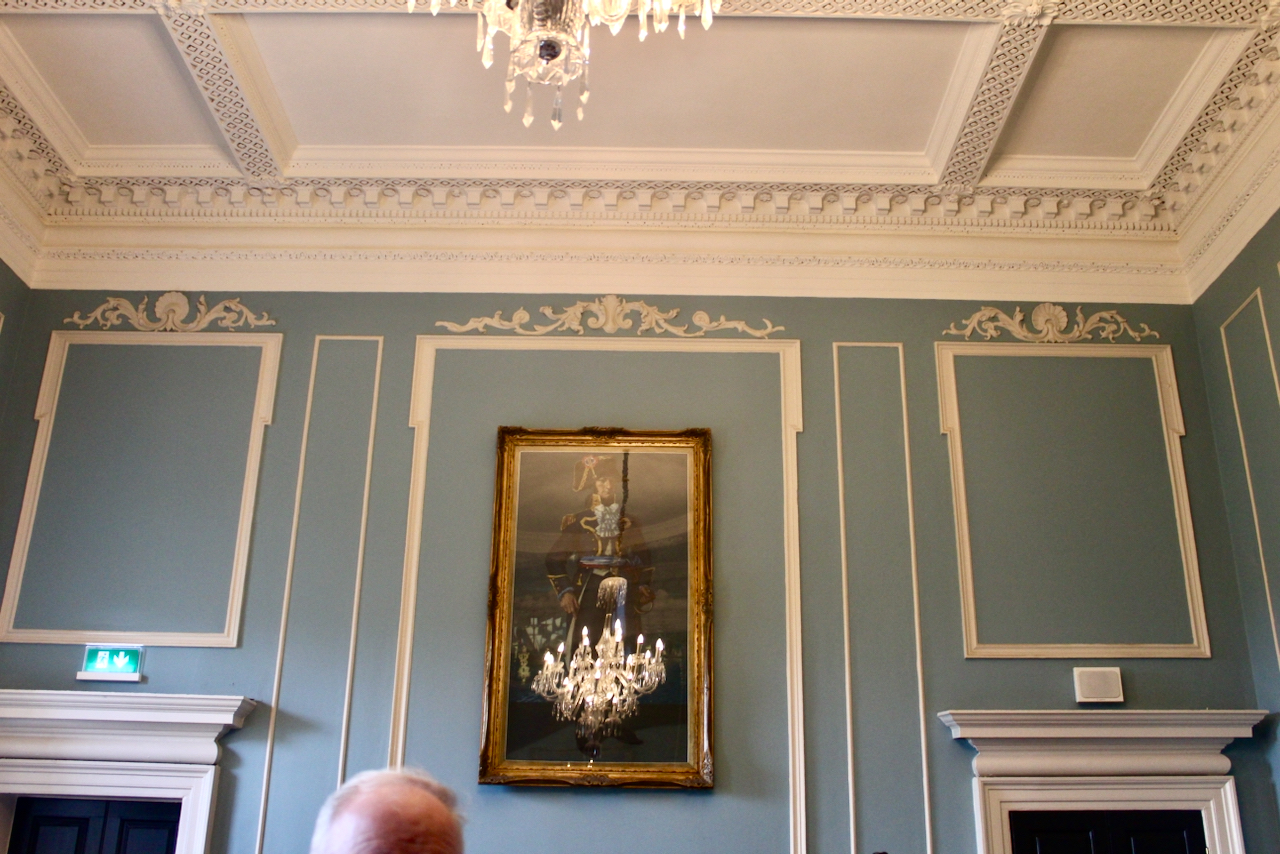
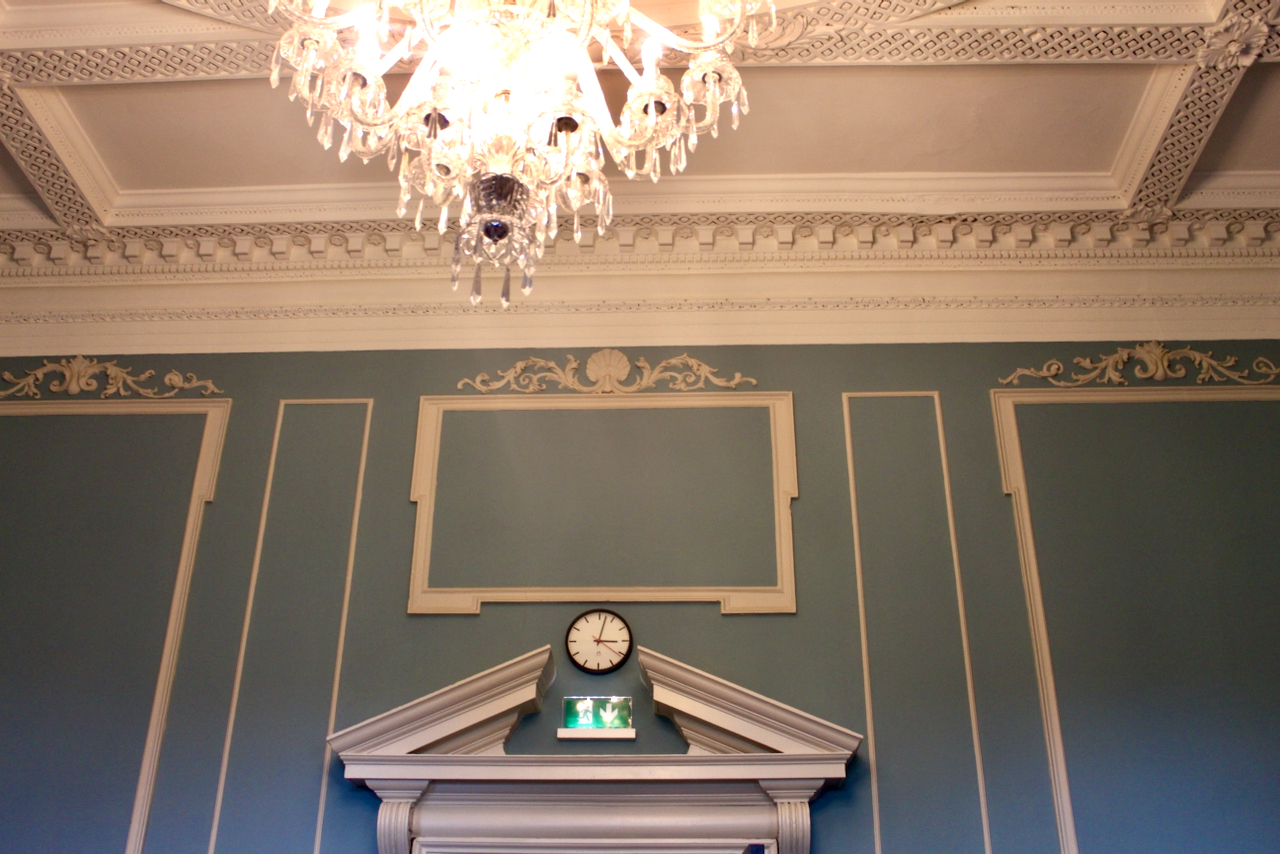
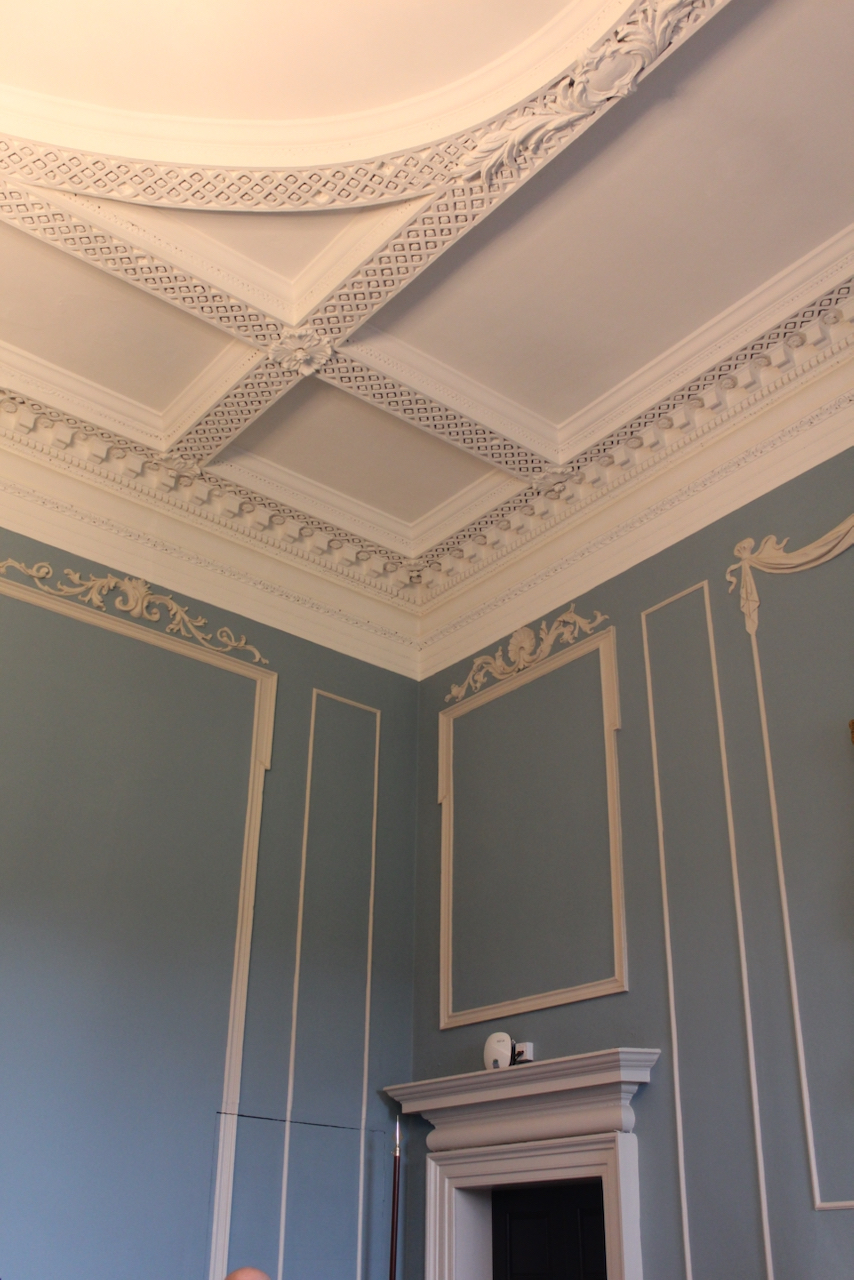
We visited Leinster House, the seat of Irish Government, during Open House Dublin 2025. We were lucky to get tickets! Open House Dublin events book out almost immediately.

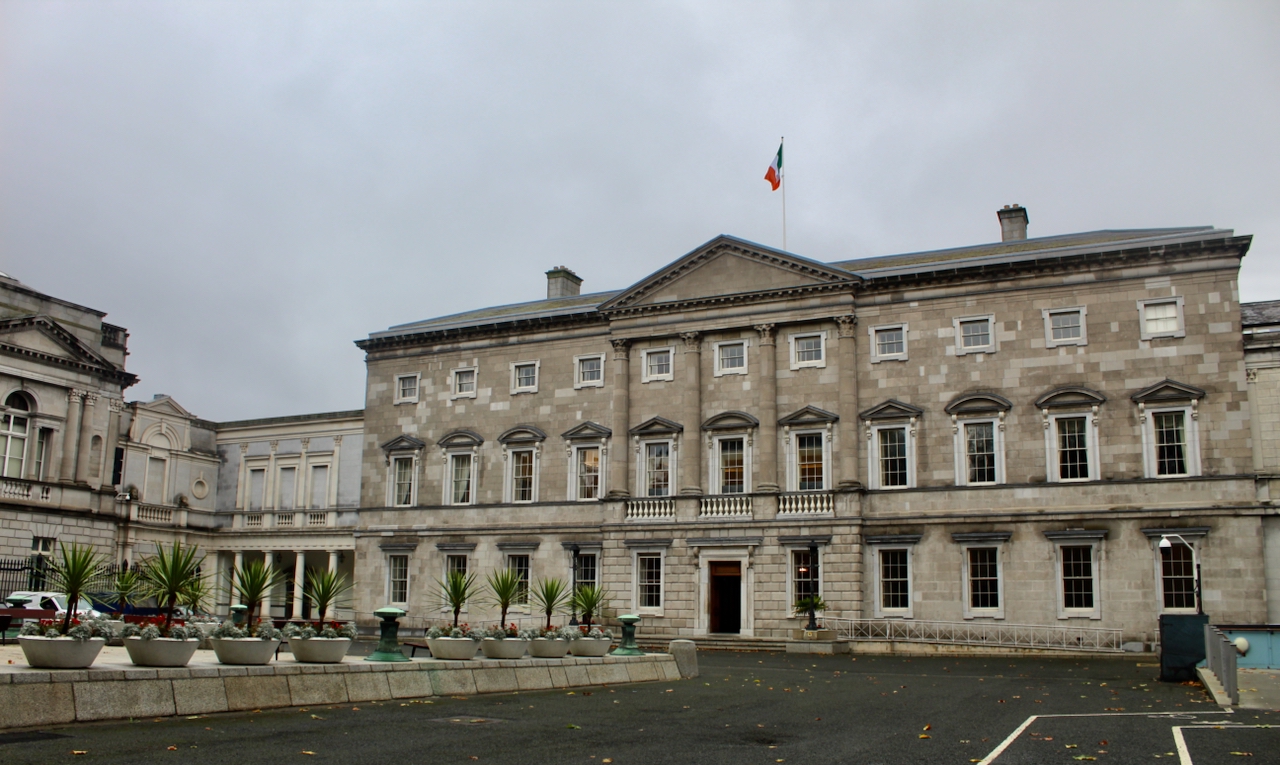
Leinster House, Dublin, October 2025. Photograph © Jennifer Winder-Baggot, www.irishhistorichouses.com.

Leinster House was built from 1745-1752 for James Fitzgerald (1722-1773) 20th Earl of Kildare and first Duke of Leinster.

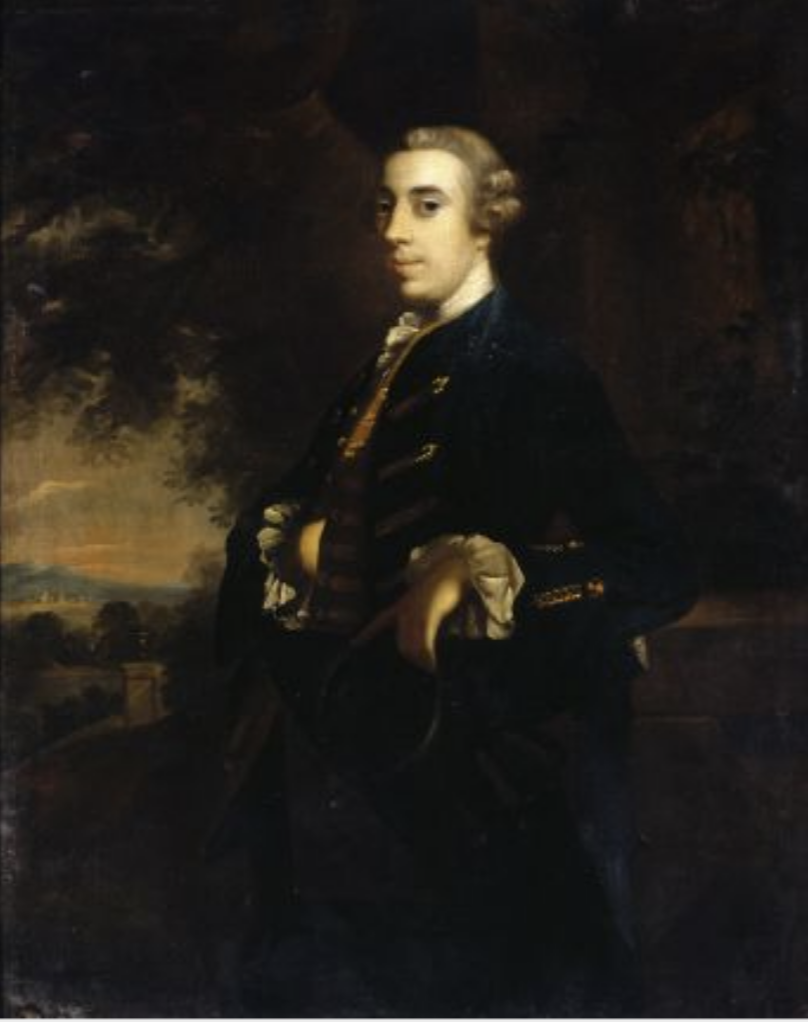
James Fitzgerald (1722-1773) 20th Earl of Kildare later 1st Duke of Leinster, by Robert Hunter c. 1803, courtesy of National Gallery of Ireland.

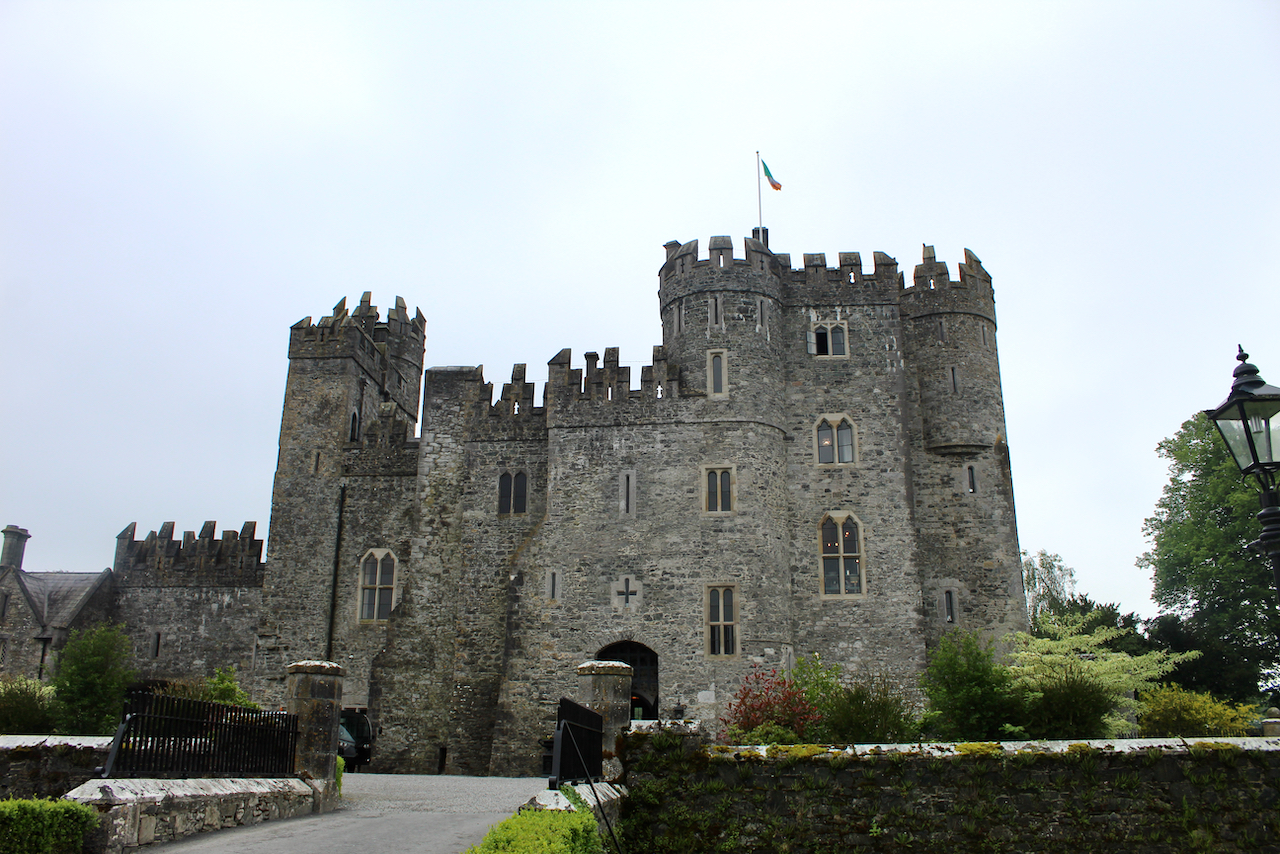
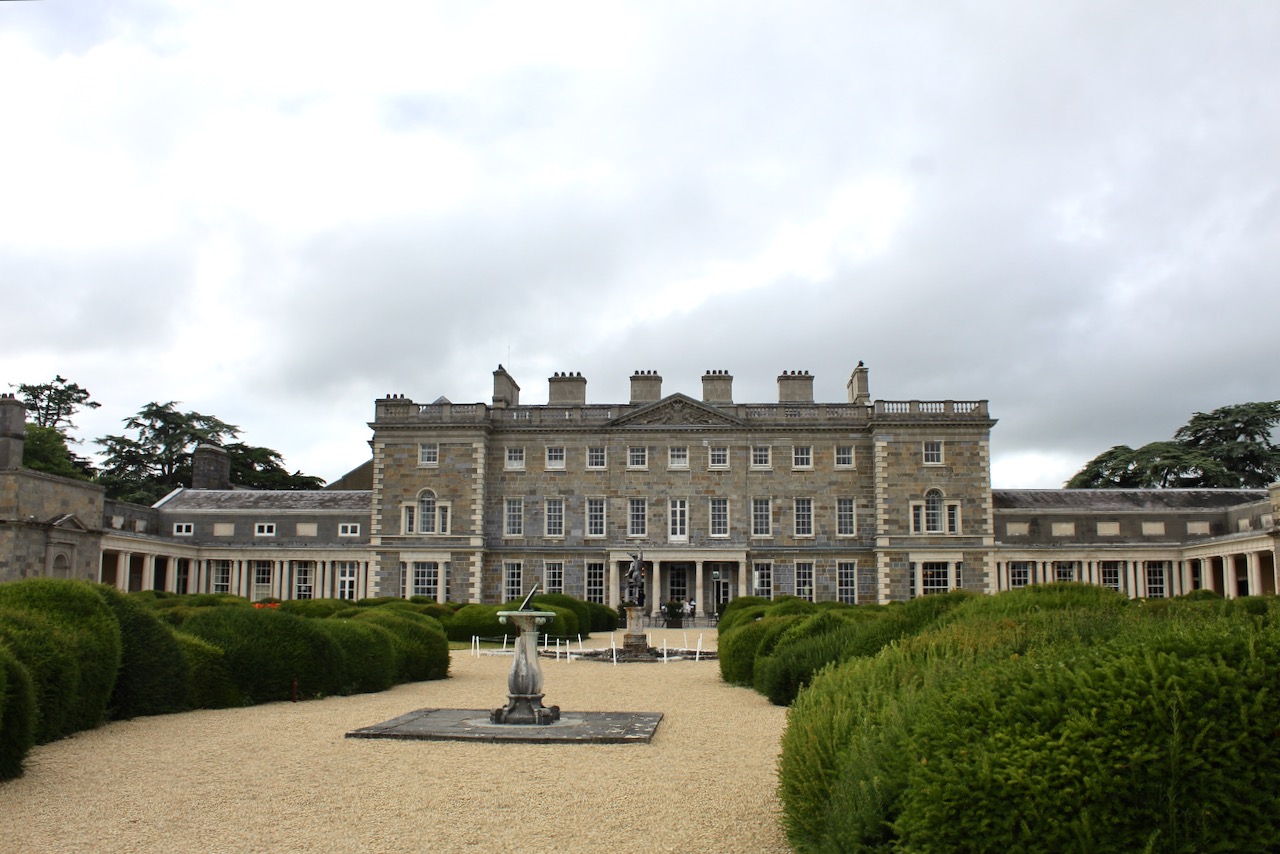
James’s father, Robert FitzGerald (1675-1744) 19th Earl of Kildare, made Carton in County Kildare his principal seat and employed Richard Castle (1690-1751) from 1739 to enlarge and improve the house (see my entry https://irishhistorichouses.com/2024/06/04/carton-house-county-kildare-a-hotel/ ). Before that, the Earl of Kildare had lived in Kilkea Castle in County Kildare.

Kilkea Castle, County Kildare. Photograph © Jennifer Winder-Baggot, www.irishhistorichouses.com.

After the destruction of Maynooth Castle, occupied by Earls of Kildare, in 1641, George, 14th Earl of Kildare, resided at Kilkea Castle from 1647-1660, and it continued as the family’s principal seat until Robert, the 19th Earl, built Carton House. [1]

Robert, 19th Earl of Kildare (1675-1744) after Frederick Graves, courtesy of Adam’s auction 15th Oct 2019. Robert FitzGerald, (1675 – 1744) was married to Mary O Brien, daughter of William O’Brien 3rd Earl of Inchiquin. They had 12 children but only 2 survived to majority. They had lived quietly at Kilkea Castle, near Athy, but in 1739 Robert bought back the lease of Carton, in Maynooth, for £8,000. He commissioned Richard Castle, the eminent architect, to reconstruct the existing house. In the pediment over the South front, previously the main entrance, is the coat of arms of Robert FitzGerald and his wife Mary O’Brien. Robert also employed the La Franchini brothers to construct the wonderful ceiling in the Gold Salon. The additions to Carton were not finished when Robert died in 1744 but he left instructions in his will to finish the restoration according to his plans. A monument dedicated to Robert FitzGerald is situated in Christ Church Cathedral, Dublin. (This portrait hung in Carton until 1949 when the Fitzgerald family sold the estate. It hung in Kilkea Castle until 1960. It was in the FitzGerald family collection in Oxfordshire until 2013.)

The 20th Earl, James, employed Richard Castle from 1745 to build him a new house in the city, which is now called Leinster House, and began to be so called around 1766 when James Fitzgerald was created Duke of Leinster. He was told that this was not a fashionable area to build, as at that time most of the upper classes lived on the north side of the Liffey around Mountjoy Square and Henrietta Street. He was confident that where he led, fashion would follow, and indeed he was correct.

The garden front, which was the original front, of Carton House, County Kildare, also designed by Richard Castle. Photograph © Jennifer Winder-Baggot, www.irishhistorichouses.com.
Leinster House, Dublin, July 2022. Photograph © Jennifer Winder-Baggot, www.irishhistorichouses.com.
Leinster House, Dublin, October 2025. Photograph © Jennifer Winder-Baggot, www.irishhistorichouses.com.

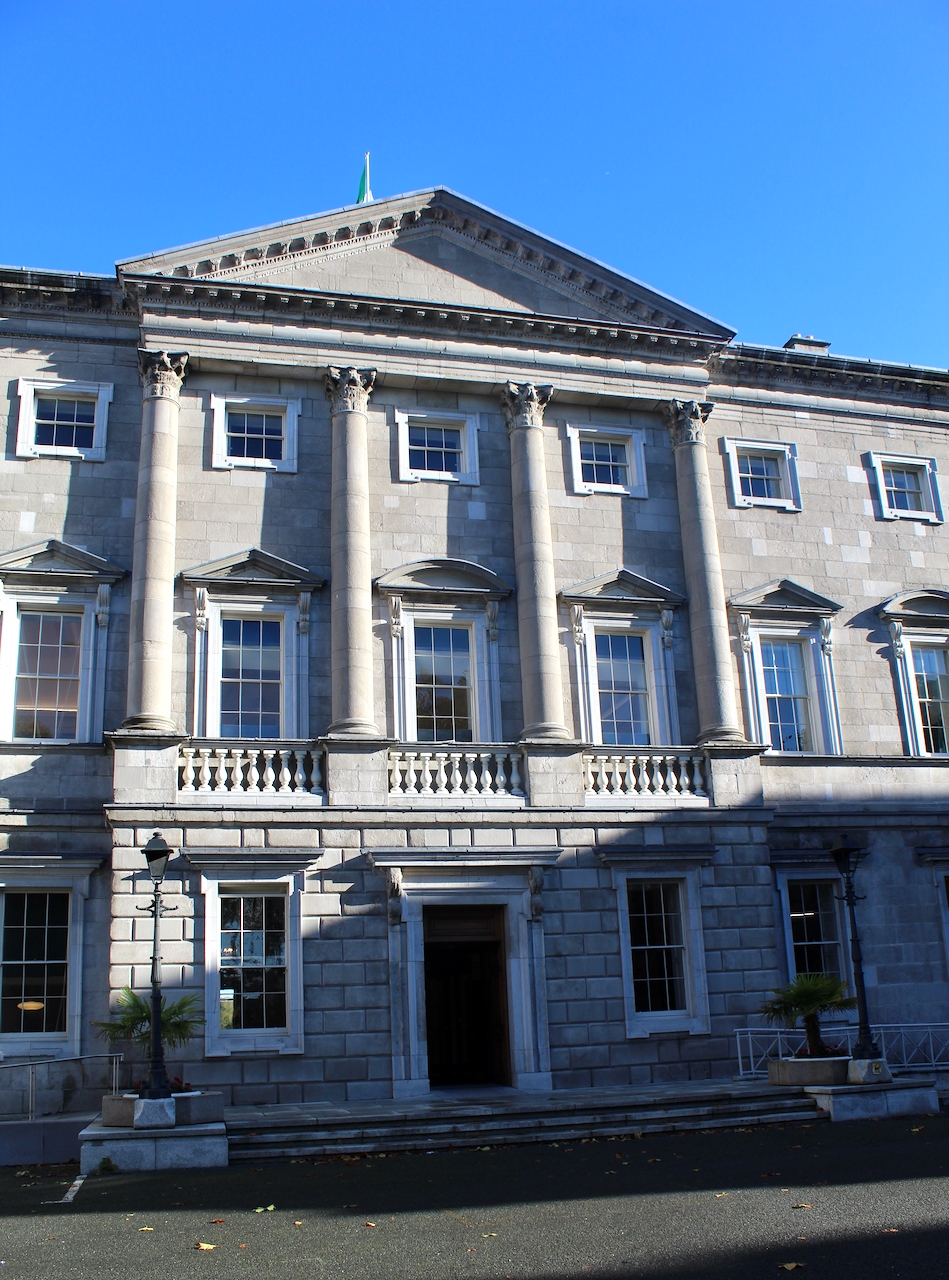
The building as it was originally constructed is a double cube of granite on the east and north fronts and Ardbraccan limestone on the west entrance front. It has a forecourt on the Kildare Street side, which Christine Casey tells us in her Dublin volume of the Pevsner series The Buildings of Ireland is in the French seventeenth century manner, which probably derived via Burlington House in London, a house which would have influenced Richard Castle. The form is Palladian, an eleven bay block of three storeys over basement with a “tetrastyle” (i.e. supported by four columns) Corinthian portico over advanced and rusticated central bays. “Rustication” in masonry is a decorative feature achieved by cutting back the edges of stones to a plane surface while leaving the central portion of the face either rough or projecting markedly, emphasising the blocks. [2]

Casey points to the unusual arrangement of pediments on the windows of the first floor, as an alternating pattern would be the norm, rather than the pairs of segmental (i.e. rounded) pediments flanked by single triangular pediments in the bays to either side of the central three windows. [see 2]

Leinster House, Dublin, October 2025. Photograph © Jennifer Winder-Baggot, www.irishhistorichouses.com.

The centre block has a balustraded balcony, and the attic and ground floor windows have lugged architraves: the architrave is the classical moulding around the window and “lug” means ear, so the windows have “ears,” otherwise called shoulders. The term “Lugs” was made famous as a nickname for a policeman in the Dublin Liberties, “Lugs” Branigan, a man known for his sticking-out ears. A heavyweight boxing champion, he had a reputation as the country’s toughest and bravest garda. The ground floor windows have are topped with a further cornice – a horizontal decorative moulding.

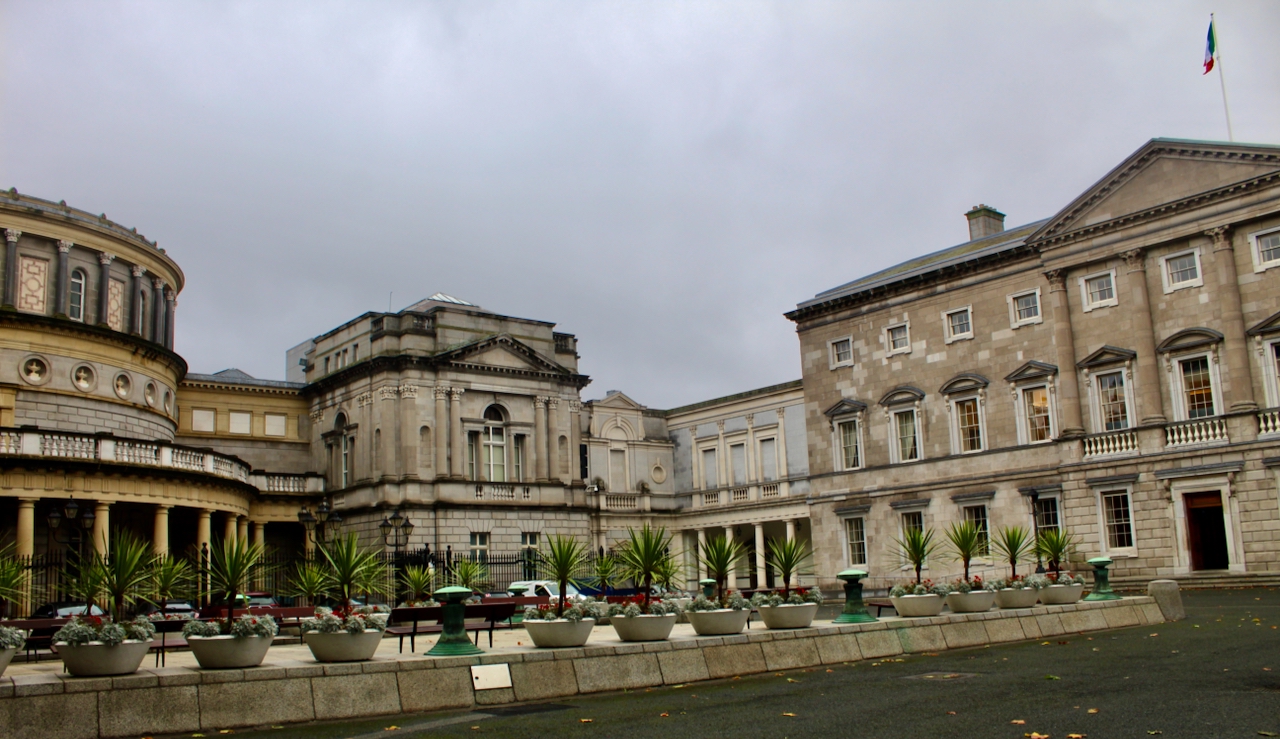
Originally, Casey writes, the house was linked to the side walls of the forecourt by low five-bay screen walls with Doric colonneads and central doorcases flanked by paired niches. The colonnade was given a pilastered upper storey in the nineteenth century, and was rebuilt in the 1950s when the colonnade was filled in, Casey explains. The lower storey on the left side when facing the building (north side) still has the colonnade: you can compare the stages of building the colonnades in the pictures below. In fact this colonnade was reinstated after being filled in. It was recently (when written before 2005) reinstated, Casey tells us, by Paul Arnold Architects, and topped with the nineteenthy century screen wall above which we see today.

Design for Leinster House by Richard Castle 1745, courtesy of Irish Architectural Archive.
What remains of the original colonnades on either side of the main house. Leinster House, Dublin, October 2025. Photograph © Jennifer Winder-Baggot, www.irishhistorichouses.com.
Leinster House, Dublin, October 2025. Photograph © Jennifer Winder-Baggot, www.irishhistorichouses.com.
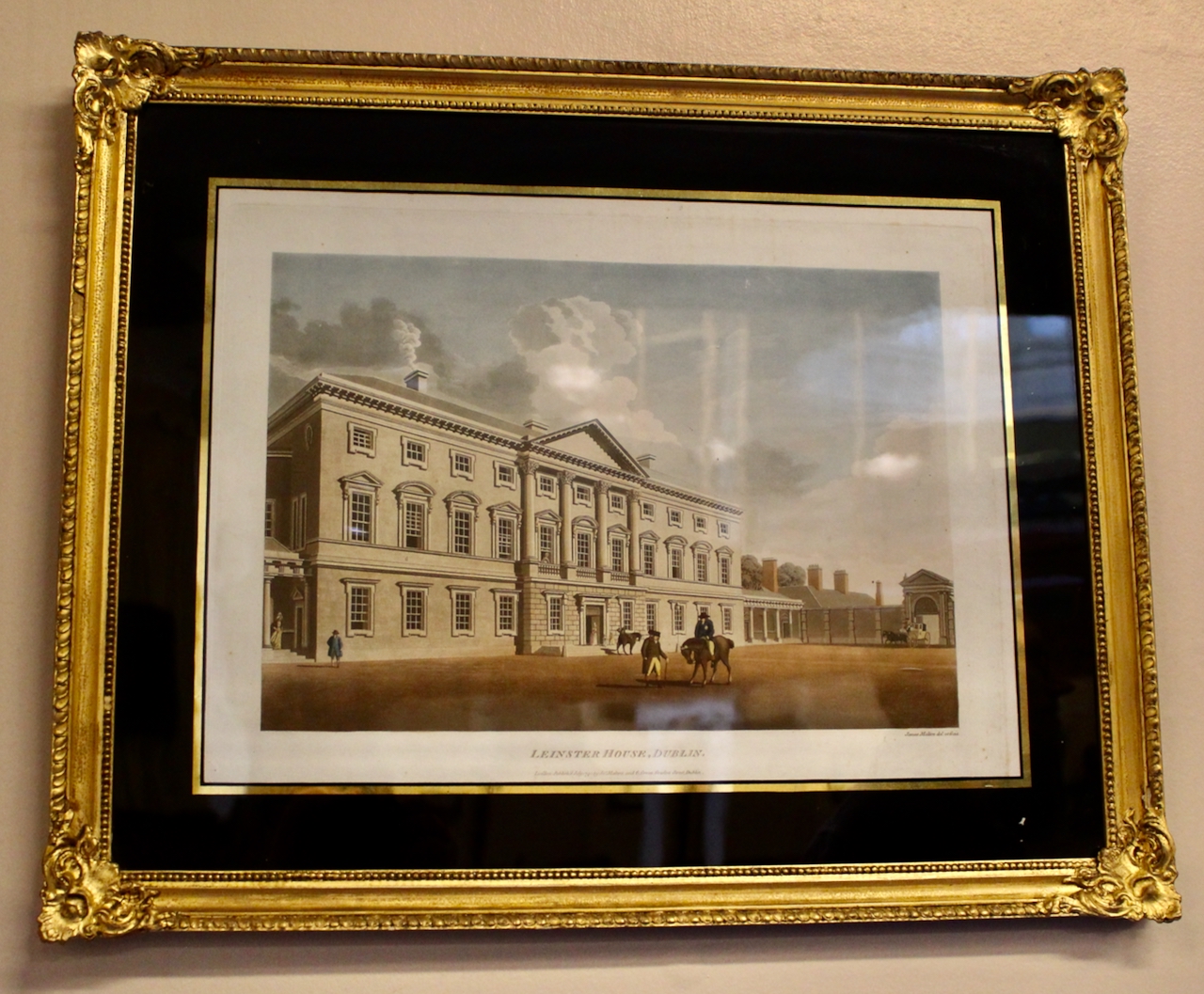
Malton drawing of Leinster House.
Leinster House, County Dublin, photograph by Robert French, (between ca. 1865-1914), Lawrence Photograph Collection, National Library of Ireland.

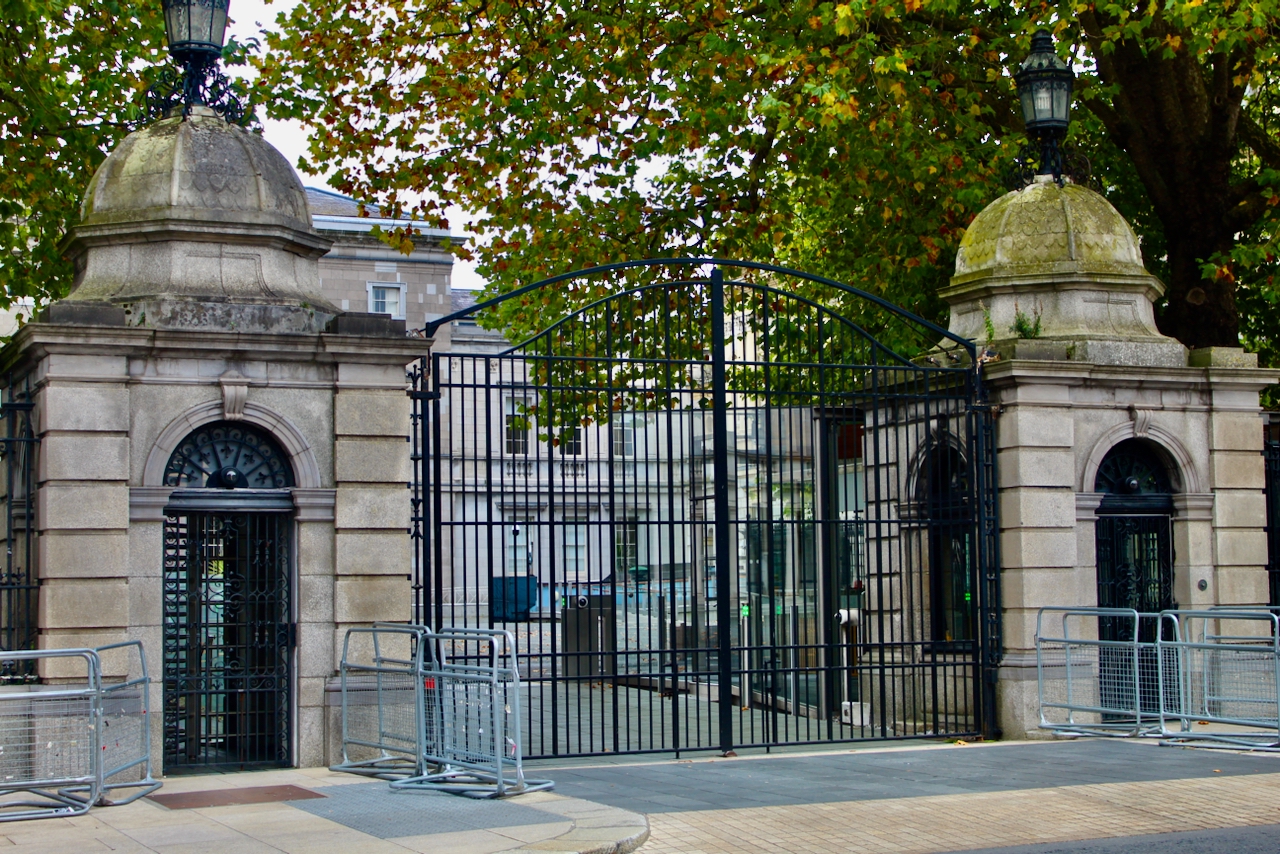
In the Malton drawing of Leinster house we can see that the side walls of the forecourt had pedimented arches. The present piers, wrought iron gates and railings were added in the 1880s, built by T.N. & T.M. Deane.

The present piers, wrought iron gates and railings were added in the 1880s, built by T.N. & T.M. Deane. Photograph © Jennifer Winder-Baggot, www.irishhistorichouses.com.
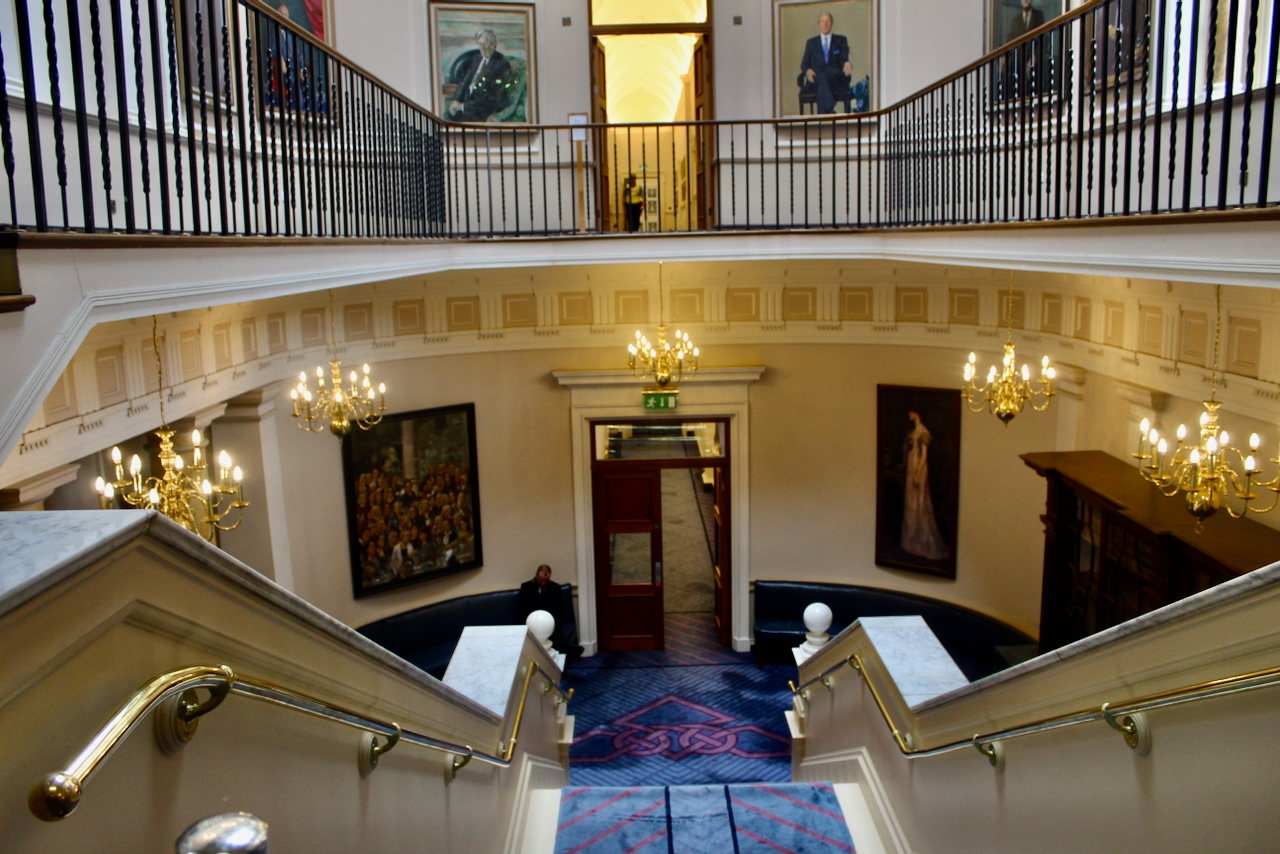
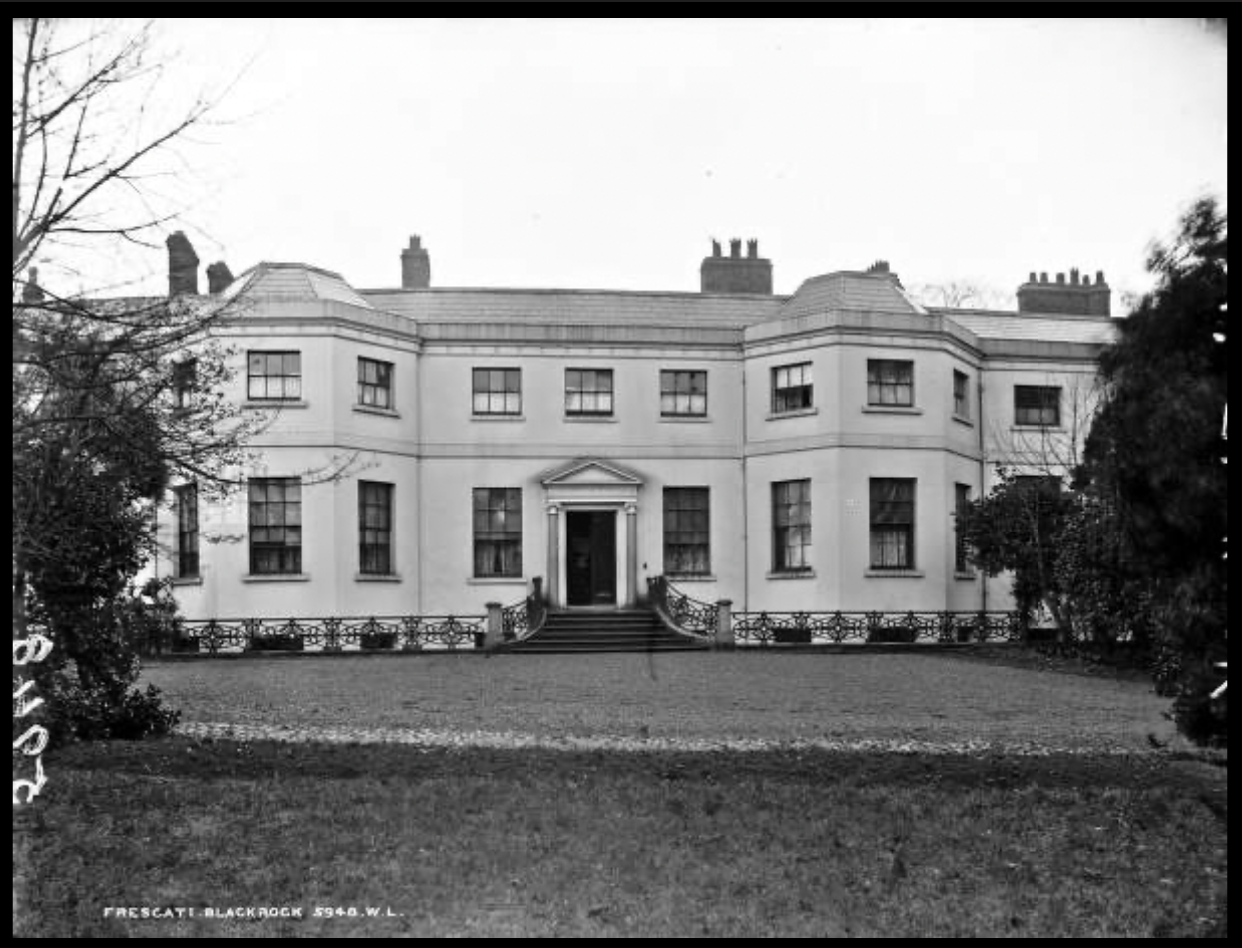
Irish Architectural Archive exhibition about Leinster House: it was one of three houses of the Fitzgeralds and the Duke of Leinster, along with Carton at Maynooth and Black Rock (later Frascati).

To the south of the forecourt lay a stable court, with a stable and coach house block and a kitchen block which was linked to the house by a small yard, which must have been very inconvenient when dinner was served!

The garden front is fully rusticated on the ground floor, with advanced two-bay ends.

Leinster House, Dublin,the side facing Merrion Square. Photograph © Jennifer Winder-Baggot, www.irishhistorichouses.com.
Leinster House, the Merrion Square facing side, County Dublin, photograph by Robert French, (between ca. 1865-1914), Lawrence Photograph Collection, National Library of Ireland.

The central first floor window has a triangular pediment. The door porch was added in the nineteenth century. The lawn lay on property leased from Viscount Fitzwilliam.

Irish Architectural Archive exhibition about Leinster House. It was designed by Richard Castle (1690-1751) with later input from Isaac Ware (1704-1786) and Thomas Owen (d. 1788). Here we see the location of the Main Hall, Supper Room and Parlour and Drawing room on first floor, Picture Gallery and principal bedrooms on second floor and Nursery and children’s and staff rooms on third floor. There is a separate kitchen and stores block and stable block.

James’s father died in 1744 before his house at Carton was complete, so it was finished for James the 20th Earl. James was the second son of his parents the 19th Earl and his wife Mary (d. 1780), eldest daughter of William O’Brien, 3rd Earl of Inchiquin. His elder brother died in 1740.

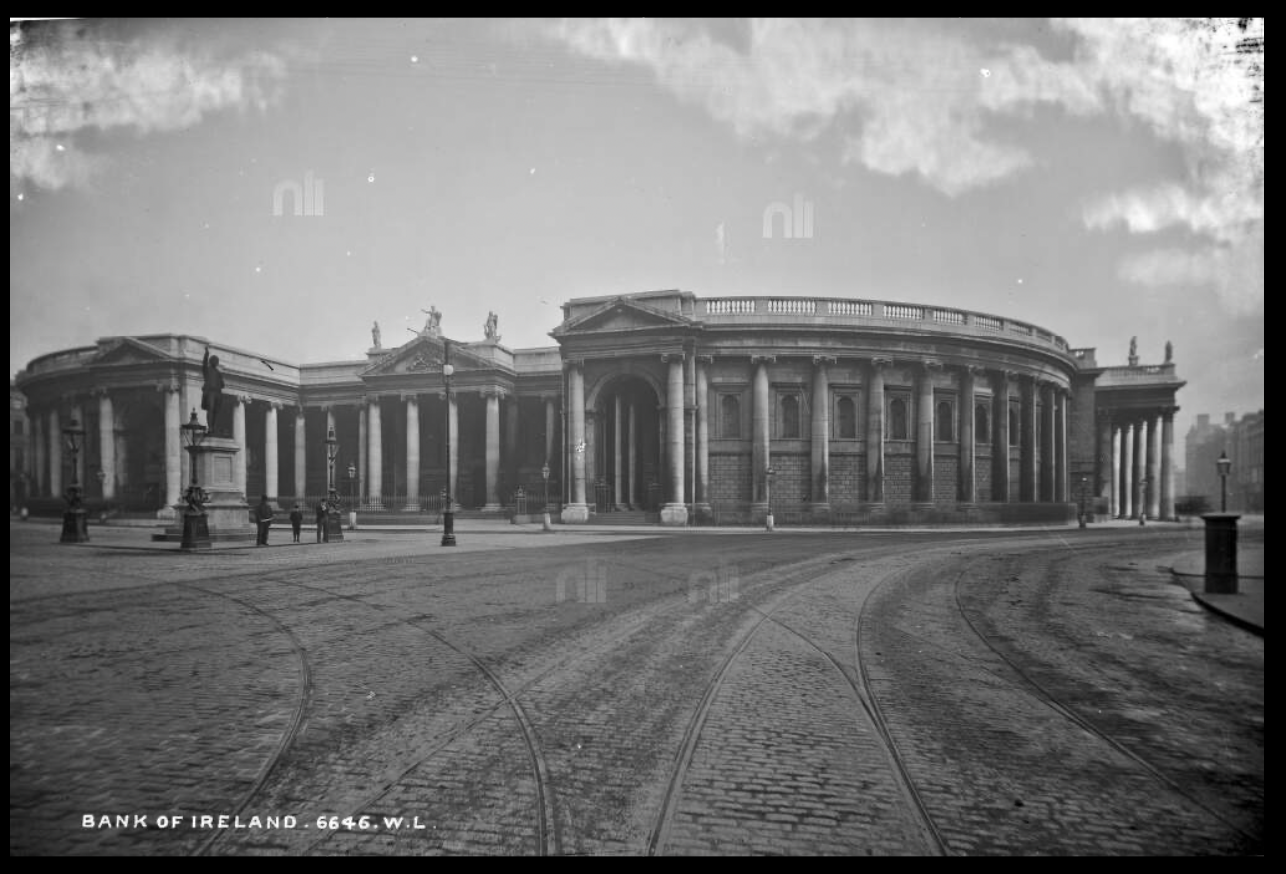
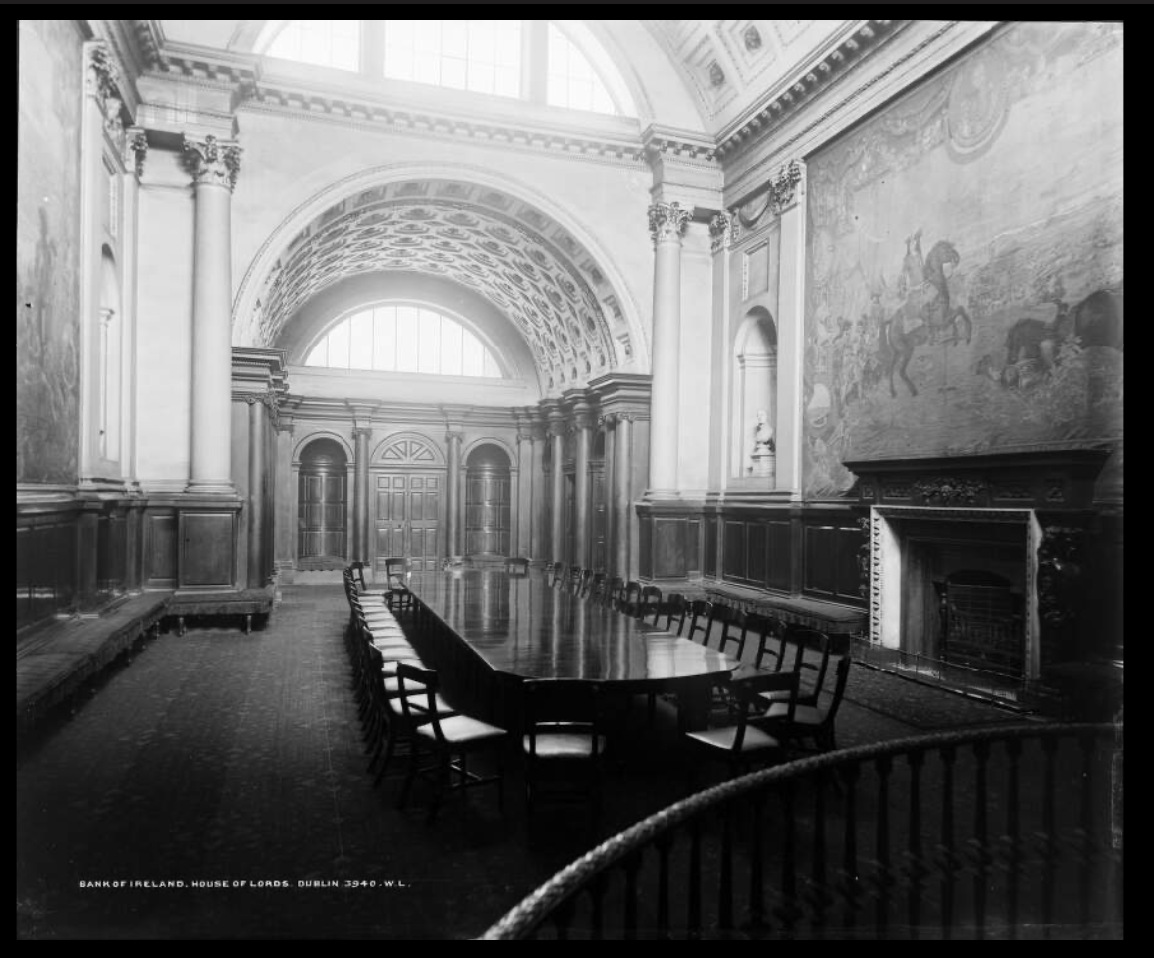
The Dictionary of Irish Biography tells us that James’s political career began on 17 October 1741, when (then known as Lord Offaly) he entered the Irish house of commons as member for Athy. In 1744 he moved to the House of Lords after he inherited the earldom. [3] It was then that he embarked on his town house in Dublin. Now the houses of parliament are located next to Leinster house, but at the time, they were located in what is now the Bank of Ireland on College Green in Dublin.

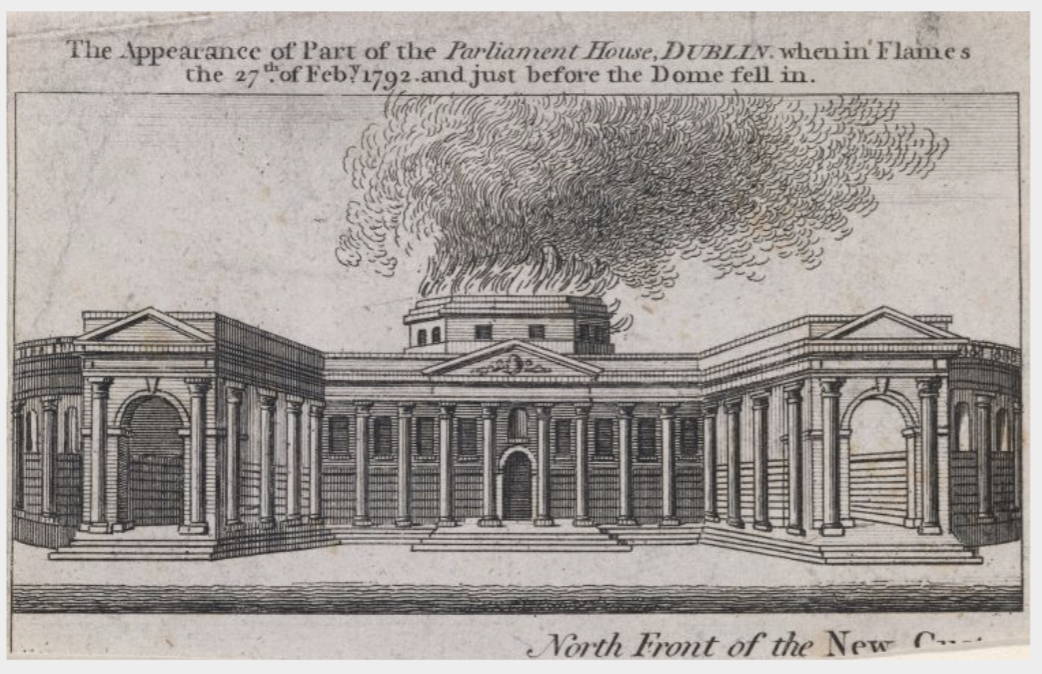
Parliament House, Dublin, with the House of Commons dome on fire, 27th February 1792.
Parliament Buildings Bank of Ireland, College Green, Dublin, between ca. 1865-1914, photograph by Robert French, Lawrence Photograph Collection, National Library of Ireland.
House of Lords, Parliament Building, Bank of Ireland, Dublin, between ca. 1865-1914, photograph by Robert French, Lawrence Photograph Collection, National Library of Ireland.

The Dictionary of Irish Biography continues:

His seniority in the peerage, popularity, and electoral interests ensured his appointment to the privy council (12 May 1746). He was made an English peer, Viscount Leinster of Taplow, Bucks. (1 February 1747), and appointed lord justice (11 May 1756). Master general of the ordnance (1758–66), he became major-general (11 November 1761) and lieutenant-general (30 March 1770). He was also promoted through the Irish peerage, becoming marquis of Kildare (19 March 1761) and duke of Leinster (26 November 1766).” [see 3]

James married Emilia Mary Lennox (1731-1814) in 1747, two years after Richard Castle began work on James’s townhouse. She was the daughter of General Charles Lennox, 2nd Duke of Richmond. Her grandfather the 1st Duke of Richmond was an illegitimate son of King Charles II of England. Emilia’s sister Louisa (1743-1821) married Thomas Conolly (d. 1803) and lived next to her sister in Carton, at Castletown in County Kildare (see my entry https://irishhistorichouses.com/2024/03/15/castletown-house-and-parklands-celbridge-county-kildare-an-office-of-public-works-property/

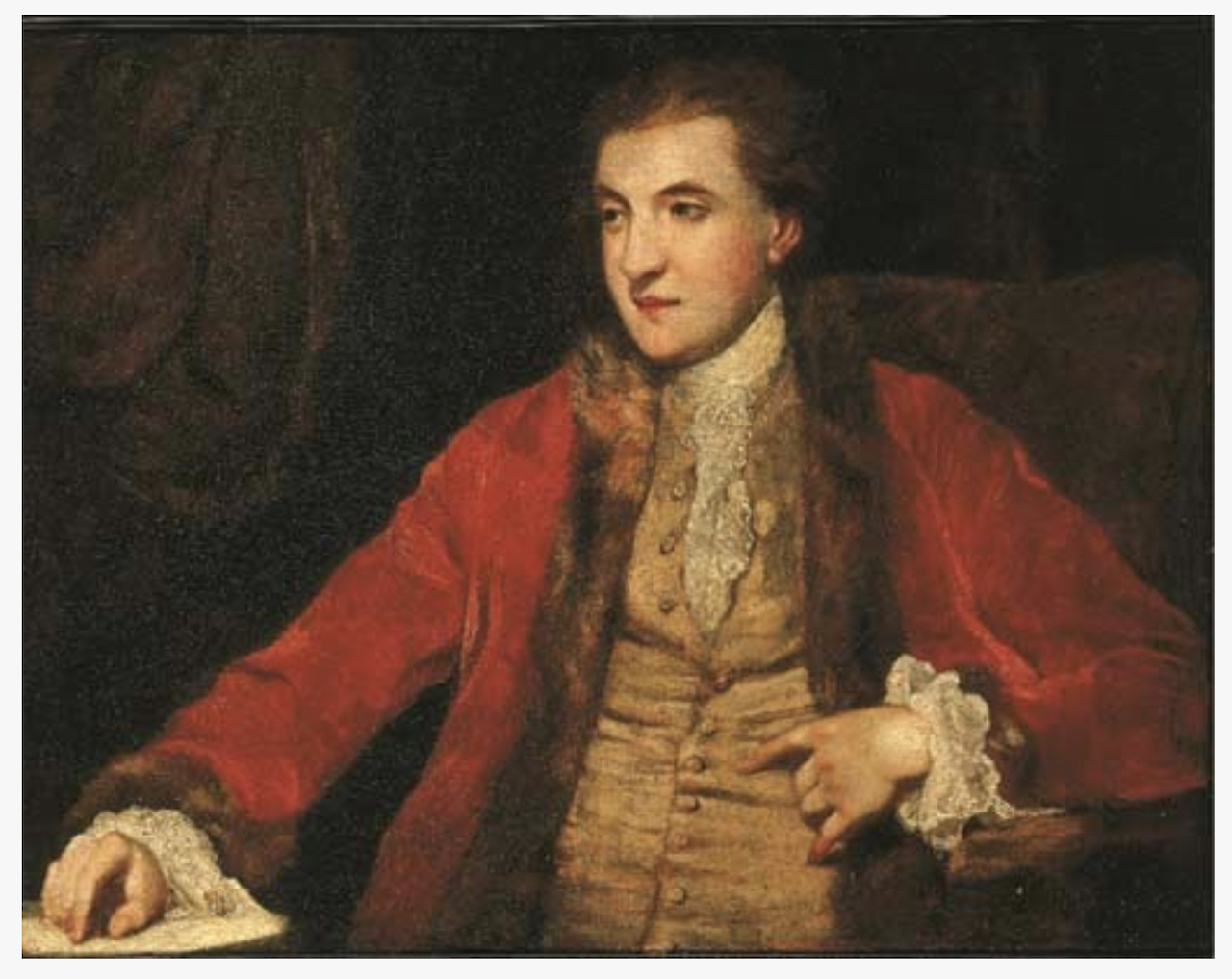
Emily Fitzgerald née Lennox (1731-1814) Duchess of Leinster 1770s by Joshua Reynolds.
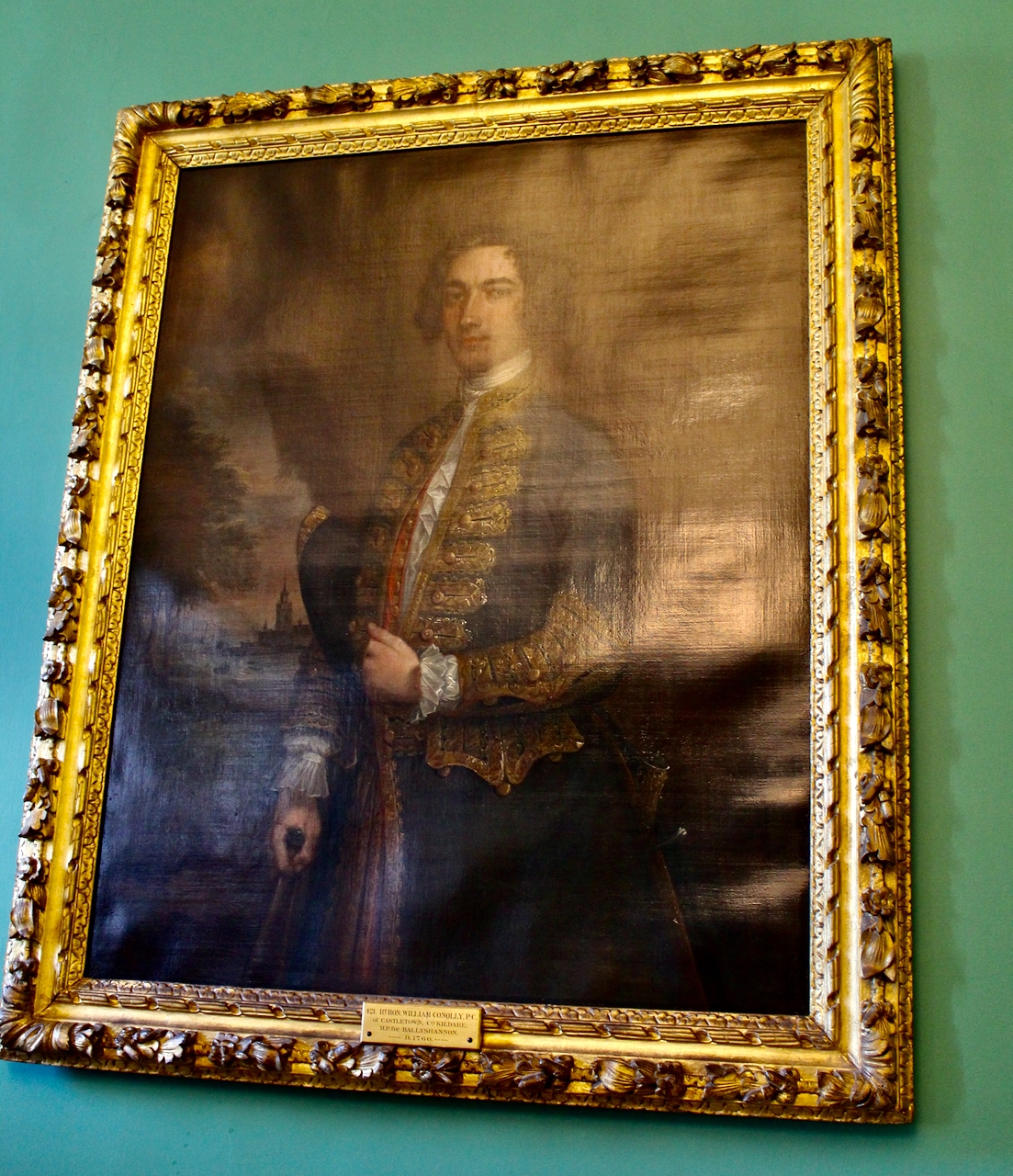
This terrific portrait of William Conolly (1662-1729) of Castletown, County Kildare is in the dining room.

Richard Castle died in 1751 before the town house was complete. He died at Carton, the Earl of Kildare’s country seat, while writing a letter with instructions to a carpenter at Leinster house. Isaac Ware stepped in to finish the house. An exhibition about Leinster House in the Irish Archictural Archive explains that following the death of Richard Castle in 1751, little further about the building is recorded until 1759. By this time, English architect Isaac Ware, famous for his A Complete Body of Architecture published in 1756, had become involved with the project. The Fitzgeralds began to use the house in 1753 while work on the interior continued.

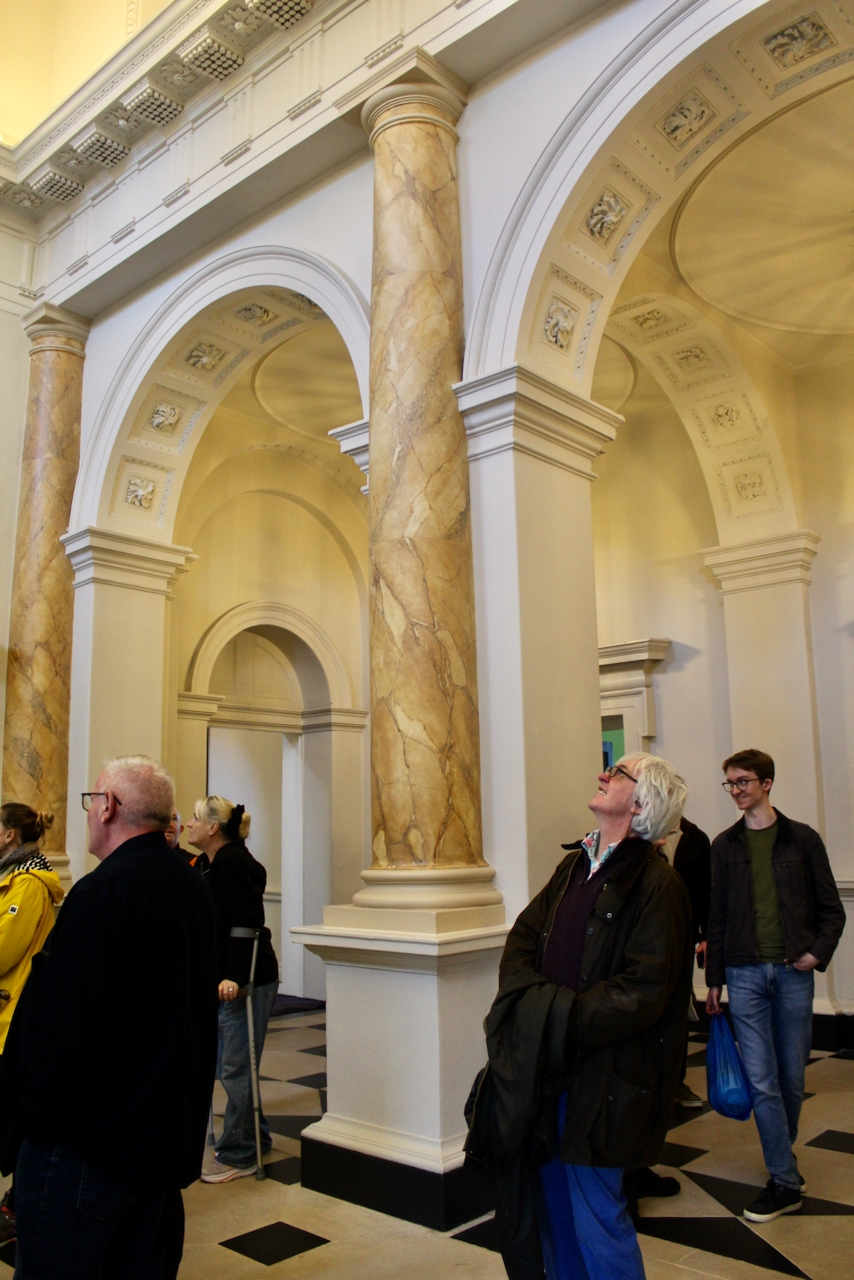
Inside, the house has a double height entrance hall with an arcaded screen of Doric pillars toward the back which opens onto a transverse corridor that divides the front and rear ranges. I found the hall hard to capture in a photograph, especially as we were part of a tour group. The hall reminded me of the double height entrance hall of Castletown, and indeed Christine Casey notes in her Buildings of Ireland: Dublin that the plan and dimensions of Leinster House relate directly to those of Castletown house in County Kildare, which was built in 1720s for William Conolly, and which was probably, she writes, built under the direction of Edward Lovett Pearce, possibly with the assistance of Richard Castle. [2]

The double height entrance hall of Leinster House with its arcaded screen of pillars. Photograph © Jennifer Winder-Baggot, www.irishhistorichouses.com.
Leinster House, Dublin, October 2025. Photograph © Jennifer Winder-Baggot, www.irishhistorichouses.com.

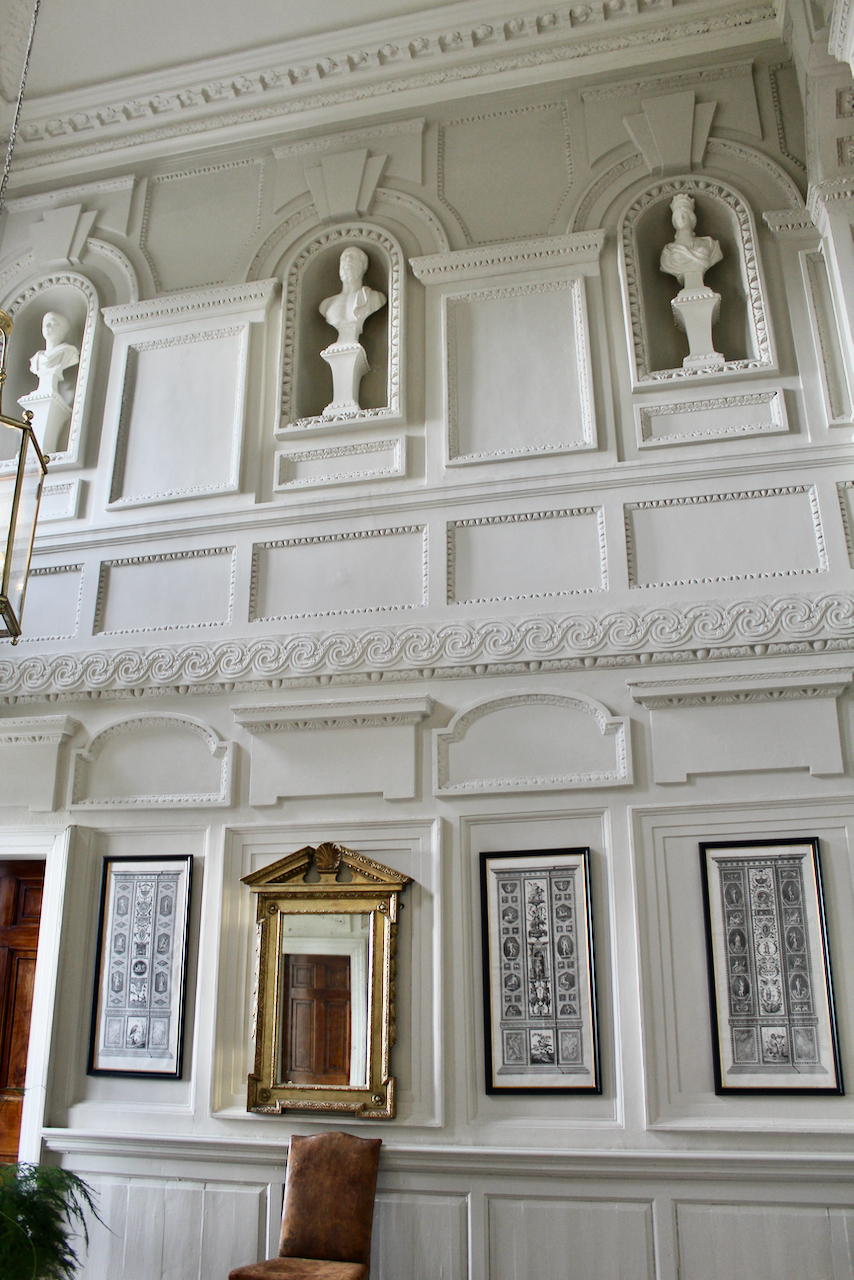
It is the double height that reminds me of the great hall in Castletown, although Castletown has a gallery and Leinster house does not. The niches remind me of the similar front hall in Gloster house in County Offaly, which although a private family home, in 2025 is a Section 482 property which you can visit on particular days.

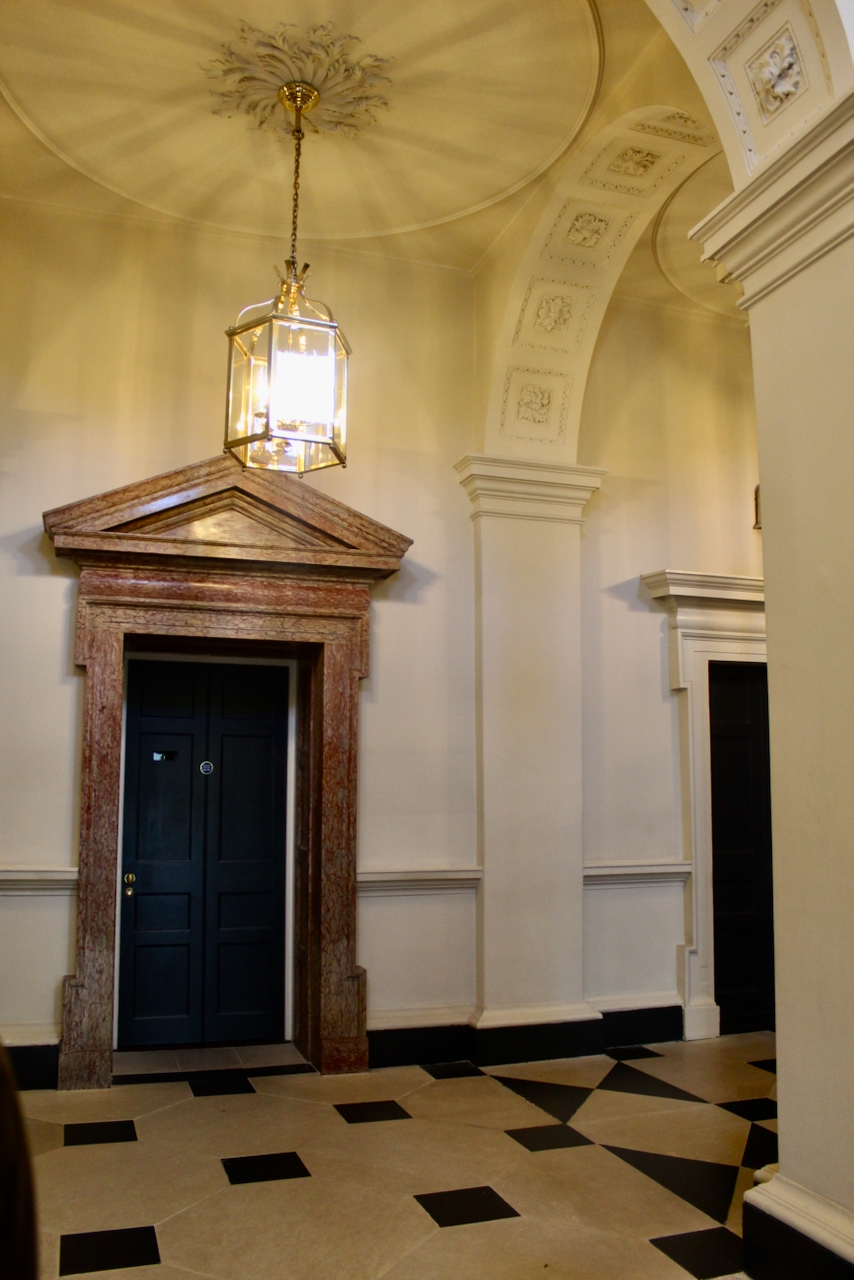
The black and white flooring is original to the house. [see 2] The red marble doorframe was added later.

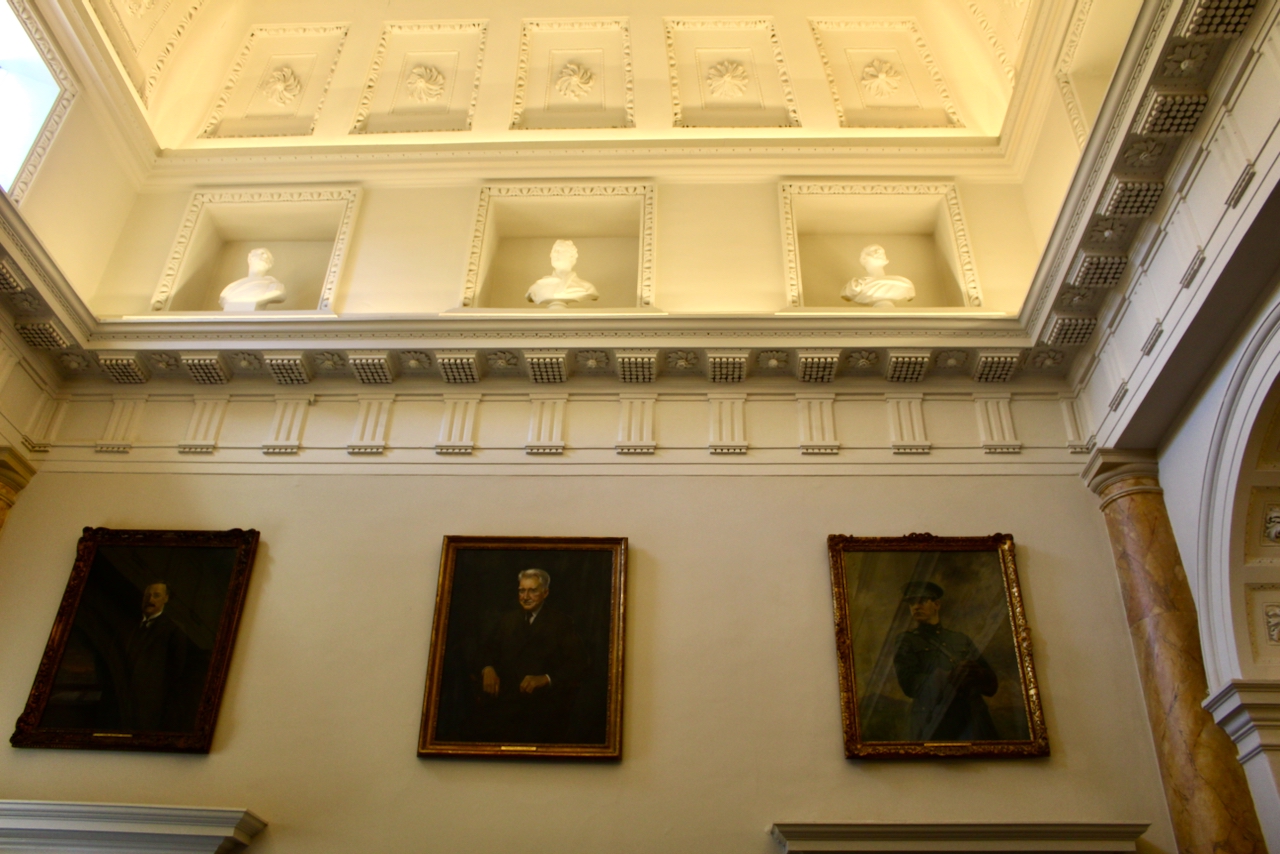
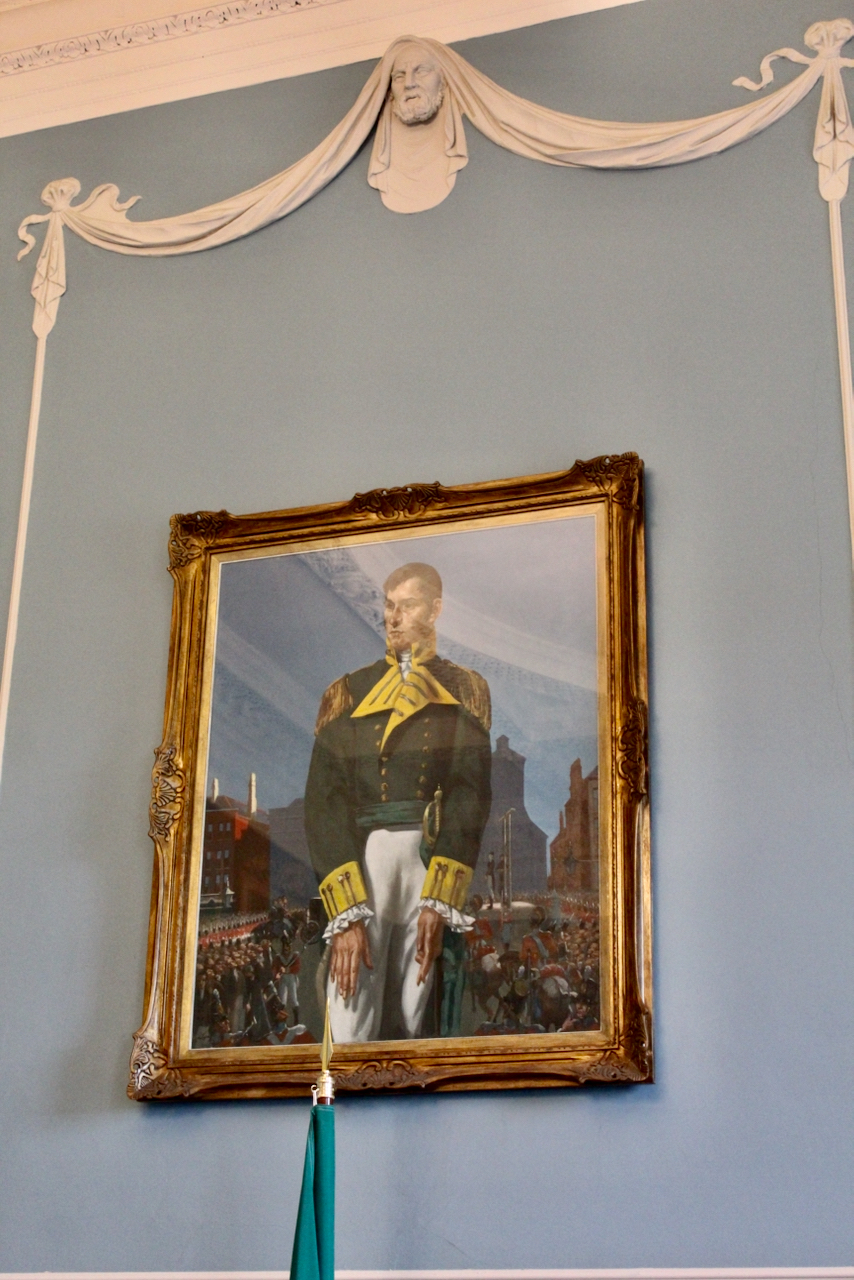
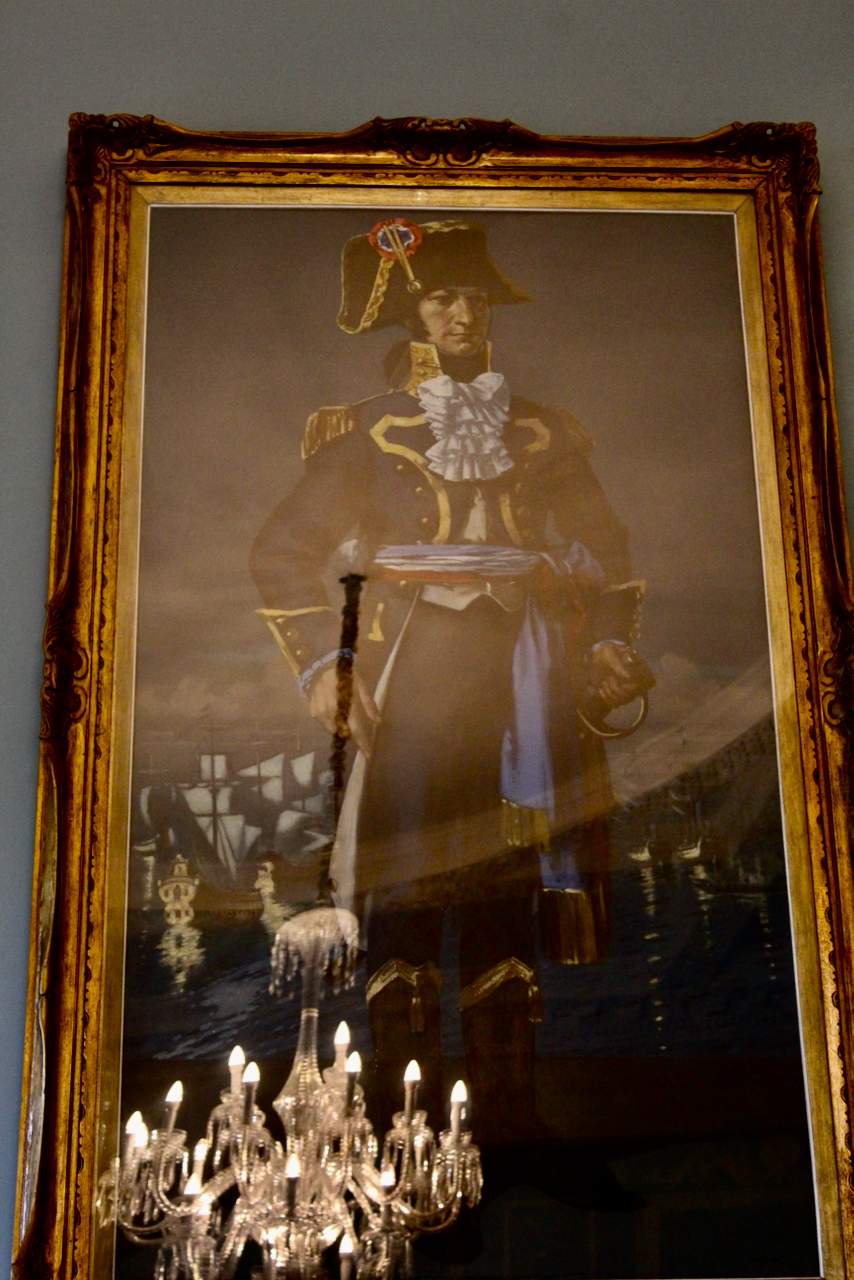
Portraits of Arthur Griffith, William T. Cosgrave and Michael Collins. Leinster House, Dublin, October 2025. Photograph © Jennifer Winder-Baggot, www.irishhistorichouses.com.
Great Hall, Castletown House, Celbridge, Co Kildare, photograph by Sonder Visuals 2022 for Failte Ireland.
Gloster, February 2023. Photograph © Jennifer Winder-Baggot, www.irishhistorichouses.com.

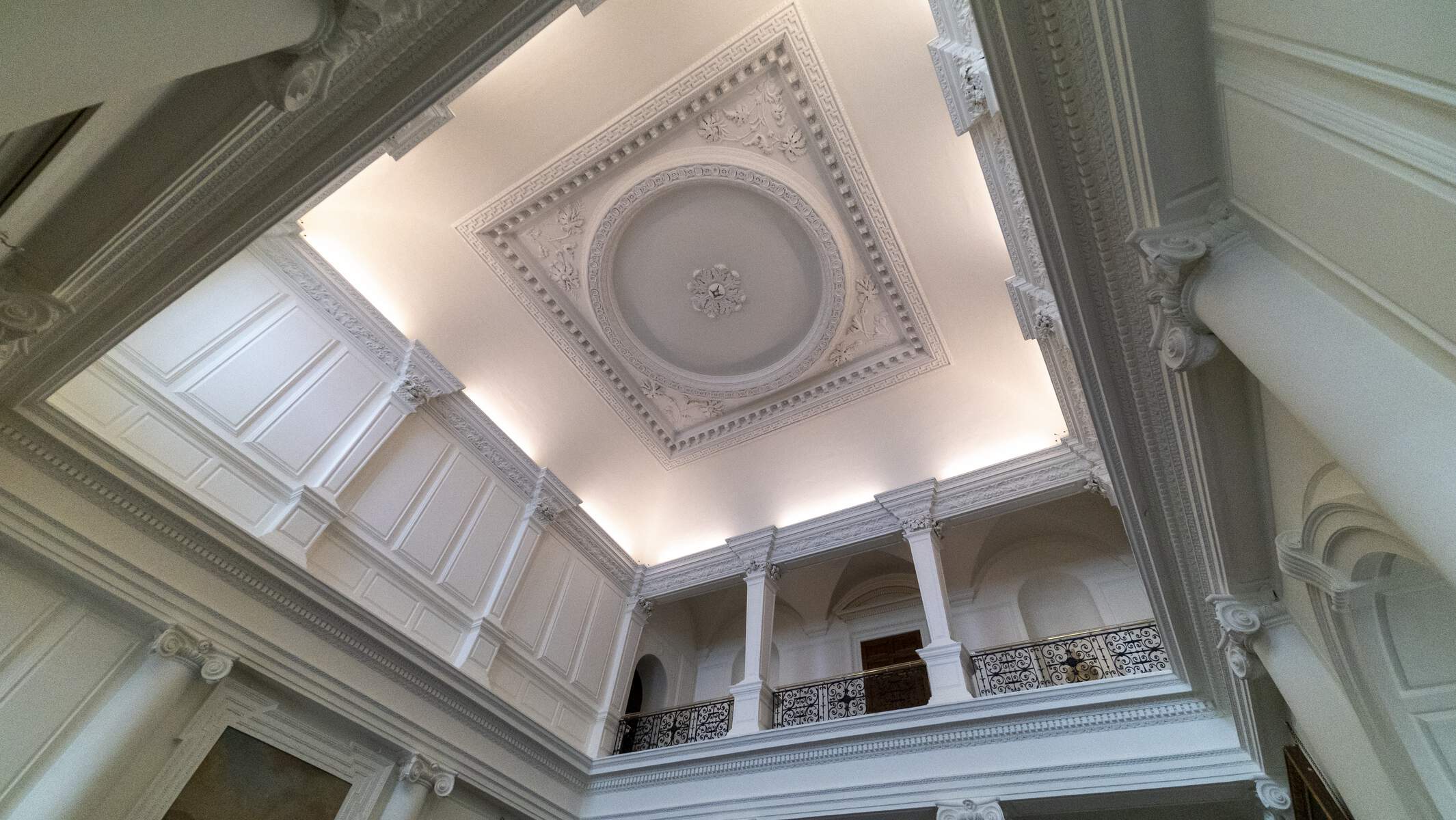
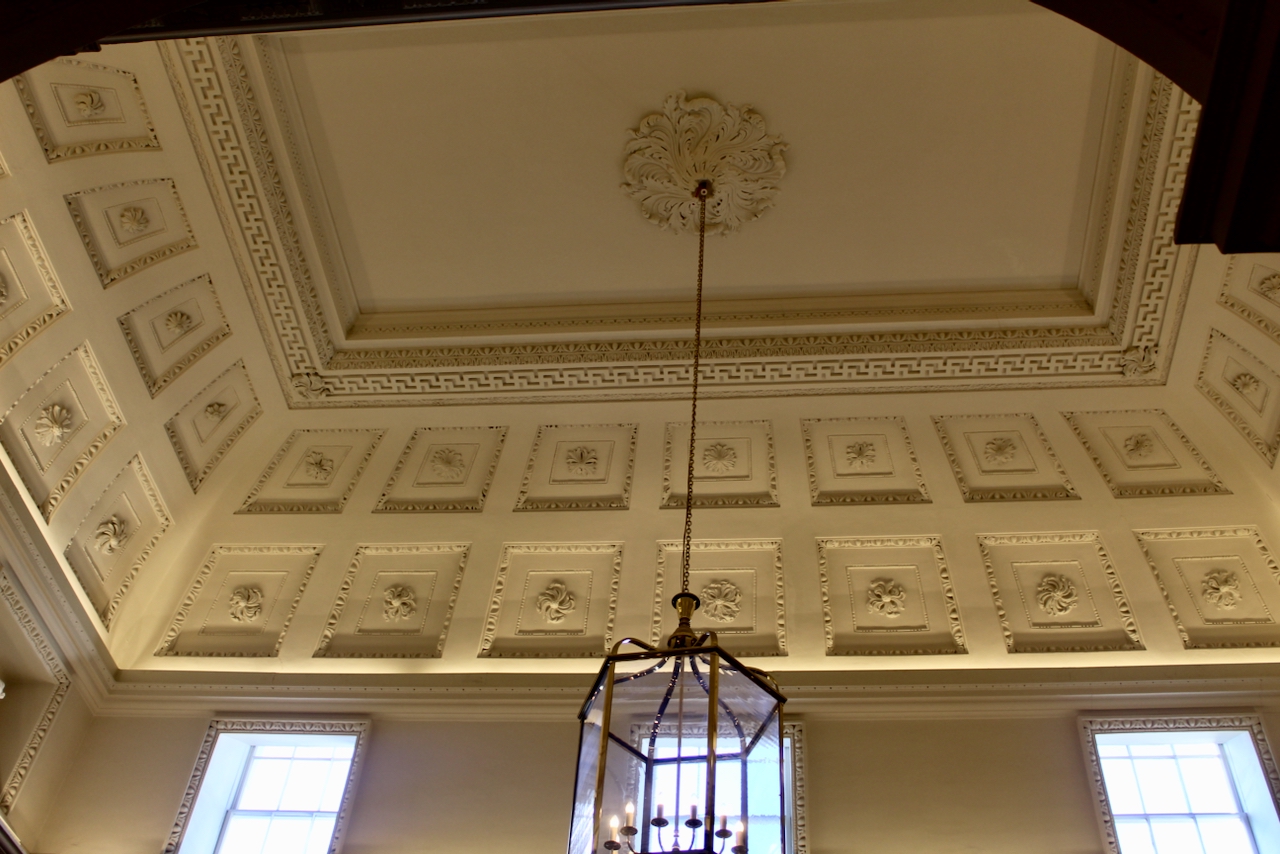
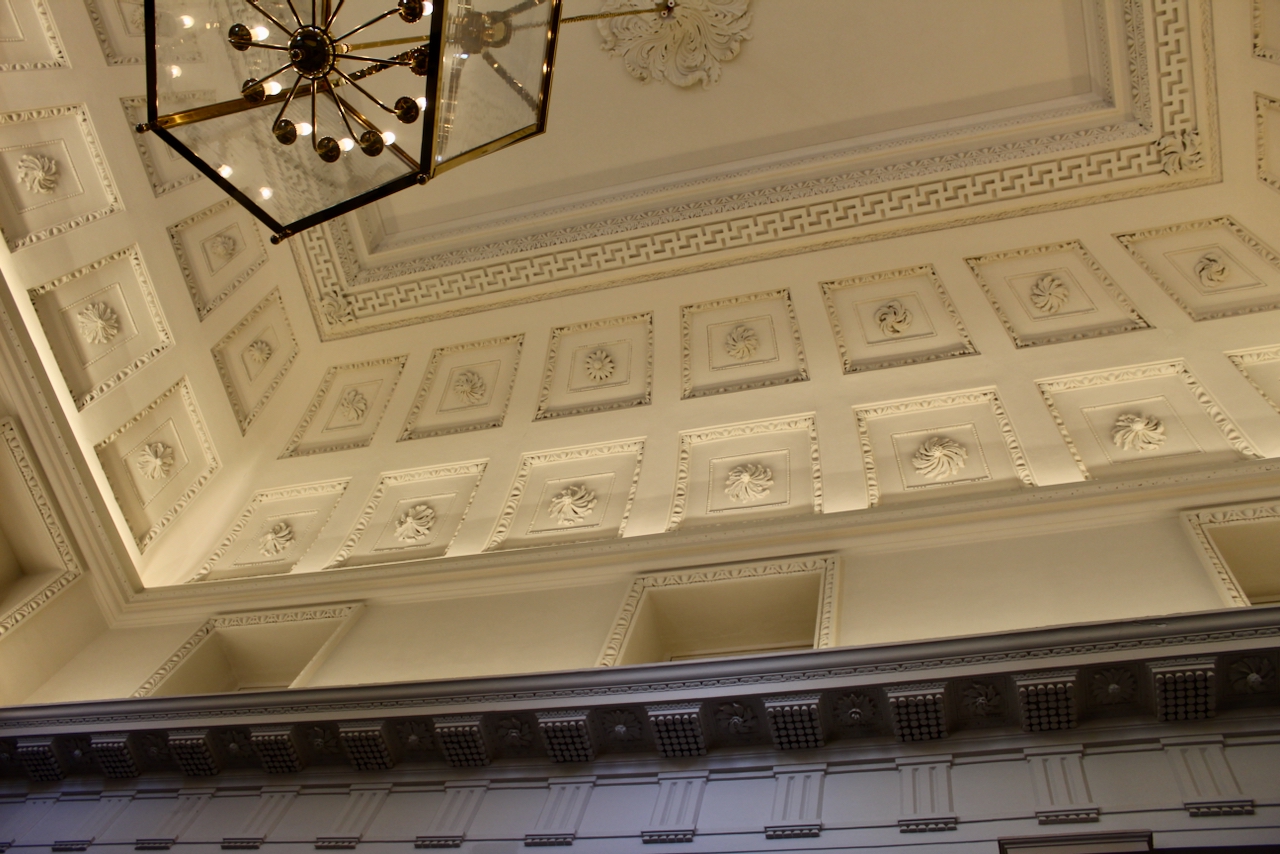
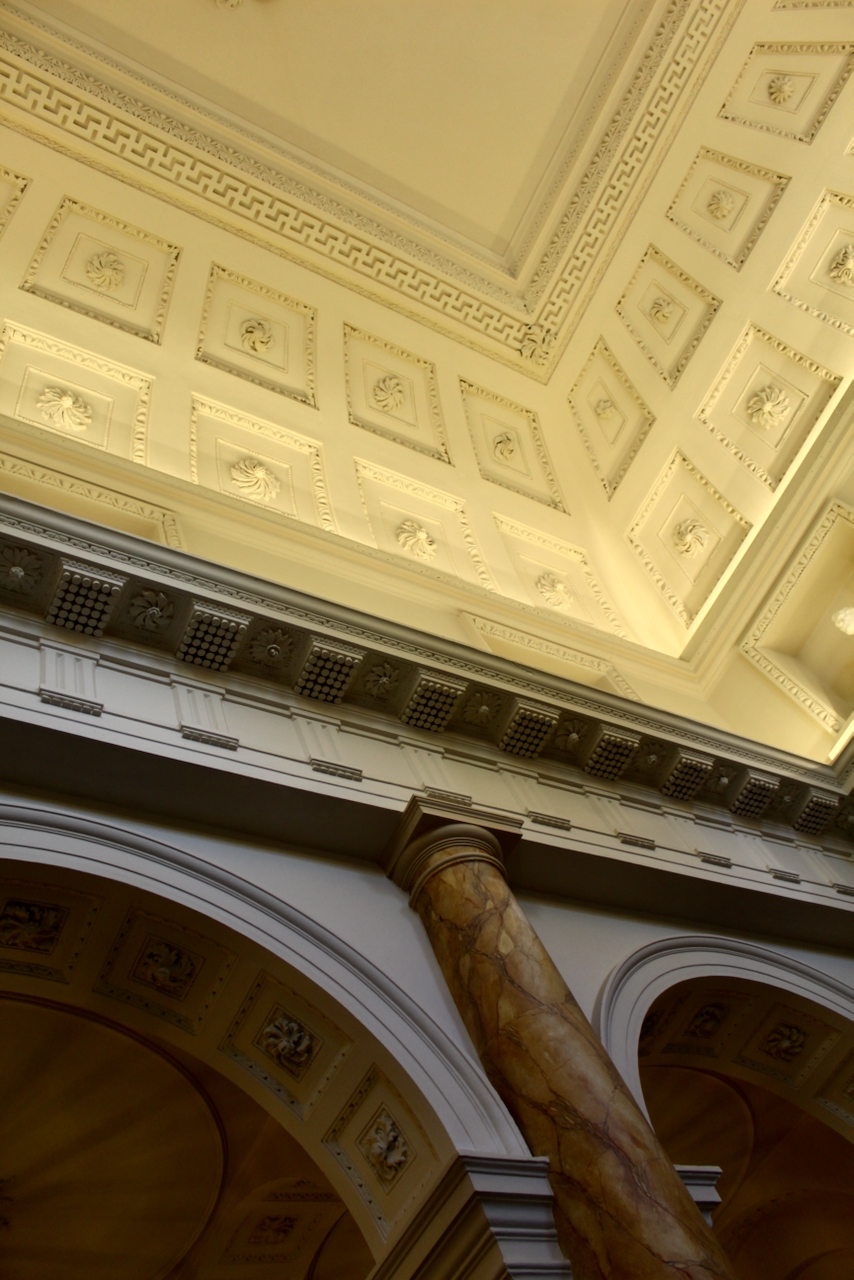
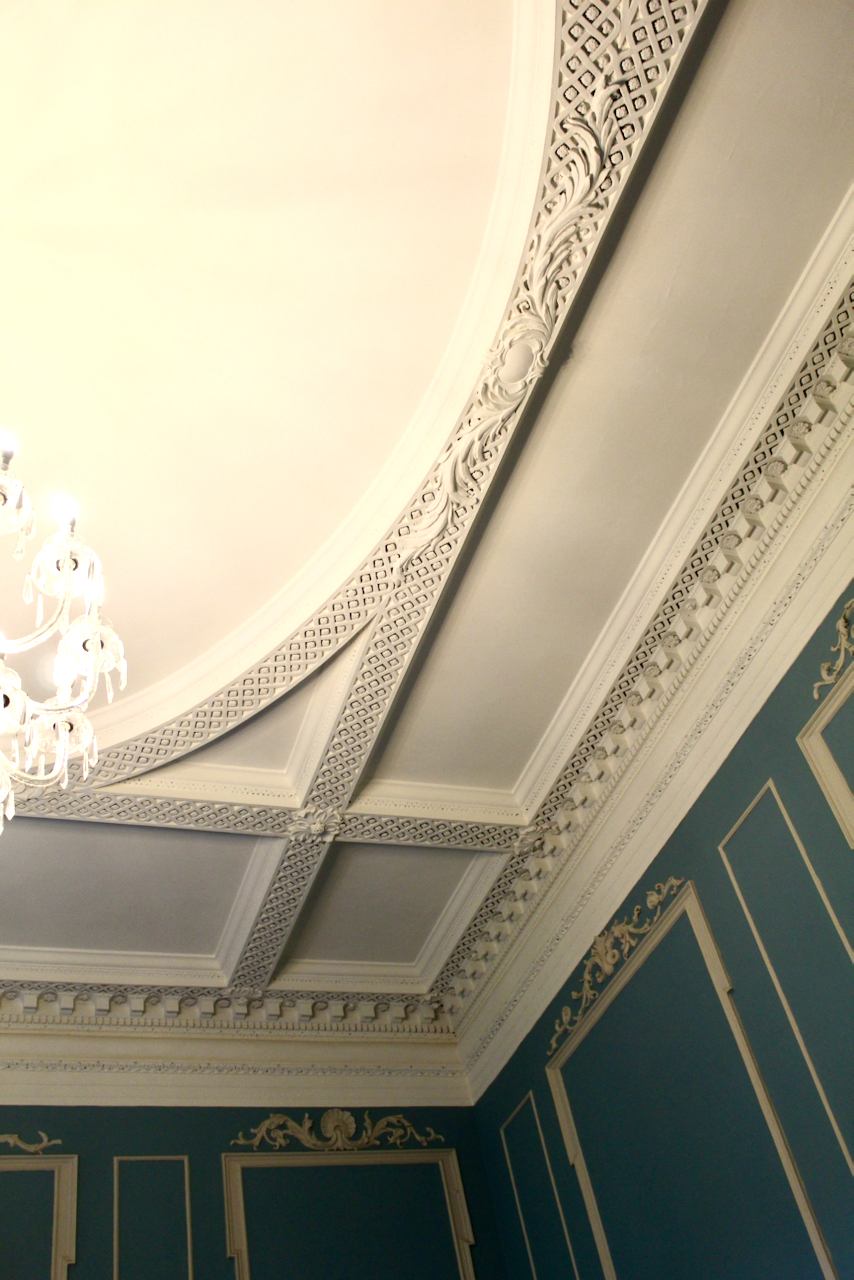
The coffered ceiling in the Hall in Leinster house is different from the ceilings in the front hall in Castletown or Gloster. The deep coffered cove rises to a plain framed flat panel with central foliated boss. There is an entablature above the Doric columns around the four sides of the hall. The square ovolo framed niches above have statues and above the main door the niches have windows.

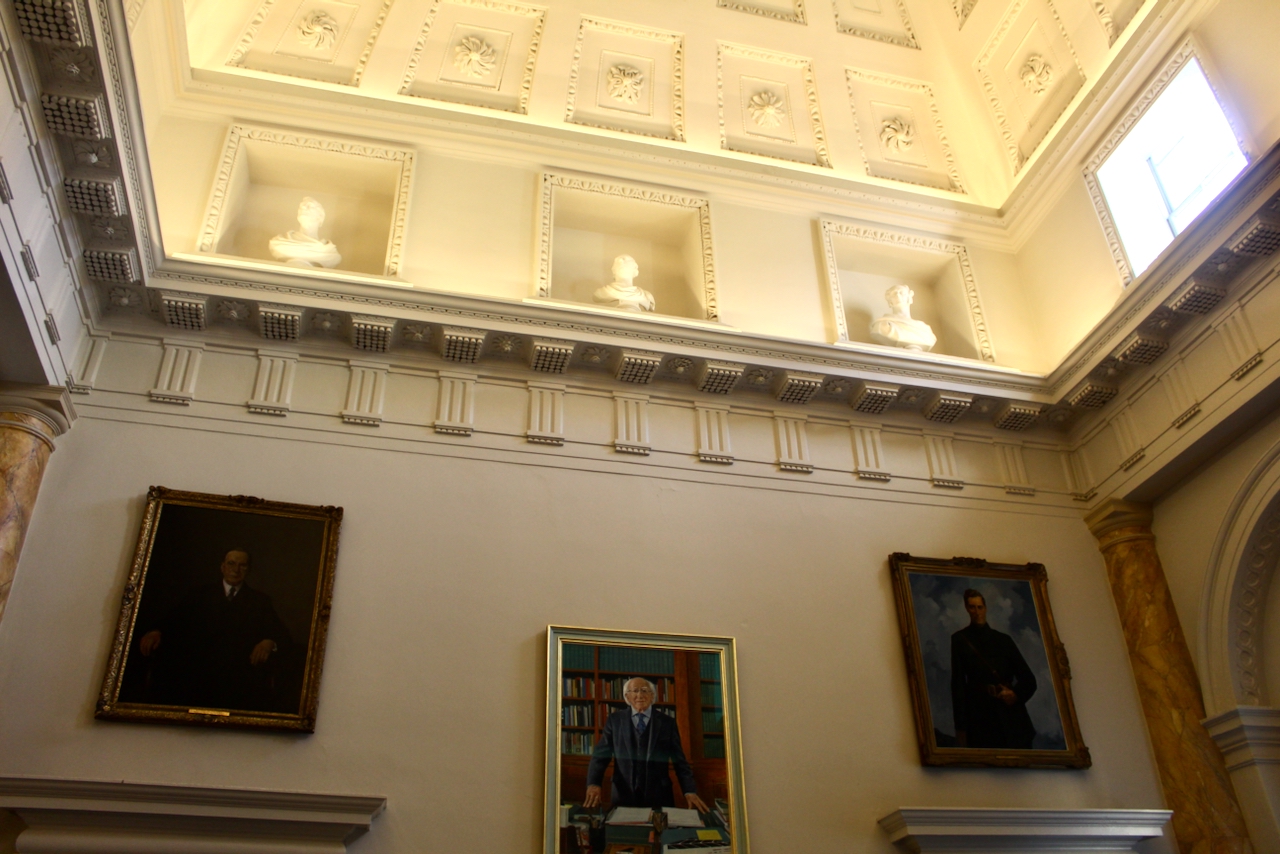
Portraits of Eamon de Valera, Michael D. Higgins and Cathal Brugha. Leinster House, Dublin, October 2025. Photograph © Jennifer Winder-Baggot, www.irishhistorichouses.com.
Leinster House, Dublin, October 2025. Photograph © Jennifer Winder-Baggot, www.irishhistorichouses.com.

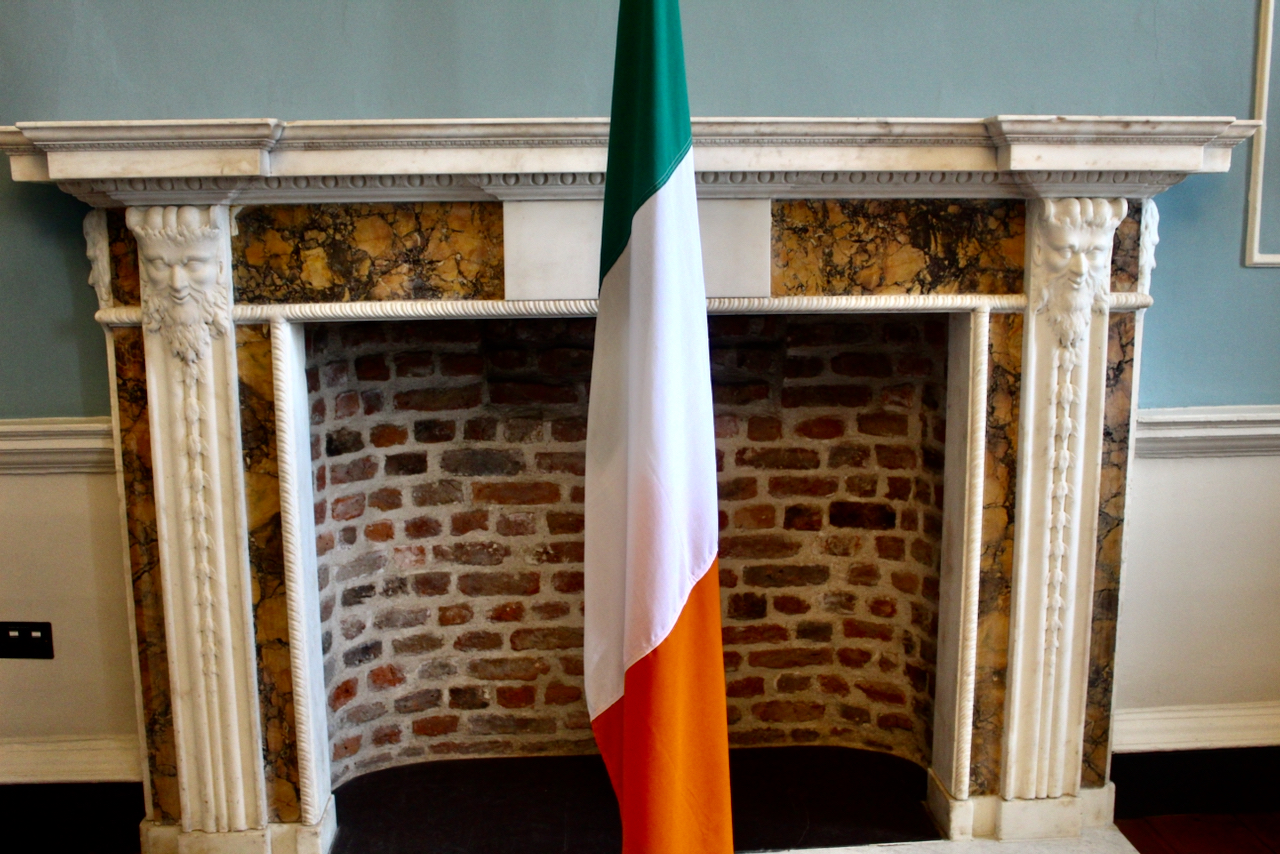
The chimneypiece in the front hall, Casey tells us, was originally faced with a pedimented niche on the north wall opposite, flanked by the doorcases. The chimneypiece is of Portland stone, she describes, with ornamental consoles and above the lintel, enormous scrolls flanking a bust pedestal.

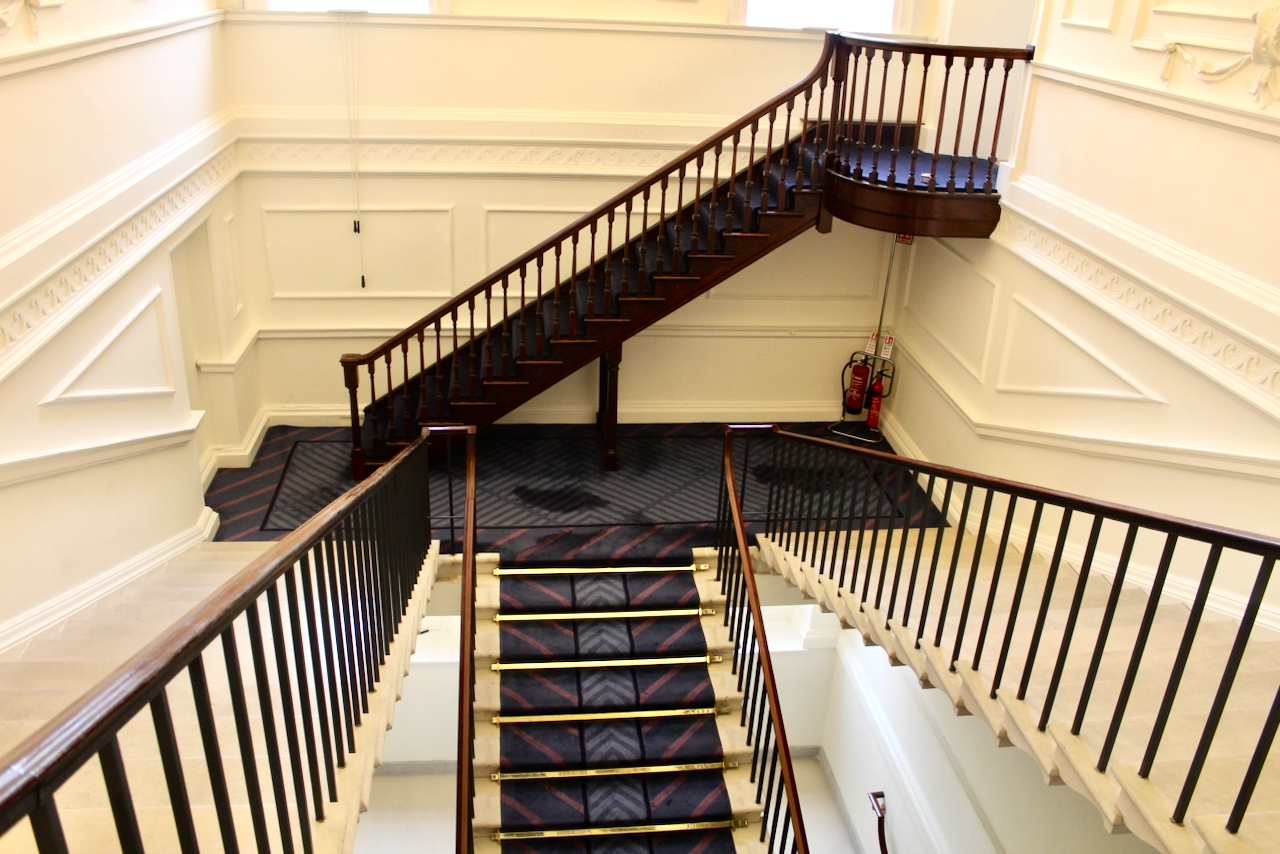
The principal stair hall is a two bay compartment north of the front hall. Casey tells us that Isaac Ware inserted an imperial staircase – one in which a central staircase rises to a landing then splits into two symmetrical flights up to the next floor – into a hall compartment which was meant for a three flight open well staircase. The staircase is further marred, Casey tells us, by a later utilitarian metal balustrade. Casey does not mention the plasterwork here, which is very pretty. The wooden staircase is a later addition.

The Imperial staircase in Leinster House, with an extra staircase heading somewhere! Photograph © Jennifer Winder-Baggot, www.irishhistorichouses.com.
The stair hall has stucco frames and floral swags. Photograph © Jennifer Winder-Baggot, www.irishhistorichouses.com.
The stair hall, Leinster House. Photograph © Jennifer Winder-Baggot, www.irishhistorichouses.com.

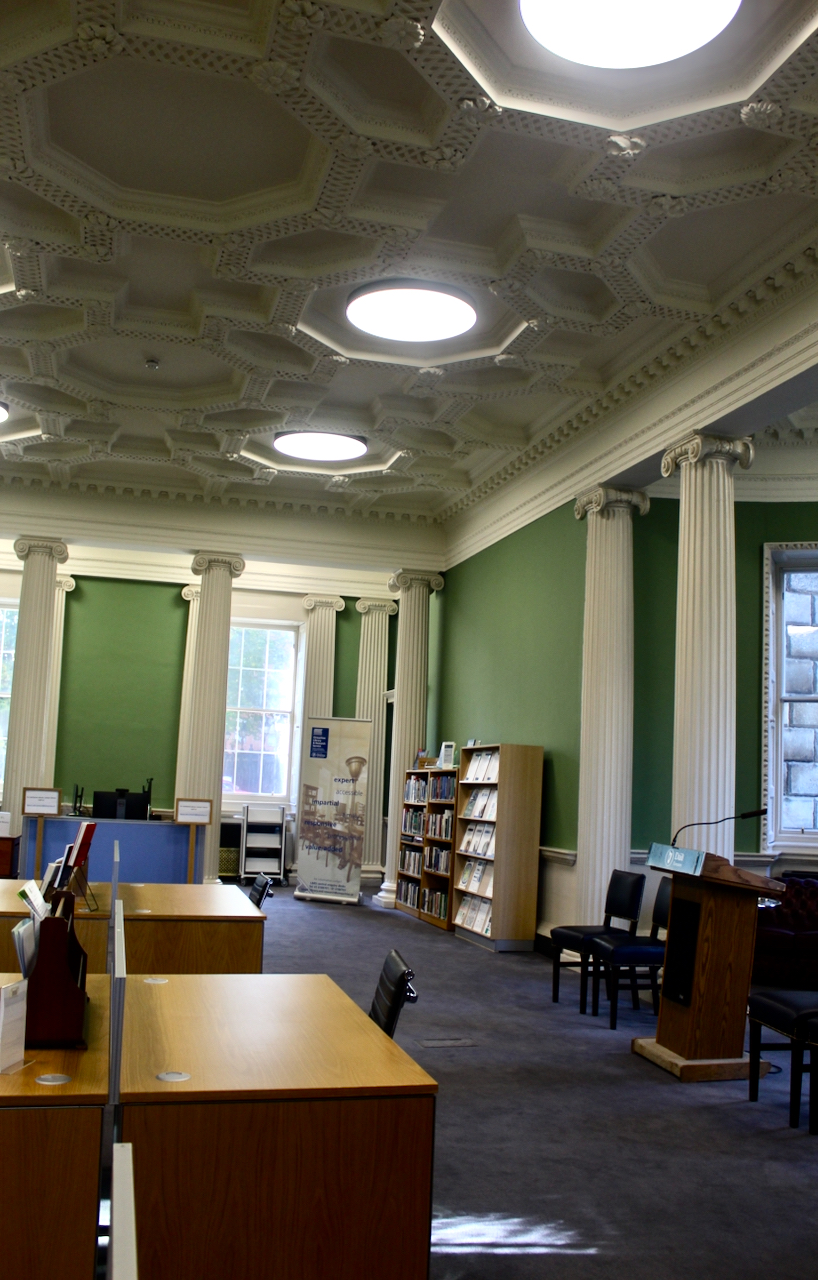
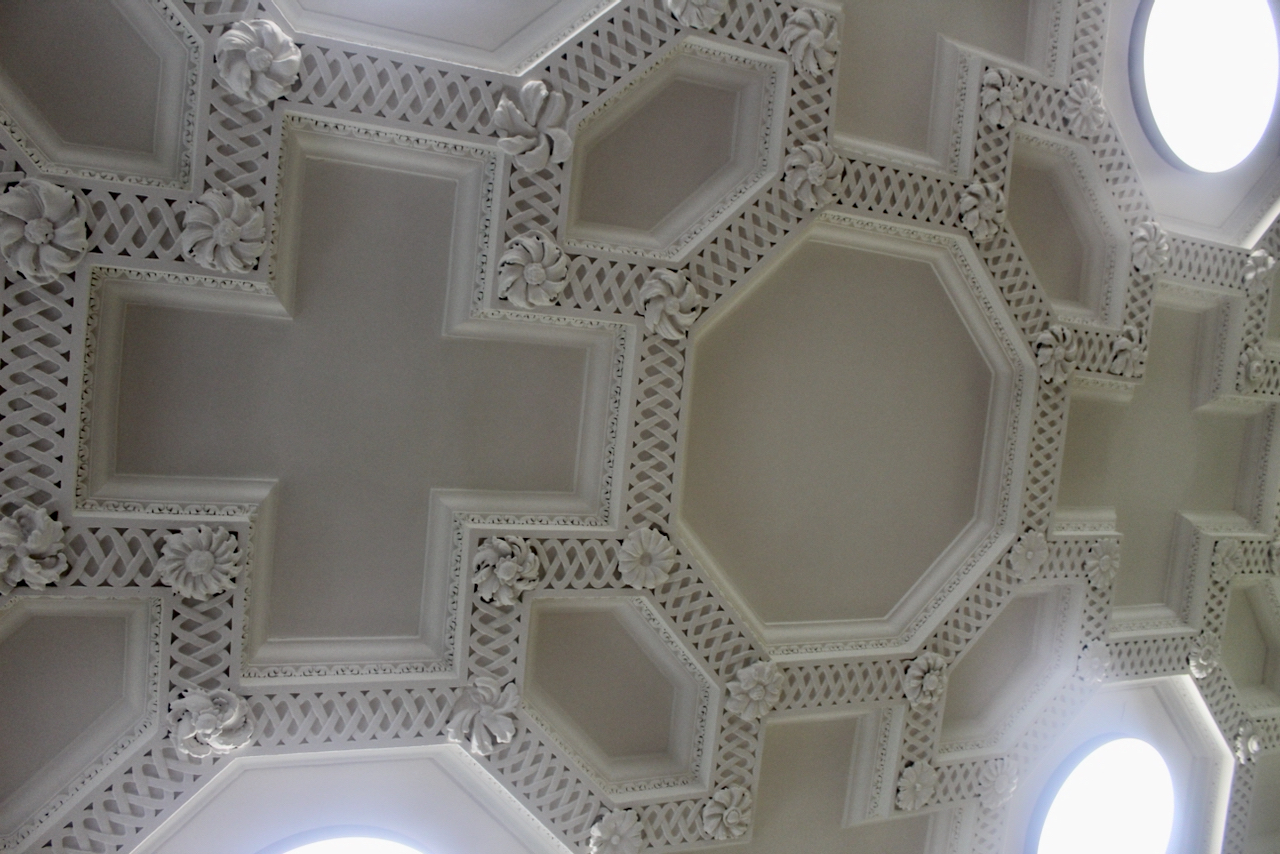
Beyond the stair hall is the former Supper Room, which is now the Library of the Oireachtais, which fills the entire depth of the house. I found the lights rather offputting and think they ruin the intended effect of the room and the ceiling, which Casey tells us derives from Sebastiano Serlio (1475-1554), an Italian architect who was part of an Italian team who built the Palace of Fontainbleau, and Tutte l’opere d’architettura et prospetiva (All the Works of Architecture and Perspective) is Serlio’s practical treatise on architecture.

The former Supper Room, which is now the Library of the Oireachtais. Photograph © Jennifer Winder-Baggot, www.irishhistorichouses.com.
The Serlio ceiling of the former Supper Room, which is now the Library of the Oireachtais. Photograph © Jennifer Winder-Baggot, www.irishhistorichouses.com.
Design for Leinster House ground floor supper room by Isaac Ware c. 1759, IAA 96/68.1/3/1. This plan, ceiling design and three laid back wall elevations for the ground floor supper room, now the Oireachtas Lirbary, by Ware. The drawing shows the room almost as executed.

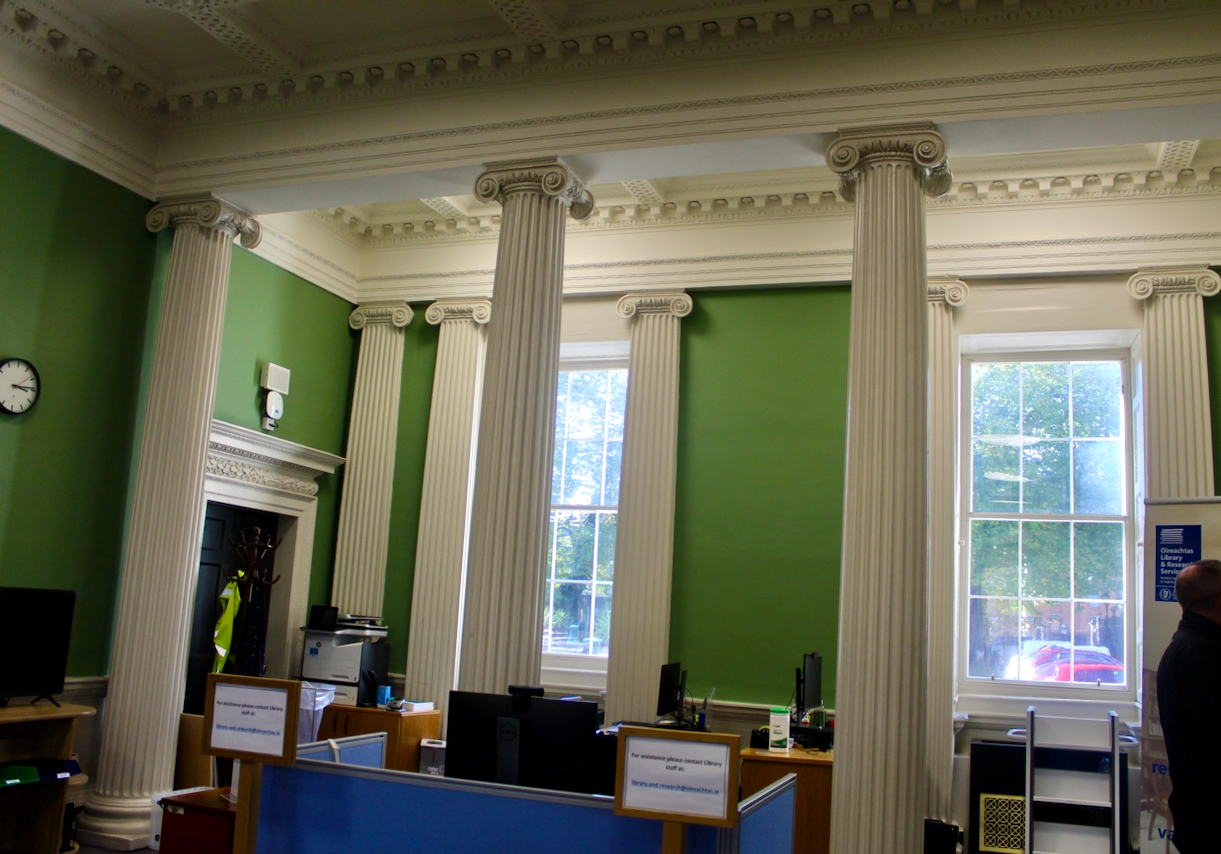
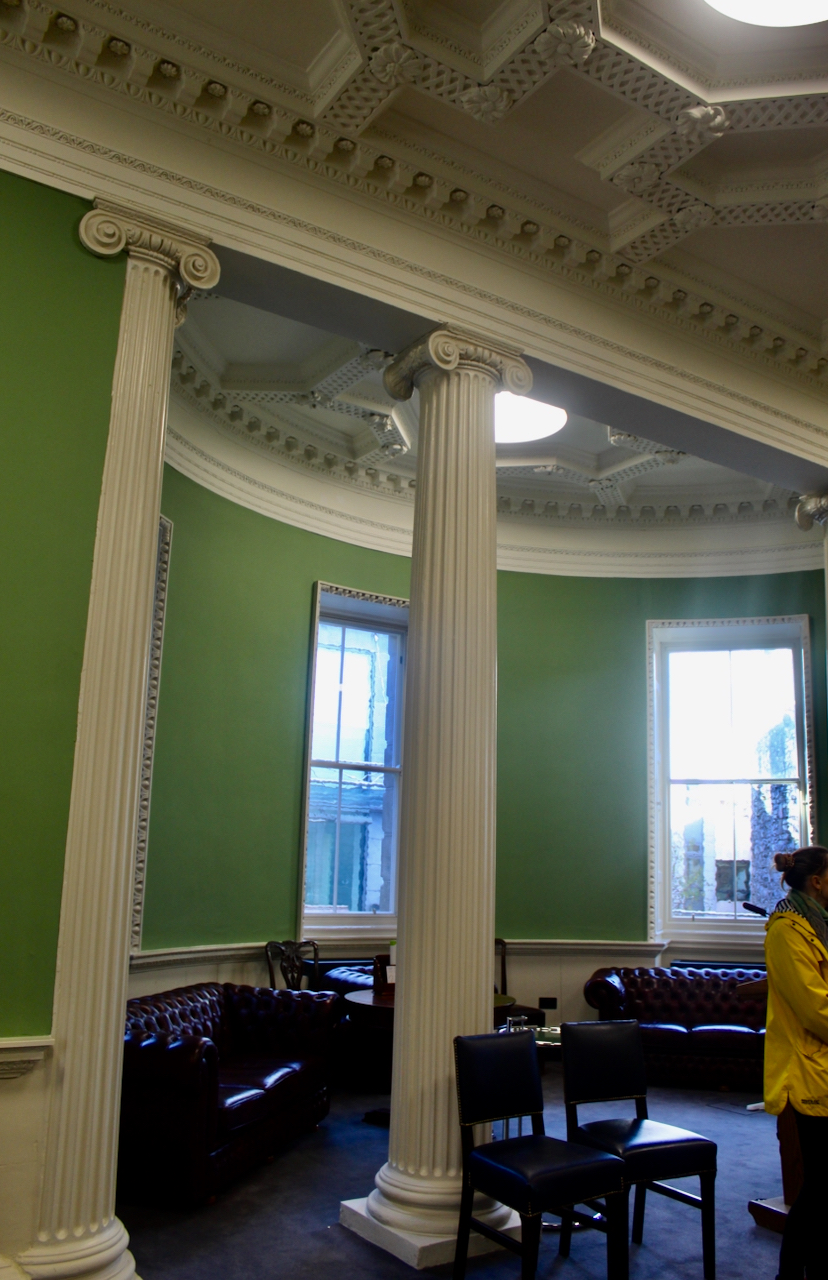
The room has three screens of fluted Ionic columns – one at either end and one in front of the bow at one side of the room. Originally, Casey informs us, there were six fluted columns to each screen, paired at the ends of the room and in the centre of the north bow, but in the 19th century one column was removed from each pair. On the walls the corresponding pilasters would have matched the six columns.

The bow is considered to be the first bow in Dublin, and the design of the house is said to have inspired the design of the White House in Washington DC, designed by a man from Kilkenny, James Hoban.

The former Supper Room, which is now the Library of the Oireachtais. Photograph © Jennifer Winder-Baggot, www.irishhistorichouses.com.
Irish Architectural Archive exhibition about Leinster House: James Hoban, who designed The White House in Washington DC, both pictured here. The portrait is by 20th century South Carolina artist Charles de Antonio, and it shows a drawing of Leinster House in the background.

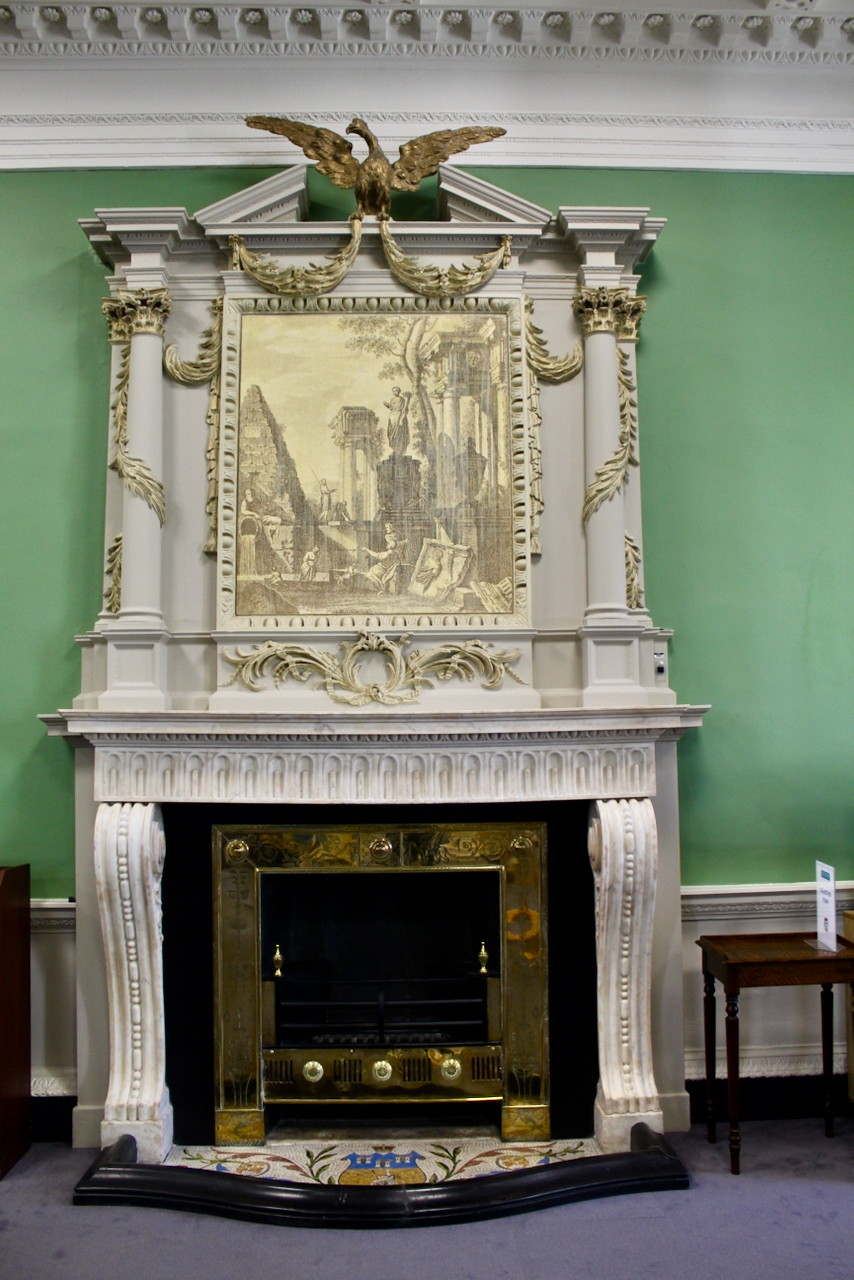
A pedimented doorcase is flanked by ornate chimneypieces based on a design by William Kent. These are surmounted by Corinthian overmantels after a design by Inigo Jones, possibly made to frame portraits, Casey suggests, of the Earl and Countess of Kildare painted by Reynolds in 1753-54. [see 2]

The chimneypieces are based on a design by William Kent. These are surmounted by Corinthian overmantels after a design by Inigo Jones, possibly made to frame portraits, Casey suggests, of the Earl and Countess of Kildare painted by Reynolds in 1753-54.
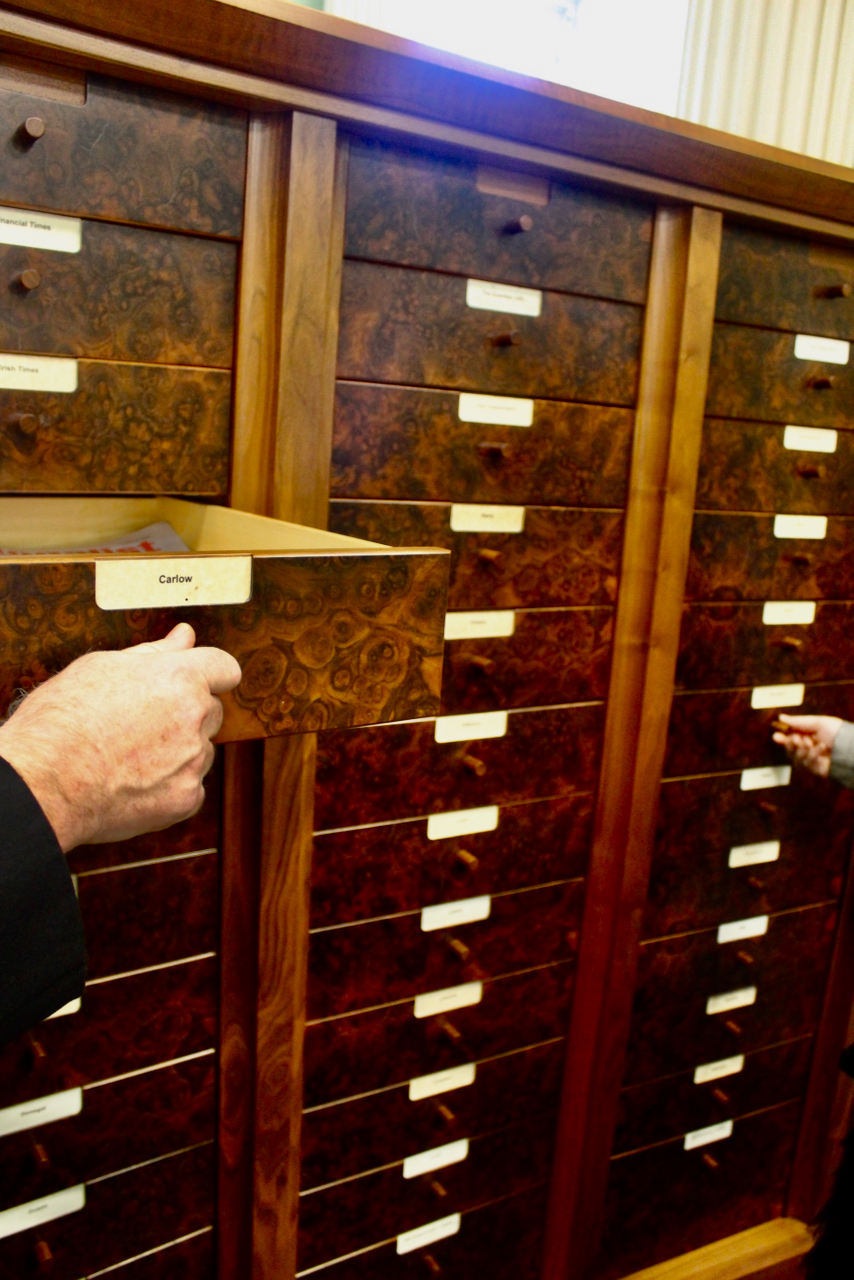
How lucky our politicians are to have use of such a beautiful library. These drawers hold the latest local newspapers from various counties. Photograph © Jennifer Winder-Baggot, www.irishhistorichouses.com.
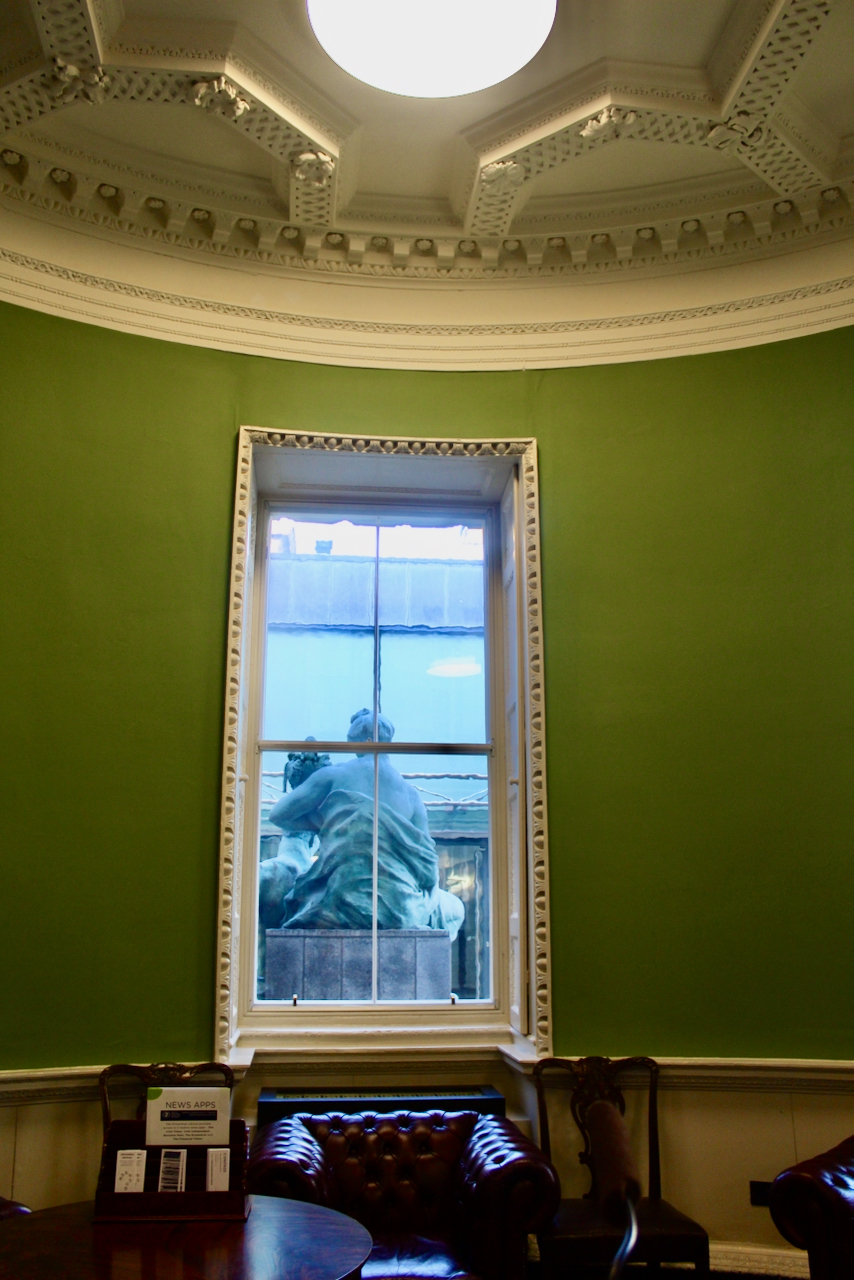
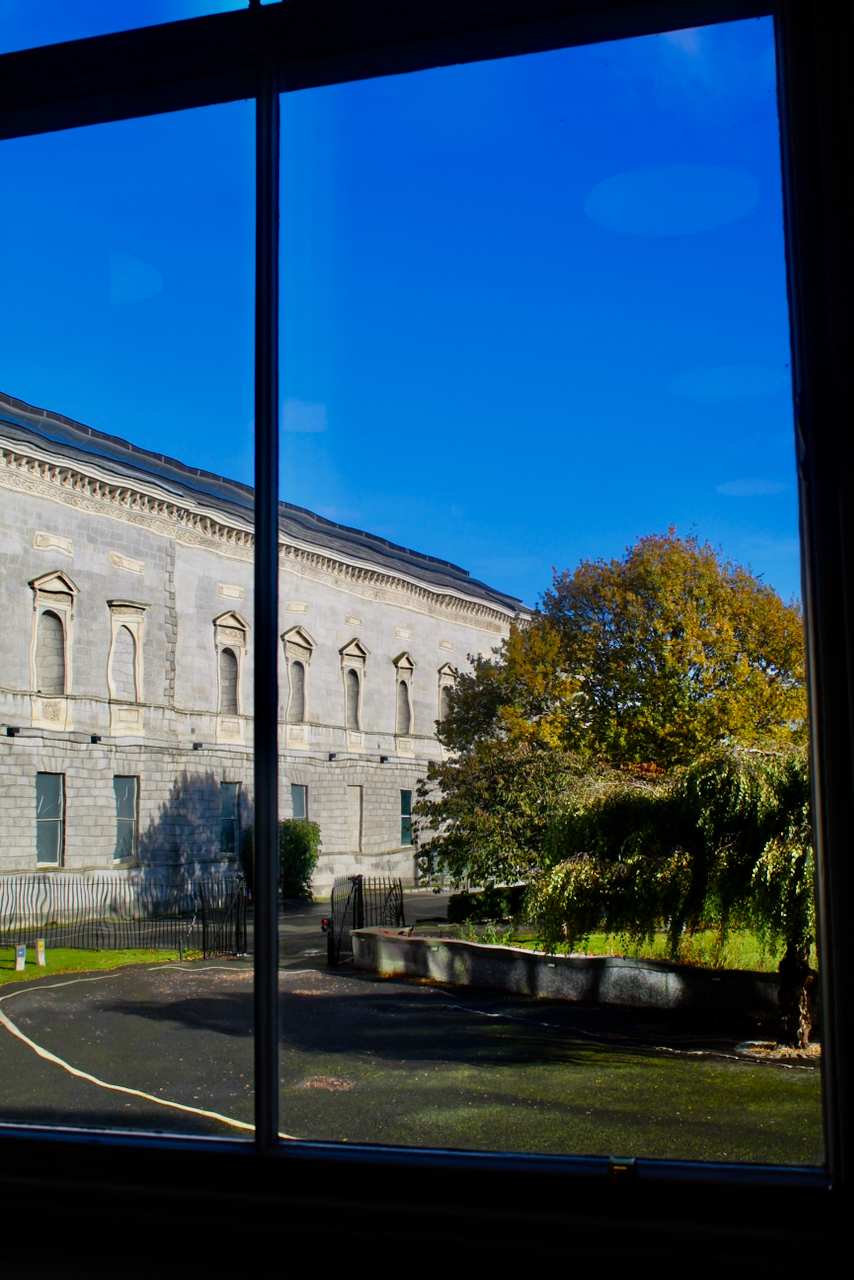
The view from the library of the National Gallery. Note the wavering window glass, a sure sign of old glass. Photograph © Jennifer Winder-Baggot, www.irishhistorichouses.com.

Next to the Supper Room on the garden front is the large dining room, also designed by Isaac Ware. It is of three bays, and has decorative doorcases and a beautiful ceiling attributed to Filippo Lafranchini.

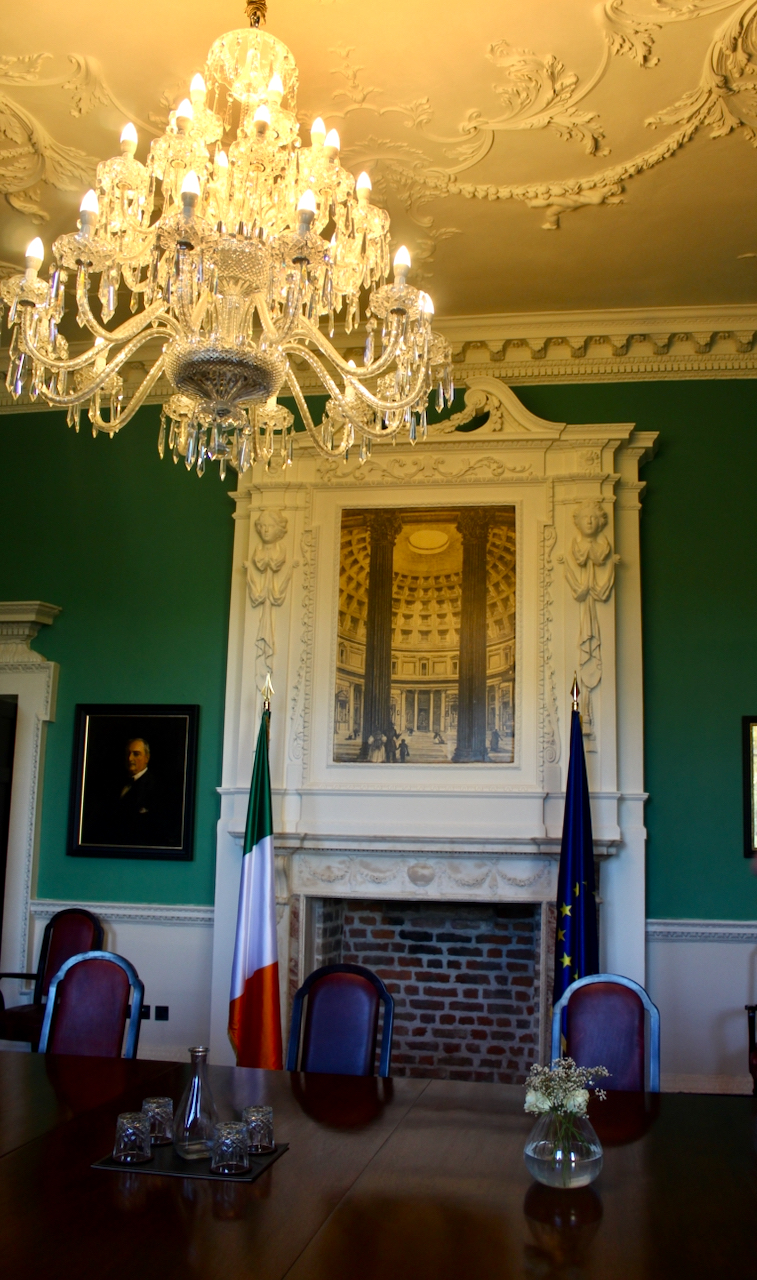
The Dining Room, Leinster House. Photograph © Jennifer Winder-Baggot, www.irishhistorichouses.com.
Design for Leinster House first floor dining room by Isaac Ware, c. 1759, courtesy Irish Architectural Archive (IAA 96/68.1/3/3). This drawing by Ware shows the ceiling design and three laid back wall elevations for the first floor dining room or saloon. A note in the top left corner indicated that Henry Fox, brother-in-law of the Earl’s wife, acted as go-between of some kind in the Earl’s dealing with the architect.
Design for the plasterwork in the ground floor dining room of Leinster house by Filippo Lafranchini, 1750s. IAA 96/68.1/2/1. The Lafranchini brothers, of Swiss origin, have been credited with the introduction of the human figure into plaster work and had a profound influence on the native Irish stuccodors after their arrival to work for the Earl of Kildare’s father at Carton in 1739. These drawings, attributed to Filippo Lafranchini are the only known drawings by either brother for an Irish building, despite the fact that they are credited with having worked on fifteen houses over a forty year period in Ireland.
A large painting of Daniel O’Connel hangs at one end of the Dining Room, Leinster House. Photograph © Jennifer Winder-Baggot, www.irishhistorichouses.com.
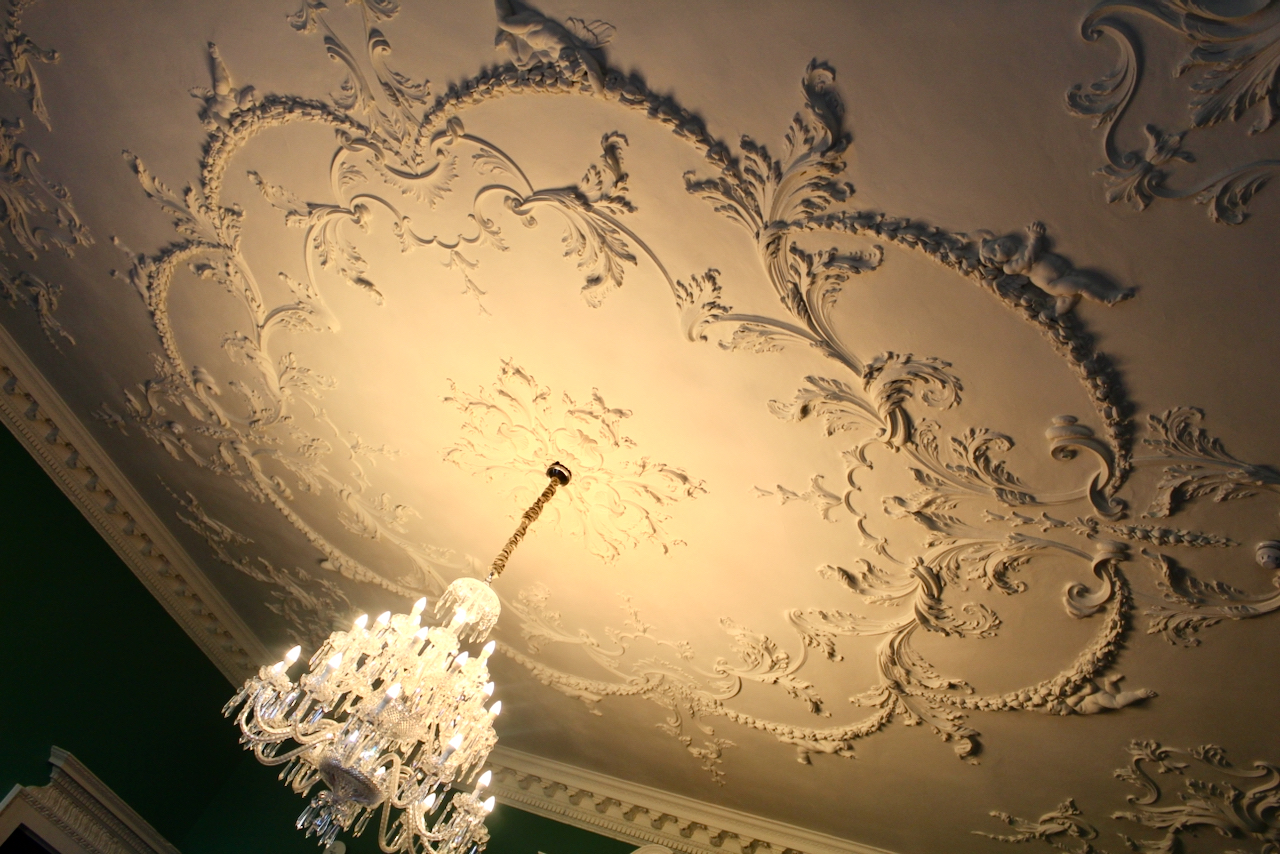
Ceiling of the Dining Room in Leinster house by Filippo Lafranchini. Christine Casey describes: “Putti swing from an inner border of festoons linked at the cardinal points by acanthus cartouches.” [see 2] Photograph © Jennifer Winder-Baggot, www.irishhistorichouses.com.
Ceiling of the Dining Room in Leinster house by Filippo Lafranchini. Photograph © Jennifer Winder-Baggot, www.irishhistorichouses.com.
The dining room in Leinster house has another grand chimneypiece. Photograph © Jennifer Winder-Baggot, www.irishhistorichouses.com.

Christine Casey next describes the Garden Hall, with a more modest shell and acanthus ceiling and a chimneypiece with claw feet. Next is the former Private Dining Room, she tells us, a room from 1760, which has a ceiling with acanthus, rocaille shells and floral festoon forming a deep border to a plain chamfered central panel.

Casey tells us that the Earl of Kildare’s Library is at the southeast corner of the house, and that it has pedimented bookcases. It too was designed by Isaac Ware.

Designs for the ceiling of the Earl of Kildare’s dressing room by Richard Castle, 1745, IIA 96/68.1/1/17, 18, 19. Irish Architectural Archive exhibition about Leinster House. As with the several surviving designs for the front elevation of Leinster House, these three beautifully executed drawings for proposed ceilings in the Earl of Kildare’s dressing room are indicative of the attention to design detail which Richard Castle brought to the project in an effort to satisfy his demanding clients. The third variant shows the ceiling almost as executed.

Before we go into the separate building that holds the current Dáil chamber, let us go up to the first floor. The former gallery now holds the Senate Chamber, and it fills the north end of the eighteenth century house. Both Richard Castle and Isaac Ware prepared plans for this room, but the room was unfinished when the Duke of Leinster died in 1773.

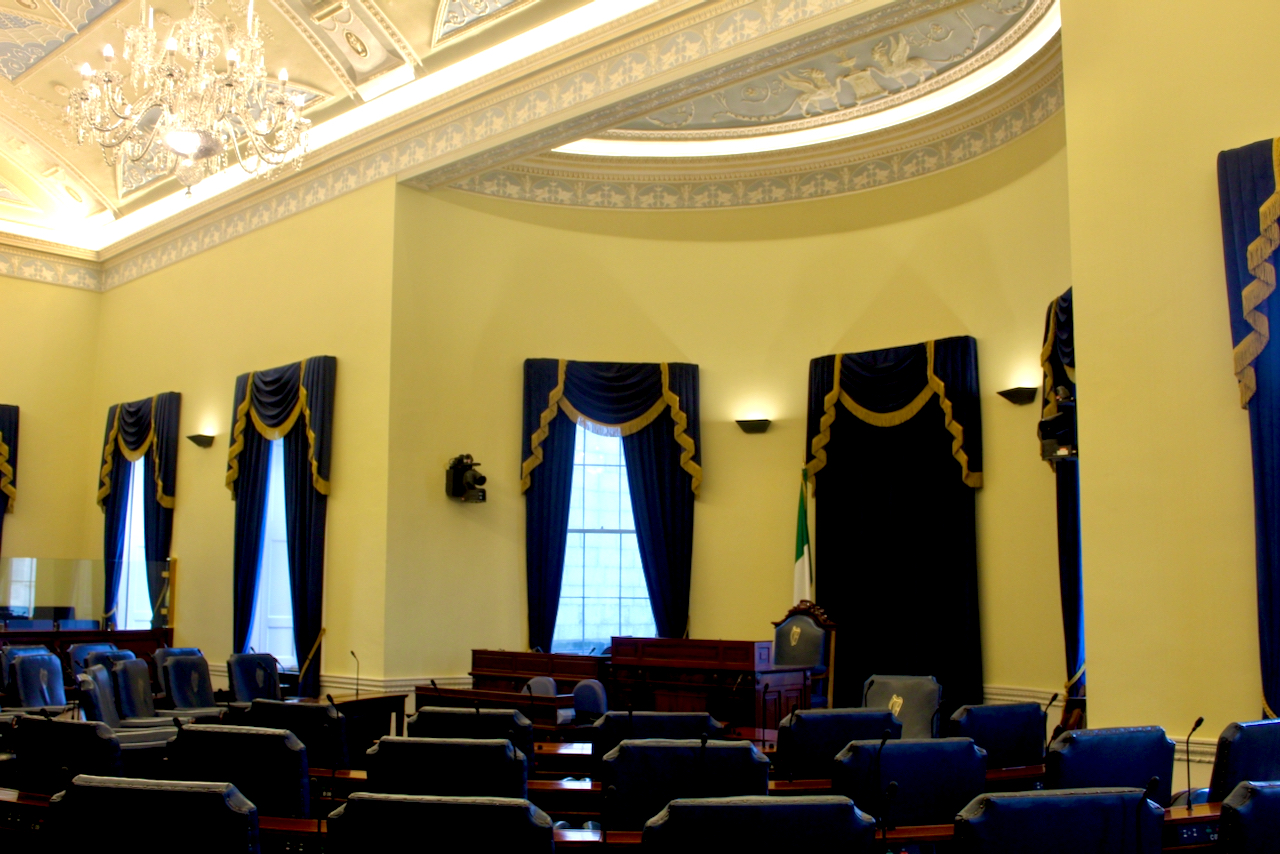
Seanad chamber, formerly the gallery. Photograph © Jennifer Winder-Baggot, www.irishhistorichouses.com.

James died on 19 November 1773 at Leinster House and was buried in Christ Church cathedral four days later. His eldest son George predeceased him, so the Dukedom passed to his second son, William Robert Fitzgerald (1748/49-1804). The 2nd Duke completed the picture gallery in 1775 to designs by James Wyatt (1746-1813).

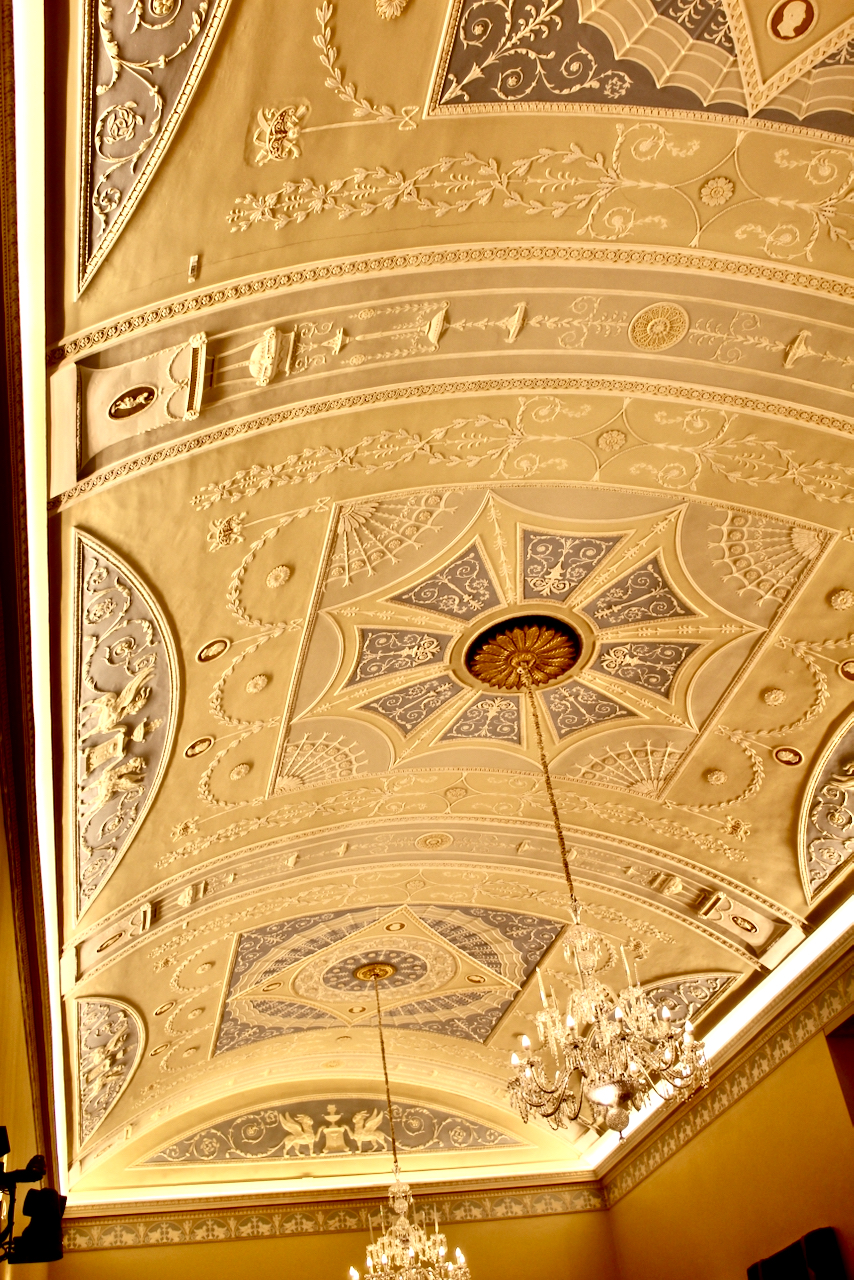
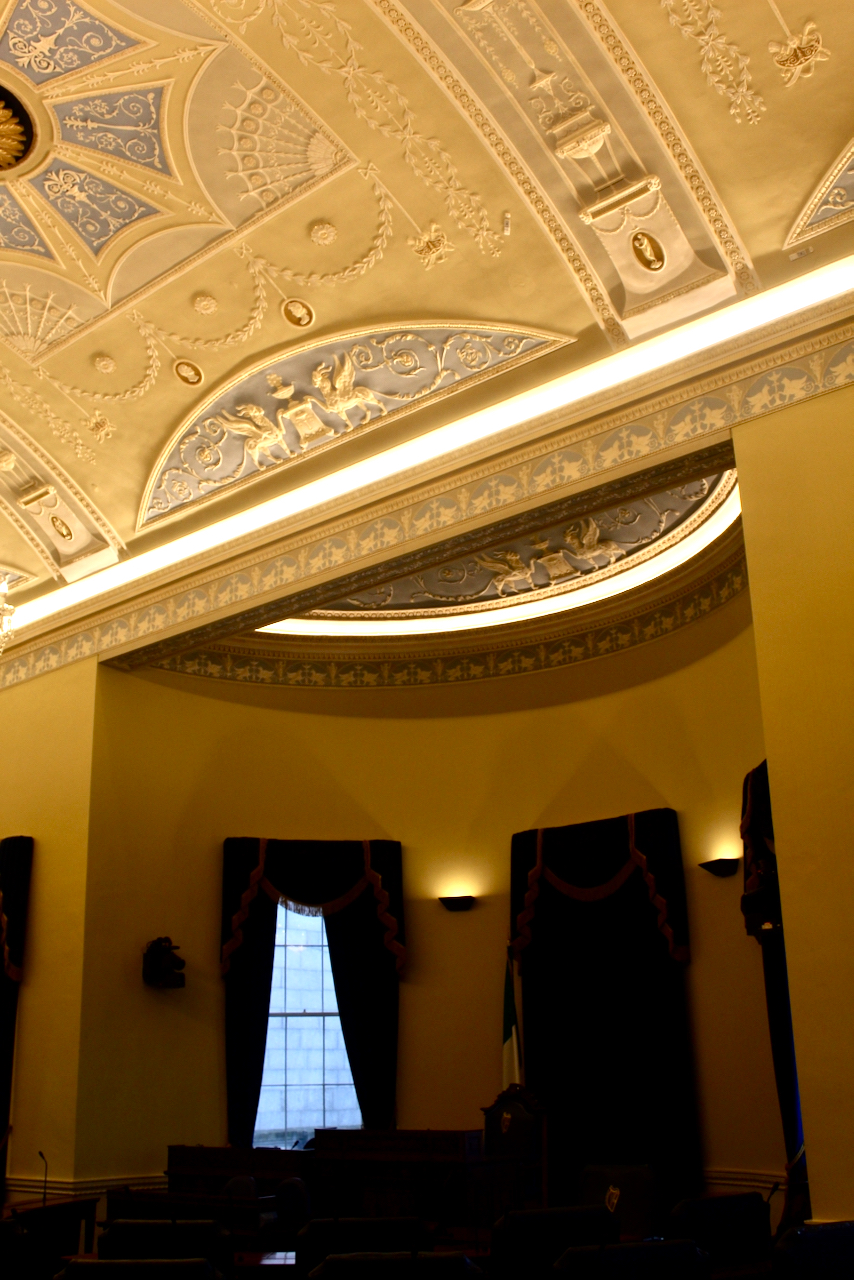
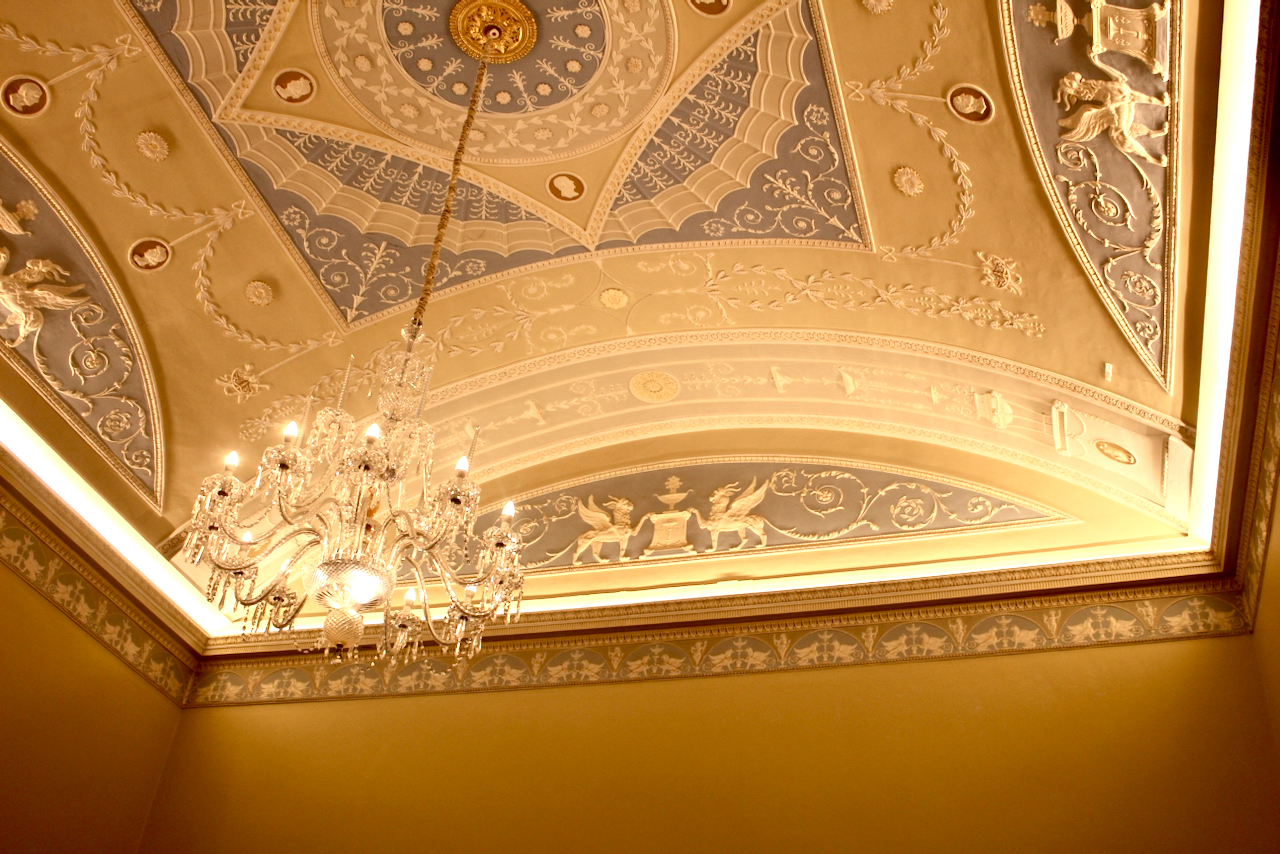
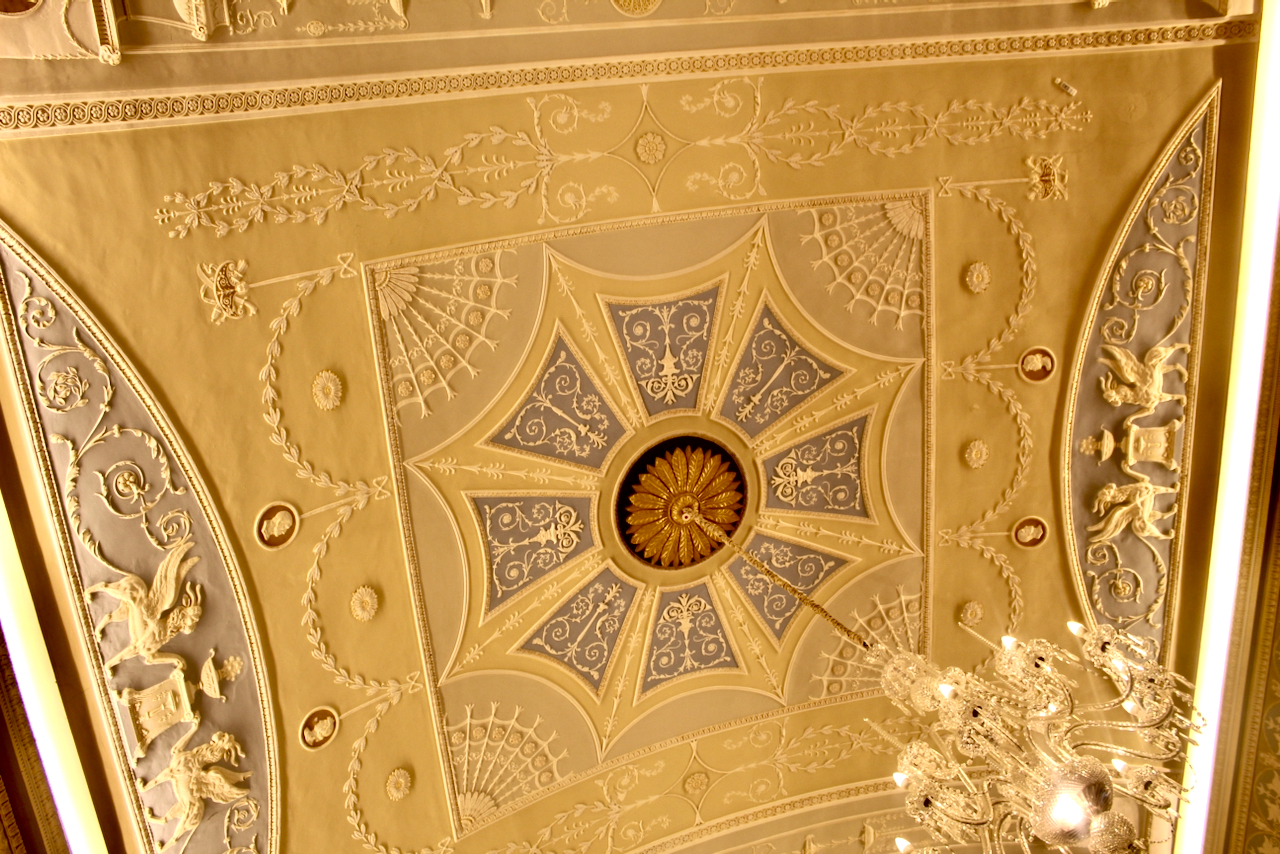
The impressive ceiling of the Seanad chamber. Photograph © Jennifer Winder-Baggot, www.irishhistorichouses.com.

The ceiling as designed by James Wyatt is tripartite. I defer to Christine Casey for a description:

at its centre a chamfered octagon within a square and at each end a diaper within a square, each flanked by broad figurative lunette panels at the base of the coving and bracketed by attenuated tripods, urns and arabesque finials… It remains among the finest examples of Neoclassical stuccowork in Dublin.

Irish Architectural Archive exhibition about Leinster House: Sketch showing the interior of the Senate Chamber of Leinster House by Con O’Sullivan, 1930s (IAA 96/145.1). Founded in 1747, Henry Sibthorpe & Co were one of the leading painting and decorating firms in Dublin from the first half of the 19th century to the mid 20th, and they closed in 1970s. Some of its records survive in the National Archives and in the IAA. Drawings showed perspective views of proposed decorative schemes to prospective clients. This dawing by Sibthorpe employee Con O’Sullivan shows a proposed repainting of the Senate Chamber.

Wyatt created an elliptical vault over the principal volume of the room and a half-dome above the bow.

The bow of the Seanad chamber, which has three windows. Photograph © Jennifer Winder-Baggot, www.irishhistorichouses.com.
Design for the first floor gallery of Leinster House by Isaac Ware c. 1759, IAA 96/68.1/3/2. This drawing by Ware shows the plan, ceiling design and three laid back wall elevations for the first floor gallery, now the Seanad Chamber. Once again, a note providing the opinion of Henry Fox is attached to the drawing.
The main ceiling of the gallery in Leinster House is an elliptical vault. Photograph © Jennifer Winder-Baggot, www.irishhistorichouses.com.

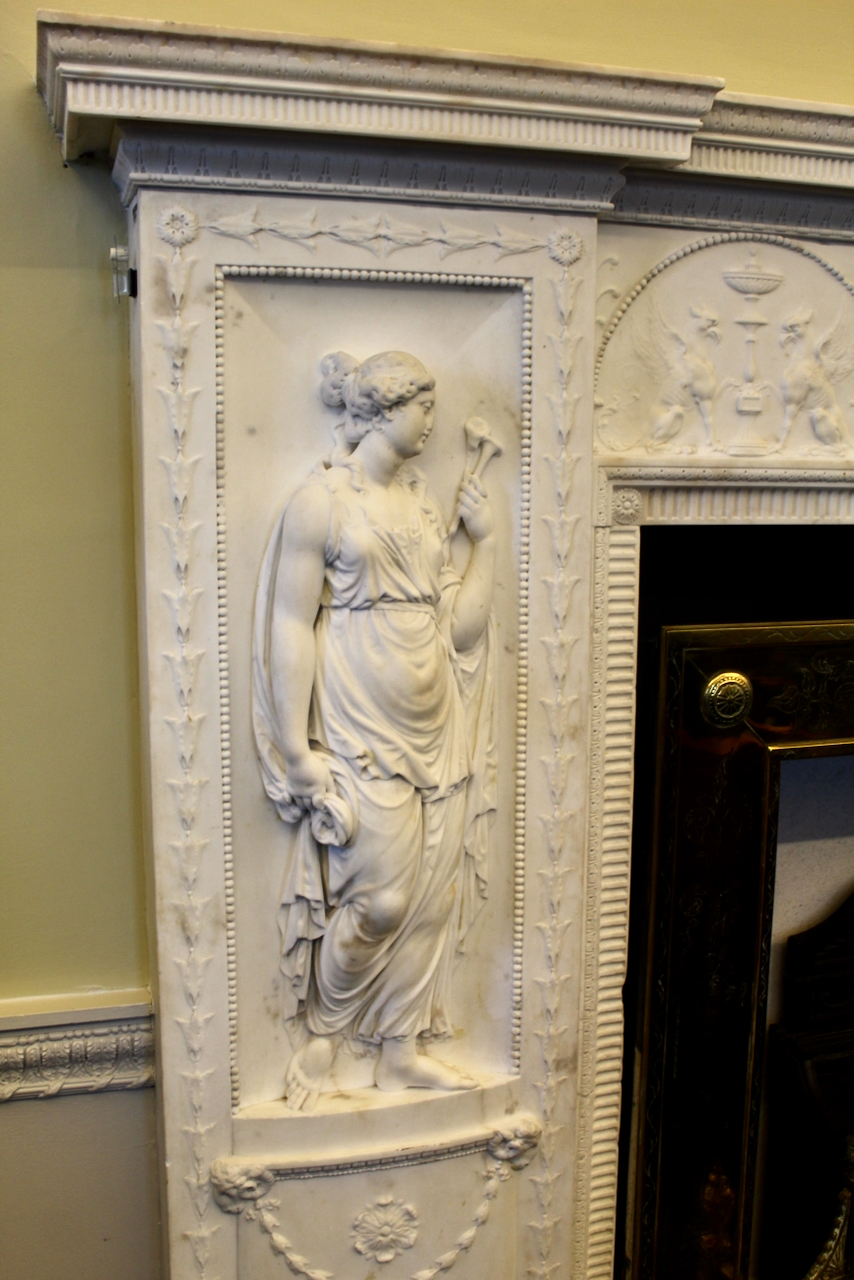
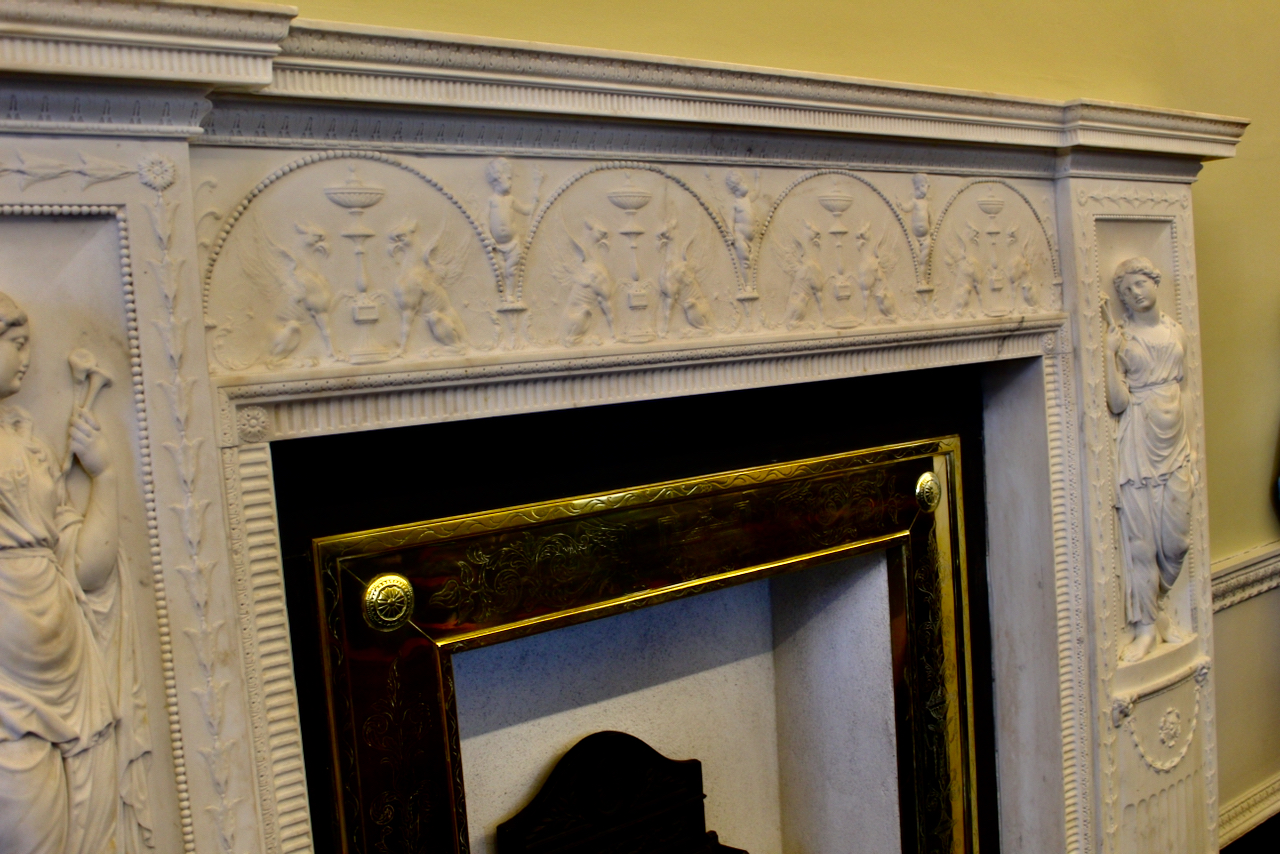
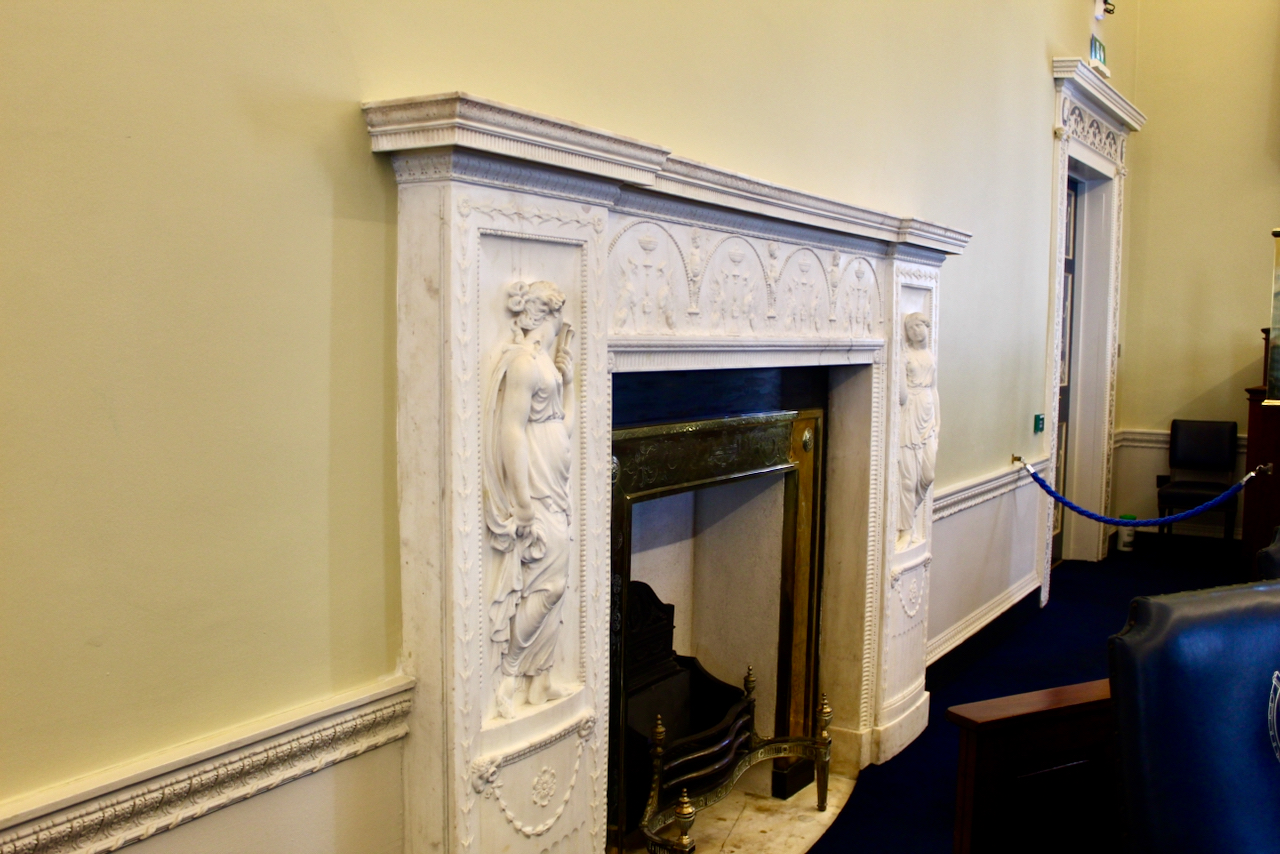
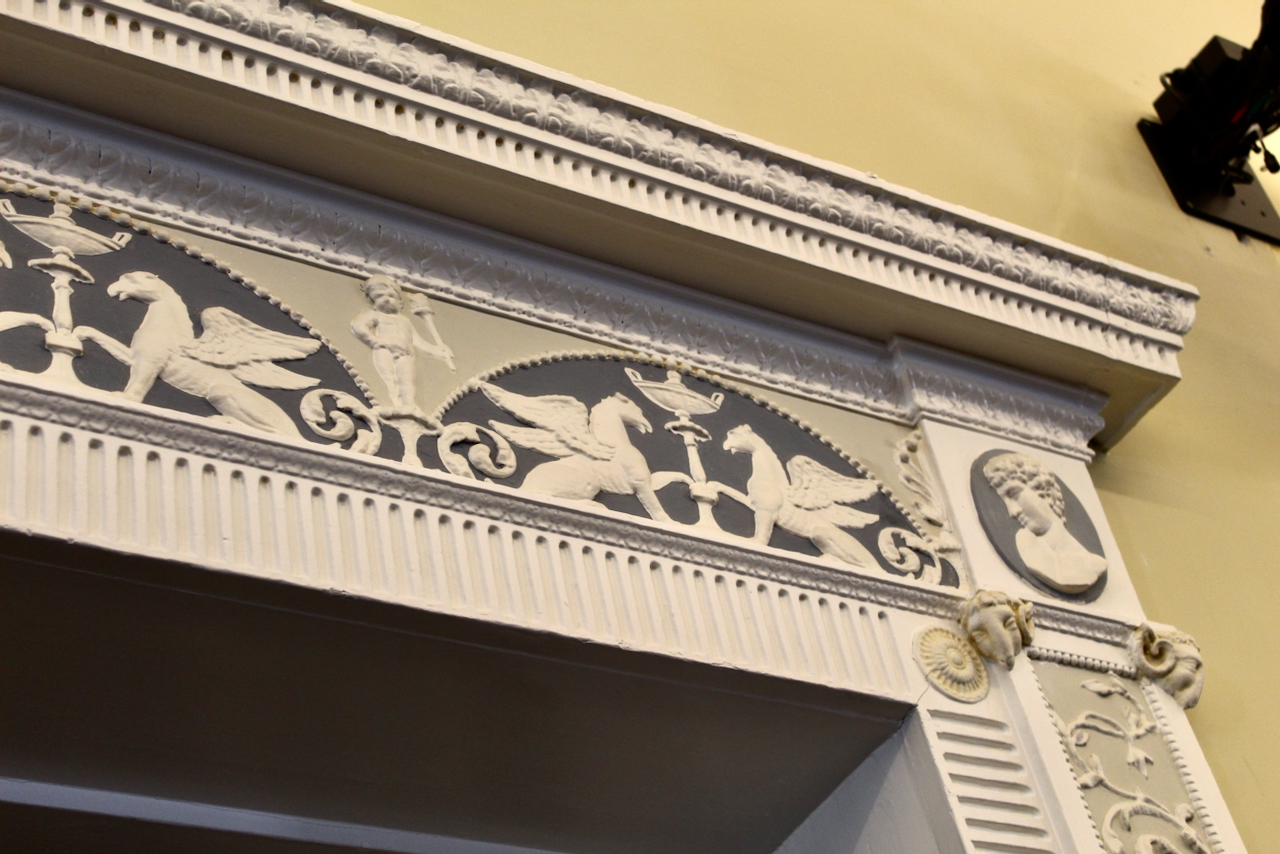
On the inner wall of the room Wyatt places three ornate double-leaf doorcases and between them two large white marble chimneypieces. The chimneypieces have high-relief female figures to the uprights and on the lintel, putti sit “between headed spandrels enclosing urns and confronted griffins.”

Unfortunately with the tour group I was unable to get good photographs of the room, the chimneypieces or the carved doorframes.

The chimneypiece in the Seanad chamber, Leinster House. Photograph © Jennifer Winder-Baggot, www.irishhistorichouses.com.
The winged griffin figure is repeated in the doorframe and in the chimneypiece and the ceiling. I love the carved ram heads on the doorframe also. Photograph © Jennifer Winder-Baggot, www.irishhistorichouses.com.
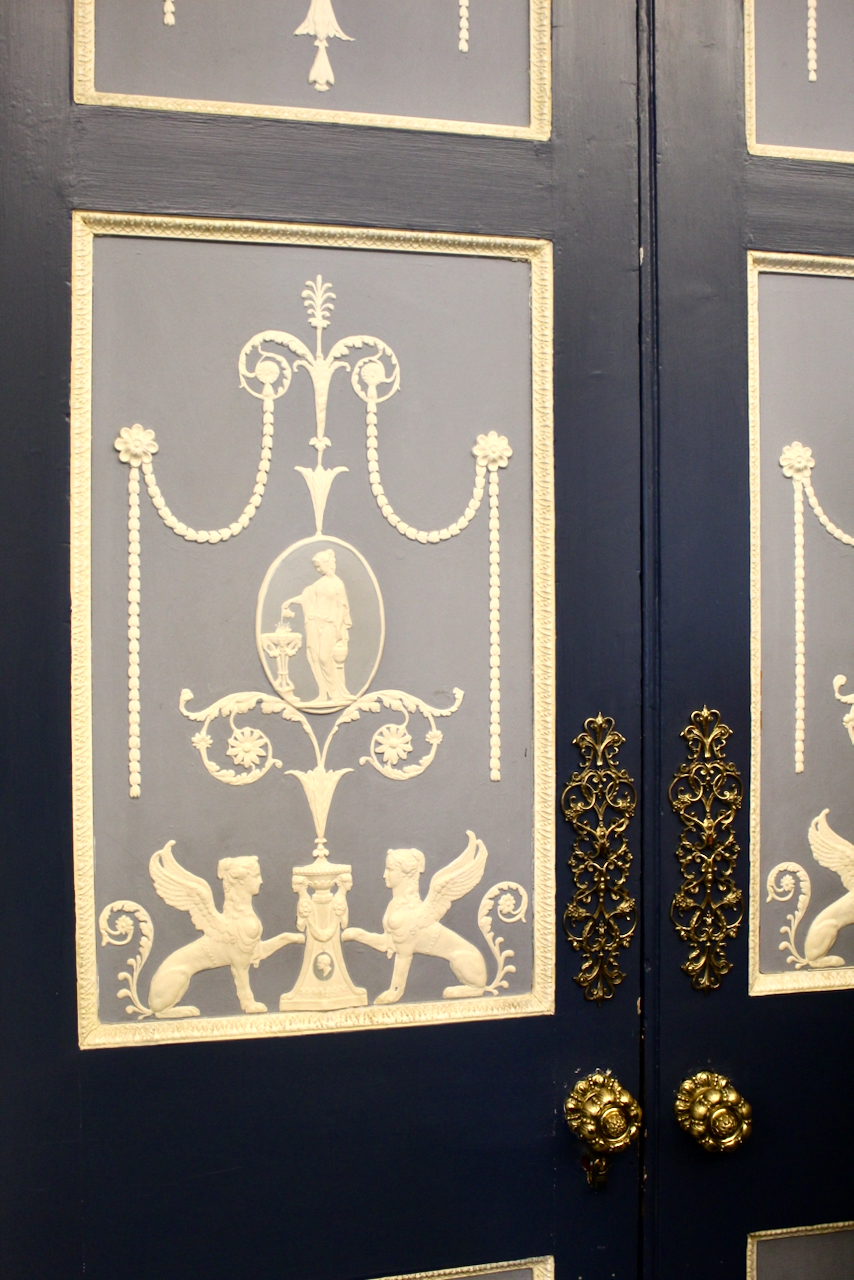
The decorative doors of the Seanad chamber,with decoration in pewter and gesso. Photograph © Jennifer Winder-Baggot, www.irishhistorichouses.com.

Next to the Seanad Chamber is the Seanad Anteroom. It was originally the upstairs dining room.

Seanad Anteroom in Leinster House. Photograph © Jennifer Winder-Baggot, www.irishhistorichouses.com.
A portrait of Robert Emmet by Maurice McGonigal. Former traitors became Irish heroes. Photograph © Jennifer Winder-Baggot, www.irishhistorichouses.com.
A portrait of Theobald Wolf Tone by Maurice McGonigal. Photograph © Jennifer Winder-Baggot, www.irishhistorichouses.com.
Seanad Anteroom in Leinster House. Photograph © Jennifer Winder-Baggot, www.irishhistorichouses.com.

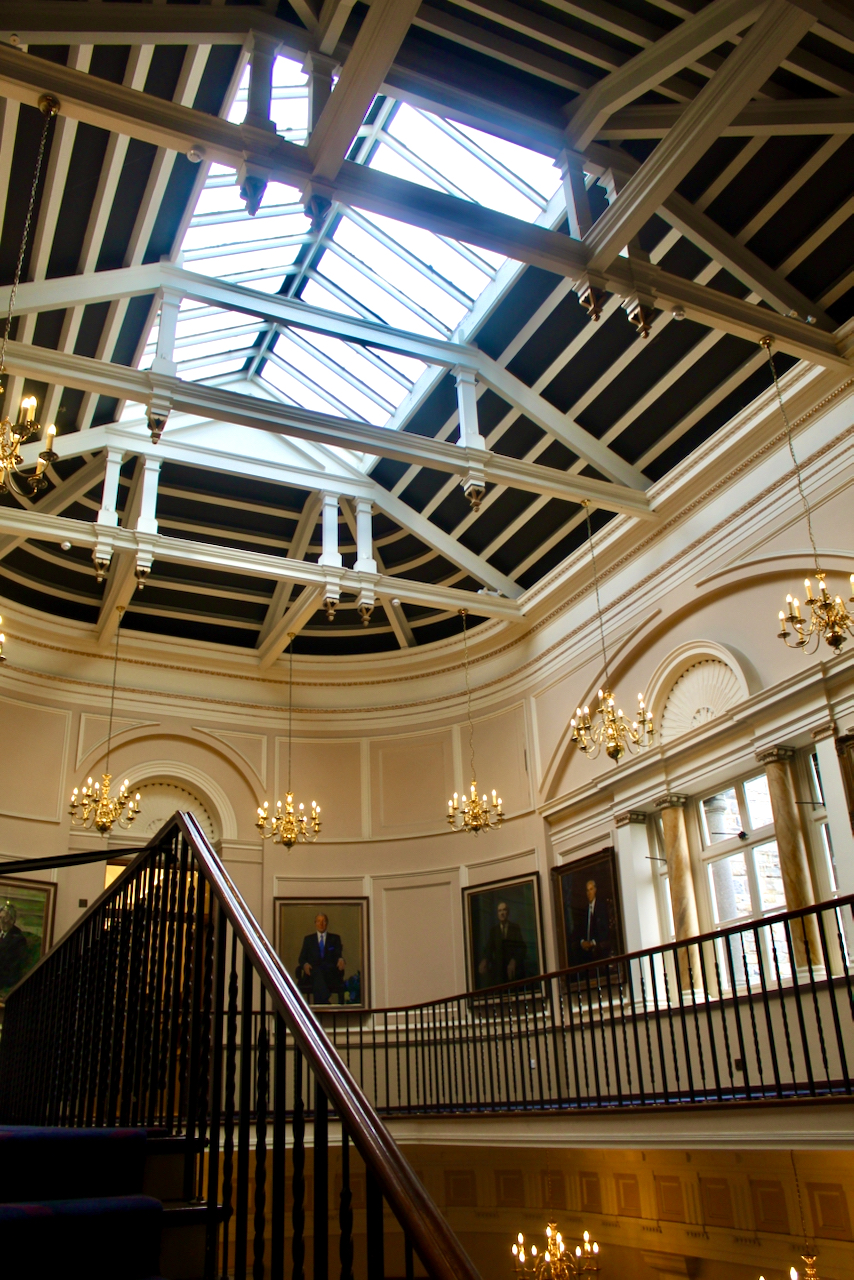
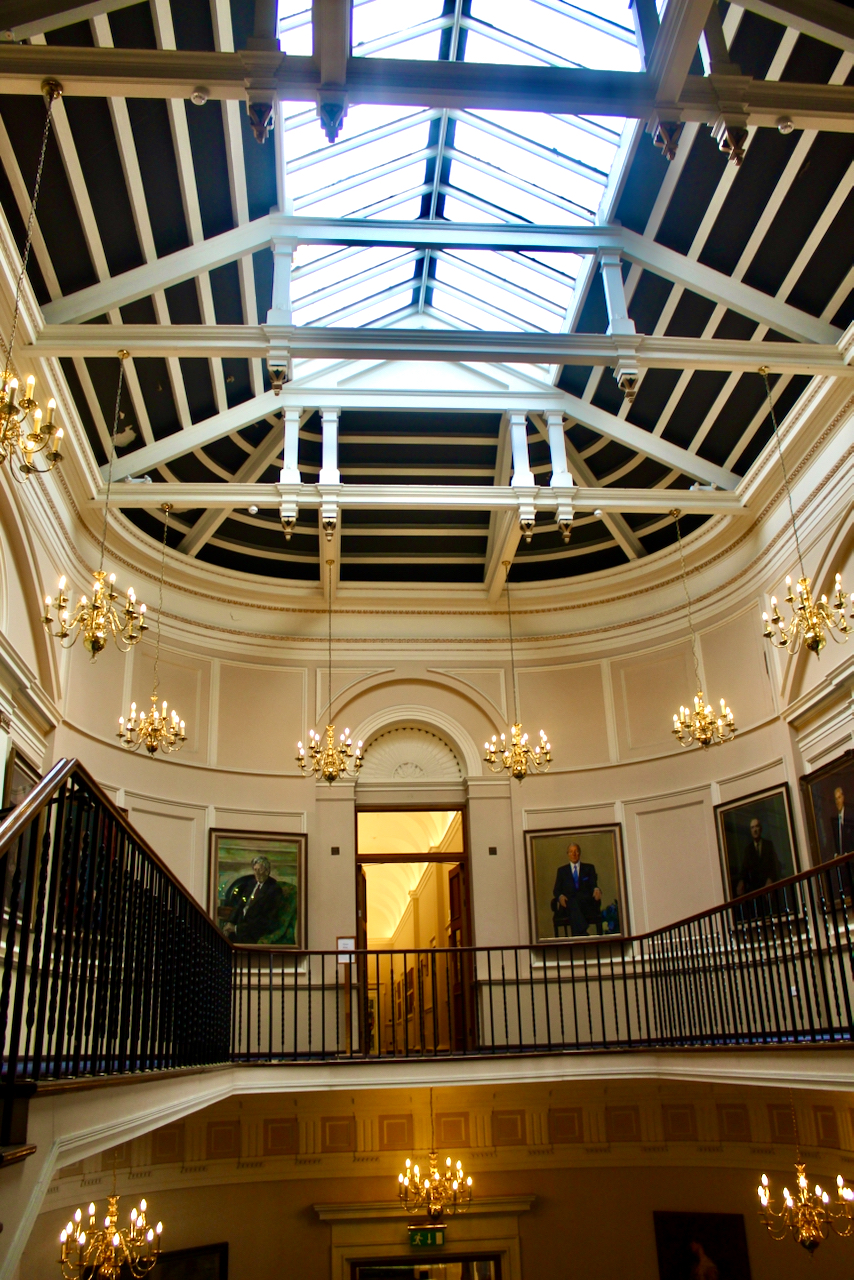
At the south end of the ground floor corridor is a top-lit stair hall which leads to the Dáil chamber. This separate building originally housed a lecture theatre, built in 1893 by Thomas Newenham and Thomas Manly Deane. Before this was built, let us look at the rest of the history briefly of the Dukes of Leinster who continued to use the house as their Dublin residence.

You can take a virtual tour of Leinster house, https://www.oireachtas.ie/en/visit-and-learn/visit-the-oireachtas/virtual-tour/

Museum and entrance to Dáil chamber building. Photograph © Jennifer Winder-Baggot, www.irishhistorichouses.com.
This is the separate entrance to the Dail Chamber building, the former lecture theatre. Photograph © Jennifer Winder-Baggot, www.irishhistorichouses.com.
At the south end of the ground floor corridor is a top-lit stair hall which leads to the Dáil chamber. Photograph © Jennifer Winder-Baggot, www.irishhistorichouses.com.

The first duke’s wife Emilia went on to marry her children’s tutor, William Ogilvie. This would have caused quite a scandal, and she and her husband lived quietly in Blackrock in Dublin at their house called Frascati (or Frescati), which no longer exists. She and the Duke of Leinster had had nineteen children! She had happy times when the children were young and their tutor would take them bathing in the sea near Frescati house. She and her second husband went on to have two daughters.

Frescati House, County Dublin, photograph by Robert French (between ca. 1865-1914), Lawrence Photograph Collection, National Library of Ireland.

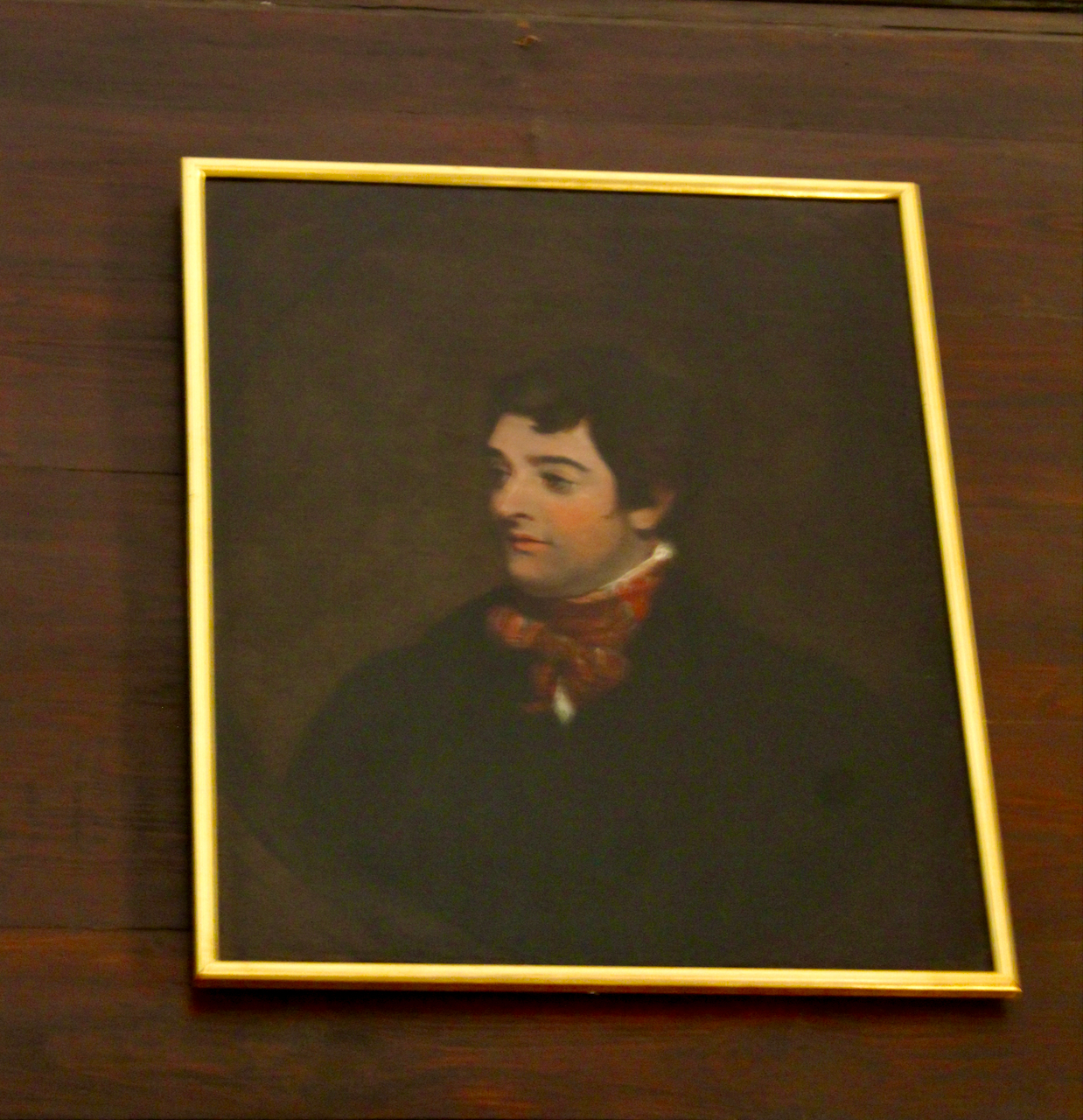
A younger son of Emilia and the Duke of Leinster, Edward (1763-1798) became involved in an uprising in Dublin, inspired by the French Revolution, and he was put in prison as a traitor and where he died of wounds he’d received while resisting arrest.

Edward Fitzgerald (1763-1798)

Another son, Charles James (1756-1810) served in the Royal Navy. He also acted as M.P. for County Kildare between 1776 and 1790, Commissioner of Customs between 1789 and 1792 and M.P. for County Cavan between 1790 and 1797. He held the office of Muster Master-General of Ireland between 1792 and 1806 and Sheriff of County Down in 1798. He was M.P. for Ardfert between 1798 and 1800 and was created 1st Baron Lecale of Ardglass, Co. Down [Ireland] in 1800. He held the office of Member of Parliament (M.P.) for Arundel in England between January 1807 and April 1807.

A sister of Edward Fitzgerald (1763-1798), Emily Maria Margaret (1751-1818) married Charles Coote 1st Earl of Bellomont, County Cavan.

William Robert Fitzgerald, 2nd Duke of Leinster, K.P. (1749-1804), circle of Joshua Reynolds courtesy of Christie’s Irish Sale 2002.

The Dictionary of Irish Biography tells us about the second duke:

He was returned as MP for Dublin city in 1767, though he was too young to take his seat, and it was only in October 1769 that he returned to Ireland to sit in parliament. He represented the constituency until 1773, supporting the government for most of this period. On learning that he was a freemason, the grand lodge of Irish freemasons rushed to make him their grand master and he served two terms (1770–72 and 1777–8). On 19 November 1773 he succeeded his father as 2nd duke of Leinster. The family home of Carton in Co. Kildare had been left to his mother but he, somewhat vainly, was determined to own it and purchased her life interest, a transaction that was the major source of his future indebtedness. His aunt, Lady Louisa Conolly, believed that he was ‘mighty queer about money’ and that his ‘distress’ about it was ‘the foundation of all that he does’ (HIP, iv, 160). In November 1775 he married Emilia Olivia Usher, only daughter and heir of St George Usher, Lord St George, a union that helped to ease some of his financial problems.

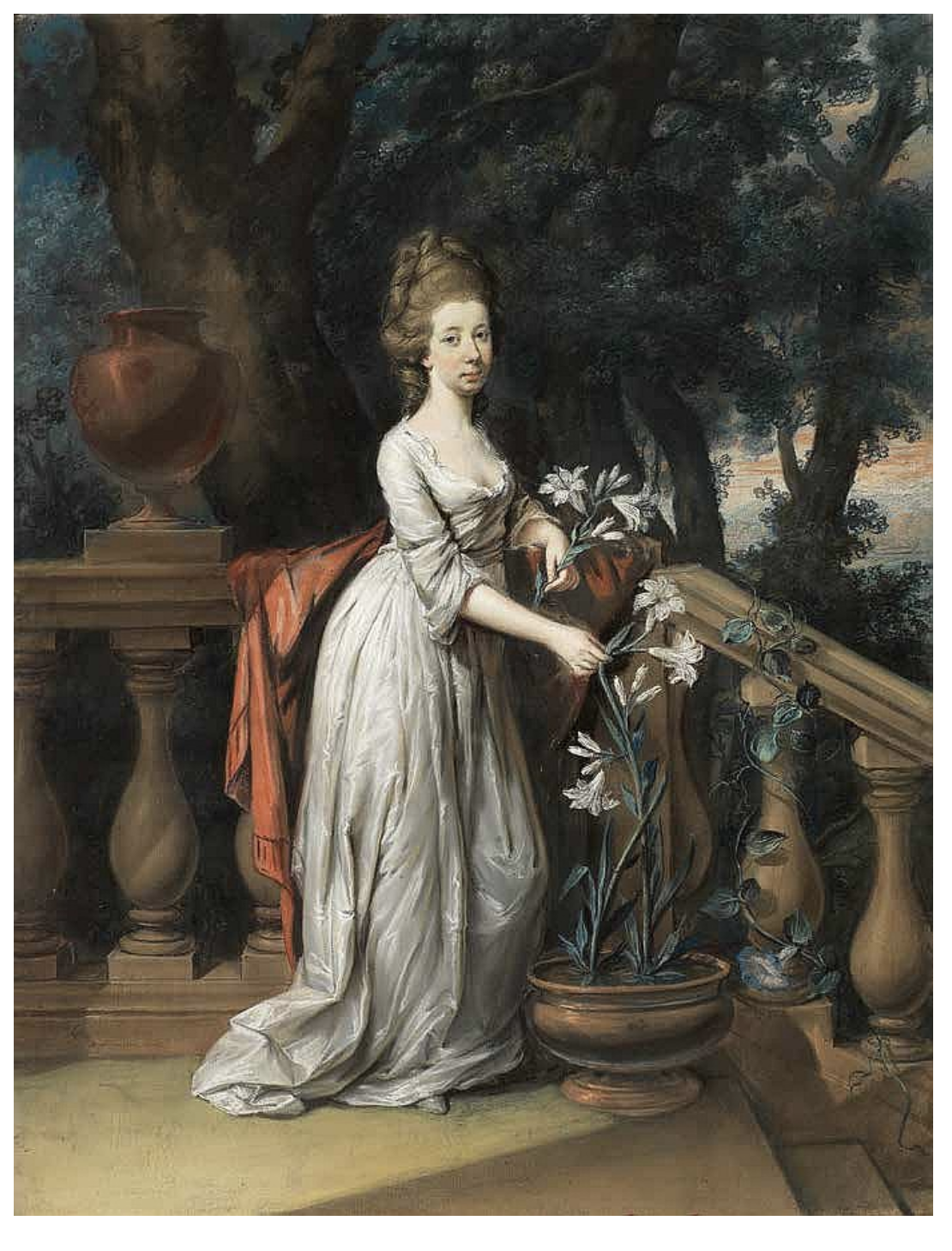
HUGH DOUGLAS HAMILTON portrait of Emilia Olivia née St. George, 2nd Duchess of Leinster courtesy of Bonhams Old Master Paintings 2018.

The 2nd Duke was active in politics. He died in 1804 and is buried in Kildare Abbey.

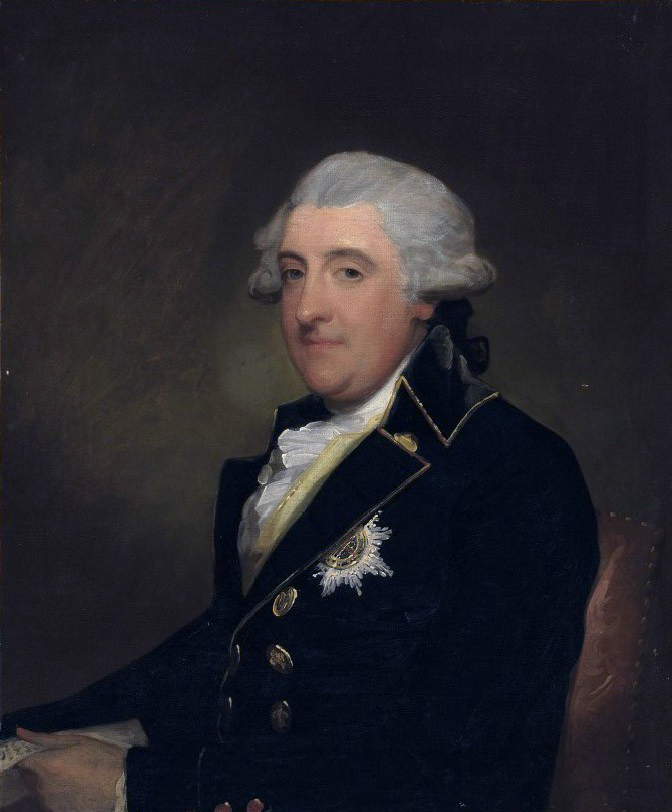
William Robert Fitzgerald (1749-1804) 2nd Duke of Leinster wearing Order of St. Patrick, by Gilbert Stuart, courtesy Christies.

One of William Robert Fitzgerald’s daughters, Emily Elizabeth (1778-1856) married John Joseph Henry of Straffan house in County Kildare, now the K Club. A son, Augustus Frederick (1791-1874) became the 3rd Duke of Leinster. He sold the town house in 1814. Since the Union in 1801 when there was no longer an Irish Parliament, a townhouse in Dublin was no longer essential. It was purchased by the Dublin Society, a group founded for “improving Husbandry, Manufactures and other useful arts and sciences.”

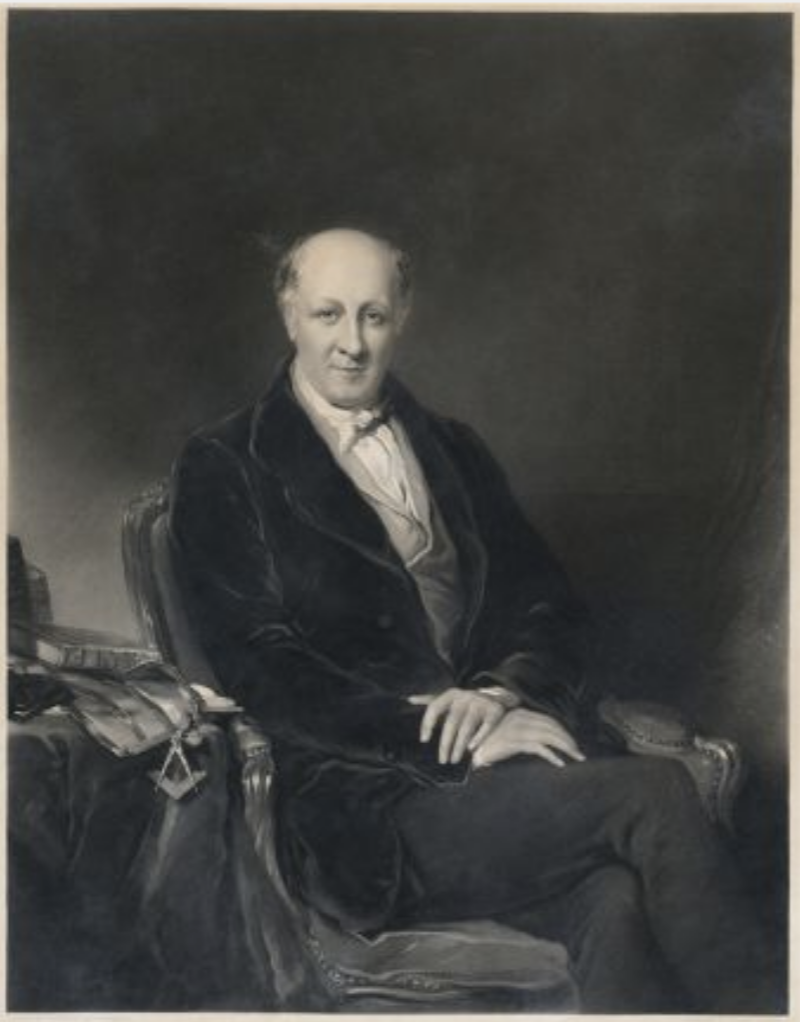
Augustus Frederick Fitzgerald (1791-1874), 3rd Duke of Leinster, engraver George Saunders after Stephen Catterson Smith, courtesy of National Gallery of Ireland.

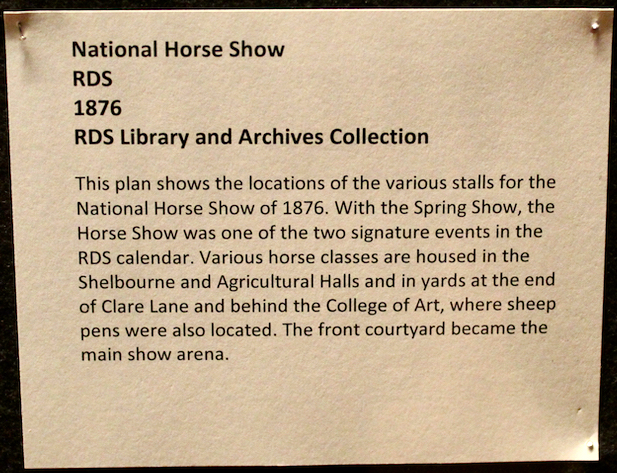
From 1815-1922 Leinster House was the Headquarters of the Royal Dublin Society – the “Royal” was added to the Society’s name in 1820. Rooms in the house were used to accommodate the Society’s library and museum as well as offices and meeting spaces. The original kitchen wing of the house was converted to laboratories and a lecture theatre. Gradually more buildings were added around the house, including sheds and halls for the Society’s events, namely the Spring Show and the Horse Show.

Note at Irish Architectural Archive exhibition about the RDS at Leinster House.
Irish Architectural Archive exhibition about Leinster House. Configuration of Leinster house as RDS and centre of culture, learning and innovation the site of The Dublin Society (1815-1820) and the RDS (1820-1922). The School of Drawing (1845) was to the left, and later became the Metropolitan School of Art and the National College of Art and Design which continued as the National College of Art on this site until 1980, when it moved to Thomas Street and its facilities were incorporated into the adjacent National Library. The former kitchen and stable block were amended and expanded to host sculpture galleries, a stone yard, laboratories and lecture facilities. It had a 700 seat lecture theatre. To the right, Shelbourne Hall and the Agricultural Hall in the mid 19th century had facilities to display agricultural and industrial products, and it was later the site of the Museum of Archaeology. The Museum of Natural History (1857) and the National Gallery of Art (1860) were first developed for RDS collections, an dwere later expanded in conjunction with the Department of Science and Art/South Kensington and the Department of Agriculture and Technical Instruction.

Leinster Lawn was the site of industrial and agricultural exhibitions. In 1853, the Great Industrial Exhibition ran on the RDS grounds at Leinster House, just two years after Prince Albert’s Exhibition in the Crystal Palace in London. Constructed of iron, wood and glass, the Irish Industrial Exhibition building was paid for by William Dargan and installed by Richard Turner on Leinster Lawn in a matter of months. Its architect was John Benson, who was knighted for his efforts.

Spring Shows and Industries Fairs (1831-1880) and early Horse Shows (1864-1881) were also held on Leinster Lawn.

Irish Architectural Archive exhibition about Leinster House.
Opening of the Dublin Great Exhibition, Illustrated London News 4th June 1853, IIA 80/010.20/1. A successor to the Great Exhibition held in the Crystal Palace, London in 1851, the Great Industrial Exhibition ran on the RDS grounds at Leinster House from 12 May to 31st October 1853. As much a marvel as any of the objects on display was the edifice in which the exhibition was housed. Constructed of iron, wood and glass, the Irish Industrial Exhibition building was paid for by William Dargan and installed by Richard Turner on Leinster Lawn in a matter of months. Its architect was John Benson, who was knighted for his efforts.

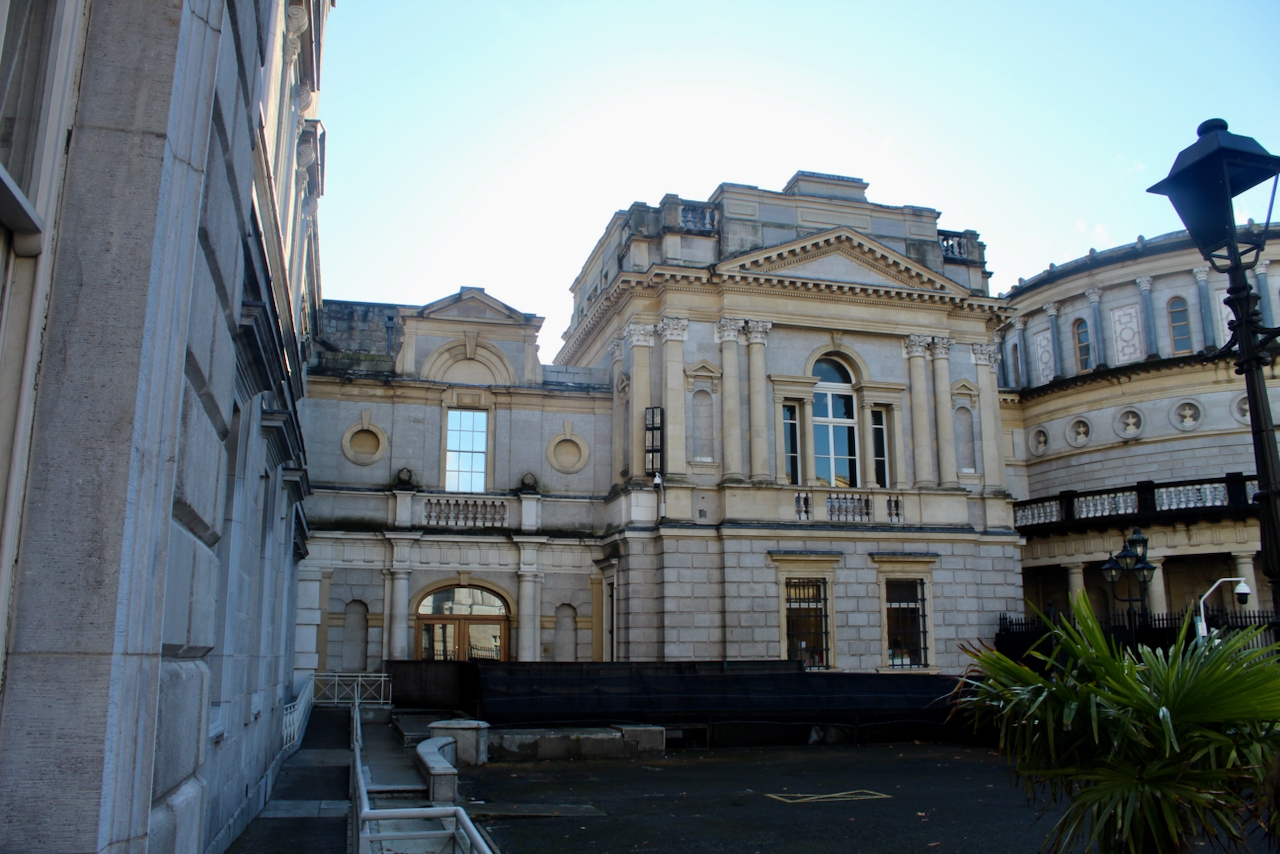
The National Museum and National Library were built in 1890, and were designed by Thomas Newenham Deane and his son Thomas Manly Deane.

Irish Architectural Archive exhibition about Leinster House. From 1815-1922 Leinster House was the Headquarters of the Royal Dublin Society. It became the focus of an extensive effort to provide Ireland with a full range of cultural institutions that grew out of activities and the collections of the Royal Dublin Society. In front is the National Library (1890) and the National Museum of Archaeology (1890). In the middle is the School of Drawing (1845) which later became the Metropolitan School of Art, and a Lecture Theatre (1896). At the rear is the National Gallery of Art (1860), the Natural History Museum (1857) and the Royal College of Science (1912).
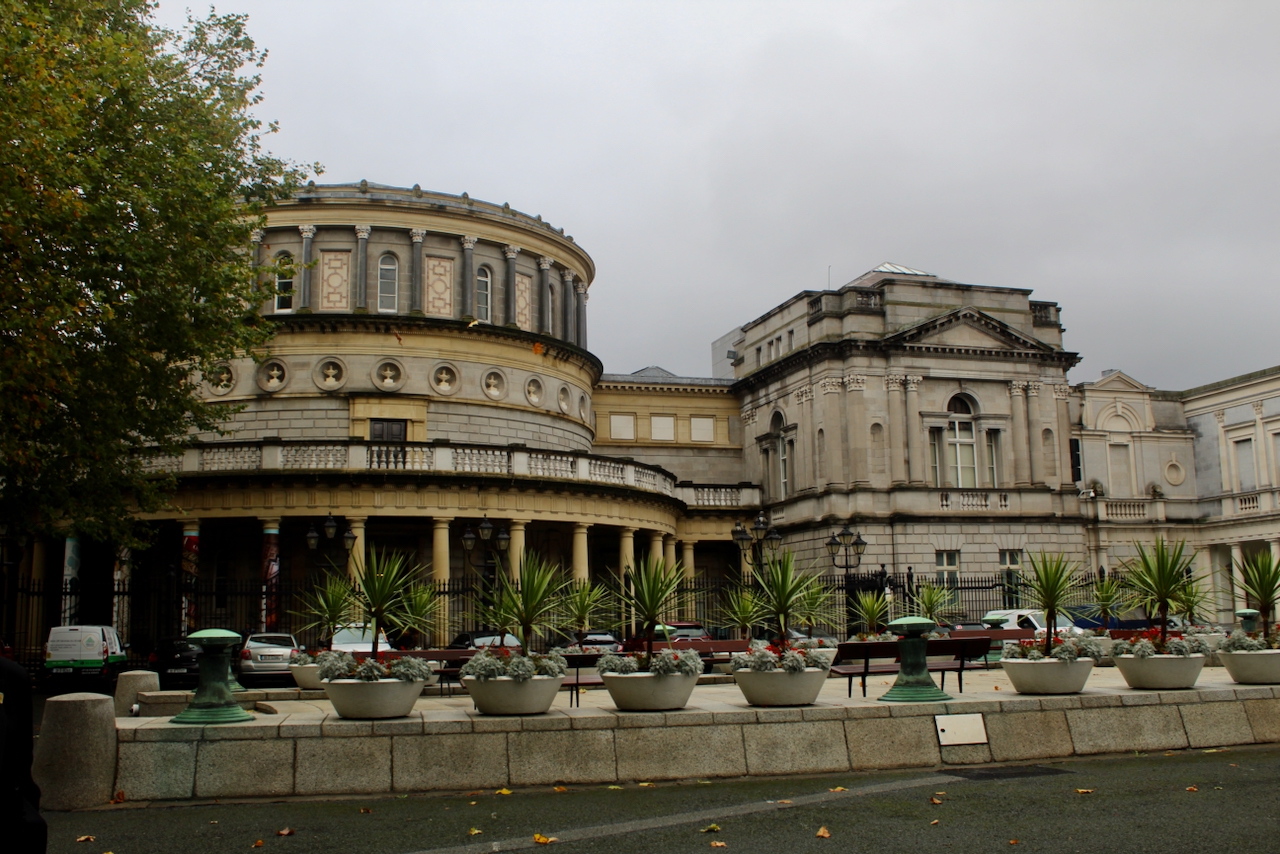
The National Library. Photograph © Jennifer Winder-Baggot, www.irishhistorichouses.com.

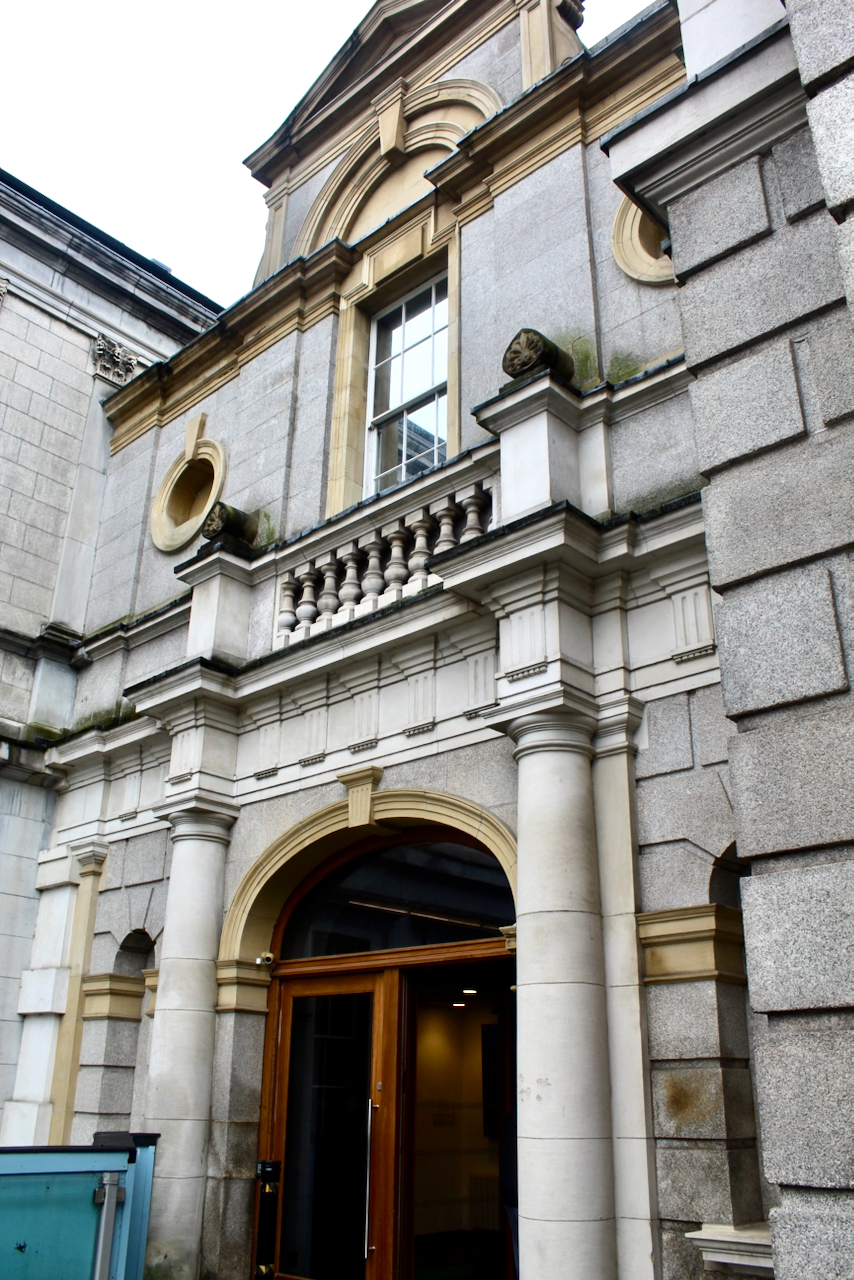
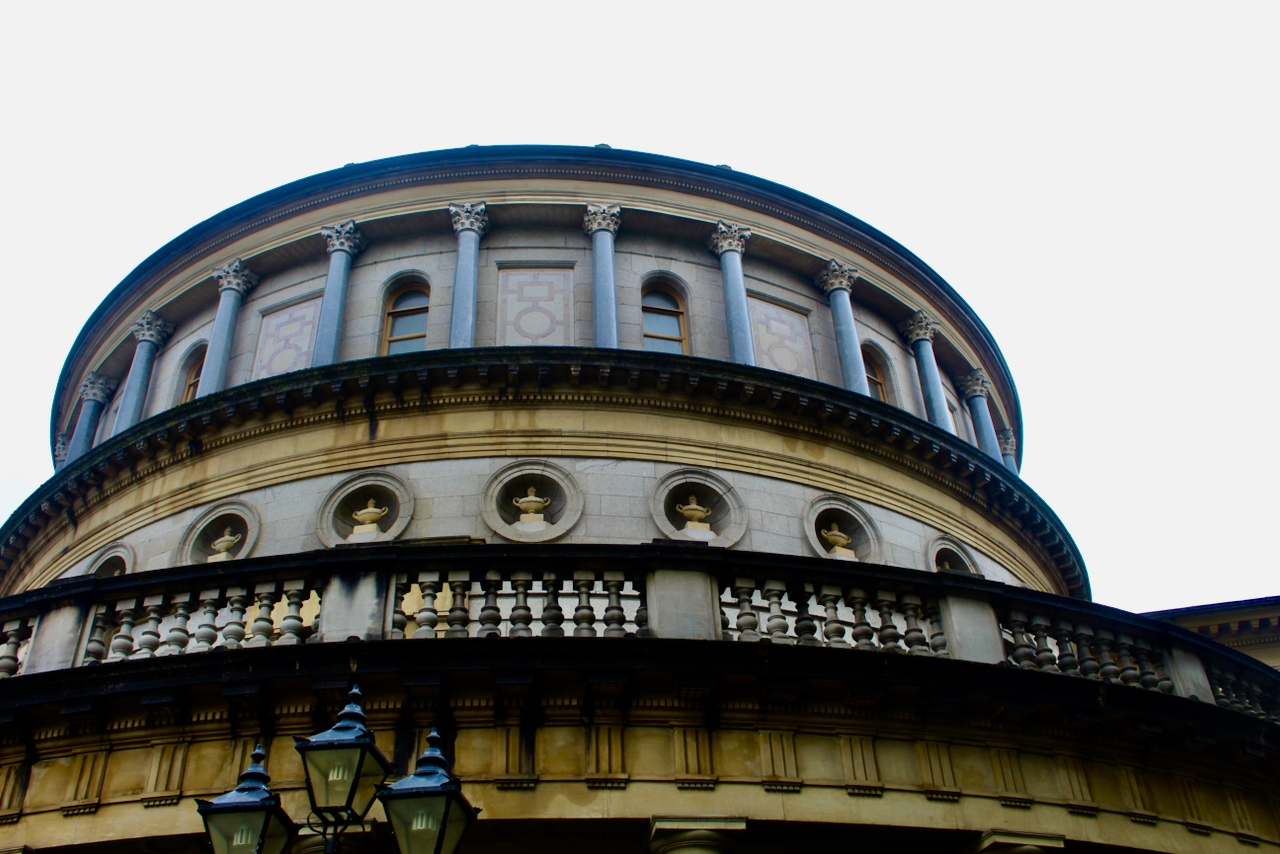
The museum and library were designed as a pair of Early Renaissance rotundas facing each other. The rotundas have a single storey yellow sandstone Roman Doric colonnade surrounding them. Above is a row of circular niches. Above that are columns framing round headed windows and panels of red and white marble. The pavillions next to the rotundas have a rusticated ground floor, with Venetian windows on first floor level and Corinthian pilasters.

Top of the museum building next to Leinster House by Thomas Newenham Deane. Photograph © Jennifer Winder-Baggot, www.irishhistorichouses.com.

The Lecture Theatre was built in 1893, and was also designed by Thomas Newenham Deane. The lecture theatre is a horseshoe shaped top-lit galleried auditorium with a flat west end that originally accommodated a stage and lecture preparation rooms.

Irish Architectural Archive exhibition about Leinster House: The RDS lecture theatre.

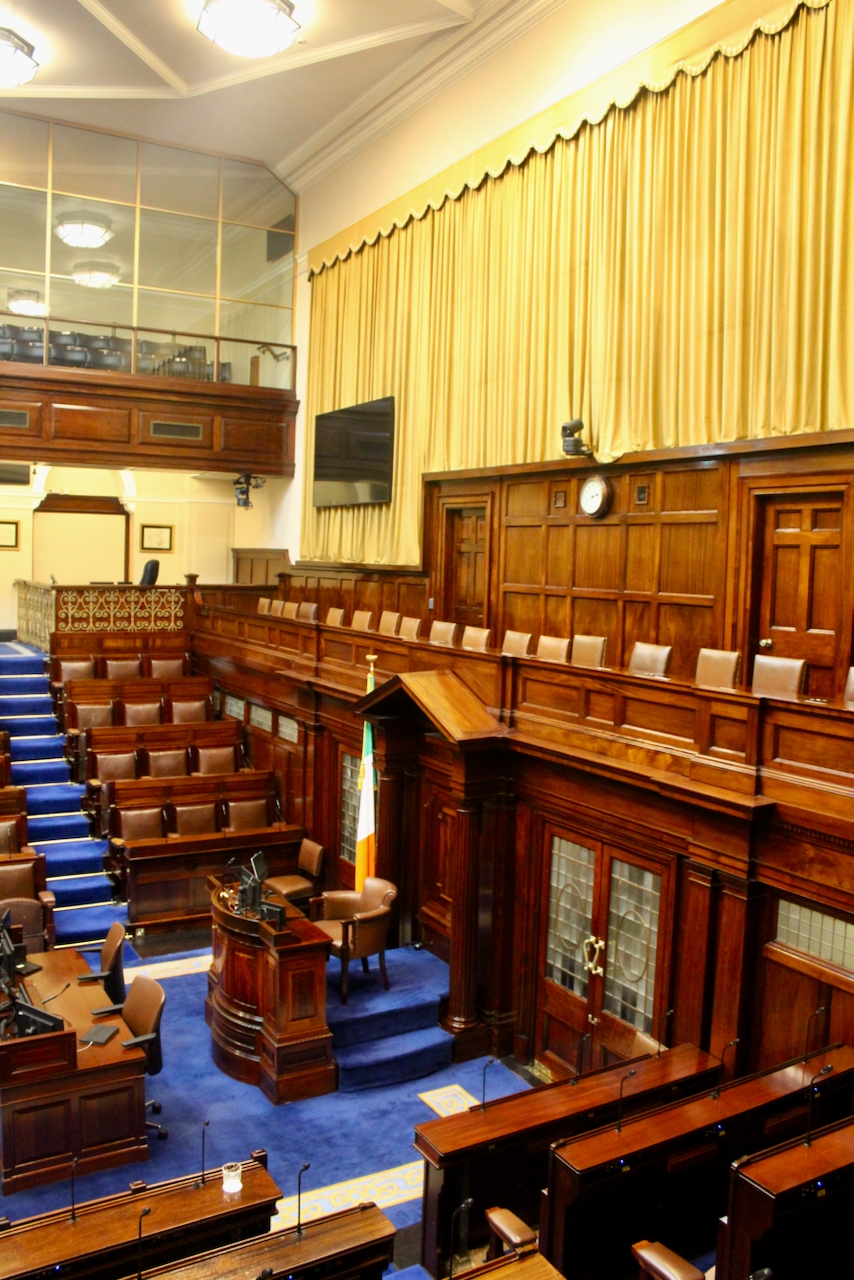
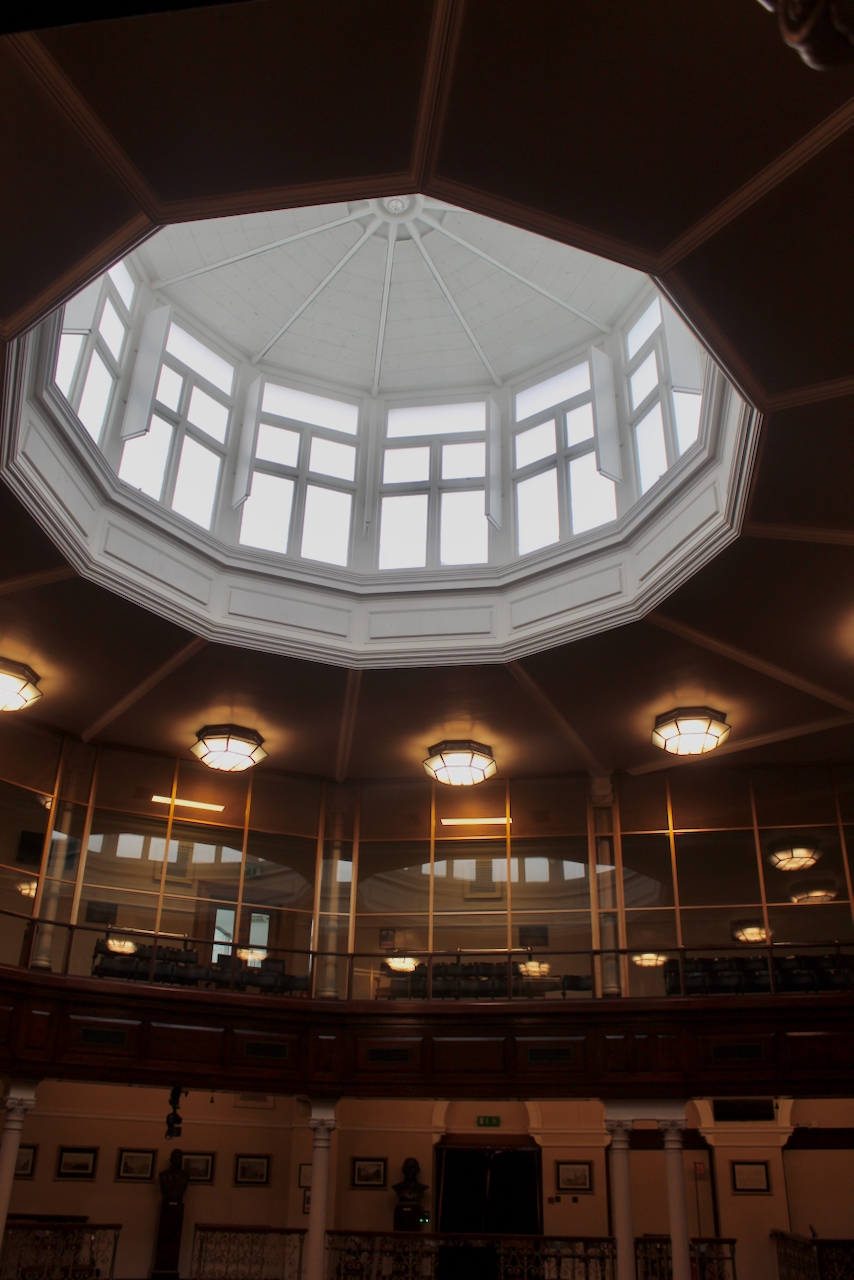
Single and paired cast iron Corinthian columns support the gallery in the former theatre. The building was appropriated as a temporary Dáil chamber in 1922 on Michael Collins’s recommendation, and in 1924 the government acquired Leinster House to be the seat of the Oireachtais. The theatre was remodelled: a new floor was inserted over the central block of seats to make a platform for the Ceann Comhairle, the clerk of the Dail, and the official reporters. The lower tier of seating was replaced with rows of mahogany and leather covered seats designed either by Hugh O’Flynn of the OPW, as the exhibition in the Irish Architectural Archive tells us, or by James Hicks & Sons according to Christine Casey, and the upper tiers became the press and public galleries. The stage was closed in and replaced by a press gallery and adjoining press rooms. The gallery was remodelled around 1930.

Dáil chamber at Leinster House. Photograph © Jennifer Winder-Baggot, www.irishhistorichouses.com.
Roof of the Dáil chamber. Photograph © Jennifer Winder-Baggot, www.irishhistorichouses.com.
Entrance to Dáil chamber, overhead is a painting of the first sitting of Dáil Éireann, which took place in the Mansion House, Dublin, on 21 January 1919. The painting is by Thomas Ryan. Photograph © Jennifer Winder-Baggot, www.irishhistorichouses.com.
Irish Architectural Archive exhibition about Leinster House.

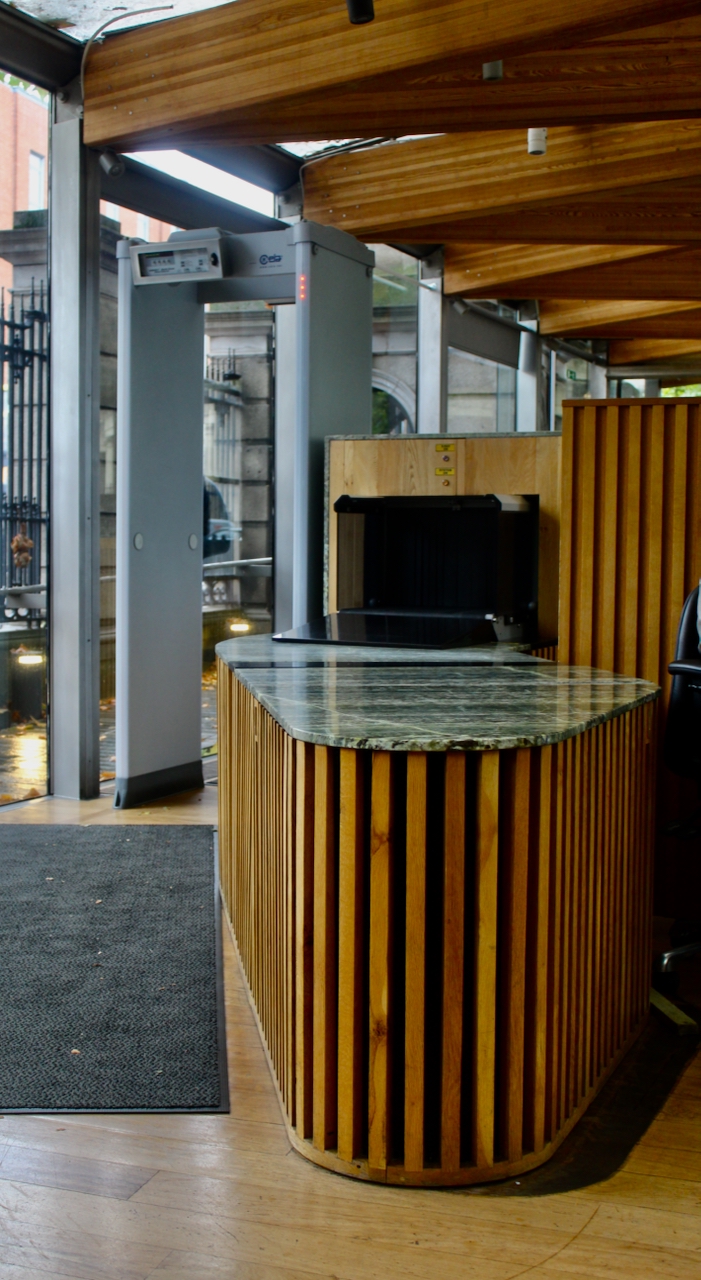
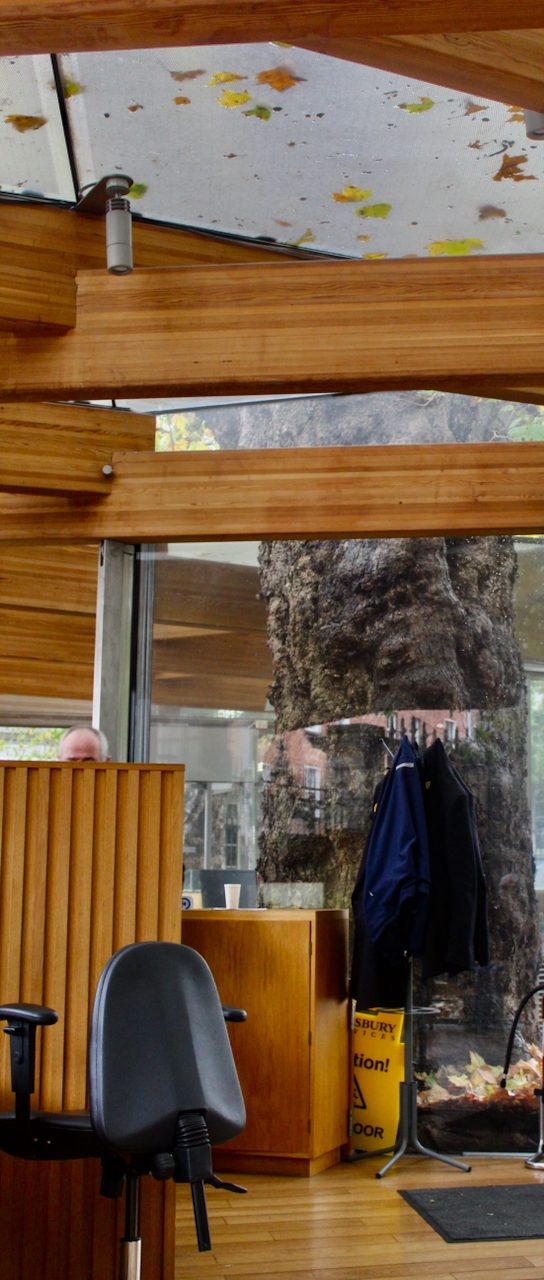
To enter Leinster house, you go through a security hut upon which a controversial sum was spent by the Office of Public Works. I love the way the hut goes around a large tree. I assume a large part of the cost of the hut was the beautiful marble countertops!

The elegant timber counter of the securty hut has lovely a marble top. Photograph © Jennifer Winder-Baggot, www.irishhistorichouses.com.
The security hut is built around an impressive tree. Photograph © Jennifer Winder-Baggot, www.irishhistorichouses.com.

[1] MacDonnell, Randal. The Lost Houses of Ireland. A chronicle of great houses and the families who lived in them. Weidenfeld and Nicolson. London, 2002.

[2] Casey, Christine. The Buildings of Ireland: Dublin. The City within the Grand and Royal Canals and the Circular Road with the Phoenix Park. Yale University Press, New Haven and London, 2005.

[3] Dictionary of Irish Biography, https://www.dib.ie/biography/fitzgerald-james-a3157

Beechwood Park, Nenagh, Co Tipperary

Beechwood Park, Nenagh, Co Tipperary

Mark Bence-Jones. A Guide to Irish Country Houses (originally published as Burke’s Guide to Country Houses volume 1 Ireland by Burke’s Peerage Ltd. 1978); Revised edition 1988 Constable and Company Ltd, London.

p. 35. “(Toler, sub Norbury,E/PB; Osborne, BT/PB; Blake/LG1972) A tall three storey early to mid C18 house built onto the end of an earlier house; its front extended by single storey wings. Seven bay front, with two additional bays on either side in the wings; three bay pedimented breakfront. Bold quoins; pedimented doorcase. Recently the home of Mr Philip Blake, the genealogist; now the property of the O’Brien Machinery Co of Pennsylvania USA.” 

https://www.buildingsofireland.ie/buildings-search/building/22401510/beechwood-park-graigue-upper-ardcrony-pr-tipperary-north

Detached seven-bay three-storey country house, built 1741, with three-bay pedimented breakfront. Two-bay single-storey over basement flanking wings, added 1853. Tower house to rear, built 1594, giving overall T-plan and is multiple-bay three-storey block. Later greenhouse added to north. Hipped and pitched slate roofs with rendered chimneystacks. Rendered walls with ashlar limestone quoins and pwith cut limestone panels over wing openings. Square-headed openings with carved limestone surrounds and cut stone sills, having replacement uPVC windows to front and some six-over-six pane, nine-over-nine pane and two-over-two pane timber sash to rear block. Timber panelled door set in square-headed opening with pedimented carved limestone surround having pulvinated frieze. Extensive outbuildings to west set around central courtyard, comprising multiple-bay two-storey outbuildings with hipped slate and pyramidal roofs and roughcast rendered walls and with ashlar limestone gateway. 

Appraisal 

The form of this imposing country house, set in a mature landscape retains many notable features and materials, such as the slate roof, ashlar limestone quoins and interior features. Architectural features, such as the pedimented breakfront and flanking wings, enliven the regular façade. The doorway is notable for its design and execution. The remodelled tower house attached to the rear adds archaeological interest and indicates a long tradition of high status settlement at this site. The outbuildings survive in their original form and together with the country house and tower house combine to create an interesting and notable group of structures. 

Ozier Hill, Taghmon, County Wexford

Ozier Hill, Taghmon, County Wexford for sale courtesy Colliers

Ozier Hill, Taghmon, County Wexford for sale courtesy Colliers.

Y35 YH76 4 beds3 baths357 m2

Ozier Hill, Taghmon, Co. Wexford, Y35 YH76 with approx. 5.25 ha (13 acres) Description A charming and well-presented period house surrounded by lovely gardens, with adjoining attractive stone courtyard. Stables, hay barn and competition size all weather sand arena with good grazing land in a scenic rural setting. Situated a short distance off the N25 Waterford to Wexford Road the property is approached from the a R738 r via a tree lined avenue that leads to the front of the house.

Ozier Hill, Taghmon, County Wexford for sale courtesy Colliers.

The reception rooms and the principal bedrooms are bright and well-proportioned with lovely views across the surrounding gardens. Extensive lawns are bordered by planting that offers a profusion of colour throughout the summer.

Ozier Hill, Taghmon, County Wexford for sale courtesy Colliers.

Location This is a pleasant rural area in which to live with much to offer those interested in country pursuits. There is a choice of hunts locally, as well as equestrian training facilities and competition venues. Golf courses nearby include the championship links course at Rosslare, and salmon fishing can be arranged on the river Slaney and sea fishing from Kilmore Quay. There are excellent sailing and cruising facilities and the sandy beaches of the southeast coast are only 16 km distant. Situated close by is the village of Taghmon, with a choice of shops and a primary national school. The provincial town of Wexford has shopping centres, restaurants, cinemas etc. It also hosts annually the internationally renowned Wexford Festival Opera. Dublin city and airport 156 km, Wexford 14.5 km, Rosslare Harbour with its ferry service to the UK 24km, Kilmore Quay 16km and Taghmon village 1km History Taghmon is in the heart of Norman country, with an abundance of walking trails, Norman castles and monastic ruins dating back to the 12th century. According to an entry in Houses of Wexford, Ozier Hill was originally a farmhouse dating from prior to 1741. It was remodelled in the mid-19th century as a Church of Ireland rectory and retains period features from that time, including an original carved oak fireplace. The present owners carried out renovations in 2004, preserving and enhancing the character of the building.

Ozier Hill, Taghmon, County Wexford for sale courtesy Colliers.

Accommodation The entrance/stairs hall with oak flooring extends the full depth of the house and off which all the main rooms radiate. To the right are the bright and spacious interconnecting drawing and dining rooms which overlook the gardens. To the left, the sitting room and the kitchen/breakfast room off which is a utility room, a boot room which in turn opens to a tack room and also to the courtyard.

Upstairs there are four double bedrooms and two bathrooms, with the main bedroom having an ensuite shower room.

Ozier Hill, Taghmon, County Wexford for sale courtesy Colliers.

There is a further bedroom annexe which could be used as a nursery or spacious dressing room. Full details of the accommodation measurements are shown in the floor plans. Outbuildings The outbuildings include a cut stone courtyard adjoining the house with four loose boxes, two coach houses with overhead loft, garage with an outer yard with four span barn with lean-to and five modern loose boxes. There is also a floodlit competition size all weather arena. The Lands The lands total approximately 5.25 ha (13 acres) of which about 2 acres comprise the house, yard and gardens the remaining 11 acres is level good quality grazing land all in old pasture in six part post and railed divisions.

Ozier Hill, Taghmon, County Wexford for sale courtesy Colliers.

Features 

Well presented private period residence. Good quality pastures. Excellent equine facilities.

Ozier Hill, Taghmon, County Wexford for sale courtesy Colliers.

https://www.businesspost.ie/property/wexford-period-home-with-lush-gardens-is-a-winner-alright/

by Tina-Marie O’Neill, May 20, 2023

Ozier Hill was originally a farmhouse dating from before 1741. Ozier Hill was remodelled in the mid-19th century as a Church of Ireland rectory.

From the French, the term ‘ozier’ is a variant of the topographic name for someone who lived near a willow tree or willow grove and stems from the Gaulish word ‘osier’ or ‘willow’.

Set within its own copse of specimen trees on a plot of some 13 acres in Taghmon in Co Wexford is Ozier Hill, a charming period home of almost 360 square metres, which has just come to market with Marcus Magnier of Colliers, who is guiding €950,000 for it.

The beautifully presented residence would suit buyers with an equestrian lean given its adjoining attractive stone courtyard and competition-size, all-weather sand arena, which is surrounded by lush gardens and good grazing land.

According to an entry in Houses of Wexford, Ozier Hill was originally a farmhouse dating from before 1741. It was remodelled in the mid-19th century as a Church of Ireland rectory and retains period features from that time, including an original carved oak fireplace. The present owners carried out renovations in 2004, preserving and enhancing the character of the building.

The property is approached from the R738 via a tree-lined avenue that leads to the front of the house.

A black front door opens to a wide and inviting entrance hall with oak floors, coving and ceiling roses and which extends the full depth of the house. All the main reception rooms radiate off that central, spinal hall.

To the right of it are the bright and spacious interconnecting drawing and dining rooms. Decorated in pale cream carpets with tasteful wallpapers, these sophisticated rooms both have open fires with attractive fire surrounds in marble and mahogany and dual aspect sash windows overlooking the gardens.

To the left of the hall, the family sitting room has oak floors, an open fire and decorative ceiling cornicing.

The large, adjacent kitchen/breakfast room has an extensive range of base and wall-mounted, cream, Shaker-style timber units, black granite worktops, the quintessential country kitchen staple – an Aga, this one in duck egg blue, tiled floors and splashbacks, a range of integrated appliances and ample space for a large table adn chairs and a window seat.

Off the kitchen is a utility room with additional fitted storage off it, and a boot room, which opens to a tack room and has access to the courtyard.Upstairs there are four large, luxurious double bedrooms and two bathrooms, with the main bedroom having an en suite shower room.
There is a further bedroom annexe which could be used as a nursery or spacious dressing room.Outside, situated a short distance off the N25 Waterford to Wexford Road, Ozier Hill offers extensive lawns bordered by planting that offers a profusion of colour throughout the summer.
Its cut stone courtyard adjoining the house has four loose boxes, two coach houses with an overhead loft, a garage with an outer yard with a barn and lean-to and five modern loose boxes. There is also the floodlit, all-weather arena.
The house, yard and gardens sit on some two acres of the overall 13, the remaining acreage offering good quality grazing land all in old pasture in six part post and railed divisions.Taghmon is in the heart of Norman country, with an abundance of walking trails, Norman castles and monastic ruins dating back to the 12th century.
Taghmon Village has a choice of shops and a primary national school. Wexford town is some 14.5 km away and has shopping centres, restaurants and a choice of facilities.
The rural area boasts a choice of equestrian training facilities and competition venues, golf courses, river and sea fishing, sailing facilities and sandy beaches along the southeast coast, which is only 16 km away.
Dublin city and airport are 156 km away.
Services include mains electricity, high speed broadband, well water, oil fired central heating and septic tank drainage.
For more details contact Colliers director, Marcus Magnier, at 01-6333700

Drewstown, Athboy, Co Meath  

Drewstown, Athboy, Co Meath  

Mark Bence-Jones. A Guide to Irish Country Houses (originally published as Burke’s Guide to Country Houses volume 1 Ireland by Burke’s Peerage Ltd. 1978); Revised edition 1988 Constable and Company Ltd, London.

p. 107. “(McVeagh/LGI1958) An imposing three storey stone house of ca 1745, attributed to Francis Bindon, built for Barry Barry. Seven bay entrance front with three bay central breakfront; round-headed window framed by pilasters and segmental entablatures in the centre of each of two upper storeys; ground floor windows with rusticated surrounds, shouldered architraves round windows in upper storeys. Later enclosed porch with fanlight and Ionic columns and pilasters. Curved bow in one side elevation, but not in the other. Two storey hall with the staircase rising behind a bridge-gallery; a rare feature in Irish country houses at this date, though there is another example of it only a couple of miles away across the Westmeath border at Ballinlough Castle. As at Ballinlough, both the stair and gallery have slender wooden balusters; and there is C18 panelling on the walls. The doorcases, both upstairs and down, have heavy triangular or segmented pediments; and the ceiling is decorated with somewhat bucolic plasterwork. Drewstown was bought 1780s by Major Joseph M’Veagh, who married Margery, daughter of Governor Alexander Wynch of Madras, a wealthy East Indian “Nabob”. It remained in the M’Veagh or McVeagh family until 1950.” 

https://www.buildingsofireland.ie/buildings-search/building/14402301/drewstown-house-drewstown-great-co-meath

Drewstown House, DREWSTOWN GREAT, County Meath 

Drewstown, County Meath, courtesy National Inventory.

Detached seven-bay three-storey country house, built c.1745, with three-bay central breakfront and later single-storey porch addition. Curved full-height projecting bay to east elevation. Hipped slate roof with carved limestone parapet and rendered chimneystacks. Ashlar limestone walls with quoins. Carved limestone and block-and-start surrounds to window openings. Timber panelled door with fanlight, flanked by engaged Ionic columns and pilaster, with cornice above. 

Appraisal 

This imposing country house is attributed to Francis Bindon and was built for Barry Barry. Architectural design and detailing are apparent in the execution of this imposing house. The architectural form of the building is articulated by the masonry detailing, which defines the breakfront, parapet and window surrounds. The later porch addition adds further artistic interest to the building, with finely carved columns, pilasters and fanlight. 

Drewstown, County Meath, courtesy National Inventory.

https://www.buildingsofireland.ie/buildings-search/building/14402302/drewstown-house-drewstown-great-co-meath

Drewstown, County Meath, courtesy National Inventory.

Ranges of former stables set around a central courtyard, comprising of range to the west c.1745, range to the north c.1850 and range to the east c.1870. Pitched slate roofs. Stone walls with dressings to the openings. Timber sash windows with stone sills. Related outbuildings and remains of former walled garden to the site. 

Appraisal 

These three ranges of former stables and outbuildings were built at various times, which is apparent form their design and detailing. The retention of many original features and materials makes a significant contribution to the architectural heritage significance of the group. The related outbuildings to the site and the remains of the former walled garden enhance the setting of these buildings. These outbuildings form part of an interesting group with Drewstown House and entrance gates. 

Drewstown, County Meath, courtesy National Inventory.

https://www.buildingsofireland.ie/buildings-search/building/14402303/drewstown-house-drewstown-great-co-meath

Drewstown, County Meath, courtesy National Inventory.

Two pairs of ashlar limestone gate piers, built c.1745, with cast-iron double and single gates. Chamfered ashlar limestone with carved detailing and caps. Set in dressed limestone walls. 

Appraisal 

These entrance gates form part of an interesting group with Drewstown House, outbuildings and the remains of the walled garden. Of apparent architectural design, these piers were clearly executed by skilled masons and exhibit finely carved detailing. Located at a road junction, these entrance gates make a notable and positive contribution to the surrounding area. Detail of pier and gate, Picture 

Drewstown, County Meath, courtesy National Inventory.

Record of Protected Structures: 

Drewstown, townland: Drewstown Great, town: Fordstown. Country house/school 

Detached seven-bay three-storey country house, built c.1745, with later single-storey porch addition. attributed to Francis Bindon and was built for Barry Barry. incl gates. 

https://archiseek.com/2019/1745-drewstown-co-meath

1745 – Drewstown, Co. Meath 

Architect:  

Attributed to Francis Bindon by the Knight of Glin in the 1960s, Drewstown is a slightly gauche, oddly proportioned country house almost certainly designed by an amateur. Whether of not that amateur is Bindon is a point for discussion. Like much of Bindon’s work, the architectural form of the facade is articulated by the masonry detailing, which defines the breakfront, parapet and window surrounds. There is a fine galleried and panelled entrance hallway albeit with some slightly awkwardly sited doors. 

In 1952 when the house and some of the estate was sold to an American mission agency which first ran an orphanage and then a biblically-based boarding school on the site. It is now a retreat centre. 

Exactly fifty years ago this month, writing inthe Irish Georgian Society’s Bulletin, the late Knight of Glin proposed that Francis Bindon had been responsible for the design of Drewstown, County Meath. Aside from the presence of certain stylistic details, of which more in due course, one of his reasons for this attribution, given in a footnote, was ‘Verbal information from George McVeagh of Dublin whose family owned the house from c.1780-1950.’ The Knight also noted, as have others, that the house was built for a certain Barry Barry: in the 1993 guide to North Leinster written by Christine Casey and Alistair Rowan, the authors state ‘Little is known of its reputed builder, Barry Barry, who was evidently a man of some sophistication.’ 
Barry Barry was indeed a man of sophisticated taste, since in due course he would commission work from James Wyatt, but he was not the owner of Drewstown at the time it was built. Barry Barry was born the Hon Barry Maxwell, second son of John Maxwell, first Baron Farnham. In 1757 he married Margaret King whose father Robert owned Drewstown and to which, it appears, she was the co-heiress. But his mother had also been an heiress, her name being Judith Barry of Newtownbarry (now Bunclody), County Wexford. In 1771, when his mother died and presumably for the advantage of an inheritance, Barry Maxwell changed his name to Barry Barry. At that stage it must have seemed unlikely he would inherit the main Maxwell estate in County Cavan. However, in 1778 his elder brother’s only son died, as did the elder brother just a year later. Accordingly the Farnham estate passed to Barry Barry who reverted back to his original surname of Maxwell, and in due course – like his late sibling – he was created Earl of Farnham. Tellingly the Drewstown estate was sold to the McVeagh family the year after he had come into possession of that in Cavan where he asked Wyatt to work on the house. One can see why, until now, confusion has arisen so at least in this respect there is clarification. 

To revert to Drewstown, the Knight’s attribution of its design to Francis Bindon is one of a number he made in 1967. Astonishingly these have never since been reconsidered. Bindon’s name has occurred here many times before (as recently as last Saturday), and in regard to such houses as Bessborough, County Kilkenny (In the Borough of Bess, November 25th 2013), New Hall, County Clare (New Blood for New Hall, August 25th 20014), Woodstock, County Kilkenny (Of Wondrous Beauty Did the Vision Seem, May 13th 2013) and St John’s Square, Limerick (When New Becomes Old, March 24th 2014). The Irish Architectural Archive’s Dictionary of Irish Architects features twenty-one entries for Bindon, the majority of them once more relying on the Knight’s attributions. Yet one must wonder whether Bindon was capable of producing as much as has been proposed, given that he was also a portrait painter, a Member of Parliament and a landowner in Counties Limerick and Clare. 
We do not know the date of Bindon’s birth but he is recorded as being in Italy in 1716, the year in which his brother Samuel married Anne, daughter of Thomas Coote of Cootehill, County Cavan and aunt of the architect Edward Lovett Pearce. As an architect he was an amateur, in the sense that it was not his full-time profession. In his work in this field, he was associated with Pearce and also with Richard Castle, while as a painter he produced portraits of friends such as Jonathan Swift (no less than four such likenesses) and in Dublin was given the freedom of the Guild of St Luke (to which all painters belonged) in 1733. Some years later he received an official pension of £100 and was reported to have died ‘suddenly in his chariot on his way to the country’ in June 1765. 

Here is the Knight’s fifty-year old description of Drewstown, with an explanation why he believed the house to have been designed by Bindon: ‘There, in the detailing, we see the usual concern with moulded block architraves, for the ground floor of the seven-bay entrance is composed with them. A later porch makes the front more awkward than needs be, though as a whole the windows are uncomfortably placed. The richly voluted and pilastered central first floor widow with its segmental entablature carries up to a further pilastered and segmcntally capped attic window which in typical Bindon manner breaks through the frieze of the house. A bow window forms the main ornament on the East front which faces the lake in not dissimilar fashion to Castle’s Rochfort, Co. Westmeath. As an exterior it is best viewed from the south-east for here the contrast of bow and breakfront make a not unsatisfying, solidly plump and peaceful image. The front door opens immediately into a galleried panelled hall with a grand staircase at one end. Heavy segmental and triangular pedimented doors lead off into the other rooms, all of which are relatively plain. The plasterwork in the hall is somewhat crude though the Apollo and rays surrounded by trophies over the stairs are pleasingly executed. As an interior feature this galleried hall is an important hallmark for it rarely occurs in houses of this date in Ireland and it seems always to be associated with buildings that are attributable to Francis Bindon…’ 

Today leading nowhere, here is the former main entrance to Drewstown, County Meath. The paired ashlar limestone gate piers date from c.1745 and proclaimed the importance of this estate, now sadly diminished (the lodge on the other side of the wall is an overgrown ruin) but thankfully with the important Georgian house at its centre still standing. 

Drewstown house situated on the road between Athboy and Oldcastle was home to the McVeagh family. Described by Casey and Rowan as an eccentric mid 18th century house of some pretension the house was constructed about 1745 to plans by Francis Bindon for Barry Barry, the then owner. The plan of the house was very old fashioned. There are some signs that the designer was not familiar with large-scale domestic design. Similar problems at nearby Ballinlough Castle suggest the same architect for both. A three storey house the staircase rises behind a bridge gallery, which is a rarity in Irish houses.  A stained glass window dating to 1872 lights the entrance hall. Almost all the early Georgian joinery in the entrance hall survives. To the east of the house is the lake with a pretty rock work bridge and the remnants of the plantings of a picturesque walled garden. There is another lake to the front of the house. One was the White lake and the other was the Black lake. The ranges of former stables set around a central courtyard, date from 1745, 1850 and 1870. The gates of Drewstown with their limestone piers dating from 1745 are notable as they stand at a road junction. 

The name Drewstown is said to be derived from a druid’s altar in the estate. The Plunket family held Drewstown in the middle ages. The Tandys then acquired the lands. In 1684 James Naper of Loughcrew married Elizabeth, daughter of James Tandy, of Drewstown. The lands at Drewstown were inherited in 1685 by the Napper family as a result of a marriage with a Tandy heiress. The United Irishman and rebel, James Napper Tandy, was descended from the Tandys of Drewstown and the Nappers of Loughcrew. James was a grandson of John Tandy of Drewstown. 

Barry Barry is traditionally said to be the person who erected Drewstown house in 1745. The English agriculturalist and improver, Arthur Young, visited Drewstown when the Maxwell family were in occupation in 1776.  

Drewstown was purchased in the 1780s by Major Joseph McVeagh, who married Margery, daughter of Governor Alexander Wynch. Wynch was Governor of Madras from 1773 to 1775.  Joseph McVeagh was High Sheriff of Meath in 1790. He was succeeded by his son, Ferdiand. 

An officer in the Inniskilling Fusiliers Ferdinand Meath McVeagh was High Sheriff of Meath in 1817.  Ferdinand McVeagh married Charlotte Brooke and he died in 1866. They had a son Ferdinand McVeagh who was born in 1813. Their daughter, Flora Harriet, married Francis Ralph Sadlier, a clergyman who was the last Protestant curate of the parish of Kilallon. In 1837 Drewstown, the residence of F. McVeigh, Esq., was described as a handsome house in a highly improved demesne. 

In 1847 Ferdinand McVeagh married Marie Rotherham of nearby Triermore in Athboy church.  After the wedding the couple returned to Triermore where there was a splendid dinner, the evening concluded with a dance. The poor were not forgotten on this happy occasion, a substantial dinner being provided for them by Mr. Rotherham. 

In 1876 Ferdinand McVeigh of Drewstown held 2,270 acres in County Meath. Ferdinand died in 1888 and his wife Maria in 1890 and they were buried at Athboy churchyard. 

George Joseph McVeigh, born in Dublin about 1866, held Drewstown in the early years of the twentieth century. His son was Major Ferdinand Annesley McVeagh who served in the Royal Irish Fusiliers during World War I. Trevor George McVeagh, born at Drewstown in 1906, played cricket for Ireland between 1926 and 1934. A superb natural athlete he also played hockey, squash and tennis player. He died in Dublin in 1968. 

The house remained in the hands of the McVeagh family until 1950.  The McVeagh family moved from Drewstown to Galtrim Lodge. 

In 1952 Drewstown House was purchased for use as a Christian Orphanage, then in the early 1960’s it was used as a Christian secondary boarding school. Since 1989 Drewstown has been used as a Christian camping and conference centre. Drewstown House is a centre made available to the public and to groups whose purpose is to advance the Christian faith. It is operated by the Drewstown House Trust. 

Ballinrobe, Co. Mayo 

Ballinrobe, Co. Mayo 

Mark Bence-Jones. A Guide to Irish Country Houses (originally published as Burke’s Guide to Country Houses volume 1 Ireland by Burke’s Peerage Ltd. 1978); Revised edition 1988 Constable and Company Ltd, London.

p. 19. “(Kenny/IFR) A two storey Georgian house at Ballinrobe, built ca 1740 by Courtney Kenny so that he could keep an eye on the family corn mill here; the former family seat, Rosburgh, being too far from the town to be convenient. Seven bay front, which must have been altered towards the end of C18 or at the beginning of C19, since it has a central Wyuatt window above a late Georgian fanlighted doorway with recessed Ionic columns. At one end of the house is an archway. The house now has a road running immediately in front of it; but before the road was made, it faced over a pleasure ground by the River Robe. After the advent of the road, a tunnel was contructed under it to enable the family to read their pleasure grounds without, as was said, being run over by donkey carts. There are attractive grounds behind the house, including a formal garden and beech walk. The home of Courtney Kenny, the well-known concert pianist.” 

https://www.buildingsofireland.ie/buildings-search/building/31215014/robe-villa-sometimes-ballinrobe-house-high-street-knockanotish-ballinrobe-co-mayo

Ballinrobe, County Mayo, courtesy National Inventory.

 
Detached seven-bay two-storey over part raised basement house, begun 1739; built 1740; dated 1741, on a T-shaped plan originally three-bay two-storey with single-bay (three-bay deep) full-height central return (north). Occupied, 1901. Vacant, 1911. Vacated, 1982. Sold, 1992. Now disused. Hipped slate roof on a T-shaped plan on timber construction with roll moulded clay ridge tiles, rendered, ruled and lined chimney stacks off-centred on rendered, ruled and lined chimney stack having dragged cut-limestone stringcourse below capping supporting yellow terracotta octagonal or tapered pots, and no rainwater goods surviving on dragged cut-limestone eaves retaining some cast-iron octagonal or ogee hoppers and downpipes. Part creeper- or ivy-covered coursed rubble limestone walls originally rendered; fine roughcast surface finish to rear (north) elevation. Hipped segmental-headed central door opening approached by flight of five dragged cut-limestone steps between spear head-detailed flat iron railings, dragged cut-limestone doorcase with panelled pilasters centred on three quarter-engaged Ionic columns supporting “Cyma Recta” or “Cyma Reversa” cornice, and red brick voussoirs framing timber panelled door with sidelights below fanlight now boarded-up. Square-headed window openings centred on square-headed window opening in tripartite arrangement (first floor) with drag edged dragged cut-limestone sills, and cut-limestone or red brick voussoirs with one-over-one timber sash windows now boarded-up. Interior including (ground floor): central hall retaining carved timber Classical-style surrounds to door openings framing timber panelled doors, and decorative plasterwork cornice to ceiling centred on decorative plasterwork ceiling rose; and carved timber surrounds to door openings to remainder framing timber panelled doors with carved timber surrounds to window openings framing timber panelled shutters on panelled risers. Street fronted with spear head-detailed flat iron railings to perimeter. 

A house erected by Captain Courtney Kenny (1702-79) on a site leased (1739) from Michael Cuffe MP (1694-1744) representing an important component of the eighteenth-century domestic built heritage of Ballinrobe with the architectural value of the composition, ‘a house…made of Lyme and Stone’ (Kenny Papers 1730-1939), confirmed by such attributes as the deliberate alignment maximising on scenic vistas overlooking the Robe River; the symmetrical or near-symmetrical footprint centred on a Classically-detailed doorcase demonstrating good quality workmanship; and the diminishing in scale of the openings on each floor producing a graduated visual impression: meanwhile, feint masonry breaks illustrate the continued linear development of the house at the turn of the nineteenth century. A prolonged period of neglect notwithstanding, the elementary form and massing surviving intact together with substantial quantities of the original fabric, both to the exterior and to the interior where contemporary joinery; and decorative plasterwork enrichments attributed without substantiation to the Lafranchini Brothers, all highlight the artistic potential of a house having historic connections with the Kenny family including Courtney Kenny JP (1736-1809); Courtney Kenny JP (1781-1863) ‘late of Ballinrobe in the County of Mayo’ (Calendars of Wills and Administrations 1863, 172); Stanhope William Fenton Kenny JP (1827-1910), ‘Paymaster Connaught Rangers late of Ballinrobe County Mayo’ (NA 1901; Calendars of Wills and Administrations 1910, 322); Stanhope Lloyd Kenny (1874-1945); and Courtney Arthur Lloyd Kenny (b. 1933), Head of Music Staff and Senior Répétiteur with the Wexford Festival Opera (Cummings 2000, 337). 

http://landedestates.nuigalway.ie/LandedEstates/jsp/property-list.jsp?letter=B 

A Bourke castle, restored by James Cuffe in 1752 and sold to the War Office in 1821 for use as a military barracks though a barracks existed there in the 18th century as Wilson refers to the town having a barracks with two companies of foot in 1786. The barracks were valued at £75 at the time of Griffith’s Valuation. It ceased to be a barracks in the 1920s but substantial ruins of the buildings remain.   

https://www.igs.ie/conservation/project/ballinrobe-house-2

Seven-bay two-storey over basement house. Hipped slate roof, rubble limestone walls (formerly rendered), one-over-one sash windows having limestone cills. Central bay having tripartite window above ashlar limestone doorcase. Door surround in the ionic order, having sidelights and segmental-headed fanlight with radial leadwork. Timber door having twelve raised and fielded panels. Decorative plasterwork to interior reported to be by the Lafranchini Brothers.

Built in c. 1740 for Captain Courtney Kenny (1702-79), it remained in the Kenny family for over 200 years until it was sold in the late twentieth century to Ballinrobe Rugby Club. The Kennys were involved in the brewing and milling industries and an extensive mill complex survives to the rear.

Brief Description of Project: Conservation and repair works to principal door and doorcase which has suffered fire damage to the interior (including to the plasterwork), loss of glazing and some leadwork, and the addition of inapropriate ironmongery. Photographs of the door taken prior to the damage and alterations will inform the works. 

Grants Awarded: 

2017: £7,000 from IGS London towards repair works to principle door and casing, roofing, window, lime rendering and plaster-work

Smarmore Castle, Ardee, County Louth

Smarmore Castle, Ardee, County Louth

Smarmore Castle, County Louth, courtesy National Inventory.

Mark Bence-Jones. A Guide to Irish Country Houses (originally published as Burke’s Guide to Country Houses volume 1 Ireland by Burke’s Peerage Ltd. 1978); Revised edition 1988 Constable and Company Ltd, London. 

p. 261. “(Taaffe/IFR) A medieval castle, inhabited by the Taaffes since 1320, which now forms the centre of a long and not quite symmetrical front, having a plain C18 addition on either side of it, both additions being three bays, but whereas that to the left is two storey, that to the right is two storey over a high basement. The left hand addition in in fact the side of a range which extends back at right angles to the old castle. This consists of a three bay centre, with an entrance doorway surrounded by blocking, recessed between two projecting gable-ended wings, both gables being crowned with chimney-stacks. The right hand gable end is two bay; that to the left has a single long central window above two small windows at ground level. Also in C18, the old castle was given a skyline of battlements, as well as pointed sash windows, regularly disposed. Library and drawing room upstairs; dining room and a second drawing room on ground floor.” 

https://www.buildingsofireland.ie/buildings-search/building/13901701/smarmore-castle-smarmore-co-louth

Detached multiple-bay house, built c. 1740, now used as guest house. Irregular plan, medieval tower house, c. 1320, to centre of east elevation, three-bay two-storey wing to south and three-bay two-storey wing to north, c. 1770; projecting gable-fronted end bays to either side of three-bay two-storey central block, south elevation; multiple-bay two-storey west wing c. 1740, battlements and moulded pointed arch window surrounds added to tower house c. 1800. Pitched slate an hipped roofs, some replacement artificial slate, smooth rendered and brick chimneystacks, overhanging eaves with timber soffits, uPVC rainwater goods, some surviving cast-iron. Unpainted roughcast rendered walling, limestone base plinth, random rubble stone walling to tower house. Square-headed window openings, smooth rendered reveals, limestone sills, painted timber six-over-six sliding sash windows, pointed arch window openings to tower, smooth rendered block-and-start surround, hood-mouldings terminating in helmet stops, limestone sills, painted timber four-over-four sliding sash windows c. 1800. Square-headed door opening to south elevation, tooled ashlar limestone block-and-start surround, carved keystone detail, painted timber door with two vertical panels, plain-glazed overlight, limestone step. Stableyard to north-west comprising two-storey stone outbuildings c. 1800, ranged around a central square-plan courtyard, now in use as leisure centre; pitched slate roofs, brick chimneystacks, brick cornice to eaves, cast-iron and replacement uPVC rainwater goods, random rubble stone walling; square-headed window and door openings, block-and-start brick and ashlar limestone surrounds, painted timber three-over-three sliding sash windows, multiple pane casement window and diamond pane casement windows; variety of original and replacement painted timber vertically-sheeted doors; segmental-headed carriage openings to west and north ranges. Yard bounded by random rubble stone wall, carriage entrance to north-east with segmental-headed opening. House set back from road in own extensive landscaped grounds, random rubble stone boundary walls throughout, entrance gateway to north-east comprising ashlar limestone gate piers and wrought-iron gates. 

Appraisal 

Smarmore Castle, formerly the seat of the Taafe family, is a fine surviving example of eighteenth-century architectural values, of which the balanced classical proportions and restrained use of detailing, limited to a finely-crafted ashlar door surround, are characteristic features. The original tower house is of considerable archaeological significance and this is an excellent example of multi-layered development on one site, a typical feature of several large country houses. A handsome, formally-planned, stable yard is an important survival helping to preserve the original context of the site. 

Smarmore Castle, County Louth, courtesy National Inventory.

Casey, Christine and Alistair Rowan. The Buildings of Ireland: North Leinster. Penguin Books, London, 1993.  
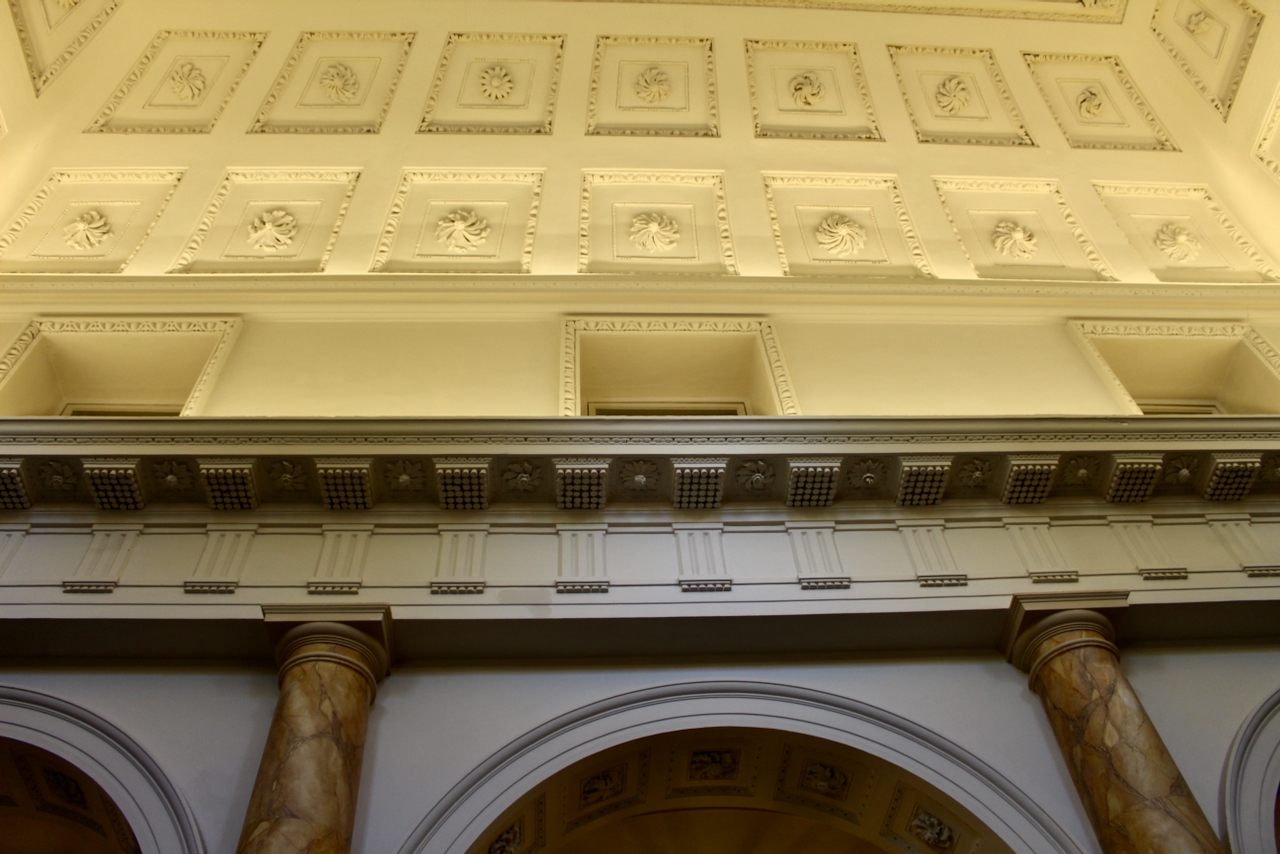
p. 121 

see http://lordbelmontinnorthernireland.blogspot.com/2015/01/1st-viscount-taaffe.html

THE TAAFFES OWNED 1,277 ACRES OF LAND IN COUNTY LOUTH 

The members of this noble family resided, for a series of years, in the Austrian dominions, and filled the highest and most confidential employments, civil and military, under the imperial government, doubtless from having been, from theretofore, as Roman Catholics, debarred the prouder gratification of serving their own. 

The Taaffes were of great antiquity in the counties of Louth and Sligo, and produced, in ancient times, many distinguished and eminent persons; among whom was Sir Richard Taaffe, who flourished during the reign of EDWARD I, and died in 1287. 

Contemporary with Sir Richard was the Lord (Nicholas) Taaffe, who died in 1288, leaving two sons: John Taaffe, Archbishop of Armagh, who died in 1306, and 

RICHARD FITZ-NICHOLAS TAAFFE, whose eldest son, 

RICHARD TAAFFE, was seated at Ballybraggan and Castle Lumpnagh. 

This gentleman served the office of sheriff of County Louth in 1315, and to his custody was committed the person of Hugh de Lacy, the younger, Earl of Ulster, after his condemnation for high treason, in inciting the invasion of Ireland, by Edward Bruce, until the execution of that unfortunate nobleman at Drogheda. 

From this Richard lineally descended 

SIR WILLIAM TAAFFE, Knight, of Harleston, in Norfolk, who distinguished himself by his services to the Crown, during the Earl of Tyrone’s rebellion, in 1597; and subsequently maintained his reputation against the Spanish force, which landed at Kinsale in 1601. 

Sir William died in 1630, and was succeeded by his only son, 

SIR JOHN TAAFFE, Knight, who was advanced to the Irish peerage, in 1628, by the title of Baron Ballymote and VISCOUNT TAAFFE, of Corren, both in County Sligo. 

His lordship married Anne, daughter of Theobald, 1st Viscount Dillon, by whom he had (with other issue), 

THEOBALD, his heir

Lucas, major-general in the army; 

Francis, colonel in the army; 

Edward; 

Peter, in holy orders; 

Jasper, slain in battle; 

WILLIAM. 

His lordship died in 1642, and was succeeded by his eldest son, 

THEOBALD, 2nd Viscount (c1603-77), who was advanced to an earldom, as EARL OF CARLINGFORD, in 1662. 

This nobleman espoused zealously the royal cause during the civil wars, and had his estate sequestered by the Usurper. 

After the Restoration, he obtained, however, a pension of £800 a year; and, upon being advanced in the peerage, received a grant of £4,000 a year, of the rents payable to the Crown, out of the retrenched lands of adventurers and soldiers, during such time as the same remained in the common stock of reprisals, and out of forfeited jointures, mortgages etc. 

His lordship was succeeded at his decease by his eldest surviving son, 

NICHOLAS, 2nd Earl and 3rd Viscount, who fell at the battle of the Boyne, in the command of a regiment of foot, under the banner of JAMES II; and, leaving no issue, the honours devolved upon his brother, 

FRANCIS, 3rd Earl (1639-1704), the celebrated Count Taaffe, of the Germanic Empire. 

This nobleman, who was sent in his youth to the city of Olmuts, to prosecute his studies, became, first, one of the pages of honour to the Emperor Ferdinand; and, soon after, obtained a captain’s commission from CHARLES V, Duke of Lorraine, in his own regiment. 

He was, subsequently, chamberlain to the emperor, a marshal of the empire, and counsellor of the state and cabinet. 

His lordship was so highly esteemed by most of the crowned heads of Europe that, when he succeeded to his hereditary honours, he was exempted from forfeiture, by a special clause in the English act of parliament, during the reign of WILLIAM AND MARY. 

His lordship died in 1704, and leaving no issue, the honours devolved upon his nephew, 

THEOBALD, 4th Earl, son of Major the Hon John Taaffe, who fell before Londonderry, in the service of JAMES II, by the Lady Rose Lambart, daughter of Charles, 1st Earl of Cavan. 

He married Amelia, youngest daughter of Luke, 3rd Earl of Fingal; but dying without issue, in 1738, the earldom expired, while the viscountcy and barony passed to his next heir male, 

NICHOLAS, Count Taaffe (c1685-1769), of the Germanic Empire, as 6th Viscount. 

This nobleman obtained the golden key, as chamberlain, from the Emperor CHARLES VI, as he did from His Imperial Majesty’s successor, which mark of distinction both his sons enjoyed. 

His lordship, as Count Taaffe, obtained great renown during the war with the Turks, in 1738, and achieved the victory of BELGRADE with high honour. 

He married Mary Anne, daughter and heiress of Count Spendler, of Lintz, in Upper Austria, a lady of the bedchamber to Her Imperial and Hungarian Majesty, and had issue, 

John, predeceased his father
Francis, dsp

His lordship was succeeded by his grandson, 

RUDOLPH, Count Taaffe (1762-1830), 7th Viscount, who espoused, in 1787, the Countess Josephine Haugwitz, and had issue, 

FRANCIS, his successor
Louis; 
Clementina. 

His lordship was succeeded by his only son, 

FRANCIS JOHN CHARLES JOSEPH RUDOLPH, Count Taaffe (1788-1849), 8th Viscount, who wedded, in 1811, the Countess Antonia Amade de Várkony, and had issue. 

Successor to the claim 

  • Richard Taaffe (1898–1967), entitled to petition for restoration of the viscountcy, but never did so.

Lord Taaffe was seated at Ellischau Castle, Bohemia.  

Under the Titles Deprivation Act 1917, his name was removed from the roll of the Peers of Ireland by Order of the King in Council, 1919, for bearing arms against the United Kingdom in the 1st World War.  

In 1919, he also lost his title as Count of the Holy Roman Empire, when the newly-established republic of Austria abolished the nobility and outlawed the use of noble titles. 

Independent of the legal situation in the UK, the monarchy was abolished in Austria in 1918, and in 1919 the newly established republic of German Austria abolished all noble titles by law. 

Heinrich, Count Taaffe, 12th Viscount Taaffe, thus lost both his titles and ended his life as plain Mr Taaffe.  

He married, in 1897, in Vienna, Maria Magda Fuchs, and they had a son, Richard (1898–1967). 

Upon the death of his first wife in 1918, he married, secondly, Aglaë Isescu,, in 1919, at Ellischau. 

He died in Vienna in 1928, aged 56. 

EDWARD CHARLES RICHARD TAAFFE (1898–1967) was an Austrian gemmologist who found the first cut and polished taaffeite in November 1945. 

Mr Taaffe inherited neither the viscountcy nor the title of Count, as Austria had generally abolished titles of nobility in 1919. 

With Richard Taaffe’s death in 1967, no heirs to either title remained and both the Austrian and the UK titles became extinct. 

Portions of the Taaffes’  County Sligo estate were offered for sale in the Encumbered Estates Court in 1852. 

In 1866-67, John Taaffe offered for sale his estate at Gleneask and lands at Drumraine, in the barony of Corran. 

In 1880 John West Pollock offered over 500 acres of the Taaffe estate in the barony of Corran for sale in the Land Judges’ Court. 

The Gleneask estate derived from an 1808 lease between Henry King and John Taaffe; while the Drumraine lease dated from the same period from the Parke estate. 

The Taaffe family are also recorded as the owners of 833 acres in County Galway in the 1870s. 

The family also held extensive properties in counties Louth and Meath. 

The Congested Districts Board acquired over 5,000 acres of the Taaffe estate in the early 20th century. 

SMARMORE CASTLE, near Ardee, County Louth, is claimed to be one of the longest continuously inhabited castles in Ireland. 

Records show that William Taaffe was seated here in 1320, after his family arrived in Ireland from Wales at the turn of the 12th century. 

Successive generations of Taaffes continued to make Smarmore Castle their main residence in Ireland until the mid 1980s, when the property was sold. 

The castle is divided into three distinct sections comprising an early 14th century castle-keep with extensions on either side built ca 1720 and 1760 respectively. 

The castle is built of local stone and its walls are eight feet thick. 

The 18th century courtyard behind the castle was formerly the stables for the estate. 

http://www.smarmore-rehab-clinic.com 

(was purchased in 2015 for just €500,000. 

Lissrenny, Tallanstown, Co Louth 

Lissrenny, Tallanstown, Co Louth 

Mark Bence-Jones. A Guide to Irish Country Houses (originally published as Burke’s Guide to Country Houses volume 1 Ireland by Burke’s Peerage Ltd. 1978); Revised edition 1988 Constable and Company Ltd, London.

p. 189. “(Filgate/IFR) A three storey seven bay red brick house of 1788-98, built by William Filgate onto the end of an earlier house with panelled rooms, and at right angles to it; forming a house with a T plan. The 1788-98 block had a pedimented and fanlighted tirpartile doorway and a parapeted roof. It was demolished 1974, leaving the earlier house to serve as the family residence. Two rooms have since been added to it.” 

https://www.buildingsofireland.ie/buildings-search/building/13901418/lisrenny-house-lisrenny-co-louth

Lissrenny, Tallanstown, Co Louth courtesy National Inventory. 

Detached eight-bay two-storey with attic house, built c. 1740. Three two-storey returns to south, single- and two-storey extension to west c. 1800, squared bay windows to ground floor north elevation, gable-fronted dormer windows, pitched slate roofs to south elevation, projecting entrance bay to south elevation of extension c. 1800. Pitched and hipped slate roofs, crested clay ridge tiles to main house, clay hip tiles, copper flashing, roughcast-rendered and brick corbelled chimneystacks, moulded cast-iron gutters on carved stone corbelled eaves course to main block, cast-iron hoppers and circular. Roughcast-rendered walling, projecting smooth rendered plinth to main block. Square-headed window openings, tooled stone sills, smooth rendered reveals, painted timber four-over-four sliding sash windows to first floor north elevation, metal casement windows to ground floor north elevation, six-over-six, six-over-three and four-over-two sliding sash windows to extension; chamfered ashlar limestone flush sills and surrounds to bay windows and entrance-bay south elevation, multiple-pane metal casement windows, separated by stone mullions within bay-windows. Square-headed door openings, main entrance to north, carved sandstone pedimented surround, painted timber door with four raised-and-fielded panels and four plain-glazed panels, accessed by stone step; door set at angle within south elevation, tooled limestone surround recessed within segmental-headed tooled limestone arch with decorative label stops, painted timber door with nine flat panels, accessed by curved stone steps. Walled garden to south. Multiple ranges of roughcast-rendered and stone outbuildings to east centred around cobbled stableyard, pitched slate roofs, square- and round-headed window openings, brick surrounds, square-headed door openings and segmental-headed carriage arches, stone surrounds, random rubble bellcote to south range. Two-bay two-storey roughcast-rendered farmhouse to east. House set in own extensive grounds, accessed through large decorative gates with gate lodge to north-west. 

Appraisal 

Lisrenny House is an extensive eighteenth-century house which has evolved over the centuries having been extended in various stages and the retention of various features from different periods adds to the architectural value of the house. The large complex of outbuildings, walled garden and farm house are all part of the original site context, and these associated buildings reveal the social importance of a once significant demesne which possibly provided much work for those in the locality. 

Lissrenny, Tallanstown, Co Louth courtesy National Inventory. 

https://www.buildingsofireland.ie/buildings-search/building/13901419/tallanstown-lodge-lisrenny-co-louth

Detached three-bay single-storey former gate lodge, built c. 1850, now in private domestic use. Projecting entrance to north elevation, extension to south; entrance gate to north-east. Hipped slate roof, hidden by rendered crenellated parapet, smooth rendered chimneystacks with caps, gutter hidden by parapet, cast-iron hoppers, circular cast-iron and uPVC downpipes. Painted roughcast-rendered walling, roughly dressed limestone quoins, painted smooth rendered plinth, roughcast-rendered extension to south, granite quoins, smooth rendered plinth. Paired shouldered-arched window openings with chamfered reveals and soffits, granite sills, smooth rendered surround with mullions and transoms, hood-moulding, painted timber casement windows. Projecting entrance, ballustraded parapet, smooth rendered channelled walling, basket-arched door opening, surmounted by hood moulding, painted timber door with five raised-and-fielded panels, plain-glazed overlight, rendered steps to entrance; replacement timber panelled door with sidelights to east elevation. Entrance gate to north-east comprising four finely tooled fluted limestone Doric columns surmounted by decorative capping stones, limestone plinth surmounted by decorative cast-iron railings with quadrant railings to square-profile limestone piers with Greek key motif to frieze and carved capping stones. Cast-iron gates made by R Turner of Stephen’s Green, resting on tooled limestone bollards give access to Lisrenny House. 

Appraisal 

Tallanstown gate lodge terminates the vista of the road coming from the north and the gates give access to Lisrenny House. The former gate lodge itself is an attractive well designed structure and though modest in its scale, the decoration and detail afforded to it are impressive. The crenellated parapet and balustraded entrance porch add a formality to the structure which is complimented by the fine entrance gates with beautifully tooled column and decorative cast-iron gates. This attractive grouping of structures forms a focal point on this rural roadway and they make a positive contribution to the architectural heritage of County Louth. 

Lissrenny, Tallanstown, Co Louth courtesy National Inventory. 

Ledwithstown, Ballymahon, County Longford 

Ledwithstown, Ballymahon, County Longford 

Mark Bence-Jones. A Guide to Irish Country Houses (originally published as Burke’s Guide to Country Houses volume 1 Ireland by Burke’s Peerage Ltd. 1978); Revised edition 1988 Constable and Company Ltd, London.

p. 183. “A very perfect small early C18 house of two storeys over high basement, possibly by Richard Castle. Three bay front, tripartite doorway with pediment extending over door and side-lights, on pilaters which stand on miniature rusticated basements; broad flight of steps to hall door. Solid roof parapet; windows surrounds with keystones; bold quoins. Symmetrical rear elevation, wiht blocking round windows and central basement door. Deep hall with chimneypiece of black Kilkenny marble. Plaster panelling in ground floor rooms, with occasional shell and other ornament; wood panelling upstairs. Seat of the Ledwiths, became derelict, now being restored.” 

Ledwithstown, County Longford, photograph courtesy of Mark Bence-Jones, A Guide to Irish Country Houses.
Ledwithstown House, County Longford, by Peter Murray, 2020, courtesy Irish Georgian Society.

https://www.igs.ie/conservation/project/ledwithstown-house-co-longford

Ledwithstown House, Co. Longford

The design of Ledwithstown House has been attributed to Richard Castle, or Cassels, an architect who, in 1728, came to Ireland, from the city of Kassel in northern Hesse, Germany. Castle came at the invitation of Sir Gustavus Hume, of Enniskillen, Co. Fermanagh, and over the course of a long and successful career designed many buildings, including the Printing House in Trinity College, the Conolly Folly, Leinster House, and Russborough House in Co. Wicklow. Castle also has a number of lesser-known houses attributed to him, including Ledwithstown in Co. Longford. With its Doric temple portico surrounding the entrance door, the exterior of Ledwithstown is plain, almost severe. There is no pretty semi-circular fanlight here; instead three plain squares of glass, and two windows flanking the entrance door that provide light to the hallway. Although relatively small, the windows on the façade are surrounded by heavy stone frames, making them appear larger. Thick glazing bars reinforce the early eighteenth-century character of this house. The attribution to Richard Castle is reasonable, as is the date 1746. All the architectural components have been carefully considered, and a sense of proportion—a term often over-used in relation to eighteenth-century architecture—infuses every element, up to and including the two chimney stacks, which are arranged parallel to the façade. The roof is partly concealed by an elaborate cornice, adding to the Palladian grandeur. The severity of Ledwithstown’s temple front, with its plain pilasters and rusticated base, is relieved by a Baroque flourish of balustrade and steps that lead to the entrance door. Other country houses by, or attributed to Castle include Hazelwood in Co. Sligo and Bellinter House in Co. Meath.

IGS Grants — 2001: repairs to interior decorative plasterwork; 2006: restoration of panelled rooms

The work of the Irish Georgian Society is supported through the Heritage Council’s ‘Heritage Capacity Fund 2022’.

https://www.buildingsofireland.ie/buildings-search/building/13402217/ledwithstown-house-ledwithstown-co-longford

Ledwithstown, County Longford, courtesy National Inventory.

Detached three-bay two-storey over raised basement house, built 1746. Hipped natural slate roof hidden behind parapet wall with pronounced moulded cut stone eaves course and with cut stone coping over. Pair of tall dressed ashlar limestone chimneystacks, aligned along with roof ridge, having moulded cut stone coping over. Sections of cast-iron rainwater goods remain, cast-iron hopper dated 1857. Roughcast rendered walls over rubble stone construction; cut stone block-and-start quoins to the corners and chamfered cut stone string course above basement level. Square-headed window openings with replacement nine-over-six pane timber sliding sash windows having cut limestone surrounds with architraves and prominent keystone, and with tooled limestone sills. Central cut stone tripartite Tuscan doorcase to main elevation (south) comprising tetrastyle limestone pilasters resting on rusticated ashlar limestone base section and surmounted by carved pediment. Timber panelled door with overlight and having flanking six-over-four pane timber sliding sidelights. Doorway accessed by flight of moulded cut stone steps flanked to either side (east and west) by splayed rendered walls with cut stone coping over and having terminating cut stone piers (on square-plan) to base with moulded capstones over. Square-headed door opening to the east elevation having cut limestone block-and-start surround with prominent keystone, replacement timber door and a plain overlight. Set back from road in extensive mature grounds to the rural landscape to the south of Keenagh and to the northwest of Ballymahon. Long straight approach avenue to house from the south. Gateway to the south comprising a pair of dressed ashlar limestone gate piers (on square-plan) having moulded plinths and stepped capstones with moulded cornice detail. Single-bay single-storey outbuilding to the southeast of house having rubble stone walls and pitched corrugated-metal roof. Rubbles stone boundary walls to road-frontage and to site. 

Appraisal 

This sophisticated middle-sized house is one of the most important elements of the architectural heritage of County Longford. Its design has been attributed to the eminent architect Richard Castle (died 1751) who was probably the foremost architect working in Ireland at the time of construction and has been credited with the dissemination of the Palladian architectural style throughout rural Ireland. Ledwithstown House has quite a robust appearance on account of the heavy parapet with pronounced eaves cornice and by the large tall ashlar chimneystacks that are aligned along with the front elevation. Although built using rubble stone masonry, this building is well-detailed with high quality, if robust, cut limestone trim in features like the window surrounds and the heavy eaves cornice. The good-quality dressed limestone quoins to the corners help to emphasise the stocky appearance of this building. The fine Tripartite doorcase with pediment is strongly detailed and provides a central focus to the main elevation. This central focus is further enhanced by the flight of cut stone steps with flanking walls having splayed bases. The house is further enhance by its long and straight drive aligned with the centre of the front elevation, which creates a sense of grandeur and generates a sense of anticipation when approaching the house. The well-crafted gate piers at the start of this driveway complete the setting and add substantially to this important composition. This building has been recently restored after a long period of near-derelict. Ledwithstown House was the home of the Ledwith family from its construction until c. 1900. The Ledwith family were an important in County Longford from c. 1650, and throughout the eighteenth and nineteenth centuries and a number of family members served as Grand Jurors and as High Sheriff of the county (High Sheriffs included George Ledwith in 1764 – 5; James in 1792 – 3, Richard in 1807 and Edward in 1847 – 8). 

Ledwithstown, County Longford, courtesy National Inventory.

 
featured in Great Irish Houses. Forewards by Desmond FitgGerald, Desmond Guinness. IMAGE Publications, 2008. 

p. 200. “Ledwithstown House in the north midlands was built in 1746 by Edward Ledwith and occupied by the family until the later part of the 19th century. Among the family members who resided there were the Reverend Palmer in the 1770s and Captain James Smyth Ledwith in the later half of the 19th century.  

The Anglo-Norman family of Ledwith was established in County Meath as early as 1270 but the first evidence of the family in south County Longford comes in the middle of the 17th century. Ledwithstown House is probably the work of the great German architect Richard Castle, Officer of the Engineers, who came to Ireland in 1727 to design a house for Sir Gustavus Hume in County Fermanagh. He became one of the most prominent architects in Ireland and contributed to many of the great houses of the 18th century including Leinster House, Powerscourt and Carton. 

In 1893, William Ledwith, son of Captain James Smyth Ledwith, leased the house to Thomas Ronaldson and he purchased the property in 1903, thus ending the Ledwith family association with the house. Lawrence Feeney, grandfather of the present owner, bought the house in 1911. During the 1920s, at a time of political unrest in Ireland, Mr Feeney’s widow and family moved out the of the house. For the next six decades the house would be lived in by an assortment of family members, squatters and local eccentrics, until the Feeney family repossessed it in 1981. 

Much damage had been done over the years: parts of the roof were falling in, panelling had been removed for firewood and the windows were in a sorry state. With the assistance of the Irish Georgian Society, the owners, Edward Feeney and his wife Mary, have set about restoring and redecorating the house. “I suppose if we had known what lay in store we might never have gone near it,” Edward Feeney says, looking back on the difficulties they encountered. “But we were young and foolish and it was too beautiful a house to leave to fall into complete disrepair. Initially we wanted to just stop the rot nd keep the weather out of the house. Our approach was to take it one step at a time.” 

Today the estate has shrunk to 200 acres, having swelled to 2,500 in the middle of the 18th century, yet the family continue to farm the land. They have kept the house as close to the original as possible. “The house is so well designed that there wouldn’t be much point making changes,” says Mary Feeney. “We have always loved the proportions of the house.” 

Edward Feeney adds, “Structurally it’s quite modest but it has a typical Castle entrance and a very well-planned layout. We are not certain that Castle was the designer, but the overall structure and the black Kilkenny marble fireplaces would seem to confirm his hand at work. Also, several other houses he worked on at the time, including Belvedere in Mullingar, are not all that far from Ledwithstown. So it’s entirely possible.” 

The entrance hall was last decorated in the 1850s. The cornice had to be replaced over the main door and much work was done on the ceilings. Conservation expert Mary McGrath also worked on the colour schemes, and a pale grey thought to be the original colouring was found on the panelling and window and door surrounds. McGrath explains: “In the summertime the door was probably open all the time and in the winter there would have been a fire in the hearth. So of all of the rooms of the house, the hallway was probably painted most often. All of the early coats would have been distemper and as the procedure was to dust off the loose paint and to wash down the walls, it is difficult to be certain about the full sequence of colours.” 

[p. 203] “The black Kilkenny marble fireplace in the hall is original and has a black shell motif. Much of the original contents of the house had been sold during an auction in 1911, with the remainder dispersed during subsequent decades. Almost all the furniture has been brought into the house over the last two decades, including a family piano, which stands in front of the fireplace. 

The breakfast room contains a fine 1859 Italian marble fireplace. Consultant historic buildings conservator Richard Ireland, who was responsible for the restoration of the surfaces of Castletown, underpinned the remaining plasterwork on the ceiling of this room in 2002. George o’Malley, who is based in County Wicklow, worked on the plasterwork with his father, Tom, who came out of retirement ages 82 to work at Ledwithstown. 

When the current owners took over the house, a large tree was growing in the centre of the drawing room and out through the roof. Today the room has been beautifully restored. A local craftsman, who copied a surviving example, replaced the shuttering. The fireplace is not original and dates to sometime in the 1860s. The chandelier was a choice of the owners and the sofas were all bought in Ireland. Many of the pieces of furniture, including a fine Irish table, were bought at auction. 

While oil heating has been installed, the family may convert to wood pellets to reduce energy costs. The rooms are modest in scale – the ceilings not quite as high as many Irish country houses of similar scale – so the house is already relatively efficient. 

A “Marrakech” red has been chosen for the dining room, which also has a Kilkenny marble fireplace. The table was bought at an auction in Birr. The library, which has a fireplace taken from upstairs, contains some of the few pieces of original furniture including the bookcase and a round circular table. A local dealer told Edward Feeney’s mother that the table, then stored in a nearby hen house, had come out of the house during the auction in 1911. The table was purchased for £4.50 

The green bedroom upstairs which has fine wood panelling and a shell motif Kilkenny marble fireplace. The Georgian cream coloured curtains offset the green of the walls. In the master bedroom the wood panelling is being restored by local craftsman Coleman Lovett and an adjacent powder room is being converted into an en suite bathroom. Edward and Mary’s dedication to the restoration of this house and its historic gardens will ensure that Ledwithstown rightfully takes its place as one of Ireland’s great houses.” 

Casey, Christine and Alistair Rowan. The Buildings of Ireland: North Leinster. Penguin Books, London, 1993.  
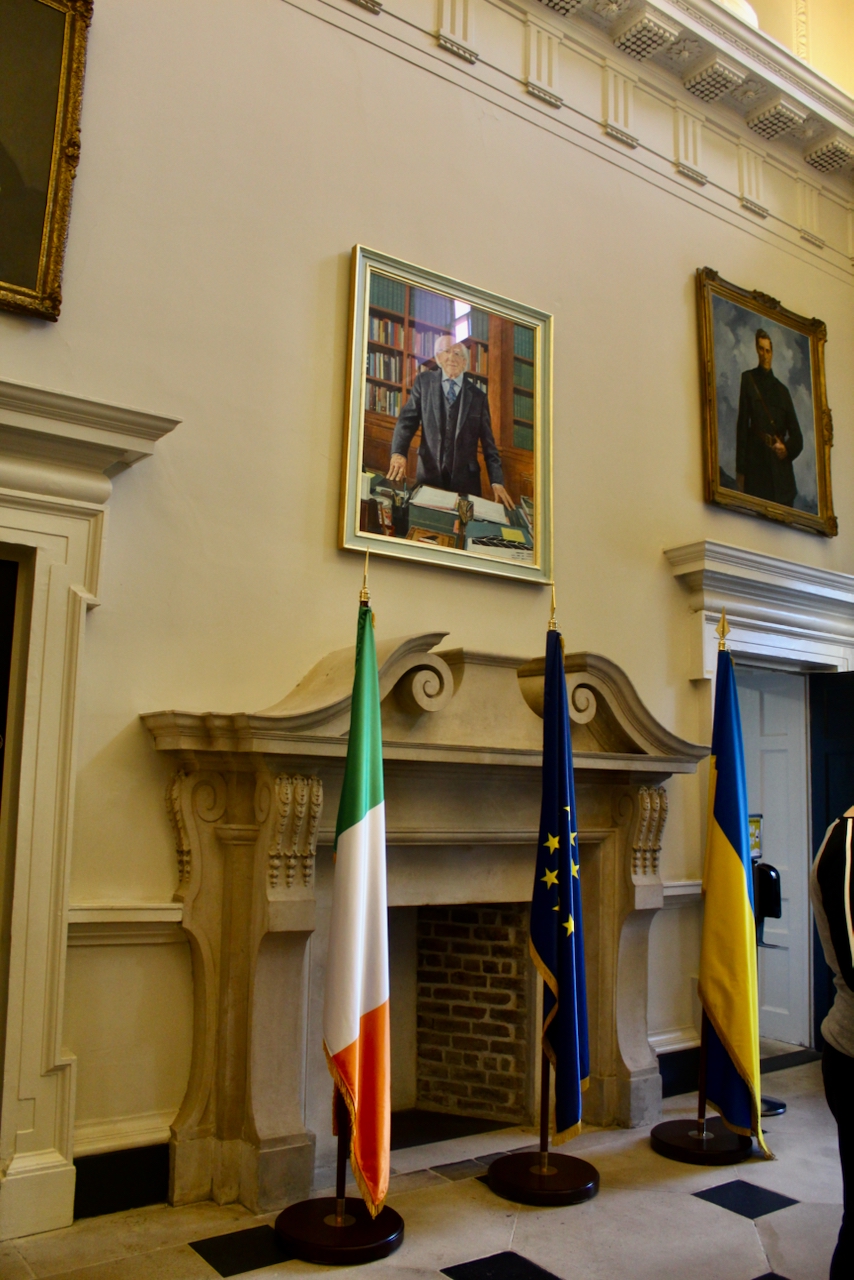
p. 142 
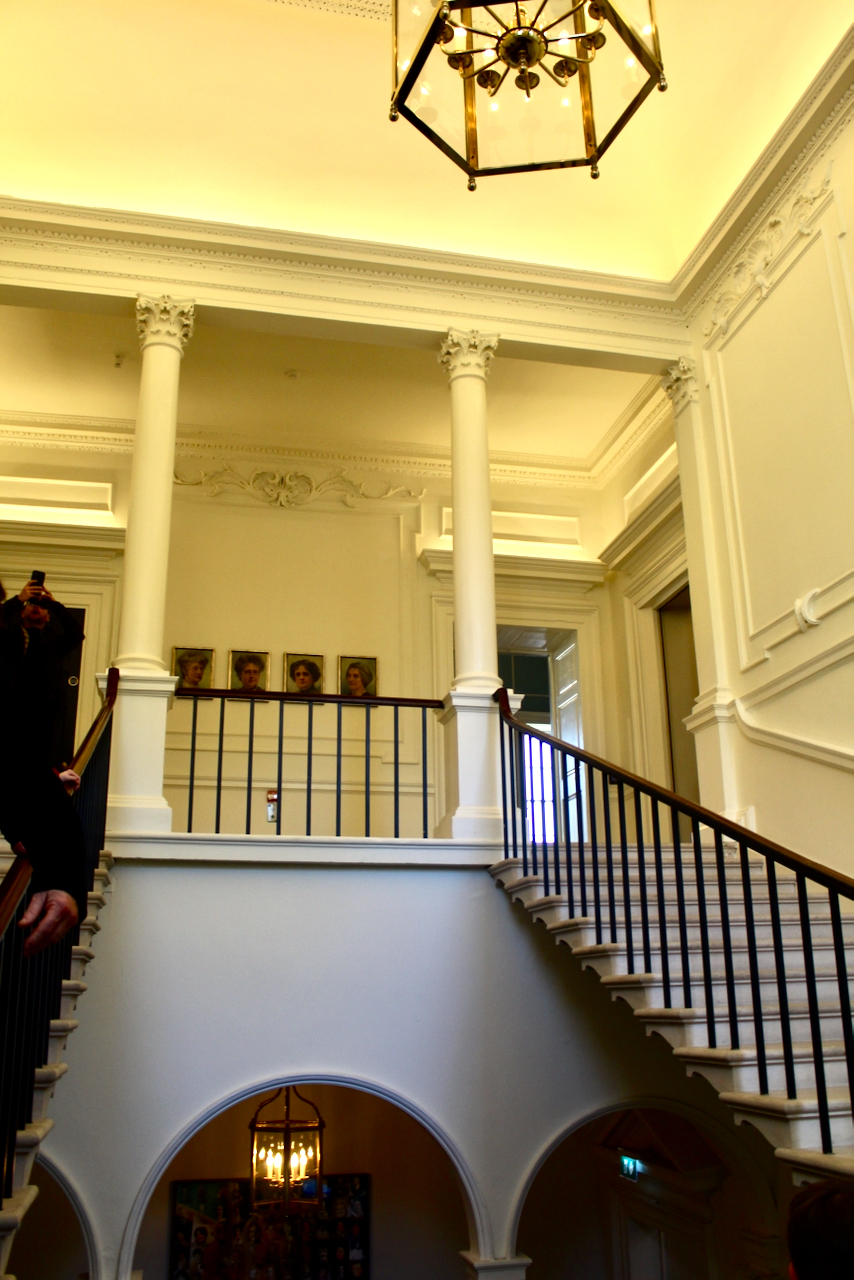
http://visitlongford.ie/listings/ledwithstown-house/ 

Ledwithstown House is a handsome Georgian country house, situated outside the town of Ballymahon, and has been described as a “miniature gem” by architectural historians. 
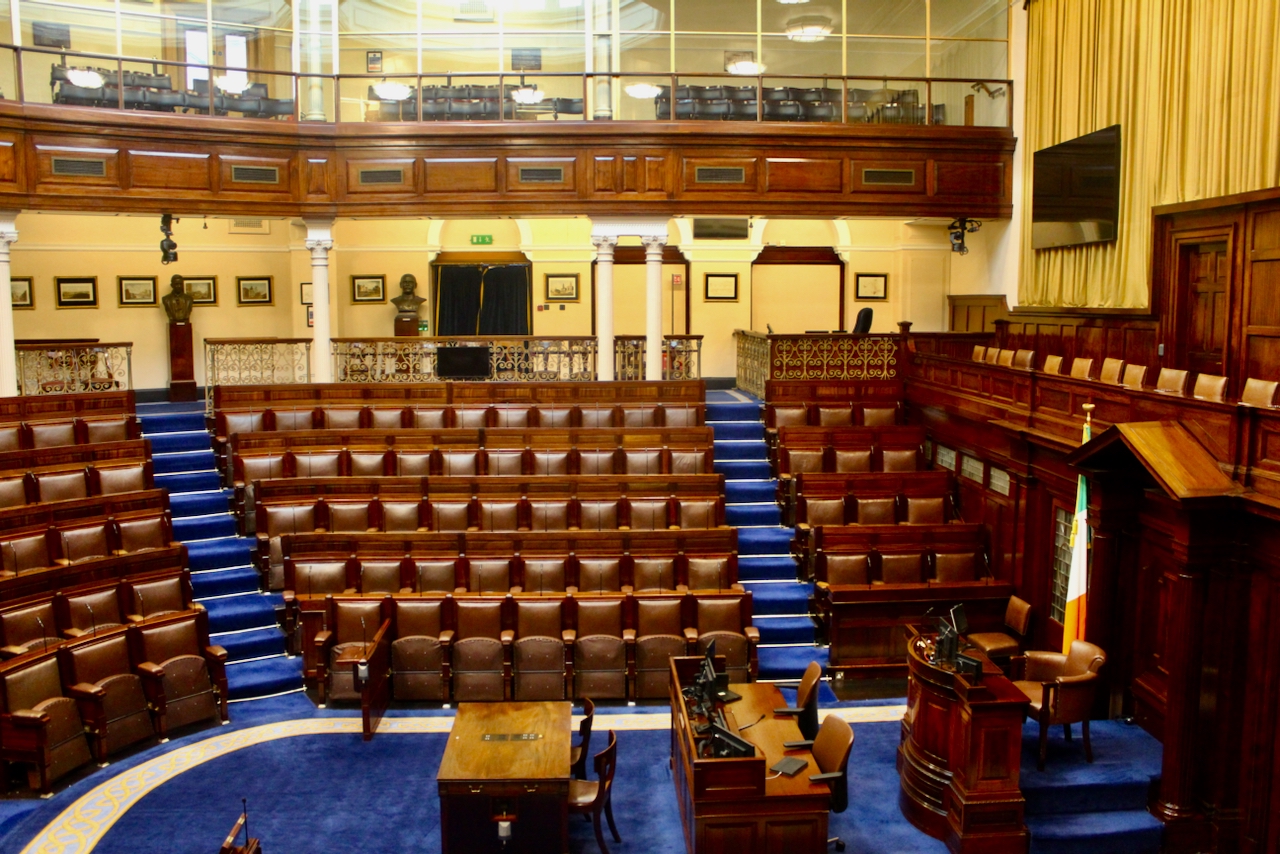
It is believed to have been designed c.1730 by the eminent architect Richard Castle, who died in 1751. Castle, or Cassels, was probably the foremost architect in Ireland at the time of construction and was one of the greatest proponents of Palladian architecture in Ireland. 

His domestic villas were strongly influenced by the designs of Italian architect Andrea Palladio, who designed elegant, symmetrical houses with classical details inspired by the architecture of ancient Rome. 

Ledwithstown House has solid, robust appearance with a pleasing symmetrical design, typical of Palladian villas. It features finely-carved cut limestone trim, such as the window surrounds and the heavy eaves cornice that runs along the top of the walls. 

The good-quality dressed limestone quoins to the corners help to emphasise the stocky appearance of this building. The doorcase is especially attractive and provides a central focus to the main elevation, and is further enhanced by the flight of stone steps to its base. 

The house has undergone an extensive programme of conservation and renovation by the present owners from the 1970s onwards, with support of agencies such as the Irish Georgian Society (www.igs.ie). 

Ledwithstown House was the residence of the Ledwith family from its construction to around 1900. The Ledwith family were an important family in County Longford from 1650 onwards. Successive generations of family members served in public office as grand jurors, or as high sheriff of the county, including George Ledwith who was the high sheriff in 1764; James Ledwith in 1792, Richard in 1807 and Edward in 1847. 

Ledwithstown House is privately owned by the Feeney family. 

‘The townland, and chief part of the demesne of Ledwithstown, are in this parish (Shruel), though the dwelling house and offices are in the parish of Kilcommack. It has been long the residence of a respectable family of the name of Ledwith, who possess a considerable property in this neighbourhood.’ A Statistical Account, or Parochial Survey, of Ireland, 1819. 
In 1976 Maurice Craig wrote of Ledwithstown, County Longford, ‘there can be few houses of its size in Ireland more thoroughly designed, and with internal decoration so well integrated.’ The house has long been attributed to Richard Castle and is one of three such properties considered to have been designed by the architect, the other two being Gaulstown, County Westmeath (see Gallia Urba est Omnis Divisa in Partes Tres, February 24th 2014) and Whitewood Lodge, County Meath (see An Appalling Vista, February 9th last). In their form and composition this triumvirate demonstrates a steadily growing assurance, with Ledwithstown displaying by far the greatest sophistication and thus inclining to the idea that it was the latest, probably dating from the second half of the 1740s (Castle died in 1751). Relatively little is known of the building’s history, other than that until 1911 it was owned, although not always occupied, by the Ledwith family who settled in the area around 1650. Members of that now-vanished class, the gentry, the Ledwiths played their part in local society as Grand Jurors and High Sheriffs but otherwise came little to public notice. The same is true of their former home, which despite its considerable charm, can be passed unnoticed on the public highway: again like Gaulstown and Whitewood, Ledwithstown lies at the end of an exceptionally long, straight drive. 

As with Gaulstown and Whitewood, Ledwithstown is a three-bay house of two storeys over a semi-raised basement. With all three the main entrance is approached by a flight of stone steps; in this instance, the supporting walls splay out to create the impression of a ceremonial approach to the door. In the case of the other two properties, the doorcase is relatively plain, of cut limestone with a fanlight (that at Gaulstown also has side lights). Ledwithstown’s south-facing doorcase is altogether more elaborate, a cut-stone tripartite Tuscan design incorporating tetrastyle pilasters resting on rusticated base and surmounted by carved pediment. Such an entrance immediately indicates this is a building with greater aspirations than those of its siblings. In other respects, however, the facade of Ledwithstown is closer in spirit to Whitewood than to Gaulstown, sharing the same heavy parapet wall concealing the greater part of a slated roof with a pair of substantial chimneystacks (those at Gaulstown are at either gable end). Likewise Ledwithstown and Whitewood have raised corner quoins which add further gravitas to the building, the most striking differences between the two being that Whitewood’s facade is of cut stone (as opposed to roughcast render over rubble stone) and Ledwithstown’s first floor fifteen-pane sash windows share the same proportions as those one storey below (their equivalents at Whitewood are smaller). 

The interior design and decoration of Ledwithstown is much more elaborate than either of the two houses with which it bears comparison. Although measuring just forty-eight by forty-seven feet, it can be considered a country house in miniature, the layout being identical to that found in many larger properties. There are, for example, two staircases, that to the west, of carved wood, serving only the ground and first floors while secondary service stairs of stone to the east also descend to the basement area. Immediately inside the entrance hall are doors to left and right providing access to the former morning room and study; a matching pair to the rear open to the staircases while one in the centre of the back wall leads to the drawing room. Here and in the adjacent dining room, the walls retain their mid-18th century plaster panelling, that in the drawing room being especially fine with a combination of lugged and round topped panels topped by swags or baskets of fruit and shells. Similarly the main staircase, lit by a round-topped window, has timber wainscoting and leads to a panelled first floor landing with egg-and-dart and dentil cornicing; one of the rooms on this level is entirely panelled in wood and others still contain their shallow limestone chimney pieces. The basement likewise keeps much of its original character with a sequence of rooms opening off a central stone-flagged and vaulted central passage. 

In 1911 Ledwithstown was bought from the original family by Laurence Feeney. However, following his premature death just six years later, the house was let to a variety of tenants none of whom took care of the property; seemingly a brother and sister who lived there for a while removed all the door and shutter knobs, while another family allowed the chimneys to become blocked and then knocked holes in the walls to permit smoke escape. In 1976 Maurice Craig described Ledwithstown as being ‘unhappily in an advanced state of dilapidation, perhaps not beyond recovery’ and two years later Mark Bence-Jones wrote that the place was ‘now derelict.’ However, around this time the original Laurence Feeney’s grandson, likewise called Laurence, married and he and his wife Mary began to consider the possibility of restoring Ledwithstown. 
The couple, together with their children, initiated work on the house and in 1982 they were visited by Desmond Guinness. Soon afterwards the Irish Georgian Society offered its first grant to Ledwithstown, the money being put towards replacing the roof. Further financial aid from the IGS followed, along with voluntary work parties to help the Feeneys in their enterprise. By 1987 Ledwithstown had a new roof and parapet and was once more watertight. Inevitably sections of the reception rooms’ plaster panelling and other decoration had been lost to damp, but enough remained for it to be copied and replaced. The same was true of the main stair hall and sections of the first floor wood panelling, all of which was gradually replaced: when new floors were installed on this level in 1990 surviving panelled walls had to be suspended in mid-air to facilitate the removal of decayed boards. Ledwithstown demonstrates that even the most rundown building can be saved provided the task is approached with enough commitment. Today, more than thirty years after they embarked on their mission, the Feeneys remain happily living in what is, above all else, a family home. So too are both Gaulstown and Whitewood Lodge, making this another trait all three houses share. 

Jamestown, Co Laois

Jamestown, Co Laois 

Mark Bence-Jones. A Guide to Irish Country Houses (originally published as Burke’s Guide to Country Houses volume 1 Ireland by Burke’s Peerage Ltd. 1978); Revised edition 1988 Constable and Company Ltd, London. 

p. 160. “A hybrid house with Diocletian windows under Victorian gables and fancy bargeboards. Pillared porch at end.” 

https://www.buildingsofireland.ie/buildings-search/building/12800915/jamestown-house-jamestown-or-ballyteigeduff-county-laois

Detached three-bay two-storey house, built c.1740, with round-headed door opening to centre and returns to rear. Stable complex to site. Double-pitched and hipped slate roof with clay ridge tiles, nap rendered chimneystacks with red clay pots and cast-iron rainwater goods. Roughcast rendered walls; painted. Square-headed window openings with stone sills and six-over-six timber sash window. Ground floor windows set into recessed arches. Round-headed door opening with stone Doric doorcase and timber panelled double door with decorative fanlight. Entrance/ Stair Hall: replacement timber pilaster doorcases to internal doors; carved timber staircase; replacement fireplaces throughout; decorative plaster cornices to ceilings decorative plaster centrepieces. Set back from road in own grounds; landscaped grounds to site; tarmacadam drive and forecourt to approach. Stable complex to site comprising group of detached single- and two-storey rubble stone outbuildings.