Brittas Castle, Clonaslee, Co Laois – ruin 

Brittas Castle, Clonaslee, Co Laois – ruin 

Mark Bence-Jones. A Guide to Irish Country Houses (originally published as Burke’s Guide to Country Houses volume 1 Ireland by Burke’s Peerage Ltd. 1978); Revised edition 1988 Constable and Company Ltd, London. 

p. 48. “(Dunne/LGI1912) BRITTAS CASTLE, near Clonaslee, County Laois, was a castellated house of sandstone with limestone dressings, built in 1869 by Major-General Francis Dunne, to the design of John McCurdy.” 

https://archiseek.com/2013/1869-brittas-castle-clonaslee-co-laois

1869 – Brittas Castle, Clonaslee, Co. Laois 

Architect: John McCurdy / Millar & Symes 

Built for Major-General Francis Plunkett Dunne in 1869, to a design by John McCurdy. It was extended ten years later by Millar & Symes. Constructed of sandstone with limestone dressings. It is believed that General Dunne obtained loans from Germany to build the castle, and rental income from his tenants was used to repay the lenders. Brittas Castle went on fire on Thursday, June 25 1942 and, despite the best efforts of the Tullamore Fire Brigade, it was destroyed. Little remains today but the ruined tower.  

“The perspective view given in our last number represents the new mansion to be built for the Right Honourable F.P. Dunne, at his seat, Clonaslee. The site is most advantageously chosen over the slope of a hill, overlooking a beautiful undulating and well-wooded country. The whole of the external surfaces are to be of punched sandstone, with chiselled limestone dressings. The cost will be about 7,000.” Published in The Irish Builder, February 15 1869. 

http://www.askaboutireland.ie/reading-room/history-heritage/heritage-towns/towns-and-villages-of-lao/clonaslee/brittas-castle/ 

When the main residence in Tinnahinch was blown up in 1653, the Dunne Chief had to build anew. At this time there was a low thatched lodge located at Brittas, near the present village of Clonaslee. The Dunnes built a mansion at right angles to this, facing north-east. Concurrently, they heightened the thatched building to accommodate the servants.  
 
 
Major-General Francis Plunkett Dunne built a neo-gothic mansion at Brittas in 1869, to a design by John McCurdy. It was extended ten years later by Millar and Symes. It is believed that General Dunne obtained loans from Germany to build the castle, and rental income from his tenants was used to repay the lenders. 
  

Brittas Castle went on fire on Thursday, June 25 1942 and, despite the best efforts of the Tullamore Fire Brigade, it was destroyed. It is believed that Colonel Dunne built a road between Brittas and Kinnity Castle around the time of the famine (1845 – 47). The Dunnes had allies in Kinnity at this time and the road would have made an effective escape route in the event of an attack. This road became known as the General’s Road. The name Brittas comes from the French word “bretache” and this was the term which was used by the Normans to signify a tower. 

Gallery 

 
Brittas Castle - Courtesy of Laois County Library 

http://archiseek.com/2013/1869-brittas-castle-clonaslee-co-laois/ 

Built for Major-General Francis Plunkett Dunne in 1869, to a design by John McCurdy. It was extended ten years later by Millar & Symes. Constructed of sandstone with limestone dressings. It is believed that General Dunne obtained loans from Germany to build the castle, and rental income from his tenants was used to repay the lenders. Brittas Castle went on fire on Thursday, June 25 1942 and, despite the best efforts of the Tullamore Fire Brigade, it was destroyed. Little remains today but the ruined tower. 

https://www.buildingsofireland.ie/buildings-search/building/12800203/brittas-house-brittas-demesne-brittas-ti-by-laois

Remains of detached country house, built 1869, comprising three-storey over basement tower. Remainder of house dismantled to ground level. Designed by John McCurdy. Group of detached two-storey outbuildings to site, now derelict. Detached gate lodge to site. Gateway to site. 

http://lordbelmontinnorthernireland.blogspot.com/2014/09/brittas-castle.html

THE DUNNES WERE MAJOR LANDOWNERS IN THE QUEEN’S COUNTY, WITH 9,215 ACRES

The estate of Brittas was time immemorial in the ancient family of DUNNE, anciently O’Doinn, chief of the name, and a sept of historic note. The O’Doinns occur frequently in the works of James MacGeoghegan, in the Annals of the Four Masters, and the other Irish authorities. 


RORY O’DOINN, Chief of I-Regan, died, according to the Annals of the Four Masters, in 1427, and was father of

LENAGH O’DOINN, Chief of I-Regan, who built Castlebrack, in the Queen’s County.

He married a daughter of O’Neill of Ulster and had issue,

TEIG, of whom hereafter;
Falie.

The elder son,

TEIG O’DOINN, Chief of Iregan, wedded firstly, Ellen, daughter of “Lord Power”, and had issue,

TEIG (OGE), of whom presently;
Rory;
Edmundboy;
Shane;
Cahir.

 eldest son,

TEIG (Oge) O’DOINN, Chief of Iregan, espoused firstly, Gormla, daughter of O’Connor Faile, and had issue,

Brien, dsp;
TEIGH (REOGH), of whom we treat;
Edmund, of Park;
Dermot.

He married secondly, Giles, daughter of MacGillepatrick, of Upper Ossory, and had further issue,

Donogh;
Cormac;
Cahir;
Dermot.

The second son,

TEIGH (REOGH) or THADY O’DOINN, of Iregan, had a grant of English liberty for himself and his issue, in 1551.

He wedded a daughter of McMorrish, and had issue,

THADY or TEIG (OGE), his successor;
TORLOGH or TERENCE, of whom presently;
Donagh, of Gurtin and Balliglass, living 1570;
Phelim;
Finola.

The eldest son,

THADY (or TEIG OGE) O’DOINN, of Tenchinch and Castlebrack, appointed Captain of Iregan, 1558, made settlements of his estates in 1590, 1591, and 1593, and was living in 1601.

He wedded Elizabeth, daughter of James FitzGerald, of Ballysonan, County Kildare, and had issue,

TEIG (LOGHA) or TEIG OGE, or THADY, his heir;
Cormac;
Brian or Barnaby;
CAHIR or CHARLES, of whom presently;
Murtogh;
Grany;
Two daughters.

The eldest son,

TEIGH (LOGHA) or THADY O’DOYNE (-1637), of Castlebrack, surrendered his estate, 1611, and had a regrant of the greater portion in 1611.

He espoused firstly, Margaret, daughter of Shane O’Neill, who left him and married Cuconaght Maguire, and had by her a son, Teige reogh or Thady, dsp before 1635.

He married secondly, Ellis, daughter of Redmond FitzGerald, of Clonbolg, County Kildare, and had seven sons who survived infancy,

Edmund or Edward, dsp before 1635;
John, dsp before 1635;
William, of Park;
Richard, in holy orders; Vicar-General of Kildare;
James;
Rory or Roger;
Torlogh.

We now return to

CAHIR O’DOINN, alias CHARLES DUNN, LL.D, fourth son of Thady O’Doinn, Captain of Iregan, Fellow of Trinity College Dublin, 1593, Master in Chancery, 1602, MP, 1613, Vice-Chancellor, 1614.

He petitioned against the regrant of Iregan to his brother and got a grant to himself of Brittas and portion of the Iregan estates, which he bequeathed by his will, dated 1617, to his nephew,

BARNABY or BRIAN OGE DUNN (1590-1661), of Brittas, High Sheriff of Queen’s County in 1623.

He obtained from CHARLES I a patent for a large estate in the barony of Tinnahinch, to hold to him and his heirs for ever in soccage, provided that he did not take the name, style, or title of O’DOINN, and that he should drop that same and call himself BRIAN DUNN.

He married Sybella, daughter of Sir Robert Piggott, Knight, of Dysart, and widow of Richard Cosby, of Stradbally, both in the Queen’s County, and was succeeded by his son,

CAHIR or CHARLES DUNNE, of Brittas, who wedded Margaret, sister of John Coghlan, of Birr, and had issue,

TERENCE, his heir;
Edward;
John;
Charles;
Daniel;
Mary; Peggy; Polly; Clare.

Mr Dunne died in 1680, and was succeeded by his eldest son,

TERENCE DUNNE, of Brittas, a captain in Moore’s Regiment of Infantry, who fought for JAMES II and fell at Aughrim in 1691.

He espoused, in 1676, Margaret, daughter of Daniel Byrne, and sister of Sir Gregory Byrne, 1st Baronet, MP for Ballinakill, and had issue,

DANIEL, of Brittas;
Charles, dsp;
Barnaby;
EDWARD, of whom presently;
Dorothy.

The fourth son,

EDWARD DUNNE, of Brittas, married, in 1730, Margaret, daughter of Francis Wyse, of the Manor of St John, County Waterford, and had issue,

FRANCIS, his heir;
Barnaby, dsp;
Anastasia; Juliana; Margaret; Mary.

Mr Dunne died in 1765, and was succeeded by his elder son,

FRANCIS DUNNE, who wedded, in 1760, his cousin, Margaret, daughter and co-heir of Nicholas Plunkett, of Dunsoghly Castle, County Dublin, by Alice his wife, daughter and co-heir of Daniel Dunne (see above), and had issue,

EDWARD, his heir;
Francis;
Nicholas;
Alice; Frances; Katherine; Margaret.

Mr Dunne died in 1771, and was succeeded by his eldest son,

EDWARD DUNNE JP (1767-1844), of Brittas, a general in the army,  Deputy Governor and High Sheriff of Queen’s County, 1790, MP for Maryborough, 1800.

He took an active part in suppressing the Irish Rebellion of 1798, at which time he commanded the Pembrokeshire Fencible Cavalry.

General Dunne wedded, in 1801, Frances, daughter of Simon White, of Bantry House, sister to Richard, 1st Earl of Bantry, and had issue,

FRANCIS PLUNKETT, his heir;
EDWARD MEADOWS, successor to his brother;
Robert Hedges (Rev);
Richard;
Charles;
Frances Jane.

General Dunne was succeeded by his eldest son,
THE RT HON FRANCIS PLUNKETT DUNNE JP DL (1802-74), of Brittas and Dunsoghly Castle, County Dublin, Privy Counsellor, a major-general in the army, Lieutenant-Colonel, Queen’s County Militia, MP for Portarlington, 1847-57, Queen’s County, 1859-68, Clerk of the Ordnance, 1852, Private Secretary to the Lord Lieutenant of Ireland, 1858-9, who died unmarried, and was succeeded by his brother,

EDWARD MEADOWS DUNNE JP (1803-75), of Brittas, Barrister, who married, in 1835, Marianne, daughter of Langford Rowley Heyland, of Glendarragh, County Antrim, and Tamlaght, Lieutenant-Colonel, Londonderry Militia, and had issue,

Edward Eyre, 1836-48;
Alexander Dupré, 1838-55;
FRANCIS PLUNKETT, his heir.

Mr Dunne was succeeded by his only surviving son,

FRANCIS PLUNKETT DUNNE JP (1844-78), of Brittas, High Sheriff of the Queen’s County, 1878, who wedded, in 1873, his cousin, Frances Jane, daughter of the Rev Robert Hedges Dunne, and had issue,

Francis Plunkett, died young;
ALICE MAUDE, of Brittas;
KATHLEEN PLUNKETT, of Brittas.

Mr Dunne, leaving his estates to be equally divided between his two surviving daughters, ALICE MAUDE and KATHLEEN PLUNKETT, who sold the estate of Brittas in 1898 to their uncle, Robert Hedges Plunkett Dunne, on whose death, in 1901, these ladies succeeded, again, to Brittas and Dunsoghly Castle.

Francis Plunkett Dunne was succeeded in the male representation of his family by his cousin, Charles Henry Plunkett Dunne.

BRITTAS CASTLE, near Clonaslee, County Laois, was a castellated house of sandstone with limestone dressings, built in 1869 by Major-General Francis Dunne, to the design of John McCurdy.

The Dunnes were influential in the form and history of Clonaslee, as evidenced in its planned form and also from a number of ruins in the area.

The former residence of a branch of the family remains in ruins one mile from the village at Clara Hill. 

Also, near the east bank of the Clodiagh River, stand the ruins of Ballinakill Castle, built in 1680 by Colonel Dunne. 

Throughout the 18th century, Clonaslee prospered due to its location on an important highway across Laois leading onto Munster.

The proximity of Brittas – the seat of the Dunnes – was also influential as the power of this family had by now grown beyond that of a native Irish chieftain. 

In 1771, Francis Dunne, then head of the Dunne Family, became a Roman Catholic and built a thatched parish chapel in the village.

This was located close to the site of the present church.

The Dunne family continued to finance the construction of landmark buildings in the village:

The parish Church was erected in 1814 under General Edward Dunne (known locally as ‘shun-battle Ned’ because of his rumoured refusal to fight at the 1815 battle of Waterloo).

When the main residence in Tinnahinch was blown up in 1653, the Dunne chief had to build anew.

At this time there was a low thatched lodge located at Brittas. 

Major-General Francis Plunkett Dunne built a Neo-Gothic mansion at Brittas in 1869.

It was extended ten years later by Millar & Symes.

It is claimed that General Dunne obtained loans from Germany to build the castle, and rental income from his tenants was used to repay the lenders.

The gate piers of the grand house still remain on the western edge of the Green.

The walls and windows give an idea of the house’s architecture. 

It was three storeys high and the roof was originally thatched.

On the wall over the main entrance, the family crest is still visible, depicting an eagle and a drawn sword. 

The last of the family to reside in Brittas House were the Misses Dunne.

The house had extensive gardens, shrubberies and out-offices.

The links with Clonaslee village, and the remains of the Brittas estate are strong.

The expansive demesne grounds contain many splendid trees – remnants of the larger plantations. Lawson’s cypress, copper beech, yew, sycamore, cut-leaved beech, and oak that covered much of the townland of Brittas over a century ago.

Brittas Lake – which has recently been restored – was originally constructed as a reservoir for the house.

Its banks are stone lined and water was pumped from the Clodiagh River.

Brittas Castle suffered a fire fire in 1942 and, despite the best efforts of the Tullamore fire brigade, it was destroyed.

First published in September, 2012.

Dunboden Park, Mullingar, Co Westmeath

Dunboden Park, Mullingar, Co Westmeath

Mark Bence-Jones. A Guide to Irish Country Houses (originally published as Burke’s Guide to Country Houses volume 1 Ireland by Burke’s Peerage Ltd. 1978); Revised edition 1988 Constable and Company Ltd, London.

p. 113. “(Cooper.IFR) A house of early to mid C19 appearance, of two storeys over a basement and square in plan; with five bay front and side elevations. Porch with engaged columns; entablature over windows.”

Listed in Vanishing Country Houses of Ireland by The Knight of Glin, David J. Griffin and Nicholas K. Robinson, published by The Irish Architectural Archive and The Irish Georgian Society, 1988. 

p. 141. Large two storey late Georgian house with single storey Doric portico. Now a ruin. Stables converted to a house.

https://www.buildingsofireland.ie/buildings-search/building/15403303/dunboden-park-kilbride-county-westmeath

Detached five-bay two-storey over basement country house, built c.1815 and remodelled c.1860, having a two-storey service wing attached to the east side. Now in ruins and overgrown. Roof now gone, originally shallow hipped, with a central pair of chimneystacks and a moulded cut stone cornice to the eaves. Moulded cut stone plinth over basement. Constructed of coursed rubble stone with roughcast rendered finish over. Square-headed window openings with cut stone sills and dressed stone surrounds. A number of window openings retain cut stone scrolled brackets supporting entablatures over. Main entrance to the centre of the north elevation, originally having a porch with engaged columns. Set back from road in extensive mature grounds with a complex of outbuildings/stable block (15403306) to the northeast, main entrance gates to the west (15403305), The Cooper Mausoleum (15403304) to the south and sections estate wall (15402625) running around former demesne boundary. Located to the south of Mullingar and to the northwest of Rochfortbridge. 

A once grand and refined early nineteenth-century neoclassical country house, which now survives as a picturesque ruin in the rural landscape. It was reputedly remodelled by Sandham Symes (1807-98), c.1860. This house was well-built and proportioned and retains a number of fine cut stone details that hint at its former splendour. This house was built by the Cooper Family (of Markee Castle, Co. Sligo) and may have replaced (or be the extensive remodelling) of an earlier house on or near this site. It was in the ownership of an R. W. Cooper in 1837 and of a Colonel Joshua Henry Cooper c.1870, who owned 1,785 acres in the area at this time. It forms the centerpiece of an interesting and extensive collection of related structures along with the extensive stable block to the northeast (15403306), the curious Cooper Mausoleum (15403304) to the south, the main gates (15403305) to the west and the boundary wall (15402625) surrounding this extensive demesne. This house is now halfway to becoming an archaeological site but is an important architectural and historical document, adding interest to its pleasant rural location. 

Bewley’s, 78-79 Grafton Street/234 Johnson’s Court, Dublin 2 – Section 482 property in 2024

www.bewleys.com

Open dates in 2026: all year, except Christmas Day, Jan 8am-5pm, Feb – Nov, 8am-6pm, Dec 8am-7pm
Fee: Free

Bewleys, Grafton Street, which opened in 1927. The Grafton Street front includes the gilded Behdety, the winged sun emblem of Horus of Behdet, a god of the midday sun in Egypt. Photograph © Jennifer Winder-Baggot, www.irishhistorichouses.com

In 1840 Samuel Bewley and his son Charles began to import tea directly from China. Charles’s brother Joshua established the China Tea Company, the precursor to Bewleys. Fiona Murdoch tells us that Joshua Bewley started off with a premises consisting of three houses on Sycamore Street in Dublin, just off Dame Street beside the Olympia Theatre. He dealt mostly in tea and sugar and a small amount of coffee. He also sold vases and ornaments. [1]

The Georges Street café, which is no longer a Bewleys café, opened in 1894. Joshua changed supplier for his coffee and had to purchase in larger quantities. Worried he would not sell it all, he started to hold coffee-making demonstrations at the back of the shop, hoping people would purchase the coffee on their way out. His wife Bertha made rolls and scones which Joshua carried on his bicycle into town to serve with the coffee.

In 1896, he opened another café at 10 Westmoreland Street. Joshua’s son Ernest joined the business. In 1916 he bought 12 Westmoreland Street.

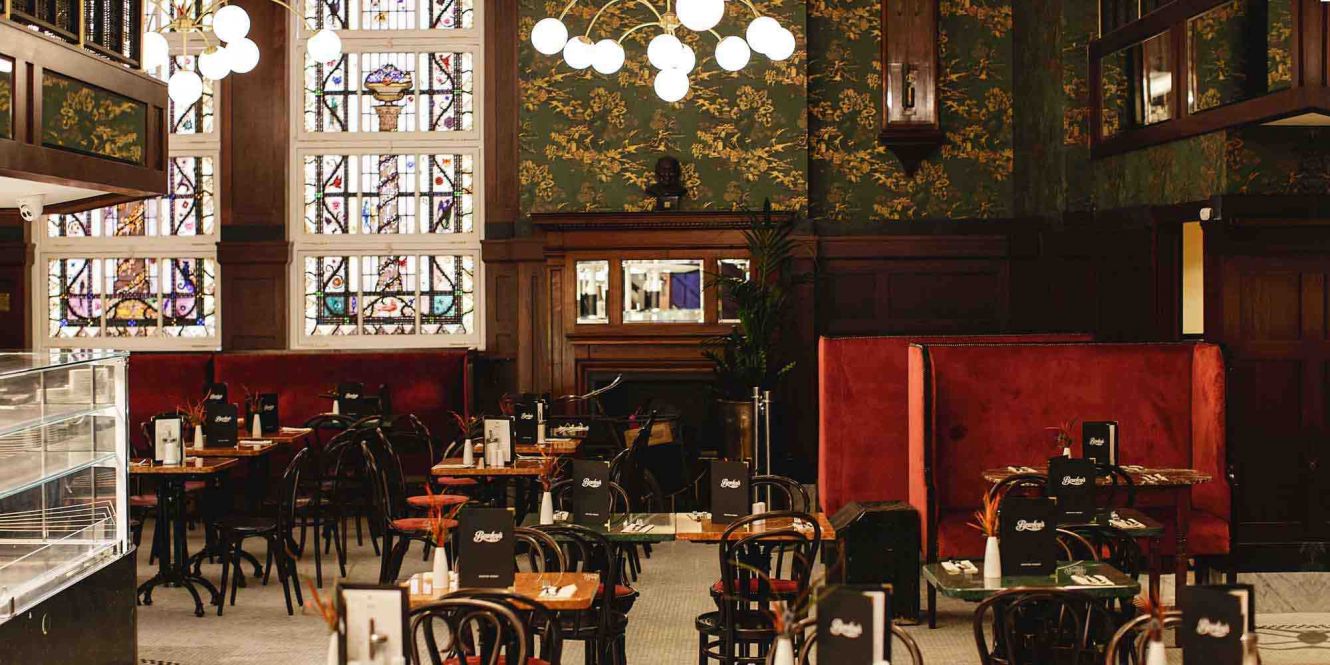
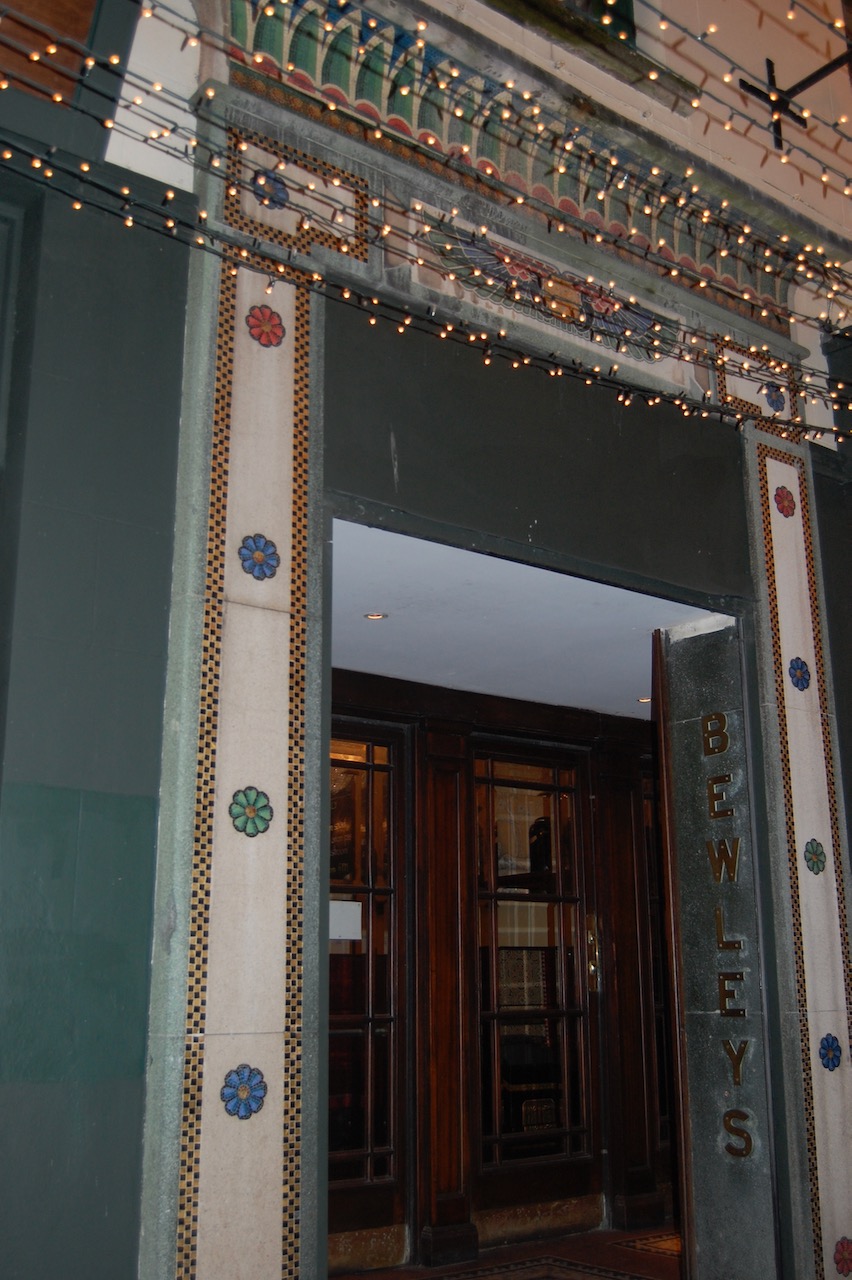
The Grafton Street branch opened in 1927 in what were originally two Georgian townhouses.

Bewleys, courtesy Flynnmc.com
Bewleys, courtesy Bewleys stock photographs, flickr, 2009.

The higgeldy piggeldy rooms upstairs remind us that it was a private residence. One of the rooms upstairs now houses a lunchtime theatre, which opened in 1999. They have lately introduced a new Soirée performance, which takes place on the second Thursday of each run at 7pm. 

Bewleys, courtesy Bewleys stock photographs, flickr, 2009.

The buildings on Grafton Street previously housed Whyte’s Academy, a school attended by Arthur Wellesley, Duke of Wellington, and Robert Emmet.

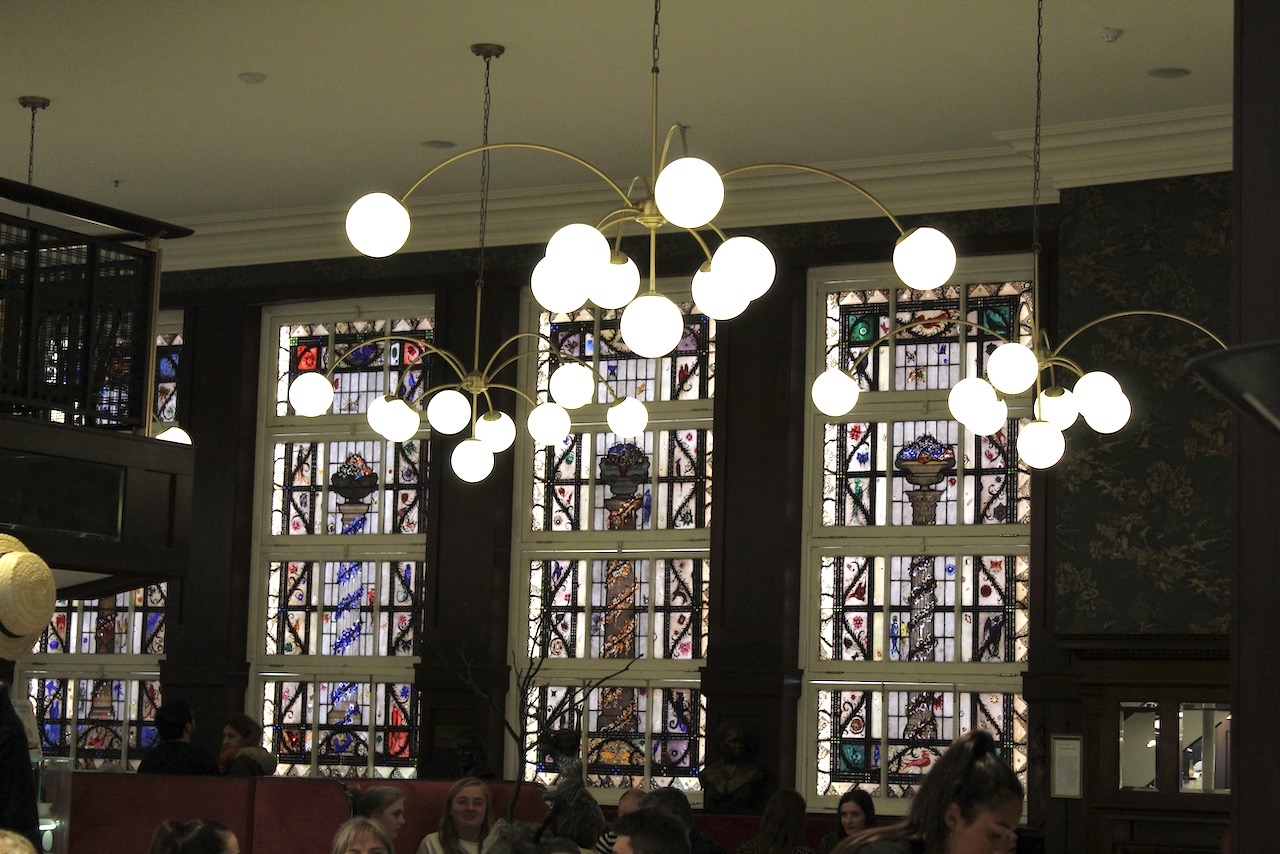
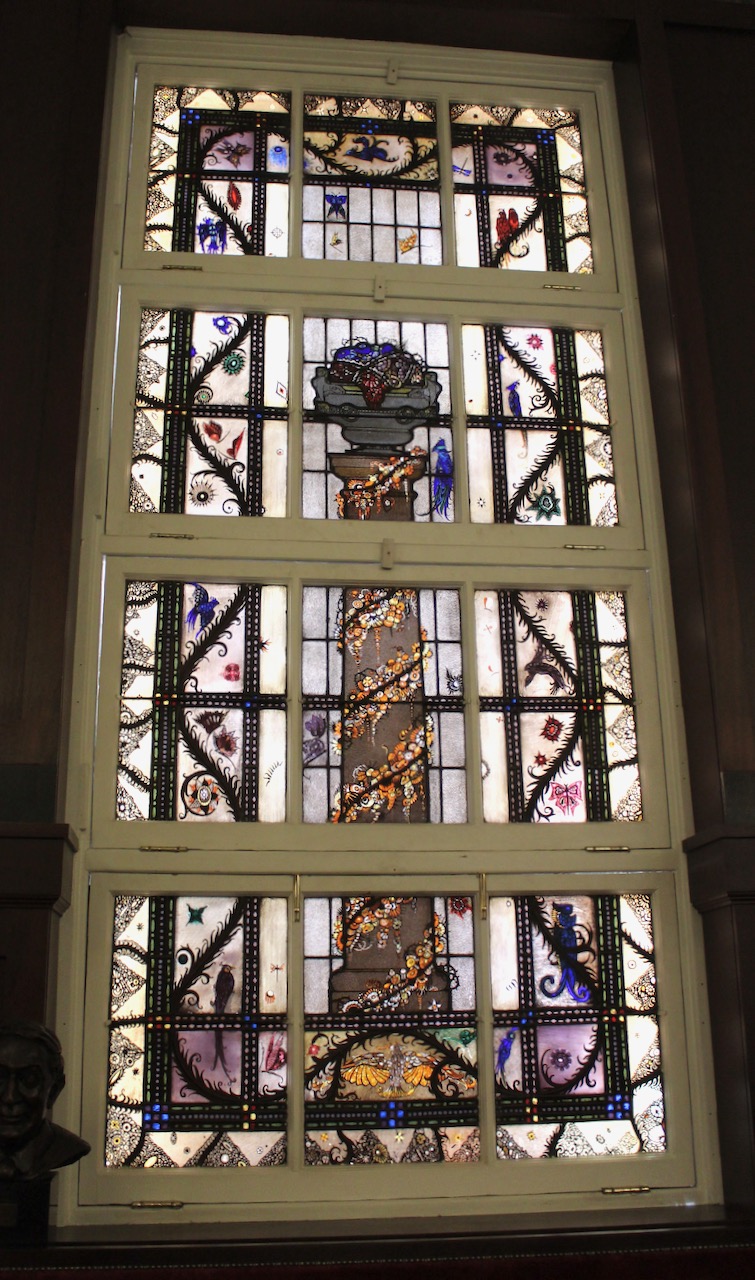
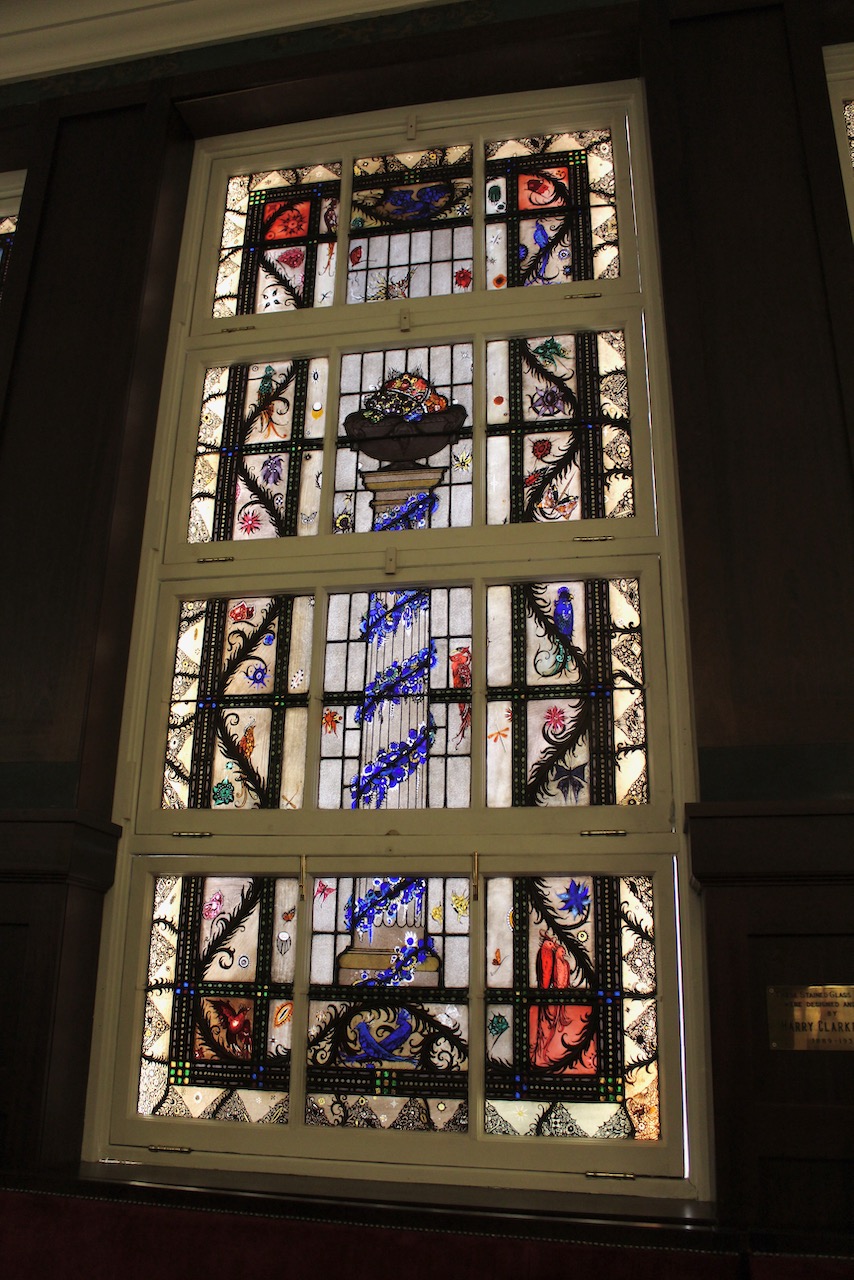
The Buildings of Ireland publication on Dublin South City tells us: “Rebuilt in 1926 to designs by Miller and Symes, the playful mosaics framing the ground and mezzanine floors are indebted to the Egyptian style then in vogue following the discovery of Tutankhamun’s tomb. The interior, originally modelled on the grand cafés of Europe and Oriental tearooms, was restructured in 1995 but retains a suite of six stained glass windows designed (1927) by the celebrated Harry Clarke (1889-1931). Four windows lighting the back wall of the tearoom are particularly fine and represent the four orders of architecture.” [2]

The 1995 renovation was designed by Paul Brazil.

Image by James Fennell, 2014, Tourism Ireland, from Ireland’s Content Pool.
Bewleys, courtesy Bewleys stock photographs, flickr, 2009.

The four orders of architecture represented are the Doric, Corinthian, Ionic and Composite.

Bewleys Oriental Café, Grafton Street, the four Harry Clake windows. Photograph © Jennifer Winder-Baggot, www.irishhistorichouses.com
The Ionic window, Bewleys Oriental Café, Grafton Street, Harry Clake windows. Photograph © Jennifer Winder-Baggot, www.irishhistorichouses.com
Bewleys Oriental Café, Grafton Street, Harry Clake windows. Photograph © Jennifer Winder-Baggot, www.irishhistorichouses.com

Ernest Bewley’s three sons Victor, Alfred and Joe took over: Victor ran the business, Alfred cooked and Joe ran Knocksedan farm with its prize-winning Jersey cows. Ernest imported the first Jersey cows to Ireland. I remember looking forward to the jersey cow milk when we’d visit when I was young. I used to think the waitresses’ smart black and white uniform the height of glamour.

My great-aunt Harriet, famed for her severity, who used to say one should always leave the table hungry, would buy the famed cherry buns in the vestibule, which was a shop, and bring them inside to eat, as they were cheaper in the shop than in the café!

Bewleys entrance 2009, courtesy Bewleys stock photographs, flickr.

In the 1980s and 90s Dubliners loved the coffee with hot milk that Bewleys served, a precursor to today’s flat white. A group of friends met weekly for a conversation group downstairs in the Grafton Street branch. It was a rare venue open in the evening that was not a pub. One evening we were locked in when the staff didn’t notice we were still deep in discussion!

The Westmoreland Street venue was my haunt in the late 1990s, where I loved the animal skin themed snug downstairs and where we could chat philosophy for hours.

Bewleys Westmoreland Street courtesy Liam Blake, Real Ireland [3]

Recently Paddy Bewley died, the last of the family directly involved with the running of the cafe and coffee business of Bewleys. Paddy was responsible for starting the coffee supplying end of the Bewley business.

Paddy, like those in his family before him, was a Quaker, and he lived by their ethos. Mungo Bewley left Cumberland for Ireland in 1700 and settled in Edenderry, County Offaly. Ireland offered religious tolerance under the Toleration Act. Many Quakers entered trade rather than professions because the former did not require an oath, and Quakers did not believe in taking oaths, believing that their word was enough.

Victor Bewley writes in his memoir that Maud Gonne frequented Bewleys. He adds:

Bewley’s was obviously a place conducive to writers because there was a lot of life milling around, so to speak. Mary Lavin was donkey’s years coming in and I believe she wrote some of her early stories in the cafés. Maeve Binchy became a regular customer when she worked on The Irish Times.” [4]

Bewleys, mezzanine level, courtesy Bewleys stock photographs, flickr, 2009.

In 1986 Patrick Campbell acquired the company of Bewleys, forming the Campbell Bewley Group, and Paddy Bewley continued to work for the company.

In 1996, Paddy Bewley signed up the company to purchase Fair Trade coffee only, guaranteeing that producers of coffee and their communities would be paid a good price for their beans, irrespective of market fluctuations. In 2008 the company’s roasteries and headquarters in Dublin became 100% carbon neutral. (notes from Paddy Bewley’s obituary in the Irish Times, Saturday January 8th 2022).

There has been much discussion lately about the beautiful Harry Clarke windows in the Grafton Street Bewleys – are they part of the building, or removeable art? I believe they are not actually the windows but can be removed. It is being discussed because it’s not clear who owns them.

Bewleys Oriental Café, Grafton Street, Harry Clake windows. Photograph © Jennifer Winder-Baggot, www.irishhistorichouses.com

The Bewleys business branched into hotels. Stephen and I held our wedding reception in the Bewleys hotel in Ballsbridge, a former school run by the Freemasons. The hotels too have been sold on to another business.

Bewleys Oriental Café, Grafton Street, another decorative window: “Cruitne” by Jim Fitzpatrick. Fitzpatrick’s website tells us that Cruitne was the beautiful daughter of the chieftain Lochan. She fell in love with the youthful warrior Finn McCool, much to the disgust of her father who disapproved as the warrior Goll wanted the head of Finn on a plate for a great insult to him and his people. They became lovers but never married as Finn was afraid the Cruitne would be killed in his place if they were man and wife. Photograph © Jennifer Winder-Baggot, www.irishhistorichouses.com
The side door of Bewleys. Photograph © Jennifer Winder-Baggot, www.irishhistorichouses.com

[1] Victor Bewley’s Memoirs, as recorded by his granddaughter Fiona Murdoch. Updated edition. Veritas Publications, Dublin, 2002, updated in 2021.

[2] https://www.buildingsofireland.ie/app/uploads/2019/10/Dublin-South-City.pdf

[3] https://liamblakephotographer.com/real-ireland/

[4] p. 61, Victor Bewley’s Memoirs.

Ayesha Castle (or Victoria Castle), Victoria Road, Killiney, Dublin 

Ayesha Castle (or Manderley or Victoria), Victoria Road, Killiney, Dublin 

Ayesha Castle, Dublin entrance gate, photograph by Robert French, Lawrence Photograph Collection, National Library of Ireland.
Victoria Castle, County Dublin, photograph by Robert French, (between ca. 1865-1914), Lawrence Photograph Collection, National Library of Ireland.

Bence-Jones, Mark. A Guide to Irish Country Houses (originally published as Burke’s Guide to Country Houses volume 1 Ireland by Burke’s Peerage Ltd. 1978); Revised edition 1988 Constable and Company Ltd, London.  

p. 13. “(Warren/LGI1912; Lloyd of Lossett/LGI1958; Aylmer/IFR) A romantic 19th century castle of ashlar with a round tower and various turrets by the side of Killiney Bay, built ca. 1850 for Robert Warren of Killiney Castle, who named it Victoria Castle, presumably in honour of the queen visit to Dublin for the Exhibition of 1853. It later became the residence of Rev Humphrey Lloyd, FRS, of Lossett, Co Cavan, Provost of Trinity College Dublin 1867-81, and remained in the Lloyd family until the present century. Gutted by fire towards the end of the Lloyd ownership; afterwards restored, and its name changed to Ayesha Castle. Bought by Col R. M. Aylmer in 1947.” 

Victoria Castle, County Dublin, photograph by Robert French, (between ca. 1865-1914), Lawrence Photograph Collection, National Library of Ireland.

Irish Historic Houses, by Kevin O’Connor:  

owner: Brigid Aylmer. 

A romantic 19th century Victorian castle with the finest views of Killiney Bay and the Sugarloaf Mountain in the county. It was built from local granite by Robert Warren, a wealthy landowner, in 1840, when he called it Victoria Castle… 

It was gutted by fire in 1926 and was bought and renovated by Sir Thomas Power of Power’s Whiskey who renamed it Ayesha, after the goddess heroine of Rider Haggard’s novel She, who rose, phoenix-like, from the flames. Amongst its noteable features are the fine oak panelling in the entrance hall and dining-room, and the magnificent spiral staircase.”