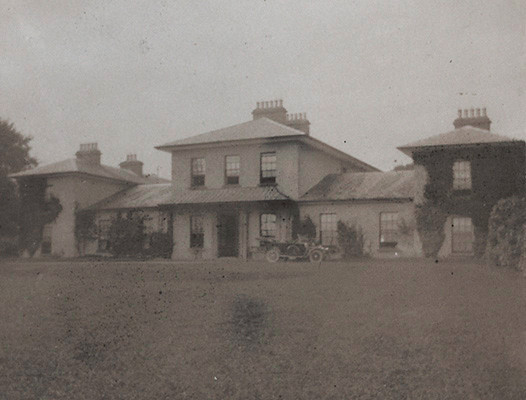
Ballycurry, Ashford, Co Wicklow
Mark Bence-Jones. A Guide to Irish Country Houses (originally published as Burke’s Guide to Country Houses volume 1 Ireland by Burke’s Peerage Ltd. 1978); Revised edition 1988 Constable and Company Ltd, London.
p. 20. “(Tottenham/IFR) A C18 house of the Boswell family, of two storeys and seven bays with a pedimented breakfronted centre, which passed to the Tottenhams with the marriage of Frances Boswell to Charles Tottenham, MP; who rebuilt the house ca 1808 to the design of Francis Johnston. Of two storeys, entrance front of 6 bays without pediment; single storey Grecian Doric portico with fluted columns and triglyph frieze. At one end of the front there is now a projecting wing added in the Victorian period. Garden front with 1 bay on either side of shallow curved bow. Hall with screen of fluted Grecian Doric columns and frieze of triglyphs and ox skulls. The bow-fronted drawing room, the dining room and the library all have typical early C19 plasterwork friezes. Pedimented bookcases in library.”
https://www.buildingsofireland.ie/buildings-search/building/16401907/ballycurry-house-ballycurry-demesne-ashford-county-wicklow
Ballycurry House, BALLYCURRY DEMESNE, Ashford, County Wicklow
Detached six-bay two-storey house, built 1807 to designs by Francis Johnston. The building is finished in render with some stone dressings. To the north side there is a later two-storey addition. The part glazed panelled double front doors have sidelights and a tetrastyle Doric portico. Window openings are flat-headed with six over six timber sash frames. The hipped roof is finished with natural slate and copper ridge. Chimneystacks are in ashlar stone and have boldly corbelled caps with clay pots. The house is set within a well wooded demesne.
Appraisal
A well preserved early 19th century house which has retained its original setting. The clean Georgian lines are somewhat marred by the later addition to the north side, however the house is still an important example of a small country house.
http://tottenham.name/Places_Ballycurry.html
At the foot of Ballycurry Hill about 5 miles north of Wicklow, Ballycurry came into the family with the Boswell marriage in 1766. The original home of the Boswells, of which there are two charming pencil sketches, was probably built in the reign of Queen Anne.
At the beginning of the 19th century it was replaced by a larger house – a solid, unpretentious, Georgian structure, which probably incorporated parts of the old building. A hundred years later Col. C. G. Tottenham added a block on the N.E. corner, and at the same time made a new front avenue and lodge – some say in order to bring the house within the radius of free delivery of telegrams.
The former avenue (now the back avenue) opens on to the old coaching road from Rathdrum to Dublin, along which “Tottenham in his Boots” probably passed on his famous ride.
The house has a big hall and a large drawing-room, dining-room, and library on the ground floor, besides several smaller rooms, some of which have been converted into kitchen and offices, to replace the remote caverns in the basement which previously served those purposes.
Upstairs there are 10 bedrooms, but until about 1920 there were no bathrooms.
It stands in a walled Deer Park containing many fine trees, and there is a beautiful view to the west up the Devil’s Glen, half of which belongs to the estate. Down the glen runs the VartryRiver, and on the opposite side was the old Synge property of Glanmore Castle.
To the southwest rises Mt. Carrick (1280ft). The estate runs to some 1300 acres, of which about 600 are wooded. There is some good arable land and much fine timber. Far more attention is now being paid to both farming and forestry than was the case in the past.
Ballycurry has been in the Tottenham family for over 200 years. When Charles took over the ownership of the property in 1957, he introduced new and, at that time, advanced management techniques and proceeded to utilise the estate�s commercial values with the view to securing its future in the Tottenham family.
He initiated new and valuable foresty harvesting. Later with the help of his two sons Charles and Geoffry he managed it with the successful growth and implementation of forestry, livestockand fodder.
In 1984, BBC television used the home to produce the film “Time after Time” by Molly Keane.
https://www.independent.ie/regionals/wicklowpeople/news/new-book-examines-ashfords-big-houses-27825305.html
A new book documenting the ‘big houses’ in the Ashford area and the personalities who resided in them was published by a local historian at the weekend.’Ashford – A Journey Through Time’ was lovingly researched and written by Sheila Clarke. The book is described as a ‘history in which, by and large, great events are notable by their absence.’
A new book documenting the ‘big houses’ in the Ashford area and the personalities who resided in them was published by a local historian at the weekend.
‘Ashford – A Journey Through Time’ was lovingly researched and written by Sheila Clarke. The book is described as a ‘history in which, by and large, great events are notable by their absence.’
Instead the author’s interest lies in the village inhabitants, living and dead, as human beings preoccupied with the day to day cares and joys of life rather than as actors in a national drama.
The beautiful hardback book features the big houses at Ballinapark, Ballybla, Ballycurry, Ballyhenry, Broomfield, Castlegrange, Clermont, Clonmannon, Cronroe, Dunran, Glanmore, Inchinappa, Killaderrig, Killoughter, Kilmartin, Kiltimon, Mount Usher, Munduff and Rossanagh.
It further looks at the establishments of Ashford House, Ashford Mart, Cullenmore Hotel, the Garda Station, Glen Hotel, Hunter’s Hotel and the Woodpecker Lounge.
Sheila has delved into the past of each house to bring its history to the reader. There is information on the various owners and their backgrounds and more importantly their humanity.
Class differences and likenesses are highlighted as is the social change which has taken place in Ashford over the last 100 years. The history is illustrated by many photographs.
The book was launched by poet, Seamus Heaney, in the Bel Air Hotel in Ashford on Saturday night. In the book’s preface he said the book was a feat of scholarshop and a labour of love. ‘From now on, the book will be cherished by local residents, consulted by working scholars and retained as a memento by interested visitors,’ he said.
The book is available in local shops and would make an ideal Christmas present for local people.


 Irish Historic Houses