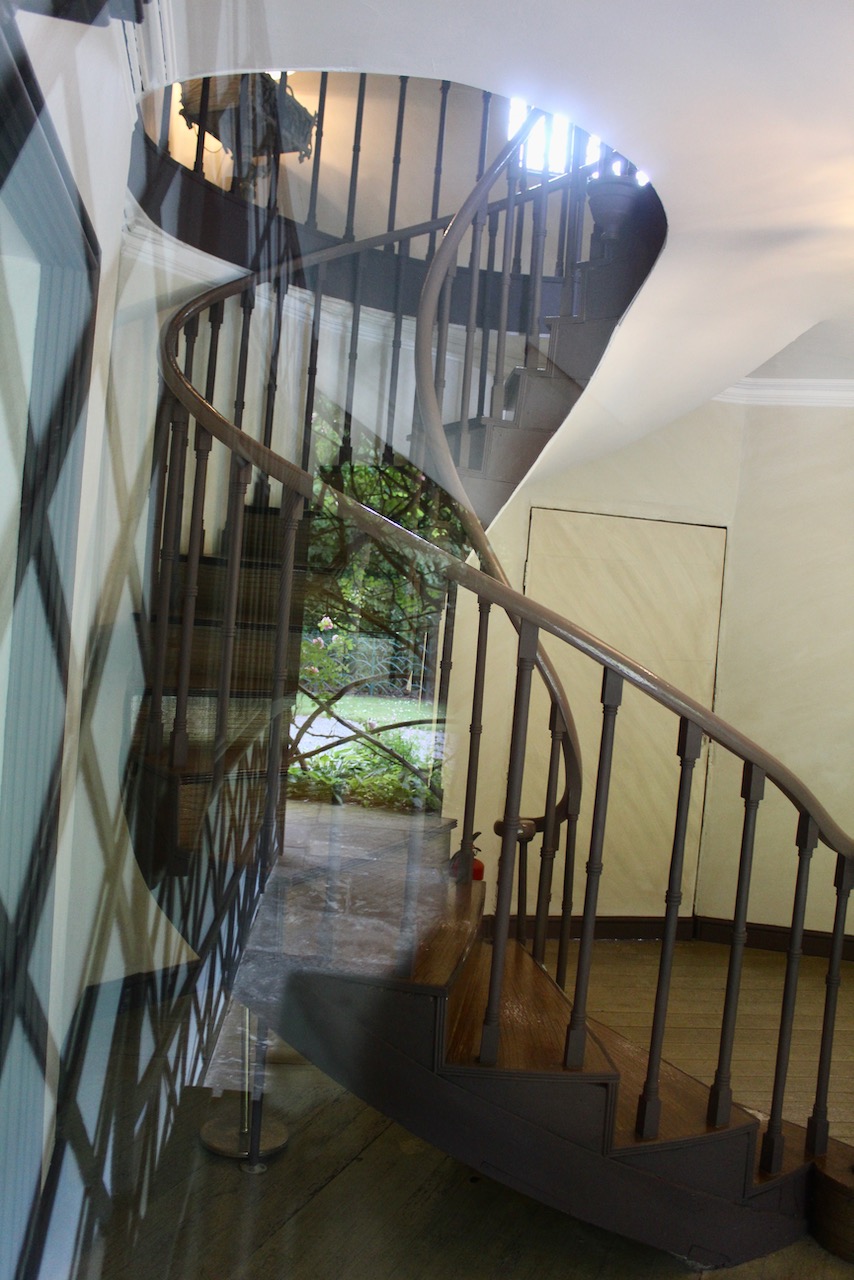
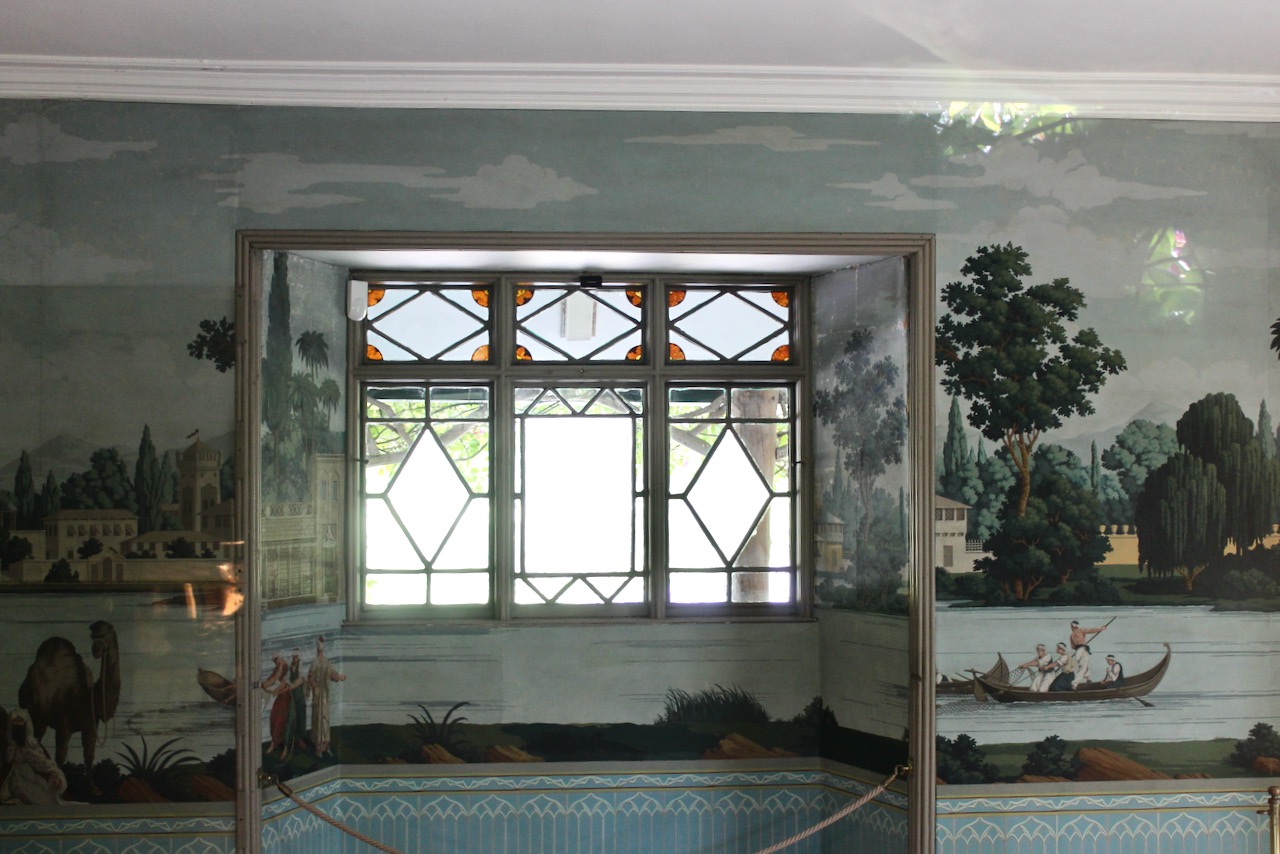
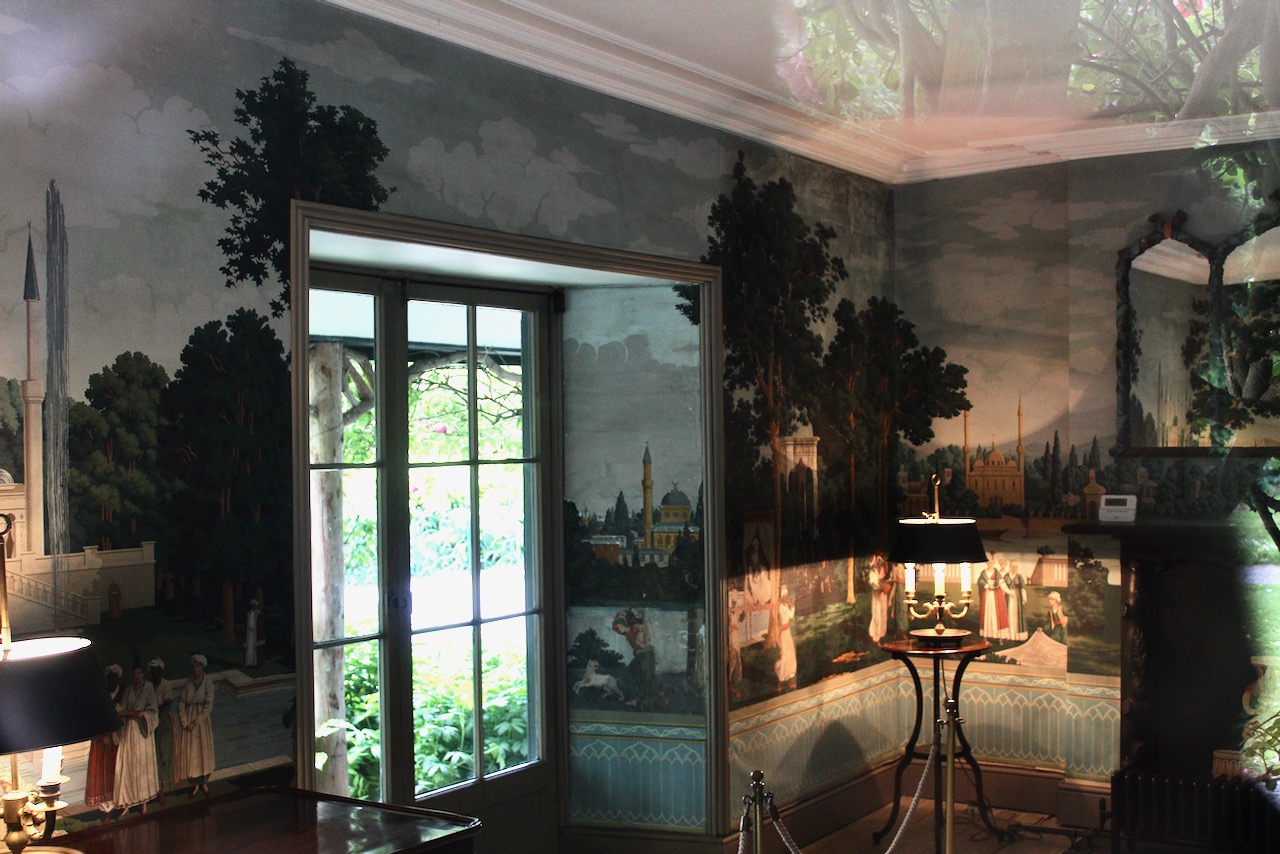
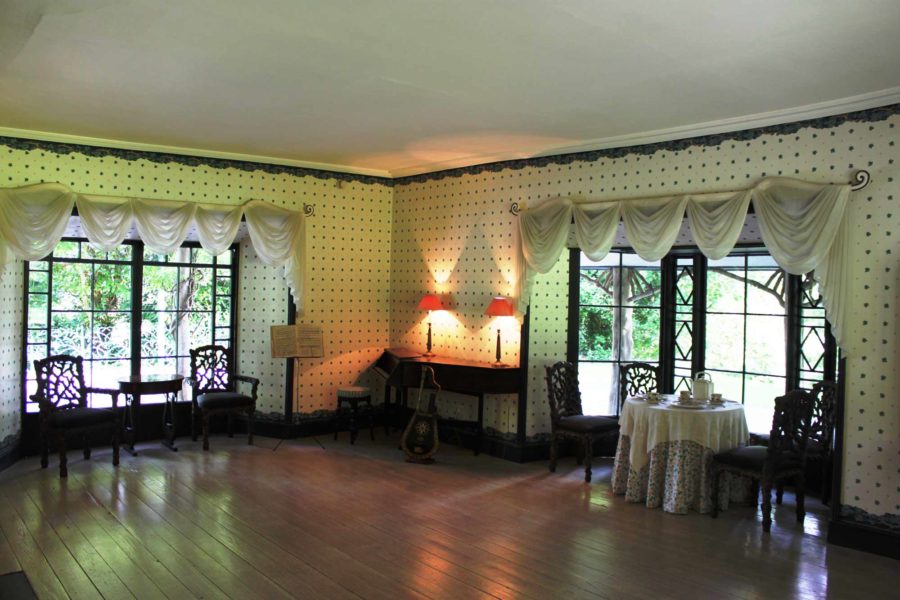
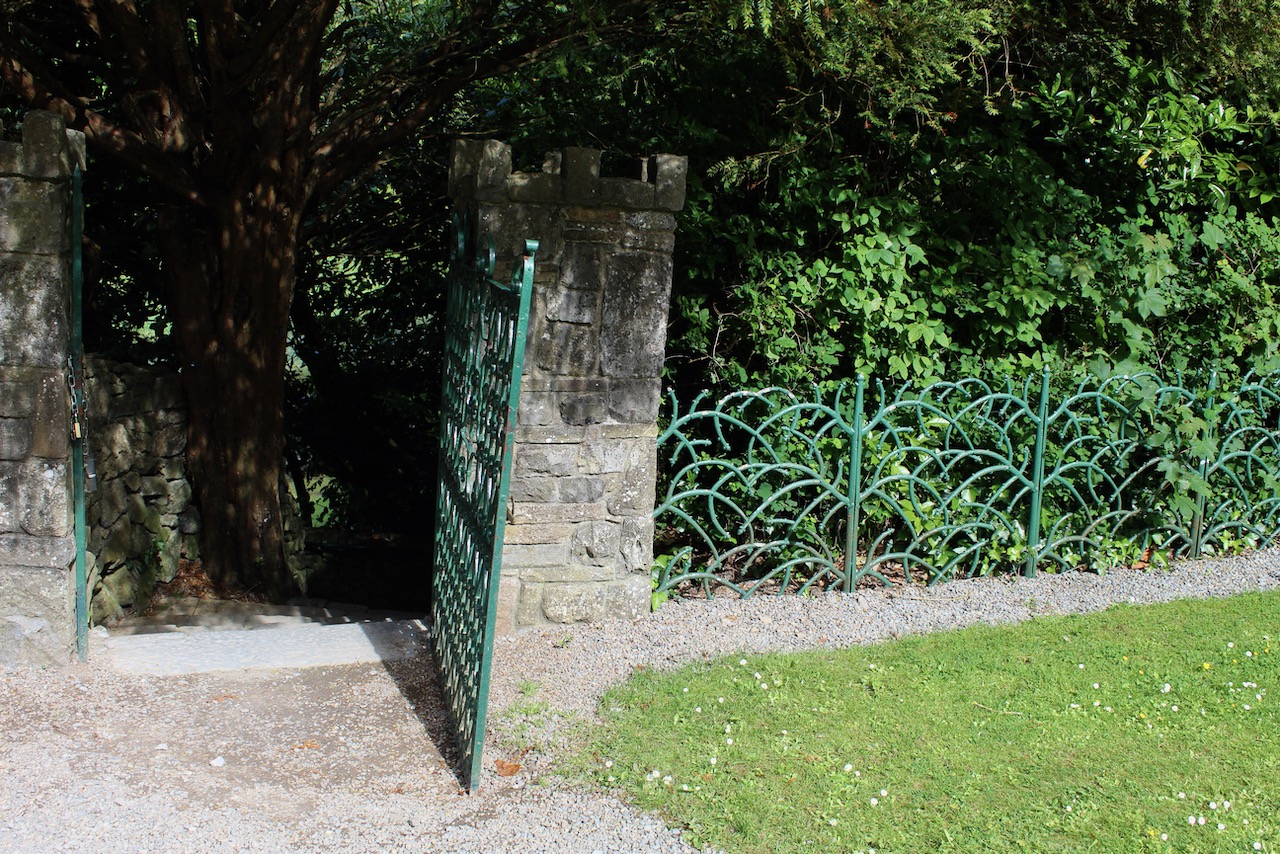
Castle Kevin, Annamoe, County Wicklow

Castle Kevin, Annamoe, County Wicklow

– home of Daniel Day Lewis 

Mark Bence-Jones.  A Guide to Irish Country Houses (originally published as Burke’s Guide to Country Houses volume 1 Ireland by Burke’s Peerage Ltd. 1978); Revised edition 1988 Constable and Company Ltd, London.

p. 71. “A two storey house with two adjoining fronts, one of 3 bays with a round-headed doorway and a wide eaved roof; the other of five bays with battlements and a pillared and pedimented porch. Battlemented screen wall and lower wing. The seat of the Frizell family.” 

https://www.buildingsofireland.ie/buildings-search/building/16402407/castlekevin-house-castlekevin-co-wicklow

Castlekevin House, CASTLEKEVIN, County Wicklow 

Detached three-bay two-storey house with basement, built in 1813, with full-height projection to the east dating from c.1920. The building is constructed in rubble with dressed quoins and is lime-washed. The slated hipped roof has a pronounced overhang supported on plain brackets, and granite chimneystacks. The roof of the extension is hidden by a parapet. The high-level entrance consists of a panelled timber door with shallow hood on decorative brackets, and segmental fanlight with ‘spoke’ tracery. The entrance is reached via a flight of stone steps enclosed by a low rendered wall and decorative balustrade. There is a side entrance (to the extension) with door and fanlight similar to the main entrance, but with a pedimented portico (possibly added c.1980s). The windows are largely flat-headed and filled with six over six and six over three timber sash frames, with ten over ten timber sash frames to the basement and some top-hung timber frames to the extension. Cast-iron rainwater goods. Extensive range of outbuildings to the rear which incorporate a folly tower. The building is set within its own extensive well wooded grounds. 

Appraisal 

Generally well preserved late Georgian country gentleman’s residence. 

https://irishhistorypodcast.ie/the-rise-and-fall-of-medieval-wicklow-an-irish-game-of-thrones/

In a remote valley, a mile east of the village of Annamoe in east Wicklow lies the long forgotten ruins of medieval Castlekevin. Camouflaged by undergrowth, this Norman castle and town was once the key Norman site in the region. The walls and earthworks of this ruin witnessed some of the most bloody events in the remarkable story of the fall of Norman society in the inhospitable mountains of eastern Wicklow. 

Life at Castlekevin was not always shrouded in war and violence, indeed over seven centuries ago this fortified settlement was a thriving town dominating the neighbouring valleys of Glendalough and Glenmalure. However following a century of relentless war, famine, plague and massacres reminiscent of ‘A Game of Thrones‘ the site declined into the picturesque ruin we see today. This article is the story of eastern Wicklow in the later medieval period when it was torn apart by one of the worst crises recorded in human history. Although the region is famous for its associations with the early christian monastery at Glendalough its later medieval history is often neglected. Far from its pious origins of Glendalough the area became the centre of a bitter violent struggle for control of eastern Wicklow in a period of frequent famine. 

 Castlekevin lies in the eastern foothills of the eastern Wicklow mountains and is situated twenty miles south of Dublin and four miles north east of the famous early Christian monastery of Glendalough. Long before Castlekevin was erected, Glendalough was the centre of life in the region. Founded in the 6th century by St. Kevin, Glendalough was once a site of remote solitude, however the monastic settlement grew into a large town encompassing several sites stretching 5km along the stunning valley floor. 

In 1111 its pre-eminent position was recognised at the synod of Ráth Breasail when Glendalough became the centre of a large diocese that stretched across North Leinster as far west as Athy in South Co. Kildare. In 1169 when Gaelic Ireland was convulsed by the Norman Invasion, large swathes of territory surrounding the Wicklow Mountains fall to the Normans over the following years. However they failed to take the inhospitable uplands surrounding Glendalough. This was partially due to the fact the church at Glendalough owned large tracts of land in the region but also the Normans had little interest in terrain that was poor and rocky; generally Normans in Ireland settled lands below two hundred metres. Nonetheless Glendalough and the neighbouring valleys would not escape the wider upheaval caused by the conquest. 

In south Co. Kildare the once powerful O Toole family were driven off their lands by the Norman Walter de Ridelesford 1. They took refuge in the Glendalough area where several members of the family had been abbots most notably St. Laurence O Toole. In time they were granted the entire neighbouring valley of Glenmalure where they settled2. The arrival of the O Tooles in the area would shape the history of the region in the following decades and centuries. 

In the short-term the influx of the O Tooles into the area created upheavel presumably as they displaced the existing population. Over the following four decade Glendalough appears to have gone into decline. Indeed by 1215 Archbishop Felix O Ruadhain of Tuam noted that the 

‘more murders were committed in that valley than in any place in Ireland because of the deserted and vast solitude‘.3 

By the 1190’s machinations were afoot to bring Wicklow and Glendalough under the control of the Normans. As the Norman conquest progressed ethnic tensions in the church were rife as the Normans sought to take over the church to the exclusion of Gaelic clerics. The thinking behind this was voiced a Cistercian from England Stephen of Lexington who said in the early 13th century 

By the early 13th century the Normans controlled most of the bishoprics on the East and South Coast where they had had taken large tracts of land. Taking control of the church in regions like Glendalough where there was limited Norman influence was not as easy. Invasion of church lands was out of the question but if Glendalough could not controlled by sword it could be by the pen or in this case the quill. 

It was no great surprise then that in 1216 vast swathes of territory of the bishopric of Glendalough was annexed to the archbishopric of Dublin by the papacy a move that had been in motion since at least the 1190’s . 

The merging of the two diocese not only changed the spiritual centre of the church in the region to Dublin but it also brought large sections of land in the region under Norman control. The archbishops of Dublin were all Anglo-Norman after 1181. These bishops of the enlarged archbishopric of Dublin were among the greatest feudal lords in the Ireland possessing tens of thousands of acres5 and administering their lands like any other secular feudal lord. In the aftermath Glendalough was demoted in status to an arch-deaconry and the various ecclesiastical settlements were now ruled by priors appointed in Christchurch rather than the more independent and powerful Abbots. However the area was not completely abandoned by the archbishops – there is evidence of continued building at the site after the transfer of the area under the control of the see of Dublin. 

To administer his possesions the archbishop divided his lands into farms or manors* like other Norman lords.  At his remote isolated possessions at Glendalough the first archbishop of the enlarged diocese, Henry of London, built a fortified settlement at Castlekevin, four miles north-west of Glendalough. It was here Norman economic and political life in the region would be located. 

The rise of Norman Wicklow and Castlekevin. 

The earliest construction at Castlekevin most likely took the form of a motte and bailey castle. A motte was a large conical man-made earthen mound (like the example above from St Mullins). It was topped with a fortification and defended by a wooden palisade. The structure was almost certainly made entirely of wood, as the Archbishop wouldn’t have needed to invest the significant sums that a stone fortification would cost as the east Wicklow region was relatively peaceful during the first half of the 13th century. 

In this field to the east of the motte, a large bailey or defended settlement was built. Although a quiet field today, seven hundred years ago this would have been filled with streets, houses, presumably a church and a mill in what would have been a bustling settlement. This would also have been defended by wooden palisade. It was from this settlement at Castlekevin that the archbishop’s officials administered his lands in the region which stretched south into the valleys of Glenmalure, west into Glendalough and east towards the coast. 

In the years after its construction Castlekevin became the key focus of life in the locality – in 1225 the archbishop secured rights to hold a weekly fair Castlekevin each Thursday6  shifting economic and administrative life the region away from Glendalough to Castlekevin. 

As the Norman presence in the region increased, evidenced by the presence of settlers like ‘David the Clerk’ who rented lands in the neighbouring town land of Lickeen, they began to transform the landscape. In the 1220’s the substantial forests that covered neighbouring districts of Saufkevin, Fertir, and Coillac were cut down and the timber was sold. The newly created farmland which was granted to the church in 1229 further increasing the episcopal possessions in the vicinity. 

Nevertheless the arrival of Anglo-Normans in the area did not mean an end to the Gaelic Irish presence. The Archbishop’s manors like many Norman manors across medieval Ireland were multi-ethnic communities with Gaelic Irish tenants living alongside Norman settlers. After the conquest large numbers of Gaelic Irish peasants remained on the newly conquered lands often as betaghs – unfree serfs while some were free tenants. Indeed at the relatively isolated Castlekevin there appears to have been large numbers of Gaelic Irish tenants – it may have hard to attract Normans into what was a comparatively inhospitable environment. In the mid-thirteenth century nine of twenty seven jurors listed at Castlekevin were Gaelic Irish while a certain Elias O Toole was named as a sergeant7 Indeed in some areas entire Gaelic families held vast tracts of territory. Under the reign of Archbishop Fulk de Sanford (1256-71) the grant of Glenmalure to the O Tooles as tenants was reaffirmed8

Early life at Castlekevin and the surrounding mountain valleys seems to have been relatively peaceful. While there had been tensions in the early 13th century; on Easter Monday 1209 the O Tooles massacred a large number of  Dubliners at Cullenswood south of the city, this appears to have been an isolated incident. Indeed what little upheaval there was in the first half of the 13th century was mainly caused by Norman infighting9. The Gaelic Irish by and large appear not to have resisted the changes taking place around them and as the evidence from Castlekevin suggests a certain amount embraced Norman society and its institutions. 

However this relative peace was deceptive and in 1270 the peace Castlekevin had enjoyed was shattered unleashing what would be decades of violent struggle between the Gaelic Irish and the Normans, fuelled by famine and underlying resentments among the Gaelic Irish. This would transform the once peaceful settlement into the war torn outpost under constant threat of attack. 

The revolt of the 1270s. 

It appears the spark that pushed the Gaelic Irish into revolt was a heavy snow fall in January of 127010. This seems to have been followed by a poor harvest resulting in‘Great famine and scarcity in all Erinn’ later in the year11

Even in the best of times, medieval Ireland lived on the precipice of starvation surviving from one harvest to the next. It was not an unusual occurrence for medieval villages to experience hunger in Spring as the previous harvest began to run out. 

In this context years of bad weather and poor harvest could easily result in a devastating famine . For the Gaelic Irish living in the mountains and the valleys of Glendalough and Glenmalure the heavy snows and food shortage of 1270 would undoubtedly have pushed them into a crisis relatively quickly. Fertile land was sparse and even the valley floors were 140 metres above sea level. Situated to their east were the richer manors on the coastal plain and it was only a matter of time before raids on these lands began and Castlekevin was in the direct line of attack. 

As early as 1270 the archbishop of Dublin Fulk de Sanford faced what was called ‘malicious rebellion12 on his lands in east Wicklow and needed the help of the Justiciar (the kings representative) James D’Audleyto keep control13. Castlekevin was for the first time referred to as being on ‘the frontier of the whole march14‘, the march being the medieval term that described a frontier between Gaelic Irish and Norman areas.15 

With tensions already beginning to boil over in 1270, further bad weather aggravated the situation. The Annals reported a dramatically worsening situation in 1271 with ‘very bad weather in that year.’16 As the harvest faltered the outcome was all too predictable and ‘a great famine so that multitudes of poor people died of cold and hunger and the rich suffered hardship.’17. That the rich suffered was indicative of an acute shortage – normally they would be take what little food was available. 

As the area grappled with severe food shortages the Archbishop of Dublin Fulk de Sandford died at this crucial moment. He was not replaced until 1279 and in this vacuum the archbishops lands were administered by the crown. The arrival of royal officials in the region appear to have exacerbated tensions in an already fraught region. By 1271 attacks on Norman settlements in the region seem to have been well under way as Castlekevin was garrisoned and provisioned. The garrison attempted to ensure their safety by taking hostages from the O Tooles, O Byrnes and the Harolds and holding them at Castlekevin. Situated close to the Gaelic Irish in the Glendalough and Glenmalure valleys they hoped this might offset the dangers posed by their isolated position. 

This failed and among the vast amounts of money the Normans spent on military campaigns across Ireland that year we find the Justiciar James D’Audley being compensated 25 marks for the loss of a horse in Glendalough in 127218

In 1273 more hostages were taken but the situation appears to have been getting seriously out of hand in Ireland and particularly east Wicklow. Income from Castlekevin was almost non existent indicating that farmlands had been ravaged and destroyed. In desperation king Edward I sent Geoffrey de Geneville, Lord Of Trim, who had fought in the ninth crusade directly back from the Middle East to Ireland. Arriving in Ireland in 1273 he faced the difficult problem in that he would have to penetrate deep into the Wicklow Mountains away from the security of Dublin and supplies to find the O Toole rebels. This warfare could not be further away from the battles he had fought in the eastern Mediterranean. 

In 1274 de Geneville made his first decisive attempt to resolve the escalating situation and alleviate settlements like Castlekevin. The military order of the Knights Hospitaller19 (who had extensive territory in Kilmainham) lead by their grand master William Fitzroger joined an army raised from across Norman Ireland. Their strategy was to attack the secluded valley of Glenmalure south-west of Castlekevin where the O Tooles had settled on the lands the Archbishop. Deep in the mountains Glenmalure was eight kilometre long valley but only around a kilometre wide with steep sides. Fighting in unfamiliar terrain where heavily cavalry had a limited impact the colonists suffered heavy casualties and the Grandmaster of the Knights Hospitaller and the Sheriff of Limerick20 were taken prisoner only to be released later in a prisoner exchange. 

This defeat was disastrous for Castlekevin ensuring the raids would continue unhindered. The area was devastated; crops were stolen or burnt while villages were ransacked. Between 1271 and 1277 the lands around Castlekevin yielded only £8, 14s. 10½d. This was down from the £56 recorded for the year 1229 alone. Although there are no surviving accounts of specific attacks on Castlekevin records survive from the Norman settlement of Saggart thirty-five kilometres to the north-west where the Gaelic Irish swept down on unsuspecting peasants of Saggart in broad daylight killing forty people as they worked in the fields21. Unsurprisingly the tenants at Saggart fled their homes after attacks which had killed relatives and did not for years. The raiders took everything they had – 3,000 sheep, 200 cattle, 100 heifers, 200 pigs, silver and even clothes were listed by the people of Saggart in an inventory of goods stolen. The experience of Castlekevin must have been similar. 

lthough the famine subsided as the decade progressed Castlekevin, Glendalough and Glenmalure were still years away from peace. The continued revolt after the famine had abated indicated these raids were an expression of deeper resentments and alienation suffered by the Gaelic Irish since the Anglo-Norman invasion. 

Indeed in 1274 the situation worsened when the Mc Murroughs the traditional leaders of the Gaelic Irish in the Wicklow region joined the rebellion due to concern that their dominant position over the other gaelicfamilies in the region would be usurped by the O Byrnes.22 

The siege of Glenmalure. 

As the situation deteriorated the people at Castlekevin had little respite when another campaign in 1275 ended in failure. By 1276 the justiciar Geoffrey de Geneville was now under severe pressure from the King Edward I in England to resolve the situation. He had been sent to Ireland to crush the rebellion but it had only gotten worse. Not only was the Castlekevin area under attack but a vast swathe of the colony from Carlow to Dublin was vulnerable. 

In 1276 De Geneville organised another major mission. Bringing 2,000 vassals23 from his own lands alone, he was joined by the other magnates from across Norman Ireland including Thomas de Clare from Thomond. The fact they choose Newcastle as a base may indicate that Castlekevin was under heavy attack and not secure. Newcastle however was unsuitable as it was twelve miles east of Castlekevin and at least a days march from their target – the mountain pass at Glenmalure. 

When de Geneville lead through the hills surrounding Castlekevin and toward Glenmalure disaster awaited them again. They were not only defeated but this time the army was trapped in the pass by the Gaelic Irish. They were reduced to dire straights and forced to eat their horses24 while being picked off by an enemy in hostile territory. Some would escape including de Geneville although he was heavily wounded25

Unsurprisingly de Geneville was replaced as justiciar by Ralph D’Ufford who launched yet another major campaign in 1277. This time Castlekevin was used as the base of operations. Situated far closer to Glenmalure D’Ufford was finally successful in driving the main O Toole force from the valley but he admitted that the problem was not completely resolved 

The affairs of the latter in Ireland are much improved. The thieves who were in Glendelory26 have departed, many of them have gone to another strong place‘ 27 

During this successful campaign of 1277 the settlement of Castlekevin was transformed into a military fortress. Having been attacked and laid to waste it was clear that in the lands south of the settlement Anglo-Norman authority was crumbling. To shore up Norman control in the area the Motte and Bailey was converted into a major fortification. The enormous sum £500 pounds was spent on wages, provisions and supplies of workmen and Castlekevin was ‘constructed anew‘. 

During these works it appears that the pre-existing conical motte that supported a fortifaction was converted into a square platform eight metres in height and thirty metres square. The sides of the platform were almost vertical and lined with stone. 

This raised platform appears to have been defended by four corner towers and a gatehouse on the eastern side leading to the bailey settlement. 

In the aftermath of D’Ufford’s successful campaign of 1277 the region was pacified and revenues from Castlekevin between January 1278 and January 1279 soared to £118 3s 2d over ten times the amount that had been collected over the previous six years. However by April 1279 war had broken out again and the Castlekevin area bore the brunt of the renewed attacks. No money was received for the first 3 months and the tenants had again fled their lands. A royal official reported the lands as ‘waste‘ and the tenants had left ‘on account of war with the Irish‘.28 In 1281 no taxes were returned from Castlekevin again along with the manors of Kilmacberne and Kilmastan further north due ‘war with the Irish’29. For people trying to survive in Castlekevin life during this period life can only have been unbearable. Many must have simply given up their lands and moved to safer areas further north. 

For those who had managed to survive and stay in the area eventually peace would return. By1282 what been over a decade of war, raids, death and destruction eventually subsided and the area returned to relative peace. This was partially due to the fact that the royal authorities had assassinated two brothers Muirchertach and Art Mc Murrough leaders of the revolt since 1274 on July 21st, 1282. Five years later in 1287 a report from Ireland stated the country 

‘was so pacified these days that in no part of the land is there anyone at war or wishing to go to war, as is known for sure30‘. 

While this was undoubtedly an exaggeration, life at Castlekevin improved. There was no famine, raids or burned farms and life returned to some semblance of normality. 

However the future was far from certain, none of the underlying resentments or tensions had been resolved and in 1295 the area exploded in violence again as Norman Ireland witnessed the worst crises of the 13th century, a period known as the ‘Time of Disturbance’. Similarly to the 1270’s life at Castlekevin was torn apart in 1295. 

The Crisis of 1295 War, Famine and Cannibalism. 

Tensions had surfaced as early as the summer of 1294 when as reported by the Fransican John Clyn 

there was lightning and the flashing destroyed the grain and, as a result, there was a great scarcity and many died from hunger.’ The famine that followed was so severe according that by 1295 reports at Dublin said the poor were reduced to eating the executed bodies hanging in gibbets31

The situation deteriorated in December 1294 when an intense rivalry that had existed between two of the most powerful norman families in Ireland the de Burgh and the Fitzgeralds broke out into open warfare. These factors spurred on the Gaelic Irish to attack what was a weakened colony and soon Castlekevin was engulfed by warfare. In 1295 the fortification of Newcastle McKinegan twelve miles to the east of Castlekevin was burned. The Norman responded with another campaign and again Castlekevin was used as the  

base of operations as the Normans raided the neighbouring valley of Glenmalure. After a successful campaign the Normans were victorious bringing the Gaelic Irish leaders to Castlekevin to submit. 

On July 19th, 1295 the people of Castlekevin witnessed a treaty of sorts that saw the most powerful gaelic leader in the region Muiris McMurrough arrive at Castlekevin and submit to Thomas Fitzgerald the Justiciar of Normans Ireland32 . No doubt to their relief Muiris not only paid a fine of six hundred cows paid but McMurrough pledged to force the O Tooles and O Byrnes back to peace if they broke the agreement. Hostages were also handed over.33 

However the area would never truly return to peace after the upheaval of 1295. Within six years all three major Gaelic Irish families in Wicklow – the O Byrnes, O Tooles and Mc Murrough’s were in revolt and Castlekevin was yet again on high alert. In 1301 Wicklow and Rathdrum were sacked and although there is no mention of Castlekevin it seems unlikely it could have escaped. 

In the following years east Wicklow slipped in to a state of almost perpetual war and Norman control over the region began to ebb away. Castlekevin was in a most precarious position due to its isolation and proximity to Glenmalure and Glendalough. Life was dominated by assassinations and raids in an ever increasingly brutal struggle. In late 1305 four leading McMurroughs were assassinated at Ferns in North Wexford by John Hay and Henry de la Roche; a few months later the seneschal of Wexford was assassinated in retaliation. On St Patrick’s day 1306 three O Tooles were executed in Newcastle Mc Kineagan which can only have served to seriously heighten tensions at nearby Castlekevin. The following winter famine broke out yet again and predictably widespread violence across South Leinster followed in its wake. 

Norman control was clearly diminishing, so much so that Carlow once a safe town west of the mountains, was besieged by the Gaelic Irish. It was only a matter of time before Castlekevin was decimated. Inevitably on May 12th, 1308 the settlement was burned. The Normans lashed out with a punitive raid on Glenmalure lead by the Justiciar John de Wogan but they suffered yet another defeat in the valley in July. Late in the summer the leader of the attack on Castlekevin William Mac Kinaghan was captured and hung, drawn and quartered34

This was followed up by yet another raid into the mountains – this time lead by William ‘Liath’ de Burgh, cousin of the Earl of Ulster. This achieved little and a few weeks later in the closing weeks of the 1308 Castlekevin was burned for the second time in the six months. There can only have been a sense that at some stage Castlekevin would be completely overrun; Glenmalure had already fallen from control of the Normans. For anyone living in the region by this stage its scarcely feasible that they could not have lost direct relatives from war or famine. 

While the Gaelic Irish in Wicklow frequently acted in concert during these raids they were by no means internally unified. The O Tooles and O Byrnes resented the overlord ship of the Mc Murroughs. Their opposition to Norman overlord-ship was not a proto-nationalist uprising of a unified people with a common goal but rather attempts by these individual families to extend their power and influence. This sometimes found them in alliance with Norman families when it suited their interest and this made life in the region incredibly complex. The complexity of these shifting alliances was clearly illustrated in 1309 when the O Byrnes would join Maurice de Caunteton a former seneschal of Wexford in rebellion against the king. During this rebellion they raided the Mc Murrough’s lands. De Caunteton was captured and executed in 1309 by the deputy Justiciar William ‘Liath’ de Burgh aided by the Gaelic Irish O Nolan’s amongst others. 

1309 saw yet another army arrive at Castlekevin to quell the raids that had seen Castlekevin burned twice in  1308. During this campaign, lead by Piers de Gaveston, saw Castlekevin refortified however the fact that de Gaveston had to cut a path to access Glendalough illustrated that Norman society was breaking down in the area35. If communications between Castlekevin and Glendalough scarcely 4 miles apart could not be maintained it would only be a matter of time before Norman society in the area collapsed.

After the dramatic reworking in 1277, Castlekevin dominated the landscape. Even in the early 19th century when the original sketch it was still the key feature in the landscape 

For the Gaelic Irish living in colonial settlements their loyalties during these revolts were often conflicted. Many belonged to the extended O Toole or O Byrne families carrying out the raids. However they nonetheless also suffered in raids. In 1295 Muiris O Toole had to compensate the Gaelic Irish betaghs who had suffered in his raids. This did not stop some aiding the rebels. In the early 14th century a Gratagh le Devenys (nee O Toole) was hung for spying in Kildare

In the following years after de Gaveston’s campaign in 1309, raids and counter-raids continued in the Castlekevin area. The Normans were defeated yet again at Glenmalure in 1311 but the following year the Justiciar Edmund Butler enjoyed what was a rare victory in the valley. None of these activities could stem the tide of the expansion of Gaelic power and influence in Wicklow and from 1315 the power of the Anglo-Normans in east Wicklow went into rapid decline. 

That year the entire island of Ireland was convulsed when Edward Bruce extended his brother Robert’s war against Edward II by invading Ireland. Bruce aimed to attack and undermine the norman colony in Ireland which had been supporting and funding Edwards Wars in Scotland. Unsurprisingly he was able to find support among some of the Gaelic Irish kings in Ulster most notably Domnall O Neill. 

The Final Fall of Castlekevin. 

To make matters worse, 1315 also witnessed the start of the worst famine in medieval European history which would last until 1318. Food shortages and general chaos caused by the Bruce invasion soon saw raids break out in Wicklow and several settlements surrounding Castlekevin were burned. While there is no mention of the site itself its very difficult to imagine it could have emerged unscathed. Norman control eastern Wicklow was now hanging by a thread. In 1316 one of the major Normans Landowners in the area Hugh Lawless described life in Eastern Wicklow as being 

in a confined and narrow part of the country, namely between Newcastle Mc Kynegan and Wicklow, where they have the sea between Wales and Ireland for a wall on one side, and the mountains of Leinster and divers other wooded and desert places on the other where the said Irish felons live36 

While the immediate danger would subside when Robert and Edward Bruce failed in an attempt to take Dublin in early 1317 and Edward was killed the following year at the battle of Faughart, Norman Wicklow was in an irreversible decline. 

In 1322 Glendalough paid its taxes to Dublin for the last time – after this it was beyond the reach of the Normans. Four years later its fall from Norman control was confirmed when it was not mentioned at all in a list of the lands of the archbishop of Dublin. Habitation at Glendalough would continue for several centuries but it was no longer under the ambit of Norman Dublin. While Castlekevin did not fall immediately it was an increasingly isolated outpost in the face of expanding Gaelic territory and control. 

In 1328 Donal Art Mc Murrough was recognised as overlord by the O Tooles and O Byrnes and as king of Leinster. On assuming the kingship he had his banner placed scarcely two leagues (seven miles) from Dublin illustrating how vulnerable the colony had become. In 1329 the land route to Dublin from eastern Wicklow and Castlekevin may have been cut off, as the Justiciar was supplied by sea during a campaign against the O Tooles37. Maintaining Norman control over life at Castlekevin under these conditions was impossible. 

By 1337 Castlekevin was in a state of disrepair and the Archbishop of Dublin was ordered to rebuild the site. In 1343, Castlekevin was attacked and destroyed and although it was repaired the following year this was the last mention of the site under Norman control. It appears over the following years perhaps after another attack, maintenance of the site was impossible, as the surrounding territory fell under Gaelic control. In 1349 Normans Ireland were severely weakened by the Black Death which killed 30-50% of the population of Norman towns. Any idea of reconquest was out of the question, indeed the very survival of the entire Norman colony was in the balance. 

The collapse of Norman control over the area did not mean life in Castlekevin came to an end, far from it. The Gaelic Irish betaghs or serfs remained behind just like they had during when the Normans took control of the region in the early thirteenth century. The power politics between the O Tooles and the Normans had little material impact on their lives regardless of who emerged victorious. Some Normans may well have remained behind as well. Through the late thirteenth and early fourteenth century they had started to adopt Gaelic custom so a transition to a world ruled by Gaelic chieftains may not have been as stark as we might imagine. In 1395 Henry le Taloun is recorded of having acknowledged the overlord ship Art Mór Mc Murrough. Life at Castlekevin after the 1340’s is relatively obscure. There are almost no gaelicdocumentation surviving form the period. 

Gaelic expansion over eastern Wicklow continued and by 1405 the O Byrnes captured and held Newcastle Mc Kineagan38 while in the early 15th century Art Mc Murrough was extracting black rents from Norman towns in east Wicklow39 

In 1419 Castlekevin was destroyed yet again but this time it was the citizens of Dublin who lead the raid on the castle as a response to the Gaelic raid that taken 400 cattle. Whether the site was reoccupied by the O Tooles after this is uncertain. A branch of the family did inhabit the area but all records specific to the Castle record it in a state of disrepair. 

The expansion of the gaelic families control over Wicklow was halted in the later 1500’s when the rise in power of the Fitzgerald earls of Kildare saw a reassertion of English power in the region. Having solidified control over Western Wicklow and the Midlands by the early 16th century they began to turn their attention to eastern Wicklow. 

Through the 16th century the area around Castlekevin became a war zone yet again as the English authorities based in Dublin began to reconquer the vast territories they had lost through the later medieval period. However Castlekevin was not the key site it had been the in 13th and 14th centuries. In 1540 when the Lord Deputy invaded the region to force submission from the O Tooles he found 

‘an olde broken castell ther, apperteyning to the Archebishop of Dublin,being clerely desolate, and the countrey clere waste’ [sic] 

In 1543 the O Tooles were still living in the vicinity of the castle as they received the lands in a surrender and regrant policy which saw royal authorities acknowledge Gaelic ownership of land in return for accepting English authority. The following decades saw a bitter and complex series of wars not only between new English settlers and the Gaelic Irish but also internal Gaelic struggles. 

The complexity of this period was seen in 1591 Aedh O Donnell a Gaelic Irish noble escaped from captivity in Dublin castle and fled south to Wicklow attempting to make his way to the lands of Fiach McHugh O Byrne. Having reached Castlekevin he was deceived by the O Tooles and handed back to the English. 

Although O Tooles would live in the region for centuries the site of Castlekevin had lost its importance centuries earlier and its doubtful if it was ever occupied after the 15th century. By the mid seventeenth century Gaelic Ireland had been destroyed by a series of war lasting from 1540 to the Cromwellian invasion of 1649. 

Over the following centuries Castlekevin was stripped of its stone presumably used in neighbouring areas as a construction material. Across the road from the castle the gate post above is one such reuse of the carved stone. 

It appears that in last few decades the site has declined rapidly. The photo above was taken in the early years of the 20th century by the historian Goddard Orpen. A similar shot  today (below) reveals how much the site has been overgrown. This shot is taken from the bank on the left of the 1908 picture above. Whilst Castlekevin is now a ruin and indeed at its current rate of decline it will soon be completely inaccessible it nonetheless a very important site in terms of the story it tells of late medieval Irish history. 

The 14th century is the subject of an upcoming book I am writing on the societal crisis Ireland faced in the 14th century when famine war and plague brought Ireland to the brink. You can read more about this here.  The book will be released in 2013. 

To receive updates sign up on facebook or twitter or leave your email in the top right hand corner. 


1Wicklow history and society Pge 155. 

2The Dublin region in the middle ages Pge 91 

3Wicklow history and society pge 155. 

4Cited in New History of Ireland Vol II (N.H.I.) Pge 155 

5The Dublin region in the Middle Ages Pge 77 

*Manors were similar to farms often stretching over thousands of acres. They differed from farms in that they were not just units of land but also had a political function as well. They were generally ruled from an administrative centre called a caput often a Motte and Bailey like at Castlekevin. They were ruled over by a manor court presided over by the lord of the manor. At Castlekevin the lord was the Archbishop of Dublin or his representative. 

6 Cal. Doc. Ire. Vol I Pge 201 no. 1354 

7 War politics and the Irish of Leinster 1156-1606, Pge 27 

Wicklow history and society Pge 158 

9 O Byrne War politics and the Irish of Leinster 1156-1606 Pges 31-35 

10Recorded as Annals of Inisfallen (AIF)1271 

11Annals of Loch Cé (ALC)1270 

12 Wicklow History and Society. 

13 On the Frontier: Carrickmines Castle and Gaelic Leinster 

14The Dublin region in the middle ages Pge 94 

15The term march is a difficult term to pin down. It had a different meaning in Wales, Ireland and Scotland but in general described a contested landscape or in this case a frontier between contested landscapes 

161271 recorded as 1272 ALC 

171271 recorded as 1272 ALC 

18Cal. Doc. Ire. Vol I pge 148 

19Irishmen at war from the cruasdes to 1798 essays from the irish sword vol 1 Pge 10 

20NHI pge 257 

21ibid 

22O Byrne, War, politics and the Irish of Leinster 1156-1606 pge 61 

23Cal. Doc Ire pge Vol I 256 

24NHI pge 259 

25O Byrne, E.  The MacMurroughs and the marches of Leinster 1170-1340 pge 178 

26The Normans referred to Glenmalure as Glendalory 

27 CDI Vol II  no 1400 263 

28Wicklow History and Society Pge 162 

29The Dublin region in the middle ages Pge 95 

30NHI Pge 260 

31Some unpublished texts from the black book of Christchurch Pge 296 

32 The MacMurroughs and the marches of Leinster 1170-1340 Pge 180 

33ibid 

34 The MacMurroughs and the marches of Leinster 1170-1340, Pge 182 

35The MacMurroughs and the marches of Leinster 1170-1340  Pge 183 

36Cited in The MacMurroughs and the marches of Leinster 1170-1340 Pge 68 

37 War politics and the Irish of Leinster 1156-1606 Pge 91 

38 The Dublin region in the Middle Ages Pge 103 

39  War politics and the Irish of Leinster 1156-1606  Pge 114 

Bibliography 

Watt, J.A. (1970)  The Church and the two nation in medieval Ireland Cambridge 

Orpen, G.H. (1908) Castrum Keyvini: Castlekevin  The Journal of the Royal Society of Antiquaries of Ireland, Fifth Series, Vol. 38, No.1, pp. 17-27 

O Byrne, E. (2003) War, Politics and the Irish of Leinster, 1156–1606 Dublin 

Murphy, M. & Potterton, M. (2010) The Dublin region in the middle ages: settlement, land-use and economy Dublin 

O Byrne, E. (2007) “The McMurroughs and the marches of Leinster 1170-1340” in Lordship in Medieval Ireland; Image and Reality. Dublin 

Lydon, James, (1987)  Medieval Wicklow – ‘A land of war’ in Wicklow History and Society Dublin 

Martin, F.X. (1987) John Lord of Ireland in New History of Ireland Vol II Dublin 

Sweeetman D (1875) Calendar of Documents relating to Ireland Vols I-V London 

O Byrne, E. (2002) On the Frontier: Carrickmines Castle and Gaelic Leinster Archaeology Ireland Vol VI No. III 

Harman, M (2006) Irishmen at war from the Crusades to 1798; Essays from the Irish sword vol I Dublin 

Lydon, J (1987) A land of war in Cosgrave New History of Ireland Vol II Dublin 

Williams, B. (2006) The Annals of Ireland by Friar John Clyn Dublin 

Annals of Loch Ce http://www.ucc.ie/celt/published/T100010A/index.html 

Annals of Inisfallen http://www.ucc.ie/celt/published/T100004/index.html 

South Hill, Delvin, Co Westmeath – now a hospital

South Hill, Delvin, Co Westmeath

Mark Bence-Jones. A Guide to Irish Country Houses (originally published as Burke’s Guide to Country Houses volume 1 Ireland by Burke’s Peerage Ltd. 1978); Revised edition 1988 Constable and Company Ltd, London.  

p. 262. “(Tighe/IFR; Chapman, Bt, of Killua Castle/PB1917) A plain three storey seven bay early C19 house with interior plasterwork of the Morrison school. Passed by inheritance from a branch of the Tighe family to the Chapmans. the home of Sir Thomas Chapman, 7th and last Bt, of whom Lawrence of Arabia was the illegitimate son.” 

https://www.buildingsofireland.ie/buildings-search/building/15401401/st-marys-hospital-southhill-delvin-co-westmeath

St. Mary’s Hospital, SOUTHHILL, Delvin, County Westmeath 

Semi-detached five-bay three-storey over basement country house, built c.1810, with central projecting single bay Doric porch flanked by three-bay single-storey (south) with wings to either side (east and west) to entrance front (north). Full-height single-bay bow projection to west side elevation containingstairwell. Later in use as a religious institution. Now in use as a residential health care centre/hospital with modern extensions to rear (south) and to the west side. Hipped natural slate roof with eaves cornice and rendered chimneystacks. Roughcast rendered walls to main building, ashlar limestone to projecting porch. Square-headed window openings with rendered reveals, cut stone sills and mainly six-over-six pane timber sliding sash windows. Square-headed doorcase to projecting porch with sidelights and a square-headed overlight with cast-iron fanlight tracery. Doorcase framed by Doric pilasters on square-plan. Set back from road in extensive grounds with complex of outbuildings to the east (15401402). 

Appraisal 

A large country house, which retains its Georgian character and much of its early detail. Although this structure is now adjoined by numerous modern additions the integrity and atmosphere of the original house has been retained. The rather plain front façade is enlivened by the Doric porch in crisp ashlar limestone and by the fine doorcase with elaborate cast-iron tracery. Although this house was reputedly built during the early years of the nineteenth century, it has the appearance of a mid-eighteenth century house on account of the small window openings and the asymmetrical arrangement of the chimneystacks. Casey and Rowan (1993) record interesting plasterwork by the Danish artist Thorvaldsen (1768-1844) to the interior and suggest that William Farrell, a prominent early-to-mid nineteenth-century architect, was responsible for the designs of this substantial house. South Hill was originally the home of the Tighe Family but later passed into the ownership of a branch of the Chapman Family of Killua Castle, Clonmellon. T.E Lawrence, better know as Lawrence of Arabia, was the illegitimate son of Sir Thomas Chapman, the 7th and last Baronet. 

Casey, Christine and Alistair Rowan. The Buildings of Ireland: North Leinster. Penguin Books, London, 1993.  

p. 202. 

https://theirishaesthete.com/2020/06/13/what-might-have-been/

What Might Have Been

by theirishaesthete


South Hill, County Westmeath is a house of five bays and three-storeys over basement, believed to date from c.1810 and perhaps designed by Dublin architect William Farrell. The building’s most notable feature is a long, single-storey limestone pavilion attached to the facade and centred on a pilastered porch with wide fanlight. Constructed for a branch of the Tighe family, South Hill was then inherited by the Chapmans of Killua Castle, a few miles away; in 1870 Thomas Chapman became owner of the estate, following the death of an older brother. Chapman, who would later become Sir Thomas, seventh and last baronet, had four daughters with his wife, an ardent evangelical Christian. The couple hired a governess for the children, Sarah Lawrence and in 1885 she became pregnant, giving birth to a son. Chapman was the father, and when his wife discovered this, he left the family home and moved with Sarah Lawrence to Wales, where a second son, Thomas Edward, was born; having settled in Oxford, the couple would have several further sons. They and their four half-sisters appear never to have met each other.


Sir Thomas Chapman never returned to Ireland, although he continued to receive an annuity from the estate. His second son, who would become famous as Lawrence of Arabia, was aware of his Irish ancestry and of the fact that his father had lived in South Hill; in later years he considered acquiring land in the area, but this didn’t happen before his early death. Eventually the property was sold to an order of nuns and became an educational establishment. Today South Hill is surrounded by institutional buildings of outstanding architectural mediocrity.

Auburn, Athlone, Co Westmeath

Auburn, Athlone, Co Westmeath – Now in use as offices. 

Mark Bence-Jones. A Guide to Irish Country Houses (originally published as Burke’s Guide to Country Houses volume 1 Ireland by Burke’s Peerage Ltd. 1978); Revised edition 1988 Constable and Company Ltd, London. 

p. 15. “(Baird, formerly Adamson/LGI1958) A two storey over basement and five bay house with a fanlighted doorway; built or remodelled 1805 by John Hogan, whose father, a solicitor, had acquired the estate from the previous owners, a branch of the Naper family, who had mortgaged it to him to pay his vast costs in a lawsuit. The house takes the name from Oliver Goldsmith’s poem, “the Deserted Village,” which describes the surrounding countryside. Sold 1848 to William Henry Daniel; sold 1864 to G.A.G. Adamson.” 

https://www.buildingsofireland.ie/buildings-search/building/15000138/auburn-house-athlone-and-bigmeadow-county-westmeath

Terraced two-bay three-storey house, built c.1810. Now in use as offices. Pitched natural slate roof with projecting eaves course and with a rendered chimneystack to the east end. Roughcast rendered walls over smooth rendered plinth. Square-headed openings with cut stone sills with two-over-two pane timber sliding sash windows to first and second floor openings and a replacement uPVC window to the ground floor having a cast-iron window guard. Round-headed doorcase to west end of front façade with cut stone block-and-start surround and replacement timber panelled door having a plain fanlight above. Road-fronted. 

An attractive and well-proportioned three-storey house which retains most of its early form and fabric. The simple block-and-start doorcase and the cast-iron window guard to the ground floor window are interesting features. This building is the best surviving example from an original terrace of four buildings, the others having been extensively renovated with the loss of original character. This building contributes to the historic nature of Connaught Street and is an important component of the streetscape. 

Nothing on google. 

In Blake, Tarquin. Abandoned Mansions of Ireland II: More Portraits of Forgotten Stately Homes. Collins Press, Cork, 2012. 

Pouldrew House, Kilmeadan, Co Waterford 

Pouldrew House, Kilmeadan, Co Waterford 

Pouldrew House, Country Waterford, photograph courtesy Sotheby’s International Realty.

Mark Bence-Jones. A Guide to Irish Country Houses (originally published as Burke’s Guide to Country Houses volume 1 Ireland by Burke’s Peerage Ltd. 1978); Revised edition 1988 Constable and Company Ltd, London. 

p. 234. “A two storey house of 1814 with a six bay front and a pillared porch. Plain but imposing rooms. A seat of the Malcolmson family, who in early C19 founded the great cotton mills at Portlaw, which brought great prosperity to the town.” 

Pouldrew House, Country Waterford, photograph courtesy Sotheby’s International Realty.

https://www.buildingsofireland.ie/buildings-search/building/22900806/pouldrew-house-gortaclade-co-waterford

Detached six-bay two-storey over basement house, built 1814, with six-bay two-storey side elevations having three-bay two-storey advanced bay to west, and six-bay two-storey rear (north) elevation. Renovated, c.1865, with render façade enrichments added. Hipped slate roofs on a quadrangular plan with rolled lead ridge tiles, rendered chimney stack, and cast-iron rainwater goods on moulded rendered cornice continuing into rendered overhanging eaves. Painted rendered walls with cut-limestone course to basement, rendered strips, c.1865, to corners having quoin motifs, and chamfers to corners. Pseudo three-centre-headed window openings with cut-limestone sills on moulded rendered corbels, rendered ‘block-and-start’ surrounds, c.1865, having keystones and moulded reveals, and replacement 1/1 timber sash windows, c.1865. Square-headed window openings to basement with cut-stone sills, and 2/2 timber sash windows having wrought iron bars. Pseudo three-centre-headed door opening in tripartite arrangement with two cut-limestone steps, rendered tapered pilaster doorcase, c.1865, rendered surround with moulded reveals, glazed timber panelled double doors with overlight, and 1/1 timber sash windows to flanking lights on cut-limestone sills having moulded consoles, and rendered ‘block-and-start’ surrounds, c.1865. Pseudo three-centre-headed door openings to side (east), and to rear (north) elevations with rendered ‘block-and-start’ surrounds, c.1865, having moulded reveals, glazed timber panelled doors and double doors, and overlights. Interior with timber panelled shutters to window openings. Set back from road in own grounds with gravel forecourt, and landscaped grounds to site. (ii) Detached eleven-bay single-storey rubble stone outbuilding with half-attic, built 1814, to west retaining most original fenestration and originally with elliptical-headed carriageway to right ground floor. Renovated, c.1965, with carriageway remodelled. Hipped gabled slate roof with clay ridge tiles, square rooflights, and cast-iron rainwater goods on rendered squared rubble stone eaves. Random rubble stone walls with lime mortar. Square-headed window openings with cut-stone sills, red brick block-and-start surrounds, and 2/2 timber sash windows. Square-headed door openings with red brick block-and-start surrounds, timber lintels, timber boarded doors, and square-headed overlights having cut-stone sills, red brick block-and-start surrounds, and fixed-pane timber fittings. Elliptical-headed carriageway remodelled, c.1965, to accommodate square-headed carriageway with red brick dressings including ‘voussoirs’, and fittings not visible. 

Appraisal 

A well-proportioned, substantial house, built by the Malcomson family in the early nineteenth century, and embellished in the mid to late nineteenth style to designs attributable to John Skipton Mulvany (1813 – 1871). Very well maintained, the house presents an early aspect with important salient features and materials intact, both to the exterior and to the interior. The rendered dressings in particular enliven the external appearance of the composition, and include a distinctive heavy cornice detail to the roof. The survival of an attendant outbuilding in good condition augments the group value of the site, and serves as a tangible reminder of Pouldrew (Corn) Mills once operating on site in the late nineteenth and early twentieth centuries, but subsequently demolished. 

Pouldrew House, Country Waterford, photograph courtesy Sotheby’s International Realty.

http://landedestates.nuigalway.ie/LandedEstates/jsp/property-list.jsp?letter=P 

In 1850 Edward Eakers was leasing this property from the Malcolmson estate. The property included part of an extensive mill complex, valued at over £36. It is still extant and occupied.   

Pouldrew House, Country Waterford, photograph courtesy Sotheby’s International Realty.

For sale €1,850,000  

Pouldrew House, Kilmeadan, Co. Waterford

Pouldrew House is one of the most desirable Georgian mansions in Ireland. Palladian in style, built by Viscount Doneraile in the early 1800’s. It is a 2 story over basement structure with a total of 13,000 sq.ft. The property consists of 45 acres of mature woodland, gardens, and a lake fed by the River Dawn. Fully renovated stable block and loft overlooking the waterfall. 

Pouldrew House, Country Waterford, photograph courtesy Sotheby’s International Realty.

This property has all the original Georgian features throughout – sash windows, ceiling cornices, wooden shutters and ceiling roses.  
 
Situated only 7 miles from Waterford City and airport, and less than 2 hours from Dublin or Cork International airports, European cities are only a short flight away. The property is within an hour’s drive from all major golf courses in the region. 
 
The property boasts its own hydro-power derived from the lake giving free heating during winter months.  
 
The lake, lined by a 200 year old Scots Pines, is stocked with trout and other native species of fish and wildlife. The outflow is by means of a 20ft high waterfall that leads on to the Suir River and the open sea beyond. 
 
 
ACCOMMODATION 
 

Pouldrew House, Country Waterford, photograph courtesy Sotheby’s International Realty.


GROUND FLOOR 
 
Entrance Hallway – 14.30m x 5.50m.Solid pitch pine floor, Double Mahogany staircase.Waterford Crystal chandeliers.  

Pouldrew House, Country Waterford, photograph courtesy Sotheby’s International Realty.

Drawing Room – 9.00m x 5.80m. Solid pitch pine floor, open fire with Mahogany fireplace. 

Pouldrew House, Country Waterford, photograph courtesy Sotheby’s International Realty.

Living Room – 5.80m x 5.70m. Solid pitch pine floor, open fire with marble fireplace. 

Pouldrew House, Country Waterford, photograph courtesy Sotheby’s International Realty.

Dining Room – 9.00m x 5.65m. Solid pitch pine floor, open fire with marble fireplace. Door leading to butlers pantry. 

Pouldrew House, Country Waterford, photograph courtesy Sotheby’s International Realty.

Kitchen – 5.95m x 5.65m. Fully fitted kitchen units with Aga. Door leading to side entrance.  

Pouldrew House, Country Waterford, photograph courtesy Sotheby’s International Realty.

Pantry – 5.80m x 2.30m. Fitted wall and floor cupboards.  
 
Boot Room – 5.80m x 3.15m. Door to rear garden.  
 
Shower Room – Shower, Wash Hand Basin and toilet. 
 
Laundry Room – 3.85m x 1.95m 
 
FIRST FLOOR 

Landing – 12.00m x 5.40m. Solid pitch pine floor, double mahogany staircase, skylight.  

Pouldrew House, Country Waterford, photograph courtesy Sotheby’s International Realty.

Bedroom 1 – 6.05m x 5.80m. Open fire with marble fireplace.  
 
Ensuite Bath, wash hand basin, toilet and Bidet. 
 
Bedroom 2 – 6.10m x 5.80m. Open fire with marble fireplace. Walk in Wardrobe.  
 
Ensuite – 4.20m x 3.35m. Triton Electric Shower, toilet and wash hand basin.  
 
Bedroom 3 – 4.25m x 2.65m 
 
Bedroom 4 – 5.95m x 5.80m 
 
Bedroom 5 – 5.95m x 5.80m. Open fire with marble fireplace. Fitted wardrobes. 
 
Bathroom – Partially tiled walls, Triton shower, wash hand basin and toilet. 
 
Store Room – 4.35m x 2.65m 
 
Store Room – 5.80m x 3.20m 

Pouldrew House, Country Waterford, photograph courtesy Sotheby’s International Realty.

BASEMENT 
 
Hall – 17.00m x 5.45m. Stairs leading to ground floor. Arch to wine cellar and bar. Door leading to lakeside terrace. 

Pouldrew House, Country Waterford, photograph courtesy Sotheby’s International Realty.

Bedroom 6 – 3.70m x 3.20m 
 
Ensuite – 3.20m x 1.85m. Shower, wash hand basin and toilet  
 
Bedroom 7 – 5.65m x 5.35m  
 
Library – 5.75m x 5.35m. Shelving. Door to strong room.  

Pouldrew House, Country Waterford, photograph courtesy Sotheby’s International Realty.

Wine Cellar – 3.65m x 2.45m. Flagstone floor.  
 
Bar – 3.65m x 2.70m. Flagstone floor.  
 
Games Room – 5.65m x 2.85m 
 
Store Room – 5.70m x 5.65m 
 
Boiler Room – 5.80m x 5.65m 
 
Store Room – 5.65m x 2.85m  

Pouldrew House, Country Waterford, photograph courtesy Sotheby’s International Realty.

https://www.thejournal.ie/pouldrew-house-4957646-Jan2020/

Lakeside estate on 45 acres with its own waterfall – yours for €1.85m 

Pouldrew House dates back to the 1800s.  

POSITIONED BESIDE A lake and surrounded by 45 acres of greenery, Pouldrew House looks as if it came straight out of a classic novel. 

The reality, however, is that it was built by a viscount in the early 1800s. Palladian in style, the seven-bed property spans two storeys over basement and a total of 13,000 sq ft. 

Impressed? You’re not the only one. Back in 1998, various media outlets reported that Brad Pitt had expressed an interest in purchasing Pouldrew. An Irish Independent report from the time noted that the actor was close to finalising a £2m (now around €2.35m) deal for the property. 

He didn’t go ahead at the time, but right now it could be yours for €1,850,000.  

Among Pouldrew House’s lush grounds is a lake which is lined by 200-year-old Scots Pine trees and stocked with trout and other native species of fish and wildlife. The lake connects to a 20 ft waterfall, which in turn leads onto the River Suir.  

It’s no surprise, then, that the interior is designed to benefit from the mansion’s beautiful surroundings. Adding to its character, there are original Georgian features throughout, including sash windows, ceiling cornices, wooden shutters and ceiling roses.  

The entrance hallway is awe-inspiring, with a double mahogany staircase, Waterford Crystal chandeliers and pitch pine floors, which continue throughout the ground floor. 

The dining room is worthy of even the fanciest dinner parties; picture windows overlook the gardens, while there’s room for a dining table to seat ten or more people. The formal drawing room has a similar layout, as well as a mahogany fireplace, while the living room is smaller in size and features a marble fireplace. 

Moving to the kitchen, duck egg blue cabinets add a pop of colour – and provide plenty of storage space. An AGA forms the main cooking area, while there’s extra room for appliances in the pantry. A boot room, shower room and laundry room complete the ground floor accommodation. 

Taking one of the two staircases to the first floor, there’s a large landing area and skylight. There are five bedrooms here, as well as two en-suite bathrooms, two storage rooms and one family bathroom. 

Three bedrooms feature an open fire with a marble fireplace, while the master bedroom is luxuriously spacious and bright, and boasts a walk-in wardrobe. 

There are two further bedrooms in the basement, as well as a wine cellar, bar, library and games room. There’s access to a patio from here, which directly overlooks the lake. Outside, a fully renovated stable block and loft enjoys views of the waterfall. 

Thinking about the cost of heating this large home? Well, the property boasts its own hydro-power system from the lake, providing free heating whenever you wish.   

Pouldrew House, Country Waterford, photograph courtesy Sotheby’s International Realty.

6/11/21 

€1,850.000. 

POULDREW HOUSE and WATERFALL, Kilmeaden, County Waterford, X91 HD00 , Ireland A most attractive historic home enjoying an extremely picturesque lake front position within a well-timbered private estate that includes a spectacular waterfall, glorious pleasure grounds and a significant hydro-electric turbine. In all the estate extends to some 45 acres or 18.2 hectares. Dating to circa 1814 this classical early 19th-century home is majestically positioned above its own private 12-acre lake and benefited from substantial enrichment works circa 1865. The completed design striking above the lake and against the woodland hillside rising above the house. Six large window bays on each of the south, west and east facing facades designed to optimize natural light within the house. Remarkably this mid-19th-century design predominately survives, not just externally but throughout the principal reception rooms and bedrooms. Albeit with contemporary Chinese decorative influences and furnishings more recently added but wholly retractable, if wished. Aspects of a richly designed 19th-Century landscape still survive too, including an impressive suite of cut-stone steps from the main lawn down to the lakeside. A truly remarkable feature of the estate is the impressive waterfall and hyrdo-electric power generating turbine, which was installed in 1932 and still functions admiringly to power the house central heating electric storage radiators. While now elaborate picturesque aspects of the pleasure grounds within the estate the substantial dam and waterfall works were once fundamental to a significant milling operation at Pouldrew. The attractive stone stabling outbuilding once part of an extensive mill positioned adjacent to the waterfall weir. A generous reception hall leads to the principal reception rooms and opens into the stair-hall. Where twin imperial style carved mahogany staircases lead to a landing return, with a single flight continuing to the first floor. The drawing room, dining room and library each feature large open fireplaces, two with impressive marble chimneypieces. Each room featuring fine decorative plasterwork, timber window shuttering, finely carved timber window and door architraves, rich mahogany doors and large timber flooring boards. A study, kitchen, pantry, shower room and laundry complete the accommodation on this level. The kitchen opening to a patio terrace, itself linking to a lower terrace overlooking the lake. A generous landing on the upper floor is top-lit from a glazed atrium and leads to seven bedrooms in the current configuration. A master bedroom suite having a dual south and west aspect bedroom and adjoining dressing room and bathroom. There is one other bedroom with a bathroom en-suite with two bathrooms serving the other five. The lower level opens out at ground level on the lakeside elevation with three large glazed doors opening from a large central axial hallway to a garden terrace. Included is an office, games room, bar, wine cellar and a staff bedroom suite. The grounds are a little unkempt but retain much of the original splendor and include magnificent mature trees and flowering shrubs and richly augment the estate. Restored there is little doubt as to their rich appeal. Structurally the house appears sound and required upgrading seems manageable, with re-roofing and re-wiring works recently completed. Pouldrew is positioned in the southeast of Ireland, known as the sunny southeast and in Ireland’s driest eastern region. Waterford county is very scenic and enjoys a coastal position. Waterford city, is just a 20 minute drive away and nearby golden sandy beaches include Tramore, just 18 minutes away. Dublin, Cork and Waterford airports and major trunk roads are easily accessible. Eircode [property specific address code] X91 HD00, GPS location 52.25526048 Latitude, -7.25616931 Longitude. Elevation above sea level 85.3 feet or 26 metres. BER (Building Energy Rating Certificate) Exempt For additional information, including floorplans and a ‘walk-through’ style video, contact Selling Agent David Ashmore in Ireland Sotheby’s International Realty 

Pouldrew House, Country Waterford, photograph courtesy Sotheby’s International Realty.

Lisnamallard House, Omagh, County Tyrone 

Lisnamallard House, Omagh, County Tyrone

Mark Bence-Jones. A Guide to Irish Country Houses (originally published as Burke’s Guide to Country Houses volume 1 Ireland by Burke’s Peerage Ltd. 1978) Revised edition 1988 Constable and Company Ltd, London. 

p. 187. “(Buchanan, sub Hammond-Smith/IFR; Scott/IFR) A Georgian house believed to have been built in front of an earlier house in 1724, which subsequently became part of the stable yeard. Two storey; three bay front with canted ends. Formerly belonged to the Buchanan family, of which James Buchanan, 15th president of the U.S. was a cadet. Bought by Charles Scott ca 1880, after which various alterations were carried out; notably the addition of a glass porch, and overhanging windows with side elevations.”

www.nihgt.org/resources/pdf/Register_of_Parks_Gardens_Demesnes-NOV20.pdf 

LISNAMALLARD (MILLBANK) HOUSE, County Tyrone (AP OMAGH AND FERMANAGH O7) T/012 
REGISTERED GRADE A 
Once on the outskirts of Omagh the house and grounds (32.5 acres/13.2ha) are now part of the 
town, located 0.6 miles (0.9km) north-east of the Court House on High-street, south of the Old 
Mountfield Road on the north bank of the Camowen River. The south-facing house (Listed HB 
11/12/002) is a relatively small three-bay two-storey over basement late Georgian residence with 
additions of c.1900 including a large rear return making it effectively a double-pile house, with a 
large glazed entrance porch and, to the sides, several oriel windows of Edwardian date. A 
datestone inscribed ‘E.P. 1724’ is preserved in a wall to the north of the house, but no house is 
shown here on Taylor’s & Skinners 1777 map, nor recorded in Ambose Leet’s Directory of 1814, so 
if there was a house here it must have been modest. The house, originally called Millbank, is 
essentially a Regency building, probably built between 1815-20 for Joseph Orr who lived here 
until his death in 1847. In 1881 the property, by then called Lisnamallard after the townland, was 
acquired from the Orr family by Charles Scott, owner of the nearby Excelsior Mills. There has 
been continuous planting on the site since it was built, both along the avenue from the north and 
around the park to the west and south of the house. Today, mature trees surround the house and 
gardens and there is an avenue of mostly beech. The original kitchen garden (1.1 acres/0.42ha), 
formerly an orchard, lay immediately to the east of the house, but was removed in the 1890s and 
replaced with ornamental gardens. At about the same time (1896) a large long (86ft) greenhouse 
was erected into the garden extending from the east side of the house; this backed onto an 
existing wall which still stands and contains the above mentioned stone, plus beeboles. The 
glasshouse was demolished around 1980 and the space created made into a planted terrace. The 

Register of Parks, Gardens and Demesnes of Special Historic Interest (NI) – November 2020 
rockery was made from stones removed from the workhouse in Omagh in the 1960s. Borders, an 
orchard and arboretum are maintained amidst lawns, including newly cultivated areas begun 
since 1892. A Victorian summer house has been restored. The house was requisitioned for 
military use during the Second World War, during which time it fell into disrepair; as a result the 
post-war years witnessed extensive refurbishment works. In 1964 the property was divided in 
two to be re-united in 1981, refurbished 1982-85 and sold to Omagh District Council in 1994, who 
had already (1965-67) acquired the southern part for a Leisure Centre and land to the west for 
leisure purposes. The house now functions as offices for the Council’s Environmental Health Unit. 
Public access.  

St. Kierans, Rathcabban, Co. Tipperary 

St. Kierans, Rathcabban, Co. Tipperary 

Mark Bence-Jones. A Guide to Irish Country Houses (originally published as Burke’s Guide to Country Houses volume 1 Ireland by Burke’s Peerage Ltd. 1978); Revised edition 1988 Constable and Company Ltd, London.

Supplement 

p. 303. (Willington/LGI1958) A Georgian house of two storeys over a basement. …” 

https://www.buildingsofireland.ie/buildings-search/building/22400404/saint-kierans-lisheen-dorrha-pr-tipperary-north

St. Kierans, County Tipperary, photograph courtesy of National Inventory.

Detached five-bay two-storey over basement country house, c. 1810, having slightly lower return to rear. Slate roofs, hipped to main block and pitched to return, with rendered chimneystacks. Roughcast rendered walls with cut limestone string course at basement level to front. Square-headed timber sash windows throughout, tripartite over entrance and to north-east elevation, with limestone sills. Three-over-three pane to first floor and six-over-six pane to ground. Timber panelled front door in elaborate cut limestone doorcase comprising engaged Tuscan columns flanking doorway and decorative sidelights and supporting frieze, with wide spoked fanlight over and approached by flight of cut limestone steps. Cut limestone steps up to entrance. Multiple-bay two-storey outbuilding to rear of house with pitched slate roof, rendered chimneystack, squared coursed rubble limestone walls and with red brick arches to openings. Detached three-bay two-storey outbuilding to north-east having pitched corrugated iron roof and cut stone bellcote, vents and window and door heads. Entrance gateway comprising cast-iron gate with octagonal cut stone piers. Four-bay single-storey former gate lodge with hipped slate roof, rendered chimneys, timber casement windows and timber panelled and glazed door. 

Appraisal 

A well-maintained and remarkably intact country house which retains all its exterior original materials, including crown glass to the entrance doorway, lime render and slate roof. The outbuildings are still used and are also well maintained, and include the retention of an original sheeted timber door with a multi-pane overlight. A good example of how continued use and maintenance can ensure the survival of the original fabric of a country house and its outbuildings. 

St. Kierans, County Tipperary, photograph courtesy of National Inventory.

Noan, Thurles, Co Tipperary 

Noan, Thurles, Co Tipperary 

Mark Bence-Jones. A Guide to Irish Country Houses (originally published as Burke’s Guide to Country Houses volume 1 Ireland by Burke’s Peerage Ltd. 1978); Revised edition 1988 Constable and Company Ltd, London.

p. 226. “Taylor/LGI1912; Armitage/IFR) A two storey five bay late-Georgian house. Doorway with large fanlight above 4 engaged Doric columns of stone.” 

https://www.buildingsofireland.ie/buildings-search/building/22205409/noan-house-noan-tipperary-south

Detached five-bay two-storey country house, built c. 1810, having slightly projecting central breakfront, to front of multiple-bay three-storey earlier block with four-bay three-storey earliest possibly seventeenth-century block at right angles to latter and having one-bay two-storey lean-to addition and further multiple-bay two-storey block at right angles to four-bay block. Hipped slate roof to front block with overhanging sheeted eaves. Pitched slate roofs to earlier blocks, slate cat slide roof to lean-to addition. Rendered chimneys throughout, earliest block having stout stack. Painted rendered walls, with moulded rendered eaves course to front block. Square-headed openings throughout with timber sliding sash windows and tooled limestone sills. Front block has six-over-six pane to first floor, nine-over-six pane to ground floor and tripartite to gables. Six-over-six pane to rear blocks, with three-over-three pane to top floor of earliest block. Entrance comprising round-headed opening with elaborate beaded cobweb fanlight, timber panelled double doors with flanking Doric pilasters having fluted frieze and ashlar limestone entablature, two-over-two pane flanking timber sidelights, accessed by flight of limestone steps. Courtyard of fine outbuildings to south and gates and gate lodge to north. 

Appraisal 

The form and structure of this house is typical of classically inspired Georgian buildings, with its regular façade and rhythmically spaced bays. The breakfront gives the house a central focus whilst adding further interest to the façade. The overhanging eaves gives the house an air of grandeur and emphasises the horizontal, whilst the diminishing windows accentuate the vertical thrust. The house is especially notable for its highly ornate doorway with skilfully carved limestone steps. The decorative spoked fanlight with delicate beading has an unusually broad span which is balanced by the finely carved Doric pilasters and fluted entablature. The multi-period nature of this house makes it a building of considerable historic and archaeological as well as architectural interest. Detached five-bay two-storey country house, built c. 1810, having slightly projecting central breakfront, to front of multiple-bay three-storey earlier block with four-bay three-storey earliest possibly seventeenth-century block at right angles to latter and having one-bay two-storey lean-to addition and further multiple-bay two-storey block at right angles to four-bay block. Hipped slate roof to front block with overhanging sheeted eaves. Pitched slate roofs to earlier blocks, slate cat slide roof to lean-to addition. Rendered chimneys throughout, earliest block having stout stack. Painted rendered walls, with moulded rendered eaves course to front block. Square-headed openings throughout with timber sliding sash windows and tooled limestone sills. Front block has six-over-six pane to first floor, nine-over-six pane to ground floor and tripartite to gables. Six-over-six pane to rear blocks, with three-over-three pane to top floor of earliest block. Entrance comprising round-headed opening with elaborate beaded cobweb fanlight, timber panelled double doors with flanking Doric pilasters having fluted frieze and ashlar limestone entablature, two-over-two pane flanking timber sidelights, accessed by flight of limestone steps. Courtyard of fine outbuildings to south and gates and gate lodge to north. 

http://landedestates.nuigalway.ie/LandedEstates/jsp/property-list.jsp?letter=N 

Originally the home of the Taylor family, Wilson refers to Noan as the seat of Godfrey Taylor in 1786. It was occupied by Natt. Taylor in 1814 and recorded by Lewis as the seat of the Taylor family. In 1840 the Ordnance Survey Name Books refer to Mary Phelps as the proprietor of Noan House. By the mid 19th century it was occupied by the representatives of John Bagwell and held in fee. The buildings were valued at almost £30. The sale rental of 1853 records James Chadwick as tenant on a seven year lease. A lithograph of the house is included. Occupied by Dr Armitage in the 1870s who owned over 2,000 acres in the county. It is still extant and occupied.  

Armitage of Farnley Hall and Noan House 

During the 18th century, James Armitage (1730-1803) built a substantial fortune as a wool merchant in Leeds. He lived most of his life at Hunslet, in the suburbs of the city, but by the 1790s he was looking round for a country estate. He considered several properties, and was outbid for an estate in the North Riding, before settling on the acquisition of Farnley Hall, south-west of Leeds (not to be confused with Farnley Hall near Otley, home of the Fawkes family) for which he paid £49,500 in 1799. The house was then a modest but relatively recent building of the 1750s, and James seems not to have made any changes before he died in 1803. He was succeeded by his son, Edward Armitage (1764-1829), who apparently built a large and much grander new south range onto the house, and in 1806, when this was completed, he sold his house in South Parade, Leeds and moved in. Edward was no doubt also responsible for landscaping the existing park in the first years of his ownership.

Although brought up to be a wool merchant like his father, Edward withdrew from his partnership with Neriah and Joseph Gomersall in 1804 and devoted himself to farming and agricultural improvement. He became a Vice-President of the Wharfedale Agricultural Society and won several prizes at the Society’s shows for his livestock. He also fought a constant battle with poachers on his estate, which being so close to a large city was especially vulnerable. In 1829, at the relatively young age of 65, Edward died suddenly while visiting his eldest son, who was then living at Breckenborough Place near Thirsk. By his will, he left his estate to his widow, Sarah Armitage (1768-1847) for life, and gave her power to determine how it should be apportioned between their four surviving sons. Until 1843 she let Farnley Hall to her husband’s nephew, John William Rhodes, and when she died she established an unusual arrangement by which her four sons were tenants in common of the Farnley estate.  

In 1844 the four brothers, who appear to have recovered possession of the Hall in that year, came together as partners in the Farnley Iron Works to exploit the coal, iron and fireclay resources found on the estate; the iron ore found on their property was thought to be some of the highest quality in the country. It was probably James Armitage (1793-1872) and his brother William (1798-1883), who after their mother’s death occupied Farnley Hall, who were the active partners in the firm. John Leathley Armitage (1792-1870) and Edward Armitage (1796-1878) were partners in the Cheltenham & Gloucestershire Bank from 1836 and lived in Cheltenham. The Farnley Iron Works expanded rapidly and from 1850 they family developed a new village to house their workers at New Farnley. The Armitages saw themselves as having the paternalistic responsibilities of rural gentry to all the inhabitants of their estate. They supported the establishment of a new national school in 1845 and built their own factory school in 1850 when the growth of New Farnley expanded the population. This had a cricket club, a reading room and library, a penny savings bank and a sickness and burial society associated with it. The family thus made a conscious effort to create a thriving community at Farnley.

… 
During the years when Farnley Hall was let in the 1830s and 1840s, James Armitage (1793-1872) lived abroad, first in France and later in Germany. His children were educated on the Continent, and his eldest son, Edward Armitage (1817-96) attended the Ecole des Beaux-Arts in Paris and became an artist, finding recognition in the respected genre of history painting.

He returned to England in 1848 and became a Royal Academician in 1872. He married a fellow-artist, and the couple set up a slightly unconventional household in St John’s Wood; they had no children but adopted several old ladies who came to live in their household and were known as ‘Armitage’s mothers’. Edward’s younger brother, Thomas Rhodes Armitage (1824-90), was educated at the Sorbonne in Paris and later graduated from Kings College, London as a doctor of medicine. After working in field hospitals in the Crimea in the 1850s, he returned home and established a fashionable West End practice in London, but by 1866 his sight had deteriorated to the point where he could no longer continue to work in the profession. He devoted the rest of his life to improving the lot of the blind and partially sighted, promoting the adoption of Braille and the provision of employment opportunities (including piano tuning) for the blind, and founding the Royal National College for the Blind, which he supported for many years with his own money. His wife, Harriet Black, brought him the Noan estate in Co. Tipperary, and the couple divided their time between London and Noan. Of their three children, the elder son, Walter Stanley Armitage (1860-1902) became a doctor like his father, and the daughter, Alice Stanley Armitage (1869-1949) continued her father’s work as a promoter and supporter of charities for the blind, but it was the younger son, Frederick Rhodes Armitage (1867-1952) who inherited the Noan estate and farmed there throughout the troubled years of the early 20th century. Although obliged to part with his tenanted lands in 1922 under the land reforms of the Irish government, much of the estate was always kept in hand, and Noan remained a viable estate throughout the 20th century. In 1952, both of his surviving sons having been killed in the Second World War, it passed to his unmarried daughter, Doris Mary Rhodes Armitage (1900-79), who continued to live at Noan with her spinster sister until her death, when the estate was sold….

Noan House:

A complex house, with an elegant white stuccoed five bay, two-storey front range built in about 1810, presumably for Nathaniel Taylor, with an older three-storey range behind and parallel to it, and a yet older four bay, three-storey range at right-angles to the latter. The front range has sash windows, a hipped slate roof with broad overhanging eaves, and a fine central doorcase with an elaborate cobweb fanlight. The oldest part of the house could date from the 17th century, but has few remaining original features as the fenestration has all been renewed in the early 19th century.  

The grounds were landscaped in the early 19th century, and the planting broadly survives, although the layout has been somewhat simplified. The estate was expanded in the 19th century, and in 1876 amounted to some 2,019 acres; this was reduced again by the sale of the tenanted farms in 1922. 
 
Descent: Granted 1666 to Nathaniel Taylor (1611-75); to son, Robert Taylor; to son, Lovelace Taylor (d. 1760); to son, Nathaniel Taylor (d. 1775); to brother, Godfrey Taylor (1723-99); to son Edward Taylor (d. 1801); to son, Nathaniel Taylor (d. 1828); to sister, Anne, wife of John Bagwell (later Taylor) of Kilmore; sold by Incumbered Estates Court 1853 to Stanley Black; to daughter, Harriet (d. 1901), wife of Thomas Rhodes Armitage (1824-90); to son, Frederick Rhodes Armitage (1867-1952); to daughter, Doris Mary Rhodes Armitage (1900-79); sold after her death to Eddie Grant…sold c.2010 to Mr. Hanley.

Oaklands, Clonmel, Co Tipperary 

Mark Bence-Jones. A Guide to Irish Country Houses (originally published as Burke’s Guide to Country Houses volume 1 Ireland by Burke’s Peerage Ltd. 1978); Revised edition 1988 Constable and Company Ltd, London.

Old Castle House, Dungar, Roscrea, Co Tipperary https://aguidetoirishcountryhouses.com/2025/08/24/old-castle-house-dungar-roscrea-co-tipperary/

Ormonde Castle, Carrick-on-Suir, County Tipperary https://aguidetoirishcountryhouses.com/2024/09/05/ormond-castle-carrick-on-suir-county-tipperary-an-opw-property/

Parkstown House, Parkstown, Tipperary North 

Portland Park, Lorrha, Co Tipperary https://aguidetoirishcountryhouses.com/2025/02/21/portland-park-lorrha-co-tipperary-ruin/ 

Poulakerry, Co Tipperary 

Prior Park, Borrisokane, Co Tipperary 

Mark Bence-Jones. A Guide to Irish Country Houses (originally published as Burke’s Guide to Country Houses volume 1 Ireland by Burke’s Peerage Ltd. 1978); Revised edition 1988 Constable and Company Ltd, London.

Racecourse Hall, Cashel, Co Tipperary 

Mark Bence-Jones. A Guide to Irish Country Houses (originally published as Burke’s Guide to Country Houses volume 1 Ireland by Burke’s Peerage Ltd. 1978); Revised edition 1988 Constable and Company Ltd, London.

Rapla, Nenagh, Co Tipperary https://aguidetoirishcountryhouses.com/2025/02/21/rapla-nenagh-co-tipperary-ruin/

Rathcoole Castle, Rathcool, County Tipperary 

Rathurles House, Nenagh, Co Tipperary 

Mark Bence-Jones. A Guide to Irish Country Houses (originally published as Burke’s Guide to Country Houses volume 1 Ireland by Burke’s Peerage Ltd. 1978); Revised edition 1988 Constable and Company Ltd, London.

The Rectory, Cahir, Co Tipperary – section 482 https://aguidetoirishcountryhouses.com/2024/10/19/the-rectory-cashel-road-cahir-co-tipperary-section-482-accommodation/

Redwood Castle, Lorrha, Co Tipperary E45 HT38 – section 482 https://aguidetoirishcountryhouses.com/2024/10/19/redwood-castle-redwood-lorrha-nenagh-north-tipperary-e45-ht38/

Richmond (formerly Killashalloe), Nenagh , Co Tipperary https://aguidetoirishcountryhouses.com/2025/02/21/richmond-formerly-killashalloe-nenagh-co-tipperary/

Riverston House, Nenagh,County Tipperary, E45CD92 

Rochestown House, Cahir, Co Tipperary – lost 

Rockford, Co Tipperary 

Roesborough, Co Tipperary – lost 

Roosca Castle, Co Tipperary – ruin 

Roscrea Castle, Roscrea, Co Tipperary https://aguidetoirishcountryhouses.com/2024/10/03/damer-house-and-roscrea-castle-county-tipperary-office-of-public-works-properties/

Rynskaheen, Nenagh, Co Tipperary 

Mark Bence-Jones. A Guide to Irish Country Houses (originally published as Burke’s Guide to Country Houses volume 1 Ireland by Burke’s Peerage Ltd. 1978); Revised edition 1988 Constable and Company Ltd, London.

St. Johnstown Castle, Co Tipperary – demolished 

St. Kierans, Rathcabban, Co. Tipperary 

Salisbury, Clonmel, Co. Tipperary 

Mark Bence-Jones. A Guide to Irish Country Houses (originally published as Burke’s Guide to Country Houses volume 1 Ireland by Burke’s Peerage Ltd. 1978); Revised edition 1988 Constable and Company Ltd, London.

Shanbally Castle, Clogheen, County Tipperary https://aguidetoirishcountryhouses.com/2025/02/21/shanbally-castle-clogheen-county-tipperary/

Shronell House, County Tipperary 

Silversprings House, Clonmel, Co Tipperary – section 482 https://aguidetoirishcountryhouses.com/2024/10/19/silversprings-house-clonmel-co-tipperary/

Slevyre (or Slevoir), Borrisokane, Co Tipperary 

Mark Bence-Jones. A Guide to Irish Country Houses (originally published as Burke’s Guide to Country Houses volume 1 Ireland by Burke’s Peerage Ltd. 1978); Revised edition 1988 Constable and Company Ltd, London.

Solsborough (or Solsboro) House, Co Tipperary  https://aguidetoirishcountryhouses.com/2024/12/09/solsborough-or-solsboro-house-county-tipperary/

Sopwell Hall, Cloughjordan, Co Tipperary http://aguidetoirishcountryhouses.com/2025/01/13/sopwell-hall-cloughjordan-co-tipperary/

Suirvale, Cahir, Co Tipperary 

Mark Bence-Jones. A Guide to Irish Country Houses (originally published as Burke’s Guide to Country Houses volume 1 Ireland by Burke’s Peerage Ltd. 1978); Revised edition 1988 Constable and Company Ltd, London.

Swiss Cottage, Cahir, Co. Tipperary – open to public https://aguidetoirishcountryhouses.com/2025/09/07/swiss-cottage-ardfinnan-road-cahir-county-tipperary-office-of-public-works/

Synone Castle, Co Tipperary – ruin 

Templemore Abbey, Co Tipperary https://aguidetoirishcountryhouses.com/2025/02/21/templemore-abbey-co-tipperary/

see https://lordbelmontinnorthernireland.blogspot.com/2018/08/templemore-abbey.html

Templemore House, Co Tipperary – lost 

Thomastown Castle, Golden, Co Tipperary  – ruin https://aguidetoirishcountryhouses.com/2025/02/21/thomastown-castle-golden-co-tipperary-ruin/

Timoney Park, Roscrea, Co Tipperary 

Tinvane, Carrick-on-Suir, Co Tipperary 

Tombrickane Castle, Co Tipperary – ruin 

Traverston, Nenagh, Co Tipperary – lost 

Tullamaine Castle, Fethard,Co Tipperary 

Twomileborris Castle, Co Tipperary – ruin 

Woodruff, Co Tipperary https://aguidetoirishcountryhouses.com/2025/02/21/woodruff-co-tipperary/

Woodville, Templemore, Co Tipperary https://aguidetoirishcountryhouses.com/2025/08/28/woodville-house-templemore-co-tipperary/

Mantle Hill, Golden, Co Tipperary (also Castlepark) 

Mantle Hill, Golden, Co Tipperary (also Castlepark or Scully House) 

Mark Bence-Jones. A Guide to Irish Country Houses (originally published as Burke’s Guide to Country Houses volume 1 Ireland by Burke’s Peerage Ltd. 1978); Revised edition 1988 Constable and Company Ltd, London.

p. 200. (Scully/LGI 1912) A house built ca. 1815-20 by the lawyer Denys Scully, consisting of a square main block of two storeys over a basement, with a lower two storey service wing at the back. Three bay front; single-storey Ionic portico with die; ground floor windows in arched recesses. Three bay side. Wide-eaved roof, chimneys gathered together in single central stack. Unusual polychrome voussoirs over all windows.”

Rockingham, Co Roscommon

Rockingham, Co Roscommon

Rockingham House, County Roscommon, photograph by Robert French, (between ca. 1865-1914), Lawrence Photograph Collection, National Library of Ireland.

Mark Bence-Jones. A Guide to Irish Country Houses (originally published as Burke’s Guide to Country Houses volume 1 Ireland by Burke’s Peerage Ltd. 1978); Revised edition 1988 Constable and Company Ltd, London.

p. 244. “(King and King-Harman, sub Kinsgton, E/PB; Stafford-King-Harman, Bt/PB)” A large Classical mansion by John Nash, built 1810 for Gen. Robert King, 1st Viscount Lorton, a younger son of 2nd Earl of Kingston to whom this part of the King estates had passed… Magnificent demese; wooded peninsulas and island in Lough Key, one island, oppostie the house, having an old castle of the MacDermots on it, to which was added an early C19 folly castle…2nd Viscount Lorton succeeded his cousin as 6th Earl of Kingston; but Rockingham passed to his younger brother, Hon Laurence King-Harman, from whom it passed eventually to Stafford-King-Harman family. The house was gutted by a second fire 1957; the then owner, Sir Cecil Stafford-King-Harman, second and present Bt, at first considered rebuilding but it was too expensive, so sold the estate to the Dept of Lands, which has made the demesne into a “forest park” and demolished the ruin of the house.” 

Rockingham House, County Roscommon, photograph by Robert French, (between ca. 1865-1914), Lawrence Photograph Collection, National Library of Ireland.
Rockingham House, County Roscommon, courtesy Mark Bence-Jones.

https://archiseek.com/2012/1810-rockingham-boyle-co-roscommon/

1810 – Rockingham, Boyle, Co. Roscommon 

Architect: John Nash 

Originally built as a two storey house for General Robert King by John Nash. In 1822 an extra floor was added and after a fire in the 1860s it was rebuilt.  

Known for a very fine interior, the house was destroyed by fire in 1957 and demolished. In 1973, a viewing platform, the Moylurg tower was built on the north west corner of the house 

Featured in Mark Bence Jones, Life in an Irish Country House. Constable, London. 1996. 

In Blake, Tarquin. Abandoned Mansions of Ireland. Collins Press, Cork, 2010. 

MacDonnell, Randal. The Lost Houses of Ireland. A chronicle of great houses and the families who lived in them. Weidenfeld and Nicolson. London, 2002 

p. 185. [first pages of entry ripped out] 

The King family were traditional English adventurers, anglicized versions of ‘the Mick on the Make.’ With the exception of a single member, Edward King, they were almost universally objectionable during their time in Ireland. Their blood was somewhat improved whenit started to flow through the female lines of descent, but even this would not be enough to save them. The first of the gang to arrive in Ireland was John King, who obtained a lease on the Abbey of Boyle from Elizabeth I. The family climbed the greasy pole up to a baronetcy and in 1764, the head of the family, Edward King of Rockingham, the second son of Henry King, the 3rd Baronet, became Baron Kingston of Rockingham. Two years later he rose a step in the peerage to Viscount Kingston and in 1768 he was created Earl of Kingston. 

The family lived in their splendid (and recently restored) town house at Boyle, but it was the 1st Earl who decided to build a residence on his demesne at Rockingham. Robert, the 2nd Earl, was tried for the murder of Col Fitzgerald, the illegitimate son of his brother-in-law who ‘with circumstances that were particularly dishonourable’ secuded and then eloped with his daughter. 

The Earl was tried by his peers in Dublin and had the sympathy of their lordships from the start. The full panoply of state was trotted out for this, only the third trial of a peer in Ireland. There was, of course, a full house with all the other peers decked out in their parliamentary robes for the occasion. A member of the public, dressed up to look like a public executioner, stood beside the accused throughout the trial armed with an axe, the blade held raised during the whole of the proceedings. If the verdict were guilty, then the axe would be turned towards his Lordship’s neck, in order to indicate the inescapable sentence – although at this date (f0llowing the splendid example set by the late Earl Ferrers) it would probably have ended in a hanging with a silken rope rather than a beheading. As it turned out, no witnesses appeared for the prosecution and so each of the peers declared that Robert, Earl of Kingston, was ‘not guilty, upon mine honour.’ The Lord Chancellor then broke his wand of office and the peer was declared to be acquitted. 

This Lord Kingston was the public-spirited individual who is cretied with the invention of the ‘pitch cap,’ a diabolical form of torture whereby the victim’s head is liberally covered with pitch which is then set alight. It was much used immediately before and during the 1798 rebellion (cynics have even suggested that its use might have contributed, in some small way, to the outbreak of the unfortunate incident). With an eye to a fortune, he had married the heiress of the Fitzgibbons, the head of which family was known as the White Knight. She had brought as her dowry the vast estates in County Cork that became the seat of the future earls. Rockingham passed to their second son, Robert King, who had been jointly charged with his father for the murder of Col Fitzgerald and, like his father, found innocent of the charge. 

The Act of Union brought Robert King an Irish barony as Lord Erris of Boyle. This was improved on six years later when the Viscountcy of Lorton was bestowed on him, and in 1810 he engaged John Nash to built him a grand neoclassical mansion on the shores of Lough Key. The house was originally of two storeys over a basement, which was undergound, roofs over by lawns. Fuel was brought in boats across Lough Key and taken into the house through one of several tunnels; another tunnel was used for delivering other goods by land, while the servants used a third to reach the stable yard where they slept.  

p. 186. In The Statistical Survey of Roscommon of 1832, Isaac Weld wrote about the landscape: ‘No office of any kind being visible, but the whole being surrounded by smooth, shorn grass interspersed with beds of flowers and ornamental walks… subterranean passages carried from underneath the eminence on which the house stands towards the stables, which stand at a considerable distance screened by trees; the covered passage… does not reach the whole way to the latter, but merely far enough to prevent the appearance of movement near the mansion.’ 

The garden, or lake, front had a curved central bow with a colonnade of Ionic columns….[p. 187] A fire in 1863 led to further alterations… 

p. 187. “Robert, 1st Viscount Lorton, served as Representative Peer for Ireland between 1823 and 1854. By this time it had become obvious that the senior branch of the family was going to die out, and that, in consequence, the Earldom of Kingston would pass to the Lortons. The second Viscount arranged accordingly that Rockingham would pass to his second son, Laurence, who took the additional name of Harman (when he married the heiress of that family from County Longford). Under this settlement Lord Lorton’s heir Robert retained the right to reside in the mansion, and he arrived one day bringing his mother, who was estranged from her husband. Lord Lorton was informed and he attempted to prevent his wife from getting into the house. Nonetheless, she arrived with Robert and her youngest son Henry and pushed her way into the house to take possession. Lorton ordered that his wife nd sons should be ejected by force if necessary and locked the gates.  He tried to starve them out and, although some of the workers did side with her ladyship (as well as the local curate, a Mr Ward), the siege of Rockingham lasted for almost three months before the party decamped from the house.  

The Earldom had been through awkward times since it had been created. The 3rd Earl, Robert’s older brother and known as “big George” was unintentionally the cause of the death of his son and heir. This gentleman, Lord Kingsborough, had stood surety for some of his father’s debts and, since they were unpaid, he was committed to the Sheriff’s prison in Dublin. As a result of drinking the water there, he contracted typhus fever and died in the gaol. His father, jealous of his younger brother Robert’s palatial home at Rockingham, had engaged the Pain brothers (who had come to Ireland to assist John Nash) to built him a new castle at Mitchelstown in order to outdo his brother’s mansion, his only instruction to his architects being that it was to be bigger than any other house in Ireland. He eventually went mad after his tenants rejected his candidate in an election. “They are coming to tear me to pieces!” he is said to have shrieked. After that, it was off to a lunatic asylum in London for the rest of his life.” 

“Affairs did not improve for the family. The 4th Earl, Robert King (described as ‘a very weak minded man, wholly governed by whatever may be his favourite at the moment… he generally selects from the most vulgar of people’) was charged in 1848 with sodomy, but failed to appear at his trial. He had been bankrupted four years earlier; his castle had been under siege from his creditors and the great doors had to be forced. By 1860 he was making a series of court appearances charged with drunkenness, assaulting the police and even failing to pay his cab fares. [p. 188] The family, and the establishment, decided to put him safely out of harm’s way and in 1860 had him declared to be of unsound mind. He was followed as 5th Earl, for a brief two years, by his younger brother, on whose death the peerage passed to his cousin, the 2nd Viscount Lorton, who died a mere six weeks after becoming the 6th Earl. 

Laurence King-Harman (the son of the 6th Earl, who inherited Rockingham), was followed by his son Col. Edward. 

 Of imposing stature, Edward was known as ‘The King.’ A brawler, who nearly died when he was stabbed in a public house in Sligo, he was a member of parliament for the Home Rule Party at a time when popular representation was passing out of the hands of the landed classes. He received about £8000 a year from rents which, but for encumbrances, would have brought him nearer to £40,000. Despite the drastic fall in his rents, he was a kind-hearted man whowould forgo rents if he knew that his tenants were in difficulties. By 1882, however, the Land War had forced a drop in his rent roll of some 20%, which removed, at a stroke, the remaining £8000 per annum that his rents gave him. Despite this setback, which would have finished lesser men, the Colonel determined to keep going. An opinion of his was expressed by the journalist Jasper Tully, who wrote ‘breeding may confer titles, but it cannot confer brains.’ 

In 1883, the King family estates consisted of 24,421 acres in Co Cork, based around Mitchellstown Castle, and 250 acres in Co Limerick – these brought in an annual income of £17,950. In addition,there were 17,726 acres in Co Roscommon, with Rockingham at their heart; 1783 acres in Co Sligo; 1554 acres in Co Leitrim, 196 acres in Dublin and 48 acres in Co Westmeath, which had an accumulated rent roll of some £9064 a year. 

The ‘King’s’ daughter married Dr Thomas Stafford, a Catholic gentleman who nonetheless agreed to their children being brought up as Protestants. He eventually received a baronetcy (although for his medical services rather than for his ecumenism). The house was let to the Viceroy Lord Dudley among others at the turn of the 20th century. It was even suggested as a suitable residence for a member of the royal family, which, in the mood of the early twentieth century was wishful thinking indeed. 

There is a story told about the time that Sir Thomas Stafford’s sons, Edward and Cecil Stafford-King-Harman, went to stay with their neighbours, the Gore-Booth family, at their home, LIssadell. They arrived rather late and then, to make matters worse, Edward mistook Sir Josslyn Gore-Booth for the butler and handed him his hat and coat. There was a ball after dinner and the young men got to bed not so much late as early. They were awakened before dawn by the real butler, Kilgallon, who told them that they had to go. .. 

p. 189. Edward Stafford-King-Harman…married Olive Pakenham-Mason… He was heir to Rockingham and she was the heiress of Strokestown Park … The tenanted farms however had been sold as a result of the Wyndham Act and these large properties were expensive to run. WWI began less than a month later, and in November, Edward was killed in the trenches. His brother Cecil inherited the estate and the title and came to live at Rockingham in 1929. 

p. 190. The house survived the burnings [of the Troubles]. Sir Cecil’s son Thomas came of age in 1942 and 200 people came to his party – he was killed less than two years later. The family stayed on and employed the architect Philip Tilden to make the house more manageable. Tilden closed off the basement and the top floor and brought the kitchen upstairs. .. In 1957 the house was burnt out again, and Sir Cecil sold the estate to the Dept of Lands….The house was demolished…The powers that be did provide a huge ugly concrete viewing tower – the ‘Moylug’ Tower – on the site of what had once been one of the most extraordinarily beautiful houses in Ireland.” 

**********************************************************************************************

http://lordbelmontinnorthernireland.blogspot.com/2013/09/rockingham-house.html

THE KING-HARMANS WERE THE SECOND LARGEST LANDOWNERS IN COUNTY ROSCOMMON, WITH 29,242 ACRES

NICHOLAS HARMAN, of Carlow, settled in Ireland during the reign of JAMES I.

He was one of the first burgesses of Carlow, named in the charter granted to that borough by JAMES I in 1614, and was High Sheriff of County Carlow in 1619.

By Mary his wife he was father of 

HENRY HARMAN, of Dublin, who had by Marie his wife, five sons and as many daughters, viz.

Edward, of Derrymoyle;
Anthony, dsp before 1684;
THOMAS, of whom hereafter;
William;
Henry, ancestor of HARMAN OF PALACE;
Anne; Mary; Jane; Margaret; Mabel.

Mr Harman died before 1649, and was succeeded by his third son, 

SIR THOMAS HARMAN, Knight, of Athy, knighted by the Lord Deputy of Ireland, Thomas, Earl of Ossory, in 1664, Major in the army, 1661, MP for counties Carlow and Kildare.

Sir Thomas obtained a grant of considerable estates in County Longford, under the Act of Settlement, dated 1607.

He married Anne Jones.

Sir Thomas died in 1667, and they were both buried in Christ Church, Dublin, having had issue, with a daughter, Mary, a son,

WENTWORTH HARMAN, of Castle Roe, County Carlow, Captain of the Battleaxe Guards, 1683, who wedded firstly, in 1679, Margaret, daughter of Garrett Wellesley, of Dangan, and had issue, with one daughter, two sons, namely,

Thomas, 1681, dsp;
WENTWORTH, of whom hereafter.

Mr Harman married secondly, in 1691, Frances, sister and heir of Anthony Sheppard, of Newcastle, County Longford, and had further issue,

ROBERT, successor to his nephew;
Francis, died 1714;
Anthony;
William;
CUTTS (Very Rev), successor to his brother;
ANNE, m Sir Anthony Parsons Bt, of Birr Castle.

Mr Harman died in 1714, and was succeeded by his eldest son,

WENTWORTH HARMAN, of Moyne, County Carlow, who espoused, in 1714, Lucy, daughter of Audley Mervyn, of Trillick, County Tyrone (and sister and heir of Henry Mervyn, of same place), and had issue,

WESLEY, his heir;
Thomas.

Mr Harman died in 1757, when was succeeded by his eldest son,

WESLEY HARMAN, of Moyle, who wedded Mary, daughter of the Rev Dr Nicholas Milley, Prebendary of Ullard, Diocese of Leighlin, by whom he had an only son,

Wentworth, who dsp in his father’s lifetime.

Mr Harman died in 1758, and was succeeded by his uncle,

ROBERT HARMAN (1699-1765), of Newcastle, County Longford, and Millicent, County Kildare, MP for County Kildare, 1755, County Longford, 1761, who married Ann, daughter of John Warburton, third son of George Warburton, of Garryhinch, in the King’s County.

Mr Harman dsp, and was succeeded by his only surviving brother,

THE VERY REV CUTTS HARMAN (1706-84), of Newcastle, Dean of Waterford, who wedded , in 1751, Bridget, daughter of George Gore,of Tenelick, County Longford, Justice of the Court of Common Pleas in Ireland, and sister of John, Lord Annaly, by whom he had no issue.

The Dean presented to his cathedral the very fine organ which it possesses.

He died in 1784, and bequeathed his estates to his nephew, the son of his sister ANNE, who espoused, as above, Sir Lawrence Parsons,

LAWRENCE PARSONS-HARMAN (1749-1807), of Newcastle, MP for County Longford, who assumed the additional surname of HARMAN in 1792, on succeeding to his uncle’s estates.

He married, in 1772, the Lady Jane King, daughter of Edward, 1st Earl of Kingston, by which lady he had an only daughter,

FRANCES, of whom hereafter.

Mr Parsons-Harman was elevated to the peerage, in 1792, in the dignity of Baron Oxmantown, County Dublin.

He was advanced to the dignity of an earldom, in 1806, as EARL OF ROSSE, with special remainder, in default of male issue, to his nephew, Sir Lawrence Parsons, 5th Baronet, of Birr Castle.

His lordship died in 1807, when his peerage passed according to the limitation, and his Harman estates devolved upon his only daughter and heir,

THE LADY FRANCES PARSONS-HARMAN, of Newcastle, who married, in 1799, Robert Edward, 1st Viscount Lorton, and had issue,

ROBERT, 2nd Viscount, succeeded as 6th Earl of Kingston;
LAWRENCE HARMAN, succeeded to the Harman estates;
Jane; Caroline; Frances; Louisa.

Her ladyship died in 1841, when was succeeded in her estates by her second son,

THE HON LAWRENCE KING-HARMAN (1816-75), of Newcastle, and of Rockingham, County Roscommon, who assumed the additional surname of HARMAN.

He wedded, in 1837, Mary Cecilia, seventh daughter of James Raymond Johnstone, of Alloa, Clackmannanshire, and had, with other issue, a second son.

On his death, the property passed to his eldest son,
THE RT HON EDWARD ROBERT KING-HARMAN JP MP (1838-88), of Rockingham, County Roscommon,

Lord-Lieutenant of County Sligo, MP for Sligo, 1877-80, and Dublin, 1883-5, and for the Isle of Thanet, 1885-8, Colonel, 5th Battalion, Connaught Rangers, eldest son the the Hon Lawrence Harman King-Harman, of Rockingham.

Mr King-Harman married, in 1861, Emma Frances, daughter of Sir William Worsley, 1st Baronet, and had issue,

Lawrence William (1863-86), died unmarried;
Frances Agnes, mother of EDWARD CHARLES STAFFORD;
Violet Philadelphia.

Mr King-Harman was succeeded by his grandson,

EDWARD CHARLES STAFFORD-KING-HARMAN (1891-1914), who assumed, in 1900, the additional surnames and arms of KING-HARMAN.

He married, in 1914, Olive Pakenham, daughter of Henry Pakenham Mahon, and had issue,

LETTICE MARY STAFFORD-KING-HARMAN, born in 1915.

Captain Stafford-King-Harman was killed in action.

The family was seated at Rockingham, Boyle, County Roscommon, and Taney House, Dundrum, County Dublin.

ROCKINGHAM HOUSE, near Boyle, County Roscommon, the superb demesne of the King-Harmans, Viscounts Lorton, is bounded on the north by beautiful, island-studded waters of Lough Key; and, on the south, by a long line of lofty wall, overhung from within by a bordering estate along the road from Boyle to Dublin.

This was a large, Classical mansion, designed and built in 1810 by John Nash for General Robert King, 1st Viscount Lorton, a younger son of 2nd Earl of Kingston to whom this part of the King estates had passed.

Rockingham was remarkable due to its dome front and 365 windows.

It accidentally burnt down in 1957, as the result of an electrical fault, after which it was taken over by the Irish Land Commission.

The great mansion was declared as unsafe in 1970 and subsequently demolished.

The remnants of the house can be seen in the park to this day, such as its two ‘tunnels’ (which allowed the staff to unload provisions from boats and bring them to the house unseen).

These tunnels are still accessible to this day.

The demesne was magnificent, with a straight beech avenue three-quarters of a mile in length; and 75 miles of drives within the estate.

Sir Cecil William Francis Stafford-King-Harman, 2nd Baronet (1895-1987), considered rebuilding Rockingham after its catastrophic fire of 1957 with its original two storeys and dome; however, it transpired that the expense was prohibitive, so the estate was sold and the Irish forest service demolished the ruin of the once-great mansion.

The Moylurg Tower which provides a spectacular view of the lake, was built on the original foundations of Rockingham House.

First published in June, 2011.

https://theirishaesthete.com/2021/06/09/rockingham-1/

Differing Fates I

by theirishaesthete

Gates of Rockingham, County Roscommon, photograph by Irish Aesthete.


The two-storey gatehouse which formerly provided the main entrance to the Rockingham estate in County Roscommon; this building, like most of the others here, was commissioned by Robert King, first Viscount Lorton from architect John Nash. The gatehouse, however, is not in the classical idiom employed elsewhere at Rockingham but instead is an exercise in Tudorbethan Gothic with a crenellated parapet and pointed-arch windows, sandstone used for the main body of the building and limestone for the dressings. For the past half century this part of the former estate has been in public ownership, jointly managed by the local authority and Coillte. It might therefore have been thought that the historic buildings under their care would be decently maintained, but instead the gatelodge, under which many visitors pass as they arrive at the site, has been allowed to fall into neglect; hardly an impressive introduction to the place. Instead of being left in its present condition, the building ought to be restored, and could repay investment by being offered for holiday lets.

Gates of Rockingham, County Roscommon, photograph by Irish Aesthete.

https://theirishaesthete.com/2021/06/12/different-fates-ii/

Differing Fates II

by theirishaesthete

Gates of Rockingham, County Roscommon, photograph by Irish Aesthete.


The Rathdiveen or ‘Tiara’ gate lodge stands at what was once another of the entrances to Rockingham, County Roscommon. Dating from c.1810 like many other buildings on the estate, this one is believed to have been designed by John Nash, the architect of the main house, but it has also been attributed to Humphrey Repton with whom Nash had earlier worked. However, since the two men had famously fallen out and ended their partnership in 1800, a link with Repton seems highly unlikely. The lodge’s most distinctive feature is a highly-distinctive bowed pediment reminiscent of a tiara which rises above a Doric colonnaded portico: the facade’s frieze echoes that found on the adjacent gate posts. Unfortunately, some years ago the latter were moved during road-widening works and not correctly realigned, thereby disrupting the symmetry of the entrance. Nevertheless, the lodge itself has been well-maintained by private owners, a contrast with the poor condition of the lodge shown here a few days ago which is in public ownership.

Gates of Rockingham, County Roscommon, photograph by Irish Aesthete.

*****************************************************************************************************

John King 1st Baron Kingston lived in Mitchelstown Castle. John gave his younger brother Robert considerable lands in what was to become Rockingham, outside Boyle. John predeceased his brother Robert, dying in 1676, leaving two sons, who became 2nd and 3rd Barons Kingston.

Rockingham House, County Roscommon

Robert King (abt. 1640-1707) of County Roscommon held the office of Member of Parliament (M.P.) for Ballyshannon between 1661 and 1666. He built a sumptuous house at Rockingham in 1673, after he married Frances Gore, daughter of Lt.-Col. Henry Gore, around 1670. She had been previously married to Robert Choppyn of Newcastle, County Longford.

Robert King, (d. 1707) 1st Baronet of Boyle Abbey, County Roscommon from the circle of John Closterman, courtesy of “mutualart.com”

Robert was created 1st Baronet King, of Boyle Abbey, Co. Roscommon [Ireland] on 27 September 1682. He held the office of Member of Parliament (M.P.) for County Roscommon between 1692 and 1699. He was also appointed Privy Counsellor in Ireland, and he held the office of Member of Parliament (M.P.) for Boyle between 1703 and 1707.

Robert’s brothers’ sons, the 2nd and 3rd Barons Kingston, still owned the property in Boyle. Robert King, 2nd Baron Kingston, and his uncle Robert 1st Baronet King of Boyle Abbey both supported William III, whereas most English families in Counties Sligo and Roscommon supported King James II. Both Robert Kings became heavily involved in military operations. Robert 1st Baronet King played a major role in the Battle of Aughrim. Anthony Lawrence King-Harman tells us that it was during this battle that Robert saved the life of the head of the MacDermot family, the original owner of Rockingham.

To add to complications of the time, Robert 1st Baronet of Boyle Abbey’s son John (1673-1720) supported King James II. He sat in King James’s parliament in Dublin. Fortunately he later escaped retribution from William III when William was made King, and his father must have forgiven him also as he was his father’s heir. John became 2nd Baronet King of Boyle Abbey.

The brother of Robert 2nd Baron Kingston, John (abt. 1664-1727/28), or Jack as he was known, eloped with a servant girl from King House named Peggy O’Cahan (or Kane). They moved to France and married, and he joined court of “The Pretender,” son of James II, also known as James III. Jack converted to Catholicism. His brother did not have children so Jack would have been his brother’s heir. However, due to his Catholicism, his family took legal action to disinherit him. Robert 2nd Baron Kingston instead changed his will so that his uncle Robert, 1st Baronet King of Boyle Abbey, would inherit the Mitchelstown estates and the estate in Boyle. Jack, however, disputed this. King-Harmon tells us in The Kings of King House that Jack, with the support of James II and Catholic circles in London, launched a legal action to show that the actions of his family were in contravention of the marriage settlements of his father, and before that of William Fenton, his mother’s father. He was successful and he obtained possession of Mitchelstown in 1699, but not the estate lands. Jack, who had become 3rd Baron Kingston after his brother’s death, also achieved a Royal pardon from William III for his previous support of King James II and his son.

Margaret O’Cahan (c. 1662-1721), standing in a black habit, and holding a string of rosary beads, Attributed to Garret Morphy (c.1655-1715), courtesy Adam’s 6 Oct 2009 she married James King 3rd Baron Kingston.

Jack’s actions threatened the Baronets of Boyle Abbey and their ownership of Rockingham. However, they managed to hold on to their estate and the threat receded somewhat with the accession of William and Mary to the throne. Jack, with an eye to their future, raised his children as Protestants in Mitchelstown.

Robert 1st Baronet of Boyle Abbey’s daughter Mary married Chidley Coote of Cootehall, County Roscommon, son of Richard Coote 1st Lord Coote, Baron of Colloony, County Sligo. His son John, who became 2nd Baronet of Boyle Abbey upon his father’s death, married Elizabeth Sankey, but he had no children. Elizabeth went on to marry secondly, John Moore, 1st Baron Moore of Tullamore and thirdly, Brabazon Ponsonby, 1st Earl of Bessborough. Her mother, Eleanor Morgan, was from Cottlestown, County Sligo, a property added in 2022 to the Section 482 list, which we have yet to visit.

The 2nd Baronet moved from Rockingham back to the house in Boyle, which by this time may have been known as King House. He died in March 1720 and his brother Henry (1681-1739) became 3rd Baronet King of Boyle Abbey.

It was Henry 3rd Baronet who built the King House that we see today. Rockingham burnt down, probably sometime shortly after the death of the 1st Baronet. King House in Boyle was destroyed by fire in 1720, so Henry immediately started to rebuild. King-Harman tells us he hired either Edward Lovett Pearce, or William Halfpenny, an assistant to Edward Lovett Pearce, as architect. The newer house may incorporate walls of the earlier house. A pleasure garden was created across the river, and it is now a public park. It contains a plinth that used to hold a statue of King William III but that statue disappeared!

Henry (1681-1739) 3rd Baronet King of Boyle Abbey, by Robert Hunter. When the portrait was advertised for sale by Adam’s auctioneers, 6 Oct 2009, it was identified as being by Charles Jervas (1675-1739).

Bence-Jones points out that: “As at Ballyhaise, County Cavan and King’s Fort, County Meath, there is vaulting in other storeys than just the basement; in fact, all four storeys are vaulted over. This was, according to Rev Daniel Beaufort, a fire precaution, Sir Henry King having naturally been fire-conscious after the fire in the earlier house.

Sir Henry King, 3rd Baronet of Boyle Abbey, served as MP for either Boyle or County Roscommon for thirty three years. He married Isabella Wingfield, daughter of Edward Wingfield of Powerscourt, County Wicklow (her brother was the 1st Viscount of Powerscourt). Henry died in 1739 and was succeeded by his son Robert (1724-1755), 4th Baronet of Boyle Abbey.

Robert 4th Baronet became MP for Boyle also and was created Baron Kingsborough in 1748. It was he who bought the house in Henrietta Street in Dublin. He became Grand Master of the Freemasons in Ireland. He died unmarried. On his death, the Barony of Kingsborough became extinct.

Robert King (1724-1755), 4th Baronet of Boyle Abbey, by Robert Hunter. He was created 1st Baron Kingsborough, but having no offspring, the title died with him.
Robert King, created Baron Kingsborough, died 1755, painting by Robert Hunter, courtesy Adam’s auction 11th Oct 2016. The sales catalogue tells us what the museum does not: Robert King 1724-1755 M.P. for Boyle succeeding Richard Wingfield, succeeded as 4th baronet in 1740 and was made Baron Kingsborough at the age of 23 in 1747, having fought a notorious duel with Captain Johnston. He borrowed the large sum of £40,000, became Grand Master of the Freemasons, set the family up in Henrietta Street and lived with a mistress, Mrs. Jones. He died unmarried and his will was bitterly contested by his surviving brothers as far as the House of Lords in London, Edward claimed that Kingsborough was subjected to undue influence by Mrs. Jones, “a common prostitute,” and that the will was witnessed by a drunken porter and a Swiss servant, all such being scoundrels.
Robert King, later 1st (and last) Baron Kingsborough courtesy Adam’s 6 Oct 2009, by Robert Hunter (c.1715/20-c.1803).
Frances King, by Robert Hunter. Robert’s sister Frances (1726-1812) who married Hans Widman Wood of Rossmead, County Westmeath.
Eleanor King, daughter of Sir Henry King 3rd Baronet of Boyle Abbey and sister of Edward 1st Earl of Kingston, with her son James Stewart (of Killymoon) holding a dog courtesy of Adam’s 6 Oct 2009 by Robert Hunter (c.1715/20-c.1803).
James Stewart (1741-1821) of Killymoon, County Tyrone, by Pompeo Batoni, Ulster Museum, National Museum of Northern Ireland.
Portrait most likely to be William Stewart of Killymoon married to Isabella King, courtesy of Adam’s 6 Oct 2009 by Robert Hunter (c.1715/20-c.1803).
Henry King, Later Rt. Hon. Colonel courtesy Adam’s 6 Oct 2009 by Robert Hunter (c.1715/20-c.1803). He was probably a younger son of Henry King 3rd Baronet of Boyle Abbey, since several of the siblings were painted by Robert Hunter.
Isabella King, daughter of Sir Henry King and sister of 1st Earl of Kingston, wife of Thomas, 1st Earl of Howth courtesy Adam’s 6 Oct 2009 Robert Hunter (c.1715/20-c.1803).
Portrait almost certainly of Anne King, daughter of Sir Henry King and sister of 1st Earl of Kingston, married John ‘Diamond’ Knox of Castlerea, Co. Mayo courtesy Adam’s 6 Oct 2009 by Robert Hunter (c.1715/20-c.1803).

On his death the entailed parts of the estate went to his younger brother Edward (1726-1797), who became 5th Baronet of Boyle Abbey. Edward was also a Grand Master for the Freemasons and MP for County Roscommon, and Privy Counsellor in Ireland. He inherited King House and large parts of the Sligo and Roscommon estates. However, a later will of his brother was found after his brother’s death, and all the unentailed land was left to their younger brother Henry. Henry did not marry but the dispute over inheritance led to lawsuits and caused family rifts, King-Harmon’s book The Kings of King House tells us.

Edward King (1726-1797), 5th Baronet of Boyle Abbey and eventually, 1st Earl of Kingston.

Edward the 5th Baronet married Jane Caulfeild, daughter of Thomas Caulfeild of Donamon Castle, County Roscommon (still standing, it now belongs to the Divine Word Missionaries). Edward was ambitious and when his cousin James King 4th Baron Kingston died in 1761 with no sons, he applied for a peerage and was granted it, becoming the 1st Baron Kingston of the second creation. He built a second mansion in Rockingham, which he called Kingston Hall.

Edward King, later 1st Earl Kingston courtesy Adam’s 6 Oct 2009 by Robert Hunter (c.1715/20-c.1803).

He arranged with 4th Baron Kingston that his son would marry the heir to Mitchelstown, Caroline Fitzgerald. The 4th Baron Kingston’s son William predeceased him in 1755, dying childless. The 4th Baron’s daughter Margaret married Richard Fitzgerald, son of the 19th Earl of Kildare. Their only child was a daughter, Caroline (1754-1823).

Robert Fitzgerald (1675-1744) 19th Earl of Kildare, after Frederick Graves, courtesy of Adam’s auction 15th Oct 2019.

By marrying into the family of the Barons of Kingston, Mitchelstown came into the family of the Baronets of Boyle Abbey. Caroline and Edward’s son Robert were to marry when just 15 and 16 years old.

King House, 2022.
In King House.

Meanwhile Edward, after intense lobbying, had become Viscount Kingsborough in 1767 and Earl of Kingston in 1768.

King House, 2022.
King House, 2022.
King House, 2022.
King House, 2022.
In King House.

Edward, now Earl of Kingston, and his family moved into Kingston Hall in 1771, and King House was kept as a second residence, but following a fire in 1778, Edward decided to dispose of it. It was bought by the British army in 1795, and became the depot of the Connaught Rangers until taken over by the Irish army in 1922. It was abandoned and in ruins by 1987 when bought by Roscommon County Council, and it was restored and opened to the public in 1995.

King House, 2022.
Information in King House about Boyle in the 1700s.
King House, 2022.
King House, 2022.
In King House.

Edward Earl of Kingston’s daughter Jane married Laurence Harman Parsons (1749-1807), son of Laurence Parsons, 3rd Baronet, who was later created 1st Earl of Rosse, and Anne Harman. Lawrence Harman Parsons changed his surname to Harman.

In King House.

The 1st Earl of Kingston’s daughter Frances married Thomas Tenison, and their son Lt.-Col Edward King-Tenison lived in Kilronan Castle in County Roscommon and his wife, Lady Louisa Mary Anne Anson, was the origin of the use of the word “loo” for toilet! (according to The Peerage website). I’m not sure why! (Kilronan Castle is now also a hotel, https://www.kilronancastle.ie/ )

His daughter Eleanor died unmarried in 1822.

Eleanor King, died 1822, unmarried, painting by Hugh Douglas Hamilton.
King House, 2022.
In King House. Photograph © Jennifer Winder-Baggot, www.irishhistorichouses.com

Edward’s heir, Robert (1754-1799) became the 2nd Earl of Kingston and married his cousin Caroline Fitzgerald of Mitchelstown when he was just 15.

Robert King, 2nd Earl of Kingston by Hugh Douglas Hamilton.
Caroline, née Fitzgerald, Countess of Kingston, wife of Robert King 2nd Earl of Kingston, by Hugh Douglas Hamilton.

They had nine children but later separated. When young, they lived in London, and toured the world, until they took up residence at Mitchelstown Castle. Mary Wollstonecraft, who later died after giving birth to Mary Shelley née Godwin who wrote Frankenstein, was tutor to the 2nd Earl of Kingston’s children. Mary Wollstonecraft later became a writer, intellecutal and radical, spending time in Paris during the French Revolution, and wrote A Vindication of the Rights of Women, as well as several novels. She remained friendly with King’s daughters, who imbibed Mary’s feminism. Caroline, unhappy in her life with Robert, moved to England, and Robert took a lover, Elinor Hallenan, who bore him two more children.

Jeremiah Barrett (d.1770) A conversation portrait of the Children, William, Elizabeth and Margaret King, of James 4th (last) Baron Kingston of Mitchelstown with a pet doe and dog courtesy of Adam’s 6 Oct 2009. The surviving daughter Margaret, daughter of Elizabeth Meade (Clanwilliam), inherited the vast Mitchellstown Estate of the White Knights. She married Richard Fitzgerald of Mount Ophanlis, and their only daughter Caroline married, as arranged, the 2nd Earl of Kingston thus uniting the two branches of the King family. Life at Mitchellstown was recorded by two famous employees of the Kings, Arthur Young the agriculturalist and Mary Wollstonecruft who probably sketched out the basis of Vinchication of the Rights of Women whilst governess to the King children. It was not without excitement, in 1799 Lord Kingston shot dead Colonel Fitzgerald, his wife’s illegitimate half-brother in the hotel in Mitchellstown for abducting his 17 year old daughter Mary Elizabeth and his eldest daughter Margaret having married the 2nd Earl of Mount Cashell left him to befriend Shelley in Italy and is The Lady in ‘The Sensitive Plant’. Provenance: Rockingham House.

On 18 May 1798 Robert 2nd Earl of Kingston was tried by his peers in the Irish House of Lords for the murder of Colonel Henry Gerald Fitzgerald, who had seduced the Earl’s daughter. He was acquitted as no witnesses came forward – a benefit of being in the House of Lords was that one was not tried in a general court, but tried in a court consisting of the other members of the House of Lords.

Colonel Henry Gerald Fitzgerald was the illegitimate son of Caroline’s half-brother. Her father had remarried after her mother died. Caroline raised Henry Gerald along with her own family. Caroline brought her daughter Mary with her when she separated her husband and moved to England. It was Mary who was seduced by her cousin, despite him having a wife. As Mary Wollstonecraft later had lovers, perhaps young Mary King was influenced by her governess’s romantic nature. Colonel Fitzgerald regularly visited Caroline and Mary in their new home in London. One day, Mary disappeared, and was found installed in a lodging house, regularly visited by her lover, Colonel Fitzgerald. King-Harman tells the story in The Kings of King House. Her father shot and killed Colonel Fitzgerald.

Another daughter, Margaret, married Stephen Moore, 2nd Earl Mountcashell. Also influenced by Mary Wollstonecraft’s radicalism, she supported the United Irishmen and Anthony Lawrence King-Harman writes that she may have been with Edward Fitzgerald when he was mortally wounded in Dublin. She left her husband for George Tighe (1776-1837) of Rossana, County Wicklow, an Irishman living in Rome, and became close friends with Wollstonecraft’s daughter Mary Shelley. She wrote children’s books and treatises on pre- and post-natal care.

Margaret King (1773–1835) c. 1800 Public Domain, https://en.wikipedia.org/w/index.php?curid=67983213
Dining room, King House. Photograph © Jennifer Winder-Baggot, www.irishhistorichouses.com

Robert’s son George (1770-1839) became the 3rd Earl of Kingston upon his father’s death in 1797. Robert left the Boyle properties to his second son, Robert Edward (1773-1854), who later became Viscount Lorton, the name chosen from a local place-name.

Brothers George, 3rd Earl of Kingston, Robert, 1st Viscount Lorton, and Admiral James William King, by Hugh Douglas Hamilton.
This large portrait in the dining room is General Robert King (1773-1854), 1st Viscount Lorton, who was the son of Robert King, 2nd Earl of Kingston.

Robert Edward King (1773-1854) inherited Kingston Hall at Rockingham. He joined the military and distinguished himself in the Caribbean. When he inherited in 1797, he returned to Ireland and joined the Roscommon Militia and worked his way up to become a General. With Rockingham, however, came debt. In 1799 he married his first cousin, Frances Parsons Harman, daughter of his aunt Jane who had married Lawrence Parsons Harman (1749-1807), who owned the Newcastle Estate in County Longford. Robert worked hard to reduce the debt, and was a tough landlord, evicting many tenants.

In the centre, Frances née Parsons Harman (1775-1841) who married Robert Edward King (1773-1854). She is flanked by their daughter Jane King, who married Anthony Lefroy, and Frances King, who married Right Reverend Charles Leslie of Corravahan.

Robert Edward was created Baron Erris of Boyle, County Roscommon in 1800 and in 1806, Viscount Lorton of Boyle, County Roscommon. His support of the Act of Union in 1800 would have helped in his rise within the Peerage.

Viscount Lorton decided to build a new house on the Rockingham estate, which is a few kilometers from Boyle. Robert O’Byrne tells us that the previous house, Kingston Hall, remained in use and became known as the Steward’s House. [4] The new house was designed by John Nash and was ready by 1810. Lorton also modernised the estate. Landscaper Humphrey Repton helped with the design of the outbuildings, gate houses and demesne. The house no longer exists, and the demesne is now part of Lough Key Park. An impressive gate lodge remains, and a chapel built by Lord Lorton in 1833 on the site of a 17th century church also built by the Kings. An icehouse, gazebo called the Temple and a tunnel which ran from the mansion to the lake and was used by tradesmen is open for visitors.

Rockingham House.
Rockingham.
Rockingham.
Rockingham.
Rockingham.
Rockingham.
Rockingham.
Model of Rockingham House created by Leaving Certificate students of Ballinamore Vocational School Fergal Conefrey, Conor Lee and Declan Sammon with construction teacher Mr. Tommy Flynn.
The interior of Rockingham.
Looking out from Rockingham.

It was a time of trouble with tenants, as outlined in The Kings of King House. Robert evicted Catholic tenants due to uprisings. In famine years, however, he lowered rents and provided work.

King House, 2022.
King House, 2022.
In King House.

Viscount Lorton’s daughters married well. Jane married Anthony Lefroy of Carriglass Manor, County Longford. Jane Austen had been in love with his father, Thomas Lefroy, and Mr. Darcy in Pride and Prejudice may have been based upon him. Caroline married Robert Gore-Booth, 4th Baronet, of Lissadell, County Sligo (another section 482 property). Frances married Right Reverend Charles Leslie, who we came across when we visited Corravahan, another Section 482 property, in County Cavan.

Viscount Lorton’s heir was Robert (1804-1869). He had an unhappy marriage, and his wife, Anne Gore-Booth, daughter of Robert Newcomen Gore-Booth, 3rd Baronet of Lissadell, had an affair which produced a son. Robert and his father sought to make sure that this son would not inherit the King estates.

The Kings of Rockingham were a “cadet branch” of the family of the Kings of Mitchelstown, County Cork. Viscount Lorton’s older brother inherited the Mitchelstown estate and the title of 3rd Earl of Kingston. Let’s make a diversion and look at what was happening at the Mitchelstown estate.

After her husband Robert 2nd Earl of Kingston’s death, Mitchelstown remained in the hands of Caroline (née Fitzgerald), and she returned to run the estate for a further twenty-five years. She kept her son George at arm’s length, King-Harman tells us.

George King (1779-1839), later 3rd Earl of Kingston, painting by Romney.

George did not inherit Mitchelstown until he was 53 years old. He was godson of King George III and was a friend of the Prince Regent who later became King George IV. He had several illegitimate children with a lover when he was in his twenties, with whom he lived in the Bahamas. He went on to marry Helena Moore, daughter of Stephen, 1st Earl of Mountcashell, County Tipperary. Before his father died, he was titled Viscount Kingsborough between 1797 and 1799, and he held the office of Member of Parliament (M.P.) for County Roscommon between 1797 and 1799. He became Colonel of the local Militia, the Mitchelstown Light Dragoons, part of the North Cork Militia.

When his father died, he succeeded as the 3rd Baron Kingston of Rockingham, Co. Roscommon, the 3rd Viscount Kingston of Kingsborough, Co. Sligo, 3rd Earl of Kingston, and 7th Baronet King, of Boyle Abbey, Co. Roscommon.

George 3rd Earl of Kingston’s eldest son, Edward, predeceased him. Edward, who was Viscount Kingsborough, became interested in Mexico while in Oxford and devoted his life and finances to the production of a monumental work, The Antiquities of Mexico. He fell into debt, partly because his father did not allow him enough to run Mitchelstown, and was imprisoned in Ireland, where he developed typhus and died in 1837. In his lifetime he presented a number of antiquities to Trinity College Dublin.

It was therefore George’s second son, Robert Henry (1796-1857) who became 4th Earl of Kingston in 1839. By 1844 the Mitchelstown estate had been taken over by the Encumbered Estaes Court. Outstanding debts went back to James 4th Baron, King-Harman tells us. Despite this, Robert Henry’s life continued at Mitchelstown in rather high style, also despite the famine. Sadly, parts of the estate were sold off bit by bit and eventually Robert Henry had a mental breakdown and ended up in an asylum in England. [for more about the 4th Earl of Kingston see the Irish Aesthete’s blog. [5]

His younger brother James became the 5th Earl of Kingston, but died two years later without issue, and with him the Barony of Kingston of Mitchelstown became extinct. He married Anna Brinkley from Parstonstown (Birr), who was thirty years his junior, and King-Harman tells us that she “was destined to play a major role in the affairs of Castle [of Mitchelstown] right through to the present century.” They had no children, so the estate would have gone to the Viscounts Lorton of Boyle.

James King (1800-1869), 5th Earl of Kingston, who married Anna Brinkley.
Anna née Brinkley, wife of the 5th Earl of Kingston, who lived in Mitchelstown.

Robert, who was to become 2nd Viscount Lorton, and his wife Anne née Gore-Booth, had a son, Robert (1831-1871), and a daughter, Frances. Anne then had a son, Henry Ernest, with her lover, Vicomte Ernest Satgé St Jean. 1st Viscount Lorton tried to take action to ensure that Henry Ernest would not inherit.

In order to avoid Henry Ernest from inheriting Mitchelstown, they had to break the entail on Mitchelstown and James the 5th Earl of Kingston promised money from the Mitchelstown estate to the 3rd Viscount Lorton, for signing away the entail. Instead, Mitchelstown was left to his wife. The money promised to 3rd Viscount Lorton formed a debt, falling to Anna Brinkley, which gave her much difficulty later.

Before continuing, I must mention the youngest son of 1st Viscount Lorton, Laurence Harman King (1816-1875). He married Mary Cecilia Johnstone of Alva, Scotland. His father drew up a settlement which in the event that the 2nd Viscount’s legitimate son did not have an heir, Rockingham would go to his younger son, Laurence Harman, who in 1838 had legally changed his name to Laurence Harman King-Harman.

The Honourable Laurence Harman King-Harman (1816-1875).
Mary Cecilia, 6th daughter of Thomas Reymond Johnstone of Alva, Scotland. Married in May 1837 Laurence Harman King-Harman, 2nd son of Robert Edward 1st Viscount Lorton. She lived at Newcastle until her husband’s death in 1875 and then in London when she died in 1904.
Irish Army Artillery Dress Uniform c.1935: This uniform would have been worn by a Lieutenant Colonel. A military uniform would consist of the following: shako, tunic, slacks, black patent boots and spurs, white doe-skin gloves, cape, sword-belt complete with two scabbard slings and dress sword, sword knot and sword belt.
Dining room of King House. Photograph © Jennifer Winder-Baggot, www.irishhistorichouses.com
Laurence Harman King-Harman (1816-1875). The information tells us that he was the second son of Edward King, 1st Viscount Lorton. He inherited the Newcastle estate in County Longford in 1838 from his grandmother the Countess of Rosse, and lived there until his death. He succeeded to the Rockingham estate after the death of his brother Robert, 6th Earl of Kingston, in 1869.

Laurence Harman King-Harman also inherited the estate of Newcastle in County Longford. He was chosen for the inheritance in preference to his dissipated brother. Lawrence’s mother, recall, was Frances Parsons, daughter of Laurence Harman Parsons and and Jane King (daughter of 1st Earl of Kingston). Laurence Harman Parsons’s father was Laurence Parsons, 3rd Baronet of Birr Castle, County Offaly, and his mother was Anne Harman, whose family owned Newcastle, County Longford.

The property of Newcastle had belonged to the Chappoyne family. A daughter of that family married Anthony Sheppard, and the property passed into the ownership of the Sheppard family. It then passed via a daughter, Frances Sheppard, who married Wentworth Harman (c. 1635-1714). On Frances’s death in 1766 the property passed to her son Reverend Cutts Harman (1706-1784), Dean of Waterford. He had no children, so he left the property to his nephew, Laurence Parsons, who had married Jane King. In return, Laurence Parsons added the name Harman to his surname in 1792 to become Laurence Harman Parsons-Harman.

Laurence Harman Parsons was created 1st Baron Oxmantown, Co. Wexford in 1792, and 1st Earl of Rosse in 1806.

Laurence and Jane had a daughter, Frances, and no son. Frances married Robert Edward King, 1st Viscount Lorton in 1799. Laurence left all of his property to his wife Jane, which included Newcastle and two houses in St. Stephen’s Green in Dublin. Upon the birth of Frances and Robert Edward’s second son, whom they named Laurence Harman King, Lady Rosse decided to leave Newcastle to him. In 1838 when Lady Rosse died, just a year after Laurence Harman King’s marriage, he inherited Newcastle. At that time he also added Harman to his surname to become Laurence Harman King-Harman. [6]

One can now stay in Newcastle House, see https://www.newcastlehousehotel.ie/

Let us go back, however, to his brother Robert, who was upon his father’s death to become 2nd Viscount Lorton. The reason that 1st Viscount Lorton was worried about the second, illegitimate grandson inheriting, is that the first grandson, Robert Edward, had suffered a serious illness and had only one child, a daughter.

The 1st Viscount Lorton died in 1854 and was buried in the family vault in Boyle Abbey.

Obituary for 1st Viscount Lorton.
King House, 2022.
King House, 2022.
In King House.

The 1st Viscount Lorton’s son Robert had been a long time waiting to come into his inheritance and had meanwhile spent his time dissipating the family’s money and by the time of his marriage, according to The Kings of King House, had a reputation for drinking too much alcohol. In the same year that she was proven to have an affair, Robert became semi-paralysed, perhaps after severe attack of delirium tremens from his drinking.

Robert and his wife Anne moved to Frankfurt in 1840 and his health improved somewhat. However it was here that his wife met Vicomte Ernest de Satgé St Jean. He too was married. He and Anne accumulated debts at the gaming tables which Robert had to pay, and when his wife left him, Ernest de Satgé St Jean moved into the home of the Kings in Frankfurt!

When 1st Viscount Lorton heard of the shenanigans, he sent an old friend to bring his son and his son’s wife back to Ireland. He did not succeed, and the story of Robert’s wife’s debts reminds me of “Buck” Whaley’s, with the Vicomte entering in convoluted schemes in order to try to gain money to pay off his debts, as described in The Kings of King House.

When the 1st then 2nd Viscounts Lorton died, the 2nd Viscount’s legitimate son Robert Edward (1731-1771) came into ownership of Rockingham, and became 3rd Viscount Lorton and 7th Earl of Kingston. He died two years later, after felling large quantities of timber at Rockingham to pay off his debts.

In King House.

In the meantime, the younger son, Henry Ernest Newcomen King (named Ernest after his birth father) had not been legally recognised as illegitimate. Therefore when his brother died, he became 8th Earl of Kingston, although he did not inherit as much land as he could have, since the entail on Mitchelstown had been broken, and his uncle Laurence Harman inherited Newcastle and Rockingham. He joined the Connaught Rangers, which were housed in the old King home, and he gained the rank of Lieutenant-Colonel, and was a representative Irish peer in the House of Lords. He married Florence, daughter and co-heir of Colonel Edward King-Tenison of Kilronan Castle in County Roscommon. He changed his name to surname King-Tenison in 1883. He held the office of Lord-Lieutenant of County Roscommon between 1888 and 1896.

The Coronation Robe and Crown in the dining room of King House belong to his son the 9th Earl of Kingston’s wife, Ethel Lisette, made to be worn at the coronation of King Edward VIII in 1936, which did not happen since he abdicated the throne.

King House, 2022. Photograph © Jennifer Winder-Baggot, www.irishhistorichouses.com
In King House.

On the death of the 7th Earl of Kingston, the 1st Viscount Lorton’s youngest son, Harman King-Harman, inherited Rockingham and the Boyle estates as life tenant. He remained living in Newcastle, County Longford. He had six sons and his eldest Edward King-Harman (1838-1888) would inherit Rockingham and Newcastle.

King House, 2022. Photograph © Jennifer Winder-Baggot, www.irishhistorichouses.com
This painting just identifies the sitter as Mrs King-Harman. She is probably Laurence Harman King-Harman’s wife Mary Cecilia née Johnstone, in later life.
Vanity Fair entry and picture, about Edward Robert King-Harman (1838-1888), son of Laurence Harman King-Harman. He inherited Newcastle in County Longford and Rockingham in Roscommon.

To continue with the story of Mitchelstown, in 1873 Anna née Brinkley, wife of James 5th Earl of Kingston, remarried, to William Webber. King-Harman writes that Webber allowed his relationship to the tenants to deteriorate. Meanwhile, the old debts were paid off by selling off tenanted lands under the Wyndham Land Acts. Anna, the Countess of Kingston, expressed a wish that upon her husband’s death, Mitchelstown should revert to the King family, in the person of Lt Colonel Alec King-Harman of Newcastle, great grandson of the 1st Lord Lorton. However, the castle was burnt by the IRA during the Civil War in 1922, and Alec sold off the estate.

The 2nd Earl of Kingston laid out much of the town of Mitchelstown. King Square includes Georgian houses of Kingston College and its Protestant chapel and family vault built by James, 4th Baron Kingston, and the square also includes the building where James founded the first Grand Lodge of Freemasons in Ireland. The 3rd Earl erected a drinking fountain in the square. The inn at Kilworth where Colonel Fitzgerald was shot is now a private residence. [The Kings of King House]

Edward Robert King-Harman (1838-1888), son of Laurence Harman King-Harman, inherited Newcastle in County Longford and Rockingham in Roscommon. He joined the military and fought in the siege of Dehli during the Indian Mutiny, then returned to Ireland in 1859 and became Honorary Colonel of the 5th Battalion of the Connaught Rangers whose depot was now in King House. He developed an interest in politics and the cause of Home Rule and was returned to the House of Commons in Ireland as a Conservative Home Ruler for County Sligo. He moved from Newcastle into Rockingham. He managed to leave Rockingham to his daughter, Fay, although her brothers contested this. She managed to keep Rockingham, however, along with her husband, Dr. Thomas Stafford, who was a Catholic. Fay’s son took the name Edward Stafford King-Harman.

Meanwhile Edward’s younger brother Wentworth (1840-1919) inherited Newcastle from his brother. He joined the military in Britain. When he inherited, he immersed himself in running Newcastle. It was his son Alec who inherited Mitchelstown. Alec also joined the military. He left Newcastle to a cousin Douglas King-Harman, and by that time the estate was reduced to just 50 acres, and he sold it in 1951. Before leaving Newcastle, Douglas set aside most of the family records and took them to England with him and published a book in 1959, Kings Earls of Kingston.

Edward Stafford King-Harman died in WWI. His father was raised to the British peerage as 1st Baronet Stafford in 1914. Edward married Olive Pakenham Mahon from Strokestown in Roscommon – I will be writing about it soon as it is also a Section 482 property.

King House, 2022.
In King House.

It was his second son, Cecil Stafford King-Harman, who inherited Rockingham and became 2nd Baronet Stafford. Having taken a degree in Agriculture in New Zealand, Cecil was able to bring the estate back into good working order. Unfortunately, Rockingham was destroyed by fire in 1957 and although most of the furniture and pictures were saved, Cecil decided to sell. The house was demolished, and half the estate became Lough Key Forest Park. On Cecil’s death the baronetcy became extinct.

King House, 2022.
King House, 2022.
Cecil Stafford King-Harman, King House, 2022.
King House, 2022.
King House, 2022.
King House, 2022.
King House, 2022.
King House, 2022.
King House, 2022.
King House, 2022.
King House, 2022.
Part of a set of china rescued from the fire in 1957. Photograph © Jennifer Winder-Baggot, www.irishhistorichouses.com
King House, 2022. Photograph © Jennifer Winder-Baggot, www.irishhistorichouses.com
King House, 2022.
King House, 2022.
King House, 2022.
King House, 2022.
This room in King House describes the fire at Rockingham. Over the fireplace is a picture of Lady Eleanor King, and one of her nephews, brothers George, 3rd Earl of Kingston, Robert, 1st Viscount Lorton, and Admiral James William King. Photograph © Jennifer Winder-Baggot, www.irishhistorichouses.com

Swiss Cottage, Ardfinnan Road, Cahir, County Tipperary – Office of Public Works

Swiss Cottage, Ardfinnan Road, Cahir, County Tipperary:

General Information: 052 744 1144, swisscottage@opw.ie

Swiss Cottage, June 2022. Photograph © Jennifer Winder-Baggot, www.irishhistorichouses.com

From the OPW website https://heritageireland.ie/visit/places-to-visit/swiss-cottage/:

The Swiss Cottage, just outside the heritage town of Cahir, is a cottage orné – a fanciful realisation of an idealised countryside cottage used for picnics, small soirees and fishing and hunting parties and was also a peaceful retreat for those who lived in the nearby big house.

Built in the early 1800s [around 1810] by Richard Butler, 1st Earl of Glengall, who, we believe, managed to persuade world-famous Regency architect John Nash to design it [he also designed Buckingham Palace for the Crown]. Originally, simply known as “The Cottage” it appears to have acquired its present name because it was thought to resemble an Alpine cottage.

Inside, there is a graceful spiral staircase and some exquisitely decorated rooms. The wallpaper is partly original and partly the fruit of a 1980s restoration project, in which the renowned fashion designer Sybil Connolly was responsible for the interiors.

Photograph © Jennifer Winder-Baggot, www.irishhistorichouses.com

We visited the Swiss Cottage in June 2022. The guide told us that the Glengalls probably never even spent a night in their cottage! They used it for entertaining. They lived in the town of Cahir, in what is now Cahir House Hotel, a house that was more comfortable than Cahir Castle, which they also owned.

Richard Butler (1775-1819) 1st Earl of Glengall was the 12th Baron Caher. He was the illegitimate son of James Butler, 11th Baron Caher (d. 1788). The Butlers sent him away with his mother to France to prevent his ever learning of his noble lineage and claims to his family’s title.

His father succeeded his distant cousin Piers Butler (1726-1788) as 11th Baron Caher, as Piers had no offspring. However, the 11th Baron died suddenly the following month with no legitimate son, so Richard became the rightful heir to the title. Unaware of his inheritance, he grew up in poverty in a garret in Paris, where his mother was obliged to winnow corn and occasionally beg for subsistence. [1] 

One day Arabella Jefferyes née Fitzgibbon, sister of the Lord Chancellor John Fitzgibbon, wife of James St John Jefferyes of Blarney Castle, Co. Cork, was passing through Cahir and heard about the illegitimate son of the 11th Baron Caher. She determined to go to Paris to find the young man!

She managed to find him and brought him back to Ireland. Probably with the assistance of her brother, she brought the case before the courts and succeeded in having Richard declared the rightful heir of the Caher title and estate. This must have been a large fortune, for she then arranged to have her youngest daughter Emily, who was eight years his senior, marry the newly discovered Lord Caher, despite the fact that Richard Butler was not yet of an age to be married, being just 18 years old. The Lord Chancellor was furious and threatened to put his sister in gaol! However, he did not, and the marriage was allowed.

The Dictionary of Irish Biography tells us that Richard, probably under pressure from his mother-in-law, renounced his Catholicism and converted to the established church. He was accepted readily into society, and became governor of County Tipperary and a trustee of the board of the linen manufacturers. [see 1].

Richard was a representative peer (baron) in the UK parliament from 1801, and was created Viscount Caher and Earl of Glengall on 22 January 1816. He remained till his death a loyal supporter of the government and regularly voted against any pro-Catholic proposals, the Dictionary of Irish Biography tells us.

A Swiss Cottage, or cottage ornee, was the ultimate in impressive entertainment. It was meant to look like it had grown from the ground, and it was designed deliberately off-kilter and asymmetrical with different windows, wavy rooves, oddly shaped rooms. Even the expensive floorboards were painted to look like they were made of a cheaper wood!

Photograph © Jennifer Winder-Baggot, www.irishhistorichouses.com

The National Inventory describes it:

The building, constructed as an architectural toy, was used as a lodge for entertainment purposes and was designed specifically to blend with nature. The roof pitches and tosses and varies in length while differing window sizes and openings punctuate it. The verandah and balconies, although luxury features, have been fashioned to appear humble with exposed rustic tree trunk pillars. The asymmetrical design of the cottage, although immediately apparent of architectural detailing, is deliberately flawed and distorted to appear unsophisticated. Both the building and its setting right down to its cast-iron rustic fencing maintains a sense of blending with nature as it was originally designed.” [2]

Swiss Cottage, photograph from the National Library of Ireland.
Timber rustic oak posts with triangular arch detailing between posts to verandahs and to bowed bay, having latticework rail to balcony. Photograph © Jennifer Winder-Baggot, www.irishhistorichouses.com
Photograph © Jennifer Winder-Baggot, www.irishhistorichouses.com

Unfortunately we were not allowed to take photographs inside. I took a few photographs looking through the windows. There are a few photographs on the OPW website, which I copy here.

The timber spiral staircase in the extremely plain front hall. The plainness is deceptive, however, as it has an expensive cobweb patterned parquet floor. Photograph © Jennifer Winder-Baggot, www.irishhistorichouses.com

Downstairs has a room off either side of the hallway, the Dufour Room and the Music Room. The Dufour room is so called due to some original Dufour wallpaper, depicting Constantinople, much of which has been reproduced to line the room. Dufour was one of the first Parisian manufacturers creating commercially produced wallpaper. Another door from the central hall leads to a limestone stairway and basement.

Looking through the windows, to the wonderful wallpaper, a reproduction of the original which pictures Oriental scenes. Photograph © Jennifer Winder-Baggot, www.irishhistorichouses.com
The Dufour room is so called due to some original Dufour wallpaper, depicting Constantinople, much of which has been reproduced to line the room. The Swiss Cottage. Photograph © Jennifer Winder-Baggot, www.irishhistorichouses.com
Swiss Cottage. Photograph © Jennifer Winder-Baggot, www.irishhistorichouses.com
The Music Room, Swiss Cottage, photograph courtesy of Office of Public Works.

The first floor interior comprises a landing with rooms leading directly to the west (Small bedroom) and east (Master bedroom) through angular-headed timber panelled doors.

Master bedroom, Swiss Cottage, photograph courtesy of Office of Public Works.
Small bedroom, Swiss Cottage, photograph courtesy of Office of Public Works.

Every window has a different shape.

Swiss Cottage. Photograph © Jennifer Winder-Baggot, www.irishhistorichouses.com
Photograph © Jennifer Winder-Baggot, www.irishhistorichouses.com

Walking under the balcony one is embraced with the glorious scent of the roses and other flowers.

Swiss Cottage. Photograph © Jennifer Winder-Baggot, www.irishhistorichouses.com

Richard and Emily had one son and three daughters. His son Richard, Viscount Caher (b. 17 May 1794), was elected MP for Tipperary county in 1818, and succeeded his father as 2nd Earl of Glengall. Emily survived Richard by seventeen years, passing away (2 May 1836) in Grosvenor Square, Middlesex. [see 1]

Richard Butler (1794-1858) 2nd Earl of Glengall, by Richard James Lane, lithograph, 1854, National Portrait Gallery of London D22384.
Margaret Lauretta Butler (née Mellish), Countess of Glengall, wife of the 2nd Earl of Glengall by Richard James Lane courtesy of National Portrait Gallery London NPG D22383.
The setting for the cottage is idyllic, over the River Suir. Photograph © Jennifer Winder-Baggot, www.irishhistorichouses.com
Even the wrought iron fencing and gate were made to look natural, like thorny vines. Photograph © Jennifer Winder-Baggot, www.irishhistorichouses.com
Swiss Cottage. Photograph © Jennifer Winder-Baggot, www.irishhistorichouses.com
There is a walkway/cycleway/kayak way along the River Suir, which I’d love to walk.
River by the Swiss Cottage. Photograph © Jennifer Winder-Baggot, www.irishhistorichouses.com
Photograph © Jennifer Winder-Baggot, www.irishhistorichouses.com

[1] https://www.dib.ie/biography/butler-richard-a1286

[2] https://www.buildingsofireland.ie/buildings-search/building/22208107/swiss-cottage-kilcommon-more-north-tipperary-south

https://archiseek.com/2013/swiss-cottage-cahir-co-tipperary

1814 – Swiss Cottage, Cahir, Co. Tipperary 

Architect: John Nash 

A “cottage orné” built in the early 1800s by Richard Butler, 1st Earl of Glengall to a design by the famous Regency architect John Nash. The house was not designed to be lived in, but as somewhere to entertain. Started in 1810, andcompleted around 1814.  

The cottage was in a state of disrepair up to the mid 1980s, but was then taken in charge by the State and fully refurbished to its original specifications. The interior contains a graceful spiral staircase and some elegantly decorated rooms. The wallpaper in the Salon manufactured by the Dufour factory is one of the first commercially produced Parisian wallpapers.  

in Irish Castles and Historic Houses by Brendan O’Neill 

was built in 1810 for the young society couple, Richard Butler, Lord Cahir, and his wife Emily. They succeeded in attracting the well-known English architect John Nash, to come to Ireland to design the building, which he followed two years later with the King’s Cottage in Windsor Park. The music room has original wallpaper depicting scenes on the Bosphorus. 

https://theirishaesthete.com/2022/08/15/pretty-as-a-picture/

The thatched lodge at Derrymore, County Armagh featured here some time ago (see The Most Elegant Summer Lodge « The Irish Aesthete). That building dates from the mid-1770s, making it at least 30 years older than another fanciful cottage orné, this one in County Tipperary. Popularly known as the Swiss Cottage, the later example was constructed c.1810 for Richard Butler, 10th Baron Caher (created Earl of Glengall 1816). Member of a branch of the Butler family which had been dominant in this part of the country for hundreds of years, his own forebears had been settled at Cahir Castle since the 14th century. They remained there until c.1770 when a new residence, Cahir House (now an hotel) was built. Richard Butler was never expected to inherit the title and associated estate. However, following the death in June 1788 of the 8th baron, a distant relative, without heirs – and then the death of Richard Butler’s own father a month later – at the age of just 12 he came into considerable wealth. At the time, he was living in poverty in France, but then returned to Ireland, where he was accommodated by the eccentric widow Arabella Jeffereyes of Blarney Castle. There was method behind Mrs Jeffereyes kindness: within a few years, she had arranged the marriage of her daughter Emilia (then aged just 16) to the wealthy Lord Caher. Soon afterwards the couple returned to live at Cahir House where, according to Dorothea Herbert, they threw ‘a most flaming Fête Champêtre’ during which the young Lady Caher ‘danced an Irish jig in her stockings to the music of an old piper. We had a superb supper in the three largest rooms, all crowded as full as they could hold and we did not get home till eight o’clock next morning and so slept all the next day.’ 

Swiss Cottage, County Tipperary, photograph by Robert O’Byrne.


The tone set by the party they had thrown after their return to Cahir House, the Butlers appear to have led an exceedingly merry life, dividing their time between County Tipperary and London where, following the implementation of the Act of Union, Lord Caher served as an Irish representative peer in the Westminster House of Lords. It may have been there that he made the acquaintance of architect John Nash, who would be responsible for designing a number of buildings in Cahir, including St Paul’s church (Figures of Mystery « The Irish Aesthete) and the adjacent Erasmus Smith School (Well Schooled « The Irish Aesthete) as well as the sadly-demolished Shanbally Castle just a few miles away. Accordingly, the Swiss Cottage is attributed to Nash, not least because of its resemblance to similar picturesque buildings he designed during the same period at Blaise Hamlet on the outskirts of Bristol. The cottage was sketched in 1814, indicating its completion by that date, and two years later was mentioned in an account of local races: ‘the tout ensemble of the Cottage affording a display of rural decoration not easy to be equalled in this country for chasteness of character and richness of fancy.’ Perched above the river Suir and just two kilometres south of Cahir, the cottage was never intended to be a permanent residence, but rather somewhere to visit, perhaps for a meal, perhaps an overnight stay in good weather. Built to a T-plan and of two storeys over basement, the cottage has rustic timber verandas around most of its exterior and a thatched roof. French windows open onto the surrounding grounds and there are a number of balconies on the first floor: much of the exterior is covered in wooden lattice trellising. The overall effect is exceedingly charming. 

Swiss Cottage, County Tipperary, photograph by Robert O’Byrne.


Three years after becoming an earl, Richard Butler died and was succeeded by his only son, also called Richard. Despite marrying an heiress, he would find expenditure exceeded income, particularly after 1839 when he embarked on the restoration of Cahir Castle, and the rebuilding of much of the town of Cahir. In the aftermath of the Great Famine, it transpired that Lord Glengall’s debts amounted to a prodigious £300,000, the situation not helped by a lawsuit over their inheritance between Lady Glengall and her sister. The earl was duly declared bankrupt in 1849 and everything offered for sale, although some of the estate was subsequently recovered by his elder daughter, Lady Margaret Charteris. Somehow, the Swiss Cottage survived, although by the mid-1980s it was in poor condition, sitting empty and a prey to vandals. Before the building became a complete ruin, the local community bought it in 1985 with the aid of a £10,000 grant from the Irish Georgian Society. Work then began on salvaging the Swiss Cottage and the greater part of the funds for this project came, via the IGS, from the American Port Royal Foundation and its President Mrs Christian Aall (the foundation had already donated money towards the cottage’s purchase). Restoration work took three years to complete, overseen by architect Austin Dunphy assisted by John Redmill, with much of the labour provided under a government youth training scheme. New tree trunk posts were put up to support the shingled roof that surrounds the cottage at first floor level, later internal partitions removed and new wiring and plumbing installed. The building was re-thatched, and early 19th century wallpapers, not least a set in the salon by Joseph Dufour of Paris depicting Les Rives du Bosphore, scrupulously restored by David Skinner. Irish couturier Sybil Connolly was given responsibility for overseeing the interior decoration and arranged for a set of grotto chairs to be made for the ground floor rooms. Work on the Swiss Cottage was completed in September 1989 and the building has since been open to the public under the management of the Office of Public Works. 

Swiss Cottage, County Tipperary, photograph by Robert O’Byrne.