Kilcash, Ballydine, Co Tipperary – ruin
Mark Bence-Jones. A Guide to Irish Country Houses (originally published as Burke’s Guide to Country Houses volume 1 Ireland by Burke’s Peerage Ltd. 1978); Revised edition 1988 Constable and Company Ltd, London.
Supplement
p. 298. “(Butler, Ormonde, M/PB) One of the chief strongholds of the Ormonde Butlers, a large tower house with a hall wing on the southern slopes of Slievenaman. Kilcash was the seat of a junior branch of the family from 1639 until 1758, when John Butler, of Kilcash, became de jure 15th Earl of Ormonde. The castle afterwards fell into decay, but is still owned by the Ormonde famly, who in 1867 built Ballyknockane Lodge on their lands here. Kilcash gives its name to a well-known C18 irish song which mourns the death of Margaret, wife of Col Thomas Butler and of the de jure 15th Earl.”
http://irishantiquities.bravehost.com/tipperary/kilcash/kilcashcastle.html
Map Reference: S326273 (2326, 1273)
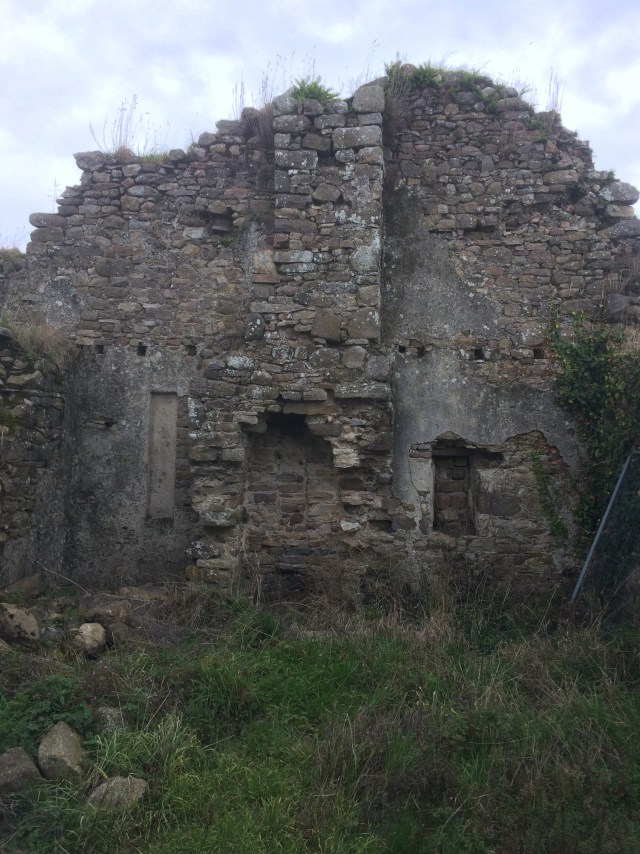
Kilcash Castle is a very fine tower-house attached to the remains of a lower and more recent building. There are bartizans at the NW and SE corners and a machicolation over the doorway which is in the west wall. There are four chimney stacks. At least one of these is a later insertion since it leads from a fireplace now on the outside of the tower and originally in the upper storey of the later house. This house had two storeys plus attic. It has large window openings which have rough wooden lintels.
The starting point of settlement at Kilcash begins in an obscure past: eight hundred metres east of Kilcash Castle is an embanked barrow, a burial site dating from before 400AD. The placename is no help as it came from a later time and the traditional translation of Cill Chaise as ‘the church of Caise’ has been rejected by the official Placenames Database. No St Caise associated with the area can confidently be identified.
The Manor of Kilcash
The first recorded Lord of Kilcash was the Anglo-Norman Baldwin Niger (‘Baldwin the Black’) in the late twelfth century. He gave the church at Kilcash and six hundred acres of land to the hospital of the Fratres Cruciferi (Crutched Friars) of the Priory of St John the Baptist in Dublin who were extensive landowners in Tipperary.
The Walls & Alice Kyteler
In the early 1300s the manor of Kilcash belonged to a branch of the de Valle (or Wall) family. Sir Richard de Valle of Kilcash served both as Sheriff of Waterford (1301-2) and Sheriff of Tipperary (1307-8). His heirs occupied similar administrative positions. However, the most famous member of the family was Sir Richard’s second wife, Alice Kyteler (c.1262-post 1324).
Lady Alice was from a Kilkenny merchant family and she maintained independent business interests – including lending money to the crown – throughout her wife. Widowed several times, some of her stepchildren resented her growing wealth and her favouring of a son by her first husband. At that time, a widow was entitled to the use of a third of her husband’s estate as long as she lived, so when Richard de Valle died, a third of Kilcash passed into her control. She sued her stepson to secure this right (throughout her career she showed that she was adept at employing the legal system and her family connections).
Under other circumstances it is likely that Lady Alice would merely have been inconvenienced by the complaints about her. Unfortunately for her, the newly appointed bishop of Ossory, Richard Ledrede (d.1361), had arrived from the papal court at Avignon where the Knights Templar had been supressed for heresy and sorcery. The bishop detected the same diabolic taint in Lady Alice’s affairs and she was tried for witchcraft. This gave rise to stories of her drinking from skulls and having sex with demons. Despite the vigorous intervention of important supporters, Lady Alice was evidently losing an immediate legal battle and facing the possibility of execution. She fled (most likely aborad) and her ultimate fate is unknown. One of the women associated with her, Petronilla de Midia, became the first person to be burnt for heresy in Ireland. W. B. Yeats wrote of the Kyteler case in his ‘Nineteen Hundred and Nineteen’:
There lurches past, his great eyes without thought
Under the shadow of stupid straw-pale locks,
That insolent fiend Robert Artisson
To whom the love-lorn Lady Kyteler brought
Bronzed peacock feathers, red combs of her cocks.
The Butlers
Walter de Valle transferred ownership of Kilcash to the Butlers in the 1540s (although members of Walter’s family continued to live in the area). The manor passed to Sir John Butler (d.1570), a younger son of James Butler, the 9th Earl of Ormond. The castle’s estate remained in the possession of the Butlers until it was divided up in late nineteenth-century land settlements. The castle itself was sold to the Irish State in 1997. In the meantime, the vicissitudes of inheritance moved Kilcash at various times from being the residence of cadet branches of the Butlers to being the homes of the earls of Ormond (later also spelt ‘Ormonde’).
James, the 9th Earl, was succeeded by his son, ‘Black Tom’ (1531-1614), the builder of the Tudor house at Ormond Castle in Carrick-on-Suir. When the tenth earl died he had no living legitimate sons and only one daughter, Elizabeth, so the earldom passed to his nephew, Sir Walter Butler of Kilcash (c.1559-1633). Walter was a staunch Roman Catholic which was politically inconvenient for a Protestant government. Furthermore, King James I supported the claim of Black Tom’s daughter and her second husband, Richard Preston, to a large part of the Ormond estate. The end result was that Walter, who refused to surrender any part of his inheritance, was imprisoned in London between 1619 and 1625.
Walter married Lady Ellen Butler (d.1632) the eldest daughter of Edmond Butler, 2nd Viscount Mountgarret. Earl Walter’s daughters were married to members of important local families: Sir Edmund Blanchville; Richard, Earl of Clanricard; George Bagenal MP; Theobald Purcell, Baron of Loughmo[r]e; Viscount Ikerrin; Piers Power (son of the 4th Baron of Coroghmore); Barnaby Fitzpatrick, Baron of Upper Ossory; Sir George Hamilton of Roscrea; James Butler of Grallagh (a son of Lord Dunboyne); and Sir Turlough O’Brien-Arra. Walter’s only son to survive into adulthood was Thomas, Viscount Thurles, who was killed in a shipwreck in 1619 while travelling to England to answer charges of garrisoning Kilkenny Castle against the government. Viscount Thurles’s eldest son, James (1610-88), became the first Duke of Ormond and a younger son, Richard (c.1616-1701), was given Kilcash.
Richard Butler lived through the complicated and bloody sequence of events that dominated Ireland after the 1641 rebellion which began in Ulster. Richard joined the Catholic Confederation (the Confederation of Kilkenny) and thereby split from his brother, the duke of Ormond, who was the commander of the king’s forces in Ireland. The political situation was further complicated by the outbreak of the English Civil Wars which were followed by the arrival of a parliamentary army under Oliver Cromwell. The Butlers allied against Cromwell, but the victory of the latter drove them into exile on the Continent. Richard returned to Ireland with the restoration of the monarchy in 1660. Charles II made special provisions for him as a reward for his service to the crown and as a mark of favour to Ormond.
Richard Butler married Lady Frances Touchet (1617-88), a daughter of the infamous Mervyn, the 2nd Earl of Castlehaven, who had been executed for rape and sodomy in 1631 after one of the most sensational English trials of the century. Lady Frances’ brother, James, became the 3rd Earl of Castlehaven and fought alongside Butler during the Confederate Wars. Castlehaven wrote part of his memoirs in Kilcash and he died there in 1684. Richard and Frances Butler’s eldest son, Colonel Walter Butler (d.1700) was established at nearby Garryrickin in Co. Kilkenny. He married Lady Mary Plunket, a daughter of the 2nd Earl of Fingall. Walter Butler of Garryrickin’s eldest son, Thomas, inherited Kilcash.
Colonel Thomas Butler
In his youth Thomas Butler (d.1738) served a soldier on the Continent fighting against the Ottomans and he was at the Siege of Buda (1686). Butler was an infantry colonel in the army of James II and fought in the War of the Two Kings (also called the Williamite War) against William III during which he led a regiment of more than four hundred soldiers. He was made prisoner after the defeat of the Stuart forces at the Battle of Aughrim (1691). He did comparatively well as many of his fellow officers (several of whom were related to him) died.
In 1698 Butler married Margaret Bourke, Lady Iveagh (see below) and had three sons and five daughters. His daughters married into families with which Kilcash maintained strong ties: the Kavanaghs of Borris, Co. Carlow; the Brownes (viscounts of Kenmare); the Mathews of Thurles; the Mandevilles of nearby Ballydine; the Esmondes of Clonegal, Co. Carlow; and the Butlers of Westcourt. Two sons died young: the eldest, Richard, was killed after a fall from his horse and Walter died of smallpox while studying in Paris.
Butler’s second son, John (d.1766), converted to the Established Church, and became the heir of his childless cousin, Charles Butler, Earl of Arran (1671-1758). In 1715, Arran’s brother, the 2nd Duke of Ormond, had been attainted for treason and fled from England. Arran had been allowed purchase the Ormond estate but he never used the Ormond title. John was able to inherit Arran’s property, but not the Arran title as he was not one of his descendants. John could have claimed the Ormond earldom if it had not been extinguished because of the 2nd Duke’s treason. He is therefore referred to as the de jure 15th Earl but in fact he remained plain Mr Butler (although a fairly wealthy and well-connected Mr Butler).
Once he came into his inheritance, Butler spent a good deal of time in London. In 1763 he married Bridget Stacey, but they were unhappy together and separated a few years later. In part, this was probably due to Butler’s recurring mental health problems. He left no legitimate children so the Ormond estate passed to his first cousin, Walter Butler of Garryrickin.
ady Iveagh & Her Family
Margaret Bourke (1673-1744) was a daughter of William, 7th Earl of Clanricard by his second wife, Lady Helen MacCarthy, the daughter of Donough, 1st Earl of Clancarty and Lady Ellen Butler (a sister of Richard of Kilcash). Aged sixteen, she married Bryan Magennis, 5th Viscount Iveagh (from Co. Down) who was a colonel in the Jacobite army. At the end of the War of the Two Kings, Iveagh opted to go into the military service with the Austrian empire (which was both Catholic and allied to William III) and he died in Hungary in about 1693. The Iveaghs had a daughter, but she died young. The circumstances in which Lady Margaret met Thomas Butler are unknown. As the latter had no title, the convention was that she kept the courtesy title of viscountess from her first marriage and thus she remained ‘Lady Iveagh’ amidst the Butlers. Commemorated in the song Cill Chaise, she was celebrated as a model of piety and charity. She was also a woman of practical accomplishments: she spent most of her married life enmeshed in court battles over her mother’s inheritance and she smuggled money out of the country to support Irish clerical projects in Paris.
Lady Iveagh’s sister, Honora, married Patrick Sarsfield in 1689 (when she was only fifteen). Sarsfield went on to be one of the most famous Jacobite commanders during the War of the Two Kings and was made Earl of Lucan by James II. After the Treaty of Limerick which ended the Williamite wars, the Sarsfields moved to France. In 1693, the Earl died of wounds incurred at the Battle of Landen, leaving behind his widow and an infant son. Honora remarried in 1695, to James Fitzjames, the Duke of Berwick and an illegitimate son of King James II. She died in 1698. Honora’s family maintained links with Kilcash.
Archbishop Christopher Butler
Christopher (1637-1757) was a younger brother of Colonel Thomas Butler. He studied at Gray’s Inn in London after which he decided to become a priest and was ordained for the diocese of Ossory. He went to Paris where he received his MA and then commenced his study of theology. He was awarded his doctorate in 1710 and the following year he was appointed Archbishop of Cashel (a diocese which was united with the diocese of Emly at his request). During his episcopate, Christopher spent a good deal of time at Kilcash. The penal laws were in force and the power of the Butlers there gave him some protection. His presence at the castle was noted by a priest hunter and orders – which turned out to be unsuccessful – were issued for his arrest. The archbishop was one of Ireland’s most influential prelates and he was involved with ecclesiastical affairs outside his diocese, including corresponding with James III, the Stuart king in exile. He was buried in the mausoleum in Kilcash churchyard.
When Walter Butler of Garryrickin (1703-83) inherited the Ormond Estate from his cousin, John Butler of Kilcash, he moved into Kilkenny Castle with his wife, Eleanor Morres (1711-93). Their son, John (1740-95; also called ‘Jack o’ the Castle’), married Anne Wandesford (1754-1830), the daughter and heir of the 1st Earl of Wandesford (Castlecomer, Co. Kilkenny). John converted to Protestantism and was politically astute. As a result, the Dublin House of Lords recognised the continuing existence of the Ormond title and he became the 17th Earl. He and his father were buried in the mausoleum at Kilcash.
The 17th Earl’s eldest son, Walter (1770-1820), spent much of his time in London where he was close to the Prince Regent. He was rewarded with the title of marquess of Ormond (a step up from being an earl). Despite marrying a Derbyshire heiress, Maria Catherine Price-Clarke (1789–1817), Walter had severe financial problems because he was unable to finance his extravagant lifestyle. In an effort to sustain his spending, the marquess sold timber from Kilcash in 1797 and 1801 as well as stripping the castle. This was the genesis of a ruin that would be complete by the mid-nineteenth century.
Kilcash Castle belonged to the Ormond Estate until it was sold to the Irish government in 1997. Since then, it has been under the care of the Office of Public Works (OPW). Ongoing conservation by the OPW has secured a building which was in danger of collapsing.
Demesne
In the eighteenth century Kilcash Castle was situated on luxurious grounds. Thomas Butler had a twenty-five hectare deerpark as well as the surrounding woodland which included two ponds linked by ornamental walkways. A nineteenth-century map shows a ‘cascade gate’, an additional water feature. Famously, the woods of Kilcash are gone, but the landscaping has not been obliterated: the two avenues which lead to it remain and south of the castle there is a plateau which was a lawn or a turning circle. Four walled gardens south-east of the castle occupy 0.65 hectares. These are lined with brick on their north and west walls (brick retained heat and allowed the cultivation of a variety of fruits).
The tower was built in the mid-sixteenth century and was originally a stand-alone building. It is five stories high and made of sandstone with some dressed limestone (e.g. at the corners). The external walls were covered in white plaster. The small windows on the north-east corner of the tower light its spiral staircase. The larger windows are later and date from a time when comfort took precedence over security. It is clear where these have been restored by the OPW with limestone surrounds.
The tower was entered by a doorway in the west wall. This was secured by a ‘yett’ (metal grille) and was further protected by a box machicolation at roof level above it. This defensive feature would have allowed the castle dwellers to drop things on attackers and became obviously redundant when the house was added. Next to the machicolation is a ‘drip stone’ that carried water away from the walls. The doorway was also protected by a murder hole built into the wall.
The most striking internal feature of the tower at the moment is a substantial metal frame which was inserted by the OPW to stabilise the structure. This was lowered in through the top of the tower, something that was possible because all of its roof and floors had been taken away in the nineteenth century.
It is easy to see where the original floors were. The quoins that support them are still there as are the doorways opening from the stairs and from small rooms built into the west wall (intramural chambers) which is more than 2m thick. Such spaces provided the building’s garderobes (toilets). The principal rooms would have been subdivided by wooden partitions. As a result, more than one fireplace can be found on some floors. These had decorative surrounds, some of which proved too tempting for recyclers.
The stairs open out in a small caphouse at their top. From here, you could walk around the pitched roof and enjoy an impressive view. The three large chimneys on the west wall may have been ostentatious as well as practical. The gables of the attic level have recently been conserved by the OPW.
House
Written records show that there was a house at Kilcash in the seventeenth century. This was either demolished or substantially remodelled to become the two-storey structure (plus attic) which is today attached to the tower. The three bays which remain are only 12.5m of a wall that was 46.5m long and which had ten bays (a bay corresponds to a window). This was once an enormous building whose scale is now not immediately appreciable unless you know that the adjoining hedge conceals the foundations of the old house.
The upstairs windows date from the early seventeenth century but were narrowed to follow the dictates of eighteenth-century fashion. Their surrounds are of cut limestone. The lower windows received new oak lintels during OPW restoration. The square holes running along the top of the walls were for brackets supporting the projecting eave of the roof.
Kilcash Castle’s portraits were moved to Kilkenny Castle in the late eighteenth century. An earlier inventory lists the items in the kitchen. Otherwise, nothing is known for certain about the interior division or furnishing of the house. It probably had a formal dining room, a drawing room, informal rooms, and an office (or study) on the ground floor with bedrooms for the residents and guests on the upper floor and in the attic. Kilcash certainly hosted family and hunting parties where visitors stayed for days or even weeks.
Outbuildings
An early nineteenth-century map shows that there were extensive outbuildings north of the castle. Some of these were joined to the house and tower so that an enclosed yard was created. All that survives of this is the east wing which is now made up of ruined cottages. The west wing of the yard is completely gone along with the farm, mill and kennels which are documented. The yard was enclosed on the north side by a three metre wall (called a ‘bawn’) which still guards the site.
About fifty metres east of the tower is the remains of a bakehouse with a brick-lined oven. The oven was heated by burning furze inside it. The ashes were swept out and then the baking could be done. West of the house (and most likely joined to it) stood a building which was likely to have been a chapel. Its wall is hidden in the hedge since it collapsed in a storm in 1998.
https://theirishaesthete.com/2017/10/09/a-lament-for-kilcash/
A Lament for Kilcash

Now what will we do for timber,
With the last of the woods laid low?
There’s no talk of Cill Chais or its household
And its bell will be struck no more.
That dwelling where lived the good lady
Most honoured and joyous of women
Earls made their way over wave there
And the sweet Mass once was said.


Ducks’ voices nor geese do I hear there,
Nor the eagle’s cry over the bay,
Nor even the bees at their labour
Bringing honey and wax to us all.
No birdsong there, sweet and delightful,
As we watch the sun go down,
Nor cuckoo on top of the branches
Settling the world to rest.


A mist on the boughs is descending
Neither daylight nor sun can clear.
A stain from the sky is descending
And the waters receding away.
No hazel nor holly nor berry
But boulders and bare stone heaps,
Not a branch in our neighbourly haggard,
and the game all scattered and gone.


Then a climax to all of our misery:
The prince of the Gael is abroad
Oversea with that maiden of mildness
Who found honour in France and Spain.
Her company now must lament her,
Who would give yellow money and white
She who’d never take land from the people
But was friend to the truly poor.

I call upon Mary and Jesus
To send her safe home again:
Dances we’ll have in long circles
And bone-fires and violin music;
That Cill Chais, the townland of our fathers,
Will rise handsome on high once more
And till doom – or the Deluge returns –
We’ll see it no more laid.

A Lament for Kilcash, translated from the Irish by Thomas Kinsella.
The remains of Kilcash Castle, County Tipperary.
 Irish Historic Houses