Tulira (or Tullira) Castle, Ardrahan, Co Galway
Mark Bence-Jones. A Guide to Irish Country Houses (originally published as Burke’s Guide to Country Houses volume 1 Ireland by Burke’s Peerage Ltd. 1978); Revised edition 1988 Constable and Company Ltd, London.
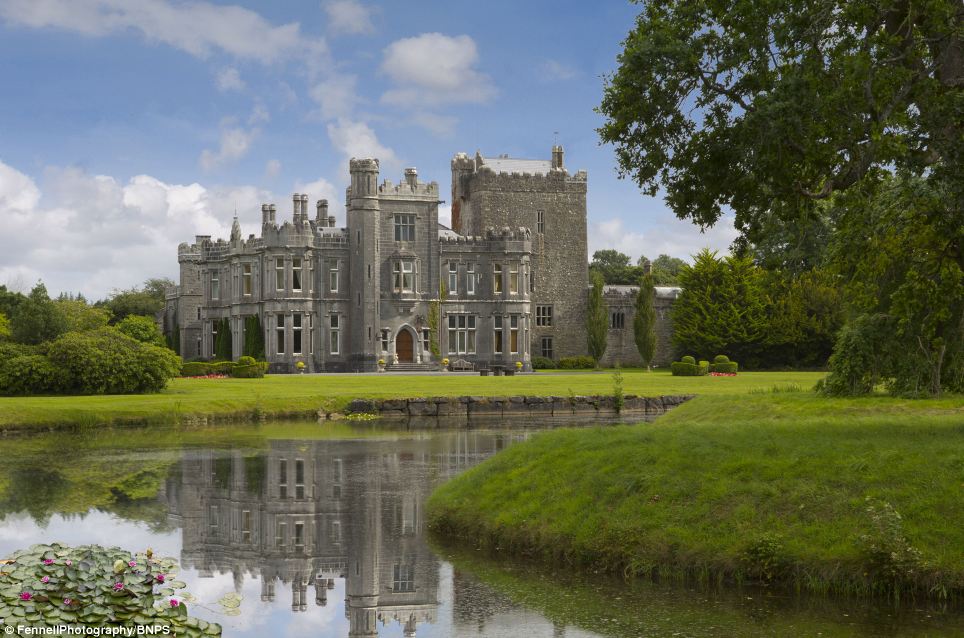
p. 276. “(Martyn/LGI1912; Martyn-Hemphill, Hemphill, B/PB) An old tower-house, onto which a castellated house by George Ashlin was built from 1882 onwards for Edward Martyn, a leading figure in the Irish literary and artistic revival, who started a studio for making Irish stained glass and founded the Palestrina choir at the Pro-cathedral, Dublin. The castellated house is of two storeys, with a porch-tower and turret in the centre of its entrance front, and with polygonal corner-turrets, the battlements of which are slightly higher than those of the main roof-parapet. Symmetrical garden front with oriel surmounted by gable and coat-of-arms in centre. Large and regularly disposed mullioned windows. Prominent gargoyle-spouts. Fine Gothic hall where Edward Martyn, whose bedroom and study were rooms of monastic simplicity in the old tower, would play polyphonic music on the organ after dinner. Staircase with stained glass and other decoration of 1891 by John Dibblee Crace. Passed after Edward Martyn’s death to his cousin, Mary, wife of 3rd Lord Hemphill.”

https://www.buildingsofireland.ie/buildings-search/building/30411409/tullira-castle-tullira-co-galway
Tullira Castle, TULLIRA, County Galway

Detached complex Tudor Revival two-storey country house, built 1882, with fifteenth-century tower house adjoining at south-west. Longer north-east elevation of house is seven bays having pedimented canted middle bay and octagonal turrets to corners, shorter entrance elevation at north-west having three-storey towered entrance bay flanked by five-stage tower to its north-east side and with octagonal turrets to corners. Two-storey outbuilding, part of stable yard, adjoins tower house at its south-west side and to south-east side of longer elevation of house is recessed lower five-bay two-storey block having porjecting and slightly higher three-bay two-storey block to its south-east side, latter having higher square-plan three-stage tower projecting from its north-east corner. Roof of main block not visible behind crenellated cut limestone parapets. Pitched slate roofs elsewhere, including tower house. Cut limestone eaves course with string course below parapets, and with sculpted gargoyles to corners of faces of turrets, and to front corner of entrance tower. Cut limestone chimneystacks, with octagonal-plan stacks, mainly double but some triple, to house and tower house. Some cast-iron rainwater goods, and cut limestone eaves courses. Belfry to rear of tower house. Ashlar limestone walls to house and coursed rubble walls to tower house and other blocks, with block-and-start quoins. Stepped cut-stone buttresses with slate capping to lower north-east block. Main block and lower north-east block have cut-stone plinth course, string courses to parapets and between floors. Machicolation to rear of tower house. Canted bay of north-east elevation of main block has stepped pediment with metal finial, gargoyles to base and armorial plaque having hood-moulding. Square-headed window openings throughout having chamfered surrounds to single, two and three-light windows, with cut-stone label-mouldings and some having stained glass. Windows flanking entrance doorway have decorative iron grilles. Tower house has single, double and triple-light windows, latter types having transoms and mullions and label-mouldings. Windows to its north-west elevation have ogee-headed lights, with decorative ironwork grilles. Slit windows also to tower house. Canted single-light oriel window to entrance bay with hipped roof and supported on corbelled courses, with moulded corbels below. Similar, two-light oriel window to first floor of rear, south-west facing, elevation of house supported on corbel courses partly atop stepped cut-stone buttress, latter flanked by single-light windows with metal bars. Windows to tower of lower north-east block lack label-mouldings. Four-light window to rear, south-east facing elevation of house has two transoms and is set within segmental-headed recess with hood-moulding. Pointed arch door opening to front elevation having chamfered block-and-start surround, cut-stone hood-moulding, and double-leaf timber battened door with elaborate strap hinges,a nd reached by flight of cut-stone steps with noses. Cast-iron bell having hand-pull. Pointed arch door opening to rear of tower house with chamfered tooled block-and-start surround and double-leaf timber battened door with decorative strap hinges and with carved stone armorial plaque above. Square-headed door to rear of lower south-east block having block-and-start surround and battened timber door.


Appraisal
Edward Martyn, nationalist and patron of the arts, commissioned the design for the house from the noted architect George Ashlin. It incorporates a fifteenth-century tower house, formerly a Burke castle, which Martyn remodeled with the help of William Scott. The design for the house was controversial and it is suggested that Martyn grew to dislike it, withdrawing into the tower house. It is an elaborate, elegant house with the Tudor inspired detailing of turrets and projecting bays, fashionable at the time, which complement the architecture of the tower house. The extensive outbuildings give an indication of the scale of operation required for the running of a large estate. The house is set in landscaped grounds.


https://www.buildingsofireland.ie/buildings-search/building/30411414/tullira-castle-tullira-co-galway

Entrance gates, erected c.1815, providing access to Tullira Castle demesne. Comprises pair of tapered square-plan cut limestone piers with chamfered corners, moulded limestone plinths, panelled friezes and pyramidal caps, flanking ornate double-leaf cast-iron vehicular gate. Similar pedestrian gates to each side having similar but lower piers with panelled front faces and simple plinths. Curved cut-stone walls with plinth and coping, terminating in piers matching those to outer sides of pedestrian entrances. Detached three-bay single-storey former gate-lodge to interior, recently refurbished. Pitched slate roof with rendered chimneystack, coursed rubble limestone walls with squared block-and-start quoins, square-headed doorway with block-and-start surround and timber panelled door, and square-headed window openings having tooled sills and surrounds, and replacement timber windows.
Appraisal
This gate lodge and gateway form part of a group with Tullira Castle. The gateway is an accomplished piece of work exemplifying the skills of stone masons and ironworkers, the gates being ornate and the piers being sturdy and giving an air of permanence. Makers imprint on gate ‘…Hammersmith Works – Dublin’. Although the lodge is simple in form, it is well executed with good stone detailing. The assemblage clearly marks the entrance to an important property and makes a strong visual impact on the road.

https://www.buildingsofireland.ie/buildings-search/building/30411415/tullira-castle-tullira-co-galway
Entrance gateway, erected c.1880, providing access to Tullira Castle demesne. Comprising pair of square-plan cut limestone piers with plinths, moulded cornices and rounded caps flanking double-leaf cast-iron gate, flanked by similar railings on cut-stone plinths, and flanked in turn by pairs of similar piers flanking similar pedestrian gates. Floral motif to outer face of caps. Lined-and-ruled rendered quadrant walls to gateway, having cut-stone cornice and plinth, terminating in matching square-profile cut limestone piers.
Appraisal
This elaborate gateway appears to have been a later addition to Tullira Castle Demesne, appearing only on the third edition of the Ordnance Survey map. The uniformity and stature of its square-plan piers contrasts well with the decorative nature of the cast-iron gates and railings. Both the masonry and ironwork have been well executed, and the gateway as a whole makes a strong impression on the roadscape.


https://www.buildingsofireland.ie/buildings-search/building/30411422/tullira-castle-tullira-co-galway
Enclosed two-storey stableyard to rear of Tullira Castle, dated 1843, comprising six-bay north-east block attached to and forming second pile to rear of south-east block of house, three-bay north-west block to south-west side of tower house and whose external wall is probably medieval bawn wall or perhaps part of medieval hall, thirteen-bay block forming south-west side of yard, and entrance gateway between south-west block and south-east gable of north-east block. Pitched slate roofs with cut limestone chimneystacks, cast-iron rainwater goods, and having cut-stone copings to south-east gables of south-west and north-east blocks and somewhat mimicking open-bed pediments. Double and quadruple octagonal cut-stone chimneystacks to north-west block, triple octagonal-plan to north-east block, and rectangular-plan stacks to north-east and south-west blocks. Cut limestone walls. North-east block has square-headed window openings with raised cut-stone surrounds, cut-stone sills and timber sliding sash windows, three-over-six pane to first floor and six-over-six pane to ground floor, with triple keystones to latter, and with dressed voussoirs above all windows. Recent gabled glazed timber porch with slated roof and with dressed limestone plinth walls, with glazed timber door. North-west block has segmental carriage arches and square-headed doorway with block-and-start cut-stone surrounds, having triple-keystone to doorway, recent timber doors, and square-headed windows to first floor with raised limestone surrounds and cut-stone sills with three-over-six and six-over-six pane timber sliding sash windows. South-west and south-east blocks have central segmental vehicular throughways flanked by openings grouped in threes comprising square-headed doorways flanked by windows, with single window above each doorway. Archway has raised block-and-start cut-stone surround and double-leaf iron gate. All other openings have raised cut-stone surrounds, with block-and-start and triple keystones to ground floor openings, timber louvers to first floor windows of south-west block, three-over-six pane timber sliding sash windows to first floor of south-east block and six-over-six pane timber sliding sash windows to ground floor of both blocks, with timber battened doors and one glazed timber door. Outer elevation of north-west block has inserted nineteenth-century triple-light windows with cut-stone surrounds and round and triangular heads. Outer elevation of south-east block has limestone plaque over vehicular throughway reading ‘Erected by John Martyn Esq. AD 1843’. Symmetrically arranged single-storey blocks to north and south sides of yard to rear of north-east half of south-east block, with arcaded front elevations, square-plan piers with imposts, ashlar voussoirs with ashlar walling above, coursed dressed limestone walls elsewhere, and hipped slate roofs. North-east arcade has windows and door and other is open. Lower single-storey blocks at right angles to each arcaded block, having coursed rubble walls and with raised tooled stone surrounds to doorways. Yard to south-west has two-storey middle block with three-bay first floor and four-bay ground floor, with pitched slate roof, rubble walls and raised cut-stone surrounds with dressed voussoirs to relieving arches, and replacement fittings to openings. Two-storey block flanked by single-storey blocks with similar details.
Appraisal
The outbuildings to Tullira Castle were built to be worthy of the main house, their construction proudly marked by the dated plaque over a vehicular throughway. They display good stoneworking and detailing, exemplified by the raised surrounds to doorways and window openings. The octagonal chimneystacks visible on the house are repeated on the outbuildings. Classical design is evident in the arcaded blocks and in the symmetry of the south-west and south-east ranges, with their symmetrically placed openings. Gravel surface to yards, with fountain to main courtyard.


[note, from David Hicks, Irish Country Houses, Portraits and Painters. David Hicks. The Collins Press, Cork, 2014.
p. 23: George Coppinger Ashlin, an architect born at Carrigrenane House in Cork in 1837; in 1856 he became a pupil of Edward Welby Pugin with whom he eventually went into partnership. Ashlin was given responsibility of establishing a Dublin branch of the partnership and to look after the Irish commissions. His portfolio of work was dominated by a large number of churches, convents and schools and he was also responsibly for the extension to Tulira Castle for Edward Martyn’s mother in Galway in the 1880s.
https://archiseek.com/2015/1882-tulira-castle-co-galway
1882 – Tulira Castle, Co, Galway
Architect: G.C. Ashlin

The Castle comprises three main buildings, a medieval tower, courtyard buildings and the Victorian Castle. The original structure, a medieval tower house, rests on 12th century foundations. A castellated house was added to the tower in 1882 by Edward Martyn, a leading figure in the Irish Literary and Artistic revival.
Martyn commissioned George C. Ashlin as his architect. Ashlin, a renowned ecclesiastical architect, had only completed two smaller houses prior to designing Tulira. His ecclesiastical gothic leanings are very obvious in the use of materials and decoration.
The monumental Great Hall with its 40ft high timber ceiling is the centrepiece of the castle. There are several fine Irish marble columns, varying in style from Irish Black to Connemara Green. The capitals which crown the columns are of carved stone upon one of which an unknown craftsman carved his own likeness. There is also a fine staircase hall.
Featured in Irish Country Houses, Portraits and Painters. David Hicks. The Collins Press, Cork, 2014.
p. 193. Edward Martyn was a wealthy individual and patron of the arts who supported many of the ideas and schemes of both Lady Gregory and W.B. Yeats. In fact, there is hardly any area of the Irish Revivial in the 19th century that Edward did not fund from his personal wealth.
Edward Martyn was also involved with a stained glass cooperative called An Tur Gloinne with the artist Sarah Purser. Today Tulira endures and thrives; its restoration by its current owners is impressive.
The castle at Tulira is made up of three distinct sections: a 15th century tower house built on the foundations of a 12th century castle, an 18th century courtyard and a Victorian neo-Gothic Castle. …The Martyn family became owners of the De Burgo’s 15th century castle in Tulira around 1598.
p. 204 The castle was eventually purchased by Keiran Breeden, the widow of John Breeden, heir to a San Francisco real estate fortune who had died in 1977. She bred horses in America and purchased a number of the best ponies that were previously sold from the farm. She hoped to run a pony nursery in association with Lady Hemphill, the former owner, who had established the Connemara Stud Farm…She spared no expense in restoring Tulira and maintained the Connemara Stud Farm established by the Hemphills…In 1986 Dame Keiran Breeden died from cancer in Santa Monica and Tulira Castle was back on the market. By October of that year the castle had been purchased for £1 million by another American, Michael McGinn, a businessman from Washington DC… he already owned Mallow Castle…In May 1990 the castle was back on the market again, this time for £1.25 million. An American couple, the Darians, swapped their luxury yacht for the castle… In 1993 Tulira was back on the market as the Darians found the building too large for their needs.
Eventually in 1995 the current Dutch owners, Ruud and Femmy Bolmeijer took over Tulira as they were looking for a retirement project. They paid about £2 million for the down-at-heel castle and instigated an intensive restoration programme, the fruits of which can be seen today. With extensive research and local craftspeople they turned around the years of decline that had blighted the castle. Their architectural investigations resulted in the large ecclesiastical style window over the staircase having the stained glass installed that was originally designed for it. They have also tried to locate and purchase items of furniture that would have been original to Tuliar. The outbuildings and grounds have been restored, some from the point of near dereliction.
http://landedestates.nuigalway.ie/LandedEstates/jsp/property-list.jsp?letter=T
Lewis records Tillyra as the seat of J. Martyn. Tullira was originally a tower house which was modified at various times. The OS Name Books record it as a tower house with a modern house attached. The gardens included a hot house. In 1906 it was the property of Edward Martyn when the buildings were valued at £100. It is still extant and was the home of Lord and Lady Hemphill in the 20th century. It has had a number of owners since then and in 2013 was offered for sale.
https://theirishaesthete.com/2014/06/18/very-stately/
A view of Tulira Castle, County Galway. The tower house to the right dates from the 15th century although resting on earlier foundations. Around 1880 the estate’s then-owner Edward Martyn commissioned the new castellated residence to the immediate left from architect George Ashlin who hitherto had been primarily known for his ecclesiastical architecture (he worked on no less than eight of Ireland’s new Roman Catholic cathedrals as well as designing countless churches). Indeed the High Gothic interiors would not look out of place in a religious establishment: Martyn was an ardently pious man who directed his body be buried in an unmarked pauper’s grave. Now on the market, Tulira has been extensively and sensitively restored in recent years. It will be among the properties discussed in a talk on The State of the Irish Country House Today that I am giving next Sunday afternoon, June 22nd at the National Gallery of Ireland. For more information, see: http://www.nationalgallery.ie/whatson/Talks/Sunday_Talks/June-22.aspx
https://theirishaesthete.com/2014/10/13/the-ascetic-aesthete/

It was the misfortune of Edward Martyn that his appearance and character so frequently encouraged ridicule. A large, lumbering man with a passion for beauty in all its manifestations, he devoted the greater part of his life and income attempting to convert others in Ireland to his aesthetic beliefs, with only limited success. In his former friend George Moore’s entertaining, irreverent but not always credible memoir Hail and Farewell, Martyn is described as being ‘not very sure-footed on new ground, and being a heavy man, his stumblings are loud. Moreover, he is obsessed by a certain part of his person which he speaks of as his soul; it demands Mass in the morning, Vespers in the afternoon, and compels him to believe in the efficacy of Sacraments and the Pope’s indulgences…’ W.B. Yeats, another friend-turned-opponent with whom Martyn and Lady Gregory had helped to found Ireland’s National Theatre, was still less charitable, not least on the subject of his old comrade’s religiosity which the poet thought ill-became a member of the ruling gentry. Yeats proposed, ‘The whole system of Irish Catholicism pulls down the able and well-born if it pulls up the peasant, as I think it does.’ From this, he wrote snobbishly of Martyn, ‘I used to think that the two traditions met and destroyed each other in his blood, creating the sterility of the mule…His father’s family was old and honoured; his mother but one generation from the peasant.’ On another occasion Yeats called Martyn, ‘An unhappy, childless, unfinished man, typical of an Ireland that is passing away’. Both Moore and Yeats were baffled by the seeming contradictions in Martyn’s persona, not least his revelling in discomfort. Moore has left an account of Martyn’s accommodation in Dublin, a modest flat above a tobacconist shop on Leinster Street: ‘Two short flights of stairs, and we are in his room. It never changes – the same litter, from day to day, from year to year, the same old and broken mahogany furniture, the same musty wall-paper, dusty manuscripts lying about in heaps, and many dusty books … old prints that he tacks on the wall … a torn, dusty, ragged screen … between the folds of the screen … a small harmonium of about three octaves, and on it a score of Palestrina … on the table is a candlestick made out of white tin, designed probably by Edward himself, for it holds four candles…Is there another man in this world whose income is two thousand a year, and who sleeps in a bare bedroom, without dressing room, or bathroom, or servant in the house to brush his clothes and who has to go to the baker’s for his breakfast?’ Yet Martyn was wont to abandon himself to the same self-imposed hardship even when staying in his country house, Tulira Castle, County Galway.


To understand Tulira and how it now looks, one needs to know something of the history of the Martyn family. Supposedly descended from a Norman supporter of Richard de Clare, otherwise known as Strongbow, they liked to claim one of their number, Oliver Martyn, had accompanied Richard I on the Third Crusade. In return for this support, the king presented him with armorial bearings. More significantly, the Martyns settled in Galway and became one of the city’s mercantile ‘tribes.’ Like so many of the others of their ilk, during the upheavals of the 16th century they moved into the countryside and acquired large amounts of land, not least that around an old de Burgo castle which was in their possession by 1598. Somehow they survived the turbulence of the following century and were confirmed in the possession of their estates in 1710 when they were specifically exempted by Queen Anne in an Act of Parliament passed ‘to prevent the growth of Popery.’ This was thanks to another Oliver Martyn who, it was noted, during the recent Williamite wars, ‘behaved himself with great moderation, and was remarkably kind to Protestants in distress, many of whom he supported in his family and by his charity and goodness, saved their lives.’ As a result the Martyns of Tulira were confirmed in ‘their very extensive estates and in all their rights as citizens, proprietors, and Catholics.’ At some time in the 18th century, another generation of Martyns built a new house beside the old de Burgo tower. Nothing of this Georgian structure, seemingly three-storeys over basement, has survived, although the stable yard immediately behind the castle dates from that period. In the 1870s when Edward Martyn was still a minor the old house was demolished and replaced with a new residence. The impetus for this transformation seems to have come from his formidable mother. Mrs Martyn was born Annie Josephine Smyth of Masonbrook, County Galway. When she married John Martyn in 1857, her self-made father presented his son-in-law with Annie Josephine’s weight in gold: the sum was supposed to amount to £20,000. After only three years of marriage, John Martyn died, leaving his heir Edward aged just 14 months to be raised by the widowed Annie. The following decade, she embarked on Tulira’s transformation, the eventual cost of which is said to have been £20,000, the same amount as was handed over by her father at the time of her marriage.


Given that Edward Martyn was only in his teens when Tulira was rebuilt, it seems likely his mother was responsible for choosing the architect. Since she was an ardent Roman Catholic, it is not altogether surprising the commission should have gone to George Ashlin, who otherwise worked primarily for clerical clients. Ashlin was born in County Cork in 1837 and in his late teens was articled in England to E W Pugin, son of Augustus Welby Pugin (whose daughter Ashlin married in 1860). When, in 1859, the younger Pugin received the commission for the church of SS Peter and Paul, Cork, he made Ashlin a partner with responsibility for their Irish work, which included St Colman’s Cathedral in Cobh. Ashlin remained in partnership with Pugin until about 1870 after which he set up his own highly successful practice. Tulira was his only major secular commission and regrettably no documents relating to the castle’s design or construction have survived.
In any case, for Mrs Martyn and her son, Ashlin designed a densely-castellated two-storey house directly linked to the old castle. In the centre of the asymmetric facade is a projecting three storey tower containing an arched Gothic door case and an oriel window immediately above; on the corbels of the latter are carved Edward Martyn’s initials and the date 1882 indicating this was when work concluded. On either side of the tower are polygonal corner turrets which once more are raised slightly higher than the roof parapet. The garden front shows a similar differentiation in surface rhythm thanks to the presence of further projecting towers. The house has always inspired mixed feelings. Moore, in his usual imaginative way, claimed he attempted to dissuade Martyn from undertaking the project: ‘walking on the lawn, I remember trying to persuade him that the eighteenth-century house which one of his ancestors had built alongside of the old castle, on the decline of brigandage, would be sufficient for his want.’ However, since Mrs Martyn was the driving force behind the enterprise, this recollection seems defective. However in 1896 Yeats and the English critic Arthur Symons stayed in Tulira after which Symons wrote inThe Savoy that here he discovered ‘a castle of dreams’, where ‘in the morning, I climb the winding staircase in the tower, creep through the secret passage, and find myself in a vast deserted room above the chapel which is my retiring room for meditation; or following the winding staircase, come out of the battlements, where I can look widely across Galway, to the hills.’ Yeats was also enchanted, although his preference was for ‘the many rookeries, the square old tower, and the great yard where medieval soldiers had exercised.’ Much later, his verdict was more harsh, dismissing Ashlin’s design as being nothing better than ‘a pretentious modern Gothic once dear to Irish Catholic families.’


It is generally accepted that Mrs Martyn’s reason for rebuilding Tulira was to provide a comfortable home for future generations of the ancient family into which she had married. George Moore, most likely apochryally, claimed Annie Martyn had proclaimed, ‘Edward must build a large and substantial house of family importance, and when this house was finished he could not do otherwise than marry.’ Unfortunately she had not reckoned on her son’s lifelong dedication to celibacy and reluctance to linger in the company of women. When he endowed the foundation of the Palestrina Choir in the Pro-Cathedral, Dublin in 1904, for example, he stipulated ‘the said choir shall consist of men and boys only’ and that ‘on no occasion shall females be employed.’
Mrs Martyn also under-estimated her son’s partiality for asceticism: although Tulira was splendidly finished, Martyn preferred to live in the old tower. Here a stone staircase ascending the full height of the building leads to the first floor which served as his private library and still retains its oak floor and oak-panelled walls, as well as stained glass windows designed by Edward Frampton in 1882 and featuring literary figures such as Chaucer, Shakespeare and Dante. A door at the far end of the library provides access to a simple room where Martyn slept, according to Moore ‘with the bed as narrow as a monk’s and the walls whitewashed like a cell and nothing upon them but a crucifix.’ Above this is his private chapel, its fittings, including the benches and altar, apparently designed by Irish architect William A Scott, although the chimneypiece has the dates 1613 and 1681 carved into the limestone. An even more impressive chimneypiece is found on the third floor where the ceiling rises to the roof, allowing for the inclusion of a small minstrels’ gallery at one gable end.
Meanwhile inside the Ashlin-designed house, after passing through a modest entrance one reaches the great hall measuring some 31 by 32 feet and rising 42 feet, the full height of Ashlin’s castle. Here Edward Martyn would play the polyphonic music of Palestrina and Vittoria on a long-since lost organ. On a richly-tiled floor repeatedly decorated with the Martyn motto of Sic hur Ad Astra (‘Thus One Climbs to the Stars’) rest the bases of black marble columns, their capitals elaborately carved with figures. From here a massive staircase with quatrefoil balustrading leads to the galleried first floor where a sequence of arches is supported by further marble columns. Much of this room’s decoration is attributed to John Dibblee Crace, the English designer and decorator whose father had worked with Pugin on the Houses of Parliament in London. Crace produced designs for the hall’s main window but these were never executed, as it seems Martyn lost interest in completing the scheme for the castle’s interior decoration. However, on the ground floor a series of reception rooms, intended to impress those prospective brides who were never invited, have compartmented timber ceilings with the recessed panels painted in a delicate design, also by Crace. The drawing and dining rooms retain their polychromatic marble chimneypieces as well as stained glass bearing the crests of Galway’s tribes. The embossed red and bronze wallpaper in the dining room was hung when the castle was first built, with certain sections restored more recently by David Skinner who also made paper for a number of other rooms in the house.


Despite all that he had done, and all that he had tried to do in the fields of art, music and literature, Edward Martyn’s final years were grim, not least due to creeping ill-health. In her journal for September 1921, Lady Gregory his neighbour and former collaborator, noted, ‘He is anxious about money, has fears of his investment in the English railways, and is very crippled by rheumatism.’ Two years later she visited him at Tulira for the last time and afterwards wrote, ‘In the bow window of the library I saw Edward sitting. I thought he would turn and look round at the noise, but he stayed quite quite immovable, like a stuffed figure, it was quite uncanny…I went in, but he did not turn his head, gazed before him. I touched his hands (one could not shake them, all crippled, Dolan [the butler] says he has to be fed) and spoke to him. He slowly turned his eyes but without recognition. I went on talking without response till I asked him if he had any pain and he whispered: “No, thank God”. I didn’t know if he knew me, but talked a little, and presently, he whispered: “How is Robert?” I said: “He is well, as all are in God’s hands, he has gone before me and before you.” Then I said: “My little grandson, Richard, is well”, and he said with difficulty and in a whisper: “I am very glad of that.” Then I came away, there was no use staying…’
Three months later Edward Martyn was dead at the age of sixty-four, leaving instructions that his body be donated to medical science and the remains afterwards buried in a pauper’s grave. Along with his papers, he left the contents of his personal library to the Carmelites of Clarendon Street, Dublin and they are there still. His collection of paintings, mostly by Irish artists but including a Monet landscape and two works by Degas bought while holidaying in Paris with George Moore in April 1885, Martyn bequeathed to the National Gallery of Ireland. The rest of the castle’s contents, it can be conjectured, were still in Tulira after it was left to a cousin Mary, Lady Hemphill. In 1982 the fifth Lord Hemphill sold Tulira and its surrounding land, and at that time Sotheby’s conducted a house contents auction on the premises when many of the 430 lots once owned by Martyn were dispersed. Between 1982 and 1996, Tulira changed hands no less than five times, on one occasion being exchanged for a yacht, before being sold to its present owners. Since taking possession of Tulira, they have tried to acquire any items of furniture that formerly belonged to the house and have come onto the market, such as a Victorian oak centre table (from a house sale in Oxfordshire) and a set of four oak Gothic chairs of the same period all of which have been returned to the castle’s library. Under their guardianship one feels the spirit of Edward Martyn has returned to Tulira.

https://theirishaesthete.com/2015/01/14/a-pair-of-literary-giants/
One of the stained glass windows in the 16th century tower house at Tulira Castle, CountyGalway. This is in Edward Martyn’s former private library, redecorated by George Ashlin when he made over the whole property in the 1880s. The windows, featuring luminaries such as Chaucer and Shakespeare shown here, were designed by English artist Edward Frampton in 1882. The irony, of course, is that within decades of the windows’ installation many key figures in Ireland’s literary revival – not least another pair of giants, Martyn’s neighbour Lady Gregory and W.B. Yeats – would gather at Tulira. Their presence there went unrecorded, at least in glass.
For more on Tulira Castle, see The Ascetic Aesthete, October 13th 2014.
https://theirishaesthete.com/2015/12/30/in-new-hands/
The 15th century de Burgo tower house which forms the core of Tulira Castle, County Galway. This was one of a number of country houses acquired by new owners during the course of 2015, significant others including Bellamont Forest, County Cavan and Capard, County Laois. But many others remain on the market, such as Milltown Park, County Offaly, Newhall, County Clare, Kilcooley, County Tipperary and Furness, County Kildare, all of which have been discussed here on earlier occasions. Let us hope the coming year is kind to them and all of Ireland’s architectural heritage.
https://www.dailymail.co.uk/news/article-2451911/King-castle-16th-century-stately-home-sale-5-5m.html
By JAMES RUSH 10 October 2013
An historic Irish castle resting in 250 acres of rolling countryside has gone on the market for £5.5million.
The medieval Tulira Castle features a 16th Century tower and a Victorian main house, built by Edward Martyn, the first president of Sinn Fein.
The stone castle, in the village of Ardrahan in County Galway, Ireland, has seven bedrooms, four reception rooms and seven bathrooms. The site also features three separate outbuildings for staff quarters.
Two of the outbuildings have a further three bedrooms and three bathrooms between them.
There are also staff quarters which boast four more bedrooms and two bathrooms, and stables with enough room for 16 horses.
The original tower from the 1500s has been restored and has a chapel, banqueting hall and wine cellar.
Mr Martyn, an Irish politician who once called for all Irishmen who joined the English army to be flogged, commissioned the main house to be built in the 1880s.
The property is surrounded by two acres of landscaped gardens, an ornamental lake and an orchard with a ruined original greenhouse.
The walled garden features a large stone fountain, greenhouse, pergola, and herb and vegetable gardens.
It is currently owned by Dutch couple Ruud and Femmy Bolmeijer who have decided to put it on the market as they are looking to downsize.
Robert Ganly, from estate agents Ganly Walters in Dublin, said: ‘We don’t have grade listings in Ireland but this is a fully protected property. ‘The tower dates back to the 16th century but rests on 12th century foundations from an earlier building.
‘This is the best property to come on the market in Ireland in 20 years.
‘I believe it will be purchased by an overseas buyer who might have Irish roots.
‘We have had interest from Asia and America but it could also be bought by someone who is European.’
 Irish Historic Houses


