contact: Maura & Patrick McCormack Tel: 083-1486736
Open dates in 2026: Feb 23-27, Mar 9-13, 22-27, April 13-17, May 5-8, 11-15, 18-22, 27-29, Aug 7-10, 15-23, Sept 11-20, 9am-1pm
Fee: adult €5, OAP/student €2, child free, fees donated to charity

2026 Diary of Irish Historic Houses (section 482 properties)
To purchase an A5 size 2026 Diary of Historic Houses (opening times and days are not listed so the calendar is for use for recording appointments and not as a reference for opening times) send your postal address to jennifer.baggot@gmail.com along with €20 via this payment button. The calendar of 84 pages includes space for writing your appointments as well as photographs of the historic houses. The price includes postage within Ireland. Postage to U.S. is a further €10 for the A5 size calendar, so I would appreciate a donation toward the postage – you can click on the donation link.
€20.00

donation
Help me to pay the entrance fee to one of the houses on this website. This site is created purely out of love for the subject and I receive no payment so any donation is appreciated!
€15.00
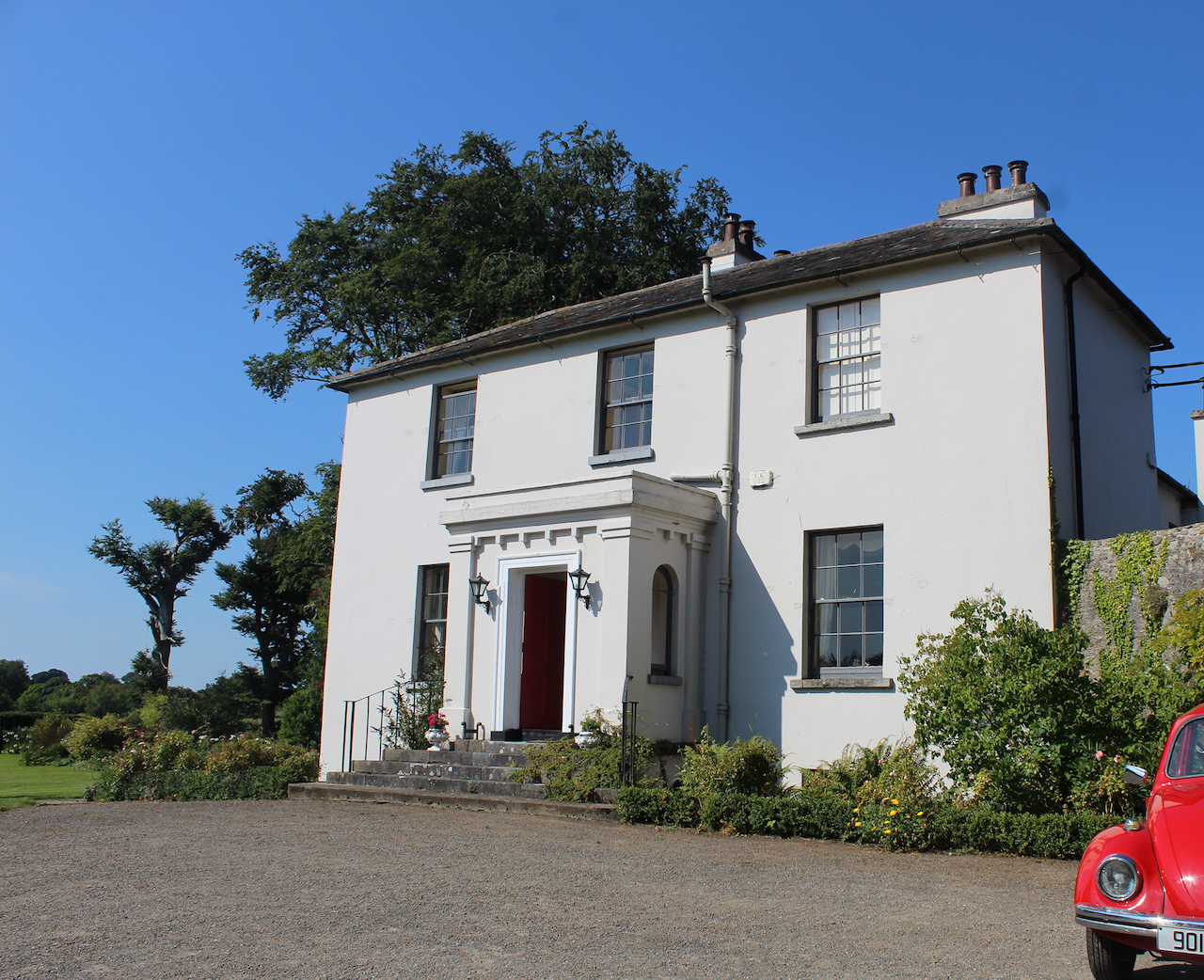
We had a lovely visit to Beechwood House in County Tipperary during Heritage Week in 2022. It is an old rectory for the parish of Cullen, but that church is now gone and has moved to Monard. Beechwood is perhaps not the typical rectory built by the Board of First Fruits as it may be built on to an older residence. Architectural historian Judith Hill visited and observed a few details that may indicate that there have been changes from an earlier construction.
The Board of First Fruits was established in 1711 by Queen Anne, in order to improve churches and glebe houses (i.e. rectories, the “glebe” is the area of land in a parish used to support the parish priest) in Ireland. The Board was financed by taxes collected on clerical incomes, which in turn were financed by tithes. Everyone had to pay tithes to the Church of Ireland, even if one was Catholic, since the Church of Ireland was the state religion at the time. This led to a Tithe War in Ireland between 1830-1836. Jonathan Swift was also involved in creating the Board of First Fruits. The Church Temporalities Act 1883 put an end to the Board of First Fruits, and the Board of Ecclesiastical Commissioners took over.
The Board of First Fruits hired architects to carry out their work. From 1814 or earlier until his death in 1822 John Bowden was architect, so he may have designed Beechwood. In 1823 the post was divided into four, with one architect for each ecclesiastical province: Armagh: William Farrell (we came across his work at Corravahan in County Cavan); Dublin: John Semple 1823-24 then then John Semple & Son 1825-1832 then Frederick Darley, 1833; Cashel: James Pain; Tuam: Joseph Welland. [1]
Beechwood, named after a grove of beech trees on the property which still stand, was built in 1819 but parts of the buildings date from the mid eighteenth century.
Maura and Patrick gave us a useful information leaflet, which informs this entry. As is typical for glebes, the layout of the house, offices and outbuildings and land was designed as a miniature version of a large estate. Beechwood continues to uphold this character, with the house and outbuildings forming a group at the centre of the grounds. The demesne was composed of three fields, and the entrance of the house faces east across a paddock facing onto a view of two lime trees.
The front porch is a later addition. It is decorated with pilasters and an enlarged dentil cornice, with cast iron bootscrapers at the entrance. The front porch leads to an arch with side pilasters containing an inner door. The house contains original joinery doorcases, doors and windows.
The house has a lovely curved timber baluster staircase, and some egg and dart architraving which is original to the house. An arched window lights the staircase, which is usual in this type of house, but the surround is more decorative than is usual for such a window, with the triglyph vertical channels typical of a Doric frieze, a carved cornice and fluted pillar.
The drawing room and dining room open into each other and the drawing room has a lovely large bay window, which was probably added later (as was the one on the lower storey). The windows have shutters, and the south facing rooms on the ground and lower floor have tripartite sash Wyatt windows. The mullions of the Wyatt window in the dining room have decorative reeding.
It is thought that a previous house existed before the current incarnation. The unusually thick internal wall and the archways encasing this part of the house as well as details of the roof lead to this conclusion. This house existed on the south grounds of the current house, encompassing the current lower ground floor kitchen/living room, the drawing and dining rooms and the two south bedrooms.
The dining room has another arched doorway at one end, which used to be a window. This original house, of which there are no records, would then have been remodelled and extended to create the glebe house.
The last person who lived in the house associated with the parish of Cullen was Edmund (or Edward, or Eamonn) Mansfield (1878–1954), who taught in and was headmaster of Cullen National School. He was an activist and at times President of the teachers union Irish Teachers and National Organisation (INTO) and in 1912 was dismissed for his views when a system of pay, curriculum and inspection were set up in Ireland. His dismissal was seen by many, including the Canon, the school manager, to be unfair and harsh. Reconsideration for his reinstatement went all the way to the top, for consideration by Chief Secretary of Ireland Augustine Birrell. He was eventually reinstated. [2] His wife also taught at the school and when he was dismissed he continued to teach without pay until he was reinstated.
Later, Mansfield was involved in the Irish Land Commission and in the 1st Irish Senate in 1922, from which he resigned when anti-Treaty prisoners were executed as a reprisal for the killing of two TDs. As commissioner, he was an influential advocate of land division, and the rights of evicted tenants.
To one side of the house are a yard and former stables and coach house. The wall to the yard has two openings on the north east end, with a carriage arch containing an original cast iron gate. The coach house also has an arched opening, and is flanked by stables.
The stables have been sympathetically converted to more accommodation, retaining as many original features as possible. The original walls have been retained, and wooden beams. The coach house would have been built around 1750, which is another reason to speculate that the house is older than it first appears. Maura pointed out a very unusual feature, where the room upstairs contains three fireplaces. Perhaps the room was originally divided into three. Even if this was the case, it would be unusual to have a fireplace in each.
Outside are lovely lawn and plantings, and some large beech trees, for which the property is named.
[1] https://www.dia.ie/architects/view/4371/FIRSTFRUITS-BOARDOF
[2] Duggan, Michael, PhD Thesis, ‘Twenty hearts beating as none’: Primary education in Ireland, 1899–1922. Thesis presented for the PhD degree Dublin City University, School of History and Geography, Supervisor: Professor James Kelly, December 2021. https://doras.dcu.ie/26511/1/DUGGAN%20PhD.pdf
© Jennifer Winder-Baggot, www.irishhistorichouses.com
 Irish Historic Houses
One thought on “Beechwood House, Ballbrunoge, Cullen, Co. Tipperary E34 HK00 – section 482”