Open dates in 2026: Aug 1-31, Sept 1-30, 9.30am-1.30pm
Fee: Free

2026 Diary of Irish Historic Houses (section 482 properties)
To purchase an A5 size 2026 Diary of Historic Houses (opening times and days are not listed so the calendar is for use for recording appointments and not as a reference for opening times) send your postal address to jennifer.baggot@gmail.com along with €20 via this payment button. The calendar of 84 pages includes space for writing your appointments as well as photographs of the historic houses. The price includes postage within Ireland. Postage to U.S. is a further €10 for the A5 size calendar, so I would appreciate a donation toward the postage – you can click on the donation link.
€20.00

donation
Help me to pay the entrance fee to one of the houses on this website. This site is created purely out of love for the subject and I receive no payment so any donation is appreciated!
€15.00

We contacted the owner of Kilcascan Castle, Alison Bailey, before heading across Cork during Heritage Week. She welcomed us to her home, which has been a work in progress for three decades for the family and is still undergoing a lot of renovation. Many family members have added their work to the process.
Kilcascan was built for the Daunt family and they owned it until it was sold to the current owners. Alison told us that members of the Daunt family fought with William the Conqueror at the Battle of Hastings in 1066 and held a large estate in Gloucestershire until modern times. Two of the younger descendant sons came to Ireland in the 16th century and ultimately established a large house (recently demolished) and estate at Gortnegrenane near Kinsale. A descendant came c. 1712 and built a residence at Kilcascan.
The current house, or castle, replaces an earlier house, and is thought to have been built in the early decades of the nineteenth century (around 1820) around the time of the second wedding of Joseph Daunt (1779-1826). Alison told us that there had been a Georgian house nearby, which was demolished in the 1960s.
According to Burke’s Irish Family Records Joseph Daunt (1702-1783) married Sarah Rashleigh in 1729. Their son William (1750-1809) inherited Kilcascan and married Jane Gumbleton (d. 1830), daughter of Richard (1721-1776) who was High Sheriff of County Waterford in 1772 and lived in Castlerichard, otherwise known as Glencairn Abbey in County Waterford. Jane’s mother was Elizabeth Conner.

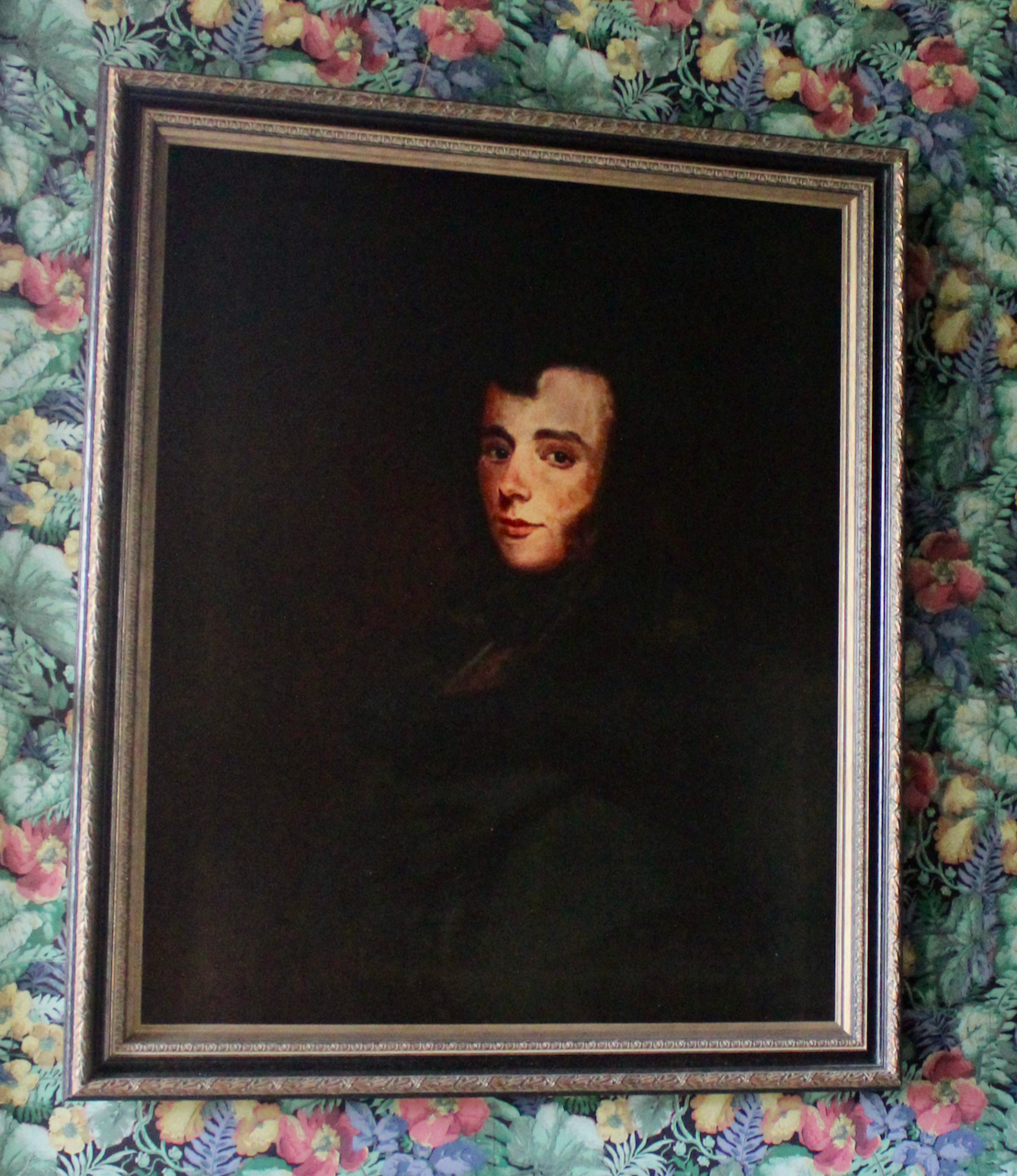
William Daunt and Jane née Gumbleton had several children, including Richard, Robert and Joseph (1778-1826).
It was Joseph (1778-1826) who inherited Kilcascan, and who built the current house, at the time of his second marriage. His first marriage was to Jane Wilson, daughter of the Rev. Thomas Wilson, Rector of Ardstraw, County Tyrone, but she died in 1816, after giving birth to at least five children. Secondly he married Jane Gumbleton from Fort William in County Waterford, daughter of Robert Warren Gumbleton, in 1822.
It has been suggested that Kilcascan was designed by the Pain brothers, James and George Richard. We know that Kilcascan was under construction before 1819 because when a ground floor ceiling collapsed around 1990 a date of 1819 was discovered carved on a ceiling joist. This would make it, Alison told me, the earliest country house constructed to a design by the Pains.
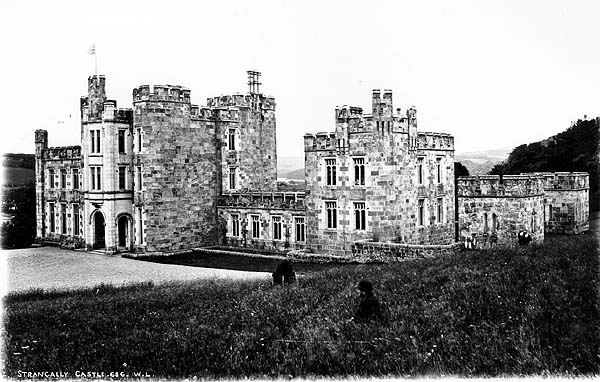
James (1779–1877) and his brother George Richard Pain (ca. 1793-1838) worked in close partnership and together established a highly successful architectural practice in the south of Ireland. They were pupils of John Nash. They were commissioned to work for the Board of First Fruits in Ireland so designed many churches and glebe houses. A building they designed which has many similarities to Kilcascan is the larger Strancally Castle in County Waterford, built around 1830. The triple arch on the Kilcascan facade is repeated on the garden front at Strancally as a veranda.

Frank Keohane writes that nearby Manche House in County Cork, built for a cousin of the Daunts, Daniel Conner, was designed around 1824 by George R. Pain. Keohane writes that the builder was Jeremiah Calnan of Enniskeane, who may have also worked on Kilcascan. [2]
Kilcascan is a five bay two storey house with the two end bays projecting and joined by a battlemented cloister, as Mark Bence-Jones describes it, or colonnade, of three Tudor-shaped arches. It was hard for me to make out the plan of the house as it nestles into its setting.
We approached the house from the side and were greeted at a side door in a one storey castellated hallway next to a three storey square tower and then a two-storey round tower. From this side the house looks very higgeldy piggeldy.
I admired the garden at this side of the house, a profusion of flowers, with a pond. Like the castle itself, the garden is laid out on different levels, with steps between.
We walked through the house, which is a maze of different floor levels and stairways. We then walked around the house to see the more symmetrical entrance front. The house has beautiful Gothic windows and stone mouldings over the windows. There’s a limestone stringcourse under the level of the eaves. The pilasters of the colonnade are topped with square bartizans.
Unfortunately, Joseph Daunt was killed in a duel in 1826, shot by his cousin Daniel Connor from Manch House. The duel was fought over a case brought to court by Joseph Daunt which Daniel Connor dismissed, saying it was ungentlemanly of Daunt to pursue a poor woman for the price of a cow. Enraged at the insult, Daunt wanted to challenge Connor to a duel.
However, duels were illegal and to kill a man in a duel would count as murder. Despite this, many cases against men who had killed their opponent in a duel did not result in harsh sentencing, because the jury consisted of gentry peers, and they often judged that the death was the unfortunate result of a “fair fight between gentlemen.” In other words, there had to be a good reason to kill someone in a duel, and if the jury felt that this was the case, punishment was extremely light. Daunt knew that if he challenged a judge to a duel over a judgement made by the judge in court, and he killed the judge, he would receive punishment as a murderer. Therefore, Alison told us, Daunt arranged the distribution of a scurrilous article defaming Connor’s wife, thus forcing Connor to issue the challenge.
Though Connor killed Daunt, he was judged not guilty of murder.
The house was inherited by Joseph’s son William Joseph O’Neill Daunt (1807-1894) when he was just 19 years old.
Young William O’Neill Daunt was raised Protestant, but he converted to Catholicism. The Dictionary of Irish Biography tells us that he was influenced by the Conners of Connerville, especially Feargus O’Connor (Feargus’s father Roger officially changed his name from Conner to O’Connor).
William O’Neill Daunt sought repeal of the Act of Union that had abolished the Irish Parliament. Together with Daniel O’Connell he was one of the founders of the Repeal Association and he was its director for Leinster. He was also opposed to tithes that all people had to pay to the Protestant church.
He served as MP for Mallow in 1832-33 but was unseated by a petition. He married Ellen Hickey in 1839.
Daniel O’Connell appointed him to be his secretary when O’Connell was elected Lord Mayor of Dublin in 1841.
Despite his active political work for the Home Rule movement, travelling around Ireland and to Scotland seeking support for repeal of the union, he managed to spend most of his time at Kilcascan.
Daunt kept a diary, which the National Biography describes “Though excessively gossipy, the diary reveals much of the life of an Irish country gentleman and of Irish politics viewed from County Cork.” He also wrote Catechism of the history of Ireland (1844), Ireland and her agitators (1845; new edition 1868), Eighty-five years of Irish history (1886) and Personal recollections of the late Daniel O’Connell (1848). Under the nom-de-plume Denis Ignatius Moriarty, he wrote five novels. One novel, The Wife Hunter, features a hero based on Feargus O’Connor.
William and Ellen had a son, Achilles Thomas, who inherited Kilcascan, and a daughter who edited Daunt’s diary and never married. [3]
Achilles Thomas Daunt (b. 1849) married Anna Maria Corballis, daughter of Bartholomew Corballis who was a proponent of Catholic Emancipation and Chair of the Catholic Association of Ireland between 1827 and 1832. Achilles Thomas served as Justice of the Peace.
Achilles and Anna Maria had two surviving sons and two daughters. The daughters did not have children. Both sons emigrated, Reginald to Africa and Achilles Thomas Wilson O’Neill (b. 1880) to Canada.
The son Achilles married Elizabeth Dey from Canada, and they had several children. Current owner Alison told us that Achilles wrote Boys Adventure books!
The Landed Estates database tells us that The Irish Tourist Association Survey of 1944 referred to Kilcascan as the residence of Miss M. O’Neill-Daunt, probably Mary Dorothea, born in 1910, the daughter of Achilles. Alison and her husband bought Kilcascan from a son of Achilles, Tom, in 1988. A second son, also named Achilles, was killed in WW2.
The house has not yet been completely renovated, but some rooms are finished, including a lovely drawing room.
A lateral corridor at the back of the house has a surprisingly ornate groin-vaulted ceiling with foliate bosses.
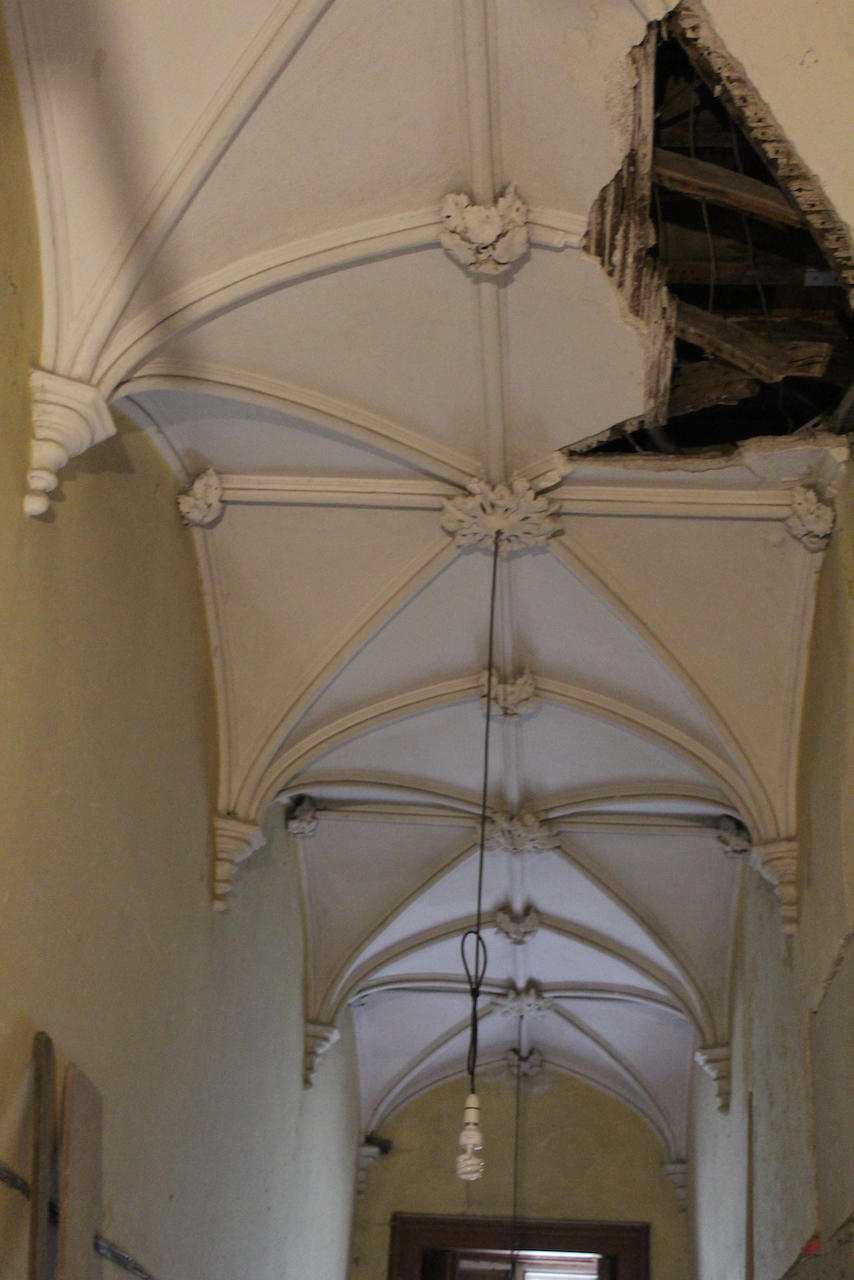
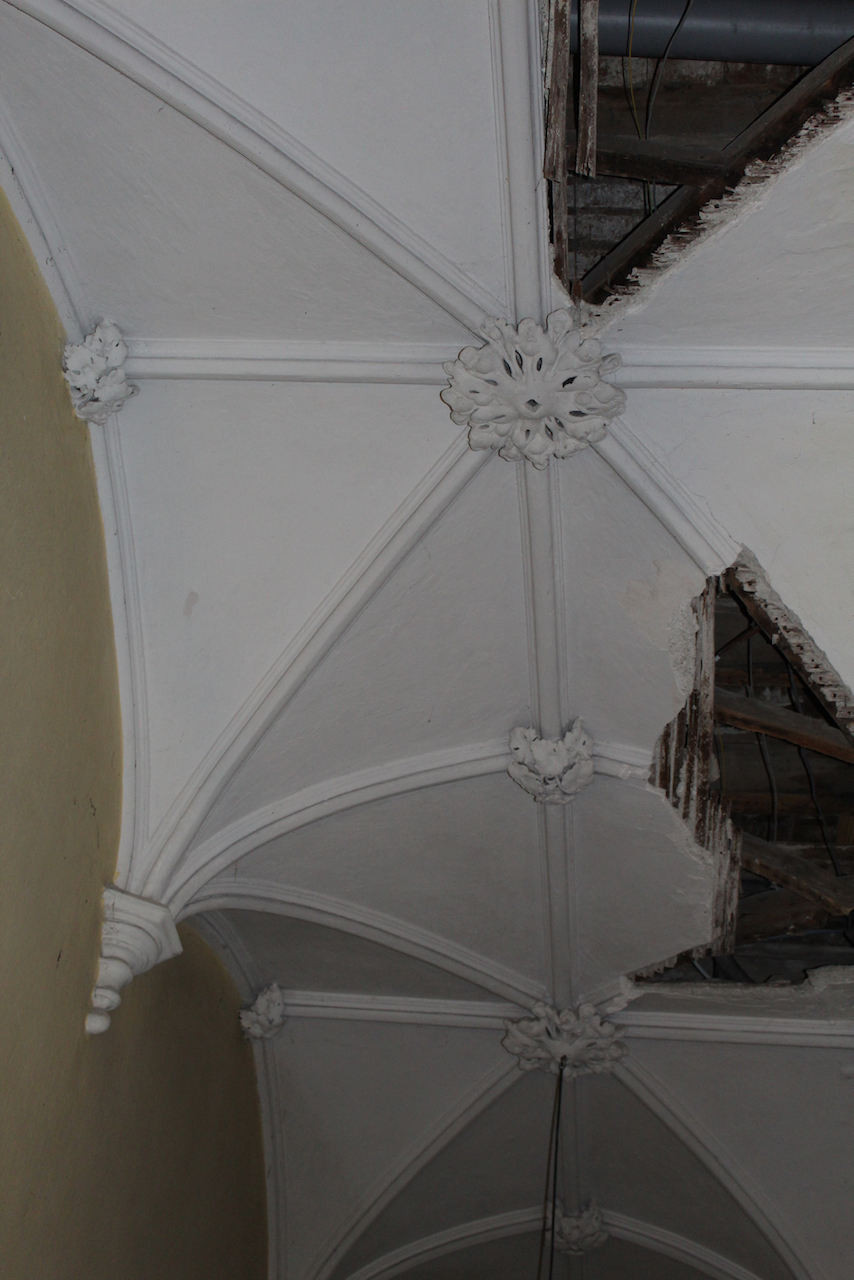
Upstairs has interesting Gothic decorative carving in the hallway, and one bedroom has lovely wood panelling on the ceiling and an impressive Gothic window.
The east side of the house, including the staircase, is still a work-in-progress. The work is, excuse the pun, “daunting”! The house sits in one hundred acres of farmland with sixty acres of woodland. Alison told us that descendants of the Kilcascan Daunts have visited the house. It’s great to see the house being preserved.
[2] p. 227, Keohane, Frank. The Buildings of Ireland. Cork City and County. Yale University Press: New Haven and London. 2020.
[3] https://www.dib.ie/biography/daunt-moriarty-william-joseph-oneill-denis-ignatius-a2414
Text © Jennifer Winder-Baggot, www.irishhistorichouses.com
 Irish Historic Houses
When is this hiuse open to view in 2026?
LikeLike
Hi Niall, unfortunately the Revenue Section 482 list isn’t published each year til late February. You can check on https://www.revenue.ie/en/personal-tax-credits-reliefs-and-exemptions/land-and-property/expenditure-on-approved-buildings-and-gardens/approved-buildings-gardens-and-objects.aspx
LikeLike
Thanks for that. I’ll keep an eye on it. I’m going to try and visit a few this year.
LikeLike