Dunroe Lodge (Farrar’s), Co Carlow
not in Bence-Jones
http://sites.rootsweb.com/~irlcar2/Dunroe_lodge.htm
William Burgess born c.1748 Dunroe, County Carlow he marriage: Elizabeth Little and his occupation was a Farmer. He died at Dunroe, County Carlow – January 1828
Date and place of burial: 23 January 1828 – aged 80 – St Peter’s Killedmond, County Carlow
Memorial inscription: At St. Peters Church of Ireland, Killedmond, County Carlow, Ireland. In 2010 the inscription was worn away and covered by litchen, from the churchyard were impressive views across to the towering Mt. Leinster. Booklet gives details of inscriptions and location in churchyard, it is from a copy of Burial Register in the Parish of Kiltennel, Co Carlow –
“Recumbent Tomb No 65 located in the middle of the churchyard nearly opposite the back of the church”
Inscriptions: “Underneath this tomb lieth inter.d the mortal remains of William Burgefs late of Dunroe who departed this life January 23rd 1828 Aged 80 years. Alfo Elizaeth Burgefs, his wife who dep.d this life the 12th day of August 1836 ag’d 80 y’rs. “O Death where is thy sting, O Grave where is thy victory.” Also his daughter Jane Smyth alias Burgefs who departed this life January the 16th 1814 Aged 30 years. Also his daughter Eliza James alias Burgefs who departed this life Nov. the 27th 1818 Aged 26 years. Also Mr Henry Burgefs late of Knockullard son of the above named William Burgefs, who dep’d this life July 3rd 1850 ag’d 60 y’rs.”
Source: http://www.genealogistsforum.co.uk/forum/showthread.php?t=15757
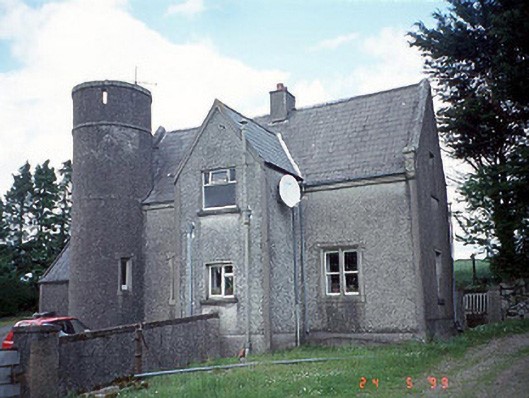
Farrar’s, DUNROE, County Carlow
Detached three-bay single-storey Tudor Revival estate house with dormer attic, c. 1845, with cut stone surrounds to window openings and turret on a circular plan. Extended, c. 1900 and c. 1975, comprising single-bay two-storey gabled range. Houses of similar design built on former estate.
Record of Protected Structures:
Farrar’s, Dunroe. Townland: Dunroe
A small, tudor-gothic revival house of circa 1840 with a three-bay, single-storey, gable-ended façade and a cylindrical tower on one corner. There is a single-storey extension of circa 1900 and a two-storey addition of circa 1975. The walls are rough-cast and the windows have chamfered, granite dressings with sashes. The roof has natural slate.
Interest: regional, architectural, unique, rarity, artistic
 Irish Historic Houses