Desmond Banqueting Hall, Newcastlewest, County Limerick:
General information: 069 77408, desmondhall@opw.ie

For the season that’s in it, at this beginning of December 2024, I feel it is appropriate to publish this post about a Banqueting Hall! I also would like to remind my readers that I have a few 2025 calendars left, and I am discounting them as the printing did not turn out so well and the images are unfortunately a bit dark. If you prefer one of better quality, I will have to charge the higher price of €30.
2026 Diary of Irish Historic Houses (section 482 properties)
To purchase an A5 size 2026 Diary of Historic Houses (opening times and days are not listed so the calendar is for use for recording appointments and not as a reference for opening times) send your postal address to jennifer.baggot@gmail.com along with €20 via this payment button. The calendar of 84 pages includes space for writing your appointments as well as photographs of the historic houses. The price includes postage within Ireland. Postage to U.S. is a further €10 for the A5 size calendar, so I would appreciate a donation toward the postage – you can click on the donation link.
€20.00

donation
Help me to pay the entrance fee to one of the houses on this website. This site is created purely out of love for the subject and I receive no payment so any donation is appreciated!
€15.00
Donation towards accommodation
I receive no funding nor aid to create and maintain this website, it is a labour of love. I travel all over Ireland to visit Section 482 properties and sometimes this entails an overnight stay. A donation would help to fund my accommodation.
€150.00
From the OPW website https://heritageireland.ie/visit/places-to-visit/desmond-castle-newcastlewest/:
“Many of Ireland’s surviving medieval halls are in west Limerick. The Desmond Banqueting Hall in Newcastle West is one of the most impressive among them.
“It was begun in the thirteenth century by Thomas ‘the Ape’ FitzGerald, so named because of the story that an ape took him from his cradle to the top of Tralee Castle – and delivered him safely back again.
“However, most of the spacious, imposing structure was created in the fifteenth century, at the height of the Desmond earls’ power, and used as a venue for frequent and lavish banquets.
“The oak gallery, from which musicians would provide a raucous soundtrack for the revelry below, has been fully restored.“

The prefix “Fitz” is taken from the Norman-French “fiz” son of. Early members of the family were known by their father’s name, ie. Fitzmaurice or Fitzthomas, but eventually the name settled to be Fitzgerald.
The Fitzgeralds were Anglo-Norman and came to Ireland at the time of King Henry II in 1169. After the initial colonisation of Ireland in the southwest and east, the Fitzgeralds and some others pushed into the southwest, the information boards tell us. It was only after the death of Donal Mór Ó Brien, King of Thomond, in 1194 that the Fitzgeralds and other Normans took over most of Limerick. By 1215 they held the towns of Cork, Limerick and Waterford and had built a castle in Dungarvan.
An inquisition of lands in 1298 describes the manor of Newcastle as containing the “New Castle with buildings inside and outside the walls” and the mill of Newcastle.

The surviving buildings are Desmond Hall and Halla Mór. This is possibly the site of the earliest castle foundations, and remnants of the early walls are found underground today. The Desmond hall shows more than one phase of development. Embedded in the exterior of the south wall are vestiges of four early thirteenth century sandstone lancet windows. The fifteenth century development of the hall by the 7th Earl of Desmond introduced many changes including the addition of a projecting tower with small chambers and a stairwell to the Northwest corner.
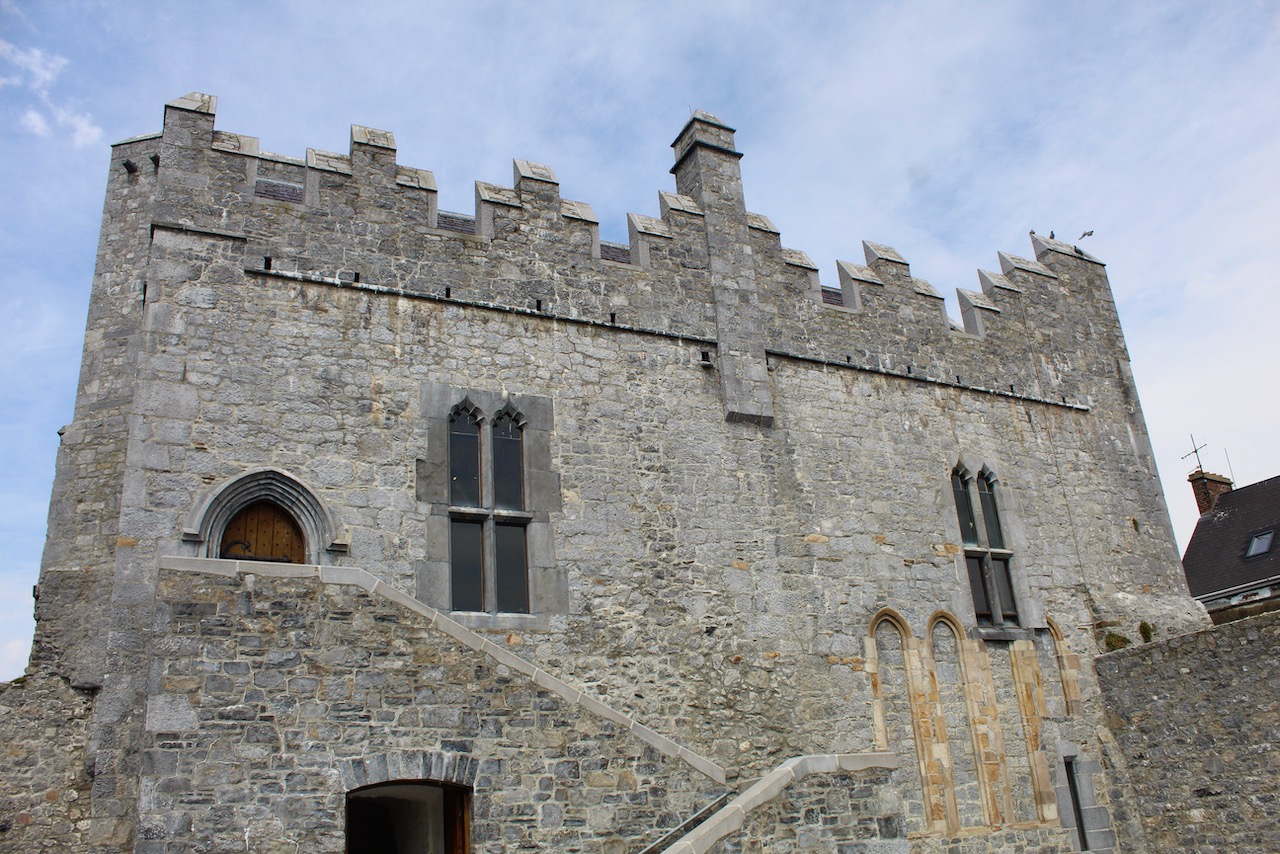
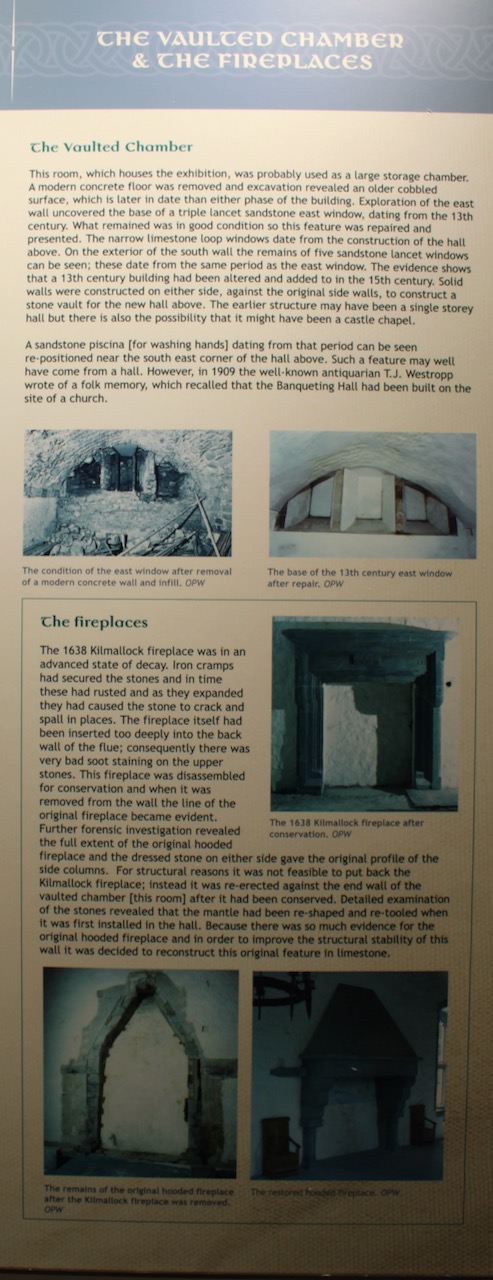
The lower level of the banqueting hall has an excellent display of boards telling us more about the history of the Fitzgerald Earls of Desmond. An old fireplace is set in one wall, it seems to be from 1638.
The visitor centre lies in a building across the courtyard, and another building is being refurbished.



The first claim to the land of Desmond was obtained by the Fitzgeralds when John Fitzthomas married the co-heiress Margery FitzAnthony and was granted in 1251 a share in her father’s lands described as “all the lands of Decies and Desmond and custody of the castle of Dungarvan.” This land was added to the Fitzgerald landholdings in Limerick and North Kerry. In 1292 King Edward I (d. 1307) granted Thomas Fitzmorice (Fitzgerald) and his wife Margaret Berkeley, who was a cousin of the king, “joint custody of Decies and Desmond.” It’s interesting that the wife was given joint custody, and that daughters could be heirs, which as we know was not always the case.
A leaflet from the castle tells us that by 1298, a strong stone castle stood overlooking the Arra River in Newcastle West. Curtain walls with defensive towers surrounding the main buildings, a variety of simple thatched houses and byres for cattle as well as fishponds. The Normans immediately began to consolidate their position by negotiating with the local Gaelic families, while driving the poorer Gaelic peasants into the mountains. By the time of Maurice Fitzthomas Fitzgerald (abt. 1293-1356), the O’Briens to the north had become firm allies of the Fitzgeralds. In 1329, Maurice was created 1st Earl of Desmond, the term “Desmond” being derived from the Irish Deas mnumhain meaning south Munster. By this time the Fitzgeralds were using the Irish language in their daily lives and had taken on many of the values and habits of the Irish culture.


The 1st Earl plotted against the King of England, and allied himself with the Gaelic lords. They pillaged many settlements in the south of Ireland. He is said to have written to the Pope to say that King Edward III of England had no right to the lordship of Ireland. It is also claimed that he wrote to the kings of France and Scotland to form an alliance. During a campaign against him he lost his castles at Askeaton and Castleisland. However, the King pardoned him and made him Chief Justiciar of Ireland in 1355.
Gearóid Iarla (c. 1338-1398) became the 3rd Earl of Desmond in 1356. He was an expert mathematician and apparently, the leaflet tells us, a magician! He was also a poet and introduced the idea of courtly love into Gaelic poetry. He also served as Justiciar. He married Alianore, or Eleanor, Butler, daughter of James 2nd Earl of Ormond.

Despite the marriage alliance between the Desmonds and the Ormonds, they still battled. A fifteen day conference at Clonmel in 1384 led to a treaty between the families.
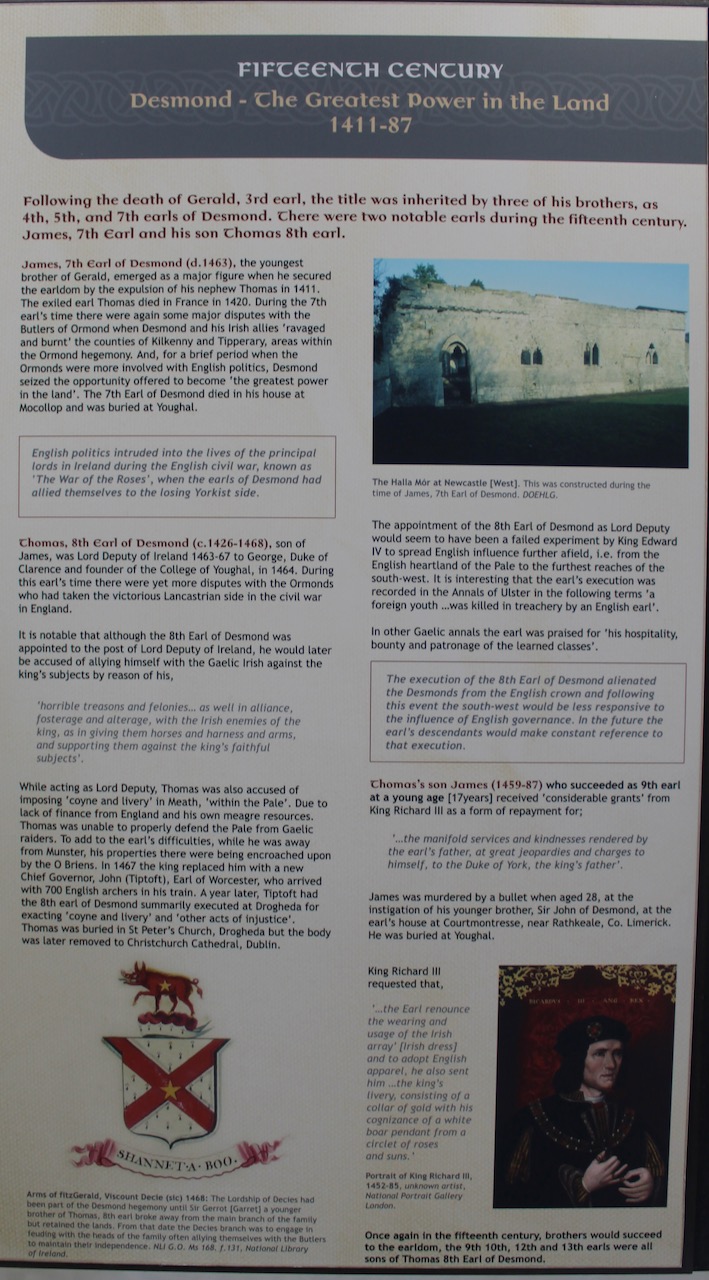
Thomas the 8th Earl of Desmond (c. 1426-1468) was made Lord Deputy of Ireland 1464-67. During his time the Desmonds fought again with the Ormonds, including during the War of the Roses when they took opposing sides. The Ormonds supported the victorious Lancasters.
The 8th Earl was however thought to side with the Irish still and was executed by the next Lord Deputy.
The information boards give us more history about Desmond family. The Earls of Desmond fell out of favour after the 8th Earl was executed in 1468.

After the execution of the 8th Earl of Desmond in 1468, the later Earls withdrew from contact with England. The leaflet from the site tells us that the arrival of new settlers in Munster as well as Catholic mistrust of the Protestant state set off risings by the Earls in 1567-73 and 1579-83. Earl Gerald (15th Earl) was declared an outlaw and Munster was laid waste by Crown forces. The rebellion was a failure and Gerald was captured and killed during a cattle raid. The Desmond lands were taken and distributed to English settlers.

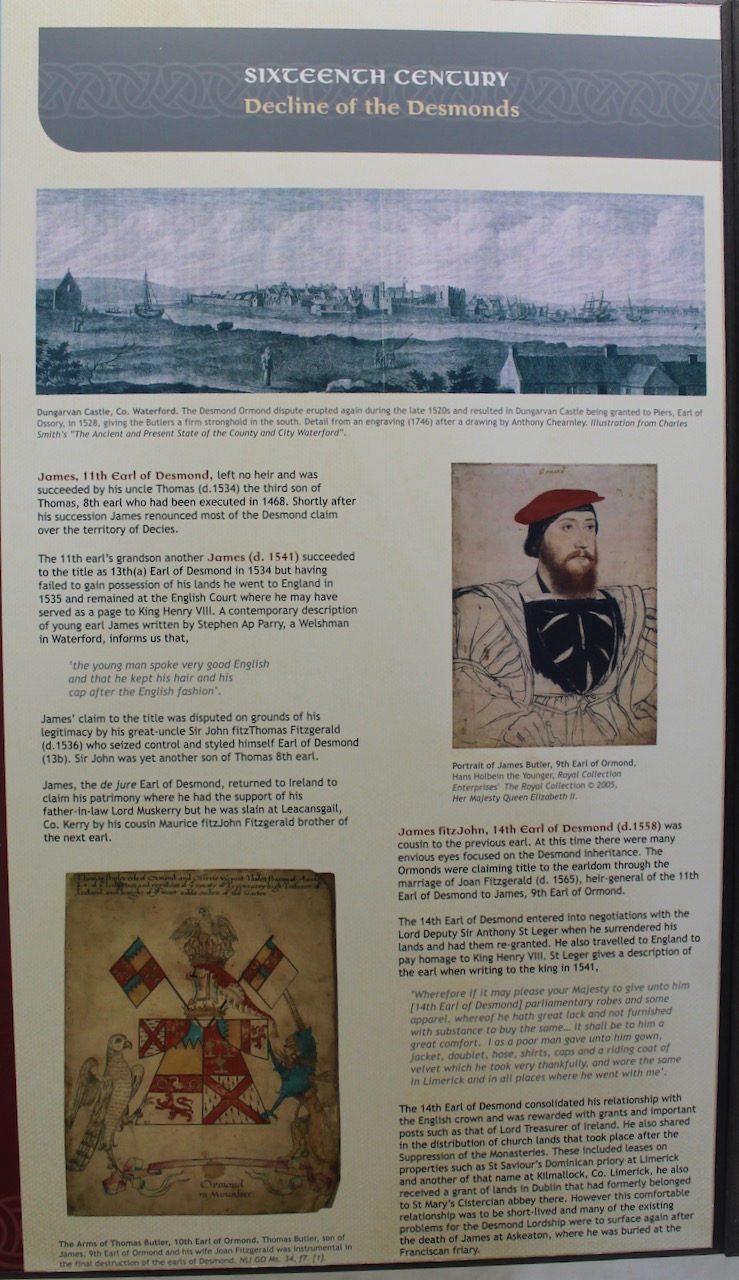
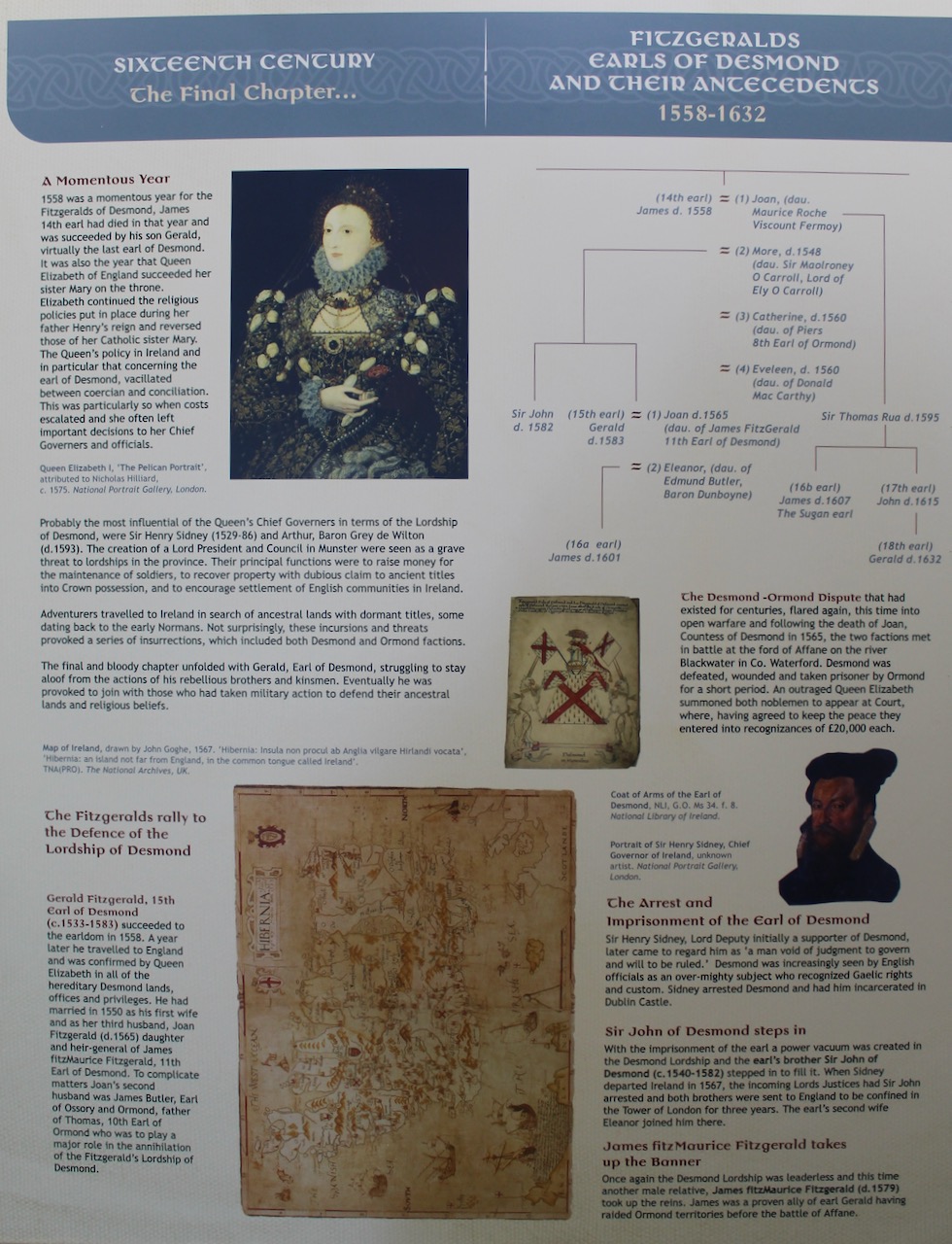

This takes us up to the fifteenth century and the time when the Hall would have been used, as we see it today. The information board tells us that the Hall was where the Lord held court, and that this has two meanings: it was the court of judgement as well as the court of entertainment and dining.


The Banqueting Hall was restored in the early 19th century, the ruined battlements were taken down and a new pitch pine roof was put on. The original hooded stone fireplace had collapsed and a seventeenth century replacement, the one we now see in the lower vault, was installed, taken from a house in Kilmallock. The Banqueting Hall was used as a Masonic lodge and later as a general purpose hall for the community.
The leaflet tells us that when the 17th century fireplace was taken down for repair and cleaning, enough of the original hooded fireplace remained that it could be reconstructed with reasonable accuracy.
There was evidence for a timber screen at the west end of the hall, and this has been replaced by a musician’s gallery made of oak.


I was surprised to hear that the windows facing the village would have had glass in the fifteenth century. The other side, away from public view, would not have had this expensive luxury.


The later history of Desmond Hall is after the lands of Gerald the 15th Earl of Desmond were seized.

After the Earls of Desmond has lost their land, it was given to some prominent and wealthy Englishmen who would develop the Munster Plantation. These men, called “Undertakers,” would undertake to establish English families on the land they were given. Sir William Courtenay (or Courtney) (1553-1630), 3rd Earl of Devon, was granted 10,000 acres at Newcastle. He was originally from Devon in England, and he was given land on condition that eighty English colonists would be housed on his property.

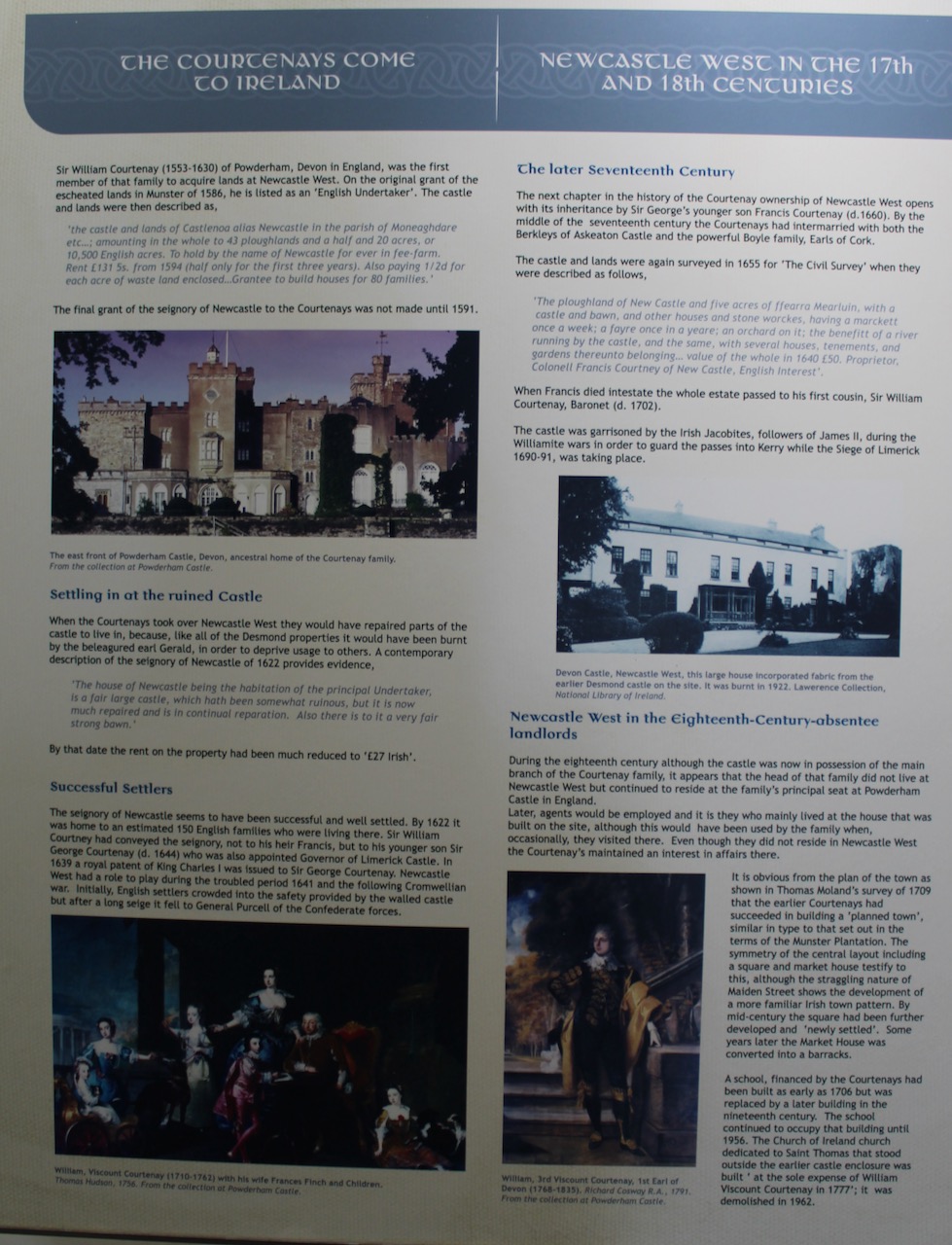
Newcastle passed to William Courtenay’s son George Courtenay (d. 1644), who in 1621 became 1st Baronet Courtenay of Newcastle, County Limerick. The sign boards tell us that in 1641 English settlers crowded into the protection of the walled castle, but after a long seige it fell to General Purcell of the Confederate forces. The Confederates where an amalgamation of Gaelic Ulster families and Anglo-Norman families who were dissatisfied with assurances given to them by King Charles I about their freedom to practice their Catholic faith, and they feared the militant intolerance of the English Parliament.
The Courteneys built an mansion to replace the destroyed castle. George’s son Francis inherited, but as he had no offspring, Newcastle passed to his cousin, William Courtenay (1628-1702) 5th Earl of Devon and 1st Baronet Courtenay. The property remained in the family but they did not live there, and finally it was sold in 1910.
In 1777 William 2nd Viscount Courtenay (1742-1788) built a Church of Ireland church between the Banqueting Hall and the main square of the town. It was demolished in 1962 as it had fallen into disrepair. The 2nd Viscount was 8th Earl of Devon and 4th Baronet Courtenay.
In 1922 the main building, then known as Devon Castle, burnt, and was replaced by a house nearby. The Desmond Hall was sold to the Nash family, and finally the Land Commisson took over the land. Desmond Hall was used for town social events and the Halla Mór as a cinema. The Hall became a National Monument in 1981. Restoration began in 1989.

 Irish Historic Houses
2 thoughts on “Desmond Banqueting Hall, Newcastlewest, County Limerick – OPW”