Lough Fea House, Carrickmacross, Monaghan

Mark Bence-Jones. A Guide to Irish Country Houses (originally published as Burke’s Guide to Country Houses volume 1 Ireland by Burke’s Peerage Ltd. 1978); Revised edition 1988 Constable and Company Ltd, London.
p. 192. “(Shirley, sub Ferres, E/PB) A very large and unusual Tudor-Gothic house by Thomas Rickman, the English architect and architectural writer who invented the terms “Early English”, “decorated” and “perpendicular” to describe the different periods of Gothic architecture. Built ca 1827 for E.J. Shirley, whose family had owned the estate since the marriage of Sir Henry Shirley to the daughter of Elizabeth I’s favourite, the Earl of Essex; but had lived entirely at their English seat, so taht there was no previous house here.
Unlike most houses of its period and style, Lough Fea has no battlements and few gables, but a solid parapet which conceals much of the roof.
There are hardly any projecting bows or oriels, but rather small, mullioned windows under hood mouldings; so that the elevations, of pinkish-grey ashlar, have a solid effect.
There are several slender, square turrets with sprocketed pyramidal roofs; also a polygonal lantern and a small tower and polygonal turret at the end of one wing; but no major tower; so that the house seems low and wide-spreading.
The entrance front, facing the lough from which the estate takes its name, is flanked on one side by the chapel and on the other by a great hall, which together form a three-sided court.
The interior is of great complexity, with many corridors and ante-rooms.
There is a hall divided by a stone arcade, its walls hung with an early 19th-century wallpaper.
There is a large and handsome library with oak bookcases, which formerly contained the famous library of EP Shirley, the antiquary, son of the builder of the house.
The chapel is on the scale of a sizeable church, with two pulpits and a gallery.
The clou of the house is, however, the great hall: vast and baronial, with a lofty hammer-beam roof, a minstrels’ gallery and an arcade at first-floor level.
It was added after the rest of the house was completed.
According to the story, Mr Shirley and Lord Rossmore vied with one another as to which of them could build the bigger room.
Lord Rossmore enlarged his drawing room at Rossmore Park five times, but in the end Mr Shirley won the contest by building his great hall.
The garden front of the house faces along a vista to an immense Celtic cross, which was erected by the tenants of the estate in token of their gratitude to the Shirleys.
The demesne is noted for its magnificent woodlands.”


NLI photos.
Country Life photos:


https://archiseek.com/2009/1827-lough-fea-carrickmacross-co-monaghan
1827 – Lough Fea, Carrickmacross, Co. Monaghan
Architect: Thomas Rickman

Designed for the Shirley family by the historian Thomas Rickman and which is his only Irish commission, Lough Fea was built in 1827. Lough Fea is unusual in that it resembles an Oxbridge college more than a Victorian castle with its absence of battlements in favour of a solid parapet concealing the roof. Small widely spaced windows give the building a very solid look. The Shirleys and the Rossmores competed for years to build the largest room in the county – with Lord Rossmore extending his Drawing room five times. However Lough Fea lifted the honours with the magnificent Great Hall.
With no major towers, Lough Fea seems low and well spaced as it faces onto the lake after which it is named – with the central block flanked by the double height chapel and Great Hall. The chapel is almost a full sized church with pulpit and gallery while the Great Hall has a seven bay minstral gallery over a doorway height dado and two fireplaces and open timber trussed roof.
National inventory no entry except for gate lodges:

Detached H-plan three-bay single-storey gate lodge with half-dormer attic, built c.1850, having advanced bays to either end of front (south) and rear elevations, that to west being full-height, that to east being higher; canted bay window to east gable of front elevation; gabled porch to east elevation; raised gablet to front and rear elevations, and multiple-bay single-storey outbuilding attached to west elevation. Formerly also used as land steward’s house. Now in use as house. Pitched slate roofs with cut limestone chimneystacks and cut limestone barges with kneelered gables. Snecked limestone walls having cut limestone quoins. Square-headed window openings, some double and triple-light, having chamfered stone surrounds, cut-stone sills, and carved stone label-mouldings. Pointed window openings to dormer windows, having chamfered stone surrounds. Replacement uPVC windows throughout. Square-headed door opening to rear of porch, having chamfered stone surround, carved stone label-moulding and cut-stone step. Curved rubble stone boundary wall to garden to rear, having square-headed opening with timber battened door. Outbuildings to north-west of site with pitched slate roofs and rubble stone walls. Wrought-iron railings forming boundary to front of house. Set back from road at south-east entrance to Lough Fea estate. Site entrance to east having cast-iron double-leaf gate, cut limestone octagonal-plan piers with carved caps, in turn flanked by matching cast-iron railings on cut limestone plinth.
Appraisal
Bracken Lodge is the largest of a number of gate lodges serving the Lough Fea Estate. It is understood to have been the land steward’s house, as well as functioning as a gate lodge, which would explain its larger size. Lough Fea is the seat of the Shirley family who, by 1876, had become the biggest landlords in County Monaghan. The house is well constructed and displays skilled stone masonry. It retains its original form and shares a number of characteristics with other estate buildings in the vicinity. The entrance gates and railings are similar to several other gate lodges on the estate, with their distinctive alternating fleur-de-lys and spearheads, and the carved piers are very similar to those of Lake Lodge to the west boundary of the estate.

https://lordbelmontinnorthernireland.blogspot.com/2013/05/lough-fea-house.html
THE SHIRLEYS WERE THE GREATEST LANDOWNERS IN COUNTY MONAGHAN, WITH 26,386 ACRES
This is a branch of the noble and ancient family of Shirley, EARLS FERRERS, springing from
SIR ROBERT SHIRLEY, Knight, 1st EARL FERRERS (1650-1717), who married firstly, Elizabeth, daughter and heir of Lawrence Washington, of Garsdon, Wiltshire; and secondly, in 1699, Selina, daughter of George Finch.
The third, but, eventually, eldest surviving son of his secondmarriage,
THE HON GEORGE SHIRLEY (1705-87), of Ettington Park, Warwickshire, Captain, 1st Regiment of Foot Guards, wedded Mary, daughter of Humphrey Sturt, and had issue,
GEORGE, his successor;
EVELYN, succeeded his brother;
Selina; Margaret.
He was succeeded by his eldest son,
GEORGE SHIRLEY, of Ettington Park and Lough Fea, County Monaghan, who espoused Phillis Byam, daughter of Charlton Wollaston, and had issue,
EVELYN JOHN;
Charles;
William;
James;
Horatio;
Arthur George Sewallis;
Selina; Mary; Frances; Emily Harriet.
Mr Shirley was succeeded by his eldest son,
EVELYN JOHN SHIRLEY (1788-1856), of Ettington Park and Lough Fea, who wedded, in 1810, Eliza, daughter of Arthur Stanhope, cousin to the Earl of Chesterfield, sometime MP for County Monaghan and South Warwickshire, and had issue,
EVELYN PHILIP;
Arthur;
Sewallis;
George Edward;
Walter Devereux;
Selina; Louisa.
His eldest son,
EVELYN PHILIP SHIRLEY DL (1812-82), of Ettington Park and Lough Fea, MP for South Warwickshire and County Monaghan, had issue,
SEWALLIS EVELYN SHIRLEY JP DL (1844-1904), of Ettington Park and Lough Fea, MP for County Monaghan, 1868-80, High Sheriff of Warwickshire, 1884, who had issue,
EVELYN CHARLES SHIRLEY JP DL (1889-1956), of Ettington Park and Lough Fea; High Sheriff of County Monaghan, 1914; Lieutenant-Colonel, Major, the Warwickshire Yeomanry; Lieutenant-Colonel, the General Staff, whose only son,
JOHN EVELYN SHIRLEY (1922-2009), of Ettington Park and Lough Fea, Major, King’s Royal Rifle Corps.
He lived in 2003 at Ormly Hall, Ramsey, Isle of Man.
He had issue,
Philip Evelyn Shirley, b 1955;
Emily Margaret Shirley, b 1957;
Hugh Sewallis Shirley, b 1961.

The Shirley estate is based at Lough Fea, near Carrickmacross in County Monaghan.
It had an area of some 40 square miles, in the western half of the barony of Farney, County Monaghan, in the period 1576-1960.
The Shirley Papers are deposited at PRONI.
The Shirley Association has written a history of Lough Fea.
The Shirleys were semi-absentee landlords. Their main seat was Ettington Park in Warwickshire.
Evelyn Philip Shirley visited Lough Fea several times a year.
The estate was formerly in the ownership of the Earl of Essex, though underwent the first of several partitions: It passed in two halves to Essex’s co-heirs, the Marquess of Hertford and Sir Robert Shirley.
Sir Robert himself died in 1656, imprisoned in the Tower of London for supporting the Royalist cause in the English Civil War.
His son and heir was Sir Seymour Shirley, on whose death in 1667 the estate and the rest of the family inheritance passed in turn to his second and only surviving son, Sir Robert Shirley.
Sir Robert entered the House of Lords in 1677, as Baron Ferrers of Chartley, and in 1711 was further ennobled as 1st Earl Ferrers and Viscount Tamworth.
This last title related to the family seat of Ettington in Warwickshire.
About 1750, the Shirleys built a house near Carrickmacross for their occasional visits.
It was not until 1826 that Robert’s grandson, Evelyn John Shirley, laid the foundations of a mansion house worthy of the family and estate, near the banks of Lough Fea.

LOUGH FEA is a very large and unusual Tudor-Gothic house by Thomas Rickman, the English architect and architectural writer who invented the terms “Early English”, “decorated” and “perpendicular” to describe the different periods of Gothic architecture.
Unlike most houses of its period and style, Lough Fea has no battlements and few gables, but a solid parapet which conceals much of the roof.
There are also hardly any projecting bows or oriels, but rather small, mullioned windows under hood mouldings; so that the elevations, of pinkish-grey ashlar, have a solid effect.
There are several slender, square turrets with sprocketed, pyramidal roofs; also a polygonal lantern and a small tower and polygonal turret at the end of one wing; but no major tower; so that he house seems low and wide-spreading.
The entrance front, facing the lough, is flanked on one side by the chapel and on the other by a great hall, which together form a three-sided court.
The interior is of great complexity, with many corridors and ante-rooms.
There is a hall divided by a stone arcade, its walls hung with an early 19th-century wallpaper.
There is a large and handsome library, the famous library of EP Shirley, son of the builder of the house.
The chapel is on the scale of a sizeable church, with two pulpits and a gallery.
The clou of the house is, however, the great hall: vast and baronial, with a lofty hammer-beam roof, a minstrels’ gallery and an arcade at first-floor level.
It was added after the rest of the house was completed.
According to the story, Mr Shirley and Lord Rossmore vied with one another as to which of them could build the bigger room.
Lord Rossmore enlarged his drawing room at Rossmore Park five times, but in the end Mr Shirley won the contest by building his great hall.
The garden front of the house faces along a vista to an immense Celtic cross.
The demesne is noted for its magnificent woodlands.
At the end of the 19th century the estate comprised 26,386 acres, but these lands had to be sold due to the Irish Land Acts before the First World War.
The estate now has less than 1,000 acres of grass and woodland.
After the sale of the land, which had been rented to tenants, large mansions such as Lough Fea became white elephants with little revenue coming in.
In 1904, when Major Shirley’s grandfather died, his father moved from his Ettington Park home in Warwickshire to Carrickmacross, County Monaghan.
Between 1904 and 1977, Major Shirley’s father and his family lived there permanently.
There was a serious fire at the house in 1966, which did quite a lot of damage.
In 1977, the family moved to the Isle of Man and thus reverted to its 19th Century role of absenteeism; though because Major Shirley and his sons were brought up on the estate they have a great love of the place and they do their best to keep the main parts of the building waterproof.
https://www.seibelfamily.net/let-me-tell-you-a-story—blog/lough-fea-ireland-the-shirley-family
Carrickmacross in Co. Monaghan came into existence as a plantation town. It belonged to an area called the Barony of Farney. The Barony of Farney was given by Queen Elizabeth I of England to the First Earl of Essex, Walter Deveraux in 1576. He planned to ‘plant’ the area with settlers and build a walled town around a nearby area called Donaghmoyne. He died, however, in September 1576 and never achieved this.
During the following years Ulster was in a state of rebellion. The 2nd Earl of Essex Robert Deveraux asked Queen Elizabeth if he could crush the rebellion. He achieved little, however, and was seen to have displeased the Queen. In 1601 he lost his head and the estate of Farney was taken from the Deveraux family. Queen Elizabeth died in 1603 and James I took the throne. He returned the estate of Farney to the Deveraux family.
The Deveraux family faced the problem of local opposition in the area of Farney. The McMahons were the Gaelic Lords of the area and they posed a possible threat to the Deveraux family’s hold on Farney. The family therefore decided to build a stronghold in the area of Farney. They chose Carrickmacross as the place in which they would build a castle. This castle, known as Essex Castle was completed in 1630.
Before the castle was built the town did not exist. When the castle was built a street ran northwards from it and became the main street of the town. A survey of the estate carried out by Thomas Raven around that time reveals that before the building of the castle, there was only one properly constructed house. This was an inn belonging to William Ceasar. Beside it were a few hovels. With the arrival of the settlers, plots of land were distributed and fine houses were built. These houses, together with the castle, shaped the foundation of Carrickmacross Town.
Essex castle no longer exists. The site on which it was located was acquired by the order of St Louis nuns who came to Carrickmacross in 1888. They started a girl’s secondary school and also took charge of the girls’ national school. Both remain today. The St Louis nuns also started the famous Carrickmacross lace industry.
The Deveraux Estate passes to the Shirley family
In 1646 Robert Deveraux, a later Earl of Essex died leaving no heir. His estate was then passed on to his two sisters Dorothy and Francis. Lady Dorothy was married to Sir Henry Shirley and they had a son Robert who became co-heir. Francis was married to Sir William Seymour. In 1655 the Barony of Farney appears to have been surveyed. This survey shows the contents of every townland and it divides the land into profitable and waste ground. The survey that the whole estate was made up of 47,734 English acres equal to 29, 468 Irish acres and 36, 965 Scottish acres.
The Shirley family were absentee landlords, i.e. they did not live on their estates but occasionally visited. About 1750 the Shirley family erected a house adjoining the town of Carrickmacross. This became the occasional residence of the Shirley family.
It was located in an area now known as Ivy Lane. There are modern houses located there today. In 1777 the Hon. George Shirley made preparations to erect a castle on the high grounds of an area called the Lurgans. The design of this castle was abandoned and it was not until 1826 that the Hon. George Shirley’s grandson, Evelyn John Shirley Esq. laid the foundation of a mansion worthy of the estate near Lough Fea. This house still remains today.
The house is erected entirely of free stone found on the estate and built in the manner of a college. The ground floor holds a Great Hall, a chapel and in the centre are the principal living rooms.
At the end of the 19th century the estate had approximately 25,000 acres but these lands had to be sold due to the Land Acts before the First World War. The estate now has less than 1,000 acres of grass and woodland. After the sale of the land, which had been rented to tenants, large mansions such as Shirley’s House became white elephants with little revenue coming in.
In 1904 when the present Major Shirley’s grandfather died his father moved from his Ettington Park home in England to Carrickmacross. Between 1904 – 1977 Major Shirley’s father and his family lived there permanently. There was a serious fire at the house in 1966, which did quite a lot of damage. In 1977 the family moved to the Isle of Man and thus reverted to its 19th Century role of absenteeism. But because Major Shirley and his sons were brought up on the estate they have a great love of the place and they do their best to keep the main parts of the building waterproof.
Pedigree of the Shirleys of Lough Fea, Lords of the Manor of Ettington
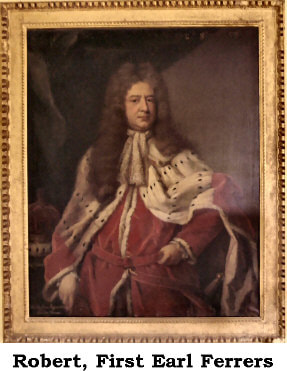
1. Robert Shirley, 1st Earl Ferrers – died Dec 25, 1717
married 2nd: Selina, daughter of George Finch, of London esq. (note: children of Robert Shirley’s first wife inherited the title of Earl Ferrers)
2. Robert Shirley – born May 27 1700 Lord of the Manor of Ettington
2. Selina Shirley – m. Peter Bathurst
2. Mary Shirley – m. Charles Tryon
2. George Shirley – b. 1704 d. 1704
2. George Shirley – born Oct 23 1705 Lord of the Manor of Ettington
married Mary, daughter of Humphry Sturt of Horton, Co Dorset
3. George Shirley – b. Nov 6 1750
3. Selina Shirley – m. Sir Thomas George Skipwith
3. Mary Shirley – m. John Smith
3. Evelyn Shirley – b Dec 17 1756 Lord of the Manor of Ettington
married Phillis Byam, daughter of Charleton Wollaston esq.
children:
4(i). Phillis Shirley – b. July 3 1785
4(ii). Selina Shirley – b March 31 1787
4(iii). Evelyn John Shirley – born April 26 1788 died 31 December 1856 Lord of the Manor of Ettington
Evelyn John Shirley (thanks to Alexander Brooks for this minature image)
married Eliza, daughter and heir of Arthur Stanhope, esq.
5. Evelyn Phillip Shirley – b Jan 22 1812 Lord of the Manor of Ettington
married Mary Clara Elizabeth, daughter of Sir Edmund Hungerford Lechmere
6. Sewallis Evelyn Shirley – b July 15 1844 Lord of the Manor of Ettington
married Emily Jean Macdonald
7. Lt. Col. Evelyn Charles Shirley Lord of the Manor of Ettington
married Kathleen Mary Phyllis Cardew
8 Major John Shirley Lord of the Manor of Ettington
Times of London obituary – John Evelyn Shirley, of Ettington and Lough Fea. Major retired 60th Rifles. Died peacefully at home on the Isle of Man on 7th November 2009 aged 86. Husband of Judith and father of Philip, Emily and Hugh.
9. Philip Evelyn Shirley was born on 29 September 1955 –
current owner of Lough Fea, Lord of the Manor of Ettington
6. Selina Shirley – b Aug 5 1845
6. Mary Clara Shirley – m. Rev W. K. W. Chafy
6. Katharine Shirley – b Mar 20 1857
5. Arthur Shirley – b Feb 8 1813
5. Selina Shirley – m. Sir William Heathcote of Hursley
5. Sewallis Shirley – b April 17 1816
5. George Edward Shirley – b July 24 1817
5. Louisa Shirley – m. Neil Malcolm of Poltallock, esq
5. Walter Devereaux Shirley b July 20 1829
married Anne Knox dau of W.K. Fawcette, esq.
6. Louisa Shirley – b Nov 27 1857
4(iv). Lt. Henry Robert Shirley – born Mar 27 1789; He died May 1808 during active Naval service at sea, age 19.
4(v). Mary Shirley – She died 17 February 1838; She married George Morant
4(vi). Gen. Charles Shirley – born Nov 15 1792; He died 12 December 1855, age 63 without children
married Anne Charlotte Bridgeman on 7 December 1819, daughter of Rev Hon. George Bridgeman.
4(vii). Maj. William Shirley – b March 23 1794; He fought in the Battle of Waterloo in 1815.
4(viii). Frances Shirley – b May 18 1795
4(ix). Frederick Shirley – b June 15 1797
4(x). Emily Harriot Shirley – She died 3 January 1881; She married Edward, Lord Suffield
4(xi). Rev. James Shirley – born Jan 15 1802; He was Rector at Frettenham Norfolk; He died 7 January 1870
married Katherine Dolphin, daughter of the Rev. J. Dolphin
children: (all died unmarried)
5. Horatio Henry Shirley – b Jan 6 1834
5. Katherine Frances Shirley – b Oct 15 1836
5. Georgiana Louisa Shirley – b Nov 13 1837
5. Evelyn William Shirley – b Nov 30 1840
5. Mary Shirley – b Mar 4 1842
5. James Charlton Shirley – b Aug 30 1843
5. Selina Caroline Shirley – b Mar 23 1850
4(xii). Georgiana Shirley – b June 27 1803
4(xiii). General Sir Horatio Shirley – born 8 December1805; Having been nominated a Knight Commander of the Order of the Bath, he was knighted by Her Majesty Queen Victoria, at Windsor Castle, 5th July 1869. He died 8 April 1879.
4(xiv).Rev. Arthur George Sewallis Shirley – born July 20 1810; MA of Christ Church Oxford; He was the Vicar of Stinsford, Dorset; He died 8 October 1891
married 1) Georgiana Emily Cookson on 24 August 1841 at Sherborne Minster, Dorset, daughter of Rev William Cookson. She died on 8 July 1852 and buried at Stinsford Dorset
married 2) Mary Beadon Turner on 3 September 1853 at Swanage, Dorset, daughter of Edward Turner, esq. of Sherborne, Dorset. She was the widow of Dr Jackson MD of Dorchester; She died 3 April 1877.
married 3) Francesca Vincenzia Edith Money in 1878, daughter of Captain John Ernle Money.
2. Frances Shirley – b May 5 1707
2. Anne Shirley – m. Sir Robert Furnese
2. Sewallis Shirley – b Oct 19 1709. m. Margaret, daughter of Samuel Rolle of Hainton Co Devon, Baroness Clinton and Say.
2. Stuarta Shirley – b Aug 19 1711
2. John Shirley – b. March 1 1712
Acknowledgements
Text taken from: http://www.ulster.ac.uk/thisisland/modules/
ulsterplantation/carrickmacross.html
Sketch of Essex Castle, Carrickmacross is taken from ‘The Monaghan Story’, by Peadar Livingstone.
County Monaghan – Baronies, taken from ‘The Monaghan Story’, by Peadar Livingstone.
 Irish Historic Houses