I have been exploring the beautiful photographs of Robert French in the National Library of Ireland this week. The Dictionary of Irish Biography tells us about the wonderful photographer who took such clear precisely composed photographs:
“French, Robert (1841–1917), photographer, was born 11 November 1841 in Dublin, eldest of the seven children of William French, a court messenger, and Ellen French (née Johnson). At the age of nineteen, in September 1860, he joined the Constabulary (later RIC) as a sub-constable, giving his occupation as ‘porter’. He was stationed at the barracks at Glenealy, Co. Wicklow. Having served almost two years, he resigned in August 1862.“
“French next found employment in Dublin as a photographic printer, possibly at the portrait studio operated by John Fortune Lawrence at 39 Grafton Street. He later joined the more successful studio run by John Fortune’s brother, William Mervin Lawrence (1840–1932), which opened at 7 Upper Sackville (later O’Connell) Street in March 1865. Progressing upwards through the grades of printer, colourer-retoucher and assistant photographer, he attained the rank of photographer in the mid-1870s. Meanwhile, William Mervin Lawrence had developed a lucrative trade in the sale of topographical views and he gave French the task of providing a comprehensive range of scenic photographs representing all parts of the country. French performed this role with dedication and distinction for almost forty years until his retirement in 1914.
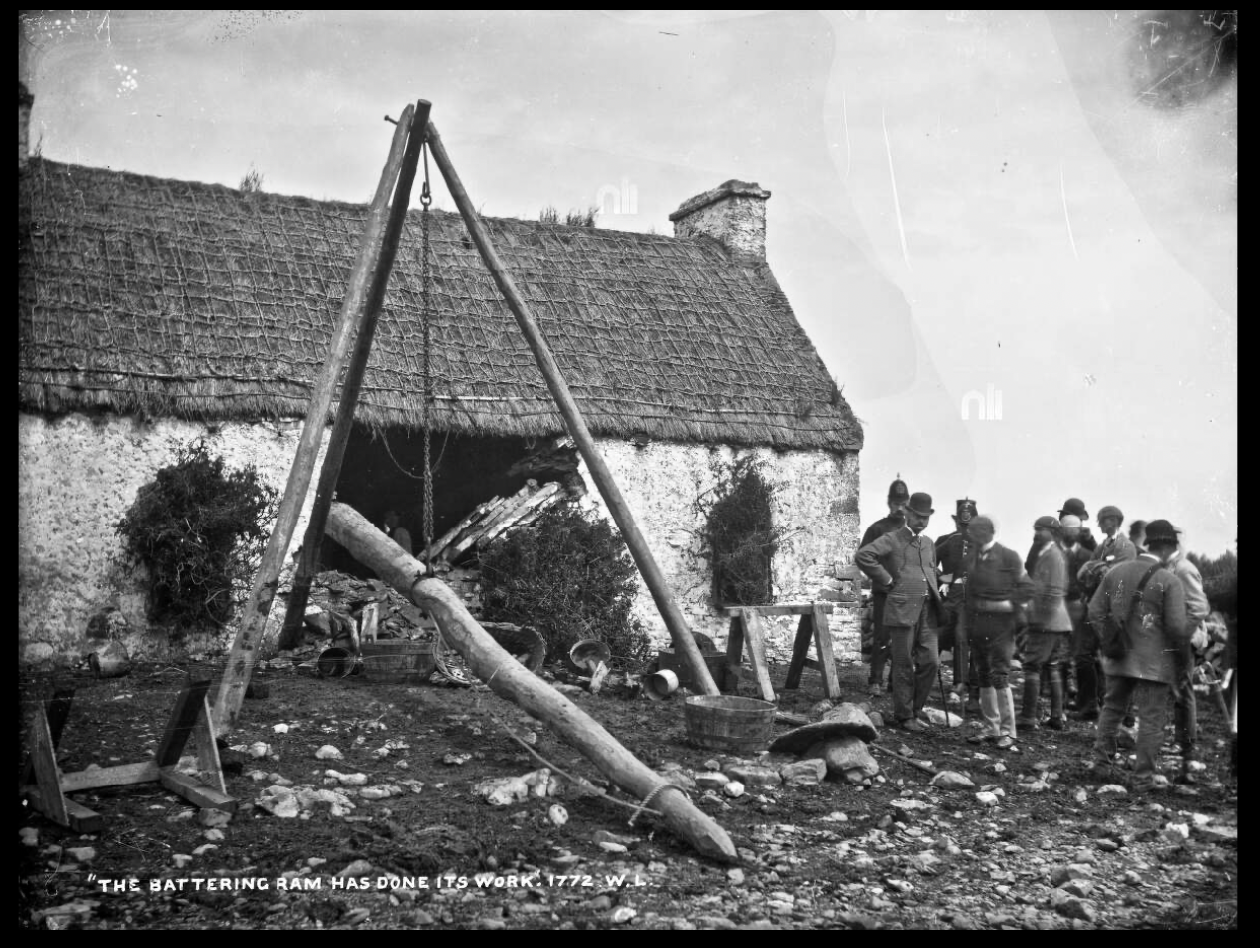
“French’s function was to provide photographs for a market that favoured views of picturesque landscapes, seaside resorts, and the streets of cities, towns, and villages. Lawrence was in charge of marketing strategy and planned French’s itineraries, but French selected the individual views. He travelled throughout the country, identifying and photographing appropriate subjects, generating stocks of negatives from which Lawrence’s printers produced multiple images for sale in the medium of prints, stereoscopic views, and lantern slides. The images were also widely used in commercial advertising and in publications designed for the tourist market, particularly in the extensive postcard trade that Lawrence developed in the late 1890s. As people wanted views that were up-to-date, many of the images, particularly those of urban scenes, were periodically retired and replaced, the replacements almost invariably being taken from the same optimum viewpoint. The photographs presented the more positive aspects of Ireland and contemporary Irish life, with evidence of social deprivation appearing only incidentally, and with few instances of social or political conflict other than a relatively small number of eviction scenes.“
“French married, 1 December 1863, at St Peter’s church, Dublin, Henrietta Jones, daughter of Griffith Jones, a farmer at Newcastle, Co. Wicklow. The couple had eleven children, some of whom long afterwards recalled their father as a fervent unionist, fond of singing rather loudly in the congregation at St Patrick’s cathedral, and infuriatingly painstaking when taking family photographs. He is portrayed in a number of his own photographs as a dignified figure with a fine full beard. In his later years he lived on Ashfield Avenue, Ranelagh. He died 24 June 1917.
“While French played a central role in the success of the Lawrence firm, which dominated the photographic trade nationally for a generation, his historical significance arises from the extensive archive of surviving negatives. These make up the greater part of the Lawrence collection (held by the National Photographic Archive in Dublin), amounting to approximately 30,000 of the 45,000 images in the collection. They reveal him as a talented and extremely competent photographer. His compositions presented sites to best advantage, and the images are invariably sharp and engaging and suggest the inherent atmosphere of the place. The predominant factor, however, is that the photographs provide an invaluable visual record of urban and rural Ireland over a period of almost forty years. They document the process of change and modernisation in various aspects of environment and society, reflecting the considerable economic and social progress in the decades of relative peace and prosperity leading up to the first world war. While engaged in the relatively mundane profession of commercial photographer, French emerged as one of the foremost chroniclers of his generation, albeit unwittingly, and endowed posterity with a unique cultural and educational resource.” [2]

As you can see as I work my way though the contents of Mark Bence-Jones’s A Guide to Irish Country Houses [1], there are thousands of “big houses” in Ireland – though many are “houses of middle size.”
Note that the majority of these are private houses, not open to the public. I discovered “my bible” of big houses by Mark Bence-Jones only after I began this project of visiting historic houses that have days that they are open to the public (Section 482 properties).
This is a project I have been working on for a while, collecting pictures of houses. Enjoy! Feel free to contact me to send me better photographs if you have them! I’ll be adding letters as I go…
[1] Mark Bence-Jones. A Guide to Irish Country Houses (originally published as Burke’s Guide to Country Houses volume 1 Ireland by Burke’s Peerage Ltd. 1978); Revised edition 1988 Constable and Company Ltd, London.

Donation
Help me to fund my creation and update of this website. It is created purely out of love for the subject and I receive no payment so any donation is appreciated! My website costs €300 per year on WordPress.
€15.00
Daisy Hill (see Roe Park), Derry
Dalgan Park, Kilmaine, Co Mayo
“A two storey early C19 Classical house of cut limestone. Nine bay front, the three centre bays being framed by Ionic pilasters; medallion and plaque over entrance door. Parapeted roof. Bow at end. Impressive hall with Corinthian columns, lit by dome.” [1]
Dalyston, Loughrea, Co Galway – ‘lost’


“A good three storey late C18 house built for Rt Hon Denis Daly, MP. Three bay entrance front, of cut stone; tripartite doorcase with pilasters and pediment extending over door and sidelights; plain window surrounds. Deep and elaborately moulded roof cornice. Plain five bay side elevation. Small room off hall with decorated ceiling… Now a ruin.” [1]
Damer House, Roscrea, Co Tipperary – open to public

Danesfort (formerly Clanwilliam House), Belfast, County Antrim
“One of the finest High-Victorian mansions in Ireland, built 1864 for Samuel Barbour to the design of William J. Barre. Described by Mr Brett as “a sort of a French-Italian chateau”; dominated by a tall and very ornate tower with a mansard roof resting on an arcade of what Mr Brett calls “square cabbage columns” which constitutes a porte-cochere.” [1]
Danesfort, County Kilkenny

“A two storey C18 house with a handsome front of two bays on either side of a pedimented centre, with a Venetian window above a round-headed doorway between two windows. Blocked window surrounds; heavy roof cornice with urns; round-headed window in pediment. The two bays on either side of the centre were treated as pavilions and carried up into the attic storey by a lunette; these were later raised and battlemented to give the impression of Gothic towers, which, like the entrance gates of Castle Martyr, revealed themselves to be no more than stage scenery when viewed from the side... Now demolished.” [1]
Dangan Castle, Trim, Co Meath – a ruin
“The seat of the Wesley family, inherited by Richard Colley who assumed the name of Wesley (which later became Wellesley) and was created Lord Mornington; his son, 1st Earl of Mornington, was the father of the great Duke of Wellington, who, according to tradition, was born here. The house appears to have been early to mid C18, of two storeys and with a solid roof parapet; it was described (1739) as having “a noble piazza of seven curious turned arches in front of it.” Near the house was a stable block with central turret and pedimented ends. The grounds were said to (1739) to boast of at least 25 obelisks, a Rape of Prosperine weighing three tons, and a fort with cannon which fired salutes on family birthdays down by the lake; where three vessels – a 20 ton mar of war, a yacht and a packet boat – rode at anchor.” [1]
Daramona House, Street, Co Westmeath
The National Inventory tells us it is: “Three-bay two-storey country house, built c.1855, with a projecting tetrastyle cut stone Doric entrance porch to the centre of the front facade. A very fine and elegant mid nineteenth-century Italianate essay with the rear pavilions adding substance this medium-sized house. It is one of the most attractive houses of its type and date in Westmeath.”
Dardistown Castle, Co Meath – section 482 in 2019

See my entry https://irishhistorichouses.com/2019/07/19/dardistown-castle-county-meath/
Dargan Villa, Co Dublin (see Mount Anville)
Dartrey House (formerly Dawson’s Grove), Co Monaghan – demolished

“A large Elizabethan-Revival mansion by William Burn, built in 1846 to replace an earlier house of about 1770.…The Elizabethan-Revival mansion which took the place of this house, built by Richard Dawson, 3rd Lord Cremorne and later 1st Earl of Dartrey, had long and somewhat monotonous elevations of curvilinear gables, mullioned windows and oriels, with, sporadically, a square turret and cupola. There were numerous Tudor chimneys, a generous application of strapwork and a two-tier terrace along the garden front with many yards of latticed balustrading.” [1]
Darver Castle, Dundalk, Co Louth – accommodation
See their website https://www.darvercastle.ie/home/

See my entry https://irishhistorichouses.com/2022/10/28/places-to-visit-and-stay-in-county-louth-leinster/
Davidstown House, Castledermot, Co Kildare
“A plain three storey Georgian block, with a five bay front and sides of five and four bays; extended at back by two storey wings, to form a small three sided court. The entrance front has a magnificent doorway with a delicately leaded fanlight and side-lights, engaged Ionic columns and a baseless pediment extending over all. Late C18 and C19 interior plasterwork.” [1]
Dawson’s Grove (see Dartrey House), Co Monaghan
Dean’s Hill, Armagh, County Armagh
“Formerly the Deanery. A Georgian house built 1772-74 by Very Rev Hugh Hamilton, Dean (C of I) of Armagh, subsequently Bishop of Clonfert and Bishop of Ossory; altered 1887 under the supervision of J.H. Fullerton; a wing added 1896 to the design of H.C. Parkinson.” [1]
Debsborough, Nenagh, Co Tipperary
Deel Castle (see Castle Gore), Ballina, Co Mayo – lost
The Deeps, Crossabeg, Co Wexford

Deerfield (United States Ambassador’s Residence), Dublin
“A house originally built 1776 by Sir John Blaquiere, MP (afterwards raised to 1st Lord de Blaquiere), Secretary to the Lord Lieutenant and one of the leading figures in the political life of Ireland during later C18; in a demesne carved out of Phoenix Park which he obtained on the strength of being the Park’s bailiff. In 1782, he was asked to surrender the house and grounds in return for some compensation, and the house became the official residence of the Chief Secretary, the principal executive of the government of Ireland under British rule. The house was enlarged and altered at various times, but has a predominantly late-Georgian character; of two storeys, with a bowed projection at either end of its principal front. Along this front is a fine enfilade of reception rooms. A large glass conservatory was added at one end 1852 by Lord Naas (afterwards 6th Earl of Mayo and Viceroy of India), while he was Chief Secretary. Later in the century, probably 1865 during the Chief Secretaryship of Chichester Fortescue (afterwards Lord Carlingford), the two bowed projections were joined by a single-storey corridor, into which were thrown the centre rooms, making them much deeper; the main wall of the house being carried by Ionic columns. The house became afterwards the United States Legation 1927, afterwards the Embassy.” [1] And it’s now the Ambassador’s Residence.
Delaford, Rathfarnham, Co Dublin – ‘lost’
“A three storey house, originally an inn, onto which an elegant single storey bow ended front was built ca 1800 by Alderman Bermingham. The front is of five bays, the two bays on either side breaking forwards; the slightly recessed centre being emphasised by two urns on the parapet. In the centre is a very wide fanlighted tripartite doorway, the segmental fanlight extending over the door and the sidelights, which have curving astragals. Large bow-ended rooms on either side of the hall.” [1]
Delamont Park, Killyleagh, County Down
“A mildly Tudor-Revival early to mid c-19 house, rather like a simplified version of one of Richard Vitruvius Morrison’s Tudor houses. Of two storeys, plus an attic with dormer-gables. Front with central polygonal bow, raised above the skyline to give the effect of a tower, flanked by two narrow oriels topped by dormer-gables. Irregular gabled side elevation, considerably longer than front. Slender polygonal turret with cupola at back of house. Altered 1968, to the design of Mr Arthur Jury.” [1]
Delville, Glasnevin, Co Dublin – ‘lost’

“A two storey early C18 house with five bay front… In C18 the seat of Dr Patrick Delany, Dean of Down, whose wife was the famous Mrs Delany, the letter writer and autobiographer. Together, they landscaped the grounds…It had a grotto, and an Ionic temple, which Mrs Delany painted with a fresco of St. Paul, and a medaliion bust of Mrs Johnson, “Stella”, who in the past used to come here with Swift. In 1837, Delville was the residence of S. Gordon. Towards end of C19, it was the residence of Sir Patrick Keenan, whose niece, Daisy, Countess of Fingall, a prominent figure in the Irish Revival as well as in Edwardian fashionable society, had her wedding reception here. The temple was demolished 1940s, and the house some time post 1951.” [1]
Delvin Lodge, Gormanston, Co Meath
“A plain three storey house with gables and dormer gables. Now a convent.” [1]
John Jameson acquired the Bow Street distillery in 1780 and by 1800 Jameson’s were the second largest producer of whiskey in Ireland and one of the largest in the world. James, the second son of John Jameson of Prussia Street, Dublin, established himself at Delvin Lodge.
In 1957 the Sisters of St. Clare acquired Delvin Lodge and opened a guest house for ladies needing a place for retirement but not requiring nursing care. The house was extended in the 1960s. The property is now in use as a privately operated nursing home.
Derk, Pallasgreen Co Limerick

“A two storey house of ca 1770 with an eaved roof; five bay entrance front; pedimented and fanlighted Ionic doorcase; pedimented centre window above.” [1]
Derrabard, Omagh, County Tyrone
“A two storey Georgian house of rough stone blocks with ashlar facings…The house was derelict and falling into ruin by 1970.” [1]
Derreen House, Lauragh, County Kerry – garden section 482

See my entry https://irishhistorichouses.com/2023/09/07/derreen-gardens-lauragh-tuosist-kenmare-co-kerry/
The Derries, Co Laois (see Ballyshanduffe House)
Derry House, Roscarbery, Co Cork – burnt 1922

“A house of late Georgian appearance… A seat of the Townshends; inherited by Charlotte Frances Payne-Townshend, wife of George Bernard Shaw, who sold it. Derry was the home of A.M.Sullivan, KC, the last Irish Serjeant-at-Law. It was burnt ca 1922.” [1]
Derrycarne, Dromod, Co Leitrim – derelict

“A house on a promontory in the River Shannon between Lough Boderg and Lough Bofin, consisting of a two storey three bay bow-ended late Georgian front with Wyatt windows and an enclosed Doric porch; and a two storey 4 bay castellated wing extending back at right angles. Now derelict.” [1]
Derrylahan Park, Riverstown, Co Tipperary – burnt 1921
“A High Victorian house with steep gables and roofs, plate glass windows and decorative iron cresting on the ridges. Built 1862 at a cost of £15,000, to the design of Sir Thomas Newenham Deane. Burnt 1921.” [1]
Derrymore House, Bessbrook, County Armagh – National Trust, open to public

See my entry https://irishhistorichouses.com/2023/10/05/places-to-visit-and-stay-in-county-armagh-northern-ireland/
Derrymore, Co Westmeath – lost
Derrynane House, Caherdaniel, Kerry – OPW

See my entry https://irishhistorichouses.com/2022/11/07/office-of-public-works-properties-in-munster-counties-kerry-and-waterford/
Derryquin Castle, Co Kerry – ‘lost’


Derryvolgie, Lisburn, County Antrim
“A square two storey house of ca 1840 with an eaved roof and an iron veranda, built onto a cottage said to date from the early C18 or late C17. Enlarged 1898 by S.W. Ewart, who added a wing with three sided bow surmounted by a half-timbered gable. The interior appears to have been altered at about the same time: a large hall formed by making an arch between the staircase hall, which contains a curving staircase, and the adjoining room; both rooms being given fretted ceilings; while the drawing room was given a frieze of Georgian style plasterwork and an Adam Revival chimneypiece set under an inglenook arch. Sold 1972 by Sir Ivan Ewart, 6th and present Bt, to the Ministry of Defence.” [1]
Derryvoulin House, Woodford, Co Galway

“A two storey three bay late C18 house. One bay breakfront; fanlighted doorway, surround with blocking. Ground floor wider than those above. Single-storey projection at side.” [1]
Desart Court/Dysart, Co Kilkenny – ‘lost’

“A Palladian house consisting of a centre block of two storeys over basement joined to two storey wings by curved sweeps; built ca 1733 for John Cuffe, 1st Lord Desart, almost certainly to the design of Sir Edward Lovett Pearce. Centre block with seven bay front; central feature of four superimposed engaged Doric and Ionic columns and Doric entablature. Rusticated niche over rusticated doorway; ground floor windows also rusticated. Balustraded roof parapet; perron with double steps. Rusticated basement. Engaged Doric columns on curved sweeps. In the garden front of the centre block the entire lower storey was rusticated and the central feature consisted only of four engaged Ionic columns in the upper storey. there was also a balustraded parapet on this side and a large perron. Hall with wood dado, plasterwork panels, pedimented doorcases and ceiling of elaborate rococo plasterwork. In separate halls at each end of the house were two grand staircases with magnificent carved scroll balustrades; leading up to a bedroom corridor lit by a lantern. the drawing room, in the centre of the garden front, had a ceiling of rococo plasterwork similar to that in the hall. The house was burnt 1923, it was afterwards rebuilt by Lady Kathleen Milborne-Swinnerton-Pilkington, daughter of 4th Earl of Desart; the architect of the rebuilding being Richard Orpen. Some years later, however, it was sold and then demolished.” [1]
Doe Castle, Creeslough, Co Donegal – can visit, OPW

See my entry https://irishhistorichouses.com/2022/01/18/office-of-public-works-properties-ulster/
Dolanstown, Knocknatulla, Co Meath

“An early C18 house of two storeys and seven bays, with a central breakfront, a Venetian window and a tall pedimented doorcase. Brackets under eaves on one side rather similar to those at Eyrescourt Castle, Co Galway.” [1]
Dollardstown, Slane, Co Meath – a ruin
“A house grandly remodelled in red brick ca 1730 for Arthur Meredyth, probably by Richard Castle. Three storey over a high basement with a parapet-attic of blind windows above the cornice. Seven bay front, three bay breakfronted centre, with Castle’s favourite sequence of a blind oculus above a niche above the entrance doorway, which is pedimented and pillared. Two bay side elevation, with Venetian windows in both principal storeys, triple windows above and triple blind windows in the attic and also in the basement; which, instead of being brick faced with stone, is of stone faced with brick. The principal front is flanked by two tall pedimented pavilions. Passed by inheritance to the Somerville (Athlumney) family; occupied by a farmer as early as 1837. Now a ruin.” [1]
Dolly’s Grove, Dunboyne, County Meath
“A two storey late-Georgian house; three bay front, with ground floor windows set in arched recesses; four bay side. Oval staircase. In 1814, the residence of James Hamilton.” [1]
Donacomper, Celbridge, Co Kildare

“A house enlarged and very successfully remodelled in Tudor-Revival by William Kirkpatrick ca 1835. Simple elevations with partly-stepped gables, mullioned windows and hood-mouldings; polygonal lantern and cupola. Lofty hall with timbered ceiling. Drawing room funning full depth of house with good plasterwork ceiling. Library of great beauty; ribbed timber ceiling, oak bookcases with carving and Gothic tracery, original C19 wallpaper in brown and gold. Staircase newels carved to resemble swans.” [1]
Donadea Castle, Co Kildare – ‘lost’

“A medieval and C17 castle, with a bowed centre of ca 1800 by Richard Morrison. Medieval doorways and fireplaces in some rooms. Doric entablatures in others on the first floor. Castellated gateway. Bequeathed by Miss C.M. Aylmer 1935 to the Church of Ireland, by which is was subsequently sold. The castle is now a ruin.” [1]
Donaghadee Manor House (Manor House Donaghadee), County Down
“A plain two storey Georgian house with its entrance front behind railings on the High Street of the town; six bay entrance front with pillared porch; three sided bow in side elevation.” [1]
Donaghcloney (see Straw Hill), County Down
The Donahies (Newbrook House), Co Dublin – ‘lost’
“A two storey three bay Georgian house faced with attractive brick. Pillared porch, three sided end bows. Adamesque interior plasterwork. Seat of the Casey family. Now demolished.” [1]
Donamon Castle, Roscommon, County Roscommon
“A c15 castle with a tall arch between its towers, like that at Bunratty Castle, given regular sash windows and Georgian-Gothic battlements towards end of C18 and further altered and enlarged mid c19. Staircase gallery with plaster fan vaulting. Now owned by the Divine Word Missions.” [1]

Donard House, County Wicklow

A two-storey five bay house with a fanlighted doorway.
Donard Lodge (and Spa House), Newcastle, County Down– demolished

“A distinguished two storey Classical house of granite ashlar, built in two stages 1830s by 3rd Earl Annesley as a marine residence. The architect at first was John Lynn, who later acted merely as contractor, carrying out plans by Thomas Duff, of Newry, and his partner, Thomas Jackson, of Belfast. Entrance front with central projecting bay (in fact a two storey porch) and a boldly projecting three sided bow at either side; the centre being joined on each side to the projecting ends by short Doric colonnade; one of these colonnades serving as the entrance portico, the door being in one side of the central projection. Garden front with curved and three sided bows and round headed ground floor windows. Elegant semi-circular conservatory by John Lynn at one end of the house. Donard Lodge is now demolished.” [1]

Donegal Castle, Donegal Town – can visit, OPW

See my entry https://irishhistorichouses.com/2022/01/18/office-of-public-works-properties-ulster/
Doneraile Court, near Mallow, Cork

See my entry https://irishhistorichouses.com/2024/04/19/doneraile-court-county-cork-an-office-of-public-works-property/
Donore House, Prosperous, Co Kildare – ‘lost’
“A two storey late C18 house of brick, with wings extending back to form a U plan. Pedimented ionic doorcase in central three sided bow with three bays on either side, the end bays projecting slightly. now a ruin.” [1]
Donore, Multyfarnham, Co Westmeath – demolished
Doolistown, Trim, Co Meath – a ruin
“A two storey three bay Georgian house with good doorcase... Now a ruin.” [1]
The Doon, Togher, County Offaly

“A square two storey house built 1798 by R.J. Enraght-Moony, incorporating a late C17 or early C18 house which had been the dower house when the family lived in the old castle nearby. Three bay front with single-storey portico; three bay side.” [1]
Doonass, Clonlara, Co Clare

“A two storey hosue of ca 1820 in the late Georgian-villa style. Entrance front with slightly recessed centre, one bay on either side, the windows set in two storey blind arches. Fanlighted doorway under two windows in centre; Wyatt windows on either side in lower storey. Eaved roof; curved bow at side. The back wing of the house has been demolished. A noteable folly tower dating from ca 1760 stands down by the river. It has a detached turret for a spiral staircase. A hell-fire club is said to have met there.” [1]
Doory Hall, Ballymahon, Co Longford – ruin

“A house of ca 1820, by John Hargrave, of Cork. Two storey, five bay, centre bay projecting. Pediment, wide entance door under porch with fluted Doric columns, wide window over. Carved bow at end. Now a ruin.” [1]
Downhill Castle (or House), near Coleraine, County Derry – ruin, open to public

See my entry https://irishhistorichouses.com/2023/10/05/places-to-visit-and-stay-in-county-derry-northern-ireland/


Dowth Hall, near Slane, County Meath

“A small and extremely elegant mid-C18 house, built for 6th Viscount Netterville; with a two storey front, but with an extra storey fitted in as a mezzanine at the back. The front, of ashlar, is five bay; the lower storey is rusticated; the windows in the upper storey are higher than those below, and have alternate triangular and segmental pediments over them. Urns on roofline; pedimented doorway with Doric columns and frieze. Splendid interior plasterwork, possibly by Robert West, who may in fact have been the architect. Doric frieze in hall. Beautiful rococo decoration on walls and ceiling of drawing room. Dining room ceiling with birds and clouds. Library with simple rococo ceiling and swags on walls.” [1]
Drenagh House (formerly Fruit Hill), Limavady, County Derry
It tells us “Nestled in beautiful parkland and surrounded by our gardens, you will find our grand Georgian Mansion House which is perfect for weddings, family get togethers, corporate events and much more.“
See my entry https://irishhistorichouses.com/2023/10/05/places-to-visit-and-stay-in-county-derry-northern-ireland/
Drewstown, Athboy, Co Meath
“An imposing three storey stone house of ca 1745, attributed to Francis Bindon, built for Barry Barry. Seven bay entrance front with three bay central breakfront; round-headed window framed by pilasters and segmental entablatures in the centre of each of two upper storeys; ground floor windows with rusticated surrounds, shouldered architraves round windows in upper storeys. Later enclosed porch with fanlight and Ionic columns and pilasters. Curved bow in one side elevation, but not in the other. Two storey hall with the staircase rising behind a bridge-gallery; a rare feature in Irish country houses at this date, though there is another example of it only a couple of miles away across the Westmeath border at Ballinlough Castle. As at Ballinlough, both the stair and gallery have slender wooden balusters; and there is C18 panelling on the walls. The doorcases, both upstairs and down, have heavy triangular or segmented pediments; and the ceiling is decorated with somewhat bucolic plasterwork.” [1]

Drimina House, Sneem, Co Kerry

“A gabled Victorian house on the shores of Sneem Harbour. Noted sub-tropical garden.” [1]
Drimnagh Castle, Dublin – sometimes open to public

See my entry https://irishhistorichouses.com/2024/09/19/drimnagh-castle-dublin-open-to-public/
Dripsey Castle, Dripsey, Co Cork

A three storey Georgian house with a pedimented breakfront centre. Old castle nearby.
Drishane Castle & Gardens, Drishanemore, Millstreet Town, Co. Cork – section 482

See my entry https://irishhistorichouses.com/2024/01/11/drishane-castle-gardens-drishanemore-millstreet-town-co-cork/
Drishane House, Castletownsend, County Cork – section 482

See my entry https://irishhistorichouses.com/2021/03/07/drishane-house-castletownshend-co-cork/
Dromahair Castle, Dromahair, Co Leitrim
“A large “strong-house” built 1626 by Sir Wiliam Villiers, 1st Bt, whose half-brother, James I’s and Charles I’s favourite, the Duke of Buckingham, was granted an extensive tract of land here. It had blank, forward facing gables and many massive chimney-stacks. Now a ruin.” [1]
Dromana, Co Waterford – section 482, Accommodation

See my entry https://irishhistorichouses.com/2021/02/06/dromana-house-cappoquin-co-waterford/
Dromaneen Castle, Banteer, Co Cork
A gabled early C17 semi-fortified house on a rock above the river Blackwater; now a ruin. Entrance court with Jacobean doorway. [1]
Dromin House, Dunleer, Co Louth

“Georgian house of two storeys over basement; five bay front with later porch; parapeted roof.” [1]
Dromkeen, Co Cavan – convent

“A two storey early C19 house; front of two bays on either side of a central three sided bow, crowned with battlemented gables and finials. Plain entablatures over ground floor windows. Now a convent and much altered.” [1]
Dromkeen House, Pallasgreen, co Limerick

“A gable ended Georgian house of two storeys over basement and five bays. Simple doorcase.” [1]
Dromoland Castle, Newmarket-on-Fergus, Co. Clare – hotel

See my entry https://irishhistorichouses.com/2023/01/20/places-to-visit-and-stay-in-county-clare/
Dromore (Old), Co Cork (see Old Dromore)
Dromore Bishop’s Palace, Dromore, County Down
“A fine three storey late C18 block, built 1781 by Hon William Beresford, Bishop (C of I) of Dromore, afterwards Bishop of Ossory, Archbishop of Tuam and 1st Lord Decies. “Improved” by Beresford’s successor, Thomas Percy, the antiquary and poet, who laid out plantations, gardens and a glen, adorned with painted obelisks. In Bishop Percy’s time, the Palace was frequented by a circle of poets and painters, notably the poet Thomas Stott and the painter Thomas Robinson, a pupil of Romney. Sold 1842, when the diocese of Dromore was merged with Down and Connor; used for some years in late C19 as a school, and after that, empty; now ruinous.” [1]
Dromore Castle, Pallaskenry, County Limerick – ‘lost’

“The most archaeologically correct C19 Irish castle, rising from a wooded ridge above a lough; built 1867-70 for 3rdEarl of Limerick to the design of the English architect and “aesthete” Edward William Godwin, who measured and studied the construction of at least a dozen old Irish castles before producing his plans. The grouping, the strength of detail, the solidness of the light grey stonework all make it a building of exceptional quality. A tall main block, with a massive keep at one end balanced by a reproduction of an ancient Irish round tower at teh other, has a lower hall range attached to it at right angles, as a Askeaton Castle; forming two sides of a courtyard which is enclosed on the tierh two sides by battlemented walls wiht corner towers and a narrow gateway. The walls of the castle are as much as six feet thick, with a batter; the details, which are beautifully wrought, are copied exactly from Irish originals; if not of C13 and C14, as Godwin believed, at any rate of C15 and C16; there are Irish battlements, bold chimneys, bartizans and machicoulis on stout corbelling, trefoil windows and angle loops. All the main rooms were made to face into the courtyard, and on the ground floor there is hardly a single outside windows, though this was not just archaeological but, as the Building News explained at the time, “so that in the event of hte country being disturbed, the inmates of Dromore Castle might not only feel secure themselves but be able to give real shelter to others,” this being the year of the Fenian rising, wen at least one other Irish country house, Humewood, County Wicklow – also by an English architect – was designed with a view to defence. A vaulted gateway, over which was a chapel, led into the courtyard; one one side it was the entrance to the banqueting hall, which had a high timber barrel roof and alarge stone fireplace wiht a sloping hood carried on corbels’ on the other was the entrance to the main block, from which a straight flight of stone stairs under a very unusaul stepped barrel vault led up to first floor corridor, off which opened the dining room and two drawing rooms. The larger drawing room, in the keep, had pointed arches in teh thickness of its walls, some of which were supported by marble columns. All three rooms had timbered ceilings with painted decoration in which celtic motifs were mixed with Japanese; Godwin being one of the chief protagonists of the Japanese taste. As if cut through the solid stone, the staircase continued up to the bedroom floor, where the corridor was particularly attractive, with a long row of deep window recesses and a timber barrel roof. The walls of the main room where to have been painted by the historical painter, Henry Stacy Marks, who actually started work, but the scheme had to be dropped owing to the damp – something which also caused Godwin trouble at his other Irish country house, Glenbeigh Towers, Co Kerry. Dromore was sold by the Limerick family between the two world wars to the McMahon family, who occupied it until ca 1950. An attempt was then made to find a buyer for it; and when this proved unsuccessful, the castle was dismantled. The ruins remain, as solid as any of the old ruined castles of the Irish countryside, but larger and more spectacular than most of them.” [1]

Dromore Castle, Kenmare, County Kerry

“An early C19 castle by Sir Thomas Deane, built ca 1831-38 for Rev Denis Mahony; replacing a long low two storey house on a different site built on one side of a courtyard with the stables on the other, which still survives; and which itself replaced an old castle of the O’Mahonys, on a different site again. The present castle is of two storeys over basement and is faced in a golden-brown Roman cement imitating ashlar, with grey limestone dressings. The entrance front, which is dominated by a machicolated round tower and turret, at one side of a central heavily machicolated porch-tower, has a certain grimness; the windows are few and narrow. The garden front, facing down wooded slopes of sub-tropical luxuriance to the Kenmare River, is more graceful and friendly; there are fewer machicolations and the windows are wider; in the centre is a Perpendicular window of great height. At either end of the garden front is a three-sided bow, with corner-bartizans. Apart from the staircase window, the windows are rectangular, and combine wooden Gothic tracery with Georgian glazing; some of them incorporating rather unusual half Gothic fanlights. Inside the castle, a vast hall, like a long gallery, runs almost the full length of the front; it has a timbered ceiling and oak-grained doors with panels of Gothic tracery. In the centre, opposite the front door, an arch opens onto an imperial staircase of oak with Gothic balusters, lit by the great Perpendicular window...” [1]


Drumadarragh House, Kilbride, County Antrim
“A two storey three bay C18 house with a fanlighted doorway, to which two wings were added, probably 1827; they are of two bays each, similar in style and proportion to the centre; but each has a pediment gable with an oeil-de-boeuf window. The rear of the house is similar, except for a wing in the same style as the rest of the house, added 1903.” [1]
Drumalis, Larne, County Antrim

“A rambling two storey late-Victorian or Edwardian mansion, dominated by a four storey central tower and turret. Eaved roof; camber-headed windows; pillared porch; solid parapet on tower and turret.” [1]


Drumbanagher, Poyntpass, County Armagh – demolished
“A very large Italianate house by William Playfair of Edinburgh, built ca 1837 for Maxwell Close, brother-in-law of 1stLord Lurgan who built Brownlow House, also to the design of Playfair. Two storey centre block with higher three storey wings set at right angles to it, and projecting beyond it both in the entrance and garden fronts; the space between the wings in the entrance front being filled by vast arched porte-cochere. Roofs of wings eaved and carried on bracket cornices; roof of centre block with balustraded parapet. Plain pilasters framing downstairs windows in ends of wings. Now demolished.” [1]
Drumbaragh House, Kells, Co Meath

“A tall three storey three bay C18 block. Central chimneystack; C19 pillared porch and window surrounds.” [1]
Drumboe Castle, Stranorlar, Co Donegal – a ruin
“A Georgian house consisting of three storey centre with a three sided central bow and pillared porch, and bow-ended wings. A Wyatt window on either side of the centre bow.” [1]
Drumcairn, Stewartstown, County Tyrone
Drumcar, Dunleer, Co Louth – hospital

“A square block of ca 1778, three storeys over a basement with a five bay front, embellished C19 and extended by the addition of two large single-storey Italianate wings prolonging two adjoining fronts, one of them ending in a handsome archway. Doorcase with four engaged Ionic columns and pediment over middle two; mid to late C19 Doric portico; segmental pediments over ground floor windows. Doorcase with Tuscan pilasters in hall. Ballroom in one of the wings. Now owned by St. John of God Brothers.” [1]

Drumcarban, Crossdoney, Co Cavan
“A late C18 house of three storeys and three bays; doorcase with very delicate fanlight; flues grouped in one long stack.” [1]
Drumcashel, Castlebellingham, Co Louth – ruin

“A C19 Tudor-Revival house with hood mouldings.” [1]
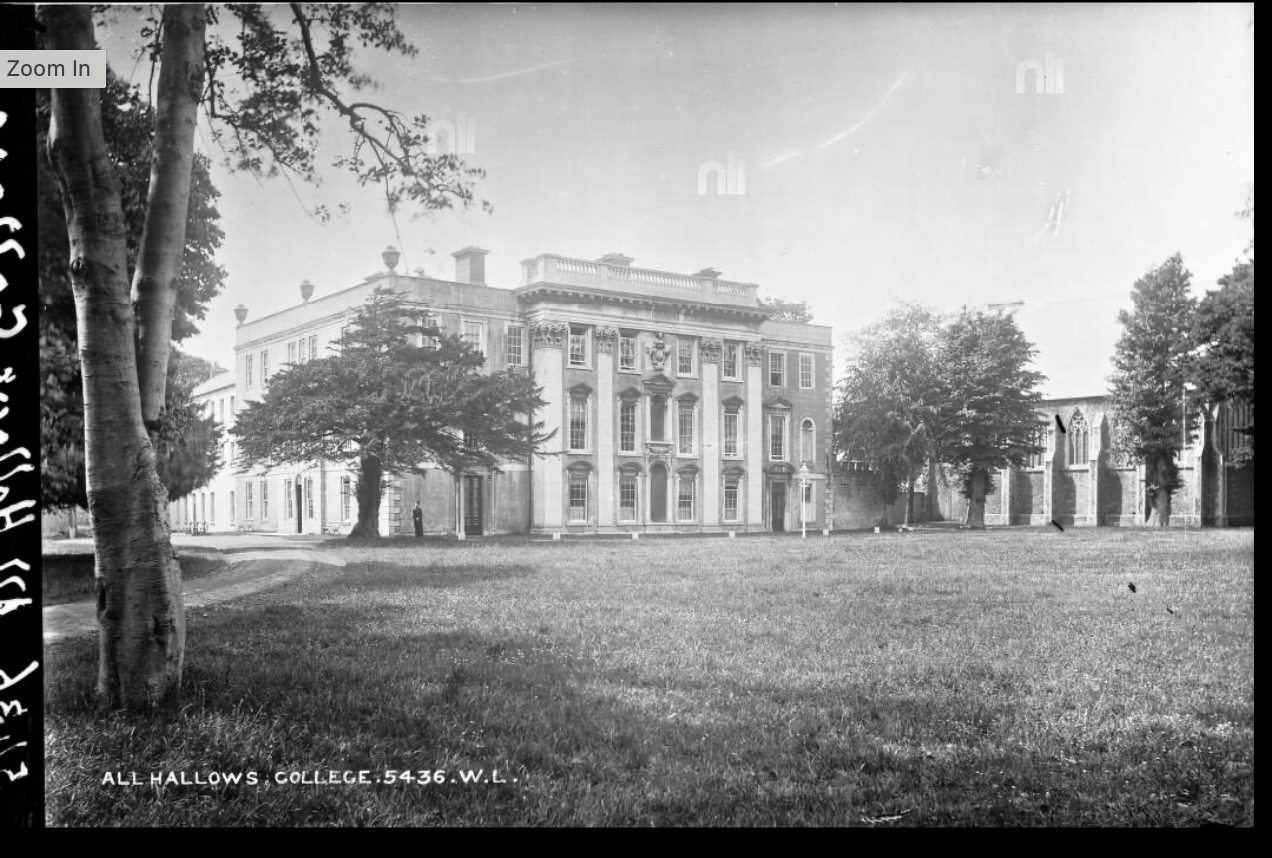
Drumcondra House, Drumcondra, Dublin – All Hallow’s College

“A very important three storey C18 house, with two adjoining fronts. The grander of these two, which has a boldly projecting central feature of giant Corinthian pillars supporting a balustraded Corinthian entablature and is richly adorned with niches, aedicules and triangular and segmental pediments over the windows and two doorways, of unknown authorship; the simpler, which is plain but for a two storey pedimented frontispiece with a pilastered Venetian window in its upper storey, by Sir Edward Lovett Pearce, his earlier recorded private house work, which he carried out 1727 for Marmaduke Coghill, MP, Chancellor of the Exchequer and Judge of the Prerogative Court. The interior, which has C18 panelling and good contemporary chimneypieces, has been altered at various times, but some of it is by Pearce. On the lawn is a temple with a pediment and Cornithian pilasters, probably by Alessandro Galilei, the Italian architect who designed the main block of Castletown, Co Kildare. Now All Hallow’s College.” [1]
Drumconora (formerly Nutfield), Ennis, Co Clare
“A handsome stone-faced mid-C18 house of three storeys over basement, attributed to Francis Bindon. Pedimented breakfront with triple window over round-headed tripartite doorway; 2 bays on either side. Quoins; string courses; window surrounds with keystones. Seat of the Crowes (see Dromore), afterwards of the O’Loghlens, the family of the eminent lawyer Sir Michael O’Loghlen who 1836 became the first Catholic to sit on the Judicial Bench in Ireland or Britain since the Revolution of 1688. Drumconora was sold by the O’Loghlens 1930s and subsequently demolished.” [1]
Drumcree House, Collinstown, Co Westmeath
Drumhierney, Co Leitrim
“A two storey six bay house with a two bay pedimented breakfront and conservatory with fluted Ionic pilasters. Now derelict.” [1]
Drumlargan, Co Meath
“A two storey double gable-ended house, probably early C18 but with C19 windows and a C19 two storey gabled projecting porch. Owned by the Bomford family until ca 1850.” [1]
Drummilly, Loughgall, County Armagh

“A plain, vaguely Georgian house with remarkable two storey elliptical structure of glass and art nouveau ironwork projecting from its centre and constituting the entrance. Elliptical windows in the upper storey of this addition.” [1]
Drumnasole House, Garronpoint, County Antrim
p. 113. “(Turnly/IFR) An early 19C house, in what was described (1845) as “a most romantic and sheltered site at the base of the perpendicular hills.” Begun sometime ante 1819 and not completed until ca 1840, built for Francis Turnly, who had been in the East India Company and spent much of his early life in China. Of basalt from the hill behind; two storey over basement, entrance front has breakfront centre with window flanked by two narrower windows above and fanlighted doorway under shallow porch of four engaged Doric columns below; one bay on either side. Side of house is five bay. Long hall with plasterwork ceiling; stairwell lit by dome.” [1]
Drumreaske House, Monaghan, co Monaghan
“A two storey C19 Tudor-revival house of the “cottage” type, with gables and decorated bargeboards.” [1]
Drumsill, County Armagh
“Owned by the MacGeough family from the C17. A house of ca 1788, remodelled by Francis Johnston, ca 1860. Sold 1916. An hotel 1957-72, when it was blown up.” [1]
Duarrigle Castle, Millstreet, Co Cork – ‘lost’

“A castellated house of early C19 appearance, consisting of 3 storey block and a two storey block with a round turret at their junction. Simple battlements; regularly disposed mullioned windows with ogival-headed lights; entrance doorway wiht ogival fanlight at the head of a flight of steps with wrought-iron railings. Hood mouldings. The seat of the Justice family, more recently of the O’Connors, maternal forebears of Mr Norman St John-Stevas, (whose mother, Mrs Stephen S Stevas, was formerly Miss Kitty St John O’Connor, of Duarrigle Castle). Now a ruin.” [1]
Duckett’s Grove, Carlow – a ruin

See my entry https://irishhistorichouses.com/2024/07/18/ducketts-grove-county-carlow-an-impressive-ruin-and-a-walled-garden/
Duckspool, Dungarvan, Co Waterford
Duleek House, Duleek, Co Meath
“A three storey pedimented cut-stone house of ca 1750, attributed to Richard Castle or his school, built for Thomas Trotter, MP. Three bay front; central breakfront with triple window above Venetian window above pedimented tripartite doorway. Balustraded roof parapet.” [1]

Dunany House, Togher, Co Louth

“A “U” shaped house with a courtyard, partly early C18, but much altered late C18 and made to look Gothic in early C19. Bolection chimneypiece in hall.” [1]

Dunboden Park, Mullingar, Co Westmeath
“A house of early to mid C19 appearance…” [1]
Dunboy Castle and Puxley Manor, Castletownberehaven, Co Cork

Under Dunboy Castle in Mark Bence-Jones:
“A castellated house of 1838 and earlier to which H.L. Puxley, owner of the Berehaven Copper Mines, added a vast new building of razor sharp ashlar 1880s; a sold, vigorous, three dimensional composition in with Ruskinian Gothic arches and windows were combined wiht the “Old English” oriels. Whilte the overall effect was High Victorian, it was not wholly uninfluenced by subsequent trends in English domestic architecture, having certain similarities to Norman Shaw’s Cragside, Northumberland. There were no battlements, but a skyline of steep and pointed roofs and tall chimneys. A high-roofed tower rose from the middle of the entrance front, and another from a corner of the front facing the water, which had an arcaded basement beneath it; at one side of the latter tower was a tremendous buttress, combined with a chimneystack. The chief feature of the interior was the series of transverse diaphragm arches spanning the hall. Burnt 1921, now a spectacular ruin.” [1]


Dunboyne Castle, Dunboyne, County Meath – accommodation

https://www.dunboynecastlehotel.com/
“This C18 house which replaced the old castle here as the seat of the Dunboynes. From its appearance, dating from two different periods, the front being later; probably inspired by Sir William Chambers’s Charlemont House in Dublin and added either by Pierce Butler, 10th Lord Dunboyne, who succeeded 1768, or by his son, 11th Baron, who died 1785. Of three storeys and seven bays, the ground floor being rusticated and treated as a basement and the first floor as a piano nobile with pediments over the windows. Tripartite pedimented and fanlighted entrance doorway; urns on parapet. Single-storey four bay rusticated wing. Good interior rococo plasterwork...” [1]
See my entry https://irishhistorichouses.com/2022/10/28/places-to-visit-and-stay-in-county-meath-leinster/
Dunbrody Park, Arthurstown, County Wexford – accommodation

“A pleasant, comfortable unassuming house of ca 1860 which from its appearance might be a C20 house of vaguely Queen Anne flavour. Two storey, five bay centre, with middle bay breaking forward and three-sided single-storey central bow; two bay projecting ends. Moderately high roof on bracket cornice; windows with cambered heads and astragals. Wyatt windows in side elevation.” [1]
See my entry https://irishhistorichouses.com/2023/11/15/places-to-visit-and-stay-in-county-wexford/
Dundalk House, Dundalk, Co Louth

“A Georgian Gothic house of two storeys, with pointed windows and a three sided bow, originally seat of the Earls of Roden, who inherited the estate from the Earls of Clanbrassill of 2nd creation; acquired C19 by the Carrolls, owners of the tobacco firm of P.J. Carroll & Co, whose factory was nearby. Demolished ca 1900 owing to its site being unhealthy, and replaced by red brick gabled house of the period, which was given to P.J. Carroll and Co for use as offices 1936.” [1]
Dundanion, Blackrock, Co Cork

“A two storey home of the Cork architect Sir Thomas Deane, who supervised its building, though it was designed by the Morrisons. Single storey Ionic portico; eaved roof.” [1]
Dundarave House, Bushmills, County Antrim

“A very fine Italianate palazzo by Charles Lanyon; built 1847 for Sir Edmond Workman-MacNaghten, 2nd Bt, to replace a castellated house which his father, Sir Francis MacNaghten, had built only ten years earlier...” [1]
Dundermot, Ballintober, Co Roscommon

“A three storey C18 double gable-ended house of three bays with two storey two bay wings almost as high as the centre. Regency ironwork porch’ ironwork balconies in front of ground floor windows of wings. Tall and massive chimneystacks on gable ends of centre block.” [1]
Dundrum House, County Tipperary – was previously a hotel
https://www.dundrumhousehotel.com

“A C18 Palladian mansion consisting of a centre block of two storeys over a high basement joined by short links to flanking wings or pavilions, very much in the style of Sir Edward Lovett Pearce: the seat of the Maude family, Viscounts Hawarden. Entrance front of seven bays, with a three-bay pedimented breakfront, links and wings of one bay each. Central, round-headed window with keystone above pedimented doorcase; similar windows on either side of door and in wings. Graceful perron in front of door with partly curving double stairs and iron railings. Oculi and camber-headed windows in basement; prominent quoins on centre block and wings. Large hall with compartmented ceiling. Impressive, double-pedimented stable block at right-angles to the entrance front.
“An extra storey, treated as an attic above the continuous cornice, was added to the centre block about 1890 by the 4th Viscount Hawarden, who was 1st and last Earl de Montalt. This did away with the pediment and spoilt the proportions of the house; making the centre block massive and ungainly, so that it dwarfs the wings. After being sold by the Maudes, the house ws for many years a convent; but it is now in private occupation once more.” [1]
Dundullerick, Lisgoold, Co Cork
“A Georgian house consisting of a two storey three bay centre with single storey two bay wings.” [1]
Duneske, Cahir, Co Tipperary
“A three storey asymmetrical Victorian house with a high roof and some gables; built ca 1870 for R.W. Smith to the design of Sir Thomas Drew. Plate glass windows, bows in various places. Porch with sinuous, rather art-nouveau style decoration in stucco…” [1]

Dungar, Coolderry, Co Offaly

“A two storey C19 house with a front and side elevation of three bays, the centre bay of the front being recessed, and that of the side breaking forwards. Porch and arches and rusticated piers; single-storey curved bow in centre of side elevation; prominent quoins; entabaltures over ground floor windows; eaved roof on bracket cornice.” [1]
Dungiven Castle, Dungiven, County Derry
“A C19 castle with a long two storey battlemented front, having a central polygon tower with a pointed Gothic doorway and a pointed window over, and a round tower at each end. Five bays on either side of centre.” [1]
Dunguaire Castle (or Dungory), near Kinvara, County Clare

See my entry https://irishhistorichouses.com/2025/07/05/dunguaire-castle-kinvara-county-clare-open-to-the-public/
Duninga, Goresbridge, Co Kilkenny

“A house with a three storey centre and two storey projecting wings, joined by a Doric colonnade.” [1]
Dunkathel House (or Dunkettle), Glanmire, Cork

“A house in the Palladian manner, consisting of a two storey nine bay centre block joined by screen walls with rusticated niches to office wings extending back; the front ends of the wings being treated as two storey two bay pavilions with oculi in their upper storey. The front of the centre block has quoins at its sides and framing a three bay breakfront; a solid roof parapet and fanlighted doorcase with an entablature and engaged Tuscan columns.…” [1]
Dunleckney Manor, Bagnelstown, Co Carlow

p. 116. “(Newton, sub Bagenal/IFR; Vesey sub de Vesci, V/PB) A C19 Tudor-Gothic house by Daniel Robertson, of Kilkenny. Built ca 1850 for Walter Newton, who inherited the estate from his mother, the heiress of the Bagenal family of Dunleckney. Faced in smooth limestone ashlar; steep gables and overhanding oriels; a slender polygonal corner turret decorated with panels of miniature tracery in the manner of English Perpendicular architecture; similar ornament on the bow of the garden front. Interior has plaster fan vaulting. Elaborately carved staircase of wood...” [1]


Dunluce Castle, County Antrim – heritage visitor site

See my entry https://irishhistorichouses.com/2024/07/04/dunluce-castle-ruin-county-antrim-northern-ireland/
The Manor House, Dunmanway, Co Cork

p. 116. “Cox, sub Villiers-Stuart/LGI1912; Lucas/IFR) A two storey three bay house of 1819, with Wyatt windows and an enclosed porch.” [1]
Dunmore, Carrigans, Co Donegal – accommodation

See my entry https://irishhistorichouses.com/2022/10/27/places-to-visit-and-stay-in-county-donegal-ulster/
Dunmore House, Dunmore, County Galway
p. 116. (Shee, Bt/PB1869; Dering, Bt/PB) “A late C18 house of three storeys over a basement, incorporating an earlier house. Three bay bow-ended entrance front, with one bay central breakfront. Wide fanlighted doorway.” [1]
Dunmore House (also known as Dunmore Palace), Kilkenny, Co Kilkenny, now Dunmore Cottage

p. 116. “(Butler, Ormonde, MPB) A C17 red brick house on a palatial scale built post Restoration by Duchess of Ormonde, wife of the great Duke. Its chief interior feature was a staircase of carved wood, “so large the twenty men might walk abreast.” The Duchess also laid out elaborate gardens here. When the Duke was showing some people his improvements at Kilkenny Castle, one of them said: “Your Grace has done much here,” to which he replied “Yes, and there the Duchess has Dunmore; and if she does any more, I shall be undone.” The house was neglected and eventually demolished during C18.” [1]
Dunmore, Durrow, County Laois

“An early Georgian house of brick, plastered over, consisting of a three storey five bay gable-ended centre block with two storey projecting wings...” [1]
Dunnstown, Co Kildare
p. 116. “A two storey pedimented C18 house flanked by two free-standing wings with small pediments. The pediment of the main block was made into a barge-boarded gable C19.” [1]
Dunore House, Aldergrove, County Antrim
p. 117. “The only full-blown country house example in Ireland of the Eyptian taste; and a rather late example, having been built post 1857. Of smooth rusticated granite’ the doorcase being composed of four tems with Pharoahs’ heads, originally surrounded by hieroglyphics; the pediment being topped with an obelisk.” [1]
Dunsandle Castle, Co Galway – ‘lost’

p. 116. (Daly/IFR) A large plain mid to late C18 Palladian house, until recently the finest house in Co Galway, very tentatively attributed by the Knight of Glin to David Duckart. Built for Rt Hon Denis Daly MP… Sold ca 1954 by Major Bowes Daly; subsequently demolished.”

Dunsany Castle, Dunsany, Co Meath section 482 in 2019

“A castle founded ca 1200 by Hugh de Lacy; and which, in 1403, passed by marriage, along with the neighbouring castle of Killeen, to Sir Christopher Plunkett; who left Killeen to his eldest son, ancester of the Earls of Fingall, and Dunsany to his second son, 1st Baron of Dunsany. The castle eventually consisted of two tall blocks, each with a pair of square corner-towers, joined by a hall range so as to enclose a shallow three sided court. The 13th Lord Dunsany restored and modernised the old castle in the 1780s, filling in the old court between the projecting tower blocks to form a spacious staircase hall, putting in pointed Georgian-Gothic windows and decorating the principle rooms in the fashionable style of the period. 14th Lord Dunsany carried out various additions and alterations to the castle around 1840, which can be safely attributed to James Shiel, who was working at the nearby Killeen Castle at that time. Shiel replaced the Georgian-Gothic windows on the entrance front and at the end of the castle with tracery and mullioned windows; but he was much more sparing with his medievalism here than he was at Killeen; so that the old grey castle with its square towers keeps all the character and atmosphere of a house that has grown through the ages, rather than looking merely like a castle of the 19th century…” [1]
Dunsland, Glanmire, Co Cork – ‘lost’
p. 117. “(Pike;LGI1958) A late-Victorian house with an eaved roof, half-timbered gables and pediments and entablatures over the ground floor windows. Home of Joseph Pike, burnt 1920.” [1]
Dunsoghly Castle, Finglas, Co Dublin

p. 117. “(Dunne/LGI1912) A C15 castle built by Thomas Plunkett, Chief Justice of the King’s Bench; consisting of a tall four storey tower with tapering corner-turrets rising above the parapet of the centre block. At one side of the tower is a detached chapel, built 1573 by Sir John Plunkett, Chief Justice of the Queen’s Bench, and his third wife, Genet Sarsfield. The lowest storey of the tower is vaulted, those above it had timber floors. The castle still keeps its original roof, with massive oak timbers...” [1]
Durrow Abbey, Tullamore, Offaly

p. 117. “(Graham-Toler, Norbury, E/PB; Slazenger, sub Powerscourt, V/PB) Originally a plain three storey 7 bay C18 house with a pillared porch; replaced ca 1837 by a Tudor-Gothic house built for 2nd Earl of Norbury, who was murdered here 1839. The house now consists of two two storey ranges at right angles to each other, one of them standing on slightly lower ground, with a small battlemented tower at their junction. The higher range has a central projecting porch-gable, with a corbelled oriel over the entrance door, and a slightly stepped gable at each end. There are tall Tudor-style chimneys and a few pinnacles. The house was rebuilt in the same style 1924. Nearby is the site of an ancient abbey, with a fine C10 High Cross...” [1]
Dysart, Delvin, Co Westmeath
[1] Mark Bence-Jones. A Guide to Irish Country Houses (originally published as Burke’s Guide to Country Houses volume 1 Ireland by Burke’s Peerage Ltd. 1978); Revised edition 1988 Constable and Company Ltd, London.
 Irish Historic Houses