As you can see as I work my way though the contents of Mark Bence-Jones’s A Guide to Irish Country Houses [1], there are thousands of “big houses” in Ireland – though many are “houses of middle size.”
Note that the majority of these are private houses, not open to the public. I discovered “my bible” of big houses by Mark Bence-Jones only after I began this project of visiting historic houses that have days that they are open to the public (Section 482 properties).
This is a project I have been working on for a while, collecting pictures of houses. Enjoy! Feel free to contact me to send me better photographs if you have them! I’ll be adding letters as I go…
[1] Mark Bence-Jones. A Guide to Irish Country Houses (originally published as Burke’s Guide to Country Houses volume 1 Ireland by Burke’s Peerage Ltd. 1978); Revised edition 1988 Constable and Company Ltd, London.

Donation
Help me to fund my creation and update of this website. It is created purely out of love for the subject and I receive no payment so any donation is appreciated! My website costs €300 per year on WordPress.
€15.00
Eastgrove, Cobh, Co Cork

p. 118. “(Bagwell/IFR; Jenkinson, B/PB) An early C19 house in the “Cottage Gothic” style overlooking East Ferry, a heavily-wooded backwater of Cork Harbour; built by Dorcas (nee Bagwell), wife of Benjamin Bousfield, on land which had belonged to her mother’s family, the Harpers of Belgrove. Shallow gables with bargeboards; trellised iron verandah on front overlooking Ferry. A polygonal tower, with an eaved roof, was subsequently added at one end of the house and known as Wellington Tower. It contains a large and impressive dining room with curved walls. There is also a large and handsome drawing room. At one side of the house is a range of castellated outbuildings, with a slender tower like a folly; there is another tower in the woods...” [1]
Ecclesville, Fintona, County Tyrone
p. 118. “(Eccles, sub McClintock/LGI1912; Lecky-Browne-Lecky, sub Browne, IFR) A plain late-Georgian house… Now a home for the elderly.” [1]
Echlinville House (afterwards Rubane House), Kircubbin, County Down
p. 118. “(Echlin/LGI1912) An early to mid-C18 house, largely rebuilt 1850; but the library, a four bay pavilion with Ionic pilasters and Gothic astragals in its windows, survives from the earlier house; inside is a vaulted ceiling with two floating domes. In the grounds there is a small Classical bridge and a pebble house with pinnacles. Subsequently the seat of a branch of the Cleland family, its name being changed to Rubane House.” [1]
Eden Vale, Ennis, Co Clare

p. 118. “[Stacpoole/IFR] A C18 house, enlarged and embellished during 2nd half of C19 by Richard Stacpoole. Irregular entrance front with three bays on one side of tower-like central feature, and four bays on the other. Porch with pilasters and pierced parapet. At the end of the house are two Venetian windows, one on top of the other. Sold ca. 1930; now an old peoples’ home.” [1] It is no longer an old peoples’ home.
Edenfel, Omagh, County Tyrone
p. 118. “(Buchanan, sub Hammond-Smith/IFR) A Victorian house with gables and bargeboards…” [1]
Edenmore, Stranorlar, Co Donegal

p. 118. “(Cochrane/IFR) A two storey gable-ended late C18 house. Front with three sided central bow and one bay on either side of it. The house is flanked by detached office wings running back, one much longer than the other; the front ends of these wings have three sided bows, matching the bow in the centre of the house; they are linked to the house by walls, forming one long elevation...” [1]
Edermine House, Enniscorthy, County Wexford


p. 118. “(Power, sub O’Reilly/IFR) A two storey Italianate villa by John B. Keane, built ca 1839 for the Powers, owners of the firm of John Power & Son, Distillers, of Dublin. Eaved roof on bracket cornice; three bay front with pillared porch, and triangular pediments over downstairs windows. Five bay side elevation, with a central Venetian window recessed in a giant blind arch. Grecian interior, fluted Doric columns in hall, paired Ionic columns and pilasters on staircase landing. A Gothic chapel was subseqnetnly built at one side of the house to the design of A.W. Pugin, a family friend; it was originally free-standing, but was afterwards joined to the house by an addition at the bck which includes a small Italianate campanile. At right angles to the chapel, a magnificent early Victorian iron conservatory, gracefully curving in the Crystal Palace manner, was built; probably by the Malcolmson Works in Waterford, or the Hammersmith Iron Works in Dublin; it is joined to the corner of the chapel by a cast iron verandah.” [1]
Edgeworthstown House, Edgeworthstown, County Longford – nursing home
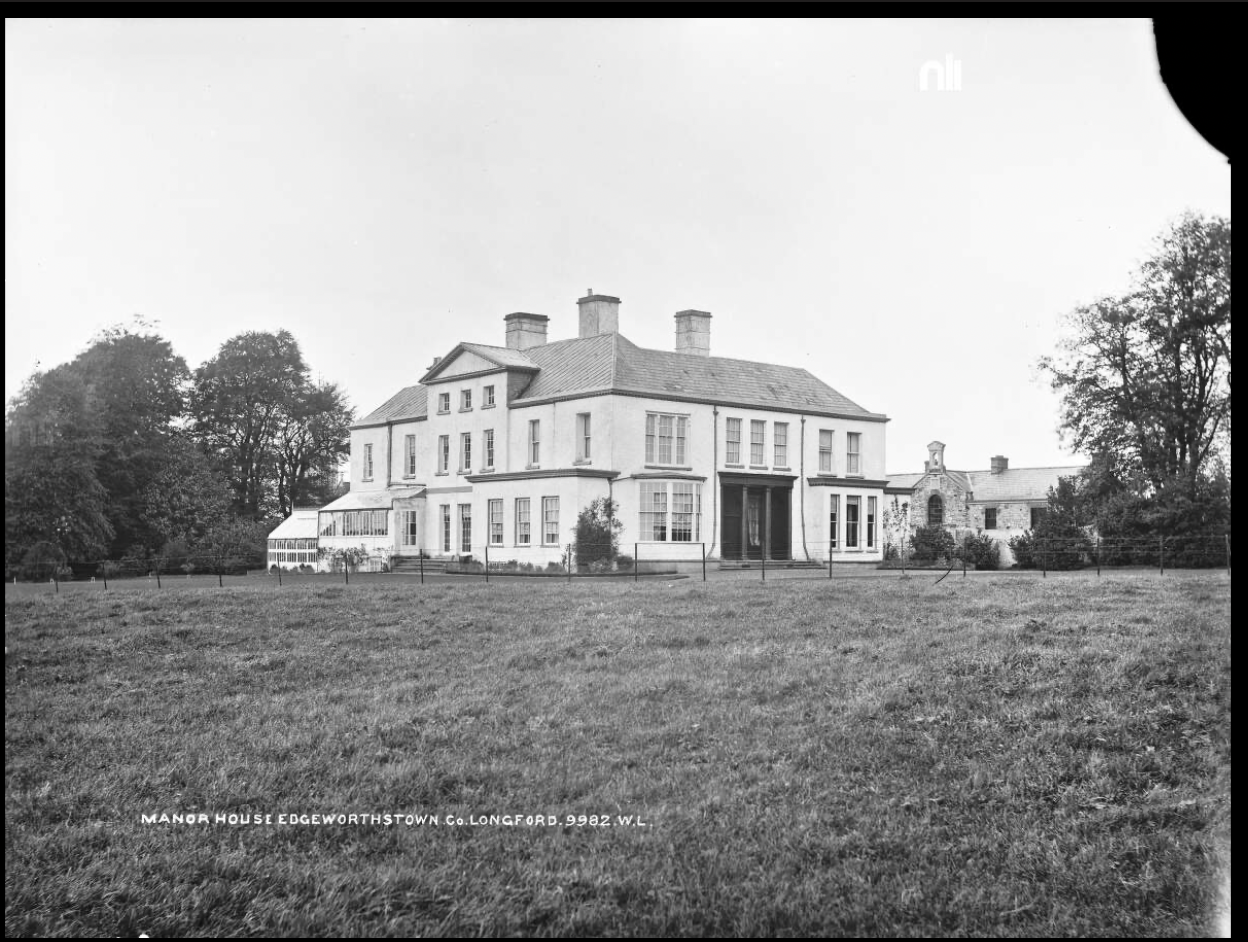
p. 118. “(Edgeworth/LGI1912; Montagu, sub Manchester, D/PB) An early 18th century house built by Richard Edgeworth MP, with small windows, low, wainscoted rooms and heavy cornices; much enlarged and modernized after 1770 by Richard Lovell Edgeworth, the inventor, writer on education and improving landlord, father of Maria Edgeworth, the novelist.
It comprises two storeys over a basement, with two adjoining fronts; prominent roof and dentil cornice. The entrance front has three bays between two triple windows in the upper storey, with doorway in a pillared recess between two shallow single-storey curved bows below; in the Victorian period, the right-hand triple window was replaced by two windos and the right hand bow by a rectangular single-storey projection. Adjoining front has a three-bay breakfront which rises above the roofline as a pedimented attic, and two bays either side. On the ground floor, Richard Lovell edgworth enlarged the rooms by throwing them into single-storey three bay rectangular projections, linked in the centre by an arcaded loggia; in the Victorian period one of the projections was replaced by a glass lean-to conservatory, and the loggia was removed. Curved top-lit staircase in centre of house.
In Richard Lovell Edgeworth’s time, the house was full of labour-saving devices: sideboards with wheels, pegs for footwear in hall, leather straps to prevent doors banging, a water pump which automatically dispensed 1/2d to beggars for each half-hour that they worked it. Inherited 1926 by Mrs. C.F. Montagu (nee Sanderson) whose mother was an Edgeworth; sold by her to Mr Bernard Noonan, who bequeathed it to an order of nuns, by whom it is used as a nursing home; the exterior of the house being much altered, and the interior gutted and rebuilt.” [1]
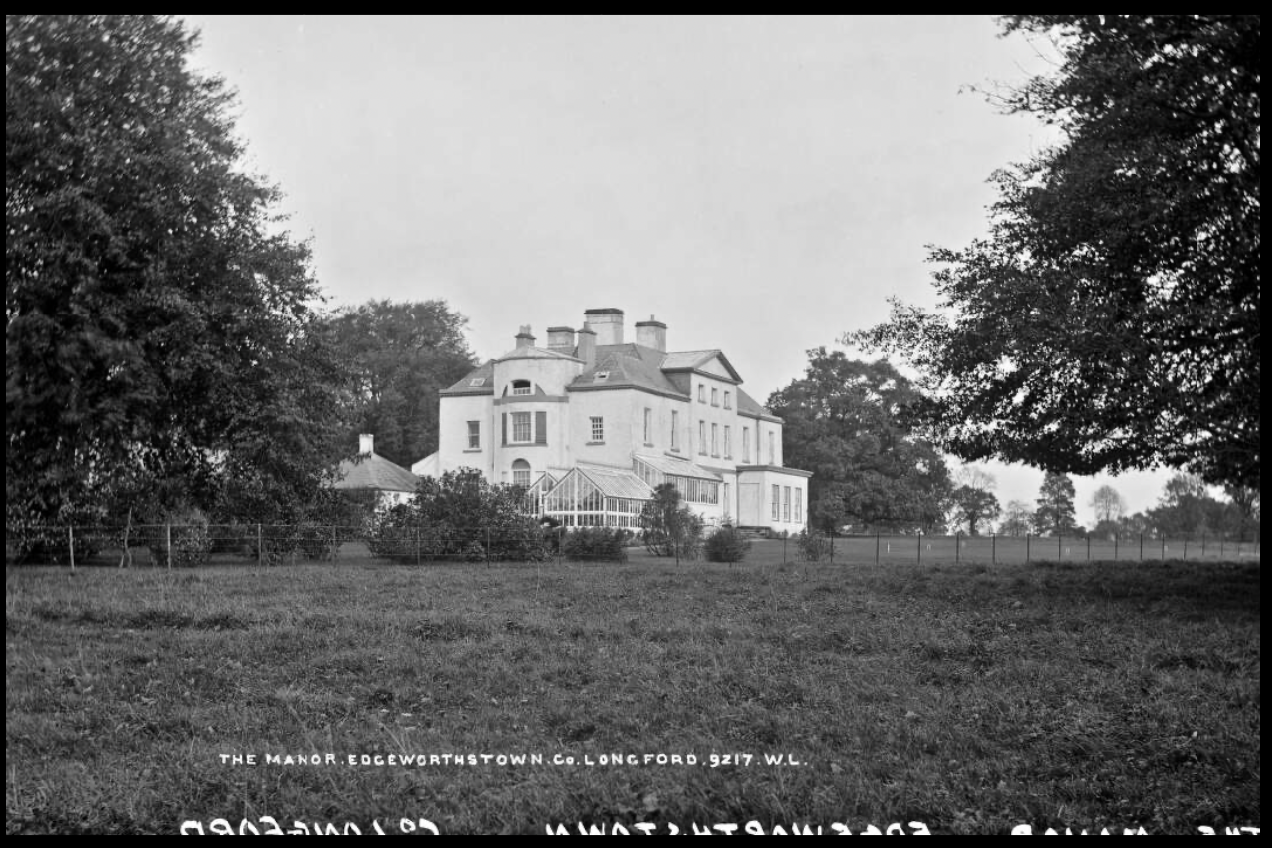

Edgeworthstown Rectory, Edgeworthstown, County Longford

p. 119. P. 119. “(Edgeworth/LGI1958) A two storey three bay gable-ended early C18 house. The birthplace of Henry Essex Edgeworth, better known as Abbe Edgeworth de Fermont, who attended Louis XVI to the scaffold.” [1]
Edmondsbury, (formerly Newtown), Co Laois

p. 119. “(Butler, now Butler-Bloss/IFR) A house probably built by Edmond Butler soon after 1734. Good chimneypiece in hall. Sold 1910.” [1]
Edmondstown (Bishop’s Palace), Ballaghaderreen, Co Roscommon

p. 119. “A high Victorian house of stone with brick polychromy; pointed windows, pyramidal roofed turret.” [1]
Eglantine, Hillsborough, County Down
“(Mulholland, sub Dunleath, B/PB) A nineteenth century house with a remarkable double-ramped staircase.” [1]
Eglington Manor House, County Derry

p. 119. Eglinton, Manor House, County Derry: “(Davidson/IFR) A two storey late-Georgian house with an eaved roof and a fanlighted doorway, built by the London Company of Grocers, who owned and developed the village of Eglinton. Bought by James Davidson ca. 1840, and subsequently enlarged by the addition of a battlemented wing, with a snall battlemented turret at the junction of the wing and the original house. The wing and turret have large vemiculated quoins; and the original house has similar quoins.” [1]
Eglish Castle, Birr, County Offaly – a ruin

p. 119. “A two storey house with a pediment.” [1]
Elm Hill, Ardagh, Co Limerick

p. 119. “(Studdert/IFR) A weather slated C18 house of two storeys over a high basement. Six bay front; pedimented doorway with sidelights. Archway of curving Baroque shape, the main arch being surmounted by a round-headed opening, at side of house, leading to yard.” [1]
Elm Park, Farran, Co Cork
p. 119. “(Ashe, sub Woodley/IFR) A two storey five bay early C19 house, the two left-hand bays of the front projecting forwards, with a glazed pilastered porch in the angle thus formed. The other end of the house is slightly curved. Eaved roof...” [1]
Elm Park, Clarina, Co Cork – demolished
p. 119. “(Massy, Clarina, B/PB1949) An irregular early C19 cut-stone castellated house, mostly of two storeys over a basement; with round and square towers… Now demolished, except for the gate arch.” [1]
The Elms, Portarlington, Co Laois

p. 119. “(Stannus/IFR) A Georgian house consisting of a gable-ended centre of three storeys over a basement, with lower symmetrical wings. The centre with a three bay front and large fanlighted staircase window not centrally placed in its rear elevation. The home of Lt-Col T.R.A. Stannus, father of Dame Ninette de Valois, the ballerina and choreographer.” [1]
Ely Lodge, Castle Hume, County Fermanagh

p. 119. “(on the same estate as Castle Hume) (Hume, Bt/EDB; Loftus, Ely, M/PB; Grosvenor, Westminster, D/PB) Richard Castle built his first Irish Palladian house here for Sir Gustavus Hume, Bt, MP 1729; it was named Castle Hume. Fine stable-court, with rusticated openings, some of them surmounted by oculi, and an interior of vaults supported by Doric columns, as at Strokestown. The estate subsequently passed to the Ely family though the marriage of the Hume heiress to Nicholas Loftus, afterwards 1st Earl of Ely. In 1830s a new house was built a couple of miles away, on a promontory in Lough Erne, by [John Loftus (1770-1845)] 2nd Marquess of Ely, and named Ely Lodge; to provide stone for it, the main block of Castle Hume was demolished, so that only the stable-court remains. Ely Lodge, which was to the design of William Farrell, consisted of a two storey five bay gable-ended block with Doric pilasters along its whole front and a Doric porch, the gable-ends being treated as pediments; at one end was a single-storey wing set back, with corner-pilasters and a curved pilastered bow in its side elevation. In 1870, Ely Lodge was blow up as part of 21st birthday celebrations of the 4th Marquess, who intended to build a new house; it is also said that he blew the house up in order to avoid having Queen Victoria stay. In the event, the new house was never built, doubtless for the reason that the young Lord Ely spent too much money on rebuilding his other seat, Loftus Hall, County Wexford. The former stables at Ely Lodge have since been extended to form a house, which is the Irish seat of the Duke of Westminster; it contains a number of interior features of the now demolished Eaton Hall, Cheshire.” [1]
Emell Castle, Moneygall, County Offaly

p. 119. “(Stoney/IFR) A large C16 tower-house of the O’Carrolls, with a gable-ended C18 house of two storeys over a basement and five bays built onto the front of it. Fanlighted doorway. The C18 addition was almost certainly built by Captain Robert Johnstone, who bought the property 1782 and left it at his death 1803 to his nephew, Thomas Stoney. Some work was carried out on both the tower and the house during C19, without altering the original character of either.” [1]
Emo Court, (also known as Emo Park), Portarlington, County Laois – OPW

See my entry https://irishhistorichouses.com/2024/10/22/emo-court-county-laois-office-of-public-works/
Emsworth, Malahide, County Dublin

p. 121. “The only one of James Gandon’s villas to survive intact; built ca. 1790 for J. Woodmason, a Dublin wholesale stationer. A pediment extends over the whole length of the two storey three bay centre, which is flanked by single storey one bay overlapping wings. Fanlighted doorway under porch of engaged Doric columns and engablature; ground floor windows of centre, and windows of wings, set in arched recesses. Chimney urns on wings.…” [1]
Enniscoe House, Co Mayo – section 482 plus accommodation

See my entry https://irishhistorichouses.com/2021/11/25/enniscoe-house-gardens-castlehill-ballina-co-mayo/
Enniscorthy Castle, Wexford – open to visitors

See my entry https://irishhistorichouses.com/2023/11/15/places-to-visit-and-stay-in-county-wexford/
Enniskillen Castle, County Fermanagh

See my entry https://irishhistorichouses.com/2022/04/03/places-to-visit-and-stay-in-ulster-counties-fermanagh-monaghan-and-tyrone/
Ennismore, Cork, Co Cork – owned by religious order
“(Leycester/LG1952) An early C19 single-storey “villa in the cottage style” with wrought iron verandahs, facing down the Lee estuary. Long and wide hall, running through the middle of the house; large and lofty reception rooms, which formerly contained a notable collection of pictures. Sold ca 1952, now owned by a religious order.” [1]
Ennistymon House, Ennistymon, Co. Clare, now part of the Falls Hotel


See my entry https://irishhistorichouses.com/2023/01/20/places-to-visit-and-stay-in-county-clare/
Erindale, Carlow, Co Carlow

p. 121. “(Vigors/LGI1912; Alexander/IFR) A remarkable two storey red-brick house of ca 1800, with a Gothic flavour and an ingenious plan made up of curved bows; so that one of the two bows on the entrance front serves as one of the end-bows of the adjoining elevation, which itself has a single centre bow. The windows in the entrance front are pointed; first floor centre window, and also two cntre ground-floor windows of the bows, being Venetian windows made Gothic. There is a very large semi-circular fanlight extending over the door and side-lights, with elaborate fancy glazing whith Dr Craig considers to be original. Wide eaved roof.” [1]
Errew Grange, Crossmolina, Co Mayo

p. 122. “(Knox) A large plain Victorian Gothic house on a peninsula jutting out into Lough Conn; rather similar to Mount Falcon, and, like it, probably by James Franklin Fuller; built ca 1870s. Became a hotel and gutted by fire 1930s, recently half rebuilt, also as an hotel.” [1]
Esker House, Lucan, Co Dublin – gone
p. 122. “A two storey Georgian house with a five bay centre and two sided bow at either side, the bows being of the same height as the centre, but with their upper storey windows close to the cornice so as to make the ground floor look higher. Small porch….” [1]
Eureka House, Townparks, Co Meath
Everton House, Crockaun, Co Laois

p. 122. “ A two storey C18 house with front consisting of two deep curved bows separated by one bay with a fanlighted doorway; with an additional bay to the left of the left-hand bow and a curved end-bow. Later two storey wing prolonging the front to the right of the right-handed bow...” [1]
Evington House, Carlow, Co Carlow

p. 122. “A two storey three bay late-Georgian house with an eaved roof. Doorway with large fanlights extending over door and sidelights.” [1]
Eyrecourt, Co Galway – ‘lost’

p. 122. “Eyre/IFR) One of the only two important mid-C17 Irish country houses to survive intact into the present century, the other being Beaulieu, Co Louth. Built 1660s; of brick faced with rendered rubble. Of two storeys, with a dormered attic in the high, wide-eaved sprocketed roof; seven bay entrance front, with three bay pedimented breakfront centre; six bay side. Massive wooden modillion cornice. Splendid if somewhat bucolic doorcase of wood, with Corinthian pilasters, an over-wide entablature, carved scrolls, a mask and an elliptical light over the door surrounded by a frame of foliage. Windows with C18 Gothic glazing. Richly decorated interior. Hall divided by screen of arches and primitive wooden Corinthian columns from vast and magnificent carved oak staircase with two lower ramps adn a single central return leading up to a landing with elaborately moulded panelling and a plasterwork ceiling… staircase went to Detroit Institute of Arts, having been removed there after the house was left to decay from 1920 onwards, since when it has fallen into ruin.” [1]
[1] Mark Bence-Jones. A Guide to Irish Country Houses (originally published as Burke’s Guide to Country Houses volume 1 Ireland by Burke’s Peerage Ltd. 1978); Revised edition 1988 Constable and Company Ltd, London.
 Irish Historic Houses