Castle Saunderson, Co. Cavan – a ruin
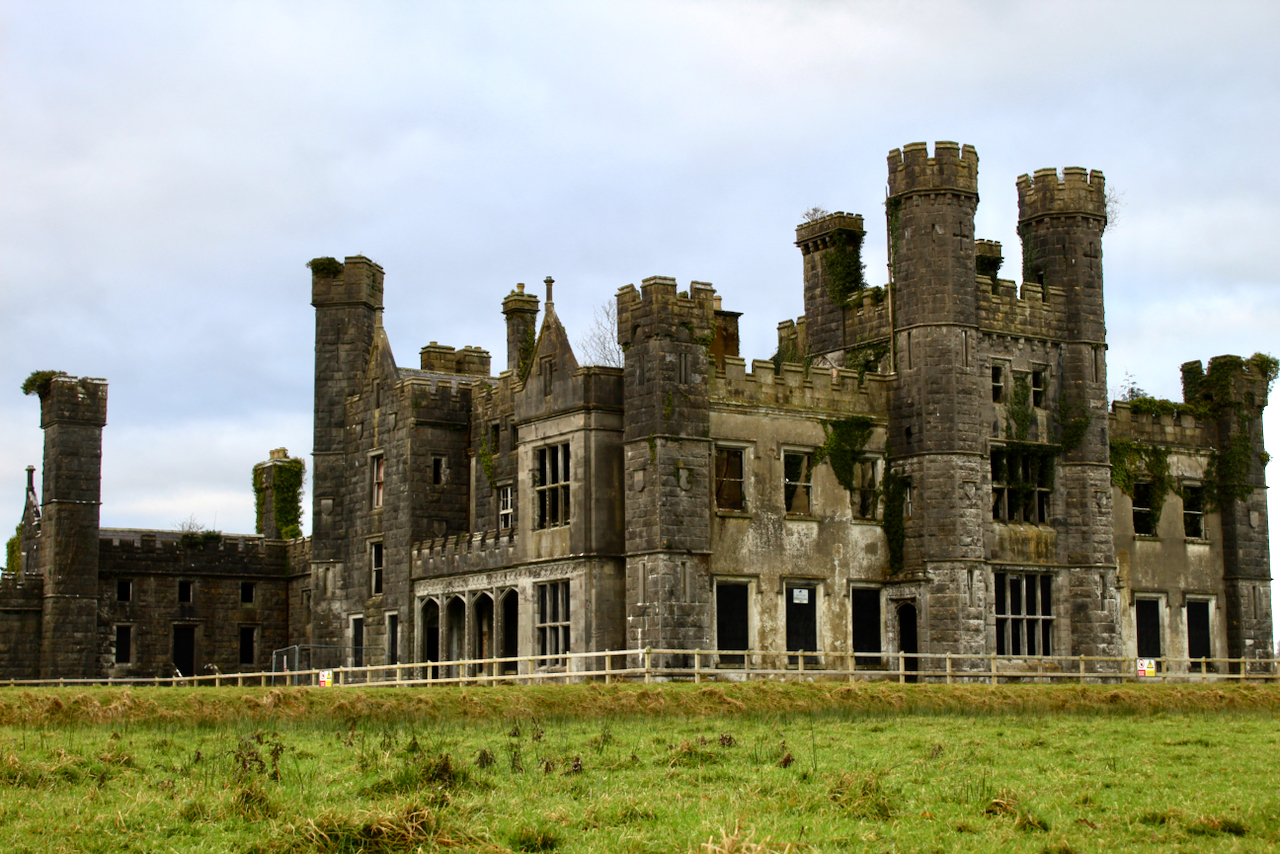
This property is not listed on the Section 482 Revenue list but is open to the public to visit, although at a distance, due to safety considerations. We visited in December 2020. Nearby, a World Peace Centre for the Scouts has been established. The castle was destroyed by fire in 1990.
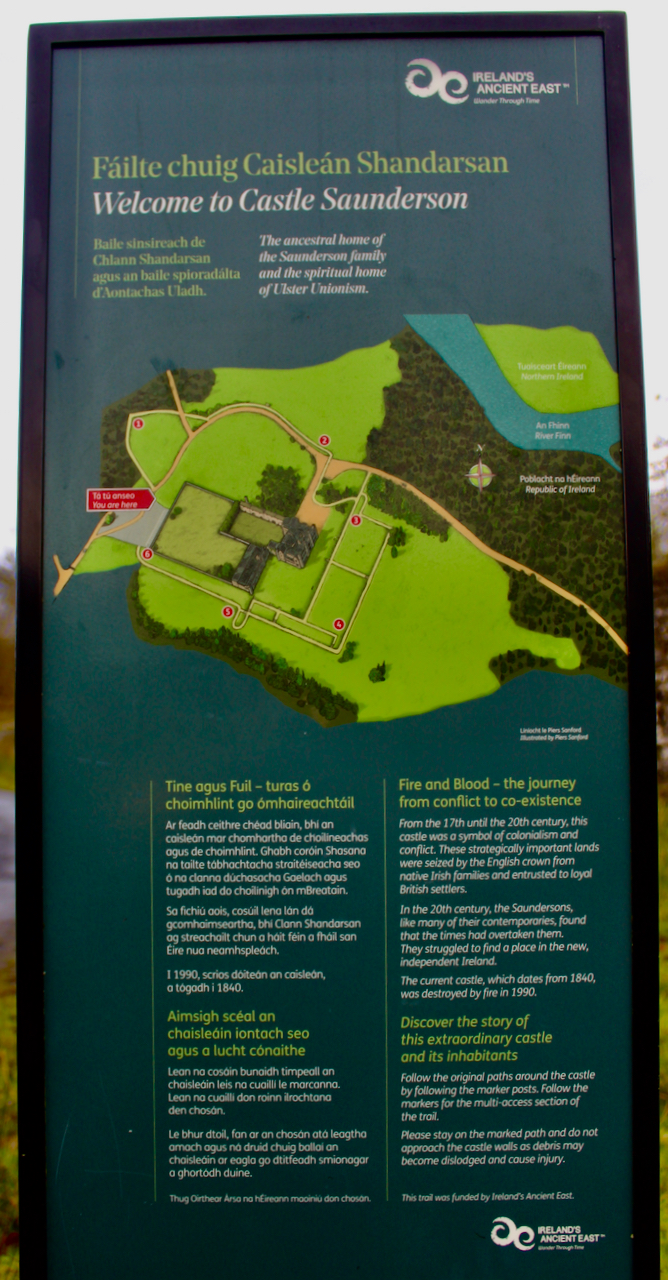
https://www.thisiscavan.ie/fun/article/luanch-of-new-heritage-trail-at-castle-saunderson
Mark Bence-Jones writes in his A Guide to Irish Country Houses (1988) that it’s a large castellated mansion combining both baronial and Tudor-Revival elements, built around 1840. He likens the style to that of Crom Castle, attributed to Edward Blore, which is only about five miles away in County Fermanagh. [1] The National Inventory tells us that the work on Castle Saunderson was carried out by George Sudden, but he may have worked according to designs by Blore.

The Dictionary of Irish Architects tells us that Edward Blore (1787-1879), from London, designed Crom Castle in County Fermanagh from 1833-41, Ballydrain in County Antrim in 1837-8, additions at Castle Upton, County Antrim in 1836-7, and proposed the addition of a tower at Mallow Castle, County Cork in 1837. [2]
The Dictionary of Irish Biography tells us that George Sudden was Clerk of works, architect and stonemason, active in Counties Fermanagh and Monaghan in the 1830s and 1840s. In 1830 when Crom Castle, newly completed to designs by Edward Blore, was destroyed by fire, John Creighton appointed Sudden to rebuild the house to Blore’s specifications. [3]
The National Inventory of Architectural Heritage tells us that Castle Saunderson was built around 1835.
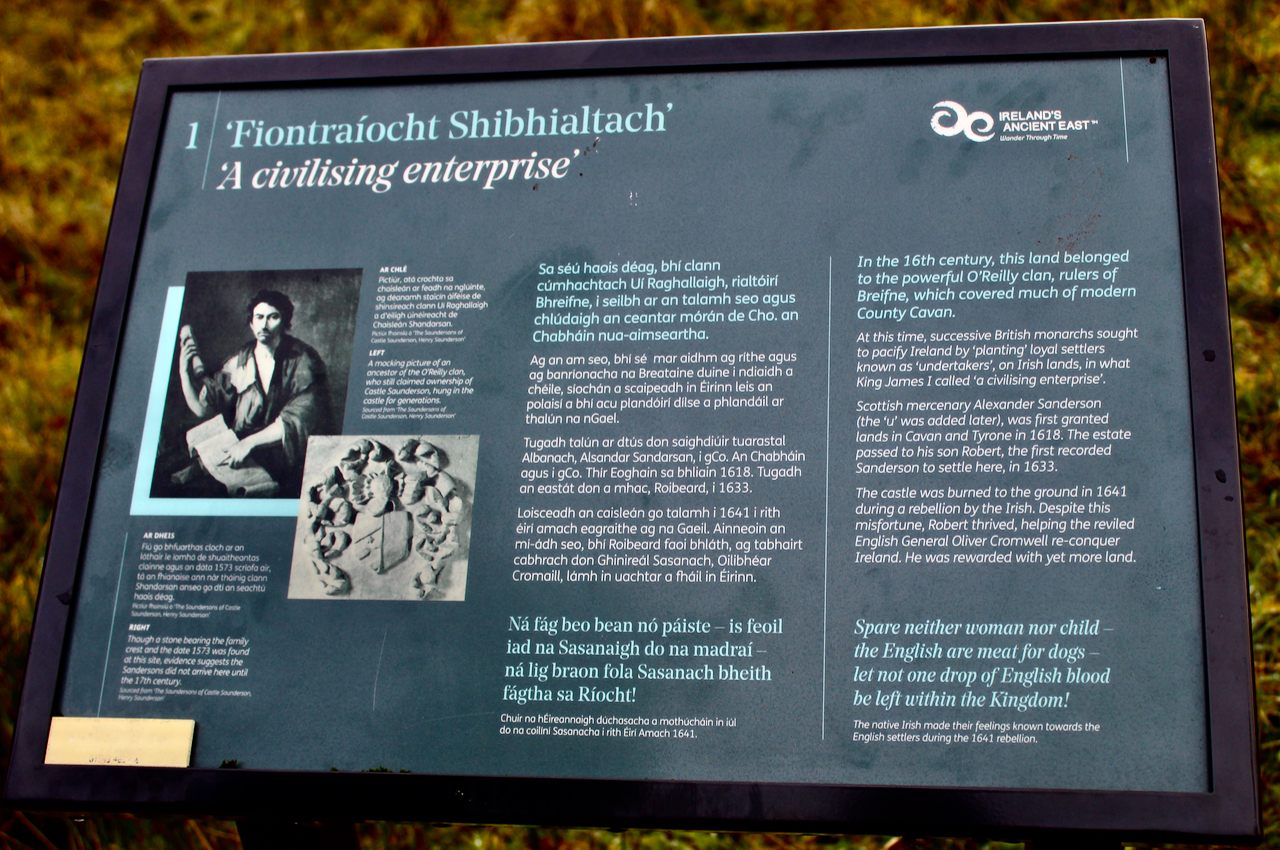
An information board tells us that the land belonged to the O’Reilly clan, rulers of Breifne, in the 16th century. Breifne covered much of modern County Cavan. Scottish mercenatry Alexander Sanderson (the ‘u’ was added later), was first granted lands in Cavan and Tyrone in 1618. He served as High Sheriff for County Tyrone.
The estate passed to his son Robert (c1602-c1676), the first recorded Sanderson to live here, in 1633. The castle that was there at that time was burned to the ground in 1641 during the Rebellion.
Robert Sanderson was a colonel in the army of Gustavus Adolphus of Sweden. He served in Oliver Cromwell’s army, and was awarded with more land. [4] Another residence must have been built at the site: the Landed Estates database tells us that Robert Sanderson built Castle Sanderson near Belturbet in county Cavan in the mid-17th century.
Robert’s son, also named Robert (1653-1724), served as MP for County Cavan, and was a colonel of a regiment in William III’s army. He married Jane Leslie, daughter of the Right Rev John Leslie, Lord Bishop of Clogher, “The Fighting Bishop” (see my entry for Castle Leslie https://irishhistorichouses.com/2020/08/07/castle-leslie-glaslough-county-monaghan/ ). His heir to Castle Saunderson was his nephew, Alexander Sanderson. Alexander served as High Sheriff of County Cavan in 1714, and wedded Mabella, daughter of William Saunderson, of Moycashel, County Westmeath. He was buried at St Mary’s in Dublin in 1726 and was succeeded at Castle Saunderson by his son Francis (d. 1746). (see [4])
Francis served as High Sheriff of County Cavan in 1740 and espoused Anne, eldest daughter of Anthony Atkinson of Cangort, County Offaly. Francis died in 1746 and it was his son, Alexander, who changed the spelling of his name to Saunderson. (see [4])
Alexander married Rose Lloyd, daughter of Trevor Lloyd of Gloster in County Offaly, a section 482 property in 2025. Alexander Saunderson also served as High Sheriff for County Cavan.
The National Inventory tells us that the Castle Saunderson that we see today incorporates fabric of an older residence, a Georgian house dating from around 1780. This house may have been built by Alexander and Rose’s son and heir Francis Saunderson (1754-1827). He also served as High Sheriff for County Cavan, and he married Anne Bassett, daughter of Stephen White, of Miskin, Glamorgan, and heir of the Bassett estates in that county. (see [4])
It was then Francis and Anne’s son and heir, Alexander (1783-1857) who probably built the current Tudor-Gothic version of the castle around 1835.

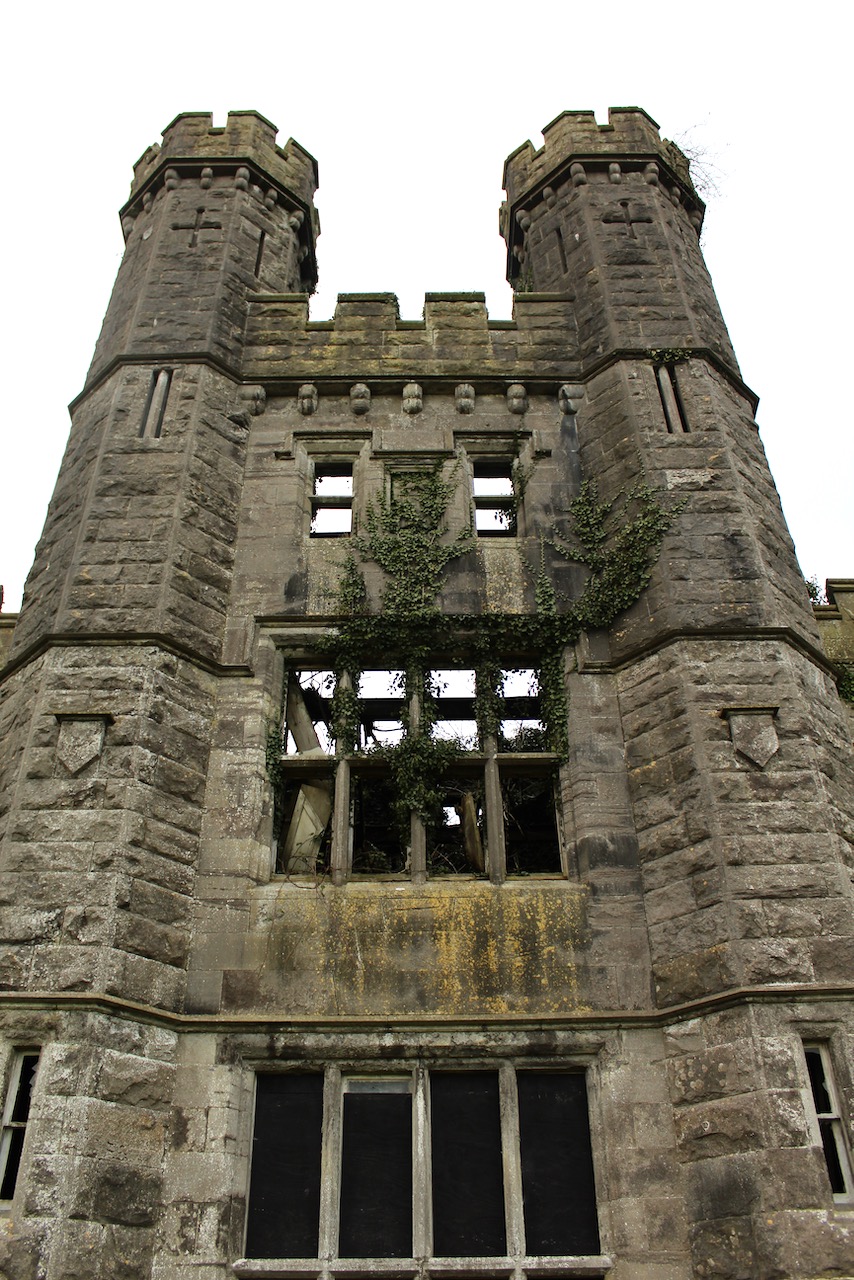
Mark Bence-Jones describes:
p. 75. “Entrance front symmetrical, with a battlemented parapet, square end turrets and a tall central gatehouse tower which is unusual in having the entrance door in its side rather than in its front.” [1]
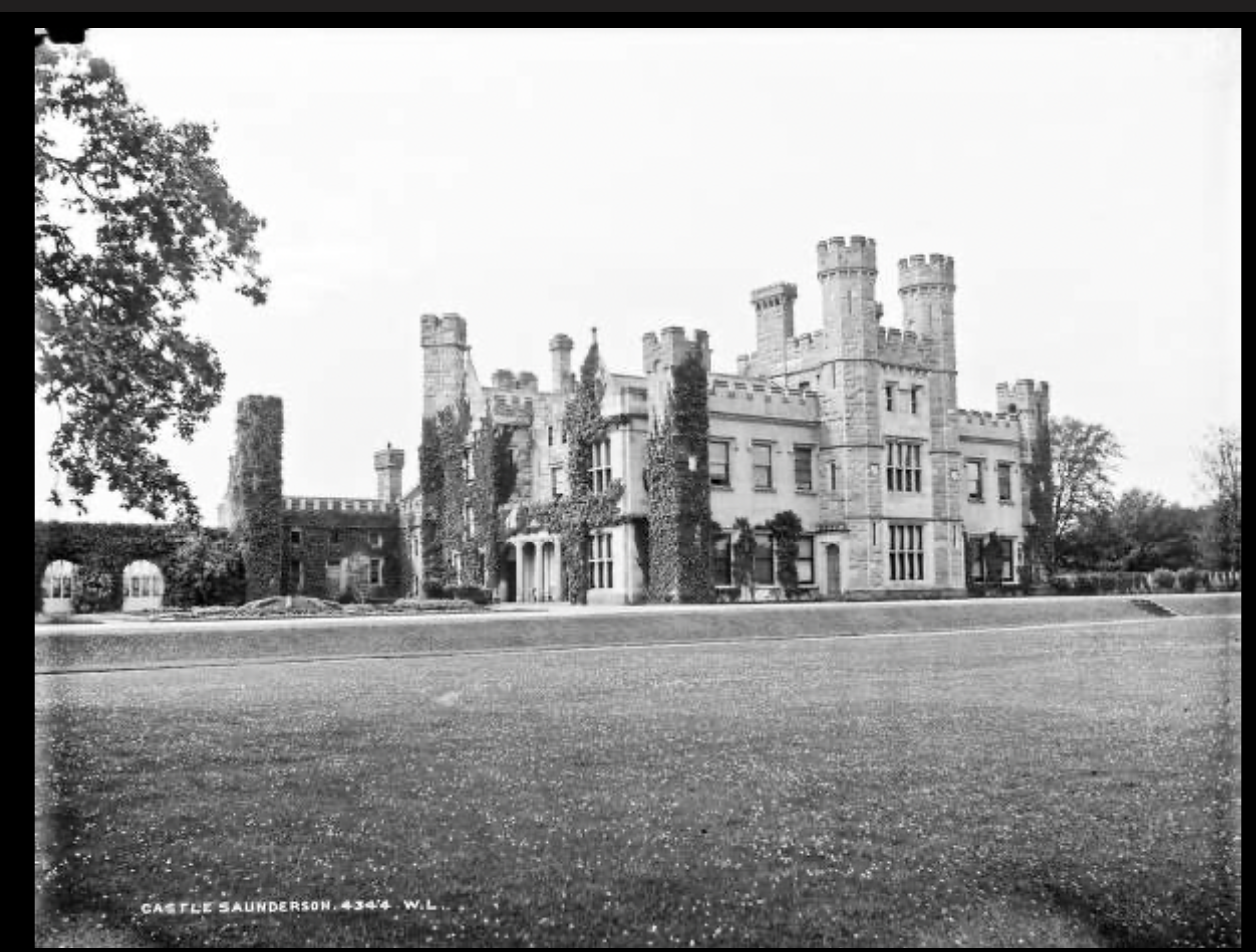
It looks like there is an entrance door on either side of what Bence-Jones calls the central gatehouse tower.
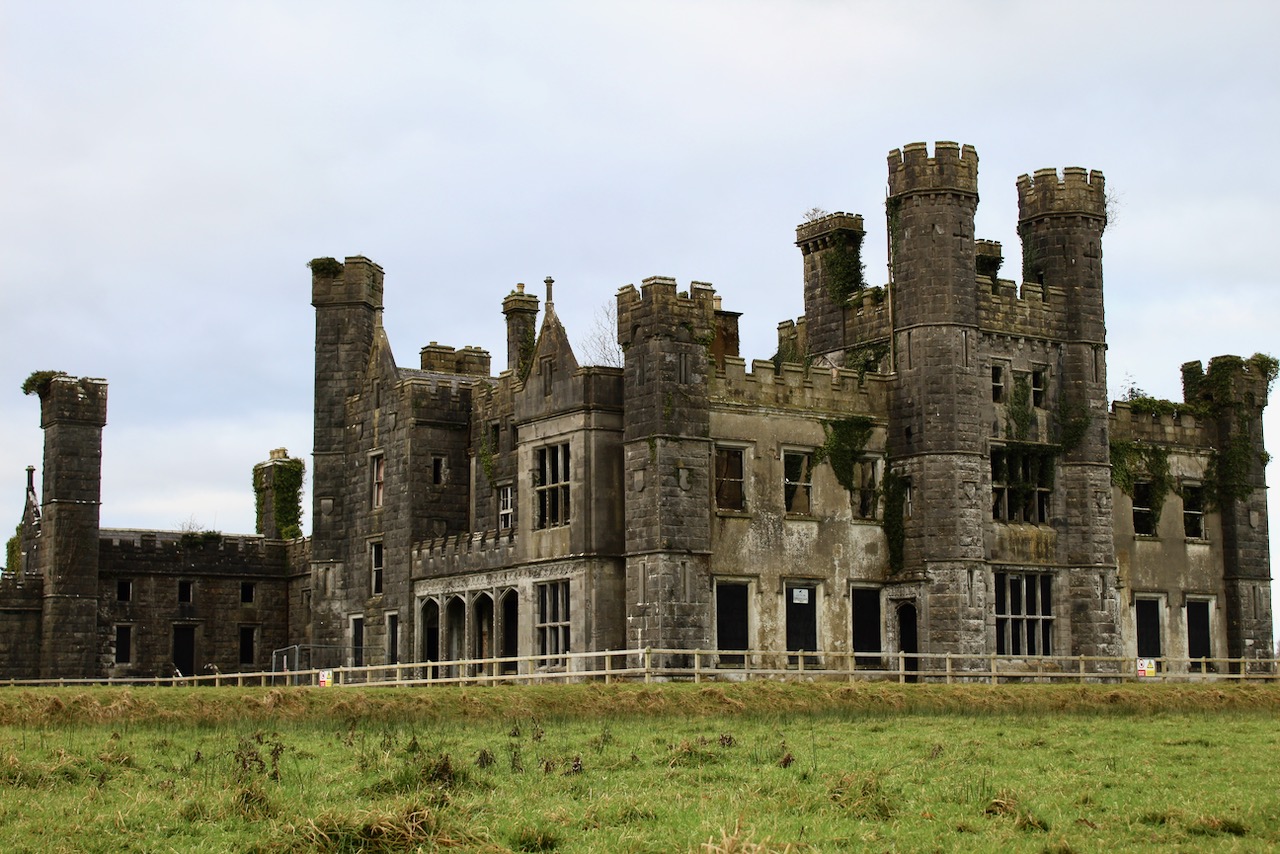
The side to the right of the entrance front has another octagonal tower with an entrance door, and another square tower. The National Inventory calls this side, the north elevation, the entrance side, describing it as: “Four-bay two-storey entrance elevation to north having advanced square-plan three-stage tower to west, corner turret to east and engaged octagonal-plan entrance tower with castellated doorcase, mullioned-and transomed hood-moulded windows of varying size and smaller incidental windows.” [5]
The doors have arched openings, and windows have hood mouldings.
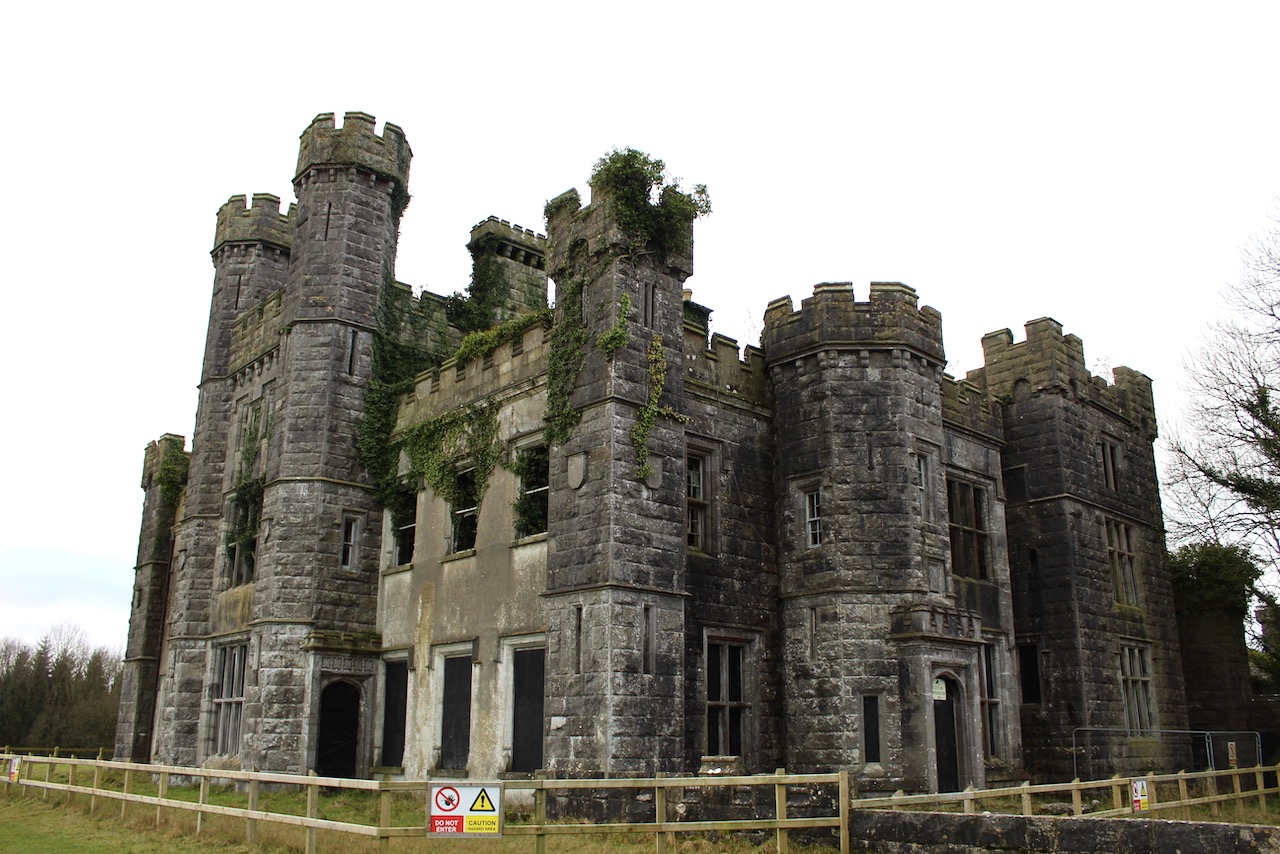
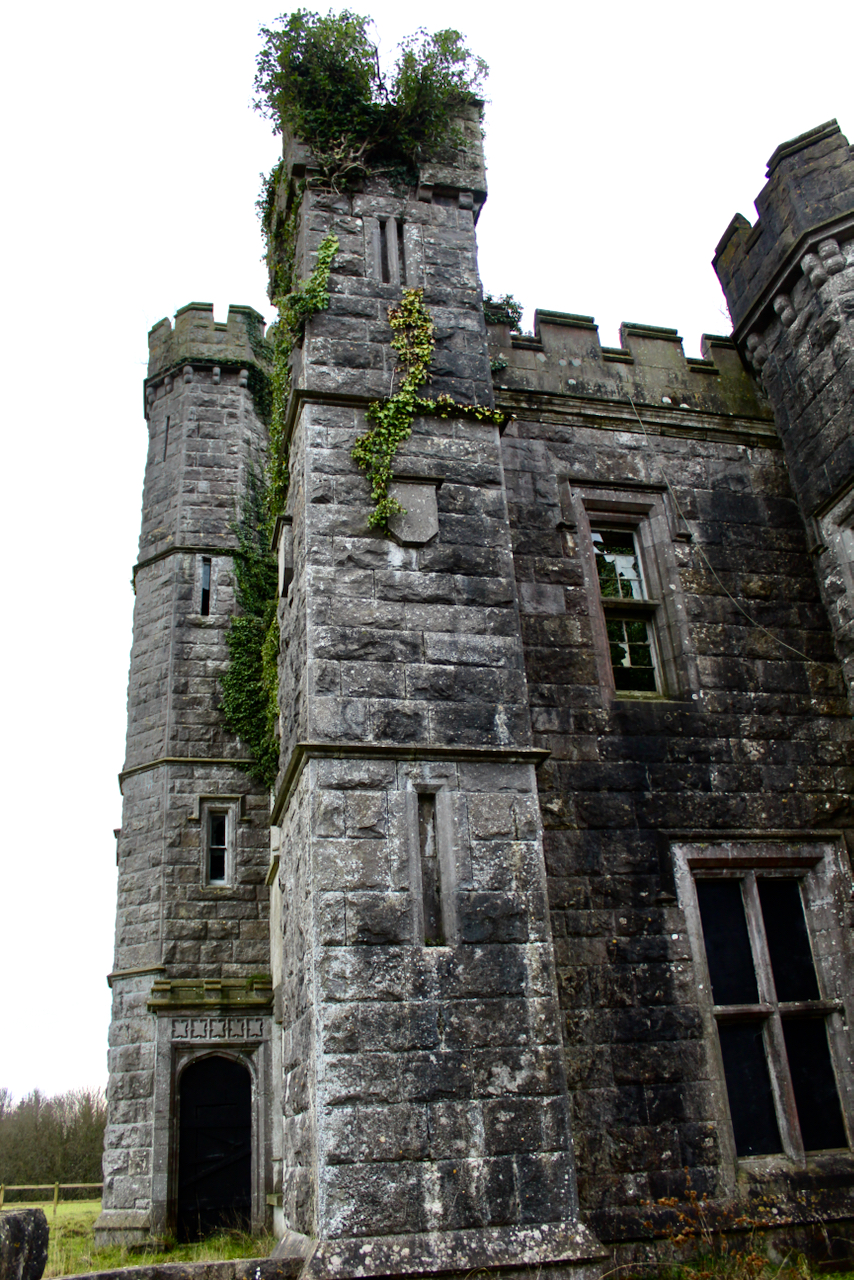
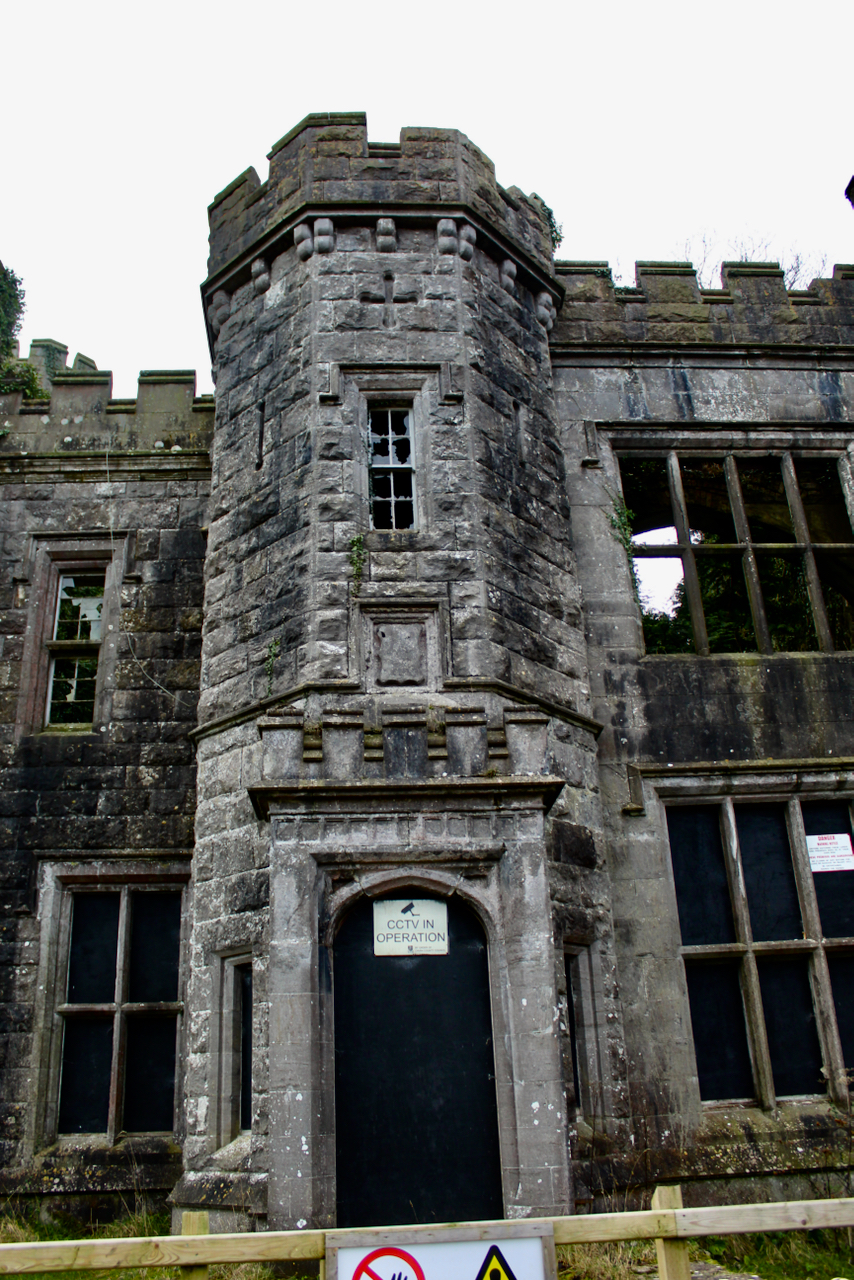
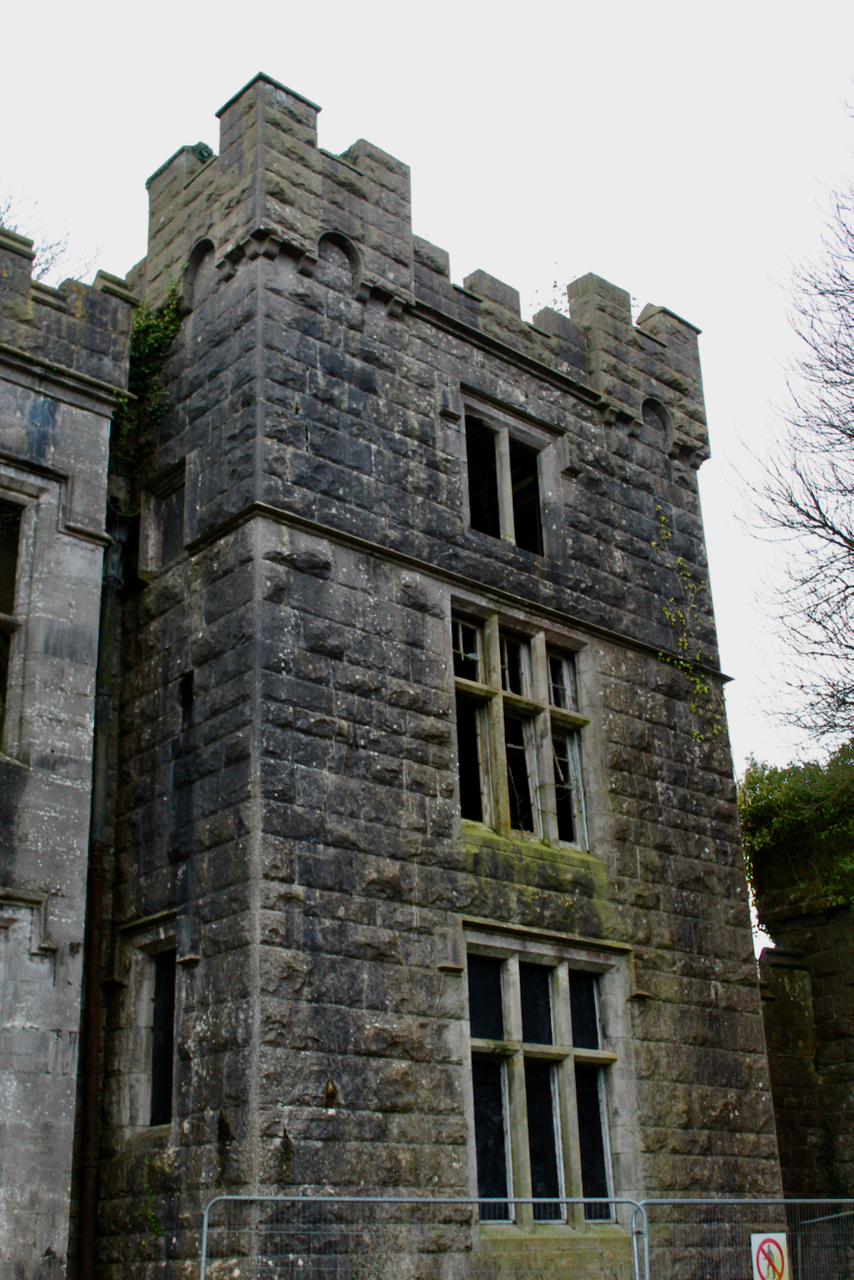
Bence-Jones continues: “The adjoining garden front is more irregular, with a recessed centre between two projecting wings of unequal size and fenestration, each having a Tudor gable; the two wings being joined at ground floor level by a rather fragile Gothic arcade. To the left of this front, a lower “L”-shaped wing with a battlemented parapet and various turrets, ending in a long Gothic conservatory. Castle Saunderson has stood empty for years and is now semi-derelict.” [1]
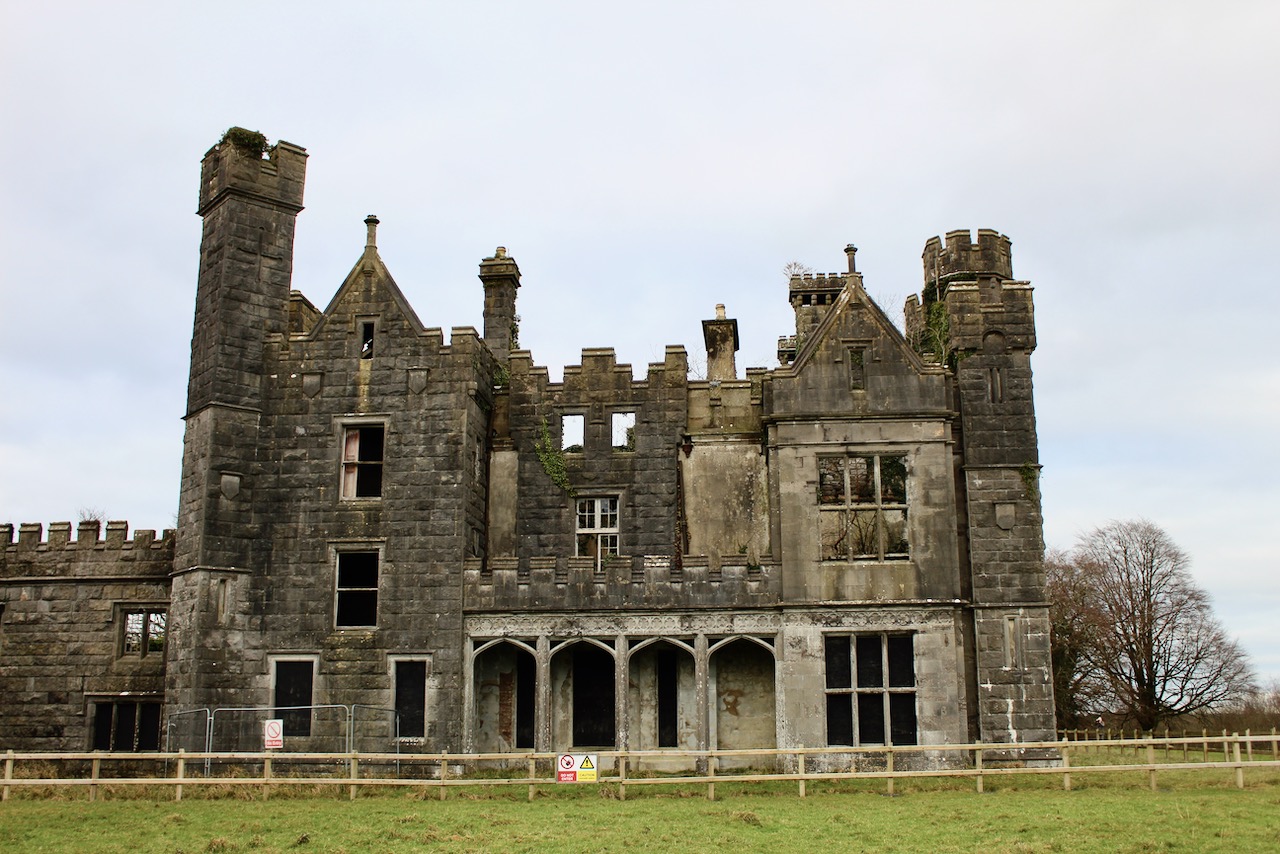
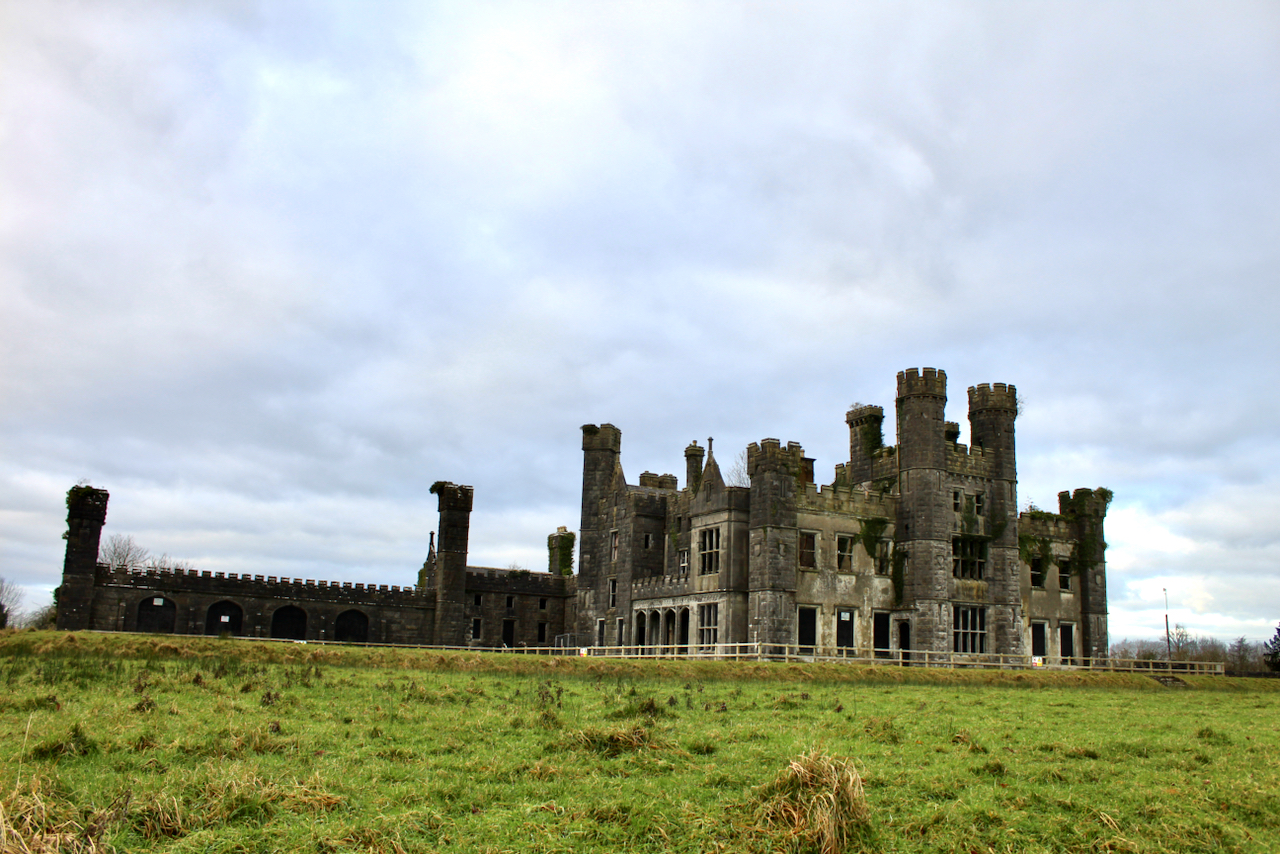
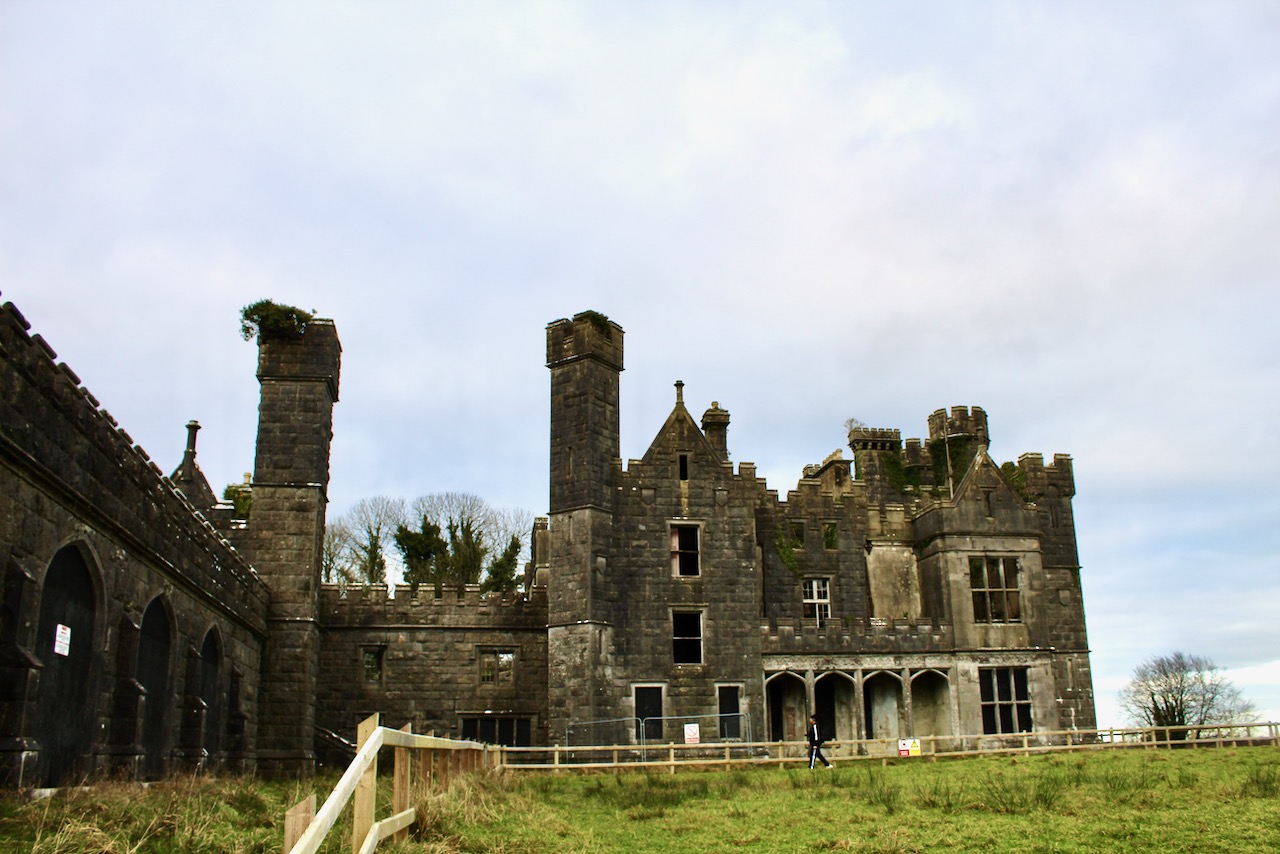
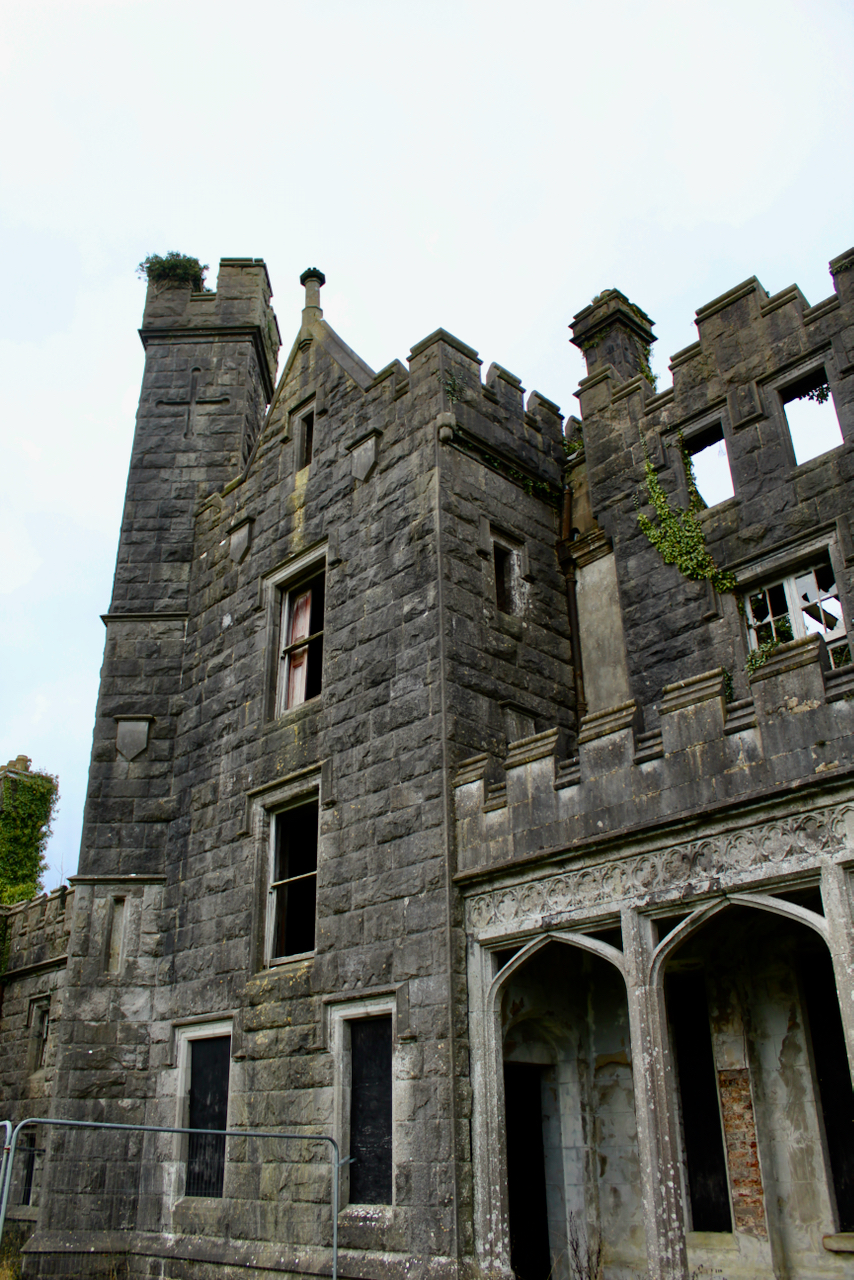
The various towers have “balistraria” cruciform and vertical arrow slit windows.
Alexander Saunderson (1783-1857) married Sarah Maxwell, the daughter of Reverend Henry Maxwell 6th Baron Farnham of Farnham in County Cavan.
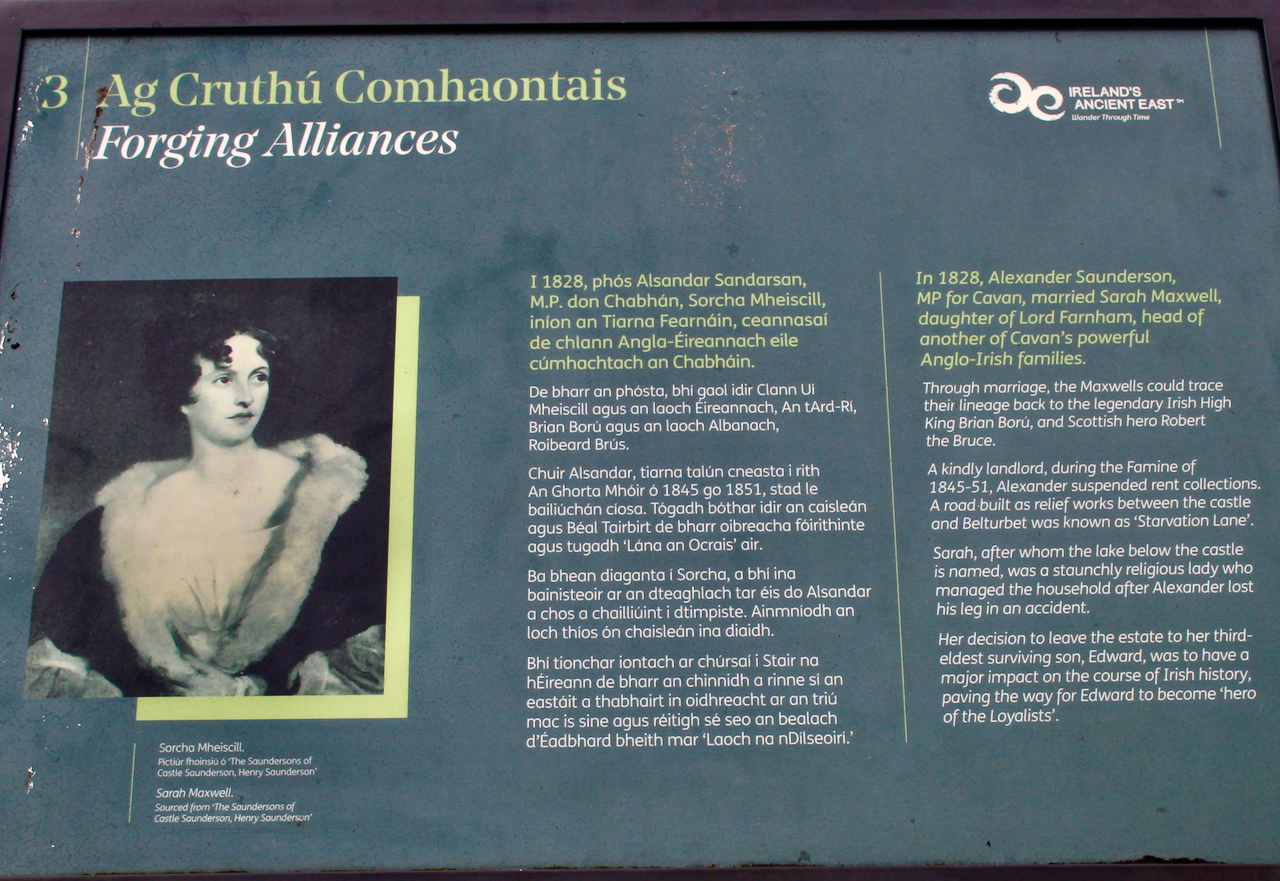
The information board tells us that Alexander was a king landlord and the during the Famine of 1845-51, he suspended rent collection from his tenants. Alexander served as High Sheriff of County Cavan in 1818, and was MP for County Cavan.
Sarah decided to leave the estate to her third eldest surviving son, Edward. The older sons were Alexander de Bedick (1832-60) and Somerset Bassett (1834-92) – I am not sure why they did not inherit Castle Saunderson, but perhaps they inherited the Bassett estates in Glamorgan. The Landed Estates database tells us that in the mid-19th century the main part of Colonel Alexander (1783-1857) Saunderson’s estate was in the parishes of Annagelliff and Lavey in the barony of Upper Loughtee [Drumkeen], but he also held sizable portions of land in the parishes of Larah, Annagh and Killinkere [Castle Saunderson and Clover Hill]. He also bought some of the estate of the Earl of Mornington which was for sale in 1853. His brother, the Reverend Francis Saunderson, rector of Kildallan, county Cavan, held an estate in the parishes of Drumlane and Killashandra. [6]

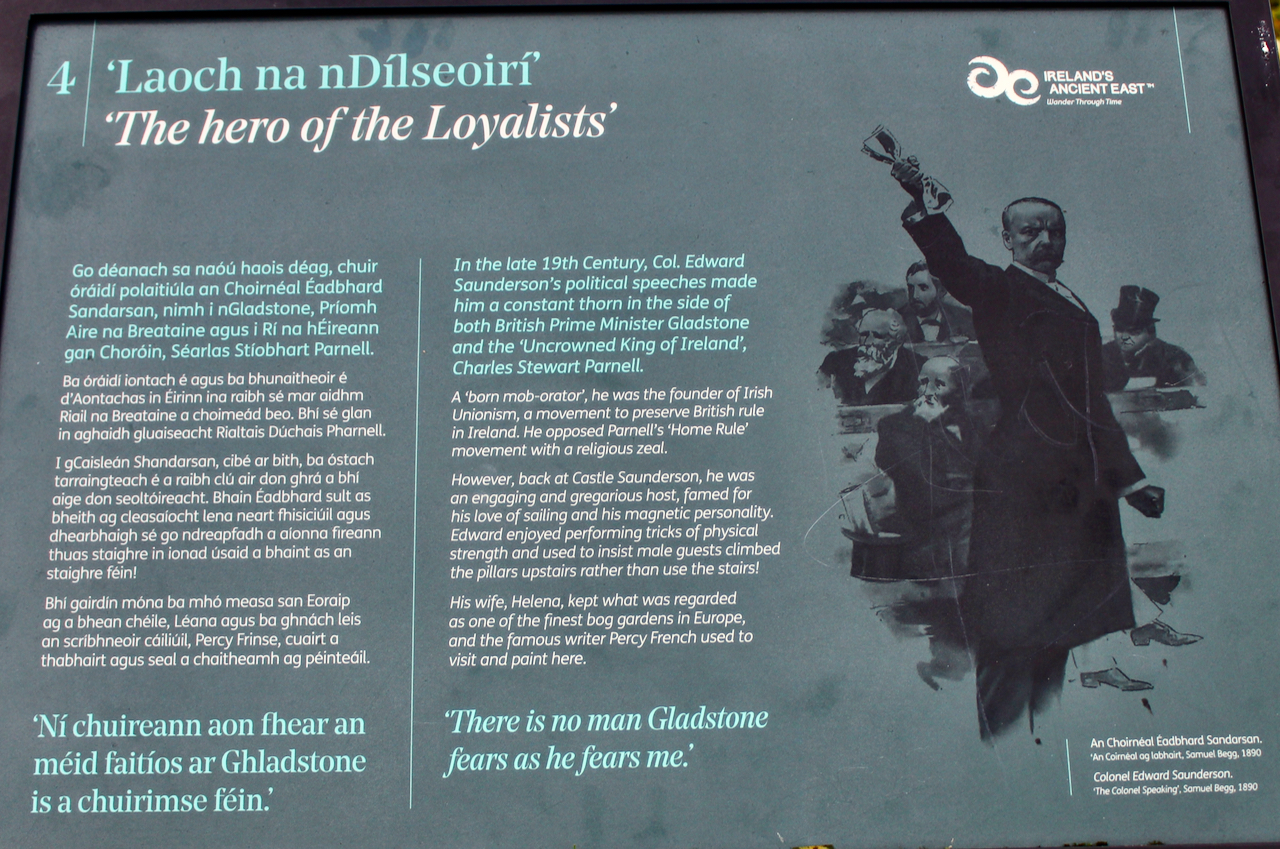
It was Edward Saunderson (1837-1906) who inherited Castle Saunderson. Edward Saunderson, the information board tells us, was the founder of British Unionism, the movement to preserve British rule in Ireland. He opposed Charles Stewart Parnell’s “Home Rule” movement, which sought to bring a parliament back to Ireland after it was abolished in 1800.
The notice board tells us that Edward enjoyed feats of strength, and made his male guests climb the pillars rather than using the stairs! His wife, Helena Emily de Moleyns, youngest daughter of Thomas, 3rd Baron Ventry, developed a bog garden, regarded as one of the finest in Europe, and the writer Percy French used to visit.
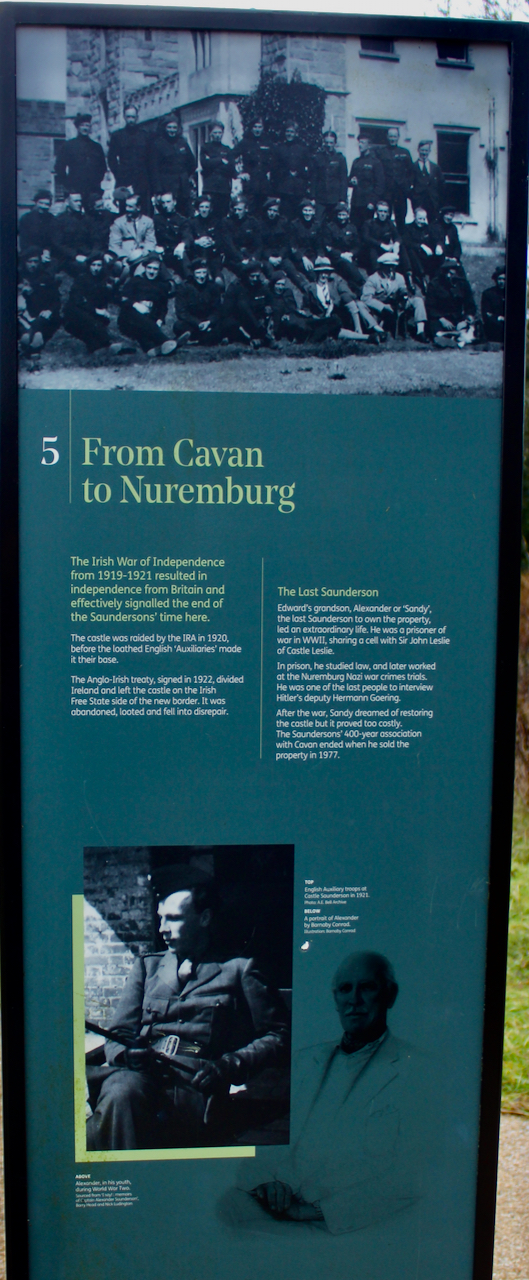
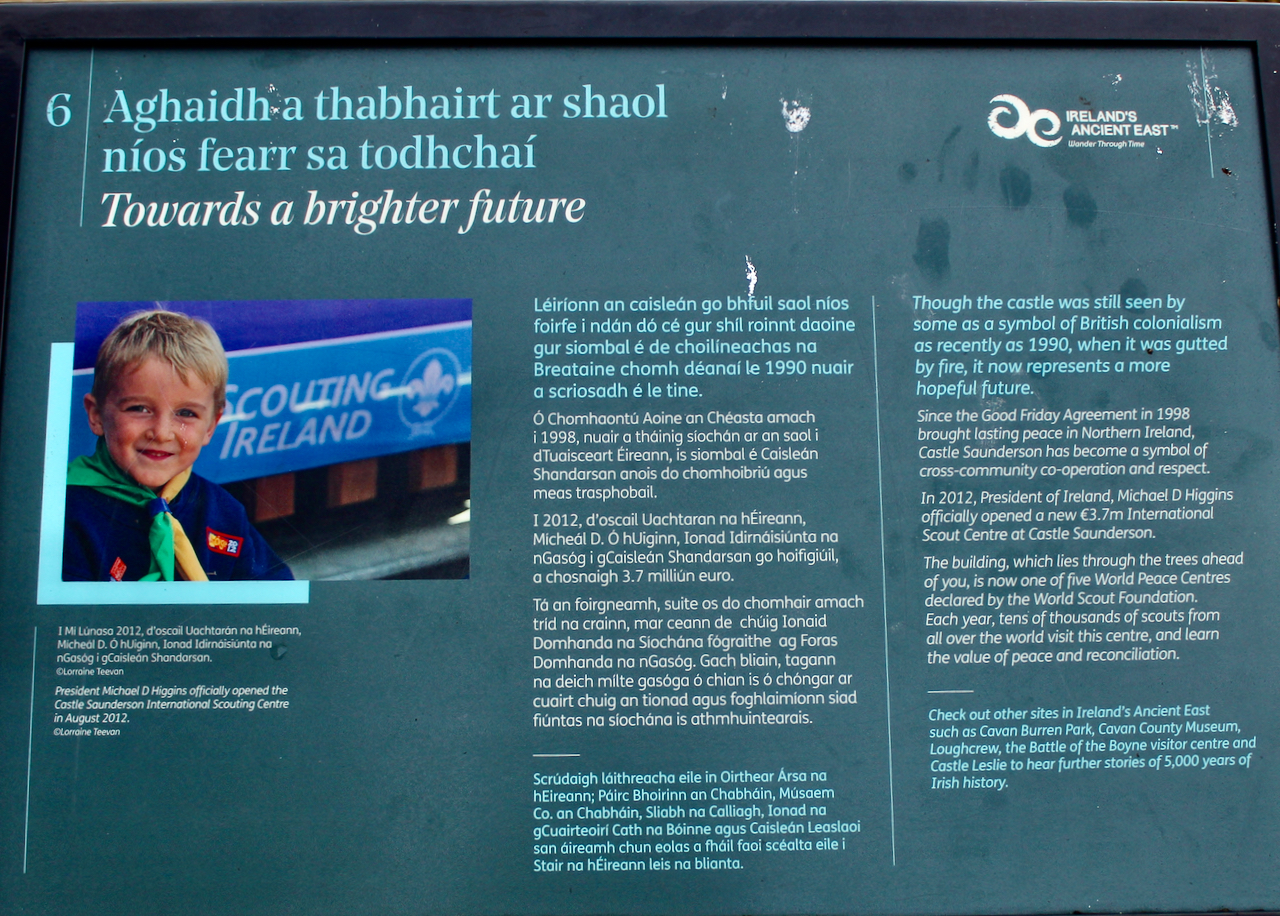
Alexander Saunderson (1917-2004), the last of the family to live there, sold the property to a London-based businessman in 1977. (see [4]). The Castle was in a state of disrepair and plans to have it completely renovated as a private dwelling at this time never materialized. The estate was sold again in 1990 to be developed as a hotel. These plans were also abandoned after a fire gutted and destroyed most of the Castle interior. This was the third fire to take place in the history of the castle. (see[4]). The property was then sold to Scouts Ireland.
[1] p. 75, Bence-Jones, Mark. A Guide to Irish Country Houses (originally published as Burke’s Guide to Country Houses volume 1 Ireland by Burke’s Peerage Ltd. 1978); Revised edition 1988 Constable and Company Ltd, London.
[2] https://www.dia.ie/architects/view/516/BLORE%2C+EDWARD+%23
[3] https://www.dia.ie/architects/view/5203/sudden%2C+george
[4] http://lordbelmontinnorthernireland.blogspot.com/2013/11/castle-saunderson.html
 Irish Historic Houses
One thought on “Castle Saunderson, Co. Cavan – a ruin ”