Today I’m continuing to split county entries into two pages: “Places to visit” and “Accommodation.”
On the map above:
blue: places to visit that are not section 482
purple: section 482 properties
red: accommodation
yellow: less expensive accommodation for two
orange: “whole house rental” i.e. those properties that are only for large group accommodations or weddings, e.g. 10 or more people.
green: gardens to visit
grey: ruins

donation
Help me to pay the entrance fee to one of the houses on this website. This site is created purely out of love for the subject and I receive no payment so any donation is appreciated!
€15.00
Clare:
1. Barntick House, Clarecastle County Clare – section 482
2. Bunratty Castle, County Clare – maintained by Shannon Heritage
3. Craggaunowen Castle, Kilmurray, Sixmilebridge, County Clare – maintained by Shannon Heritage
4. Dunguaire Castle, Kinvara, County Clare – maintained by Shannon Heritage
5. Knappogue or Knoppogue Castle, County Clare – maintained by Shannon Heritage
6. Mount Ievers Court, Sixmilebridge, County Clare – private house, check website to visit
7. Newtown Castle, Newtown, Ballyvaughan, County Clare – section 482
8. O’Dea’s, or Dysert Castle, County Clare
9. Vandeleur Gardens, formerly Kilrush House, County Clare
Places to Visit in County Clare
1. Barntick House, Clarecastle Co. Clare V95 FH00 – section 482
contact: Ciarán Murphy
Tel: 086-1701060
Open dates in 2026: May 1-31, June 1-30, 4.30pm-8.30pm, Aug 15-23, 4pm-8pm
Fee: Free
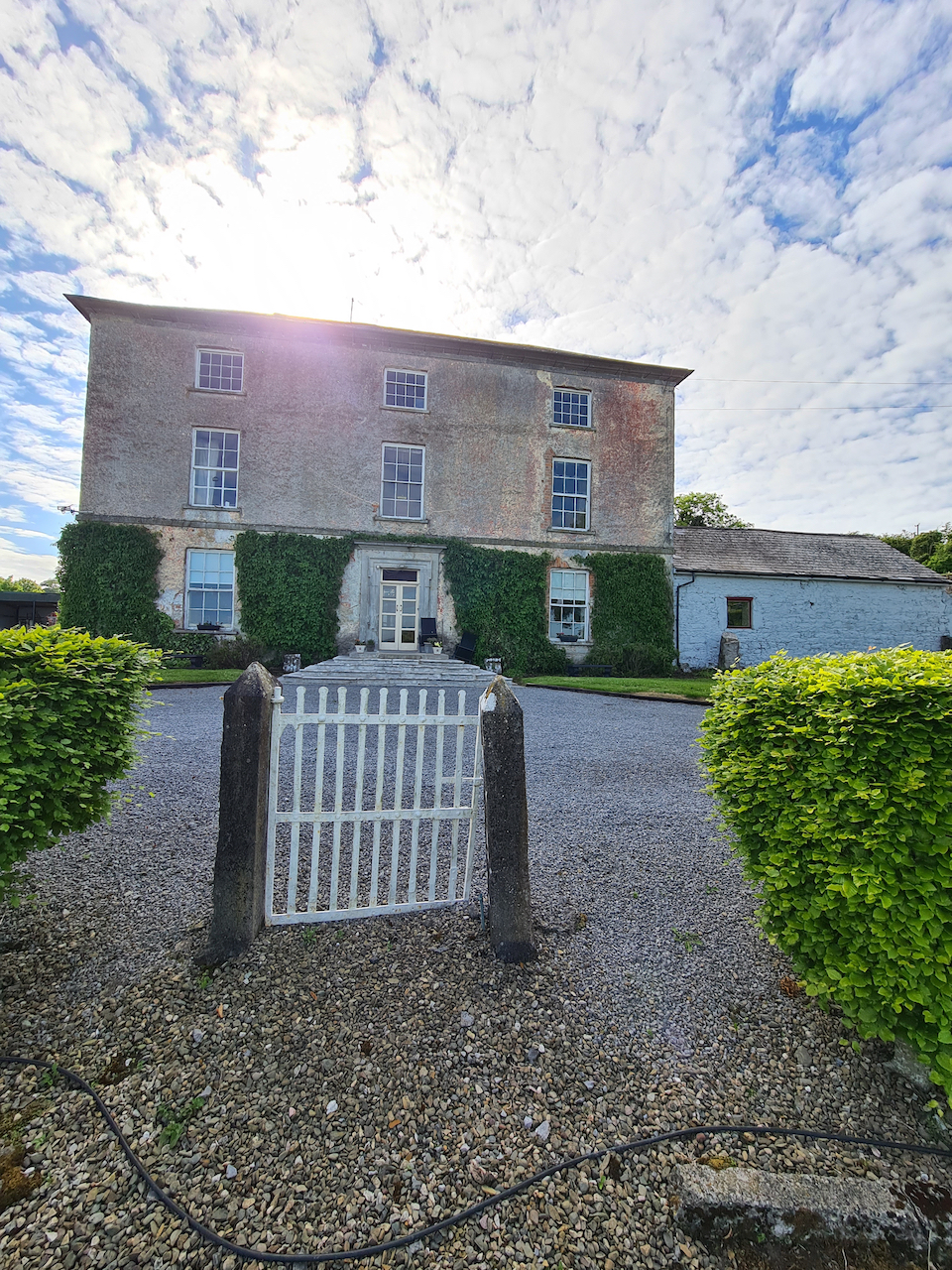
See my entry https://irishhistorichouses.com/2022/11/06/barntick-house-clarecastle-county-clare/
This house dates back to 1665!
2. Bunratty Castle, County Clare
maintained by Shannon Heritage
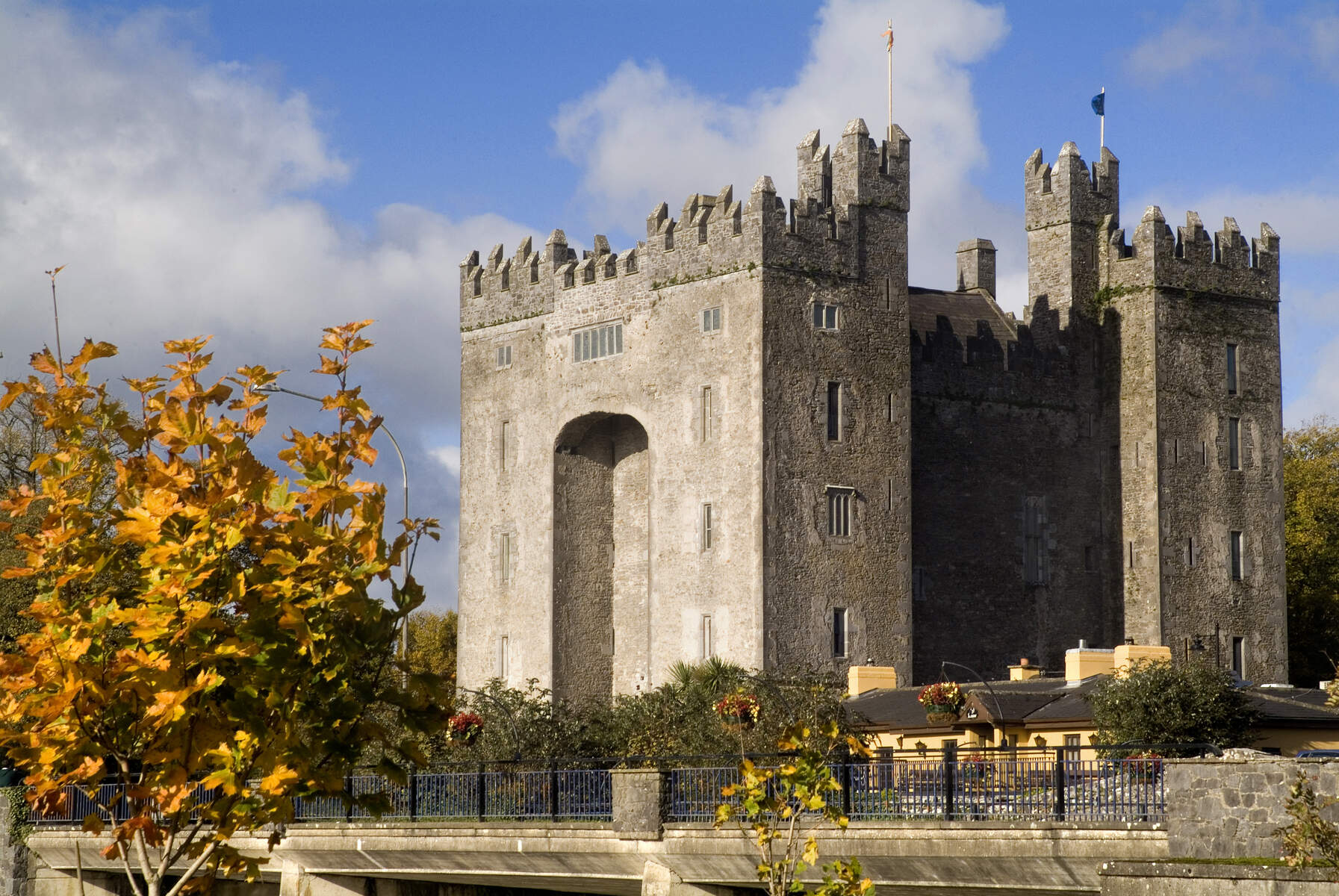
Mark Bence-Jones writes in his A Guide to Irish Country Houses:
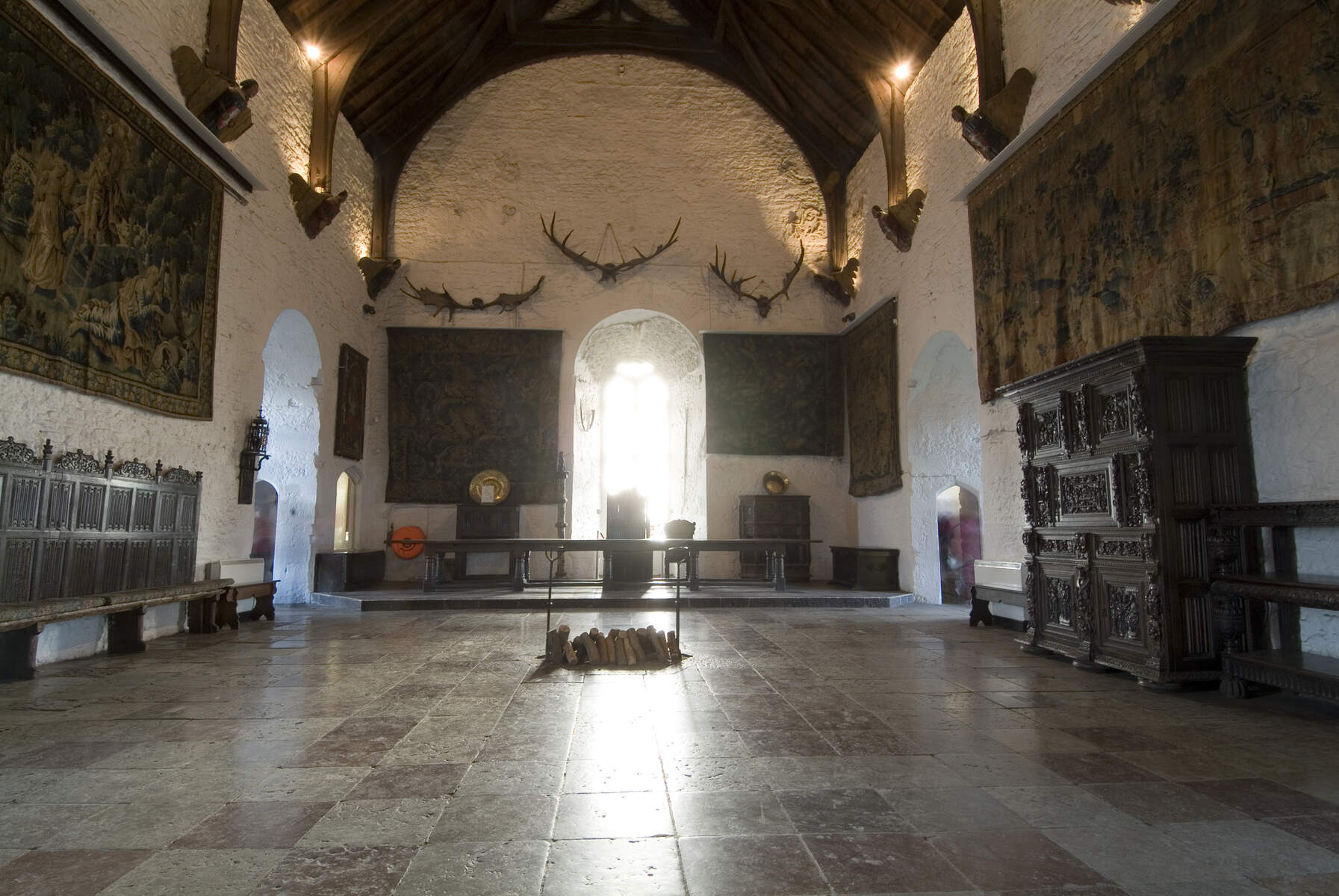
p. 49. “(O’Brien, Inchiquin, B/PB; and Thomond, E/DEP; Studdert/IFR; Russell/IFR; Vereker, Gort, VPB) One of the finest 15C castles in Ireland, standing by the side of a small tidal creek of the Shanon estuary; built ca 1425, perhaps by one of the McNamaras; then held by the O’Briens, who became Earls of Thomond, until 6th Earl [Barnabas O’Brien (d. 1657)] surrendered it to the Cromwellian forces during the Civil War. A tall, oblong building, it has a square tower at each corner; these are linked, on the north and south sides, by a broad arch just below the topmost storey. The entrance door leads into a large vaulted hall, or guard chamber, above which is the Great Hall, the banqueting hall and audience chamber of the Earls of Thomond, with its lofty timber roof. Whereas the body of the castle is only three storeys – there being another vaulted chamber below the guard chamber – the towers contain many storeys of small rooms, reached up newel stairs and by passages in the thickness of the walls. One of these rooms, opening off the Great Hall, is the chapel, which still has its original plasterwork ceiling of ca 1619, richly adorned with a pattern of vines and grapes. There are also fragment of early C17 plasterwork in some of the window recesses. After the departure of the O’Briens, a C17 brick house was built between the two north towers; Thomas Studdert [1696-1786], who bought Bunratty early in C18, took up residence here in 1720. Later, the Studderts built themselves “a spacious and handsome modern residence in the demesne: and the castle became a constabulary barracks, falling into disrepair so that, towards the end of C19, the ceiling of the Great Hall collapsed. Bunratty was eventually inherited by Lt-Com R.H. Russell, whose mother was a Studdert, and sold by him to 7th Viscount Gort [Standish Robert Gage Prendergast Vereker (1888-1975)] 1956. With the help of Mr Percy Le Clerc and Mr John Hunt, Lord Gort carried out a most sympathetic restoration of the castle, which included removing C17 house, re-roofing the Great Hall in oak and adding battlements to the towers. The restored castle contains Lord Gort’s splendid collection of medieval and C16 furniture, tapestries and works of art, and is open to the public; “medieval banquets” being held here as a tourist attraction. Since the death of Lord Gort, Bunratty and its contents have been held in trust for the Nation.” [2]

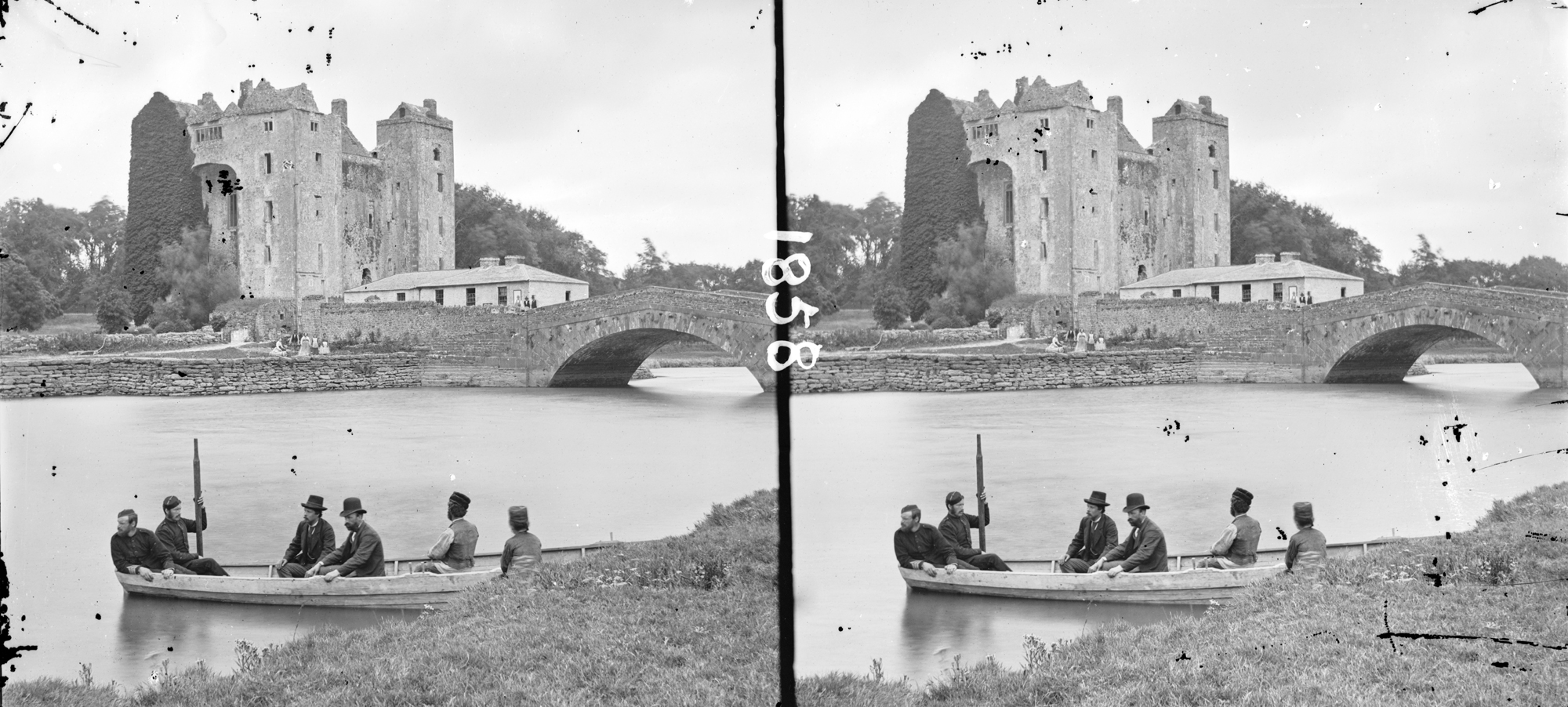
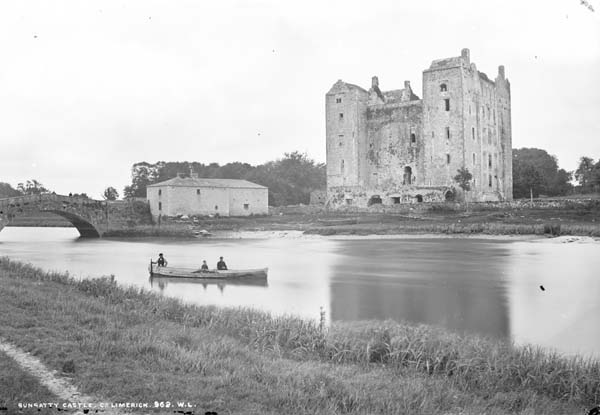
3. Craggaunowen Castle, Kilmurray, Sixmilebridge, County Clare
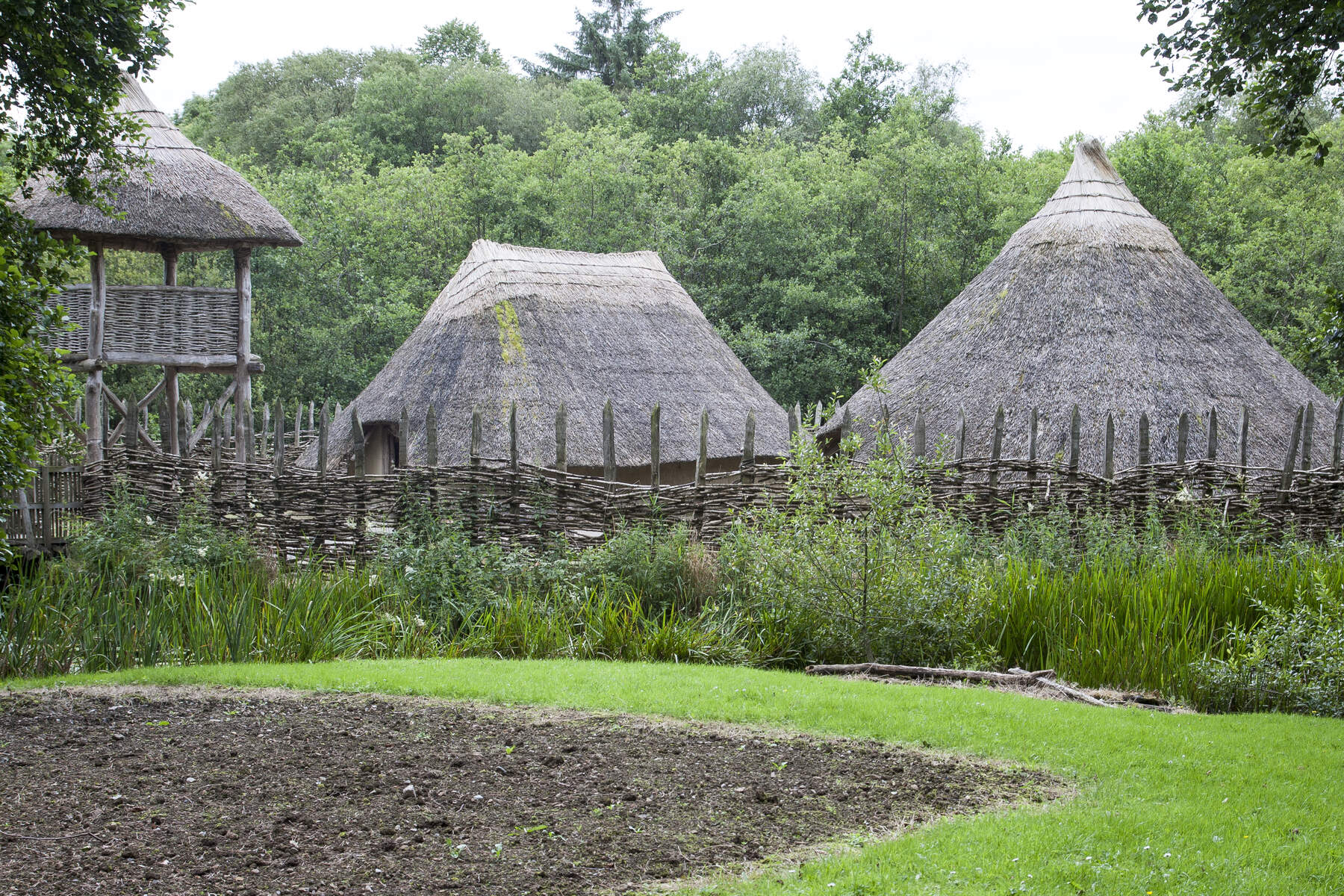
– history park, maintained by Shannon Heritage, www.craggaunowen.ie
The Irish Homes and Garden website tells us:
“Early medieval 500AD-1500: The most common form of house style during this period was the ringfort –a circular area of earth surrounded by a bank and ditch. In some cases, stone was used in the defensive enclosure and these are known as cashels. Over 45,000 examples still remain today. Also dating from this period were crannogs (from the Irish crann – tree) – an artificial island built in the shallow areas of lakes with the houses surrounded by a timber palisade or fence. These can be spotted in the landscape as small tree covered islands close to the lake shore – both the ringforts and crannogs most commonly contained circular houses. A reconstruction of a crannog dwelling can be found at Craggaunowen, Co. Clare
“This was also a time when Christianity was introduced to Ireland and whereas the early churches of the 6th and 7th centuries were of timber, evidence of stone churches appear from the late 8th century. These were simple rectangular buildings of about 5m long with a high steep pitched roof. The only doorway had a flat-topped lintelled opening. The early Irish monasteries of the 9th and 10th centuries, such as Clonmacnoise, had larger churches and monastic buildings also included the drystone beehive hut or clochan, as can be seen at Skellig Michael, and also the Round Tower, built between the 10th and 12th century, which consisted of a narrow tower up to 30m high tapering at the top with a conical roof.” [4]
The Craggaunowen website tells us: “Craggaunowen Castle - built by John MacSioda MacNamara in 1550 a descendant of Sioda MacNamara who built Knappogue Castle in 1467. After the collapse of the Gaelic Order, in the 17th century, the castle was left roofless and uninhabitable. The Tower House remained a ruin until it and the estate of Cullane House across the road, were inherited in 1821 by ”Honest” Tom Steele, a confederate of Daniel O’Connell, Steele had the castle rebuilt as a summer house in the 1820s. He used it and the turret on the hill opposite for recreation. His initials can be seen on one of the quoin-stones to the right outside. “The Liberator”. By the time of the First Ordnance Survey, in the 1840s, the castle was “in ruins”. After Steele in 1848 the lands were divided, Cullane going to one branch of his family, Craggaunowen to another, his niece Maria Studdert. Eventually the castle and grounds were acquired by the “Irish Land Commission”. Much of the land was given over to forestry and the castle itself was allowed to fall into disrepair. In the mid-19th century, the castle, herd’s house and 96 acres were reported in the possession of a Reverend William Ashworth, who held them from a Caswell (a family from County Clare just north of Limerick). In 1906, a mansion house here was owned by Count James Considine (from a family based at Derk, County Limerick). Craggaunowen Castle was restored by John Hunt in the 1960s – he added an extension to the ground floor, which for a while housed part of his collection of antiquities. The collection now resides in the Hunt Museum in the city of Limerick.” [5]
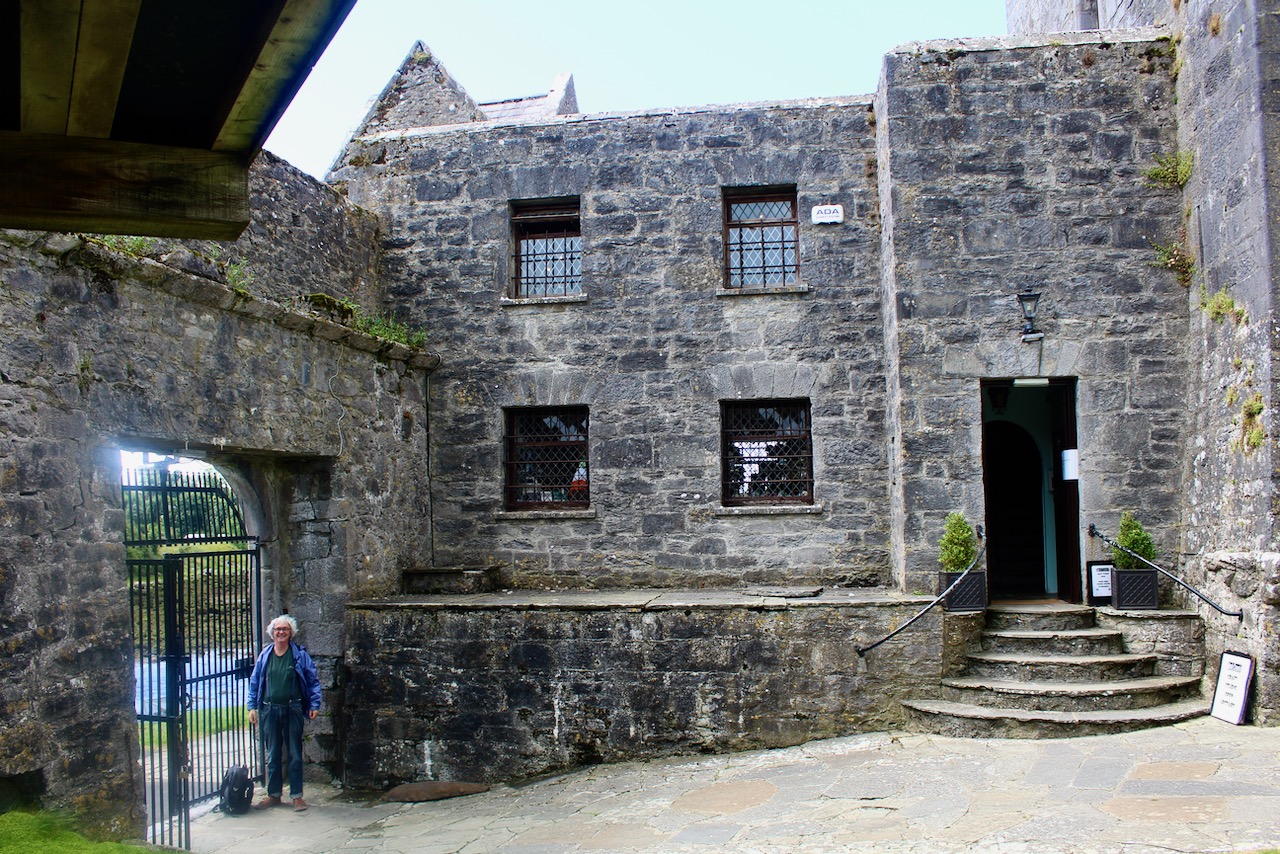
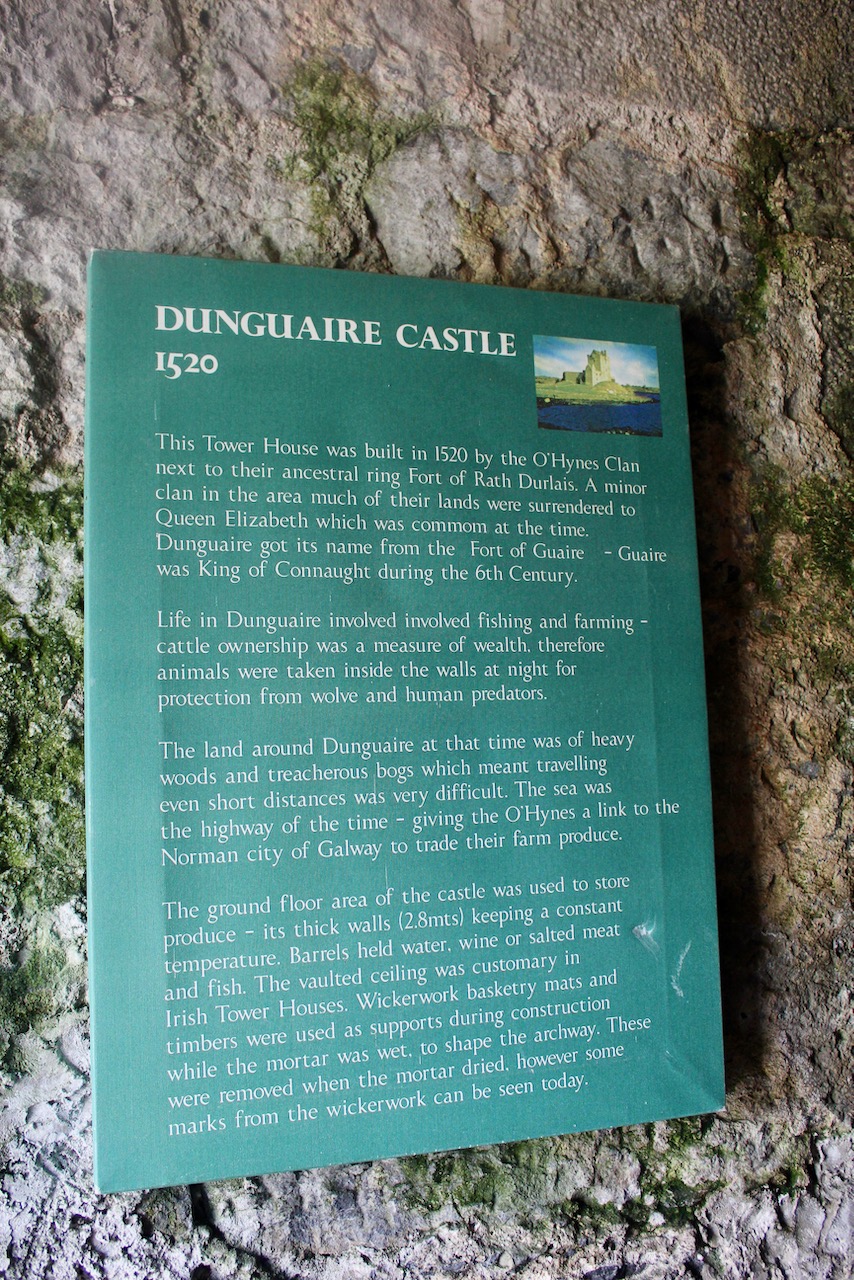
4. Dunguaire Castle, Kinvara, County Clare

Maintained by Shannon Heritage. See my entry https://irishhistorichouses.com/2025/07/05/dunguaire-castle-kinvara-county-clare-open-to-the-public/
Mark Bence-Jones writes in A Guide to Irish Country Houses (1988):
p. 115. “(Martyn/LGI1912; Gogarty/IFR; Russell, Ampthill, B/PB) An old tower-house with a bawn and a smaller tower, on a creek of Galway Bay; which was for long roofless, though in other respects well maintained by the Martyn family, of Tulira, who owned it C18 and C19, and which was bought in the present century by Oliver St John Gogarty, the surgeon, writer and wit, to save it from threat of demolition. More recently, it was bought by the late Christabel, Lady Ampthill, and restored by her as her home; her architect, being Donal O’Neill Flanagan, who carried out a most successful and sympathetic restoration. The only addition to the castle was an unobtrusive two storey wing joining the main tower to the smaller one. The main tower has two large vaulted rooms, one above the other, in its two lower storeys, which keep their original fireplaces; these were made into the dining room and drawing room. “Medieval” banquets and entertainments are now held here.”


5. Knappogue or Knoppogue Castle, County Clare
Knappogue is maintained by Shannon Heritage and holds Medieval style banquets. https://www.knappoguecastle.ie
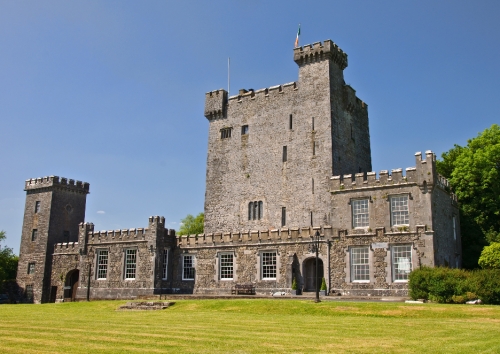
Mark Bence-Jones writes about Knoppogue, or Knappogue, Castle in A Guide to Irish Country Houses (1988):
p. 180. “(Butler, Dunboyne, B/PB) A large tower-house with a low C19 castellated range, possibly by James Pain, built onto it. Recently restored and now used for “medieval banquets” similar to those at Bunratty Castle, Co Clare.”
6. Mount Ievers Court, Sixmilebridge, County Clare – private house, check website to visit

The website has a terrific history of the house. First, it tells us:
“Mount Ievers Court is an 18th c. Irish Georgian country house nestled in the Co. Clare countryside just outside the town of Sixmilebridge. The house was originally the site of a 16th c. tower house called Ballyarilla Castle built by Lochlann McNamara. The tower house was demolished in the early 18th c. to construct the present house, built between 1733-1737 by John & Isaac Rothery, for Col. Henry Ievers.
“Mount Ievers Court has been home to the Ievers family for 281 years and since then generations of Ievers and their families have worked hard to maintain the house in order to ensure that the estate retains a viable place in the local community and Ireland’s heritage long into the future. Mount Ievers is currently owned by Breda Ievers née O’Halloran, a native of Sixmilebridge, and her son Norman. Norman is married to Karen, an American by birth, who has a keen interest in Irish history & the family archives.“

Mark Bence-Jones writes in A Guide to Irish Country Houses (1988):
p. 214. “(Ievers/IFR) The most perfect and also probably the earliest of the tall Irish houses; built ca. 1730-37 by Colonel Henry Ievers to the design of John Rothery, whose son, Isaac, completed the work after his death and who appears to have also been assisted by another member of the Rothery family, Jemmy. The house, which replaced an old castle, is thought to have been inspired by Chevening, in Kent – now the country house of the Prince of Wales – with which Ievers could have been familiar not only through the illustration in Vitruvius Britannicus, but also because he may have been connected with the family which owned Chevening in C17. Mount Ievers, however, differs from Chevening both in detail and proportions; and it is as Irish as Chevening is English. Its two three storey seven bay fronts – which are almost identical except that one is of faded pink brick with a high basement whereas the other is of silvery limestone ashlar with the basement hidden by a grass bank – have that dreamlike, melancholy air which all the best tall C18 Irish houses have. There is a nice balance between window and wall, and a subtle effect is produced by making each storey a few inches narrower than that below it. The high-pitched roof is on a bold cornice; there are quoins, string-courses and shouldered window surrounds; the doorcase on each front has an entablature on console brackets. The interior of the house is fairly simple. Some of the rooms have contemporary panelling; one of them has a delightful primitive overmantel painting showing the house as it was originally, with an elaborate formal layout which has largely disappeared. A staircase of fine joinery with alternate barley-sugar and fluted balusters leads up to a large bedroom landing, with a modillion cornice and a ceiling of geometrical panels. On the top foor is a long gallery, a feature which seems to hark back to the C17 or C16, for it is found in hardly any other C18 Irish country houses; the closest counterpart was the Long Room in Bowen’s Court, County Cork. The present owners, S.Ldr N.L. Ievers, has carried out much restoration work and various improvements, including the placement of original thick glazing bars in some of the windows which had been given thin late-Georgain astragals ca. 1850; and the making of two ponds on the site of those in C18 layout. He and Mrs Ievers have recently opened the home to paying guests in order to meet the cost of upkeep.”
The website tells of the ancient origins of the family, and goes on to explain:
“A parchment found in the sideboard at Mount Ievers in July 2012 maintains that Henry Ivers arrived in Ireland in 1640 from Yorkshire, where the family had been settled since arriving with William the Conqueror nearly six hundred years earlier. It also records that Henry settled in County Clare in 1643 when he was appointed Collector of Revenue for Clare and Galway.“
7. Newtown Castle, Newtown, Ballyvaughan, Co. Clare – section 482

Open dates in 2026: Jan 5-30, Feb 3-27, March 2-31, April 1-30, May 1-29, June 2-30, July 1-31, August 1-31, Sept 1-30, Oct 1-30, Nov 2-30, Dec 1-19 Mon-Fri, National Heritage Week, Aug 15-23, 10am-5pm
Fee: Free
The website tells us: “The historic Newtown Castle has occupied a prominent position in Ballyvaughan since the 16th century. Having lain derelict for many years, the castle’s restoration began in 1994, completed in time for the opening of the Burren College of Art in August of that year.
“Newtown Castle is once again a vibrant building in daily use, central to the artistic, cultural and educational life of the Burren. It is open free of charge to the public on week days. Newtown Castle is also available to hire for: wedding ceremonies, small private functions or company events.”
Maurice Craig and Desmond Fitzgerald the Knight of Glin describe it in their book Ireland Observed. A handbook to the Buildings and Antiquities: “This sixteenth-century tower, nearly round in plan, rises from a square base, on which is the entrance door. Ingeniously places shot-holes protect its four sides.” [7]
Maurice Craig also writes about Newtown in his book The Architecture of Ireland from the Earliest Times to 1880:
“There is a small class of cylindrical tower-houses: so small that it is worth attempting to enumerate them all, omitting those which appear to be thirteenth-century (and hence not tower-houses). They are Cloughoughter, County Cavan (which is dubiously claimed for the fourteenth century); Carrigabrack, East of Fermoy County Cork; Knockagh near Templemore County Tipperary; Ballysheeda near Cappawhite County Tipperary; Golden in the same county; Crannagh now attached to an eighteenth century house near Templetuohy in the same county; Balief County Kilkenny; Grantstown near Rathdowney County Leix; Barrow Harbour County Kerry; Newtown near Gort in County Galway; Doonagore County Clare also by the sea; Faunarooska, Burren, County Clare; and Newtown at the North edge of the Burren, also in County Clare.
“The last of these is in some ways the most interesting, being in form a cylinder impaled upon a pyramid. Over the door (which is in the pyramid) there is a notch in the elliptical curve traced by the cylinder, and in this notch is a gunhole covering a wide sector of the sloping wall below. At some other castles, for example, Ballynamona on the Awbeg river, there is a feature using the same principle, which is not easy to describe. On each face of the building there is what looks at first site like the “ghost” or creasing of a pitched roof, but is in fact a triangular plane, about a foot deep at the top, decreasing to nothing at the base. In the apex there is a gunhole. Aesthetically the effect is very subtle.” [8]

8. O’Dea’s, or Dysert Castle, County Clare
– can visit https://dysertcastle.ie
The Castle was built in 1480 by Diarmuid O’Dea, Lord of Cineal Fearmaic. The uppermost floors and staircase were badly damaged by the Cromwellians in 1651. Repaired and opened in 1986, the castle houses an extensive museum, an audio visual presentation and various exhibitions.
Free car/coach parking and toilets
Tea rooms and bookshop
Chapel
Modern History Room 1700AD – 2000AD
Museum – Local artefacts 1000BC – 1700AD
Audio – visual presentation – local archaeology
Medieval masons and carpenters workshop
Roof wall – walk to view surrounding monuments
8. Vandeleur Gardens, formerly Kilrush House, County Clare

– ‘lost’, Vandeleur Gardens open
Timothy William Ferrers writes about it on his website:
“KILRUSH HOUSE, County Clare, was an early Georgian house of 1808.
“From 1881 until Kilrush House was burnt in 1897, Hector Stewart Vandeleur lived mainly in London and only spent short periods each year in Kilrush. Indeed during the years 1886-90, which coincided with the period of the greatest number of evictions from the Vandeleur estate, he does not appear to have visited Kilrush.
“In 1889, Hector bought Cahircon House and then it was only a matter of time before the Vandeleurs moved to Cahircon as, in 1896, they were organising shooting parties at Kilrush House and also at the Cahircon demesne.
“Hector Stewart Vandeleur was the last of the Vandeleurs to be buried at Kilrush in the family mausoleum. Cahircon House was sold in 1920, ending the Kilrush Vandeleurs’ direct association with County Clare. Hector Vandeleur had, by 1908, agreed to sell the Vandeleur estate to the tenants for approximately twenty years’ rent, and the majority of the estate was purchased by these tenants.
“THE VANDELEURS, as landlords, lost lands during the Land Acts and the family moved to Cahircon, near Kildysart.
“In 1897, Kilrush House was badly damaged by fire.
“During the Irish Land Commission of the 1920s, the Department of Forestry took over the estate, planted trees in the demesne and under their direction the remains of the house were removed in 1973, following an accident in the ruins.Today the top car park is laid over the site of the house.
“Vandeleur Walled Garden now forms a small part of the former Kilrush demesne. The Kilrush demesne was purchased by the Irish Department of Agriculture as trustee under the Irish Land Acts solely for the purpose of forestry. The Kilrush Committee for Urban Affairs purchased the Fair Green and Market House.” [6]
[1] https://www.irelandscontentpool.com/en
[2] p. 49. Bence-Jones, Mark. A Guide to Irish Country Houses (originally published as Burke’s Guide to Country Houses volume 1 Ireland by Burke’s Peerage Ltd. 1978); Revised edition 1988 Constable and Company Ltd, London.
[4] https://www.irishhomesandgardens.ie/irish-architecture-history-part-1/
[5] https://www.geni.com/projects/Historic-Buildings-of-County-Clare/29203
[6] http://lordbelmontinnorthernireland.blogspot.com
[7] Craig, Maurice and Knight of Glin [Desmond Fitzgerald] Ireland Observed. A handbook to the Buildings and Antiquities. The Mercier Press, Dublin and Cork, 1970.
[8] p. 103. Craig, Maurice. The Architecture of Ireland from the Earliest Times to 1880, Lambay Books, Portrane, County Dublin, first published 1982, this edition 1997, p. 103.
[10] https://www.geni.com/projects/Historic-Buildings-of-County-Clare/29203
Text © Jennifer Winder-Baggot, www.irishhistorichouses.com
 Irish Historic Houses