Benburb Manor, Co Armagh or Tyrone, photograph by Robert French, (between ca. 1865-1914), Lawrence Photograph Collection, National Library of Ireland.
Benburb Manor House, County Tyrone
Mark Bence-Jones. A Guide to Irish Country Houses (originally published as Burke’s Guide to Country Houses volume 1 Ireland by Burke’s Peerage Ltd. 1978); Revised edition 1988 Constable and Company Ltd, London.
p. 40. (Bruce;LGI1912) A large late-Victorian house with gables, high-pitched roofs and rectangular plate-glass windows, built 1887 to the design of William Henry Lynn. Of red brick, with bands of stone to give structural polychromy. Now a Servite Priorty. Nearby, on a cliff above the River Blackwater, is an early C17 fort, built by Sir Richard Wingfield.”
Benburb Manor, County Armagh or Tyrone, photograph by Robert French, (between ca. 1865-1914), Lawrence Photograph Collection, National Library of Ireland.Benburb Manor, County Armagh or Tyrone, photograph by Robert French, (between ca. 1865-1914), Lawrence Photograph Collection, National Library of Ireland.
This is a scion of the Bruces of Stenhouse, a suburb of Edinburgh, springing from
SIR ALEXANDER BRUCE, of Airth, Stirlingshire, who wedded Janet, daughter of Alexander, 5th Lord Livingston, and had issue,
WILLIAM, his heir; Robert, of Kinnaird; John (Sir), of Kincavil; Alexander (Sir), of Bangour; Robert, of Garvel; Marion; another daughter.
Sir Alexander died in 1600, and was succeeded by his eldest son,
WILLIAM BRUCE, who wedded Jean, daughter of John, 5th Lord Fleming, and sister to John, Earl of Wigtown, and had issue,
John, his heir, male line extinct; William (Sir), of Stenhouse; cr a baronet; Alexander; Robert; Alexander; PATRICK, of whom we treat.
The youngest and third surviving son,
PATRICK BRUCE, had the estate of Newton and Bothkenner, and espoused, in 1627, Janet, daughter of John Jackson, a merchant in Edinburgh, and had issue,
Patrick, dsp; William, his heir; MICHAEL, of whom we treat.
The youngest son,
THE REV MICHAEL BRUCE (1635-93), settled as a presbyterian minister at Killinchy, County Down, but was driven, with other ministers, thence into Scotland by Colonel Venables and the parliamentarians, for his fidelity to the King.
He returned to Killinchy, however, in 1669, after undergoing great hardships, and a long imprisonment in England and Scotland.
The Rev Michael Bruce married Jean, daughter of Robert Bruce, of Kinnaird (and sister of Colonel Robert Bruce, of Kinnaird, and of the Life Guards of CHARLES I, who died of wounds received at Worcester); he suffered much persecution of religious grounds; and had issue,
JAMES, his heir; Robert; Michael; Anna.
He was succeeded by his eldest son,
THE REV JAMES BRUCE (c1660-1730), Minister of Killyleagh, County Down, who espoused, in 1685, Margaret, daughter of Lieutenant-Colonel James Traill, of Tolychin, County Down, and had issue,
MICHAEL, his heir; Patrick (Rev), Minister of Killyleagh; ancestor ofTHE BRUCE BARONETS; William; Hans; Mary; Eleanor; Magdalen.
The eldest son,
THE REV MICHAEL BRUCE (1686-1735), Minister of Holywood, County Down, married, in 1716, Mary Ker, and had issue,
James; SAMUEL; William; Eleanor.
The second, but eldest surviving son,
THE REV SAMUEL BRUCE (1722-67), Minister of Wood Street Presbyterian Church, Dublin, married, in 1751, Rose, daughter of Robert Rainey, of Magherafelt, County Londonderry, and had issue,
Michael, drowned at Carrickfergus, 1779; WILLIAM, of whom presently; Robert; Samuel; Elizabeth; Mary; Eleanor.
The eldest surviving son,
THE REV WILLIAM BRUCE (1757-1841), Minister of First Presbyterian Church, Belfast (whose portrait hangs in the Linenhall Library, Belfast), wedded Susannah, daughter of Robert Hutton, and had issue,
SAMUEL, his heir; William (Rev), Minister of 1st Presbyterian Church, Belfast; Haliday; Henry; Eliza; Emily; Maria; Susannah.
The eldest son,
SAMUEL BRUCE (1789-1845), of Thorndale, County Antrim, wedded Annette, daughter of James Ferguson, of White Park, County Antrim, and had issue,
William Robert, of Rockford, County Dublin; JAMES, of whom we treat; Samuel, of Norton Hall, Campden, Gloucestershire.
The second son,
JAMES BRUCE JP DL (1835-1917), of Benburb, County Tyrone, High Sheriff of County Tyrone, 1886, married, in 1877, Mary, daughter of Dr William Thompson, of Lisburn, and widow of George Mitchell, though the marriage was without issue.
Mrs Bruce dsp 1893.
The Manor House, Benburb, Benburb, lies between Armagh and Dungannon in County Tyrone.
It was built in 1888-90, to the designs of the architect William Henry Lynn, for James Bruce, a Belfast businessman who had bought the Benburb estate from the Viscount Powerscourt a few years previously.
Lord Powerscourt owned 9,230 acres of land in County Tyrone.
In order to make way for the new house Bruce had to demolish many of the dwellings on the south side of the village’s Main Street, including Benburb House, a large residence previously occupied by a Mr Brush, Lord Powerscourt’s agent.
The new dwelling (which is generally similar in style to other Lynn compositions of this period, such as Riddel Hall and Campbell College), was constructed by the Belfast firm of James Henry & Sons.
James Bruce died childless in 1917 and the manor house and remaining lands (307 acres in all) were sold to a consortium of three men, Robert Pollock and James Cooper of Enniskillen and James Smith of Liverpool.
Soon Cooper sold out to Pollock and Smith to William Todd, who was in partnership with Robert Boyd.
They then bought out Pollock’s share and planned to turn the house into a hotel, but by 1935 Todd was declared bankrupt and much of the outlying, remaining lands were sold.
The building appears to have remained vacant until the beginning of the 2nd World War, when it was requisitioned by the War Office for use as a military hospital.
When the war ended Boyd put the estate up for sale, and in 1946 it was acquired for by the Catholic Parish of Clonfeacle for £12,000.
Local clergy originally intended the building to be used as an orphanage or a collegiate, but in 1949 they sold it (for £26,000) to an American branch of The Servite Fathers.
The Order retains the property to this day.
In the 1950s the large great hall extension was added to the west end of the house, on the site of a large conservatory or greenhouse.
The south wing of the stable yard was rebuilt at this time, too.
James Bruce built a new police station in the village, the Post Office and a number of houses, one of which is the present Church of Ireland rectory.
*****
In the 1980s the Servites decided to release the buildings, which had been used by the students, for use by the wider community.
The Benburb Centre is a registered charity and has become a company limited by guarantee.
It is managed by a voluntary Board, composed of representatives of both communities.
Benburb was originally a Plantation period demesne incorporating a 17th century bawn set on the edge of a cliff overlooking the Blackwater River.
It had been built from 1611 on the site of an earlier castle by Sir Richard Wingfield, 1st Viscount Powerscourt.
*****
William Haldane (1858-1929) was the head gardener at the Manor for about thirty years.
While waiting for a house to be prepared for him in the village, he lived for a short while in the cottage within the walls of the manor-house.
The village house was a substantial three-storey affair, now demolished, more in keeping with the landscape gardener/architect that he was, though the term was not in common parlance at the time.
William’s youngest son was born in Benburb in 1910 (the last of eleven children) and remembers walking with Mr Bruce in the greenhouses and being given a peach to eat.
His trademark was golden yew, which he is said to have planted in prominent positions in every garden he developed, with one over the family grave in St Mark’s parish church, Armagh.
*****
The main estates of the Wingfields, Viscounts Powerscourt, were based on the lands granted to Richard, 1st Viscount of the 1st creation.
As part of the plantation of Ulster he received 2,000 acres in County Tyrone, including the Benburb estate.
The demesne features mature trees and lawns; a hermitage; pinetum; walled garden and glasshouses disused across the road.
Gate lodges: east lodge, 1887, also by Lynn; and West Lodge.
THE MANOR HOUSE, BENBURB, County Tyrone (AP MID ULSTER 10) T/006 REGISTERED GRADE A Late Victorian park (48 acres/19.5ha) with ‘manor house’ of 1887 (HB 13/11/016) on south side of the Benburb village, located 5.6 miles (9km) north-west of Armagh and 3.27 (5.3km) south-west of Moy. Within the park lies an early 17th century bawn (Scheduled TYR 61:002) set on the edge of a cliff overlooking the Blackwater River to the south, close to the site of a late 16th century stronghold belonging to Shane O’Neill. Under the Plantation settlement ‘the castle and town of Benburbe’ became part of the ‘Manor of Benburbe’ and was granted to (Sir) Richard Wingfield (1550-1634), Lord Powerscourt from 1618. Work on bawn probably began around 1615; Pynnar’s 1619 survey recorded ‘a bawne of lyme and stone 120 feet square, 14 feet high, with two flankers, in which there is built in each a good house, three stories high, and is inhabited with an English gentleman, with his wife and family. There is also a church in building, 70 feet long and 24 broad, with 8 large windows, and now is ready to have the roof set up’. The bawn, often now referred to as ‘Wingfield’s Castle’ or ‘Benburb Castle’, survives with well-preserved flankers, many gun loops and a postern gate giving access to the river. To the south-east of it, on the summit of a spur, but lower than the rock outcrop, is an oval mound (TYR61:024), possibly the site of Shane O’Neil’s castle. The Wingfields themselves were never interested in living here, with the estate being administered by agents, some of whom might have occupied the bawn. It was probably attacked in 1641 (no documentary evidence), and its subsequent history is not clear, as there is no record of its being occupied in the later 17th and 18th centuries. The present single-storey dwelling within the enclosure was built some time before 1835, by which time the bawn itself was simply serving as a private property. The Wingfield family continued to hold Benburb until 1877 when Mervyn Wingfield (1836-1904), 7th Viscount Powerscourt, sold the estate to James Bruce. At that time the south side of the street of Benburb was taken up with a number of dwellings with long garden plots stretching southwards to just north of the river, where there was a small plantation. Sometime around 1840 some were cleared away to build a large residence known as ‘Benburb House’ for the Wingfield’s agent. After Bruce acquired the property in 1877 this was all swept away save the picturesque stone building fronting on to the main street just north-west of the demesne (the old estate office) which survived demolition. James Bruce (1835-1917), who built the present Manor House in 1889-90, was a partner in the Belfast distillers Dunville and Co. His house, built to designs of William Henry Lynn, is a large, robust, and somewhat austere red brick ‘free’ Tudor Style building, with an institutional appearance. It is set roughly on a east-west axis parallel with the main street and has an irregular plan, mainly two and a half-stories in height with multiple gables and dormers, and is devoid of conspicuous decoration save for a balustrade above the entrance porch. A large conservatory added to the eastern end in 1897-98, survived until the 1950s when it was demolished to make way for the present large hall extension. Since then the most significant external change to the building has been the replacement of the original window frames. Bruce’s stable yard (HB 13/11/018) is located to the immediate north of the 1950s hall extension at the eastern side of the Manor House. It comprises a neat two-storey quadrangle of brick-built ranges with steeply-pitched slated roofs, which are fronted to the eastern side by a double-pile barbican style entrance, whose front (eastern) pile has a faux close- stud timber frame upper level, with a large gable over with decorative bargeboards and finial over the carriage entrance itself and a tall square cupola with steeply-pitched pyramidal roof and clock face. The associated parkland for Bruce’s house was made up by removing the houses and their long garden strips extending steeply down towards the river in the south. A wall was built along the road with a narrow tree belt planted on the inside. South of the manor itself verdant parkland – the ‘lawn’, was created down slope with a scatter isolated trees, some now fine mature trees notably horse chestnut. A perimeter belt around the graveyard and along the road to the east
Register of Parks, Gardens and Demesnes of Special Historic Interest (NI) – November 2020 was planted, together with a thickening of plantation on the sides of the river to the south and south-west of the house. This is now dense woodland on both sides of the river, with many fine mature beech and chestnuts, but also cypress and cedars trees, occupying the whole of the slope down to the river in which there are woodland walks. Both the bawn and church became eye catchers from the front ‘lawn’ (meadow), while the area west of the walled garden towards Rockwood, more parkland meadow was created, which likewise is fringed by shelter belts on all sides and with a clump of mature conifers. The walled garden and kennels to the north-west were screened also by trees. There is a terraced broadwalk which flanks the south side of the mansion running east-west into the lower section of the walled garden on the west side, thus closely integrating the walled garden into the rest of the ornamental grounds. This walled kitchen garden (0.68 acres/0.28ha) is rectangular and walled on the west and north with stone; there is a hedge along the east. Internally, the ground slopes to the south and is terraced while the wall is stepped. The full length of the north wall supported glasshouses; save for one section these have now gone, though their bases remain. The original access through some of the glass houses to the range of potting sheds and boiler house appear to be still extant. The potting sheds are in good order and used by craft workers. The glasshouses faced down onto a central north-south path which met the broadwalk in the lower section. South of this the lower, southern, part of the garden is grassed, until the 1990s it had geometric beds. There is a wagon gateway in the west wall. There is some ornamental planting near the house, mainly beds flanking the broadwalk. South-west of the house there is laurel, Portuguese laurel and rhododendron, and also an area of bamboo. There are two main entrances into the park; the main gate to the north-east has a pair of square sandstone piers with a vaguely Renaissance feel, having arched panels to their shafts. The wrought-iron gates are original and have Bruce’s crest thereon. To the east of the gateway a brick wall with stone coping leads eastwards (with an additional smaller pier to this side), whilst to the immediate north-west of the gate is the lodge. Built in 1888-89, and similar in style to the Manor House, it is also undoubtedly the work of W.H. Lynn. It is a rectangular one and a half- storey dwelling with red brick and sandstone walls with a steeply-pitched overhanging slate roof and a large open gabled porch which is tied in with the walling and acts as a pedestrian gate. The second entrance and gate lodge into the park pre-dates the manor and originally gave access to the mill on the river; it is located just north of the Maydown Bridge on the south-east corner of the park; the lodge here (Listed HB 13/11/046) appears to date to early 1830s and is a small three bay building, one-storey high. The builder of the manor James Bruce died childless in 1917 and the house, grounds and the wider estate were sold to a consortium who planned to convert the house into a hotel, but nothing came of this and much of the outlying lands sold in 1935. The building appears to have remained vacant until the beginning of WWII when it was requisitioned by the War Office for use as a military hospital. When the war ended the estate was put up for sale and in 1946 it was acquired for by the RC Parish of Clonfeacle. Local clergy originally intended the building to be used as an orphanage or a collegiate, but in 1949 they sold to an American branch of The Servites, a Catholic order who had been looking to establish a priory in Ireland for some years up to this. The property is still in their possession. SMR: TYR 61:2 bawn, Benburb Castle, 61:24 mound and 61:25 enclosure. The priory and the house in the bawn are private. The grounds are open to the public.
Mark Bence-Jones. A Guide to Irish Country Houses (originally published as Burke’s Guide to Country Houses volume 1 Ireland by Burke’s Peerage Ltd. 1978); Revised edition 1988 Constable and Company Ltd, London.
p. 302. “(Riall/LGI1958; Barton/IFR; Wise;LG1886; and sub McClintock/IFR) A two storey late Georgian house… Originally the property of Col Lawford Miles, inherited by his sister, the wife of Rev Samuel Riall; passed to the Bartons through their daughter, who married Dunbar Barton. The artist Rose Barton, whose sister was the wife of the over-hospitable Sir George Brooke of Summerton was born here 1856. Rochestown was sold a few years later by Christopher Barton to the Wise family, for whom the house was altered 1867 to the design of Thomas Newenham Deane. The house was burnt 1922 and left a ruin, a new house being built on a different site. Inherited by Mrs James McClintock, nee Wise.”
Rochestown House, Cahir, Co Tipperary, photograph courtesy of National Inventory.
Detached irregular-plan multi-period country house, comprising surviving south circuit of medieval bawn with square-plan tower house built c.1450 at south corner and on site of or possibly incorporating fabric from late-twelfth/early-thirteenth-century castle, and having eighteenth- and nineteenth-century additions. Tower house is four-storey with two-bay side elevations and has four-bay three-storey block of c.1750 added to north side, having slightly advanced west bay, with further two-storey block to west presenting one-bay to front elevation and two to rear, and with lower canted single-bay two-storey entrance link between these later blocks, link and west block being built c.1885. Link block echoed in rear elevation by angular one-bay three-storey block. Twelve-bay single-storey flat-roofed block to east side east block, running on north-east to south-west axis. Pitched slate roofs with stepped crenellations to tower house and simpler crenellations elsewhere. Lines of dripstones to south and east elevations of tower house, and moulded course to base of slightly projecting parapets of projecting part of main later block and to west block. Crowstep parapet to east elevation of four-bay block, simple crenellations to west end and stepped battlements to western block. Rubble limestone chimneystack to four-bay block, with brick quoins, brick and rendered elsewhere, with cast-iron rainwater goods. Single-storey block has parapet with sloping coping and stepped crenellations to centre and ends, with moulded string course to base of parapet. Coursed rubble and dressed limestone front elevation to four-bay block, rubble limestone to east elevation of tower house and rendered to other elevations, and snecked dressed limestone to front elevation of west block. Square-headed window openings, having render label-mouldings to south and west elevations of tower house and front and rear elevations of west end of four-bay block and of west block. Pointed single-light and double-light pointed windows to south and east elevations of tower house, with chamfered limestone surrounds, ogee-headed window and pointed window with hood-moulding to west elevation and slit window to east elevation. Chamfered limestone surrounds to east elevation and east end bays of front elevation of four-bay block, with timber sliding sash one-over-one pane windows, some double. Chamfered limestone surrounds to west block. Timber casement windows to east end of front elevations of blocks and metal casements elsewhere. Mullioned timber casement windows to single-storey block. Pointed arch entrance door opening with studded timber battened door and metal strap hinges. Ruined cylindrical keep of late twelfth/early thirteenth-century date, with semi-circular staircase annex to north-east of site. Rendered staircases to stepped gardens. Octagonal-profile rendered piers with decorative wrought-iron gates, and rendered and crenellated rubble limestone walls to site entrance.
Appraisal
Dating to the late Georgian period this country house was remodelled in 1867 by the Wise family to a design by Sir Thomas Newman Deane. It was at this time that the finely-executed porch was added along with an extra storey and the flanking wings. Although in a state of ruin, architectural detailing and design are immediately apparent in the design of the house. Such detailing is exhibited most noticeably in the porch with its sculptured mask keystone and in the finely-fashioned pilasters with differing capitals. The site is further enhanced by the related outbuildings and entrance gates. The house was burned in 1918 by rebel forces and has stood as a ruin ever since.
Rochestown House, Cahir, Co Tipperary, photograph courtesy of National Inventory.Rochestown House, Cahir, Co Tipperary, photograph courtesy of National Inventory.Rochestown House, Cahir, Co Tipperary, photograph courtesy of National Inventory.Rochestown House, Cahir, Co Tipperary, photograph courtesy of National Inventory.Rochestown House, Cahir, Co Tipperary, photograph courtesy of National Inventory.
In Blake, Tarquin. Abandoned Mansions of Ireland. Collins Press, Cork, 2010.
Mark Bence-Jones. A Guide to Irish Country Houses (originally published as Burke’s Guide to Country Houses volume 1 Ireland by Burke’s Peerage Ltd. 1978); Revised edition 1988 Constable and Company Ltd, London.
p. 59. “(Crichton/IFR) A Victorian house built ca 1880 by A.J. Crichton.”
Detached three-bay two-storey rendered house, built c. 1889. Main house L-plan, single-storey timber-framed sun room to south elevation, attached single-storey wing to north-west, two-storey canted bays to east and west elevations. Hipped slate roof, dormers on line of ridge projecting to east and west, clay ridge and hip tiles, unpainted smooth-rendered corbelled chimneystacks, uPVC profiled gutters to main roof, cast-iron to dormers. Unpainted smooth-rendered ruled-and-lined walling, vertical slate hanging to dormer cheeks. Square-headed window openings, stone sills, painted two-over-one timber sash windows. Square-headed entrance accessed through sun room, painted half-glazed timber panelled door. Pitched slate roof to north-west wing, smooth-rendered corbelled chimneystack on north gable, overhanging scalloped painted timber eaves and barges, extruded aluminium rainwater goods. Unpainted smooth-rendered ruled-and-lined walling. Square-headed window openings, masonry sills, painted one-over-one timber sash windows. Painted timber vertically-sheeted entrance door. Two-storey farm manager’s house, ‘L’-plan with inner courtyard and single-storey range to north. Corrugated iron-clad barn, with round wood columns, to north of farmyard. Approached by gravelled, tree-lined, driveway from south. Wrought-iron style with moulded cast-iron hanging post for gate. Sligo Bay to north.
Appraisal
This plain house is typical of mid-size Irish country houses. The farmyard to the north is intact and the large barn, further north, is of special interest because of its structure which adopts round wood support columns.
The Old Rectory, Kilkenny Rd, Carlow, Co. Carlow for sale June 2025 courtesy DNG
R93NH22
€875,000
7 Bed3 Bath356 m²
The Rectory is a classic example of Late Victorian architecture; an era known for its ornate detailing. Set back from the main road and tucked behind granite pillars, wrought iron gates and a screen of mature trees and planting, the grounds which extend to over 1 acre are delightful and feature gravel avenue; well-maintained lawned areas; an enchanting walled garden with arched hedge entrance and fruit trees; and richly planted and mature shrubbery beds. A section of the old Carlow granite wall can be found at the boundary of the property, featuring distinct granite posts and rails This home includes signature features such as beautiful bay windows and steeply pitched roof with prominent front facing, red tiled gables. Constructed in 1881, the façade features a mix of brick, local granite and charming tiled sections near the roofline. Each elevation of this home is unique and full of period character. The side elevations continue the graceful brick finish with granite and tiled peak detailing to the gables. The rear elevation features a warm blend of brick and cut stone and there are four chimney stacks with ten clay chimney pots to complete a unique and interesting exterior. Extending to c. 3837 sq ft / 356 sq m, the accommodation is laid out over two floors with a single storey rear section. The tall sash and case windows notable throughout, and the bay windows ensure the elegant reception rooms are flooded in natural light. Indeed, many of the rooms are dual aspect ensuring natural light at different times of the day. The rear section is single storey and is functional in design. This section houses the back kitchen, laundry and multiple storerooms. There is access from this section to an enclosed and extremely private kitchen courtyard. To the rear of The Rectory sits the original coach house/stable building which features a cut stone and brick façade and includes three loft storerooms above the ground floor which comprises a garage and stable area with the original horse stalls still in place. This building overlooks a secluded walled garden with imposing stone pillars. This charming coach house building would suit a multitude of uses (subject to planning), including guest accommodation, home office, home gym, games /recreation room, amongst other uses. Accommodation The oak front entrance door opens into the entrance porch, which is finished in wooden panelling and features an ornate inner entrance door leading into the hall. This inner door includes striking stained-glass sections which marry beautifully with the warmth of the oak doors, the wall panelling and the terracotta floor tiles. The entrance hall is gracious in its proportions and features a cast iron fireplace and there are steps down to a WC and under stair storage. There is access to the first reception room immediately inside the entrance. This reception room features ornate cornice and coving, a picture rail and marble fireplace with tiled insert. The original wooden window shutters to the two windows overlooking the front gardens are in full working order and have been restored to their original finish, exposing the characteristic wood grain. The drawing room is located next off the entrance hall, and this is a dual aspect reception room with feature bay window. The south and west aspect of this room creates a wonderful living space which is complete with ornate marble fireplace and features a large bookcase, originally of Trinity College. As is the case in each room, the window shutters are fully functioning and are restored to the original wood grain finish. The next room off of the entrance hall is the dining room which has two access doors and two windows overlooking the side garden. This room also features a bookcase and a marble fireplace. The kitchen cum breakfast room is located off the hall and is complete with solid wood ground and eye level kitchen cupboards and an oiled fired AGA cooker. There are terracotta tiles to the hall, kitchen and to the pantry which also features built in storage and a bookcase. The back kitchen includes kitchen units and terracotta floor tiles and is home to the oil burner which has been recently upgraded. Access to the kitchen courtyard is off the back kitchen. The laundry room featuring a stone sink, and three additional storerooms are located off the back kitchen. There is also a side access door and rear stairs to the first floor located beside the back kitchen. The front stairs features decorative woodwork, a large skylight, a picture window at the return and interesting stair spindles and newel posts. This stairwell leads to a large landing off of which the bedrooms are accessed. The master bedroom is located to the front of the house and is dual aspect and includes a second door to access the adjacent bedroom, which would have been a common layout feature of the era. There are seven double bedrooms including the master bedroom and six of these bedrooms feature a marble fireplace. The main bathroom is located at this level and there is a WC located off the rear stairwell. Location The setting of this home is exquisite as it is centrally located in the heart of Carlow town, immediately adjacent to every possible amenity, whilst still maintaining an air of seclusion rarely experienced in urban areas. The mature grounds afford the occupants perfect privacy with the added benefit of being able to walk to the local schools, shops, cafes and restaurants and of course South East Technological University. The train station is less than 2km from the property and there is an excellent train service to and from Dublin. Kilkenny City is within half an hour’s drive and Dublin (Red Cow Luas) is c. 1 hour drive. Waterford City is also located less than an hour’s drive from the property. Asking Price: We are seeking offers in excess of €875,000 for the entire.
Massbrook House, County Mayo, photograph by Robert French, (between ca. 1865-1914), Lawrence Photograph Collection, National Library of Ireland.
Mark Bence-Jones. A Guide to Irish Country Houses (originally published as Burke’s Guide to Country Houses volume 1 Ireland by Burke’s Peerage Ltd. 1978); Revised edition 1988 Constable and Company Ltd, London.
p. 204. “A two storey gabled late-Victorian house on the shores of Lough Conn, with roofs sweeping down almost to the ground. Formerly the seat of the Walsh family; now of Mr de Ferranti.”
A country house erected to a design (1887-9) by Sir Thomas Drew (1838-1910) of Dublin (DIA) representing an integral component of the late nineteenth-century domestic built heritage of County Mayo with the architectural value of the composition, ‘a charming well constructed building…rather in the “Old English” style’ (ITA 1942; Craig and Garner 1976, 43), confirmed by such attributes as the deliberate alignment maximising on panoramic vistas overlooking Lough Conn; the multi-faceted rectilinear plan form; the slight diminishing in scale of the openings on each floor producing a feint graduated visual impression; and the multi-gabled roofline: meanwhile, aspects of the composition allegedly illustrate the partial reconstruction of the country house following an attack (1922) during “The Troubles” (1919-23; The Weekly Irish Times 5th September 1922, 5). Having been well maintained, the elementary form and massing survive intact together with quantities of the original fabric, both to the exterior and to the interior where oak panelling; and Art Nouveau-esque plasterwork, all highlight the artistic potential of the composition. Furthermore, a lengthy walled garden (extant 1896); and a much modified gate lodge (extant 1896), all continue to contribute positively to the group and setting values of an estate having historic connections with George Henry Johnston (d. 1896), ‘Gentleman late of Mossbrooke [sic] County Mayo’ (Calendars of Wills and Administrations 1896, 204); Percy Mitchell (d. 1902) of Cranford Hall, Kettering (Calendars of Wills and Administrations 1903, 287; London Gazette January 1903, 140); Frederick James Peregrine Birch JP (1850-1935), one-time High Sheriff of County Mayo (fl. 1915; The Irish Times 3rd December 1923, 10); Squadron Leader James Douglas Latta (1897-1974); and Dennis Sebastian Pietre Ziani de Ferranti (1908-92).
Gateway, extant 1896, on a symmetrical plan comprising pair of cast-iron panelled piers on chamfered plinths having “Cavetto”-detailed pyramidal capping supporting wrought iron gate with roughcast-panelled rendered outer piers having moss-covered stepped capping supporting wrought iron railings. Road fronted at entrance to grounds of Massbrook House.
Appraisal
A gateway making a pleasing visual statement in a sylvan street scene at the entrance on to the grounds of the Massbrook House estate.
The Irish Tourist Association file makes it clear that there were two houses at Massbrook, both in good condition in the 1940s. One was of French design erected in the 1890s by Colonel Johnston, the then owner of the estate. There was also an older and smaller house, see under Woodpark. D.15166 in the National Archives refers to the house and demesne of Massbrook in 1868. Described by Bence Jones as a late Victorian house, the seat of the Walsh family. In the early 1990s Mrs Mary Robinson, former President of Ireland, purchased the house known as Massbrook, formerly owned by Denis Ferranti.
Bence-Jones, Mark. A Guide to Irish Country Houses (originally published as Burke’s Guide to Country Houses volume 1 Ireland by Burke’s Peerage Ltd. 1978); Revised edition 1988 Constable and Company Ltd, London.
p. 203. “A two storey five bay Georgian house. Pedimented breakfront centre, with Venetian window above pedimented and fanlighted tripartite doorway.”
Tullira Castle, County Galway, also owned by the Martyn family, photograph by Fennell Photography BNPS from 2013 when the house was for sale. The tower house was built originally in the 15th century and in 1882 Edward Martyn, nationalist and patron of the arts, commissioned the design for the house from architect George Ashlin.
Mark Bence-Jones. A Guide to Irish Country Houses (originally published as Burke’s Guide to Country Houses volume 1 Ireland by Burke’s Peerage Ltd. 1978); Revised edition 1988 Constable and Company Ltd, London.
p. 276. “(Martyn/LGI1912; Martyn-Hemphill, Hemphill, B/PB) An old tower-house, onto which a castellated house by George Ashlin was built from 1882 onwards for Edward Martyn, a leading figure in the Irish literary and artistic revival, who started a studio for making Irish stained glass and founded the Palestrina choir at the Pro-cathedral, Dublin. The castellated house is of two storeys, with a porch-tower and turret in the centre of its entrance front, and with polygonal corner-turrets, the battlements of which are slightly higher than those of the main roof-parapet. Symmetrical garden front with oriel surmounted by gable and coat-of-arms in centre. Large and regularly disposed mullioned windows. Prominent gargoyle-spouts. Fine Gothic hall where Edward Martyn, whose bedroom and study were rooms of monastic simplicity in the old tower, would play polyphonic music on the organ after dinner. Staircase with stained glass and other decoration of 1891 by John Dibblee Crace. Passed after Edward Martyn’s death to his cousin, Mary, wife of 3rd Lord Hemphill.”
Irish politician Edward Martyn, who once called for all Irishmen who joined the English army to be flogged, commissioned the main house to be built in the 1880s.Tullira Castle, County Galway, also owned by the Martyn family, photograph by Fennell Photography BNPS from 2013 when the house was for sale.
Tullira Castle, County Galway, courtesy National Inventory.
Detached complex Tudor Revival two-storey country house, built 1882, with fifteenth-century tower house adjoining at south-west. Longer north-east elevation of house is seven bays having pedimented canted middle bay and octagonal turrets to corners, shorter entrance elevation at north-west having three-storey towered entrance bay flanked by five-stage tower to its north-east side and with octagonal turrets to corners. Two-storey outbuilding, part of stable yard, adjoins tower house at its south-west side and to south-east side of longer elevation of house is recessed lower five-bay two-storey block having porjecting and slightly higher three-bay two-storey block to its south-east side, latter having higher square-plan three-stage tower projecting from its north-east corner. Roof of main block not visible behind crenellated cut limestone parapets. Pitched slate roofs elsewhere, including tower house. Cut limestone eaves course with string course below parapets, and with sculpted gargoyles to corners of faces of turrets, and to front corner of entrance tower. Cut limestone chimneystacks, with octagonal-plan stacks, mainly double but some triple, to house and tower house. Some cast-iron rainwater goods, and cut limestone eaves courses. Belfry to rear of tower house. Ashlar limestone walls to house and coursed rubble walls to tower house and other blocks, with block-and-start quoins. Stepped cut-stone buttresses with slate capping to lower north-east block. Main block and lower north-east block have cut-stone plinth course, string courses to parapets and between floors. Machicolation to rear of tower house. Canted bay of north-east elevation of main block has stepped pediment with metal finial, gargoyles to base and armorial plaque having hood-moulding. Square-headed window openings throughout having chamfered surrounds to single, two and three-light windows, with cut-stone label-mouldings and some having stained glass. Windows flanking entrance doorway have decorative iron grilles. Tower house has single, double and triple-light windows, latter types having transoms and mullions and label-mouldings. Windows to its north-west elevation have ogee-headed lights, with decorative ironwork grilles. Slit windows also to tower house. Canted single-light oriel window to entrance bay with hipped roof and supported on corbelled courses, with moulded corbels below. Similar, two-light oriel window to first floor of rear, south-west facing, elevation of house supported on corbel courses partly atop stepped cut-stone buttress, latter flanked by single-light windows with metal bars. Windows to tower of lower north-east block lack label-mouldings. Four-light window to rear, south-east facing elevation of house has two transoms and is set within segmental-headed recess with hood-moulding. Pointed arch door opening to front elevation having chamfered block-and-start surround, cut-stone hood-moulding, and double-leaf timber battened door with elaborate strap hinges,a nd reached by flight of cut-stone steps with noses. Cast-iron bell having hand-pull. Pointed arch door opening to rear of tower house with chamfered tooled block-and-start surround and double-leaf timber battened door with decorative strap hinges and with carved stone armorial plaque above. Square-headed door to rear of lower south-east block having block-and-start surround and battened timber door.
The walled garden features a large stone fountain, greenhouse, pergola, and herb and vegetable gardens. Tullira Castle, County Galway, also owned by the Martyn family, photograph by Fennell Photography BNPS from 2013 when the house was for sale. The monumental Great Hall with its 40ft high timber ceiling is the centrepiece of the castle. There are several fine Irish marble columns, varying in style from Irish Black to Connemara Green. The capitals which crown the columns are of carved stone upon one of which an unknown craftsman carved his own likeness.Tullira Castle, County Galway, also owned by the Martyn family, photograph by Fennell Photography BNPS from 2013 when the house was for sale. Tullira Castle, County Galway, also owned by the Martyn family, photograph by Fennell Photography BNPS from 2013 when the house was for sale. The Drawing Room, Tullira Castle, County Galway, also owned by the Martyn family, photograph by Fennell Photography BNPS from 2013 when the house was for sale. The Morning Room, Tullira Castle, County Galway, also owned by the Martyn family, photograph by Fennell Photography BNPS from 2013 when the house was for sale. Tullira Castle, County Galway, also owned by the Martyn family, photograph by Fennell Photography BNPS from 2013 when the house was for sale. Tullira Castle, County Galway, also owned by the Martyn family, photograph by Fennell Photography BNPS from 2013 when the house was for sale. Tullira Castle, County Galway, also owned by the Martyn family, photograph by Fennell Photography BNPS from 2013 when the house was for sale. Tullira Castle, County Galway, also owned by the Martyn family, photograph by Fennell Photography BNPS from 2013 when the house was for sale. Tullira Castle, County Galway, also owned by the Martyn family, photograph by Fennell Photography BNPS from 2013 when the house was for sale. Tullira Castle, County Galway, also owned by the Martyn family, photograph by Fennell Photography BNPS from 2013 when the house was for sale. Tullira Castle, County Galway, also owned by the Martyn family, photograph by Fennell Photography BNPS from 2013 when the house was for sale. Tullira Castle, County Galway, also owned by the Martyn family, photograph by Fennell Photography BNPS from 2013 when the house was for sale. Tullira Castle, County Galway, also owned by the Martyn family, photograph by Fennell Photography BNPS from 2013 when the house was for sale. Tullira Castle, County Galway, also owned by the Martyn family, photograph by Fennell Photography BNPS from 2013 when the house was for sale.
Appraisal
Edward Martyn, nationalist and patron of the arts, commissioned the design for the house from the noted architect George Ashlin. It incorporates a fifteenth-century tower house, formerly a Burke castle, which Martyn remodeled with the help of William Scott. The design for the house was controversial and it is suggested that Martyn grew to dislike it, withdrawing into the tower house. It is an elaborate, elegant house with the Tudor inspired detailing of turrets and projecting bays, fashionable at the time, which complement the architecture of the tower house. The extensive outbuildings give an indication of the scale of operation required for the running of a large estate. The house is set in landscaped grounds.
Tullira Castle, County Galway, courtesy National Inventory.Tullira Castle, County Galway, courtesy National Inventory.Tullira Castle, County Galway, courtesy National Inventory.Tullira Castle, County Galway, courtesy National Inventory.Tullira Castle, County Galway, courtesy National Inventory.Tullira Castle, County Galway, courtesy National Inventory.Tullira Castle, County Galway, courtesy National Inventory.Tullira Castle, County Galway, courtesy National Inventory.Tullira Castle, County Galway, courtesy National Inventory.Tullira Castle, County Galway, courtesy National Inventory.The property is surrounded by two acres of landscaped gardens, an ornamental lake and an orchard with a ruined original greenhouse. Tullira Castle, County Galway, also owned by the Martyn family, photograph by Fennell Photography BNPS from 2013 when the house was for sale.
Tullira Castle, County Galway, courtesy National Inventory.
Entrance gates, erected c.1815, providing access to Tullira Castle demesne. Comprises pair of tapered square-plan cut limestone piers with chamfered corners, moulded limestone plinths, panelled friezes and pyramidal caps, flanking ornate double-leaf cast-iron vehicular gate. Similar pedestrian gates to each side having similar but lower piers with panelled front faces and simple plinths. Curved cut-stone walls with plinth and coping, terminating in piers matching those to outer sides of pedestrian entrances. Detached three-bay single-storey former gate-lodge to interior, recently refurbished. Pitched slate roof with rendered chimneystack, coursed rubble limestone walls with squared block-and-start quoins, square-headed doorway with block-and-start surround and timber panelled door, and square-headed window openings having tooled sills and surrounds, and replacement timber windows.
Appraisal
This gate lodge and gateway form part of a group with Tullira Castle. The gateway is an accomplished piece of work exemplifying the skills of stone masons and ironworkers, the gates being ornate and the piers being sturdy and giving an air of permanence. Makers imprint on gate ‘…Hammersmith Works – Dublin’. Although the lodge is simple in form, it is well executed with good stone detailing. The assemblage clearly marks the entrance to an important property and makes a strong visual impact on the road.
Tullira Castle, County Galway, courtesy National Inventory.
Entrance gateway, erected c.1880, providing access to Tullira Castle demesne. Comprising pair of square-plan cut limestone piers with plinths, moulded cornices and rounded caps flanking double-leaf cast-iron gate, flanked by similar railings on cut-stone plinths, and flanked in turn by pairs of similar piers flanking similar pedestrian gates. Floral motif to outer face of caps. Lined-and-ruled rendered quadrant walls to gateway, having cut-stone cornice and plinth, terminating in matching square-profile cut limestone piers.
Appraisal
This elaborate gateway appears to have been a later addition to Tullira Castle Demesne, appearing only on the third edition of the Ordnance Survey map. The uniformity and stature of its square-plan piers contrasts well with the decorative nature of the cast-iron gates and railings. Both the masonry and ironwork have been well executed, and the gateway as a whole makes a strong impression on the roadscape.
Tullira Castle, County Galway, courtesy National Inventory.Tullira Castle, County Galway, courtesy National Inventory.Tullira Castle, County Galway, also owned by the Martyn family, photograph by Fennell Photography BNPS from 2013 when the house was for sale.
Enclosed two-storey stableyard to rear of Tullira Castle, dated 1843, comprising six-bay north-east block attached to and forming second pile to rear of south-east block of house, three-bay north-west block to south-west side of tower house and whose external wall is probably medieval bawn wall or perhaps part of medieval hall, thirteen-bay block forming south-west side of yard, and entrance gateway between south-west block and south-east gable of north-east block. Pitched slate roofs with cut limestone chimneystacks, cast-iron rainwater goods, and having cut-stone copings to south-east gables of south-west and north-east blocks and somewhat mimicking open-bed pediments. Double and quadruple octagonal cut-stone chimneystacks to north-west block, triple octagonal-plan to north-east block, and rectangular-plan stacks to north-east and south-west blocks. Cut limestone walls. North-east block has square-headed window openings with raised cut-stone surrounds, cut-stone sills and timber sliding sash windows, three-over-six pane to first floor and six-over-six pane to ground floor, with triple keystones to latter, and with dressed voussoirs above all windows. Recent gabled glazed timber porch with slated roof and with dressed limestone plinth walls, with glazed timber door. North-west block has segmental carriage arches and square-headed doorway with block-and-start cut-stone surrounds, having triple-keystone to doorway, recent timber doors, and square-headed windows to first floor with raised limestone surrounds and cut-stone sills with three-over-six and six-over-six pane timber sliding sash windows. South-west and south-east blocks have central segmental vehicular throughways flanked by openings grouped in threes comprising square-headed doorways flanked by windows, with single window above each doorway. Archway has raised block-and-start cut-stone surround and double-leaf iron gate. All other openings have raised cut-stone surrounds, with block-and-start and triple keystones to ground floor openings, timber louvers to first floor windows of south-west block, three-over-six pane timber sliding sash windows to first floor of south-east block and six-over-six pane timber sliding sash windows to ground floor of both blocks, with timber battened doors and one glazed timber door. Outer elevation of north-west block has inserted nineteenth-century triple-light windows with cut-stone surrounds and round and triangular heads. Outer elevation of south-east block has limestone plaque over vehicular throughway reading ‘Erected by John Martyn Esq. AD 1843’. Symmetrically arranged single-storey blocks to north and south sides of yard to rear of north-east half of south-east block, with arcaded front elevations, square-plan piers with imposts, ashlar voussoirs with ashlar walling above, coursed dressed limestone walls elsewhere, and hipped slate roofs. North-east arcade has windows and door and other is open. Lower single-storey blocks at right angles to each arcaded block, having coursed rubble walls and with raised tooled stone surrounds to doorways. Yard to south-west has two-storey middle block with three-bay first floor and four-bay ground floor, with pitched slate roof, rubble walls and raised cut-stone surrounds with dressed voussoirs to relieving arches, and replacement fittings to openings. Two-storey block flanked by single-storey blocks with similar details.
Appraisal
The outbuildings to Tullira Castle were built to be worthy of the main house, their construction proudly marked by the dated plaque over a vehicular throughway. They display good stoneworking and detailing, exemplified by the raised surrounds to doorways and window openings. The octagonal chimneystacks visible on the house are repeated on the outbuildings. Classical design is evident in the arcaded blocks and in the symmetry of the south-west and south-east ranges, with their symmetrically placed openings. Gravel surface to yards, with fountain to main courtyard.
Tullira Castle, County Galway, courtesy National Inventory.Tullira Castle, County Galway, courtesy National Inventory.Tullira Castle, County Galway, courtesy National Inventory.Tullira Castle, County Galway, courtesy National Inventory.Tullira Castle, County Galway, courtesy National Inventory.Tullira Castle, County Galway, courtesy National Inventory.Tullira Castle, County Galway, courtesy National Inventory.Tullira Castle, County Galway, courtesy National Inventory.Tullira Castle, County Galway, courtesy National Inventory.
[note, from David Hicks, Irish Country Houses, Portraits and Painters. David Hicks. The Collins Press, Cork, 2014.
p. 23: George Coppinger Ashlin, an architect born at Carrigrenane House in Cork in 1837; in 1856 he became a pupil of Edward Welby Pugin with whom he eventually went into partnership. Ashlin was given responsibility of establishing a Dublin branch of the partnership and to look after the Irish commissions. His portfolio of work was dominated by a large number of churches, convents and schools and he was also responsibly for the extension to Tulira Castle for Edward Martyn’s mother in Galway in the 1880s.
Tullira Castle, County Galway, courtesy Archiseek.
The Castle comprises three main buildings, a medieval tower, courtyard buildings and the Victorian Castle. The original structure, a medieval tower house, rests on 12th century foundations. A castellated house was added to the tower in 1882 by Edward Martyn, a leading figure in the Irish Literary and Artistic revival.
Martyn commissioned George C. Ashlin as his architect. Ashlin, a renowned ecclesiastical architect, had only completed two smaller houses prior to designing Tulira. His ecclesiastical gothic leanings are very obvious in the use of materials and decoration.
The monumental Great Hall with its 40ft high timber ceiling is the centrepiece of the castle. There are several fine Irish marble columns, varying in style from Irish Black to Connemara Green. The capitals which crown the columns are of carved stone upon one of which an unknown craftsman carved his own likeness. There is also a fine staircase hall.
Featured in Irish Country Houses, Portraits and Painters. David Hicks. The Collins Press, Cork, 2014.
p. 193. Edward Martyn was a wealthy individual and patron of the arts who supported many of the ideas and schemes of both Lady Gregory and W.B. Yeats. In fact, there is hardly any area of the Irish Revivial in the 19th century that Edward did not fund from his personal wealth.
Edward Martyn was also involved with a stained glass cooperative called An Tur Gloinne with the artist Sarah Purser. Today Tulira endures and thrives; its restoration by its current owners is impressive.
The castle at Tulira is made up of three distinct sections: a 15th century tower house built on the foundations of a 12th century castle, an 18th century courtyard and a Victorian neo-Gothic Castle. …The Martyn family became owners of the De Burgo’s 15th century castle in Tulira around 1598.
p. 204 The castle was eventually purchased by Keiran Breeden, the widow of John Breeden, heir to a San Francisco real estate fortune who had died in 1977. She bred horses in America and purchased a number of the best ponies that were previously sold from the farm. She hoped to run a pony nursery in association with Lady Hemphill, the former owner, who had established the Connemara Stud Farm…She spared no expense in restoring Tulira and maintained the Connemara Stud Farm established by the Hemphills…In 1986 Dame Keiran Breeden died from cancer in Santa Monica and Tulira Castle was back on the market. By October of that year the castle had been purchased for £1 million by another American, Michael McGinn, a businessman from Washington DC… he already owned Mallow Castle…In May 1990 the castle was back on the market again, this time for £1.25 million. An American couple, the Darians, swapped their luxury yacht for the castle… In 1993 Tulira was back on the market as the Darians found the building too large for their needs.
Eventually in 1995 the current Dutch owners, Ruud and Femmy Bolmeijer took over Tulira as they were looking for a retirement project. They paid about £2 million for the down-at-heel castle and instigated an intensive restoration programme, the fruits of which can be seen today. With extensive research and local craftspeople they turned around the years of decline that had blighted the castle. Their architectural investigations resulted in the large ecclesiastical style window over the staircase having the stained glass installed that was originally designed for it. They have also tried to locate and purchase items of furniture that would have been original to Tuliar. The outbuildings and grounds have been restored, some from the point of near dereliction.
Lewis records Tillyra as the seat of J. Martyn. Tullira was originally a tower house which was modified at various times. The OS Name Books record it as a tower house with a modern house attached. The gardens included a hot house. In 1906 it was the property of Edward Martyn when the buildings were valued at £100. It is still extant and was the home of Lord and Lady Hemphill in the 20th century. It has had a number of owners since then and in 2013 was offered for sale.
A view of Tulira Castle, County Galway. The tower house to the right dates from the 15th century although resting on earlier foundations. Around 1880 the estate’s then-owner Edward Martyn commissioned the new castellated residence to the immediate left from architect George Ashlin who hitherto had been primarily known for his ecclesiastical architecture (he worked on no less than eight of Ireland’s new Roman Catholic cathedrals as well as designing countless churches). Indeed the High Gothic interiors would not look out of place in a religious establishment: Martyn was an ardently pious man who directed his body be buried in an unmarked pauper’s grave. Now on the market, Tulira has been extensively and sensitively restored in recent years. It will be among the properties discussed in a talk on The State of the Irish Country House Today that I am giving next Sunday afternoon, June 22nd at the National Gallery of Ireland. For more information, see: http://www.nationalgallery.ie/whatson/Talks/Sunday_Talks/June-22.aspx
Tullira Castle, County Galway, photograph courtesy Irish Aesthete.
It was the misfortune of Edward Martyn that his appearance and character so frequently encouraged ridicule. A large, lumbering man with a passion for beauty in all its manifestations, he devoted the greater part of his life and income attempting to convert others in Ireland to his aesthetic beliefs, with only limited success. In his former friend George Moore’s entertaining, irreverent but not always credible memoir Hail and Farewell, Martyn is described as being ‘not very sure-footed on new ground, and being a heavy man, his stumblings are loud. Moreover, he is obsessed by a certain part of his person which he speaks of as his soul; it demands Mass in the morning, Vespers in the afternoon, and compels him to believe in the efficacy of Sacraments and the Pope’s indulgences…’ W.B. Yeats, another friend-turned-opponent with whom Martyn and Lady Gregory had helped to found Ireland’s National Theatre, was still less charitable, not least on the subject of his old comrade’s religiosity which the poet thought ill-became a member of the ruling gentry. Yeats proposed, ‘The whole system of Irish Catholicism pulls down the able and well-born if it pulls up the peasant, as I think it does.’ From this, he wrote snobbishly of Martyn, ‘I used to think that the two traditions met and destroyed each other in his blood, creating the sterility of the mule…His father’s family was old and honoured; his mother but one generation from the peasant.’ On another occasion Yeats called Martyn, ‘An unhappy, childless, unfinished man, typical of an Ireland that is passing away’. Both Moore and Yeats were baffled by the seeming contradictions in Martyn’s persona, not least his revelling in discomfort. Moore has left an account of Martyn’s accommodation in Dublin, a modest flat above a tobacconist shop on Leinster Street: ‘Two short flights of stairs, and we are in his room. It never changes – the same litter, from day to day, from year to year, the same old and broken mahogany furniture, the same musty wall-paper, dusty manuscripts lying about in heaps, and many dusty books … old prints that he tacks on the wall … a torn, dusty, ragged screen … between the folds of the screen … a small harmonium of about three octaves, and on it a score of Palestrina … on the table is a candlestick made out of white tin, designed probably by Edward himself, for it holds four candles…Is there another man in this world whose income is two thousand a year, and who sleeps in a bare bedroom, without dressing room, or bathroom, or servant in the house to brush his clothes and who has to go to the baker’s for his breakfast?’ Yet Martyn was wont to abandon himself to the same self-imposed hardship even when staying in his country house, Tulira Castle, County Galway.
Tullira Castle, County Galway, photograph courtesy Irish Aesthete.
Tullira Castle, County Galway, photograph courtesy Irish Aesthete.
Tullira Castle, County Galway, photograph courtesy Irish Aesthete.
Tullira Castle, County Galway, photograph courtesy Irish Aesthete.
Tullira Castle, County Galway, photograph courtesy Irish Aesthete.
To understand Tulira and how it now looks, one needs to know something of the history of the Martyn family. Supposedly descended from a Norman supporter of Richard de Clare, otherwise known as Strongbow, they liked to claim one of their number, Oliver Martyn, had accompanied Richard I on the Third Crusade. In return for this support, the king presented him with armorial bearings. More significantly, the Martyns settled in Galway and became one of the city’s mercantile ‘tribes.’ Like so many of the others of their ilk, during the upheavals of the 16th century they moved into the countryside and acquired large amounts of land, not least that around an old de Burgo castle which was in their possession by 1598. Somehow they survived the turbulence of the following century and were confirmed in the possession of their estates in 1710 when they were specifically exempted by Queen Anne in an Act of Parliament passed ‘to prevent the growth of Popery.’ This was thanks to another Oliver Martyn who, it was noted, during the recent Williamite wars, ‘behaved himself with great moderation, and was remarkably kind to Protestants in distress, many of whom he supported in his family and by his charity and goodness, saved their lives.’ As a result the Martyns of Tulira were confirmed in ‘their very extensive estates and in all their rights as citizens, proprietors, and Catholics.’ At some time in the 18th century, another generation of Martyns built a new house beside the old de Burgo tower. Nothing of this Georgian structure, seemingly three-storeys over basement, has survived, although the stable yard immediately behind the castle dates from that period. In the 1870s when Edward Martyn was still a minor the old house was demolished and replaced with a new residence. The impetus for this transformation seems to have come from his formidable mother. Mrs Martyn was born Annie Josephine Smyth of Masonbrook, County Galway. When she married John Martyn in 1857, her self-made father presented his son-in-law with Annie Josephine’s weight in gold: the sum was supposed to amount to £20,000. After only three years of marriage, John Martyn died, leaving his heir Edward aged just 14 months to be raised by the widowed Annie. The following decade, she embarked on Tulira’s transformation, the eventual cost of which is said to have been £20,000, the same amount as was handed over by her father at the time of her marriage.
Tullira Castle, County Galway, photograph courtesy Irish Aesthete.
Tullira Castle, County Galway, photograph courtesy Irish Aesthete.
Tullira Castle, County Galway, photograph courtesy Irish Aesthete.
Tullira Castle, County Galway, photograph courtesy Irish Aesthete.
Tullira Castle, County Galway, photograph courtesy Irish Aesthete.
Given that Edward Martyn was only in his teens when Tulira was rebuilt, it seems likely his mother was responsible for choosing the architect. Since she was an ardent Roman Catholic, it is not altogether surprising the commission should have gone to George Ashlin, who otherwise worked primarily for clerical clients. Ashlin was born in County Cork in 1837 and in his late teens was articled in England to E W Pugin, son of Augustus Welby Pugin (whose daughter Ashlin married in 1860). When, in 1859, the younger Pugin received the commission for the church of SS Peter and Paul, Cork, he made Ashlin a partner with responsibility for their Irish work, which included St Colman’s Cathedral in Cobh. Ashlin remained in partnership with Pugin until about 1870 after which he set up his own highly successful practice. Tulira was his only major secular commission and regrettably no documents relating to the castle’s design or construction have survived. In any case, for Mrs Martyn and her son, Ashlin designed a densely-castellated two-storey house directly linked to the old castle. In the centre of the asymmetric facade is a projecting three storey tower containing an arched Gothic door case and an oriel window immediately above; on the corbels of the latter are carved Edward Martyn’s initials and the date 1882 indicating this was when work concluded. On either side of the tower are polygonal corner turrets which once more are raised slightly higher than the roof parapet. The garden front shows a similar differentiation in surface rhythm thanks to the presence of further projecting towers. The house has always inspired mixed feelings. Moore, in his usual imaginative way, claimed he attempted to dissuade Martyn from undertaking the project: ‘walking on the lawn, I remember trying to persuade him that the eighteenth-century house which one of his ancestors had built alongside of the old castle, on the decline of brigandage, would be sufficient for his want.’ However, since Mrs Martyn was the driving force behind the enterprise, this recollection seems defective. However in 1896 Yeats and the English critic Arthur Symons stayed in Tulira after which Symons wrote inThe Savoy that here he discovered ‘a castle of dreams’, where ‘in the morning, I climb the winding staircase in the tower, creep through the secret passage, and find myself in a vast deserted room above the chapel which is my retiring room for meditation; or following the winding staircase, come out of the battlements, where I can look widely across Galway, to the hills.’ Yeats was also enchanted, although his preference was for ‘the many rookeries, the square old tower, and the great yard where medieval soldiers had exercised.’ Much later, his verdict was more harsh, dismissing Ashlin’s design as being nothing better than ‘a pretentious modern Gothic once dear to Irish Catholic families.’
Tullira Castle, County Galway, photograph courtesy Irish Aesthete.
Tullira Castle, County Galway, photograph courtesy Irish Aesthete.
Tullira Castle, County Galway, photograph courtesy Irish Aesthete.
Tullira Castle, County Galway, photograph courtesy Irish Aesthete.
Tullira Castle, County Galway, photograph courtesy Irish Aesthete.
It is generally accepted that Mrs Martyn’s reason for rebuilding Tulira was to provide a comfortable home for future generations of the ancient family into which she had married. George Moore, most likely apochryally, claimed Annie Martyn had proclaimed, ‘Edward must build a large and substantial house of family importance, and when this house was finished he could not do otherwise than marry.’ Unfortunately she had not reckoned on her son’s lifelong dedication to celibacy and reluctance to linger in the company of women. When he endowed the foundation of the Palestrina Choir in the Pro-Cathedral, Dublin in 1904, for example, he stipulated ‘the said choir shall consist of men and boys only’ and that ‘on no occasion shall females be employed.’ Mrs Martyn also under-estimated her son’s partiality for asceticism: although Tulira was splendidly finished, Martyn preferred to live in the old tower. Here a stone staircase ascending the full height of the building leads to the first floor which served as his private library and still retains its oak floor and oak-panelled walls, as well as stained glass windows designed by Edward Frampton in 1882 and featuring literary figures such as Chaucer, Shakespeare and Dante. A door at the far end of the library provides access to a simple room where Martyn slept, according to Moore ‘with the bed as narrow as a monk’s and the walls whitewashed like a cell and nothing upon them but a crucifix.’ Above this is his private chapel, its fittings, including the benches and altar, apparently designed by Irish architect William A Scott, although the chimneypiece has the dates 1613 and 1681 carved into the limestone. An even more impressive chimneypiece is found on the third floor where the ceiling rises to the roof, allowing for the inclusion of a small minstrels’ gallery at one gable end. Meanwhile inside the Ashlin-designed house, after passing through a modest entrance one reaches the great hall measuring some 31 by 32 feet and rising 42 feet, the full height of Ashlin’s castle. Here Edward Martyn would play the polyphonic music of Palestrina and Vittoria on a long-since lost organ. On a richly-tiled floor repeatedly decorated with the Martyn motto of Sic hur Ad Astra (‘Thus One Climbs to the Stars’) rest the bases of black marble columns, their capitals elaborately carved with figures. From here a massive staircase with quatrefoil balustrading leads to the galleried first floor where a sequence of arches is supported by further marble columns. Much of this room’s decoration is attributed to John Dibblee Crace, the English designer and decorator whose father had worked with Pugin on the Houses of Parliament in London. Crace produced designs for the hall’s main window but these were never executed, as it seems Martyn lost interest in completing the scheme for the castle’s interior decoration. However, on the ground floor a series of reception rooms, intended to impress those prospective brides who were never invited, have compartmented timber ceilings with the recessed panels painted in a delicate design, also by Crace. The drawing and dining rooms retain their polychromatic marble chimneypieces as well as stained glass bearing the crests of Galway’s tribes. The embossed red and bronze wallpaper in the dining room was hung when the castle was first built, with certain sections restored more recently by David Skinner who also made paper for a number of other rooms in the house.
Tullira Castle, County Galway, photograph courtesy Irish Aesthete.
Tullira Castle, County Galway, photograph courtesy Irish Aesthete.
Tullira Castle, County Galway, photograph courtesy Irish Aesthete.
Tullira Castle, County Galway, photograph courtesy Irish Aesthete.
Tullira Castle, County Galway, photograph courtesy Irish Aesthete.
Despite all that he had done, and all that he had tried to do in the fields of art, music and literature, Edward Martyn’s final years were grim, not least due to creeping ill-health. In her journal for September 1921, Lady Gregory his neighbour and former collaborator, noted, ‘He is anxious about money, has fears of his investment in the English railways, and is very crippled by rheumatism.’ Two years later she visited him at Tulira for the last time and afterwards wrote, ‘In the bow window of the library I saw Edward sitting. I thought he would turn and look round at the noise, but he stayed quite quite immovable, like a stuffed figure, it was quite uncanny…I went in, but he did not turn his head, gazed before him. I touched his hands (one could not shake them, all crippled, Dolan [the butler] says he has to be fed) and spoke to him. He slowly turned his eyes but without recognition. I went on talking without response till I asked him if he had any pain and he whispered: “No, thank God”. I didn’t know if he knew me, but talked a little, and presently, he whispered: “How is Robert?” I said: “He is well, as all are in God’s hands, he has gone before me and before you.” Then I said: “My little grandson, Richard, is well”, and he said with difficulty and in a whisper: “I am very glad of that.” Then I came away, there was no use staying…’ Three months later Edward Martyn was dead at the age of sixty-four, leaving instructions that his body be donated to medical science and the remains afterwards buried in a pauper’s grave. Along with his papers, he left the contents of his personal library to the Carmelites of Clarendon Street, Dublin and they are there still. His collection of paintings, mostly by Irish artists but including a Monet landscape and two works by Degas bought while holidaying in Paris with George Moore in April 1885, Martyn bequeathed to the National Gallery of Ireland. The rest of the castle’s contents, it can be conjectured, were still in Tulira after it was left to a cousin Mary, Lady Hemphill. In 1982 the fifth Lord Hemphill sold Tulira and its surrounding land, and at that time Sotheby’s conducted a house contents auction on the premises when many of the 430 lots once owned by Martyn were dispersed. Between 1982 and 1996, Tulira changed hands no less than five times, on one occasion being exchanged for a yacht, before being sold to its present owners. Since taking possession of Tulira, they have tried to acquire any items of furniture that formerly belonged to the house and have come onto the market, such as a Victorian oak centre table (from a house sale in Oxfordshire) and a set of four oak Gothic chairs of the same period all of which have been returned to the castle’s library. Under their guardianship one feels the spirit of Edward Martyn has returned to Tulira.
Tullira Castle, County Galway, photograph courtesy Irish Aesthete.
One of the stained glass windows in the 16th century tower house at Tulira Castle, CountyGalway. This is in Edward Martyn’s former private library, redecorated by George Ashlin when he made over the whole property in the 1880s. The windows, featuring luminaries such as Chaucer and Shakespeare shown here, were designed by English artist Edward Frampton in 1882. The irony, of course, is that within decades of the windows’ installation many key figures in Ireland’s literary revival – not least another pair of giants, Martyn’s neighbour Lady Gregory and W.B. Yeats – would gather at Tulira. Their presence there went unrecorded, at least in glass. For more on Tulira Castle, see The Ascetic Aesthete, October 13th 2014.
The 15th century de Burgo tower house which forms the core of Tulira Castle, County Galway. This was one of a number of country houses acquired by new owners during the course of 2015, significant others including Bellamont Forest, County Cavan and Capard, County Laois. But many others remain on the market, such as Milltown Park, County Offaly, Newhall, County Clare, Kilcooley, County Tipperary and Furness, County Kildare, all of which have been discussed here on earlier occasions. Let us hope the coming year is kind to them and all of Ireland’s architectural heritage.
An historic Irish castle resting in 250 acres of rolling countryside has gone on the market for £5.5million.
The medieval Tulira Castle features a 16th Century tower and a Victorian main house, built by Edward Martyn, the first president of Sinn Fein.
The stone castle, in the village of Ardrahan in County Galway, Ireland, has seven bedrooms, four reception rooms and seven bathrooms. The site also features three separate outbuildings for staff quarters.
Two of the outbuildings have a further three bedrooms and three bathrooms between them.
There are also staff quarters which boast four more bedrooms and two bathrooms, and stables with enough room for 16 horses.
The original tower from the 1500s has been restored and has a chapel, banqueting hall and wine cellar.
Mr Martyn, an Irish politician who once called for all Irishmen who joined the English army to be flogged, commissioned the main house to be built in the 1880s.
The property is surrounded by two acres of landscaped gardens, an ornamental lake and an orchard with a ruined original greenhouse.
The walled garden features a large stone fountain, greenhouse, pergola, and herb and vegetable gardens.
It is currently owned by Dutch couple Ruud and Femmy Bolmeijer who have decided to put it on the market as they are looking to downsize.
Robert Ganly, from estate agents Ganly Walters in Dublin, said: ‘We don’t have grade listings in Ireland but this is a fully protected property. ‘The tower dates back to the 16th century but rests on 12th century foundations from an earlier building.
‘This is the best property to come on the market in Ireland in 20 years.
‘I believe it will be purchased by an overseas buyer who might have Irish roots.
‘We have had interest from Asia and America but it could also be bought by someone who is European.’
Magheramorne, County Antrim, photograph by Robert French, (between ca. 1865-1914), Lawrence Photograph Collection, National Library of Ireland.
Mark Bence-Jones. A Guide to Irish Country Houses (originally published as Burke’s Guide to Country Houses volume 1 Ireland by Burke’s Peerage Ltd. 1978); Revised edition 1988 Constable and Company Ltd, London.
p. 198. (Hogg, Bt/PB; McGarel-Groves, sub Groves/G1969) A gabled Victorian house with a pillared porch.”
Magheramorne, County Antrim, photograph by Robert French, (between ca. 1865-1914), Lawrence Photograph Collection, National Library of Ireland.
MAGHERAMORNE (BALLYLIG), Co. Antrim (AP MID AND EAST ANTRIM 09) AN/109 REGISTERED GRADE A Small Victorian demesne parkland (81.3 acres/32.9ha), partly walled, with house of 1881 (Listed HB 06/05/017) on a coastal site, 3 miles (4.9km) south-east of Larne and 5 miles (8km) north-west of Whitehead. The present house was preceded by an earlier house of 1817 located on the east side of the demesne, just west of the 1881 stable block (Listed HB 06/05/023). It was called Ballylig House, after the townland, and was built by Agnew Farrell, who leased the land from Arthur Hill-Trevor, second Viscount Dungannnon (1763-1837). There was some planting associated with this house, mainly along the stream in a very attractive deep, narrow glen that bisects the demesne from south-west to north-east. The OS Memoirs of 1835 mentioned that the demesne then contained 55 acres under ‘planting or shrubberies and ornamental grounds’ with ‘every variety of forest tree, but chiefly fir, larch and beech’, which were ‘tastefully laid out and in its diversity and disposition constitutes the greatest ornament of Larne Lough…There are numerous well contrived and pretty walks throughout the grounds, the extreme diversity in the formation of which admit of much variety’. Also associated with this period was the building of an ice house into the side of a hill close to the shore on the north-east (Listed HB 06/05/033). This is of rectangular and circular form, constructed mainly of brick, and consists of a vaulted passage (facing west) leading to a domical end chamber. In 1824 these lands were sold to John Irving ‘of London,’ proprietor of the adjacent limestone quarries, whose agent occupied the house. It was during this time that the present shore road was built, considerably improving the Larne- Carrickfergus road. In 1842 property was acquired by Charles McGarel (d.1876) of Belgrave Square, London, who remodelled and considerably enlarged Ballylig, renaming it ‘Magheramorne House’ and built a wall along the coast road. The planting was extended with new wood blocks on the south-west side of the demesne, on the west side of the Ballylig-road with parkland to the north and north-west of the house. After the death of Charles McGarel in 1876 the demesne passed to his brother-in-law James MacNaghten Hogg (1823-90) on condition that he assumed the additional name of McGarel. He succeeded his father as 2nd Baronet Hogg in 1876 and for many years had been chairperson of the London Metropolitan Board of Works for which he received a KCB. In 1878 he was created 1st Baron Magheramorne of Magheramorne, and in the same year commissioned architect Samuel P. Close of Belfast to build the present Maghermorne House in the ‘Elizabethan Style’ on a de novo site 180m north-west of the old house on the opposite side of the glen and on much lower ground. Built in 1878-80 with James Henry as the contractor, this is a large two and a half-storey rectangular Tudor-style mansion with squared rubble walls, red sandstone quoins and dressings, a steeply-pitched roof with multiple gables and dormers. Samuel Close also built an attractive stable yard (listed HB06.05.023) beside the old house, which remained standing and served for years as a Masonic hall (now demolished). The grounds were substantially refashioned around the new building, forming the basis of much of the landscaping we see today. On the rere or seaward side of the new mansion a series of three large terraces were constructed. A central path, at right angles to the façade of the house, bisects the top two. The upper terrace, which is rectangular, is paved and has seats with steps down to a lower one which is rectangular with a semicircular extension. This is grassed with symmetrically- placed urns, clipped shrubs, and parterres with colourful flowering plants. The focus of this area is a stone fountain in a circular pool. These terraced are enclosed by high clipped yew hedging which follows the line of the semi-circle. Leading down from this terrace is another flight of steps, broken halfway, down to a lower rectilinear area with a central classical-style figure sculpture. The high steep slope between the two terraces appears to have been a rockery. On the lowest level are palms and, an enclosing belt of rhododendron and other shrubs. Beyond this mature exotics, including evergreens provide a backdrop on all three sides, with a view of the sea between the trees from north round to north-east. South-west of the dwelling house are views to grass with woodland rising above. The kitchen garden that serviced these gardens and the produced household fruit and vegetables reeds was located 350m east of the house close to the Shore Road, where it had its own road entrance. It was a small rectangular walled area (0.8 acres/0.33ha), on the north side of the existing brick walled kitchen garden (1.2 acres/0.52ha), which contained a glasshouse and potting sheds; both were abandoned in the 1960s and what survives is now covered with woodland. The extensive tree planting that accompanied the 1880s house saw the putting down good shelterbelts along the road and around the property, extending the woodlands to the north-west and enhancing the plantations along the glen, which today is densely wooded with mixed trees, mainly beech. South of the dwelling house there is bamboo, escallonia, holly, rhododendron and other shrubs. Paths through the woodland lead off the original main carriage drive to north-east and south-west. The woodland paths are well-kept and the woods are full of wild flowers. The more westerly glen is particularly picturesque today with the north-easterly path running adjacent to the stream for some length. The main area of parkland meadow, north of the dwelling house and east of the main avenue has mature specimen trees including a weeping ash and conifers. Elsewhere in the demesne are more mature specimen trees including two champions—a Summit Cedar (Athrotaxis laxifolia) which, at 20.5m, is the Irish Height Champion of its kind, and a Grand Fir (Abies grandis). The old demesne entrance off the ‘high’ or Ballylig Road was superseded in the 1880s by two off the Shore Road. The main entrance, to the north-west, has a carriage drive that curves from north-west to south-east and today is a lime avenue with bulbs around the base of each tree. This drive is on a scarp with parkland falling to the north-east and a wooded slope to the south-west. The second new carriage drive, east of the original was also constructed and ran down over the stream and curved westwards to join the main drive just north-west of the dwelling house. There were gate lodges associated with both 1880s entrances, that on the north-west (Listed HB 06/05/016) is by S.P. Close and is an attractive one and half-storey dwelling which like the house has steeply pitched gables, basalt walls with sandstone quoins and dressings. In 1890 Magheramorne passed to James’s son, James Douglas McGarel Hogg (1861-1903) 2nd Baron Magheramorne, after whose death it was sold to Colonel James Martin McCalmont (1847-1913), MP for East Antrim (1885-1913). For some years after Col. McCalmont’s death it appears to have lain vacant and left in the hands of a caretaker. In 1932 it was purchased by Major Harold Robinson, who is said introduced new planting and generally improved the demesne. At some point in the 1950s a plot at the northern edge of the demesne (facing the roadside and immediately north of the house) was given up for a small housing development (‘New Park’), and before 1965 the Magheramorne House itself had become an old peoples home. It was later converted to a hotel and the grounds adapted to a low maintenance regime whilst retaining the bare bones of a late Victorian layout. In the 1990s the hotel made a new wider entrance off the shore road, a short distance down from the old main entrance. The hotel closed in the later 1990s and in 2000 the property was sold to Mr. Rex Maughan and became the headquarters of Forever Living Products Ireland Ltd. Mound SMR: ANT 41:41. Private.


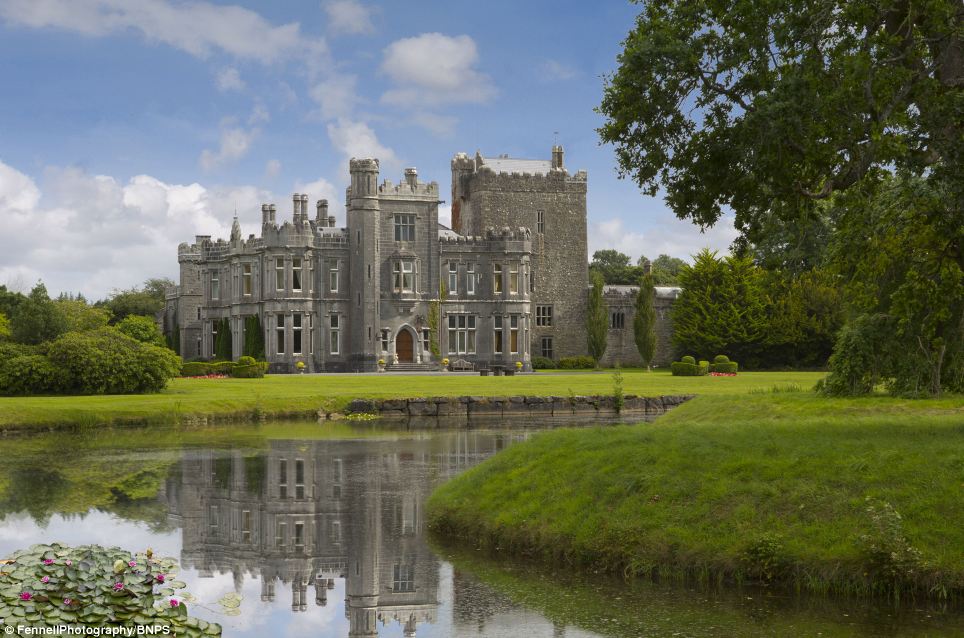


 Irish Historic Houses


