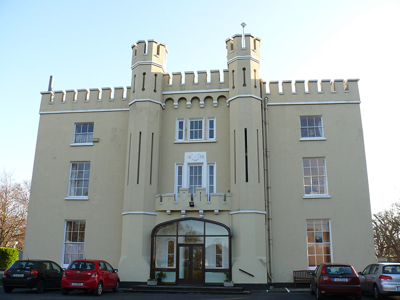
Bushy Park, Terenure, Co Dublin – apartments 

Bushy Park, Terenure, Co Dublin – apartments 

Bence-Jones, Mark. A Guide to Irish Country Houses (originally published as Burke’s Guide to Country Houses volume 1 Ireland by Burke’s Peerage Ltd. 1978); Revised edition 1988 Constable and Company Ltd, London. 

p. 51. “(Shaw, Bt/PB) A plain three storey Georgian house with large C19 ground floor windows and external shutters. Belonged, ca 1800, to Abraham Wilkinson; later became the seat of his son-in-law, Sir Robert Shaw, 1st Bt, MP and Lord Mayor of Dublin (a 1st cousin of George Bernard Shaw’s grandfather) who had previously lived nearby at Terenure [House].”

Robert Shaw, 1774-1849, first baronet of Bushy Park Co. Dublin attributed to Hugh Douglas Hamilton courtesy of Mealys Autumn Sale 2015.
Maria Shaw (1838-1875), Daughter of Sir Frederick Shaw 3rd Bt of Bushy Park, Dublin, by William Brocas, courtesy of Adam’s auction 23 March 2016.


Bullock Castle, Dalkey, Co Dublin

Bullock Castle, Dalkey, Co Dublin

Bence-Jones, Mark. A Guide to Irish Country Houses (originally published as Burke’s Guide to Country Houses volume 1 Ireland by Burke’s Peerage Ltd. 1978); Revised edition 1988 Constable and Company Ltd, London. 

p. 49. “A medieval castle with two square Irish-battlemented towers and a plain three storey three bay later wing. In 1910 the residence of S.A. Quan-Smith.” 

Belgard Castle, Clondalkin, Co Dublin 

Belgard Castle, Clondalkin, Co Dublin 

Bence-Jones, Mark. A Guide to Irish Country Houses (originally published as Burke’s Guide to Country Houses volume 1 Ireland by Burke’s Peerage Ltd. 1978); Revised edition 1988 Constable and Company Ltd, London. 

p. 36. “(Kennedy-Skipton/IFR; Lawrence, Bt, of Lucknow/PB; Maude, sub Hawarden, B/PB) A large three storey C18 block attached to a medieval tower with Georgian Gothic windows and battlements. Drawing room ceiling of Adamesque plasterwork. Belgard was originally a seat of a branch of the Talbot family, from whom it passed by inheritance to a branch of the Dillon family at the end of C17. In 1788 it was leased to Francis Cruise, whose family still occupied it 1814. Later in C19 it was bought by Dr Evory Kennedy, president of Royal College of Physicians of Ireland; it subsequently passed to his grandson, Sir Henry Lawrence, 2nd Bt (who was also the grandson of the great Sir Henry Lawrence, founder of British rule in the Punjab and defender of Lucknow), whose widow sold it in 1910 to A.F. Maude. Sold ca 1962 by Mr Hugh Maude.” 

featured in Georgian Mansions in Ireland with some account of the evolution of Georgian Architecture and Decoration by Thomas U. Sadleir and Page L. Dickinson. Dublin University Press, 1915. 

“The mansion of Belgard is in the parish of Clondalkin, Co Dublin, and lies about six miles to the south of the capital. It consists, as appears from Pr. R.C. Orpen’s drawing, of a tall tower, with a large square house adjoining. Save for the Georgian doorway, it betrays externally no distinct form of architecture, though the interior contains several handsomely decorated rooms, one of which was illustrated in the fifth volume of the Georgian Society’s publications. We reproduce the mantel in the drawing room.  

The original castle which stood here was the property of the Talbots, who were of the same stock as the ancient family of Talbot in Malahide. It is first mentioned towards the close of the fifteenth century, beign then the seat of Robert Talbot, who was so prominent a champion of the house of Ormond in their endless quarrels with the Fitzgeralds, that the latter declared “that he kept a calendar of all their doings, and stirred the coals that incensed brother against brother.” At this time Belgard was one of the principal castles in the county of Dublin, and doubtless covered a considerable area. Robert Talbot died in 1523, and this estate was enjoyed in succession by his son, grandson and great-grandson. The last-mentioned was Gilbert Talbot, who inherited on his father’s decease in 1580. 

During the rising instigated by Viscount Baltinglass, the forces of the Crown charged with its suppression, under the Earl of Kildare and Sir Henry Harrington, assembled at Belgard before setting out to attack the enemy in the neighbourhood of Rathmore. Gilbert Talbot died in 1626, being succeeded by his second son Adam. We have no particulars of the latter’s residence here, but he was a man of position in the country, and though he did not engage in the Rebellion, it is clear that his sympathies were on the side of the Confederates. His son John Talbot, of Belgard, was actively engaged on behalf of that party, but we have no particulars of his exploits save that he shot a man at Chapelizod, for which he narrowly escaped being hanged on the establishment of Cromwell’s rule. He wisely left the country, and is said to have subsequently distinguished himself during the war in Flanders. The castle was next occupied by Adam Loftus, grandson of Sir Dudley Loftus, of Rathfarnham, who settled here on his marriage, and as showing the them accommodation we may mention that he kept five servants. 

At the Restoration the rightful owner, Lieutenant John Talbot, “for reason known unto the King in an especial manner meriting his grace and favour” was restored to the inheritance. [see notes on Belgard Castle in the Journal of the County Kildare Archaeological Society, vol. v, pg. 12]. Under James II he became a Colonel in Tyrconnell’s Horse, and sat as M.P. for Newcastle Lyons in the Parliament of 1689. He fought for the Jacobites during the Revolution, but was, however, after the fall of Limerick, being specially included in the terms of capitulation, permitted to take up his residence at Belgard, where he was living in 1693, when he gave security for loyal behaviour. He died in 10th Sept 1697, aged 73, leaving by his wife Elizabeth, daughter of Sir Henry Talbot, of Templeogue, three daughters and co-heiresses: Margaret, wife of Sir Peter Bath, second Bart., of Athcarne, Co Meath, who died without issue in 1686; Catherine, who married in 1694 Colonel Thomas Dillon; and Maryanne, who married in 1696 Christopher Dillon, of Lungmore, Co Mayo, a younger brother of her sister’s husband. 

Prior to his death in 1721, Colonel Dillon occupied the house in right of his wife. His widow also lived here, apparently with her sister, Lady Bath, who in her will, dated 2nd June 1732, is described as “of Belgert, Co Dublin.” [see The Complete Baronetage, by G.E.C., iv, 203]. AT a later period Henry Dillon, the Colonel’s eldest son, who married Jane, daughter of Michael Moore, of Drogheda, appears as the owner. He lived here for many years, and is stated to have been a man of great wealth, known far and wide for his charity, hospitality, and lavish expenditure. On his death in 1772 his eldest son Thomas inherited, by dying childless 14 years later the next brother, John, an officer in the Austrian service, succeeded. The existing house was certainly standing prior to this time, for it is mentioned by Austin Cooper, the antiquary, but the ornament is apparently rather later. John Dillon, who removed to London about 1796, was the last representative of the family, and on his death, which occurred at Brompton, in May 1800, at the age of 90, the property passed to the descendants of his sister, Catherine, wife of Dominick Trant. But at this time the actual occupier was a Mr. Francis Cruise, who had come to reside in 1788, on obtaining a lease for 99 years from John Dillon. The Cruise family remained in possession till 1853, when the interest in the house was acquired by Dr. Evory Kennedy, one of the leading physicians in Dublin, who by purchases in the Landed Estates Court subsequently became absolute owner. He died in 1886, and taking advantage of an option expressed in his will, the residential portion of the Belgard estate was then purchased by his grandson, Sir Henry Hayes Lawrence, Bart., from whose representatives it was lately acquired by Captain Anthony Maude, the present owner.” 

https://planning.southdublin.ie/Home/ViewDocument?fileId=5985512

Belcamp House (also known as Belcamp Hutchinson), Balgriffin, Co Dublin

Belcamp House (also known as Belcamp Hutchinson), Balgriffin, Co Dublin

Bence-Jones, Mark. A Guide to Irish Country Houses (originally published as Burke’s Guide to Country Houses volume 1 Ireland by Burke’s Peerage Ltd. 1978); Revised edition 1988 Constable and Company Ltd, London. 

p. 35. (Hyde/IFR) a two storey double bow fronted Georgian house, the bows being close together. Porch with Ionic columns. Now the house of Count Karl Waldburg.” 

Belcamp Hall, Balgriffin, County Dublin  – a college 

Belcamp Hall, Balgriffin, County Dublin  – a college 

Bence-Jones, Mark. A Guide to Irish Country Houses (originally published as Burke’s Guide to Country Houses volume 1 Ireland by Burke’s Peerage Ltd. 1978); Revised edition 1988 Constable and Company Ltd, London.  

p. 35. (Newenham/IFR) A fine red brick house of ca 1786. Of three storeys over basement; seven bay breakfront entrance front with rusticated stone frontispiece; garden front with curved central boy and two bays on either side. Round headed ground floor windows. Rather similar plan to Lucan, Co Dublin and Mount Kennedy, Co Wicklow.; oval room extending into garden front bow. Good interior plasterwork. Tower in grounds erected in honour of George Washington 1778 by Sir Edward Newenham, MP, a member of the Patriot Party. Now a college.” 

https://www.abandonedworldphotography.com/ireland-urbex/belcamp-house-college-dublin

In 1778, Belcamp House was built for Sir Edward Newenham, a member of the Irish Parliament and huge supporter of the American Revolution. The four-storey Georgian building was designed by Kilkenny native James Hoban, who was also the architect of the White House in Washington DC.

The original site comprised of a large farmhouse with twelve bedrooms, outhouses, stables, a walled garden and was situated on seven acres of farmland.

In 1793, Newenham sold the estate to pay off his mounting debts.

In 1884, the Belcamp estate was purchased by the Oblate brothers who then built and established Belcamp College.

In 1903, the Oblate brothers added residential wings as well as a redbrick Gothic revival style chapel (St. Mary’s). The renowned chapel was designed by architect George Coppinger Ashlin and containing stained glass windows by the famous artist Harry Clarke.

These historically significant buildings, along with the walled gardens, still stand today, and served as inspiration for the design of the new homes at Belcamp, adding another layer of history to this site for a new generation of dwellers.

In late 1909, Countess Markievicz and a small group of Na Fianna Éireann members made Belcamp House their home. The group created their own private commune, which enabled them to live off the land while they practiced shooting and military drills. Irish freedom fighter revolutionaries such as Con Colbert, Eamon Martin, Paddy Ward, Garry Holohan, Seamus Kavanagh and the Reynolds brothers were all part of the “Belcamp Commune”.

Unfortunately, the Belcamp Commune didn’t last long and the Inghinidhe na hÉireann had to move out after they racked up a loss of £250.

In 1972 the historic Belcamp Hall was placed on the protected structures list.

In 2002, a security guard for the Belcamp site was shot but managed to survive.

In 2004, developer Gerry Gannon (Gannon Homes) purchased the property from the Oblate Fathers for €105m for development after the religious order closed the school due to dwindling numbers.

Gannon’s development proposal included converting the property into apartments, while hopefully retaining as many of the original furnishings as possible and restoring the infamous Washington Tower.

In 2007, one of Mr Gannon’s firms was granted permission to convert the derelict Belcamp school buildings into 30 apartments, but the plan never came to fruition.

In 2009, the Chapel of the Novitiate of the Oblate Fathers of St. Mary Immaculate was closed to the public.

During 2011, the Belcamp House and surrounding historic buildings were set on fire a number of times, and looting become rife. The fires destroyed the main house and caused the roof to partially collapse. Additionally, most of the marble fireplaces, copper wiring, brass fittings and oak floorboards had been stripped from the building by looters during the weeks prior to the fires, while almost every single sash window in the entire property had been smashed by vandals.

The vandals kept attacking the site throughout 2011, which at the time was under the protection of security guards. The final straw was when a group of hooligans on horses brandishing machetes terrorised and attacked the security guards.

Shortly after, Gerry Gannon and Fingal County Council’s heritage officer organised the removal of six pairs of valuable Harry Clarke stained glass windows from the former school’s chapel to the National Museum of Ireland for safekeeping. The stained glass was replaced by double-sided bullet-proof glass and the site security was increased.

By 2016, two more fires engulfed Belcamp House and the disrepair got even worse, despite the fact it was a listed, heritage building. In the summer of 2016, a section of the school building directly abutting Belcamp Hall was demolished, with the agreement of the planning authority, as a consequence of the trespassing and arson attacks on the property and in order to prevent access to the Hall and further damage.

In 2016, it was also the target of the investigation for a man who had been missing for 12 years, Patrick Lawlor.

In 2017, Gannon Homes got the go-ahead to build initial 165 housing units on the north Dublin site.

After work finally began on the site, the first brand new Belcamp houses were launched to the market in 2020.

A new phase was launched in 2022, with 33 new houses on offer. These include three-bed terraced houses with a floor area of approximately 1,215sq ft that are priced from €425,000. The three-bed end-of-terrace type is a similar size but is priced from €445,000, The four-bed end-of-terrace and semi-detached homes start at €510,000 and have a floor area of approximately 1,474sq ft.

The scheme was designed by CCK Architects, who wanted the houses to complement the redbrick of the historic buildings that are still on the site. There are future plans to completely refurbish Belcamp Hall, one of the older buildings, and convert it into apartments.

Over 100 houses have been sold at the development to date.

In August 2021, a homeless man who was a former student of Belcamp College was found on the site, crawling on the ground after being shot. But the violence didn’t end there. In the same month, a security guard for Belcamp House who was sitting outside the property in this car, had to be taken to the hospital in an ambulance after he suffered a serious attack.

Beech Park, Clonsilla, Co Dublin 

Beech Park, Clonsilla, Co Dublin 

Bence-Jones, Mark. A Guide to Irish Country Houses (originally published as Burke’s Guide to Country Houses volume 1 Ireland by Burke’s Peerage Ltd. 1978); Revised edition 1988 Constable and Company Ltd, London.  

p. 291. “A double-bow-fronted single-storey late-Georgian house. Home of the Shackelton family, related to the Antarctic explorer Ernest Shackleton. The house was recently damaged by fire, but has been restored. It has a noteable garden (see Anna Liffey House)” [– not the same, that seems to have two storeys)]” 

Not in National Inventory 

Manresa (formerly Baymount or Granby Hall), Clontarf, Co Dublin

Baymount, Clontarf, Co Dublin (Manresa) – owned by Jesuits 

Bence-Jones, Mark. A Guide to Irish Country Houses (originally published as Burke’s Guide to Country Houses volume 1 Ireland by Burke’s Peerage Ltd. 1978); Revised edition 1988 Constable and Company Ltd, London.  

p. 34. “A Georgian house of three storeys over a basement with a curved bow in the centre of one of its fronts, mildly castellated in early C19; with a battlemented parapet and two rather thin turrets on either side of the bow. Classical interior. Castellated stableyard. The residence of Dr. Trail, Bishop of Down and Connor, later, ca 1837, the residence of J. Keily. Now owned by the Society of Jesus.” 

Manresa House in Clontarf, formerly called Granby Hall and Baymount Castle.

Manresa Jesuit Retreat Centre, Clontarf, photograph courtesy of National Inventory. A three-bay three-storey house over basement, dated 1838, incorporating mid-eighteenth-century fabric. Originally known as Granby Hall, this house was leased by Doctor James Traill, Church of Ireland Bishop of Down and Connor, in 1775. Robert Warren was later granted a lease of the land and house from J.E.V. Vernon in 1838, undertaking to construct new outbuildings, gate lodges, and to repair and improve the house, and renaming it Baymount Castle. 

Ballinclea, Killiney, Co Dublin – demolished 

Ballinclea, Killiney, Co Dublin – demolished 

Bence-Jones, Mark. A Guide to Irish Country Houses (originally published as Burke’s Guide to Country Houses volume 1 Ireland by Burke’s Peerage Ltd. 1978); Revised edition 1988 Constable and Company Ltd, London.  

p. 18. “(Talbot, sub Talbot de Malahide, B/PB) A 2 storey house of early to mid 19C aspect… Now demolished.” 

Listed in Vanishing Country Houses of Ireland by The Knight of Glin, David J. Griffin and Nicholas K. Robinson, published by The Irish Architectural Archive and The Irish Georgian Society, 1988.

p. 59. “A two storey bow-fronted house built c. 1830. Single storey granite portico. Seat of the Hon. Mrs. Mellifont in 1837. Demolished.

Balheary House, Swords, Co Dublin – demolished 2005 

Balheary House, Swords, Co Dublin – demolished 2005 

Bence-Jones, Mark. A Guide to Irish Country Houses (originally published as Burke’s Guide to Country Houses volume 1 Ireland by Burke’s Peerage Ltd. 1978); Revised edition 1988 Constable and Company Ltd, London.  

p. 289. “2 storey house of late Georgian appearance. In 1837 the residence of A. Baker, when the large saloon and dining room contained some fine pieces of tapestry formerly belonging to the Ormonde family.” 

https://www.swords-dublin.com/balheary-house.html

this house no longer exists, it was knocked in early 2005. ‘Balheary House’ was located on the grounds of the Emmaus Retreat Centre on Ennis Lane. The Irish Christian Brothers bought the site and grounds (Balheary Demesne) in the late 1950s and built the retreat centre, moving in in October 1961. Christian Brothers who taught in the local Colaiste Choilm school resided in Balheary House from 1967 and they only moved out in August 1998. Prior to the Christian Brothers, the site was owned by Hunters and Walshs before that. I’ve checked with the Achieves people from the centre, but they haven’t been able to locate any photos of the house yet. Emmaus retreat centre is still in use today. 

Ayesha Castle (or Victoria Castle), Victoria Road, Killiney, Dublin 

Ayesha Castle (or Manderley or Victoria), Victoria Road, Killiney, Dublin 

Ayesha Castle, Dublin entrance gate, photograph by Robert French, Lawrence Photograph Collection, National Library of Ireland.
Victoria Castle, County Dublin, photograph by Robert French, (between ca. 1865-1914), Lawrence Photograph Collection, National Library of Ireland.

Bence-Jones, Mark. A Guide to Irish Country Houses (originally published as Burke’s Guide to Country Houses volume 1 Ireland by Burke’s Peerage Ltd. 1978); Revised edition 1988 Constable and Company Ltd, London.  

p. 13. “(Warren/LGI1912; Lloyd of Lossett/LGI1958; Aylmer/IFR) A romantic 19th century castle of ashlar with a round tower and various turrets by the side of Killiney Bay, built ca. 1850 for Robert Warren of Killiney Castle, who named it Victoria Castle, presumably in honour of the queen visit to Dublin for the Exhibition of 1853. It later became the residence of Rev Humphrey Lloyd, FRS, of Lossett, Co Cavan, Provost of Trinity College Dublin 1867-81, and remained in the Lloyd family until the present century. Gutted by fire towards the end of the Lloyd ownership; afterwards restored, and its name changed to Ayesha Castle. Bought by Col R. M. Aylmer in 1947.” 

Victoria Castle, County Dublin, photograph by Robert French, (between ca. 1865-1914), Lawrence Photograph Collection, National Library of Ireland.

Irish Historic Houses, by Kevin O’Connor:  

owner: Brigid Aylmer. 

A romantic 19th century Victorian castle with the finest views of Killiney Bay and the Sugarloaf Mountain in the county. It was built from local granite by Robert Warren, a wealthy landowner, in 1840, when he called it Victoria Castle… 

It was gutted by fire in 1926 and was bought and renovated by Sir Thomas Power of Power’s Whiskey who renamed it Ayesha, after the goddess heroine of Rider Haggard’s novel She, who rose, phoenix-like, from the flames. Amongst its noteable features are the fine oak panelling in the entrance hall and dining-room, and the magnificent spiral staircase.”