Celbridge Abbey, Celbridge, Co Kildare 

Celbridge Abbey, Celbridge, Co Kildare 

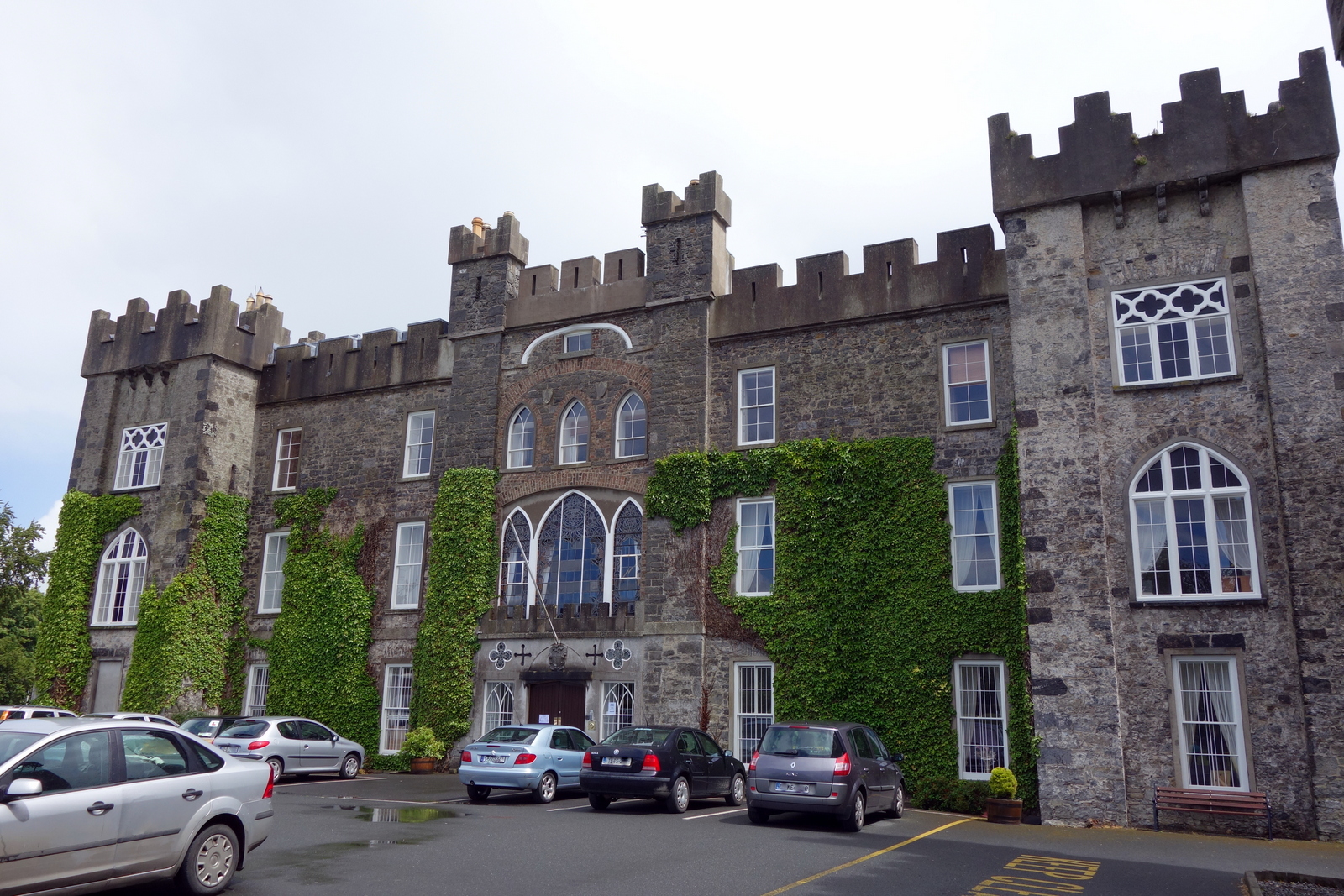
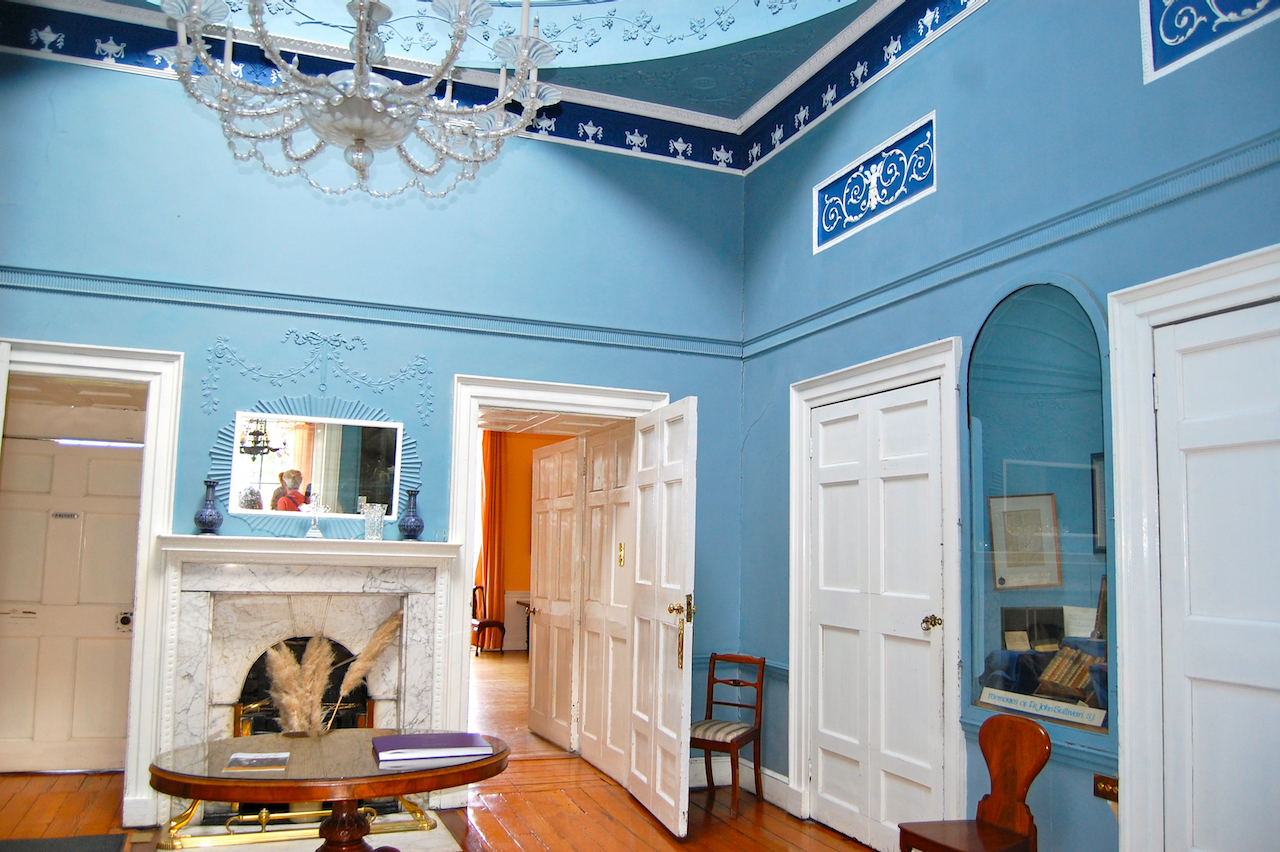
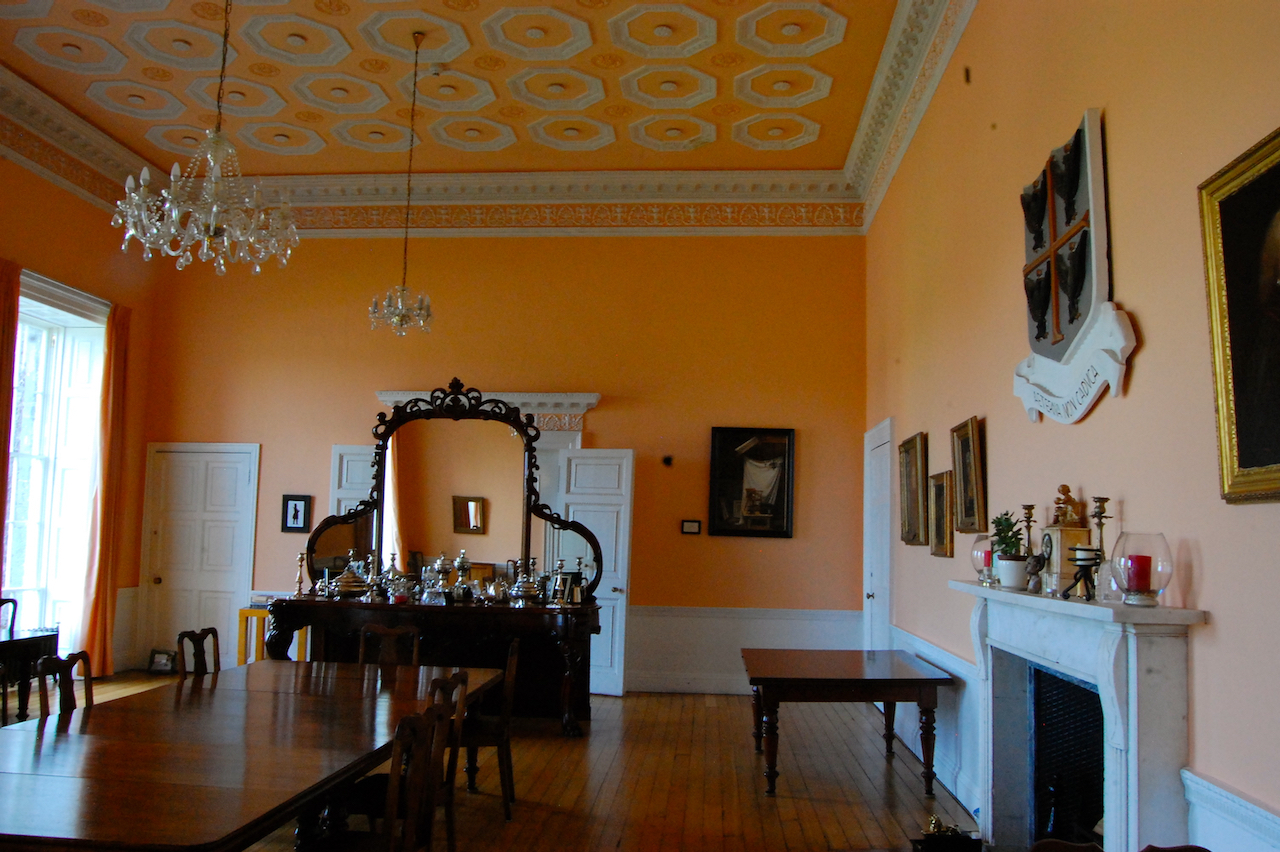
Celbridge Abbey, Celbridge, Co Kildare courtesy National Inventory.

Mark Bence-Jones. A Guide to Irish Country Houses (originally published as Burke’s Guide to Country Houses volume 1 Ireland by Burke’s Peerage Ltd. 1978); Revised edition 1988 Constable and Company Ltd, London.  

p. 81. “(Marlay/LGI1912; Grattan/ LG1863 and IFR; Langdale, sub Mowbray, Segrave and Stourton, B/PB; Dease, sub Bland/IFR) The house of Esther Vanhomrigh, Swift’s “Vanessa”; a rustic seat by the River Liffey is said to have been favoured by Swift as a place to retire with his love. Dr Richard Marlay, Bishop of Waterford, uncle of the statesman, orator and patriot, Henry Grattan, rebuilt the house in Georgian Gothic towards end of C18; it is of two storeys over basement and has a front of six bays, the two centre bays breaking forward and rising above the parapet on either side to form a central battlemented attic; the parapet on either side being battlemented also, with small pinnacles at the corners. The windows on eitehr side of the centre are pointed, and have the most enchanting Georgian-Gothic astragals, in the form of delicate Gothic tracery. Attractive Georgian –Gothic entrance gates. Occupied ca 1837 by J. Ashworth, owner of the woollen manufactory in Celbridge. Passed to Henry Grattan, MP, son of the great Henry Grattan; then to his daughter, and co-heiress, Henrietta, wife of C.J.Langdale. Afterwards the seat of Viceregal Chamberlain Sir Gerald Dease and of his son.” 

Thomas Marlay Esq., Lord Chief Justice, died 1756, courtesy Fonsie Mealy auction Nov 2016.
Celbridge Abbey, Celbridge, Co Kildare courtesy National Inventory.
Celbridge Abbey, courtesy of National Library of Ireland published between ca. 1865-1914 Lawrence Photographic Collection, French, Robert, 1841-1917 photographer.
Celbridge Abbey, County Kildare, photograph by Robert French, Lawrence Photograph Collection, National Library of Ireland.
Possibly a portrait of Hester Van Homrigh )1690-1723), Jonathan Swift’s “Vanessa,” courtesy of National Gallery of Ireland.

https://www.buildingsofireland.ie/buildings-search/building/11805074/celbridge-abbey-clane-road-celbridge-abbey-celbridge-ed-celbridge-co-kildare

Detached six-bay two-storey over basement Georgian Gothic-style house with dormer attic, c.1775, probably incorporating fabric of earlier house, 1697, with two-bay breakfront to front (south-east) elevation having three-bay single-storey over raised basement flat-roofed projecting porch to ground floor, three-bay two-storey side elevation to south-west and single-bay two-storey return to rear to north-west having single-bay three-storey engaged ‘tower’ to north and two-bay three-storey split-level projecting block to west. Renovated, c.1985. Now in use as monastery. Hipped roofs behind battlemented parapet walls with slate (gabled to dormer attic windows). Clay ridge tiles. Roughcast chimney stacks. Cast-iron rainwater goods. Flat-roofed to porch. Materials not visible behind battlemented parapet wall. Roughcast walls. Unpainted. Profiled section to side elevation to north-east continuing into chimney stack with advanced corner piers and ogee-headed and pointed-arch recessed panels. Two-storey pointed arch recessed panel to tower to north possibly originally window opening. Decorative shields to top floor to tower to north. Cut-stone stringcourses to top floors. Roughcast battlemented parapet walls with finials to corners. Roughcast stepped parapet wall to breakfront. Rendered walls to porch. Painted. Cut-stone string/sill courses. Rendered battlemented parapet wall with cut-stone coping. Pointed-arch window openings to flanking bays of front (south-east) elevation. Stone sills. Early multi-pane timber sash windows. Square-headed window openings to remainder (some in bipartite and tripartite arrangements). Stone sills. Moulded hood mouldings over. Early 1/1 and 2/2 timber sash windows. Pointed-arch door openings. Rendered chamfered reveals. Timber panelled double doors with diagonal tongue-and-groove timber panels. Set in own extensive landscaped grounds with rear (north-west) elevation fronting on to road. 

Appraisal 

Celbridge Abbey is of considerable significance to the architectural heritage of County Kildare. Built on the site of an earlier house dating to the late seventeenth century, and possibly incorporating fabric of that house, the building is of some archaeological importance. The present house is of social, historical and cultural significance for its associations with Richard Marlay, Bishop of Waterford (the original builder and occupier), Henry Grattan MP (a subsequent occupier), and Dean Jonathan Swift and Ester (‘Vanessa’) Van Homrigh. Now in use as a monastery for the Christian Brothers order, the house retains most of its original form and character. The front (south-east) elevation of the house is typical of the Georgian Gothic style, composed of graceful, balanced proportions on a symmetrical plan with Gothic-style motifs. The irregular massing of the remainder of the house, including a tower and a variety of chimney stacks, serves to distinguish and identify the composition in the surrounding landscape. Many early or original features and materials remain in situ, including timber sash fenestration (some multi-pane to the imposing pointed-arch openings to the south-east front), timber fittings to the door openings, and slate roofs. The retention of an early external aspect suggests that the house may retain original features and fittings of significance to the interior. Set in its own extensive landscaped grounds (complemented by a range of ancillary structures; 11805075-?/KD-11-05-75 – 7?), the house is an attractive landmark from the River Liffey to the south, while the rear (north-west) elevation forms an imposing feature on the streetscape of Clane Road. 

Celbridge Abbey, Celbridge, Co Kildare courtesy National Inventory.

https://www.buildingsofireland.ie/buildings-search/building/11805076/celbridge-abbey-clane-road-celbridge-abbey-celbridge-ed-celbridge-co-kildare

Celbridge Abbey, Celbridge, Co Kildare courtesy National Inventory.

Section of rubble stone entrance screen wall, c.1775, with advanced section to centre having pointed-arch integral carriageway, cut-stone stringcourse and battlemented parapet over. Attached single-bay two-storey rubble stone flanking outbuilding, c.1775, to south-west with three-bay side elevation to north-east having battlemented parapet wall forming false fortified tower effect and four-bay single-storey wing to south-east with shallow segmental-headed integral carriageway. Reroofed and renovated, c.1985. Gable-ended roofs (partly behind battlemented parapet wall to north-west). Replacement artificial slate. Clay ridge tiles. Square rooflights, c.1985, to pitch to south-west. Replacement rainwater goods, c.1985. Random rubble stone walls. Random rubble stone battlemented parapet wall with red brick trefoil panels and cut-stone stringcourse. Square-headed window openings. Stone sills. Rubble stone dressings. Replacement timber casement windows, c.1985. Segmental-headed carriageway remodelled, c.1985. Rubble stone voussoirs. Replacement glazed timber fittings, c.1985, incorporating door. Shallow segmental-headed integral carriageway to wing. Rubble stone voussoirs. Pointed-arch blind opening to ground floor to elevation to north-west. Stone sill and surround. Attached single-bay two-storey rubble stone flanking outbuilding, c.1775, to north-east with three-bay side elevation to north-east having segmental-headed integral carriageway, battlemented parapet wall forming false fortified tower effect, screen wall to south-east with shallow segmental-headed door opening and two-bay single-storey wing to south-east. Reroofed and renovated, c.1985, to accommodate commercial use. Gable-ended roofs (partly behind battlemented parapet wall to north-west). Replacement artificial slate. Clay ridge tiles. Replacement rainwater goods, c.1985. Random rubble stone walls. Random rubble stone battlemented parapet wall with red brick trefoil panels and cut-stone stringcourse. Square-headed window openings. Stone sills. Rubble stone dressings. Replacement timber casement windows, c.1985. Segmental-headed carriageway remodelled, c.1985. Rubble stone voussoirs. Replacement glazed timber fittings, c.1985, incorporating door. Pointed-arch blind opening to ground floor to elevation to north-west. Stone sill and surround. Shallow segmental-headed door opening to screen wall. Rubble stone voussoirs. 

Appraisal 

This complex, comprising an entrance screen wall with flanking outbuildings arranged about a courtyard, is an integral component of the Celbridge Abbey estate. Presenting a symmetrical front on to Clane Road to north-west, the building is an attractive and imposing landmark in the locality, the battlemented parapet walls serving to articulate the skyline. The construction in rubble stone attests to the high quality of stone masonry practised in the locality and the fabric also incorporates early red brick. Renovated in the late twentieth century to accommodate a commercial use, the replacement materials have been installed in keeping with the original integrity of the design, while most of the original form remain intact. 

Celbridge Abbey, Celbridge, Co Kildare courtesy National Inventory.

https://archiseek.com/2014/the-abbey-celbridge-co-kildare

1780s – The Abbey, Celbridge, Co. Kildare 

Celbridge Abbey was built by Bartholomew Van Homrigh, Lord Mayor of Dublin, in 1697. It was his daughter, Esther Van Homrigh who has been immortalised as ‘Vanessa’ by Jonathan Swift. Swift came regularly from his deanary to visit her. Chief Justice Marlay bought Celbridge Abbey in 1723. It was his son, Dr. Richard Marlay, the bishop of Waterford, who gave the abbey its present Gothic character towards the end of the 18th century. Also, his grandson, Henry Grattan, famous orator and parliamentarian lived here for a time. The house is of two storeys over basement, the centre bays breaking forward with a central battlemented attic. The windows have attractive Georgian-gothic tracery. 

Castlesize, Sallins, Co Kildare

Castlesize, Sallins, Co Kildare

Mark Bence-Jones. A Guide to Irish Country Houses (originally published as Burke’s Guide to Country Houses volume 1 Ireland by Burke’s Peerage Ltd. 1978); Revised edition 1988 Constable and Company Ltd, London.  

p. 75. “(Graham/LGI1958) A two storey late C18 house of seven bays, the two outer bays on either side projecting slightly. Original doorcase hidden by later enclosed porch with corner pilasters and door at side. In 1814, the residence of George Chace.” 

Not in national inventory 

Castle Martin, Co Kildare 

Castle Martin, Co Kildare 

Castlemartin, County Kildare, courtesy of myhome.ie
Castlemartin House, County Kildare, photograph by Robert French, (between ca. 1865-1914), Lawrence Photograph Collection, National Library of Ireland.

Mark Bence-Jones. A Guide to Irish Country Houses (originally published as Burke’s Guide to Country Houses volume 1 Ireland by Burke’s Peerage Ltd. 1978); Revised edition 1988 Constable and Company Ltd, London. 

p. 72. “(Shaen Carter/IFR; Blacker, sub Blacker Douglass/LGI 1912; Pollock?LGI1958; Ruthven, Gowrie, E/PB) An early C18 U shaped house, built ca 1720 by a Dublin banker named Harrison using materials from an old Eustace castle here. Of two storeys over basement; dormered attic in roof; 9 bay breakfront front and side elevations. Doorcase in entrance front of exceptional beauty, with a scrolled pediment on console brackets, and a bolection moulding. Triangular pediment over central window in side elevation. Hall with large plaster panels, pilasters and some carvings in wood.  Sold 1730 to Capt Henry Boyle-Carter.  Used by Lt-Gen Sir Ralph Dundas as headquarters during 1798 rebellion. Sold to T.S. Blacker 1854. At some period the house was re-roofed, and lost its dormers; the interior was much altered in the 1st half of the 19C, having suffered damage 1798. The house faces along a straight lime avenue at the end of which are magnificent C18 wrought iron gates. On the death of Mrs Blacker (nee Pollok), widow of Lt-Col Frederick Blacker, of Castlemartin,  1967, Castlemartin was inherited by Mrs Blacker’s great-nephew, 2nd and present Earl of Gowrie, the politician, who sings of teh house in his poem, Easter 1969, published in A Postcard from Don Giovanni. He sold Castlemartin, which is now the home of rugby player and businessman A.J. F. O’Reilly.” 

See chapter on Thomas Carter (1694-1763), who lived in 9 Henrietta Street in Dublin as well as in Castlemartin, in The Best Address in Town, Henrietta Street, Dublin and its first Residents 1720-80 by Melanie Hayes. 

Thomas Carter (1694-1763) by Charles Jervas courtesy Adams’s Irish Old Masters November 2024
Mary Carter née Claxton by Charles Jervas courtesy Adam’s Irish Old Masters Nov 2024

Only gate lodge in national inventory. 

Sold October 2022 

Castlemartin Stud Farm, Kilcullen, Kildare  

10 beds  

10 baths  

2428m 2 

Castlemartin, County Kildare, courtesy of myhome.ie

One of Ireland’s greatest estates… Situated less than thirty-five miles from Dublin, Castlemartin Stud Farm is a rare and fine example of Georgian architectural excellence with a stunning back-drop of the River Liffey and surrounding parkland. Located in County Kildare, known as the thoroughbred county, the landscape is dominated and characterised by the quality of its agricultural land, which is made up of carboniferous limestone, sand and gravel. This not only provides good drainage but the limestone helps to grow strong bone in young thoroughbreds. Castlemartin House, built in c.1720, is an early Georgian mansion.  

Castlemartin, County Kildare, courtesy of myhome.ie

Consisting of some wonderful reception and entertaining rooms on the ground floor, as well as a library and several family rooms. Upstairs, there is the wonderfully appointed master suite consisting of his and hers bathrooms and a large dressing room. In addition to the master suite, there are a further 9 principal bedrooms in the main house. There is ample guest and staff accommodation on-site, with the large pool house, two cottages in the courtyard, three further staff apartments, a caretaker’s house, Brownstown Cottage and the front lodge. With two large stable yards and two farm yards; there are some 89 loose boxes, a horse walker, a lunge ring, numerous haysheds, barns and outbuildings, wintering facilities for 400 cattle, and many additional facilities that are to be expected of a stud farm of this calibre. The stud has bred and raced classic, group and listed including: Chinese White Gr.1 Pretty Polly Stakes; Gr.2 Blanford Stakes. Ectot. Gr.1 Criterium Int. Stakes. (in partnership) Helissio. Gr.1 Prix de L’Arc de Triomphe Joshua Tree. Gr1. Canadian International (twice) Lawman. Gr.1 Prix du Jockey Club; Gr.1 Prix Jean Prat Latice Gr.1 Prix de Diane; Gr.3 Prix de Conde. Lightning Pearl Gr.1 Chevely Park Stakes. Gr.3 Go & Go Round Tower Stakes Most Improved Gr.1 St. James palace Stakes. Chiquita Gr.1 Irish Oaks Silver Frost Gr.1 Poule d’Essai des Poulains.   Location information Kilcullen – Walking Distance Curragh Racecourse – 4 miles Punchestown Racecourse – 7 miles Goffs Bloodstock – 12 miles Weston Airport – 27 miles Dublin City Centre – 34 miles Dublin Airport – 38 miles Tattersalls Ireland – 40 miles 

BER Details 

BER: N/A BER No. XXX Energy Performance Indicator: XXX kWh/m²/yr 

Castlemartin, County Kildare, courtesy of myhome.ie

Castle Browne (Clongowes Wood College), Clane, Co Kildare

Castle Browne (Clongowes Wood College), Clane, Co Kildare

Clongowes College, County Kildare, photograph by Robert French, (between ca. 1865-1914), Lawrence Photograph Collection, National Library of Ireland.

Mark Bence-Jones. A Guide to Irish Country Houses (originally published as Burke’s Guide to Country Houses volume 1 Ireland by Burke’s Peerage Ltd. 1978); Revised edition 1988 Constable and Company Ltd, London. 

p. 63. “[Wogan-Browne 1912] A 3 storey house rebuilt as a symmetrical Gothic Revival castle 1788 by Thomas Wogan Browne, who acted as his own architect; with round corner towers and Irish battlements. Round room with Adamesque plasterwork on domed ceiling. Castle Browne was sold 1814 by Gen. Michael Browne to the Society of Jesus, and became the nucleus of the famous Jesuit public school, Clongowes Wood College.”

Clongowes Wood entrance gates, County Kildare, photograph by Robert French, (between ca. 1865-1914), Lawrence Photograph Collection, National Library of Ireland.

Clongowes Wood College, County Kildare:

Clongowes Wood College, County Kildare, is a school run by the Jesuits. It was purchased by the Jesuits in 1814. There was a castle here since 1450, built by the Eustace family to protect the area called The Pale. The Pale rampart itself was a six foot high bank surrounded by a double ditch. There are two areas of well preserved Pale on the property of Clongowes Wood. The name comes from a hybrid of Latin and Irish, meaning “the wood of the meadow of the smith.” See https://www.clongowes.net/about-us/clongowes-history/ Photograph by Brian O’Neill, This file is licensed under the Creative Commons Attribution-Share Alike 3.0 Unported license.

In 1718 Stephen Fitzwilliam Browne (d. 1767) rebuilt Clongowes Wood Castle, creating the western front facade as it appears today, comprising the central keep and two square towers. In 1788 Thomas Wogan Browne (d. 1812) extended and decorated the castle. The extension consists of the eastern facade and two round towers at the back of the castle. Note that this information is from the Clongowes Wood school website, with information from A Short History of Clongowes Wood College by Brendan Cullen.

Clongowes Wood College, photographed during a tour taken in August 2018. Photograph © Jennifer Winder-Baggot, www.irishhistorichouses.com
Staff dining room, Clongowes Wood College, photographed during a tour taken in August 2018. Photograph © Jennifer Winder-Baggot, www.irishhistorichouses.com
Staff Reading Common Room, Clongowes Wood College. Photograph by Brian O’Neill, This file is licensed under the Creative Commons Attribution-Share Alike 3.0 Unported license.

http://www.turtlebunbury.com/history/history_family/hist_family_woganbrowne.html

WOGAN-BROWNE OF CLONGOWES 

Starting in September 2011, this is essentially an article designed to attract anyone who might have further clues about the life and times of Miss. Judith Wogan Browne. Please let me know if you do! 

THE EARLY BROWNES 

Born in 1750, Judith Wogan-Browne was the elder daughter of Michael Browne, a Colonel in the French army, of Castlebrowne (now Clongowes Wood College). His great-grandfather was a Dublin barrister called John Browne (d. 1693) who scooped up the forfeited Eustace estates of Clongowes Wood, near Sallins, Co. Kildare, in the reign of Charles II. 

In 1718, Michael’s father Stephen FitzWilliam Browne (d 3. July 1767) built a new house which he called Castlebrowne, now Clongowes. Eight years earlier, Stephen married Judith Wogan, daughter of his Catholic neighbours, John and Judith Wogan of Rathcoffey.  

The Browne family were celebrated Wild Geese and both Michael’s younger brother Anthony Browne and Judith’s brother Michael Wogan-Browne served in the army of the King of Saxony. It is worth bearing in mind this anecdote which is said to have taken place at Castlebrowne in 1757, when Judith would have been seven years old. This concerned one of the Brownes, a Marshal in the Austrian service, who was killed in action at the battle of Prague in 1757. 

‘A most circumstantial story is told in the records of the family, of the appearance of Marshal Browne at Clongowes on the day of his death. It appears that while he was abroad, the house was occupied by his two sisters, who, on the day in question, were upstairs engaged with needlework. Opening off the spacious hall of the mansion was a room, used as a laundry, which, on account of the necessary fire there, was a favourite resort for the servants. The door of this room, and also the hall door were open on this occasion, when the servants assembled there were much astonished to see enter the hall, an officer, fully accoutred, holding his hands to his breast, from which blood was flowing and staining his white uniform. Immediately afterwards they followed him upstairs to the room where the two Misses Browne were working, but no trace of him could be discovered there, and the two ladies stated that they had seen nothing, although they at once suspected that what the servants had seen was the apparition of their brother, who, they surmised, had met his death on some foreign battlefield. So confident were they that this was the case, that they forthwith ordered mourning, had Masses celebrated, and even held a wake with all the lavish hospitality of the Irish gentry in those days. A fortnight after this incident, a communication arrived at Clongowes from abroad informing the family of the Marshal’s death at the battle of Prague, on the day and at the very hour when the servants had seen his apparition.’[i] 

THE EARLY WOGANS 

The Wogans are directly descended from Sir John Wogan, Chief Governor of Ireland in 1295 and 1310. Colonel Nicholas Wogan, a captain in Berwick’s regiment of Irish infantry, lived at Rathcoffey and died shortly before 19.12.1770. He married Rose O’Neill (daughter & heiress of Sir Neill O’Neill, Bart) with whom he had a son, John Wogan of Rathcoffey (who married Helen Browne, d 1784, sister of Lord Kenmare) and two daughters, Frances (who was married circa 1735 to John Talbot of Malahide) and Catherine Wogan (who married Michael Browne and was mother to Judith Wogan-Browne).  

Two of Judith’s aunts are said to have been Irish Dames at the Benedictine Convent in Ypres although it is unclear whether these were Wogans or Brownes.[ii] She was also related to Dr. James Wogan. 

THOMAS WOGAN-BROWNE, ARCHITECT 

Michael and Catherine Browne had at least two sons, Thomas and Michael, and two daughters, Judith and Eliza.[iii] Judith Wogan-Browne’s oldest brother Thomas Wogan-Browne lived at Castlebrowne and was an amateur architect. He served as High Sheriff of Co. Kildare in 1789 and was involved in defeating the Defenders when they rose up in 1795. 

Lord Cloncurry relays an anecdote from 1798 which claims Thomas was dismissed from his post as magistrate for deigning to start a football match between two local teams. 

‘Living on the borders of Kildare, Meath, and Dublin, and fully qualified by his property and position, Wogan Browne was a magistrate for the three counties, and was at once highly popular and irreproachable in the performance of his magisterial duties. It happened, nevertheless, some time about the beginning of the year 1797, that he was, one Sunday, riding past a field where the country people were about to bold a football match. The whole assembly, of course, recognised, and paid their respects to him; and, at their request, he got off his horse, and opened the sports by giving the ball the first kick-a sort of friendly sanctioning of the amusements of their neighhours, which was then not unusual among the gentry in Ireland. The custom, however, was not approved of by the government; and Lord Chancellor Clare, upon being informed of what Wogan Browne had done, at once superseded him from the commission of the peace. He was afterwards restored by Chancellor Ponsonby, upon the accession of the ministry of “All the Talents;” but was again, without further cause, deprived of his commission for two of the counties, by Lord Chancellor Manners. This stupid insult, both to the individual and to the body of magistrates – for if Mr. Browne was unfit to be a justice of the peace for two counties, it was an insult to associate him with the magistrates of a third-was warmly resented by the gentry of Kildare, a large number of whom were only prevented from resigning their commissions by the earnest entreaties of Browne himself.’ 

Lord Cloncurry recalled Thomas as ‘a man of an extremely amiable disposition, and filled with the most ardent love for his country, and the most earnest desire to do his duty in all the relations of life.’ He also recalls ‘another occurrence in the history of Wogan Browne [which] shows how precarious was the hold which in those days such a man enjoyed of his life. He was, in the same year of ’98, seized as a rebel, in the street of Naas, his county town, by some hostile soldiers, and a rope placed about his neck, for the purpose of hanging him, when the accidental arrival of a dragoon, with a letter addressed to him by the Lord Lieutenant, on public business, interrupted his captors in their work of murder.’ 

Thomas’s passion was architecture. As well as remodelling Castle Browne, he is believed to have overseen extensions to Malahide Court (where his Talbot cousins live) Ballinlough Castle in Co. Westmeath (where he also had family connections with the owner Hugh O’Reilly). His suggested improvements to Francis Johnston’s 1802 design plans for the Earl of Fingall’s enlargement of Killeen Castle, Co. Meath, were also accepted. 

He served a second four-year period as a magistrate between 1806 and 1810. While his brother and sister were Catholic and he was a committed supporter of Catholic Emancipation, he was a Protestant. His last public appearance was a meeting of Protestant gentry a Naas in September 1811. 

In 1812, Thomas Wogan-Browne died at Castle Browne, apparently by his own hand. He may have been married to a lady called Sarah Pearson, described as ‘a lady of considerable property in Westmoreland’ but they had no children. Lord Cloncurry recalls Wogan-Browne’s burial as another ‘illustration of a miserable phase of Irish society. He had been himself a Protestant; but his brother, who was a general in the Saxon service, and his sister, who, indeed, was a nun, were Roman Catholics. Upon these respective grounds, the two parties among his neighbours claimed the right of interring his body according to their particular customs; and they fought out the quarrel in the churchyard, over his coffin. Which party prevailed, I now forget; but this I know, that no man ever was buried, who, during life, exhibited or entertained less of sectarian rancour, or whose living feelings were less in unison with the passions that signalised his funeral.’ 

GENERAL MICHAEL WOGAN-BROWNE 

In 1812, Castle Browne and its encumbered estates passed to Thomas’s younger brother Lieut. Gen. Michael Wogan Browne of the Saxony army, sometime commander of the Guards and Governor of Dresden. Michael had served under Napoleon before Moscow (when he learned of his brothers’ suicide) and was later Aide-de-Camp to the King of Saxony. Content with his good progress in Saxony, he was unwilling to live in an Ireland without Catholic Emancipation. Indeed, he was spotted at a gathering in support of Daniel O’Connell in June 1813 in the theatre on Fishamble-street, as this account shows: 

‘Three cheers for Daniel O’Connell!” and once more the, little theatre echoes, rocks, and reechoes with applause. Look at that fine, military-looking, man, who is so warmly greeted by O’Connell. Chi shin? “Who is he?” His breast is covered with ribbons and stars and all the insignia of foreign chivalry. That is an Irish gentleman—as the babble of the crowd informs us—who has recently come over from Germany to follow to the grave the ashes of his brother, Wogan Browne, who has just died. He is first aide-de-camp to the king of Saxony. His shining sword and brilliant talents have cut for their exiled owner a difficult and perilous way to that distinction and those honours, which the grudging intolerance of a churlish aristocracy withholds from Irishmen in their own land. The proud bearing of this military exile—his eye of fire and lofty demeanour—render more remarkable the downcast look and humble bearing of a woollen manufacturer from the Liberties, who happens to stand near him.’[iv] 

In March 1814, he sold the sold the castle, along with 219 acres, to a Fr. Peter Kenney SJ, heading a group of 14 Jesuits, for the sum of 16,000 pounds. The Jesuits restored the earlier name of the property, Clongowes Wood, and opened it as a college for the education of the sons of the Catholic nobility and gentry, in 1814. (Thomas Wogan Browne’s extensive and valuable library went under the hammer of Sheriff Thomas Finlay on October 31st 1812.) 

He died on 27 February 1824 at the house of Peter Chaigneau.[v] His wife Augusta Frances was a daughter of Col. Thomas Prescott, Guards, and a granddaughter of the 1st Viscount Falmouth. She died at Tours, France, in October 30th 1857, aged 81.[vi] Their great-grandson Lt. John Hubert Wogan-Browne was murdered in 1922. For more on the 1922 tragedy, see James Durney, The Death of Wogan Browne

JUDITH WOGAN-BROWNE 

Judith lived to the ripe age of 98 and died on 6th June 1848. Educated at Ypres, she returned to her native land, and founded a little motherhouse convent of Brigidines in Tullow. ‘She was a profoundly religious Roman Catholic, and her good works, especially the Brigantine nuns at Tullow, among whom she lies buried, are famed throughout Kildare.’[vii] 

‘When [Delany] went to Tullow as parish priest, she followed him to Ireland and took a house in Tullow in 1780. A rich woman with an overpowering personality, Wogan- Browne remained the bishop’s intimate friend throughout his life.’[viii] 

Share1 


With thanks to Ann Power, Mario Corrigan & Tom Baugher. 

NOTES 

See Freemans Journal, Saturday, June 13, 1868, p. 4, as well as records of the Wogan-Browne mausoleum here: http://www.igp-web.com/igparchives/ire/kildare/cemeteries/wogan-browne.txt 

[i] ‘The Neighbourhood of Dublin‘ by Weston St. John Joyce (third and enlarged edition 1920), Chapter XXIII. 

[ii] ‘Glimpses of Catholic Ireland in the eighteenth century: restoration of the daughters of St. Brigid by Most Rev. Dr. Delany’, Margaret Gibbons, Daniel Delany (Bishop) (Browne and Nolan, 1932) 

[iii] There may have had another son who may have left a son Wogan Christopher Browne. (A genealogical and heraldic history of the landed gentry of Ireland, Sir Bernard Burke, Harrison & sons, 1899, p. 50). 

[iv] Life and times of Daniel O’Connell, Volume 1, William J. O’Neill Daunt (J. Mullany, 1867), p. 220. 

[v] Freeman’s Journal, March 1st 1824; Asiatic journal and monthly miscellany, Volume 17, p. 477 (1824) 
 
[vi] The Gentleman’s magazine, Volume 203, p. 688. 
 
[vii] James Joyce, In immaginie parole, Herbert Sherman Gorman (Rinehart, 1948). 

[viii] The Transforming Power of the Nuns: Women, Religion, and Cultural Change in Ireland, 1750-1900, Mary Peckham Magray (Oxford University Press, 1998). See also, Mary Peckham’s ‘Catholic female congregations and religious change in Ireland, 1770-1870, Volume 1’ (University of Wisconsin–Madison, 1993) and ‘The Irish monthly, Volume 23′ (McGlashan & Gill, 1895), p. 97. 

Carbury Castle, Co Kildare (or Castle Carbury or Carbery)  – ruin 

Carbury Castle, Co Kildare (or Castle Carbury or Carbery)  – ruin 

Carbury Castle, County Kildare, photograph by Robert French, (between ca. 1865-1914), Lawrence Photograph Collection, National Library of Ireland.

Mark Bence-Jones. A Guide to Irish Country Houses (originally published as Burke’s Guide to Country Houses volume 1 Ireland by Burke’s Peerage Ltd. 1978); Revised edition 1988 Constable and Company Ltd, London. 

p. 64. “(Colley, sub Wellington, D.PB; and Harberton, V/PB) A fortified Jacobean manor-house, with tall chimneys, former seat of the Colleys, ancestors of the Duke of Wellington; built on the site of a medieval castle of the de Berminghams. Still inhabited by the Colleys ca 1750, but became a ruin soon afterwards.” 

In Blake, Tarquin. Abandoned Mansions of Ireland. Collins Press, Cork, 2010. 

Loeber, Rolf. Irish Houses and Castles: 1400-1740. Edited by Kevin Whelan and Matthew Stout, Four Courts Press, 2019. : 

p. 39. Under the seventh and eighth earls of Kildare (Thomas, 143078; Gerald, 1456-1513), a renewed expansion took place, starting with the recovery of Rathangan (Kildare) in 1459; by 1500, the O’Connors had been pushed further westward, losing the strongholds of Morett and Lea in Laois. Fortifications were erected in Kildare, particularly at key border points, noteably in Castledermot (1485), where theere had been a medieval walled town, and Powerscourt (1500) in Wicklow. IN the early 16th C, the earl of Kildares justiced administered English law from Carbury Castle in Kildare near the Laois border….A map of Leinster (1520-30) showed Kildare castles at Maynooth, and along or near the “frontier” Barrow at Rathangan, Woodstock, Athy, Kilkea and Castledermot. A subsequent earl of Kildare, however, revolted between 1534 and 1536 [Silken Thomas]; in 1536, the border county of Kildare was “much waste and void of inhabitants… But would God that it would please the King’s Highness to send Englishmen to inhabit here…” 

https://theirishaesthete.com/2017/01/02/in-a-commanding-position/

Some readers might not be aware that the Wellesley family, of which the most famous line is that descended from the first Duke of Wellington, used to spell their name Wesley. More importantly, their original name was Colley: in 1728, on inheriting the estates of Dangan and Mornington in County Meath from a cousin called Garret Wesley, Richard Colley legally adopted the latter’s surname. The grandfather of the Iron Duke, Richard Wesley was eventually created first Baron of Mornington (his son, called Garret Wesley in memory of the man who had bequeathed them his estates, would become first Earl of Mornington in 1760). All this is by way of explaining an oft-mentioned but rarely understood link between the Duke of Wellington and Carbury Castle, County Kildare. … 

Carbury Castle stands at the top of a hill believed to have been at the heart of an ancient territory known as Cairbre Uí Chiardha, associated with a sept of the Uí Néill clan, Lords of Carbury first mentioned in the Annals of the Four Masters. From this clan was supposed to have been descended Niall of the Nine Hostages, a fourth century king. The name Carbury derives from Cairbre (or Coirpre), one of Niall’s sons. However the origins of the castle lie with the Norman Meiler Fitzhenry who constructed a motte on the site. The land then passed into the possession of the de Berminghams. During the confused wars of the 15th century Castle Carbury, as it was then called, was attacked and plundered on several occasions, passing in and out of diverse hands. By then titular ownership lay with the Prestons: in the second half of the 14th century, Robert Preston, first Baron Gormanston had married Margaret, daughter and heiress of Walter de Bermingham, Lord of Carbury. 

In the early part of the reign of Elizabeth I, the lands of Carbury were bestowed by the crown on Henry Colley, an English soldier who rose to become an Irish Privy Counsellor and was invested as a Knight in 1574. He was succeeded by his son, another Henry who made an advantageous marriage to Anne, eldest daughter of Adam Loftus, the great Archbishop of Dublin who also acted as Lord Chancellor of Ireland and first Provost of Trinity College Dublin, which he was instrumental in founding. Several more generations of Colleys followed, until another Henry inherited Carbury in the late 17th century: it was his younger son Richard who, on inheriting estates in County Meath changed his surname to Wesley. Richard’s elder brother, yet another Henry Colley, only had one child, a daughter Mary who married Arthur Pomeroy, created first Viscount Pomeroy in 1791. It was during this couple’s lifetime that Carbury Castle was abandoned, since in the 1760s the Pomeroys built themselves a new residence nearby, the Palladian Newberry Hall

What remains today of Carbury Castle is primarily a late 16th/early 17th century fortified manor house, presumably erected on much earlier foundations. Its most striking feature are the tall chimney stacks but inside the building one also finds the remnants of the stone window mullions and large fireplaces. The internal floors have almost gone, as have room divisions so it is difficult to gain any sense of the original layout. No doubt soil levels have altered over the centuries, making such an assessment even harder but since the site naturally slopes quite steeply it is likely there were more storeys on one side of the building than on the other, one portion holding a barrel-vaulted cellar. A little further down the hill lies an ancient graveyard, with the remains of a chapel’s west gable, and the Colley mausoleum which looks to be of early 18th century origin. It is not hard to see why a castle was built and maintained here, since it commands views of the surrounding flat Kildare countryside for many miles around, ensuring the occupants were well warned of any threat of attack. Today the scale and location of Carbury Castle ensure that even as a ruin it still exudes authority.

http://irishantiquities.bravehost.com/kildare/carbury/carbury.html

Map Reference: N687350 (2687, 2350) 
 
The motte near Carbury Castle was probably built by Meiler FitzHenry who was granted the area by Strongbow. The castle was acquired in the 14th century by the de Berminghams.  

They probably built the older parts of the existing castle. In the 15th century it was taken by the native Irish and in 1562 it was granted to the Colley (or Cowley) Family. They were the ancestors of the Dukes of Wellington. The Colleys built a large strong house in the 17th century. Originally there seems to have been a rectangular building with vaulted rooms at the lower level. A projecting wing was added on the W side although the stonework in both sections is similar.  

An added section on the E side has four 17th century chimney stacks and some large mullioned windows. The top of the hill may be partly artificial.  

https://www.antaisce.org/blog/spotlight-on-carbury-castle

Carbury Castle is a multi-period structure featuring –Carbury Castle 

  • A probable 12th century earthwork castle/motte [KD008-001001]. 
  • Abutting the earthwork on its eastern flank, a 13th century masonry castle [KD008-001002]. 
  • The castle was enlarged to the north and east in the late 16th/early 17thcentury [KD008-001003]. 
  • 18th/19th century alterations with landscaped gardens [KD008-001004]. 

There is also the possibility that the church remains [KD008-001005], lying 80m downslope, had a Medieval origin and thus an association with the castle complex.  

‘Carbury Castle is a multi-period fortress sited on high ground in a very isolated area with no obvious easy access to it. It is, however, close to a graveyard and church which could originally have been contemporary with the building of the earthwork castle which is sited immediately to the west of the stone fortress. Also, like Loughcrew and Knowth, there are prehistoric burial mounds which are located on higher ground to the south of the castle’ (Sweetman 1999, 38). 

The lands of Carbury were granted in the late 12th century to Meiler FitzHenry by Strongbow (Devitt 1899, 92). He was probably responsible for the construction of the original earthwork castle. Upon his death the holdings would have reverted to Strongbow’s heirs. Thus in 1189, Carbury came into the possession of William, Earl Marshall, the husband of Strongbow’s daughter Isabel (ibid., 93). 

The first specific mention of the castle was in 1234. In that year a ‘mandate (was given) to Hugh de Lascy, Earl of Ulster, to give seisin to the messenger of Gilbert, Earl of Pembroke, of the castle of Cabry in his custody owing to the war between the King and Richard Earl of Pembroke’ (CDI 1875, i, 323). In 1249 the Justiciary was instructed by the King to grant Margaret, Countess of Lincoln, wife of Walter, late Earl Marshall, seisin of the castles of Kildare and Carbury (ibid., 446). 

By the 14th century the castle was in the hands of the de Bermingham family. The family remained prominent throughout the following centuries. In 1319 John de Bermingham was created Earl of Louth. In 1329 he was slain during a siege of his castle at Braganstown by the gentry of that county. In 1368 a parley was held between the Irish and the English in Carbury. The Berminghams exploited the situation and seized Thomas Burley, Prior of Kilmainham and Chancellor of Ireland, John FitzRichard, Sheriff of Meath, and several others. The Chancellor was subsequently handed over in exchange for James Bermingham, who had been held, ‘in handcuffs and fetters’, in Trim Castle (Butler 1842, 154-5). 

On the 23rd of October 1554 ‘Henry Cowly’ was granted a lease of ‘Castlecarbre’ – the castle, its demesne lands, along with other lands, for example Kylemore and Derrygarte (DKR 9 1877, 63). The Cowly/Colley family were ancestors of the Duke of Wellington (Mac Lysaght 1982, 209). 

The crowning glory of Carbury Castle are the unrivalled examples of Elizabethan/Jacobean-style chimneys (see attached photograph). Whilst castles at Enniscorthy in County Wexford and Newtownstewart in County Fermanagh have similar examples, none are as perfectly realised as those at Carbury. It is these chimneys that are, by their very nature, currently under the greatest threat unless stabilisation work is urgently undertaken. Their avoidable loss would simply be unforgivable. Destruction by neglect. 

Sir William Wilde wrote – ‘…with its chimneys, narrow pointed gables, and large stone-sashed windows… (it’s) one of the best specimens of the castellated mansions of about the time of James the 1st’ … ‘Four of the chimneys, three of which are in the eastern front, have sixteen sides, … being beautifully wrought and moulded at the top’ (Wilde 1849, 28). 

David Sweetman, former Chief Archaeologist of the National Monuments Service, has stated – ‘Carbury Castle was surveyed because I thought it was an extremely important site (see attached plan). Few sites have such a continuous occupation with obvious periods of building from the Anglo-Norman fortification to the Elizabethan period. The site is obviously a dangerous structure and because of its uniqueness it would be great if stabilisation works could be undertaken’ (Pers. comm., PDS). 

To achieve proper stabilisation, and to maintain ongoing maintenance, it is imperative to take this valuable monument-rich complex into the care of the State. 

References: 

Butler, R. (ed. & Trans.) 1842 Jacobi Grace, Kilkenniensis, Annales Hiberniae. Dublin. Calendar of Documents relating to Ireland, 1171-1307, Vol.1. 1875, London. 

Devitt, M. 1896-99 ‘Carbury and the Birmingham’s country’, JKAS 2, 85-110. 

Mac Lysaght, E. 1982 More Irish Families. Dublin. 

Report of the Deputy Keeper of the Public Records and Keeper of the State Papers in Ireland: Ninth report. 1877, Dublin and London. 

Sweetman, P.D. 1999 The Medieval Castles of Ireland. Cork & Woodbridge. 

Wilde, W.R. 1849 The Beauties of the Boyne, and its tributary, the Blackwater. Dublin. 

Published: 21st June, 2021 

Bolton Castle, Moone, Co Kildare

Bolton Castle, Moone, Co Kildare 

Mark Bence-Jones. A Guide to Irish Country Houses (originally published as Burke’s Guide to Country Houses volume 1 Ireland by Burke’s Peerage Ltd. 1978); Revised edition 1988 Constable and Company Ltd, London. 

p. 45. “Double gable-ended house of early C18 appearance with a battlemented tower attached. In recent years the home of the eminent gynaecologist Senator Prof R.P. Farnan. Now a Cistercian monastery.” 

Not in national inventory 

Boakefield, Ballitore, Co Kildare 

Boakefield, Ballitore, Co Kildare 

Mark Bence-Jones. A Guide to Irish Country Houses (originally published as Burke’s Guide to Country Houses volume 1 Ireland by Burke’s Peerage Ltd. 1978); Revised edition 1988 Constable and Company Ltd, London. 

p. 45. “A two storey five bay mid-C18 house with a high-pitched roof and a rusticated doorway; the front being prolonged by lower wings which though they appear to be contemporary and balance each other in size, are asymmetrical as regards fenestration. The seat of the Boake family.” 

https://www.buildingsofireland.ie/buildings-search/building/11822052/boakefield-house-mullamast-ballitore-co-kildare

Boakefield, Ballitore, Co Kildare courtesy National Inventory.

Detached five-bay two-storey Classical-style house, c.1770, possibly over basement retaining early fenestration with square-headed door opening to centre ground floor, five-bay two-storey lower lateral wing to north-east and three-bay double-height lower lateral wing to south-west. Refenestrated, c.1990, to wing to north-east. Hipped roof to central block with slate. Hipped gabled roof to lateral wing to north-east with slate. Gable-ended roof to lateral wing to south-west with slate. Clay ridge tiles. Rendered chimney stacks. Cast-iron rainwater goods on rendered eaves course. Rendered walls. Painted. Square-headed window openings. Stone sills. Early 1/1 timber sash windows to central bock. Early 2/2/2 timber sash windows to lateral wing to south-west. Replacement uPVC casement and fixed-pane windows to lateral wing to north-east. Square-headed door opening to central block. Cut-stone Gibbsian surround with double keystone. Timber panelled door. Square-headed door opening to lateral wing to north-east. Cut-stone block-and-start doorcase with keystone. Replacement glazed timber door, c.1990. Set back from road in own grounds. Gravel forecourt to front. Attached two-bay double-height lower outbuilding, c.1775, to south-west retaining early aspect. Gable-ended roof with slate. Clay ridge tiles. Cast-iron rainwater goods. Roughcast walls. Unpainted. Openings not visible (no openings to front (south-east) elevation). 

Appraisal 

Boakefield (House) is a fine, Classically-balanced substantial Georgian country house of the mid to late eighteenth century that has been well-maintained to present an early aspect. The scale and fine detailing of the house suggest that it was originally built by a patron of high status in the locality, and it is therefore of social and historic interest, representing the formal architecture employed by the middle class at the time – the house is one of the largest private residences in the immediate vicinity of Ballitore. Composed of graceful proportions, the central block of the house is a prominent feature in the landscape, soaring above the surrounding landscape, and is complemented by the lateral wings. The house retains many important early or original features and materials, including timber sash fenestration (with an unusual triple sash arrangement to the lateral wing to south-west) and cut-stone doorcases – the re-instatement of traditional-style timber fenestration to the wing to north-east would benefit the entire composition. Without extraneous ornamentation, the only concession to decoration are the fine cut-stone doorcases to ground floor, the opening to the central block retaining early fittings. The retention of an early external aspect suggests that the house may retain early or original features and fittings of note to the interior. The house is an important component of the architectural heritage of Ballitore and has been well-maintained for the benefit of future generations. 

Blackhall, Clane, Co Kildare 

Blackhall, Clane, Co Kildare 

Mark Bence-Jones. A Guide to Irish Country Houses (originally published as Burke’s Guide to Country Houses volume 1 Ireland by Burke’s Peerage Ltd. 1978); Revised edition 1988 Constable and Company Ltd, London.   

p. 42. “(Wolfe/IFR) A two storey C18 house with a 7 bay front, the 3 centre bays beign recessed. Flat roof, with a fantastic cupola sprouting from it. The seat of Theobald Wolfe, after whom was named Theobald Wolfe Tone, the patriot, whose family were freehold tenants at the Blackhall estate.” 

Not in national inventory 

Bishopscourt, Straffan, Co Kildare

Bishopscourt, Straffan, Co Kildare

Mark Bence-Jones. A Guide to Irish Country Houses (originally published as Burke’s Guide to Country Houses volume 1 Ireland by Burke’s Peerage Ltd. 1978); Revised edition 1988 Constable and Company Ltd, London.   

p. 42. “(Ponsonby, sub Bessborough, E/PB; Ponsoby, V/DEP; Scott, Clonmell, E/PB1935; Kennedy, Bt/PB1970, McGillycuddy of the Reeks/IFR) A large Classical house built ca 1780-90 for Rt. Hon, John Ponsonby, Speaker of the Irish House of Commons, in the manner of James Gandon and most probably an early work by Richard Morrison; completed by Speaker Ponsonby’s son, 1st Lord Ponsonby of Imokilly. Four bay entrance front with pedimented portico of four giant Ionic columns; the outer bays have pedimented ground floor windos and circular plaques instead of windows in the upper storey. Roof parapet on dentil cornice. Side elevation with recessed centre and three bay projection at either side, joined by veranda of slender columns with ironwork balcony. Curved bow on other side of house. Imperial staircase. Sold 1838 to 3rd Earl of Clonmell. Re-sold in the present century to E.R. Kennedy, who bred the famous racehorse The Tetrarch. Inherited by Mr Kennedy’s daughter Mrs Dermot McGillycuddy.” 

Not in national inventory 

Bert, or De Burgh Manor, Athy, Co Kildare

Bert, Athy, Co Kildare

Bert House, or de Burgh Manor, County Kildare, courtesy Sherry FitzGerald O’Reilly.

Mark Bence-Jones. A Guide to Irish Country Houses (originally published as Burke’s Guide to Country Houses volume 1 Ireland by Burke’s Peerage Ltd. 1978); Revised edition 1988 Constable and Company Ltd, London.  

p. 41. (Be Burgh/IFR) A gable-ended house of 1725-30, enlarged early in C19 by the addition of two storey Classical overlapping wings, of the same height as the centre block; which is of three storeys over basement with two seven bay fronts. On one front, the top storey is treated as an attic above the cornice and has blank windows. On this front, the wings are of three bays with, on the ground floor, a Wyatt window between two niches. On the other front, the wings project further and are joined by a Doric colonnade. Plasterwork ceiling in drawingroom; screen of columns in dining room. In recent years, the home of Misses Geoghegan.”

Bert House, or de Burgh Manor, County Kildare, courtesy Sherry FitzGerald O’Reilly.

https://www.buildingsofireland.ie/buildings-search/building/11903403/bert-house-bert-demesne-co-kildare

Detached eleven-bay three-storey Classical-style house, c.1780, on a H-shaped plan possibly over basement comprising seven-bay three-storey recessed central block with seven-bay single-storey flat-roofed open loggia to ground floor, three-bay three-storey projecting flanking end bays, three-bay three-storey side elevation to east and seven-bay three-storey Garden Front to south having single-bay single-storey projecting glazed porch to centre and three-bay projecting flanking end bays. Hipped roofs on a H-shaped plan with slate behind parapet wall. Clay ridge tiles. Rendered chimney stacks. Cast-iron rainwater goods. Flat-roof to open loggia behind parapet with iron railings over. Materials not discerned. Nap rendered walls. Ruled and lined. Painted. Rendered dressings including channelled piers to ground floor to end bays, motifs to loggia and decorative panels to upper floors to end bays. Moulded cornice with blocking course parapet wall over. Square-headed window openings (tripartite in round-headed recessed niches to ground floor end bays). Stone sills (balustraded panels to first floor end bays). Moulded architraves (with keystones to first floor; moulded consoles and entablatures to first floor end bays). 2/2 and 6/6 timber sash windows. Square-headed door openings. Moulded keystone with coat of arms over. Replacement timber panelled double doors, c.1995. Square-headed loggia along front (north) elevation with cut-stone columns. Projecting glazed porch to centre Garden Front (south) with ogee-headed domed roof. Fixed-pane windows. Glazed double doors with overlight. Set back from road in own extensive landscaped grounds. Tarmacadam forecourt to front. Lawns to rear. 

Bert House, County Kildare, courtesy National Inventory.

Appraisal 

Bert House is a fine and large country residence that has been well-maintained to retain an early or original appearance. The front (north) and rear (south) elevations of the house are composed of long, imposing ranges of Classical proportions and Classical motifs and are a prominent landmark from the surrounding landscape. Although regular in the dispersion of openings, the front (north) elevation is much ornamented and the use of decorative render of plasterwork is especially noteworthy, being of artistic interest. This is used to add incident to the house through its application on the round-headed recessed panels to the end bays, decorative panels to the upper floors, architraves, stringcourses, and so on. The long, low, flat-roofed loggia is also a feature that is not entirely common to Ireland and is more associated with Italian architecture – at Bert it is used to enhance the entrance front and is gracefully composed of tall, slender columns. The railings over are also a pleasant feature. While the side elevation to east is similarly decorative in its treatment, the elevation to west is comparatively more utilitarian and does not boast any ornate plasterwork. The house retains most of its original external features, including the rendered decorations, multi-pane timber sash fenestration and a slate roof, and this suggests that early features of interest may also survive in the interior. The house is of social and historic significance for having provided much employment in the locality – a role it continues to fulfill at present, where the attendant stables are used for the rearing and training of horses. The house is attractively set in its own extensive landscaped grounds on a hillside overlooking the River Barrow and the Grand Canal and is a picturesque and imposing landmark in the region. 

Bert House, County Kildare, courtesy National Inventory.

www.deburghmanor.com 

Inside this classical Kildare mansion with two bars and 17 bedrooms 

A Kildare mansion that’s seen many romantic moments 

Classical mansion: Bert House  

Eithne Tynan  

September 15 2017 02:30 AM  

‘I know, let’s call it Bert,” one of the brothers must have said. “This house…” – sweeping his eyes over the seven-bay, three-storey edifice with its Italian-style first-floor loggia and its magnificent ornamental plasterwork – “…looks like a Bert.” 

Consider the possible conversation 300 years ago between William Burgh and his brother Thomas when they were deciding what to name William’s classical mansion which had finally been completed near Athy, Co Kildare. 

The Sitting Room, Bert House, or de Burgh Manor, County Kildare, courtesy Sherry FitzGerald O’Reilly.

Once you’ve finished building your colossal stately home, all that remains is to choose a name for it. 

You might spend months musing on the matter, or else the name might come to you in a single moment of dizzying inspiration. 

A cherub gazes down from its vantage point.  Bert House, or de Burgh Manor, County Kildare, courtesy Sherry FitzGerald O’Reilly.

The year was around 1720 (though some sources say 1709); William was the owner of the house and his brother Thomas was the architect. Thomas was also responsible for various important Dublin buildings such as the Trinity Library, Dr Steevens’ Hospital, the Royal Barracks (now Collins Barracks), and the Old Custom House, which was replaced by a Gandon-designed building later in the century. It is perhaps just as well Burgh wasn’t given responsibility for naming any of those, or we may have ended up with Trinity Library being called something like Ernie or Cedric. 

Bert House has been going by the same unassuming name since then, and in the intervening three centuries has gained even more stature and become even less unassuming itself. 

Bert House, or de Burgh Manor, County Kildare, courtesy Sherry FitzGerald O’Reilly.

One of the 17 bedrooms  

It was extended in the early 19th century to add the two side wings, and, at 24,000 sq ft, it’s the largest mansion in south Kildare. 

Much of the Bert Demesne has been hived off though. The former coaching yard has been turned into Bert House Stud, also on the market recently, and the Bert House estate itself has been reduced to six acres. Six resplendent acres they are though, hugging the banks of the River Barrow and with a stately, tree-lined avenue a kilometre long. 

ADVERTISEMENT 

Bert House, or de Burgh Manor, County Kildare, courtesy Sherry FitzGerald O’Reilly.

It has been bought and sold many times as a family home, and in more recent years has been obliged to pay for itself as a country house hotel specialising in wedding parties. 

For that purpose, it has gone by the more grandiose name of De Burgh Manor, Bert sounding perhaps not quite chic enough for a couple bent on spending all their savings on their big day. 

Ornate plasterwork adorns the ceiling of a reception room  

It’s now on the market again for €1.5m, and is a lot of house for the money. 

The selling agents point out that it would make “an idyllic property for a large country residence”, and for a buyer who does intend to convert it back to its intended use as a family home, the biggest difficulty is likely to be shooing away prospective brides from the grounds. 

The grounds lead down to the River Barrow  

The 24,000 sq ft is spread out over three floors and a basement, and consequently the hoovering will be a Sisyphean job. Like painting the Forth Bridge, you will no sooner be finished than you’ll have to start again. 

Some reconfiguration of the layout will also be necessary. The basement, for example, has a bar, a sauna, a snooker room and a dance studio, together with various storerooms and ladies’ and gents’ changing rooms and toilets. 

There’s another bar on the ground floor, which is probably at least one bar too many for a private house. 

The ground floor is also where the best of the reception rooms are, complete with beautiful plasterwork ceilings with overseeing cherubs, original sash windows, and fine old fireplaces. These include a drawing room, a dining room, a breakfast room and kitchen, as well as a TV room and a living room. 

Then there are 17 bedrooms, all en suite, and one of them – positioned for marketing purposes as the Bridal Suite – has a bathroom with a free-standing claw-foot bath. 

The back of the property faces southwest towards the River Barrow. There’s a formal garden out here with a fountain, together with a patio and rose garden. Beyond this, there’s a lawn culminating in a flight of steps down to the riverbank. Directly in front of the house and at the end of the avenue is a forecourt for parking. 

The nearest village is Kilberry, almost at the end of the old avenue that now leads to the Bert House Stud and hence less than a kilometre away. There’s a quaint, early 19th-century church there, in the graveyard of which all the old Burghs (later known as de Burghs and distant ancestors of the singer Chris) of Bert House are buried. 

The town of Athy is about six kilometres to the south, along the course of the Barrow. There are nine or ten trains a day from Athy to Dublin, and the journey takes about an hour. Alternatively, you can get to the capital by car by joining the M7 outside Monasterevin, some 17 kilometres away. 

Bert House is for sale with Sherry FitzGerald O’Reilly in Naas, (045) 866 466, and has an asking price of €1,500,000. 

Maria De Burgh, Lady Downes (1788-1842) of Bert House, County Kildare, attributed to Adam Buck, only child and heiress of Walter Bagenal of Duckleckney and Mount Leinster Lodge, Co Carlow, courtesy of Fonsie Mealy auction.
Maria de Burgh, Lady Downes (1788-1842), only child and heiress of Walter Bagenal of Dunleckney Manor, and Mount Leinster Lodge, Killedmond, County Carlow, courtesy of Fonsie Mealy auction

Bert House 

Kilberry, Athy, Co Kildare 

Asking price: €1,500,000 

Agent: Sherry FitzGerald O’Reilly, Naas, (045) 866 466 

Used to have whole house accommodation

https://www.deburghmanor.ie

Beautiful self catering, Georgian Manor centrally located in the hearth of Kildare in a very private setting. De Burgh Manor comprises of 15 bedrooms all ensuite. The ground floor consists of a double reception room, drawing room, dining room, bar, library , breakfast room and kitchen. Situated on c. 6 acres of grounds overlooking the River Barrow.

The website also tells us about the history:

De Burgh Manor was built circa 1709 [the National Inventory says it was built around 1780] by Thomas Burgh [1670-1730] of Oldtown [built ca 1709 by Thomas Burgh (1670-1730), MP, Engineer and Surveyor-General for Ireland, to his own design. The centre block was burned 1950s. A house has now been made out of one of the wings. He also designed Kildrought house, a Section 482 property] for his brother William Burgh later known as Captain William De Burgh and who became Comptroller and Auditor General for Ireland. Thomas Burgh was Barracks Overseer for Ireland from 1701 and was also responsible for [building] – the Library at Trinity College Dublin, Collins Barracks Dublin – now a museum – and Dr Steeven Hospital Dublin.

William De Burgh was born in 1667 and had a son, Thomas, and a daughter, Elisabeth. Thomas, born in 1696, eventually became a Member of Parliament for Lanesboro, Co. Longford. Freeman of Athy Borough and Sovereign of Athy, in 1755 he married Lady Ann Downes, daughter of the Bishop of Cork & Ross. Her mother was a sister to Robert Earl of Kildare. Her brother, Robert Downes, was the last MP for Kildare in 1749 and was Sovereign of Athy.

Thomas had two sons, William and Ulysses [Ulysses was actually the grandson of Thomas, son of another Thomas]. William born in 1741 went on to represent Athy as an MP in Parliament between 1768 and 1776. A monument to his memory by Sculptor Sir Richard Westmacott, a statue of faith, which depicts him with a book in one hand and a scroll in the other and stands in York Minster. He wrote two books on religion and faith.

Ulysses, born in 1788 succeeded to the title of Lord Downes [2nd Baron Downes of Aghanville] on the death of his cousin William Downes who was made Lord Chief Justice in 1803 and created Lord Downes on his retirement in 1822. It was Ulysses De Burgh who presented the Town Hall Clock to Athy in 1846 and it was he who had the wings added to Bert House. [Mark Bence-Jones writes of Bert: “enlarged early in C19 by the addition of two storey Classical overlapping wings, of the same height as the centre block; which is of three storeys over basement with two seven bay fronts.”]

Ulysses’ daughter Charlotte was the last of the De Burgh’s to call Bert House home with her husband Lt. General James Colbourne [2nd Baron Seaton of Seaton, co. Devon]. Charlotte and James came to Bert House in 1863 as Lord and Lady Seaton after the death of Lord Downes. It was sold by them in 1909 to Lady Geoghegan who then sold it onto her cousin, Major Quirke.