Rathfarnham Castle, County Dublin – OPW

Rathfarnham Castle, Dublin

https://heritageireland.ie/places-to-visit/rathfarnham-castle/
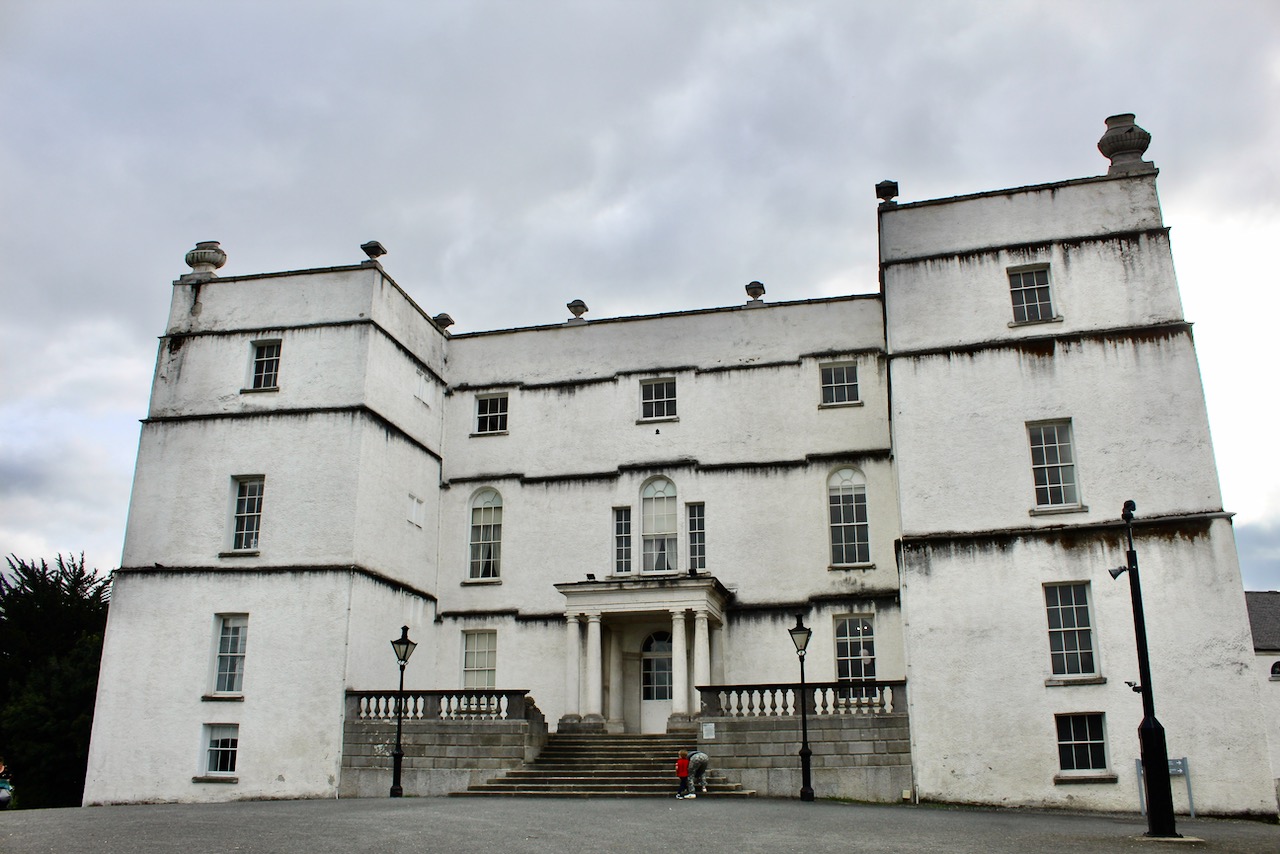
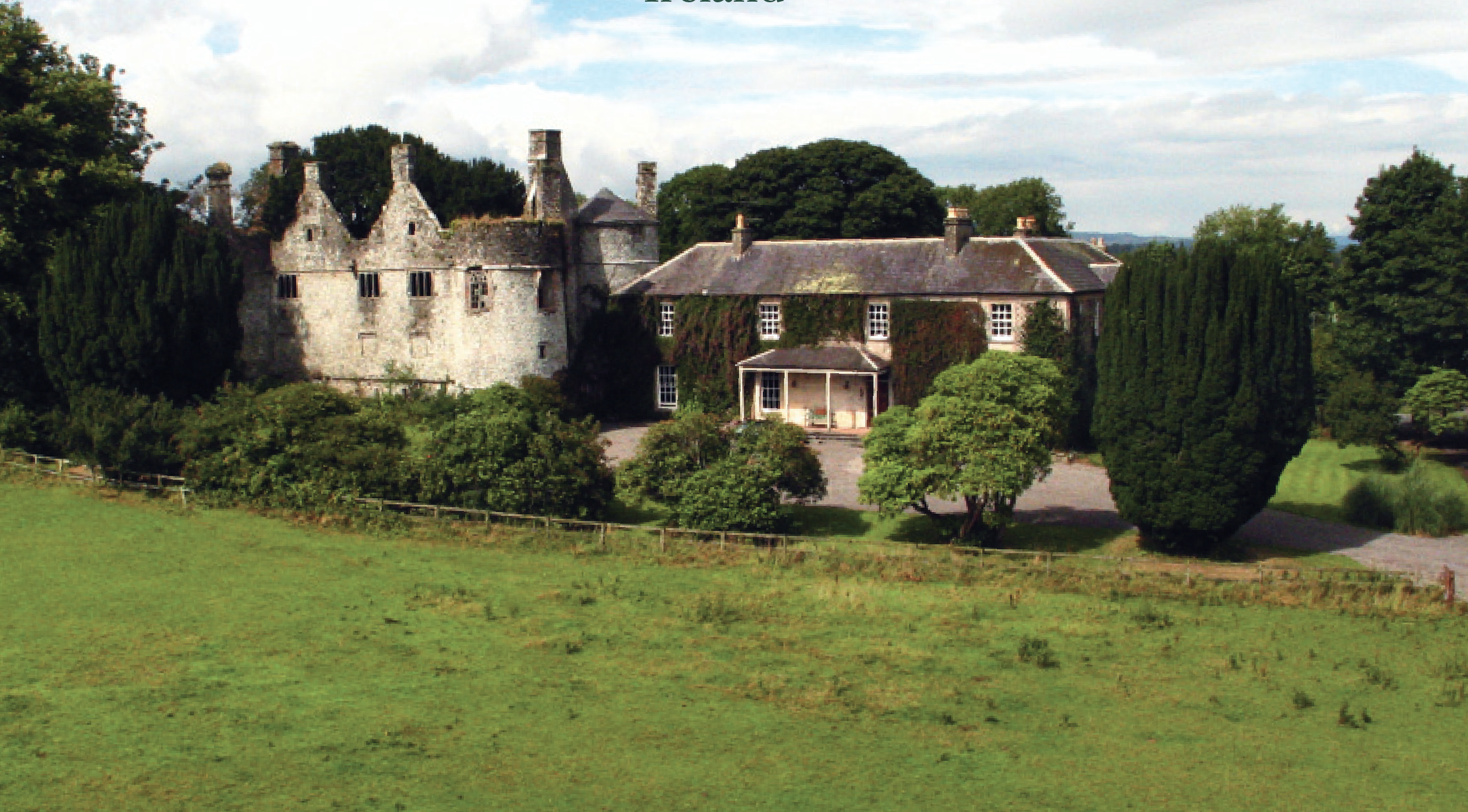
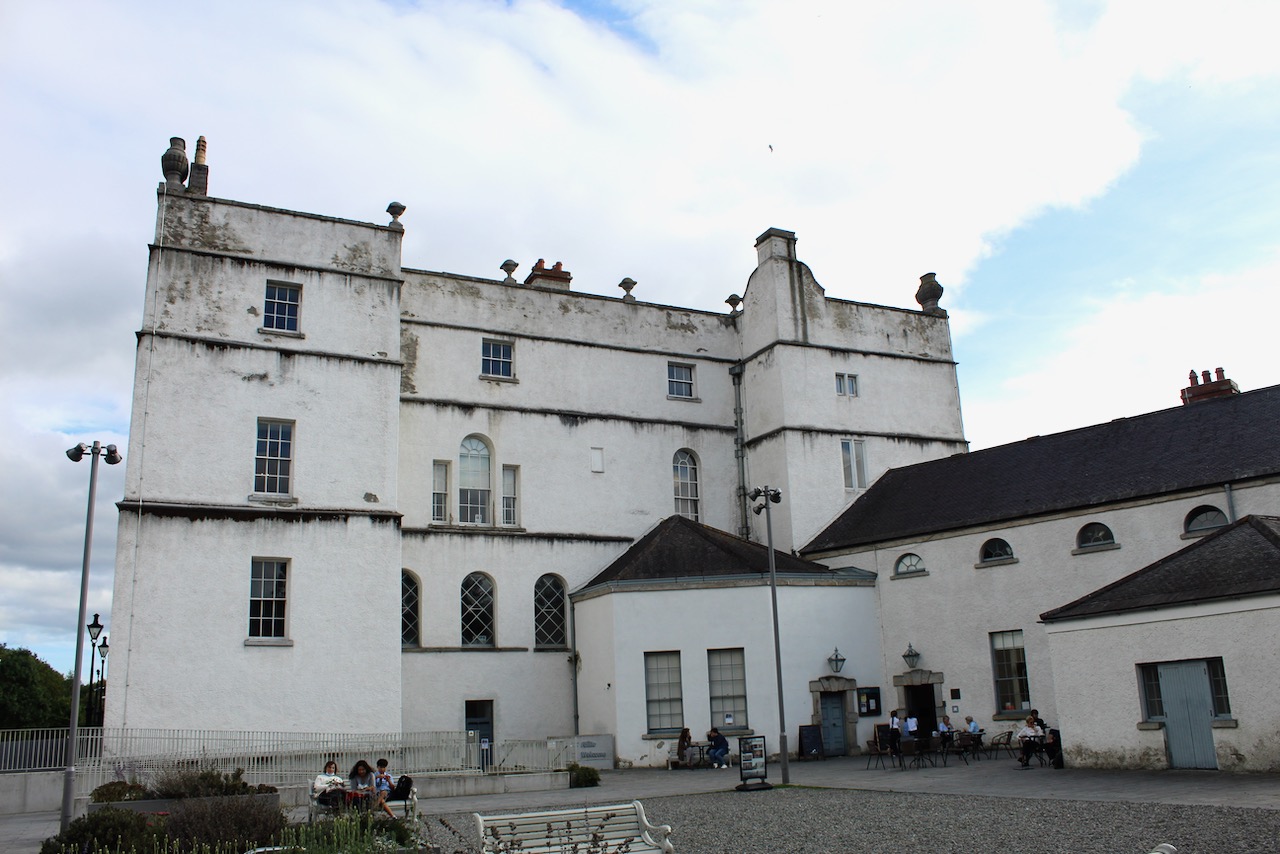
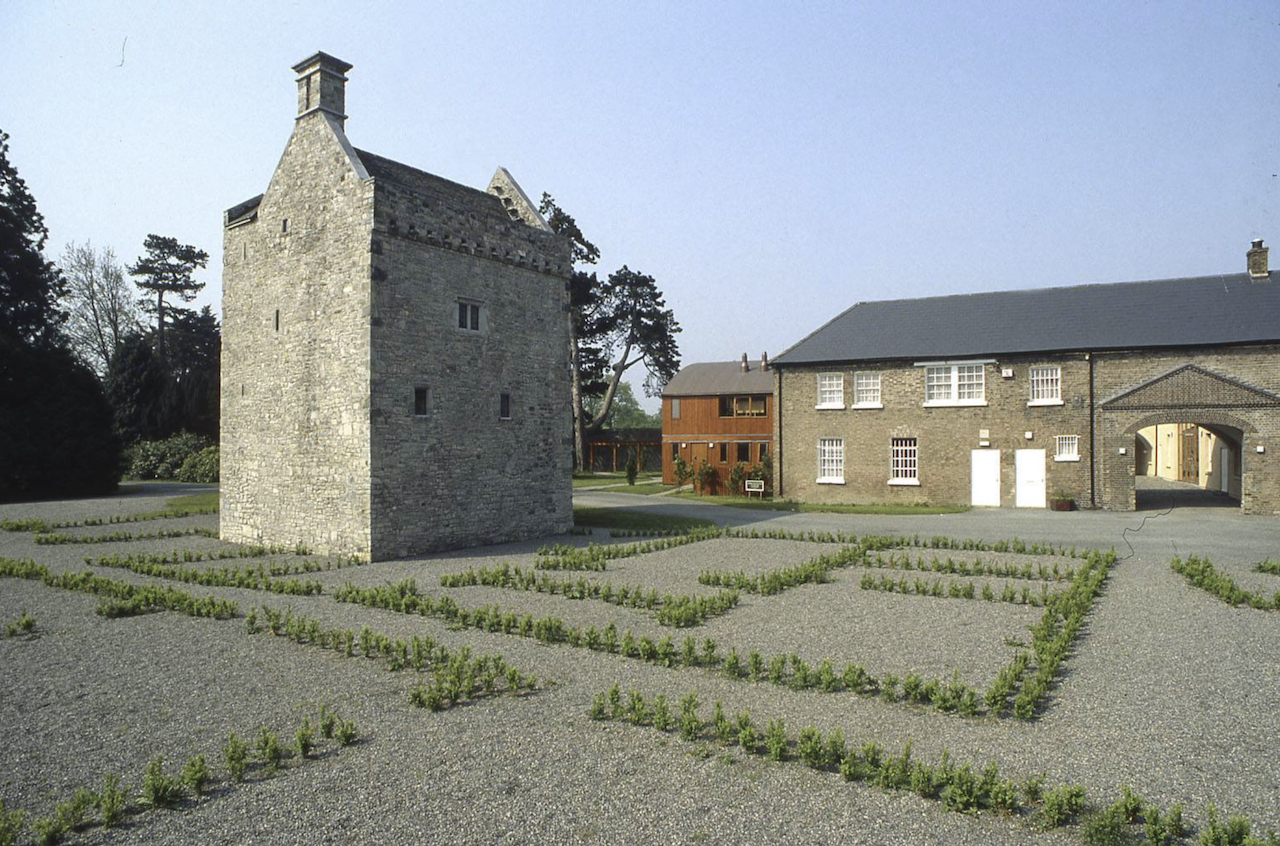
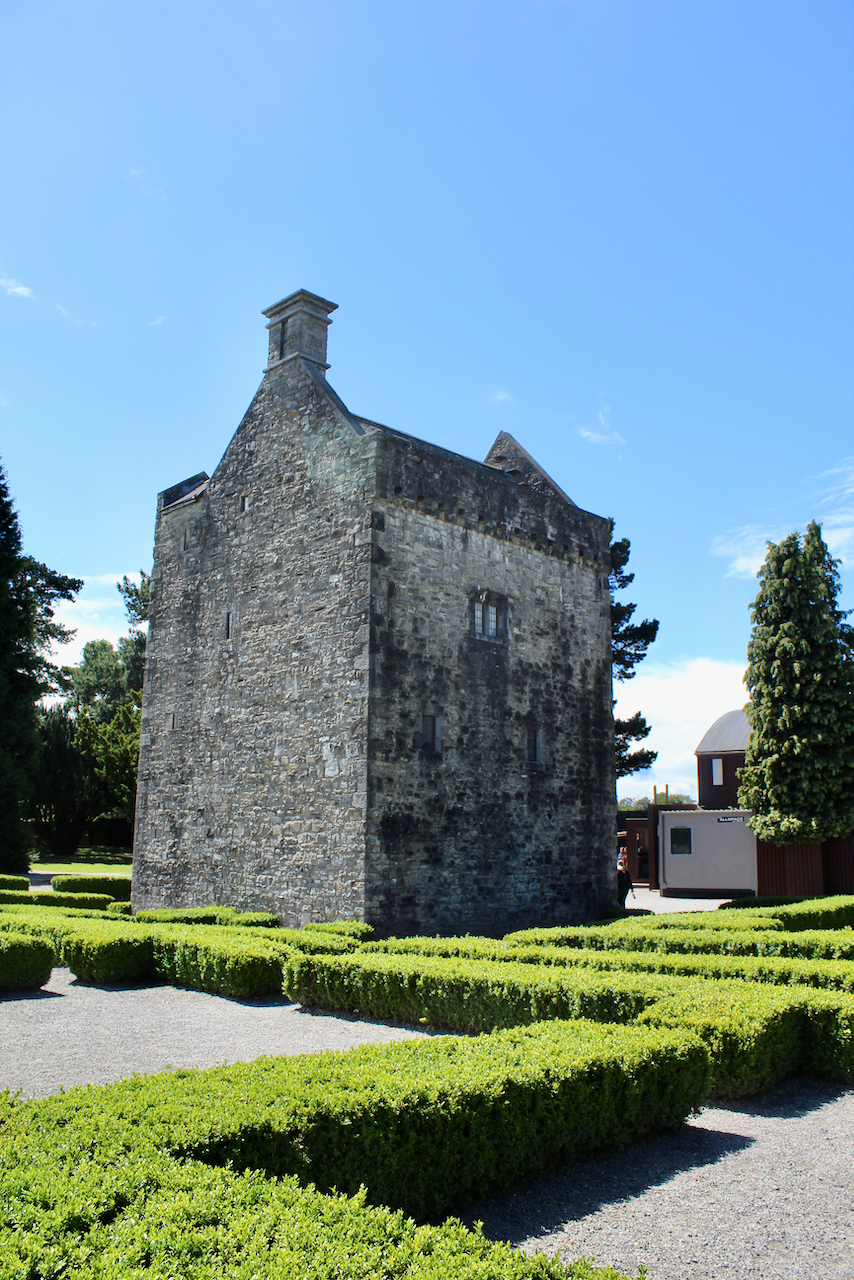
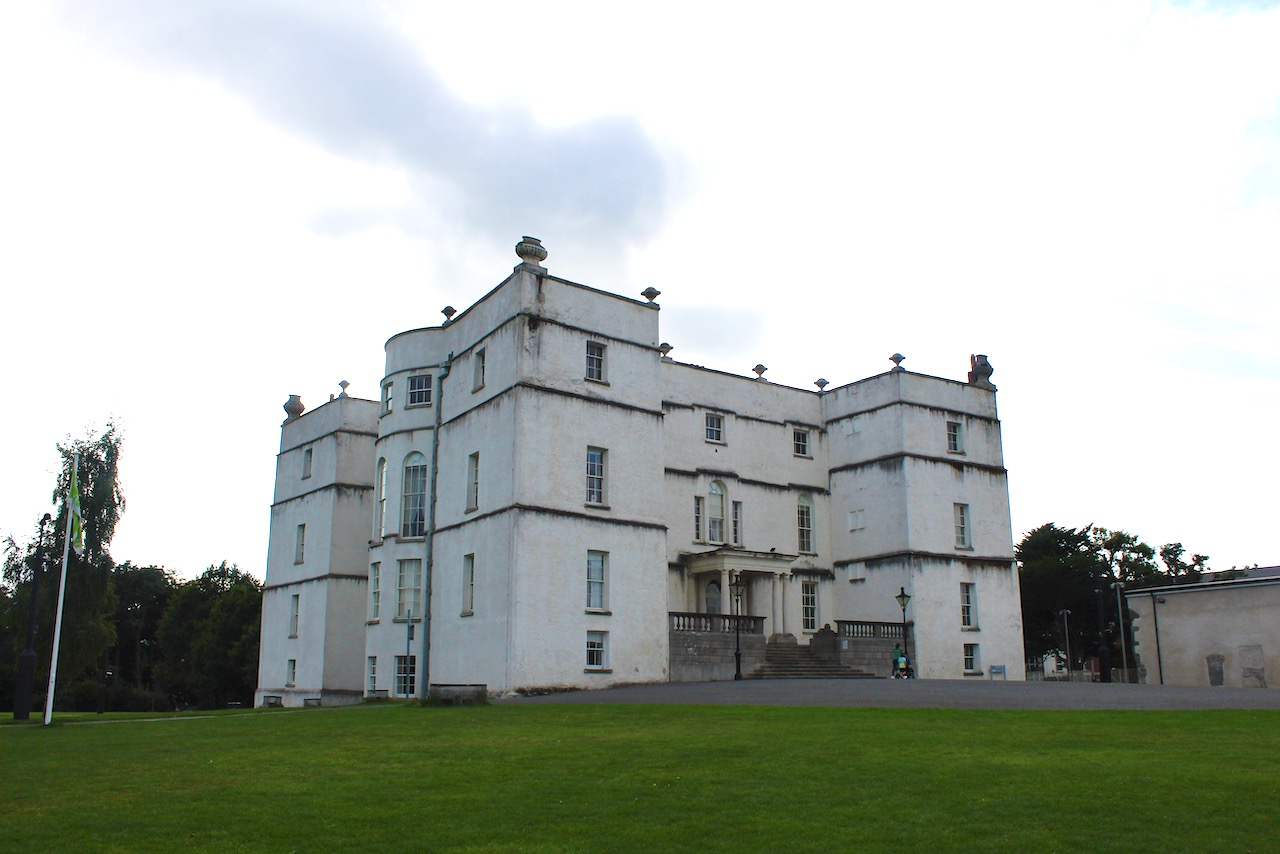
Rathfarnham Castle, Dublin, September 2021. Photograph © Jennifer Winder-Baggot, www.irishhistorichouses.com
Rathfarnham Castle, County Dublin, photograph by Robert French, (between ca. 1865-1914), Lawrence Photograph Collection, National Library of Ireland.

General Enquiries: 01 493 9462, rathfarnhamcastle@opw.ie

Rathfarnham Castle is a wonderful property to visit and I suspect, much underappreciated! It is one of the oldest surviving residences in Ireland, and has a variety of impressive ceilings. It is also another property which was inhabited by the Jesuits at one time, as was Emo Court in County Laois. Although they no longer own either of these properties, they still run schools in the former Castle Browne in County Kildare (now Clongowes Wood College) and Belvedere House in Dublin. They certainly knew how to pick impressive properties! [1]

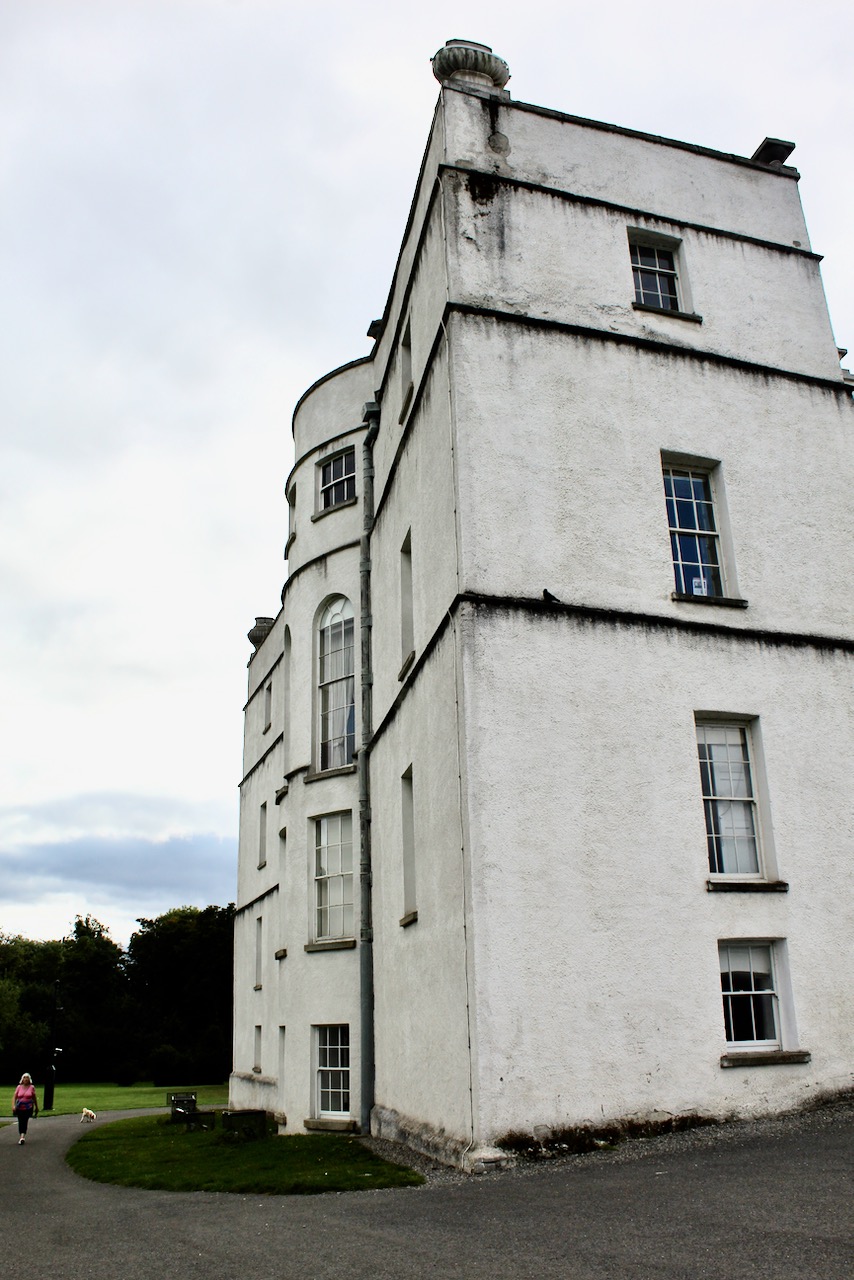
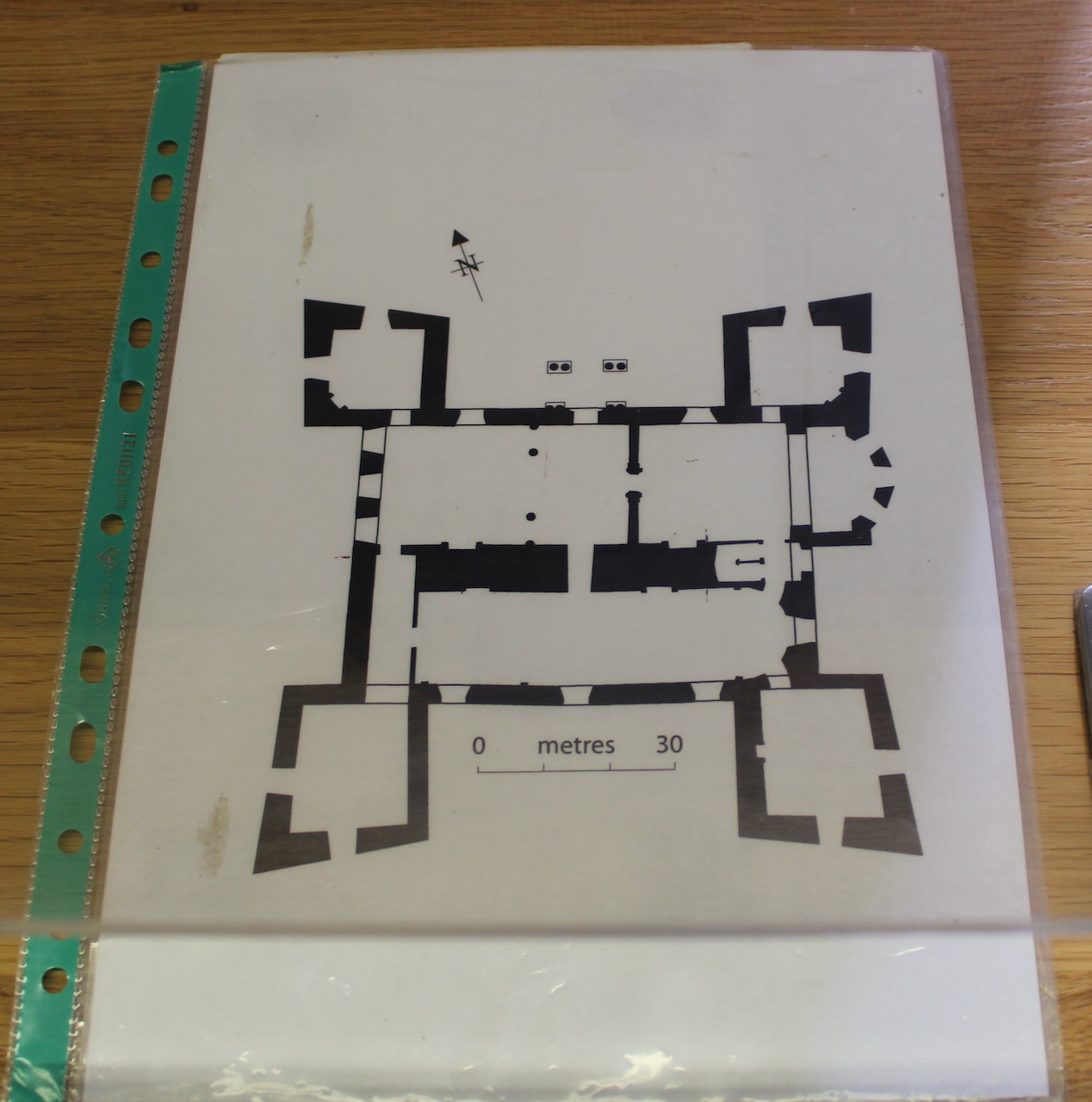
Rathfarnham Castle was built around 1583 for Adam Loftus (1533-1605), a clergyman originally from Yorkshire, who rose to the position of Archbishop of Dublin and Lord Chancellor of Ireland. Its position outside the city of Dublin made it vulnerable to attack, so it was built as a fortified house, with four flanker towers shaped to give maximum visibility of the surrounding landscape. The OPW website tells us:

Loftus wanted the Castle to be a grand and impressive home which would reflect his high status in Irish society. He also needed it to be easily defended against attack from hostile Irish families such as the O’Byrnes based in the mountains to the south. The design was radically modern for the time and based on recent continental thinking about defensive architecture. The angled bastion towers located at each corner of the building were equipped with musket loops which allowed a garrison of soldiers to defend all approaches to the castle.”
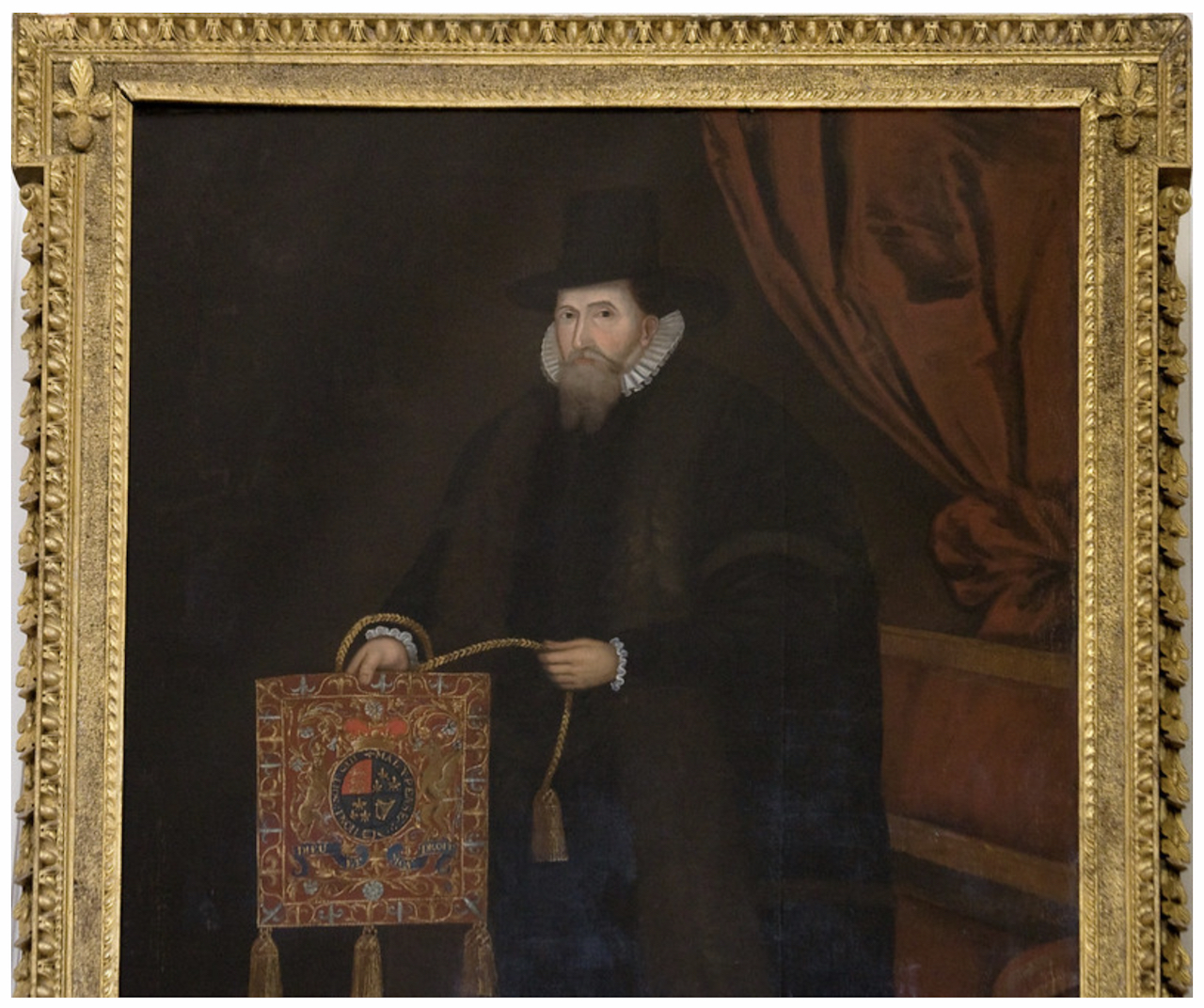
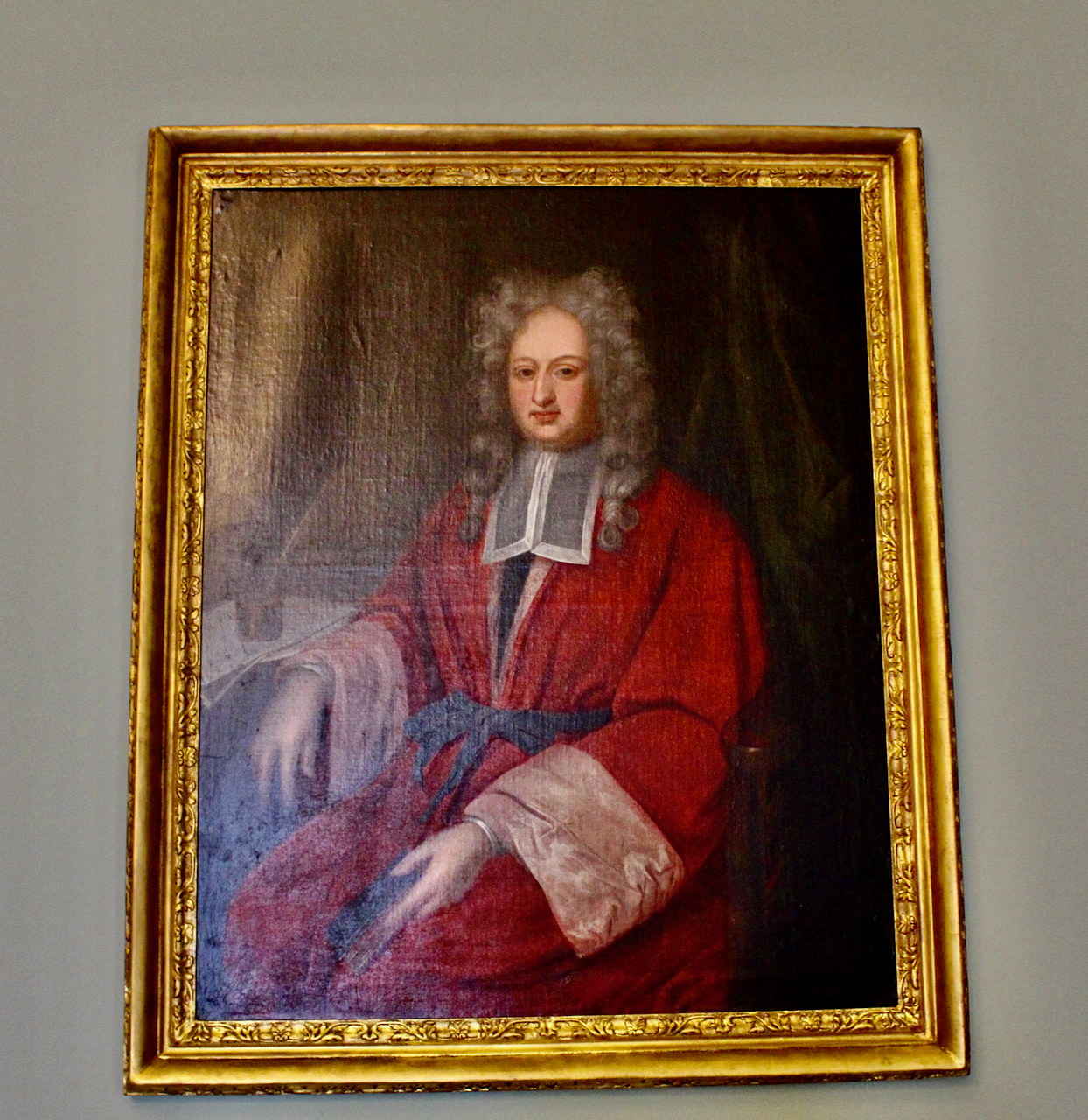
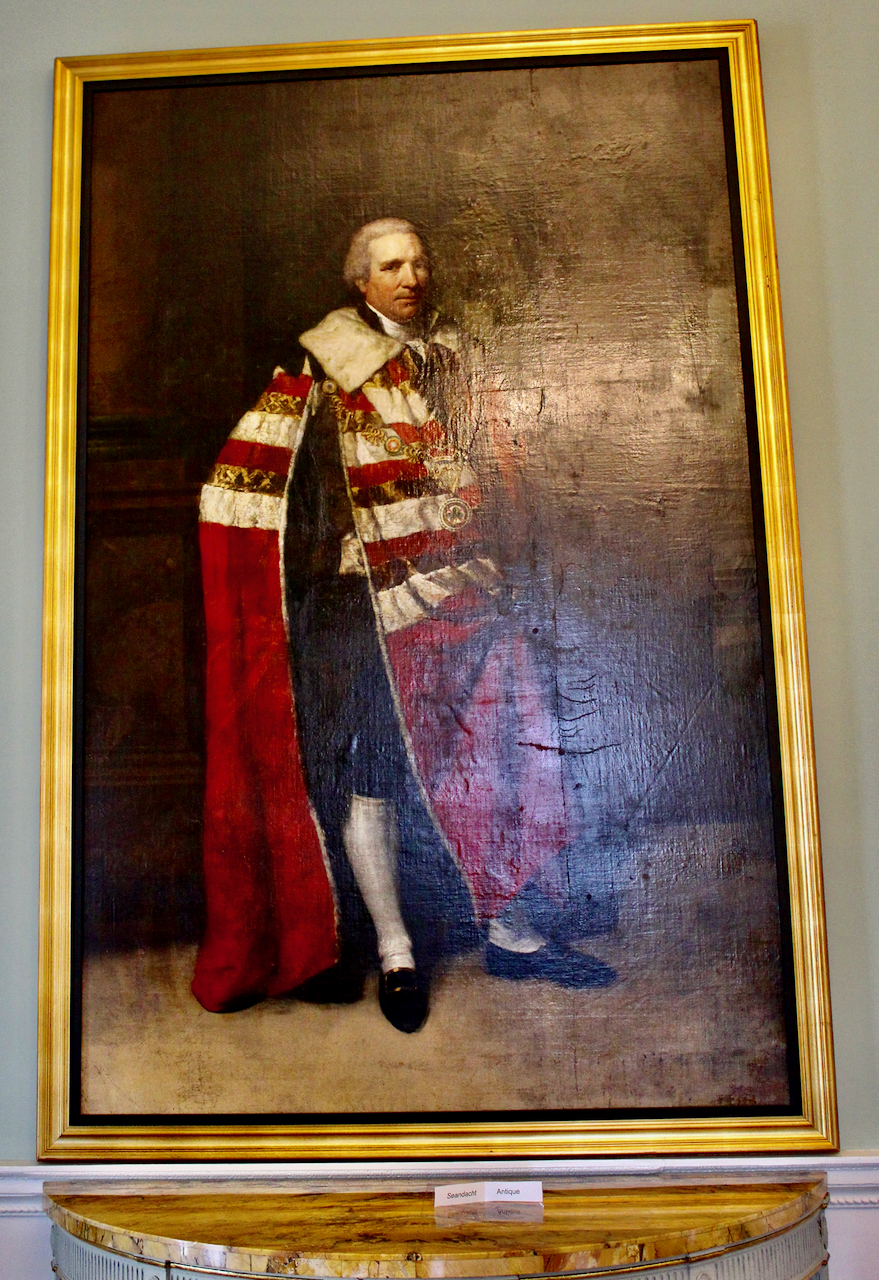
Archbishop-Chancellor Adam Loftus (1533-1605). The portrait is in Trinity College Dublin, as he was the first Provost. He was also Keeper of the Great Seal of Ireland, and he is here holding the embroidered purse which held the seal.
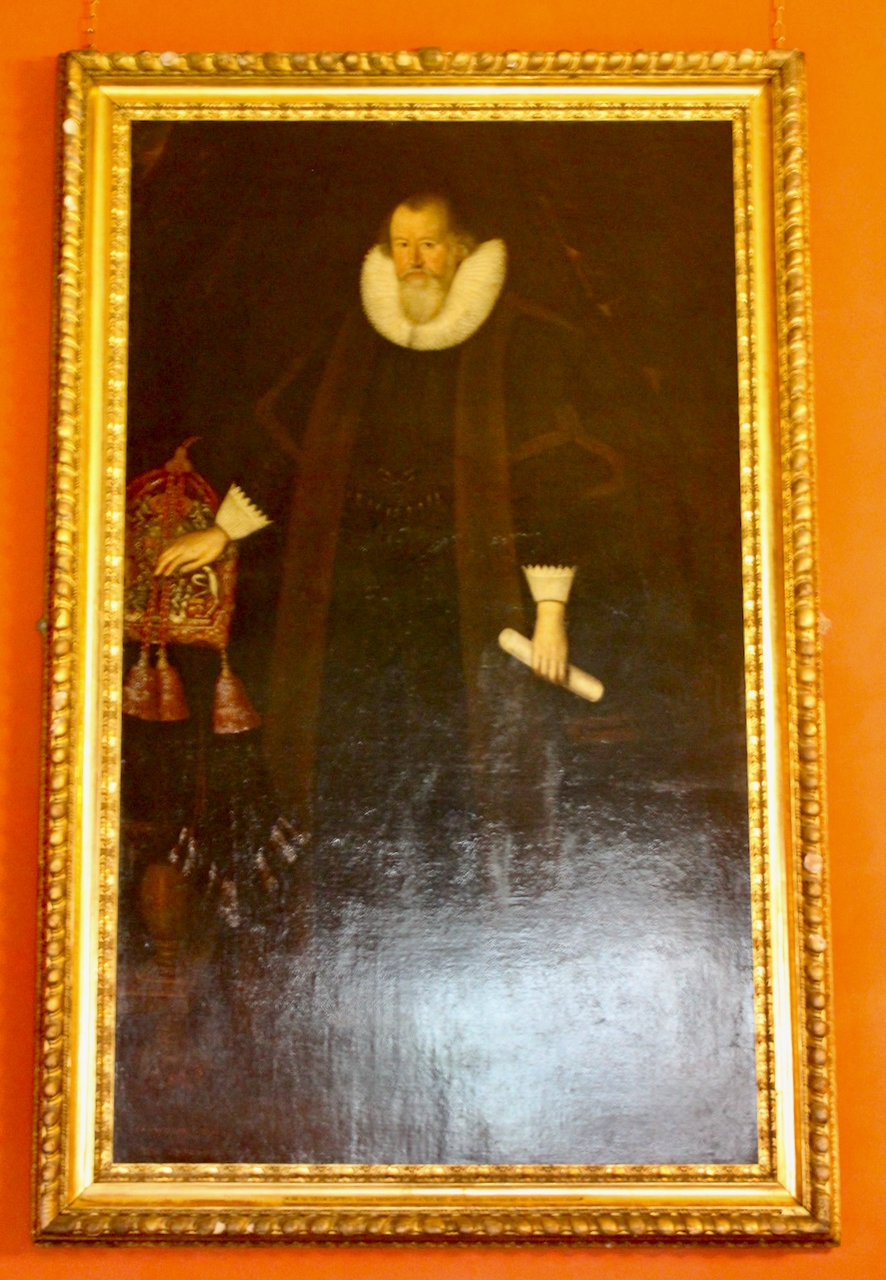
Adam Loftus (1533-1605), Lord Chancellor, 1619. Painting hangs in Malahide Castle, courtesy of National Museum of Ireland.
This shows the special shape of Rathfarnham Castle’s flanker towers.

Loftus had previously lived in an archiepiscopal palace in Tallaght, and it had been sacked by the O’Byrnes and O’Tooles from the Wicklow mountains, which is why he ensured that his new house in Rathfarnham had strong defenses. The Bishop’s Palace in Raphoe, now a ruin, is similarly shaped.

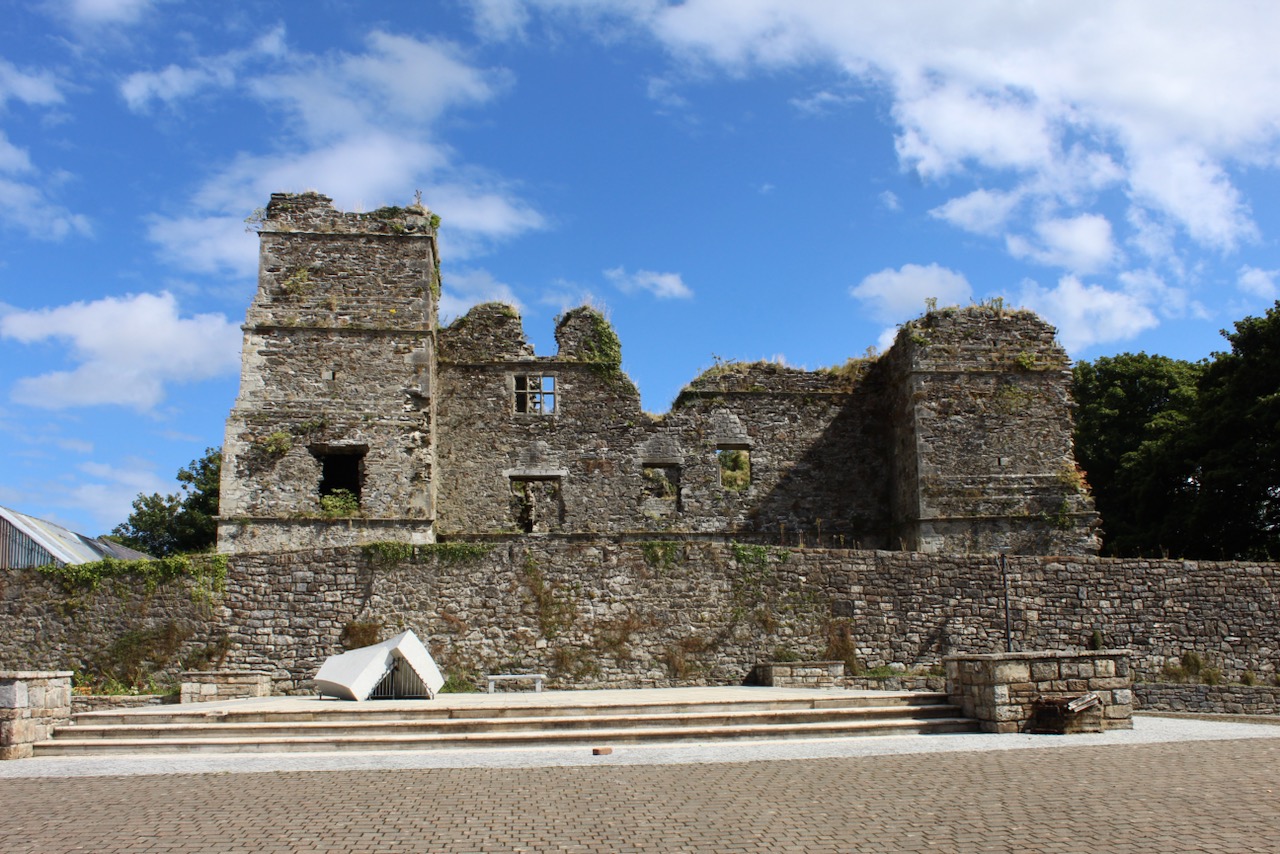
Ruin of Bishop’s Palace in Raphoe, County Donegal, built for Bishop John Leslie in 1636. Photograph © Jennifer Winder-Baggot, www.irishhistorichouses.com

Maurice Craig points out in his The Architecture of Ireland from the earliest times to 1880 that there are a group of similar buildings, built over a period of fifty years or more: Rathfarnham; Kanturk for MacDonagh MacCarthy, built before 1609; Portumna for the Earl of Clanrickarde, before 1618; Manorhamilton for Sir Frederick Hamilton, probably around 1634; Raphoe, for Bishop John Leslie (the “Fighting Bishop” – see my entry on Castle Leslie https://irishhistorichouses.com/2020/08/07/castle-leslie-glaslough-county-monaghan/) in 1636, and Burncourt for Sir Richard Everard before 1650. Manorhamilton is a section 482 ruin (see my entry https://irishhistorichouses.com/2025/02/20/manorhamilton-castle-castle-st-manorhamilton-co-leitrim/) and we visited Portumna in County Galway – see my entry https://irishhistorichouses.com/2022/02/14/office-of-public-works-properties-connacht/. The buildings resemble a fort, such as Mountjoy Fort in County Tyrone built 1600-1605. Killenure, County Tipperary, is similar but has cylindrical flankers, Craig tells us. This last was unroofed by 1793, and it is now (2025) a Section 482 property which I must visit!

Manorhamilton, County Leitrim, August 2022, built for Sir Frederick Hamilton, probably around 1634. Photograph © Jennifer Winder-Baggot, www.irishhistorichouses.com
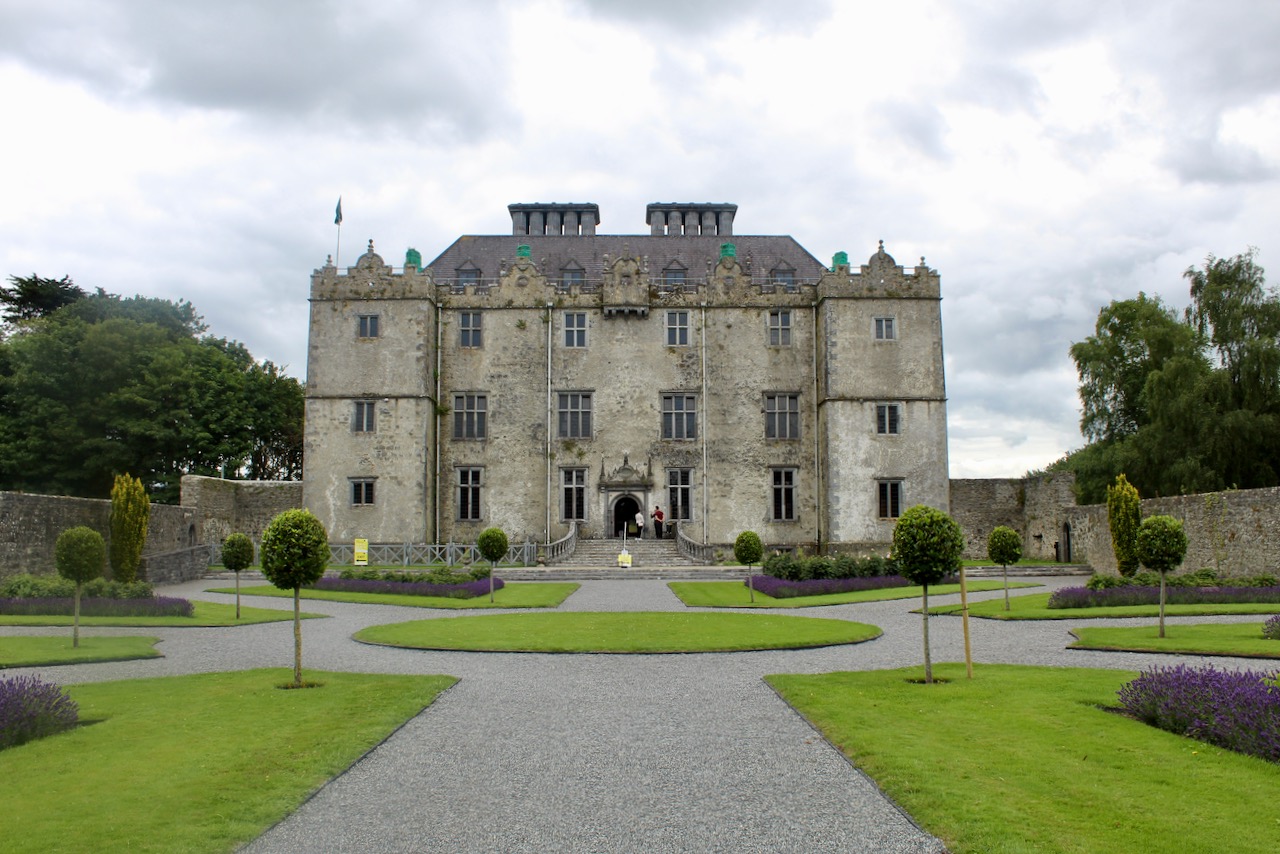
Portumna Castle, County Galway, July 2021, built for the Earl of Clanrickarde, before 1618. Photograph © Jennifer Winder-Baggot, www.irishhistorichouses.com
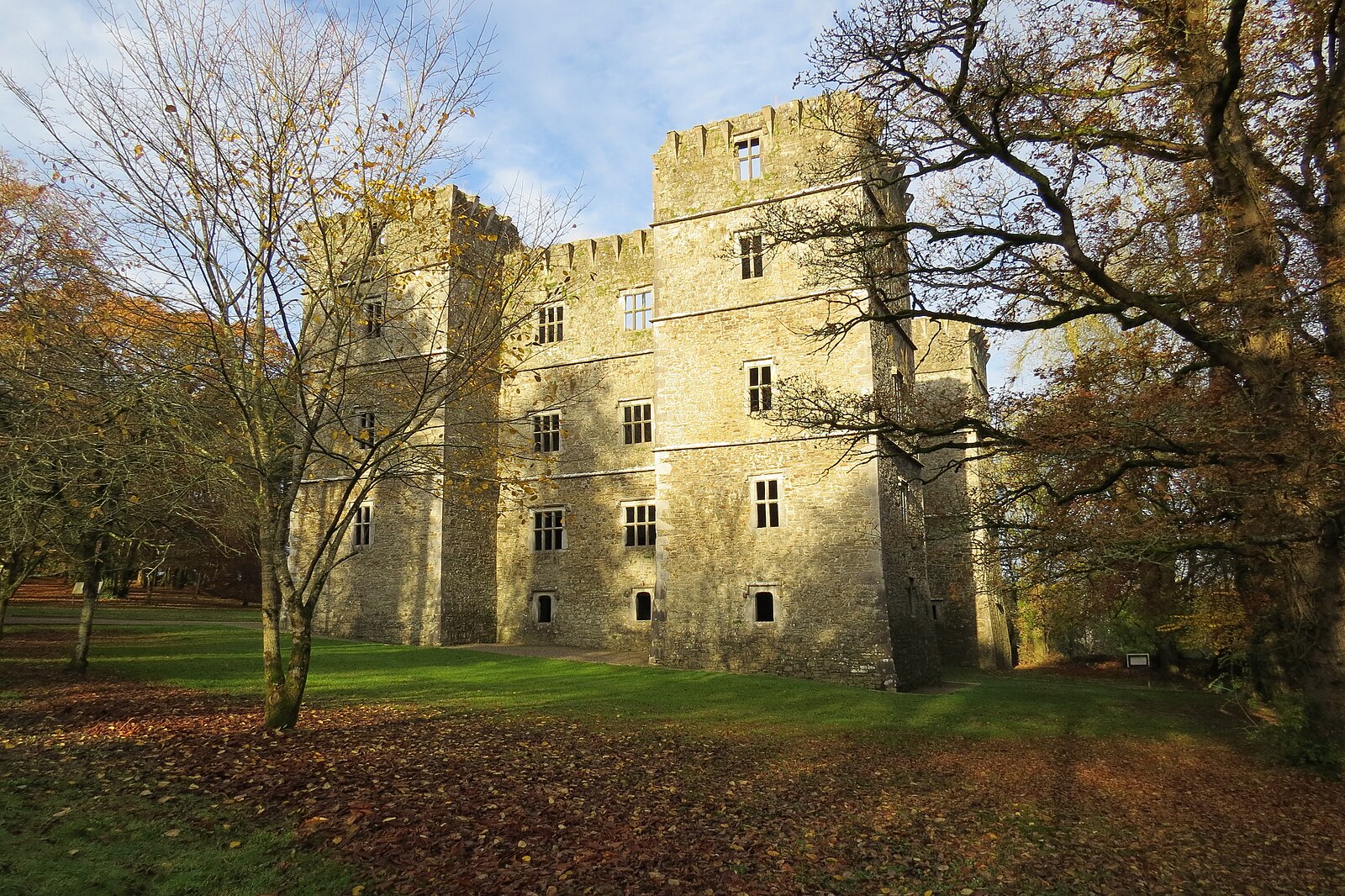
Kanturk Castle, built for MacDonagh MacCarthy, built before 1609. Photograph courtesy Breda O’Mullane, photograph licensed under the Creative Commons Attribution-Share Alike 4.0 International license.
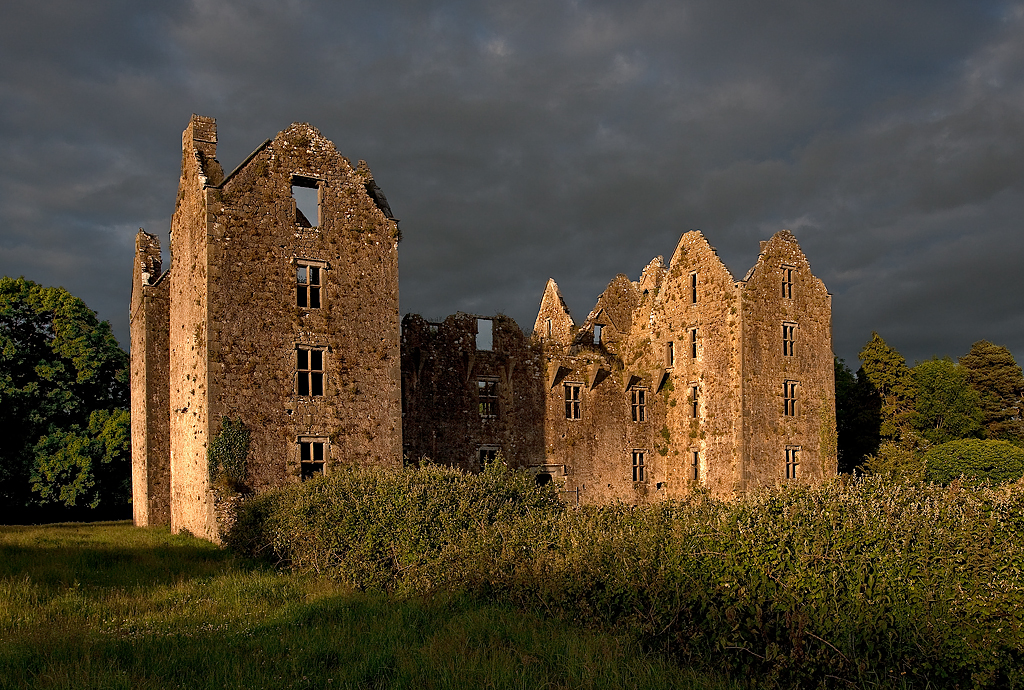
Burncourt, County Tipperary, for Sir Richard Everard before 1650. Photograph courtesy Mike Searle, Creative Commons geograph.org.uk -1393348
Killenure Castle, similar but with cylindrical flankers, courtesy of Michael Daniels estate agent. A section 482 property in 2025.

Loftus attended Cambridge, where he took holy orders as a Catholic priest. Upon Queen Elizabeth’s accession to the throne in 1558, he declared himself Anglican. The Dictionary of Irish Biography tells us that a major turning point in Loftus’s life and career occurred in 1560, when he emigrated to Ireland as a chaplain to Thomas Radcliffe, 3rd Earl of Sussex, who had been granted a commission to serve as Lord Lieutenant of Ireland by Queen Elizabeth. On the recommendation of Sussex, Loftus was appointed Archbishop of Armagh, his consecration taking place on 2 March 1563. In January 1565, on account of the poverty of the archbishopric of Armagh, Queen Elizabeth granted Loftus the deanery of St Patrick’s cathedral in Dublin. In 1567 he was made Archbishop of Dublin.

It was Adam Loftus who had Reverend Dermot O’Hurley executed, whom I wrote about a couple of weeks ago in my entry about Doheny & Nesbitt.

The Dictionary of Irish Biography tells us:

He was “a strongly delineated establishment figure whose primary concerns were to serve the crown in Ireland, in whatever capacity the queen and her advisers thought fit; and to build up his own personal affinity, so that he would be in a position to execute the offices that came his way with a measure of genuine political and social authority. Thus, during the periods when the archbishop served as lord chancellor of Ireland (1581–1605), or as acting governor of the country during the periodic absences from Ireland of a serving viceroy (August 1582–June 1584, November 1597–April 1599, September 1599–February 1600), he was also careful to establish a network of connections throughout the country, particularly through the marriage of his children to leading families among the new English protestant elite. Among the families with which Loftus made these connections were the Bagenals of Co. Down, the Dukes of Castlejordan, the Hartpoles of Shrule, the Usshers of Dublin, the Colleys of Castle Carbury, the Berkeleys of Askeaton, and the Warrens of Warrenstown. The social ascent of Loftus and his family was also evident in the archbishop’s decision to proceed with the purchase of the estate of Rathfarnham, Co. Dublin (c.1589–90), on which he built a stately castle.” [2]

Adam Loftus married Jane Purdon. They had twenty children, not all of whom survived to adulthood, and those who did married very well.

  1. Anne Loftus married, first, Henry Colley of Castle Carbury in County Kildare, and second, Edward Blayney, 1st Lord Blayney, Baron of Monaghan.
  2. Martha Loftus (d. 1609) married Thomas Colclough (1564-1624) of Tintern Abbey in Wexford.
  3. Isabelle Loftus (d. 1597) married William Ussher (1561-1659)
  4. Thomas Loftus (d. 1635) married Helen Hartpole of Shrule.
  5. Alice Loftus (d. 1608) married Henry Warren of Warrenstown, County Offaly.
  6. Katherine Loftus married Francis Berkeley of Askeaton, County Limerick.
  7. son Adam died unmarried in 1599.
  8. Margaret Loftus married George Colley of Castle Carbury.
  9. Edward Loftus (d. 1601) married Anne Duke of Castle Jordan, County Meath.
  10. Dudley Loftus (1561-1616) married Anne Bagenal of Newry Castle, County Down, daughter of Nicholas Henry Bagenal, Marshal of Ireland.
  11. Dorothy Loftus (d. 1633) married John Moore (d. 1633)

Adam Loftus was the first Provost of Trinity College Dublin.

The Dictionary of Irish Biography continues:

Although by the early 1590s Loftus had largely reconciled himself to the reality that the task of converting the indigenous community to protestantism, and securing its allegiance to the state church, was beyond him, the queen and her advisers still expected him to discharge his religious duties and press ahead with reforming initiatives on behalf of the state church. To this end, and in the midst of a period of mounting political crisis that culminated in the outbreak of the Nine Years War, Loftus was the prime mover behind the foundation of TCD, which received its royal charter on 3 March 1592. The archbishop also served as the college’s first provost till June 1594.

Adam Loftus died in the old Palace of St. Sepulchre beside St. Patrick’s Cathedral, which until recently was the Garda barracks on Kevin Street, now housed in a new building. I hope they will make something of the historic old archbishop’s palace now, which could be a great museum!

Adam’s son Dudley (1561-1616) sat in the Irish parliament for Newborough in County Wexford. He married Anne Bagenal of Newry Castle, County Down, daughter of Nicholas Henry Bagenal, Marshal of Ireland. The castle passed to their son, Adam Loftus (1590-1666), who married Jane Vaughan of Golden Grove, County Offaly.

Another son of Dudley and Anne Bagenal was Nicholas Loftus (1592-1666), the ancestor of Henry Loftus, the Earl of Ely. Nicholas’s second son Henry (1636-1716) lived in Loftus Hall in County Wexford.

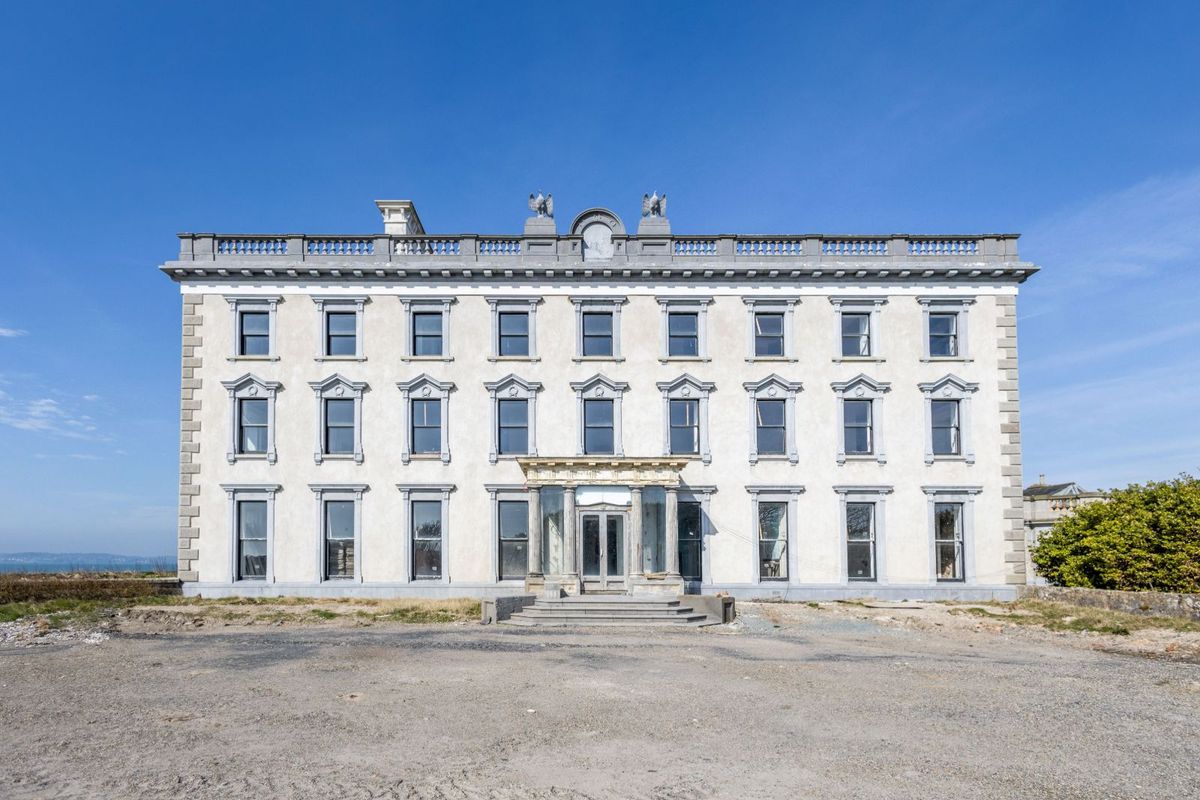
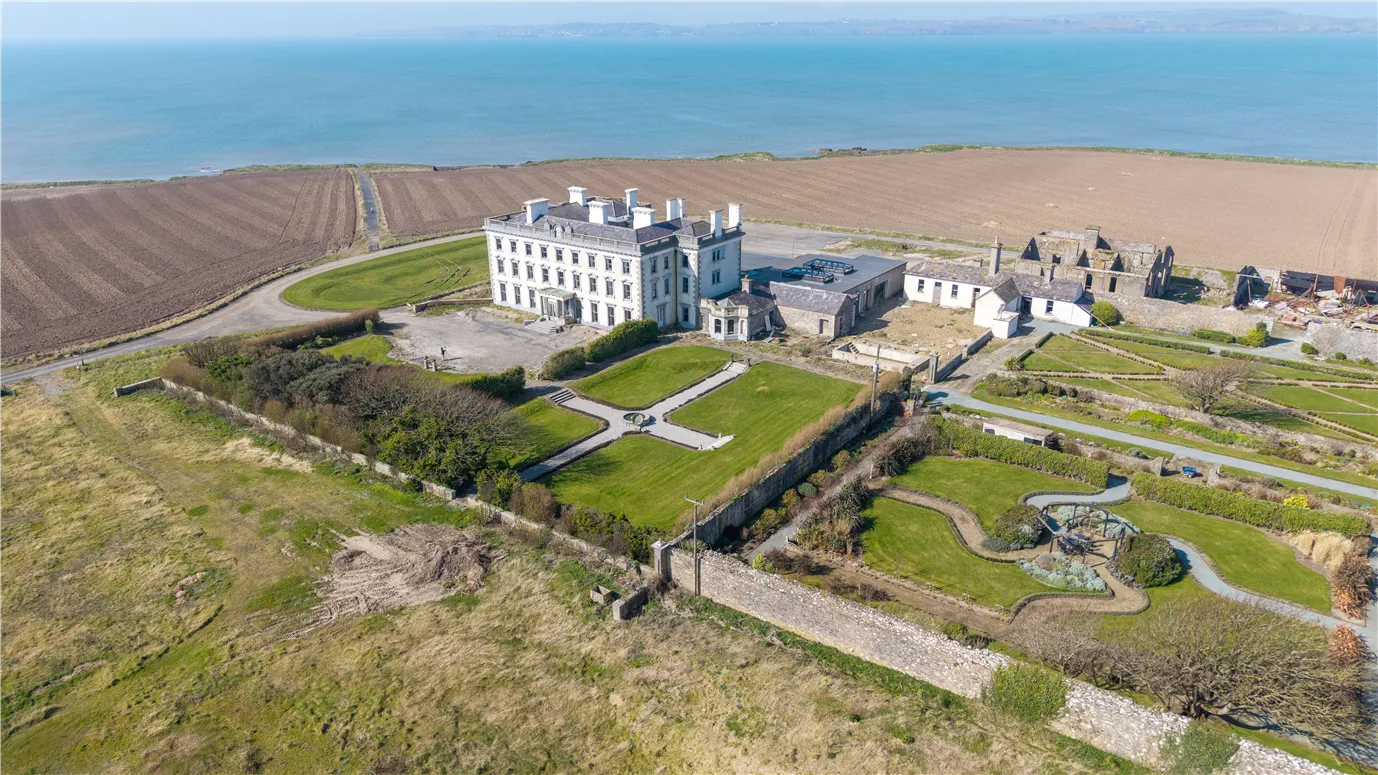
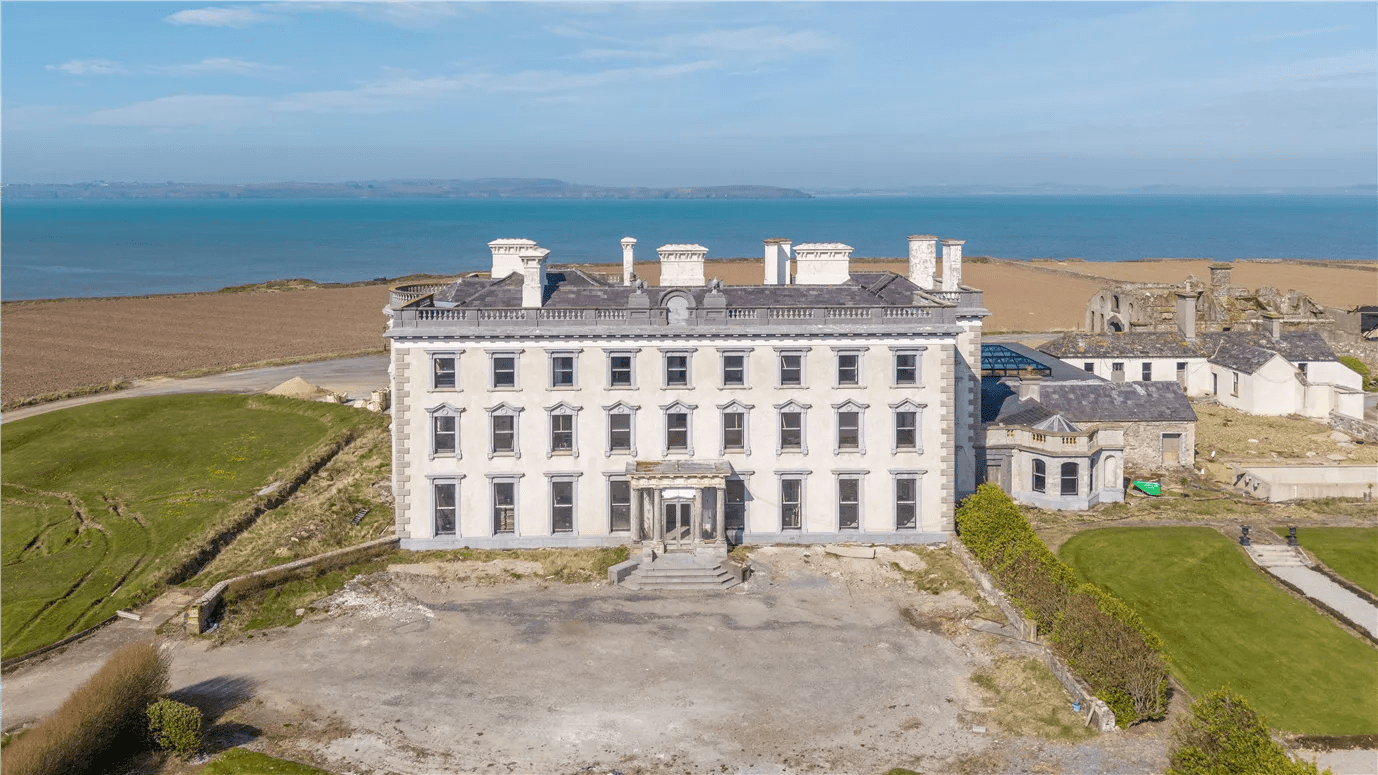
Loftus Hall, County Wexford, for sale April 2025 courtesy Colliers. Formerly named Redmond Hall, it is a three-storey mansion built in 1871, incorporating parts of a previous house here, which was late 17th century or early C18. [3]

Adam Loftus (1590-1666) and Jane née Vaughan’s children also made good marriages. Their son Arthur Loftus (1616-1659) married Dorothy Boyle (1616-1668), daughter of Richard Boyle the 1st Earl of Cork. Arthur also served as MP for County Wexford, as well as Provost Marshall of Ulster.

The castle came under seige in 1641 and in 1642 the house was occupied by Cromwell’s Parliamentary troops. [4] In 1649 it was stormed and taken by Royalist troops under the Marquess of Ormond and all occupants were taken as prisoners. Ormond writes that nobody was killed. [5] Rathfarnham Castle was restored to Adam Loftus (1590-1666) when Charles II was crowned king.

Adam’s son Arthur predeceased him, so the castle passed to Arthur’s wife Dorothy née Boyle. In 1665 she obtained six firelock muskets from the Master of Ordinance to protect the castle.

Arthur Loftus and Dorothy née Boyle had a son Adam Loftus (1632-1691). Adam Loftus was Ranger of the Phoenix Park in Dublin and from 1685, a member of the Irish Privy Council. King James II created him Baron of Rathfarnham and Viscount Lisburne in the Peerage of Ireland. Adam married Lucy Brydges, daughter of George Brydges, 6th Baron Chandos of Sudeley, England.

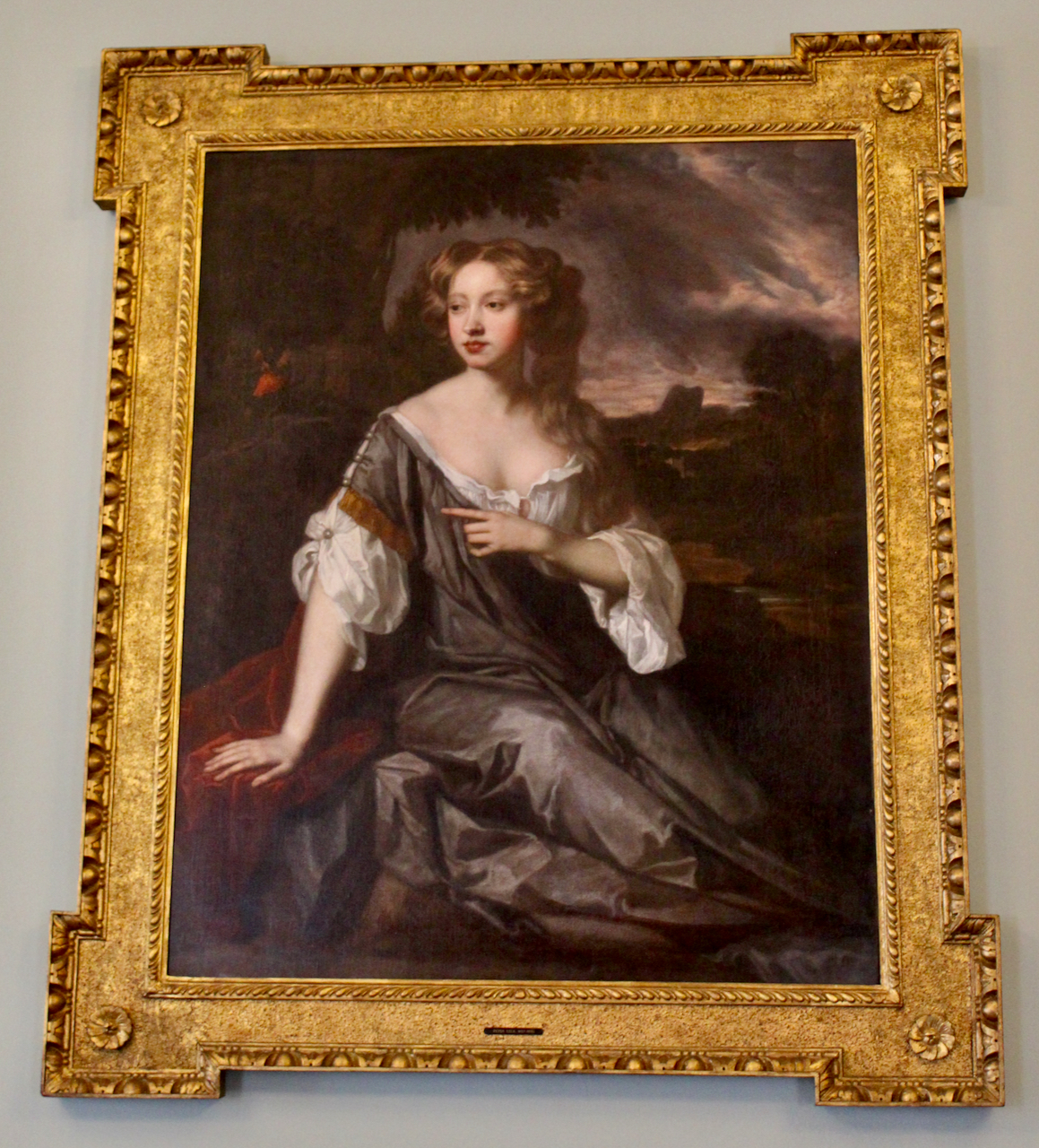
Lucy Loftus née Brydges (1654-1681), by Peter Lely. She was a renowned Restoration beauty and the first wife of Viscount Adam Loftus. He died at the Siege of Limerick in 1691 and the cannon ball which reputedly killed him hangs in St Patrick’s Cathedral. Lucy is dressed in pseudo-antique clothing against an Arcadian landscape. The parrot in the background is an ambiguous symbol and can refer to a number of characteristics including eloquence, marital obedience or exoticism. Peter Lely was of Dutch origin but spent most of his career in England and became the most influential portrait painter at court following the death of Anthony van Dyck. He successfully navigated the turbulence of the 17th century to paint at the court of Charles I, the Cromwellian Commonwealth and Charles II following the Restoration. Lely was prolific, often only painting the sitter’s head while students and assistants at his studio completed the portraits.

After his wife Lucy died, Adam Loftus married Dorothy, the daughter of Patrick Allen or Alen, of St. Wolstan’s of Celbridge in County Kildare. Adam was a gallant at the court of King Charles II.

Despite earning his peerage from King James II, Adam Viscount Lisburn supported the cause of William III. He died at the Siege of Limerick in 1691 and the cannon ball which reputedly killed him hangs in St Patrick’s Cathedral.

The castle passed to Adam’s daughter Lucy, who married Thomas Wharton, 1st Marquess of Wharton in 1692, who in 1715 was created 1st Earl of Rathfarnham, 1st Marquess of Carlow and 1st Baron of Trim.

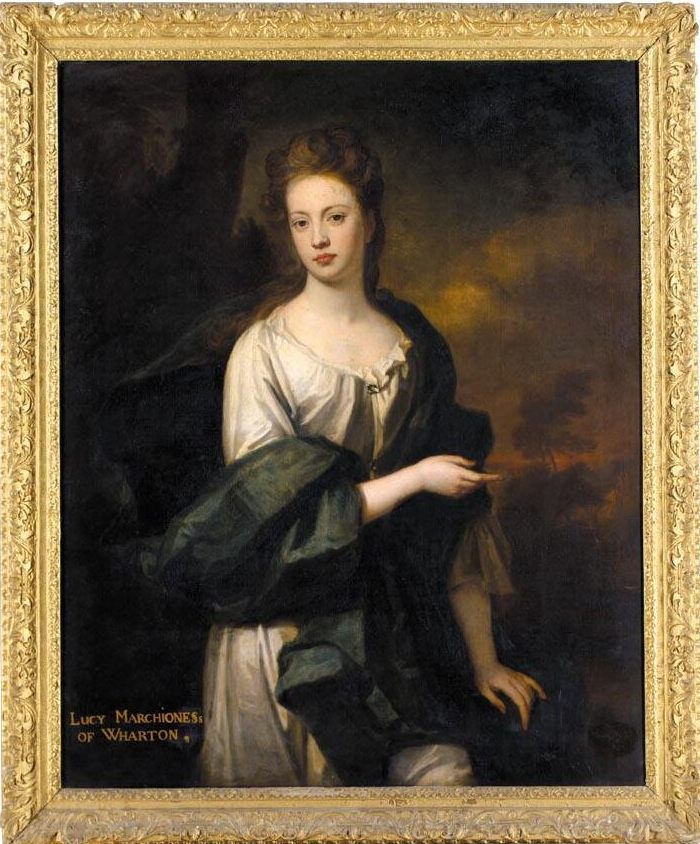
Lucy Loftus, Marchioness of Wharton (1670-1717) by Godfrey Kneller.

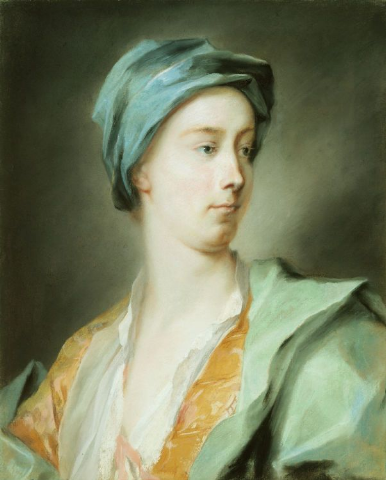
Lucy and the Marquess of Wharton had a son Philip, who became the Duke of Wharton. He was a Jacobite and supporter of the titular James III, and was subsequently granted many titles. The Peerage website lists the titles. As well as those he inherited from his father, he was created 1st Viscount Winchendon, Co. Buckingham [England] and 1st Marquess of Woodburn, Co. Buckingham [England], 1st Earl of Malmesbury, Co. Wilts [England] on 22 December 1716, Jacobite. 

He was appointed Privy Counsellor (P.C.) in Ireland between 1717 and 1726. He was created 1st Duke of Wharton, Co. Westmorland [Great Britain] on 28 January 1717/18, in an attempt by the authorities to wean him from his Jacobitism and make him a good Whig like his father. Darryl Lundy of The Peerage website tells us that his Dukedom did at least make him for a while speak and vote with the Tories in the House of Lords, for instance in debates on the South Sea Bubble. He lost a fortune from participation in the South Sea Bubble. In June 1725 he left the country. He was Envoy to Vienna in August 1725, for the Jacobite King James III, and then Envoy to Madrid in March 1725/26. 

Philip Wharton Duke of Wharton by Rosalba Carriera – Royal Collection, Public Domain.

Out of money, he took a position in the Jacobite forces and commanded a Spanish detachment at the Siege of Gibraltar in 1727, fighting against the English. On 3 April 1729 he was outlawed and his titles and such estates as he still held in Britain forfeited. 

He had no surviving male issue when he died on 31 May 1731. On his death, all his titles, most forfeited by his treason, expired, except the Barony of Wharton, which was deemed by the House of Lords in 1915 to be descendible to his heirs.

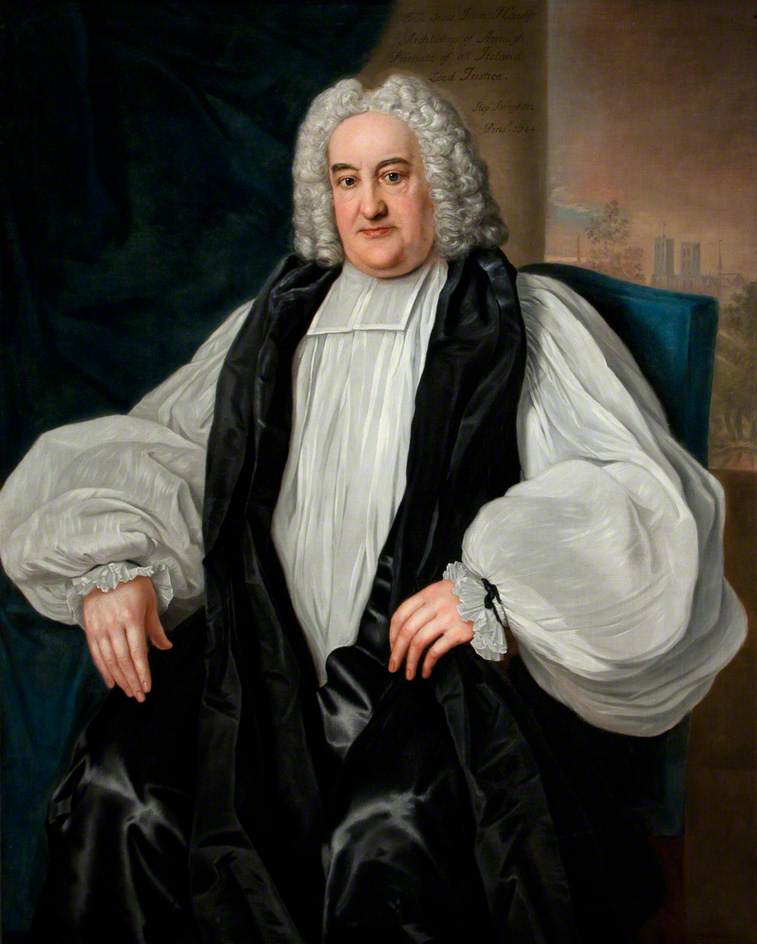
He sold Rathfarnham Castle in 1724. It was purchased by Speaker William Conolly for £62,000. Speaker Conolly never lived in the Castle since he had built Castletown in County Kildare, and he leased Rathfarnham in 1742 to Dr. Hoadley, Archbishop of Armagh.

John Hoadly (1678-1746), Archbishop of Armagh and Primate of All Ireland by Stephen Slaughter; Armagh City, Banbridge & Craigavon Borough Council; http://www.artuk.org/artworks/john-hoadly-16781746-archbishop-of-armagh-and-primate-of-all-ireland-122812

Dr. Hoadley was interested in building, and he had built an Episcopal mansion in Tallaght to replace a medieval castle. He then restored Rathfarnham Castle. It was famed for its excellent agriculture and fruit gardens. [see 5].

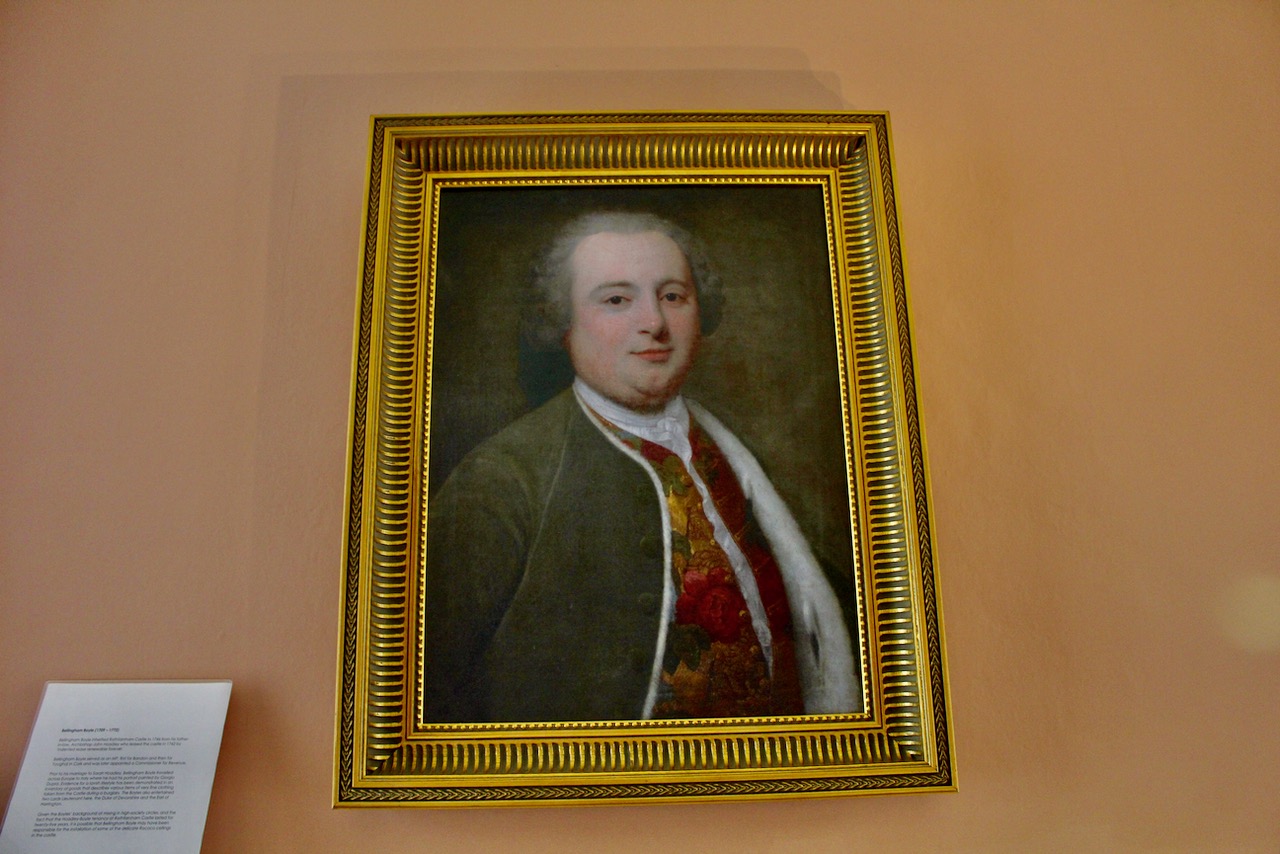
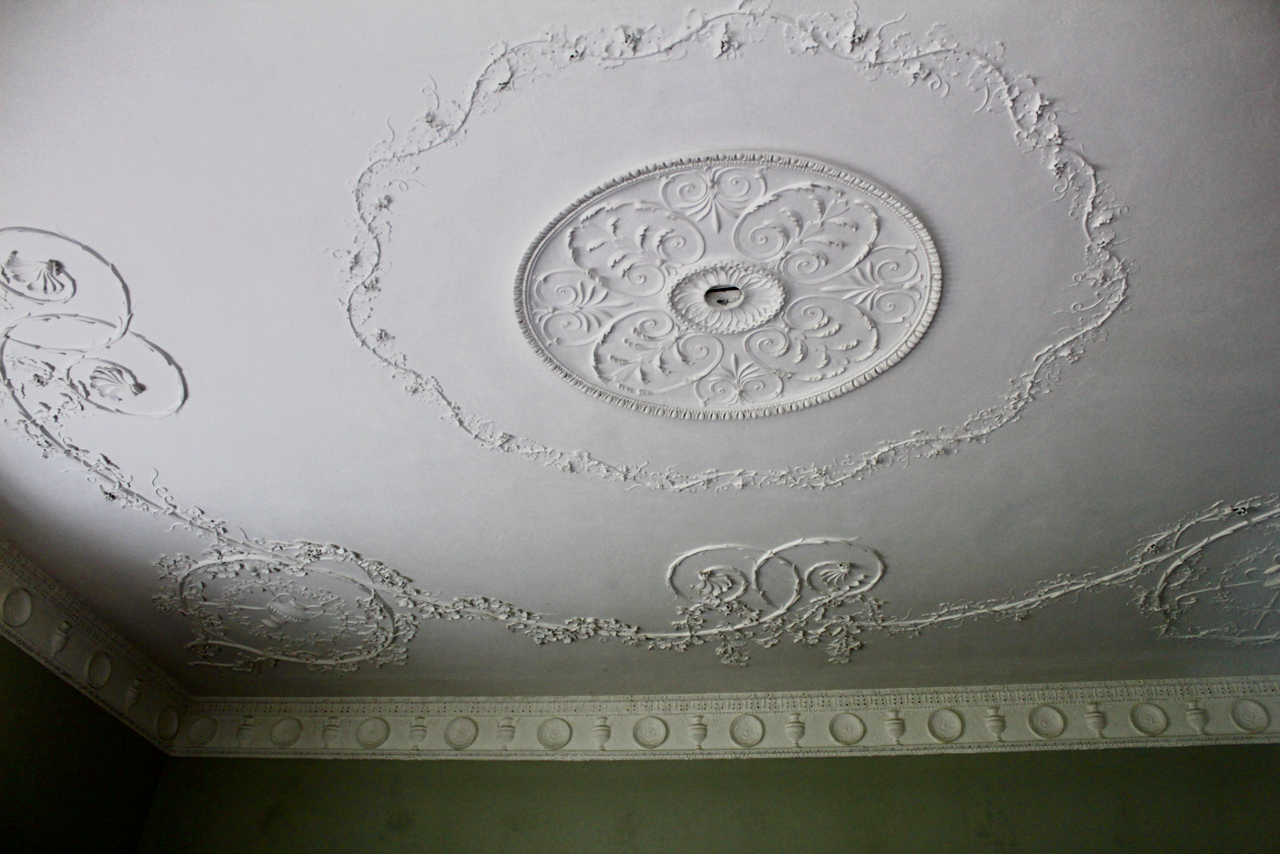
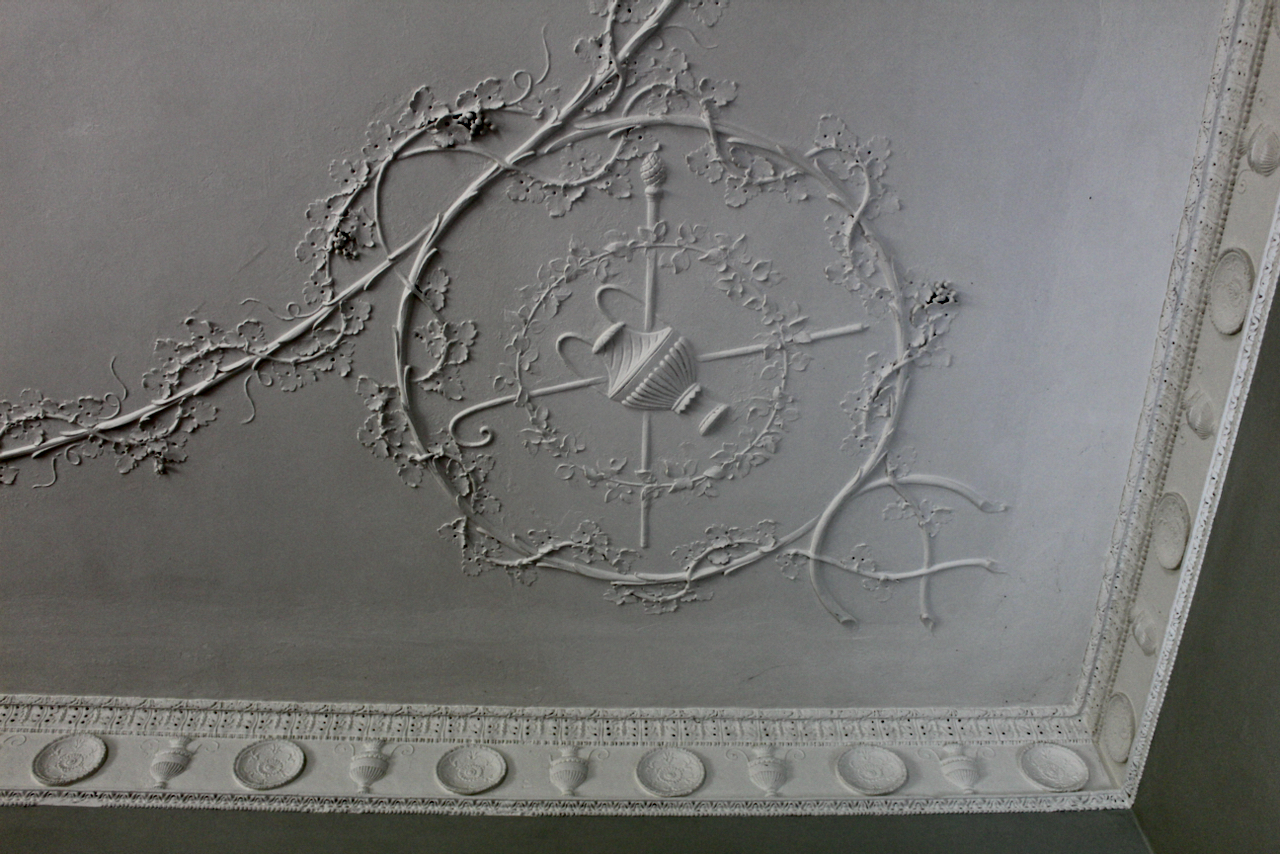
Dr. Hoadley’s daughter Sarah married Bellingham Boyle (1709-1772), and they inherited Rathfarnham Castle. Boyle also took an interest in farming and grew the first oats in Ireland. [see 5]. The Hoadley-Boyle tenancy lasted for twenty-five years, and Bellingham Boyle and his wife mixed in high society, entertaining two Lords Lieutenant in the castle: the Duke of Devonshire and the Earl of Harrington. Boyle may be be responsible for installing some of the delicate rococo ceilings in the castle.

“Bellingham Boyle (1709-1772). He inherited Rathfarnham Castle in 1746 from his father-in-law, Archbishop John Hoadley who leased the castle in 1742 by “indented lease renewable forever.” Bellingham Boyle served as an MP, first for Bandon then for Youghal in Cork and was later appointed a Commissioner for the Revenue. Prior to his marriage, Belingham travelled across Europe to Italy where he had his portrait painted by Giorgio Dupra.”

Interestingly, in Aug 1742, Bellingham Boyle was appointed to a commission to investigate the soundness of mind of Jonathan Swift, Dean of St. Patrick’s Cathedral in Dublin. The Writ “De Lunatico Inquirendo,” in the case of Jonathan Swift, D.D. was issued to investigate and ascertain whether the ailing Dean Swift was of unsound mind and memory to safely conduct his own business. Belllingham Boyle was one of 12 commissioned to perform the investigation. Dean Swift was found to be of unsound mind and memory and was placed under the protection of the Court of Chancery. [6]

Boyle’s daughter Anne married Robert Langrishe 2nd Baronet Langrishe, of Knocktopher, Co. Kilkenny.

Knocktopher Abbey, Knocktopher, Co. Kilkenny, for sale November 2024, photograph courtesy DNG Country Homes & Estates.

The castle returned to the ownership of the Loftus family in 1767, to Nicholas Hume Loftus, 2nd Earl of Ely, a descendant of the original owner Adam Loftus. Nicholas never married and on his death in 1769 the Castle passed to his uncle, Henry Loftus (created Earl of Ely in 1771). Henry continued the remodelling of the castle and the works were completed by the time of his death in 1783. 

Let us backtrack now to look at the descendants of the first Adam Loftus. Adam’s grandson Nicholas lived in Fethard, County Wexford, in the precursor to Loftus Hall. His son Henry (1636-1716) of Loftus Hall was the father of Nicholas Loftus (1687-1763) who was created 1st Viscount Loftus of Ely.

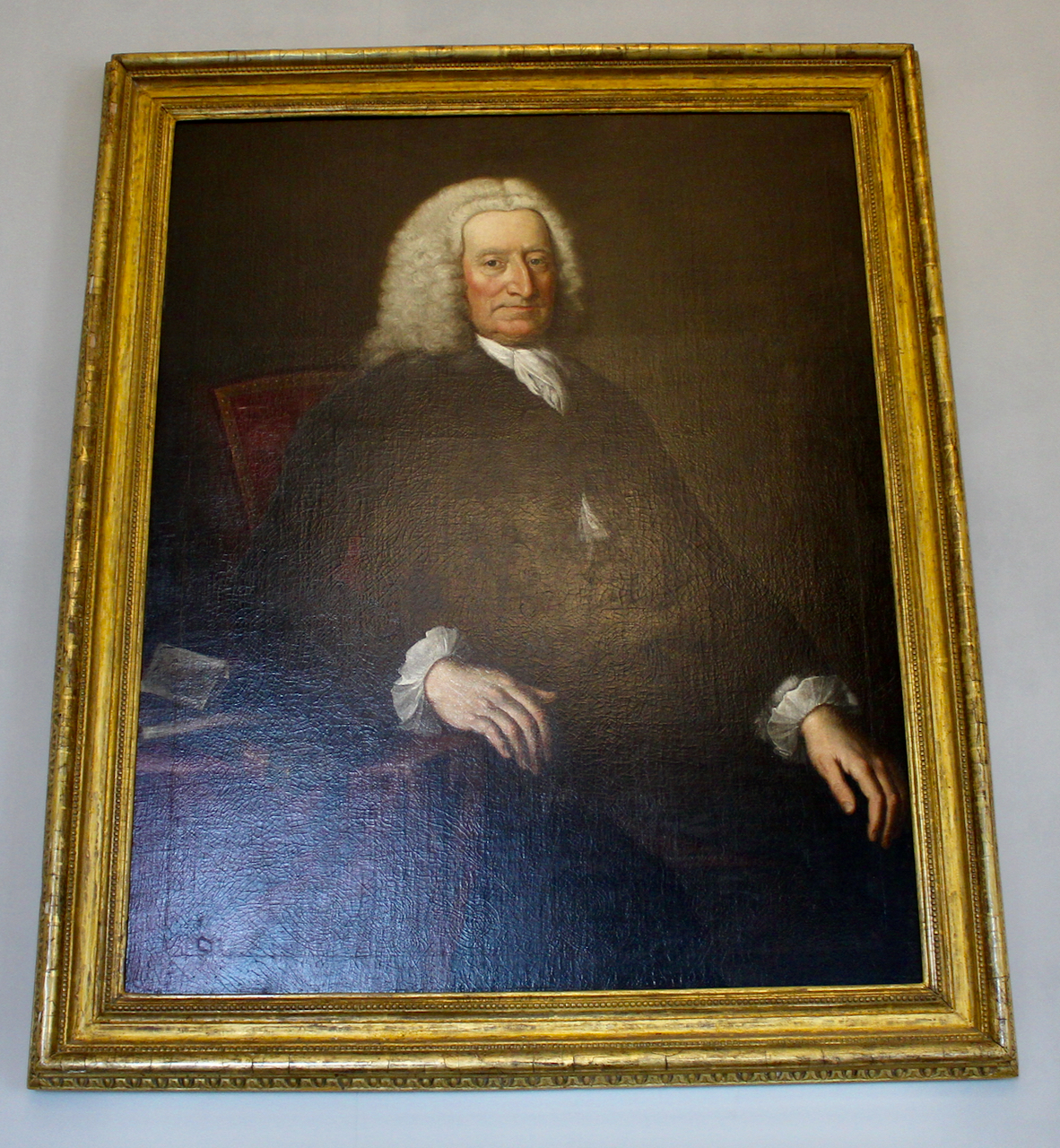
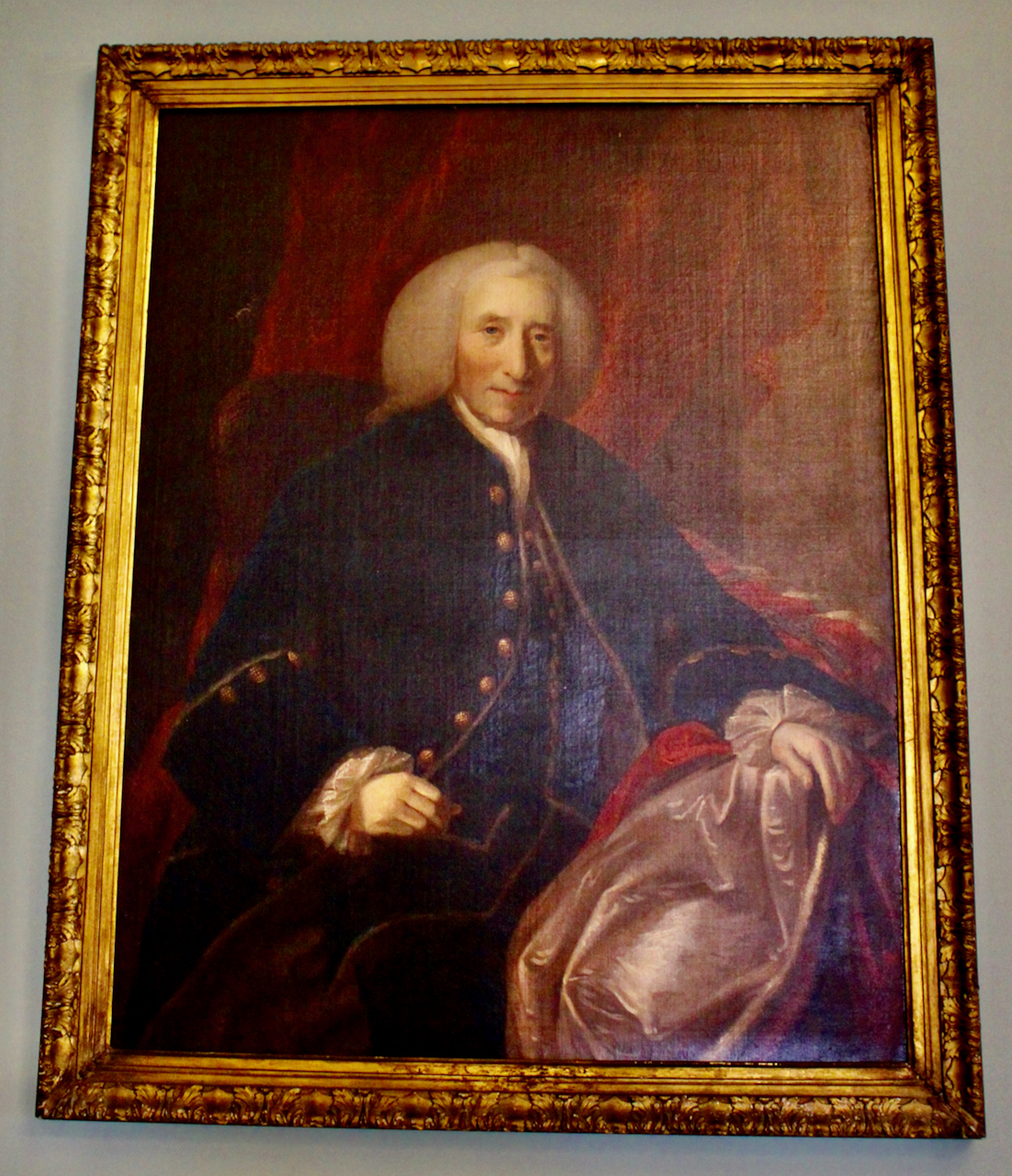
Nicholas Loftus, 1st Viscount Ely (1687-1763). Painter unknown. This painting was completed in 1758 to mark the 70th birthday of Nicholas, father of both Nicholas (the 1st Earl of Ely) and Henry Loftus. He sits next to a book entitled The Present State of Ireland. This anonymous work was originally published in 1730 and contained criticism of the amount of money flowing out of Ireland to absentee landlords, no doubt reflecting Nicholas’s concern with the financial state of the kingdom. He is sometimes known as “the Extinguisher” because of his threat to extinguish the Hook lighthouse in Wexford unless the rent he received from it was increased.

Nicholas served as MP for Wexford, and married Anne Ponsonby, daughter of William Ponsonby, 1st Viscount Duncannon. He was first created Baron Loftus of Loftus Hall in 1751, and then assumed a seat in the House of Lords, and became Privy Counsellor of Ireland in 1753. He was created Viscount Loftus of Ely in County Wicklow in 1756.

After Anne died, around 1724, Nicholas Viscount Ely married Letitia Rowley (d. 1765) of Summerhill in County Meath. To make matters more confusing, she had been previously married to Arthur Loftus (1644-1725) 3rd Viscount of Ely!

Summerhill, County Meath, etnrance front, photograph: Maurice Craig, Vanishing Country Houses of Ireland by The Knight of Glin, David J. Griffin and Nicholas K. Robinson, published by The Irish Architectural Archive and The Irish Georgian Society, 1988.

Viscount Loftus is a title that has been created three times in the Peerage of Ireland for members of the Anglo-Irish Loftus family. The first creation was for Adam Loftus (1568-1643) on 10 May 1622, who served as Lord Chancellor of Ireland in 1619. He is not to be confused the our Adam Loftus (1533-1605) of Rathfarnham Castle. This title became extinct in 1725 upon the death of the third viscount, who had no male heir, despite having married three times. 

Nicholas Viscount Loftus and Anne née Ponsonby had a daughter Elizabeth Loftus (d. June 1747) who married John Tottenham 1st Baronet, MP for New Ross. Another daughter, Mary (1710-1779), married William Alcock (1702-1779) of Wilton Castle in Wexford (see my entry https://irishhistorichouses.com/2022/02/04/wilton-castle-bree-enniscorthy-co-wexford-and-a-trip-to-johnstown-castle/ )

Nicholas and Anne’s son Nicholas Loftus (1708-1766) became the 1st Earl of Ely, and added Hume to his surname after marrying Mary Hume, daughter of Gustavus Hume, 3rd Baronet of Castle Hume, County Fermanagh. As well as Loftus Hall in Wexford, they owned 13 Henrietta Street in Dublin. He became known as the “wicked earl” due to a court hearing about the supposed mental incapacity of his son, also named Nicholas. Young Nicholas’s uncle, George Rochfort (1713-1734), brother of the 1st Earl of Belvedere, sought to have young Nicholas declared incapable of succeeding to the title. George Rochfort was married to another daughter, Alice, of Gustavus Hume, 3rd Baronet of Castle Hume. Family members testified that young Nicholas was of normal intelligence, and that any eccentric behaviour should be blamed on his father’s ill-treatment. The trial lasted for nine years and was even brought to the House of Lords. Poor young Nicholas died before the trial was finished and Rochfort’s case was declared invalid.

Nicholas Hume Loftus, 1st Earl of Ely (1708-1766), unknown artist. It was after Nicholas Loftus (son of the Extinguisher) had married into the wealthy Hume family that the Ely earldom was created for the first time. This depicts Nicholas, the so-called “Wicked Earl” in the doctoral robes of Trinity College Dublin.
Nicholas Hume Loftus, 1st Earl of Ely (1708-1766) by Jacob Ennis. These two portraits depict Nicholas, the so-called “Wicked Earl” at various stages of his life. Nicholas is much older in the Ennis portrait. Jacob Ennis was an Irish historical and portrait painter who spent some time studying in Italy. He was later a Master in the Dublin Society’s Drawing Schools.

Nicholas Loftus Hume officially succeeded as 2nd Earl of Ely (1738-1769). It was through him that Rathfarnham Castle returned to Loftus ownership. Nicholas bequeathed Rathfarnham Castle and the estate to his uncle, Henry Loftus (1709-1783) who became the 1st Earl of Ely of the second creation. Henry was the younger son of Nicholas Loftus (d. 1763) 1st Viscount Loftus and Anne née Ponsonby, brother to the earlier Nicholas Hume Loftus (d. 1766) 1st Earl of Ely, the Wicked Earl.

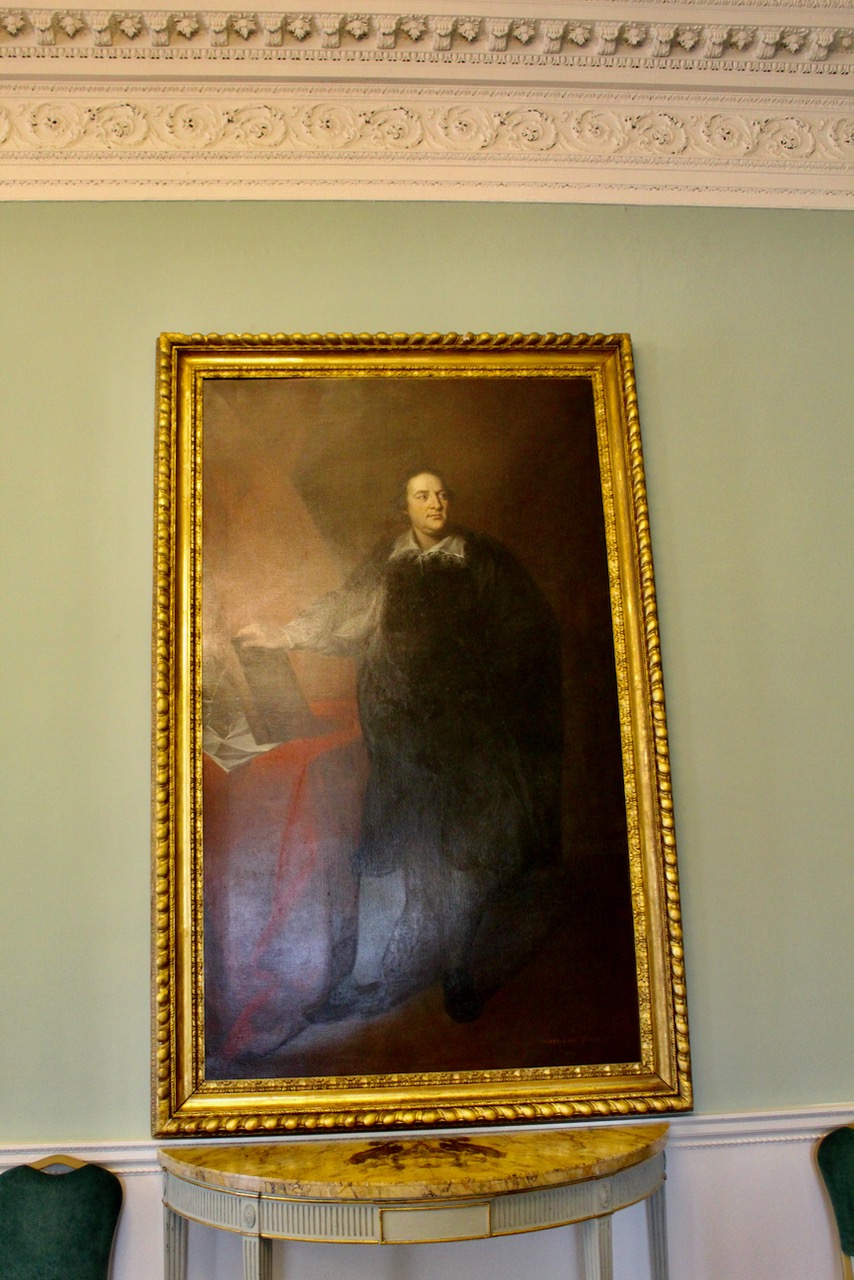
Henry Loftus, 1st Earl of Ely of the 2nd Creation (1709-1783) by Angelica Kauffman. Henry inherited Rathfarnham Castle and its demesne in 1769 upon the death of Nicholas, his nephew. Nicholas had been the subject of a long running legal case concerning the state of his mind and Henry had supported him throughout. The Swiss artist Angelica Kauffman is known to have spent several months in Dublin in 1771. As well as this portrait which was probably completed to mark Henry’s elevation to the earldom of Ely, this renowned painter also completed a group portrait of Henry and his family (now in the National Gallery) as well as a series of ceiling paintings for the long gallery on the first floor depicting scenes from Greek mythology.

Between 1769 and his death in 1783 Henry funded some of the most substantial 18th century changes to Rathfarnham Castle and the demesne.

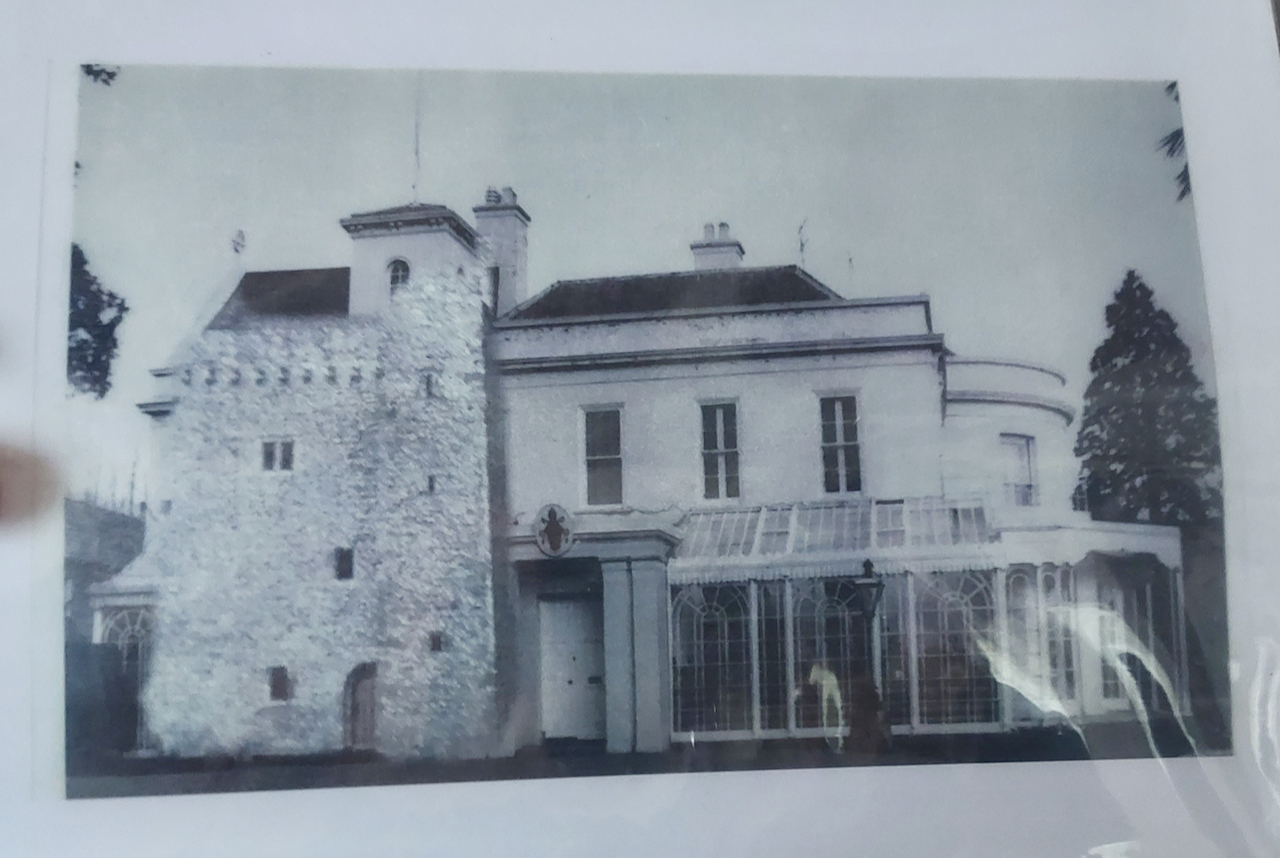
He contracted Sir William Chambers to remodel several of the rooms including the Ballroom and Anteroom. Externally, the window openings were enlarged, and a new stone Tuscan entrance portico added, probably to the designs of William Chambers. The original battlements were removed and the new parapet was embellished with ball finials and urns some of which also serve as chimneys. On the south front new garden steps were added, while on the east front a three bay bow had been added by 1774.

Rathfarnham Castle, Dublin, September 2021. Photograph © Jennifer Winder-Baggot, www.irishhistorichouses.com
Rathfarnham Castle. Photograph © Jennifer Winder-Baggot, www.irishhistorichouses.com

From the OPW website:

Loftus’s castle, with its four flanker towers, is an excellent example of the Elizabethan fortified house in Ireland. In the late eighteenth century, the house was remodelled on a splendid scale employing some of the finest architects of the day including Sir William Chambers and James ‘Athenian’ Stuart. The collection includes family portraits by Angelica Kauffman, Sir Peter Lely, and Hugh Douglas Hamilton.

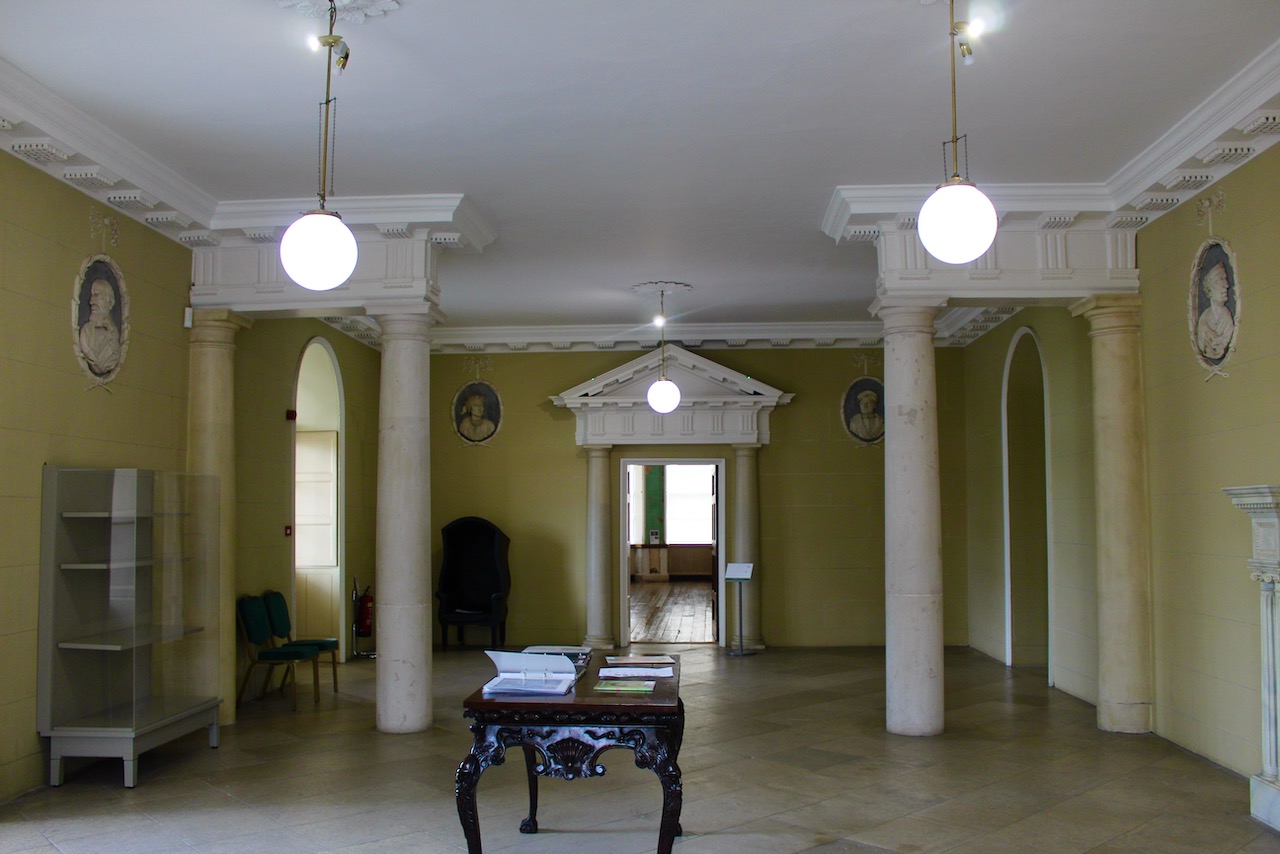
The entrance hall, Rathfarnham Castle. Photograph © Jennifer Winder-Baggot, www.irishhistorichouses.com

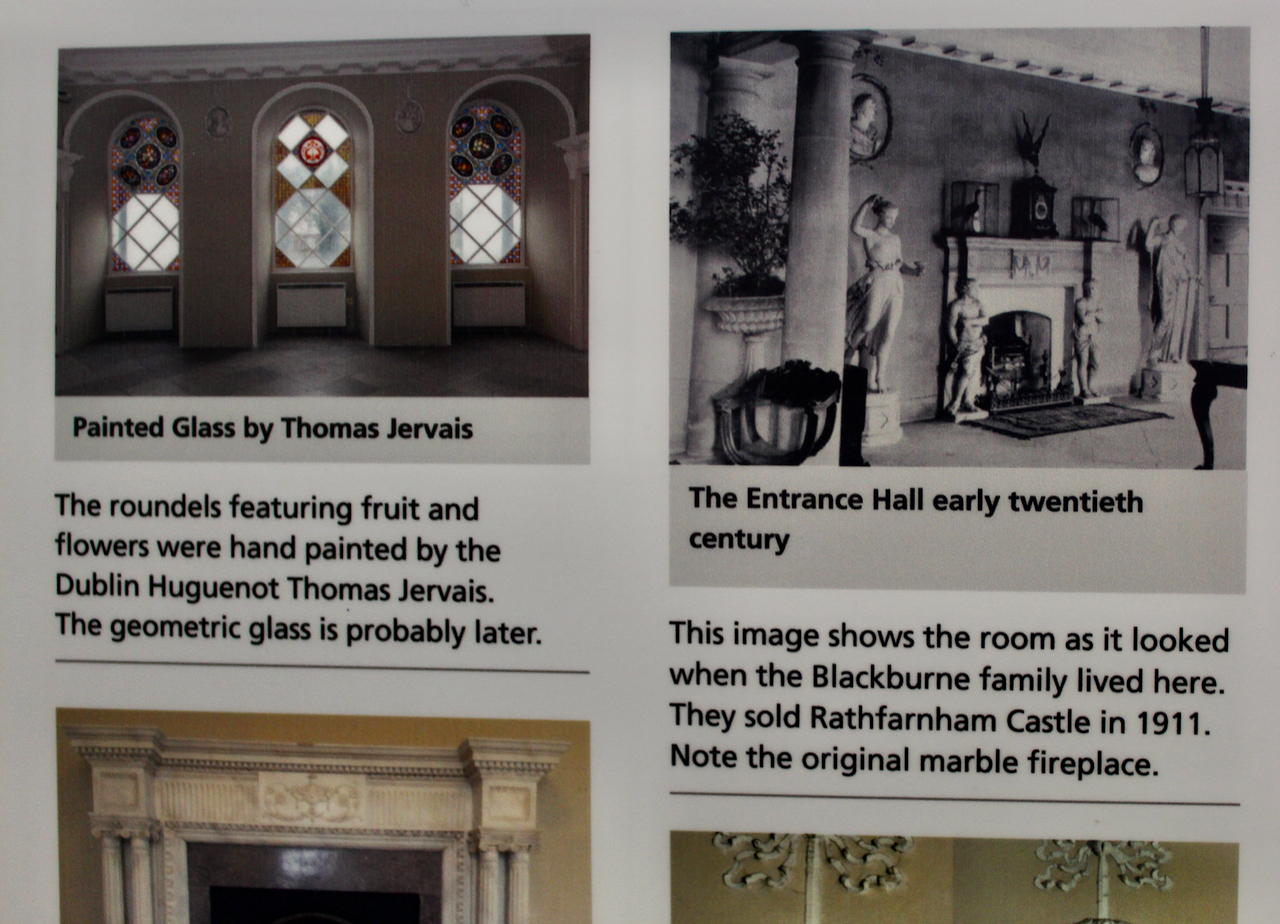
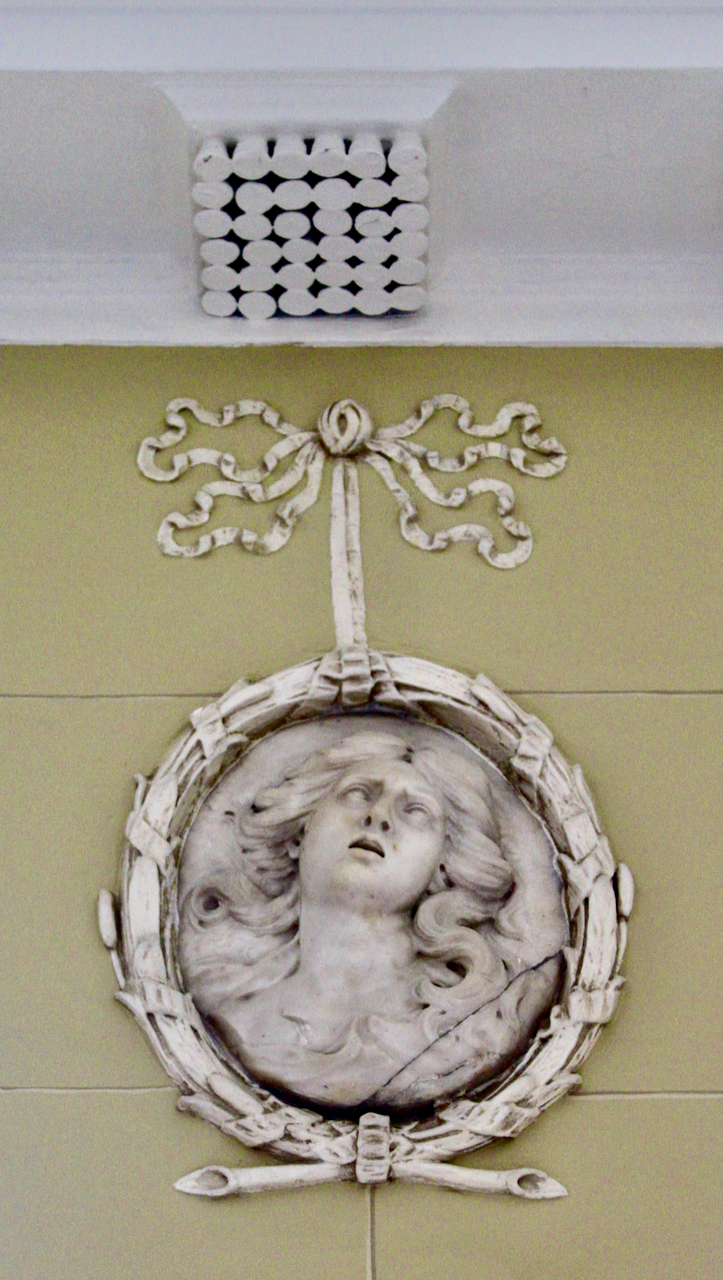
From an information panel in the entrance hall: “This room is believed to have been built to a design by the influential architect Sir William Chambers (1723-1796). Despite never visiting Ireland, Chambers left a significant mark on Dublin where he also designed the Casino at Marino, Charlemont House on Parnell Square, and much of Front Square in Trinity College. The floor and free standing Doric columns are in Portland stone. The painted glass panels featuring fruit and flowers are believed to be by the Dublin Huguenot artist Thomas Jervais (d. 1799). The marble relief busts on the walls depict well known figures from the Classical and Renaissance past, including the Egyptian queen Cleopatra and Italian poet Dante. These sculptures seem to have been acquired in Italy and would have been incorporated into the design of the Entrance Hall to signal the taste and refinement and learning of the Loftus family. The original eighteenth century marble fireplace was replaced with a painted timber one in around 1913. It was one of several of the original fireplaces which were removed and sold when the Blackburne family left the castle in 1911.

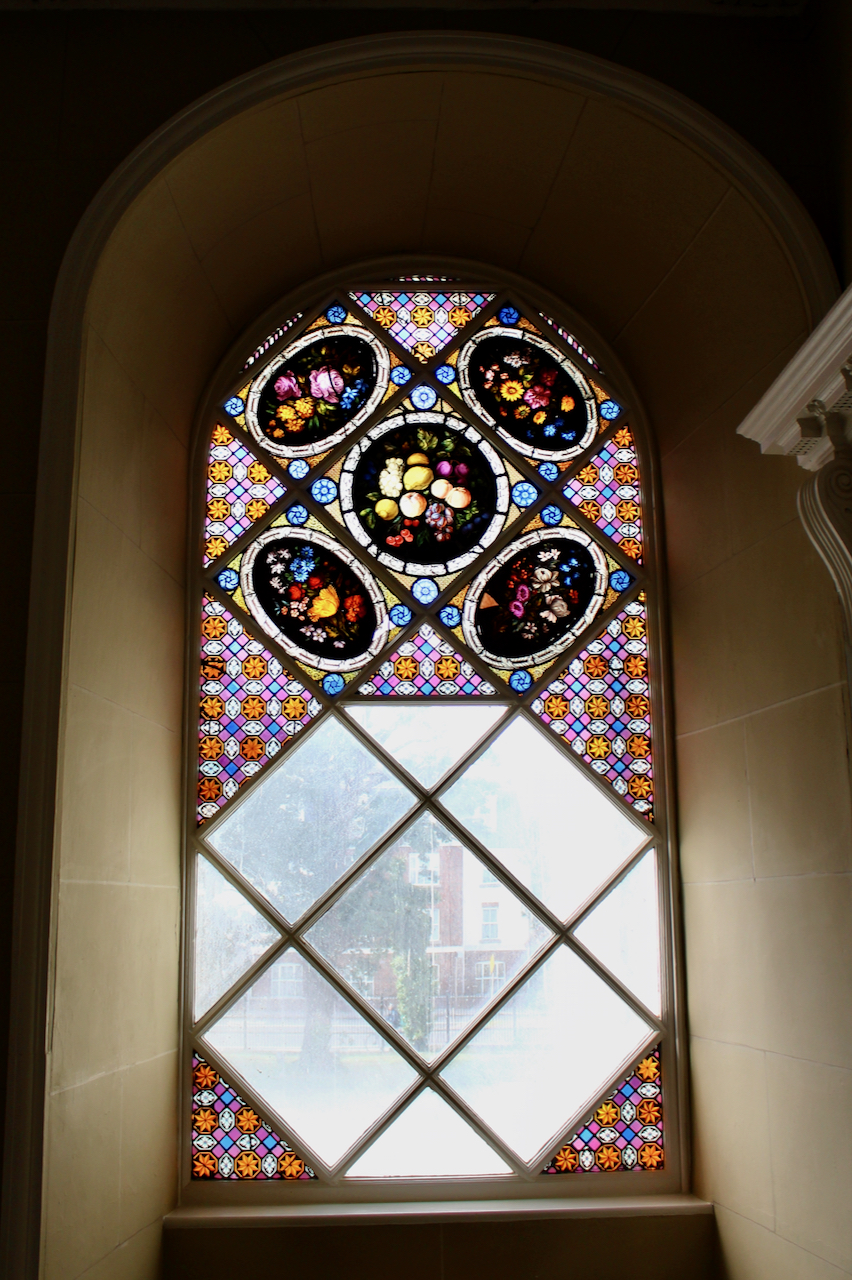
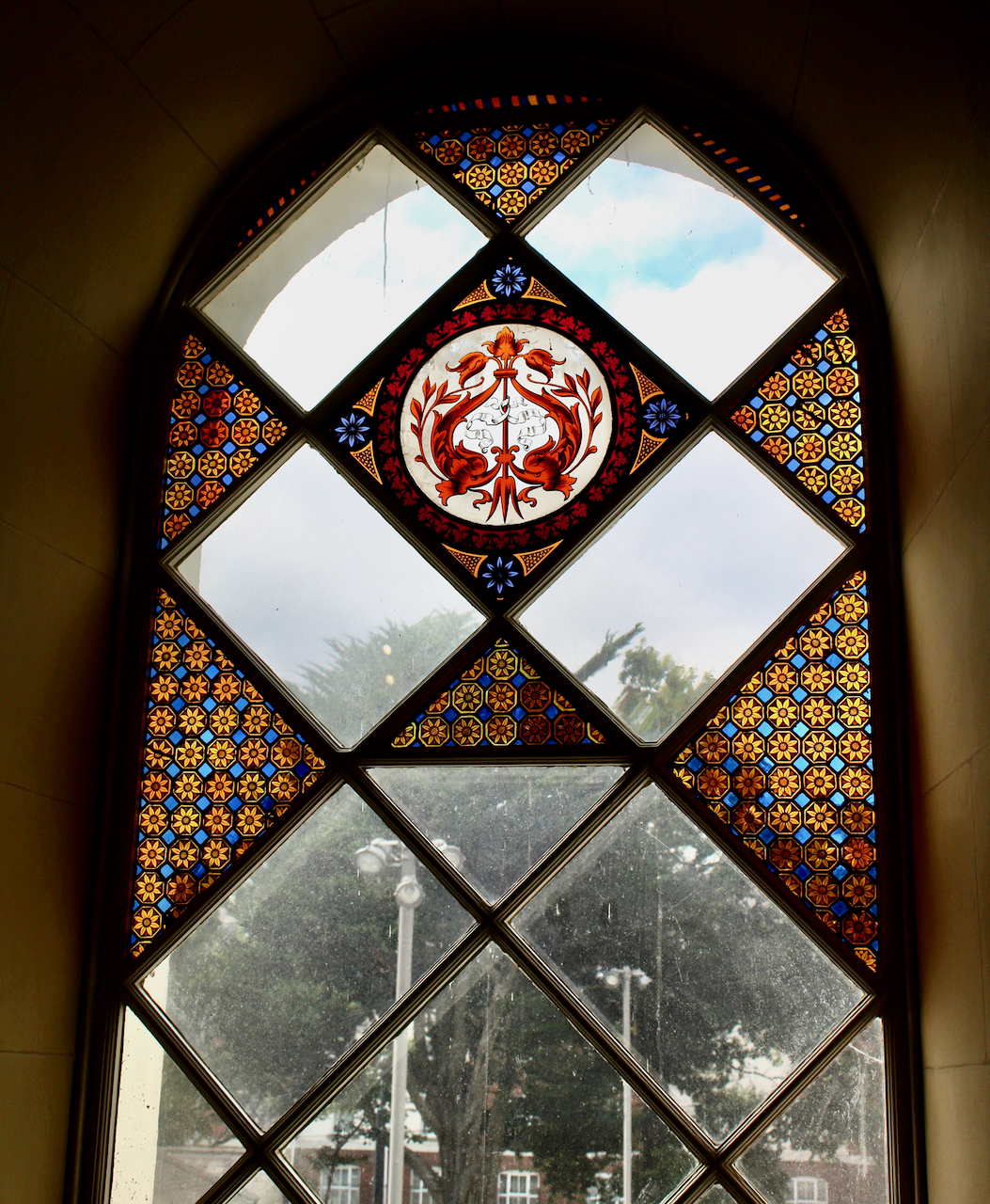
The painted glass panels featuring fruit and flowers are believed to be by the Dublin Huguenot artist Thomas Jervais (d. 1799). Designs for windows for the castle were by Joshua Reynolds. [see 5] Photograph © Jennifer Winder-Baggot, www.irishhistorichouses.com
The entrance hall, Rathfarnham Castle. Photograph © Jennifer Winder-Baggot, www.irishhistorichouses.com
Information board, Rathfarnham Castle.
Cleopatra. The asp that killed her can be seen on her shoulder. Rathfarnham Castle. Photograph © Jennifer Winder-Baggot, www.irishhistorichouses.com
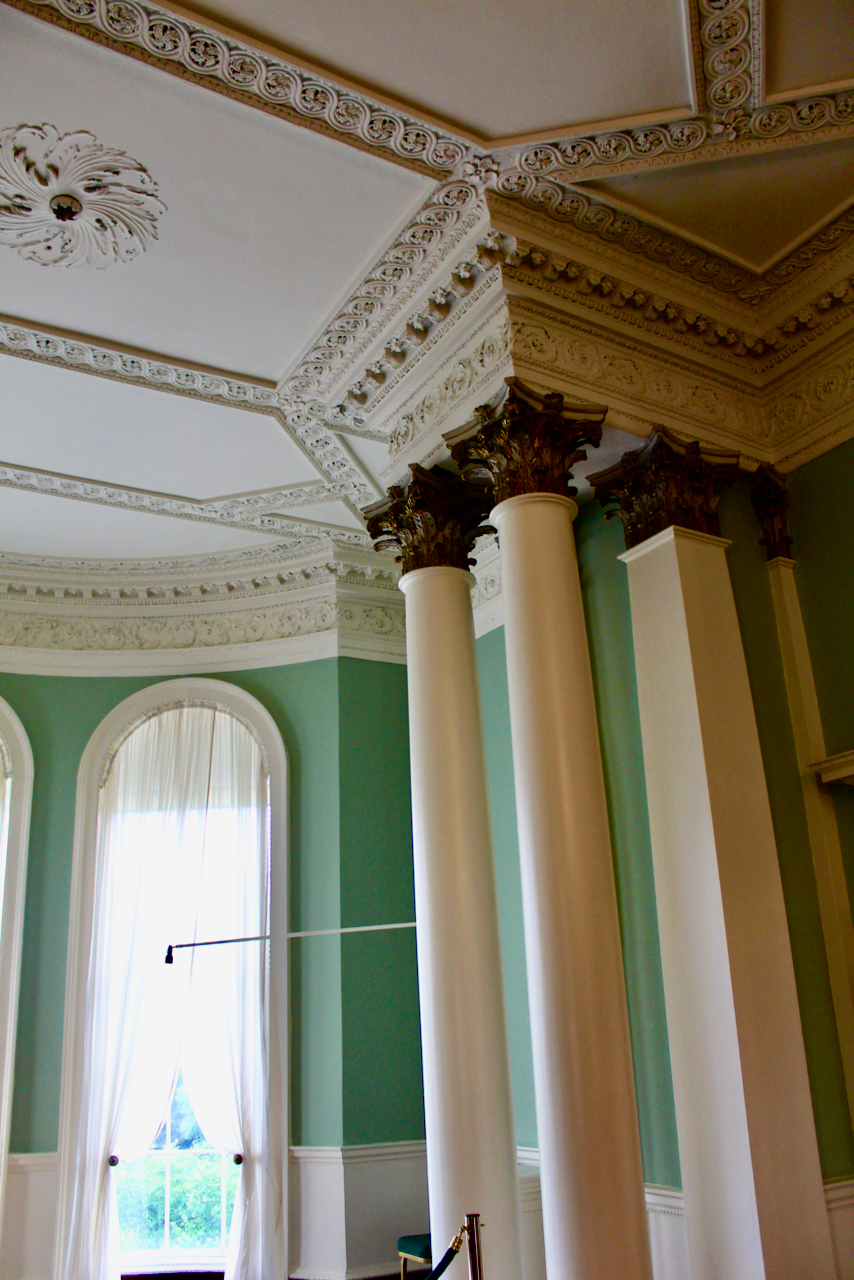
The Ante-Room. This served as a reception or waiting room for guests attending the Ball. The Ionic columned Venetian style window is the highlight of this room. The columns are wooden and hollow, and feature intricately carved foliage. The whole window may be referencing the form of a Roman triumphal arch. The wall separating this room from the ballroom was reinstated in the 1990s by the OPW. It had been removed in the 19th century by the then owner, Lord Chancellor Francis Blackburne (1782-1867), to accommodate a large pipe organ. Photograph © Jennifer Winder-Baggot, www.irishhistorichouses.com
The Ante-Room, Rathfarnham Castle. Photograph © Jennifer Winder-Baggot, www.irishhistorichouses.com
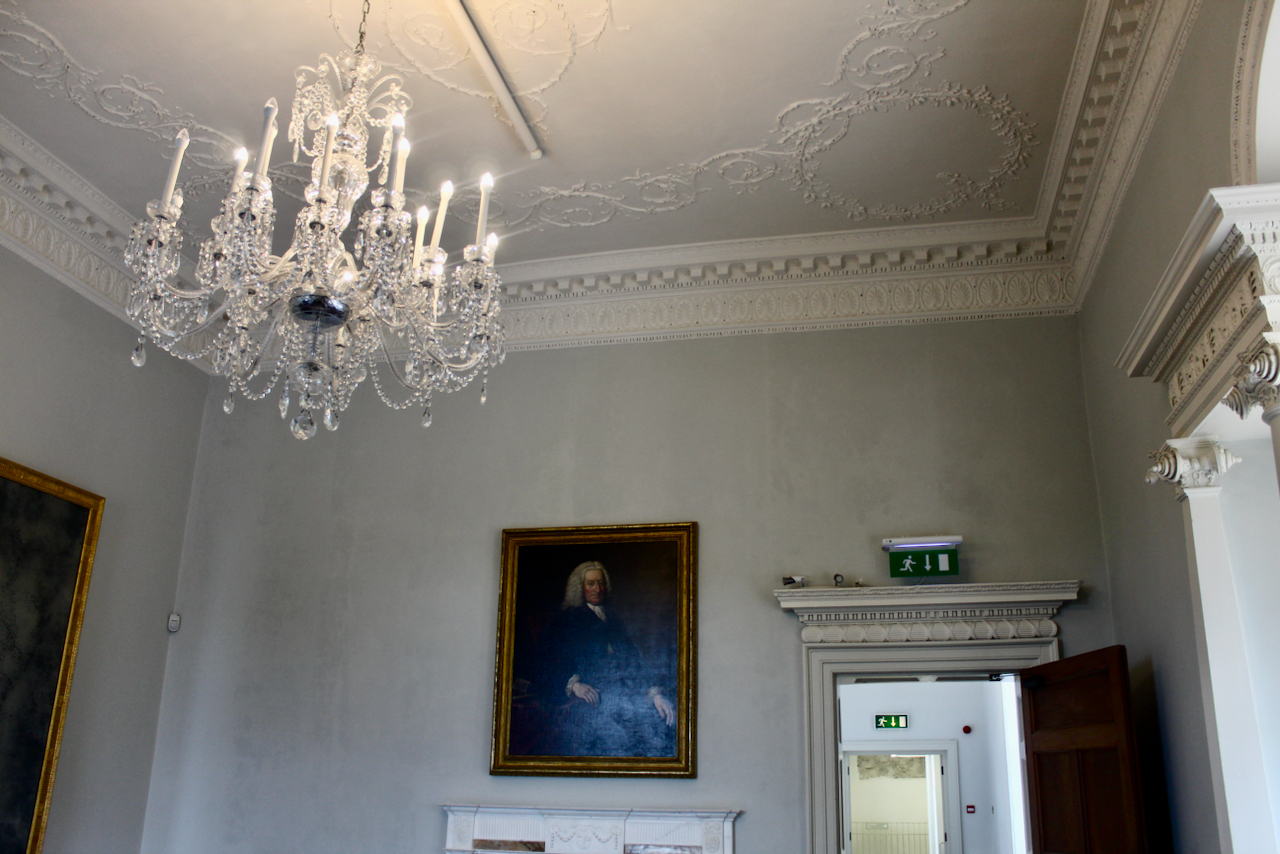
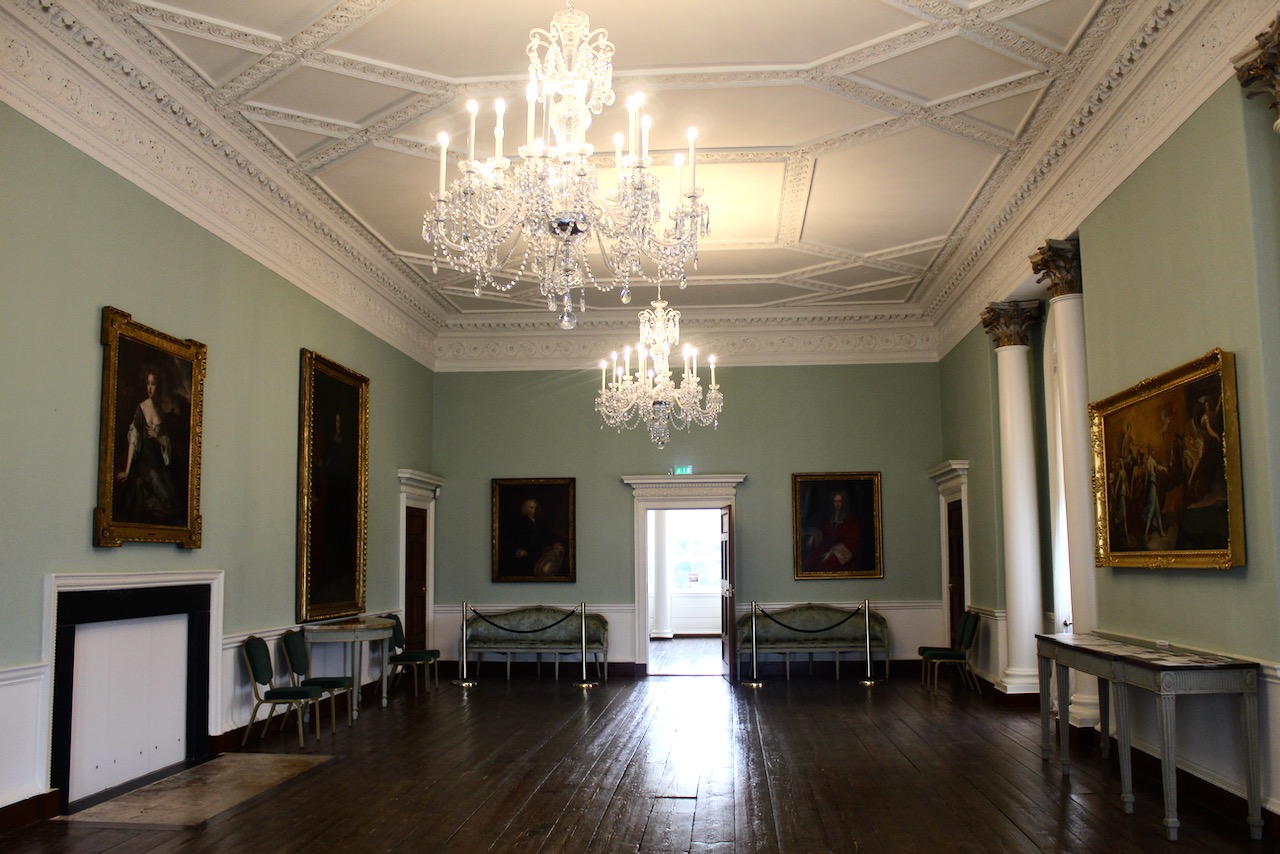
The Ballroom. The Ballroom was the principal room for entertainment and dancing and it is believed that the room was designed by Sir William Chambers. The door to the left on entering the room is false. It opens to reveal the wall behind. It was installed to maintain the balance and symmetry of the room. Musicians may have played in the eastern bow at the top of the Ballroom when dancing took place. Later, the Jesuits transformed the room into a chapel placing an altar in the bow with pews arranged down the centre of the room. Photograph © Jennifer Winder-Baggot, www.irishhistorichouses.com
The Ballroom, Rathfarnham Castle. Photograph © Jennifer Winder-Baggot, www.irishhistorichouses.com
The Ballroom, Rathfarnham Castle, Dublin. Photograph © Jennifer Winder-Baggot, www.irishhistorichouses.com
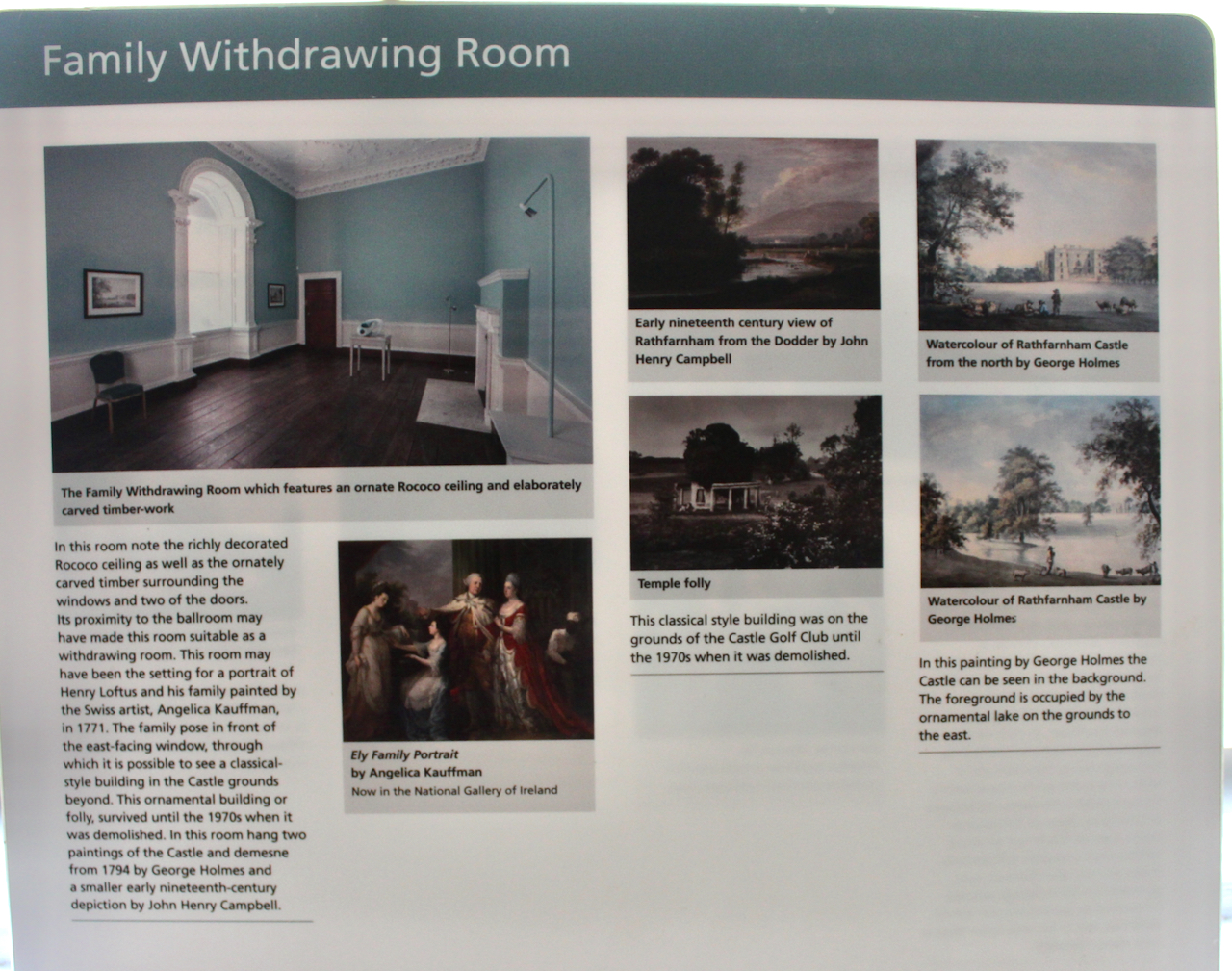
Information board about the Farmily Withdrawing Room in Rathfarnham Castle.
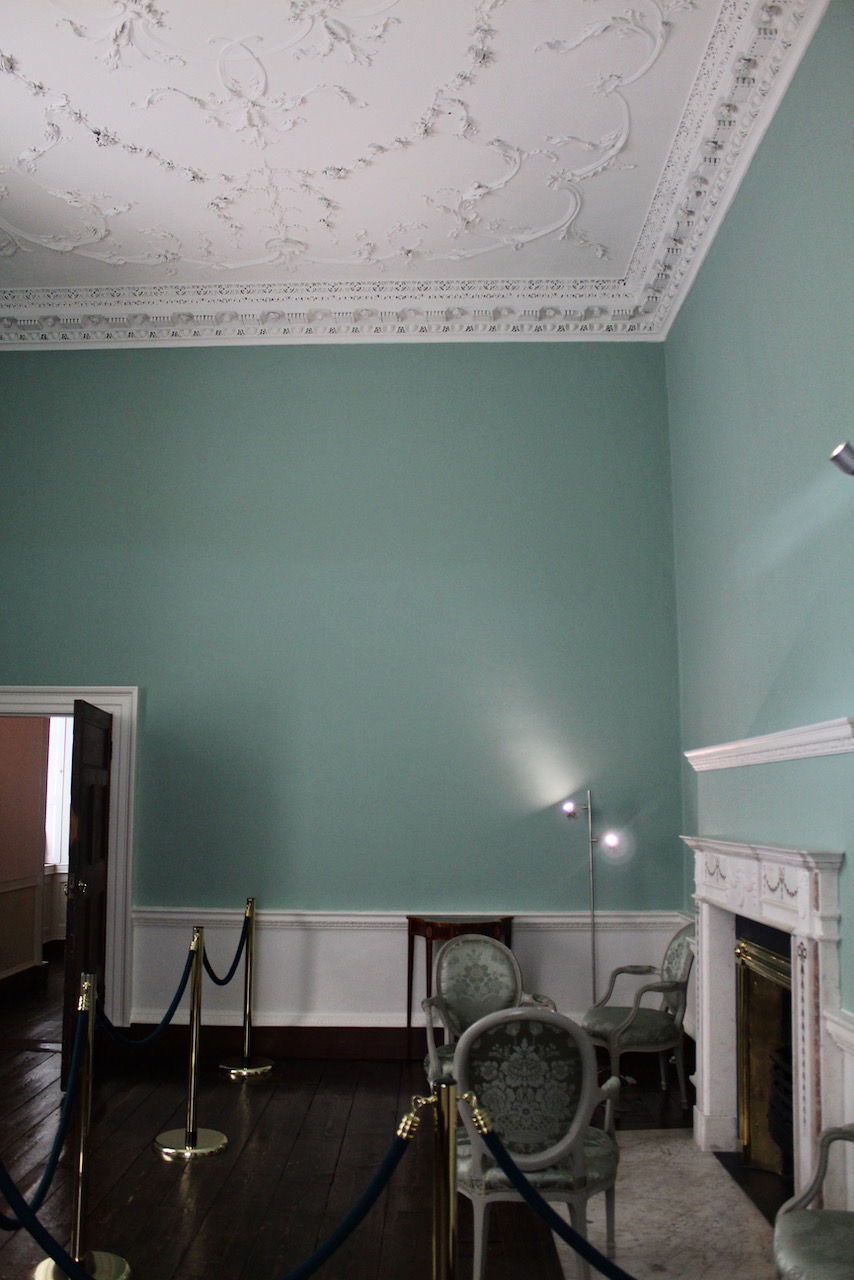
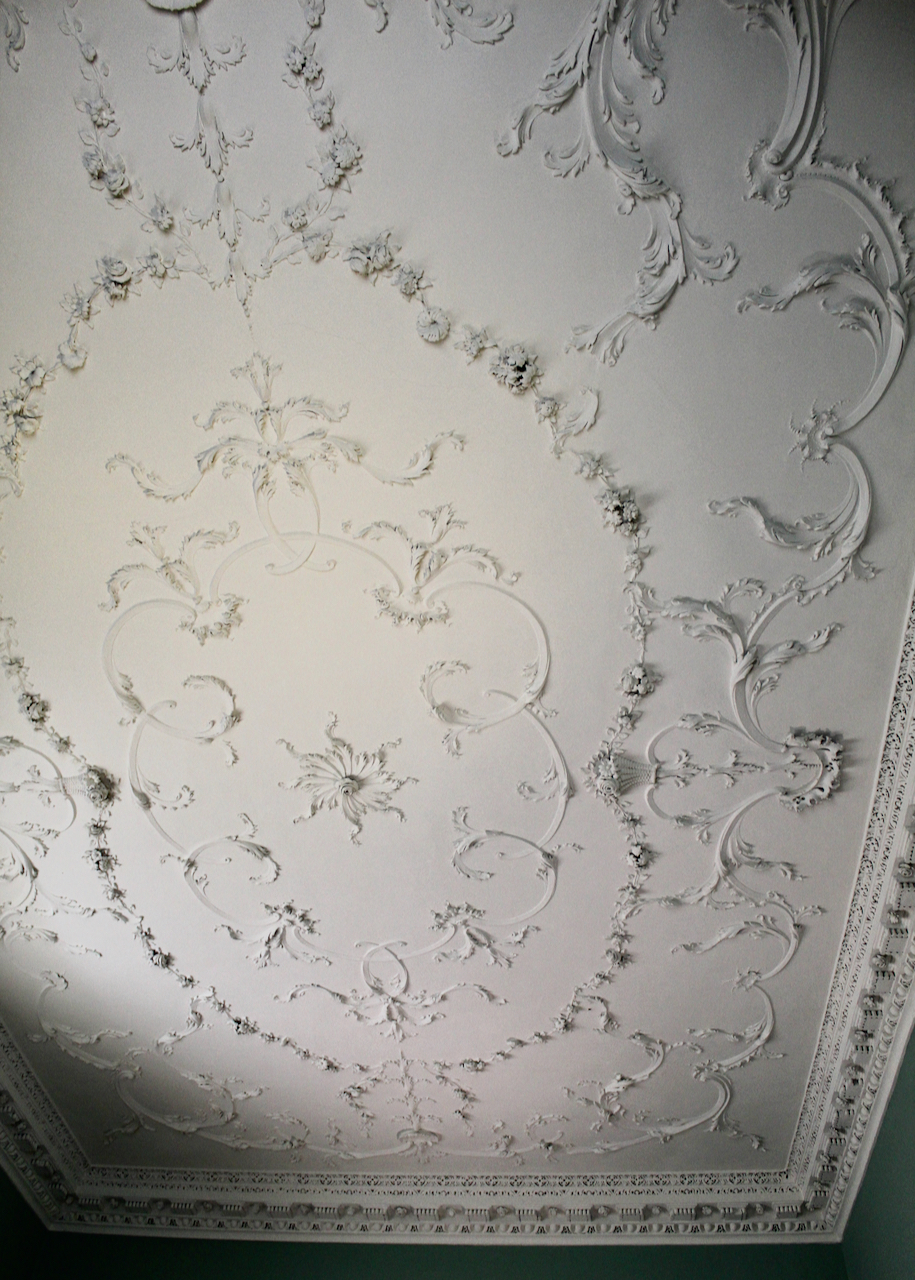
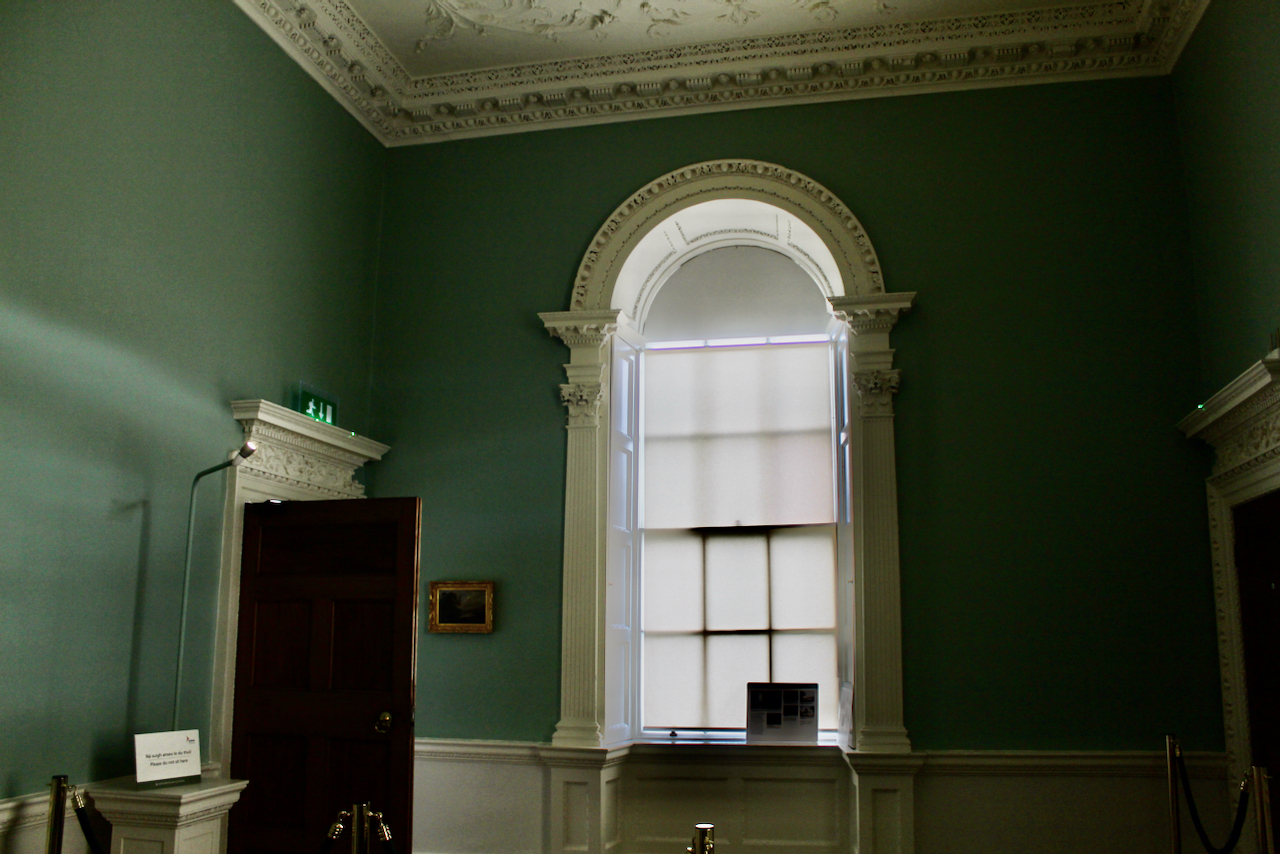
The Farmily Withdrawing Room in Rathfarnham Castle. Photograph © Jennifer Winder-Baggot, www.irishhistorichouses.com

Henry Loftus (1709-1783) is pictured below. He married first, Frances Monroe of Roe’s Hall, County Down, (pictured below), who died in 1774, then married secondly Anne Bonfoy. He purchased Ely House in Dublin (built 1770) from Sir Gustavus Hume, 3rd Baronet (now owned by the Knights of Columbanus).

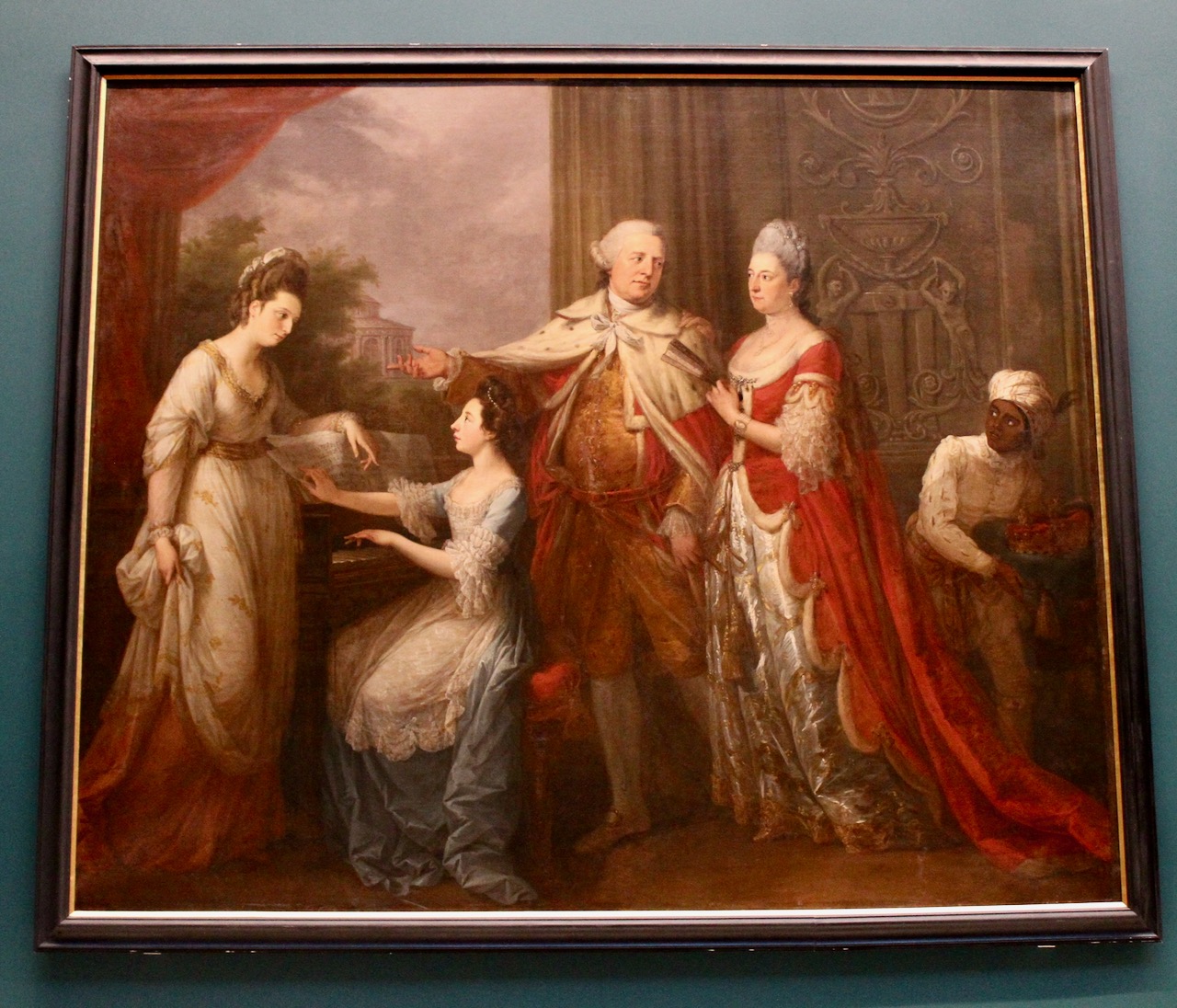
Painting by Angelica Kauffman, who spent several months in Dublin in 1771. It shows Henry Loftus 1st Earl of Ely of the 2nd Creation (1709-1783) with his wife Frances, her nieces and an exotic trophy servant, a young Indian page in Oriental dress carrying a cushion with two coronets, symbolising the title the Earl had just received. The older niece, Dolly Monroe, was Classical costume. Her younger sister Frances plays a fashionable aria on the harpsichord.

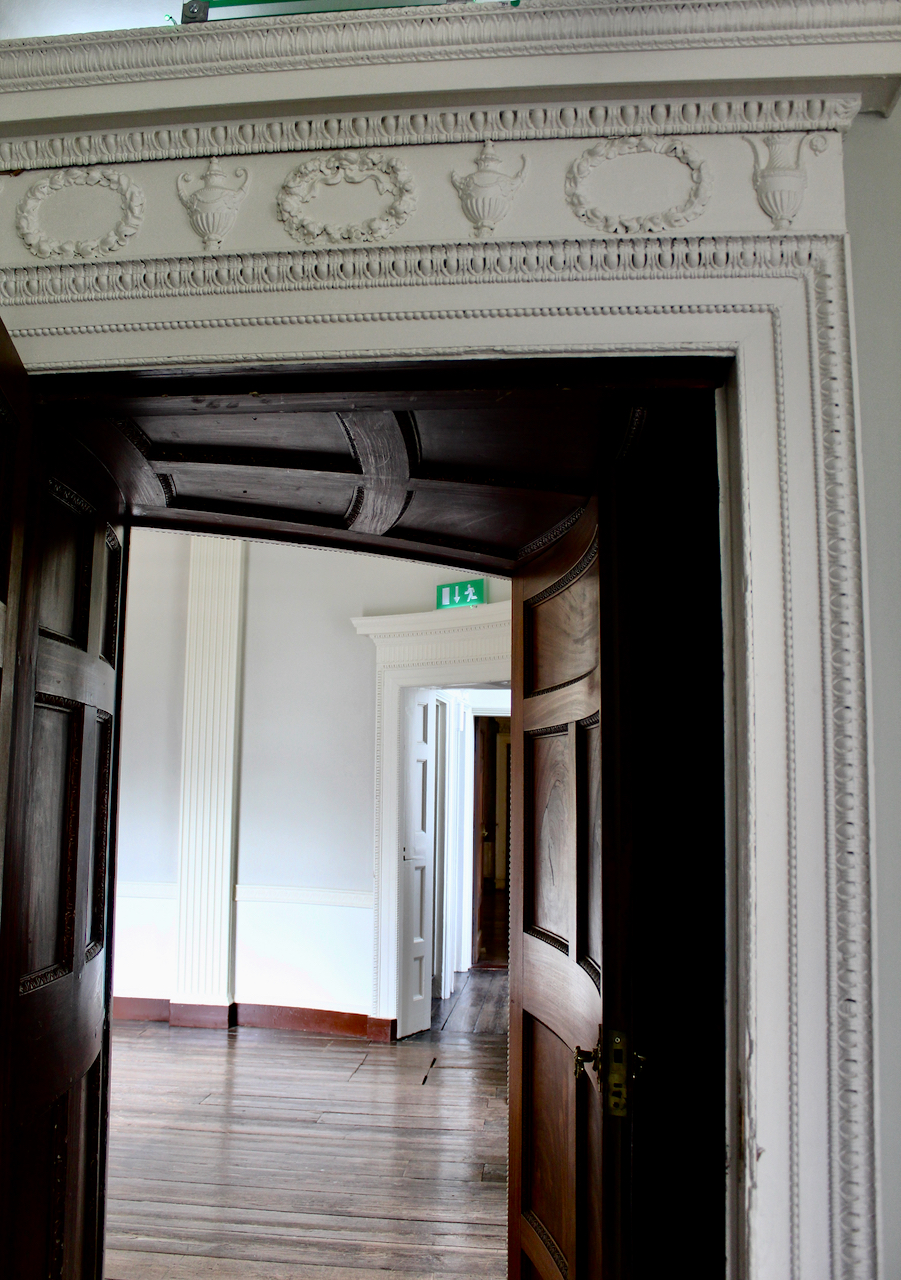
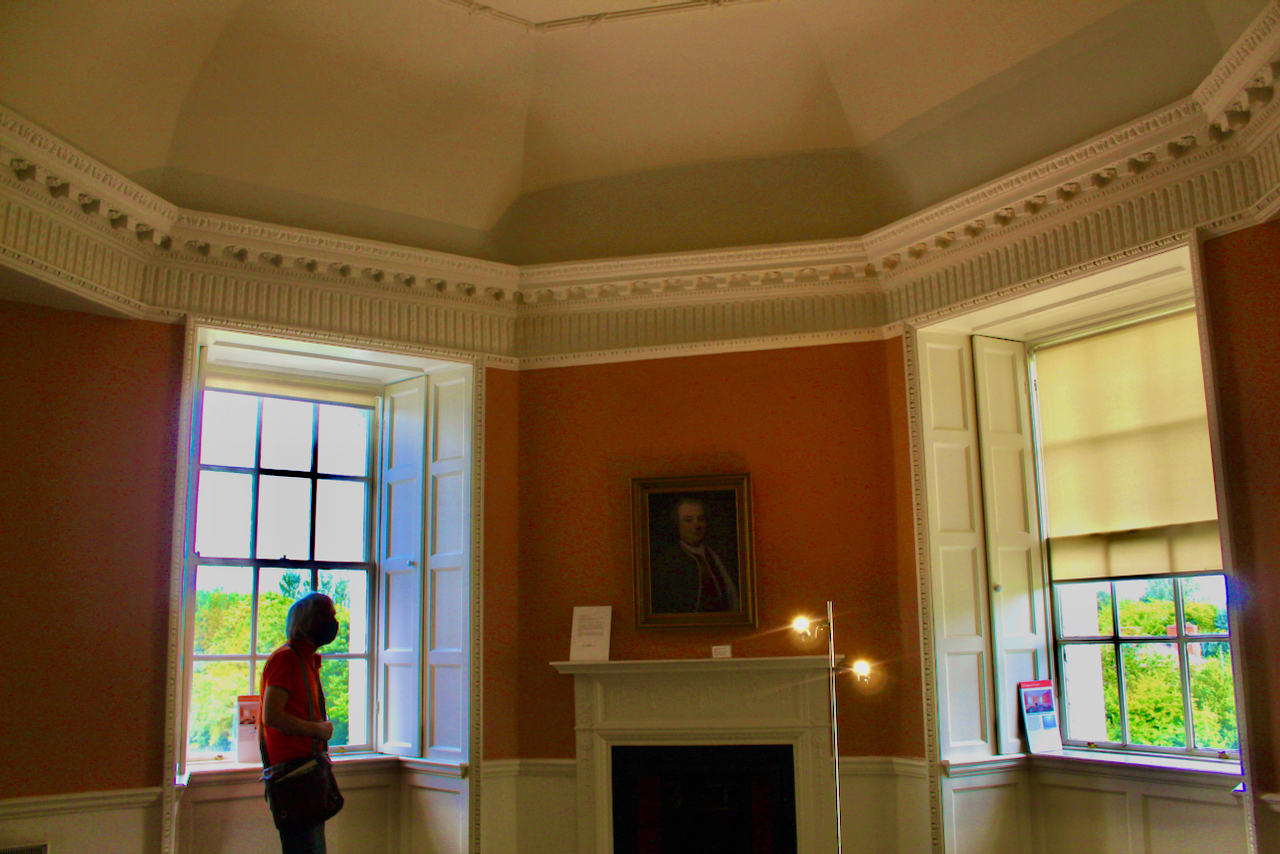
As well as the ante room and ballroom and the entrance hall on the first floor, Chambers was responsible for the small drawing room ceiling, back staircase lobby, and the octagonal room in one of the towers.

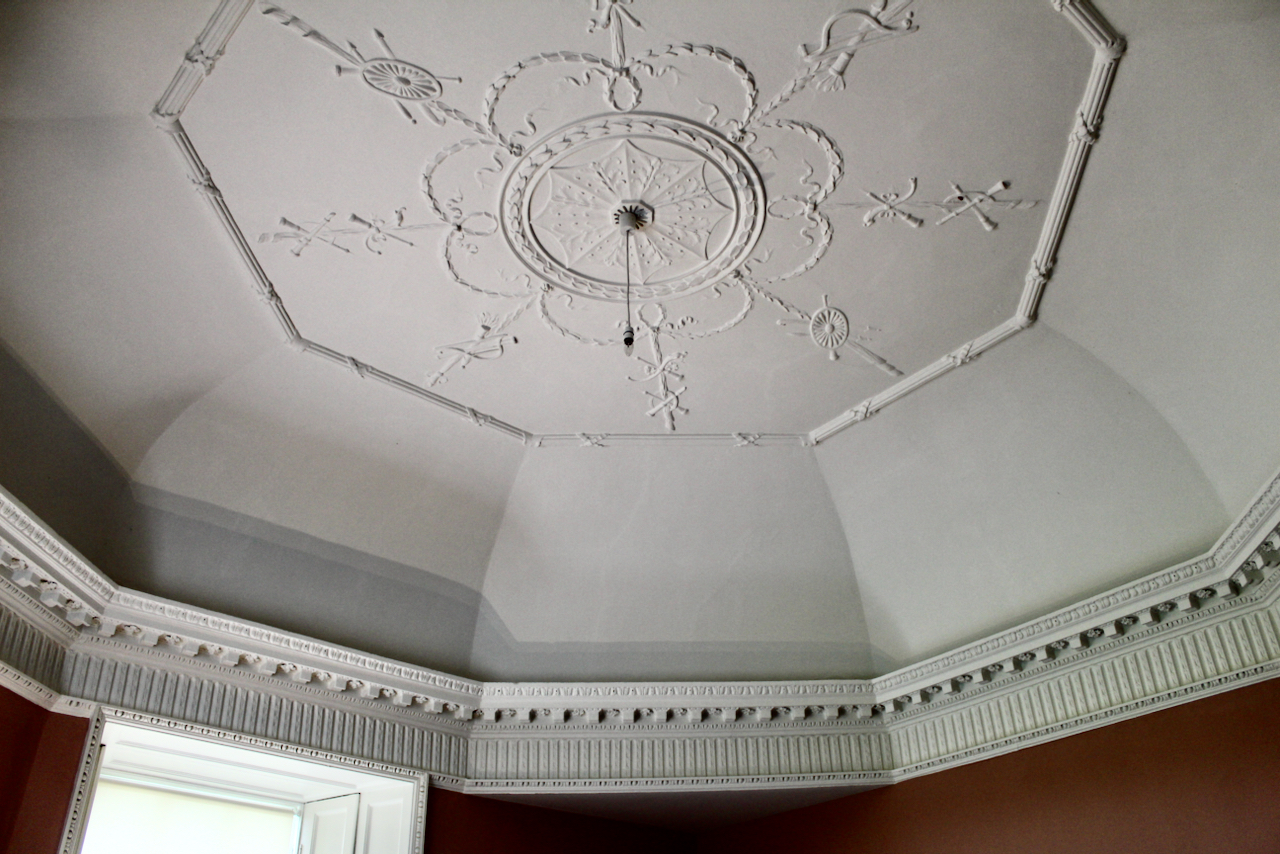
The Octagonal Room. In the 18th century it may have been a withdrawing room where guests could step out of the Ballroom for private conversation or relaxation. It was later used as a sacristy by the Jesuits. Photograph © Jennifer Winder-Baggot, www.irishhistorichouses.com
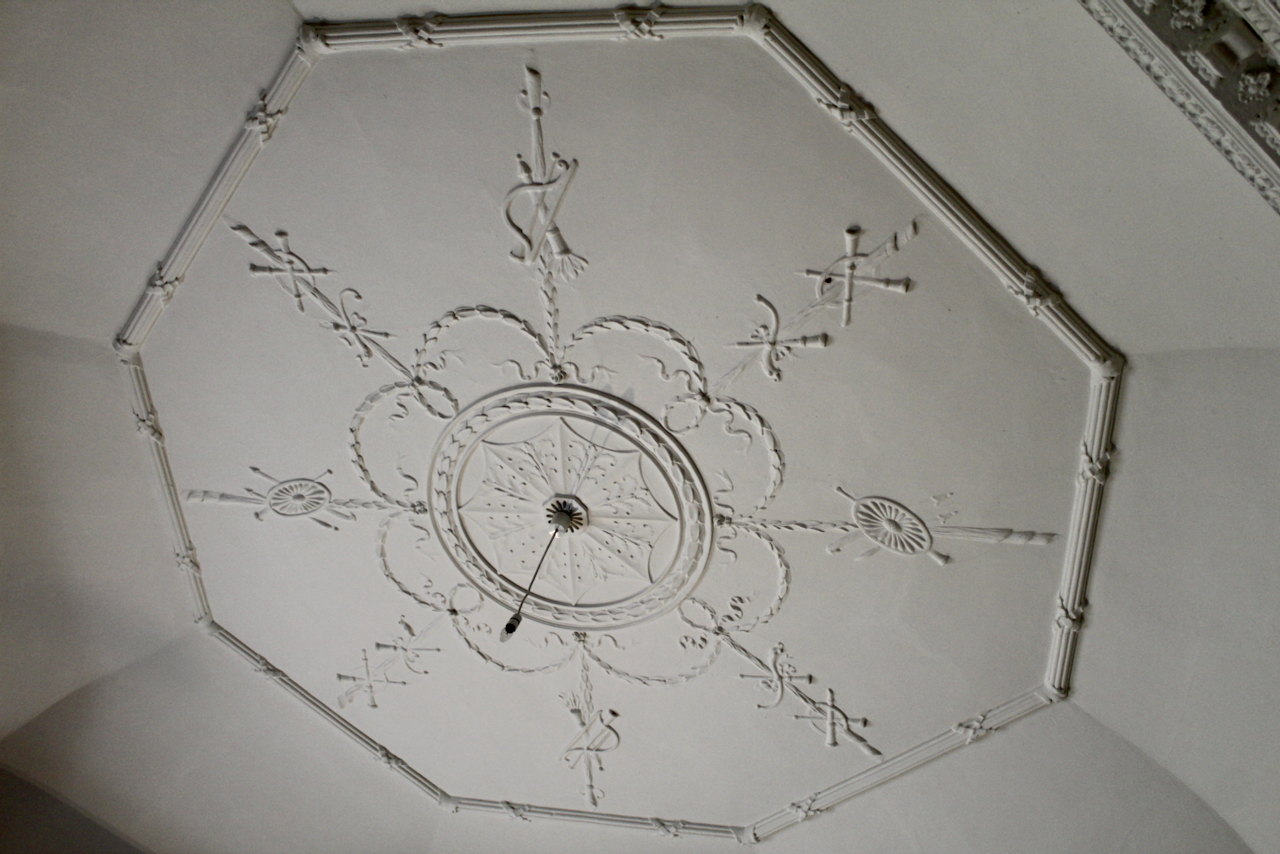
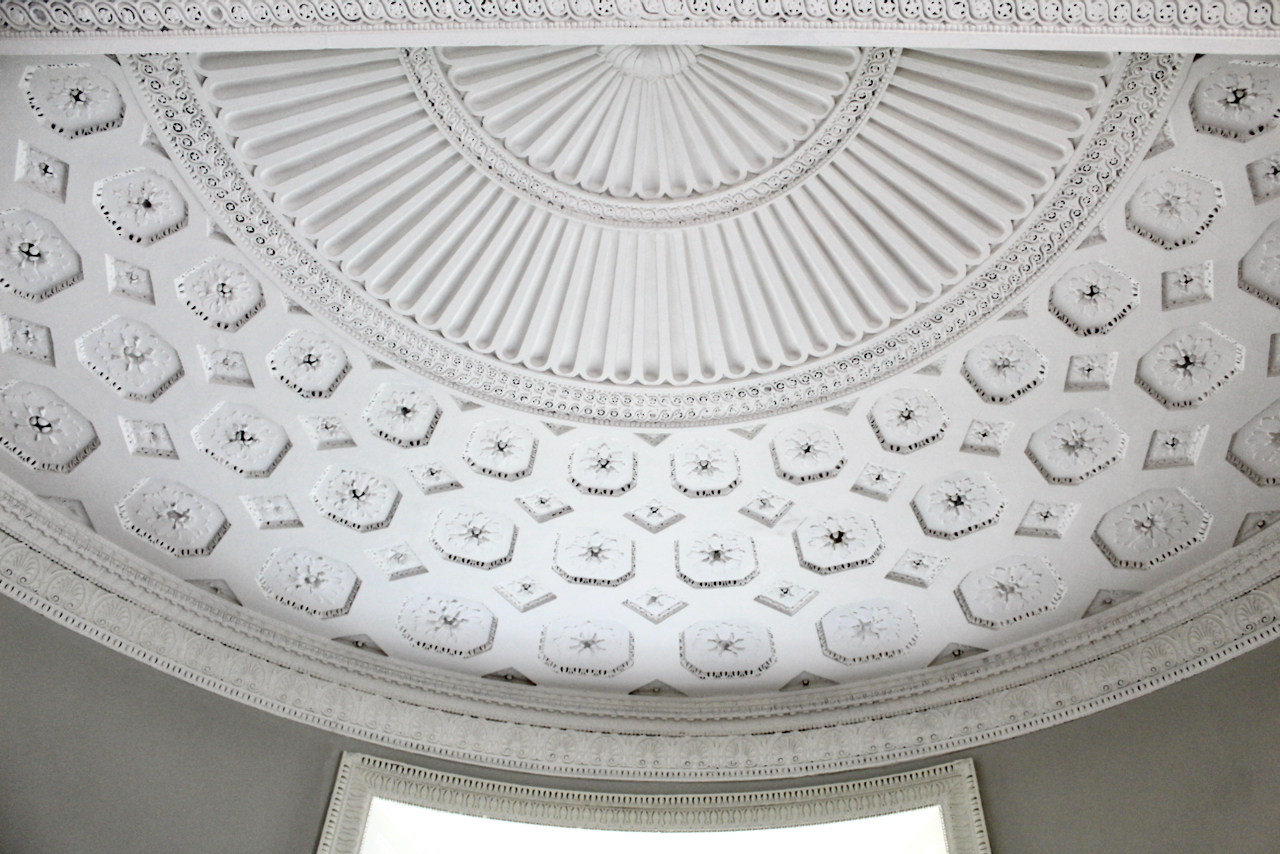
The Octagonal Room. This room features an eight sided ceiling and is decorated with ancient Roman symbols of war. The border is made up of bound groups of timber rods (fasces), a symbol of authority and power in the Roman period. Rathfarnham Castle. Photograph © Jennifer Winder-Baggot, www.irishhistorichouses.com
The Octagonal Room. Rathfarnham Castle. Photograph © Jennifer Winder-Baggot, www.irishhistorichouses.com
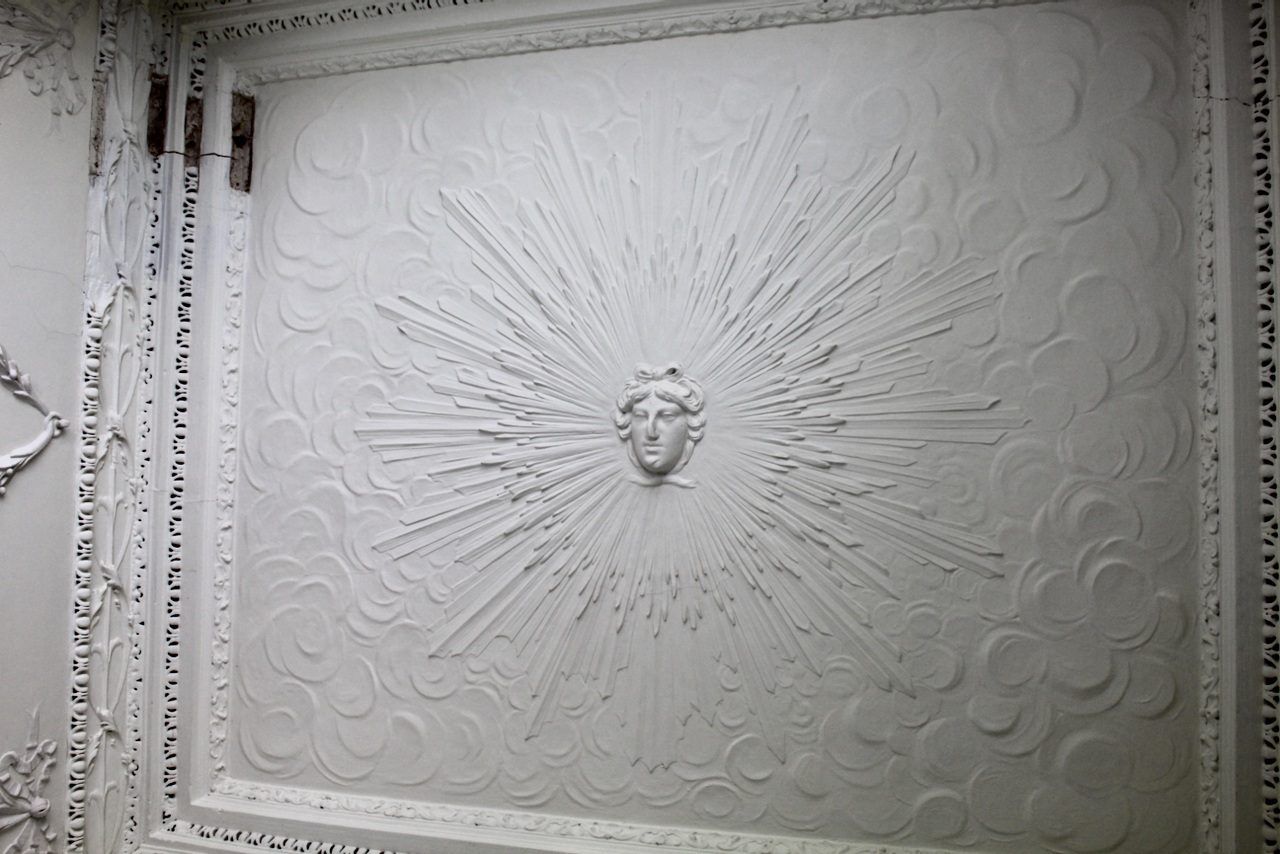
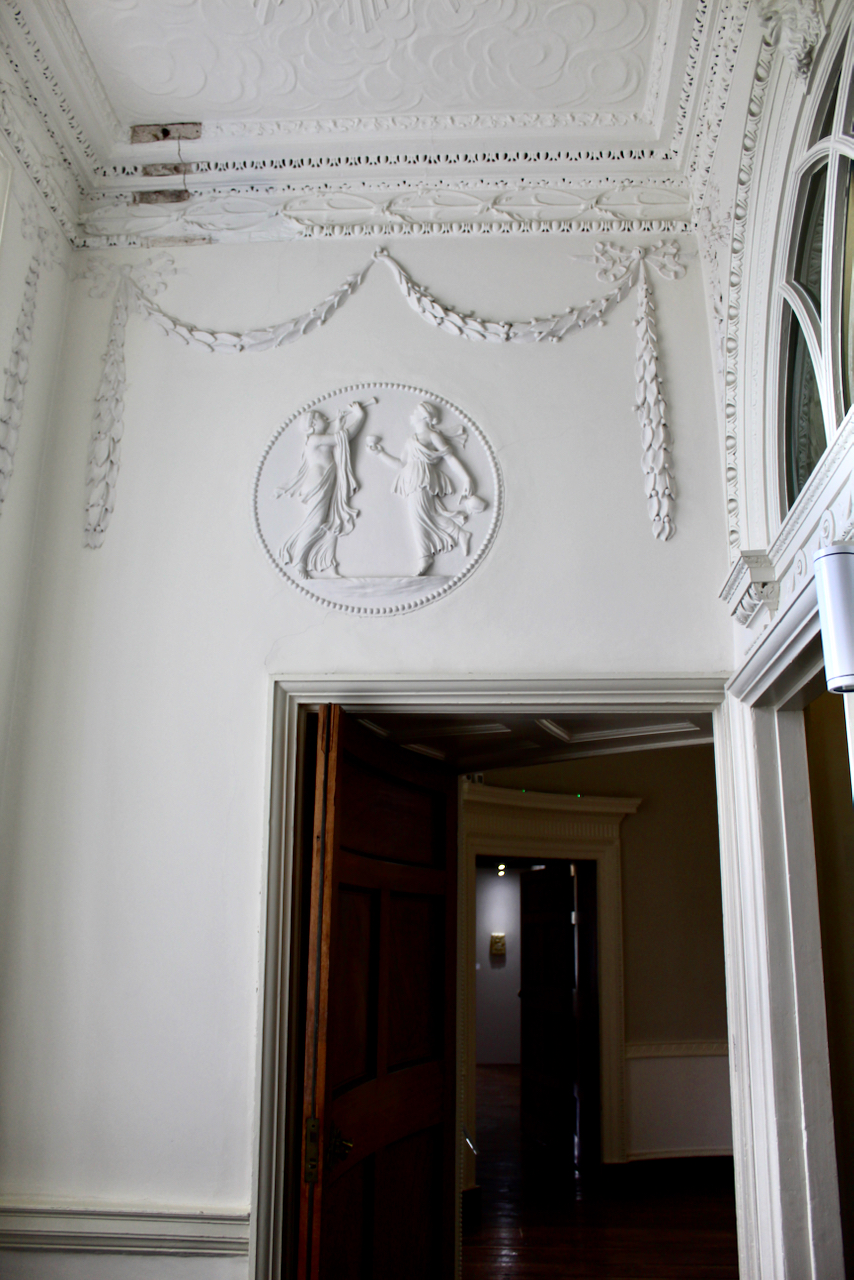
This tiny little passageway between the Dining Room and Long Gallery/Saloon was clearly a space of some importance. The passageway looks out onto the garden, and is decorated with very fine plasterwork. A head of Apollo adorns the ceiling, most likely to the design of Sir William Chambers, and on either side of the doorway there are ornamental plaster plaques with classical figures, celebrating wine, music and dance, a feature favoured and used repeatedly by James ‘Athenian’ Stuart. On one side of the passage there is a narrow wooden stairs, with a fanlight and satyr mask. The stairway has decorative niches, and leads all the way from the garden level to the third floor. Photograph © Jennifer Winder-Baggot, www.irishhistorichouses.com
On either side of the doorway there are ornamental plaster plaques with classical figures, celebrating wine, music and dance, a feature favoured and used repeatedly by James ‘Athenian’ Stuart. On one side of the passage there is a narrow wooden stairs, with a fanlight and satyr mask. The stairway has decorative niches, and leads all the way from the garden level to the third floor. Photograph © Jennifer Winder-Baggot, www.irishhistorichouses.com

There are also several rooms which are attributed to architect and designer James “Athenian” Stuart, whose best work in Ireland is the Temple of the Winds at Mount Stewart, County Down. Stuart was employed at Rathfarnham from at least 1769 and was responsible for the design of the ground floor gallery and two rooms above it. He was also involved in the decoration of some interiors at the family townhouse, Ely House, Dublin.

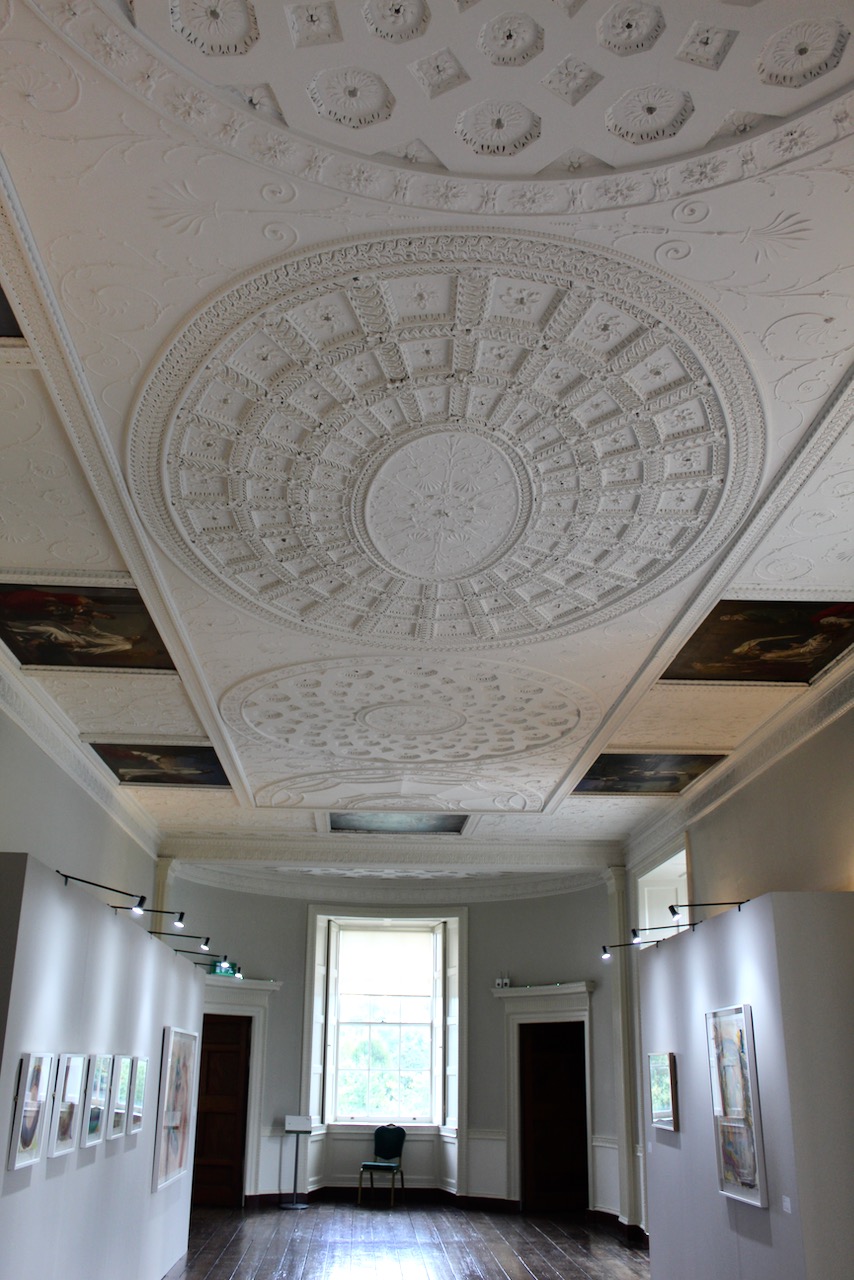
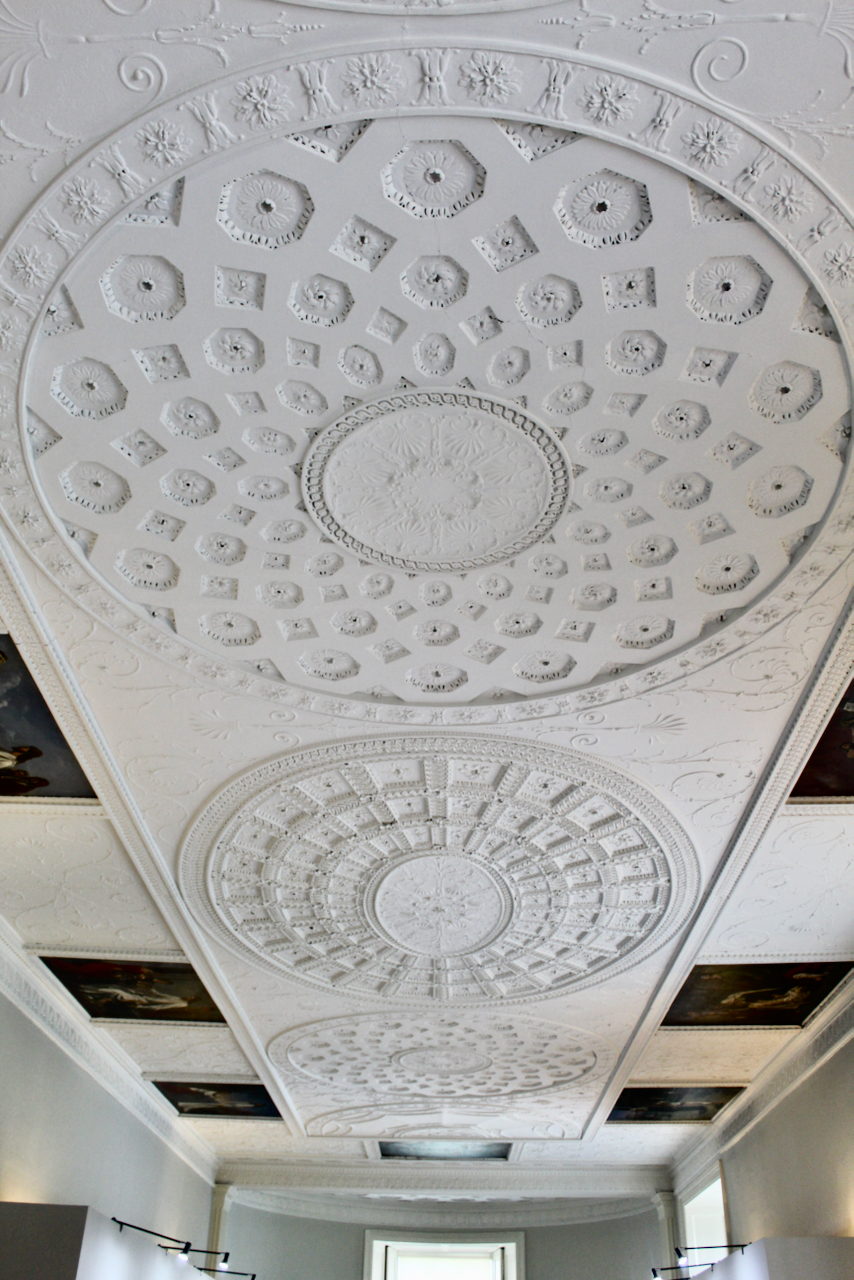
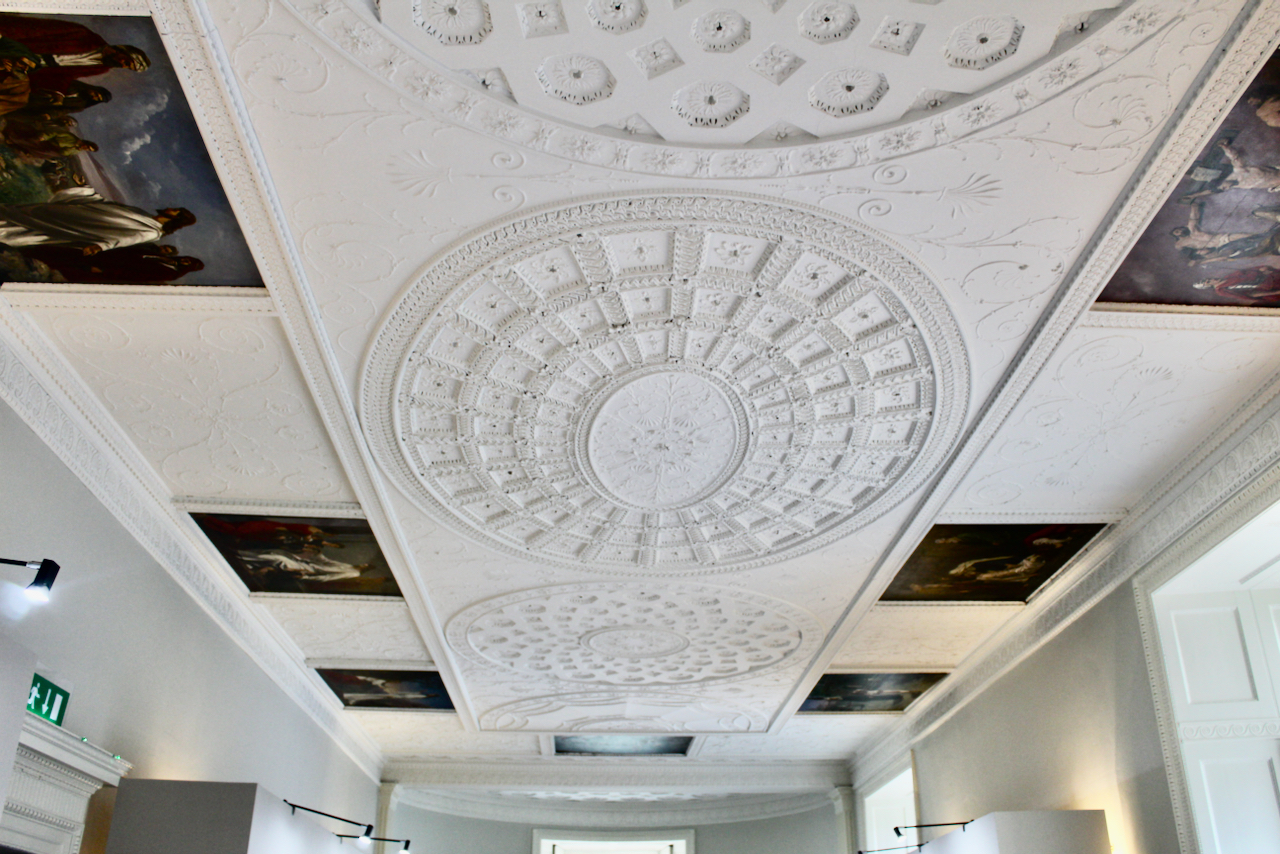
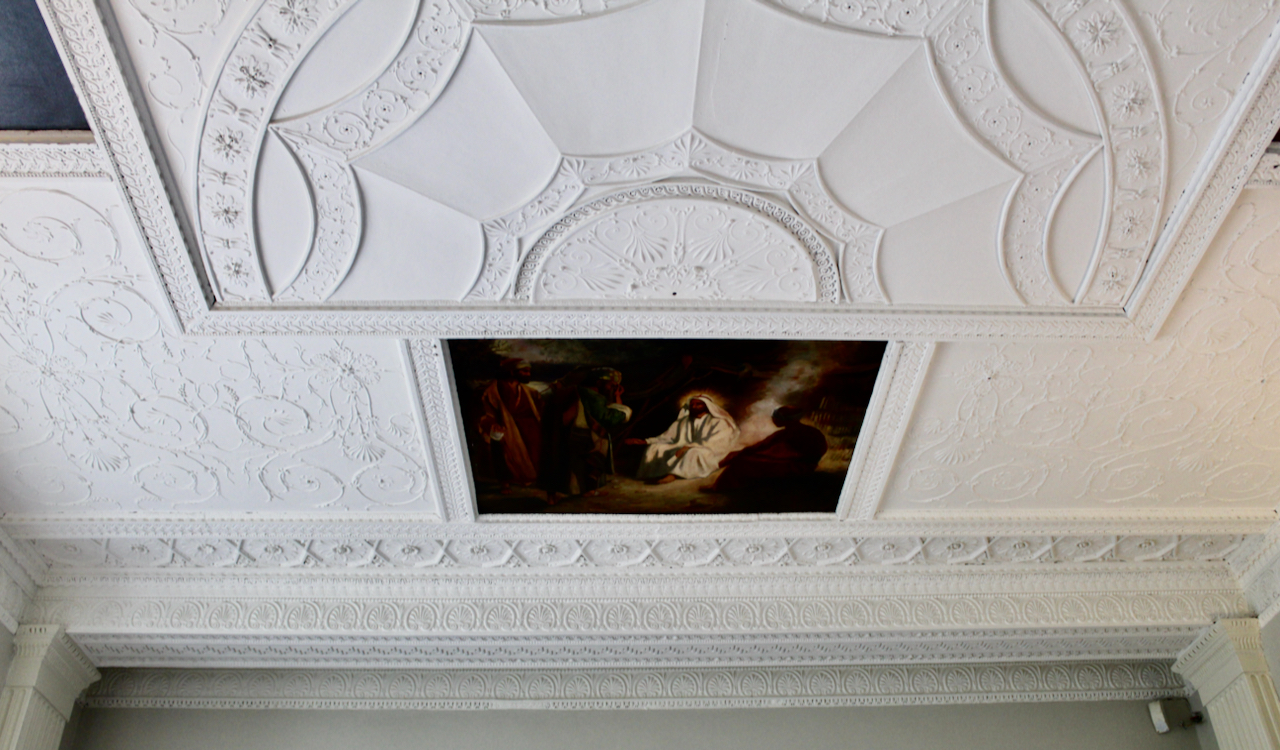
This long room would have been used as a saloon or drawing room to entertain guests and perhaps also as a space to display a collection of art works. It is believed the room was designed by James “Athenian” Stuart (1713-1788). The original ceiling paintings were a series of Greek mythological scenes by Angelica Kauffman (1741-1807). These were sold at auction in the early 20th century and are now believed to be in a private collection in the United States. The Jesuits commissioned a new series of ceiling paintings featuring scenes from the life of Christ by Dublin artist Patrick Tuohy (1894-1930). The residents of the Castle had direct access from this room to the lawn, woods and ornamental lake beyond via a double-cantilevered exterior staircase in Portland stone.” Photograph © Jennifer Winder-Baggot, www.irishhistorichouses.com
The Long Room, Rathfarnham Castle, Photograph © Jennifer Winder-Baggot, www.irishhistorichouses.com
The Jesuits commissioned a new series of ceiling paintings featuring scenes from the life of Christ by Dublin artist Patrick Tuohy (1894-1930).
The Long Room, Rathfarnham Castle, Photograph © Jennifer Winder-Baggot, www.irishhistorichouses.com
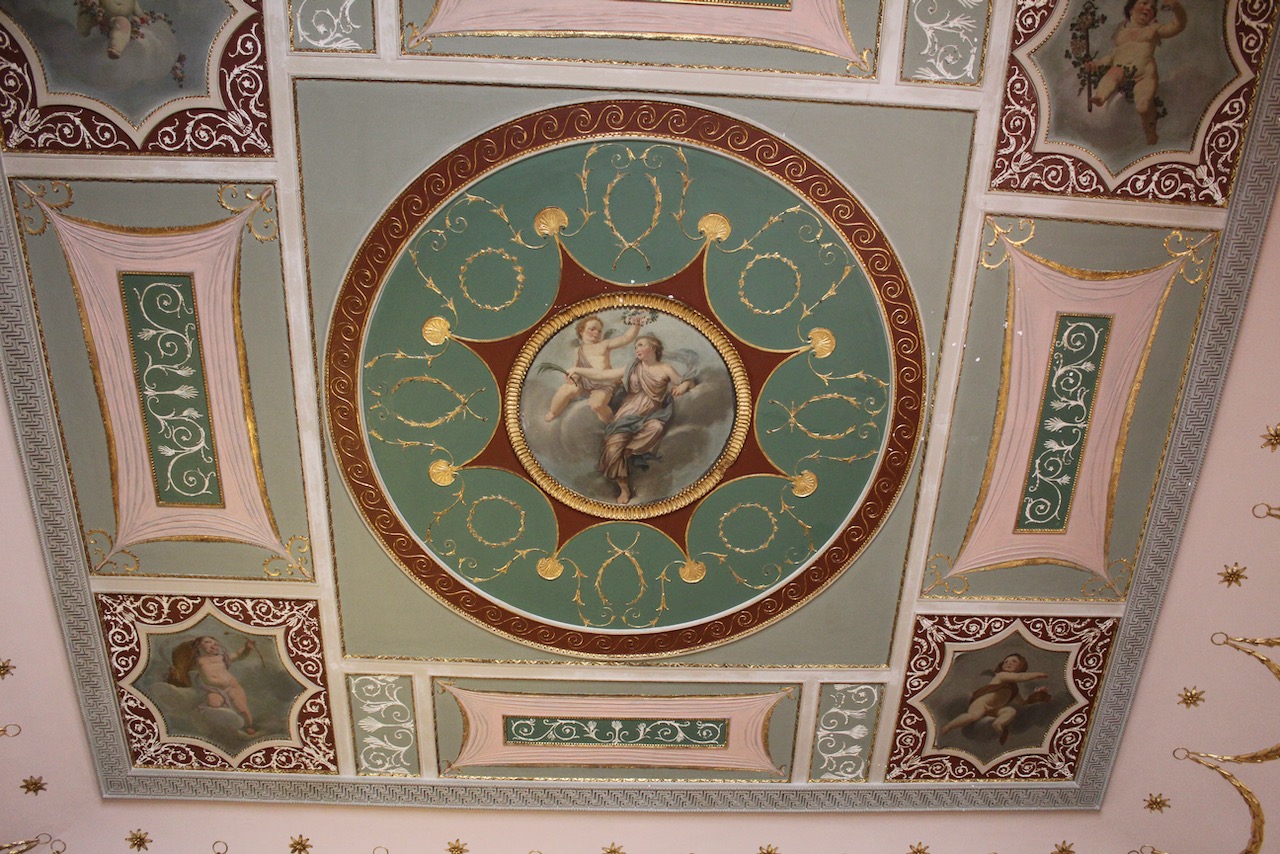
The Four Seasons Room, Rathfarnham Castle, believed to have been designed by James “Athenian” Stuart. In each corner of the ceiling a cherub represents one of the four seasons while the central painting is that of the goddess of agriculture and the harvest (Demeter in Greek or Ceres in Roman mythology). Photograph © Jennifer Winder-Baggot, www.irishhistorichouses.com
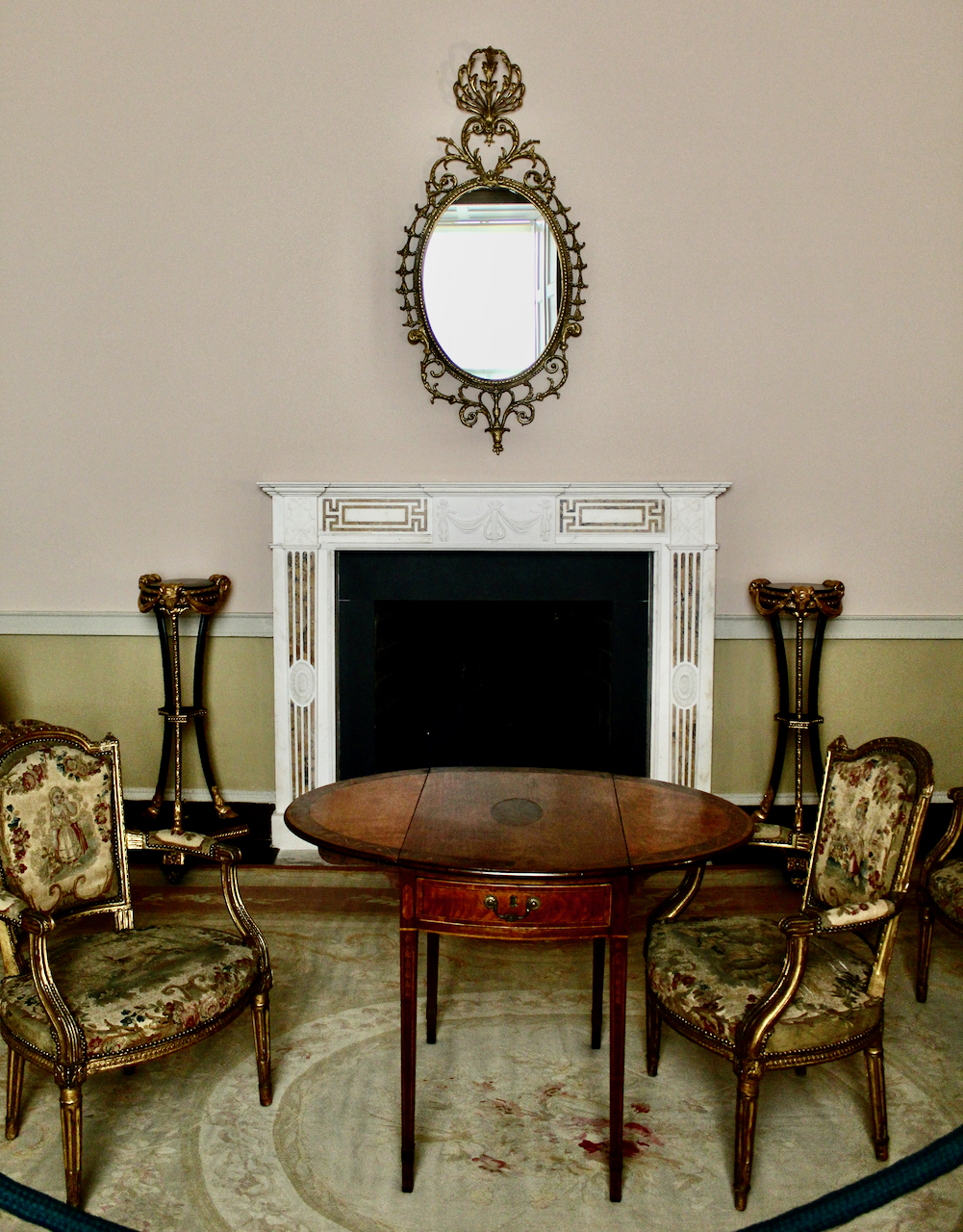
The Four Seasons Room, Rathfarnham Castle. The mirror is from the late 18th century and constructed from a type of papier-mache treated to give the appearance of gilded wood or metal. The Louis XVI giltwood and tapestry chairs feature scenes from La Fontaine’s fables which were adapted from the classics and published in the late 17th century. They are accompanied by an inlaid George III Pembroke Table. Photograph © Jennifer Winder-Baggot, www.irishhistorichouses.com
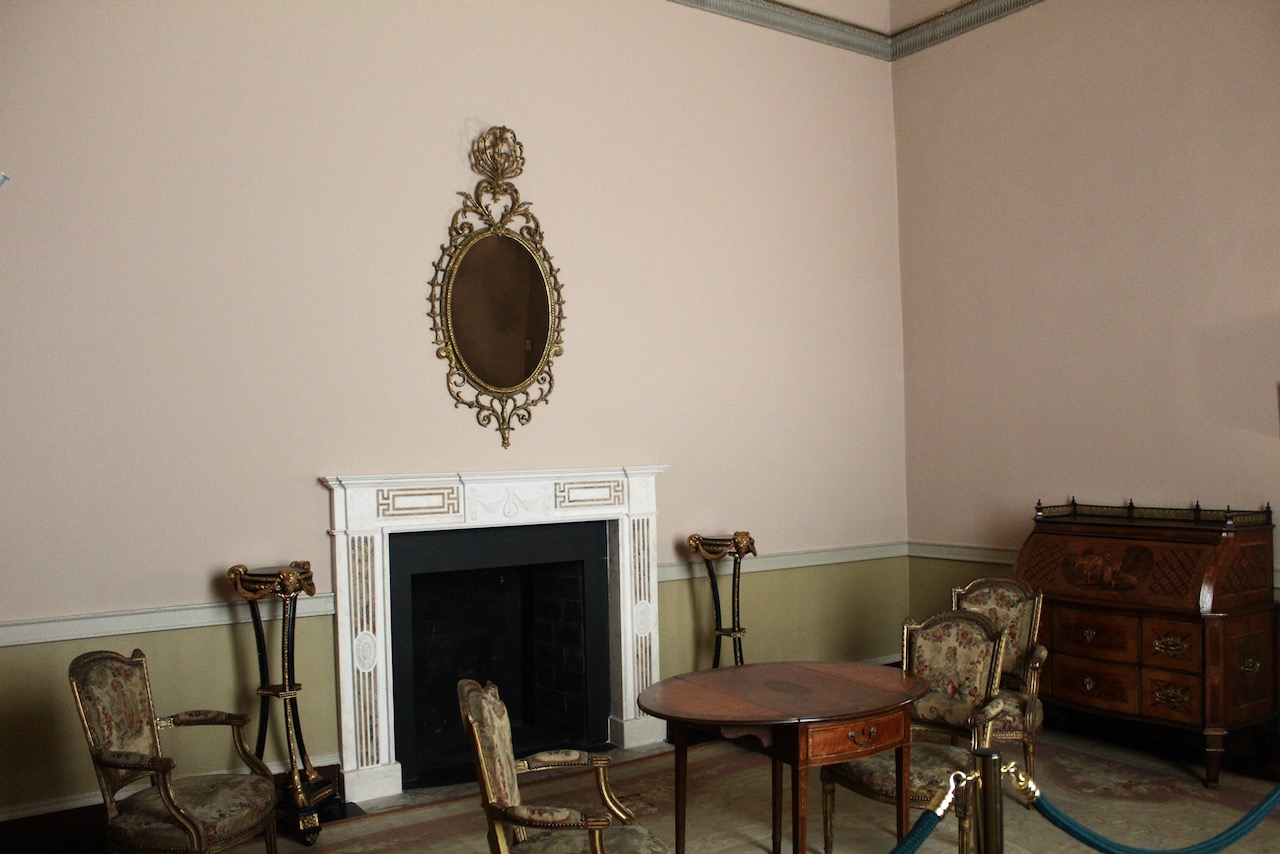
The Four Seasons Room, Rathfarnham Castle. The bureau belonged to Henry Loftus and is of German manufacture (c. 1775). The carpet is a late 19th century Aubusson. Photograph © Jennifer Winder-Baggot, www.irishhistorichouses.com
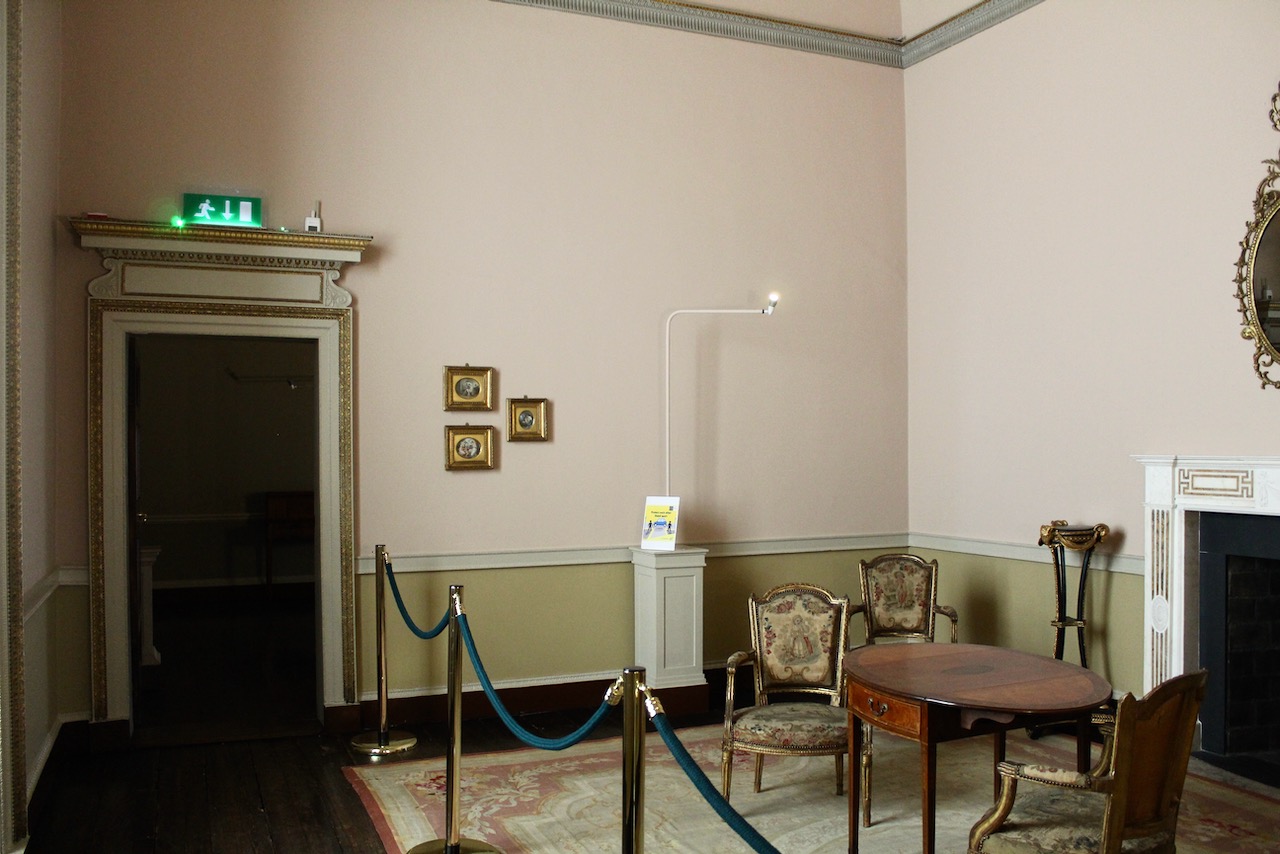
The Four Seasons Room, Rathfarnham Castle. Photograph © Jennifer Winder-Baggot, www.irishhistorichouses.com
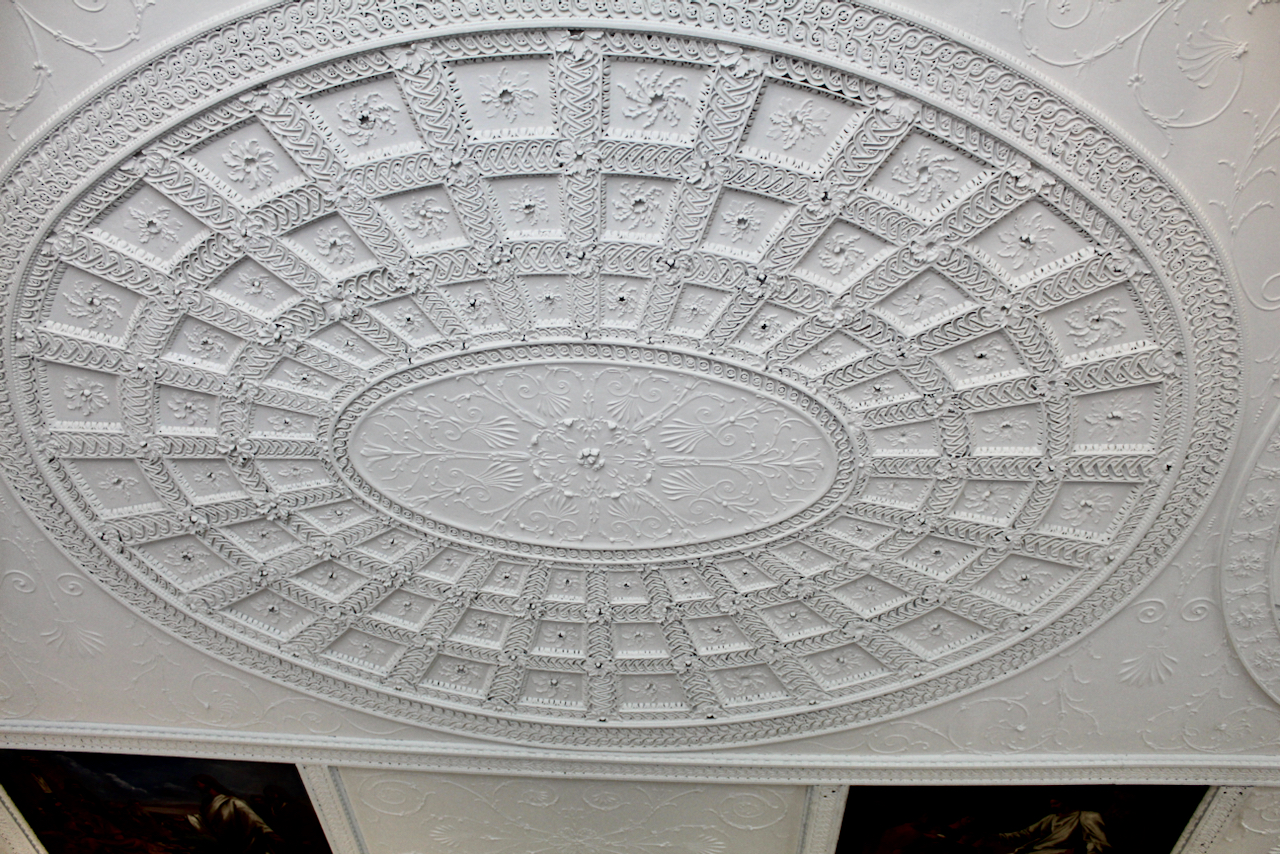
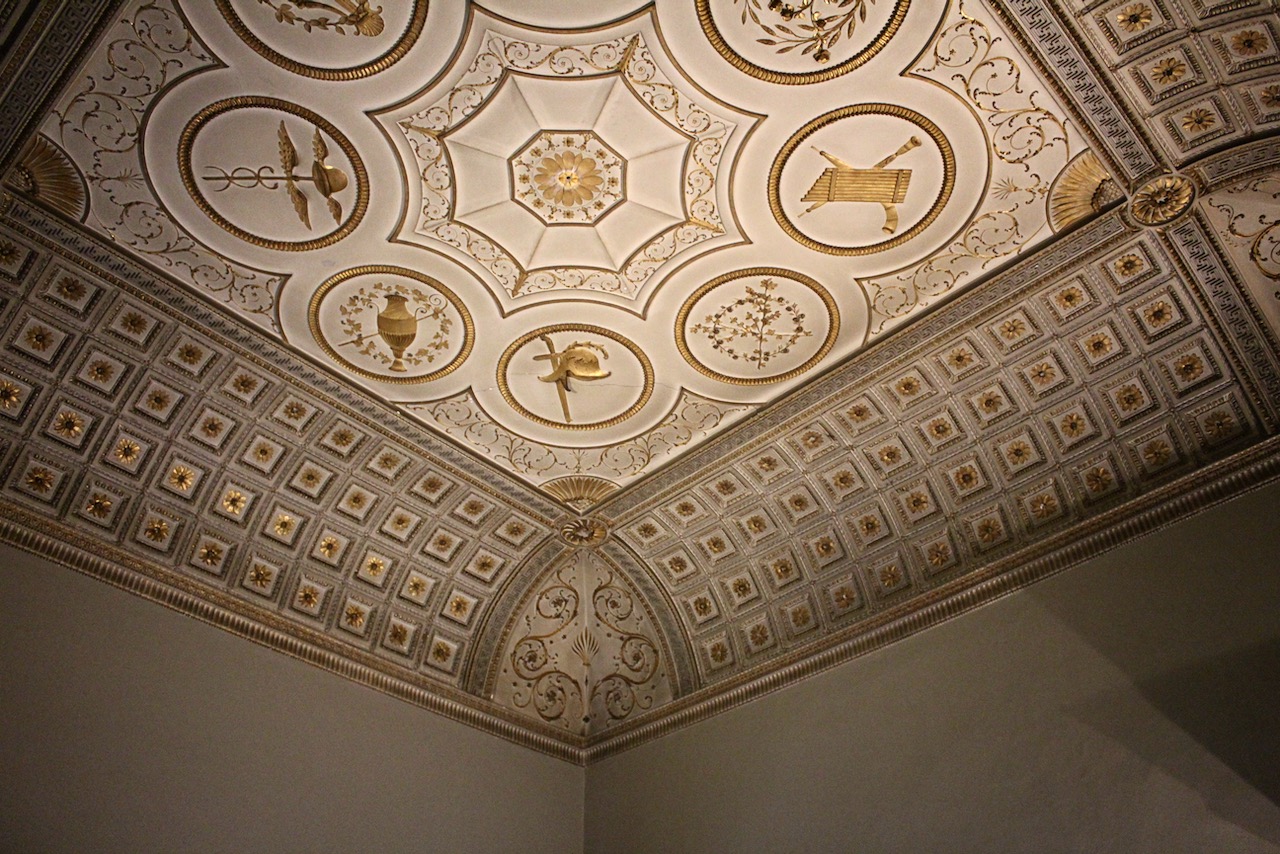
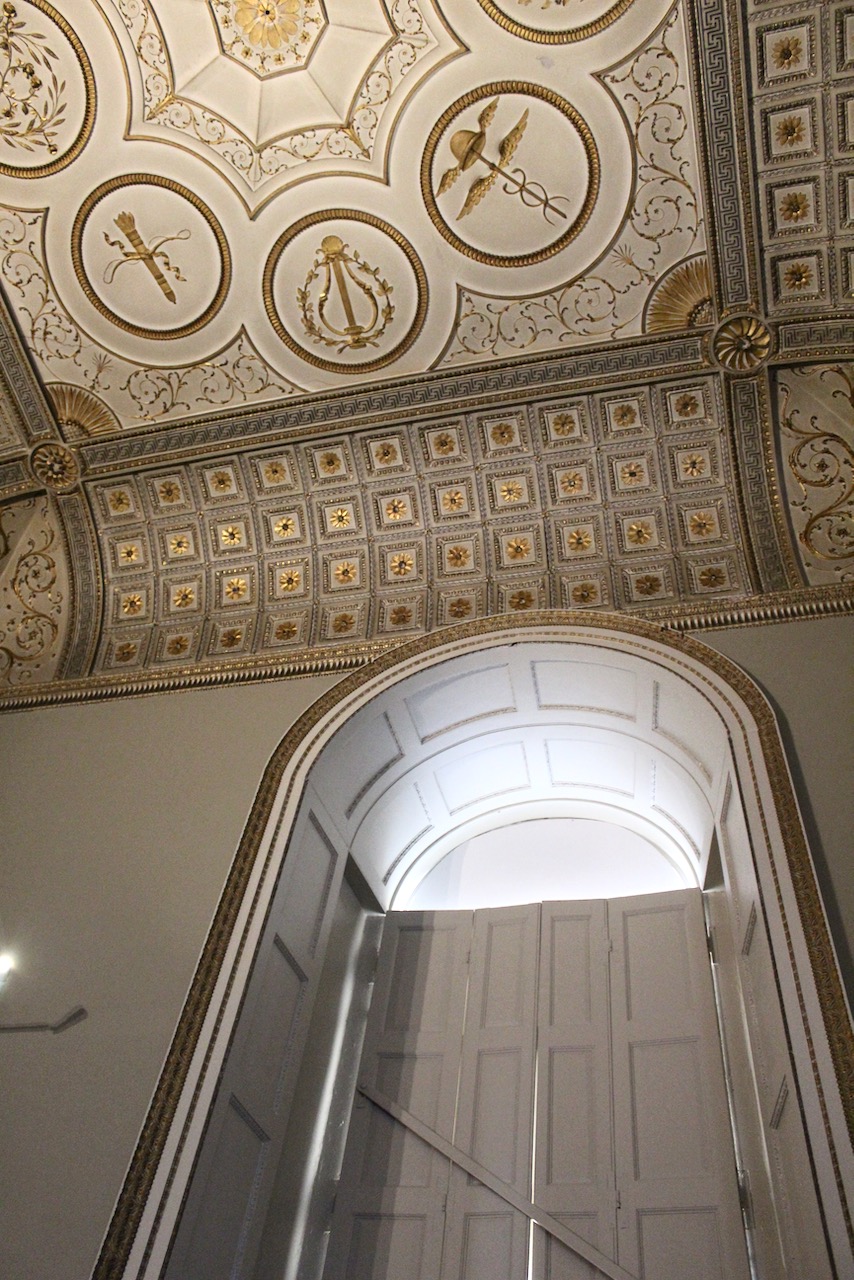
The Gilt Room ceiling, Rathfarnham Castle. A design by James “Athenian” Stuart, features eight rondels containing objects symbolising different Greek gods and goddesses. Facing toward the window and moving clockwise, these symbols are thought to represent Apollo, Hermes, Dionysus, Ares, Aphrodite, Pen, Demeter and Artemis. Photograph © Jennifer Winder-Baggot, www.irishhistorichouses.com
The Gilt Room ceiling, Rathfarnham Castle. Photograph © Jennifer Winder-Baggot, www.irishhistorichouses.com
The Gilt Room, Rathfarnham Castle. Photograph © Jennifer Winder-Baggot, www.irishhistorichouses.com

Henry Loftus was succeeded by his nephew Charles Tottenham (1738-1806), son of Henry’s sister Elizabeth (1720-1747) and her husband John Tottenham (1714-1786) 1st Baronet of Tottenham Green, County Wexford. Charles Tottenham’s name was changed to Charles Loftus in 1783 after the death of Henry Loftus 1st Earl of Ely of the 2nd Creation.

Charles held the office of Member of Parliament (M.P.) for New Ross between 1761 and 1768, M.P. for Bannow between 1768 and 1776, M.P. for New Fethard between 1776 and 1783. and M.P. for County Wexford between 1783 and 1785. He was created 1st Baron Loftus of Loftus Hall, Co. Wexford [Ireland] on 28 June 1785. He succeeded as the 2nd Baronet Tottenham [I., 1780] on 29 December 1786. He was created 1st Viscount Loftus of Ely [Ireland] on 28 December 1789 and 1st Earl of Ely [Ireland] on 2 March 1794. He was created 1st Marquess of Ely [Ireland] on 1 January 1801 and 1st Baron Loftus of Long Loftus, Co. York [U.K.] on 19 January 1801. He was also Privy Counsellor. 

Charles Tottenham Loftus, Marquis of Ely by Hugh Douglas Hamilton. Charles was the nephew of Henry Loftus Earl of Ely and inherited Rathfarnham Castle and the demesne on his death in 1783. The painting shows Charles in the robes of the Irish House of Lords. He is also wearing a chain indicating his membership of the prestigious Order of St Patrick. He was elevated to a Marquis, given a baronetcy in England as well as £45,000 in return for his votes in favour of the Act of Union. Hugh Douglas Hamilton (1740-1808) was born and grew up in Dublin and attended the Dublin Society’s Drawing Schools. He had a long and successful career as an artist and worked in London and Rome as well as Dublin. He is perhaps best known for his work in pastels and left an extensive series of portraits of leading figures in Irish society.

At Rathfarnham, Charles did little beyond the erection in 1790 of the Gothic or Back Gate, now almost competely demolished to make way for a road.

He married Jane Myhill of Killarney, County Kerry. Her sister Hannah married Hercules Langrishe, 1st Baronet of Knocktopher, County Kilkenny.

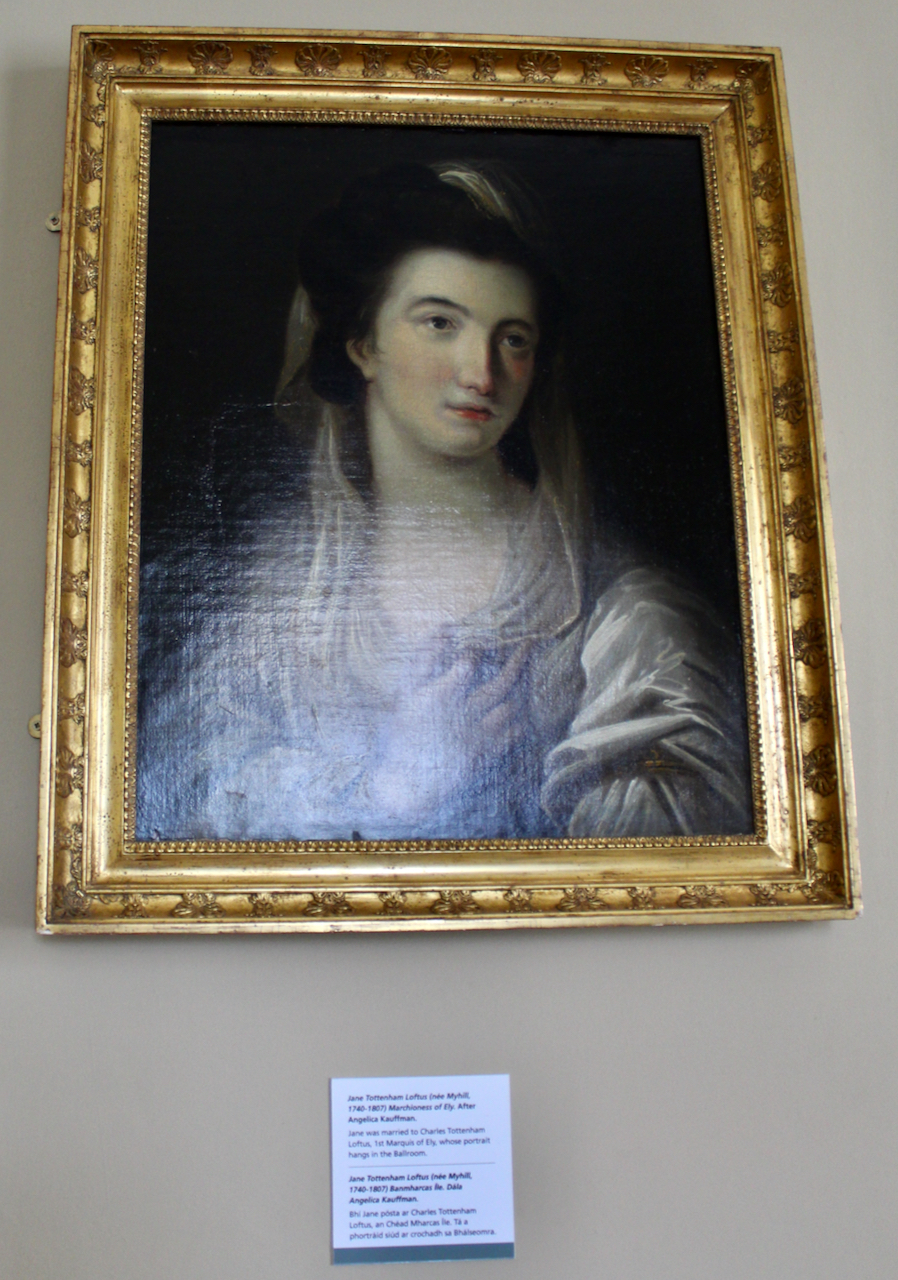
Jane Tottenham-Loftus (nee Myhill), 1740-1807, Marchioness of Ely, painting after Angelica Kauffman. She was married to Charles Tottenham Loftus, 1st Marquess of Ely, whose portrait hangs in the Ballroom. He was the son of John Tottenham, 1st Baron Tottenham of Ireland, and of Elizabeth Loftus, daughter of Nicholas Loftus, 1st Viscount Loftus of Ely.
The Dining Room, Rathfarnham Castle, Dublin. Photograph © Jennifer Winder-Baggot, www.irishhistorichouses.com

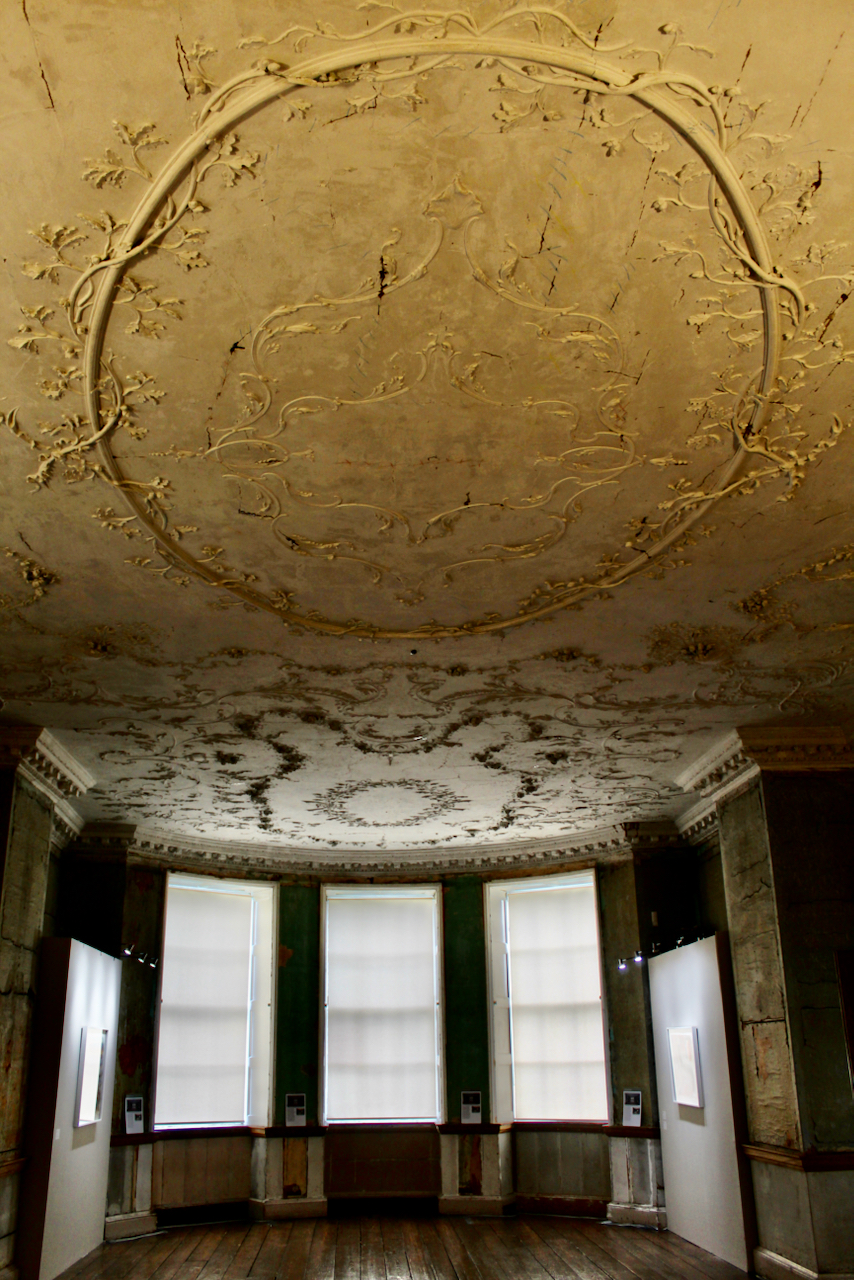
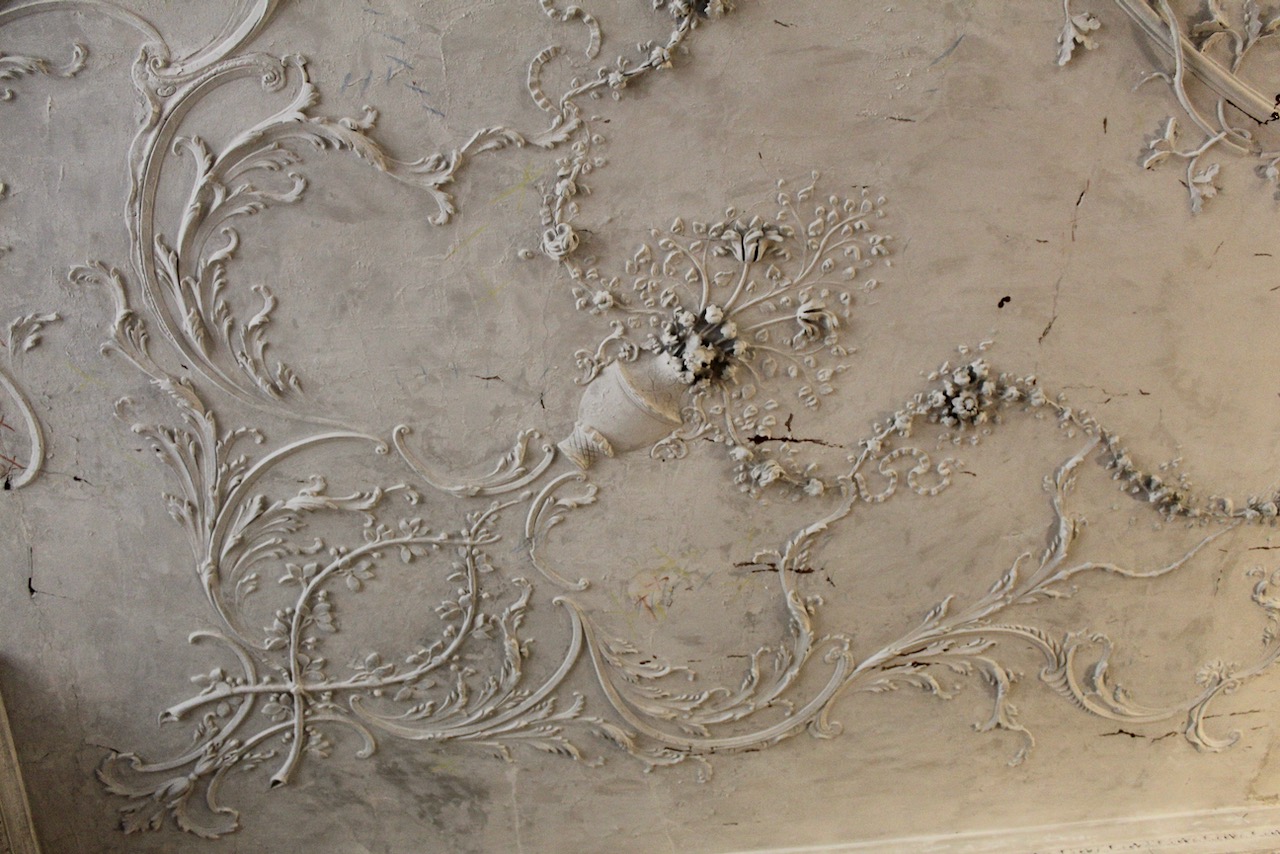
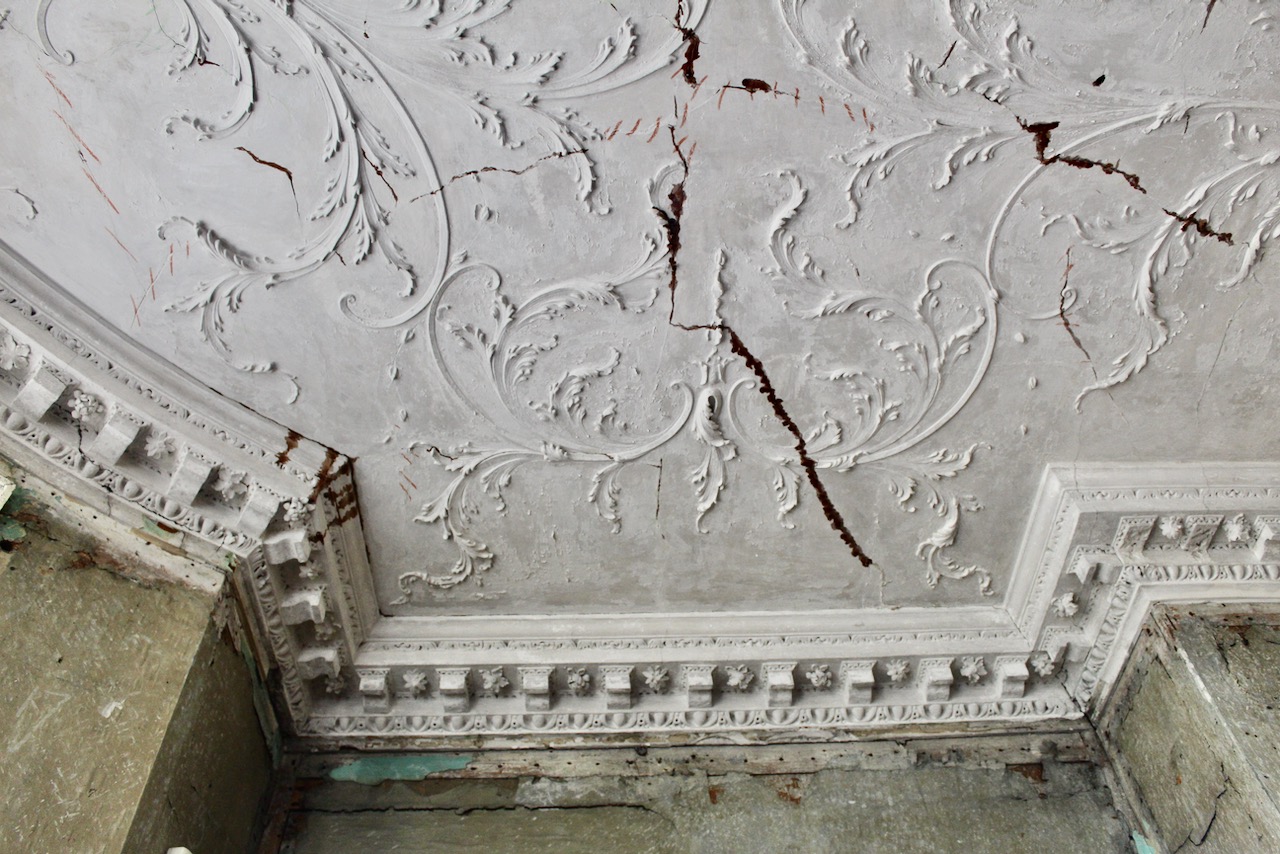
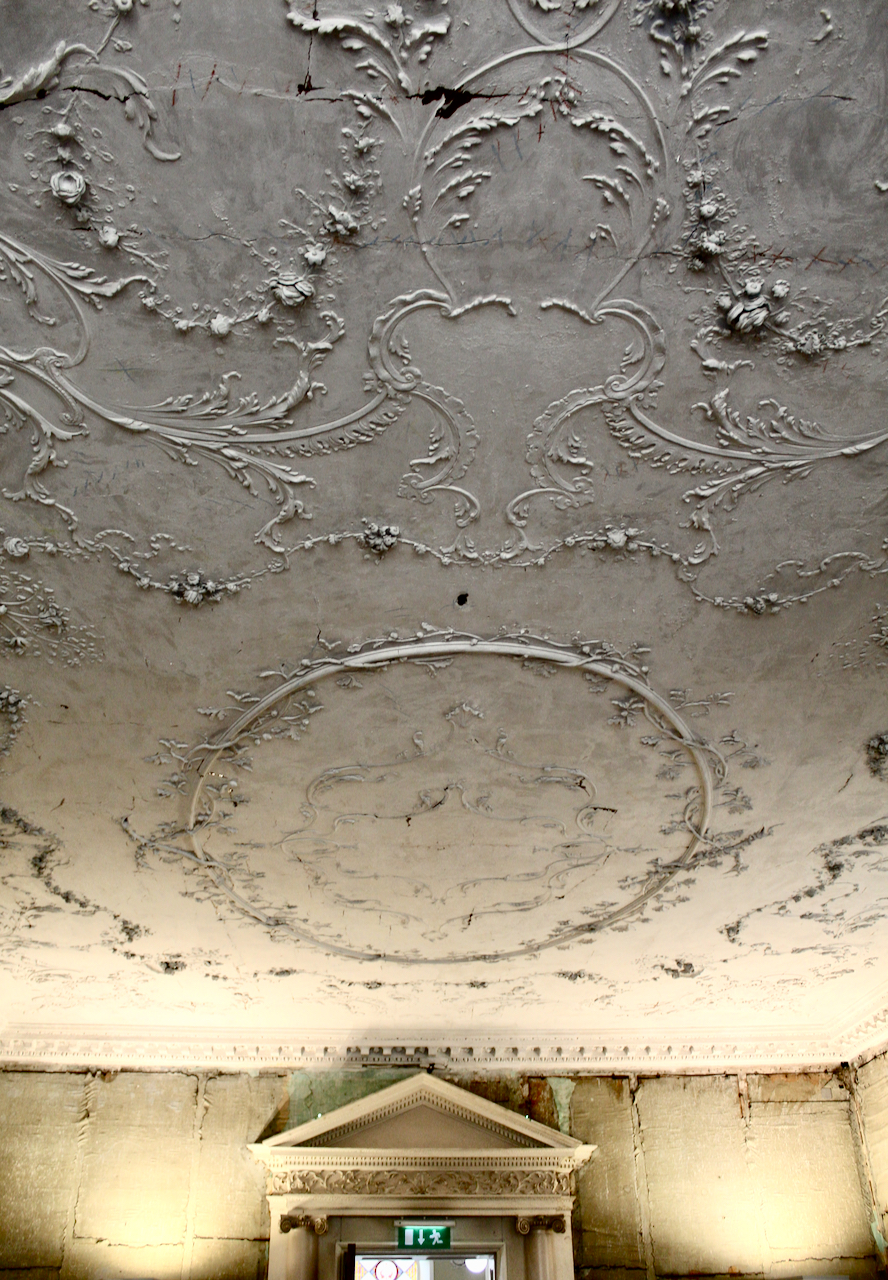
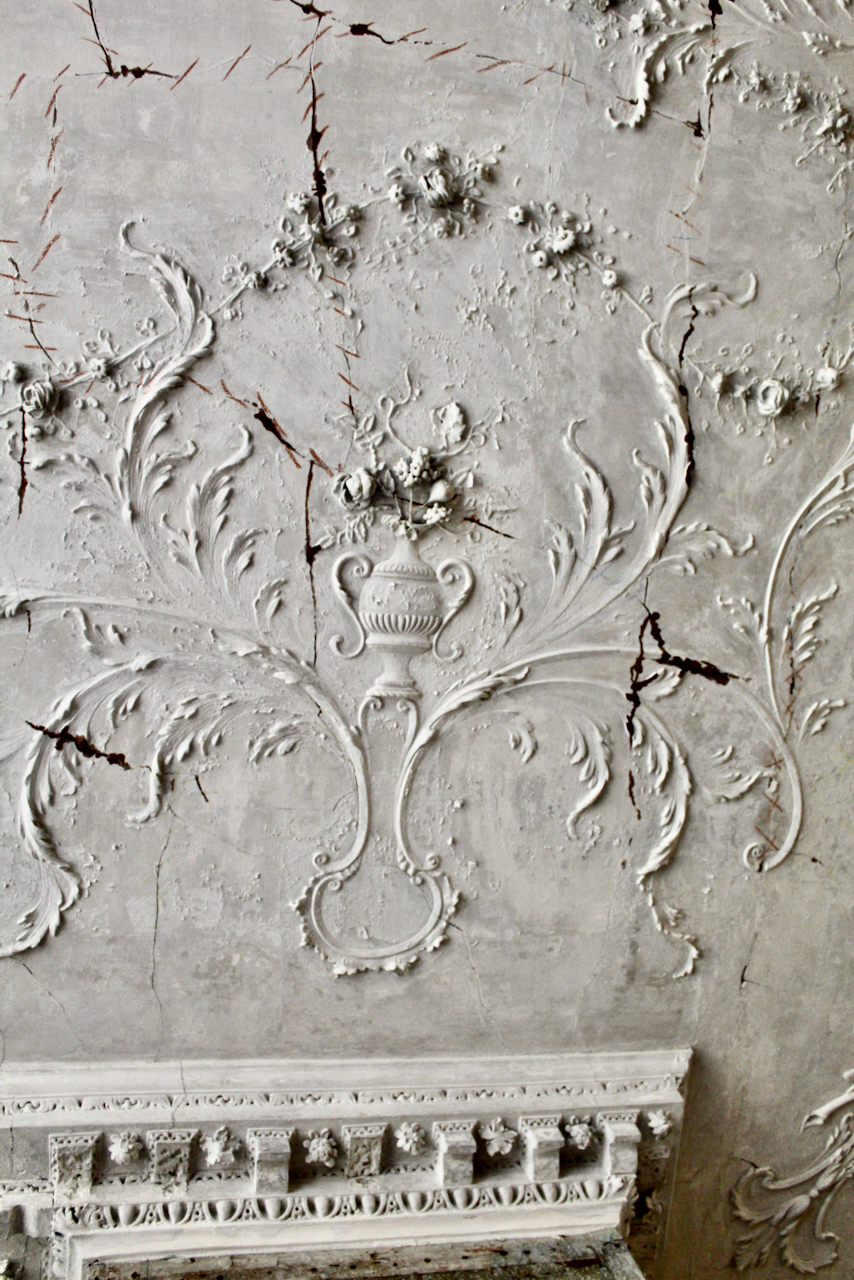
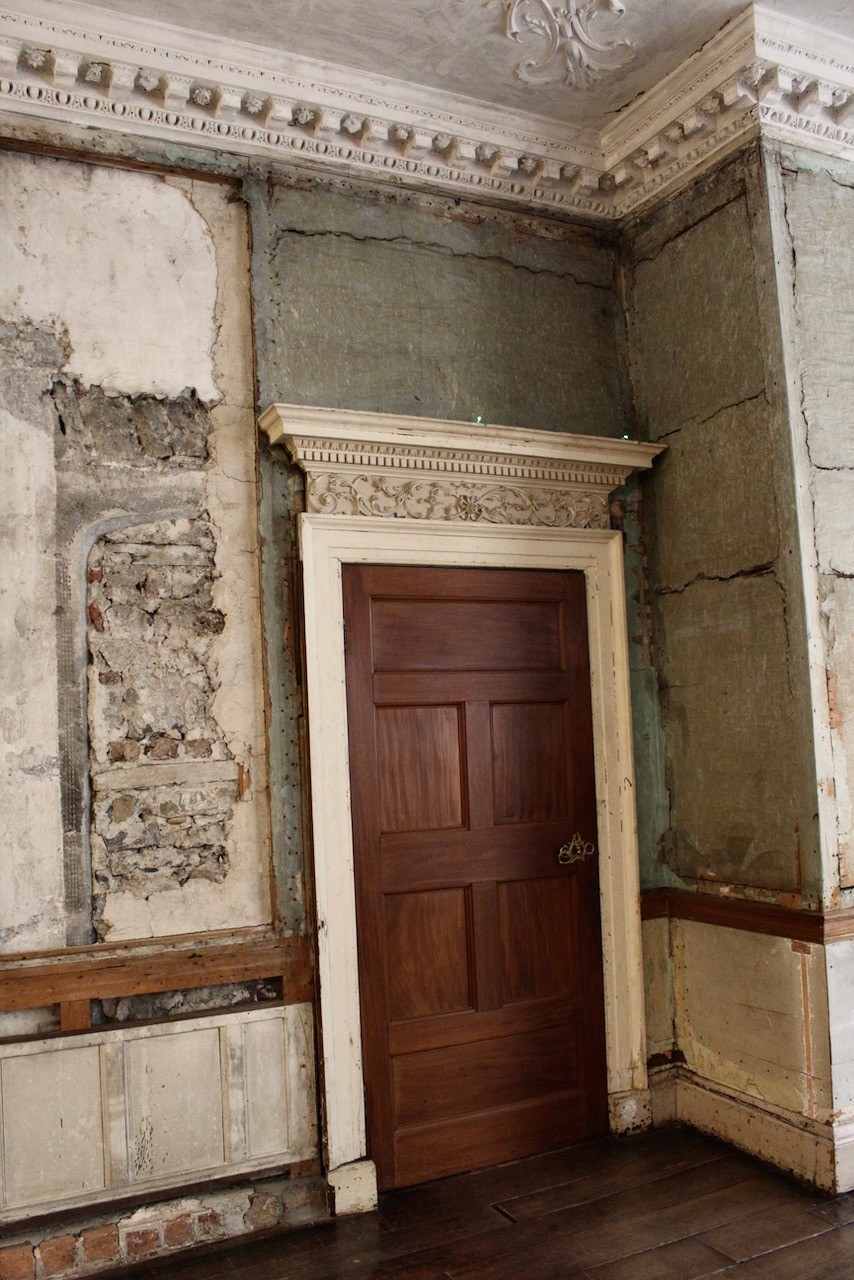
The Dining Room. “This room remains unrestored which allows us to see the changes and alternations which were made to the building over the years. The door on the left-hand (northern) wall is typically eighteenth century in style and decoration. However to the left of it a trace of the original Elizabethan doorway is visible. It was blocked up during the 18th century refurbishments. The bow extension to the eastern side of the building is another change dating to that period which added space and brought more light into these rooms. The 18th century timber wall panelling and lining paper survives in this room. It is likely that the walls were covered with silk. Although designed as a dining room, in the 20th century the Jesuits used this room as a library.

The dining room, Rathfarnham Castle. Photograph © Jennifer Winder-Baggot, www.irishhistorichouses.com
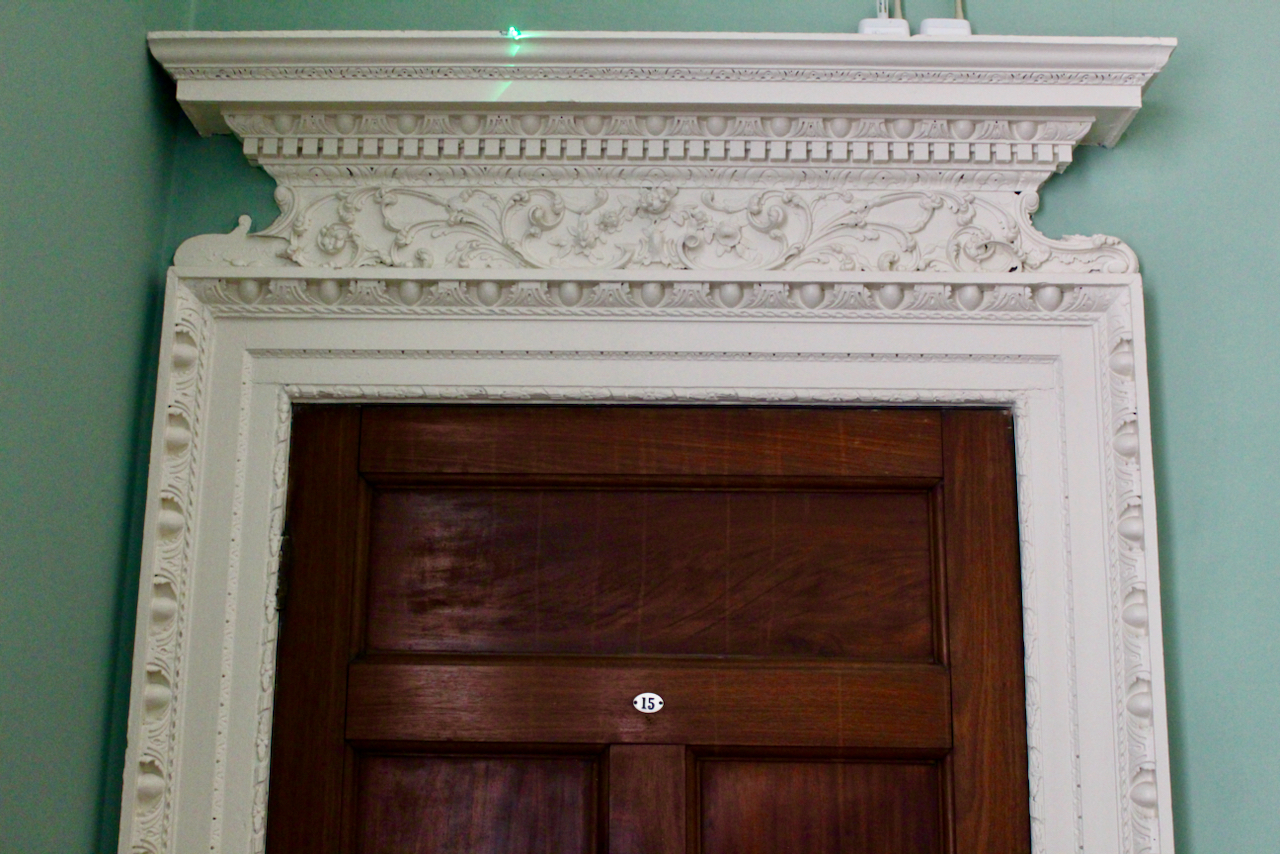
The door on the left-hand (northern) wall is typically eighteenth century in style and decoration. However to the left of it a trace of the original Elizabethan doorway is visible. It was blocked up during the 18th century refurbishments.  Photograph © Jennifer Winder-Baggot, www.irishhistorichouses.com

The Castle fell into disrepair. From the Parliamentary Gazetteer of Ireland 1846 (vol. iii):
Rathfarnham Castle, situated in a once noble demesne, at the south-east extremity of the village, was not long ago esteemed a magnificent building, and boasted a gorgeous picture-gallery, and superb series of garden and pleasure grounds, but it was allowed to fall into decay in consequence of the prolonged non-residence of its proprietor, the Marquis of Ely, and it now prosaically, though usefully, figures as a diary‘.

At this time, John Loftus (1770-1845) was 2nd Marquess of Ely, who inherited the Castle and lands from his father, Charles Tottenham Loftus. John Loftus rented out the house and surrounding lands, and between 1812 and 1852 the estate was leased to the Roper family. [from the castle’s Instagram page]

Oil painting on canvas, John Loftus, 2nd Marquess of Ely (1770-1845), attributed to Sir Thomas Lawrence (1769-1830). A three-quarter-length portrait, in a brown coat and blue sash. Peer’s robes to the right, red curtain to the background. A picture of the sitter’s wife by Lawrence is in the Art Institute of Chicago. By Studio of Thomas Lawrence – Sothebys, Public Domain, https://commons.wikimedia.org/w/index.php?curid=15266849

Rathfarnham Castle was sold in 1852 to Francis Blackburne (1782-1867), Lord Chancellor of Ireland.

Francis Blackburne (1782-1867), Lord Chancellor of Ireland, 1852 by engraver George Sanders, after Stephen Catterson Smith, courtesy of National Gallery of Ireland.

His family lived there until 1911. Coincidentally almost in the footsteps of Adam Loftus who built Rathfarnham Castle, Francis Blackburne became Vice-Chancellor of Trinity College.

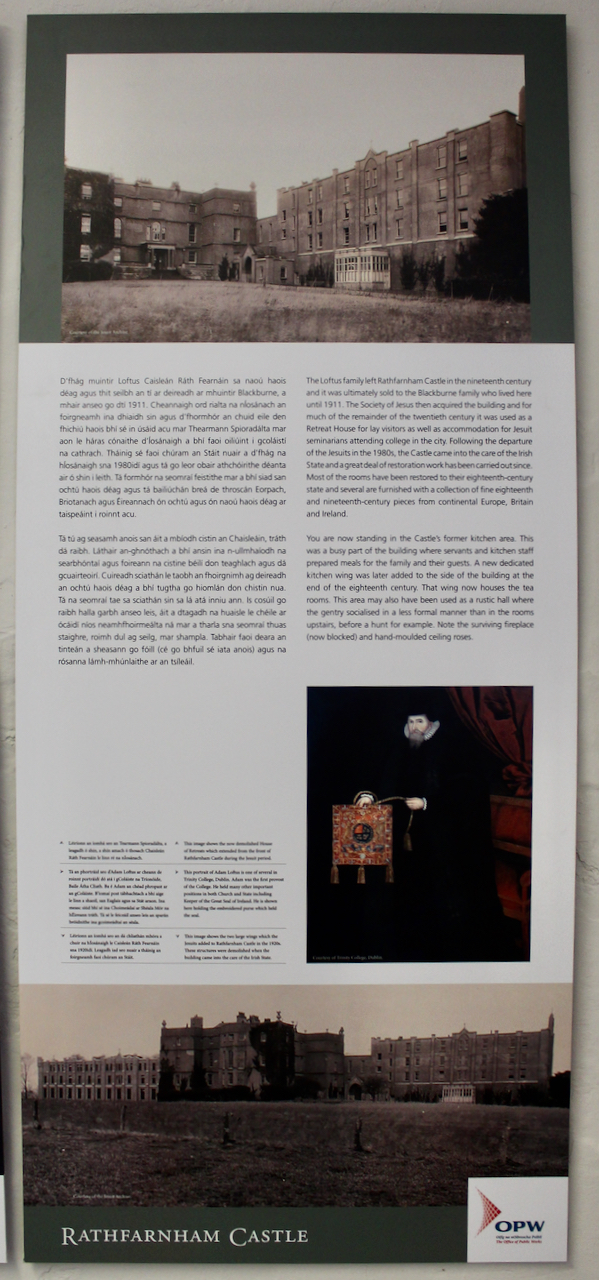
The Society of Jesus then acquired the building and for much of the remainder of the 20th century it was used as a Retreat House for lay visitors as well as accommodation for seminarians attending college in the city. Following the departure of the Jesuits in 1985, the Castle came into the care of the state and a great deal of restoration work has been carried out. Most of the rooms have been restored to their 18th century state and several are furnished with a collection of fine eighteen and nineteenth century pieces from continental Europe, Britain and Ireland.

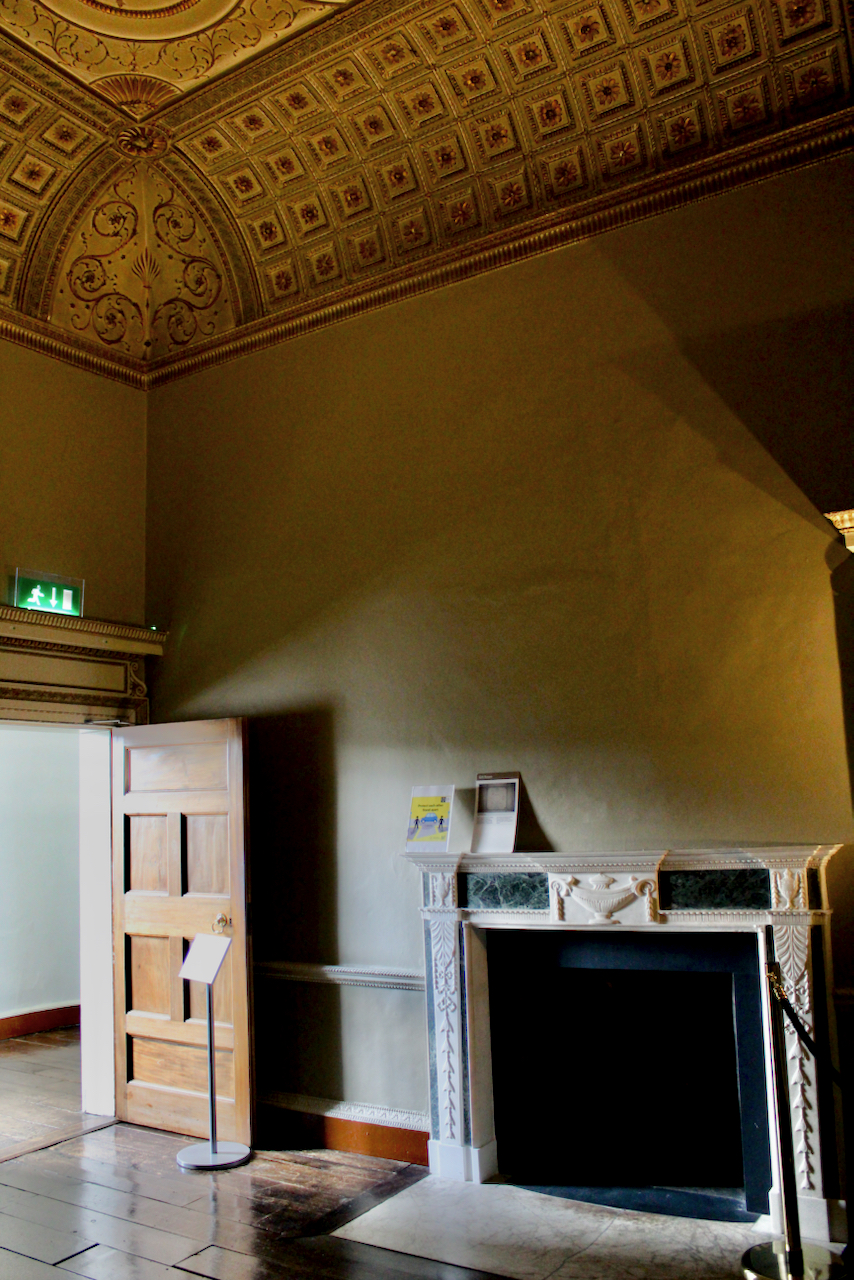
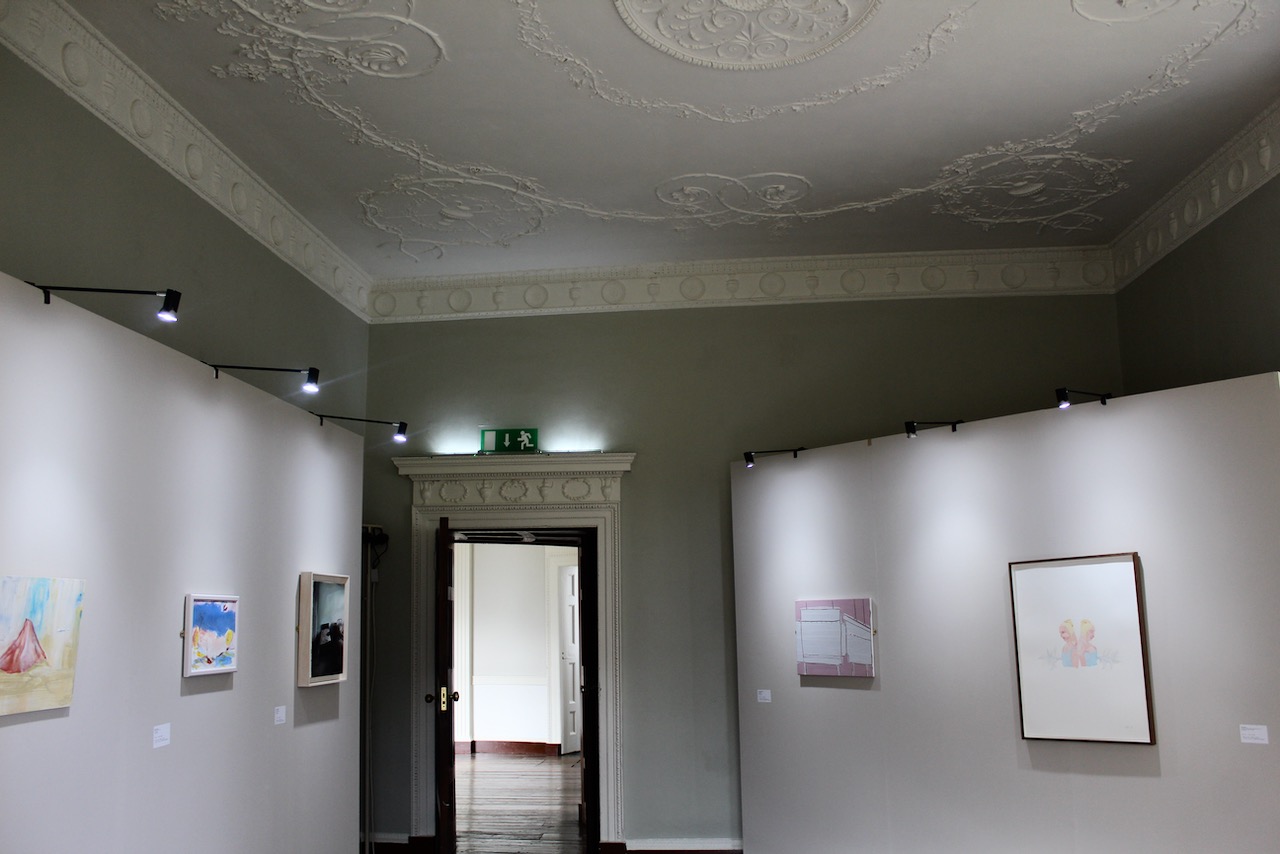
The Pistol Loop Room: “This room in the south-eastern corner of the Castle reminds us of the orignal defensive function of the building. A blocked-up gun loop is still visible in the corner of the room. These gun loops allowed those defending the Castle to fire their weapons at any approaching attackers. Note also the odd shape of the room which tapers off to the left. This reflects the shape of the angled bastion towers which were designed to allow defending soldiers to protect all approaches to the castle. The plates and wine decanters depicted in the plaster frieze just below the ceiling would suggest that in the eighteenth century this room may have been used as a private or smaller dining room.” Photograph © Jennifer Winder-Baggot, www.irishhistorichouses.com
The Pistol Loop Room, Rathfarnham Castle. Photograph © Jennifer Winder-Baggot, www.irishhistorichouses.com
Rathfarnham Castle. Photograph © Jennifer Winder-Baggot, www.irishhistorichouses.com
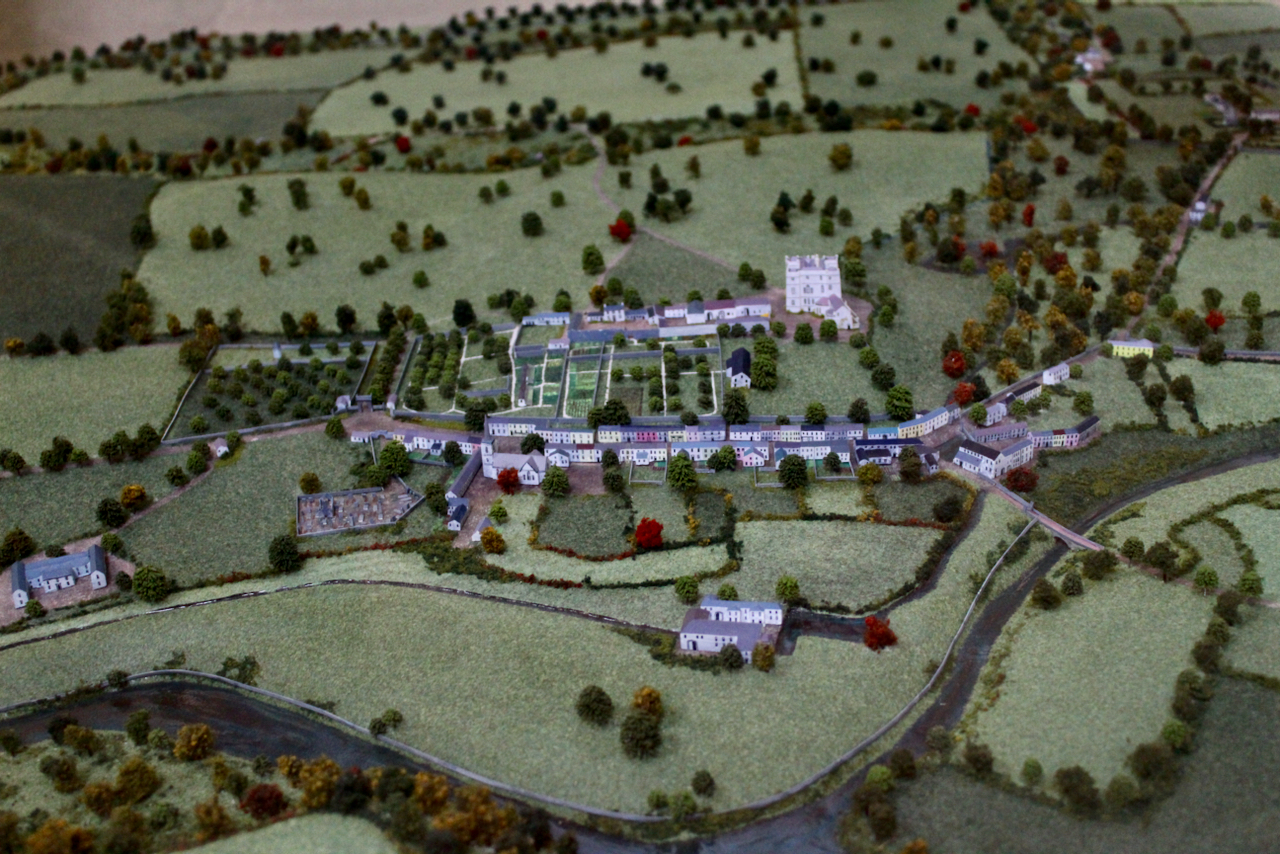
A model based on 19th century maps, showing Rathfarnham demesne before it was broken up in the following century.
The information board shows surrounding buildings which must have been demolished.

[1] Other Jesuit properties include Emo Court, see my entry, https://irishhistorichouses.com/2024/10/22/emo-court-county-laois-office-of-public-works/

Belvedere House in Dublin, Castle Browne, now Clongowes Wood College, and Manresa House in Clontarf, formerly called Granby Hall and Baymount Castle.

[2] https://www.dib.ie/biography/loftus-adam-a4867

[3] Loftus Hall: Formerly named Redmond Hall, it is a three-storey mansion built in 1871, incorporating parts of a previous house here, which was late 17th century or early C18.

Loftus Hall, County Wexford, for sale April 2025 photograph courtesy Colliers.

[4] https://www.archiseek.com/1583-rathfarnham-castle-co-dublin/

[5] “Rathfarnham Castle” by C. Scantlebury, Dublin Historical Record, Vol. 12, No. 1 (Feb., 1951), pp. 20-30. https://www.jstor.org/stable/30080721

[6] https://bellinghamswanhistory.club/descendant-tree-for-bellingham-boyle-mp1690-1771-and-sarah-hoadly-b1720/

Rathfarnham Castle, Dublin – OPW

Rathfarnham Castle, Dublin, September 2021. Photograph © Jennifer Winder-Baggot, www.irishhistorichouses.com

General Enquiries: 01 493 9462, rathfarnhamcastle@opw.ie

From the OPW website:

The castle at Rathfarnham dates back to the Elizabethan period. It was built [around 1583] for Adam Loftus, a Yorkshire clergyman and politician [1533-1605]. Loftus was ambitious and eventually rose to become Archbishop of Dublin and Lord Chancellor of Ireland.

Loftus’s castle, with its four flanker towers, is an excellent example of the Elizabethan fortified house in Ireland. In the late eighteenth century, the house was remodelled on a splendid scale employing some of the finest architects of the day including Sir William Chambers and James ‘Athenian’ Stuart. The collection includes family portraits by Angelica Kauffman, Sir Peter Lely, and Hugh Douglas Hamilton.

Archbishop-Chancellor Adam Loftus (1533-1605). The portrait is in Trinity College Dublin, as he was the first Provost. He was also Keeper of the Great Seal of Ireland, and he is here holding the embroidered purse which held the seal.

Loftus wanted the Castle to be a grand and impressive home which would reflect his high status in Irish society. He also needed it to be easily defended against attack from hostile Irish families such as the O’Byrnes based in the mountains to the south. The design was radically modern for the time and based on recent continental thinking about defensive architecture. The angled bastion towers located at each corner of the building were equipped with musket loops which allowed a garrison of soldiers to defend all approaches to the castle.” He married Jane Purdon. He was also the Provost of Trinity College Dublin, and Lord Chancellor of Ireland. They had many children, who married very well. [He died while he was Archbishop of Dublin, in the old Palace of St. Sepulchre beside St. Patrick’s Cathedral, which until recently was the Garda barracks on Kevin Street, now housed in a new building. I hope they will make something of the historic old archbishop’s palace now, which could be a great museum!]
Loftus had previously lived in an archiepiscopal palace in Tallaght, and it had been sacked by the O’Byrnes and O’Tooles from the Wicklow mountains, which is why he ensured that his new house in Rathfarnham had strong defenses. The Bishop’s Palace in Raphoe, now a ruin, is similarly shaped.
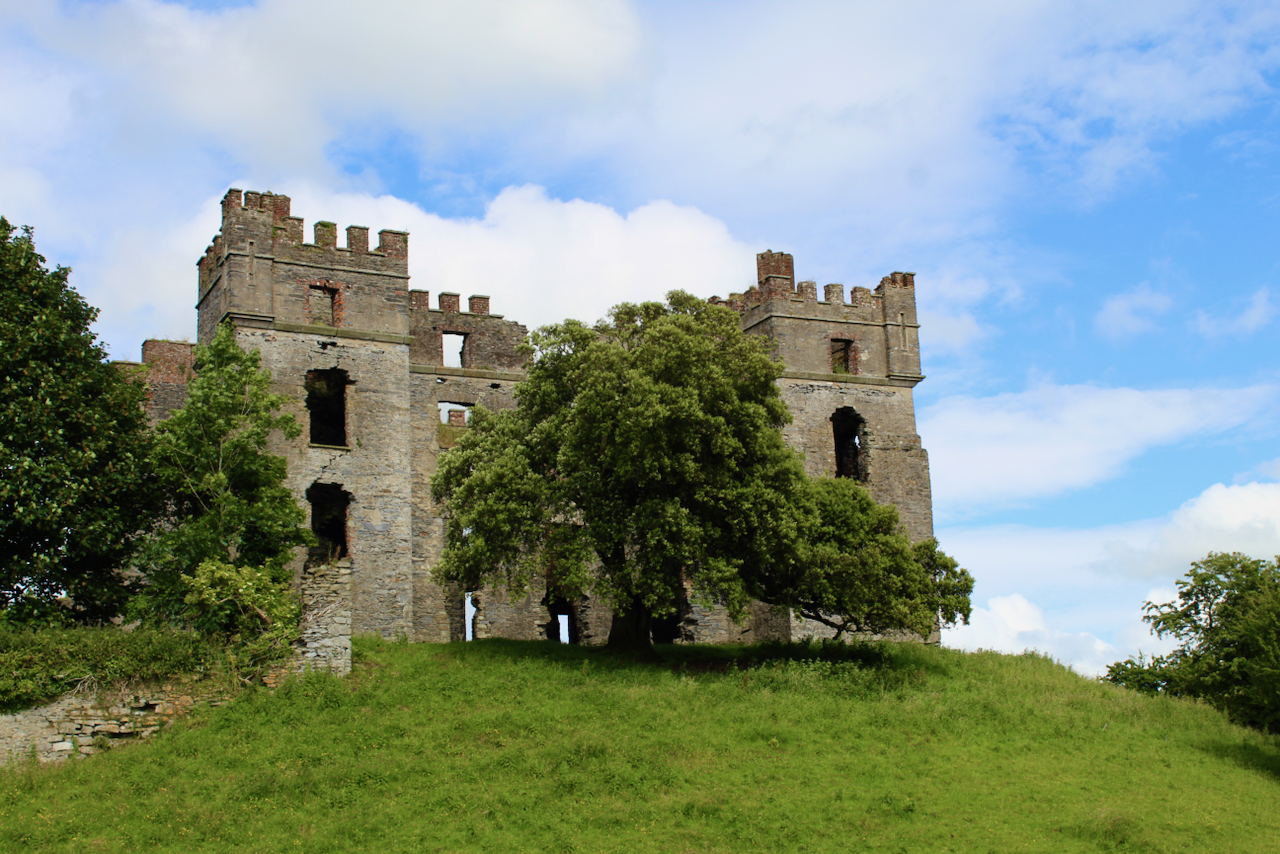
Ruin of Bishop’s Palace in Raphoe, County Donegal, built for Bishop John Leslie in 1636. Photograph © Jennifer Winder-Baggot, www.irishhistorichouses.com

Maurice Craig points out in his The Architecture of Ireland from the earliest times to 1880 that there are a group of similar buildings, built over a period of fifty years or more: Rathfarnham; Kanturk for MacDonagh MacCarthy, before 1609; Portumna for the Earl of Clanrickarde, before 1618; Manorhamilton for Sir Frederick Hamilton, probably around 1634; Raphoe, for Bishop John Leslie (the “Fighting Bishop” – see my entry on Castle Leslie https://irishhistorichouses.com/2020/08/07/castle-leslie-glaslough-county-monaghan/) in 1636, and Burntcourt for Sir Richard Everard before 1650. Manorhamilton is a section 482 ruin which I will be writing about, and we visited Portumna in County Galway – see my entry https://irishhistorichouses.com/2022/02/14/office-of-public-works-properties-connacht/. The buildings resemble a fort, such as Mountjoy Fort in County Tyrone built 1600-1605. Killenure, County Tipperary, is similar but has cylindrical flankers, Craig tells us. This last was unroofed by 1793.

Manorhamilton, County Leitrim, August 2022, built for Sir Frederick Hamilton, probably around 1634. Photograph © Jennifer Winder-Baggot, www.irishhistorichouses.com
Portumna Castle, County Galway, July 2021, built for the Earl of Clanrickarde, before 1618. Photograph © Jennifer Winder-Baggot, www.irishhistorichouses.com

The Rathfarnham website continues: “[Adam Loftus’s] son Dudley (1561-1616) married Anne Bagenal, daughter of Nicholas Henry Bagenal, Marshal of Ireland. The castle passed to his son, Adam Loftus (1590-1666), who married Jane Vaughan of Golden Grove, County Offaly. Their son Arthur Loftus (1616-1659) married Dorothy Boyle, daughter of Richard Boyle the 1st Earl of Cork. They had a son, Adam Loftus (1632-1691) who became the 1st and last Viscount Lisburne. His only son died in infancy. Viscount Loftus was killed at the Seige of Limerick.

Lucy Loftus nee Brydges (1654-1681), by Peter Lely. She was a renowned Restoration beauty and the first wife of Viscount Adam Loftus. He died at the Siege of Limerick in 1691 and the cannon ball which reputedly killed him hangs in St Patrick’s Cathedral. Lucy is dressed in pseudo-antique clothing against an Arcadian landscape. The parrot in the background is an ambiguous symbol and can refer to a number of characteristics including eloquence, marital obedience or exoticism. Peter Lely was of Dutch origin but spent most of his career in England and became the most influential portrait painter at court following the death of Anthony van Dyck. He successfully navigated the turbulence of the 17th century to paint at the court of Charles I, the Cromwellian Commonwealth and Charles II following the Restoration. Lely was prolific, often only painting the sitter’s head while students and assistants at his studio completed the portraits.

Another son of Dudley and Anne Bagenal was Nicholas Loftus (1592-1666), the ancestor of Henry Loftus, the Earl of Ely. Nicholas’s second son Henry (1636-1716) lived in Loftus Hall in County Wexford, and was the father of Nicholas Loftus, 1st Viscount Loftus of Ely. He married Anne Ponsonby, daughter of William Ponsonby, 1st Viscount Duncannon, and they had, first, the son Nicholas Loftus (1708-1766), who became the 1st Earl of Ely, and who added Hume to his surname after marrying Mary Hume, daughter of Gustavus Hume, 3rd Baronet of Castle Hume, County Fermanagh.

Nicholas Loftus, 1st Viscount Ely (1687-1763). Painter unknown. This painting was completed in 1758 to mark the 70th birthday of Nicholas, father of both Nicholas (the 1st Earl of Ely) and Henry Loftus. He sits next to a book entitled 
The Present State of Ireland. This anonymous work was originally published in 1730 and contained criticism of the amount of money flowing out of Ireland to absentee landlords, no doubt reflecting Nicholas’s concern with the financial state of the kingdom. He is sometimes known as “the Extinguisher” because of his threat to extinguish the Hook lighthouse in Wexford unless the rent he received from it was increased.

Nicholas Loftus 1st Earl of Ely and his wife Mary Hume gave birth to Nicholas Loftus Hume, 2nd Earl of Ely (1738-1769). 

Nicholas Hume Loftus, 1st Earl of Ely (1708-1766), unknown artist. It was after Nicholas Loftus (son of the Extinguisher) had married into the wealthy Hume family that the Ely earldom was created for the first time. This depicts Nicholas, the so-called “Wicked Earl” in the doctoral robes of Trinity College Dublin. 
Nicholas Hume Loftus, 1st Earl of Ely (1708-1766) by Jacob Ennis. These two portraits depict Nicholas, the so-called “Wicked Earl” at various stages of his life. Nicholas is much older in the Ennis portrait on the left. Lord Loftus allegedly mistrated his son (also Nicholas) leading to a protracted court case. That son would later bequeath Rathfarnham Castle and the estate to his uncle, Henry Loftus (1709-1783) who became the 1st Earl of Ely (of the second creation). Jacob Ennis was an Irish historical and portrait painter who spent some time studying in Italy. He was later a Master in the Dublin Society’s Drawing Schools.
Henry Loftus, 1st Earl of Ely of the 2nd Creation (1709-1783) by Angelica Kauffman. Henry inherited Rathfarnham Castle and its demesne in 1769 upon the death of Nicholas, his nephew. Nicholas had been the subject of a long running legal case concerning the state of his mind and Henry had suppported him throughout. Between 1769 and his death in 1783 Henry funded some of the most substantial 18th century changes to Rathfarnham Castle and the demesne. He contracted Sir William Chambers to remodel several of the rooms including the Ballroom and Anteroom. The Swiss artist Angelica Kauffman is known to have spent several months in Dublin in 1771. As well as this portrait which was probably completed to mark Henry’s elevation to the earldom of Ely, this renowned painter also completed a group portrait of Henry and his family (now in the National Gallery) as well as a series of ceiling paintings for the long gallery on the first floor depicting scenes from Greek mythology.

Henry Loftus (1709-1783) pictured below. He married first, Frances Monroe of Roe’s Hall, County Down, (pictured below), who died in 1774, then married secondly Anne Bonfoy. He purchased Ely House in Dublin (built 1770) from Sir Gustavus Hume, 3rd Baronet.

Painting by Angelica Kauffman, who spent several months in Dublin in 1771. It shows Henry Loftus with his wife Frances, her nieces and an exotic trophy servant, a young Indian page in Oriental dress carrying a cushion with two coronets, symbolising the title the Earl had just received. The older niece, Dolly Monroe, was Classical costume. Her younger sister Frances plays a fashionable aria on the harpsichord.

Rathfarnham Castle remained in the hands of the Loftus family and their heirs until it was purchased in 1723 by Speaker William Conolly of Castletown, Co Kildare, for £62,000. It returned to ownership of the Loftus family in 1767 when it was purchased by Nicholas Hume-Loftus.

Speaker Conolly never resided at Rathfarnham, leasing it instead to Joan Hoady, Archbishop of Dublin, from 1730-1742, who began the series of alterations that were to transform the castle into a modern country residence. He gave it to his son-in-law Bellingham Boyle.

“Bellingham Boyle (1709-1772). He inherited Rathfarnham Castle in 1746 from his father-in-law, Archbishop John Hoadley who leased the castle in 1742 by “indented lease renewable forever.” Bellingham Boyle served as an MP, first for Bandon then for Youghal in Cork and was later appointed a Commissioner for the Revenue. Prior to his marriage, Belingham travelled across Europe to Italy where he had his portrait painted by Giorgio Dupra.”

The castle returned to the ownership of the Loftus family in 1767 when it was purchased by Nicholas Hume-Loftus. Nicholas never married and on his death in 1769 the Castle passed to his uncle, Henry Loftus (created Earl of Ely in 1771). Henry continued the remodelling of the castle and the works were completed by the time of his death in 1783. 

Henry Loftus (1709-1783) commissioned Sir William Chambers to remodel and redecorate Rathfarnham Castle. There are also several rooms which are attributed to architect and designer James “Athenian” Stuart. Much of the neo-classical design of the Castle today can be attributed to these two architects.
Externally, the window openings were enlarged, and a new stone Tuscan entrance portico added, probably to the designs of William Chambers. The original battlements were removed and the new parapet was embellished with ball finials and urns some of which also serve as chimneys. On the south front new garden steps were added, while on the east front a three bay bow had been added by 1774.
Most of the main interiors can now be attributed with certainty to James Stuart, whose best work in Ireland is the Temple of the Winds at Mount Stewart, County Down, and Sir William Chambers. Stuart was employed at Rathfarnham from at least 1769 and was responsible for the design of the ground floor gallery and two rooms above it. He was also involved in the decoration of some interiors at the family townhouse, Ely House, Dublin. Chambers was responsible for the small drawing room ceiling, back staircase lobby, the ante room and ballroom above, the entrance hall on the first floor, and the octagonal room in one of the towers.
Henry Loftus was succeeded by his nephew Charles Tottenham who did little beyond the erection in 1790 of the Gothic or Back Gate, now almost competely demolished to make way for a road.

Charles Tottenham Loftus, 1st Marquess of Ely by Hugh Douglas Hamilton. Charles was the nephew of Henry Loftus Earl of Ely and inherited Rathfarnham CAstle and the demesne on his death in 1783. The painting shows Charles in the robes of the Irish House of Lords. He is also wearing a chain indicating his membership of the prestigious Order of St Patrick. He was elevated to a Marquis, given a baronetcy in England as well as £45,000 in return for his votes in favour of the Act of Union. Hugh Douglas Hamilton (1740-1808) was born and grew up in Dublin and attended the Dublin Society’s Drawing Schools. He had a long and successful career as an artist and worked in London and Rome as well as Dublin. He is perhaps best known for his work in pastels and left an extensive series of portraits of leading figures in Irish society.
Jane Tottenham-Loftus (nee Myhill), 1740-1807, Marchioness of Ely. After Angelica Kauffman. She was married to Charles Tottenham Loftus, 1st Marquis of Ely, whose portrait hangs in the Ballroom. He was the son of John Tottenham, 1st Baron Tottenham of Ireland, and of Elizabeth Loftus, daughter of Nicholas Loftus, 1st Viscount Loftus of Ely.

“The Loftus family left Rathfarnham Castle in the 19th century and it was ultimately sold to the Blackburne family in 1852 (Francis Blackburne 1782-1867) who lived there until 1911. Coincidentally almost in the footsteps of Adam Loftus who built Rathfarnham Castle, Francis Blackburne became Vice-Chancellor of Trinity College. The Society of Jesus then acquired the building and for much of the remainder of the 20th century it was used as a Retreat House for lay visitors as well as accommodation for seminarians attending college in the city. Following the departure of the Jesuits in 1985, the Castle came into the care of the state and a great deal of restoration work has been carried out. Most of the rooms have been restored to their 18th century state and several are furnished with a collection of fine eighteen and nineteenth century pieces from continental Europe, Britain and Ireland.”

The entrance hall, Rathfarnham Castle. Photograph © Jennifer Winder-Baggot, www.irishhistorichouses.com

This room is believed to have been built to a design by the influential architect Sir William Chambers (1723-1796). Despite never visiting Ireland, Chambers left a significant mark on Dublin where he also designed the Casino at Marino, Charlemont House on Parnell Square, and much of Front Square in Trinity College. The floor and free standing Doric columns are in Portland stone. The painted glass panels featuring fruit and flowers are believed to be by the Dublin Huguenot artist Thomas Jervais (d. 1799). The marble relief busts on the walls depict well known figures from the Classical and Renaissance past, including the Egyptian queen Cleopatra and Italian poet Dante. These sculptures seem to have been acquired in Italy and would have been incorporated into the design of the Entrance Hall to signal the taste and refinement and learning of the Loftus family. The original eighteenth century marble fireplace was replaced with a painted timber one in around 1913. It was one of several of the original fireplaces which were removed and sold when the Blackburne family left the castle in 1911.

The painted glass panels featuring fruit and flowers are believed to be by the Dublin Huguenot artist Thomas Jervais (d. 1799). Photograph © Jennifer Winder-Baggot, www.irishhistorichouses.com
Rathfarnham Castle. Photograph © Jennifer Winder-Baggot, www.irishhistorichouses.com
This long room would have been used as a saloon or drawing room to entertain guests and perhaps also as a space to display a collection of art works. It is believed the room was designed by James “Athenian” Stuart (1713-1788). The original ceiling paintings were a series of Greek mythological scenes by Angelica Kauffman (1741-1807). These were sold at auction in the early 20th century and are now believed to be in a private collection in the United States. The Jesuits commissioned a new series of ceiling paintings featuring scenes from the life of Christ by Dublin artist Patrick Tuohy (1894-1930). The residents of the Castle had direct access from this room to the lawn, woods and ornamental lake beyond via a double-cantilevered exterior staircase in Portland stone.” Photograph © Jennifer Winder-Baggot, www.irishhistorichouses.com
Rathfarnham Castle. Photograph © Jennifer Winder-Baggot, www.irishhistorichouses.com

The Dining Room. “This room remains unrestored which allows us to see the changes and alternations which were made to the building over the years. The door on the left-hand (northern) wall is typically eighteenth century in style and decoration. However to the left of it a trace of the original Elizabethan doorway is visible. It was blocked up during the 18th century refurbishments. The bow extension to the eastern side of the building is another change dating to that period which added space and brought more light into these rooms. The 18th century timber wall panelling and lining paper survives in this room. It is likely that the walls were covered with silk. Although designed as a dining room, in the 20th century the Jesuits used this room as a library.

Rathfarnham Castle. Photograph © Jennifer Winder-Baggot, www.irishhistorichouses.com
Rathfarnham Castle, Dublin. Photograph © Jennifer Winder-Baggot, www.irishhistorichouses.com
The door on the left-hand (northern) wall is typically eighteenth century in style and decoration. However to the left of it a trace of the original Elizabethan doorway is visible. It was blocked up during the 18th century refurbishments.  Photograph © Jennifer Winder-Baggot, www.irishhistorichouses.com
The Pistol Loop Room: “This room in the south-eastern corner of the Castle reminds us of the orignal defensive function of the building. A blocked-up gun loop is still visible in the corner of the room. These gun loops allowed those defending the Castle to fire their weapons at any approaching attackers. Note also the odd shape of the room which tapers off to the left. This reflects the shape of the angled bastion towers which were designed to allow defending soldiers to protect all approaches to the castle. The plates and wine decanters depicted in the plaster frieze just below the ceiling would suggest that in the eighteenth century this room may have been used as a private or smaller dining room.” Photograph © Jennifer Winder-Baggot, www.irishhistorichouses.com
Rathfarnham Castle. Photograph © Jennifer Winder-Baggot, www.irishhistorichouses.com
The Ante-Room. This served as a reception or waiting rom for guests attending the Ball. The Ionic columned Venetian style window is perhaps the highlight of this room. The columns are wooden and hollow and feature intricately carved foliage. The whole window may be referencing the form of a Roman triumphal arch. The wall separating this room from the ballroom was reinstated in the 1990s by the OPW. It had been removed in the 19th century by the then owner, Lord Chancellor Francis Blackburne (1782-1867), to accommodate a large pipe organ. Photograph © Jennifer Winder-Baggot, www.irishhistorichouses.com
The Ballroom. The Ballroom was the principal room for entertainment and dancing and it is believed that the room was designed by Sir William Chambers. The door to the left on entering the room is false. It opens to reveal the wall behind. It was installed to maintain the balance and symmetry of the room. Musicians may have played in the eastern bow at the top of the Ballroom when dancing took place. Later, the Jesuits transformed the room into a chapel placing an altar in the bow with pews arranged down the centre of the room. Photograph © Jennifer Winder-Baggot, www.irishhistorichouses.com
Rathfarnham Castle, Dublin. Photograph © Jennifer Winder-Baggot, www.irishhistorichouses.com
Rathfarnham Castle. Photograph © Jennifer Winder-Baggot, www.irishhistorichouses.com
The Octagonal Room. This room features an eight sided ceiling and is decorated with ancient Roman symbols of war. The border is made up of bound groups of timber rods (fasces), a symbol of authority and power in the Roman period. In the 18th century it may have been a withdrawing room where guests could step out of the Ballroom for private conversation or relaxation. It was later used as a sacristy by the Jesuits. Photograph © Jennifer Winder-Baggot, www.irishhistorichouses.com
Rathfarnham Castle. Photograph © Jennifer Winder-Baggot, www.irishhistorichouses.com
The Four Seasons Room, believed to have been designed by James “Athenian” Stuart. In each corner of the ceilign a cherub represents one of the four seasons while the central painting is that of teh goddess of agriculture and the harvest (Demeter in Greek or Ceres in Roman mythology). The mirror is from the late18tth century and constructed from a type of papier-mache treated to give the appearance of gilded wood or metal. The Louis XVI giltwood and tapestry chairs feature scense from La Fontaine’s fables which were adapted from the classics and published in the late 17th century. They are accompanied by an inlaid George III Pembroke Table. The bureau belonged to Henry Loftus and is of German manufacture (c. 1775). The carpet is a late 19th century Aubusson. Photograph © Jennifer Winder-Baggot, www.irishhistorichouses.com
Rathfarnham Castle. Photograph © Jennifer Winder-Baggot, http://www.irishhistorichouses.com
The Gilt Room ceiling. A design by James “Athenian” Stuart, features eight rondels containing objects symbolising different Greek gods and goddesses. Facing toward the window and moving clockwise, these symbols are thought to represent Apollo, Hermes, Dionysus, Ares, Aphrodite, Pen, Demeter and Artemis. Photograph © Jennifer Winder-Baggot, www.irishhistorichouses.com
Rathfarnham Castle. Photograph © Jennifer Winder-Baggot, http://www.irishhistorichouses.com
Rathfarnham Castle. Photograph © Jennifer Winder-Baggot, www.irishhistorichouses.com

Bence-Jones, Mark. A Guide to Irish Country Houses (originally published as Burke’s Guide to Country Houses volume 1 Ireland by Burke’s Peerage Ltd. 1978); Revised edition 1988 Constable and Company Ltd, London. 

p. 239. “(Loftus, Ely, M/PB; Blackburne/LGI1958) A C16 castle with square corner towers, refaced C18 and given regular elevations, of three storeys over a basement, with Georgian sash windows; also given a straight roof parapet with urns. Entrance front of three bays between the towers, which are of one bay each; the three centre windows in the middle storey being round-headed and that over the doorway, which is now obscured by a later pillared porch, Venetian. Adjoining elevation with central bowed projection; garden front with curving perron ascending to door in centre. Interior of 1770-1, designed by James Stewart for Henry Loftus, 1st (and last) Earl of Ely of 2nd creation. Low-ceilinged hall with Doric columns and entablature, cornice of mutules and pedimented Doric doorcases; formerly adorned with busts on marble pedestals. Principal reception rooms on floor above, which is treated as a piano nobile. The gallery or drawing room has a ceiling with a central compartment of circles and semi-circles, surrounded by a border of plaster reliefs which formerly incorporated painted panels, possibly by Cipriani. Another room has a ceiling of painted medallions and delicate plasterwork in square, rectangular and circular compartments. Roman triumphal arch at one entrance to demesne, Gothic gateway at another. By 1837, the castle had been emptied of its furniture and pictures; and then its owner, 2nd Marquess of Ely, was planning to demolish it “and to divide the demesne into a number of small plots for the erection of villas.” It was, however, spared, and became the seat of Bt Hon Francis Blackburne, Lord Chancellor of Ireland. Subsequently owned by the Society of Jesus.” 

Askeaton Castle, County Limerick – Office of Public Works

Askeaton Castle, County Limerick

Askeaton Castle, County Limerick, courtesy Office of Public Works website.

General information: 087 113 9670, askeatoncastle@opw.ie

From the OPW website https://heritageireland.ie/visit/places-to-visit/askeaton-castle/:

Desmond Castle, Askeaton, County Limerick, photograph by Robert French, (between ca. 1865-1914), Lawrence Photograph Collection, National Library of Ireland.

“In the very heart of this County Limerick town stand the impressive remains of a medieval fortress. Askeaton Castle dates from 1199, when William de Burgo built it on a rock in the River Deel.

Over the centuries, the castle proved itself key to the history of Munster. It was the power base of the earls of Desmond after 1348. In 1579 it held out against the English general Sir Nicholas Malby, an incident that helped spark the second Desmond Rebellion.

The banqueting hall is one of the finest medieval secular buildings in Ireland. The tower is partly ruined, but some fine windows and an exquisite medieval fireplace have remained.

The early eighteenth-century building nearby was used as a Hellfire Club. These clubs were rumoured to be dens of excess in which wealthy gentlemen indulged in drink, mock ritual and other nefarious activities.

The Fitzgeralds, Earls of Desmond, held the castle for over 200 years and ruled Munster from it.

Mark Bence-Jones. A Guide to Irish Country Houses (originally published as Burke’s Guide to Country Houses volume 1 Ireland by Burke’s Peerage Ltd. 1978); Revised edition 1988 Constable and Company Ltd, London.

p. 14. “(Fitzgerald, Desmond E/DEP) One of the chief castles of the Fitzgeralds, Earls of Desmond, mostly C15 and extending round two courtyards on a small rocky island in the River Deel. The buildings include a magnificent mid-C15 banqueting hall raised on a basement of vaulted chambers. Also in the castle bailey is the ruin of an enigmatic house of rubble stone with red brick dressings, which old pictures show to have had a very high roof and tall chimneys. It has a curved bow at one side of each of its two principal fronts, one of them with a Venetian window. This could be the earliest example of a Venetian window on the curve, not just in Ireland but anywhere, if, as is possible, the house dates from late C17. It may not, however, have been built until ca. 1740s, when it is said to have been the headquarters of the Limerick Hell Fire Club. In C19, it was used as barracks. Askeaton Castle is now a ruin maintained as a national monument.” 

Built on a small island in the river Deel, Askeaton Castle, County Limerick dates from 1199 when built by the Norman settler William de Burgo. It subsequently became a stronghold for the FitzGerald Earls of Desmond but while surviving assault during that family’s rebellions against the English crown in the 16th century the castle was eventually dismantled around 1650 by the regicide Colonel Daniel Axtel when he was crushing opposition to Cromwell’s forces in this part of the country. Even as a ruin, its remains continue to dominate the surrounding landscape. 

http://irishantiquities.bravehost.com/limerick/ashkeaton/ashkeaton_castle.html 

Map Reference: R341503 (1341, 1503) 
 
Askeaton Castle was founded on an island in the River Deel about 1199, probably by William de Burgo. It is not accessible at present but the remains of its tall 15th century tower can be plainly seen from a distance. It is at least five storeys high with vaults above the second and third floors. Although it stands to full height one wall is completely gone. 

The Banqueting Hall can also be seen although its finer details are not visible. These buildings stand within a bawn wall and a second strong wall surrounds the island.  

http://www.thestandingstone.ie/2010/06/desmond-castle-and-hellfire-club.html 

Desmond Castle and the Hellfire Club, Askeaton, Co. Limerick. 

Location – On the N69 in the centre of Askeaton.  The castle is on its own little island in the River Deel.  It is connected to the road via a bridge. 
OS: R 341 503 (map 64) 
Longitude: 8° 58′ 24.74″ W 
Latitude: 52° 35′ 59.56″ N 
GPS: R 34044 50282 (Accuracy: 7m) 
See map at the bottom of the page. 
 
Description and History – Like the nearby friary, this site is really fantastic and has such a rich history.  At present it is only open to the public on Saturday and Sundays as the castle is being conserved and is being worked on during the week.  While it is great to see the site being looked after so well it means that you have to be taken in by a tour guide and can only see certain areas and cannot get inside any of the buildings at the present time.  But in the long run it will last many more years because of this essential work. 

 
Dominating the town, Desmond Castle was built in 1199 by William de Burgo and it became the dwelling place of the Kings of Munster. The castle was built for defence and is perched on top of a rocky outcrop. The original castle was rebuilt in the 13th century and parts of this foundation still remain. Thomas de Clare was owner of the castle in 1287 but it was granted to Robert de Welle by King Edward II in 1318 and by 1348 the Earls of Desmond has made the castle their main seat of power. The castle went through another phase of rebuilding in the 15th century and most of the remains date to that period.  English forces attacked the castle in 1579 when the Earls of Desmond rebelled against the English crown. When the English forces failed to take the castle they burned the town and attacked the friary.  In 1652 the castle was dismantled by the Cromwellian forces and remains the same to this day, slowly crumbling away until restoration work was begun.  

 
Also in the grounds is a banqueting hall built in 1440 by the seventh Earl of Desmond. Known as ‘Halla Mor’ (the great hall) it is one of Ireland’s finest examples of a banquet hall and has a fine groin vaulted chamber on the first floor which is part of an earlier hall built on the same spot. A small medieval church is attached to the rear of the hall which is largely featureless with only one window remaining. 

 
Next to the castle is the infamous Hellfire Club which was built in 1740 (curiously the same year that the friary was finally abandoned) and is constructed of a mixture of red brick and stone. The Hellfire Clubs, found throughout Ireland and Britain were gentleman’s clubs where rich men would gather to drink, play games and meet prostitutes.  Many stories of the occult surround the various Hellfire Clubs with the devil himself being said to have frequented certain clubs.  Some clubs even have stories of human sacrifice attached to them but how true these stories are remains to be seen.  One thing that did come out of the Hellfire Clubs is the tradition of mixing whiskey and cream known as ‘scaltheen’.  It was a mixture of whiskey, cream and butter which was heated by a red hot poker.  The club closed down by 1800.  The façade of the building collapsed in the 1990’s. 
 
Difficulty – Easy to get to but only open on Saturday and Sundays by guided tour only.  Go to the yellow tourist office in the square to ask for a tour.  Alternatively contact Anthony Sheehy who gives fantastic tours of here and the friary: 
Mobile: 00353 (0)86 0850174. 
Home: 00353 (0)61 392149. 

http://www.patrickcomerford.com/search/label/castles?updated-max=2017-08-08T06:30:00%2B01:00&max-results=20&start=68&by-date=false 

Summer rain seems to add a distinctive translucent quality to the light in Ireland, and the pastel coloured shops and houses of Askeaton and the mediaeval walls of the Desmond Castle sparkled in the sunshine that was trying to break through the clouds this afternoon. 
 
This weekend, Askeaton’s celebrated local tour guide and raconteur Anthony Sheehy is offering guided tours of the Desmond Castle, telling the historical tales behind its tall towers and crumbling crenellations. 
 

Anthony Sheehy tells the tales behind the tall towers and crumbling crenellations of the Desmond Castle in Askeaton, Co Limerick (Photograph: Patrick Comerford, 2017) 
 
Anthony is a former butcher who lives by the banks of the River Deel. In his retirement, he has taken on the role of volunteer historian and tour guide during summer weekends. 
 
He does it for free, on a voluntary basis, but has received glowing recommendations on TripAdvisor and in the Lonely Planet Guide, which describes him as the ‘resourceful local historian and expert Anthony Sheehy.’ 
 
Anthony knows every nook and cranny of the Desmond Castle, the adjoining Banqueting Hall and Hellfire Club and the former 14th century Franciscan Abbey nearby with its well-preserved cloisters. A full tour of Askeaton with him takes about 2½ hours, and he does it in a way that keeps his audience enthralled. 
 
These tours could easily be longer yet remain equally enjoyable and educational at one and the same time. 
 

Summer reflections in the River Deel this afternoon (Photograph: Patrick Comerford, 2017) 
 
The castle is only open to the public at weekends in the summer at present because the Office of Public Works is continuing stabilisation works on it. 
 
This weekend [5 and 6 August], Anthony Sheehy is offering his tours of the Desmond Castle in Askeaton on Saturday, at 10.30, 11.30, 1.30 and 3 p.m., and on Sunday at the same times. 
 
The tours leave from the tourist office in East Square, by the bridge over the River Deel. 
 

The bridge over the River Deel at Askeaton, Co Limerick (Photograph: Patrick Comerford, 2017) 

http://www.patrickcomerford.com/search/label/castles?updated-max=2017-08-08T06:30:00%2B01:00&max-results=20&start=68&by-date=false 

The ruins of Askeaton Hellfire Club on an island in the River Deel, with the ruins of the Desmond Castle in the background (Photograph: Patrick Comerford, 2017) 
 
Patrick Comerford 
 
The ruins of Limerick Hellfire Club stand beside the ruins of the Desmond Castle on the island in the middle of the River Deel. As the fast-flowing waters of the river thunder past, making their way under the old narrow bridge, these ruins appear like a benign presence in the heart of the town, especially in the early evening as the sun sets behind them and the rooks and herons hover above the remains of this centuries-old crumbling structures. 
 
The ruins of the Hellfire Club stand within the bailey of Askeaton Castle. They date from 1636-1637, when this building was first erected as a detached barracks or tower. 
 
The barracks or tower was built by the builder and designer, Andrew Tucker, for Richard Boyle (1566-1643), the 1st Earl of Cork, who had recently acquired Askeaton Castle. 
 
The tower was built with battered walls with cut stone quoins, and the remains of a three-bay was built on top of the battered base later, some time in the mid-18th century. 
 
There is a bow to the south elevation of the house and a shallow projecting end-bay to the north elevation. The house is roofless, with a limestone eaves course. The course rubble limestone walls have tolled quoins, a brick stringcourse and brick quoins to the upper floors. 
 
There are square-headed door openings to the north elevation, a square-headed window opening to the bow with a brick architrave, and camber-headed window openings to the west, with brick voussoirs. The round-headed window opening to the east elevation has a brick surround, flanked by round-headed niches with brick surrounds and a continuous brick sill course. 
 
By 1740, the building belonged to the St Leger family, who may have engaged John Aheron to design the bow-sided house which was built on top of the base of the barracks. By then, this was the meeting place of the Askeaton Hell Fire Club, and the building was probably used by the club until the end of the 18th century. 
 
The club in Askeaton traced its origins to the first Hellfire Club, formed in 1719 by Philip Wharton (1698-1731), 1st Duke of Wharton. Wharton was a rake who gamble away Rathfarnham Castle in Dublin and most of his inheritance. In 1726, he married Maria Theresa O’Beirne (sometimes known as Maria Theresa Comerford). When he was in the advanced stages of alcoholism, the couple moved to a Cistercian abbey in Catalonia, where he died in 1731. His widow returned to London, and after his will was proved in court she lived comfortably in London society. 
 
The club continued long after Wharton’s death, and the club in Askeaton was founded around 1736-1740. Known as a satirical gentlemen’s club, the revelries of its members shocked their neighbours and the outside world. The two other clubs in Ireland were based on Montpelier Hill, south of Tallaght, and near Clonlara, Co Clare. 
 
In his recent book Blasphemers & Blackguards, The Irish Hellfire Clubs (2012), David Ryan examines the stories of these clubs. But, while local folklore recalls lurid tales of outrageous rituals, there is little actual information or evidence of the activities of the Askeaton Hellfire Club, and the name and supposedly lurid activities may have been opportunities to slight the church and to snub clerical authority, or mere excuses to hide their debauchery during evenings of wine, women and song. 
 

James Worsdale’s painting of the members of the Askeaton Hellfire Club 
 
One tradition recalls how a member of the club was thrown from one of the windows into the River Deel below during the course of a ‘drunken frolic.’ 
 
Evidence of the club and its members survives in a painting by James Worsdale (1692-1767) from sometime between 1736 and 1740. This painting shows a group of club members in Askeaton drinking, smoking and in conversation. Bottles of wine sit on a rack in the foreground, and there is a large bowl of punch on the table. 
 
Eleven men and one woman, as well as a boy, fill the painting. Some of the figures that have been identified include: Edward Croker of Ballingarde, his son John (died 1804); Wyndham Quin of Adare, father of the 1st Earl of Dunraven; Thomas Royce of Nantenan, near Askeaton; John Bayley of Debsborough, Nenagh, Co Tipperary; and Henry Prittie, father of Henry Prittie (1743-1801), father of Lord Dunalley. 
 
Worsdale, who was a founding member of the Dublin Hellfire Club, is on the far left of the painting, trying to attract the attention of the only woman in the painting. Most critics identify this woman as Margaret Blennerhassett, who was known as Celinda and who was the wife of Arthur Blennerhassett, a magistrate, of Riddlestown Park, Rathkeale. She was born Margaret Hayes, the eldest daughter of Jeremiah Hayes of Cahir Guillamore, Bruff. 
 
Celinda is said to have been the only woman who ever became a member of the Askeaton Hellfire Club. The story is told that in her curiosity she tried to find what the men did during their meetings at the club. She hid herself in the meeting room before the members arrived, and when they discovered her she was formally inducted as a member to ensure her silence. 
 
Later, her husband drowned in a boating tragedy in the Lakes of Killarney in 1775. 
 
Some critics, however, have identified the woman in this painting as Laetitia Pilkington, alongside her husband, the Revd Matthew Pilkington (1701-1774), one-time friends of Jonathan Swift, Dean of Saint Patrick’s Cathedral, Dublin. This would date the painting from some time before 1738. 
 
Matthew Pilkington moved to London, where he became friends with the painter James Worsley, led a dissolute life, divorced Laetitia, and was jailed in 1734. When he returned to Ireland, he enjoyed the patronage of Archbishop Michael Cobbe of Dublin and the Cobbe family of Newbridge House, Donabate.

Laetitia Pilkington (1709-1750), was the daughter of a Dublin obstetrician, Dr John van Lewen. After Matthew fabricated the circumstances that led to their divorce, she was arrested for a debt of £2 and ended up in a debtors’ prison in London. 
 
If she was forced into discreet prostitute to earn a living later in life, she was also scathingly critical of the clergy of day. Speaking probably from the experience of her husband’s own lifestyle, she said ‘the holiness of their office gives them free admittance into every family’ and they abuse this so that ‘they are generally the first seducers of innocence.’ 
 
‘Our seducers were our accusers,’ she wrote. 

When Laetitia Pilkington died in 1750, a monument was erected in Saint Ann’s Church, Dawson Street, Dublin, with clear references to the sufferings she had endured at the hands of her merciless husband. Less than a month after her death, Matthew Pilkington married his mistress Nancy Sandes. 
 
In 1811, an evangelical magazine published an obituary of Captain Perry, a carousing individual and likely member of a Hellfire Club. After a short lifetime of excessive living and radical thinking, he died an early death as he struggled to repent. It was a warning to readers of the dangers of being involved in such circles. 
 
The building was abandoned by the club sometime around 1840, and the club is inaccessible to the public, as the Office of Public Works continues work at stabilising the building. 
 
The Limerick Leader in May 1958 that James Worsdale’s painting of the members of the Askeaton Hellfire Club was being offered for sale to Limerick City Council for £350. It is now in the National Gallery of Ireland. 
 
Although the ruins of the Askeaton Hellfire Club have fallen into disrepair, the overall original form of this building is easily discerned, as are features such as the door and window openings. It retains many well-crafted features such as the brick window surrounds and limestone battered walls, and the high roof and the tall chimneys are of interest. 
 
The building has a curved bow at one side of each of the building’s two principal fronts, and one of them has a Venetian window. If, as is possible, the house dates from the 17th century, then this could be one of the earliest known examples of a Venetian window on a curve, not just in Ireland but anywhere else in Europe – which could just make it a far more interesting building than the myths and legends surrounding its rakish revellers. 

http://www.patrickcomerford.com/search/label/castles?updated-max=2017-03-10T11:30:00Z&max-results=20&start=79&by-date=false

Exploring the stories of Askeaton Castle and  
the legacy of the FitzGeralds of Desmond
  

Askeaton Castle is perched on a rocky island in the middle of the River Deel and is the focal point of the town (Photograph: Patrick Comerford, 2017) 
 
Patrick Comerford  
I got back to Askeaton in the mid-afternoon today [10 February 2017] after working in Dublin for the last two or three days. As I walked into Askeaton from the rectory, facing towards a sky filled with a beautiful red sunset, the skyline was dominated by the majestic ruins of Askeaton Castle in the centre of the town. The castle is perched on a rocky island or outcrop in the middle of the River Deel and is the focal point of the town.

I understand that at the moment the site is only open to the public by appointment on Saturdays and Sundays in the summer months. Much of it is hidden from view behind corrugated gates and fencing. Continuing restoration and repair work make it unsafe for visitors, and as I looked at it this afternoon, I imagined this essential work may last many more years. 
 
The castle dates back to 1199, when Askeaton and the surrounding area were granted to Hamo de Valoignes, who was the Justiciary of Ireland from 1197 to 1199. However, the Annals of Inisfallen record that William de Burgo was granted the castle and estates of Askeaton by Dónal Mór O’Brien, King of Thomond. Other accounts say Askeaton Castle was built in 1199 by William de Burgo and that the original castle was rebuilt in the 13th century. 
 
By the end of the 13th century, Thomas de Clare (1245-1287) was the owner of the castle. On 26 January 1276, he was granted the Lordship of Thomond by King Edward I, and he spent the next eight years attempting to conquer it from the O’Briens of Thomond. Thomas de Clare died in 1287, and eventually, in 1318, Edward II granted the castle to Thomas de Clare’s son-in-law, Robert de Welles. 
 
I was interested to note that Thomas de Clare was an uncle of Lady Elizabeth de Clare, who gave her name to Clare College, Cambridge, where I stayed last year[August 2016]. She was a granddaughter of King Edward I and the heiress to large estates and tracts of land in Ireland, through her descent from Strongbow and her marriage into the de Burgo family, Earls of Ulster and ancestors of the great Burke families. 
 
Robert de Welles died in 1320, and the Earls of Desmond made Askeaton Castle their main seat of power after 1348, when Maurice FitzGerald, 1st Earl of Desmond, paid 40 shillings for the Barony of Lystifti. The castle that stands in the River Deel today dates from this time, and the FitzGeralds of Desmond made the castle one of their principal residences for two centuries. 
 
The Earls of Desmond were a powerful presence in mediaeval Munster, and they held Askeaton Castle for over 200 years. They made it their power base, and from here they ruled most of Munster for generations. 
 
Askeaton Castle was the powerful stronghold of the tragic Gerald FitzGerald (ca 1533–1583), 15th Earl of Desmond, also known as the Rebel Earl. He succeeded his father in 1558 and a year later, in 1559, he rebelled against the policy of surrender and regrant imposed on Irish lords. The Desmond Rebellion turned into a war across Munster. 
 
Desmond strengthened the defences of Askeaton Castle in 1574, and Sir Nicholas Malby was unsuccessful when he attacked the castle in 1579. In his anger and his frustration, Malby then attacked the neighbouring Franciscan Abbey and destroyed the town of Askeaton. 
 
During a second attack on Askeaton on 3 April 1580, Desmond and his dwindling band of followers slipped out of Askeaton Castle, and as they made their departure they blew up part of the outworks. What was left of the castle was easily captured the next day, it was garrisoned, and Captain Francis Berkeley was put in command as warden of the castle and appointed Provost Marshall of Connaught and Thomond. 
 
Berkeley continued to hold Askeaton Castle throughout the remainder of the Desmond rebellion, despite opposition from the President of Munster, Sir John Norreys. Desmond’s followers would abandon him, however, and as he fled with just four loyal retainers he was slain on 11 November 1583 by Moriarty of Castledrum, at Glenagenty, five miles east of Tralee. The Lord Justice, Sir William Pelham, who had proclaimed Desmond a traitor in 1579, then took possession of Askeaton Castle. It was the beginning of the end of the FitzGerald reign in Munster. 
 
Askeaton Castle then came into the ownership of Francis Berkeley, who also received a grant of 7,000 acres of confiscated Desmond land in the area. Although technically the castle was now in the hands of the Crown, he received a grant for the new Manor of Rock Barkley and settled 56 new families on the estates. In 1596, he married Jane Loftus of Rathfarnham Castle, a daughter of Adam Loftus, Archbishop of Dublin. In 1597, he was appointed the Governor of Limerick Castle. 

Askeaton Castle and the mediaeval bridge seen from the quays on the banks of the River Deel (Photograph: Patrick Comerford, 2017) 
 
In 1598, the tenants of Berkeley’s manor, 500 men, women and children, sought refuge in Askeaton Castle as it came under siege. Most of the people who were hiding in the castle were taken to safety on boats at the quay on the River Deel and were brought up the River Shannon to Limerick. The town of Askeaton was pillaged and the siege turned into a blockade. 
 
When a relief of the castle was organised in June 1599, the besieging forces were encouraged by the new claimant to the title of Earl of Desmond, James FitzThomas FitzGerald, known as the ‘Sugán Earl.’ 
 
The siege had lasted 247 days when Lord Essex and his troops arrived at Askeaton on Sunday 10 June 1599. Berkeley was knighted, and later as Sir Francis Berkeley he took a leading role at the Battle of Kinsale in 1601. Some years later, the ‘Sugán Earl’ died in the Tower of London ca 1607 or 1608. His brother, John FitzThomas FitzGerald, married a daughter of Richard Comerford of Danganmore Castle, Co Kilkenny, and the couple escaped to Spain, where he was known as the Conde de Desmond. He died a few years afterwards in Barcelona. FitzGerald His son Gerald, also known as the Conde de Desmond, entered the service of the Emperor Ferdinand, and was killed in 1632. 
 
Meanwhile, in 1610, Berkeley proposed walling the town of Askeaton and strengthening the castle at his own cost. James I granted him the castle for life, the grants to the Manor of Rock Barkley were confirmed. Askeaton became a parliamentary borough, sending its own MPs to Irish House of Commons, and a new town council was formed in 1612, with Edmond Drew as the first provost or mayor of Askeaton. 
 
Francis Berkeley died at Askeaton on 20 December 1615. His interests in Askeaton passed to his sons, first Maurice Berkeley (1598-1622) and then Henry Berkeley (1606-1625). But they had no children, and Askeaton Castle and the Berkeley manor were then inherited by the descendants of their sister Gertrude, who married John Taylor. 
 
During the civil wars in the 1640s and 1650s, Askeaton Castle was occupied by Lieutenant Patrick Purcell of the Confederate Catholic forces. Askeaton was attacked and destroyed by the Cromwellian Captain Daniel Axtell in 165, and he hanged Patrick Purcell. Axtell had been the captain of the parliamentary guard at the trial of King Charles I in 1649, and shortly after the Restoration in 1660 he was hanged, drawn and quartered as a regicide. 
 
After the restoration, the ruined Askeaton Castle and the estates were recovered by the Taylor family. Robert Taylor was the MP for Askeaton in 1715, Berkeley Taylor was MP in 1723-1727, and Edward Taylor was MP in 1727. 
 
William Taylor’s daughter Catherine married Hugh Massey, 2nd Lord Massey, in 1760, and so Askeaton Castle and the estates passed to the Massey family, while her sister Sarah married Henry Butler, 2nd Earl of Carrick. Both Lord Massey and Lord Carrick received substantial financial compensation when the ‘rotten borough’ of Askeaton was abolished at the Act of Union in 1800. 
 
The castle that was dismantled by Axtell and his Cromwellian forces remains as it must have looked in 1652 and was slowly crumbling away until the present restoration work began. 

Askeaton Castle, the Banqueting Hall and the former Hellfire Club form one integrated archaeological and architectural site (Photograph: Patrick Comerford, 2017) 
 
In the grounds of the castle, the Great Hall is one of the finest examples of its kind in Ireland. It was built ca 1440-1459 by James FitzGerald, 6th Earl of Desmond or ‘Usurper’ Earl, who died in 1463. It served as a place of feasting, where the Earls of Desmond entertained their allies and welcomed their guests. 
 
The hall was 72 ft long by 30 ft wide, and is one of Ireland’s finest examples of a banquet hall. It has a fine groin-vaulted chamber on the first floor that is part of an earlier hall built on the same spot. The three blind arcades and carved windows on the south wall are of exceptional design. They are said to have been built by the same craftsmen who built the nearby Franciscan friary, and they are of the same design.

Underneath the hall are said to be wine cellars and kitchens dating from the 13th century, although I have yet to see these. A small mediaeval church attached to the rear of the hall is largely featureless with only one window remaining. 
 
Castle Gate is an 18th century landmark building at the entrance to the castle. It has surviving mediaeval fabric, spans one branch of the River Deel at this point, and probably served as the gate lodge of the castle. It is a Protected Structure and is listed on the National Inventory of Architectural Heritage. 
 
Next to the castle, the infamous Hellfire Club was built in 1740, the same year that the friary was finally abandoned by the Franciscan friars. It is built built of a mixture of red brick and stone. The Hellfire Clubs of the time, which were found throughout Ireland and Britain, were gentlemen’s clubs where rich men met to drink, play cards and consort with prostitutes. Many stories of the occult and appearances of the Devil surround these Hellfire Clubs, and they may have been circulated to deter prying intrusions by inquisitive neighbours anxious to find out about the club activities. 
 
The club in Askeaton had closed by 1800, and the façade of the building collapsed in the 1990s. 
 
Askeaton Castle is a National Monument in State ownership, but it remains closed to the public as structural renovations continue. But the influence of the castle on the layout of the town is still discernible. Askeaton is unusual to this day in having two town squares – the East Square and the West Square located on either side of the Castle Island. 

Ashtown Castle, Phoenix Park, Dublin – Office of Public Works

Ashtown Castle, Phoenix Park, Dublin

Ashtown Castle, Phoenix Park, Dublin:

Ashtown Castle, Phoenix Park, 6th July 2024, Photograph © Jennifer Winder-Baggot, www.irishhistorichouses.com

Ashtown Castle is in the Phoenix Park. The Office of Public Works are currently running one tour per day. [1] The tower house had been incorporated into a house in the late 1700s, and the Office of Public Works demolished the house, which had become very dilapidated, to restore the tower house.

Hugh Tyrrell (d. 1199), later 1st Baron of Castleknock, came to Ireland with Strongbow, Richard de Clare, 2nd Earl of Pembroke. Tyrrell, a second cousin of Strongbow, became right hand man to Hugh de Lacy, Lord of Meath. De Lacy conferred the feudal barony of Castleknock to Tyrrell.

The land at Ashtown, now part of the Phoenix Park, was granted by Hugh Tyrrell to the Hospital of St. John the Baptist in the 12th century. The Hospital belonged to the “Crutched Friars” (brothers of the cross) and was one of the earliest city charities.

When the monasteries were dissolved in 1540, Walter Foster was leasing the land, which he in turn sublet to two tenants.

Ashtown Castle, Phoenix Park, 6th July 2024, Photograph © Jennifer Winder-Baggot, www.irishhistorichouses.com

It is not known when the tower house was built but a fragment of a wooden roof truss, found in the wall during the restoration project, has been dated by dendrochronology to the early seventeenth century. The OPW website tells us that it could date further back, as early as the fifteenth century.

Ashtown Castle, Phoenix Park, 6th July 2024, Photograph © Jennifer Winder-Baggot, www.irishhistorichouses.com

In 1429 a statute was passed by King Henry IV to grant £10 to every man within the Pale who would build a castle of certain minimal dimentions in the following ten years. Ashtown may have been built in this period.

Ashtown Castle, Phoenix Park, 6th July 2024, Photograph © Jennifer Winder-Baggot, www.irishhistorichouses.com

On the tour, our tour guide told us the castle was built for a General Lambert in the early 1600s. I am not sure if this is conjecture or fact! General John Lambert (7 September 1619 – 1 March 1684) was an English army officer and politician and he fought in Cromwell’s army for the Parliamentarians. He was also Deputy Lord Lieutenant of Ireland.

Major-General John Lambert, (1619-1683), Parliamentarian, Deputy Lord Lieutenant of Ireland, courtesy of National Gallery of Ireland.

From the OPW website:

For years it was completely hidden within the walls of a Georgian mansion once occupied by the under-secretary for Ireland. When that house was demolished in the late 1980s, the castle was rediscovered. It has since been fully restored and now welcomes visitors.”
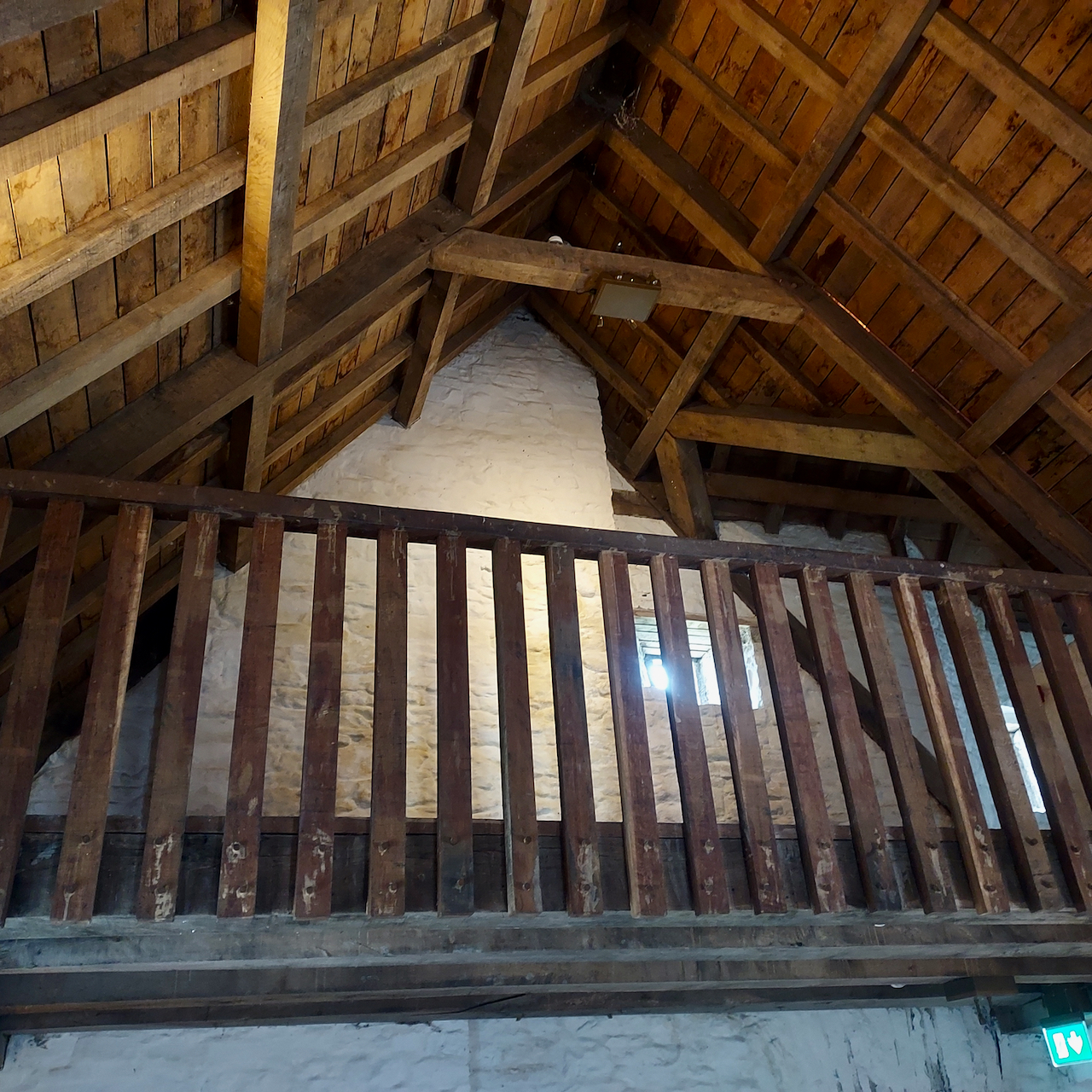
Ashtown Castle, Dublin, courtesy of Phoenix Park website. The arrangement of the growing hedges outline where the house was, before it was demolished.

Outside, the hedges to one side of the castle form the shape of the house that used to stand there, attached to the old castle.

An aerial picture of the castle that the guide showed us, with the shape of the hedges illustrated. Ashtown Castle, Phoenix Park, Photograph © Jennifer Winder-Baggot, www.irishhistorichouses.com
Ashtown Castle, Phoenix Park, 6th July 2024, Photograph © Jennifer Winder-Baggot, www.irishhistorichouses.com

The National Inventory tells us:

The castle was dated to the early seventeenth century on the basis of surviving fragments of a roof truss found in the wall during the restoration project in the early 1990s. There is in the stonework some suggestion of a further wing to the north, but no archaeological evidence was found, leaving this section unresolved. The builder is unknown, but in 1641 the estate was in the ownership of John Connell, a distant ancestor of Daniel O’Connell. Curiously the Civil Survey, 1654, lists him as a Protestant. Stone from a quarry at Pelletstown owned by Connell was used in the building of the original wall of the Park.”
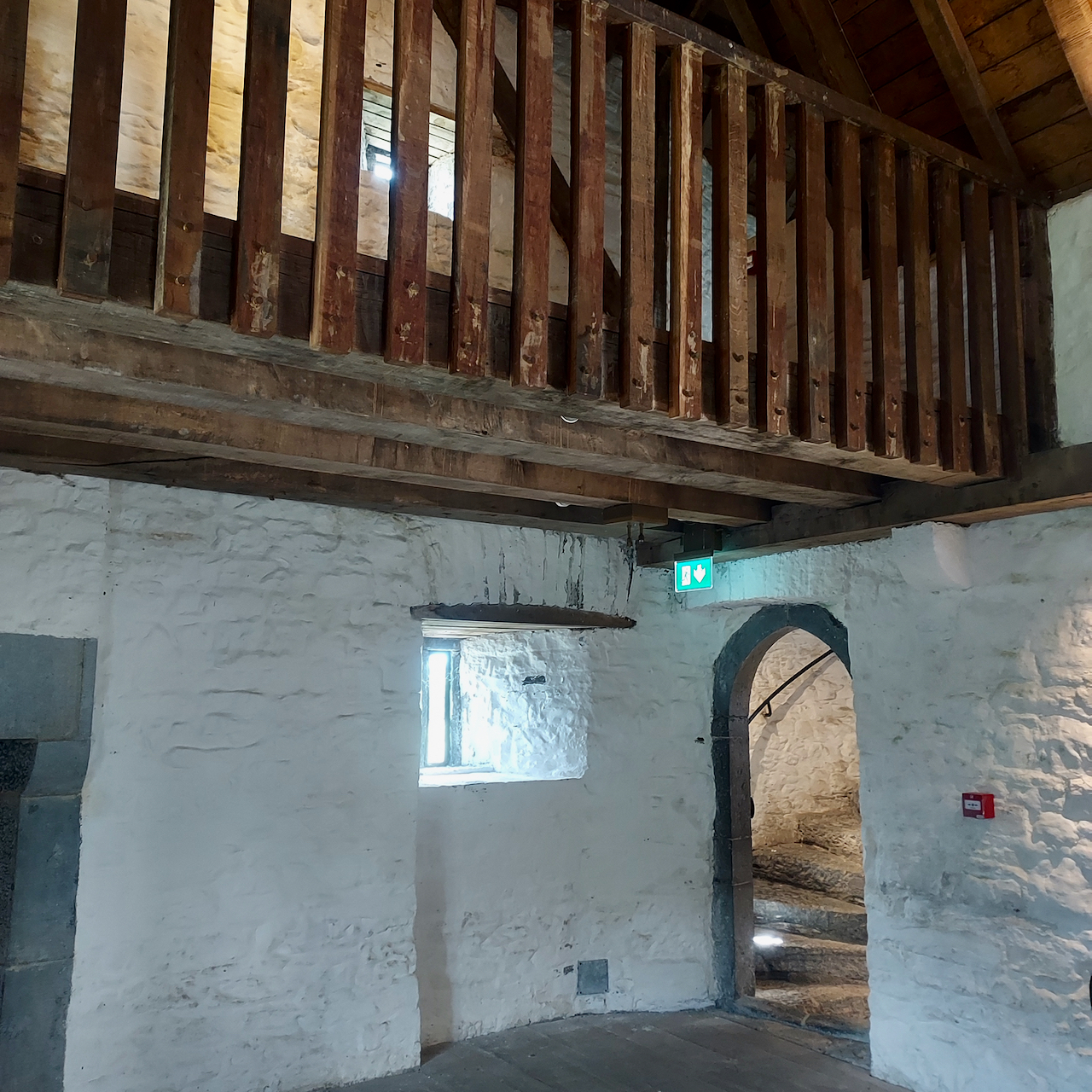
Ashtown Castle, Phoenix Park, 6th July 2024, Photograph © Jennifer Winder-Baggot, www.irishhistorichouses.com

At that time, the estate consisted of 200 acres.

When James Butler 12th Earl of Ormond (who later became 1st Duke of Ormond) was created Lord Lieutenant of Ireland in 1662, he purchased the tower house and lands around it to create a deer park for King Charles II.

In 1668 Marcus Trevor, Viscount Dungannon, was appointed Ranger of the Park. Along with two Keepers, he was responsible for overseeing the Fallow deer imported from England.

The tower house became the official residence of second Keeper of the Park, William Flower, but he assigned it to a subordinate.

In the late eighteenth century the tower house was extended to become the Under Secretary’s residence, and was called Ashtown Lodge.

After Irish Independence, the house served as the residence of the Papal Nuncio. In 1978 the Papal Nuncio moved to a different residence.

The guide showed us what the house used to look like, that had been attached to the castle. For some more photographs, you can visit the Irish Tower House website. [2]

The guide showed us a photograph of a painting of the house as it used to look.
Ashtown Castle, Phoenix Park, with a picture of the castle superimposed onto the house to show its position, although it was not visible. Photograph of photograph © Jennifer Winder-Baggot, www.irishhistorichouses.com
This is what the house looked like before demolition. The upper storey of the castle had been made into a chapel for the Papal Nuncio when he lived in the house.
Ashtown Castle, Phoenix Park, 6th July 2024, Photograph © Jennifer Winder-Baggot, www.irishhistorichouses.com

The extension was demolished in the 1980s, due to poor condition.

Ashtown Castle, Phoenix Park, 6th July 2024, Photograph © Jennifer Winder-Baggot, www.irishhistorichouses.com

Restoration started in Autumn 1989. Corbels that carried the floor levels were uncovered, and also portions of fireplaces on the first and second floors and a piece of window jamb on the first floor.

Restoration work including new stonework, insertion of oak floors and roof was carried out by craftsmen attached to the National Monuments depot in the Phoenix Park.

Ashtown Castle, Phoenix Park, 6th July 2024, Photograph © Jennifer Winder-Baggot, www.irishhistorichouses.com
Entrance to Ashtown Castle, Phoenix Park, 6th July 2024, Photograph © Jennifer Winder-Baggot, www.irishhistorichouses.com
Ashtown Castle, Phoenix Park, 6th July 2024, Photograph © Jennifer Winder-Baggot, www.irishhistorichouses.com

The ground floor would have had only small windows and no fireplace. Recesses and niches may have served for cupboard space or lamp shelves.

Ground floor, Ashtown Castle, Phoenix Park, 6th July 2024, Photograph © Jennifer Winder-Baggot, www.irishhistorichouses.com
Ashtown Castle, Phoenix Park, 6th July 2024, Photograph © Jennifer Winder-Baggot, www.irishhistorichouses.com
Ashtown Castle first floor, Phoenix Park, 6th July 2024, Photograph © Jennifer Winder-Baggot, www.irishhistorichouses.com
Ashtown Castle, Phoenix Park, 6th July 2024, Photograph © Jennifer Winder-Baggot, www.irishhistorichouses.com

We then went up to the next level, which had been the chapel for the Papal Nuncio after Ireland gained independence from the United Kingdom.

Ashtown Castle, Phoenix Park, 6th July 2024, Photograph © Jennifer Winder-Baggot, www.irishhistorichouses.com

[1] https://heritageireland.ie/places-to-visit/phoenix-park-visitor-centre-ashtown-castle/

[2] https://irishtowerhouses.ie/county-dublin/ashtown-castle-co-dublin/

Ashtown Castle is in the Phoenix Park. The OPW are currently running one tour per day. From the OPW website:

Ashtown Castle is a tower house that probably dates from the seventeenth century, but may be as early as the fifteenth.

For years it was completely hidden within the walls of a Georgian mansion once occupied by the under-secretary for Ireland. When that house was demolished in the late 1980s, the castle was rediscovered. It has since been fully restored and now welcomes visitors.”
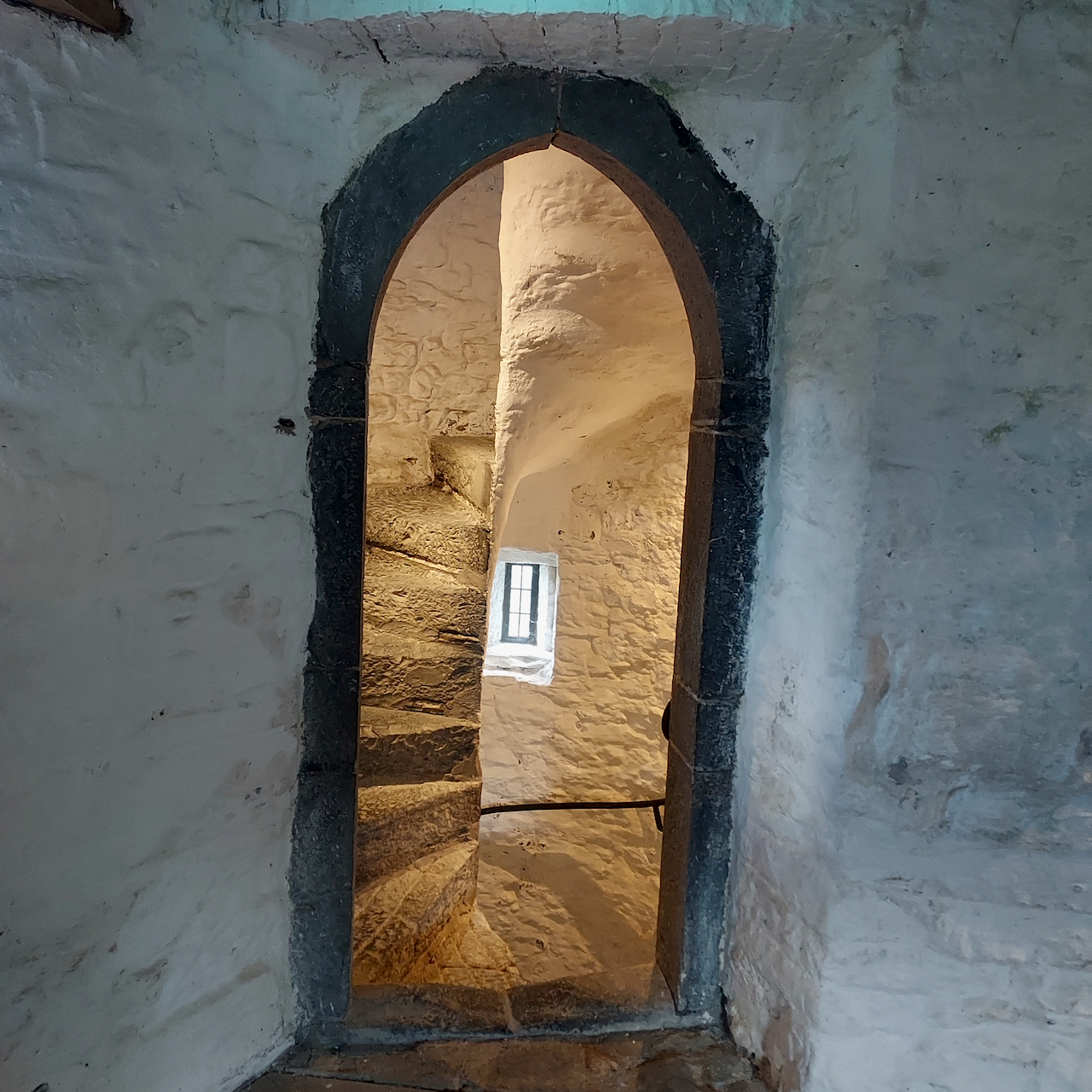
The National Inventory tells us:

The castle was dated to the early seventeenth century on the basis of surviving fragments of a roof truss found in the wall during the restoration project in the early 1990s. There is in the stonework some suggestion of a further wing to the north, but no archaeological evidence was found, leaving this section unresolved. The builder is unknown, but in 1641 the estate was in the ownership of John Connell, a distant ancestor of Daniel O’Connell. Curiously the Civil Survey, 1654, lists him as a Protestant. Stone from a quarry at Pelletstown owned by Connell was used in the building of the original wall of the Park. The castle and its lands were purchased for the crown by the Duke of Ormonde in 1663 and it became the official residence of the second Keeper of the Park, Sir William Flower, who assigned it to a subordinate. The building was extended to become the Under Secretary’s residence in the late eighteenth century. After Independence it served as the residence of the Papal Nuncio. The later extension was demolished in the 1980s and the site was briefly considered for an official Taoiseach’s residence, the brief requiring the restoration of the castle. Although heavily restored, it is a rare surviving example of a fortified tower house close to the capital city.

https://irishtowerhouses.ie/county-dublin/ashtown-castle-co-dublin/

Ashtown Castle, Phoenix Park, County Dublin visited in May 1987. 
Ashtown tower house was incorporated into the 18th century Ashtown Lodge. It was forgotten about until the house was being demolished, because of a severe outbreak of dry rot. 

1987 was an interesting period in its history, as the tower house started to reveal itself, while the vestiges of the old Lodge acted as a veneer covering up the details. 

The Lodge had been the residence of the Under Secretary and later on that of the Papal Nuncio