Mark Bence-Jones. A Guide to Irish Country Houses (originally published as Burke’s Guide to Country Houses volume 1 Ireland by Burke’s Peerage Ltd. 1978); Revised edition 1988 Constable and Company Ltd, London.
p. 204. “An 1840s Italianate rebuilding of an earlier house by William Tinsley, of Clonmel,for a member of the Quaker family of Malcolmson who in early C19 founded the great cotton mills at Portlaw which brought great prosperity to the town. Of three storeys, with a tower projecting from the centre of the front; a composition which may have been inspired by the nearby Curraghmore. After emigrating to USA 1851, Tinsley repeated the Mayfield theme in several American college buildings.”
Mayfield House, County Waterford, photograph by Robert French, (between ca. 1865-1914), Lawrence Photograph Collection, National Library of Ireland.
Architect: William Tinsley / John Skipton Mulvany
Detached seven-bay three-storey over basement Italianate house incorporating fabric of earlier house constructed for the Malcomson family, whose cotton mills were nearby. Originally designed by William Tinsley, with later additions of 1857 including the tower by J.S. Mulvany. Now sadly ruined, the building has been largely stripped for architectural salvage. The tower remains a dramatic focal point.
Mayfield House, COOLROE (UPP. BY.) CLONAGAM PAR., Portlaw, County Waterford
Detached seven-bay three-storey over basement Italianate house, c.1840, on an almost-symmetrical plan incorporating fabric of earlier house, c.1740, with four-bay three-storey Garden elevation to south-west originally having service range to south-west. Renovated, 1857, with single-bay three-stage higher Italianate entrance tower added to centre on a square plan, seven-bay single-storey double-pile lateral wing to north-west having paired single-bay single-storey bows to north-west, seven-bay single-storey single-pile lateral wing to south-east (originally conservatory), and service range to south-west removed. Subsequently in use as offices. Now in ruins. Hipped slate roofs now gone behind parapets with granite ashlar chimney stacks, and traces of cast-iron rainwater goods. Remains of barrel-vaulted roof to wing to south-east with iron ribs on moulded cast-iron cornice. Roof to entrance tower not visible behind. Unpainted rendered walls with channelling to ground floor, stringcourse over, full-height corner pilasters to upper floors supporting plain frieze having projecting cornice with modillions, and blocking course to parapet. Unpainted rendered panelled parapets to wings on moulded cornices having rendered coping. Square-headed window openings to main block (in square-headed recesses to ground floor) with cut-stone sills on consoles (forming sill course to first floor), and moulded surrounds having segmental pediments to first floor on elongated consoles. Remains of 6/6 timber sash windows with some 2/2 timber sash windows to side (north-west) elevation. Round-headed window openings to second stage to entrance tower with projecting sills on consoles, moulded surrounds, and deep panelled hoods over. Square-headed window openings to top stage to entrance tower on consoled projecting course with segmental pediments on elongated consoles. Fittings now gone. Round-headed door openings to first stage to entrance tower (leading into barrel-vaulted corridor) with moulded surrounds having deep panelled hoods over. No fittings. Series of round-headed openings to front (north-east) elevation of wings (some blind) in round-headed recesses with square-headed window openings to remaining elevations. Fittings now gone. Interior now in ruins with some floors partly collapsed, outlines of red brick-lined fireplaces, and evidence of coved plaster ceilings on timber batons. Set back from road in own grounds with avenue to entrance, and overgrown grounds to site.
Appraisal
An imposing, well-composed, substantial house built for the Malcomson family to designs prepared by William Tinsley (1804 – 1885), and reputed to incorporate the fabric of an earlier house, thereby attesting to a long-standing presence on site. A range of stylistic features enhance the architectural design quality of the composition, including bow-ended wings, which are a trait common to further Malcomson properties, including Woodlock (House) (22803001/WD-08-03-01), and Villa Marina, Dock Road, Dunmore East (22817021/WD-27-17-21), and which attest to the later intervention by John Skipton Mulvany (1813 – 1871). The house is distinguished by the elegant entrance tower, which augments the Italianate Classical quality of the composition. Now in ruins, and having been exposed to architectural salvage, much of the original fabric has been lost, although the remains of some fine detailing to the openings survive intact, contributing to the design quality of the site. The construction of the barrel vault to one wing, now exposed, may be considered to be of some technical interest. The house forms an elegant centrepiece in extensive grounds originally accommodating the Malcomson cotton factory complex, and remains an imposing, although increasingly obscured, landmark of some Romantic quality in the townscape.
Mayfield House, Portlaw, County Waterford, photograph courtesy of National Inventory.
Detached three-bay single-storey Italianate gate lodge, c.1840, with single-bay single-storey half-octagonal entrance elevation to east, and three-bay single-storey side elevations to north and to south. Now disused and derelict. Hipped slate roof (half-polygonal to entrance elevation) on timber beams and batons with clay ridge tiles, rendered chimney stack, and remains of cast-iron rainwater goods on overhanging timber eaves. Painted rendered, ruled and lined walls with rendered quoins, and moulded rendered cornice. Square-headed window openings with stone sills, and moulded rendered surrounds. Fittings now gone. Square-headed door opening with rendered pilaster doorcase having shallow pediment over. Fittings now gone. Interior now derelict. Set back from line of road at entrance to grounds shared with Mayfield House and Portlaw Cotton Factory. Part overgrown grounds to site. (ii) Gateway, c.1840, to east comprising decorative cast-iron gate with sections of cast-iron flanking railings on granite plinth, decorative cast-iron open work piers forming flanking gateways with cast-iron double gates (on shallow concave plans operated by chain mechanism), and sections of cast-iron flanking railings leading to unpainted rendered panelled terminating piers having panelled friezes, moulded cornices, and remains of cast-iron gas lamp holders to capping.
Appraisal
A well-composed, small-scale gate lodge fashioned in an Italianate style, which complements the appearance of the main house to north-west (228030035/WD-08-03-35), suggesting that both compositions were built to designs prepared by John Skipton Mulvany (1813 – 1871). Although now disused, and in an advanced derelict state, the lodge retains its original form and massing, together with some important salient features and materials. The gateway to east, designed by Richard Turner (1798 – 1881), and fashioned at the Richard Turner Hammersmith Ironworks, Ballsbridge, Dublin, is an ornamental composition incorporating three sets of gates, the flanking double gates operated by a chain mechanism that survives on site, and which is of technical and engineering significance. The gates and railings are fine examples of early mass-produced cast-iron work and, together with the lodge, form a picturesque termination to the vista from Factory Road to the east.
Mayfield was held by William Malcolmson from the Medlicott estate at the time of Griffith’s Valuation, when it was valued at £50. Lewis refers to it as the seat of J. Malcolmson in 1837. In 1906 it was the property of William Malcomson and valued at £31. It is now a ruin.
Mayfield House, Portlaw, County Waterford, photographby Robert O’Byrne.
Portlaw, County Waterford and its association with the Malcomson family have been mentioned here before (see: A Shell, June 28th 2017). The Malcomsons were of Scottish Presbyterian origin but in the mid-18th century one branch became members of the Quaker community. A son of this line, David Malcomson, settled in Clonmel, County Tipperary where from 1793 onwards he became involved in the corn milling industry and enjoyed such success that when Richard Lalor Shiel visited the town in 1828 he could write ‘Malcomson’s Mill is I believe the finest in Ireland. Here half the harvest of the adjoining counties as well as Tipperary is powdered.’ By that date the family, fearful that the Corn Laws (restrictions on the import of grain which favoured domestic production) were to be revoked by parliament, had moved into another business in another part of the country. In 1825 Malcomson took a 999-year lease on a house called Mayfield and the adjacent 16 acres from a local landlord, John Medlycott. A small corn mill, damaged by fire, stood on the site and this was redeveloped as a vast, six-storey cotton mill, building a canal to utilize the power of the adjacent river Clodiagh. The enterprise required large numbers of employees and as a result the little village of Portlaw expanded rapidly. Around the time the Malcomsons began work on the mill, it comprised less than 400 residents living in 71 houses: by 1841 the population of Portlaw had grown to 3,647 souls occupying 458 houses, most of the latter built by the Malcomsons as part of a planned urban settlement. The family lived on the edge of the town and directly above the mill in Mayfield.
Mayfield House, Portlaw, County Waterford, photographby Robert O’Byrne.
Mayfield House, Portlaw, County Waterford, photographby Robert O’Byrne.
Mayfield House, Portlaw, County Waterford, photographby Robert O’Byrne.
Mayfield House, Portlaw, County Waterford, photographby Robert O’Byrne.
Mayfield House, Portlaw, County Waterford, photographby Robert O’Byrne.
The core of Mayfield was a classical house dating from c.1740 and it was here the Malcomsons initially lived. However, in 1849 Joseph Malcomson, who had assumed responsibility for the business, employed architect William Tinsley to enlarge the building. Like his client, Tinsley originally came from Clonmel and had built up a substantial practice in the area, so he was an obvious choice. However, by the time Joseph Malcomson decided on a further expansion of Mayfield, Tinsley was no longer available: in 1851 he had emigrated with his family to the United States where he enjoyed an equally successful career before dying in Cincinnati in 1885. So in 1857 Malcomson instead employed John Skipton Mulvany who specialized in a loosely-Italianate style architecture and who was responsible for giving the house its present appearance. Mulvany added many of Mayfield’s most striking features, not least a three-storey tower that served as an entrance on the house’s eastern front. This rises considerably higher than the rest of the three-storey over basement building which is of seven bays: the tower accordingly provided views both down to the factory and over to the village, allowing the Malcomsons a paternalistic prospect of their workers. Mulvany was also responsible for the single-storey over basement wings on either side of the main block: that to the south served as a conservatory, that to the north held a pair of reception rooms. However the family were not to enjoy this splendor for long, the cotton factory which generated their wealth being ruined in the aftermath of the American Civil War (the Malcomsons had extended credit to the losing side).
Mayfield House, Portlaw, County Waterford, photographby Robert O’Byrne.
Mayfield House, Portlaw, County Waterford, photographby Robert O’Byrne.
Mayfield House, Portlaw, County Waterford, photographby Robert O’Byrne.
Mayfield House, Portlaw, County Waterford, photographby Robert O’Byrne.
Mayfield House, Portlaw, County Waterford, photographby Robert O’Byrne.
In the last quarter of the 19th century the Portlaw factory was adapted for spinning but this enterprise didn’t last long and it was only in the early 1930s that a new purpose was found for the complex when it was acquired to act as a tannery by the Irish Leathers Group. Mayfield, which had for a period been occupied by members of the de la Poer Beresford family of nearby Curraghmore, now became an office premises for the new enterprise, and remained as such for the next half century. The tannery closed in the 1980s, and as a result Mayfield no longer had any purpose, although to the end of that decade a proposal was put forward to convert both factory and house into a retirement home. The scheme never took off and for the past thirty-odd years Mayfield has stood empty, falling into its present state of dereliction. As can be seen, little of the original mid-Victorian interiors remains other than fragments of plasterwork and rotting timbers. The exterior of the building has proven more sturdy, and retains the same appearance found in old photographs. But it is difficult to know what sort of future, if any, Mayfield might have. There is an old Irish expression Ní bhíonn cuimhne ar an arán a hitear, commonly translated as ‘Eaten bread is soon forgotten.’ Portlaw as seen today owes its existence to the enterprise and initiative of the Malcomsons: what a shame that so little has been done to acknowledge their contribution to the area.
Mayfield House, Portlaw, County Waterford, photographby Robert O’Byrne.
Mayfield House, Portlaw, County Waterford, for sale 2026 courtesy BidX1
The property is arranged to provide a historical estate located within an irregular shaped parcel of land. The lands are partially comprised within Folio WD39672F.
The house was originally built in 1740 and underwent improvements in the 1840s giving the distinguished Italian style that can still be seen today. It benefits from a large site area of approximately 10.5 hectares (26 acres) with former tannery buildings to the rear of the main house, offering significant development potential (subject to obtaining all necessary planning consents).
The property is located on the outskirts of Portlaw Town, approximately 18km North West of Waterford City.
Tenancy Vacant possession.
Zoning Under the WCCC Development Plan 2022 – 2028 the lands are zoned Part RE and part HA.
RE: Provide for enterprise and/or residential led regeneration. HA: Protect highly sensitive and scenic location from inappropriate development that would adversely affect the environmental quality of the locations.
Mark Bence-Jones. A Guide to Irish Country Houses (originally published as Burke’s Guide to Country Houses volume 1 Ireland by Burke’s Peerage Ltd. 1978); Revised edition 1988 Constable and Company Ltd, London.
p. 277. “(Maher/IFR; Jackson, sub Redesdale, B/PB) A C19 castle for William Tinsley of Clonmel, built 1835-38 for John Maher, MP, on the site of an earlier house. Dominated by a square battlemented and machicolated tower; a lower tower with bartizans at the other end of the principal front. Battlemented screen wall with turrets. Long hall. In recent years the home of Hon Mrs Jackson, one of the famous Mitford sisters. Afterwards the home of Mr William Albertini.”
Tullamain Castle, TULLAMAIN (TULLAMAIN PR), Tipperary South
Detached Gothic-style castellated country house, built 1835-8 on site of earlier house and castle. Comprises two rectangular-plan towers flanking two-storey castellated centre block. Larger, taller south-east tower battlemented and machicolated. Lower tower has bartizans. Battlemented screen wall to south, with turrets. House stands at end of avenue in landscaped grounds, with ruinous medieval church and graveyard to west, and traces of deserted medieval settlement.
Appraisal
This country house was burnt during the Troubles of the 1920s, but rebuilt with its original appearance. It is a substantial castellated building designed by the noted local architect, William Tinsley. The castle and its associated outbuildings are pleasantly sited and the gate lodge and gates at the main road enhance the approach.
Tullamaine Castle was the home of John Power, father of the 1st Sir John Power, Baronet. Leet records J.D. Scully as resident at Tullaghmain-castle, Fethard, in 1814. This was James Scully (1779-1853), fourth son of Jeremiah Scully of Silverfort. By 1837 Lewis records John Maher as resident though the Ordnance Survey Name Books in 1840 refer to the proprietor as a Mr. Walsh. By the time of Griffith’s Valuation Maher is recorded as holding the property in fee. The buildings were valued at £44.16s. By the mid 1870s Tullamaine Castle belonged to Henry Maynard Harding who advertised it for sale in July 1880. Slater still refers to it as his property in 1894. Dr M.J. Barry was resident at Tullamain in 1906. The castle was burnt in the early 1920s but rebuilt. In the early 1940s C. A. Vigours was resident. The estate functioned as a stud of many years. Its still a country residence and was offered for sale in 2018.
Lakefield (Formerly Gambonstown), Fethard, Co Tipperary
Mark Bence-Jones. A Guide to Irish Country Houses (originally published as Burke’s Guide to Country Houses volume 1 Ireland by Burke’s Peerage Ltd. 1978); Revised edition 1988 Constable and Company Ltd, London.
p. 181. “(Hackett/IFR; Pennefather, sub Freese-Pennefather/LGI1958; O’Brien, Bt/PB; Goodbody/IFR) A two storey five bay late-Georgian villa by William Tinsley, of Clonmel; built 1831-33 for William Pennefather, whose family are said to have won the estate at cards from its previous owners, the Hacketts. It occupies the site of the Hacketts’ house, which was joined to wings by arcaded curved sweeps; the sweeps still remain, though their arches have been filled in, and have been extended by walls to form a circular walled garden at the back of the house. Centre bay slightly recessed, and further emphasized with framing bands; central Wyatt window above Doric portico. Eaved roof. Central staircase hall, lit by lantern. The staircase is unusual in having a double lower ramp and a flying run of steps from the half-landing to the main landing, like the staircase at Glin Castle, Co Limerick. It is of wood and curves gracefully with balusters of the very lightest; so well made that it has not been necessary to anchor it to the ground floor; it just stands, like a piece of furniture. Two drawing rooms en suite, with modillion cornices. Doorcases with reeded architraves and rosettes. Sold 1907 by W.V. Pennefather to Capt J.G. O’Brien. At one time let to Mr Hubert Hartigan, the trainer, who trained the champion high jumpber of the world in the walled garden at the back of the house. sold 1955 by Sir John O’Brien, 5th Bt, to Mr and Mrs Arthur Goodbody.”
Detached five-bay two-storey over basement country house, built 1831, having three-bay side elevations and seven-bay rear elevation, latter with slightly projecting centre bays. Prostyle tetrastyle portico entrance to façade and oval walled garden adjoining rear. Skirt slate roof with overhanging sheeted eaves and cut limestone chimneystacks. Rendered walls with render string course and eaves course having render brackets and pilasters to first floor of entrance bay. Portico has fluted limestone Doric columns, cut limestone entablature, and carved limestone steps. Square-headed timber sliding sash windows throughout with limestone sills and barred to basement. Six-over-six pane throughout except for end bays of first floor rear, which are six-over-nine pane. Tripartite windows to first floor of entrance bay and ground floor of side elevations, all having limestone sills. Segmental-headed door opening with timber and glazed double-leaf panelled door, timber pilasters, sidelights with panelled cut limestone bases and decoratively-glazed fanlight.
Appraisal
Lakefield House, an imposing late Georgian structure, was built by William Pennefather and designed by the architect William Tinsley. The house is said to be built upon the remains of the Hackett family’s former home, the adjoining arcaded curved sweeps of which were retained, enclosed and incorporated as a large, circular walled garden. The architectural design and use of ornamentation is restrained and coherent, culminating in the central carved limestone porch which exhibits a high degree of skilled sculpting and workmanship. The diminishing proportions of the windows, and the dressed limestone stringcourses add a further sense of grandeur to the building. The square-plan walled garden is notable both for its large size, good condition and ornate green house. The outbuildings retain an ornate bellcote, and cobblestones. The carved date stones add valuable context. The outbuildings to the circular walled garden are distinctive for their unusual shape and form a distinctive part of a diverse and interesting group of demesne structures.
Walled gardens, associated with Lakefield House, laid out c. 1835. Oval plan walled garden to rear of country house comprising rubble limestone walls with arcading of shallow segmental-headed recesses and entered through segmental brick-arched gate. Square-plan walled garden to west having coursed snecked rubble limestone walls, entered through gateway having limestone piers with carved caps and double-leaf cast-iron gates. Blocked square-headed gateway with dressed limestone voussoirs. Multiple-bay single-storey possible former workers’ houses to walled garden, with attached green house.
Appraisal
Lakefield House unusually has two walled gardens. The oval one is particularly noteworthy for its shape and its position, immediately adjacent to and incorporating the rear elevation of the country house. The arcading is of interest. The presence of buildings, possibly originally workers’ houses, within the square walled garden, is somewhat unusual.
Detached three-bay single-storey square-plan former gate lodge, built c.1830, with two-bay side elevations, now in use as private house. Hipped slate roof with rendered chimneystack. Painted rendered walls with rendered eaves course, plinth course and ilaster and bracket details. Square-headed window openings, set into square-headed recesses with dentils and having replacement uPVC windows. Square-headed door opening set into render surround slightly projecting from rest of façade and having timber panelled and glazed door. Quadrant gateway with square-profile roughly dressed limestone piers with double-leaf cast-iron gates, roughly dressed limestone plinths having cast-iron railings, terminated by outer similar piers.
Appraisal
This gate lodge formerly served Lakefield House. The render detailing repeat those of the main house and form a coherent decorative scheme. The simple form of the building is enlivened by the render panels which articulate and enhance the façade, the articulation of the doorway creating a central focus. The piers of the entrance gates are well carved and clearly the work of skilled craftsmen. The gate lodge and gates form an interesting group with the surviving related structures in the former demesne.
Gambonstown was occupied by B.B. Bradshaw in 1814. In 1786 Wilson had referred to it as the seat of Mr. Hackett. The National Inventory of Architectural Heritage records the building of Lakefield house in 1831 by William Pennefather, replacing the former Hackett home of Gambonstown. and the Ordnance Survey Name Books record it as his residence in 1840. At the time of Griffith’s Valuation William Pennefather held the house valued at £48.14 shillings and 413 acres from Mrs Hackett and others. Sold by the Pennefathers to the O’Briens in 1907 and sold again to the Goodbodys in 1955. Lakefield is still extant.
Knocklofty, County Tipperaray, photograph by Robert French, (between ca. 1865-1914), Lawrence Photograph Collection, National Library of Ireland.
Mark Bence-Jones. A Guide to Irish Country Houses (originally published as Burke’s Guide to Country Houses volume 1 Ireland by Burke’s Peerage Ltd. 1978); Revised edition 1988 Constable and Company Ltd, London.
p. 179. “Hely-Hutchinson, Donoughmore, E/PB) A C18 house consisting of a three storey centre block with two storey gable ended wings projecting forward on the entrance front, the centre block is seven bays and the wings are of two bays in their gable-ends, which are treated as broken and baseless pediments and surmounted by busts and balls on pedestals. They also each have an extra bay in the ends of the two storey corridors which have been built along their inner face and which are surmounted by eagles. In early C19, a single storey corridor was built along the front of the centre block, joining the wings; it is adorned with Doric pilasters, wreathes and acroteria and has a three bay projection in the centre, roofed with a shallow dome. The ground floor windows of the wings are camber-headed. On the garden front, which faces across the River Suir, the centre block is of five bays and the front is extended at one side by a very long two storey service wing, which turns inwards at an obtuse angle. There is a small square entrance hall with a domed ceiling, opening with arches on either side into book-lined galleries. Beyond is a very large two storey library, surrounded on three sides by a wrought iron gallery; the bookcases rising as high as the ceiling, which has a surround of delicate early C19 plasterwork. The drawing room has similar decoration; the dining room is panelled. The demesne extends across the River Suir into Co Waterford, taking in the demesne of Kilmanahan Castle, which was formerly a separate property. There is an octagonal domed Gothic octagon in the park near the house and the original set of elaborate gate piers to the house are very fine. Sold 1985.”
Detached country house, comprising seven-bay three-storey central block, built c. 1790, having late eighteenth-century three-bay two-storey with attic wings projecting forwards to give U-plan house, wings having three-bay façades comprising two-bay gable-fronts with single-bay flat-roof further bay of c. 1800. Single-storey flat-roofed early nineteenth-century gallery along front of central block, linking wings and has central advanced three-bay porch with five flanking bays each side having alternate blind and windowed bays. South wing has multiple-bay two-storey block connecting to rear and single-storey blocks connecting to front at south-west. Rear elevation of central block is five-bay three-storey and flanked by advanced bays of wings, inner bays of c. 1910 curving to central block. Multiple-bay two-storey block to south end, south-most bay being pedimented. Further multiple-bay two-storey block runs at skew angle to this block, along top of River Suir escarpment. Two-storey canted-bay to north elevation of central block. Hipped slate roof to central block and to block to rear of south wing, slate dome to porch, and pitched slate roofs elsewhere, with lead flashing, rendered end chimneystacks with terracotta pots and cast-iron rainwater goods. Moulded sandstone copings to gable-fronts of wings with stepped ends having pedestals with ball finials and having open-topped pediments to apexes with carved busts of English monarchs. Front corners of flat-roofed bays to wings have eagles. Moulded sandstone cornices to central block, with cut sandstone parapets. Cut-stone copings to canted bay. Painted pebbledashed walls with smooth rendered plinth, moulded sandstone string course to front and re-entrant elevations of wings. Cut sandstone pilasters to first floor of façade of wings, overlying string course and having fluted consoles beneath. Ashlar sandstone walls to gallery, with carved sandstone cornice and cut sandstone parapet, blind bays having carved wreaths, end bays and porch bays being flanked by pilasters with capitals and having antefixae to parapet, porch having panel and flanking finials and central bays having outer band of ashlar limestone. Timber sliding sash windows throughout with sandstone sills, square-headed six-over-six pane, except for ground floor front and south elevations. Ground floor of front and re-entrant elevations of wings have segmental-headed nine-over-six pane windows, gallery has six-over-nine pane windows, those of porch having segmental upper panes, and south and west elevations of south wing have nine-over-nine pane windows. Nine-pane casement windows to attic level of wings. Some six-over-three pane and one-over-one pane windows elsewhere to west elevation. Square-headed door opening with carved sandstone surround and timber panelled door. Square-headed door openings to rear and south elevation with timber and glazed doors with paned overlight, that to rear of central block having flight of cut limestone steps. Curved north-west corner of south wing has entablature over colonnade of limestone Tuscan columns and pilasters flanking doorway approached by cut limestone steps, and six-over-six pane timber sliding sash windows, door and windows having three-pane overlights. Forecourt to front of house, with small garden beyond. Garden terraces to rear falling to River Suir, accessed by flights of steps. Two-storey former servants quarters arranged around angled yard to south-west of house, accessed by gateway with dressed limestone piers with caps and plinths and having double-leaf wrought-iron gates. Pitched and hipped slate roofs with lead flashing and rendered chimneystacks. Painted smooth rendered walls. Square-headed window and door openings with replacement windows and doors. Segmental-arched openings to south-west range, now blocked with elliptical-arched cut limestone surrounds and imposts, now blocked. Carved limestone entrance gate to garden comprising round-headed gateway with pilasters and moulded archivolt and imposts and decorative wrought-iron gate, set into square-headed opening with entablature and cornice over engaged Ionic columns, gateway being set into rubble stone wall. Single-storey former workers’ houses to west, with pitched artificial slate roofs, brick bellcote having round-headed bell opening, rubble sandstone walls and red brick surrounds to square-headed windows and doors having replacement windows and timber panelled doors.
Appraisal
This former country house served as the seat of the Donoughmores until the mid-1980s. The architectural design draws on the influences of classical architecture in its detailing. This is exhibited in its ornate entrance front, which is adorned with features such as the broken pediments, Doric pilasters, wreathes and busts. The retention of features such as the timber sash windows enhance the buildings appearance, while the dome roof over the central doorcase is a striking feature which adds further to the architectural significance of the building. This former country house forms part of an interesting group of demesne related structures with the servants quarters, outbuildings, gate lodges, estate workers’ houses and bridge.
Entrance gates to Knocklofty House, erected c. 1780, and comprising vehicular entrance flanked by pedestrian gateways. Ashlar limestone gate piers with carved moulded caps and plinths, rebates with scroll details and having carved lions’ heads with crowns to frieze all faces of piers, and coats of arms in medallion below to front faces only. Decorative copper and glass lights to caps. Square-headed pedestrian entrances set into cut limestone walling having cut stone copings and moulded plinths to jambs. Cast-iron gates, double-leaf to vehicular gates. Gates flanked by convex random rubble walling.
Appraisal
The form and scale of these gates create a dramatic entrance to Knocklofy Demesne. The piers display fine carvings which exhibit the work of skilled craftsmen and which add considerable artistic quality to the appearance of the entrance. The random rubble flanking walls act as a foil to the decorative gateway proper.
Detached three-bay split level gate lodge, built c. 1820, having single-storey front elevation and two-storey rear, with recent two-storey extension to rear. Hipped slate roof with lead flashing, central red brick chimneystack and overhanging eaves. Exposed coursed rubble limestone walls with dressed quoins. Square-headed window openings with six-over-six pane timber sliding sash windows with red brick surrounds and limestone sills, set in segmental-headed recesses to front elevation, with red brick surrounds. Square-headed timber battened door with red brick surround set in segmental-headed recess with red brick surround. Garden to front with cast-iron fence and having pointed arch opening in rubble limestone boundary wall to west having red brick surround. Limestone entrance gateway and cast-iron gates adjacent to gate lodge.
Appraisal
The split-level form of this gate lodge is unusual and is an interesting adaptation to its sloping site. The recesses into which the front door and windows are set make the building distinctive and the contrast between the limestone and brick give the building pleasant textural variation. The lodge is accompanied by fine entrance gates to the demesne and along with the country house and other features, forms a significant architectural ensemble of related structures.
Shallow quadrant entrance gateway to Knocklofty House, erected c.1880, comprising cast-iron railings on brick plinth wall with cut limestone copings and set to ashlar limestone piers with limestone wheel guards, plinths and having carved coping to western pier, both piers having decorative wrought-iron lamps. Centre of gateway now missing and possibly removed to form gateway on opposite, north, side of public road. Detached double-pile three-bay single-storey lodge to south side of gates, having hipped slate roof with lead flashing, red brick chimneystacks with decorative detailing and overhanging eaves. Painted pebbledashed walls with elliptical-headed window openings with timber double casement windows with raised red brick surrounds and painted limestone sills. Square-headed door opening with timber battened door with raised red brick surround. Shallow quadrant gateway on opposite side of road comprises piers, railings and plinth walls of similar detailing to southern gateway, but with cast-iron piers having cast-iron double-leaf vehicular gates flanked by pedestrian gates.
Appraisal
These gateways demonstrate interesting and intricate cast-iron techniques, which are clearly the work of skilled craftsmen. The metalwork of the gates and railings contrasts with the brick plinth wall and limestone piers to create textural variation. Together with the country house and other structures and features, the lodge and gateways form part of a significant architectural ensemble.
Three-arch humpback bridge over River Suir, built c. 1800, with higher segmental middle arch flanked by lower depressed arches. Roughly coursed rubble limestone walls with cut-stone voussoirs and cut stone V-shaped cut-waters to both elevations, having cut stone impost course. Soffits have been gunnited with cement. Concrete capping to parapets.
Appraisal
The rubble limestone construction of this road bridge, contrasted with the cut stone voussoirs, adds textural interest to this site. The extra height of the middle arch gives the bridge a humpback. Located adjacent to Knocklofty Demesne this bridge is a significant part of the architectural heritage associated with Knocklofty House.
Freestanding single-bay single-stage folly or turret, extant 1832, on an octagonal plan. Creeper- or ivy-covered red brick Flemish bond octagonal dome. Lime rendered or roughcast rubble stone walls with red brick header bond stepped stringcourse supporting red brick chamfered battlements. Pointed-arch door opening below blind oculus with overgrown threshold, and concealed red brick block-and-start surround with no fittings surviving. Pointed-arch blind window openings below blind oculi with cut-granite sills, and concealed red brick block-and-start surrounds framing lime rendered or roughcast infill. Set on an elevated site.
Appraisal
A folly or turret erected by John Hely Hutchinson (1757-1832), second Earl of Donoughmore, illustrating the development or “improvement” of the pleasure grounds of the Knocklofty House estate with the architectural value of the composition, one colloquially styled “The Guggy” owing to its resemblance to a boiled egg in an egg cup, confirmed by such attributes as the polygonal plan form; the “pointed” profile of the openings underpinning a “medieval” Georgian Gothic theme; and the polygonal dome.
entry in MacDonnell, Randal. The Lost Houses of Ireland. A chronicle of great houses and the families who lived in them. Weidenfeld and Nicolson. London, 2002
p. 149. “This is a mid 18th century house (built around the core of a much smaller 17C building) with later additions. Formerly the home of the Earls of Donoughmore, Knocklofty is presently a hotel.”
p. 150. “The name Knocklofty derives from the Irish ‘Cnoc Lochta’ which means ‘the lofted or shelving hill.’ The original house dates from the late 17C and has later additions. In the 18th C, the Clonmel architect William Tinsley added a single-storey corridor with a domed porch to the entrance front. A pair of stone eagles surmounts the gable ends of the wings. Doric pilasters compete with wreaths are outside the ground floor corridor. Inside, there are a two-storey library (whose contents were sold in 1982 for £193,000), a drawing room, dining room, music room and study.”
“Knocklofty was the seat of the Hutchinson family who came from Alford in Lincolnshire to participate in the great government theft of Irish land that occurred in the first half of the seventeenth century. They received a grant of land in County Tipperary, and in 1751 their heiress, Catherine Nickson, married an up-and-coming barrister named John Hely, the son of Francis Hely of Gortroe, Co Cork….Eight years later and with the brand new surname of Hely-Hutchinson, John Hely was elected Member of Parliament for Lanesborough. He later represented Cork and Taghmon until his death…. By 1774 he was not only Provost of Trinity College Dublin, but also Principal Secretary of State for Ireland and Keeper of the Privy Seal, positions which he held until his death in 1794. His wife was raised to the peerage as Baroness Donoughmore of Knocklofty in 1783, together with a new coat of arms and a brave motto: Fortiter Gerit Crucem (“He bravely bears the Cross”). With his wife now a peeress and his own position secure John should have been satisfied, but his greed and unscrupulousness were infamous…. The Prime Minister Lord North commented, “If you were to give him the whole of Great Britain and Ireland for an estate, he would ask for the Isle of Man for a potato garden.”
“John Hely’s eldest son Richard, the 2nd Baron, was created a Viscount in 1797 and in 1800 he was raised to the Earldom of Donoughmore of Knocklofty (with remainder to the heirs male of his mother), which was one of the large numbers of titles that a grateful government doled out on the day before the Act of Union came into force. The future Earl commanded the militia that was routed by General Humbert at the engagement known as the “races of Castlebar” because the government forces took to their heels and fled, pursued by the rebels and their French allies. Nonetheless, despite this fiasco, Richard was chosen by his Order as one of the 28 original Representative Peers of Ireland on the abolition of the Irish House of Lords, and, as if this were not enough, in 1822 George IV created him a peer of the UK as Viscount Hutchinson of Knocklofty.”
“His brother, John, who had followed a career in [p. 152] the army (becoming a general in the process) succeeded him. He had been commander in chief during the Egyptian campaign in 1801 and was raised to the peerage as Baron Hutchinson of Alexandria. Described as having “harsh features, jaundiced by ill-health, extreme short-sightedness, a stooping body and slouching gait, and an utter neglect of dress”, he decided, in 1809, to throw in his lot with the Carlton House Party and became their chief military adviser. His attacks on the government’s handling of the Peninsular War earned him this damning epitaph: ‘He did not hesitate to sink his patriotism in the spirit of faction.’ When he became the 2nd Earl of Donoughmore, he made some little effort to assist liberal policies by supporting a very limited amount of toleration and emancipation for Catholics.”
p. 152. “The third Earl was a finer sort of individual altogether. He lost his commission and spent three months in gaol in April 1816 for his part in arranging – at the request of the Princess de Vaudemont – the escape of General Count Lavalette in December 1815. Lavalette was Napoleon’s Postmaster-General and one of those officers who had supported the Emperor during the Hundred Days. Marshal Ney and General de Labedoyere had already been executed – Marshal Ney’s sword was eventually to find its way into the Hutchinson family’s possession, as a gift from his widow. General Lavalette escaped from prison disguised as a woman, and made his way to England in the uniform of a captain of the English Guards.
“The 4th Earl was the first member of the family who thought it would be nice to call himself Viscount Suirdale – thereby completely overlooking the fact that no sovereign had thought fit to bestow such a title upon either him or his ancestors. Presumably it was some sort of romantic foolishness connected with the fact that the River Suir flows through the Knocklofty demesne; whatever the reason, it is an error the family still persists in today.
In 1883 the Earls of Donoughmore owned 11,950 acres in the counties of Tipperary, Waterford, Cork, Wexford, Kilkenny, Monaghan, Louth and Dublin. Despite this, John, the 5th Earl, managed to run into considerable financial difficulties, which did not stop him becoming for one year the Assistant Commissioner in the European Commission for the organization of Eastern Rumelia in the Balkan peninsula between 1878 and 1879.”
A mainly 18th century house, cited by Wilson as the seat of John Hely Hutchinson in 1786. In 1840 the Ordnance Survey Name Books describe it as “spacious and handsome, having a fine plain front”. It was valued at £70 in the mid 19th century, the seat of the Earls of Donoughmore until 1983, though Walford mentions Samuel H. Goold-Adams of Knocklofty in 1885. The Irish Tourist Association surveyor writes that Knocklofty was De Valera’s headquarters for a time during the Civil War. Until recently it served as a hotel but in 2013 it was offered for sale.
THE EARLS OF DONOUGHMORE OWNED 4,711 ACRES OF LAND IN COUNTY TIPPERARY AND 2,878 ACRES OF LAND IN COUNTY WATERFORD THE RT HON JOHN HELY-HUTCHINSON (1724-94), an eminent lawyer and statesman of Ireland (son of Francis Hely, of Gortroe, County Cork, by a daughter of Christopher Earbury or Earberry), married, in 1751, CHRISTIANA, daughter of Abraham Nickson, of Munny, County Wicklow, and niece and heir of Richard Hutchinson, of Knocklofty, County Tipperary (in consequence of which marriage he assumed the additional surname of HUTCHINSON), and had issue,
RICHARD, his heir; JOHN, 2nd Earl; Francis, of Lissen Hall; father of the 3rd Earl; Augustus Abraham; Christopher; Lorenzo; Christiana; Mary; Prudence; Margaret.
Rt Hon John Hely-Hutchinson
Mr Hely-Hutchinson obtained a peerage for his wife, CHRISTIANA, in 1783, in the dignity of Baroness Donoughmore, of Knocklofty, County Tipperary.
Christiana, Baroness Donoughmore
Her ladyship died in 1788, and was succeeded in the barony by her eldest son,
RICHARD HELY, 2nd Baron (1756-1825); who was advanced to a viscountcy, as Viscount Donoughmore; and further advanced to the dignity of an earldom, in 1800, as EARL OF DONOUGHMORE.
His lordship died unmarried, when the family honours devolved upon his brother, JOHN HELY, 2nd Earl (1757-1832), GCB, a general in the army, Governor of Stirling Castle, Knight Grand Cross of the Bath, who died unmarried, when the honours he had inherited passed to his nephew,
JOHN, 3rd Earl (1787-1851), KP, who wedded firstly, in 1822, Margaret, daughter of Luke, 1st Viscount Mountjoy, and had issue,
RICHARD JOHN, his successor; Margaret.
He espoused secondly, in 1827, Barbara, daughter of Lieutenant-Colonel William Reynell, and had further issue,
John William, b 1829; Kathleen Alicia; Frances Margaret; Jane Louisa.
His lordship was succeeded by his eldest son,
RICHARD JOHN, 4th Earl (1823-66), who married, in 1847, Thomasina Jocelyn, daughter of Walter Steele, and had issue,
JOHN LUKE GEORGE, his successor; Walter Francis (Sir); Patrick Maurice; Granville William; Margaret Frances; Mary Sophia.
His lordship was succeeded by his eldest son,
JOHN LUKE GEORGE, 5th Earl (1848-1900), KCMG JP DL, who wedded, in 1874, Frances Isabella, daughter of General William Frazer Stephens, and had issue,
RICHARD WALTER JOHN, his successor; Nina Blanche; Evelyn; Norah; Margarita Oonagh Isabella.
His lordship was succeeded by his only son, RICHARD WALTER JOHN, 6th Earl (1875-1948), KP JP DL, who espoused, in 1901, Elena Maria, daughter of Michael Paul Grace, and had issue,
JOHN MICHAEL HENRY, his successor; David Edward; Doreen Clare.
His lordship was succeeded by his eldest son,
JOHN MICHAEL HENRY, 7th Earl (1902-81), Colonel, Royal Armoured Corps (TA), MP for Peterborough, 1943-5, who married, in 1925, Dorothy Jean, daughter of John Beaumont Hotham, and had issue,
RICHARD MICHAEL JOHN, his successor; Mark; Sara Elena.
KNOCKLOFTY HOUSE, near Clonmel, County Tipperary, was the mansion of the Earls of Donoughmore.
The estate is almost four miles west-south-west of Clonmel.
The mansion stands on an extensive natural terrace on the left bank of the River Suir.
It commands a delightful prospect of the richly wooded slopes and highly adorned rising grounds of the Waterford side of the valley.
The demesne is – or was – extensive, containing some of the finest old elms and limes in the counties of Tipperary and Waterford.
The 18th century mansion comprises a three-storey central block, with two-storey, gable-ended wings projecting forward on the entrance front to form a three-sided court.
The centre block consists of seven bays, and the wings comprise two bays in their gable ends.
In the early 1800s a single-storey corridor was built along the front of the centre block, joining the wings, embellished with wreathes and Doric pilasters.
The central garden front, overlooking the River Suir, comprises five bays with an exceptionally long, two-storey service wing.
The demesne spreads across the River Suir into County Waterford, including Kilmanahan Castle, formerly a separate property.
The original, intricate gate piers are notable.
The 7th Earl and Countess were kidnapped from Knocklofty House in 1974 by an IRA gang and held captive for four days before being released in Phoenix Park, Dublin.
The Tipperary Gentry. Volume 1. By William Hayes and Art Kavanagh. Published by Irish Family Names, c/o Eneclann, Unit 1, The Trinity Enterprise Centre, Pearse St, Dublin 2, 11 Emerald Cottages, Grand Canal St, Dublin 4 and Market Square, Bunclody, Co Wexford, Ireland. 2003. Hely-Hutchinson
Knocklofty, County Tipperary, photograph by Robert O’Byrne, Irish Aesthete.
Knocklofty, County Tipperary, photograph by Robert O’Byrne, Irish Aest
Around 11pm on June 4th 1974, John Hely-Hutchinson, 7th Earl of Donoughmore and his wife Dorothy returned to their home, Knocklofty, County Tipperary having been out to dinner. As the couple got out of the car, a number of men ran towards them waving guns. They seized the elderly pair and when Lord Donoughmore, then aged 71, resisted, he was struck on the head a number of times. He and his wife were then forced into a car and driven away their eyes covered so that they could not see where they were being taken. The kidnap made international headlines, not least because there appeared to be no motive for the crime. In fact, the Donoughmores had been picked almost at random, their captors being members of a maverick IRA unit who sought to influence official policy on an on-going hunger strike in British jails by five IRA prisoners, including the Price sisters. But at the time this was unknown and the family thought that perhaps ransom money was sought. Later the couple explained that once they reached their place of captivity, they had been well treated and well fed. Senior Stewart of the Irish Turf Club, Lord Donoughmore was always keen to hear the racing results, and was provided with newspaper sports pages, the details of which he was evidently happy to share with his captors. ‘We did not talk about politics with them,’ he said, ‘but they know a lot more about racing now.’ Meanwhile, nationwide efforts were underway to find the couple and protests held in the local town of Clonmel against the kidnapping. Those responsible now found themselves in bad odour with senior IRA figures because a ntionwide police and army search had caused considerable problems for the organisation. Then, happily ongoing mediation led to the hunger-strike being called off and after four days, the Donoughmores were driven to Dublin and in the early hours of the morning released in the middle of Phoenix Park.
Knocklofty, County Tipperary, photograph by Robert O’Byrne, Irish Aest
Knocklofty, County Tipperary, photograph by Robert O’Byrne, Irish Aest
Knocklofty, County Tipperary, photograph by Robert O’Byrne, Irish Aest
Knocklofty, County Tipperary, photograph by Robert O’Byrne, Irish Aest
The Hely-Hutchinsons can be traced back to the Ó hÉalaighthe or O’Healy clan in County Cork, based around Donoughmore which lies some 12 miles south-west of Mallow. Like so many other families, they lost much of their territory and power during the 17th century, However, by the early 18th century one Francis Hely, described in contemporary reports as a gentleman, was living in Gortroe, to the west of Mallow. In 1724 he and his wife Prudence had a son, John Hely, who after studying at Trinity College Dublin was called to the Bar and rose to become one of the most notable lawyers and politicians of the period, also serving as Provost of his Alma Mater for many years. In 1751 John Hely married Christiana Nickson of Wicklow, great-niece and heiress of one Richard Hutchinson whose own forebear had been granted by the English crown some 1,200 acres of land around Knocklofty in County Tipperary: the married couple duly changed their name to Hely-Hutchinson. Despite his brilliant career, John Hely-Hutchinson declined a peerage but instead his wife was created Baroness Donoughmore, a recollection of her husband’s family background. Their eldest son Richard duly inherited the title on his mother’s death, before in turn being created Viscount Donoughmore and then in 1800 Earl of Donoughmore. He commissioned the construction of the present house at Knocklofty, the entrance front of which had a central block of seven bays and three storeys flanked by gable-ended two-storey wings that come forward to create a forecourt. At some point, a third inner bay was added to these wings while in the early 19th century along the front of the house a single storey corridor was added, with a three-bay domed projection at its centre. Other extensions were made to the building later in the same century, resulting in a very substantial house, along with several adjacent service wings. Inside, curiously, the largest reception space is not the drawing room but, at the centre of the house overlooking the gardens, a double-height library, a wrought-iron gallery running around three sides. Some of this work was presumably undertaken by the second Earl who inherited title and estate from his unmarried elder brother; rising to the rank of General the former had enjoyed a distinguished military career, not least in Egypt during the French Wars, and as a result had been granted his own title as Baron Hutchinson of Alexandria and Knocklofty. But he too died unmarried and so title and estate passed to a nephew John Hely-Hutchinson, from whom subsequent generations were descended.
Knocklofty, County Tipperary, photograph by Robert O’Byrne, Irish Aest
Knocklofty, County Tipperary, photograph by Robert O’Byrne, Irish Aest
Knocklofty, County Tipperary, photograph by Robert O’Byrne, Irish Aest
Knocklofty, County Tipperary, photograph by Robert O’Byrne, Irish Aest
Seven years after being kidnapped, the seventh Lord Donoughmore died in 1981 and soon afterwards Knocklofty was placed on the market. In 1984 the house and 105 acres were bought by a couple for £750,000 and sections of it developed as apartments in a time-share scheme, then a new concept in Ireland, while the rest was turned into an hotel. A nine-hole golf course was installed in the grounds, a swimming pool in the building and other facilities like tennis and squash courts created. Initially the business seemed to go well but within a decade it had failed badly. Protracted court proceedings with creditors ensued and in October 1991 the property was placed on the market with an asking price of £1.5 million. Failing to secure a buyer, Knocklofty went into receivership and in 1993 was again advertised for sale, this time with an expected price of £500-600,000. The complexity of dealing with the established timeshare commitments made by the previous owners seems to have deterred many potential purchasers. In any case, again there were no takers, so at the end of the year the place was once more offered on the market, this time with a disclosed reserve of £360,000, less than half of what had been paid for it a decade earlier, and less than a quarter of the asking price in 1991. Finally it sold to a local businessman, Denis English, who had previously bought another historic house in the same area, Marlfield (currently on the market) which he divided into self-contained apartments.
Knocklofty, County Tipperary, photograph by Robert O’Byrne, Irish Aest
Knocklofty, County Tipperary, photograph by Robert O’Byrne, Irish Aest
Knocklofty, County Tipperary, photograph by Robert O’Byrne, Irish Aest
Knocklofty, County Tipperary, photograph by Robert O’Byrne, Irish Aest
After buying the place, Denis English announced his intentions to convert Knocklofty into a series of apartments, as he had already done at Marlfield. However, the place continued to operate as before as an hotel until the advent of an economic recession at the end of the last decade. In 2013 the house was once more offered for sale, this time on 80 acres and for a price of €3 million. Two years later, that figure appears to have dropped to €1.9 million. Matters then grew more complicated when court proceedings were taken by US private equity group Cerberus Capital Management for possession of the property; it transpired that in 2014 the company had acquired a loan portfolio from Ulster Bank, which included a number of loans made to Knocklofty’s owner. He in turn disputed the matter and further legal arguments ensued until, in May 2017, it was announced that the High Court had granted Cerberus the right to take control of the property. All should have been resolved then but, alas, that does not look to have been the end of the matter. Although there has been no further reports on the matter, it looks as though dispute between relevant parties continues. Meantime, the looser in this, Knocklofty, has stood empty and falling into ever-greater disrepair. As these photographs demonstrate, unless circumstances are resolved soon, this has all the makings of a Jarndyce v Jarndyce scenario, with an equally unsatisfactory outcome.
Knocklofty, County Tipperary, photograph by Robert O’Byrne, Irish Aest
Knocklofty, County Tipperary, photograph by Robert O’Byrne, Irish Aest
I first visited this glorious country mansion back in 2021. A lot has changed from then. The house was taken over by a certain group of people and it’s condition has declined rapidly due to lead and copper theft. I posted last week regarding the dome ceiling that has collapsed in one of the rooms due to the lead being removed. Here are some shots of the ceiling 👇
How did it come about? I got a call a few months back from the gentleman who has recently bought Knocklofty. I was delighted to hear that he’s taken on this huge project and that the building will be sympathetically restored and brought back to life! This angel of a man was gifted my book for Christmas and has bought another mansion that has a chapter my book. He has started renovation work on it already and I am due a revisit there in the next few weeks. I can’t wait to see it and post up the progress for you all 👏
Knocklofty is a sprawling 40,000 sq ft country mansion that was built in 1790 and is one of Irelands largest homes. The mansion – Georgian with Victorian extensions has some jaw dropping features, a drawing room with parquet flooring, gold and white plasterwork ceilings, carved wood fireplaces and not to mention a two storey library 👇 The grounds also come with 80 acres of parklands. This really is the Irish Downton Abbey!
Through the grandeur there is also a colourful history. In the 1970s the house was owned by Lord and Lady Donoughmore. They came home from the house one evening to be greeted by masked men, Lord Donoughmore who was 71 at the time resisted however the masked men hit him over the head and bundled the couple into the back of a van.
They had just been kidnapped by the IRA, but it wasn’t for ransom money, it was to influence policy on an on-going hunger strike that was taking part in Northern Ireland. Over the course of four days, they became friendly with the captors, they said they were fed well, and they did not speak about politics with them. After some mediation in the early hours of the morning the Donaghmores were driven to Dublin and released in the middle of Phoenix Park. Seven years later Lord Donoughmore died, and the mansion was placed on the market.
In 1984 it was bought with 105 acres and sections of the property were developed as apartments in a time share scheme, which was the first in Ireland. The remaining sections were turned into a hotel.
Facilities were also added, squash courts, swimming pool and a leisure centre. All went well initially but within a decade it had failed. The estate went into receivership and back onto the market.
Finally in 1991 it was purchased by a local businessman, and it continued to run as a hotel until renovations would begin to renovating sections into apartments. Unfortunately, this also failed, and the banks took possession of the house in 2017.
Visible reminders of the hotel still remain. This looks to have been the check in desk.
Each of the doorways have detailed archways, with gold leaf impressions.
Not to mention the wood panelling, some with secret doorways!
Work has begun and there is a full team of men on site working to get the roof repaired and water tight.
Plans for Knocklofty are not set in stone yet, the immediate goal is to stop the water getting in and to start repairs. This will be no mean feat but so worthwhile.
Knocklofty could not be in any better hands. I can’t wait to get back next year to see how far it has come on. I’ll keep you all updated on the progress!
*This site is now lived in and protected by security 24/7*
Marlfield House, Clonmel, Co Tipperary, photograph courtesy of Ireland Sotheby’s International Realty.Marlfield, Clonmel, County Tipperary, photograph by Robert French, (between ca. 1865-1914), Lawrence Photograph Collection, National Library of Ireland.
Mark Bence-Jones. A Guide to Irish Country Houses (originally published as Burke’s Guide to Country Houses volume 1 Ireland by Burke’s Peerage Ltd. 1978); Revised edition 1988 Constable and Company Ltd, London.
p. 203. “(Bagwell/IFR) A late C18 house built by col John Bagwell, MP; consisting of a centre blow of three storeys over a basement joined to single-storey wings by long partly curving links. Seven bay entrance front, three bay breakfront, fanlighted doorway with side lights and two engaged columns. Links consisting of short one bay sections and curved sweeps with blind arcading and niches; wings each with a breakfront centre of blind arcading and niches, surmounted by a die and urn; and with one bay on either side. Garden front of centre block with one bay on either side of central curved bow; conservatory on one side, arcaded single-storey wing on the other. Handsome entrance gates, with twin Doric lodges, built 1833 for John Bagwell, MP, to the design of William Tinsley of Clonmel. The centre block was burnt 1923, and rebuilt 1925 by Senator John Bagwell with a flat roof and a simple pedimented doorway with two columns and no fanlight. Sold ca 1985.”
Marlfield House, Clonmel, Co Tipperary, photograph courtesy of Ireland Sotheby’s International Realty.Marlfield House, Clonmel, Co Tipperary, photograph courtesy of Ireland Sotheby’s International Realty.Marlfield House, Clonmel, Co Tipperary, photograph courtesy of Ireland Sotheby’s International Realty.Marlfield, Clonmel, County Tipperary, photograph by Robert French, (between ca. 1865-1914), Lawrence Photograph Collection, National Library of Ireland.Marlfield, Clonmel, County Tipperary, photograph by Robert French, (between ca. 1865-1914), Lawrence Photograph Collection, National Library of Ireland.
Detached Palladian-style seven-bay three-storey over basement country house, built c.1790, with three-bay breakfront, five-bay side elevations, five-bay rear elevation with three-bay full-height bow, and having single-storey quadrants and pavilions. Conservatory and stables to west and orangery and former servants quarters to east. Burnt in 1923 and rebuilt in 1925. Now converted into apartments. Flat roof with rendered chimneystacks, moulded limestone cornice and cut limestone parapet. Painted smooth rendered walls, painted to front elevation. Square-headed window openings with timber sliding sash windows, three-over-six pane to second floor, six-over-six pane to first floor, six-over-nine pane to ground floor front and timber casement windows to ground floor of rear and side elevations, all having painted sills and moulded render surrounds, ground floor openings also having cornices. Carved ashlar limestone doorcase to main entrance, comprising square-headed timber panelled double-leaf door with six-pane overlight, flanked by engaged limestone Corinthian columns surmounted by pediment, with stone paving to front and accessed by limestone steps. Second doorway at east end of front elevation, having moulded render surround, with cornice, plinths, timber panelled double-leaf doors with six-pane overlight, and accessed by concrete steps with cast-iron railings. Square-headed doorway in rear elevation set into moulded render doorcase with moulded cornice and having timber French doors. Quadrants are connected to house by slightly projecting single-bay single-storey links and links, quadrants and pavilions have continuous cut limestone eaves course with string course to base and coping. Quadrants have six recessed round-headed openings with limestone impost course, western having five blind inset with round-headed niches and one having square-headed timber panelled double-leaf door with spoked fanlights and having steps with cast-iron railings, eastern having six blind openings with niches, one having square-headed timber door. East pavilion is L-plan and both have five-bay front and three-bay end elevations. Hipped slate roofs, lead flashing, carved limestone entablature, with carved urn over doorway to front elevation. Painted smooth rendered walls. Central bays of front elevations slightly advanced and having round-headed arcade of doorway flanked by recessed blind openings with inset round-headed niches, middle having square-headed double-leaf timber panelled door with overlight, carved limestone patera to tympanum, carved limestone surround, the three openings having moulded limestone archivolts and impost course. End bays have square-headed nine-over-six pane timber sliding sash windows, one fixed fifteen-pane to east pavilion, and three-bay end elevations have round-headed niches flanking round-headed six-over-six pane timber sliding sash window with spoked fanlight and set into recessed surround, all windows having limestone sills. Round-headed windows to orangery, end bays having cobweb fanlights and all having double timber sliding sash four-over-six pane windows. Conservatory designed by Turner, with glazed five-bay front and rear elevations, glazed barrel-shaped roof with decorative cast-iron cresting to ridge and to west gable, walling comprising cast-iron columns presenting in elevation as Ionic pilasters flanking glazed windows and central doorway, latter double-leaf and timber glazed and panelled and reached by steps. Palmette detailing to frieze and moulded cornice to eaves. Interior spanned by arches gathered together in centralcolumns in form of palm trees, and with radiating fanlights to west gable. Yard to west, behind pavilion, entered through decorative cast-iron double-leaf entrance gates set to cut sandstone gate piers with plinths and caps, with cut limestone wheel guards. Two-storey L-plan stable block, with three-bay ground and one-bay first floor, hipped slate roof and rubble sandstone walls, two segmental-arched carriage entrances with brick voussoirs and double-leaf timber battened doors with segmental relieving arches above, square-headed windows to first floor, one six-over-six pane timber sliding sash, and lunettes to ground floor. Multiple-bay single-storey block to west, having hipped slate roof with roof vents and rubble sandstone walls with lunette windows. Spoked timber frames to lunettes, and square-headed timber panelled doors, one to round-headed opening. Small yard at east end of complex entered through elliptical-arched sandstone gateway having dressed stone jambs and cut-stone voussoirs and imposts, with string course to parapet and surmounted by rubble stone bellcote. Remains of gardens to east, with pointed arch entrance having cast-iron double-leaf gates and with ruin of marl fernery to gardens. Underground segmental-vaulted tunnel to north-west, with pointed arch entrance having marl voussoirs and cast-iron gates.
Marlfield House, Clonmel, Co Tipperary, photograph courtesy of Ireland Sotheby’s International Realty.
Appraisal
Located just south of the old Cork to Clonmel road this fine house is a striking feature on the landscape. Designed to the classical layout of Palladianism this house exhibits many notable features which contribute to its architectural significance. Burnt in 1923 by rebel forces, the main house was rebuilt in 1925, creating an excellent reproduction of late-eighteenth century features such as the timber sash windows. The impressive conservatory is an fine example of the work of Turner, with its ornate curving arches and radiating fanlights. The blind niches to the quadrants and the façades of the pavilions, with their entablatures and urns, display direct influences from Classical architecture, enlivening the appearance of the building. The grandeur of the house is further enhanced by the related outbuildings, fernery, garden entrance and tunnel, all contributing to the setting of the house.
Garden front, Marlfield House, Clonmel, Co Tipperary, photograph courtesy of Ireland Sotheby’s International Realtyand REA Stokes & Quirke. Marlfield House, Clonmel, Co Tipperary, photograph courtesy of Ireland Sotheby’s International Realtyand REA Stokes & Quirke. The Turner designed conservatory/orangerie. Marlfield House, Clonmel, Co Tipperary, photograph courtesy of Ireland Sotheby’s International Realtyand REA Stokes & Quirke. Marlfield House, Clonmel, Co Tipperary, photograph courtesy of Ireland Sotheby’s International Realtyand REA Stokes & Quirke.
Built by Colonel John Bagwell MP in the late 18th century in the Palladian style. It was the seat of the Bagwell family of Clonmel in the 19th and 20th centuries, held from the Moores of Barne and valued at almost £83 in the early 1850s. The central part of the house was burnt in 1923 and rebuilt in 1925 and is now in use as an apartment complex.
Price: €1.35 million
What: an imposing 18th-century, Palladian-style Georgian mansion on the banks of the River Suir, Marlfield extends to some 2,100 square metres including the central house and the flanking pavilions. It sits on about 31 acres with fishing rights and a lake. The sprawling residence includes grand reception rooms, 14 bedrooms divided via partition walls into a number of apartments, an Orangery, vaulted wine cellars, a basement tunnel linking to the stable yard in the west pavilion block, and a great many period details including ornate cornicing and plasterwork detail, marble fireplaces and internal columns.
Outside, the grounds incorporate well-maintained gardens, outbuildings, fernery and parklands.
Marlfield House, Clonmel, Co Tipperary, photograph courtesy of Ireland Sotheby’s International Realty.
Marlfield at Clonmel in Co Tipperary, which was on offer in 2014 for €8m with 390 acres attached, has just returned to market, minus most of the farmland, for a much more managable €1m.
It means that for the price of a four-bed semi in Dublin 4, a buyer now has the chance to acquire a true country mansion big enough to house an entire estate of family homes inside. With a square footage of 22,600 sq ft, Marfield’s accommodation equates to that of of 22 average family semis.
For this, a buyer gets the 14-bedroom 18th century house, one of the finest Georgian Palladian homes in Munster, plus 31 acres.
This house was famously the seat of the wealthy Bagwell family, who strove unsuccessfully for generations to gain a nobility title; manoeuvres over which included the construction of the vast mansion itself.
Among its owners was the 18th century Tipperary MP Colonel John Bagwell – better known by his well earned nickname: “Old Bags.” The owner of the then 3,500 acre Marlfield Estate (he had another 1,500 acres elsewhere in Ireland) caused ructions during the run up to the introduction of the Act of Union in 1799 and 1800 when he very publicly u-turned on his position to support the dissolution of the Irish parliament and usher in the Union. He then u-turned on his u-turn.
Lord Lieutenant Cornwallis who was in charge of bribery in order to secure the Union vote for the authorities in London took public issue with Old Bags for changing sides from the pro dissolution to the anti dissolution/pro Irish parliament camp.
The problem was that Cornwallis had already paid Bagwell off from the London Exchequer for his vote but the latter had then been offered €9,000 by the opposition to change sides. Old Bags suggested he would revert for €10,000 – along with prestigious appointments for his sons and friends. Society was shocked. But Bagwell’s vote was bought (again) and the Act of Union was passed. To put it in context, earning £25 per year, it would have taken his average estate worker 400 years to realise this amount.
Bagwell was a builder who made money constructing flour mills but he desperately wanted a title. To this end, Old Bags began to take the usual steps – in 1785 he completed Marlfield with one of the widest frontages of any Irish country seat. He founded the local loyalist militia of which he made himself colonel and he began lobbying anyone and everyone who would listen to his case for a peerage. But Bags’ opportunistic ways saw his path blocked again and again. In 1809 the viceroy eventually stated overtly that Bagwell was “not quite the most proper person” (to place among the peers). His death as a commoner in 1818 saw the chief secretary of the day assert that he had lost a peerage “through a nickname”.
The house remained in the family until the 1970s when the Kent family bought it. The house with larger acreage had more recently been the subject of a hotel and golf club plan that faltered.
Many of the services had already been put in place to facilitate the scheme with one source suggesting that this is the “best serviced Palladian mansion in Ireland”. The other most notable feature about Marlfield is its Richard Turner designed glass conservatory. He also designed the principal glass houses at the National Botanic Gardens in Dublin.
The accommodation includes a great hall, a formal dining room, a drawing room, a sitting room, study and the massive Turner glasshouse conservatory. In the basement is a games room, a gym, the kitchens and a range of ancillary rooms. There are 13 bedrooms overhead, many of which have ensuites attached and there is a vaulted wine cellar and basement.
Entrance hall, Marlfield House, Clonmel, Co Tipperary, photograph courtesy of Ireland Sotheby’s International Realty.Entrance hall, Marlfield House, Clonmel, Co Tipperary, photograph courtesy ofXIBid realty.Marlfield House, Clonmel, Co Tipperary, photograph courtesy of Ireland Sotheby’s International Realty.
The house has 20 acres of pleasure gardens and these include an ornate duck pond of some size. There’s two apartments of two bedrooms each in the right side wing and the stables and another one bed contained in the other. It also faces right on to the River Suir which has obvious potential for outdoor sporting activities.
Marlfield House, Clonmel, Co Tipperary, photograph courtesy of Ireland Sotheby’s International Realty.
On the downside, Marlfield still needs needs a substantial amount of work put into it. A full survey would, of course, be paramount, but those who have looked at it already estimate that it will require another €1m, at least, put into it to bring it up to modern requirements.
To bag Marlfield for a million talk to either of the joint agents REA Stokes & Quirke and Sothebys.
Marlfield House, Clonmel, Co Tipperary, photograph courtesy of Ireland Sotheby’s International Realty.Marlfield House, Clonmel, Co Tipperary, photograph courtesy of Ireland Sotheby’s International Realtyand REA Stokes & Quirke.
4/11/2019 Eircode: E91HW63
REA Stokes & Quirke
Tel: 052 612 1788
PSRA Licence No. 003294
2100 sq m
€1,350,000
A classical Georgian Mansion built in the Palladian style and enjoying a riverside position fronting onto the River Suir and stunning views over the surrounding verdant countryside, including the Comeragh Mountains and the Galtees to the west.
In all about 31 acres or 12.5 hectares. Marlfield House is a most attractive and imposing 18th century Georgian Mansion set on the banks of the river Suir and including a stretch with fishing rights and a lake within the village of Marlfield. Marlfield represents a wonderful example of Irish architectural excellence and significance with William Tinsley, one of Ireland’s finest architects, and Richard Turner, a highly regarded designer and manufacturer of Glass Houses or Orangeries, were both commissioned works on the house and wider estate.
Built by Col. John Bagwell, MP the central block was burnt circa 1923 and then rebuilt, by Senator John Bagwell, in 1925. The Bagwells were a wealthy and politically influential family in south Tipperary from the 18th to the 20th centuries. The fire in January 1923 was an arson attack by anti-Treaty IRA forces during the Irish Civil War, the house being targeted as John Bagwell was a Senator in the new Irish Free State. Following the rebuilding Marlfield remained in the family until the 1970s when the house and estate lands were sold. Subsequently the first and second floors were divided into apartments but the ground floor and basement remain largely unchanged. The newer sub-divisions on the upper floors being in stud-partitions and seemingly reversible. Joint Agent with Sotheby’s International Realty – David Ashmore 353(0) 1 9059790
Reception Rooms – The principal reception rooms retain their original form with generous proportions, high ceilings, large sliding sash windows, decorative ceiling plaster work, carved architraves and Adams style chimney pieces and a magnificent Richard Turner conservatory. A large and impressive reception hall leads to the principal reception rooms and the stair hall. The south entire south elevation of the core central block is comprised with the dining room, drawing room and library. The drawing room incorporating a marvellous curved bow and each having large French doors to the south garden and interconnecting doors, the library in turn connecting to the Orangery to create a magnificent and impressive suite of reception rooms. The Orangery or conservatory is hugely impressive and exotic with growing ferns, palms and vines. The basement benefits from good ceiling height and is well lit from natural light along the south elevation. Original wine cellars and a tunnel linking to the stable yard in the west pavilion block remain intact. The segmental-vaulted tunnel having marl voussoirs.
Bedroom Accommodation – The bedroom accommodation on the first and second floors has been altered from the original form to create a number of independent apartments but the divisions were created with stud partitioning and great care seems to have been taken to maintain the integrity of ceiling cornices when divided. Subject to any necessary permission[s] the changes seems inherently reversible or adaptable, the generous number of bathrooms in the current form giving great scope for a myriad of layout configurations. When rebuilding the house in 1925 a flat roof was installed behind the raised parapet’s giving a marvellous viewing platform and accessed from a permanent staircase. Central – Curving quadrants with round-headed recess opening link the central house block to the flanking pavilions, the eastern pavilion originally comprising the kitchen block and the western one stabling. Designed to the classical layout of Palladianism Marlfield House exhibits many notable features which contribute to its architectural significance. The blind niches to the quadrants and the façades of the pavilions, with their entablatures and urns, display direct influences from Classical architecture, enlivening the appearance of the building. The grandeur of the house is further enhanced by the related outbuildings, fernery, garden entrance and tunnel, all contributing to the setting of the house.
Features
There is mains electricity connected to the property. Telephone line and broadband is available. Foul drainage is treated in a private system. Oil fired central heating. The fitted carpets are included in the sale. All furniture, light fittings and any garden statues together with the chattels within the house are excluded from the freehold sale but may be available to a purchaser by separate negotiation.
Marlfield, Clonmel, Co Tipperary
Asking price: €1m
Agent: REA Stokes and Quirke (049) 4380038 and Sothebys Internationial Realty (01) 9059790
For sale by BidX1 sold for €950,000
06/10/2023
18th Century country estate on approximately 5.44 hectares (13.44 acres) of land. Comprising 14 x self contained apartments within Marlfield House together with 8 x external chalet dwellings. Marlfield House extending to approximately 1,450 sq m (15,607 sq ft). Marlfield Lake situated approximately 1.4km north of Marlfield House. Contained within Folio TY10577F. 3 x apartments within Marlfield House occupied under terms unknown with vacant possession of 11 x apartments. 7 x chalet houses occupied under terms unknown with vacant possession of 1 x chalet house.
Marlfield House, Clonmel, Co Tipperary, photograph courtesy of Ireland Sotheby’s International Realty.Marlfield House, Clonmel, Co Tipperary, photograph courtesy of Ireland Sotheby’s International Realty.Marlfield House, Clonmel, Co Tipperary, photograph courtesy ofXIBid realty.Marlfield House, Clonmel, Co Tipperary, photograph courtesy ofXIBid realty.Marlfield House, Clonmel, Co Tipperary, photograph courtesy of Ireland Sotheby’s International Realty.Marlfield House, Clonmel, Co Tipperary, photograph courtesy ofXIBid realty.Marlfield House, Clonmel, Co Tipperary, photograph courtesy ofXIBid realty.Marlfield House, Clonmel, Co Tipperary, photograph courtesy ofXIBid realty.Marlfield House, Clonmel, Co Tipperary, photograph courtesy ofXIBid realty.Marlfield House, Clonmel, Co Tipperary, photograph courtesy ofXIBid realty.Marlfield House, Clonmel, Co Tipperary, photograph courtesy ofXIBid realty.Marlfield House, Clonmel, Co Tipperary, photograph courtesy ofXIBid realty.Marlfield House, Clonmel, Co Tipperary, photograph courtesy ofXIBid realty.Marlfield House, Clonmel, Co Tipperary, photograph courtesy ofXIBid realty.Marlfield House, Clonmel, County Tipperary, photograph courtesy ofXIBid realty.Marlfield House, Clonmel, Co Tipperary, photograph courtesy ofXIBid realty.Marlfield House, Clonmel, Co Tipperary, photograph courtesy ofXIBid realty.
Located just 10 minutes’ drive from the bustling town of Clonmel, where good local amenities including, museums, theatres, shopping and many sports clubs are provided. Golf and equestrian enthusiasts are well catered for with the Clonmel and Cahir golf courses and three large equestrian centres within 20 minutes’ drive. Annual music and film festivals also contribute to Clonmel’s bustling atmosphere. The town is also known internationally for being the home of the award winning Bulmers/Magners Cider. GPS location 52.343043,-7.759331 (52°20’35.0”N 7°45’33.6”W) 16 km / 10 miles from Cahir [M8 Motorway access], 55 km / 34 miles west of Waterford and 80 km / 49 miles east of Limerick. Cork city 102 km / 63 miles, Kilkenny city 60 km / 37 miles, Limerick city 80 km / 49 miles Cork airport 55 minutes driving, Shannon airport 1 hr 30 minutes driving, Dublin airport 2 hours driving, Waterford airport 1 hours driving, Cork ferry port 1 hr 11 minutes driving, Rosslare ferry port 1 hr 50 minutes driving
The Tipperary Gentry. Volume 1. By William Hayes and Art Kavanagh. Published by Irish Family Names, c/o Eneclann, Unit 1, The Trinity Enterprise Centre, Pearse St, Dublin 2, 11 Emerald Cottages, Grand Canal St, Dublin 4 and Market Square, Bunclody, Co Wexford, Ireland. 2003.
Bagwell of Marlfield
p. 16. The John Bagwell, who was the scion of the family in the mid 1700s, had so far deviated from his Quaker roots that he bloodied his hands fighting duels. He was known to have fought at least three [ see W.P. Burke – History of Clonmel]. He also became the cutting edge of the military and extreme right wing Protestantism that peaked during that period with the extraordinary trial and executio of Fr Nicholas Sheedy, parish priest of Clogheen…. Originally the Bgwells were a Quaker merchant family. John of Clonmel had two brothers, William, who was a merchant in Dublin and Phineas. He had one sister, Mrs. Airy. Burke [History of Clonmel] goes on to day that the earlier ancestors, given in Burke’s Landed Gentry, are imaginary.
In 1729 John Bagwell [ he was married to a Miss Shaw and had two sons, John and William. William went on to become an MP in 1756] a merchant of Clonmel, bought 900 acres of the ancestral lands of Lord Dunboyne for under £6000. [ the Bunboynes were Butlers and close relatives of the Ormondes. In the early decades of the 18th century they had incurred huge debts. In order to alleviate the debts Lord Dunboyne was forced to sell the lands in Middelthird Barony. See T. Power in Land, Politics and Society in 18th century Tipperary.] This purchase marked the entry of the family into the landed class. In addition to his business activities John Bagwell was a Munster correspondent for the Dublin banking firm of La Touche and Kane. [p. 16] At a later stage Bagwell purchased 1500 acres centred on Kilmore near Clonmel, the estate of John Slattery, a Catholic lawyer and agent of Lord Cahir. He also acquired an addition 413 acres so taht before the end of the third decade of the century he had a substantial rural estate of 2,730 acres.
A residence was established at Kilmore for the eldest son, John, when he got married in 1736 to a daughter of Hamilton Lowe. John died in 1738 and left two sons. It was his eldest son, John, who attained notoriety during the Fr Sheehy affair.
In 1747 in the company of the Rialls, a banking family [John Bagwell’s sister Mary was married to William Riall], they contrived to have a mayor of Clonmel (Jeremiah Morgan) elected in opposition to the Moore interest. Hitherto the town of Clonmel was almost completely controlled by the Moores. During Morgan’s tenure an important set of by-laws was enacted in an attempt by the Bagwells and Rialls to ensure perpetual influence over the corporation and the return of members to Parliament. This led to a victory for Wm Bagwell in a by-election of 1754, but he died shortly afterwards adn teh seat went to his opponent Guy Moore. The bagwells had to wait until 1799 to gain control over he borough when the bought it from Stephen Moore, the Second Earl fo Mount Cashell. [ Stephen moore grandfrather of the 2nd Earl ws made Viscount Mount Cashell in 1764].
John Bagwell, MP for Tulsk, was Sheriff of the county in 1763. He was the grandson of John the Quaker… Insofar as he was head tenant on th O’Callaghan and Cahir estates he was in the forefront of confrontations with the Whiteboys. …
Like so many Anglo-Irish families, the Bagwells claimed descent from a captain in the Cromwellian army who settled in Ireland in the 1650s. This ancestor, John Bagwell or Backwell, is said to have been the brother of a London banker and it is true that there was a prominent London goldsmith and banker called Edward Backwell (c.1618-83) at the right time, who had an elder brother called John. Unfortunately, this John seems to have had no connection with Ireland, and lived at Tyringham in Buckinghamshire, where he died in 1703. There is indeed, no reason to suppose that the family’s surname was changed when they came to Ireland, and it seems probable that the first of the family to settle in Ireland – who may well have been a Cromwellian soldier – came from the Devon-Somerset area, where the name Bagwell is historically most common.
It is, however, easy to see why the family came to connect their origins with Edward Backwell, because within three generations the Irish Bagwell family were certainly bankers themselves, at Clonmel (Tipperary). John Bagwell (d. 1754), who is also recorded as a draper and merchant, was probably the first of the family to move into banking, as a way of usefully employing the capital he had accumulated from his other business ventures. He acquired an estate called The Burgagery which a little later was said to be worth £20,000. His son, William Bagwell (c.1728-56), married the heiress of the Harper family, who were the leading banking family in Cork, and when he and his wife both died young it was the Harper family who brought up their children. Like many of the leading merchants of Clonmel and Cork at this time, the Bagwells and the Harpers were Protestant nonconformists, and Col. John Bagwell (1751-1816) was brought up in this tradition. He soon recognised, however, that he needed to conform to the Church of Ireland if he was going to realise his political and social aspirations. He set out to use the wealth generated by the family bank to buy influence and social status in an unusually direct way, so that his career – and to a lesser extent that of his sons – is a textbook illustration of the venality and patronage of 18th century politics. He bought an estate at Marlfield and build a remarkably grand new house there which proclaimed his wealth and claims to social consideration. His key step, however, was to invest in properties which brought a controlling interest in some of the small local boroughs, and then to ensure his own election and that of his two eldest sons to parliament in 1799. The Government was keen to push through the union of Britain and Ireland in that parliamentary session, and needed to achieve a majority in the Irish House of Commons to achieve this. The vote was close, and the Government resorted to promising favours to shore up its vote, in the way of appointment to positions of influence or salaried posts (many of which were complete sinecures) for MPs, their families and friends. Bagwell and his sons had initially opposed the Union, and by operating as a block they could make a difference of six votes between the two sides, and were thus much courted. They eventually agreed to support the Government in exchange for posts worth £9,000 a year, although there were rumours that the Government might be outbid at the last moment. In the end, however, they kept their word and voted for the Union.
In return for his support over Union and subsequent key issues, John Bagwell’s ultimate ambition was to secure a peerage, but in this he never succeeded, as his background in commerce – and in particular the nicknames he gained as a result – were held to threaten the dignity of the peerage. He did, however, gain a range of appointments for his sons in the army, politics and the church. His eldest son, William Bagwell (1776-1826) made a career in parliament, and became a privy councillor in 1809. He held a sinecure appointment as Muster Master General for Ireland, with a salary of £4,000 a year, and when the value of this appointment was reduced by administrative reforms, he was additional appointed as a trustee of the Irish linen manufacture. William died unmarried, and his estates passed to his nephew, John Bagwell (1811-83), who came of age in 1832. The properties John inherited included not only Marlfield, but also his great-aunt’s houses at Belgrove and Eastgrove, on an estate on the Great Island in Cork Harbour, which had belonged to the Harper family. Belgrove was let, but Eastgrove formed an agreeable summer retreat for the family, which was much used in the 19th century. Like his uncle and grandfather, John became a long-serving MP, sitting for Clonmel between 1857 and 1874 in the reformed Westminster parliament. For three years he held office as a member of the Liberal government, serving as one of the Lords of the Treasury.
John Bagwell divided his property been his two sons, with the elder, Richard Bagwell (1840-1918), who trained as a barrister and later held several senior posts in the civil service, receiving Marlfield, and the younger, William Bagwell (1849-1928), Belgrove and Eastgrove. Richard’s principal claim to fame was as an historian, and his books Ireland under the Tudors and Ireland under the Stuarts were for long standard works on the history of those troubled times. As the struggle for Irish independence gathered momentum in the early 20th century, he also emerged as a stalwart defender of Unionism, and by the time of his death he held office as Chairman of the Southern Unionist Committee. Taking such a public stance in a highly charged and frequently violent debate, he must have known that he was putting his life and property at stake, but in fact he felt no repercussions. He left Marlfield to his son, John Philip Bagwell (1874-1946), who was a senior manager in the Irish railway industry. When the Irish Free State was established in 1922, he became a Senator in the upper house of the new Irish parliament, and it was this appointment which unleashed violence on the family. In January 1923, a group of 30-40 men from an anti-treaty IRA faction broke into Marlfield at night, gave Mrs. Bagwell and the servants ten minutes to gather together some personal possessions, and then burned the house down. A few weeks later, Mr Bagwell was kidnapped at gunpoint on the road near his Dublin home, and after several days in captivity (during which the Government threatened reprisals if he was not released) he either escaped or was allowed to escape, and wisely left the country until tensions had eased. The Irish state paid compensation for the damage to Marlfield, which was rebuilt in 1925, and remained in the family until it was sold in 1981, after the death of his son, Lt.-Cdr. William Bagwell (1905-79).
Eastgrove and Belgrove passed in 1883 to William Bagwell (1849-1928). Belgrove continued to be let to the Gumbleton family until 1911, but once they gave up their lease it proved increasingly difficult to find suitable tenants.
Eastgrove remained the family home, and passed in due course to Lt-Col. John Bagwell (1884-1949), who retired from the army after the First World War and devoted himself to a life of sport: hunting, polo, golf and sailing -for which last Eastgrove was admirably situated. By the time his son, William Edward Gumbleton Bagwell (1919-85) inherited, Belgrove had long been unoccupied and was in poor condition. Mr Bagwell took the decision to demolish the old house, and sold off its site and grounds, on which a smaller new house was subsequently built. A few years later, he also sold Eastgrove, and bought instead Millbrook House at Straffan (Co. Kildare), a modest three-bay house of about 1840, which was more convenient for his work as a stockbroker in Dublin. Millbrook House remains in the family today.
Marlfield House, Clonmel, Co. Tipperary
Marlfield House: entrance front, as rebuilt with a flat roof in 1925.
A late 18th century house built in about 1785-90 by Col. John Bagwell MP (1751-1816), consisting of a centre block of three storeys over a basement joined to single-storey wings by long, partly curving links. The entrance front had seven bays, with a three-bay breakfront, and a fanlighted doorway with sidelights and two engaged columns. The links to the wings consist of short one-bay sections and then curved sweeps with blind arcading and niches; the wings each have a breakfront centre of blind arcading and niches, surmounted by a blind panel and an urn, with one bay either side.
Marlfield House: garden front, facing across lawns to the River Suir.
On the garden front, the centre block has one bay either side of a broad central bow, with a conservatory (made by Richard Turner) on one side and a single-storey wing on the other. In 1833 the estate was given handsome entrance gates with twin Doric lodges to the designs of William Tinsley of Clonmel. The centre block of the house was burnt in 1923 and rebuilt in 1925 with a flat roof and a simplified pedimented doorway on the entrance front with no fanlight.
Marlfield House: entrance hall
Marlfield House: saloon on the garden front.
The interiors of the principal ground floor rooms were recreated to an exceptional standard. After the house was sold by the family in 1981, the upper floors were converted into apartments, but the whole house is currently for sale with potential for reconversion to a single dwelling.
Descent: Col. John Bagwell (1751-1816); to son, Col. the Rt. Hon. William Bagwell (1775-1825); to nephew, John Bagwell (1811-83); to son, Richard Bagwell (1840-1918); to son, John Philip Bagwell (1874-1946); to second son, Lt-Cdr. William Bagwell (1905-79); to widow, Mary Bagwell, who sold 1981 to Dennis English; for sale 2016-18 and again 2023.
Eastgrove, Cobh, Co. Cork
Eastgrove House, seen from the waters of Cork Harbour
An early 19th century house in a sub-cottage orné style, on the edge of the Ballinacurra River, a heavily-wooded backwater of Cork Harbour. It was built for Dorcas Bousfield on land which had belonged to her mother’s family estate at Belgrove, probably soon after she was widowed in 1805. The house has shallow gables with bargeboards and a trellised iron veranda on the front. A low polygonal drum tower with an pyramidal roof was added at one end of the house a few years later; its name, the Waterloo Tower, suggests a date of about 1815-16. It contains a large and impressive dining room with curved walls, and an elaborate plaster ceiling with an unusual geometric pattern suggestive of a net.
Eastgrove House: dining room in the Wellington Tower
Eastgrove House: drawing room
There is also a large and handsome drawing room set behind a bay window. To the north of the house is a range of castellated outbuildings with a slender tower like a folly, and there is another tower in the woods. The house was restored and modernised for Lewis Glucksman in 2000-03 to the designs of FMP Architects.
Descent: Dorcas Bagwell (c.1750-1829), wife of Benjamin Bousfield (d. 1805); given to nephew, Rt Hon. William Bagwell (1776-1826); to nephew, John Bagwell (1811-83); given to son, William Bagwell (1849-1928); to son, John Bagwell (1884-1949); to son, William Edward Gumbleton Bagwell (1919-85), who sold 1958 to Robin Jenkinson; sold to Dermot Griffith…sold 2000 to Lewis Glucksman (d. 2006); to widow, Loretta Brennan Glucksman, who sold 2012.
Belgrove, Cobh, Co. Cork
Belgrove: the view across the Ballinacurra River to Belgrove in the early 19th century
Belgrove: the house in the late 19th century
A Georgian house consisting of a two-storey main block with a long curved wing overlooking the Ballinacurra River. The house had an impressive and graceful bifurcating timber staircase, and fine gardens, with an 18th century terrace. In the later 19th century, the house was famous for its experimental gardens, where William Edward Gumbleton (1840-1911) undertook trials of new plant varieties and published the results in the gardening press. After the house reverted to the Bagwells in 1911, it proved difficult to find long-term tenants, and after it had been empty for many years, it was demolished c.1954. The site was subsequently sold and a smaller modern house built there for James Butler.
Descent: John Harper… Dorcas Bousfield (c.1750-1829); given to nephew, Col. Rt Hon. William Bagwell (1776-1826); to nephew, John Bagwell (1811-83); to son, William Bagwell (1849-1928); to son, John Bagwell (1884-1949); to son, William Edward Gumbleton Bagwell (1919-85), who demolished it; site sold to James Butler and a new smaller house built. The estate was let for much of the 19th century to Rev. G. Gumbleton and his son, William Edward Gumbleton (1840-1911).
Bagwell family of Marlfield
Bagwell, William (c.1728-56). Second son of John Bagwell (d. 1754) of Clonmel and Burgagery (Co. Tipperary), draper, merchant and banker, and his wife, daughter of the Rev. [forename unknown] Shaw, a Presbyterian clergyman, born about 1728. He was made a Freeman of Fethard (Co. Tipperary) in 1737 and of Clonmel, 1748. MP for Clonmel in the Irish Parliament, January-July 1756. He married, 1749 (settlement 9 April), Jane, daughter and co-heiress of John Harper (head of the Harper & Armistead bank, Cork), of Belgrove (Co. Cork), and had issue: (1) Dorcas Bagwell (c.1750-1827) [for whom see below, Bagwell family of Eastgrove]; (2) Col. John Bagwell (1751-1816) (q.v.); (3) Jane Bagwell; married, June 1769, John Kelly of Lismore (Co. Waterford); (4) Isabella Bagwell (b. 1754); married, 26 March 1770, Arthur Gethin Creagh (1746-1833) of Laurentinum, Waterford, and had issue four sons and five daughters; living in 1796. He probably lived The Burgagery, Clonmel. He died in 1756. His wife is said to have died in 1753. Bagwell, Col. John (1751-1816). Only son of William Bagwell (d. 1756) and his wife Jane, daughter and co-heiress of John Harper of Belgrove (Co. Cork), born 1751. Orphaned at the age of five, he was raised by his mother’s family, the Harpers of Cork, in the nonconformist tradition, though he subsequently conformed to the Church of Ireland. Educated at Christ Church, Oxford (admitted 1768; MA 1771). MP for Co. Tipperary, 1790-1800 in the Irish Parliament and 1801-06 in the UK Parliament, in which capacity he exhibited an exceptional appetite for favours to secure his vote and that of his sons. Col. of the Tipperary Militia, 1793-1805, when he resigned in favour of his eldest son. Governor of Co. Tipperary, 1793-1816 (jointly, 1793-6 and 1800-16); High Sheriff of Co. Tipperary, 1793-94. Although he was not himself in trade, his background in commerce and his construction of flour mills early in his career told against him in Society; he attracted several nicknames, including ‘the miller’, ‘Old Bags’ and ‘Marshal Sacks’. Perhaps as a consequence, he was sensitive of his honour as a gentleman and fought at least three duels, and it was his background as ‘a low man’ rather than his political venality that meant he was thought not sufficiently ‘proper’ for the prize he desired most, an Irish peerage. He married, 4 February 1774, Mary (1752-1812), eldest daughter of Richard Hare of Ennismore (Co. Kerry) and sister of 1st Earl of Listowel, and had issue: (1) Margaret Bagwell (b. 1775), born about 10 January 1775; married, September 1800, John Keily of Belgrove (Co. Cork); (2) Col. the Rt. Hon. William Bagwell (1776-1826) (q.v.); (3) Very Rev. Richard Bagwell (1777-1825) (q.v.); (4) John Bagwell (c.1778-1806); an officer in the army (Capt., 1794; Maj., 1794; Lt-Col., 1796; retired on half-pay, 1803; deputy adjutant-general, 1803); MP for Cashel, 1801-02; died near Exeter, 4 March 1806, being killed outright by a fall from his horse; (5) Jane Bagwell; married, 25 August 1805, as his second wife, Lt-Gen. Sir Eyre Coote MP (1759-1823), kt., of West Park (Hants), and had issue one son; (6) Catherine Adeline Bagwell; married, 14 September 1807, John Croker JP (1784-1858) of Ballynagarde and Raleighstown (Co. Limerick) and had issue one son; (7) Mary Bagwell; married, 3 July 1807 at Clonmel, as his second wife, Henry Grace Langley (1756-1821) of Brittas Castle (Co. Tipperary), but had no issue; (8) Benjamin Bagwell (d. 1832); an officer in the Tipperary militia (paymaster, 1806; Lt-Col. by 1811); High Sheriff of Co. Tipperary, 1811-12; Collector of Customs, 1820; married ‘privately and unknown to any person save the clergyman who performed the ceremony and one witness’, 1826, Anne Carew of Clonmel, and had issue two daughters; died near London, ‘after a tedious illness’, 8 April 1832; will proved in the PCC, 13 April 1833. He purchased the site of Marlfield in 1784 and built corn mills and a biscuit factory there; he built Marlfield House c.1785-90. In 1800 he purchased the whole town of Clonmel from the Earl of Ormonde’s trustees; an investment that was said to be worth £18,000 a year by 1812. He died 21 December 1816. His wife died 14 February 1812. Bagwell, Col. the Rt. Hon. William (1776-1826). Elder son of Col. John Bagwell of Marlfield and his wife Mary, eldest daughter of Richard Hare of Ennismore (Co. Kerry), born March 1776. Educated at Westminster Sch. and in Germany. MP for Rathcormack, 1798-1800 in the Irish Parliament; and for Clonmel, 1801-19 and Co. Tipperary, 1819-26, in the UK Parliament; sworn of the Irish Privy Council, 17 January 1809. He was initially opposed to the Union of Ireland and the UK, but followed his father in changing sides when a sufficient inducement was offered by the Government. At Westminster, he was a consistent supporter of the Pitt and Portland ministries; though he ceased to oppose Catholic Emancipation after 1810, apparently with a view to securing election for Co. Tipperary. He was rewarded for his parliamentary support with a number of sinecure posts, including Muster Master-General for Ireland, 1807-26 (with a salary of £4,000 a year) and the colonelcy of the Tipperary Militia (Lt-Col., 1794-1805; Col. 1805-25), where he succeeded his father. After reform reduced the value of his sinecures, he was also made a trustee of the Irish Linen Manufacture, 1818-25. He was Governor of Co. Tipperary, 1807; Mayor of Clonmel, 1825; and was appointed a Director of the Provincial Bank of Ireland, 1825. In 1819 he fought a duel with the Earl of Donoughmore. He was unmarried and without issue. He inherited Marlfield from his father in 1816 and appears to have been given Eastgrove and Belgrove by his aunt before her death in 1829. At his death, his estates passed to his nephew, John Bagwell (1811-83). He died at Eastgrove, 4 November 1826. Bagwell, Very Rev. Richard (1777-1825). Second son of Col. John Bagwell (1751-1816) of Marlfield and his wife Mary, eldest daughter of Richard Hare of Ennismore (Co. Kerry), born 1777. Educated at Trinity College, Dublin (admitted 1793; BA 1797). MP for Cashel, 1799-1800, but accepted the Stewardship of the Chiltern Hundreds when he was ordained and thus ceased to be eligible to sit as a member of Parliament, 1800. Vicar of Urney and Annagelliffe, 1804-05; Dean of Kilmacduagh, 1804-06; Precentor of Cashel, 1805-25 and Dean of Clogher, 1805-25; Mayor of Clonmel, 1803; Member of Royal Irish Academy. He married, 1808, Margaret (1786-1863), elder daughter of Edward Croker of Ballynagarde (Co. Limerick), and had issue: (1) John Bagwell (1811-83) (q.v.); (2) Margaret Bagwell (c.1812-84), born about 1812; married, 4 August 1838 at St Peter, Dublin, Joseph Gore (d. 1847) of Derrymore (Co. Clare) and had issue one son and one daughter; died 28 August 1884; will proved 23 September 1884 (effects £10,272); (3) Mary Bagwell (c.1814-91), born about 1814; married, 26 October 1835 at Cork, George Gough (1814-94) of Birdhill (Limerick) and later Woodstown (Co. Limerick), eldest son of Maj. George Gough of Woodstown, but had no issue; died Apr-Jun 1891; (4) Jane Bagwell (c.1816-91), born about 1816; married, 13 November 1842, Benjamin Bunbury Frend (1813-75) of Rocklow and Ardsallagh (Co. Limerick) and had issue one son and two daughters; died 12 March 1891; will proved 22 April 1891 (effects £4,615); (5) Edward Bagwell (later Bagwell-Purefoy) (1819-83), born 2 August 1819; educated at Harrow; JP and DL for Co. Tipperary; an officer in 3rd Dragoon Guards (Cornet, 1838; Lt., 1843; Capt. 1847), Lt. Col. of Tipperary Militia; High Sheriff of Tipperary, 1856; assumed name of Purefoy by royal licence in 1847 on succeeding to estate of Col. Purefoy (d. 1846) at Greenfields (Tipperary); married 1st, 10 July 1854, Isabella Petronella (d. 1859), youngest daughter of Maj. Henry Langley of Brittas Castle (Co. Tipperary) and 2nd, 20 July 1861, Charlotte (d. Nov. 1881), daughter of John Green Wilkinson DL, and had issue three sons and one daughter by his second wife; died 2 July 1883. He died 25 December 1825 and was buried in the churchyard of Clogher Cathedral; his will was proved in Dublin, 1826. His wife died in 1863; her will was proved at Waterford, 1863.
John Bagwell MP (1811-83)
Bagwell, John (1811-83). Elder son of Very Rev. Richard Bagwell (1777-1873), Dean of Clogher, and his wife Margaret, elder daughter of Edward Croker of Ballynagarde (Co. Limerick), born 3 April 1811. Educated at Winchester. JP and DL for Co. Tipperary; High Sheriff of Co. Tipperary, 1834; Liberal MP for Clonmel, 1857-74; a Lord of the Treasury, 1859-62. He married, 21 June 1838 at St Ann, Dublin, Hon. Frances Eliza (c.1814-1901) (who was granted the style and precedence of the daughter of a Baron by Royal Warrant 1855), youngest daughter of Hon. Francis Aldborough Prittie DL MP and sister of 3rd Baron Dunalley, and had issue: (1) Elizabeth Bagwell (c.1839-86); lived in Chelsea (Middx); died unmarried, 2 August 1886; will proved in London, 3 November 1886 (effects in England £6,451), and sealed in Dublin (effects in Ireland £6,147); (2) Richard Bagwell (1840-1918) (q.v.); (3) Margaret Bagwell (c.1842-1904); married, 17 July 1862 at St Ann, Dublin, John Thornton Rogers (1834-1900) of Riverhill (Kent) and had issue one son and three daughters; died 23 June 1904; will proved 12 August 1904 (estate £7,140); (4) Emily Bagwell (1843-1926), born 7 November 1843; married, 5 August 1873 at St Ann, Dublin, John Carrington Ley (c.1841-1932), barrister-at-law and HM Inspector of Schools, and had issue three daughters; died 8 November 1926; will proved 24 December 1926 (estate £642); (5) William Bagwell (1849-1928) [for whom see below, Bagwell family of Eastgrove]. (6) Fanny Bagwell (1853-1944), born 12 November 1853; died unmarried aged 90, 20 July 1944; will proved 16 September 1944 (estate £11,504). He inherited Marlfield, Eastgrove and Belgrove from his uncle in 1825, and came of age in 1832. He died 2 March 1883. His widow died 17 April 1901. Bagwell, Richard (1840-1918). Elder son of John Bagwell (1811-83) of Marlfield and his wife Frances Eliza, youngest daughter of Hon. Francis Aldborough Prittie DL JP MP, born 9 December 1840. Educated at Harrow, Christ Church, Oxford (matriculated 1859; BA 1864; MA 1872) and Inner Temple (admitted 1862; called to bar, 1866). An officer in the Tipperary Artillery (Capt.). Barrister-at-law; Special Local Government Commissioner, 1898-1903; Commissioner for National Education, 1905-18; DL for Tipperary (from 1884) and JP (from 1872) for Tipperary and Waterford; High Sheriff of Tipperary, 1869-70. Historian and author of Ireland under the Tudors, Ireland under the Stuarts etc.; he was awarded honorary doctorates of literature by the University of Oxford and Trinity College, Dublin. In politics he was active in the cause of Unionism and in his last years was Chairman of the Southern Unionist Committee. A freemason from 1862. He married, 9 January 1873, Harriette Philippa Jocelyn (c.1852-1937), fourth daughter of Philip Jocelyn Newton JP DL of Dunleckney Manor (Co. Carlow), and had issue: (1) John Philip Bagwell (1874-1946) (q.v.); (2) Emily Georgiana Bagwell (1877-1943), born 29 August 1877; died unmarried, 15 May 1943; will proved 29 November 1943 (estate £8,267); (3) Margaret Bagwell (1884-1949), born 23 June 1884; died unmarried, 8 or 14 July 1949; will proved 29 November 1949 (effects in Ireland £2,842); (4) Lilla Minnie Bagwell (1888-1974), born 10 June 1888; married, 4 October 1915, Capt. John Perry MC (d. 1965) of Birdhill, Clonmel (Co. Tipperary) and had issue one daughter (who married, as his second wife, her first cousin, Lt-Cdr. William Bagwell (q.v.)); died 30 August 1974; will proved 16 January 1975 (estate £1,186). He lived at Innislonaght House, Clonmel, from his marriage until he inherited Marlfield from his father in 1883. He died at Clontarf (Dublin), 4 December 1918 and was buried at Marlfield; his will was proved in Dublin and sealed in London, 25 August 1918 (effects in England £243). His widow died 12 February 1937; her will was proved 26 May 1937 (effects £3,860). Bagwell, John Philip (1874-1946). Only son of Richard Bagwell (1840-1918) and his wife Harriette Philipps Jocelyn, daughter of Philip Jocelyn Newton JP DL of Dunleckney Manor (Co. Carlow), born 11 August 1874. Educated at Harrow, 1888-91 and Trinity College, Oxford (matriculated 1893). An officer in 4th (militia) Battn, Royal Irish Regiment (2nd Lt., 1900; Lt., 1900). JP and DL for Co. Tipperary. Asst. Superintendent of Line, Midland Railway, 1905-09; Superintendent of Passenger Service, 1910-11; General Manager, Great Northern Railway of Ireland, 1911-26; Independent Senator of Irish Free State, 1922-36. In January 1923 Marlfield was burned by an anti-treaty faction of the IRA, and at the end of the month he was kidnapped by a similar group, prompting a proclamation by the Irish government that if he was not released unharmed, reprisals would be taken; he was released or (by his own account) escaped five days later. He married, 23 January 1901 at Holy Trinity, Chelsea (Middx), Louisa (1862-1948), youngest daughter of Maj-Gen. George Shaw CB, and had issue: (1) Richard Bagwell (1901-55), born 21 October 1901; educated at Harrow, Brasenose College, Oxford and Inner Temple (admitted 1923); Assistant Commercial Manager, Midland Region, British Railways; lived latterly at Thornleigh, Wetheral (Cumbld); died unmarried, 26 January 1955; administration of goods granted 28 January 1957 to his brother (estate £75); (2) Lilla Cecily Bagwell (1902-72), born 26 October 1902; died unmarried, 5 March 1972; administration of her goods granted to her brother William (estate in England & Wales, £6,366); (3) Lt-Cdr. William Bagwell (1905-79) (q.v.). He inherited Marlfield from his father in 1918, but the house was burned by the IRA on 9 January 1923, destroying the important library built up by his father; he claimed compensation from the Irish state (eventually settled at £36,000) and rebuilt it in 1925. He also had a house near Dublin. He died 22 August 1946; his will was proved 21 December 1946 (estate £13,411). His widow died 13 March 1948; her will was proved 5 May 1948 (estate £125). Bagwell, Lt-Cdr William (1905-79). Second son of John Philip Bagwell (1874-1946) and his wife Louisa, youngest daughter of Maj-Gen. George Shaw CB, born 2 March 1905. Educated at Royal Naval Colleges, Osborne and Dartmouth. An officer in the Royal Navy from 1918-32 (Lt; retired invalid, 1932) and 1939-41 (Lt-Cdr.; invalided, 1941). He married 1st, 6 November 1933, Evelyn Irene Hamilton (1896-1965), daughter of Arthur James Hamilton Wills of London and widow of Wilfred Francis Herbert Watson (by whom she had one son), and 2nd, 27 June 1972, his first cousin, Mary Lilla (b. 1919), only daughter of Capt. John Perry MC of Birdhill, Clonmel (Co. Tipperary) and widow of Ronald Gordon Barratt, and had issue: (1.1) Hugh William Bagwell (b. 1934), born 26 November 1934; educated at Harrow; emigrated to New Zealand; married, 19 April 1961, Claire Erica, only daughter of Gerald C. Gallan of Havelock North (NZ) and had issue five daughters; (1.2) Pamela Eve Irene Bagwell (b. 1938), born 18 June 1938; educated at St Hilda’s College, Oxford (BA 1959; DipEd 1960); married, 30 December 1961, John Barnard Bush (b. 1937) of Fullingbridge Farm, Heywood (Wilts), Lord Lieutenant of Wiltshire, 2004-12, son of Barnard Robert Swanton Bush of Norton St. Philip (Somerset), and had issue one son and one daughter. He inherited Marlfield from his father in 1946, but his widow sold it in 1981. He died 24 May 1979; his will was proved in 1979 (estate £115,493). His first wife died 6 September 1965. His widow’s date of death is unknown.
Bagwell family of Eastgrove
Dorcas Bagwell by A. Kauffmann
Bagwell, Dorcas (c.1750-1827). Eldest daughter of William Bagwell (d. 1756) and his wife Jane, daughter and co-heiress of John Harper of Belgrove (Co. Cork), born about 1750. Her portrait was painted by Angelica Kauffmann, probably when the painter visited Ireland in the autumn of 1771. She married, 1769 at Cork, Benjamin Bousefield (1748-1805) of Lakelands (Co. Cork), but had no issue. She appears to have inherited Belgrove in the late 18th century, but let it and built Eastgrove House on part of the estate, probably soon after she was widowed in 1805. At her death she left both houses to her nephew, Rt. Hon. William Bagwell [for whom see above]. She died in 1829; administration of her goods was granted in 1829 to John Kiely, and a further grant was made 31 March 1865 of a portion of the estate left unadministered. Her husband died in 1805. Bagwell, William (1849-1928). Younger son of John Bagwell (1811-83) of Marlfield and his wife Frances Eliza, youngest daughter of Hon. Francis Aldborough Prittie DL JP MP, born 5 March 1849. Educated at Harrow. An officer in the Rifle Brigade (Ensign, 1869; Lt.; retired 1878). JP for Co. Cork. He married, 1 June 1881 at St Ann, Dublin, Mary (c.1854-1923), daughter of C. Spring Rice of Marlhill (Co. Tipperary) and had issue: (1) Dorcas Bousfield Bagwell (1882-1953), born 2 August 1882; lived at St Helens, East Farleigh (Kent); died unmarried, 18 August 1953; will proved 3 February 1954 (estate £4,346); (2) John Bagwell (1884-1949) (q.v.); (3) Frances Bagwell (1886-1977), born 11/13 February and baptised at Chelsea (Middx), 14 March 1886; lived at Jamesbrook House, Ballinacurra (Co. Cork); died unmarried, 26 April 1977. He inherited Eastgrove and Belgrove from his father in 1883 (although he was probably resident at Eastgrove earlier) and gained possession of Belgrove in 1911. He died of pneumonia, 27 December 1928; his will was proved 6 April 1929 (estate in England & Wales £2,843) and 16 April 1929 (estate in Ireland £18,317). His wife died 23 October 1923; her will was proved 20 December 1923 (estate in Ireland, £3,152) and 29 January 1924 (estate in England & Wales £1,878). Bagwell, Lt-Col. John (1884-1949). Only son of William Bagwell (1849-1928) of Eastgrove House, and his wife Mary, daughter of C. Spring Rice of Marlhill (Co. Tipperary), born 3 March 1884. Educated at Harrow and RMC Sandhurst; an officer in the Royal Norfolk Regt., 1903-18 (2nd Lt., 1903; Lt., 1905; Capt., 1912; Bt. Maj., 1914; retired, 1914; returned to colours, 1914; retired as Lt. Col., 1918) who served in Somaliland, 1908-10 and First World War (mentioned in despatches four times); in the Second World War he commanded the 1st Down Battn of Ulster Home Guard. Appointed MVO, 1909; MC 1916; and a Chevalier of Legion d’honneur; awarded Order of White Eagle of Serbia. He was a keen sportsman, hunting, playing polo and golf, and yachting; he was Admiral of the Royal Cork Yacht Club. He married, 27 April 1914 at Holy Trinity, Sloane St., London, Mary Ethel (1883-1975), younger daughter of Samuel Kingan DL JP of Glenganagh, Bangor (Co. Down), and had issue: (1) Barbara Elspeth Mary Bagwell (1915-2003), born 19 February 1915; married, 25 April 1959, as his second wife, Dr. Bernard Wilson Roffey (1898-1980) of Fir Lodge, Hopesay (Shropshire), only son of James Robert Roffey RN of Havant (Hants), but had no issue; died 3 April 2003; will proved 31 July 2003; (2) William Edward Gumbleton Bagwell (1919-85) (q.v.). He inherited Eastgrove and Belgrove from his father in 1928. He died of pneumonia, 4 July 1949; his will was proved 2 May 1950 (estate in Ireland £7,491). His widow died 3 September 1975 aged 92; her will was proved 5 December 1975 (estate in England & Wales £26,995). Bagwell, William Edward Gumbleton (1919-85). Only son of Lt-Col. John Bagwell (1884-1949) of Eastgrove House, and his wife Mary Ethel, younger daughter of Samuel Kingan DL JP of Glenganagh, Bangor (Co. Down), born 5 May 1919. Educated at Harrow, Balliol College, Oxford (BA 1948; MA 1948) and Inner Temple (called to bar, 1953). An officer in Royal Norfolk Regt. in Second World War (2nd Lt., 1939; Lt., 1945; Capt., 1946; wounded; retired disabled as Maj., 1946; mentioned in despatches; MC 1946). Stockbroker; partner in Goodbody, Dublin, 1968-85. He married, 11 June 1955 at Skibbereen (Co. Cork), Katharine Mary (b. 1932), only daughter of Brig. Morgan John Winthrop O’Donovan MC, The O’Donovan, of Hollybrook House, Skibbereen, and had issue: (1) John Bagwell (b. 1956), born 12 March 1956; educated at Harrow; investment management professional living in London; (2) Jane Mary Bagwell (b. 1957), born 26 August 1957; director in music promotion industry; married Apr-Jun 1983, Peter J. Busby, and had issue two sons and one daughter; (3) William Henry Bagwell (b. 1960), born 7 August 1960; educated at Harrow; company director; married, Oct-Dec. 1987, Melissa Anne (b. 1959), daughter of Ivan Peachey of London, and had issue one son and one daughter; (4) Rupert Thomas Richard Bagwell (b. 1963), born 13 June 1963; perhaps the artist of this name based at Liscannor (Co. Clare); (5) Charles Edward Bagwell (b. 1968), born 26 April 1968; lives at Millbrook (Co. Kildare). He inherited Eastgrove and Belgrove from his father in 1949, but demolished Belgrove in 1954 and sold Eastgrove in 1958. He lived subsequently at Millbrook, Straffan (Co. Kildare). He died in London, 7 May 1985; his will was proved 18 September 1985 (estate in England & Wales, £506,184). His widow is now living.
Sources
Burke’s Irish Landed Gentry, 1976, pp. 50-51; M. Bence-Jones, A guide to Irish country houses, 2nd edn, 1990, pp. 36-37, 118, 160, 203, 206; E.M. Johnston-Liik, History of the Irish Parliament 1692-1800, 2002, vol. 3, pp. 125-29.
Location of archives
Bagwell family of Marlfield: estate papers, rentals and accounts, 18th-20th cents. [National Library of Ireland]
Coat of arms
Paly of six argent and azure on a chief gules, a lion passant argent.
Pair of single-storey single-bay gate lodges, built c.1830, with pedimented ends to road. Eastern lodge has multiple-bay extension to south and western has multiple-bay extension to west. Hipped slate roofs, with cut sandstone octagonal chimneystacks. and carved sandstone entablature and carved urn to east elevation of west lodge. Painted ruled-and-lined rendered walls. Front and gateside elevations and south elevation of west lodge have round-headed recesses with square-headed windows, opposing elevations having carved sandstone plaques above sandstone course and flanked by gate pier to one side and round-headed niche to other, both of latter with square panels above. South elevation of west lodge has sandstone imposts to pilasters flanking recessed opening. Road gables comprising slightly advanced ashlar sandstone blind porticoes each having central round-headed niche with carved impost course and archivolt, flanked by engaged columns with ornate capitals and surmounted by carved frieze with paterae and fluting and pediment topped with octagonal chimneystacks. Replacement timber casement windows. Entrance gates comprise channelled ashlar sandstone piers with plinths, moulded cornices and cut-stone caps with carved wheel detail to forward-facing block, decorative cast-iron double-leaf gates and flanked by decorative cast-iron railings terminating in half-piers and having decorative metal arch detail spanning piers over railings. Pebbledashed flanking quadrant walls with smooth rendered plinths and rendered copings, punctuated by channelled sandstone piers with caps and plinths and terminating in wider ashlar sandstone piers with round-headed niches with moulded impost course, cornice, capping and ball finial flanked by recessed channelled sandstone piers with scrolls, in turn flanked by rubble sandstone boundary walling with hedging.
Appraisal
Designed by the renowned architect William Tinsley these gates and lodges have been executed to the highest standard. The pedimented gables draw there design from Classical influences through detailing such as the Doric columns, niches and carved frieze. The lodges themselves have not been overlooked and have been designed to mirror the main house with the addition of carved eaves courses and urns, surviving to the west lodge. The sweep of the gateway terminating in niches with carved scroll and ball finials creates a dramatic entrance into Marlfield House emphasising its grandeur.
Complex of two-storey outbuildings, formerly part of Marlfield Demesne, comprising U-plan arrangement of ranges to west and stable block to east, built c.1820. U-plan arrangement consists of eight-over-ten bay north block, five-bay west and nine-bay south block, eastern five bays being two dwelling houses. Hipped slate roof, slightly lower to west block, and cast-iron rainwater goods, with rendered chimneystacks to dwelling. Roughcast lime rendered walls with smooth rendered plinths. Square-headed window openings with limestone sills, having timber sliding sash windows to dwellings, three-over-six pane to first floor and six-over-six pane to ground. Square-headed door openings, having replacement glazed timber doors to dwellings and paned overlights to timber battened doors elsewhere. Segmental-arch carriage openings throughout ground floor of west range and to centre of north range, some having timber battened double-leaf doors. Some blocked window openings to north range. Flight of sandstone steps to western end of south block, with wrought-iron railing and with round-headed door opening beneath steps with spoked fanlight and timber battened door. Stableblock to east is nine-bay with pedimented central breakfront. Hipped slate roof with lead flashing, cast-iron rainwater goods and having metal weather vane to pediment. Rubble sandstone walls, breakfront having cut limestone quoins and pediment. Square-headed openings to first floor having red brick surrounds, limestone sills and louvred fittings. Round opening to pediment with spoked timber window. Segmental-arch carriage entrances and elliptical-arch entrances, some blocked, to alternate bays, with cut limestone surround and voussoirs with raised keystone to central arch, and dressed sandstone voussoirs to other arches. Depressed-arch entrance to farmyard having ashlar sandstone walls, voussoirs and string course, with tooled limestone wheel guards. Wrought-iron gates in gap between U-plan arrangement and stable block. Walled garden to east of yard, with rubble limestone walls having red brick inner leaf to western end. Elliptical-arch opening to west wall with red brick voussoirs and timber battened door.
Appraisal
The variety of related outbuildings in this farmyard complex forms an interesting and diverse group. Many of the outbuildings are of apparent architectural design, and create a picturesque setting. The survival of many notable features and materials, such as slate roofs, timber sash windows, and sandstone entrance archway, enhances the significance of the group. The stable block is unusually well designed with a pedimented centre. This farmyard complex forms part of a larger group with Marlfield House and its gate lodges.
Marlfield stable complex, County Tipperary, photograph by Robert O’Byrne, Irish Aesthete.
A pair of coach houses in the stableyard of Marlfield, County Tipperary. Dating from the last decades of the 18th century, the house was occupied by successive generation sof the Bagwell family until burnt by anti-Treaty forces in January 1923. One of the country’s finest libraries in private hands was lost in the fire, along with a valuable collection of Old Master paintings. Three weeks later, John Philip Bagwell, who was a Senator in the Free State Dail as well as General Manager of the Great Northern Railways, was kidnapped by the same group that had burnt his home, and held hostage in the Dublin Mountains. After some days he managed (or was allowed) to escape following the threat of reprisals from the government. Marlfield was subsequently rebuilt in a simplified form but the Bagwells eventually sold the estate and more recently the house has been subject to further alterations. It is now for sale.
Marlfield stable complex, County Tipperary, photograph by Robert O’Byrne, Irish Aesthete.
Marlfield gates, County Tipperary, photograph by Robert O’Byrne, Irish Aesthete.
One of a pair of sandstone ornamental niches terminating the main entrance into Marlfield House, County Tipperary. Each niche is linked to a gate lodge by a sweeping quadrant, the whole making a dramatic impression on arrival. Dating from c.1830 Marlfield’s entrance was designed by local architect William Tinsley (1804-85) who subsequently moved to the United States where he received a number of important commissions, including the design of Bascom Hall on the campus of the University of Wisconsin-Madison. Every bungalow in Ireland is now accessed via a set of preposterously super-sized gates but in this case the scale was justified by what lay beyond. Dating from the 1780s and former residence of the Bagwell family, Marlfield was deliberately burnt down by anti-Treaty forces in 1923 with the loss of all contents including a priceless library. The main block was subsequently rebuilt and has since been converted into apartments for rent.
Marlfield gates, County Tipperary, photograph by Robert O’Byrne, Irish Aesthete.


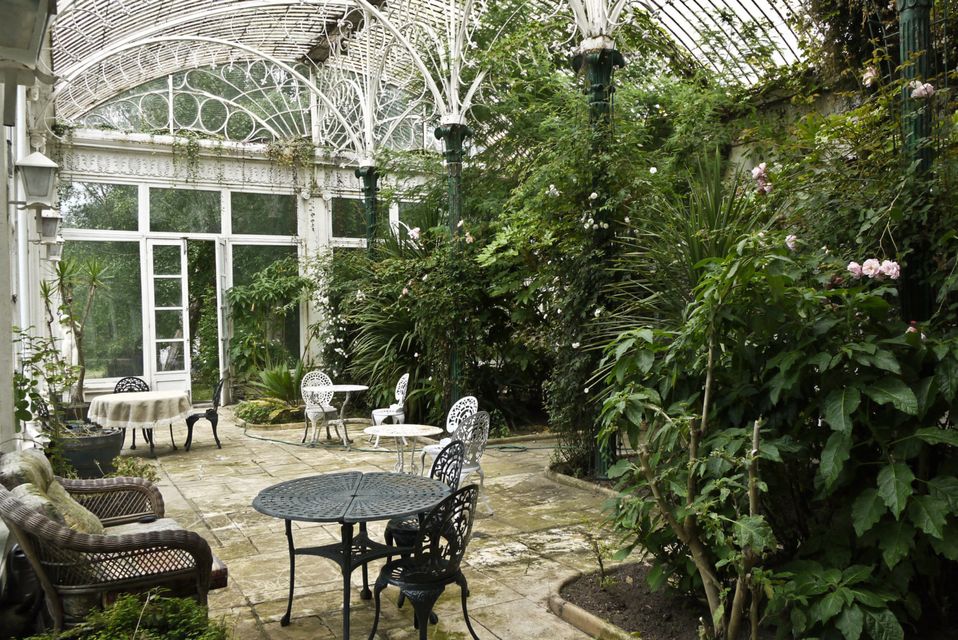


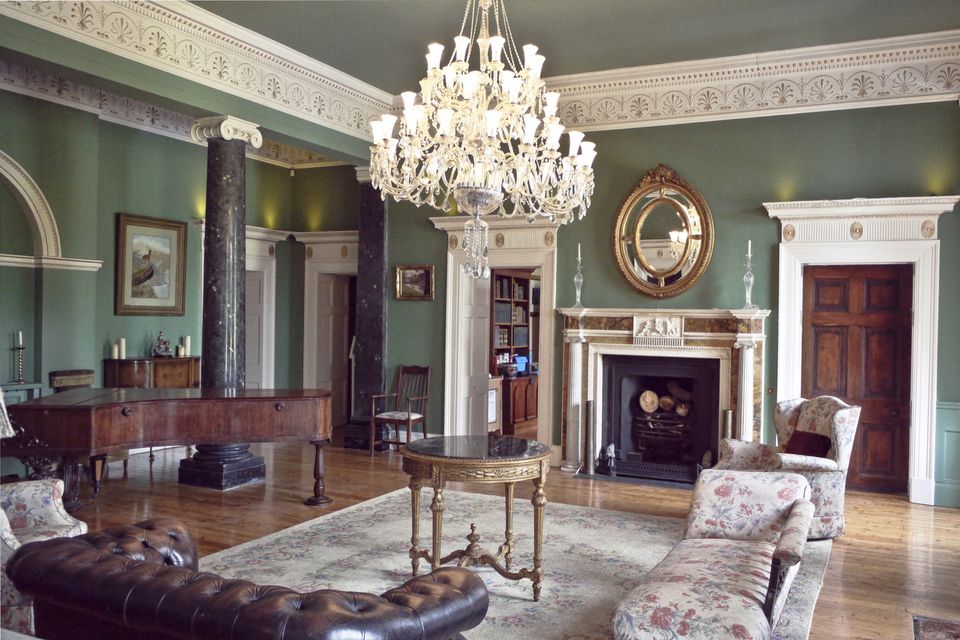


 Irish Historic Houses


