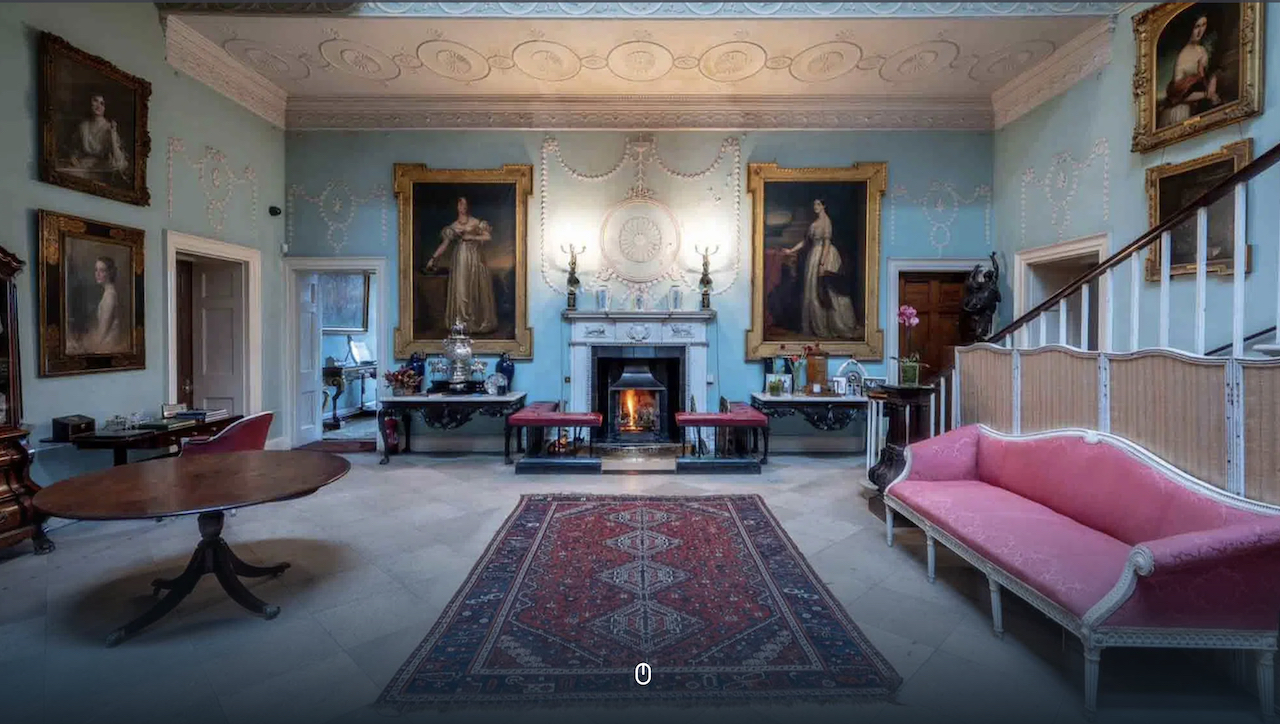
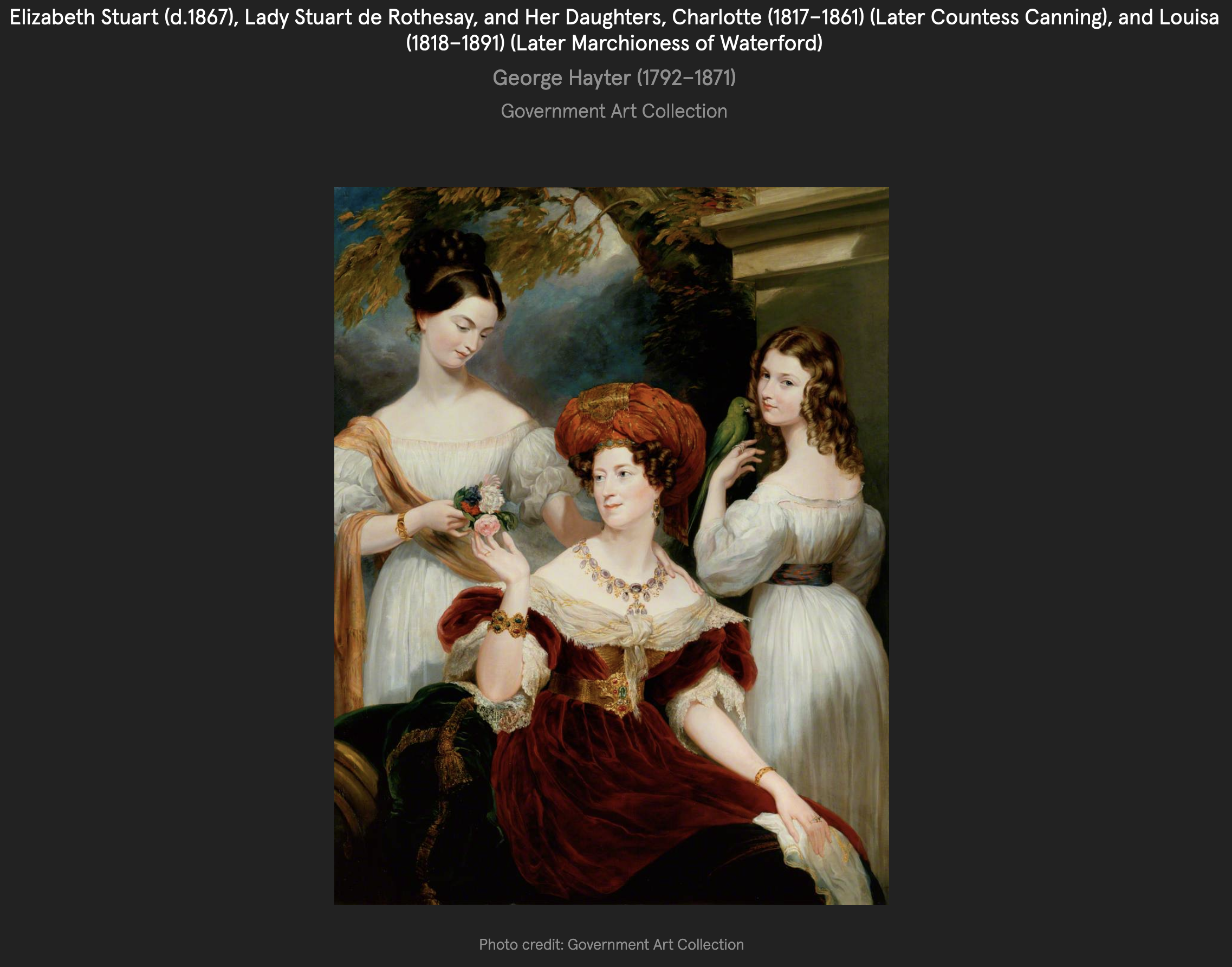
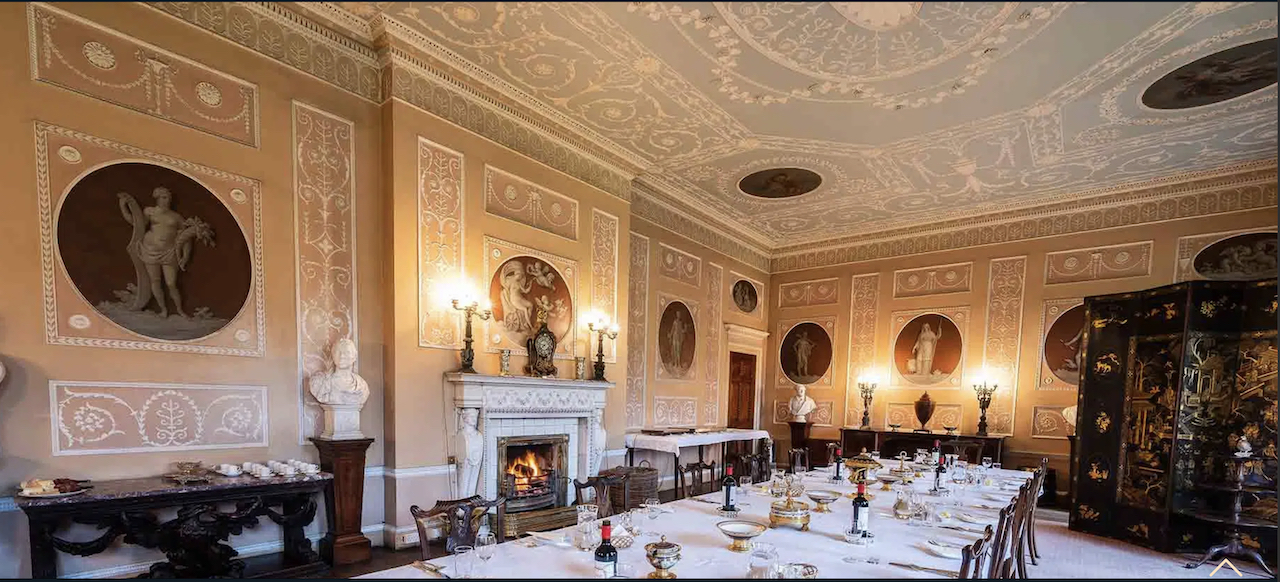
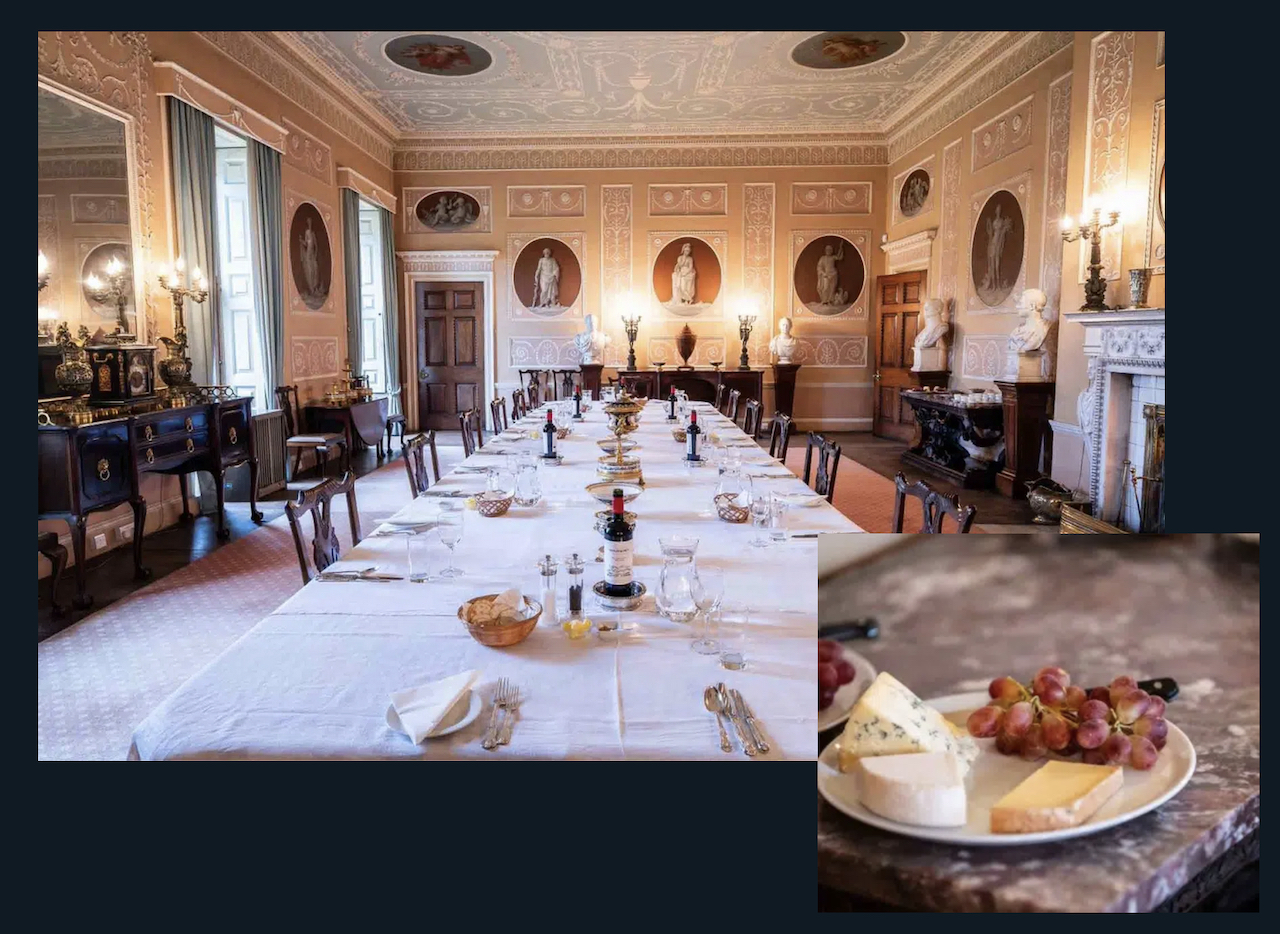
Places to visit and stay in Ulster: Counties Fermanagh, Monaghan and Tyrone

On the map above:

blue: places to visit that are not section 482

purple: section 482 properties

red: accommodation

yellow: less expensive accommodation for two

orange: “whole house rental” i.e. those properties that are only for large group accommodations or weddings, e.g. 10 or more people.

green: gardens to visit

grey: ruins

Fermanagh:

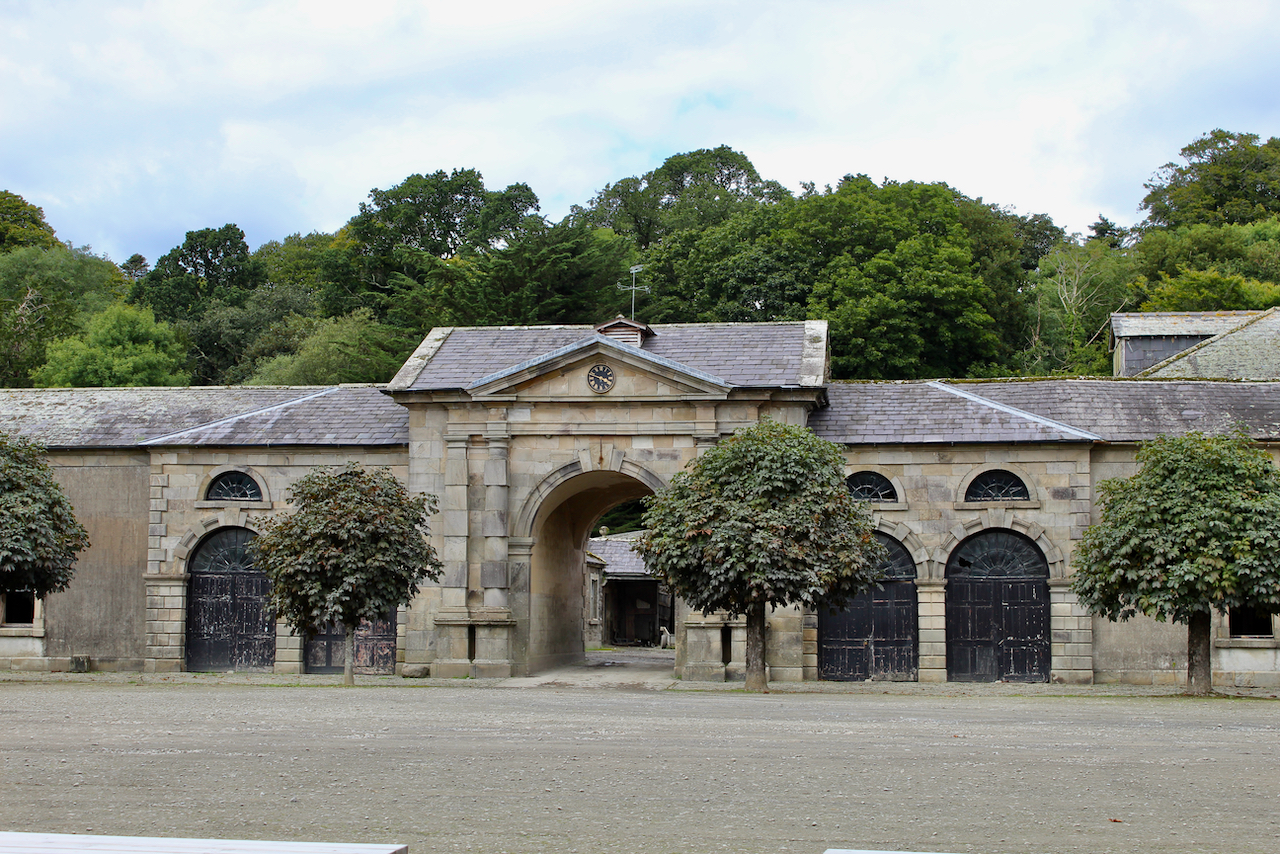
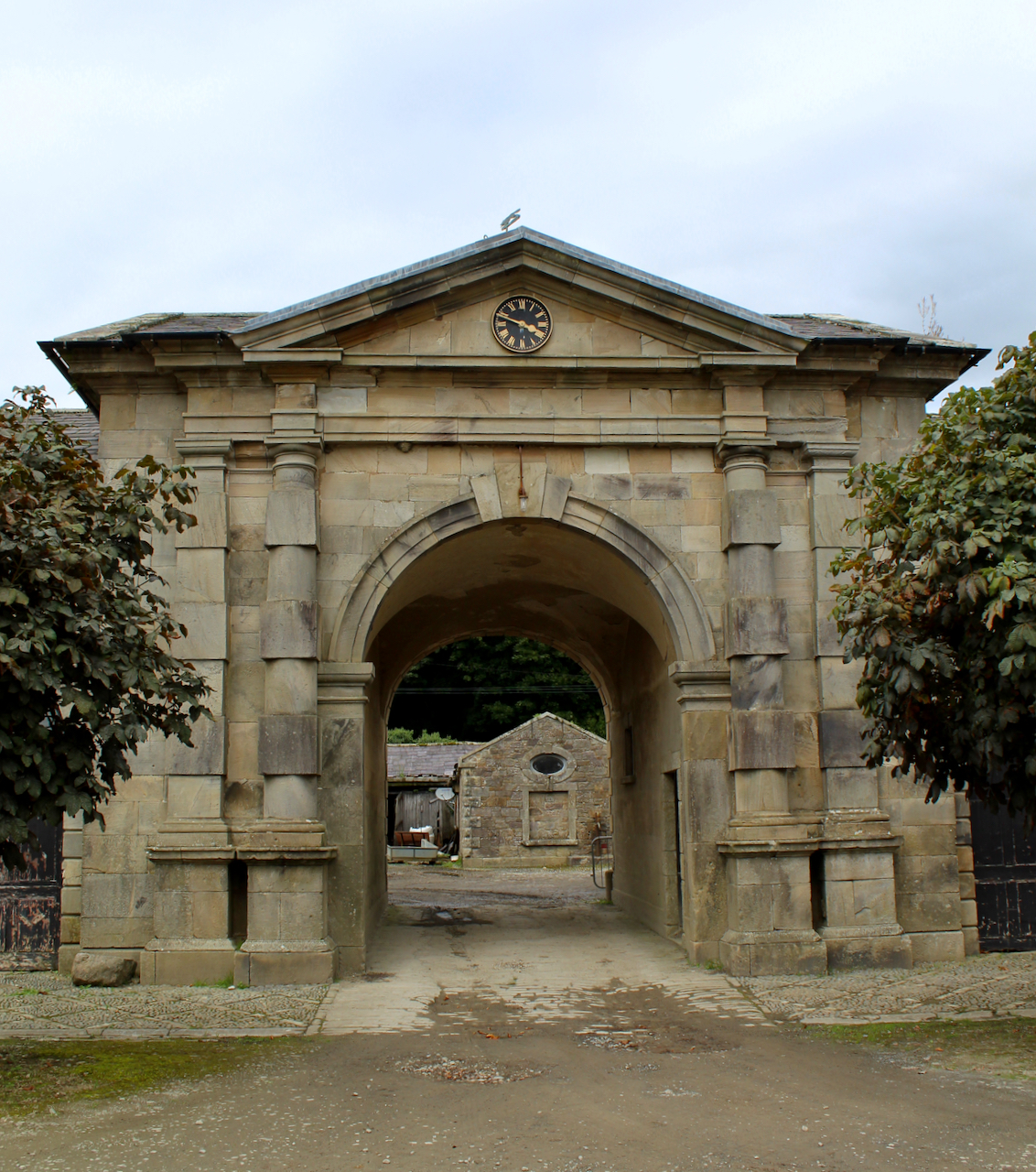
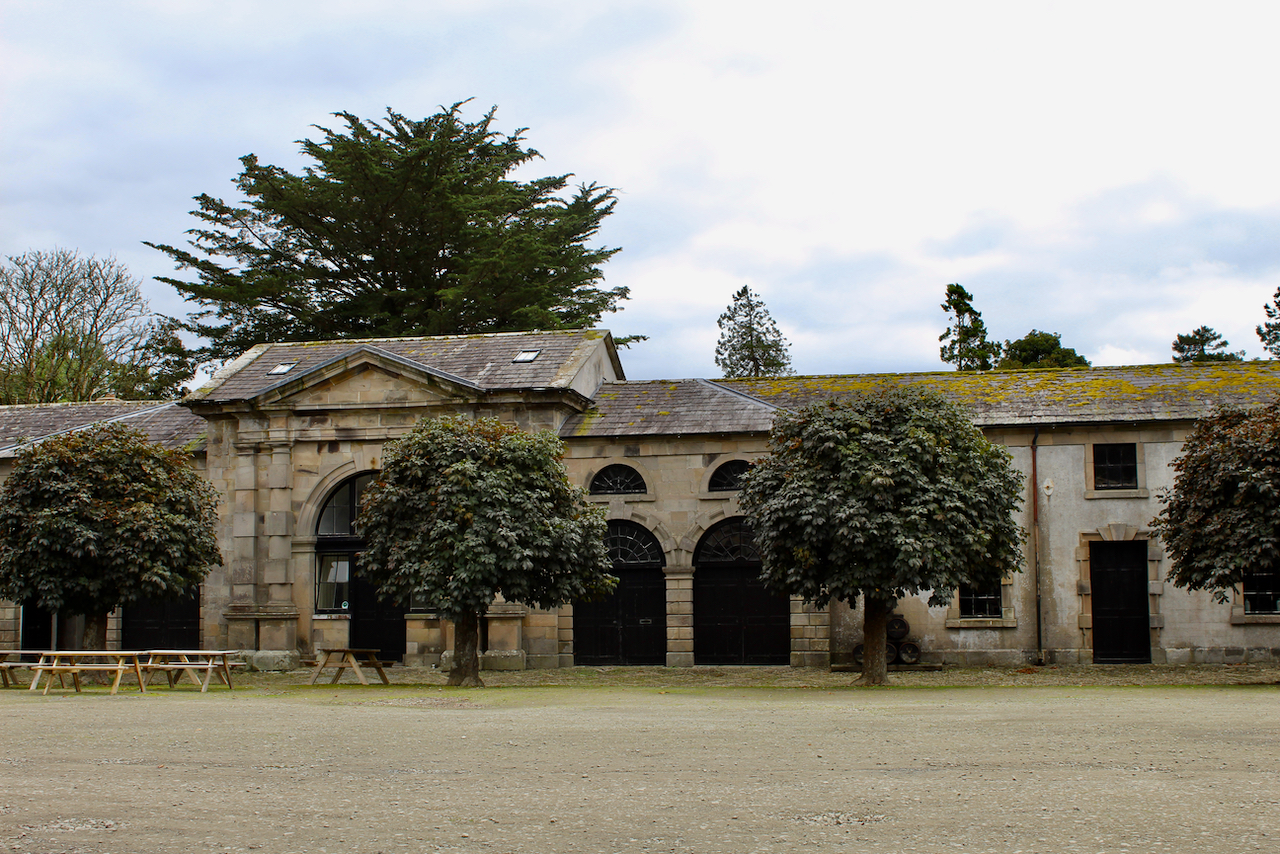
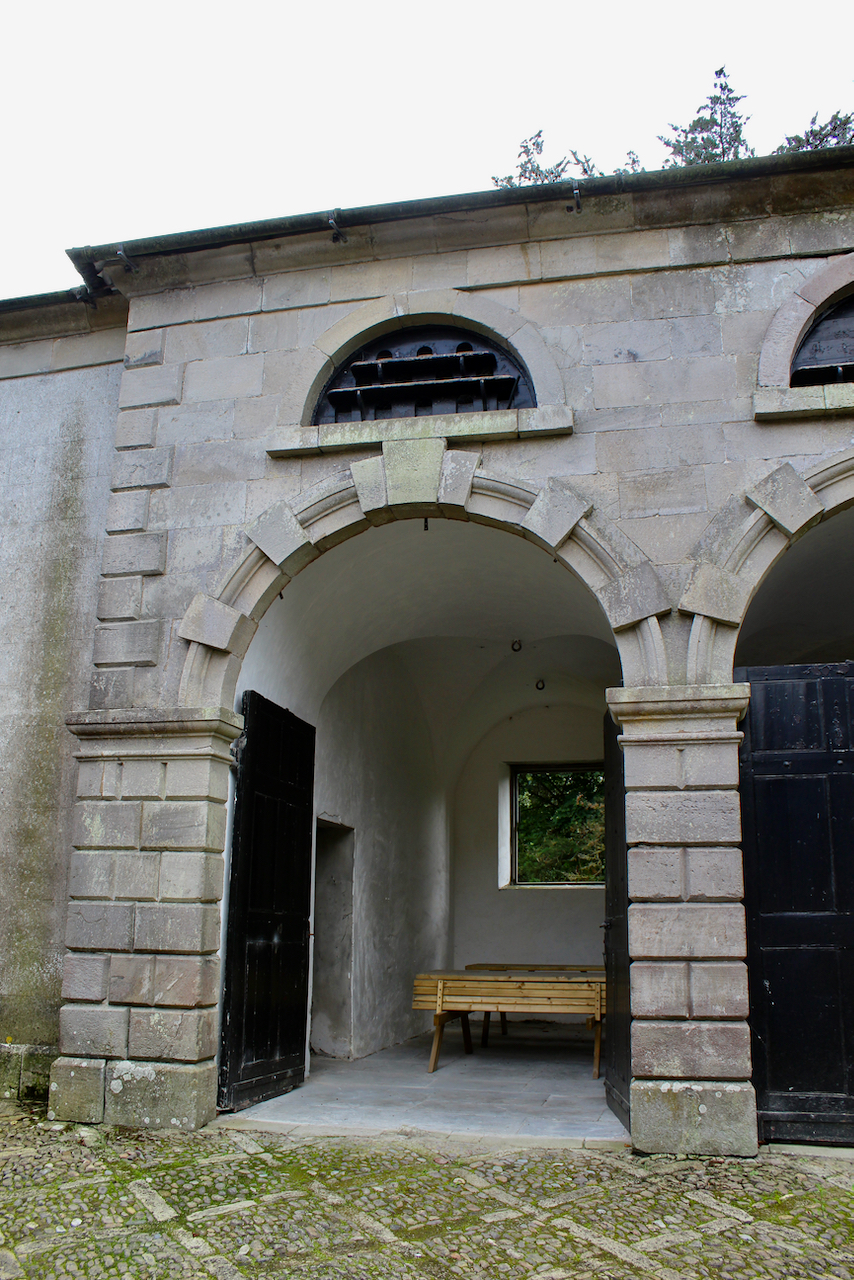
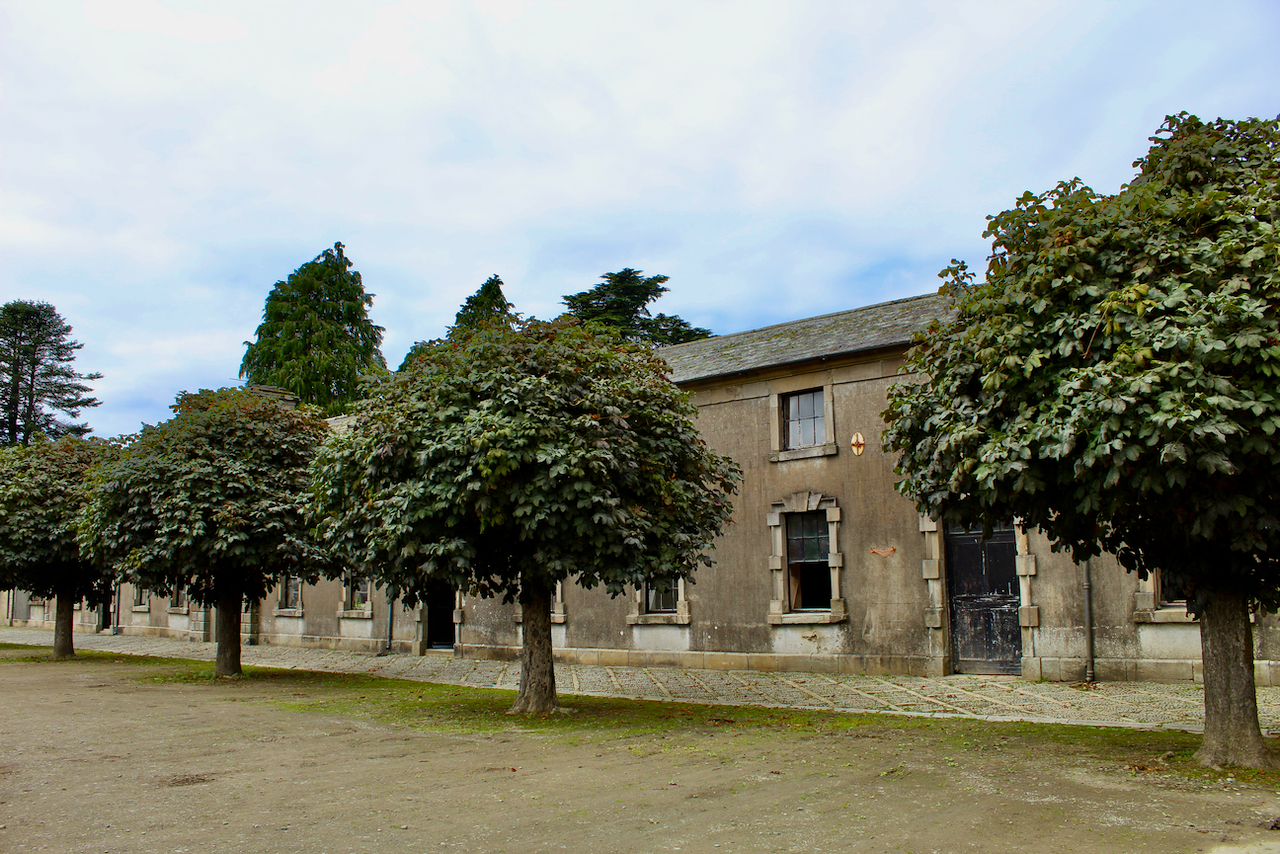
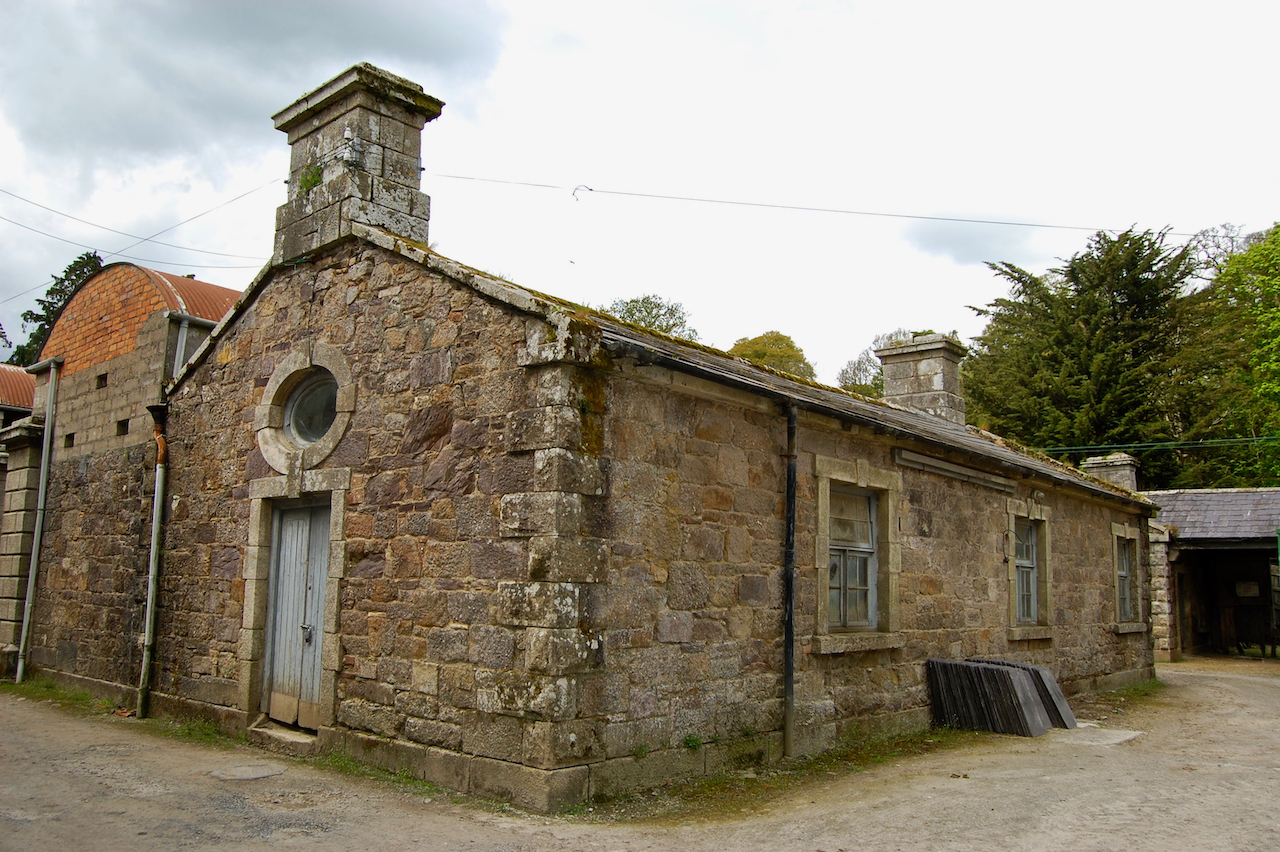
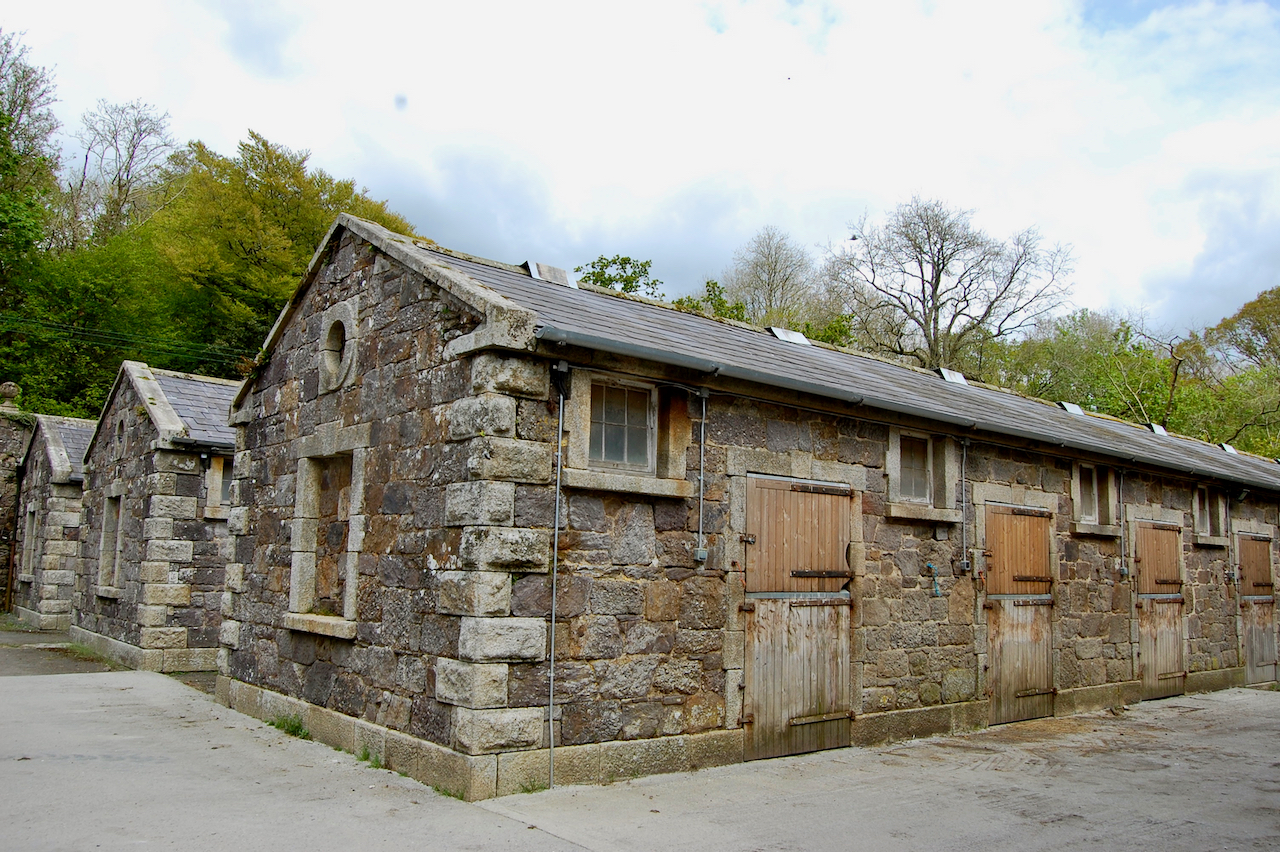
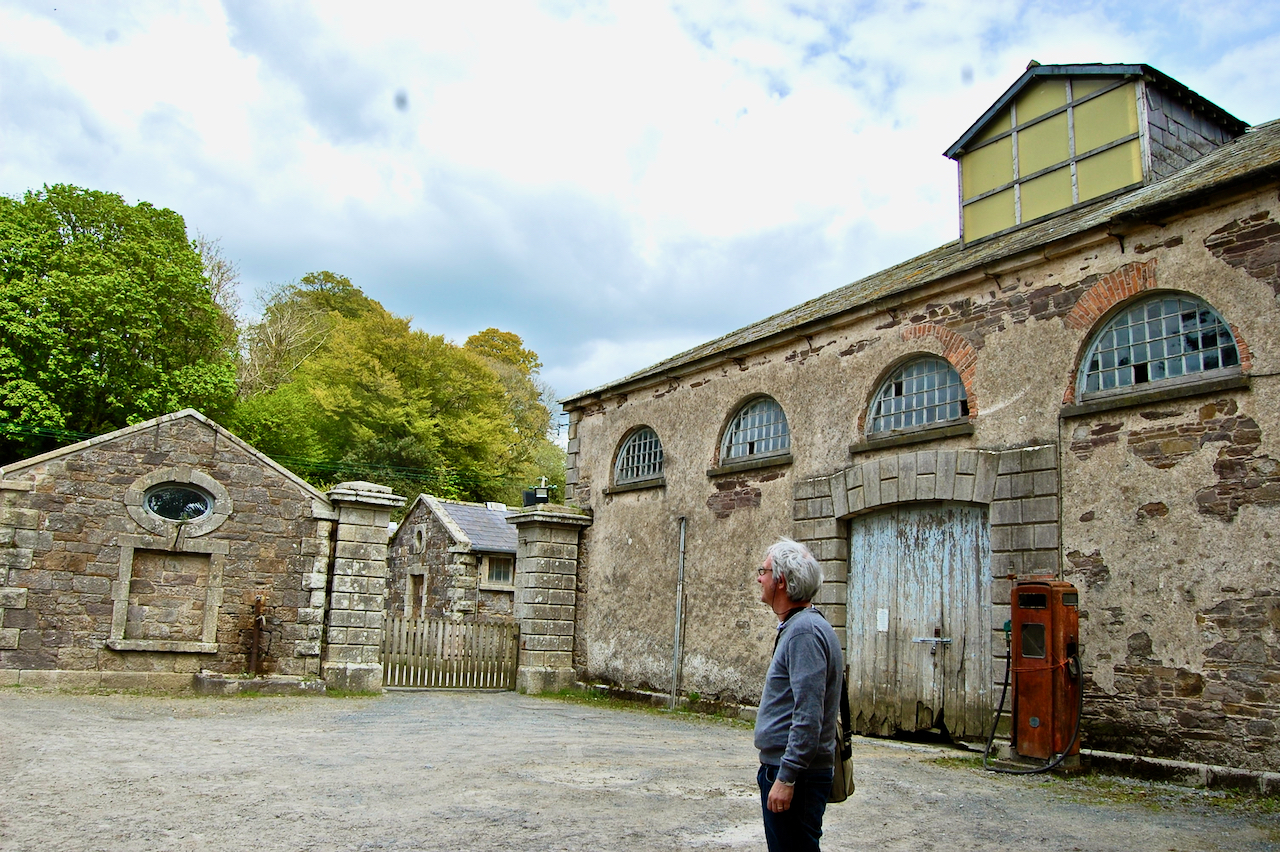
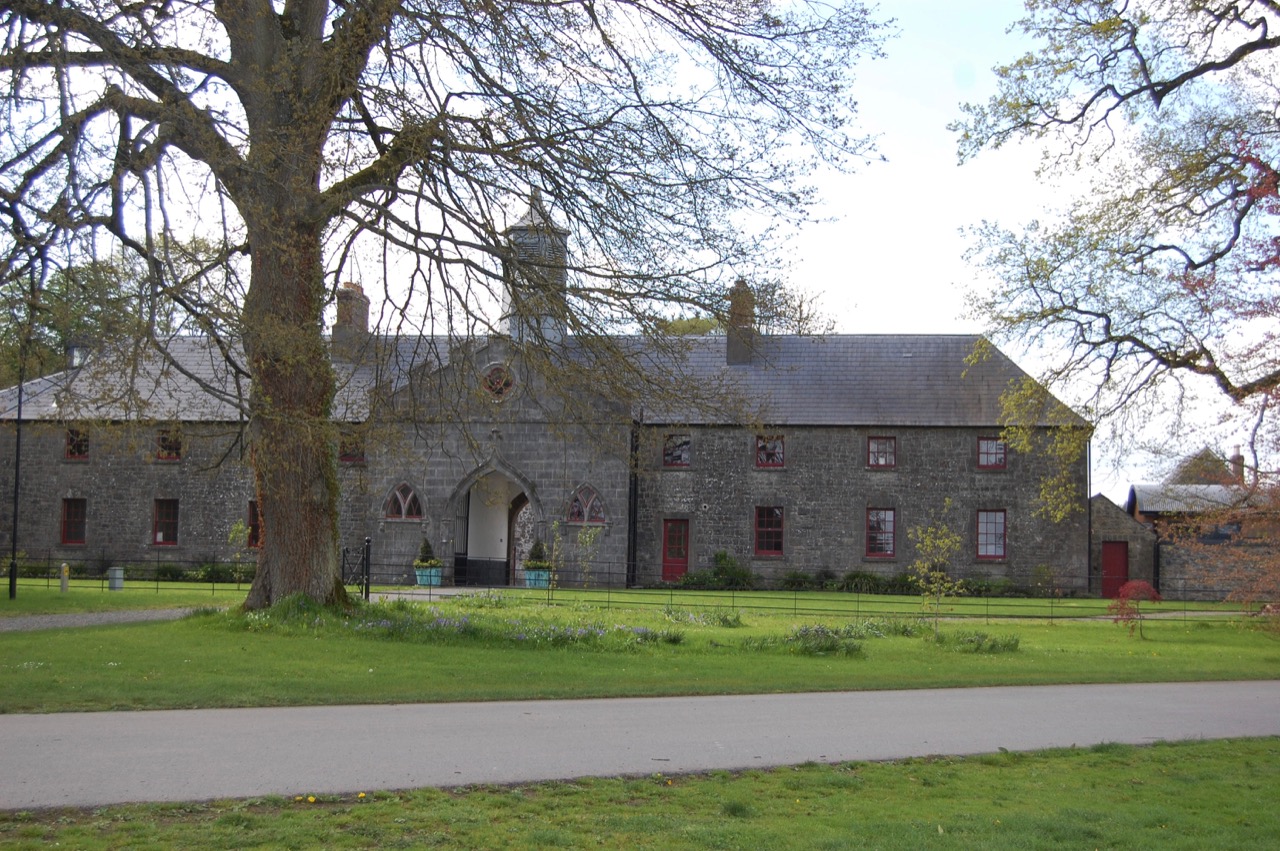
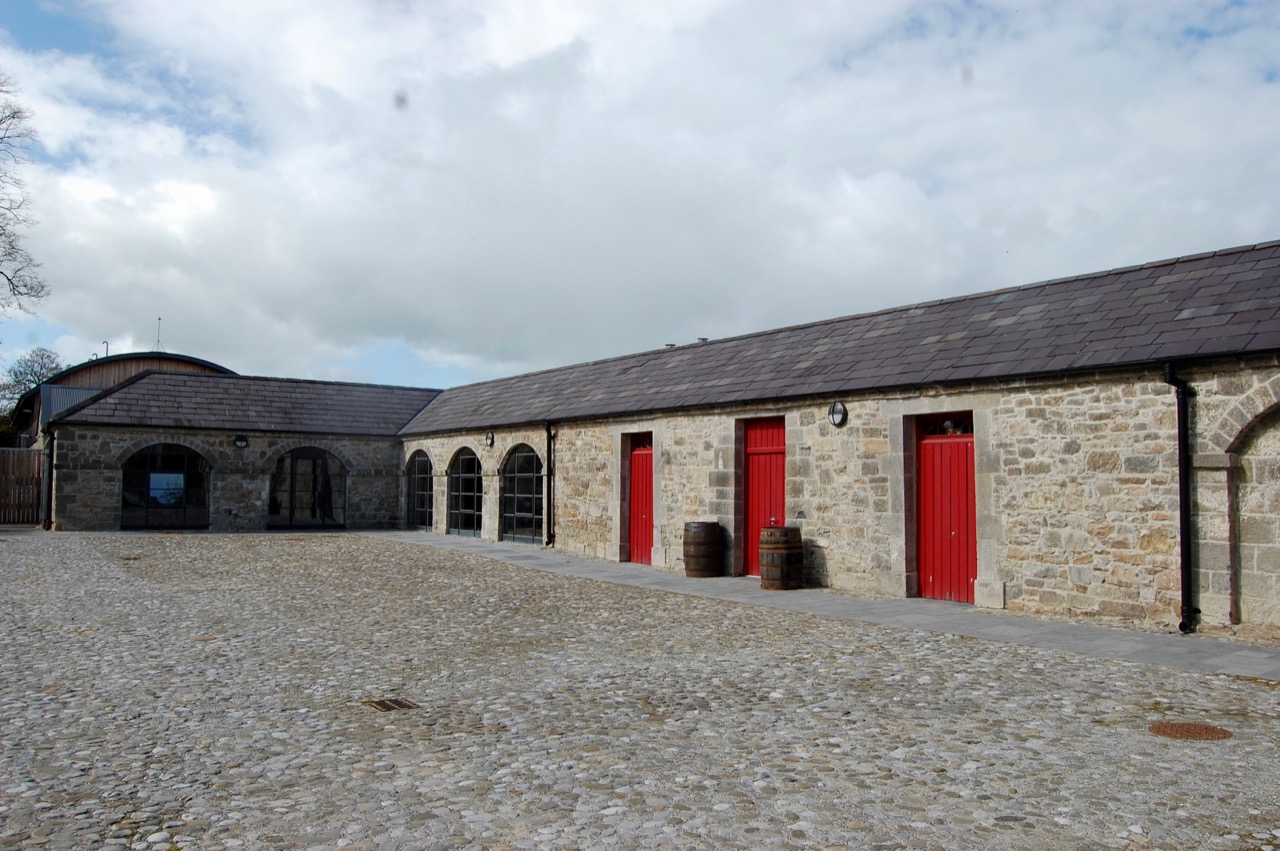
1. Castle Archdale Countryside Centre & War Museum – demolished in 1970 but the stables remain intact.

2. Castle Balfour (ruin), County Fermanagh

3. Castle Coole, County Fermanagh

4. Crom Estate, County Fermanagh

5. Enniskillen Castle, County Fermanagh

6. Florence Court, County Fermanagh

Places to stay, County Fermanagh

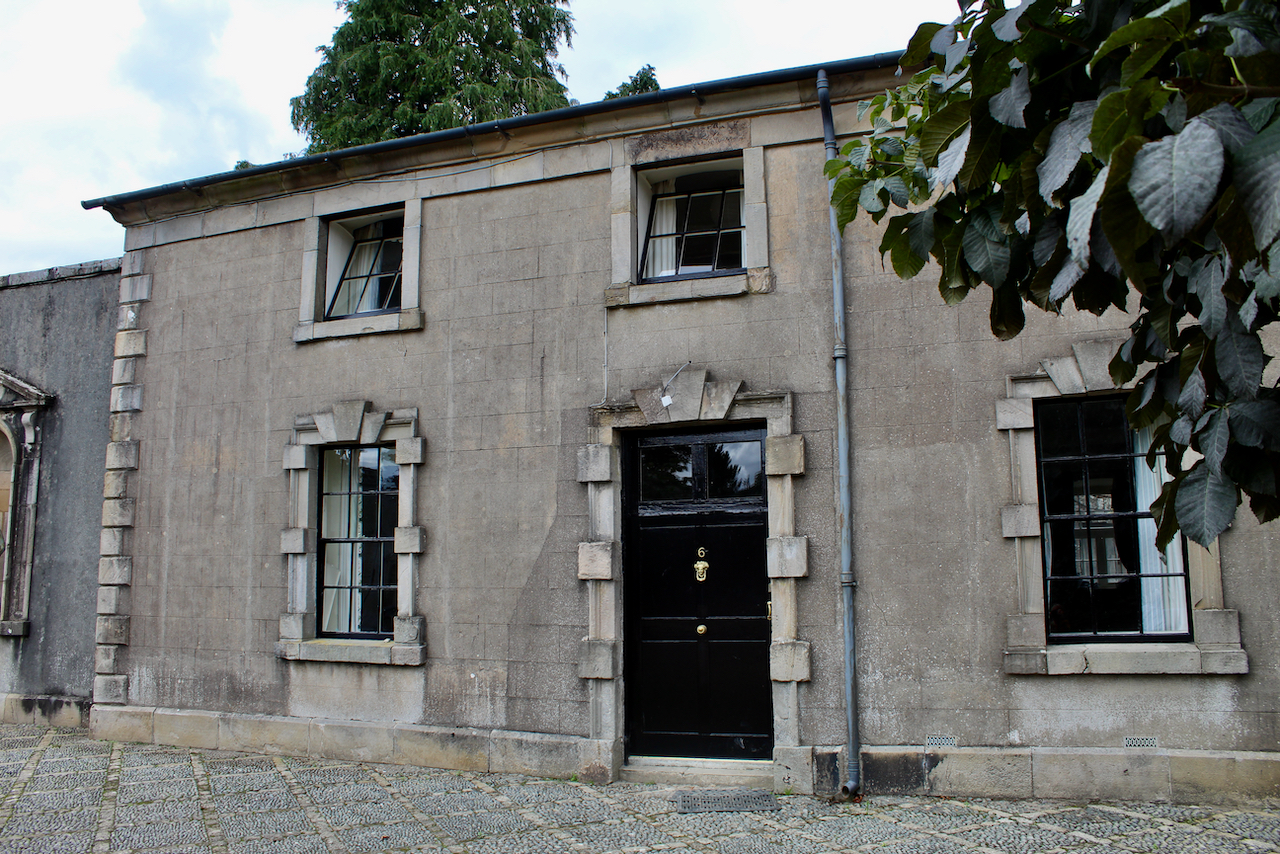
1. Belle Isle Courtyard cottages and castle accommodation, Lisbellaw, Enniskillen, County Fermanagh Northern Ireland self catering

3. Colebrooke gate lodge, Colebrooke Park, County Fermanagh and Triumphal Arch Lodge, Colebrook, County Fermanagh and Colebrook Cottages

4. West Wing and holiday cottages, Crom Castle, County Fermanagh

Adler’s cottage and Bluebell Cottage and Aspen Cottage

5. Erne View Cottage, Enniskillen, County Fermanagh

6. Florence Court, County Fermanagh – Butler’s Apartment

7. Manor House Hotel (formerly Killadeas Manor and before that, Rockfield), County Fermanagh

Whole House Rental, County Fermanagh:

1. Ashbrooke House, Brookeborough, Enniskillen Co Fermanagh BT94 4GX – whole house rental

2. Belle Isle Courtyard cottages and castle accommodation, Lisbellaw, Enniskillen, County Fermanagh Northern Ireland

3. Colebrook Park, County Fermanagh

County Monaghan:

1. Castle Leslie, Glaslough, Co. Monaghan – section 482

2. Hilton Park House, Clones, Co. Monaghan – section 482

3. Mullan Village and Mill, Mullan, Emyvale, Co. Monaghan – section 482

Places to stay, County Monaghan

1. Castle Leslie, Glaslough, Co. Monaghan – section 482

2. Hilton Park House, Clones, Co. Monaghan, and cottage – section 482, see above

Tyrone:

1. Ashfield Park, County Tyrone – gardens open to visitors 

2. Blessingbourne, Fivemiletown, County Tyrone – open for tours, self catering accommodation on the grounds 

3. Hill of The O’Neill and Ranfurly House Arts & Visitor Centre, County Tyrone

4. Killymoon Castle, County Tyrone

5. Lissan House, Drumgrass Road, Cookstown, County Tyrone, BT80 9SW.

6. Prehen, County Tyrone

Places to stay County Tyrone

1. An Creagan, Omagh, County Tyrone

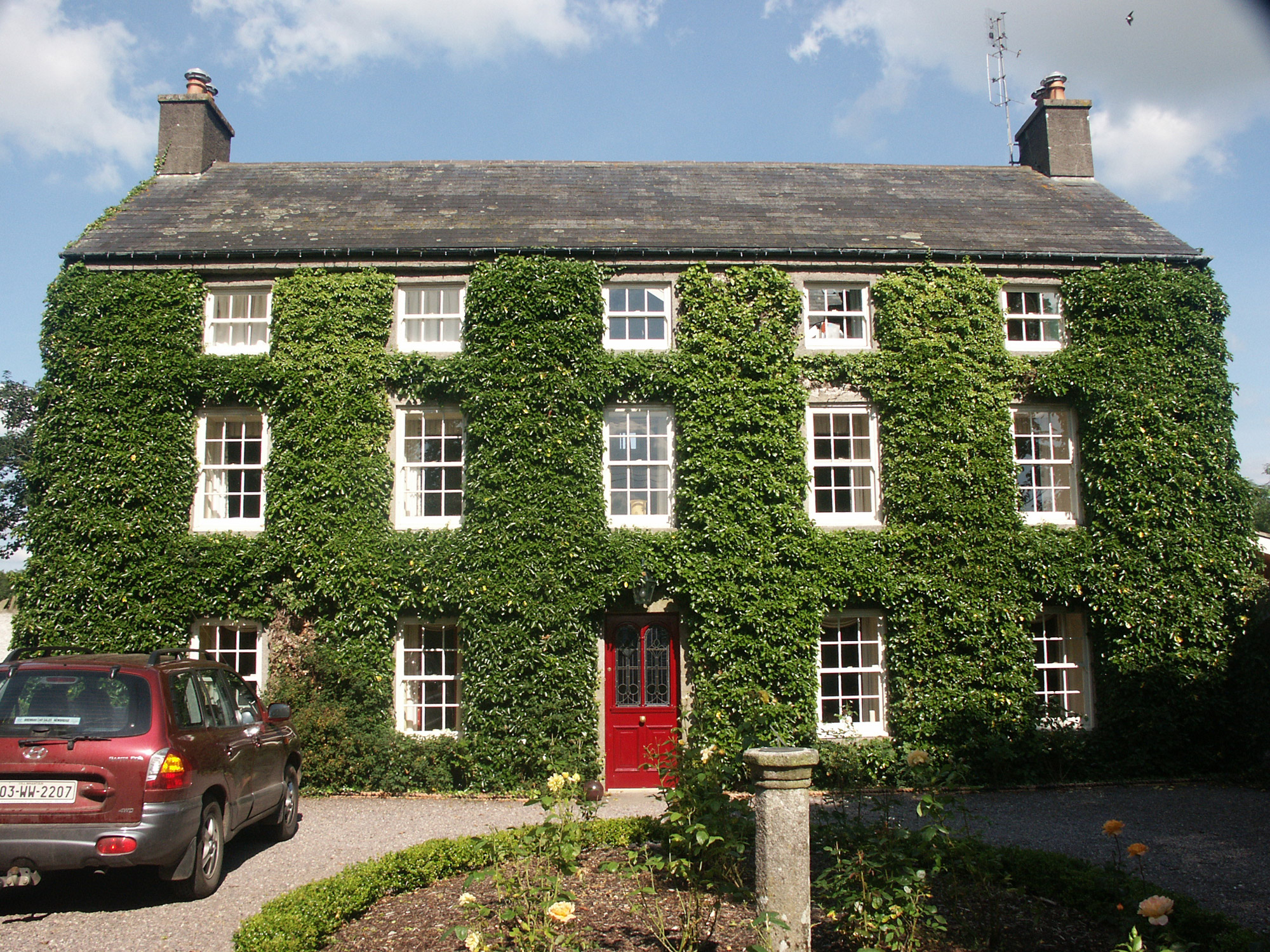
2. Ashbrook House, Aucnacloy, County Tyrone

3. Baronscourt Estate, Newtownstewart, Omagh, County Tyrone

4. Blessingbourne, County Tyrone

5. Cobblers Cottage Omagh, County Tyrone

6. Corick House Hotel, Clogher, County Tyrone €€

7. Kilcootry Barn, Fintona, County Tyrone

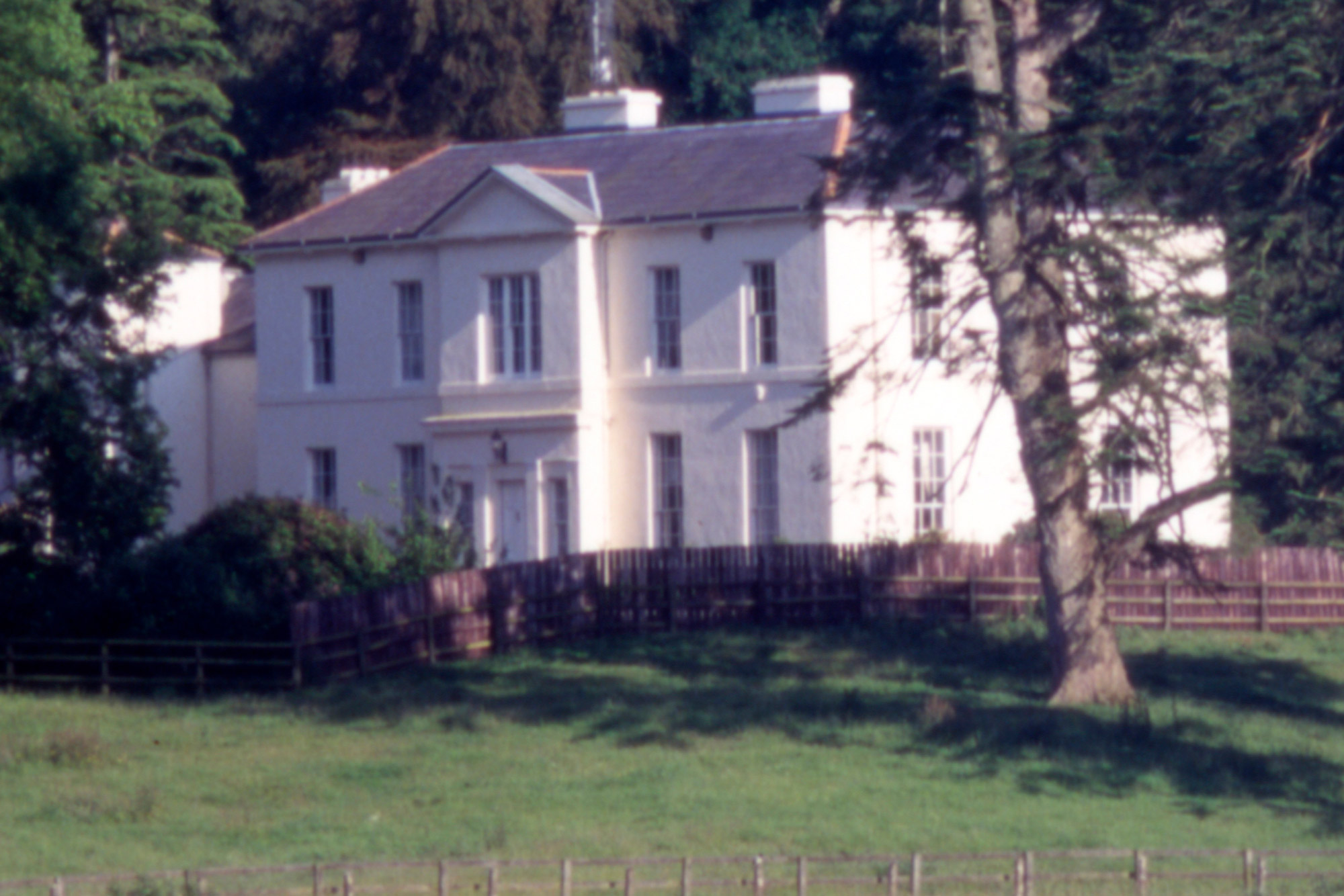
8. Killymoon Castle Lodge, 302 Killymoon Road, BT80 8ZA

9. The Lower House Rooms, Donaghmore, Dungannon, Co. Tyrone, BT70 3EZ

10. Spice Cottages, Dungannon, County Tyrone €€

donation

Help me to pay the entrance fee to one of the houses on this website. This site is created purely out of love for the subject and I receive no payment so any donation is appreciated!

€15.00

Fermanagh:

1. Castle Archdale Countryside Centre & War Museum – demolished in 1970 but the stables remain intact.

https://discovernorthernireland.com/things-to-do/castle-archdale-countryside-centre-and-war-museum-p675541

Mark Bence-Jones writes in his A Guide to Irish Country Houses (1988):

p. 61. (Archdale/IFR) “A noble house of 1773 on the shores of Lough Erne, built by Colonel Mervyn Archdall in 1773 to replace a “Plantation castle”  originally built by John Archdale 1615. 
 
Three storeys over a basement; a six bay entrance front with a two bay breakfront centre; and a tripartite doorway with Ionic pilasters, entablature and pediment, the latter breaking forwards on two Ionic columns to form a porch, which appears to have been a subsequent alteration. 
 

The side elevation was of three bays, the bottom storey having Venetian windows with Gothic astragals in its outer baysThe quoins were rusticated and bold; with a solid roof parapet. Derelict since 1959 and now ruinous.” [1]

Castle Archdale, County Fermanagh, from Discover Northern Ireland website.

2. Castle Balfour (ruin), County Fermanagh

https://discovernorthernireland.com/things-to-do/castle-balfour-p675501

Built in about 1618 by Sir James Balfour, a Scottish planter, the castle was in continuous occupation until the early 19th century. Open all year.

Timothy William Ferres tells us: “CASTLE BALFOUR formed the nucleus of the town [Lisnaskea]. It stands beside the parish church, in the graveyard. The Castle was built with local stone ca 1618 by Sir James Balfour. Sandstone was used for the quoins and dressings. The main block consists of a rectangular block, 78 feet by 24 feet, with a large wing projecting to the east and west, comprising two L-shaped units. The northern block has three storeys with attics. The kitchen is vaulted, with a fireplace and oven. Corbelled turrets and gun-slits are a feature
 
During the Irish Rebellion of 1641, Castle Balfour and the village were burnt but later reoccupied. In 1689, the Castle was again badly damaged by the Jacobite armies but was repaired after the Williamite victory at Limerick. About 1780, Castle Balfour was sold to the 1st Earl of Erne, and the Balfours subsequently left County Fermanagh. 
 
The last person to inhabit the Castle was James Haire (1737-1833), of Nutfield, who leased the Castle from Lord Erne. James Haire and his family ceased to occupy the castle after it was destroyed by an arson-based fire in 1803 (his mother, Phoebe, was killed in the rubble caused by the fire). 
 
Thereafter the Castle remained ruinous, until it was placed in state care by the 6th Earl of Erne in 1960. 
 
Major conservation work was carried out between 1966-68 and again during the late 1990s.” [2]

3. Castle Coole, County Fermanagh

https://www.nationaltrust.org.uk/castle-coole
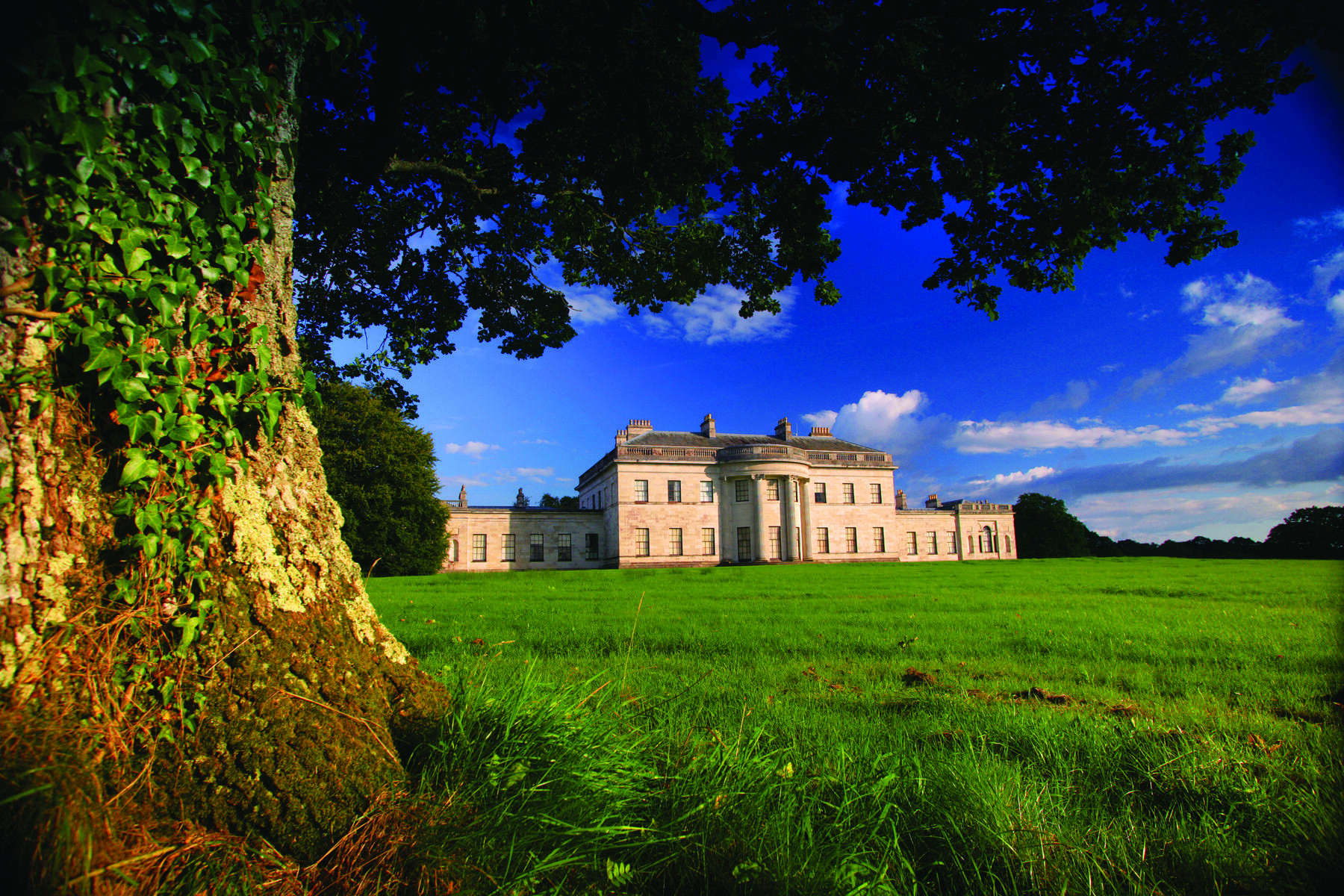
Castle Coole (pronounced cool) is a late-eighteenth-century neo-classical mansion situated in Enniskillen, County Fermanagh, Northern Ireland. Set in a 1200 acre (5 km²) wooded estate, Castle Coole was constructed between 1789 and 1798 as the summer retreat of Armar Lowry-Corry, the 1st Earl of Belmore. photo by Brian Morrison, Tourism Northern Ireland 2008. [3]
Castle Coole, County Fermanagh, March 2022, built to impress by the first Earl of Belmore by Amar Lowry-Corry, 1st Earl Belmore (1740-1802) and furnished largely by Somerset Lowry Corry, 2nd Earl (1774-1841).  Photograph © Jennifer Winder-Baggot, www.irishhistorichouses.com

The website tells us:

Castle Coole is one of the greatest neo-classical country houses in Ireland. Home to the Earls of Belmore, it was commissioned and built to impress by the first Earl of Belmore by Amar Lowry Corry, 1st Earl Belmore (1740-1802) and furnished largely by Somerset Lowry Corry, 2nd Earl (1774-1841).” 

See my entry https://irishhistorichouses.com/2024/03/21/castle-coole-county-fermanagh-a-national-trust-property/

4. Crom Estate, County Fermanagh
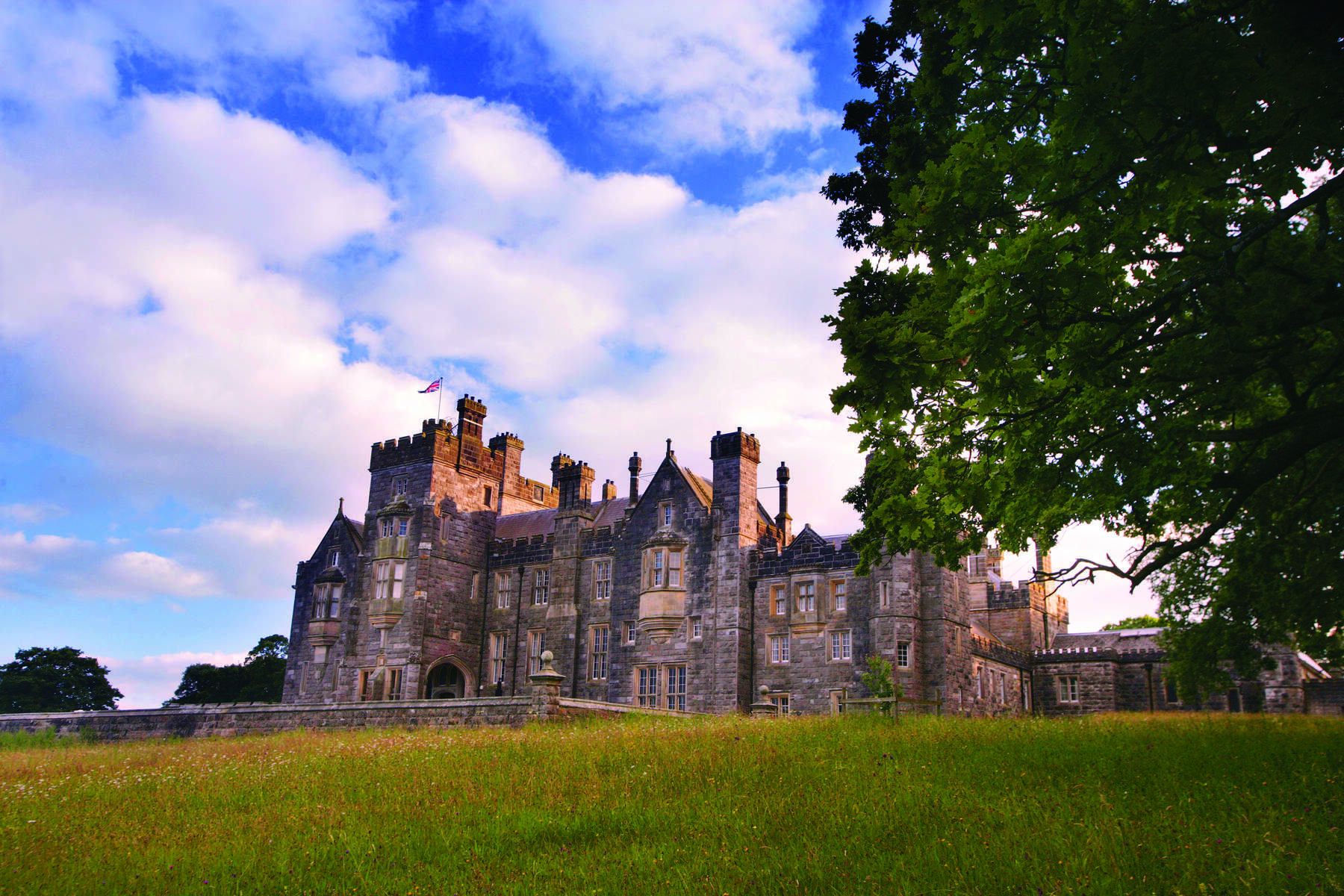
Crom Castle, Fermanagh Courtesy of Tourism Northern Ireland, by Brian Morrison, 2008 (see [3])

https://discovernorthernireland.com/things-to-do/crom-estate-p675551 and https://cromcastle.com

The castle is still in private hands but the grounds are open to the public.

Mark Bence-Jones writes in his A Guide to Irish Country Houses (1988):

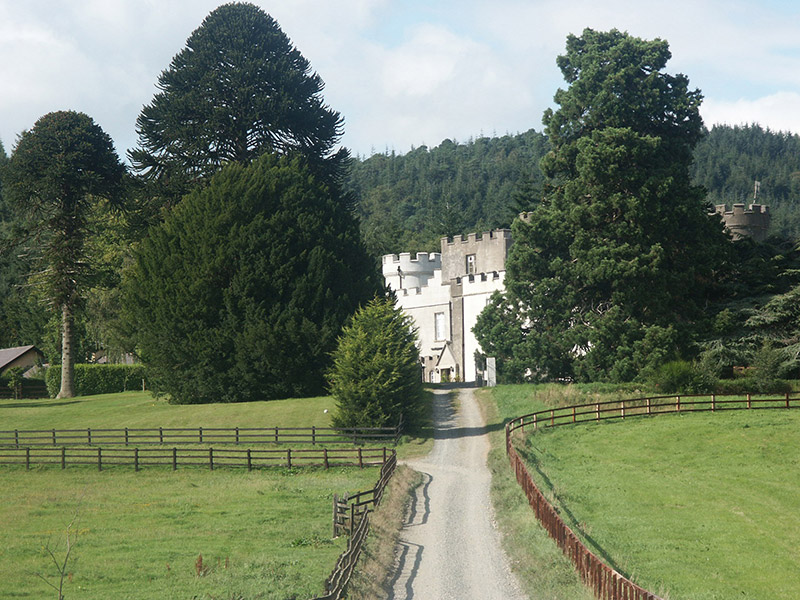
p. 95. “(Crichton, Erne, E/PB) A large castellated mansion combining Baronial and Tudor-Revival elements, by the side of one of the many inlets of Upper Lough Erne, built 1829 to the design of Edward Blore. The entrance front has a gabled projection with a corbelled oriel at each end, but they are not entirely similar; while the tall, battlemented entrance tower, which incorporates a porte-cochere, is not central but to one side, against the left hand gable. The adjoining garden front is symmetrical, dominated by a very tall central tower with slender octagonal turrets, inspired by various Tudor gatehouse towers in England, but without a doorway. On either side of it is a gable and oriel. In the park are the ruins of the earlier Crom Castle, a Plantation castle of 1611, destroyed by fire in 1764.” 

5. Enniskillen Castle, County Fermanagh

https://discovernorthernireland.com/things-to-do/enniskillen-castle-p742361
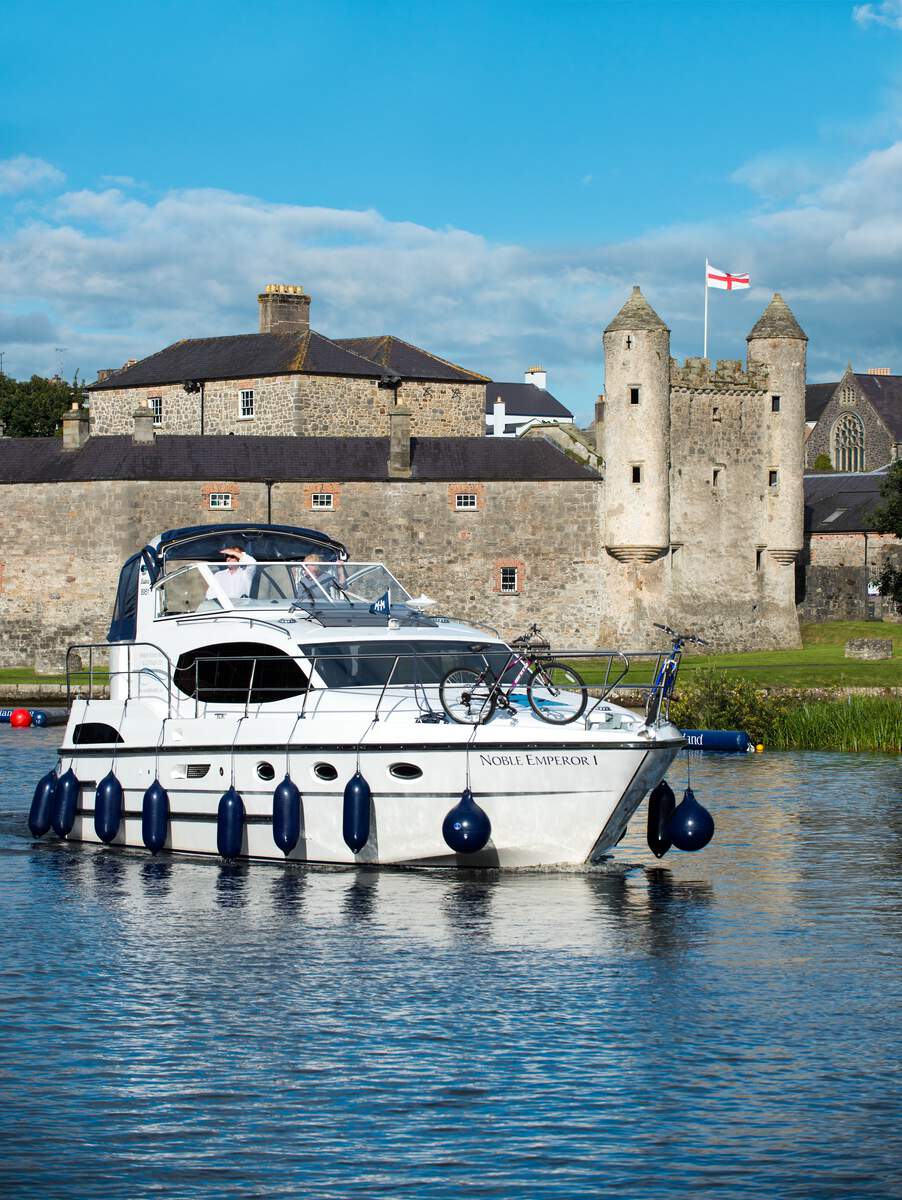
Enniskillen Castle by Gardiner Mitchell 2015 for Tourism Ireland, Ireland’s Content Pool (see [3]).

The website tells us: “Enniskillen Castle, situated beside the River Erne in County Fermanagh, was built almost 600 years ago by Gaelic Maguires.

Guarding one of the few passes into Ulster, it was strategically important throughout its history. In the 17th century it became an English garrison fort and later served as part of a military barracks. This historic site houses two museums, Fermanagh County Museum and The Inniskillings Museum.

Mark Bence-Jones writes in his A Guide to Irish Country Houses (1988):

p. 121. (Cole, Enniskillen, E/PB) A large and impressive fortress at one side of the island in the River Erne on which the town of Enniskillen is built; with walls enclosing a ward of courtyard, an inner keep and a tall and frowning water gate with two conical-roofed bartizans. Until C18 the castle stood on a small island of its own, separated from the rest of the island by a ditch of water crossed by a draw-bridge. The castle was originally built C15 by the Maguires; it was granted 1607 to Captain William Cole, who rebuilt the keep as a house for himself, and renovated all the fortifications; the water gate probably dates from his time. The Coles continued to live on and off at the castle until 1739; afterwards, they established themselves permanently at Florence Court. The castle then became barracks, and the keep was rebuilt once again. The buildings remain in good repair.” 

Enniskillen Castle by Chris Hill 2018 for Tourism Ireland, Ireland’s Content Pool (see [3]).

6. Florence Court, County Fermanagh

Florence Court, formerly the home of the Cole family, Earls of Enniskillen, is surrounded by a large area of parkland, garden and woodland, with beautiful views to Benaughlin and the Cuilcagh Mountains. photo Courtesy of Tourism Northern Ireland by Brian Morrison 2008 (see [3]).

https://www.nationaltrust.org.uk/florence-court

The website tells us:

Florence Court, March 2022. Photograph © Jennifer Winder-Baggot, www.irishhistorichouses.com

See my entry https://irishhistorichouses.com/2024/05/16/florence-court-county-fermanagh-a-national-trust-property/

Places to stay, County Fermanagh

1. Belle Isle Courtyard cottages and castle accommodation, Lisbellaw, Enniskillen, County Fermanagh Northern Ireland(self-catering)

Nestling close to the water’s edge and set within a landscape of lakes and islands of gently rolling hills and fragrantwoods, Belle Isle Castle provides self-catering or fully catered accommodation. Situated at the heart of Belle Isle Estate and dating from the early 17th century the castle has been extensively yet sensitively refurbished, ensuring that a full range of modern facilities blends seamlessly with original period grandeur. Photo for Tourism Ireland, 2008. (see [3])

https://belle-isle.com

The website tells us:

Belle Isle provides an outstanding mix of natural beauty and authentic heritage on a private 400 acre estate designated a Special Area of Conservation with a range of accommodation options including castle rental, luxury cottages and self-catering apartments. Whether you are looking to host your wedding, enjoy a private event with friends and family or just have a relaxing weekend with your pets, we have something for everyone. Enjoy a Summer Getaway to the Belle Isle Estate with one of our great special offers.

Belle Isle has a rich history dating back to before the 15th century as the place where the Annals of Ulster were written. Belle Isle Castle was built in the early 17th century as the home to many generations of nobles and has been hosting events since as early as 1760. In 1991, the castle was fully refurbished to open its doors to more visitors. Belle Isle Estate stretches over 470-acres across Lisbellaw, County Fermanagh, Northern Ireland. It is a private estate with access to its estate grounds and trails open solely its visitors. If you are looking for the ultimate experience in luxury, Belle Isle Estate is one of the best hotels Fermanagh can offer.

Mark Bence-Jones writes in his A Guide to Irish Country Houses (1988):

p. 38. “(Gore, Bt/PB; Porter, sub Baird/IFR) A house beautifully situated on an island in Upper Lough Erne; the seat of a distinguished C18 soldier, Sir Ralph Gore, 6th Bt, 1st and last Earl of Ross and Viscount Bellisle, who was C-in-C in Ireland 1788. Bought early in C19 by Rev. J.G. Porter.

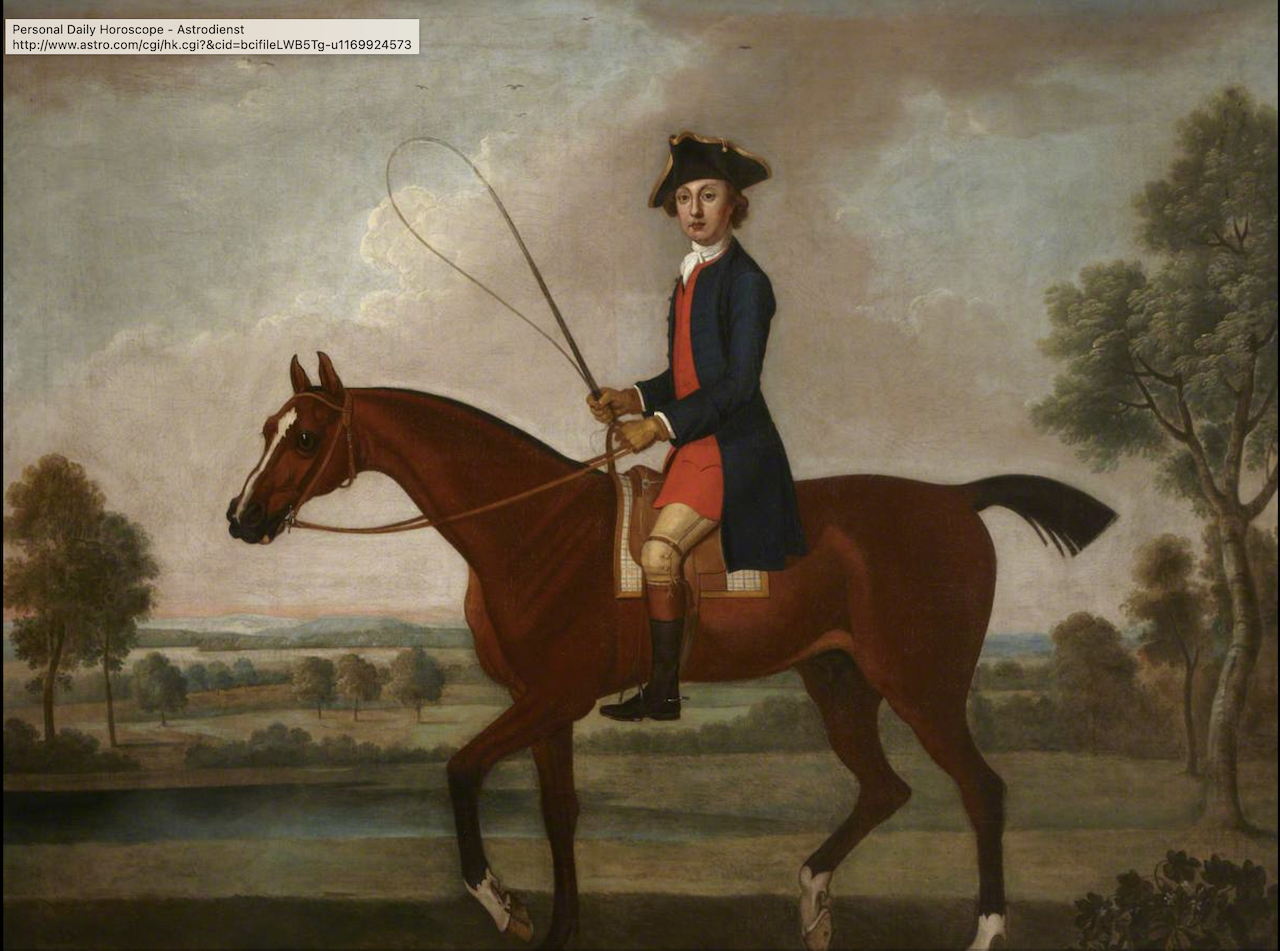
Ralph Gore (1725–1802), 6th Bt, Later 1st Earl of Rosse, on His Bay Hunt, attriibuted to Thomas Spencer, courtesy of National Trust.

The present house appears to incorporate a two storey C18 range with a three sided bow at one end, to which a range of 1820-30 was added at right angles, with a staircase hall, top-lit by an octangular lantern, in the re-entrant. The house was re-modelled post 1880 in the plain English Tudor manor house style made popular by Norman Shaw and his disciples; producing a gable entrance front with mullioned windows, a projecting porch and a tall, church-like battlemented tower at the corner of th 1820-30 range. The latter range, which is the garden front facing the lough, remains unaltered apart from having Victorian plate-glass windows; at one end is the end bow of C18 range, with Georgian astragals. Inside the house, arches were opened up between the staircase hall and the rooms at either end of it, to make a much larger hall; the staircase hall was also widened at the expense of the rooms in 1820-30 range, the old wall being replaced by a massive oak beam. An oak staircase with barleysugar balusters replaced the original stairs; the walls were panelled in oak, or decorated with half-timbering. The octangular ceiling lantern, however, was left undisturbed. The drawing room, in 1820-30 range, was redecorated, having been reduced in width, and given a chimneypiece of old oak carving, possibly of more than one period and nationality. The room extending into the bow of C18 range, which is now the drawing room, was given a stone Tudor fireplace; but it still keeps its original doors with shouldered C18 architraves. In 1907 the entrance front was prolonged by a wing in Tudor style containing a long and lofty gallery, with a timbered roof, an elaborate Tudor fireplace and overmantel and a minstrels’ gallery, the balustrade of which has slender turned uprights and would appear to be late C17 or early C18 woodwork brought from elsewhere. At this end of the entrance front stands a pedimented and gable-ended office wing which would appear to date from quite early C18. After the death of N.H.A. Porter 1973, Belle Isle was inherited by his niece, Miss Olivia Baird.” 
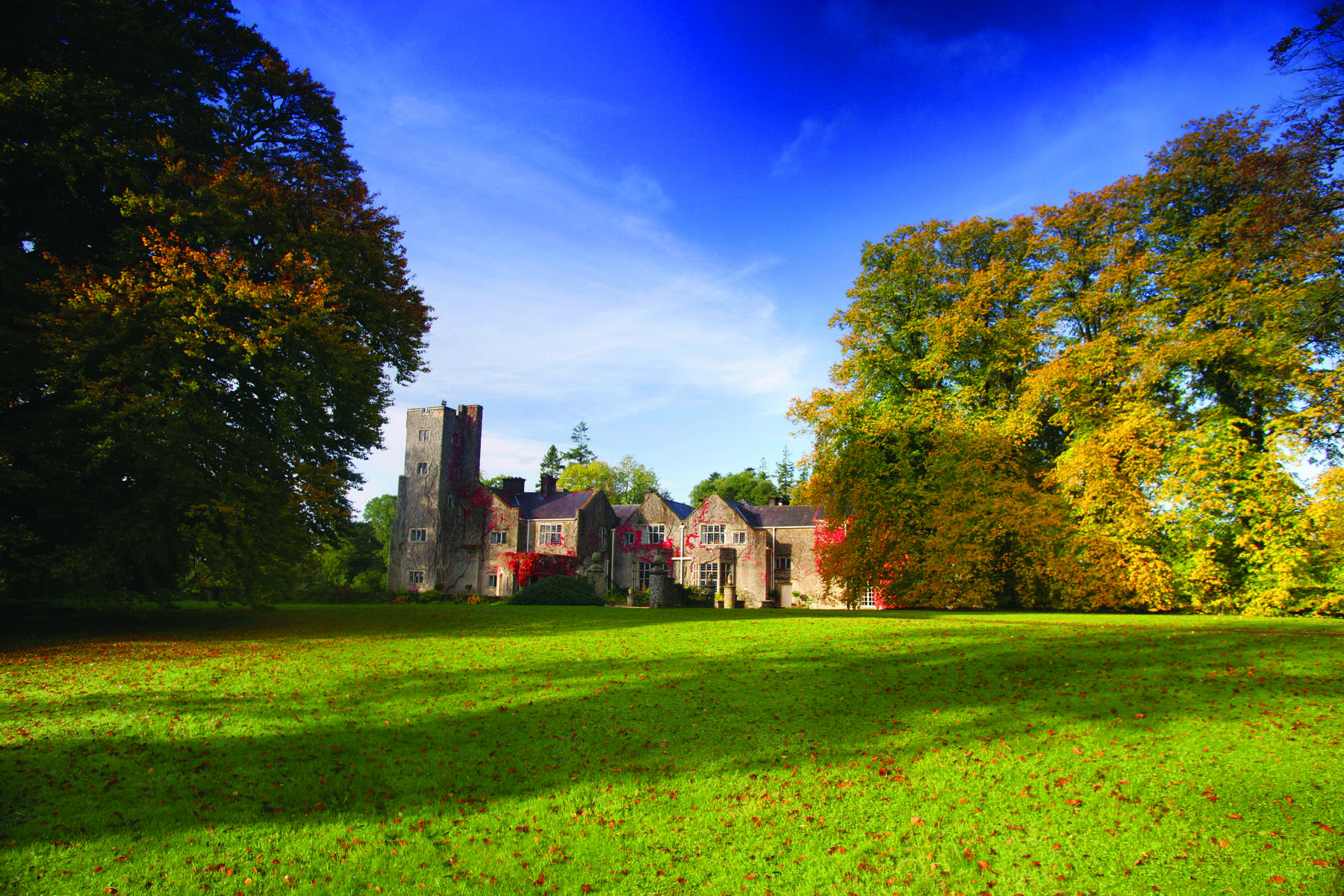
Belle Isle Estate, photo by Brian Morrison 2008 for Tourism Ireland. (see [3])

The website tells us:

Castle Irvine, also known as Necarne Castle, lies south of the town of Irvinestown, in County Fermanagh, in Northern Ireland.

The core of Necarne Castle is a castle which was built in the 17th century by Gerard Lowther as part of the plantation of Ulster. In 1629, the lands were leased to Christopher Irvine and the Irvines remained there until 1922.

In the 1830’s the castle and park were rebuild and a Victorian style wing was built against its south west facade amongst other things.

In 1925, Captain Richard Outram Hermon, from Sussex, bought the castle. In 1927 an extensive restoration of the castle and its gardens was started while Captain Hermon and his new wife went off on a world cruise. The estate was turned into a haven for shooting parties and Lord Mountbatten and Prince Bernhard of the Netherlands were once guests at Necarne Castle.

In 1941 Necarne Castle was requisitioned by the United States Navy. It originally had 200 beds but was soon enlarged to a 500 bed institution and released to the American Army. The castle, then the 28th Station Hospital, cared for recuperating American soldiers and RAF personnel. After the war the castle was never inhabited again and fell to ruin.

Fermanagh District Council bought the Necarne Castle estate in 1981; and in 1988 The NI Department of Agriculture leased the estate on a 25-year basis from them. In the last decades the outbuildings of the castle have been used as a student facility for the Enniskillen Agricultural College as the Necarne Castle Equine College. 

Fermangh & Omagh District Council began the search for a new operator for the estate in 2014 following the Agricultural College relocating their Equine Courses to Enniskillen.

Gardrum Holdings Ltd agreed a lease of the estate from 2020.

The park around Necarne Castle can freely be visited during daytime. The ruin of the castle itself is boarded up, so its interior can not be visited.”

2. Colebrooke gate lodge, Colebrooke Park, County Fermanagh – accommodation

https://www.irishlandmark.com/propertytag/cottages-and-houses/?gclid=Cj0KCQiApL2QBhC8ARIsAGMm-KFInICcRSxwLSiDxfFNk5WFytNcVrLvOQYhzJbIBes4V-M65iXz0gYaAln_EALw_wcB

see also https://colebrooke.info

and Triumphal Arch Lodge, Colebrook, County Fermanagh https://colebrooke.info/cottages/triumphal-arch-lodge/

Colebrook Cottages: https://colebrookecottages.com

Colebrooke Estate in Co. Fermanagh, N.Ireland offers guests a haven of peace and privacy with over 1000 acres to play in. The 5 star Whitehill Cottage and 5 star Woodcock Corner Cottage are sensitively restored original Estate workers cottages. Rossbeg Cottage is located in a stunning part of Co. Donegal, overlooking the Atlantic Ocean. We are proud of all the properties, which offer high standards of comfort, with all the modern conveniences you would expect to find in quality accommodation.

See photographs on the recently published mention on Robert O’Byrne’s website, https://theirishaesthete.com/2022/08/03/triumphant/

Also Woodcock Corner and Whitehill Cottage, listed on the Colebrook website:https://colebrooke.info/cottages/
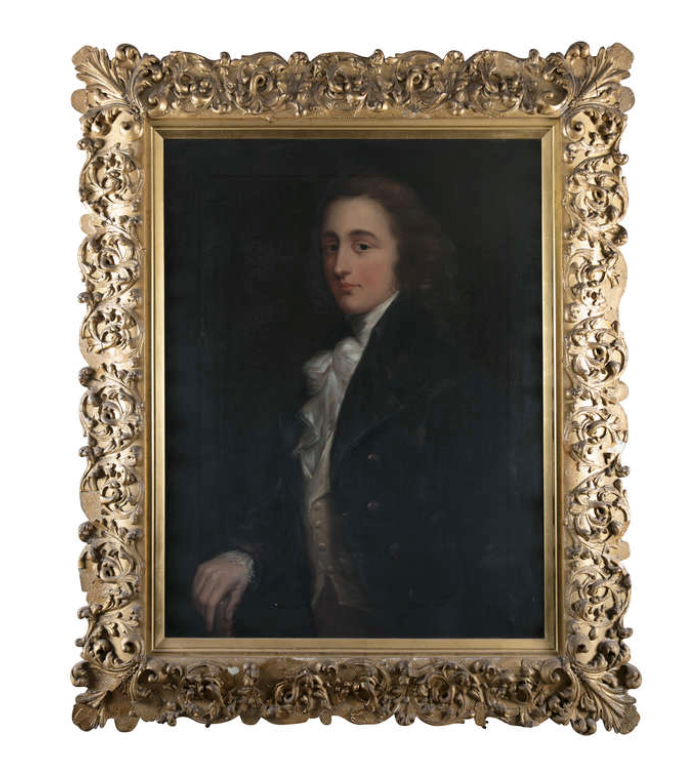
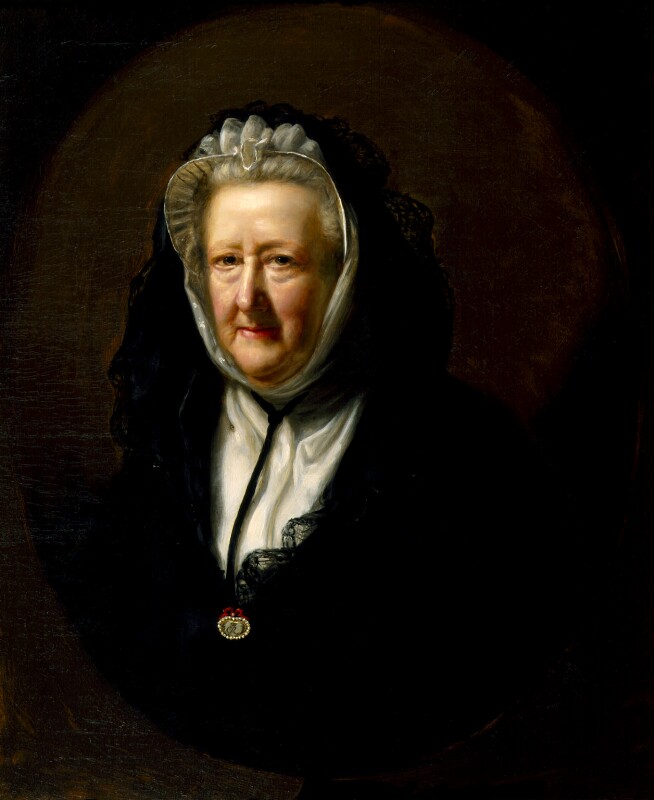
Henry Brooke (1770-1834), 1st Bt.of Colebrooke, Co Fermanagh. Painting with inscription verso ‘Sir Henry Brooke Bart Son of Francis Brooke, Major of 18th. of Hannah, Sister of 1st Lord Dunally. He married Harriott Butler, granddaughter of Earl Lainsborough. He rebuilt the House of Colebrooke in 1822. Died at Colebrooke, 24th March 1834, aged 63 years.’ courtesy of Adam’s auction 10 Oct 2017.

3. West Wing, Crom Castle, County Fermanagh – accommodation

Crom Castle, County Fermanagh, photograph by Robert French, (between ca. 1865-1914), Lawrence Photograph Collection, National Library of Ireland.

https://cromcastle.com

Holiday cottages at Crom:

https://www.nationaltrust.org.uk/crom/features/holiday-cottages-at-crom

Adler’s cottage, Bluebell Cottage and Aspen Cottage accommodation

4. Erne View Cottage, Enniskillen, County Fermanagh – accommodation

https://www.nationaltrust.org.uk/holidays/erne-view-northern-ireland

A converted farm building with a spacious living area and views of the Lough Erne.

Erne View is the largest in a row of holiday cottages on the shores of Lough Erne. The cottage boasts stunning views, an open fire and a wet room on the ground floor.

Enjoy a coffee whilst taking in the view over to the Island of Inishfendra before heading down to the nearby jetty for a stroll along the shoreline.  

Adventurers might want to take advantage of the Lough Erne Canoe Trail which offers guided trips and canoe hire. Further afield, the pretty town of Enniskillen, with its historic castle, is just 20 miles away.

5. Florence Court, County Fermanagh – Butler’s Apartment accommodation

https://www.nationaltrust.org.uk/holidays/butlers-apartment-northern-ireland

Butler’s Apartment served as living quarters for the male servants at Florence Court, the 18th-century mansion next door to the holiday home. This atmospheric first floor apartment overlooks the laundry courtyard and adjoining woodland garden. Inside, you’ll find many historical quirks such as the period fireplaces, large sash windows and wooden floorboards.

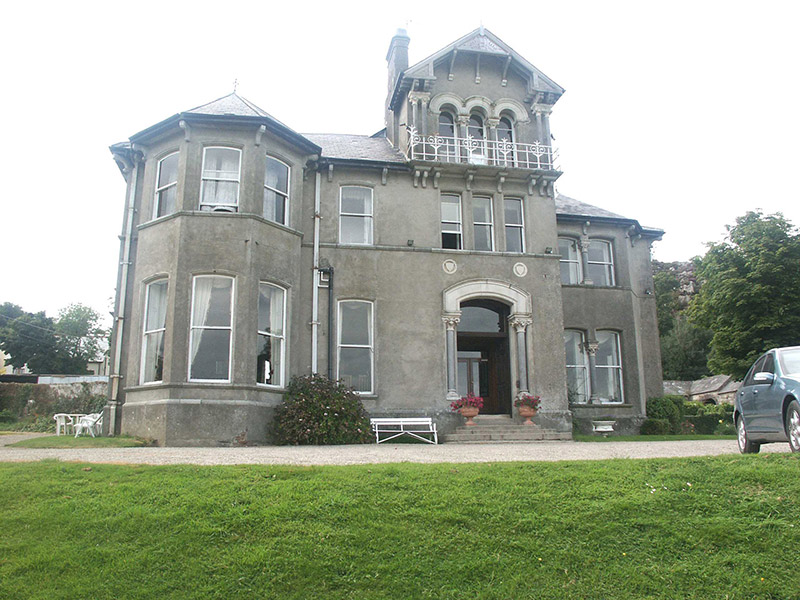
6. Manor House Hotel (formerly Killadeas Manor and before that, Rockfield), County Fermanagh

https://www.manorhousecountryhotel.com
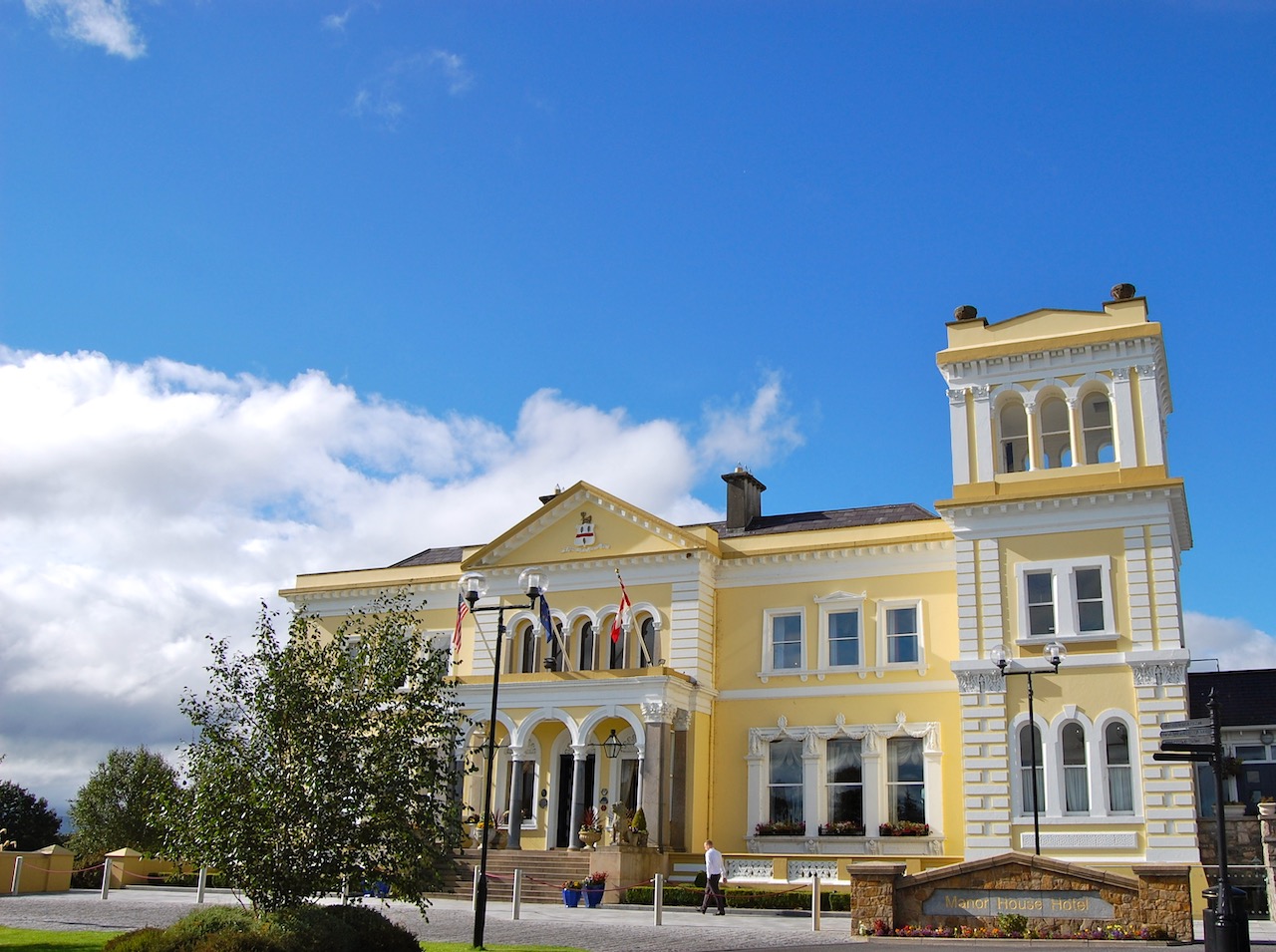
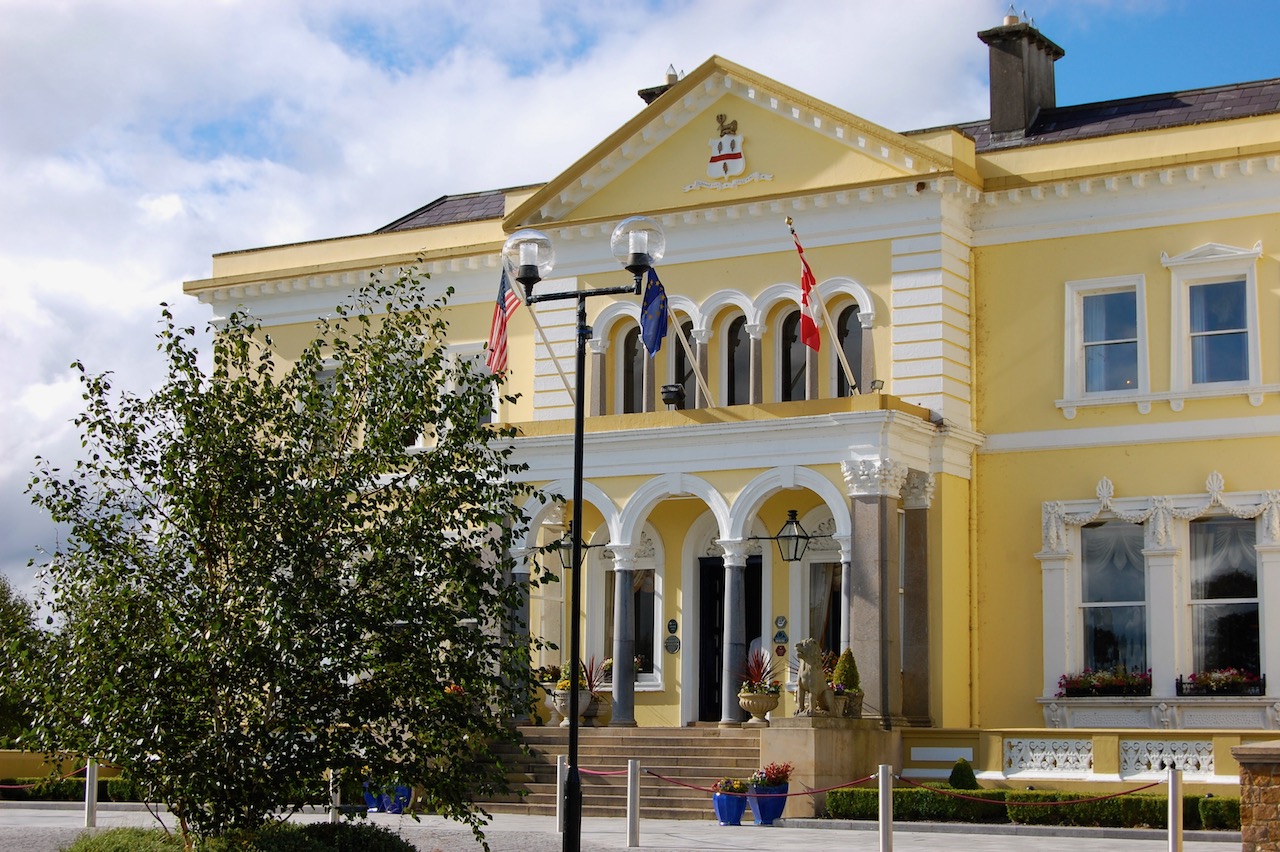
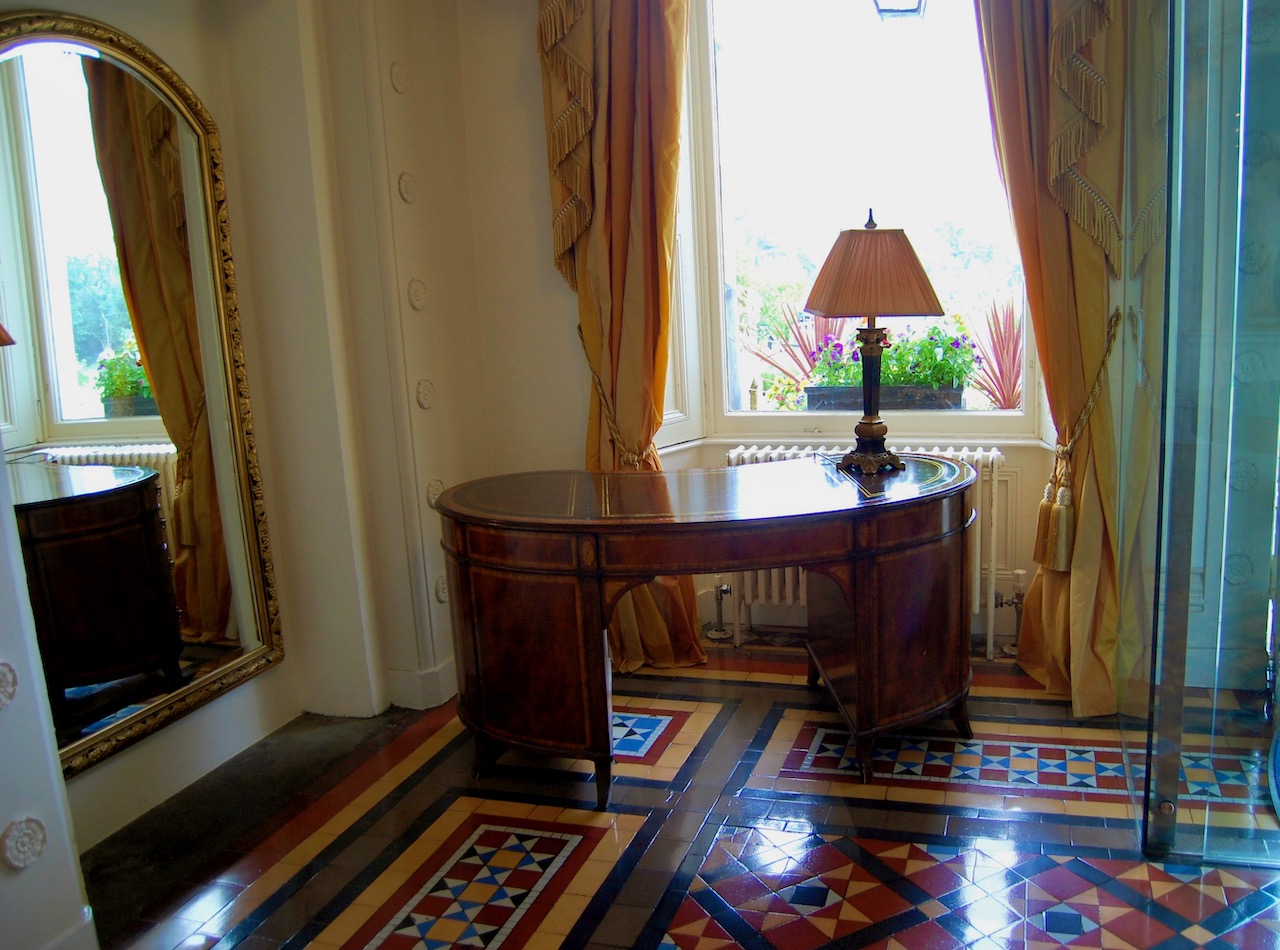
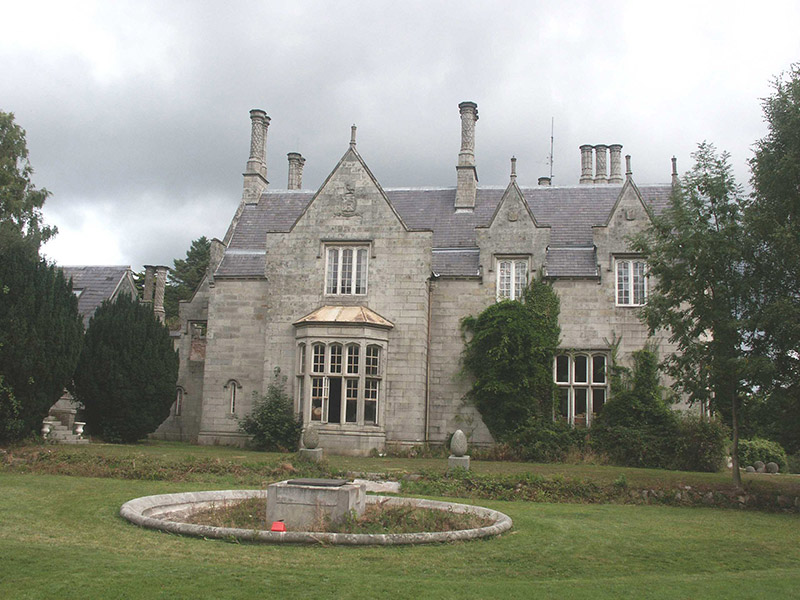
Country Manor Hotel, Fermanagh, 28 August 2013. Photograph © Jennifer Winder-Baggot, www.irishhistorichouses.com

We often stay here on our way to Donegal!

Mark Bence-Jones writes in his A Guide to Irish Country Houses (1988):

p. 168. “(Irvine/LGI1912) A two storey Victorian Italianate house, in a splendid position on the shores of Lough Erne. Entrance front with pediment and porch in the form of a three arched loggia, flanked by a square tower with glazed belvedere and urns on its parapet. Now a hotel.” 

Grounds of Country Manor Hotel, Fermanagh, 28 August 2013. Photograph © Jennifer Winder-Baggot, www.irishhistorichouses.com
Country Manor Hotel, Fermanagh, 28 August 2013. Photograph © Jennifer Winder-Baggot, www.irishhistorichouses.com

A younger son of the Irvines of Castle Irvine [now dilapidated but you can visit the grounds], John Irvine, acquired the estate in 1660. It was known as Rockfield. The website tells us it remained as Rockfield until it was rebuilt in 1860 by Colonel John Gerard Irvine (1823-1902), who brought workmen from Italy to do the interior decoration which exists to this day.

The name of Rockfield was changed to Killadeas Manor House by Major John Irvine who succeeded to Killadeas in 1835 and died in 1860. It was his son, Colonel John Gerard Irvine, who rebuilt Killadeas, incorporated some parts of the old house into the new mansion.

The website adds that in a directory of Fermanagh, published in 1879, the author states that Rockfield was built in 1710, and greatly altered and added to in 1868 by Colonel Irvine under the direction of that able and artistic architect, Mr Armstrong of Belleek. There are some obvious similarities between the architecture of the Belleek Pottery and The Manor House not least the unusual narrow, arched windows.

During the 1939-45 war it was requisitioned by the Government and was for a time used by the American Forces. The house itself was used as an Officers’ Mess and Headquarters for the Seaplane base of Killadeas. It was a plane from this base which sighted the ‘Bismarck’ and consequently resulted in the destruction of this mighty battleship. The Manor House remained in the Irvine family until 1957 when it was acquired for a Hotel.

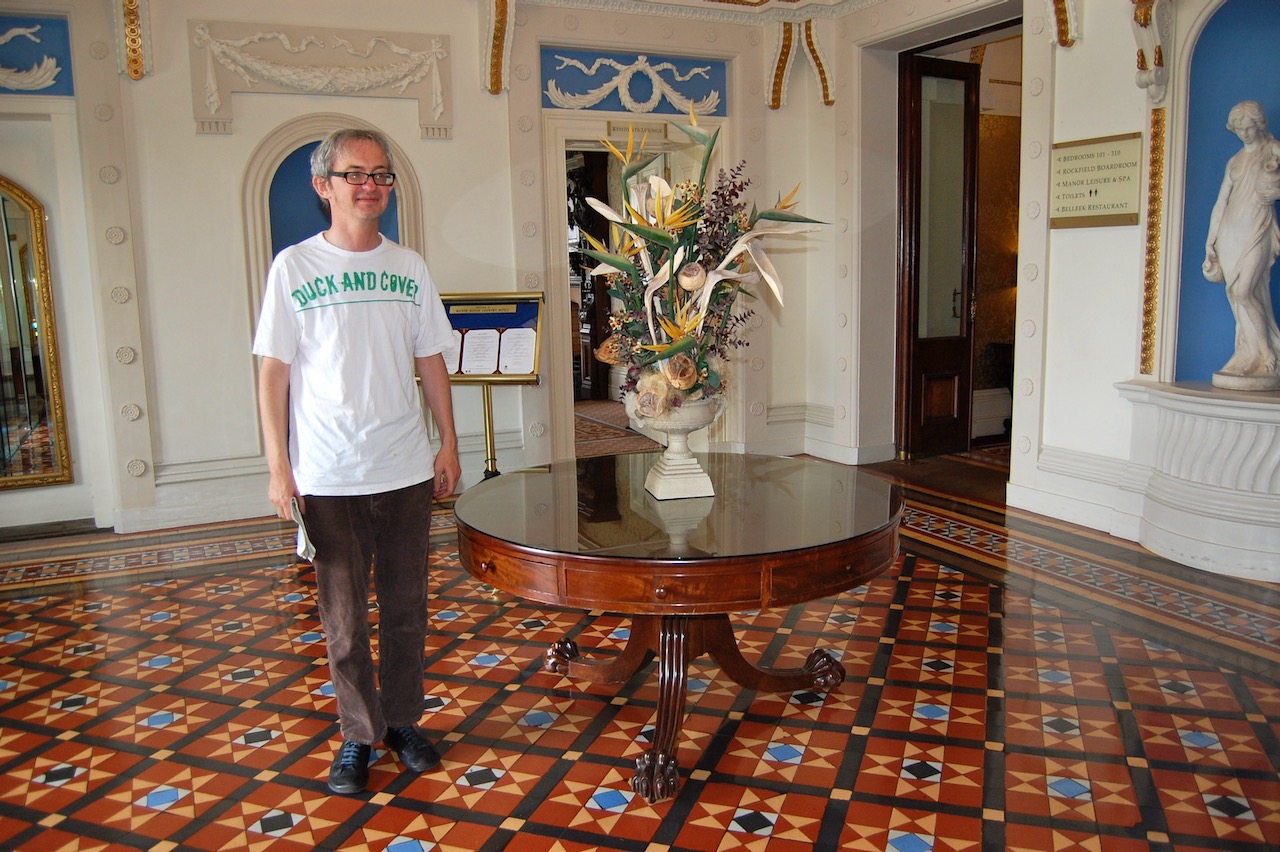
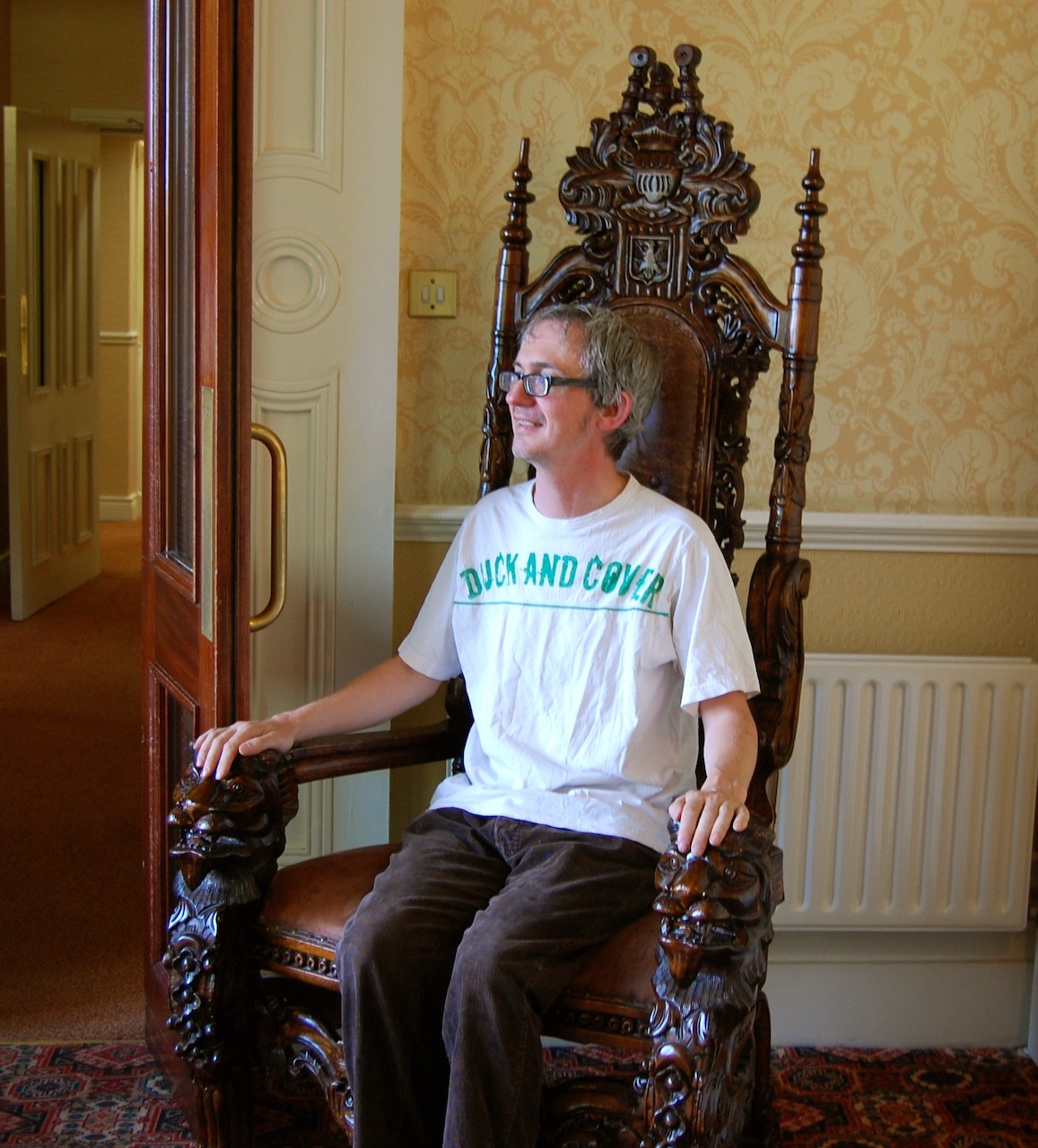
Country Manor Hotel front hall, Fermanagh, 28 August 2013. Photograph © Jennifer Winder-Baggot, www.irishhistorichouses.com
Country Manor Hotel, Fermanagh, 28 August 2013. Photograph © Jennifer Winder-Baggot, www.irishhistorichouses.com
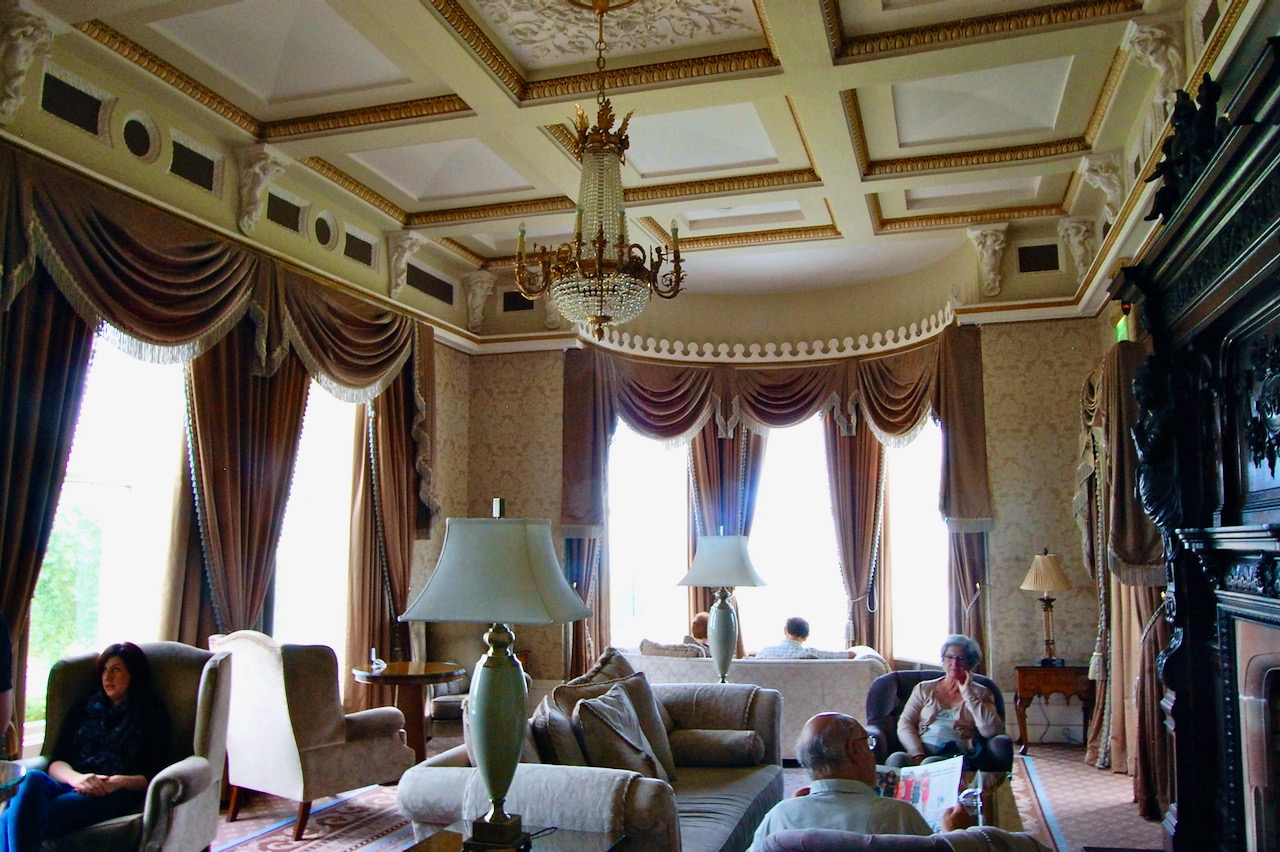
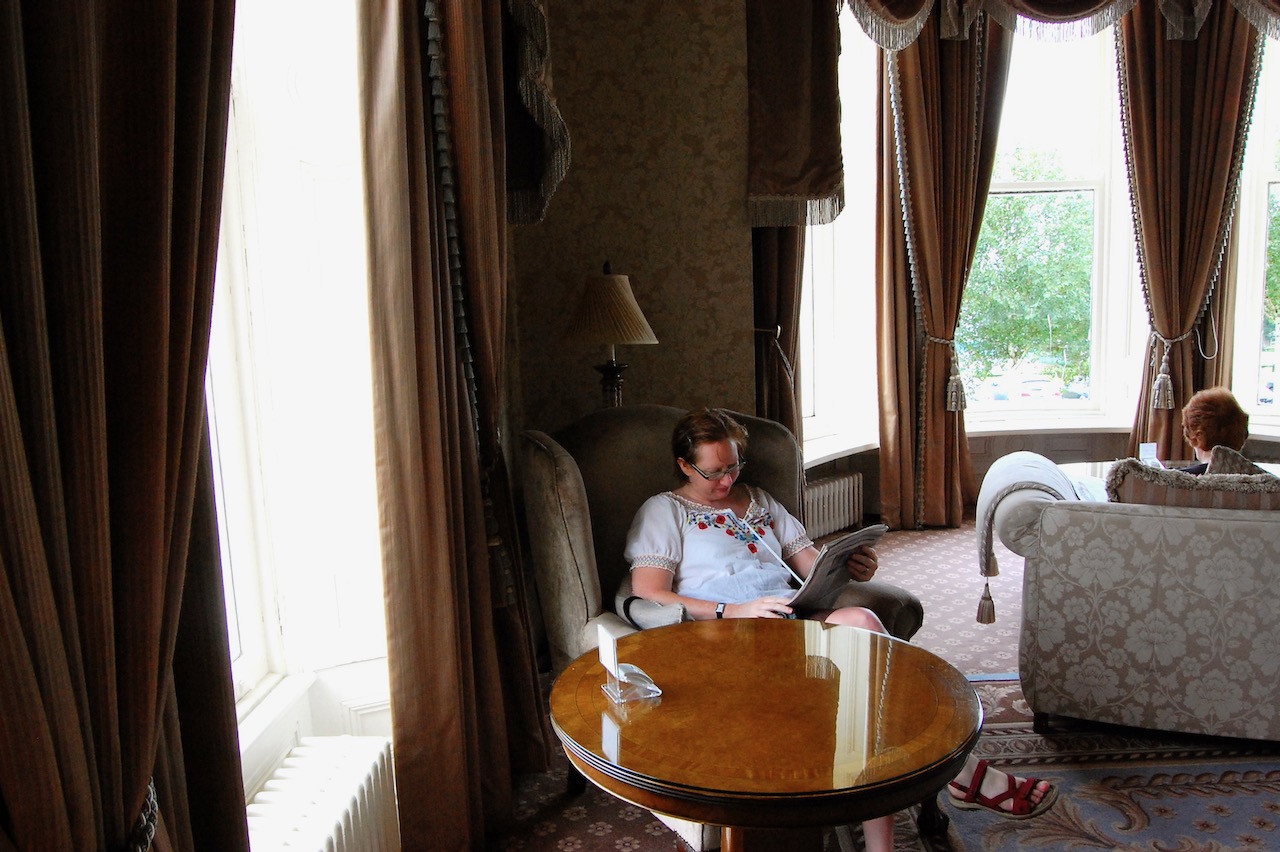
Country Manor Hotel Drawing Room, Fermanagh, 28 August 2013. Photograph © Jennifer Winder-Baggot, www.irishhistorichouses.com
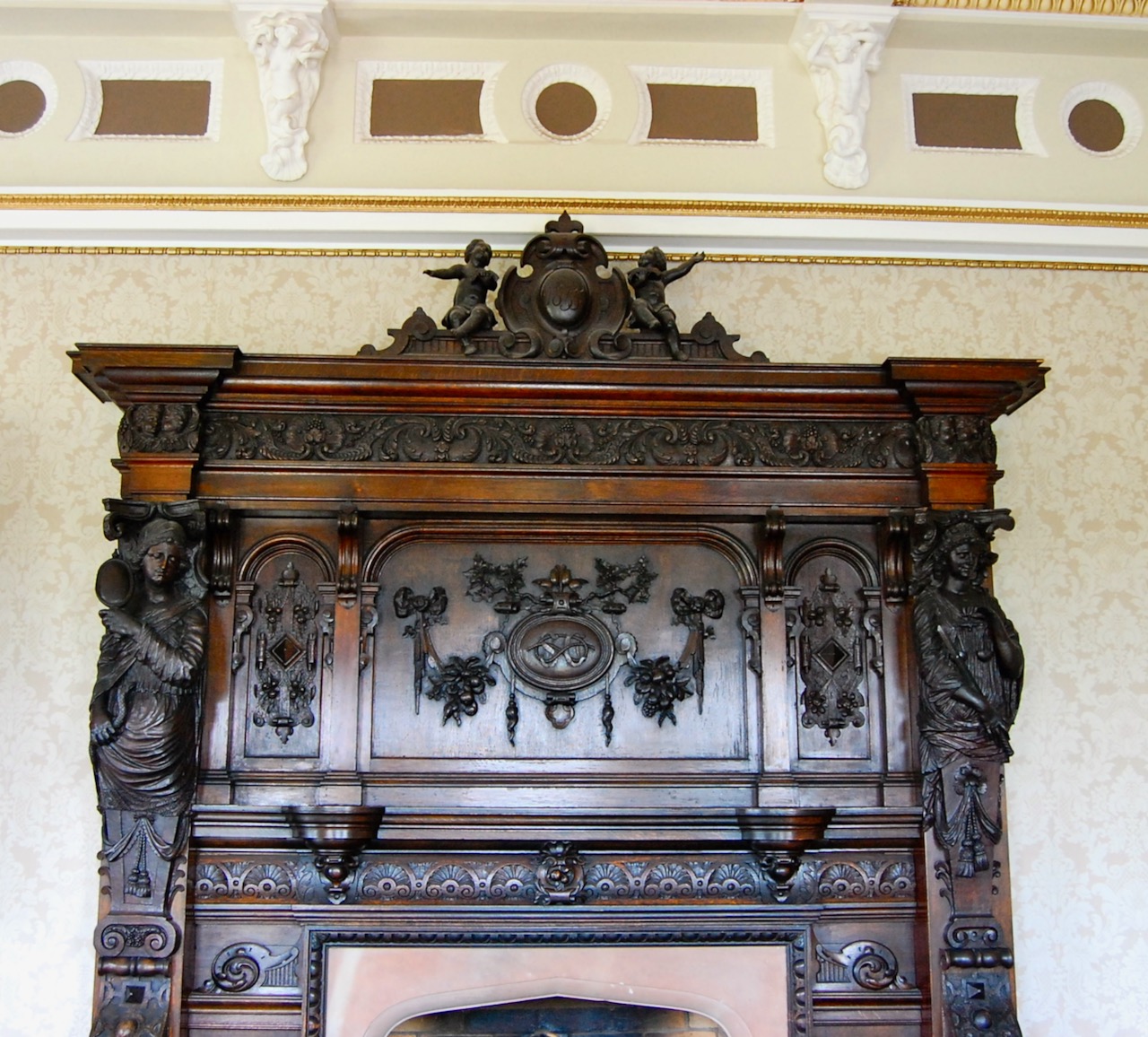
Country Manor Hotel Drawing Room fireplace, Fermanagh, 28 August 2013
Country Manor Hotel Drawing Room, Fermanagh, 28 August 2013. Photograph © Jennifer Winder-Baggot, www.irishhistorichouses.com
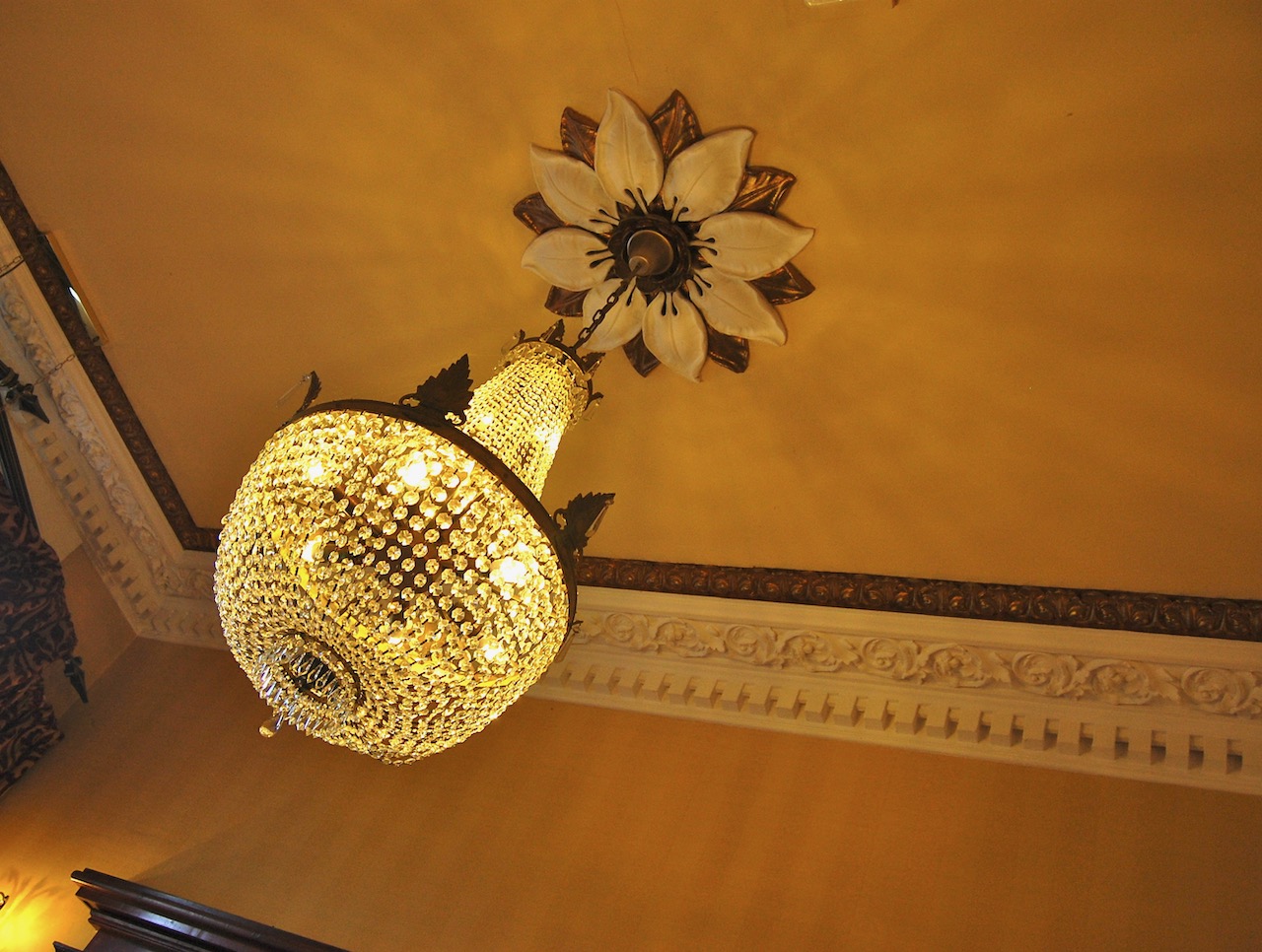
Country Manor Hotel, Fermanagh, 28 August 2013. Photograph © Jennifer Winder-Baggot, www.irishhistorichouses.com
The honeymoon suite in Country Manor Hotel, Kildeas, County Fermanagh, Aug 27th 2014. Photograph © Jennifer Winder-Baggot, www.irishhistorichouses.com
Honeymoon Suite Country Manor Hotel, Fermanagh, 2014. Photograph © Jennifer Winder-Baggot, www.irishhistorichouses.com
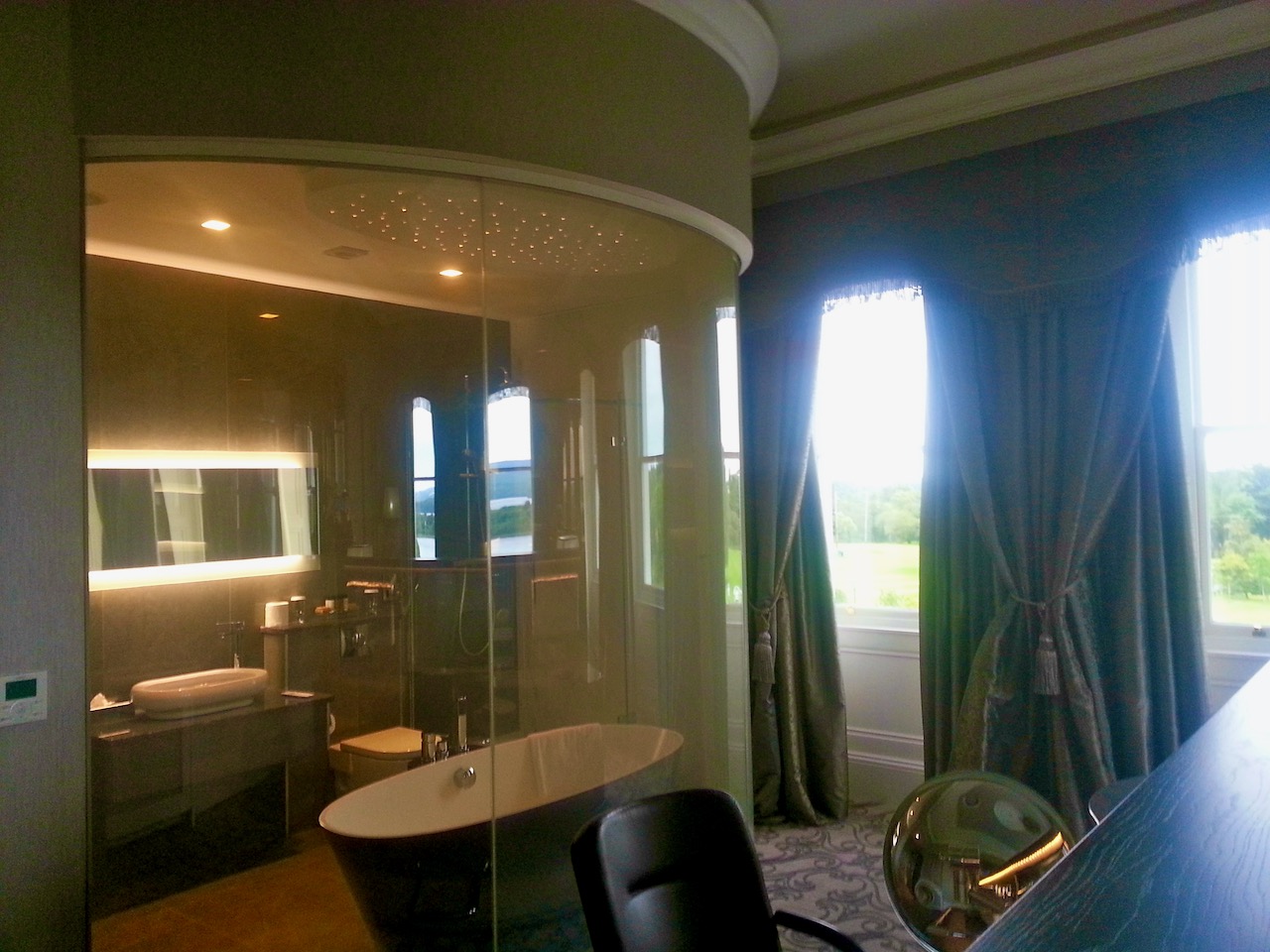
Country Manor Hotel honeymoon suite, Fermanagh. The bathroom walls can mist up to create privacy at the push of a button! Photograph © Jennifer Winder-Baggot, www.irishhistorichouses.com

Whole House Rental, County Fermanagh:

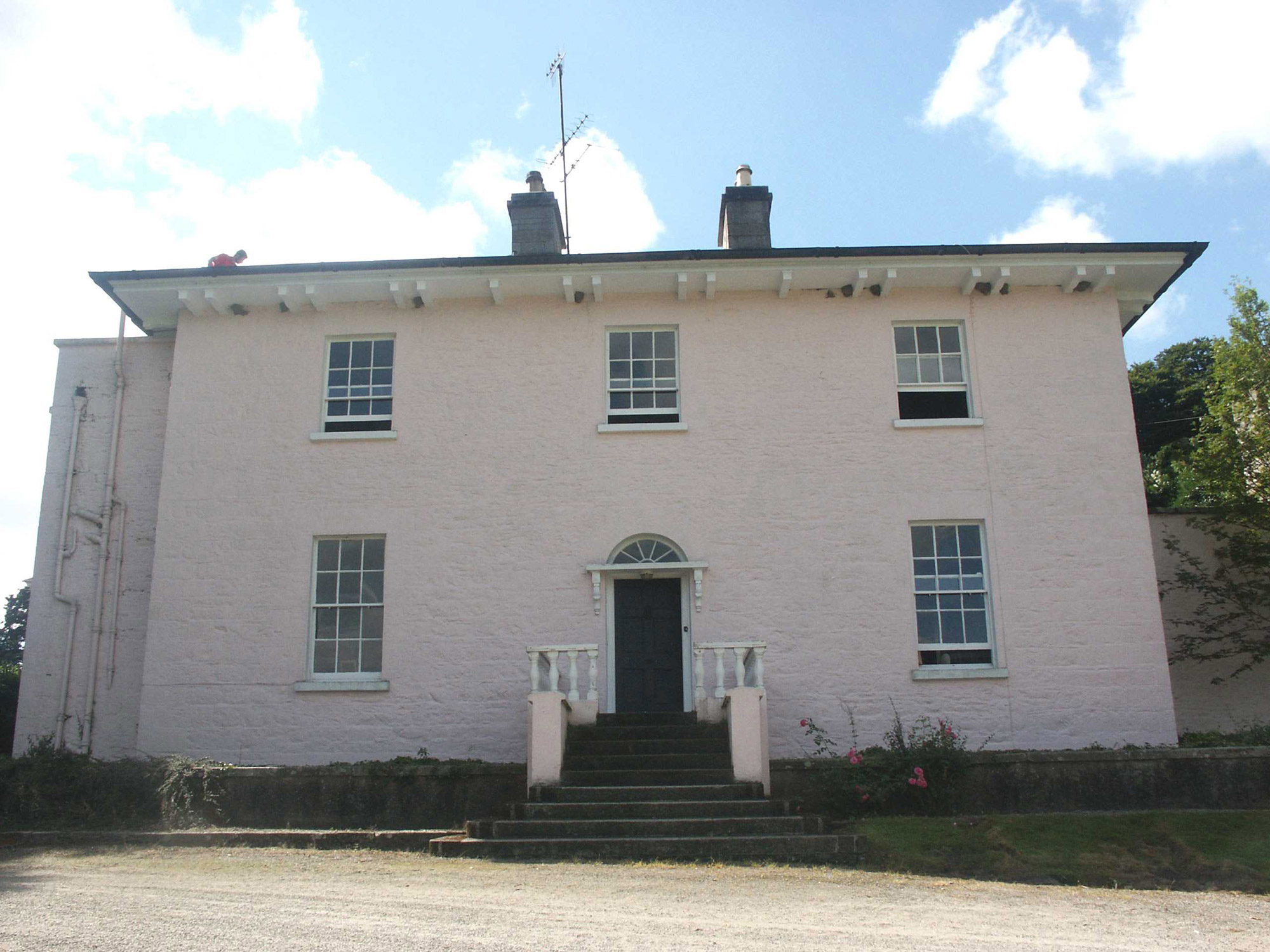
1. Ashbrooke House, Brookeborough, Enniskillen Co Fermanagh BT94 4GX – whole house rental

https://www.ashbrookehouse.com

Ashbrooke is the Dower House for the Colebrooke Estate it has been in the Brooke family for over 200 years. Formerly the home of Viscount and Viscountess Brookeborough the house has recently been fully restored and renovated to provide luxurious accommodation.

Mark Bence-Jones writes of Colebrook Park in his A Guide to Irish Country Houses (1988):

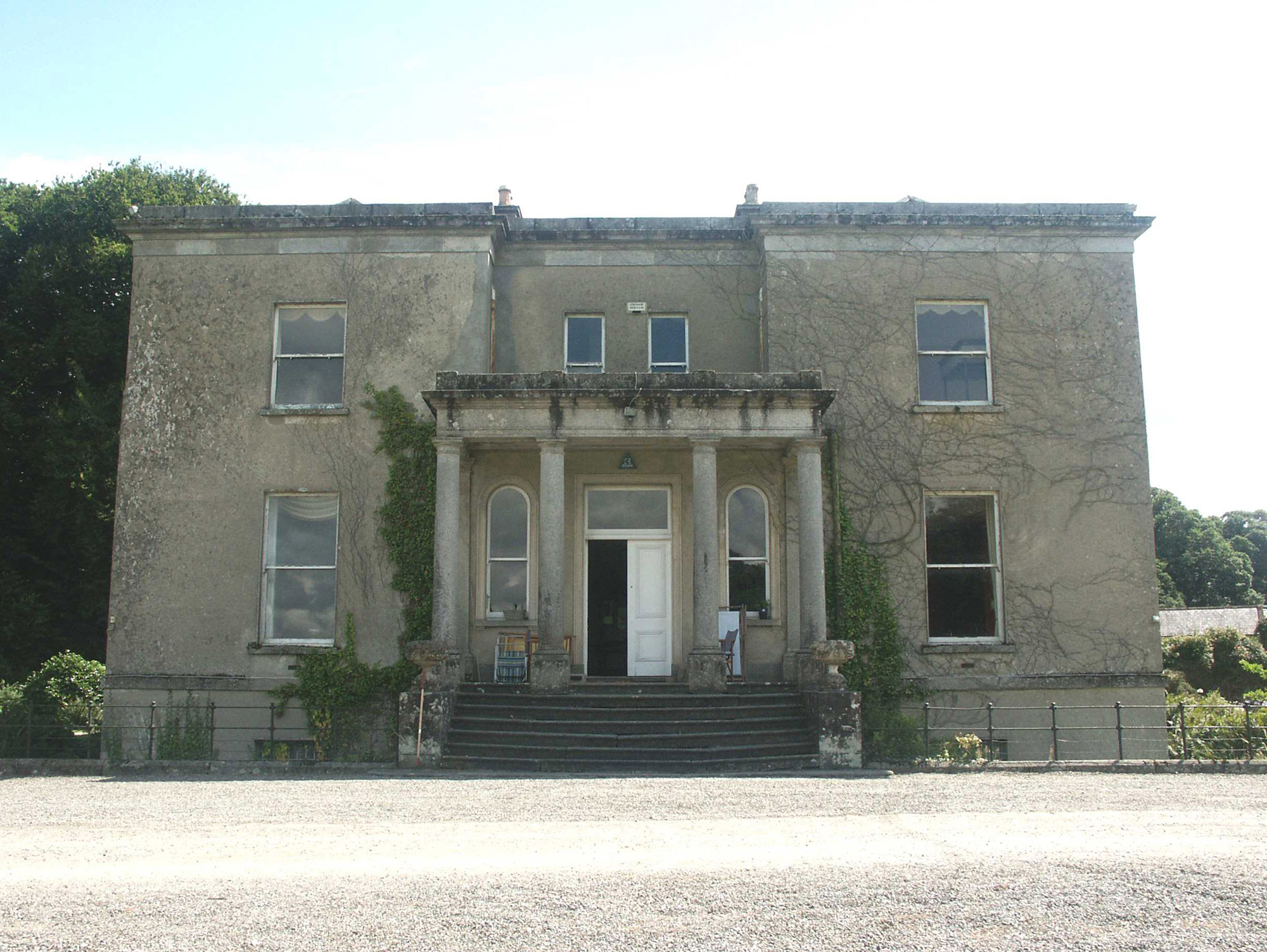
p. 89. “(Brooke, Brookeborough, V.PB) An austere Classical house of 1825 by William Farrell; built for Sir Henry Brooke [1770-1834], 1st Bt of 2nd creation. Two storey nine bay front, with a pedimented portico of four giant Ionic columns; three storey irregular side; eaved roof. Of cut-stone, with a sprinking of red sandstone ashlars which gives the elevation a pleasant reddish tinge. Large entrance hall; double staircase in back hall. Drawing room with original white and gold damask wallpaper. Sitting room with C19 arabesques. Large dining room, which Lord Craigavon, 1st Prime Minister of Northern Ireland, christened “Golgotha” on account of the numerous deer skulls covering the walls. The home of Sir Basil Brooke, 5th Bt and 1st Viscount Brookeborough, Prime Minister of Northern Ireland 1943-63; he and the late Lady Brookeborough made an attractive sunken garden at one end of the house. The house stood empty for some years after the death of 1st Viscount, 2nd Viscount living in Ashbrooke, a smaller house on the estate. But the present Lord and Lady Brookeborough have moved back into Colebrook.” 

2. Belle Isle Courtyard cottages and castle accommodation, Lisbellaw, Enniskillen, County Fermanagh Northern Ireland – see above

3. Colebrook Park, County Fermanagh – group accommodation

https://colebrooke.info/cole-accommodation/

The website tells us:

Colebrooke Park in County Fermanagh, Northern Ireland is first and foremost a family home, the seat of Viscount & Viscountess Brookeborough and one of region’s most important and historic stately homes. It is exclusive, discreet and offers a taste of a unique lifestyle which guests may experience whilst staying in an Irish Stately Home.  Set in a lush 1,000 acre working estate, Colebrooke Park is only 90 minutes from Belfast, 40 minutes from the West Coast of Ireland and a short distance from the tranquility of beautiful Lough Erne.

Lady Brookeborough has skilfully recreated the style and grandeur of the past with family portraits, original Victorian wallpaper, 18th Century porcelain and fine furniture used to decorate the grand rooms.  Modern additions such as en-suite bathrooms, central heating, a Business Conference Unit and Day Spa makes Colebrooke a discerning choice of venue for business away days and conferences.

Standing on the banks of the Colebrooke River, fishing, clay pigeon shooting, archery and other outdoor activities are available for guests’ enjoyment. For those who may wish to enjoy a less energetic stay there are long riverside and shrub garden walks and there are purpose built ‘hides’ for watching the abundant wildlife in this remarkable haven. These include deer, otters, mink, buzzards, kingfishers and many others.

The combination of historic grandeur, modern business facilities, outdoor pursuits and the renowned hospitality of the Brooke family means Colebrooke Park is a truly unique location for special events.

Colebrooke Park is a brilliant example of how comfortable an historic Irish Stately home can become in the 21st Century; the ultimate in luxury. Above all it is a place where guests can stay in complete privacy. The estate is ideal for weddings, house party breaks, family gatherings and as a corporate venue with a difference, all in the heart of Northern Ireland’s lush countryside.Having approached the house along the sweeping avenue, guests enter through the grand entrance beneath the portico into a large hall overlooked by the impressive main staircase.

Then guests can make their way to the Library or the Drawing Room and relax in great comfort in magnificent surroundings. In addition to these large reception rooms, there is a large billiard room. The Dining Room seats up to 30 guests at one large table and more in other formats – making it particularly well suited for corporate entertaining, private dinner parties and weddings.

Within the house, located towards the rear, is the fully equipped Conference Suite. Accommodating up to 70, the suite provides all necessary facilities for business users including overhead projector and screen.Colebrooke Park can accommodate up to 300 guests for receptions with a great deal of flexibility and with that all important personal touch that is so often missing in large hotels. There are 12 comfortable double bedrooms with private bathrooms, all of which have been individually and tastefully decorated by Lady Brookeborough.

The landscaped gardens, parkland and ancient woodland with 3 miles of the Colebrooke river meandering through it, form this stunning 1000 acre estate which is a haven of tranquility. There is also a dry grassed lawn at the side of the house suitable for a large marquee, demonstrations and exhibits or as a pleasant area to congregate on sunny days.

The website also tells us of the history, quoting an article in Country Life magazine:

A sprawling barracks* of a country house, in the heart of terrorist-torn Northern Ireland, encumbered with death duties and overdraft, is an unenviable inheritance. Particularly when, abandoned to patching, the fabric has begun to rot; the extensive stables and outbuildings are in ruins; the Victorian wallpaper is peeling from the walls of rooms empty from a house sale seven years earlier. Income from the beautiful – but agriculturally poor – 1,100 acre estate cannot conceivably support the maintenance, let alone restoration, of the house.
[* Someone else’s description – not ours!]This was the situation that confronted Lord Brookeborough and his wife in 1980. The Brookes are a fairly typical Anglo-Irish ‘plantation’ family. They arrived in the 1590’s and were granted a large portion of confiscated lands at Brookeborough as reward for services during the 1641 Rebellion (the name Colebrooke derives from the 17th century marriage of Maj Thomas Brooke to Catharine Cole). Thereafter they displayed a record of competent – often enlightened – land-holding, combined with remarkable honours for military and public service (the family includes both Field Marsh Viscount Alanbrooke and a Prime Minister of Northern Ireland).

The present house was built in 1820 by Henry Brooke (1770 – 1834), created baronet (2nd creation) in 1822, as the culmination of some three decades of frugal living aimed at restoring the fortunes of the estate after the excesses of his uncle. In common with Irish building tradition, the new house, a severe neo-Classical block, subsumed an earlier building of unknown appearance. In his ‘Specification of works’ of 1820, William Farrell – a Dublin architect who practised mainly in Ulster – wrote ‘All the old house except the present Drawing Room and Dining Parlour (the present south range) to be taken down.’ In its place, Farrell attached two ranges of red sandstone (quarried at Alterbrock on the estate and by 1835 covered with Roman cement) containing a palatial entrance hall, stone staircase, reception rooms and bedrooms. This switched the main front from south to east, leaving an untidy arrangement of windows on the south-east corner where the new two-storey building met, under the same roof, the three storeys of what remained of the old. The only ornament to this austere addition was an ashlar cornice and a free-standing giant Greek-Ionic pedimented portico, on a base of two steps, in front of the central three bays. The cost was £10,381.

Despite the sandstone in place of Portland stone, the shallow, eaved roof and lack of balustrade, the resemblance of the main front to neighbouring Castlecoole, Wyatt’s neo-Classical masterpiece is striking. This is no accident. A drawing in the Brookeborough papers held by the Public Record Office of Northern Ireland, reveals that Farrell discarded a more modest, and in many ways more appropriate design – the central three bays broken forward with an attached Ionic porch – for a direct quote of the Castlecoole portico. In a note to Henry Brooke of May 23, 1821, he approves an increase in the dimensions of the house, apparently with the sole purpose of eclipsing those of its illustrious neighbour, commenting that these changes would make the new ensemble ‘far superior to any in Castle Cool House’.

Other notes reveal ideas of increasing grandeur through the summer. First, the dining parlour was extended from the original measurements; then in September, the rooms to the left of the hall were altered ‘by taking down the partition wall and the floor over it to form a Room for a library of 36ft by 18ft …’ (In earlier plans and elevations the library is a modest, two-bay room between the drawing room and the dining parlour in the north range; this now became a breakfast room – currently the billiard room.) In 1823 additional offices were also agreed.

For the next 50 years, alterations and additions continued in a steady stream – the dower house, Ashbrooke (a plaque in the stableyard is dated 1830); lodges (a plan is dated 1833); a triumphal arch gate. These became most significant with the succession of Sir Victor (1843-91), 3rd Bt, in 1864. ‘Few houses in Britain showed more distinctly their owner’s proclivities,’ wrote Oscar Stephen in Sir Victor Brooke, Sportsman and Naturalist (1894). ‘From floor to ceiling, heads of every variety were to be seen; … bison, wild boar, moufflon, Neilgherry ibex, Pyrenean bouquetin … every known variety of red deer … markor, brahsing, ovis ammon, burrel … a grand series of roe’s heads … over the chimney piece in the hall the huge horns of an Irish elk and two enormous German red deer … two of the tigers he had killed in India … the famous black panther, and, most valued of all, the monster tusk of the great elephant, whose mighty bones … lay in mighty massiveness round the foot of the billiard table.’ It was a taste in interior decoration which prompted Lord Craigavon, first Prime Minister of Northern Ireland, to christen the dining room ‘Golgotha’.

Given that he occupied Colebrooke permanently for only seven years – thereafter paying visits only in the summer and autumn, after the delicate health of his wife prompted a move to Pau in the south of France – Sir Victor’s legacy was considerable. He introduced sika deer into the park and built the splendid ‘Conservatory with the curved projection’, mentioned in an account of October 1864 from the celebrated William Turner of Dublin. Presumably it was Sir Victor, also, who commissioned the unexecuted colour-washed designs (signed C.W.W.), for panelling the library and dining room, which have Classical and hunting themes and the Classical stained-glass window over the stone stairs.

By the 1876 return of Landowners in Ireland, the estate was almost 28,000 acres, the third largest in the county – only slightly smaller than Crom or Florence Court. However, there was a sharp change in fortunes when all but 1,300 acres were sold under the Ashbourne and subsequent Land Acts, leaving, as with so many Irish houses, a ‘demesne’ scarcely able to support a large country house. This development, combined with the agricultural depression of the 1880s which left most of the gentry even worse off than they had been in the years following the Famine, suggests that when the 4thBt, Sir Douglas Brooke, had the ‘house and demesne’ valued in 1893 (for £22.035 6s 3d) it was with a view to selling the whole property.

By 1910 Sir Basil Brooke (1888 – 1973), 5th Bt, (Prime Minister of Northern Ireland 1943 – 63), who from childhood had nursed a powerful affection for the house – as a pupil at Winchester he wrote of it as ‘always tugging at my heart’ – was writing of his desire ‘to get it on its legs’. By the time of his return after the war, high taxation had eaten into the depleted income of the neglected property. Farm profits were low and the long-term trend of food prices was down. However, by reclamation and innovation over the decades the estate became a model of efficient farming. Changes to the house included repainting, removing the cement render, demolishing the conservatory and creating a sunken formal garden on the south front.

In the early 1930’s a Minister of Agriculture official described the house as ‘comfortable but with many rooms unused’. By December 1939, Sir Basil’s letters reveal the felling of trees as ‘the only way to save Colebrooke’ and clear the overdraft. All might have been well, however, had some tax planning been made before Lord Brookeborough (as he was from 1952) died in 1973. As it was there was no alternative but to sell up, leaving the house in the condition in which the present Lord Brookeborough found it in 1980.

The question was whether a house in such a state could ever again be made to support itself, let alone remain a home. The London-based architect Paul Hyett was called in to help arrange a feasibility study and devise ways of raising capital. For a time, conversion to a golf club looked the only possibility, although it was realised that the character of the house and its setting would be unlikely to survive such a change.

Fortunately, by 1985 Lord Brookeborough’s business idea had begun to take off. The Colebrooke estate offers one of the best driven snipe-shooting anywhere, excellent stalking of sika, fallow and red deer over 10,000 acres and pheasant shooting and fishing, all of which had the potential to be developed along the one guiding principal; that all these activities must bring paying guests into the house. As the idea developed, hope returned, especially when the Northern Ireland Tourist Board agreed to provide up to 50% of the necessary capital.

Problems, however, were not long in surfacing. Government grants, geared to the provision of commercial accommodation, tended to insist on features hardly compatible with the preservation of the fragile character of a historic house; from en suite facilities to numbers on bedroom doors. Planning permission for such a change of use also triggered an avalanche of fire provisions. Although at times the differences between the parties seemed irreconcilable a spirit of compromise won through. Bedrooms were permitted with designated rather than en suite bathrooms with the ample recompense to visitors today of splendid airy proportions and traditional full-length, cast-iron baths with ball plugs. Fire signs were accepted. Numbers on doors were not.

Having addressed the major structural problems, and prepared four new bedrooms and bathrooms in the south wing, in addition to the principal bedrooms in the main front, Lord Brookeborough, guided by the conviction that just three ingredients are critical to happy apres-hunting: food, comfortable beds and never ending supplies of hot water, put this equation to work. For the rest, the main difficulty was refurbishing – on a shoestring – the vast, bare reception rooms. A friend who had bought one of the original gilt drawing room looking-glasses donated it. Marble busts of Sir Victor Brooke and his wife, by a local artist, Joseph Watkins, were retrieved from a Dublin antique shop.

Monaghan:

1. Castle Leslie, Glaslough, Co. Monaghan (hotel)

www.castleleslie.com
Tourist Accommodation Facility – since it is listed under Revenue Section 482 as Tourist Accommodation Facility, it does not have to open to the public. It may have events during Heritage Week – see the hotel website.

Open for accommodation: all year.

See mywrite-up: https://irishhistorichouses.com/2020/08/07/castle-leslie-glaslough-county-monaghan/

2. Hilton Park House, Clones, Co. Monaghan H23 C582 – section 482 accommodation

www.hiltonpark.ie
Tourist Accommodation Facility – April 1- Sept 30 2026

since it is listed under Revenue Section 482 as Tourist Accommodation Facility, it does not have to open to the public. However, check the website as it is open to visitors on some dates.

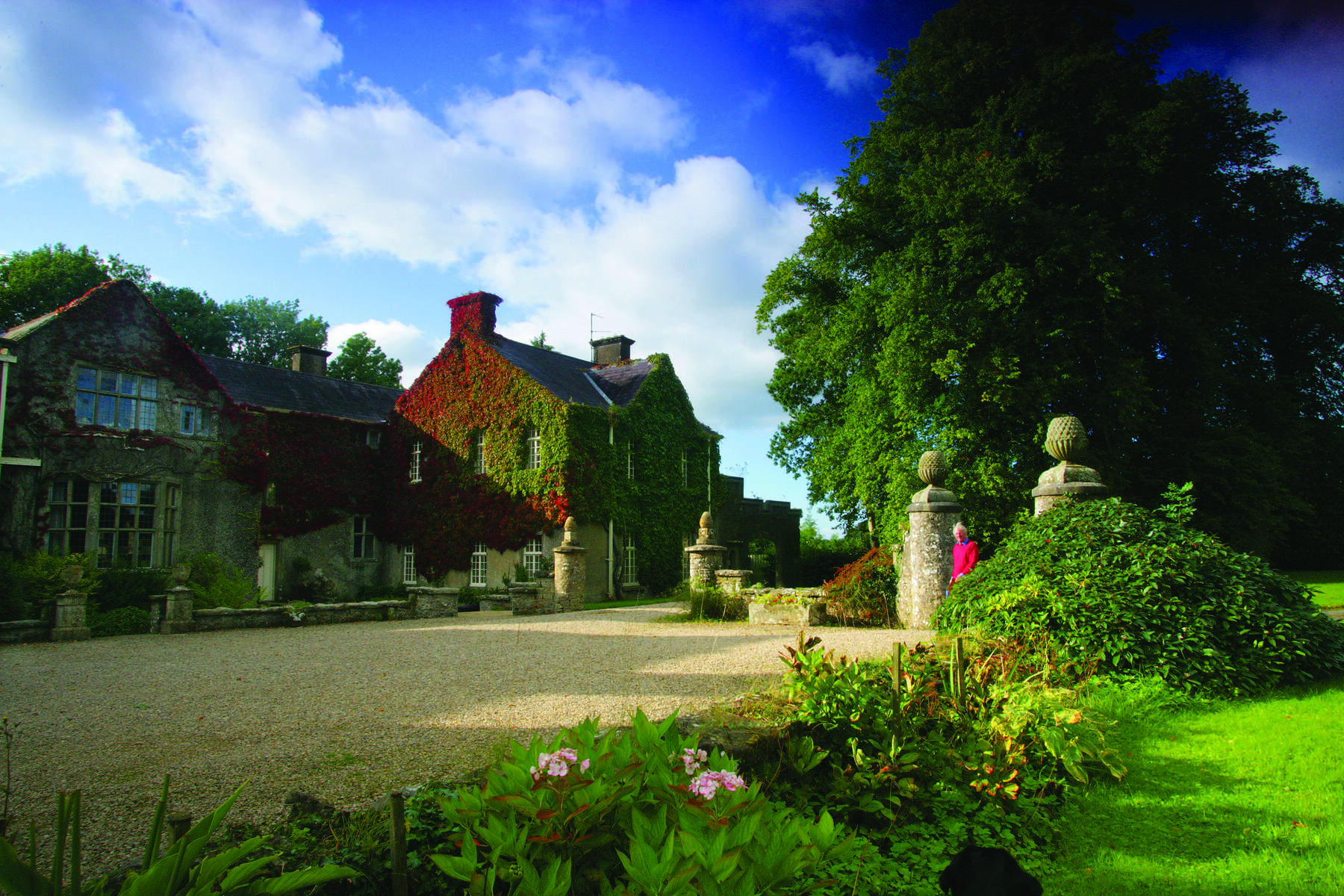
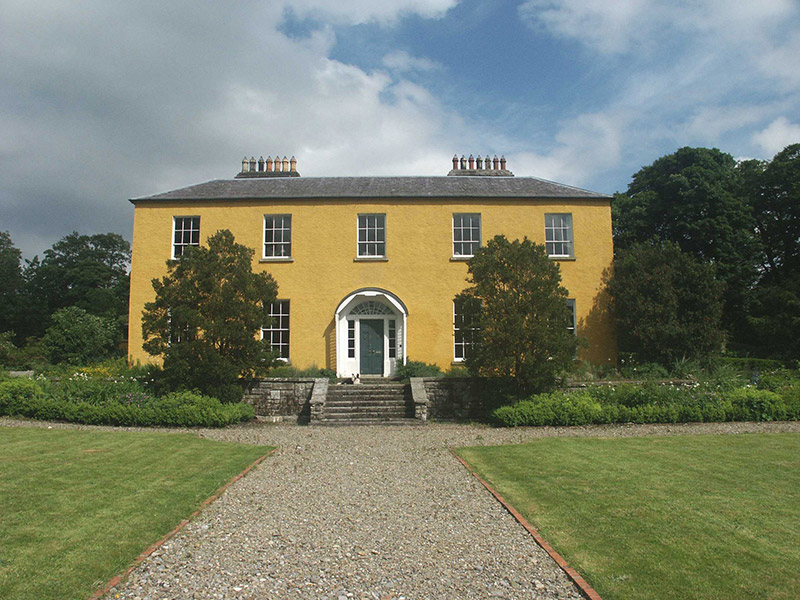
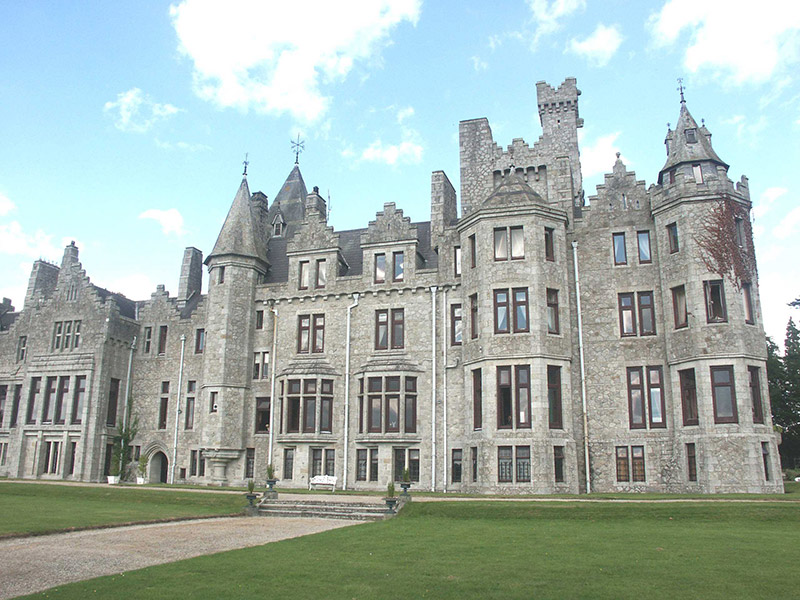
Hilton Park, Monaghan, photograph taken 2018 for Tourism Ireland. (see [3])

We visited during Heritage week in 2022 – https://irishhistorichouses.com/2023/06/29/hilton-park-house-clones-co-monaghan/

Hilton Park, County Monaghan. Photograph © Jennifer Winder-Baggot, www.irishhistorichouses.com

3. Mullan Village and Mill, Mullan, Emyvale, Co. Monaghan – section 482

www.mullanvillage.com

Open dates in 2026: Aug 1-31, Sept 1-30, 2pm-6.30pm

Fee: €6

Places to stay, County Monaghan

1. Castle Leslie, Glaslough, Co. Monaghan – section 482 tourist accommodation

https://irishhistorichouses.com/2020/08/07/castle-leslie-glaslough-county-monaghan/

www.castleleslie.com
(Tourist Accommodation Facility)
Open: all year

Castle Leslie, County Monaghan Photograph © Jennifer Winder-Baggot, www.irishhistorichouses.com

2. Hilton Park House, Clones, Co. Monaghan – section 482 accommodation

www.hiltonpark.ie
(Tourist Accommodation Facility)

There is also a cottage: https://www.airbnb.ie/rooms/52624113?guests=1&adults=1&s=67&unique_share_id=7b807434-ea7d-4b61-a8a9-977ac73725fa&source_impression_id=p3_1648836274_6bBQXGdvQuronwMs

Tyrone:

1. Ashfield Park, County Tyrone – gardens open to visitors 

http://www.ni-environment.gov.uk/index.htm 

and

Telephone 

028 9056 9615 

2. Blessingbourne, Fivemiletown, County Tyrone – open for tours, self catering accommodation on the grounds 

https://www.blessingbourne.com
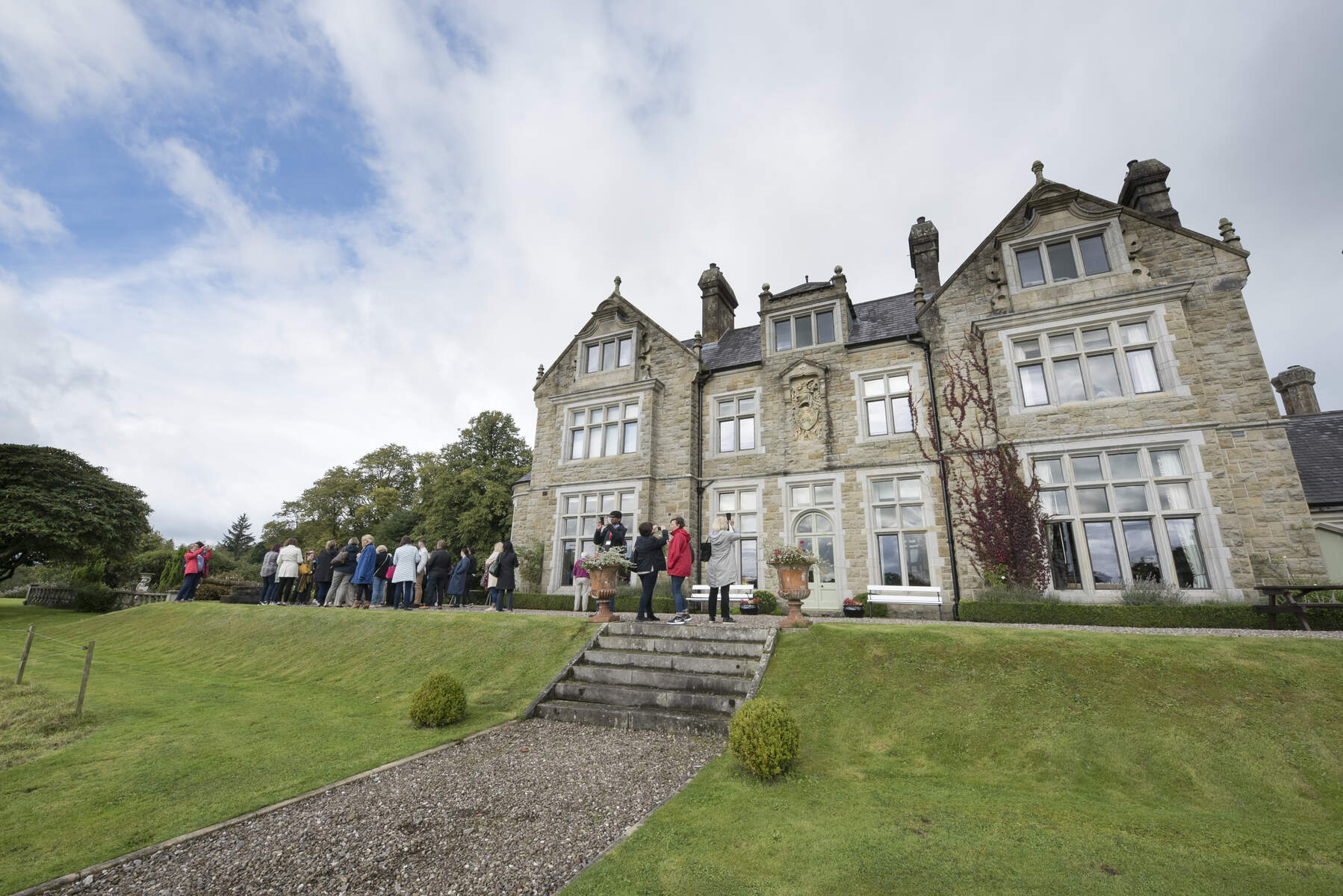
Blessingbourne, County Tyrone, photograph courtesy of Tourism Northern Ireland, 2019. (see [3])

The website tells us:

Blessingbourne Estate came into the Montgomery family by marriage to the Armar family in the early 18th century.  The builder of Blessingbourne was a man of taste; Hugh De Fellenberg known as “Colonel Eclipse”, Montgomery, grandfather of Captain Peter Montgomery.

Blessingbourne originally belonged to the Armars. The Estate came to the Montgomerys in the eighteenth century when Elizabeth Armar married Hugh Montgomery [b. 1692], of Derrygonnelly Castle in Fermanagh.

The first Montgomery to live at Blessingbourne was another Hugh. Hugh was born in 1779 and known for some reason as “Colonel Eclipse”. His portrait, which he gave to his old school, Eton, shows him to have been very handsome. However, he was unlucky in love.

He vowed he would never marry and built himself a bachelor retreat at Blessingbourne, a romantic thatched cottage. He also built the charming little Gate Lodge (transformed to the present day 5 star Gate Lodge)

But his bachelorhood ended after a few years, for he married a Spanish girl and had a son. His son’s godmother was Lady Byron, who remained a close friend and was greatly attached to his sister Mary, a key figure in the development of Blessingbourne.

It descended in the family to Peter Montgomery, Vice-Lord Lieutenant of Tyrone, who died childless, after which it passed to a cousin. The property was ultimately the inheritance of Captain Robert Lowry, a direct descendant of Colonel Eclipse, and now belongs to Colleen and Nicholas Lowry.

The Classic Tour encompasses everything well loved about the Estate. Current estate owners Nicholas and Colleen Lowry host all Tours personally. This tour includes a walk through the Victorian gardens, with their majestic setting overlooking the beautiful Lough Fadda. As well as, a private tour of main ground floor rooms of the impressive Manor House. The Manor House was built in 1871-74 and designed by Pepy’s Cockerall a close friend of William Morris. After that, enjoy a guided stroll around the extensive Coach , Carriage and Costume Collections from yesteryear.

Mark Bence-Jones writes in his A Guide to Irish Country Houses (1988):

p. 44. “(Montgomery/IFR) There was originally no house at Blessingbourne, an estate which came to the Montgomerys through marriage early in C18; the family seat being Derrygonnelly Castle in County Fermanagh, which was burnt later in C18 and not rebuilt. The family lived for some years at Castle Hume, which they rented; then, at the beginning of C19, a romantic thatched cottage was built by the side of the lough at Blessingbourne by Hugh Montgomery (known as Colonel Eclipse) as a bachelor retreat for himself after he had been crossed in love. His bachelorhood ended in 1821, when he married a Spanish girl; but during the next 50 years the family lived mainly abroad, so that his cottage was all they needed for their occasional visits to County Tyrone. The present Victorian Elizabethan house was built by his grandson, Hugh de Fellenberg Montgomery, between 1870 and 1874, to the design of F. Pepys Cockerell. Pepys Cockerell, son of the better-known C.R. Cockerell, as an artist as much as an architect; his patron and his patron’s wife were also people of tate; so that Blessingbourne is an unusually attractive and successful example of it style and period. The grey stone elevations are not overloaded with ornament; such as there is had restraint: caps on the chimneys, small finials on the gables, curved and scrolled pediments over some of the mullioned windows. The interior of the house is comfortable, with great character. The hall has a staircase incorporated in a screen of tapering wooden piers. Through glazed arches one looks across an inner hall to the lough and mountains. The principal rooms have chimneypieces of carved sone in a Tudor design, flanked by niches for logs: some of them being decorated with William de Morgan tiles. The dining room still keeps its original William Morris wallpaper of blue and green grapes and foliage; while there is another original Morris paper in the library. The late owner, Capt P. S. Montgomery, former President of th Northern Ireland Arts Council, stylishly redecorated much of the interior, which houses his collection of modern Irish art. Blessingbourne has passed to his nephew, Captain R.H.Lowry.” 

3. Hill of The O’Neill and Ranfurly House Arts & Visitor Centre, County Tyrone https://www.hilloftheoneill.com

Hill of The O’Neill and Ranfurly House Arts Visitor Centre, Tyrone, by Brian Morrison 2014, for Tourism Northern Ireland (see [3]).

The website tells us:

The O’Neills were perhaps the greatest of the Irish clans, whose origins date back as far as the 10th century and whose lineage includes two High Kings of Ireland.

Hugh O’Neill became leader of the clan in 1595 and as such was known as The O’Neill. A charismatic, even romantic figure, he had a long, tempestuous and complicated relationship with the English Crown, a relationship largely of convenience – for both parties. It was characterised by double-crossing by each side, building and abandoning strategic alliances. And ultimately, by all-out war.

In this story Hugh O’Neill, Earl of Tyrone and the last inaugurated chief of the O’Neills, plays the central role. Dungannon was at the eye of an international political storm from 1594 to 1603, during which time The O’Neill would lead mighty armies, would win and lose battles, and create problems for at least four monarchs.

And the repercussions were serious. Some might say that the consequences are still being felt today. When Hugh O’Neill was ultimately outmanoeuvred, his defeat paved the way for two connected seismic events that would forever transform his kingdom.

The O’Neill was a military genius who repeatedly got the better of the Crown’s generals in Ulster. However, after a bitter defeat at the Battle of Kinsale, he was driven to bid farewell to the Hill of the O’Neill and the lands he ruled over.

O’Neill’s departure for Spain, with the Earl of Tyrconnell and 90 followers, became known as the Flight of the Earls. It was a pivotal event in Irish history, effectively marking the end of the Gaelic way of life.

With The O’Neill and his followers effectively gone into exile, the way was clear for the organised colonisation of their lands by wealthy settlers, largely from Scotland and England under King James I. This was known as the Plantation, a plan conceived to subdue, control and ‘civilise’ the wayward Irish. Instrumental in managing the process and distributing the lands was the Lord Deputy of Ireland – Arthur Chichester, who had defeated Hugh O’Neill in the Nine Years War. (Chichester would go on to become a major figure in the founding of Belfast.)

The Plantation is the point that marks the shift in Ulster from an ancient Gaelic tradition to a new Anglo-Scottish ethos.  It is in effect, the beginning of another age in the history of Ireland, Ulster, Dungannon and, of course, of the Hill.

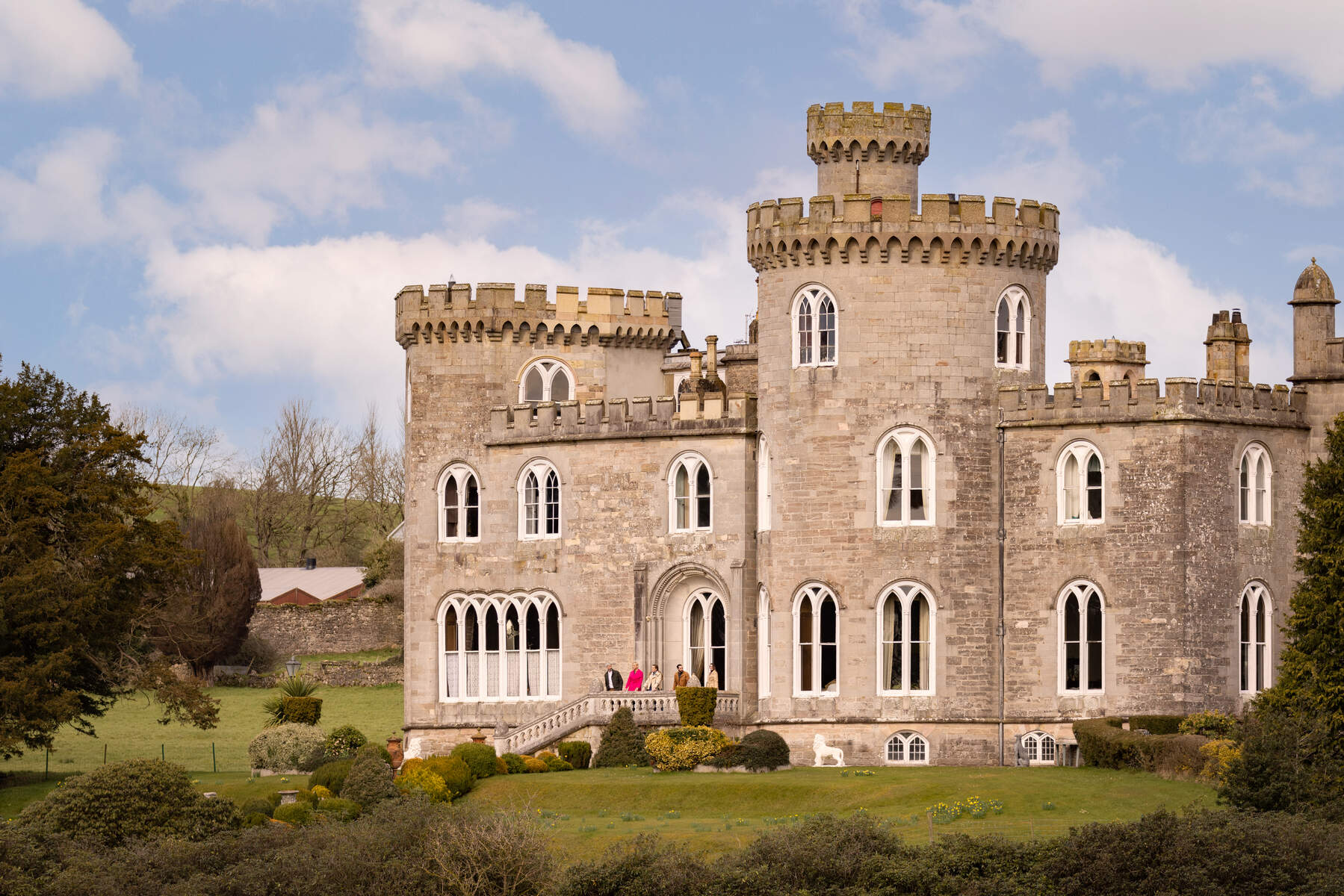
4. Killymoon Castle, County Tyrone

https://killymooncastle.com

Killymoon Castle, County Tyrone, photograph @ChristopherHeaney for Tourism Ireland 2022, Ireland’s Content Pool. (see [3])

The website tells us:

Killymoon castle sits in picturesque surroundings overlooking the Ballinderry River on the outskirts of Cookstown just 50 miles from Belfast by car. The castle is a grade A listed building designed by the famous John Nash who also designed the Regent Street area of London and its most famous landmark Buckingham Palace. The castle was originally built in 1600 for James Stewart, six generations of the Stewarts lived in the castle until 1852. It was described in the Irish Penny Journal of 1841 ‘as one of the most aristocratic residences in the province of Ulster’.”

The original castle, built in 1671 by James Stewart on the substantial demesne had been granted to him under the Plantation Settlement. Stewarts ancestors had come from Scotland during the plantation to settle in Cookstown, and in 1666 James bought the land lease for the castle site from Alan Cooke – the founder of Cookstown. The castle was destroyed by fire in 1801 and in 1802, Colonel William Stewart had a new, more imposing castle built, designed by John Nash, the famous London Architect.

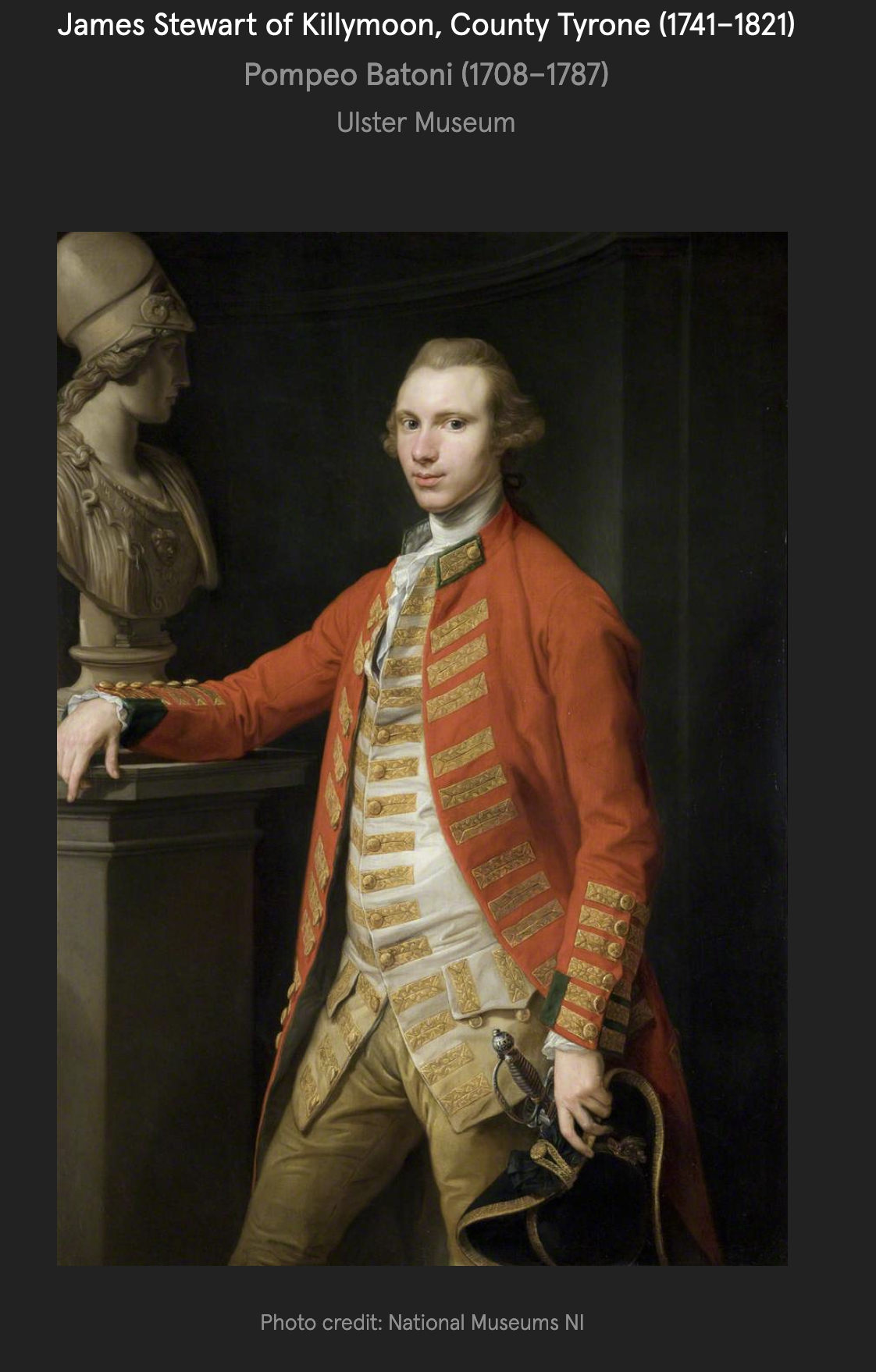
James Stewart (1741-1821) of Killymoon, County Tyrone, by Pompeo Batoni, Ulster Museum, National Museum of Northern Ireland.

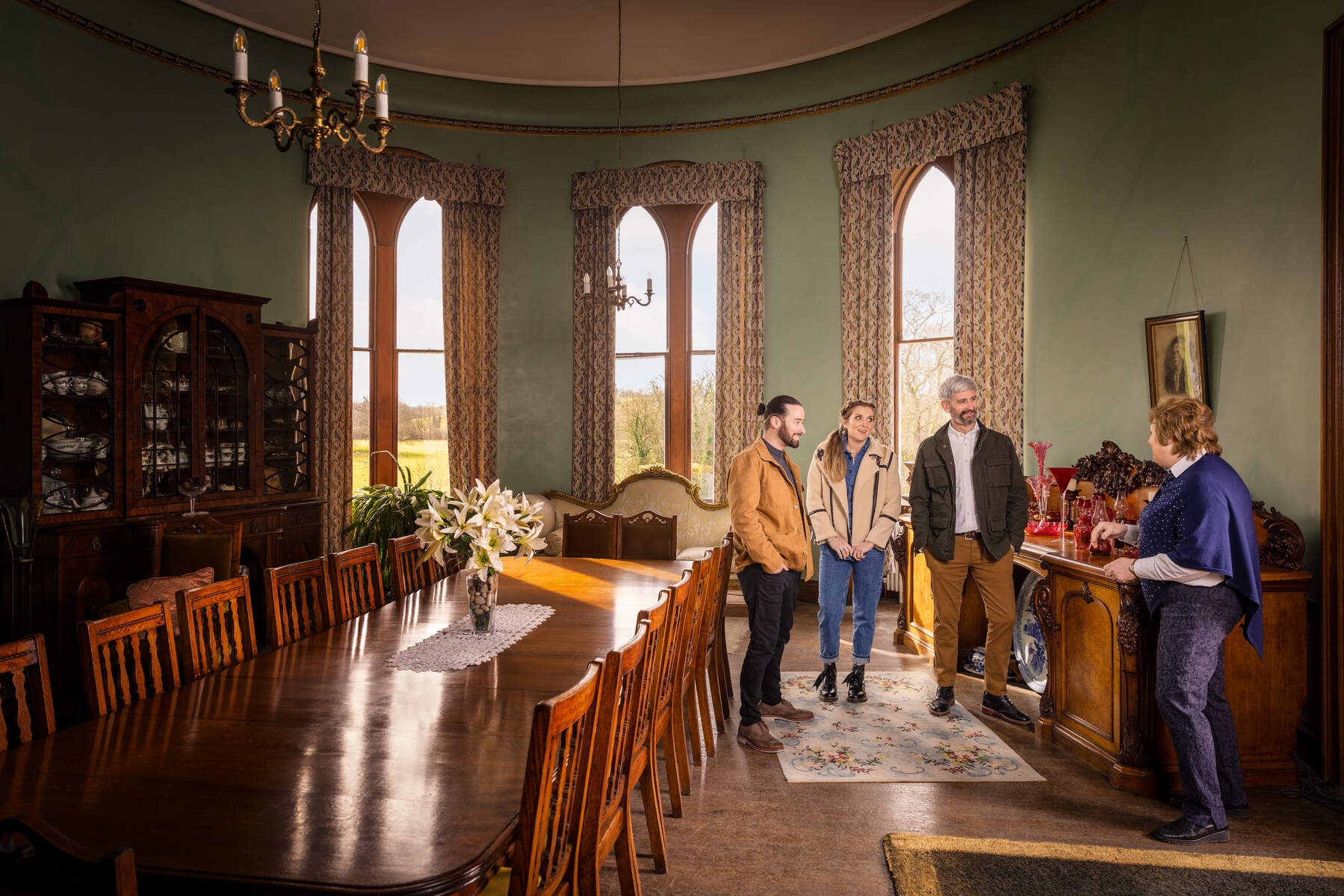
Killymoon was Nash’s first castle in Ireland, and reputedly cost £80,000 to build (about £7.4 million today).  It was described in the Irish Penny Journal of 1841 as “one of the most aristocratic residences in the province of Ulster, with state apartments consisting of “a breakfast-parlour, dining room, ante-room and drawing-room, all of which are of noble proportions and their woodwork of polished oak”.

The Killymoon estate remained the property of the Stewart family for six generations; however, their extravagant lifestyle caused the Stewart family to fall on hard times, especially during the years of the Irish famine.  The estate was sold in 1852 for £100,000.  In 1857, the castle had again been sold to the Cooper family; and, in 1865, Colonel Bolton, an English gentleman, purchased the castle.

A mere ten years later, Mervyn Stuart Thomas Moutray JP,  became the owner of Killymoon Castle until 1916, when Gerald Macura bought the castle and town of Cookstown for almost £100,000.  By 1918, Macura was also in financial difficulties and was compelled to sell off his assets. John Coulter bought the castle and grounds in 1922 and it remains the home of the Coulter family to this day.

Killymoon Castle, County Tyrone, photograph @ChristopherHeaney for Tourism Ireland 2022, Ireland’s Content Pool. (see [3])

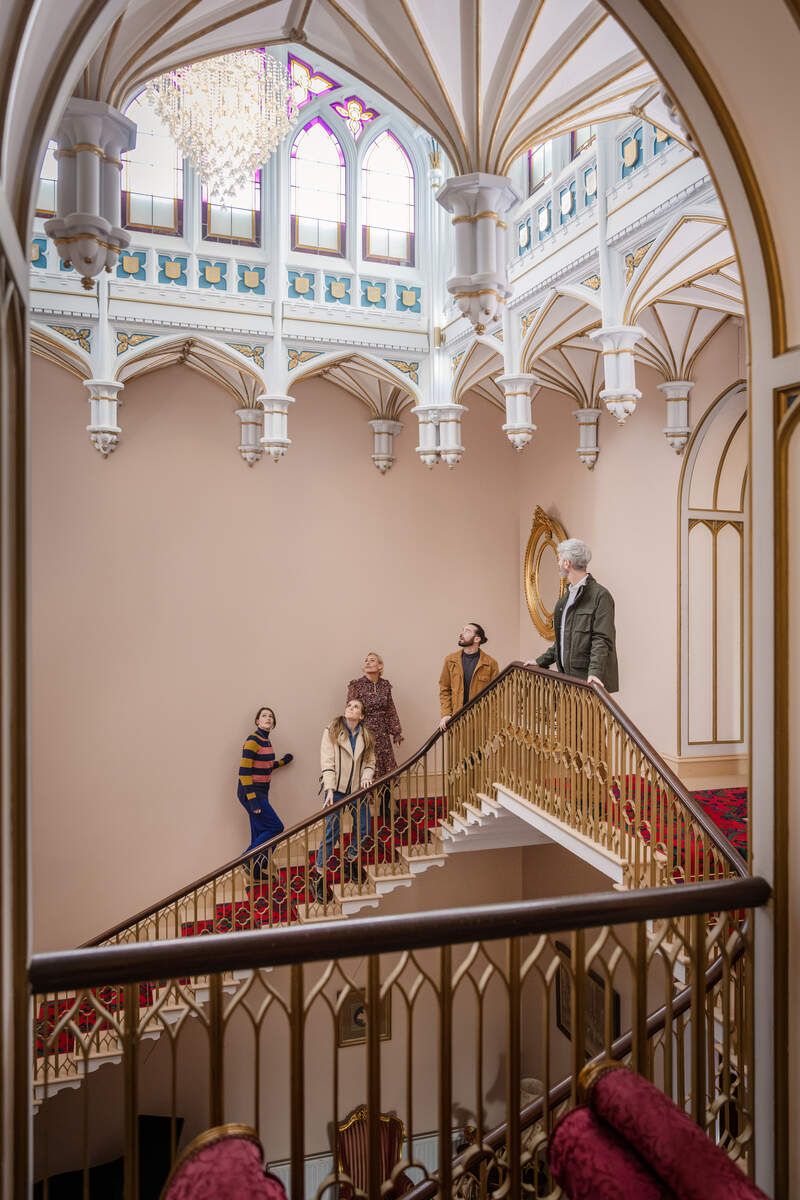
Take a tour of Killymoon Castle and step back in time. Visit Lady Molesworth’s morning room, the oval dining room whose restrained plasterwork and marble fireplace show the dignity of their Georgian origin. Ascend the magnificent cantilever style staircase and admire the fragile plasterwork like sugar spires on an inverted wedding cake .

Colonel Stewart was only 27 when this castle was built and it must have been a truly wonderful fairy tale to bring his beautiful bride to  this romantic spot.

Fortunes and families rise and fall and this fabulous fairy dwelling which cost £80.000 to build in 1807, was gambled in a game of poker and sold for an unbelieveable sum in the 1920’s 

Group tours can be arranged  by clicking the button below and filling out a request form. Private tours also available.

Killymoon Castle, County Tyrone, photograph @ChristopherHeaney for Tourism Ireland 2022, Ireland’s Content Pool. (see [3])

Mark Bence-Jones writes in his A Guide to Irish Country Houses (1988):

p. 173. “(Stewart/LGI1912; Moutray/LGI1912) One of John Nash’s earliest castles, built ca 1803 for William Stewart, MP, incorporating part of the previous house which was burnt ca 1800. A building with a romantic silhouette in a glorious position above the Ballinderry river with a backdrop of sweeping woods and parkland. The principal front dominated by an almost central battlemented and machicolated round tower and turret; at one end, an octagonal battlemented and machicolated tower; at the other, the profile of the square tower in the adjoining front, the base of which is arched to form a porte-cochere. The latter tower has slender octagonal corner turrets, with cupolas. Pointed windows grouped together under segmental hood-mouldings, which were regarded by Nash and his contemporaries as Saxon. Good interior planning with square, circular and octagonal rooms fitted together. Hall with double staircase, lit by Gothic lantern on plaster fan-vaulted ceiling. Drawing room with plain gilt plasterwork cornice of wreath and honeysuckle design. Library in form of Gothic chapel, with stained glass windows. Sold after William Stewart’s death 1850. Subsequently the seat of the Moutray family.” 

Killymoon Castle, County Tyrone, photograph @ChristopherHeaney for Tourism Ireland 2022, Ireland’s Content Pool. (see [3])

5. Lissan House, Drumgrass Road, Cookstown, County Tyrone, BT80 9SW. https://www.lissanhouse.com/

The house is open from Easter to mid September on Saturdays and Sundays, and during July and August it is open Thursday to Sunday. Opening hours are from 12:00 – 17:00.
3 guided tours per day at 12:30, 14:00 and 15:30.

Lissan House is an enchanting country residence set within a 260 acre demesne of ancient woodland and forestry. 

The estate was created in the 17th century and remained the home of the Staples family for nearly 400 years. Lissan came to prominence in 2003 when its popularity helped it reach the final of the BBC Restoration programme. 

Following extensive redevelopment, the house opened its doors in spring 2012 to reveal modern interactive exhibits and original family furnishings which take you on a unique journey through the history of the estate and the family characters that have shaped it. Children will be kept entertained in the house with the teddy bear treasure hunt. The demesne also features a challenging adventure playground for children, a wooded picnic area, walled garden.

Lissan House and estate is now run and managed by a charitable board, who help secure the future of the property for the benefit of the community.

Robert Staples (1772-1832) 8th Baronet, courtesy of National Trust Springhill.

Mark Bence-Jones writes in his A Guide to Irish Country Houses (1988):

p. 188. “(Staples, Bt/PB) A plain three storey 9 bay Georgian house with later additions. At one end, a single-storey wing with a three-sided mullioned bow. At the other, a gable-ended office range. And in the middle of the entrance front, a single-storey protuberance of unusual depth, embodying a porch and a bow-fronted porte-cochere with windows. Some time post mid-C18, a garden was laid out here by the architect, Davis Duckart; with an “artificial sheet of water with cascades, and a picturesque bridge.” 

6. Prehen, County Tyrone

http://prehenhouse.com/?msclkid=cbb767dba6a711ec8a9ab161a56f043c

Places to stay County Tyrone

1. An Creagan, Omagh, County Tyrone – accommodation

www.ancreagan.com

2. Ashbrook House, Aucnacloy, County Tyrone – accommodation

www.ashbrook-house.co.uk

3. Baronscourt Estate, Newtownstewart, Omagh, County Tyrone – accommodation

https://barons-court.com

4. Blessingbourne, County Tyrone – accommodation

https://www.blessingbourne.com/self-catering-accommodation/ 

Nestled in the heart of the estate’s historic courtyard the collection of 5 award-winning self-catering apartments are ideal for family breaks, romantic breaks and groups. Guests can enjoy a relaxing country estate experience.

Guests can choose from 1 bedroom or 2 bedroom self-catering accommodation, all of which are pet friendly. Experience a home from home environment with the apartment’s warm and inviting décor. All apartments feature open plan Living, Dining and Kitchen areas. On-site laundry facilities are available.

5. Cobblers Cottage Omagh, County Tyrone (sleeps 5)

http://www.cobblerscottagecreggan.com

The lovingly renovated Cobblers Cottage has a cosy living/kitchen/dining area, 2 spacious bedrooms (sleeps 5) &  a bathroom.

Enjoy the simplicity of this recently renovated 200 year old traditional Irish cottage in peaceful surroundings of Tyrone at the foot of the Sperrin Mountains between Omagh and Cookstown, in the area of Creggan. 

6. Corick House Hotel, Clogher, County Tyrone

https://www.corickcountryhouse.com

7. Kilcootry Barn, Fintona, County Tyrone – accommodation

www.kilcootrybarn.com

Kilcootry Barn is a 150 year old stone barn which is set on a 6 acre retreat in a private, rural setting.

This beautifully furnished and fully equipped property offers luxurious self catering accommodation for the discerning visitor.

8. Killymoon Castle Lodge, 302 Killymoon Road, BT80 8ZA – accommodation

https://killymooncastle.com

Stay with us in our Castle Lodge, located in the grounds of Killymoon Castle on the banks of the Ballinderry River, offers the most tranquil of breaks. Only a short distance from Cookstown town centre and a one hour drive to the north coast, Donegal or Belfast. With Killymoon golf club and the Ballinderry River on your doorstep what better way to relax.

9. The Lower House Rooms, Donaghmore, Dungannon, Co. Tyrone, BT70 3EZ – accommodation

https://thelowerhouserooms.com/rooms/

Located in Donaghmore in the heart of Mid-Ulster, the conversion of The Lower House into 7 rooms of accomodation has been our pride and joy. Renovated with the finest fixtures, fittings and decoration, a stay at The Lower House rooms is an experience full of character and luxury.

10. Spice Cottages, Dungannon, County Tyrone – accommodation

https://www.spicecottages.com/cottages/ginger-cottage-dungannon

4 Stunning self catering family cottages situated in the Dungannon countryside, Co. Tyrone, Northern Ireland

[1] Bence-Jones, Mark. A Guide to Irish Country Houses (originally published as Burke’s Guide to Country Houses volume 1 Ireland by Burke’s Peerage Ltd. 1978); Revised edition 1988 Constable and Company Ltd, London.

[2] http://lordbelmontinnorthernireland.blogspot.com

[3] Ireland’s Content Pool, https://www.irelandscontentpool.com/en

Text © Jennifer Winder-Baggot, www.irishhistorichouses.com
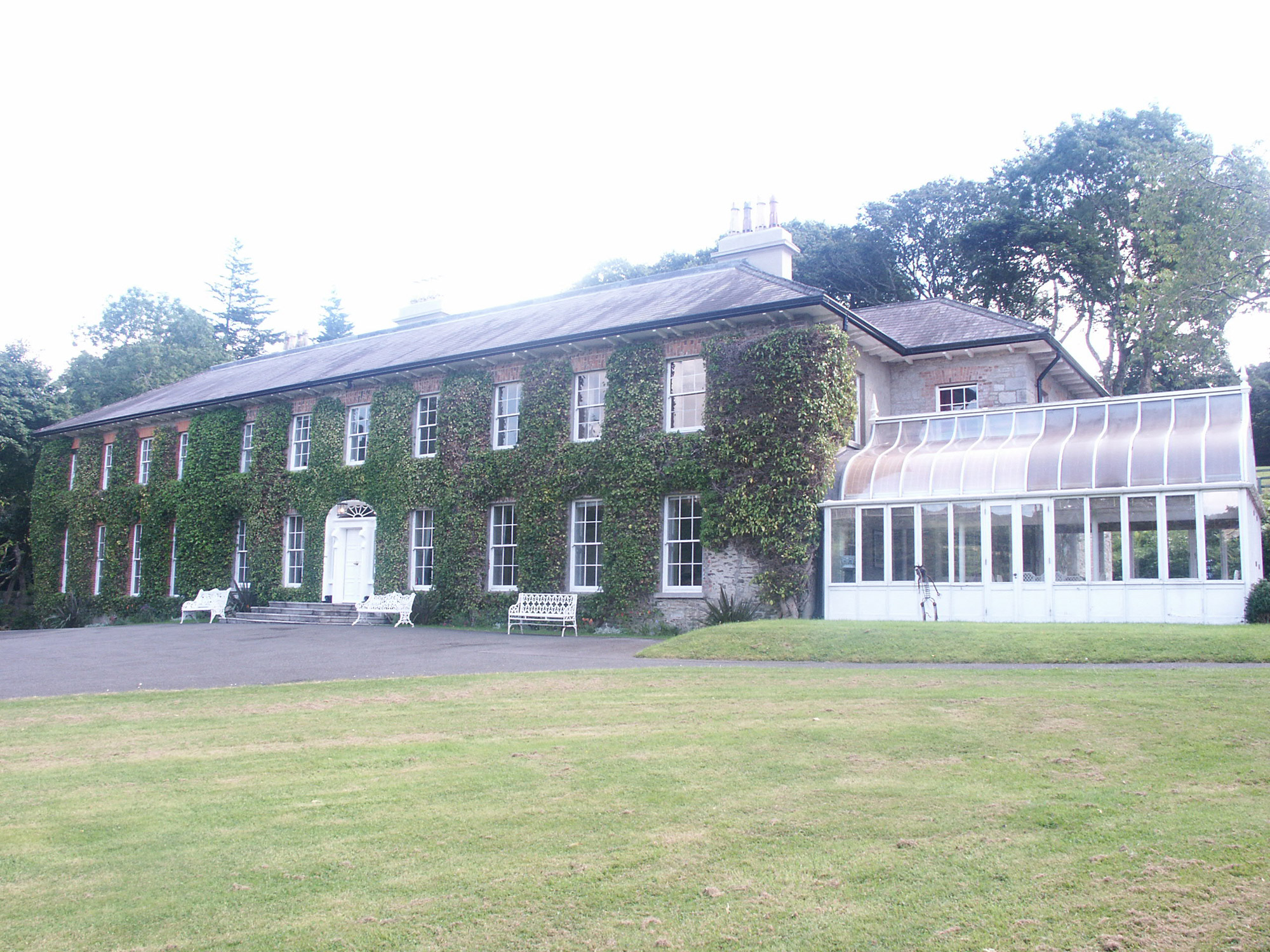
Historic houses in County Wicklow listed in the National Inventory of Architectural Heritage

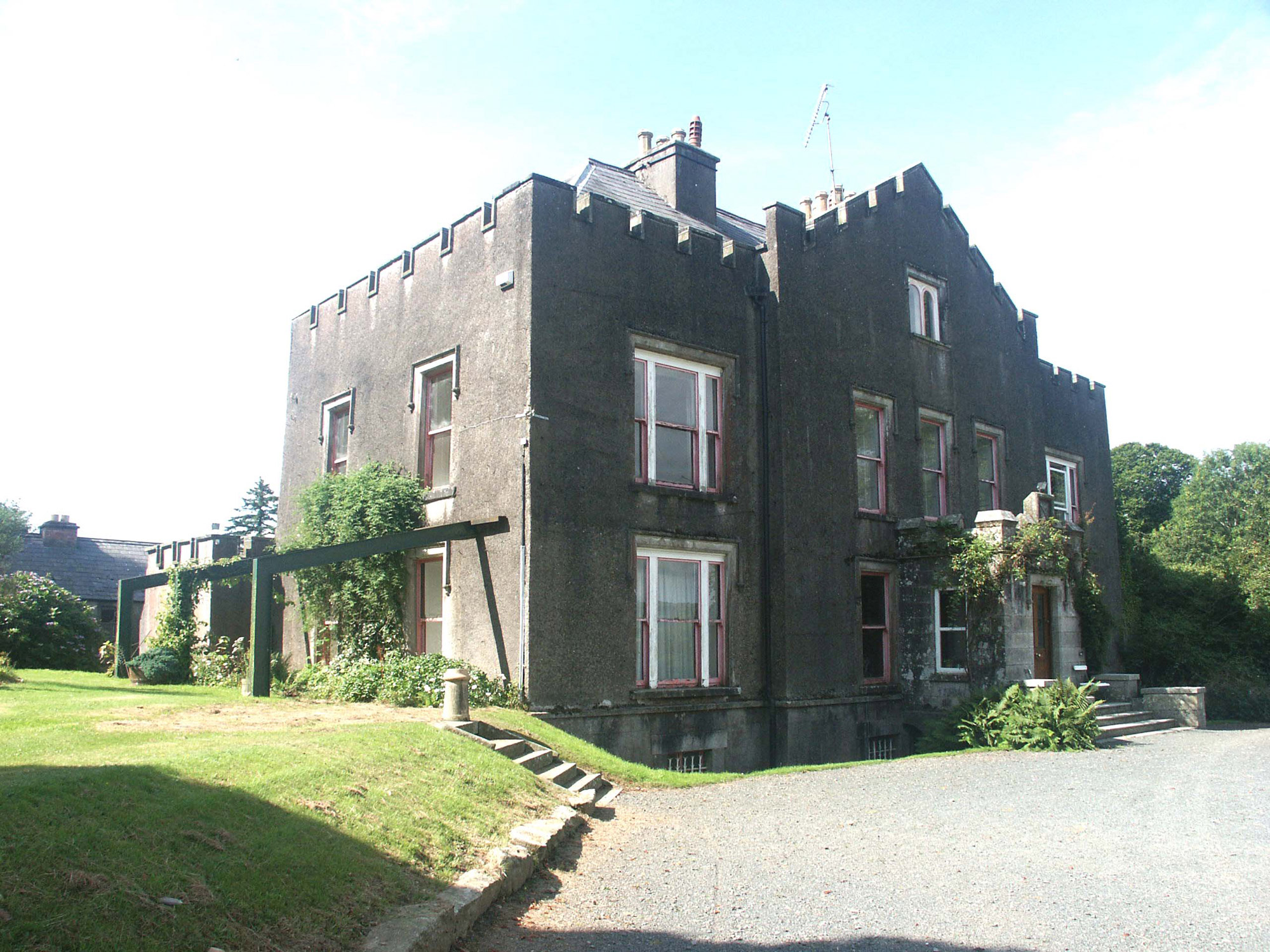
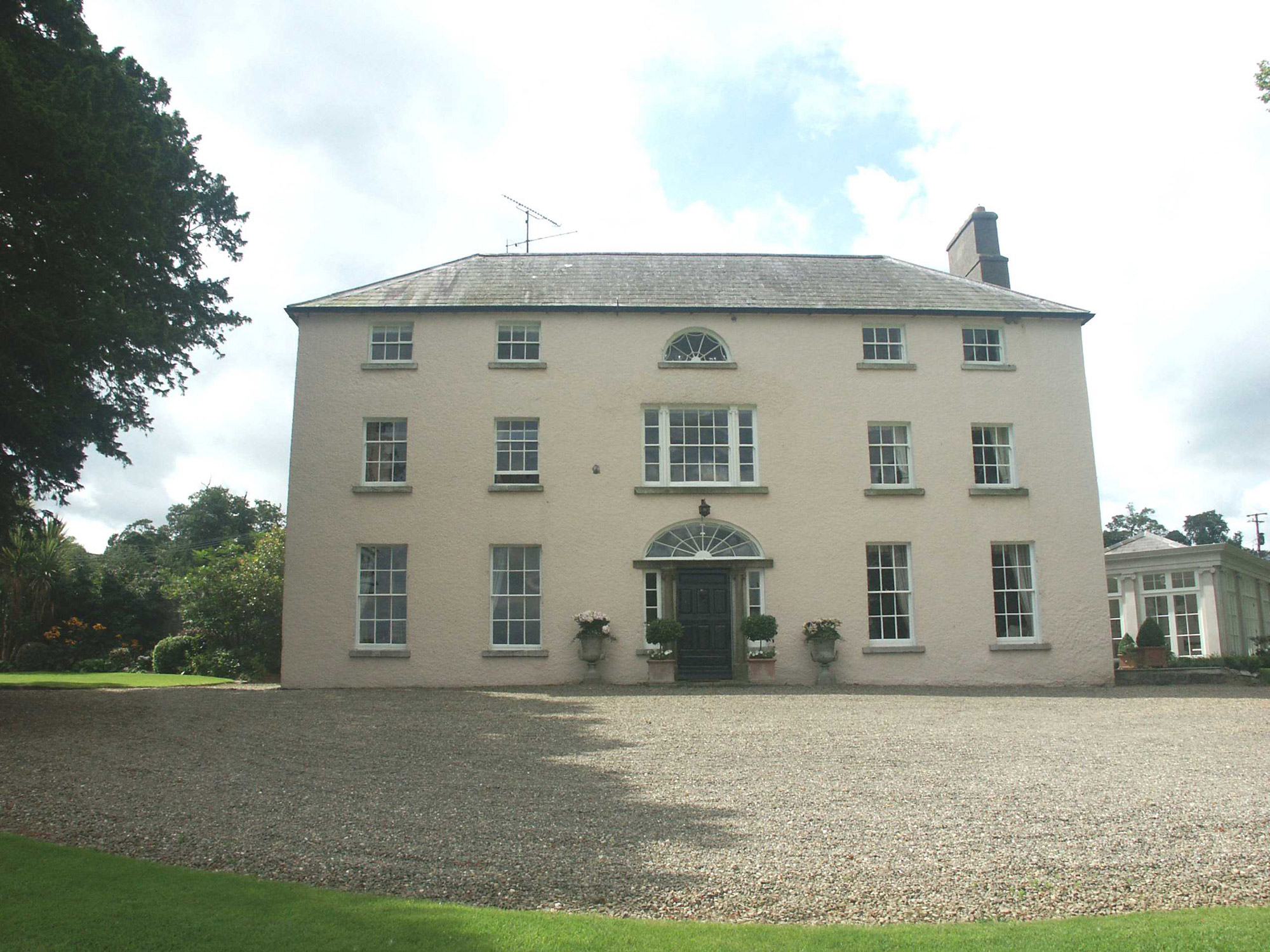
I would like to share with you some examples of the houses in Wicklow listed in the National Inventory of Architectural Heritage (photographs are all taken from the National Inventory):

i. Avondale, open to the public. Built in 1779, designs may have been by James Wyatt. It was the home of Charles Stewart Parnell, the Nationalist leader in Ireland.

ii. Avonmore

Avonmore House, built around 1830.

iii. Ballyarthur

Ballyarthur, built in 1680.

iv. Ballycurry

Ballycurry House, built in 1807 to designs by Francis Johnston.

v. Ballykeane

Ballykeane, built around 1780.

vi. Ballymoney

Ballymoney, built around 1800.

vii. Ballynure House

Ballynure House, built around 1800.

viii. Baltiboys

Baltiboys, built around 1840.

ix. Carnew Castle

Carnew Castle, built in the late sixteenth century, re-roofed and remodernised ca. 1817 by 4th Earl Fitzwilliam whose Irish seat, Coolattin, is nearby.

x. Castle Kevin

Castle Kevin, built in 1813.

xi. Clonmannon House (Old)

Clonmannon House (Old), built around 1700.

xii. Cronroe, now Bel Air Hotel

https://www.belairhotelequestrian.com/hotel/

Cronroe, now Bel Air Hotel, built in 1890.

xiii. Donard House

Donard House, built in 1813-14 to the designs of William Vierpyl.

xiv. Fortgranite

Fortgranite, built around 1730.

xv. Glanmore Castle

Glanmore Castle, built around 1804, to designs by Francis Johnston.

xvi. Glenart Castle, was a hotel, now private again, built around 1820.

xvii. Grangecon Parks

Grangecon Parks, built around 1820.

xviii. Hollybrook House

Hollybrook House, built in 1835 incorporating an earlier house, to designs by William Vitruvius Morrison.

xix. Humewood Castle

Humewood Castle, built 1867-70 to designs by William White.

xx. Mount John

Mount John, built around 1800.

xxi. Rathsallagh, now a hotel

https://www.rathsallagh.com/

Rathsallagh, built as stables around 1750, converted to a house in 1798.

xxii. Rosanna House

Rosanna House, built around 1720.

xxiii. Roundwood

Roundwood, built around 1800, remodelled later in the nineteenth century.

xxiv. Slaney Park House

Slaney Park House, built around 1810, reduced by one storey after a fire in 1946.

xxv. Tinakilly House, now a small hotel

Tinakilly House (now a hotel), built around 1876 to designs by James Franklin Fuller.

xxvi. Tinode House (you can visit June Blake’s garden www.juneblake.ie )

Tinode, built in 1864 to designs by W.F. Caldbeck, partly demolished in a fire in 1922 and restored in 1973.

xxvii. Tulfarris – now a hotel https://www.tulfarrishotel.com/

Tulfarris – now a hotel, built in 1760, porch from around 1860.

xxviii. Woodbrook, now a golf course

Woodbrook, now a golf course, built around 1840.

xxix. Woodstock House, now Druid’s Glen Golf Course and hotel

Druid’s Glen hotel, formerly called Woodstock, built around 1770.

Curraghmore, Portlaw, County Waterford – section 482

www.curraghmorehouse.ie

Open dates in 2026: May 1-4, 8-10, 15-17, 22-24, 29-31, June 1, 5-7, 12-14, 19-21, 26-28, July 3-5, 10-12, 17-19, 24-26, 31, Aug 1-3, 7-9, 14-23, 28-30, 10am-4pm

Fee: adult/OAP/student, full tour €22, garden tour €8, child under12 years free

DSC_0564
Curraghmore, 5th May 2019. Photograph © Jennifer Winder-Baggot, www.irishhistorichouses.com
According to the Curraghmore website:

Curraghmore House in Waterford is the historic home of the 9th Marquis of Waterford. His ancestors (the de la Poers) came to Ireland from Normandy after a 100-year stopover in Wales around 1170, or about 320 years before Columbus ‘discovered’ the New World.

Some 2,500 acres of formal gardens, woodland and grazing fields make this the largest private demesne in Ireland and one of the finest places to visit in Ireland….

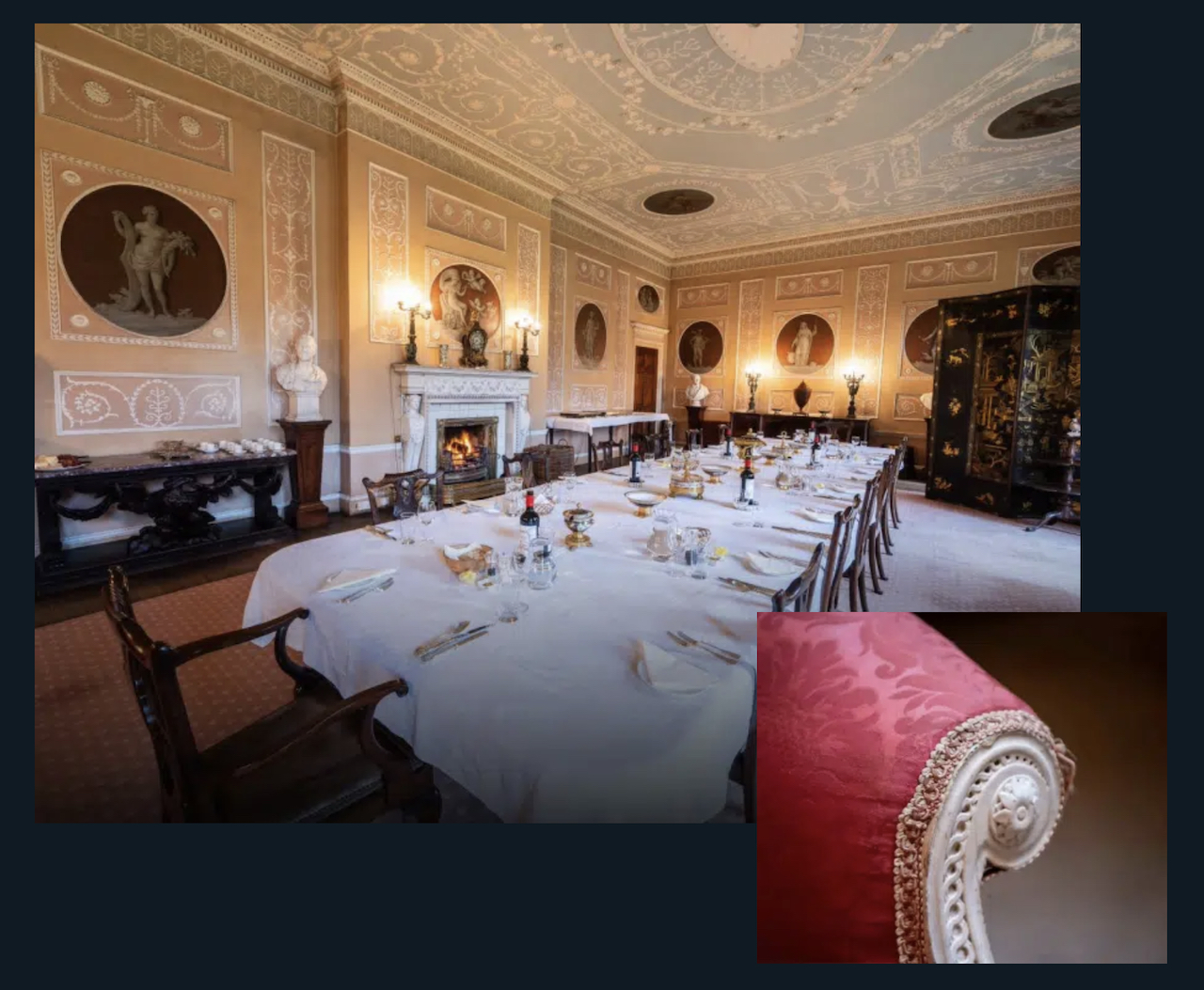
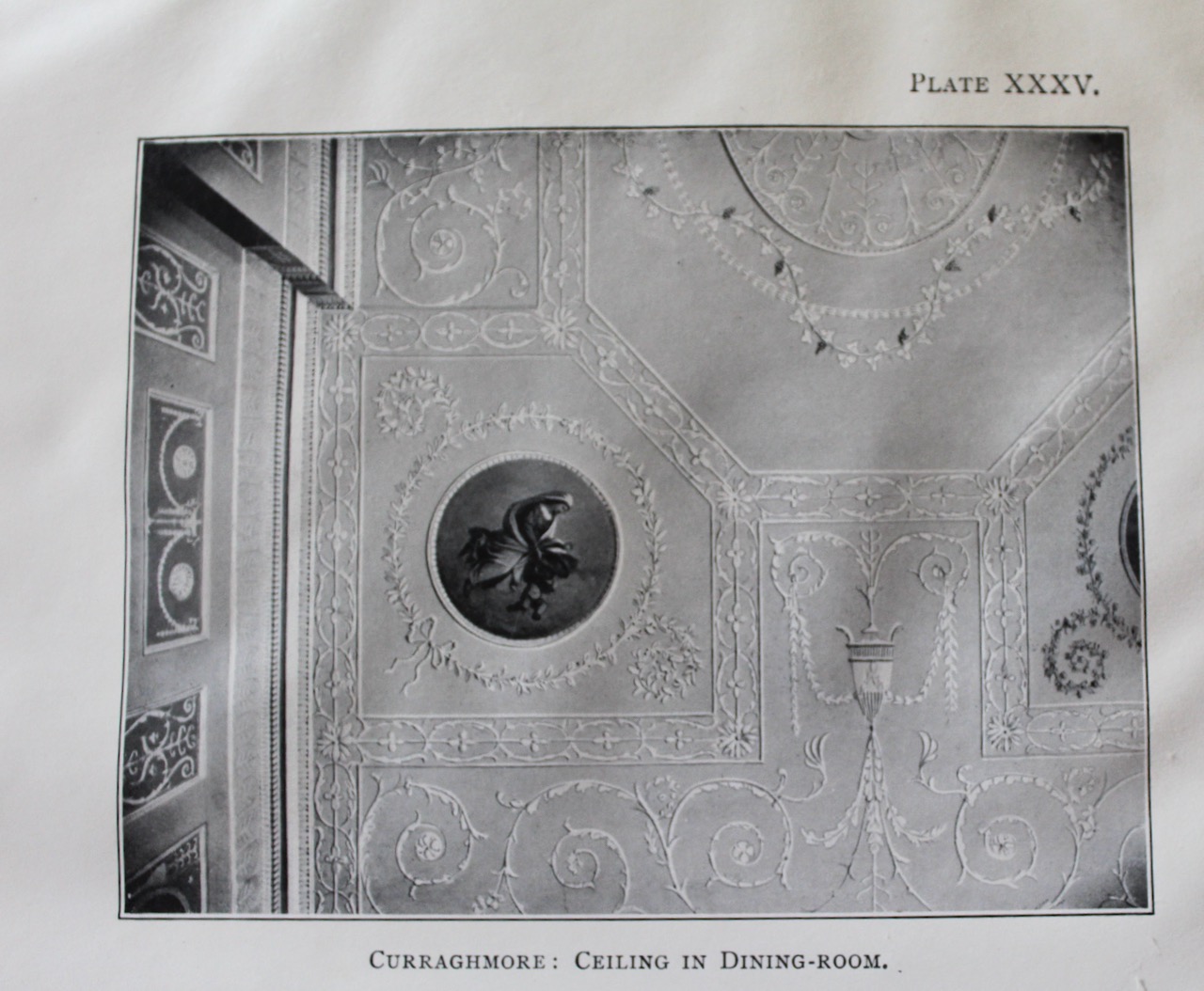
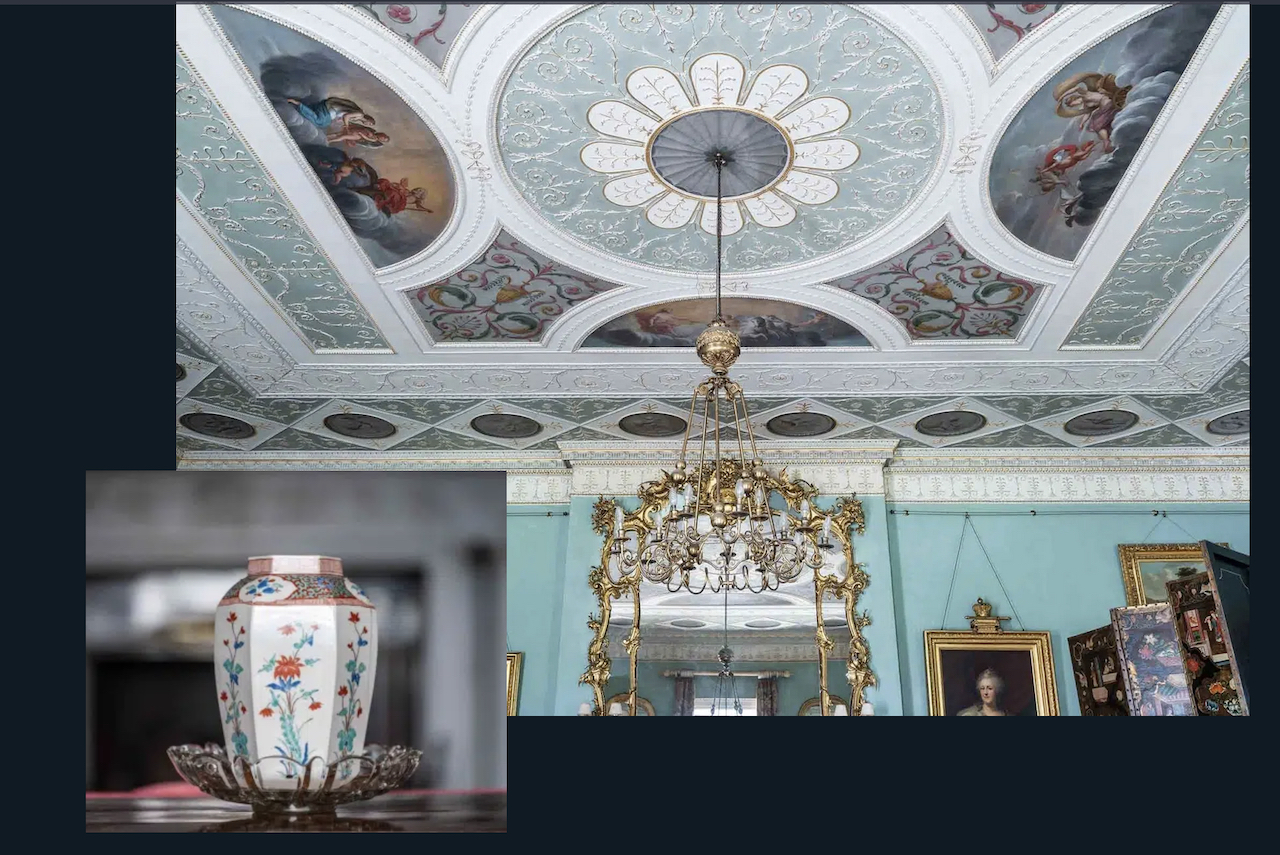
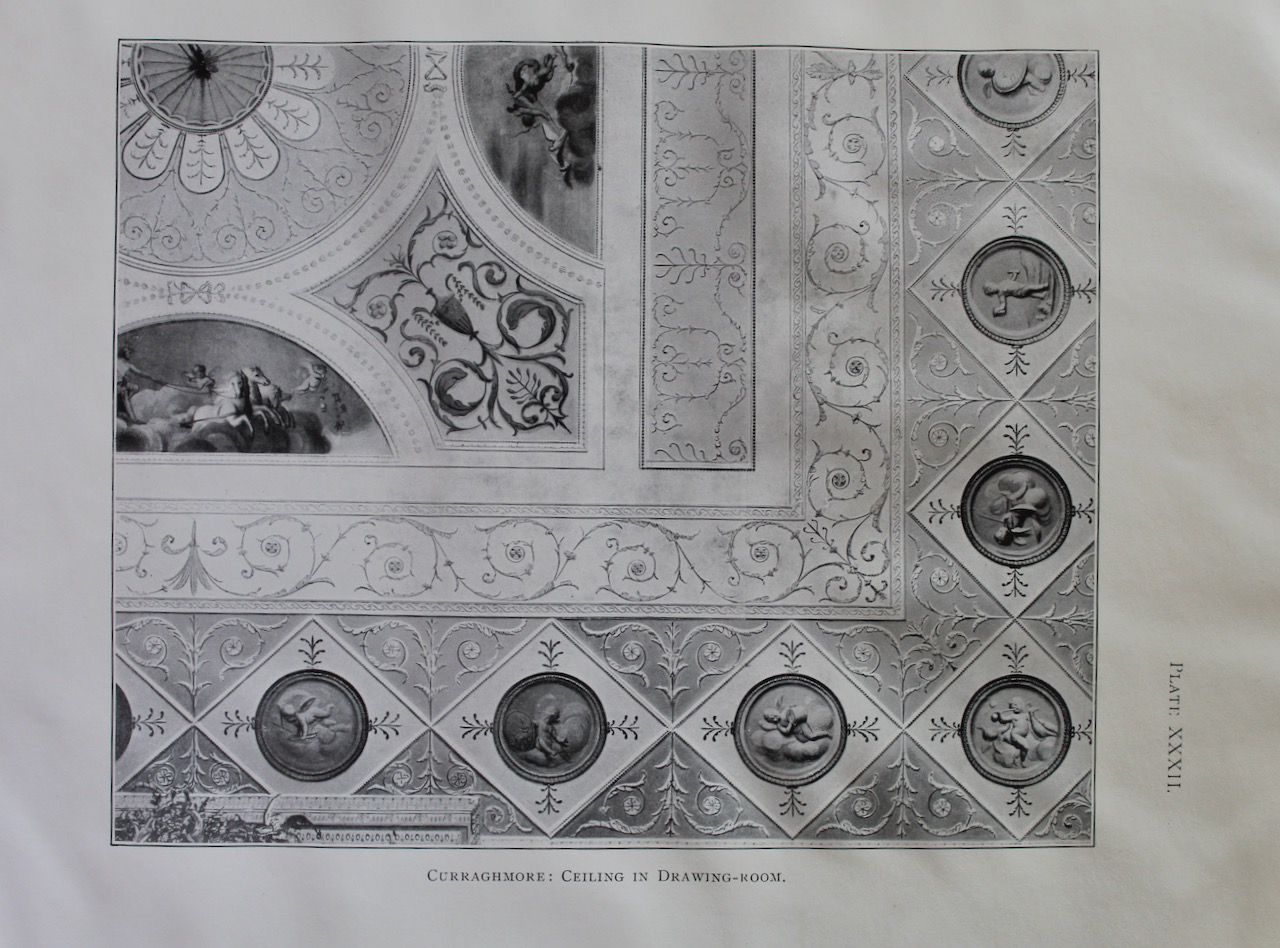
This tour takes in some of the finest neo-classical rooms in Ireland which feature the magnificent plaster work of James Wyatt and grisaille panels by Peter de Gree.” 

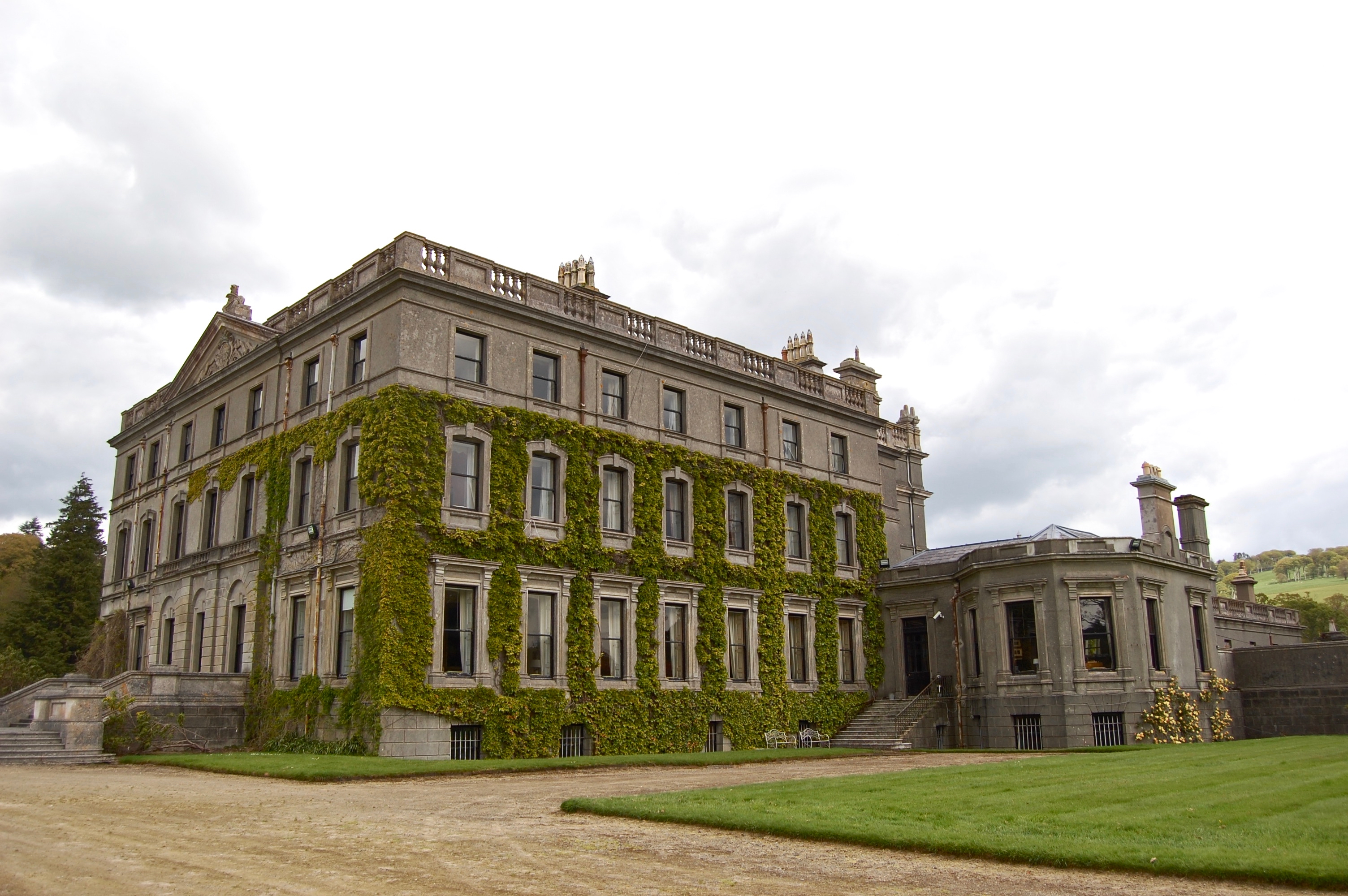
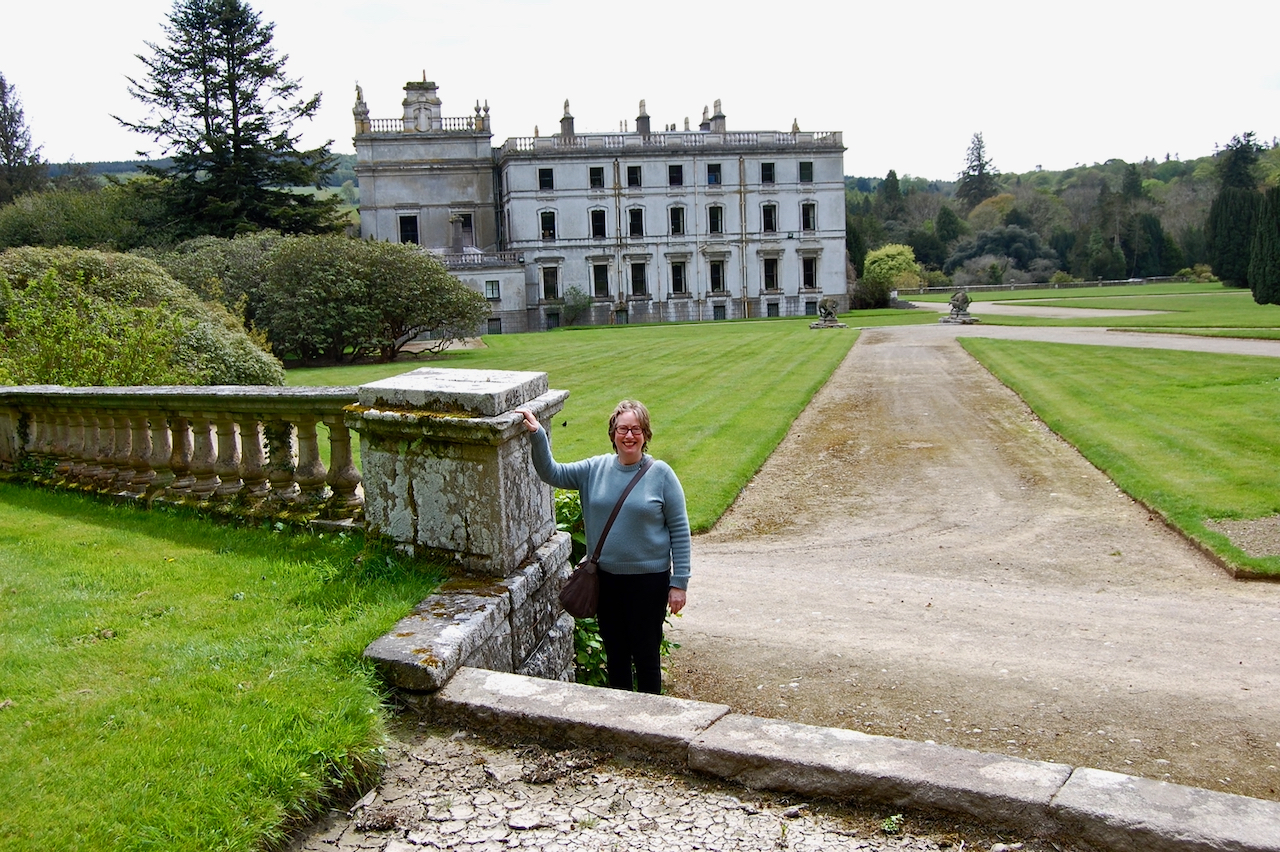
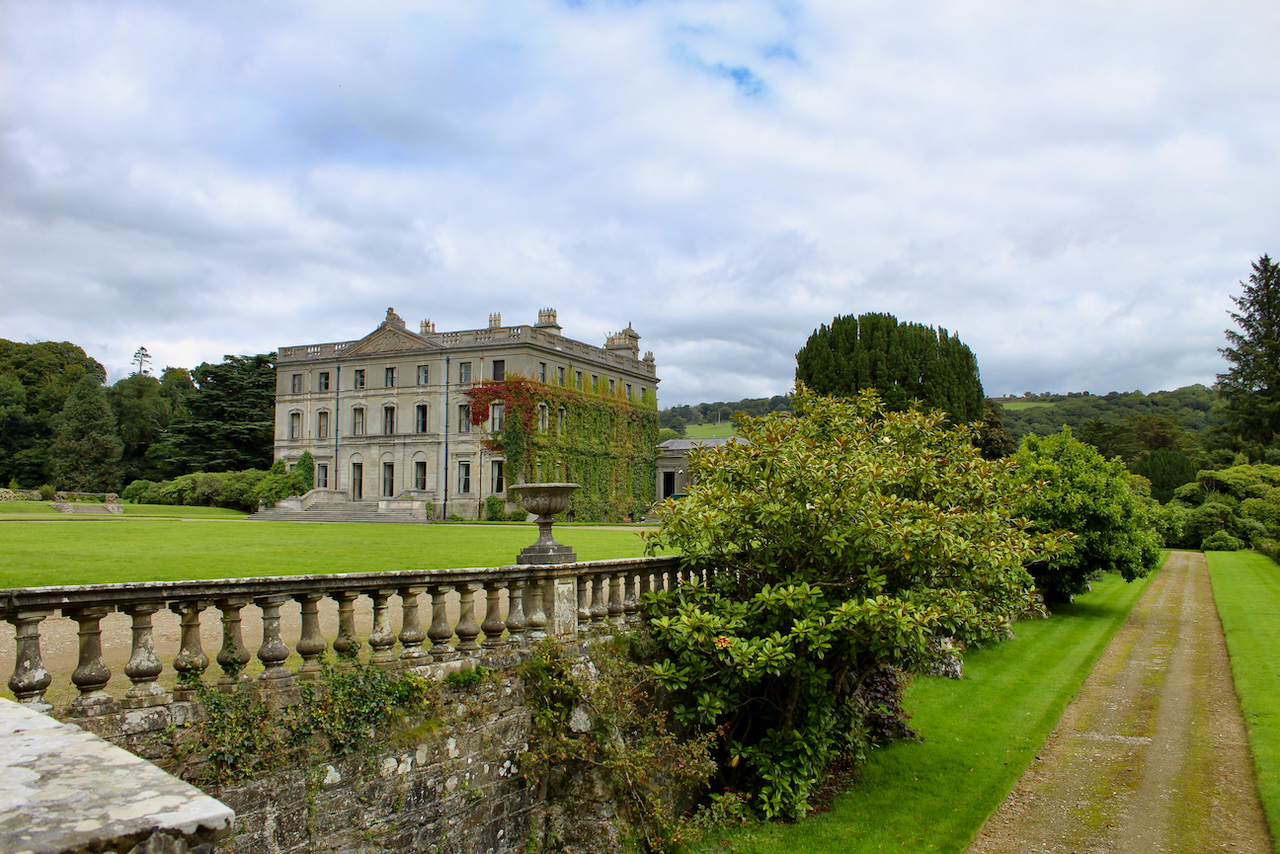
Curraghmore, the garden facing side of the house, designed by James Wyatt (1746-1813), 14th August 2023. Photograph © Jennifer Winder-Baggot, www.irishhistorichouses.com

The website continues: “Curraghmore, meaning great bog, is the last of four castles built by the de la Poer family after their arrival in Ireland in 1167. The Castle walls are about 12 feet thick and within one, a tight spiral stairway connects the lower ground floor with the roof above. Of the many curious and interesting features of Curraghmore, the most  striking is the courtyard front of the house, where the original Castle is encased in a spectacular Victorian mansion with flanking Georgian ranges.

We came across a link to the De La Poer family, also called Le Poer or Power, in Salterbridge, and will meet them again in Powerscourt in Wicklow and Dublin.

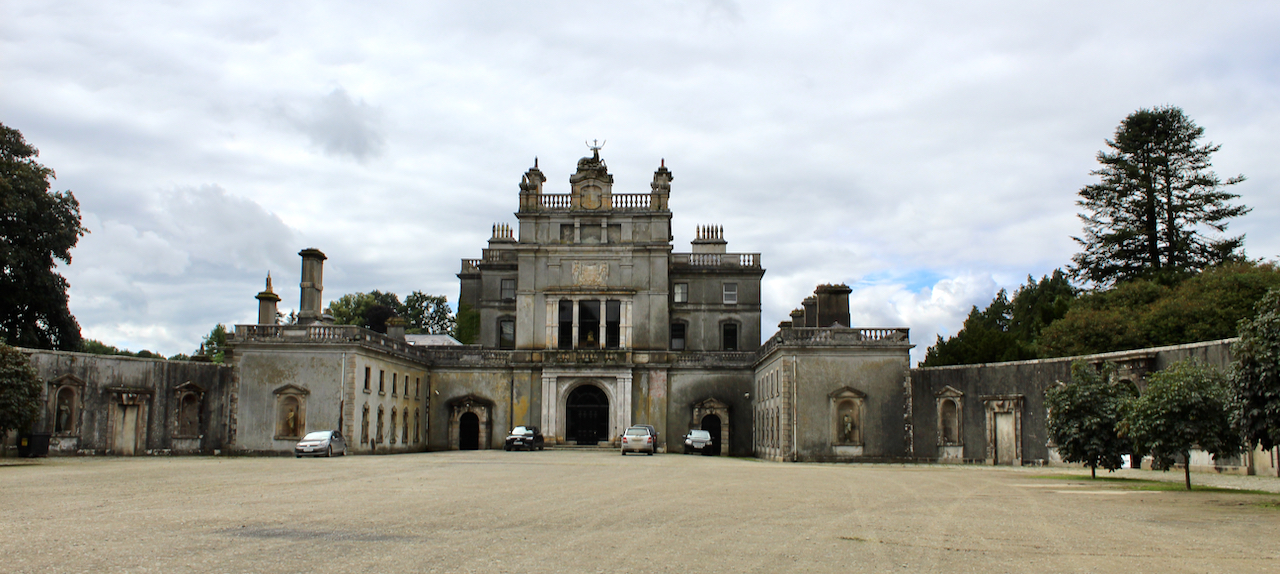
Curraghmore, the courtyard facing side of the house, 14th Aug 2023. Photograph © Jennifer Winder-Baggot, www.irishhistorichouses.com

The core of the house is the medieval tower, visible from the courtyard facing side of the house, built by the original owners, the La Poers, and the house is still owned by the same family today. The tower may stretch back all the way to the original La Poer occupants from 1167. When we went inside, we stood in what was the original tower, and we could see the 12 foot thick walls.

It was difficult to find Curraghmore House. We drove two kilometres up a stony track; without the reassuring directions, we would not have believed we were on the right road. The road winds along by the River Clodagh. As our guide told us later, the distance from anything else in all directions is one reason the house remains intact. There are three entrances, and all have drives of about 1.5km to the house.

The River Clodagh on the drive to Curraghmore. Photograph © Jennifer Winder-Baggot, www.irishhistorichouses.com
DSC_0563
Entering Curraghmore, via servants’ quarters either side of courtyard, 5th May 2019. Photograph © Jennifer Winder-Baggot, www.irishhistorichouses.com
Photograph courtesy of Curraghmore website.
This is the gate one drives through into the courtyard of Curraghmore. Photograph © Jennifer Winder-Baggot, www.irishhistorichouses.com

Mark Bence-Jones describes Curraghmore in A Guide to Irish Country Houses as a medieval tower with a large three storey house behind it. He writes that the “original Castle is encased in a spectacular Victorian mansion” with flanking Georgian ranges housing servants, stables, etc. [1] The house is seven bays wide (see garden front) and seven bays deep.

DSC_0612
Garden front, 5th May 2019. It has full height windows where there was the original door, I think. Photograph © Jennifer Winder-Baggot, www.irishhistorichouses.com
The guide told us that when James Wyatt added to the house, he specifically created windows and no door in the room that faces the garden, to avail of the view. However, the windows are deceptive and are actually “doors,” as they fully open to let in visitors.

Photograph courtesy of Curraghmore website.
DSC_0616
Curraghmore, 5th May 2019. Photograph © Jennifer Winder-Baggot, www.irishhistorichouses.com
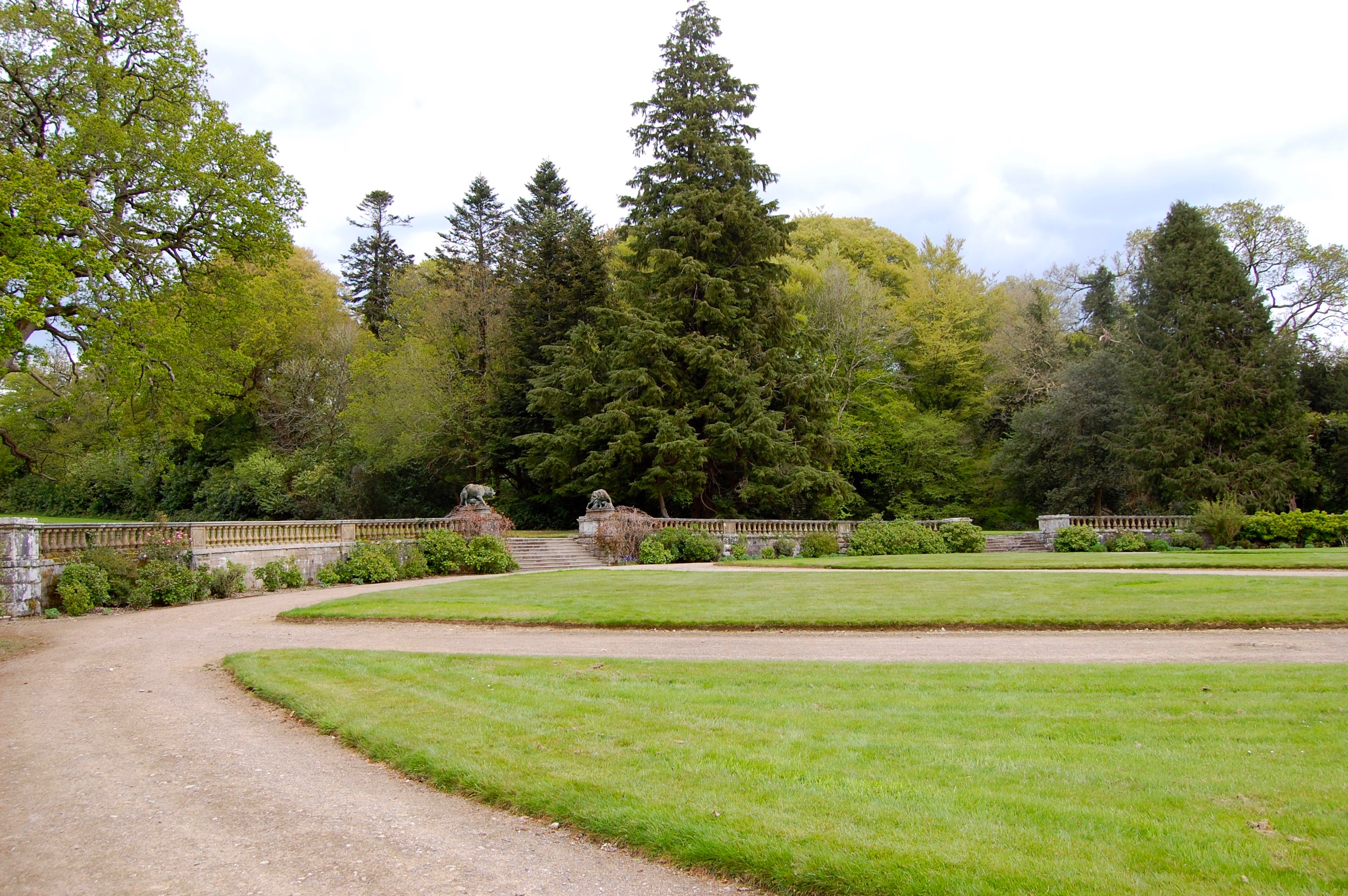
The view takes in a sweeping lawns, a circular pond that once held a big fountain and a lake beyond, created by Wyatt, and the mountains in the distance. Photograph © Jennifer Winder-Baggot, www.irishhistorichouses.com
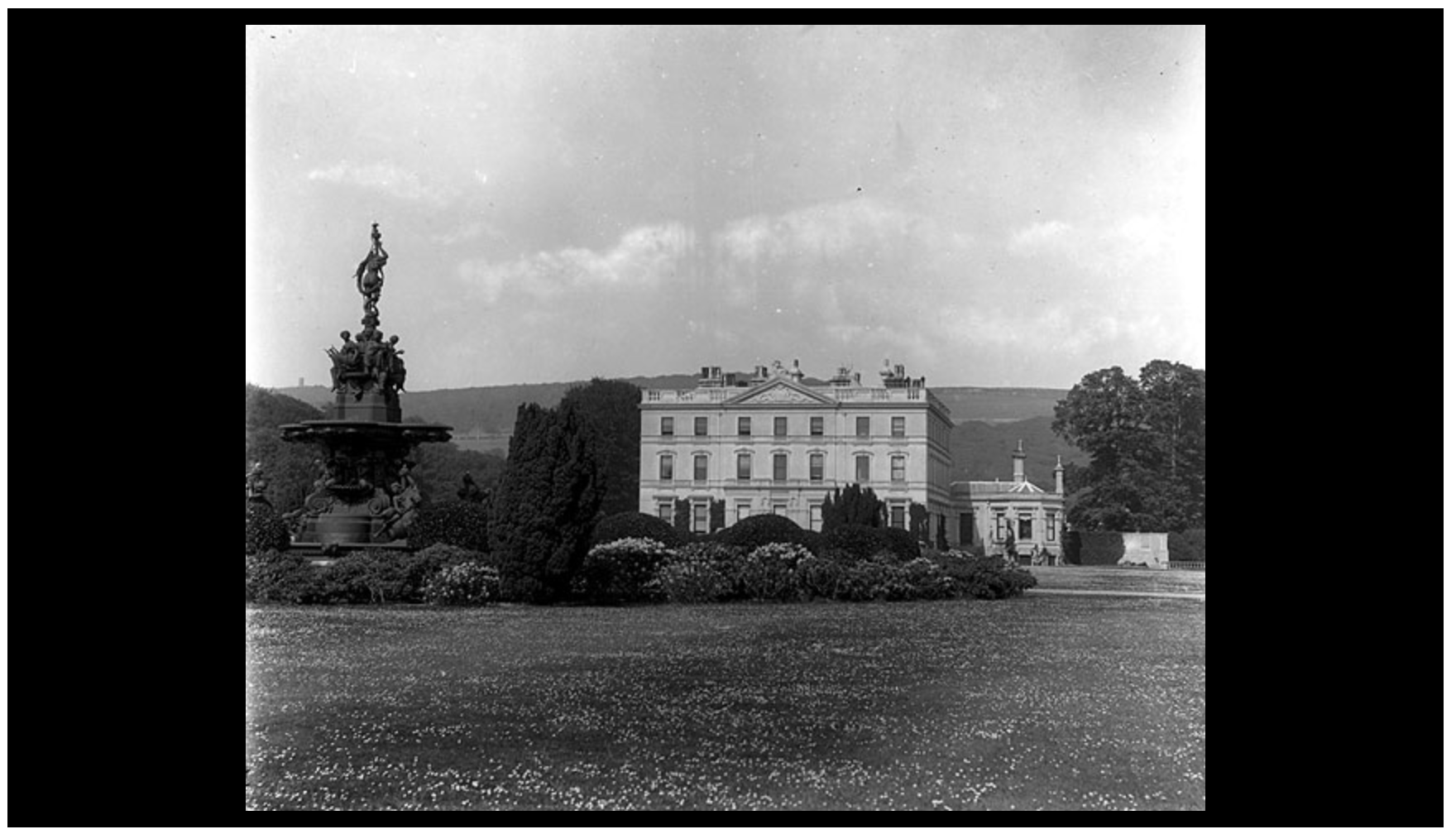
Curraghmore House and Fountain, Portlaw, Co. Waterford. Unfortunately the huge fountain has gone. Poole Collection National Library of Ireland, call no. pooleimp141.

Mark Bence-Jones writes that:

The tower survives from the old castle of the Le Poers or Powers; the house was in existence in 1654, but was rebuilt 1700 and subsequently enlarged and remodelled; it extends round three sides of a small inner court, which is closed on fourth side by the tower. The 1700 rebuilding was carried out by James Power, 3rd and last Earl of Tyrone of first creation, whose daughter and heiress, Lady Catherine Power, married Sir Marcus Beresford…The 1st Beresford Earl of Tyrone remodelled the interior of the old tower and probably had work done on the house as well.

The tower has three tiers of pilasters framing the main entrance doorway and triple windows in the two storeys above it, and is surmounted by St. Hubert’s Stag, the family crest of the Le Poers. Photograph © Jennifer Winder-Baggot, www.irishhistorichouses.com
DSC_0565
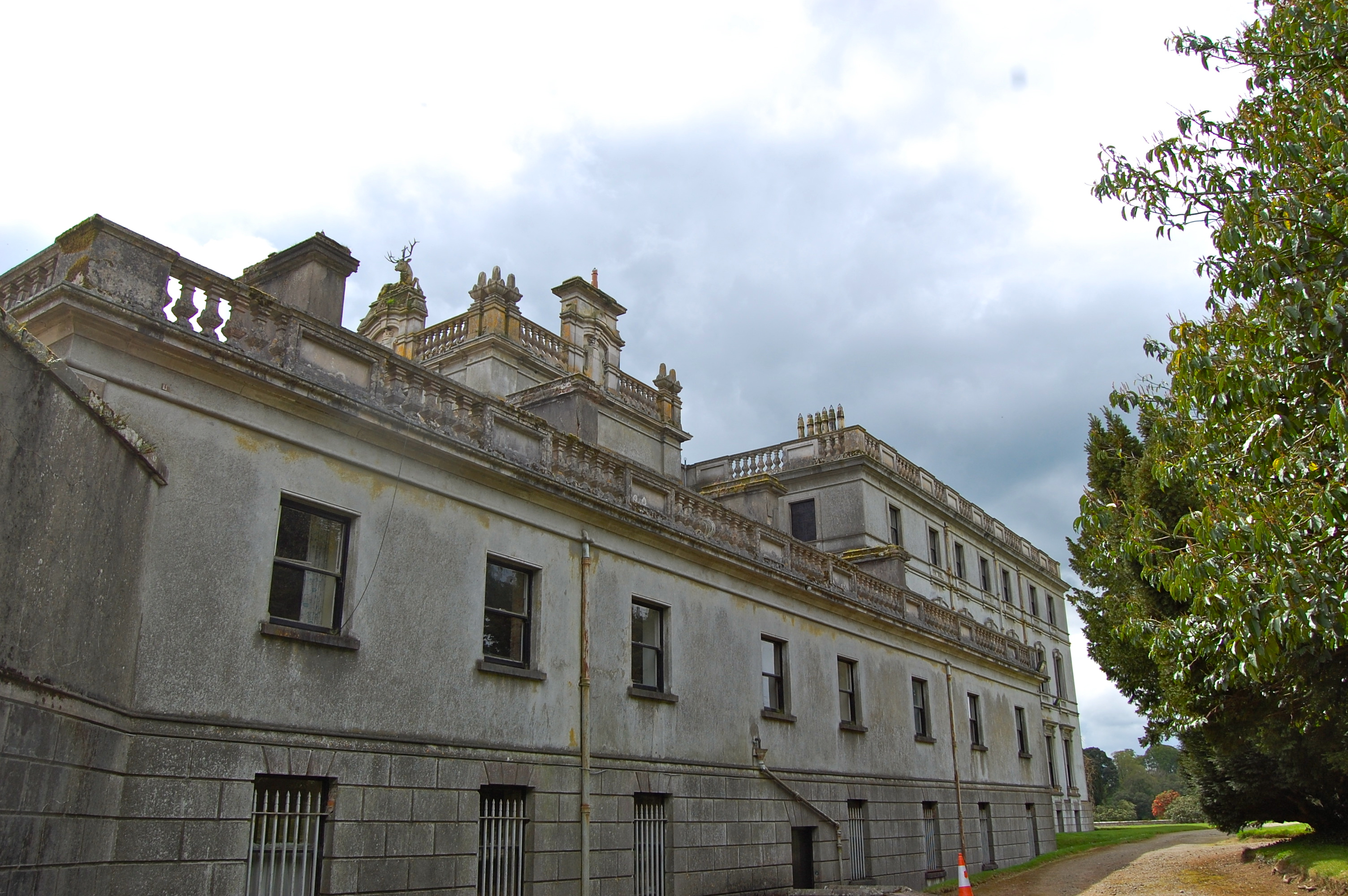
St. Hubert’s Stag on top of Curraghmore. The crown below the stag, on top of the coat of arms, is the coronet of a Marquess, 5th May 2019. Photograph © Jennifer Winder-Baggot, www.irishhistorichouses.com
Rt. Hon. Marcus Beresford, 1st Earl of Tyrone, photograph courtesy of the Beresford family and creative commons and wikipedia.

Mark Bence-Jones continues his description of the house: “The tower and the house were both refaced mid-C19. The house has a pediment in the garden front; and, like the tower, a balustraded roof parapet. The tower has three tiers of pilasters framing the main entrance doorway and triple windows in the two storeys above it, and is surmounted by St. Hubert’s Stag, the family crest of the Le Poers.” (see [1])

DSC_0613
The house is very large as it is not only seven bays wide but seven bays deep, 5th May 2019. Photograph © Jennifer Winder-Baggot, www.irishhistorichouses.com
Photograph © Jennifer Winder-Baggot, www.irishhistorichouses.com
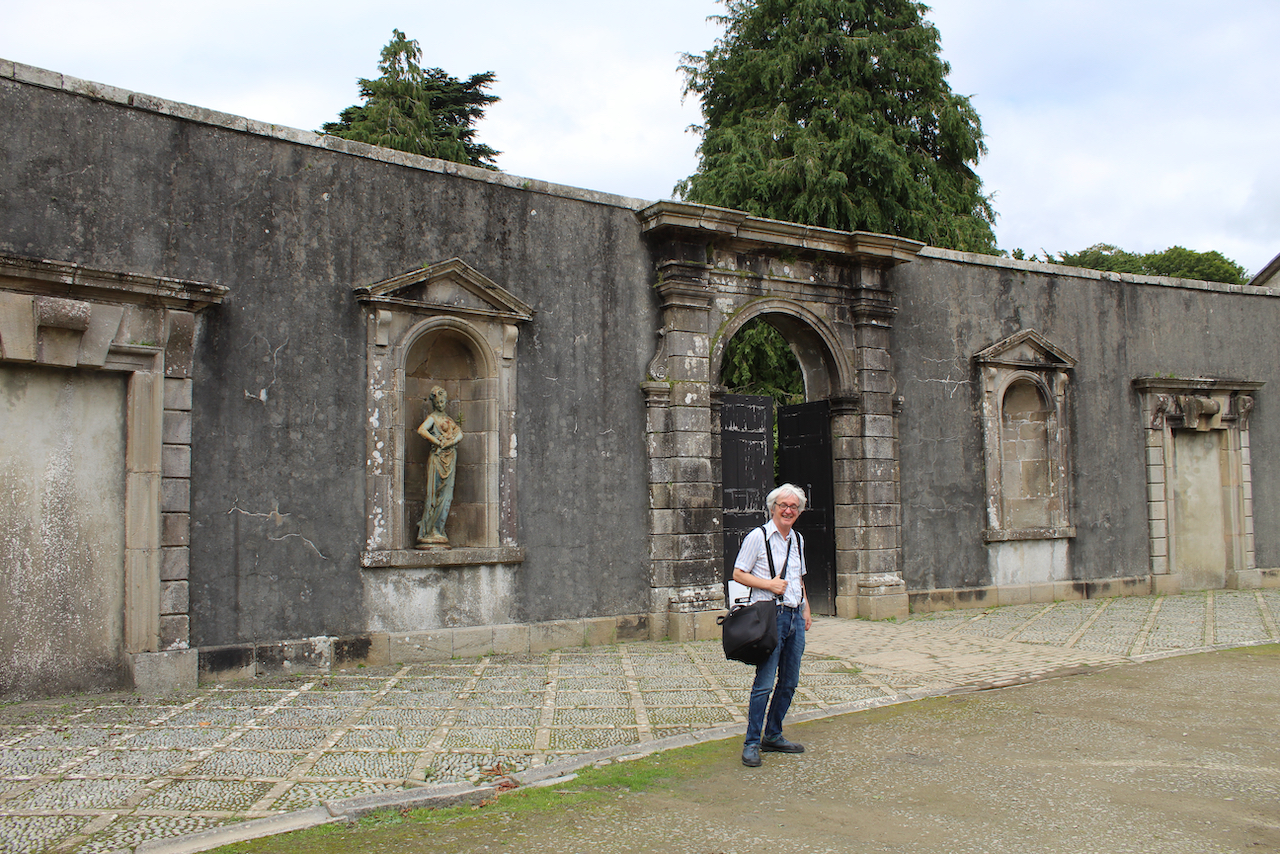
We explored the buildings flanking the courtyard while waiting for the guided tour, and found the entrance to the gardens, through an arch, with an honesty box, in which we duly deposited our fee. We had missed the earlier house tour so had a couple of hours to wait for the next tour. We wandered out into the gardens. The gardens are amazing, in their formal arrangement.

DSC_0619
Photograph © Jennifer Winder-Baggot, www.irishhistorichouses.com
I’ll write more about the gardens later, as we learned more about them on the tour.

We gathered with others for a tour. The tour guide was excellent. She told us that the gardens only opened to the public a few years ago, when the more private father of the current (ninth) Marquess died.

As usual, we were not permitted to take photographs inside, unfortunately. You can see some on the website. There is also a new book out, July 2019, it looks terrific! [2] More on the interior later – first I will tell you of the history of the house.

POWER AND MONEY AND MARRIAGE: Don’t be put off by the complications of Titles!

The estate was owned by the la Poer (or de la Poer or Le Poer – I have seen it written several ways) family for over 500 years, during which time the family gained the titles Baron la Poer (1535), Viscount Decies and Earl of Tyrone (1673, “second creation”, which means the line of the first Earls of Tyrone died out or the title was taken from them – in this case the previous Earl of Tyrone, Hugh O’Neill, rose up against the British throne during the Nine Years War and fled from Ireland when arrest was imminent, so lost his title).

The La Poer family was Norman originally, and the name has been sometimes Anglicised to “Power.”

Piers Power (or Le Poer) of Curraghmore, who held the office of Sheriff of County Waterford in 1482, cemented the family’s influence with a strategic marriage to the House of Fitzgerald. His wife, Katherine, was a daughter of Sir Gerald Fitzgerald, Lord of the Decies.

Piers’s son and heir, Richard, further strengthened the power of the family by marrying a daughter of the 8th Earl of Ormond (Piers Butler, d. 1539), Katherine. The rival families of Butler and Fitzgerald, into both of which the Le Poers had married, effectively ran the country at this time when English influence in Ireland had been in decline for several decades. [4]

Richard was created 1st Baron le Power and Coroghmore, Co. Waterford on 13 September 1535. [5]

Richard 1st Baron le Power and Coroghmore died on 10 November 1538, killed by Conor O’Callaghan while intervening (on the Crown’s behalf) in the issue of the succession of the Earldom of Desmond.

After Richard died, his wife married James John Fitzgerald, 13th Earl of Desmond, in 1549/50, who held the office of Lord High Treasurer of Ireland.

I shall intervene here to give a summary of the rank of titles, as I’m learning them through my research on houses. They rank as follows, from lowest to highest:

Baron –  female version: Baroness

Viscount – Viscountess

Earl – Countess

Marquess – Marchioness

Duke – Duchess

In 1538 Richard was succeeded by his eldest son, Piers (1526-1545). Piers was a soldier and fought in Boulogne in France for King Henry VIII. After Piers’s premature death in 1545, he was succeeded by his younger brother, John “Mor” Power (d. 1592), 3rd Baron. In 1576, Henry Sidney, the Lord Deputy of Ireland and father of the poet Philip Sidney, stayed with John Mor at Curraghmore. He wrote:

“The day I departed from Waterford I lodged that night at Curraghmore, the house that the Lord Power is baron of. The Poerne country is one of the best ordered countries in the English Pale, through the suppression of coyne and livery. The people are both willing and able to bear any reasonable subsidy towards the finding and entertaining of soldiers and civil ministers of the laws; and the lord of the country, though possessing far less territory than his neighbour (ie: Sir James Fitzgerald of the Decies, John Mor’s cousin) lives in show far more honourably and plentifully than he or any other in that province.” [6]

Sir Henry Sidney (1529-1586), Lord Deputy of Ireland, after painter Arnold Van Brounkhorst, courtesy of National Gallery of Ireland.

“Coign and livery” was the practice of getting a ruler’s subjects to host the ruler. I think Sidney must have meant that Lord Power’s subjects were willing to participate in entertainment because they were well treated by Lord Power.

Turtle Bunbury writes of the Le Poer family history in his blog (see [4]). I wonder if I can turn my blog into a way of learning Irish history, through Irish houses? I will continue to quote Mr. Bunbury’s blog here, so I can try to see connections between various house owners as I continue my travels around the country.

DSC_0607
When one enters the garden through the arch, one walks along the side of the house to the garden front, which originally held the front door of the house. Originally visitors would drive up to the house through the courtyard and then the horse and carriage would go through the arch to the garden front, to enter through the front door facing the gardens. Photograph © Jennifer Winder-Baggot, www.irishhistorichouses.com
DSC_0623
Curraghmore, 5th May 2019. Photograph © Jennifer Winder-Baggot, www.irishhistorichouses.com
It was a common practice at the time for the aristocracy to send their sons to the English Court. It was a way to for the artistocracy to secure favour and contacts, and for the King to secure the loyalty of the aristocracy and their Protestant faith. 

John Mor the 3rd Baron married Eleanor, daughter of James FitzGerald the 13th Earl of Desmond, who bore his heir. After she died, he married Ellen MacCartie, widow of the 3rd Viscount Barry. He died in 1592 and was succeeded by his son Richard (d. 1607), 4th Baron Le Poer. The 4th Baron married his step-sister, Katherine Barry, daughter of his step-mother Ellen MacCartie and her first husband the 3rd Viscount Barry.

The oldest son of the 4th Baron, John “Og”, died young, in 1600, predeceasing his father, but not before he married Helen Barry, daughter of the 5th Viscount Barry, Viscount Buttevant, and produced an heir. John “Og” was killed by Edmond FitzGibbon (The White Knight).

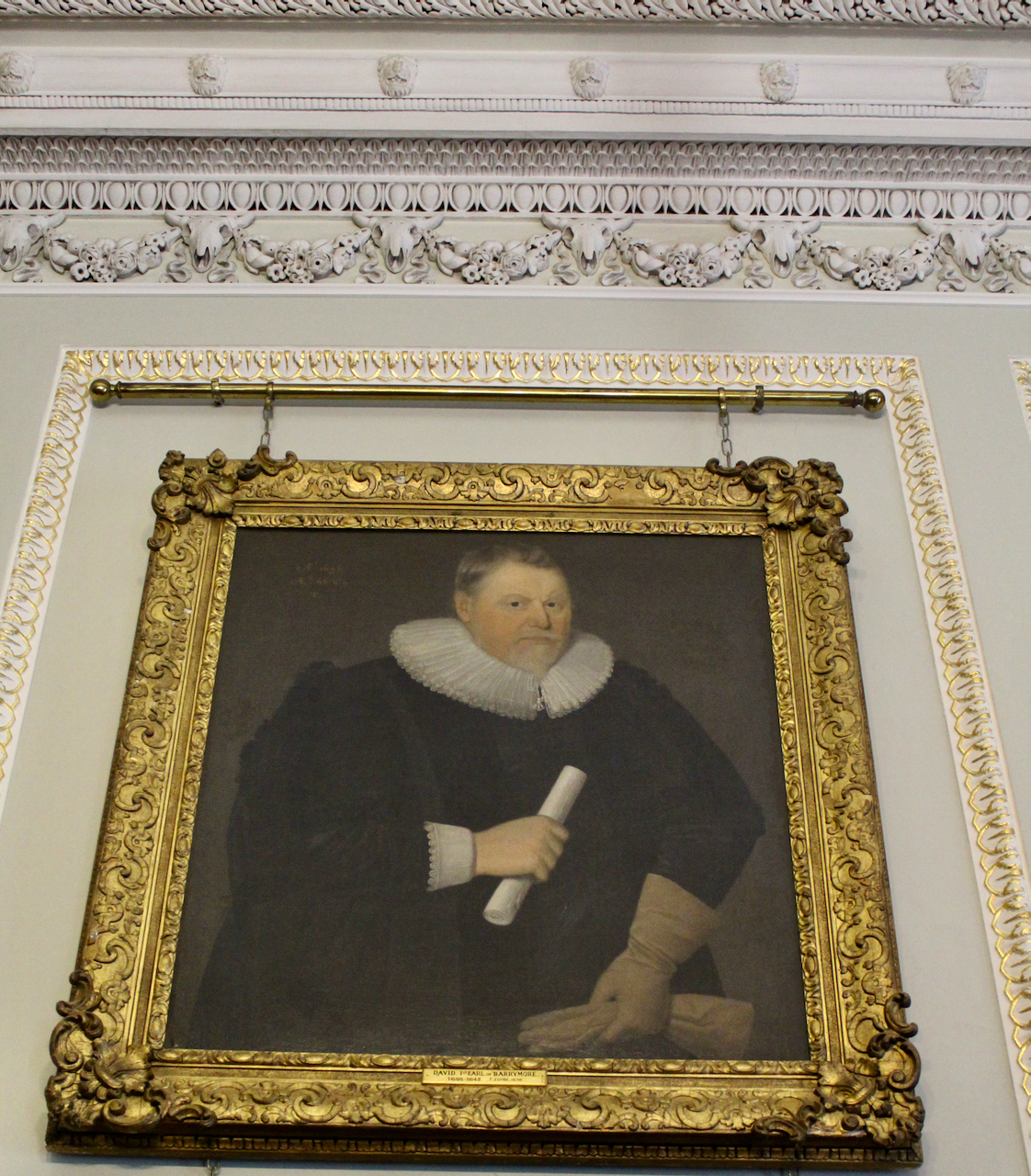
The 4th Baron’s other children married well. His daughter Elizabeth married David Barry and gave birth to David, 1st Earl of Barrymore.

David Barry (1605-1642) 6th Viscount Buttevant and 1st Earl of Barrymore. Photograph © Jennifer Winder-Baggot, www.irishhistorichouses.com
His daughter Gille married Thomas Fitzmaurice, 16th Baron of Kerry and Lixnaw. His son Piers married Katherine, daughter of Walter Butler the 11th Earl of Ormond.

After the 4th Baron died, his widow Helen remarried, espousing Thomas Butler the 10th Earl of Ormond, “Black Tom” (you can read more about him in my entry about the Ormond Castle in Carrick-on-Suir, an OPW property www.irishhistorichouses.com/2022/06/26/opw-sites-in-munster-clare-limerick-and-tipperary/). She married a third time, after he died, in 1631, to 1st (and last) Viscount Thomas Somerset, of Cashell, County Tipperary.

The family were very powerful and influential, and Catholic. Despite dying young, John “Og” and Helen had daughters, Ellen, who married Maurice Roche, 8th Viscount Roche of Fermoy (the Peerage website tells us that “She died in 1652, hanged by the Commonwealth regime on a trumped up charges of murder“) and Elinor who married Thomas Butler, 3rd Baron Caher.

King James I ordered Richard the 4th Baron to send his grandson and heir, John, the 5th Baron (born circa 1584), to England for his education, in order to convert John to Protestantism. John lived with a Protestant Archbishop in Lambeth. However, John didn’t maintain his Protestant faith. Furthermore, he later suffered from mental illness.

Julian Walton, in a talk I attended in Dromana House in Waterford (another section 482 house), told us about a powerful woman, Kinbrough Pyphoe (nee Valentine). [7] She is named after a Saxon saint, Kinbrough. Her unfortunate daughter Ruth was married to John Power of the “disordered wits” (the 5th Baron). In 1642, Kinbrough Pyphoe wrote for to the Lord Justices of Ireland for protection, explaining that Lord Le Poer had “these past twelve years been visited with impediments” which had “disabled him from intermeddling with his own estate.” As a result, when Oliver Cromwell arrived in Ireland, he issued a writ on 20th September 1649 decreeing that Lord Power and his family be “taken into his special protection.” In this way, Kinbrough Pyphoe saved the family and estates from being confiscated by the Cromwellian parliament or overtaken by Cromwellian soldiers.

Despite his mental illness, John and Ruth had a son Richard (1630-1690) (along with many other children), who succeeded as the 6th Baron. One of their daughters, Catherine (1641-1660), married John Fitzgerald (1642-1664), Lord of the Decies, of Dromana, County Waterford. We will come back to her later.

Richard (1630-1690) married Dorothy Annesley, daughter of Arthur, 1st Earl of Anglesey in 1654. Richard was Governor of Waterford City and County Waterford in 1661, and MP for County Waterford from 1661-1666.

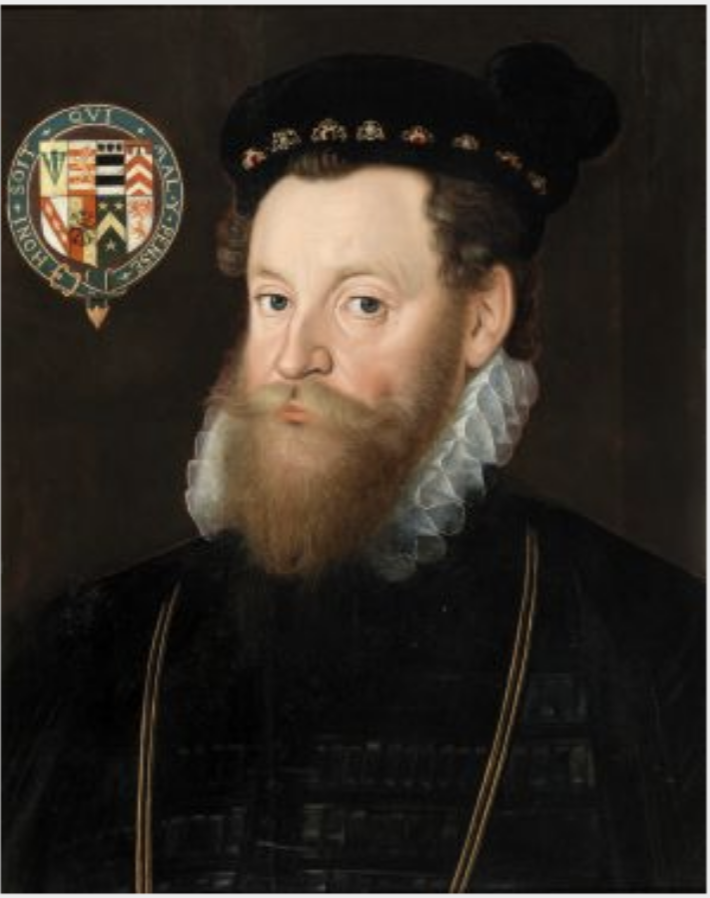
Richard (1630-1690) married Dorothy Annesley, daughter of Arthur, 1st Earl of Anglesey: portrait of Arthur Annesley (1614-1686) 1st Earl of Anglesey, after John Michael Wright based on a work of 1676, NPG 3805.

In 1672 King Charles II made Richard the 1st Earl of Tyrone, and elevated Richard’s son John to the peerage as Viscount Decies.

Turtle Bunbury writes that Richard the 1st Earl of Tyrone sat on Charles II’s Privy Council from 1667-1679. However, Richard was forced to resign when somebody implicated him in the “Popish Plot.” The “Popish Plot” was caused by fear and panic. There never was a plot, but many people assumed to be sympathetic to Catholicism were accused of treason. In 1681, Richard Power was brought before the House of Commons and charged with high treason. He was imprisoned. He was released in 1684.

DSC_0652
Photograph © Jennifer Winder-Baggot, www.irishhistorichouses.com

WHO TO SUPPORT? CATHOLIC OR PROTESTANT? JAMES II OR WILLIAM III?

James II came to the throne after the death of his brother Charles II, and he installed Richard in the Irish Privy Council in 1686.

When William of Orange and Mary came to the throne, taking it from Mary’s father James II, Richard was again charged with high treason, this time for supporting James II, and he was imprisoned in the Tower of London and died there, in 1690. He was succeeded by his son 25-year-old son John, who became 2nd Earl of Tyrone.

John married his first cousin, the orphaned heiress Catherine Fitzgerald, daughter of above-mentioned Catherine (1641-1660) who married John Fitzgerald (1642-1664), Lord of the Decies, of Dromana, County Waterford. They were married as children in 1673, in order for John to marry Catherine’s wealth. However, Catherine managed to have the marriage declared null and void, so that she could marry in March 1676 her true love, Edward Villiers, son and heir of George, 4th Viscount Grandison [I write more on this in my entry on Dromana www.irishhistorichouses.com/2021/02/06/dromana-house-cappoquin-co-waterford/].

John died aged just 28 in 1693 and was succeeded by his brother James. Before he died, it is said that John made a prediction:

One night in 1693 when Nichola, Lady Beresford [nee Hamilton, wife of 3rd Baronet Beresford of Coleraine, daughter of Hugh Hamilton, 1st Viscount of Glenawly, Co Fermanagh], was staying in Gill Hall, her schoolday friend, John Power, [2nd] Earl of Tyrone, with whom she had made a pact that whoever died first should appear to the other to prove that there was an afterlife, appeared by her bedside and told her that he was dead, and that there was indeed an after-life. To convince her that he was a genuine apparition and not just a figment of her dreams, he made various prophecies, all of which came true: noteably that she would have a son who would marry his niece, the heiress of Curraghmore and that she would die on her 47th birthday. He also touched her wrist, which made the flesh and sinews shrink, so that for the rest of her life she wore a black ribbon to hide the place.” [8]

At the time of his death, his neice was not yet born! It makes a good story. She was born eight years later in 1701 to John’s brother James.

James, the 3rd Earl of Tyrone, married Anne Rickard, eldest daughter and co-heir of Andrew Rickard of Dangan Spidoge, County Kilkenny. He had fought with the Jacobites (supporters of James II), but when William III came to the throne, the 3rd Earl of Tyrone claimed that he had only supported James II because his father had forced him to (this is the father who died in the Tower of London for supporting James II). In 1697 James Le Poer received a Pardon under the Great Seal and he served as Governor of Waterford from 1697 until his death in 1704.

DEVELOPING THE CASTLE
In 1700 the 3rd Earl, James, commissioned the construction of the present house at Curraghmore on the site of the original castle. Mark Bence-Jones writes: “the house was in existence in 1654, but was rebuilt 1700 and subsequently enlarged and remodelled; it extends round three sides of a small inner court, which is closed on fourth side by the tower.“(see [1])

nli curraghmore house waterford
Photograph from flickr commons, National Library of Ireland, by Robert French, The Lawrence Photographic Collection, between ca. 1865-1914, ref. L_CAB_04065.

In 1704 the male line of the la Poers became extinct as James had no sons.

The predictions of John the 2nd Baron of Curraghmore came true. Lady Nichola did indeed die on her 47th birthday, and her son Marcus married John’s niece, Catherine Power, or de la Poer.

Catherine de la Poer (1701-1769), the sole child of her parents, could not officially inherit the property at the time. Her Catholic mother made a deal with a Bishop that Catherine would marry a Protestant of his choosing, in order to keep her land. Fortunately, the property was kept for her and she was married to Marcus Beresford (1694-1763), in 1717. This ensured that the house stayed in her family, as Marcus joined her to live in Curraghmore.

Sir Marcus Beresford of Coleraine (born 1694) was already a Baronet by descent in his family. After he married Catherine, he became Viscount Tyrone and 1st Baron Beresford, of Beresford, County Cavan. In 1746 he was created 1st Earl of Tyrone. Proud of her De La Poer background, when her husband died in 1763, Catherine, now titled the Dowager Countess of Tyrone, requested the title of Baroness La Poer.

The block on the right contained servants’ quarters. Photograph © Jennifer Winder-Baggot, www.irishhistorichouses.com
St. Hubert’s Stag on top of Curraghmore, photograph courtesy of Curraghmore website.

The Guide told us a wonderful story of the stag on top of the house. It has a cross on its head, and is called a St. Hubert’s Stag. This was the crest of the family of Catherine de la Poer. To marry Marcus Beresford, she had to convert to Protestantism, but she kept the cross of her crest. The Beresford crest is in a sculpture on the front entrance, or back, of the house: a dragon with an arrow through the neck. The broken off part of the spear is in the dragon’s mouth.

DSC_0648
Dragon from the Beresford crest, atop the garden front of the house, 5th May 2019. Photograph © Jennifer Winder-Baggot, www.irishhistorichouses.com
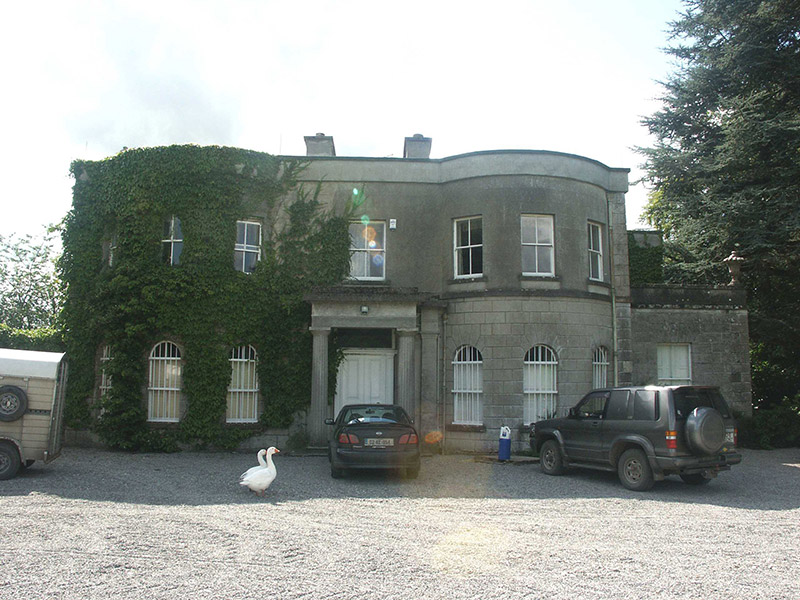
The IRA came to set fire to the house at one point. They came through the courtyard at night. The moon was full, and the stag and cross cast a shadow. Seeing the cross, the rebels believed the occupants were Catholic and decided not to set fire to the house. The story illustrates that the rebels must not have been from the local area, as locals would have known that the family had converted to Protestantism centuries ago. It is lucky the invaders did not approach from the other side of the house!

When I was researching Blackhall Castle in County Kildare, I came across more information about St. Hubert’s Stag. The stag with the crucifix between its antlers that tops Curraghmore is in fact related to Saint Eustachius, a Roman centurion of the first century who converted to Christianity when he saw a miraculous stag with a crucifix between its antlers. This saint, Eustace, was probably the Patron Saint of the Le Poers since their family crest is the St. Eustace (otherwise called St. Hubert’s) stag. I did not realise that St. Eustace is also the patron saint of Newbridge College in Kildare, where my father attended school and where for some time in the 1980s and 90s my family attended mass!

IMG_0992
See the St. Eustace stag in the Newbridge College crest. Photograph © Jennifer Winder-Baggot, www.irishhistorichouses.com
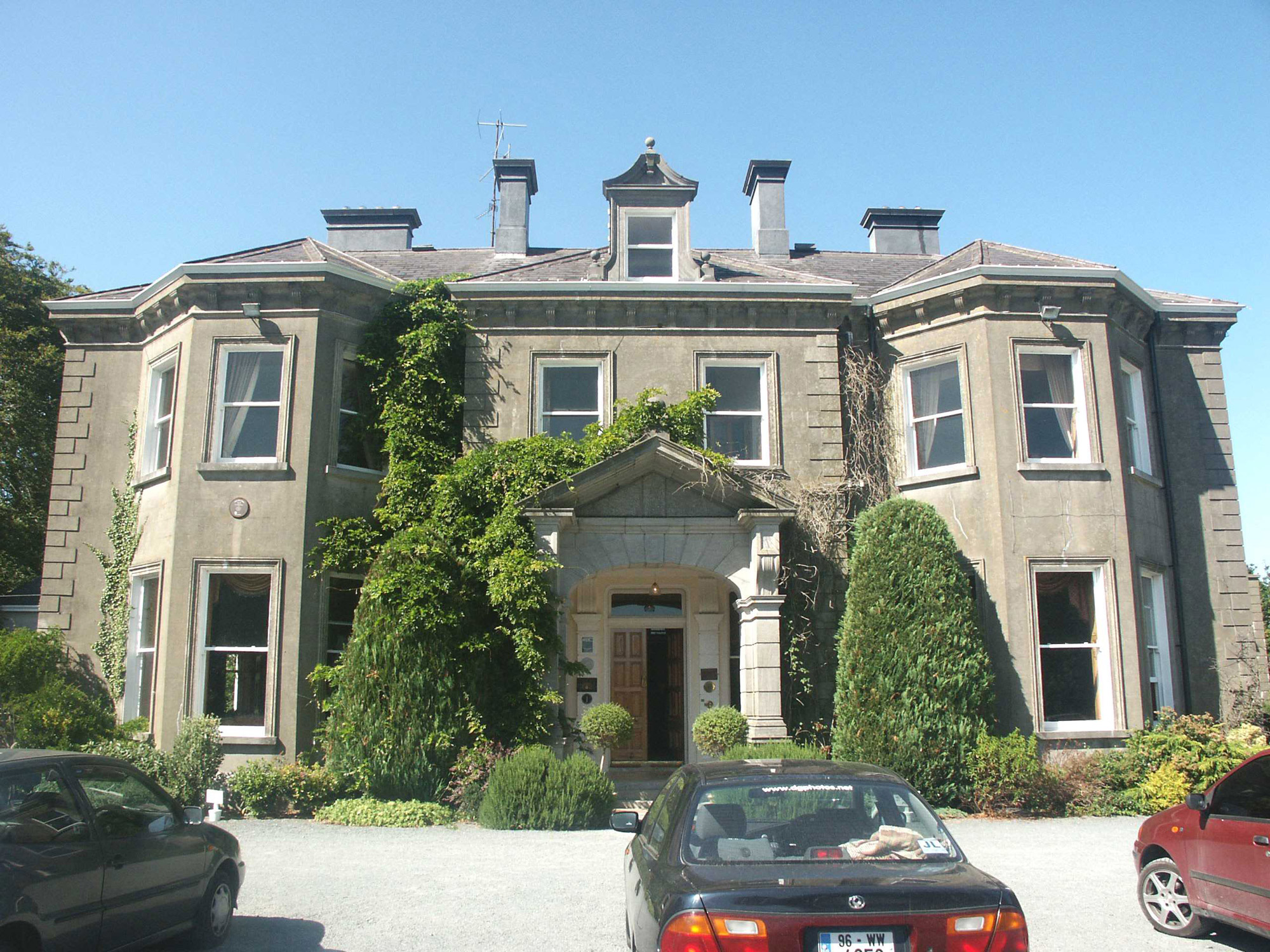
I read in Irish Houses and Gardens, from the archives of Country Life by Sean O’Reilly, [Aurum Press, London: 1998, paperback edition 2008] that the St. Hubert Stag at Curraghmore was executed by Queen Victoria’s favourite sculptor, Sir Joseph Edgar Boehm. He was also responsible for the beautiful representation in the family chapel at Clonegam of the first wife of the 5th Marquess, who died in childbirth. [9]

THE INTERIOR OF THE HOUSE

The entrance hall, which is in the old tower, has a barrel vaulted ceiling covered with plasterwork rosettes in circular compartments which dates from 1750; it was one of the rooms redecorated by Marcus Beresford and his wife Catherine (see [1]). Sadleir and Dickinson tell us of the house and the Hall:

p. 49. “Careful remodelling has given to the back of the structure the lines of a complete architectural whole, but there can be no doubt from internal evidence that at least three important additions are in fact embodied; it is also probable that a portion of the centre, which differs in character from the surroundings, was rebuilt in consequence of a fire.

The entrance hall is part of the original tower house, and you can see the thickness of the walls. The hall now has a Georgian ceiling of bold, regular design. On the wall in the front hall is a huge portrait of Catherine, Marcus Beresford, and their children. Three stuffed lions stand guard, which were brought back from India by a descendant of Catherine and Marcus (more on the lions later).

Sadleir and Dickinson continue: “A flight of stone steps leads up to a corridor giving access to the spacious staircase hall, a late eighteenth century addition, with Adam ornament on the ceiling and walls. The grand staircase, which has a plain metal balustrade, is gracefully carried up along the wall to a gallery, giving access to the billiard room and bedrooms.” (see [6])

Photograph courtesy of Curraghmore website: the corridor from the front hall to the staircase hall.

The staircase hall wasn’t added until the next generation. Above the front hall in the tower house, Marcus Beresford had a magnificent room created, now the Billiard room. Unfortunately we didn’t see it on the tour, but there are photographs on the website.

It has a tremendously impressive coved ceiling probably by Paul and Philip Francini, according to Mark Bence-Jones. The ceiling is decorated with rococo foliage, flowers, busts and ribbons in rectangular and curvilinear compartments. The chimneypiece, which has a white decorative  overmantel with a “broken” pediment (i.e. split into two with the top of the triangular pediment lopped off to make room for a decoration in between) and putti cherubs, is probably by John Houghton, German architect Richard Castle’s carver. Bence-Jones describes that the inner end of the room is a recess in the thickness of the old castle wall with a screen of fluted Corinthian columns. There is a similar recess in the hall below, in which a straight flight of stairs leads up to the level of the principal rooms of the house.

The Great Room in the old tower was transformed into a billiard room and has an exquisite 18th century plasterwork ceiling, Photograph courtesy of Curraghmore website.
Photograph of Curraghmore mantel in billiard room from Georgian Mansions In Ireland by Thomas U. Sadleir and Page L. Dickinson, printed for the authors at the Dublin University Press, by Ponsonby & Gibbs, 1915. (see [6])
Photograph from Georgian Mansions In Ireland by Thomas U. Sadleir and Page L. Dickinson, printed for the authors at the Dublin University Press, by Ponsonby & Gibbs, 1915. Mark Bence-Jones writes that the ceiling in the billiards room was probably decorated by the Francini brothers. (see [6])

The entry via the servants’ quarters, which I thought odd, has indeed always been the approach to the house. Catherine had the houses in the forecourt built for her servants in 1740s or 50s. She cared for the well-being of her tenants and workers, and by having their houses built flanking the entrance courtyard, perhaps hoped to influence other landlords and employers.

The wing that contained servants’ quarters. The flanking wall has niches, and an archway leading to the garden. Photograph © Jennifer Winder-Baggot, www.irishhistorichouses.com
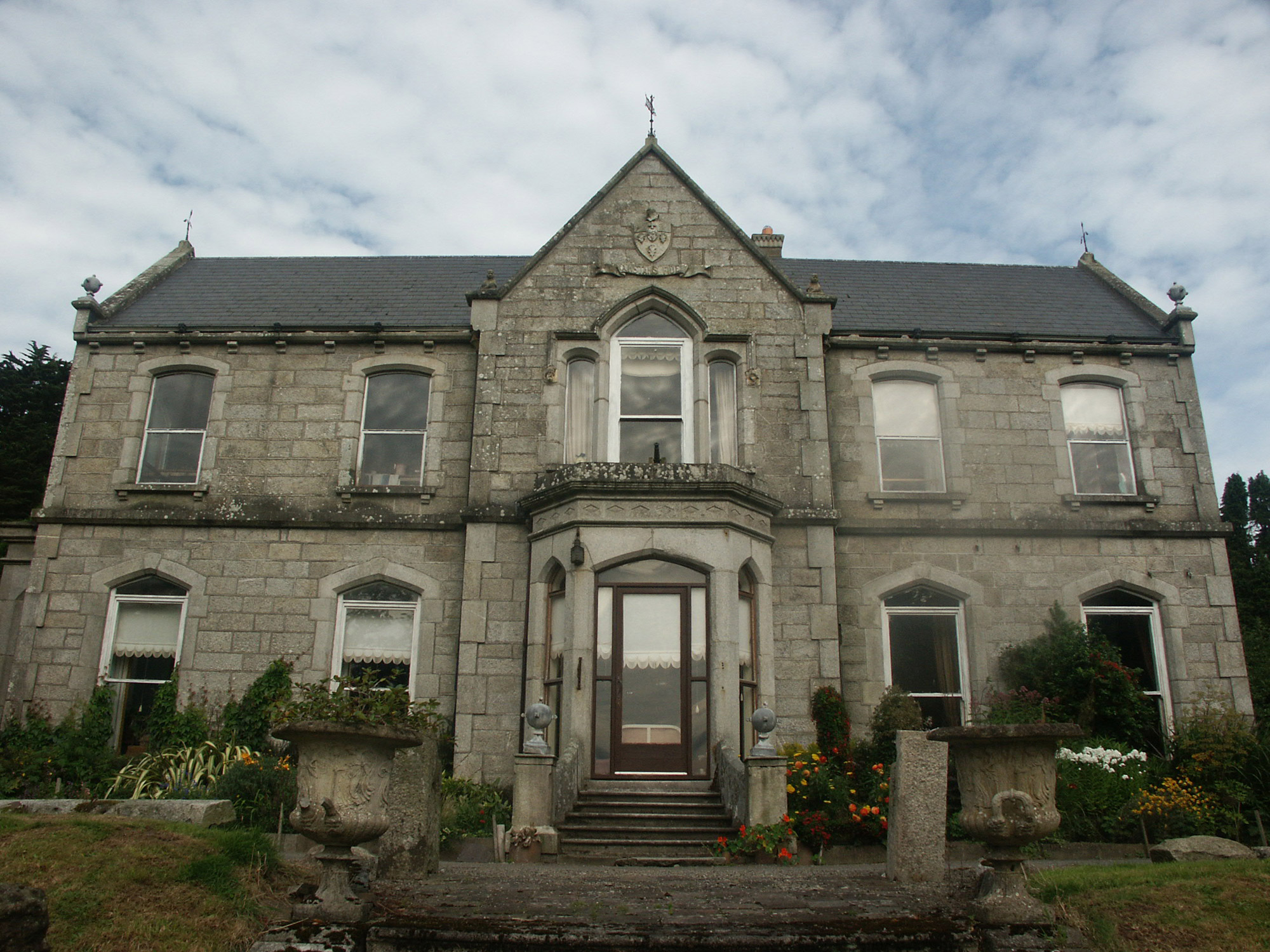
Stephen by the carriage entry to garden, 2023. Photograph © Jennifer Winder-Baggot, www.irishhistorichouses.com
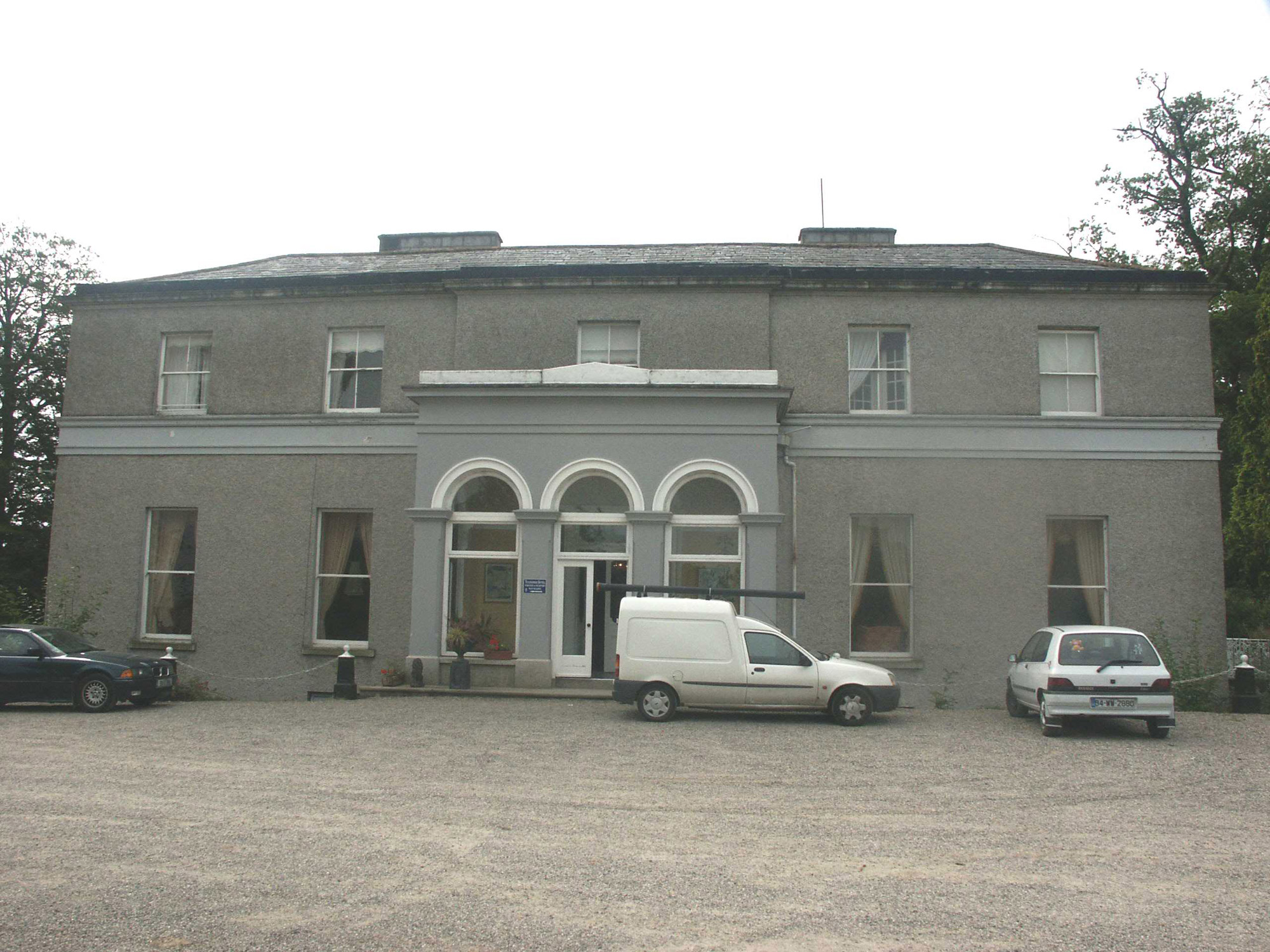
The sculptures were purchased at the Great Exhibition in Paris in 1889. Photograph © Jennifer Winder-Baggot, www.irishhistorichouses.com
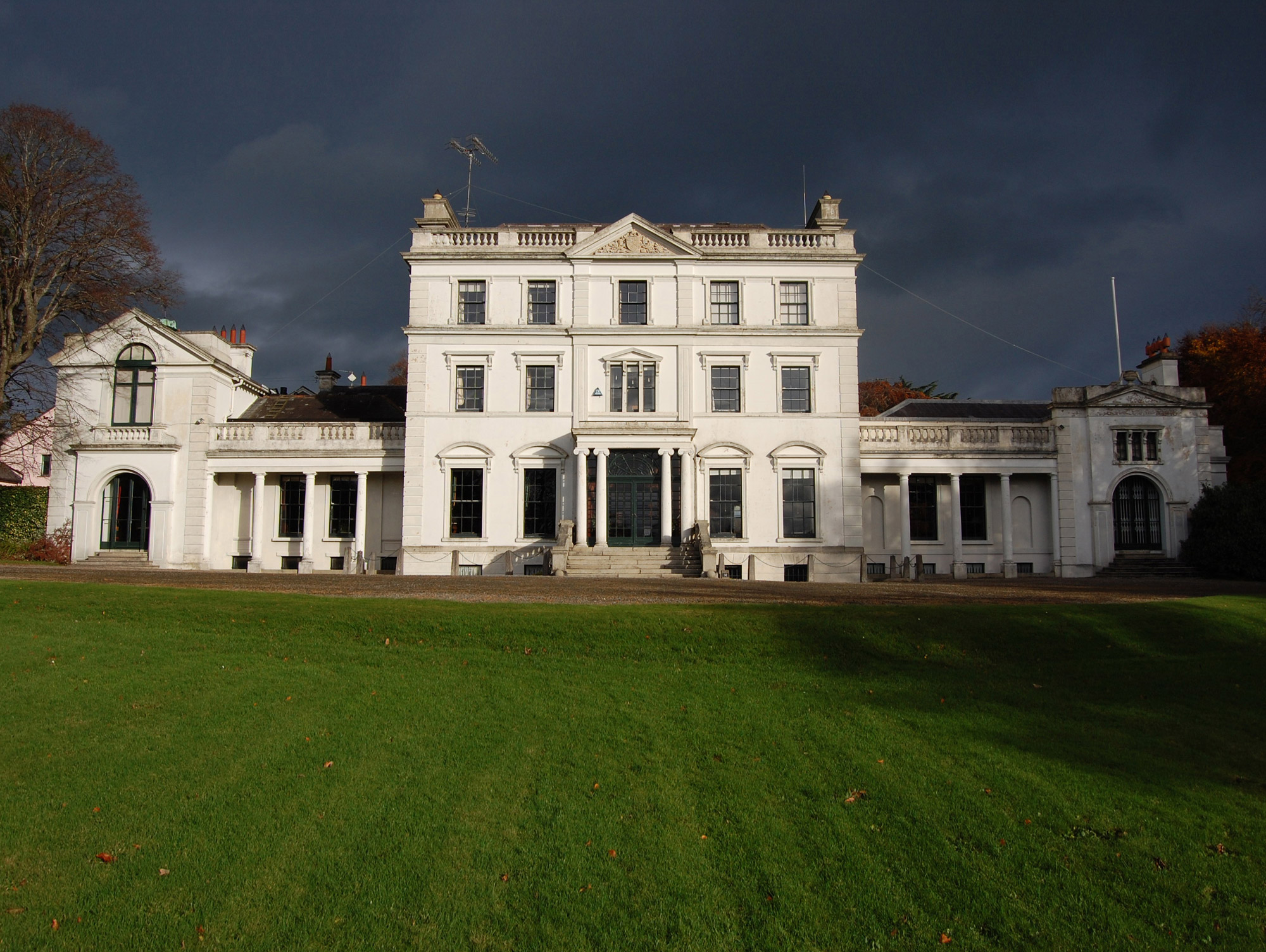
Someone asked about the sculptures in the niches in the courtyard. Why are there only some in niches – are the others destroyed or stolen? That in itself was quite a story! A visitor said they could have the sculptures cleaned up, by sending them to England for restoration. The Marquess at the time agreed, but said only take every second one, to leave some in place, and when those are back, we’ll send the remaining ones. Just as well he did this, since the helper scuppered and statues were never returned.

DSC_0584
Curraghmore, 5th May 2019. Photograph © Jennifer Winder-Baggot, www.irishhistorichouses.com
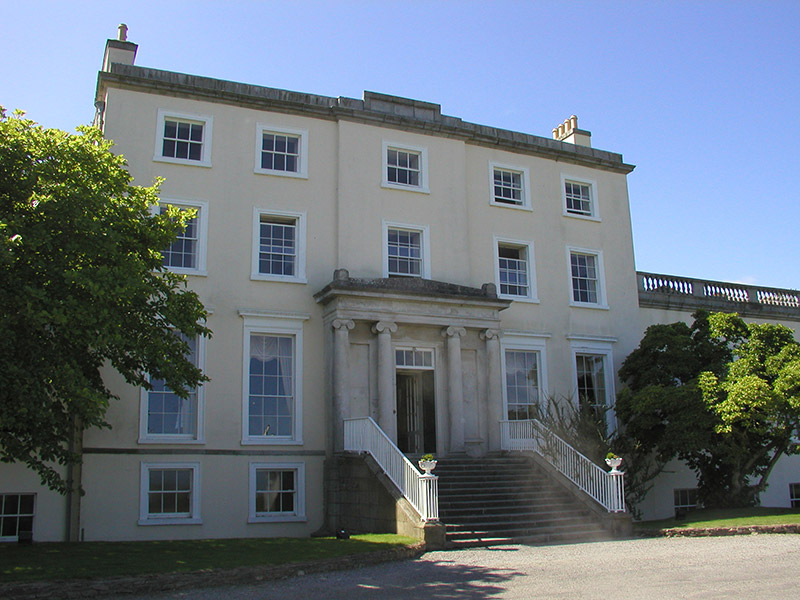
Bence-Jones writes of the forecourt approach to the house:

“[The house] stands at the head of a vast forecourt, a feature which seems to belong more to France, or elsewhere on the Continent… having no counterpart in Ireland, and only one or two in Britain… It is by the Waterford architect John Roberts, and is a magnificent piece of architecture; the long stable ranges on either side being dominated by tremendous pedimented archways with blocked columns and pilasters. There are rusticated arches and window surrounds, pedimented niches with statues, doorways with entablatures; all in beautifully crisp stonework. The ends of the two ranges facing the front are pedimented and joined by a long railing with a gate in the centre.

The courtyard, designed by John Roberts: the long stable ranges on either side are dominated by tremendous pedimented archways with blocked columns and pilasters. Photograph © Jennifer Winder-Baggot, www.irishhistorichouses.com
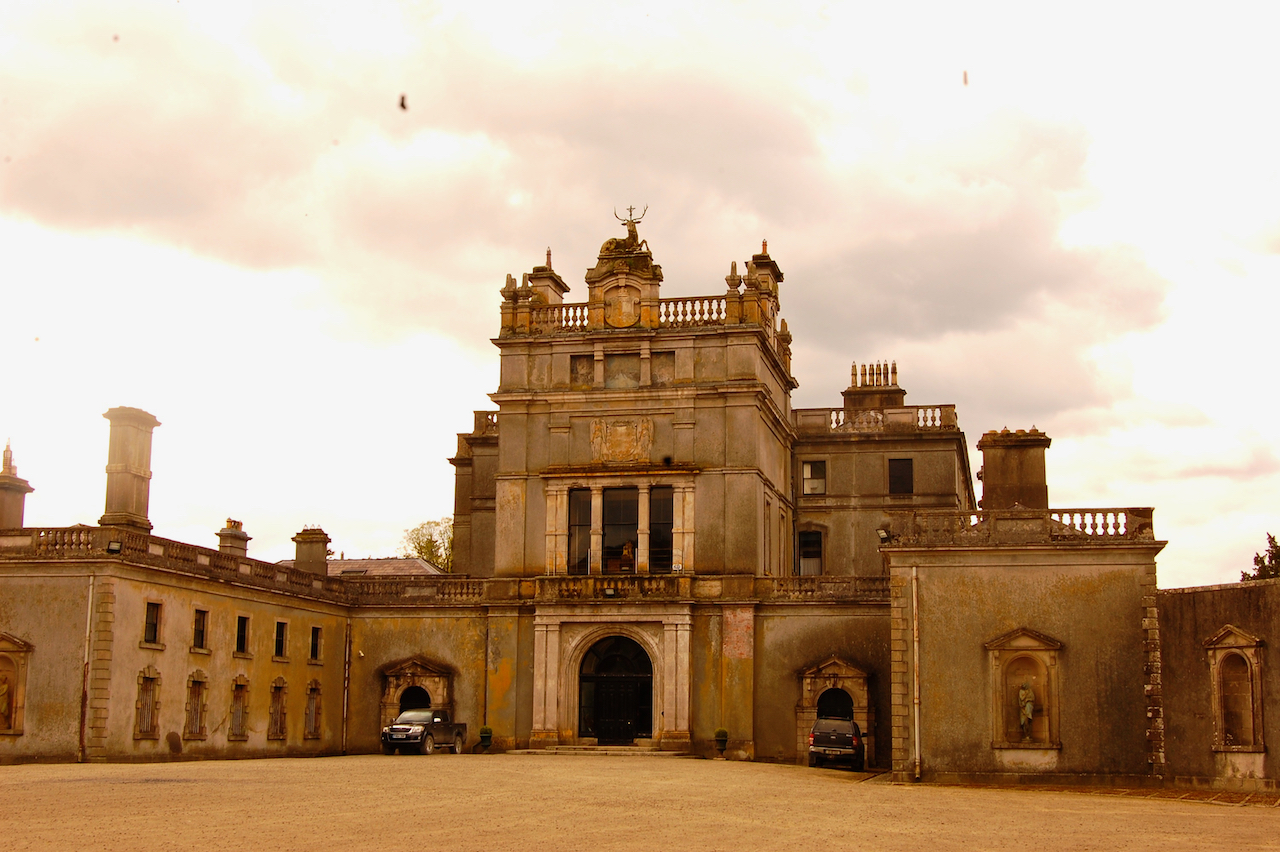
Pedimented archways with blocked columns and pilasters, which leads to more stables. Photograph © Jennifer Winder-Baggot, www.irishhistorichouses.com
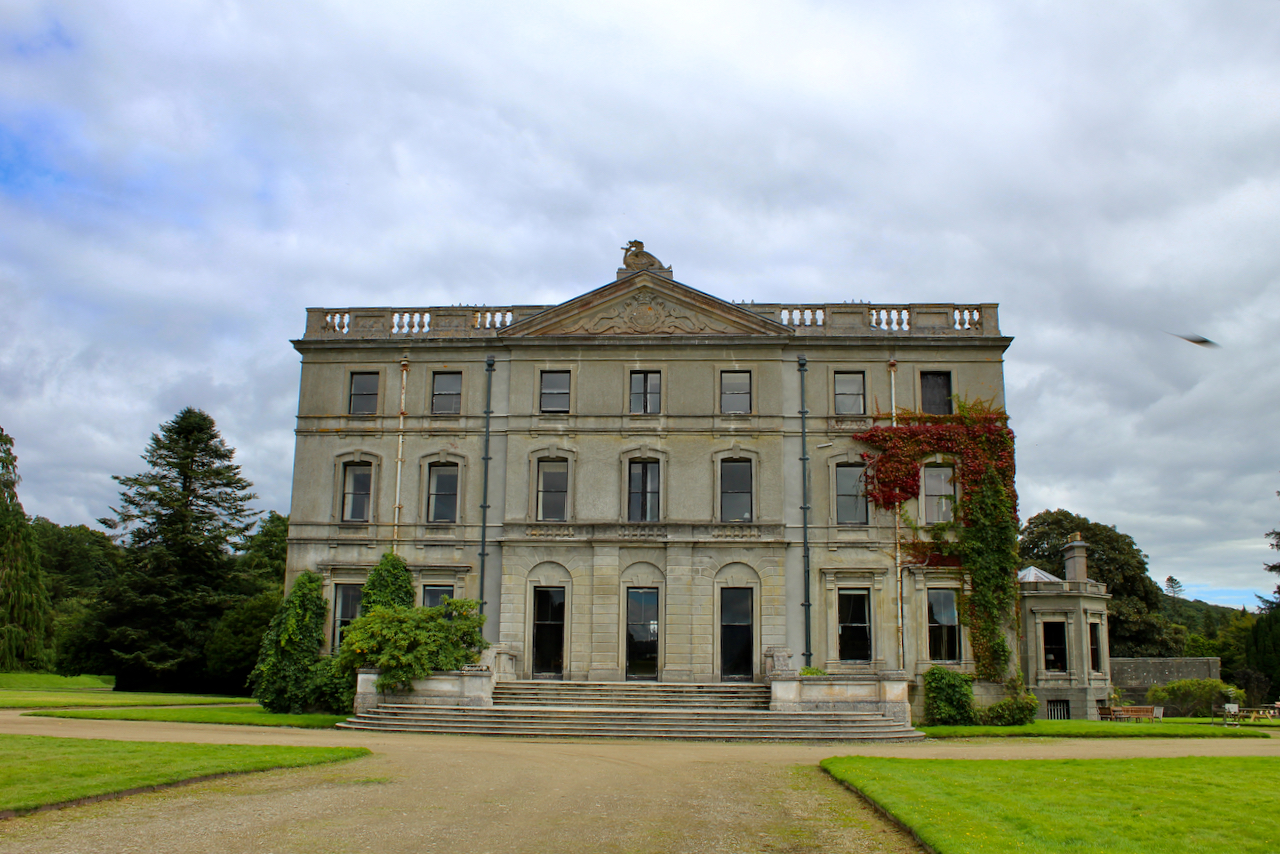
The archway leads through to the stableyard and ancilliary buildings. Photograph © Jennifer Winder-Baggot, www.irishhistorichouses.com
The doors have arched fanlights with semicircular windows above. Photograph © Jennifer Winder-Baggot, www.irishhistorichouses.com
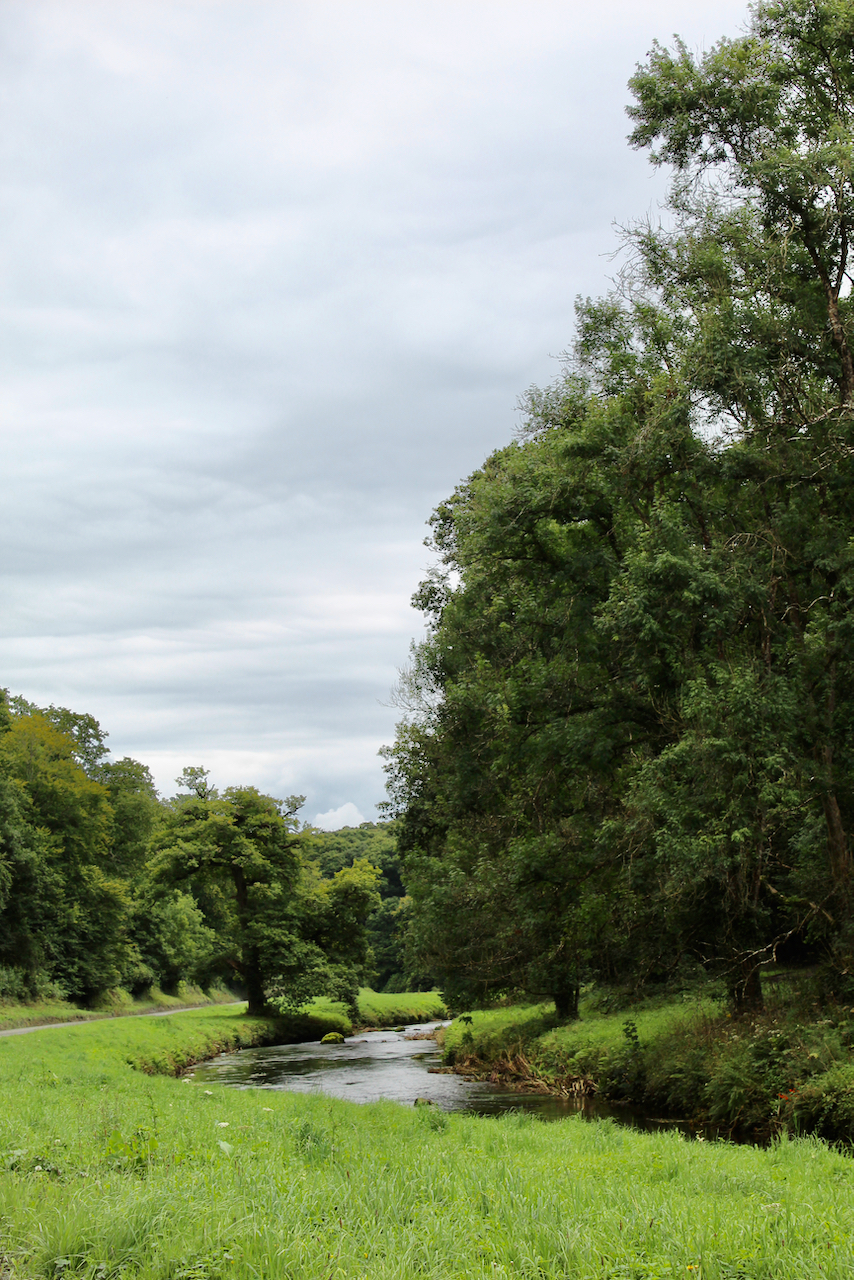
Inside, the ceilings are vaulted. Photograph © Jennifer Winder-Baggot, www.irishhistorichouses.com
Part of the Café. Photograph © Jennifer Winder-Baggot, www.irishhistorichouses.com
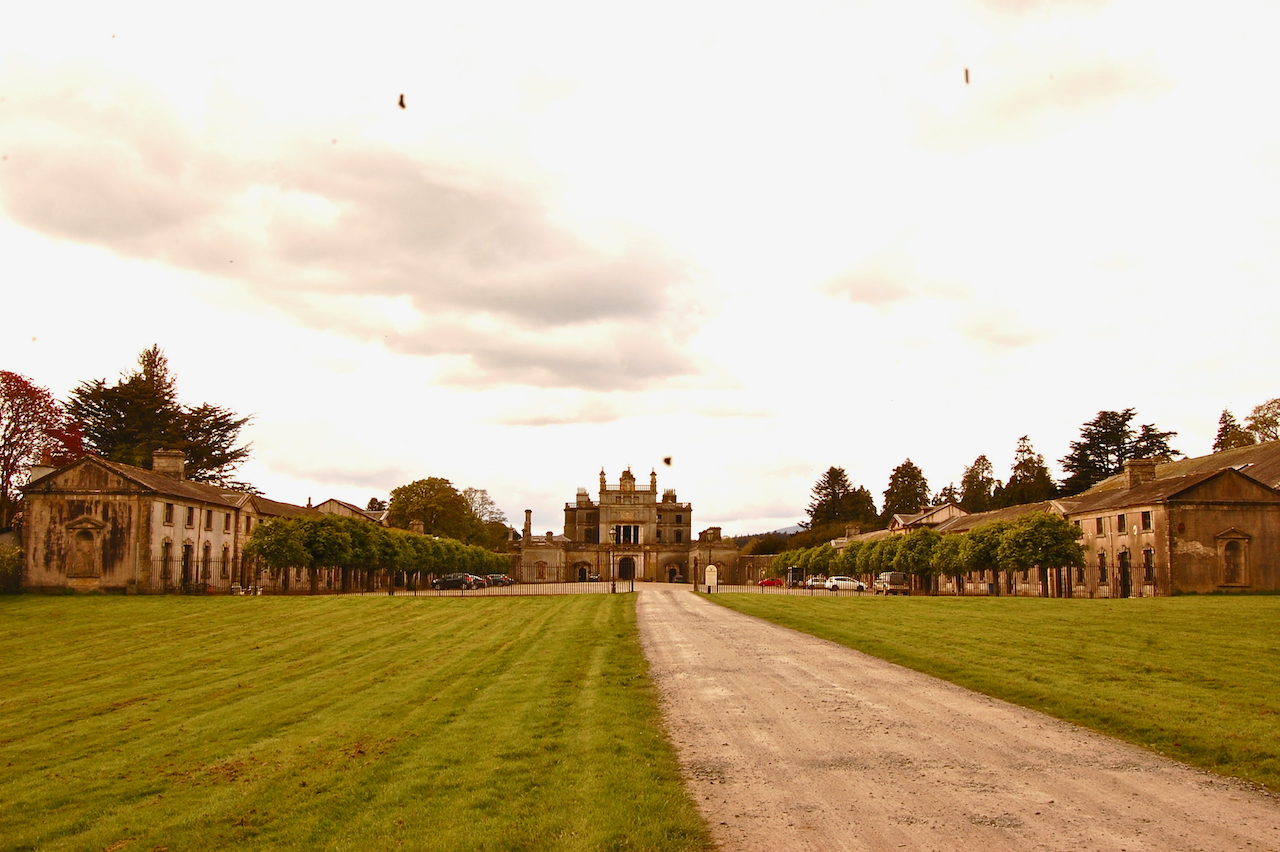
The terrace contains servants’ quarters. Photograph © Jennifer Winder-Baggot, www.irishhistorichouses.com
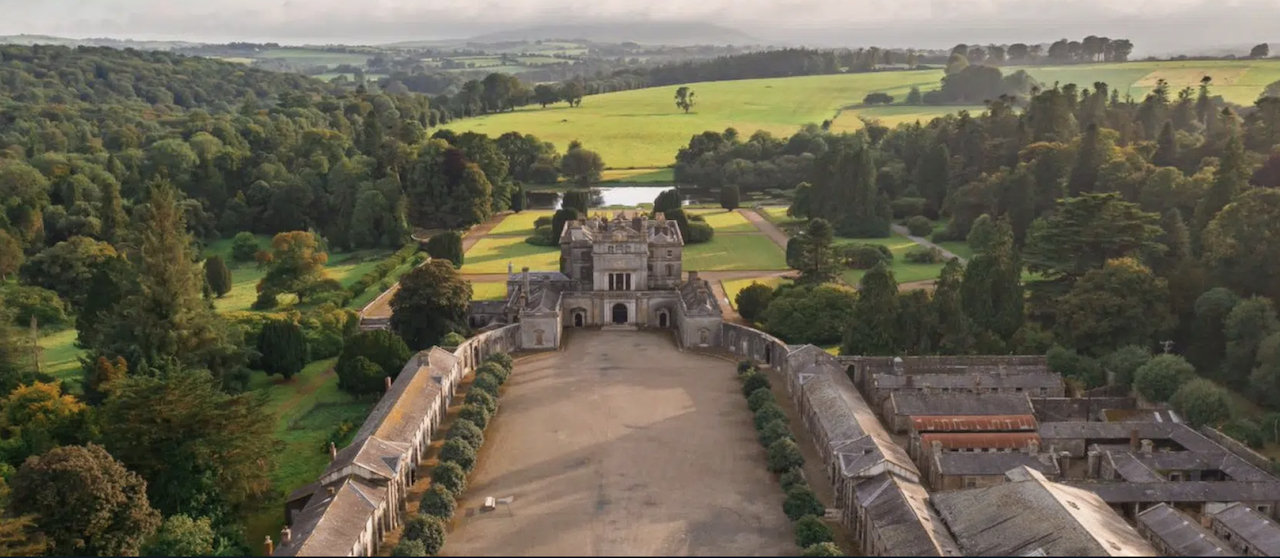
Number 6, closest to the house, was the Butler’s Quarters. The Butler lived in the main house until he married, when he then was given the house in the courtyard. There was a Butler in the house until just five years ago, and he lived here until he retired. Photograph © Jennifer Winder-Baggot, www.irishhistorichouses.com
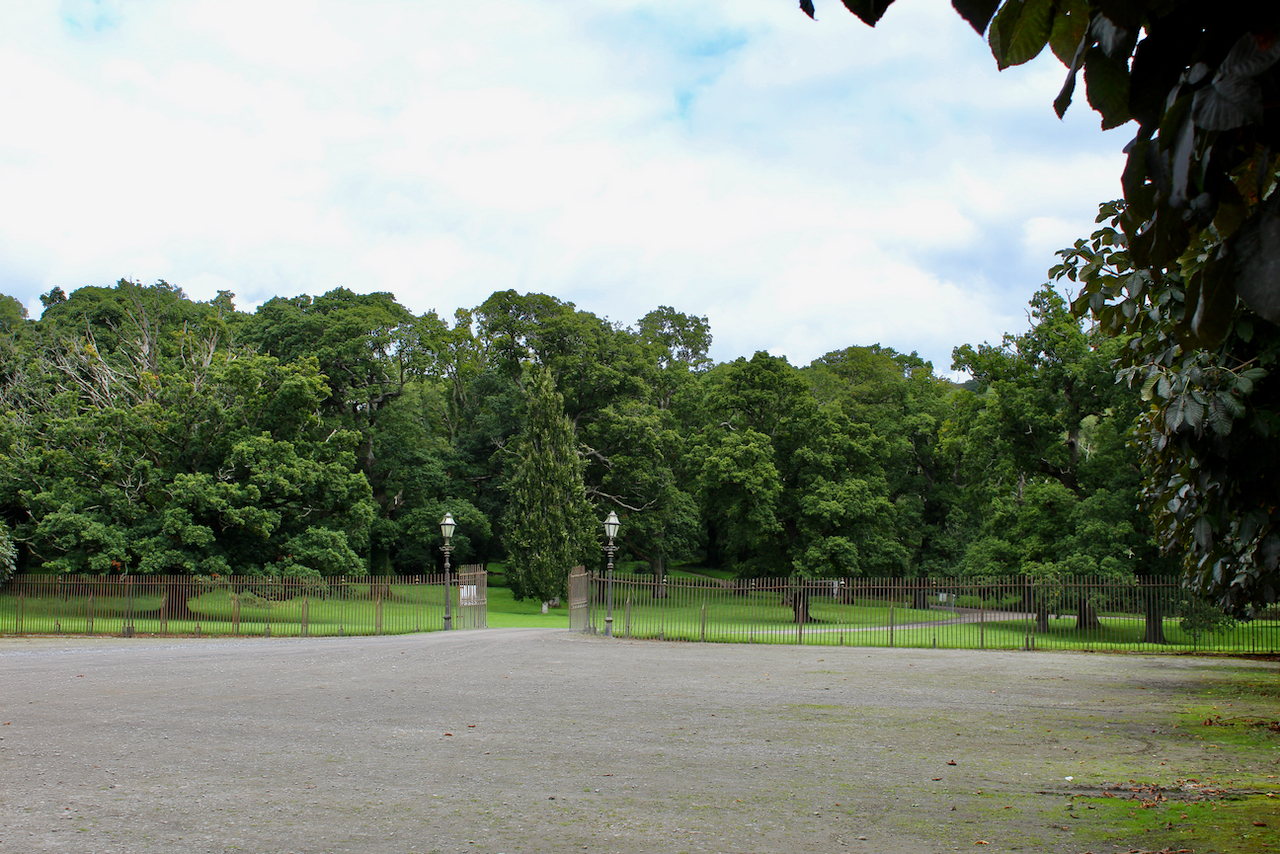
The terrace of buidings on the right hand side of the house. Photograph © Jennifer Winder-Baggot, www.irishhistorichouses.com
There are niches at the ends of each terrace. Photograph © Jennifer Winder-Baggot, www.irishhistorichouses.com
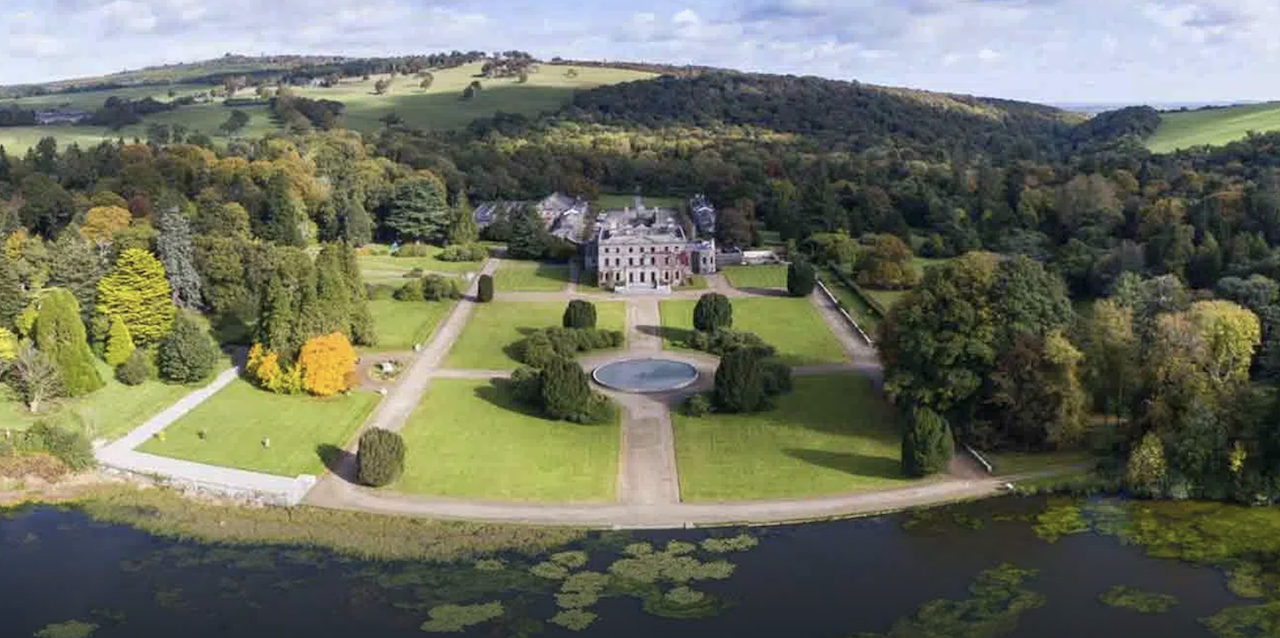
DSC_0587
Barrels in the forecourt picture the St. Hubert’s Stag, 5th May 2019. Photograph © Jennifer Winder-Baggot, www.irishhistorichouses.com
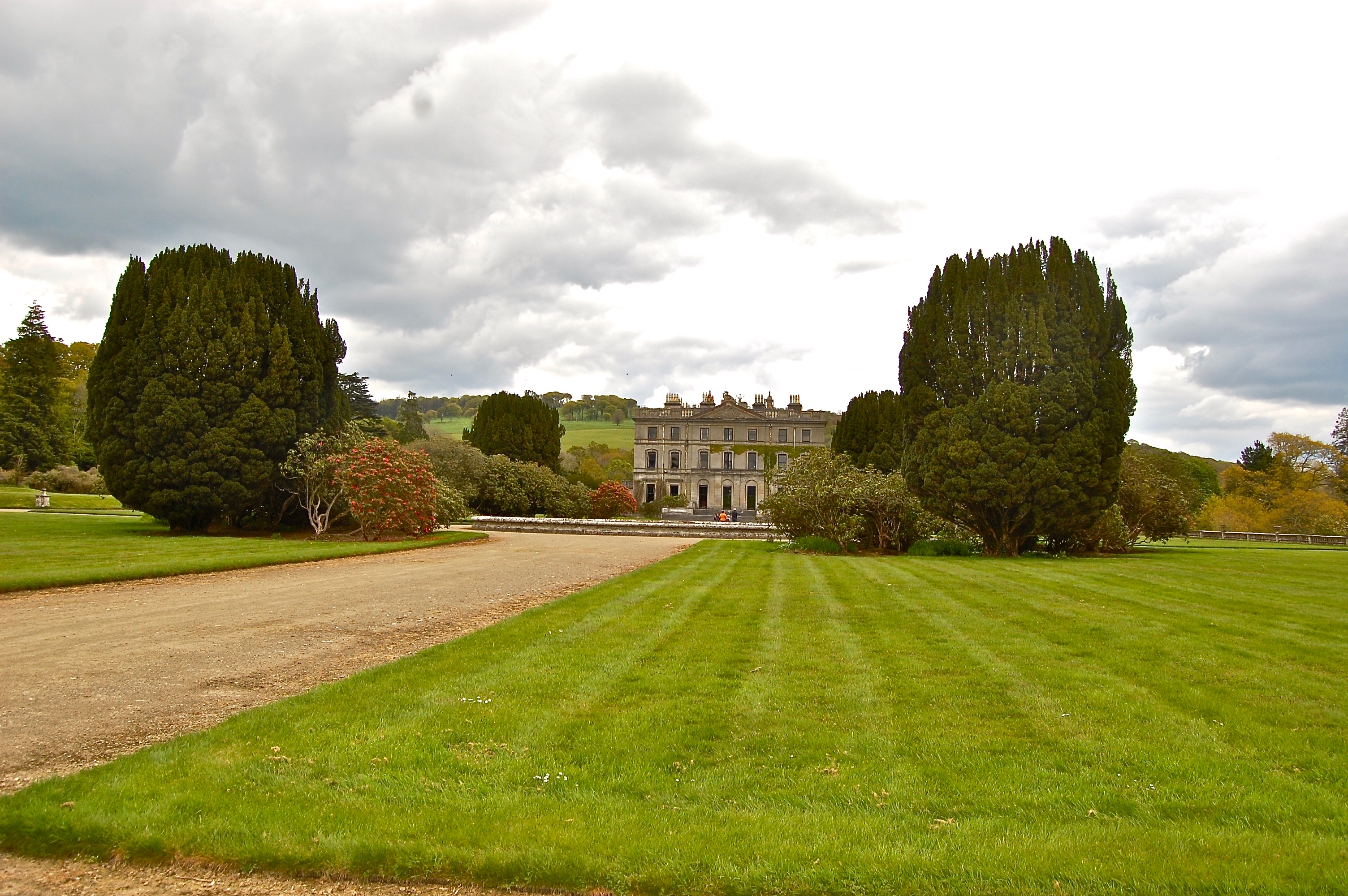
Since bad weather threatened on our visit in 2019 (and in 2023!), the tour guide took us out to the Shell House in the garden first. This was created by Catherine. A friend of Jonathan Swift, Mrs. Mary Delany, started a trend for shell grottoes, which progressed to shell houses.

Mary Delany (née Granville) (1700-1788) Paper collage artist; memoir and letter writer, by John Opie, 1792, courtesy of National Portrait Gallery NPG 1030.

Catherine had the house specially built, and she went to the docks nearby to ask the sailors to collect shells for her from all over the world, who obliged since their wages were paid by the Marquess. She then spent two hundred and sixty one days (it says this in a scroll that the marble sculpture holds in her hand) lining the structure with the shells (and some coral). The statue in the house is of Catherine herself, made of marble, by the younger John van Nost (he did many other sculptures and statues in Dublin, following in his father’s footsteps). Robert O’Byrne has a lovely video about shell grottoes and tells us more about this shell house on his website. [10]

DSC_0626
The Shell Grotto, 5th May 2019. Photograph © Jennifer Winder-Baggot, www.irishhistorichouses.com
Inside the shell grotto, statue by John van Nost of Catherine Le Poer Beresford, Countess of Tyrone. Photograph © Jennifer Winder-Baggot, www.irishhistorichouses.com
DSC_0627
Inside the shell grotto, statue by John van Nost of Catherine Le Poer Beresford, Countess of Tyrone. Photograph © Jennifer Winder-Baggot, www.irishhistorichouses.com
DSC_0630
Curraghmore. Photograph © Jennifer Winder-Baggot, www.irishhistorichouses.com
The scroll in the sculpture’s hand tells us that the shells were put up in 261 days by the Countess of Tyrone. Photograph © Jennifer Winder-Baggot, www.irishhistorichouses.com
DSC_0631
All the the shells were collected before Catherine started to put them up. Photograph © Jennifer Winder-Baggot, www.irishhistorichouses.com
Catherine also designed the pattern on the floor. Photograph © Jennifer Winder-Baggot, www.irishhistorichouses.com
Photograph © Jennifer Winder-Baggot, www.irishhistorichouses.com

Catherine also adorned the interior of Curraghmore with frescoes by the Dutch painter van der Hagen, and laid out the garden with canals, cascades, terraces and statues, which were swept away in the next century in the reaction against formality in the garden. In the nineteenth century, the formal layout was reinstated. [11]

Marcus and Catherine has many children. John de la Poer Beresford (1738-1805) served as first Commissioner of the Revenue.

John Beresford (1738-1805), first commissioner of the Revenue in Ireland, engraver Charles Howard Hodges, after Gilbe, courtesy of National Gallery of Ireland.
John Beresford (1738-1805), MP by Gilbert Stuart c. 1790, courtesy of National Gallery of Ireland NGI 1133
Barbara Montgomery (?1757-1788), second wife of John Beresford (1738-1805) by Hugh Douglas Hamilton, courtesy of National Gallery of Ireland P5547. His first wife was Anne Constantia Ligondes.
John Claudius Beresford, Lord Mayor of Dublin courtesy Adam’s 8 March 2006 in style of William Cuming PRHA. He was the son of John Beresford (1738-1805).
Elizabeth Cobbe née de la Poer Beresford (1736-1806), wife of Thomas Cobbe (1733-1814) of Newbridge House, Dublin, in a costume evocative of Mary Queen of Scots, miniature, Cobbe Collection. She is the daughter of Marcus Beresford 1st Earl of Tyrone.

Marcus Beresford was succeeded by his fourth but eldest surviving son, the second Earl, George Beresford (1734-1800), who also inherited the title Baron La Poer from his mother in 1769.

The Honourable George de la Poer Beresford (1735–1800), 2nd Earl of Tyrone, Later 1st Marquess of Waterford by Johann Zoffany, courtesy of National Trust Images.

He married Elizabeth Monck, only daughter and heiress of Henry Monck (1725-1787) of Charleville, another house on the Section 482 list which we visited www.irishhistorichouses.com/2020/09/18/charleville-county-wicklow/.]  

In 1786 he was created Baron Tyrone. Three years later he was made Marquess of Waterford in the Peerage of Ireland. He was therefore the 1st Marquess of Waterford. The titles descended in the direct line until the death of his grandson, the third Marquess, in 1859.

George de la Poer Beresford (1735-1800) First Marquess of Waterford by Gilbert Stuart, courtesy of Bonhams and commons.

Note on spelling of Marquis/Marquess: on the Curraghmore website “Marquis” is used, but in other references, I find “Marquess.” According to google:

A marquess is “a member of the British peerage ranking below a duke and above an earl. … A marquis is the French name for a nobleman whose rank was equivalent to a German margrave. They both referred to a ruler of border or frontier territories; in fact, the oldest sense of the English word mark is ‘a boundary land’.”

I shall therefore use the spelling “marquess.” If quoting – I’ll use the spelling used by the source. I prefer “marquis”,  as “marquess” sounds female to me, although it refers to a male!

George the 1st Marquess had the principal rooms of the house redecorated to the design of James Wyatt in the 1780s. Perhaps this was when the van der Hagen paintings were lost! We can see more of Van der Hagen’s work in a house sometimes open to the public, Beaulieu in County Louth. At the same time, George the 1st Marquess probably built the present staircase hall, which had been an open inner court, and carried out other structural alterations.

The Staircase Hall with its impressive sweeping staircase was created by James Wyatt in the 1780s, Curraghmore, County Waterford, Copyright Christopher Simon Sykes/The Interior Archive Ltd, PhotoShelter ID/ I0000CSsOaT_f.Fk, CS_GI14_39.
Photograph from Georgian Mansions In Ireland by Thomas U. Sadleir and Page L. Dickinson, printed for the authors at the Dublin University Press, by Ponsonby & Gibbs, 1915.

As Bence-Jones describes it, the principal rooms of the house lie on three sides of the great staircase hall, which has Wyatt decoration and a stair with a light and simple balustrade rising in a sweeping curve. Our tour paused here for the guide to point out the various portraits of the generations of Marquesses, and to tell stories about each.

Photograph courtesy of Curraghmore website. The large portraits of the women at the bottom of the stairs are the Stuart sisters. Louisa Stuart was wife of Henry, 3rd Marquess of Waterford. She was the daughter of Charles Stuart 1st and last Baron Stuart de Rothesay. Her sister Charlotte married Charles John Canning, 1st Viceroy to India. On the right had side of the photograph is Christiana née Leslie, wife of the 4th Marquess, who previously lived in Castle Leslie in County Monaghan.
Elizabeth Stuart née Yorke (1789-1867). Lady Stuart de Rothesay, with her daughters Charlotte (1817-1861) and Louisa (1818-1891) by George Hayter, photograph courtesy of UK Government Art Collection.
Photograph courtesy of Curraghmore website.

Bence-Jones writes that the finest of the Wyatt interiors are the dining room and the Blue drawing room, two of the most beautiful late eighteenth rooms in Ireland, he claims.

The dining room is decorated with grisaille panels by Peter de Gree and an ornamented ceiling. Photograph courtesy of Curraghmore website.

The walls have grissaille panels by Peter de Gree, which are imitations of bas-reliefs, so are painted to look as if they are sculpture. De Gree was born in Antwerp, Holland [12]. In Antwerp he met David de la Touche of Marlay, Rathfarnham, Dublin, who was on a grand tour. The first works of de Gree in Ireland were for David de la Touche for his house in St. Stephen’s Green in Dublin. [13]

Photograph courtesy of Curraghmore website.

The dining room has delicate plasterwork on the ceiling,  incorporating rondels attributed to Antonio Zucchi (1726-1795, an Italian painter and printmaker of the Neoclassic period) or his wife Angelica Kauffman (a Swiss Neoclassical painter who had a successful career in London and Rome).

Angelica Kauffmann (1741-1807) by Angelica Kauffmann, oil on canvas, circa 1770-1775, courtesy of National Portrait Gallery NPG 430.
Photograph from Georgian Mansions In Ireland by Thomas U. Sadleir and Page L. Dickinson, printed for the authors at the Dublin University Press, by Ponsonby & Gibbs, 1915.

The Blue Drawing Room has a ceiling incorporating roundels by de Gree and semi-circular panels attributed to Zucchi.

Sadlier and Dickinson tell us: “The principal drawing room is a large apartment, somewhat low, with three windows, four doors, and Adam overdoors; there is a pretty Adam ceiling in pale green and white, the work in relief being slightly gilt.

Photograph courtesy of Curraghmore website.
Photograph from Georgian Mansions In Ireland by Thomas U. Sadleir and Page L. Dickinson, printed for the authors at the Dublin University Press, by Ponsonby & Gibbs, 1915. The circular plaques are decorated in monochrome by De Gree, while four semi-circular compartments are believed to have been painted by Zucci, the husband of Angelica Kauffman.

Sadleir and Dickinson continue: “The circular plaques are decorated in monochrome by De Gree, while four semi-circular compartments are believed to have been painted by Zucci, the husband of Angelica Kauffman. The heavy white marble mantel, of classic design, is possibly contemporary with the decoration…A door communicates with the yellow drawing room, smaller but better proportioned, which has an uncoloured Adam ceiling, and a pretty linen-fold mantel in white marble [plate XXXI]. It is lighted by three windows … 

Photograph courtesy of Curraghmore website.
“A pretty linen-fold mantel in white marble” [plate XXXI] Photograph from Georgian Mansions In Ireland by Thomas U. Sadleir and Page L. Dickinson, printed for the authors at the Dublin University Press, by Ponsonby & Gibbs, 1915.

Sadleir and Dickinson continue the tour: “A door to the right gives access from the Hall to the library, which has an Adam ceiling with circular medallion heads, and an Adam mantel with added overshelf, the design of the frieze being repeated in the mantel and bookcases. Most of the books belonged to Lord John George Beresford, Archbishop of Armagh, whose portrait hangs over the fireplace.

John George Beresford was a son of George, the 1st Marquess.

John George Beresford was a son of George, the 1st Marquess.
Photograph courtesy of Curraghmore website.
The library, Photograph courtesy of Curraghmore website.
Photograph from Georgian Mansions In Ireland by Thomas U. Sadleir and Page L. Dickinson, printed for the authors at the Dublin University Press, by Ponsonby & Gibbs, 1915.

MARQUESSES OF WATERFORD

I am aided here by the wonderfully informative website of Timothy Ferres. [14]

George, 1st Marquess of Waterford had several children including some illegitimate. His illegitimate son Admiral Sir John de la Poer Beresford was raised to the British peerage as 1st Baronet Beresford, of Bagnall, Co. Waterford. His other illegitimate son was Lt.-Gen. William Carr Beresford, created 1st and last Viscount Beresford of Beresford. His first legitimate son died in a riding accident.

Harriet Elizabeth Peirse (1790-1825) Lady Beresford, wife of Admiral Sir John de la Poer Beresford (1766-1844) 1st Bt Beresford, of Bagnall, Co. Waterford, by Thomas Lawrence, courtesy of National Trust Hatchlands. Her husband was a son of the 1st Marquess.
The first legitimate son of the 1st Marquess, Marcus Gervais de la Poer Beresford (1771-1783), killed in a riding accident. Photograph from Georgian Mansions In Ireland by Thomas U. Sadleir and Page L. Dickinson, printed for the authors at the Dublin University Press, by Ponsonby & Gibbs, 1915.
Photograph courtesy of National Portrait Gallery, London, https://artuk.org/discover/artworks/search/keyword:de-la-poer–referrer:global-search

He was succeeded by his second legitimate son, Henry, 2nd Marquess (1772-1826), who wedded, in 1805, Susanna, only daughter and heiress of George Carpenter, 2nd Earl of Tyrconnell. Henry, who was a Knight of St Patrick, a Privy Counsellor in Ireland, Governor of County Waterford, and Colonel of the Waterford Militia, was succeeded by his eldest son, Henry, 3rd Marquess.

Henry de la Poer Beresford (1772-1826) 2nd Marquess of Waterford by William Beechy courtesy of Eton College.
Thought to be Elizabeth Louisa Reynell (1783-1856) née De La Poer and formerly wife of Sir Denis Pack, courtesy of Whyte’s Nov 2011. She was the daughter of the 1st Marquess of Waterford, and she married Denis Pack of County Kilkenny and later, Thomas Reynell, 6th Baronet.
James Beresford (1816-1841), 4th son of Henry De la Poer Beresford 2nd Marquess, by Joseph Clover, courtesy of Ingestrue Hall Residential Arts Centre.

In an interview with Patrick Freyne, the current Marquess, whom the townspeople call “Tyrone,” explained that it was the third Marquess, Henry who originated the phrase “painting the town red” while on a wild night in Miltown Mowbray in 1837: he literally painted the town red! [15]

I wonder was this the Marquess who, as a boy in Eton, was expelled, and took with him the “whipping bench,” which looks like a pew, from the school. It remains in the house, in the staircase hall! We can only hope that it meant than no more boys in Eton were whipped.

In 1842, Henry the third Marquess of Waterford married Louisa Stuart, daughter of the 1st Baron Stuart de Rothesay, and settled in Curraghmore House. Sadly, when she came to Curraghmore with her husband she had an accident which prevented her from having children.

Louisa Anne Beresford née Stuart (1818-1891) by Sir Francis Grant 1859-1860, NPG 3176. The National Portrait Gallery tells us: “Louisa Stuart was brought up mostly in Paris, where her father was British Ambassador to the French court. She was taught to draw from an early age and art, along with religion and philanthropy, was one of her main interests throughout her life. A gifted amateur watercolourist, she did not exhibit at professional galleries until the 1870s. With a strong interest in the welfare of the tenants on her Northumberland estate, she rebuilt the village of Ford. She provided a school and started a temperance society in the village. Her greatest artistic achievement was the decoration of the new school with life sized scenes from the Old and New testaments that used children and adults from the village as models.”

Louisa laid out the garden. She had been raised in France and modelled the gardens on those at Versailles.

According to the website:

After Wyatt’s Georgian developments, work at Curraghmore in the  nineteenth century concentrated on the gardens and the Victorian refacing to the front of the house.

Formal parterre, tiered lawns, lake, arboretum and kitchen gardens  were all developed during this time and survive to today. At this time some of Ireland’s most remarkable surviving trees were planted in the estate’s arboretum. Today these trees frame miles of beautiful river walks  (A Sitka Spruce overlooking King John’s Bridge is one of the tallest trees in Ireland).

DSC_0635
Curraghmore, 5th May 2019. Photograph © Jennifer Winder-Baggot, www.irishhistorichouses.com
Curraghmore, 14th August 2023. Photograph © Jennifer Winder-Baggot, www.irishhistorichouses.com
DSC_0615
Curraghmore, 5th May 2019. Photograph © Jennifer Winder-Baggot, www.irishhistorichouses.com
DSC_0625 (1)
Curraghmore, 5th May 2019. Photograph © Jennifer Winder-Baggot, www.irishhistorichouses.com
Curraghmore, 14th August 2023. Photograph © Jennifer Winder-Baggot, www.irishhistorichouses.com
Photograph © Jennifer Winder-Baggot, www.irishhistorichouses.com
The Lake was designed by James Wyatt, photograph 14th August 2023. Photograph © Jennifer Winder-Baggot, www.irishhistorichouses.com
DSC_0618
Curraghmore, 5th May 2019. Photograph © Jennifer Winder-Baggot, www.irishhistorichouses.com

Tragically, The 3rd Marquess broke his neck in a fall while hunting, in 1859, and died.

He was succeed by his younger brother, John (1814-1866), who became the 4th Marquess. It was this Marquess who bought the scarey statues in the garden. The tour guide told us that perhaps the choice of statue reflected the Marquis’s personality.

DSC_0609
There were horrible scary statues flanking a path – we learned later that they were bought by the fourth Marquis of Waterford in the World Fair in Paris. Photograph © Jennifer Winder-Baggot, www.irishhistorichouses.com
DSC_0608
Curraghmore, 5th May 2019. Photograph © Jennifer Winder-Baggot, www.irishhistorichouses.com
DSC_0621
Curraghmore, 5th May 2019. Photograph © Jennifer Winder-Baggot, www.irishhistorichouses.com
Curraghmore, 14th August 2023. Photograph © Jennifer Winder-Baggot, www.irishhistorichouses.com

The 4th Marquess had studied to join the clergy. He did not want to be the heir to the estate, with all of the responsibilites that came with it. He became more religious and more forboding as he aged.

John married Christiana Leslie in 1843, daughter of Charles Powell Leslie II of Castle Leslie (we will learn more about the Leslies in my write ups for Castle Leslie www.irishhistorichouses.com/2020/08/07/castle-leslie-glaslough-county-monaghan/ and Corravahan House in County Cavan www.irishhistorichouses.com/2020/08/28/corravahan-house-and-gardens-drung-county-cavan/).

John entered the ministry and served as Prebendary of St Patrick’s Cathedral, under his uncle, Lord John (John George de la Poer Beresford, Lord Archbishop of Armagh, the brother of his father the second Marquess).

Our guide told us that John forbade his wife from horseriding, which she adored. When he died in 1866, the sons were notified. Before they went to visit the body, when they arrived home they went straight to the stables. They took their father’s best horse and brought it inside the house, and up the grand staircase, right into their mother’s bedroom, where she was still in bed. It was her favourite horse! They “gave her her freedom.” She got onto the horse and rode it back down the staircase – one can still see a crack in the granite steps where the horse kicked one on the way down – and out the door and off into the countryside!

The oldest of these sons, John Henry de La Poer Beresford (1844-1895), became 5th Marquess, and also a Member of Parliament and Lord Lieutenant of Waterford. Wikipedia tells us that W. S. Gilbert of Gilbert and Sullivan fame refers to John Henry in his opera “Patience” as “reckless and rollicky” in Colonel Calverley’s song “If You Want A Receipt For That Popular Mystery”!

The second son, Admiral Charles William de la Poer Beresford, was created the 1st and last Baron Beresford of Metemmeh and Curraghmore, County Waterford in the British peerage. His daughter Kathleen Mary married Maj.-Gen. Edmund Raoul Blacque and in 1926 she purchased Castletown Cox, a Georgian classical mansion in County Kilkenny.

Kathleen Mary married Maj.-Gen. Edmund Raoul Blacque and in 1926 she purchased Castletown Cox, County Kilkenny, photograph courtesy of Knight Frank. It was designed by Davis Duckart, built 17567-71 for Michael Cox, Archbishop of Cashel, whose father, Sir Richard Cox, Lord Chancellor of Ireland, had obtained a lease of the estate from the Duke of Ormonde.
Castletown Cox, photograph courtesy of Knight Frank.
Castletown Cox, photograph courtesy of Knight Frank. It has fancy      
Castletown Cox, photograph courtesy of Knight Frank.

The 5th Marquess eloped with Florence Grosvenor Rowley, wife of John Vivian, an English Liberal politician, and married her on 9 August 1872. She died in 1873, and he married secondly, Lady Blanche Somerset, daughter of Henry Somerset, 8th Duke of Beaufort, on 21 July 1874. The second Lady Waterford suffered from a severe illness which left her an invalid. She had a special carriage designed to carry her around the estate at Curraghmore.

Lady Waterford in her specially designed invalid carriage 1896
Lady Blanche Waterford, daughter of the 8th Duke of Beaufort, wife of the 5th Marquess, John Henry, in her specially designed invalid carriage 1896, photograph courtesy of National Library of Ireland, from Flickr constant commons.

Sadly, John Henry killed himself when he was 51, leaving his son Henry to be 6th Marquess (1875-1911).

Henry the 6th Marquess served in the military. He married Beatrix Frances Petty-Fitzmaurice. He died tragically in a drowning  accident on the estate aged only 36. His daughter Blanche Maud de la Poer Beresford married Major Richard Desiré Girouard and had a son Mark Girouard, architectural historian, who worked for Country Life magazine.

curraghmore castle guests
January 10, 1902, Group shot of guests at a Fancy Dress Ball held at Curraghmore House, Portlaw, Co. Waterford, courtesy of National Library of Ireland.

His son John Charles became the 7th Marquess (1901-34). He too  died young. He served as a Second Lieutenant in the Royal Regiment of Horse Guards but died at age 33 in a shooting accident in the gun room at Curraghmore. He married Juliet Mary Lindsay. Their son John Hubert (1933-2015) thus became 8th Marquess at the age of just one year old.

A story is told that a woman’s son was hung, and she cursed the magistrate, the Marquess, by walking nine times around the courtyard of Curraghmore and cursing the family, wishing that the Marquess would have a painful death. It seems that her curse had some effect, as tragedy haunted the family. It was the fourth son who inherited the property and titles of Marcus Beresford, all other sons having died.

Provenance Originally housed at Castletown Cox, Co. Tipperary. Reputedly the sitter was the lady who put the curse on the Beresford Family of Curraghmore. Courtesy Fonsie Mealy Oct 2018.

The obituary of the 8th Marquis of Waterford gives more details on the curse, which was described to us by our guide, with the help of the portraits:

The 8th Marquis of Waterford, who has died aged 81, was an Irish peer and a noted player in the Duke of Edinburgh’s polo team.

That Lord Waterford reached the age he did might have surprised the superstitious, for some believed his family to be the object of a particularly malevolent curse. He himself inherited the title at only a year old, when his father, the 7th Marquis, died aged 33 in a shooting accident in the gun room at the family seat, Curraghmore, in Co Waterford.

The 3rd Marquis broke his neck in a fall in the hunting field in 1859; the 5th shot himself in 1895, worn down by years of suffering from injuries caused by a hunting accident which had left him crippled; and the 6th Marquis, having narrowly escaped being killed by a lion while big game hunting in Africa, drowned in a river on his estate in 1911 when he was 36.” [16]

The lion, along with some pals, stand in the front hallway in a museum style diorama!

the Hunt, Curraghmore House
The Hunt, January 11, 1902, courtesy of National Library of Ireland.
Otter Hunt, Curraghmore
According to the National Library, this is an Otter Hunt! At Curraghmore, May 14, 1901.

It is not all fun and games at the house, as in the pictures above! The guide told us a bit about the lives of the servants. In the 1901 census, she told us, not one servant was Irish. This would be because the maidservants were brought by their mistresses, who mostly came from England. The house still doesn’t have central heating, and tradition has it that the fireplace in the front hall can only be lit by the Marquis, and until it is lit, no other fires can be lit. The maids had to work in the cold if he decided to have a lie-in!

household staff of Curraghmore House, Portlaw, Co. Waterford, ca.1905, National Library of Ireland
Household staff of Curraghmore, around 1905, courtesy of National Library of Ireland.

John Hubert served as a lieutenant in the Royal Horse Guards’ Supplementary Reserve and was a skilled horseman. From 1960 to 1985, he was captain of the All-Ireland Polo Club, and he was a member of the Duke of Edinburgh’s Windsor Park team. After retiring from the Army, John Hubert, Lord Waterford, returned to Curraghmore and became director of a number of enterprises to provide local employment, among them the Munster Chipboard company, Waterford Properties (a hotel group) and, later, Kenmare Resources, an Irish oil and gas exploration company. He was a founder patron of the Waterford International Festival of Light Opera.

In 1957 he married Lady Caroline Olein Geraldine Wyndham-Quin, daughter of the 6th Earl of Dunraven and Mount-Earl, of Adare Manor in County Limerick. The 8th Marquess and his wife Caroline carried out restoration of the Library and Yellow Drawing Room. Lord Waterford devoted much of his time to maintaining and improving the Curraghmore estate, with its 2,500 acres of farmland and 1,000 acres of woodland.

He was succeeded by his son, Henry de La Pore Beresford (b. 1958), the current Marquess. He and his wife now live in the House and have opened it up for visitors. His son is also a polo professional, and is known as Richard Le Poer.

The website tells us, as did the Guide, of the current family:

The present day de la Poer Beresfords are country people by tradition. Farming, hunting, breeding  horses and an active social calendar continues as it did centuries ago. Weekly game-shooting parties are held every season (Nov. through Feb.) and in spring, calves, foals and lambs can be seen in abundance on Curraghmore’s verdant fields. Polo is still played on the estate in summer. Throughout Ireland’s turbulent history, this family have never been ‘absentee landlords’ and they still provide diverse employment for a number of local people. Change comes slowly to Curraghmore – table linen, cutlery and dishes from the early nineteenth century are still in use.

DSC_0645
Built in 1205, this stone-arched structure, spanning the Clodagh River, is the oldest bridge in Ireland, called King John’s Bridge, a 13th-century bridge built in anticipation of a visit from King John (he never came). Photograph © Jennifer Winder-Baggot, www.irishhistorichouses.com
DSC_0646
Curraghmore, 5th May 2019. Photograph © Jennifer Winder-Baggot, www.irishhistorichouses.com

THE OUTBUILDINGS

Behind the houses and stables on one side were more buildings, probably more accommodation for the workers, as well as more stables, riding areas and workplaces such as a forge. I guessed that one building had been a school but we later learned that the school for the workers’ children was in a different location, behind a the gate lodge by the entrance gate (nearly 2 km away, I think).

DSC_0594
Photograph © Jennifer Winder-Baggot, www.irishhistorichouses.com

We were lucky to be able to wander around the outbuildings.

DSC_0606
There were some interesting looking machines in sheds. Perhaps some of this machinery is for grain, or some could be for the wool trade. Turtle Bunbury writes of the wool trade in the 18th century and of the involvement by the de la Poer family in Curraghmore. [17] Photograph © Jennifer Winder-Baggot, www.irishhistorichouses.com

Other buildings were stables, or had been occupied as accommodation in the past, and some were used for storage.

DSC_0592
Amazing vaulted ceilings for stables! 5th May 2019. Photograph © Jennifer Winder-Baggot, www.irishhistorichouses.com
DSC_0597
The buildings above are behind the stables of the courtyard. 5th May 2019. Photograph © Jennifer Winder-Baggot, www.irishhistorichouses.com
DSC_0596
Curraghmore., 5th May 2019. Photograph © Jennifer Winder-Baggot, www.irishhistorichouses.com
DSC_0602
The Forge – see the bellows in the corner of the room, 5th May 2019. Photograph © Jennifer Winder-Baggot, www.irishhistorichouses.com

Last but not least, Curraghmore is now the venue for the latest music festival, Alltogethernow. There’s a stag’s head made by a pair of Native American artists, of wooden boughs that were gathered on the estate. It was constructed for the festival last year but still stands, ready for this year (2019)! Some of my friends will be at the festival. The house will be railed off for the event.

DSC_0636
Curraghmore, 5th May 2019. Photograph © Jennifer Winder-Baggot, www.irishhistorichouses.com
DSC_0638
Curraghmore, 5th May 2019. Photograph © Jennifer Winder-Baggot, www.irishhistorichouses.com
Remnants of Alltogethernow festival August 2023. Photograph © Jennifer Winder-Baggot, www.irishhistorichouses.com

Donation

Help me to fund my creation and update of this website. It is created purely out of love for the subject and I receive no payment so any donation is appreciated!

€10.00

[1] Mark Bence-Jones, A Guide to Irish Country Houses. (originally published as Burke’s Guide to Country Houses volume 1 Ireland by Burke’s Peerage Ltd. 1978); Revised edition 1988 Constable and Company Ltd, London.

[2] https://theirishaesthete.com/2019/07/03/now-available/

[3] Thomas U. Sadleir and Page L. Dickinson. Georgian Mansions in Ireland with some account of the evolution of Georgian Architecture and Decoration. Printed for the Authors at the Dublin University Press, by Ponsonby & Gibbs, 1915. 

[4] http://www.turtlebunbury.com/history/history_family/hist_family_delapoer.html

Turtle Bunbury on his website writes of the history of the family:

“On his death on 2nd August 1521, Sir Piers was succeeded as head of the family by his eldest son, Sir Richard Power, later 1st Baron le Poer and Coroghmore…. In 1526, five years after his father’s death, Sir Richard married Lady Katherine Butler, a daughter of Piers, 8th Earl of Ormonde, and aunt of ‘Black Tom’ Butler, Queen Elizabeth’s childhood sweetheart. The marriage occurred at a fortuitous time for Power family fortunes. English influence in Ireland had been in decline for several decades and the rival Houses of Butler and Fitzgerald effectively ran the country. The Powers of Curraghmore were intimately connected, by marriage, with both.”

[5] www.thepeerage.com

As a description of the times, and the issue of the succession of the Earls of Desmond, I shall include here some history panels I came across in the Desmond Banqueting Hall in Newcastle West in Limerick (see my entry on Office of Public Works properties in County Limerick):

Information panel on the Earls of Desmond, the Desmond Banqueting Hall in Newcastle West in Limerick.

[6] Quoted p. 51, Thomas U. Sadleir and Page L. Dickinson. Georgian Mansions in Ireland with some account of the evolution af Georgian Architecture and Decoration. Printed for the Authors at the Dublin University Press, by Ponsonby & Gibbs, 1915. 

[7] https://dromanahouse.com/2019/03/20/the-drawbacks-and-dangers-of-heiress-hunting/

[8] Mark Bence-Jones describes it in his book, A Guide to Irish Country Houses (originally published as Burke’s Guide to Country Houses volume 1 Ireland by Burke’s Peerage Ltd. 1978); Revised edition 1988 Constable and Company Ltd, London.

[9] see https://theirishaesthete.com/2019/07/01/curraghmore-church/

[10] https://theirishaesthete.com/2018/03/19/in-a-shell/

[11] Hugh Montgomery Massingberd and Christopher Simon Sykes. Great Houses of Ireland. Laurence King Publishing, London, 1999.

[12] https://theirishaesthete.com/2019/11/23/to-a-de-gree/

[13] https://www.libraryireland.com/irishartists/peter-de-gree.php

[14] from http://lordbelmontinnorthernireland.blogspot.com/search/label/County%20Waterford%20Landowners

[15] https://www.irishtimes.com/life-and-style/people/oh-lord-next-generation-takes-the-keys-to-waterford-county-1.2191959

[16] https://www.independent.ie/irish-news/news/obituary-the-irish-peer-who-outlived-curse-30998942.html

[17] http://www.turtlebunbury.com/history/history_family/hist_family_delapoer.html

[5] https://www.buildingsofireland.ie/buildings-search/building/22900816/curraghmore-house-curraghmore-co-waterford

Text © Jennifer Winder-Baggot, www.irishhistorichouses.com
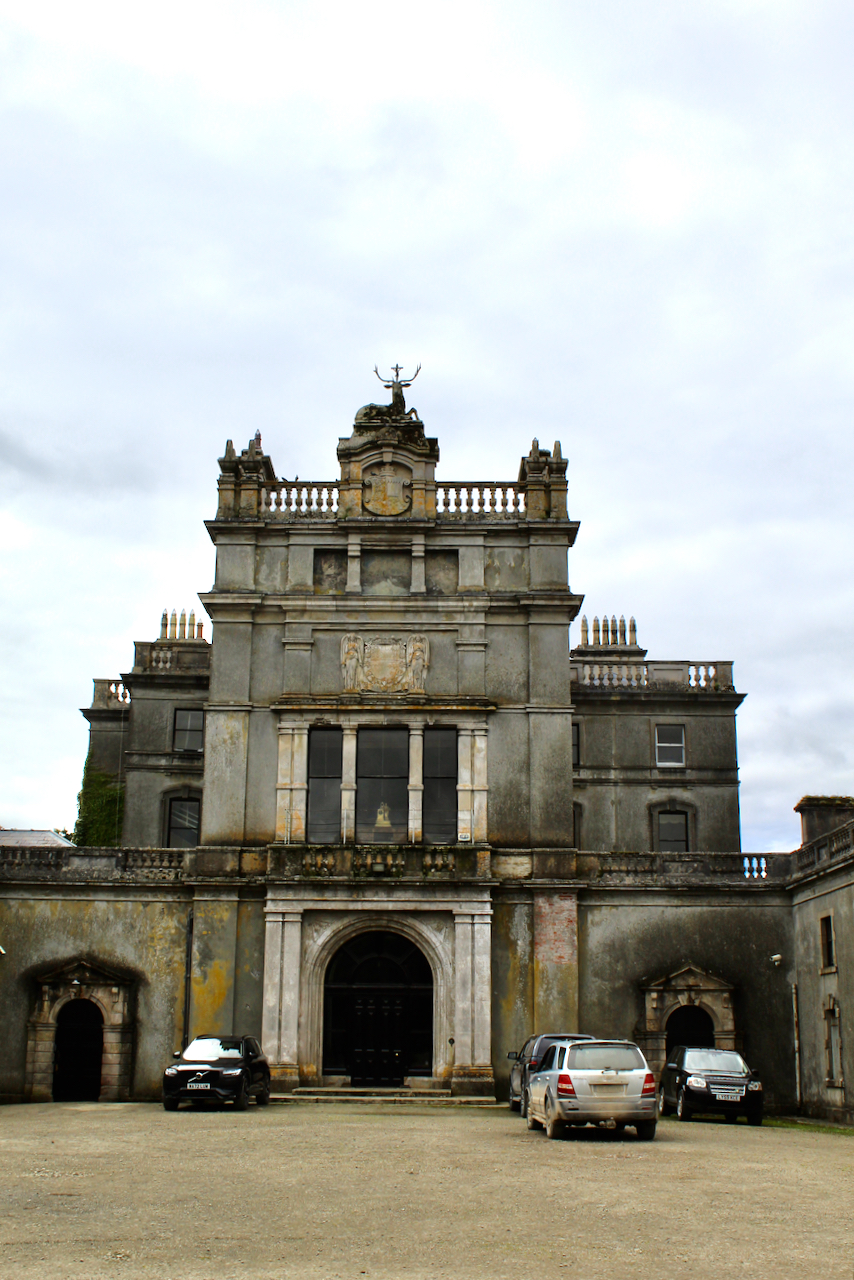
Slane Castle, County Meath C15 XP83 – section 482 tourist accommodation

www.slanecastle.ie

(Tourist Accommodation Facility)

Open in 2026: every day throughout Feb, May, June, Aug, Sept, Oct, Nov, Mar 1-11, Apr 10-30, July 1-12, 21-31, Dec 1-21

DSC_0503
The view of Slane Castle from just inside the gate, driving in. Photograph © Jennifer Winder-Baggot, www.irishhistorichouses.com

Today (Saturday 27th April 2019) my husband Stephen and I made our first official blog trip.  We started in the “ancient east,” going to Slane Castle in County Meath. The land around the Boyne River is beautiful, rolling and fertile. It took almost exactly one hour to drive from our home in Dublin, taking the M1 which I find easier than the M2 through the city’s north side, with which I’m less familiar. Our timing was perfect, we arrived at 2:10pm, in time for the 2:15 tour – there are tours every hour on the quarter hour. [1]

DSC_0504
Coming closer to Slane Castle. Photograph © Jennifer Winder-Baggot, www.irishhistorichouses.com
Slane Castle, County Meath, photograph by Robert French, (between ca. 1865-1914), Lawrence Photograph Collection, National Library of Ireland.

The castle is three storeys over basement, in the Gothic Revival style. There is a bow on the back side of the castle, facing the river, and the basement serves as the ground floor on this side due to the steep slope down to the River Boyne. The bow forms a round tower, but you cannot see it as you approach the castle as the river is behind.

Slane Castle, County Meath, photograph by Robert French, (between ca. 1865-1914), Lawrence Photograph Collection, National Library of Ireland.
DSC_0505
The view over the beautiful River Boyne. Photograph © Jennifer Winder-Baggot, www.irishhistorichouses.com
DSC_0507
Stephen in front of the Castle. Photograph © Jennifer Winder-Baggot, www.irishhistorichouses.com

Our guide Matthew told us that the castle was reconstructed and enlarged by William Burton Conyngham (1733-1796). It was built on the foundations of a medieval castle of the Fleming family, replacing an earlier house.

William Burton Conyngham was a classicist and the front hall features Greek columns and key patterns on the walls and many marble Greek sculptures, including a sculpture of King George IV of England, donated by the king himself.

William Burton Conyngham (1733–1796) by Anton Raphael Mengs c. 1754-58, courtesy of wikipedia.

William Burton Conyngham argued with his architects, Matthew told us, so ended up having three architects for his castle: James Gandon, James Wyatt and Francis Johnston. According to Mark Bence-Jones in A Guide to Irish Country Houses, Francis Johnston completed the house for the the second Lord Conyngham’s son, nephew of William Burton Conyngham, Henry (1766-1832), who later became the 1st Marquess Conyngham.

Other architects were consulted at various times, including James Gandon, who most famously designed the Custom House and the Four Courts in Dublin, and Emo in County Laois. Francis Johnston designed the General Post Office in Dublin, and Townley Hall, County Louth. Another architect consulted was a favourite of King George IV, the English Thomas Hopper.

William Burton Conyngham, (1733-1796), Teller of the Irish Exchequer and Treasurer of the Royal Irish Academy Date 1780 Engraver Valentine Green, English, 1739 – 1813 After Hugh Douglas Hamilton, Irish, 1740-1808.

In 1785 the castle was remodelled to the design of James Wyatt (1746 – 1813). Wyatt also designed another house on the section 482 list this year, Curraghmore in County Waterford, and a house not on the list, unfortunately, as I would love to see inside, Abbeyleix House (incidentally, my father grew up in Abbeyleix and we used to enjoy the gardens which used to be open and which were reknowned for the bluebells. Also, coincidentally, according to wikipedia, Wyatt spent six years in Italy, 1762–68, in company with Richard Bagot of Staffordshire, who was Secretary to the Earl of Northampton’s embassy to the Venetian Republic. My family is rumoured to be descended from the Staffordshire Bagots, although I have not found the connection!).

The Conyngham family have owned the castle since 1703.

Slane Castle, County Meath, photograph by Robert French, (between ca. 1865-1914), Lawrence Photograph Collection, National Library of Ireland.

The Flemings of Slane

The Conynghams bought the land in Slane after it was confiscated from the Flemings. In 1175, Richard Le Fleming built a castle at the western end of Slane hill and, three generations later, Simon Fleming was created Baron of Slane. [4]

The Conynghams did not acquire Slane directly after it was confiscated from the Flemings – Terry Trench of the Slane History and Archaeology Society writes that the estate changed hands, at least on paper, seven times between 1641 and 1703. The estate was taken from the Flemings in 1641, when William Fleming, the 14th Baron Slane, joined the Catholic Irish forces in rebellion against the British. He remained loyal to the king, but objected to the laws that the British parliament passed to make the Irish parliament subservient to the British parliament. The estate was restored to William’s son Randall under the Act of Settlement and Distribution of Charles II’s reign, by decree dated 27th March 1663. [5] Many estates that had been confiscated by Cromwell’s parliament were restored when Charles II was restored to the throne in 1660.

The Flemings had their land confiscated again as Christopher, 17th Baron Slane (1669-1726), backed James II in his battles against William of Orange. He served in the Irish Parliament of King James II in 1689, and as colonel in James’s army in Ireland 1689-91, fighting in both the Battle of the Boyne and in Aughrim, where he was taken prisoner by William’s forces. Released, he emigrated and fought in the French and Portuguese armies, as did many of James II’s followers who were attainted and lost their estates, as they needed to be able to earn a living. He was later reconciled with Queen Anne of England (daughter of James II) and returned to Ireland, to live in Anticur, County Antrim. In 1703, Henry Conyngham purchased the estate of Slane.

The Conynghams of Slane

The Conyngham motto, Over Fork Over, recounts the way Duncan hid from Macbeth (familiar to us from Shakespeare). Matthew told us that Duncan hid in straw in a barn, having it forked over him. After that, he managed to defeat Macbeth and to become king. So the Conynghams are descendants of a Scottish king!

DSC_0512
The Conyngham coat of arms, with its motto, Over Fork Over. Photograph © Jennifer Winder-Baggot, www.irishhistorichouses.com
At Slane, April 2019.

Alexander Conyngham moved from Scotland to Ireland when he was appointed in 1611 to be the first Protestant minister to Enver and Killymardin the diocese of Raphoe, County Donegal. [3] He was appointed dean of Raphoe in 1631.

The Bishop’s Palace at Raphoe, now a ruin. Photograph © Jennifer Winder-Baggot, www.irishhistorichouses.com

He settled at Mount Charles, County Donegal, on an estate he leased from John Murray, earl of Annandale, the owner of ‘a vast estate’ in Scotland. Conyngham subsequently acquired the Mount Charles property through his marriage to the earl’s grand-neice, Marian, daughter of John Murray of Broughton, in Scotland (see [3]).

Alexander’s son Albert lived at Mountcharles. [2] Albert had fought with William III’s troops in the Battle of the Boyne, against Fleming and James II’s troops.

Albert Cunningham (d. 1691) first colonel of the 6th (Inniskilling) Dragoons, by Willem Wissing c. 1690, courtesy of British Cavalry Regiments website and wikipedia.

Albert married Mary, daughter of the Right Reverend Robert Leslie, Bishop of Raphoe – this Bishop is the ancestor of the Leslie family of Castle Leslie in County Monaghan, another property on the Section 482 list that I will be visiting. Albert was killed by Irish Royalist rebels, and succeeded by his only surviving son, Henry (1664-1705). 

Henry, a military man who also served as MP for County Donegal, purchased the land in Slane in 1703.

He built himself a residence, which he called Conyngham Hall, on the foundations of an older castle formerly belonging to the Flemings.

DSC_0511
The intertwined “C” is the symbol of the Conyngham family. Photograph © Jennifer Winder-Baggot, www.irishhistorichouses.com
The Conyngham family tree, on the walls going to the public dining area.

Henry Conyngham (d. 1705) fought first in James II’s army, but then persuaded his regiment to transfer their loyalty to William III.

Henry’s son Henry (1705-1781) inherited the Slane estate. Henry became an Member of the Irish Parliament and was raised to the peerage in 1753 to the title of Baron Conyngham of Mount Charles, and later became Viscount and eventually, Earl. He died without a son so the Barony passed to his nephew, William Burton (his sister Mary had married Francis Burton).

William Burton (1733-1796) took the name of Conyngham upon inheriting the estate in 1781. It was he who rebuilt Slane Castle.

William Burton Conyngham, engraving After GILBERT STUART courtesy of Adams Country House Collections auction Oct 2023.

His brother Francis Pierpoint Burton also who then took the name of Conyngham in 1781 as he inherited the title to become 2nd Baron Conyngham of Mount Charles, Co. Donegal. He died six years later, in 1787. [see 3]. In 1750 he had married Elizabeth, the daughter of amateur architect Nathaniel Clements, whose work we will see later in other houses on the section 482 list of heritage properties. For himself, Nathaniel Clements built what is now the Áras an Uachtaráin, the residence of our President, Michael D. Higgins, in Phoenix Park in Dublin.  

The castle and estate passed to Francis 2nd Baron Conyngham’s son Henry (1766-1832). Henry succeeded as the 3rd Baron Conyngham of Mount Charles, Co. Donegal in 1787. He served as a politician and moved quickly up the ranks of the peerage and was Lord Steward of the Royal household between 1821-30. He married Elizabeth Denison in 1794.

Elizabeth née Denison, Marchioness Conyngham (1769-1861), wife of Henry 1st Marquess.

In 1821 King George IV visited Ireland, and he spent time in the Castle with his lover, Elizabeth, wife of Frances Pierpoint Burton Conyngham. “In return,” as our guide told us, the king made Conyngham a Marquess, although this isn’t quite true as he became Marquess in 1816. [6].

Elizabeth Conyngham (née Denison), Marchioness Conyngham (1769–1861) by George Chinnery, English, 1774-1852.
Elizabeth Conyngham née Denison, wife of Henry 1st Marquess by Thomas Lawrence 1821 courtesy of Calouste Gulbenkian Museum.
Maria Conyngham (died 1843), daughter of 1st Marquess of Slane by Sir Thomas Lawrence courtesy of Metropolitan museum.

One of the rooms of the castle, the Smoking Room, has two cartoons from the period mocking the King and his consort Elizabeth, drawing them as overweight. In one, she aids her son when he has to move from the Castle of Windsor where he was Royal Chamberlain. It was he who announced to Victoria that she was Queen, upon death of the previous monarch. He was let go from his position when he tried to move his lover into his rooms in Windsor. His mother came to fetch him, with several wheelbarrows, the story goes, and she took all the furniture from his rooms. Somehow she brought a grand piano back from Windsor to Slane Castle where it sat in a specially made arbor for music in the Smoking room, until it was destroyed by a fire in Slane Castle in the 1990’s. One of the Punch style cartoons is of Elizabeth with a wheelbarrow fetching her son from Windsor. I can’t quite remember the other – it had King George IV and herself in a carriage. The Irish were very annoyed that when he came to Ireland he spent his entire time at Slane Castle!

Cartoons at Slane Castle Tour, Slane, Co Meath, photograph by Nomos Productions, 2022, Courtesy Failte Ireland.
At Slane, April 2019. Photograph © Jennifer Winder-Baggot, www.irishhistorichouses.com

The Irish Aesthete writes of the visit:

Neither the king nor his inamorata were in the first flush of youth, and both were equally corpulent. These circumstances however did nothing to dampen their ardour. As was written of them at the time, ‘Tis pleasant at seasons to see how they sit/ First cracking their nuts, and then cracking their wit/ Then quaffing their claret – then mingling their lips/ Or tickling the fat about each other’s hips.’ And according to one contemporary observer, Lady Conyngham ‘lived exclusively with him during the whole time he was in Ireland at the Phoenix Park. When he went to Slane, she received him dressed out as for a drawing-room; he saluted her, and they then retired alone to her apartments.’” [7]

Our tour started with a video of Charles Conyngham, now known as Lord Mount Charles, telling of his childhood in the Castle, growing up in a very old-world upper class manner.  He did not join his parents at the dining table until he was twelve years old, dining until then in the Nursery. His nurse, Margaret Browne, came to the Castle at 16 years old, and he held her in such regard that he named his bar after her.

DSC_0516
The menu in Browne’s Bar, which gives an explanation of the name, telling of the housekeeper.

Lord Mount Charles described how he started out, when he had to take over the Castle, with a restaurant, which is now the Gandon Restaurant. To further fund the Castle maintenance, Lord Mount Charles started concerts at the venue, beginning with Thin Lizzy in 1981. To seal the deal, the next show was the Rolling Stones! With such august imprimateur, the Castle’s concerts became world-famous and featured many top performers including David Bowie, Bob Dylan, Neil Young and Queen.

DSC_0514
Lovely picture of Phil Lynnott of Thin Lizzy carrying a child at Slane.

Henry 1st Marquess Conyngham’s son, Francis Nathaniel Burton Conyngham (1797-1876) inherited the property and the title, to become 2nd Marquess Conyngham. His daughter Frances Caroline Maria married Gustavus William Lambart (1814-1886), who we will come across later as the owner of Beauparc in County Meath, another Section 482 property https://irishhistorichouses.com/2022/07/22/beauparc-house-beau-parc-navan-co-meath/ . The current owner of Slane inherited Beauparc from the Lambarts.

A son, George Henry (1825-1882) became 3rd Marquess Conyngham, and his son, Henry Francis the 4th Marquess. He married the daughter of the 4th Baron Mollens of Ventry, County Kerry. Their son the 5th Marquess died unmarried, so the title passed to his brother, Frederick William Burton, 6th Marquess. The current Marquess is the 8th, who is known as Lord Henry Mount Charles, but is officially 8th Marquess Conyngham since 2009.

A disasterous fire in the castle in 1991 destroyed the roof and one third of the castle.

DSC_0525
Newspaper clippings about the fire, in the entry to pub and restaurant.
DSC_0524
At Slane, April 2019.

The magnificent library with its intricate ceiling and impressive wooden chandelier was saved by two firemen fighting the fire from within the room, battling for nine hours. The smoke was so thick that one couldn’t see the ceiling. I think they deserve a plaque in the room to recognise their effort! Meanwhile the family saved as many priceless historic paintings and antiques as they could, including a huge portrait of King George IV that is now hanging again in the library, by cutting it from its giant gilt frame then taking the frame apart into four pieces in order to get it out through the doors. Lord Mount Charles now suffers with his lungs, probably partially as a result of long exposure to the flames and smoke. It took ten years to reconstruct the castle, but it has been done excellently so traces of the fire barely remain.

Portrait of George IV which was saved from the fire, Slane Castle Tour, Slane, Co Meath, photograph by Nomos Productions, 2022, Courtesy Failte Ireland.

We weren’t allowed to take pictures inside, as usual with these properties. There is a picture of the ornate roof in the library on the wonderful blog of the Irish Aesthete [8].

Mark Bence-Jones describes the room in his 1988 book (published before the fire, but this room remained intact!), A Guide to Irish Country Houses:

“…the great circular ballroom or library which rises through two storeys of the round tower and is undoubtedly the finest Gothic Revival room in Ireland; with a ceiling of Gothic plasterwork so delicate and elaborate that it looks like filigree. Yet this, too, is basically a Classical room; the Gothic ceiling is, in fact, a dome; the deep apses on either side of the fireplace are such as one finds in many of Wyatt’s Classical interiors, except that the arches leading into them are pointed; they are decorated with plasterwork that can be recognised as a very slightly Gothicized version of the familiar Adam and Wyatt fan pattern.

Slane Castle Tour, Slane, Co Meath, photograph by Nomos Productions, 2022, Courtesy Failte Ireland.
Slane Castle, Slane, Co Meath, photograph by Nomos Productions, 2022, Courtesy Failte Ireland

Of the tales on the tour, I especially enjoyed the story of the funeral of a soldier’s leg. Apparently it was quite the custom to have funerals for body parts – his leg had to be amputated on the field of battle and the soldier brought it back to be buried with a full-scale military funeral. It must have been to do with the fact that a person’s body is to be resurrected on the Last Day, so it’s good to know where all the parts are! Cremation used to be forbidden in the Catholic church, as somehow it would be too difficult for God to put the ashes back together – never mind a disintegrated body!

We had lunch in the bar after the tour.

DSC_0509
Outer entrance to the bar and Gandon Restaurant. Photograph © Jennifer Winder-Baggot, www.irishhistorichouses.com
DSC_0523
Entrance to the bar and Gandon Restaurant. Photograph © Jennifer Winder-Baggot, www.irishhistorichouses.com
DSC_0519
Browne’s Bar. Photograph © Jennifer Winder-Baggot, www.irishhistorichouses.com
DSC_0513
Album covers of musical performers at the Castle, in the bar: Van Morrison, Santana, Bruce Springstein, Neil Young, the Rolling Stones, Chris Rea, Bob Dylan, U2 and Bon Jovi.
DSC_0515
Memorabilia from music events: I think the guitar was signed by Phil Lynott (it was signed, anyway).
DSC_0517
Slane Castle.
DSC_0518
The music theme of Browne’s Bar is reflected in the gramophone horn lampshade. Photograph © Jennifer Winder-Baggot, www.irishhistorichouses.com

There is an adjoining distillery in what used to be the stables, and a tour of that can be purchased in combination if desired. Lord Charles’s mother bred horses before the stables were converted. The stables were designed by Capability Brown.

DSC_0543
The stables, designed by Capability Brown, now a whiskey distillery. Photograph © Jennifer Winder-Baggot, www.irishhistorichouses.com

According to the Irish Aesthete:

Henry Conyngham, grandson of General Henry Conyngham who purchased the property, around 1770 invited Capability Brown around 1770 to produce a design both for the landscaping of the parkland at Slane, and also for a new stable block. In the collection of the Irish Architectural Archive in Dublin a drawing survives of Brown’s proposal for the latter. It is not unlike the finished building, but more elaborate than what we see today.” [9]

DSC_0527
I noticed this on the wall on the lower level outside the Castle – I don’t know its origin or age. Photograph © Jennifer Winder-Baggot, www.irishhistorichouses.com

I found a blog by the Irish Aesthete on a portrait now in Slane, of Lady Elizabeth wife of the first Marqess’s daughter, Lady Maria Conyngham. Reportedly Lady Elizabeth looked very like her daughter – which one would not guess from the unflattering cartoons of her! [10]

Donation

Help me to fund my creation and update of this website. It is created purely out of love for the subject and I receive no payment so any donation is appreciated! For this entry I paid for petrol and entrance fee for myself and Stephen.

€15.00

[1] https://www.slanecastle.ie/tours/castle-tours/

[2] https://www.buildingsofireland.ie/buildings-search/building/40847025/the-hall-hall-demesne-mountcharles-co-donegal

[3] http://lordbelmontinnorthernireland.blogspot.com/2017/11/slane-castle.html

[4] https://www.culturenorthernireland.org/article/1323/the-flemings-barons-of-slane

[5] http://slanehistoryandarchaeologysociety.com/index.php/famous-people/13-the-flemings-and-the-conynghams

[6] https://en.wikipedia.org/wiki/Elizabeth_Conyngham,_Marchioness_Conyngham

“She probably became his [George IV’s] lover in 1819, when he was Prince Regent, but finally supplanted her predecessor, Isabella Seymour-Conway, Marchioness of Hertford, after he became king in 1820. He became besotted with her, constantly “kissing her hand with a look of most devoted submission.” While his wife Caroline of Brunswick was on trial in 1820 as part of efforts to divorce her, the king could not be seen with Lady Conyngham and was consequently “bored and lonely.” During his coronation, George was constantly seen “nodding and winking” at her.
“Lady Conyngham’s liaison with the king benefited her family. Her husband was raised to the rank of a marquess in the Peerage of the United Kingdom and sworn to the Privy Council, in the coronation honours of 1821. He was also given several other offices, including Lord Steward of the Household and the lieutenancy of Windsor Castle. Her second son was made Master of the Robes and First Groom of the Chamber.”

[7] https://theirishaesthete.com/2015/10/12/when-royalty-comes-to-call/

[8] https://theirishaesthete.com/2015/10/24/vaulting-ambition/

[9] https://theirishaesthete.com/2014/10/27/after-the-horses-have-bolted/

[10] https://theirishaesthete.com/2015/03/21/ireland-crossroads-of-art-and-design-vi/

Text © Jennifer Winder-Baggot, www.irishhistorichouses.com
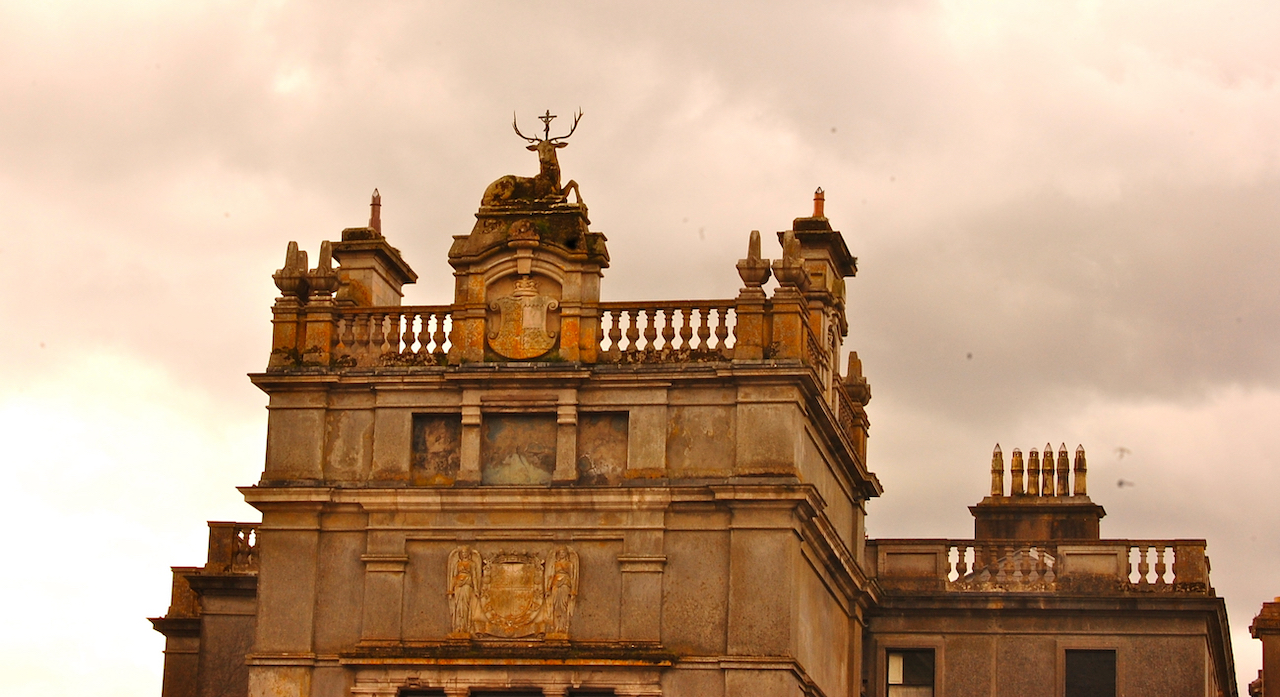
Irish Historic Homes