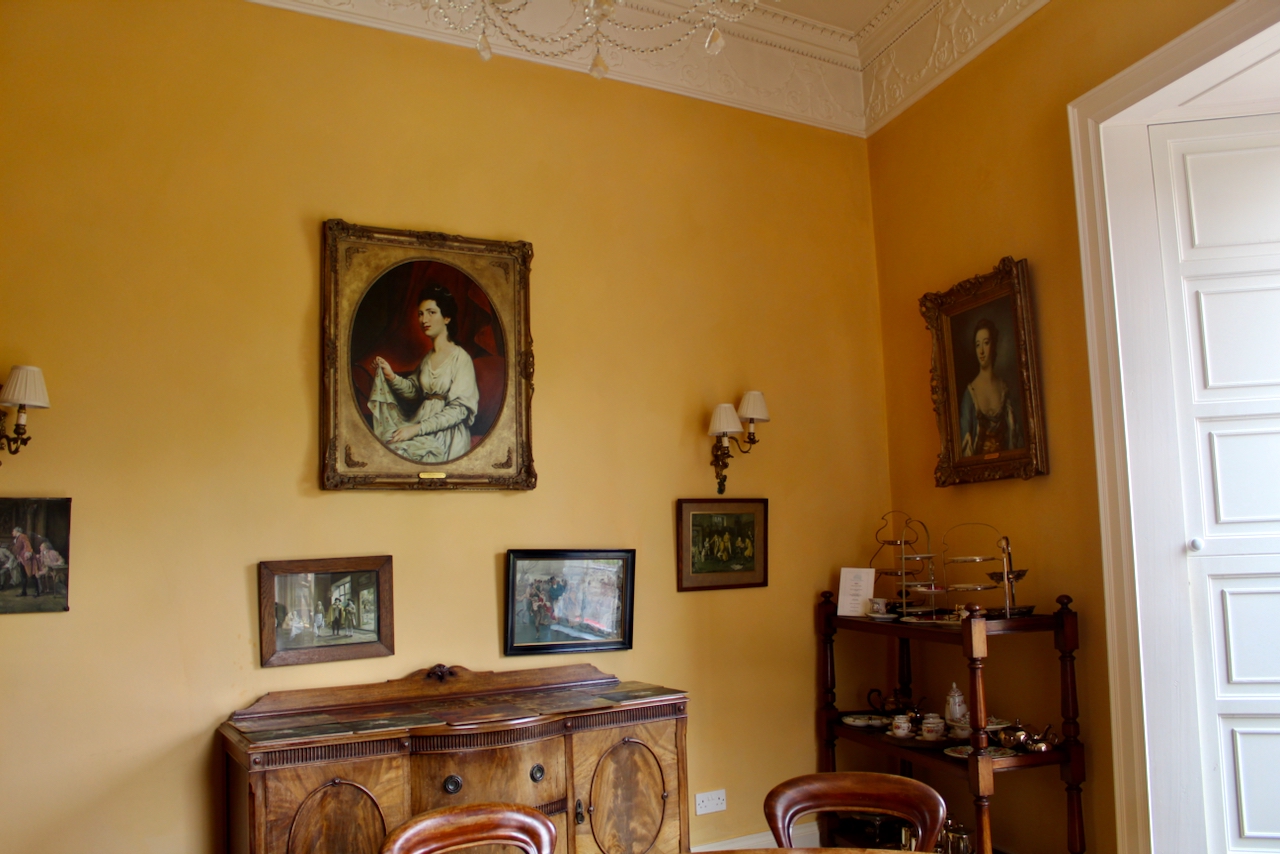
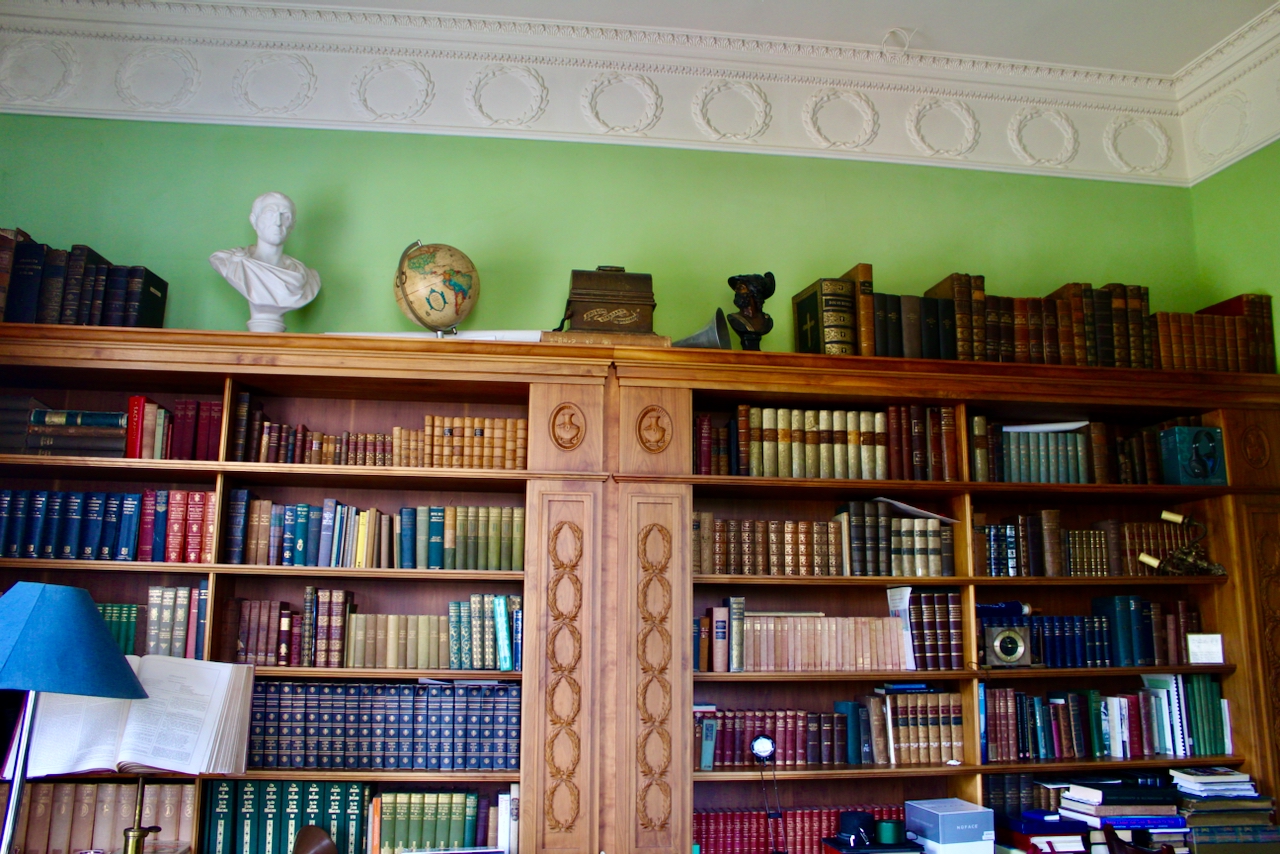
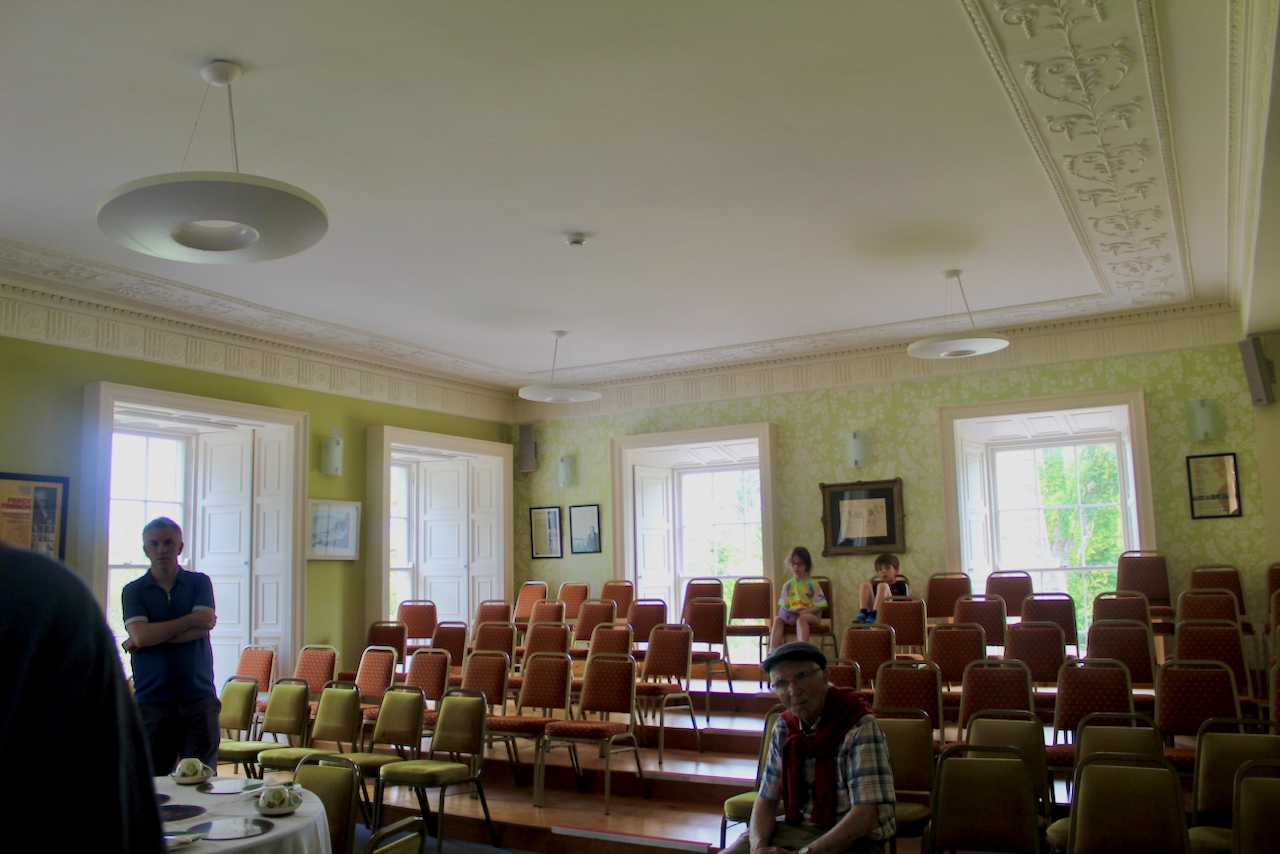
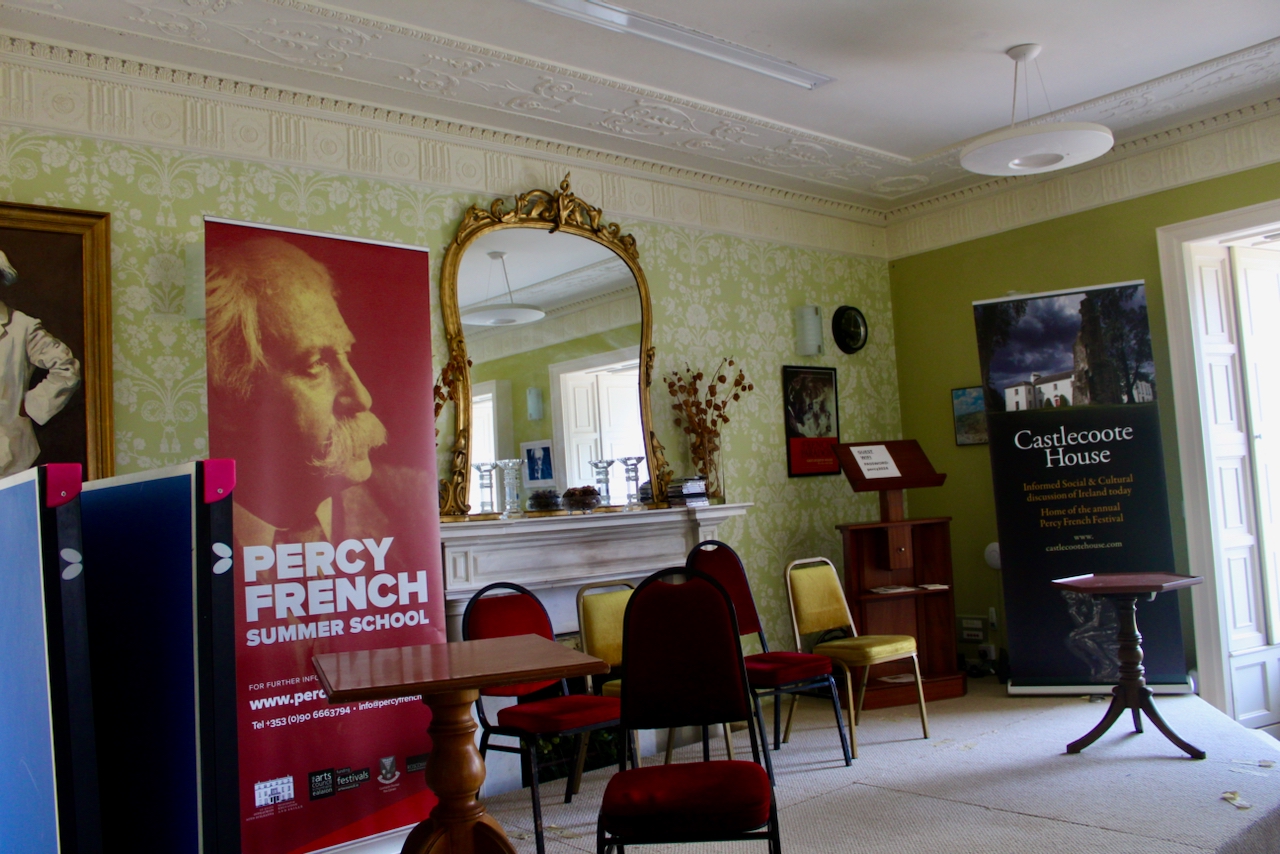
MOLI (Museum of Literature Ireland), Newman House, 85-86 St. Stephen’s Green, Dublin

Donation

Help me to fund my creation and update of this website. It is my “full time job” and created purely out of love for the subject and I receive no payment so any donation is appreciated! My costs include travelling to our destinations from Dublin, accommodation if we need to stay somewhere nearby, and entrance fees. Your donation could also help with the cost of the occasional book I buy for research (though I mostly use the library – thank you Kevin Street library!). Your donation could also help with my Irish Georgian Society membership or attendance for talks and lectures, or the Historic Houses of Ireland annual conference in Maynooth.

€15.00

MOLI (Museum of Literature Ireland), Newman House, 85-86 St. Stephen’s Green, Dublin

https://moli.ie

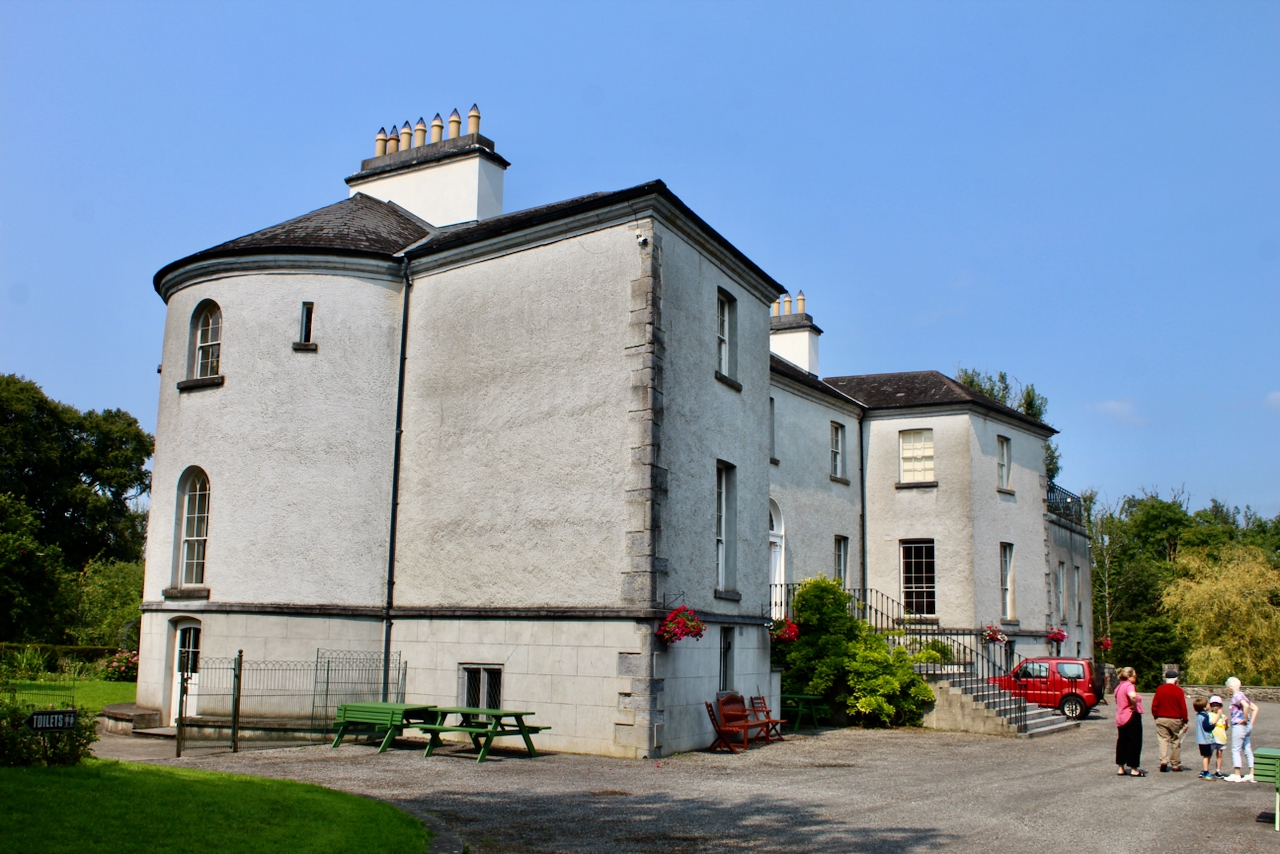
86 St Stephen’s Green, Newman House, which belongs to University College Dublin and now houses the Museum of Literature of Ireland. Photograph © Jennifer Winder-Baggot, www.irishhistorichouses.com
The two storey over basement on the left of Newman House is 85 St Stephen’s Green. 85 St. Stephen’s Green was built in 1738 by Richard Castle, architect of Powerscourt House and Russborough House, and is notable for its exquisite baroque plasterwork by the Lafranchini brothers. Photograph © Jennifer Winder-Baggot, www.irishhistorichouses.com

The website tells us:

No. 85 St. Stephen’s Green was built in 1738 by Richard Cassels, architect of Powerscourt House and Russborough House, and is notable for its exquisite baroque plasterwork by the Lafranchini brothers. The adjoining townhouse at No. 86 was constructed in 1765 and features superb examples of rococo stuccowork by the distinguished Dublin School of Plaster Workers.

85 St. Stephen’s Green was built for Captain Hugh Montgomerie. Robert O’Byrne tells us that Hugh was one of five children born to Sir Thomas Montgomerie  and Clemence Hovell. Clemence was married to Charles Stuart, who died in 1709, and her children with Thomas Montgomerie were born before her husband’s death so were illegitimate. [1]

In 1738 Hugh Montgomerie married Mary Bingham, eldest daughter of Sir John Bingham 5th Baronet of Castlebar, County Mayo, and it may have been her wealth that helped to build their new house on St. Stephen’s Green designed by Richard Castle (or Cassels). After Hugh Montgomerie’s death, Mary married Vesey Colclough (1734-1745), whom we came across when we saw Tintern Abbey in County Wexford.

86 St Stephen’s Green was constructed in 1765 and features superb examples of rococo stuccowork by the distinguished Dublin School of Plaster Workers. The wonderful lion over the door is made of lead. Photograph © Jennifer Winder-Baggot, www.irishhistorichouses.com

86 St Stephen’s Green is a granite-faced townhouse built in 1765 for Richard Chapel Whaley (d. 1796) who was called “Burn Chapel” Whaley due to his anti-Catholic sentiment. The “Chapel” or “Chapell” was really part of his name, from his mother’s family. The Dictionary of Irish Biography tells us “he was a fervent priest-hunter, and once while hunting a priest burned down a catholic chapel when he fired his fowling-piece into the roof and the wadding lodged in the thatch. Forever afterwards he was known as ‘Burn-Chapel ’ Whaley.”

It is ironic that Richard Chapel Whaley’s house is now owned by the Catholic university, University College Dublin, and named for Cardinal John Henry Newman (1801-1890) who famously converted from Protestantism to Catholicism, and by his example, encouraged many others to convert to Catholicism! The house may have been designed by Robert West, more famous as a stuccadore [2]. Much of the stucco work inside is in the style of Robert West – he may have done some of the work and it is thought that others were involved also. [2]

86 St Stephen’s Green. Photograph © Jennifer Winder-Baggot, www.irishhistorichouses.com
Robert West also designed Belvedere House, now Belvedere College, Dublin.

Richard Chapel Whaley (1700–69) wanted to create a house that dwarfed his neighbour in number 85, which was owned at that time by John Meade, 1st Earl Clanwilliam. 85 St. Stephen’s Green was known as Clanwilliam House.

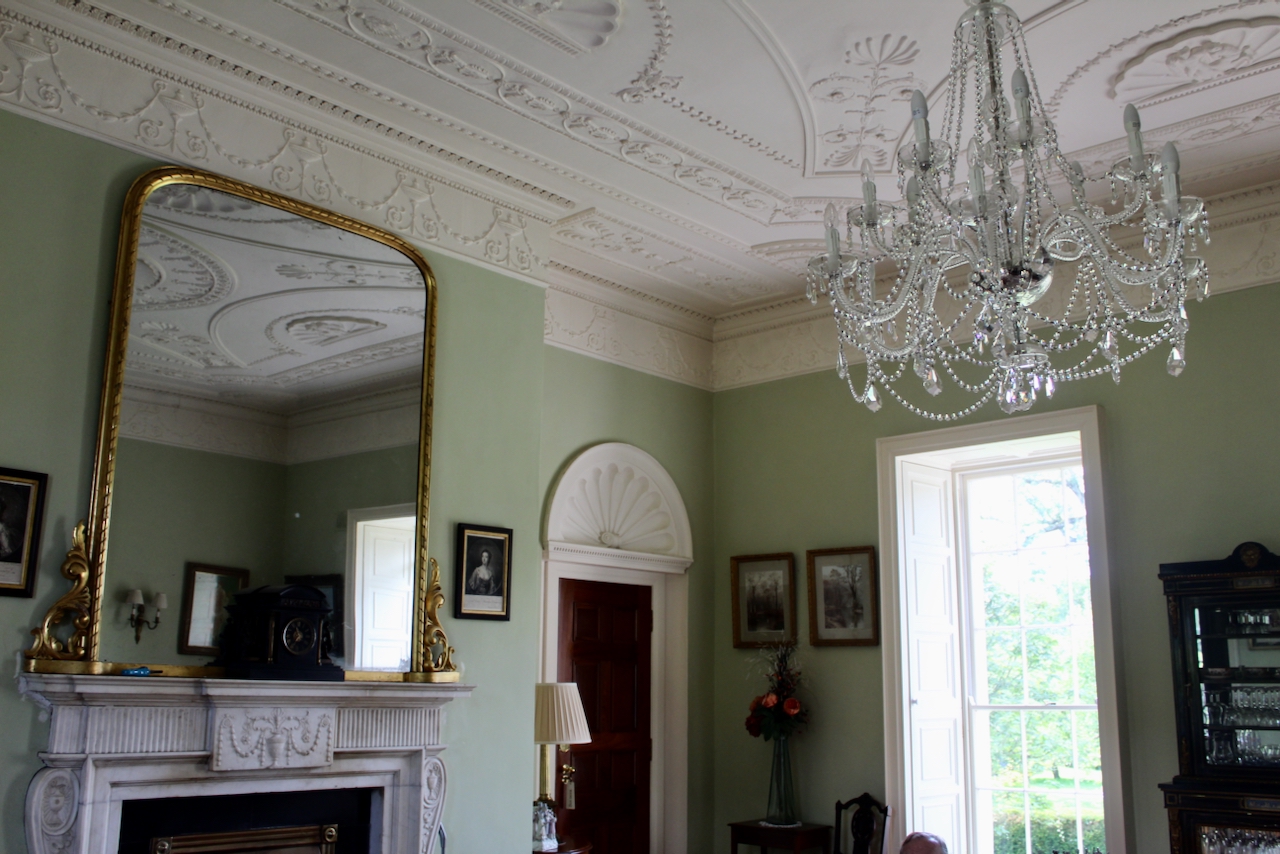
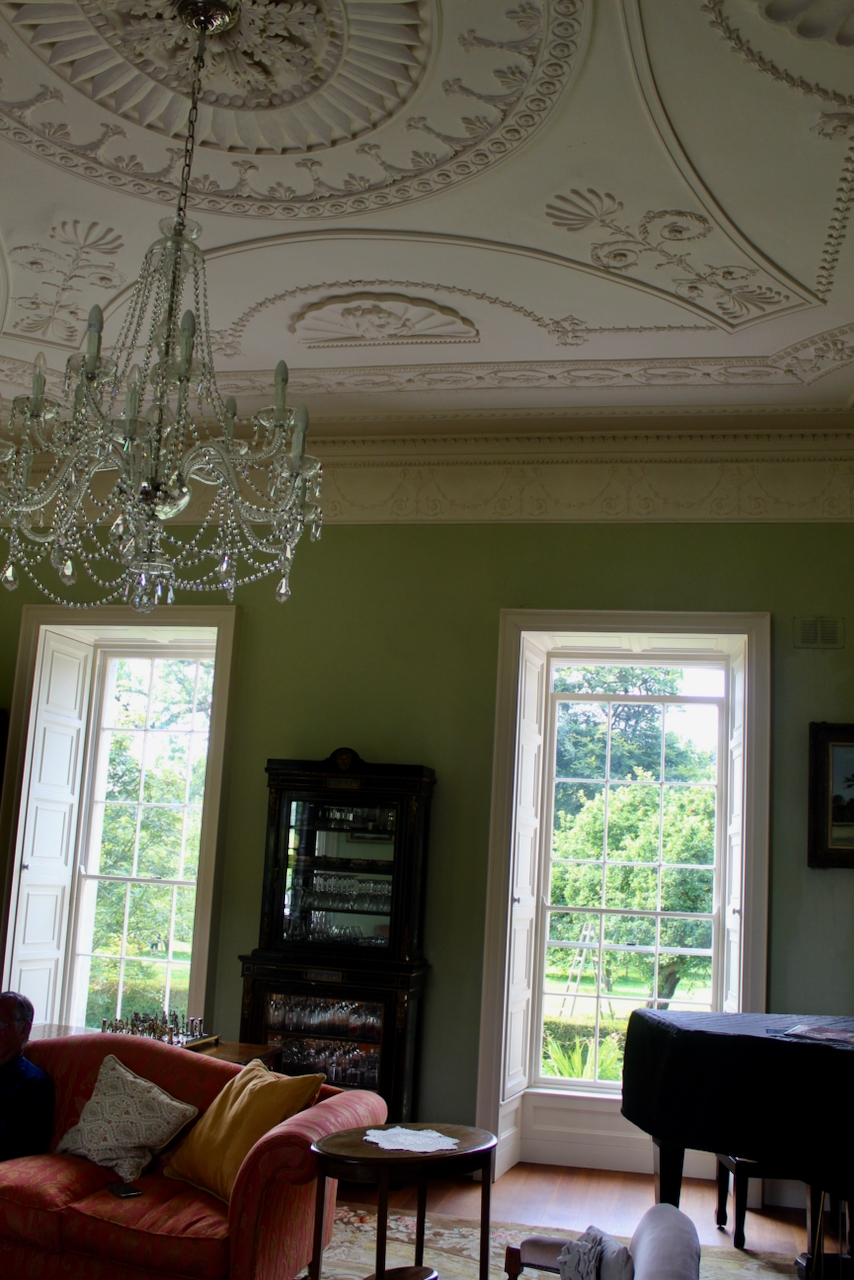
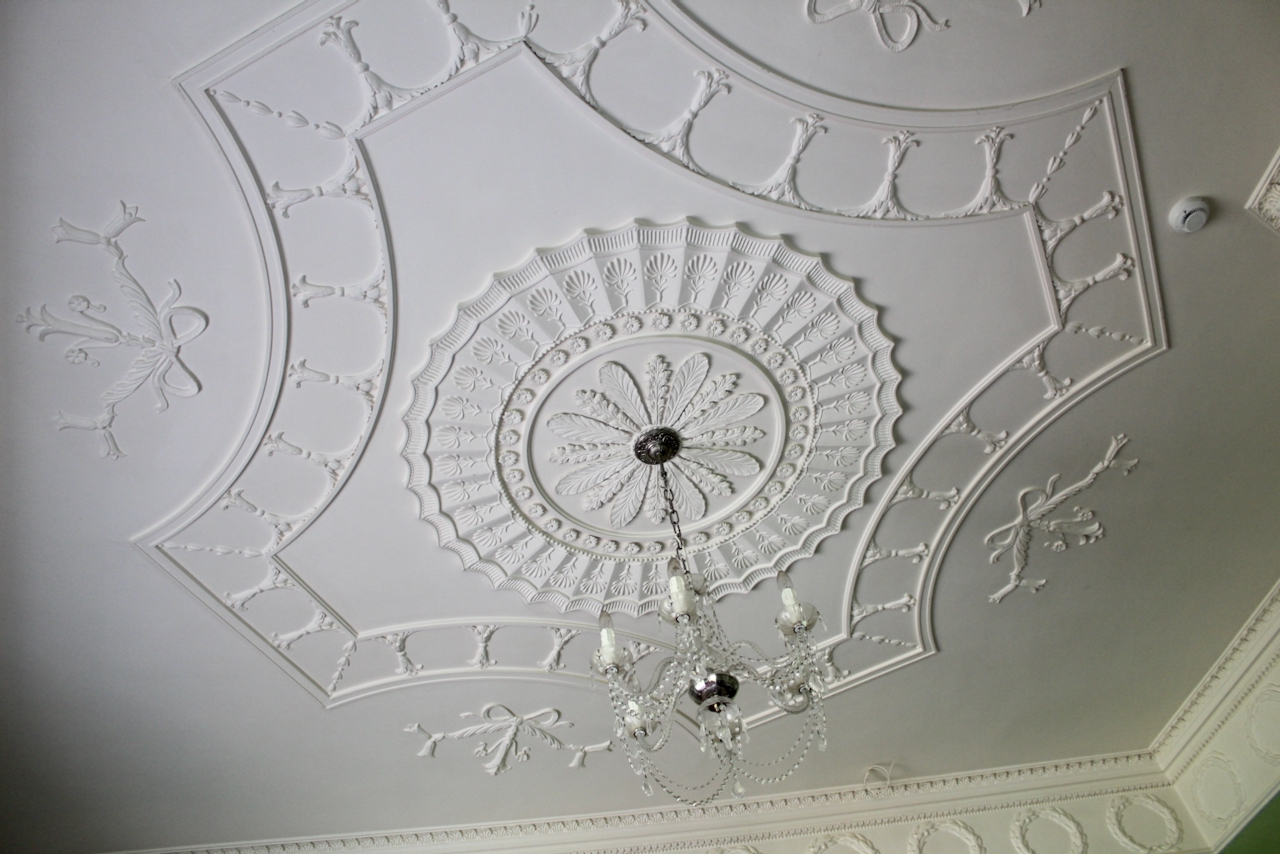
The two houses, 85 and 86, were joined in the mid 19th century and named after Cardinal Newman (1801-90). Together they contain some of the most spectacular plasterwork in Ireland.

The MOLI website continues: “The building takes its name from the theologian and educationalist Dr. John Henry Newman, who was rector when the Catholic University was founded in 1854. UCD Newman House also boasts many literary and cultural associations. The poet Gerard Manley Hopkins lived here during his time as Professor of Classics at the university, and James Joyce was a student here before graduating with a BA in 1902. Other famous Irish writers to have studied at UCD Newman House include Flann O’Brien, Kate O’Brien and Maeve Binchy.

Explore the stunning surroundings and turbulent history of Numbers 85 and 86 St Stephen’s Green on MoLI’s Historic House Tour

These beautiful examples of Georgian opulence – with lavish stuccowork by the famous Lafranchini brothers – have served not only as a university and a museum, but also as the townhouse of Buck Whaley, one of Ireland’s most infamous playboys and adventurers. 

Join your guide as they bring you on a journey through these hidden historic rooms, witness these architectural treasures up close, and learn about the many fascinating characters that have passed through over the centuries.

86 St. Stephen’s Green is of five bays across, of four storeys over basement. It has a two bay entrance hall flanked by two further rooms, and the service stair is on the transverse axis between the entrance hall and the rear right-hand parlour, Christine Casey tells us. [3]

The grandness begins straight away when you enter MOLI – this stuccowork is behind the entrance desk, in 86 St Stephen’s Green. Photograph © Jennifer Winder-Baggot, www.irishhistorichouses.com

The stair hall decoration is particularly splendid. Acanthus ornament mixes with Rococo elements such as trophies of musical instruments, asymmetrical scrolls and birds distinctive of the Dublin school of plasterwork.

86 St Stephen’s Green. Photograph © Jennifer Winder-Baggot, www.irishhistorichouses.com
86 St Stephen’s Green. The violins in the cartouches are actually real violins, which were easier than sculpting them from scratch! The coved ceiling includes acanthus leaves and high-relief birds with outstretched wings. Photograph © Jennifer Winder-Baggot, www.irishhistorichouses.com
86 St Stephen’s Green. Photograph © Jennifer Winder-Baggot, www.irishhistorichouses.com
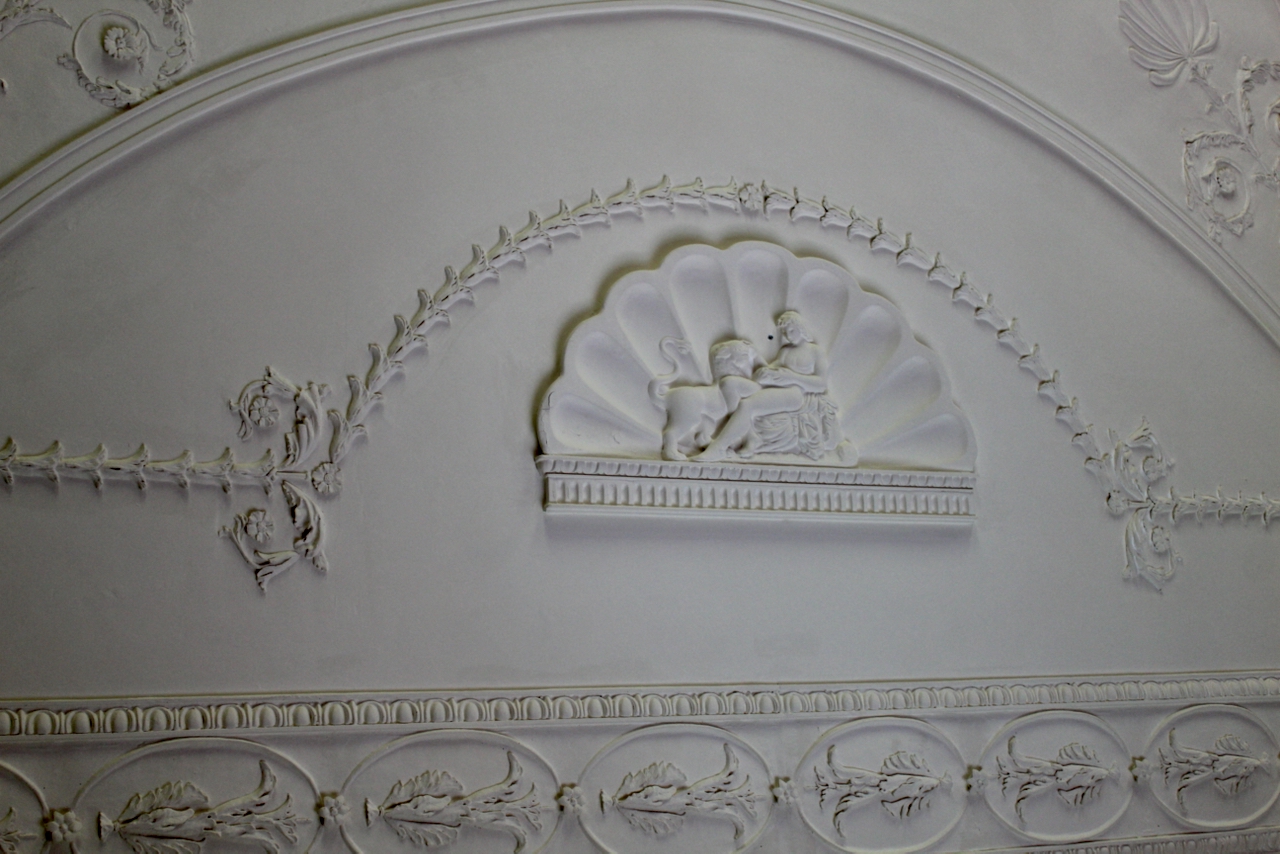
Rococo stucco work in Museum of Literature of Ireland (MOLI), 86 Stephen’s Green, Dublin. Photograph © Jennifer Winder-Baggot, www.irishhistorichouses.com
86 St Stephen’s Green. Photograph © Jennifer Winder-Baggot, www.irishhistorichouses.com

Richard Chapel Whaley was the father of Thomas “Buck” Whaley (1766-1800). Thomas’s father died when he was only three years old, and Thomas inherited much property and wealth. He gambled away nearly everything he owned and died almost penniless aged just 34. [4] Another house he inherited was Castletown in County Carlow – not to be confused with the more well-known Castletown in County Kildare (or Castletown “Cox” in County Kilkenny), and also Whaley Abbey in County Wicklow. Jimmy O’Toole tells us that his annual income was the equivalent of about £700,000 today. Poor Buck Whaley was a gambler, and he made a bet that he could travel to Israel and back within two years. He won the wager, and £15,000. I read his memoir and he comes across as a lovely man despite his foibles.

Thomas “Buck” Whaley (1766-1800), c. 1780.
Buck Whaley’s Memoirs, courtesy Fonsie Mealy auction.
The sitter’s maiden name was Maria Courtney but for some seven or eight years before her death in 1798 in Douglas, Isle of Man, she was known as Mrs. Whaley. She was the constant companion of a wealthy and dissolute young Irishman, Thomas, or Buck, Whaley, by whom she had four children: Thomas, Richard, Ann, and Sophia Isabella. They lived in a house Buck Whaley built on the Isle of Man, where this portrait may have hung in the dining room. Portrait is attributed to George Chinnery, c. 1795. Picture courtesy of The Met, New York.

Thomas “Buck” Whaley’s sister Anne married John Fitzgibbon, later 1st Earl of Clare, who became Lord Chancellor of Ireland. After his lover Maria Courtney died, he married Mary Catherine Lawless, sister of Valentine Lawless 2nd Baron Cloncurry.

Valentine Lawless, 2nd Baron Cloncurry, a portrait in 85 St. Stephen’s Green.

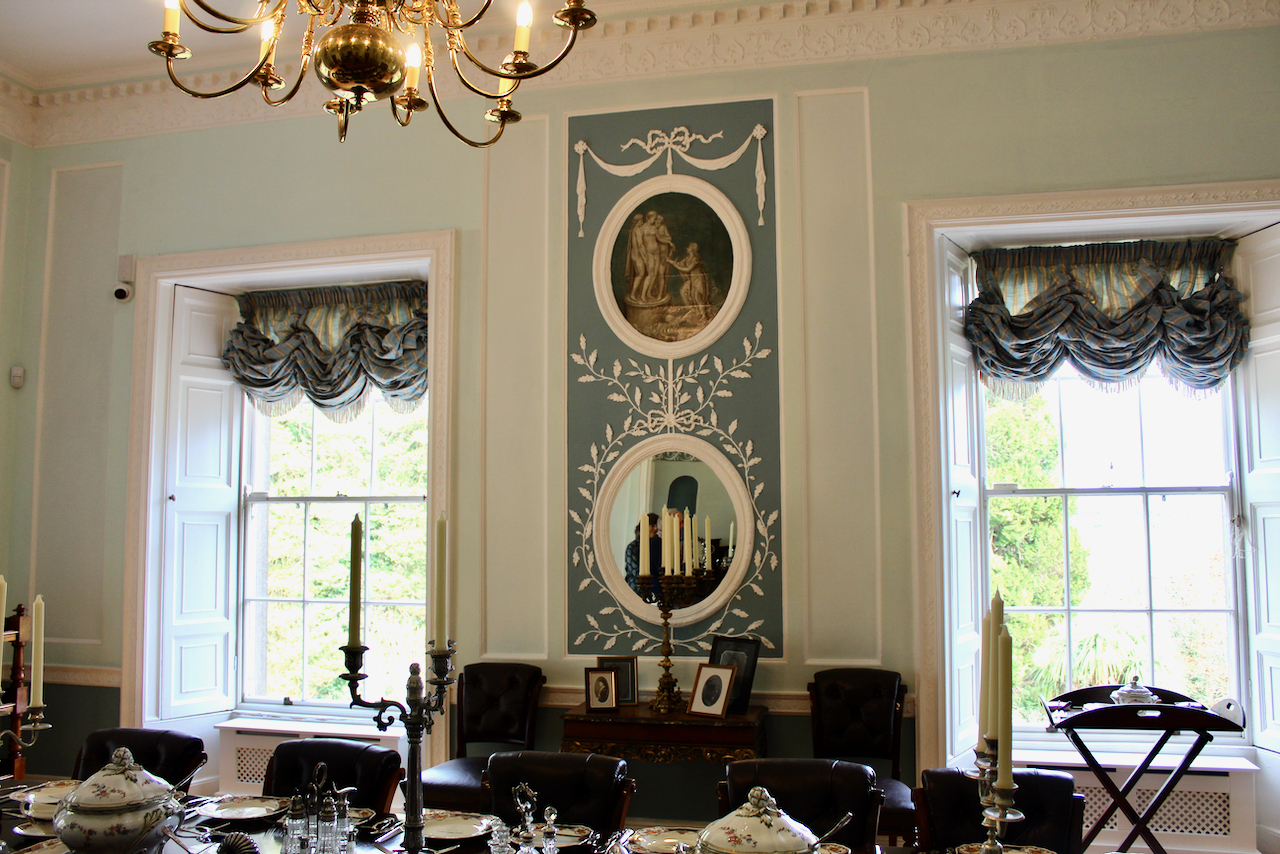
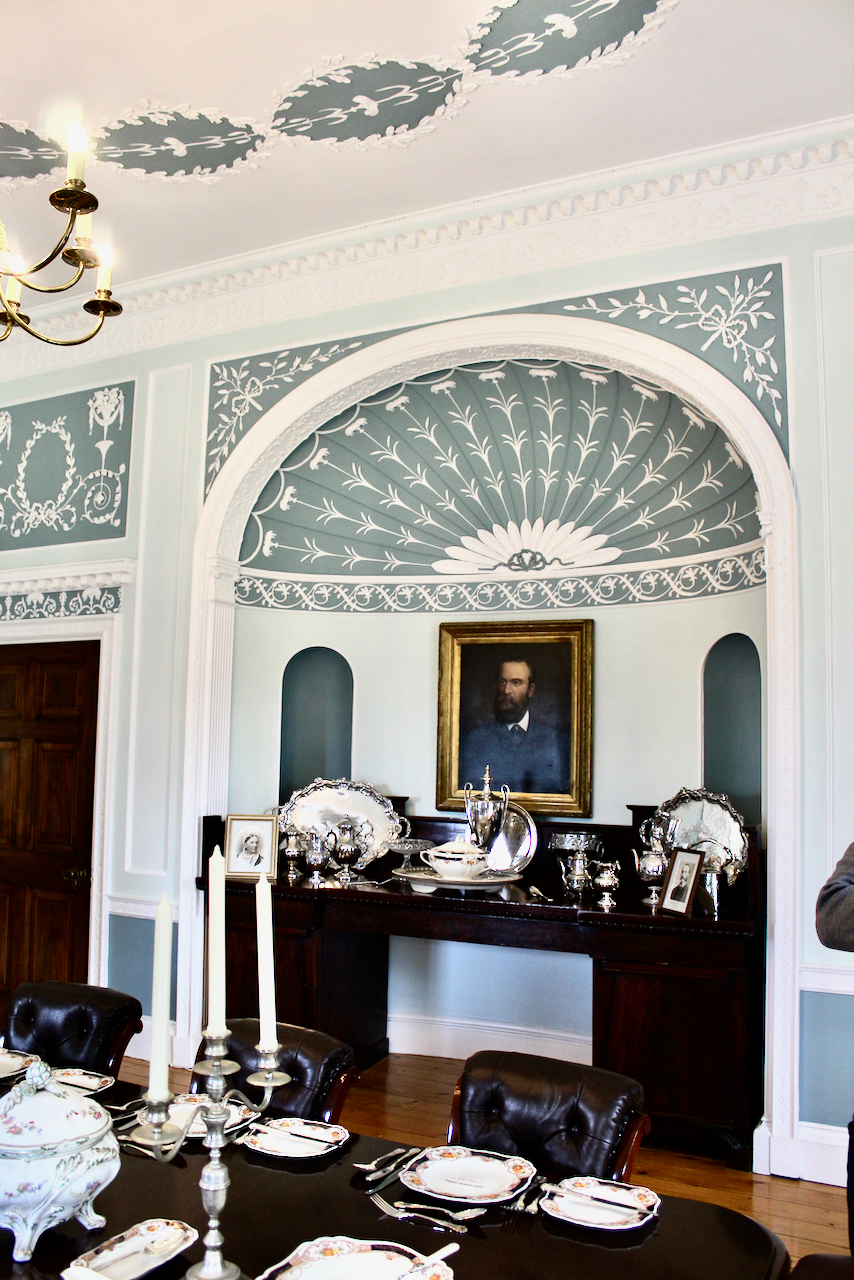
The front ground-floor drawing room is, Casey tells us, virtually identical to the now lost French Room at Charlemont House, the home of James Caulfeild, 1st Earl of Charlemont, a house built in 1763. The plaster and timber panels of the walls, Casey writes, appear to emulate the boiserie interiors of mid eighteenth century France.

86 St Stephen’s Green. Photograph © Jennifer Winder-Baggot, www.irishhistorichouses.com
Our friend Claire accompanied with us on our tour, who was visiting us from Greece. Photograph © Jennifer Winder-Baggot, www.irishhistorichouses.com
The tiny portrait head might be a representation of Richard Chapel Whaley, Christine Casey tells us. 86 St. Stephen’s Green. Photograph © Jennifer Winder-Baggot, www.irishhistorichouses.com
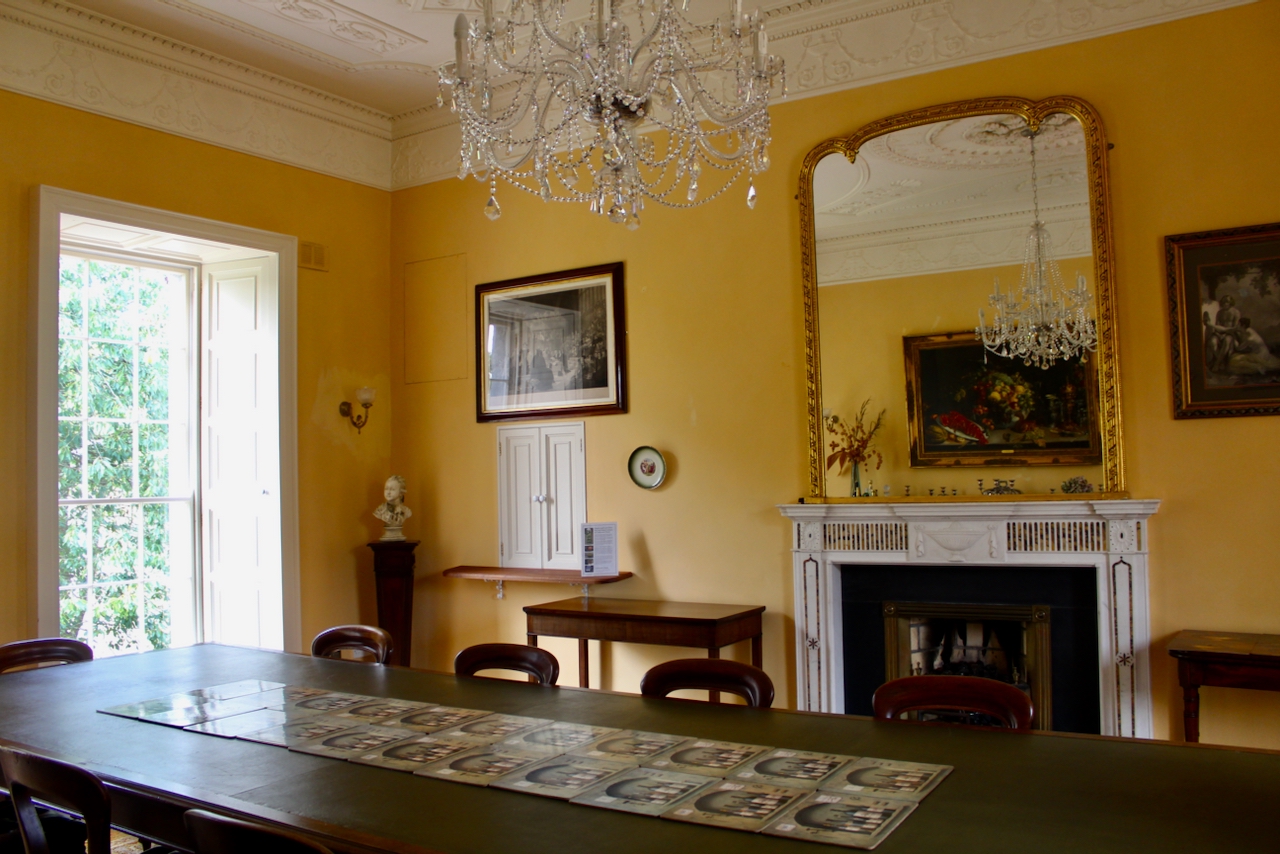
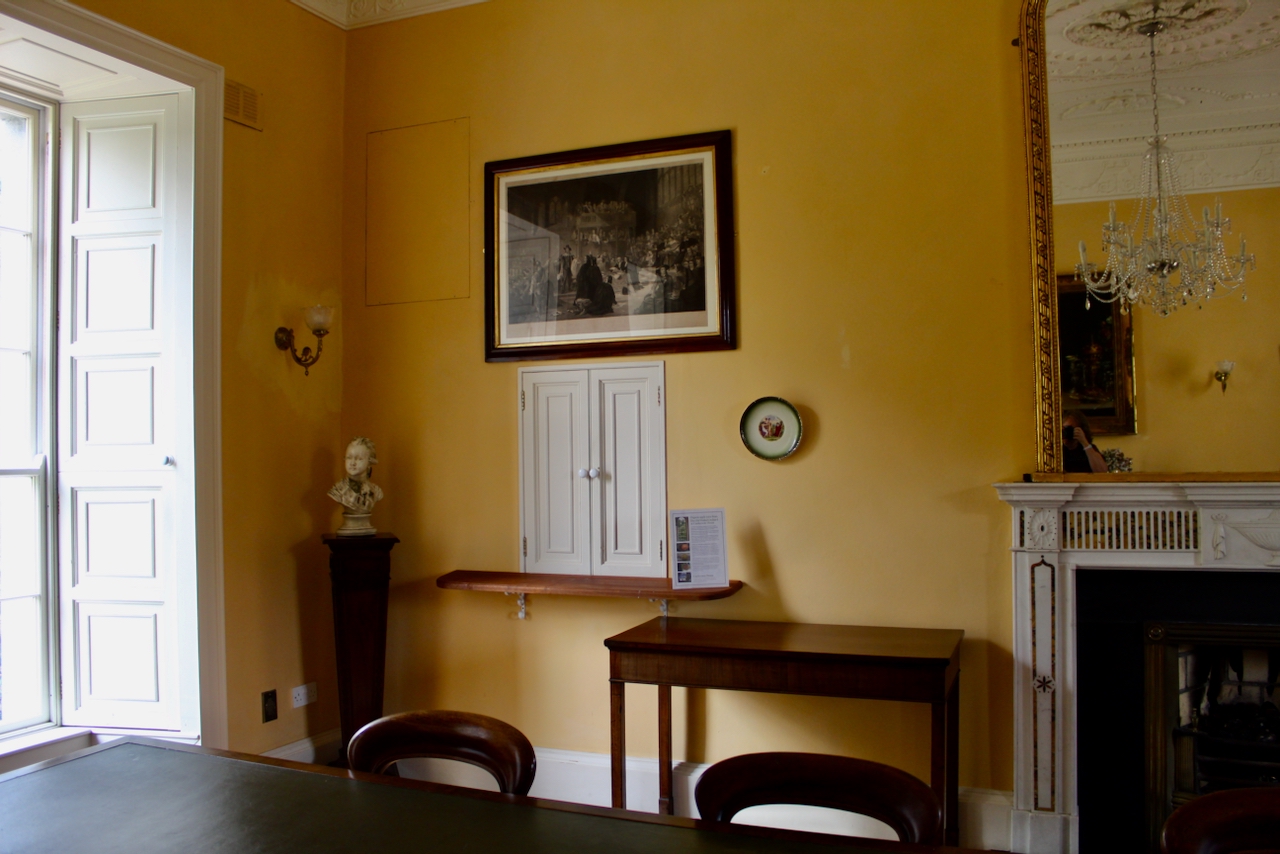
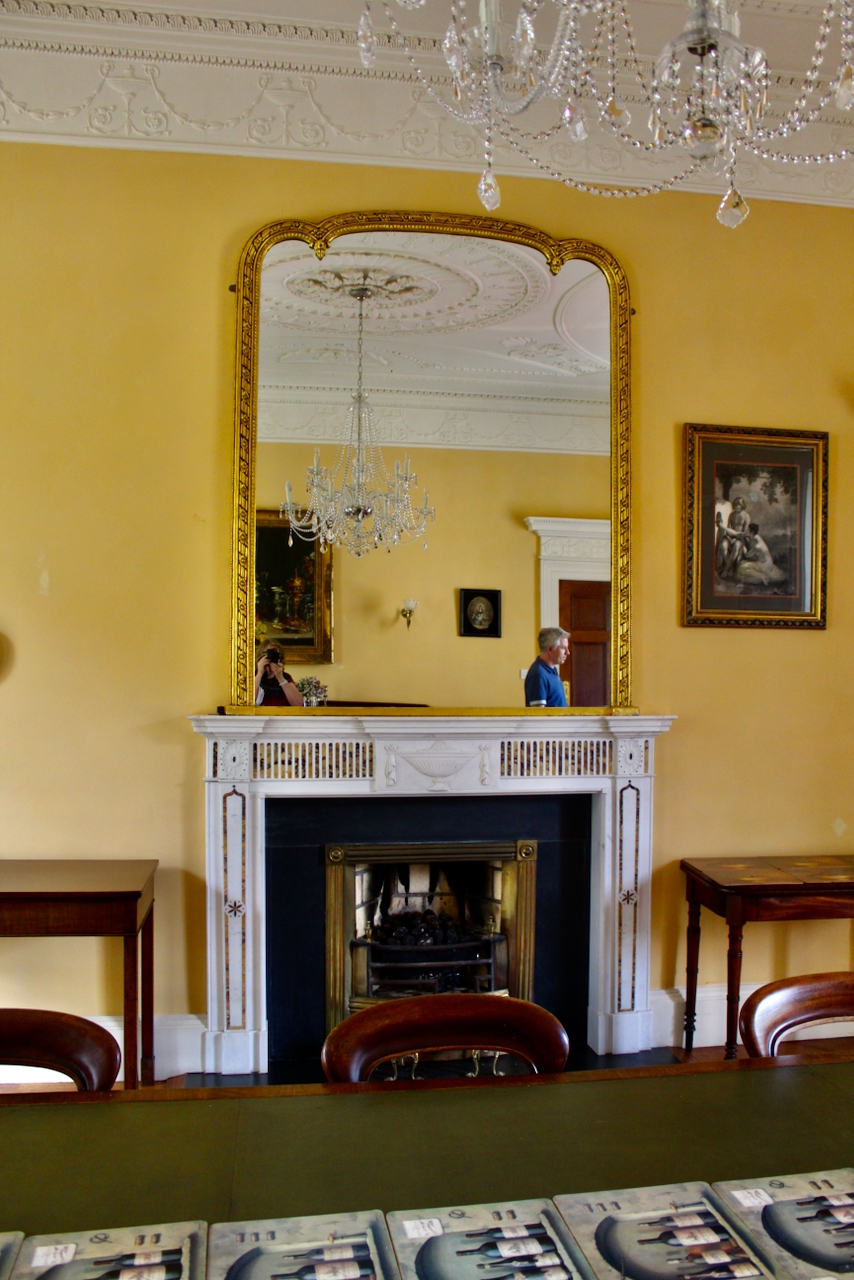
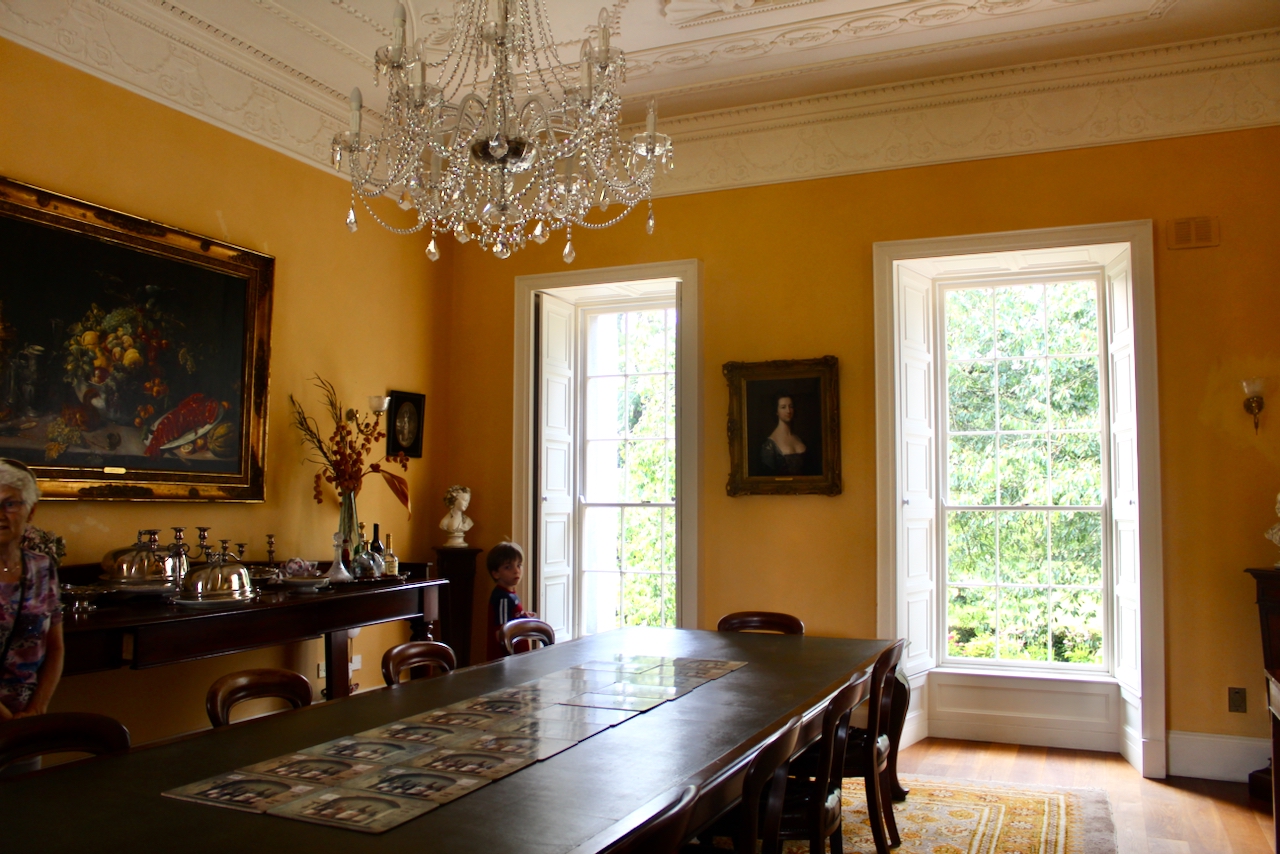
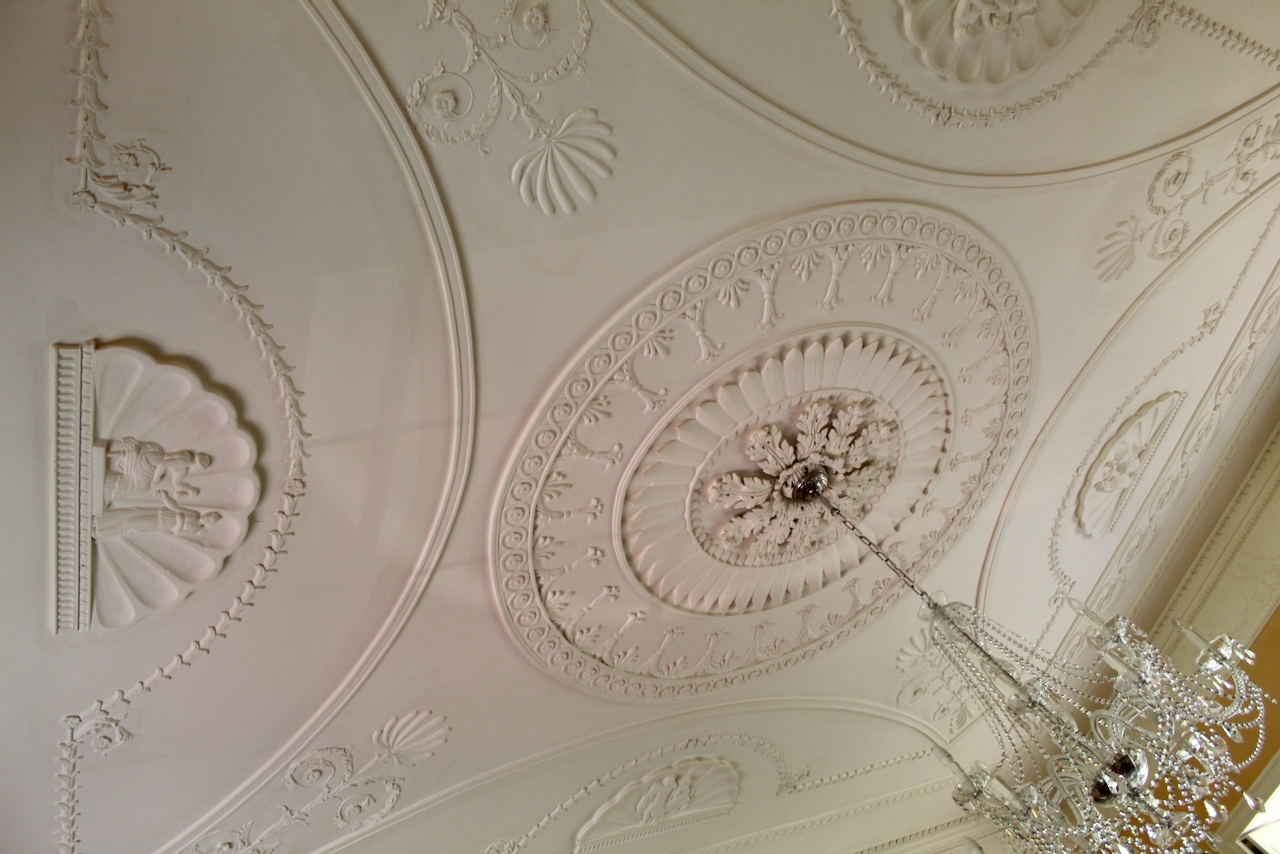
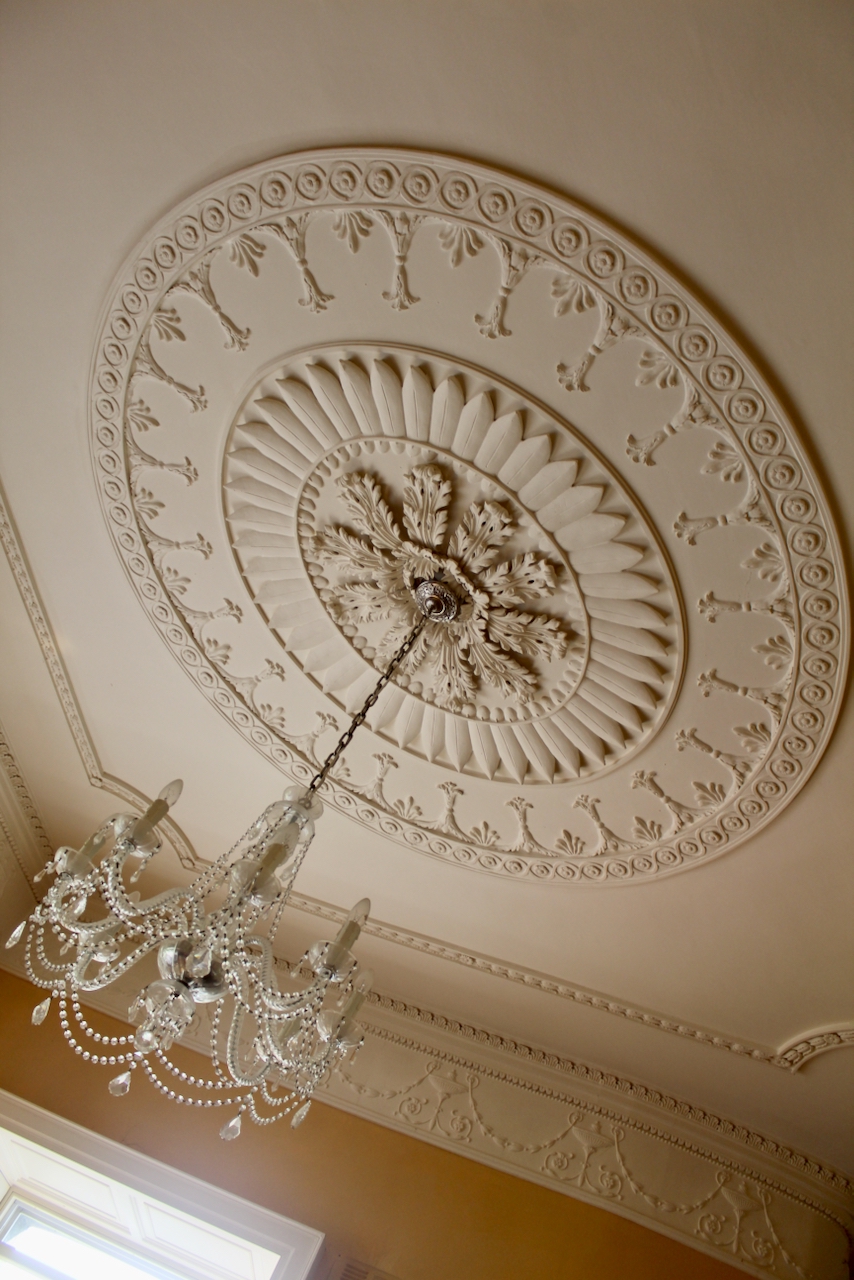
Ceiling of the yellow room, MOLI. Photograph © Jennifer Winder-Baggot, www.irishhistorichouses.com
86 St. Stephen’s Green. Photograph © Jennifer Winder-Baggot, www.irishhistorichouses.com
Photograph © Jennifer Winder-Baggot, www.irishhistorichouses.com

The Great Room, three bays wide and overlooking St. Stephen’s Green, is not normally part of the MOLI tour, but our guide let us pop our heads in to marvel at the plasterwork. It is let to the School of Music. It has an elaborate and stylized bird ceiling, similar to one by Filippo Lafranchini at 9 St. Stephen’s Green. [see 3].

The Great Room, 86 St. Stephen’s Green, Photograph © Jennifer Winder-Baggot, www.irishhistorichouses.com
The Great Room, 86 St. Stephen’s Green. Photograph © Jennifer Winder-Baggot, www.irishhistorichouses.com
We popped our heads quickly into the Great Room, or music room, not normally part of the tour as it is let out to the School of Music. Photograph © Jennifer Winder-Baggot, www.irishhistorichouses.com
Ceiling of the Great Room, 86 St. Stephen’s Green. Photograph © Jennifer Winder-Baggot, www.irishhistorichouses.com

The Bishop’s Room is to the rear of the house. It has a Rococo ceiling composed of interlocking C-scrolls and acanthus ornament. The front drawing room has a Rococo ceiling with a flock of birds encircling the central boxx, “rocaille-backed scrolls” in the corners, flower baskets and garlands of flowers.

86 St. Stephen’s Green. Photograph © Jennifer Winder-Baggot, www.irishhistorichouses.com
The front drawing room has a Rococo ceiling with a flock of birds encircling the central boxx, “rocaille-backed scrolls” in the corners, flower baskets and garlands of flowers, 86 St. Stephen’s Green. Photograph © Jennifer Winder-Baggot, www.irishhistorichouses.com
86 St. Stephen’s Green. Photograph © Jennifer Winder-Baggot, www.irishhistorichouses.com
Bossi fireplace, 86 St Stephen’s Green. Photograph © Jennifer Winder-Baggot, www.irishhistorichouses.com
86 St. Stephen’s Green. Photograph © Jennifer Winder-Baggot, www.irishhistorichouses.com

We then went outside on the tour to enter 85 St Stephen’s Green, next door. This is a smaller building, a Neo-Palladian urban palazzo designed by Richard Castle for Captain Hugh Montgomerie (d. 1741), built for entertaining! It has a rusticated granite street front, a Venetian window overhead formed by pedimented openings, and a balustraded parapet. The strict symmetry of the front hides an asymmetrical interior.

The two storey over basement on the left is 85 St. Stephen’s Green. 85 St. Stephen’s Green was built in 1738 by Richard Castle, architect of Powerscourt House and Russborough House, and is notable for its exquisite baroque plasterwork by the Lafranchini brothers. Photograph © Jennifer Winder-Baggot, www.irishhistorichouses.com

85 St. Stephen’s Green is of three bays and two storeys. Its lower floor is rusticated, and the first floor has a central Venetian window. Inside, it has a two bay entrance hall with a screen of two rounded arches opeing to the stair hall behind. On the right is a single bay front parlour, called the Apollo Room. The stair hall is flanked by a back parlour, and their is a service stair behind the stair hall, and a third room projecting out the back. [3] Christine Casey describes the spatial sequence as Baroque, and points out that it shows us the link Castle had to the Vanbrugh-Pearce circle of architects. The hall retains its eighteenth century flagsone, wainscoting and Kilkenny marble chimneypiece.

Entrance hall of 85 St Stephen’s Green. Photograph © Jennifer Winder-Baggot, www.irishhistorichouses.com
The Apollo Room, Newman House 1953, Dublin City Library and Archives. [5]

I don’t think we entered the Apollo room. Christine Casey tells us that it is rich in stucco ornament, which is accepted to be by Paolo and Filippo Lafranchini. Around the walls are high-relief almost Neoclassical figures of the Nine Muses set in moulded rectangular frames. I mistook the picture in Dublin City Library and Archives (below) to be of Riverstown House in County Cork, which is very similar.

Newman House 1953, Dublin City Library and Archives. [5]
Lafranchini plasterwork, Riverstown, County Cork. Photograph © Jennifer Winder-Baggot, www.irishhistorichouses.com

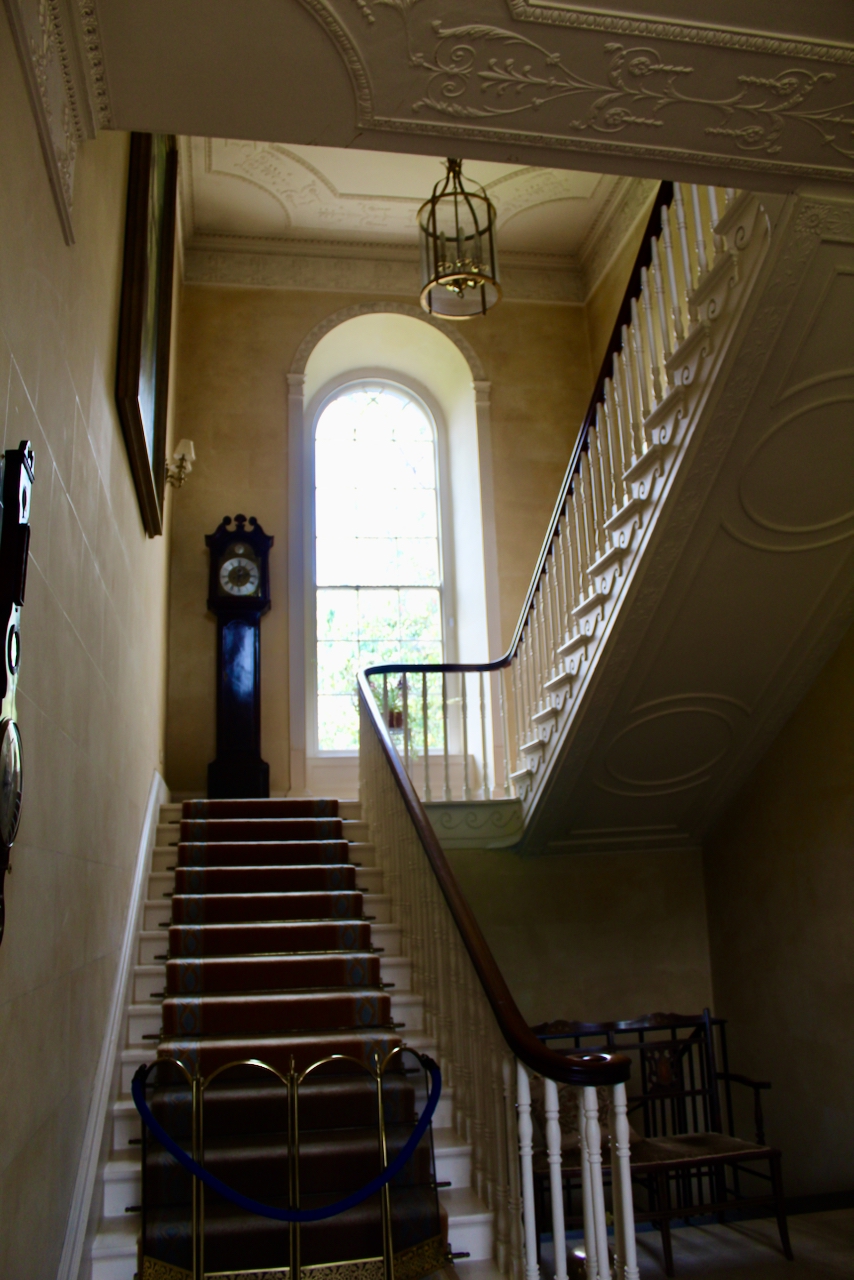
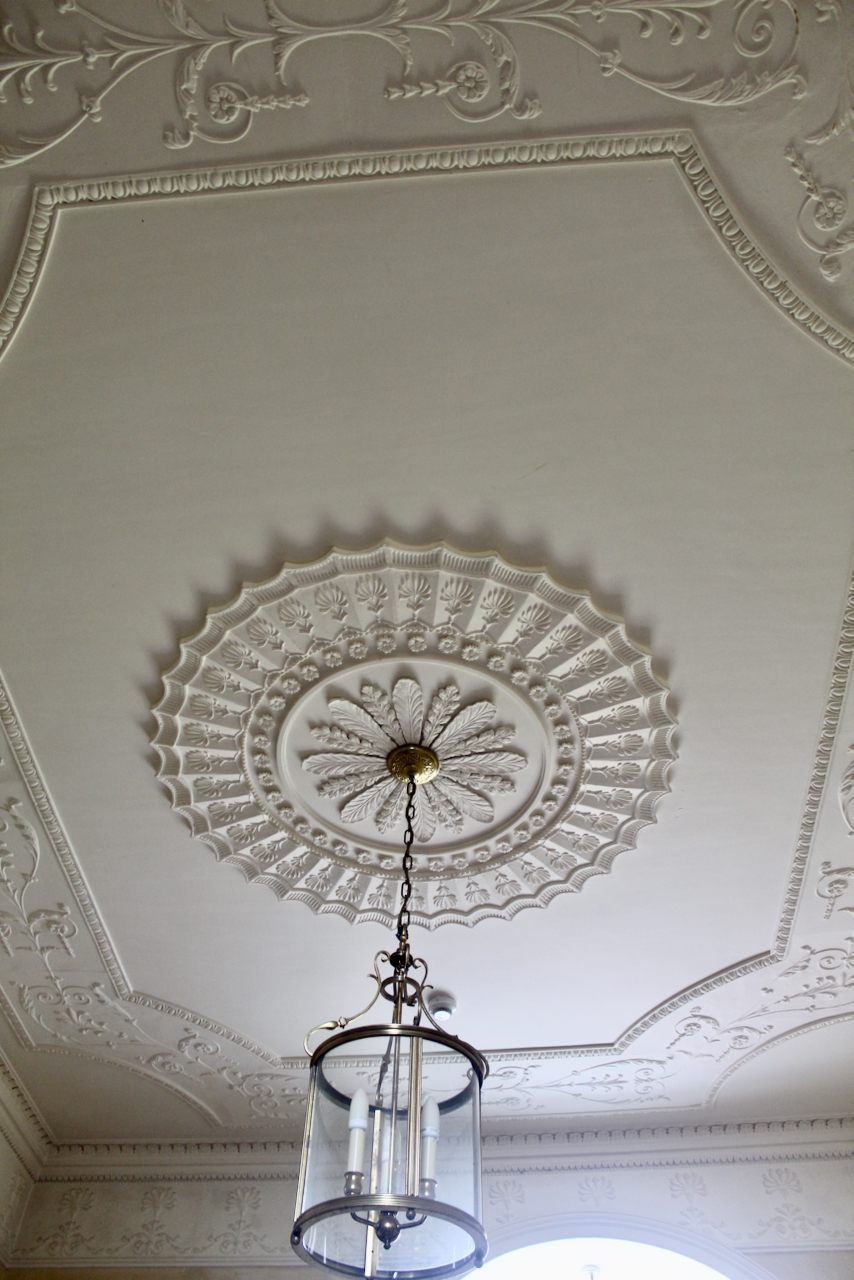
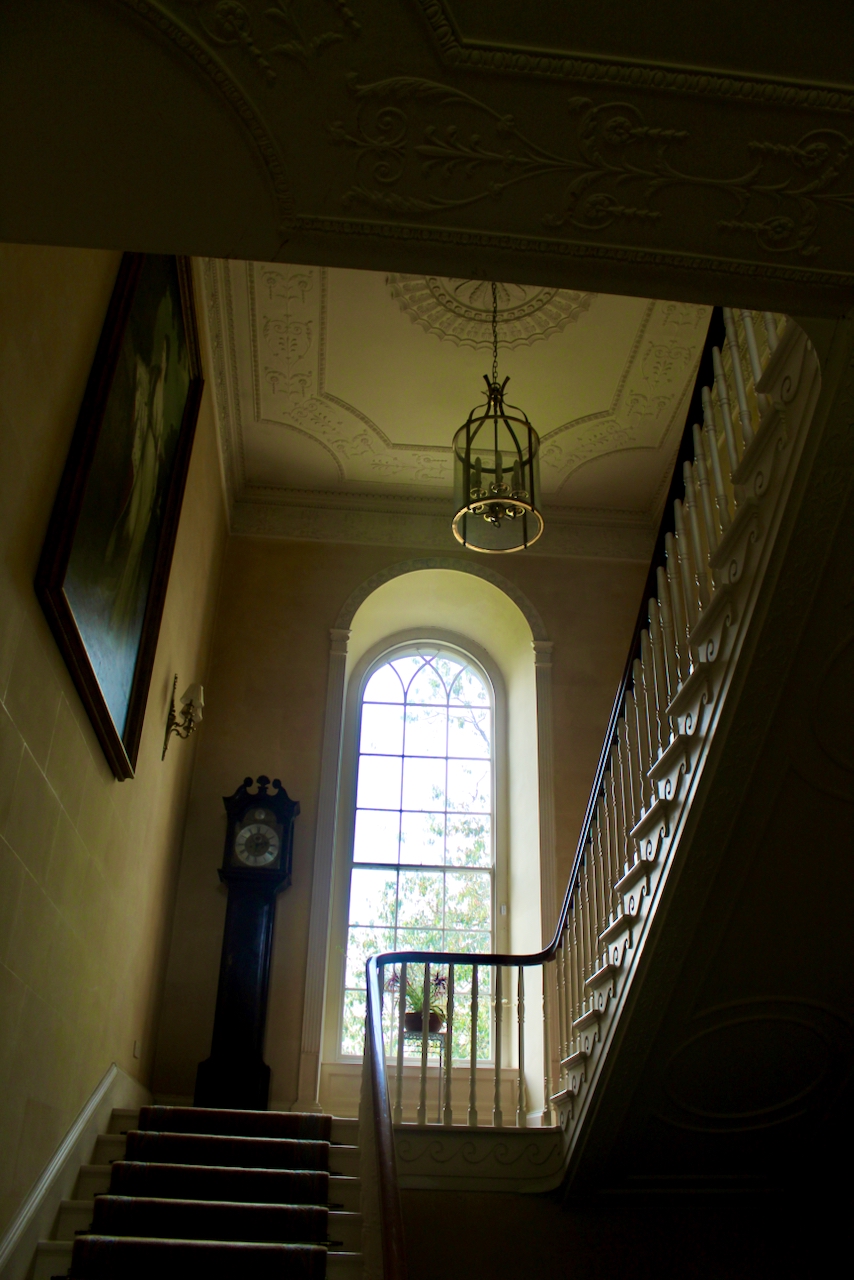
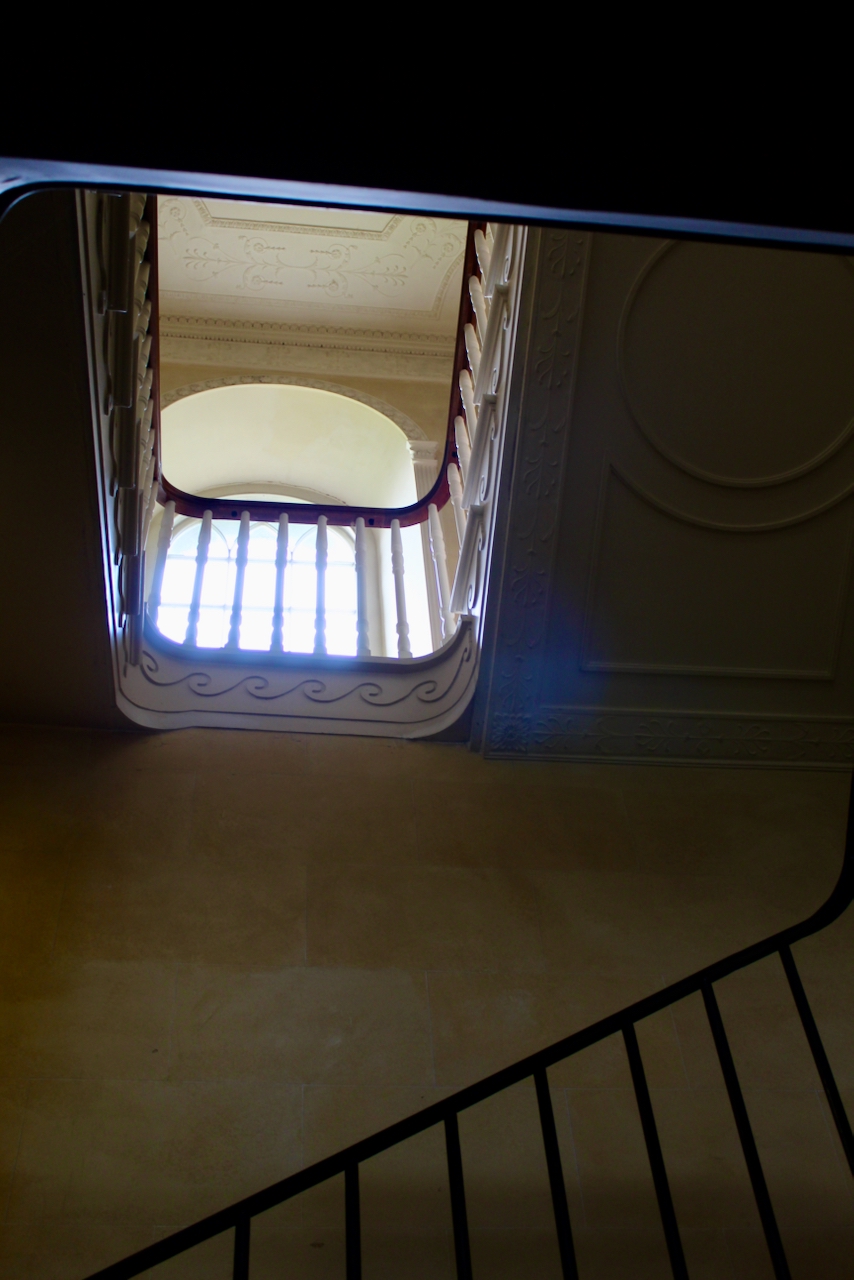
Christine Casey tells us that the stair is mahogany with finely crafted Tuscan balusters and carved tread ends. The upper stair hall, she tells us, was much altered in the nineteenth century and a reconstruction of its ceiling and plasterwork was recently installed, based on an outline of the original scheme found behind the nineteenth century plaster.

Staircase of 85 St Stephen’s Green. Photograph © Jennifer Winder-Baggot, www.irishhistorichouses.com
Floating mahogany staircase in 85 St Stephen’s Green. Photograph © Jennifer Winder-Baggot, www.irishhistorichouses.com
85 St. Stephen’s Green. Photograph © Jennifer Winder-Baggot, www.irishhistorichouses.com
This is the crest of the La Touche family, who later owned into 85 St Stephen’s Green. George La Touche lived in 85 St. Stephen’s Green in the 1820s. [5] Photograph © Jennifer Winder-Baggot, www.irishhistorichouses.com
85 St. Stephen’s Green. Photograph © Jennifer Winder-Baggot, www.irishhistorichouses.com

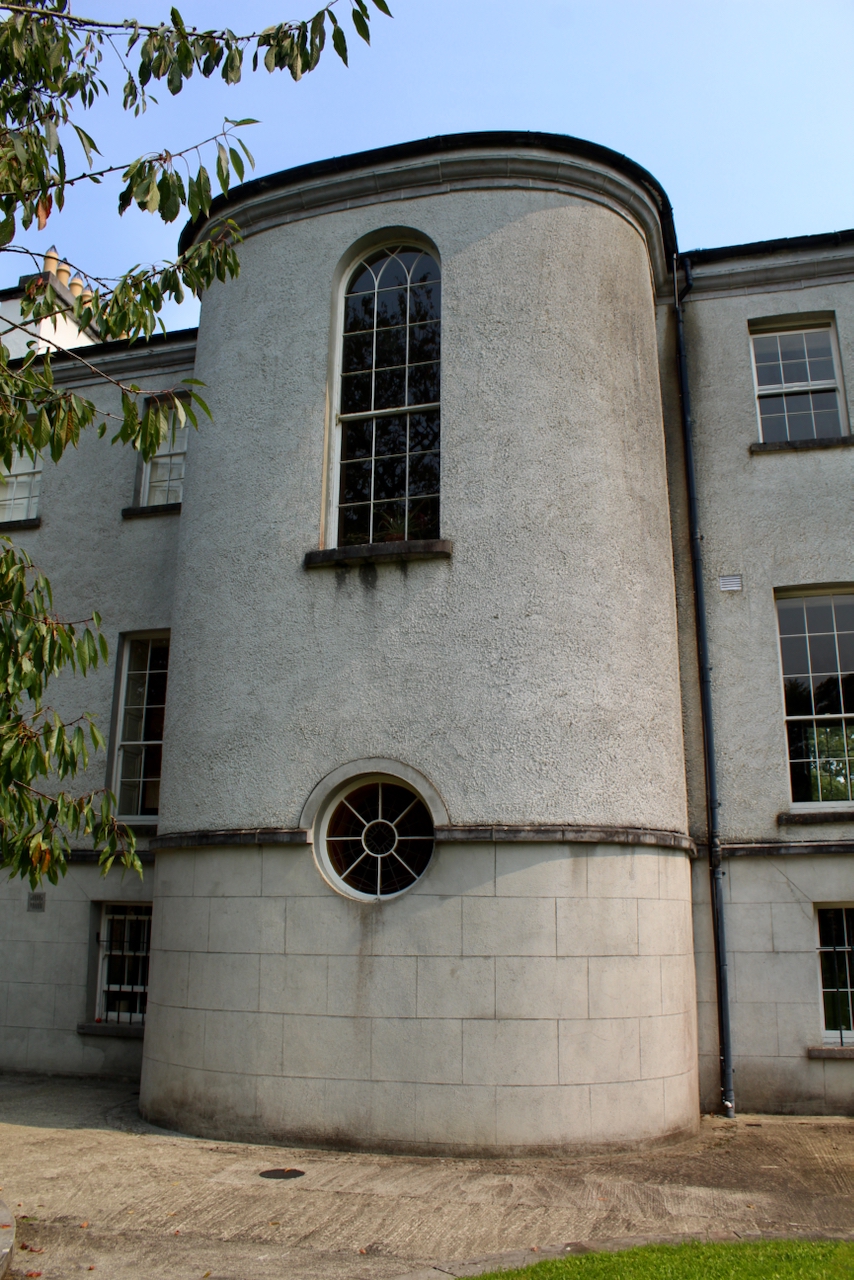
At the head of the stair is the ante-room to the saloon, which was much altered c. 1830 by Judge Nicholas Ball (the last private owner), who cut through the ceiling and created an elegant top-lit galleried library. A large extension with a canted bow was built across the back wall of the house in the early nineteenth century, creating a new reception room on each floor, blocking the light into the now windowless ground floor parlour and first floor ante-room.

The ante-room in 85 St. Stephen’s Green. Photograph © Jennifer Winder-Baggot, www.irishhistorichouses.com
85 St. Stephen’s Green, portrait of Valentine Lawless, 2nd Baron Cloncurry, Photograph © Jennifer Winder-Baggot, www.irishhistorichouses.com
The toplit galleried library ante-room in 85 St. Stephen’s Green. Photograph © Jennifer Winder-Baggot, www.irishhistorichouses.com

The Great Room or Saloon is the full width of the house and overlooks St. Stephen’s Green. The stucco work is by the Lafranchini brothers Paolo and Filippo. The room is entered by a pair of Corinthian doorcases. It is lit by a central Venetian window flanked by two sash windows, all with Corinthian frames.

Newman House 1953, Dublin City Library and Archives. A layer of plasterwork has been added below the dentil cornice in this photograph, as we can see in my photographs. [2]

The frieze below the dentil cornice was deed relatively recently and was copied from the saloon frieze at Tyrone House. [see 3]

The cove, Christine Casey tells us, is ornamented with six lobed ovals containing figure groups, two on each of the long walls and one at each end. These are linked by a frieze of putti who grasp and swing from the oak garlands!

The Saloon in 85 St Stephen’s Green occupies the full width of the front. It has a high relief coved ceiling, a masterpiece by the Swiss Lafranchini brothers Paolo (1695-1776) and Filippo (1702-79). Photograph © Jennifer Winder-Baggot, www.irishhistorichouses.com
The Venetian window of 85 St. Stephen’s Green. Photograph © Jennifer Winder-Baggot, www.irishhistorichouses.com
85 St. Stephen’s Green. Photograph © Jennifer Winder-Baggot, www.irishhistorichouses.com
Richard Castle’s grand late Baroque chimneypiece, reconstructed by Dick Reid of York on the basis of an early twentieth century survey and a surviving fragment, 85 St. Stephen’s Green. [see 3] Photograph © Jennifer Winder-Baggot, www.irishhistorichouses.com
85 St. Stephen’s Green. Photograph © Jennifer Winder-Baggot, www.irishhistorichouses.com

The figures of Prudence and Justice at each end of the room derive from paintings by Simon Vouet in the Salon de Mars at Versailles, Christine Casey tells us.

85 St. Stephen’s Green. Photograph © Jennifer Winder-Baggot, www.irishhistorichouses.com
At some point, the Jesuits took over 85 St Stephen’s Green. They did not like all of the naked women in the plasterwork so they gave the women “bodices.” Most were later removed when the plasterwork was restored but one bodice was left on, as you can see above, to show how they were done! Photograph © Jennifer Winder-Baggot, www.irishhistorichouses.com
85 St. Stephen’s Green. Photograph © Jennifer Winder-Baggot, www.irishhistorichouses.com
Putti swinging on garlands of oak leaves, 85 St. Stephen’s Green. Photograph © Jennifer Winder-Baggot, www.irishhistorichouses.com
85 St. Stephen’s Green. Photograph © Jennifer Winder-Baggot, www.irishhistorichouses.com

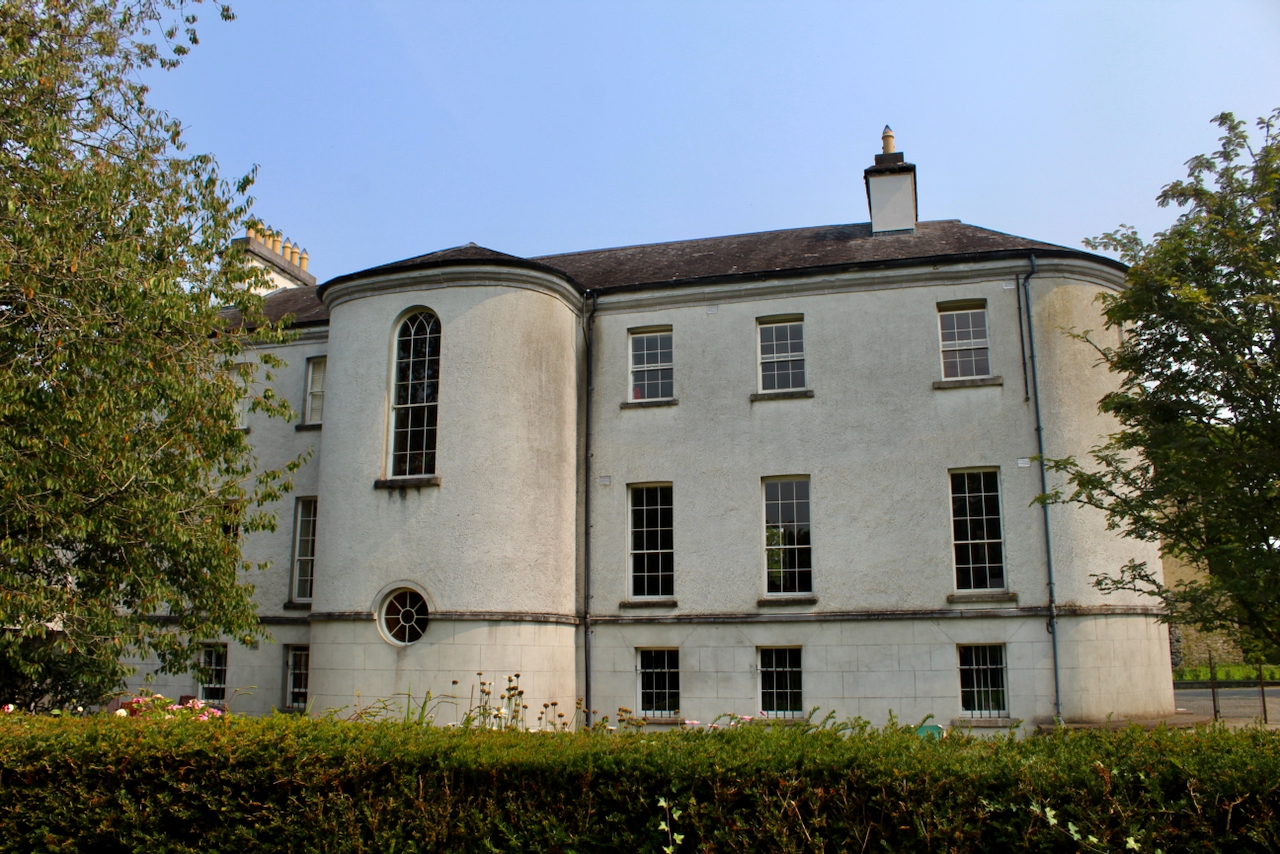
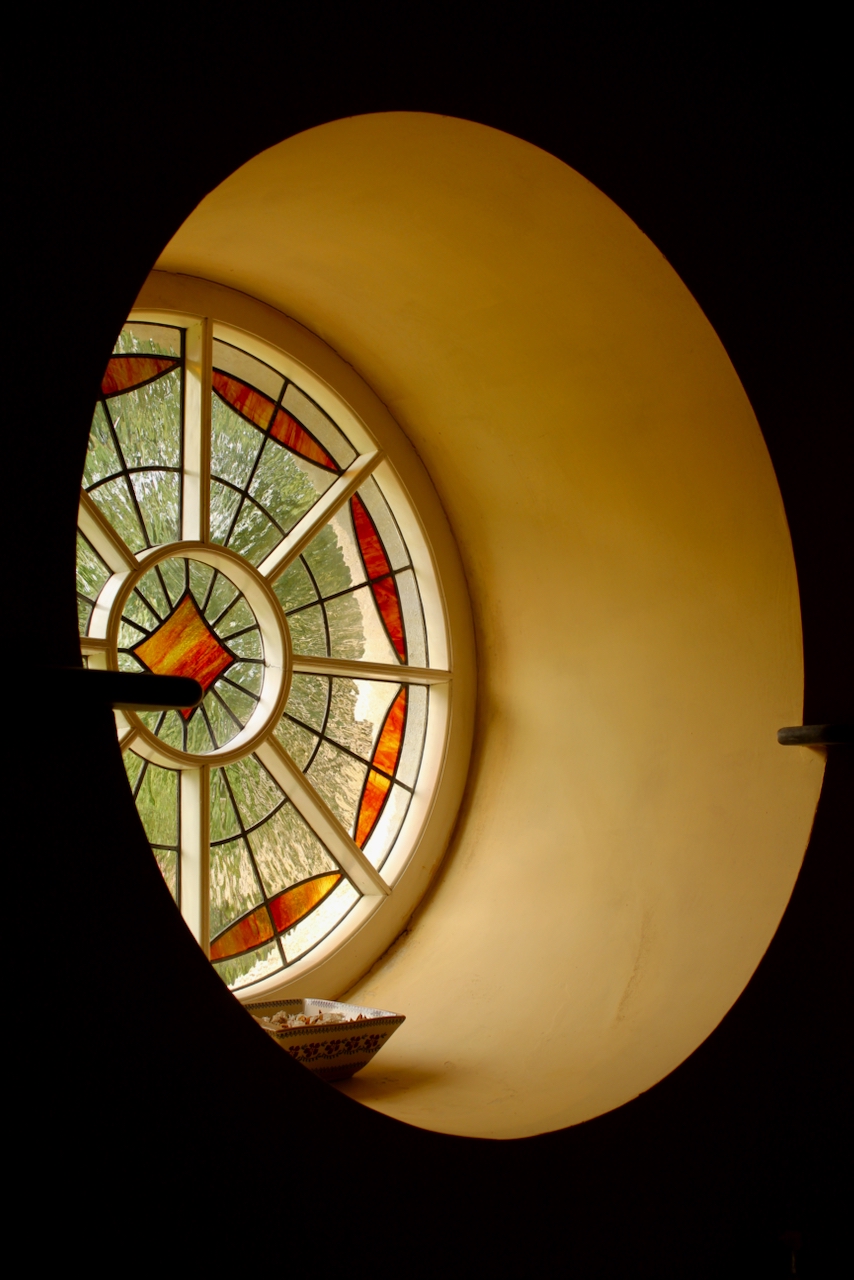
The canted bow room at the back of 85 St. Stephen’s Green looks on to the Iveagh Gardens.

The back part of 85 St Stephen’s Green is a later addition, including this room. Photograph © Jennifer Winder-Baggot, www.irishhistorichouses.com
85 St. Stephen’s Green. Photograph © Jennifer Winder-Baggot, www.irishhistorichouses.com
The view of the garden from this room, and beyond, to the Iveagh Gardens. Photograph © Jennifer Winder-Baggot, www.irishhistorichouses.com

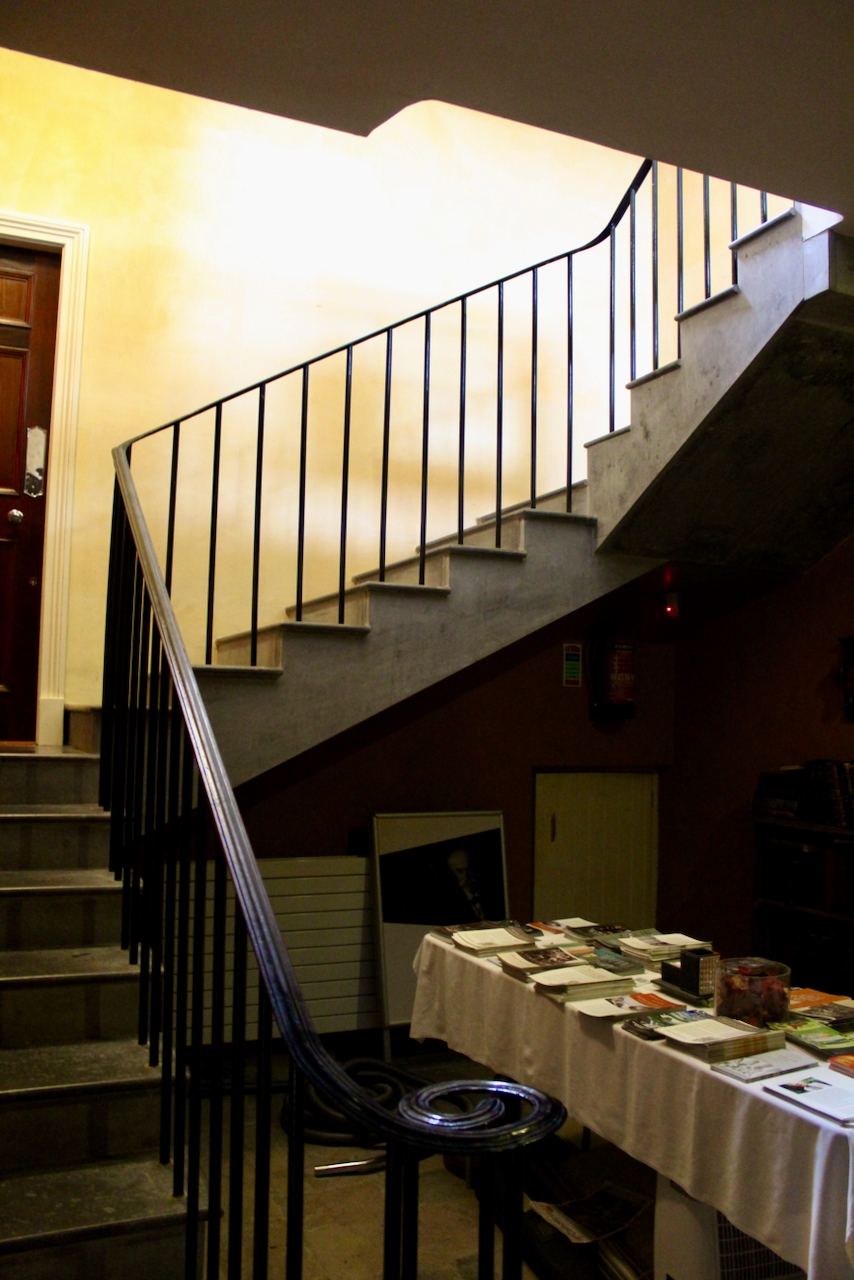
From this room we went through a narrow door cut in the wall and up a flight of stairs to the Bishop’s Room, which is back in 86 St Stephen’s Green.

The main part of the Museum of Literature is in back rooms of number 86.

86 St Stephen’s Green. Photograph © Jennifer Winder-Baggot, www.irishhistorichouses.com
86 St Stephen’s Green.
That’s James Joyce near the tree on the left, second from the tree at the back.
86 St Stephen’s Green. Photograph © Jennifer Winder-Baggot, www.irishhistorichouses.com

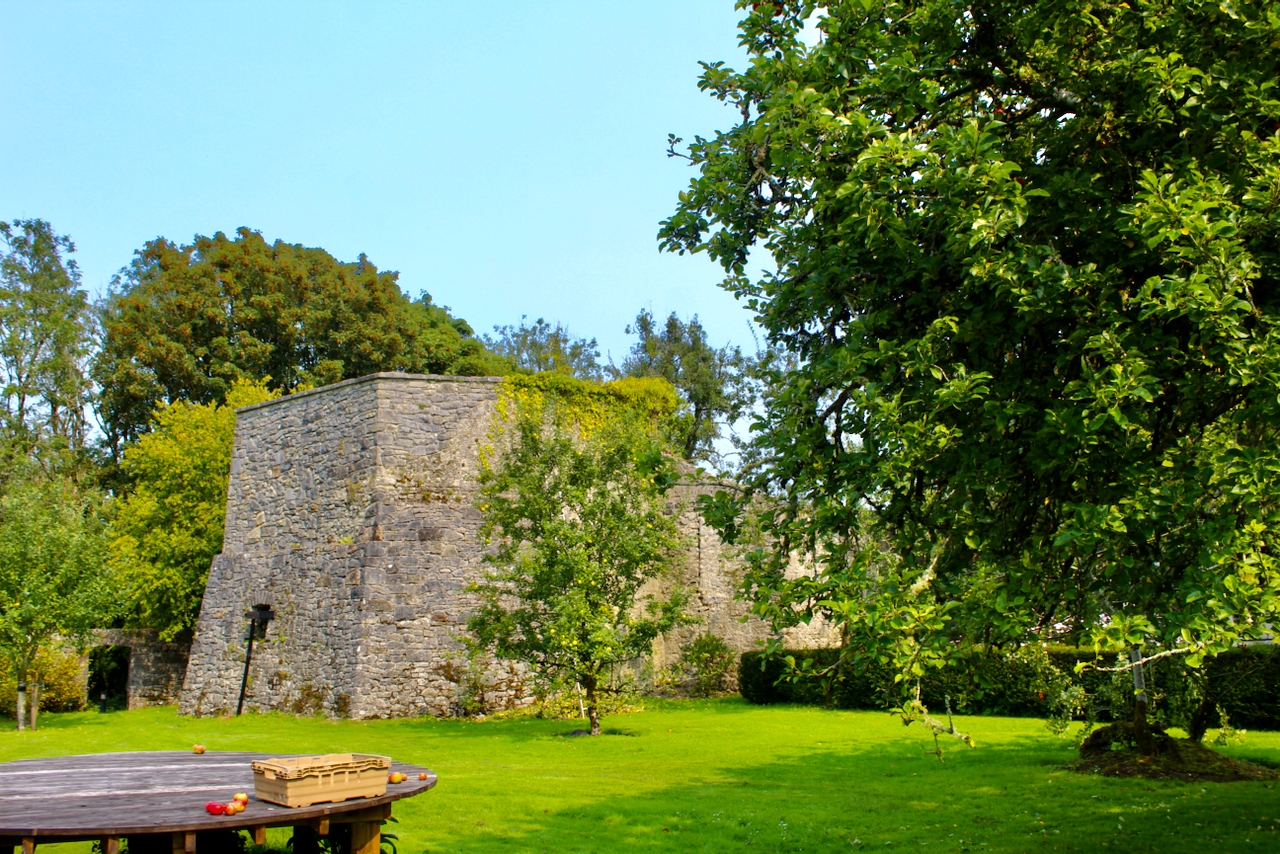
After our house tour we browsed the Museum, then went for a delicious sandwich in the cafe and sat in the gardens.

85/86 St. Stephen’s Green. Photograph © Jennifer Winder-Baggot, www.irishhistorichouses.com
The back of 86 St Stephen’s Green. Photograph © Jennifer Winder-Baggot, www.irishhistorichouses.com

[1] https://theirishaesthete.com/2014/11/17/the-most-beautiful-room-in-ireland/

[2] https://theirishaesthete.com/2015/02/25/virtuosic/

[3] Casey, Christine. The Buildings of Ireland: Dublin. The City Within the Grand and Royal Canals and the Circular Road with the Phoenix Park. Yale University Press, New Haven and London, 2005.

[4] p. 125, O’Toole, Jimmy, The Carlow Gentry: What will the neighbours say! Published by Jimmy O’Toole, Carlow, Ireland, 1993. Printed by Leinster Leader Ltd, Naas, Kildare. 

[5] Dublin City Library and Archives. https://repository.dri.ie

[6] https://www.greystonesahs.org/gahs3/index.php/talks-and-visits?view=article&id=214

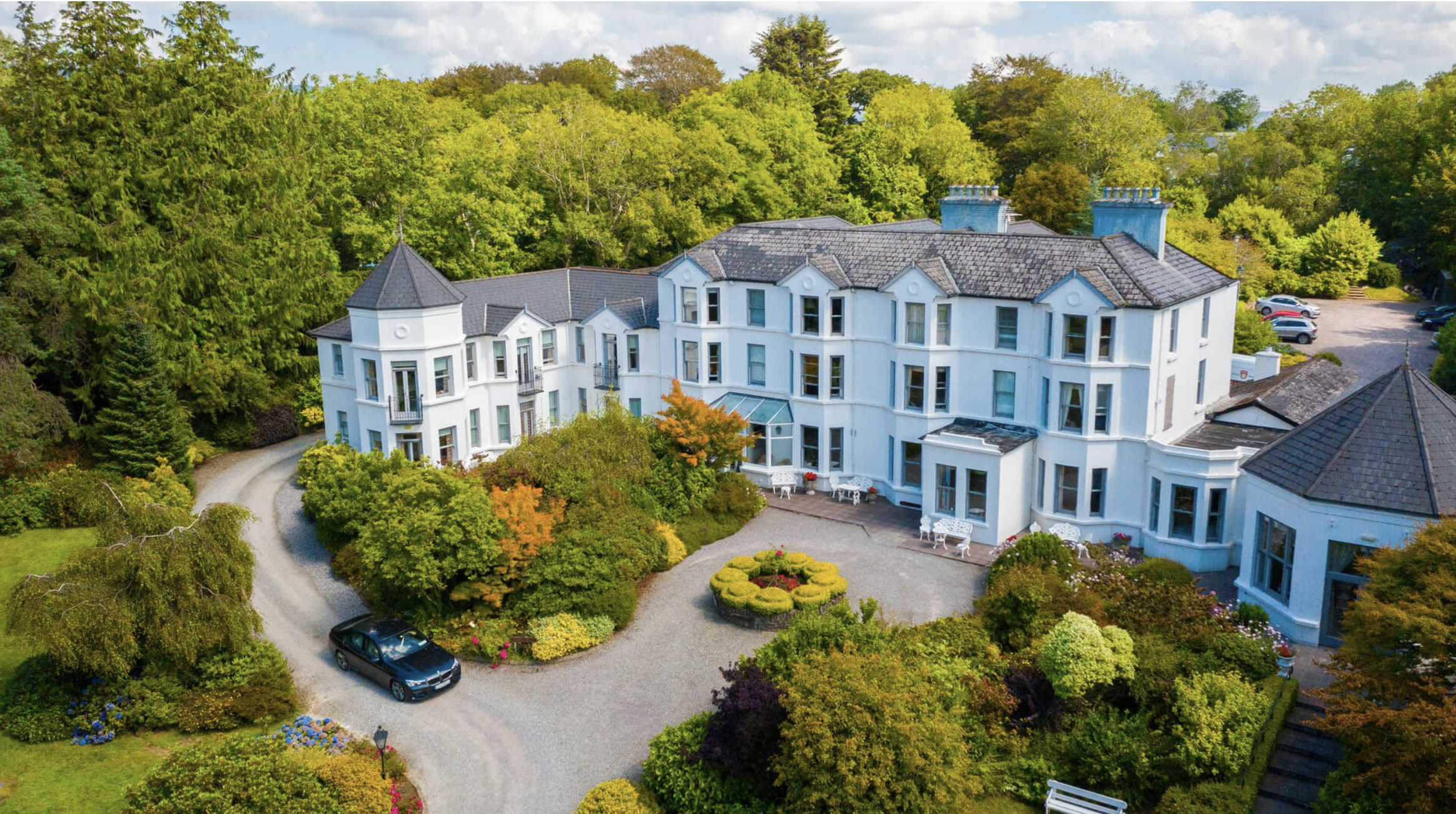
Kinnitty Castle (formerly Castle Bernard), Kinnity, County Offaly – now a hotel

donation

Help me to pay the entrance fee to one of the houses on this website. This site is created purely out of love for the subject and I receive no payment so any donation is appreciated!

€15.00

Kinnitty Castle (formerly Castle Bernard), Kinnity, County Offaly

https://www.kinnittycastlehotel.com/index.html

Kinnitty Castle Hotel, 2014, photographer unknown, for Tourism Ireland, Ireland’s Content Pool. [1]

We treated ourselves to a stay in Kinnitty Castle in February 2023. Formerly a home, it is now a hotel.

The website used to include a history, which told us that the present building was originally built by William O’Carroll on the site of an old Abbey in 1630. The building we see today, however, received a major reconstruction by architect brothers James (1779-1877) and George Richard Pain (1793-1838) in 1833. You can see traces of the Abbey in the courtyard.

A finely cut ogee-headed window set in the wall, Andrew Tierney tells us, attests to the fact that the site was occupied in medieval times. Pointed arched entrance to former stable yard and screen wall incorporate part of fifteenth-century church. Photograph © Jennifer Winder-Baggot, www.irishhistorichouses.com

There is a ninth or tenth-century high cross in front of the hotel, which must have been from the grounds of the Abbey.

The ninth or tenth century high cross.
Photograph © Jennifer Winder-Baggot, www.irishhistorichouses.com

In 1641 the castle was confiscated from William O’Carroll, as he must have played a part in the 1641 rebellion. The land was granted in 1663 by King Charles II to Colonel Thomas Winter for his military service.

The Stable yard is in use as a banqueting hall, called the Great Hall of the O’Carrolls, and kitchens.

There’s even an arrow loop in the ruins by the stable yard. Photograph © Jennifer Winder-Baggot, www.irishhistorichouses.com
The stableyard of Kinnitty Castle. Photograph © Jennifer Winder-Baggot, www.irishhistorichouses.com
Photograph © Jennifer Winder-Baggot, www.irishhistorichouses.com
The Banqueting Hall in the stable yard of Kinnitty Castle. Photograph © Jennifer Winder-Baggot, www.irishhistorichouses.com
The Banqueting Hall of Kinnitty Castle has a mezzanine, or Minstrels Gallery. Photograph © Jennifer Winder-Baggot, www.irishhistorichouses.com
The Banqueting Hall of Kinnitty Castle. Photograph © Jennifer Winder-Baggot, www.irishhistorichouses.com
There’s an impressive looking fireplace in the banqueting hall. Photograph © Jennifer Winder-Baggot, www.irishhistorichouses.com
Photograph © Jennifer Winder-Baggot, www.irishhistorichouses.com

The website continues, telling us that the Winter family sold the building in 1764 to the Bernards of County Carlow.

Andrew Tierney tells us in his The Buildings of Ireland Central Leinster that Franks Bernard (named after the surname “Franks”), a son of Charles Bernard of Bernard’s Grove, County Laois (now called Blandsfort), leased a small estate here in the early eighteenth century. Either he or his nephew Thomas (d. 1788) probably built the modest T-plan house that forms the core of the castle.

There is another Castle Bernard in County Cork – this seems to have belonged to a different Bernard family.

The castle website tells us that it was Catherine Hely Hutchinson (d. 1844, daughter of Francis Hely Hutchinson, MP for Naas, County Kildare), wife of Colonel Thomas Bernard (d. 1834), who hired the Pain brothers, James and George Pain, to renovate the building, in 1833 (according to Mark Bence-Jones).

Kinnitty Castle, County Offaly, 9th February 2023. The National Inventory tells us that the oriel window over the castellated entrance porch was added at a later date. Photograph © Jennifer Winder-Baggot, www.irishhistorichouses.com

James and George Pain were architects of the impressive Mitchellstown Castle, unfortunately no longer existing.

Mitchelstown Castle, County Cork, designed by the Pain brothers, courtesy of the National Library of Ireland, Lawrence PHotographic Collection, photographer Robert French ca. 1865-1914 ref. NLI L_ROY_01072.

We saw work by the Pain brothers on a visit to Revenue section 482 property Loughton in County Offaly – see my entry https://irishhistorichouses.com/2020/11/01/loughton-house-moneygall-county-offaly/ Loughton is not Tudor Gothic like Kinnitty.

Loughton, County Offaly. Photograph © Jennifer Winder-Baggot, www.irishhistorichouses.com

James and George were sons of James Pain, an English builder and surveyor. Their Grandfather William Pain was the author of a series of builder’s pattern books, so they had architecture in the blood. According to the Dictionary of Irish Architects, James and his younger brother George Richard were both pupils of John Nash, one of the foremost British architects of his day, responsible for the design of many important areas of London including Marble Arch, Regent Street and Buckingham Palace. He was architect to the prolific lover of architecture the Prince Regent, later King George IV. When Nash designed Lough Cutra Castle in County Galway for Charles Vereker in 1811, he recommended that the two brothers should be placed in charge of the work, so it was at this time that they came to Ireland. Lough Cutra is an amazing looking castle privately owned which is available for self-catering rental (very expensive, I am sure! But for those of you with oodles of money to spend, or for an event that requires nine bedrooms…). [2]

Lough Cutra castle, County Galway, also designed by the Pain brothers, photograph from Lough Cutra website.

James Pain settled in Limerick and George in Cork, but they worked together on a large number of buildings – churches (both Catholic and Protestant), country houses, court houses, gaols and bridges – almost all of them in the south and west of Ireland. [3] In 1823 James Pain was appointed architect to the Board of First Fruits for Munster, responsible for all the churches and glebe houses in the province.

The Pains Gothicized and castellated Dromoland Castle in County Clare at some time from 1819-1838, now a luxury hotel. [4]

Dromoland Castle, County Clare, which was renvoated by the Pain brothers, photo care of Dromoland Castle, for Tourism Ireland 2019, Ireland’s Content Pool.

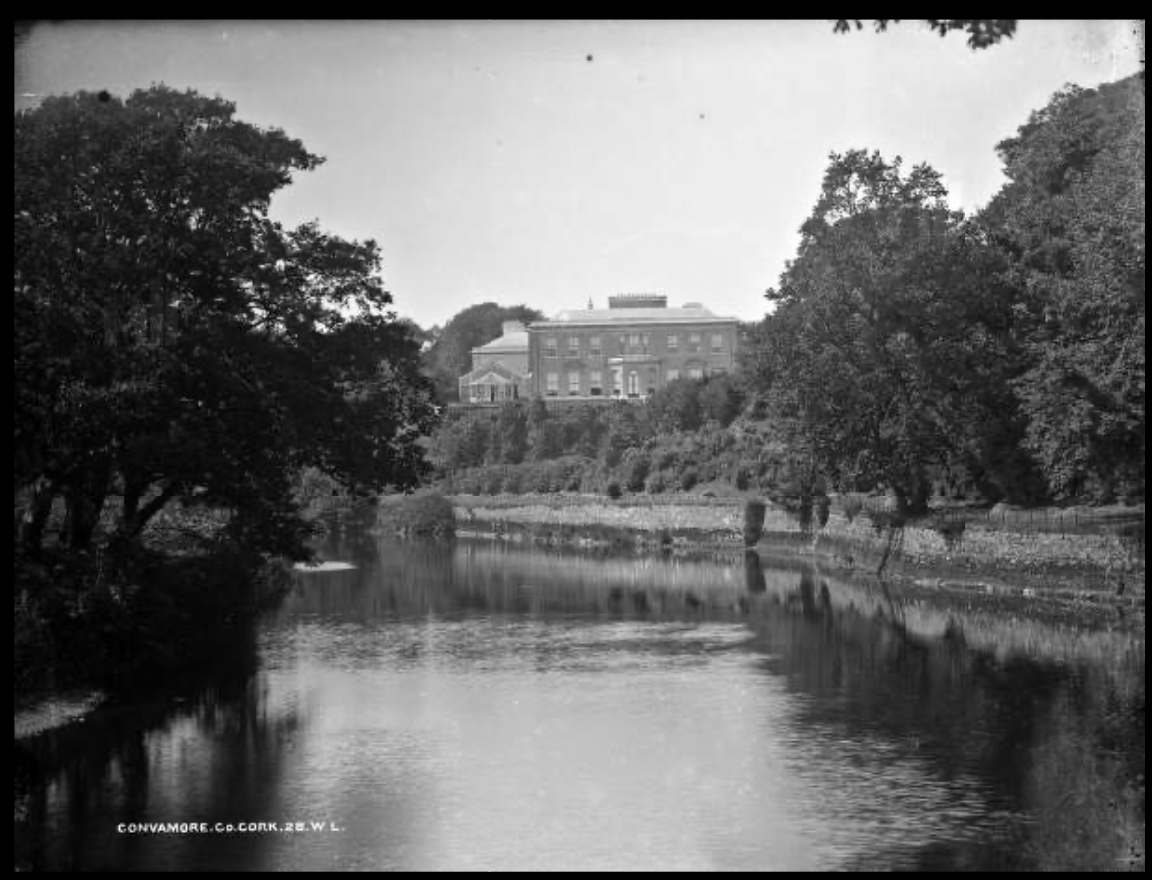
The Pains took their Gothicizing skills then to Mitchelstown Castle in 1823-25. In 1825 they also worked on Convamore (Ballyhooly) Castle but that is now a ruin. They also probably worked on Quinville in County Clare and also Curragh Chase in County Limerick (now derelict after a fire in 1941), Blackrock Castle in County Cork (now a science centre, museum and observatory which you can visit [7]), they did some work for Adare Manor in County Limerick (also now a luxury hotel), Clarina Park in Limerick (also, unfortunately, demolished, but you can get a taste of what it must have been like from its gate lodge), Fort William in County Waterford, and they probably designed the Gothicization and castellation of Ash Hill Towers in County Limerick (a section 482 property and with lovely tourist accommodation, see my entry https://irishhistorichouses.com/2023/04/06/ash-hill-kilmallock-co-limerick/), alterations and castellation of Knappogue Castle, County Clare (you can also visit and stay, or attend a medieval style banquet), Aughrane Castle mansion in County Galway (demolished – Bagots used to own it, I don’t know if we are related!), a castellated tower on Glenwilliam Castle, County Limerick and more.

Curragh Chase, County Limerick garden front 1938, also designed by the Pain brothers, like Loughton it is classical rather than Tudor Gothic, photograph from Vanishing Country Houses of Ireland by The Knight of Glin, David J. Griffin and Nicholas K. Robinson, published by The Irish Architectural Archive and The Irish Georgian Society, 1988.
Fortwilliam, Glencairn, Lismore, Co Waterford courtesy Michael H. Daniels and Co., also designed by the Pains in Tudor Gothic style.
Knappogue, or Knoppogue, Castle, County Clare, also designed by the Pains.
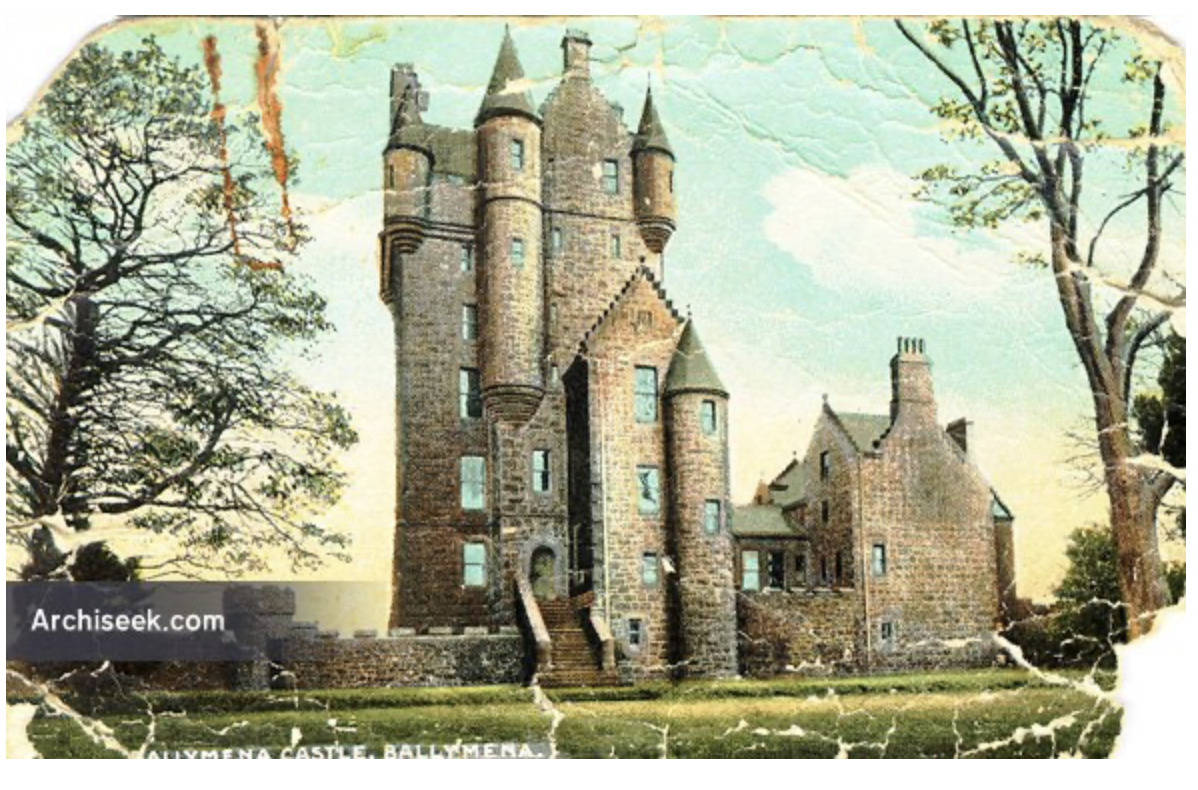
Kinnity Castle (Castle Bernard) County Offaly, photograph by Robert French, Lawrence c. 1865-1914 Photographic Collection National Library of Ireland ref L_Cab_09230.

In his 1988 book A Guide to Irish Country Houses, Mark Bence-Jones writes about Kinnitty Castle, formerly named Castle Bernard, that it is a Tudor-Revival castle of 1833, with impressive entrance front with gables, oriels and tracery windows and an octagonal corner tower with battlements and crockets; all in smooth ashlar. [5]

Kinnitty Castle Hotel, 2014, photographer unknown, for Tourism Ireland, Ireland’s Content Pool. (see [1])

The National Inventory describes it:

Ashlar limestone walls with castellated parapet, carved limestone plinth course and continuous string course to parapet. Battered walls to basement level. Square-headed window openings with tooled limestone and sandstone label mouldings, chamfered surrounds and punched limestone sills. Castellated box bay to second bay from north-east rising from basement level to first floor with chamfered stone mullions. Oriel window above entrance added at later date.”

Battered walls at basement are walls that slant outwards. This was a traditional building feature of castles, so that stones could be dropped from above and they would not fall straight down but hit the battered walls and bounce outwards to hit intruders.

The stone finials on top of the porch are particularly impressive. Photograph © Jennifer Winder-Baggot, www.irishhistorichouses.com

Mark Bence-Jones defines an oriel window as a large projecting window in Gothic, Tudor, Gothic-Revival and Tudor-Revival architecture; sometimes rising through two or more storeys, sometimes in an upper storey only and carried on corbelling. This particular window is not carried on corbels.

Kinnitty Castle, February 2023. Photograph © Jennifer Winder-Baggot, www.irishhistorichouses.com

The National Inventory continues: “Single-storey castellated entrance porch with diagonal buttresses surmounted by pinnacles with crockets and finials. Tudor arched opening to porch with label moulding accessed rendered porch with ribbed ceiling, niches to side walls and tooled limestone bell surround and post box flanking door. Square-headed door opening with chamfered limestone surround and label moulding, sandstone threshold and timber double doors.

The Tudor arch opening to porch with “label moulding” over, and you can see the ribbed ceiling inside. Photograph © Jennifer Winder-Baggot, www.irishhistorichouses.com
I love the rather church-like configuration of the three narrow pointed headed windows at the top arranged to form an arch. Photograph © Jennifer Winder-Baggot, www.irishhistorichouses.com
Side of Kinnitty Castle, February 2023. Photograph © Jennifer Winder-Baggot, www.irishhistorichouses.com

Before he married Catherine, Thomas Bernard, MP for County Offaly, married Elizabeth, daughter of Henry Prittie, 1st Baron Dunalley of Kilboy, County Tipperary. She died in 1802 and he married for a second time in 1814. He began building work on his house in 1833 but died the following year.

Thomas and Catherine had several children. Their heir was Thomas Bernard (1816-1882). Other sons were Francis, Richard Wellesley, and John Henry Scrope, and daughter Margaret.

Thomas Bernard (1816-1882), son of Catherine née Hely Hutchinson and Thomas Bernard (d. 1834).

Nearby the Bernard family have an unusual pyramid-shaped mausoleum. Richard Wellesley Bernard (c. 1822-1877) completed his military training in Egypt. He was an architect and engineer and it is said that he built the pyramid between 1830-34 but he would have been only eight years old, so perhaps it was constructed by an earlier Bernard. It is an exact replica of the Egyptian pyramid of Cheop.

Richard Wellesley Bernard (1822-1877) in early 1860s, National Portrait Gallery of London ref. Ax196557.
The Kinnitty Bernard mausoleum. Photograph © Jennifer Winder-Baggot, www.irishhistorichouses.com

The website continues: “The building was burned in 1922 by Republican forces and rebuilt by means of a Government grant of £32,000 in 1927.

The Buildings of Ireland Central Leinster book by Andrew Tierney tells us that the castle was rebuilt by Joseph John Bruntz. He was born in Dublin. The Dictionary of Irish Architects tells us that he was a pupil in his father’s office for four years and remained as an assistant for a further three years. After starting to practise independently as an architect circa 1915, he moved in 1917 or 1918 to Edenderry, Co. Offaly, where he set up an office. From 1922 he held the position of architect and civil engineer to the Co. Offaly Board of Health.

The website continues: “The building became the property of Lord Decies in 1946. He in turn sold it and the estate to the Government of Ireland on 12th December 1951. The State used the castle as a Forestry Training centre from 1955 until it was purchased in 1994 and turned into a 37 bedroom luxurious hotel for all guests both locally and internationally to enjoy.

Arthur George Marcus Douglas De La Poer Beresford (1915-1992), 6th Lord Decies, bought the property in 1946. He sold it in 1951.

It is a wonderful and affordable hotel, full of character.

The front entrance to Kinnitty Castle. Photograph © Jennifer Winder-Baggot, www.irishhistorichouses.com
A suit of armour stands watch by the door. Photograph © Jennifer Winder-Baggot, www.irishhistorichouses.com
Entrance hall and reception of Kinnitty Castle. Photograph © Jennifer Winder-Baggot, www.irishhistorichouses.com
The impressive staircase of Kinnitty Castle. Photograph © Jennifer Winder-Baggot, www.irishhistorichouses.com
I love the angels on this overhead light. Photograph © Jennifer Winder-Baggot, www.irishhistorichouses.com
The stair hall is toplit. Photograph © Jennifer Winder-Baggot, www.irishhistorichouses.com
Kinnitty Castle, February 2023. Photograph © Jennifer Winder-Baggot, www.irishhistorichouses.com
There’s a lovely fireplace in the blue drawing room and a painting of the castle. Photograph © Jennifer Winder-Baggot, www.irishhistorichouses.com
The Blue drawing room. Photograph © Jennifer Winder-Baggot, www.irishhistorichouses.com
Kinnitty Castle Hotel, 2014, photographer unknown, for Tourism Ireland, Ireland’s Content Pool. (see [1])
This room is now a dining room, 2023. Photograph © Jennifer Winder-Baggot, www.irishhistorichouses.com
The dining room leads to the octagonal tower room. The room has a vaulted ceiling. Photograph © Jennifer Winder-Baggot, www.irishhistorichouses.com
The Library Bar in Kinnitty Castle. Photograph © Jennifer Winder-Baggot, www.irishhistorichouses.com
Kinnitty Castle Hotel, 2014, photographer unknown, for Tourism Ireland, Ireland’s Content Pool. (see [1])
A hallway upstairs at Kinnitty Castle. Photograph © Jennifer Winder-Baggot, www.irishhistorichouses.com
We gravitated toward the bookshelf at the top of the stairs. Photograph © Jennifer Winder-Baggot, www.irishhistorichouses.com
Another hallway in Kinnitty Castle. Photograph © Jennifer Winder-Baggot, www.irishhistorichouses.com
Our lovely bedroom at Kinnitty Castle. Photograph © Jennifer Winder-Baggot, www.irishhistorichouses.com
Photograph © Jennifer Winder-Baggot, www.irishhistorichouses.com

There’s a bar in the cellar of the hotel, called the Dungeon Bar.

The back stairs of the castle. Photograph © Jennifer Winder-Baggot, www.irishhistorichouses.com
The Dungeon Bar in the basement of the hotel. Photograph © Jennifer Winder-Baggot, www.irishhistorichouses.com
The Dungeon Bar at Kinnitty Castle. Photograph © Jennifer Winder-Baggot, www.irishhistorichouses.com
A snug in the Dungeon Bar. Photograph © Jennifer Winder-Baggot, www.irishhistorichouses.com
An old horse trough in the rather ecclesiastical bar looks for a moment like a coffin! Photograph © Jennifer Winder-Baggot, www.irishhistorichouses.com
The atmospheric Dungeon Bar at Kinnitty Castle. Photograph © Jennifer Winder-Baggot, www.irishhistorichouses.com
There are still meat hooks on the vaulted ceiling of the cellar. Photograph © Jennifer Winder-Baggot, www.irishhistorichouses.com
Kinnitty Castle. Photograph © Jennifer Winder-Baggot, www.irishhistorichouses.com

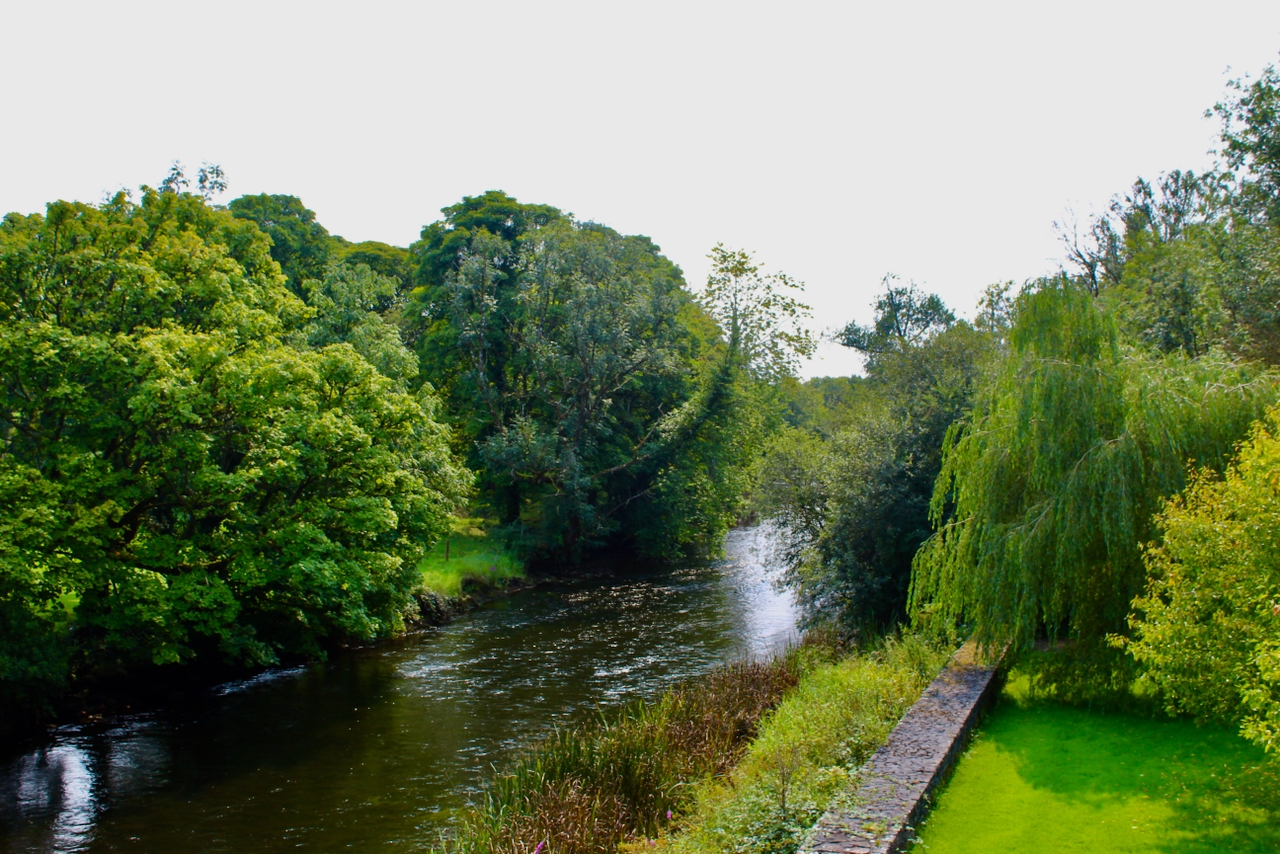
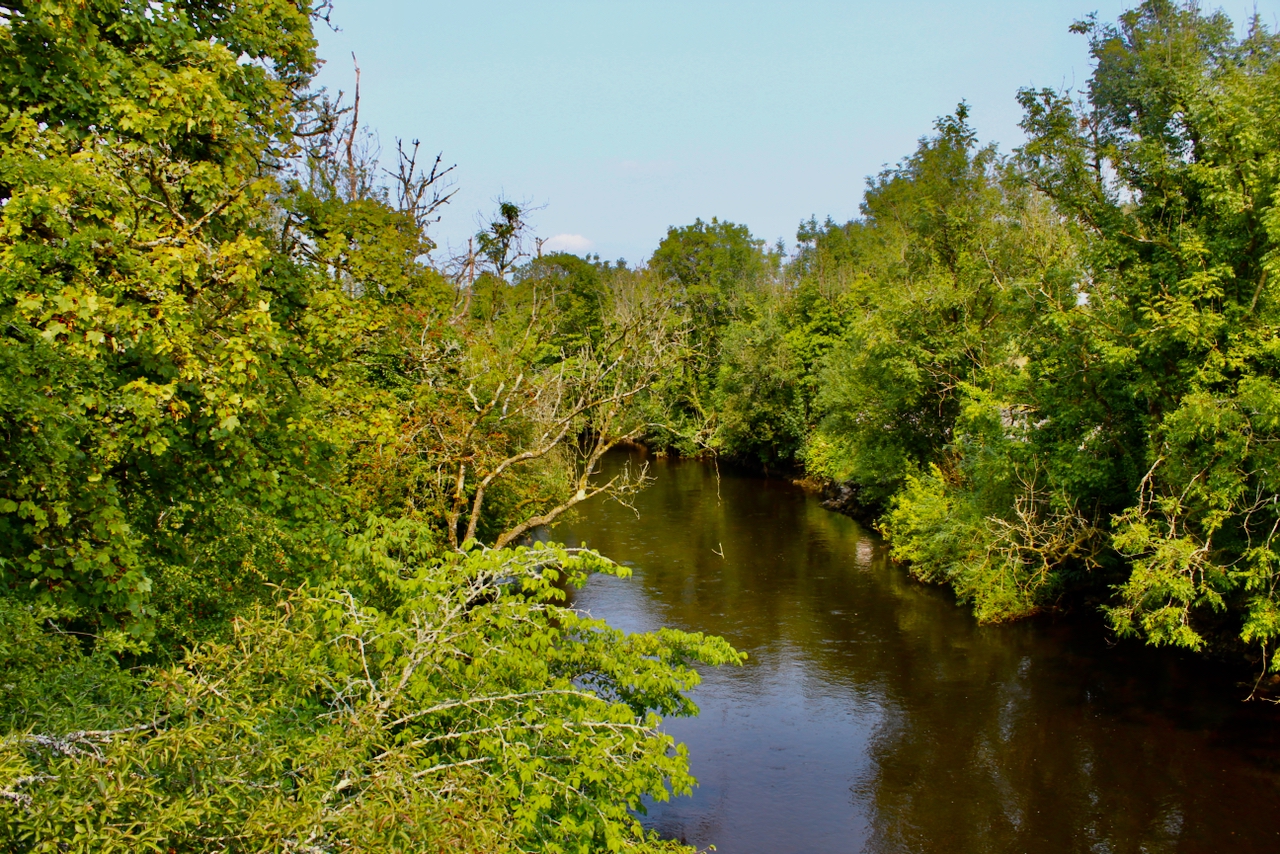
The River Camcor winds through the property.

A map of the Demesne at Kinnitty.
The River Camcor crosses the property at Kinnity Castle, and one can go for lovely walks in the grounds, along the river. Photograph © Jennifer Winder-Baggot, www.irishhistorichouses.com
Single-spire wire suspension footbridge, built c.1840, over the River Camcor within the demesne of Kinnitty Castle. The bridge is hung from cast-iron columns, and is accessed through a wrought-iron gate with iron circular framing. The Manufacturer’s name ‘T & D Roberts’ is on a downstream upright. It is one of only two suspension bridges in Offaly (the other is at Birr Castle demesne) and one of several footbridges with Kinnitty Castle demesne. It is a rare surviving example of a multiple-wire cable suspension bridge, and the National Inventory tells us it is significant because of its association with the Mountmellick Foundry. Photograph © Jennifer Winder-Baggot, www.irishhistorichouses.com
The bridge has odd sunburst decorative iron circular framing at one end. Photograph © Jennifer Winder-Baggot, www.irishhistorichouses.com
Single-span metal lattice footbridge, c.1900, over the River Camcor in the grounds of Kinnitty Castle. Photograph © Jennifer Winder-Baggot, www.irishhistorichouses.com
This could be the “back lodge” referred to by Andrew Tierney. If so, he suggests that it too could have been designed by the Pain brothers, who had supervised the work of John Nash, who designed the Swiss Cottage in County Tipperary (see my entry under Places to Visit and Stay in County Tipperary). Photograph © Jennifer Winder-Baggot, www.irishhistorichouses.com
The gate lodge at Kinnity used to be the Day Spa but is was empty when we visited in February 2023, perhaps a victim of Covid. The National Inventory tells us that it was built around 1835. Photograph © Jennifer Winder-Baggot, www.irishhistorichouses.com

[1] https://www.irelandscontentpool.com/en

[2] http://www.loughcutra.com/

[3] https://www.dia.ie/architects/view/2640/PAIN-JAMES

[4] https://www.dromoland.ie/

[5] p. 62 (under Castle Bernard), Bence-Jones, Mark. A Guide to Irish Country Houses (originally published as Burke’s Guide to Country Houses volume 1 Ireland by Burke’s Peerage Ltd. 1978); Revised edition 1988, Constable and Company Ltd, London.

Tintern Abbey, County Wexford – an OPW property

Tintern Abbey, County Wexford

Tintern Abbey, County Wexford, 15th March 2025. Photograph © Jennifer Winder-Baggot, www.irishhistorichouses.com

General information: 051 562650, tinternabbey@opw.ie

donation

Help me to pay the entrance fee to one of the houses on this website. This site is created purely out of love for the subject and I receive no payment so any donation is appreciated!

€15.00

We visited Tintern Abbey when we were in Wexford in May 2023. We visited again recently as it had rained on our previous visit and we didn’t get to to go to Colclough walled garden, so we made a beeline for the walled garden on our second visit.

Tintern Abbey, photograph by Brian Morrison, 2017 for Tourism Ireland, Ireland’s Content Pool. [see 1]
Tintern Abbey, County Wexford, May 2023. Photograph © Jennifer Winder-Baggot, www.irishhistorichouses.com
Tintern Abbey and Colclough Walled Garden.

The Abbey was converted into a residence after the Dissolution of the Monasteries in King Henry VIII’s time. When the Abbey was gifted to the state, the Irish Board of Works immediately demolished the residence, so that the building was left a ruin. It was only two decades later that the Board of Works began to conserve the property.

Tintern Abbey, County Wexford, May 2023. Photograph © Jennifer Winder-Baggot, www.irishhistorichouses.com

The OPW website https://heritageireland.ie/visit/places-to-visit/tintern-abbey/ tells us that the Abbey was founded as a Cistercian monastery around the year 1200 by William Marshall, 1st Earl of Pembroke, who became Lord of Leinster as he married Isabella de Clare, the daughter of “Strongbow,” Richard de Clare, 2nd Earl of Pembroke. Marshall vowed to create an abbey wherever he could safely land in Ireland during a storm, and he landed in Bannow Bay. Tintern Abbey is located at the head of a small inlet of the sea, next to a stream that provided fresh water. The Abbey was founded as a “daughter house” of Tintern Abbey in Wales, made famous by poet William Wordsworth. To distinguish it from the Welsh abbey, Wexford’s Abbey was also called “Tintern de Voto” meaning “of the vow.”

OPW notice board. Reconstruction drawings by Daniel Tietzsch-Tyler.
Tintern Abbey, County Wexford, May 2023. Photograph © Jennifer Winder-Baggot, www.irishhistorichouses.com
The story of the marriage of William Marshall and Isabel de Clare.

After the dissolution of the monasteries by Thomas Cromwell and King Henry VIII, Tintern Abbey was granted to a soldier, Anthony Colclough (d. 1584).

Information boards tell us about the history of the Abbey and the Cistercian Order, which was based on a strict interpretation of Benedictine rule. The monks would have lived according to a spartan routine of prayer and manual labour. Most of the difficult tasks were carried out by lay brothers. The practice of having lay brothers began because initially the monks wanted to cut themselves off from the outside world and did not allow lay people on their land. However, they needed labourers, so the lay ministry was formed. Some of these lay brothers may have lived nearby in Rathumney Hall, or Castle, now a ruin. Lay brothers often lived in out-farms or “granges,” which would have their own hall, dormitory, kitchen and chapel, and the brothers would then join the monks at the Abbey at weekends.

Tintern Abbey, County Wexford, May 2023.
Tintern Abbey, County Wexford, situated at the top of an inlet.
Tintern Abbey, photograph by Celtic Routes, 2019 for Tourism Ireland, Ireland’s Content Pool. [see 1]

Information boards tell us of the various phases of the Abbey. It would have been built first by lay monks, and later by the mid 1200s, by professional masons.

Tintern Abbey, County Wexford, May 2023. Reconstruction drawings by Daniel Tietzsch-Tyler.
Tintern Abbey, County Wexford, May 2023.
Makers Marks, from as early as the 1200s, Tintern Abbey, County Wexford, May 2023.

Cistercian simplicity was reflected in their buildings, of strong form and good building techniques. In 1140, Malachy, Bishop of Down, visited Bernard of Clairvaux. Bernard sent helped to establish the Cistercian monastery in Mellifont, County Louth, and by 1169 Ireland had fourteen Cistercian settlements. The Anglo Normans established a further ten in the fifty years after 1169, including Dunbrody Abbey, another Cistercian monastery near Tintern Abbey.

The Cistercians built according to well-established convention. The churches consisted of an aisled nave and presbytery with north and south transepts. A tower was not a usual feature. The cloister was south of the church and was surrounded by buildings such as the infirmary, dormitory, kitchen, guest house and scriptorium.

Tintern Abbey, County Wexford, May 2023. Reconstruction drawings by Daniel Tietzsch-Tyler.
The large window at the east end of the chancel of Tintern Abbey, probably built by 1325. Photograph © Jennifer Winder-Baggot, www.irishhistorichouses.com
The large window at the east end of the chancel of Tintern Abbey, probably built by 1325. The sloping window cill next to the tower would have accommodated the north transept and chapel. These may never have been built, as there is no evidence. The stepped battlements were probably added at a later date. Photograph © Jennifer Winder-Baggot, www.irishhistorichouses.com
The sloping window cill next to the tower would have accommodated the north transept and chapel. Tintern Abbey, County Wexford, May 2023. Above the windows are the carved corbel tables. Photograph © Jennifer Winder-Baggot, www.irishhistorichouses.com
See the carved heads above the window. Photograph © Jennifer Winder-Baggot, www.irishhistorichouses.com
Tintern Abbey, County Wexford, May 2023.

The monks were interested in farming and adopted the latest methods.

Tintern Abbey, County Wexford, May 2023. Reconstruction drawings by Daniel Tietzsch-Tyler.
Tower, Nave and South Trancept, Tintern Abbey, County Wexford, May 2023. Photograph © Jennifer Winder-Baggot, www.irishhistorichouses.com

The nave, chancel, tower, chapel and cloister still stand. The nave has lost its aisles and clerestory, but still has three bays of plain arches.

Tower and south trancept, Tintern Abbey, County Wexford, May 2023. Photograph © Jennifer Winder-Baggot, www.irishhistorichouses.com
The Nave, Tintern Abbey, County Wexford, May 2023. Photograph © Jennifer Winder-Baggot, www.irishhistorichouses.com
Facing the tower from the nave, Tintern Abbey, County Wexford, May 2023. Photograph © Jennifer Winder-Baggot, www.irishhistorichouses.com
Tower and Nave, Tintern Abbey, photograph by Brian Morrison, 2017 for Tourism Ireland, Ireland’s Content Pool. [see 1]
Tintern Abbey, County Wexford, 15th March 2025. Photograph © Jennifer Winder-Baggot, www.irishhistorichouses.com

Sculpture was not encouraged in Cistercian buildings but Tintern has a few fine surviving examples. A carved corbel table remains, which contains twenty four carved heads, some human, some monstrous.

Carved heads above the window. Photograph © Jennifer Winder-Baggot, www.irishhistorichouses.com
Tintern Abbey, County Wexford, May 2023.
Picture of carving in Tintern Abbey.

In the 16th century the old abbey was granted to the Colclough family (pronounced Coakley) and soon after the church was partly converted into living quarters and further adapted over the centuries. The Colcloughs occupied the abbey from the sixteenth century until the mid-twentieth.

The nave contained the main residence of the Colclough family.
Renovations and excavation at Tintern Abbey.
Tintern Abbey, County Wexford, May 2023.

A chapter by Sean Clooney about Tintern Abbey in Tintern Abbey County Wexford, Cistercians and Colcloughs, Eight Centuries of Occupation, 1st Edition edited by Kevin Whelan, 2nd Edition edited by Anne Finn, tells us that Anthony Colclough, much like King Henry VIII, divorced his first wife! He divorced Thomasine Sutton in 1547 and married Clare Agard. He converted the tower of the abbey into a fortified tower house. A fire in 1562 had destroyed many of the other buildings. He also built the unique fortified bridge nearby.

The fortified bridge built by Anthony Colclough by Tintern Abbey, County Wexford, May 2023. Photograph © Jennifer Winder-Baggot, www.irishhistorichouses.com
The fortified bridge built by Anthony Colclough by Tintern Abbey, County Wexford, March 2025. Photograph © Jennifer Winder-Baggot, www.irishhistorichouses.com
Tintern church and cemetery, which contains the Colclough vault. Photograph © Jennifer Winder-Baggot, www.irishhistorichouses.com

He is buried in the small ruined church a few hundred metres south east of the abbey. The plaque in this church reads:

Here lieth the body Syr Anthony Colclought Knight, eldest sune of Richard Colclought of Wolstanton in Stafordshire Esquier who came first into this land in the 34 yere of Henry the 8 and then was Captayn of the Pensioners in which place and others of greater charge he continued a most faythful serviter during the life of Edward the VI and Queen Mary and until the XXVI yer of our most noble Queen Elisabeth and then died the IX of December 1584. He left his wife, Clare Agare, daughter of Thomas Agare Esquier 7 sonns, Frances, Ratlife, Anthony, Syr Thomas Colclough, Knight, John, Matew, Lenard and 5 doghters, Jaqnet who married to Nicholas Walsh Esquier of the Priveie Counsayle and one of the Justice of the Kings Bench in Ireland; Fraunc married to William Smethwike of Smethwik in Cheshier; Clare married to William Snead of Brodwal in Stafordshire Esquier; Elinor died iunge.”

Tintern church and cemetery, which contains the Colclough vault. Photograph © Jennifer Winder-Baggot, www.irishhistorichouses.com
Photograph © Jennifer Winder-Baggot, www.irishhistorichouses.com
Tintern church and cemetery, which contains the Colclough vault. Photograph © Jennifer Winder-Baggot, www.irishhistorichouses.com

Anthony’s son Thomas continued to develop Tintern, and is said to have established oyster beds in Bannow Bay. He married, first, Martha Loftus, daughter of Adam Loftus, Protestant Archbishop of Dublin. Their son Adam was raised to the baronetcy as 1st Baronet of Tintern Abbey. Thomas’s second wife, Eleanor Bagenal, was Catholic. After her husband’s death, she married Lucas Plunkett, 1st Earl of Fingall. Thomas’s son by his second marriage inherited lands at Duffry, where Duffry Hall was built by his grandson Patrick Colclough (d. 1691).

Tintern Abbey, County Wexford, May 2023.
Tintern Abbey, County Wexford, May 2023. Reconstruction drawings by Daniel Tietzsch-Tyler.
Colclough family tree, in Tintern Abbey County Wexford, Cistercians and Colcloughs, Eight Centuries of Occupation, 1st Edition edited by Kevin Whelan, 2nd Edition.

During the 1641 rebellion 200 local Protestant people took refuge in Tintern which was garrisoned by forty soldiers from Duncannon Fort situated nearby. At that time Tintern would have been inhabited by the 2nd Baronet, Caesar Colclough (d. 1684). Shortly afterwards the Catholic branch of the family laid siege to the Protestant branch who were in residence in Tintern Abbey. [2]

The Catholic branch who took control of the abbey following a two-week siege included Dudley Colclough (1613-1663), who had married Katherine Esmonde of Johnstown Castle, and his two brothers John and Anthony (who married Mary Esmonde from Johnstown Castle). Following Oliver Cromwell’s arrival in 1649 Dudley was banished to Connaught and he ultimately died in exile in France.

The 3rd Baronet of Tintern Abbey, Caesar (1650-1687) had no heir so the title expired and the lands passed to his sister Margaret. She married firstly, in 1673, Robert Leigh, of Rosegarland, who thereupon assumed the surname of Colclough; and secondly, in 1696, John Pigott, of Kilfinney, County Limerick, who also assumed the surname of Colclough.

Caesar Colclough (d. 1766), known as “Great Caesar,” great-grandson of Catholic Dudley who had rebelled in 1641, united the properties. His grandfather, Patrick Colclough of Duffry Hall, married Katherine Bagenal of Dunleckney, County Carlow. Patrick Colclough was Catholic and very active in the Jacobite cause and was attainted of High Treason and outlawed by King William III but he died in 1691, before the attainder passed into law, so his eldest son was able to inherit his estates. His son Dudley (d. 1712) was brought up in the Protestant faith. [3] He married Mary Barnewall, granddaughter of Nicholas Barnewall, 1st Viscount Barnewall of Kingsland. The Great Caesar was their son.

The “Great Caesar” was a great sportsman and generous landlord. He brought a team of men to play hurling in front of King George. The team wore a yellow sash to distinguish them from the opposition, and the king or queen called out, “Come on the yellow bellies!” and from then on, Wexford men are called “yellow bellies.”

Caesar’s second wife, Henrietta Vesey, was the great-granddaughter of King Charles II, granddaughter of Mary Walters de Crofts, illegitimate daughter of Charles II.

Upon the Great Caesar’s death in 1766, the Tintern estates passed to his grandson Vesey, and the Duffry estates passed to his younger son Adam. Vesey Colclough (1745-1794) married Catherine Grogan of Johnstown Castle in County Wexford. It was not a happy marriage and they separated, but Vesey remained in Tintern and transformed the chancel of the abbey into a residence. He was extravagant in his lifestyle, however, and his son John had to extricate himself from debt accrued.

OPW notice board. Reconstruction drawings by Daniel Tietzsch-Tyler.
Tintern Abbey, County Wexford, 15th March 2025. Photograph © Jennifer Winder-Baggot, www.irishhistorichouses.com

John did more renovations of the abbey, constructing a second storey over the south transept aisle, which was known as the Lady Chapel. The lower storey held a kitchen and above, a library, wiht a massive Gothic window facing the sea.

Tintern Abbey, County Wexford, May 2023. Photograph © Jennifer Winder-Baggot, www.irishhistorichouses.com
Tintern Abbey, County Wexford.
The library window, Tintern Abbey, May 2023. Photograph © Jennifer Winder-Baggot, www.irishhistorichouses.com
The large traceried window being restored.
The old library with its large window. Photograph © Jennifer Winder-Baggot, www.irishhistorichouses.com

However, when John was standing for election he was shot dead in a duel in 1807 by William Alcock of Wilton Castle in County Wexford, an opponent in the election. Alcock was acquitted by a jury of his peers, but his mental health deteriorated.

Four Colcloughs died in duels. Thomas of Duffrey Hall was killed in a duel in 1690. Agmondisham, son of “Great Caesar,” was killed in a duel in 1758, and John Colclough of St. Kieran’s was killed in 1801 by Henry Loftus Tottenham of Loftus Hall, far down on the Hook Peninsula (a property that is again advertised for sale).

Tintern passed to John’s brother, another Caesar Colclough (1766-1843). He and his wife Jane Kirwan had no children, and some suspected his wife of killing him. She went on to marry Thomas Boyce. Her right to the property was challenged by the Colclough family. So many court cases were instigated that it has been said that it was one of the inspirations for Dickens’ “Jarndice vs Jarndice” in Bleak House.

Adam, the son of “Great Caesar” who inherited Duffry, had a son, Caesar, who died in 1822. He was Chief Justice of Prince Edward Island in Canada. It was his daughter, Mary, who married John Thomas Rossborough, who eventually gained ownership. Her husband took the name Colclough.

The Colclough family lived there until 1958, when it was presented to the state by Lucy Biddulph-Colclough.

The Board of Works that took on care of Tintern Abbey dismantled the residential part of the building: floors, doors and windows were taken out, the roof was taken off, and materials were sold by auction. It was only twenty years later that the Board of Work returned to preserve the abbey.

Tintern Abbey noticeboard. Reconstruction drawings by Daniel Tietzsch-Tyler.
Tintern before restoration work.

When it was being restored, the roof of the tower was rebuilt. The coach house with the medieval gateway was restored to provide visitor facilities.

The restored coach house, in use for tourist facilities, at Tintern Abbey, County Wexford, May 2023. Photograph © Jennifer Winder-Baggot, www.irishhistorichouses.com

The Lady Chapel was restored for use as an exhibition room.

Stephen in the stone vaulted Lady Chapel, Tintern Abbey, County Wexford, May 2023. Photograph © Jennifer Winder-Baggot, www.irishhistorichouses.com
Tintern Abbey, County Wexford, May 2023. Photograph © Jennifer Winder-Baggot, www.irishhistorichouses.com
Carved boss in the Lady Chapel vaulting, Tintern Abbey, County Wexford, May 2023. Photograph © Jennifer Winder-Baggot, www.irishhistorichouses.com
The Library was cleared out during restoration, including removing wood panelling. Wood panelling was later partly reinstated.

When the Abbey was converted into a residence, new flooring was added and the tower house was divided into rooms with wattle and daub timber frame screen walls and oak panelling fixed to the masonry walls. What remains of the oak panelling has been conserved and is now located on the first floor of the Crossing Tower. Dendrochronology dates the timbers to 1600-1620. It was known as “wainscotting.” It added warmth to the room.

Tintern Abbey, County Wexford, May 2023. Photograph © Jennifer Winder-Baggot, www.irishhistorichouses.com
When converted to a residence, wooden-framed partition walls were added in the tower. The oak framework was infilled with panels of woven sticks “wattle” and caked with mud (“daub”) and painted.
Recovered oak panelling from 1600-1620, Tintern Abbey, County Wexford, May 2023. Photograph © Jennifer Winder-Baggot, www.irishhistorichouses.com
Tintern Abbey, County Wexford, May 2023.
Wattle and daub, Tintern Abbey, County Wexford, May 2023. Photograph © Jennifer Winder-Baggot, www.irishhistorichouses.com
The “wattle” for building was obtained by the practice of coppicing, Tintern Abbey, County Wexford, May 2023.
Tintern Abbey, County Wexford, May 2023.
Tintern Abbey, County Wexford, May 2023. Photograph © Jennifer Winder-Baggot, www.irishhistorichouses.com
You can see how thick the walls are, Tintern Abbey, County Wexford, May 2023. Photograph © Jennifer Winder-Baggot, www.irishhistorichouses.com
Display case in Tintern Abbey. Photograph © Jennifer Winder-Baggot, www.irishhistorichouses.com
Tintern Abbey, County Wexford, May 2023.
Tintern Abbey, County Wexford, May 2023. Photograph © Jennifer Winder-Baggot, www.irishhistorichouses.com

The website continues: “Conservation works have included special measures to protect the local bat colonies. The abbey is set in a special area of conservation and is surrounded by woodland within which are walking trails. Not to be missed is the restored Colclough Walled Garden situated within the old estate.

Colclough walled garden, Tintern Abbey, County Wexford. Photograph © Jennifer Winder-Baggot, www.irishhistorichouses.com
Colclough Walled garden, Tintern Abbey, photograph by Brian Morrison, 2017 for Tourism Ireland, Ireland’s Content Pool. [see 1]
Tintern Abbey, photograph by Brian Morrison, 2015 for Tourism Ireland, Ireland’s Content Pool. [see 1]

Following the donation of Tintern Abbey to the Irish State in 1959 the walled garden was abandoned to nature and became overgrown.  The gradual restoration of the walled garden by a team of volunteers began in 2010 and the 1830s layout shown on the Ordnance Survey was reinstated. The restored garden, which opened to the public in 2012, is divided into two sections: the Ornamental Garden and the Kitchen Garden. 

Garden at Tintern Abbey, photograph by Brian Morrison, 2017 for Tourism Ireland, Ireland’s Content Pool. [see 1]
Tintern Abbey, County Wexford, 15th March 2025. Photograph © Jennifer Winder-Baggot, www.irishhistorichouses.com

[1] https://www.irelandscontentpool.com/en/media-assets/media/81101

[2] notes from Tintern website, by Breda Lynch.

[3] https://genealogy-and-you.com/onewebmedia/Colclough.pdf

See the sale of Loftus Hall, courtesy of Colliers.

Loftus Hall, County Wexford, for sale April 2025 courtesy Colliers.

Loftus Hall is a large, partly re-furbished country house which was built on the site of the original Redmond Hall. The property boasts one of the most scenic locations in the southeast with views over Hook Peninsula and the world famous Hook Lighthouse, providing the most stunning landscape which is steeped in history and reputed by locals to have been haunted the property. The property was purchased by the Quigley family in 2011 and run as a tourist attraction with guided tours of the property and seasonal events. In 2021 the property was bought by its current owners who had a masterplan to refurbish the original building over two phases. The estate has already undergone extensive renovations, with Phase 1 nearing completion, set to transform the property into an exclusive 22-bedroom luxury hotel with high-end amenities, extensive food and beverage facilities, and beautifully landscaped gardens. The vision for Phase 2, included an additional 56 bedroom hotel block, a gym and spa, dedicated wedding facilities, 33 standalone garden cottages and 10 eco pods strategically placed along the perimeter of the property.

Loftus Hall, County Wexford, for sale April 2025 courtesy Colliers.

Location Loftus Hall is located on the southern tip of Hook Peninsula, close to the famous Hook Lighthouse, one of the oldest operational lighthouses in the world. Loftus Hall offers an unparalleled location for exploring the beauty and history of County Wexford. Just 4km from the iconic Hook Lighthouse, 33km from the vibrant town of New Ross, 45km from Wexford and 51km from Waterford. The property is also in close proximity to several popular tourist destinations, including Passage East (17km) and Dunmore East (30km) and the charming nearby villages such as Hookless Village, Slade, and Fethard-On-Sea, all within easy access. The location is quite picturesque, making it a popular spot for visitors interested in history, architecture, and the paranormal. Main House Built originally between 1870 and 1871 on the site of Redmond Hall, which traces its history to 1350, Loftus Hall comprises a detached nine-bay, three storey house. The estate is situated on approximately 27.68 hectares (68 acres) with the house extending to a total gross internal area (GIA) of 2,460 sq.m (26,480 sq. ft). Loftus Hall is a protected structure under RPS Ref WCC0692 and under the NIAH Ref 15705401. The estate has already undergone extensive renovations, with Phase 1 nearing completion. The ground floor of the original building has been transformed to contain a large dining room, a cigar room and a number of guest lounge areas. When completed the restaurant will seat over 100 covers which will feature visibility of the chefs working with an open pass, an outside BBQ area and fire pit adjacent to the new restaurant area with the existing bar fully refurbished. The hotel bedrooms are finished to second fix over the first and second floors and are appointed with large ensuite bathrooms and with commanding and sweeping views out to sea. The vision for Phase 2 consists of the development of a permanent marquee erected on the grounds which will cater for up to 300 seated wedding guests, a gym & spa, a new hotel bedroom block which will contain up to 56 additional bedrooms, 33 standalone garden cottages, 10 eco pods wrapped around the perimeter of the property, a children’s playground, a herb and vegetable garden, over two hundred car park spaces in total between the front and rear of the development and a walkway that will allow guests to access the beach directly from the development. The Grounds The grounds are a feature of Loftus Hall and have been maintained to the highest standards throughout the refurbishment. The gardens at Loftus Hall, particularly the walled garden, were designed to thrive in the unique climate of the Hook Peninsula. The garden’s high walls provided a sheltered environment, allowing a variety of plants to flourish. Fruit trees were a significant feature, with mulberry trees being particularly successful. The sheltered environment also supported other fruit trees like apple and pear. Additionally, the garden likely included a variety of herbs and vegetables, which were essential for the estate’s kitchen. The garden’s design and plant selection reflect the practical needs and aesthetic preferences of the time, creating a space that was both beautiful and functional.

Woodhouse, County Waterford – private house, tourist accommodation in gate lodge and cottages

donation

Help me to pay the entrance fee to one of the houses on this website. This site is created purely out of love for the subject and I receive no payment so any donation is appreciated!

€15.00

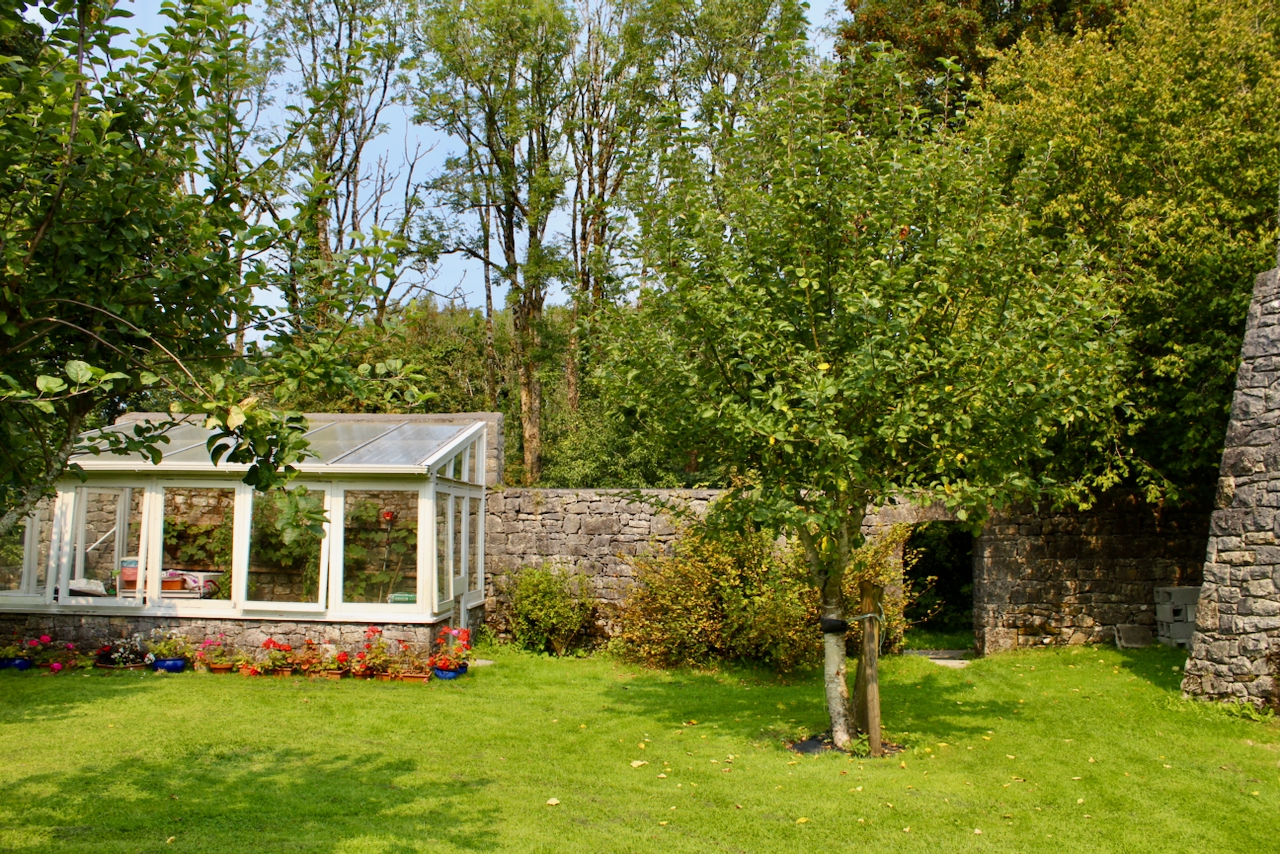
We visited Woodhouse on a day trip with the Cork Chapter of the Irish Georgian Society on a gloriously sunny day on May 24th, 2023. The home owners Jim and Sally Thompson welcomed us into their home, and historian Marianna Lorenc delivered a wonderful talk about the history of the house and the family who lived there.

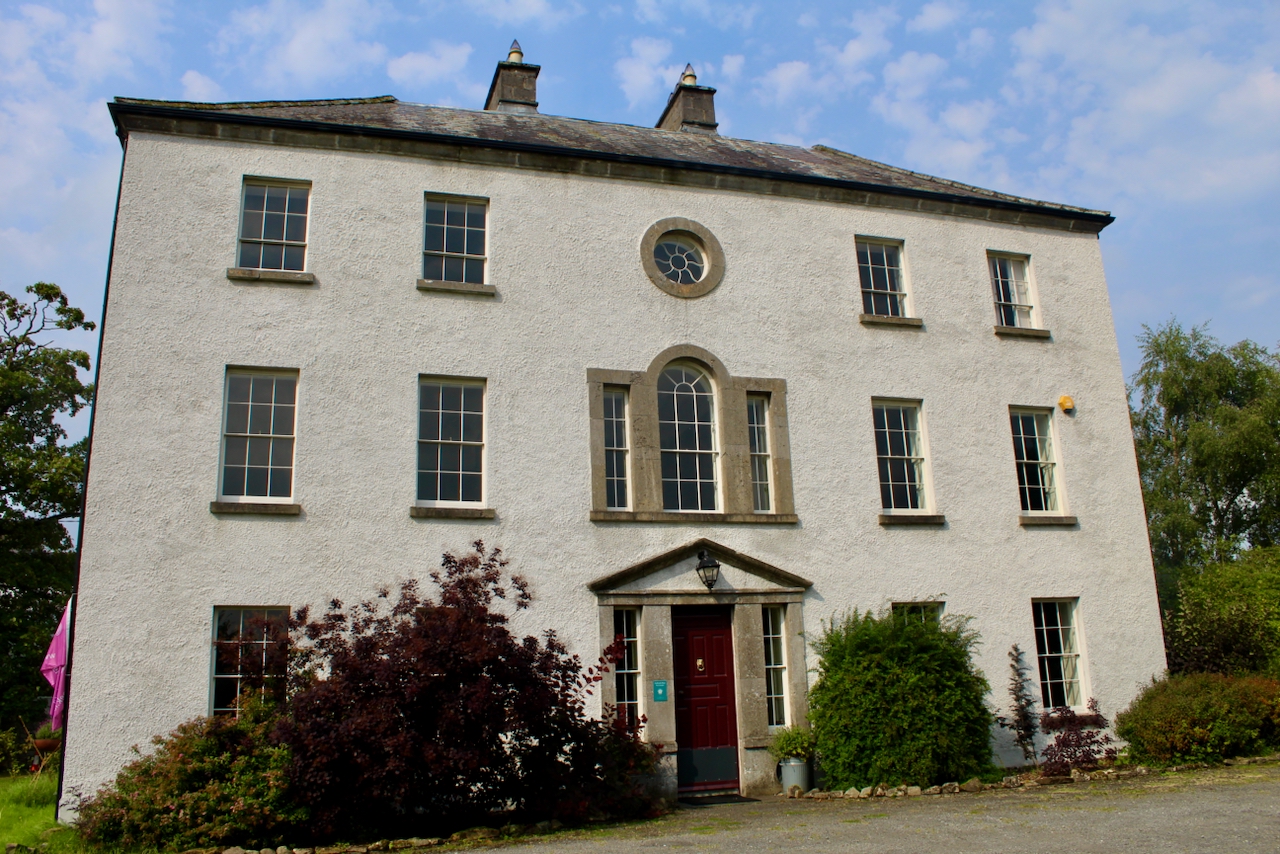
Woodhouse, May 2023. The house is private but you can stay in cottages. Photograph © Jennifer Winder-Baggot, www.irishhistorichouses.com

You can stay in the gate lodge or cottages.

https://woodhouseestate.com/

The Hayloft, Woodhouse, available for self-catering accommodation.
At Woodhouse, County Waterford. Photograph © Jennifer Winder-Baggot, www.irishhistorichouses.com

The website tells us:

The original house was built in the early part of the 17th century by the Fitzgerald family (a branch of the MacThomas Geraldines of the Decies).

An old estate map of Woodhouse.
An information board in the museum.

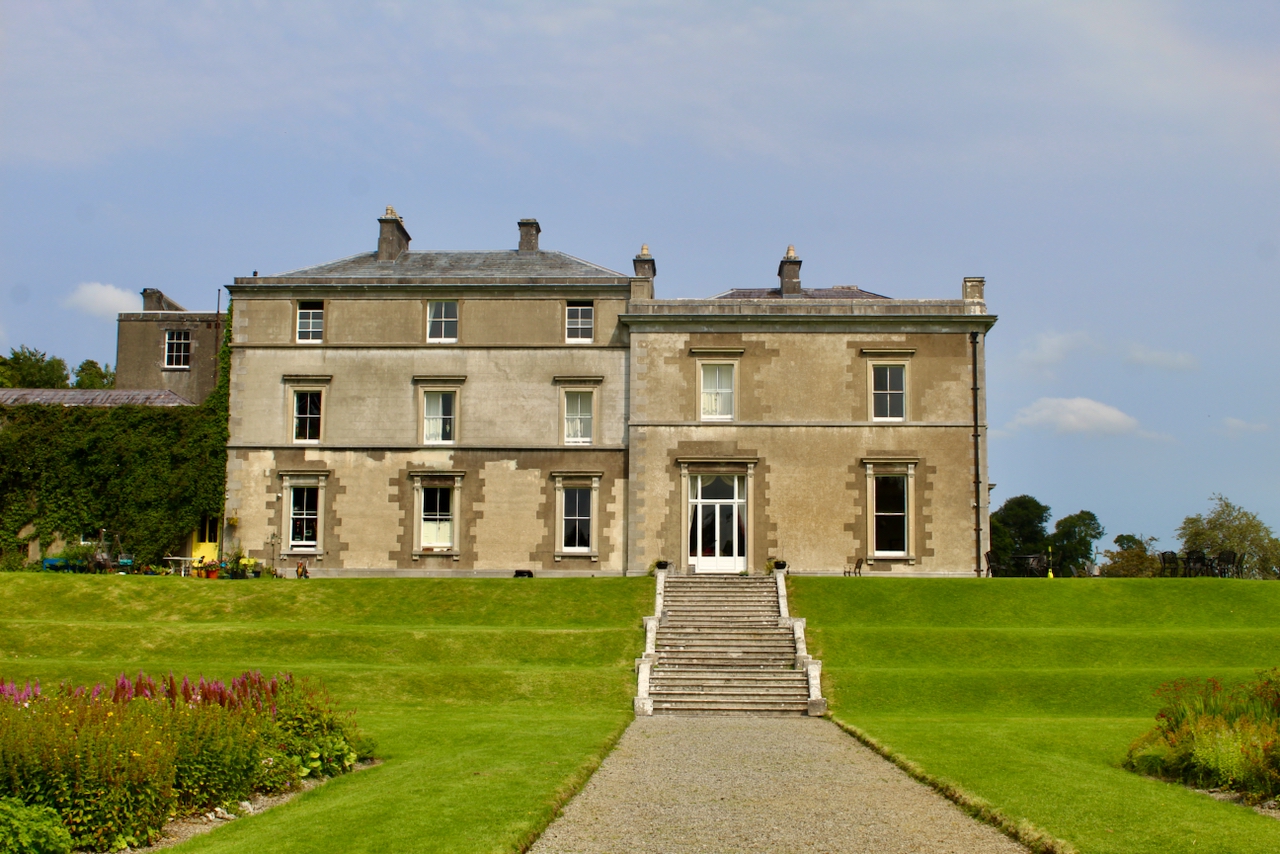
While in the ownership of the Uniacke family it was passed by inheritance to the Beresford family and subsequently sold by Lord William Beresford in ca 1970. The House has since been extended over the years to become an impressive six bay window residence with bright and spacious rooms overlooking this private estate with the River Tay flowing through.”

The River Tay. Photograph © Jennifer Winder-Baggot, www.irishhistorichouses.com

The website gives us a detailed description of the history of the house so I will quote it here:

The house of Woodhouse as we see it at present was built in at least three stages.

The first one dates back to early 1600’s and the Munster Plantation, when the Messenger for Court of Wards and Liveries, an English Protestant and Undertaker (in other words Planter), James Wallis Esq., rented the lands of Woodhouse, Carrigcrokie, Stradballymore, Ballykerogue and others from the fellow Elizabethan settler and land distributor Richard Beacon. The latter gentleman was awarded the lands of the Catholic FitzGerald family in Co. Limerick and Co. Waterford (Woodhouse) by the Queen in appreciation for having performed his duties as her majesty’s attorney for the province of Munster. After leasing the land James Wallis had built a fine stone house, a mill, a walled garden accompanied by a numerous outbuildings and weirs (river dams) in the river Tay. The original house was built in an Elizabethan style on a rectangular plan.

James Wallis (ca. 1570-1661).

During the 1641 Rebellion in Ireland, James Wallis Esq. was forced out of Woodhouse by rebels and despite his detailed Deposition made in 1642 describing the damage to his house and the loss of his goods, as well as the favourable court ruling in his favour in 1653, he never returned to the property.

At Woodhouse, County Waterford.

The 1654 Civil Survey states that the owner of Woodhouse was then Thomas FitzGerald. Two generations later his grandson Major Richard MacThomas FitzGerald (then of Prospect House in Kinsalebeg, Co. Waterford) was facing large debts and had no way of paying them back so he had to sell the house and lands in 1724. Richard MacThomas Fitzgerald received over £8000 for this property but could only retain £840 while the rest was required to cover his debts.

The new owner of Woodhouse was Richard MacThomas Fitzgerald’s distant relative and close neighbour Thomas Uniacke Esq. of Ballyvergin, Barnageehy and Youghal. It was then that the second phase of development for Woodhouse started. Thomas’ sons, Borr and Maurice Uniacke, invested heavily into renovating the dilapidated house and completely changed its character by developing it into a Georgian structure. There is no evidence to confirm who the architect of the changes was so it’s quite possible that the wealthy Uniacke family used the “Pattern Books” and hired traveling stonemasons to introduce the changes. The house was substantially enlarged and its functionality vastly changed. At this time the Woodhouse estate was is thought to have consisted of about 2500 acres in total.

What the house looked like, may be seen at one of Borr Uniacke’s granddaughter’s amateur painting which was likely done in the first half of 1800s.

Colonel Robert Uniacke (1756-1802).

Woodhouse remained with the Uniacke family for about 130 years but in 1853 the Estate changed hands again. It did not entirely leave the Uniacke family inasmuch as the last heiress of this branch of the family, Frances Constantia Uniacke, having inherited Woodhouse from her older brother, Robert Borr Uniacke in 1844, married George John Beresford the grandnephew of the 1st Marquess of Waterford. Frances and George John took on the responsibility for the house and had the house and the outbuildings further extended. Owing to his sufferings caused by severe gout, at the back of the main house he had built a Turkish bath. We also know that construction of the boat house in nearby Stradbally Cove (which in contemporary nautical charts was called the Blind Cove) was done at this time.

George John Beresford (1807-1864).

For almost a century after that Woodhouse did not see any major changes and once again it became in need of extensive work to save it. Most of the eight Beresford children of George John and Frances Beresford married but none of them had children of their own. In 1933, the last surviving daughter of the couple, Lady Emily Frances Louisa (Beresford) Hodson bequeathed Woodhouse (the main house, 550 acres of land and the village of Stradbally) to her distant cousin Lt. Lord Hugh Tristram de la Poer Beresford Royal Navy, the sixth child of the 6th Marquess of Waterford. At the time of Lady Hodson’s death Lord Hugh was Aide De Camp to the Governor General of South Africa, yet he still managed to order renovation works including the installation of electricity and running water to the house. There is an extensive written evidence of his endeavours, which describes the works undertaken.

Emily Frances Louisa (née Beresford) Hodson (1861-1934).
At Woodhouse, County Waterford.

In 1936 Lord Hugh Beresford made his last will and testament and bequeathed Woodhouse to his older brother Major Lord William Mostyn de la Poer Beresford. When in 1941 Lt. Cmdr. Lord Hugh Beresford was killed in action during the Battle of Crete, the will and testament were probated and when in 1944 Major Lord William Beresford returned from the war he took on Woodhouse, its lands and the village of Stradbally. Hence the third stage of structural development for Woodhouse began. Until his return however, the Estate was looked after by Arthur Hunt Esq. who had been the agent for the Beresford family since the late 1800s.

Upon his return from the war, Lord William Beresford moved into Woodhouse. He found the Estate to be quite run down and badly in need of repairs.

Lord William introduced considerable changes not only to the structure of the main house, but he also developed the land and garden in such a way that they yielded large crops. Every week he transported the rich surplus of vegetables, fruits and dairy products to Waterford where they were sold in the first Co-Op in town.

There is a beautiful bridge in the distance, on the property. Photograph © Jennifer Winder-Baggot, www.irishhistorichouses.com

Lord William and his wife Rachel are remembered as a good and kind people who successfully ran Woodhouse as a working farm and they put all their energy into making it a self-sufficient establishment.”Lord William and his wife Rachel are remembered as a good and kind people who successfully ran Woodhouse as a working farm and they put all their energy into making it a self-sufficient establishment.

The year 1971 was the year when everything had changed for Woodhouse. It was the first time in 250 years that it was sold outside of the Fitzgerald/Uniacke/Beresford Anglo-Irish family. In that year Lord William sold the Estate to Mr. John McCoubrey who farmed and bred his cattle here and, thanks to the auspicious nature, he succeeded in that enterprise. However only one year later Mr. McCoubrey decided to move on and he, too, sold Woodhouse.

In 1972 Mr. John Rohan bought the house and all the lands. The new owner began extensive renovations to the main house and, being the Master of the Waterford Hunt, built stables for his horses and kennels for his dogs in the walled garden. He also purchased and installed the beautiful black gate at the main entrance to the Estate.

The impressive gates of Woodhouse, purchased and installed by John Rohan. Photograph © Jennifer Winder-Baggot, www.irishhistorichouses.com

Ten years later, in 1983 Woodhouse changed hands again and was purchased as an investment by a company owned by Mr. Mahmoud Fustok and his associates from the Middle East. Mr. Fustok never occupied Woodhouse but chose to make it available to Dr John O’Connell, an Irish parliamentarian, and his friends. The house was adjusted to their style, but no major renovations took place between 1983 and 2006.  

After 23 years under Mr. Fustok’s ownership Woodhouse was purchased by two Irish business partners – Mr. Aidan Farrell and Mr. Charles O’Reilly-Hyland. After their purchase these two owners sold some land parcels of Woodhouse to interested parties and made some improvements to the Estate but did not make it their residence. Eventually in 2012 they decided to sell the entire estate.

The front door to the private house of Woodhouse. Photograph © Jennifer Winder-Baggot, www.irishhistorichouses.com

The new purchasers, Jim Thompson and his wife Sally, took on the task of renovating and modernizing the vastly run-down house, cottages, outbuildings and lands. Their initiative involved an enormous amount of effort and patience but ultimately was successful. The works extended into every part of the large Estate (500 acres) and was achieved over a period of six years with the support and encouragement of the people of Stradbally.

Inside this area is a museum about Woodhouse, a function room, and the Hayloft cottage. Photograph © Jennifer Winder-Baggot, www.irishhistorichouses.com

After many years of being forgotten and with no sufficient means to sustain itself, Woodhouse was brought back to life by various experts – architectural, building, landscape, and farm – who guided the Thompsons through the long renovation process. This commitment to bring Woodhouse back to its former glory proved very successful and as of 2019 – 400 years after the house was originally built – Woodhouse is a vibrant estate once more.

The private home of Woodhouse, the rear entrance, with French doors from the kitchen. Photograph © Jennifer Winder-Baggot, www.irishhistorichouses.com
French doors from the kitchen. Photograph © Jennifer Winder-Baggot, www.irishhistorichouses.com
The beautiful day showed the gardens to perfection. Photograph © Jennifer Winder-Baggot, www.irishhistorichouses.com
These lovely buildings house the museum and a function room. Photograph © Jennifer Winder-Baggot, www.irishhistorichouses.com

We gathered at the ancilliary buildings for coffee and a chat before Marianna’s introduction to the house’s history. She has published a book that was for sale, along with Julian Walton.

This houses the museum and function rooms. Photograph © Jennifer Winder-Baggot, www.irishhistorichouses.com
Ancilliary buildings. Photograph © Jennifer Winder-Baggot, www.irishhistorichouses.com
Woodhouse, County Waterford. Photograph © Jennifer Winder-Baggot, www.irishhistorichouses.com
Ancilliary buildings at Woodhouse. Photograph © Jennifer Winder-Baggot, www.irishhistorichouses.com
The museum, upstairs in the ancilliary buildings. Photograph © Jennifer Winder-Baggot, www.irishhistorichouses.com
This was the walk between the museum and the main house. The gardens everywhere are beautiful and we couldn’t have had a finer day for our visit. Photograph © Jennifer Winder-Baggot, www.irishhistorichouses.com

After our talk, we visited the house and then the walled garden. The website tell us:

When Woodhouse changed hands in 2012 a project was undertaken to bring the walled garden back to its former glory. Today the Walled Garden and Orchard have a wide variety of fruits, vegetables, herbs and many types of flowers and, thanks to Paddy Kiely and his excellent team of skilled workmen, has developed in a place of beauty in tune with nature as it was planned when originally built. An oasis of calm and tranquility situated right in the centre of the Estate, the beautifully restored Walled Garden is a perfect venue for small intimate weddings and gatherings. Completely enclosed and surrounded by high stone walls the walled garden has flowers beds, beautiful green lawns, a raised pergola overlooking the entire garden and a soothing water feature. As well as providing a beautiful backdrop for weddings the Walled Garden is also an ideal venue for a variety of special events.  Whether you are looking to toast a birthday or anniversary or hold a charity event the Walled Garden adds a special atmosphere to any occasion.
For more information please get in touch
1woodhouseestate@gmail.com

The beautiful walled garden of Woodtown. Photograph © Jennifer Winder-Baggot, www.irishhistorichouses.com
Events can be held in the buildings in the walled garden. Photograph © Jennifer Winder-Baggot, www.irishhistorichouses.com
The beautiful walled garden of Woodhouse. Photograph © Jennifer Winder-Baggot, www.irishhistorichouses.com

Beyond the walled garden in a further section is an orchard and greenhouse, and a house for chickens.

The orchard at Woodhouse. Photograph © Jennifer Winder-Baggot, www.irishhistorichouses.com
The greenhouse at Woodhouse. Photograph © Jennifer Winder-Baggot, www.irishhistorichouses.com
At Woodhouse. Photograph © Jennifer Winder-Baggot, www.irishhistorichouses.com

Swiss Cottage, Ardfinnan Road, Cahir, County Tipperary – Office of Public Works

Swiss Cottage, Ardfinnan Road, Cahir, County Tipperary:

General Information: 052 744 1144, swisscottage@opw.ie

Swiss Cottage, June 2022. Photograph © Jennifer Winder-Baggot, www.irishhistorichouses.com

donation

Help me to pay the entrance fee to one of the houses on this website. This site is created purely out of love for the subject and I receive no payment so any donation is appreciated!

€15.00

From the OPW website https://heritageireland.ie/visit/places-to-visit/swiss-cottage/:

The Swiss Cottage, just outside the heritage town of Cahir, is a cottage orné – a fanciful realisation of an idealised countryside cottage used for picnics, small soirees and fishing and hunting parties and was also a peaceful retreat for those who lived in the nearby big house.

Built in the early 1800s [around 1810] by Richard Butler, 1st Earl of Glengall, who, we believe, managed to persuade world-famous Regency architect John Nash to design it [he also designed Buckingham Palace for the Crown]. Originally, simply known as “The Cottage” it appears to have acquired its present name because it was thought to resemble an Alpine cottage.

Inside, there is a graceful spiral staircase and some exquisitely decorated rooms. The wallpaper is partly original and partly the fruit of a 1980s restoration project, in which the renowned fashion designer Sybil Connolly was responsible for the interiors.

Photograph © Jennifer Winder-Baggot, www.irishhistorichouses.com

We visited the Swiss Cottage in June 2022. The guide told us that the Glengalls probably never even spent a night in their cottage! They used it for entertaining. They lived in the town of Cahir, in what is now Cahir House Hotel, a house that was more comfortable than Cahir Castle, which they also owned.

Richard Butler (1775-1819) 1st Earl of Glengall was the 12th Baron Caher. He was the illegitimate son of James Butler, 11th Baron Caher (d. 1788). The Butlers sent him away with his mother to France to prevent his ever learning of his noble lineage and claims to his family’s title.

His father succeeded his distant cousin Piers Butler (1726-1788) as 11th Baron Caher, as Piers had no offspring. However, the 11th Baron died suddenly the following month with no legitimate son, so Richard became the rightful heir to the title. Unaware of his inheritance, he grew up in poverty in a garret in Paris, where his mother was obliged to winnow corn and occasionally beg for subsistence. [1] 

One day Arabella Jefferyes née Fitzgibbon, sister of the Lord Chancellor John Fitzgibbon, wife of James St John Jefferyes of Blarney Castle, Co. Cork, was passing through Cahir and heard about the illegitimate son of the 11th Baron Caher. She determined to go to Paris to find the young man!

She managed to find him and brought him back to Ireland. Probably with the assistance of her brother, she brought the case before the courts and succeeded in having Richard declared the rightful heir of the Caher title and estate. This must have been a large fortune, for she then arranged to have her youngest daughter Emily, who was eight years his senior, marry the newly discovered Lord Caher, despite the fact that Richard Butler was not yet of an age to be married, being just 18 years old. The Lord Chancellor was furious and threatened to put his sister in gaol! However, he did not, and the marriage was allowed.

The Dictionary of Irish Biography tells us that Richard, probably under pressure from his mother-in-law, renounced his Catholicism and converted to the established church. He was accepted readily into society, and became governor of County Tipperary and a trustee of the board of the linen manufacturers. [see 1].

Richard was a representative peer (baron) in the UK parliament from 1801, and was created Viscount Caher and Earl of Glengall on 22 January 1816. He remained till his death a loyal supporter of the government and regularly voted against any pro-Catholic proposals, the Dictionary of Irish Biography tells us.

A Swiss Cottage, or cottage ornee, was the ultimate in impressive entertainment. It was meant to look like it had grown from the ground, and it was designed deliberately off-kilter and asymmetrical with different windows, wavy rooves, oddly shaped rooms. Even the expensive floorboards were painted to look like they were made of a cheaper wood!

Photograph © Jennifer Winder-Baggot, www.irishhistorichouses.com

The National Inventory describes it:

The building, constructed as an architectural toy, was used as a lodge for entertainment purposes and was designed specifically to blend with nature. The roof pitches and tosses and varies in length while differing window sizes and openings punctuate it. The verandah and balconies, although luxury features, have been fashioned to appear humble with exposed rustic tree trunk pillars. The asymmetrical design of the cottage, although immediately apparent of architectural detailing, is deliberately flawed and distorted to appear unsophisticated. Both the building and its setting right down to its cast-iron rustic fencing maintains a sense of blending with nature as it was originally designed.” [2]

Swiss Cottage, photograph from the National Library of Ireland.
Timber rustic oak posts with triangular arch detailing between posts to verandahs and to bowed bay, having latticework rail to balcony. Photograph © Jennifer Winder-Baggot, www.irishhistorichouses.com
Photograph © Jennifer Winder-Baggot, www.irishhistorichouses.com

Unfortunately we were not allowed to take photographs inside. I took a few photographs looking through the windows. There are a few photographs on the OPW website, which I copy here.

The timber spiral staircase in the extremely plain front hall. The plainness is deceptive, however, as it has an expensive cobweb patterned parquet floor. Photograph © Jennifer Winder-Baggot, www.irishhistorichouses.com

Downstairs has a room off either side of the hallway, the Dufour Room and the Music Room. The Dufour room is so called due to some original Dufour wallpaper, depicting Constantinople, much of which has been reproduced to line the room. Dufour was one of the first Parisian manufacturers creating commercially produced wallpaper. Another door from the central hall leads to a limestone stairway and basement.

Looking through the windows, to the wonderful wallpaper, a reproduction of the original which pictures Oriental scenes. Photograph © Jennifer Winder-Baggot, www.irishhistorichouses.com
The Dufour room is so called due to some original Dufour wallpaper, depicting Constantinople, much of which has been reproduced to line the room. The Swiss Cottage. Photograph © Jennifer Winder-Baggot, www.irishhistorichouses.com
Swiss Cottage. Photograph © Jennifer Winder-Baggot, www.irishhistorichouses.com
The Music Room, Swiss Cottage, photograph courtesy of Office of Public Works.

The first floor interior comprises a landing with rooms leading directly to the west (Small bedroom) and east (Master bedroom) through angular-headed timber panelled doors.

Master bedroom, Swiss Cottage, photograph courtesy of Office of Public Works.
Small bedroom, Swiss Cottage, photograph courtesy of Office of Public Works.

Every window has a different shape.

Swiss Cottage. Photograph © Jennifer Winder-Baggot, www.irishhistorichouses.com
Photograph © Jennifer Winder-Baggot, www.irishhistorichouses.com

Walking under the balcony one is embraced with the glorious scent of the roses and other flowers.

Swiss Cottage. Photograph © Jennifer Winder-Baggot, www.irishhistorichouses.com

Richard and Emily had one son and three daughters. His son Richard, Viscount Caher (b. 17 May 1794), was elected MP for Tipperary county in 1818, and succeeded his father as 2nd Earl of Glengall. Emily survived Richard by seventeen years, passing away (2 May 1836) in Grosvenor Square, Middlesex. [see 1]

Richard Butler (1794-1858) 2nd Earl of Glengall, by Richard James Lane, lithograph, 1854, National Portrait Gallery of London D22384.
Margaret Lauretta Butler (née Mellish), Countess of Glengall, wife of the 2nd Earl of Glengall by Richard James Lane courtesy of National Portrait Gallery London NPG D22383.
The setting for the cottage is idyllic, over the River Suir. Photograph © Jennifer Winder-Baggot, www.irishhistorichouses.com
Even the wrought iron fencing and gate were made to look natural, like thorny vines. Photograph © Jennifer Winder-Baggot, www.irishhistorichouses.com
Swiss Cottage. Photograph © Jennifer Winder-Baggot, www.irishhistorichouses.com
There is a walkway/cycleway/kayak way along the River Suir, which I’d love to walk.
River by the Swiss Cottage. Photograph © Jennifer Winder-Baggot, www.irishhistorichouses.com
Photograph © Jennifer Winder-Baggot, www.irishhistorichouses.com

[1] https://www.dib.ie/biography/butler-richard-a1286

[2] https://www.buildingsofireland.ie/buildings-search/building/22208107/swiss-cottage-kilcommon-more-north-tipperary-south

Woodbrook, Killanne, Enniscorthy, Co. Wexford, Y21 TP 92 – section 482 accommodation

(Tourist Accommodation Facility)

www.woodbrookhouse.ie

Woodbrook House, photograph courtesy of Historic Houses of Ireland website.

Today I am going to write about Woodbrook as it is listed in Revenue Section 482 but is only open as accommodation. Open for accommodation: all year 2025

donation

Help me to pay the entrance fee to one of the houses on this website. This site is created purely out of love for the subject and I receive no payment so any donation is appreciated!

€15.00

Then, below my entry, I have listed Section 482 properties that are open for a visit in March 2025!

Woodbrook looks like a lovely place to stay and the hosts Giles and Alexandra Fitzherbert, who have lived there since 1998, serve dinner also if requested. Giles is a former Ambassador in South America and his wife Alexandra is of Anglo-Italian-Irish-Chilean extraction, the Hidden Ireland website tells us.

Woodbrook, County Wexford, courtesy Hidden Ireland. [1]

Woodbrook house was built in the 1770s. It was built by Reverend Arthur Jacob (1717-1786), Archdeacon of Armagh, for his daughter Susan and her husband Captain William Blacker, a younger son of the family at Carrigblacker near Portadown. Arthur Jacob was Rector of Killanne in County Wexford while he was also Archdeacon of Armagh. [2]

The Historic Houses of Ireland website tells us:

Nestling beneath the Backstairs Mountains near Enniscorthy in County Wexford, Woodbrook, which was first built in the 1770s, was occupied by a group of local rebels during the 1798 rebellion. Allegedly the leader was John Kelly, the ‘giant with the gold curling hair’ in the well known song ‘The Boy from Killanne’. It is said that Kelly made a will leaving Woodbrook to his sons but he was hanged on Wexford bridge, along with many others after the rebels defeat at Vinegar Hill. He was later given an imposing monument in nearby Killanne cemetery.” [3]

Another rebel who occupied the house in 1798 was John Henry Colclough (c.1769-98) who was also executed for his participation in the 1798 Insurrection.

The Historic Houses of Ireland site continues:

… The house was badly knocked about by the rebels and substantially rebuilt in about 1820 as a regular three storey Regency pile with overhanging eaves, a correct Ionic porch surmounted by a balcony and three bays of unusually large Wyatt windows on each floor of the facade.” [3]

Woodbrook House, photograph courtesy of Woodbrook website.

The house has tripartite entrance doorcase with large cobweb fanlight under the portico. Mark Bence-Jones writes that the hall has a “rather Soanian vaulted ceiling.” I’m not sure what he means by this – if you can enlighten me, please do let me know! He also comments on the “very spectacular spiral flying staircase of wood, with wrought iron balustrades; a remarkable and brilliant piece of design and construction.” [4] It is called “flying” because it does not touch the walls. The steps look like stone but are timber, and each was carefully made to fit perfectly together. Robert O’Byrne tells us that the stairs bounce slightly as one walks up or down, which sounds disconcerting!

Woodbrook House, photograph courtesy of Woodbrook website.
Woodbrook, County Wexford, courtesy Hidden Ireland. [1]

Woodbrook passed to the son, William Blacker (1790-1831). He married Elizabeth Anne Carew, from Castleboro House in County Wexford, now a splendid ruin.

Castleboro, County Wexford, photograph: Robert French, Lawrence Collection, NLI, Vanishing Country Houses of Ireland by The Knight of Glin, David J. Griffin and Nicholas K. Robinson, published by The Irish Architectural Archive and The Irish Georgian Society, 1988.
William Blacker married Elizabeth Anne Carew, from Castleboro House in County Wexford, now a splendid ruin. The ruins of Castleboro House, County Wexford (geograph_3716684) By Mike Searle, https://commons.wikimedia.org

William and Elizabeth Anne’s son Robert Shapland Carew Blacker (1826-1913) inherited the impressive Carrickblacker house in County Armagh from his relatives, as well as inheriting Woodbrook, from an elder brother, William Jacob, who predeceased him and had no children. William Jacob Blacker served as High Sheriff of County Wexford.

Robert Shapland married, in 1858, Theodosia Charlotte Sophia, daughter of George Meara, of May Park, County Waterford. Carrickblacker house remained in the family until the estate was purchased in 1937 by Portadown Golf Club, which demolished Carrickblacker House in 1958 to make way for a new clubhouse. [5]

Woodbrook House, photograph courtesy of Woodbrook website.

The eldest son, William Robert George Blacker, died at just twenty years old. The next eldest, Edward Carew Blacker, died unmarried in 1932. He also served as High Sheriff of County Wexford. After his death, Woodbrook lay empty for some years, inherited by Edward’s brother Stewart Ward William Blacker, who also owned Carrickblacker. The Irish Historic Houses website tells us that the house was occupied by the Irish army during the Second World War.

The house has a large drawing room with a chimneypiece that is from the original house.

Woodbrook, County Wexford, courtesy Hidden Ireland. [1]
Woodbrook House, photograph courtesy of Woodbrook website.

Stewart’s son Robert Stewart Blacker moved to the house in the 1950s after Carrickblacker was sold, and Woodbrook was then extensively modernised.

Woodbrook House, photograph courtesy of Woodbrook website.
Woodbrook, County Wexford, courtesy Hidden Ireland. [1]
Woodbrook House, photograph courtesy of Woodbrook website.
There are three large guest bedrooms, all en suite. Woodbrook, County Wexford, courtesy Hidden Ireland. [1]
Woodbrook House, photograph courtesy of Woodbrook website.

Also featured in The Wexford Gentry by Art Kavanagh and Rory Murphy. Published by Irish Family Names, Bunclody, Co Wexford, Ireland, 1994.

and The Irish Aesthete: Buildings of Ireland, Lost and Found. Robert O’Byrne. The Lilliput Press, Dublin, 2024.

Donation towards accommodation

I receive no funding nor aid to create and maintain this website, it is a labour of love. I travel all over Ireland to visit Section 482 properties and sometimes this entails an overnight stay. A donation would help to fund my accommodation.

€150.00

[1] https://hiddenireland.com/house-pages/woodbrook-house/

[2] https://theirishaesthete.com/2013/06/24/speaking-of-98/

[3] https://www.ihh.ie/index.cfm/houses/house/name/Woodbrook

[4] Mark Bence-Jones. A Guide to Irish Country Houses (originally published as Burke’s Guide to Country Houses volume 1 Ireland by Burke’s Peerage Ltd. 1978); Revised edition 1988 Constable and Company Ltd, London. 

[5] http://lordbelmontinnorthernireland.blogspot.com/2013/05/house-of-blacker.html

These Section 482 listings are open on certain dates in March 2025, so you might still have time for a visit! I have separated below the places that are listed as Accommodation.

Huntington Castle, Clonegal, Co. Carlow, Y21 K237

Postal address: Huntington Castle, Enniscorthy, Co. Wexford          

www.huntingtoncastle.com

Open: Feb 1-2, 8-9, 15-16, 22-23, Mar 1-2, 8-9, 15-16, 22-23, 29-30, Apr 5-6, 12-30, May 1-31, June 1-30, July 1-31, Aug 1-31, Sept 1-30, Oct 4-5, 11-12, 18-19, 25-31, Nov 1-2, 8-9, 15-16, 22-23, 29-30, Dec 6-7, 13-14, 20-21, 11am-5pm 

Fee: house/garden, adult €13.95, garden €6.95, OAP/student, house/garden €12.50, garden €6, child, house/garden €6.50, garden €3.50, group and family discounts available

Corravahan House & Gardens, Corravahan, Drung, Ballyhaise, Co. Cavan, H12 D860

www.corravahan.com

Open: Jan 3-4, 10-11, 17-18, 24-25, 31, Feb 7-8, 14-15, 21-22, 28, Mar 1, 7-8, 14, May 8-11, 15-18, 22-25, June 12-15, 19-22, 26-29, Aug 8-10, 15-24, 29-31, 2pm-6pm 

Fee: adult €10, OAP/student/child €5 

Newtown Castle, Newtown, Ballyvaughan, Co. Clare

www.newtowncastle.com                                                                                                                                                        

Open: Jan 6-Dec 19 Mon-Fri, National Heritage Week 16-24, 10am-5pm 

Fee: Free

Ashton Grove, Ballingohig, Knockraha, Co. Cork     

Open: Jan 7-10, 14-17, 21-24, Feb 10-14, 18, 25, Mar 4, May 1-5, 8-11, 13, 15-16, 20, 22-23, June 3-8, 10-15, 17-20, Aug 16-24, 8am-12 noon 

Fee: adult €6, child €3, student/OAP free

Blarney Castle & Rock Close, Blarney, Co. Cork

www.blarneycastle.ie

Open: all year, Jan-Mar, Nov, Dec, 9am-5pm, Apr, Oct, 9am-5.30pm, May- Sept 9am-6pm,

Fee: adult €23, OAP/student €18, child €11

Kilshannig House, Rathcormac, Co. Cork, P61 AW77

Open: March 18-19, 21, 24, 26-27, April 2, 4-7, 9, 11-13, 21, 23, 25, May 12, 14, 16-17, 19, 21, 23-26, 28, 30,  June 2, 4, 6-9, 11, 13, 16, 25, 27-29, July 2, 4-7, 14, 16, 18-20, 28, 30, Aug 1- 4, 6, 8, 11, 13, 15-25, Sept 18, 20, 22-25, 27, 29, 8.30am-3pm, 

Fee: adult €14, OAP €12, student €10, child €8

Woodford Bourne Warehouse, Sheares Street, Cork

www.woodfordbournewarehouse.com

Open: all year, except Christmas Eve, Christmas Day, 12 noon-10pm 

Fee: Free

Bewley’s, 78-79 Grafton Street/234 Johnson’s Court, Dublin 2

www.bewleys.com

Open: all year, except Christmas Day, Jan- Nov, 8am-6.30pm, Dec 8am-8pm

Fee: Free

Doheny & Nesbitt, 4/5 Lower Baggot Street, Dublin 2

www.dohenyandnesbitts.ie

Open: all year, except Christmas Day, Mon-Wed, 9am-12 midnight, Thurs-Sat, 9am-1.30am, Sun, 9am-12 midnight

Fee: Free

Hibernian/National Irish Bank, 23-27 College Green, Dublin 2                                                                                                                                                

www.clarendonproperties.ie

Open: all year, except Jan1, and Dec 25, 9am-8pm

Fee: Free 

The Odeon (formerly the Old Harcourt Street Railway Station), 57 Harcourt Street, Dublin 2

www.odeon.ie

Open: all year Tue-Sat, National Heritage Week, Aug 16-24, 12 noon-12 midnight 

Fee: Free

Powerscourt Townhouse Centre, 59 South William Street, Dublin 2

www.powerscourtcentre.ie

Open: all year, except New Year’s Day, Christmas Day, 10am-6pm 

Fee: Free

10 South Frederick Street, Dublin 2, DO2 YT54

Open: all year, 2pm-6pm

Fee: Free

The Church, Junction of Mary’s Street/Jervis Street, Dublin 1

www.thechurch.ie

Open: Jan 1-Dec 23, 27-31, 11am-11pm

Fee: Free

www.clonskeagh.com

Open: Jan 5-9, Feb 28, Mar 1-7, 9, May 1-10, June 1-10, July 1-10, Aug 16-25, Nov 4-6, Dec 2-4, 10am-2pm

Fee: adult €12, student/OAP/groups €8, groups over 4 people €8 each

Martello Tower, Portrane, Co. Dublin

Open: March 1- Sept 21, Sat & Sun, National Heritage Week, Aug 16-24, 9am-1pm

Fee: adult €6, student/OAP €2, child free

Tibradden House, Mutton Lane, Rathfarnham, Dublin 16, D16 XV97

www.selinaguinness.com

Open: Jan 7-17, 24, Feb 3, 10, 17, 24, Mar 3, 10, 21, 24, Apr 4, May 2-3, 9-10, 16-17, 23, 29-30, June 13-15, 19-22, 25-28, Aug 15-24, Sept 3-6, 12-13, 19-20, 26-27, Jan-Apr, May-June, Aug, 2pm-6pm, Feb and Sept, 10am-2pm  

Fee: adult €8, student/OAP/group €5  

Woodville House Dovecote & Walls of Walled Garden, Craughwell, Co. Galway

www.woodvillewalledgarden.com

Open: Feb 1-3, 7-10, 14-17, 21-24, 28, Mar 1-3, 7-10, 14-17, Apr 18-21, May 16-19, June 1-2, 6-9, 13-16, 20-23, 27-30, Aug 1-4, 8-11, 15-25, Feb-May, 12 noon-4pm, June and August, 11am-5pm, last entry 4.30pm    

Fee: adult €10, OAP €9, student, €6, child €4 must be accompanied by adult, family €25 (2 adults and 2 children) 

Derreen Gardens, Lauragh, Tuosist, Kenmare, Co. Kerry

www.derreengarden.com

Open: all year, 10am-6pm

Fee: adult/OAP/student €10, child €5, family ticket €30 (2 adults & all accompanying children under18) 20% discount for groups over 10 people

Kells Bay House & Garden, Kells, Caherciveen, Co. Kerry, V23 EP48 

www.kellsbay.ie

Open: Jan 1-4, Feb 1-Dec 21, 27-31, Jan-Apr, Oct-Dec 9am-5pm, May-Sept 9am-6pm

Fee: adult €9.50, child €7.50, family €30 (2 adults and up to 3 children 17 years or under) concessions 10% on groups up to 20 persons

Farmersvale House, Badgerhill, Kill, Co. Kildare, W91 PP99

Open: Jan 6-21, Mar 3-6, July 18-31, Aug 1-26, 9.30am-1.30pm

Fee: adult €5, student/child/OAP €3, (Irish Georgian Society members free)

Harristown House, Brannockstown, Co. Kildare, W91 E710       

www.harristownhouse.ie

Open: Feb 3-7, 24-28, Mar 10-14, 17-21, May 1-14, July 23-25, 28-31, Aug 1, 5-24, 9am-1pm

Fee: adult €15, OAP/student/child €10

Leixlip Castle, Leixlip, Co. Kildare, W23 N8X6

Open: Feb 17-21, 24-28, Mar 3-7, 10-14, May 12-23, June 9-20, Aug 16-24, Sept 1-7, 9am-1pm

Fee: adult €8, OAP/student/child €4, no charge for local school visits/tours 

Kilkenny Design Centre, Castle Yard, Kilkenny

www.kilkennydesign.com

Open: Jan 1 new year’s day 12 noon-5.30pm, Jan 2-Dec 23, 27-31, Jan, Feb, Mar, Apr, Oct, Nov, Dec, Sun, 11am-6pm, Mon-Sat, 10am-6pm, May, 10am-6pm, June, July, Aug, Sept, Sun, 10am-6pm, Mon- Sat, 9am-6pm,

Fee: Free

Ballaghmore Castle, Borris in Ossory, Co. Laois

www.castleballaghmore.com

Open: all year, except Christmas Day, 11am-5pm

Fee: adult €15 with Guide, child over 7 years /OAP/student €8, family of 4 €30

Manorhamilton Castle (Ruin), Castle St, Manorhamilton, Co. Leitrim

Open: Jan 3, 6, 10, 13, 17, 20, 24, 27, 31, Feb 3, 7, 10, 14, 17, 21, 24, 28,  Mar 3, 7, 10, 14, 17, 21, 24, 28, 31,  Apr 4, 7, 11, 14, 18, 21, 25, 28, May 2-5, 9-12, 16-19, 23, 26, 30, June 2, 6, 9, 13, 16, 20, 23, 27,  July 4, 7, 11, 14, 18, 21, 25,  Aug 1, 4, 8, 15-25, 29, Sept 1, 5, 8, 12, 15, 19, 22, 26, 29, 10am-4pm

Fee: adult €5, child/OAP/student free

Brookhill House, Brookhill, Claremorris, Co. Mayo

Open:  Mar 13-26, Apr 17-25, June 12-26, July 8-24, Aug 15-26, 2pm-6pm

Fee: adult €8, OAP/student €4, National Heritage Week free

Beau Parc House, Beau Parc, Navan, Co. Meath, C15 D2K6

Open: Mar 1-20, May 1-31, Aug 16-24, 10am-2 pm 

Fee: adult €10, OAP/student/child €8

St. Mary’s Abbey, High Street, Trim, Co. Meath

Open: Feb 8-14, 24-28, Mar 3-7, 26-28, May 10-18, June 23-30, July 21-27, Aug 16-24, Sept 14-20, 2pm-6pm

Fee: adult €5, OAP/student/child €2

Swainstown House, Kilmessan, Co. Meath, C15 Y60F

Open: Mar 4-5, 7-8, April 7-8, 10-11, May 5-11, June 2-8, July 7-13, Aug 16-24, Sept 8-12, 15-19, Oct 6-7, 9-10, Nov 3-4, 6-7, Dec 1-2, 4-5, 11am-3pm

Fee: adult €8, OAP/student/child €5, National Heritage Week free

Crotty Church, Castle Street, Birr, Co. Offaly

Open: Jan 1- Dec 31, Mon-Fri, excluding Bank Holidays, National Heritage Week  Aug 16-24, 12 noon-5pm 

Fee: Free

Springfield House, Mount Lucas, Daingean, Tullamore, Co. Offaly, R35 NF89

www.springfieldhouse.ie

Open: Feb 1-3, 22-23, Mar 8-9, 15-17, Apr 5-6, May 3-5,10-11, 17-18, July 5-6, 26-30, Aug 1-24, Sept 29-30, Oct 1-5, 25-27, 2pm-6pm 

Fee: Free

Strokestown Park House, Strokestown, Co. Roscommon

www.strokestownpark.ie www.irishheritagetrust.ie

Open: Jan 10-Dec 24, Jan-Feb, Nov-Dec 10.30am-4pm, Mar-May, Sept-Oct, 10am-5pm, June-Aug, 10am-6pm 

Fee: adult house €14.50, tour of house €18.50, child €7, tour of house €10, OAP/student €12, tour of house €14.50, family €31, tour of house €39

Beechwood House, Ballbrunoge, Cullen, Co. Tipperary, E34 HK00

Open: Feb 25-27, Mar 4-6, 11-13, April 1-11, May 8-11, 15-18, 22-25, June 7-8, 14-15, Aug 16-24, Sept 2-4, 9-11, 16-18, 23-28, 9.15am-1.15pm

Fee: adult €5, OAP/student €2, child free, fees donated to charity

Clashleigh House, Clogheen, Co. Tipperary

Open: Mar 4, 6, 11, 13, 18, 20, 25, 27, Apr 1, 3, 8, 10, 15, 17, 22, 24, 30,  May 6, 8, 10-11, 13, 15, 17-18, 20, 22, 24-25, 27, 29, June 3, 5, 10, 12, 17, 19, 24, 26,  Aug 16-24, Sept 2, 4, 9, 11, 16, 18, 23, 25, 30, Oct  2, 7, 9, 9am-1pm

Fee: adult €8, OAP/student/child €4 

Fancroft Mill , Fancroft, Roscrea, Co. Tipperary

www.fancroft.ie

Open: Feb 3-15, Mar 24-30, May 13-28, June 10-20, Aug 15-27, 10am-2pm 

Fee: adult €8, OAP/student €6, child free under 5 years, one to one adult supervision essential, group rates available 

Cappoquin House & Gardens, Cappoquin, Co. Waterford, P51 D324

www.cappoquinhouseandgardens.com

Open: Apr 7-12, 15-19, 22-26, 28-30, May 1-3, 5-10, 2-17, 19-24, 26-31, June 2-7, Aug 16-24, 9am-1pm  

Gardens open all year  

Fee: adult house €10, house and garden €15, garden only €6, child free

The Presentation Convent, Waterford Healthpark, Slievekeel Road, Waterford City

www.rowecreavin.ie

Open: Jan 2- Dec 23, 29-30, Mon-Fri, National Heritage Week Aug 16-24, closed Bank Holidays, 8.30am-5.30pm

Fee: Free

Lough Park House, Castlepollard, Co. Westmeath

Open: Mar 15-21, 28-31, Apr 18-21, May 1-7, June 1-9, July 12-25, Aug 1-7, 16-24, 2pm-6pm

Fee: adult €6

Tullynally Castle & Gardens, Castlepollard, Co. Westmeath, N91 HV58

www.tullynallycastle.com

Open: Castle, May 1-3, 8-10, 15-17, 22-24, 29-31, June 5-7, 12-14, 19-21, 26-28, July 3-5, 10-12, 17-19, Aug 1-2, 7-9, 14-24, 28-30, Sept 4-6, 11-13, 18-20, 11am-3pm

Garden, Mar 27-Sept 28, Thurs-Sundays, and Bank Holidays, National Heritage Week, Aug 16-24,11am-5pm

Fee: castle adult €16.50, child entry allowed for over 8 years €8.50, garden, adult €8.50, child €4, family ticket (2 adults + 2 children) €23, adult season ticket €56, family season ticket €70, special needs visitor with support carer €4, child 5 years or under is free

Kilcarbry Mill Engine House, Sweetfarm, Enniscorthy, Co Wexford

Open: Jan 1-4, 29-31, Feb 3-5, Mar 5-7, 10-11, Apr 3-4, 11-13, May 10-12, 19-23, July 5-7, Aug 2-31, Dec 19-23, 27-30, 12 noon-4pm

Fee: adult €10, student/OAP €5, child free

Sigginstown Castle, Sigginstown, Tacumshane, Co. Wexford, Y35 XK7D 

www.sigginstowncastle.com

Open: Mar 14-17, 21-23, April 4-6, 11-13, 18-21, May 2-5, 9-11, 16-18, 23-25, June 6-8, 13-15, 20-22, 27-29, July 4-6, 11-13, 18-20, 25-27, Aug 1-4, 8-10, 15-24, Sept 6-7, 13-14, 20-21, 27-28, 1pm-5pm

Fee: adult €10, child/OAP/student €8, groups of 6 or more €8 per person

Altidore Castle, Kilpeddar, Greystones, Co. Wicklow, A63 X227

Open: Mar 10-30, May 1-31, June 1-5, 1pm-5pm, Aug 16-24, 2pm-6pm

Fee: adult €10, OAP/child/student €8

Castle Howard, Avoca, Co. Wicklow

Open: Jan 6-8, Feb 10-14, Mar 3-5, 18-20, June 4-7, 9-11, 23-28, July 7-12, 21-24, Aug 16-24, Sept 1-6, 13, 20, 28-30, Oct 1, 6-8, 9am-1pm

Fee: adult €8.50, OAP/student €6.50, child €5

Mount Usher Gardens, Ashford, Co. Wicklow, A67 VW22

www.mountushergardens.ie

Open: all year, except Christmas Day and St. Stephen’s Day, Jan-Mar, Nov-Dec, 10am-5pm, Apr-Oct, 10am-5.30pm 

Fee: adult €10, student/OAP €8, child over 4 years €5, under 4 years free, group rate (10 or more people) €8 per person 

Powerscourt House & Gardens, Powerscourt Estate, Enniskerry, Co. Wicklow, A98 W0D0

www.powerscourt.com

Open: Jan 1-Dec 24, 27-31, house and garden, 9.30am-5.30pm, ballroom and garden rooms, 9.30am-1.30pm

Fee: Jan-Oct, adult €14, OAP, €12, student €10.50, child €5.50, family €20, Nov- Dec, adult €10.50, OAP €9.50, student €9, child €5.50, Jan- Oct, concessions-family ticket 2 adults and 3 children under 18 years €33, concession-Nov-Dec family 2 adults and 3 children under 18 €25

Russborough, The Albert Beit Foundation, Blessington, Co. Wicklow, W91 W284

enc@russborough.ie

Open: Feb 1-Dec 23, 27-31, Feb, Nov, Dec 9am-5.30pm, Mar-Oct 9am-6pm Fee: adult €14.

Cabra Castle (Hotel), Kingscourt, Co. Cavan, A82 EC64

www.cabracastle.com

Open: all year, except Dec 24, 25, 26, 11am-4pm

Fee: Free

Claregalway Castle, Claregalway, Co. Galway, H91 E9T3 

www.claregalwaycastle.com

Tourist Accommodation Facility

Open: January 2- December 24

Ballyseede Castle, Ballyseede, Tralee, Co. Kerry

www.ballyseedecastle.com

Open: Mar 14-Dec 31, 8am-12 midnight

Fee: Free

Owenmore, Garranard, Ballina, Co. Mayo

www.owenbeag.ie

(Tourist Accommodation Facility)

Open: all year except Jan, Feb, June 15- July 10, Dec   

Cillghrian Glebe now known as Boyne House Slane, Chapel Street, Slane, Co. Meath, C15 P657

www.boynehouseslane.ie

(Tourists Accommodation Facility)

Open: all year, National Heritage Week, Aug 16-24, 9am-1pm

Fee: Free

Loughcrew House, Loughcrew, Old Castle, Co. Meath

www.loughcrew.com

(Tourist Accommodation Facility)

Open: all year

Fee: adult €8, OAP/student €6, child €4, carers free

Slane Castle, Slane, Co. Meath, C15 XP83

(Tourist Accommodation Facility)

Open: January, February, May, June, July, August, (Mar-Apr, Sept-Dec, Mon-Thurs)

Fee: adult €14, OAP/student €12.50, child €8.40 under 5 years free

Tankardstown House, Rathkenny, Slane, Co. Meath, C15 D535

www.tankardstown.ie

Open: all year, National Heritage Week, Aug 16-24, 9am-1pm

Fee: Free

Castle Leslie, Glaslough, Co. Monaghan

www.castleleslie.com

(Tourist Accommodation Facility)

Open: all year, National Heritage Week events August 16-24

Fee: Free

The Maltings, Castle Street, Birr, Co. Offaly

www.canbe.ie

(Tourist Accommodation Facility)

Open: all year

Lismacue House, Bansha, Co. Tipperary

www.lismacue.com

(Tourist Accommodation Facility)

Open: Mar 1-Oct 31

Wilton Castle, Bree, Enniscorthy, Co. Wexford, Y21 V9P9

(Tourist Accommodation Facility)

www.wiltoncastleireland.com   

Open: all year

Woodbrook House, Killanne, Enniscorthy, Co. Wexford, Y21 TP 92

(Tourist Accommodation Facility)

www.woodbrookhouse.ie

Open: all year 

Revenue Section 482 list for 2025 is published!

About

Revenue Section 482 list for 2025 is published! I have put the full listing on my home page https://irishhistorichouses.com

Unfortunately there are no new properties, but sometimes properties are added during the year. A few properties have dropped off last years’ list.

donation

Help me to pay the entrance fee to one of the houses on this website. This site is created purely out of love for the subject and I receive no payment so any donation is appreciated!

€15.00

We did not visit many houses in 2024 as we were busy trying to buy our own place in the countryside. Now that we have settled into Wexford, I hope to start visiting houses again this year. I am going to list here the places we have still left to visit, and try to make a sort of rough schedule for potential visits. I’ll never make it to them all, but it’s a good outline – you can see how difficult it is to fit in visits! It takes very careful planning to try to get to houses on open dates!

MonTuesWedThursFriSatSun
10th March111213141516
1718192021The Odeon, Dublin
2481 N.King St
311Doheny & NesbittKnockanree garden
7 April10 S.Frederick St
14Lough Park, Westmeath
21Steam Museum
28Tibradden, Dublin
5 MayTemplemills, Kildare
12Griesemount, Kildare
19Charleville, Wicklow
26Meander
2 JuneWoodville Walled Garden GalwayGrammar School Galway + Aran
9: Castle Ellen GalwayNewtown Castle ClareLeixlip Castle
16Burtown, Kildare
23Clonalis, Castlecoote?Strokestown
30Corke Lodge
7 JulyTybroughney
14Farmersvale
21Knocknagin
28Kingston House
4 AugBirr Castle
11Ashton Grove, CorkBallyvolane
18: BrideweirGarrettstown, CorkKillinure CastleRedwood Castle/ Fancroft MillShannonbridge? Moorehill, or Moyglare House?Kiltimon, Wicklow
25Stay in Keel House, KerryTarbert HouseOld Rectory Rathkeale
1 SeptMoyglare Glebe, Kildare11 North Great George’s Street
8Aylwardstown
15Rockfield Eco Westmeath
22Ballybur CastleCastle Howard, Wicklow
29Barmeath
6 OctFarm Complex Dublin
13Ballaghmore Castle, Laois
20
27
3 Nov
10
17
24
1 Dec
8
127th: Kilcarbry, Wexford

Donation towards accommodation

I receive no funding nor aid to create and maintain this website, it is a labour of love. I travel all over Ireland to visit Section 482 properties and sometimes this entails an overnight stay. A donation would help to fund my accommodation.

€150.00

Places I haven’t been to, or want to return to (returns in red):

See my entry: https://irishhistorichouses.com/2020/10/04/borris-house-county-carlow/

www.borrishouse.com
Open dates in 2025: Apr 1-3, 8-10, 15-17, 23-24, 29-30, May 1, 7-22, 27-29, June 17-19, 24-26, 28-29, July 1-3, 8-10, 15-17, 22-24, 29-31, Aug 16-24, 12pm-4pm

Fee: adult/OAP €12, child under 12 free, group rate on request

Borris House, County Carlow by Suzanne Clarke, for Tourism Ireland, Ireland’s Content Pool.

Loughnane’s, Main Street, Feakle, Co. Clare – stay Fri June 6th-Wed 11?
www.clareecolodge.ie
Open dates in 2025: June 1-August 31, Wed-Sun, Aug 16-24, 2pm-6pm Fee: Free

Newtown Castle, Newtown, Ballyvaughan, Co. Clare Tues June 10th?
www.newtowncastle.com 
Open dates in 2025: Jan 6-Dec 19 Mon-Fri, National Heritage Week 16-24, 10am-5pm
Fee: Free

Newtown Castle, photograph courtesy of National Library of Ireland.

Ashton Grove, Ballingohig, Knockraha, County Cork – Sat Aug 16?

https://irishhistorichouses.com/2022/11/04/ashton-grove-ballingohig-knockraha-co-cork/
Open dates in 2025: Jan 7-10, 14-17, 21-24, Feb 10-14, 18, 25, Mar 4, May 1-5, 8-11, 13, 15-16, 20,

22-23, June 3-8, 10-15, 17-20, Aug 16-24, 8am-12 noon

Fee: adult €6, child €3, student/OAP free

Ballyvolane House, Castlelyons, County Cork P61 FP70 – Sun Aug 17?
Tourist Accommodation Facility

www.ballyvolanehouse.ie

Open dates in 2025: April 1-Sept 30, Jan, Feb Mar, Nov, Dec 3-20 Wed-Sat, Oct Tue-Sat

Fee: adult €7, family €18-2 adults and 3 children
Although listed under Accommodation Facility they have a fee on this listing so if you contact them in advance perhaps they will give you a tour.

Ballyvolane, County Cork, photo taken 2014 for Tourism Ireland, Ireland’s Content Pool.

Brideweir House, Aghern, Conna, County Cork P51 FD36 – Mon Aug 18?
www.brideweir.ie
Open dates in 2025: May 3-4, 10-11, Aug 1-31, Sept 1-30, Nov 1-7, 9am-1pm

Fee: adult €10, child/student €5, OAP free

Check before visiting!

Garrettstown House, Garrettstown, Kinsale, County Cork – Tues Aug 19?
www.garrettstownhouse.com
Open dates in 2025: May 12-Sept 12, 12 noon-5pm

Fee: adult €10, OAP/student €7, child €5, groups (10 or more) €5 per person

Woodford Bourne Warehouse, Sheares Street, Cork City
www.woodfordbournewarehouse.com
Open: all year except Christmas Eve, Christmas Day, 12 noon-10pm
Fee: Free

Cavanacor House, Ballindrait, Lifford, Co. Donegal F93 F573
www.cavanacorgallery.ie
Open dates in 2025: Feb 1-20, Aug 16-25, Sept 1-30, 1pm-5pm

Fee: adult €8, OAP/student/child €6

Doheny & Nesbitt, 4/5 Lower Baggot Street, Dublin 2 – Sat 5th April?

www.dohenyandnesbitts.ie

Open dates in 2025: all year, except Christmas Day, Mon-Wed, 9am-12 midnight, Thurs-Sat, 9am-1.30am, Sun, 9am-12 midnight
Fee: Free

see my entry: https://irishhistorichouses.com/2019/12/31/11-north-great-georges-street-dublin-1/

www.number11dublin.ie
Open dates in 2025: April  7th – 11th, 21st – 25th, May 6-10, June 2-7, July 7-12, Aug 4-9, 16-25, Sept 1-7, Oct 6-10, 20-24,

12 noon-4pm

Fee: adult €7, students/OAP €5, child up to 12 years, free. all takings at door are donated to Merchants Quay Ireland

11 North Great Georges Street, Dublin. Photograph © Jennifer Winder-Baggot, www.irishhistorichouses.com

81 North King Street, Smithfield, Dublin 7 – Sat 29th March?
Open dates in 2025: Apr 1-5, 7-12, 14-19, 21-26, 28-30, June 2-7, 9-14, 16-21, 23-28, 30, Aug 1-2, 5-9, 11-30, 12 noon-4pm

Fee: Free

The Odeon (formerly the Old Harcourt Street Railway Station), 57 Harcourt Street, Dublin 2 – Sat 22nd March?
www.odeon.ie
Open in 2025: all year Tue-Sat, National Heritage Week, Aug 16-24, 12 noon-12 midnight

Fee: Free

The Odeon, formerly the Harcourt Street tram station. Photograph © Jennifer Winder-Baggot, www.irishhistorichouses.com

10 South Frederick Street, Dublin 2, D02 YT54 – Sat 12th April?
Open dates in 2025: all year, 2pm-6pm

Fee: Free

Corke Lodge Garden, Shankill, Co. Dublin A98 X264 – garden only – Sat 5th July?
Postal address Woodbrook, Bray, Co. Wicklow
www.corkelodge.com
Open dates in 2025: June 2-27, Mon-Fri, July 1-26, Tue-Sat, Aug 4-24, 10am-2pm

Fee: adult €10, entrance fee is a voluntary donation in honesty box at door

Farm Complex, Toberburr Road, Killeek, St Margaret’s, Co. Dublin – Sat Oct 11th?
Open dates in 2025Jan 10-12, 24-26, Mon-Fri, 9.30pm-1.30pm, Sat-Sun, 1pm-5pm, May 2-5, 9-12, 16-19, 23-26, 30-31, Aug 16-24, Sept 5-8, 12-13, 19-21, 26-29, Oct 10-12, 17-19, 24-27, Mon- Fri 9.30am-1.30pm, Sat-Sun 2pm-6pm, Nov 8-9, 22-23, Mon-Fri, 9.30-1.30, Sat-Sun, 1pm-5pm

Fee: adult €6, student/OAP/child €5

Knocknagin House, Coney Hill, Ballbriggan, Co Dublin, K32 YEC0 – Sat 26th July?
Open dates in 2025: June 22-28, July 1-5, 8-12, 15-19, 22-26, 29-31, Aug 16-24, Sept 2-6, 9-13, 16-20, 29-30, Oct 1-4, 9.30am-1.30pm

Fee: adult €10, students, OAP/groups €5

Lambay Castle, Lambay Island, Malahide, Co. Dublin R36 XH75
www.lambayisland.ie
Tourist Accommodation Facility – not open to the public

Open for accommodation: April 1- September 30 2025

They do give tours if booked in advance – see the website.

See my entry https://irishhistorichouses.com/2025/01/03/lambay-castle-lambay-island-malahide-co-dublin-section-482-tourist-accommodation/

Lambay Island, photograph courtesy of www.visitdublin.com

Meander, Westminister Road, Foxrock, Dublin 18, D18 E2T9 – Sat May 31st?
Open dates in 2025: Jan 6-10, 13-17, 20-24, 27-31, May 1-3, 6-10, 26-31, June 3-7, 9-14, 16-21, 23, Aug 16-24, 9am-1pm

Fee: adult €5, OAP/child/student €2

Fee: adult/OAP/student €6, child free

See my entry https://irishhistorichouses.com/2019/12/31/primrose-hill-primrose-lane-lucan-county-dublin/

Primrose Hill, County Dublin. Photograph © Jennifer Winder-Baggot, www.irishhistorichouses.com

Tibradden House, Mutton Lane, Rathfarnham, Dublin 16 D16 XV97 – Sat 3rd May?
Open dates in 2025: Jan 7-17, 24, Feb 3, 10, 17, 24, Mar 3, 10, 21, 24, Apr 4, May 2-3, 9-10, 16-17, 23, 29-30, June 13-15, 19-22, 25-28, Aug 15-24, Sept 3-6, 12-13, 19-20, 26-27, Jan-Apr, May-June, Aug, 2pm-6pm, Feb and Sept, 10am-2pm

Fee: adult €8, student/OAP/group €5  

Castle Ellen House, Athenry, Co. Galway – Mon June 9th?
http://www.castleellen.ie/
Open dates in 2025: Apr 6-9, 13-16, 20-23, 27-30, May 4-7, 11-14, 18-21, 25-28, June 1-4, 8-11, 15-18, 22-25, 29-30, July 1-2, Aug 16-24, 12 noon-4pm

Fee: adult €5, child/OAP/student free

Lisdonagh House, Caherlistrane, Co. Galway H91 PFW6
Tourist Accommodation Facility – not open to the public
www.lisdonagh.com
Open for accommodation: May 1-Oct 31 2025

The Grammar School, College Road, Galway – Sun June 8th?
www.yeatscollege.ie
Open dates in 2025: May 3-4, 10-11, 17-18, 24-25, June 7-8, July 1-31, Aug 1-12, 16-24, 9am-5pm

Fee: adult/OAP/student €5, child under 12 free

Signal Tower & Lighthouse, Eochaill, Inis Mór, Aran Islands, Co. Galway – Sun June 8th?
www.aranislands.ie
Open in 2025: April 1-October 31, 9am-5pm

Fee: adult €2.50, child €1.50, OAP/student free, family €5, group rates depending on numbers

Woodville House Dovecote & Walls of Walled Garden – garden only – Sat June 7th?
Craughwell, Co. Galway

www.woodvillewalledgarden.com
Open dates in 2025: Feb 1-3, 7-10, 14-17, 21-24, 28, Mar 1-3, 7-10, 14-17, Apr 18-21, May 16-19, June 1-2, 6-9, 13-16, 20-23, 27-30, Aug 1-4, 8-11, 15-25, Feb-May, 12 noon-4pm, June and August, 11am-5pm, last entry 4.30pm

Fee: adult €10, OAP €9, student, €6, child €4 must be accompanied by adult, family €25 (2 adults and 2 children)

Keel House, Keel, Castlemaine, Co. Kerry V93 A6 Y3 – stay Fri/Sat/Sun Aug 29/30/31?
(Tourist Accommodation Facility)
Open for accommodation in 2025: April 1- Sept 30

https://www.airbnb.ie/rooms/763099850152850482?source_impression_id=p3_1741194866_P3bysbQjjoOVpVMf

Tarbert House, Tarbert, Co. Kerry – Sat Aug 30?
Open dates in 2025: Jan 1-4, 6-11, 13-18, 20-25, 27-31, May 1-3, 5-10, 12-17, 19-24, 26-31, July 1-

5, 7-12, 14-19, 21-26, 28-30, Aug 1-2, 4-9, 11-31, 10am-12 noon, 2pm-4pm

Fee: adult/OAP/student €5, child free

Burtown House and Garden, Athy, Co. Kildare R14 AE67 – Sat 20th June?
www.burtownhouse.ie
Open dates in 2025: June 4-7, 11-14, 18-21, 25-28, July 2-5, 9-12, 16-19, 23-26, 30-31, August 1-2, 6-9, 13-24, 27-30, Sept 3-6, 10am-2pm

Fee: adult €10, OAP/student/child €5

Burtown, County Kildare. Photograph © Jennifer Winder-Baggot, www.irishhistorichouses.com

Farmersvale House, Badgerhill, Kill, Co. Kildare W91 PP99 – Sat 19th July?
Open dates in 2025: Jan 6-21, Mar 3-6, July 18-31, Aug 1-26, 9.30am-1.30pm

Fee: adult €5, student/child/OAP €3, (Irish Georgian Society members free)

Griesemount House, Ballitore, Co Kildare R14 WF64 – Sat 17th May?
www.griesemounthouse.ie
Open dates in 2025: Feb 9-28, May 11-30, June 23-30, July 1-4, Aug 16-24, 2pm-6pm

Fee: adult €6, OAP/child/student €5

See my entry: https://irishhistorichouses.com/2020/09/04/leixlip-castle-county-kildare-desmond-guinnesss-jewelbox-of-treasures/
Open dates in 2025: Feb 17-21, 24-28, Mar 3-7, 10-14, May 12-23, June 9-20, Aug 16-24, Sept 1-7,

Fee: adult €8, OAP/student/child €4, no charge for local school visits/tours

Leixlip Castle, County Kildare. Photograph © Jennifer Winder-Baggot, www.irishhistorichouses.com

Moyglare Glebe, Moyglare, Maynooth, Co. Kildare W23K285 – Sat Sept 6?
Open dates in 2025: Jan 13-17, 20-24, 27-31, Feb 4-7, 10, May 1-2, 6-18, 26-30, July 1-11, Aug 16-24, 8am-12 noon

Fee: adult €6, OAP/student/child €3

Steam Museum Lodge Park Heritage Centre, Lodge Park, Straffan, Co. Kildare – Sat 26th April?
www.steam-museum.com
Open dates in 2025: Apr 19-21, 26-27, May 3-5, 10-11, 17-18, 24-25, 31, June 12, 14-15, 18, 21-22, 28-29, July 5-6, 12-13, 19-20, 26-27, Aug 2-4, 9-10, 16-24, 30-31, Sept 6-7, 13-14, 20-21, 27-28, Oct 5,12, 19, 26-27, 1pm-5pm

Fee: Garden and Museum, adult/OAP €15, €20 with steam, student/child free

Templemills House, Newtown Road, Celbridge, Co. Kildare W23 YK26 – Sat 10th May?
Open dates in 2025: Jan 6-18, Feb 10-19, May 1-31, Aug 16-24, 9am-1pm

Fee: adult €12, child/student/OAP €8

Aylwardstown, Glenmore, Co Kilkenny – Sat sept 13?
Open dates in 2025: Aug 1-31, Sept 1-30, 10am-5pm

Fee: adult €5, OAP/student €3, child free

Ballybur Castle – Sat 27th Sept?
Ballybur Upper, Cuffesgrange, Co. Kilkenny
www.ballyburcastle.com
Open dates in 2025: Aug 1-31, Sept 1-30, 2pm-6pm
Fee: Free

See my entry: https://irishhistorichouses.com/2024/12/19/ballybur-castle-ballybur-upper-cuffesgrange-co-kilkenny/

Ballybur Castle, County Kilkenny, courtesy Sherry Fitzgerald Country Homes, Farms and Estates.

Kilkenny Design Centre, Castle Yard, Kilkenny
www.kilkennydesign.com
Open dates in 2025: Jan 1 new year’s day 12 noon-5.30pm, Jan 2-Dec 23, 27-31, Jan, Feb, Mar, Apr, Oct, Nov, Dec, Sun, 11am-6pm, Mon-Sat, 10am-6pm, May, 10am-6pm, June, July, Aug, Sept, Sun, 10am-6pm, Mon- Sat, 9am-6pm,
Fee: Free

Tybroughney Castle, Piltown, Co Kilkenny – Sat July 12?
https://www.tybroughneycastle.com/

Open dates in 2025: May 21-31, June 1-30, Mon-Sat, July1-15, Aug 16-24, 11am-3pm

Fee: adult €5, student €3, child/OAP free

Ballaghmore Castle, Borris in Ossory, Co. Laois – Sat Oct 18th?
www.castleballaghmore.com
Open dates in 2025: all year except Christmas Day, 11am-5pm

Fee: adult €15 with Guide, child over 7 years /OAP/student €8, family of 4 €30

Glebe House, Holycross, Bruff, Co. Limerick
Open dates in 2025: Jan 6-10, 13-17, 20-24, 27-31, May 9-13, Aug 16-24, Sept 1-26, Mon-Fri, 2.30pm-6.30pm, Sat-Sun, 9am-1pm, National Heritage Week, Aug 16-24, 9am-1pm

Fee: Free

Kilpeacon House, Crecora, Co. Limerick
Open dates in 2025: May 1-June 30, Mon-Sat, Aug 16-24, 10am-2pm

Fee: adult/child/OAP/student €8

Odellville House, Ballingarry, Co. Limerick
www.odellville.simplesite.com
Open dates in 2025: May 1-31, June 1-30, Aug 16-24, 10am-2pm

Fee: adult €8, student/OAP/child €4

The Old Rectory, Rathkeale, Co. Limerick – Sun Aug 31st?
Open dates in 2025: May 3-Nov 30, Saturday and Sundays, National Heritage Week, Aug 16-24,

10am-2pm

Fee: adult €8, child/OAP/student €3

Moorhill House, Castlenugent, Lisryan, Co. Longford – Sat 23 Aug?
Open dates in 2025: Aug 1-31, Sept 1-29, 9.30am-1.30pm
Fee: adult/OAP/student/child €8

See my entry: https://irishhistorichouses.com/2020/10/23/barmeath-castle-dunleer-drogheda-county-louth/
Open dates in 2025: May 1-31, June 1-10, Aug 16-24, Oct 1-20, 9am-1pm

Fee: house, adult/OAP/student €5, garden, adult/OAP/student €5, child free

Barmeath, County Louth. Photograph © Jennifer Winder-Baggot, www.irishhistorichouses.com

See my entry: https://irishhistorichouses.com/2020/08/17/rokeby-hall-grangebellew-county-louth/
www.rokeby.ie
Open dates in 2025: June 1-30, Aug 1-31, 10am-2pm

Fee: adult/OAP €10, child/student €5

Rokeby, County Louth. Photograph © Jennifer Winder-Baggot, www.irishhistorichouses.com

Brookhill House, Brookhill, Claremorris, Co. Mayo
Open dates in 2025: Mar 13-26, Apr 17-25, June 12-26, July 8-24, Aug 15-26, 2pm-6pm

Fee: adult €8, OAP/student €4, National Heritage Week free

Old Coastguard Station, Rosmoney, Westport, Co. Mayo
www.jamescahill.com/coastguardstation.html
Open dates in 2025: July 1-5, 7-12, 14-19, 21-26, 28-31, Aug 1-2, 4-9,11-30, Sept 1-6, 11am-4pm

Fee: adult €1, child/OAP/student free

Owenmore, Garranard, Ballina, Co. Mayo

Tourist Accommodation Facility

https://owenbeag.ie

Open in 2025: all year except Jan, Feb, June 15- July 10, Dec

Prison House
Prison North, Balla, Co. Mayo
(Tourist Accommodation Facility)
Open in 2025: April, May, June, July, Aug, Sept

https://www.discoverireland.ie/accommodation/prison-house-self-catering

Cillghrian Glebe now known as Boyne House Slane, Chapel Street, Slane, Co. Meath C15 P657 (hotel)
www.boynehouseslane.ie

(Tourists Accommodation Facility)
Open: all year, National Heritage Week, Aug 16-24, 9am-1pm

“Boyne House Slane boasts 6 tastefully appointed luxury ensuite Heritage Bedrooms in the Main House along with 4 additional Bedrooms in the Coach House, offering luxurious accommodation and private rental in the heart of Slane village.” Photograph courtesy of website.

Killeen Mill, Clavinstown, Drumree, Co. Meath

www.killeenmill.ie
Tourists Accommodation Facility – not open to the public

Open for accommodation: April 1- Sept 30

See my entry https://irishhistorichouses.com/2024/12/26/killeen-mill-clavinstown-drumree-co-meath-section-482-tourist-accommodation/

Killeen Mill, County Meath. Photograph © Jennifer Winder-Baggot, www.irishhistorichouses.com

Postal address Maynooth Co. Kildare

See my entry: https://irishhistorichouses.com/2021/02/15/moyglare-house-county-meath/
https://moyglaremanor.ie/
Open dates in 2025: Jan 1-3, 6-10, 13-17, 20-24, 27-28, May 26-31, June 1-20, 23-27, Aug 16-24,

9am-1pm

Fee: adult/OAP €12, child/student €6

Moyglare House, County Meath. © Jennifer Winder-Baggot, www.irishhistorichouses.com

Fee: adult €14, OAP/student €12.50, child €8.40 under 5 years free

See my entry https://irishhistorichouses.com/2019/07/19/slane-castle-county-meath/

Slane, County Meath. Photograph © Jennifer Winder-Baggot, www.irishhistorichouses.com

Mullan Village and Mill, Mullan, Emyvale, Co. Monaghan
www.mullanvillage.com
Open dates in 2025: Aug 1-31, Sept 1-30, 2pm-6.30pm

Fee: €6

www.birrcastle.com

Open dates in 2025: May 16-17, 19-24, 26-31, June 2-7, 9-14, 16-21, 23-28, 30, July 1-5, 7-12, 14-19, 21-26, 28-31, Aug 1-2, 4-9, 11-30, Sept 1-6, 11am-3pm

Fee: adult €12.50, OAP/student €11, child 7, family 2 adults and 2 children €34, guided castle tour €22

Birr Castle, County Offaly.

High Street House, 6 High Street, Tullamore, Co. Offaly R35 T189

www.no6highstreet.com

Open dates in 2025: Jan 6-31, Mon -Fri, May 2-19, Aug 16-24, Sept 1-24, 9.30am-1.30pm

Fee: adult/student €10, OAP €5, child under 12 years free

Castlecoote House, Castlecoote, Co. Roscommon F42 H288 – 22nd Aug? or June 28?
www.castlecootehouse.com
Open in 2025: May 14-18, 21-25, 28-31, June 1, 4-8, 11-15, 18-22, 25-29, July 2-6, 9-13, 16-20, 23-27, 30-31, Aug 16-24, 2pm-6pm

Fee: adult €12, OAP/student €10, children under 5 years €5

See my entry: https://irishhistorichouses.com/2020/10/16/clonalis-castlerea-county-roscommon/

www.clonalishouse.com

Listed Open dates in 2025: Jun 21-30, July 1-5, 7-12, 14-19, 21-26, 28-31, Aug 1-2, 4-9, 11-30, 11am-

3.45pm

Fee: adult €15, OAP/student €12.50, child €5

Clonalis, County Roscommon, which is still the home of the O Conor family, ancient High Kings of Ireland. © Jennifer Winder-Baggot, www.irishhistorichouses.com

Edmondstown House, Edmondstown, Ballaghaderreen, Co. Roscommon F45 NX04 – stay weekend June 28th?

(Tourist Accommodation Facility)

Open in 2025: April 1-Sept 30

Shannonbridge Fortifications, Shannonbridge, Athlone, Co. Roscommon

www.shannonbridgefortifications.ie 

Open in 2025: May 1-Sept 30, noon-4pm

Fee: Free

See my entry https://irishhistorichouses.com/2023/03/09/strokestown-park-house-strokestown-co-roscommon/
www.strokestownpark.ie www.irishheritagetrust.ie
Open in 2025: Jan 10-Dec 24, Jan-Feb, Nov-Dec 10.30am-4pm, Mar-May, Sept-Oct, 10am-5pm, June-Aug, 10am-6pm

Fee: adult house €14.50, tour of house €18.50, child €7, tour of house €10, OAP/student €12, tour of house €14.50, family €31, tour of house €39

Strokestown, County Roscommon, August 2022. © Jennifer Winder-Baggot, www.irishhistorichouses.com

Rathcarrick House, Rathcarrick, Strandhill Road, Co. Sligo F91 PK58
Open dates in 2025: June, July, Aug, Tue-Sat, National Heritage Week, Aug 16-24, 2pm-6pm

Fee: adult €5, child/OAP/student free

Temple House, Ballymote, Co. Sligo F56 NN50

Tourist Accommodation Facility – not open to the public

www.templehouse.ie

Open for accommodation in 2025: January, April-December

Fancroft Mill, Fancroft, Roscrea, Co. Tipperary – 21st Aug

www.fancroft.ie

Open dates in 2025: Feb 3-15, Mar 24-30, May 13-28, June 10-20, Aug 15-27, 10am-2pm

Fee: adult €8, OAP/student €6, child free under 5 years, one to one adult supervision essential, group rates available

Killenure Castle, Dundrum, Co Tipperary – 20th Aug?
www.killenure.com
Open in 2025: Feb 1-20, May 1-31, Aug 16-24, 10.30am-2.30pm

Fee: adult €10, child /OAP €8

Lismacue House, Bansha, Co. Tipperary
www.lismacue.com
Tourist Accommodation Facility – not open to the public

Open for accommodation: Mar 1-Oct 31 2025

See my entry https://irishhistorichouses.com/2025/02/10/lismacue-house-bansha-co-tipperary-section-482-accommodation/

Lismacue House, photograph courtesy of Lismacue website.

Redwood Castle, Redwood, Lorrha, Nenagh, North Tipperary E45 HT38 – 21st Aug?

Redwood is off the Birr/Portumna Rd

www.redwoodcastleireland.com

Open dates in 2025: May 10-11, 17-18, 24-25, June 9-12, 14-19, 21-26, 28-29, July 7-10, 12-17, 19-24, 26-27, Aug 11-31, Sept 1-4, 2.30pm-6.30pm,

Fee: adult €15, OAP/student €10, child €5, 4 adults €50, 2 adults and 2 children €35

The Rectory, Cashel Road, Cahir, Co. Tipperary

https://www.discoverireland.ie/accommodation/the-rectory

Tourist Accommodation Facility – not open to the public

Open for accommodation: April 1-Sept 30 2025

Silversprings House, Clonmel, Co. Tipperary E91 NT32
Open dates in 2025: May 1-31, June 1-30, Aug 16-24, 12 noon-4pm

Fee: adult €5, OAP €4, student €3, child free

The Presentation Convent, Waterford Healthpark, Slievekeel Road, Waterford
Open dates in 2025: Jan 2- Dec 23, 29-30, Mon-Fri, National Heritage Week Aug 16-24, closed Bank Holidays, 8.30am-5.30pm

Fee: Free

Lough Park House, Castlepollard, Co. Westmeath – Sat April 19?
Open dates in 2025: Mar 15-21, 28-31, Apr 18-21, May 1-7, June 1-9, July 12-25, Aug 1-7, 16-24,

2pm-6pm

Fee: adult €6

Rockfield Ecological Estate, Rathaspic, Rathowen, Mullingar, Co. Westmeath – Sat 20th Sept?
Open dates in 2025: May 20-30, June 15-30, July 20-30, Aug 15-30, Sept 1-20, 2pm-6pm

Fee: Free

St. John’s Church, Loughstown, Drumcree, Collinstown, Co. Westmeath
Open in 2025: July 1-31, Aug 1-30, 2pm-6pm

Fee: adult €10, OAP/student/child €5

Clougheast Cottage, Carne, Co. Wexford

Open dates in 2025: Jan 12-31, May 1-31, August 16-24, 9am-1pm

Fee: adult €5, child/OAP/student €2.50

Kilcarbry Mill Engine House, Sweetfarm, Enniscorthy, Co Wexford Sat Dec 27?
Open dates in 2025: Jan 1-4, 29-31, Feb 3-5, Mar 5-7, 10-11, Apr 3-4, 11-13, May 10-12, 19-23,

July 5-7, Aug 2-31, Dec 19-23, 27-30, 12 noon-4pm

Fee: adult €10, student/OAP €5, child free

Woodbrook House, Killanne, Enniscorthy, Co. Wexford Y21 TP 92
Tourist Accommodation Facility – not open to the public
www.woodbrookhouse.ie
Open for accommodation: all year 2025

see my entry: https://irishhistorichouses.com/2020/11/13/castle-howard-avoca-county-wicklow/
Open dates in 2025: Jan 6-8, Feb 10-14, Mar 3-5, 18-20, June 4-7, 9-11, 23-28, July 7-12, 21-24,

Aug 16-24, Sept 1-6, 13, 20, 28-30, Oct 1, 6-8, 9am-1pm

Fee: adult €8.50, OAP/student €6.50, child €5

Castle Howard, County Wicklow. Photograph © Jennifer Winder-Baggot, www.irishhistorichouses.com

See my entry: https://irishhistorichouses.com/2020/09/18/charleville-county-wicklow/
Open dates in 2025: Feb 4-7, 10-14, 17-21, 24-28, May 1-2, 6-30, June 3-6, 9, Aug 16-24, Mon-Fri, 1pm-5pm, May and Aug, Sat-Sun, 9am-1pm

Fee: house €10, gardens €6

Charleville, County Wicklow. Photograph © Jennifer Winder-Baggot, www.irishhistorichouses.com

Greenan More, Ballintombay, Rathdrum, Co Wicklow – Sat Aug 9th?
www.greenanmore.ie
Open dates in 2025: May 31, June 1, 4-8, 11-15, 18-22, 25-29, July 2-6, 9-13, 16-20, 23-27, 30-31,

Aug 1-3, 6-10, 13-24, 10am-3pm

Fee: adult €6, OAP €5, child €3, student free

Kiltimon House, Newcastle, Co. Wicklow – Sun Aug 24?
Open dates in 2025: Jan 6- 8, 10, 13-15, 17, 20-22, 24, 27-29, 31, Feb 4, 7, 11, 14, May 6, 9, 13, 16-17, 20, 23-24, 27, June 3, 6, 10, 13, 17, 20, 24, Aug 16-24, Sept 2, 5-6, 8-9, 12-13, 15, 19-20, 22-23, 26-27, 30, 9am-1pm, Jan 6, 8, 13, 15, 20, 22, 27, 29, Sept 8, 15, 22,

2pm-6pm

Fee: adult €10, OAP/student/child €5

Kingston House, Rathdrum, Co. Wicklow A67 DV25 – Sat Aug 2?
Open dates in 2025: Aug 1-31, Sept 1-30, 10am-2pm
Fee: adult €3, OAP/student/child €2, concession-locals are free of charge

Knockanree Garden – Sun April 6th?
Avoca, Co. Wicklow Y14 DY89
https://knockanree-gardens.business.site/?m=true
Open dates in 2025: Apr 6-10, 13-17, 20-24, June 1-5, 8-12, 15-19, July 6-10, 13-17, 20-24, Aug 10-24, 9.30am-1.30pm

Fee: Free

architectural definitions

Manorhamilton Castle, Castle St, Manorhamilton, Co. Leitrim – section 482

Manorhamilton Castle, County Leitrim, August 2022. It was not open on the day we visited despite being listed as an open day during Heritage Week. Photograph © Jennifer Winder-Baggot, www.irishhistorichouses.com

www.manorhamilton.ie

Open dates in 2025: Jan 3, 6, 10, 13, 17, 20, 24, 27, 31, Feb 3, 7, 10, 14, 17, 21, 24, 28, Mar 3, 7, 10, 14, 17, 21, 24, 28, 31, Apr 4, 7, 11, 14, 18, 21, 25, 28, May 2-5, 9-12, 16-19, 23, 26, 30, June 2, 6, 9, 13, 16, 20, 23, 27, July 4, 7, 11, 14, 18, 21, 25, Aug 1, 4, 8, 15-25, 29, Sept 1, 5, 8, 12, 15, 19, 22, 26, 29, 10am-4pm

Fee: adult €5, child/OAP/student free

The Revenue section 482 list still hasn’t been published for 2025, so today I am publishing about Manorhamilton Castle in County Leitrim.

We attempted a visit during Heritage Week in 2022 but were informed in the café next door that it was not accessible as they were preparing for an event. I was unimpressed, having driven there specially! We were driving from Sligo to Monaghan that day, so we continued on our way.

Stephen heading to the café next to the castle. Photograph © Jennifer Winder-Baggot, www.irishhistorichouses.com
Manorhamilton Castle, County Leitrim, August 2022. Photograph © Jennifer Winder-Baggot, www.irishhistorichouses.com

The castle was built between 1634 and 1636 for Frederick Hamilton (d. 1646), who was originally from Paisley in Scotland. He was the son of Claud Hamilton, 1st Lord Paisley, County Renfew, Scotland. Frederick was the younger brother of James 1st Earl of Abercorn in Scotland, who was Gentleman of the Bedchamber to King James VI of Scotland who became King James I of England.

Signpost in Manorhamilton, telling us that before the town was named “Manorhamilton” it was called Clonmullen, from the Irish Cluain Maoláin meaning “hillside meadow.” Photograph © Jennifer Winder-Baggot, www.irishhistorichouses.com

In 1620 Frederick married Sidney Vaughan, daughter of John Vaughan who was a member of the Privy Council for Ireland and Governor of Londonderry, responsible for commanding the garrison and fortifications of Derry, and of nearby Culmore Fort. [1]

In 1621, Frederick was given a grant of land in Dromahair in County Leitrim, seized from the O’Rourke family. [2] There he commanded a troop of horse, and constantly battled with his neighbours. Three of his brothers, including the Earl of Abercorn, received large land grants in Co. Tyrone in 1610–11. These land holdings were part of the Plantation of Ulster.

Manorhamilton Castle, County Leitrim, August 2022. Photograph © Jennifer Winder-Baggot, www.irishhistorichouses.com

From a Catholic family, Frederick converted to Protestantism. In 1631 he was granted a commission to raise 1,200 Scottish and Irish men for the service of Gustavus Adolphus, King of Sweden, in order to defeat the Habsburg-Catholic coalition. He spent about two years in the Swedish king’s German campaigns in the Thirty Years’ War.

He returned to Leitrim and built his castle in Manorhamilton.

Maurice Craig points out in his The Architecture of Ireland from the earliest times to 1880 that there are a group of similar buildings, built over a period of fifty years or more: Rathfarnham Castle in Dublin; Kanturk for MacDonagh MacCarthy, before 1609; Portumna for the Earl of Clanrickarde, before 1618; Manorhamilton for Sir Frederick Hamilton, probably around 1634; Raphoe, for Bishop John Leslie (the “Fighting Bishop” – see my entry on Castle Leslie https://irishhistorichouses.com/2020/08/07/castle-leslie-glaslough-county-monaghan/) in 1636, and Burntcourt for Sir Richard Everard before 1650. We visited Portumna in County Galway – see my entry https://irishhistorichouses.com/2022/02/14/office-of-public-works-properties-connacht/. The buildings resemble a fort, such as Mountjoy Fort in County Tyrone built 1600-1605. Killenure, County Tipperary, now also a Section 482 property, is similar but has cylindrical flankers, Craig tells us. This last was unroofed by 1793.

Burncourt, CountyTipperary courtesy Mike Searle, Creative Commons geograph.org.uk -1393348
Portumna Castle, County Galway, July 2021, built for the Earl of Clanrickarde, before 1618: one of a group of similar buildings, built over a period of fifty years or more. Photograph © Jennifer Winder-Baggot, www.irishhistorichouses.com
Rathfarnham Castle, Dublin, another one of a group of similar buildings, built over a period of fifty years or more. Photograph © Jennifer Winder-Baggot, www.irishhistorichouses.com
Raphoe, County Donegal, another one of a group of similar buildings, built over a period of fifty years or more. Photograph © Jennifer Winder-Baggot, www.irishhistorichouses.com
Kanturk_Castle courtesy Breda O’Mullane, photograph licensed under the Creative Commons Attribution-Share Alike 4.0 International license.
Manorhamilton Castle, County Leitrim, August 2022. Photograph © Jennifer Winder-Baggot, www.irishhistorichouses.com

Manorhamilton Castle was attacked in the 1641 Rebellion. The fighting only ended in 1643, when James Butler, later 1st Duke of Ormond, negotiated a cessation of hostilities with the Catholic Confederation.

Robert O’Byrne tells us on his wonderful site, The Irish Aesthete, that Frederick Hamilton attacked the Catholics in Sligo in retribution for their 1641 uprising:

In July 1642, in retaliation for their latest assault, he sacked Sligo and burnt much of the town, including the abbey. In 1643, after Manorhamilton was unsuccessfully attacked again, he hanged 58 of his opponents from a scaffold erected outside the castle.” [3]

O’Byrne shares with us an extract from a short story written by W. B. Yeats, called The Curse of the Fires and of the Shadows (1897), about the sack of the abbey in Sligo:

One summer night, when there was peace, a score of Puritan troopers, under the pious Sir Frederick Hamilton, broke through the door of the Abbey of White Friars at Sligo. As the door fell with a crash they saw a little knot of friars gathered about the altar, their white habits glimmering in the steady light of the holy candles. All the monks were kneeling except the abbot, who stood upon the altar steps with a great brass crucifix in his hand. “Shoot them!” cried Sir Frederick Hamilton, but nobody stirred, for all were new converts, and feared the candles and the crucifix. For a little while all were silent, and then five troopers, who were the bodyguard of Sir Frederick Hamilton, lifted their muskets, and shot down five of the friars.’

In the story, the five soldiers who shoot the monks are cursed by the abbot. Hamilton orders the soldiers to intercept two messengers who have been sent by the people of Sligo to call for help. Due to the curse, the soldiers lose their way in the forest, and a vengeful “sidhe” (fairy) leads them to their death falling from a cliff. [4]

In 1645 Frederick Hamilton was back on the road, commanding a regiment in the Scottish covenanters’ army against the royal forces. After he left Manorhamilton, his castle was burned in 1652. [5] It was burnt by the army of Ulick Burke, 5th Earl of Clanricarde, Catholic leader of the Royalist army in Ireland. [see 1]

Manorhamilton Castle, County Leitrim, August 2022. Photograph © Jennifer Winder-Baggot, www.irishhistorichouses.com

Frederick and his wife Sidney had a daughter, Christina, and three sons, all of whom became soldiers. James and Frederick both fought in their father’s regiment in 1645–6, and Frederick died in 1647 in the Irish wars, in Connacht. The youngest son, Gustavus Hamilton (1642-1723), later 1st Viscount Boyne, fought in the Irish campaigns of King William. [see 2] He took part in the Battle of the Boyne (during which his horse was shot under him and he was almost killed), the Siege of Athlone, the Battle of Aughrim and the Siege of Limerick.

After his first wife’s death, Frederick married again, this time he married Agnes, or Alice, daughter of Sir Robert Hepburn of Alderstown, in Scotland. They had no children. The castle was not rebuilt after it was burned.

Gustavus Hamilton 1st Viscount Boyne sat in the Irish House of Commons for County Donegal from 1692 to 1713.  Subsequently he was returned for Strabane until 1715.  He was granted 3,500 acres of confiscated land at Stackallan in Co. Meath where he built an imposing residence. In 1715 he was elevated to the peerage and two years later created Viscount Boyne. He married Elizabeth Brooke of Brookeborough in Co. Fermanagh and they had three sons and a daughter. Gustavus died in 1723 at the age of eighty.

Gustavus Hamilton (1642-1723) 1st Viscount Boyne, c. 1680 unknown artist.
Stackallan house, County Meath, built for Gustavus Hamilton 1st Viscount Boyne, photograph courtesy of Timothy William Ferres. [6]

The Manorhamilton website tells us that the marriage of Hannah, Frederick’s grand-daughter, to Sir William Gore 3rd Baronet Gore, of Magherabegg, Co. Donegal, carried the Manorhamilton portion of the estate into the Gore family. Hannah was the daughter of Frederick’s son James (d. 1652). James married Catherine Hamilton (1623-1670/71) who was the daughter of Claud Hamilton (d. 1638) 2nd Baron of Strabane, who was the son of James Hamilton 1st Earl of Abercorn.

In February 1759 a descendant, Ralph Gore, sold the 5393 acre Manorhamilton estate to his cousin by marriage, Nathaniel Clements (d. 1777). It was Nathaniel Clements who built the Ranger’s Lodge in Dublin’s Phoenix Park for himself which, much enlarged and altered, became the Vice-Regal Lodge and is now the residence of the President of Ireland, Áras an Uachtaráin.

Manorhamilton Castle, County Leitrim, August 2022. Photograph © Jennifer Winder-Baggot, www.irishhistorichouses.com

[1] https://theirishaesthete.com/2019/03/18/manorhamilton/

[2] Dictionary of Irish Biography https://www.dib.ie/biography/hamilton-sir-frederick-a3737

[3] https://theirishaesthete.com/2019/03/18/manorhamilton/

[4] Yeats, William Butler (1914), Stories of Red Hanrahan – The Secret Rose – Rosa Alchemica, New York: The MacMillan Company, pp. 134–144

[5] www.manorhamilton.ie

[6] http://lordbelmontinnorthernireland.blogspot.com/2018/04/stackallan-house.html

Lisdonagh House, Caherlistrane, Co. Galway – section 482 tourist accommodation

www.lisdonagh.com (Tourist Accommodation Facility) 

Open: May 1-Oct 31 2025

Lisdonagh House, County Galway, photograph from Lisdonagh website.

The 2025 Revenue list still hasn’t been published so today I am writing about Lisdonagh in County Galway. It is another tourist accommodation property that is only available as a whole house rental, so I don’t think I will be able to visit. There are also cottages available for accommodation – perhaps Stephen and I can stay there sometime!

The website tells us:

When looking for an authentic Irish country house to hire, the beautiful 18th century early Georgian Heritage home is the perfect choice. Lisdonagh House is large enough to accommodate families, friends and groups for private gatherings. This private manor house is available for exclusive hire when planning your next vacation or special event. Enchantingly elegant, Lisdonagh Manor House in Galway has been lovingly restored and boasts original features as well as an extensive antiques collection. Peacefully set in secluded woodland surrounded by green fields and magnificent private lake, this luxury rental in Galway is full of traditional character and charm. The tasteful decor pays homage to the history of Lisdonagh Manor with rich and warm colours in each room. The private estate in Galway is perfect for family holidays, celebrations and Board of Director strategy meetings. Lisdonagh is an excellent base for touring Galway, Mayo and the Wild Atlantic Way.

Lisdonagh Estate is set in its own mature woodland with private lake and guests may avail of complimentary horse riding, fishing in our lake and rambling walks through our 200 acres of Irish countryside.

Lisdonagh House, County Galway, photograph from Lisdonagh website.

I would love to be able to stay sometime!

The National Inventory of Architectural Heritage tells us it was built around 1760; Mark Bence-Jones estimated it to be from 1790s. [1] [2] A third date is suggested on the Visit Galway website which tells us that Lisdonagh House is an early Georgian country manor built around the 1720s by the Reddingtons for the St. George family who were prominent landlords in Galway. [3] 

The Landed Estates website tells us:

For fifty years in the middle of the 19th century a branch of the O’Flaherty family leased an estate at Lisdonagh, parish of Donaghpatrick, barony of Clare, county Galway, from the St. George family of Headford. Bernard O’Flaherty of Lisdonagh was agent to Peter Lynch of Ballycurran in the 1830s…In the 1870s Martin O’Flaherty of Lisdonagh owned 2,128 acres in county Galway. He married Mary O’Gorman and their daughter Eva, a founder member of Scoil Acla on Achill Island, was born in 1874. He sold his estate to Peter O’Mahony in the late 19th century and Lisdonagh passed to Henry Palmer of Galway, who married O’Mahony’s daughter. Their daughter Valda Palmer lived at Lisdonagh until the 1990s. In 1885 Martin Francis O’Flaherty was acting as a trustee for the estate of Edward Michael Davies, a bankrupt. Part of this estate at Moneyteigue, barony of Dunkellin, was offered for sale in the Landed Estates court in April 1885.” [4]

The Women’s Museum of Ireland tells us that Eva O’Flaherty studied millinery in Paris at the end of the 19th century, where she knew Countess Markievicz, and had a millinery emporium on Sloane Street, London, in 1913. Prior to World War I Eva was a well known beauty in the Café Royal, mixing with an eclectic intellectual artistic milieu, many of whom visited her in later years in Achill. Eva corresponded with Kathleen Clarke and other notable Republican women such as Dr Kathleen Lynn and Máire Comerford all her life. She moved to Achill in 1910, opening St Colman’s Knitting Industries in Dooagh which would proved much needed employment for local women for almost fifty years and co-founding Scoil Acla with poet, journalist and, later, politician, Darrell Figgis, Colm O’Loughlainn and Anita McMahon. [5]

After her hectic experiences in Dublin, Eva settled back into life in Achill, where artist Paul Henry became a close friend and where writer Graham Green played cards regularly in her home. Such was Eva O’Flaherty’s contribution to the fledgling Irish state that President Eamon De Valera sent Senator Mark Killilea as his government representative to give the oration at her funeral in Donaghpatrick graveyard in April 1963. Her coffin was draped with a tricolour and she received military honours.” [5]

Lisdonagh House, County Galway, photograph from Lisdonagh website.

The house is two storeys over basement. It has five bays, with a central curved bow. The entrance doorway is in the bow, and has an arched fanlight over the door. The doorcase has limestone block-and-start surround, with a keystone in the form of a massive scroll bracket, and a further cornice above and limestone bracket above that in the form of a heraldic bird’s head, with the beak forming a ring for hanging a lantern. [see 1] The door is approached by flight of five limestone steps with wrought-iron railings.

Mark Bence-Jones tells us that on one side of the house is a detached pyramidally-roofed Palladian pavilion with a Venetian window on one face and a niche on the other. Bence-Jones adds that Dr. Craig is doubtful whether a balancing pavilion was ever built.

The house has commanding views over Lough Hackett, a private Lake which forms part of the Estate, and of Knochma hill. 

Lisdonagh House, County Galway, photograph from website.
Lisdonagh House, County Galway, photograph from Lisdonagh website.

The rear elevation is of three bays and three storeys, with a centre flat-roofed canted bay. This rear bay contains a round headed window with cobweb fanlight which lights the stairs.

Mark Bence-Jones writes in his A Guide to Irish Country Houses that the impressive front hall has walls painted with an Ionic order and figures in grisaille by J. Ryan. [2] The Lisdonagh website tells us that the murals depict the four virtues of valour, chastity, beauty and justice.

Lisdonagh House, photograph from website.

The staircase is behind this hall, partly in three sided projection.

The main rooms are beautifully furnished and look invitingly comfortable. The ground floor has a spacious drawing room with open fire, separate Georgian dining room, small study or reading room and fully equipped kitchen. Dining can be self catered or provided by your hosts on request. A sweeping original oak staircase leads to the first floor and 5 en-suite bedrooms with lake or garden views. There are an additional 4 en-suite bedrooms on the lower ground floor as well as Rafferty’s Room which is a stone clad snug with mini bar style facilities. 

Drawing room, Lisdonagh House, County Galway, photograph from Lisdonagh website.
Lisdonagh House library, photograph from Lisdonagh website.
Dining room, Lisdonagh House, County Galway, photograph from Lisdonagh website.
The Bar, Lisdonagh House, County Galway, photograph from Lisdonagh website.
The Kitchen, Lisdonagh House, County Galway, photograph from Lisdonagh website.

The bedrooms look equally enticing.

The Gregory Room: Located in what was originally the kitchens of the Manor, this spacious room features two single beds, marble bathroom and antique period furniture treasures. The two front facing windows are deep set with planted rockery outside. Lisdonagh House, County Galway, photograph from Lisdonagh website.
The Merriman room with four poster bed, and a bathroom with one of the first ever bathtubs in Ireland! Lisdonagh House, County Galway, photograph from Lisdonagh website.
The Sommerville Room: Also on the lower ground floor (opposite the Merriman Room) with double bed and beautiful black and white tiled bathroom. Jacuzzi bath with hand held shower, the Sommerville room has courtyard garden view. Lisdonagh House, County Galway, photograph from Lisdonagh website.
The Synge Room, Lisdonagh House, County Galway, photograph from Lisdonagh website.
The Maud Gonne room, with two windows with garden and courtyard views, Lisdonagh House, County Galway, photograph from Lisdonagh website.
Located centrally over the main entrance, The Carolan Room, Lisdonagh House, photograph from website.
The Yeats Room, Lisdonagh House, County Galway, photograph from Lisdonagh website.
With views of Lough Hackett, The Joyce Bedroom, Lisdonagh House, County Galway, photograph from Lisdonagh website.
The Flaherty Room, located on the lower ground floor, with whitewashed walls and antique brass double bed with mother of pearl headboard. The shuttered window gives a rear view of the courtyard garden area, photograph from Lisdonagh website.

The National Inventory tells us that there is a detached eight-bay two-storey stable block, built c.1760, in yard ancillary to Lisdonagh House. At either end are plain gate piers with wrought-iron gates. The yard has a carriage arch and fountain.

Coach House at Lisdonagh House, photograph from website. Previously the estate’s stables, the two storey, 3 bedroom Coach House is beautifully renovated and has both period features and modern comforts. It comprises a large contemporary kitchen and breakfast room, under floor heating, a spacious sitting room complete with stove and TV including both Irish and UK channels as well as a smaller study or games room. Upstairs there are three en-suite double bedrooms. 

It has two cottages for accommodation also.

Lughnasa Villa at Lisdonagh House, photograph from website: Two storeys with under floor heating on the ground floor as well as a compact galley style kitchen and beautiful antique furnishings. Ideal for friends and families, Lughnasa has two double bedrooms (king size & queen size beds) and two bathrooms. 

As well as Lughasa Villa there is Inisfree Villa. On the ground floor there is a large sitting room with plush period furnishings and wood burning stove. A small but fully fitted galley kitchen is adjacent to the sitting room. Upstairs there are two bedrooms, one very spacious double bedroom and a twin bedroom – both en-suite.

There is a two-bay single-storey gate lodge of c.1830 on the opposite side of the road to the entrance gates, with lime-rendered walls and wide windows. The entrance is through the porch in the south return wall.

Gate Lodge at Lisdonagh House, photograph from website. This self-catering cottage is located at the entrance to Lisdonagh Manor Estate. Set entirely over the ground floor, this holiday rental in Galway can sleep four people in two bedrooms with shared bathroom. The Gate Lodge also has a kitchen with dining area and a sitting room. Oil fired central heating with multi-fuel stove. 

[1] https://www.buildingsofireland.ie/buildings-search/building/30404211/lisdonagh-house-lisdonagh-co-galway

[2] Bence-Jones, Mark. A Guide to Irish Country Houses (originally published as Burke’s Guide to Country Houses volume 1 Ireland by Burke’s Peerage Ltd. 1978); Revised edition 1988 Constable and Company Ltd, London.

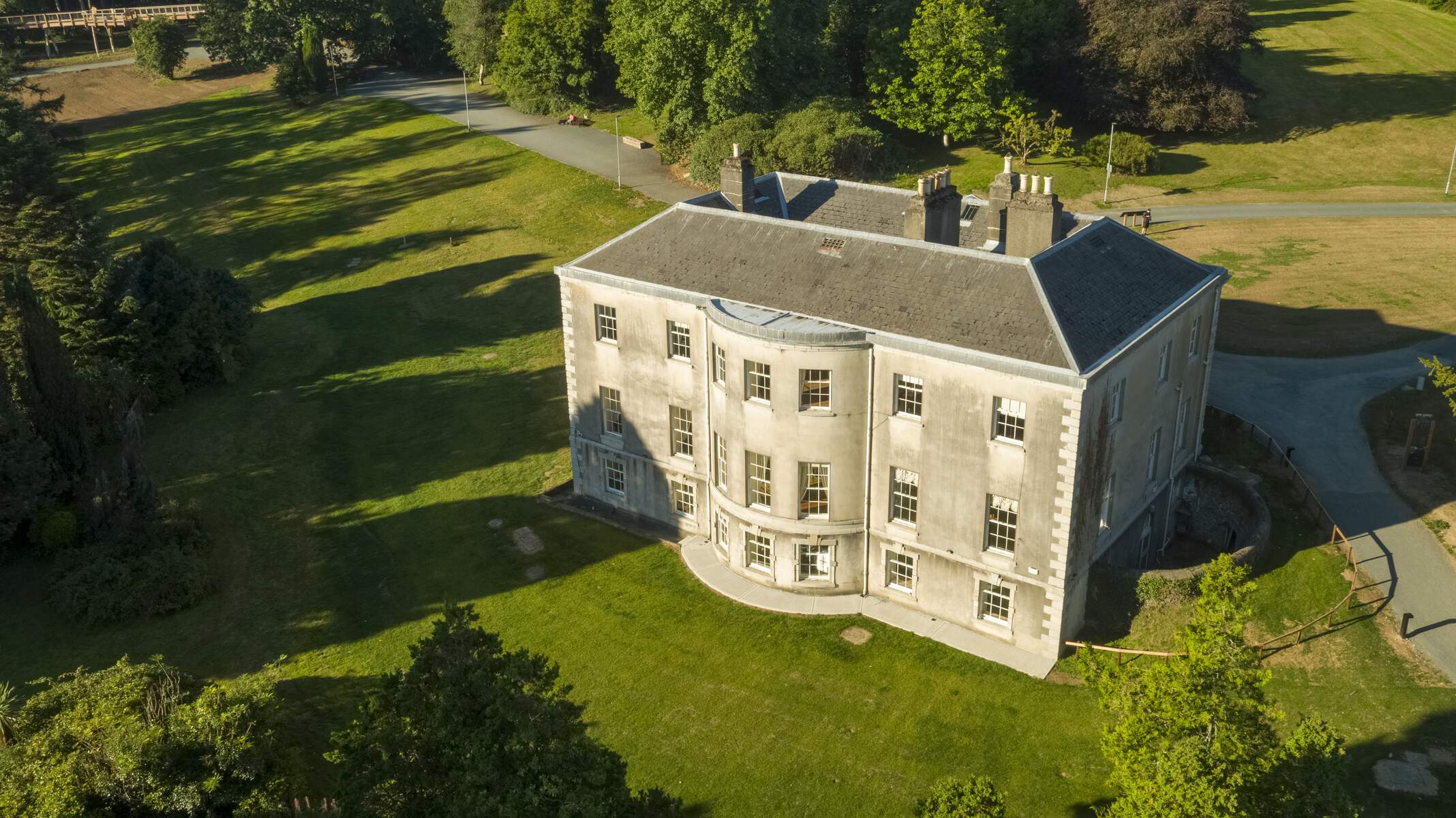
[3] https://visitgalway.ie/lisdonagh-house/ 

[4] http://landedestates.nuigalway.ie/LandedEstates/jsp/property-list.jsp?letter=L

[5] https://www.womensmuseumofireland.ie/blog/eva-oflaherty-achills-forgotten-heroine