Camolin Park, Camolin, Co Wexford – demolished

Camolin House (Park?), Camolin, Co Wexford

Mark Bence-Jones. A Guide to Irish Country Houses (originally published as Burke’s Guide to Country Houses volume 1 Ireland by Burke’s Peerage Ltd. 1978); Revised edition 1988 Constable and Company Ltd, London.

p. 55. “(Annesley, Valentia, V/PB; Caulfield, sub Charlemount V/PB) A square block of superior quality, dating from first half of C18. Good doorcase with segmental pediment. The seat of the Annesleys, Earls of Mountnorris and Viscounts Valentia, sold by them 1858. A ruin for many years, demolished ca 1974.”

No longer exists.

Featured in The Wexford Gentry by Art Kavanagh and Rory Murphy. Published by Irish Family Names, Bunclody, Co Wexford, Ireland, 1994.

p. 11. Probably the most astounding and shameful crime ever committed against a juvenile heir, was perpetrated against the young James Annesley by his greedy and covetous uncle Richard Annesley, the 5th Lord Altham, 7th Lord Valentia and 6th Earl of Anglesey, who had him sold as a slave in America.

The Wexford/Annesley connection began with the Plantation of Wexford in the early part of the 17C when Sir Francis Annesley, the Clerk of the Pells of the Exchequer received his first grant of 1000 acres (1612).  According to Loeber, writing on the Plantations in Wexford History & Society, Annesley was a shrewd and somewhat sinister figure. Loeber says “he was a peculiar man who had gained much power in Dublin, and had skilfully used his influence to amass a large estate in the Ulster plantation, as well as holdings in other parts of Ireland. Very little is known about how he financed these acquisitions. One thing is clear though; he surpassed all Wexford planters in carving out a large personal territory by acquiring four plantation estates in County Wexford, which in 1641 amounted to over 11,000 profitable acres, not to mention the unprofitable land. His fortune did not wane until the rebellion of 1641, when he and his son claimed a loss of £4,000 in yearly income and £10,000 [p. 12] in personal estate. To put these sums into perspective, 10,000 acres of land were bought for £2,000 in the 1650s in Wexford.

p. 12. Their North Wexford properties stretched from the coast near Morriscastle, where Francis built Castle Annesley, right across the county as far as Carnew and Clonegal. Camolin was another favourite seat of the family. Sir Francis was created a baronet of Ireland by patent in 1620, and Viscount Valentia in 1621. He was created Baron Mountnorris in 1628 and sat in the House of Lords. He died in 1650.

…He had seven sons and two daughters by his second wife (Jane Stanhope). At that time they lived at Mountnorris Castle at Monasoothagh, near Camolin. John, his thrid son by his first marriage was the ancestor of the Annesleys of Ballysonan, Co Kildare, one of whom married Robert Doyne of Wells, in the early 1700s. The children of the second marriage lived mainly in England and were associated with the church.

Not everything in the Annesley agenda went according to plan, however, Mountnorris incurred the displeasure of Thomas Wentworth, Earl of Strafford, in the mid 1630s and was imprisoned. He was ordered to leave all his possessions and to be shot or lose his head, at the Deputy’s pleasure. Charles I, however, intervened and ordered a reexamination fo the case in the presence of four Privy Counsellors. Lord Mountnorris was eventually released.

The Annesley connection with the Bunclody area began when the vast Kavanagh estates comprising over 10,000 acres in the Bunclody area sprawled across the Blackstairs in the two counties of Carlow and Wexford were granted to Lord Mountnorris’s son and heir, Sir Arthur Annesley, the Earl of Anglesey (along with other vast estates in Wexford and elsewhere) after the Cromwellian Confiscations in the 1650s. He was treasurer of the Navy in 1667 and lord privy seal in 1673.

p. 13. The Annesleys were unable to take actual possession of the Kavanagh estates until after the defeat of King James in 1690, when Cahir Kavanagh the last Gaelic occupant of Carrigduff Castle fled to France (Carrigduff was called after the founder of the castle, Carragh Duff Kavanagh, who built the castle in the mid 16C). 

The Earl died in 1686 and the estates passed to his sons. The bulk of his wealth passed to James Annesley who died in 1690 and the Bunclody lands were granted to another son the 1st Lord Altham. This man’s name was Altham Annesley and he inherited his title from his maternal grandmother Elizabeth, daughter and co heir of Sir James Altham. When Sir James Altham died, the title passed to the Annesleys. 

p. 14. When the first Lord Altham died in 1699 his title passed to his son James who became teh 2ndLord Altham, but as he died in infancy, he was succeeded by his uncle Rev Richard Annesley who became the third Lord Altham. Rev Richard died in 1701 and was succeeded by his son, Arthur the 4thLord Altham.

Arthur was the father of the young heir James Annesley who was kidnapped and sold into slavery. Arthur was married to Mary the daughter of the Duke of Buckinghamshire, but after her death he dissipated his wealth by drinking to excess and consorting with immoral women.

The 4th Lord Altham resided at Carrigduff Castle with his son James during the years 1721-2. In the course of the famous trial which ensued it was established that James had a tutor called James Dempsey whom Lord Altham had hired for £8 per annum.

It would appear that Lord Altham moved to Dublin, where he wasted his fortune. Young James was neglected and left to fend for himself on the streets of Dublin. His father, Lord Altham, an alcoholic, died a pauper in Inchicore in 1727, and was buried in Christ Church at public expense. Young James was about fourteen years old at the time, and a street urchin. Shortly afterwards he was shanghaied in Dublin and shipped to America, at the instigation of his uncle Richard. [Richard claimed that James was illegitimate, the son of Joan Landy]

James Annesley, (1715-1760), Claimant to the Annesley Peerage Date. after 1744 by Engraver John Brooks, after artist Justin Pope-Stevens, courtesy of National Gallery of Ireland.

Richard was a conniving schemer who wanted to get his hands on the Annesley estates.

After spending 13 years in captivity, James eventually escaped to Jamaica and from there made his way back to England, where he initiated court proceedings for the return of his lands and title. However, the court proceedings dragged on for years and James died or was poisoned before any definite ruling was made by the judges, and his uncle Richard, now the 5th Earl of Anglesey, retained his titles and estates. [The Peerage: In 1728 he opposed his father’s raising money to fund a spendthrift way of life, hence apparently he was removed to an obscure school, and then his death announced. He was sold to an American planter as a slave by his uncle, Richard (who went on to assume his title of Baron Altham). He subsequently escaped to Jamaica. In 1737 he was de jure 5th Baron Altham, 7th Viscount of Valentia and 6th Earl of Anglesey (as which would normally have succeeded his father’s 1st cousin on latter’s death.) In September 1740 he made his way back to England under the care of Admiral Vernon. On 11 November 1743 he took action against his uncle, Richard, to eject him as Baron Altham. His uncle’s defence was that James was not the legitimate son of Mary, but actually the illegitimate son of Joan Landy. The verdict was in James’ favour, and his estates were returned to him, although he never took up his titles. On 26 November 1743 the jury disagreed and found for the plaintiff, who got back the family estates. On 3 August 1744 his uncle was in addition found guilty of assault on his nephew (i.e., presumably the selling into slavery.) He has an extensive biographical entry in the Dictionary of National Biography.]

p. 15. Of course the plot sketched above, was much thicker than stated. During the litigation about the estates James accidentally shot a man standing near him with a faulty fowling gun. At the urging of his uncle he was tried for murder and Uncle Richard actually sat on the bench with the magistrates and browbeat the witnesses who appeared for the defence. However, James was acquitted and Richard had to resort to other means. He had him attacked at a race meeting by a gang of hired thugs, but James managed to escape while several of his companions were seriously injured. In another incident a clerk carrying important legal papers which would prove James to be the heir, was murdered and he and the papers disappeared. Witnesses in the case were bribed and perjured themselves but all to no avail. The court found in favour of James. The wily uncle now got a ‘writ of error’ which had the effect of setting aside the verdict and before a new trial could be brought, James died.

p. 15. Arthur [the 1st Earl of Anglesey, created in 1661] was an energetic and able man, who increased the family holdings by his astute dealings. He went to England and joined the Parliamentarians in opposition to Charles I. He returned to Ireland in the service of the Parliamentarians. After the Confiscations he acquired much of the Kavanagh forfeited lands in North Wexford and a considerable amount of the Masterson lands also, in addition to the O’Morchoe lands in Kilmuckridge and the Waddock or Maddock lands north of Gorey. In 1667 he tried to have the Kavanagh lands of Ferns granted to himself and as an inducement he mentioned in his letter to the Lord Deputy that he would be able to invite his Lordship to some of the best hunting grounds in the kingdom if he were given the lands about Ferns. He seems to have [p. 16] maintained a private army and in 1662 twentyfive of its cavalry were stationed at Enniscorthy, twenty in Gorey and six at Camolin. He owned more than 30,000 acres in Co Wexford. Sir Arthur died in 1686.

Arthur Annesley (1614-1686) 1st Earl of Anglesey, after John Michael Wright based on a work of 1676, NPG 3805.

p. 16. Sir James, the eldest son and heir, the 3rd Viscount Valentia and the 2nd Earl of Anglesey married Elizabeth the daughter of the Earl of Rutland.

P. 17. Sir Richard (6th Earl)’s extravagant lifestyle and probably his alcoholism forced him to sell off large tracts of his lands including the Kilmuckridge lands, the first estate to be acquired by his great grandfather. He was an MP for New Ross in 1718 and it would appear he lived at Dunmain, which was rented from the Colcloughs, for a number of years. He died in 1761.

p. 18. [1st Baron MOuntnorris]’s daugther Hester married Major Gen. Norman Macleod and it was her son Arthur Lyttleton who inherited the Annesley estates and titles and changed his name to Annesley.

P. 18. The Earl of Mountnorris was the man who devised and encouraged the surrendering of arms by the Catholics in 1798, in return for letters of protection. This was done in an attempt to calm the countryside on the eve of the rebellion. He was also the commander of the Camolin Cavalry, which sparked the rebellion, by the rash actions of the members in Boolavogue. However Mountnorris himself was absent in Dublin at the time, and could not be blamed for the incident. His house in Camolin was one of the first to be attacked, because of the large store of weapons, which, when collected, were deposited there for safe keeping. Ironincally, he was one of the “Virtuous and Independent Forty Five” who voted against the establishment in 1793. He favoured granting emancipation to the Catholics.

Only one of his sons produced an heir, George Annesley his second son who married Anne the 6th daughter of Lord Courteney and had a son George Arthur, Lord Valentia. 

p. 19. The family seat, Camolin Park, with its 700 acres in demesne, was sold off in 1852 and twenty years later the rest of hte family’s Wexford lands were disposed of, in the Landed Estates Court.

Listed in Vanishing Country Houses of Ireland by The Knight of Glin, David J. Griffin and Nicholas K. Robinson, published by The Irish Architectural Archive and The Irish Georgian Society, 1988. 

https://www.buildingsofireland.ie/buildings-search/building/15609013/camolin-house-camolin-county-wexford

Gateway, extant 1903, on a symmetrical plan comprising pair of cut-granite monolithic piers on stepped plinths having shallow pyramidal capping supporting finial-topped wrought iron double gates with benchmark-inscribed cut-granite monolithic outer piers having rounded capping supporting wrought iron railings. Street fronted at entrance to grounds of Camolin House. 

A gateway forming part of a neat self-contained group alongside an adjacent gate lodge (see 15609012) with the resulting ensemble not only making a pleasing visual statement in a rural village street scene, but also surviving as an interesting relic of the Camolin House estate following the demolition (1967) of the eponymous country house rebuilt (1864-5) for Arthur William Grattan Guinness (1827-69) to a design by Sir Thomas Newenham Deane (1827-99) of Upper Merrion Street, Dublin (O’Dwyer 1997, 389). 

https://landedfamilies.blogspot.com/search/label/Wexford

Camolin Park, Co. Wexford 

A seven bay two-storey early 18th century house with a steep central pediment over the central three bays, and a good central doorcase with a segmental pediment.  It was presumably built for Arthur Annesley, 5th Earl of Anglesey, who is known to have spent much of his time in Ireland at this property. Sir John Soane made proposals for the addition of wings and a large portico in 1814-15, but they do not appear to have been executed, perhaps because of the death of the 1st Earl of Mountnorris the following year. The house was burnt in 1913 and thereafter fell into ruins and was demolished altogether in about 1974.  

The only substantial survival is the large U-shaped stable block of the 1770s, which was remodelled in 1904 and restored in 2003, although proposals for residential conversion since 2009 would, if executed, compromise its historic value. 
 
Descent: sold 1662 to Arthur Annesley (1614-86), 1st Earl of Anglesey; to son, James Annesley (c.1645-90), 2nd Earl of Anglesey; to son, James Annesley (1674-1702), 3rd Earl of Anglesey; to brother, John Annesley (1676-1710), 4th Earl of Anglesey; to brother, Arthur Annesley (1677-1737), 5th Earl of Anglesey; to cousin, Richard Annesley (1693-1761), 6th Earl of Anglesey; to son, Arthur Annesley (1744-1816), 8th Viscount Valentia and 1st Earl of Mountnorris; to son, George Annesley (1770-1844), 2nd Earl of Mountnorris; to nephew, Capt. Arthur Lyttelton Macleod (later Annesley) (1802-82), who sold 1852 to James Foster (d. 1853); to nephew, William Orme Foster (1814-99); to son, William Henry Foster (b. 1846), who let the house as a College of Forestry and sold it in the early 20th century; burnt 1913 and demolished 1974. 
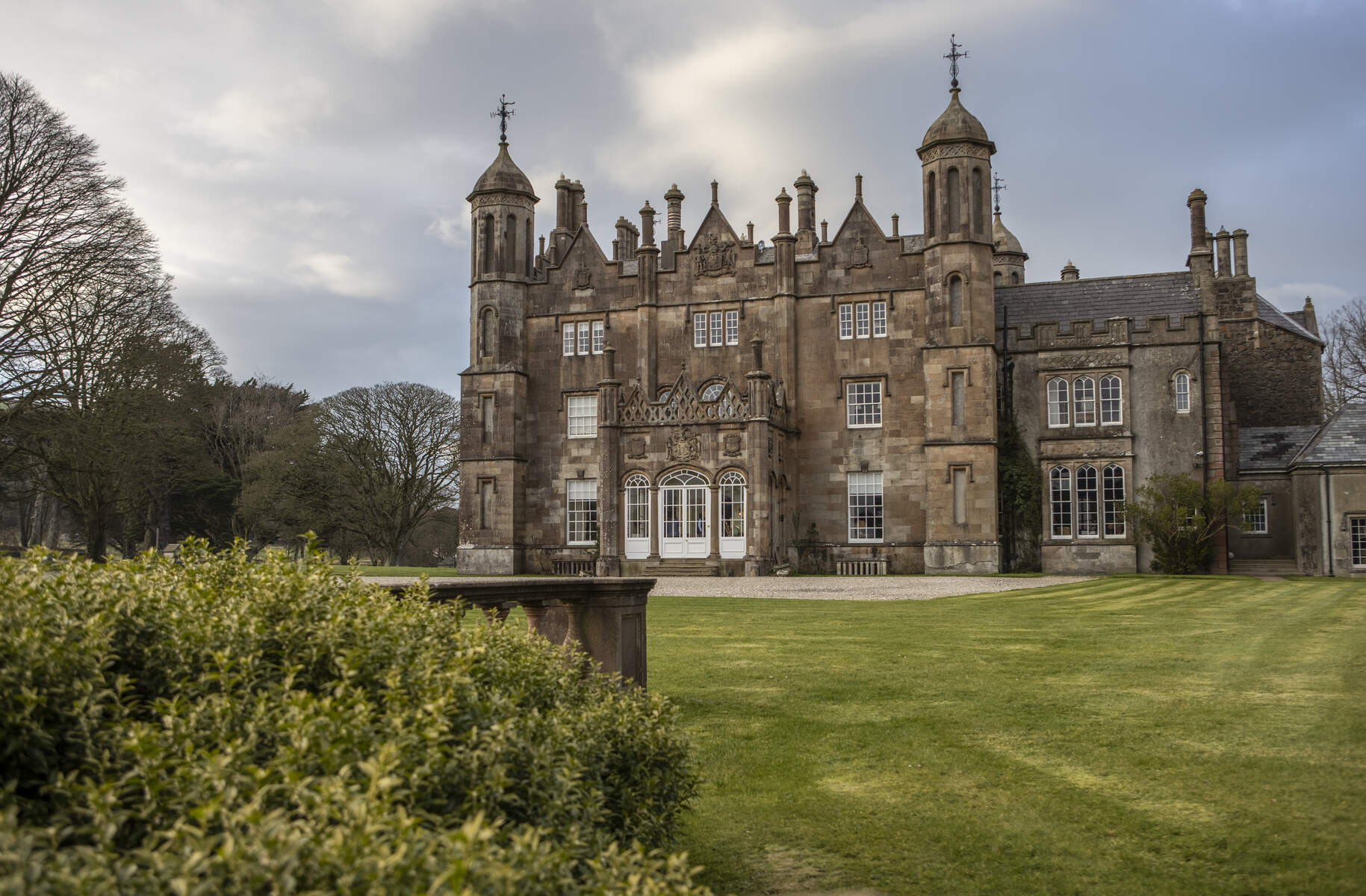
Glenarm Castle, County Antrim, Northern Ireland – private, can book a tour

https://glenarmcastle.com

Glenarm Castle & Garden, photo by Donal Maloney 2021 for Tourism Ireland [1]

Sorry, this is another re-publishing, as it was previously published on my “Places to Visit in County Antrim” page. Stephen and I have still been too busy this year to visit more Section 482 properties. Heritage Week is coming up next month, August 17-24th, so all of the Section 482 properties should be open – see my home page for details, https://irishhistorichouses.com/

I hope Stephen and I can visit many properties this year during Heritage Week!

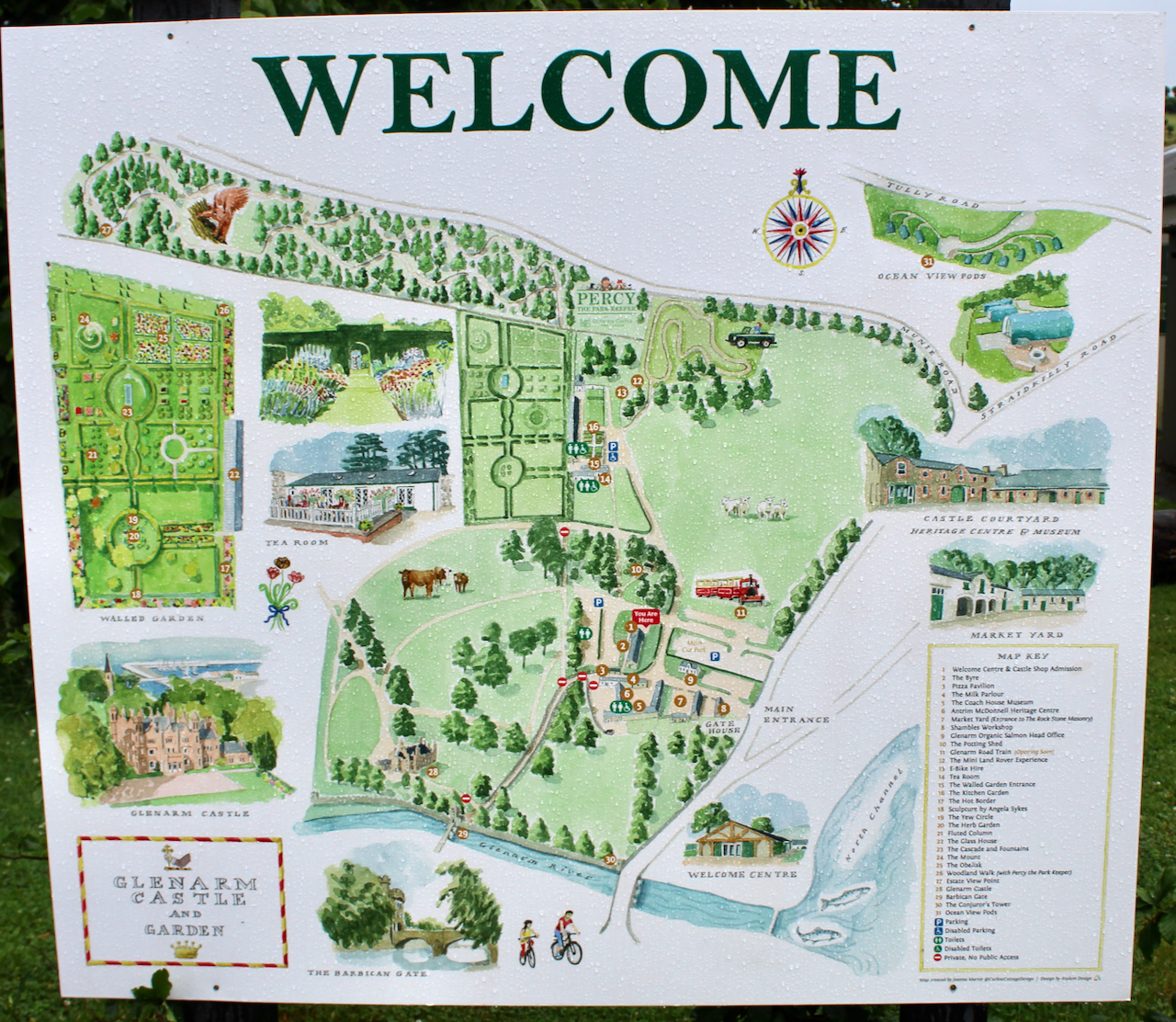
The website tells us that Glenarm Castle is one of few country estates that remains privately owned but open to the public. It is steeped in a wealth of history, culture and heritage and attracts over 100,000 visitors annually from all over the world. 

Photograph © Jennifer Winder-Baggot, www.irishhistorichouses.com

Visitors can enjoy enchanted walks through the Walled Garden and Castle Trail, indulge in an amazing lunch in the Tea Room, purchase some local produce or official merchandise, or browse through a wide range of ladies & gents fashions and accessories and a selection of beautiful gifts, souvenirs and crafts in the Byre Shop and Shambles Workshop – with many ranges exclusive to Glenarm Castle.

Glenarm Castle is the ancestral home of the McDonnell family, Earls of Antrim. The castle is first and foremost the private family home of Viscount and Viscountess Dunluce and their family but they are delighted to welcome visitors to Glenarm Castle for guided tours on selected dates throughout the year.

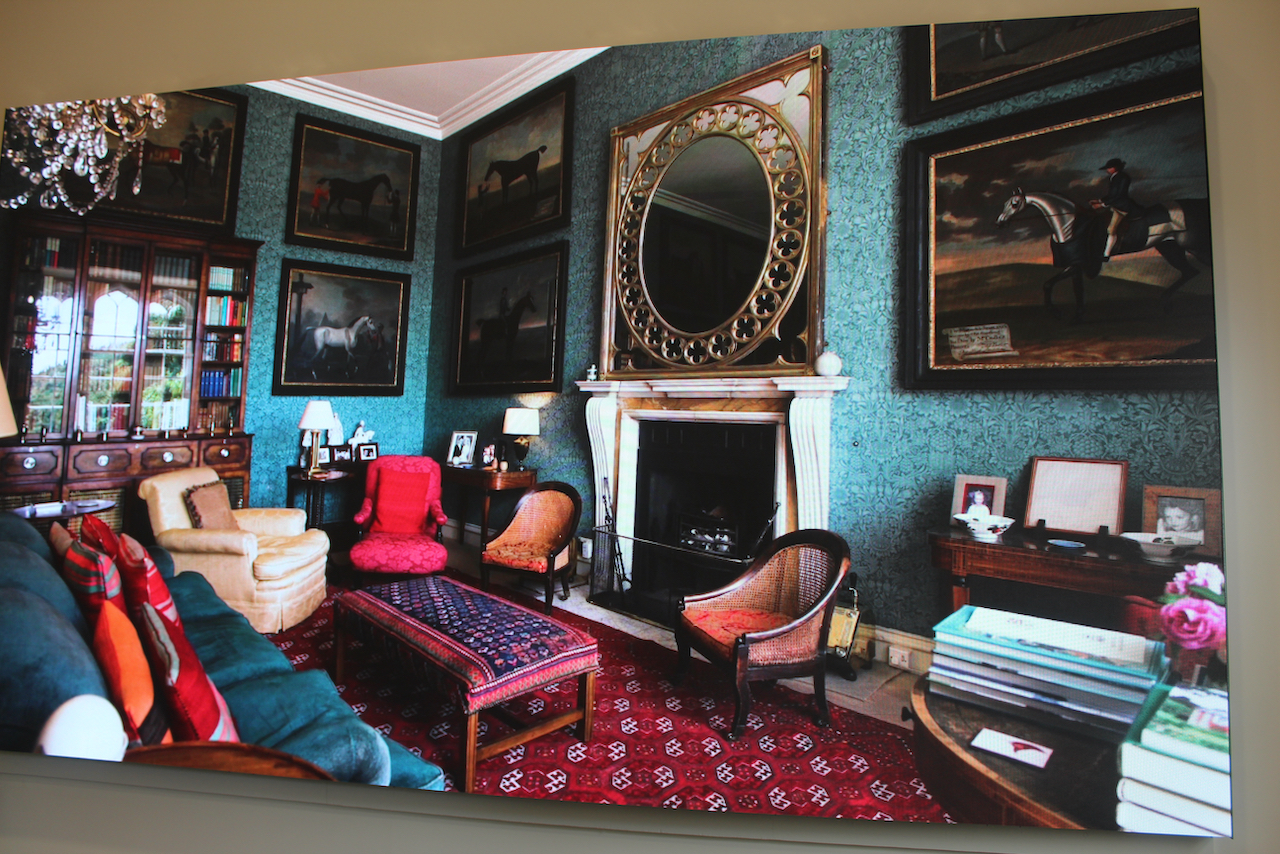
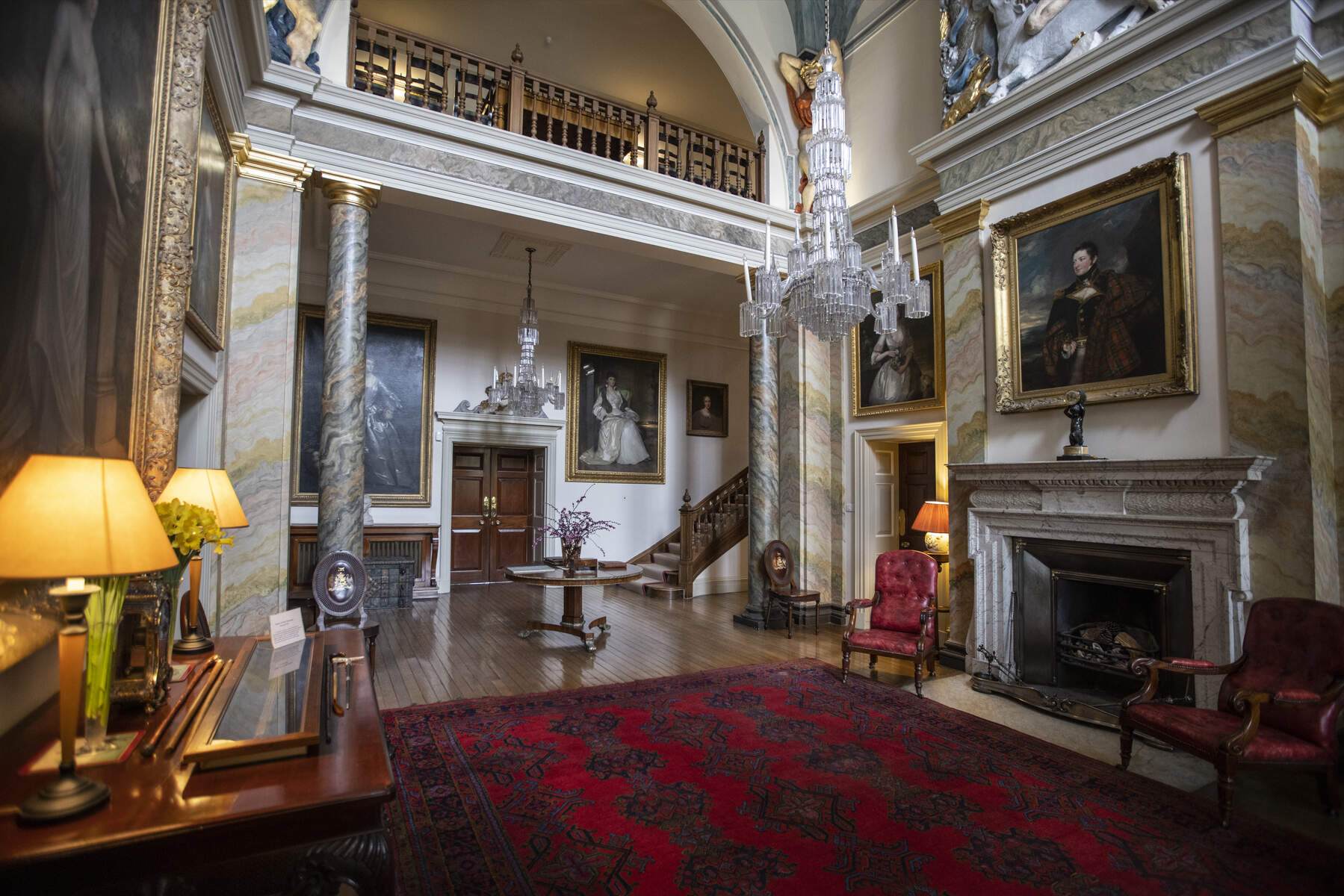
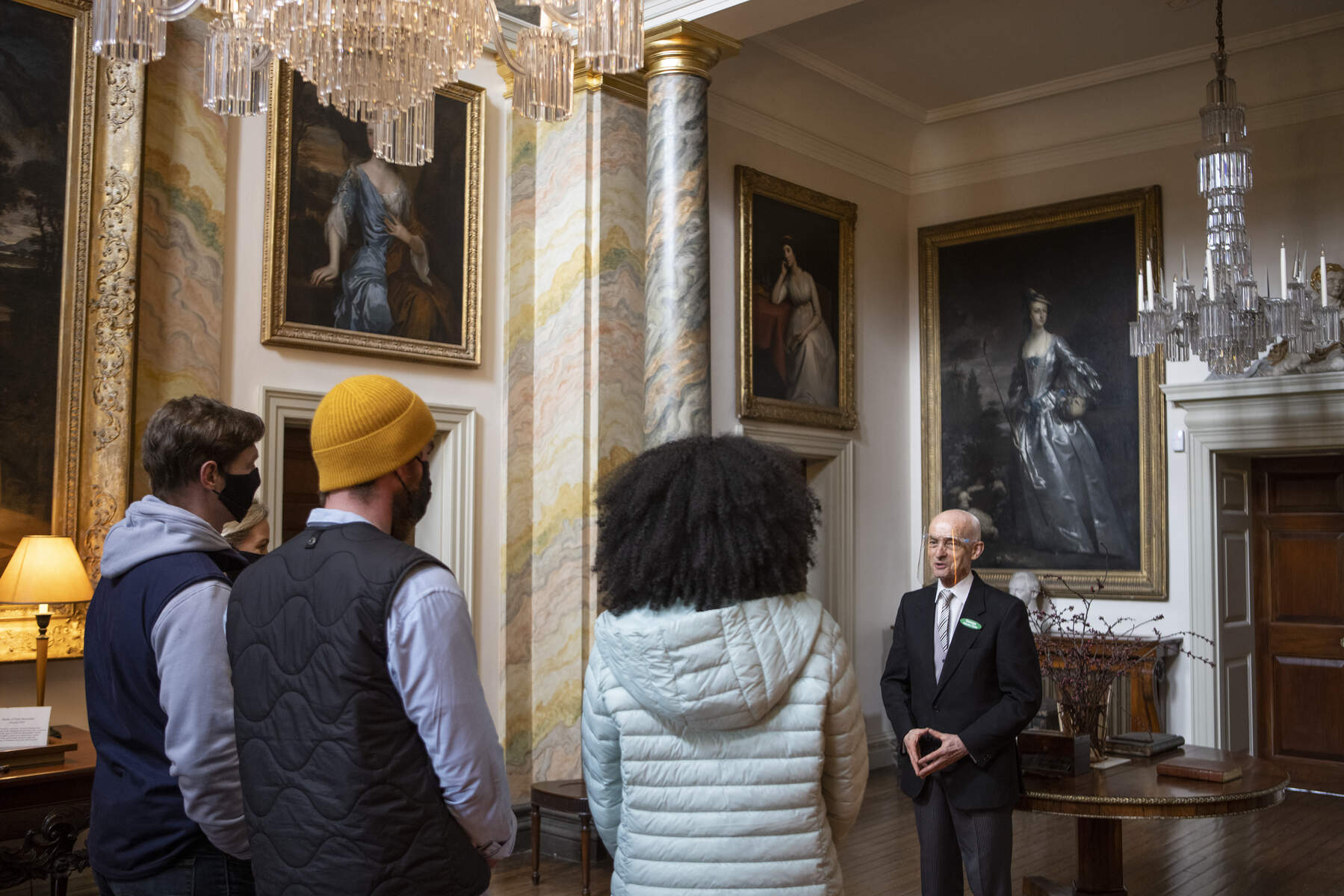
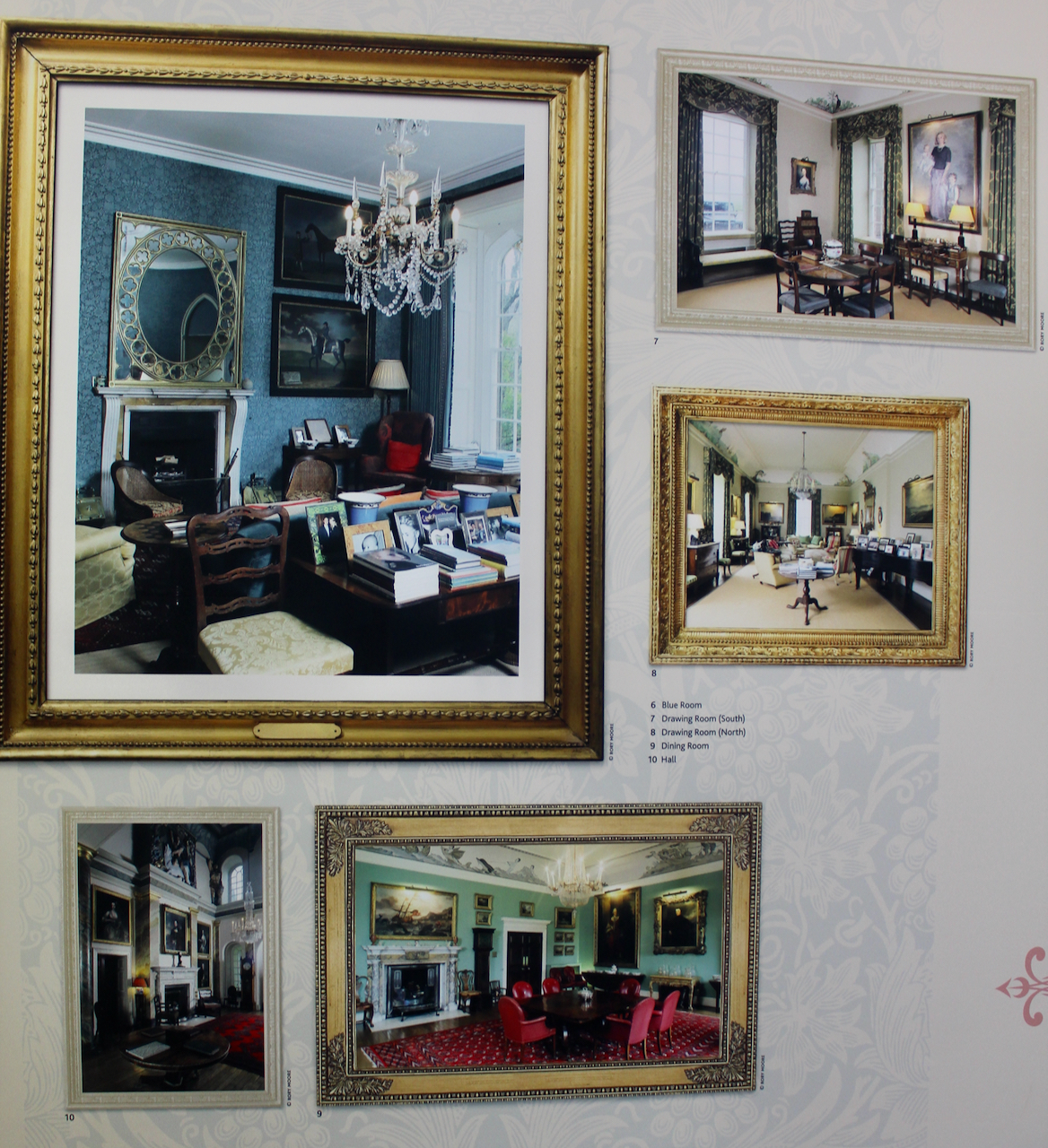
Delve deep into the history of Glenarm Castle brought to life by the family butler and house staff within the walls of the drawing room, the dining room, the ‘Blue Room’ and the Castle’s striking hall. 

Finish the day with the glorious sight of the historic Walled Garden, which dates back to the 17th century.

Dates are limited and booking in advance is required.  

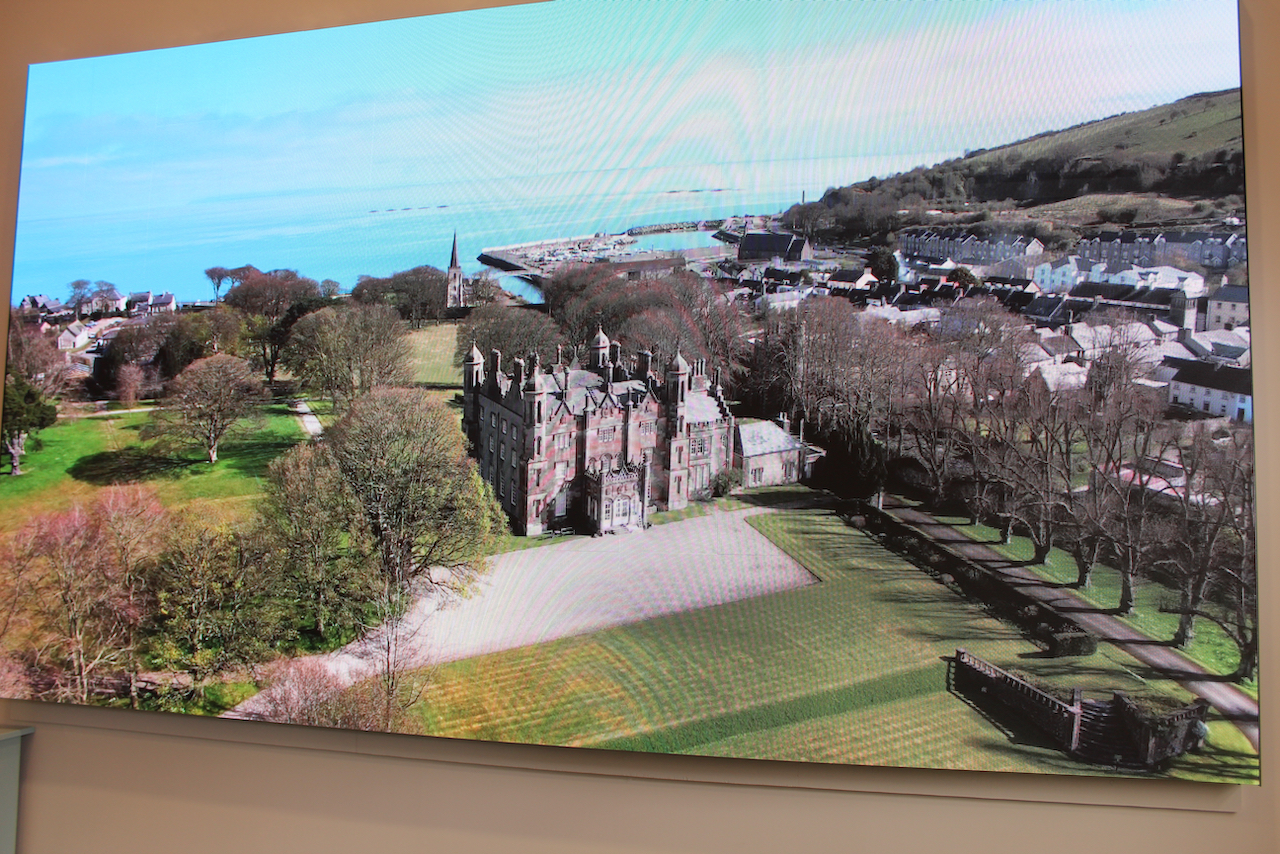
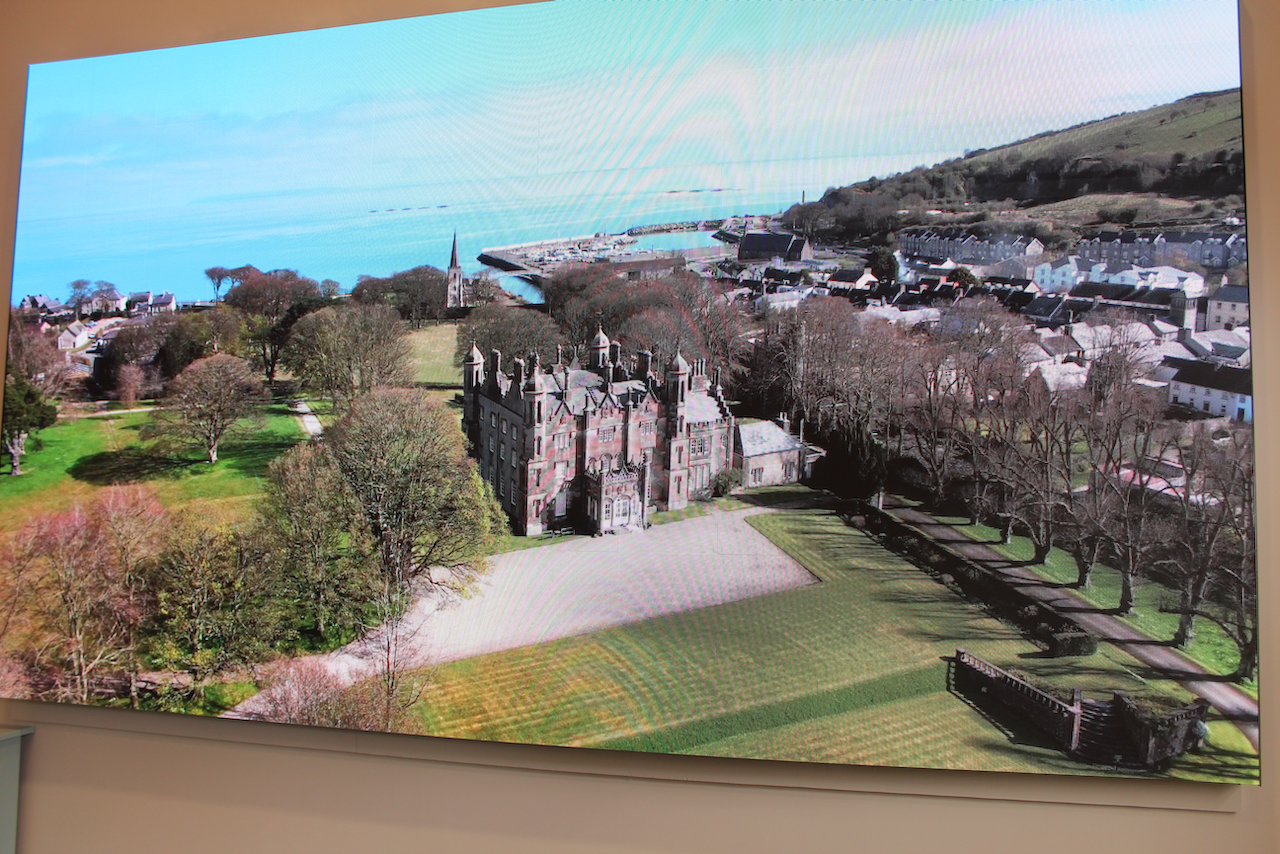
An image of Glenarm Castle from the slideshow in the museum.
Glenarm Castle, June 2023. Photograph © Jennifer Winder-Baggot, www.irishhistorichouses.com
Information board at Glenarm.

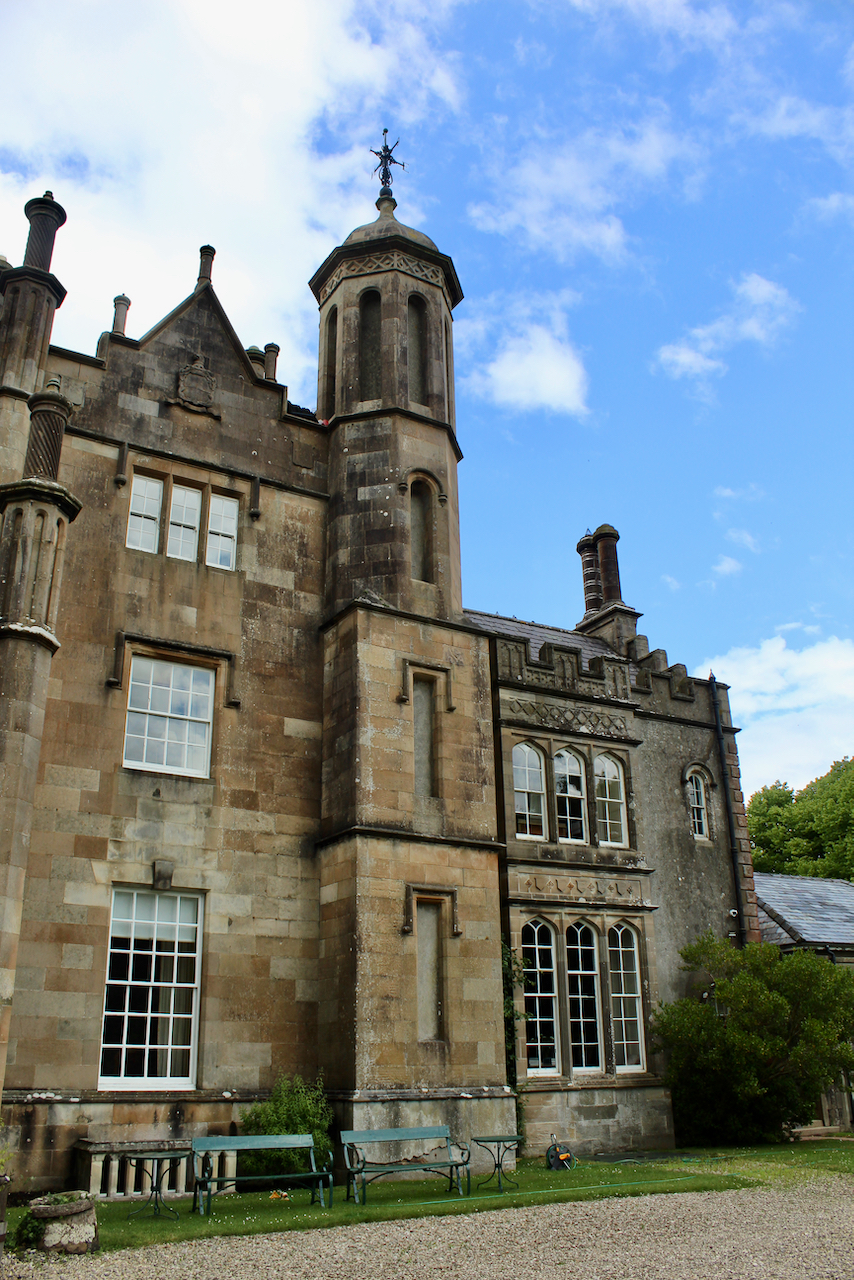
The castle was built around 1603 by Randal MacDonnell [1610-1682], afterwards 1st Earl of Antrim, as a hunting lodge or secondary residence to Dunluce Castle, and became the principal seat of the family after Dunluce Castle was abandoned. The mansion house was rebuilt ca. 1750 as a 3-storey double gable-ended block, joined by curving colonnades to two storey  pavilions with high roofs and cupolas. This would have been during the life of the 5th Earl of Antrim, Alexander MacDonnell (1713-1775).

Glenarm Castle, June 2023. Photograph © Jennifer Winder-Baggot, www.irishhistorichouses.com

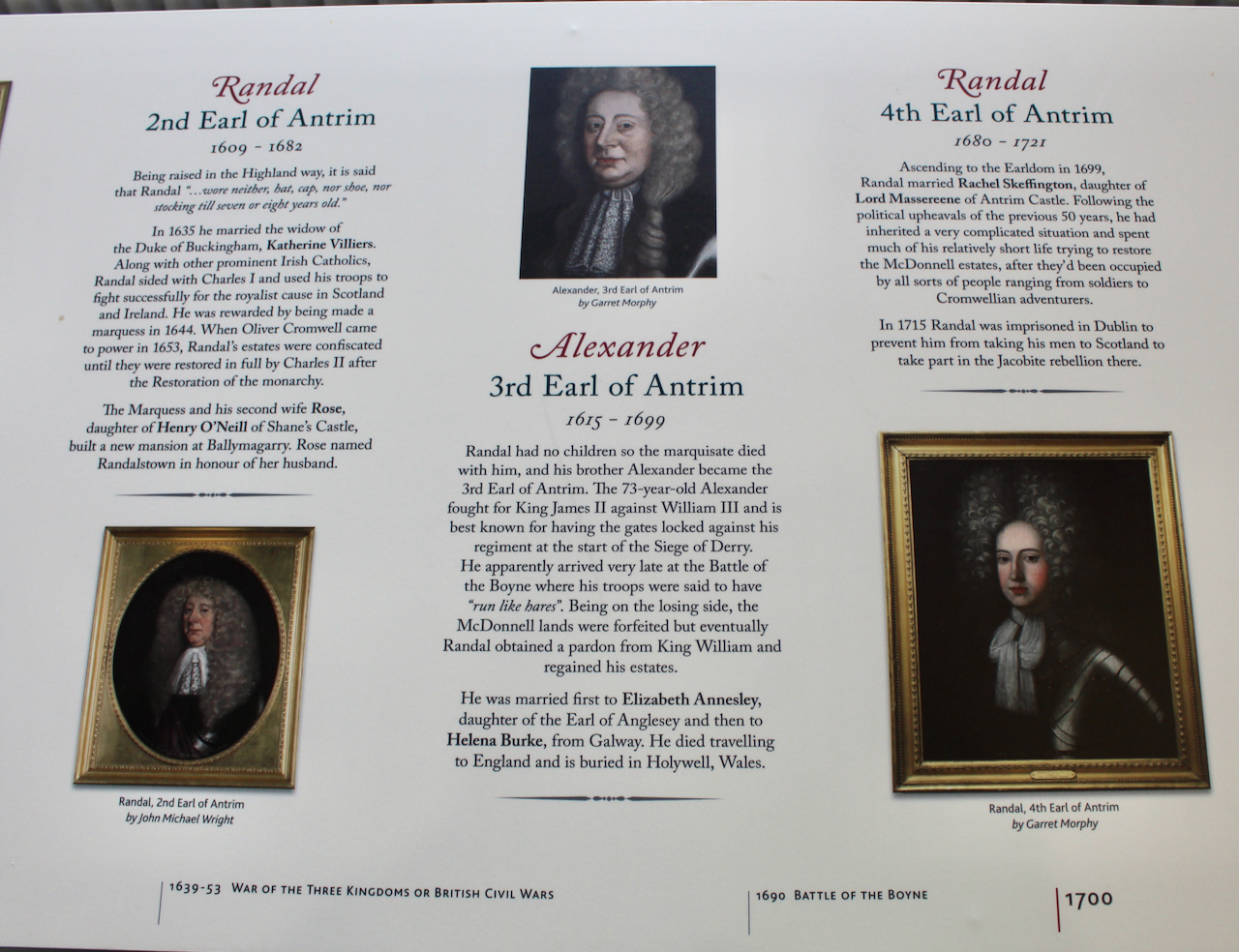
We learned of the 1st and 2nd Earls of Antrim on our visit to Dunluce Castle in Antrim. When the 2nd Earl died in 1682 his brother Alexander (1615-1699) became 3rd Earl of Antrim. He first married Elizabeth Annesley, daughter of the 1st Earl of Anglesey.

Arthur Annesley (1614-1686) 1st Earl of Anglesey, after John Michael Wright based on a work of 1676, National Portrait Gallery of London 3805.

Elizabeth née Annesley died in 1672 and Alexander married Helena Burke. Their son Randal (1680-1721) became the 4th Earl of Antrim.

Photograph © Jennifer Winder-Baggot, www.irishhistorichouses.com

The 4th Earl married Rachael Skeffington, daughter of Clotworthy, 3rd Viscount Massereene, Co. Antrim, of Antrim Castle. The 4th Earl of Rachael had a son Alexander MacDonnell (1713-1775) who succeeded as 5th Earl of Antrim. It was during his time that the castle was enlarged. He was a Privy Counsellor and Governor of County Antrim.

Ballymagarry, where the Earls lived after Dunluce Castle, burned down in 1750, so in 1756 the 5th Earl of Antrim invited an engineer from Cumbria called Christopher Myers to come to Glenarm to rebuild the ruin. Myers transformed it into a grand Palladian country house with curving colonnades ending in pavilions on either side, one of which contained a banqueting room. The lime trees that now arch over the driveway were planted and gardens were planned in a network of walled enclosures.

Alexander the 5th Earl married Elizabeth Pennefather, daughter of Matthew, MP for Cashel and Comptroller and Accountant-General for Ireland. She died, however, in 1736, and he married Anne Plunkett in 1739.

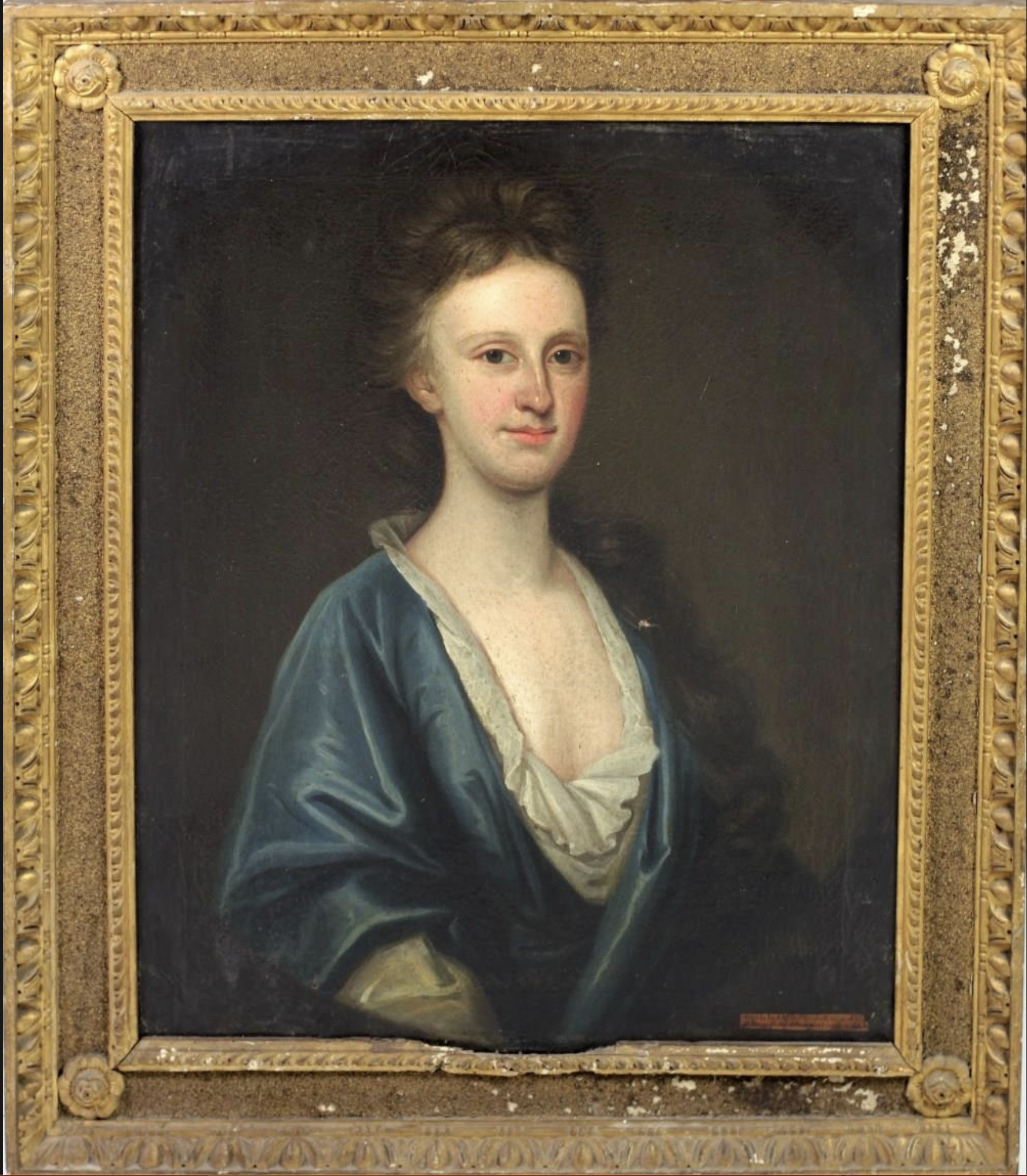
“Miss Anne Plunkett, niece of the first Lord Aldborough, Countess of Antrim,” 18th Century Irish School , courtesy of Fonsie Mealy Fortgranite. She was the daughter of Charles Patrick Plunkett of Dillonstown, County Louth and Elizabeth Stratford. She married Alexander MacDonnell the 5th Earl of Antrim.

Anne née Plunkett gave birth to the heir, Randal William (1749-1791), who later became the 6th Earl of Antrim. Anne died when Randall was just six years old, so Alexander married again, this time to Catherine Meredyth, daughter of Thomas of Newtown, County Meath. She had been previously married to James Taylor (1700-1747), son of Thomas 1st Baronet Taylor, of Kells, Co. Meath.

Information board about the 5th and 6th Earls of Antrim.
This room in Glenarm Castle has portraits of many of the 5th Earl’s horses. Photograph is from the slideshow in the museum.
Glenarm Castle. Photograph © Jennifer Winder-Baggot, www.irishhistorichouses.com

The 6th Earl served as MP for County Antrim as well as High Sheriff for the county. Randall William MacDonnell married Letitia Morres, daughter of Hervey Morres 1st Viscount Mountmorres of Kilkenny. They had no sons.

Randall William was created 1st Viscount Dunluce [Ireland] and 1st Earl of Antrim [Ireland] on 19 June 1785, with special remainder to his daughters in order of seniority. This meant that his daughters became Countesses of Antim in their own right. He then served as Privy Counsellor for Ireland. He was created 1st Marquess of Antrim [Ireland] on 18 August 1789 but this title died with him, along with the two earlier creations of Earl of Antrim and Viscount Dunluce.

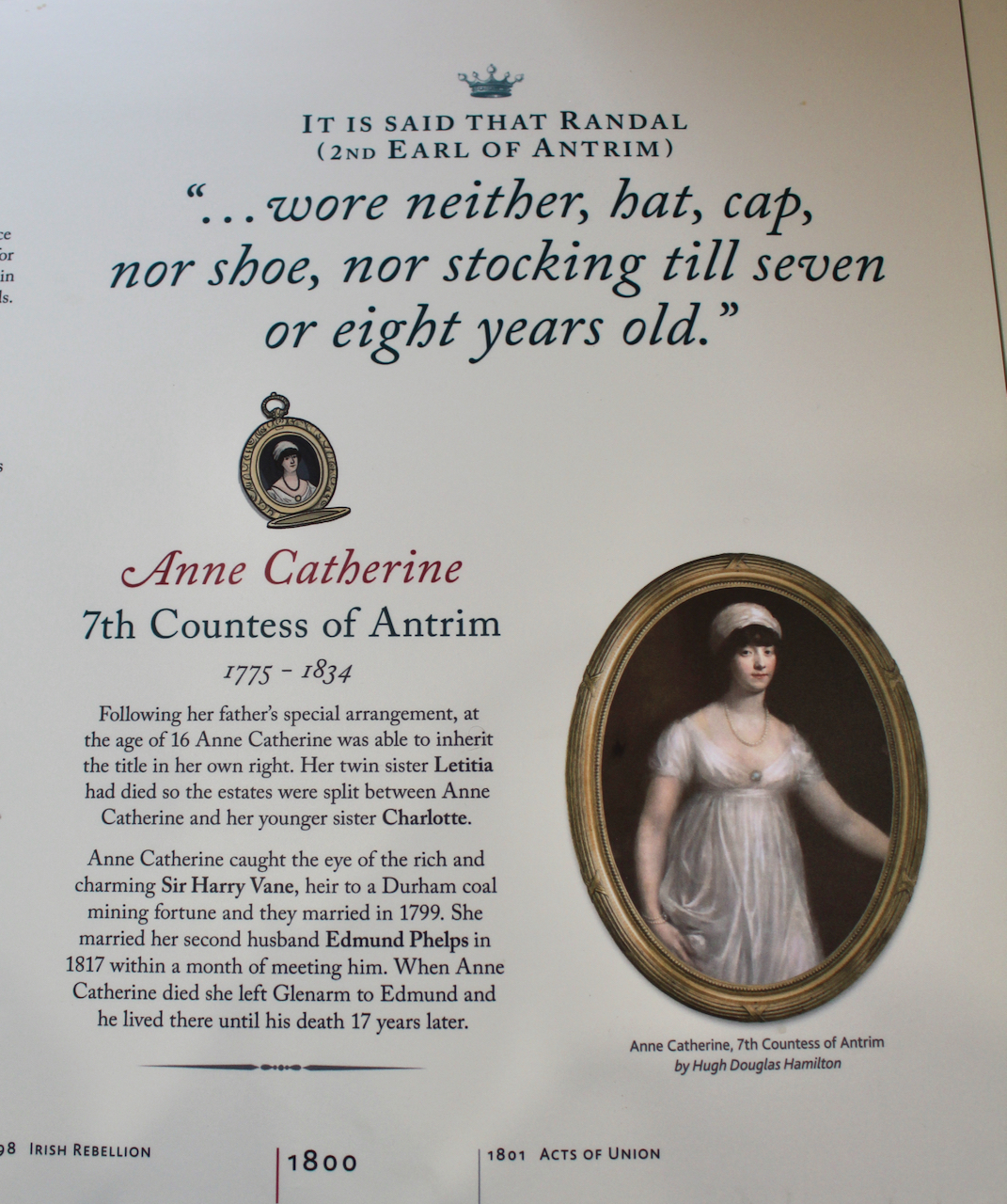
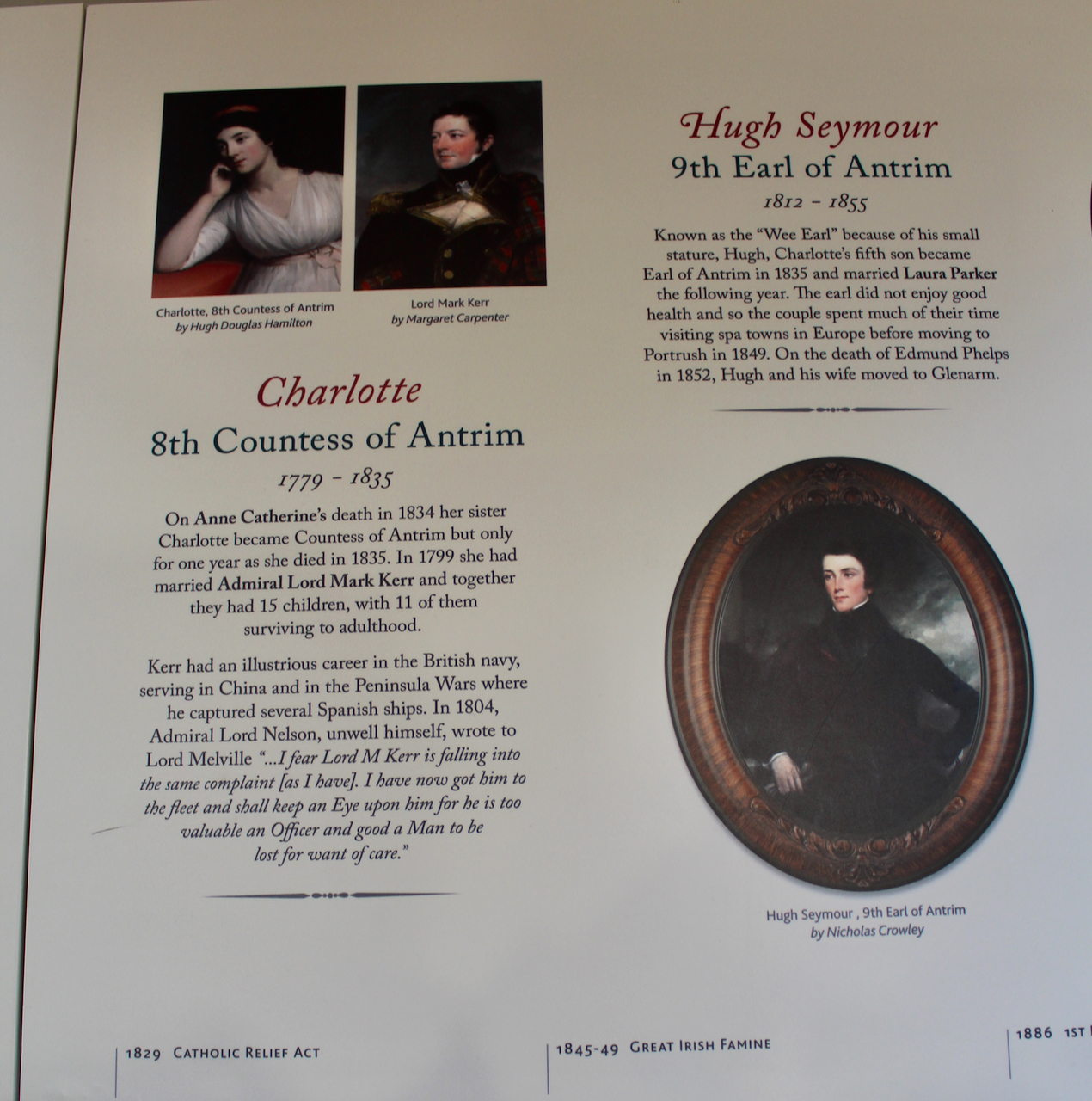
His eldest daughter Anne Catherine (1778-1834) became 2nd Countess of Antrim in 1791 when her father died. Anne Catherine’s sister Letitia Mary predeceased her. When Anne Catherine died in 1834 her sister Charlotte became 3rd Countess of Antrim. Charlotte’s sons became the 4th and 5th Earls of Antrim (the Countesses being in lieu of the 2nd and 3rd Earls). The descendants still live in the castle.

See also the blog of Timothy William Ferres. [2]

Information about Anne Catherine (1775-1834), Countess of Antrim.
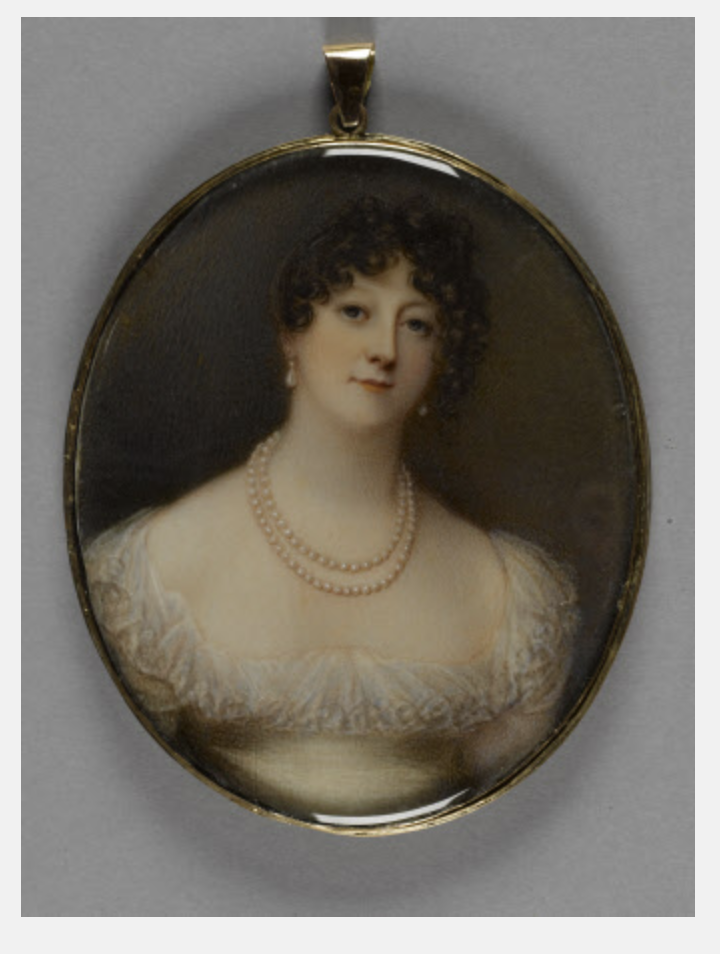
Anne Katherine MacDonnell, 2nd Countess of Antrim (1778-1834) by Anne Mee, watercolour painting on ivory.
Information board about Elizabeth Catherine, Countes of Antrim.
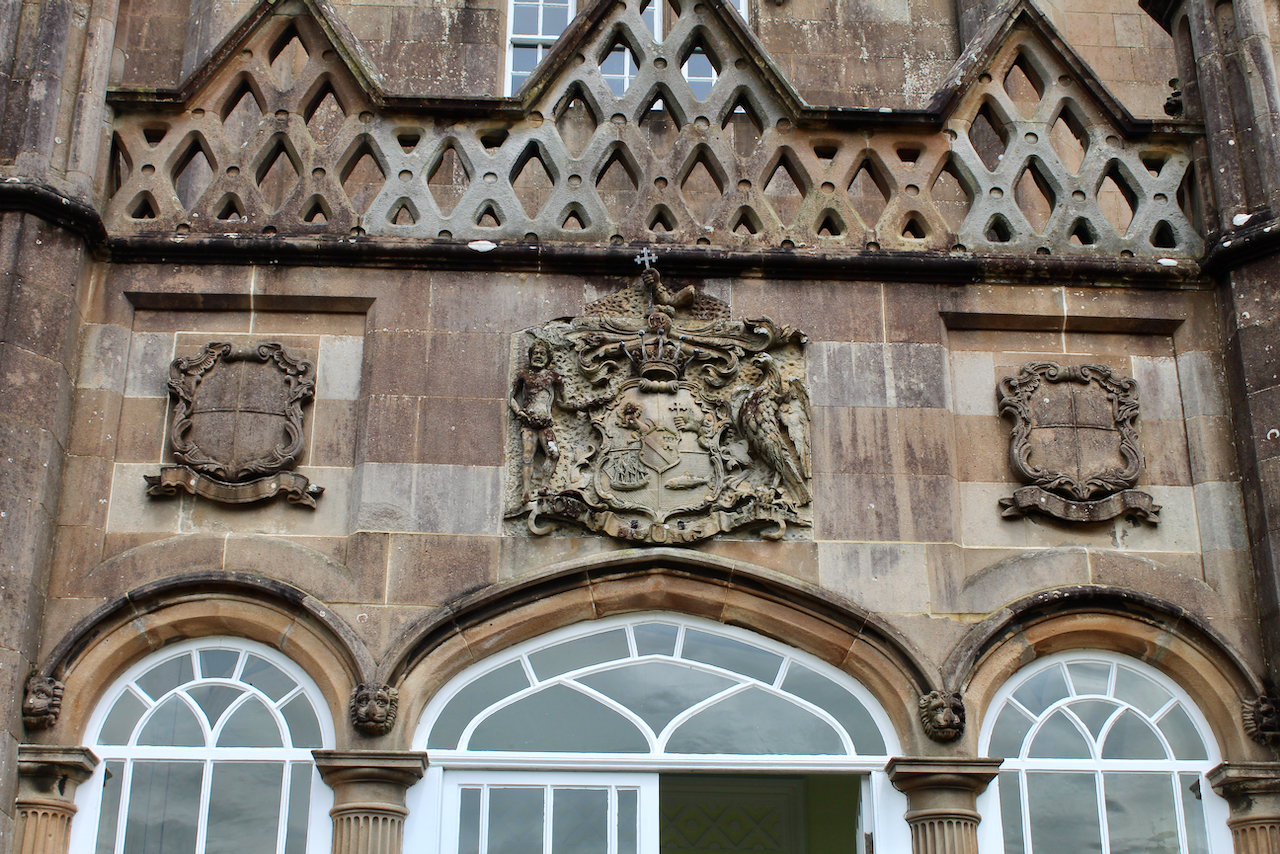
Crest on the front of the house at Glenarm Castle. See also the lions heads over the windows. Photograph © Jennifer Winder-Baggot, www.irishhistorichouses.com

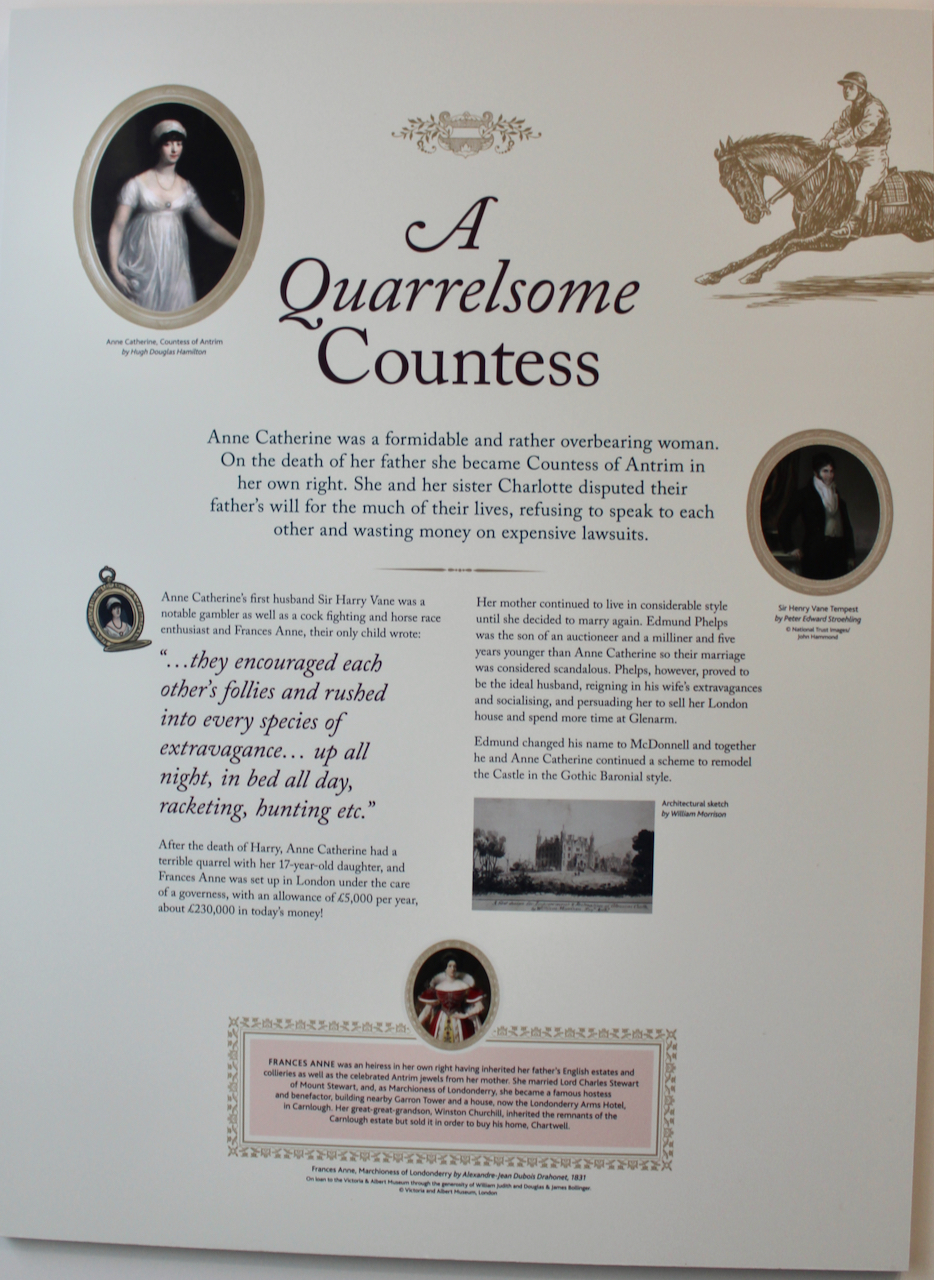
Anne Catherine married first Henry Vane-Tempest (1771-1813) 2nd Baronet Vane, of Long Newton, Co. Durham. They had a daughter, Frances Anne Emily Vane-Tempest, who married Charles William Vane, 3rd Marquess of Londonderry. Harry Vane-Tempest decided to ‘Gothicise’ the building. The colonnades and pavilions were demolished and Gothic windows installed. When he died, Anne Catherine married Edmund Phelps, who assumed the name of MacDonnell.

Anne Catherine and Edmund hired William Vitruvius Morrison to enlarge Glenarm.

Mark Bence-Jones writes in his  A Guide to Irish Country Houses (1988):

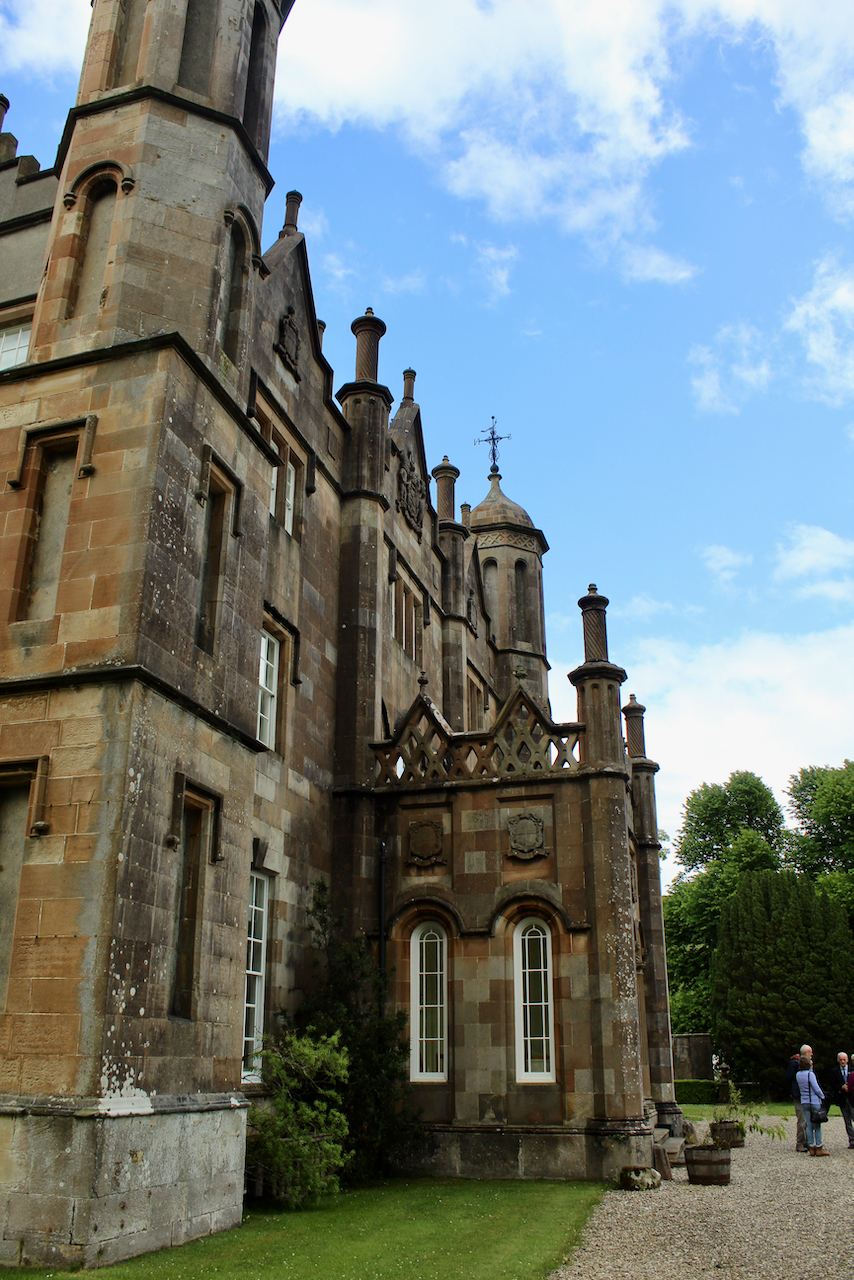
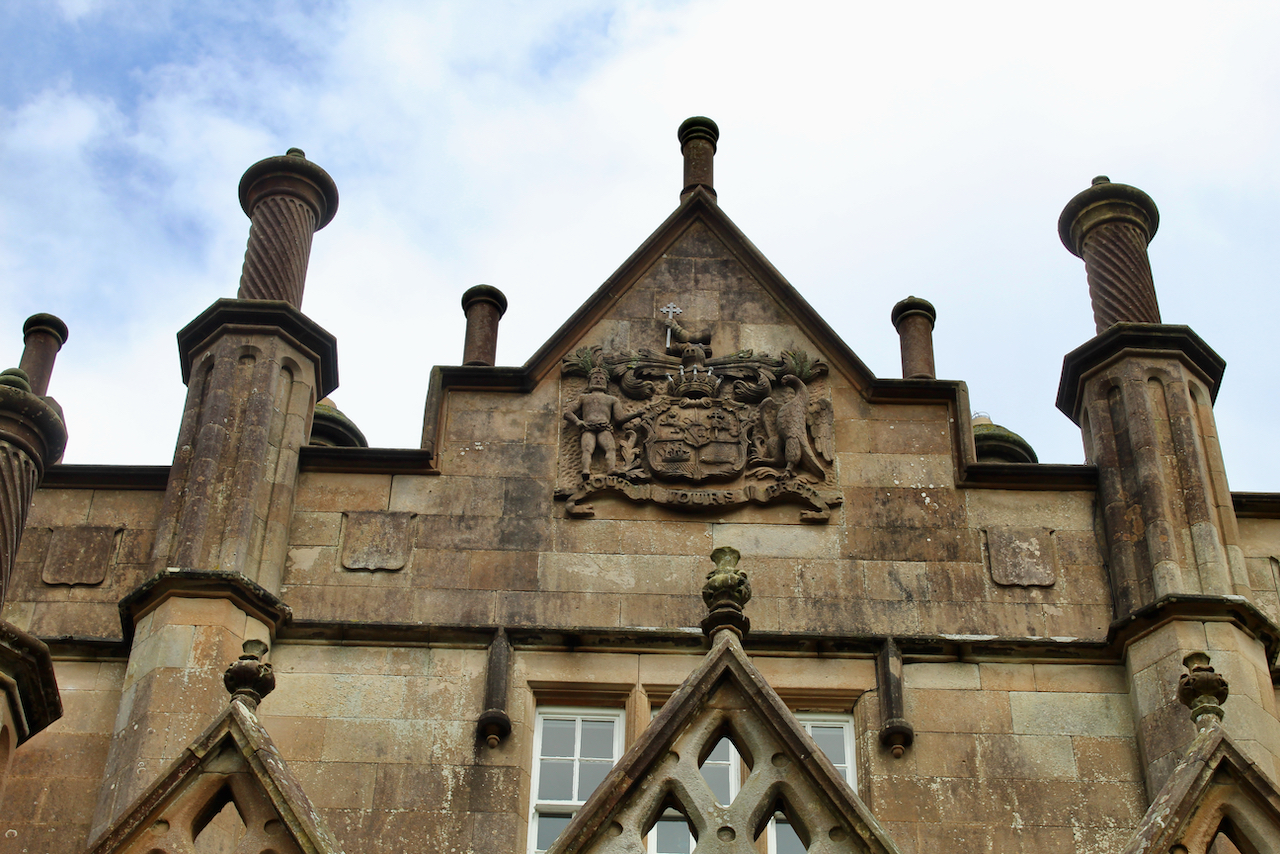
p. 135. “(McDonnell, Antrim, E/PB) The main block had a pedimented breakfront with three windows in the top storey, a Venetian window below and a tripartite doorway below again, flanked on either side by a Venetian window in each of the two lower storeys and a triple window above. The pavilions were of three bays. Ca. 1825, the heiress of the McDonnells, Anne, Countess of Antrim in her own right, and her second husband [Edmund Phelps], who had assumed the surname of McDonnell, commissioned William Vitruvius Morrison to throw a Tudor cloak over Glenarm. He did very much the same as he had done at Borris, Co Carlow and Kilcoleman Abbey, Co Kerry; adding four slender corner turrets to C18 block, crowned with cupolas and gilded vanes; he also gave the house a Tudor-Revival façade with stepped gables, finials, pointed and mullioned windows and heraldic achievements, as well as a suitably Tudor porch. The other fronts were also given pointed windows and the colonnades and pavilions were swept away, a two storey Tudor-Revival service wing being added in their stead.” [3]

A photograph of Glenarm Castle from the museum slideshow.
Glenarm Castle, June 2023. Photograph © Jennifer Winder-Baggot, www.irishhistorichouses.com
Glenarm Castle. Photograph © Jennifer Winder-Baggot, www.irishhistorichouses.com
A crest on Glenarm Castle. Photograph © Jennifer Winder-Baggot, www.irishhistorichouses.com
Photograph © Jennifer Winder-Baggot, www.irishhistorichouses.com

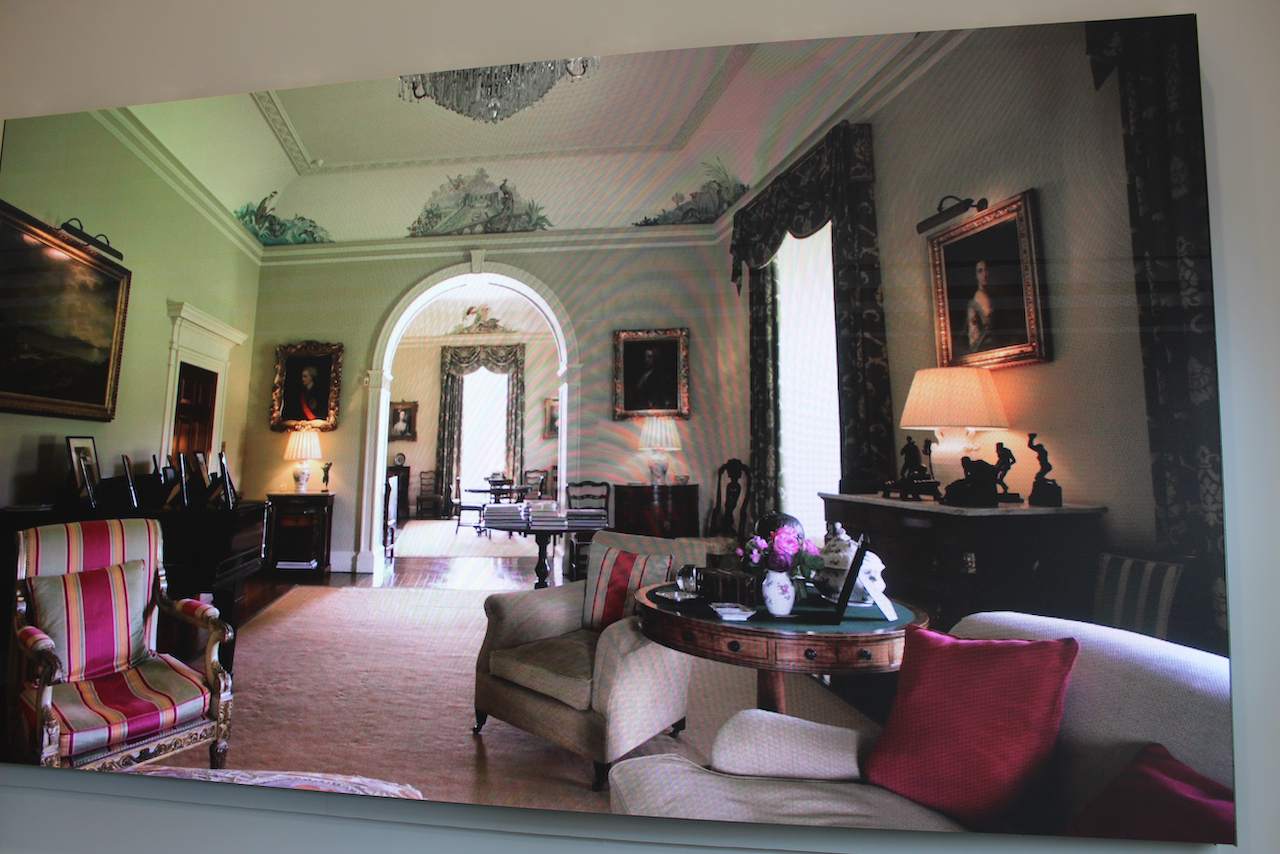
Mark Bence-Jones continues:”The interior remained Classical; the hall being divided by an arcade with fluted Corinthian columns; the dining room having a cornice of plasterwork in the keyhole pattern. In 1929, the Castle was more or less gutted by fire; in the subsequent rebuilding, to the designs of Imrie & Angell, of London, the pointed and mullioned windows were replaced with rectangular Georgian sashes. Apart from the octagon bedroom, which keeps its original plasterwork ceiling with doves, the interior now dates from the post-fire rebuilding; some of the rooms have ceilings painted by the present Countess of Antrim [Elizabeth Hannah Sacher]. The service wing was reconstructed after another fire 1967, the architect being Mr Donal Insall. In 1825, at the same time as the castle was made Tudor, the entrance to the demesne from the town of Glenarm was transformed into one of the most romantic pieces of C19 medievalism in Ireland, probably also by Morrison. A tall, embattled gate tower, known as the Barbican, stands at the far end of the bridge across the river, flanked by battlemented walls rising from the river bed.” [3]

Glenarm Castle, by Donal Maloney 2021, for Tourism Ireland. [see 1]
Glenarm Castle, with George the butler, who gave us a tour, photograph by Donal Malony 2021 for Tourism Ireland, Ireland’s Content Pool (see [1]). A portrait of Charlotte, Countess of Antrim, with her head resting on her hand, is on the wall.
Glenarm, County Antrim.

The second daughter, Charlotte 3rd Countess of Antrim married Mark Robert Kerr (1776-1840), son of William John Kerr, 5th Marquess of Lothian, Scotland. An information board tells us that as well as being a military man, he had a fondness for art.

Drawings by Mark Kerr.
Glenarm, County Antrim.

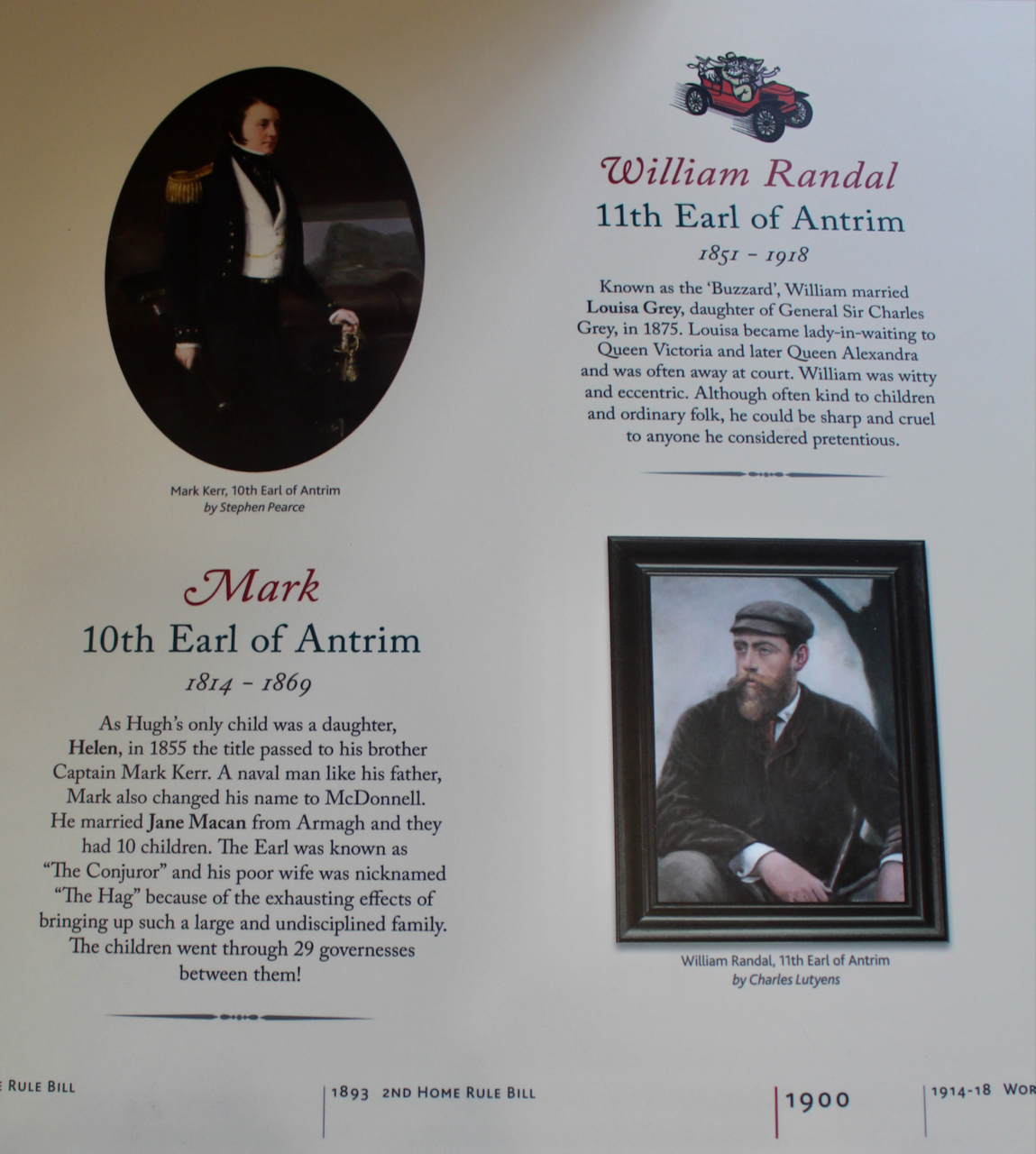
Charlotte and Mark had many children. Their sons who inherited the title Earl of Antrim after their mother’s death took the name MacDonnell when they succeeded to the title. The 4th Earl, Hugh Seymour McDonnell (1812-1855) had no son so his brother, Mark (1814-1869), succeeded him as 5th Earl of Antrim.

Glenarm, County Antrim.

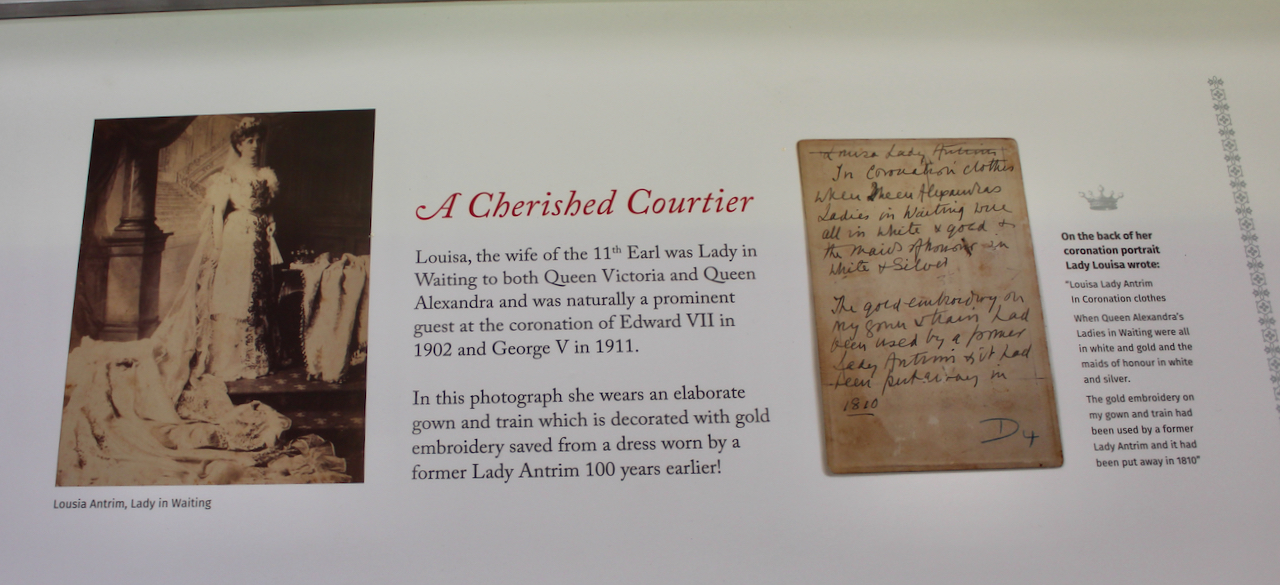
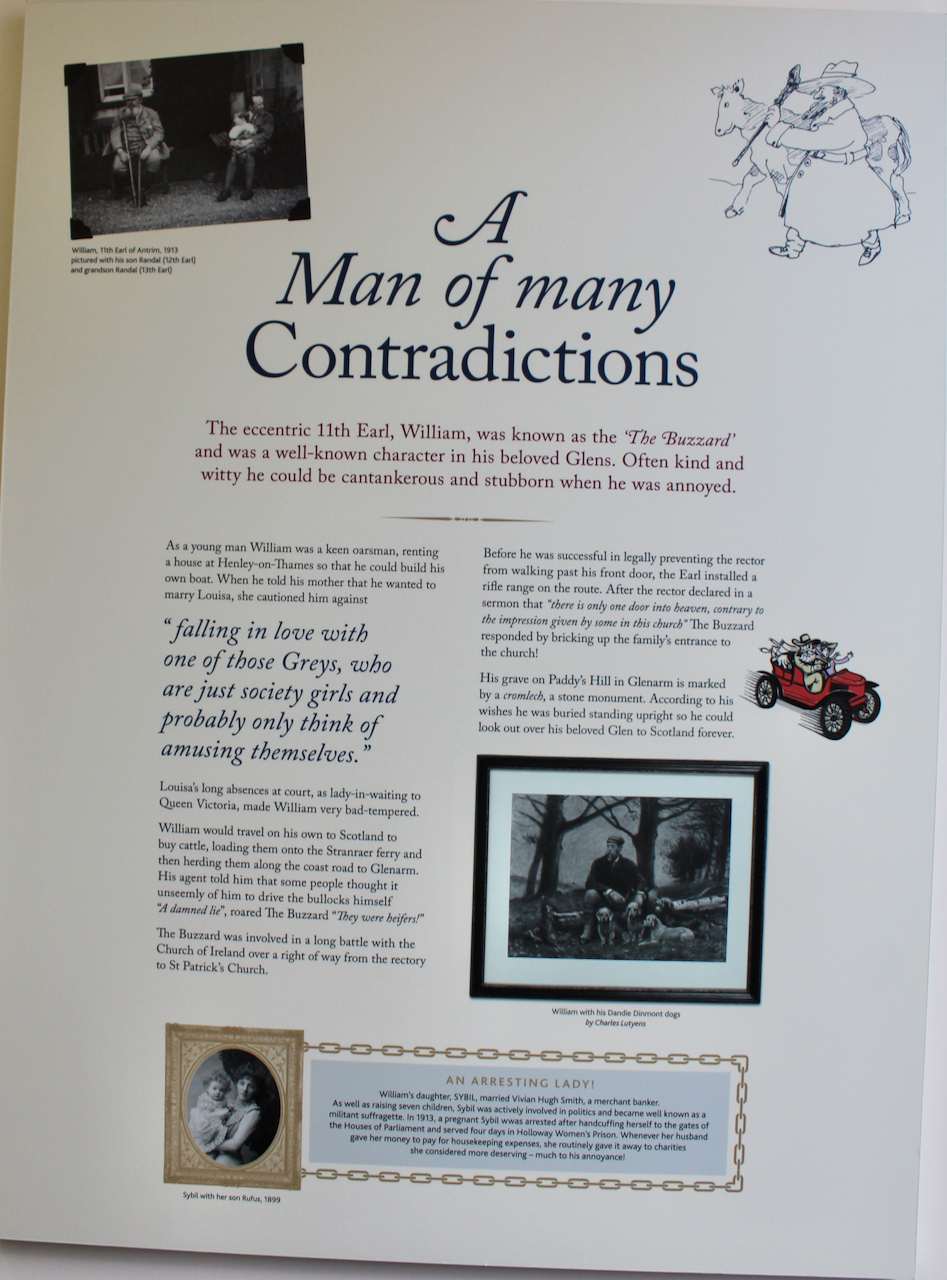
Mark’s son William Randal McDonnell (1851-1918) succeeded as 6th/11th Earl of Antrim. He held the office of Deputy Lieutenant (D.L.) of County Antrim. In the information panel in the museum at the castle, he is referred to as the 11th Earl. He married Louisa Jane Grey. She held the office of a Lady of the Bedchamber to Queen Victoria between 1890 and 1901.

Louisa, wife of 11th, or 6th Earl of Antrim.
Information about William, 6th Earl of Antrim. His wife Louisa née Grey was lady-in-waiting to Queen Victoria.
Glenarm, County Antrim.

Their son Randal Kerr MacDonnell (1878-1932) became 7th/12th Earl of Antrim in 1918. In 1929 a large fire occurred.

Glenarm, County Antrim.

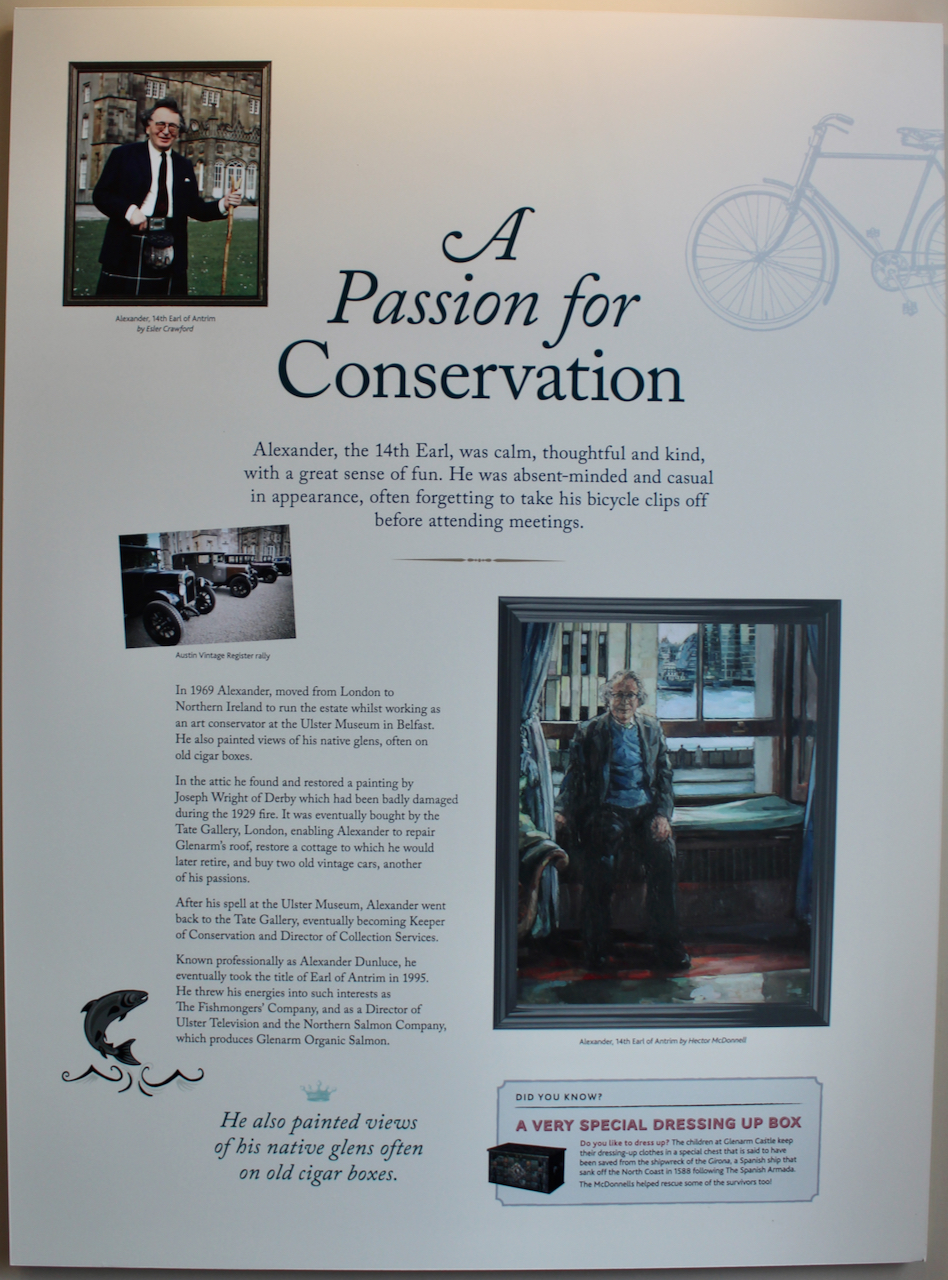
His son Randal John (1911-1977) became 8th Earl (13th) in 1932, and his son in turn, Alexander Randal MacDonnell (1935-2021) the 9th Earl.

Glenarm, County Antrim.

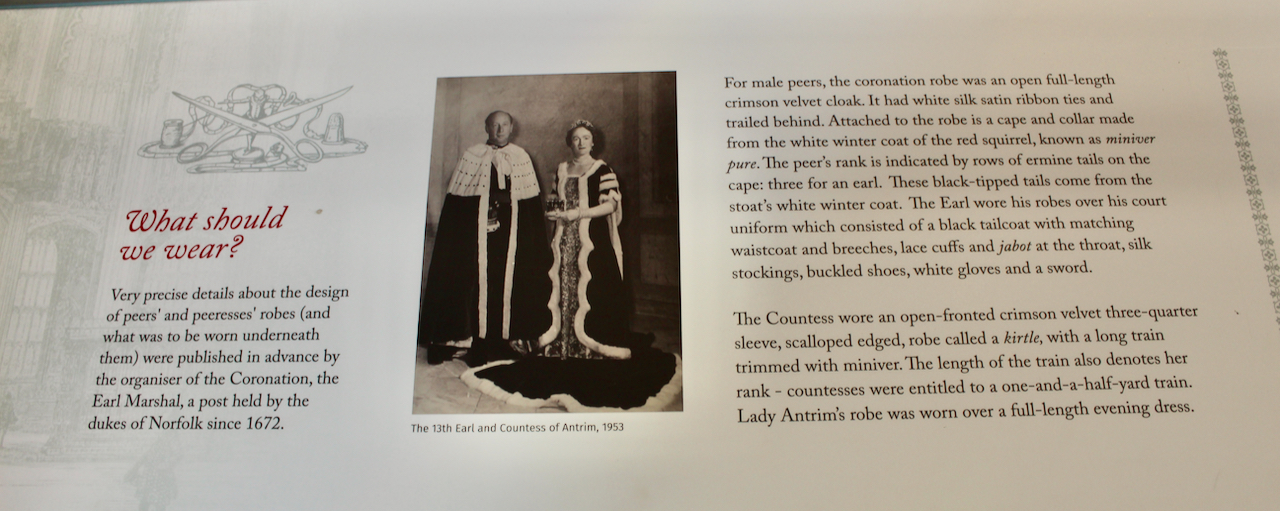
Randal John 8th Earl and his wife Angela attended the coronation of Queen Elizabeth II in 1953.

Randal John 9th Earl and Angela Christina attended the coronation of Queen Elizabeth II. Photograph © Jennifer Winder-Baggot, www.irishhistorichouses.com
Explanation of the Coronation robes.
The family at the time of the Coronation in 1953.

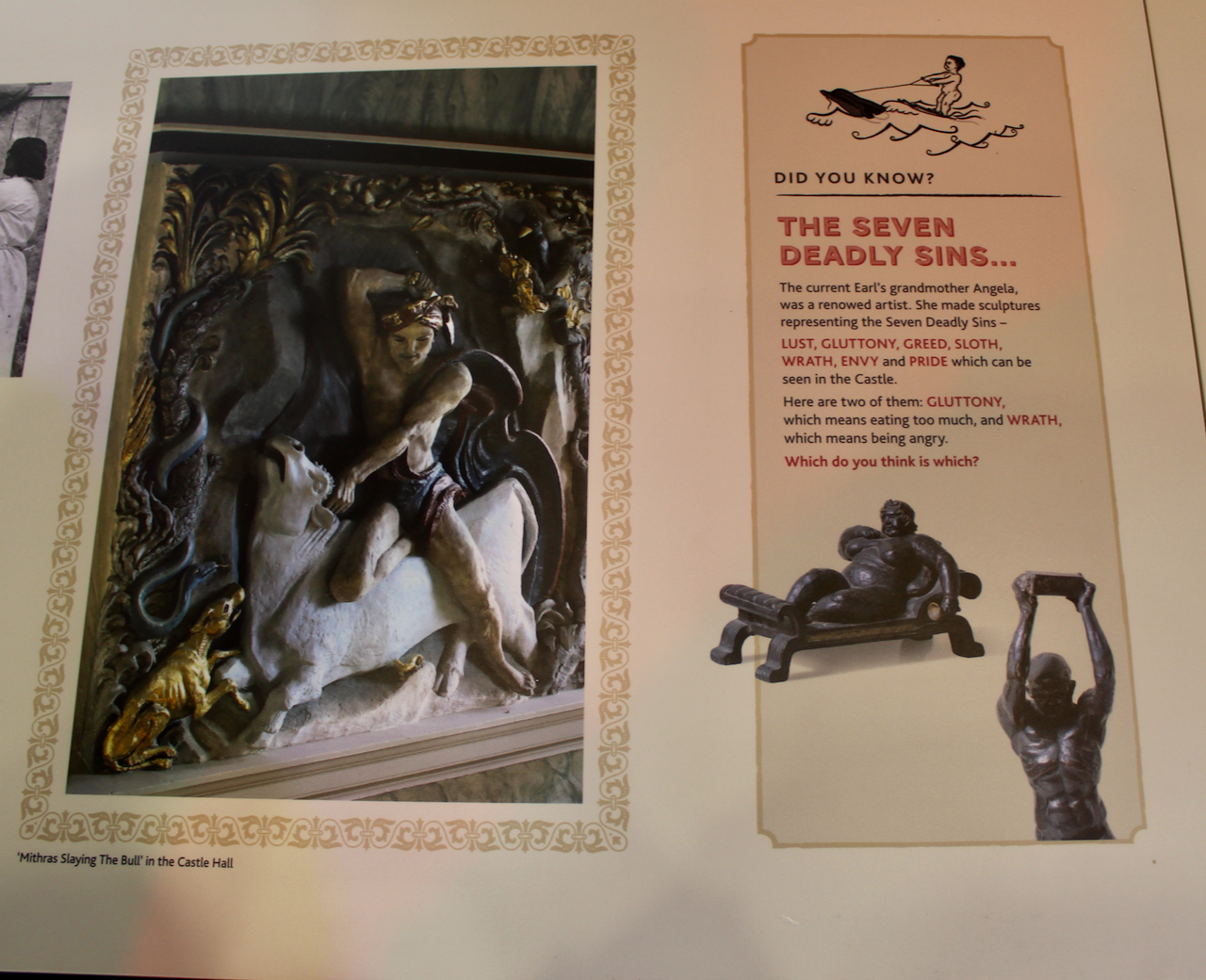
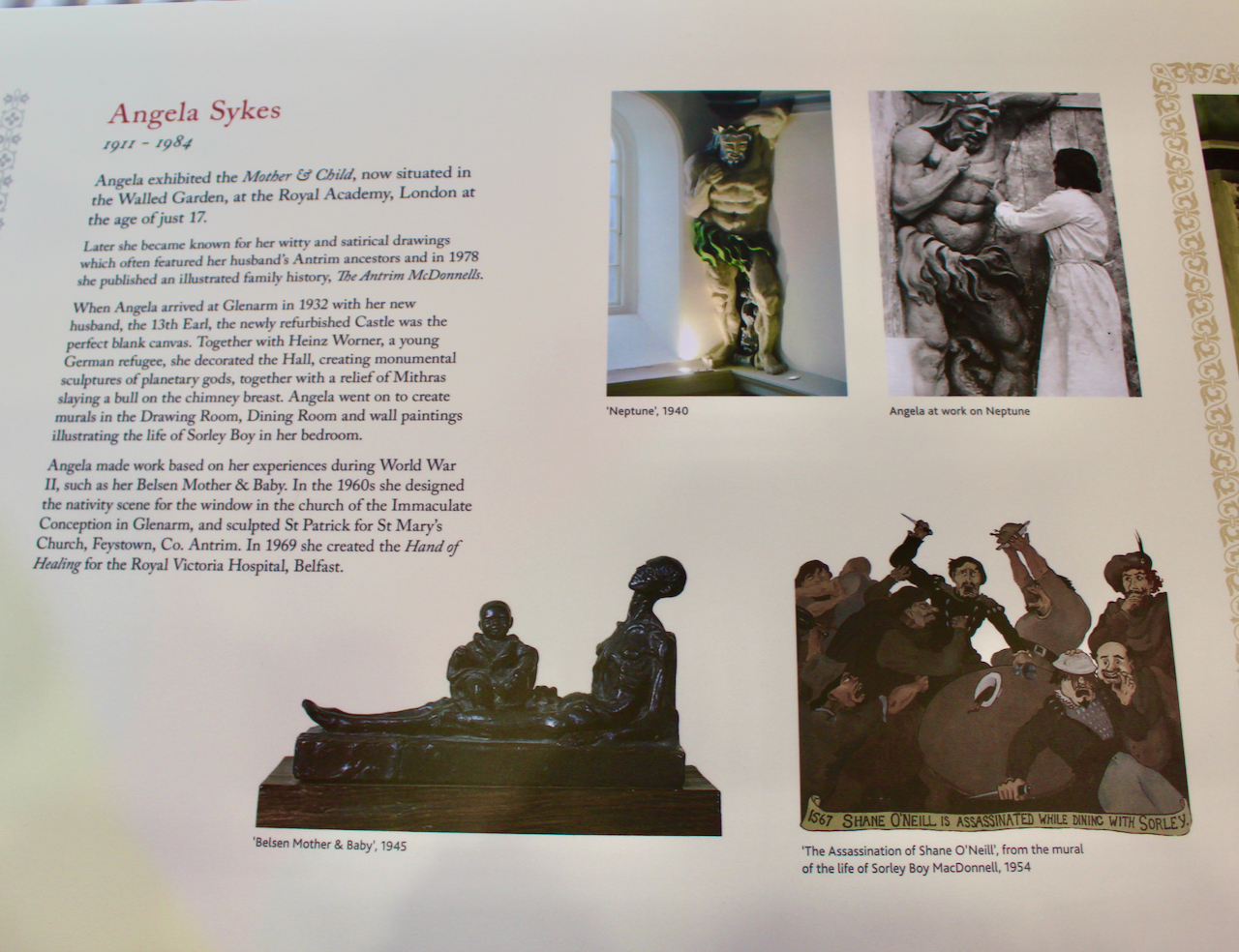
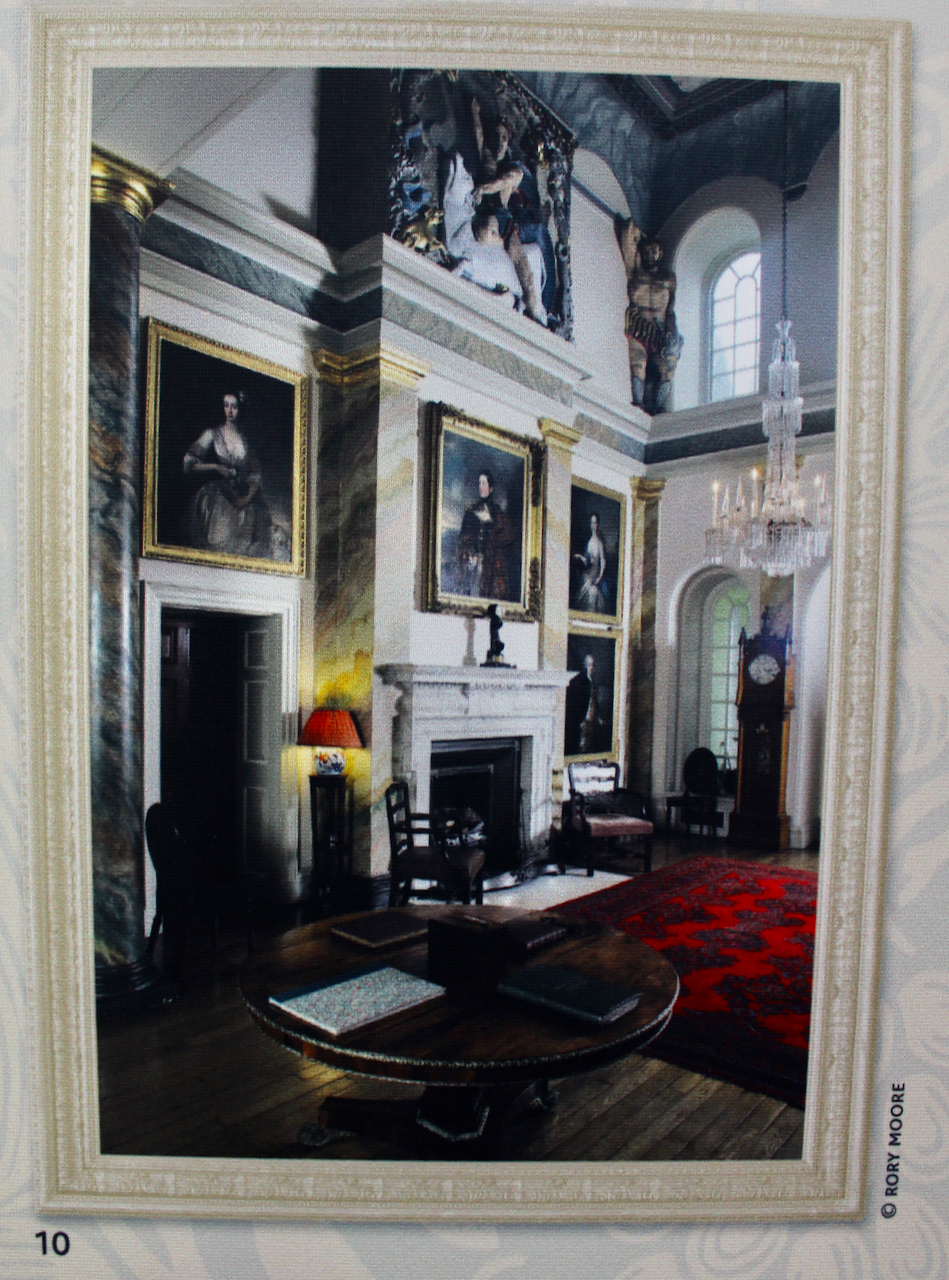
Angela Sykes (1911-1984), wife of the 8th or 13th Earl was an artist and she created the rather bulging statues of planetary gods that adorn the ceiling corners of the front hall. She also designed Mithras slaying the bull over the fireplace. She also created murals in the dining room, drawing room and in her bedroom.

About Angela Sykes and her art.
Mithras slaying the bull, which features in the Castle Hall, by Angela Sykes.
The front hall of Glenarm, photograph courtesy of Heritage centre.
Angela Sykes also painted the ceiling decoration, photograph courtesy of the McDonnell family heritage centre museum.
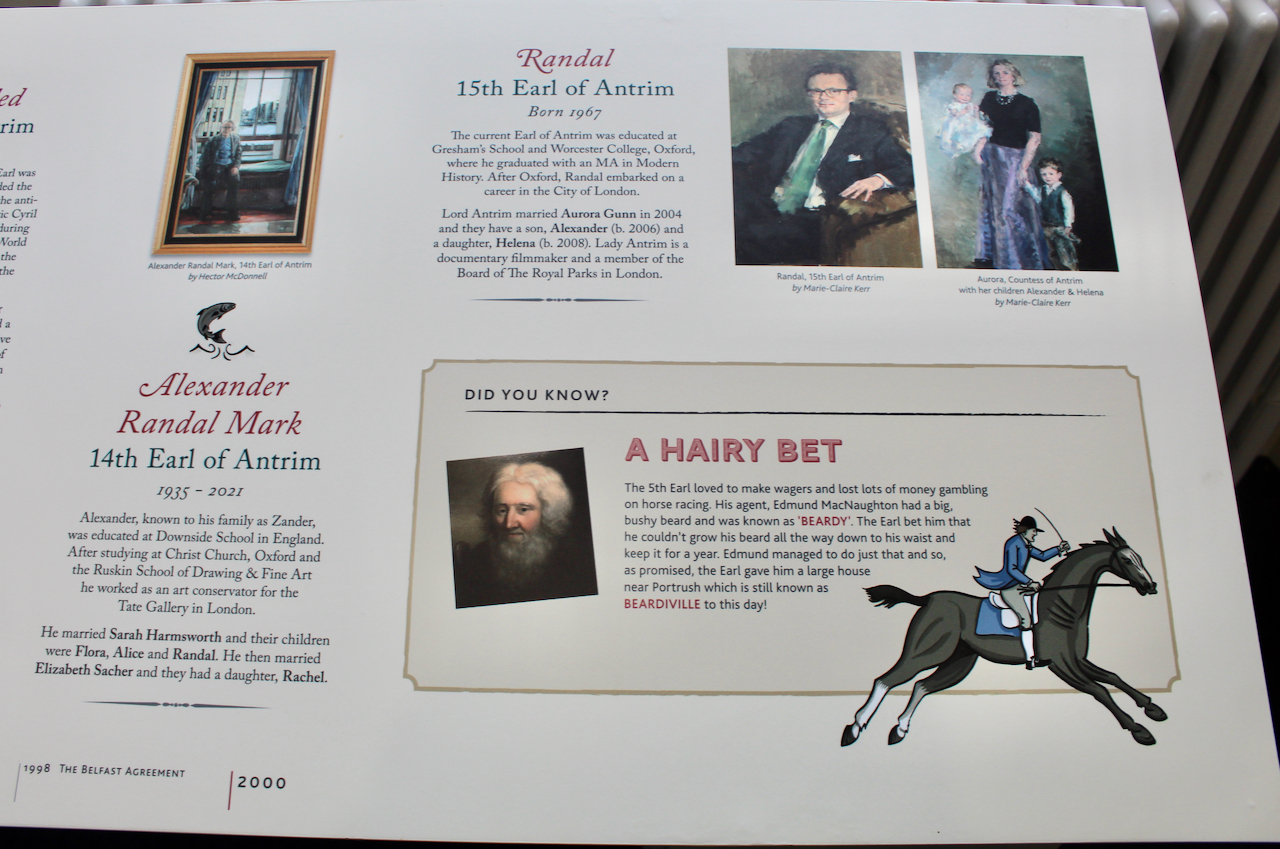
Information about Alexander MacDonnell, the 9th Earl of Antrim, the 14th Earl.
The current Earl of Antrim.
Courtyard on the way to the walled garden at Glenarm. Photograph © Jennifer Winder-Baggot, www.irishhistorichouses.com
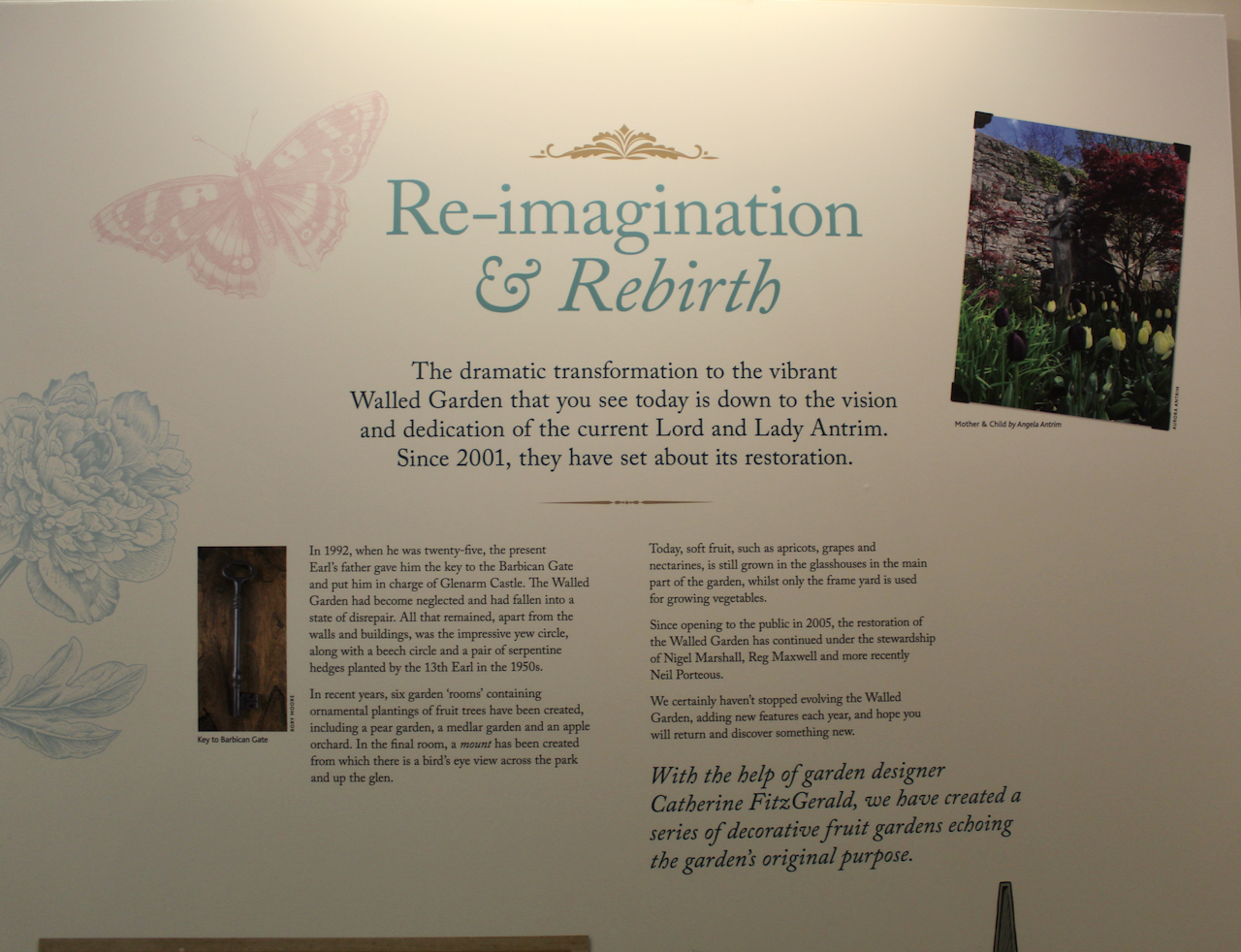
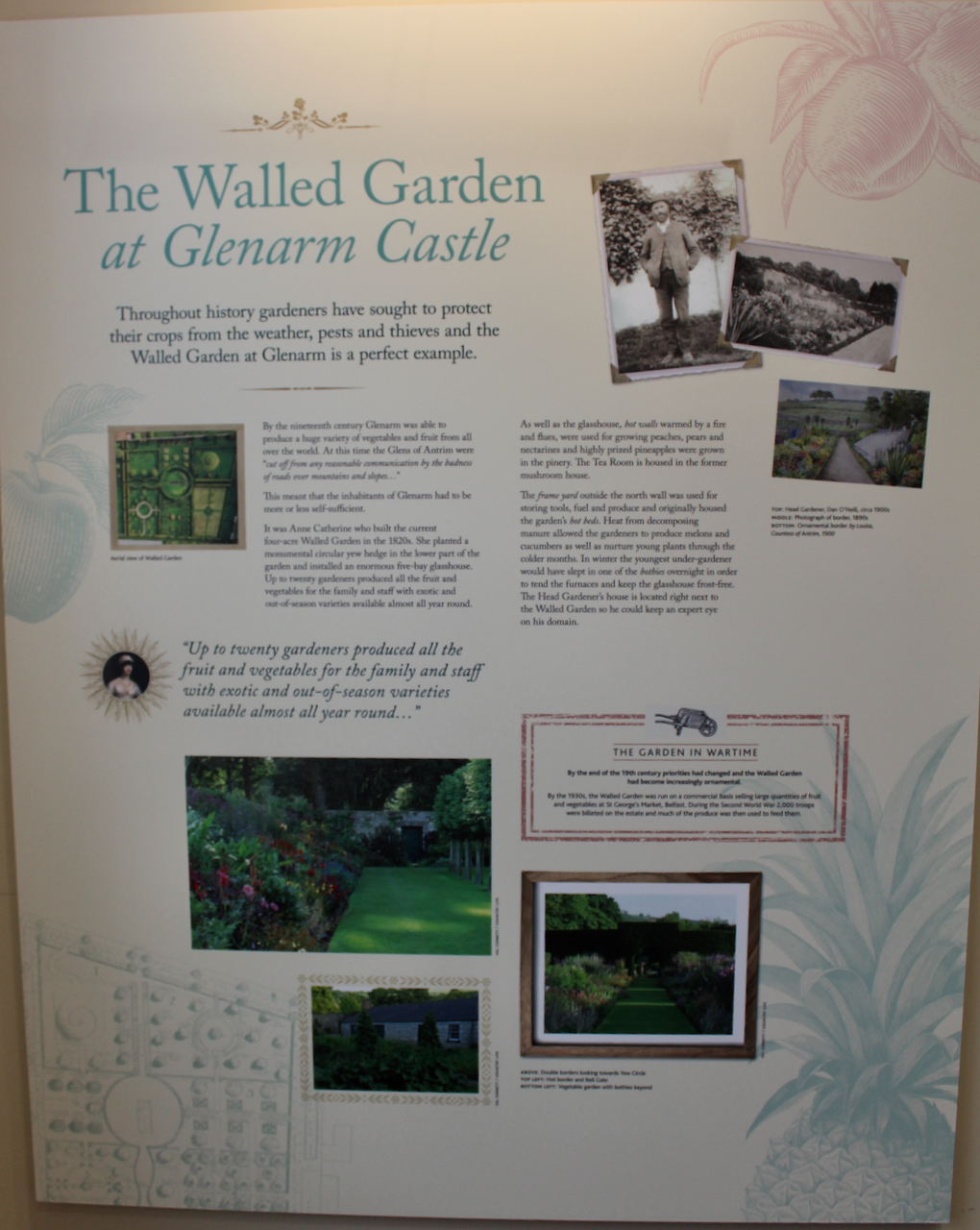
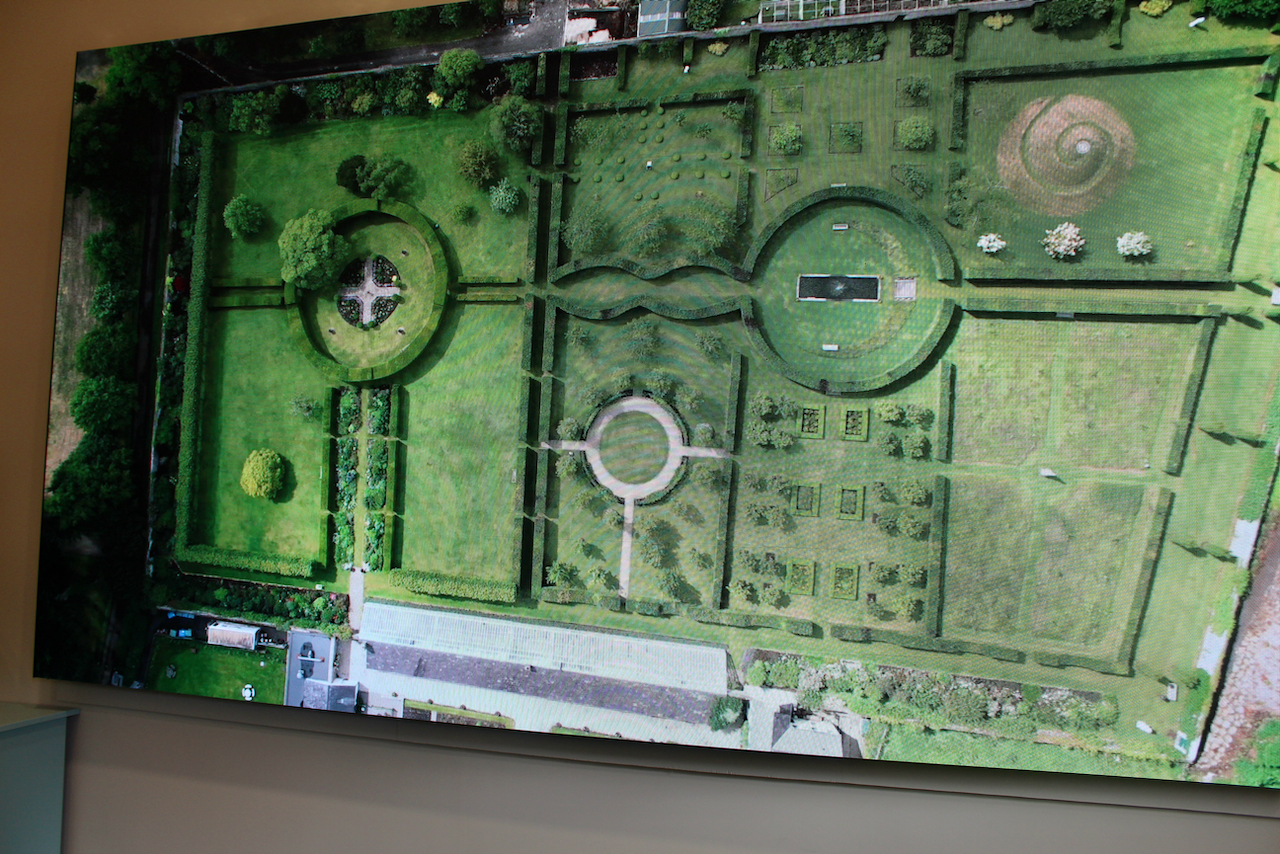
Explanation about the walled garden at Glenarm.
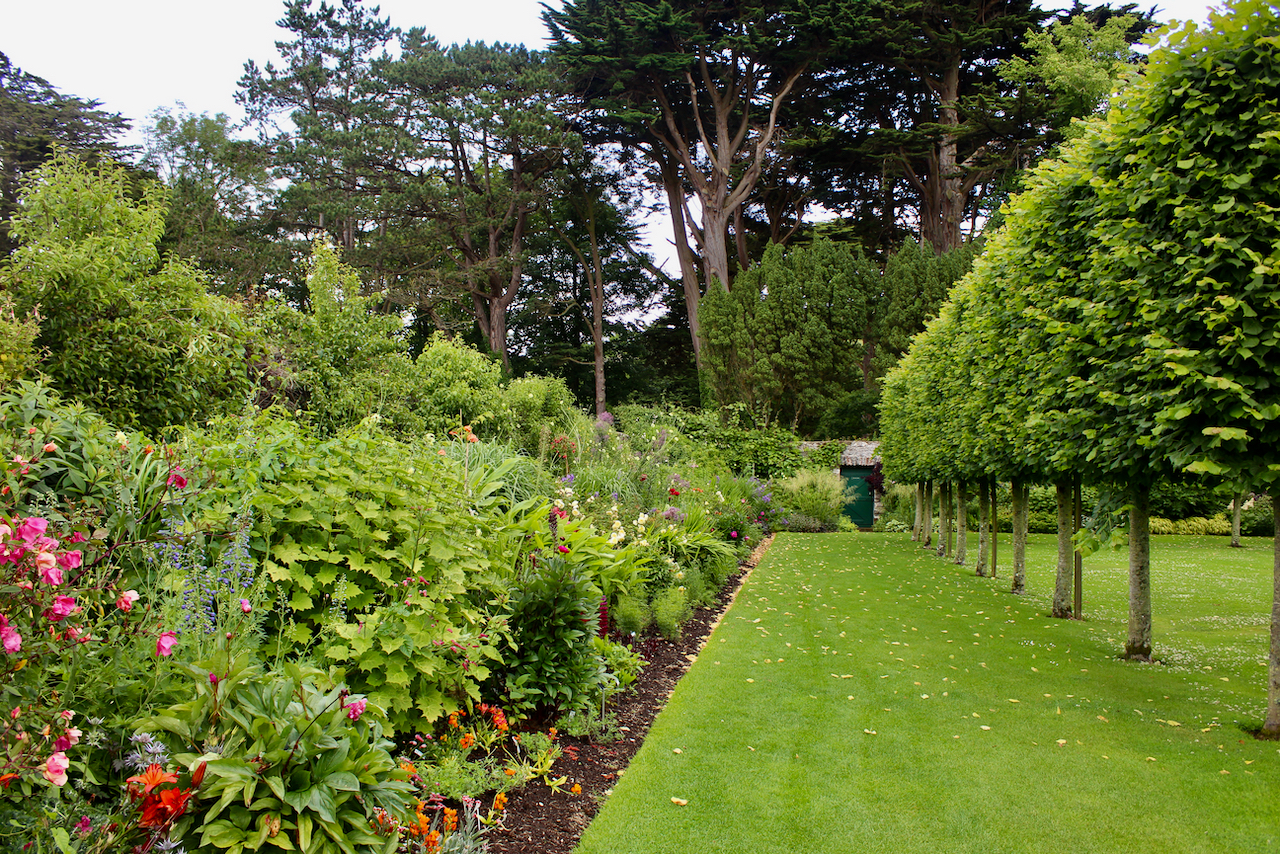
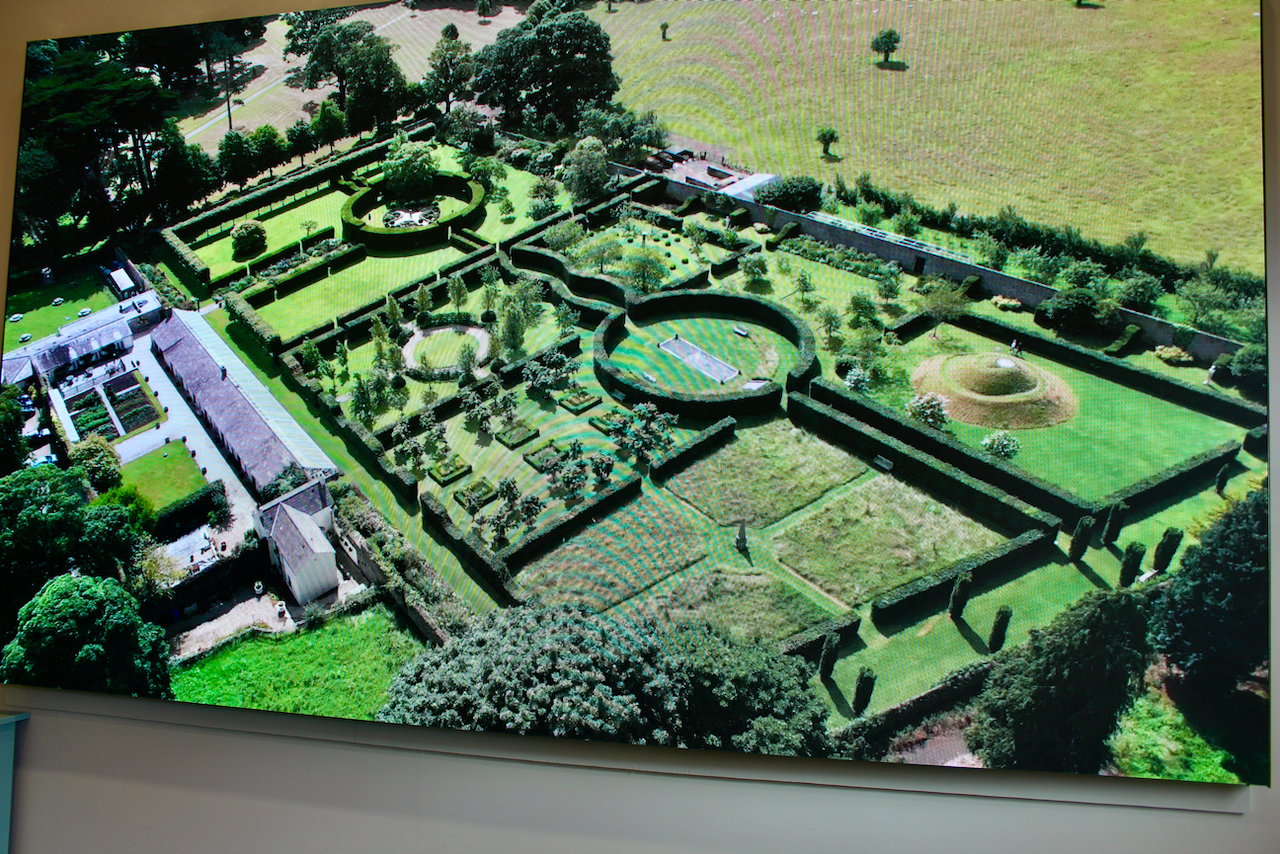
The Walled Garden at Glenarm is amazing, June 2023. Photograph © Jennifer Winder-Baggot, www.irishhistorichouses.com
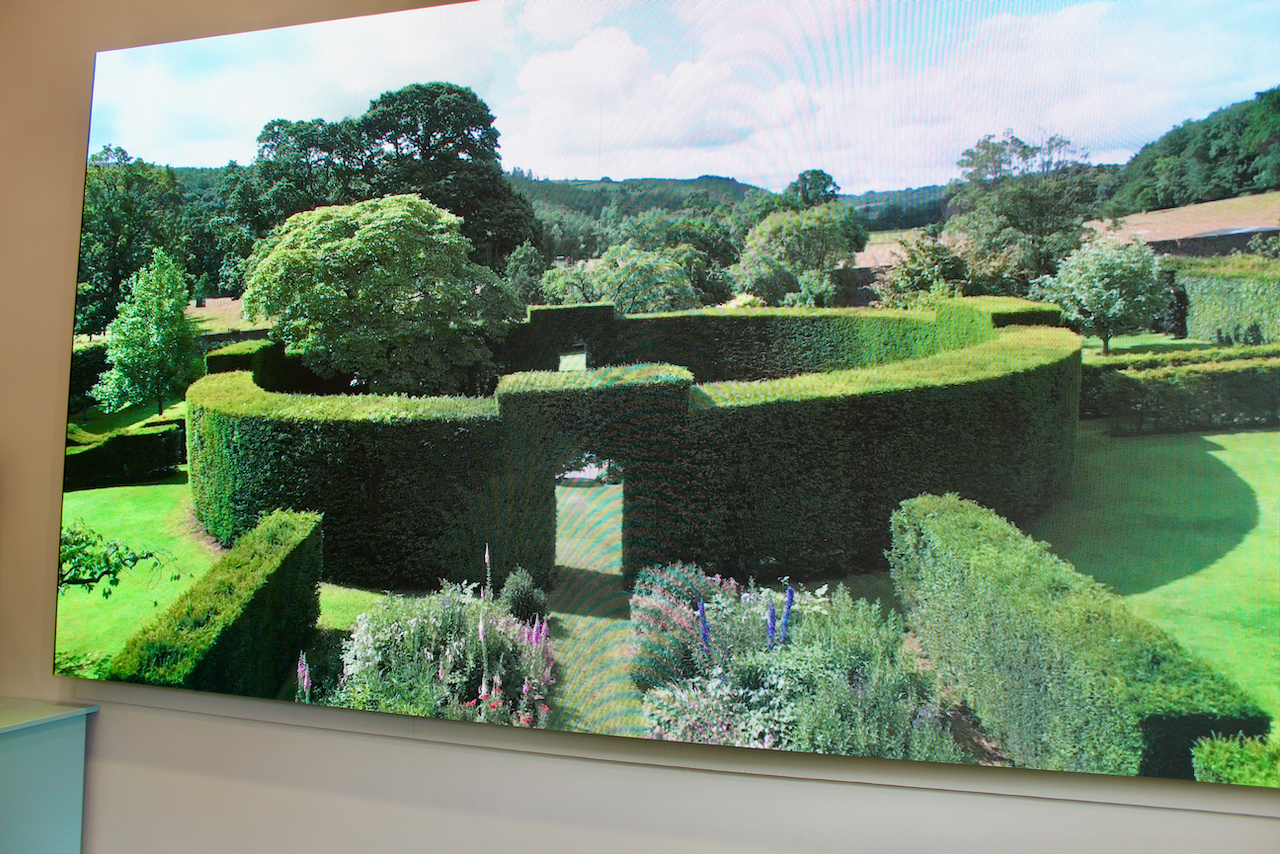
Anne Catherine (1778-1834) MacDonnell, daughter of the 1st Earl of Antrim, built the current four acre walled garden in the 1820s. She planted the circular yew hedge and installed an enormous five bay glass house.
The circular yew hedge, photograph from slide show in museum.
The walled garden at Glenarm, photograph courtesy of Heritage Centre.
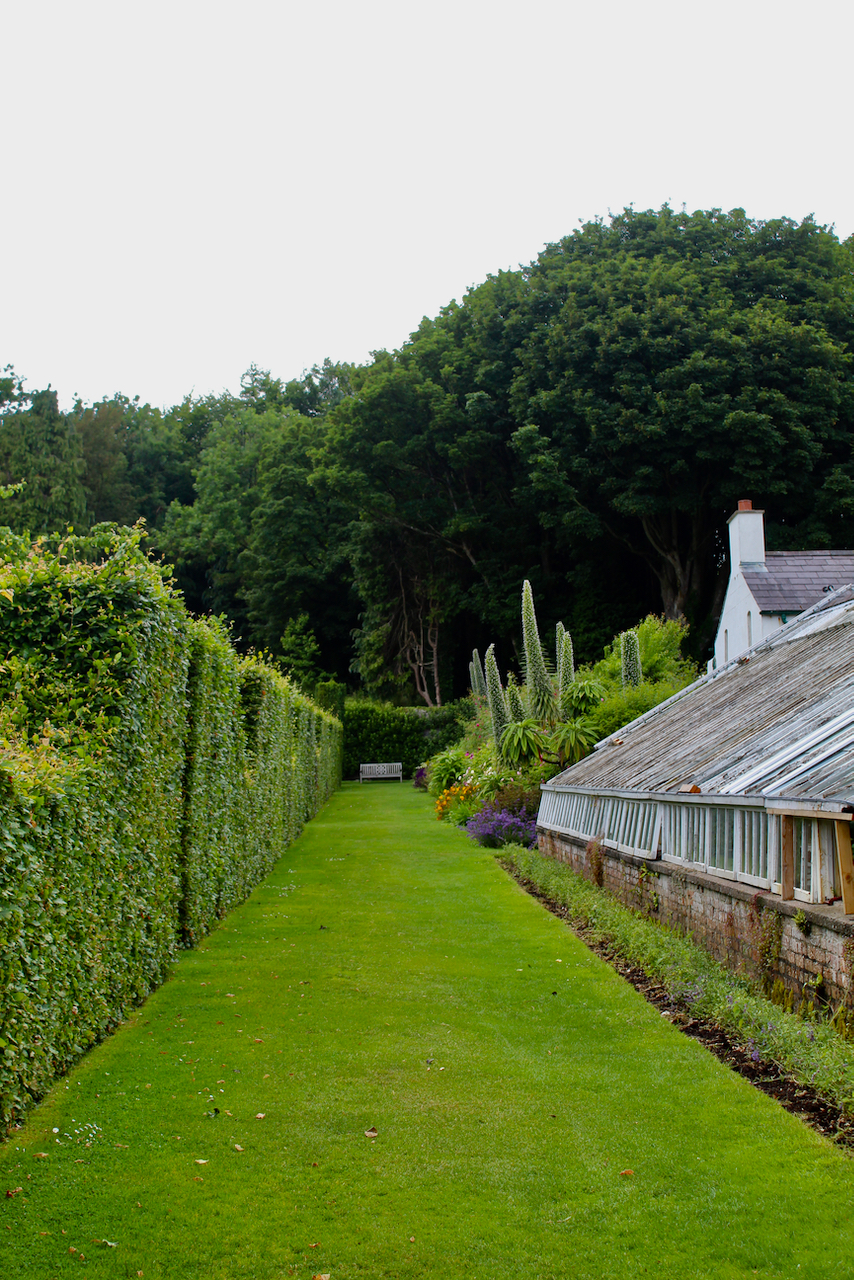
Walled garden, Glenarm, June 2023. Photograph © Jennifer Winder-Baggot, www.irishhistorichouses.com
The Glass houses at Glenarm, June 2023. Photograph © Jennifer Winder-Baggot, www.irishhistorichouses.com
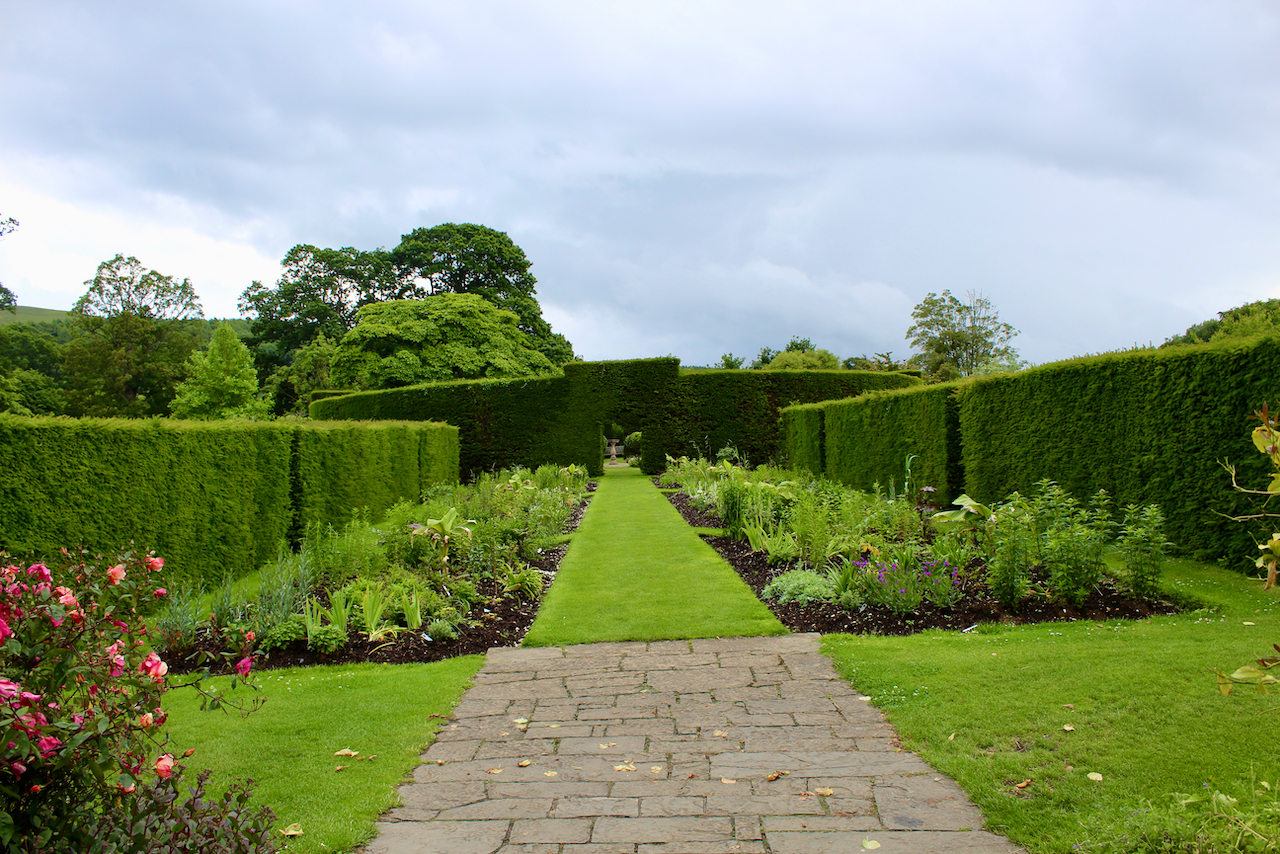
The Glenarm walled garden is full of beautiful vistas. Photograph © Jennifer Winder-Baggot, www.irishhistorichouses.com
Glenarm walled garden, June 2023. Photograph © Jennifer Winder-Baggot, www.irishhistorichouses.com
Glenarm walled garden, June 2023.
Glenarm walled garden, June 2023. Photograph © Jennifer Winder-Baggot, www.irishhistorichouses.com
More beautiful vistas at Glenarm walled garden, June 2023. Photograph © Jennifer Winder-Baggot, www.irishhistorichouses.com
Glenarm walled garden, photograph courtesy of Heritage centre.
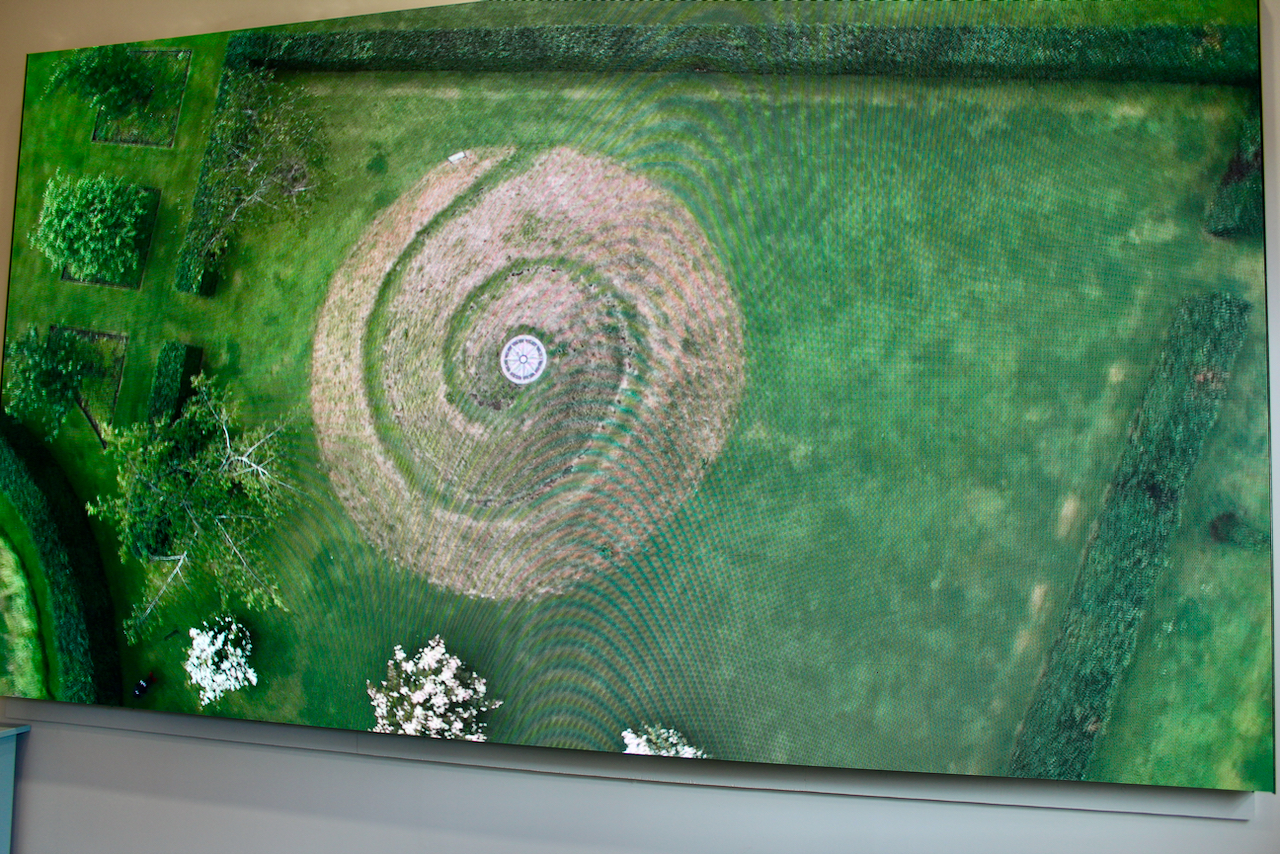
“The Mound” in the garden, photograph courtesy of Heritage centre.
“The Mound.”
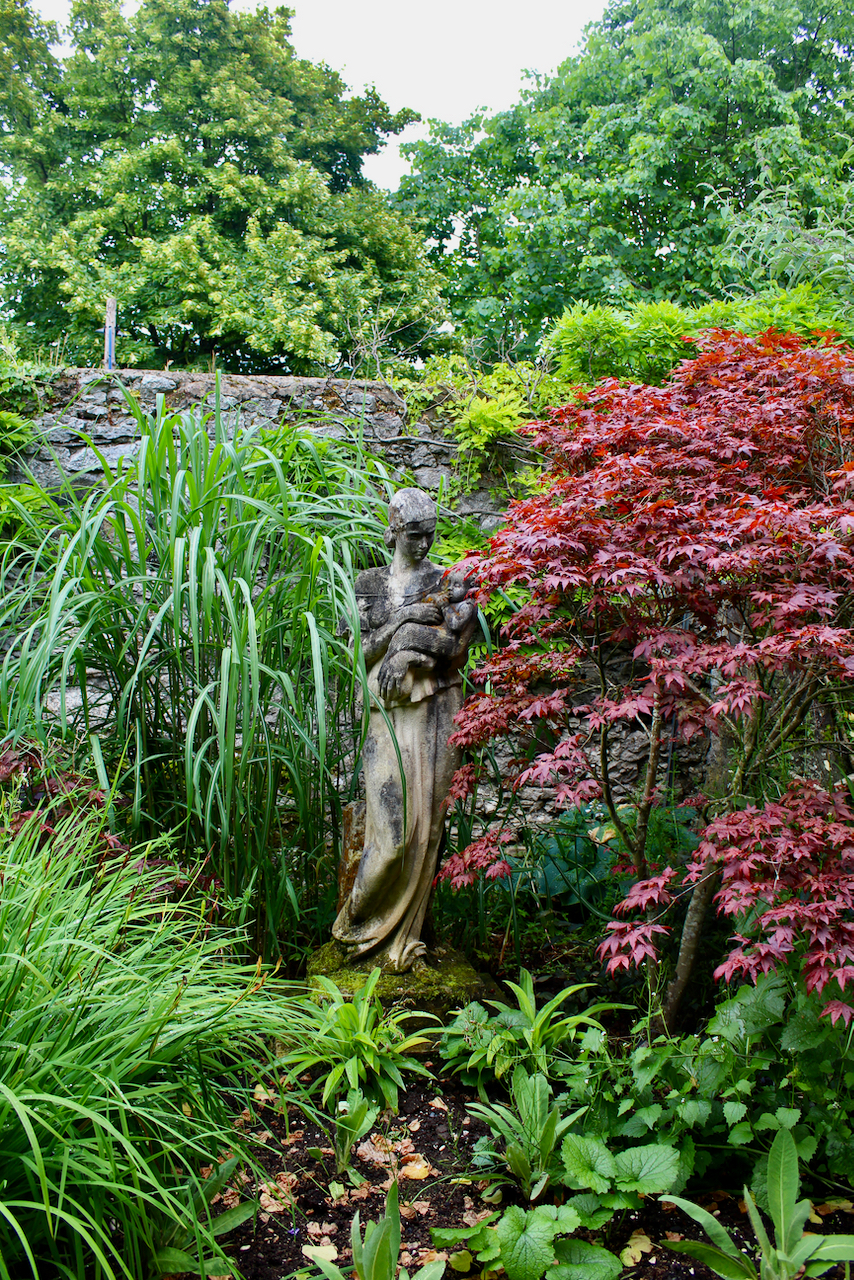
Mother and Child by Angela Sykes (1911-1984), wife of the 13th Earl of Antrim. Photograph © Jennifer Winder-Baggot, www.irishhistorichouses.com
The estate continues to provide employment. Angela wife of the 13th Earl established a furniture factory. Today Glenarn has an organic salmon farm, an organic shorthorn beefherd, farming, forestry and hydro-electric enterprises.
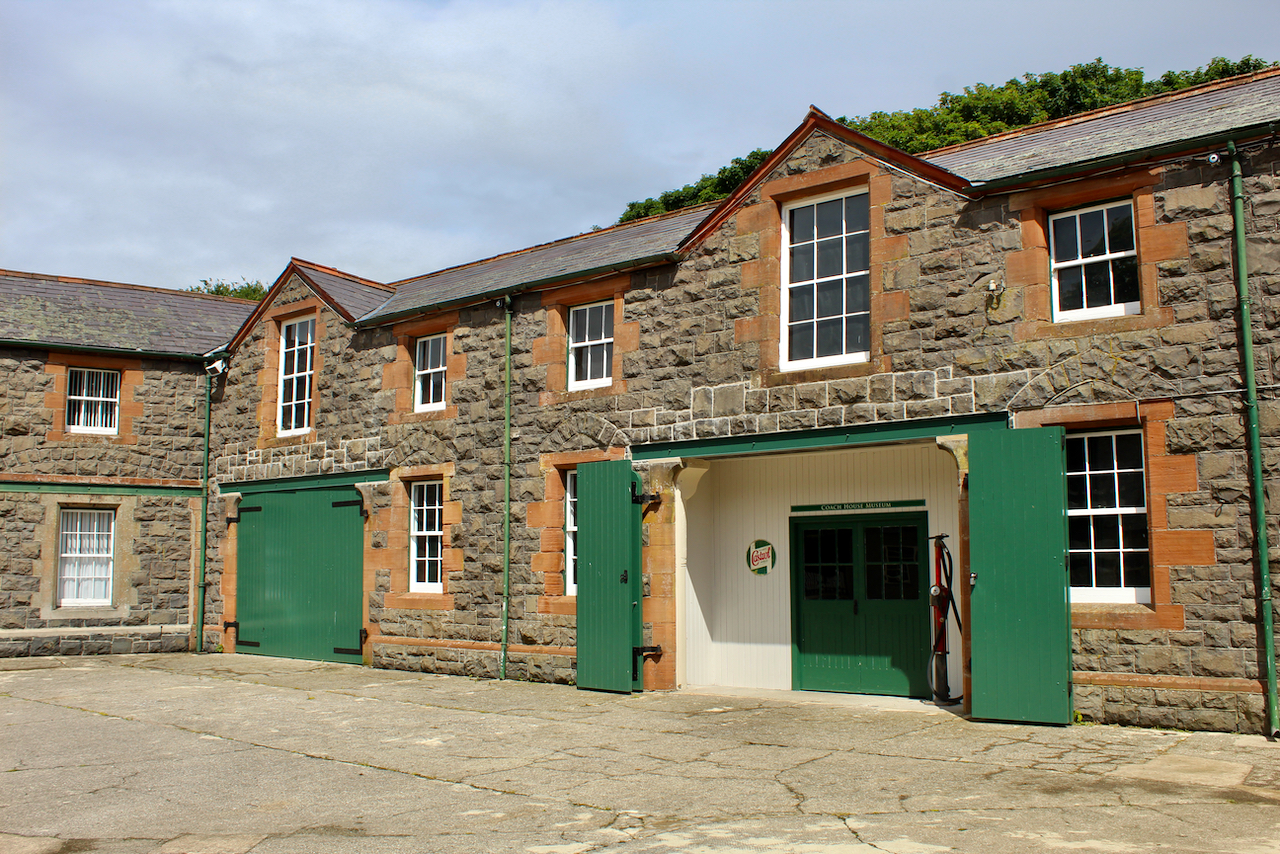
The outbuildings at Glenarm Castle. Photograph © Jennifer Winder-Baggot, www.irishhistorichouses.com

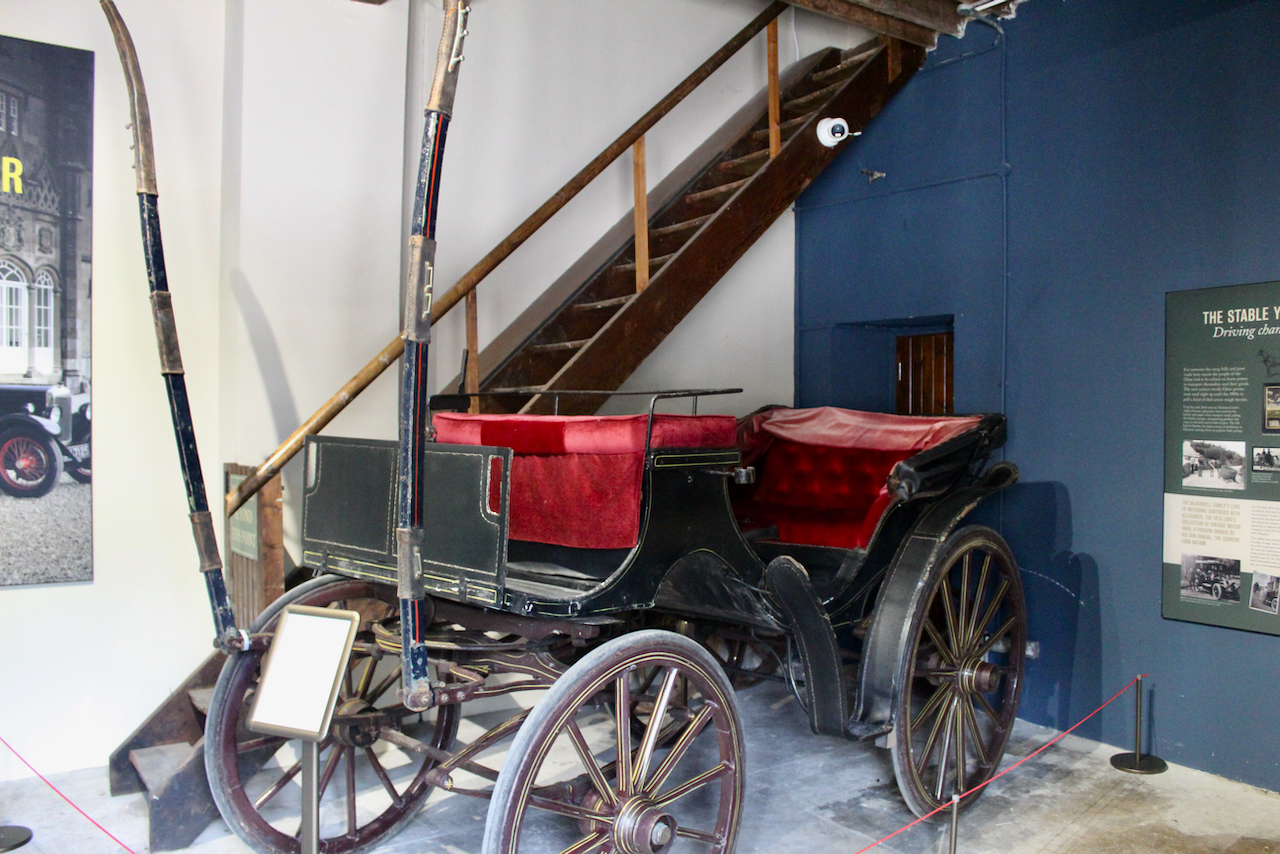
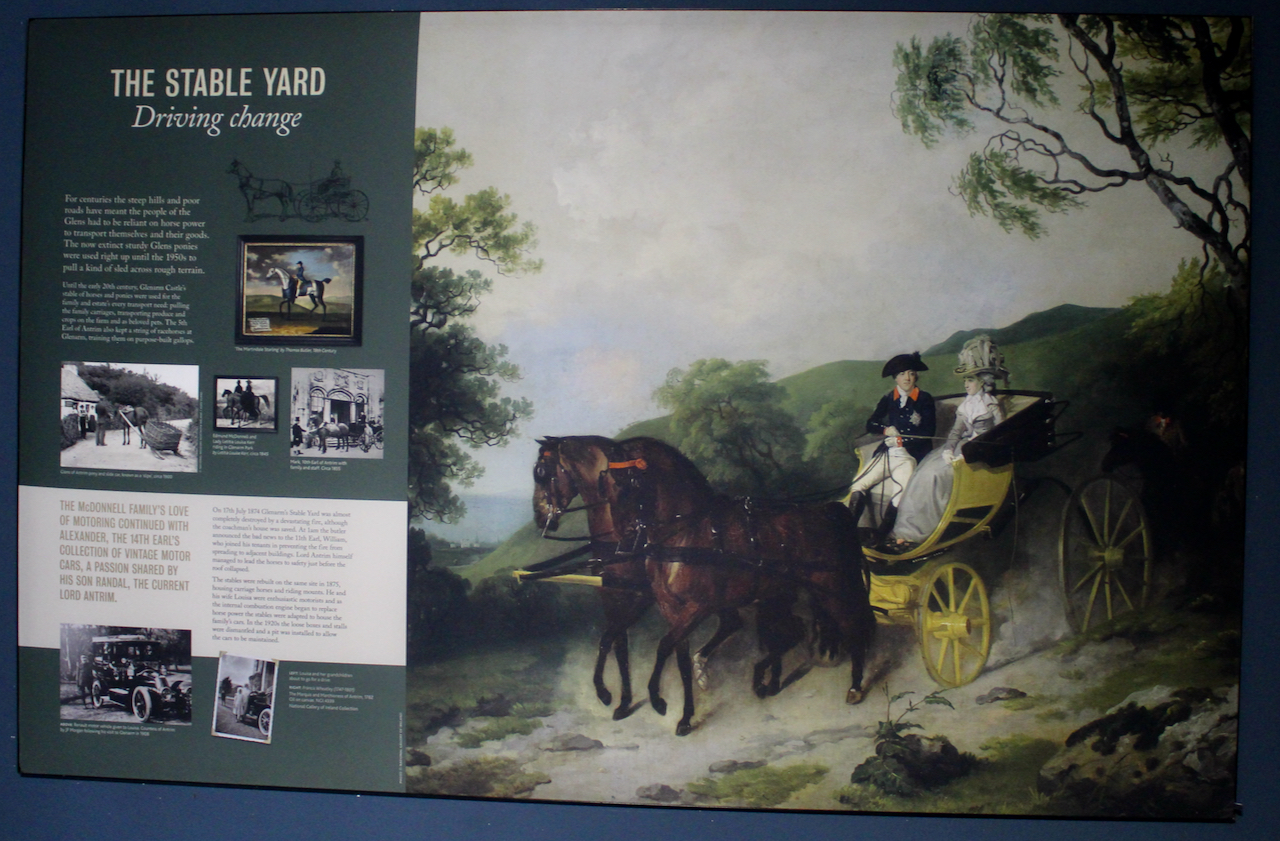
The Castle also hosts a Coach House Museum.

In the Coach House Museum at Glenarm. Photograph © Jennifer Winder-Baggot, www.irishhistorichouses.com
In the Coach House Museum at Glenarm.
Glenarm, County Antrim.

[1] https://www.irelandscontentpool.com/en

[2] http://lordbelmontinnorthernireland.blogspot.com/search/label/County%20Antrim%20Landowners?updated-max=2020-02-05T07:48:00Z&max-results=20&start=49&by-date=false

[3] p. 135, Bence-Jones, Mark. A Guide to Irish Country Houses (originally published as Burke’s Guide to Country Houses volume 1 Ireland by Burke’s Peerage Ltd. 1978); Revised edition 1988, Constable and Company Ltd, London.

Text © Jennifer Winder-Baggot, www.irishhistorichouses.com

Portraits A

I have to split my portraits into one letter per entry as the entries are becoming too long! So here’s a start.

I am sorry not to have a Section 482 property to publish today – I have a few out with owners for review before posting, so hopefully I will have something to post next week. I didn’t post last week, as I have been busy beginning to look for my own country house to buy! Unfortunately it won’t be a big one, just a small place with room to grow my vegetables, hopefully within 1.5 hours of Dublin. Let me know if you have a property you think would suit! I’ll be selling my Dad’s two bedroom townhouse in Donnybrook in Dublin, if you want to do a trade!

I’m excited for the 2024 Revenue Section 482 list to be published. The new list has not been published yet.

A

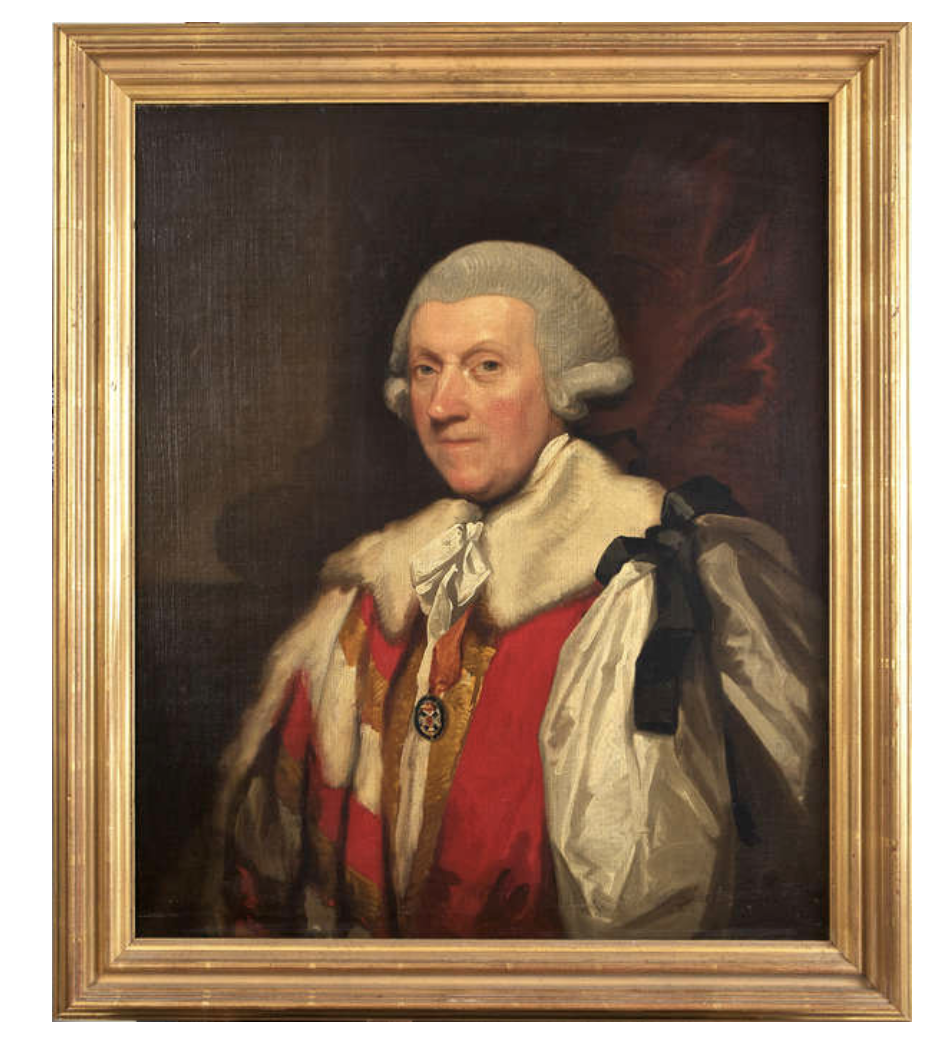
Archibald Acheson, 1st Viscount Gosford (1717-1790) courtesy of Adam’s auction 8 March 2015. Archibald Acheson succeeded his father as 6th Baronet in 1749. He played an active role in the complicated politics of County Armagh and whilst with a tendency to independent action, his lust for a peerage kept him within the castles’ sphere of influence. He married his neighbour, Mary Richardson of Rich Hill, thereby consolidating his position in Armagh, much disputed by the Brownlows and Caulfields. However the increasing independence of the Protestant freeholders caused him to issue arms to his Catholic tenants (in itself illegal) for his protection. Never-the-less he entered the after-life as a peer of the realm. Provenance: The Acheson Family, by descent.
Arthur Acheson (d. 1807) 2nd Viscount and 1st Earl of Gosford by Gilbert Stuart (1755-1828) courtesy Adam’s auction 9 Oct 2012.
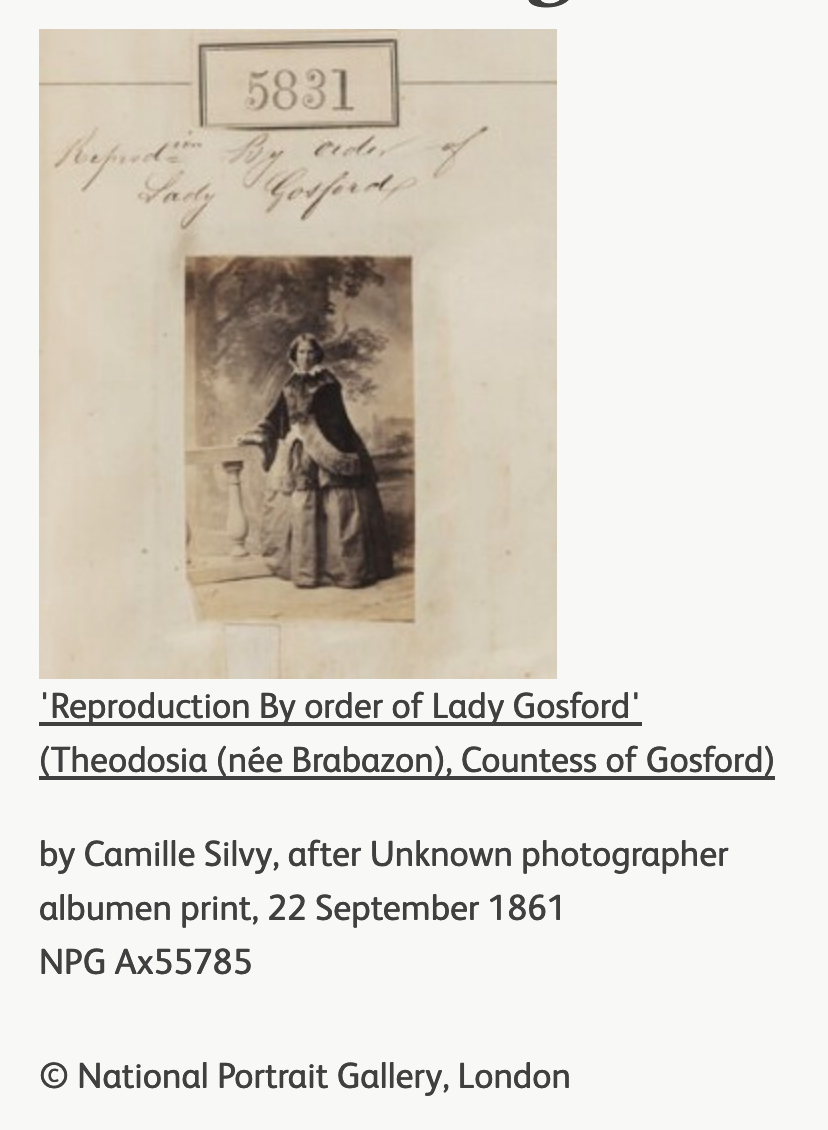
Theodosia Acheson née Brabazon (1811-1876), daughter of John Chambre Brabazon 10th Earl of Meath, she married Archibald French Acheson, 3rd Earl of Gosford.
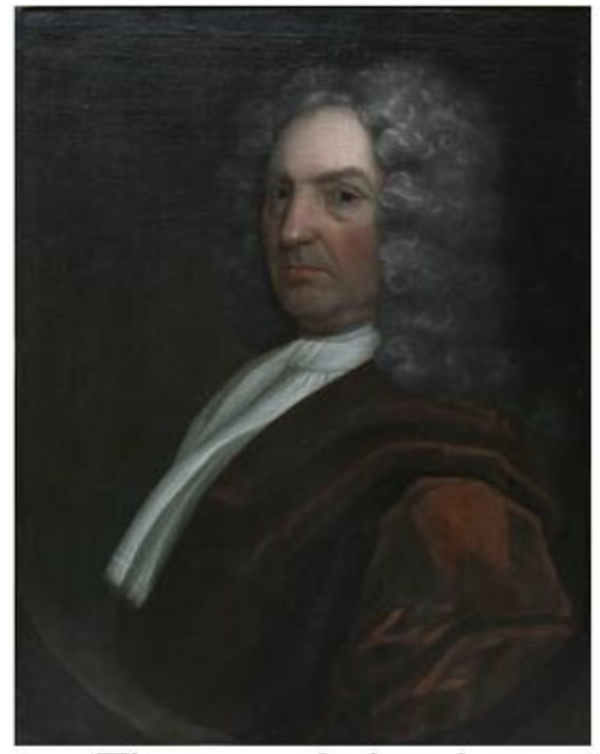
Thomas Acton (1655-1750) of Kilmacurragh, County Wicklow.
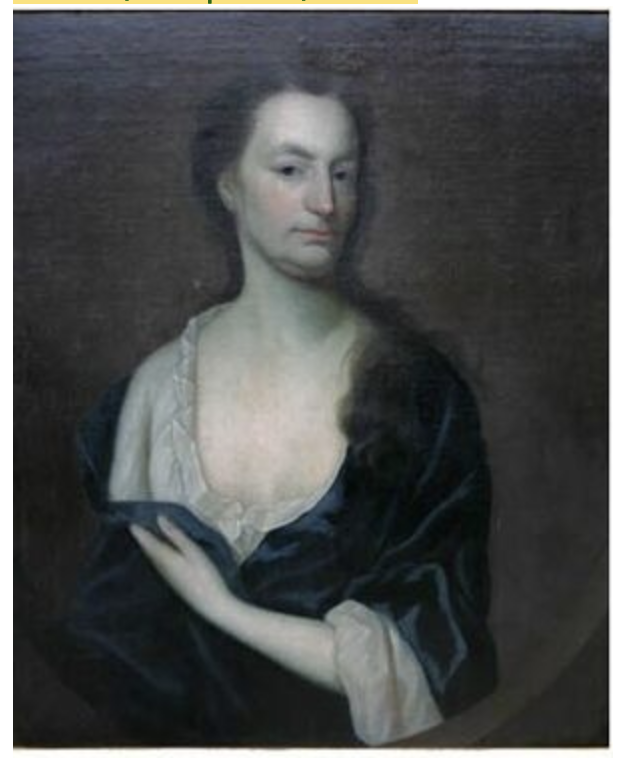
Elinor née Kempston (d. 1747), wife of Thomas Acton (d. 1750) of Kilmacurragh, County Wicklow.
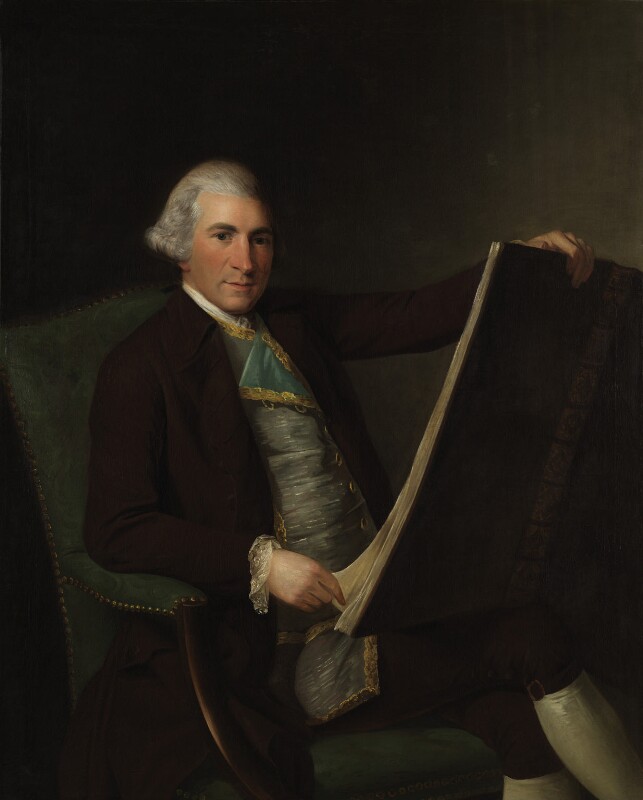
Robert Adam (1728-1792), Architect, attributed to George Willison, c. 1770, courtesy of National Portrait Gallery NPG 2953.
William Adam (1689-1748), Scottish architect, father of Robert Adam, architect, seated in a study, holding a letter in his right hand, with a view of the mountains through an arched window in the background, by ANDREW HENDERSON, sold by Shepphards.
General John Adlercron (Trapaud) (d. 1766) courtesy of Armagh County Museum.
John Adlercron by James Latham
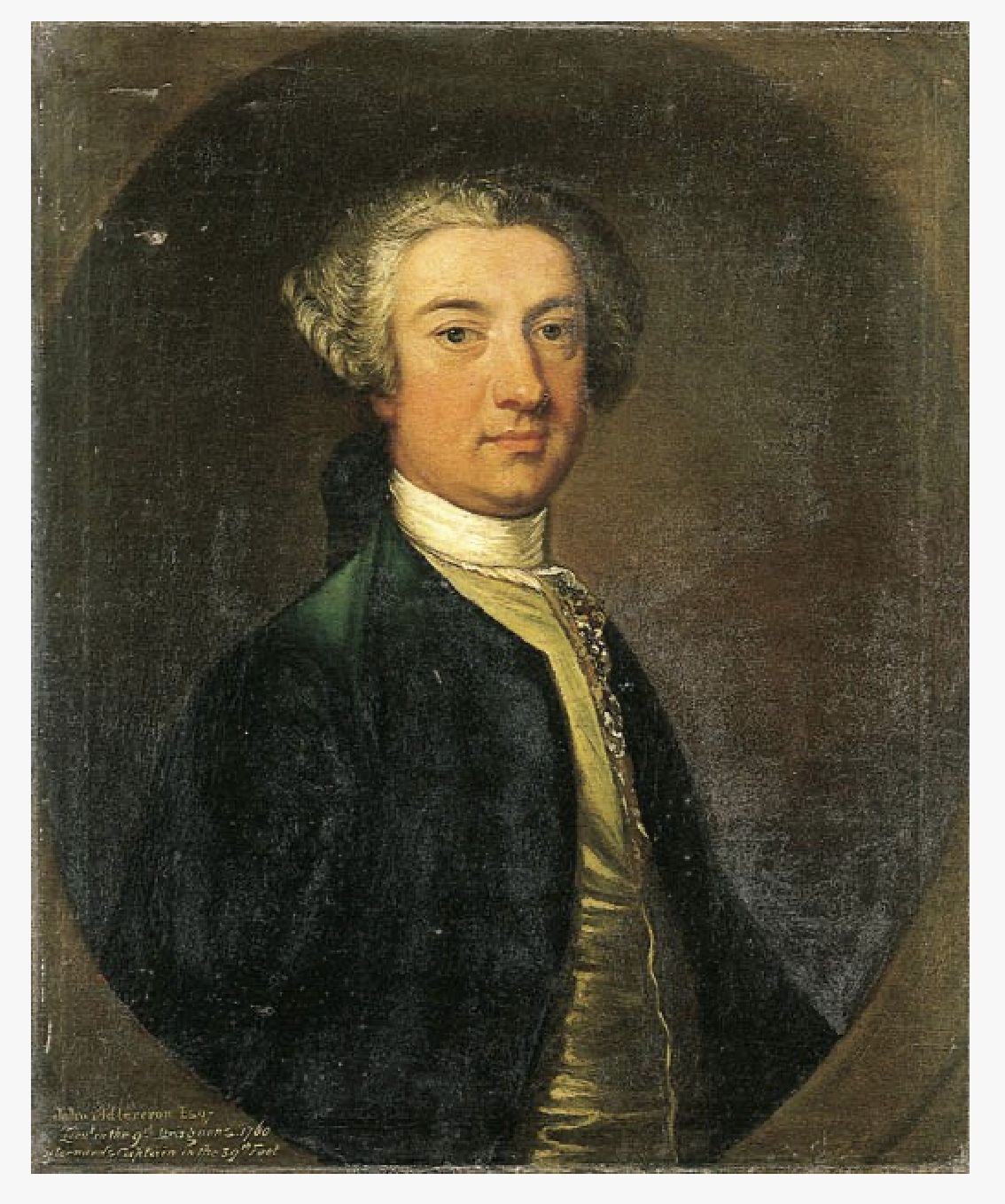
‘John Adlercron Esq., Lieut in the 9th Dragoons. 1760 afterwards Captain in the 39th foot’ by circle of Joseph Highmore, courtesy Christies.
Elizabeth Agar (1708-1789) by Philip Hussey, the Countess of Brandon is holding the Charters of Gowran and Thomastown. Daughter of James Agar of Gowran Castle, Kilkenny, she married first Theobald Bourke 7th Vt Mayo then Francis Bermingham (1692–1750) 14th Baron of Athenry. In 1758 Ellis Bermingham was granted (for life only) the title “Countess of Brandon, in the County of Kilkenny”, a title in the Peerage of Ireland. The title became extinct on her death on 11 March 1789.
John Alexander (1802-1885), High Sheriff of Carlow 1824, MP for Carlow 1853-1859, by Stephen Catterton Smith, courtesy of Fonsie Mealy auction.
Christian Izod Nickson of Chapelizod, wife of John Alexander of Milford, Co Carlow, by Martin Cregan, courtesy of Fonsie Mealy auction.
John Alexander (1736-1821) of Belfast, courtesy of Fonsie Mealy auction.
Anne Alexander née Portis (1733-1796), wife of John Alexander (1736-1821) of Belfast, courtesy of Fonsie Mealy auction.
John Alexander (1764-1843) of Milford, County Carlow, by Martin Cregan, courtesy of Fonsie Mealy auction.
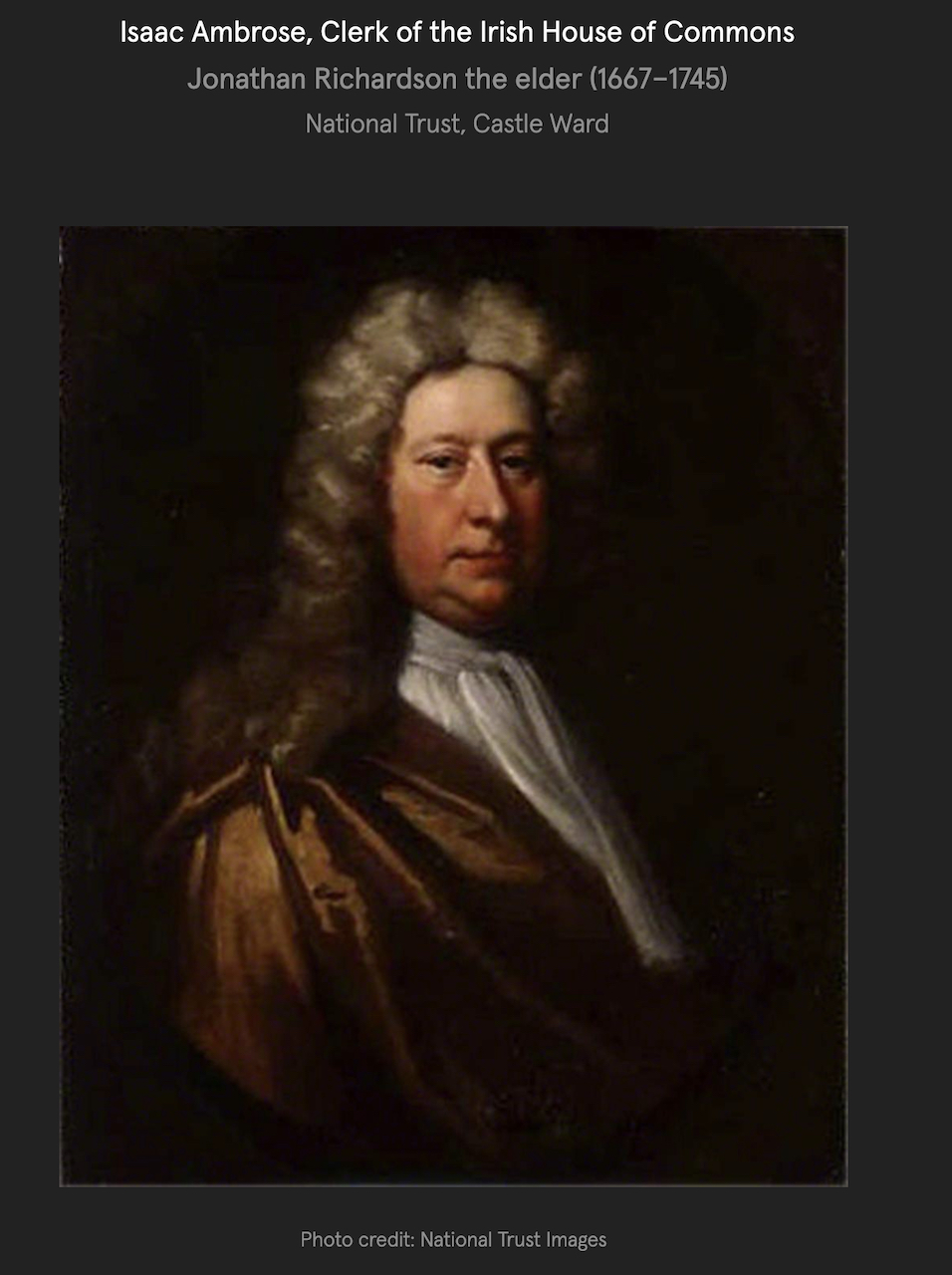
Isaac Ambrose (1680-1736), Clerk of the Irish House of Commons by Jonathan Richardson the elder courtesy of National Trust Castle Ward.
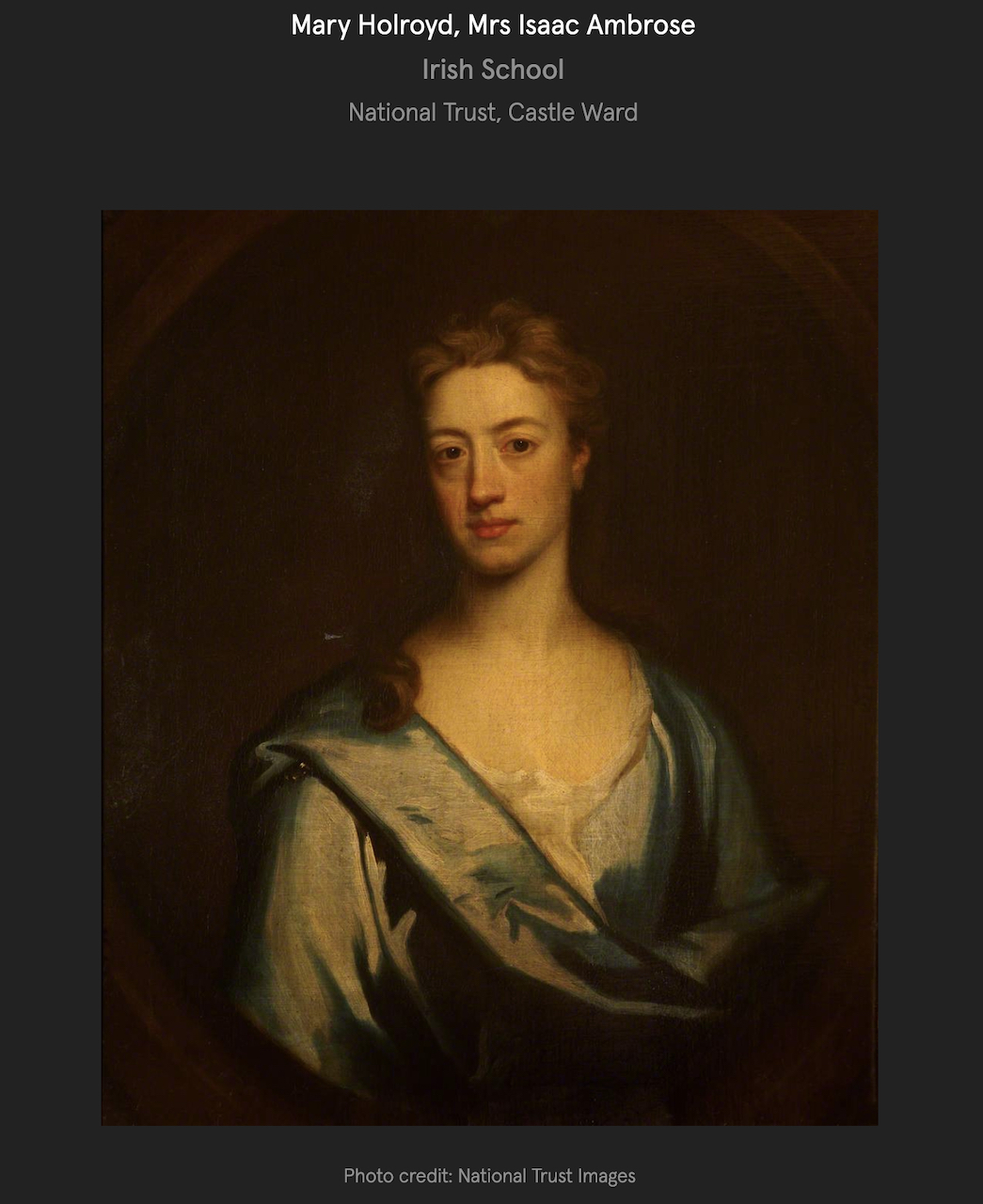
Mary Ambrose née Holroyd, Irish school courtesy of National Trust Castle Ward. She married Isaac Ambrose (1680-1736) and was the mother of Elizabeth Ambrose who married Hugh Eccles.
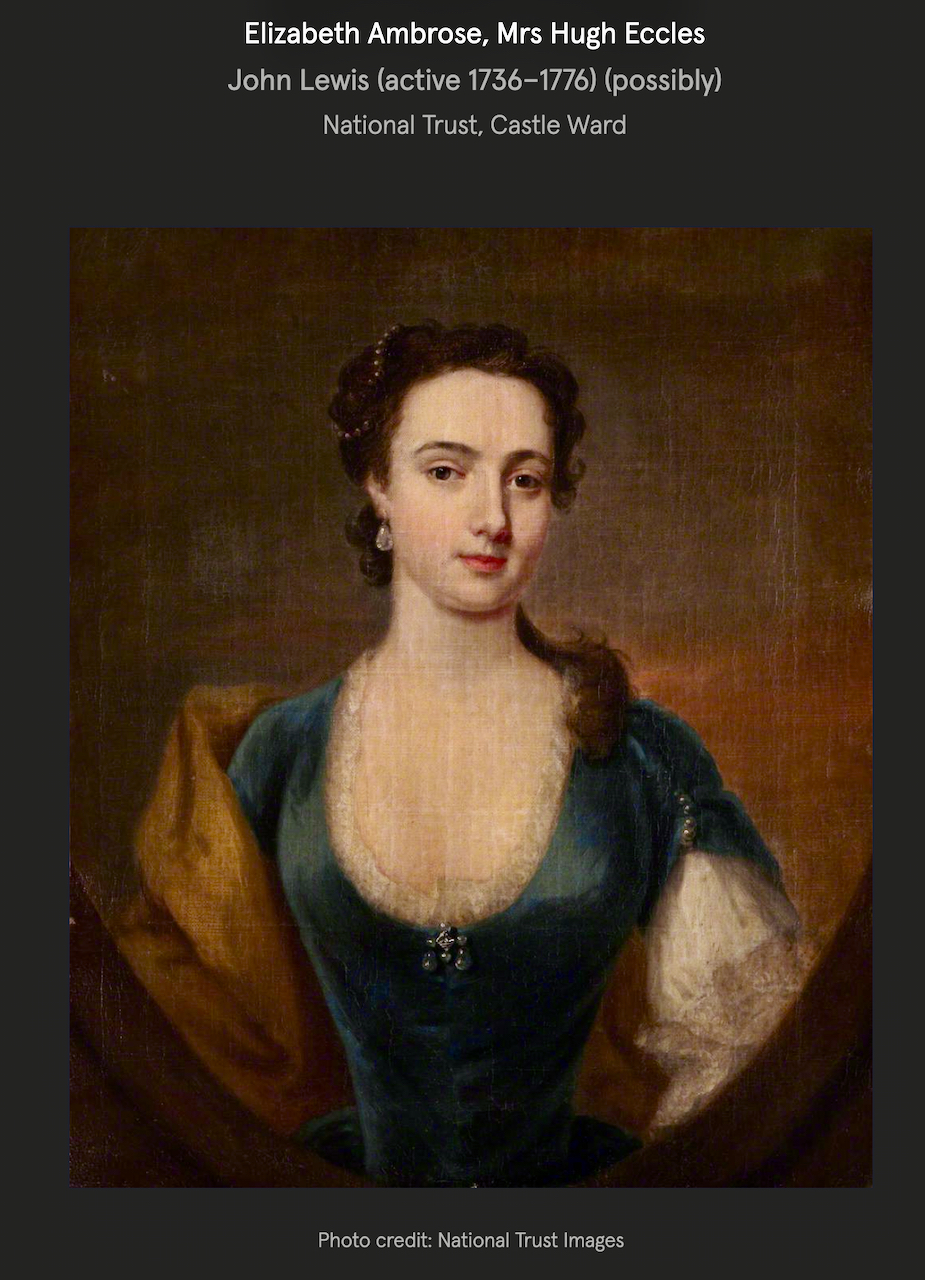
Elizabeth née Ambrose (b. 1706) who marries Hugh Eccles (1701-1761), daugher of Isaac Ambrose (1680-1736), possibly by John Lewis, courtesy of National Trust Castle Ward.
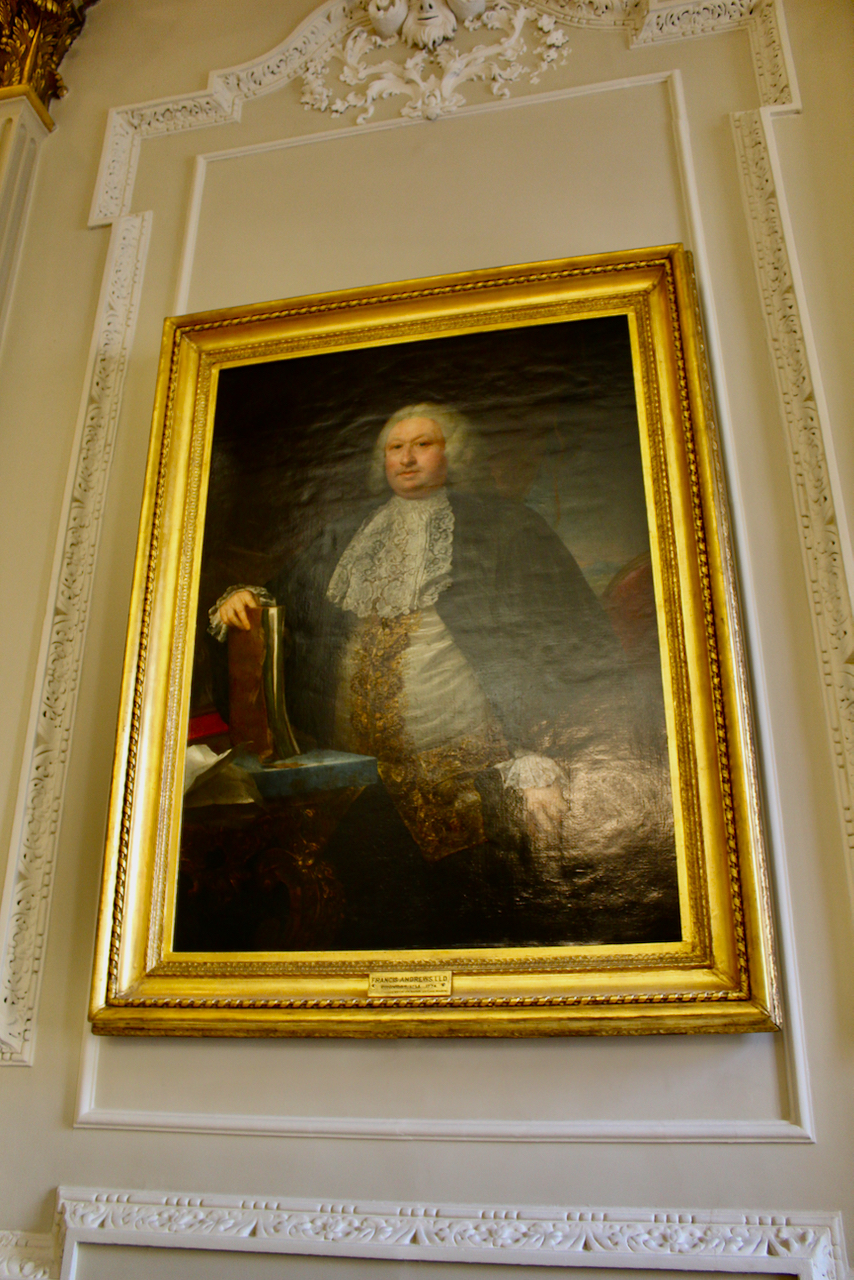
Francis Andrews (1718-1774), portrait by Antonio Maroni. He was the Provost who commissioned the building of the new Provost’s House, Trinity College Dublin, begun in 1759. He was Provost 1758-1774. Photograph © Jennifer Winder-Baggot, www.irishhistorichouses.com
Arthur Annesley (1614-1686) 1st Earl of Anglesey, Wales, after John Michael Wright based on a work of 1676, National Portrait Gallery of London ref. 3805. He was also 2nd Viscount Valentia of County Kerry and 2nd Baron Mountnorris of Mountnorris, County Armagh and 1st Baron Annesley of Newport Pagnel, Buckinghamshire, England.
James Annesley, (1715-1760), Claimant to the Annesley Peerage Date. after 1744 by Engraver John Brooks, after artist Justin Pope-Stevens, courtesy of National Gallery of Ireland. In 1728 he opposed his father’s raising money to fund a spendthrift way of life, hence apparently he was removed to an obscure school, and then his death announced. He was sold to an American planter as a slave by his uncle, Richard (who went on to assume his title of Baron Altham). He subsequently escaped to Jamaica. In 1737 he was de jure 5th Baron Altham, 7th Viscount of Valentia and 6th Earl of Anglesey (as which would normally have succeeded his father’s 1st cousin on latter’s death. In September 1740 he made his way back to England under the care of Admiral Vernon. On 11 November 1743 he took action against his uncle, Richard, to eject him as Baron Altham. His uncle’s defence was that James was not the legitimate son of Mary, but actually the illegitimate son of Joan Landy. The verdict was in James’ favour, and his estates were returned to him, although he never took up his titles. On 26 November 1743 the jury disagreed and found for the plaintiff, who got back the family estates. On 3 August 1744 his uncle was in addition found guilty of assault on his nephew (i.e., presumably the selling into slavery.)
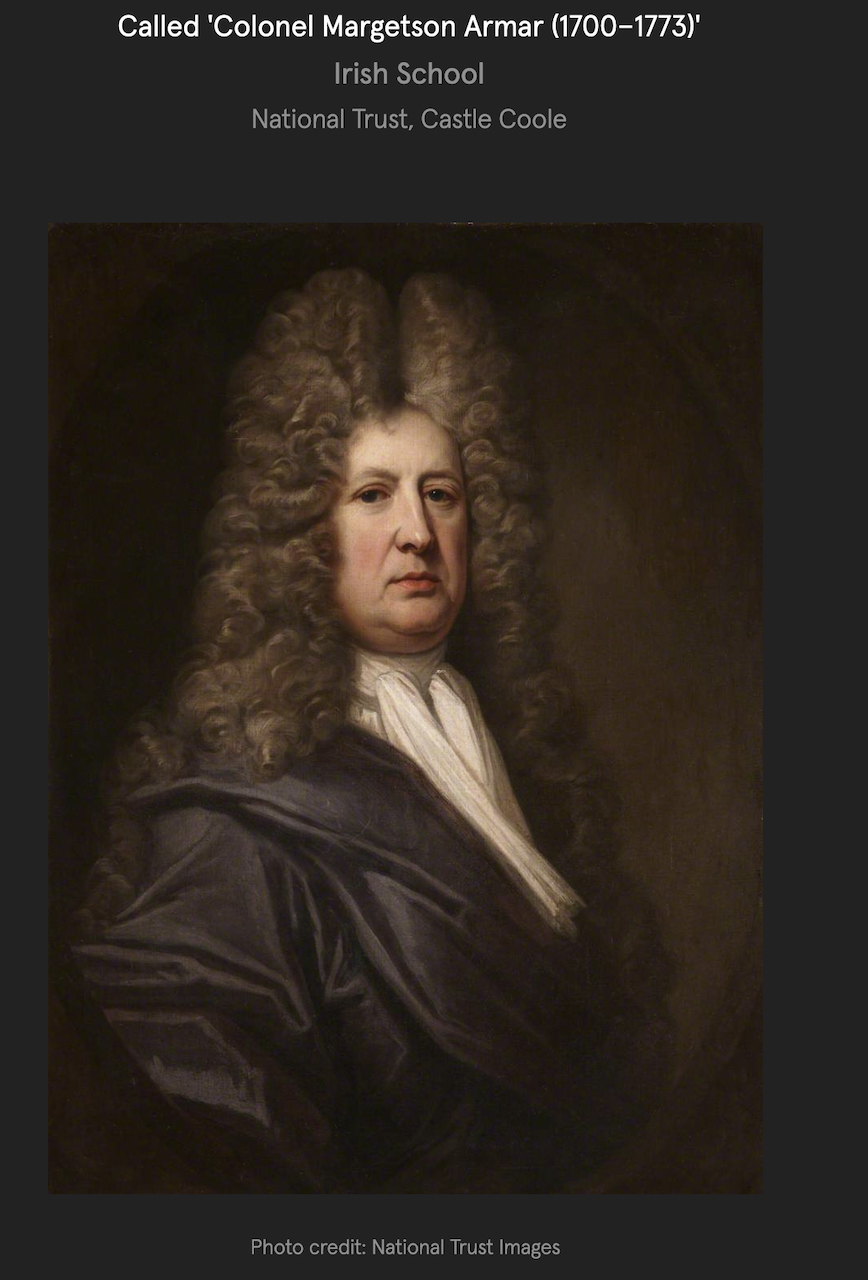
Called Colonel Margetson Armar (1700-1773) Irish school courtesy of National Trust Castle Coole.
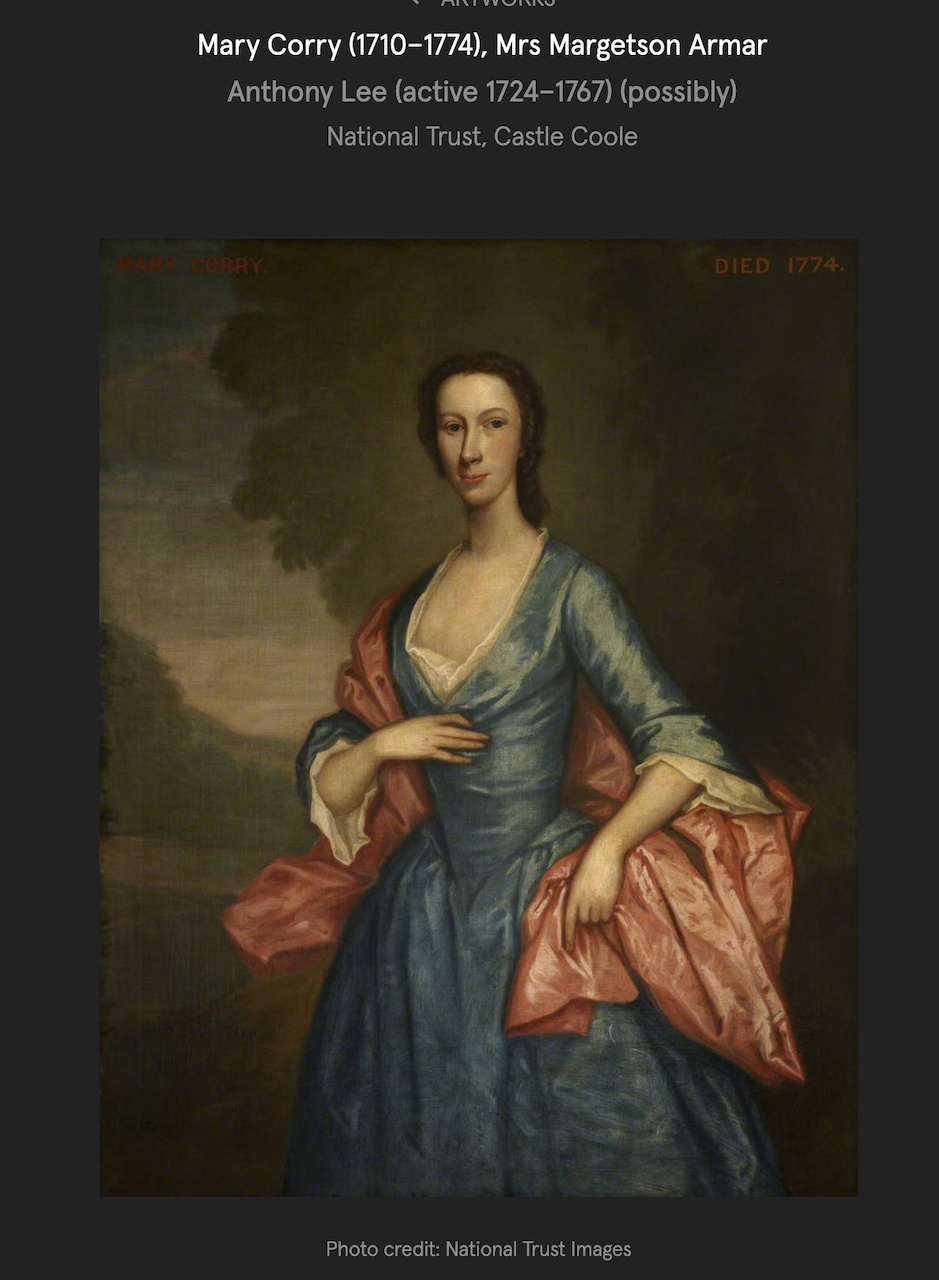
Mary Armar née Corry (1710-1774) wife of Margetson Armar by Anthony Lee courtesy of National Trust Castle Coole. She was the daughter of Colonel John Corry, MP (1666–1726).
George Coppinger Ashlin (1837-1921), architect of St. George’s, County Dublin, courtesy of Irish Architectural Archive.
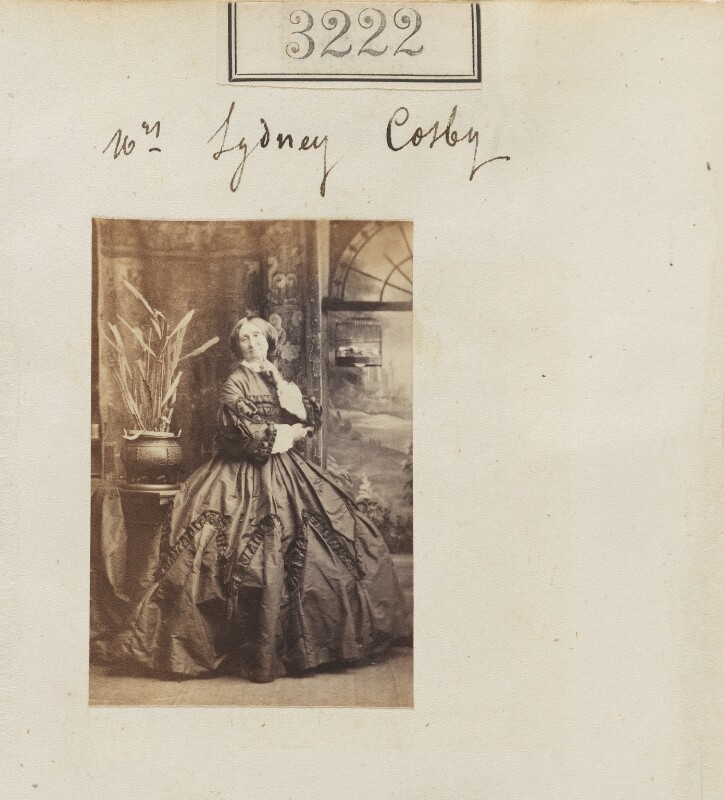
Mrs. Sydney Cosby, courtesy of National Gallery of Ireland. Could it be Emily Ashworth (d. 1863), of Shirley House, Twickenham, wife of Sydney Cosby (1807-1840), of Stradbally Hall, County Laois.
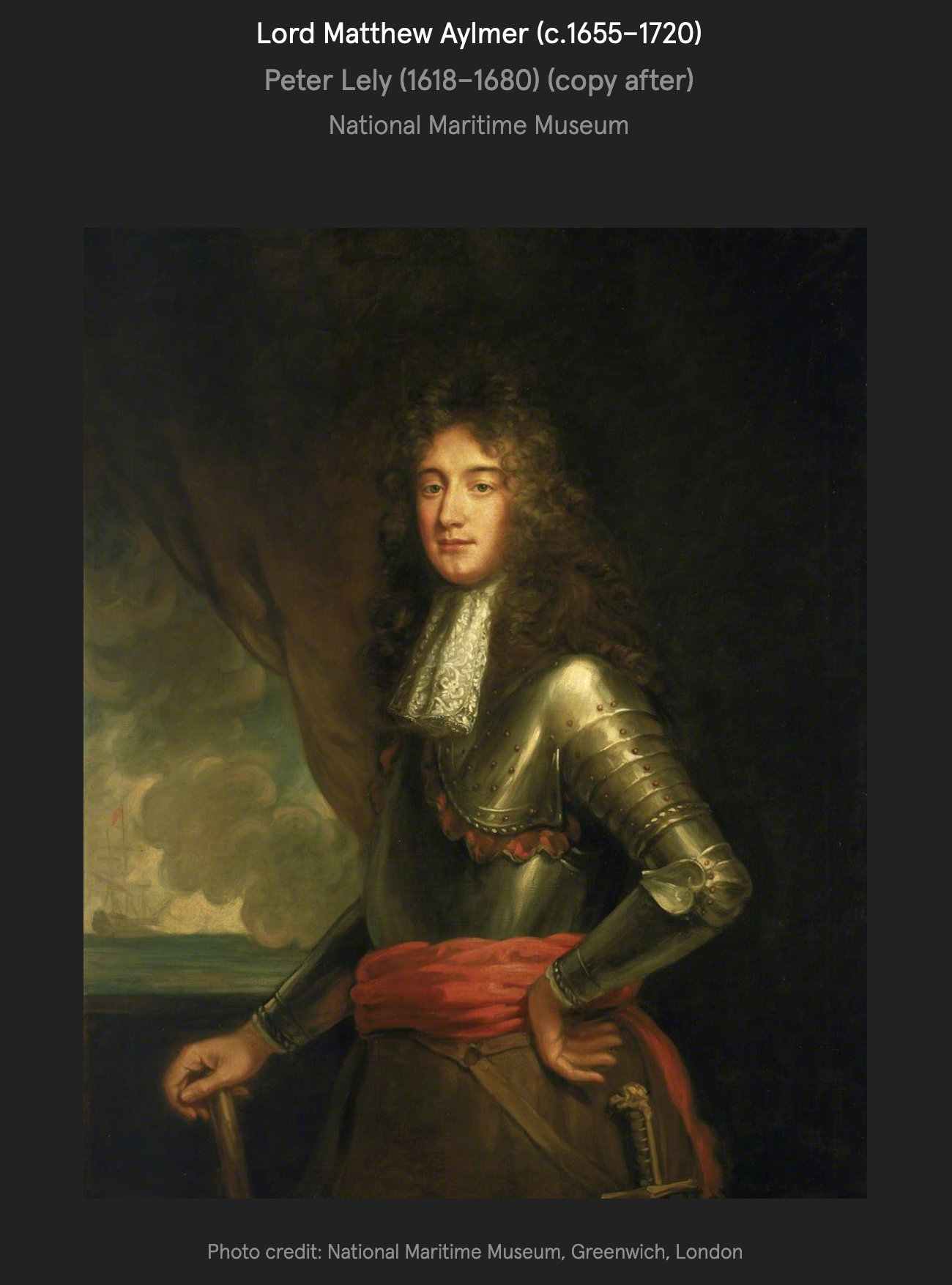
Matthew Aylmer (c. 1655-1720) 1st Lord Aylmer Baron of Balrath by Peter Lely courtesy of National Maritime Museum.
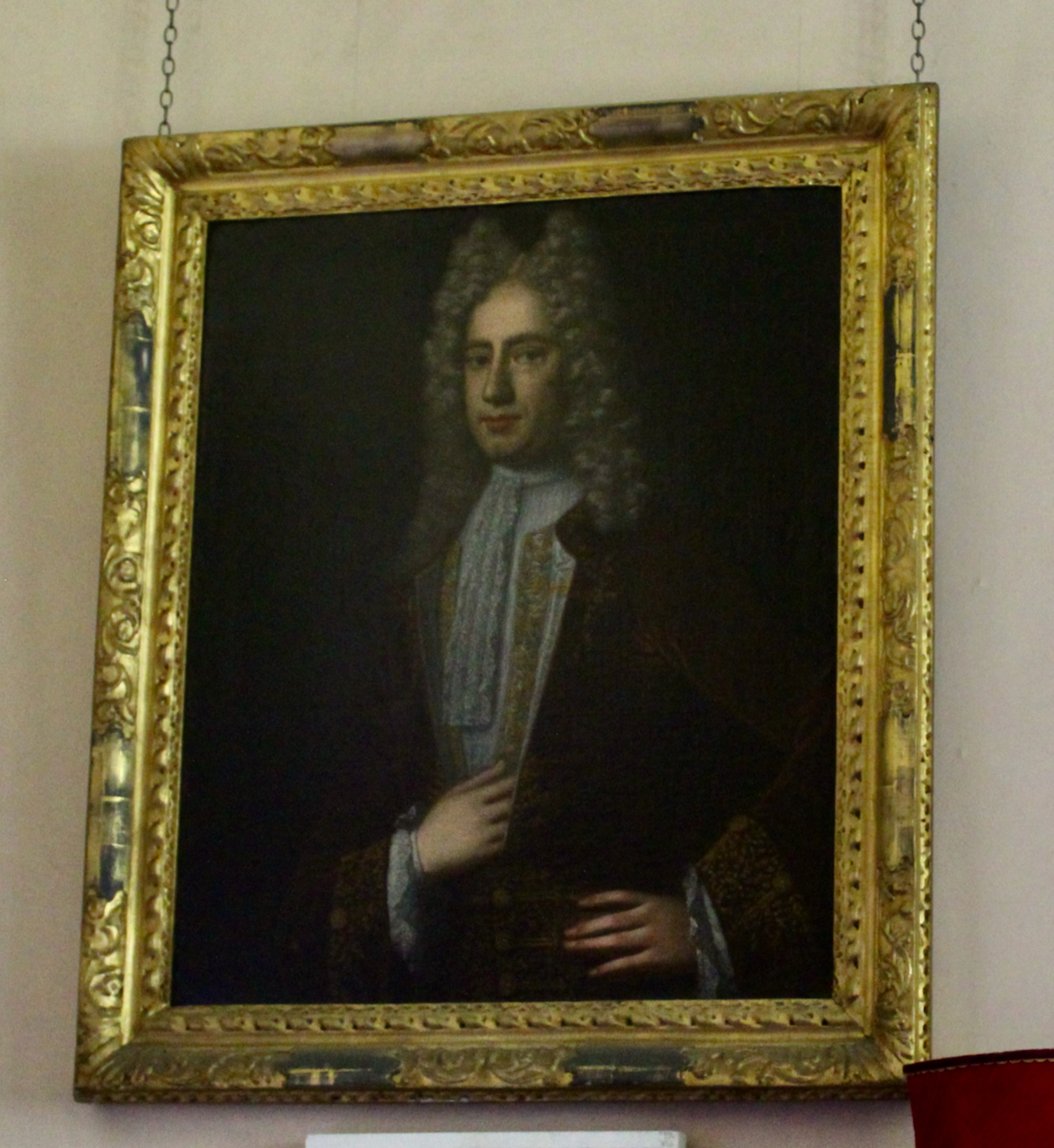
Peter Aylward, husband of Elizabeth Butler (1674-1708), daughter of Richard Butler, 2nd Baronet of Paulstown (or Poulstown), County Kilkenny. Portrait by Garret Morphy. Photograph © Jennifer Winder-Baggot, www.irishhistorichouses.com
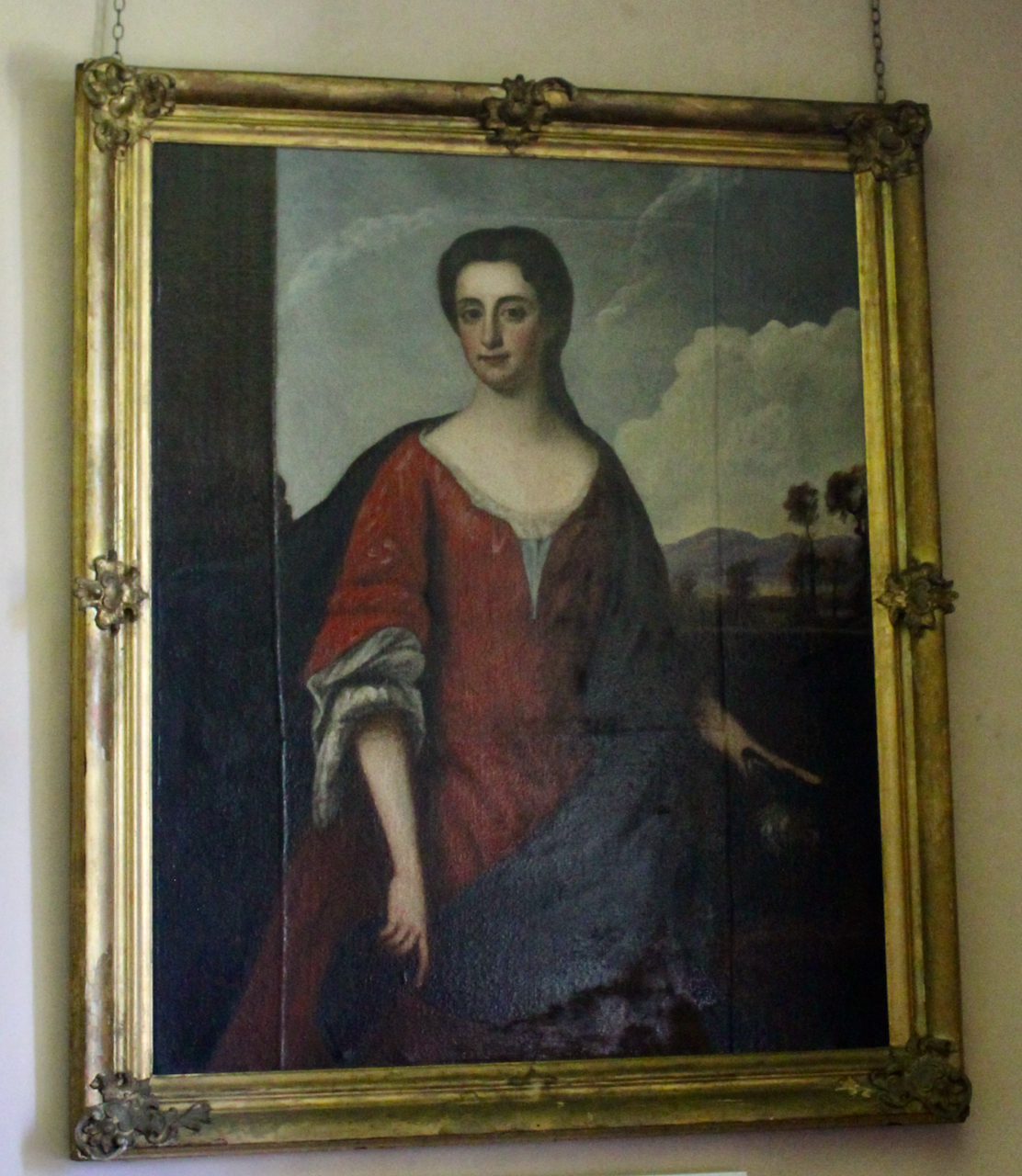
Elizabeth Butler (1674-1708), wife of Peter Aylward, daughter of Richard Butler, 2nd Baronet of Paulstown (or Poulstown), County Kilkenny. Photograph © Jennifer Winder-Baggot, www.irishhistorichouses.com