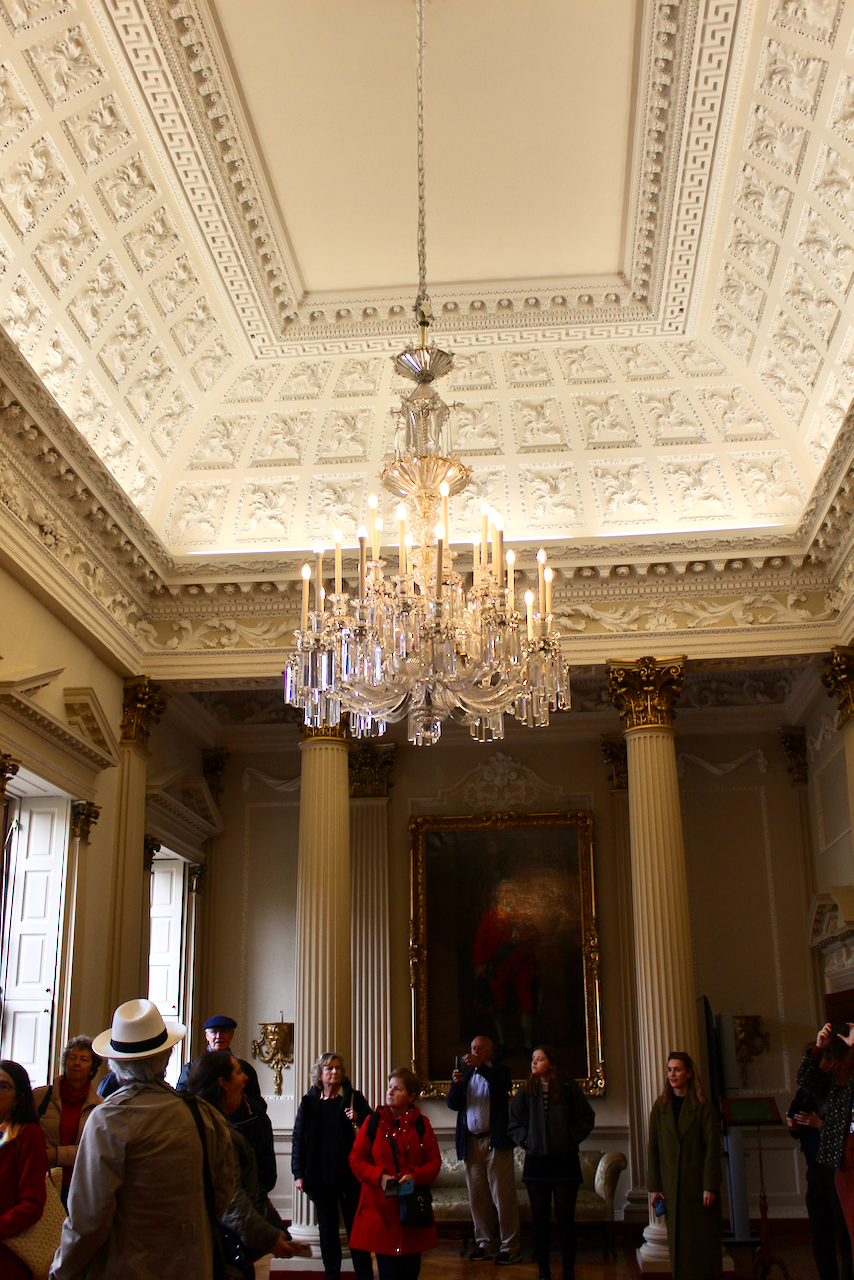
I had a busy Open House Dublin this year as I made sure to be up and in front of my computer at 9am when booking started, to try to get a place to visit the Provost’s House. I didn’t manage to on the day, but I joined the Irish Architecture Foundation especially to try to see places not normally open to the public, and I was in luck! They later offered some tickets to see the Provost’s House on the Friday morning of Open House this year and I jumped at the chance.
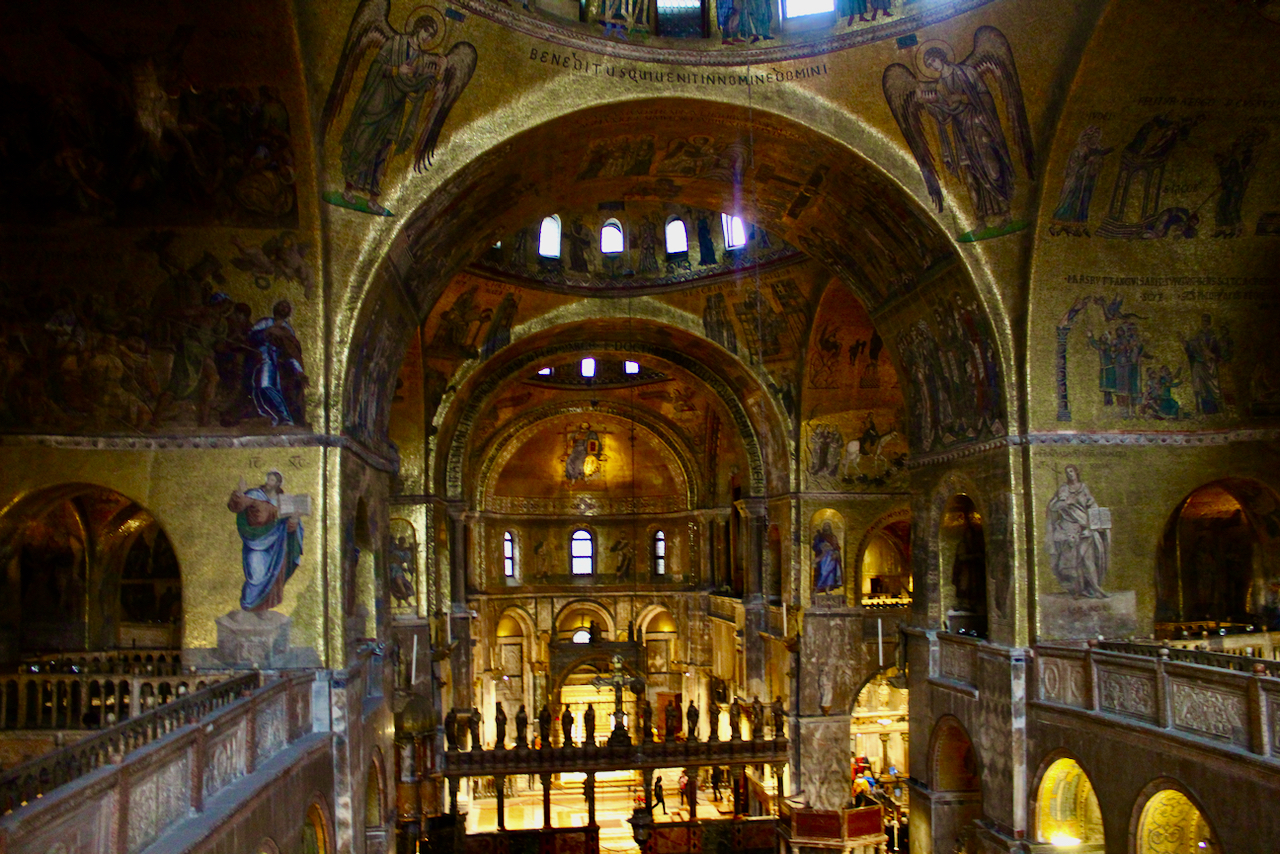
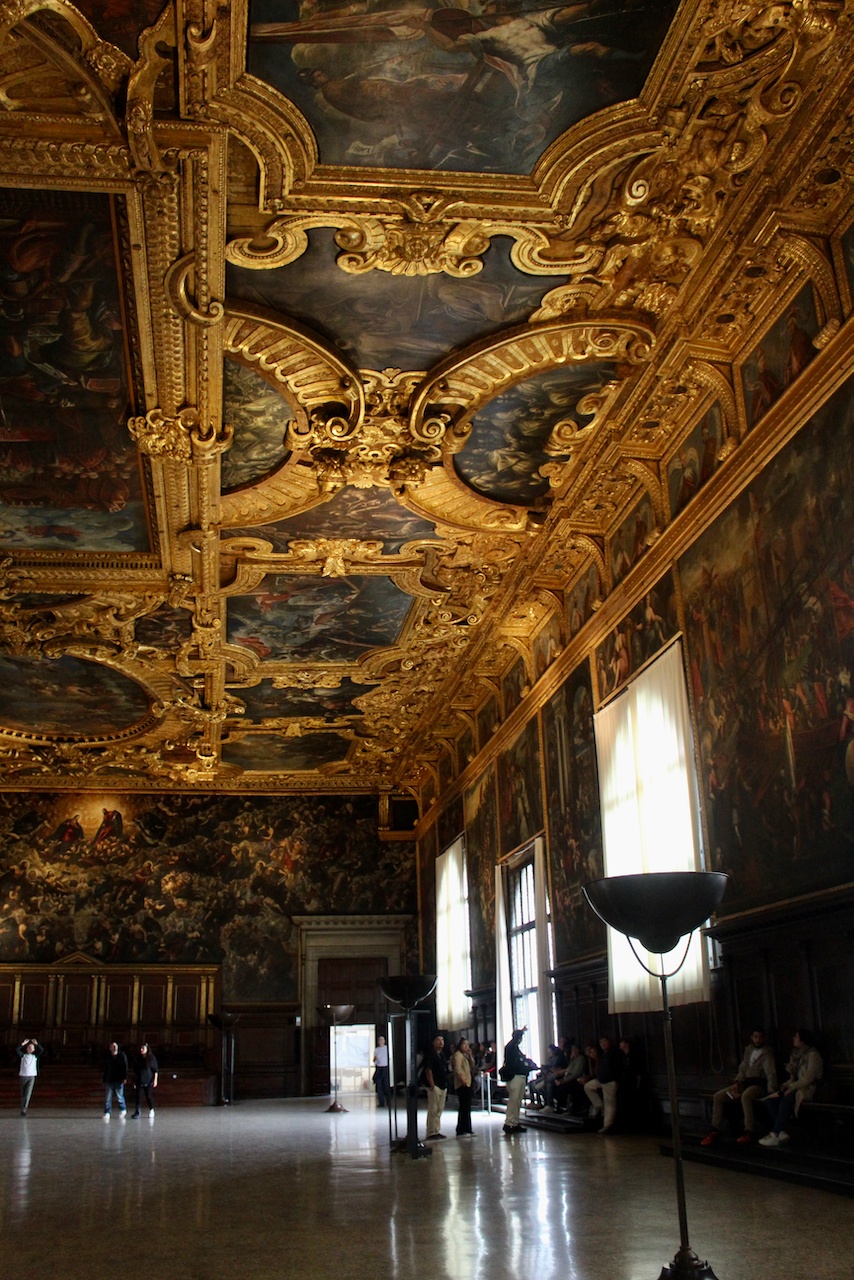
I’m a bit late writing about it, as Stephen and I took a short jaunt to visit Venice for the first time! First of many, I hope, as I loved it. This time we only had time to see the Basilica di San Marco and the Doge’s Palace, and we went on a water bus trip up the Grand Canal.
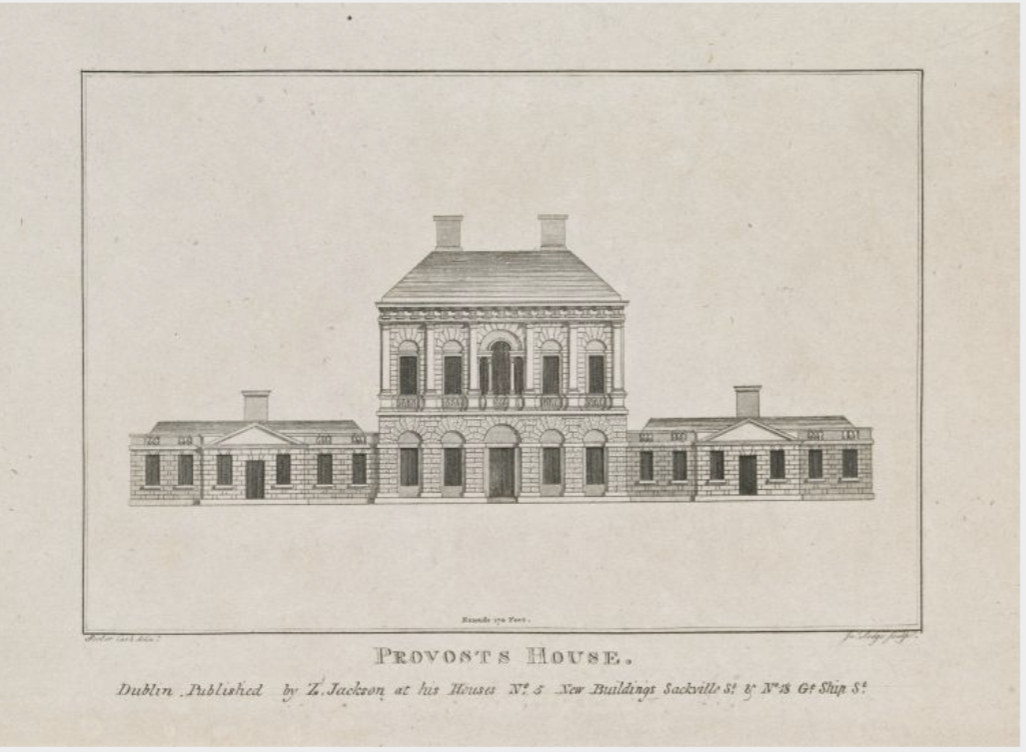
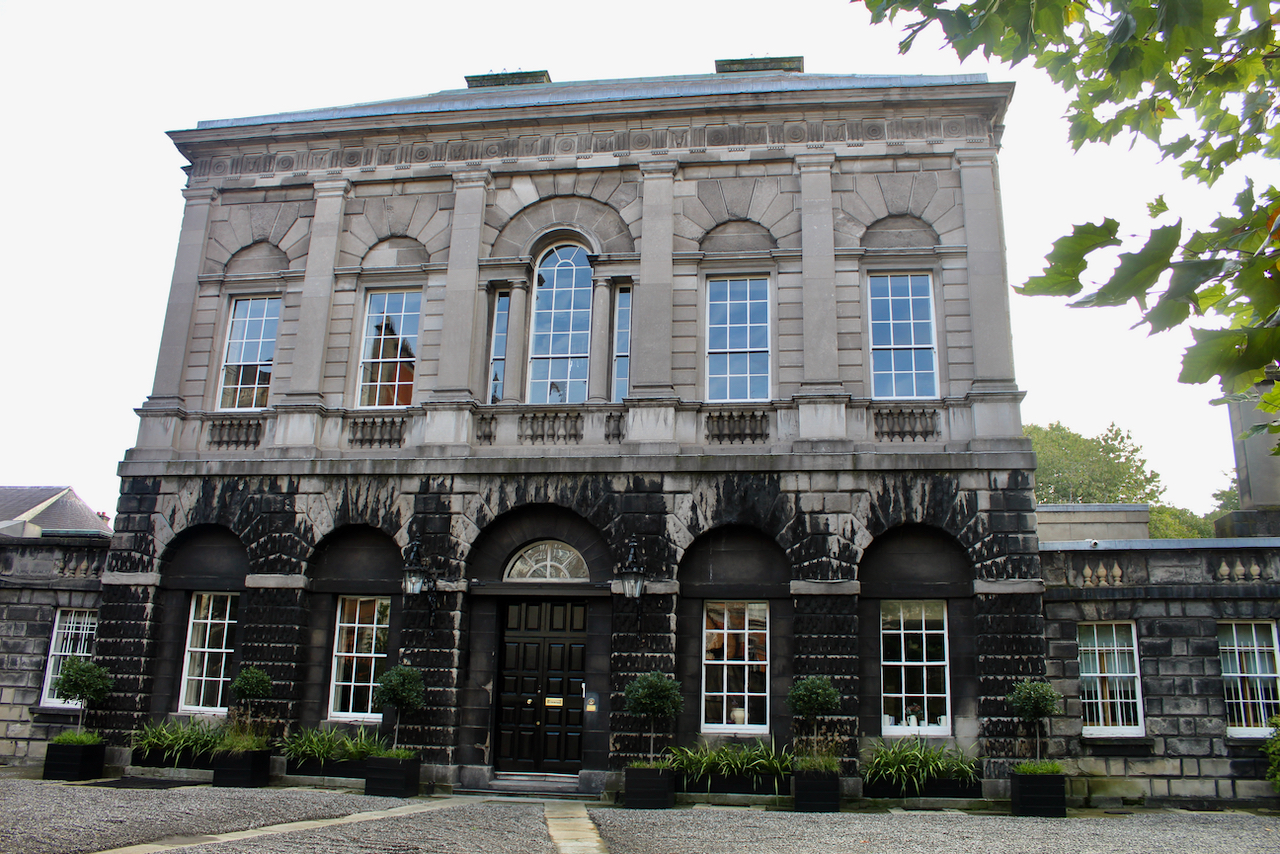
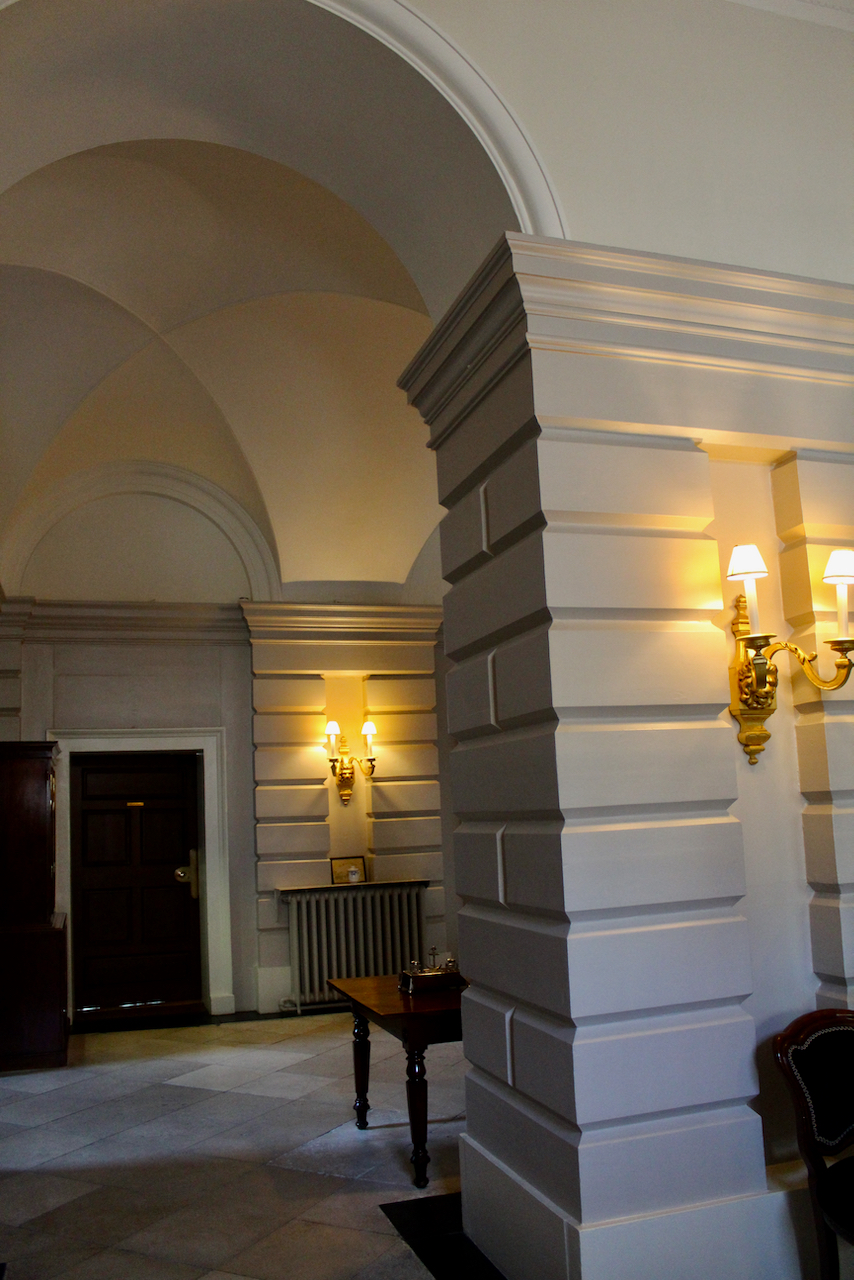
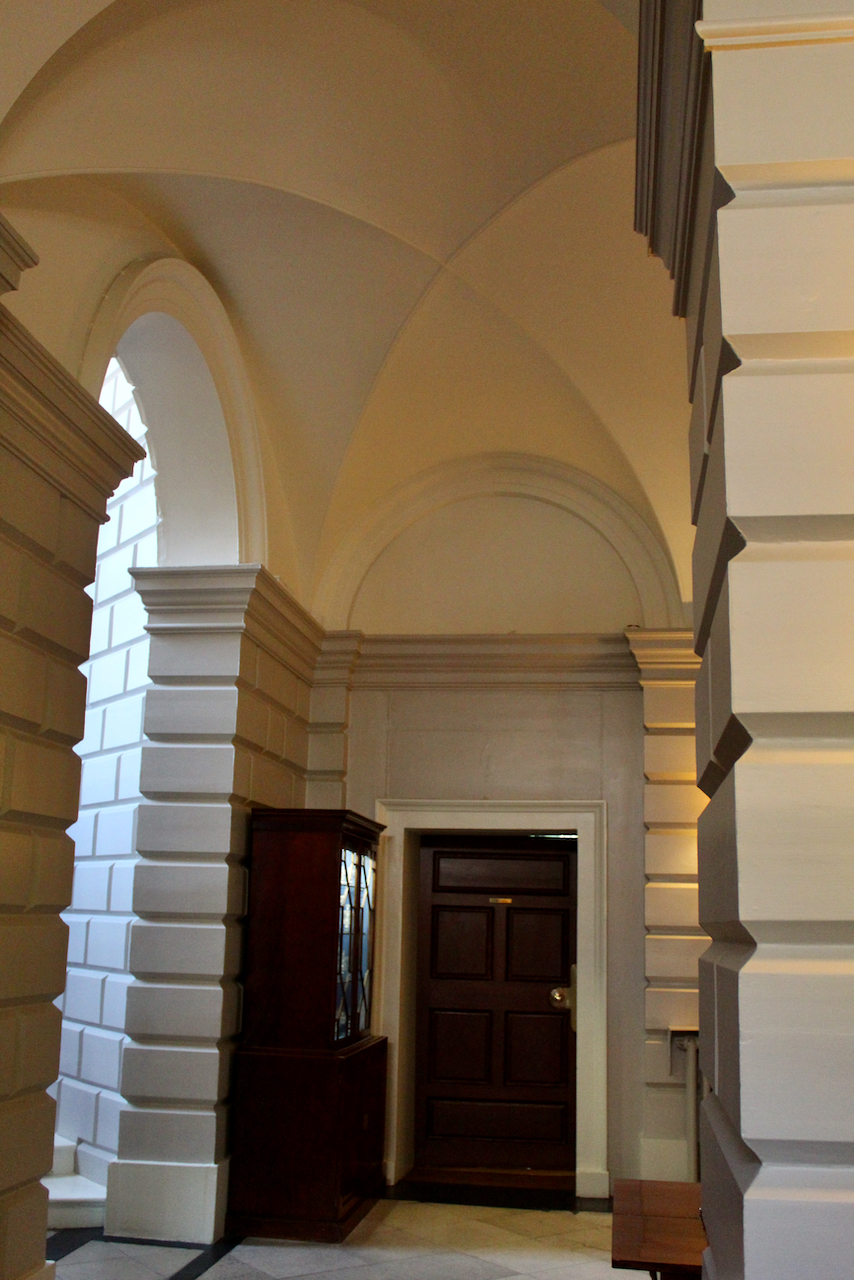
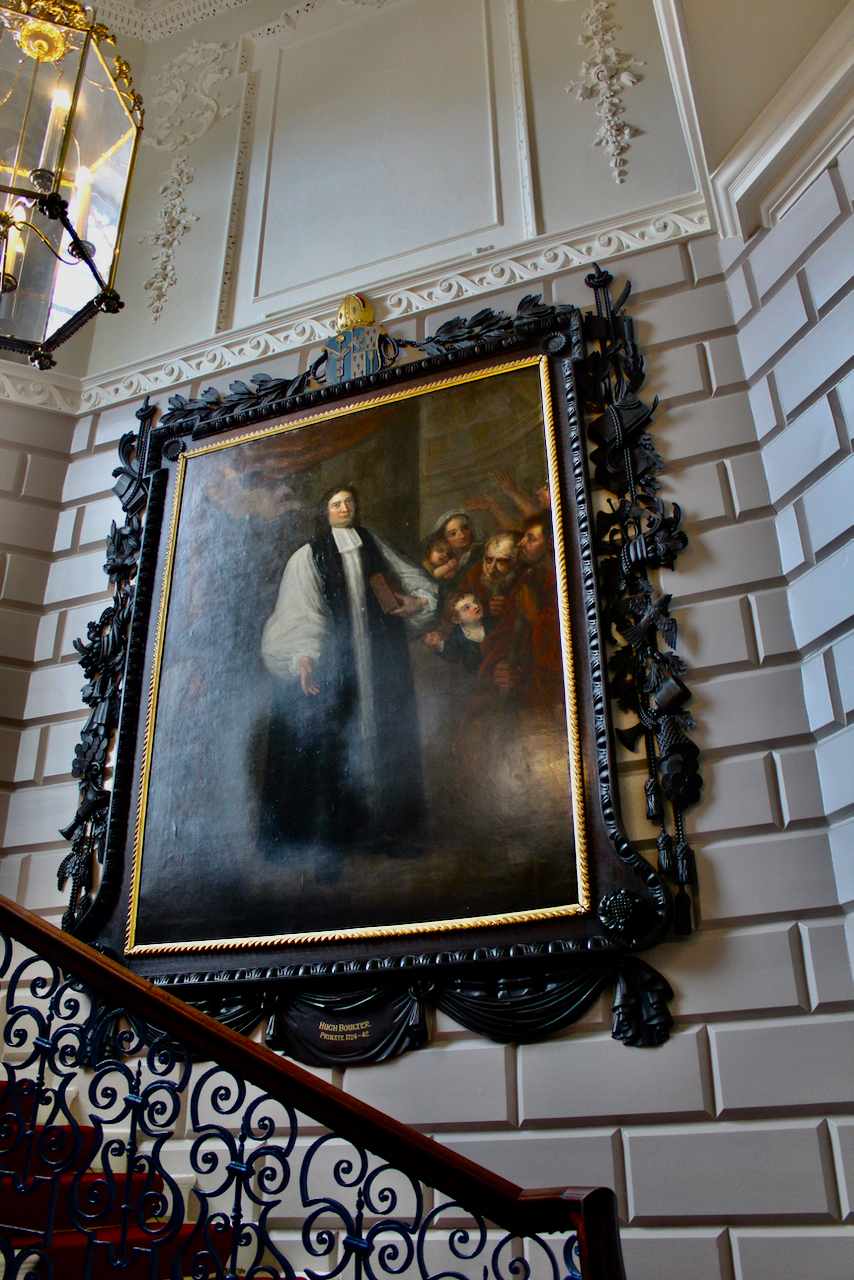
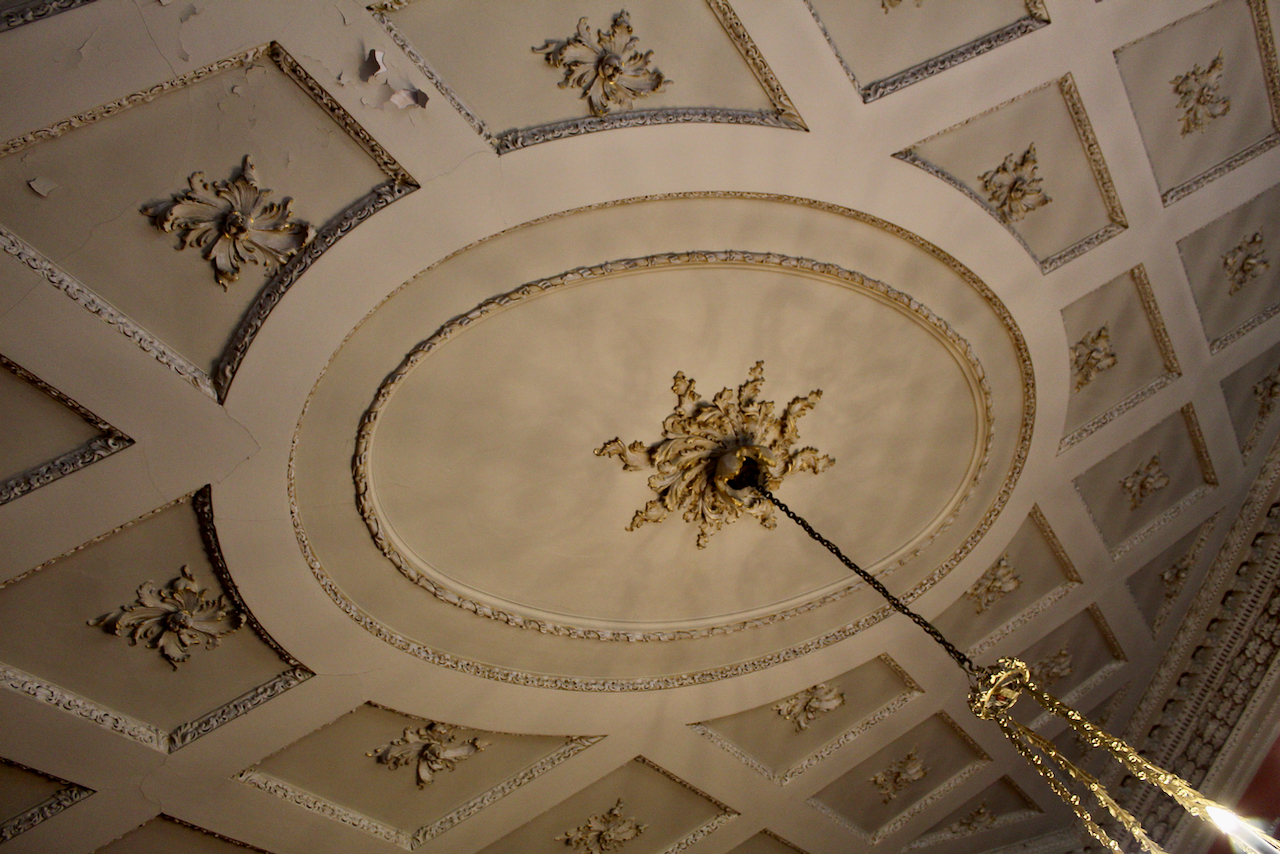
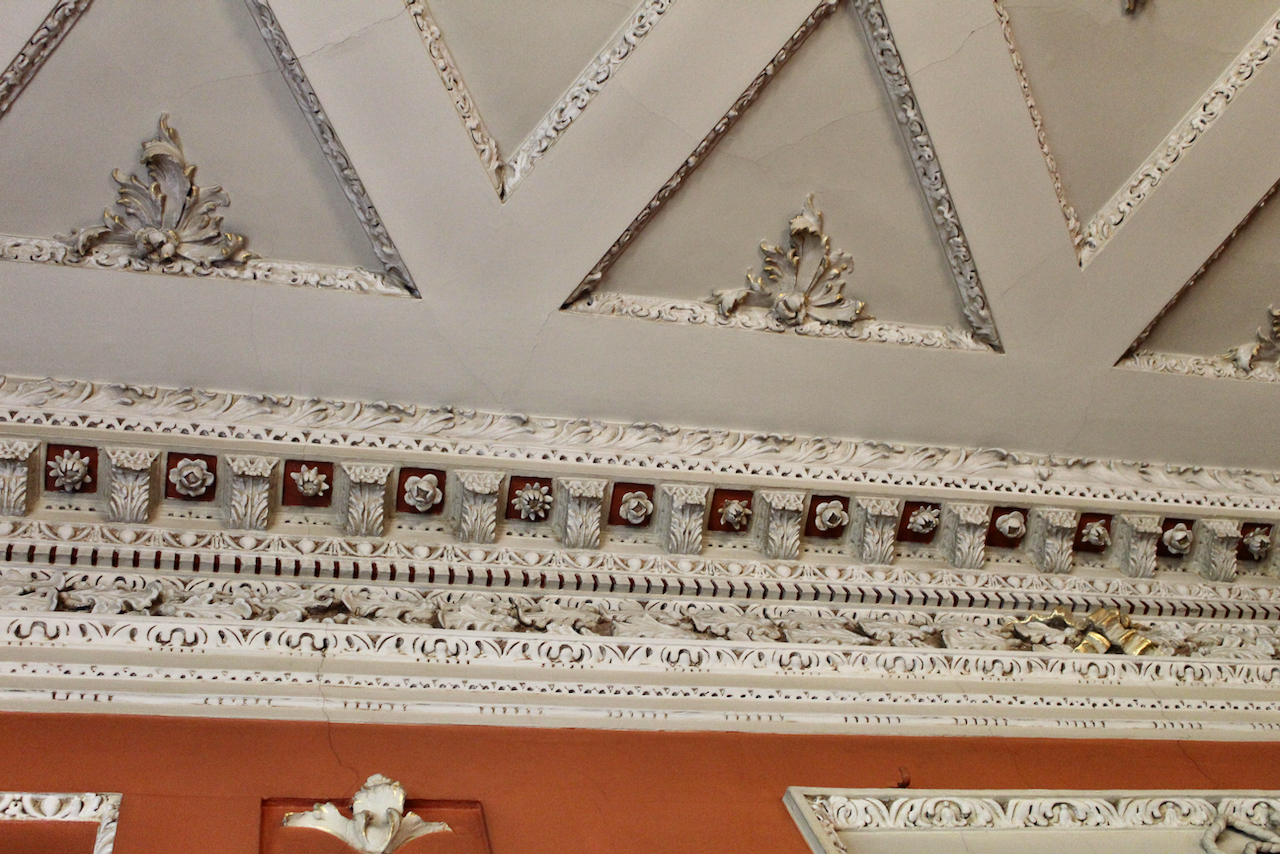
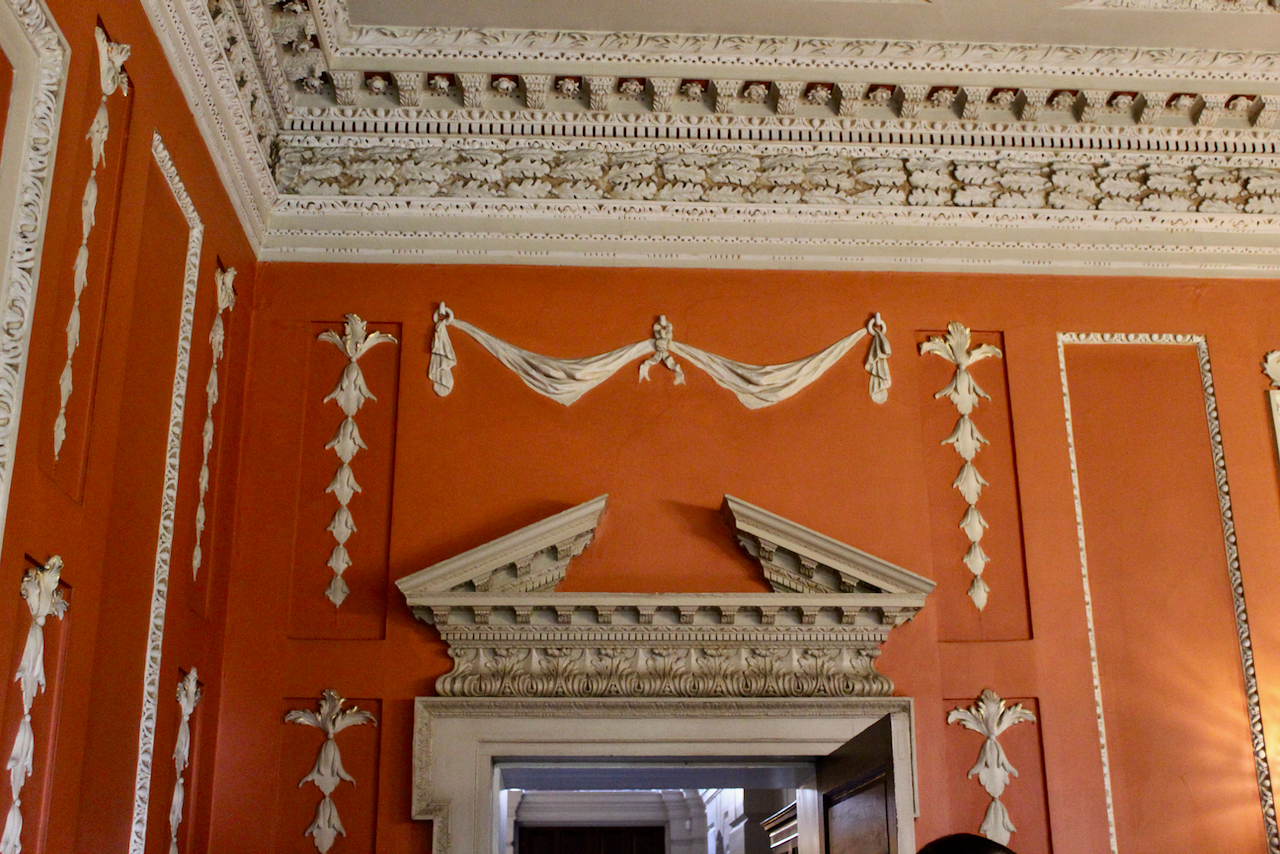
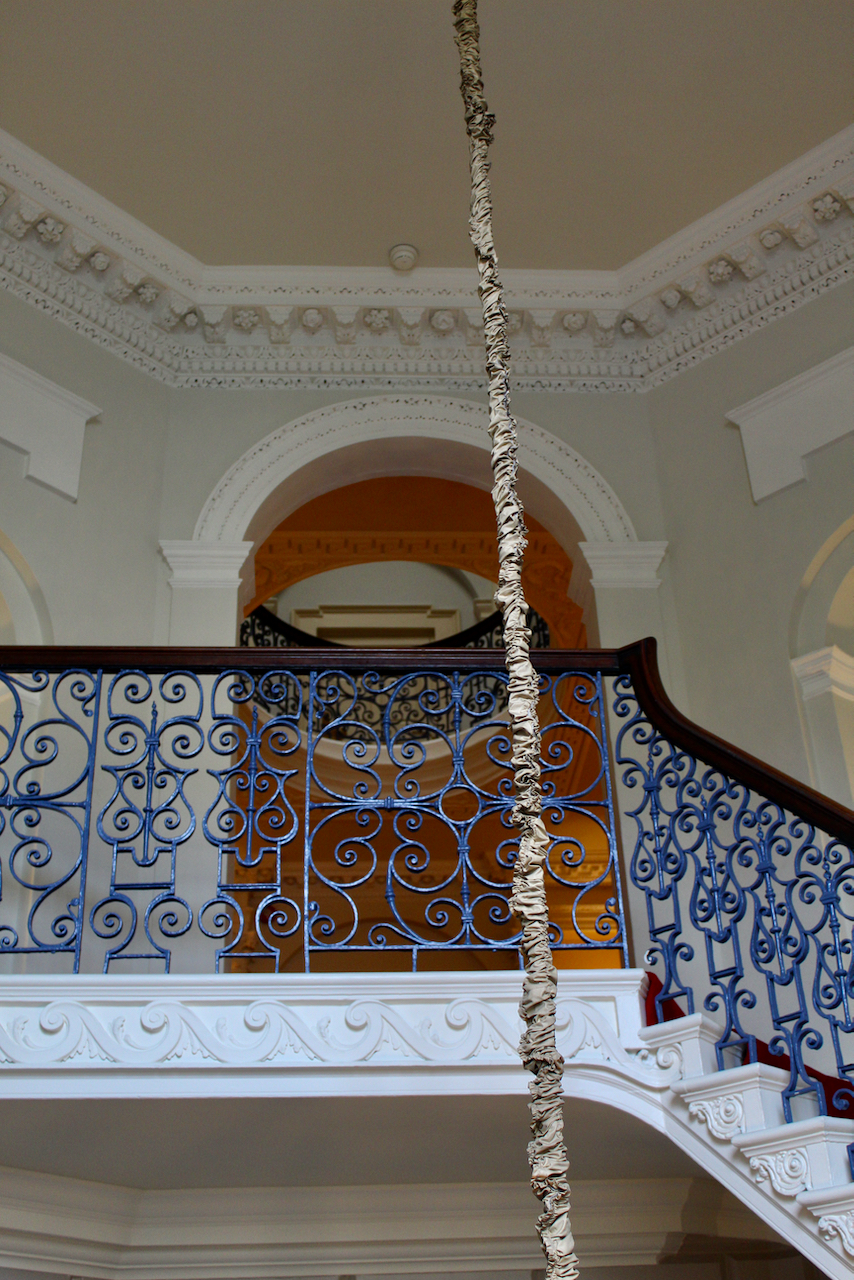
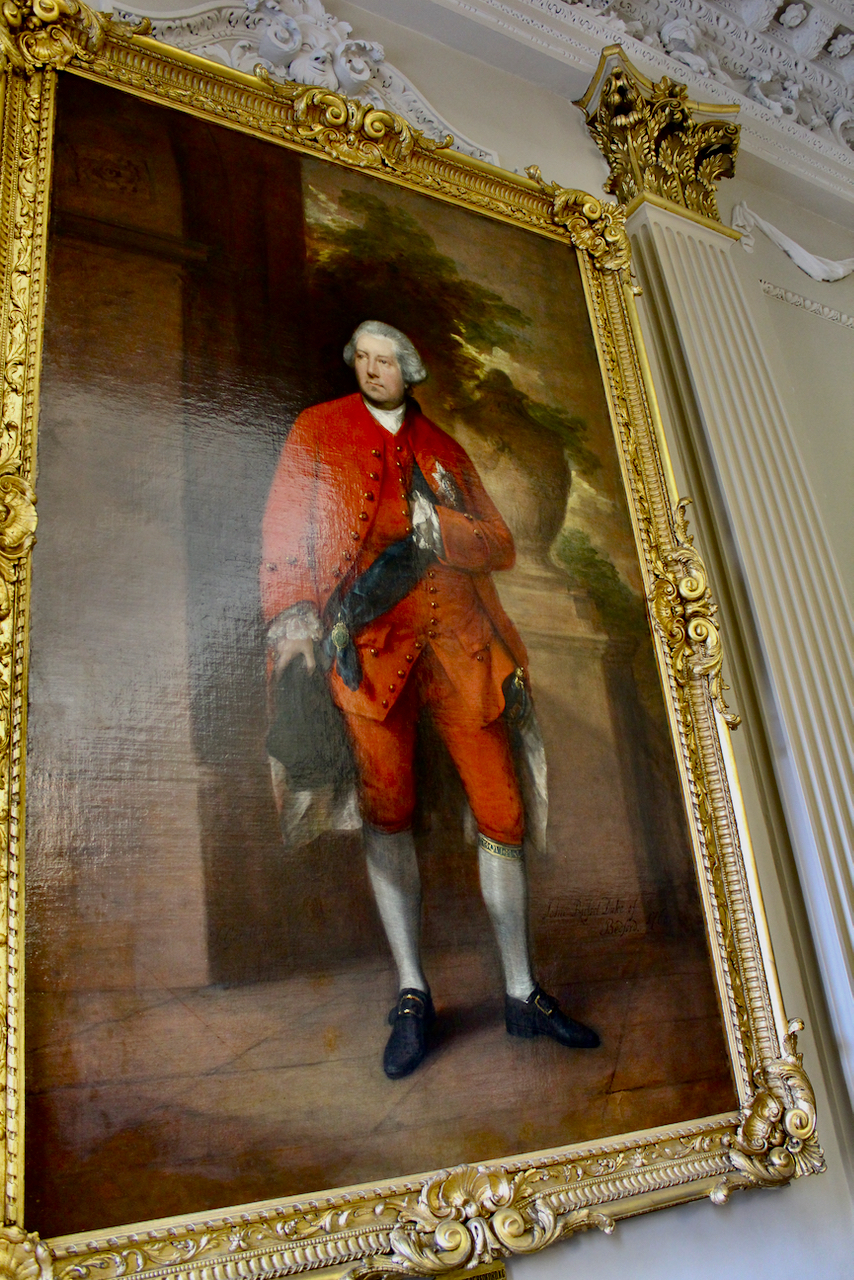
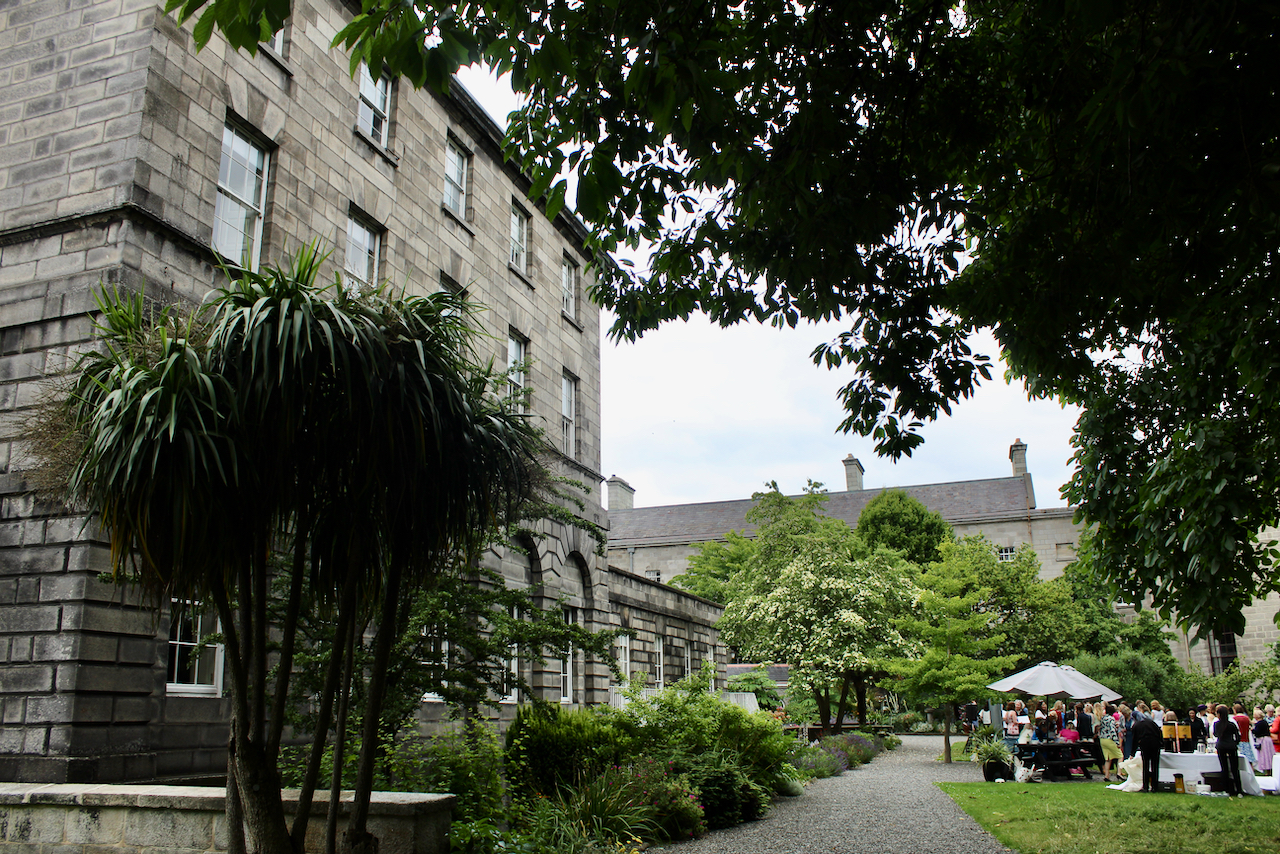
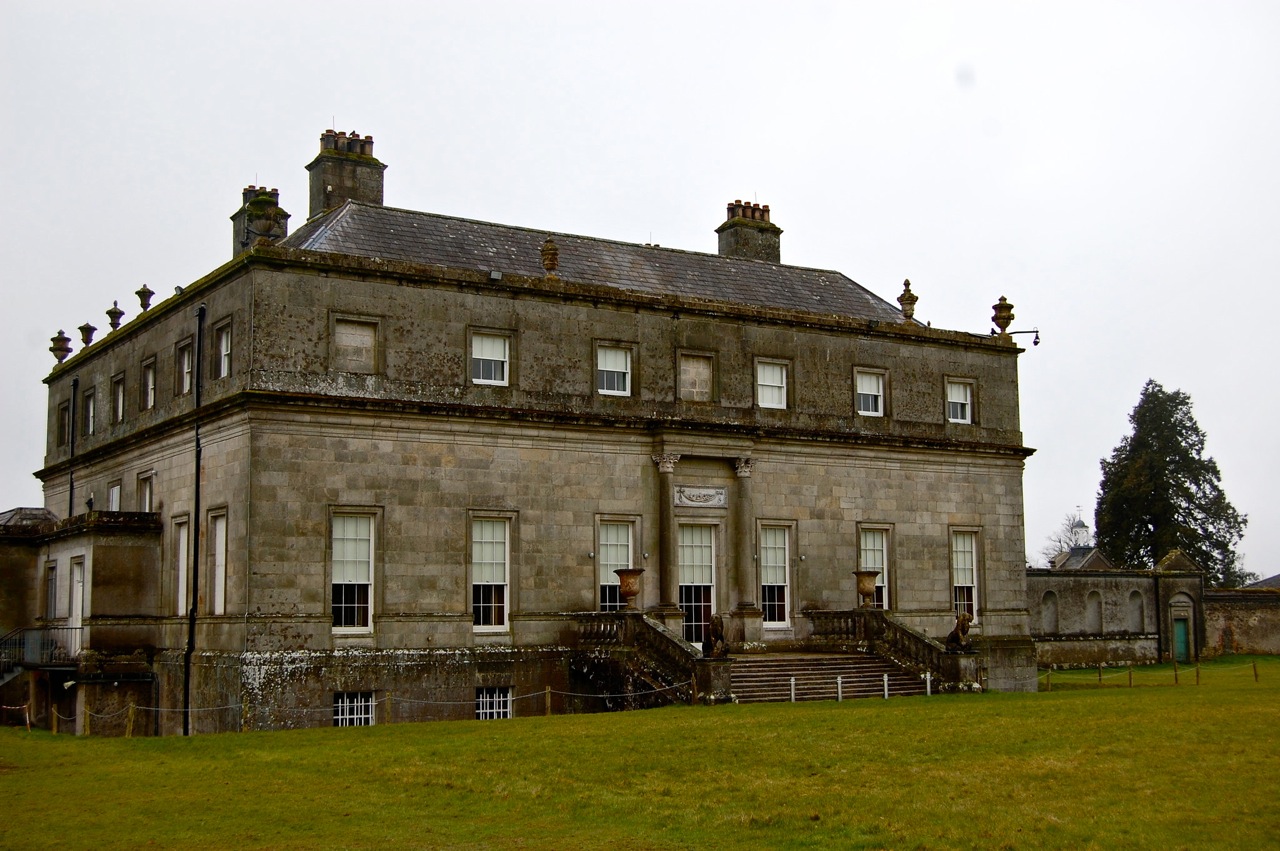
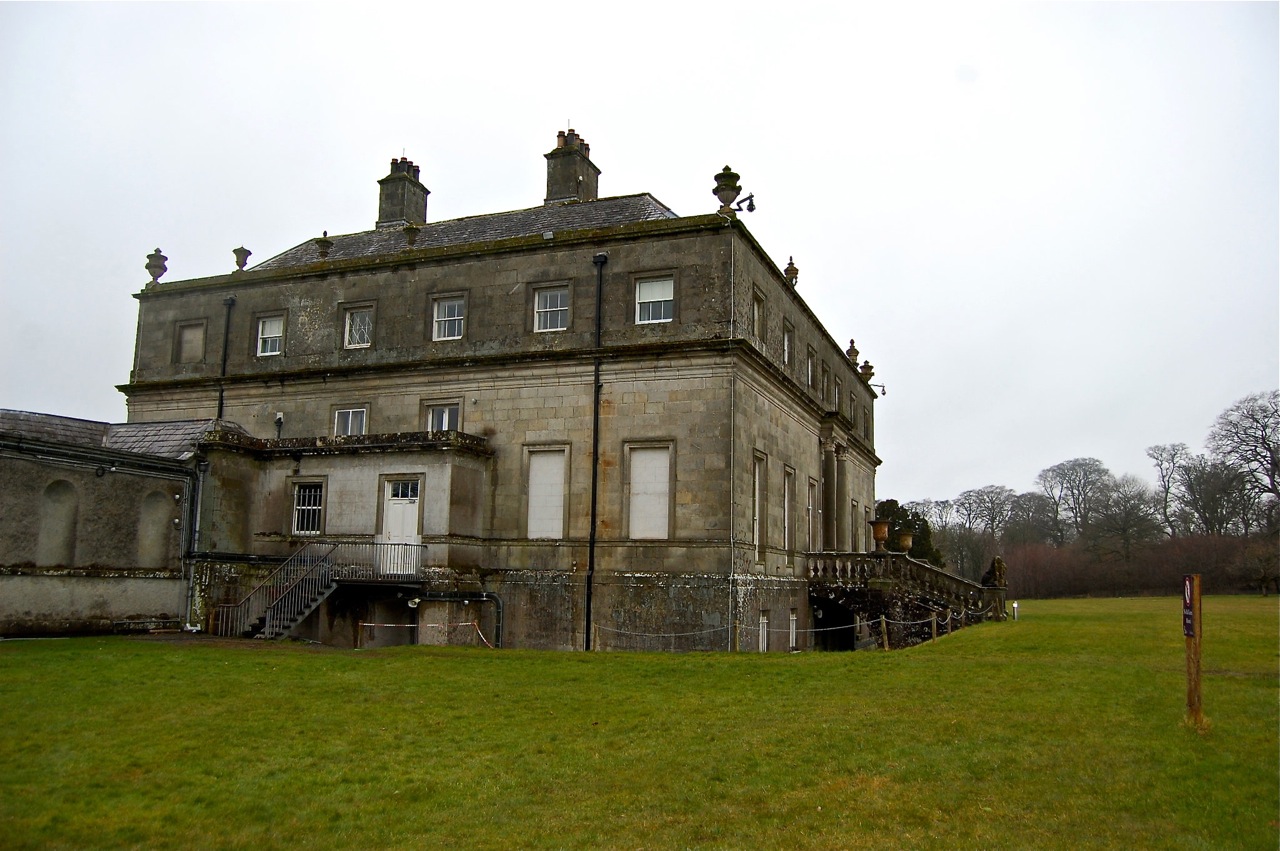
The Provost’s House is a five bay two storey over basement house with later built wings, single-storey of seven bays each, which hold offices. It is built to impress, with a carved balustrade along the first floor stringcourse, and a row of Doric pilasters on the first storey facade topped with a frieze of metops and bucrania. The upper storey is limestone but the lower level has rusticated vermiculated stone which absorbs the pollution of the air and has become blackened.
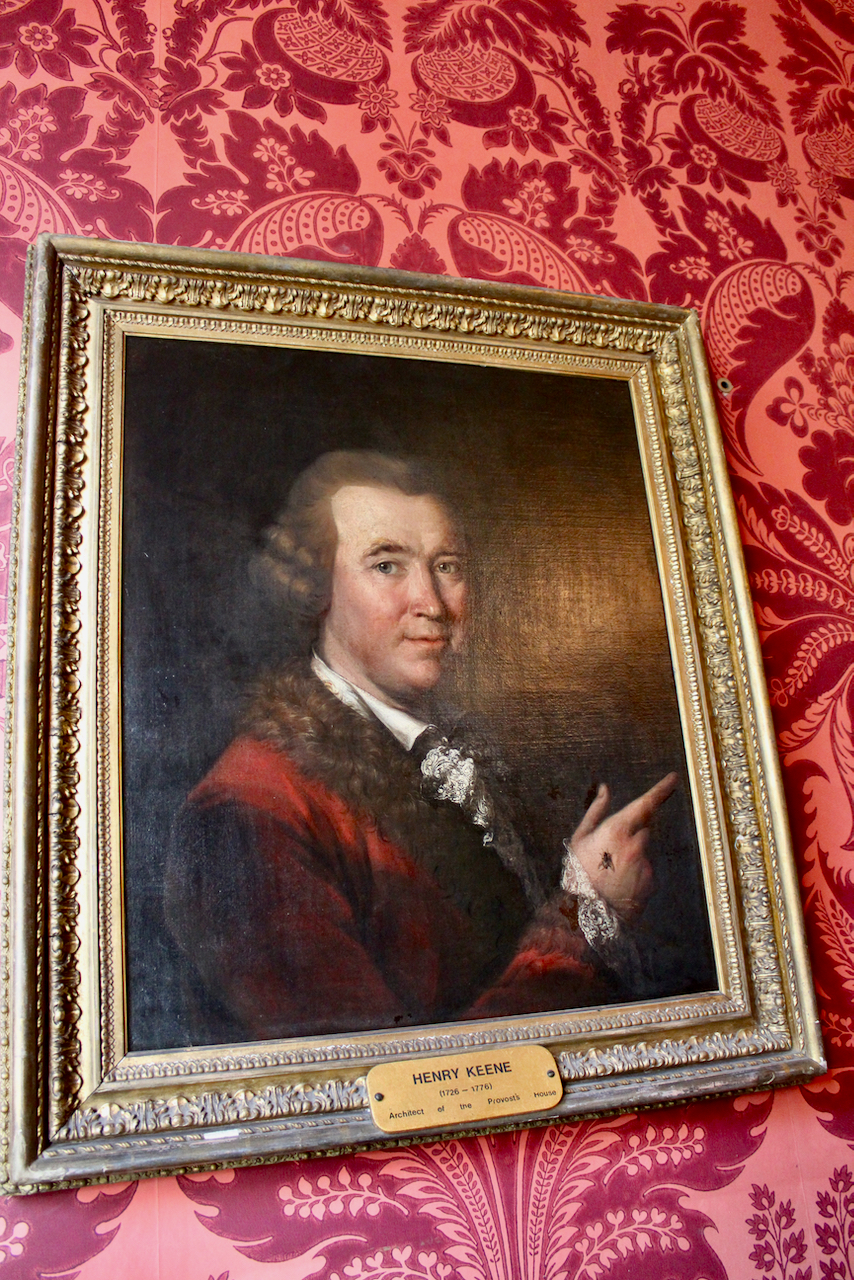
Although Henry Keene is identified as the architect, it is said to copy Richard Boyle 3rd Earl of Burlington’s design for General Wade’s Mayfair house, but George Montague, in a letter to Horace Walpole in 1761, commented ‘The Provost’s House of the university is just finished after the plan of General Wade’s but half of the proportions and symmetry were lost at sea in coming over’.
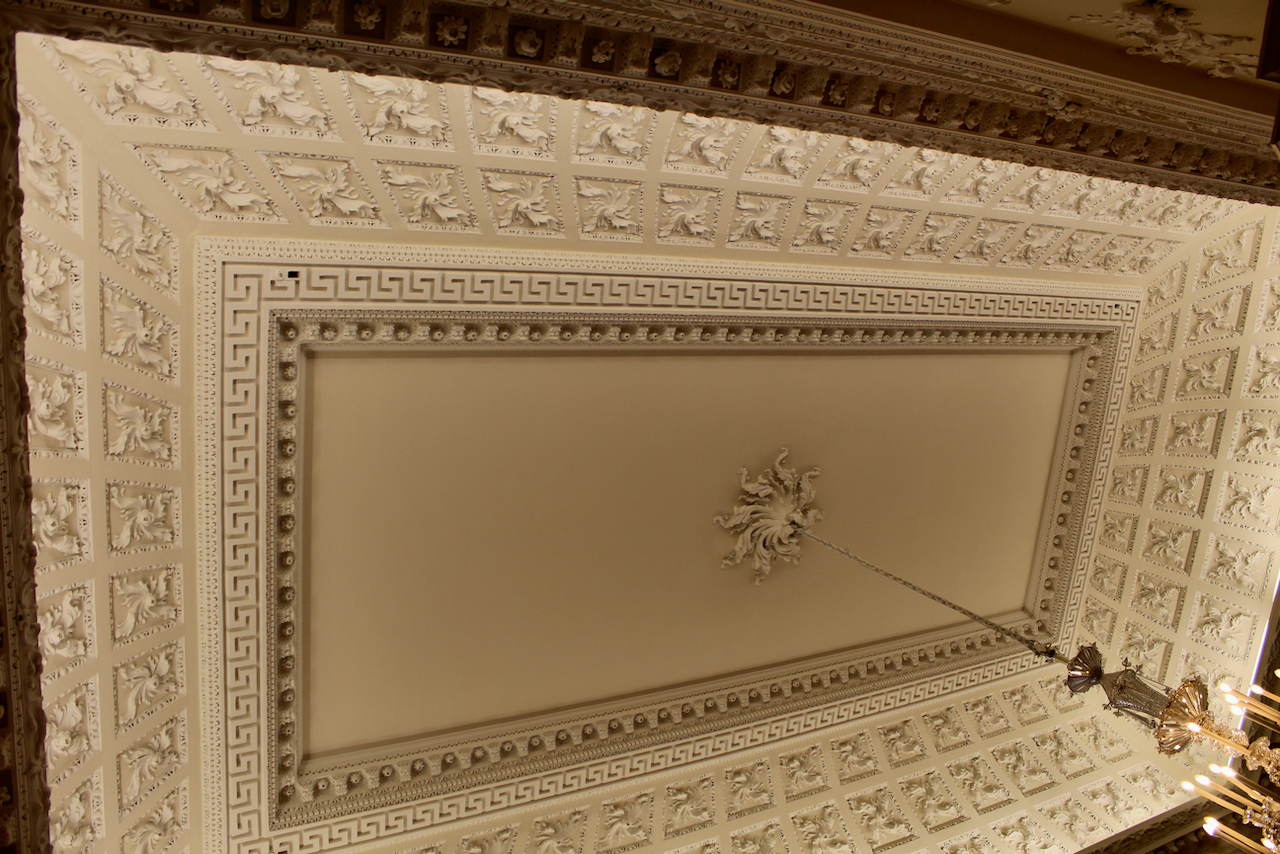
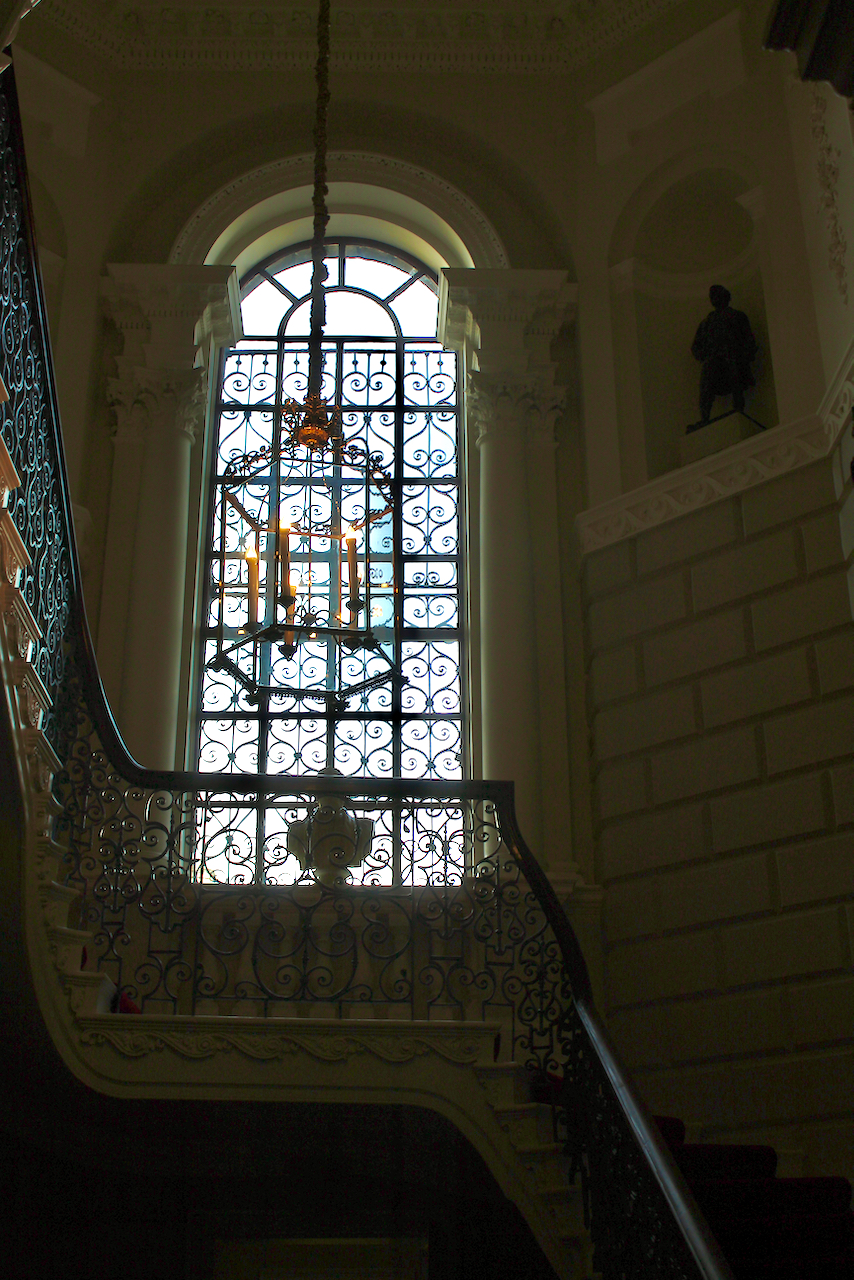
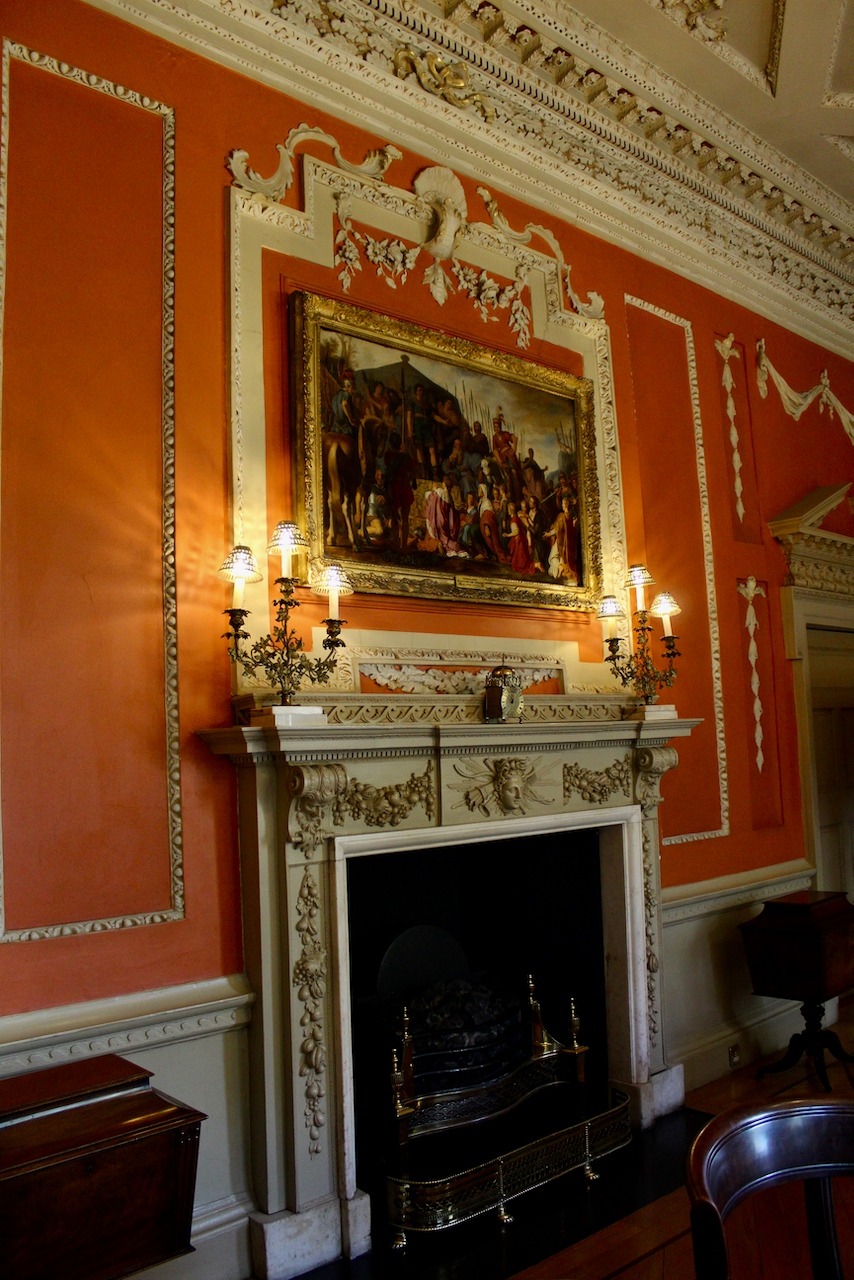
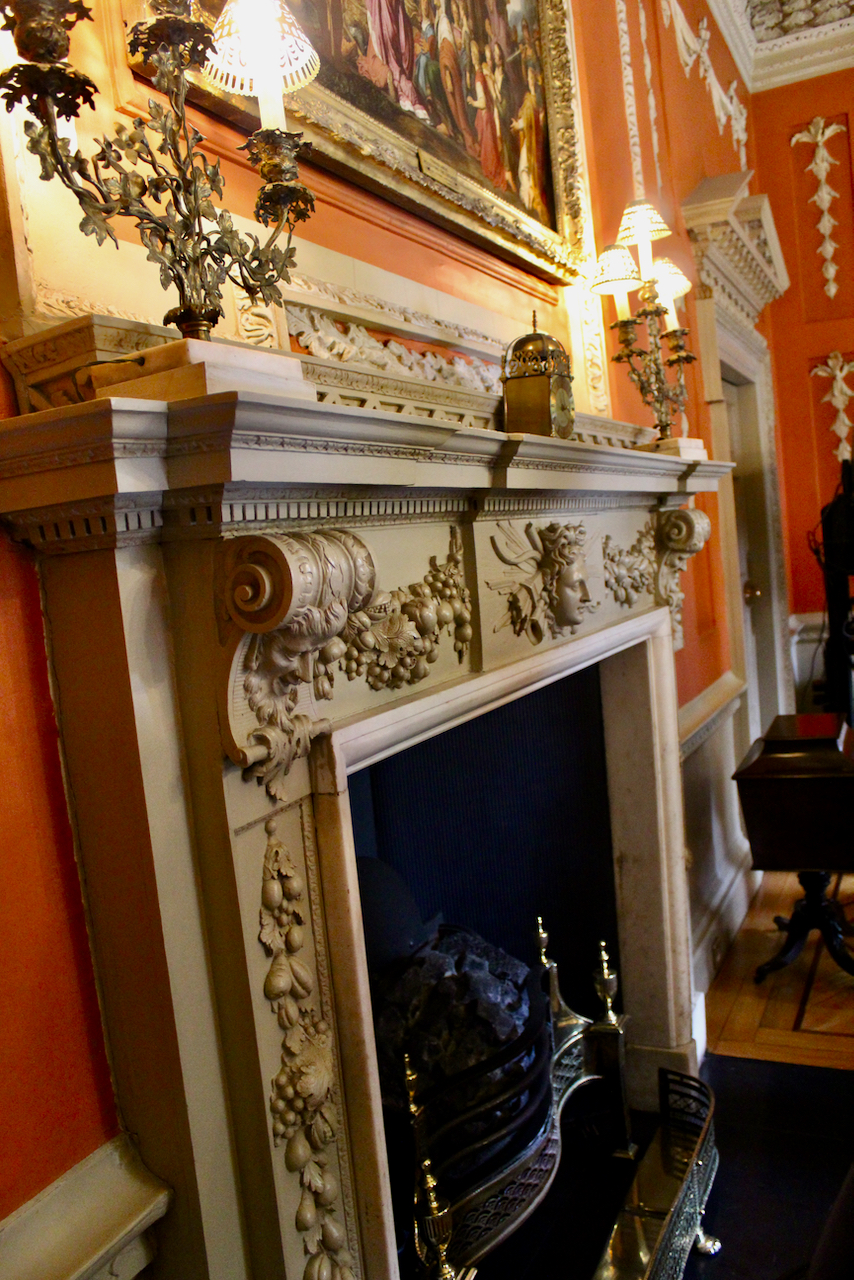
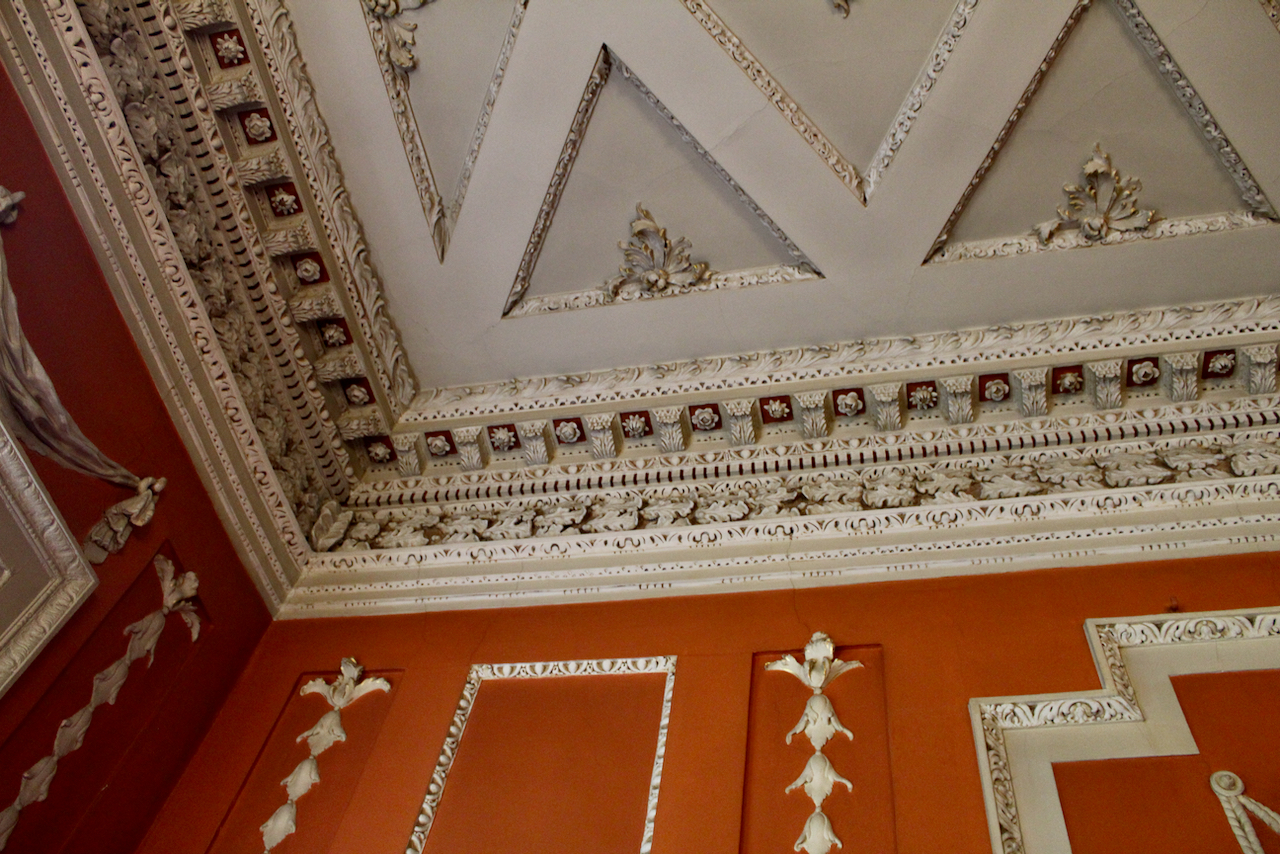
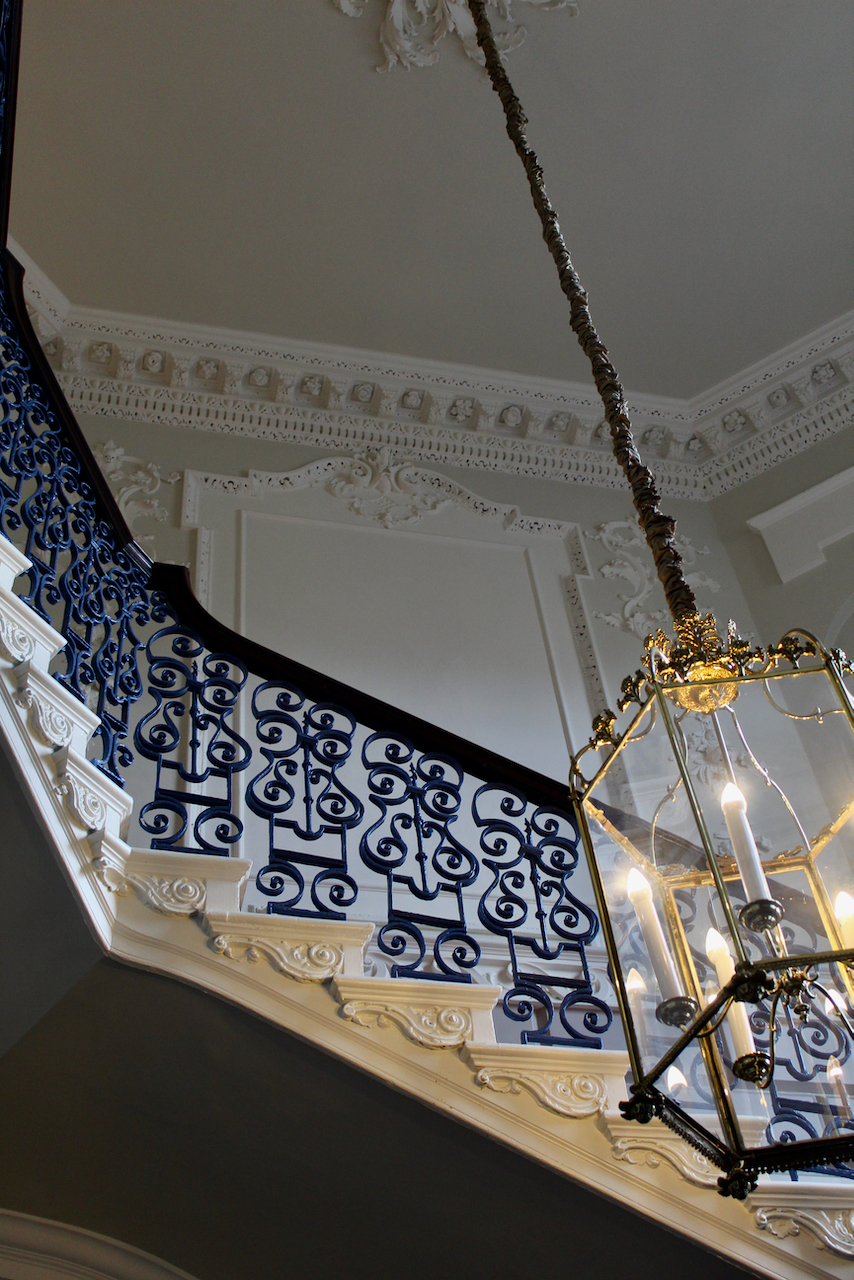
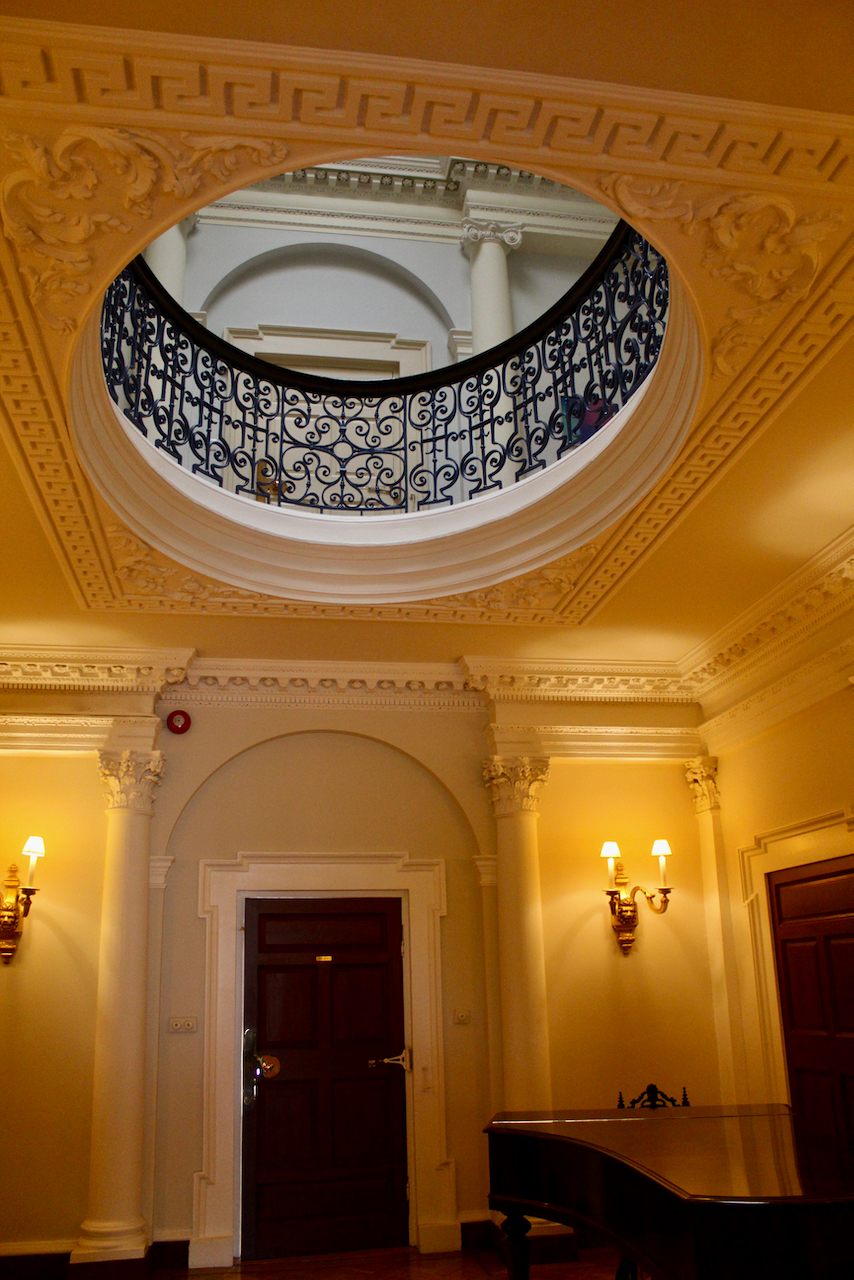
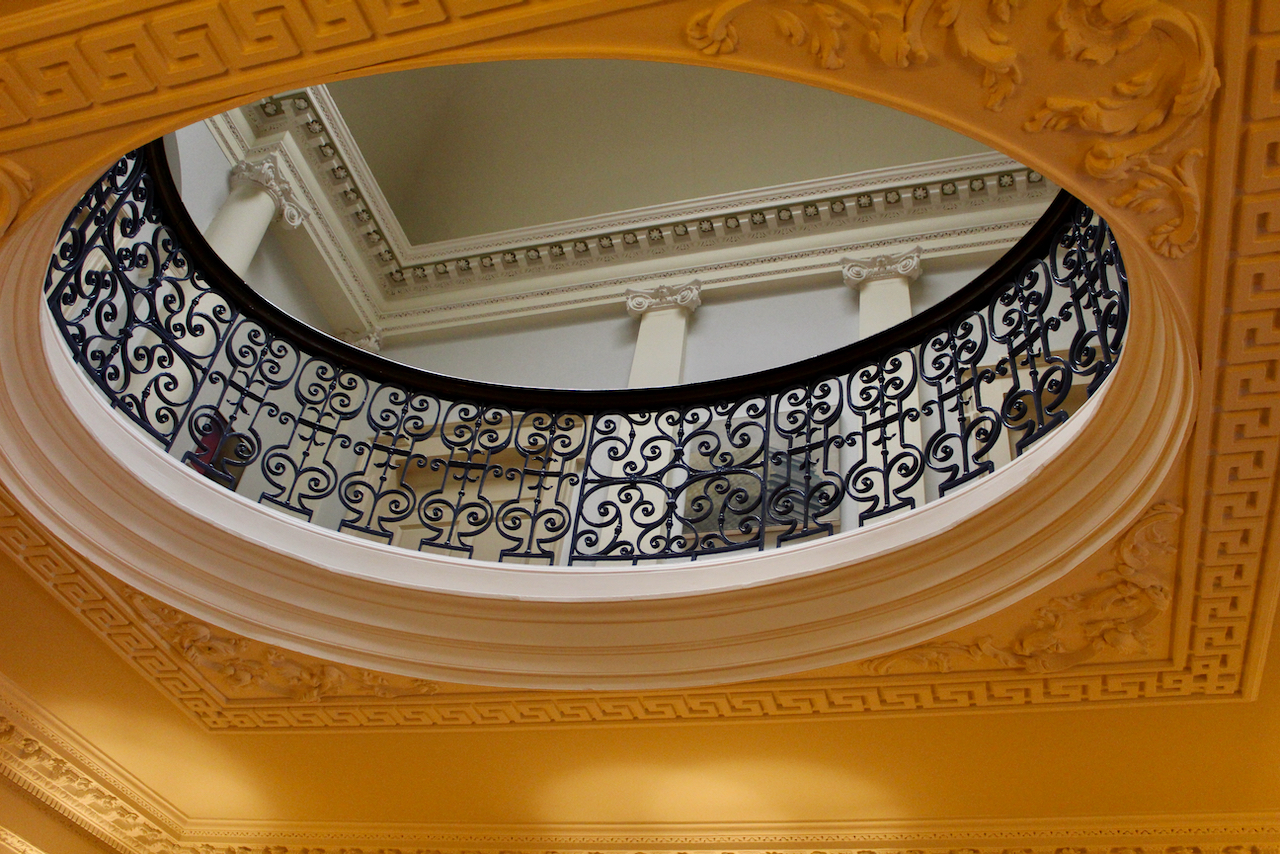
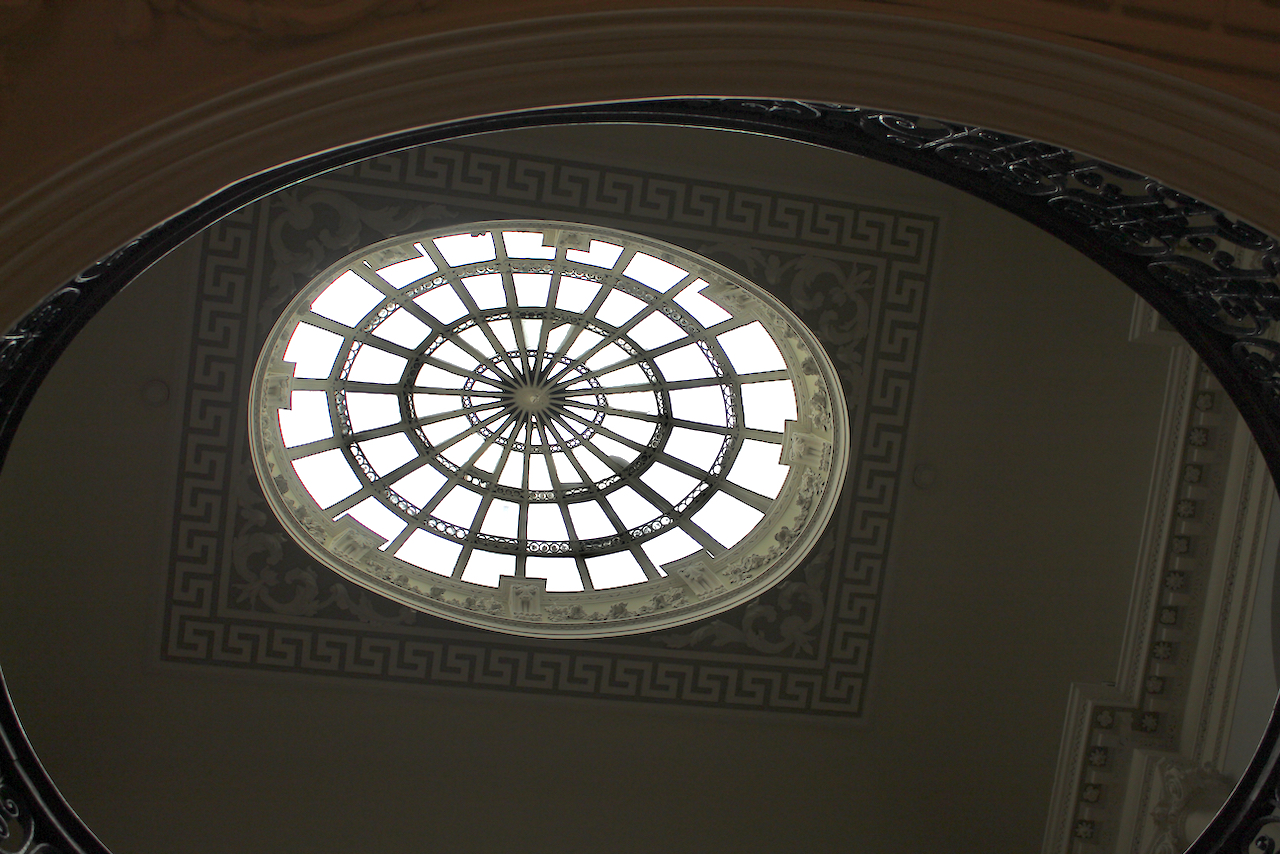
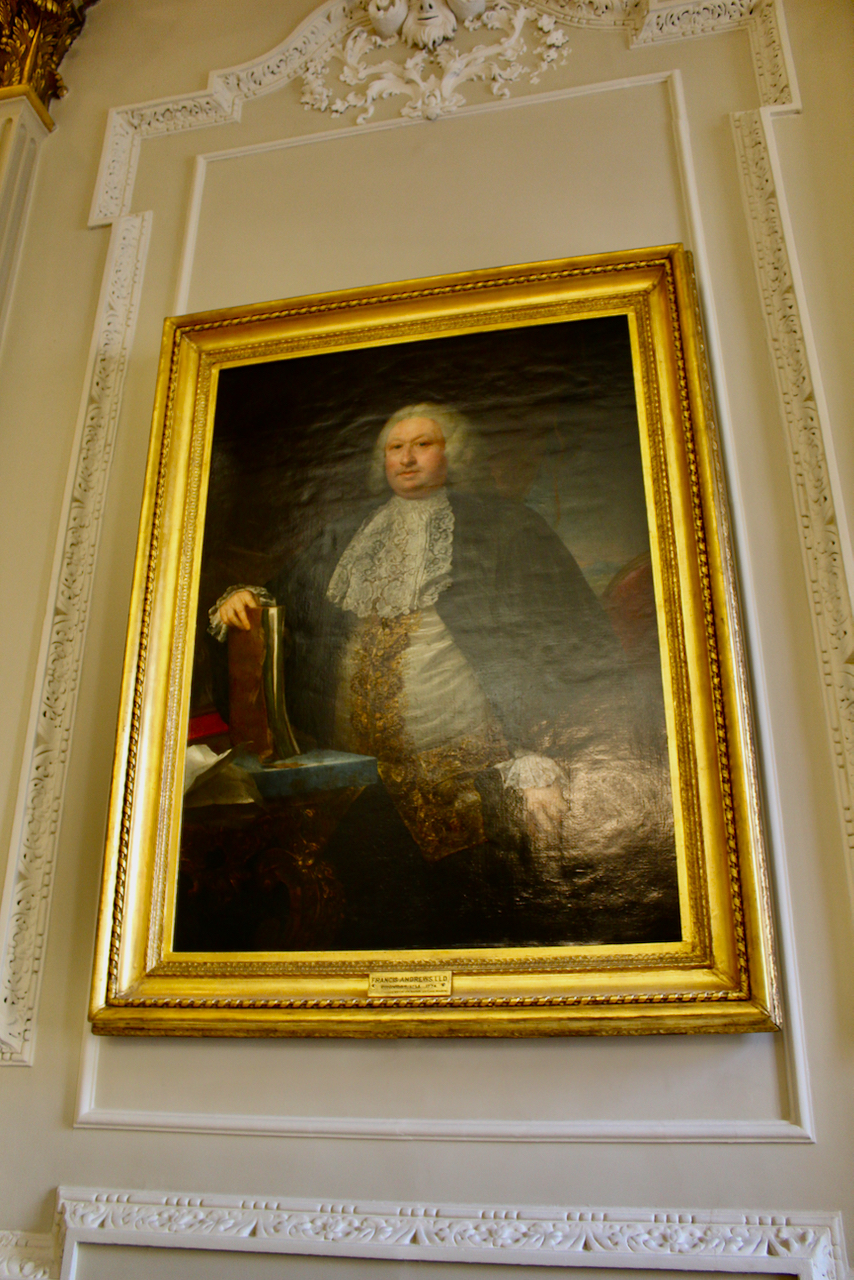
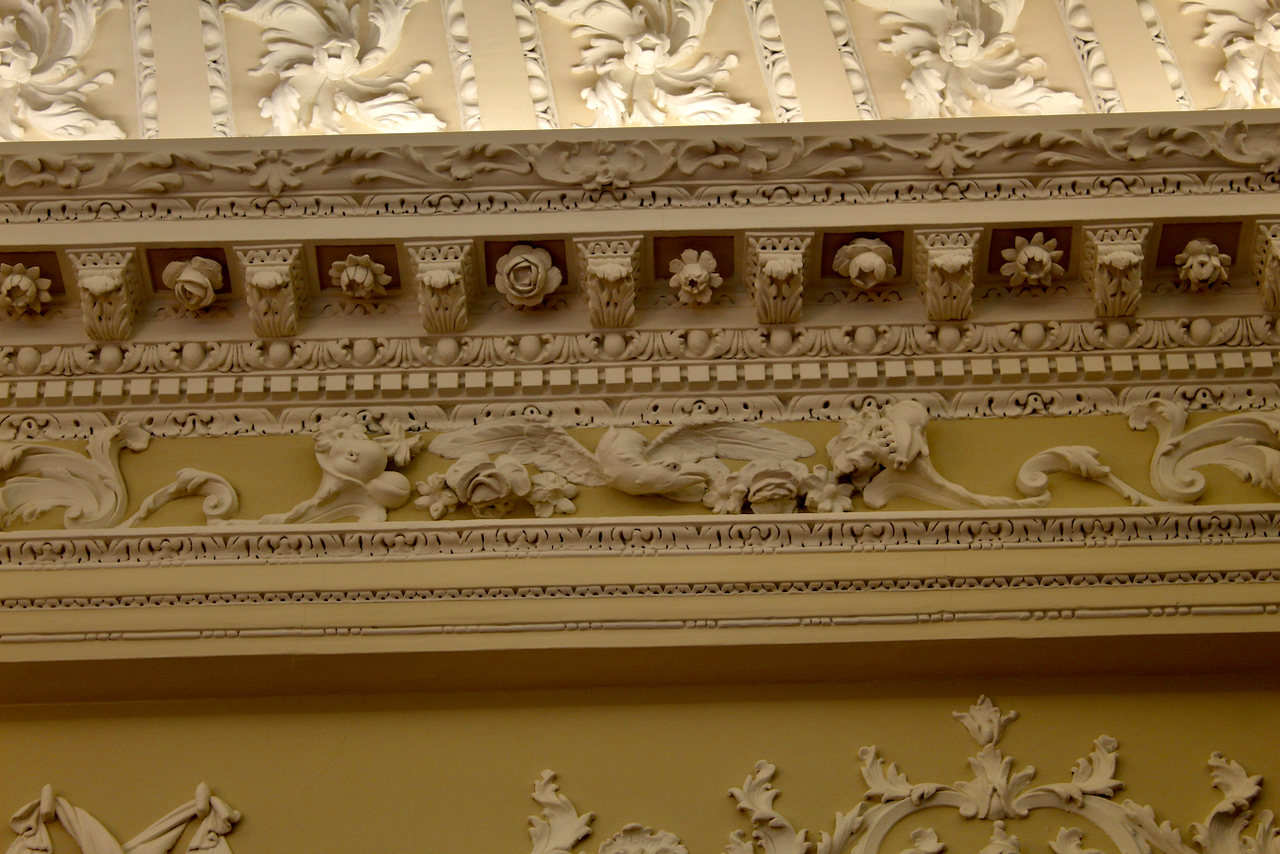
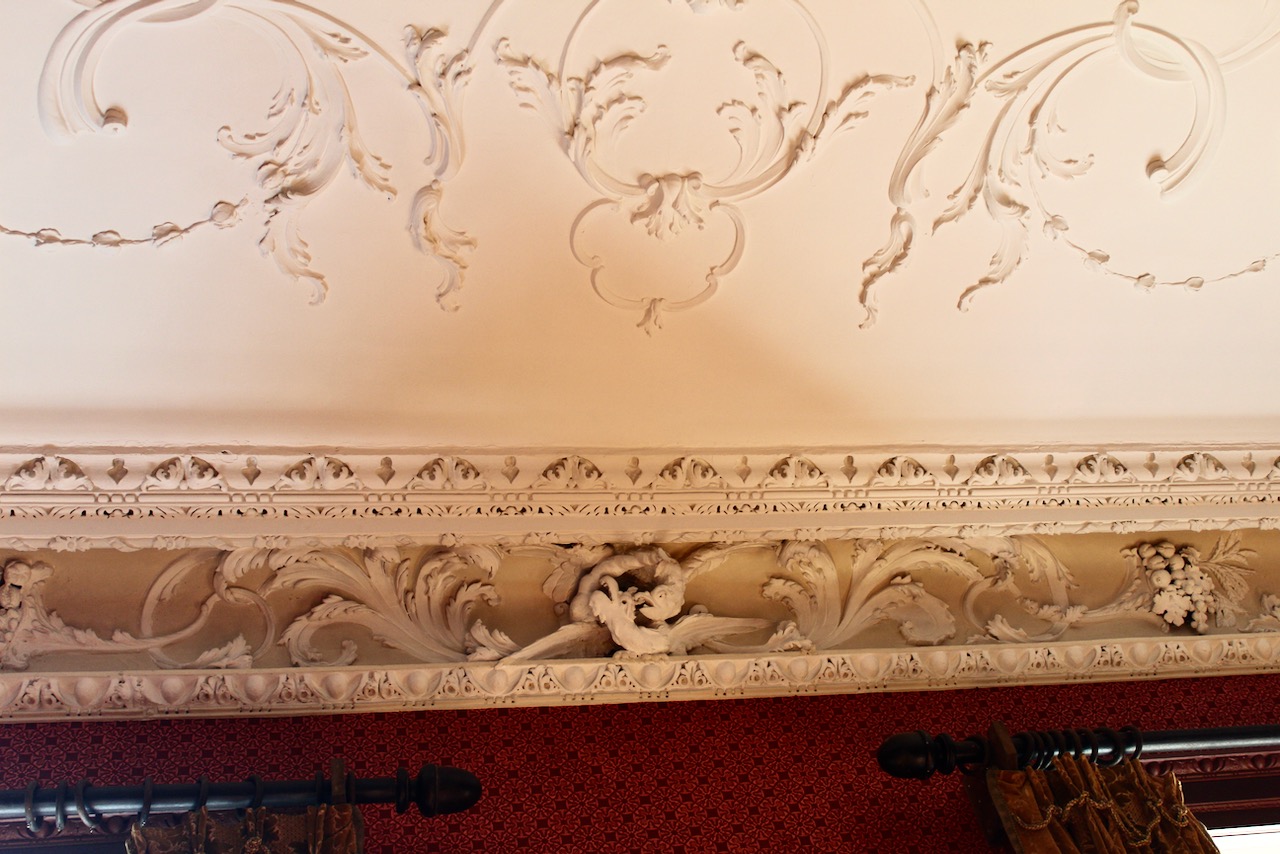
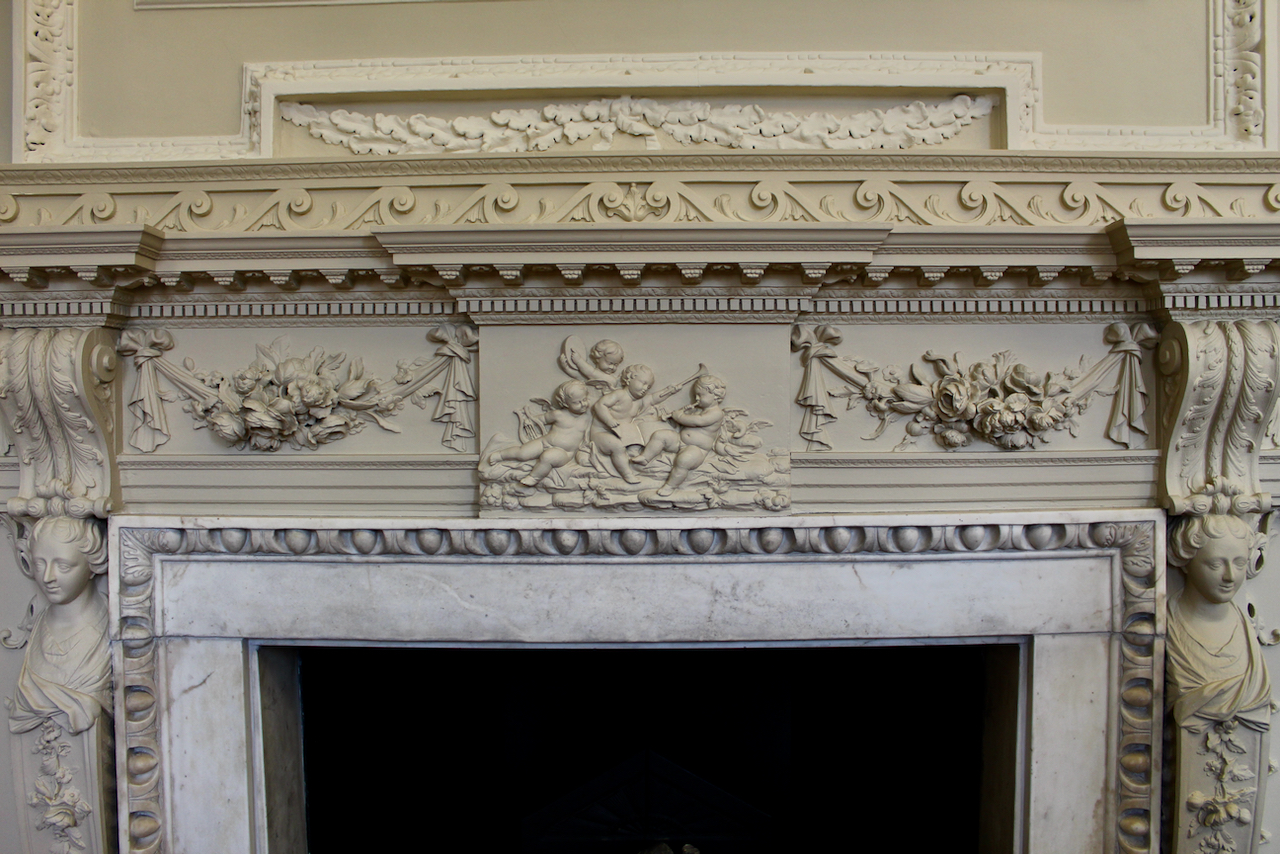
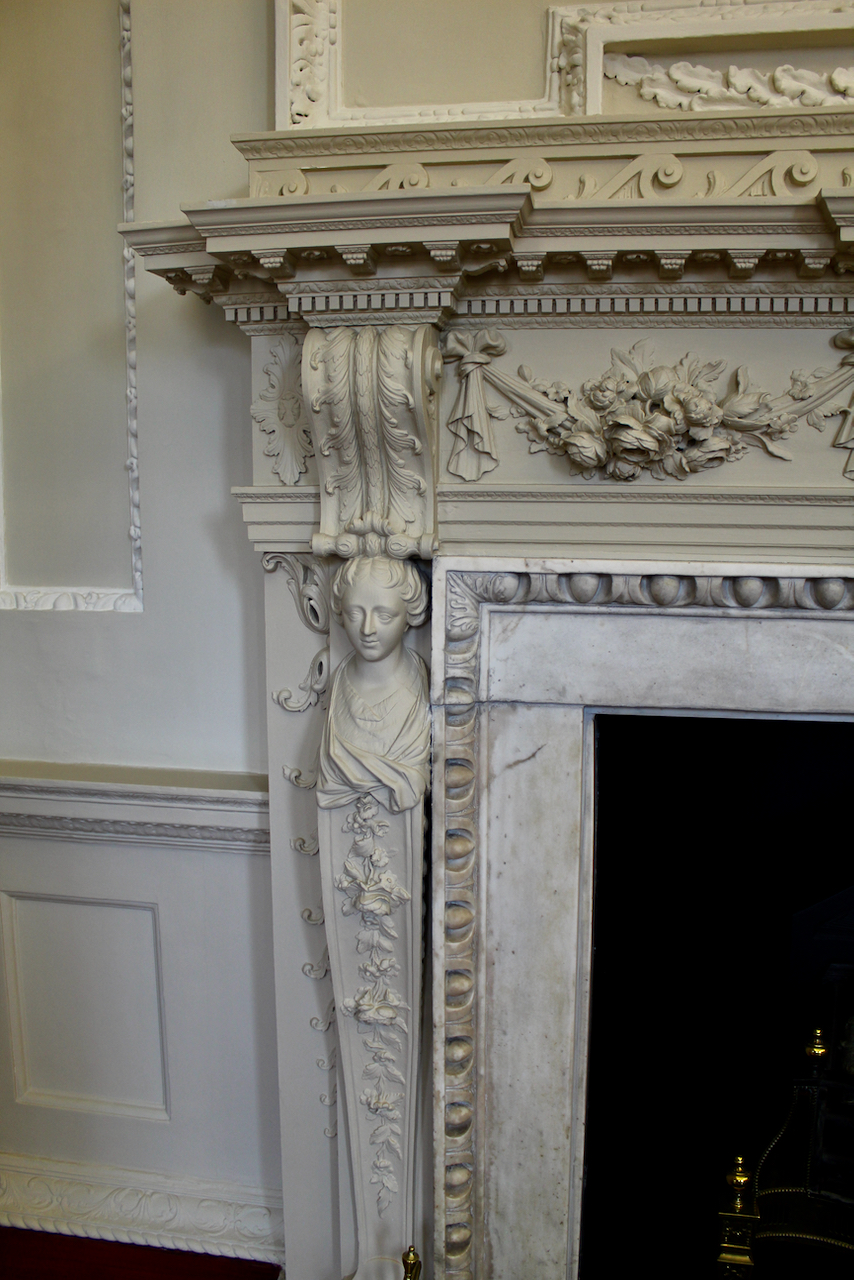
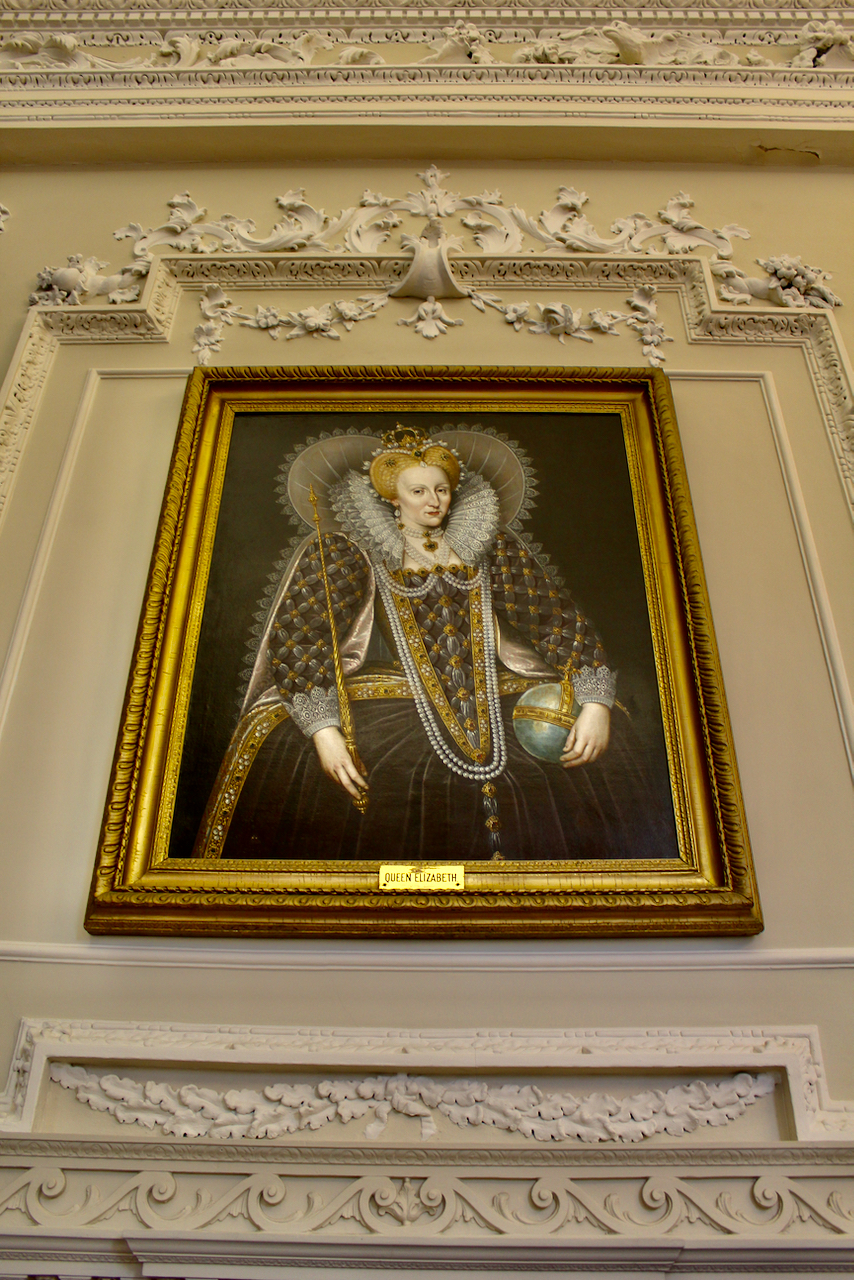
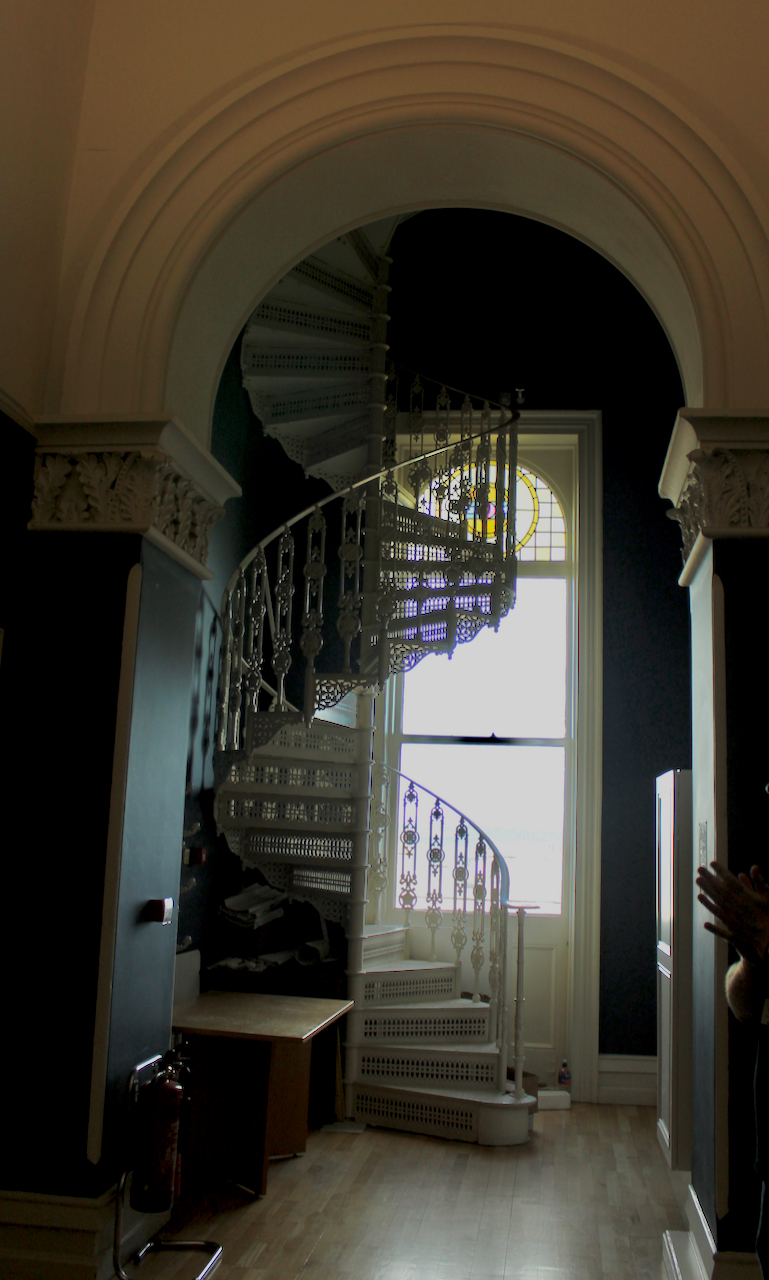
The National Inventory tells us that it was commissioned for Provost Francis Andrews, and “Dr Frederick O’Dwyer has suggested that John Magill, the builder, conspired with Andrews to divert funds from the west front of Parliament Square for its building. Andrews was heavily criticised by contemporaries for removing his lodgings from the main college residences. It was extended in 1775 to designs by Christopher Myers and continued to be augmented and updated into the nineteenth century when John Mallet was paid £326 5s 3½d for plumbing works. According to Casey (2005), the interior is reminiscent of Richard Castle’s country house design for Bellinter in Co Meath, and of Castle’s design for number 85 Stephen’s Green. The octagonal stair supports an iron balustrade by Timothy Turner. The saloon chimneypiece decorative designs are derived from Boucher’s ‘Livres des Arts’. The interior plasterwork is by Patrick and John Wall and the carving by James Robinson and Richard Cranfield.“
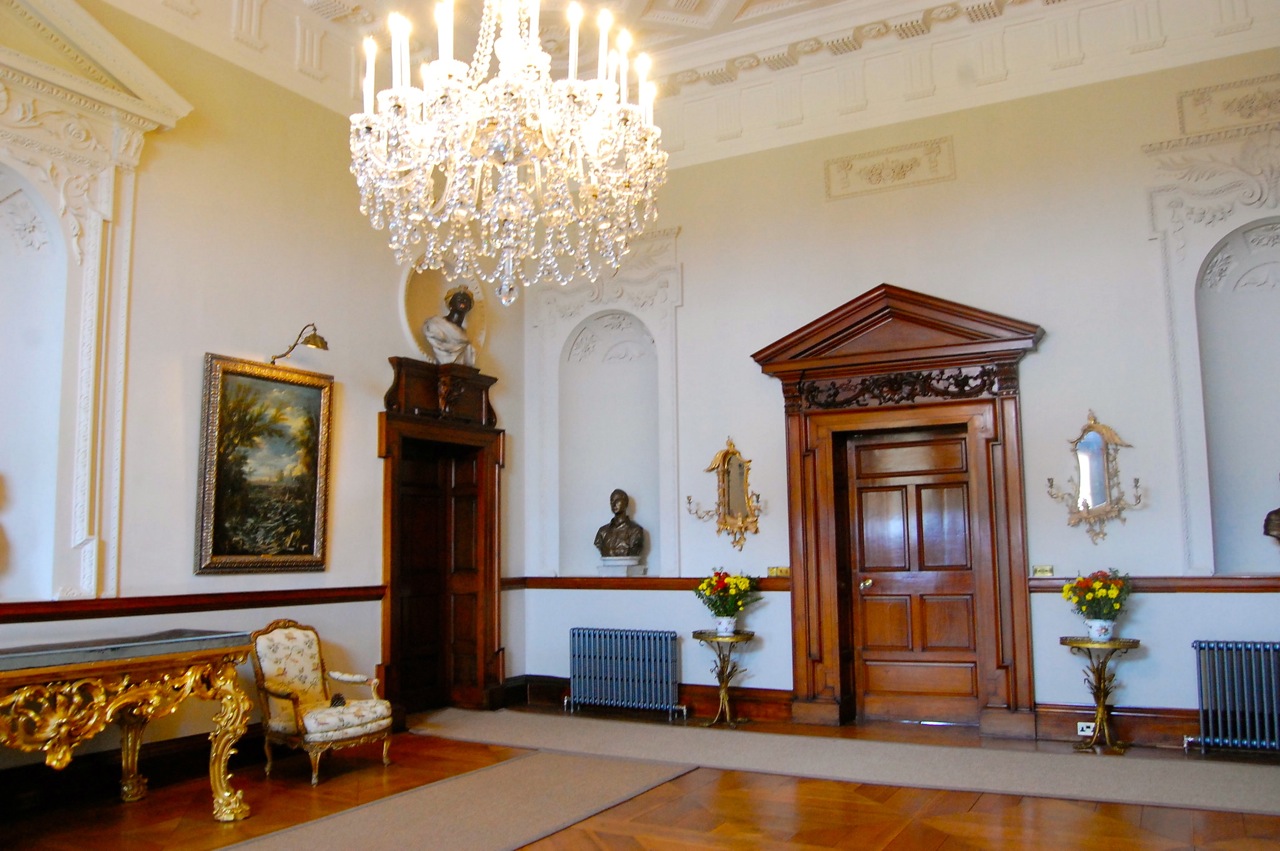
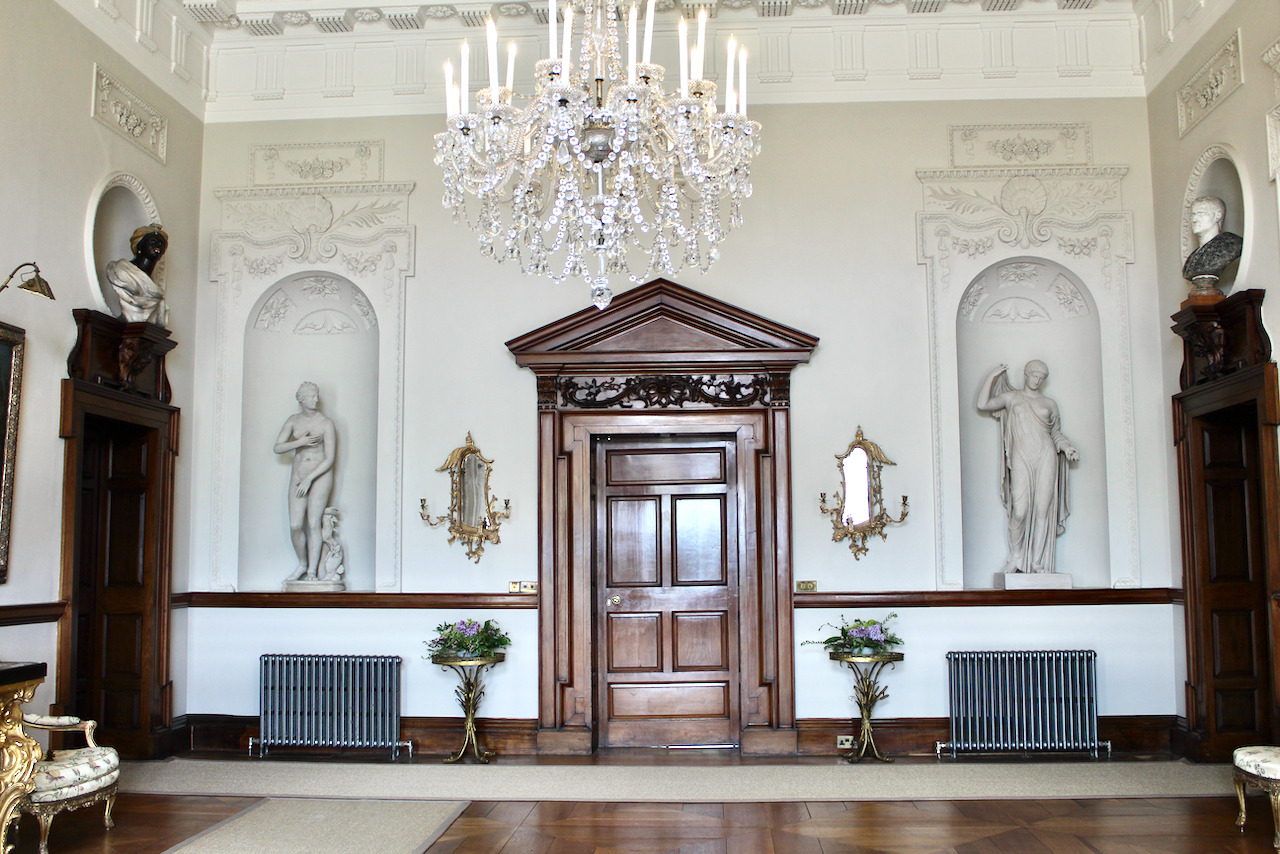
Uptairs is a large salon which takes up nearly the entire floor and is perfect for the Provost’s entertaining. Traditionally, Provosts didn’t marry, so the house is not built for a family, it does not have large living quarters.
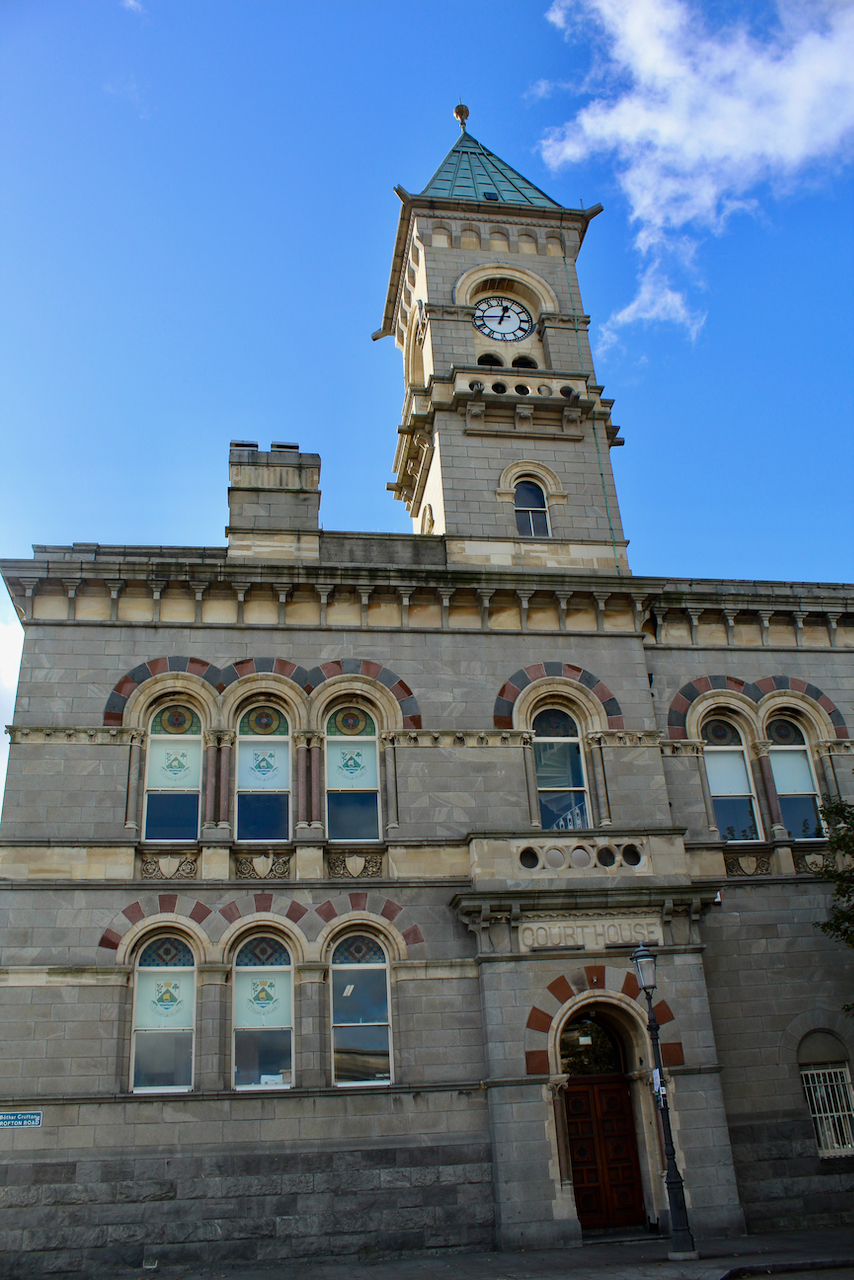
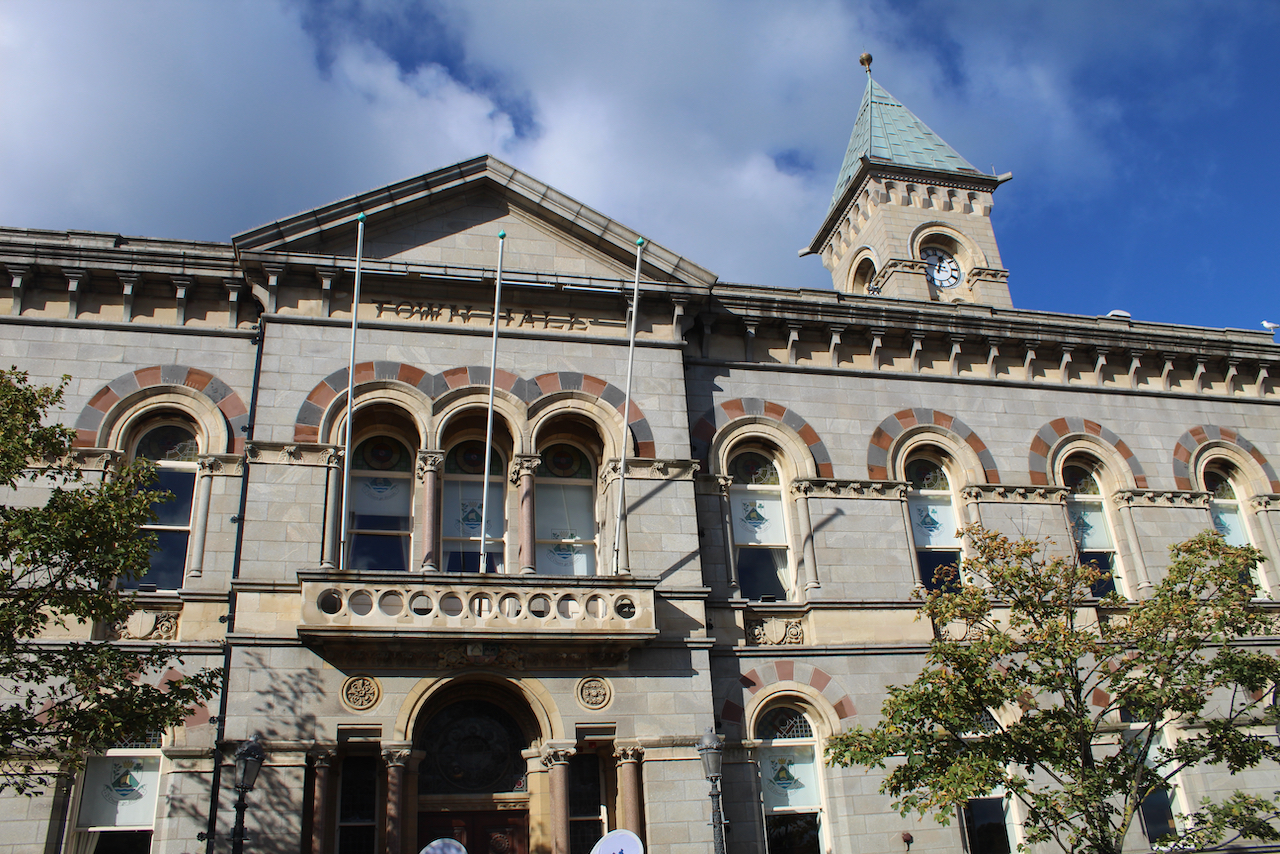
On Saturday Stephen and I went on a tour of Dun Laoghaire’s County Hall, and then to Loughlinstown House. Sunday I went to see a house in the Tenters in Dublin, then for an architect’s tour of the outside of the Royal Hospital Kilmainham. I can’t wait until the inside is open again, now being renovated by the Office of Public Works.
Open dates in 2026: Feb 1-Dec 23, 27-31, Feb, Oct, Nov, Dec 9am-5.30pm, Mar-Sept 9am-6pm
Fee: adult €15.50 OAP/student €13, child €750, group rates on request
donation
Help me to pay the entrance fee to one of the houses on this website. This site is created purely out of love for the subject and I receive no payment so any donation is appreciated!
In his A Guide to Irish Country Houses, Mark Bence-Jones calls Russborough House “arguably the most beautiful house in Ireland.” [1] We are lucky that Russborough House is open to the public, thanks to the Beit Foundation. Sir Alfred and Lady Clementine Beit left the property to the state in 1978, to be cared for by a Trust established for the purpose. The Irish Aesthete Robert O’Byrne tells us about the Beits: “The couple had no immediate connection with Ireland, although Lady Beit’s maternal grandmother had been raised in this country and being a Mitford, she was first cousin of the Hon Desmond Guinness’s mother.” [2]
Russborough House was built for Joseph Leeson (1701-1783) in 1741 when he inherited a fortune from his father, also named Joseph (1660-c. 1741), and purchased land owned by John Graydon, and it was designed by Richard Castle.
Leeson went to great expense creating the grounds for the building of his house: “Leeson’s development of the garden terraces was extravagant. The house gained its fine prominence from sitting on an embankment created by the opening of the lakes and ponds, all reputedly costing some £30,000.” [3]
We came across Richard Castle (c.1690-1751) (or Cassels, as his name is sometimes spelled) in Powerscourt in County Wicklow. The Dictionary of Irish Architects tells us that, oddly, he was born David Riccardo, and it is not known when or why he changed his name. [4]
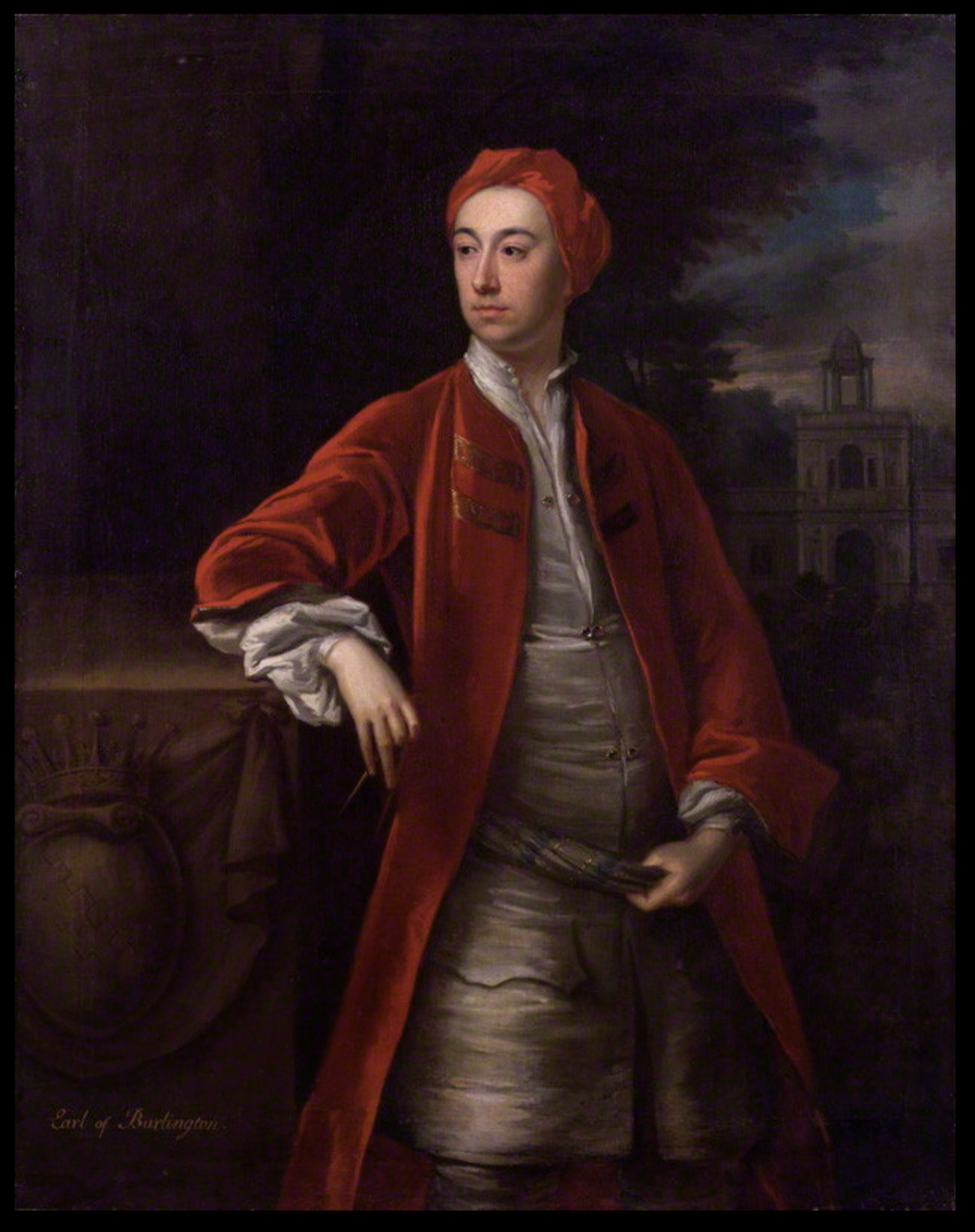
Castle originally trained as an engineer. He worked in London, where he was influenced by Lord Burlington. Richard Boyle, 3rd Earl of Burlington and 4th Earl of Cork, is credited with bringing the Palladian style of architecture to Britain and Ireland, after Grand Tours to Europe. [5] Palladian architecture is a style derived from the designs of the Venetian architect Andrea Palladio (1508-1580). Palladio’s work was strongly based on the symmetry, perspective, and values of the formal classical temple architecture of the ancient Greeks and Romans.
Portrait of Richard Boyle, 3rd Earl of Burlington (1694-1753) by Jonathan Richardson, courtesy of London’s National Portrait Gallery NPG 4818.
Castle came to the attention of Sir Gustavus Hume of County Fermanagh, who invited Castle to Ireland in 1728 to build him a home on the shores of Lough Erne, Castle Hume, which unfortunately no longer exists. [6] Castle was a contemporary of Edward Lovett Pearce, and early in his career in Dublin worked with him on the Houses of Parliament in Dublin. Both Lovett Pearce and Castle favoured the Palladian style, and when Lovett Pearce died at the tragically young age of 34, in 1733, Castle took over all of Lovett Pearce’s commissions.
The Dictionary of Irish Architects gives us a flavour of what Castle was like as a person:
“According to the short biography in Anthologia Hibernica for October 1793, Castle was a man of integrity, of amiable though somewhat eccentric manners, kept poor by his improvidence and long afflicted by gout resulting from intemperance and late hours. The same source states that he often pulled down those of his works which were not to his liking, ‘and whenever he came to inspect them … required the attendance of all the artificers who followed him in a long train’. “
Castle began work on Powerscourt House in County Wicklow in 1730, finishing in 1741. He also began work on Westport House in County Mayo in 1730. He worked on Carton House, in County Kildare, which is now an upmarket hotel, from 1739-1744. In Dublin City he built Tyrone House (which now houses the Department of Education) for Marcus Beresford, Earl of Tyrone (we came across him at Curraghmore in County Waterford) [7]. He designed and built the hunting lodge called Belvedere in County Westmeath around 1740, and began to work on Russborough House around 1742. He was still working on Russborough House when he died suddenly, while at Carton House, in 1751, while writing a letter to a carpenter employed at Leinster House (begun in 1745 for James FitzGerald, the 20th Earl of Kildare, the house was at initially called Kildare House, and now houses the government in Dublin). Desmond FitzGerald, the Knight of Glin, wrote about Richard Castle and his work, and attributes another section 482 property to him, Strokestown House in County Roscommon. FitzGerald attributes many more buildings to Castle. [8]
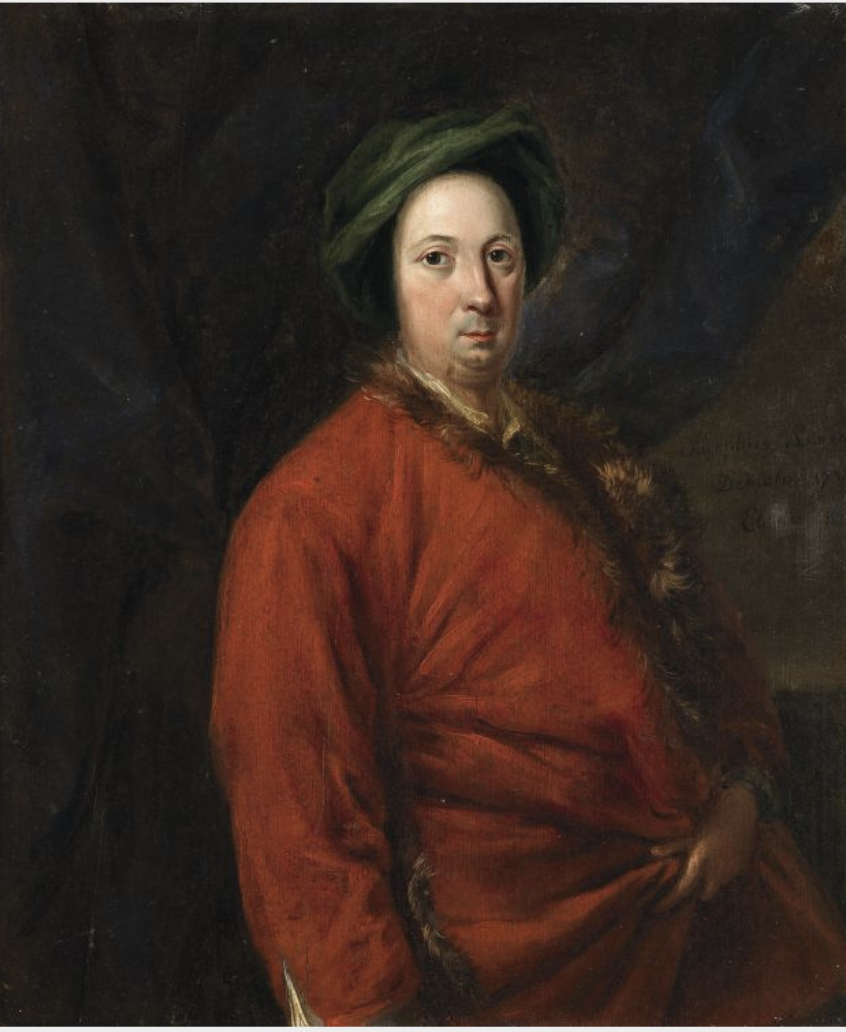
Joseph Leeson (1711-1783) was the grandson of Hugh Leeson, who came to Ireland from England as a military officer in 1680, and settled in Dublin as a successful brewer. Hugh married Rebecca, daughter of Dublin Alderman Richard Tighe. Joseph inherited the brewing fortune from his father, another Joseph, who had married the daughter, Margaret, of a Dublin Alderman and Sheriff, Andrew Brice.
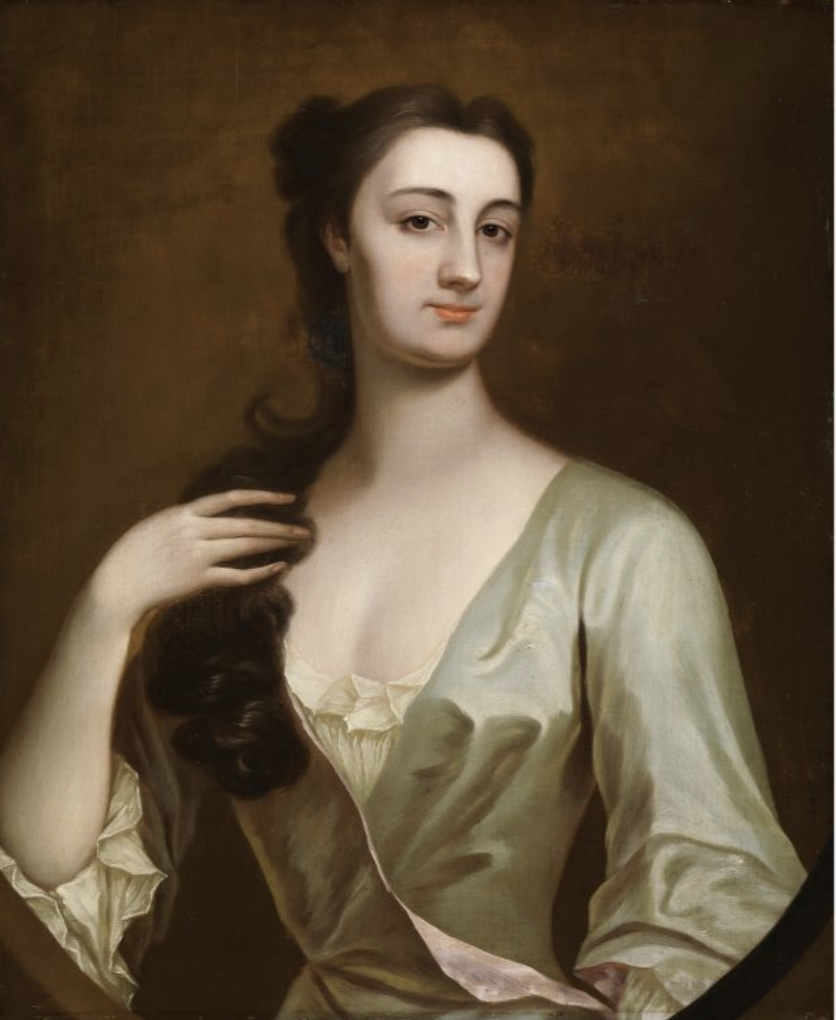
Margaret Leeson née Brice wife of Joseph Leeson (1660-1741), c. 1772 by unknown artist, courtesy of National Gallery of Ireland NGI 1649.
As well as young Joseph, his father Joseph and Margaret née Brice had a daughter, Anne, who married Hugh Henry (d. 1743) of Straffan House in County Kildare and Lodge Park in County Kildare, the latter also a section 482 property. Another daughter, Joyce, married Robert Blackwood, 1st Baronet Blackwood, of Ballyleidy, County Down.
Young Joseph Leeson entered politics and from 1743 sat in the House of Commons. By this time, he had already married, been widowed by his first wife, Cecelia Leigh, and remarried, to Anne Preston (daughter of Nathaniel Preston, ancestor of the owners of a house we have visited, Swainstown in County Meath – which was built later than the start date of Russborough, in 1750, and which Richard Castle may also have designed), and inherited his fortune from his brewer father, and started building Russborough House. He was raised to the peerage first as Baron Russborough in 1756, and as Earl of Milltown in 1763.
Cecilia Leeson (born Leigh) (d.1737) Date 1735-1737 by Anthony Lee, Irish, fl.1724-1767. First wife of Joseph Leeson. Photograph courtesy of the National Gallery of Ireland.
Anne died on 17 January 1766, and Leeson married thirdly Elizabeth French, daughter of the Very Reverend William French, Dean of Ardagh, on 10 February 1768.
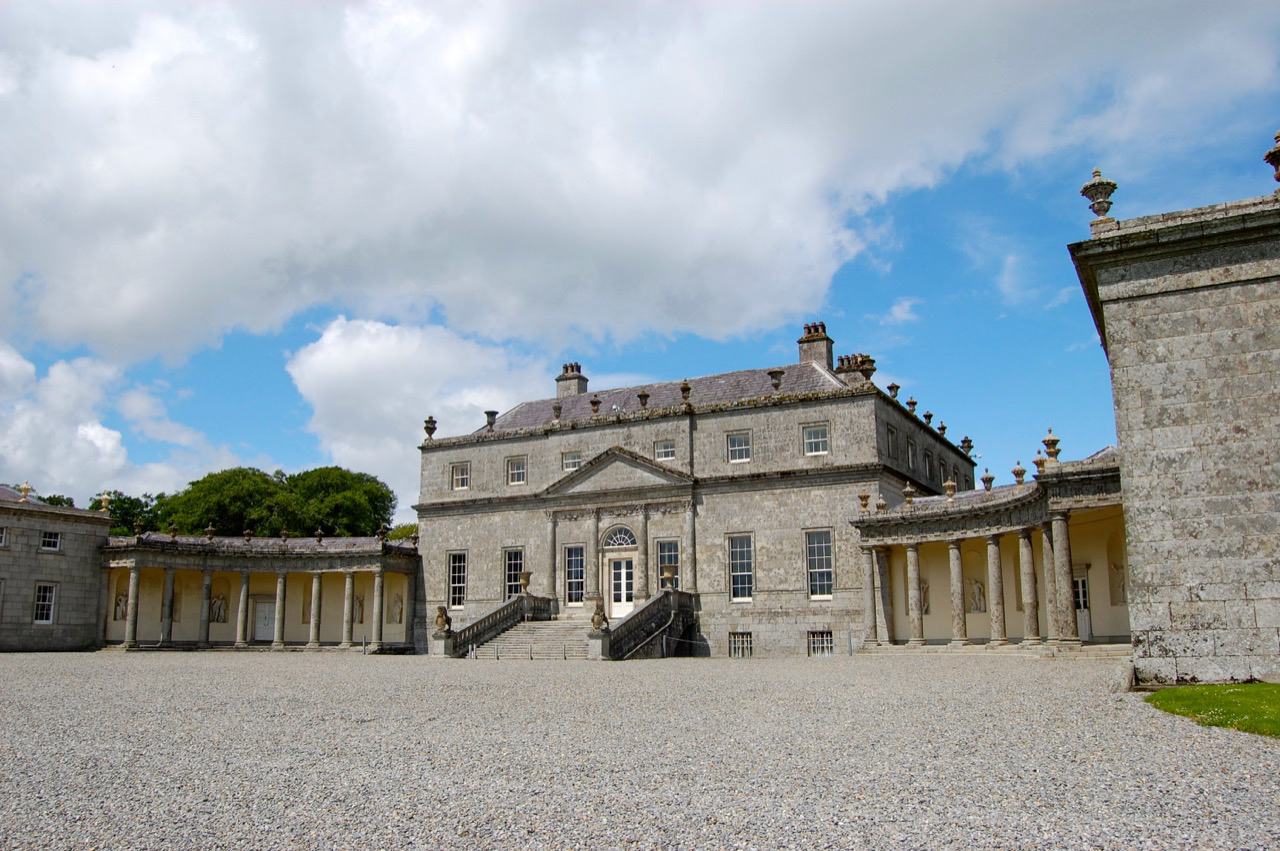
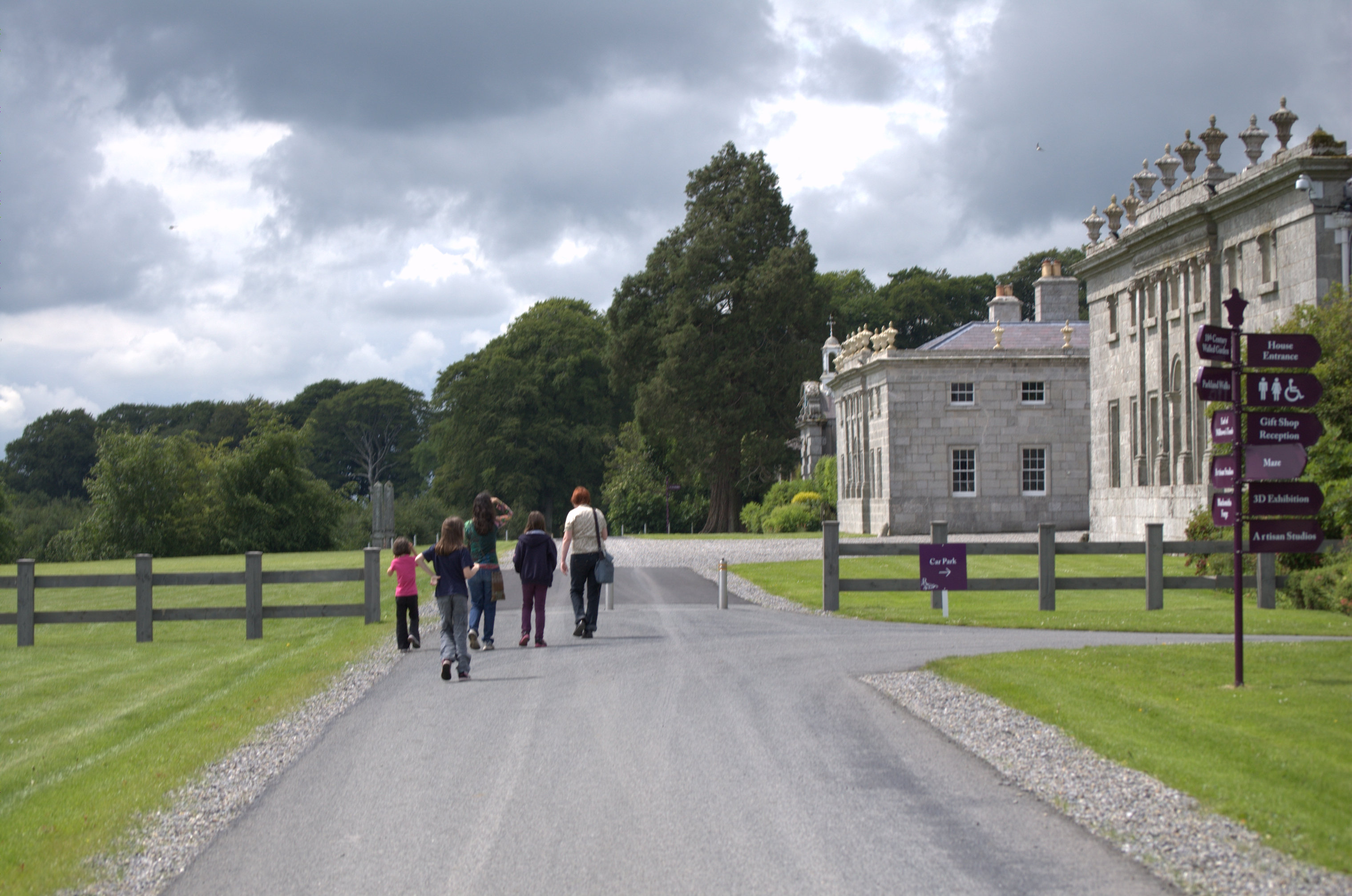
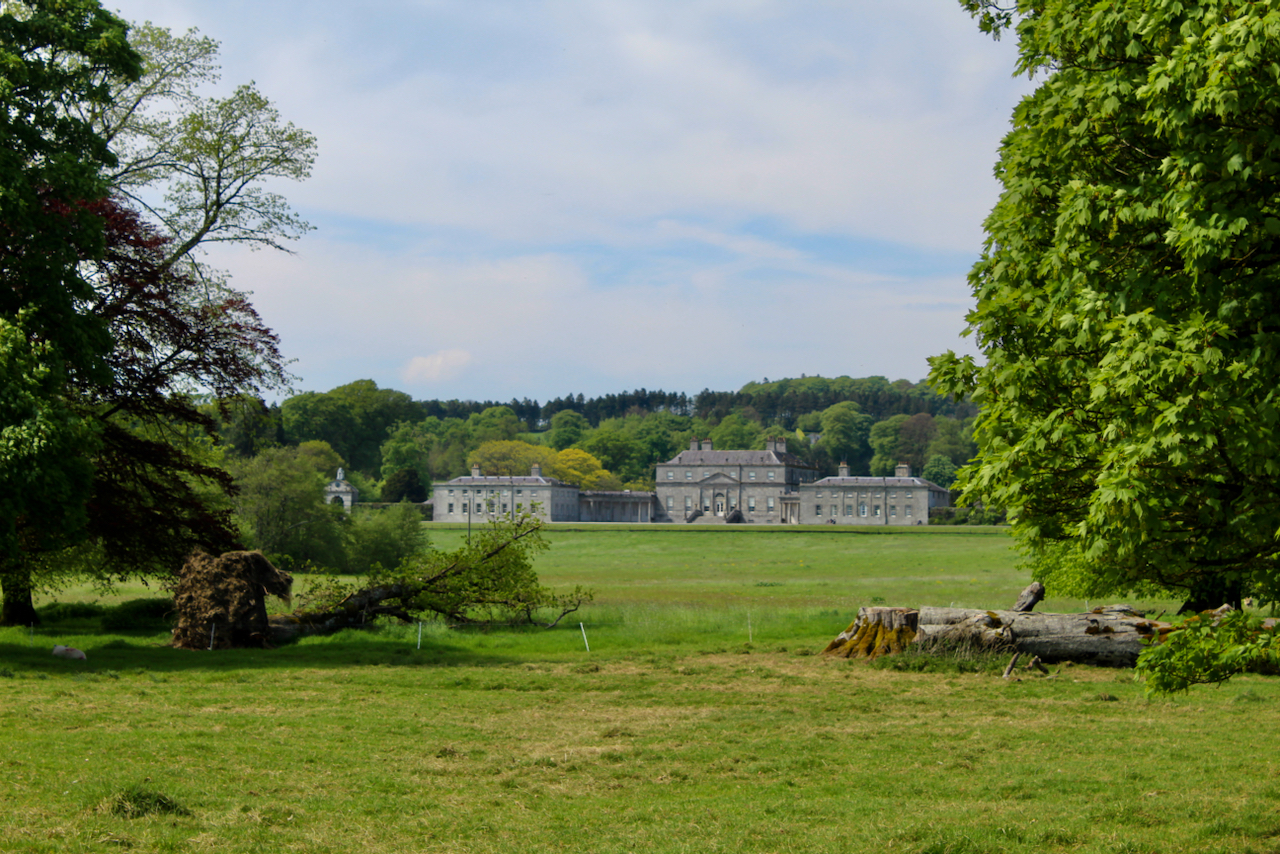
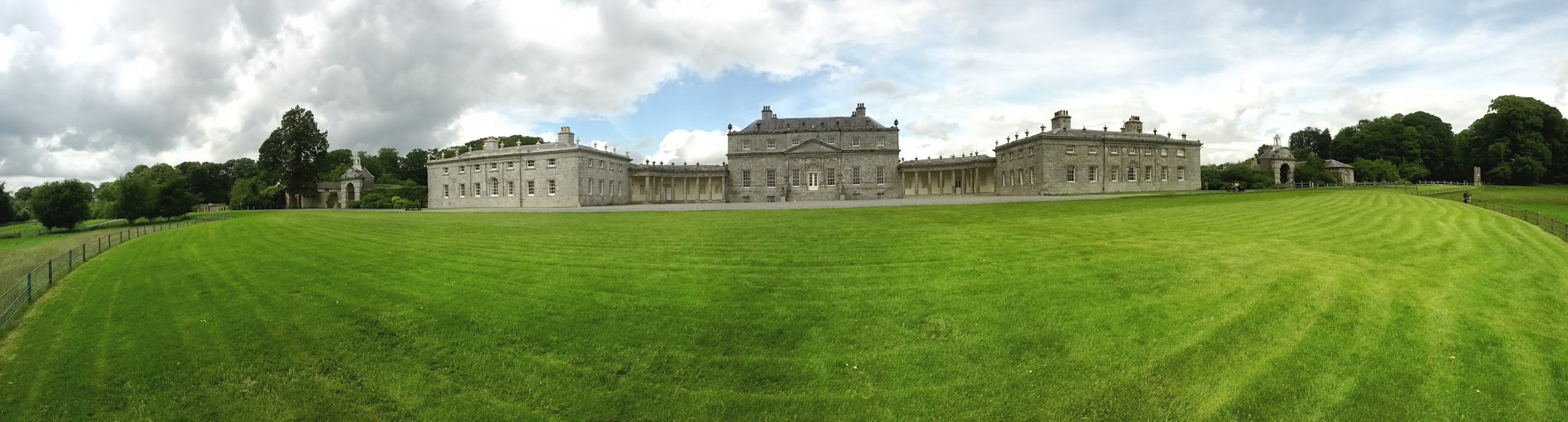
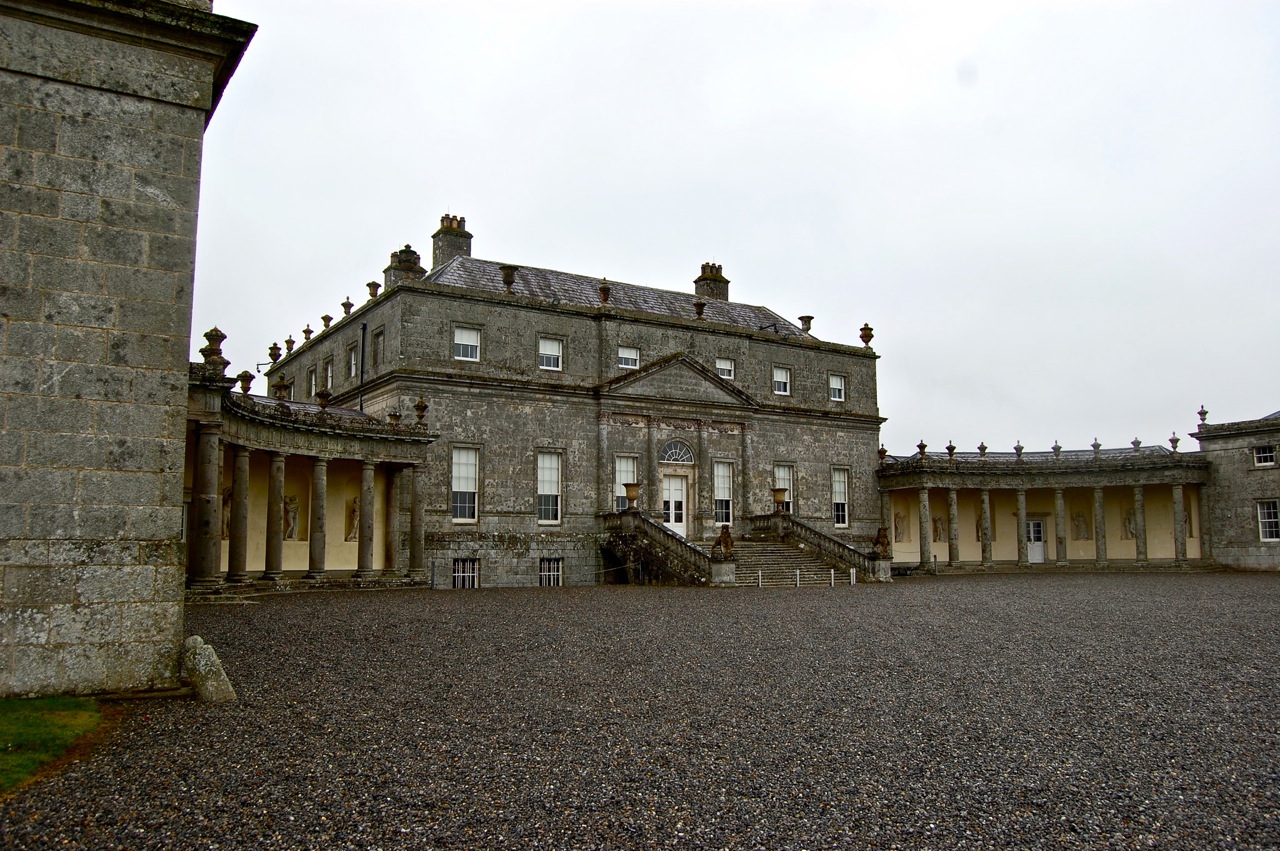
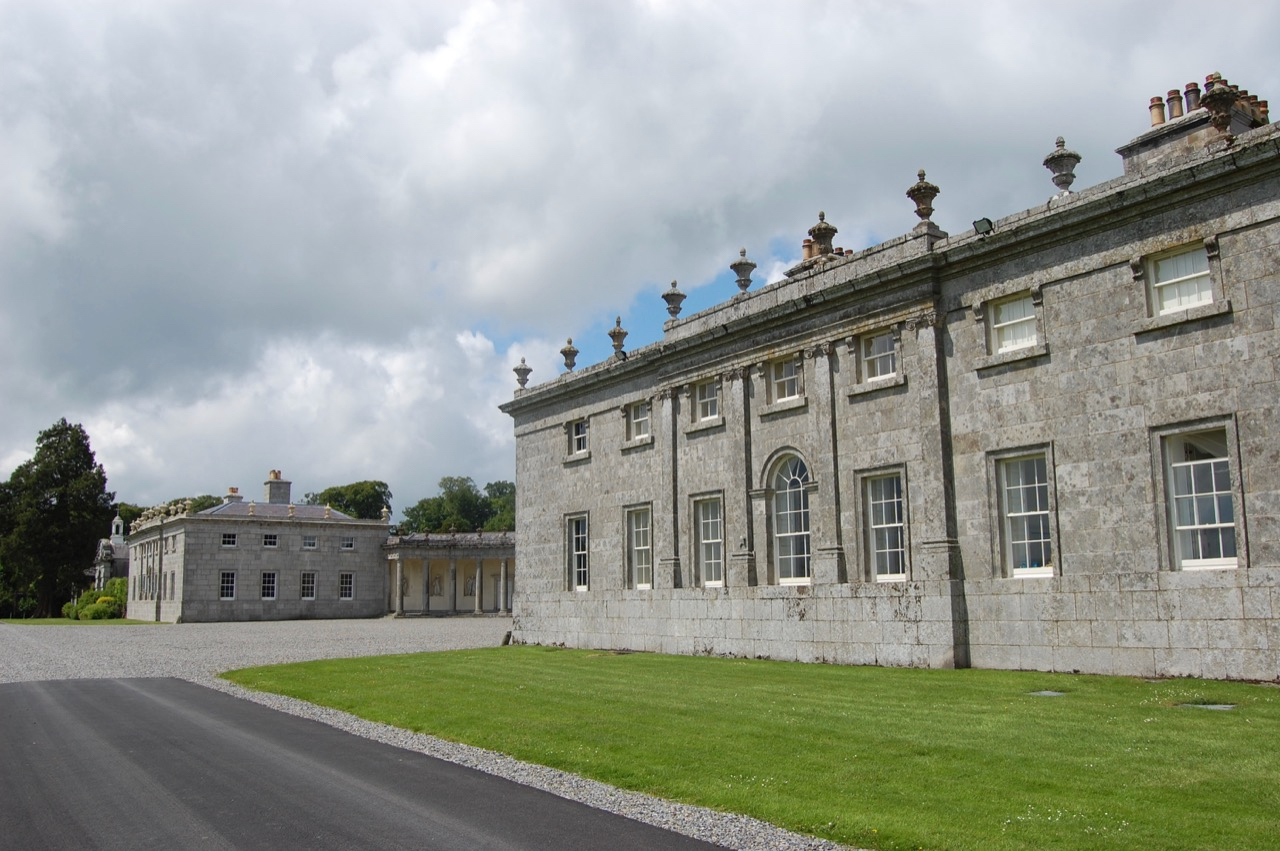
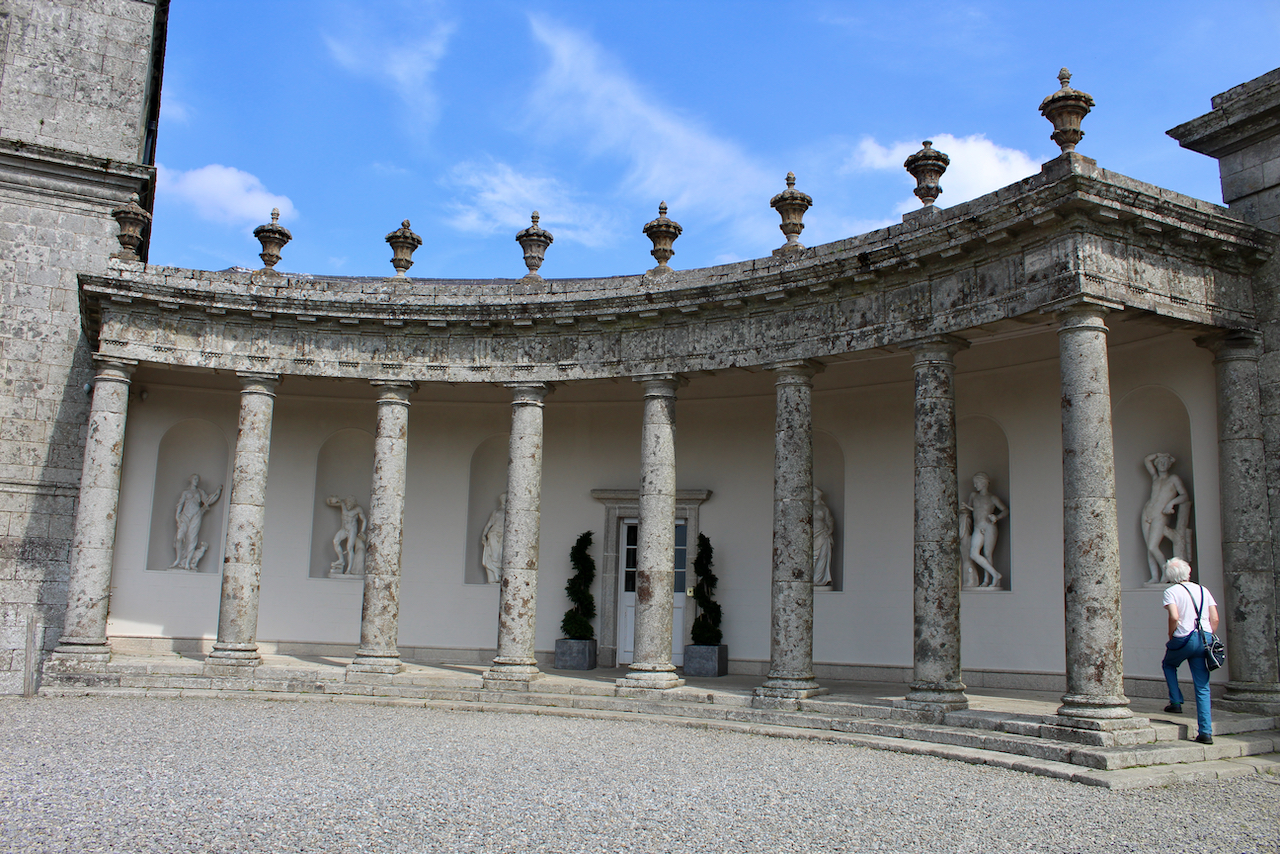
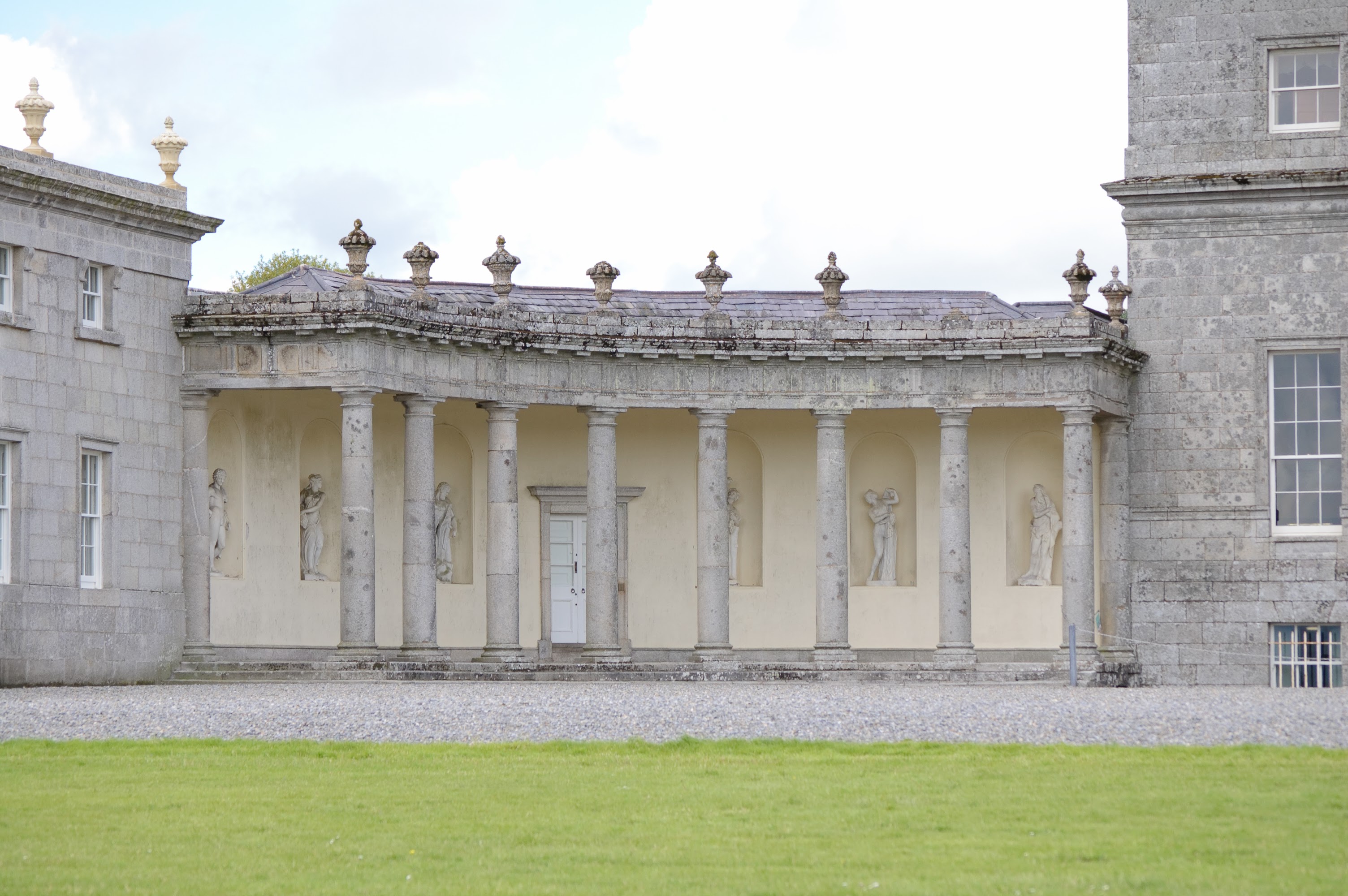
Photo taken by Jeremy Hylton, showing the extent of the centre block with the curving Doric colonnades and two-storey seven bay wings. Beyond the wings on either side of the central block, one can see the arches with cupolas. The full stretch contains kitchen and stable wings.
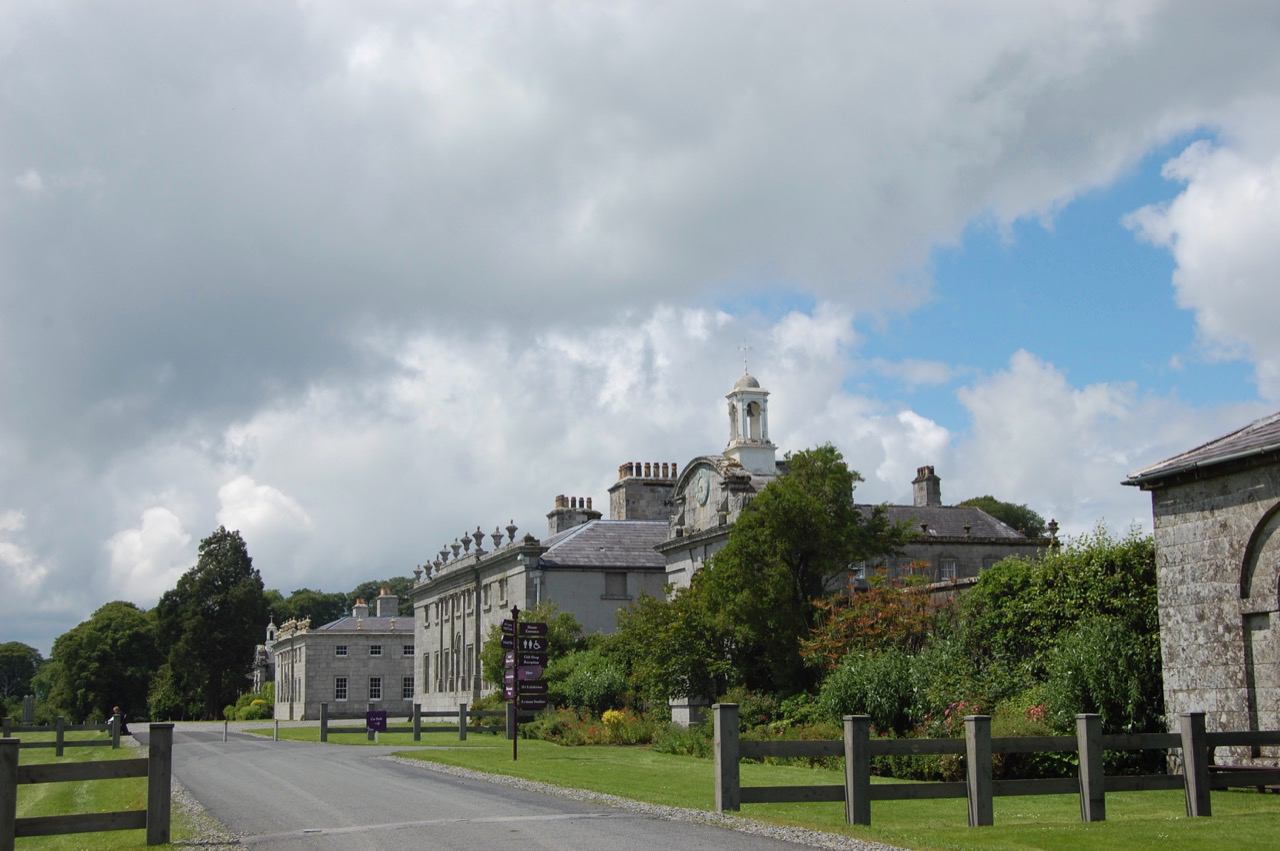
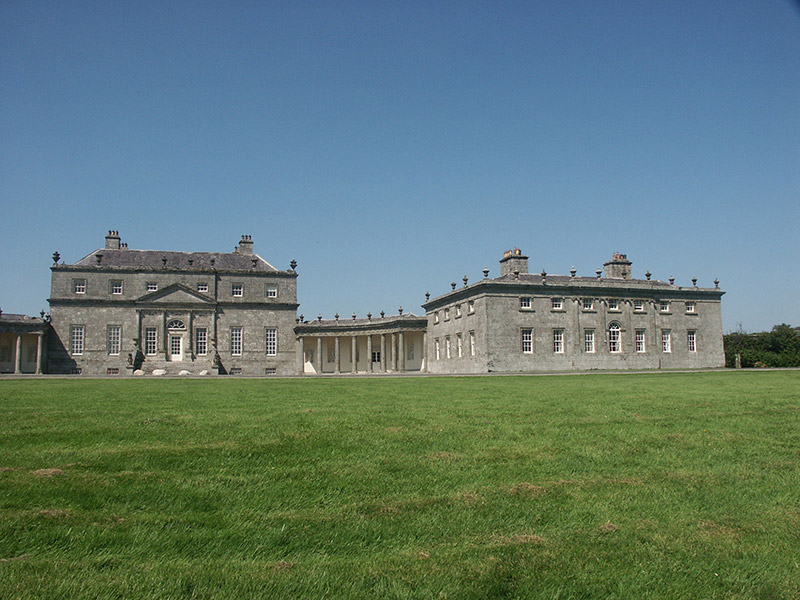
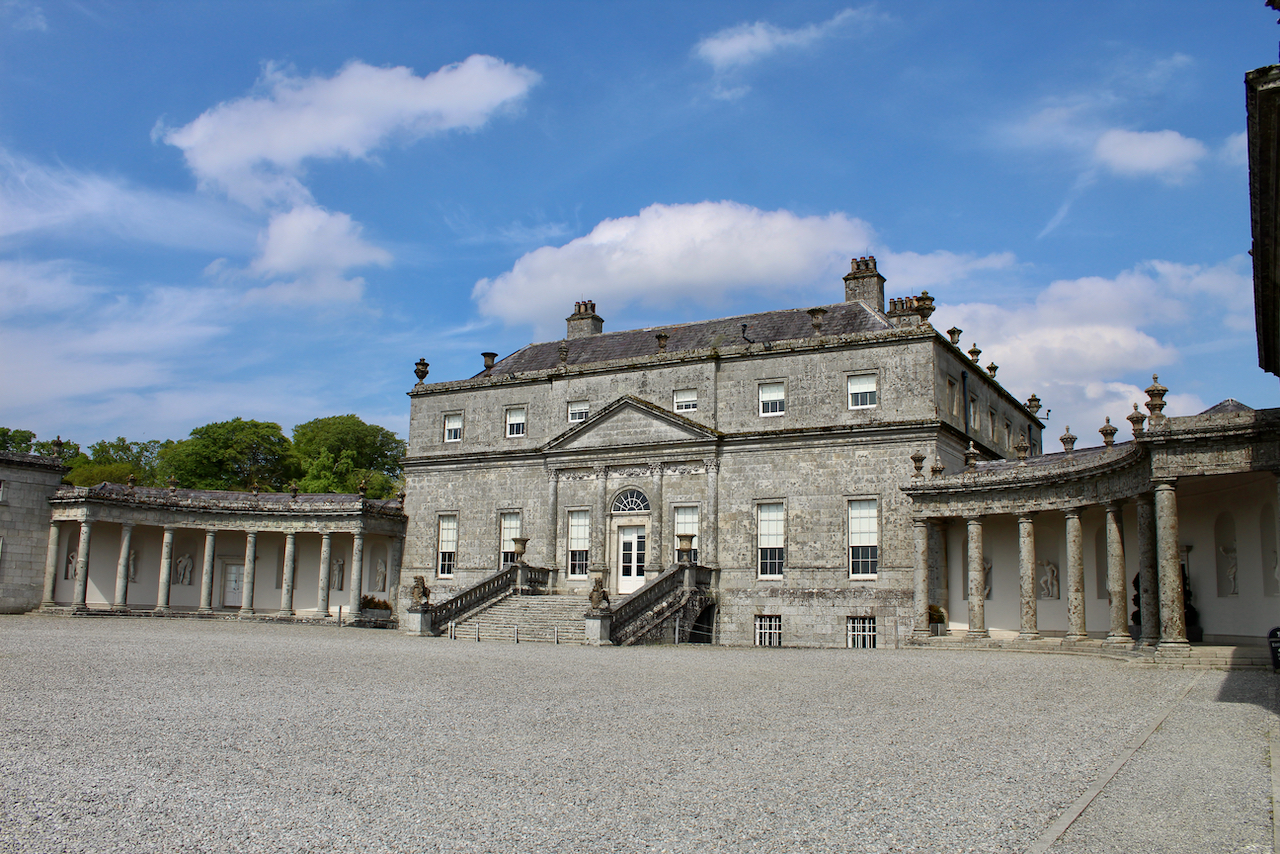
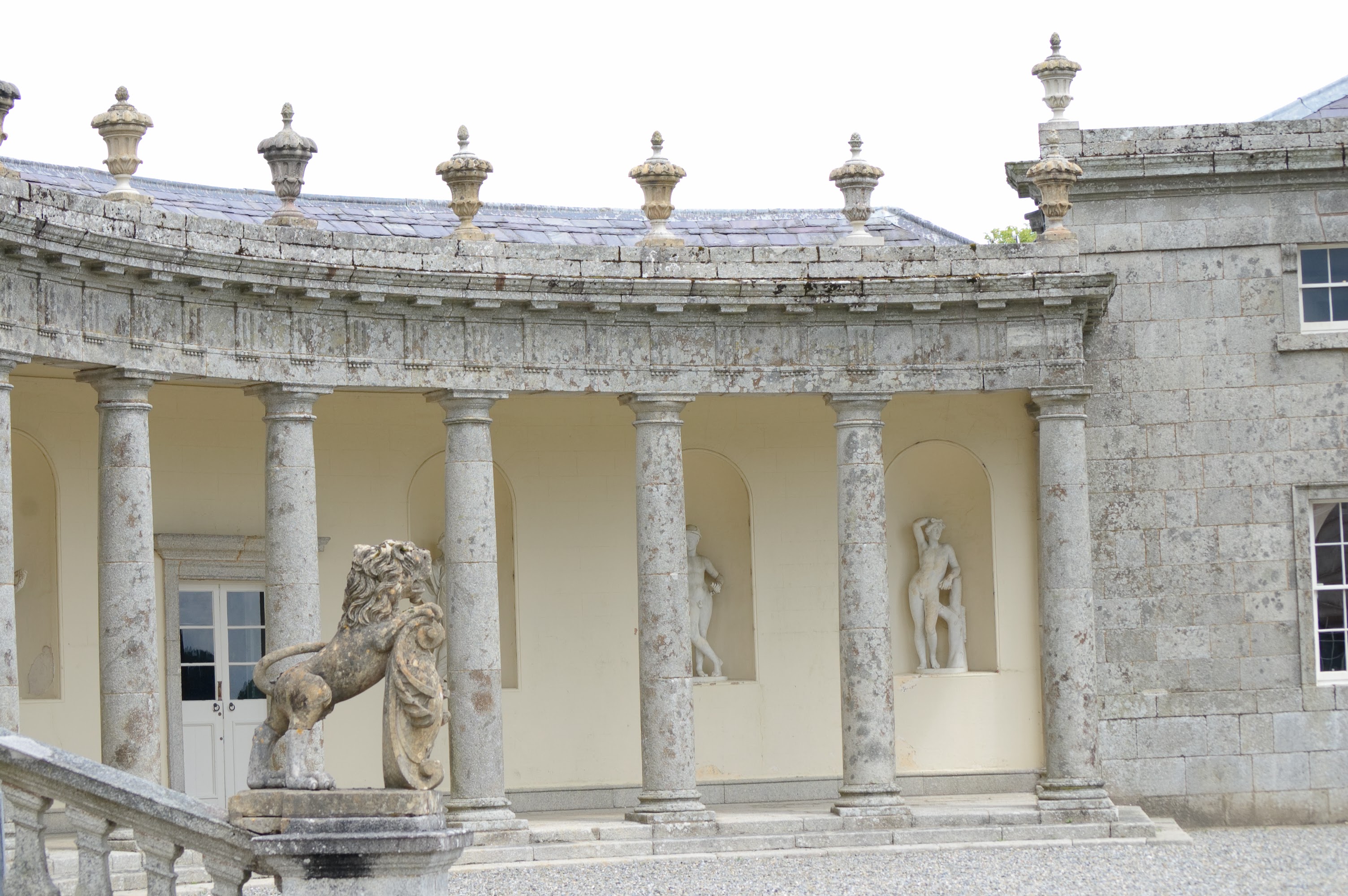
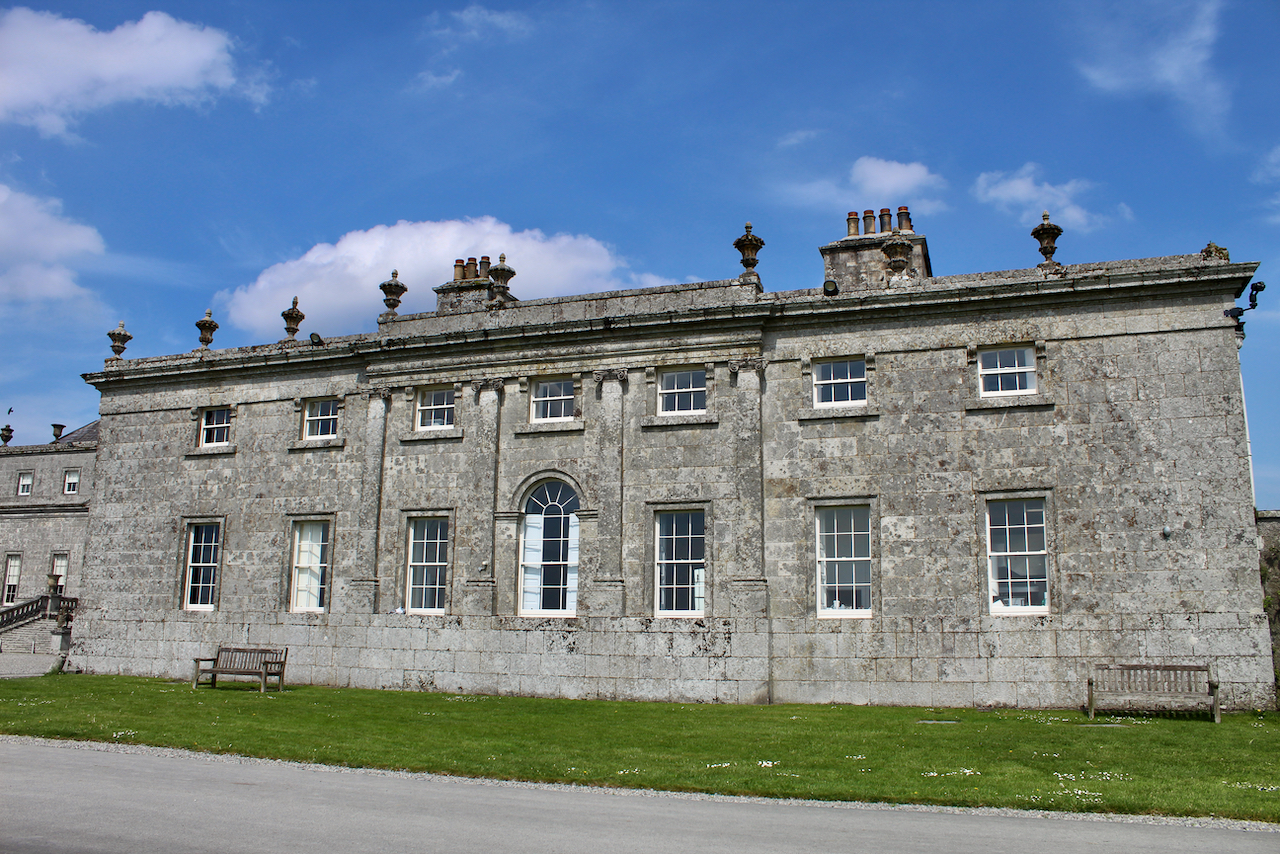
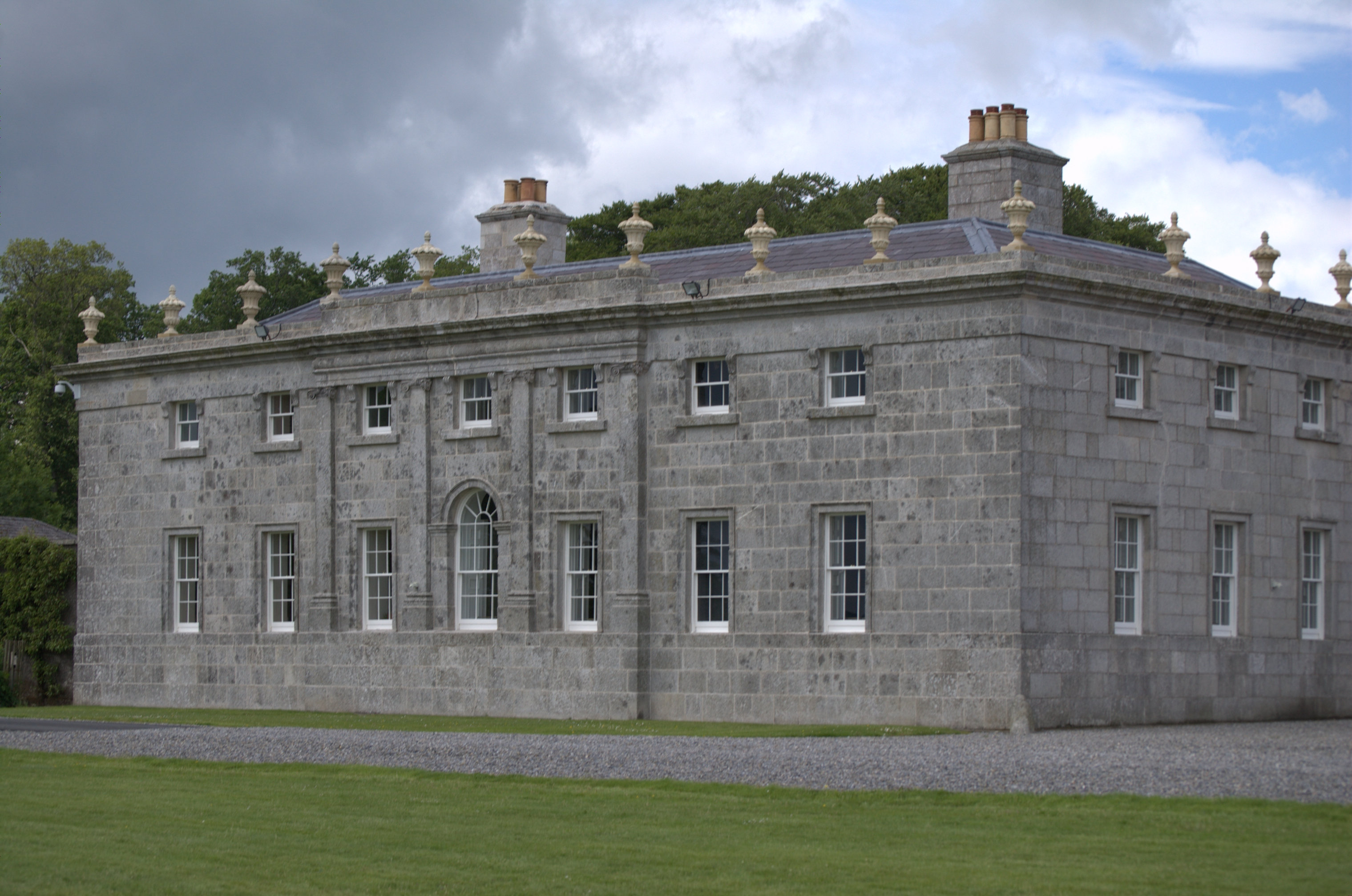
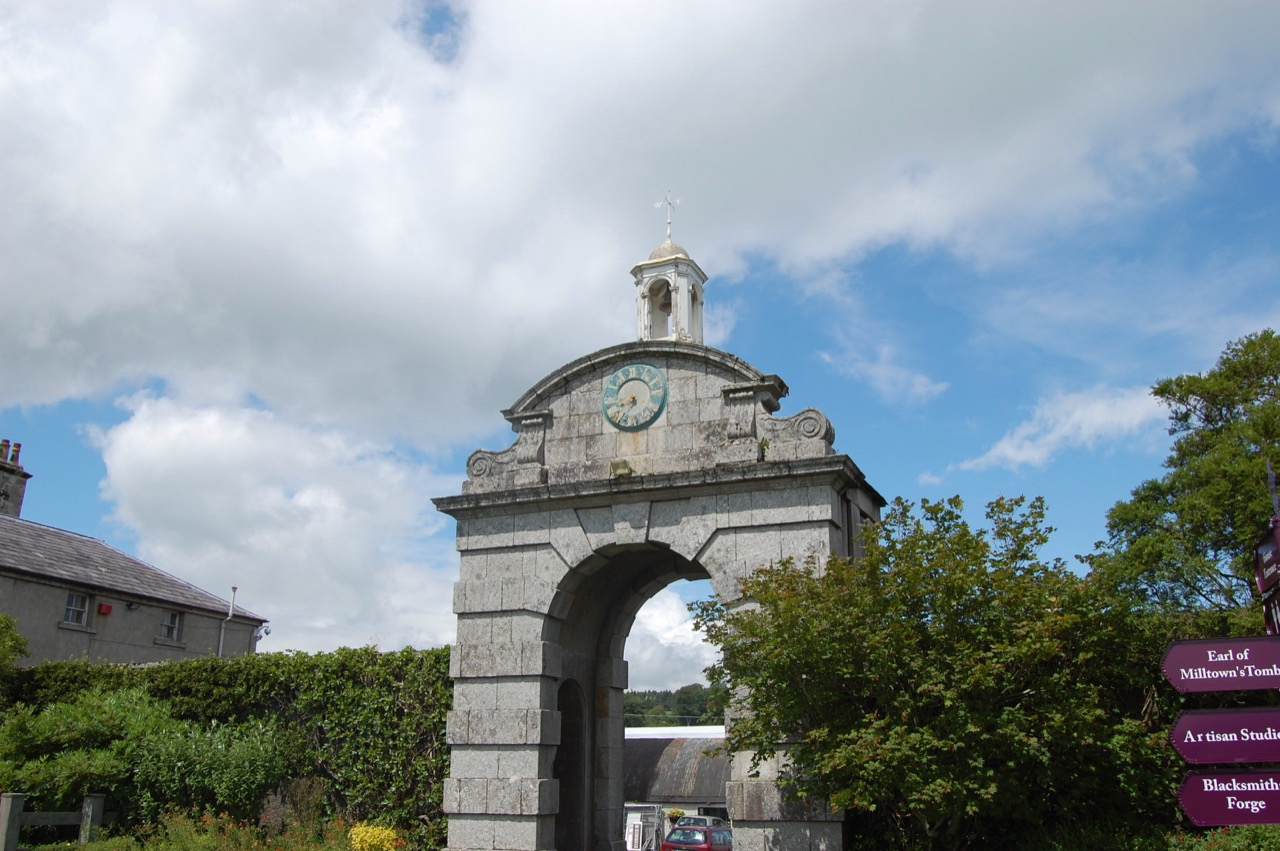
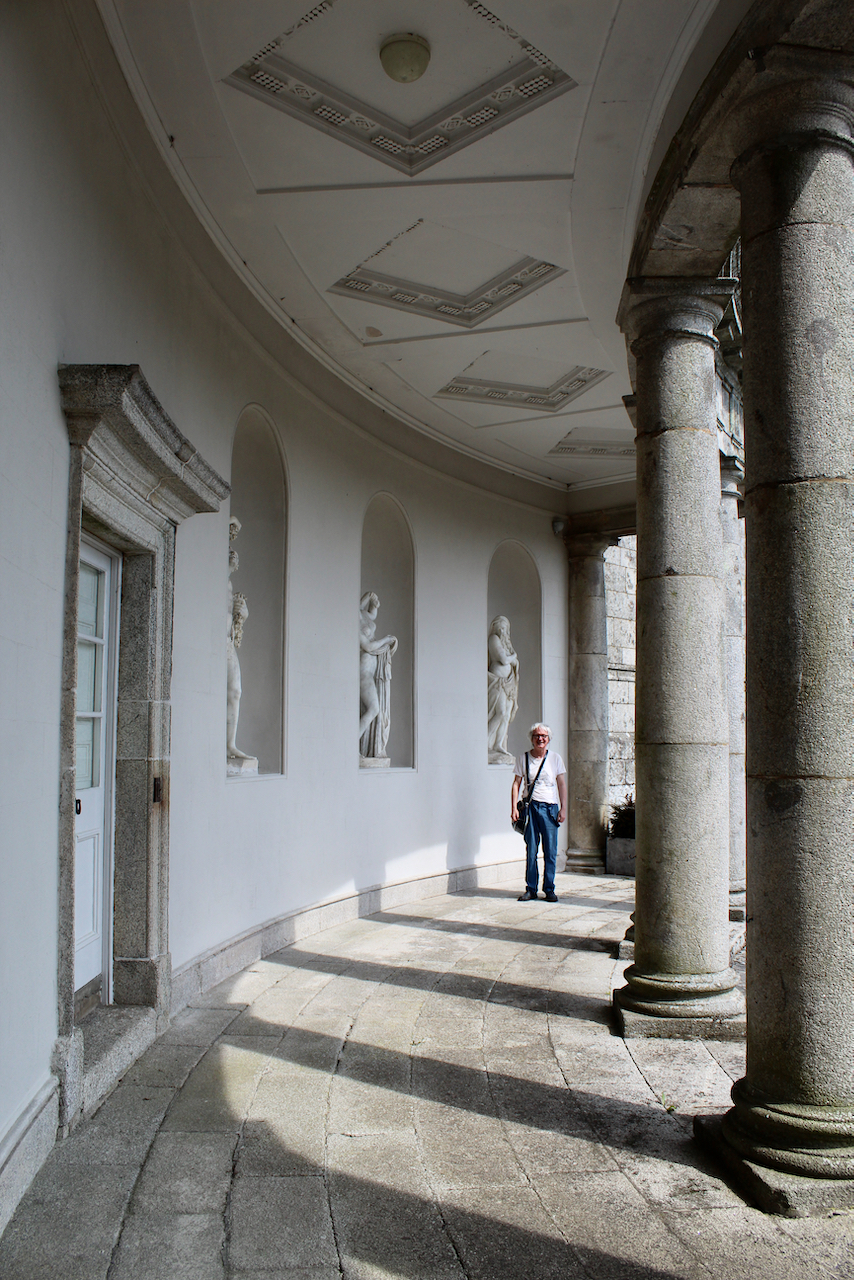
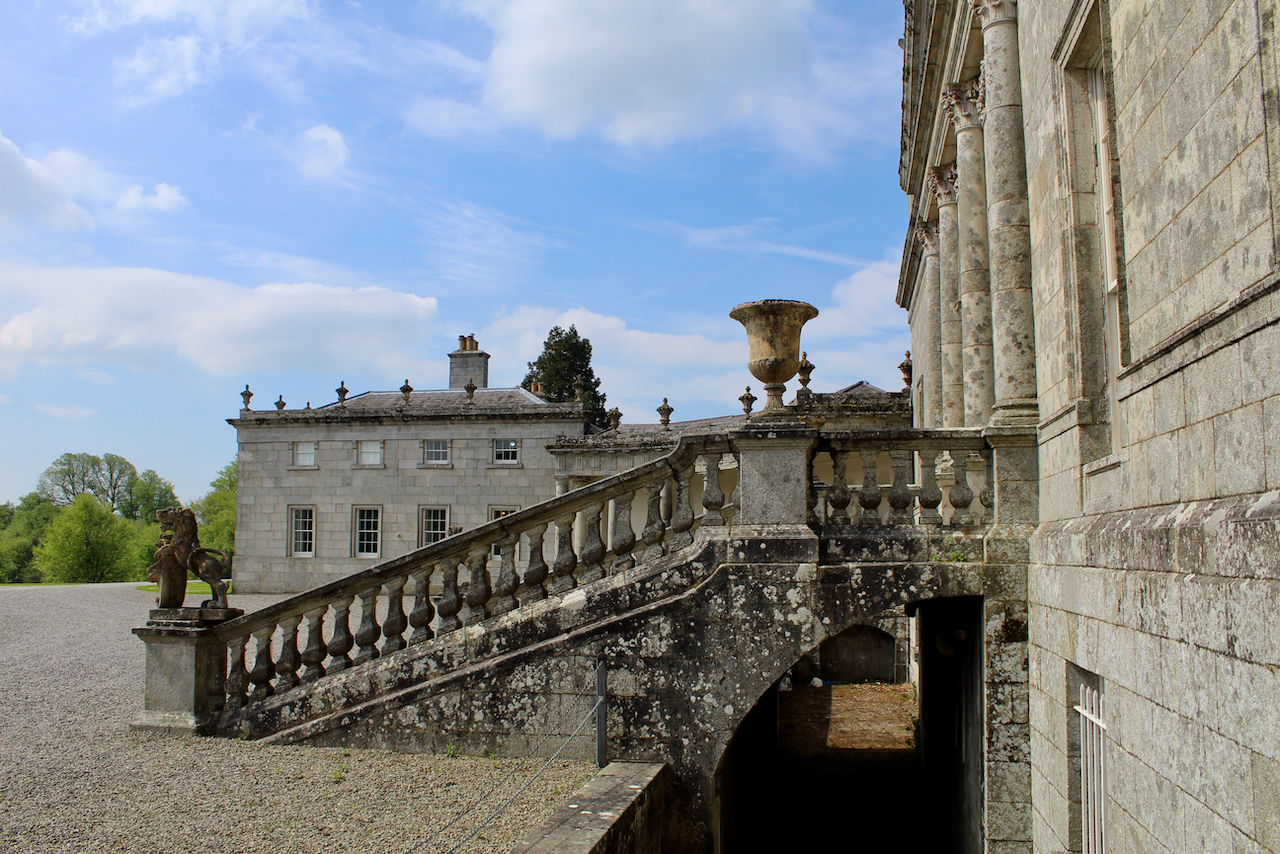
The entrance front of Russborough stretches for over 700 feet, reputedly the longest house in Ireland, consisting of a seven bay centre block of two storeys over a basement, joined by curving Doric colonnades to wings of two storeys and seven bays which are themselves linked to further outbuildings by walls with rusticated arches surmounted by cupolas. In this structure, Russborough is rather like Powerscourt nearby in Wicklow, and like Powerscourt, it is approached from the side.
The residential part of the house is quite small, and is entirely housed in the central block. Of seven bays across, it houses three rooms along its front. It is made of local granite from Golden Hill quarry rather than the more expensive Portland stone often imported from Britain. In Sean O’Reilly’s discussion of the house in his Irish Houses and Gardens (from Country Life), he explains the styles used on the facade of the house:
“the different functions of the building’s elements are appropriately distinguished though Castle’s frank, if unsubtle, use of the orders: Corinthian for the residence, Doric for the colonnades, Ionic for the advancing wings, and a robust astylar threatment for the ranges beyond.” [9]
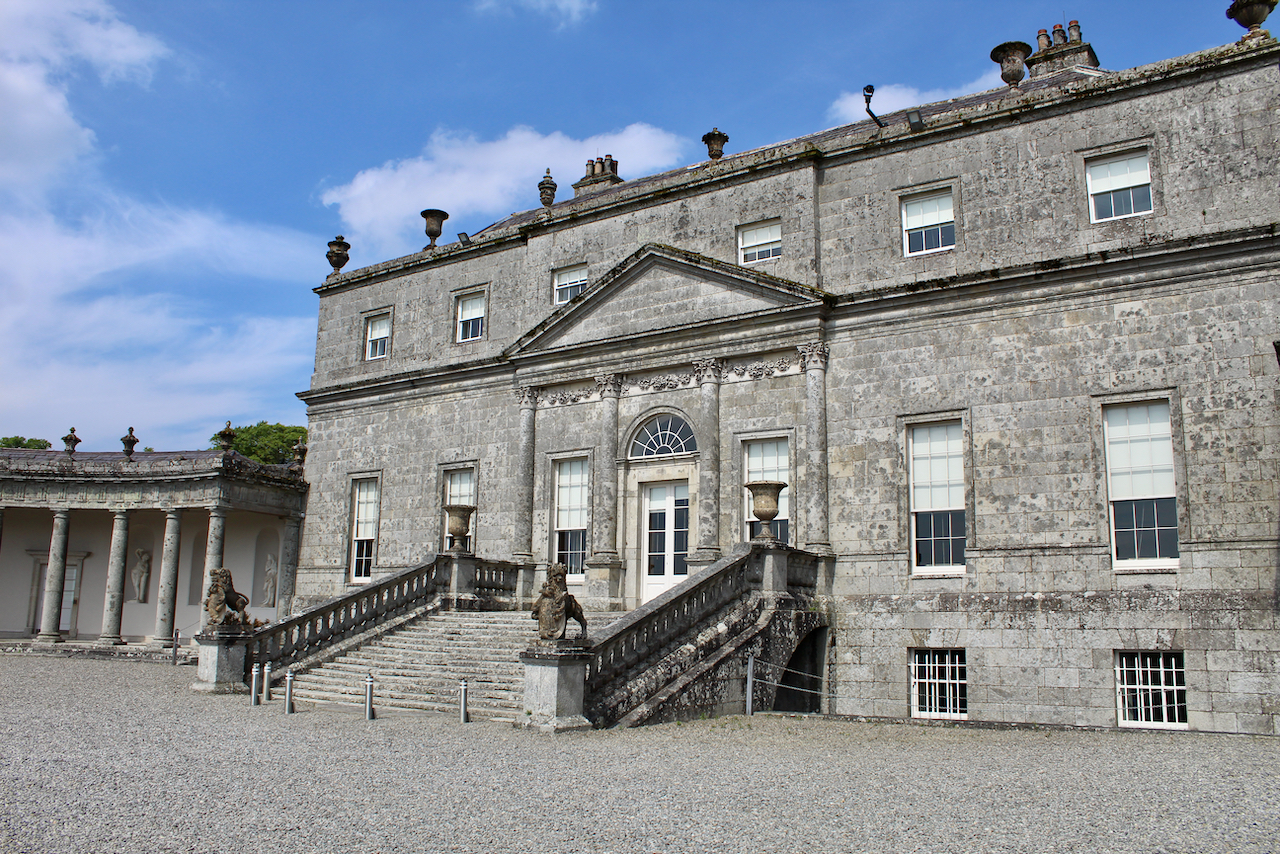
The lions at the foot of the entrance steps carry the heraldic shield of the Milltowns, which must have been put in place after 1763 when Joseph Leeson was promoted to be Earl of Milltown. Photo by Jeremy Hylton.Photograph by Jeremy Hylton of central block.
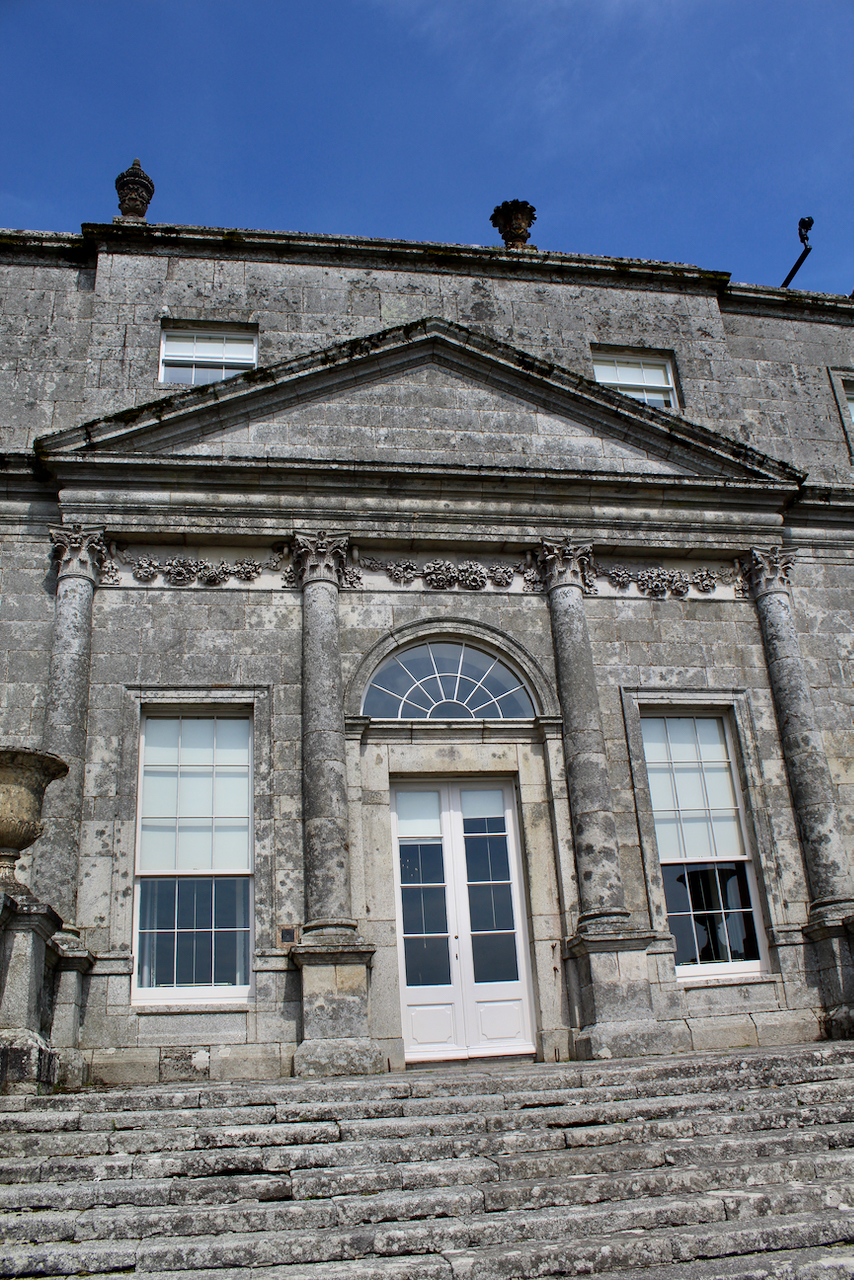
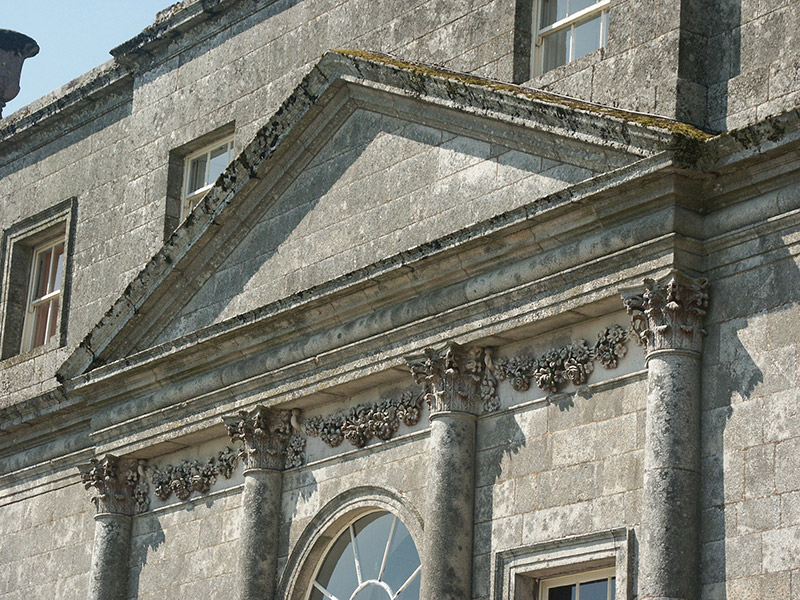
The main central block has a pediment on four Corinthian columns, with swags between the capitals of the columns. Above the entrance door is a semi-circular fanlight window.
The garden front of the centre block has a few urns on the parapet, and a pair of Corinthian columns with an entablature framing a window-style door in the lower storey which opens onto broad balustraded stone steps down to the garden.
Inside, we see Castle’s difference from Edward Lovett Pearce, in his fondness for the Baroque, which is described in wikipedia:
“The Baroque style used contrast, movement, exuberant detail, deep colour, grandeur and surprise to achieve a sense of awe. The style began at the start of the 17th century in Rome, then spread rapidly to France, northern Italy, Spain and Portugal, then to Austria, southern Germany and Russia…excess of ornamentation…The classical repertoire is crowded, dense, overlapping, loaded, in order to provoke shock effects.“
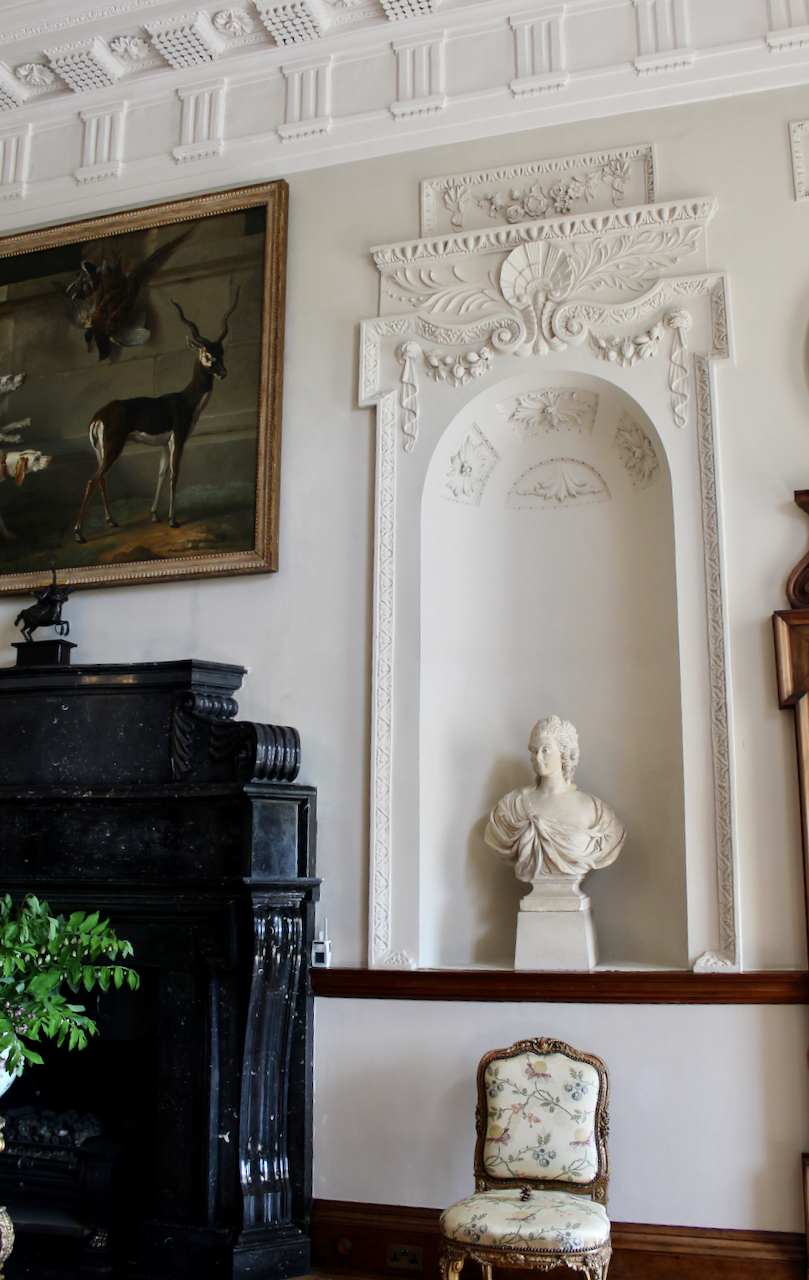
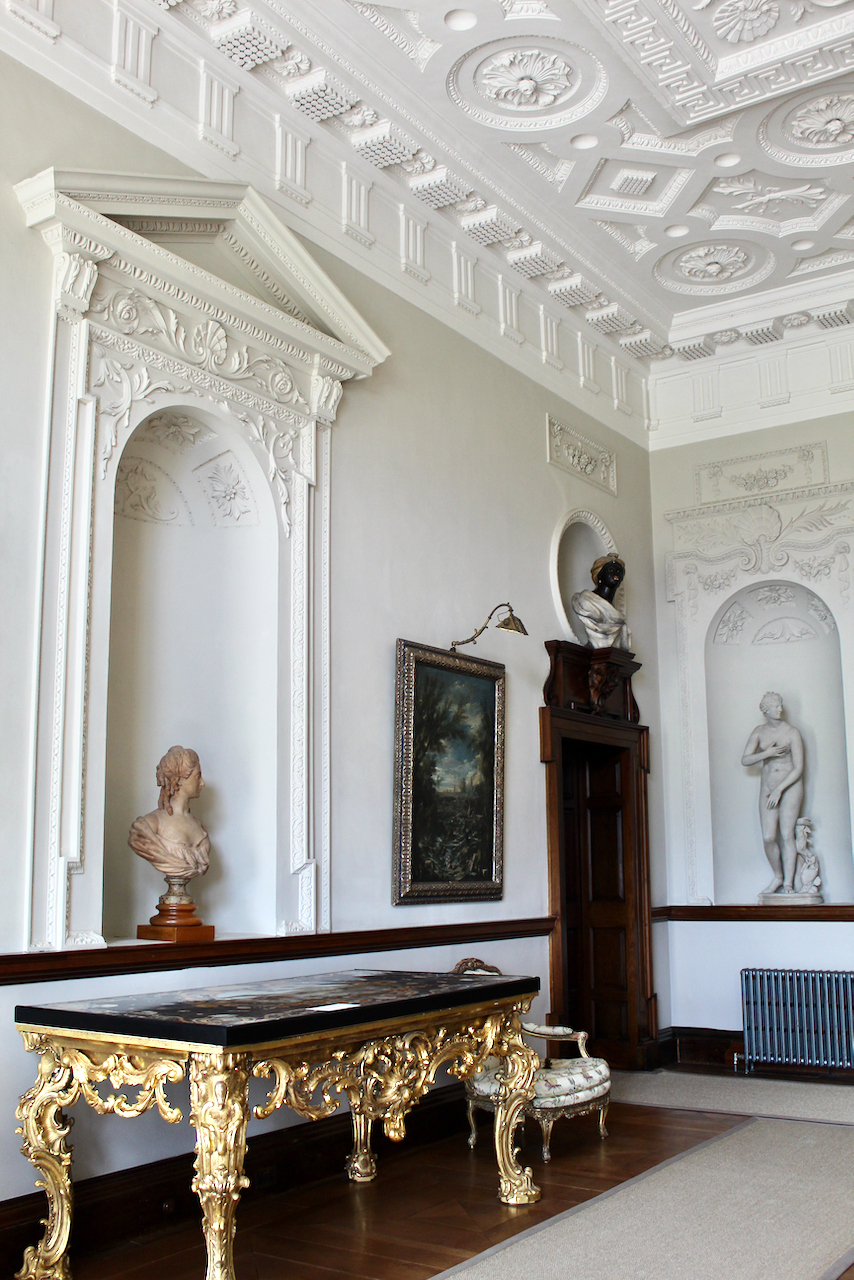
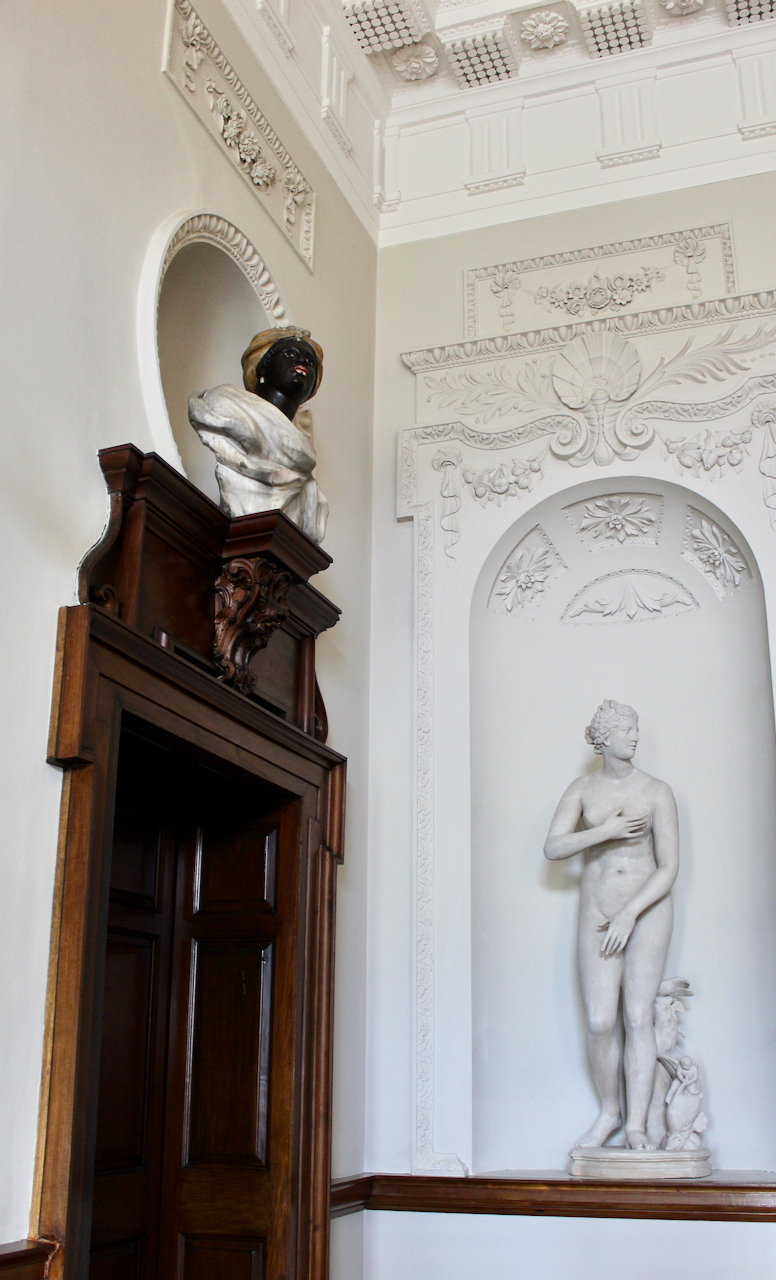
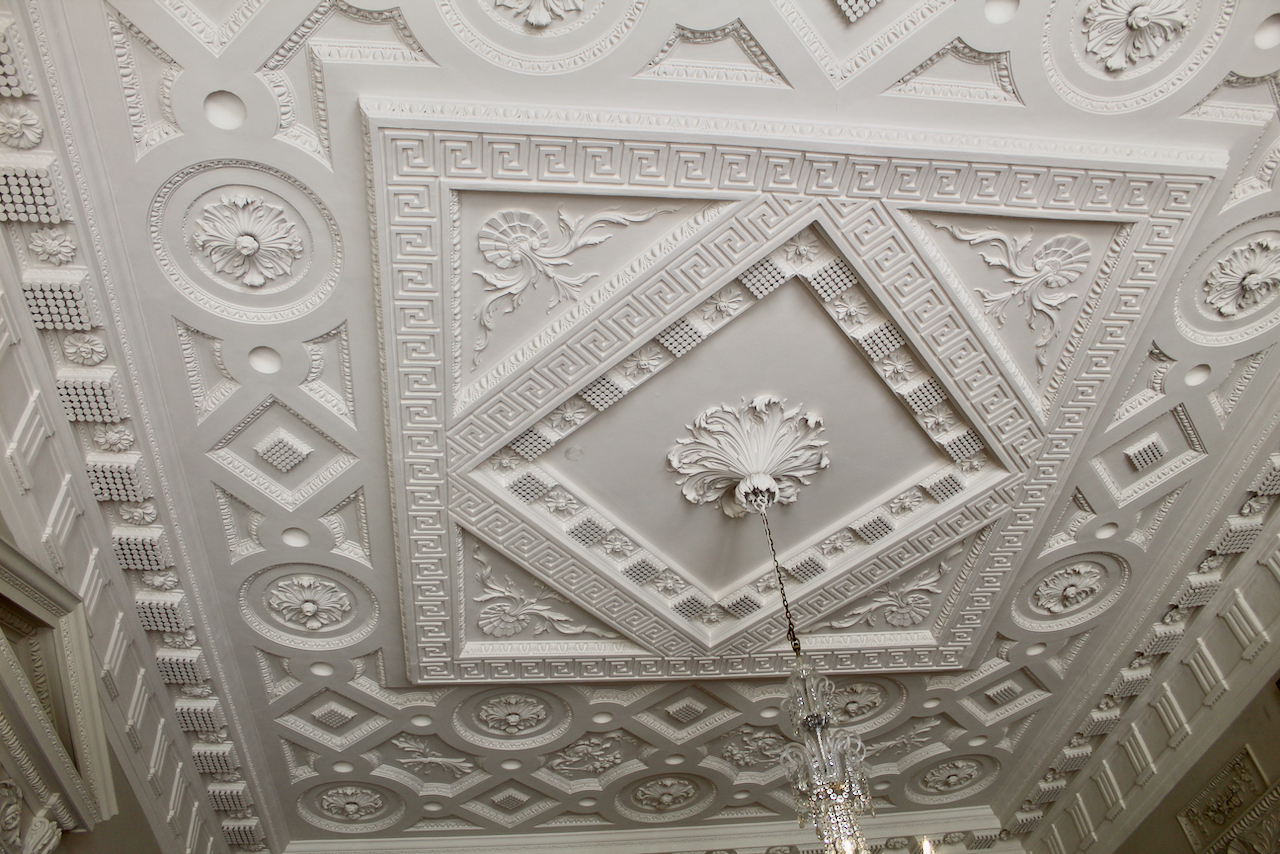
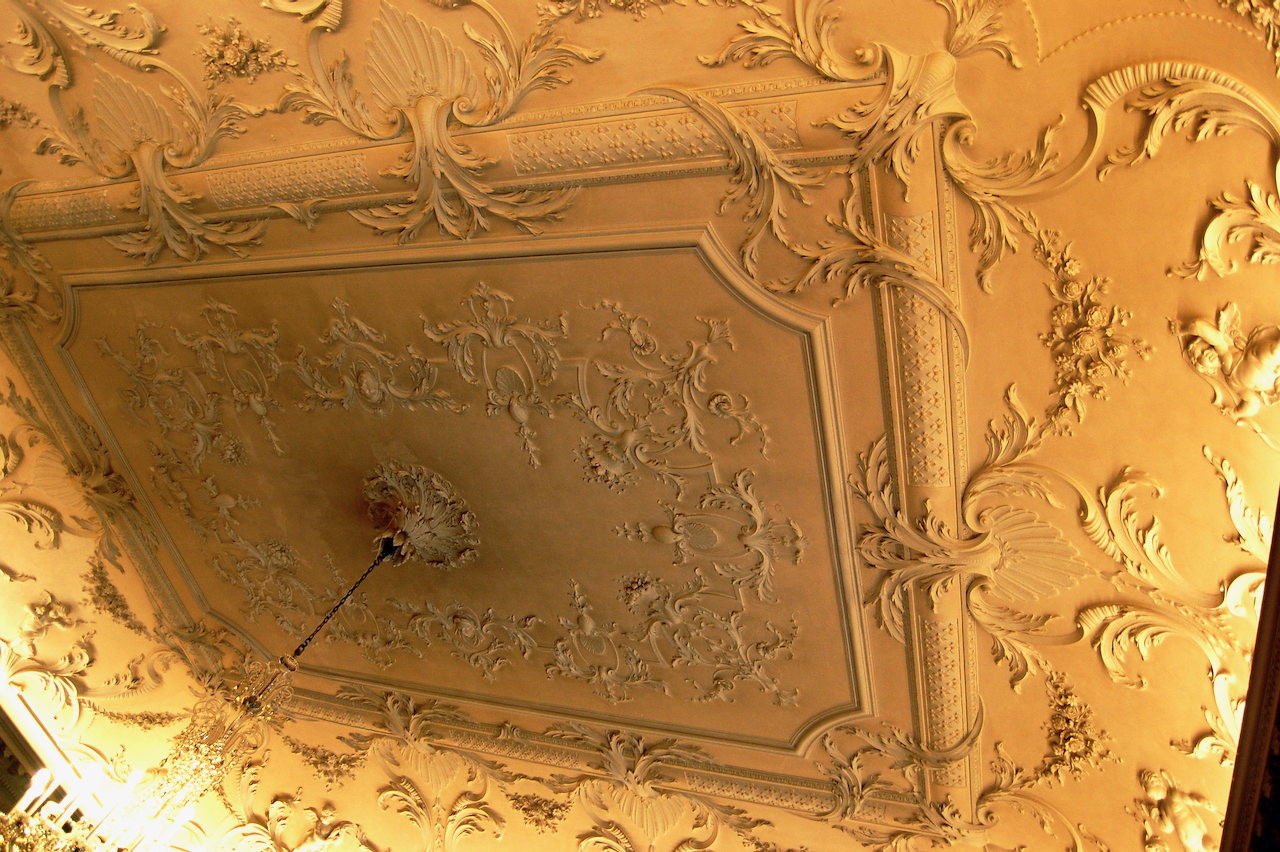
The Baroque effect is most obvious in the wonderful plasterwork. The plasterwork may be by the Francini brothers – it is not definite who carried it out but the Francini brothers certainly seem to have had a hand in some of the beautiful stucco work.
In his book, Big Irish Houses, Terence Reeves-Smyth describes the entrance hall:
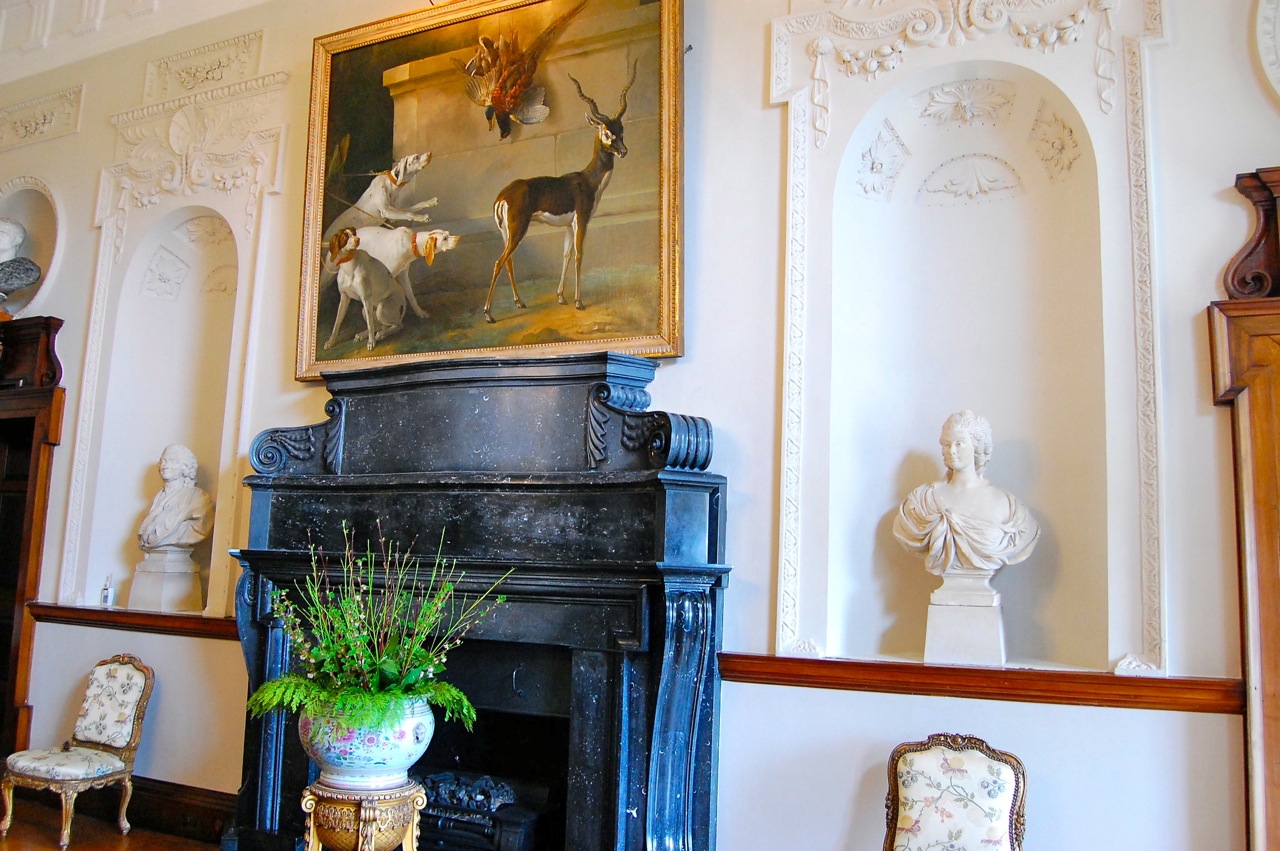
“Ascending the broad flight of granite steps guarded by a pair of carved lions, the visitor enters the front hall – a well-proportioned room with a floor of polished oak and an ornate but severe compartmental ceiling with Doric frieze quite similar to the one Castle deigned for Leinster House. The monumental chimneypiece is of black Kilkenny marble, much favoured by Castle for entrance halls, while above it hangs a striking painting by Oudry of Indian Blackbuck with Pointers and Still Life, dated 1745.” [11]
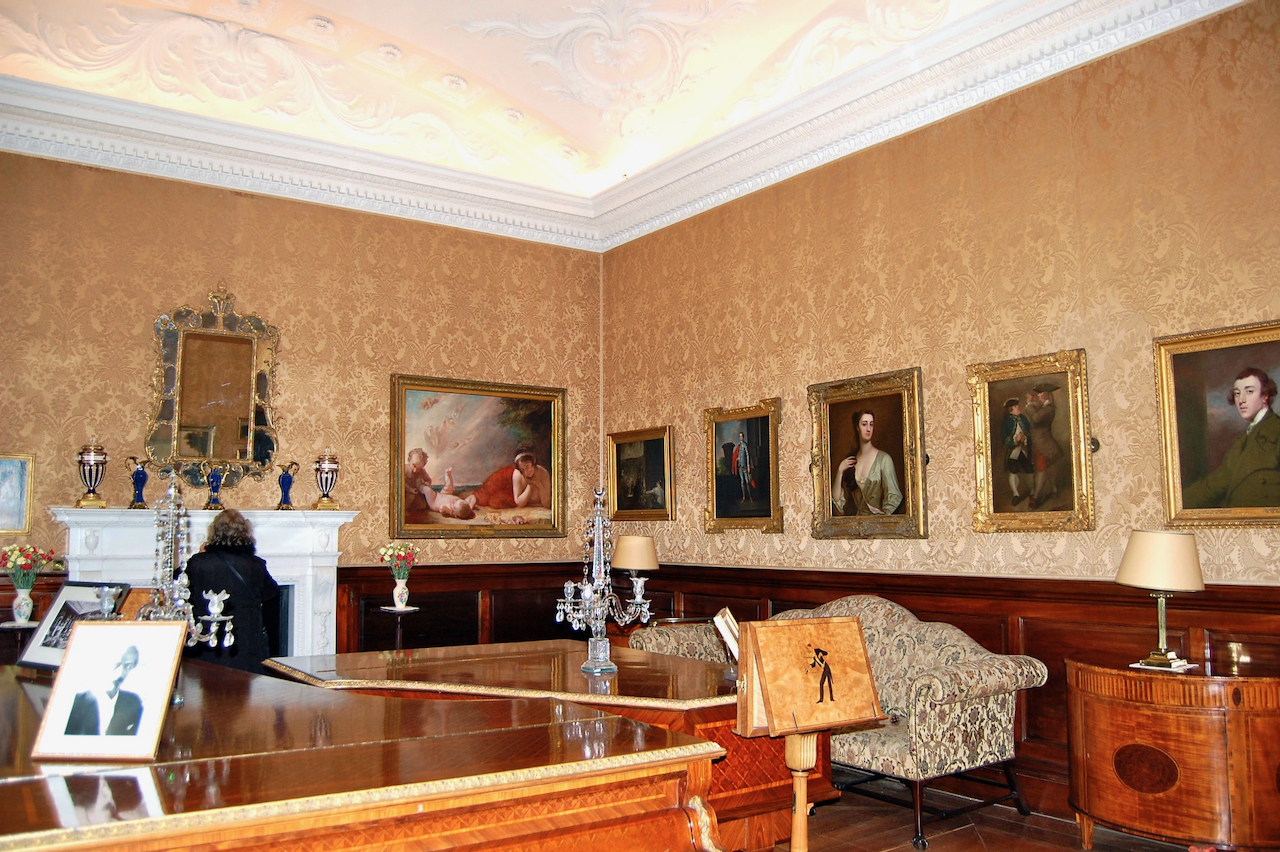
The principal reception rooms lead from one to the other around the central block: the saloon, drawing-room, dining-room, tapestry room and the grand staircase. They retain their original doorcases with carved architraves of West Indian mahogany, marble chimneypieces and floors of inlaid parquetry.
The house took ten years to complete, and development of the house followed Leeson’s trips to Europe, where he bought items to populate his house. In 1744 and in 1751 he travelled to Rome and purchased extensive Roman materials, as well as many artworks. He had his portrait painted by Pompeo Batoni, and was aided in his purchases by dealers including an Irishman named Robert Wood. A book details his collection, as well as later owners of Russborough, Russborough: A Great Irish House, its Families and Collections by William Laffan and Kevin V Mulligan.
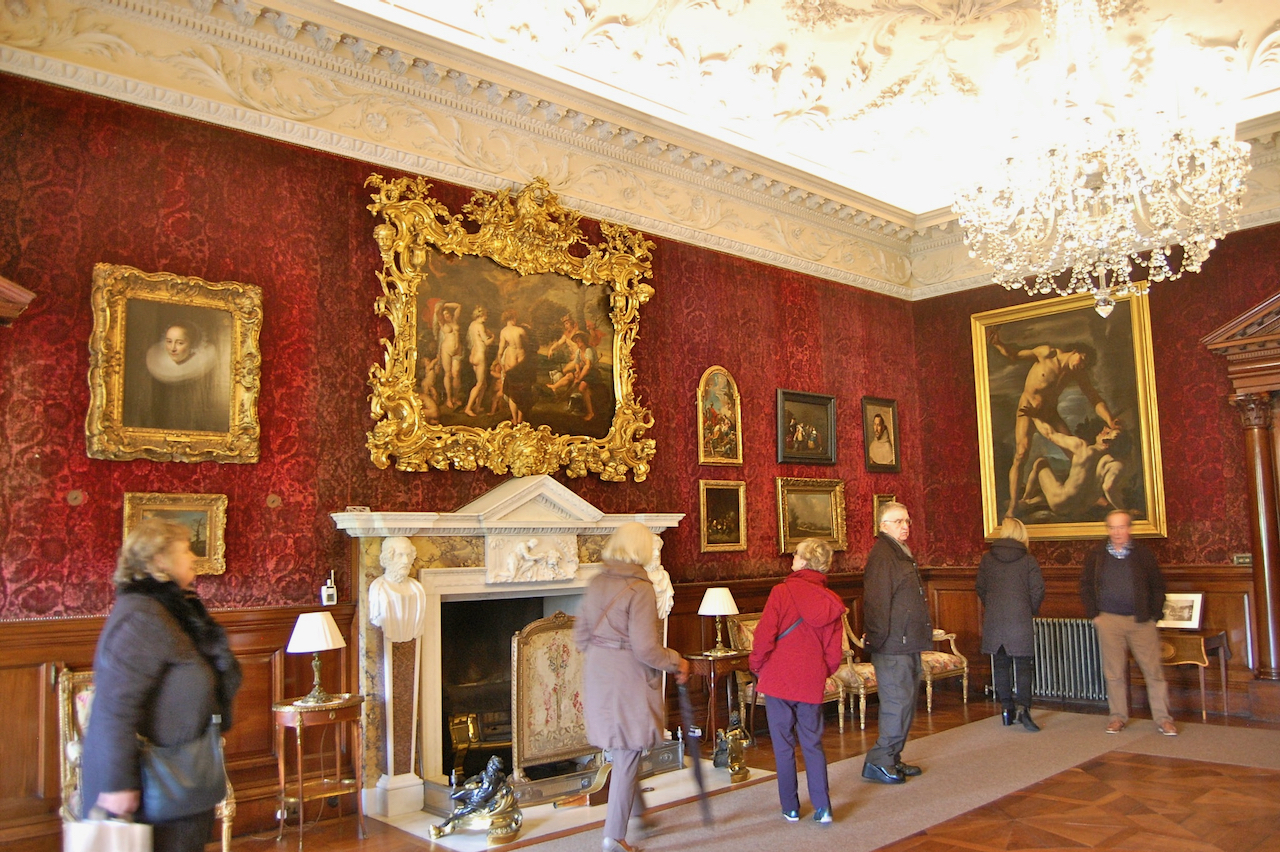
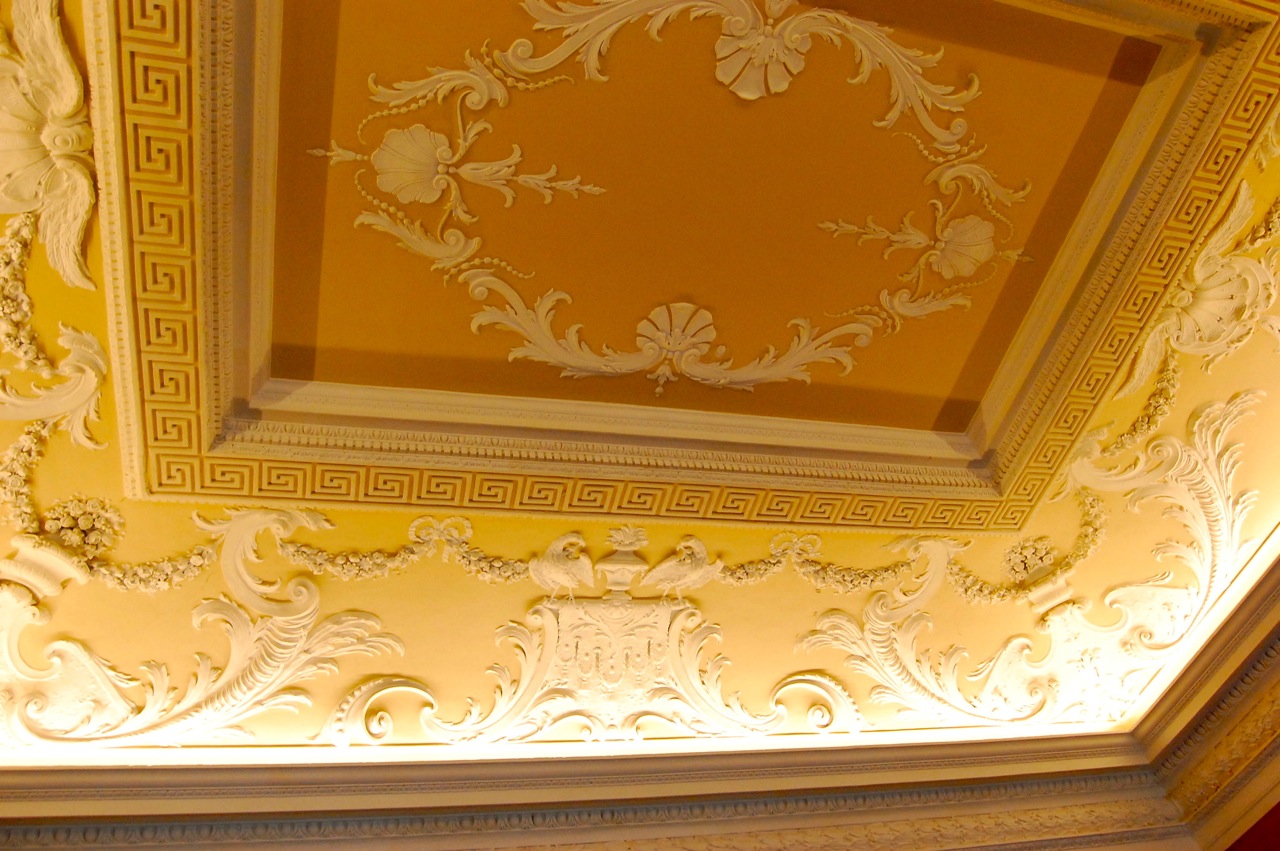
The Saloon occupies the three central bays of the north front of the house. It has a coved ceiling with rococo plasterwork incorporating flowers, garlands, swags and putti bearing emblems of the Seasons and the Elements, which on stylistic grounds can be attributed to the Francini brothers of Italy. [Rococo is the asymmetrical freely-modelled style of decoration originating in France and popular in Ireland from about 1750 to 1775. Craig, Maurice and Knight of Glin, Ireland Observed, A Handbook to the Buildings and Antiquities. Mercier Press, Dublin and Cork, 1970]. Terence Reeves-Smyth describes the room:
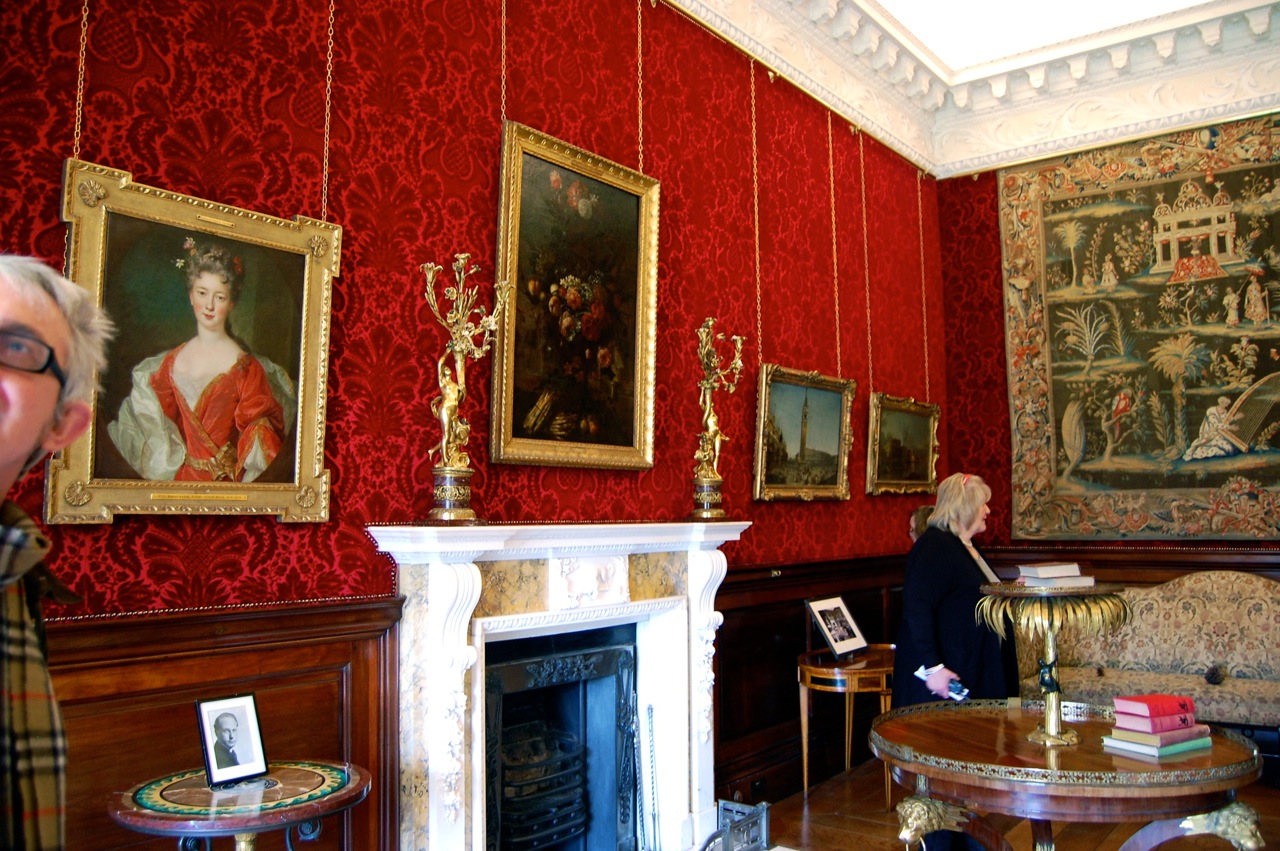
“The walls are covered with a crimson cut Genoese velvet dating from around 1840 – an ideal background for paintings which include many pictures from the Beit collection. The room also has Louis XVI furniture in Gobelins tapestry signed by Pluvinet, a pair of Japanese lacquer cabinets from Harewood House and a chimney-piece identical to one at Uppark in Sussex, which must be the work of Thomas Carter (the younger) of London.
“A striking feature of the room is the inlaid sprung mahogany floor with a central star in satinwood. This was covered with a green baize drugget when the house was occupied by rebels during the 1798 rebellion. The potential of the drugget for making four fine flags was considered but rejected, lest “their brogues might ruin his Lordship’s floor.” The rebels, in fact, did virtually no damage to the house during their stay, although the government forces who occupied the building afterwards were considerably less sympathetic. It is said that the troops only left in 1801 after a furious Lord Milltown challenged Lord Tyrawley to a duel “with blunderbusses and slugs in a sawpit.” [11]
Next to the Saloon is the music room with another wonderful rococo ceiling, and then the library, which was formerly the dining room, both have ceilings probably by the Francini brothers. There aren’t records to tell us who created the stucco work of the house, and stylistically different parts of the house have been done by different hands.
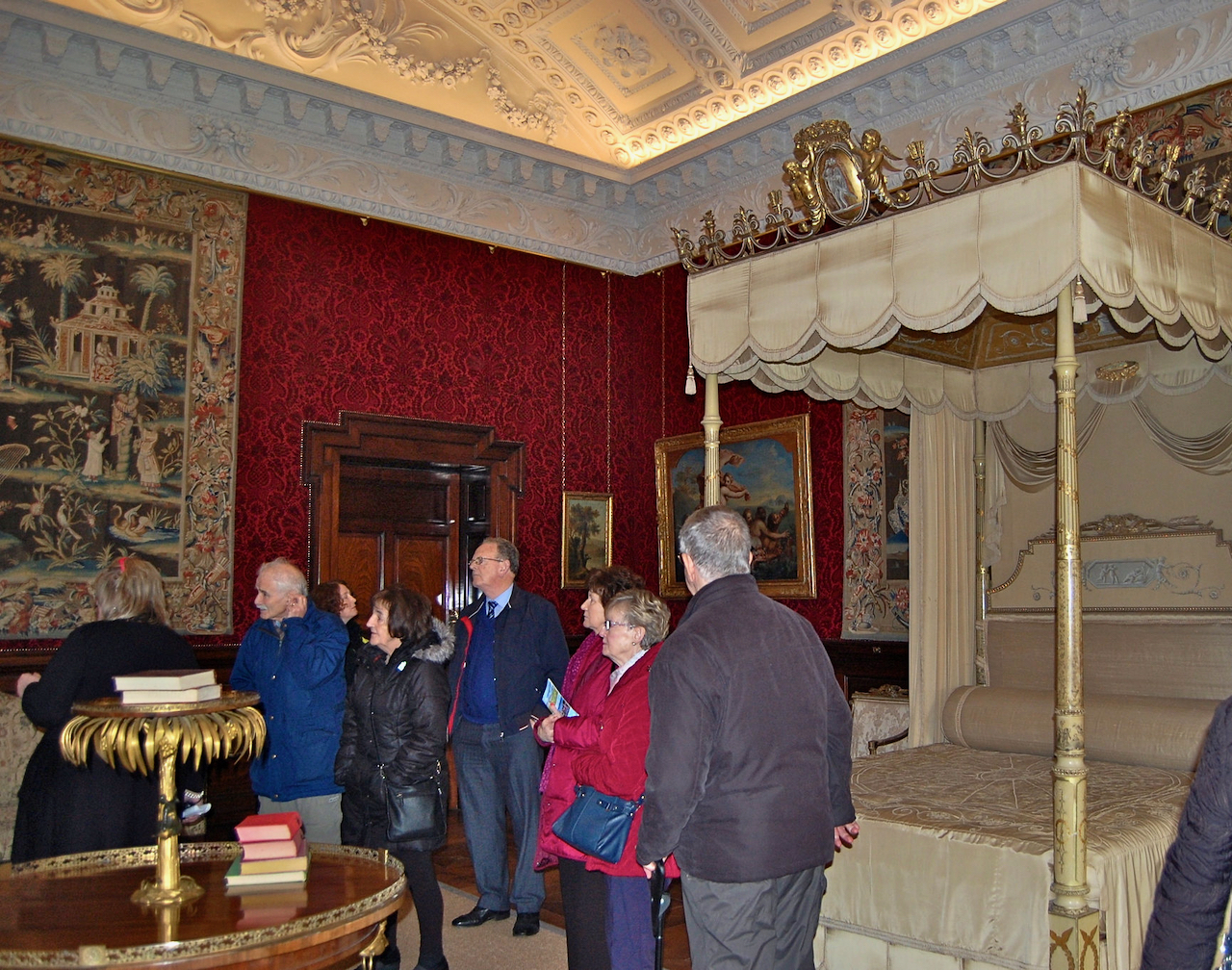
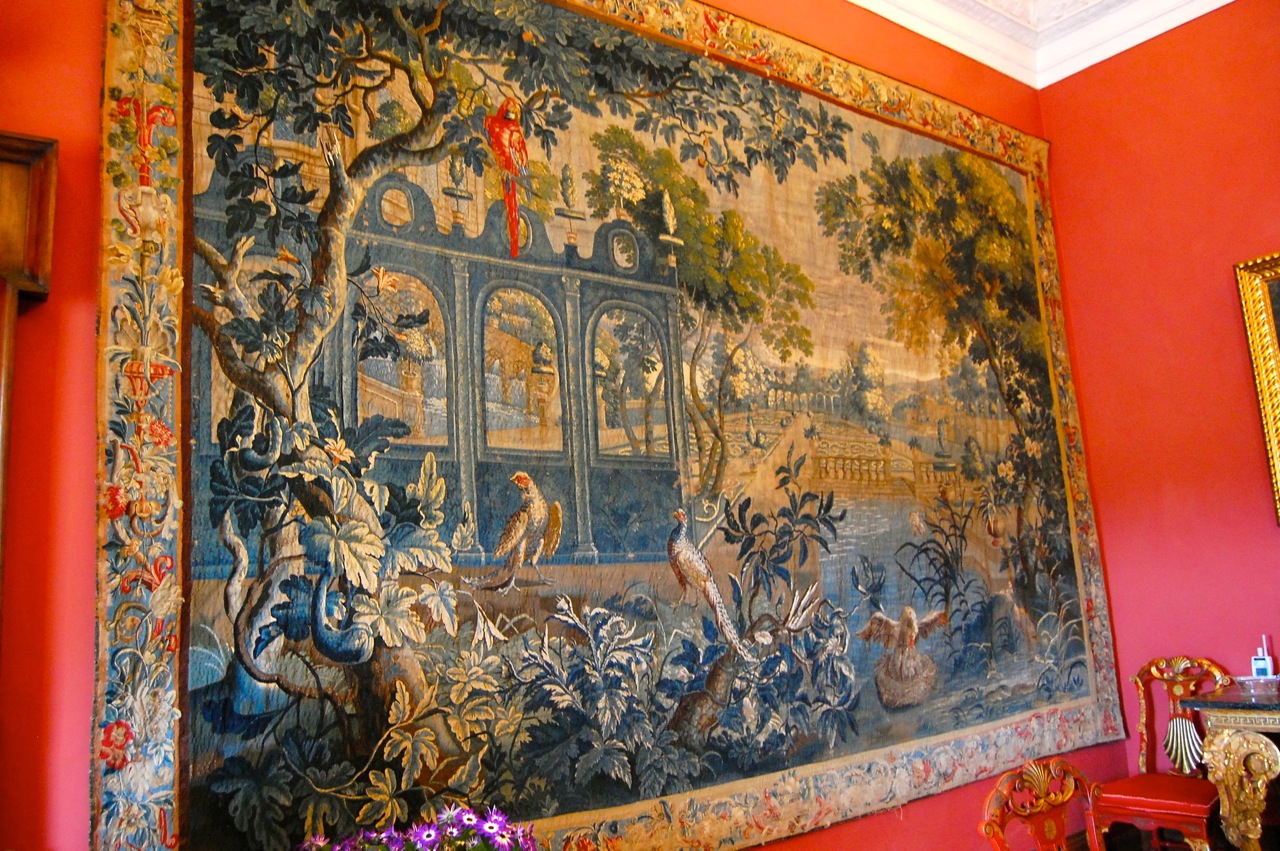
“The coffered and richly decorated barrel-vaulted ceiling of the tapestry room, to the south of the music room, is by a less experienced artist, though the room is no less impressive than the others and contains an English state bed made in London in 1795 and two Soho tapestries of Moghul subjects by Vanderbank.“
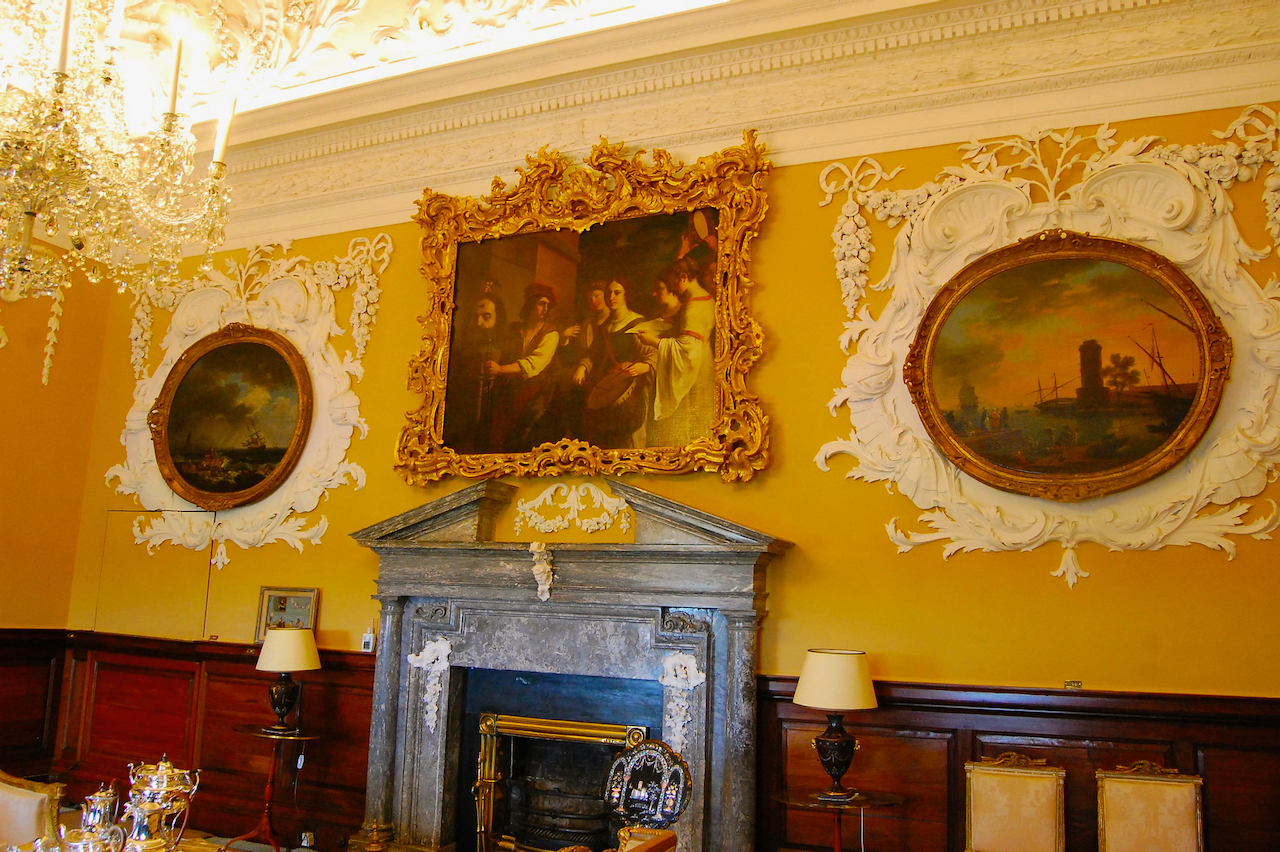
“Infused with a restless energy the plasterwork of the adjacent drawing-room spills onto the walls, where fantastic plaster frames surround the four oval marine scenes by Vernet representing morning, noon, evening and night. Although part of the patrimony of the house, these pictures were sold in 1926 and only after a determined search were recovered 43 years later by Sir Alfred Beit. [12]
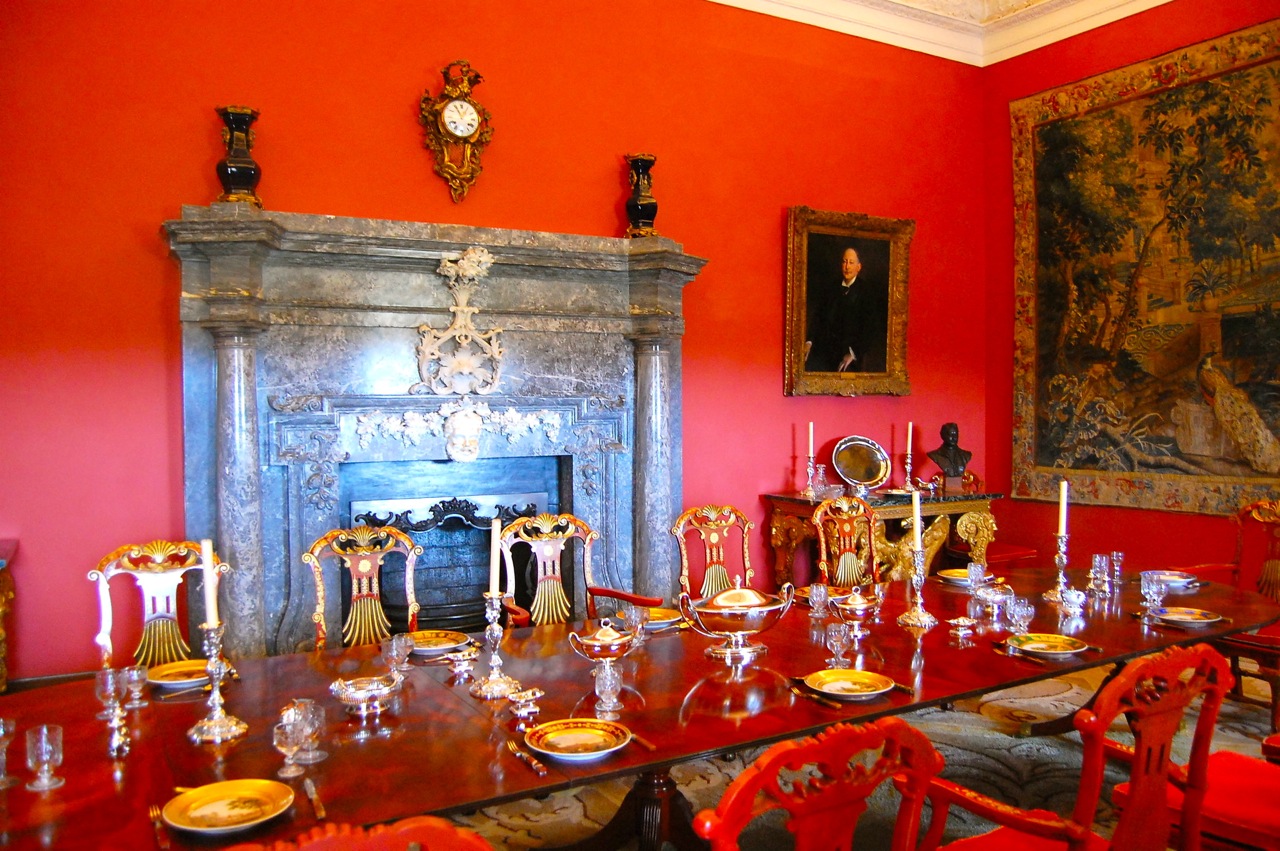
“Beyond lies the boudoir, a charming little panelled apartment with a Bossi chimney-piece dating around 1780. From here visitors pass into the tapestry-hung corridor leading to the pavilion, formerly the bachelor’s quarters. The dining-room, formerly the library, on the opposite side of the hall has a monumental Irish chimney-piece of mottled grey Sicilian marble. The walls are ornamented both by paintings from the Beit collection and two magnificent Louis XIV tapestries.” [11]
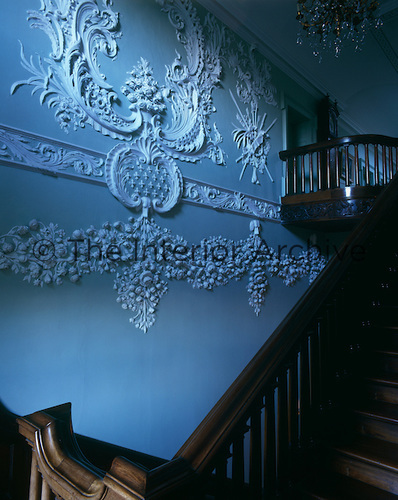
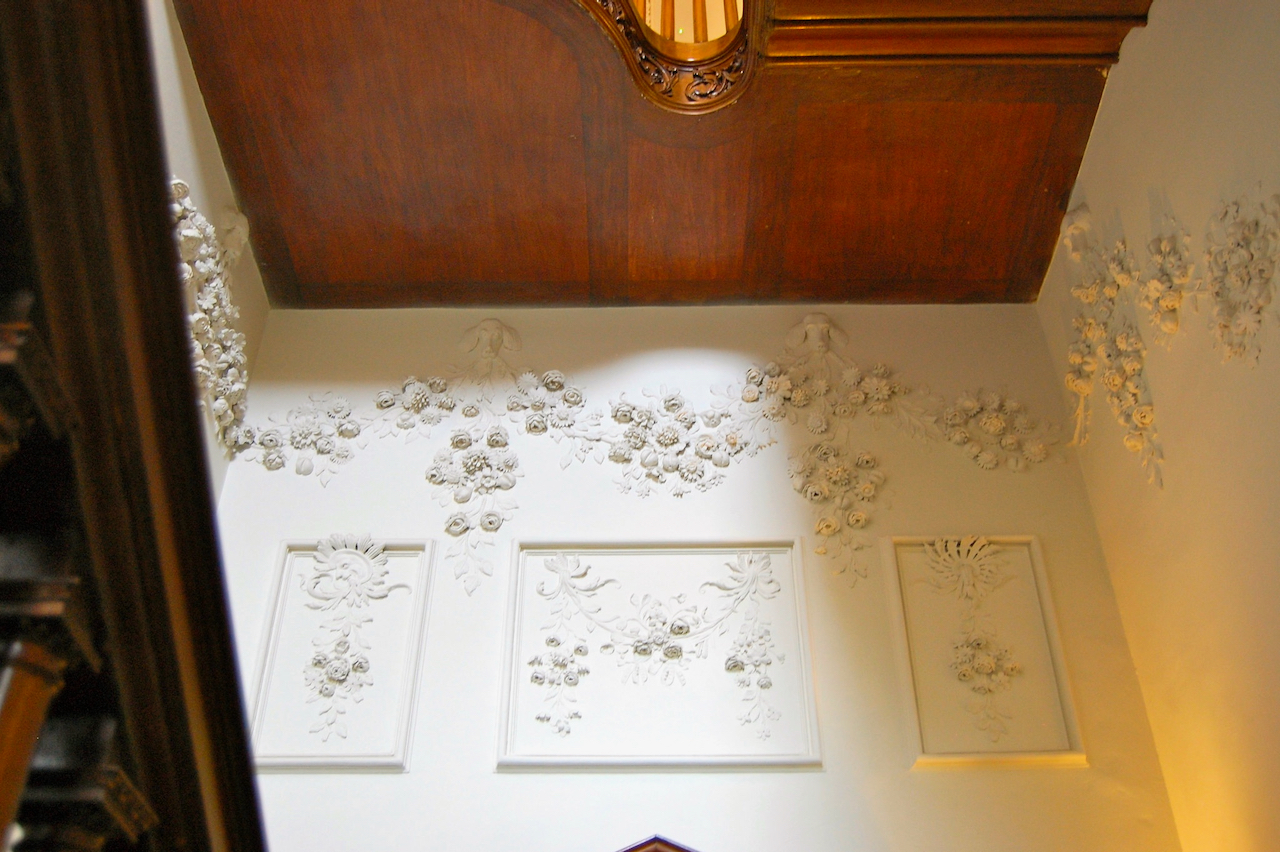
Reeves-Smyth goes on to say that “No one who visits Russborough is likely to forget the staircase with its extraordinary riot of exuberant plasterwork; there is nothing quite like it anywhere else in the British Isles.
“In later years the decorator Mr. Sibthorpe is reported to have remarked that it represented “the ravings of a maniac,” adding that he was “afraid the madman was Irish.”
Sean O’Reilly tells us that the Knight of Glin pointed out that Castle “cribbed the idea of the balustraded upper landing lit by a lantern window at Russborough from Pearce’s superb Palladian villa of Bellamont Forest, Co Cavan, built circa 1730 for his uncle Lord Justice Coote (and recently immaculately restored by the designer John Coote from Australia)”. Sadly since this was written, John Coote has died. I did not take a photograph of the upper landing, but you can see it on the Russborough website or better yet, during a visit to the house. The rooms off the this top-lit lobby would have been the bedrooms.
Joseph the 1st Earl of Milltown and his first wife Cecelia had several children including the heir, Joseph (1730-1801), who succeeded as 2nd Earl of Milltown, and his brother Brice (1735-1807) who succeeded as 3rd Earl. They also had a daughter, Mary (1734-1794) who married John Bourke, 2nd Earl of Mayo. Joseph 1st Earl and his second wife, Anne Preston, had a daughter, also named Anne, who married her cousin Hugh Henry, son of Hugh Henry (d. 1743) and her aunt Anne Leeson.
Joseph the 1st Earl of Milltown died in 1783, and his bachelor son Joseph succeeded to the peerages and to Russborough. The first Earl’s third wife and widow, Elizabeth French, lived on to a very great age until 1842. She and the 1st Earl had a daughter Cecelia who married Colonel David La Touche of Marlay. They als had a daughter Frances Arabella who married Marcus de la Poer Beresford, son of John the 1st Marquess of Waterford (of Curraghmore House, which we visited, another section 482 property). They also had sons Robert (1773-1842) and William (1770-1819).
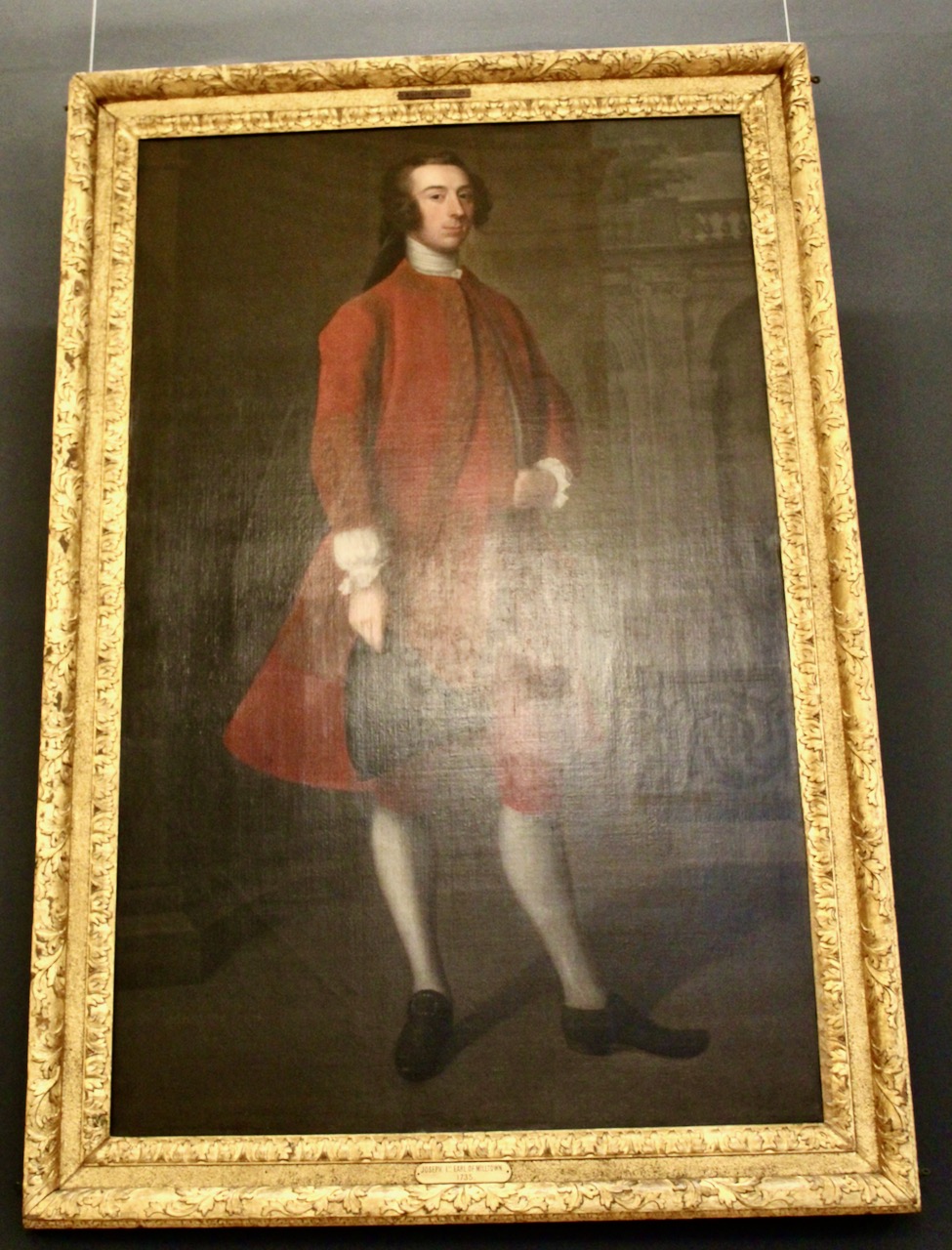
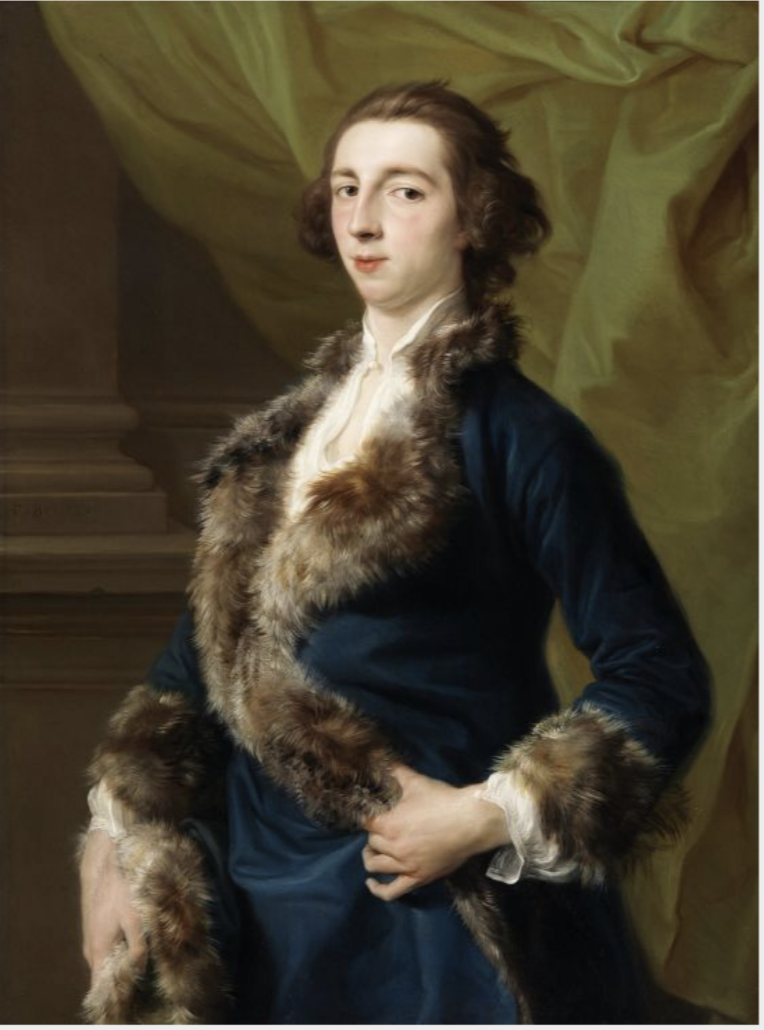
Joseph Leeson, 1st Earl of Milltown with his third Wife Elizabeth, their daughter Cecilia and his grandson Joseph, later 3rd Earl of Milltown Date c.1772 after Pompeo Batoni. Photograph courtesy of National Gallery of Ireland.Joseph Leeson, later 2nd Earl of Milltown (1730-1801) Date 1751 by Pompeo Batoni, Italian, 1708-1787, photograph courtesy of the National Gallery of Ireland.
When the 2nd Earl of Milltown died in 1801, his brother Brice succeeded to Russborough and to the title to become the 3rd Earl of Milltown.
Cecilia La Touche née Leeson (about 1769-1848).She was the daughter of Joseph 1st Earl of Milltown and she married Colonel David la Touche.
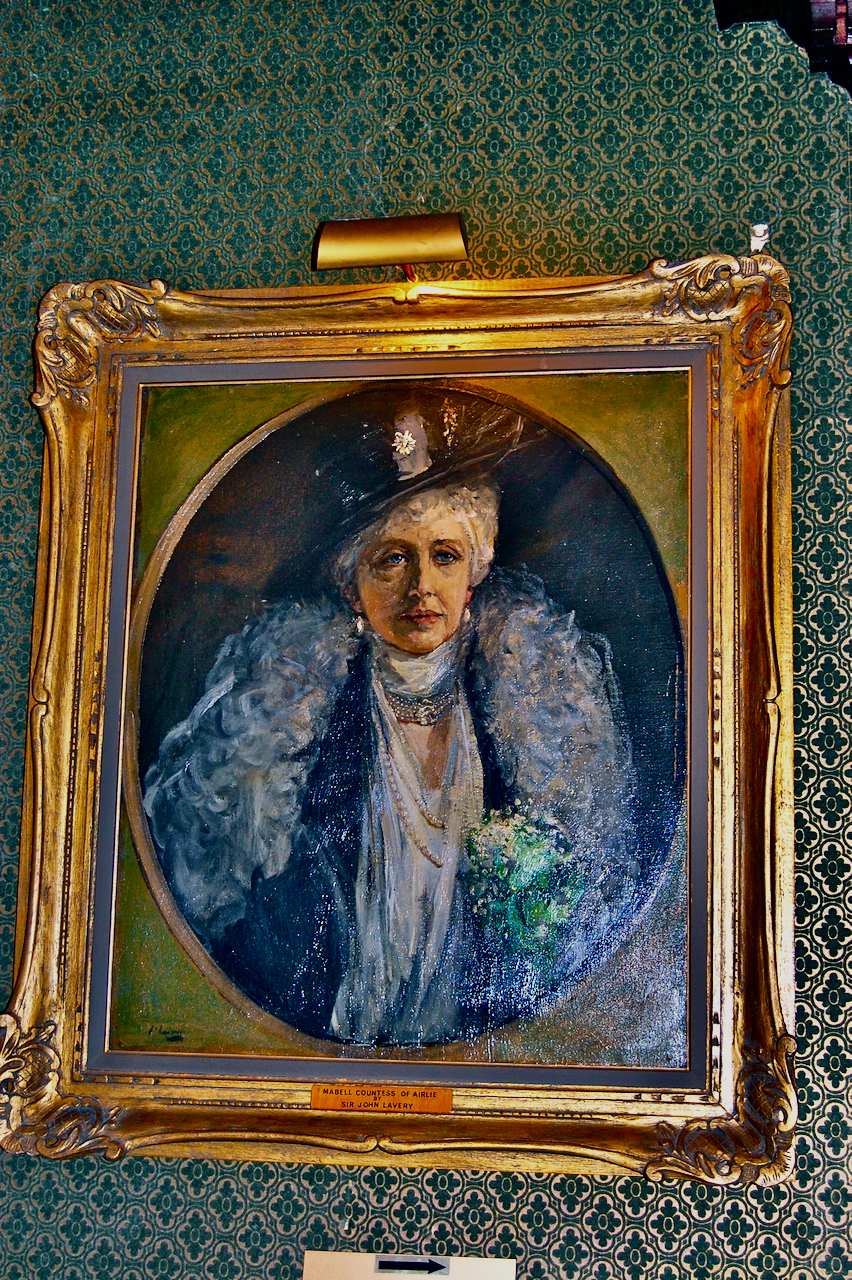
Russborough remained in the possession of the Earls of Milltown until after the 6th Earl’s decease – the 5th, 6th and 7th Earls of Milltown were all sons of the 4th Earl of Milltown. The 6th Earl’s widow, the former Lady Geraldine Stanhope, daughter of the 5th Earl of Harrington, Co. Northampton in England, lived on at Russborough until 1914.
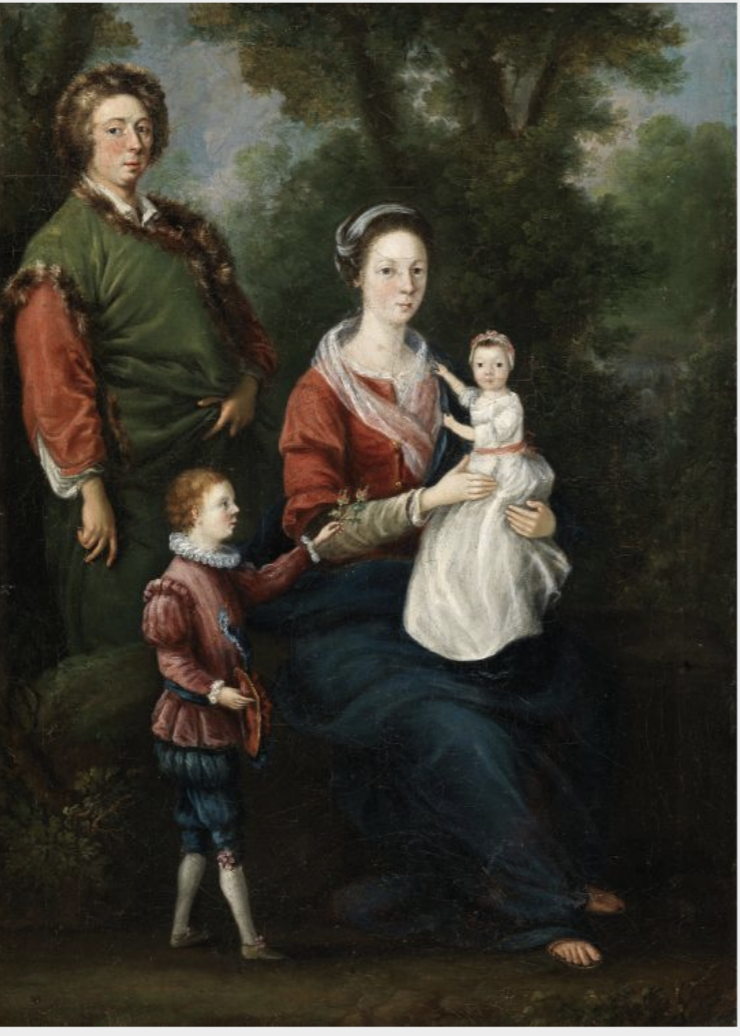
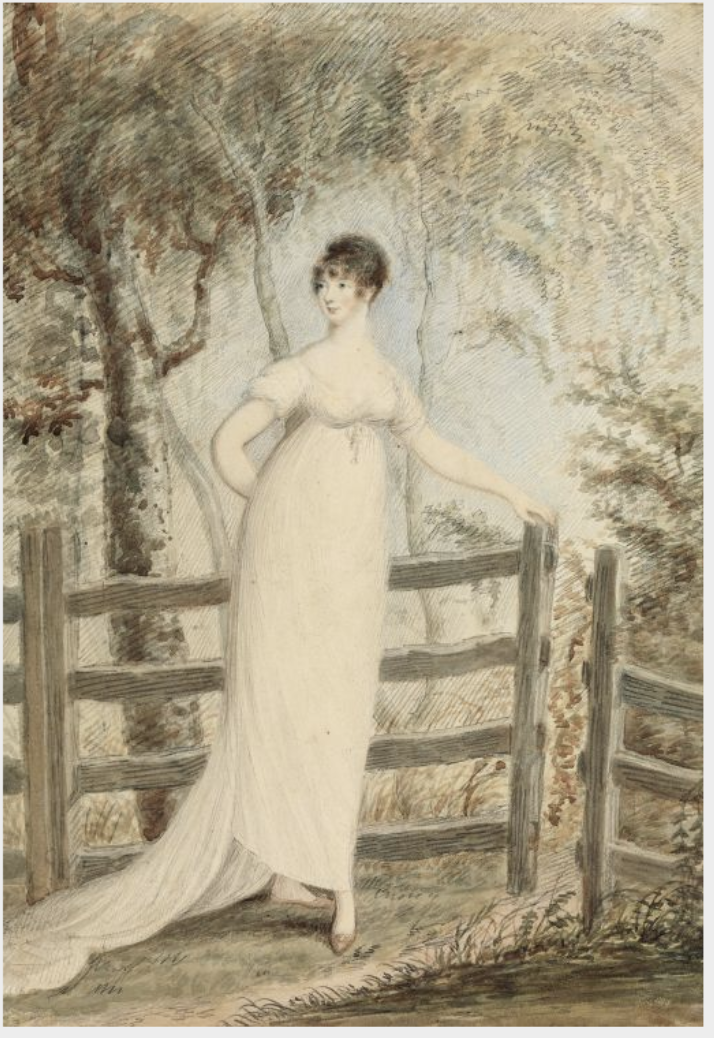
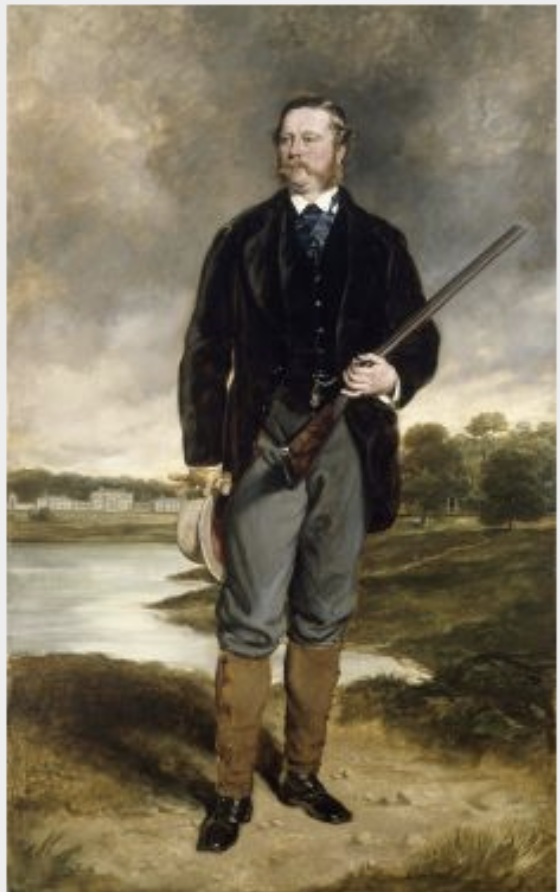
Emily Douglas (d.1841) by James Dowling Herbert courtesy of National Gallery of Ireland NGI 6271. She was wife of Joseph Leeson (1766-1800) mother of 4th Earl of Milltown.Edward Nugent Leeson, 6th Earl of Milltown (1835-1890), 1875 by Francis Grant, Courtesy of National Gallery of Ireland NGI.1036.
The family collection of pictures in the house was given by Lady Geraldine to the National Gallery of Ireland, in 1902 (the Milltown wing was thus created in the National Gallery). [13] On the death of Lady Milltown in 1914, it passed to a nephew, Sir Edmund Turton (the son of the 4th Earl’s daughter Cecelia), who rarely stayed there, as he lived in Yorkshire and was an MP in the British Parliament. After Turton’s death in 1928, his widow sold the house to Captain Denis Bowes Daly (of the Dalys of Dunsandle, County Galway – now a ruin) in 1931.
Alfred Beit, heir to a fortune made in gold and diamond mining by his uncle in South Africa, saw Russborough in an article in Country Life in 1837. He was so impressed that he had the dining room chimneypiece copied for a chimney in his library in his home in Kensington Palace Gardens in London. [see 13] In 1952 he bought Russborough from Captain Daly to house his art collection and in 1976 established the Alfred Beit Foundation to manage the property. The foundation opened the historic mansion and its collections to the Irish public in 1978.
Sir Alfred died in 1994 but Lady Beit remained in residence until her death in 2005. [14] The Beits donated their art collection the National Gallery of Ireland in 1986, and a wing was dedicated to the Beits.
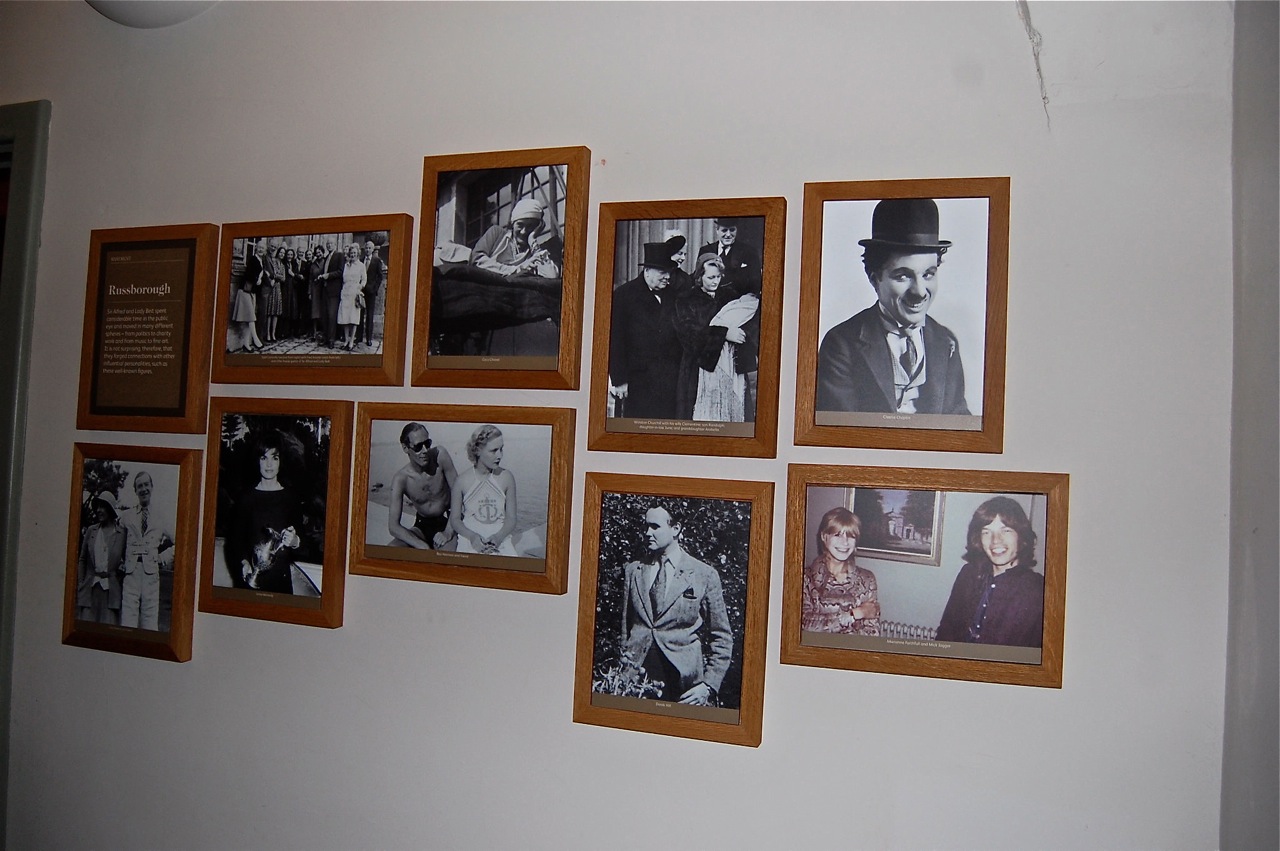
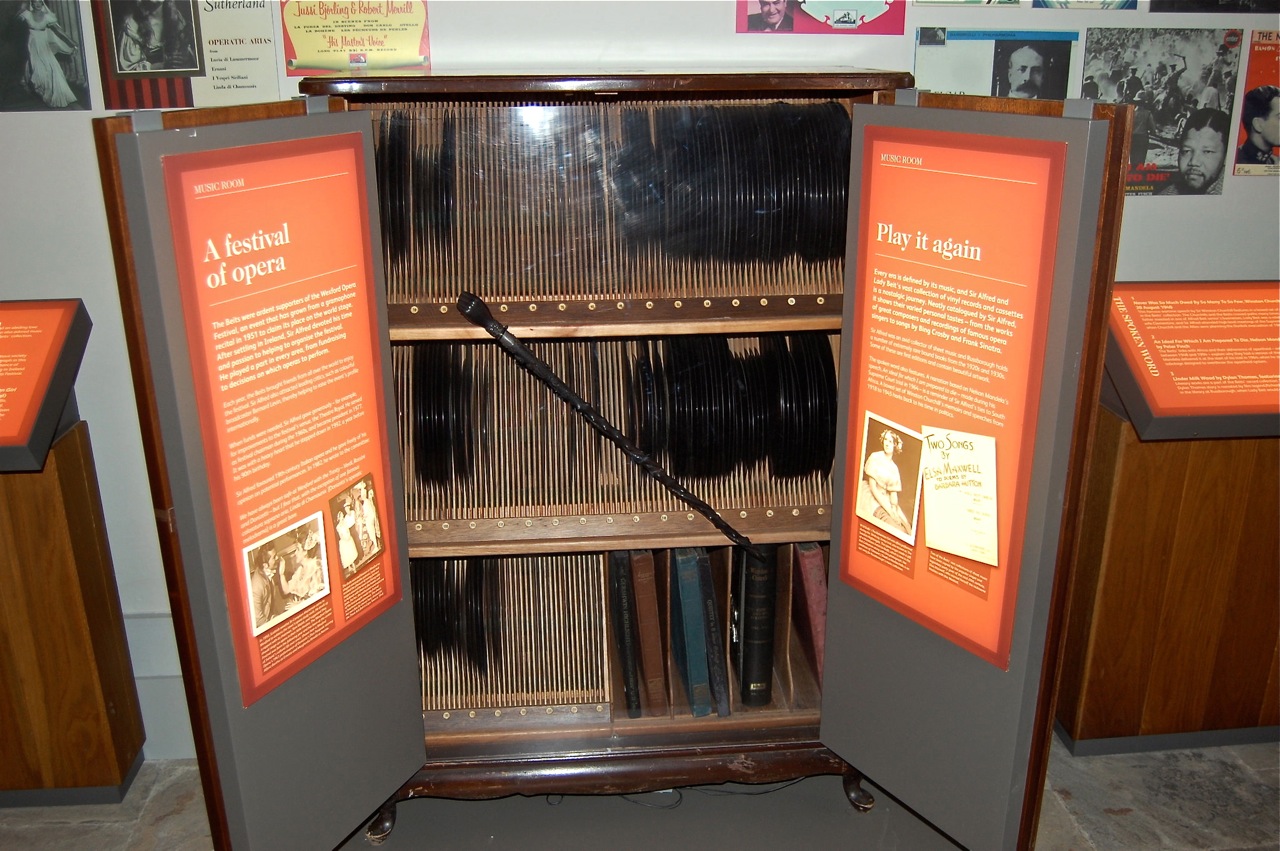
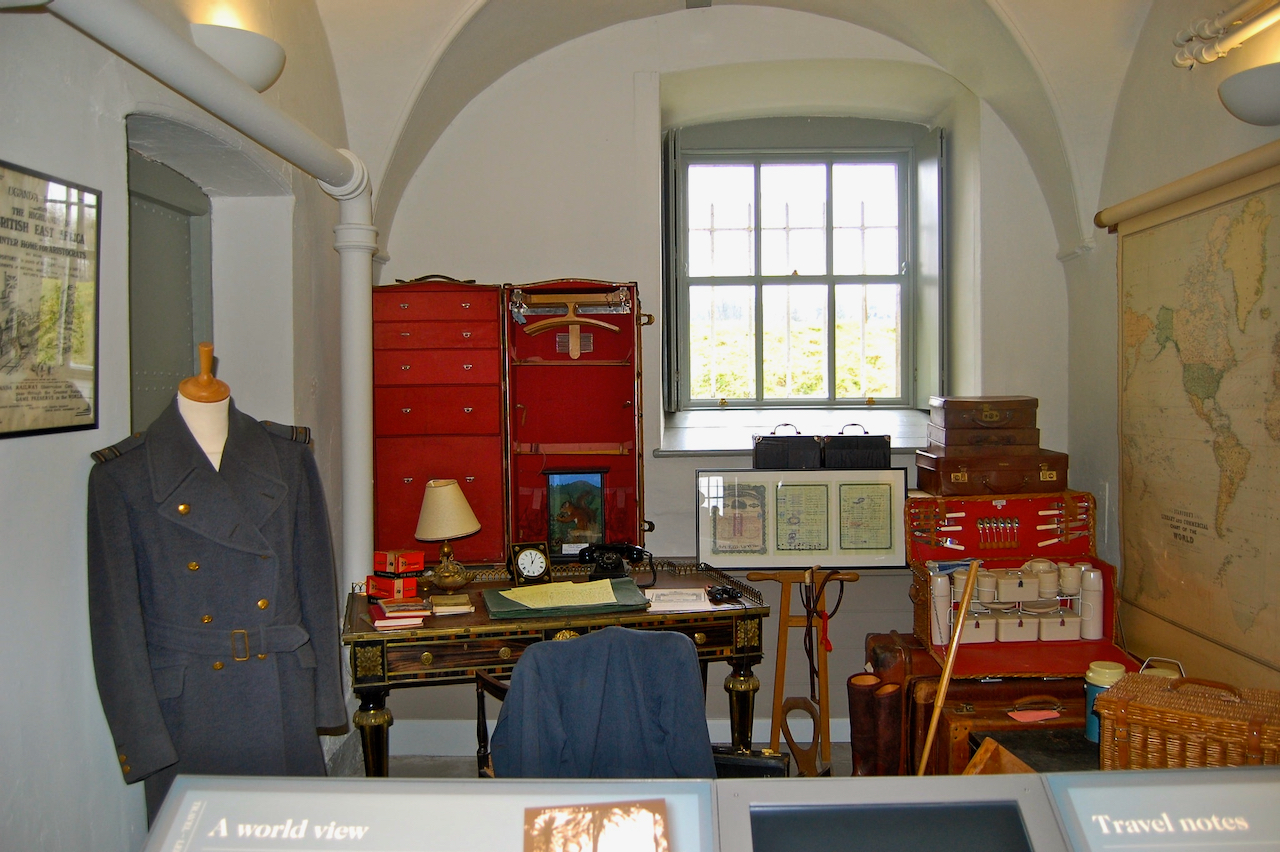
Russborough House is now a destination for all the family. Inside, rooms have been filled with information about the Beits, their life and times. They entertained many famous friends, travelled the world, and collected music, photographs and films, all now on display.
The Russborough website tells us: “In 1939 Sir Alfred joined the Royal Air Force. In this room, extracts can be heard from some of the many romantic letters that Sir Alfred Beit wrote to his wife during the Second World War.”
“The exhibition includes a short film that starts in 2D and then moves to the third dimension. We display 3D images taken by Sir Alfred on his world travels in the 1920s and 1930s.
“This private auditorium is arguably one of the most interesting rooms in the house, and was created by Sir Alfred himself when he bought Russborough so that he could share his adventures with friends and enjoy movies on the silver screen.
“Visitors can also sit and watch fascinating footage from around the world in the glamorous 1920s at the touch of a button.”
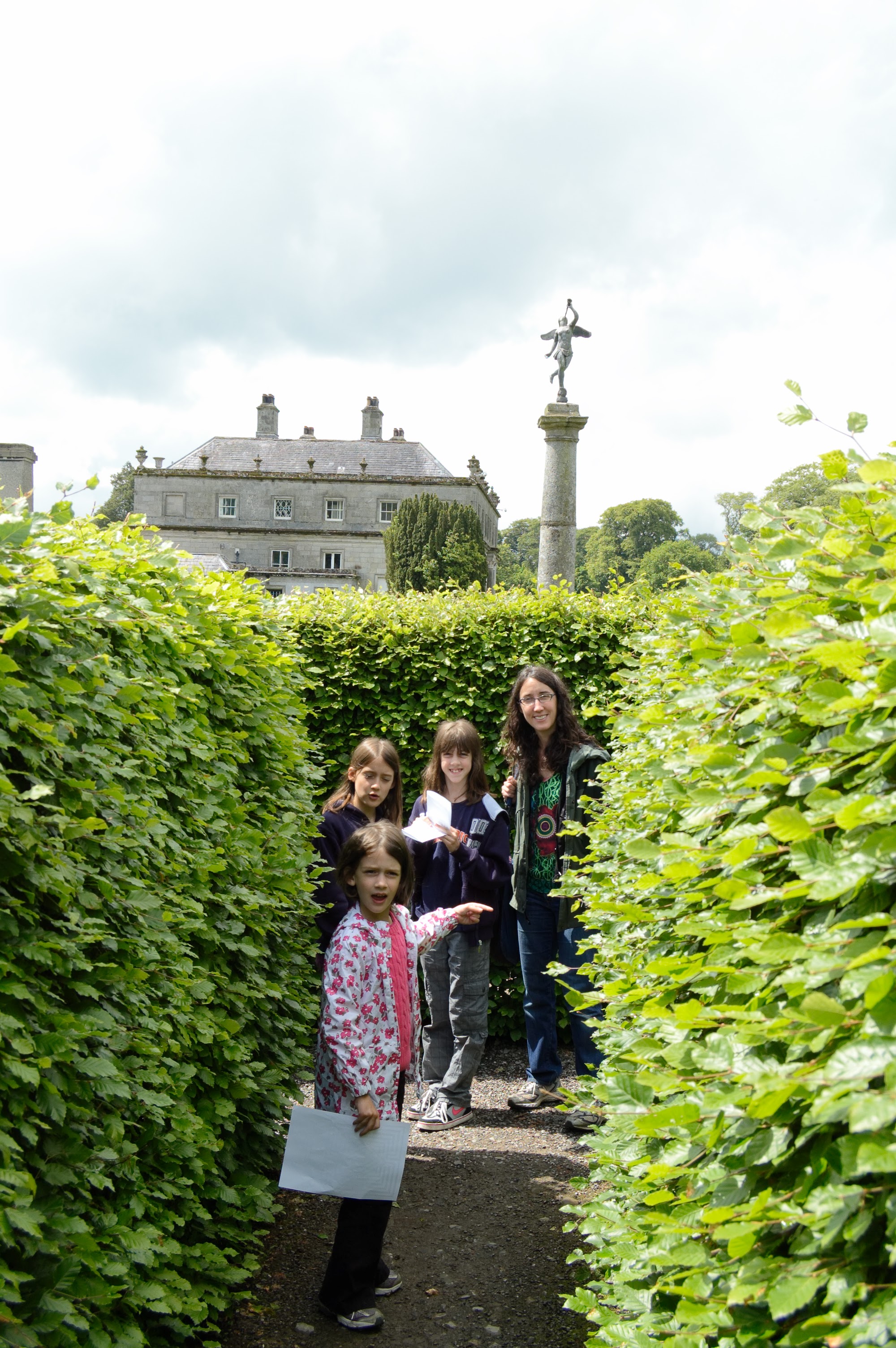
Outside near the former riding arena, hedges have been shaped into a maze.
[1] Mark Bence-Jones. A Guide to Irish Country Houses (originally published as Burke’s Guide to Country Houses volume 1 Ireland by Burke’s Peerage Ltd. 1978); Revised edition 1988, Constable and Company Ltd, London.





































 Irish Historic Houses