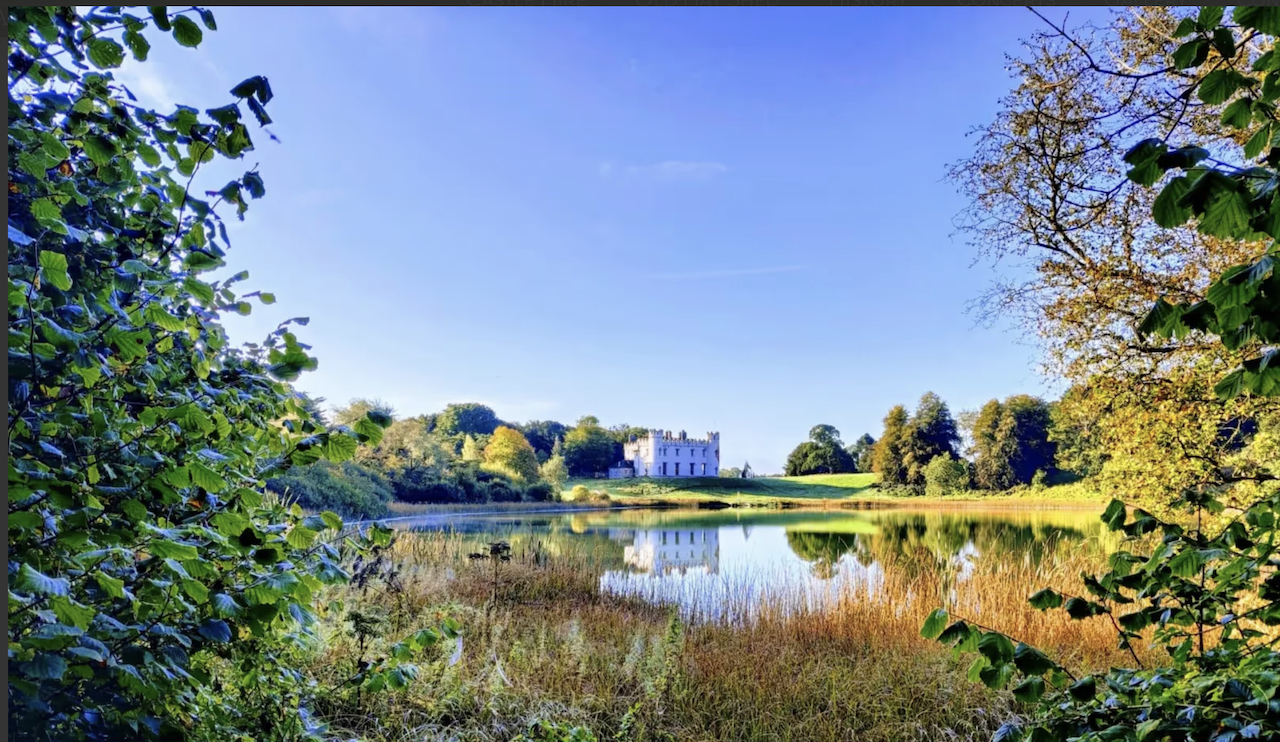
It was built built 1798-1812 for Charles William Bury (1764-1835), later 1st Earl of Charleville, and was designed by Francis Johnston. The castle took 14 years to build, partly because Johnston was busy with other commissions as he was appointed to the Board of Works in 1805. From his work on the castle, Francis Johnston gained many more commissions, and he worked simultaneously on Killeen Castle in County Meath (1802-1812), Markree Castle in County Sligo (1802-1805, see my entry) and Glanmore, County Wicklow (1803-04).
Mark Bence-Jones writes (1988, p. 82) that Charleville Castle is the “finest and most spectacularearly nineteenth century castle in Ireland, Francis Johnston’s Gothic masterpiece, just as Townley Hall, County Louth, is his Classical masterpiece.” [1]
In Irish Houses and Gardens. From the Archives of Country Life, Sean O’Reilly tells us that Charles William Bury and his wife, Catherine Maria née Dawson, had some hand in drawing plans for the building. He tells us: “Bury’s intention, as he wrote in his own unfinished account of the work, was to ‘exhibit specimens of Gothic architecture’ adapted to ‘chimneypieces, ceilings, windows, balustrades, etc.’ but without excluding ‘convenience and modern refinements in luxury.’ This recipe for the Georgian gothic villa had already been used at Horace Walpole’s Strawberry Hill in London, and Bury’s cultivated lifestyle in England certainly would have made him aware of that house and its long line of descendants.” [2]
Charles William Bury was President of the Royal Irish Academy between 1812 and 1822. He saw himself as the castle’s architect.
O’Reilly continues: “It may be that Bury himself – possibly with the assistance of his wife – outlined some of the more dramatic features in his new house, as is suggested by a number of drawings relating to the final design which still survive, now in the Irish Architectural Archive in Dublin. These all show the crude hand of an amateur, but equally betray a total freedom of imagination unshackled by the discipline of architectural training. In particular, a drawing of the exterior shows the smaller tower rising up out of the ground like a tree, with its base spreading and separating as it grows into the ground like roots.” [2]
Charleville Forest was written up by Mark Girouard for Country Life in 1962. Just over fifty-three years later Country Life published another article (October 2016), this time by Dr Judith Hill, awarded a doctorate for her work on the Gothic in Ireland.
Hill researched the role that Charles William Bury’s wife Catherine played in the design of Charleville, and shared her findings in a lecture given to the Offaly History Society and published on the Offaly History blog. She tells us:
“…it was time to look more closely at the collection of Charleville drawings which had been auctioned in the 1980s. Many of these are in the Irish architectural Archive, and those that were not bought were photographed. Here I found two pages of designs for windows that were signed by Catherine (‘CMC’: Catherine Maria Charleville). There is a sketch of a door annotated in her hand writing. There is a drawing showing a section through the castle depicting the wall decoration and furniture that had been attributed to Catherine. Rolf Loeber had a perspective drawing of the castle which showed the building, not quite as it was built, in a clearing in a wood. The architecture was quite confidently drawn and the trees were excellent. It was labelled ‘Countess Charleville’. I looked again at some of the sketches of early ideas for the castle in the Irish Architectural Archive. In one, the building design was hesitant while the trees were detailed; an architect wouldn’t bother with such good trees for an early design sketch. There was another that had an architect’s stamp; the massing of the building quickly drawn, the surrounding trees extremely shadowy. I could see Catherine and [Francis] Johnston talking about the design in these drawings.” [3]
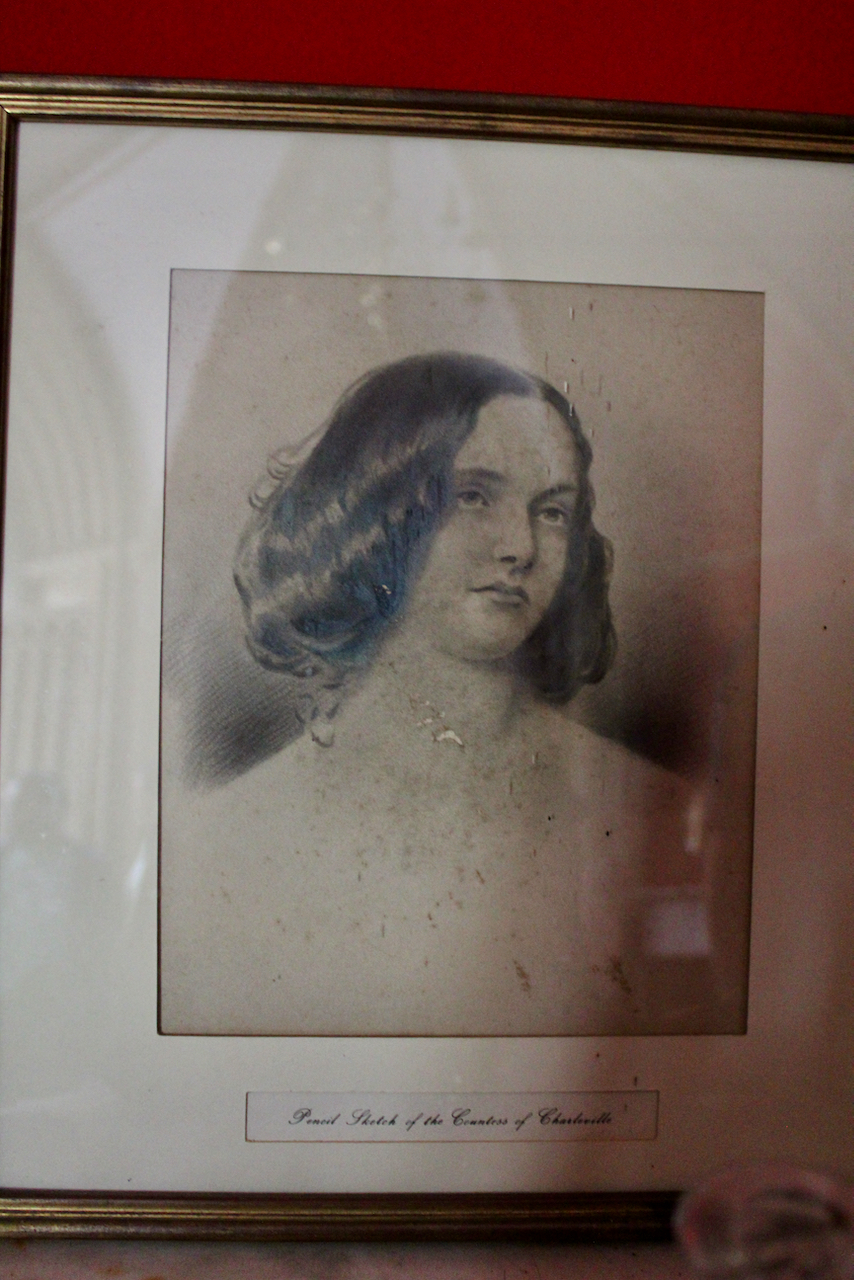
One of the Countesses of Charleville, though I don’t know which one.PossiblyHarriet Charlotte Beaujolois, the third daughter of Col. John Campbell of Shawfield in Scotland and Lady Charlotte Susan Maria Campbell.She was the second countess of Charleville and mother of Beaujolois or Little Beau.
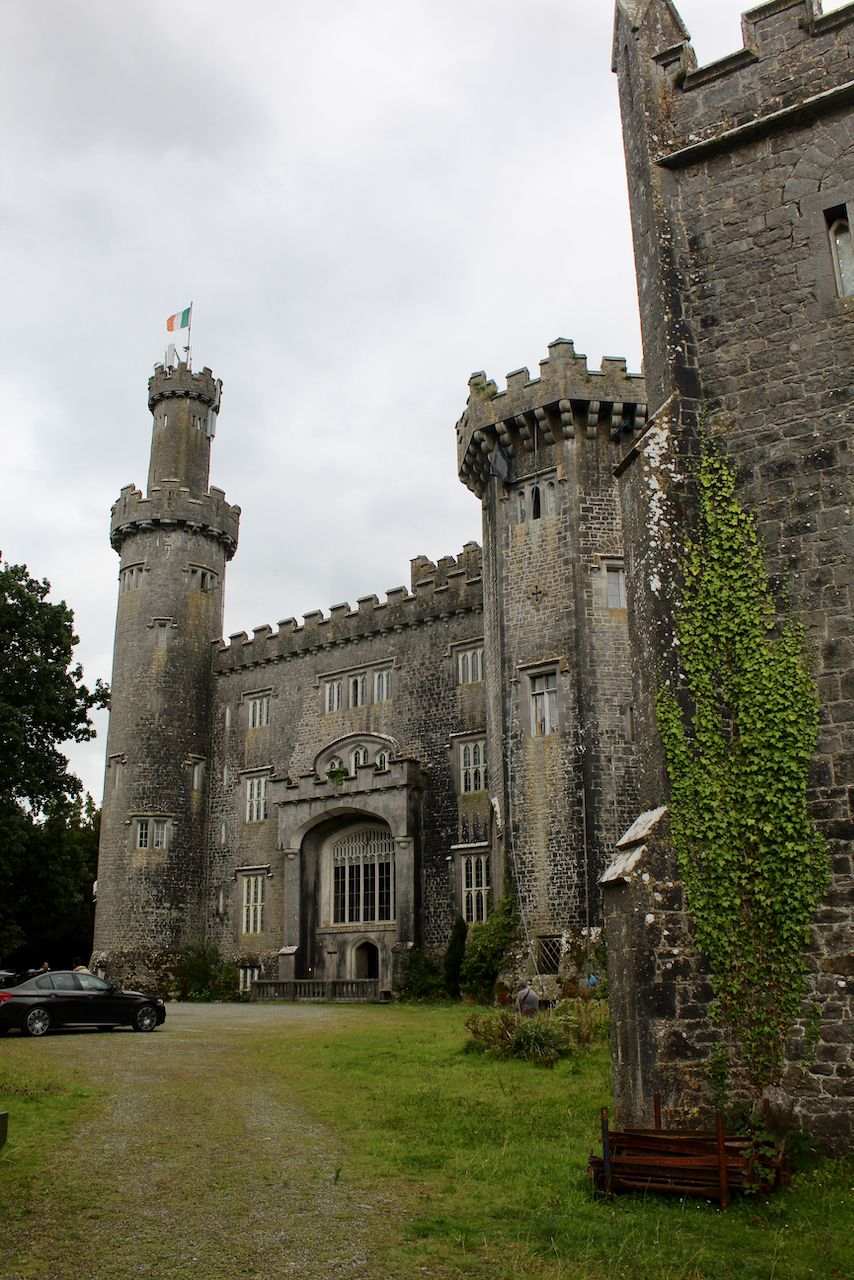
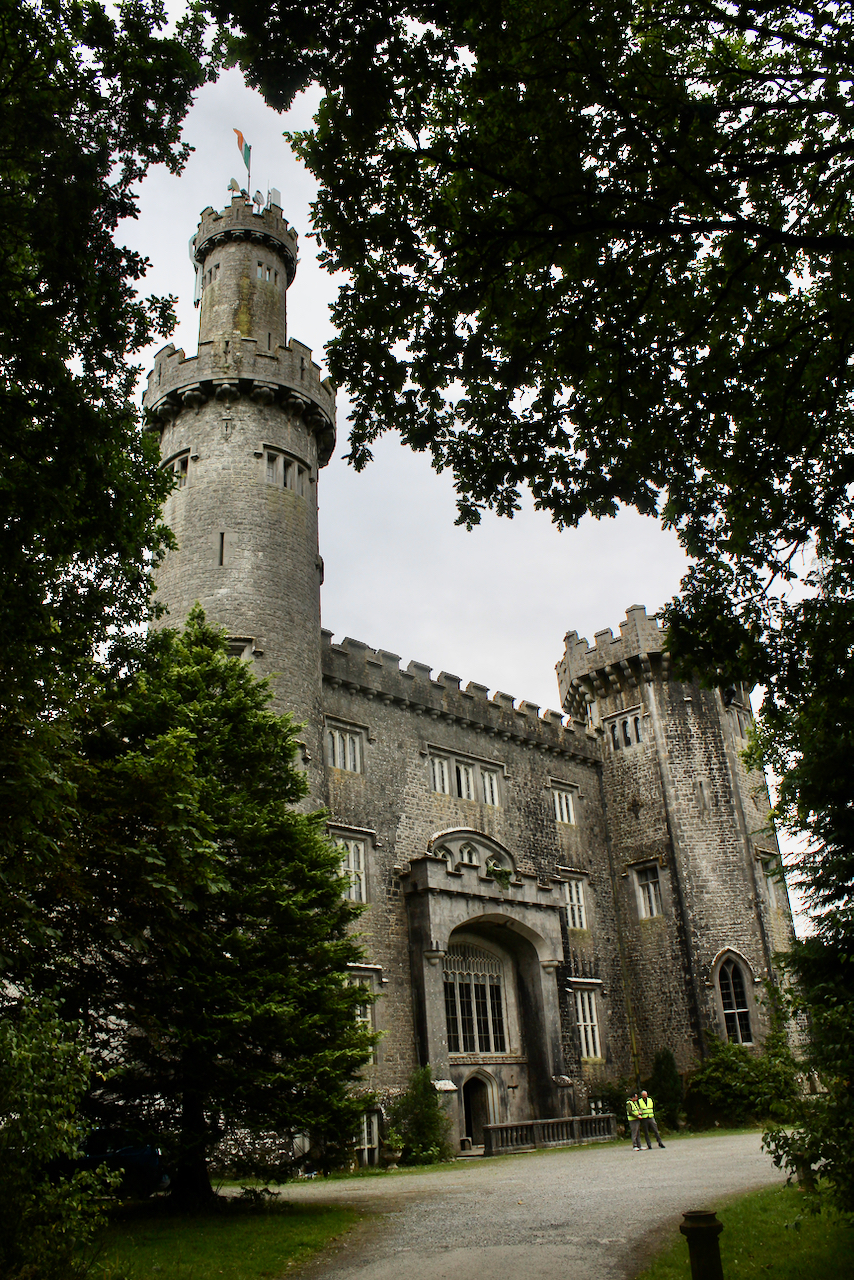
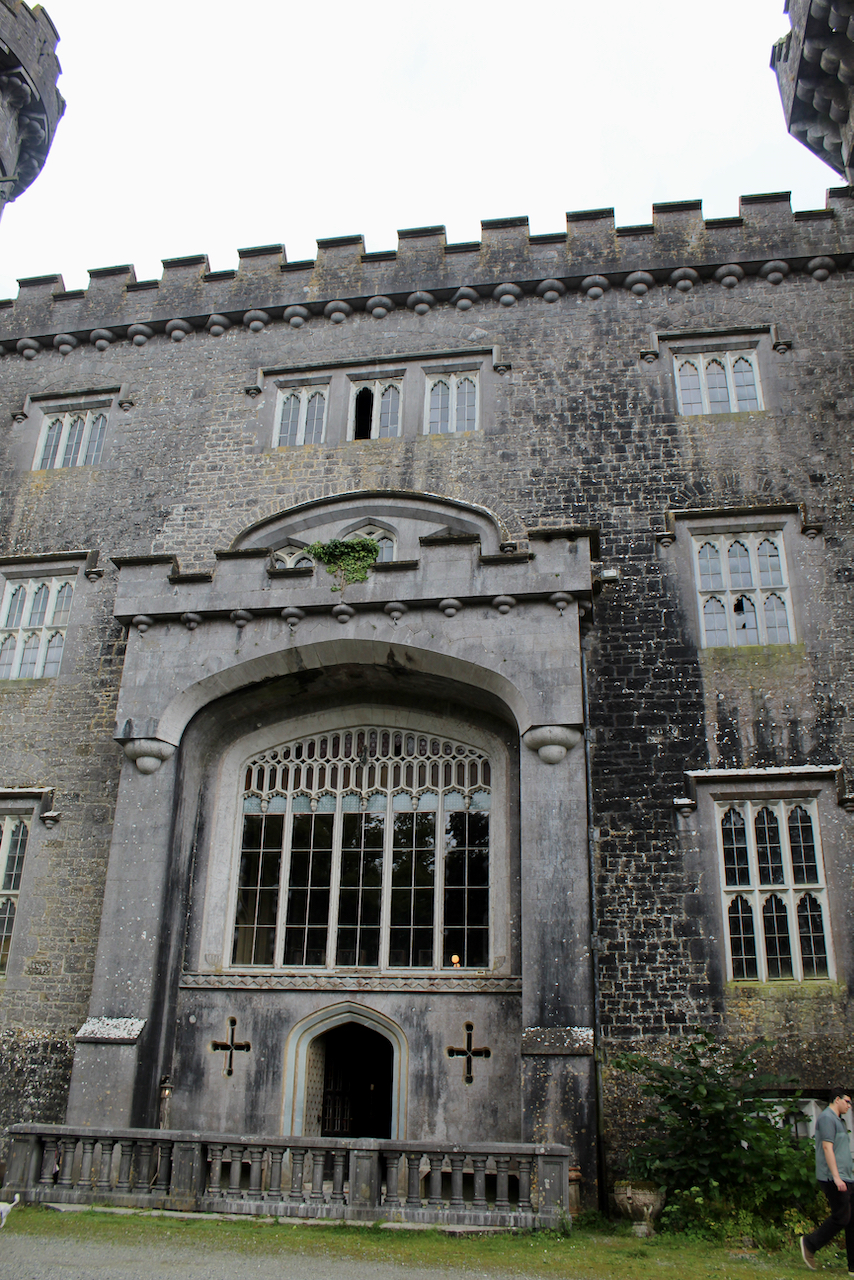
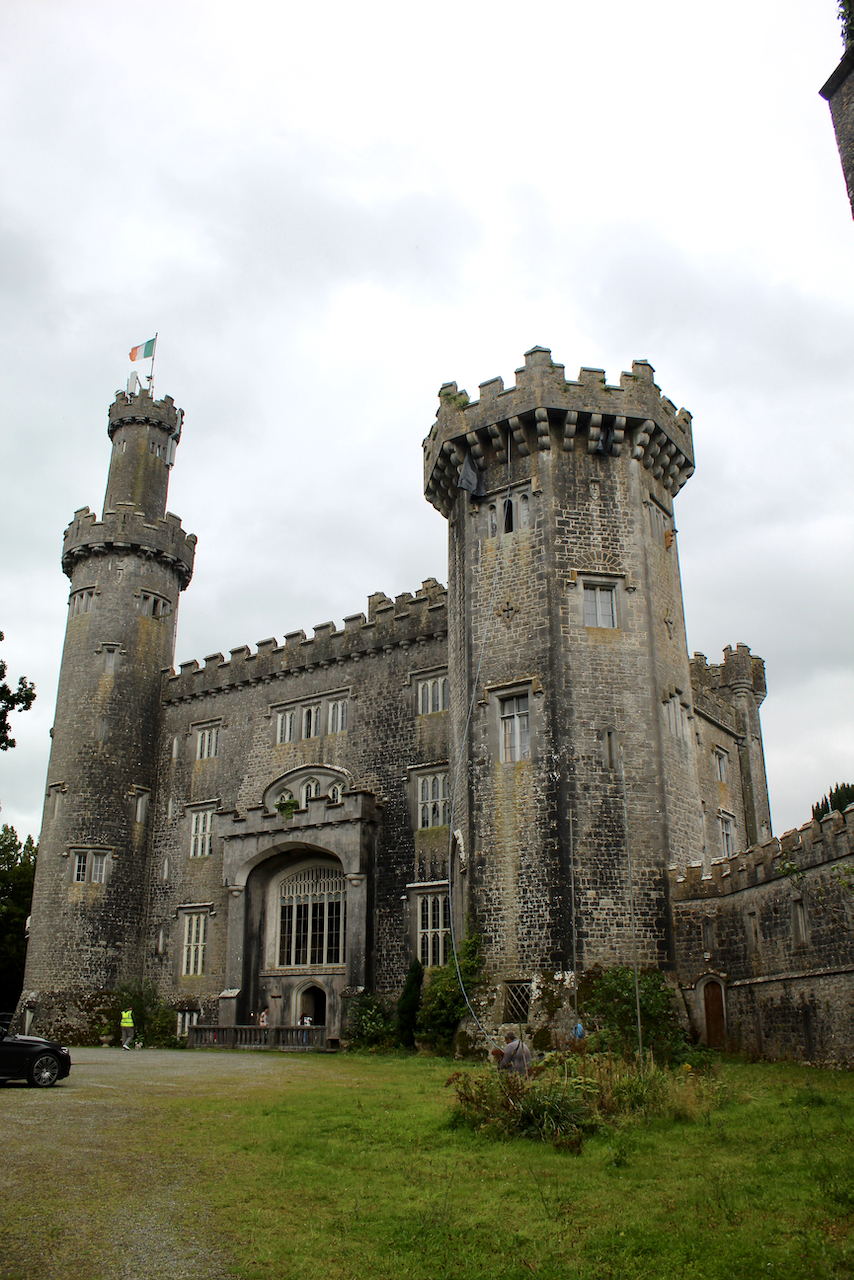
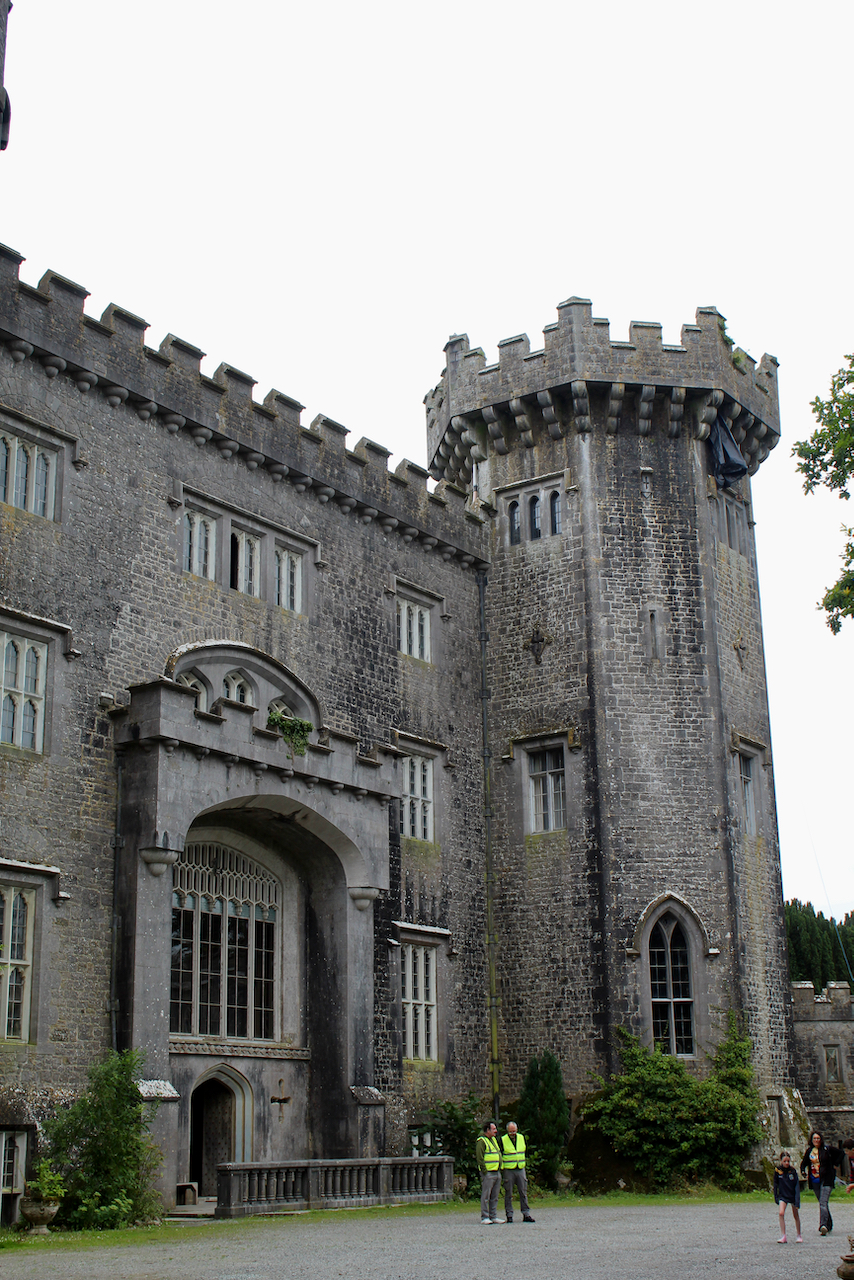
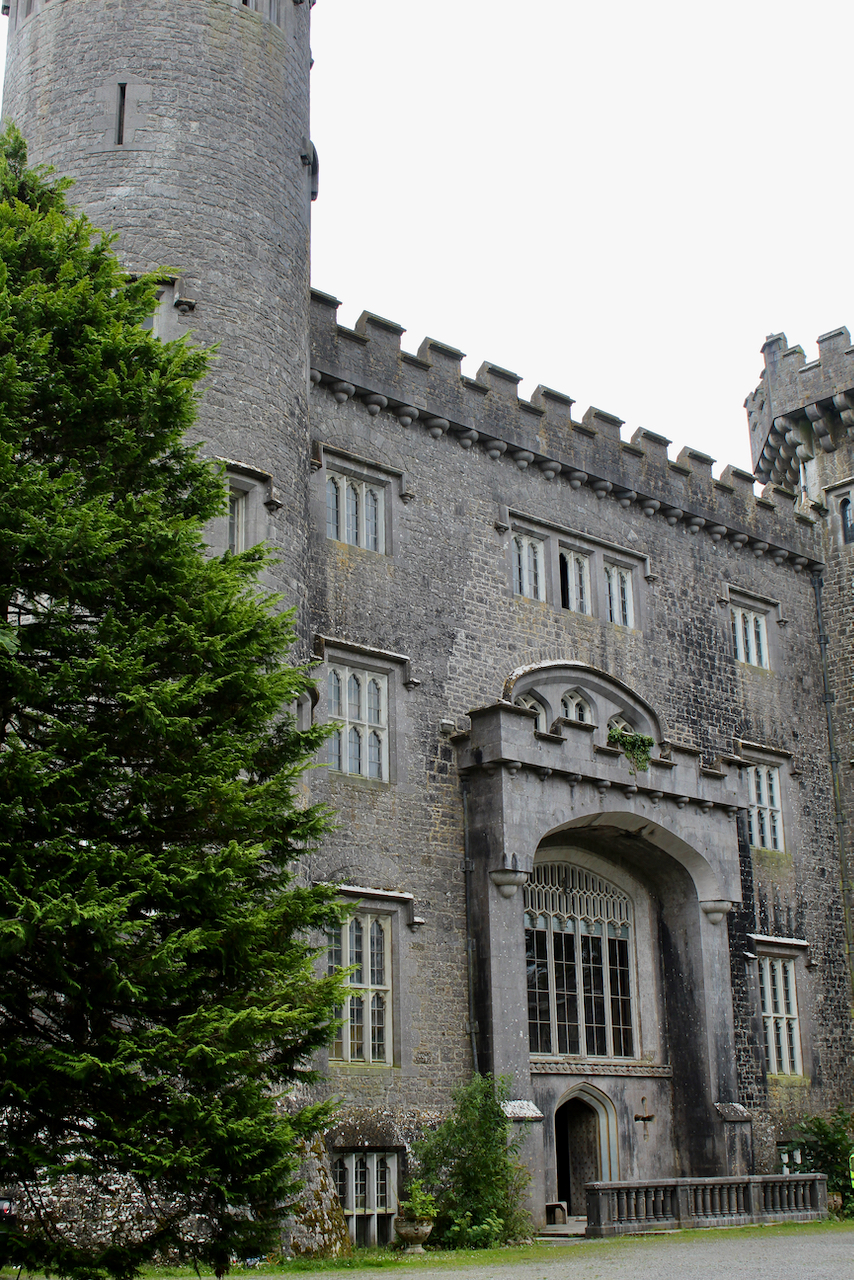
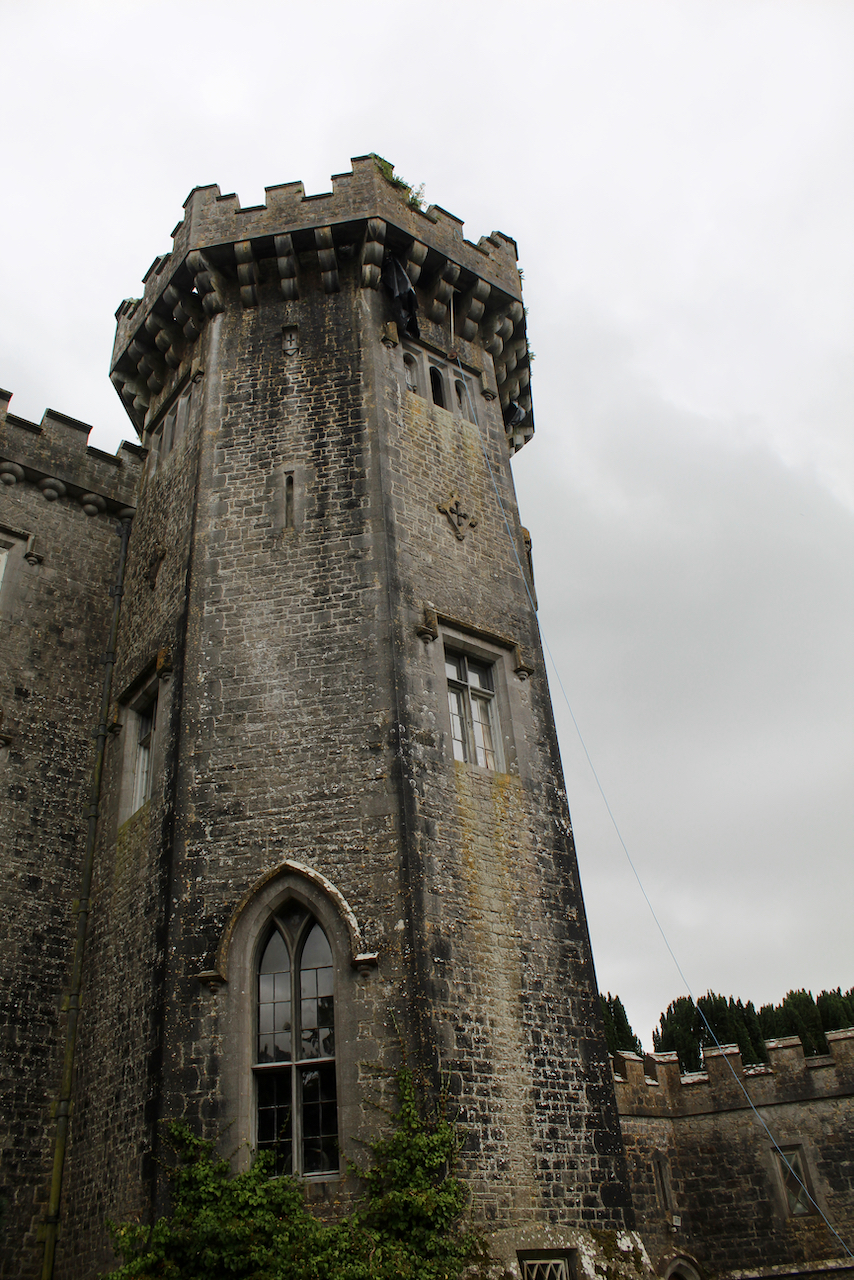
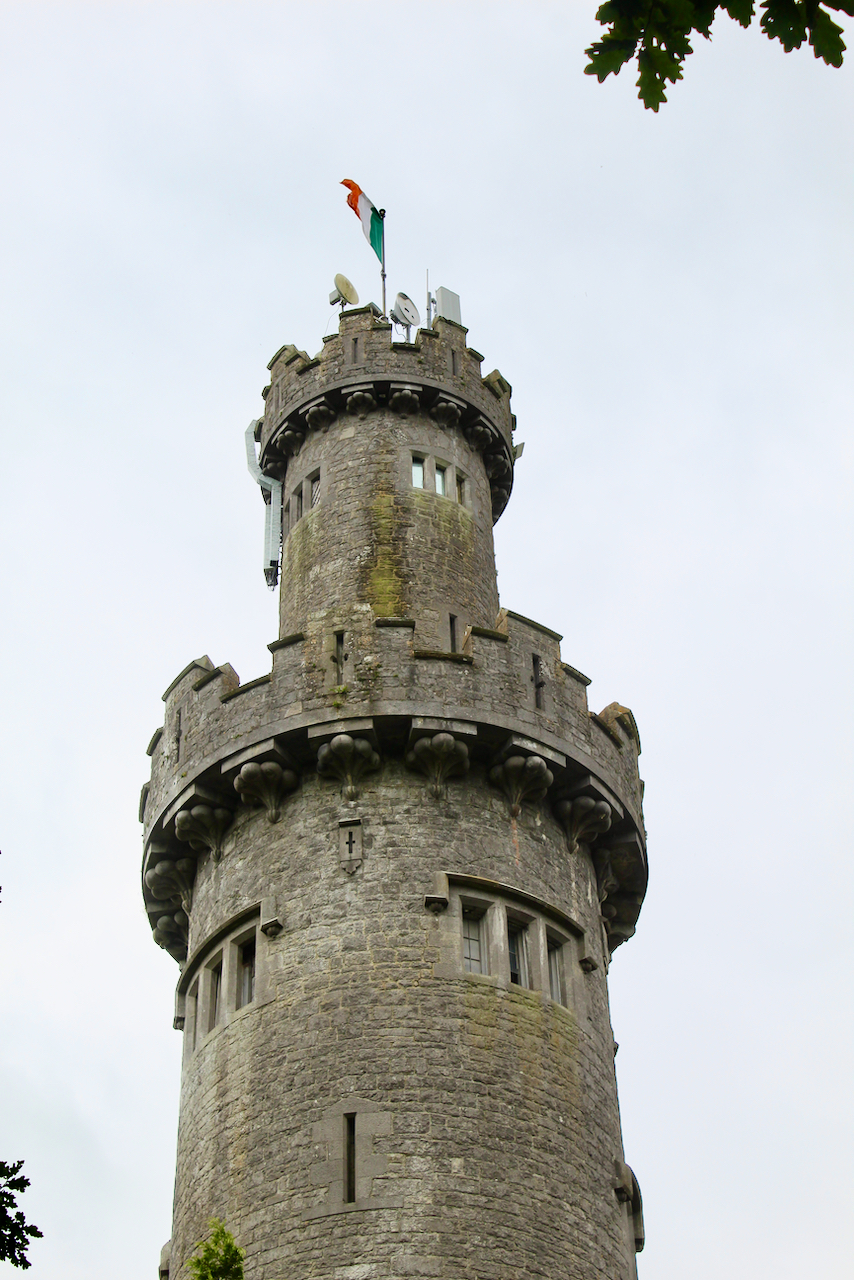
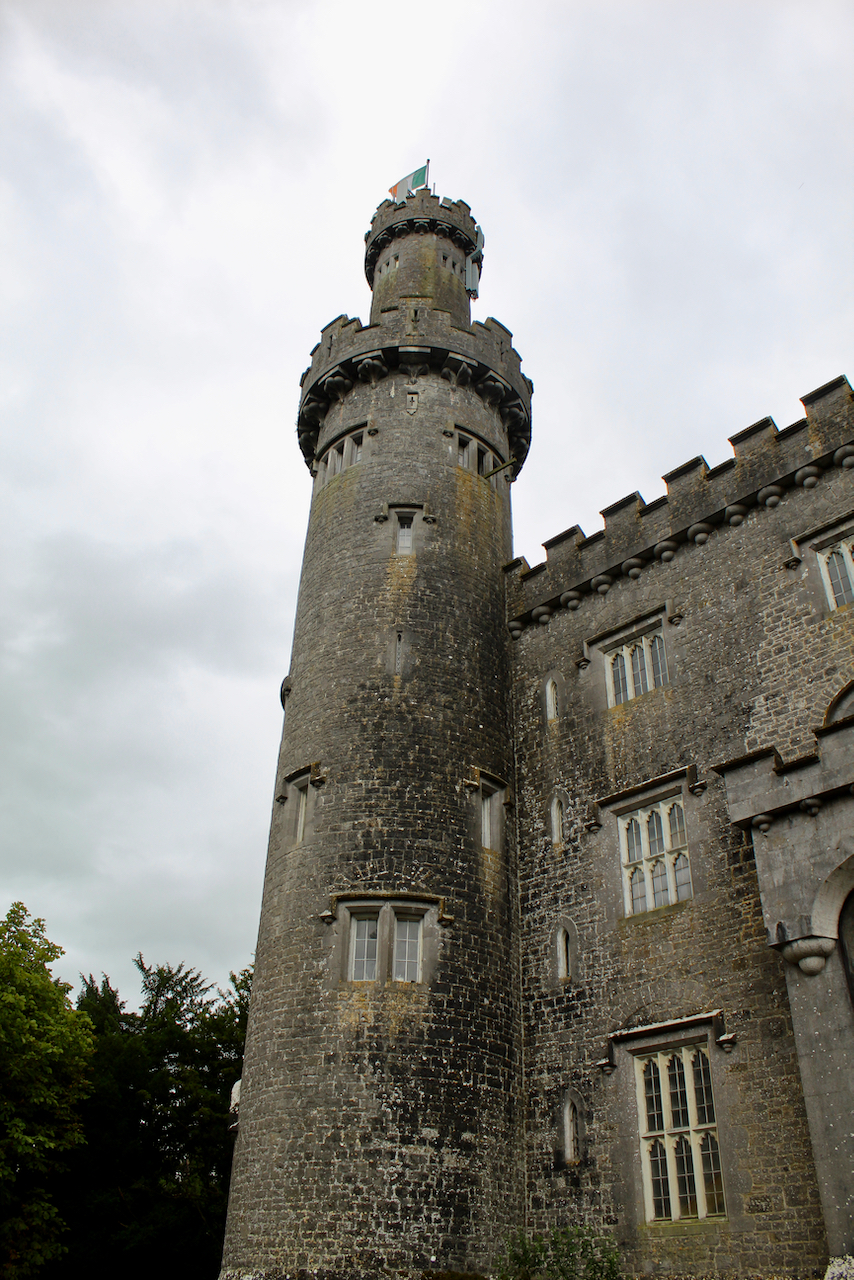
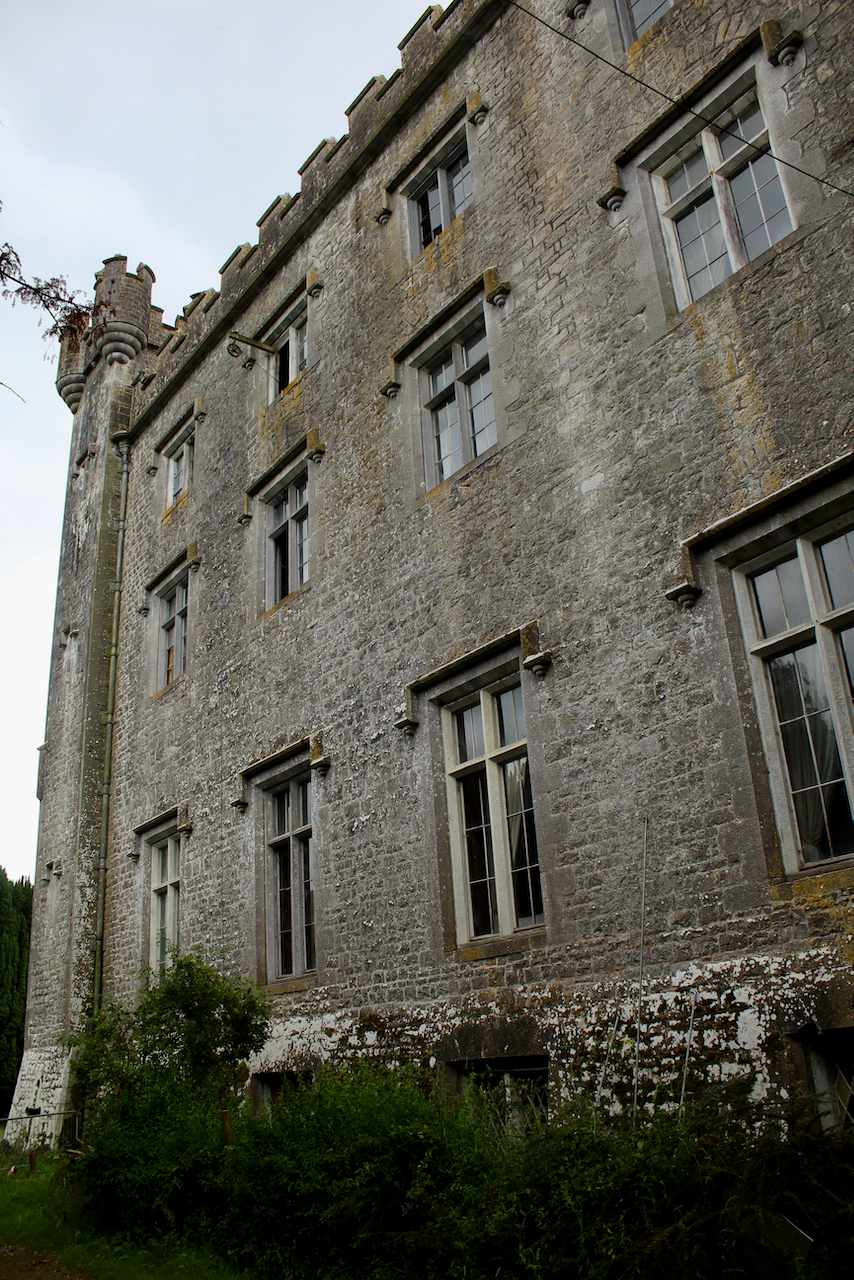
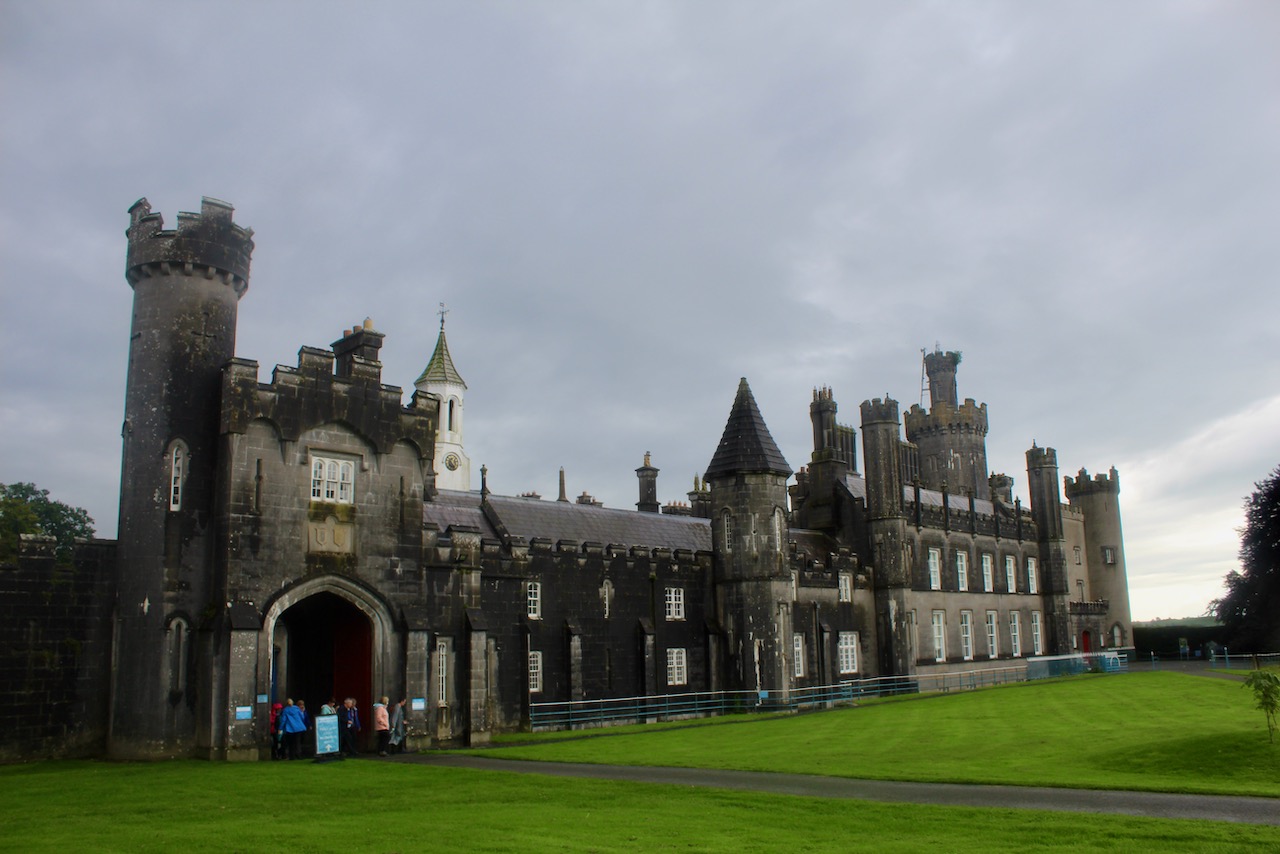
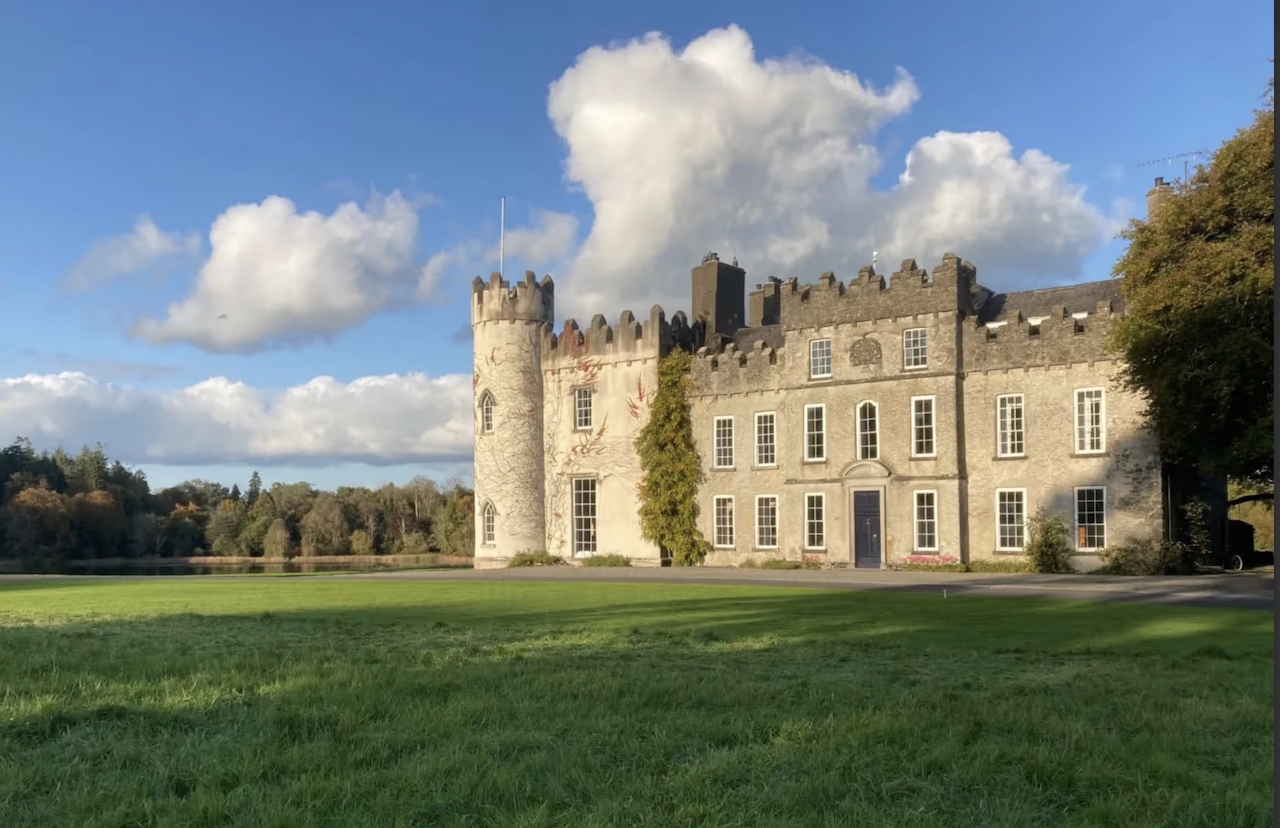
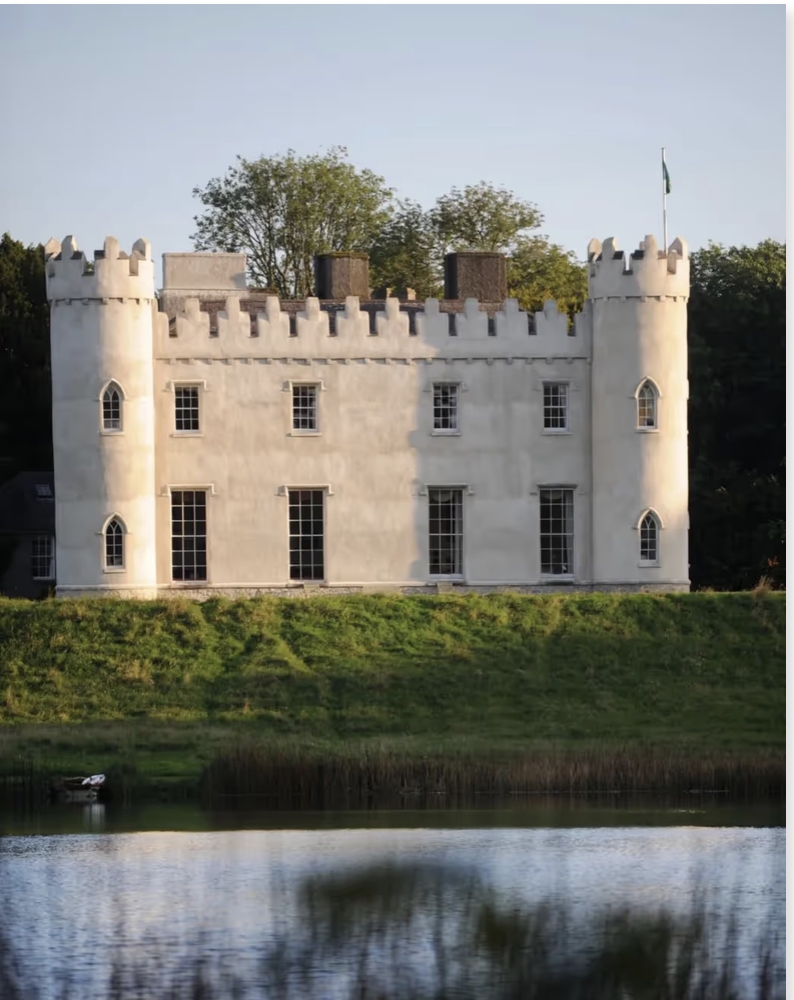
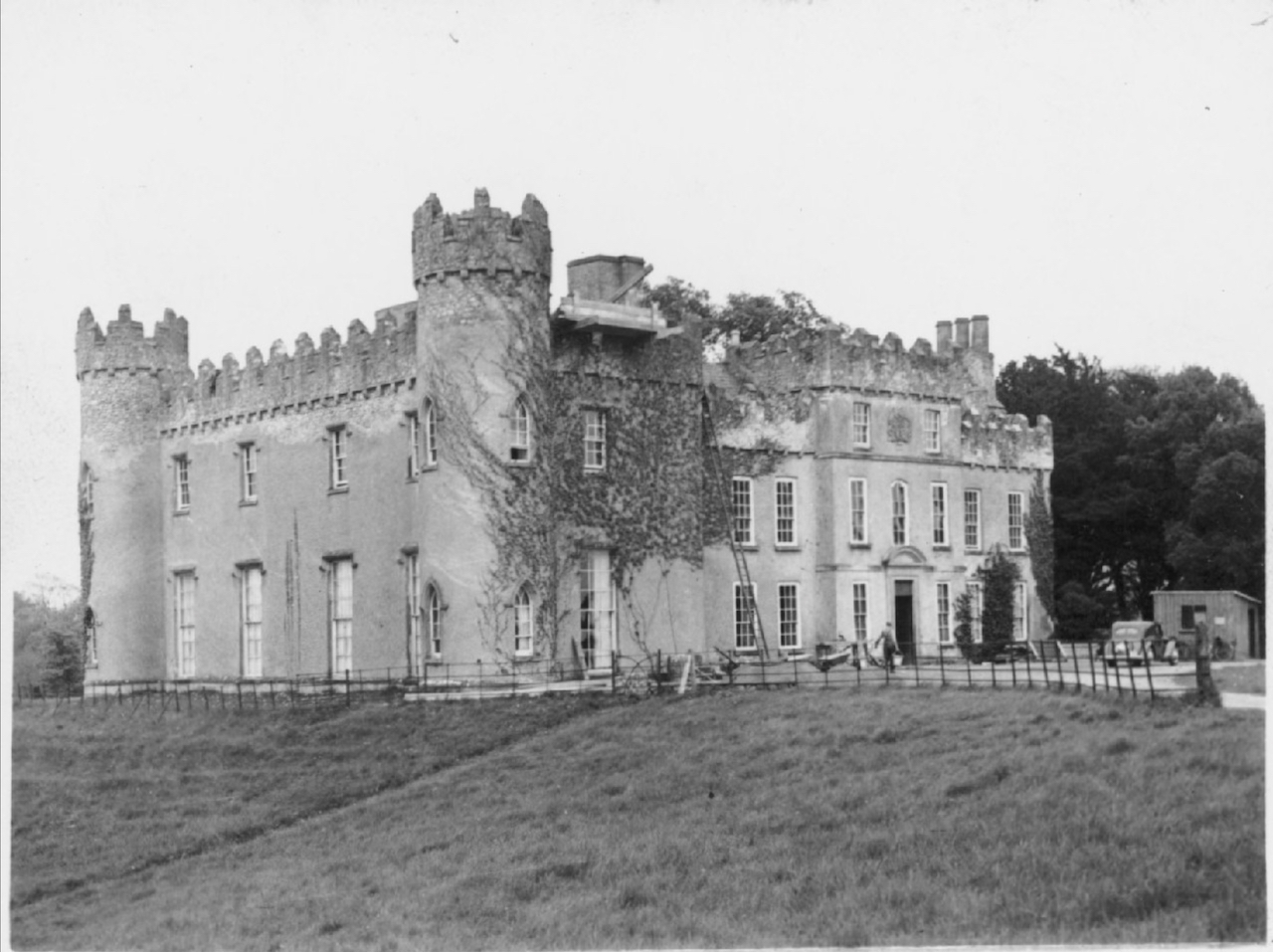
Bence-Jones describes Charleville Forest castle as “a high square battlemented block with, at one corner, a heavily machicolated octagon tower, and at the other, a slender round tower rising to a height of 125 feet, which has been compared to a castellated lighthouse. From the centre of the block rises a tower-like lantern. The entrance door, and the window over it, are beneath a massive corbelled arch. The entire building is cut-stone, of beautiful quality.” [see 1]
Beginning in 1912, with the departure of Lady Emily, the last surviving daughter of the 4th Earl of Charleville, the house was left empty for 68 years.
In 1970 David Hutton-Bury (who owned and lived on the estate adjacent to the castle) granted a 35-year lease for the castle and surrounding 200 acres to Michael McMullen. McMullen lived in the castle and began its restoration in the early 1980s, during which time he restored the six main public rooms. In 1987 Bridget Vance and her mother, Constance Vance-Heavey, took over the leasehold from McMullen and continued the restoration. [4] It is now owned by the Charleville Castle Heritage Trust.
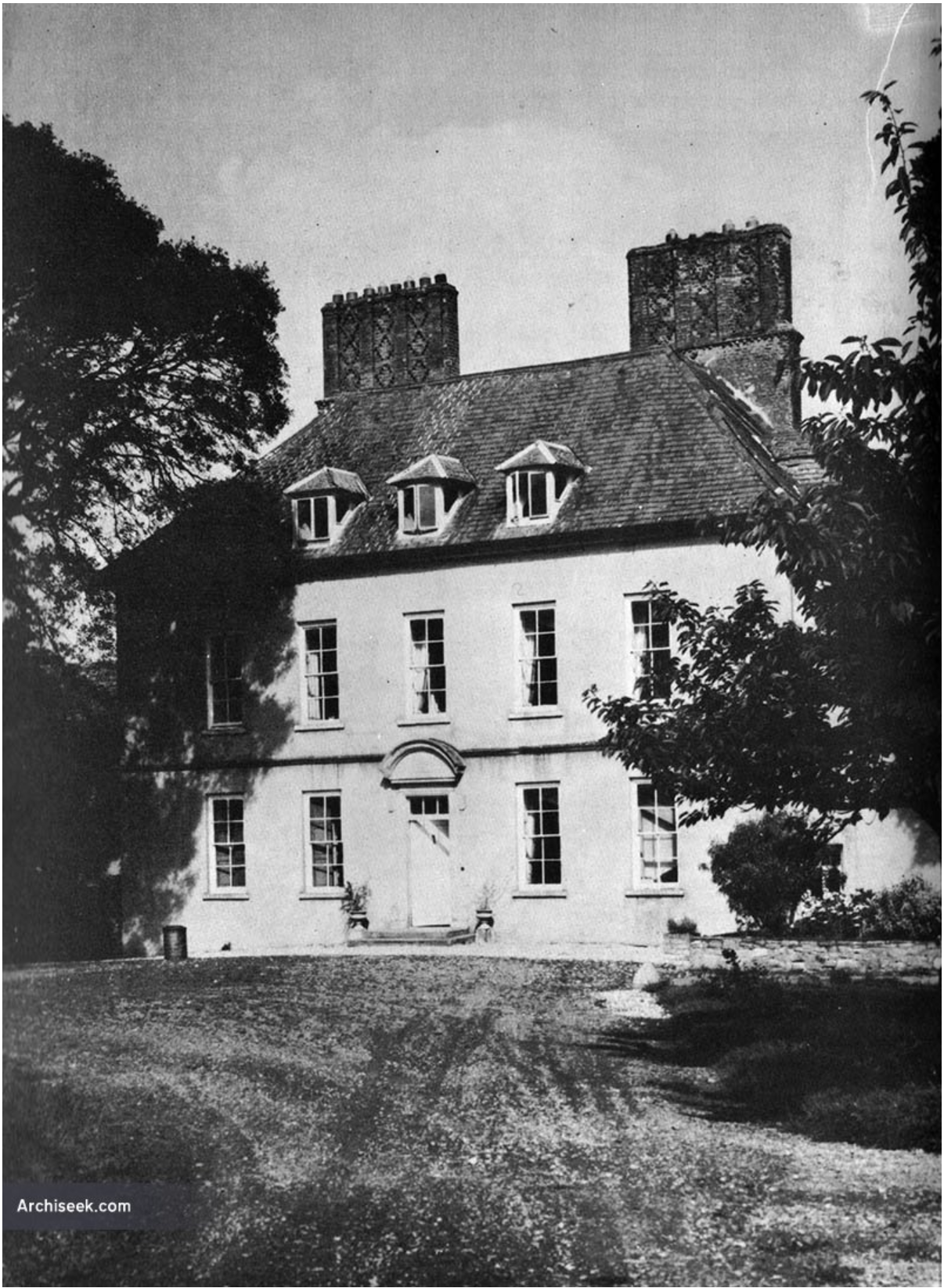
The land of Charleville Forest was inherited by Charles William’s father, John Bury (1725-1764) of Shannongrove, County Limerick. He succeeded to the estates of his maternal uncle, Charles Moore (1712-1764) 1st Earl of Charleville, in February 1764.
Shannongrove, County Limerick, the home of Charles William Bury’s father, courtesy of Archiseek. [5]
The oak forest and lands were gifted by Queen Elizabeth I to John Moore of Croghan Castle in 1577. Moore leased the land to Robert Forth, who built a house he called Redwood next to the river Clodiagh. In the 1740s Charles Moore 2nd Baron Moore and later 1st Earl of Charleville bought out the lease and made the house the family seat and named it Charleville, after himself.
Due to the lack of male heirs in the Moore family after Charles Moore’s death in 1764, and the fact that John Moore died later that year in 1764, the land was inherited by Charles William Bury who was the grand nephew of the last Earl, at just six months old.
Charles William Bury’s mother Catherine Sadleir was from Sopwell Hall County Tipperary. After her husband John Bury died, she married Henry Prittie (1743-1801) 1st Baron Dunally of Kilboy, which whom she went on to have several more children. The family probably moved to the house he had built called Kilboy House in County Tipperary.
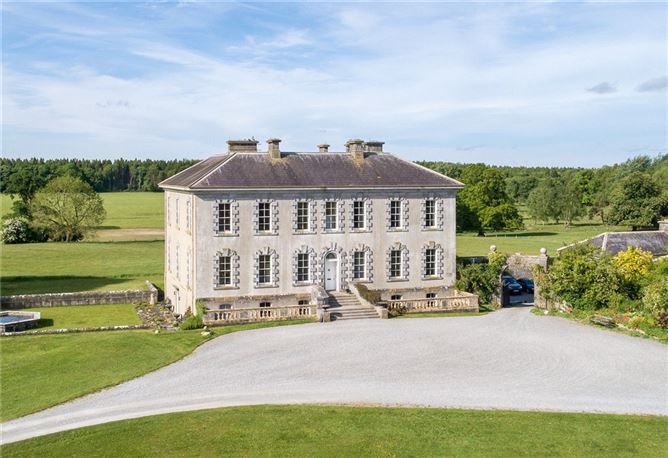
Sopwell Hall, County Tipperary, courtesy of Colliers estate agents and myhome.ie. It was built in 1745 to a design attributed to Francis Bindon.The sale site tells us that in 1745 Francis Sadlier (1709-1797) built Sopwell Hall. The Sopwell Estate ownership passed to the Trench family in 1797 through the marriage of his daughter, Mary. The Trench family remained in ownership until 1985.See more photos in footnotes [6]Henry Prittie, 1st Baron Dunalley (1743-1801), Irish school, courtesy of Christie’s.He was the stepfather of Charles William Bury.
On Charles Moore’s death the title became extinct until Charles William Bury was created 1st Earl of Charleville of the second creation in 1806. Before this, in 1797 he was created Baron Tullamore and in 1800, Viscount Charleville. Bury was returned to the Irish Parliament for Kilmallock in January 1790, but lost the seat in May of that year. He was once again elected for Kilmallock in 1792, and retained the seat until 1797. In 1801 he was elected as an Irish representative to sit in the British House of Lords in England.
Charles William Bury’s wife Catherine was daughter of Thomas Townley Dawson and widow of James Tisdall. From that marriage she had a daughter named Catherine.
Andrew Tierney describes Charleville Forest Castle in The Buildings of Ireland: Central Leinster: Kildare, Laois and Offaly:
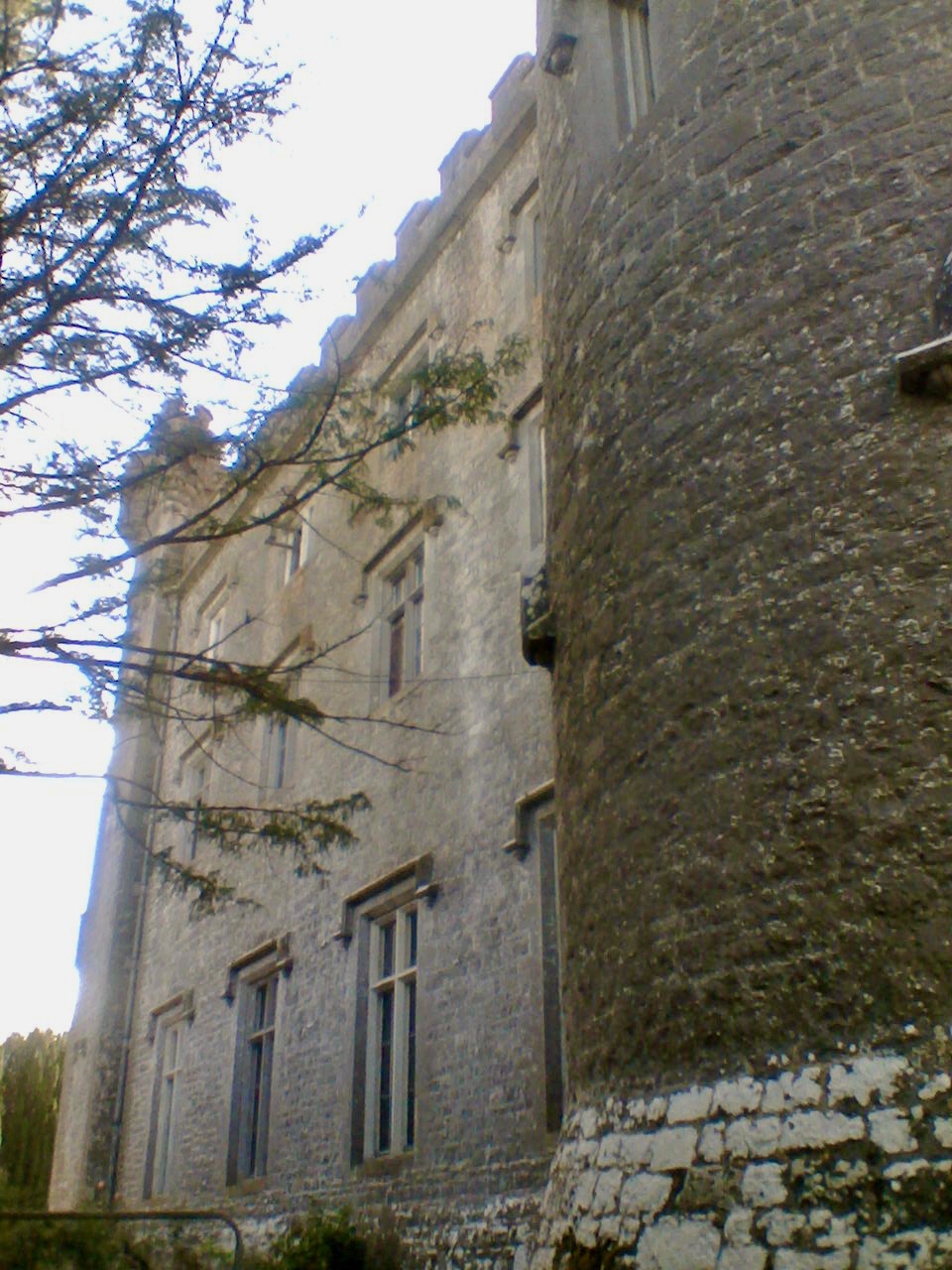
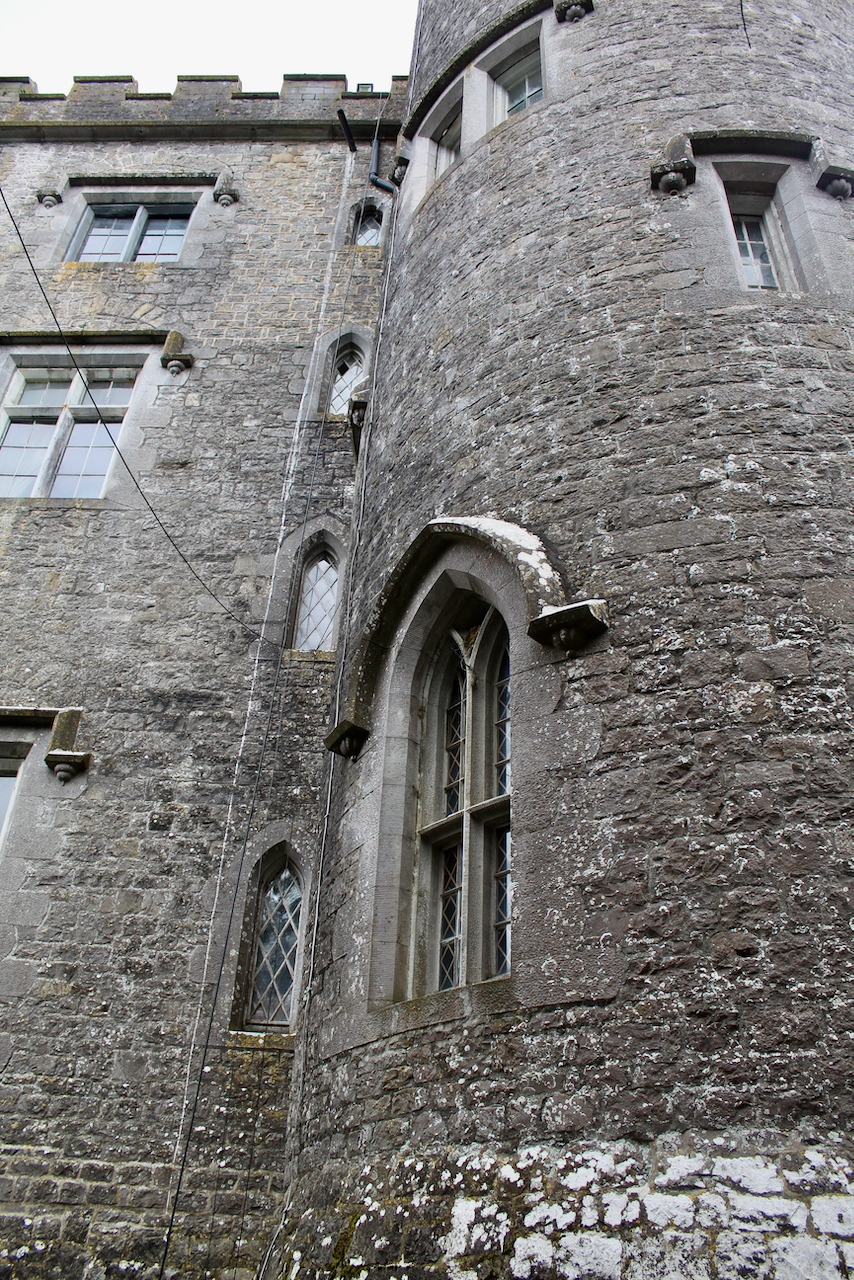
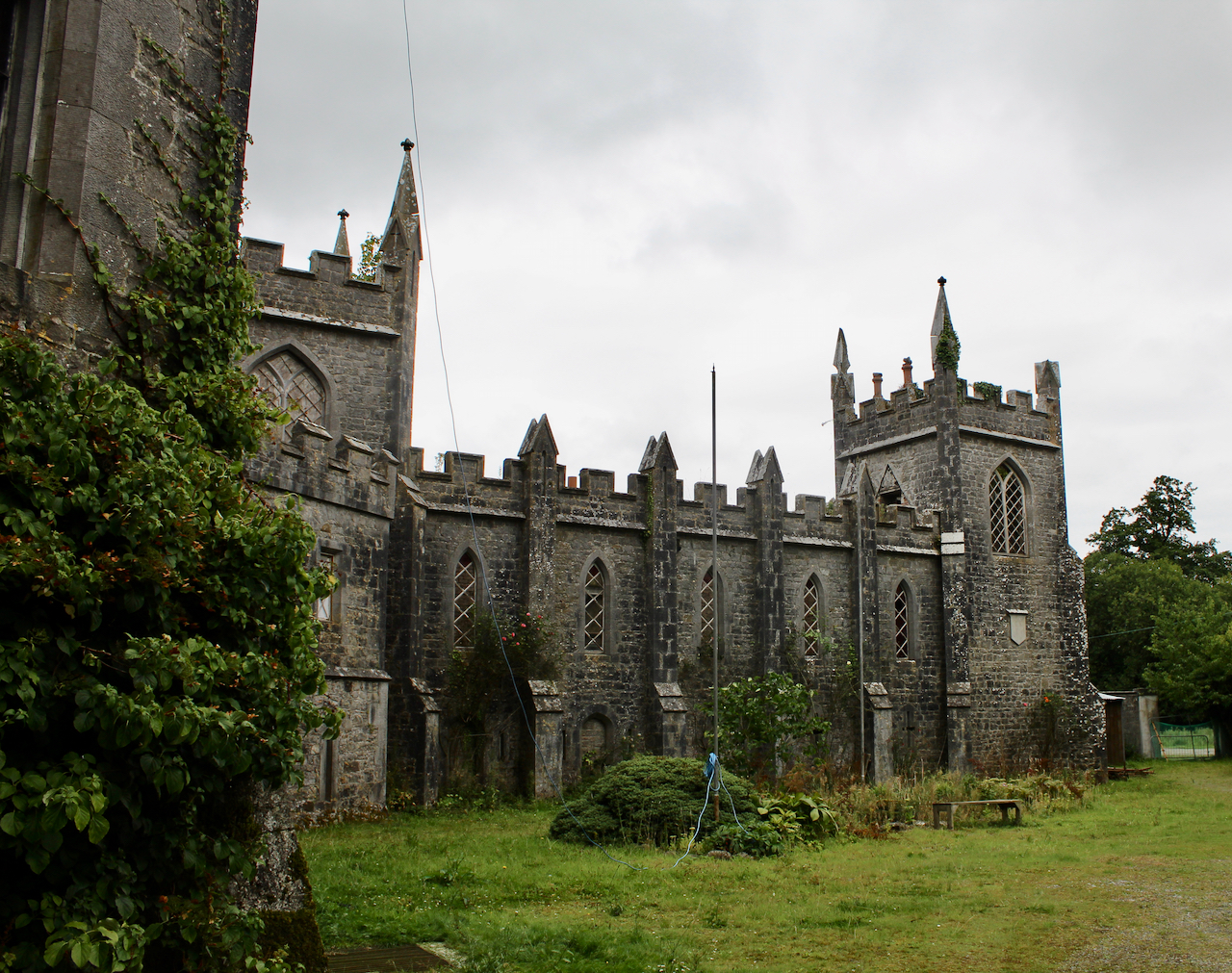
“The castle comprises a tall castellated block of snecked [snecked masonry has a mixture of roughly squared stones of different sizes] limestone rubble with ashlar trim, with a great muscular octagonal tower to the northwest and a narrow round tower with soaring tourelle [small tower] to the NE…The composition breaks out more fully in the collective irregular massing of the towers, the chapel and the stable block, which rambles off to the west.” [7]
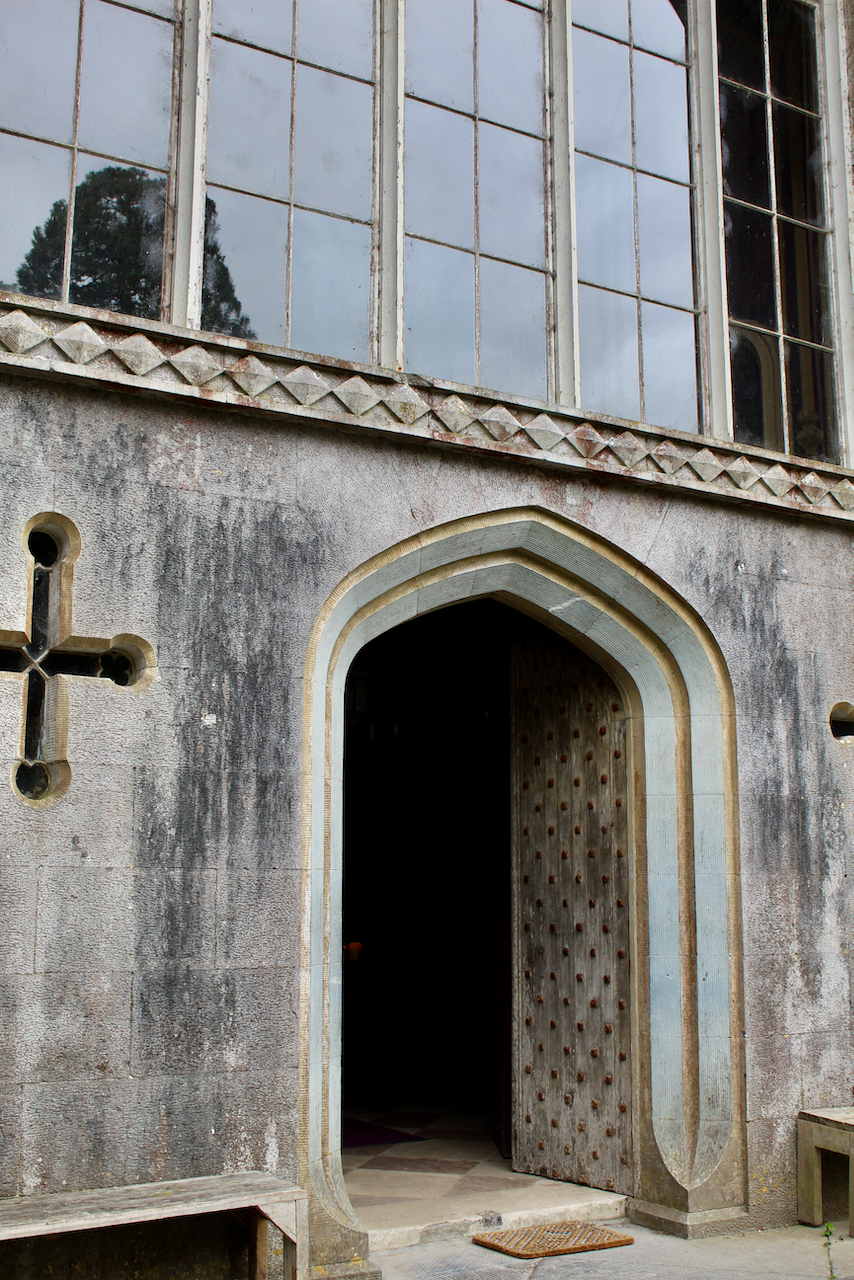
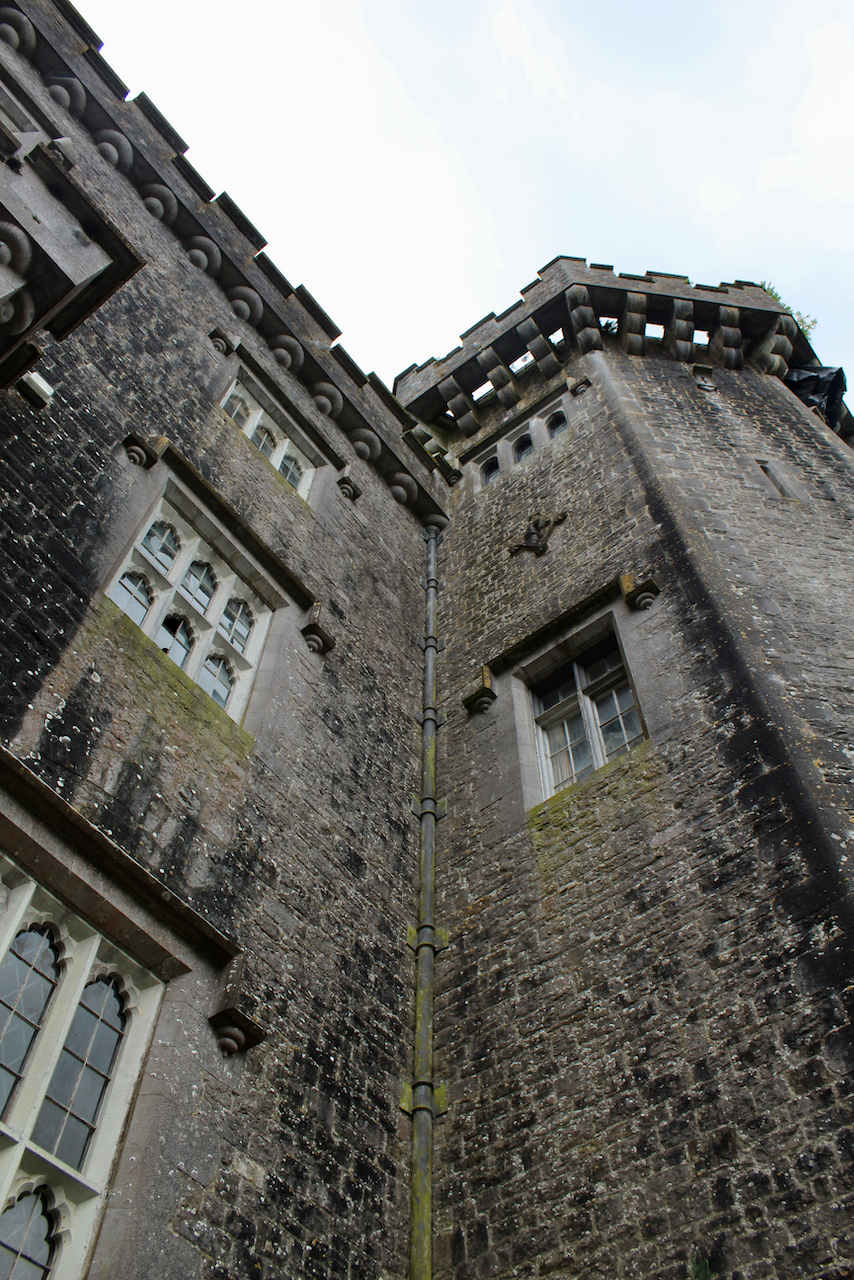
Tierney continues: “The positioning of a great window over the doorway bears comparison with the earlier group of Pale castles, such as Castle Browne (now Clongowes Woods school), attributed to Thomas Wogan Browne. It appears as a portcullis descending from a Gothic arch with a drawbridge in Lord Charleville’s original drawing (which also had a Radcliffean damsel in distress screaming from the battlements). He spent a lot of time drawing a sevenlight panelled window in its stead – the effect is much the same from afar – although the executed window is a more complex Perp design, probably by Johnston. The Tudor arch is employed three times in succession: over the door, in the recess of the great window and in the tripartite window above, which is subdivided into three further arches. This use of the same detailing at varying scales is also seen in the corbelling – a sort pair of intersecting hemispheres. The battlements are simple crenels on the main block but on the towers are rendered in a distinctly Irish fashion (a distinction Johnston would make at Tullynally and Markree), and here the corbelling is also more elaborate, sprouting upwards like cauliflower on the NE tower.“
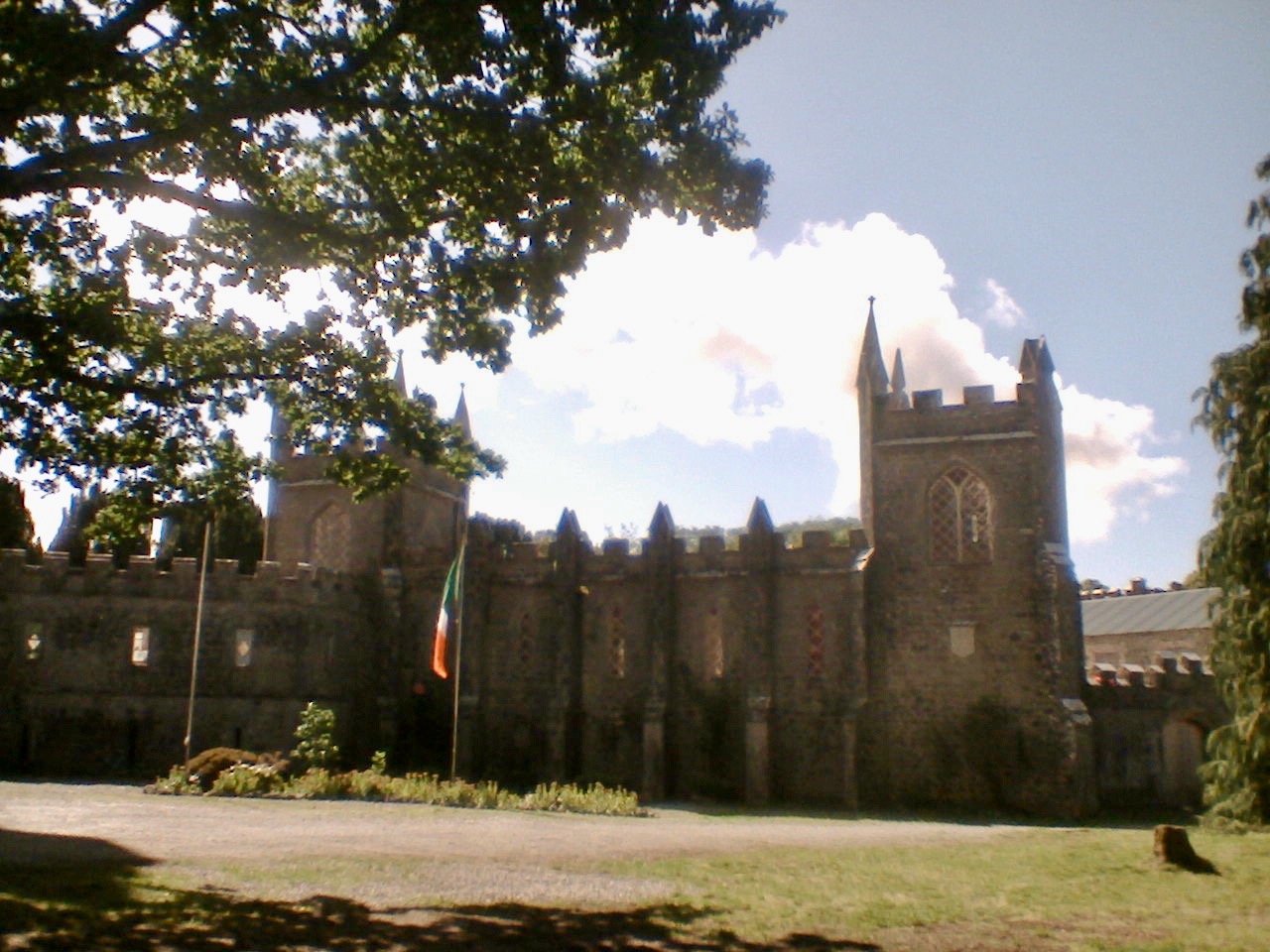
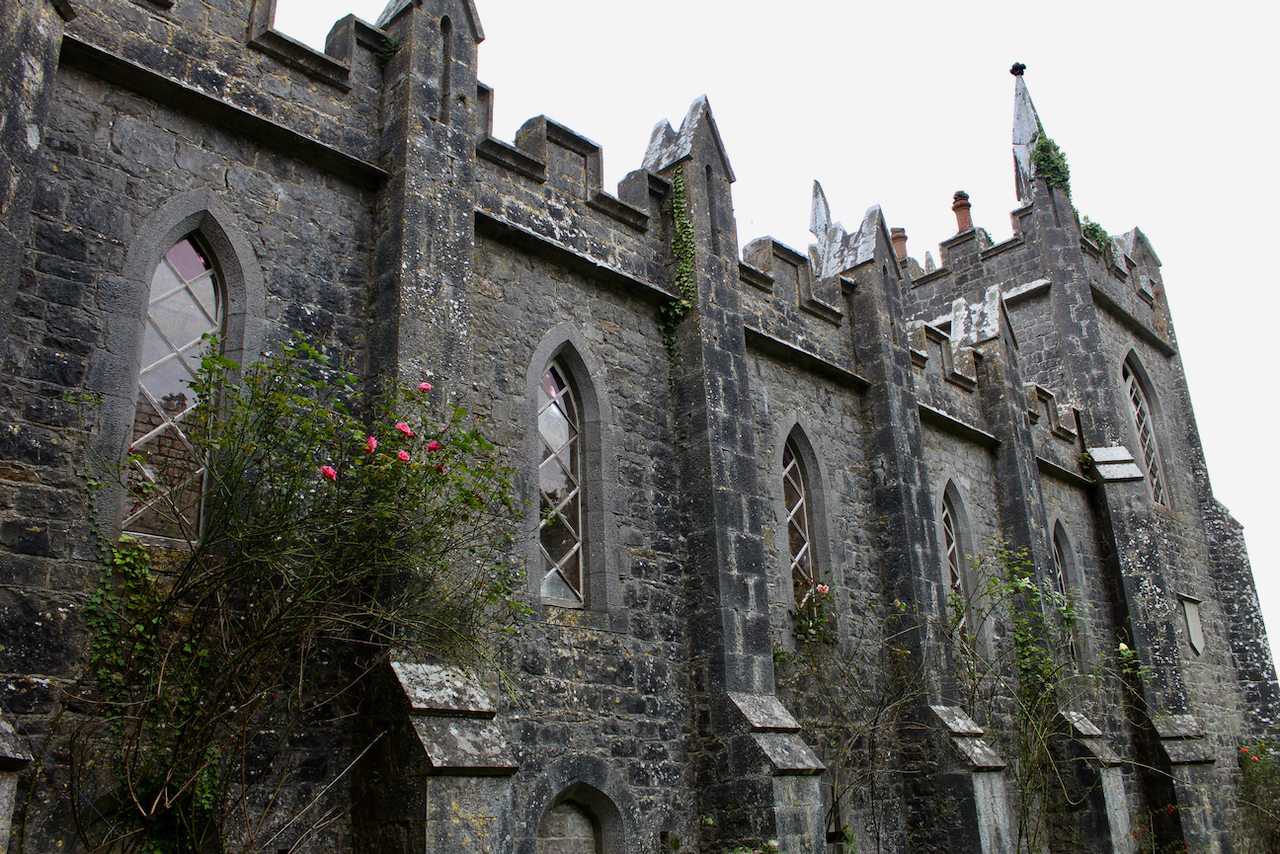
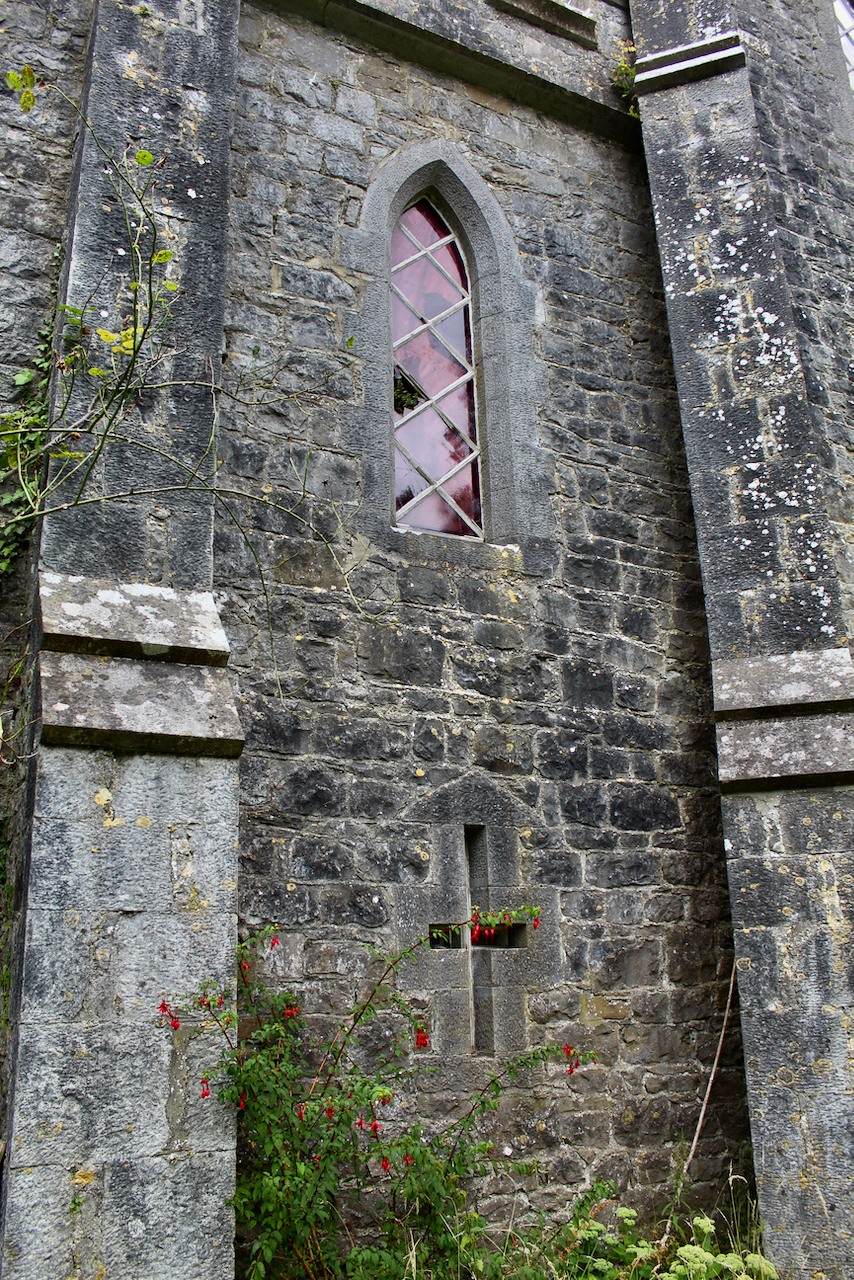
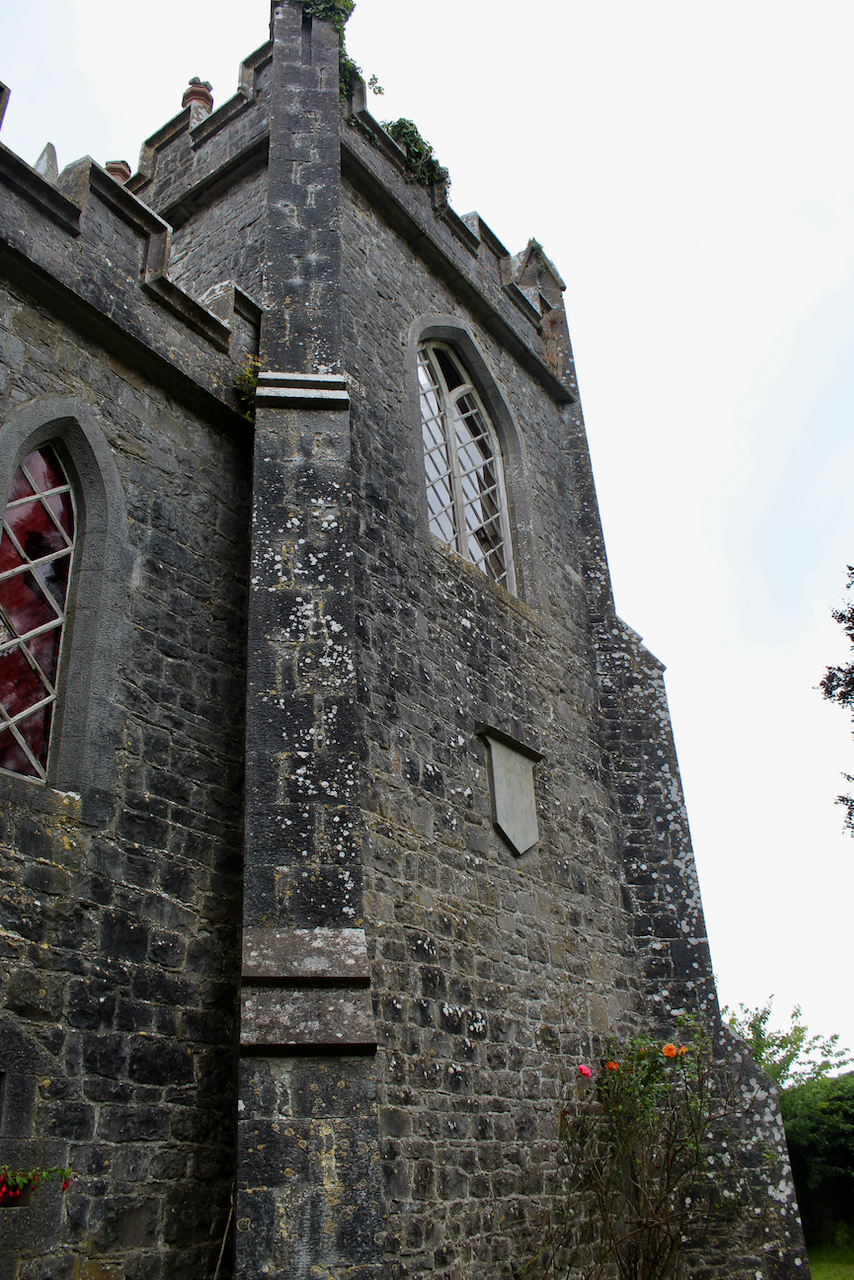
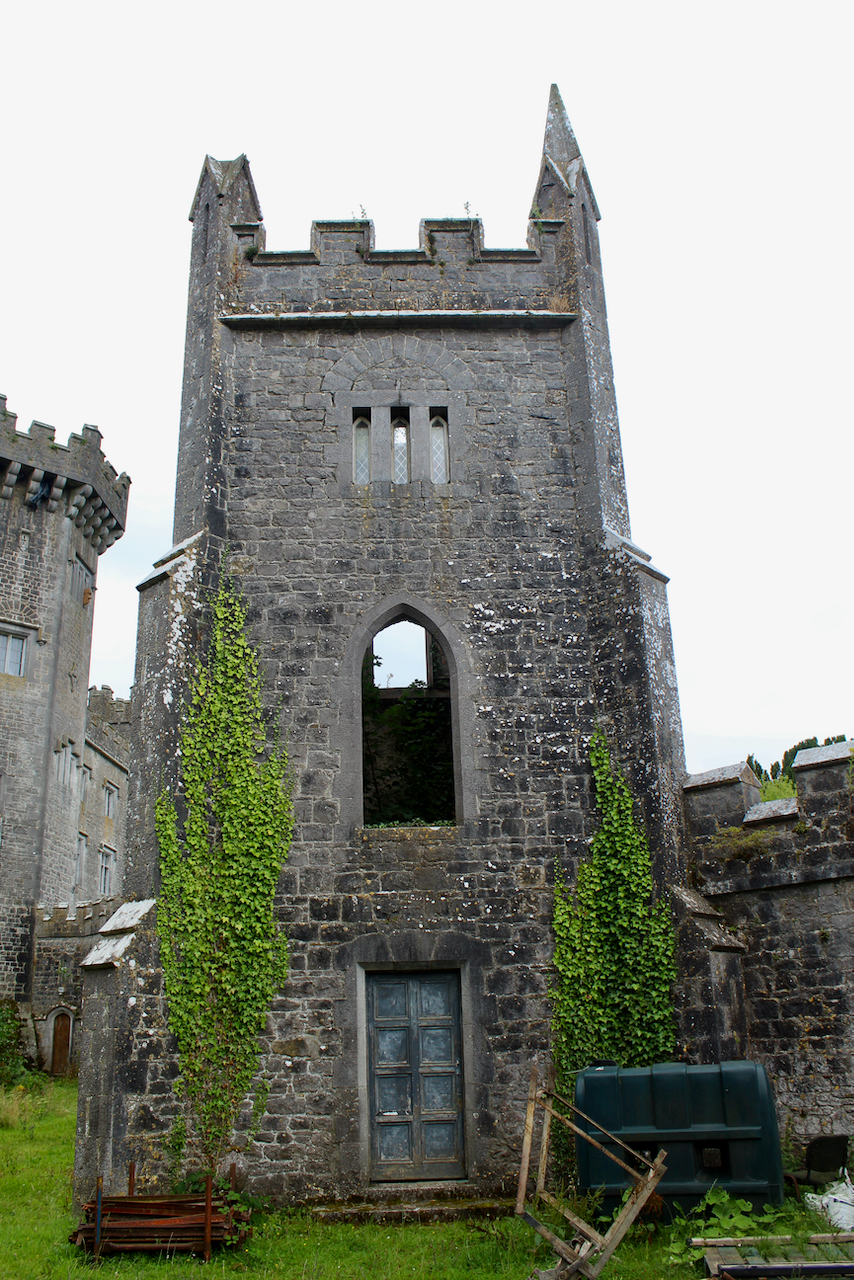
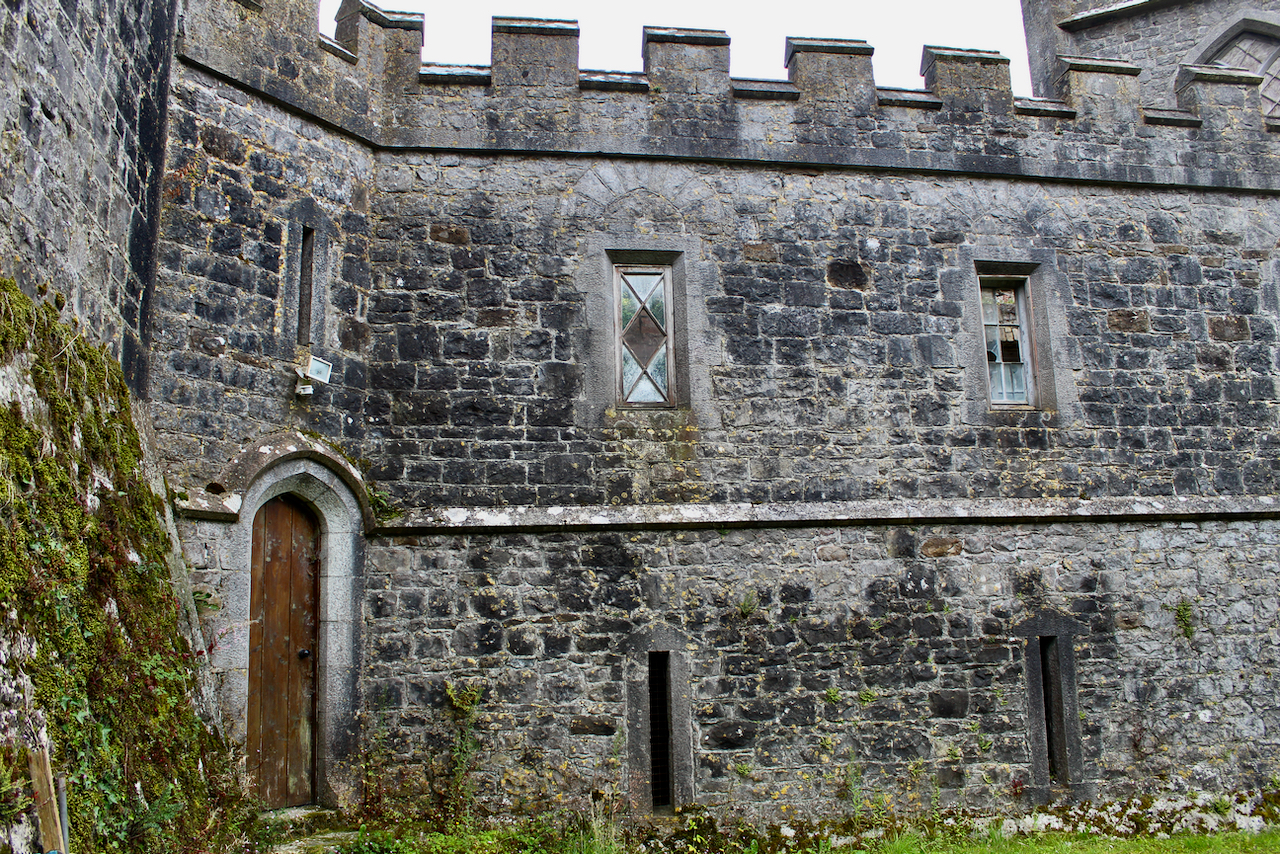
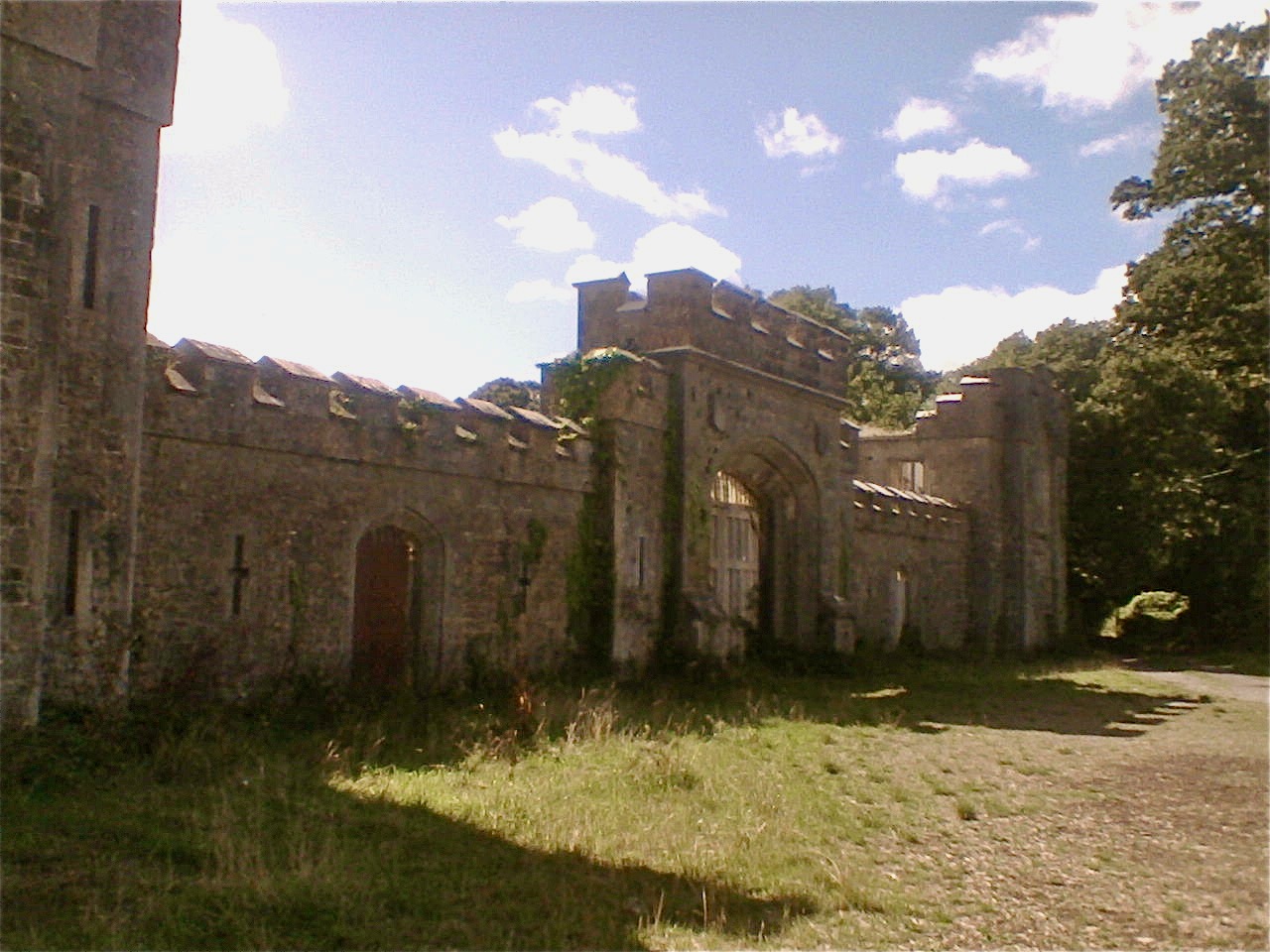
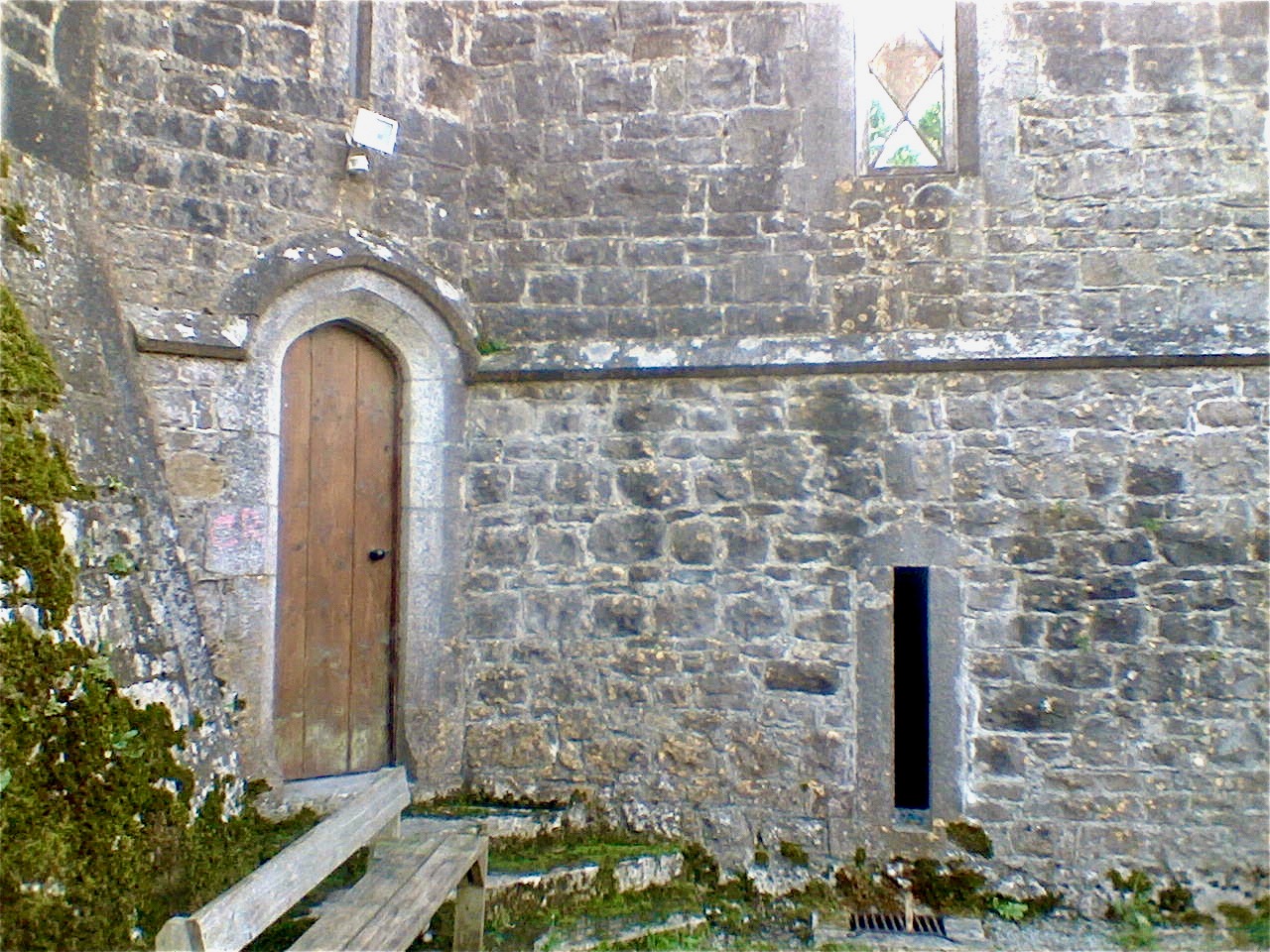
To the right of the entrance front, and giving picturesque variety to the composition, is a long, low range of battlemented offices and a chapel, including a tower with pinnacles and a gateway.
The Stableyard lies beyond the chapel but is not open to the public, which is unfortunate as Tierney describes it as the finest castellated stableyard in Ireland, although now derelict. It is also by Francis Johnston.
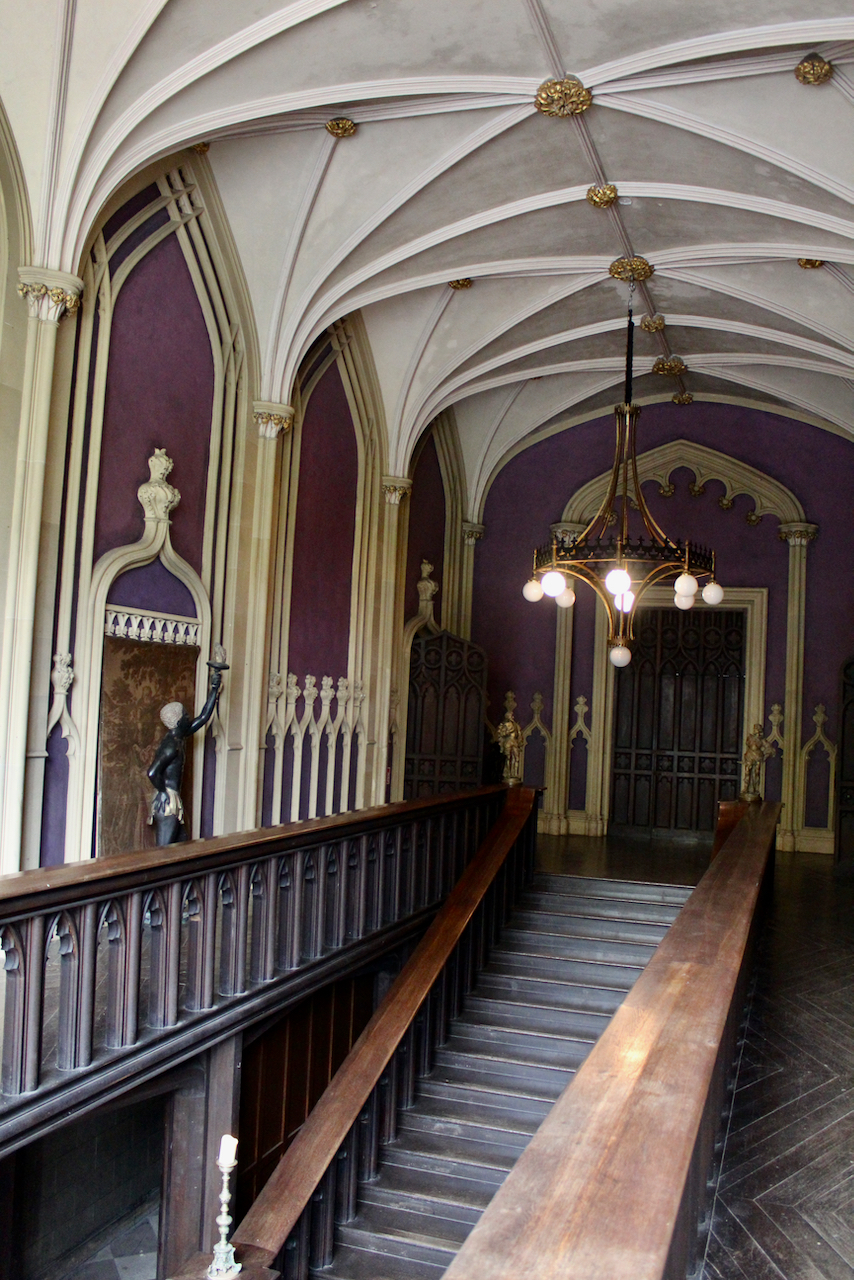
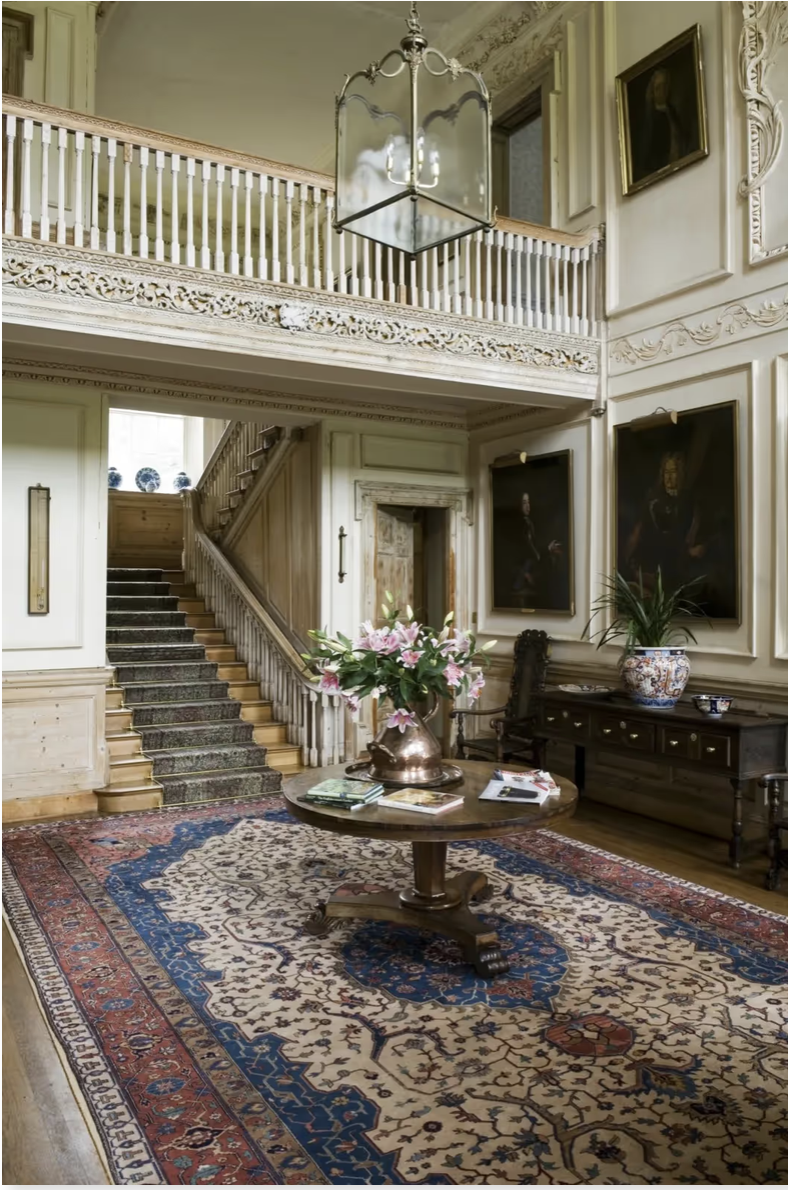
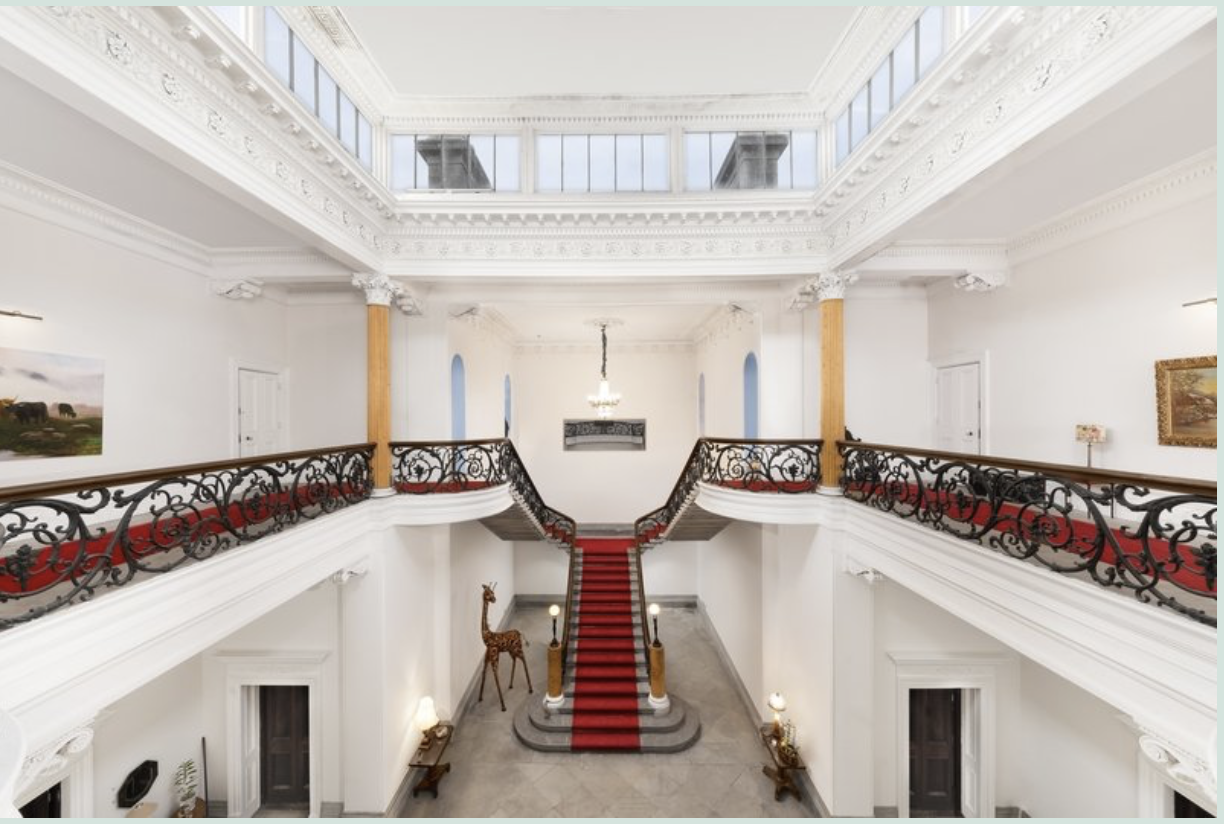
“The interior is as dramatic and well-finished as the exterior. In the hall, with its plaster groined ceiling carried on graceful shafts, a straight flight of stairs rises between galleries to piano nobile level, where a great double door, carved in florid Decorated style, leads to a vast saloon or gallery running the whole length of the garden front.”
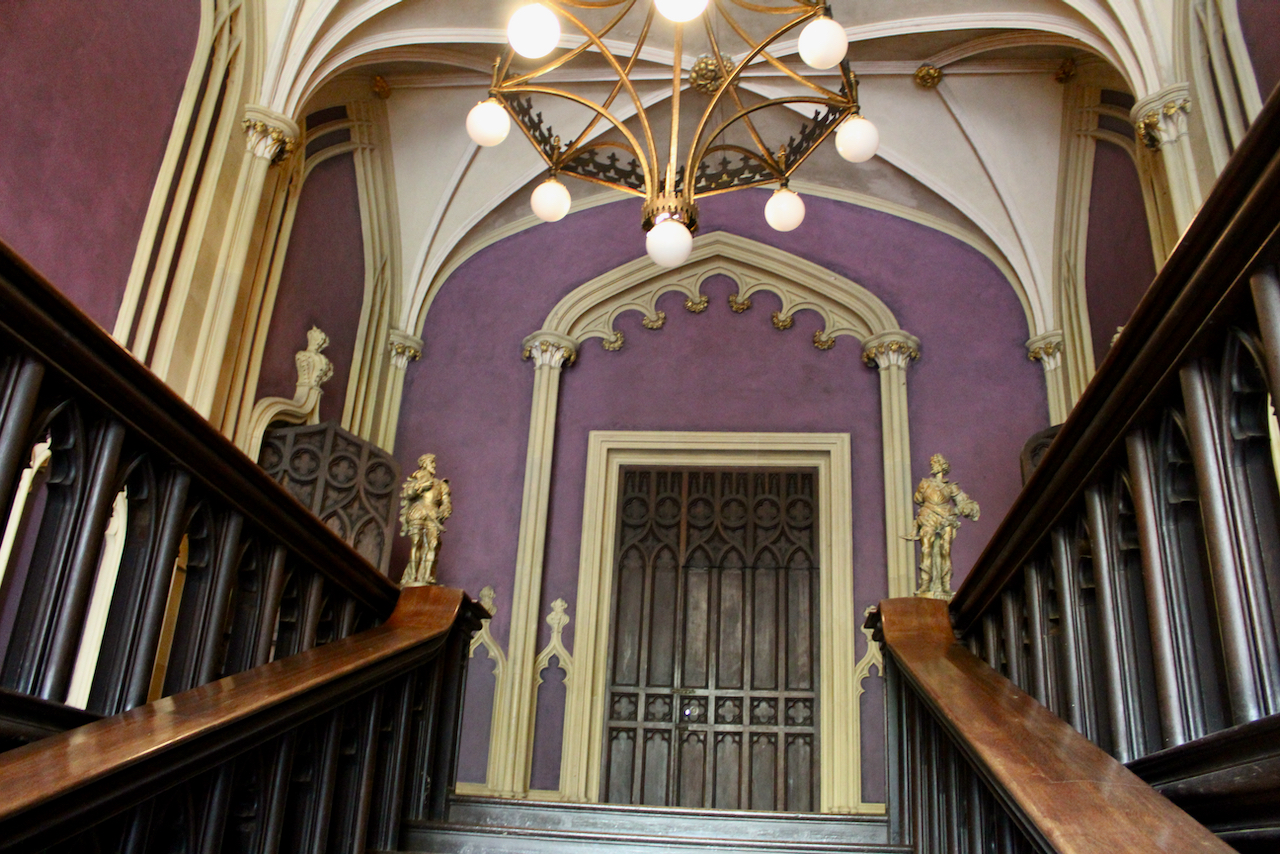
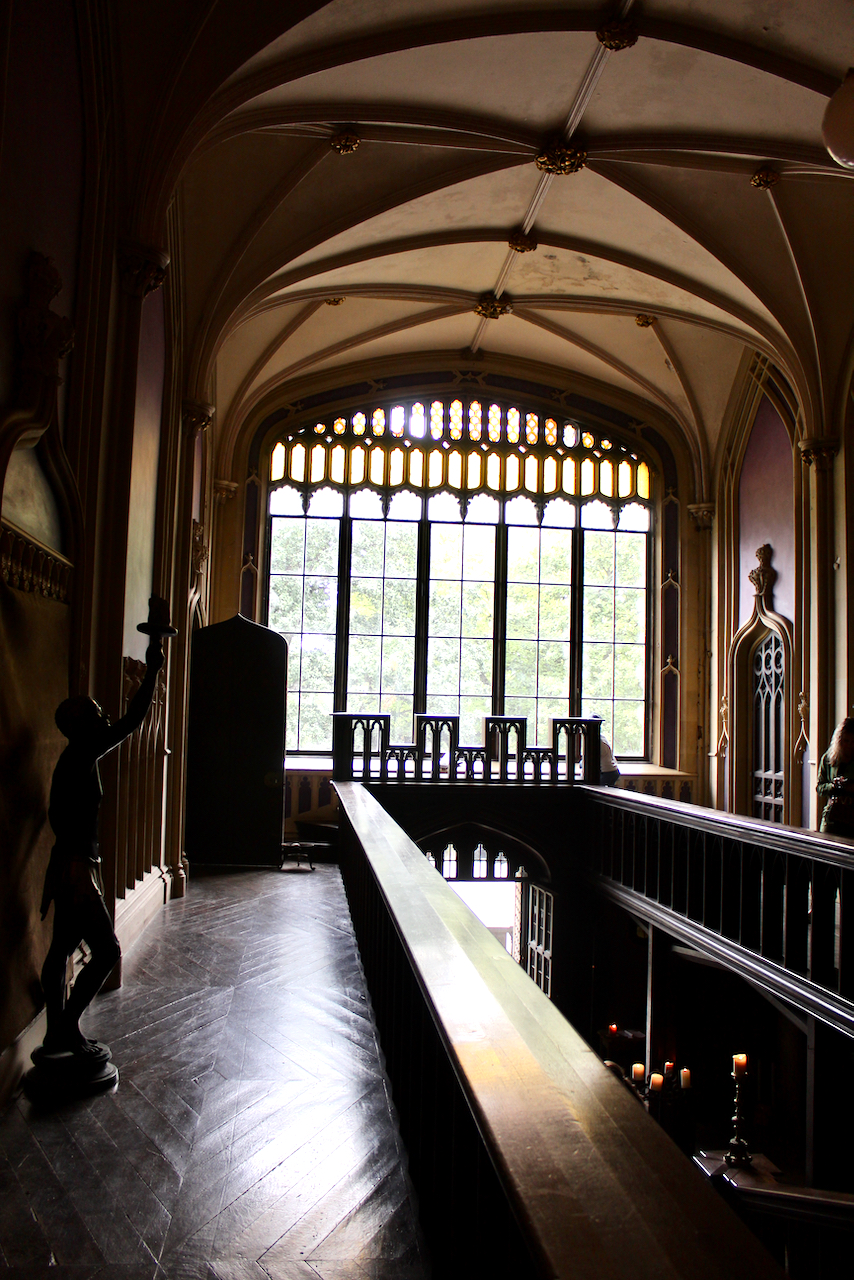
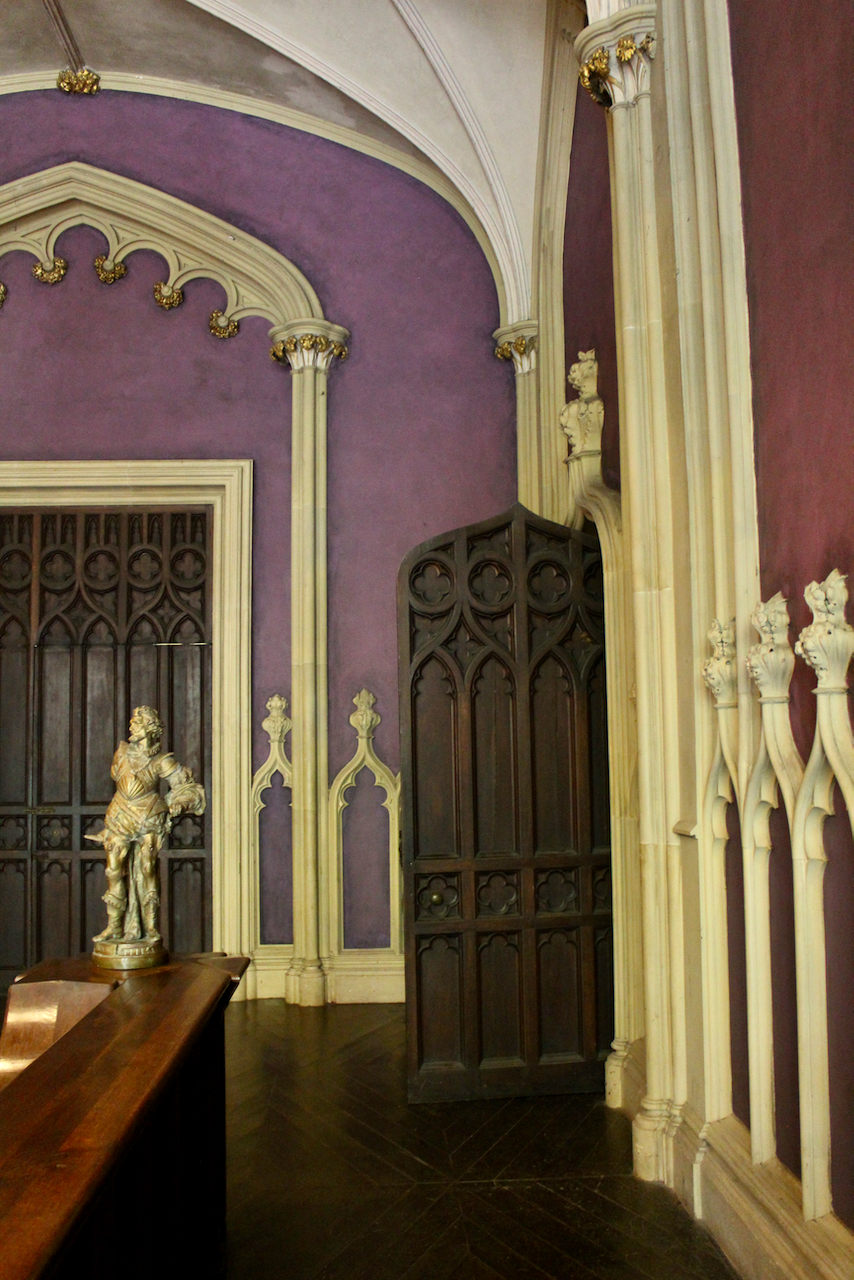
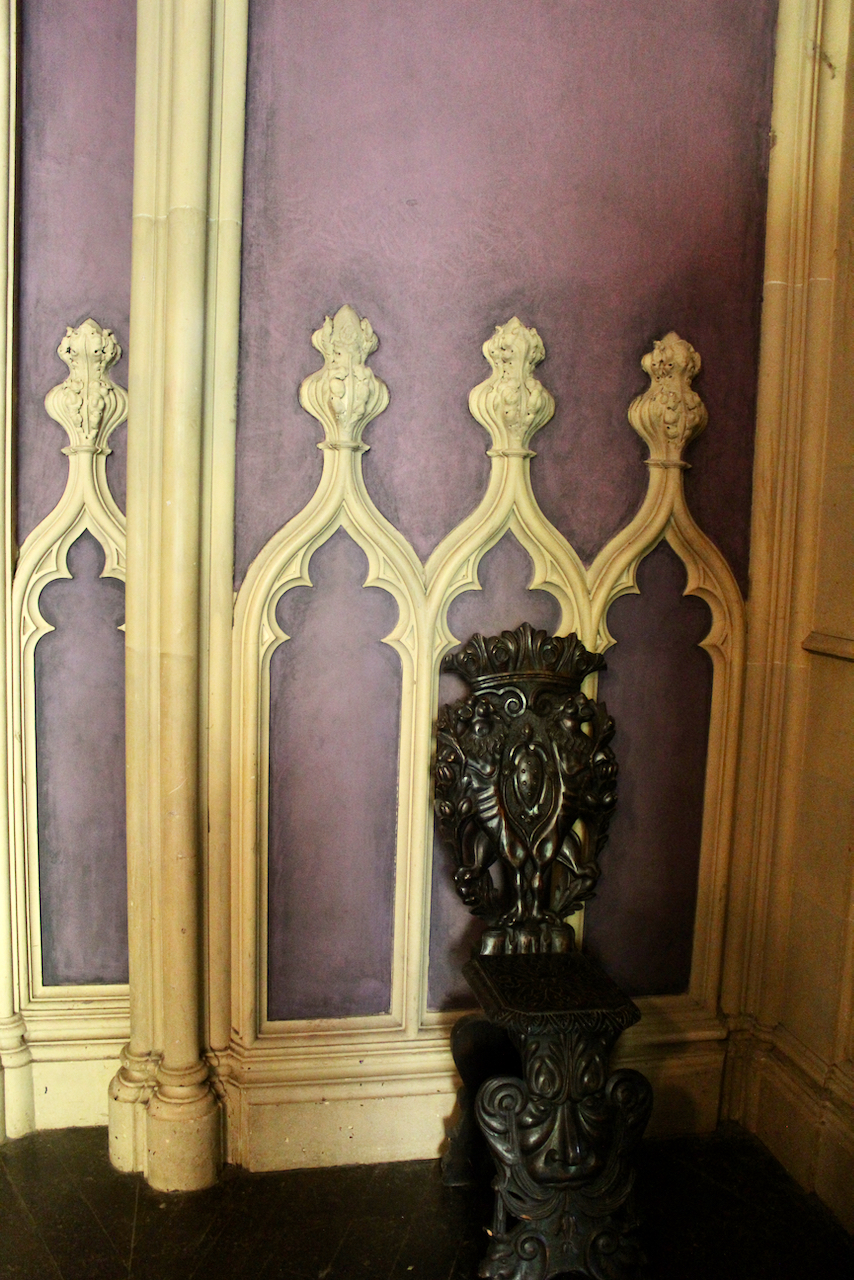
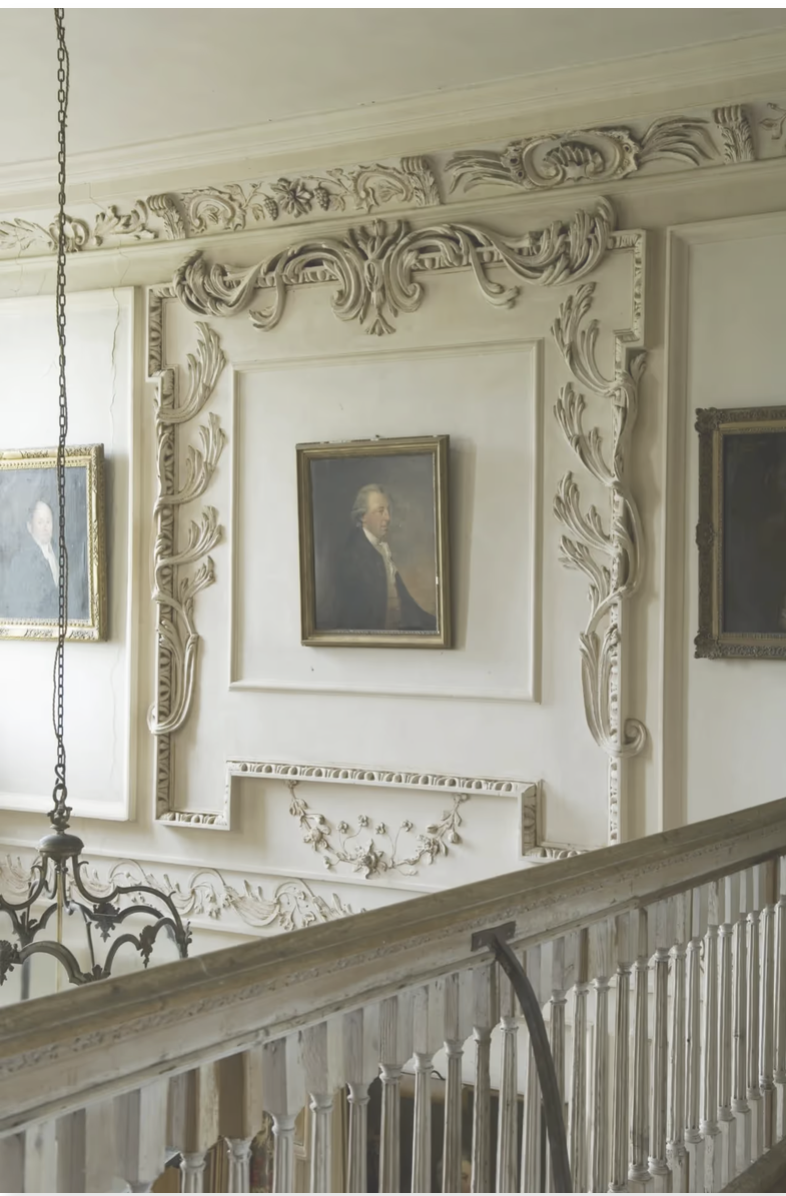
The heavy oak stairs run from the basement to piano nobile. This imitates a similar configuration by James Wyatt at Fonthill and Windsor, which Lord Charleville knew. The upper stage, Tierney describes, has a plaster-panelled dado with ogee-headed niches in the style of Batty Langley, conceived for a parade of suits of armour in drawings by Lady Charleville.
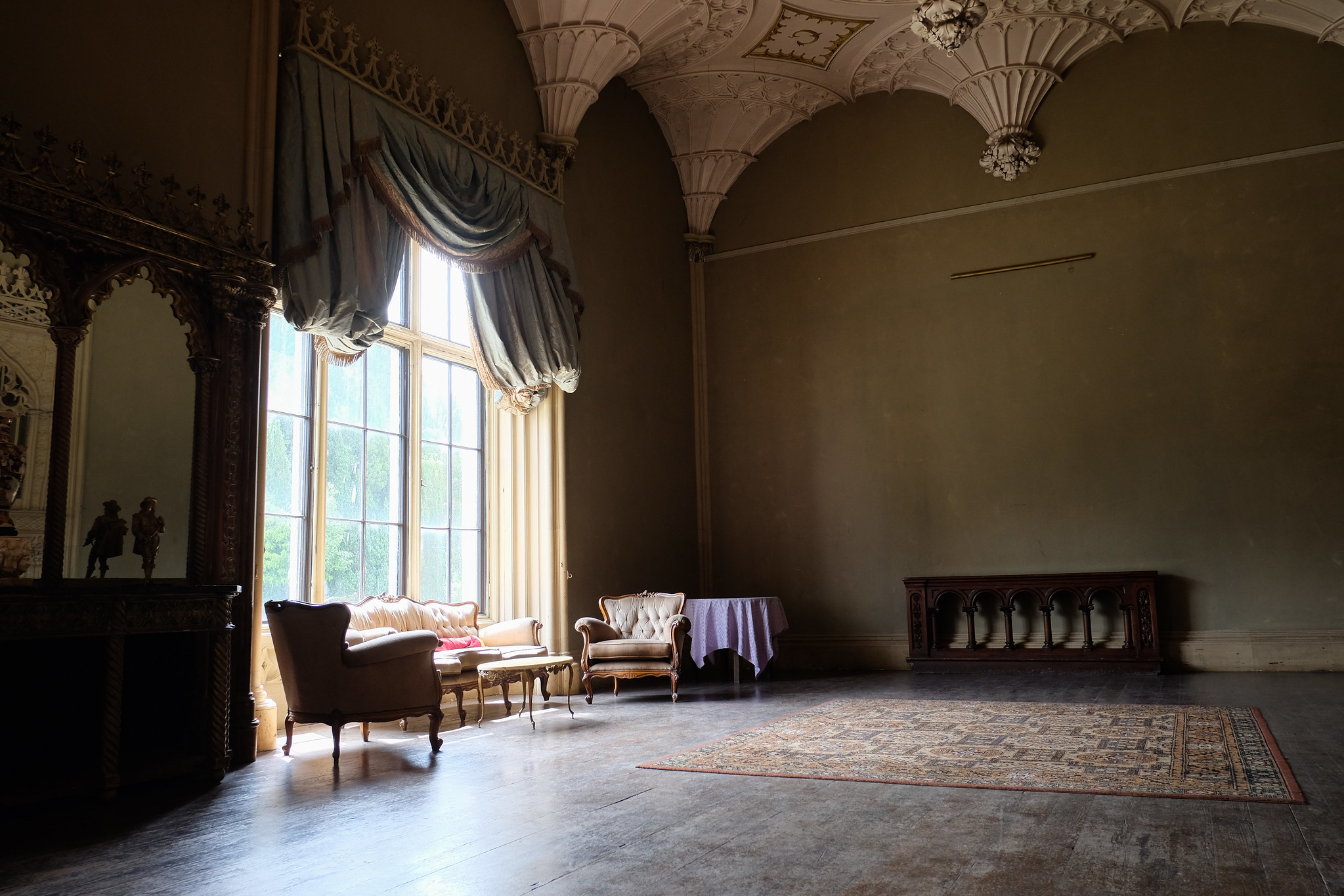
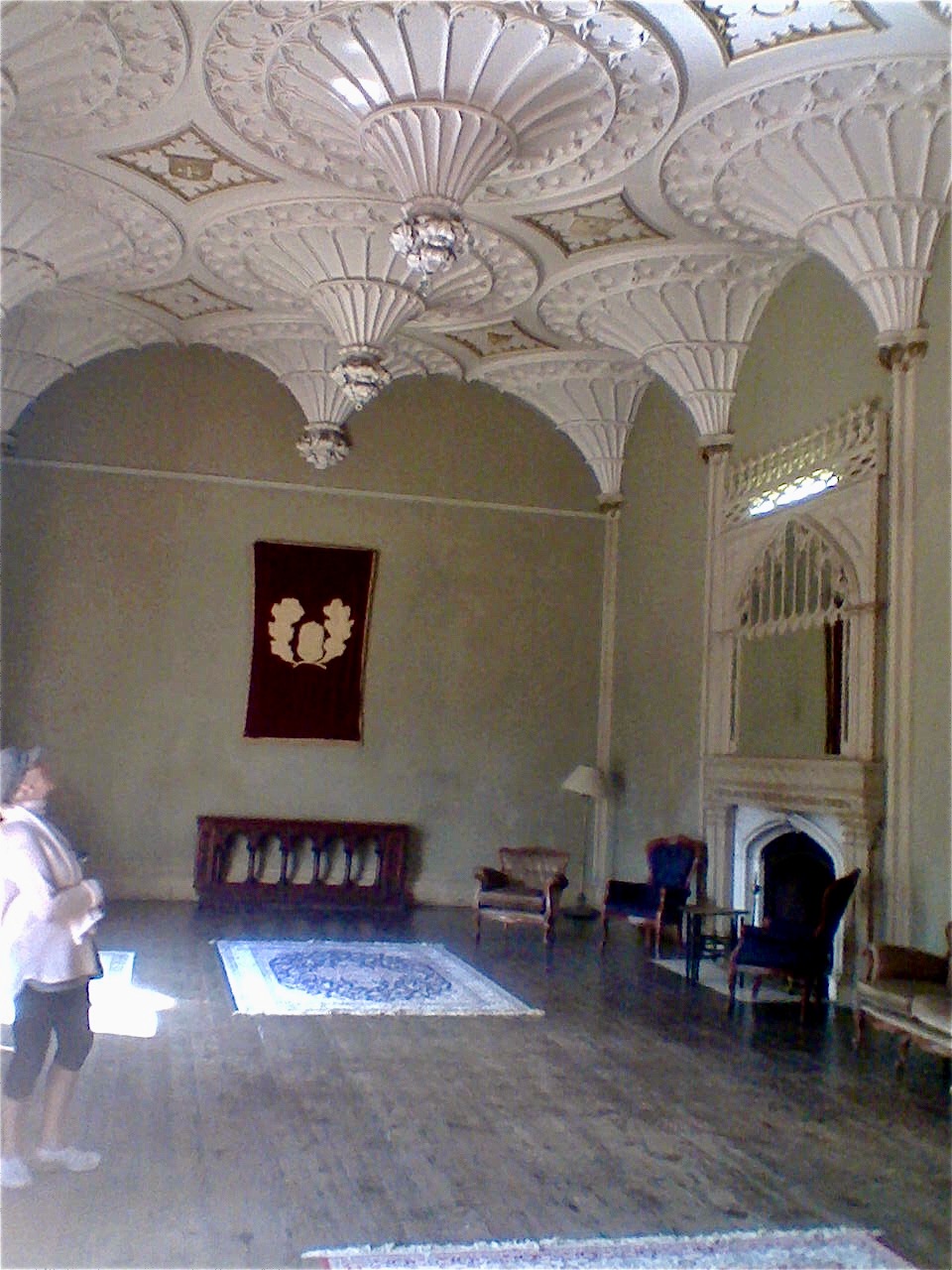
Through the double doors is the most splendid room, the south facing Gallery. Unfortunately this was closed on our Heritage Week visit in 2024 due to filming of the Addams family movie, “Wednesday.” Mark Bence-Jones continues:“This is one of the most splendid Gothic Revival interiors in Ireland; it has a ceiling of plaster fan vaulting with a row of gigantic pendants down the middle; two lavishly carved fireplaces of grained wood, Gothic decoration in the frames of the windows opposite and Gothic bookcases and side-tables to match.“
Charleville Castle Tullamore by Alex Johnson June 2017, courtesy of flickr constant commons.Photograph of Charleville Forest Castle that appeared in 1962 in Country Life. The castle was uninhabited at this time and the furniture was borrowed from Belvedere, County Westmeath.
The fan-vaulted ceiling is inspired by Horace Walpole’s Strawberry Hill, which the Burys visited, which is in turn based on Henry VII’s Chapel at Westminster Abbey, Tierney tells us. The ceiling is thought to have been executed by George Stapleton, who is also responsible for the fan-vaulting in Johnston’s Chapel Royal in Dublin Castle. The ceiling is anchored with clustered shafts along the walls, with bays framing the two Gothic chimneypieces, the doorcase on the north wall, and the Gothic casings of the windows.
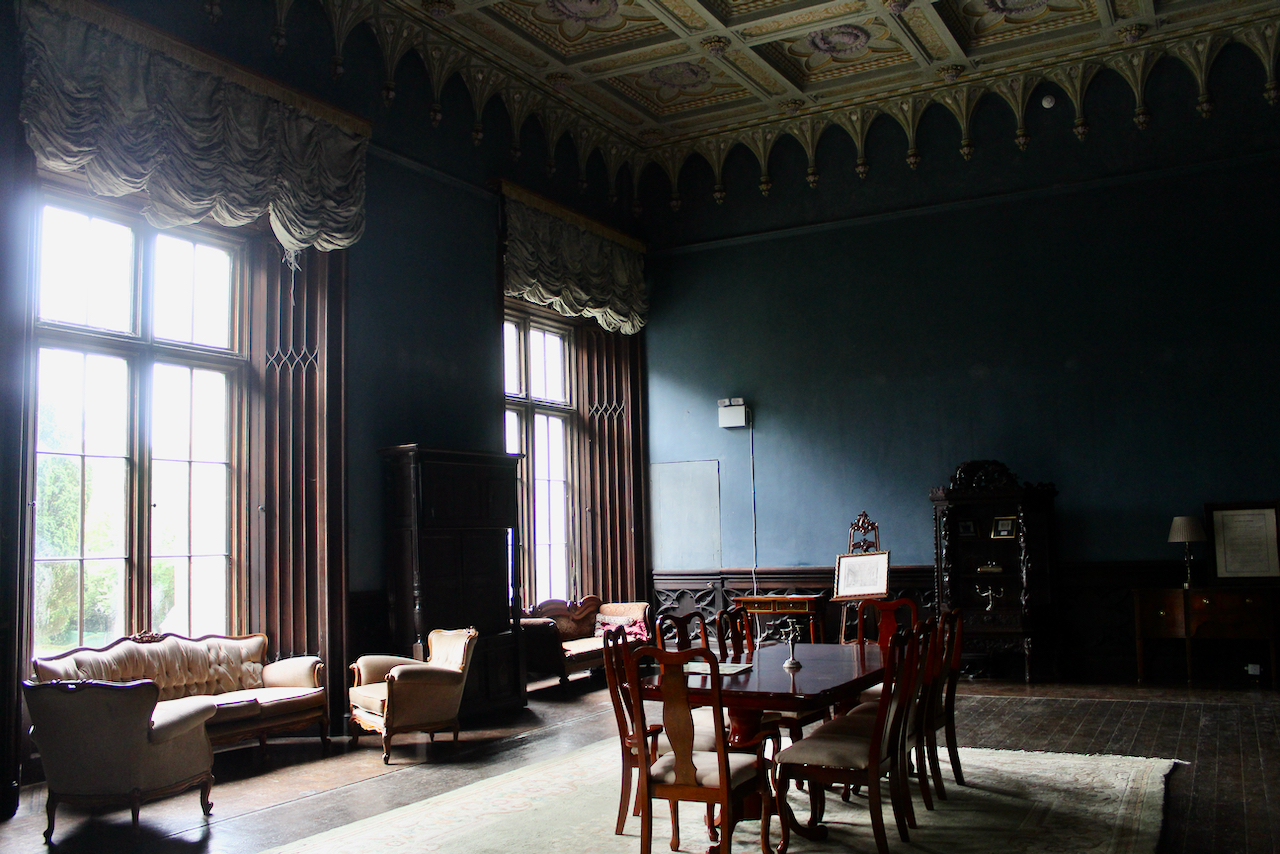
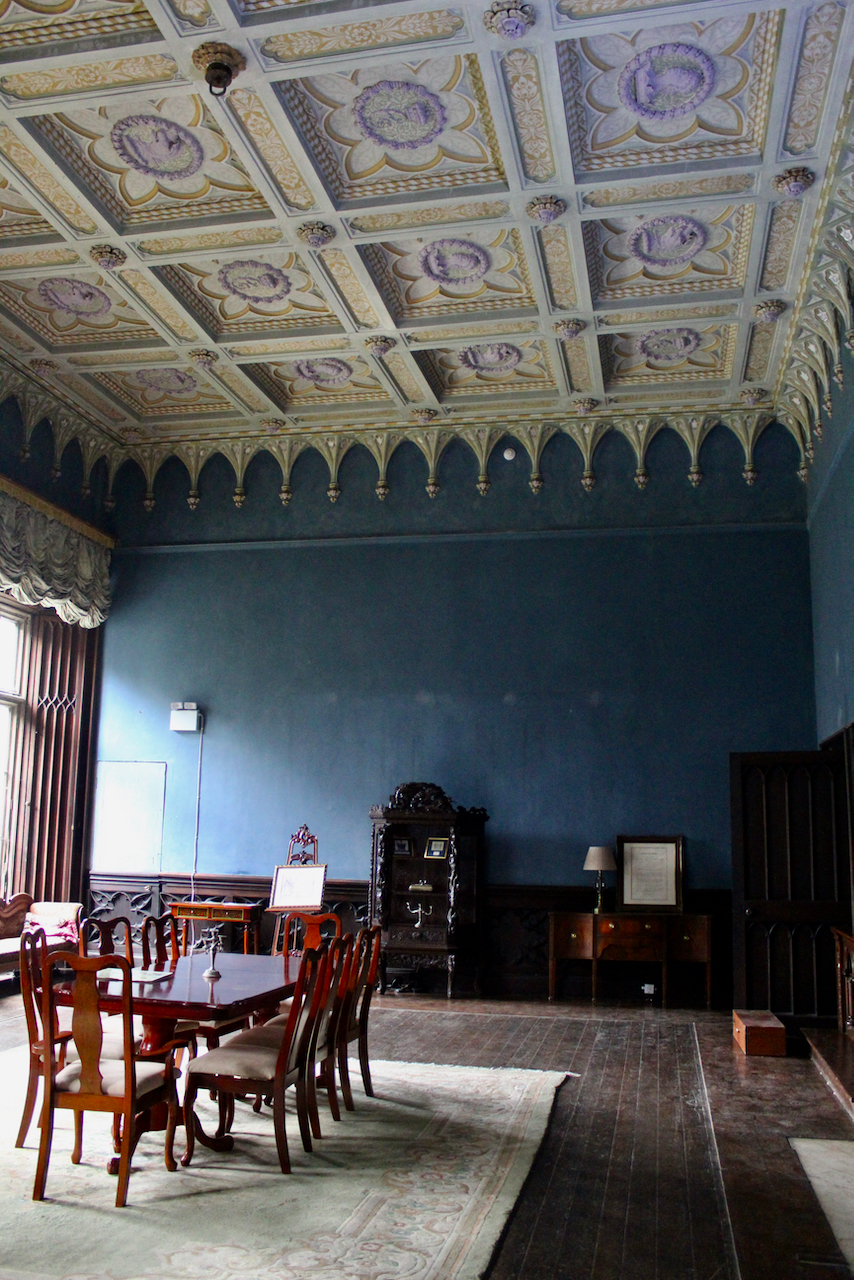
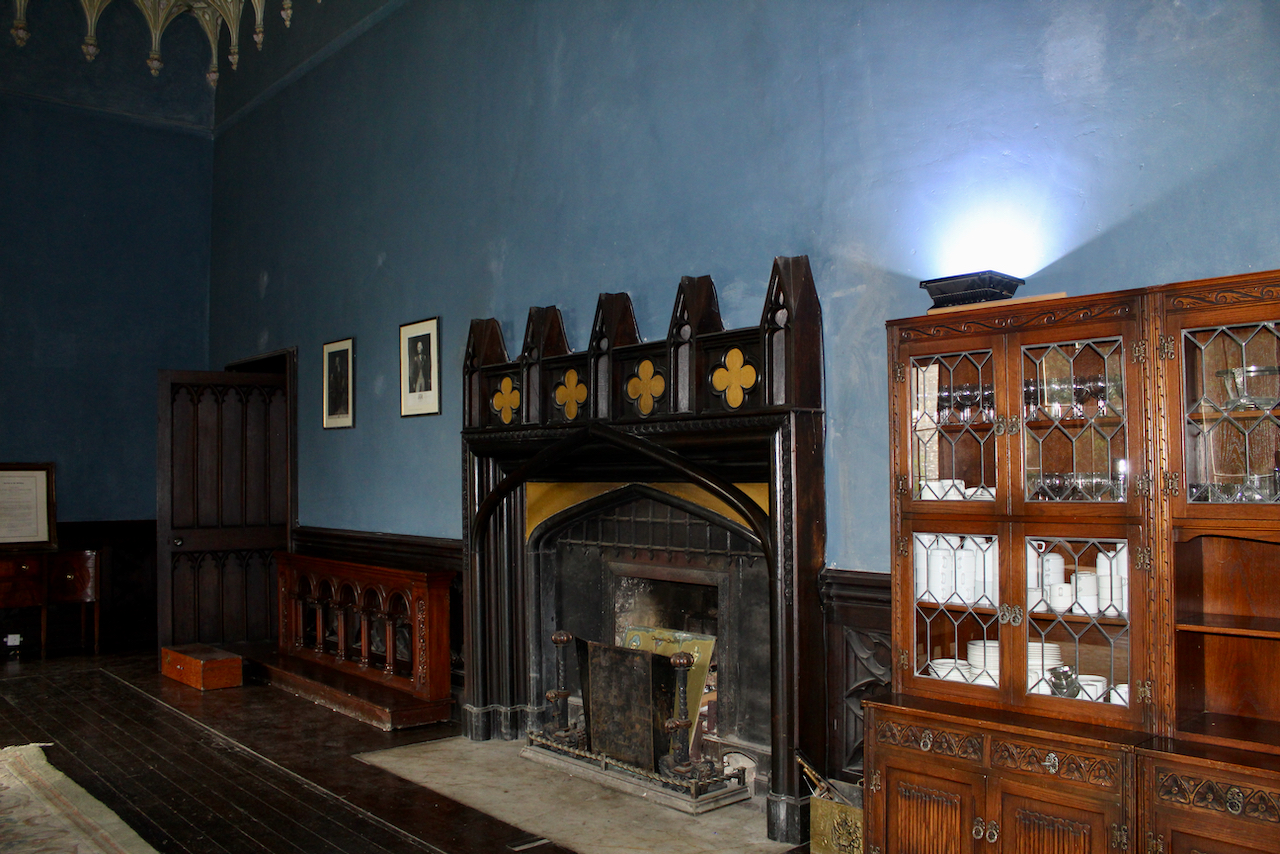
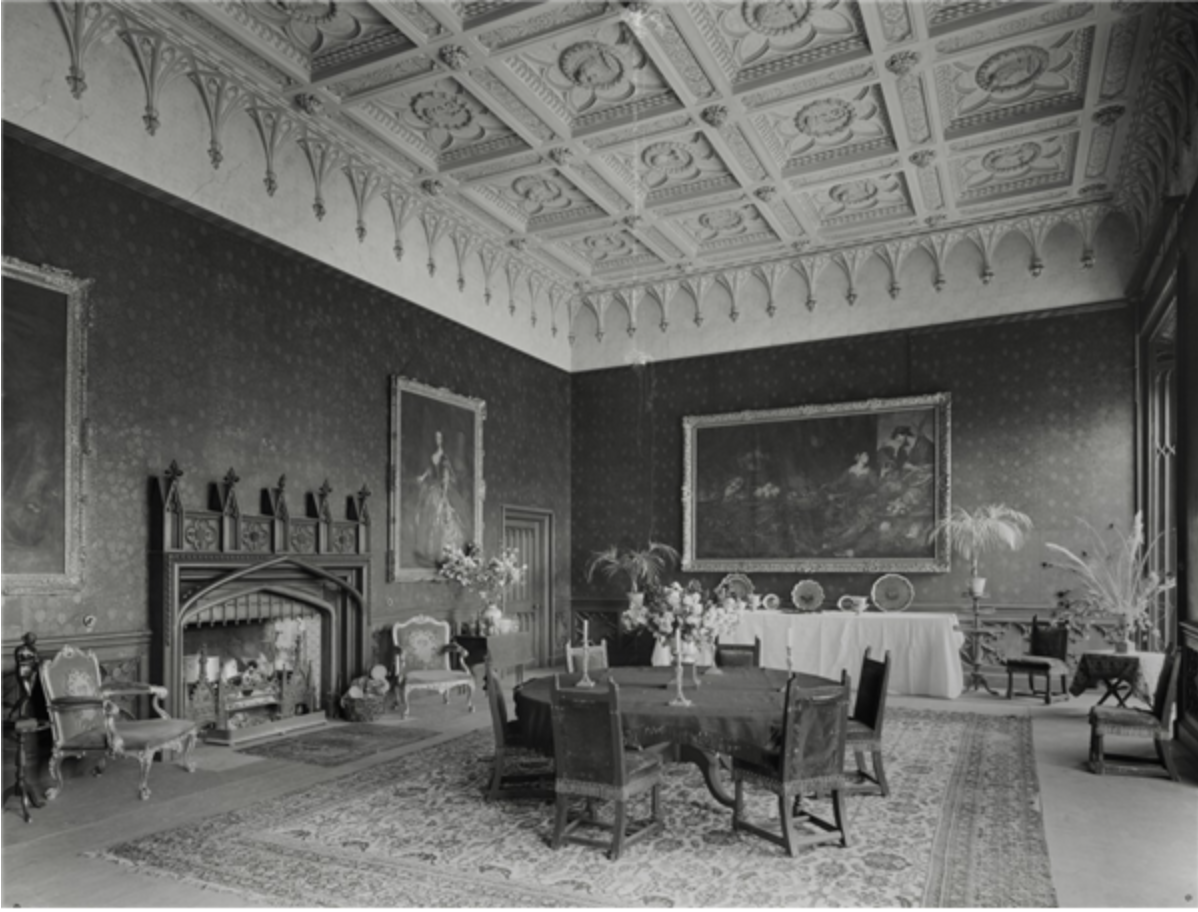
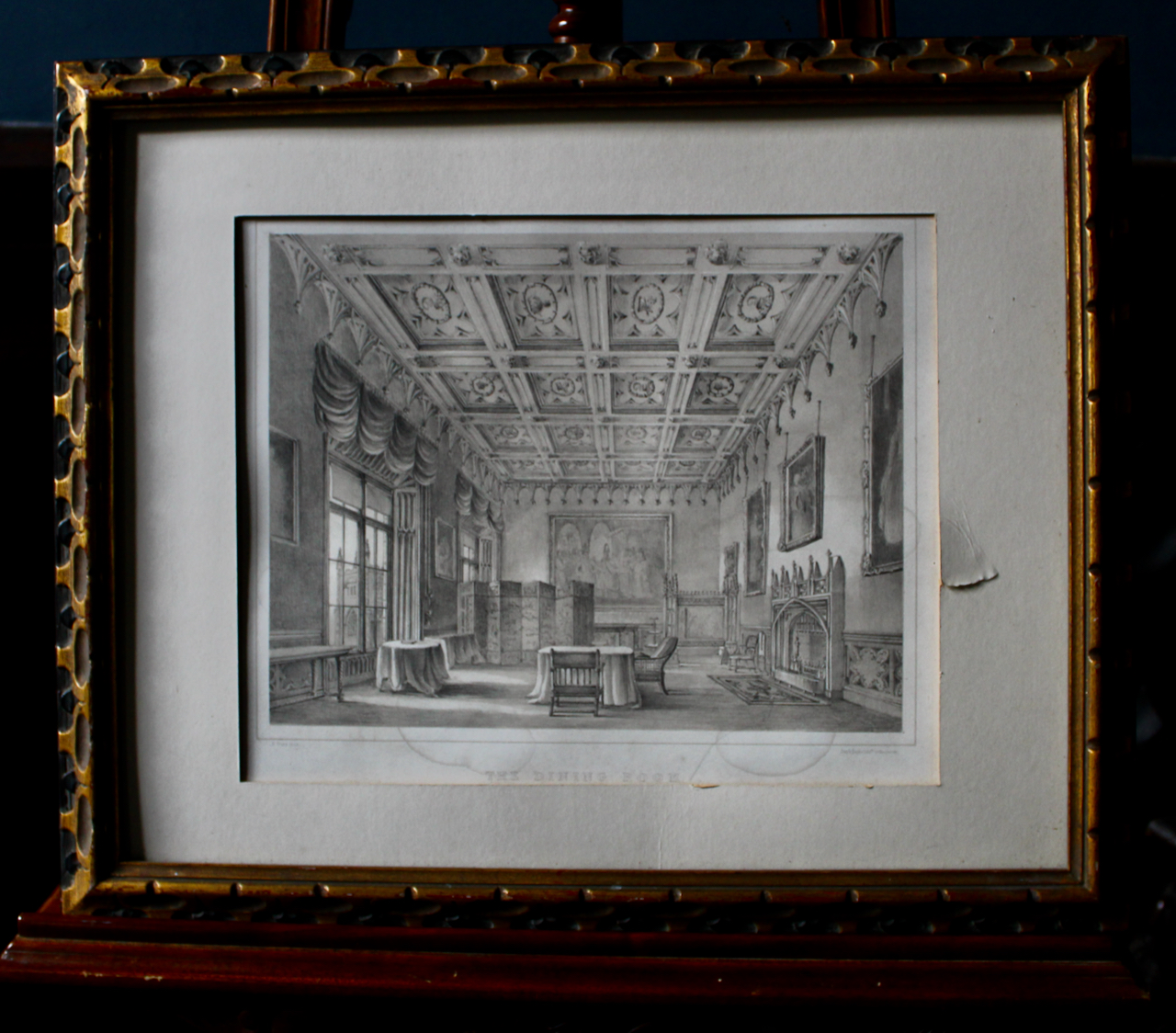
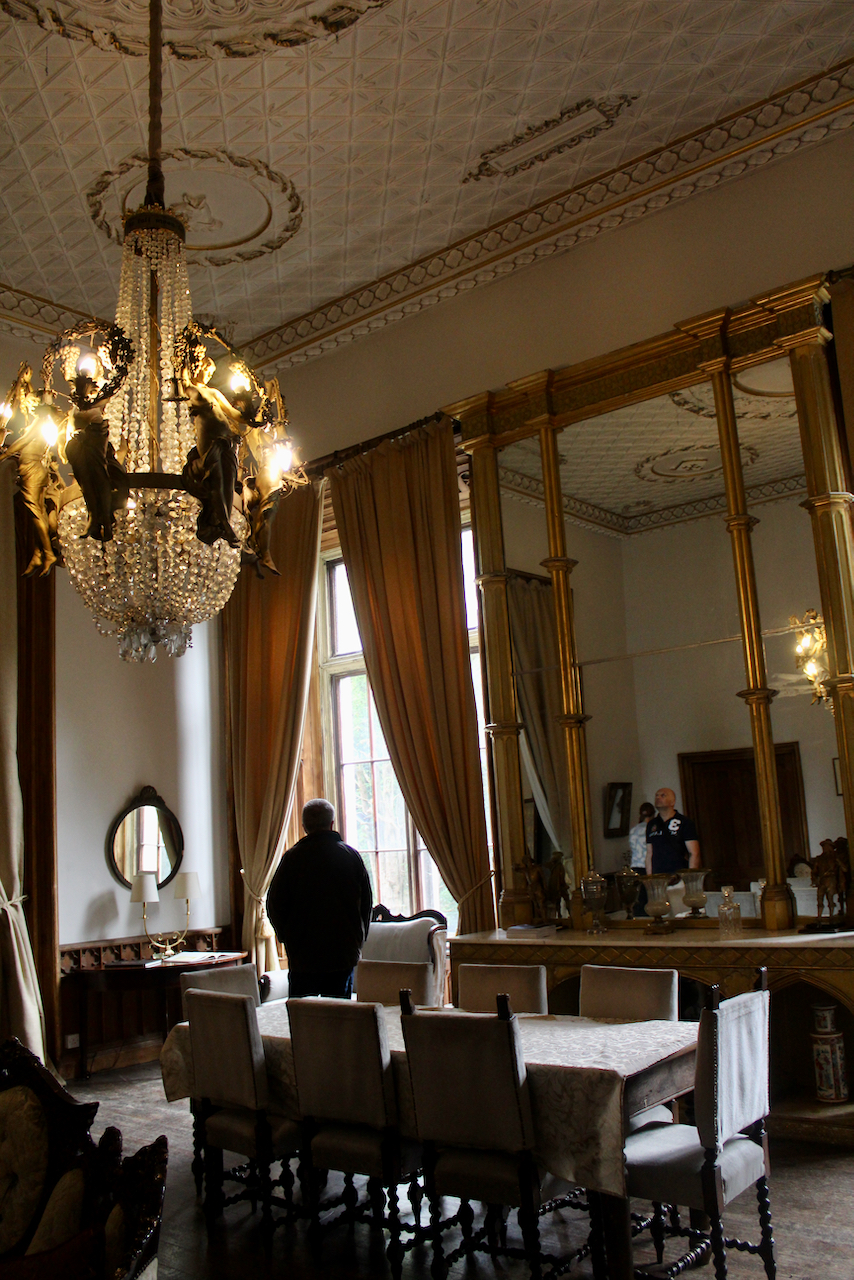
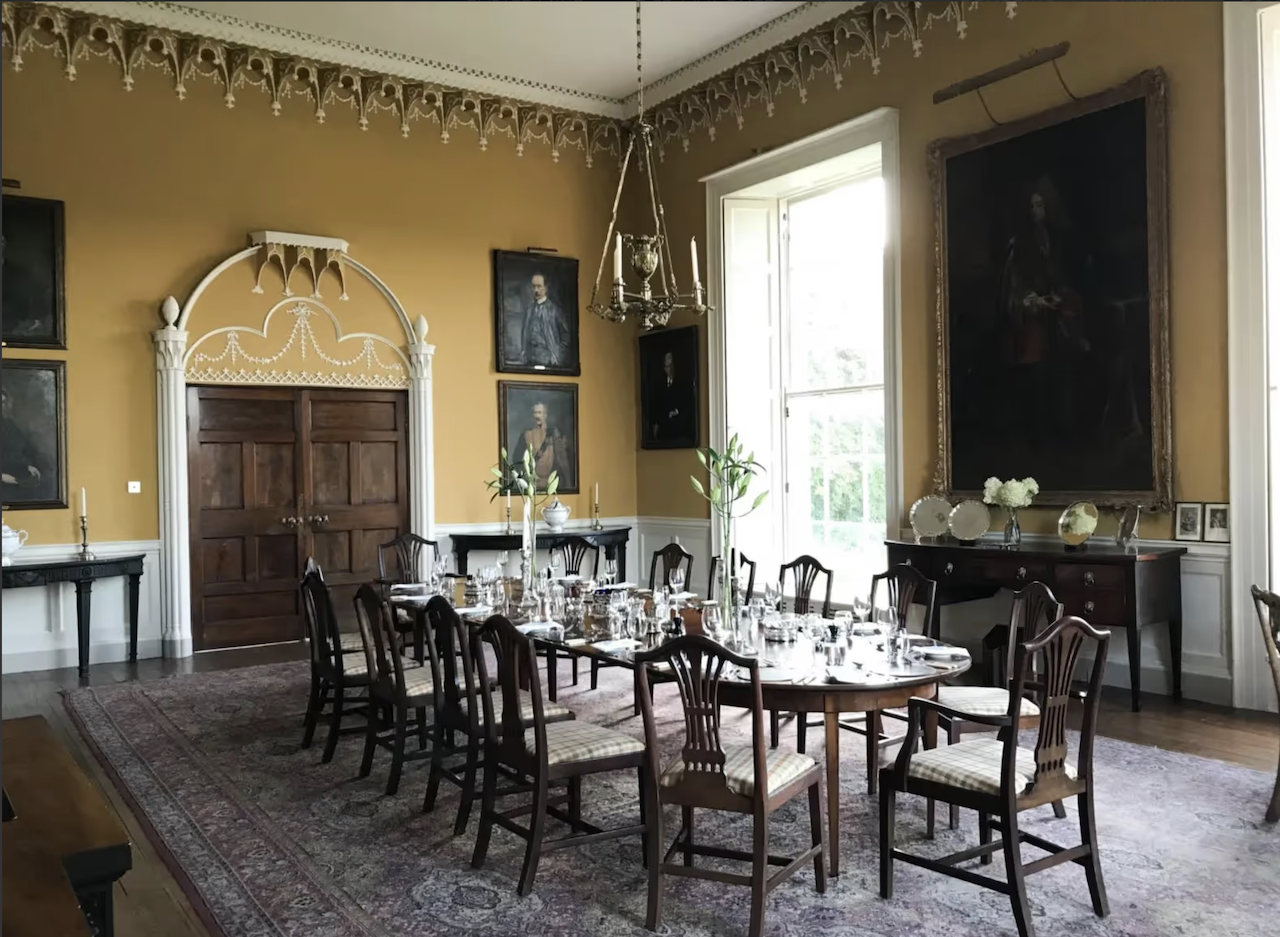
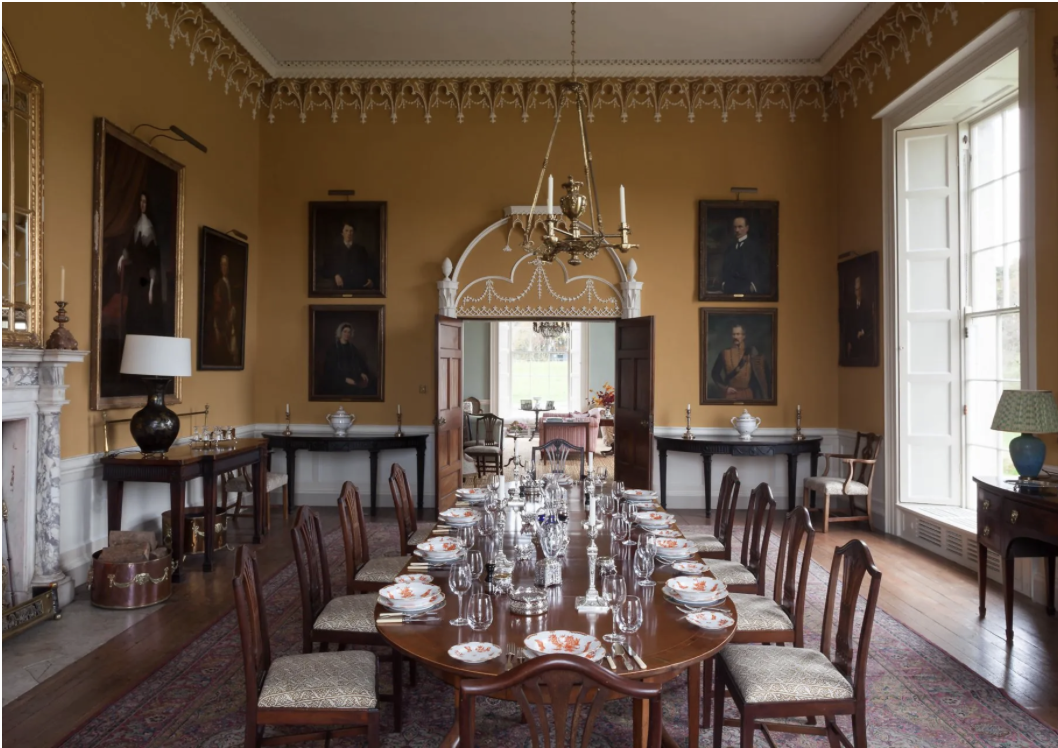
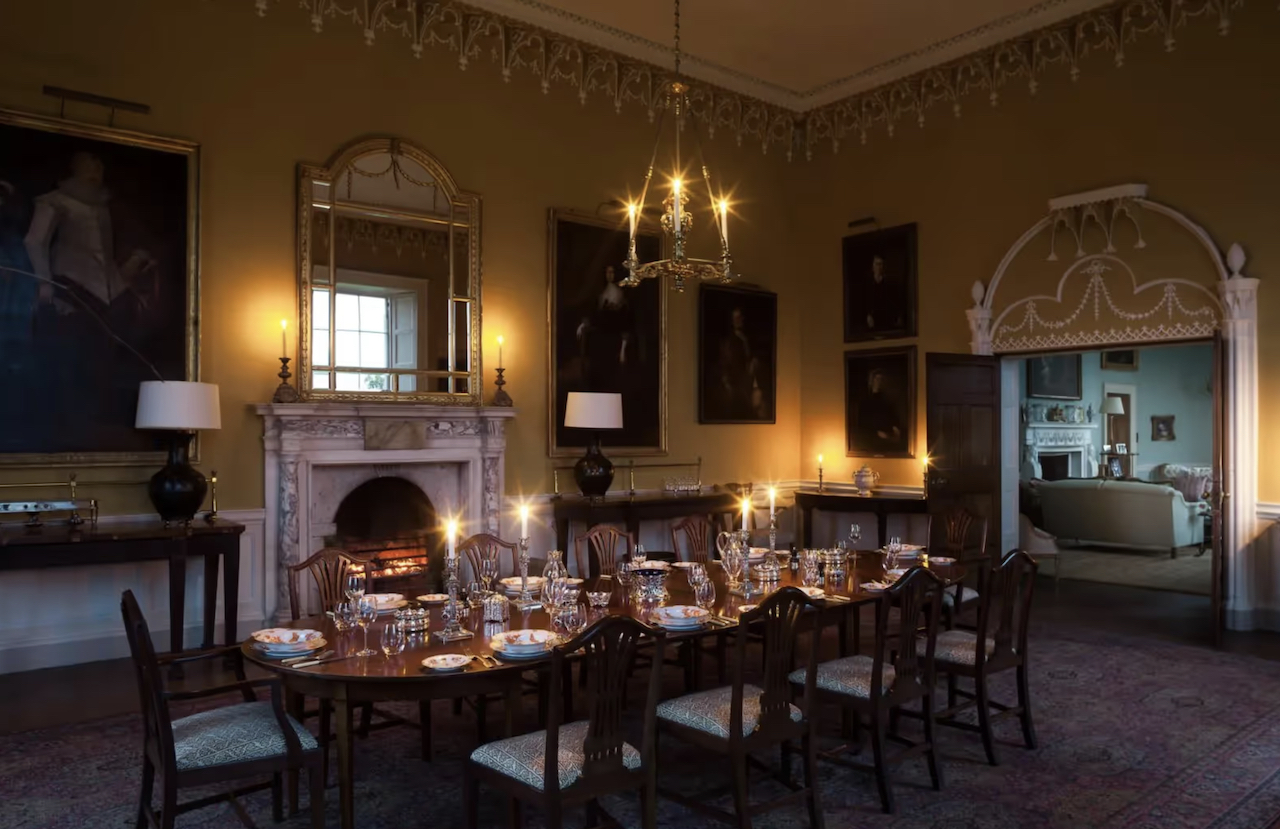
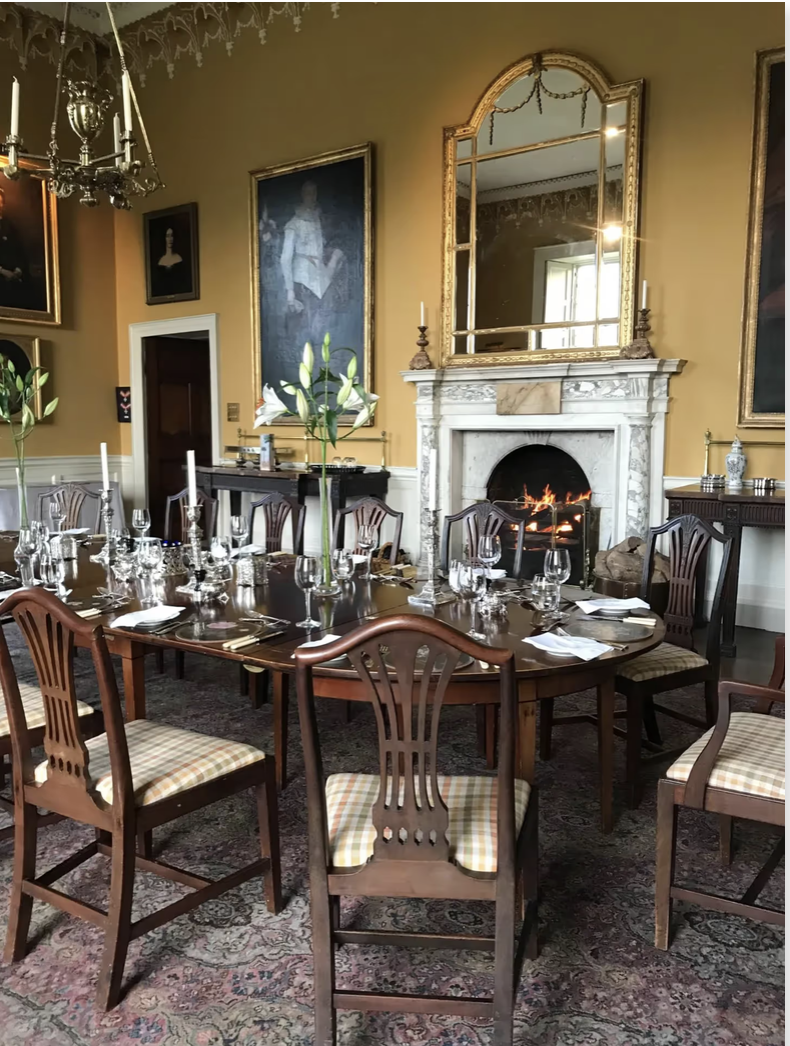
The drawing room and dining room are on either side of the entrance hall. The dining room on the west side has a coffered ceiling and a fireplace which is a copy of the west door of Magdalen College chapel, Oxford.
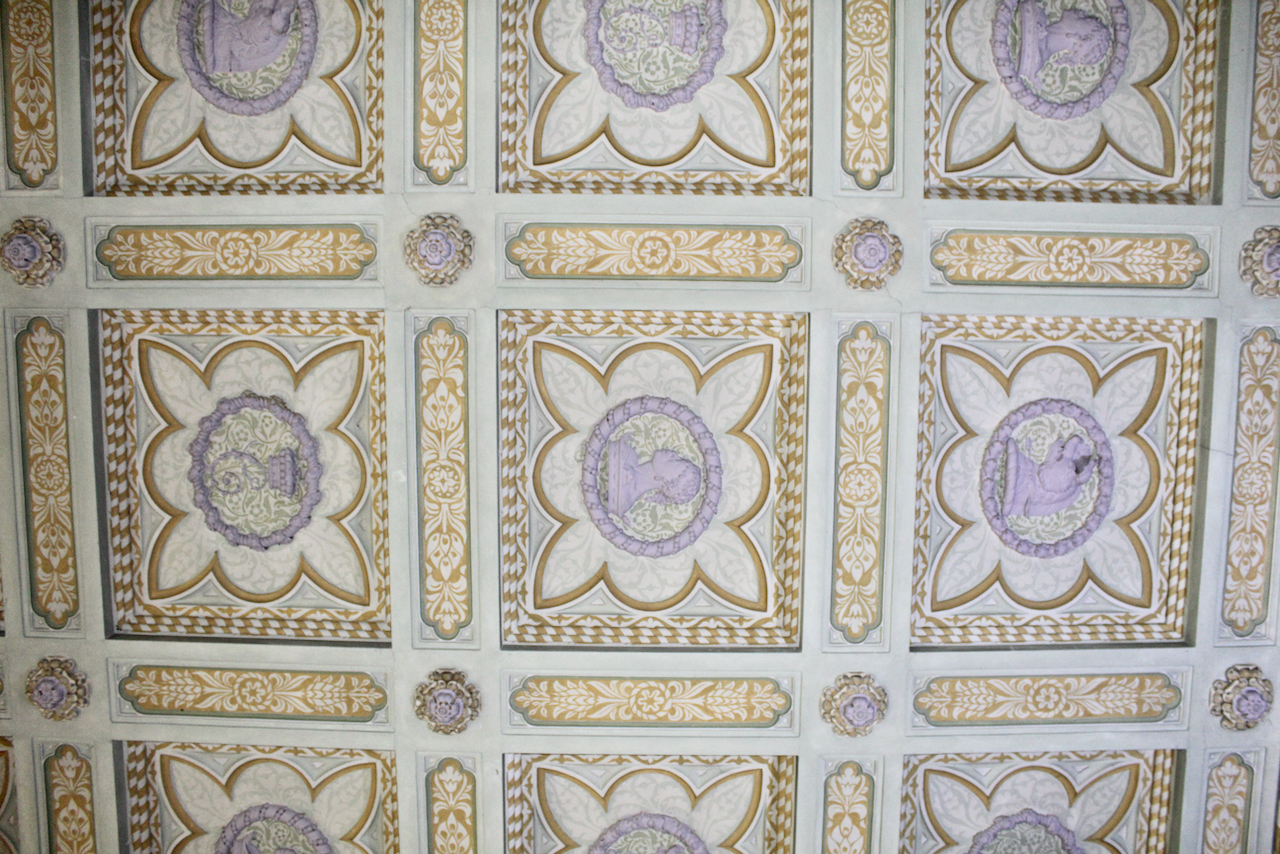
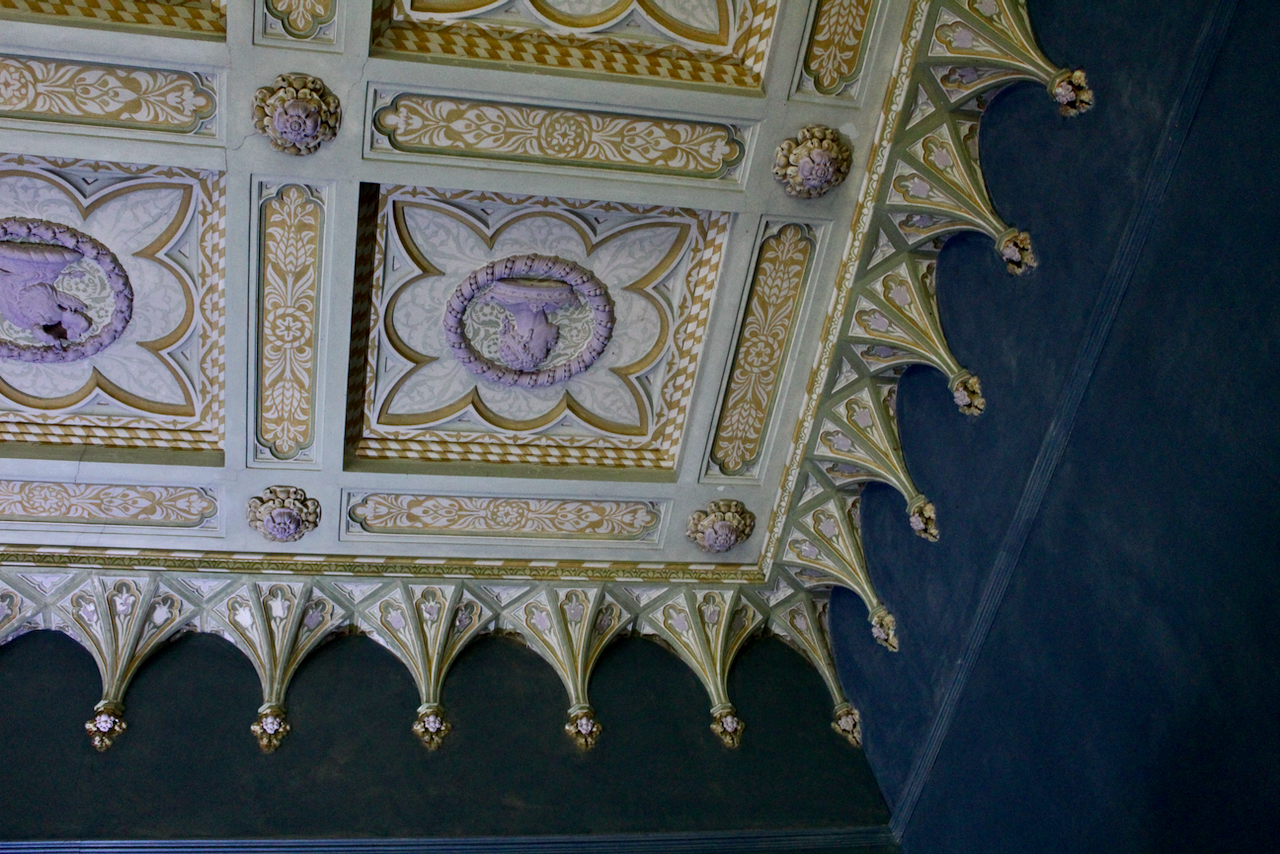
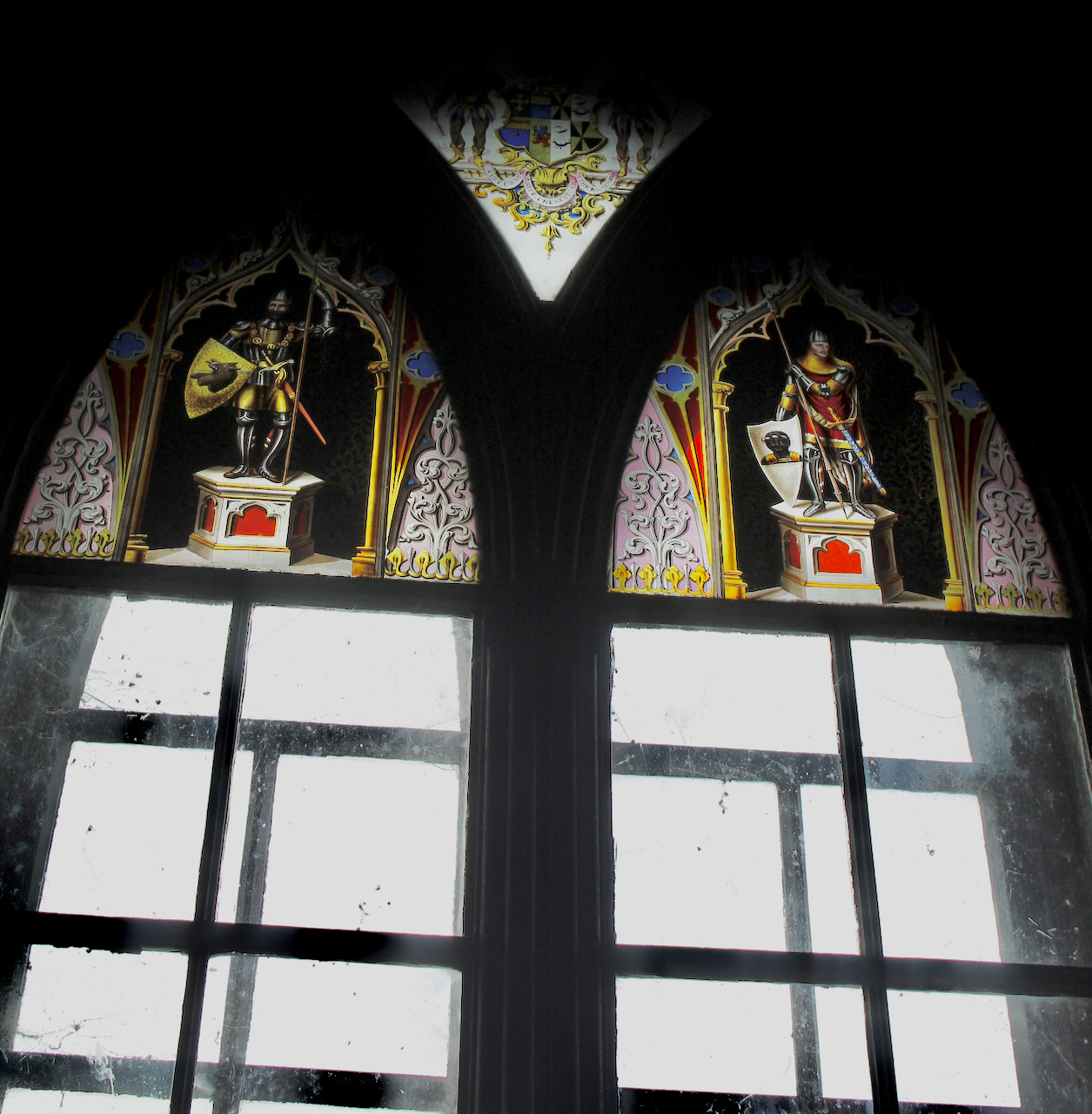
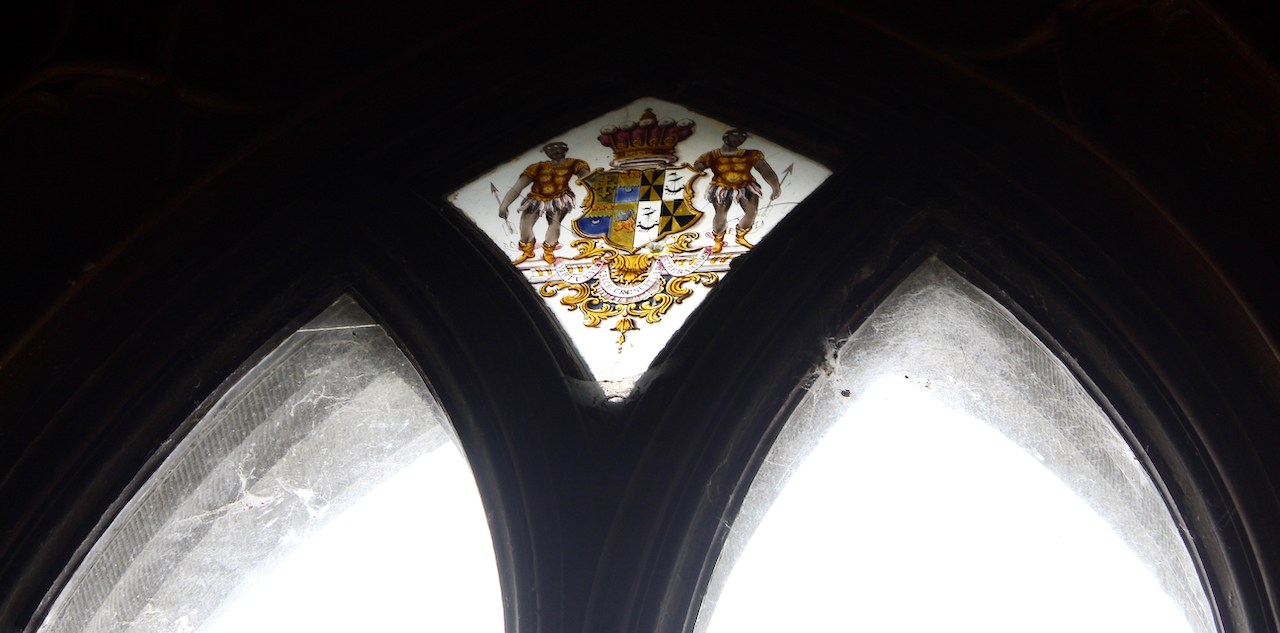
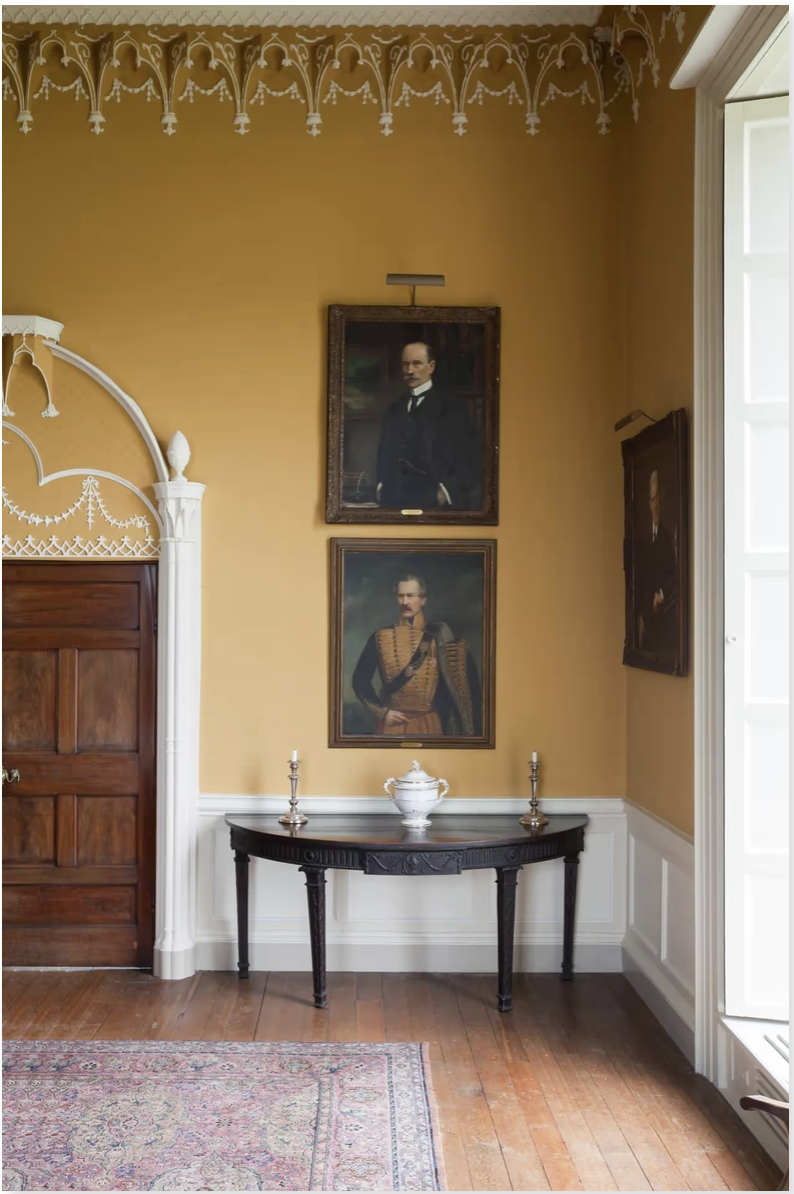
The dining room has, Tierney points out, a Dado of double-cusped panelling derived from the staircase balustrade of Strawberry Hill. The ceiling has crests of the family in the panel, supported by a Gothic frieze in the form of miniature fan vaults. The Moores are represented by a silhouette of a Moorish person, and the Burys by a boar’s head with an arrow through its neck. There are also “C”s for “Charleville.” The volunteers during Heritage Week told us that the ceiling is by William Morris, but Tierney tells us that he redecorated the room in 1875, but the scheme no longer survives. The decoration on the miniature fan vault frieze does look rather William Morris-esque to me, as well as the painting between the crests.
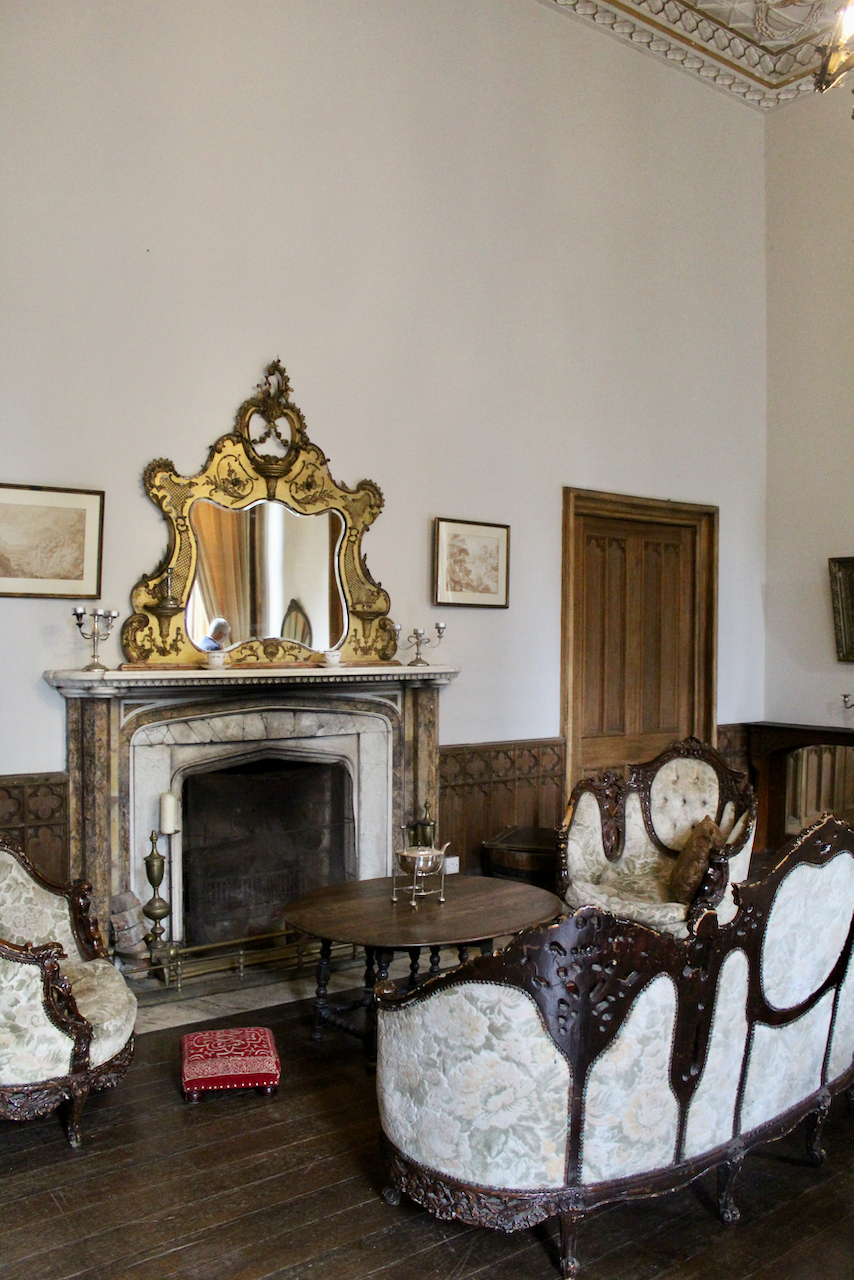
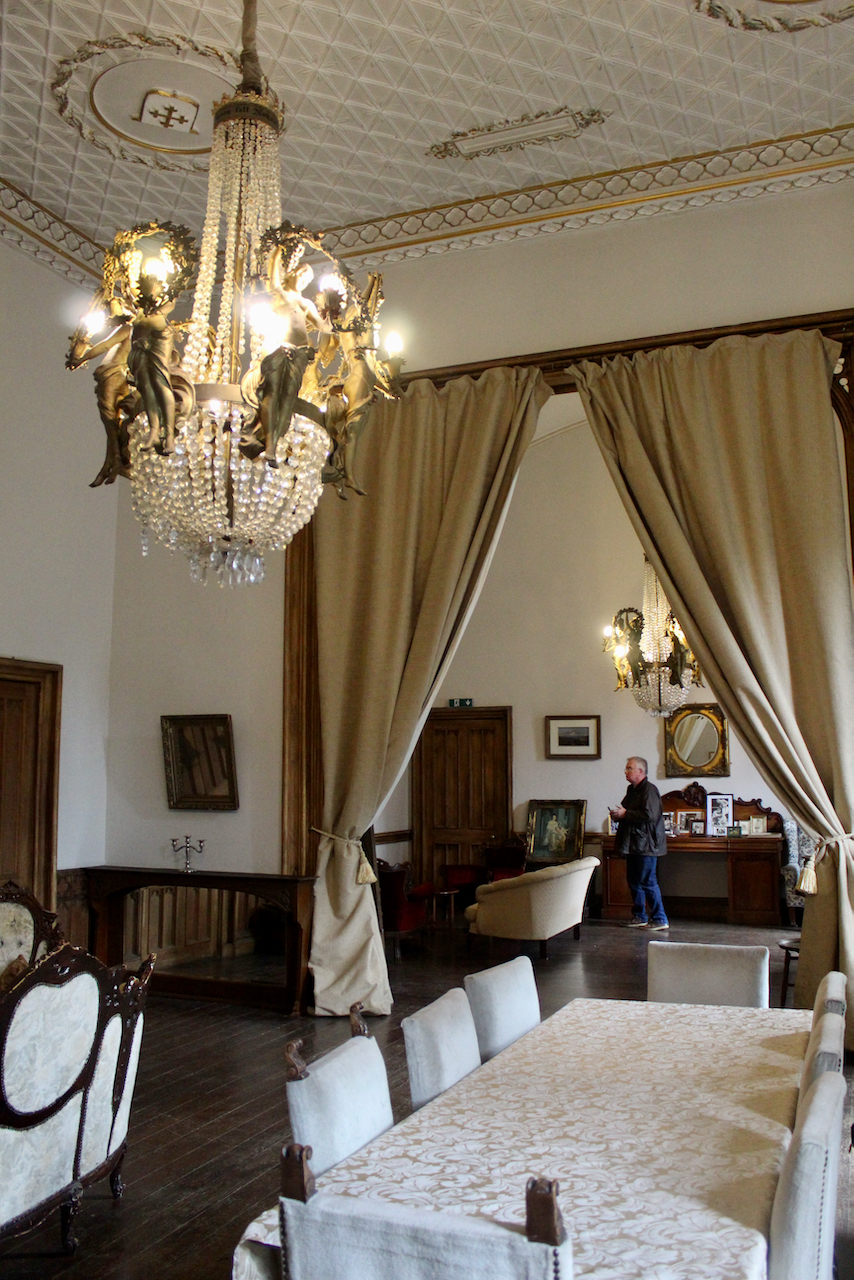
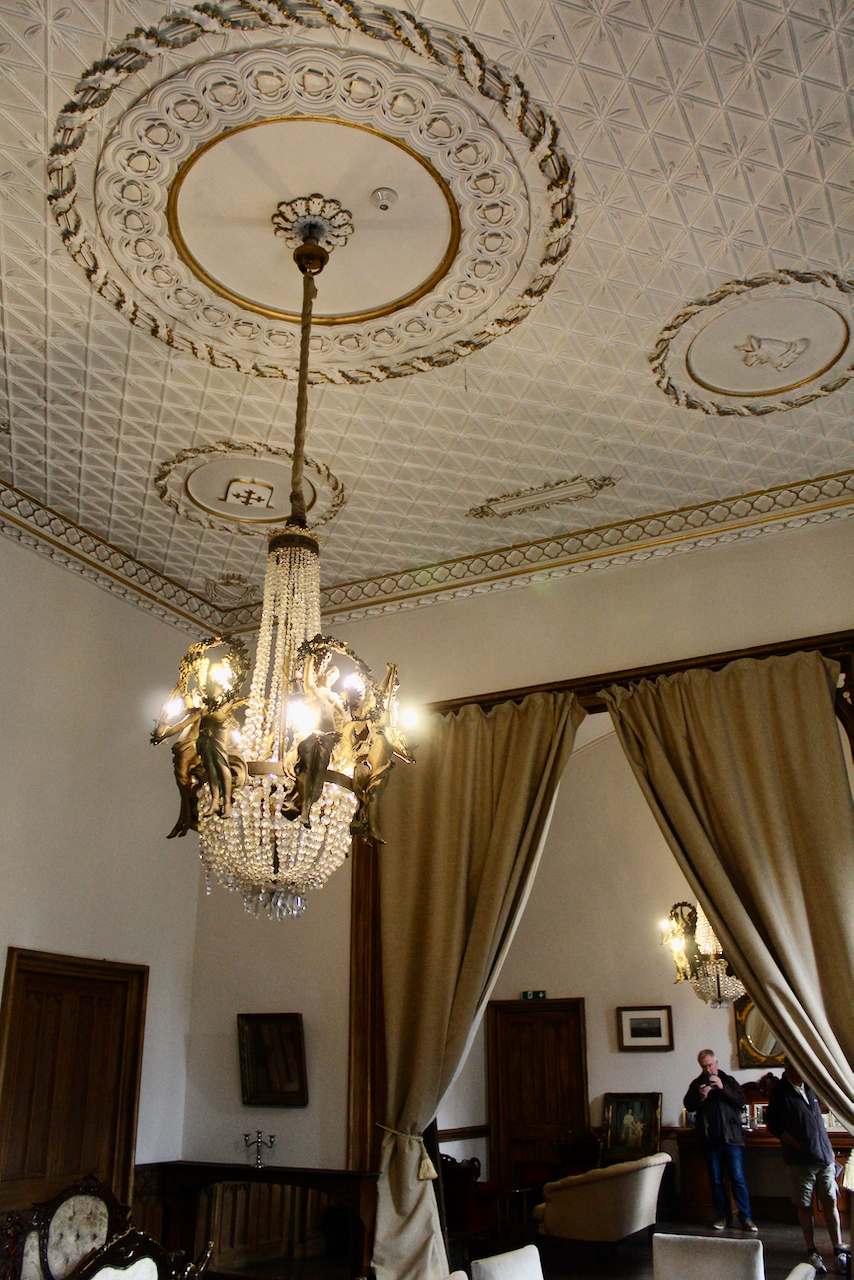
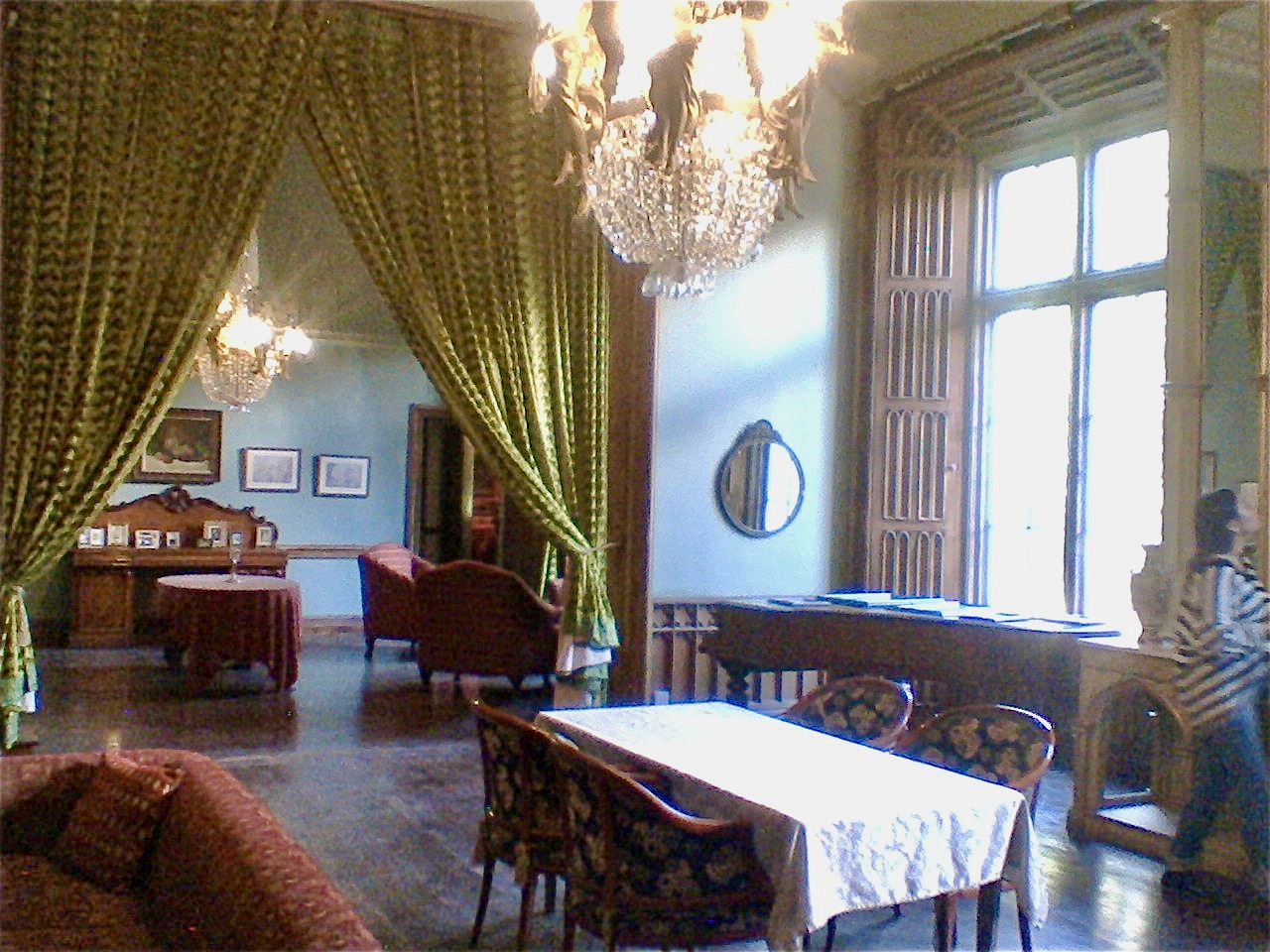
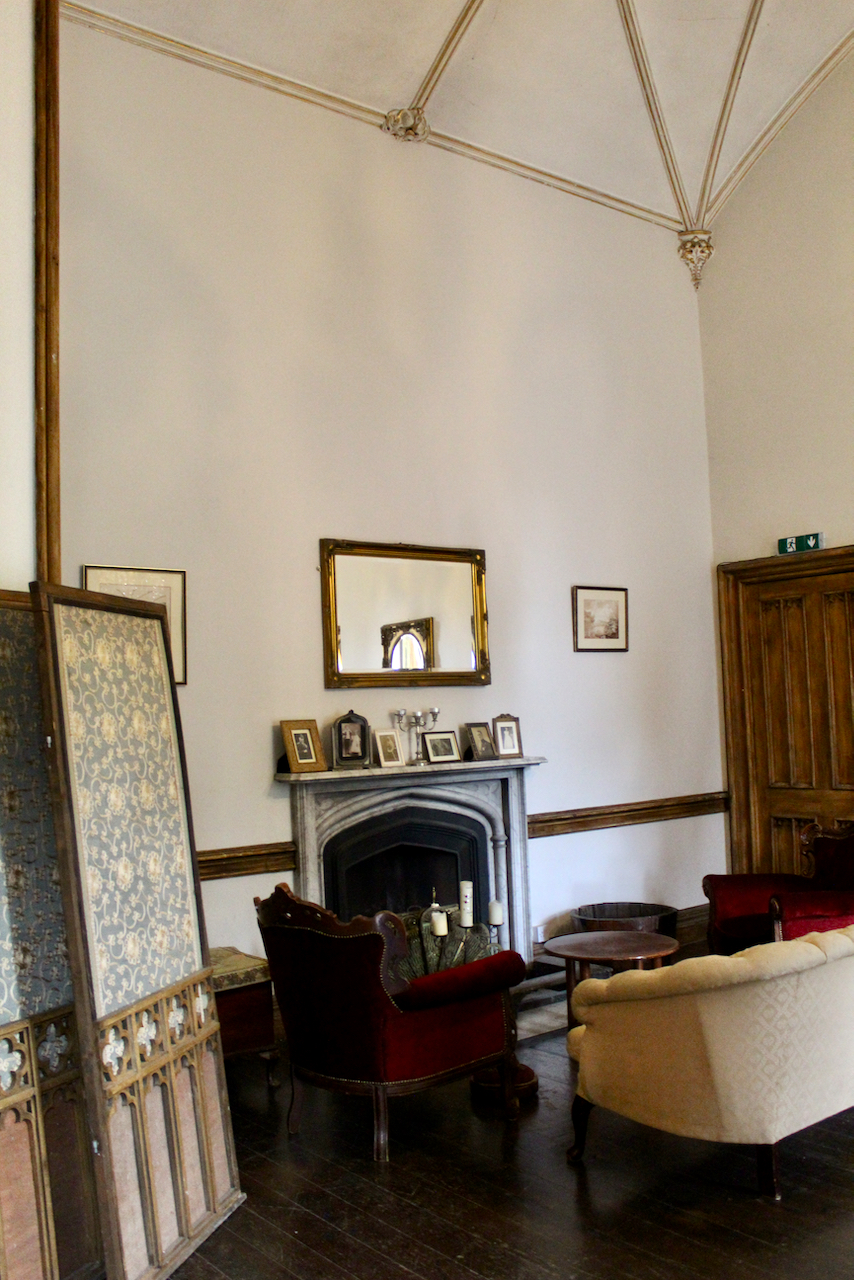
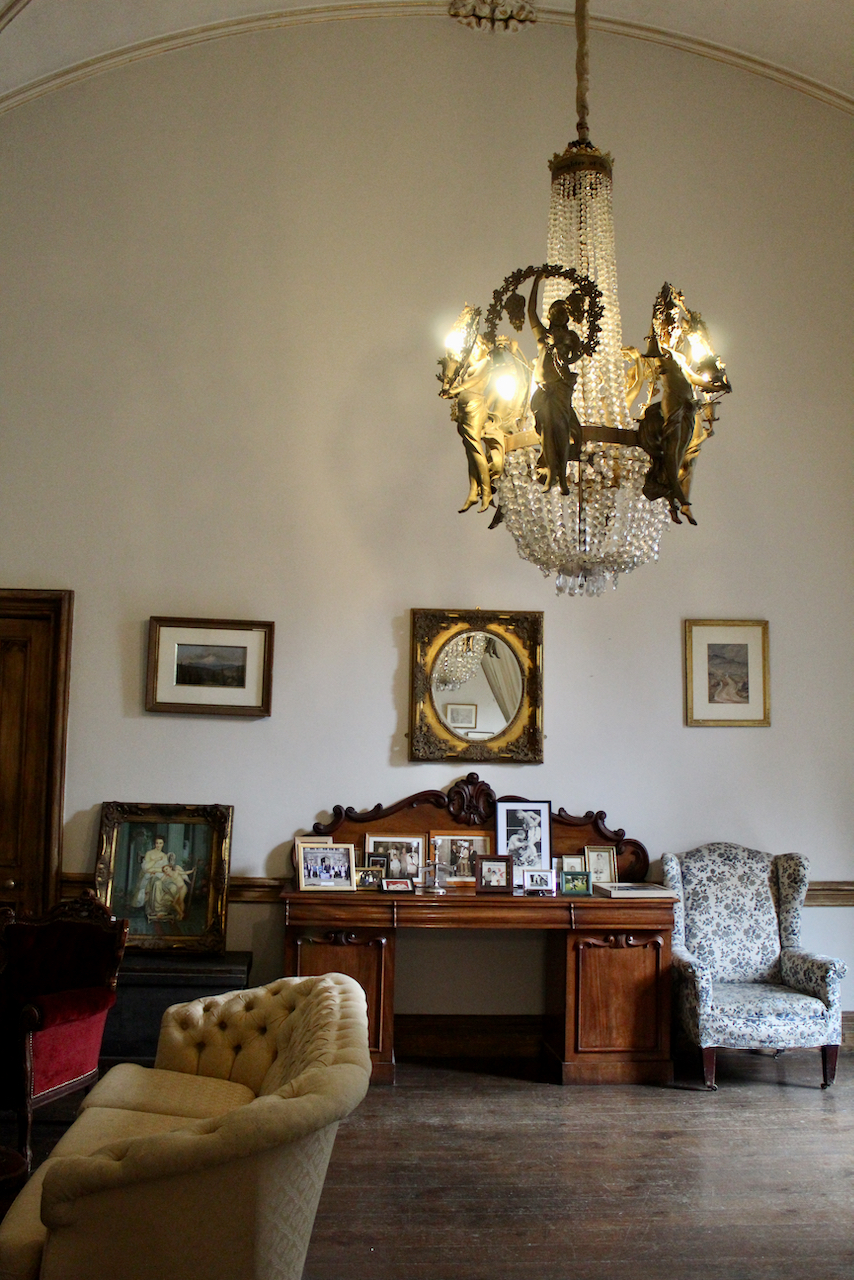
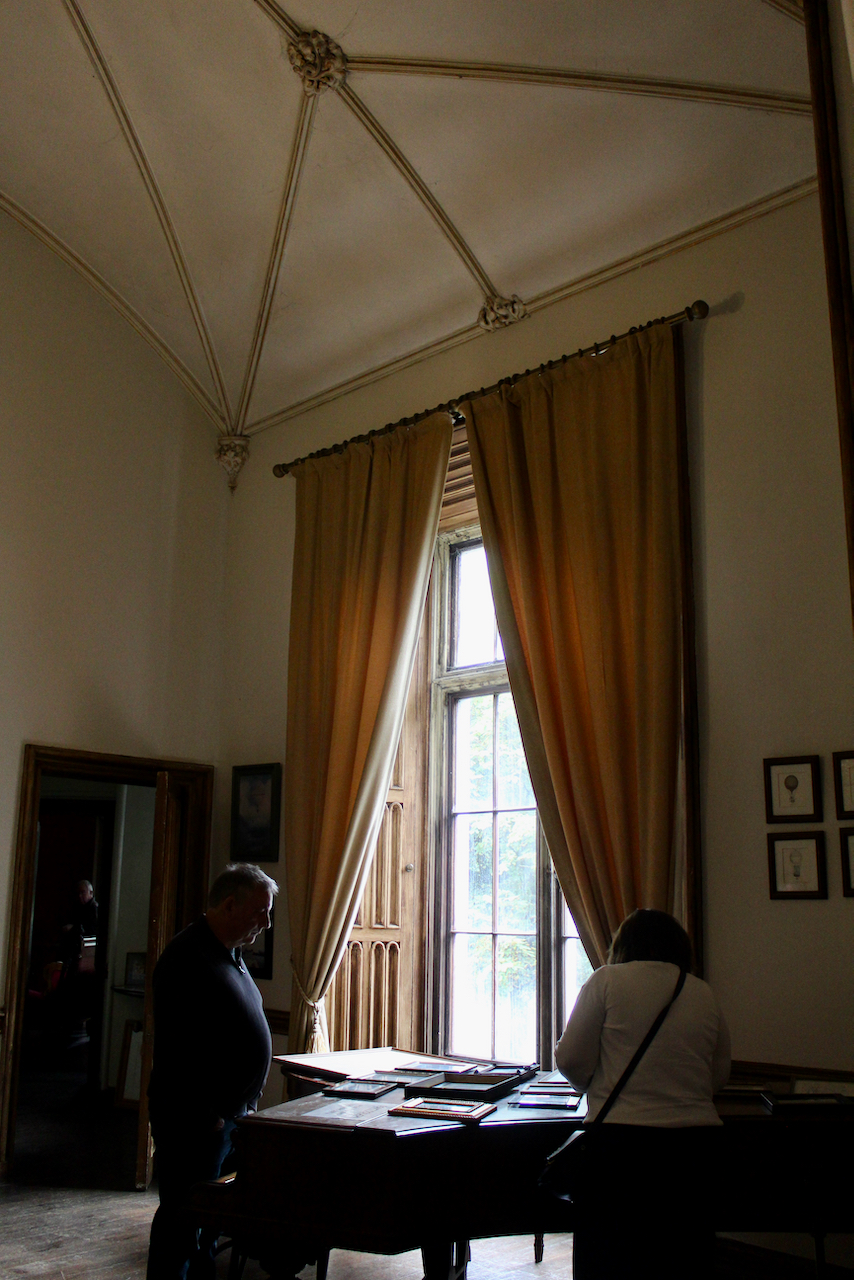
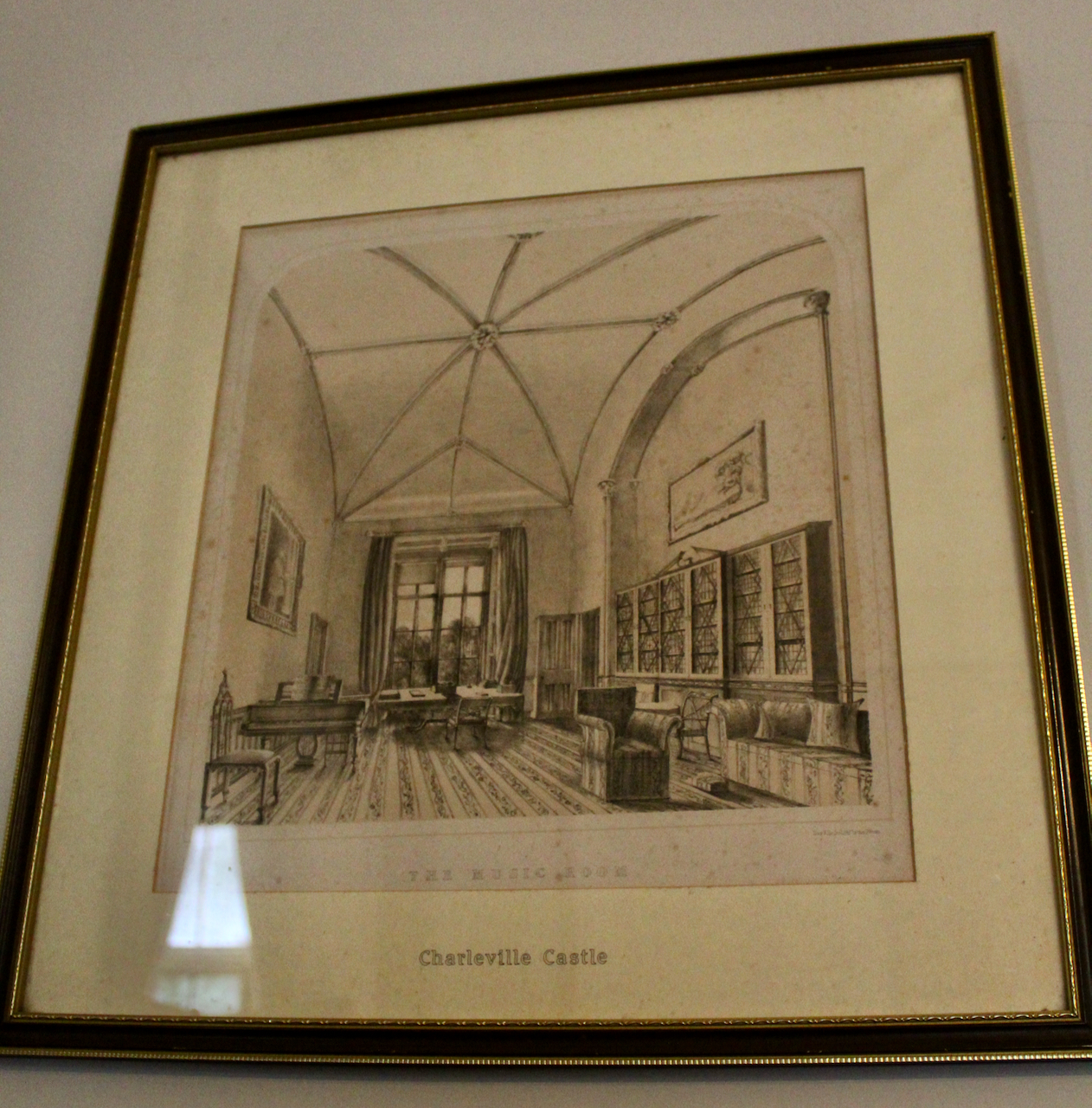
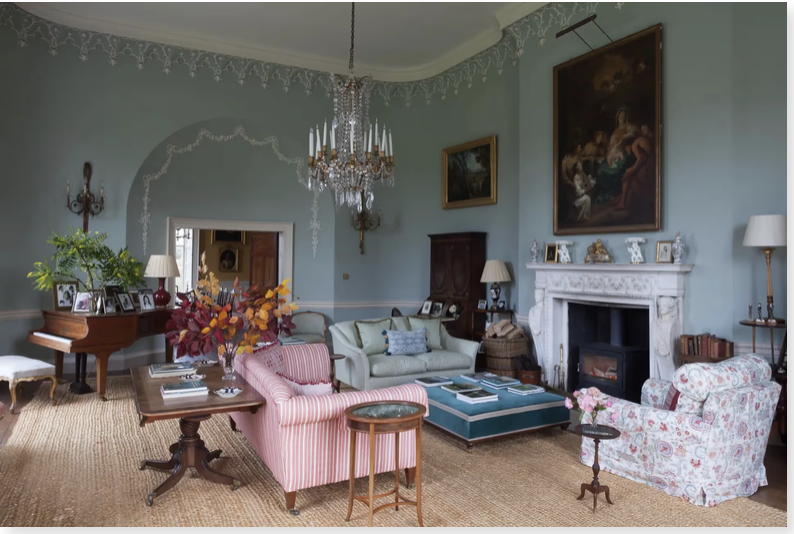
The Drawing Room is on the east side of the house. It has a fretwork ceiling with circular heraldic panels, a panelled dado and quatrefoil cornice. The room connects through a great arch with the rib-vaulted music room to its north. Unfortunately none of the furniture is original to the house but was brought it by the current owners.
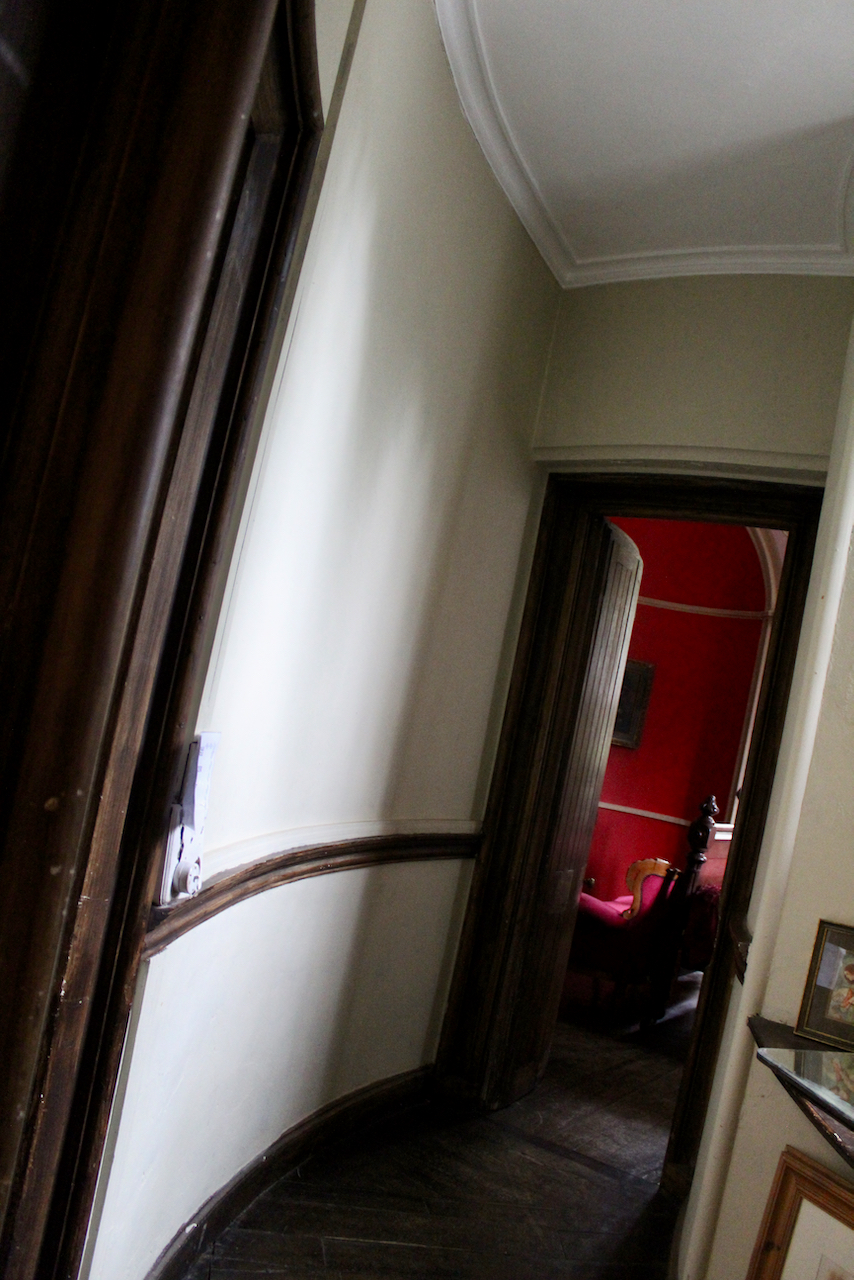
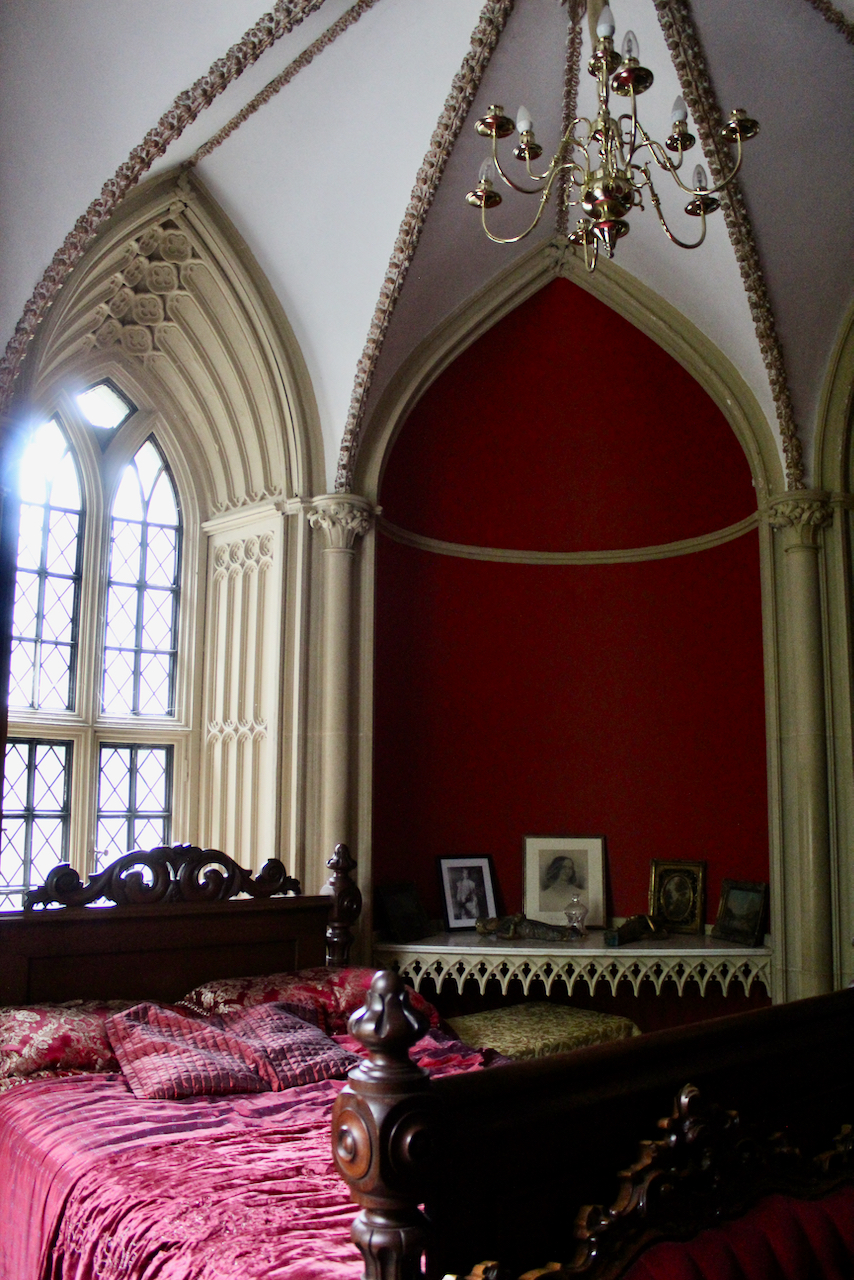
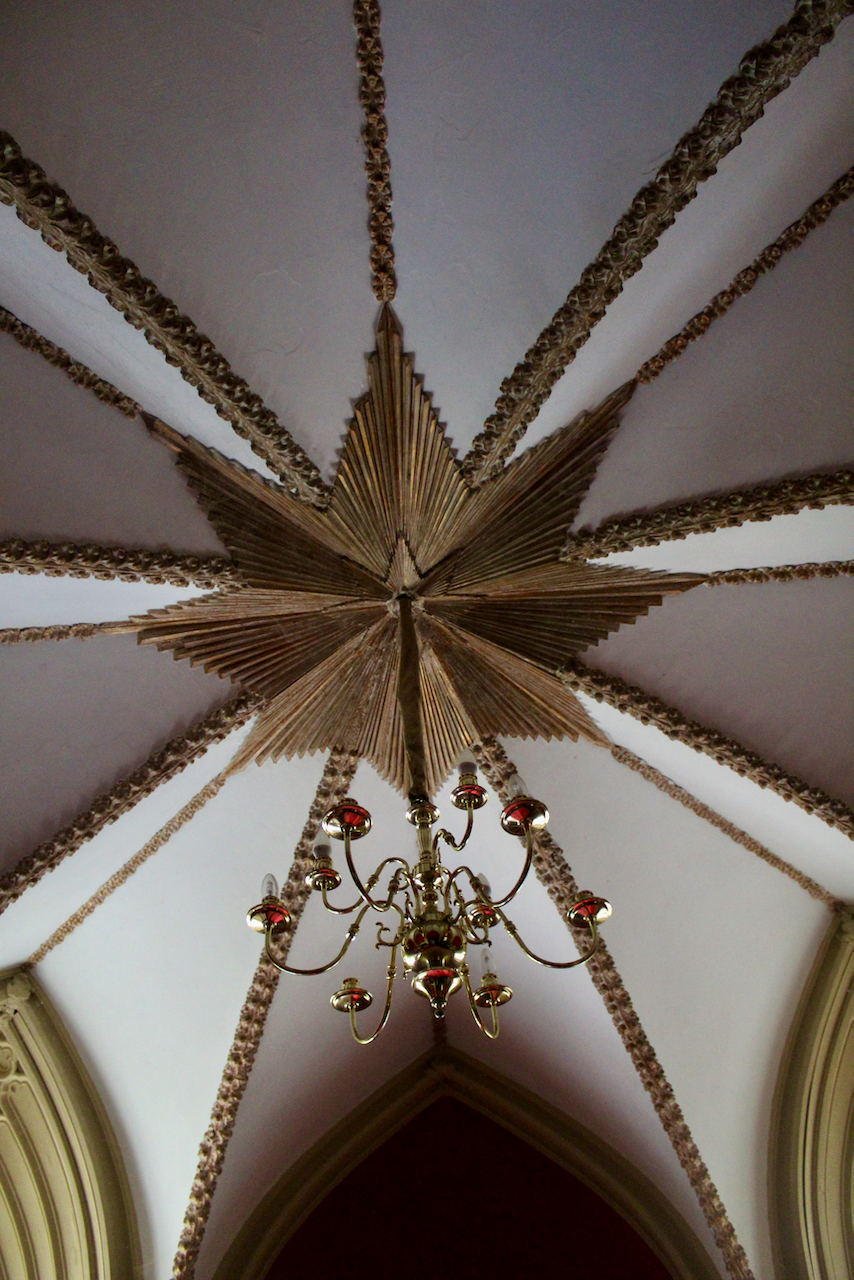
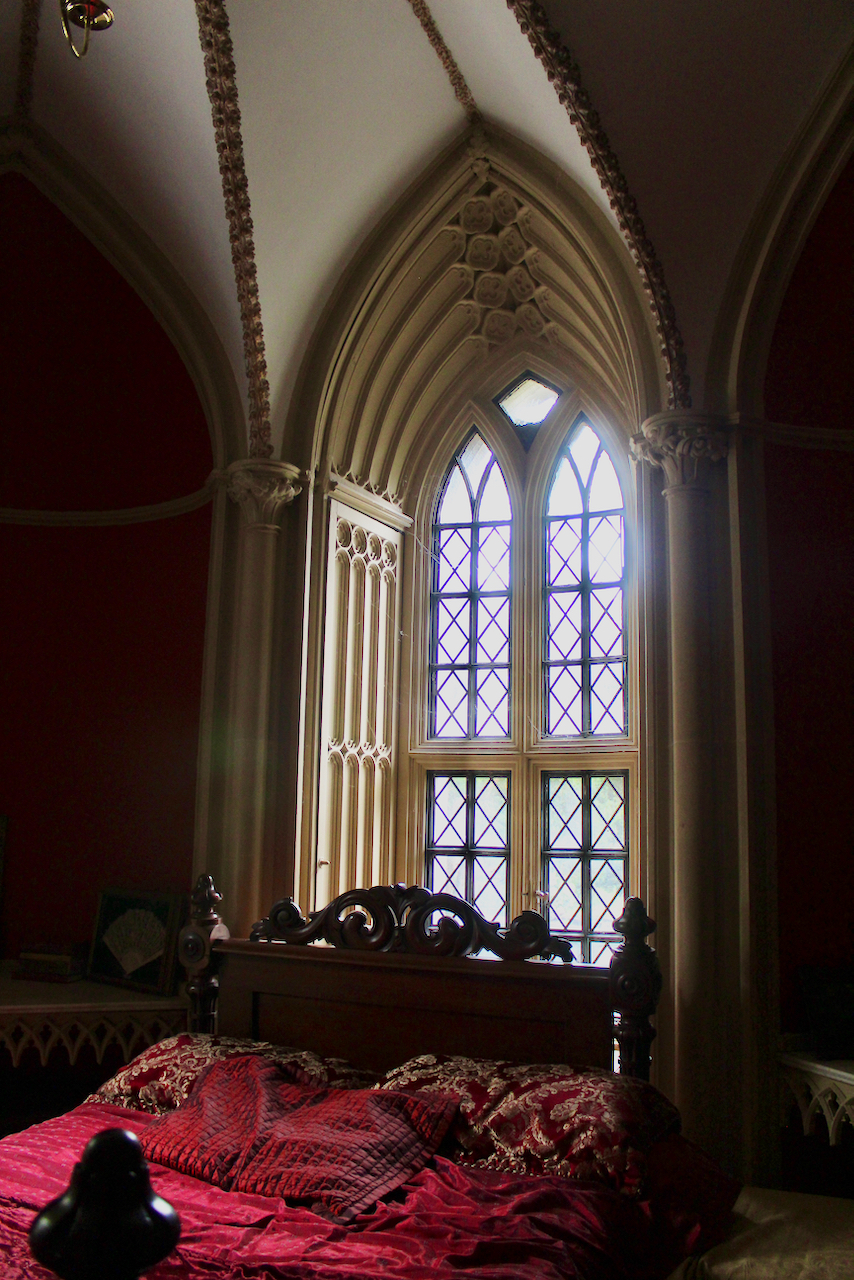
The Music Room connects via a curved short corridor to the Boudoir in the northeast tower, a homage to Walpole’s Tribune in Strawberry Hill, Tierney tells us. This used to be my friend Howard Fox’s bedroom when he was staying as a guest, leading mushroom foraging walks in Charleville Woods! It is a star-vaulted circular room, with bays alternating between four wide round niches and smaller openings for windows, door and fireplace. Above was Lord Charleville’s dressing room, but we did not get to go there.
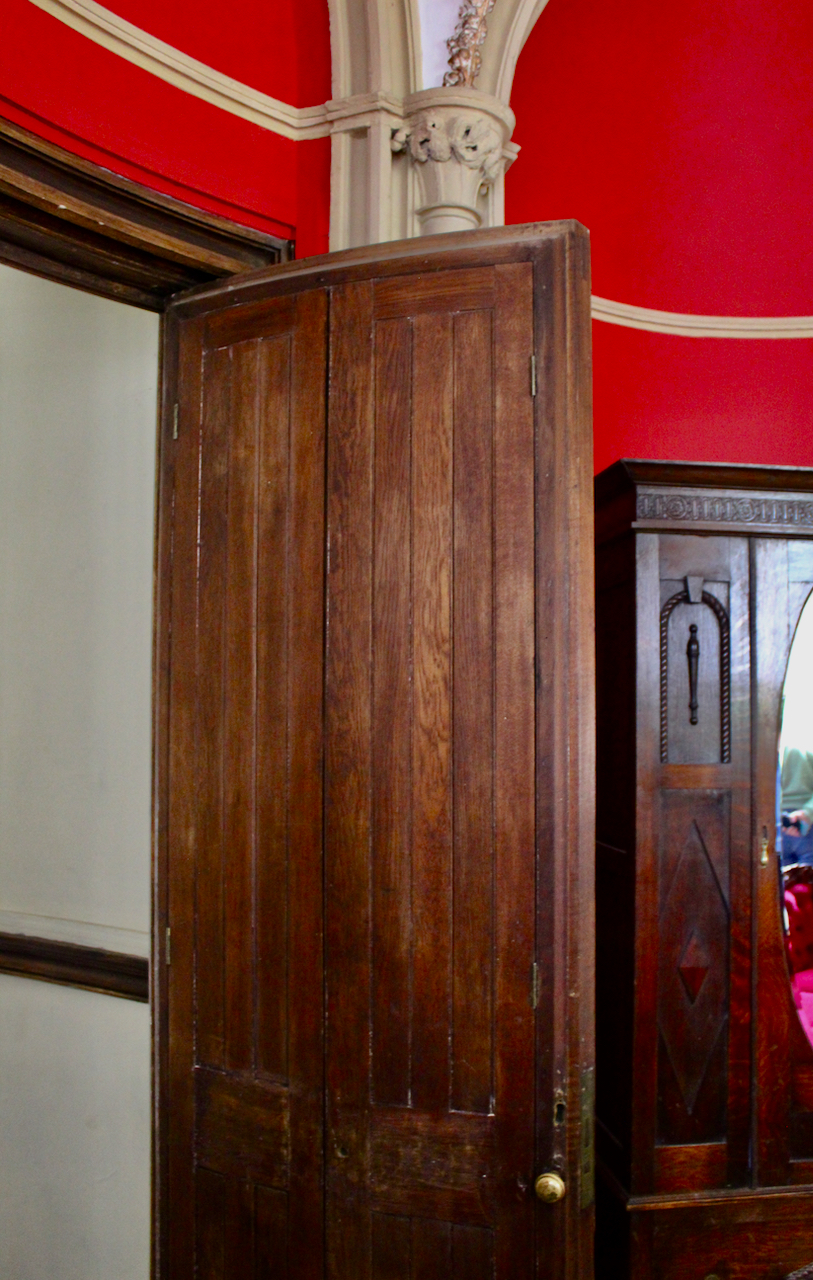
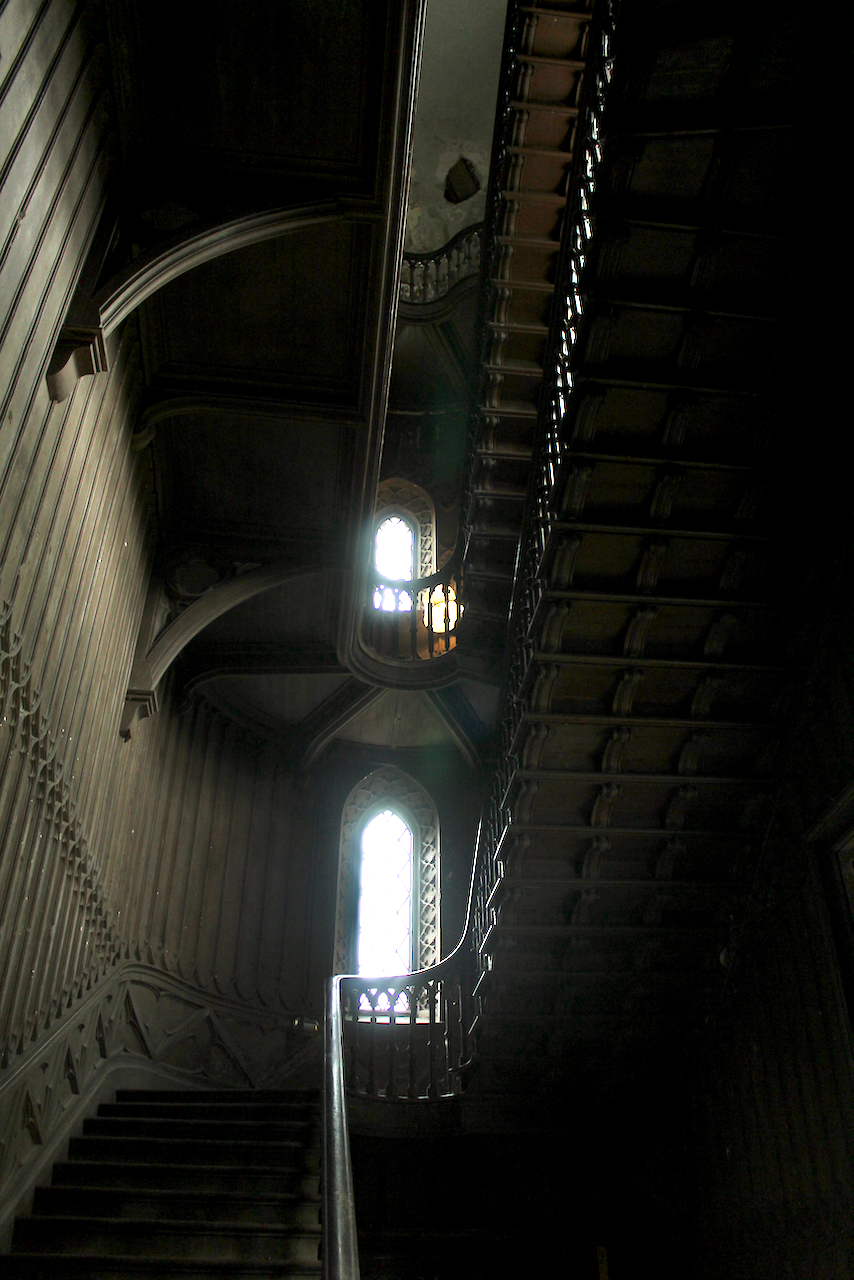
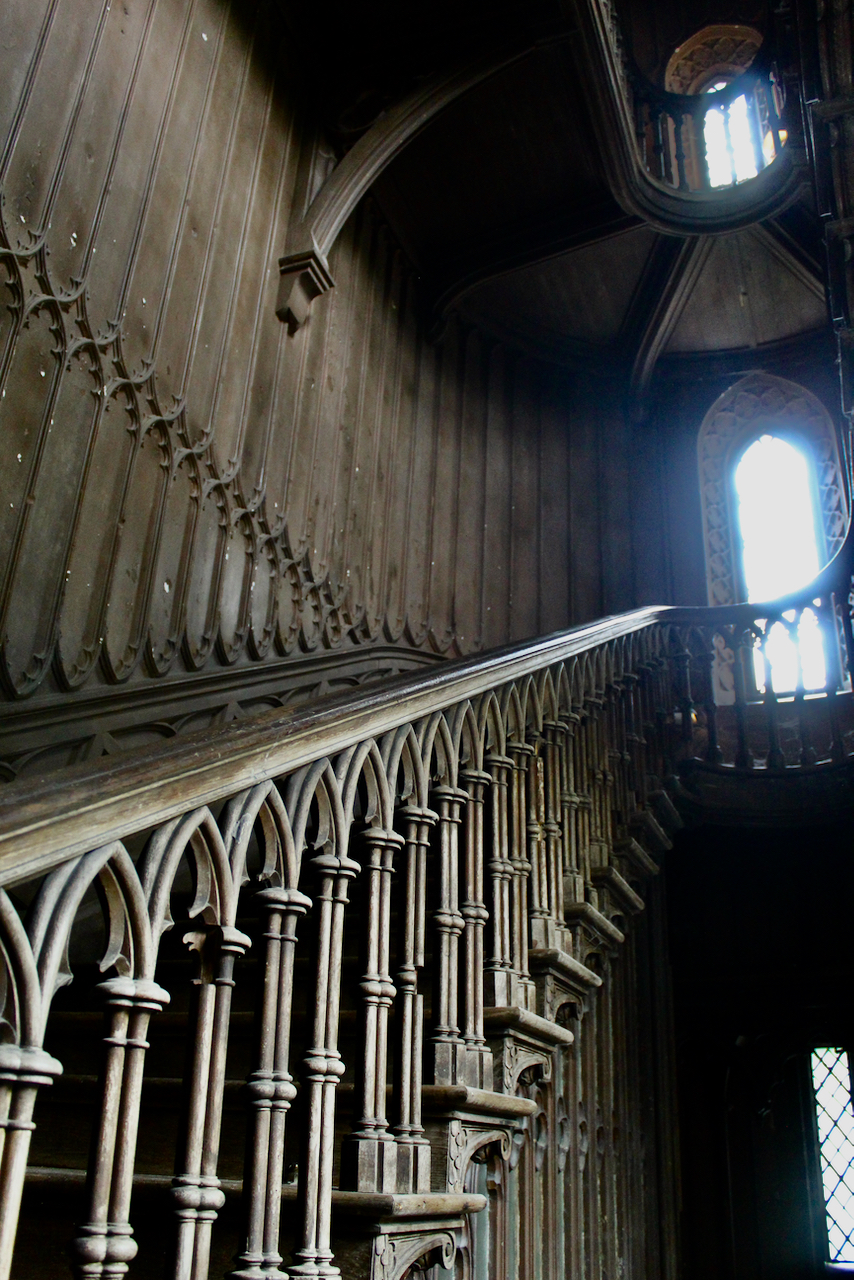
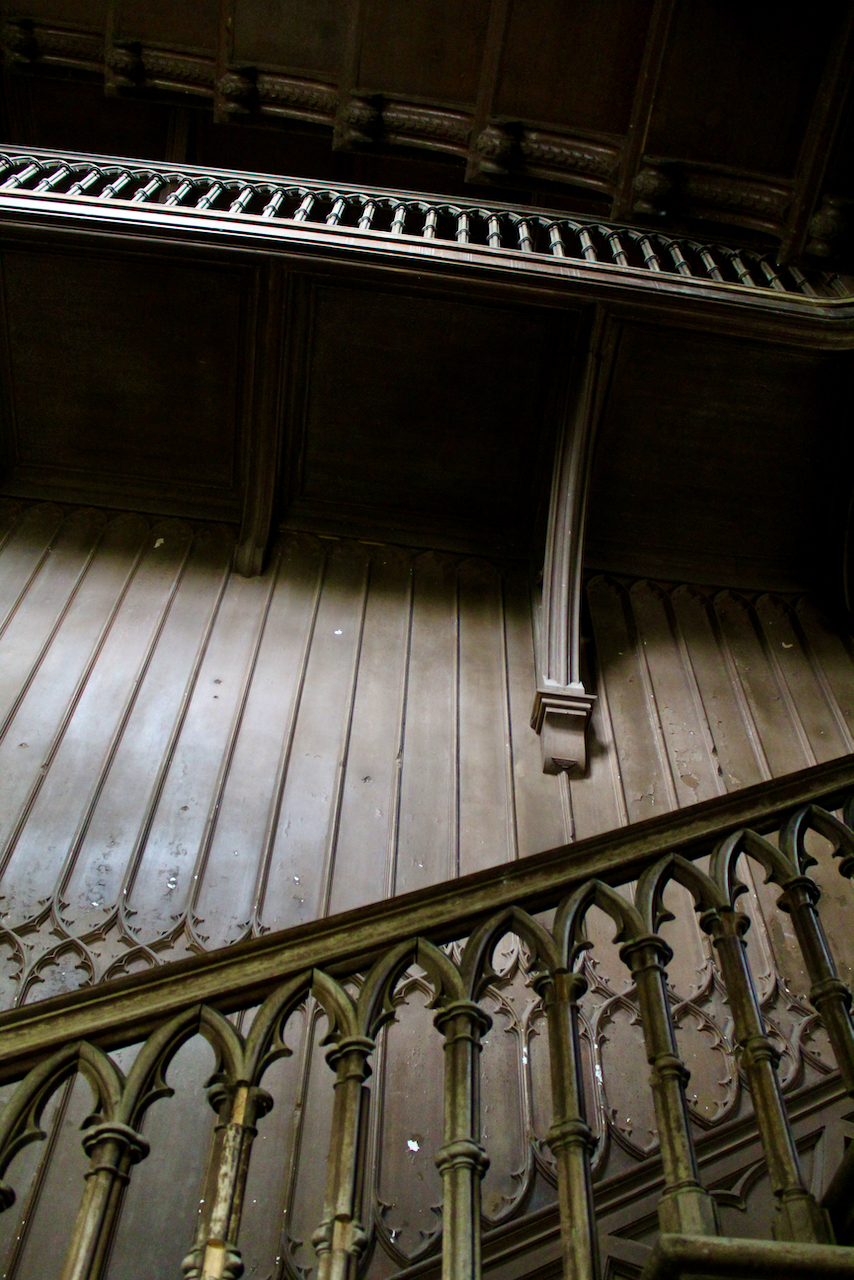
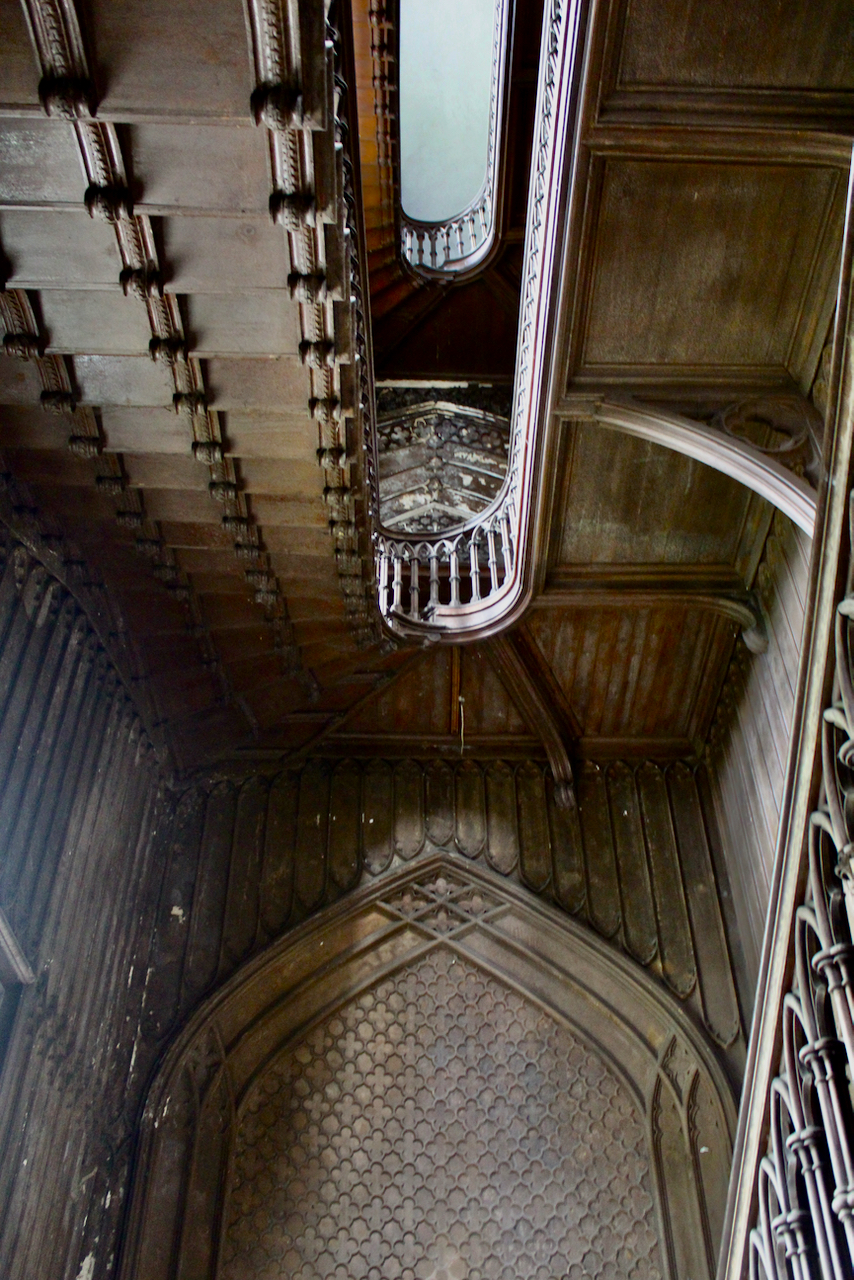
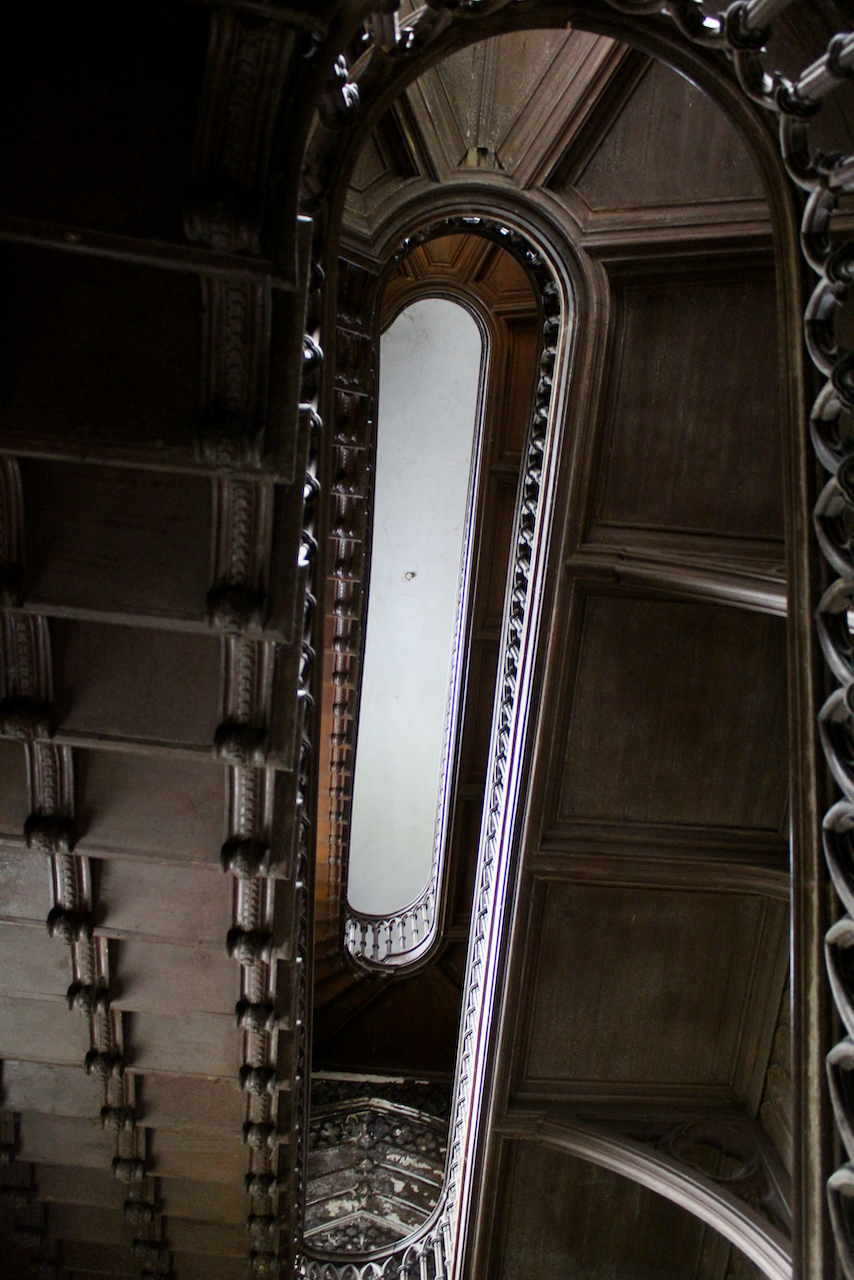
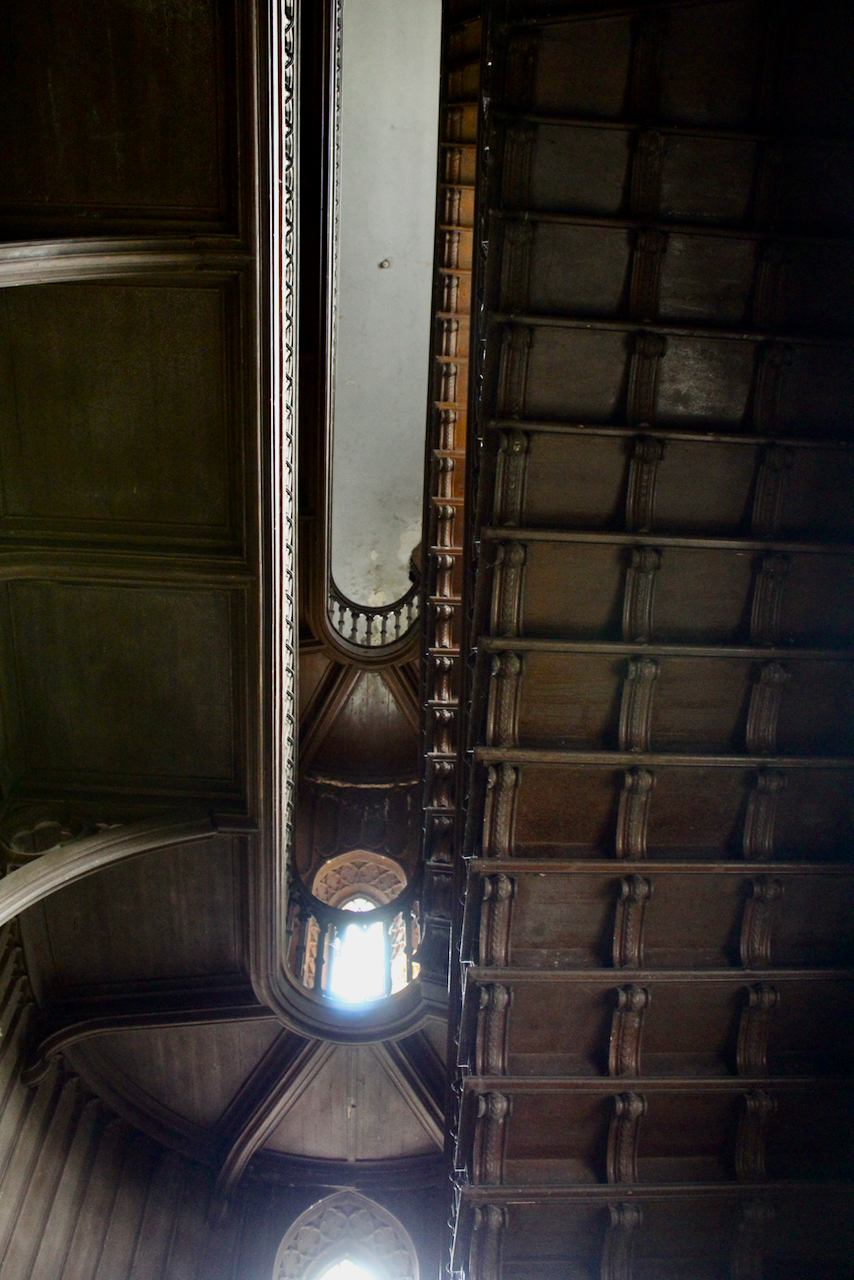
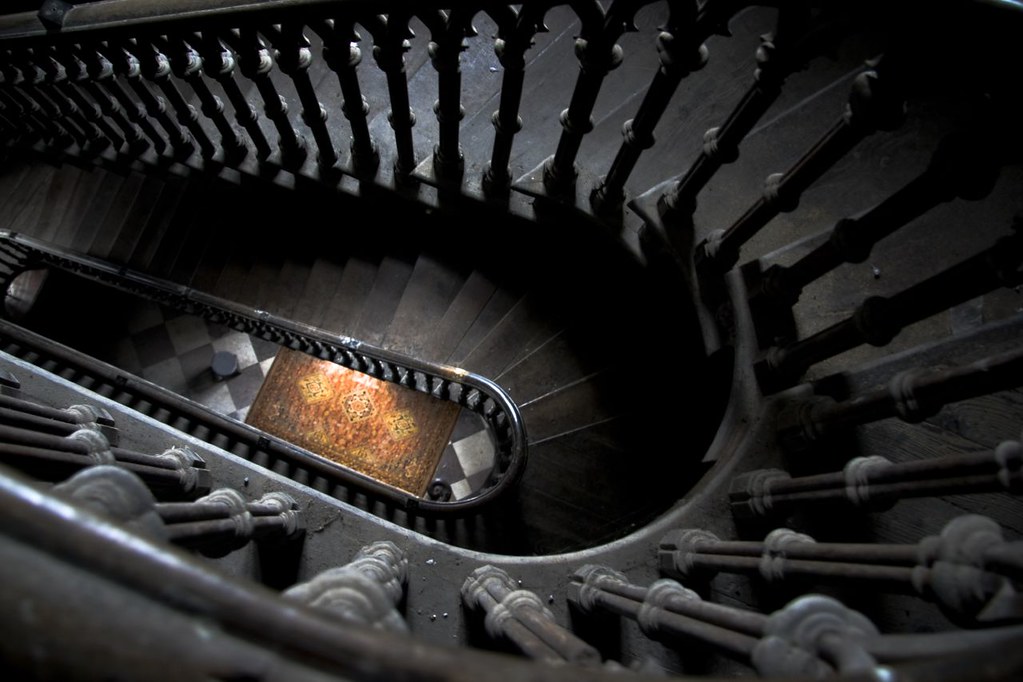
The stairs is tucked away in an odd place, behind a door off the northwest corner of the entrance hall. It is an intricate tightly curved staircase of Gothic joinery leading to the upper storeys, with Gothic mouldings on walls. The wall panelling is plaster painted and grained to look like oak. It rises through three storeys.
Tierney tells us that at the top of each flight, there is a great cavetto-moulded doorcase enriched with quatrefoil fretwork in plaster. The cavetto is a concave molding with a profile approximately a quarter-circle, quarter-ellipse, or similar curve. I find the staircase thrilling. Tierney writes: “Its dark colouring is in tune with the “gloomth” of its north facing aspect, and no Gothic room in Ireland rivals its Hmmer Horror atmosphere“!
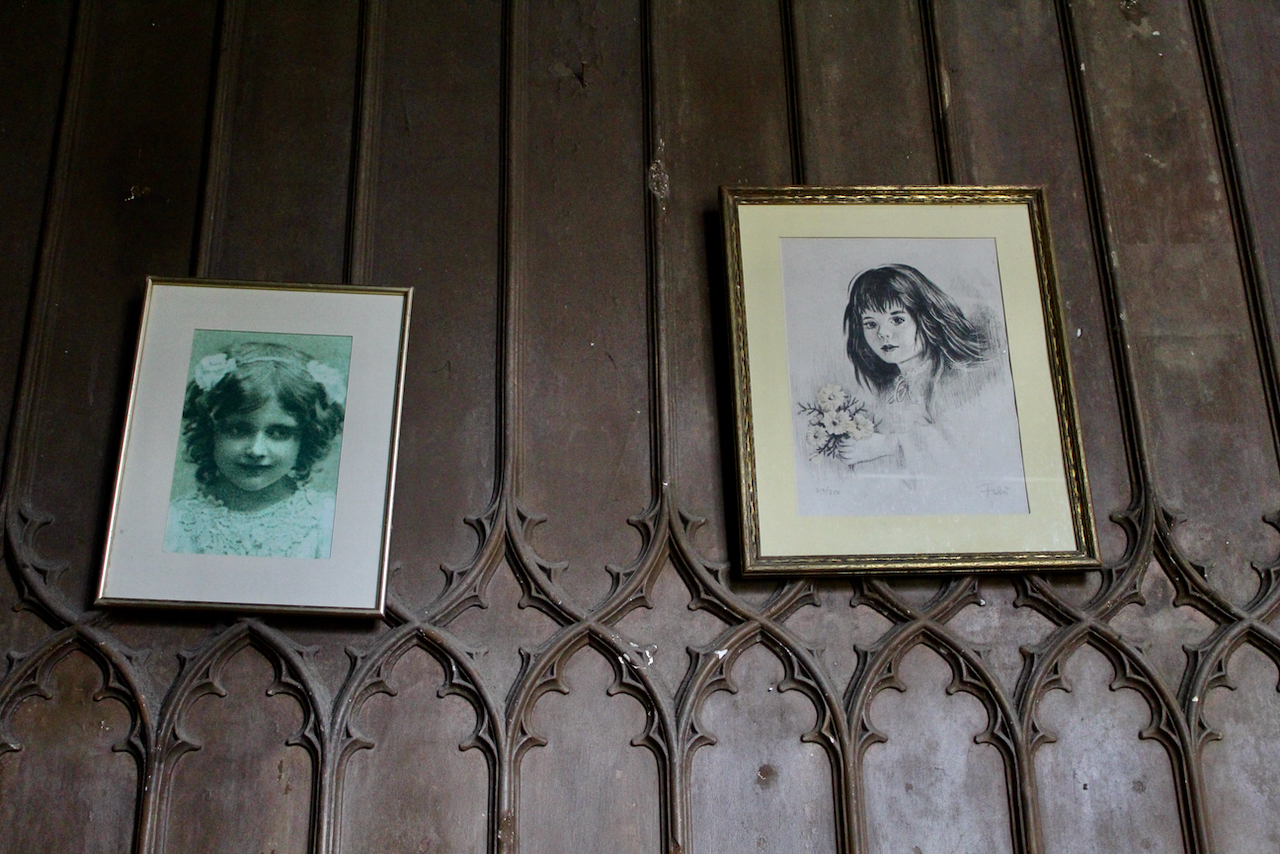
A tragic accident occurred in 1861 when the 5th Earl’s young sister Harriet was sliding down the balustrade of the Gothic staircase from the nursery on the third floor and fell. She is said to haunt the staircase and to be heard singing.
I’m not sure if this is a photograph of Harriet who died falling from the staircase.
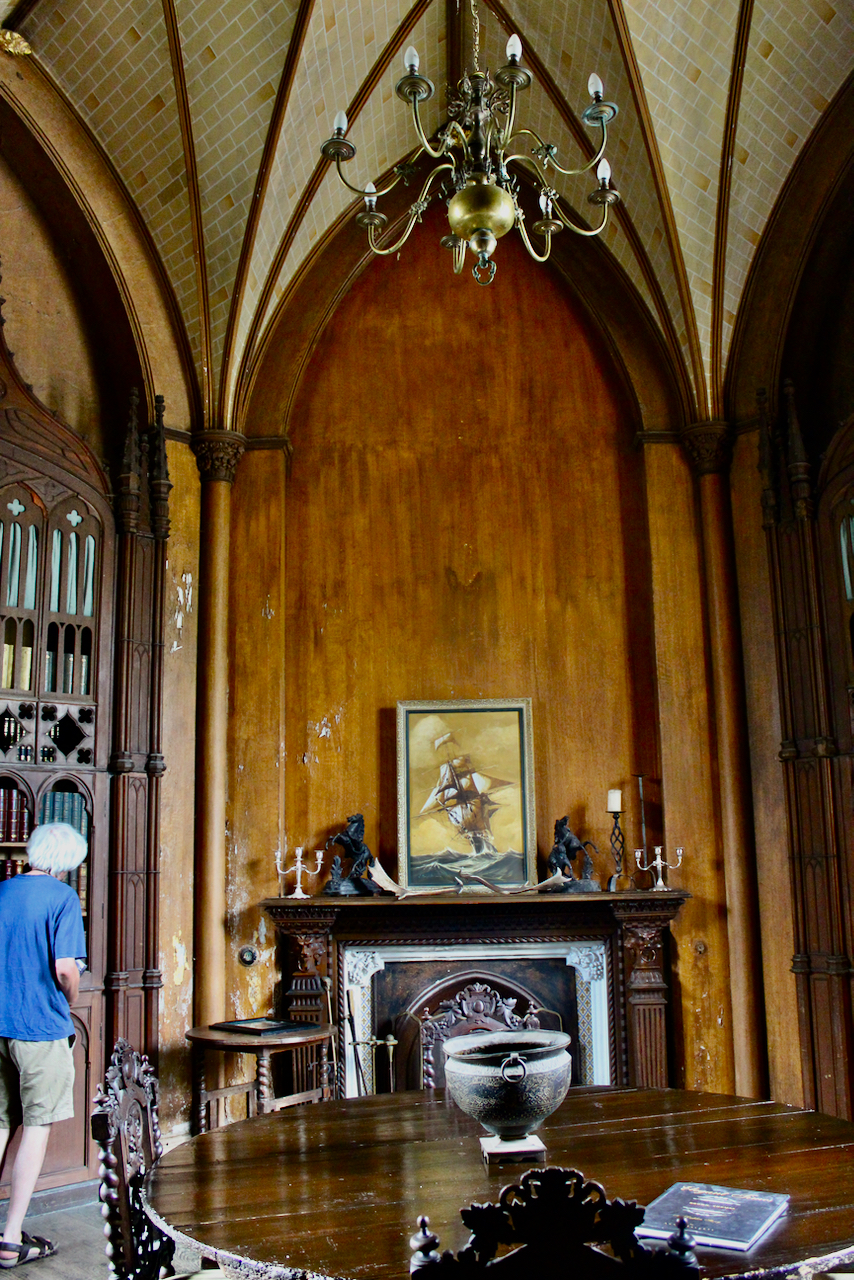
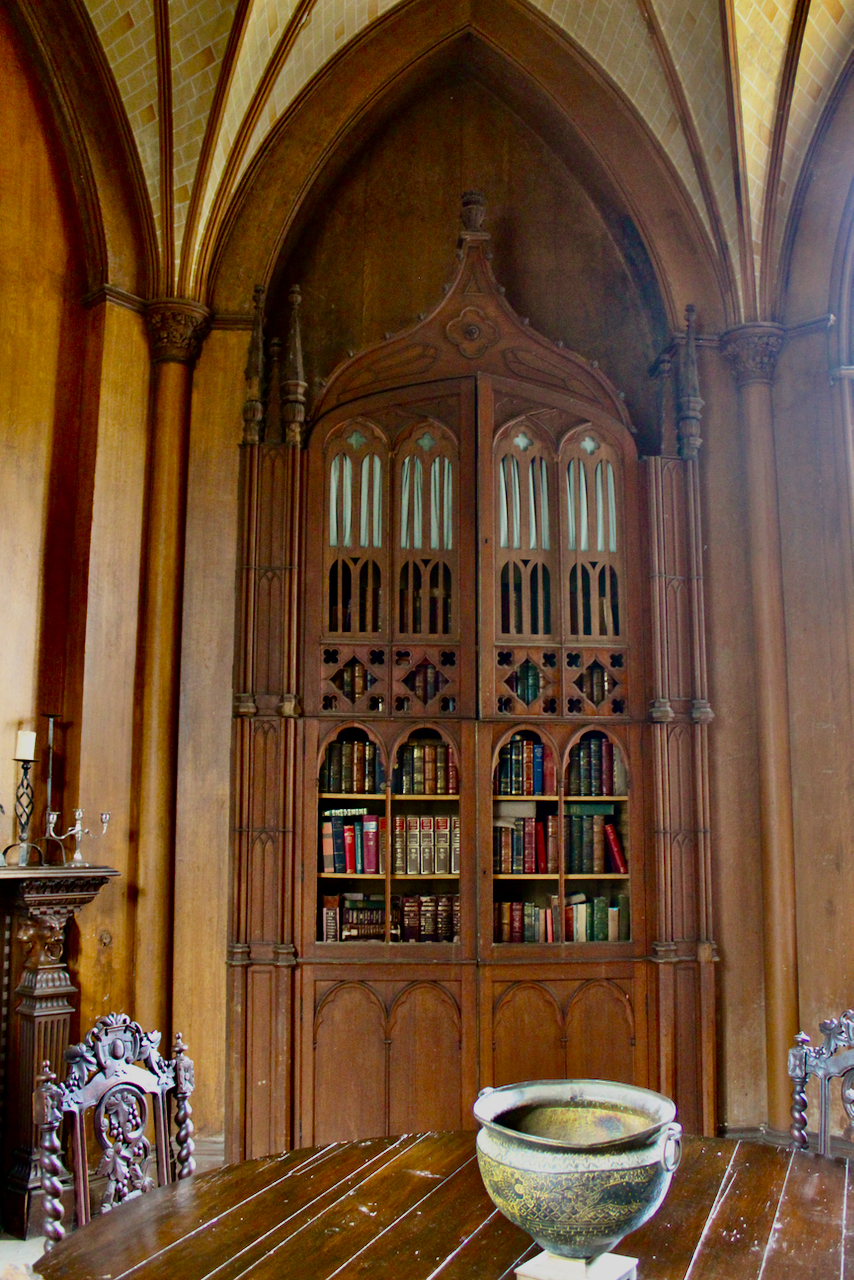
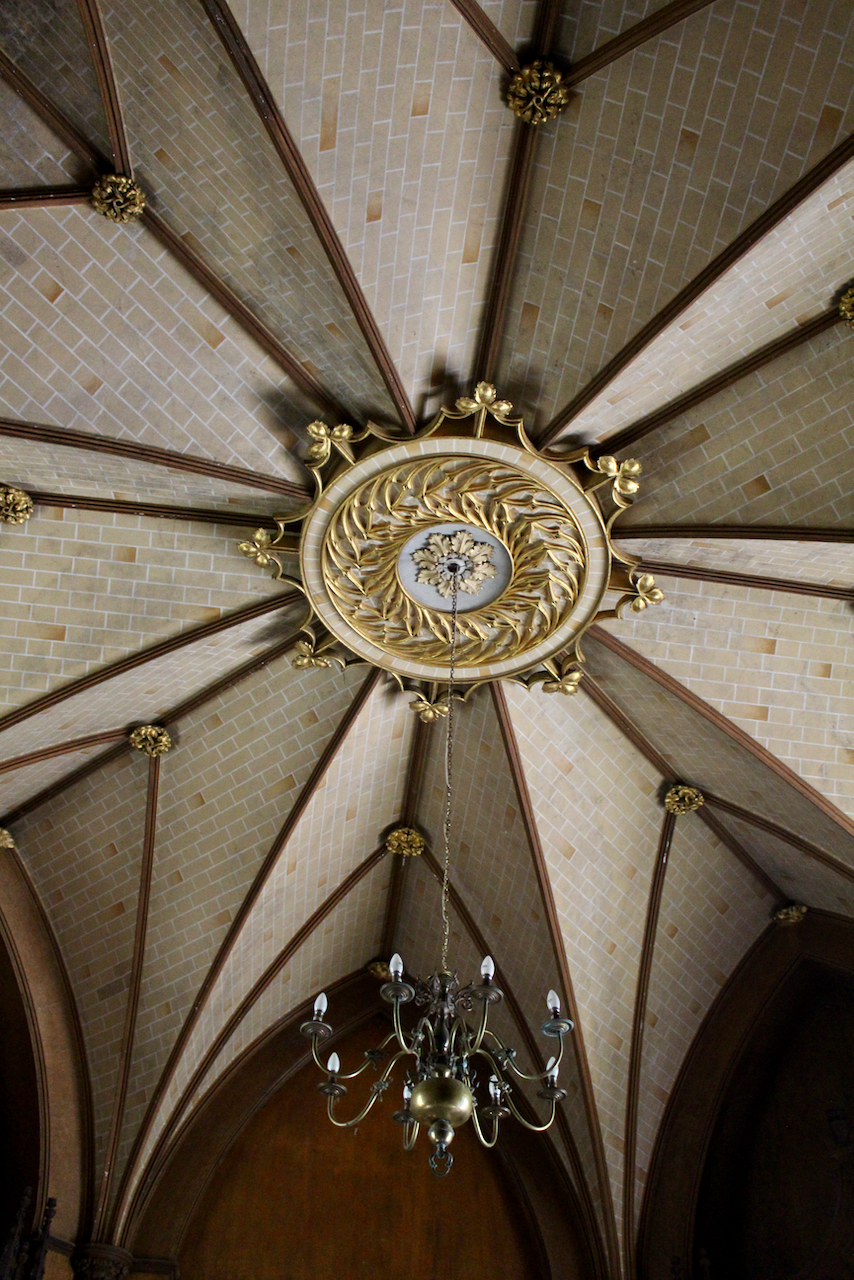
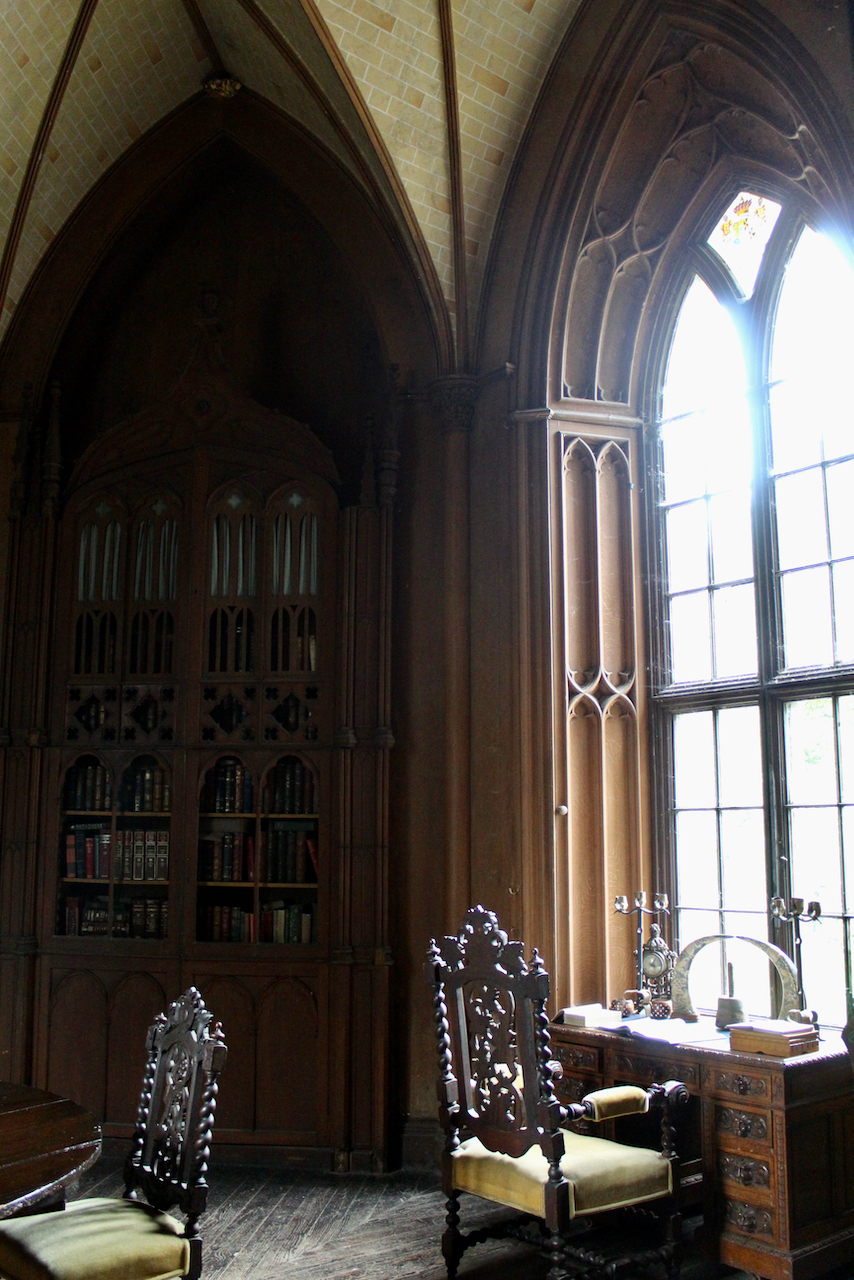
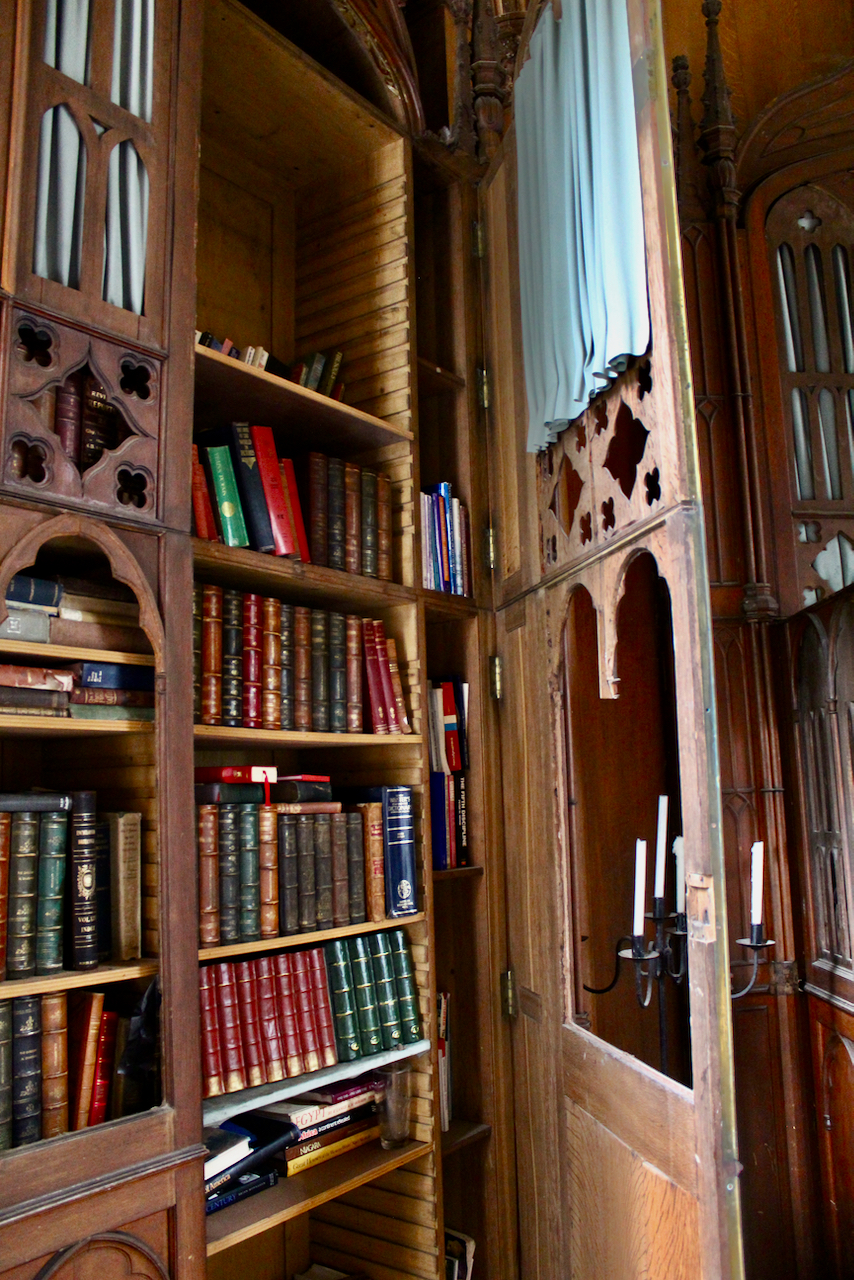
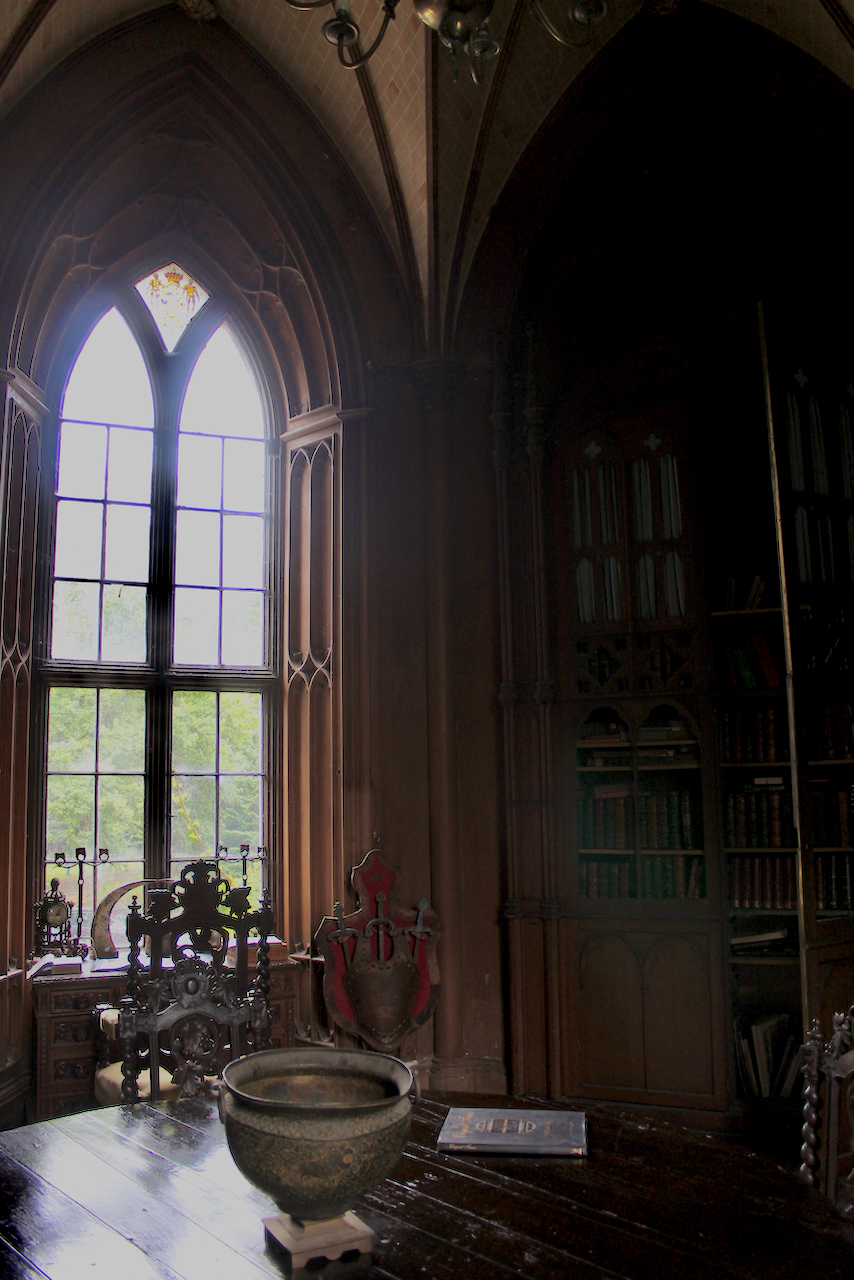
Beyond the staircase on the primary level is a small library with rib vaulted ceiling and Gothic bookcases.
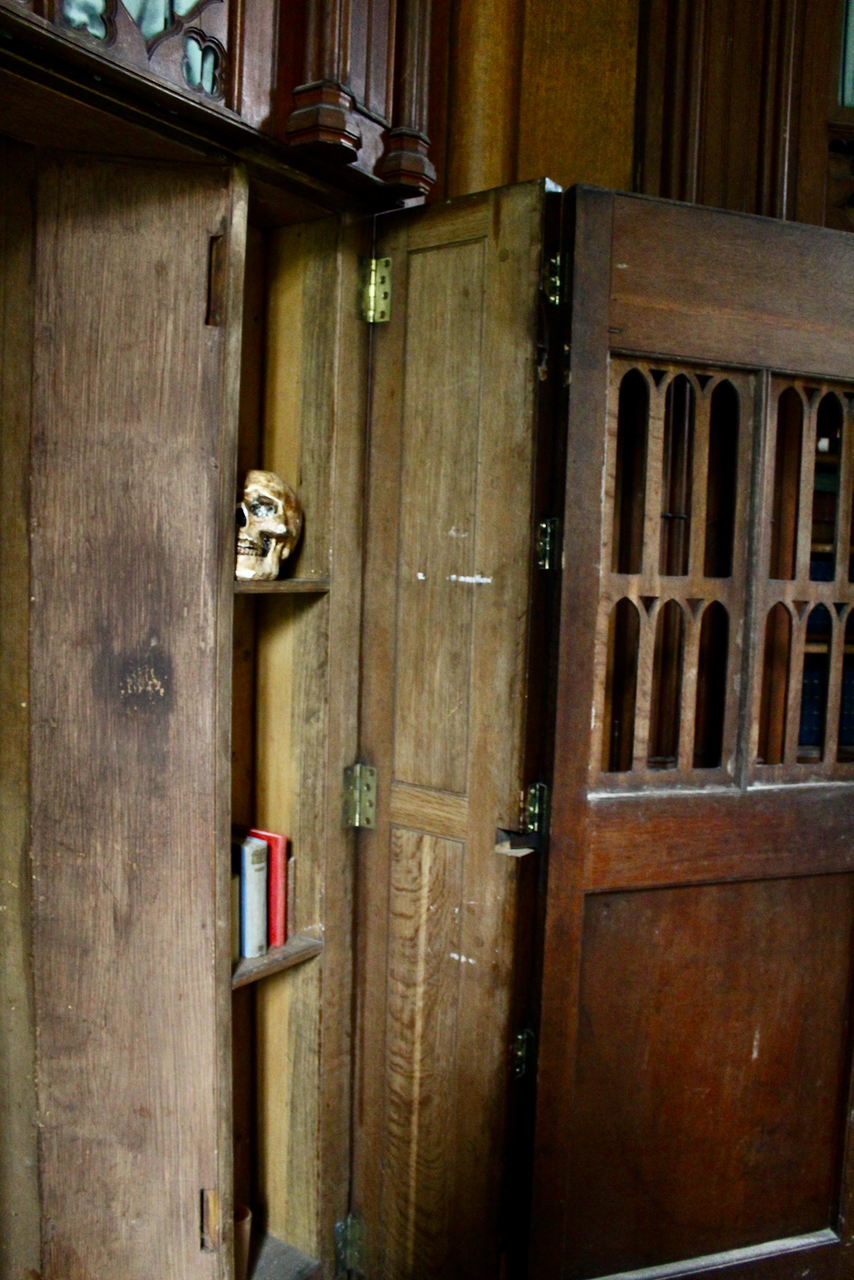
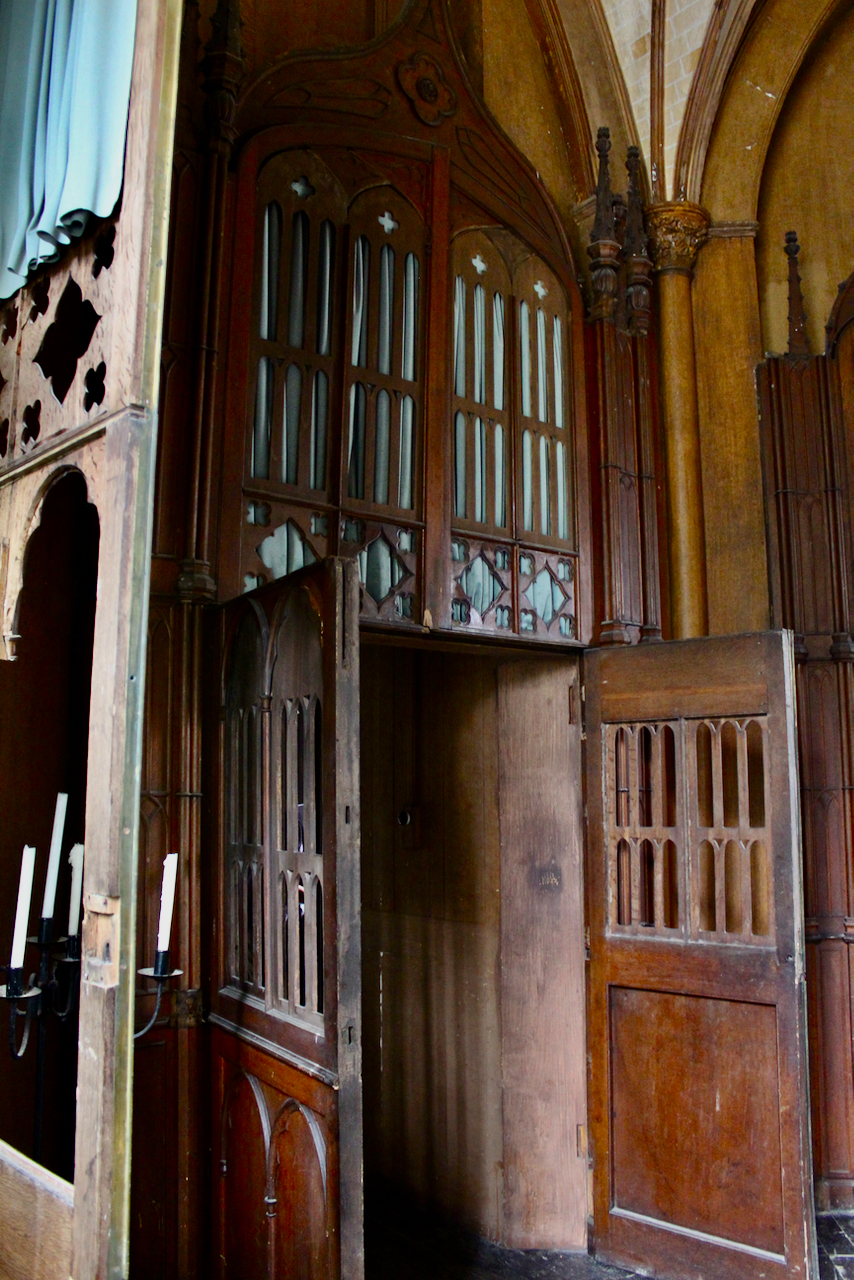
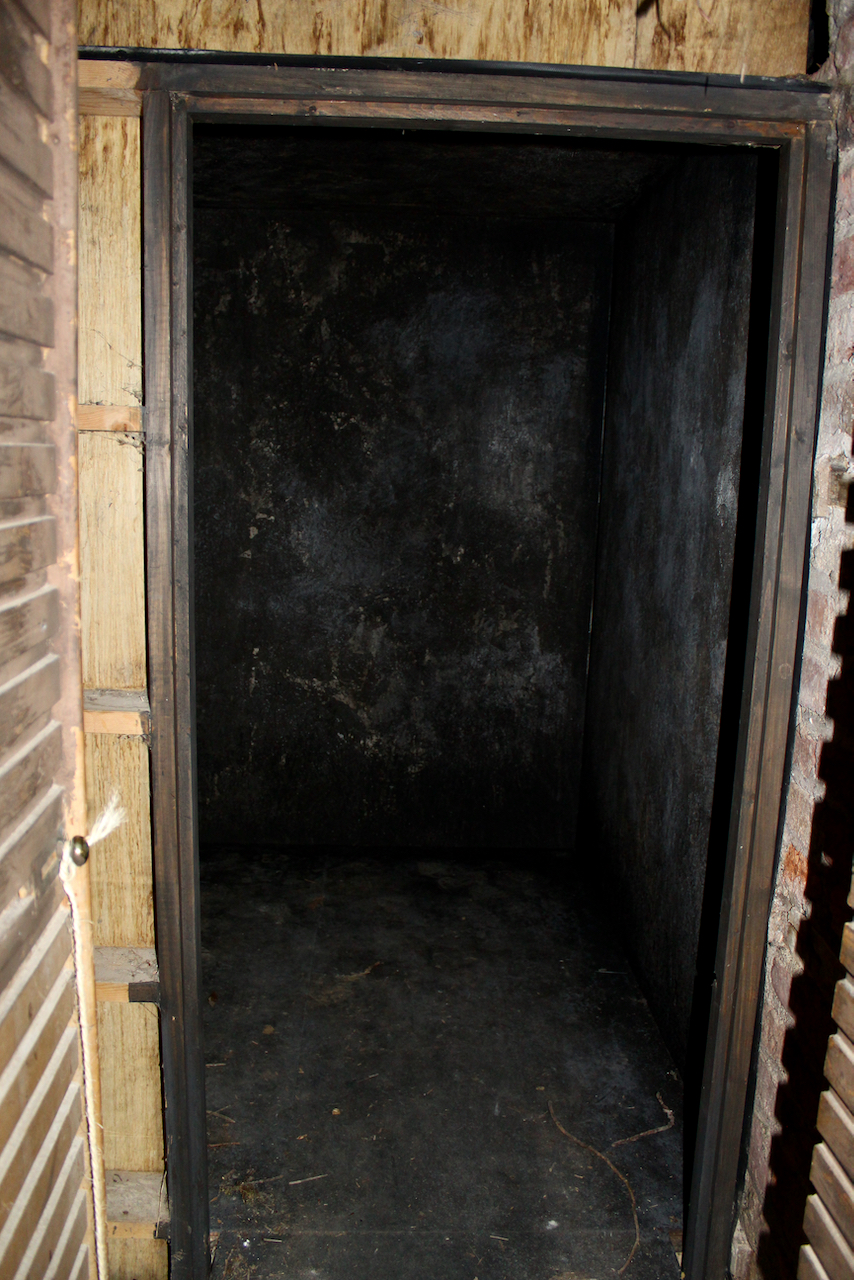
The panelling by each bookcase can be opened to reveal more space, and behind one secret door is a small room which leads out to the chapel, the guide told us.
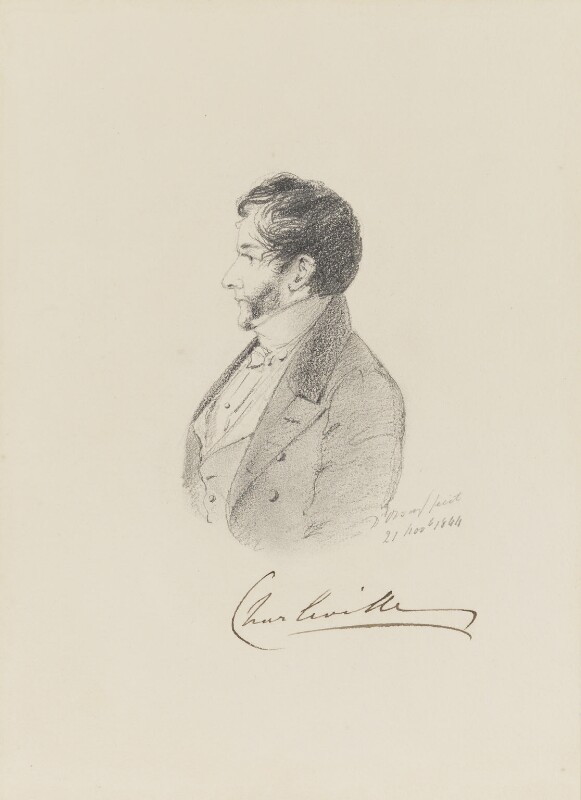
O’Reilly tells us: “Charleville Forest’s patron, Charles William Bury, from 1800 Viscount and from 1806 Earl of Charleville, was a man well versed in contemporary English taste and style. He inherited lands in Limerick, through his father’s maternal line, and in Offaly. His great wealth, lavish lifestyle and generous nature allowed him simultaneously to distribute largesse in Ireland, live grandly in London and travel widely on the continent…[p. 139] Charleville’s lack of success in his search for a sinecure proved ill for the future of the family fortunes for, continuing to live extravagantly above their means, they advanced speedily towards bankruptcy. On Charleville’s death in 1835, the estate was ‘embarrassed’ and by 1844, the Limerick estates had to be sold and the castle shut up, while his son and heir, ‘the greatest bore the world can produce’ according to one contemporary, retired to Berlin.“
“The greatest bore the world can produce,” Charles William Bury (1801-1851), 2nd Earl of Charleville by Alfred, Count D’Orsay 1844, courtesy of National Portrait Gallery NPG 4026(12).
The 2nd Earl held the office of Representative Peer [Ireland] between 1838 and 1851.
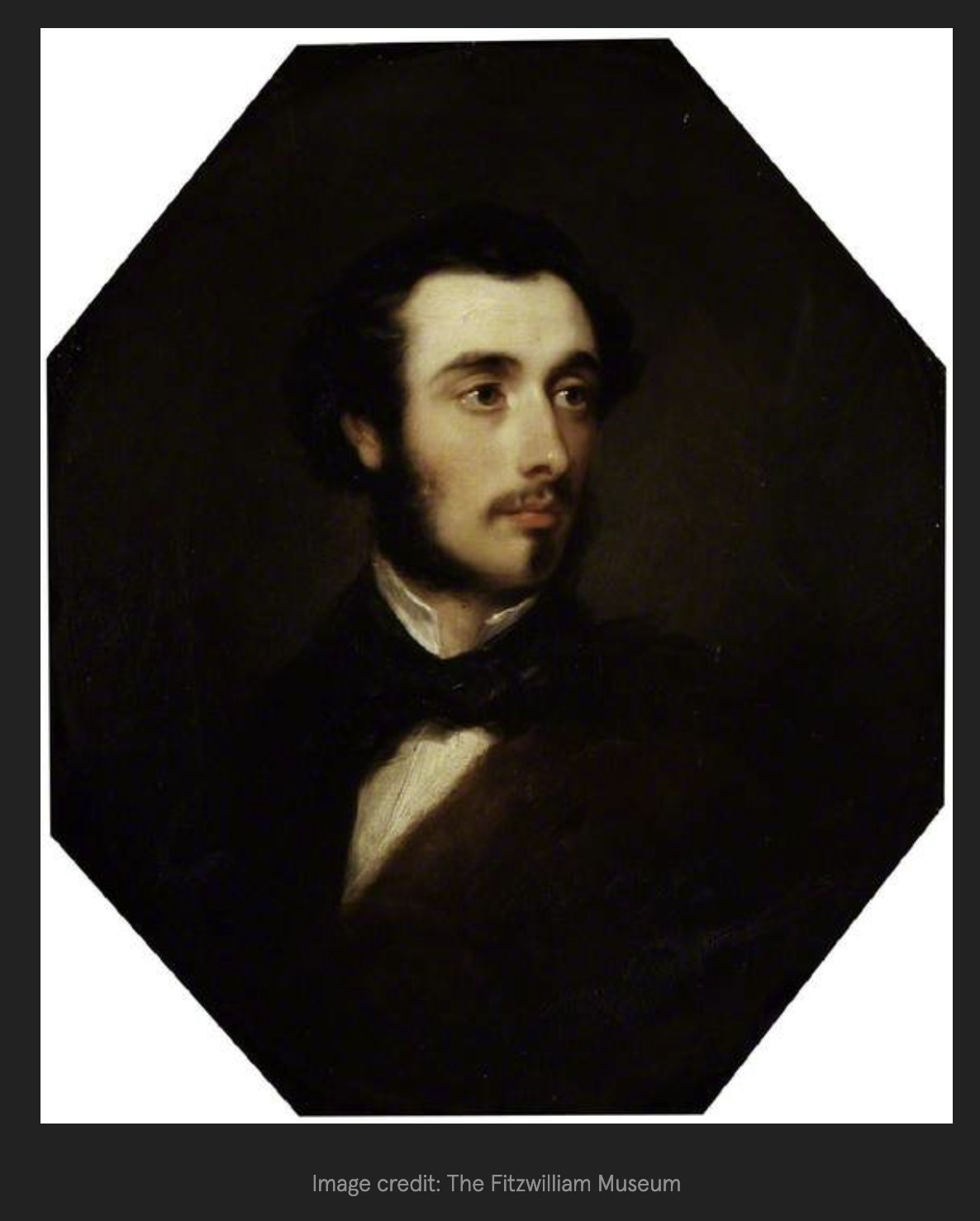
Charles William Bury, 2nd Earl of Charleville, seated in red cloak before a curtain, portrait by Henry Pierce Bone, 1835.
The 3rd Earl, Charles William George Bury (1822-1859), returned to the house in 1851, but with a much reduced fortune. He died young, at the age of 37, and his son, also named Charles William (1852-1874), succeeded as the 4th Earl at the age of just seven years old. His mother had died two years earlier. It seems that many of the Bury family were fated to die young.
The 4th Earl died at the age of 22 in 1874, unmarried, so the property passed to his uncle, Alfred, who succeeded as 5th Earl of Charleville but died the following year in 1875, without issue. The young 4th Earl had quarrelled with his sister who was next in line, so the property passed to a younger sister Emily.
In 1881 Emily married Kenneth Howard (1845-1885), son of the 16th Earl of Suffolk and of Louisa Petty-FitzMaurice, daughter of Henry Petty-FitzMaurice, 3rd Marquess of Lansdowne. On 14 December 1881 his name was legally changed to Kenneth Howard-Bury by Royal Licence, after his wife inherited the Charleville estate. He held the office of High Sheriff of King’s County in 1884.
After Emily’s death in 1931 the castle remained unoccupied. Her son Charles Kenneth Howard-Bury (1883-1963) preferred to live at another property he had inherited, Belvedere in County Westmeath (see my entry), which he inherited from Charles Brinsley Marlay. He auctioned the contents in 1948.
The house stood almost empty, with a caretaker, for years. When Charles Kenneth died in 1963, the property passed to a cousin, the grandson of the 3rd Earl’s sister with whom he had quarrelled. She had married Edmund Bacon Hutton and her grandson William Bacon Hutton legally changed his surname to Hutton-Bury when he inherited in 1964. The castle remained empty, until it was leased for 35 years to Michael McMullen in 1971. It had been badly vandalised at this stage. He immediately set to restore the castle.
More repairs were carried out by the next occupants, Bridget “Bonnie” Vance and her parents, who planned to run a B&B and wedding venue. Today the castle is run by Charleville Castle Heritage Trust.
[1] Bence-Jones, Mark. A Guide to Irish Country Houses (originally published as Burke’s Guide to Country Houses volume 1 Ireland by Burke’s Peerage Ltd. 1978); Revised edition 1988 Constable and Company Ltd, London.
[2] p. 136. O’Reilly, Sean. Irish Houses and Gardens. From the Archives of Country Life. Aurum Press Ltd, London, 1998.
Sopwell Hall, County Tipperary, courtesy of Colliers estate agents and myhome.ieSopwell Hall, County Tipperary, courtesy of Colliers estate agents and myhome.ieSopwell Hall, County Tipperary, courtesy of Colliers estate agents and myhome.ieSopwell Hall, County Tipperary, courtesy of Colliers estate agents and myhome.ieSopwell Hall, County Tipperary, courtesy of Colliers estate agents and myhome.ieSopwell Hall, County Tipperary, courtesy of Colliers estate agents and myhome.ie
[7] p. 232-8. Tierney, Andrew. The Buildings of Ireland: Central Leinster: Kildare, Laois and Offaly. Yale University Press, New Haven and London, 2019.
2.Lough Bawn House, Colllinstown, County Westmeath – B&B
3. Lough Bishop House, Collinstown, County Westmeath – B&B
4. Mornington House, County Westmeath – B&B
Whole House Rental/wedding venue, County Westmeath
1. Ballinlough Castle, County Westmeath – exclusive hire
2. Bishopstown House, Rosemount, County Westmeath – whole house rental (sleeps up to 18 people)
3. Middleton Park, Mullingar, County Westmeath – whole house rental and weddings
donation
Help me to pay the entrance fee to one of the houses on this website. This site is created purely out of love for the subject and I receive no payment so any donation is appreciated!
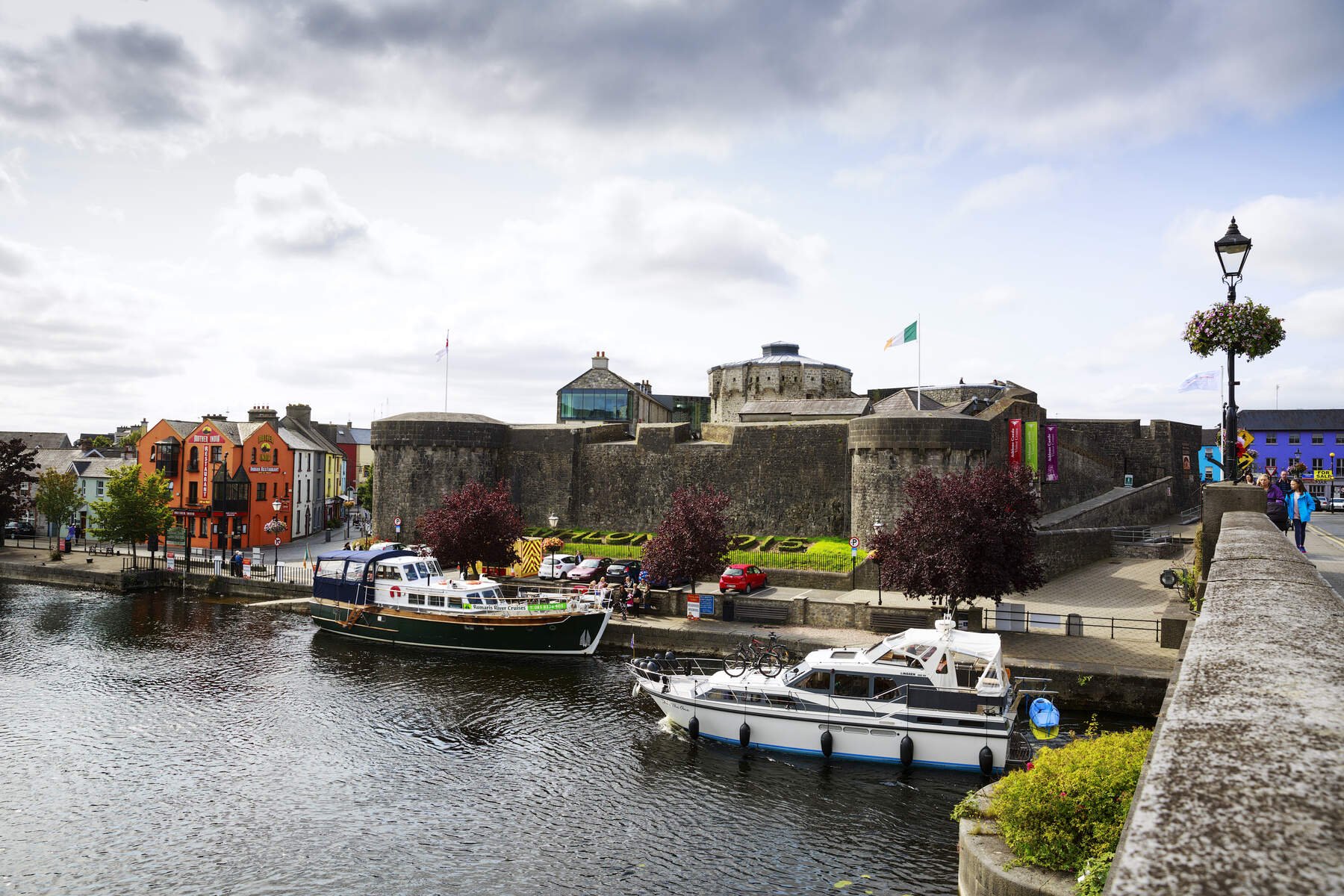
Cruising by Athlone Castle, Co Westmeath Courtesy Fennell Photography 2015, for Tourism Ireland, Ireland’s Content Pool.
The website tells us: “Trace the footprints of the generations who shaped this place. From early settlements and warring chieftains to foreign invaders and local heroes. This site on the River Shannon is the centre of Ireland’s Hidden Heartlands.
“Over the centuries it has been the nucleus of the Anglo-Norman settlement; a stronghold of the rival local families the Dillons and the O’Kelly’s; the seat of the Court of Claims; the residence of the President of Connaught and the Jacobite stronghold during the sieges of Athlone. After the Siege of Athlone it became incorporated into the new military barrack complex. It remained a stronghold of the garrison for almost three hundred years.
“In 1922 when the Free State troops took over the Barracks from their British counterparts, they proudly flew the tricolour from a temporary flagpole much to the delight of the majority of townspeople.
“In 1967 the Old Athlone Society established a museum in the castle with a range of exhibits relating to Athlone and its environs and also to folk-life in the district. Two years later when the military left the castle it was handed over to the Office of Public Works and the central keep became a National Monument.
“In 1991 to mark the Tercentenary of the Siege of Athlone the castle became the foremost visitor attraction in Athlone. Athlone Town Council (then Athlone UDC) made a major investment in the castle creating a multi-faceted Visitor Centre as it approached its 800th Anniversary in 2010. A total of €4.3million euro was invested in the new facility by Fáilte Ireland and Athlone Town Council and was officially opened by the then Minister of State for Tourism and Sport, Michael Ring T.D. on Tuesday 26th February 2012.“
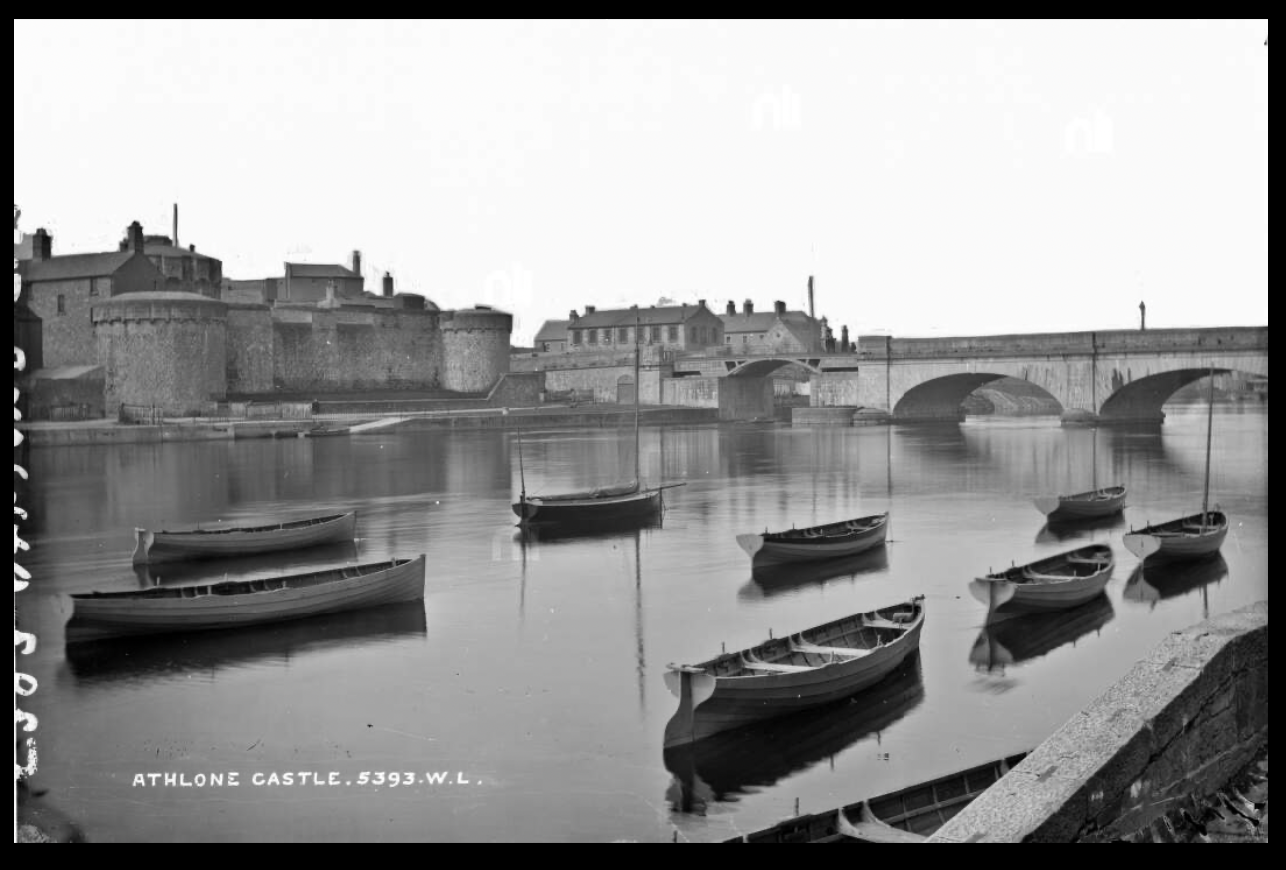
Athlone Castle, County Westmeath, photograph by Robert French, Lawrence Photographic Collection, National Library of Ireland.Athlone Castle, Athlone, Co Westmeath_Courtesy Ros Kavanagh 2014,for Tourism Ireland, Ireland’s Content Pool.
“Athlone Castle Visitor Centre is now a modern, engaging, fun and unique family attraction which harnesses most significant architectural features, such as the keep, to act as a dramatic backdrop to its diverse and fascinating story.
“It houses eight individual exhibition spaces, each depicting a different aspect of life in Athlone, the Castle and the periods both before and after the famous Siege. Fun, hands-on interactives, touchable objects and educational narratives immerse visitors in the drama, tragedy and spectacle of Athlone’s diverse and fascinating story. 3D maps, audio-visual installations, illustrations and artefacts bring the stories and characters of Athlone to life and The Great Siege of Athlone is dramatically recreated in a 360-degree cinematic experience in the Keep of the castle.“
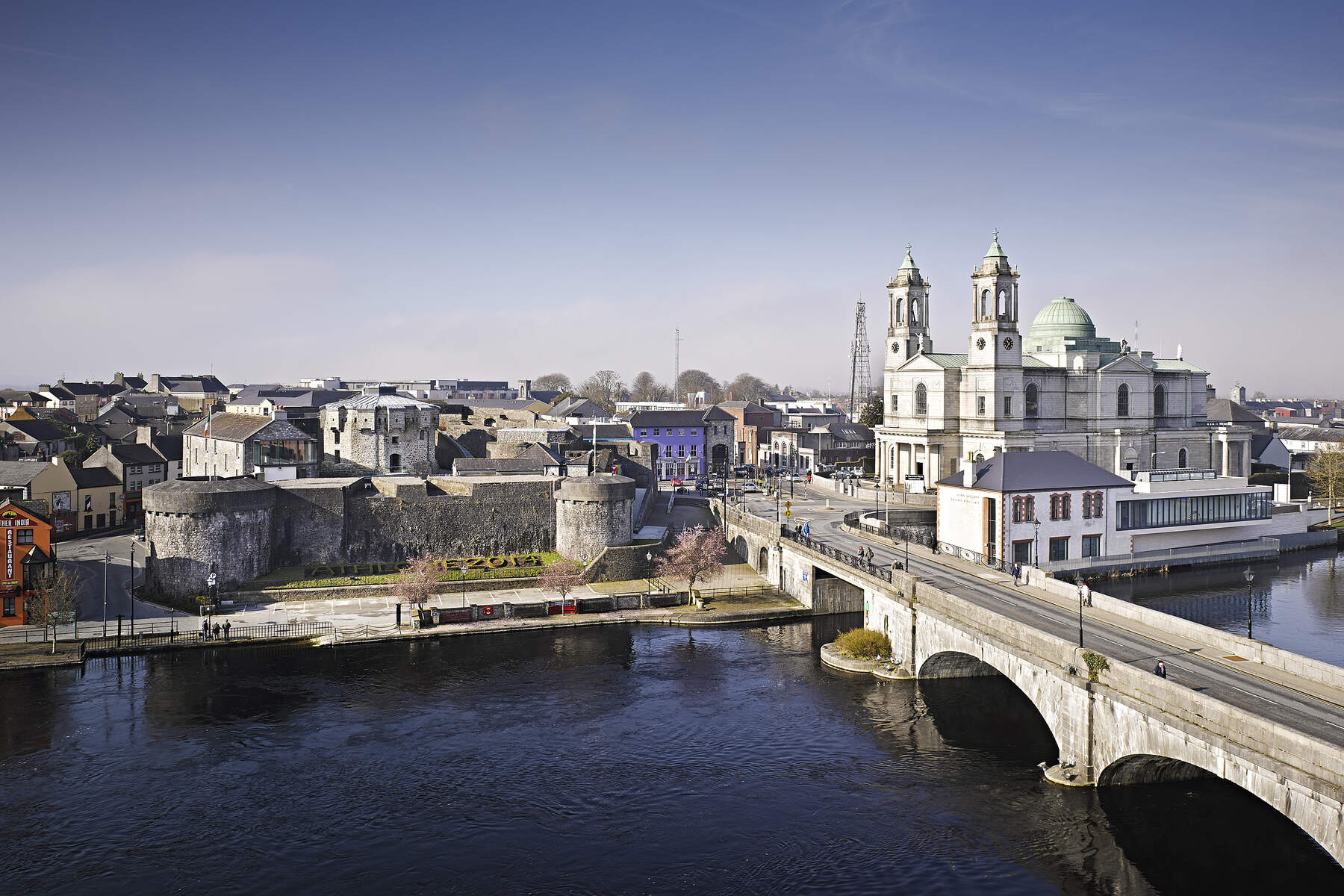
Athlone Castle, Athlone, Co Westmeath_Courtesy Ros Kavanagh 2014,for Tourism Ireland, Ireland’s Content Pool.
“As part of Westmeath County Council’s commemoration of Ireland’s world-renowned tenor, John Count McCormack, a new exhibition dedicated to the celebrated singer was opened at Athlone Castle in October 2014.“
Archiseek tells us about Athlone Castle: “Towards the end of the 12th century the Anglo-Normans constructed a motte-and-bailey fortification here. This was superceeded by a stone structure built in 1210, on the orders of King John of England. The Castle was built by John de Gray, Bishop of Norwich. The 12-sided donjon dates from this time. The rest of the castle was largely destroyed during the Siege of Athlone and subsequently rebuilt and enlarged upon. In the early 1800s, during the Napoleonic Wars, the castle was rebuilt as a fortification to protect the river crossing, taking the form we largely see today. The machicolations of the central keep are all nineteenth century. In the interior is an early nineteenth century two-storey barrack building. The modern ramp up to the castle has a line of pistol loops. The castle was taken over by the Irish Army in 1922 and continued as a military installation until it was transferred to the Office of Public Works in 1970.” [8]
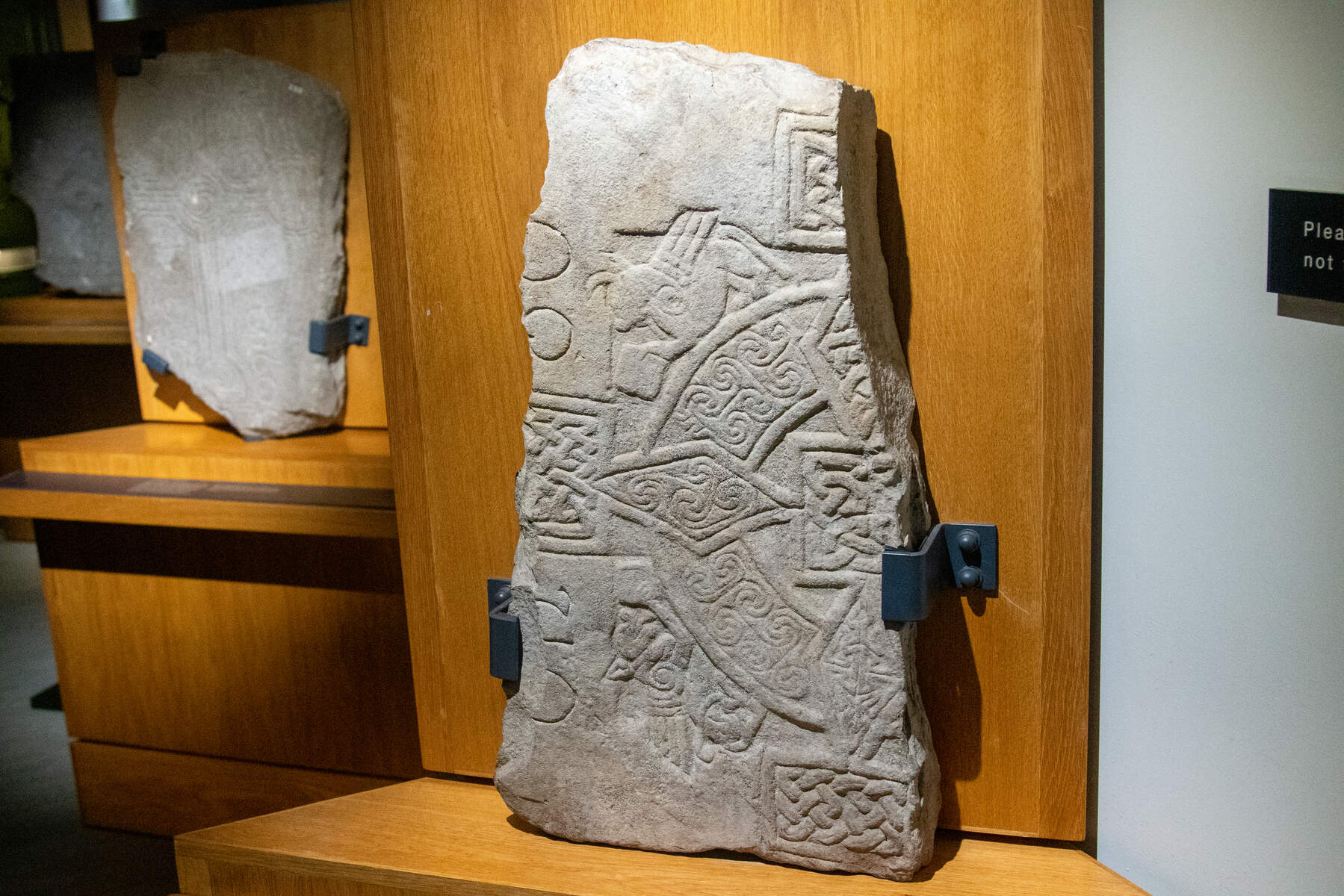
Athlone Castle, Athlone, Co Westmeath_Courtesy Sonder Visuals 2021 for Tourism Ireland, Ireland’s Content Pool.
2. Belvedere House, Gardens and Park, County Westmeath
Mark Bence-Jones writes of Belvedere in his 1988 book:
p. 39. “(Rochfort, sub Belvedere, E/DEP Rochfort/LGI1912; Marlay/LGI1912; Howard-Bury, sub Suffolk and Berkshire, E/PB; and Bury/IFR) An exquisite villa of ca 1740 by Richard Castle, on the shores of Lough Ennell; built for Robert Rochfort, Lord Bellfield, afterwards 1st Earl of Belvedere, whose seat was at Gaulston, ca 5 miles away. Of two storeys over basement, with a long front and curved end bows – it may well be the earliest bow-ended house in Ireland – but little more than one room deep.”
Castle – April 30, May 1-2, 7-9, 14-16, 21-23, 28-30, June 4-6, 11-13, 18-20, 25-27, July 2-4, 9-11, 16-18, 23-25, 30-31, Aug 1, 13-23, 27-29, Sept 3-5, 10-12, 17-19, 11am-3pm
Garden – Mar 19-22, 26-29, Apr 2-6, 9-12, 16-19, 23-26, 30, May 1-4, 7-10, 14-17, 21-24, 28-31, June 1, 4-7, 1-14, 18-21, 25-28, July 2-5, 9-12, 16-19, 23-26, 30-31, Aug 1-3, 6-9, 13-23, 27-30, Sept 3-6, 10-13, 17-20, 24-27,9am-5pm
Fee: castle fee – adult €17, child entry allowed for over 8 years €9, garden fee – adult €9, child €4, family ticket (2 adults + 2 children) €24, adult season ticket €60, family season ticket €73.50, special needs visitor with support carer €4, child 5 years or under is free
“The family run Annebrook House Hotel Mullingar opened its doors February 2007. Originally an Old Georgian residence for the local county surgeon, Dr O’Connell, the historic Annebrook House Hotel was purchased by the Dunne family in 2005. With his experience in hospitality and construction Berty Dunne set about creating a hotel as unique as the man who owns it. The Annebrook’s central location, its diverse range of accommodation from 2 bedroomed family suites to executive doubles has made it a very popular location for those coming to experience all that the midlands has to offer.
“Situated in the heart of Mullingar overlooking 10 acres of parkland, the Award Winning 4 star Annebrook House Hotel presents a modern day styling coupled with 17th century heritage. As a family run hotel the Annebrook prides itself on quality and high standards of customer service, working as part of one team to ensure all guests of their best and personal attention at all times. Annebrook House Hotel is steeped in history and enjoys the enviable advantage of being one of the most centrally located hotels in Mullingar town. This unique venue mixes old world charm with modern comfort and has established itself as one of Westmeath’s top wedding venues and was recently voted Best Wedding Venue Ireland by Irish Wedding Diary Magazine. With accommodation ranging from executive hotel rooms, family suites, luxurious champagne suites and apartments, the Annebrook has much to offer those visiting Mullingar. Offering a range of dining options from Berty’s Bar to fine dining in the award winning Old House Restaurant. The four star Annebrook House Hotel offers an excellent service to both its corporate & leisure guests. The hotel is accessible by car just 50 mins from Dublin and is only 10 minutes from the local Train Station.“
2.Lough Bawn House, Colllinstown, Co Westmeath – B&B accommodation
“A classic Georgian house in a unique setting. Lough Bawn house sits high above Lough Bane with amazing sweeping views. Nestled in a 50 acre parkland at the end of a long drive, Lough Bawn House is a haven of peace and tranquillity.
“The house and estate has been in the same family since it was built in 1820 by George Battesby, the current occupier, Verity’s, Great Great Great Grandfather. The house is being lovingly restored by Verity, having returned from England to live in the family home. Verity ran her own catering and events company in Gloucestershire for over 20 years. Her passion for cooking & entertaining shines through. Guests enjoy an extensive and varied breakfast with much of the ingredients being grown or reared by Verity herself, and delicious dinners are on offer. Breakfast is eaten in the large newly restored dining room, with wonderful views over the lough and of the parading peacocks on the rolling lawns.“
Photograph courtesy of Lough Bawn House website.Photograph courtesy of Lough Bawn House website.
“Both of the large, en-suite rooms have fine views down the length of Lough Bane and over the wooded hills while the single room and the twin/double room have sweeping views of the surrounding parklands. Guests are warmly welcomed and encouraged to relax in the homely drawing room in front of a roaring fire or to explore one of the many local historical sites, gardens, walks or cultural entertainments on offer.
Several areas of the estate have been classified as Special Areas of Conservation (SAC‘s) due to the incredibly varied and rare flora. Wild flowers can be found in abundance and a charming fern walk has been the created amongst the woodland near the house.“
3. Lough Bishop House, Collinstown, County Westmeath– B&B
“Built in the early 19th Century, Lough Bishop is a charming Country House nestling peacefully into a south-facing slope overlooking Bishop’s Lough in County Westmeath, Ireland.
“Breathtaking scenery in an unspoilt and tranquil setting, amid the rolling farmlands and lakes of Westmeath make Lough Bishop an ideal refuge from the hustle and bustle of modern life. There are family dogs in the background and animals play a large part of life at Lough Bishop House.
“Lough Bishop House is a family run business offering Country House Bed & Breakfast accommodation in a wonderful location in the middle of a working organic farm. We even have a purpose built trailer towed behind the quad bike to give guests a tour of the farm and the opportunity to get up close to the animals.
“Following extensive renovation this attractive Georgian Country Farmhouse offers its guests luxurious bed and breakfast accommodations, peaceful surroundings and fine home cooked food much of which comes from our own farm, garden and orchard.“
4. Mornington House, County Westmeath – B&B accommodation
Mornington House, photograph courtesy of their website.
“Mornington House, a historic Irish Country Manor offering luxury country house accommodation located in the heart of the Co. Westmeath countryside, just 60 miles from Ireland’s capital city of Dublin. Tranquility and warm hospitality are the essence of Mornington, home to the O’Hara’s since 1858.
“Mornington House is hidden away in the midst of a charming and dramatic landscape with rolling hills, green pasture, forests with ancient, heavy timber and sparkling lakes, deep in an unexplored corner of County Westmeath. Nearby are ancient churches, castles and abbeys, and delightful small villages to explore, away from all hustle and bustle of 21st century life, yet just 60 miles from Dublin.
“There has been a house at Mornington since the early 17th century but this was considerably enlarged in 1896 by Warwick’s grandparents. It is now a gracious family home with a reputation for delicious breakfasts which are prepared in the fine tradition of the Irish Country House and really set you up for the day ahead.
“A special place to stay for a romantic or relaxing break Mornington House’s location in the centre of Ireland just an hour’s drive from Dublin and Dublin Airport makes it ideal for either a midweek or weekend country break. Guests can walk to the lake or wander round the grounds. Excellent golf, fishing, walking and riding can be arranged. The Hill of Uisneach, the Neolithic passage tombs at Loughcrew and Newgrange and the early Christian sites at Fore and Clonmacnoise are all within easy reach, as are the gardens at Belvedere, Tullynally and Loughcrew.“
The National Inventory tells us:
“A well-detailed middle-sized country house, on complex plan, which retains its early aspect, form and much of its important early fabric. The ascending breakfronts to the entrance front of this structure adds to the overall form and its architectural impact. The facade, incorporating extensive moulded detailing and a very fine doorcase, is both visually and architecturally impressive and displays a high level of workmanship. The present entrance front (east) is built to the front of an earlier house, the form of which suggests that it might be quite early, perhaps early eighteenth-century in date. The 1896 entrance front was built to designs by W.H. Byrne (1844-1917), a noted architect of his day, best remembered for his numerous church designs. Apparently, Mornington is one of only two domestic commissions that can be attributed to this noteworthy architect, adding extra significance to this structure. The building was completed by 1898 at a cost of £2,400. Mornington House was in the ownership of the Daly Family in the early eighteenth-century and has been in the ownership of the O’Hara Family since 1858. It forms the centrepiece of an interesting, multi-period, complex with the outbuildings, the walled gardens and the fine entrance gates to the south. It represents an important element to the architectural heritage of Westmeath and occupies attractive nature grounds to the east of Multyfarnham.” [9]
Whole House accommodation, County Westmeath:
1. Ballinlough Castle, County Westmeath – exclusive hire
Ballinlough Castle, County Westmeath, photograph courtesy of Ballinlough Castle’s website.
The website tells us Ballinlough Castle is available for exclusive hire of the castle and the grounds (minimum hire 3 nights) is available for private or corporate gatherings. Focussing on relaxed and traditional country house hospitality, assisted by a local staff.
Ballinlough Castle, County Westmeath, photograph courtesy of Ballinlough Castle’s website.“Refurbishment of Ballinlough Castle, Clonmellon,”c. 1940, G&T Crampton, held by Assoc. Prof. Joseph Brady, Digital content by Dr. Joseph Brady, published by UCD Library, University College Dublin.
The website tells us of its history:
“The Nugent family at Ballinlough were originally called O’Reilly, but assumed the surname of Nugent in 1812 to inherit a legacy. They are almost unique in being a Catholic Celtic-Irish family who still live in their family castle.
“The castle was built in the early seventeenth century and the O’Reilly coat of arms over the front door carries the date 1614 along with the O’Reilly motto Fortitudine et Prudentia.
“The newer wing overlooking the lake was added by Sir Hugh O’Reilly (1741-1821) in the late eighteenth century and is most likely the work of the amateur architect Thomas Wogan Browne, also responsible for work at Malahide Castle, the home of Sir Hugh O’Reilly’s sister Margaret.
“Sir Hugh was created a baronet on 1795 and changed the family name in 1812 in order to inherit from his maternal uncle, Governor Nugent of Tortola.
“As well as the construction of this wing, the first floor room above the front door was removed to create the two-storey hall that takes up the centre of the original house. The plasterwork here contains many clusters of fruit and flowers, all different. A new staircase was added, with a balcony akin to a minstrel’s gallery, and far grander than the original staircase that still remains to the side.
“Sir Hugh’s younger brothers James and Andrew entered Austrian military service, the latter becoming Governor-General of Vienna and Chamberlain to the Emperor. His portrait hangs in the castle’s dining-room.
“The family traces directly back to Felim O’Reilly who died in 1447. Felim’s son, John O’Reilly was driven from his home at Ross Castle near Lough Sheelin and settled in Kilskeer. His grandson Hugh married Elizabeth Plunket with whom he got the estate of Ballinlough, then believed to have been called Bally-Lough-Bomoyle. It was his great-grandson James who married Barbara Nugent and about whom an amusing anecdote is told in Duffy’s Hibernian Magazine of 1860:
During the operation of the penal laws in Ireland, when it was illegal for a Roman Catholic to possess a horse of greater value than five pounds, he was riding a spirited steed of great value but being met by a Protestant neighbour who was on foot, he was ordered by him to relinquish the steed for the sum of five pounds sterling. This he did without hesitation and the law favoured neighbour mounted his steed and rode off in haughty triumph. Shortly afterwards, however, James O’Reilly sued him for the value of the saddle and stirrups of which he was illegally deprived and recovered large damages.
“The investment in the castle by James’ son, Hugh was recorded in The Irish Tourist by Atkinson 1815, which contained the following account of a visit to Ballinlough:
The castle and demesne of Ballinlough had an appearance of antiquity highly gratifying to my feelings ….. I reined in my horse within a few perches of the grand gate of Ballinlough to take a view of the castle; it stands on a little eminence above a lake which beautifies the demesne; and not only the structure of the castle, but the appearance of the trees, and even the dusky colour of the gate and walls, as you enter, contribute to give the whole scenery an appearance of antiquity, while the prospect is calculated to infuse into the heart of the beholder, a mixed sentiment of veneration and delight.
Having visited the castle of Ballinlough, the interior of which appears a good deal modernised, Sir Hugh had the politeness to show me two or three of the principal apartments; these, together with the gallery on the hall, had as splendid an appearance as anything which I had, until that time, witnessed in private buildings. The rooms are furnished in a style- I cannot pretend to estimate the value, either of the furniture or ornamental works, but some idea thereof may be formed from the expenses of a fine marble chimney-piece purchased from Italy, and which, if any solid substance can in smoothness and transparency rival such work, it is this. I took the liberty of enquiring what might have been the expense of this article and Sir Hugh informed me only five hundred pounds sterling, a sum that would establish a country tradesman in business! The collection of paintings which this gentleman shewed me must have been purchased at an immense expense also- probably at a price that would set up two: what then must be the value of the entire furniture and ornamental works?
“Sir Hugh was succeeded in the baronetcy by his eldest son James, who was succeeded by his brother Sir John, who emulated his uncle in Austria in becoming Chamberlain to the Emperor. His eldest son Sir Hugh was killed at an early age so the title then passed to his second son Charles, a racehorse trainer in England. Sir Charles was an unsuccessful gambler which resulted in most of the Ballinlough lands, several thousand acres in Westmeath and Tipperary being sold, along with most of the castle’s contents.
“Sir Charles’ only son was killed in a horseracing fall in Belgium in 1903, before the birth of his own son, Hugh a few months later. Sir Hugh inherited the title on the death of his grandfather in 1927 and, having created a number of successful businesses in England, retuned to Ballinlough and restored the castle in the late 1930s. His son Sir John (1933- 2010) continue the restoration works and the castle is now in the hands of yet another generation of the only family to occupy it.”
featured in Great Irish Houses. Forewards by Desmond FitgGerald, Desmond Guinness. IMAGE Publications, 2008.
p. 49. “We took over the running and living of the property a few years ago, and structural renovation have been our focus up till now,” says Nick Nugent, the present owner. “It has been a huge challenge, as the entire Georgian wing was leaning out to the lake and we needed to underpin it.”
“Although few of the original pieces of furniture remain, many of the portraits were saved and they provide a unique pictorial history to illustrate the house’s colourful lineage. Over the dining room door hang portraits of Count Andrew, Chamberlain to the Emperor of Austria and Governor General of Vienna when Napolean attacked in 1809, and his great nephew, Sir John Nugent, Chamberlain to the Austrian Emperor. His son, Charles, who got himself into financial trouble through gambling, is also represented, as is an interesting non-famiyportrait of the Duke of Ormond accompanied, unusually for Ireland, by a black manservant.
“Today, Nick and Alice Nugent, who live in the castle with their children, have successfully secured the physical foundations at the lakeside of the house itself and begun the process of redecorating. They were assisted in the redecoration by Kate Earle of Todhunter Earle, a prestigious company with an impressive client list including Au Bar in New York, the Berkeley Hotel in London and Sissinghurst Castle in Kent.
“Their next task, in its own good time, will be to decorate the rest of the property. Much of the plasterwork had split over the years and the Nugents have repaired the cracks and set about rendering part of the exterior with several coats of lime mortar. In the basement, exposed pipes were found to contain asbestos, which needed treatment. “At that point our impending poverty was accelerated somewhat,” observes Nick Nugent wryly.
“The Georgian windows, said to be the tallest in Ireland, have all been removed and repaired under the careful eye of Kells Windows, and, where it survives, the Georgian glass has been retained. In time, they hope to render the rest of the façade and secure the foundations for future generations.
Like many Georgian castles, the building grew in stages.
p. 50 “The ground floor contains a larg drawing room and dining room with four first floor bedrooms approached by a vaulted corridor above.”
[about the Hall] “Initially a double storey room, it is thought Sir Hugh O’Reilly added a new wing towards the end of the 18th century, taking away the first floor in the hall and creating a fine galleried space with grand staircase. …The woodwork has taken on an unusual but entirely fitting stripped pine format, giving the appearance of faded grandeur. Mouldings are individualised with every three or four feet a new set revealed. Interestingly, there is no grand fireplace as is the case in most Irish entrance halls, but this absence may be due to re-modifications over the ages.
“To the right of the entrance hall is a morning room, which is now used as a smaller sitting room, which has an interesting set of oval portraits by Hugh Douglas Hamilton, relating to the O’Reilly and Nugent families. The design of the fireplace is replicated throughout the house and an original door connects to a back room.
“Moving to the left is the library or study, and family legend has it that Oliver Cromwell docked here for a night, keeping a cow in one archway and a horse in another. The drawing room, with Gothic pendant motifs and circular angles, is cetnred by a marvellous white chimneypiece, which is an exact copy of the chimneypiece in the dining room at Curraghmore. Roman females support either upright and the frieze is particularly well crafted.
“It was Nick Nugent’s grandfather, Sir Hugh Nugent, who brought in the majority of contents in this room and the neighbouring dining room where the severely damaged plasterwork has been repaired. In fact, the upturn in Ballinlough Castle’s fortunes began with Sir Hugh who returned to Ireland after a highly successful business career – he invented the tractor cab among other things – at a period when Irish country houses were being vacated. The house was semi-derelict and had been lived in for ten years by Owen Quinn, a family steward, who in the words of Sir John, “Lived in the house on his own with no heating, no water and rats everywhere.”
“Towards the end of the 1930s the house underwent thorough restoration, and much of the current interior decoration downstairs comes from that period, which was completed in 1939. [p. 55] The firm Cramptons, who were still building in Dublin at the time, worked on the restoration and carried out the re-wiring on the premises.
“In recent years, the magnificent gardens have been restored by Sir John and Lady Nugent, with help from the European Union and the Great Gardens of Ireland Programme. The walled garden, which is divided inot four walled sections, is home to a significant collection of shrubs, roses and climbers while the herbaceous borders are being remodeled. The grass tennis court, lily pond, rose garden, herb and soft fruit garden and orchard, all continue to thrive. From the walled gardens, a white door leads to the lakeside walks with the inviting water garden and its rustic summerhouse.
“Nick Nugent and his wife Alice are now committed to carrying on the mantle and their vision is to marry a subtle contemporary feel with country house living. The rooms on the upper floors reveal the new direction. There are twelve bedrooms, many of them with new en suite bathrooms. There are quirky touches, with some of the rooms having wallpapered ceilings, best defining their unorthodox physical shapes, and practical changes too, such as turning an old single four-poster bed into a double, which add to the pervading sense of comfort and cosiness.”
“Bishopstown House is a three-storey Georgian house built in the early 1800s by the Casey family. After he passed away, the original owner, Mr. J Casey left Bishopstown to his two daughters, who then sold the house to Mr Richard Cleary in 1895.
“Mr Richard Cleary, formally from the famed lakeside Cleaboy Stud near Mullingar, planned and erected Bishopstown House and Stud. In his younger days he rode horses at Kilbeggan, Ballinarobe, Claremorris and other Irish meetings with varying degrees of success, but as a trainer he knew no bounds. In his later years he devoted his time to breeding and training, and in time he became one of Ireland’s most famous trainers, breeding some excellent horses, including the winner of the 1916 Irish Grand National, Mr James Kiernan’s All Sorts!
“Other famous horses from the Bishopstown stud include Shaun Spada and Serent Murphy who both won the Aintree Grand National in England. Another horse called Dunadry won the Lancashire Steeple Chase. Other stallion winners include Sylvio III, Lustrea and Irish Battle who frequently had their names in the limelight throughout Irish and English racecourses.
“After being left fall into a dilapidated state, the stud farm and house was purchased by Paddy and Claire Dunning, the owners of the award-winning Grouse Lodge Recording Studios and Coolatore House and members of the Georgian society. It was restored to its former glory in 2009 and is now available for rent.“
2. Middleton Park, Mullingar, County Westmeath – wedding venue and accommodation
Photograph courtesy of Middleton Park House website.
Middleton Park House featured in The Great House Revival on RTE, with presenter (and architect) Hugh Wallace. The website tells us:
“Carolyn and Michael McDonnell, together with Carolyn’s brother Henry, joined together to purchase this expansive property in Castletown Geoghegan. Built during the famine, the property was last in use as a hotel but it had deteriorated at a surprisingly fast rate over its three unoccupied years.
“Designed by renowned architect George Papworth, featuring a Turner-designed conservatory, Middleton Park House stands at a palatial 35,000sq. ft. and is steeped in history. Its sheer scale makes it an ambitious restoration.
“The trio’s aim is to create a family home, first and foremost, which can host Henry’s children at the weekends and extended family all year-round. Due to its recent commercial use, the three will need to figure out how to change industrial-style aspects to make it a welcoming home that is economical to run.
“Henry will be putting his skills as a contractor and a qualified chippy to use, and Michael will be wearing his qualified engineer’s hat to figure out an effective heating system. Carolyn will be using her love of interiors to work out the aesthetic of the house, and how to furnish a property the size of 35 semi-detached houses in Dublin.“
Photograph courtesy of Middleton Park House website.
The trio have now made the house available for accommodation and as a wedding venue.
Photograph courtesy of Middleton Park House website.
The National Inventory tells us:
“A very fine and distinguished large-scale mid-nineteenth country house, which retains its early form, character and fabric This well-proportioned house is built in an Italianate style and is elevated by the fine ashlar limestone detailing, including a well-executed Greek Ionic porch/portico and a pronounced eaves cornice. This house was (re)built for George Augustus Boyd [1817-1887] in 1850 to designs by George Papworth (1781-1855) and replaced an earlier smaller-scale house on site, the property of a J. Middleton Berry, Esq., in 1837 (Lewis). The style of this house is quite old fashioned for its construction date and has the appearance of an early-nineteenth/late-Georgian country house. The form of this elegant house is very similar to Francis Johnston’s masterpiece Ballynagall (15401212), located to the north of Mullingar and now sadly in ruins. This house remained in the Boyd-Rochfort family until 1958 and was famously offered as a prize in a raffle in 1986 by its then owner, Barney Curly. This house forms the centerpiece of an important collection of related structures along with the elegant conservatory by Richard Turner (15318024), the service wing to the north (15318020), the stable block to the north (15318022) and the main gates (15318017) and the gate lodge (15318018) to the west. This building is an important element of the built heritage of Westmeath and adds historic and architectural incident to the landscape to the south of Castletown Geoghegan.” [10]
[3] Bence-Jones, Mark. A Guide to Irish Country Houses (originally published as Burke’s Guide to Country Houses volume 1 Ireland by Burke’s Peerage Ltd. 1978); Revised edition 1988 Constable and Company Ltd, London.
[4] p. 136. O’Reilly, Sean. Irish Houses and Gardens. From the Archives of Country Life. Aurum Press Ltd, London, 1998.














 Irish Historic Houses