Thomas Fitzmaurice (1668-1741) 1st Earl of Kerry (21st Baron of Kerry), Viscount Clanmorris was the father of John Fitzmaurice Petty (1706-1761) 1st Earl of Shelburne, who added Petty to his name after his mother, Anne Petty (d. 1737). Another son of the 1st Earl of Kerry was his heir William FitzMaurice (1694-1747) who succeeded as 2nd Earl of Kerry.
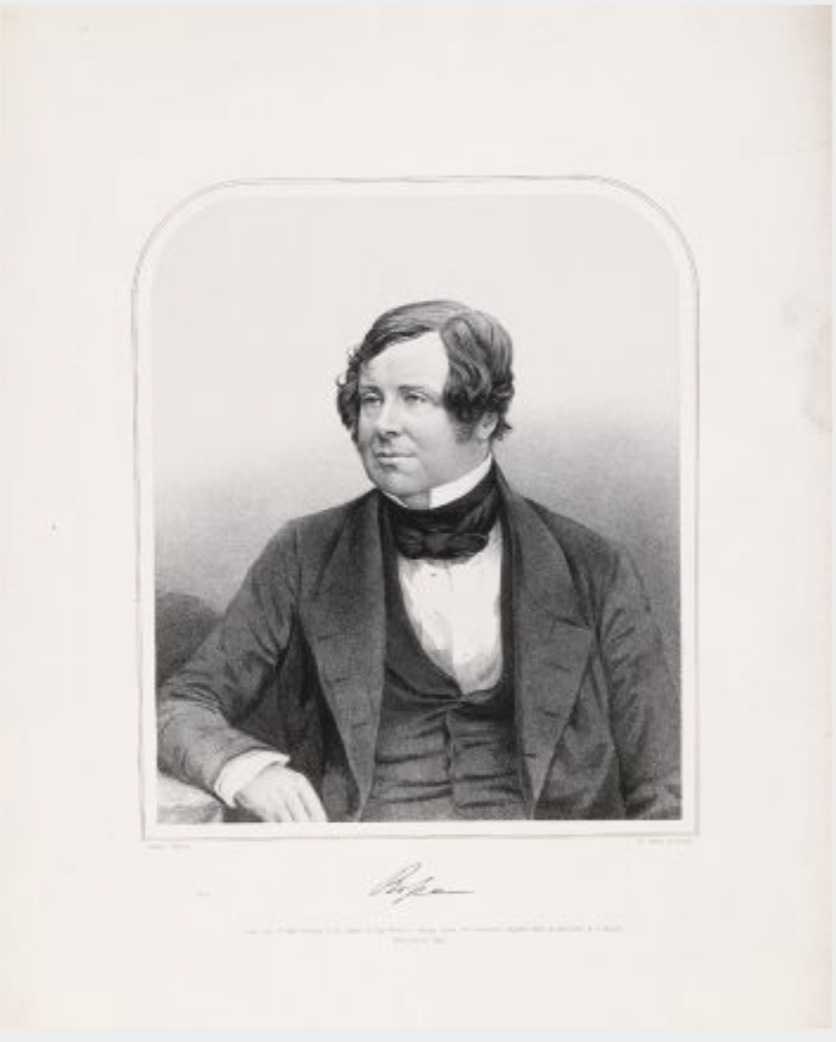
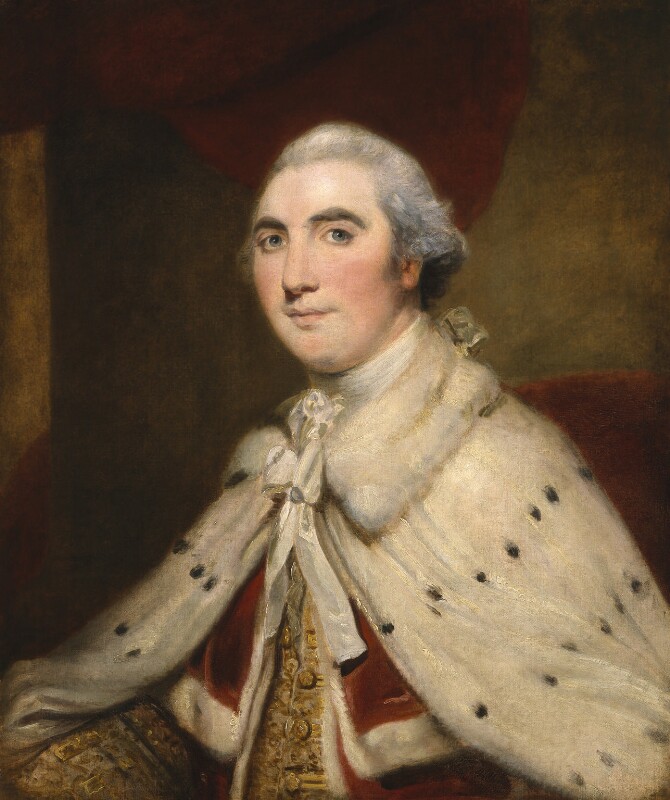
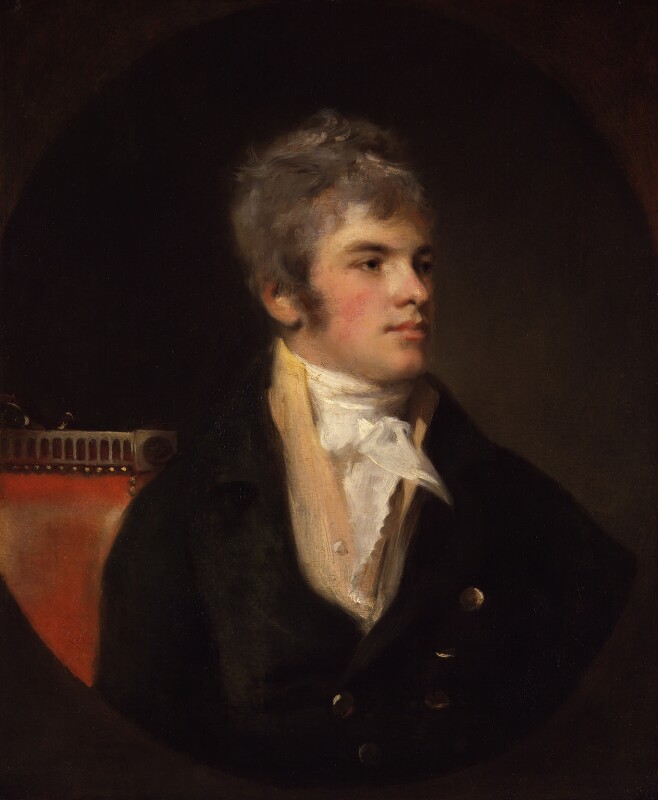
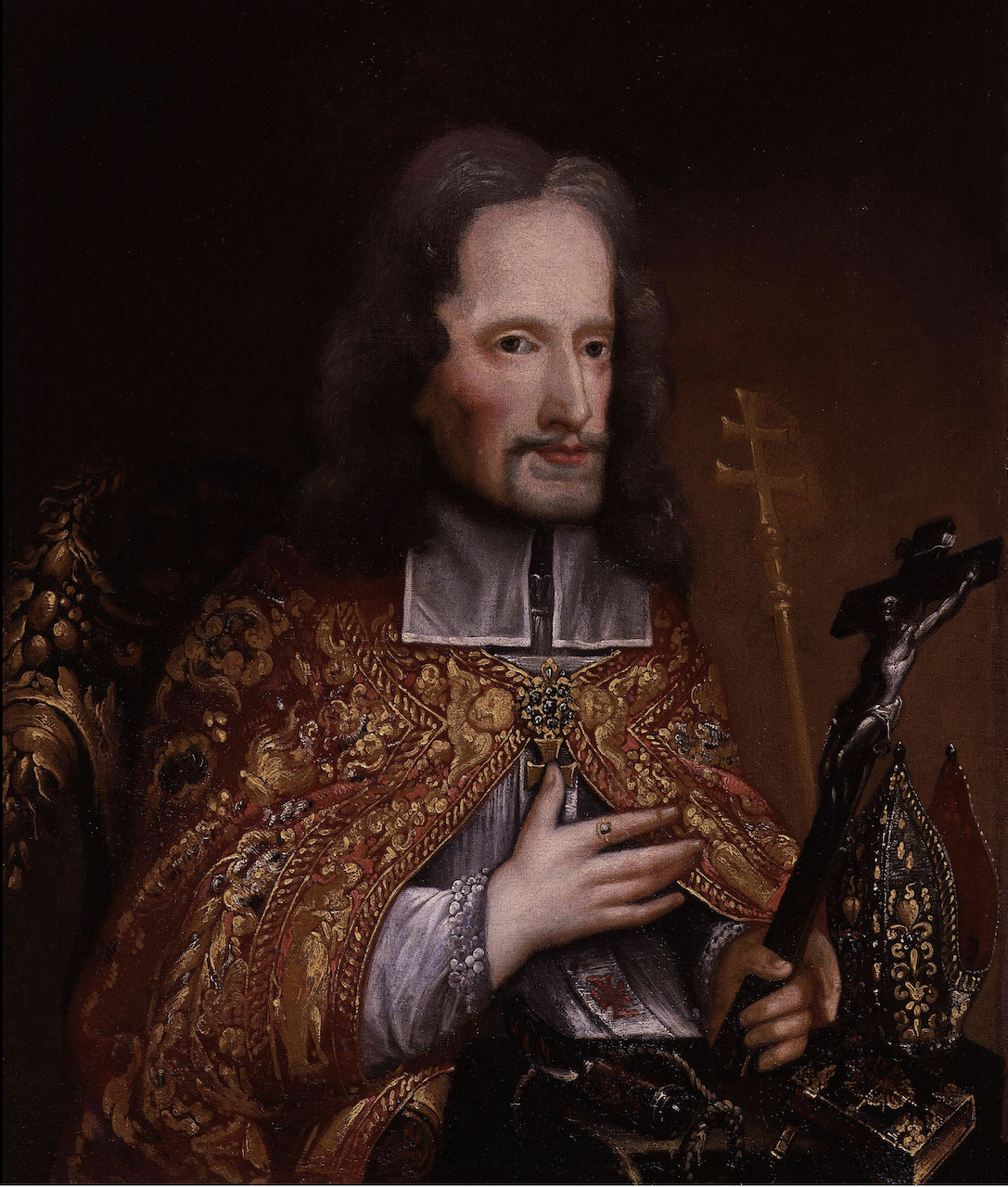
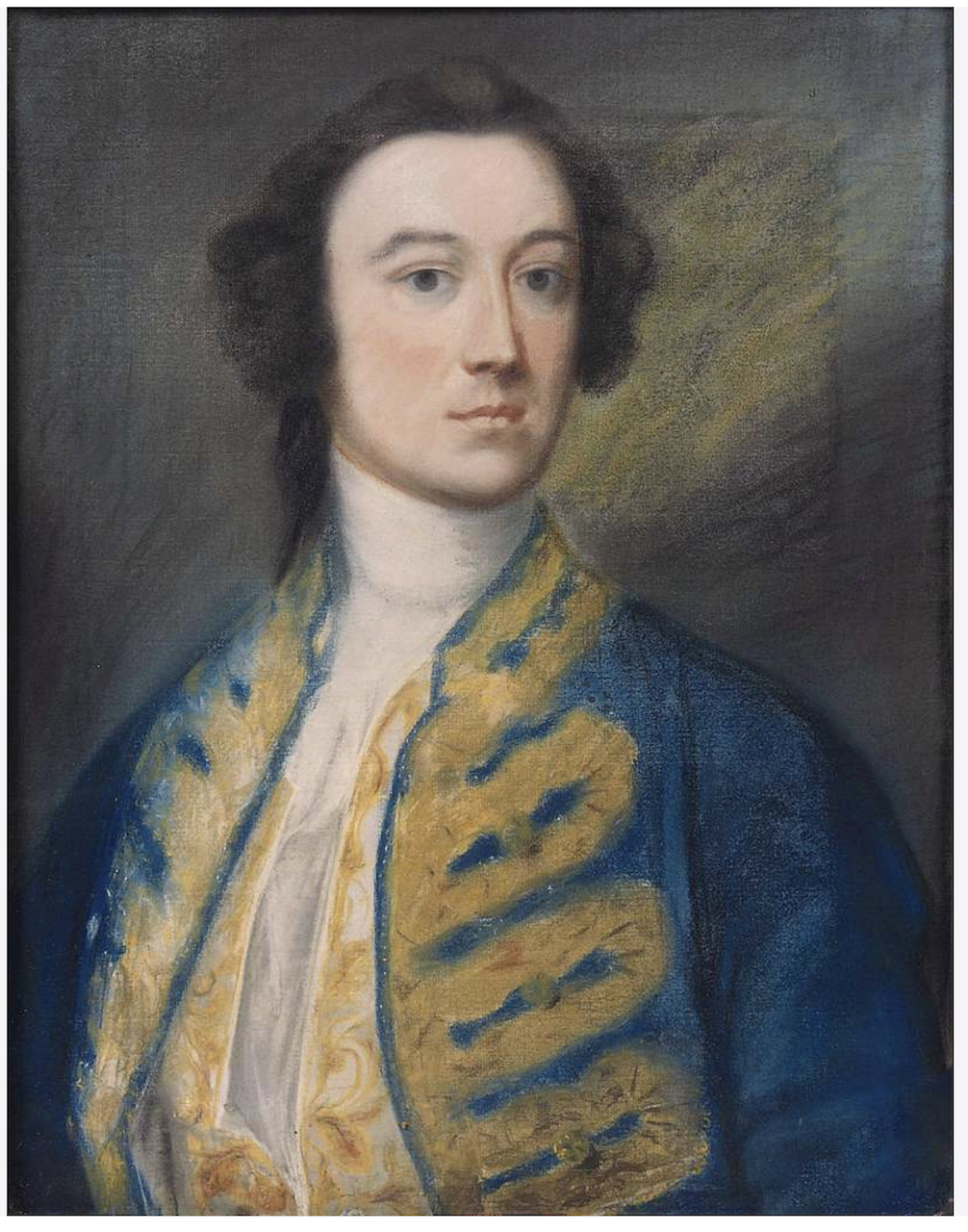
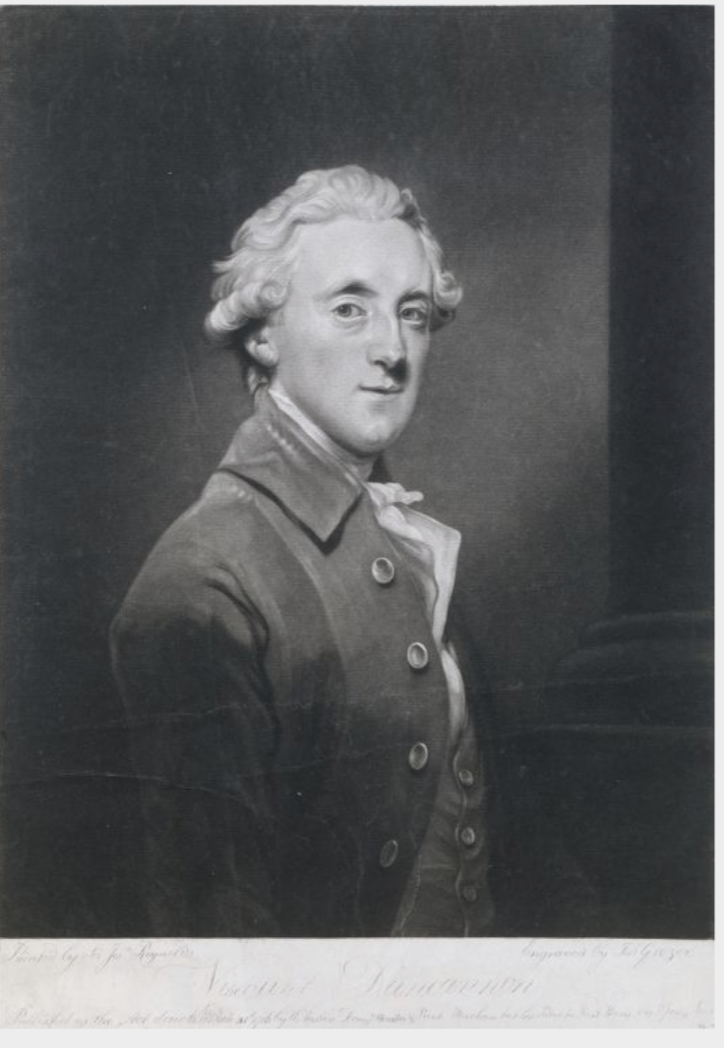
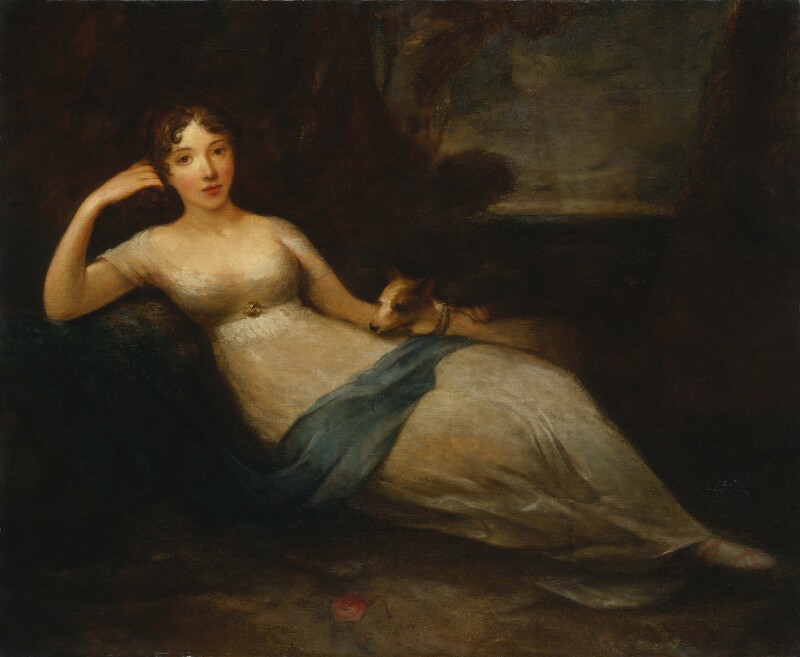
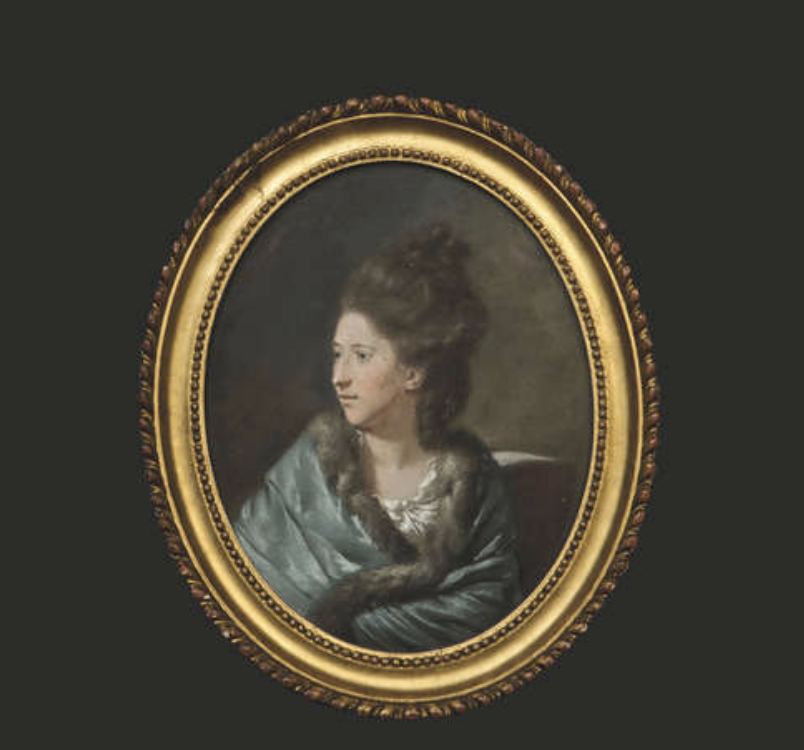
William Petty (1737-1805) 1st Marquess of Lansdowne Lord Shelburne, Prime Minister, after Sir Joshua Reynolds based on a work of 1766, National Portrait Gallery of London 43.He was the son of John Fitzmaurice Petty (1706-1761) 1st Earl of Shelburne, who was the son of Thomas Fitzmaurice 1st Earl of Kerry (21st Baron of Kerry), Viscount ClanmorrisLouisa Lansdowne née Fitzpatrick, wife of William Petty 1st Marquess of Lansdowne by Joshua Reynolds from Catalogue of the pictures and drawings in the National loan exhibition, in aid of National gallery funds, Grafton Galleries, London. She was a daughter of John FitzPatrick 1st Earl of Upper Ossory.John Henry Petty (1765-1809) 2nd Marquess of Lansdowne National Portrait Gallery of London ref. D37171.John Henry Petty (1765-1809), 2nd Marquis of Lansdowne by Francois-Xavier Fabre, 1795.Henry Petty-Fitzmaurice (1780-1863) 3rd Marquess of Lansdowne, Trustee of the National Portrait Gallery, by Henry Walton circa 1805 courtesy of National Portrait Gallery, NPG 178.Henry Thomas Petty-Fitzmaurice (1816-1866) 4th Marquess of Lansdowne, Politician and railway company chairman, photograph by by John & Charles Watkins circa early 1860s, courtesy of National Portrait Gallery NPG Ax16422.Henry Charles Keith Petty-Fitzmaurice 5th Marquess of Lansdowne by Philip Alexius de László.Beatrix Frances Duchess of St Albans, Maud Evelyn Petty-Fitzmaurice, Marchioness of Lansdowne (wife of 5th Marquess), Theresa Susey Helen Vane-Tempest-Stewart, Marchioness of Londonderry and Evelyn Emily Mary Cavendish, Duchess of Devonshire, by Frederick & Richard Speaight.Mrs Letitia Pilkington (née Van Lewen), (1712-1750), “Adventuress” and Author Date: c.1760 Engraver: Richard Purcell, Irish, c.1736-c.1766 After Nathaniel Hone the Elder, Irish, 1718-1784.Oliver Plunket, by Edward Luttrell courtesy of National Portrait Gallery London.Called Frances Hales, Countess of Fingall, possibly Margaret MacCarty later Countess of Fingall, wife of Luke Plunkett (1639-1685) 3rd Earl of Fingall, by Simon Pietersz Verelst courtesy of National Trust Hatchlands. Margaret was daughter of Donough MacCarty (or MacCarthy) 1st Earl of Clancarty; 2nd Viscount Muskerry. Frances Hales married Peter Plunkett (1678-1717) 4th Earl of Fingall.Arthur James Plunkett (1759-1836) 8th Earl of Fingall by Charles Turner after Joseph Del Vechio NPG D36923.Horace Plunkett by photographer Bassano Ltd, 1923, courtesy of National Portrait Gallery of London, reference NPGx12783.William Conyngham Plunket, 1st Baron Plunket, (1764-1854), Orator and former Lord Chancellor of Ireland Engraver David Lucas, British, 1802-1881 After Richard Rothwell, Irish, 1800-1868.Marble bust of William Plunket, 1st Baron Plunket (1764-1854), Lord Chancellor of Ireland, by CHRISTOPHER MOORE RHA (1790 – 1863), courtesy of Adams auction 19 Oct 2021.William Pole of Ballyfin (d. 1781), English school of 18th century, pastel, courtesy of Christies auction, wikimedia commons. He married Sarah Moore, daughter of the 5th Earl of Drogheda.
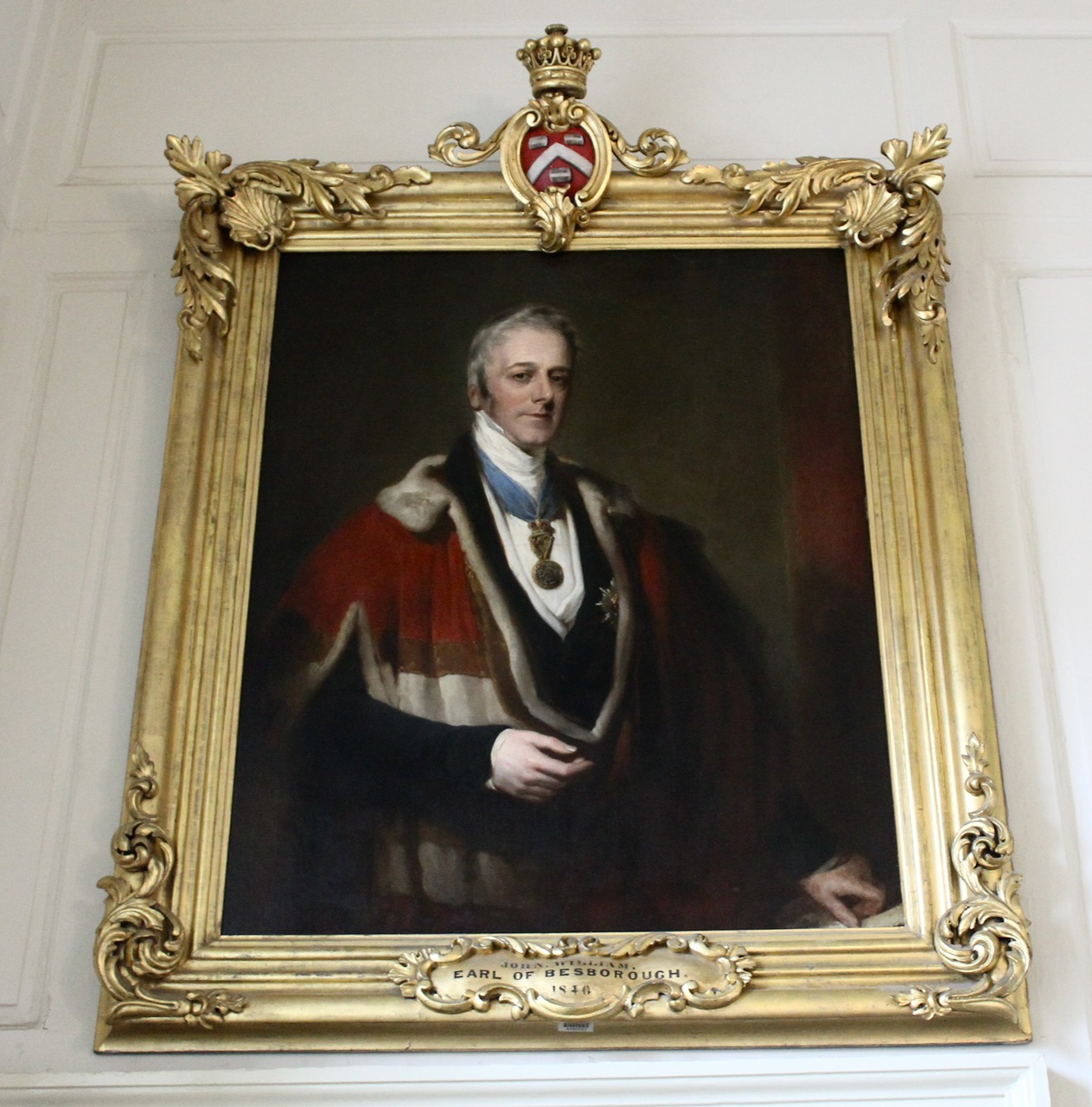
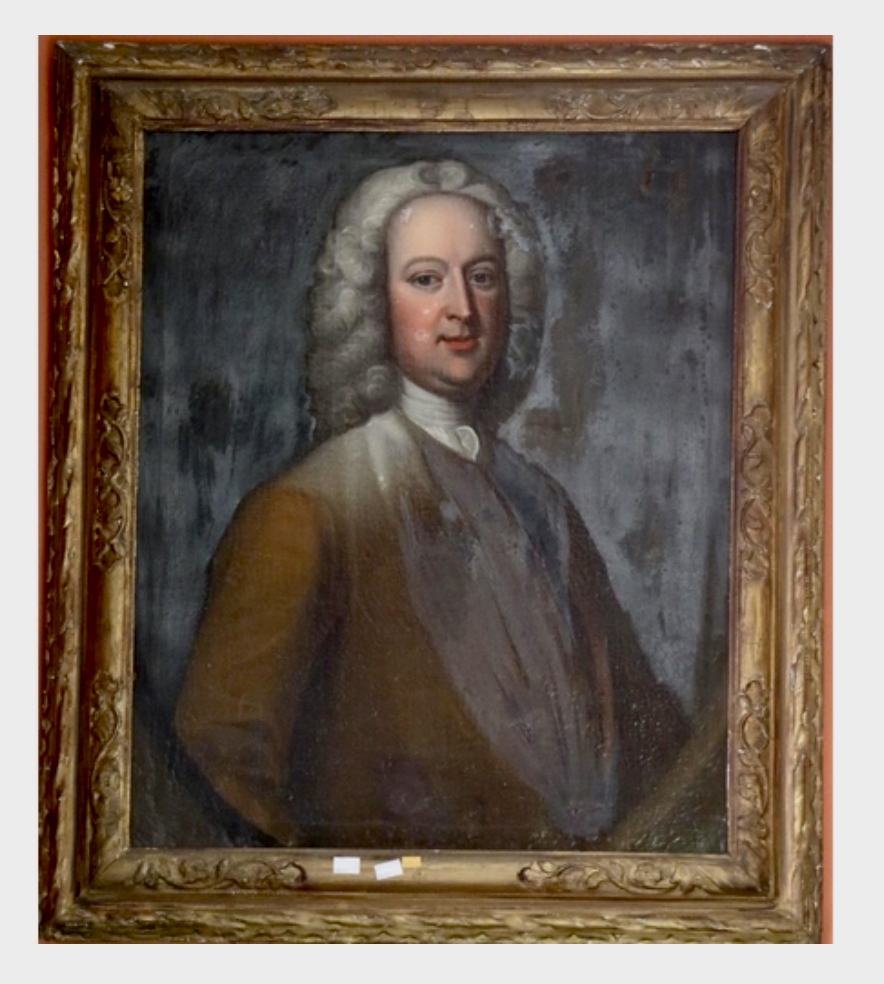
Brabazon Ponsonby (1679-1758) 1st Earl of Bessborough, 2nd Viscount Duncannon, of the fort of Duncannon, Co. Wexford married Sarah Margetson. Their daughter Sarah (d. 1736/37) married Edward Moore, 5th Earl of Drogheda. Their daughter Anne married Benjamin Burton of Burton Hall, County Carlow. Their daughter Letitia (d. 1754) married Hervey Morres, 1st Viscount Mountmorres. Their son William Ponsonby (1704-1793) succeeded as 2nd Earl of Bessborough and a younger son, John (1713-1787) married Elizabeth, daughter of William Cavendish 3rd Duke of Devonshire.
Help me to pay the entrance fee to one of the houses on this website. This site is created purely out of love for the subject and I receive no payment so any donation is appreciated!
€15.00
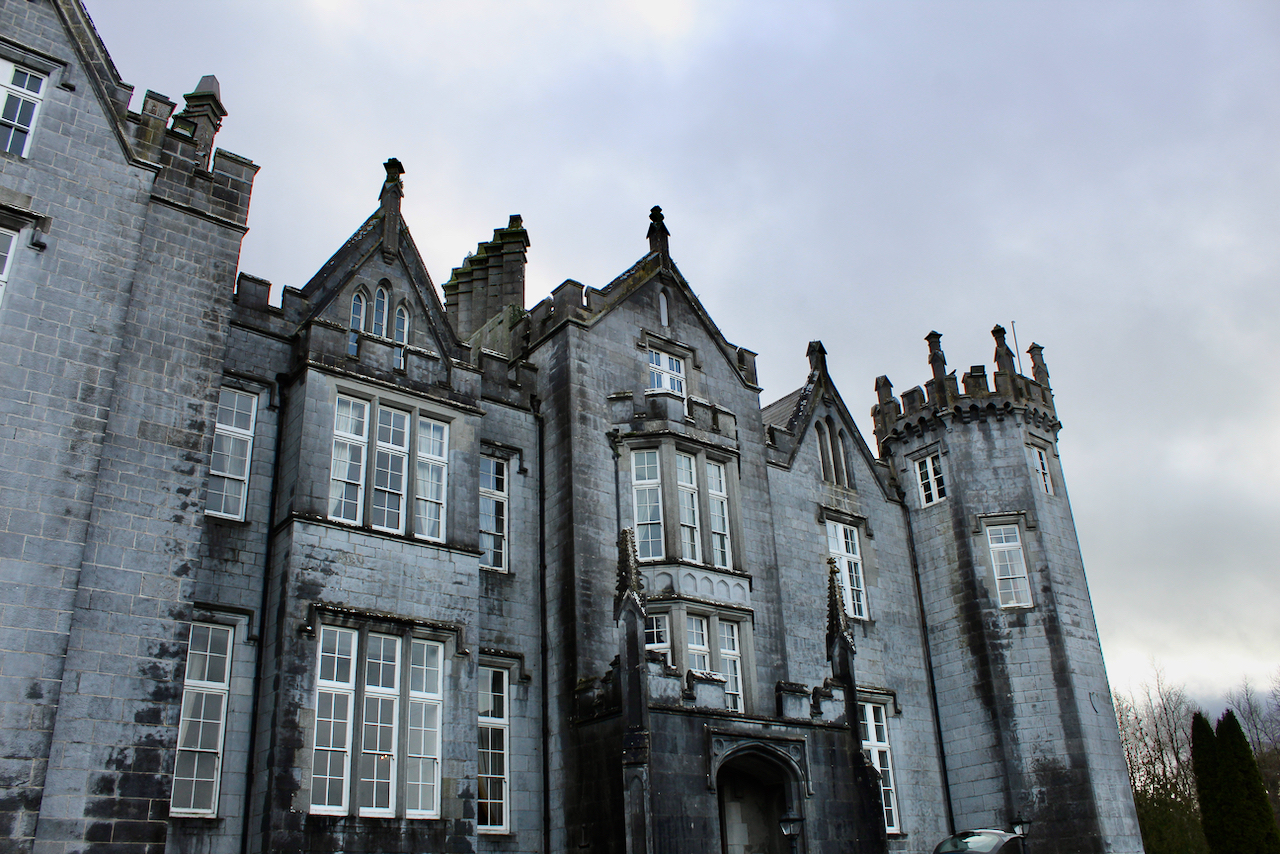
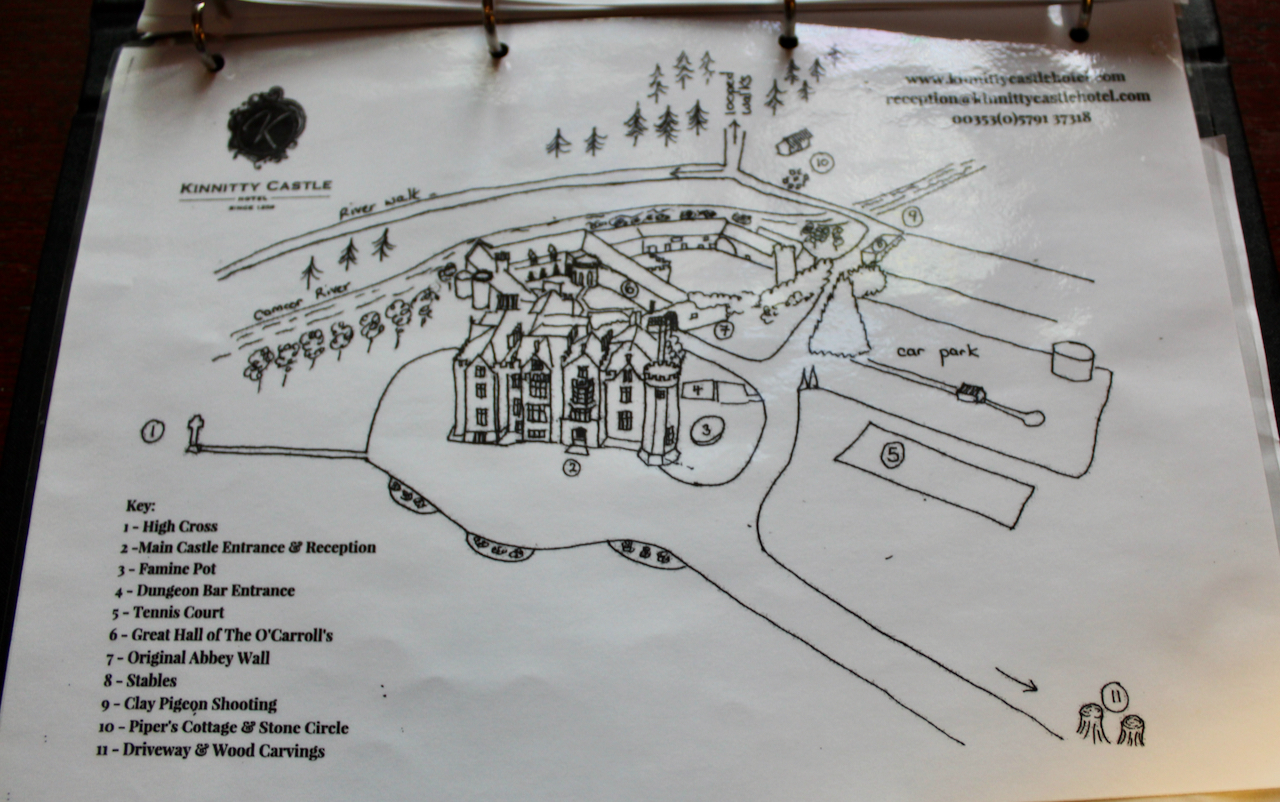
Kinnitty Castle (formerly Castle Bernard), Kinnity, County Offaly
Kinnitty Castle Hotel, 2014, photographer unknown, for Tourism Ireland, Ireland’s Content Pool. [1]
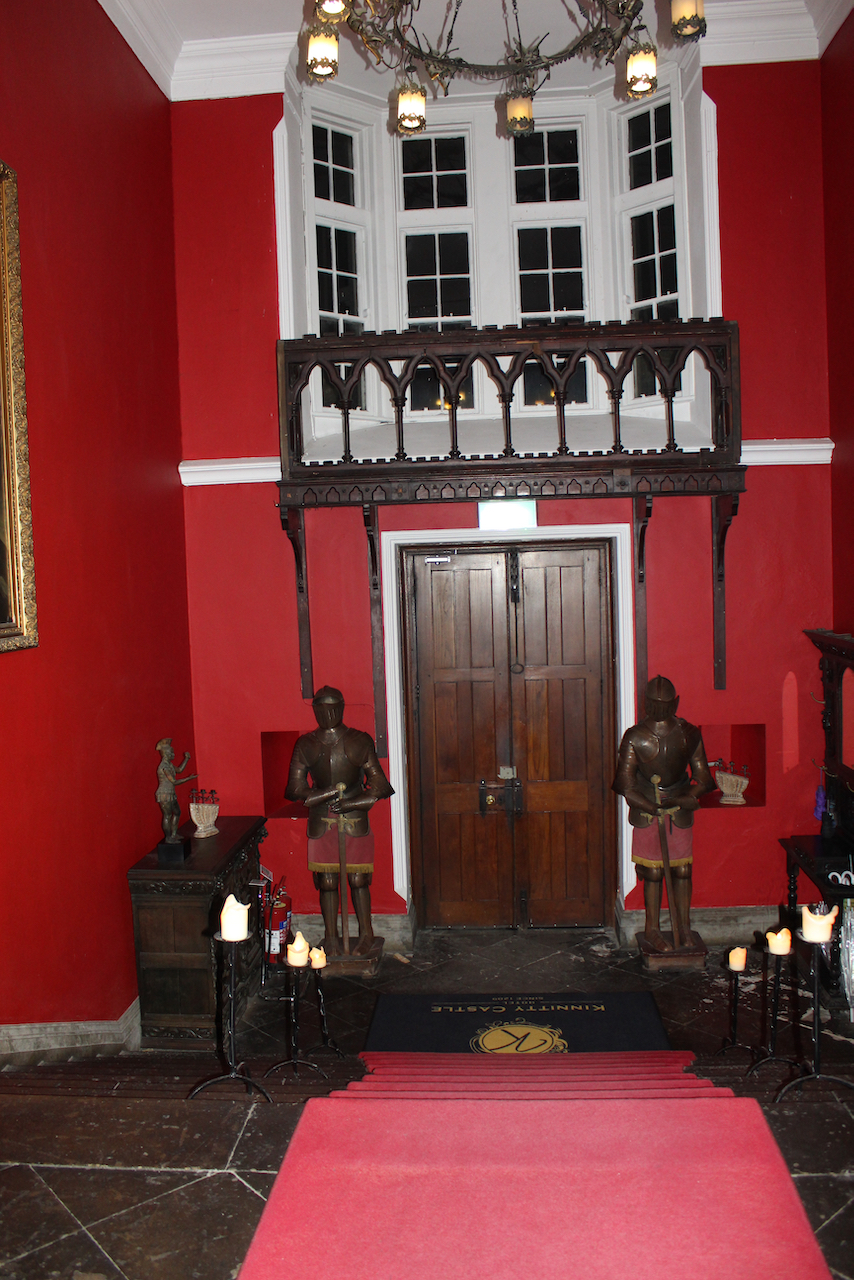
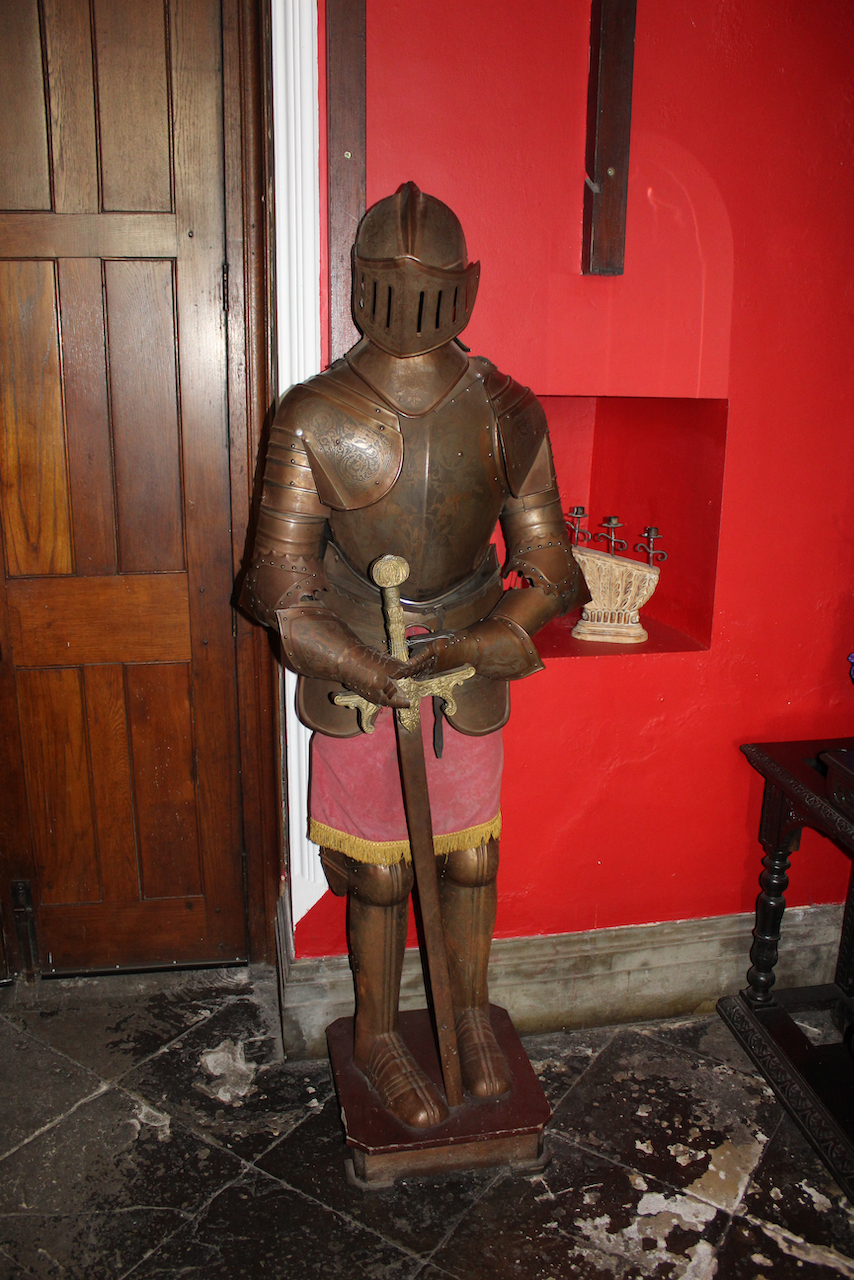
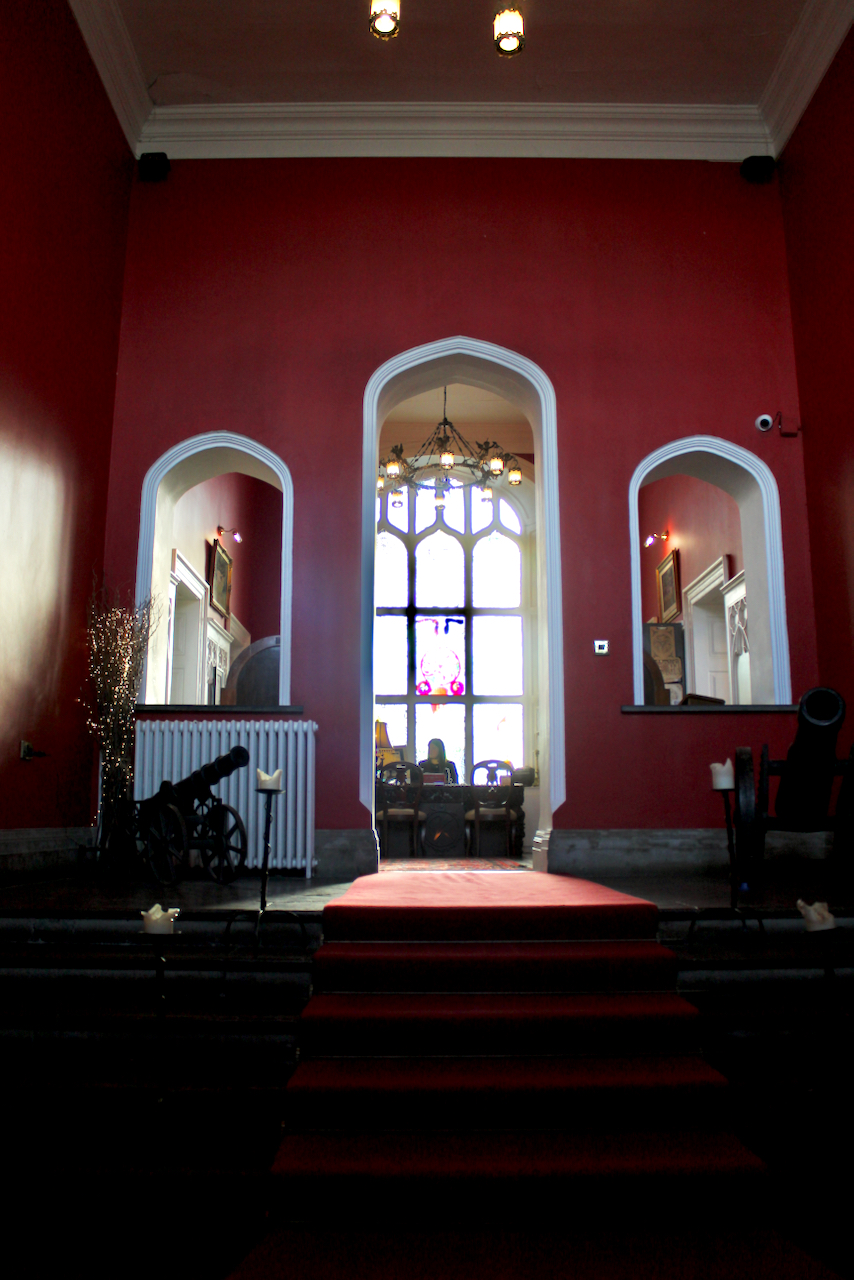
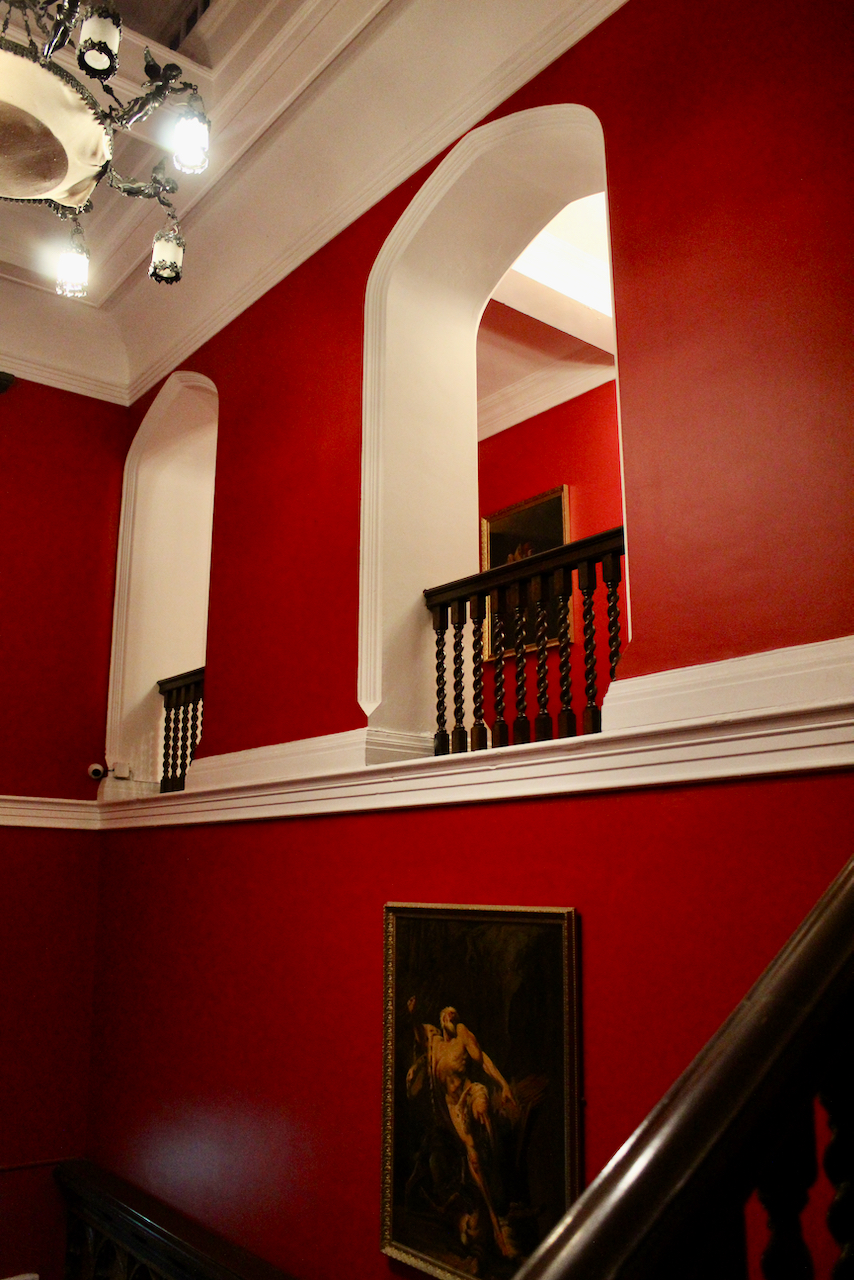
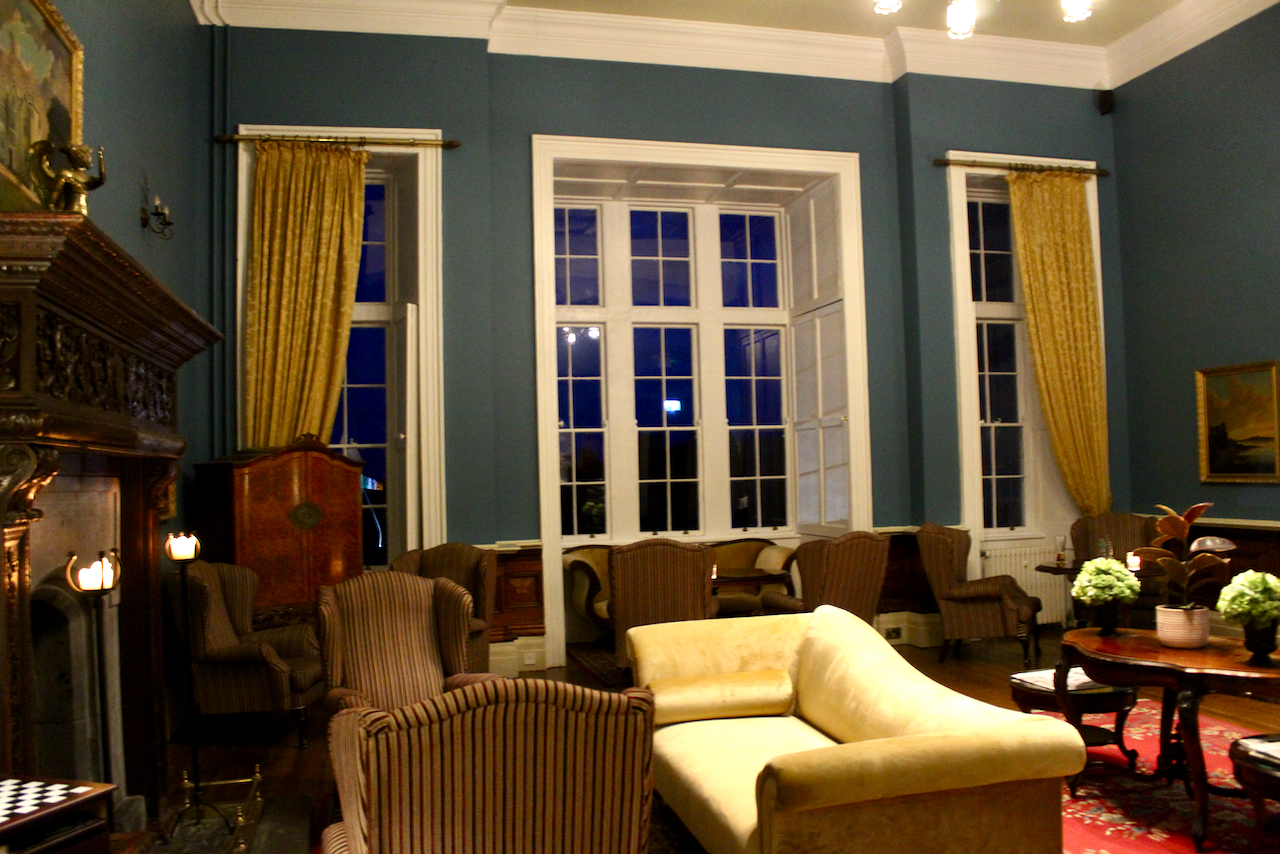
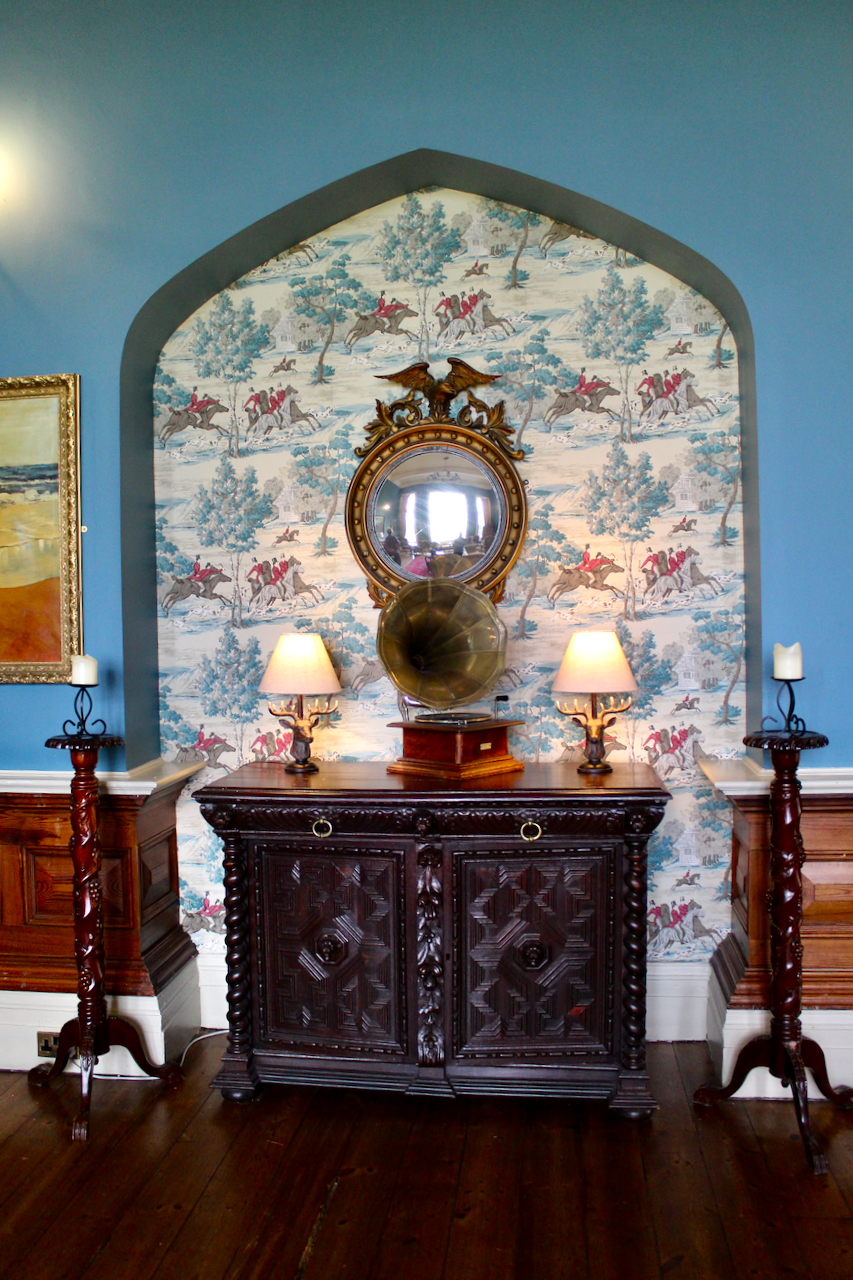
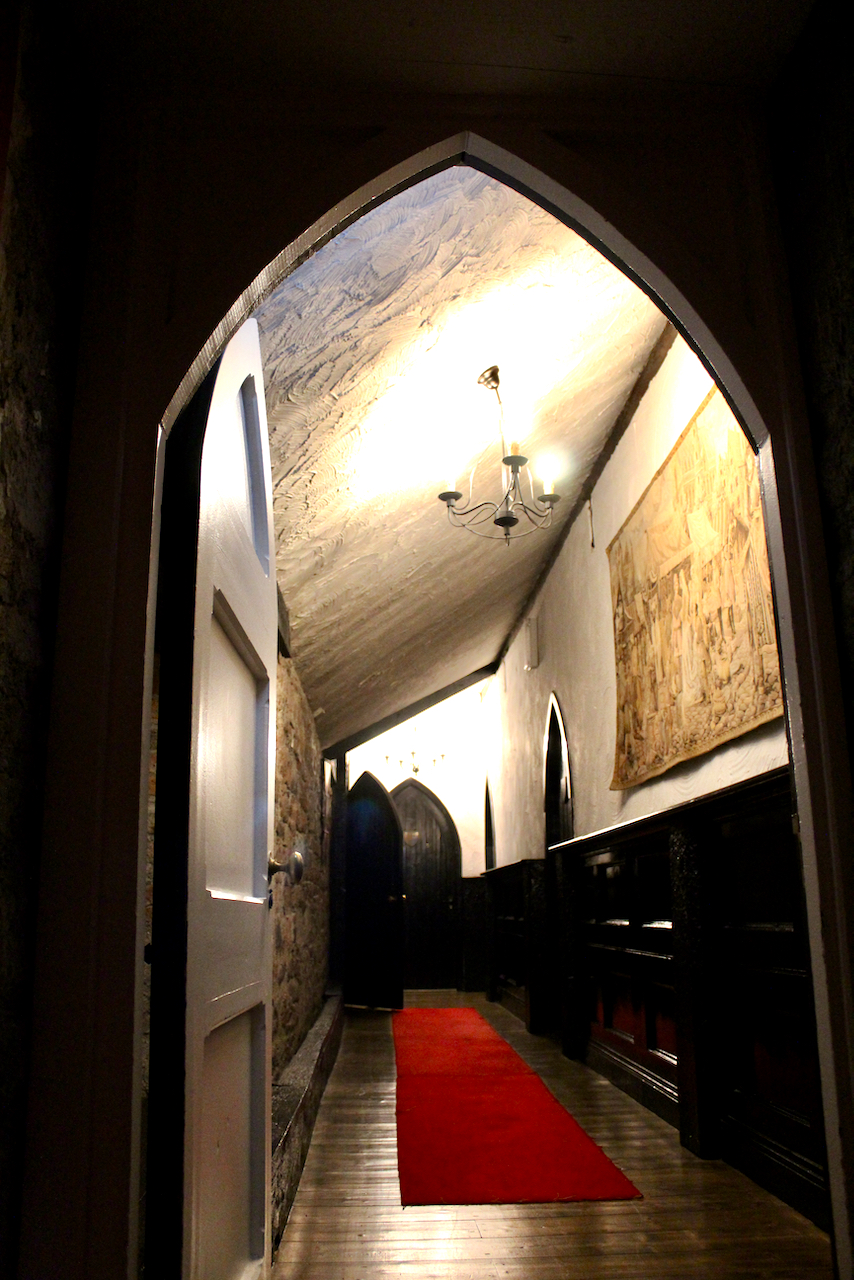
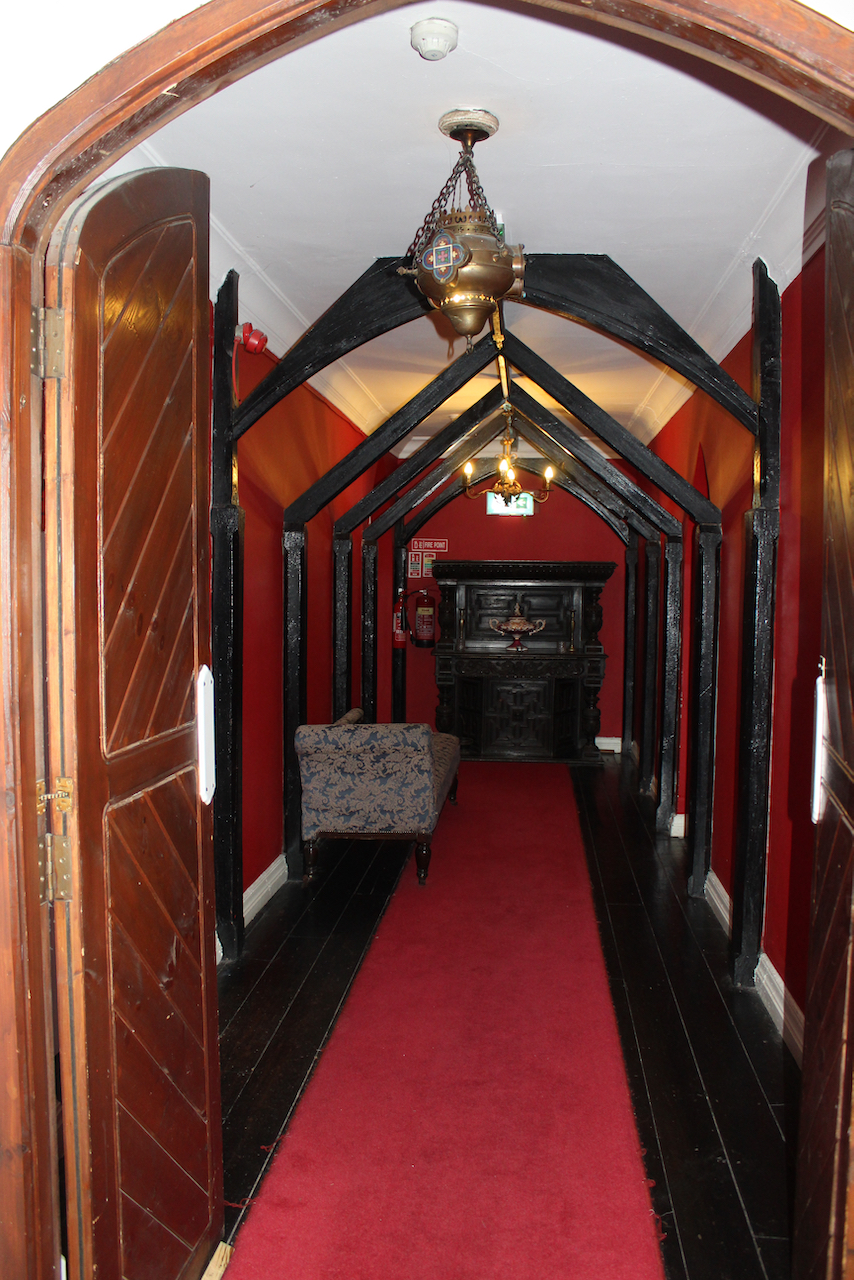
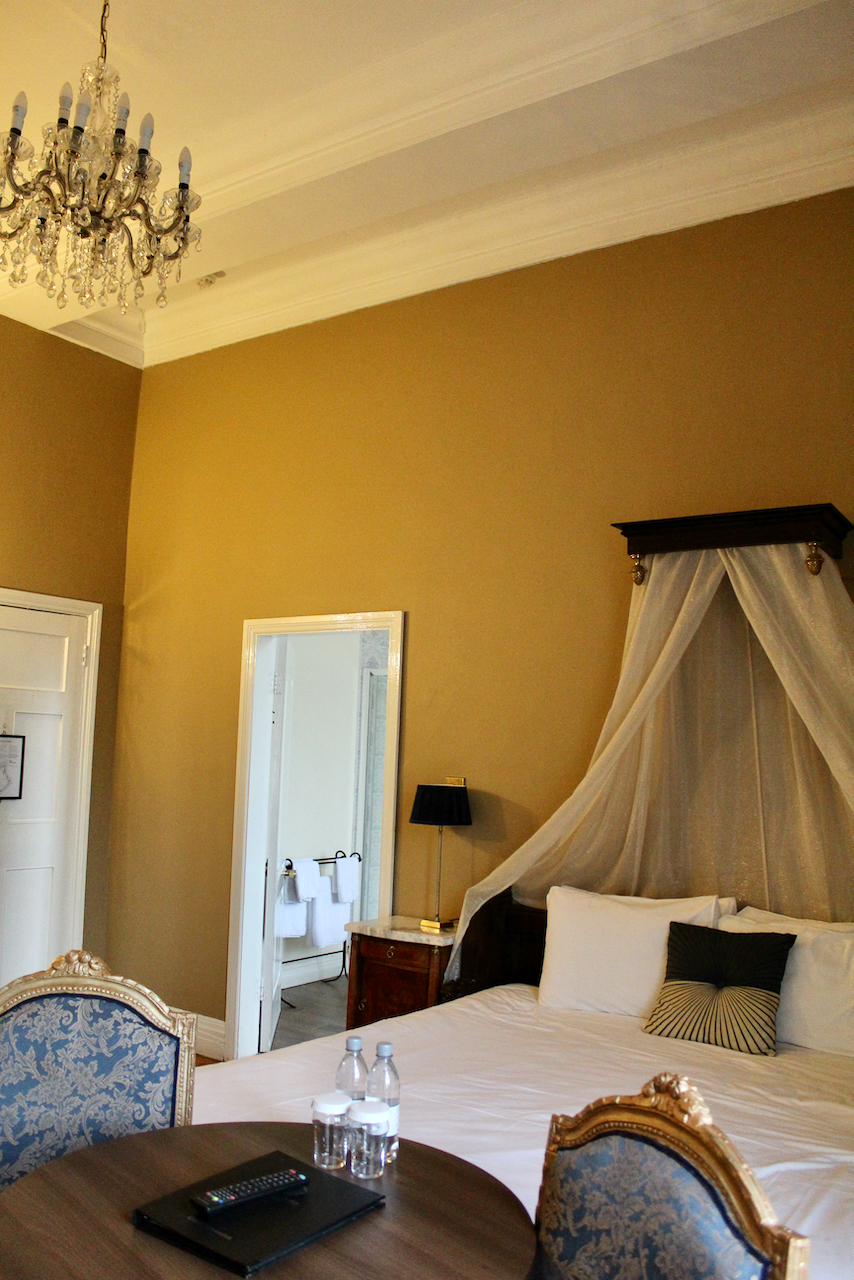
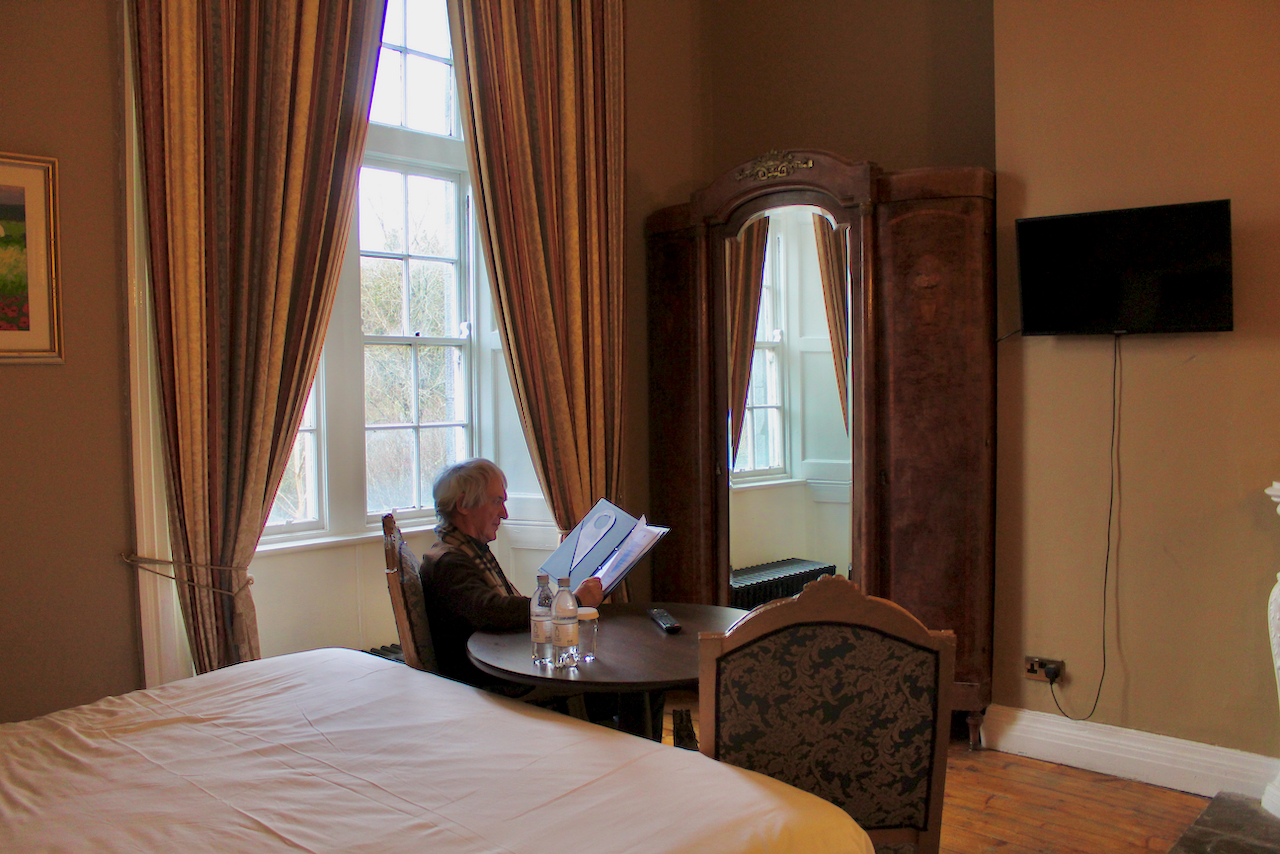
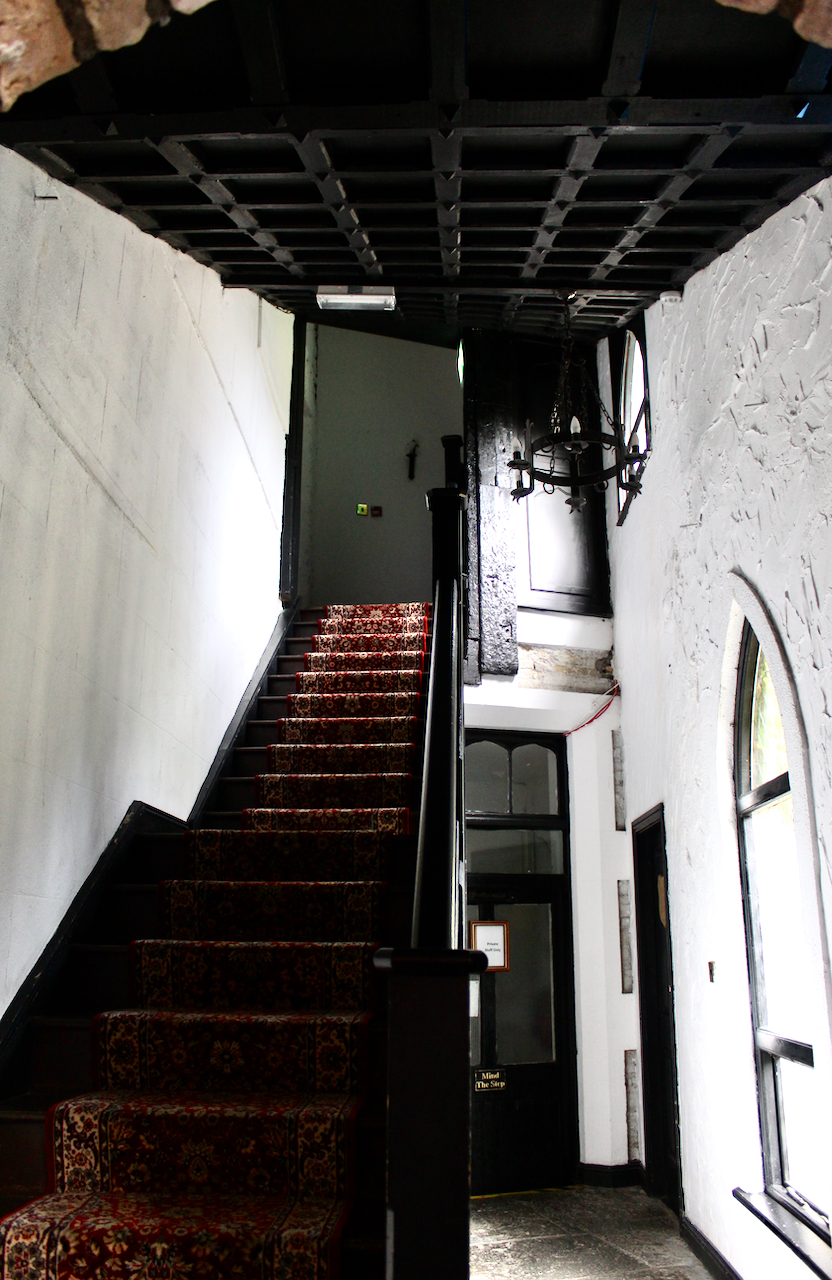
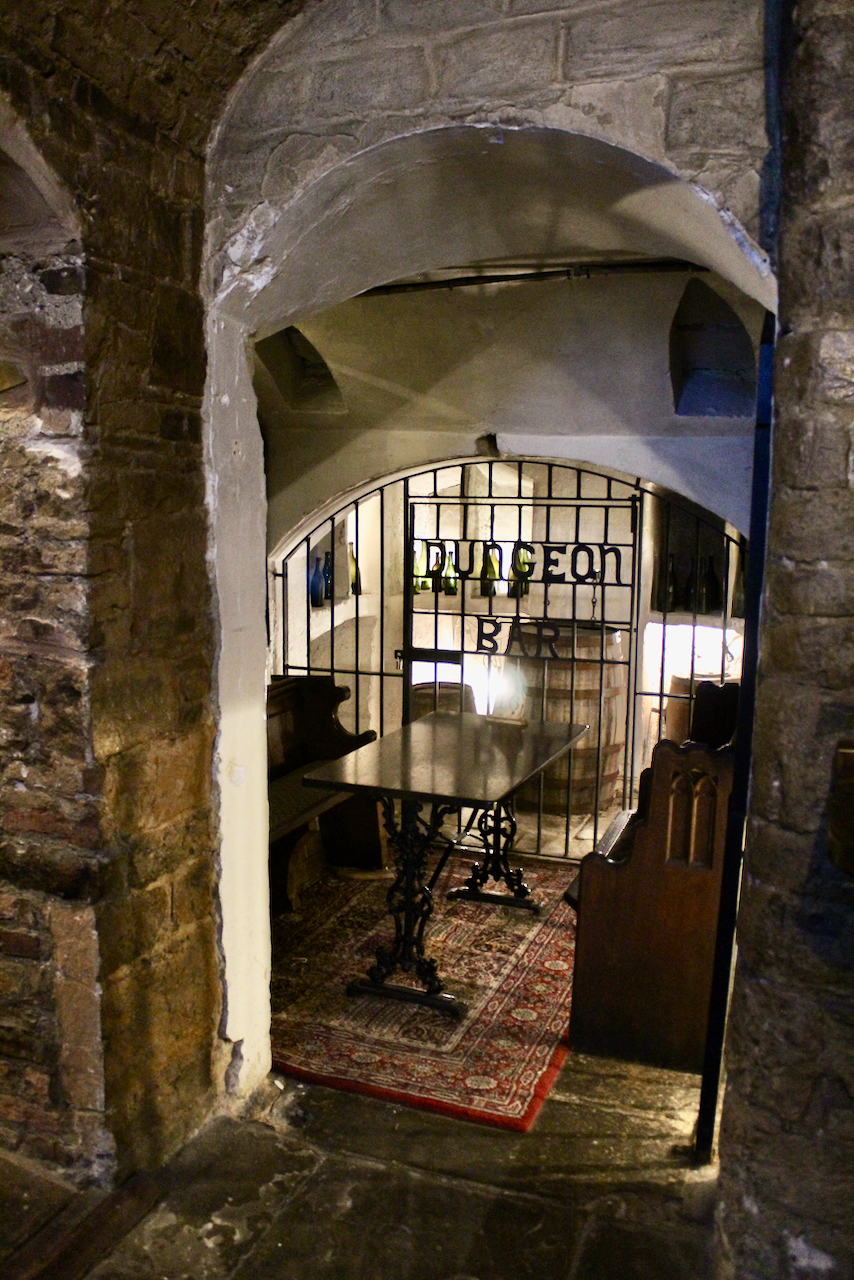
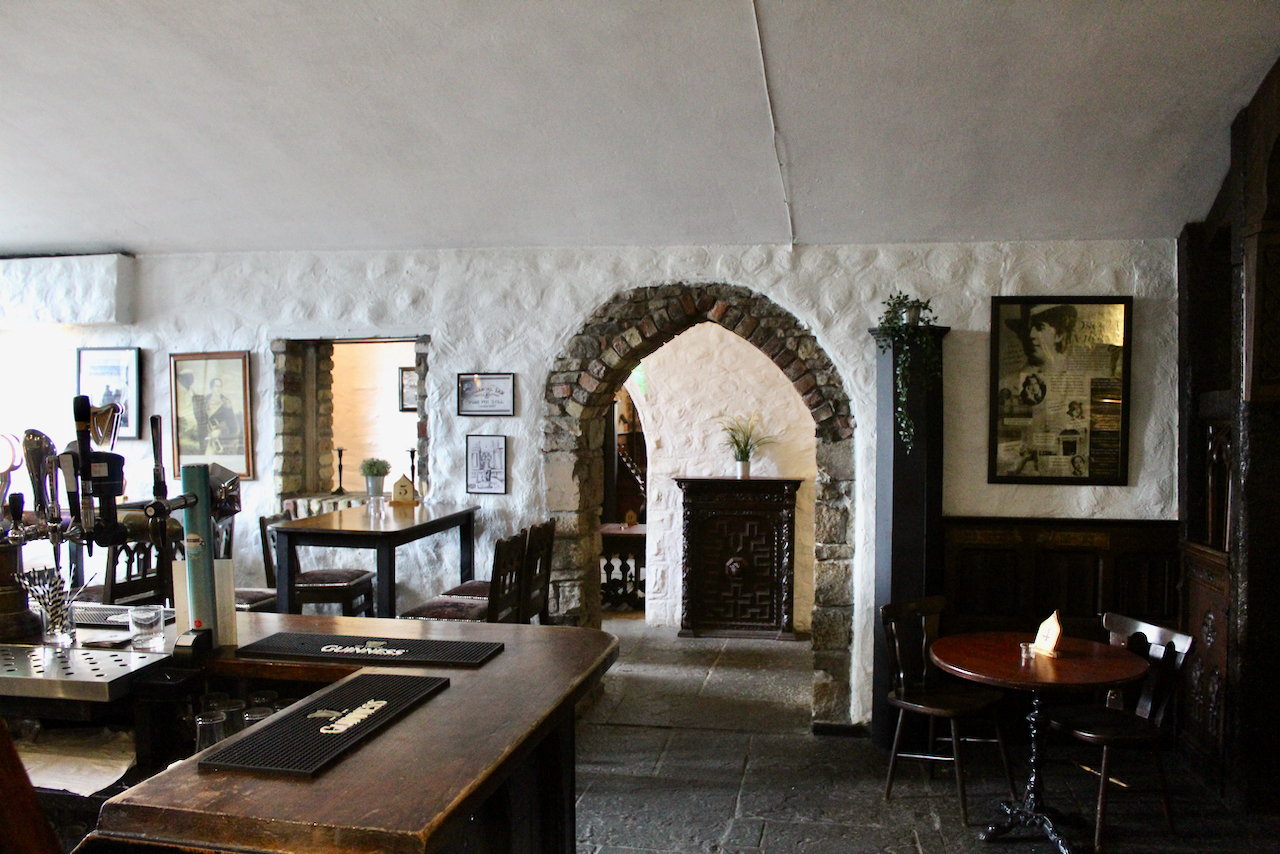
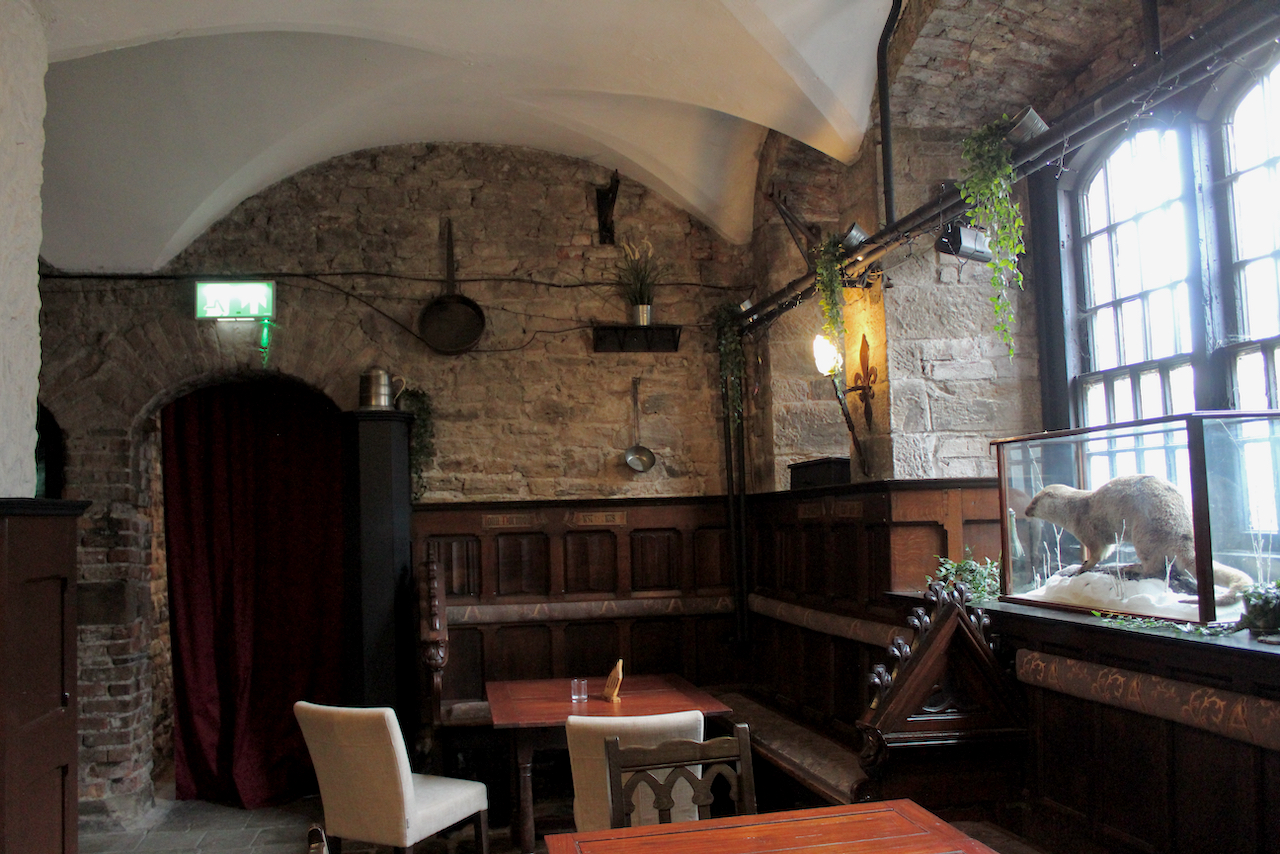
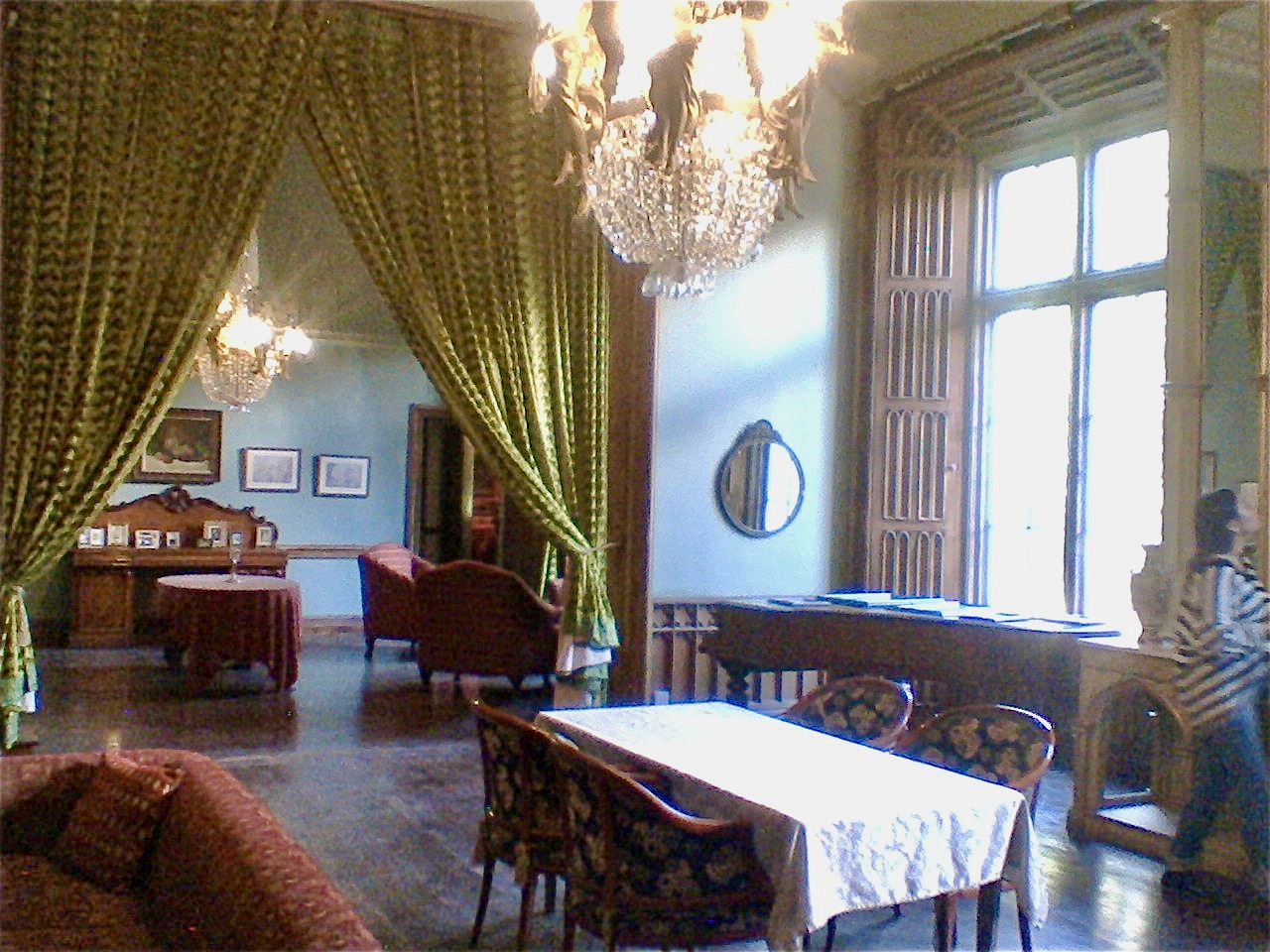
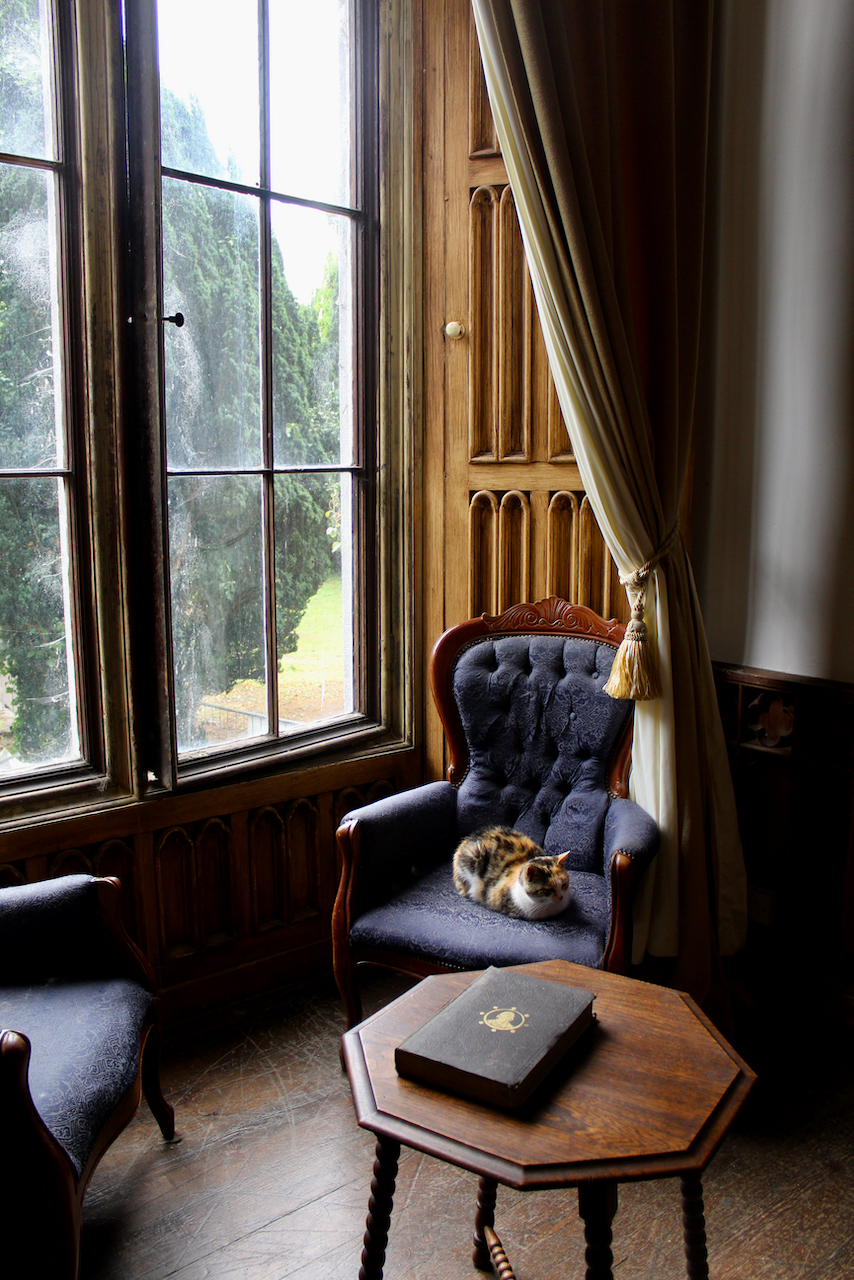
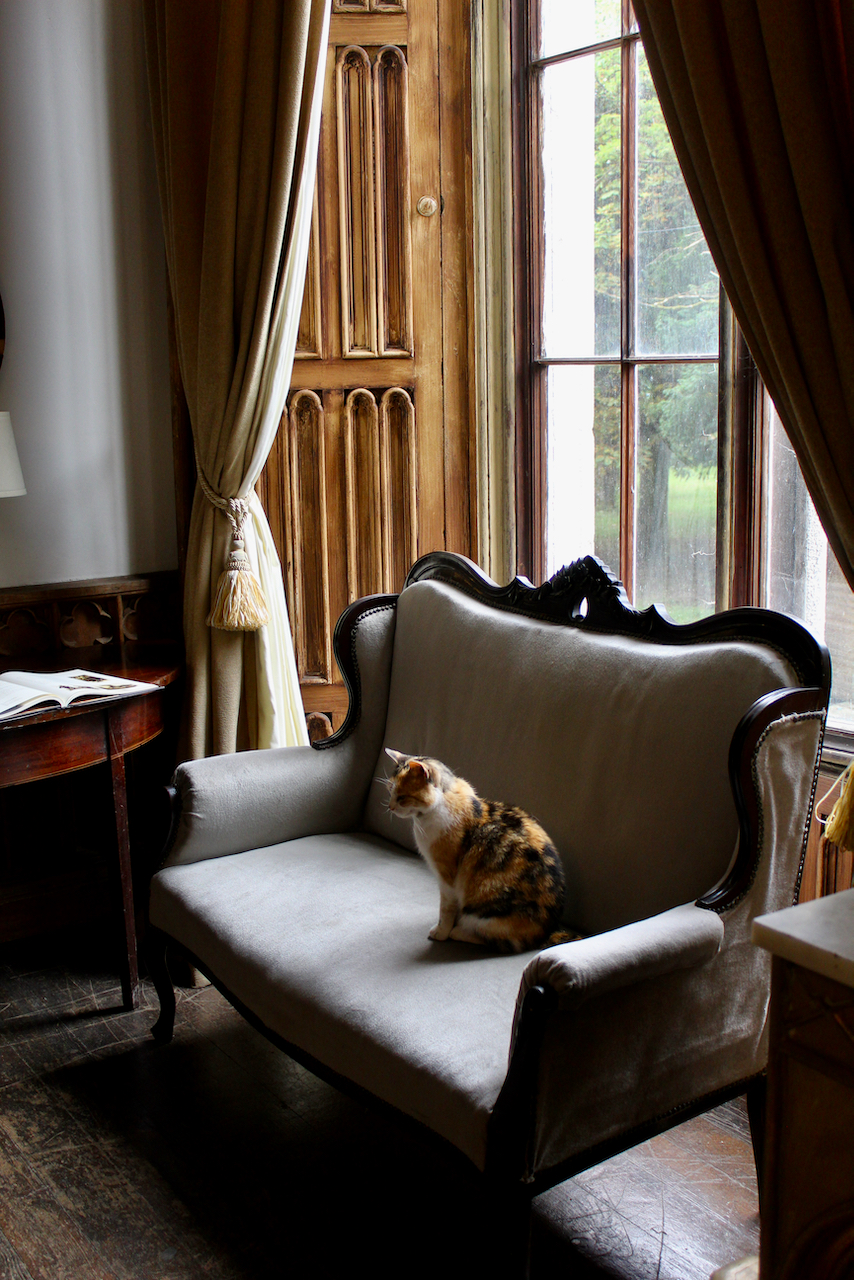
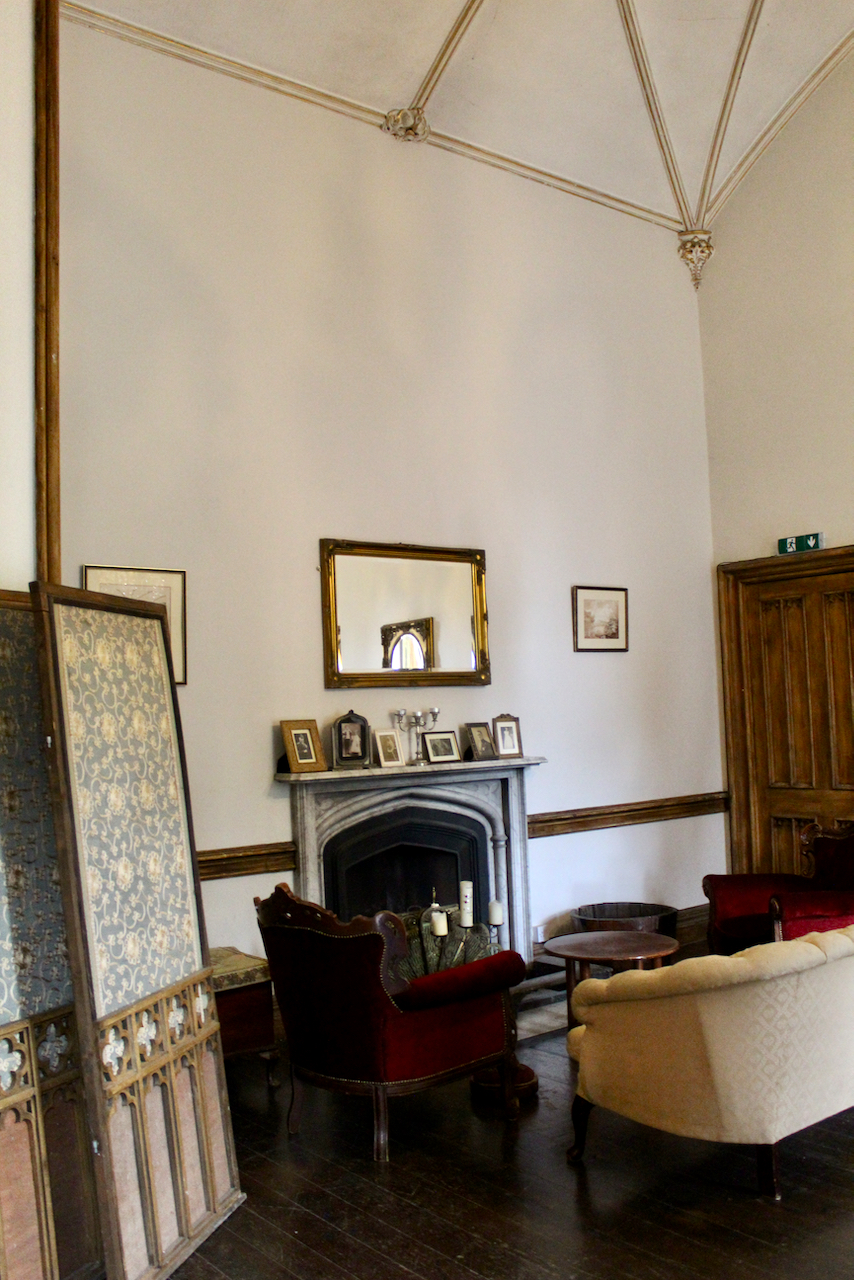
We treated ourselves to a stay in Kinnitty Castle in February 2023. Formerly a home, it is now a hotel.
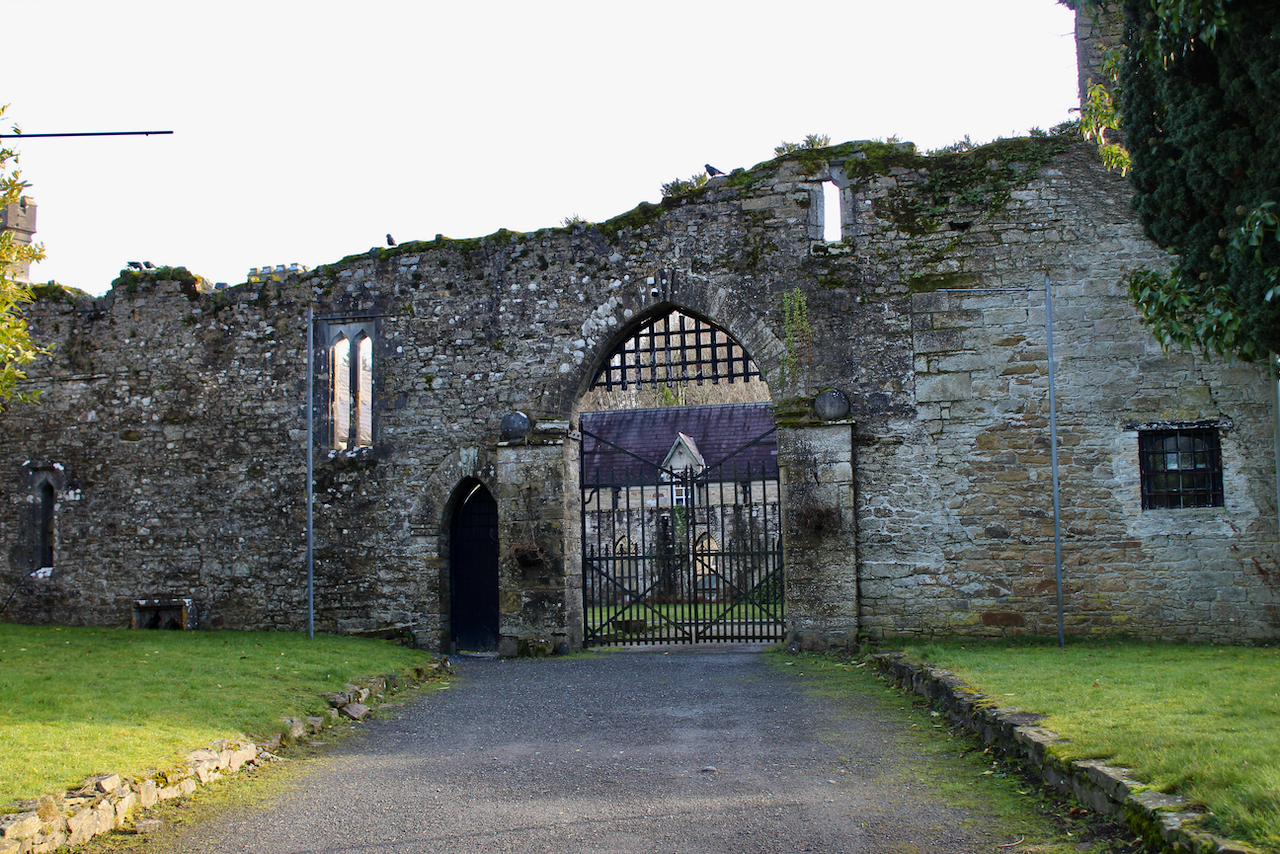
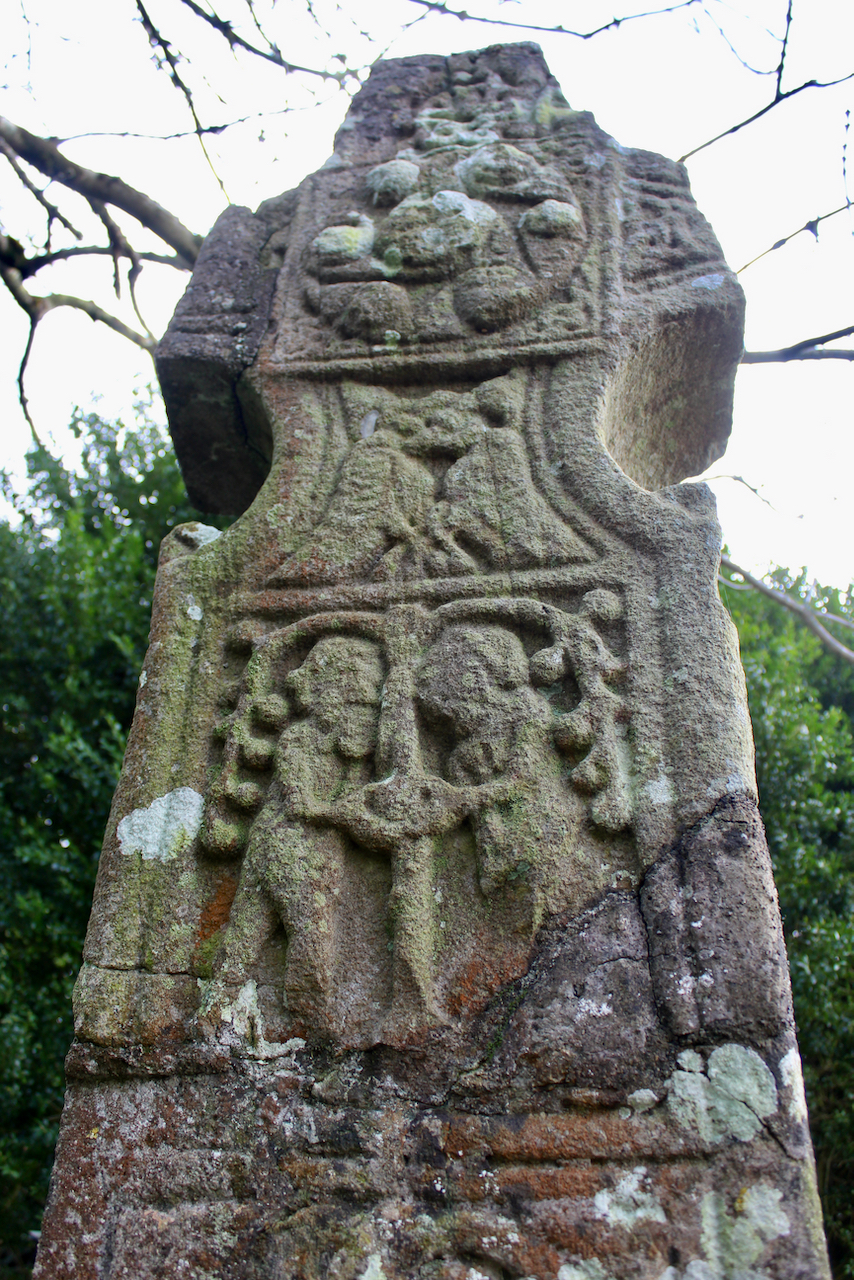
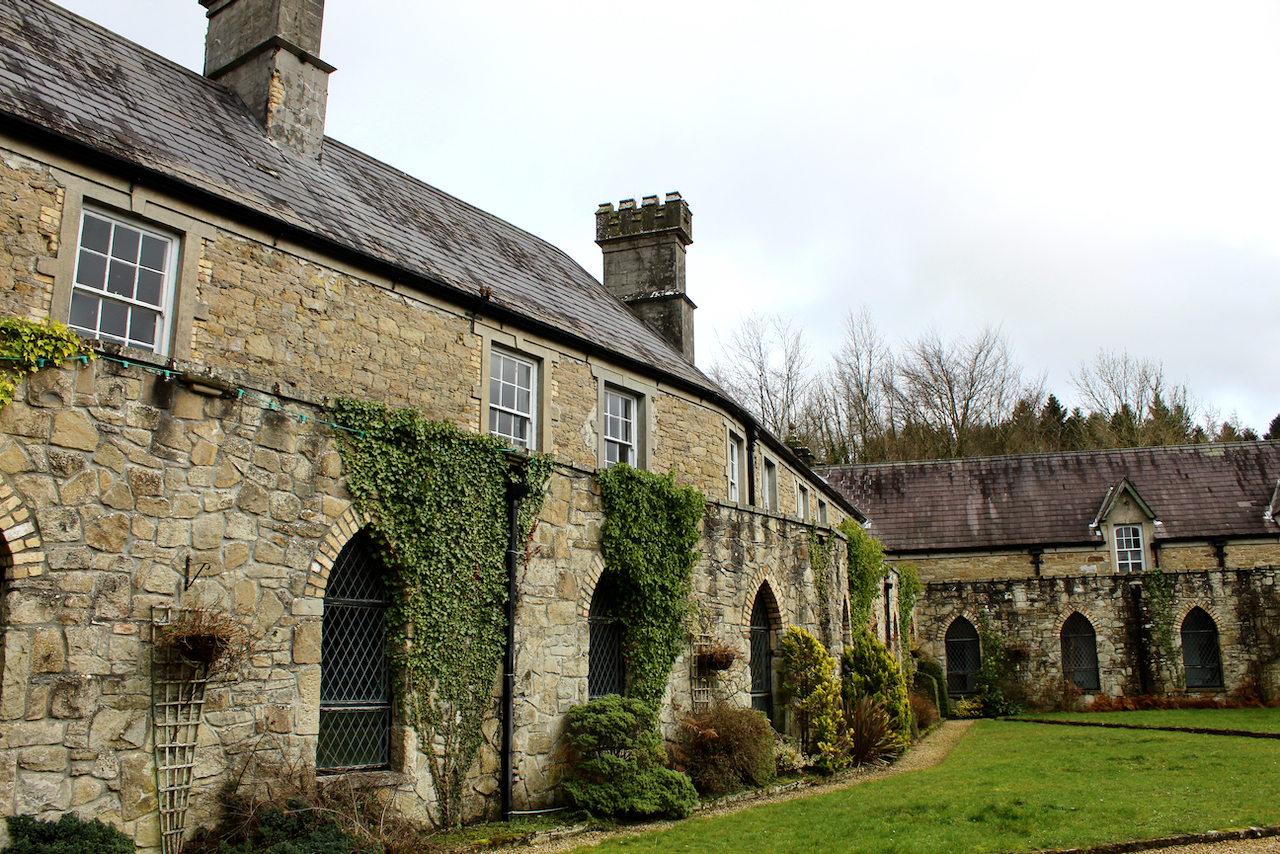
The website used to include a history, which told us that the present building was originally built by William O’Carroll on the site of an old Abbey in 1630. The building we see today, however, received a major reconstruction by architect brothers James (1779-1877) and George Richard Pain (1793-1838) in 1833. You can see traces of the Abbey in the courtyard.
In 1641 the castle was confiscated from William O’Carroll, as he must have played a part in the 1641 rebellion. The land was granted in 1663 by King Charles II to Colonel Thomas Winter for his military service.
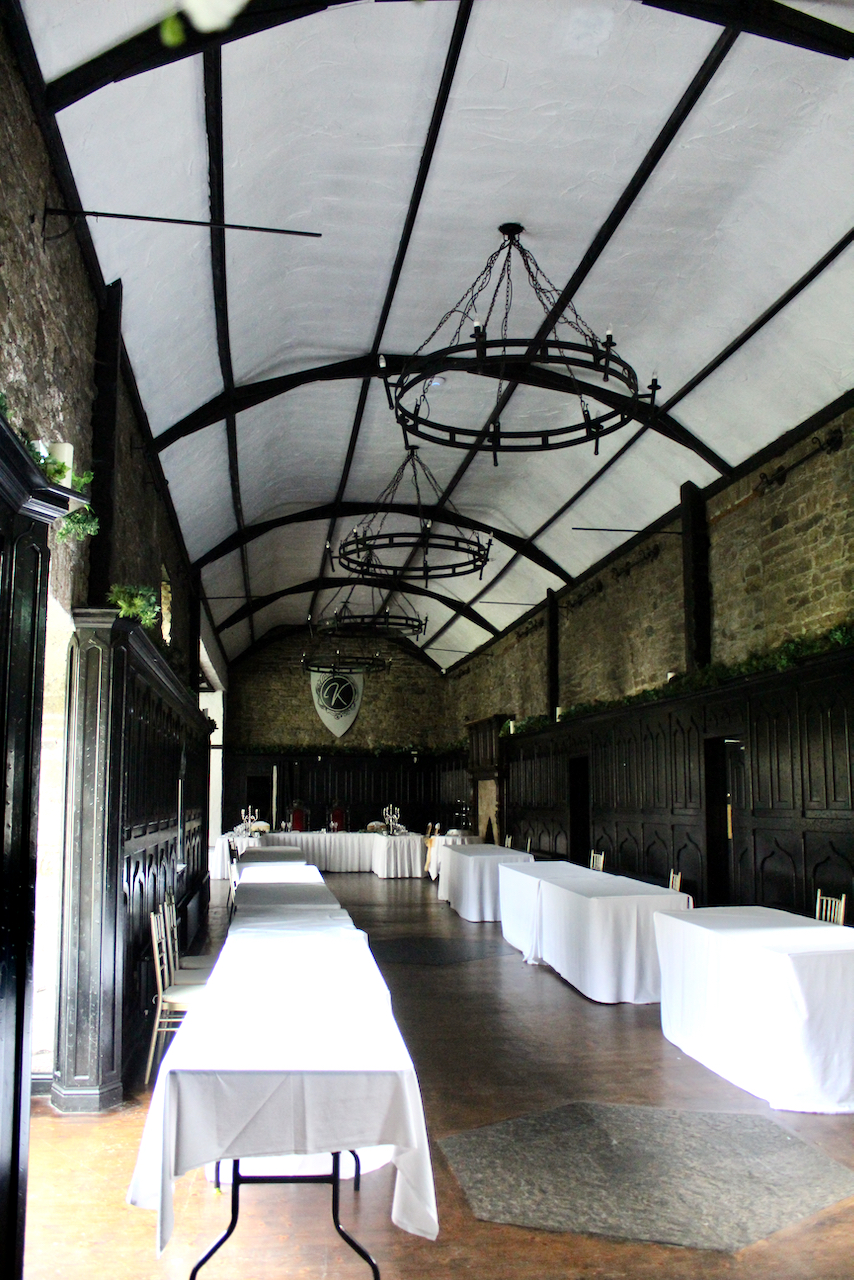
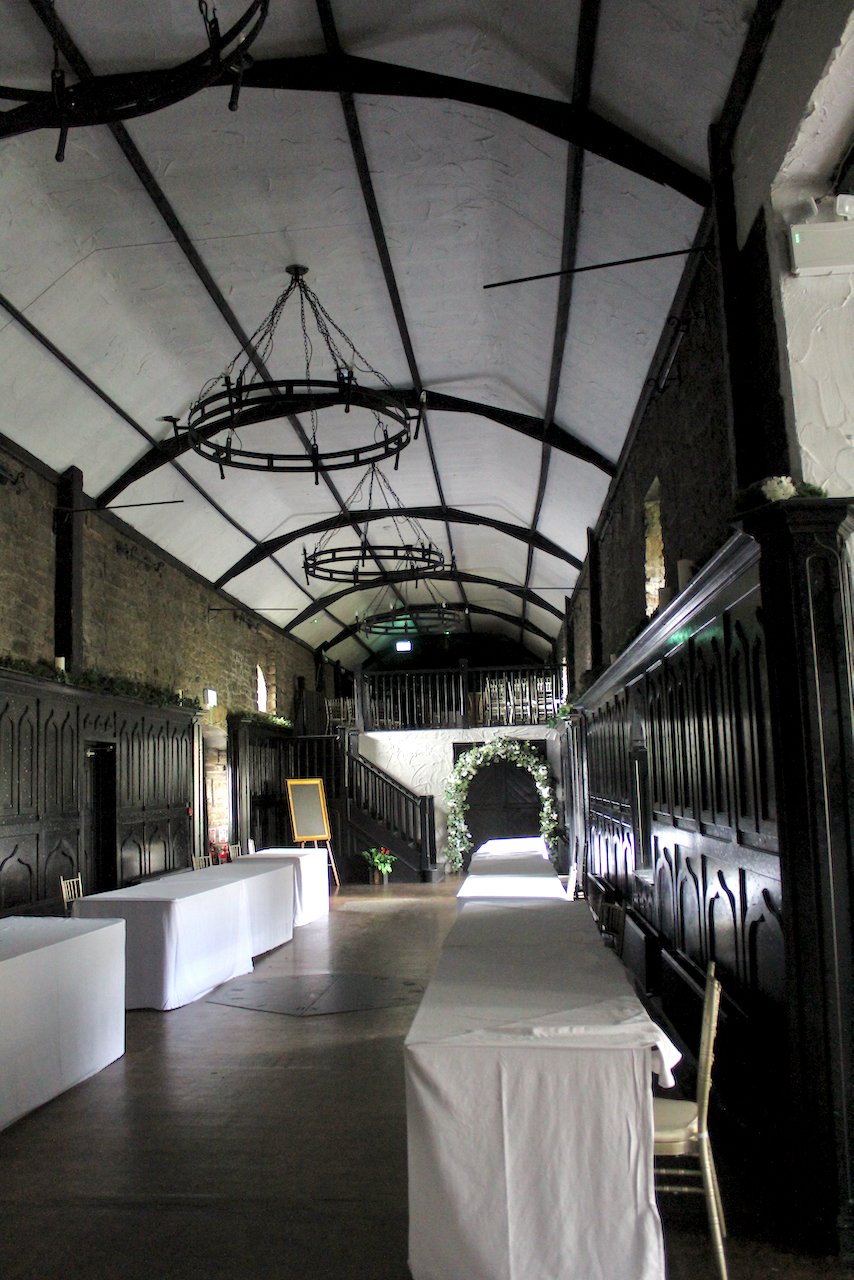
The Stable yard is in use as a banqueting hall, called the Great Hall of the O’Carrolls, and kitchens.
The website continues, telling us that the Winter family sold the building in 1764 to the Bernards of County Carlow.
Andrew Tierney tells us in his The Buildings of Ireland Central Leinster that Franks Bernard (named after the surname “Franks”), a son of Charles Bernard of Bernard’s Grove, County Laois (now called Blandsfort), leased a small estate here in the early eighteenth century. Either he or his nephew Thomas (d. 1788) probably built the modest T-plan house that forms the core of the castle.
There is another Castle Bernard in County Cork – this seems to have belonged to a different Bernard family.
The castle website tells us that it was Catherine Hely Hutchinson (d. 1844, daughter of Francis Hely Hutchinson, MP for Naas, County Kildare), wife of Colonel Thomas Bernard (d. 1834), who hired the Pain brothers, James and George Pain, to renovate the building, in 1833 (according to Mark Bence-Jones).
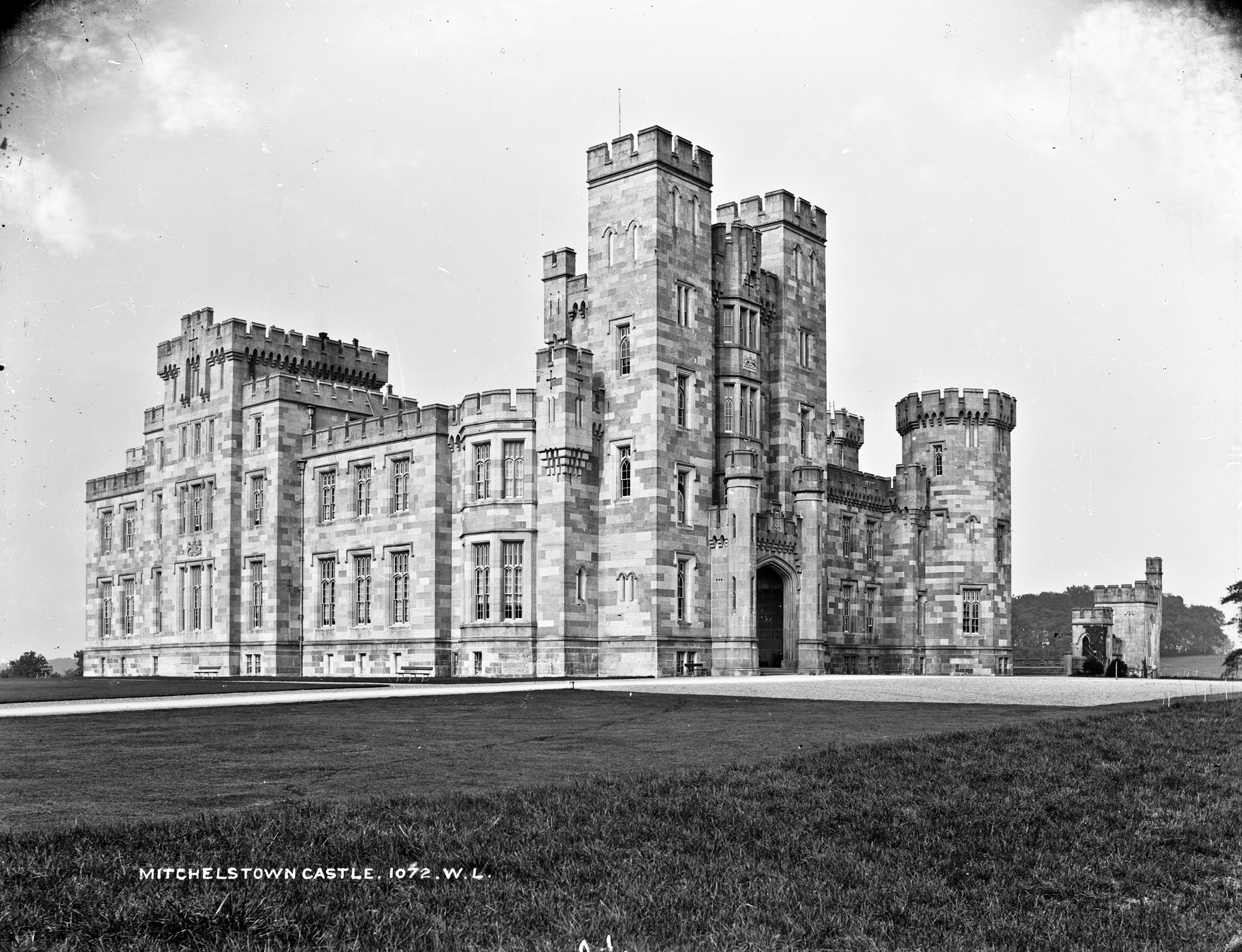
James and George Pain were architects of the impressive Mitchellstown Castle, unfortunately no longer existing.
Mitchelstown Castle, County Cork, designed by the Pain brothers, courtesy of the National Library of Ireland, Lawrence PHotographic Collection, photographer Robert French ca. 1865-1914 ref. NLI L_ROY_01072.
James and George were sons of James Pain, an English builder and surveyor. Their Grandfather William Pain was the author of a series of builder’s pattern books, so they had architecture in the blood. According to the Dictionary of Irish Architects, James and his younger brother George Richard were both pupils of John Nash, one of the foremost British architects of his day, responsible for the design of many important areas of London including Marble Arch, Regent Street and Buckingham Palace. He was architect to the prolific lover of architecture the Prince Regent, later King George IV. When Nash designed Lough Cutra Castle in County Galway for Charles Vereker in 1811, he recommended that the two brothers should be placed in charge of the work, so it was at this time that they came to Ireland. Lough Cutra is an amazing looking castle privately owned which is available for self-catering rental (very expensive, I am sure! But for those of you with oodles of money to spend, or for an event that requires nine bedrooms…). [2]
Lough Cutra castle, County Galway, also designed by the Pain brothers, photograph from Lough Cutra website.
James Pain settled in Limerick and George in Cork, but they worked together on a large number of buildings – churches (both Catholic and Protestant), country houses, court houses, gaols and bridges – almost all of them in the south and west of Ireland. [3] In 1823 James Pain was appointed architect to the Board of First Fruits for Munster, responsible for all the churches and glebe houses in the province.
The Pains Gothicized and castellated Dromoland Castle in County Clare at some time from 1819-1838, now a luxury hotel. [4]
Dromoland Castle, County Clare, which was renvoated by the Pain brothers, photo care of Dromoland Castle, for Tourism Ireland 2019, Ireland’s Content Pool.
The Pains took their Gothicizing skills then to Mitchelstown Castle in 1823-25. In 1825 they also worked on Convamore (Ballyhooly) Castle but that is now a ruin. They also probably worked on Quinville in County Clare and also Curragh Chase in County Limerick (now derelict after a fire in 1941), Blackrock Castle in County Cork (now a science centre, museum and observatory which you can visit [7]), they did some work for Adare Manor in County Limerick (also now a luxury hotel), Clarina Park in Limerick (also, unfortunately, demolished, but you can get a taste of what it must have been like from its gate lodge), Fort William in County Waterford, and they probably designed the Gothicization and castellation of Ash Hill Towers in County Limerick (a section 482 property and with lovely tourist accommodation, see my entry https://irishhistorichouses.com/2023/04/06/ash-hill-kilmallock-co-limerick/), alterations and castellation of Knappogue Castle, County Clare (you can also visit and stay, or attend a medieval style banquet), Aughrane Castle mansion in County Galway (demolished – Bagots used to own it, I don’t know if we are related!), a castellated tower on Glenwilliam Castle, County Limerick and more.
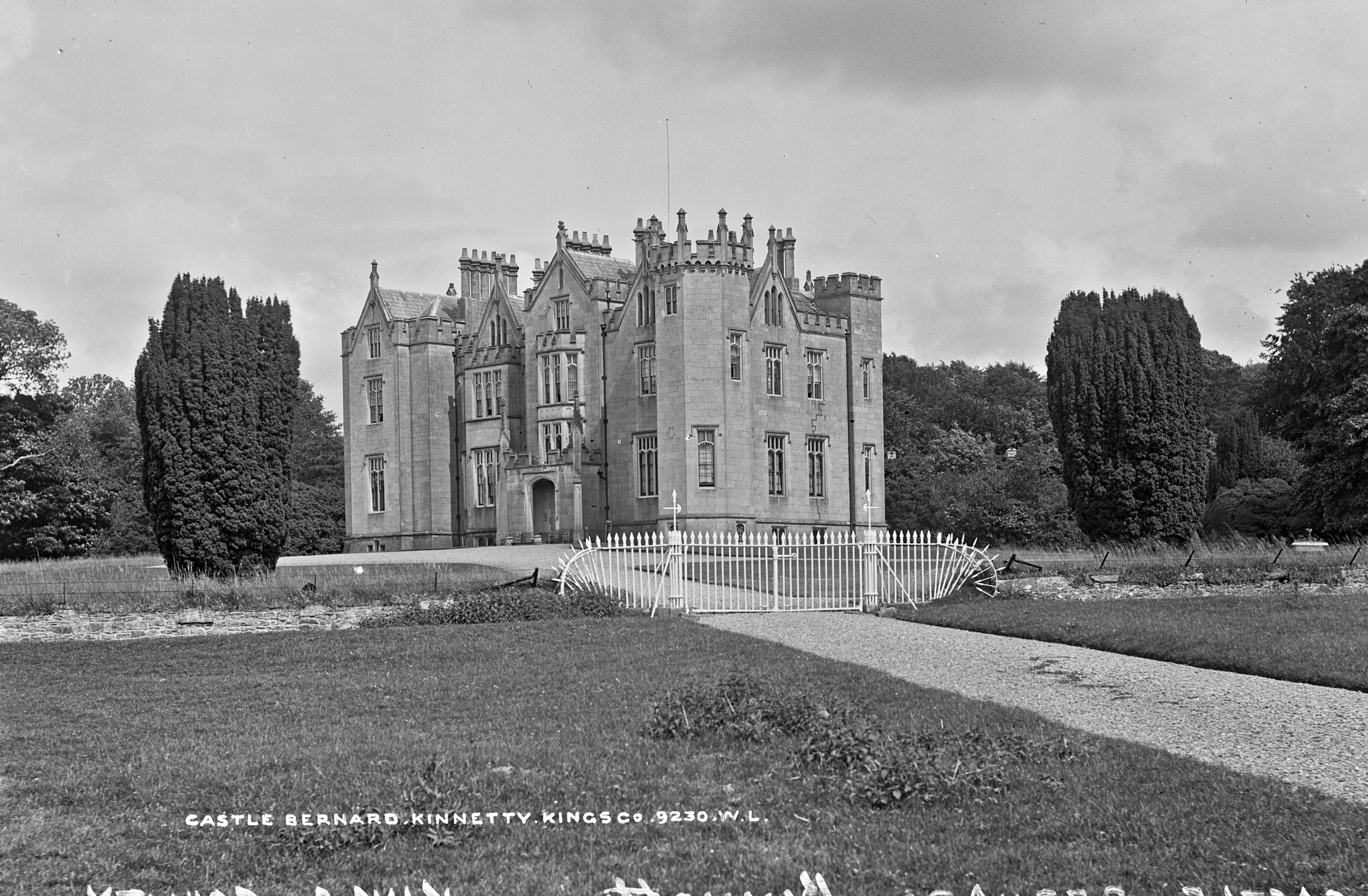
Curragh Chase, County Limerick garden front 1938, also designed by the Pain brothers, like Loughton it is classical rather than Tudor Gothic, photograph from Vanishing Country Houses of Ireland by The Knight of Glin, David J. Griffin and Nicholas K. Robinson, published by The Irish Architectural Archive and The Irish Georgian Society, 1988.Fortwilliam, Glencairn, Lismore, Co Waterford courtesy Michael H. Daniels and Co., also designed by the Painsin Tudor Gothic style.Knappogue, or Knoppogue, Castle, County Clare, also designed by the Pains.Kinnity Castle (Castle Bernard) County Offaly, photograph by Robert French, Lawrence c. 1865-1914 Photographic Collection National Library of Ireland ref L_Cab_09230.
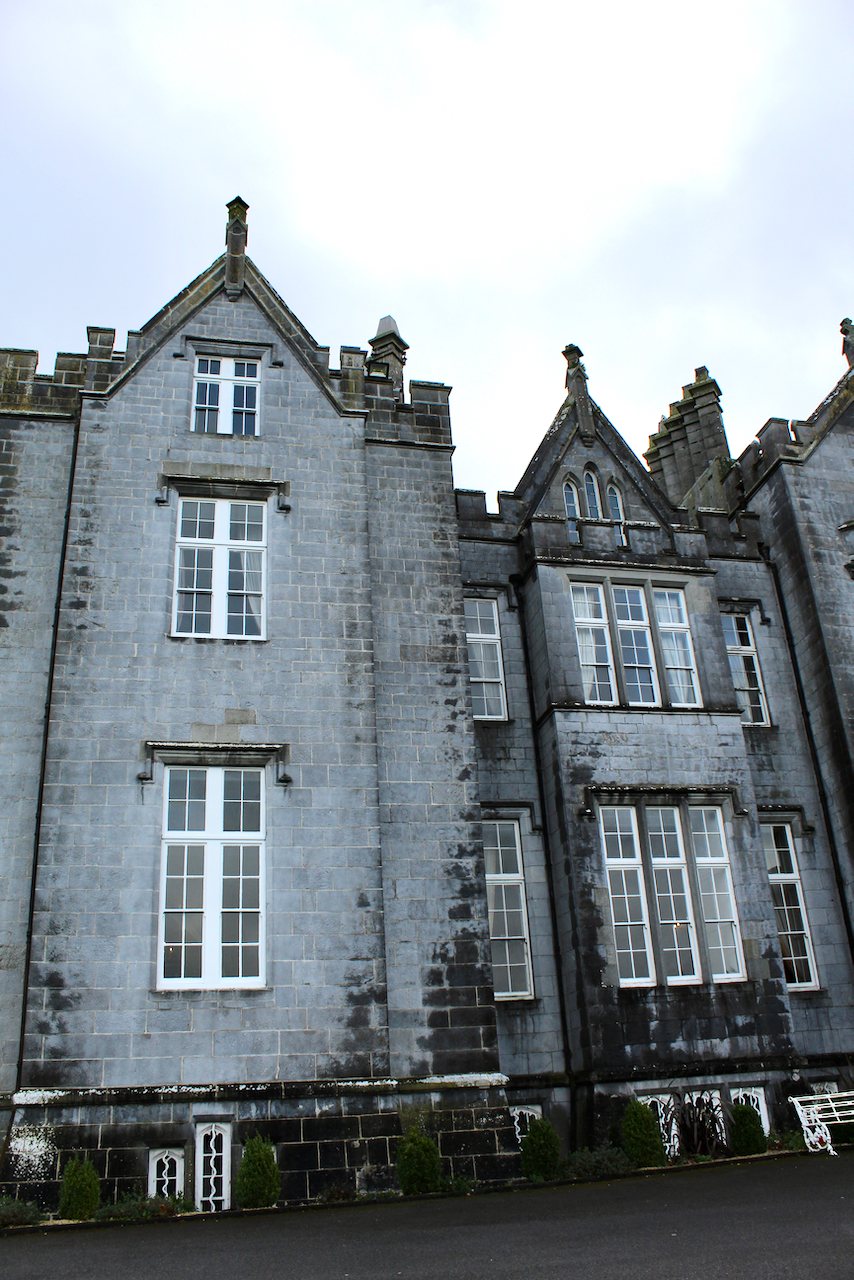
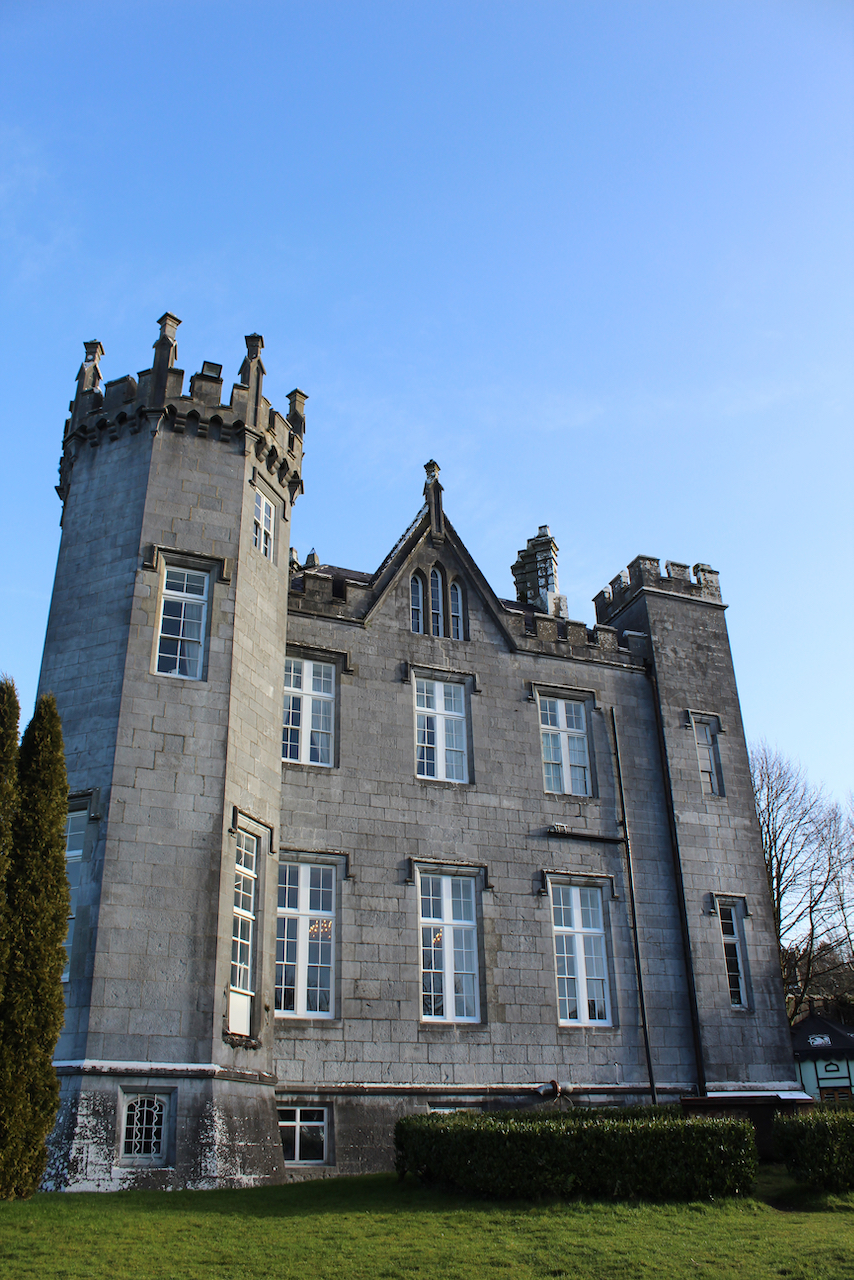
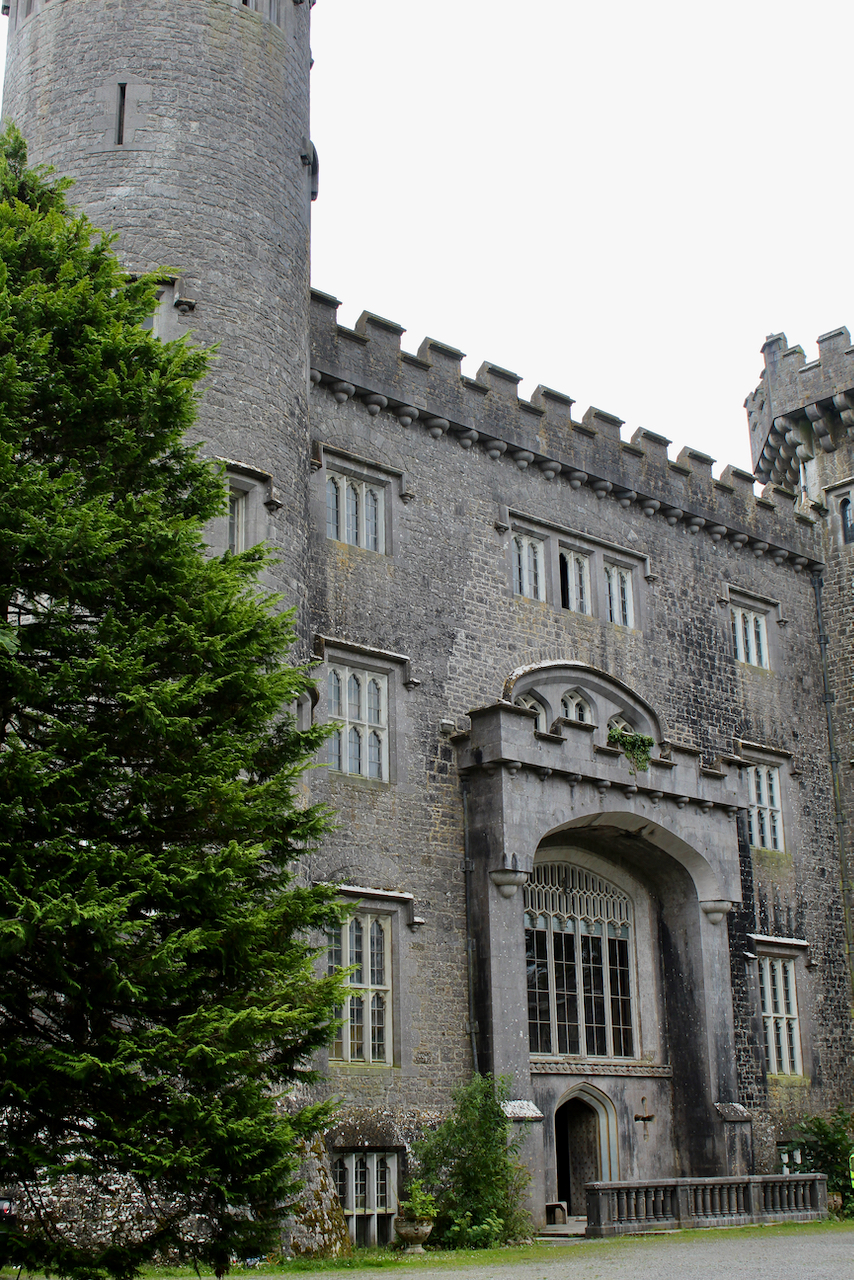
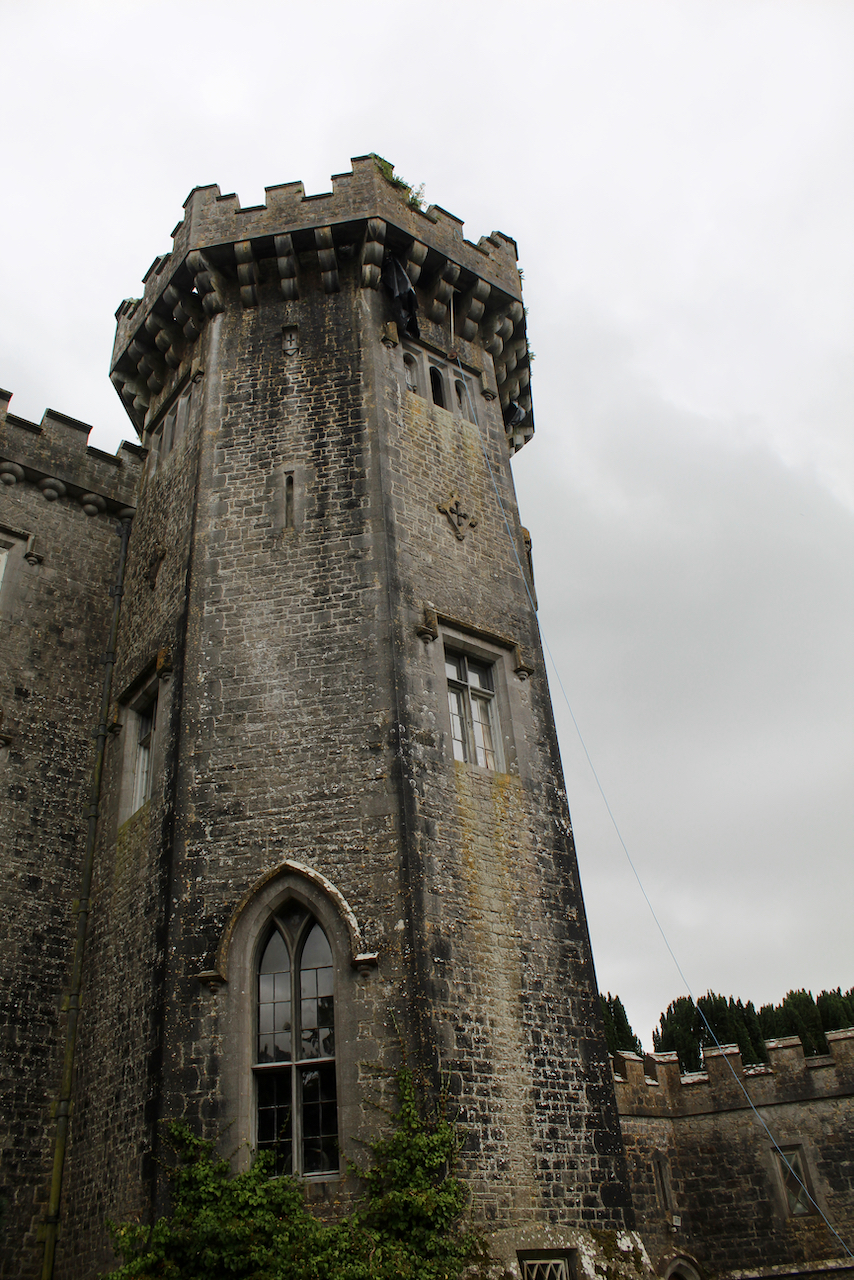
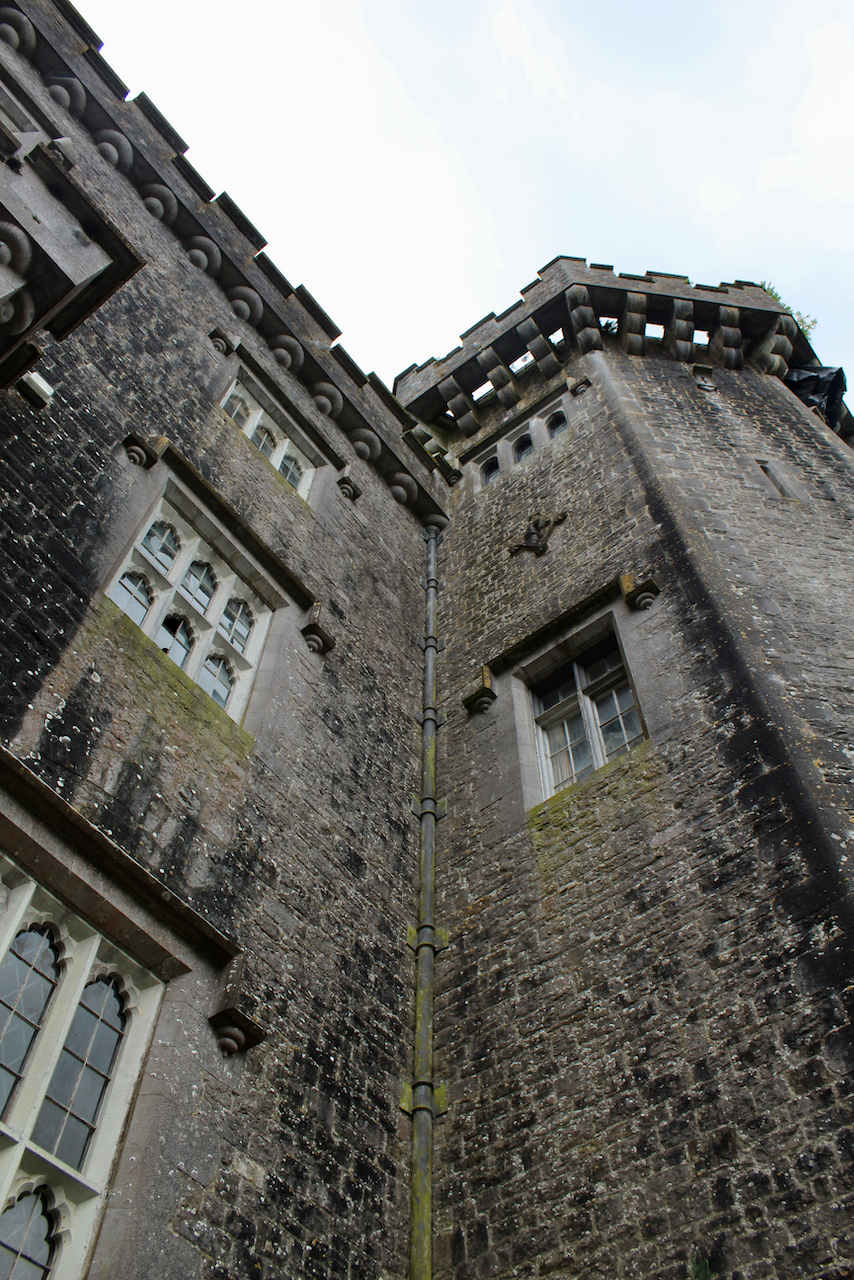
In his 1988 book A Guide to Irish Country Houses, Mark Bence-Jones writes about Kinnitty Castle, formerly named Castle Bernard, that it is a Tudor-Revival castle of 1833, with impressive entrance front with gables, oriels and tracery windows and an octagonal corner tower with battlements and crockets; all in smooth ashlar.[5]
Kinnitty Castle Hotel, 2014, photographer unknown, for Tourism Ireland, Ireland’s Content Pool. (see [1])
The National Inventory describes it:
“Ashlar limestone walls with castellated parapet, carved limestone plinth course and continuous string course to parapet. Battered walls to basement level. Square-headed window openings with tooled limestone and sandstone label mouldings, chamfered surrounds and punched limestone sills. Castellated box bay to second bay from north-east rising from basement level to first floor with chamfered stone mullions. Oriel window above entrance added at later date.”
Battered walls at basement are walls that slant outwards. This was a traditional building feature of castles, so that stones could be dropped from above and they would not fall straight down but hit the battered walls and bounce outwards to hit intruders.
Mark Bence-Jones defines an oriel window as a large projecting window in Gothic, Tudor, Gothic-Revival and Tudor-Revival architecture; sometimes rising through two or more storeys, sometimes in an upper storey only and carried on corbelling. This particular window is not carried on corbels.
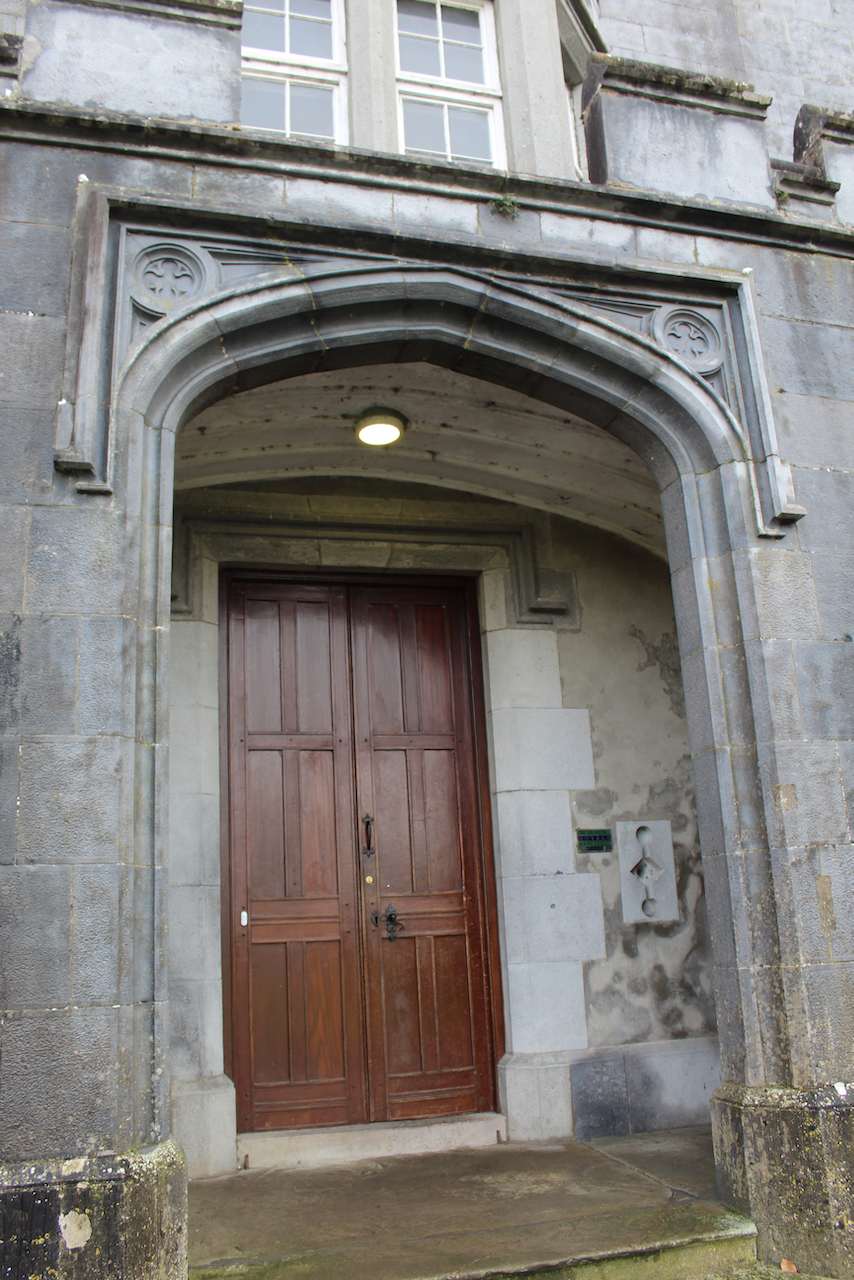
The National Inventory continues: “Single-storey castellated entrance porch with diagonal buttresses surmounted by pinnacles with crockets and finials. Tudor arched opening to porch with label moulding accessed rendered porch with ribbed ceiling, niches to side walls and tooled limestone bell surround and post box flanking door. Square-headed door opening with chamfered limestone surround and label moulding, sandstone threshold and timber double doors.“
Before he married Catherine, Thomas Bernard, MP for County Offaly, married Elizabeth, daughter of Henry Prittie, 1st Baron Dunalley of Kilboy, County Tipperary. She died in 1802 and he married for a second time in 1814. He began building work on his house in 1833 but died the following year.
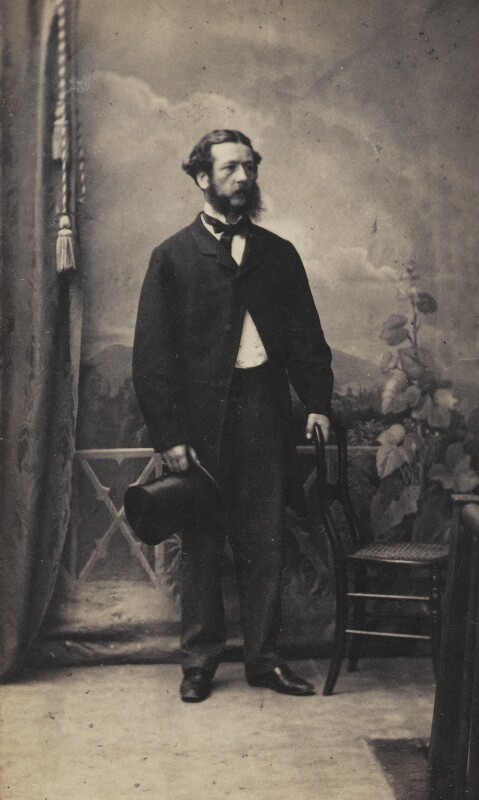
Thomas and Catherine had several children. Their heir was Thomas Bernard (1816-1882). Other sons were Francis, Richard Wellesley, and John Henry Scrope, and daughter Margaret.
Thomas Bernard (1816-1882), son of Catherine née Hely Hutchinson and Thomas Bernard (d. 1834).
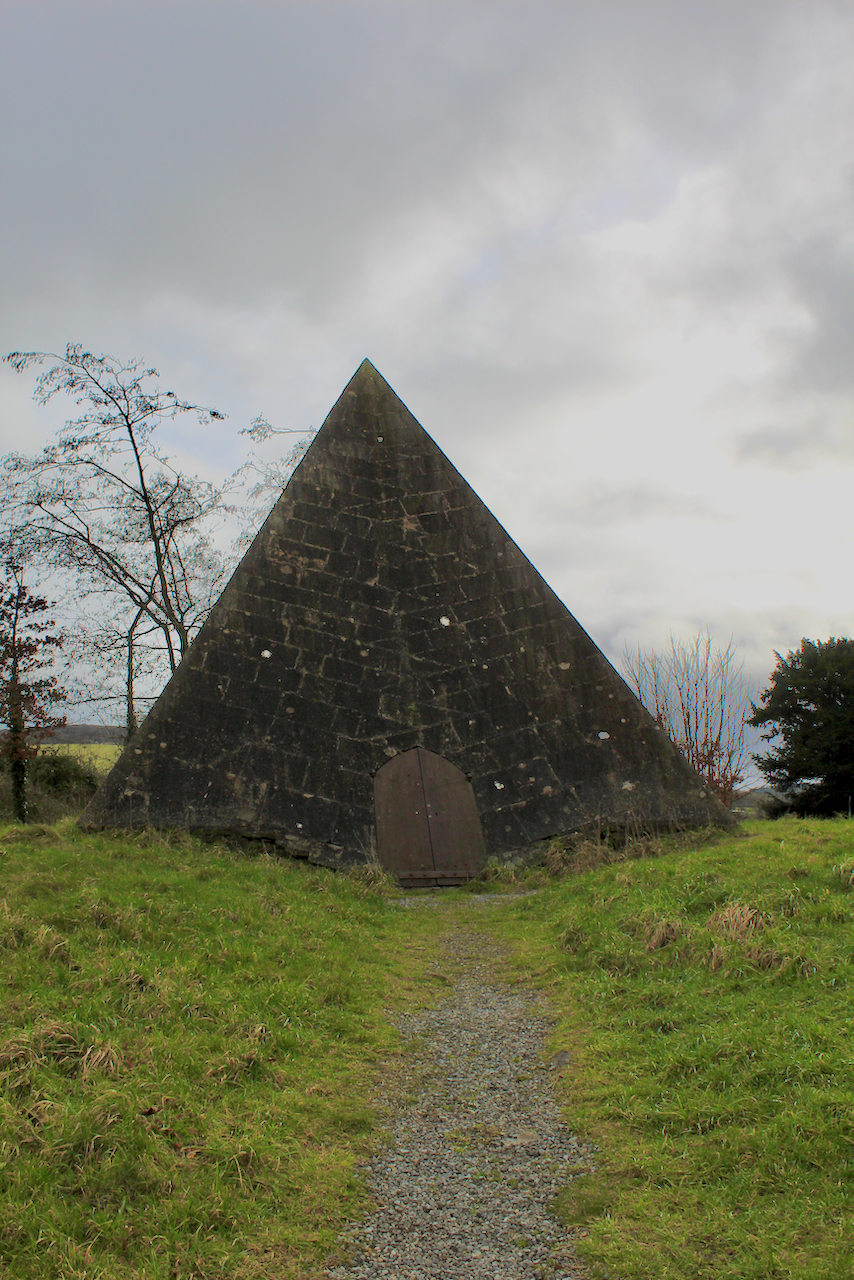
Nearby the Bernard family have an unusual pyramid-shaped mausoleum. Richard Wellesley Bernard (c. 1822-1877) completed his military training in Egypt. He was an architect and engineer and it is said that he built the pyramid between 1830-34 but he would have been only eight years old, so perhaps it was constructed by an earlier Bernard. It is an exact replica of the Egyptian pyramid of Cheop.
The website continues: “The building was burned in 1922 by Republican forces and rebuilt by means of a Government grant of £32,000 in 1927.
The Buildings of Ireland Central Leinster book by Andrew Tierney tells us that the castle was rebuilt by Joseph John Bruntz. He was born in Dublin. The Dictionary of Irish Architects tells us that he was a pupil in his father’s office for four years and remained as an assistant for a further three years. After starting to practise independently as an architect circa 1915, he moved in 1917 or 1918 to Edenderry, Co. Offaly, where he set up an office. From 1922 he held the position of architect and civil engineer to the Co. Offaly Board of Health.
The website continues: “The building became the property of Lord Decies in 1946. He in turn sold it and the estate to the Government of Ireland on 12th December 1951. The State used the castle as a Forestry Training centre from 1955 until it was purchased in 1994 and turned into a 37 bedroom luxurious hotel for all guests both locally and internationally to enjoy.“
Arthur George Marcus Douglas De La Poer Beresford (1915-1992), 6th Lord Decies, bought the property in 1946. He sold it in 1951.
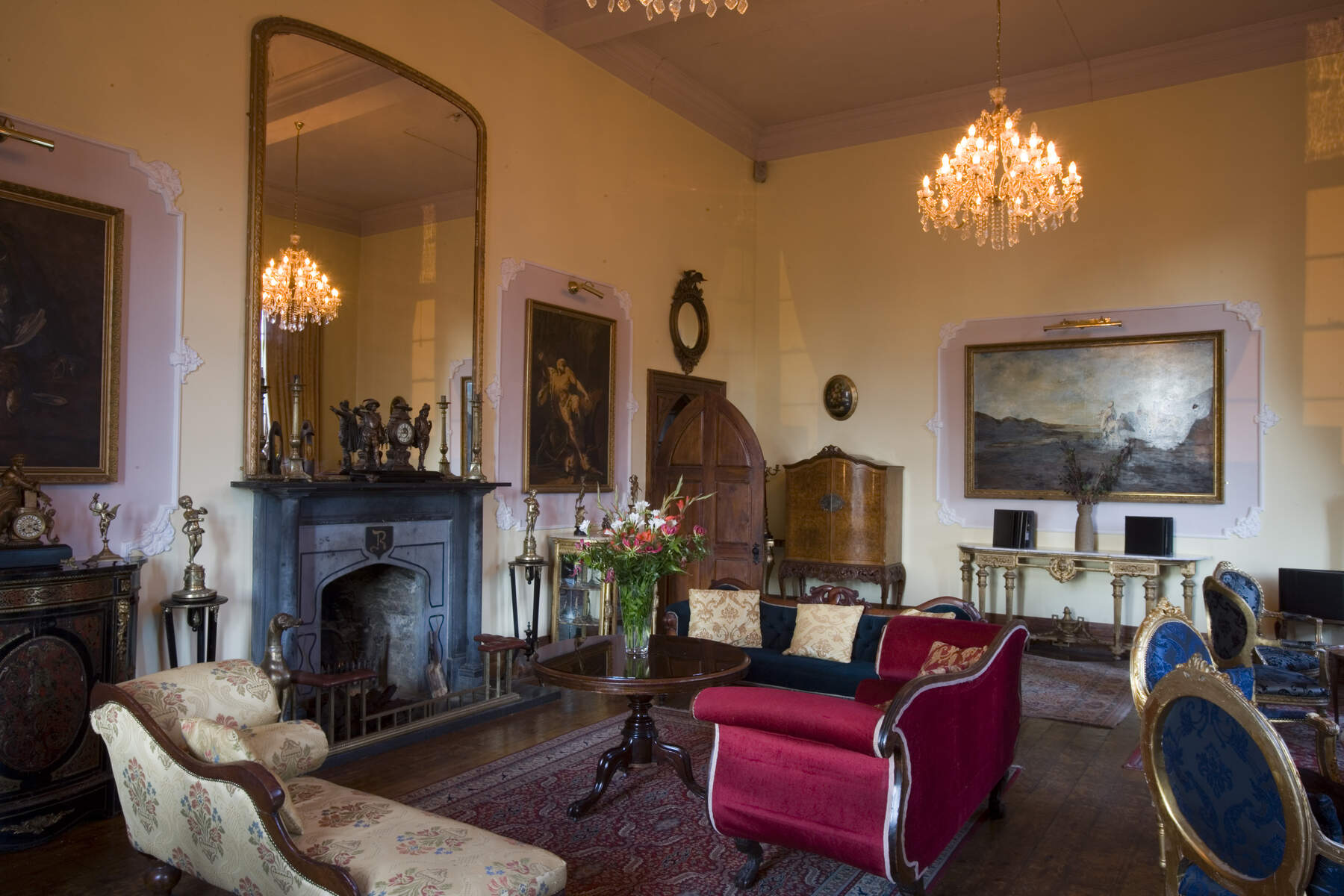
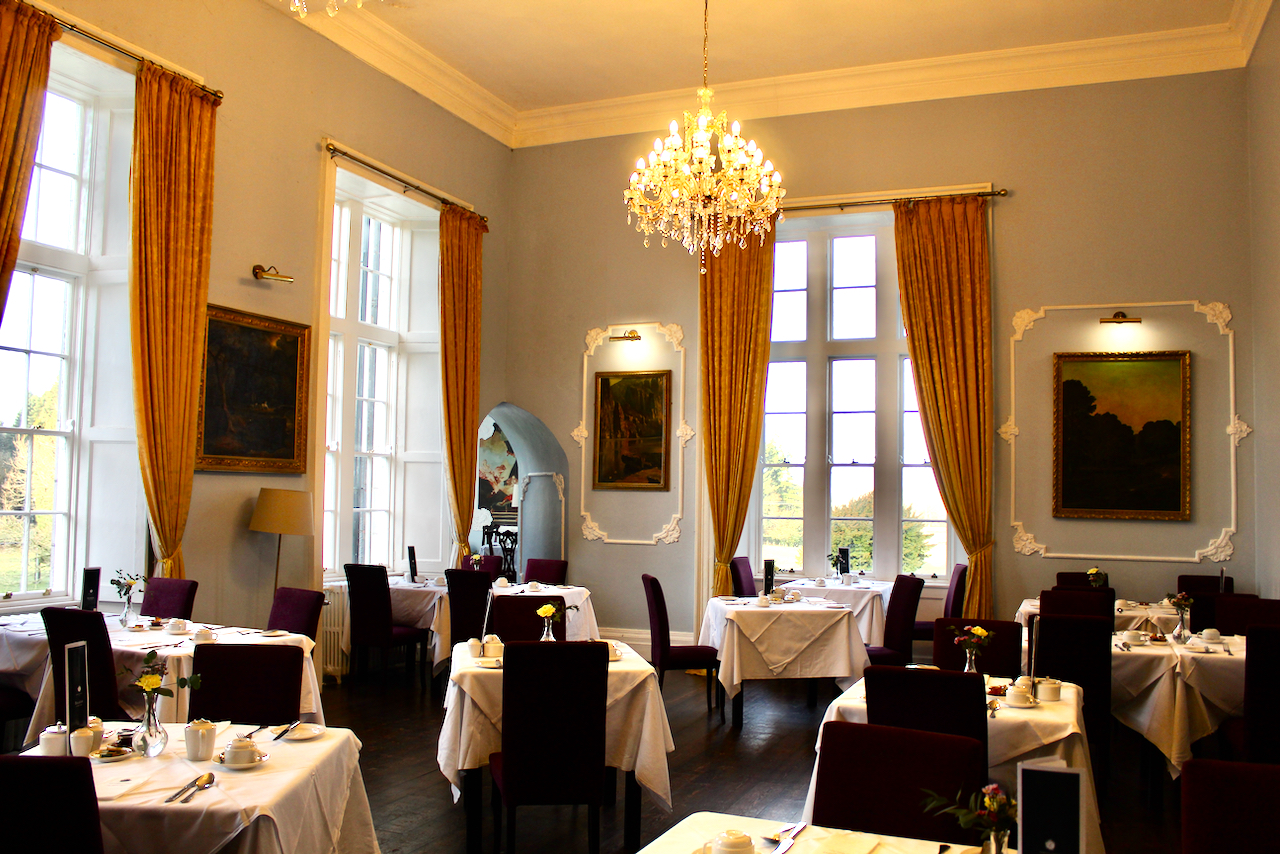
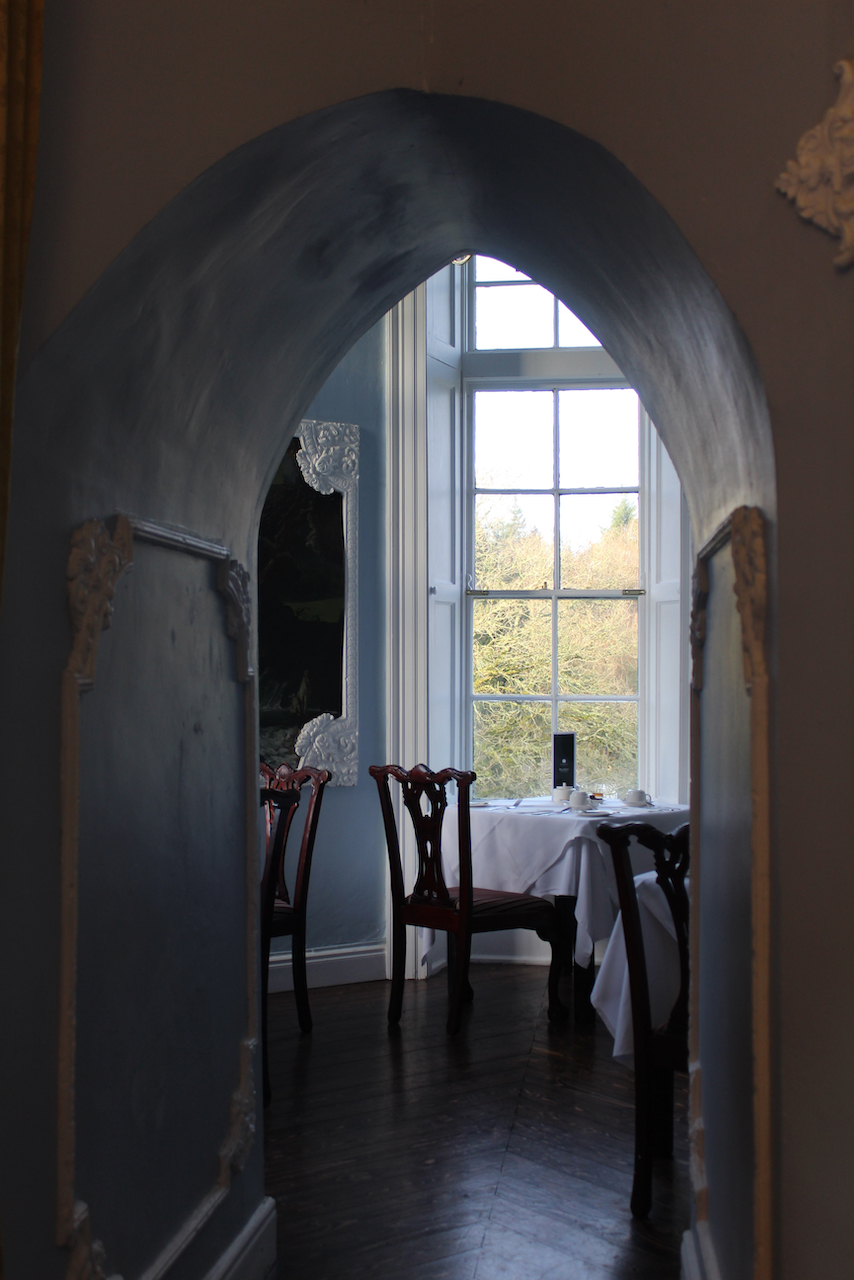
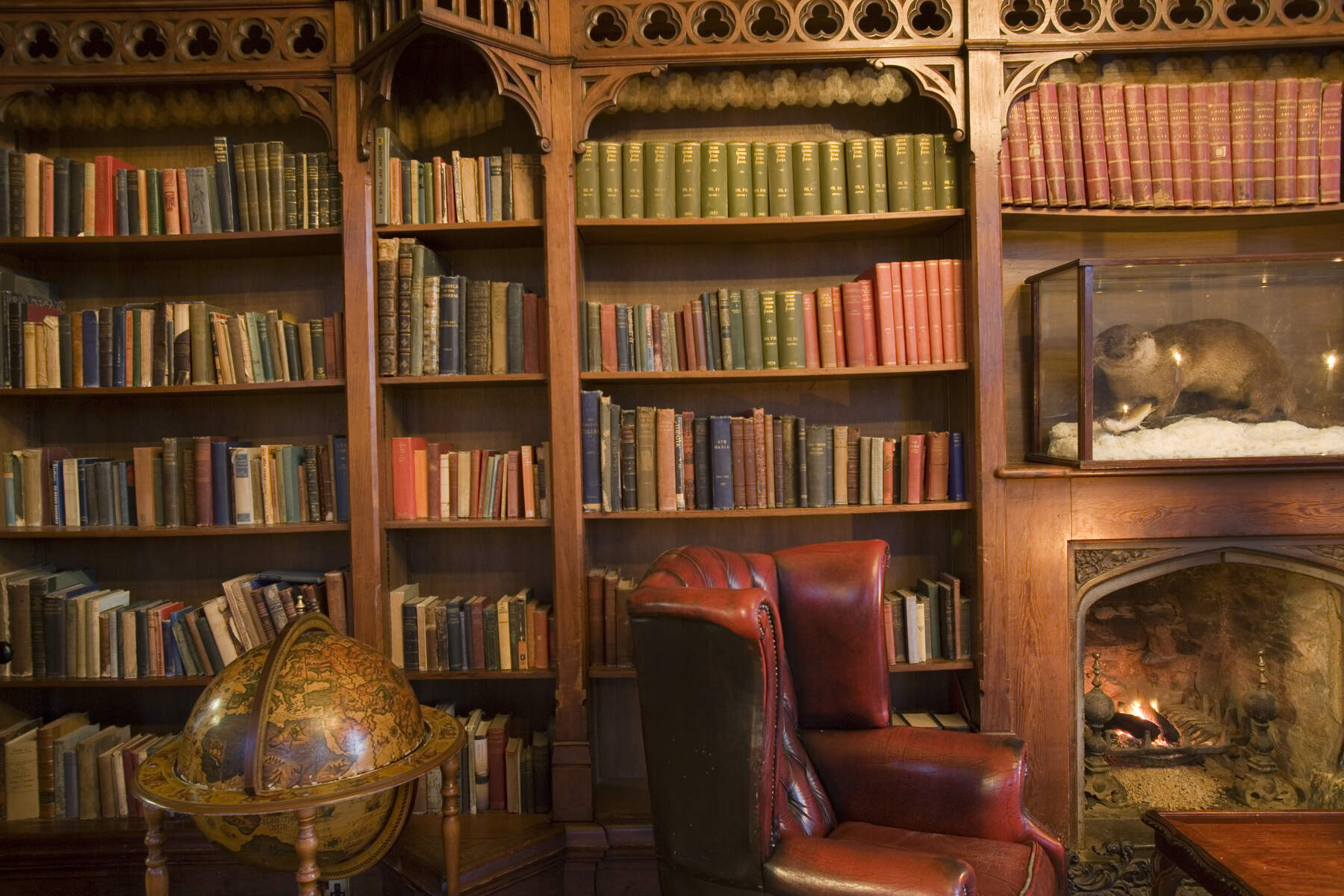
It is a wonderful and affordable hotel, full of character.
[5] p. 62 (under Castle Bernard), Bence-Jones, Mark. A Guide to Irish Country Houses (originally published as Burke’s Guide to Country Houses volume 1 Ireland by Burke’s Peerage Ltd. 1978); Revised edition 1988, Constable and Company Ltd, London.
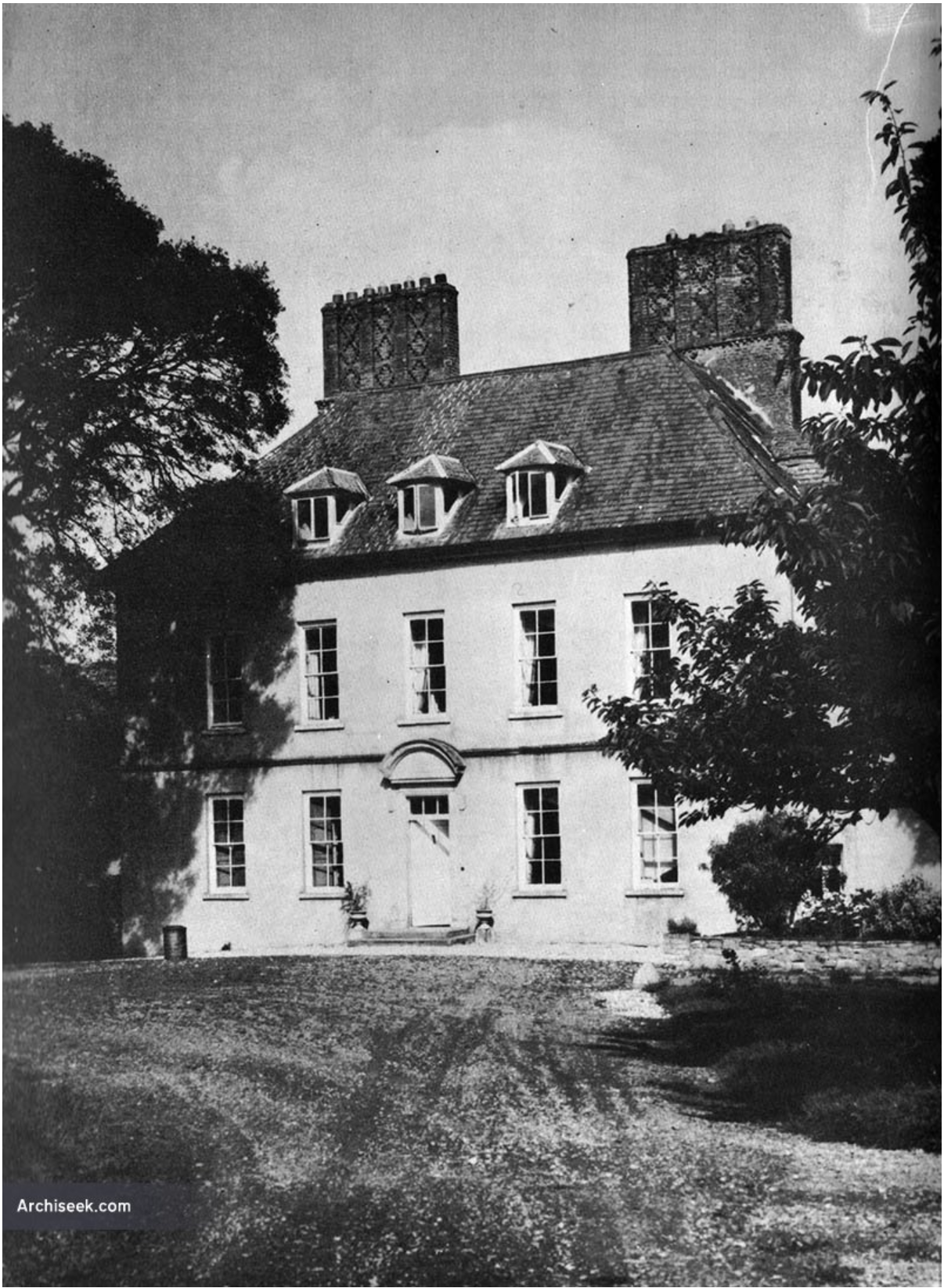
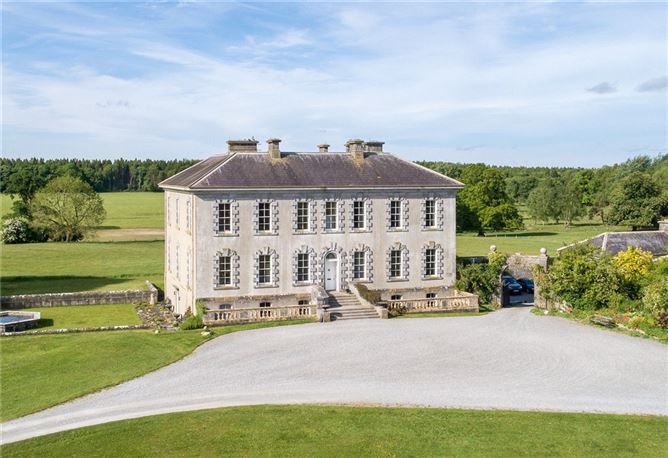
The newly constructed Kilboy, County Tipperary, photograph courtesy of Country Life.Kilboy, County Tipperary, courtesy of Archiseek.The newly constructed Kilboy, County Tipperary, photograph courtesy of Country Life.
Mark Bence-Jones. A Guide to Irish Country Houses (originally published as Burke’s Guide to Country Houses volume 1 Ireland by Burke’s Peerage Ltd. 1978); Revised edition 1988 Constable and Company Ltd, London.
p. 164. “(Prittie, Dunally, B/PB) A middle to late 18th century house built for Henry Prittie MP, afterwards 1st Lord Dunalley, to the design of William Leeson.
Henry Prittie, 1st Baron Dunalley (1743-1801), Irish school, courtesy of Christie’s.
It had three storeys over a basement; a five-bay entrance front with a central feature of a pediment and four giant engaged Doric columns; Doric entablature running the full length of the front, supported at the sides by giant Doric pilasters; top storey was treated as an attic above the cornice. Ground floor windows with rusticated surrounds and alternat triangular and segmental pediments; rusticated basement; broad flight of steps up to entrance door. Side elevation almost plain, with no entablature or cornice, of five-bays with central Venetian window; keystones over windows and some simple blocking in the window surrounds. Large square hall, with heavy frieze of rather unusual plasterwork, combining putti and foliage with husk ornament and neo-Classical motifs; niche with entablature on console brackets; marble chimneypiece with swags of drapery, plasterwork panel over. Bifurcating staircase in back hall.
Henry Prittie, 3rd Baron Dunalley (1807-1885) by Stephen Catterson Smith courtesy of Christie’s 2013.
House was burnt 1922 and afterwards rebuilt without the top storey. The principal rooms, as rebuilt, had oak panelling in early C18 style; the bifurcating staircase was replaced by a simple oak stairs. Ca 1955 the house was demolished and a single storey house in a vaguely Georgian style was built on the original basement.”
The newly constructed Kilboy, County Tipperary, photograph courtesy of Country Life.The newly constructed Kilboy, County Tipperary, photograph courtesy of Country Life.The newly constructed Kilboy, County Tipperary, photograph courtesy of Country Life.
Listed in Vanishing Country Houses of Ireland by The Knight of Glin, David J. Griffin and Nicholas K. Robinson, published by The Irish Architectural Archive and The Irish Georgian Society, 1988.
p. 134. “The most important house designed by William Leeson c. 1780 for Henry Prittie M.P. 1st Lord Dunally. Superb entrance front with engaged Doric portico. Very fine interior with good plasterwork and imperial main staircase. The house was burnt in 1922 and well restored but without the attic storey. In the mid 1950s it was demolished and a single storey house was built on top of the basement storey; reached by the original steps.”
The newly constructed Kilboy, County Tipperary, photograph courtesy of Country Life.The newly constructed Kilboy, County Tipperary, photograph courtesy of Country Life.
Detached five-bay single-storey house over basement, built c. 1775, destroyed in 1922 and rebuilt c. 1955 with portico to entrance. Three-bay two-storey side elevations, with large two-storey extension to south-west. Hipped slate roofs with recent cut limestone chimneystacks. Rendered walls with decorative render pilasters. Replacement windows to front. Mainly timber sash elsewhere, with raised cut limestone surrounds with keystones and sills. Segmental- and round-headed openings to extension, with one-over-one pane timber sash windows to south elevation, and doorway with spoked fanlight. Timber panelled double doors under portico, flanked by windows. Two flights of limestone steps to front elevation. Sandstone walls to site boundary with thatched gate lodge and ornate gateway to main, south, entrance and gate lodge with ornate gateway to north-east.
Appraisal
The original house to this site was designed by William Leeson, but only the steps and base of the original building remain. The grounds, demesne walls, entrances and gate lodges are perhaps more interesting than the house, forming an interesting group of demesne structures. The imposing triple-arched entrances set in high demesne walls with their ashlar dressings and gate lodges on both the south and east boundaries create a sense of heightened anticipation before seeing the house.
Kilboy House, County Tipperary, photograph courtesy of National Inventory.Kilboy House, County Tipperary, photograph courtesy of National Inventory.Kilboy House, County Tipperary, photograph courtesy of National Inventory.
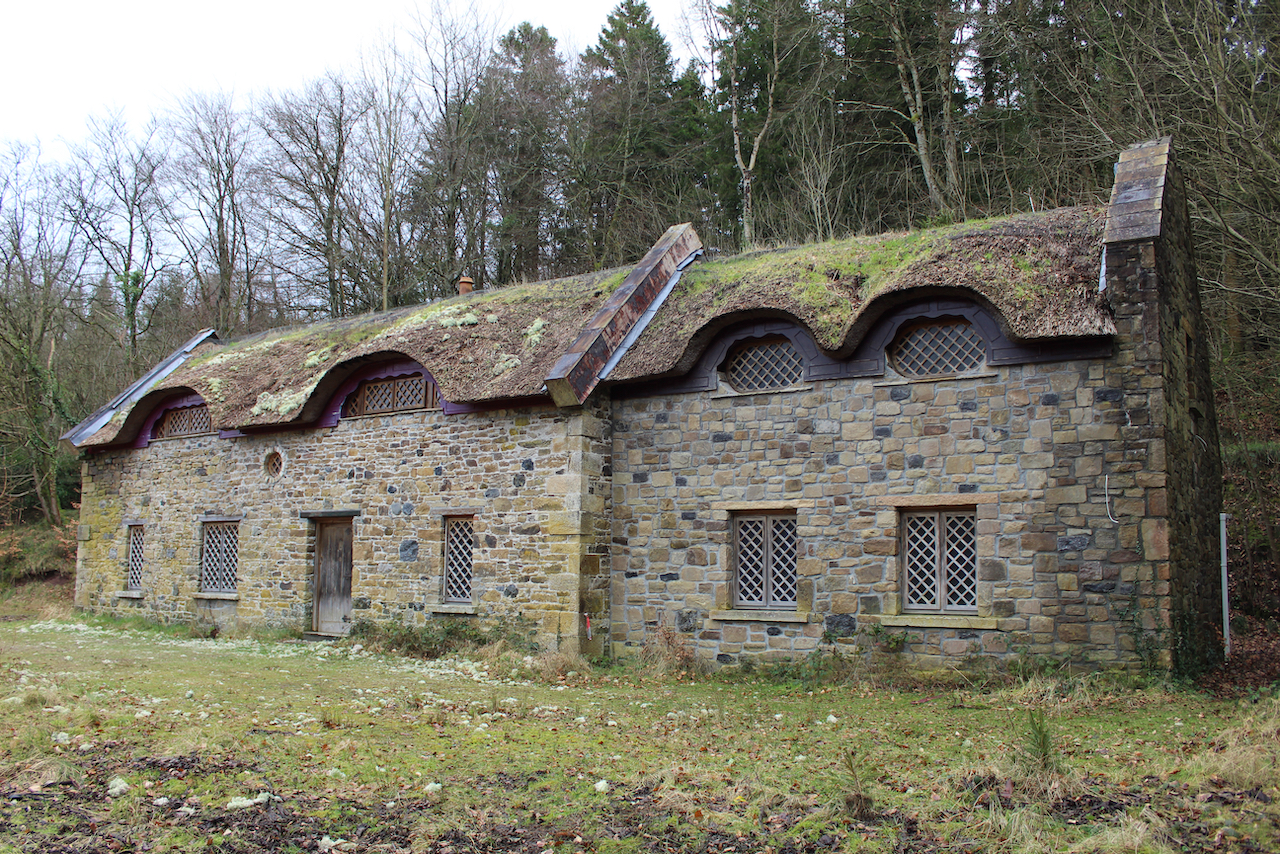
Detached L-plan four-bay single-storey gate lodge with dormer storey, built c. 1850. Hipped reed thatched roof with blocked ridges and recent rendered chimneystack. Sandstone rubble walls. Square-headed double one-over-one pane timber sash windows with sandstone voussoirs to ground floor, segmental-headed spoked lunette windows to roof, and segmental-headed door openings with sandstone voussoirs, having glazed timber doors and sidelights.
Gate Lodge, Kilboy House, County Tipperary, photograph courtesy of National Inventory.
Appraisal
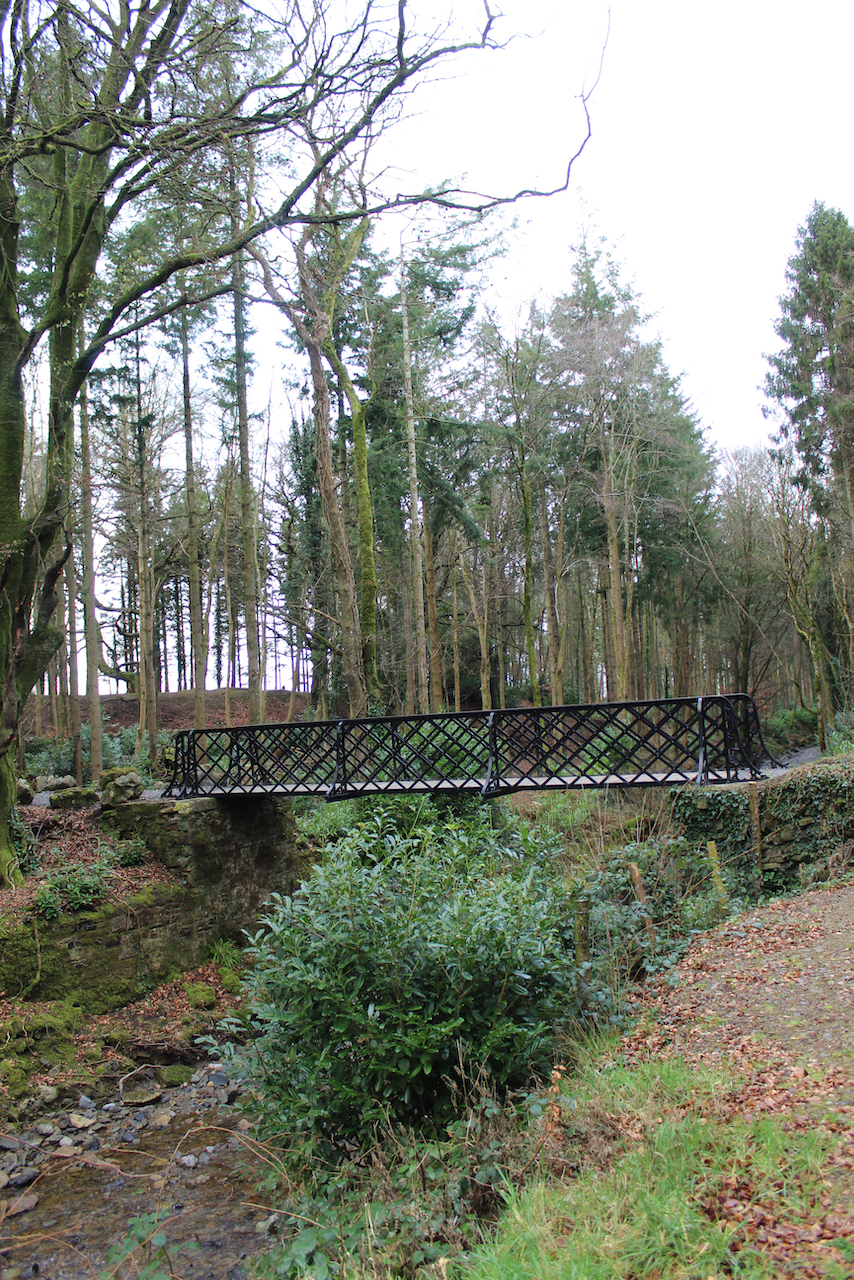
Apparently informed by the cottage ornée type of demesne building, this gate lodge has a number of appealing features such as its lunette dormer windows set in thick curved thatched roofs, its timber sash windows, and its L-plan which allows for a number of complementary views. It is one of a group of demesne structures including the elaborate entrance gates, high demesne walls and single-arch bridge under the avenue nearby.
Kilboy House, County Tipperary, photograph courtesy of National Inventory.
Entrance gateway, built c.1775, comprising advanced central round-arched carriage opening with portico, flanked by round-arched pedestrian entrances, in turn flanked by pilasters and roughly-coursed rubble limestone boundary walls. Snecked rubble limestone walling, with cut limestone portico with scrolls, archivolts and imposts and dressed quoins and surrounds to pedestrian openings.
Appraisal
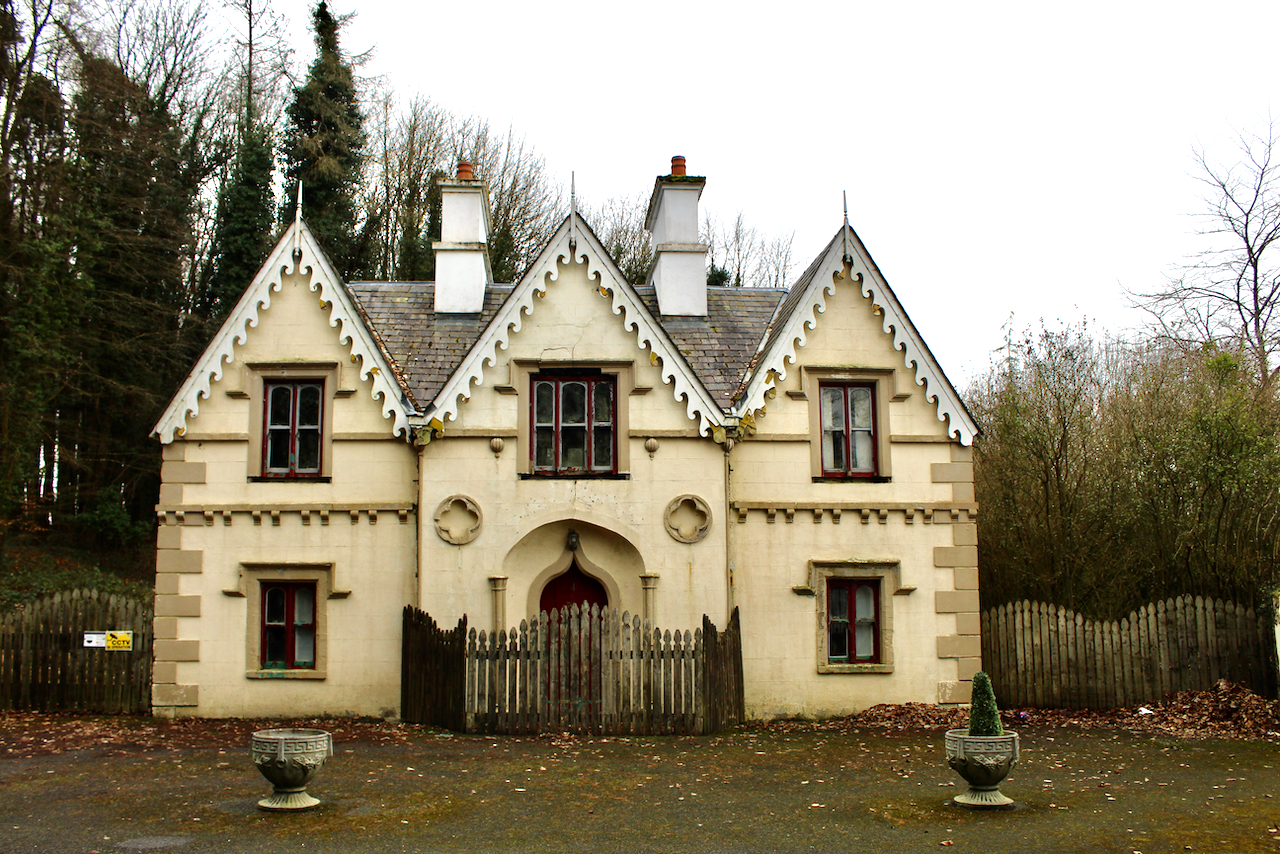
This finely-built stone gateway is of apparent architectural design and executed by skilled craftsmen. It presents an impressive entrance to the rebuilt Kilboy House and is a conspicuous landmark on the Dolla to Silvermines road.
Entrance gateway, built c.1775, comprising central round-arched carriage opening, flanked by similar round-arched pedestrian entrances, separated by wrought-iron railings and in turn flanked low rubble limestone walls. Ashlar sandstone masonry with imposts, carved modillions to central archway and with wrought-iron railings to and separating openings.
Appraisal
A finely-executed ashlar composition of apparent architectural design and quality, forming subsidiary entrance to rebuilt Kilboy House.
Kilboy House, County Tipperary, photograph courtesy of National Inventory.
The Tipperary Gentry. Volume 1. By William Hayes and Art Kavanagh. Published by Irish Family Names, c/o Eneclann, Unit 1, The Trinity Enterprise Centre, Pearse St, Dublin 2, 11 Emerald Cottages, Grand Canal St, Dublin 4 and Market Square, Bunclody, Co Wexford, Ireland. 2003.
Prittie of Kilboy
p. 195. The Prittie dynasty in Kilboy began with Colonel Henry Prittie, one of Cromwell’s more trusted commanders. He was a Captin in Cromwell’s New Regiment of Horse. Druing the war in Ireland he was made Sheriff of Carlow (1650) and later Governor of Carlow. After the successful campaign Prittie was given about 1000 acres in the area in lieu of pay. Like many of his brother officers he immediately began buying up lands that had been awarded to his fellow soldiers who had no wish to remain in Ireland. This, combined with his descendants fortuitious marriages to heiresses, meant that the estate grew over the next 200 years, so that by the middle of 19C the Pritties owned about 16,000 acres of land in Co Tipperary most of which was centred around Kilboy.
p. 196. Henry was marrid to Honor Foley of Stourbridge and he had one son, also called Henry.
Henry was besieged for 21 days in his castle of Dunally by the Jacobites after the Battle of the Boyne. They eventually gained entrance and seized Henry and threw him from the battlements. Henry, quite extraordinarily, survived the fall unhurt and managed to escape. Henry was married to an Allcock and they had two sons and five daughters. The second son, Richard, married an heiress, Barbara Bourchier from Wexford in 1714. One of the daughters married Captain John Bayley of Ballynaclogh, another Cromwellian grantee.
p. 197. It was through marriages to heiresses that estates were extended. The outstanding example of this at the outset of the century is the marriage in 1702 of Henry Prittie (the Colonel’s grandson) to Elizabeth daughter and heiress to James Harrison of Cloghjordan. This alliance added to the sizeable Prittie estate of 3,600 acres a further 900 acres centring on Cloghjordan which had the advantage of being in the same region as the home estate.
p. 197. IN the next two generations each of the heirs to the Prittie estate married heiresses: Deborah Bayley in 1736 and Catherine Sadleir in 1766, thereby further consolidating the family’s interest, landed and political.
p. 197. On the death of Colonel Harrison the estates of Cloughjordan came into the possession of the Pritties of Kilboy. Henry and Elizabeth had one son, Henry…
p. 198. The son, Henry (b. 1708) was active politically and was an MP for Tipperary from 1761-8. A magistrate, he was firmly in the forefront of promoting law and order. He was married to an heiress, the daughter of Venerable Benjamin Neale of Leighlin and widow of John Bayly of Debsborough. This Henry was the man who successfully launched the family into mainstream politics.
…He also made attempts to use the natural resources on his lands. In the 1720s and 30s the Pritties revived interest in mining in the Silvermines. Lead was the mineral being mined at the time. After 1730 the mining was left in abeyance until 1802 when the Dunally Mining Company was formed with the intention of exploiting the ore there and also at a number of other locations.
p. 199. 1st Baron Dunally [as MP] was not in favour of granting any relief to Catholics and like his father he was ardent supporter of the rule of law.
p. 200. In contrast with his public stand, Prittie got on well with his Catholic neighbours and a great friendship existed between the Catholic Carrol family of Lissenhall in North Tipperary and the Pritties.
p. 201. There was a general electin held in 1806. Due to clerical manipulation the Catholic vote secured the election of Montague Mathew and Francis A. Prittie, the brother of 1stLord Dunally, who had moved into the House of Lords. From this period on the Pritties, allied with the Mathew interest continued to be pro Catholic and more liberal in outlook.
p. 202. The Pritties’ liberal views may have been influenced by a tutor who was engaged to teach Francis Aldborough Prittie at Kilboy. He was Rev Henry Fulton, the C of I curate to their parish, who was transported as a convicted United Irishman in 1798.
2nd Lord Dunally was very active in politics and worked with O’Connell to achieve Catholic emancipation.
In 1786, Kilboy was described by Wilson as the fine seat of Henry Prittie. Lord Dunalley is recording as resident at Dunally Castle, Nenagh, in 1814. In 1837 Lewis writes that Kilboy, the seat of Lord Dunalley, “was erected about 60 years since”. In the mid 19th century it was valued at £76+ and held in fee. This house, which the National Inventory of Architectural Heritage describes as a “detached five-bay single-storey house over basement, built c. 1775” and designed by William Leeson, was destroyed in 1922. A similar house was erected on the site but was demolished in 1955. A smaller house is now located on the site.
THE BARONS DUNALLEY WERE MAJOR LANDOWNERS IN COUNTY TIPPERARY, WITH 21,081 ACRES
The founder of this noble family in Ireland was
COLONEL HENRY PRITTIE who, for his loyalty and eminent services to the crown during the civil wars, had a grant or confirmation, from CHARLES II, of Dunalley Castle and other estates in County Tipperary, by patent, in 1678.
The grandson of this gentleman,
HENRY PRITTIE, sustained a siege of twenty-one days, in his castle of Dunalley, against the disbanded soldiers of of the royal army ofJAMES II after the battle of the Boyne.
The besiegers, however, at length entering, Mr Prittie was flung headlong from the top of the castle, though miraculously escaped unhurt.
He married Elizabeth, sister of Charles Alcock, and had issue,
HENRY, his successor; Richard; Priscilla; Elizabeth; Honora; Catherine; Judith.
The elder son,
HENRY PRITTIE, of Dunalley Castle, MP for County Tipperary, wedded, in 1736, Deborah, daughter of the Ven Benjamin O’Neale, Archdeacon of Leighlin, and had issue,
HENRY, his successor; Deborah; Elizabeth; Catherine; Martha; Margaret; Hannah.
Mr Prittie was succeeded by his son,
HENRY PRITTIE, of Dunalley, who espoused, in 1766, Catherine, second daughter and co-heir of Francis Sadleir, of Sopwell Hall, County Tipperary, widow of John Bury, and mother, by him, of Charles William, Earl of Charleville, and had issue,
HENRY, his successor; Francis Aldborough, MP; Catherine; Deborah; Mary; Martha; Elizabeth.
Mr Prittie was returned to parliament for County Tipperary in 1768; and elevated to the peerage, in 1800, by the title of BARON DUNALLEY, of Kilboy, County Tipperary.
The heir apparent is the present holder’s son, the Hon Joel Henry Prittie.
The 4th Baron was the last Lord-Lieutenant of County Tipperary, from 1905 until 1922.
Henry Francis Cornelius Prittie, 7th and present Lord Dunalley, lives in Oxfordshire.
A note in the Dunalley Papers records the sale of the Kerry estate of this family to the Crosbies in 1742 for £1,500.
KILBOY HOUSE, near Nenagh, County Tipperary, was a middle to late 18th century house built for Henry Prittie MP, afterwards 1st Lord Dunalley, to the design of William Leeson.
It had three storeys over a basement; a five-bay entrance front with a central pediment; and four large, engaged Doric columns.
The top storey was treated as an attic above the cornice.
There was a five-bay side elevation.
The mansion was burnt in 1922 and afterwards rebuilt minus the top storey.
About 1955, the house was demolished and a single-storey house in the Georgian style was built over the original basement.
More recently permission was granted for the reconstruction of a new Kilboy House, by the prominent businessman and philanthropist, Tony Ryan.
The project followed a fire that destroyed a large part of the property in 2005.
The local council granted planning permission for the partial demolition of the existing fire-damaged, listed, single-storey dwelling.
The former three-storey period residence over basement, based on the Georgian mansion house, has been built.
The application, in the name of Tony Ryan’s son, Shane, and his wife, stated that the aim was to rebuild the house as it was originally constructed in 1780.
Before reconstruction began, the Ryans paid €60,964 to the council as a contribution to providing public infrastructure such as roads and water.
Bowen’s Court, Kildorrery, Co Cork – demolished 1961
Bence-Jones, Mark. A Guide to Irish Country Houses (originally published as Burke’s Guide to Country Houses volume 1 Ireland by Burke’s Peerage Ltd. 1978); Revised edition 1988 Constable and Company Ltd, London.
p. 46. “A classic example of the tall and square C18 Irish house. Built by Henry Bowen and completed by 1776, the work having allegedly taken ten years; replacing an earlier house built by the Nash family, who from 1697 leased the estate which had been granted to the Cromwellian Col Henry Bowen – according to the family tradition, he was offered as much Irish land as his pet hawk could fly over, and it flew so far that people believed he had made a pact with the devil. The house is attributed to Isaac Rothery…Owing to rising costs of upkeep, Miss Bowen was obliged to sell Bowen’s Court 1959; it was demolished by its subsequent owner ca 1961.”
Bowen’s Court, County Cork, courtesy Archiseek.Bowen’s Court, County Cork, courtesy Archiseek.Bowen’s Court, County Cork, courtesy Archiseek.
Constructed in the early 1770’s for the Bowen family who owned the house until it was sold by the author Elizabeth Bowen in 1959. Bowen wrote a history of the house, entitled Bowen’s Court, in 1942 and it is featured in her 1929 novel The Last September. A local businessman bought it at auction, sold off most of the mature woodlands for timber, and then demolished the house in 1960. Only a gateway remains.
The architect Isaac Rothery completed Mount Ievers, Co. Clare which was begun by his father John Rothery. He is also believed to be responsible for two other houses in Co. Cork – Newmarket Court and Doneraile Court.
Featured in Irish Country Houses, Portraits and Painters. David Hicks. The Collins Press, Cork, 2014.
p. 79. “Financial pressure in the 1950s brought [Elizabeth Bowen] to sell the house to an Irishman with a large family whom she thought would make it his home. She was to be sorely disappointed as Bowen’s Court was demolished soon after it was sold.
Elizabeth was the first female to inherit the Bowen ancestral home in Co Cork.
Bowen’s Court was part of a 6,740 acre estate of which the bulk was located in Tipperary. …p. 80. The site of the former house is located in the village of Farahy, which is not far from Kildorrery on the Mitchelston Road, 21 km from Mallow and 1.5km from Fermoy.
Bowen’s Court was built of limestone in the classical style and completed in 1775 by Henry Bowen. He built the house after his marriage and the three storey-over basement structure had a commanding presence in the surrounding countryside. The estate land was granted to the first Henry Bowen, a colonel in Cromwell’s army in the mid-17th century. According to a story handed down through the generations to Elizabeth, Cromwell was responsible for the death of one of Bowen’s hawks and to make amends he was offered as much land as a second hawk could fly over. The hawk reputedly flew and circled 800 acres of land, wiht some saying that Henry’s success was thanks to a pact he made wiht the devil. Col. Bowen set up home in a castle that was situated on the banks of the Farahy River. A portrait of the colonel wiht his hawk hung at the top of the stairs at Bowen’s Court until it sale in the 1950s.
It was the colonel’s great grandson Henry who built the house that became known as Bowen’s Court. His wife, Margaret, preferred the house built by a family called Nash at Farahy in the 1760s and she saw no need for a new house. This older house supposedly stood on a site immediately to the rear of the 1775 house. She worried about Herny’s grandiose architectural plans for its replacement. At this time they were living in a house called Annabella, which Henry had leased in Mallow. Henry wished not to argue with his wife over retaining the existing house so he sent her away on an extended vist and during this time he had the house pulled down. Margaret returned to find a pile of rubble and had no choice but to agree to the construction of a new home. The architect of Bowen’s Court is believed to be Isaac Rothery. The house took ten years to build…soon Henry ran out of money. P. 81. In order to finish the job, money was borrowed and economies were implemented which reduced the size of the planned house. Henry hoped taht future generations woudl be able to complete the house and fix the mixtakes of his hurried build.
…p. 82. Margaret had fourteen children seven whom survived birthy. The new house was filled with furniture and silver from Cork city emblazoned with a hawk, a tribut e to their ancestral story. In 1788 blood poisoning, caused by a scratch, lead to Henry’s arm being amputated and the shock of the operatino killed him. His eldest son, also named Henry, inherited teh property.
p. 84. In he 1860s, Bowen’s Court had eight indoor servants and it was at this time that Elizabeth’s grandfather made many improvements on the house. As a result of his marriage (and his wife’s dowry) he added teh ‘tower’ to the house…The house passed down through the generations to Elizagerth’s father, Henry Cole Bowen, a barrister-at-law…who secured a large practice. He wrote an exhaustive book dealing with the Land Purchase Act and acted as counsel to the Pembroke Estates. In 1890 he married Florence, daugther of the late Henry Fitz-George Colley, of Mount Temple, County Dublin. The Colley family at one time had an estate in Kildare – Castle Carbery [p 85] but it had lain in ruins for many years and the fmaily now lived at Mount Temple, a Victorian house in Clontarf.
p. 85. Elizabeth’s father had a mental breakdown when she was a child and as a result of his uncontrolled rages she and her mother moved to England. Elizabeth’s mother died of cancer in 1912, having been predeceased by her sister from consumption and her brother on the Titanic in the same year. P. 86. Elizabth and her mother spent their last summer togetherat Bowen’s Court, their first lengthy stay there for five years. When her mother died, Elizabeth was 13 and she was brought up by aunts who were dispersed between Ireland and England. In a newspaper report in 1904 it is noted that “Miss Cole-Bowen, of Bowen’s Court, County Cork, has got over her recent delicacy, and will stay at Kingstown with her aunt, Mrs Disney, during the early winter months.” Elizabeth was educated at boarding schools in England and, in an effort to console herself from the previous traumatic years, she began to write storeis, encouraged by her headmistress. Elizabeth returned to Cork on occasions and was at Bowen’s Court when the Great War broke out. It was in this summer that her father had a number of the rooms redecorated and Elizabeth’s aunt Sarah looked after the house. In the same year she attended a garden party at Mitchelstown Castle. However, the onset of war heralded the end of a way of life for hte Anglo-Irish.
When she was in her 20s Elizabeth lived in London where she began her writing career, introduced into literary circles by the novelist Rose Macaulay. In 1023, her first book, a collection of short stories, was published and she married Alan Cameron. During her early married life, her literary career began to flourish. [p. 87. She and her husband lived in Oxford following Alan’s appointment to the City of Oxford Education Committee in 1925. When his career took them to London in the 1930s, her stature in literary circles grew. Elizabeth drew on her Anglo-Irish backgound as the basis for her writings, the culmination fo which was the publication in 1942 of a history of Bowen’s Court and her family. Between 1923 and 1968 she wrote ten novels, many newspaper and magazine articles, essays and more than 80 short stories, a sginificant nubmer of which were written to boost her finances after she inherited Bowen’s Court.
During teh spate of house burnings in the late 1920s, the family portraits from Bowen’s Court and other valuables were removed from the hosue and stored in a nearby cottage. Her father had written to Elizabeth and warned her hat Bowen’s Court would probably be burnt down. The hosue was spare but, at one time, it was occupied by Republicans whose intention was to blow it up. It was the thought of the destructino of Bowen’s Court at this time that inspired the imaginary house called Danielstown in her 1929 novel, The Last September. In 1928 Elizabeth’s father retired and returned to live in Bowen’s Court but died there in 1930. Elizabeth, being his only child, inherited the hosue and she concentrated her efforts on trying to bring the house into the 20th century by having a telephone and electricity installed. Eliz continued to live in England, spenidng summers in Ireland, until interrupted by the second World War.
It was not until 1952 when her husband retired that they returned to live full tiem at Bowen’s Court. Up to this time, the house was looked after by a single servant, Sarah, who had served three generations of the Bowen family. Roms were closed off and, during her time, Sarah had seen the number of servants decline from eight until there was only herself. The Second World War made it impossible for Elizabeth to visit the house. However, after 1945 it began to be used again [p. 88]
p. 89. Elizabeth’s husband died in 1952, and she struggled to keep the house going for another seven years…Elizabeth moved to England.
Patrick Hennessy’s 1957 portrait of Elizabeth Bowen presides over a room dedicated to her memory in Doneraile Court, County Cork (her own home, nearby Bowen’s Court, was irresponsibly demolished in 1961). After being closed to the public for the past 25 years, Doneraile Court has once more been taken in hand by the Office of Public Works and officially reopens today. The decoration and furnishing of the ground floor rooms displays terrific flair, with a wonderful mixture of items, some in state ownership, others on loan from private collections, all blended together with aplomb. Having woken from its quarter-century slumber, Doneraile Court proves to be the sleeping beauty of Irish country houses: visits are strongly urged.
Entrance Hall c. 1930, Bowen’s Court, County Cork. Photograph: Mrs Simms Collection. Vanishing Country Houses of Ireland by The Knight of Glin, David J. Griffin and Nicholas K. Robinson, published by The Irish Architectural Archive and The Irish Georgian Society, 1988.
Listed in Vanishing Country Houses of Ireland by The Knight of Glin, David J. Griffin and Nicholas K. Robinson, published by The Irish Architectural Archive and The Irish Georgian Society, 1988.
Entrance gateway, erected c. 1850, to now demolished Bowen’s Court country house, now entrance to recent house. Gateway comprising square-profile cut limestone inner and outer piers joined by curved snecked cut limestone walls with copings. Decorative cast-iron railings with cut limestone plinths, flanked by decorative cast-iron piers in turn flanking pedestrian and double-leaf vehicular gates. Detached five-bay single-storey former gate lodge of c. 1870, opposite gates and having porch, now in ruins, with pitched roof (slate removed) with overhanging eaves, decorative bargeboards to gable ends, and rendered chimneystacks, rendered random rubble stone walls, segmental-headed stone dressed openings having six-over-six pane timber sliding sash windows and stone sills. One of three gate lodges for Bowen’s Court demesne.
This well-maintained entrance of cut limestone and cast-iron exhibits the fine quality of materials and craftsmanship that were employed in the nineteenth century both in stonework and ironwork. The lodge plays an important role in closing the vista to the south and is an integral part of the main entrance to one of the most important country houses in the area where the author Elizabeth Bowen resided. This country house entrance makes a notable landmark on this busy road.
Bowen’s Court, County Cork, courtesy National Inventory.
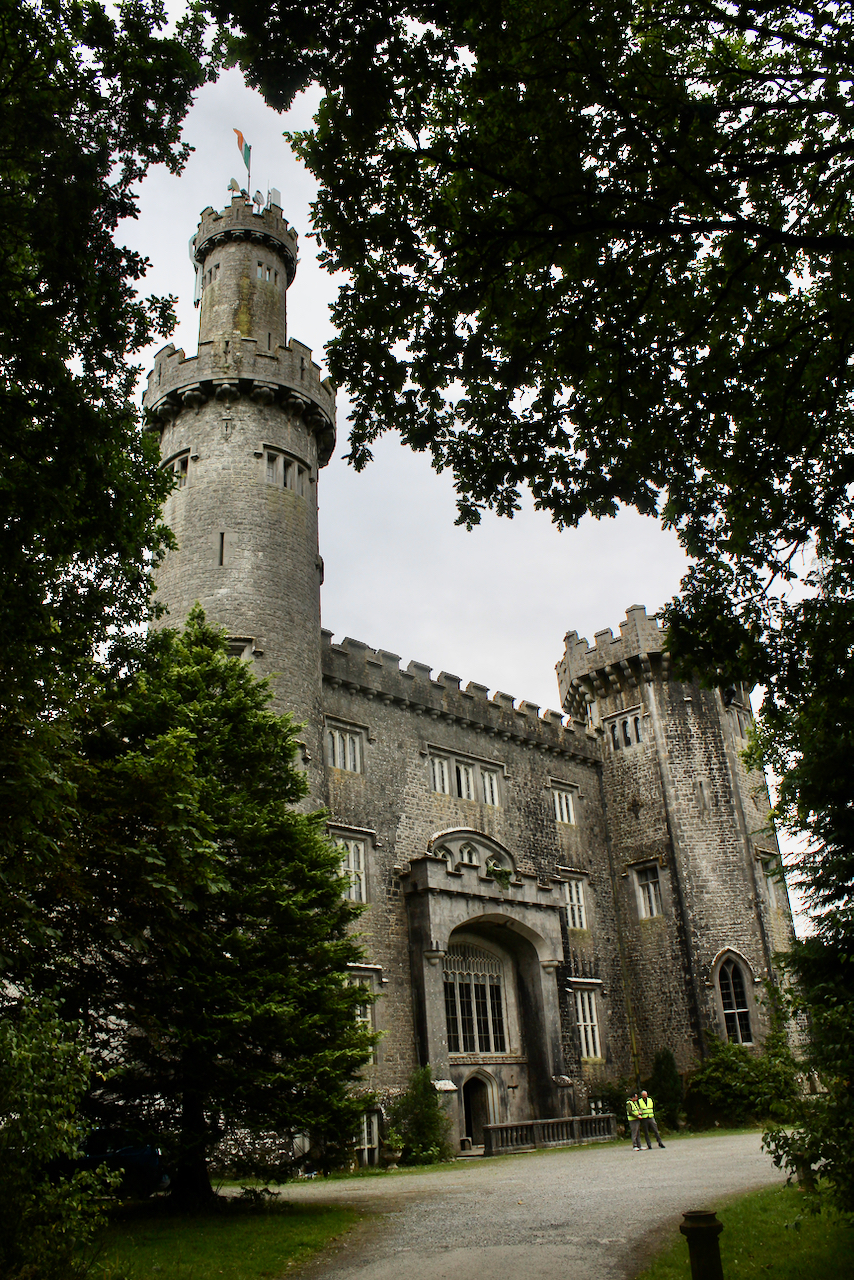
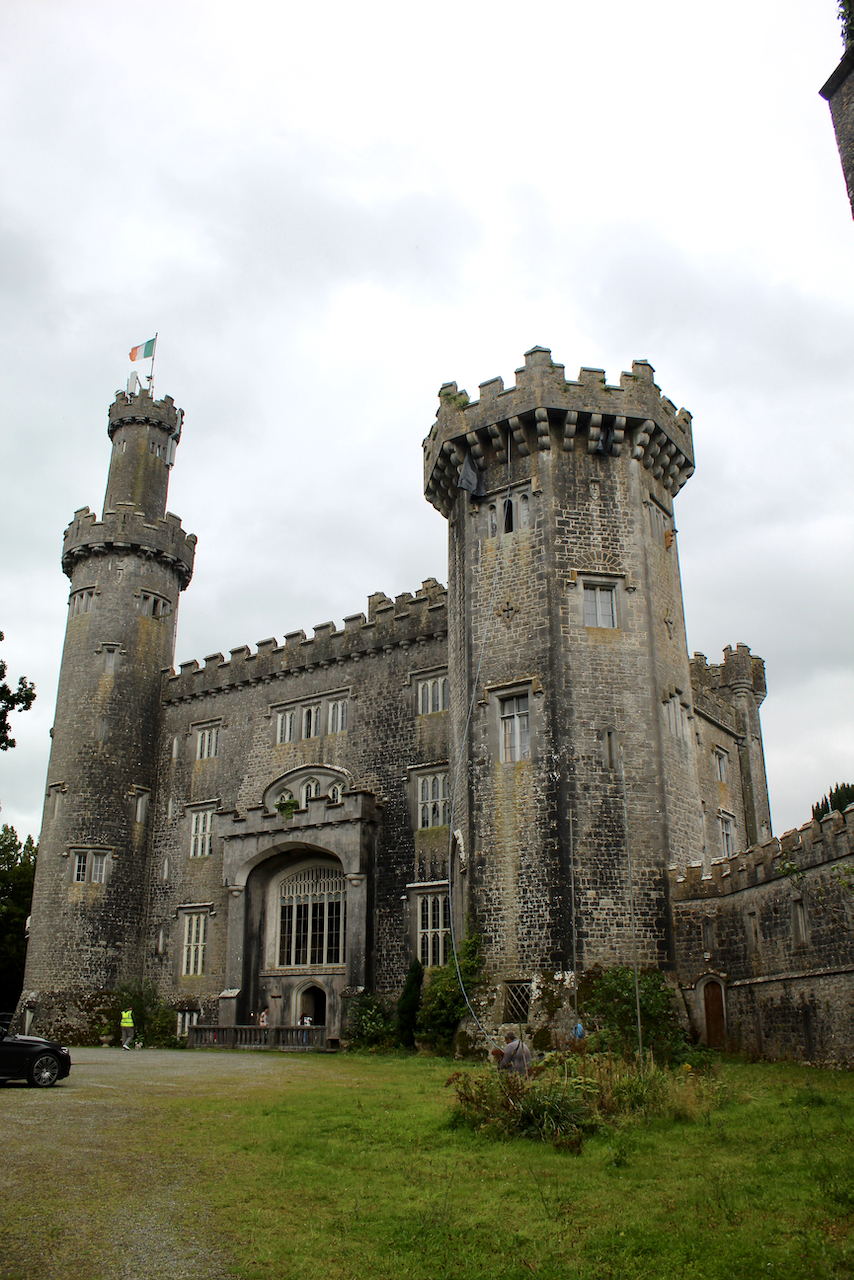
It was built built 1798-1812 for Charles William Bury (1764-1835), later 1st Earl of Charleville, and was designed by Francis Johnston. The castle took 14 years to build, partly because Johnston was busy with other commissions as he was appointed to the Board of Works in 1805. From his work on the castle, Francis Johnston gained many more commissions, and he worked simultaneously on Killeen Castle in County Meath (1802-1812), Markree Castle in County Sligo (1802-1805, see my entry) and Glanmore, County Wicklow (1803-04).
Mark Bence-Jones writes (1988, p. 82) that Charleville Castle is the “finest and most spectacularearly nineteenth century castle in Ireland, Francis Johnston’s Gothic masterpiece, just as Townley Hall, County Louth, is his Classical masterpiece.” [1]
In Irish Houses and Gardens. From the Archives of Country Life, Sean O’Reilly tells us that Charles William Bury and his wife, Catherine Maria née Dawson, had some hand in drawing plans for the building. He tells us: “Bury’s intention, as he wrote in his own unfinished account of the work, was to ‘exhibit specimens of Gothic architecture’ adapted to ‘chimneypieces, ceilings, windows, balustrades, etc.’ but without excluding ‘convenience and modern refinements in luxury.’ This recipe for the Georgian gothic villa had already been used at Horace Walpole’s Strawberry Hill in London, and Bury’s cultivated lifestyle in England certainly would have made him aware of that house and its long line of descendants.” [2]
Charles William Bury was President of the Royal Irish Academy between 1812 and 1822. He saw himself as the castle’s architect.
O’Reilly continues: “It may be that Bury himself – possibly with the assistance of his wife – outlined some of the more dramatic features in his new house, as is suggested by a number of drawings relating to the final design which still survive, now in the Irish Architectural Archive in Dublin. These all show the crude hand of an amateur, but equally betray a total freedom of imagination unshackled by the discipline of architectural training. In particular, a drawing of the exterior shows the smaller tower rising up out of the ground like a tree, with its base spreading and separating as it grows into the ground like roots.” [2]
Charleville Forest was written up by Mark Girouard for Country Life in 1962. Just over fifty-three years later Country Life published another article (October 2016), this time by Dr Judith Hill, awarded a doctorate for her work on the Gothic in Ireland.
Hill researched the role that Charles William Bury’s wife Catherine played in the design of Charleville, and shared her findings in a lecture given to the Offaly History Society and published on the Offaly History blog. She tells us:
“…it was time to look more closely at the collection of Charleville drawings which had been auctioned in the 1980s. Many of these are in the Irish architectural Archive, and those that were not bought were photographed. Here I found two pages of designs for windows that were signed by Catherine (‘CMC’: Catherine Maria Charleville). There is a sketch of a door annotated in her hand writing. There is a drawing showing a section through the castle depicting the wall decoration and furniture that had been attributed to Catherine. Rolf Loeber had a perspective drawing of the castle which showed the building, not quite as it was built, in a clearing in a wood. The architecture was quite confidently drawn and the trees were excellent. It was labelled ‘Countess Charleville’. I looked again at some of the sketches of early ideas for the castle in the Irish Architectural Archive. In one, the building design was hesitant while the trees were detailed; an architect wouldn’t bother with such good trees for an early design sketch. There was another that had an architect’s stamp; the massing of the building quickly drawn, the surrounding trees extremely shadowy. I could see Catherine and [Francis] Johnston talking about the design in these drawings.” [3]
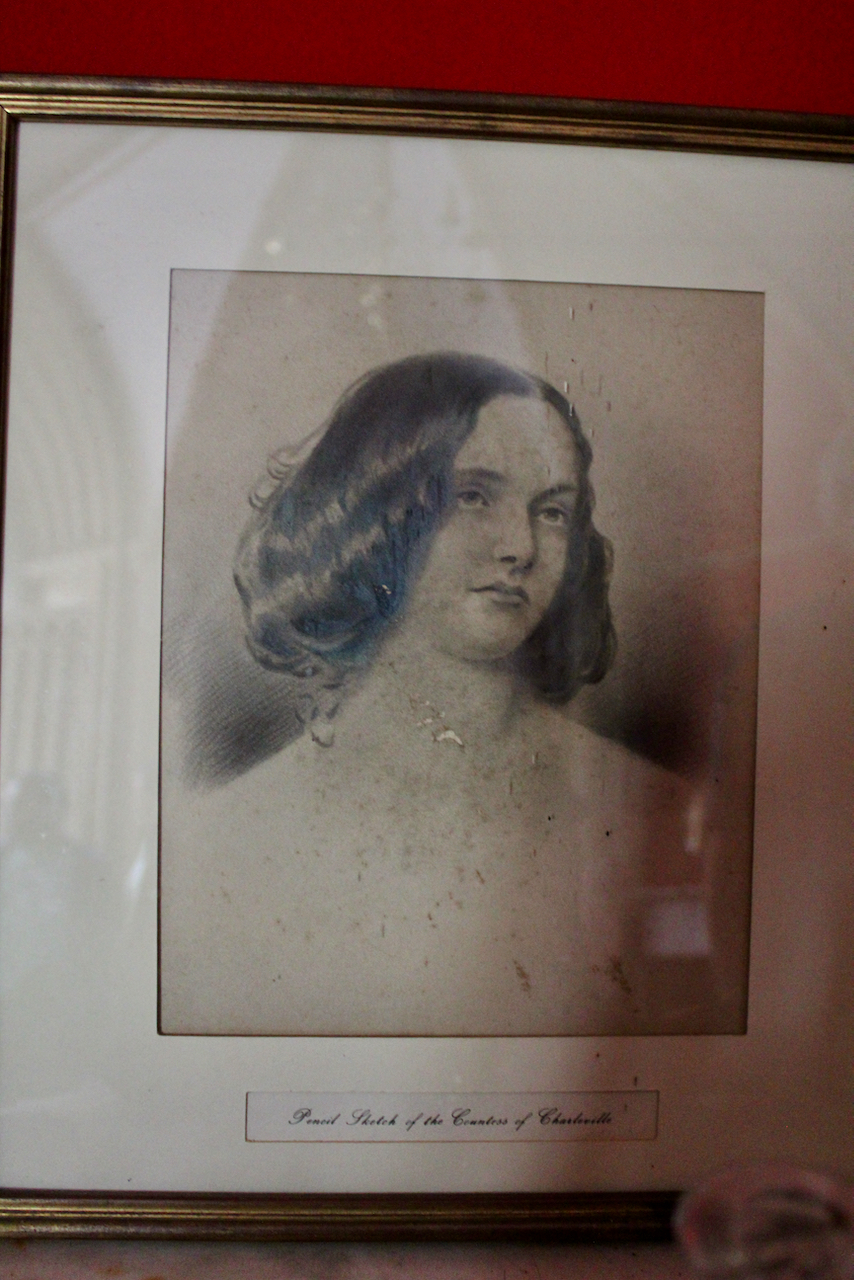
One of the Countesses of Charleville, though I don’t know which one.PossiblyHarriet Charlotte Beaujolois, the third daughter of Col. John Campbell of Shawfield in Scotland and Lady Charlotte Susan Maria Campbell.She was the second countess of Charleville and mother of Beaujolois or Little Beau.
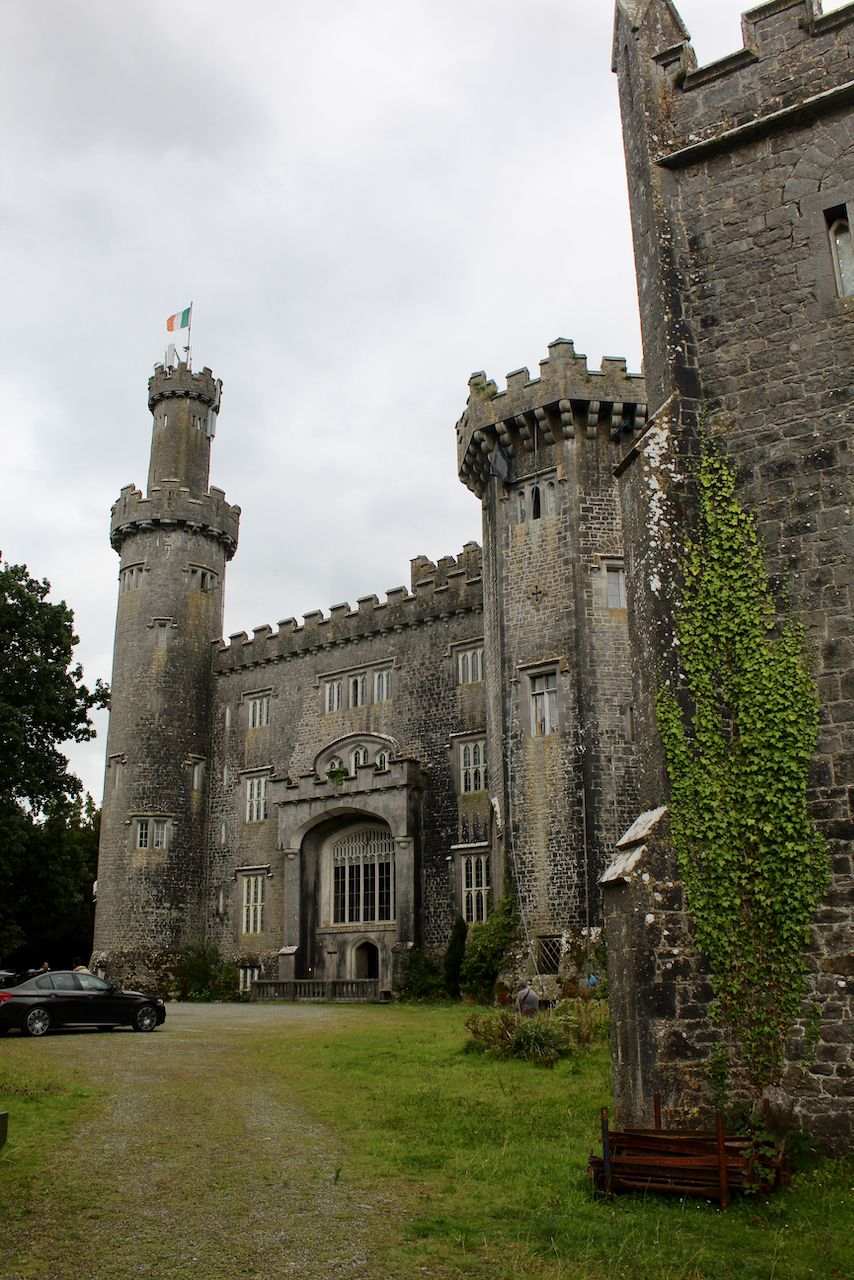
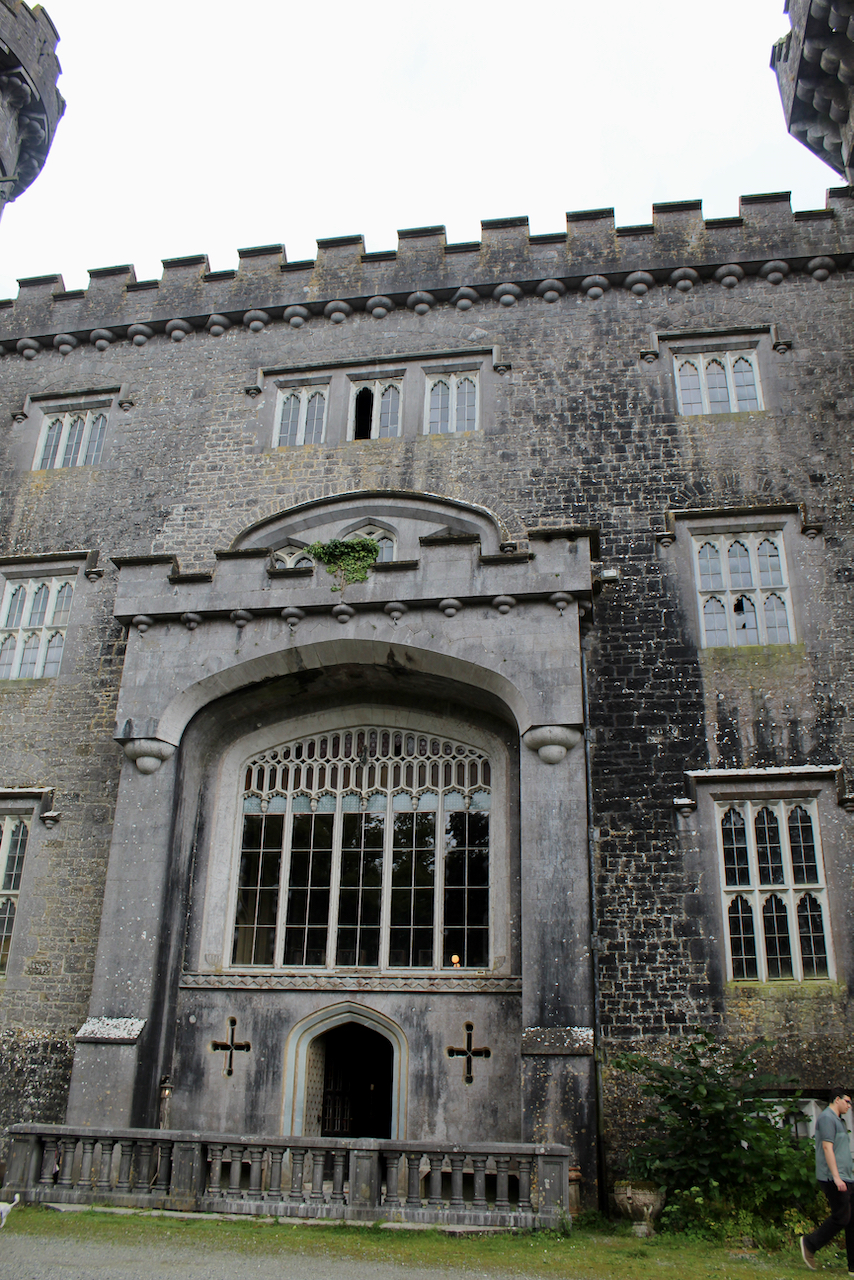
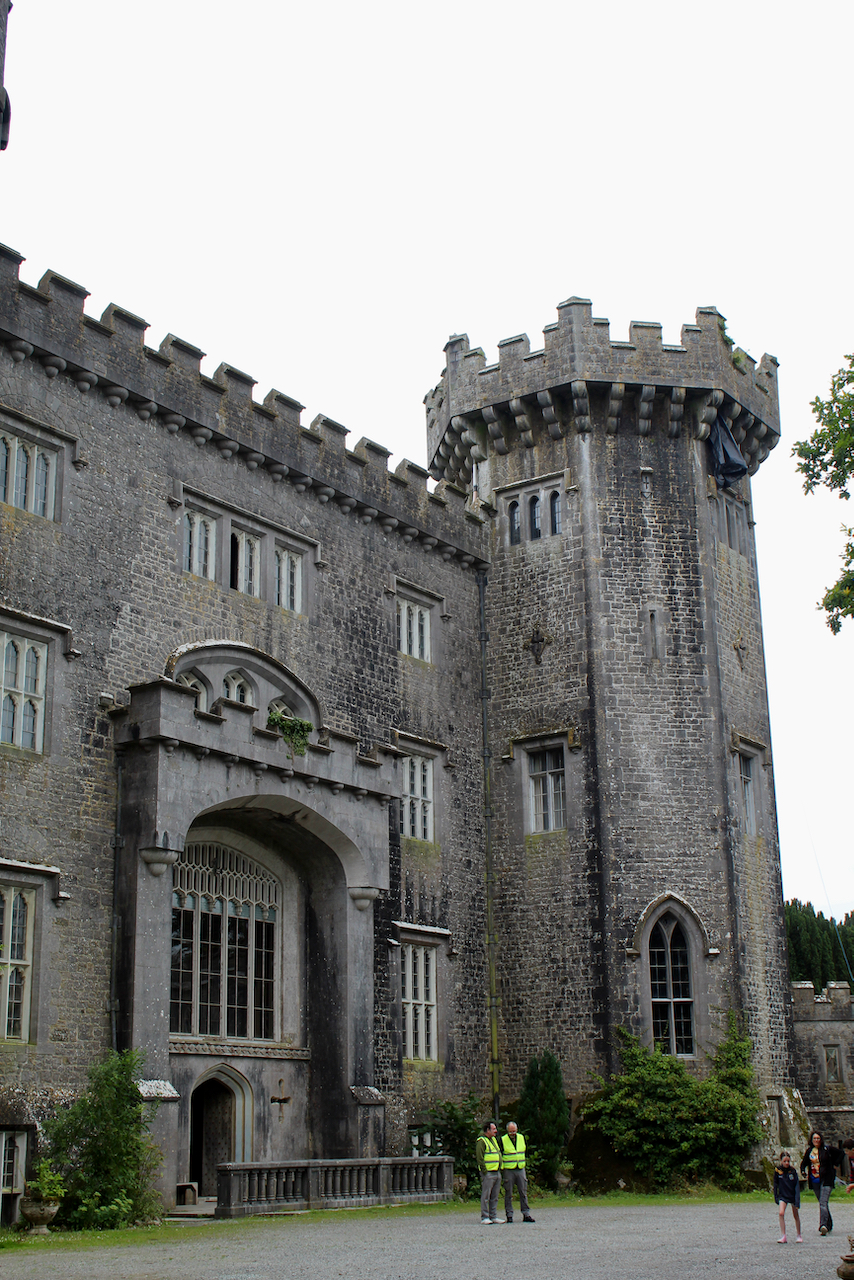
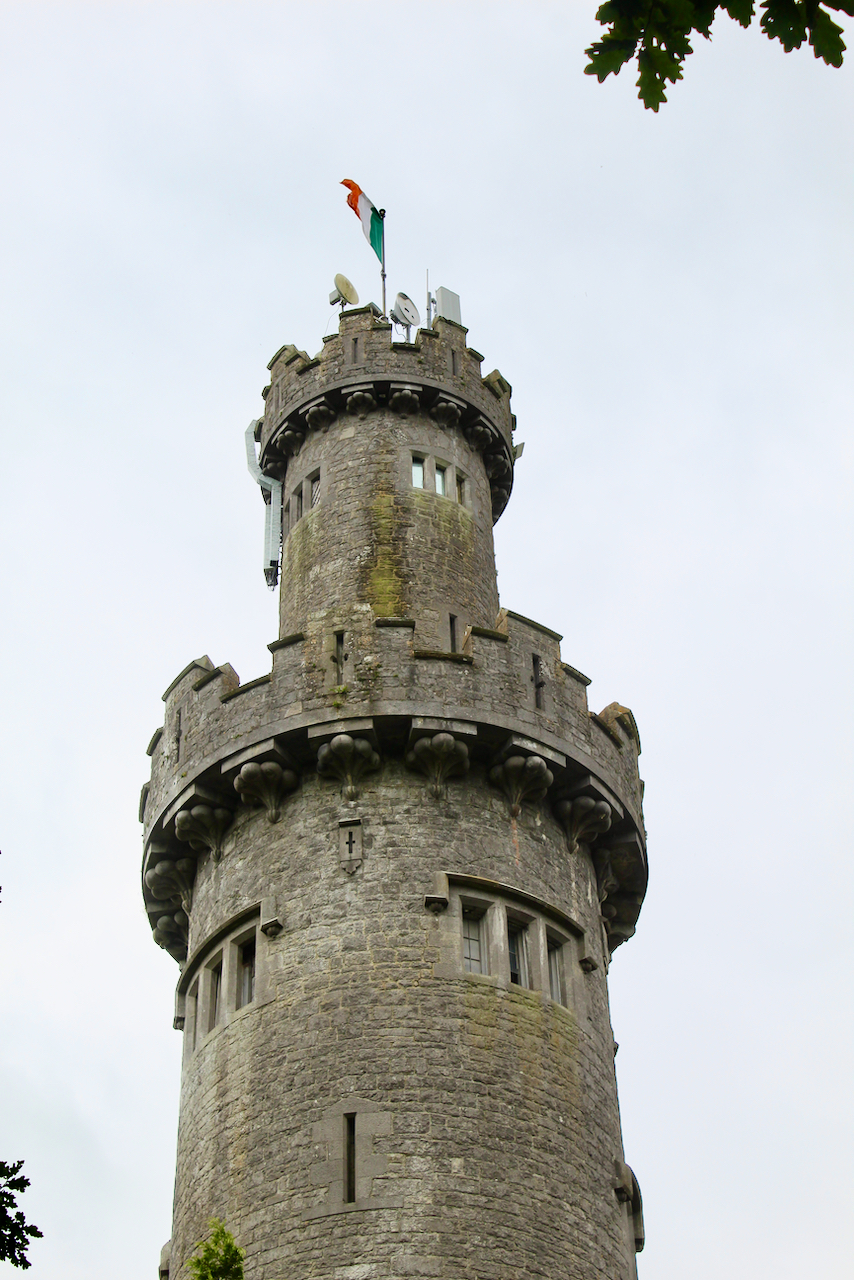
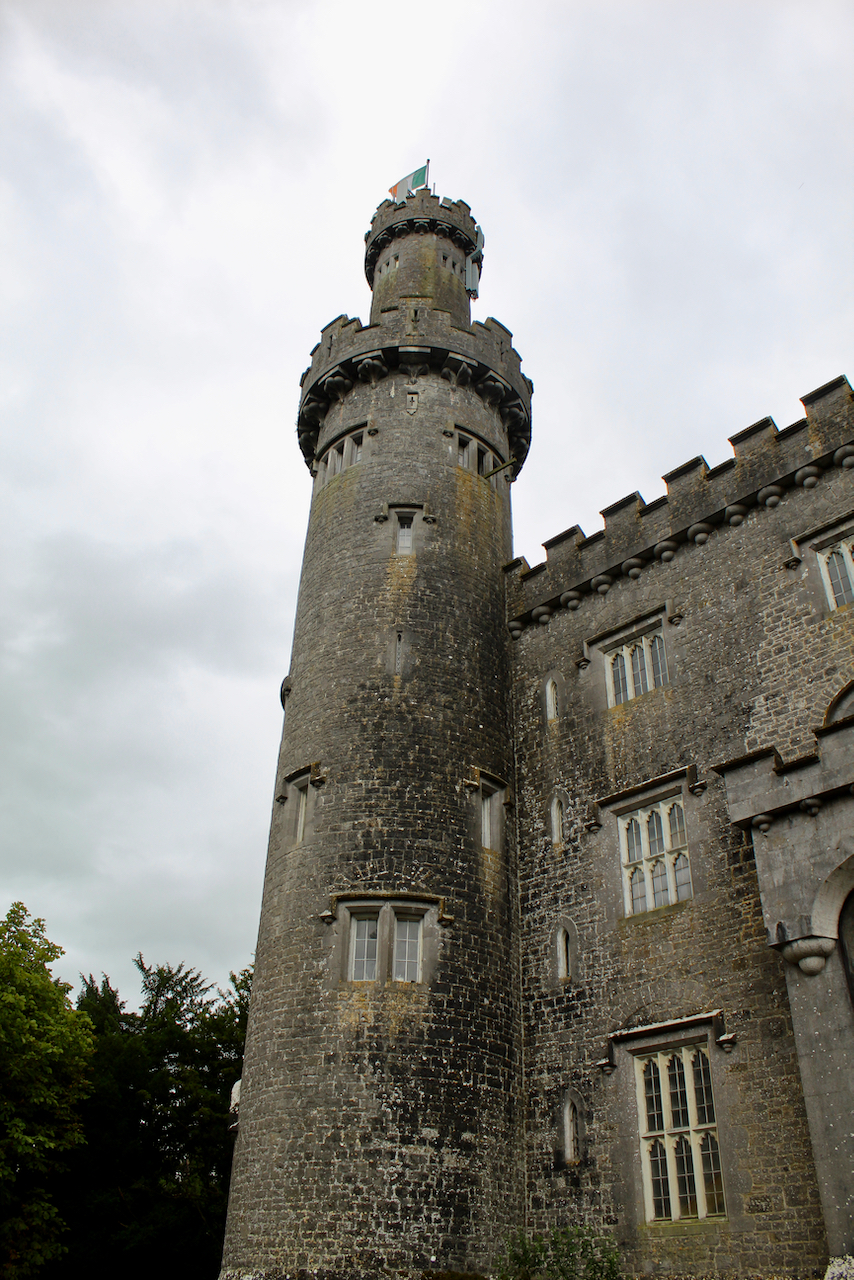
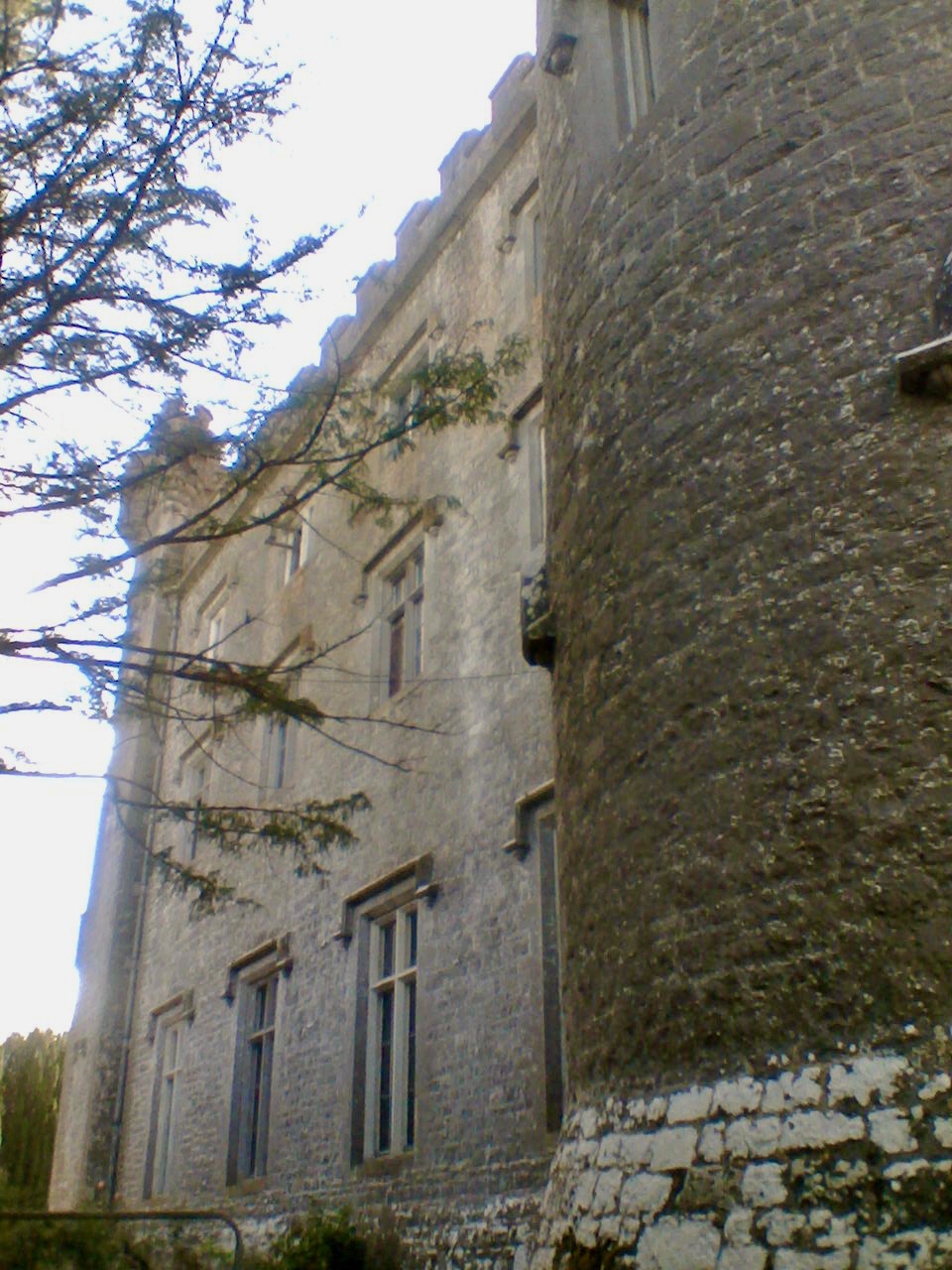
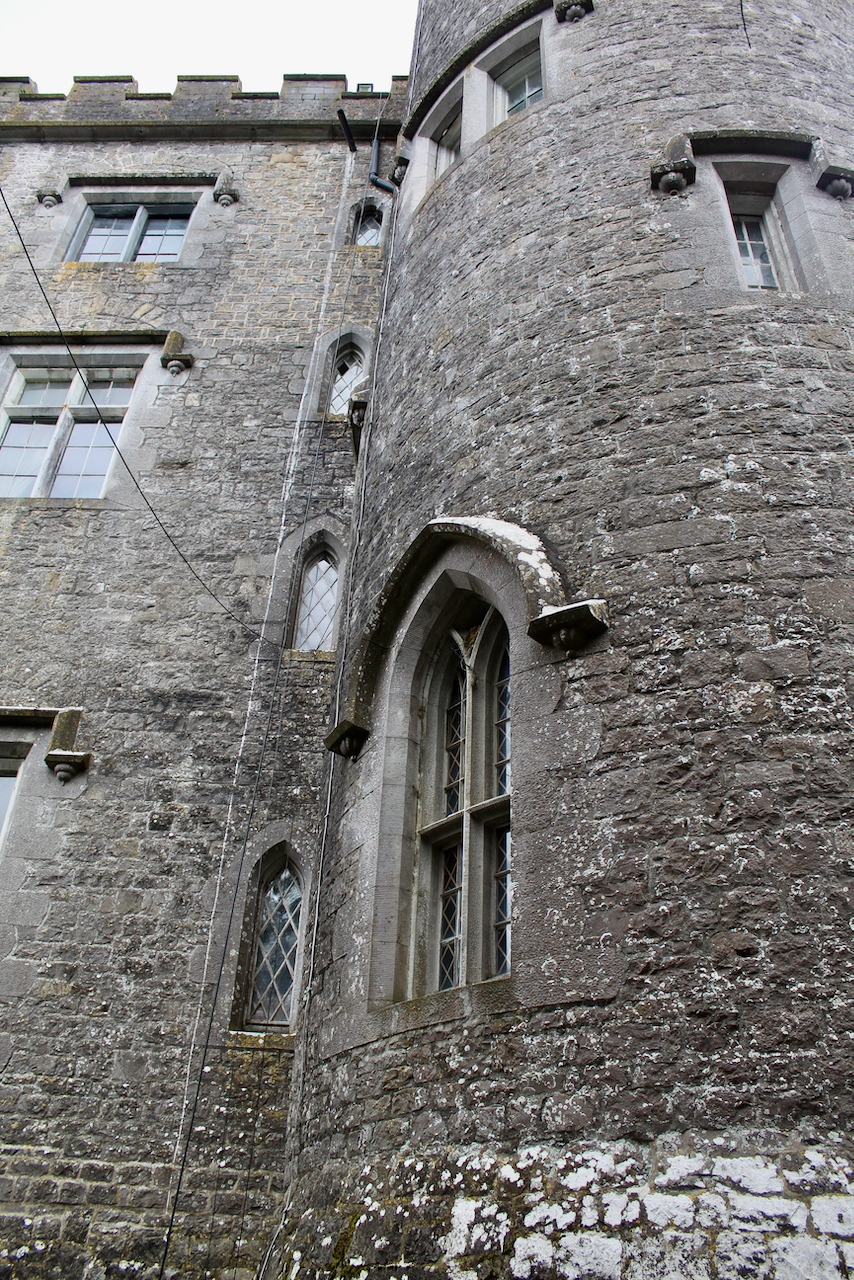
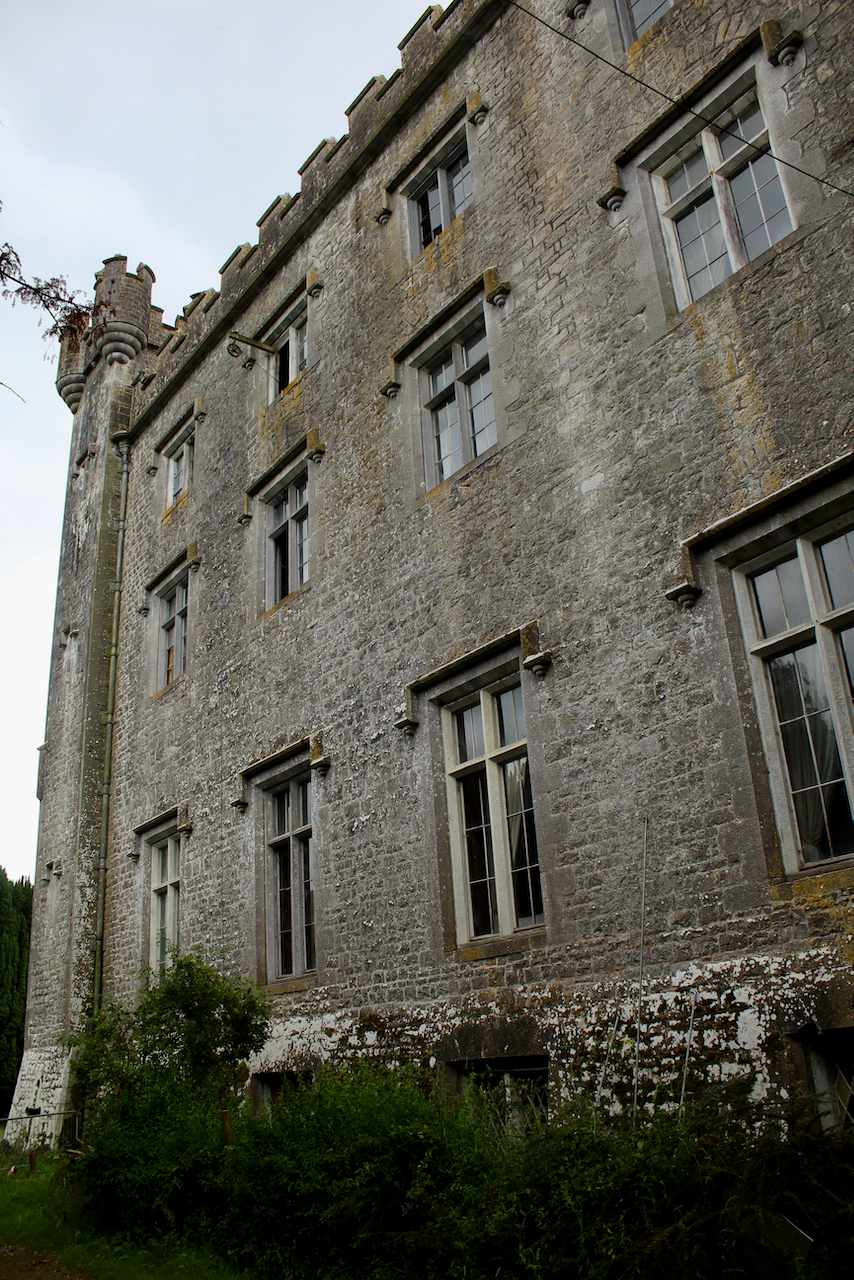
Bence-Jones describes Charleville Forest castle as “a high square battlemented block with, at one corner, a heavily machicolated octagon tower, and at the other, a slender round tower rising to a height of 125 feet, which has been compared to a castellated lighthouse. From the centre of the block rises a tower-like lantern. The entrance door, and the window over it, are beneath a massive corbelled arch. The entire building is cut-stone, of beautiful quality.” [see 1]
Beginning in 1912, with the departure of Lady Emily, the last surviving daughter of the 4th Earl of Charleville, the house was left empty for 68 years.
In 1970 David Hutton-Bury (who owned and lived on the estate adjacent to the castle) granted a 35-year lease for the castle and surrounding 200 acres to Michael McMullen. McMullen lived in the castle and began its restoration in the early 1980s, during which time he restored the six main public rooms. In 1987 Bridget Vance and her mother, Constance Vance-Heavey, took over the leasehold from McMullen and continued the restoration. [4] It is now owned by the Charleville Castle Heritage Trust.
The land of Charleville Forest was inherited by Charles William’s father, John Bury (1725-1764) of Shannongrove, County Limerick. He succeeded to the estates of his maternal uncle, Charles Moore (1712-1764) 1st Earl of Charleville, in February 1764.
Shannongrove, County Limerick, the home of Charles William Bury’s father, courtesy of Archiseek. [5]
The oak forest and lands were gifted by Queen Elizabeth I to John Moore of Croghan Castle in 1577. Moore leased the land to Robert Forth, who built a house he called Redwood next to the river Clodiagh. In the 1740s Charles Moore 2nd Baron Moore and later 1st Earl of Charleville bought out the lease and made the house the family seat and named it Charleville, after himself.
Due to the lack of male heirs in the Moore family after Charles Moore’s death in 1764, and the fact that John Moore died later that year in 1764, the land was inherited by Charles William Bury who was the grand nephew of the last Earl, at just six months old.
Charles William Bury’s mother Catherine Sadleir was from Sopwell Hall County Tipperary. After her husband John Bury died, she married Henry Prittie (1743-1801) 1st Baron Dunally of Kilboy, which whom she went on to have several more children. The family probably moved to the house he had built called Kilboy House in County Tipperary.
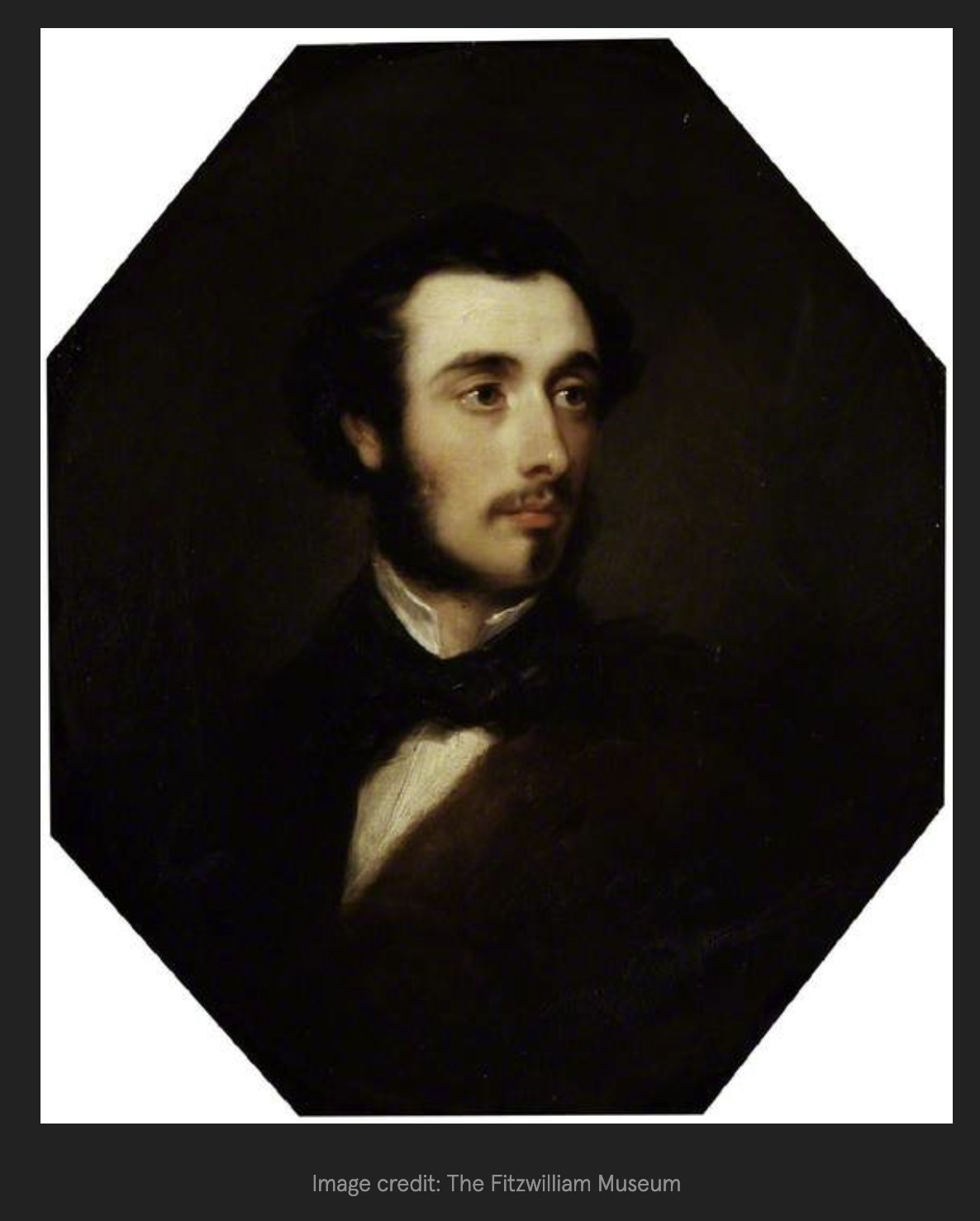
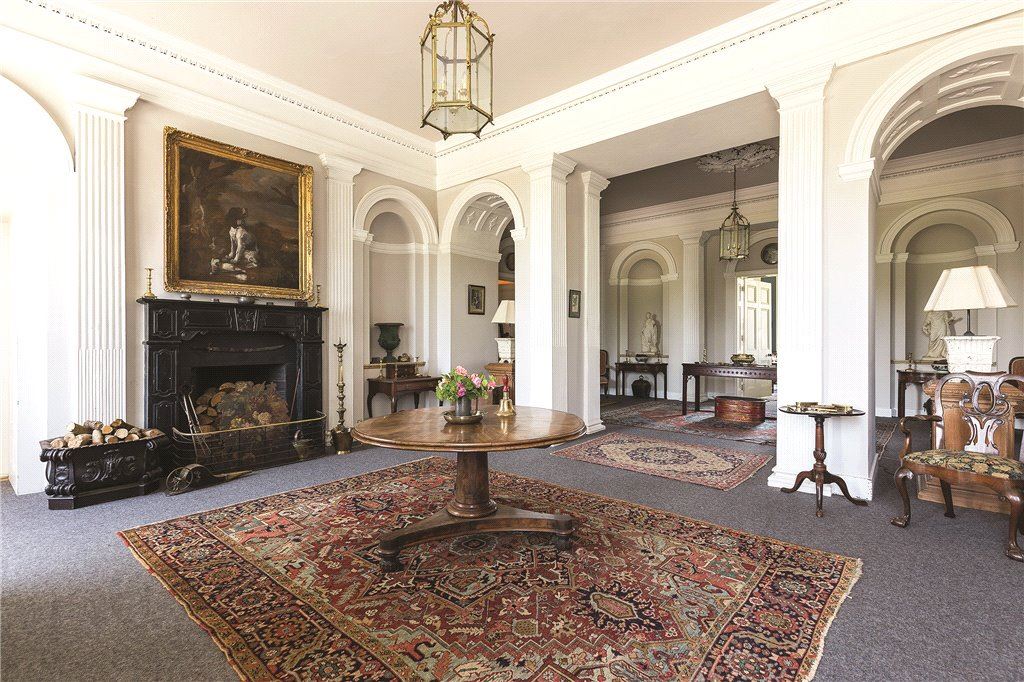
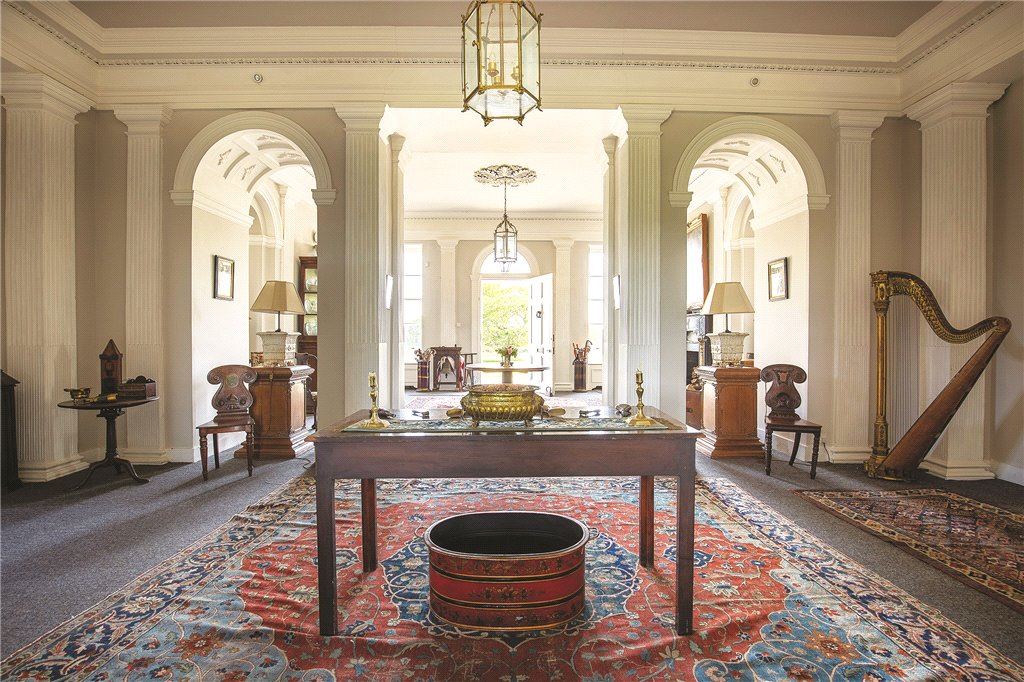
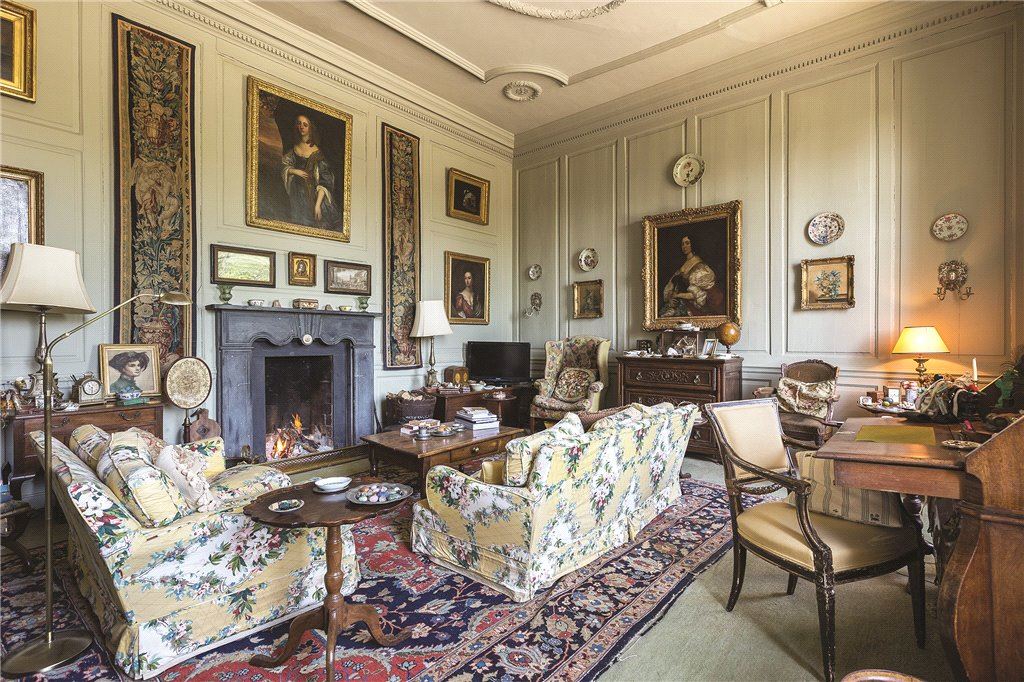
Sopwell Hall, County Tipperary, courtesy of Colliers estate agents and myhome.ie. It was built in 1745 to a design attributed to Francis Bindon.The sale site tells us that in 1745 Francis Sadlier (1709-1797) built Sopwell Hall. The Sopwell Estate ownership passed to the Trench family in 1797 through the marriage of his daughter, Mary. The Trench family remained in ownership until 1985.See more photos in footnotes [6]Henry Prittie, 1st Baron Dunalley (1743-1801), Irish school, courtesy of Christie’s.He was the stepfather of Charles William Bury.
On Charles Moore’s death the title became extinct until Charles William Bury was created 1st Earl of Charleville of the second creation in 1806. Before this, in 1797 he was created Baron Tullamore and in 1800, Viscount Charleville. Bury was returned to the Irish Parliament for Kilmallock in January 1790, but lost the seat in May of that year. He was once again elected for Kilmallock in 1792, and retained the seat until 1797. In 1801 he was elected as an Irish representative to sit in the British House of Lords in England.
Charles William Bury’s wife Catherine was daughter of Thomas Townley Dawson and widow of James Tisdall. From that marriage she had a daughter named Catherine.
Andrew Tierney describes Charleville Forest Castle in The Buildings of Ireland: Central Leinster: Kildare, Laois and Offaly:
“The castle comprises a tall castellated block of snecked [snecked masonry has a mixture of roughly squared stones of different sizes] limestone rubble with ashlar trim, with a great muscular octagonal tower to the northwest and a narrow round tower with soaring tourelle [small tower] to the NE…The composition breaks out more fully in the collective irregular massing of the towers, the chapel and the stable block, which rambles off to the west.” [7]
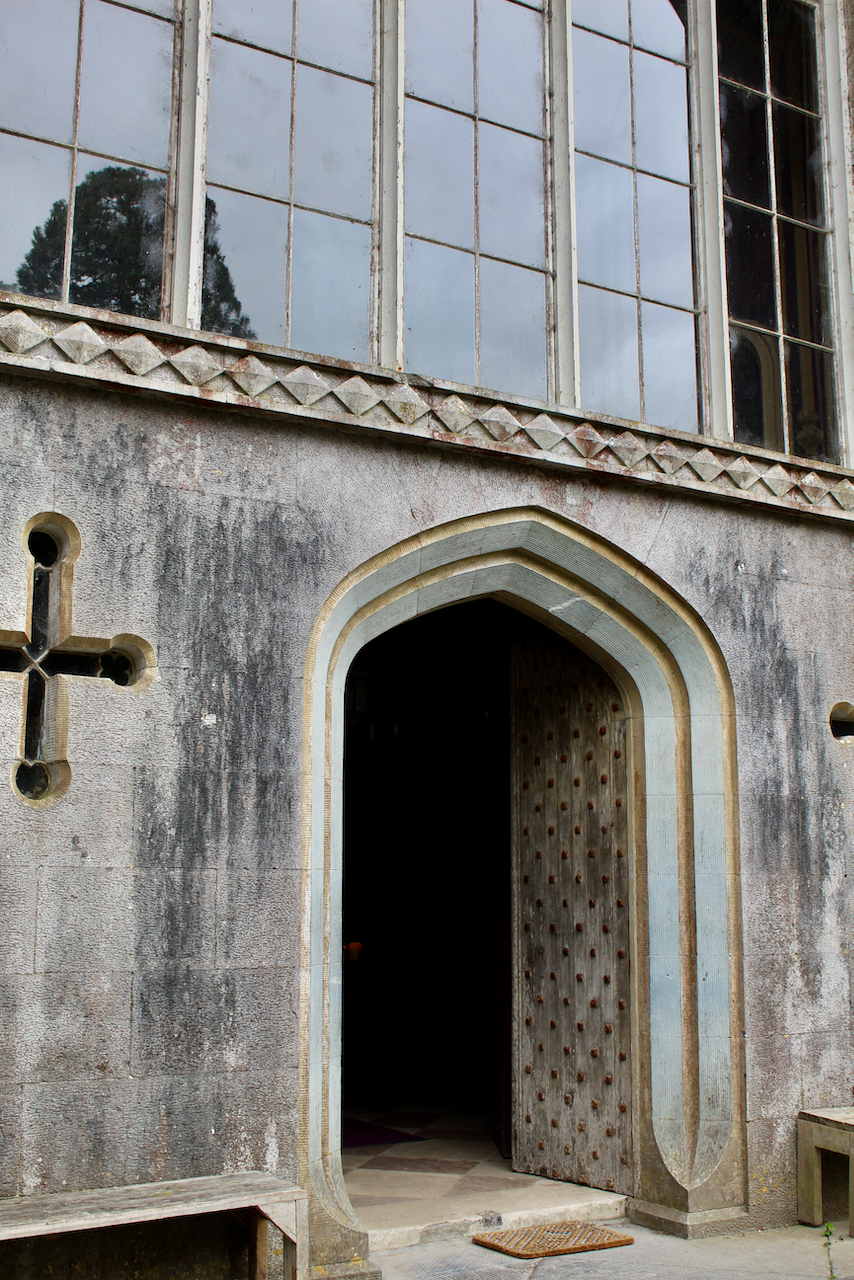
Tierney continues: “The positioning of a great window over the doorway bears comparison with the earlier group of Pale castles, such as Castle Browne (now Clongowes Woods school), attributed to Thomas Wogan Browne. It appears as a portcullis descending from a Gothic arch with a drawbridge in Lord Charleville’s original drawing (which also had a Radcliffean damsel in distress screaming from the battlements). He spent a lot of time drawing a sevenlight panelled window in its stead – the effect is much the same from afar – although the executed window is a more complex Perp design, probably by Johnston. The Tudor arch is employed three times in succession: over the door, in the recess of the great window and in the tripartite window above, which is subdivided into three further arches. This use of the same detailing at varying scales is also seen in the corbelling – a sort pair of intersecting hemispheres. The battlements are simple crenels on the main block but on the towers are rendered in a distinctly Irish fashion (a distinction Johnston would make at Tullynally and Markree), and here the corbelling is also more elaborate, sprouting upwards like cauliflower on the NE tower.“
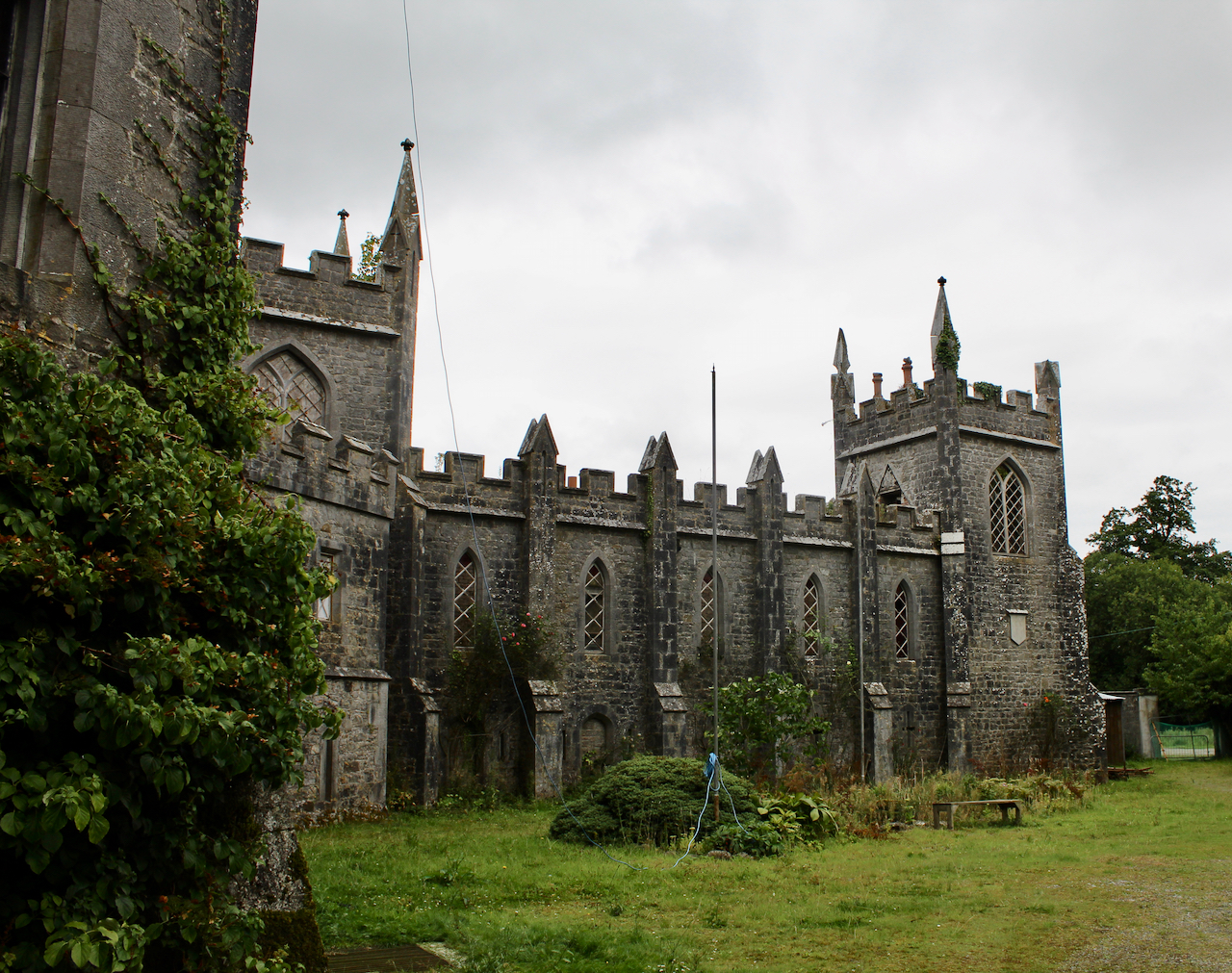
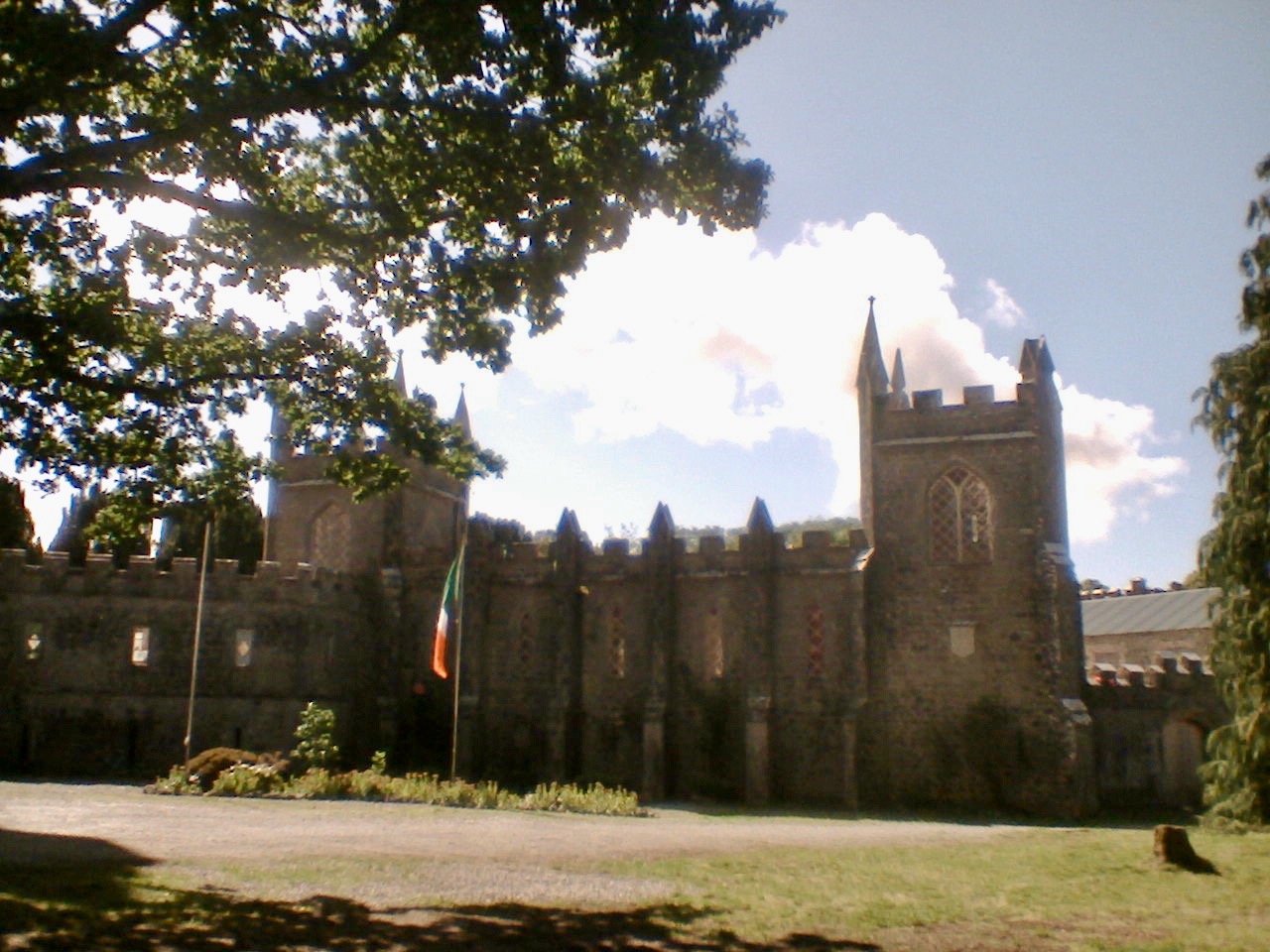
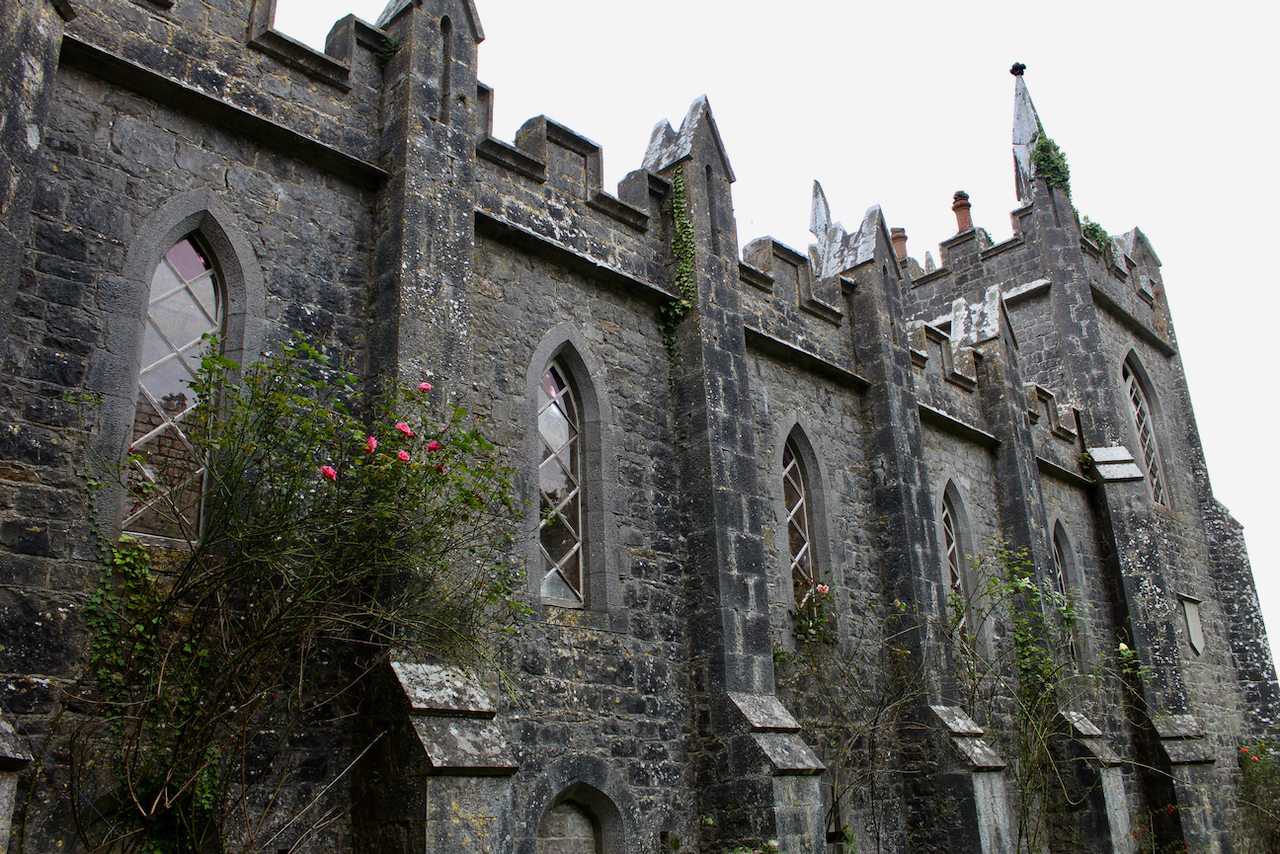
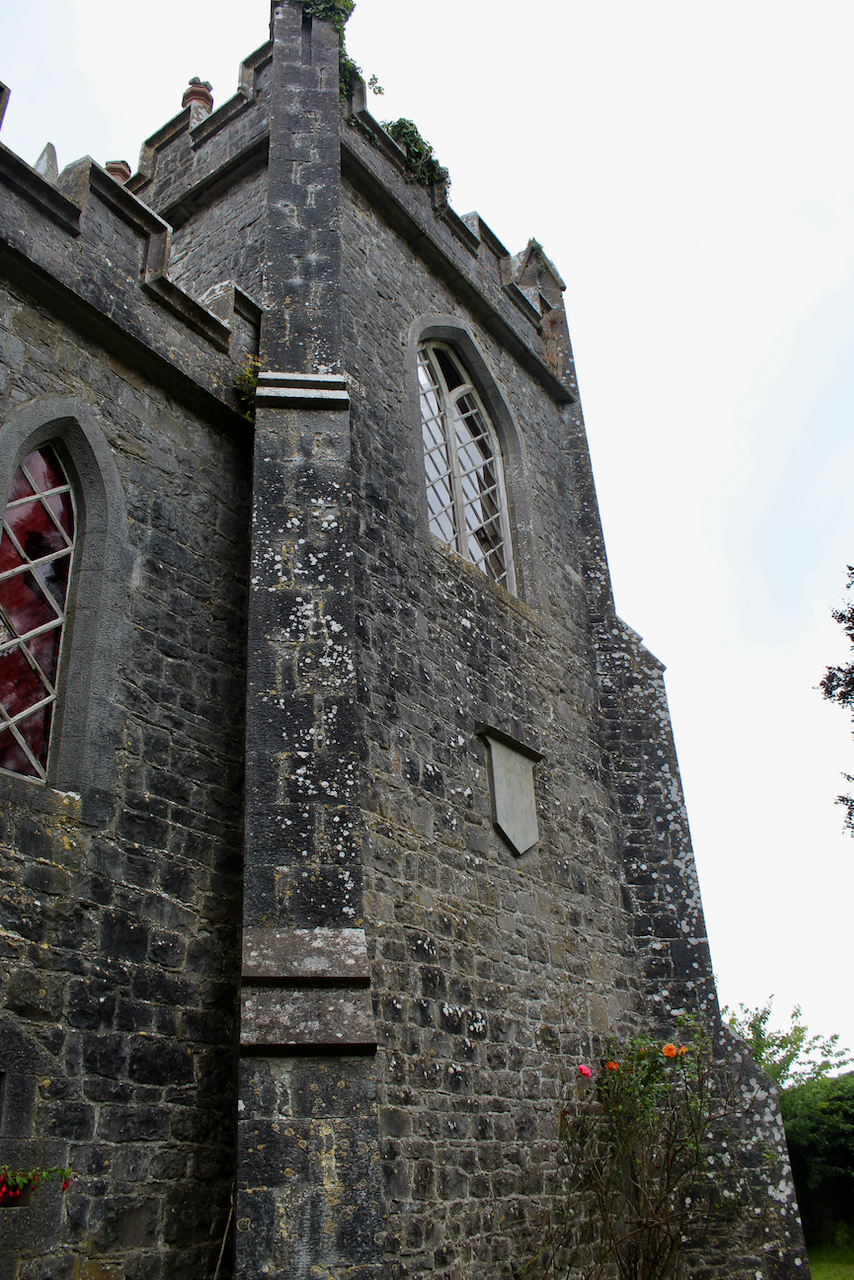
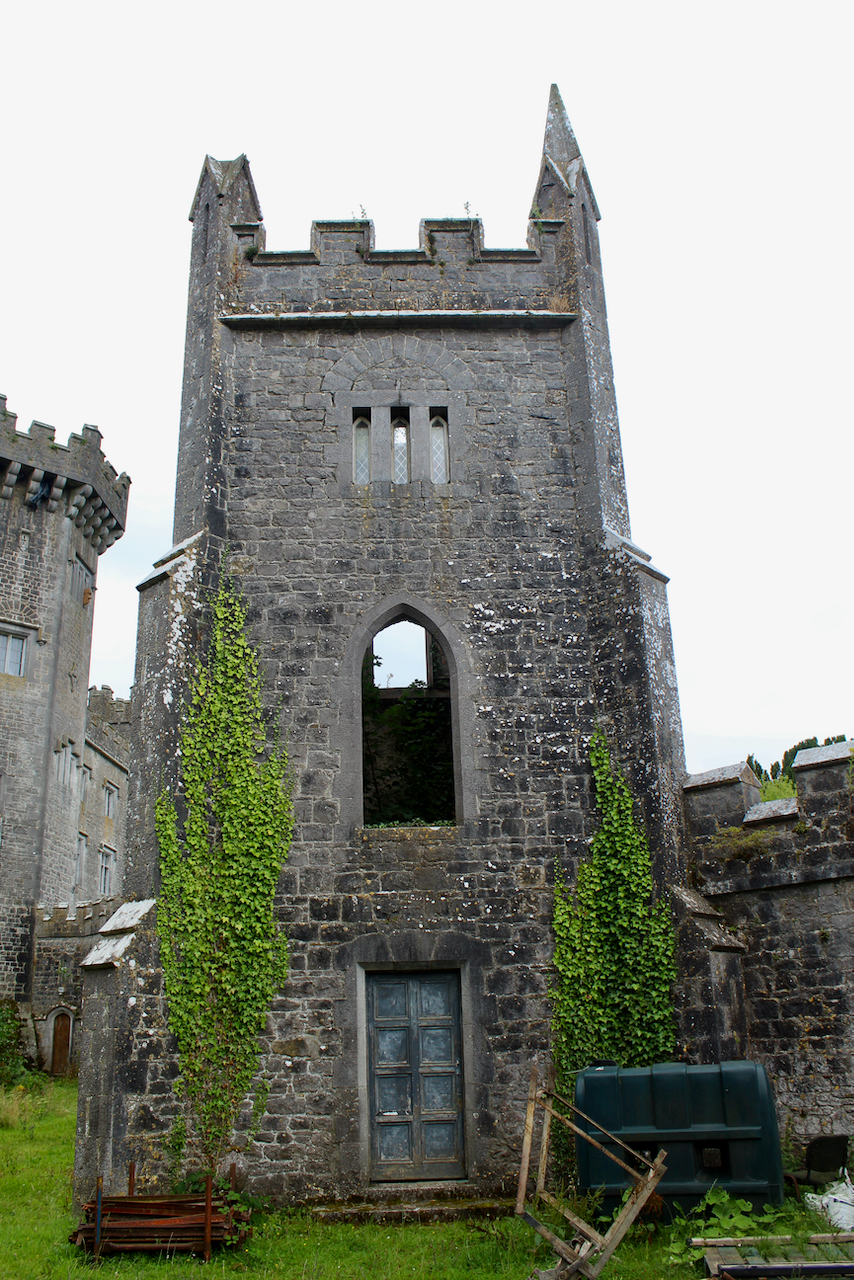
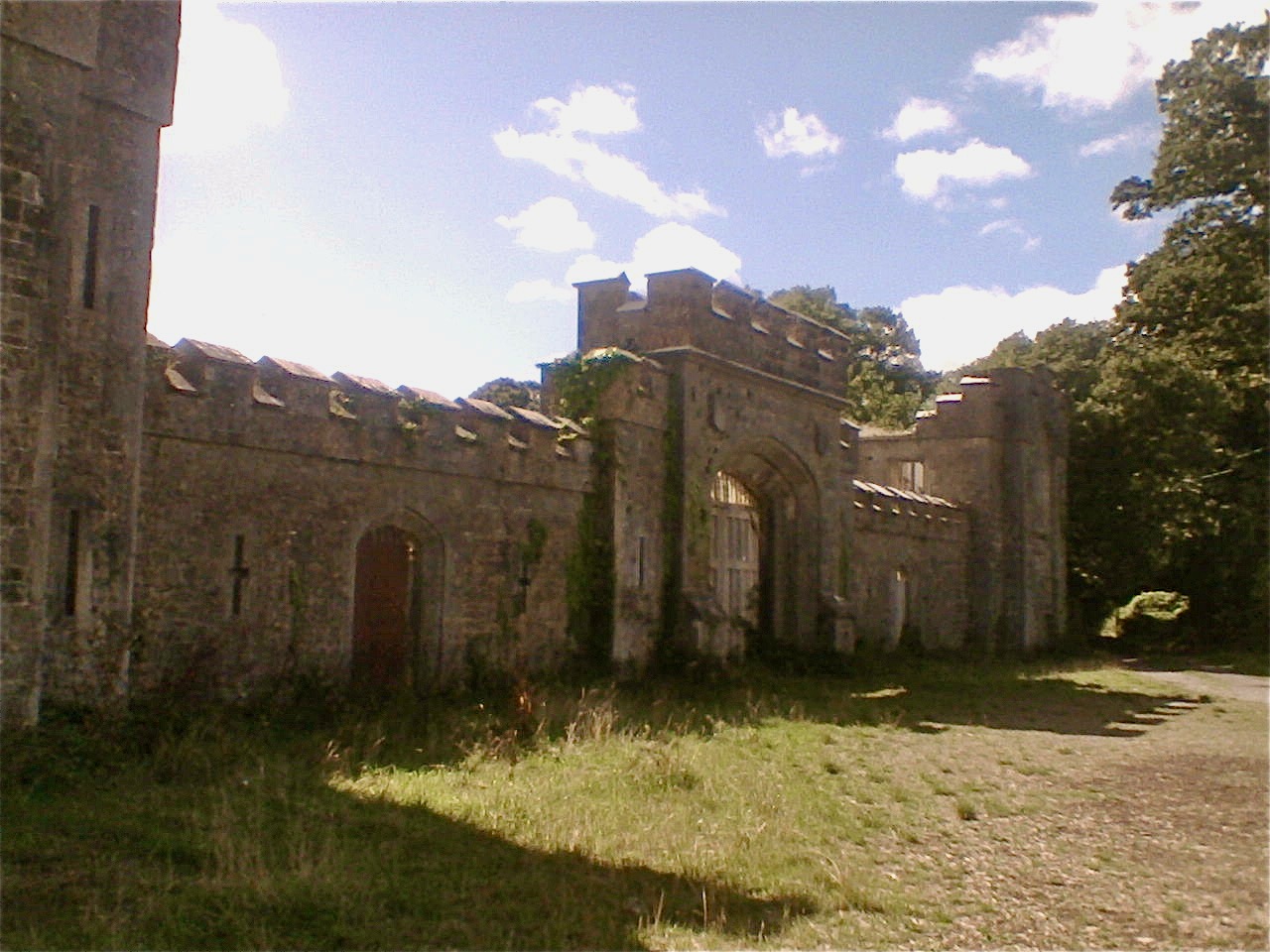
To the right of the entrance front, and giving picturesque variety to the composition, is a long, low range of battlemented offices and a chapel, including a tower with pinnacles and a gateway.
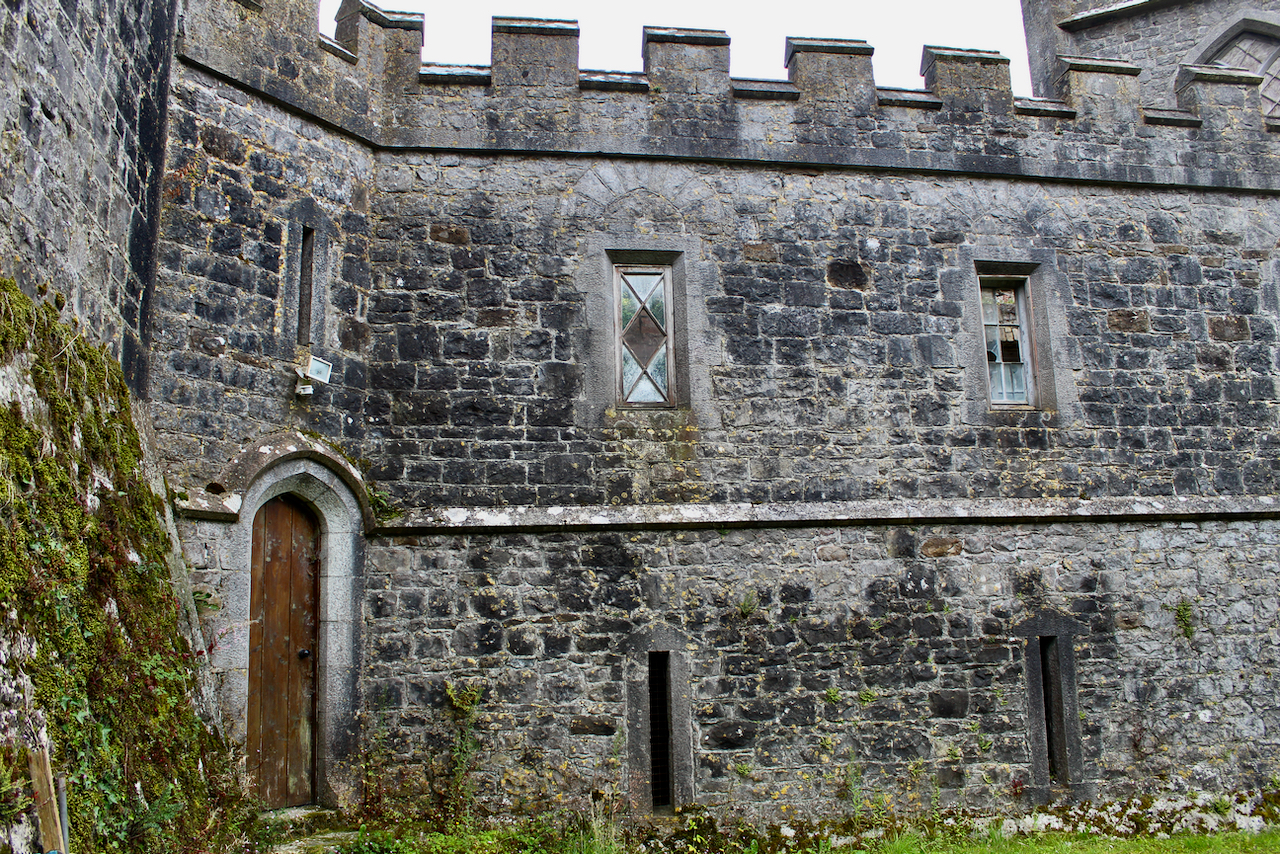
The Stableyard lies beyond the chapel but is not open to the public, which is unfortunate as Tierney describes it as the finest castellated stableyard in Ireland, although now derelict. It is also by Francis Johnston.
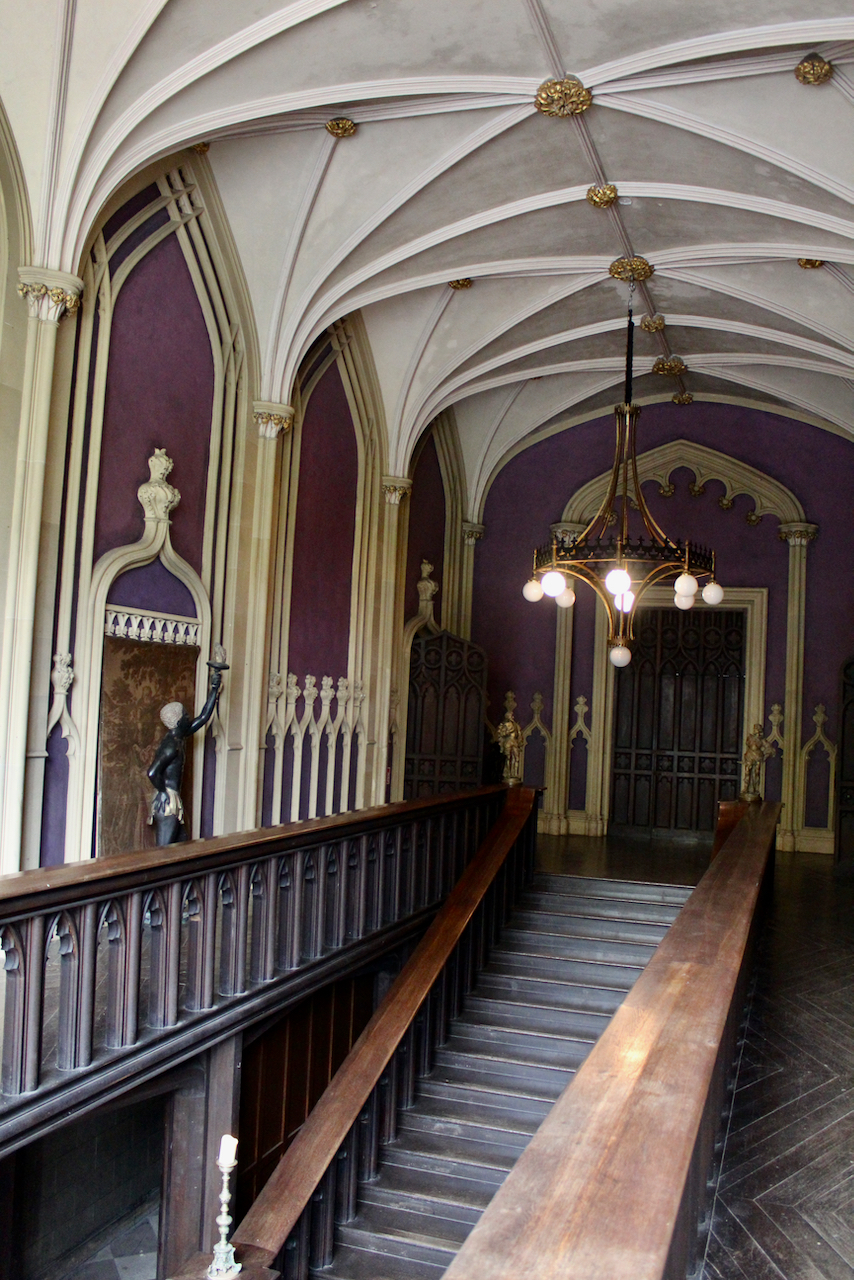
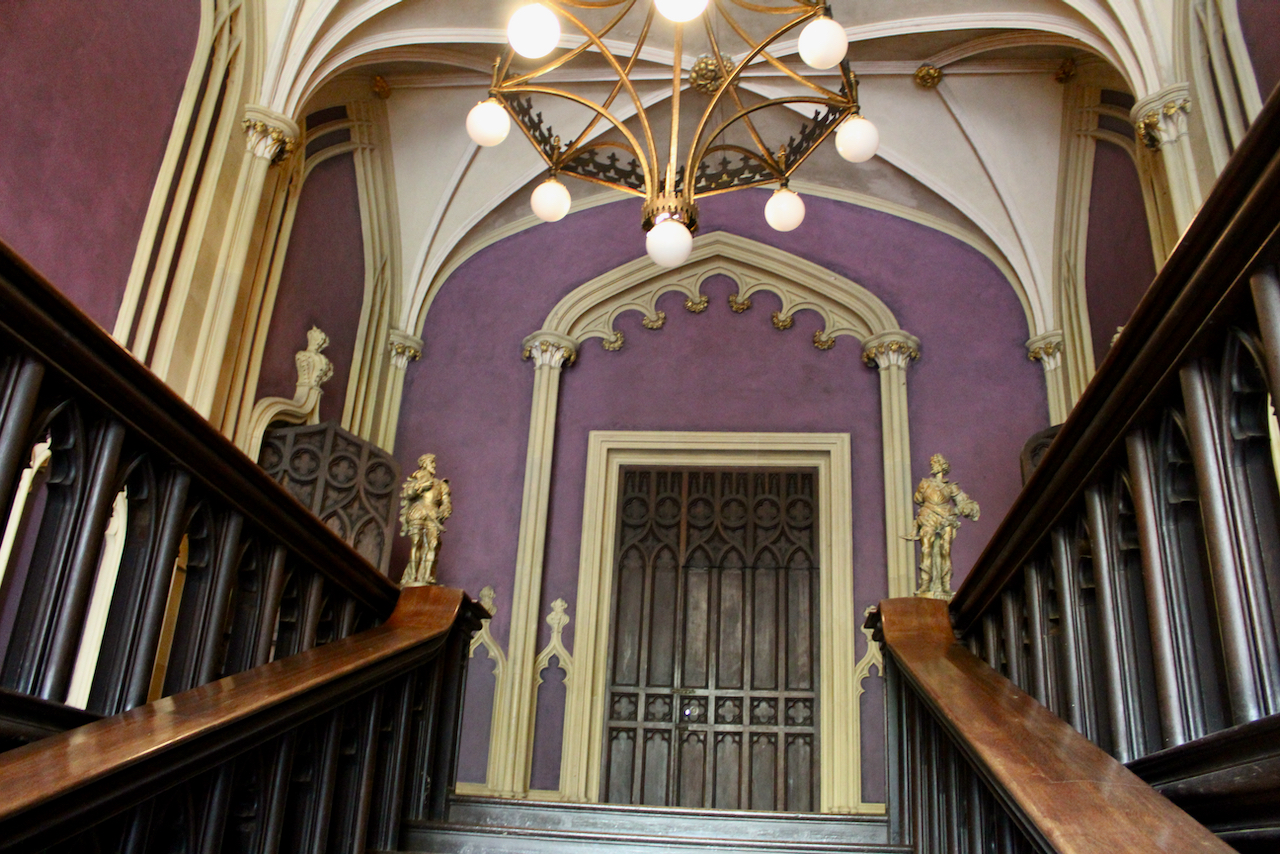
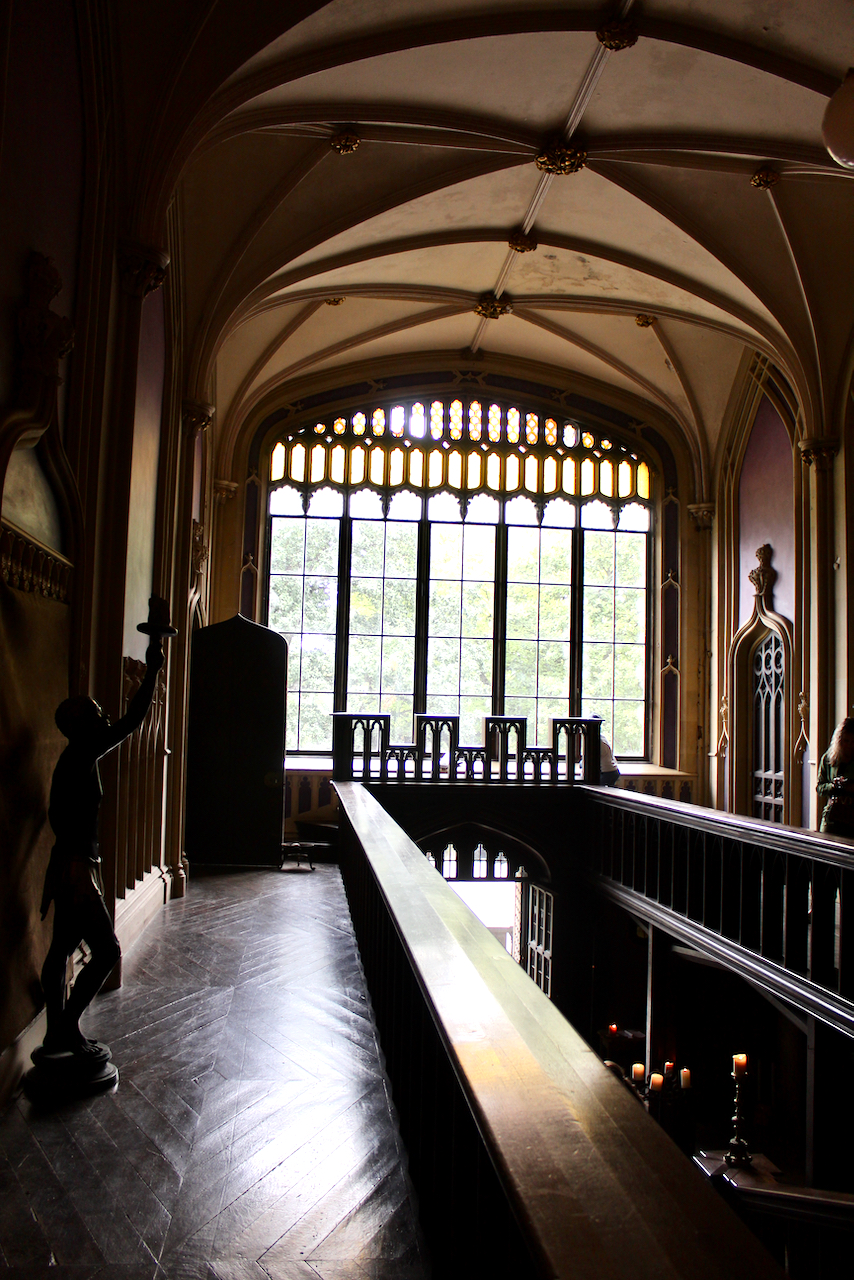
“The interior is as dramatic and well-finished as the exterior. In the hall, with its plaster groined ceiling carried on graceful shafts, a straight flight of stairs rises between galleries to piano nobile level, where a great double door, carved in florid Decorated style, leads to a vast saloon or gallery running the whole length of the garden front.”
The heavy oak stairs run from the basement to piano nobile. This imitates a similar configuration by James Wyatt at Fonthill and Windsor, which Lord Charleville knew. The upper stage, Tierney describes, has a plaster-panelled dado with ogee-headed niches in the style of Batty Langley, conceived for a parade of suits of armour in drawings by Lady Charleville.
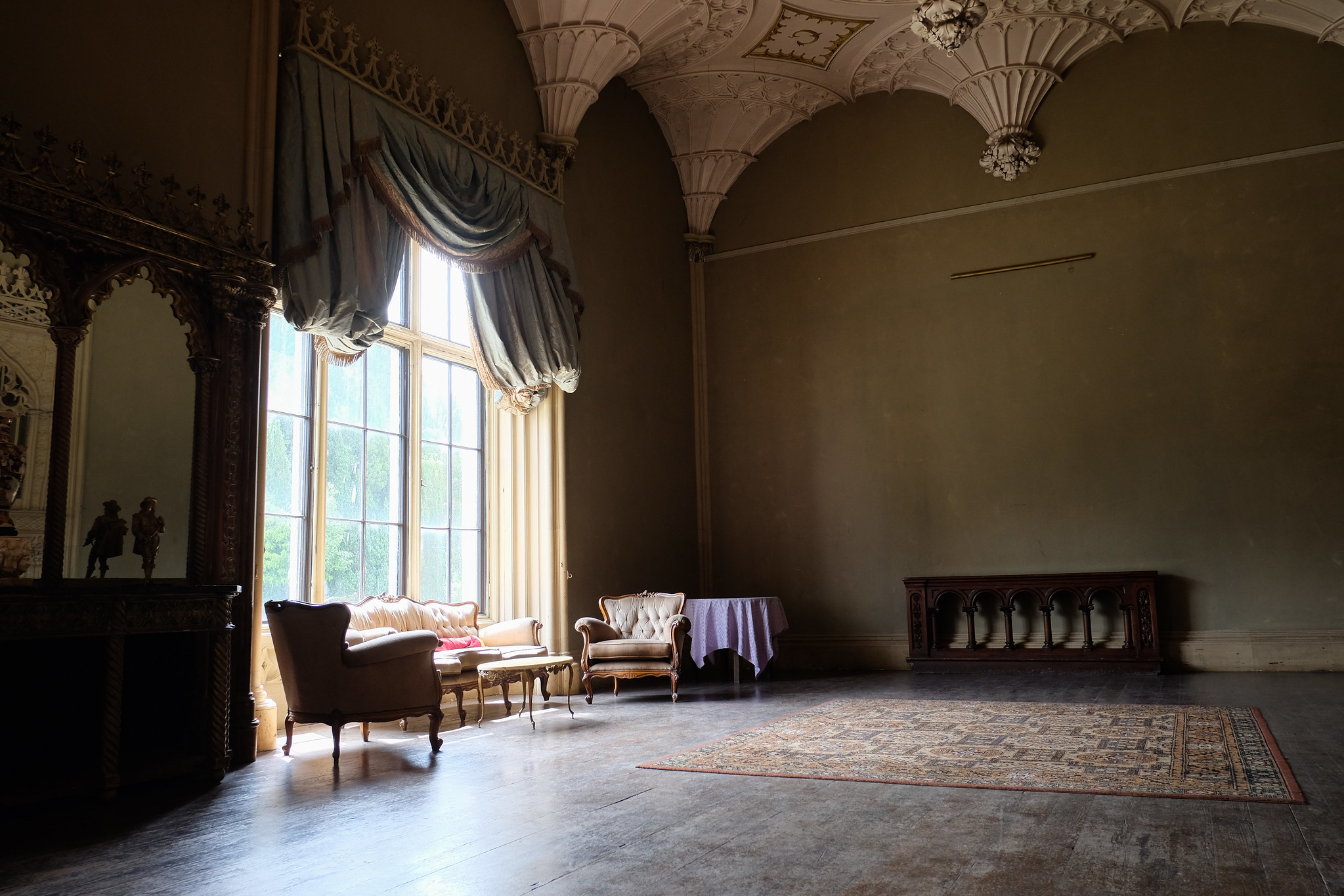
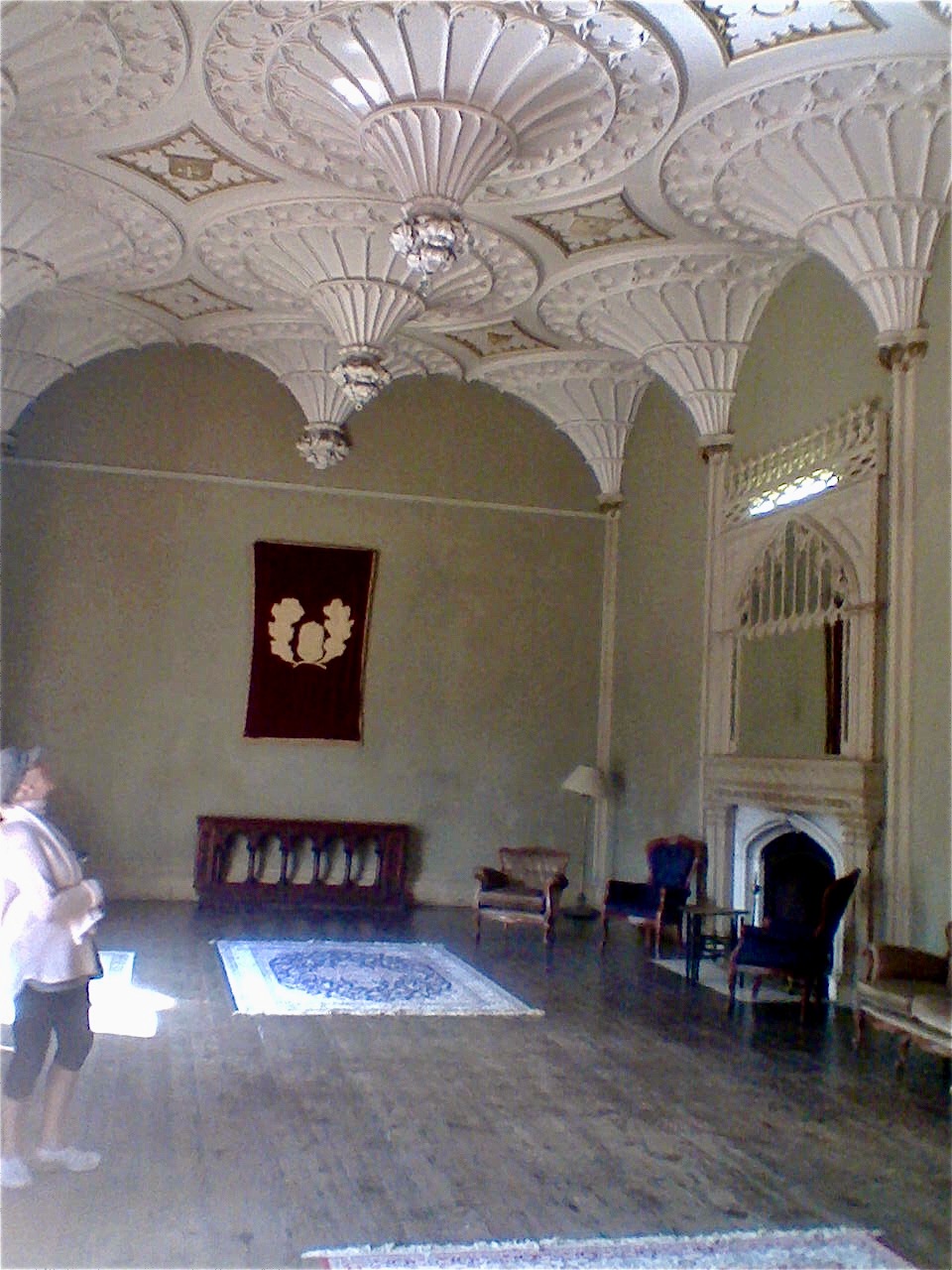
Through the double doors is the most splendid room, the south facing Gallery. Unfortunately this was closed on our Heritage Week visit in 2024 due to filming of the Addams family movie, “Wednesday.” Mark Bence-Jones continues:“This is one of the most splendid Gothic Revival interiors in Ireland; it has a ceiling of plaster fan vaulting with a row of gigantic pendants down the middle; two lavishly carved fireplaces of grained wood, Gothic decoration in the frames of the windows opposite and Gothic bookcases and side-tables to match.“
Charleville Castle Tullamore by Alex Johnson June 2017, courtesy of flickr constant commons.Photograph of Charleville Forest Castle that appeared in 1962 in Country Life. The castle was uninhabited at this time and the furniture was borrowed from Belvedere, County Westmeath.
The fan-vaulted ceiling is inspired by Horace Walpole’s Strawberry Hill, which the Burys visited, which is in turn based on Henry VII’s Chapel at Westminster Abbey, Tierney tells us. The ceiling is thought to have been executed by George Stapleton, who is also responsible for the fan-vaulting in Johnston’s Chapel Royal in Dublin Castle. The ceiling is anchored with clustered shafts along the walls, with bays framing the two Gothic chimneypieces, the doorcase on the north wall, and the Gothic casings of the windows.
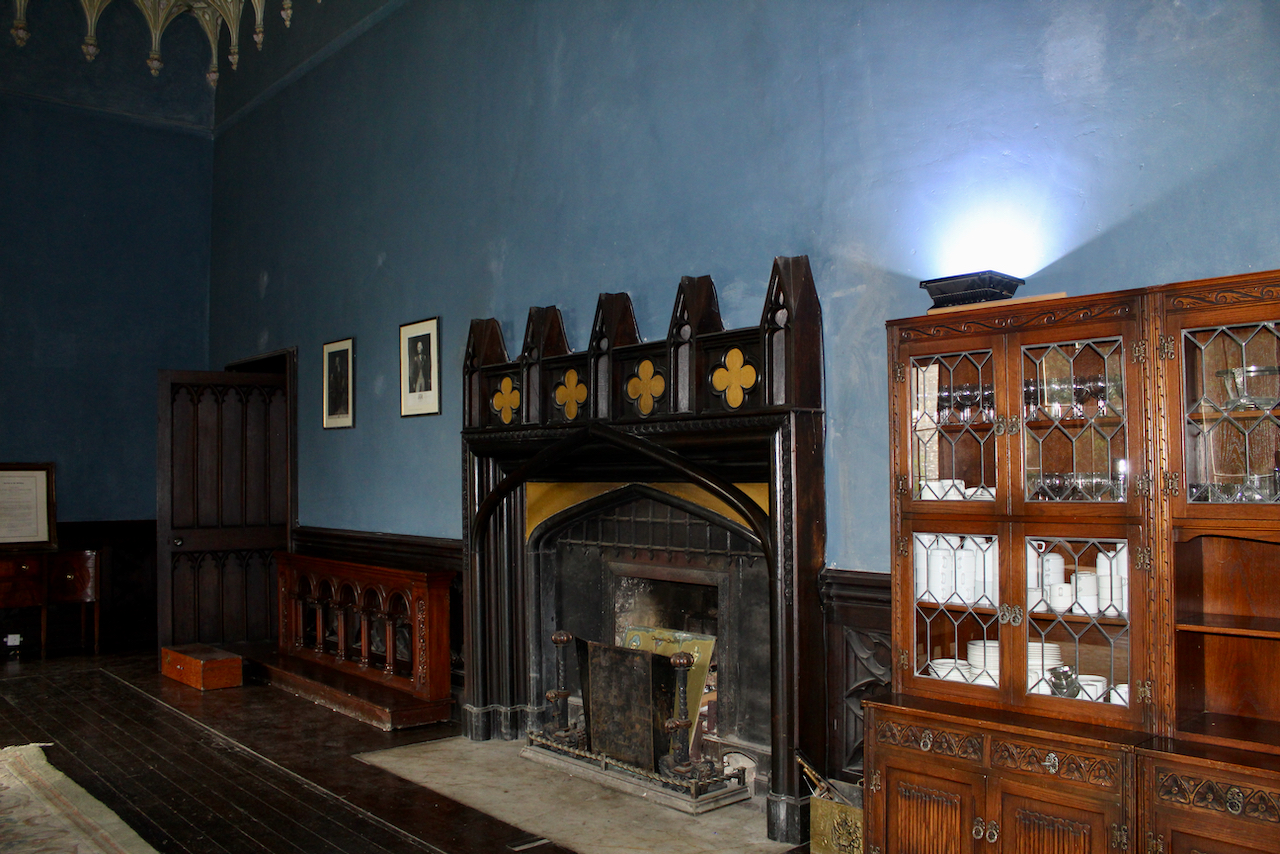
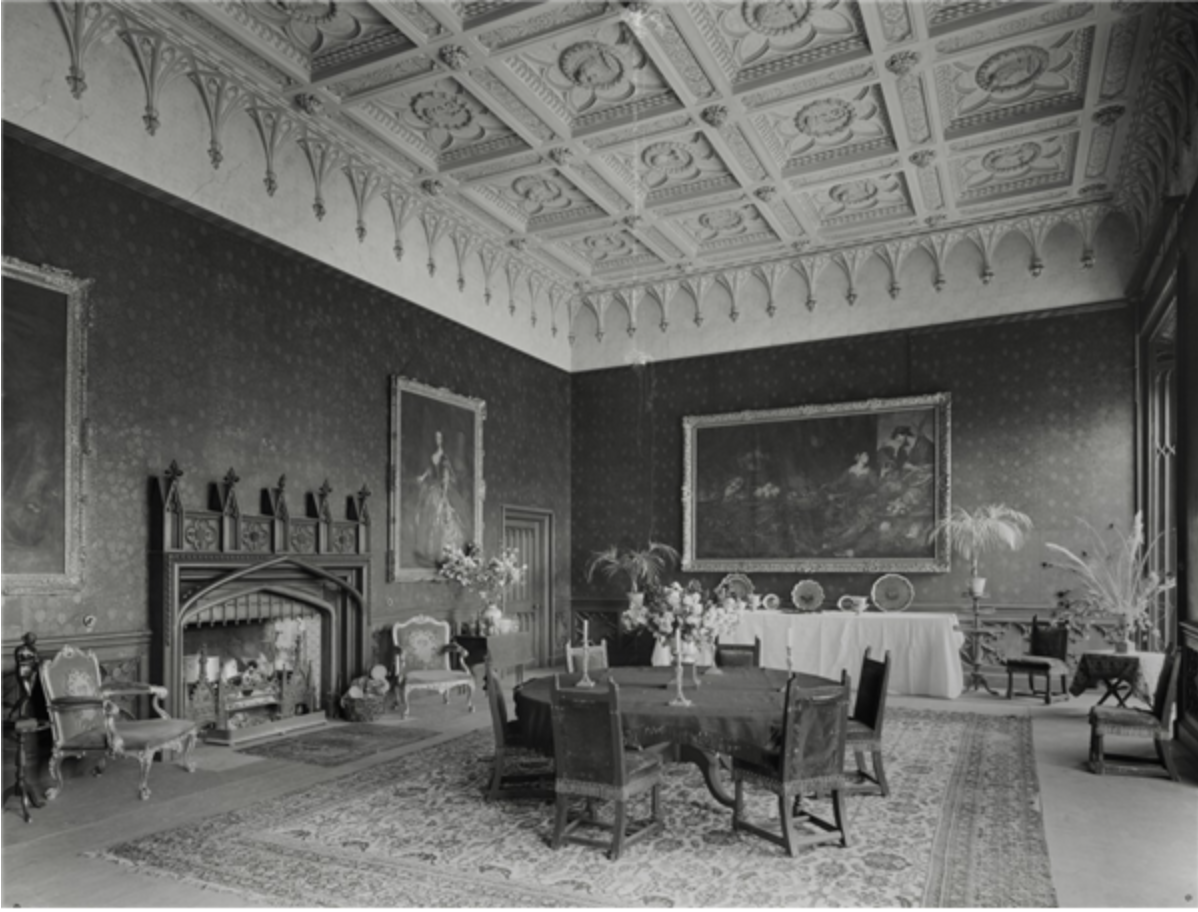
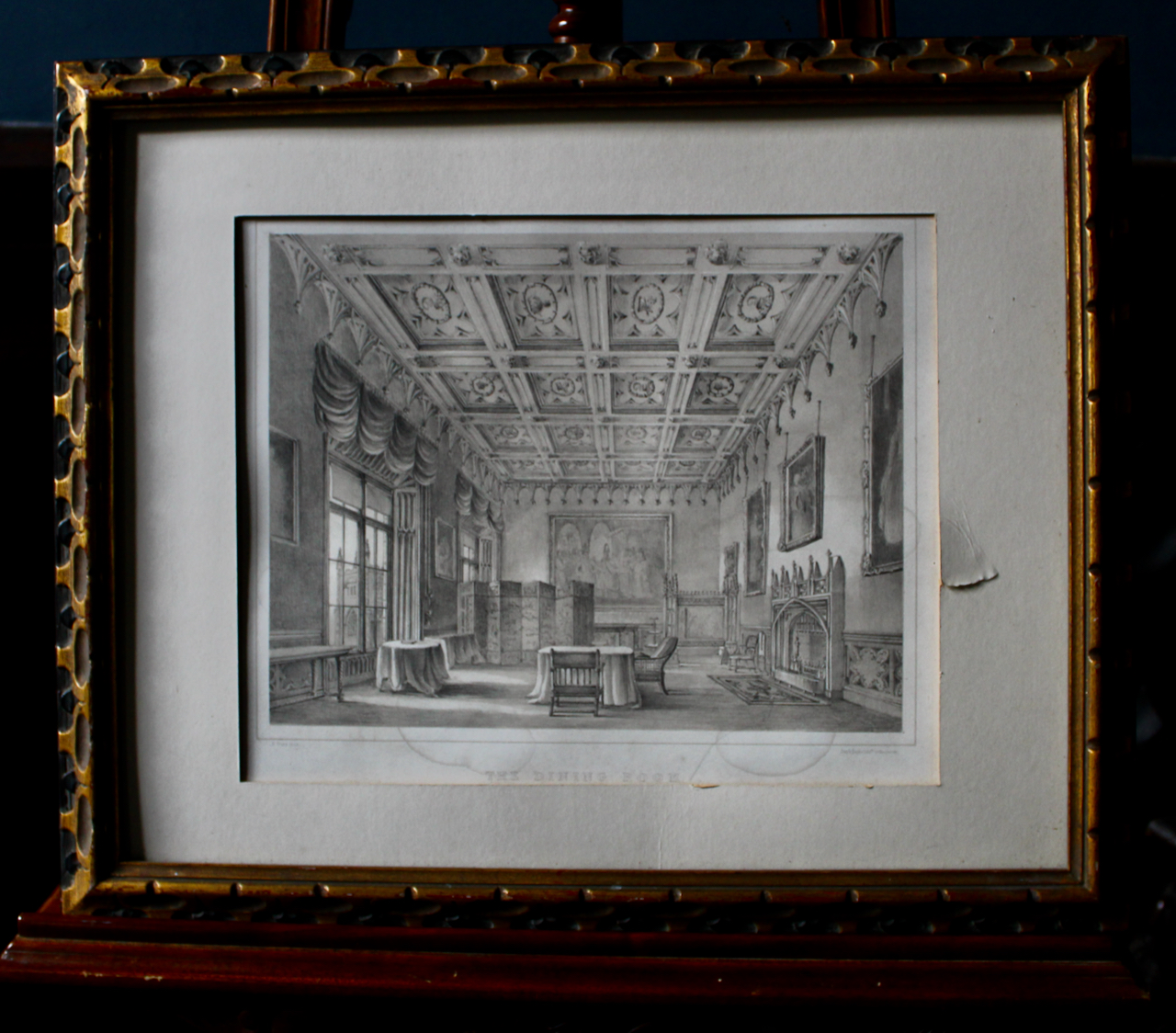
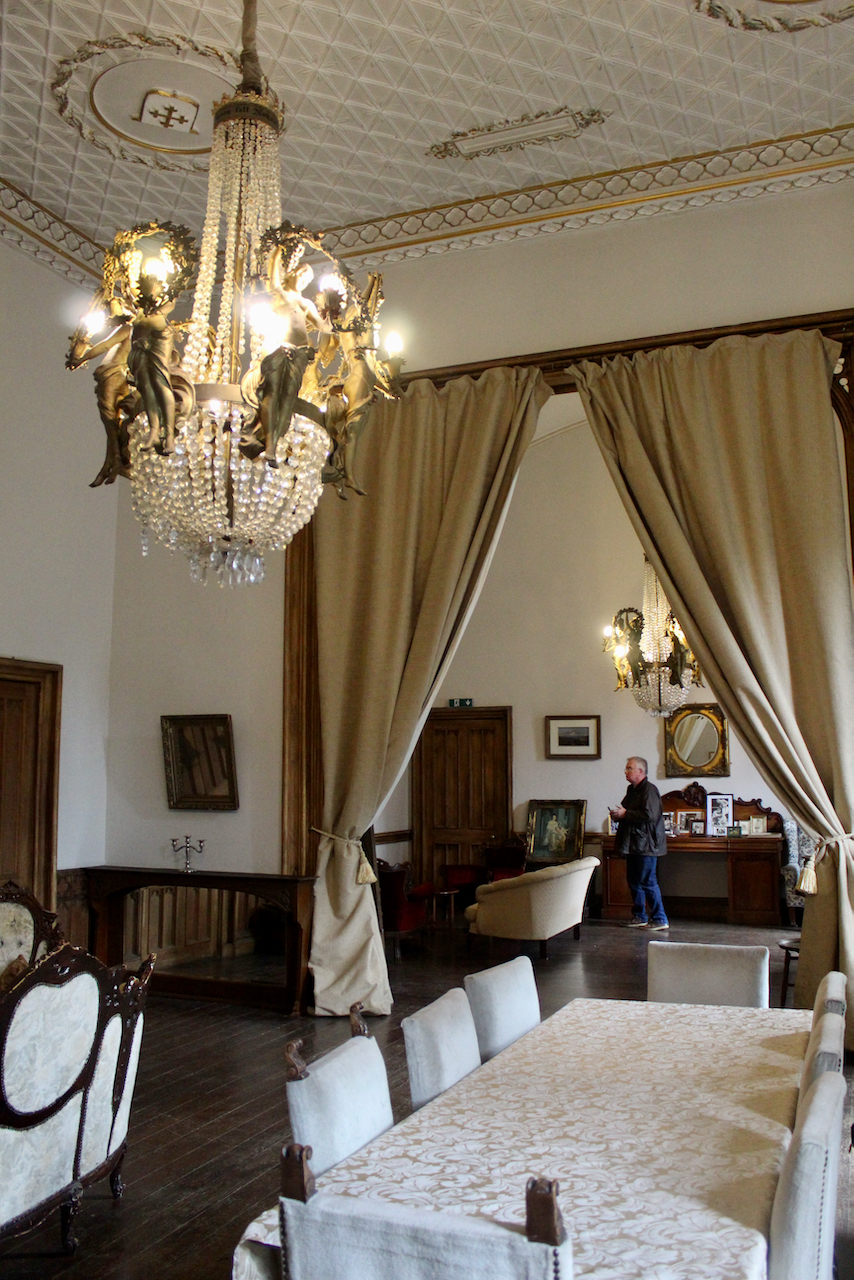
The drawing room and dining room are on either side of the entrance hall. The dining room on the west side has a coffered ceiling and a fireplace which is a copy of the west door of Magdalen College chapel, Oxford.
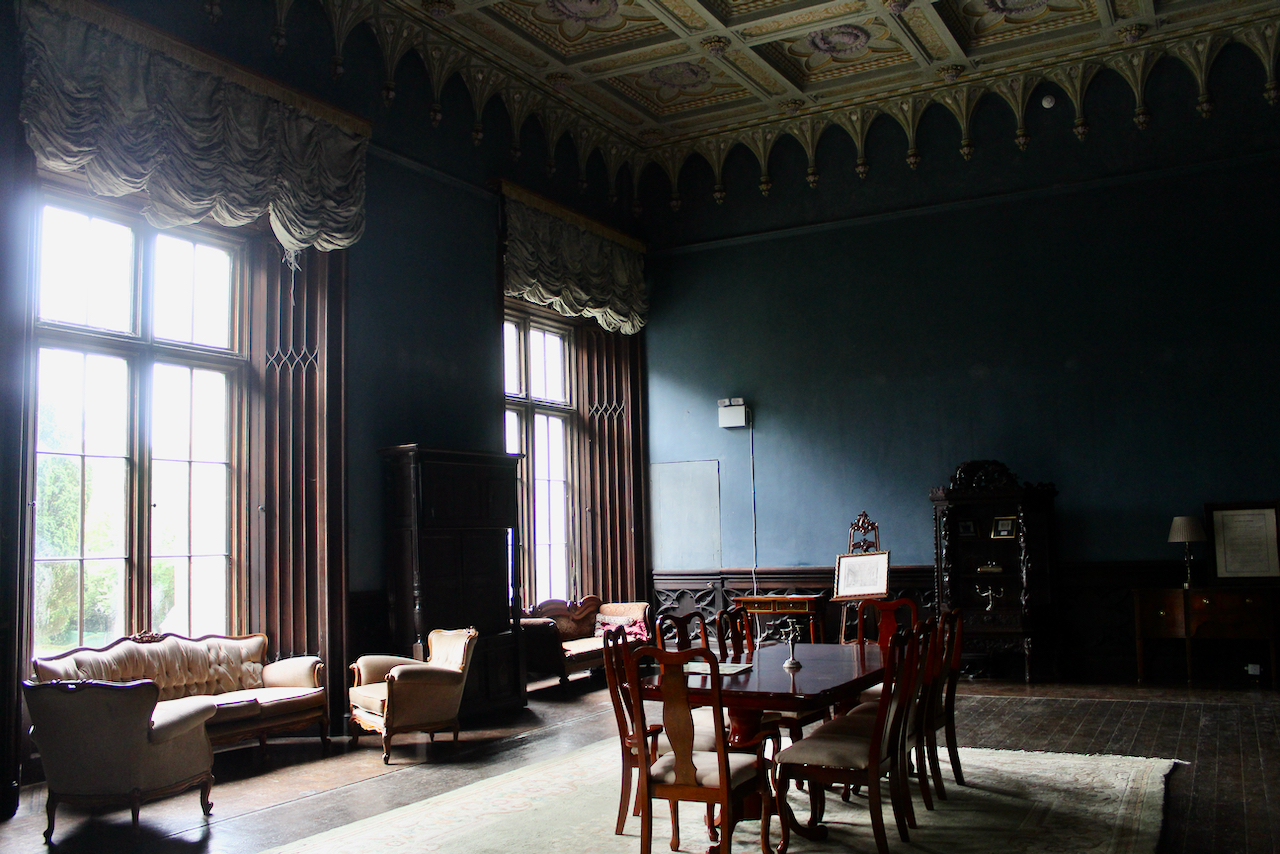
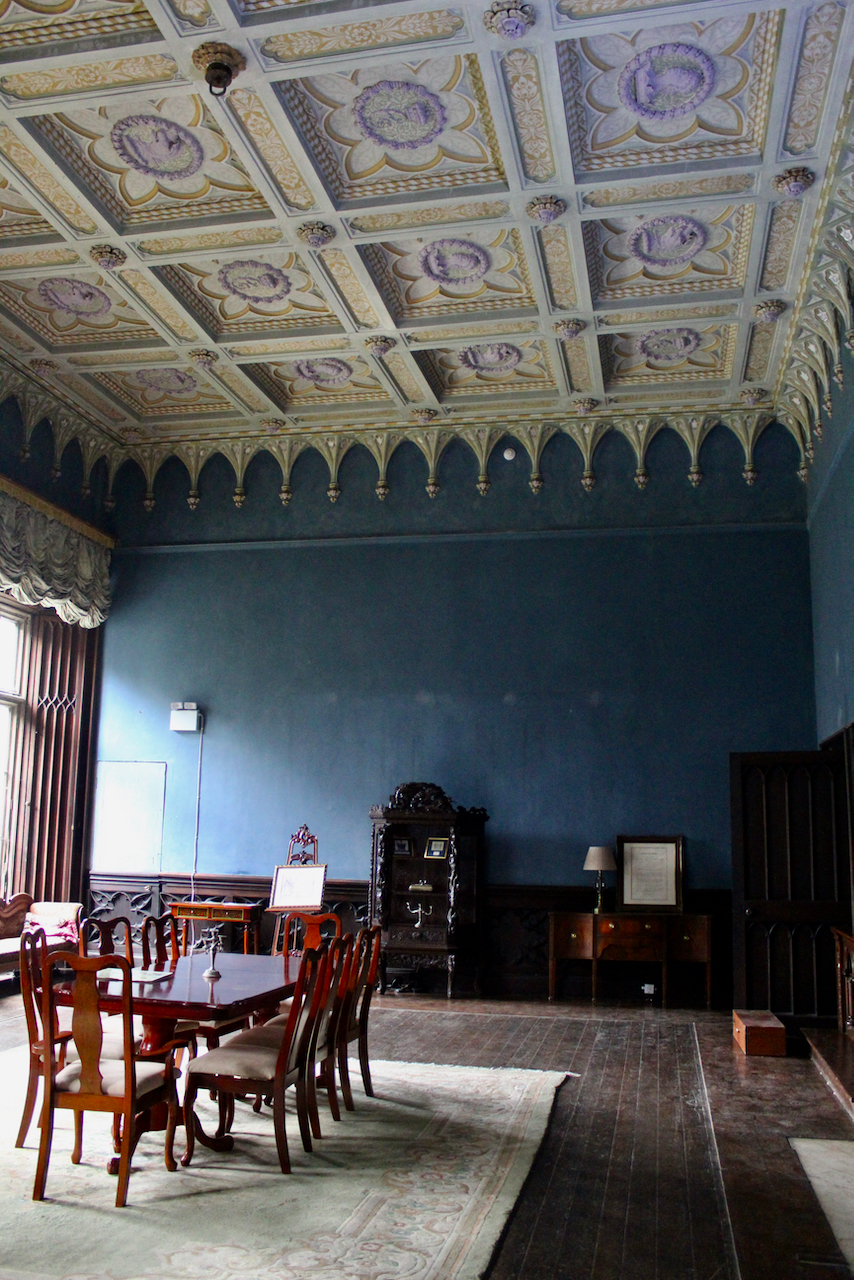
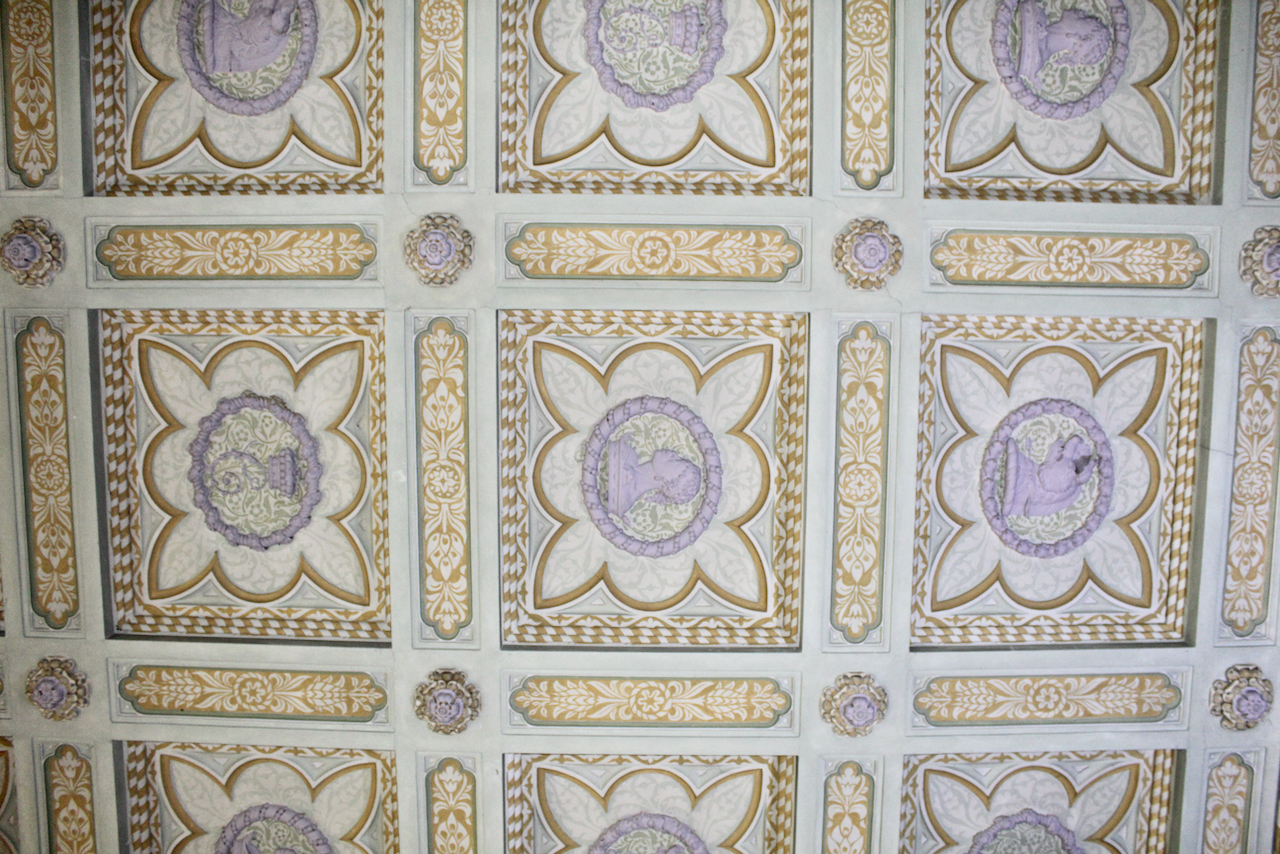
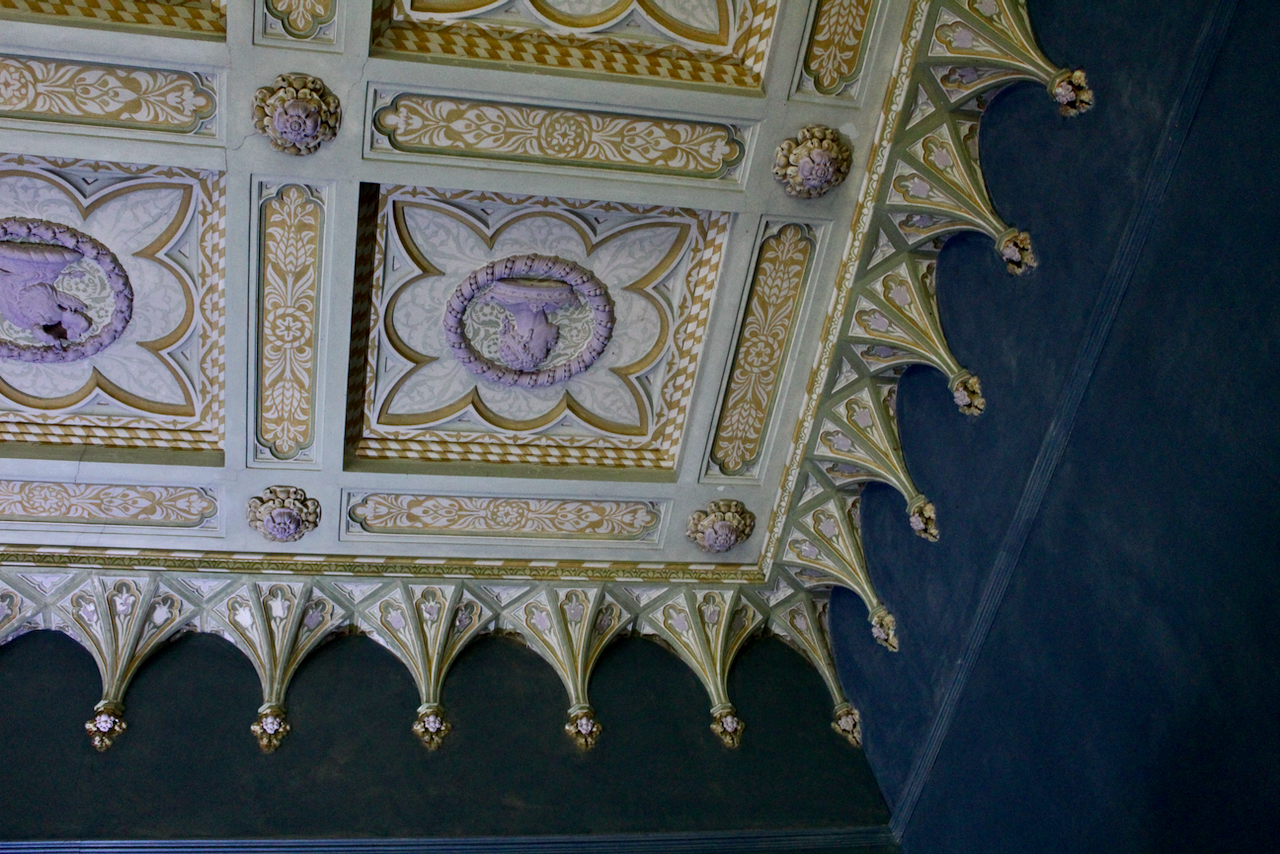
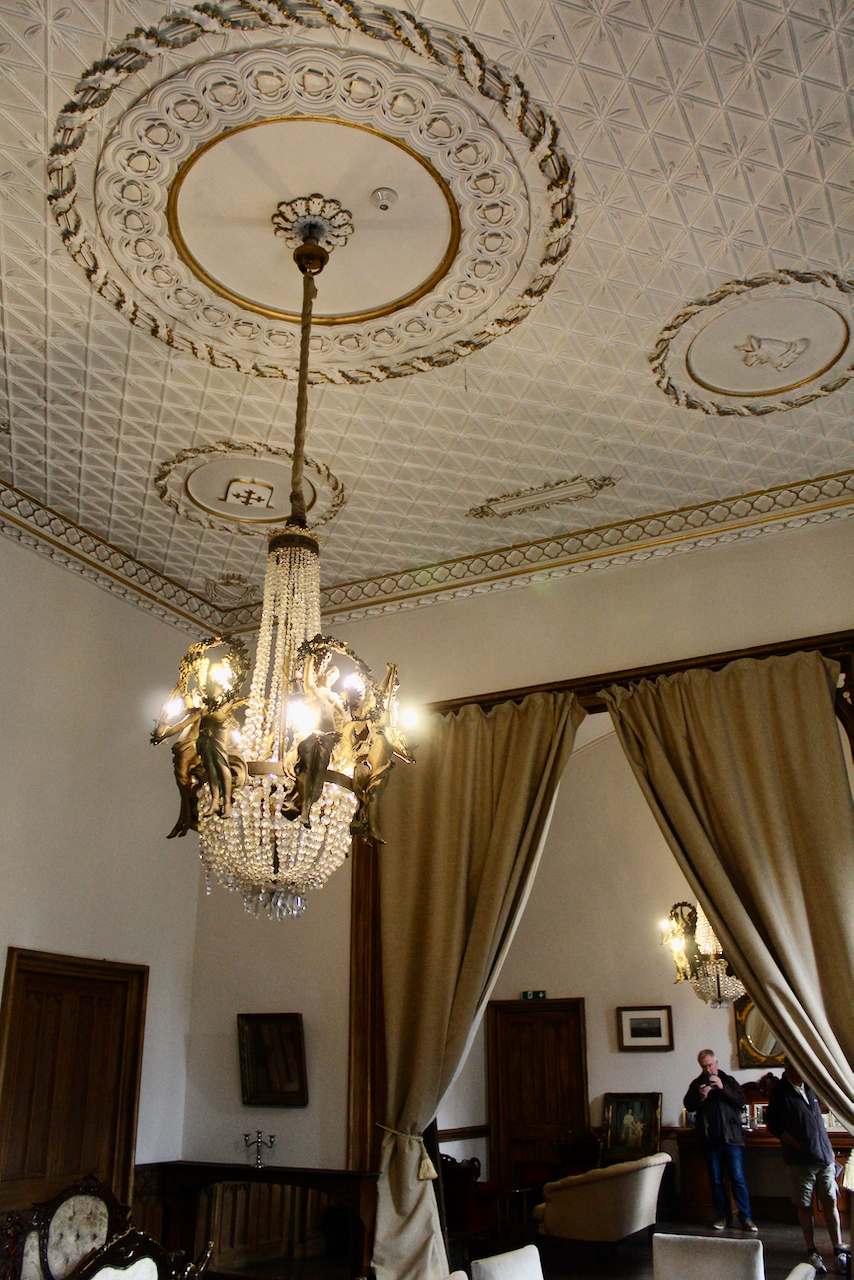
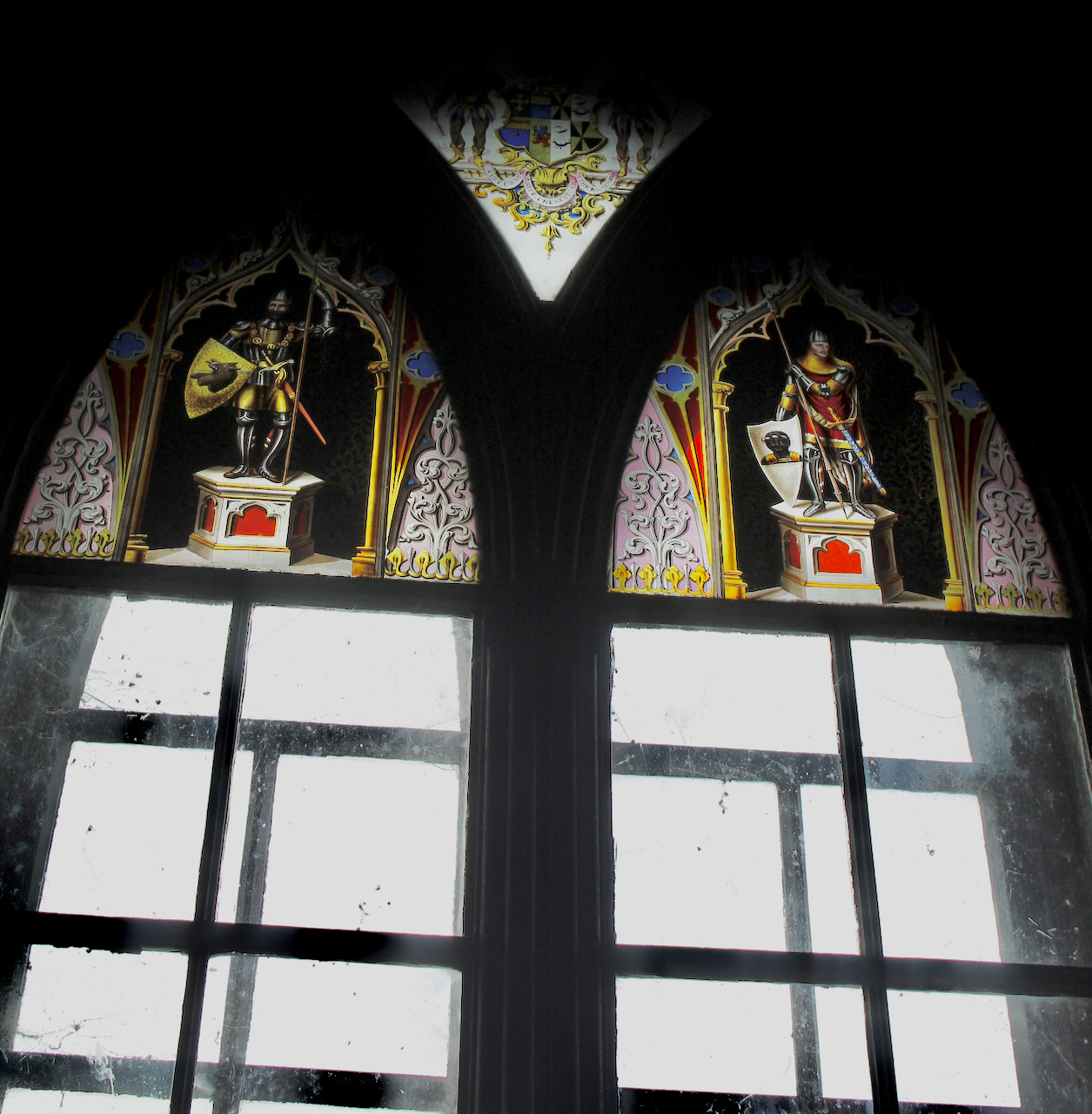
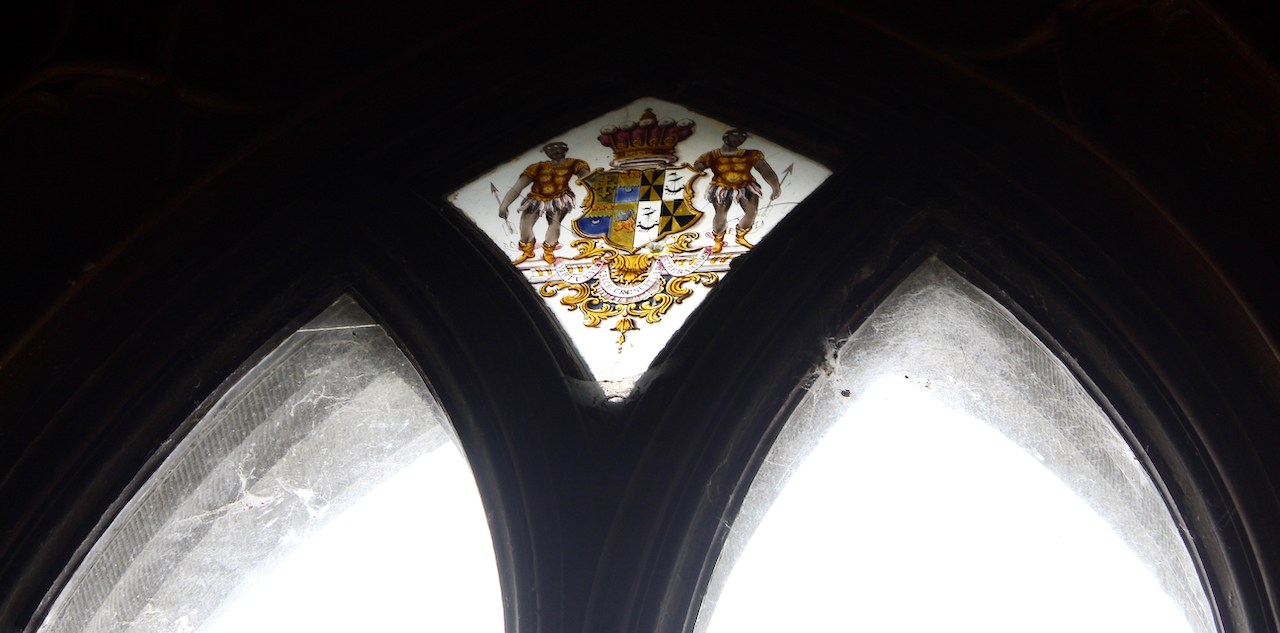
The dining room has, Tierney points out, a Dado of double-cusped panelling derived from the staircase balustrade of Strawberry Hill. The ceiling has crests of the family in the panel, supported by a Gothic frieze in the form of miniature fan vaults. The Moores are represented by a silhouette of a Moorish person, and the Burys by a boar’s head with an arrow through its neck. There are also “C”s for “Charleville.” The volunteers during Heritage Week told us that the ceiling is by William Morris, but Tierney tells us that he redecorated the room in 1875, but the scheme no longer survives. The decoration on the miniature fan vault frieze does look rather William Morris-esque to me, as well as the painting between the crests.
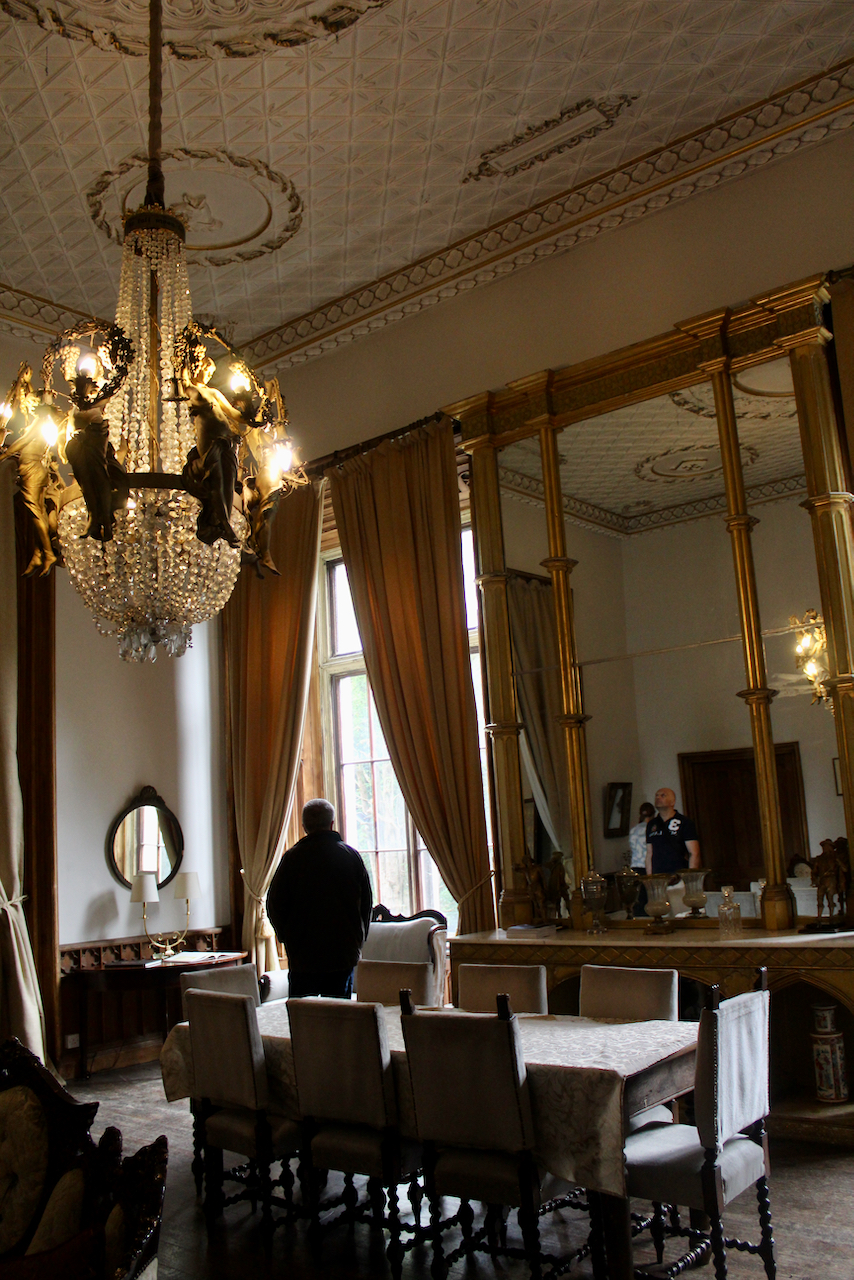
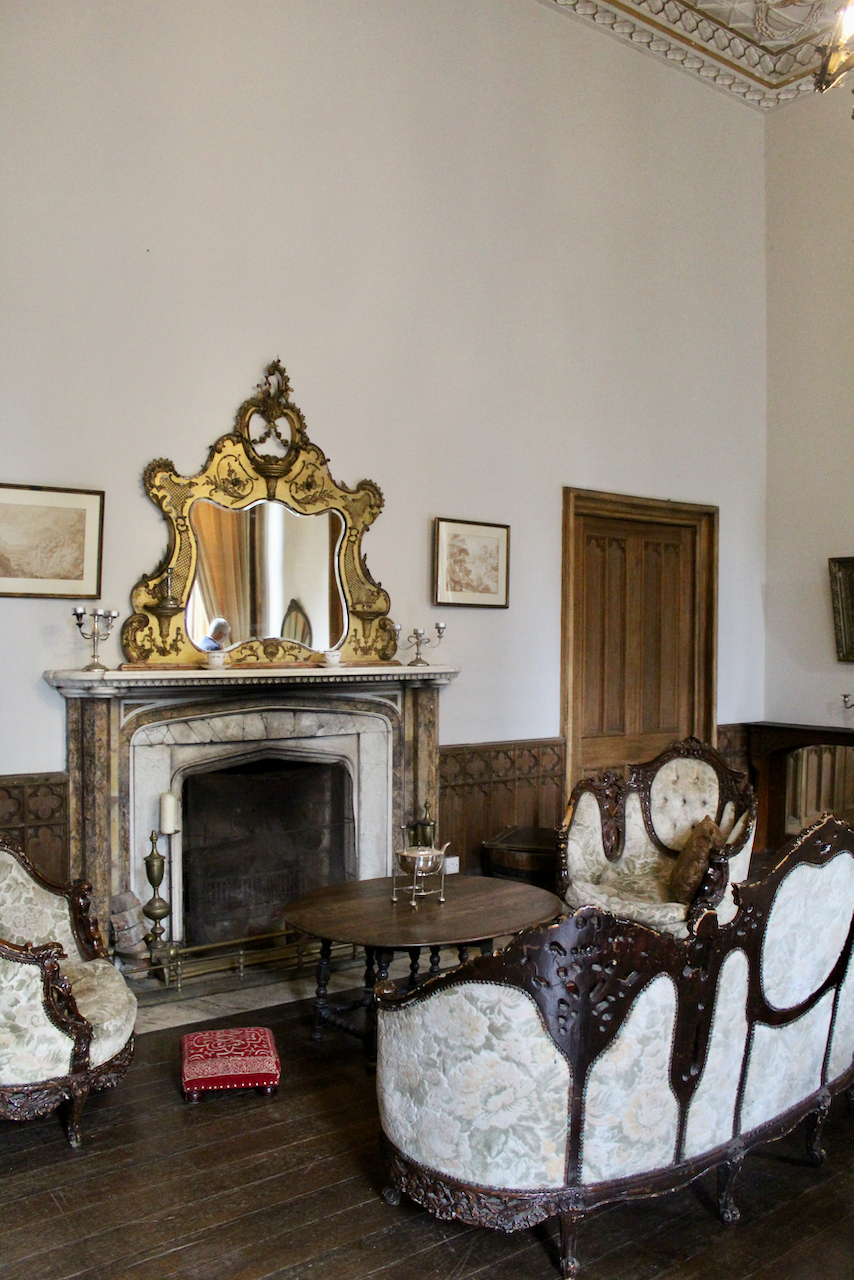
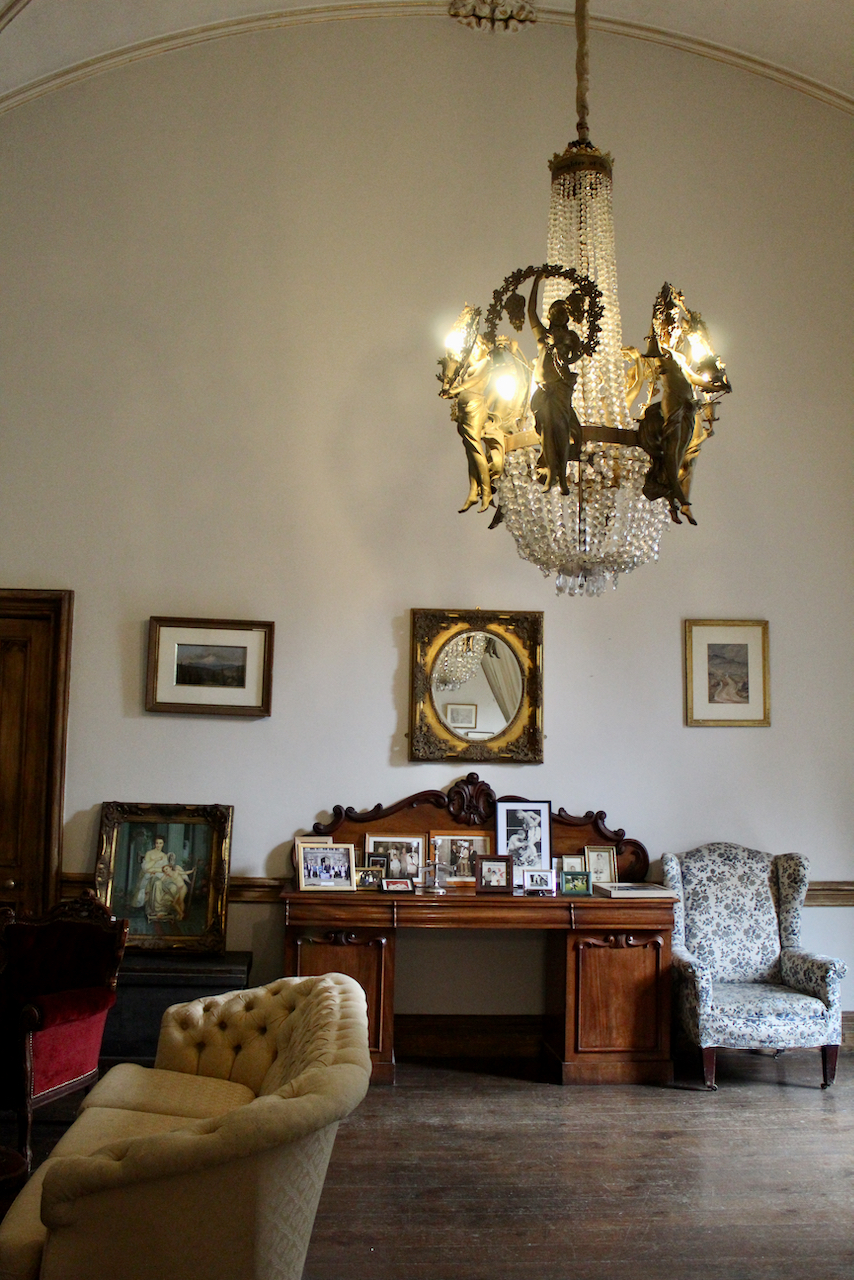
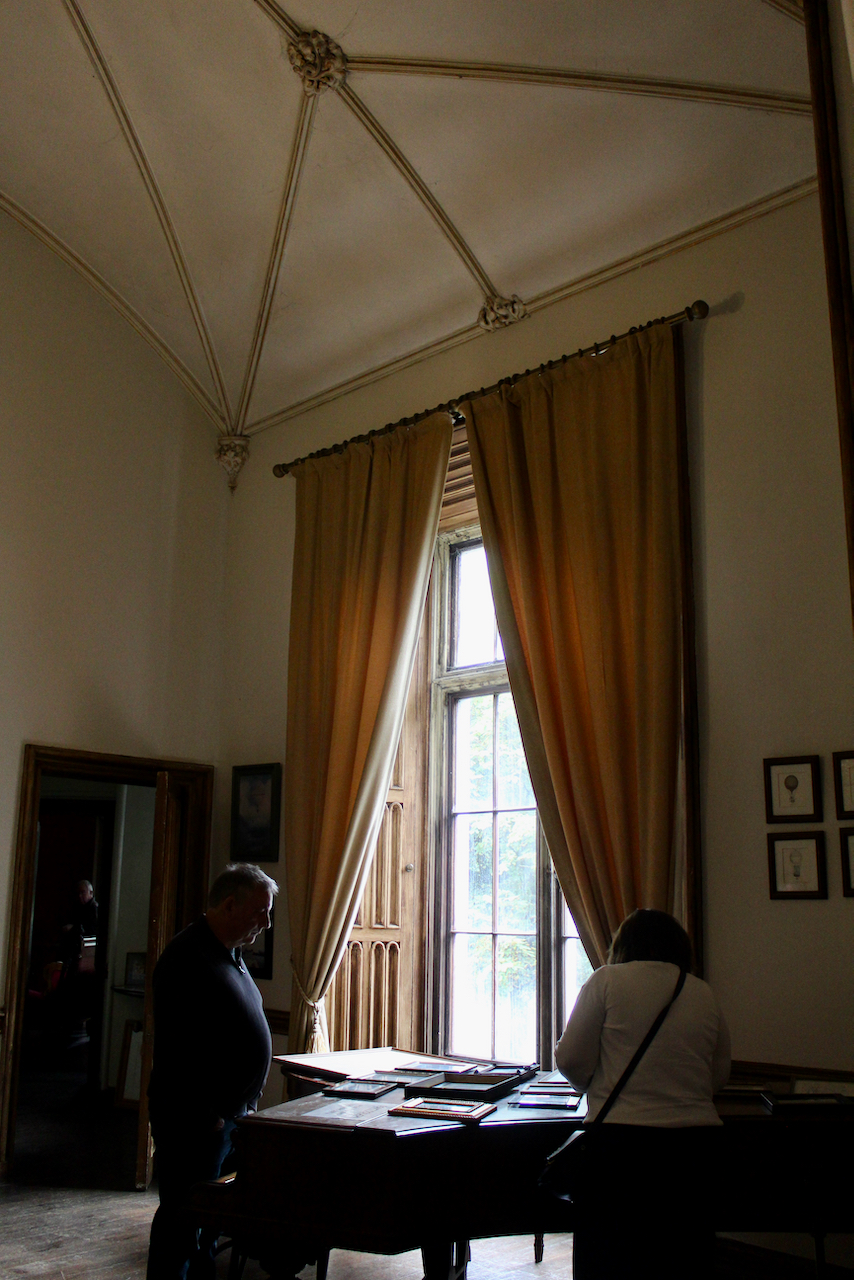
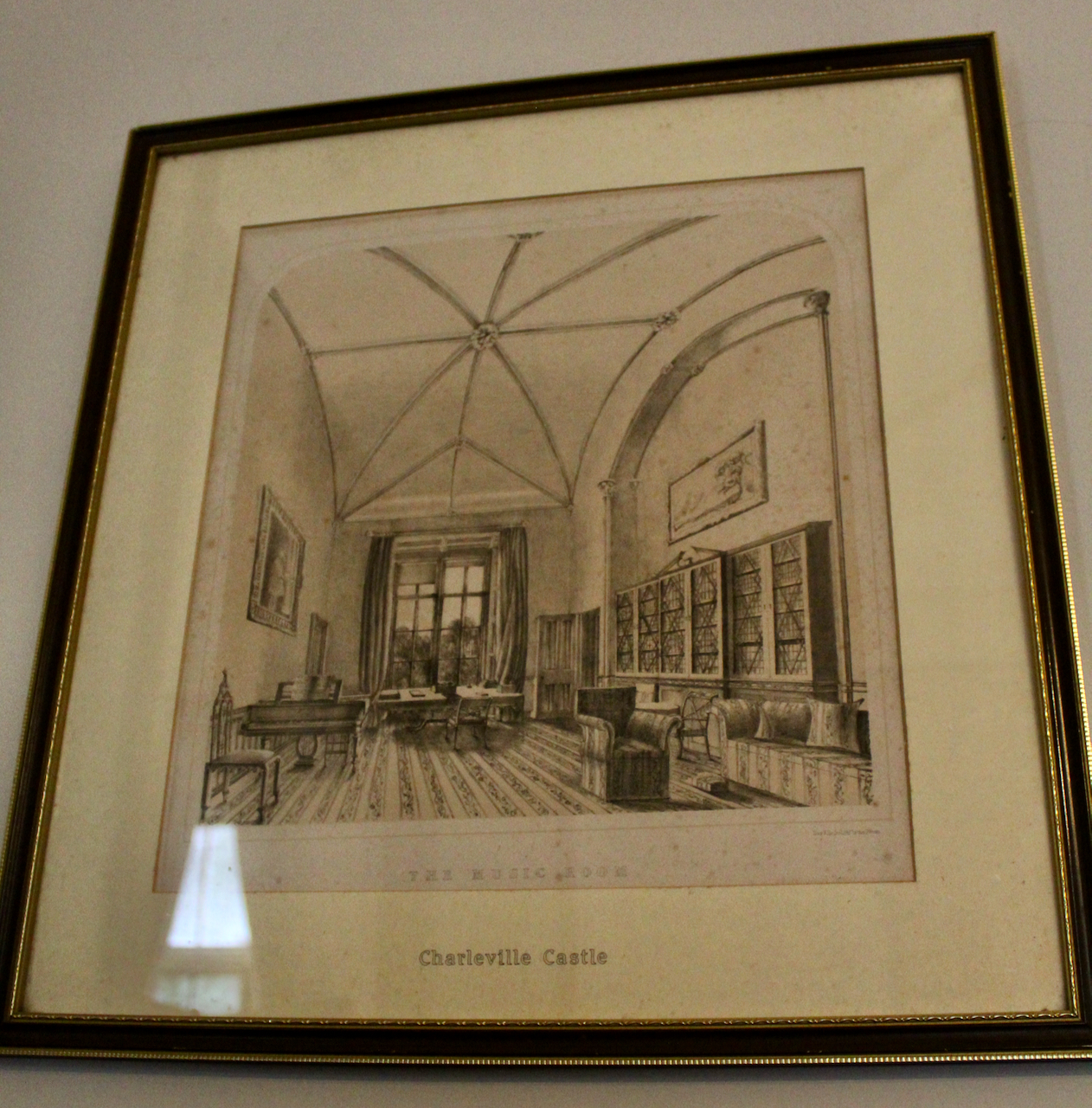
The Drawing Room is on the east side of the house. It has a fretwork ceiling with circular heraldic panels, a panelled dado and quatrefoil cornice. The room connects through a great arch with the rib-vaulted music room to its north. Unfortunately none of the furniture is original to the house but was brought it by the current owners.
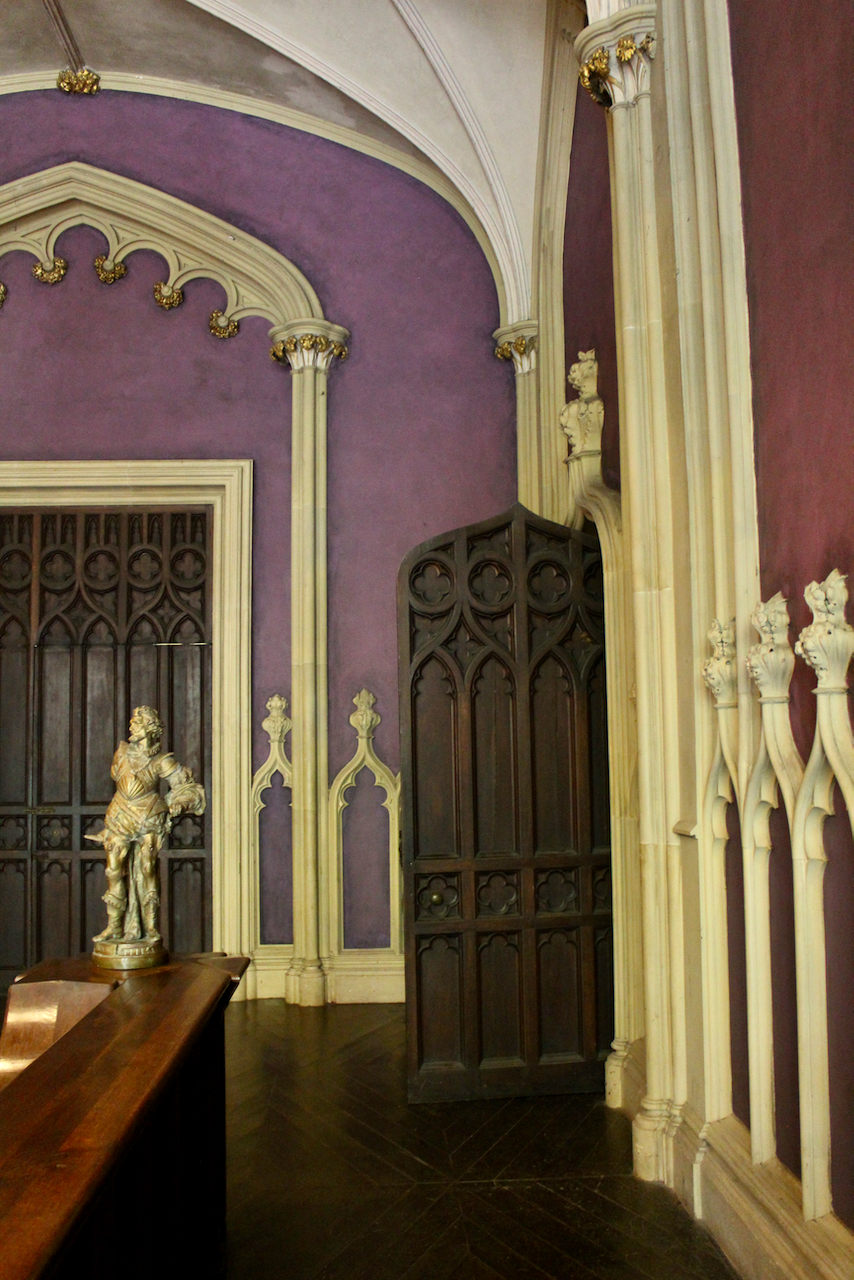
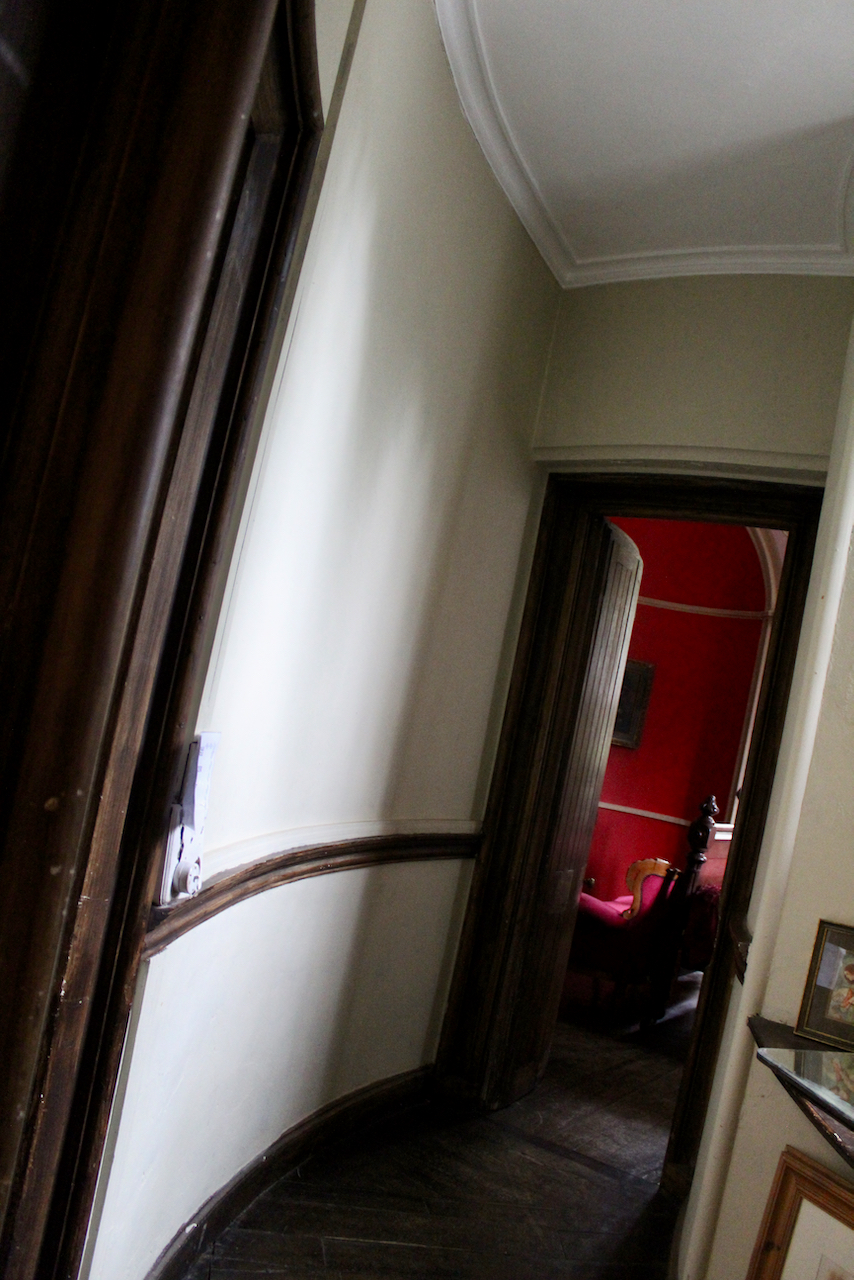
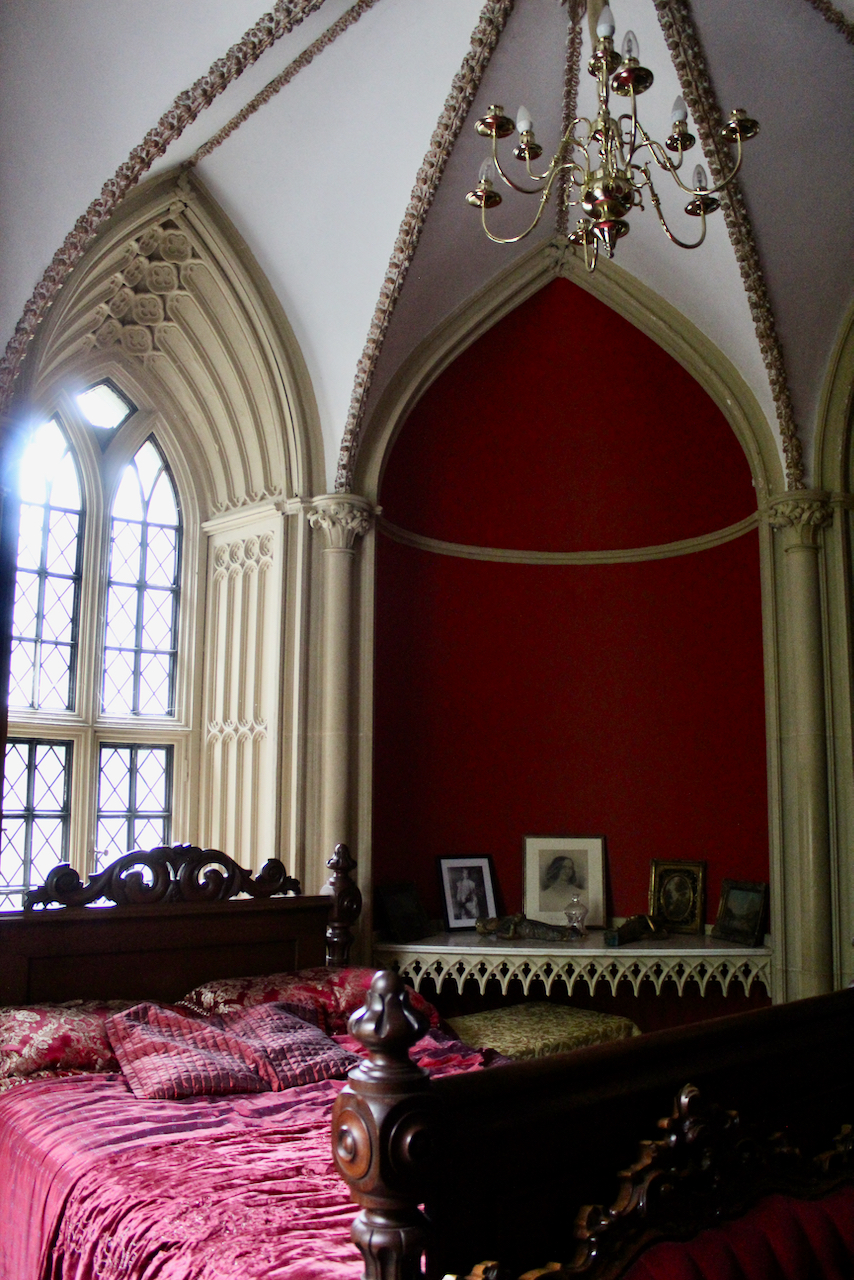
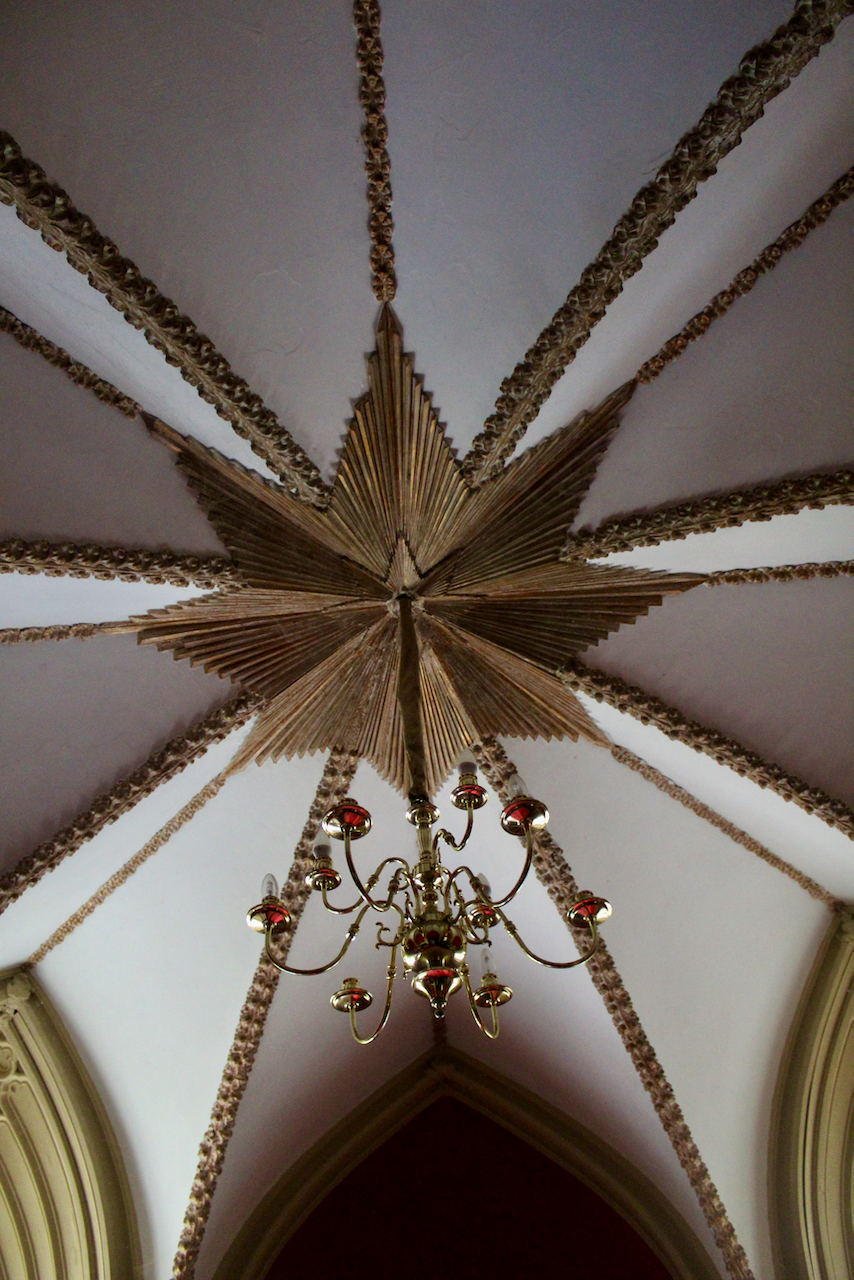
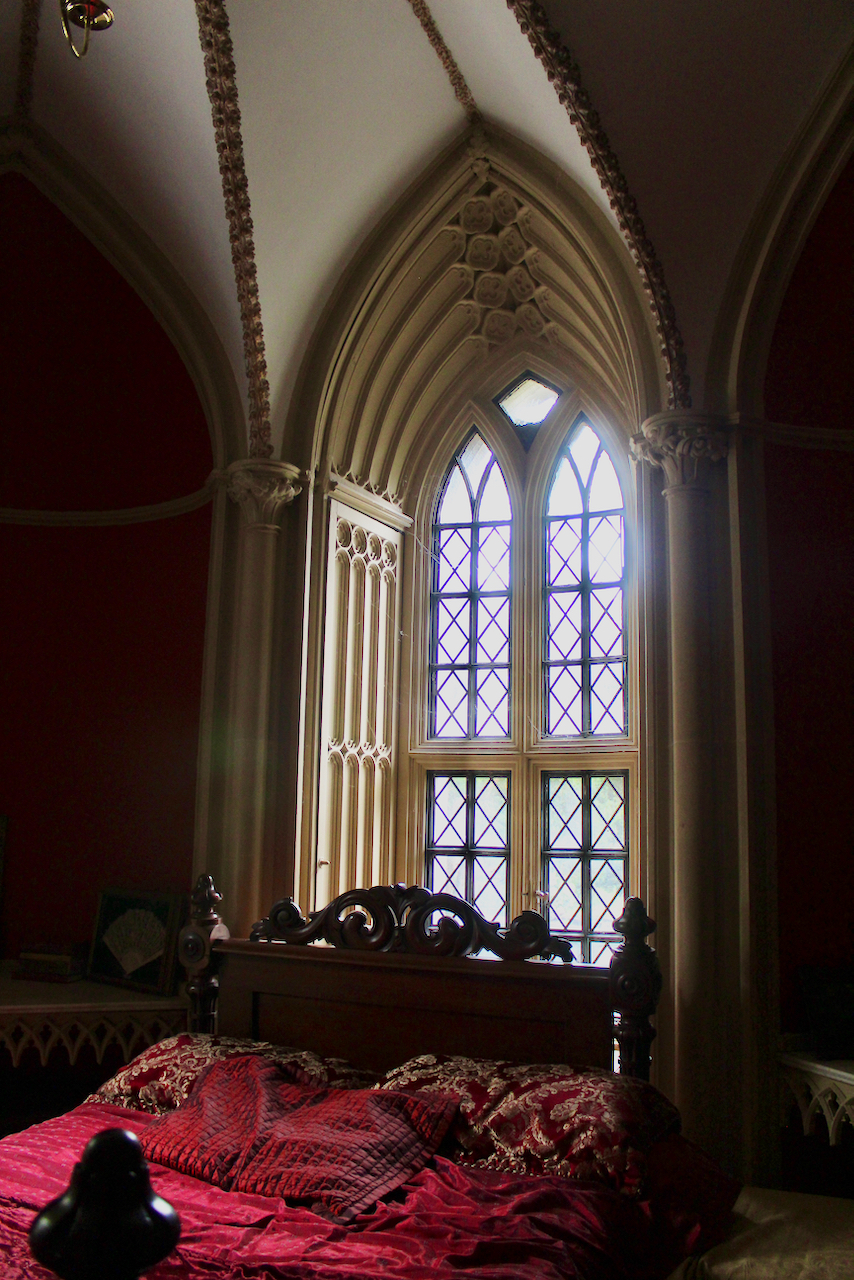
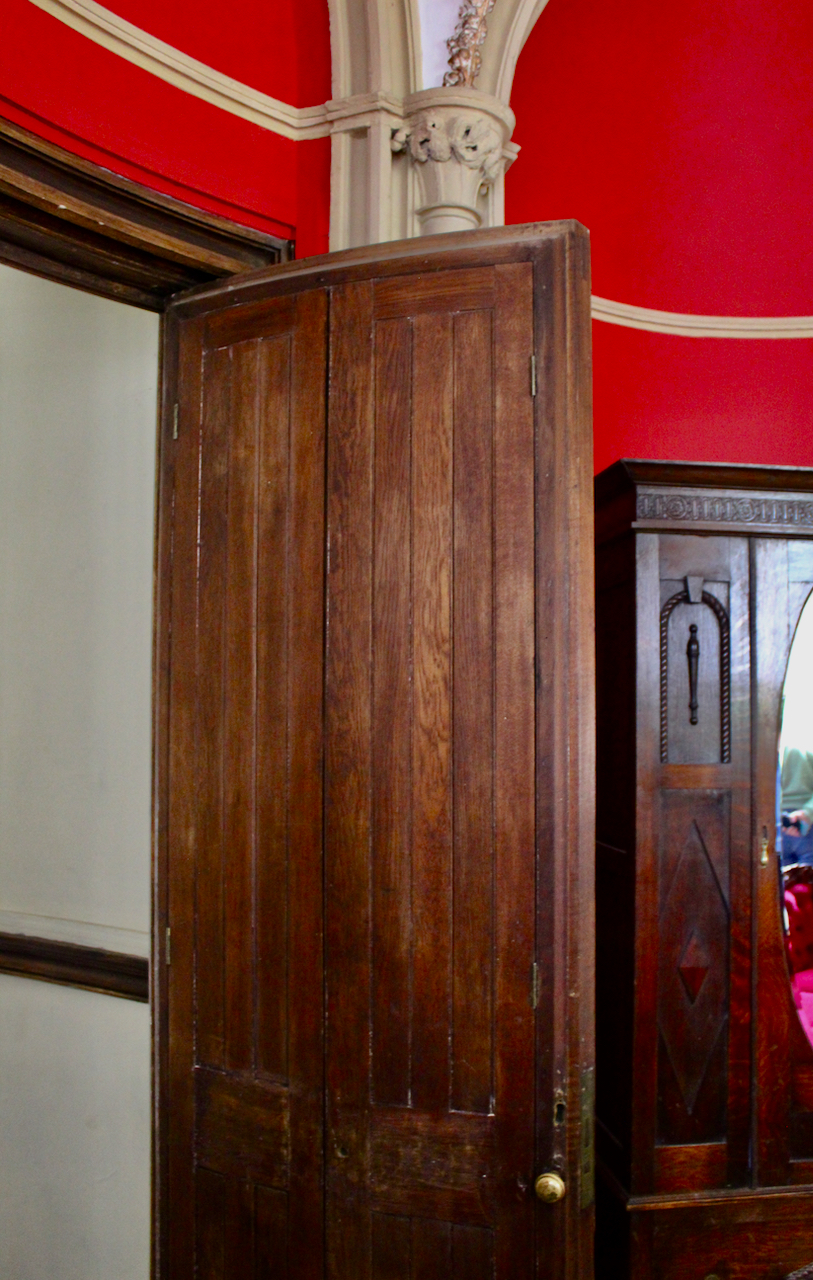
The Music Room connects via a curved short corridor to the Boudoir in the northeast tower, a homage to Walpole’s Tribune in Strawberry Hill, Tierney tells us. This used to be my friend Howard Fox’s bedroom when he was staying as a guest, leading mushroom foraging walks in Charleville Woods! It is a star-vaulted circular room, with bays alternating between four wide round niches and smaller openings for windows, door and fireplace. Above was Lord Charleville’s dressing room, but we did not get to go there.
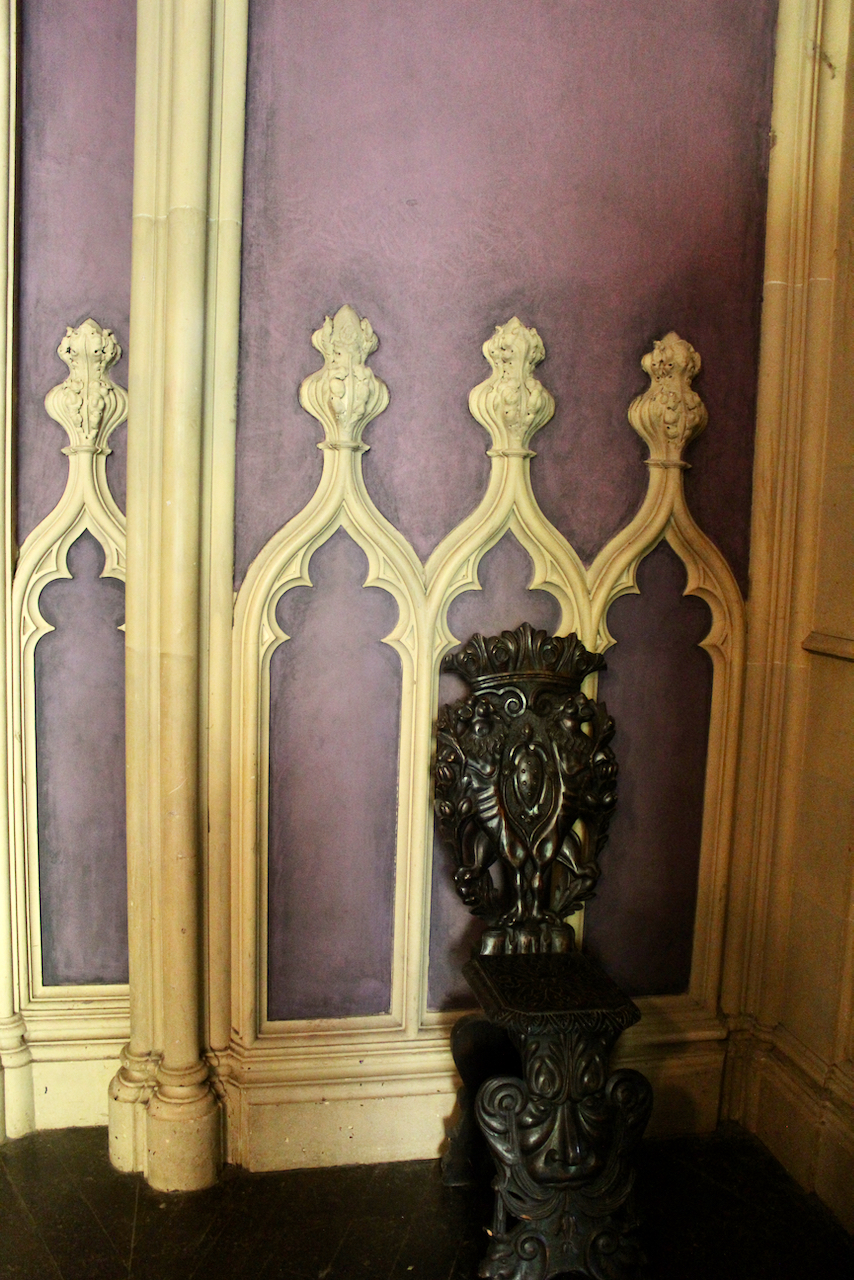
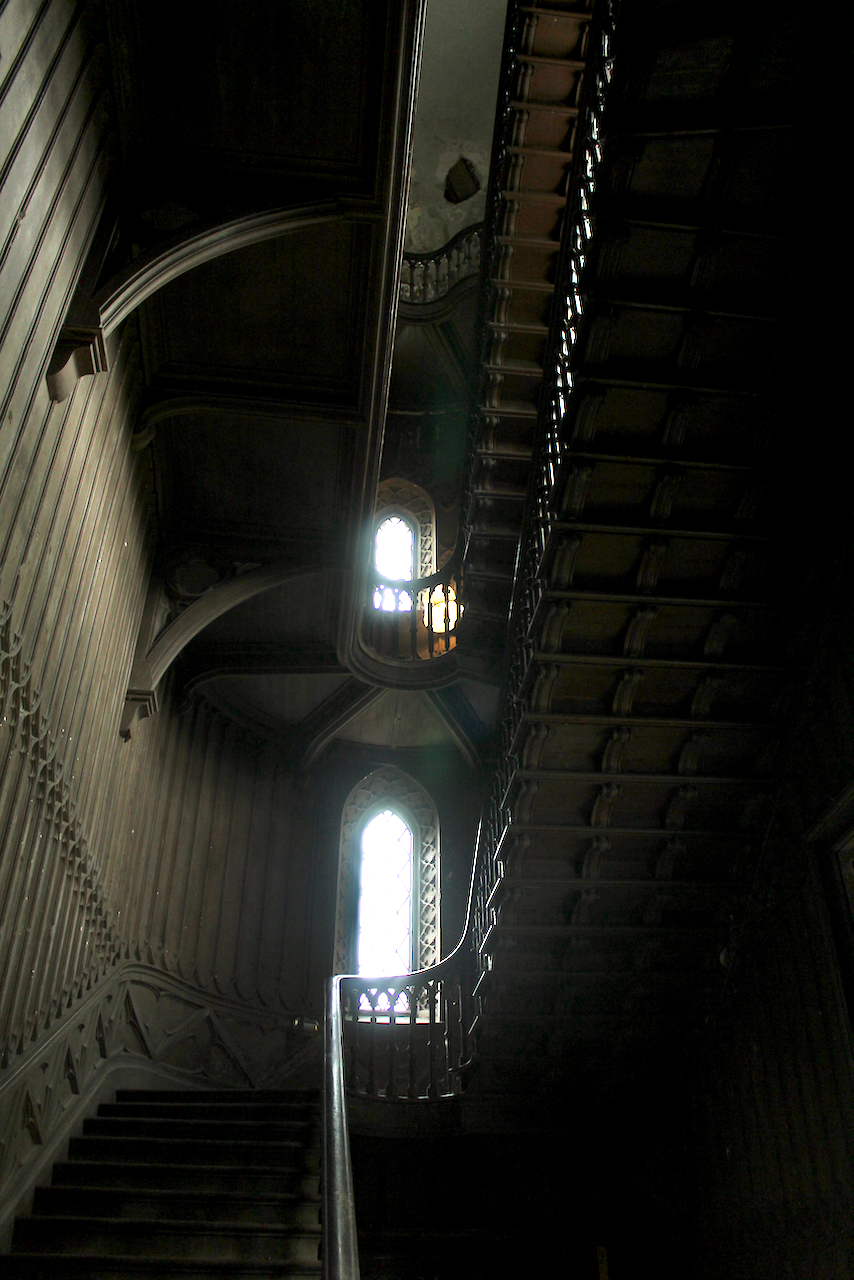
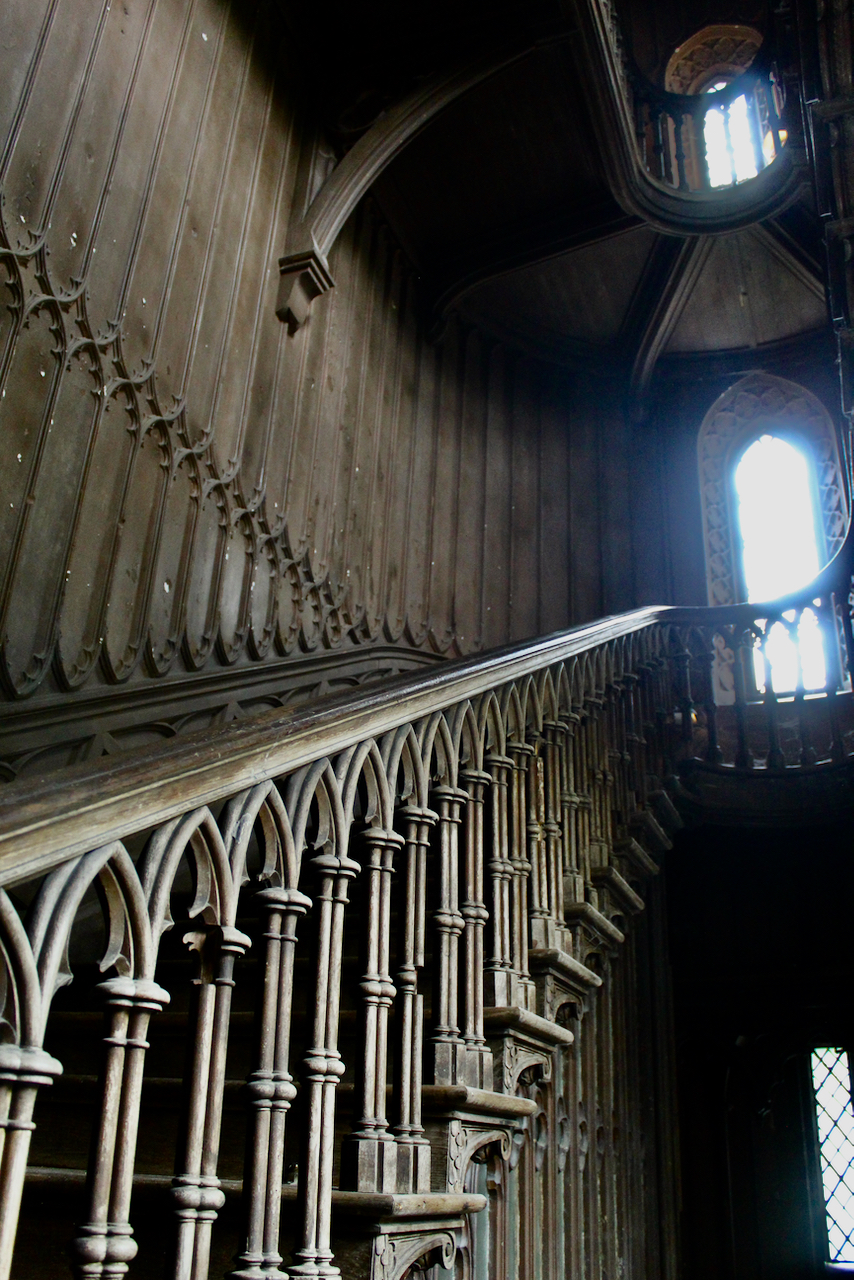
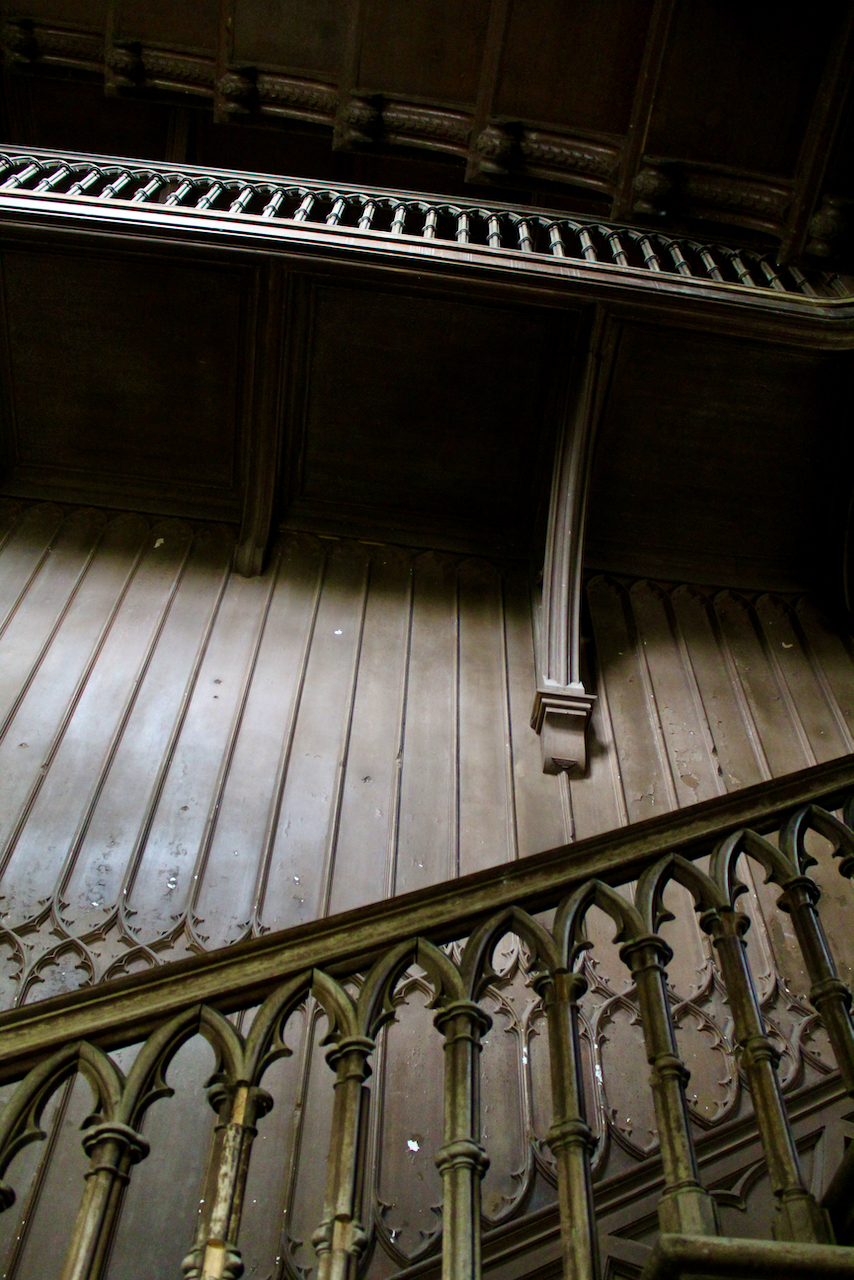
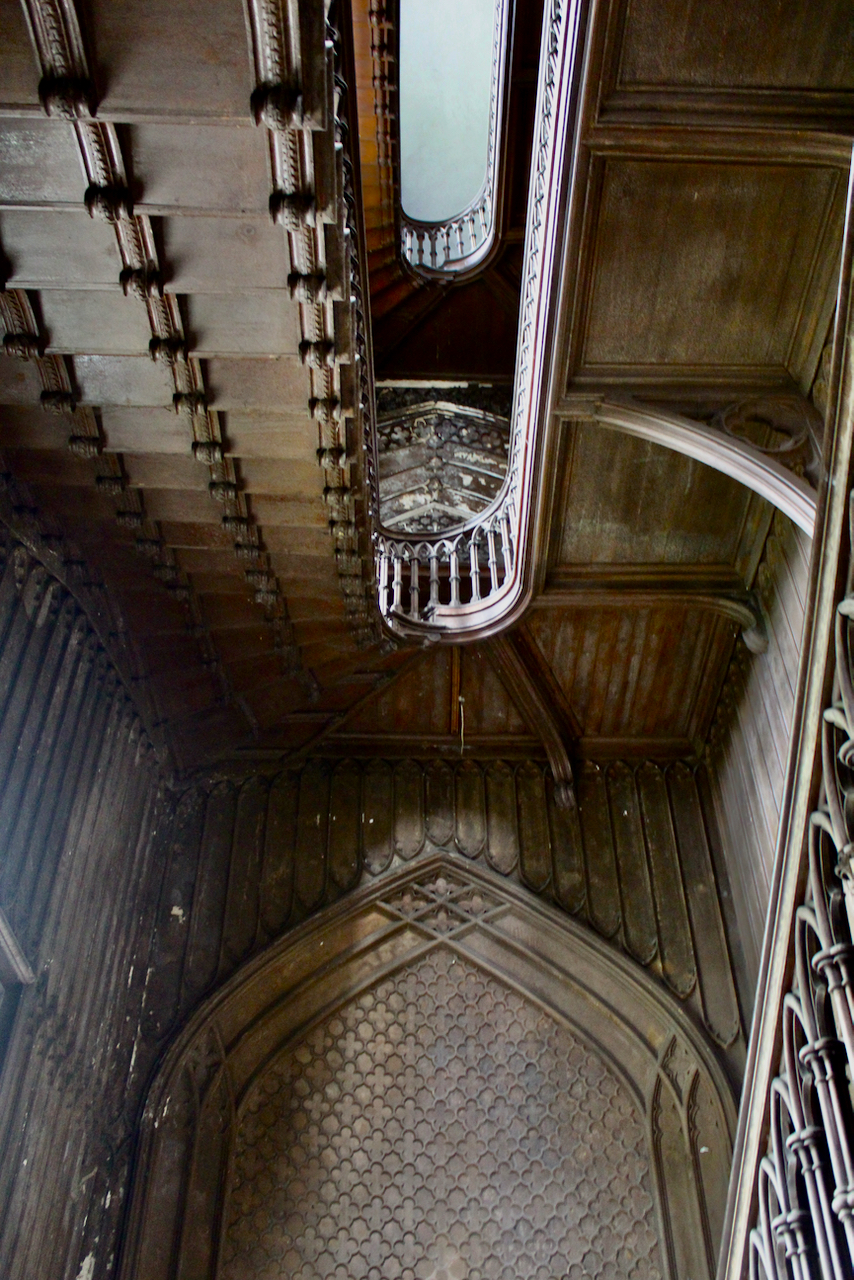
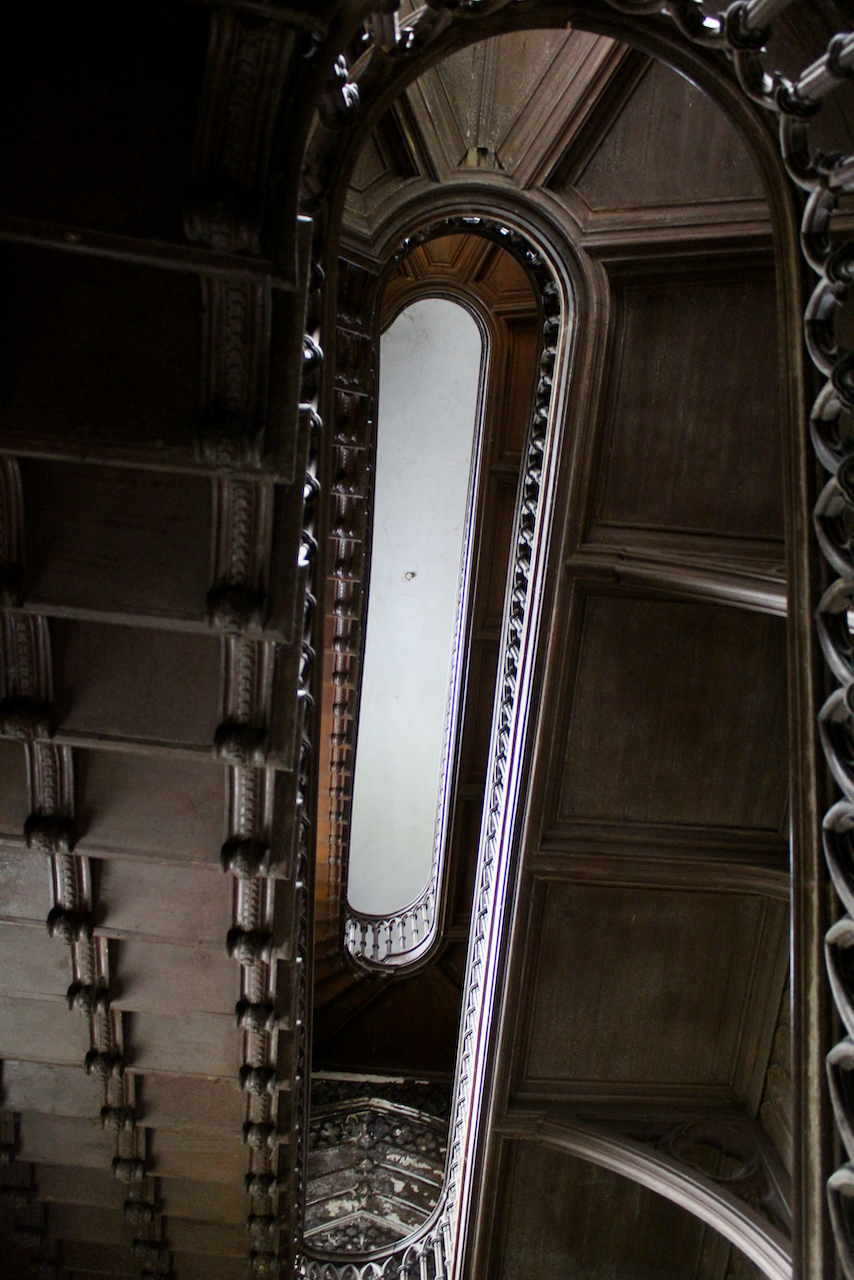
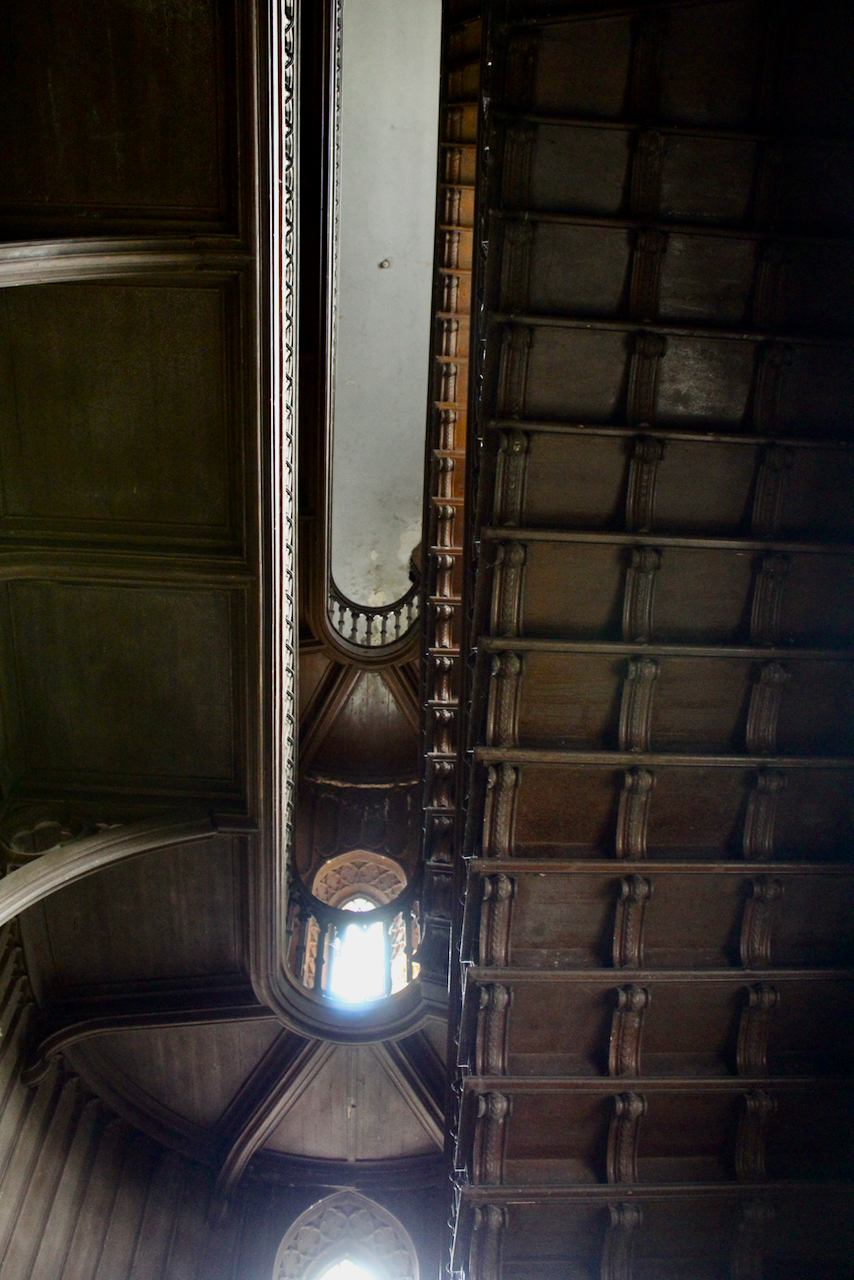
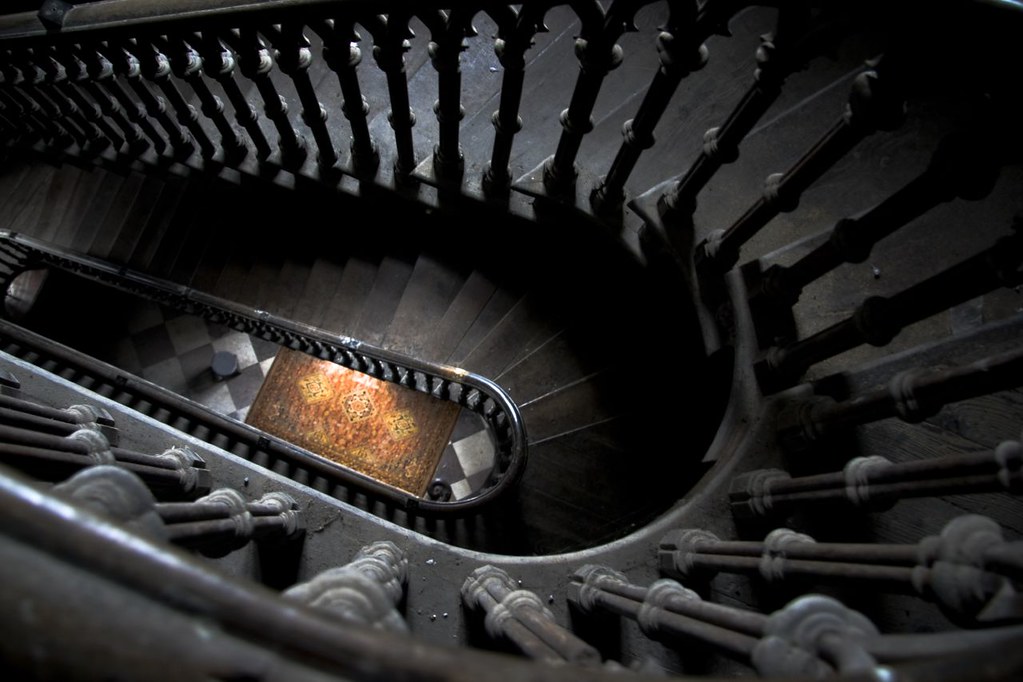
The stairs is tucked away in an odd place, behind a door off the northwest corner of the entrance hall. It is an intricate tightly curved staircase of Gothic joinery leading to the upper storeys, with Gothic mouldings on walls. The wall panelling is plaster painted and grained to look like oak. It rises through three storeys.
Tierney tells us that at the top of each flight, there is a great cavetto-moulded doorcase enriched with quatrefoil fretwork in plaster. The cavetto is a concave molding with a profile approximately a quarter-circle, quarter-ellipse, or similar curve. I find the staircase thrilling. Tierney writes: “Its dark colouring is in tune with the “gloomth” of its north facing aspect, and no Gothic room in Ireland rivals its Hmmer Horror atmosphere“!
A tragic accident occurred in 1861 when the 5th Earl’s young sister Harriet was sliding down the balustrade of the Gothic staircase from the nursery on the third floor and fell. She is said to haunt the staircase and to be heard singing.
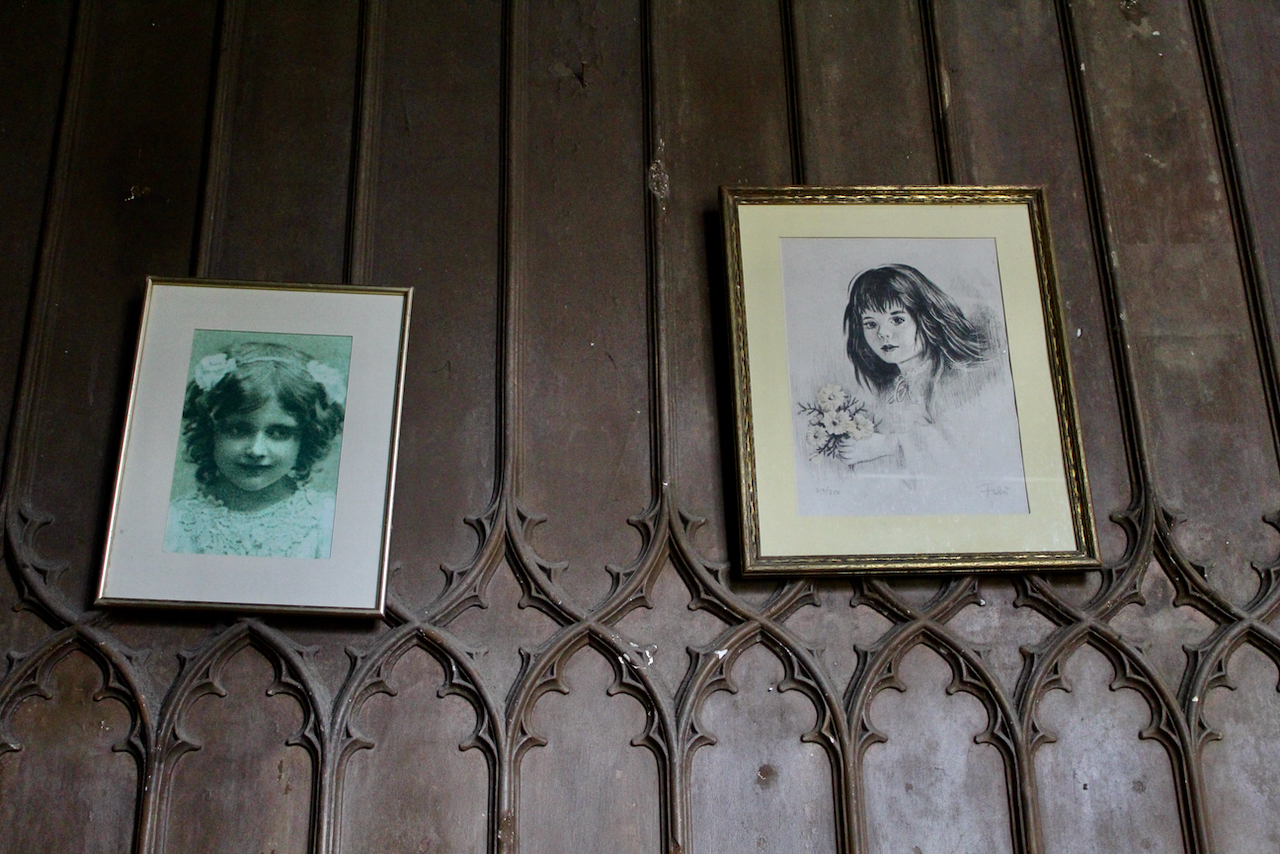
I’m not sure if this is a photograph of Harriet who died falling from the staircase.
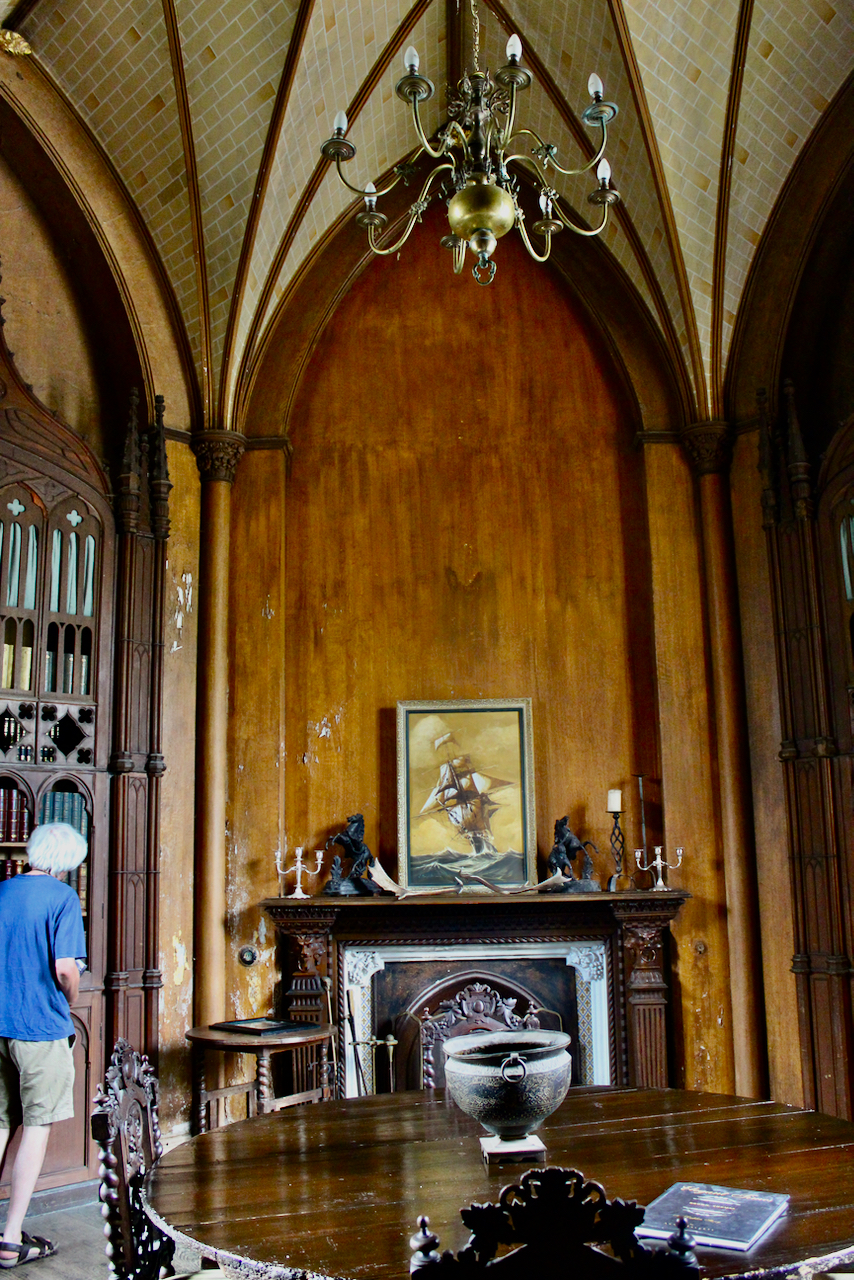
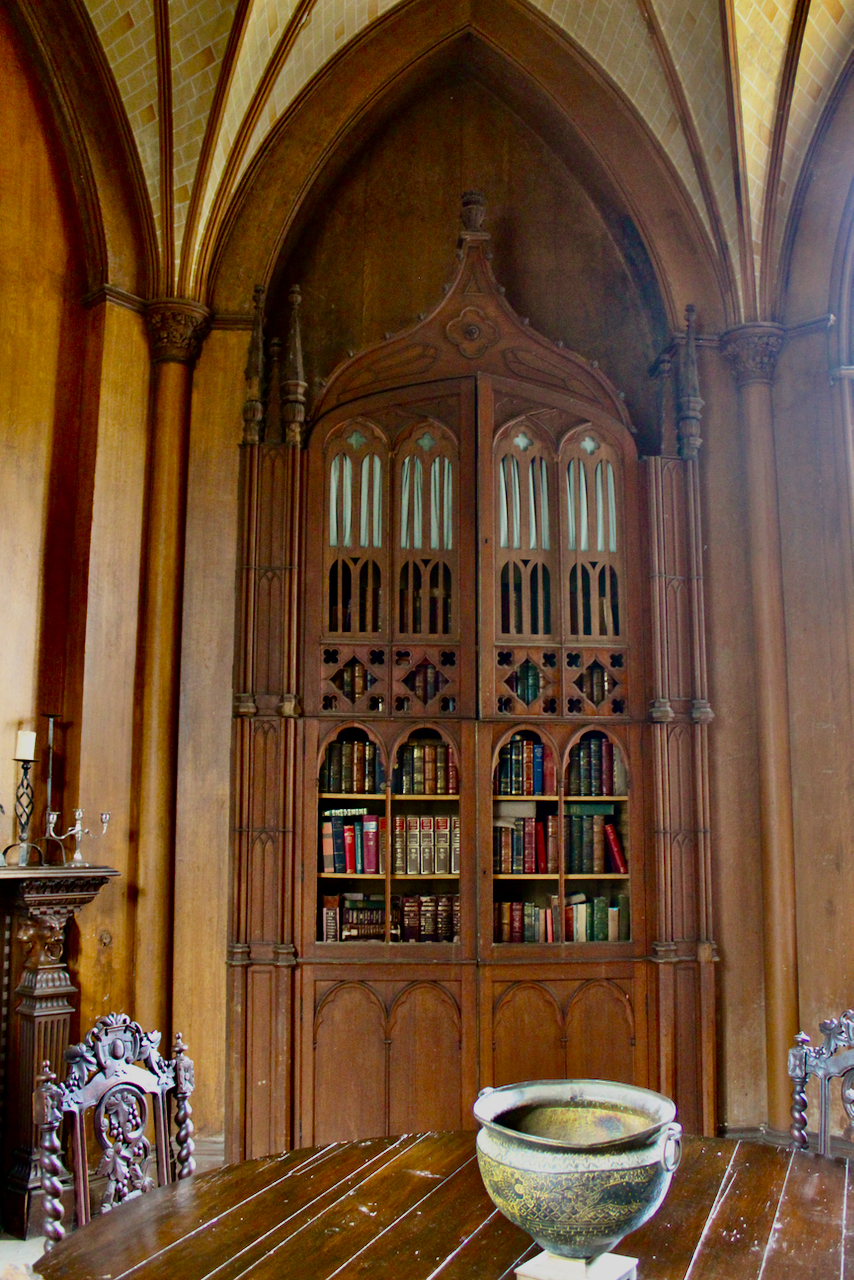
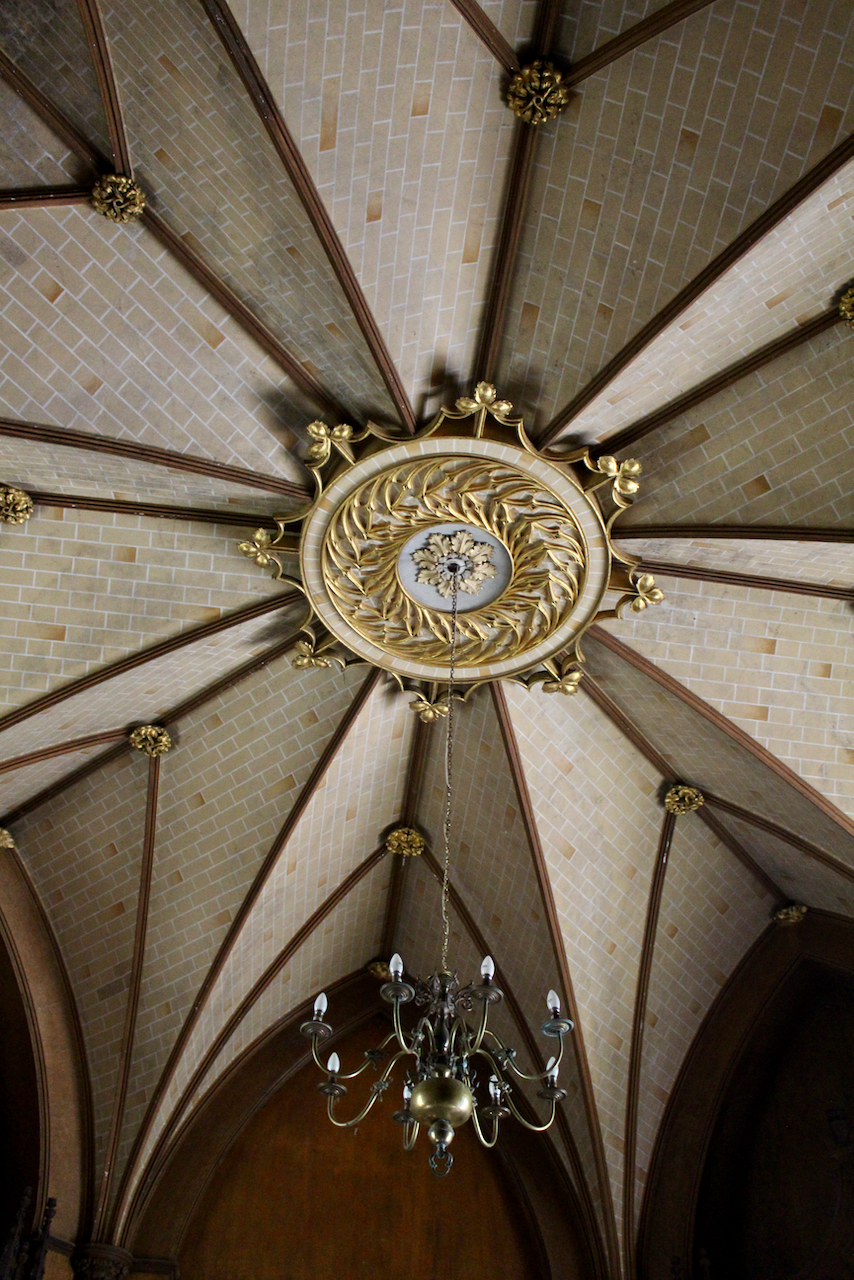
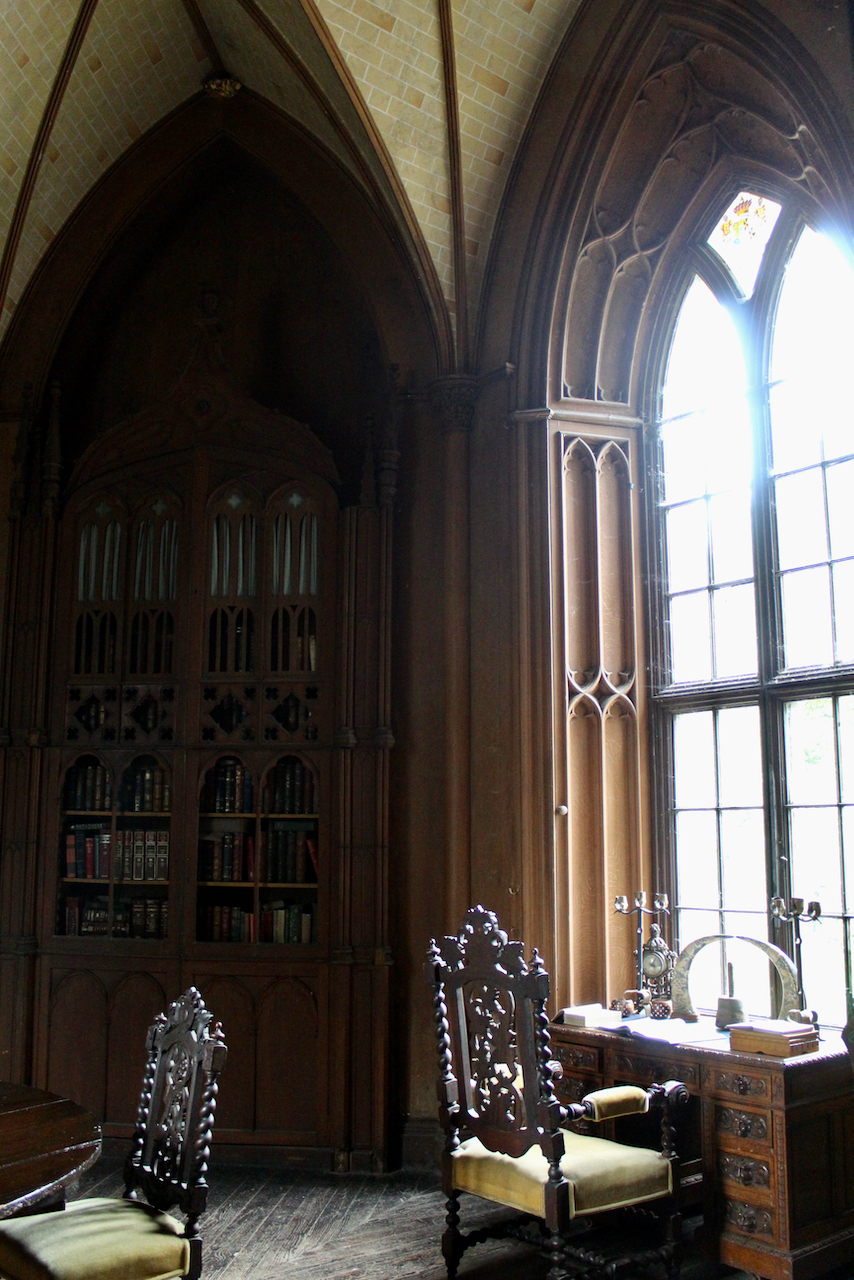
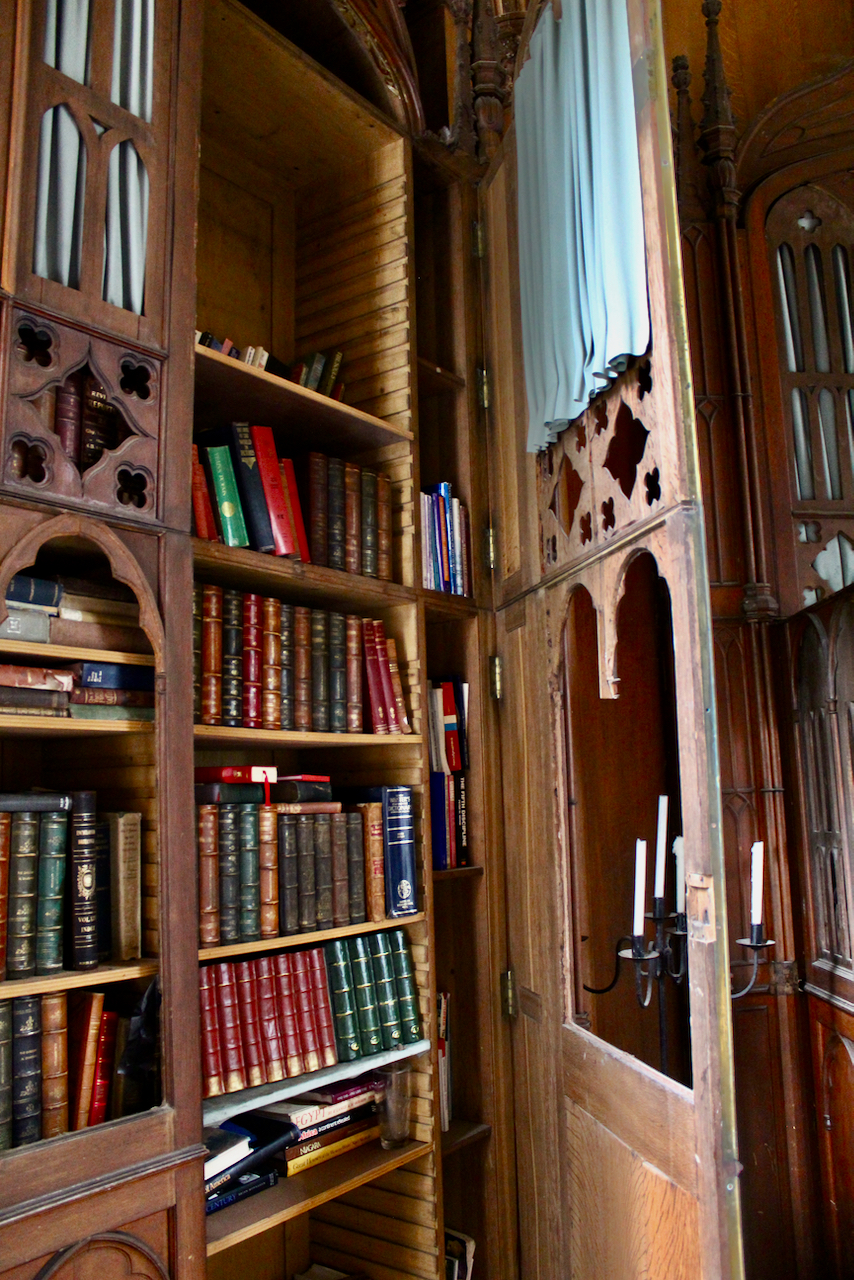
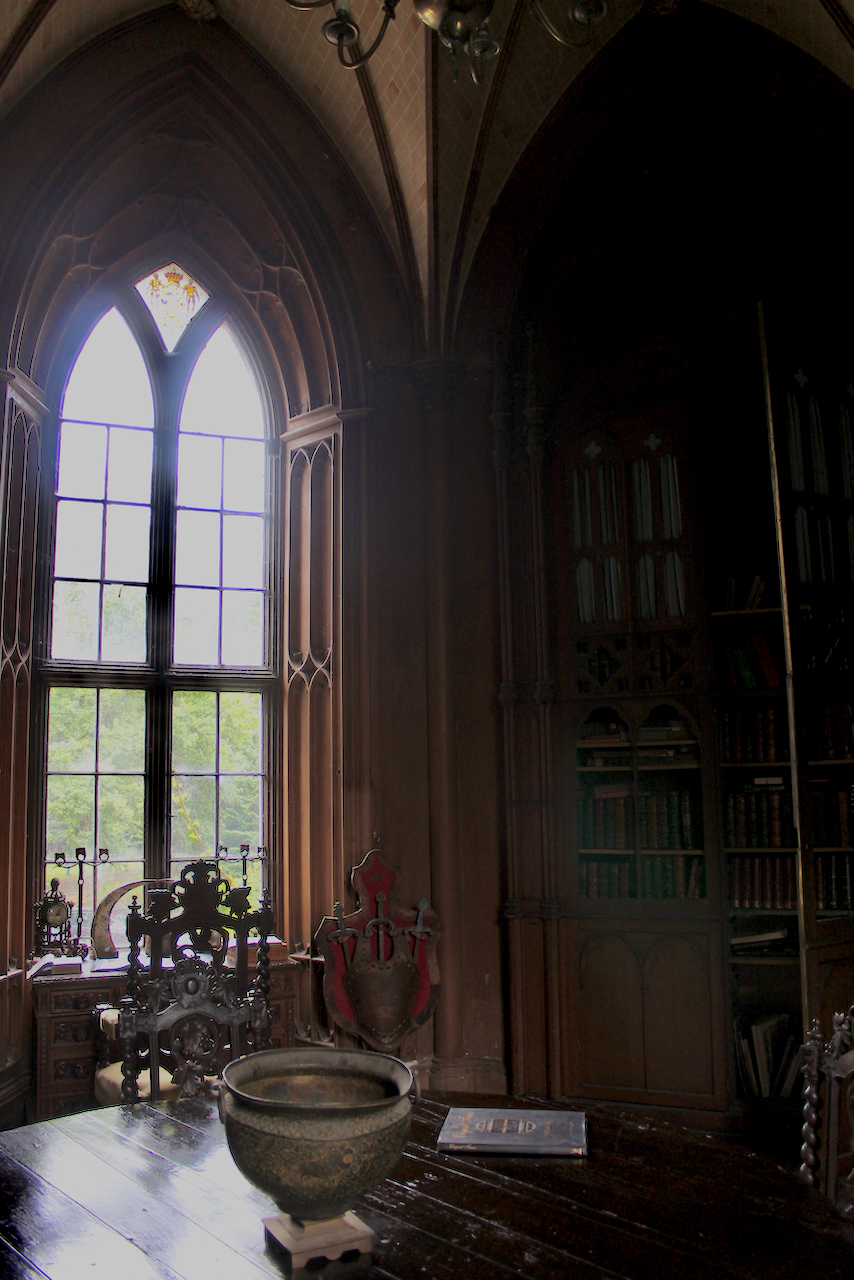
Beyond the staircase on the primary level is a small library with rib vaulted ceiling and Gothic bookcases.
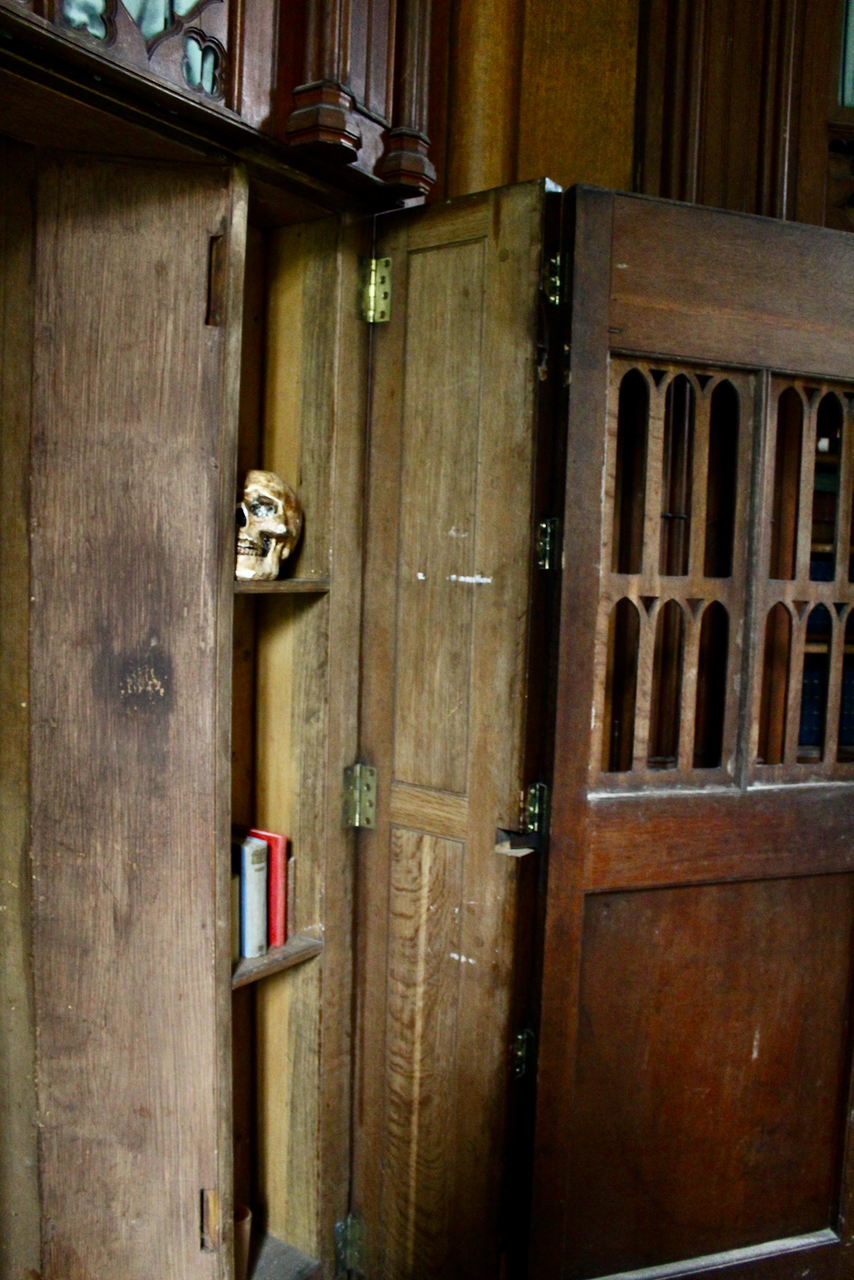
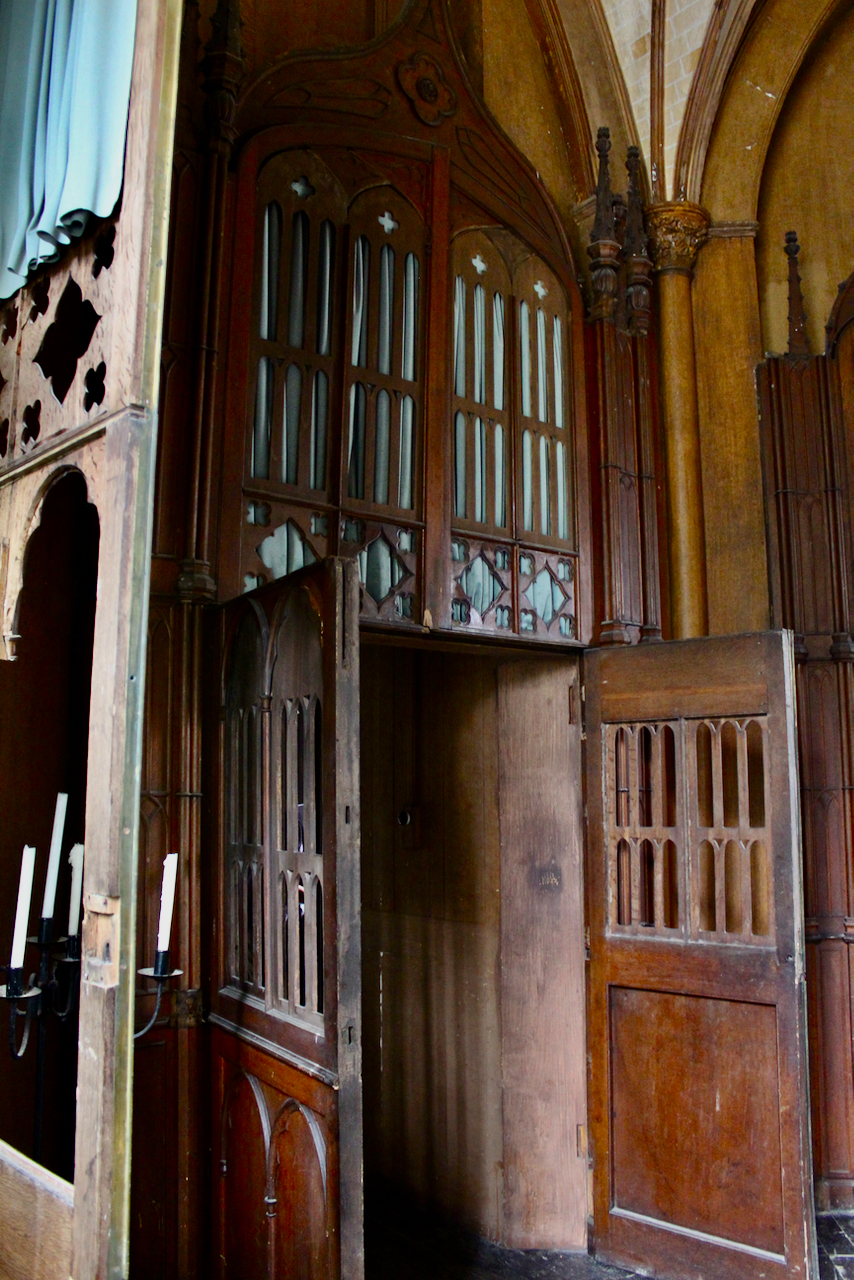
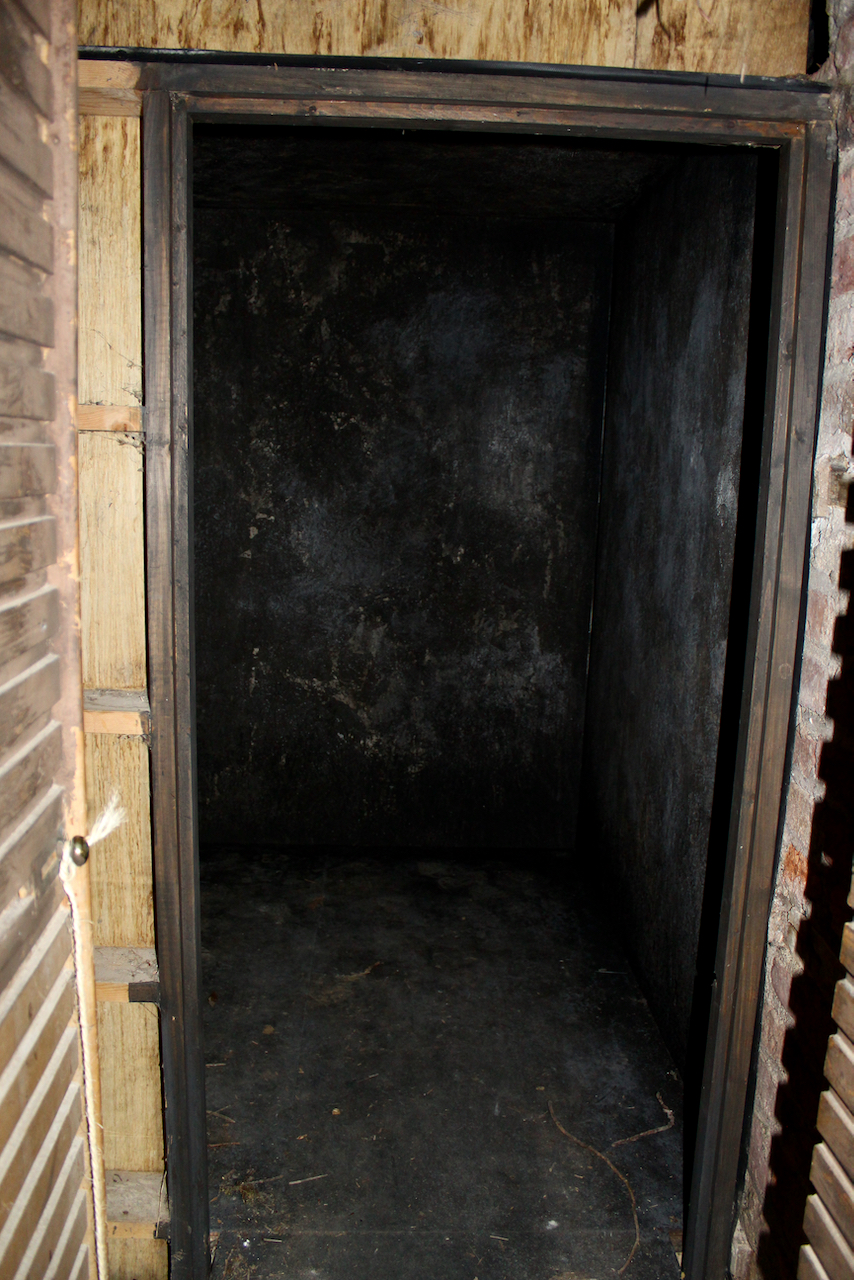
The panelling by each bookcase can be opened to reveal more space, and behind one secret door is a small room which leads out to the chapel, the guide told us.
O’Reilly tells us: “Charleville Forest’s patron, Charles William Bury, from 1800 Viscount and from 1806 Earl of Charleville, was a man well versed in contemporary English taste and style. He inherited lands in Limerick, through his father’s maternal line, and in Offaly. His great wealth, lavish lifestyle and generous nature allowed him simultaneously to distribute largesse in Ireland, live grandly in London and travel widely on the continent…[p. 139] Charleville’s lack of success in his search for a sinecure proved ill for the future of the family fortunes for, continuing to live extravagantly above their means, they advanced speedily towards bankruptcy. On Charleville’s death in 1835, the estate was ‘embarrassed’ and by 1844, the Limerick estates had to be sold and the castle shut up, while his son and heir, ‘the greatest bore the world can produce’ according to one contemporary, retired to Berlin.“
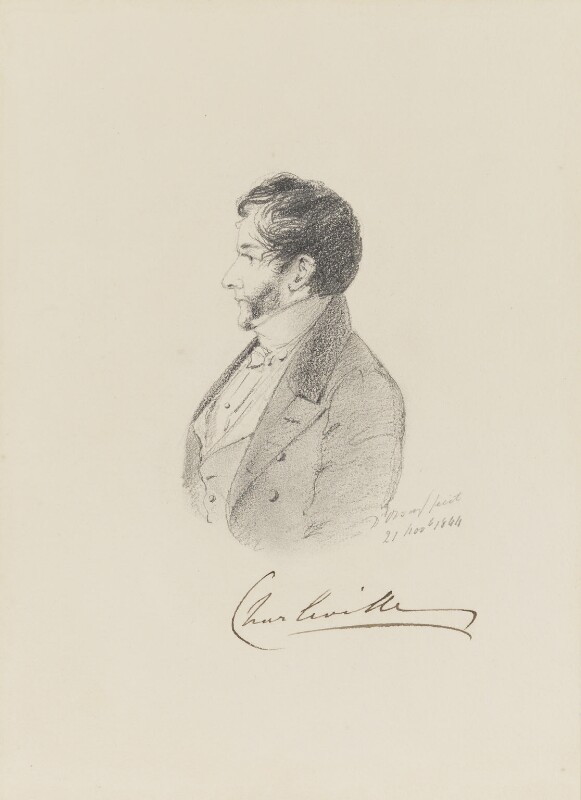
“The greatest bore the world can produce,” Charles William Bury (1801-1851), 2nd Earl of Charleville by Alfred, Count D’Orsay 1844, courtesy of National Portrait Gallery NPG 4026(12).
The 2nd Earl held the office of Representative Peer [Ireland] between 1838 and 1851.
Charles William Bury, 2nd Earl of Charleville, seated in red cloak before a curtain, portrait by Henry Pierce Bone, 1835.
The 3rd Earl, Charles William George Bury (1822-1859), returned to the house in 1851, but with a much reduced fortune. He died young, at the age of 37, and his son, also named Charles William (1852-1874), succeeded as the 4th Earl at the age of just seven years old. His mother had died two years earlier. It seems that many of the Bury family were fated to die young.
The 4th Earl died at the age of 22 in 1874, unmarried, so the property passed to his uncle, Alfred, who succeeded as 5th Earl of Charleville but died the following year in 1875, without issue. The young 4th Earl had quarrelled with his sister who was next in line, so the property passed to a younger sister Emily.
In 1881 Emily married Kenneth Howard (1845-1885), son of the 16th Earl of Suffolk and of Louisa Petty-FitzMaurice, daughter of Henry Petty-FitzMaurice, 3rd Marquess of Lansdowne. On 14 December 1881 his name was legally changed to Kenneth Howard-Bury by Royal Licence, after his wife inherited the Charleville estate. He held the office of High Sheriff of King’s County in 1884.
After Emily’s death in 1931 the castle remained unoccupied. Her son Charles Kenneth Howard-Bury (1883-1963) preferred to live at another property he had inherited, Belvedere in County Westmeath (see my entry), which he inherited from Charles Brinsley Marlay. He auctioned the contents in 1948.
The house stood almost empty, with a caretaker, for years. When Charles Kenneth died in 1963, the property passed to a cousin, the grandson of the 3rd Earl’s sister with whom he had quarrelled. She had married Edmund Bacon Hutton and her grandson William Bacon Hutton legally changed his surname to Hutton-Bury when he inherited in 1964. The castle remained empty, until it was leased for 35 years to Michael McMullen in 1971. It had been badly vandalised at this stage. He immediately set to restore the castle.
More repairs were carried out by the next occupants, Bridget “Bonnie” Vance and her parents, who planned to run a B&B and wedding venue. Today the castle is run by Charleville Castle Heritage Trust.
[1] Bence-Jones, Mark. A Guide to Irish Country Houses (originally published as Burke’s Guide to Country Houses volume 1 Ireland by Burke’s Peerage Ltd. 1978); Revised edition 1988 Constable and Company Ltd, London.
[2] p. 136. O’Reilly, Sean. Irish Houses and Gardens. From the Archives of Country Life. Aurum Press Ltd, London, 1998.
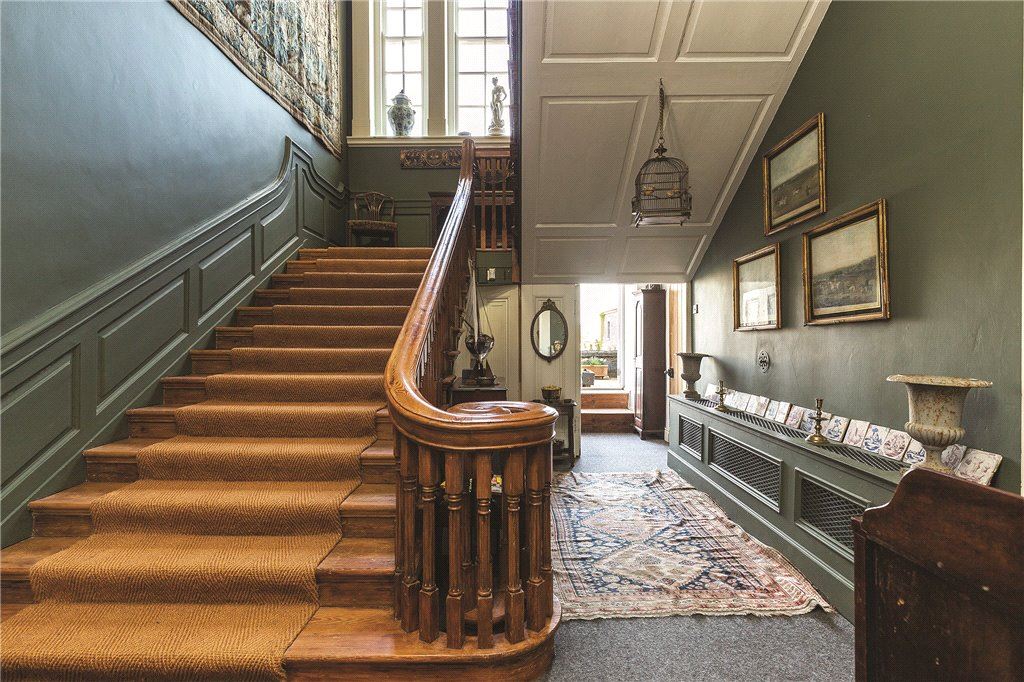
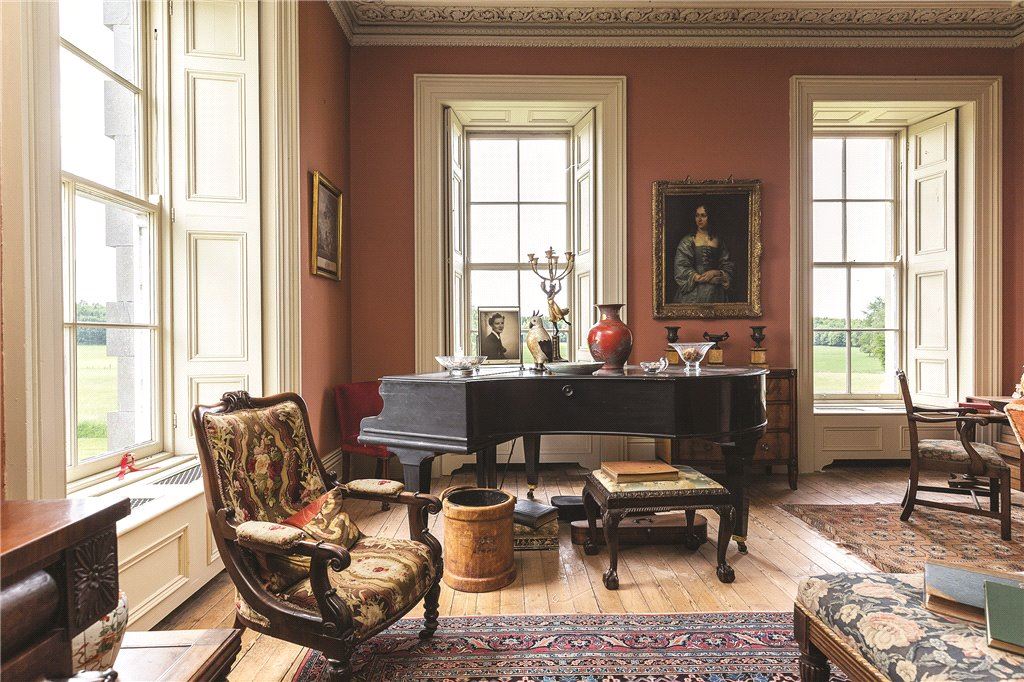
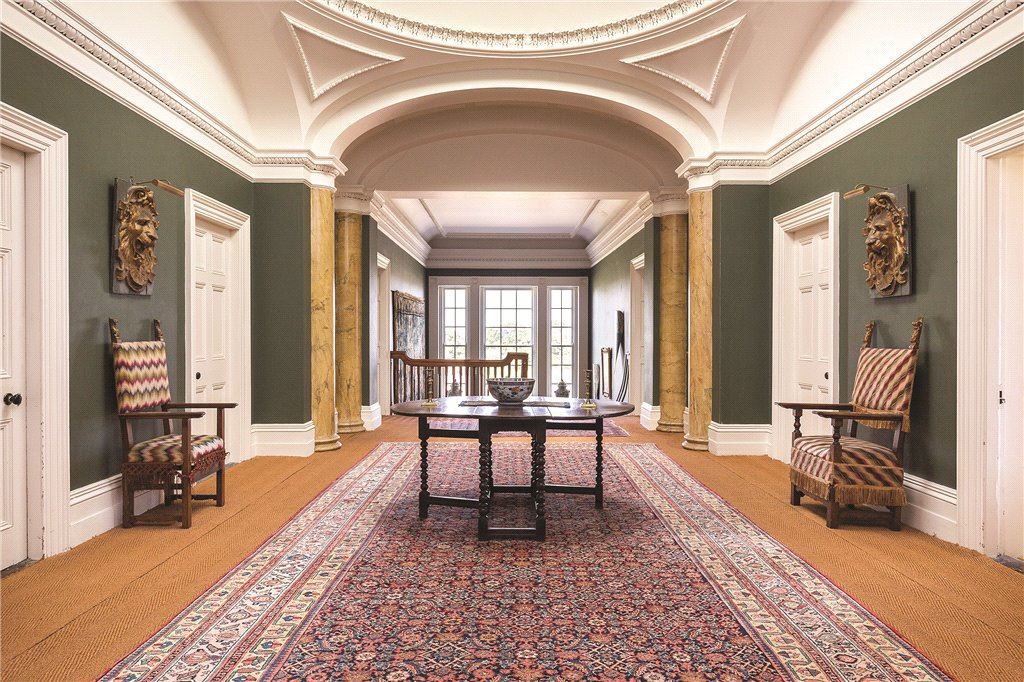
Sopwell Hall, County Tipperary, courtesy of Colliers estate agents and myhome.ieSopwell Hall, County Tipperary, courtesy of Colliers estate agents and myhome.ieSopwell Hall, County Tipperary, courtesy of Colliers estate agents and myhome.ieSopwell Hall, County Tipperary, courtesy of Colliers estate agents and myhome.ieSopwell Hall, County Tipperary, courtesy of Colliers estate agents and myhome.ieSopwell Hall, County Tipperary, courtesy of Colliers estate agents and myhome.ie
[7] p. 232-8. Tierney, Andrew. The Buildings of Ireland: Central Leinster: Kildare, Laois and Offaly. Yale University Press, New Haven and London, 2019.























































 Irish Historic Houses