Portraits P

P

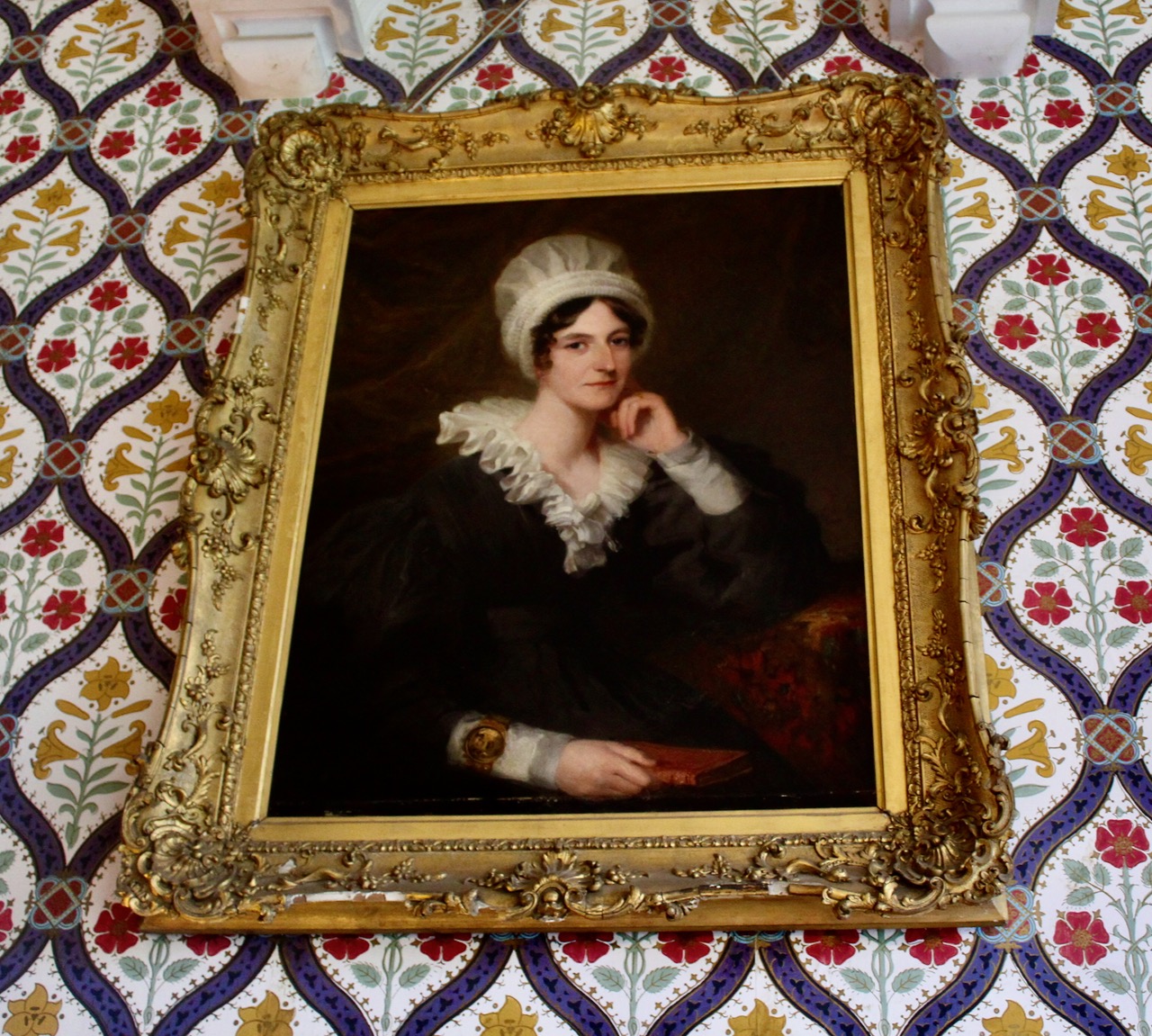
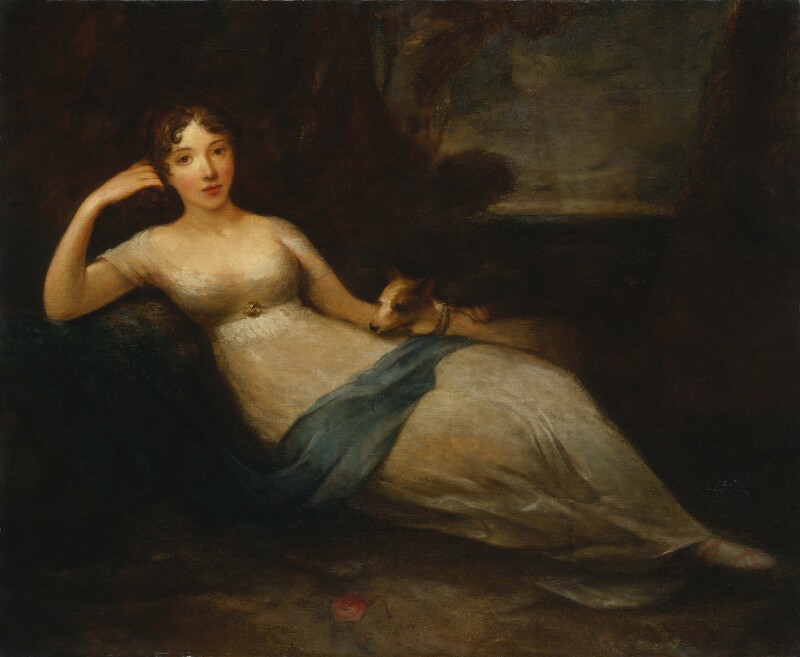
Thought to be Elizabeth Louisa née Beresford (1783-1856) who married Sir Denis Pack (1774-1823), then Thomas Reynell, 6th Baronet, courtesy of Whyte’s Nov 2011. She was the daughter of George de la Poer Beresford, 1st Marquess of Waterford.
Captain Denis William Pack-Beresford (1818-1881) of Fennagh House in the parish of Lorum, County Carlow by Stephen Pearse (1819-1904) courtesy of Whyte’s Nov 2011. He was the son of Denis Pack and Elizabeth Louisa née Beresford. He married Annette Caroline Browne of Browne’s Hill, County Carlow.
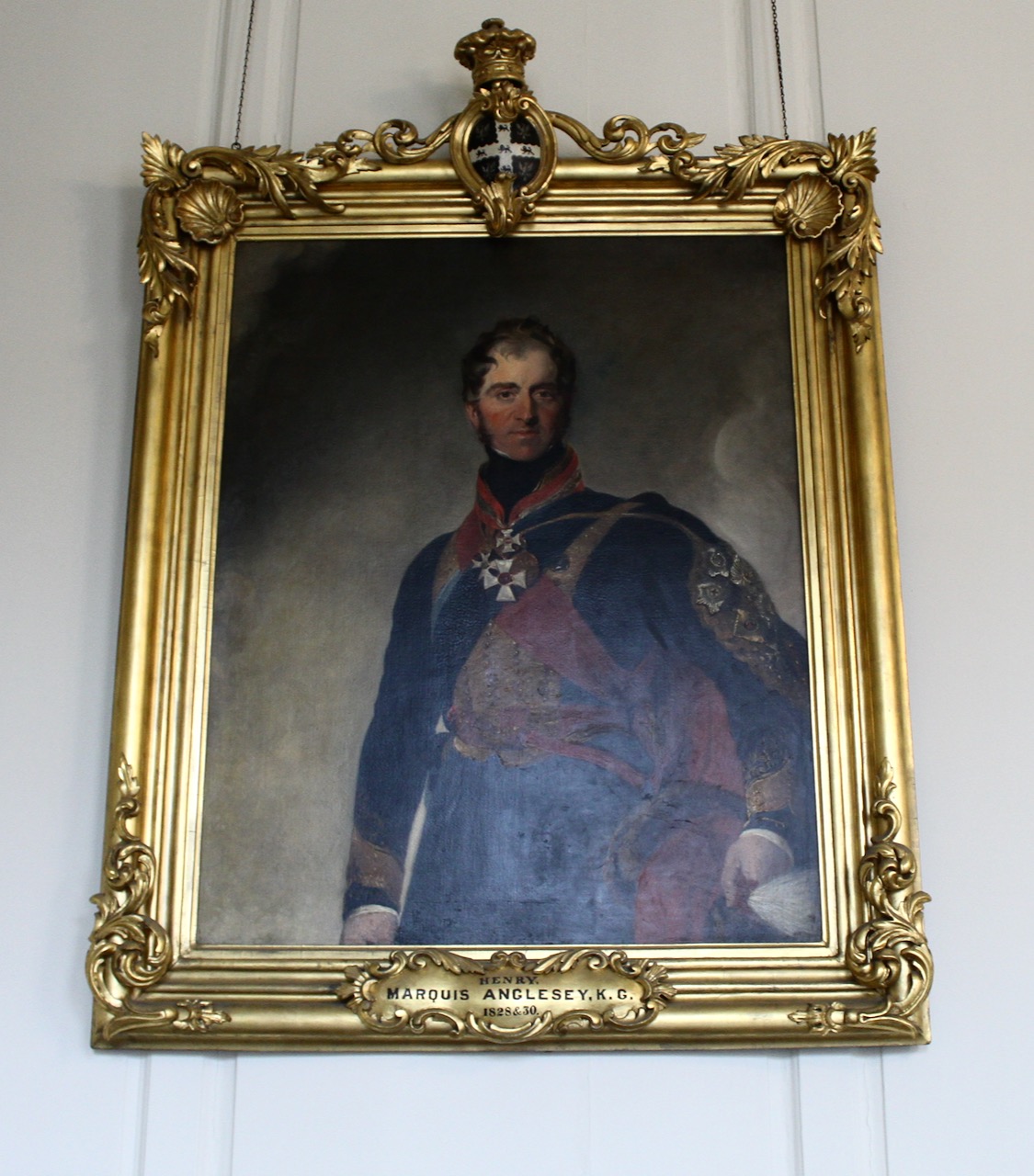
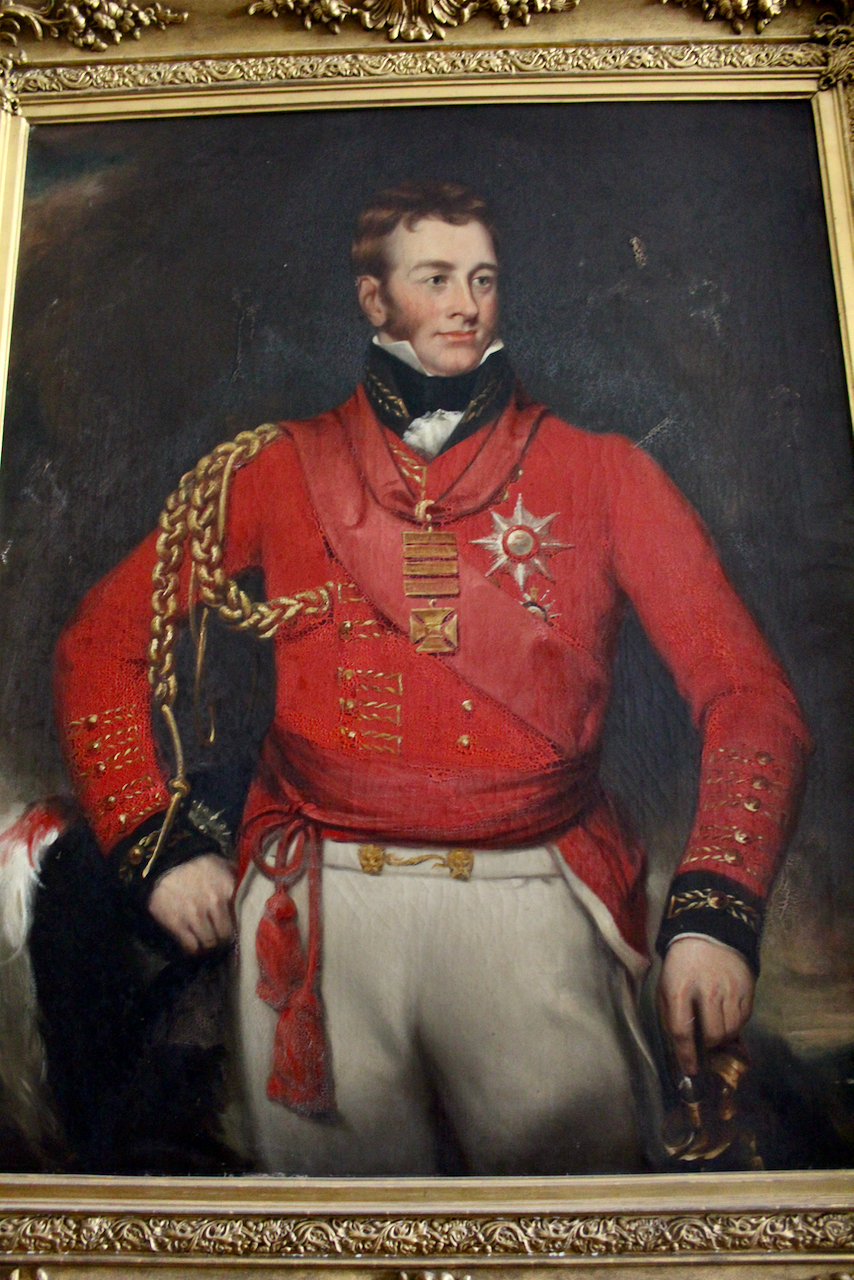
Henry Paget, 1st Marquess of Anglesey (1768-1854). Photograph © Jennifer Winder-Baggot, www.irishhistorichouses.com
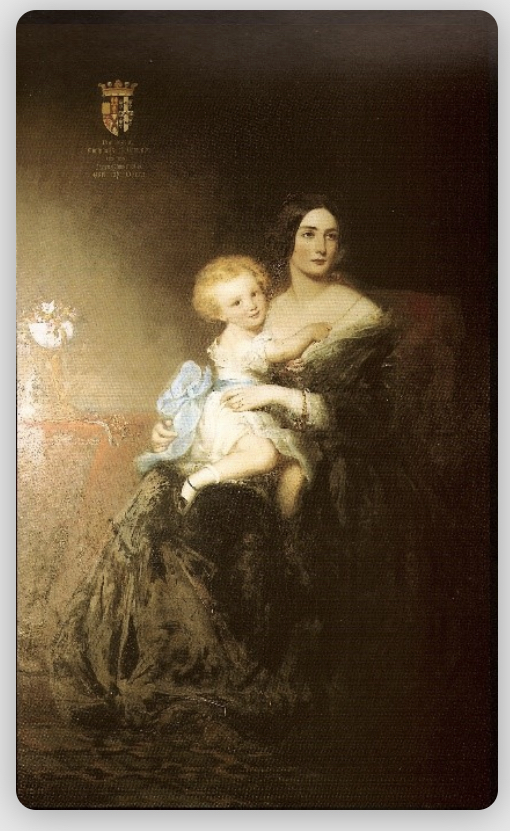
Frances Jane Paget (1817-1903) Marchioness of Ormonde with her son James Earl of Ossory, by Richard Bruckner. She married John Butler 2nd Marquess of Ormonde. Funnily enough, all of her sons were named James! The Earl of Ossory was her eldest son James Edward William Theobald Butler (1844-1919), who became 15th Earl of Ossory in 1854 when he was ten years old. The painting thus anachronistically refers to him as the Earl of Ossory, as he was not yet ten years old when it was painted. A younger son, James Arthur Wellington Foley Butler (1849-1943) also became Earl of Ossory, in 1919, the same year he became 4th Marquess of Ormonde, when his older brother James the 3rd Marquess died. Frances Jane’s father was General Hon. Sir Edward Paget, and she was the daughter of his second wife, Harriet Legge. His first wife was Frances, daughter of William Bagot 1st Baron Bagot of Bagot’s Bromley, Staffordshire, England.
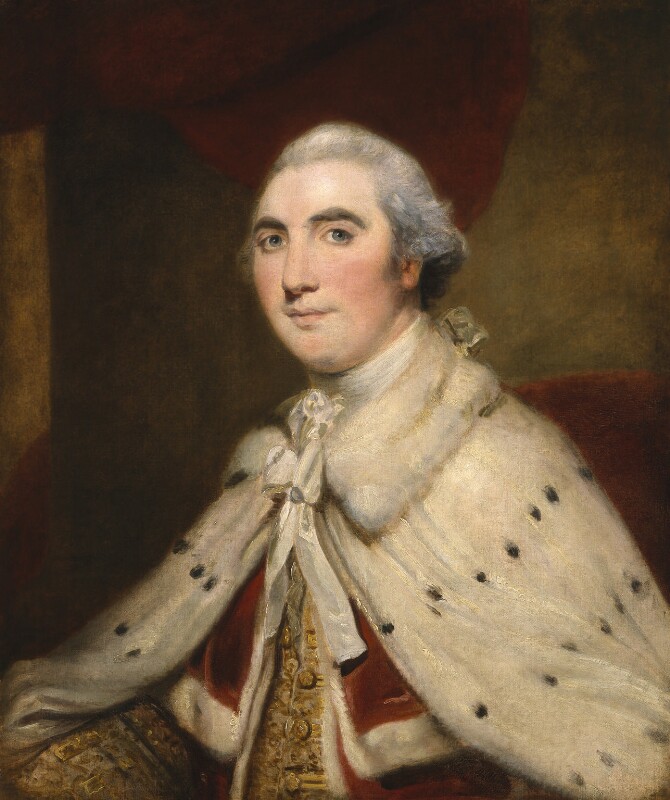
William Lygon Pakenham, 4th Earl of Longford.
Thomas Pakenham (1713-1766), 1st Baron Longford, Date c.1756 Credit Line: Presented, Mrs R. Montagu, 1956.
Thomas Pakenham, 1st Baron of Longford (1713-1766), who married Elizabeth Cuffe. Photograph © Jennifer Winder-Baggot, www.irishhistorichouses.com
Elizabeth Cuffe (1719-1794) who married Thomas Pakenham, 1st Baron Longford. She became Countess of Longford in her own right, through her father Michael Cuffe (1694-1744), who was heir to Ambrose Aungier, 2nd and last Earl of Longford (1st creation).  Photograph © Jennifer Winder-Baggot, www.irishhistorichouses.com
Edward Michael Pakenham, 2nd Baron Longford (1743-1792). His daughter married the Duke of Wellington, Arthur Wellesley. Photograph © Jennifer Winder-Baggot, www.irishhistorichouses.com
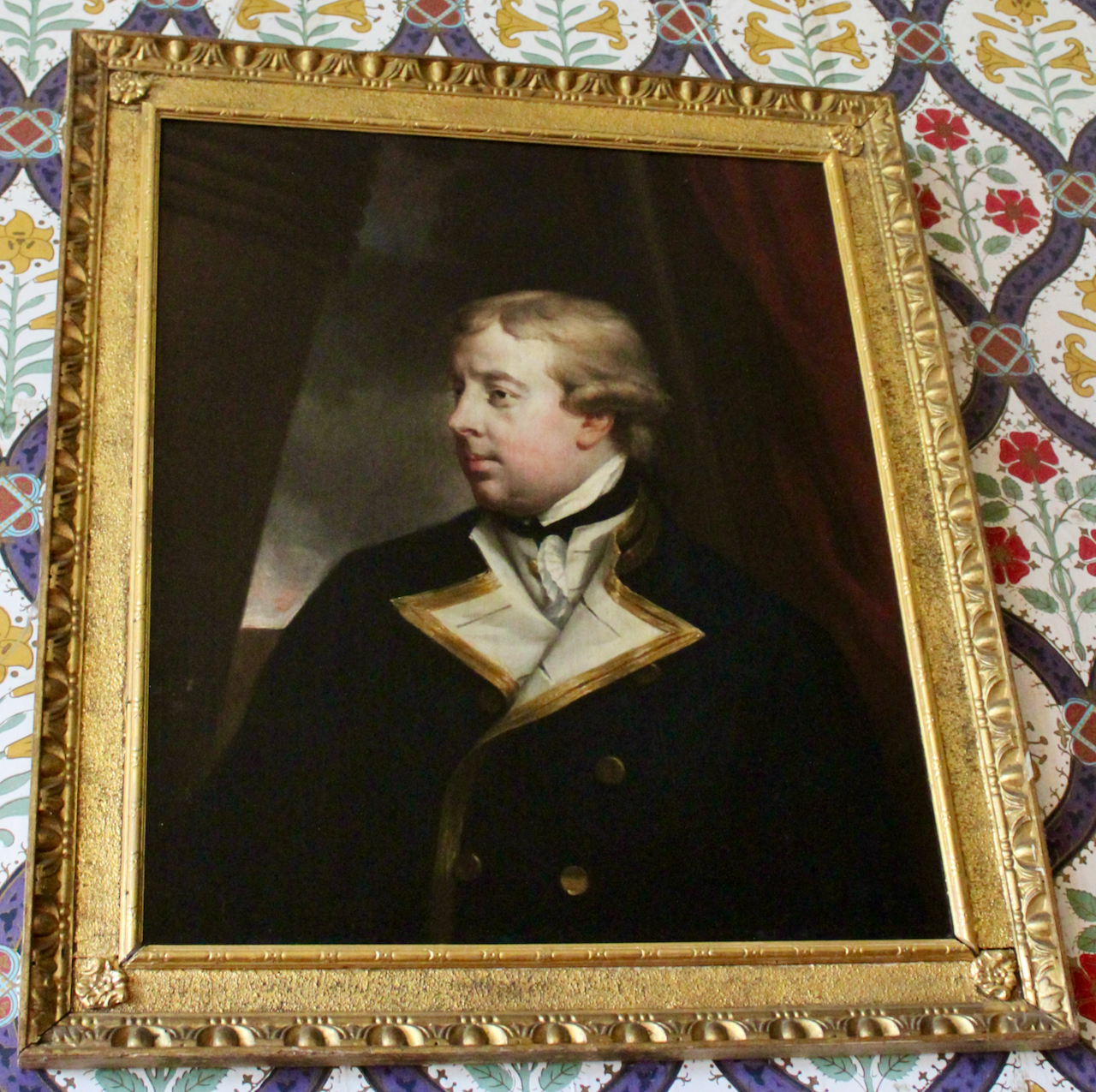
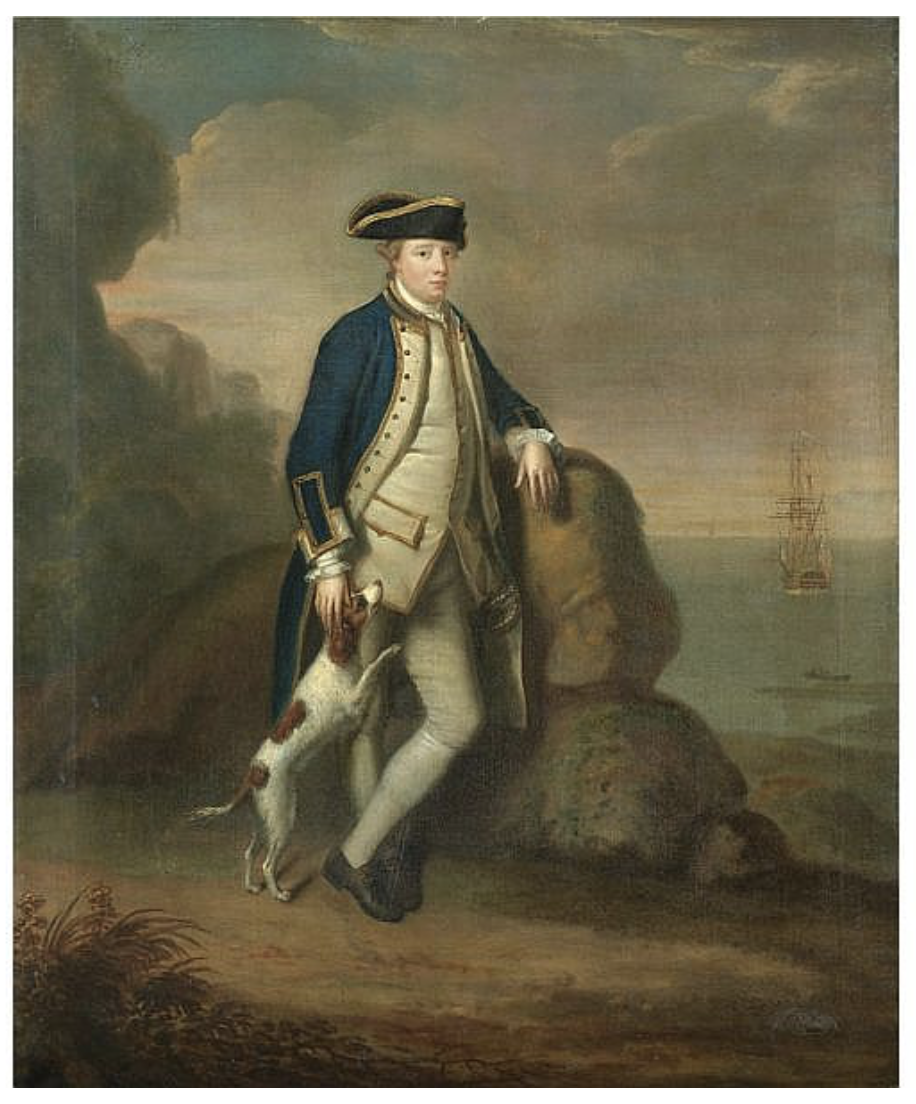
Edward Michael Pakenham, 2nd Baron Longford (1743-1792) by Robert Hunter, auctioned Sotheby’s June 2008. The catalogue tells us that the sitter was the son and heir of Thomas Pakenham, 1st Baron Longford of Pakenham Hall, County Westmeath and his wife Elizabeth Cuffe who was created Baroness of Longford in 1785. He served in the Royal Navy from 1765 to 1766 and served as M.P. for County Longford in Ireland. On the 25th June 1768 he married Catherine, daughter of Hercules Rowley of Summerhill, County Meath. He was a popular political figure and Lord Harcourt wrote on 17th October 1774: “My Lord Longford is a man of ability, an able speaker in the House of Lords and greatly respected in this County.”
Thomas Pakenham the 2nd Earl of Longford (1774-1835). Photograph © Jennifer Winder-Baggot, www.irishhistorichouses.com
Georgiana Pakenham née Lygon (1774-1880). She married Thomas Pakenham 2nd Earl of Longford. Photograph © Jennifer Winder-Baggot, www.irishhistorichouses.com
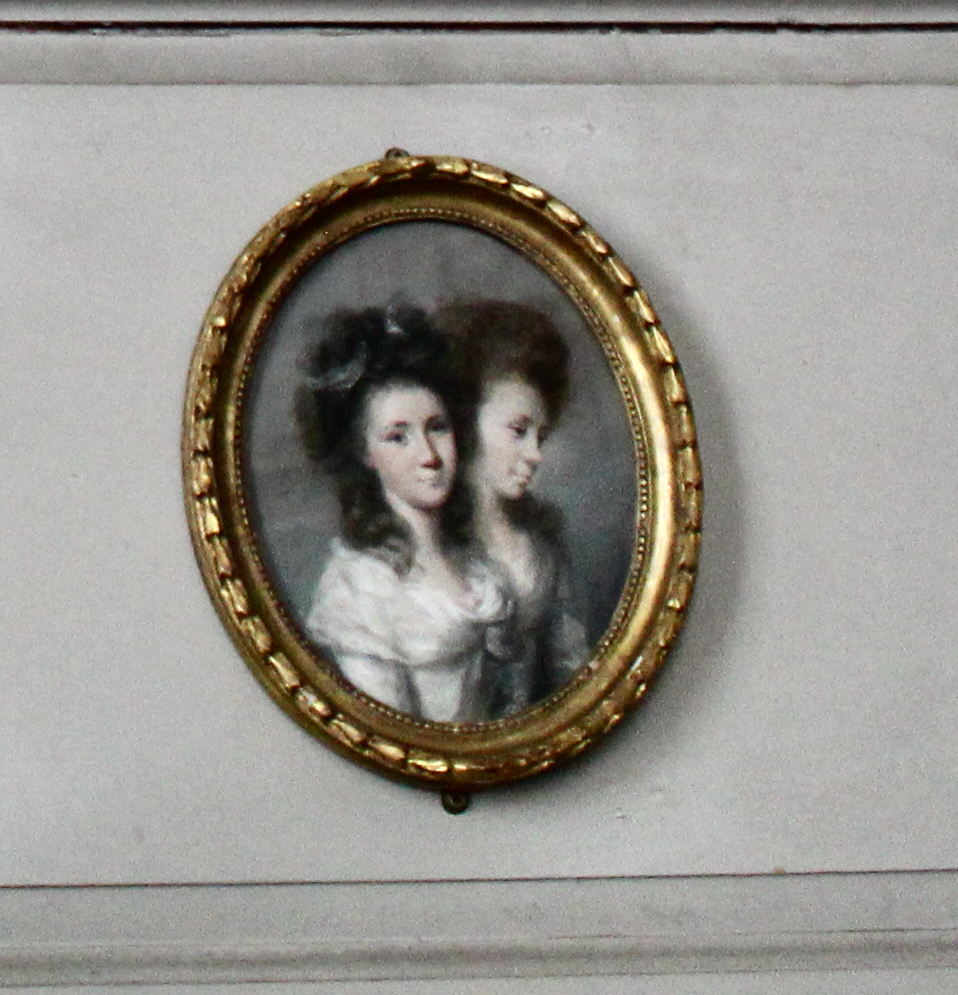
Louisa Anne Pakenham née Staples (1770-1833) and her sister Henrietta Margaret Trench née Staples (1770-1847) Countess of Clancarty (c.1770-1847) by Hugh Douglas Hamilton. Louisa was married to Thomas Pakenham (1757-1836) and Henrietta was married to Richard Power Keating Le Poer Trench (1767-1837) 2nd Earl of Clancarty. Their father was John Staples (1736-1820) of County Tyrone, and their mother was Harriet Conolly (1739-1771) of Castletown House, County Kildare. Photograph © Jennifer Winder-Baggot, www.irishhistorichouses.com
Major General Edward Pakenham (1778-1815), another uncle of Henry Sandford Pakenham Mahon, also hangs in the front hall of Strokestown House. Photograph © Jennifer Winder-Baggot, www.irishhistorichouses.com
A portrait of Lt. Gen. Hercules Pakenham (1781-1850), an uncle of Henry Sandford Pakenham Mahon, hangs in the front hall of Strokestown House.
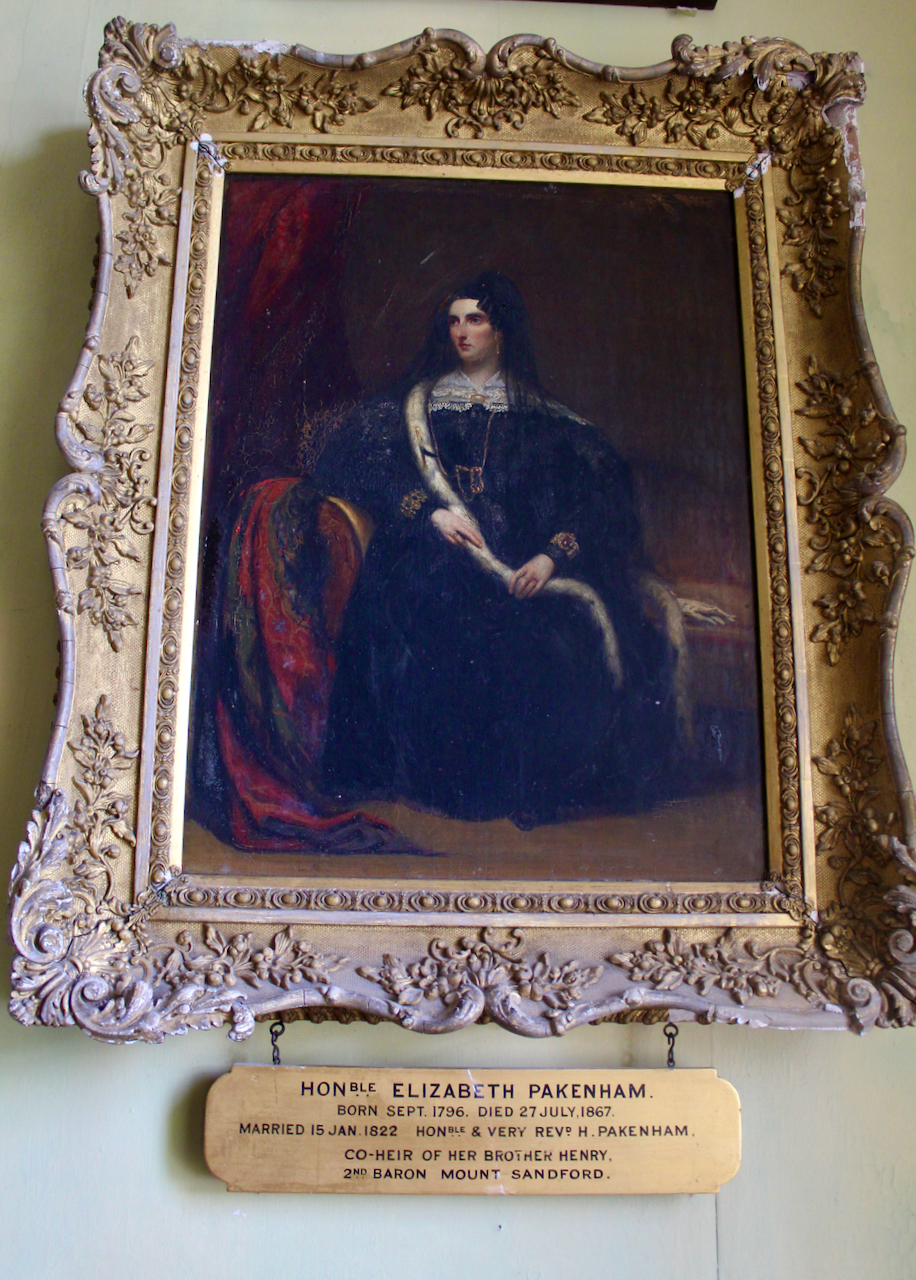
Elizabeth Sandford, mother of Henry Sandford Pakenham, wife of Reverend Henry Pakenham, Dean of St. Patrick’s Cathedral in Dublin. Henry Sandford Pakenham married the heiress Grace Catherine Mahon and changed his surname to Pakenham Mahon. Photograph © Jennifer Winder-Baggot, www.irishhistorichouses.com
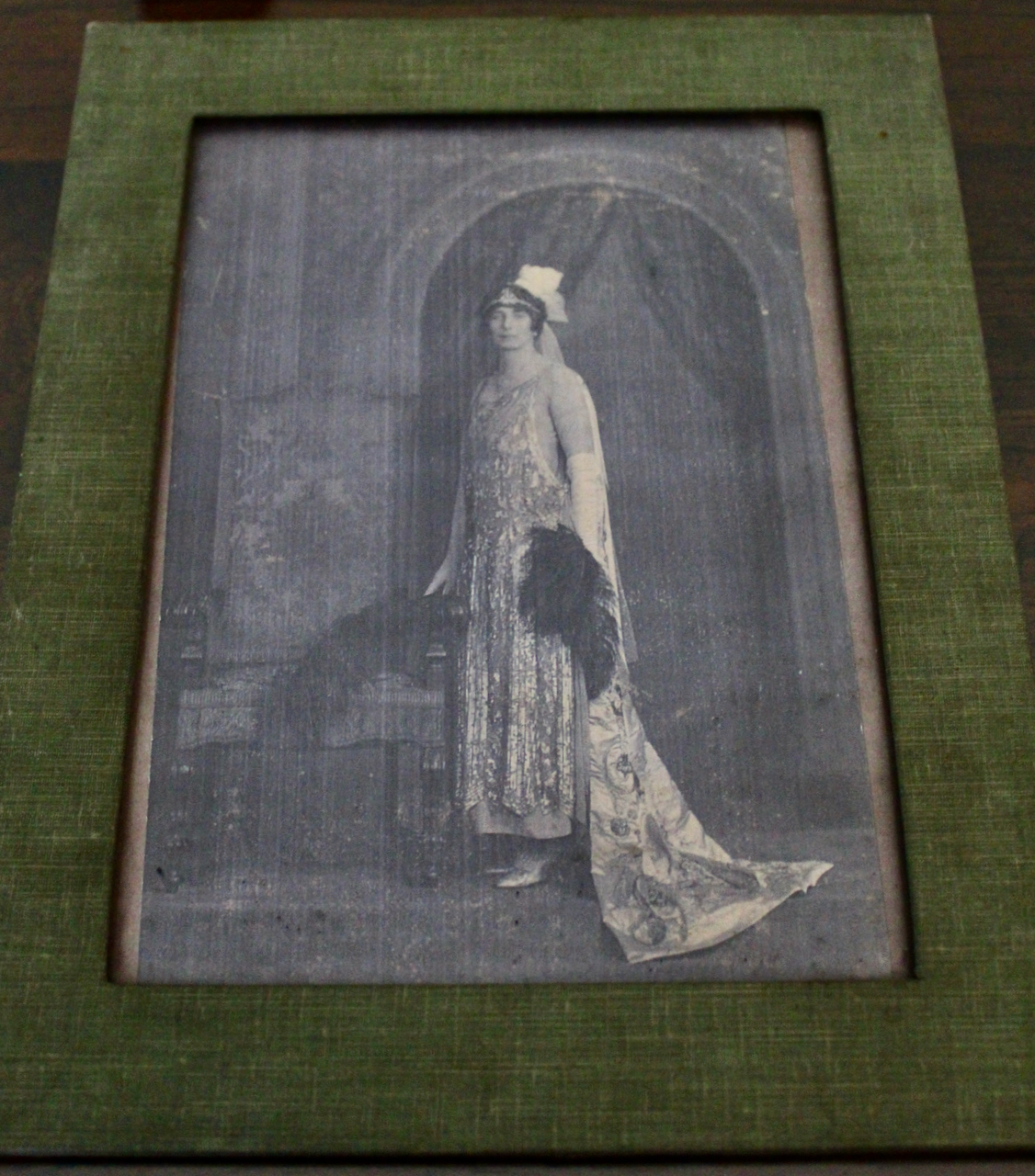
Olive Hales Pakenham Mahon dressed for a visit to Buckingham Palace in the 1930s. Photograph © Jennifer Winder-Baggot, www.irishhistorichouses.com
Olive Hales Pakenham Mahon (1894-1981). She was from Strokestown House, and married first Edward Charles Stafford King-Harman, and then Wilfred Stuart Atherstone Hales who added the surname Pakenham Mahon to his name.
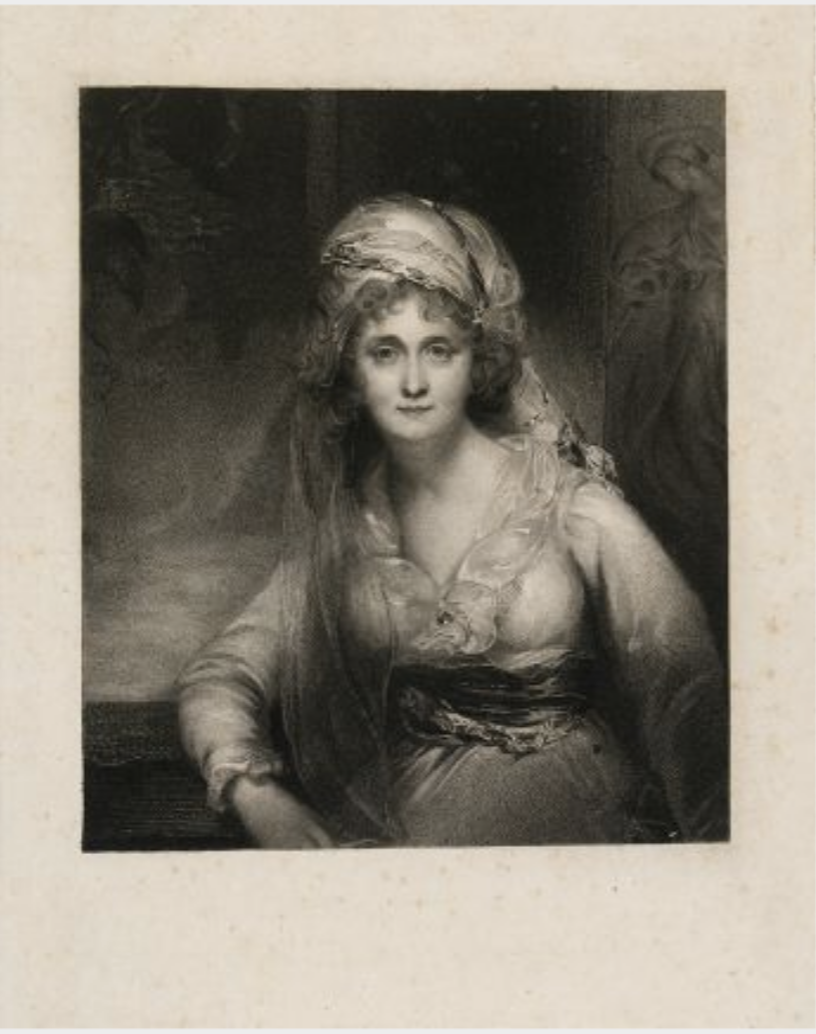
Mary, Countess of Inchiquin (née Palmer), (1750-1820), 2nd wife of Murrough O’Brien (1726-1808) 4th Earl of Inchiquin, later 1st Marquess of Thomond; After Thomas Lawrence, English, 1769-1830, photograph courtesy of National Gallery of Ireland.
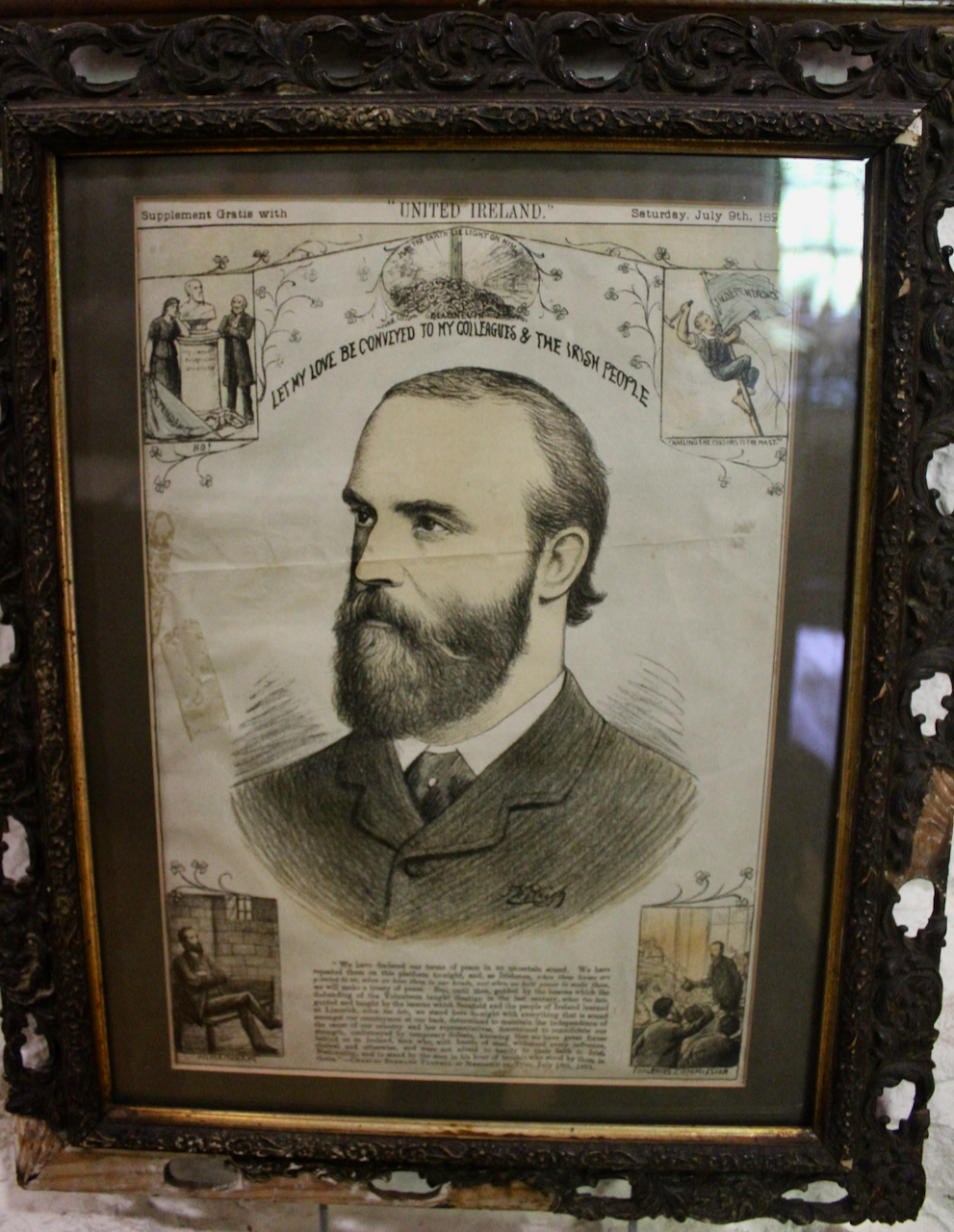
Charles Stewart Parnell (1846-1891).
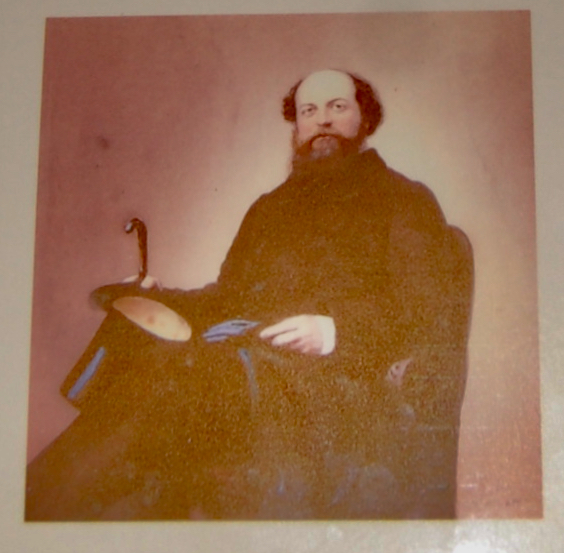
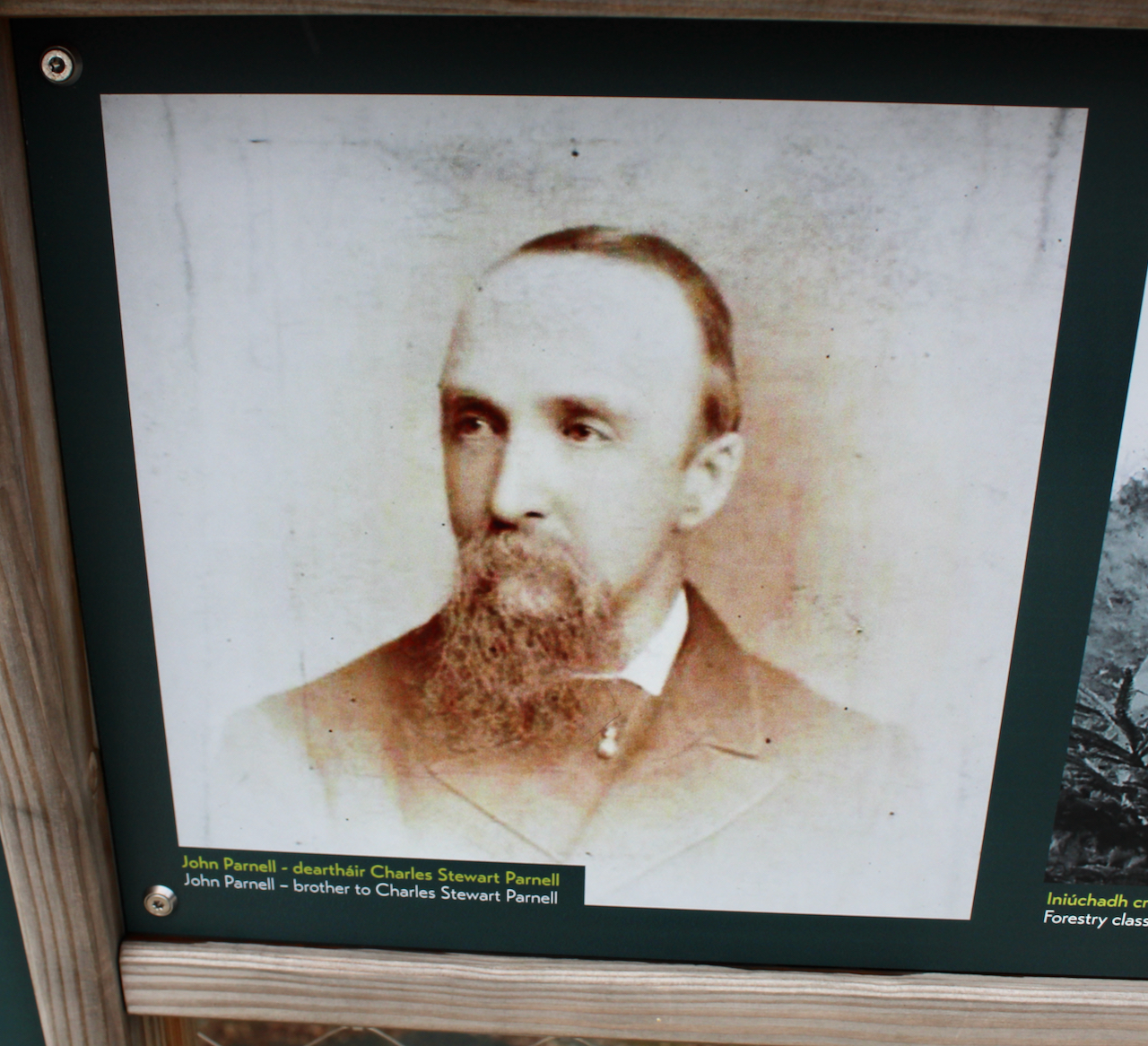
John Parnell, brother of Charles Stewart Parnell.
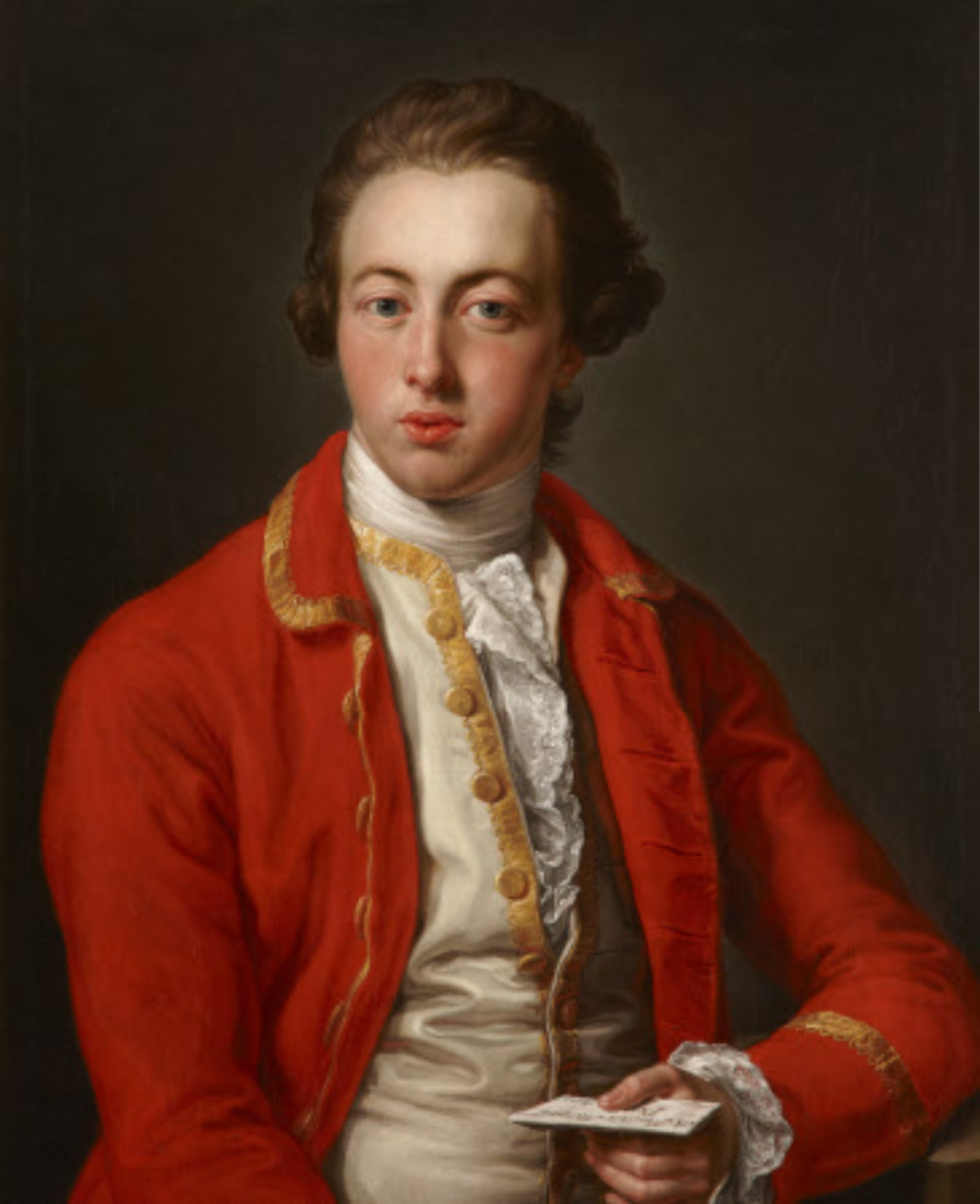
John Parnell (1744-1801) 2nd Baronet of Rathleague by Batoni, 1770, courtesy of National Gallery of Ireland. He was the great-grandfather of Charles Stewart Parnell. His son William (1870-1821) added the name Hayes to his surname after inheriting Avondale, County Wicklow, from Samuel Hayes.
Sir William Parsons (?1570-1650), 1st Baronet Parsons, Surveyor-General and Lord Justice of Ireland Date: 1777 Engraver Samuel De Wilde, After Unknown Artist. He emigrated to Ireland around 1590. He was the brother of Laurence Parsons (d. 1628), grandfather of Laurence Parsons (d. 1698), 1st Baronet Parsons, of Birr Castle. William Parsons married Elizabeth Lany, daughter of John, an alderman of Dublin. National Portrait Gallery of London D3829.
Frances née Parsons Harman (1775-1841) who married Robert Edward King (1773-1854), 1st Viscount Lorton. She was the daughter of Lawrence Harman Parsons (1749-1807) 1st Earl of Rosse who assumed the surname Parsons-Harman.
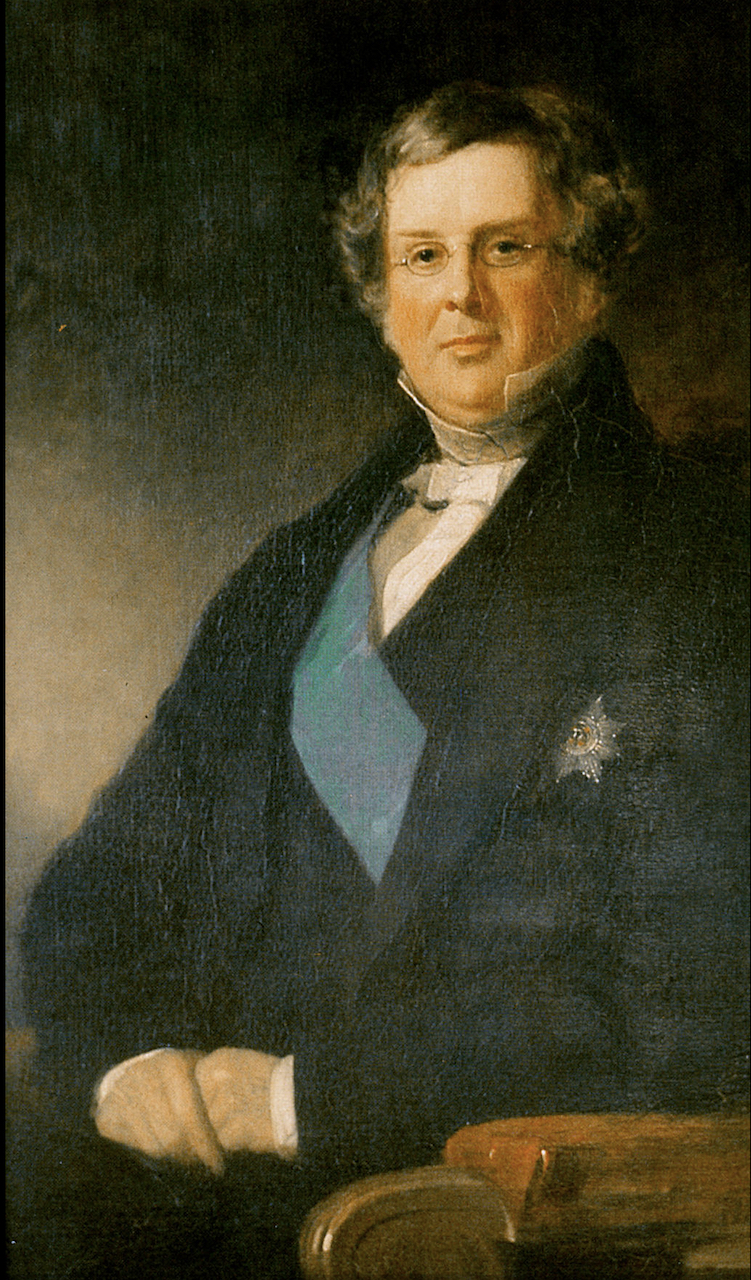
William Parsons, 3rd Earl of Rosse (1800-1867) by Stephen Catterson Smith 1860.
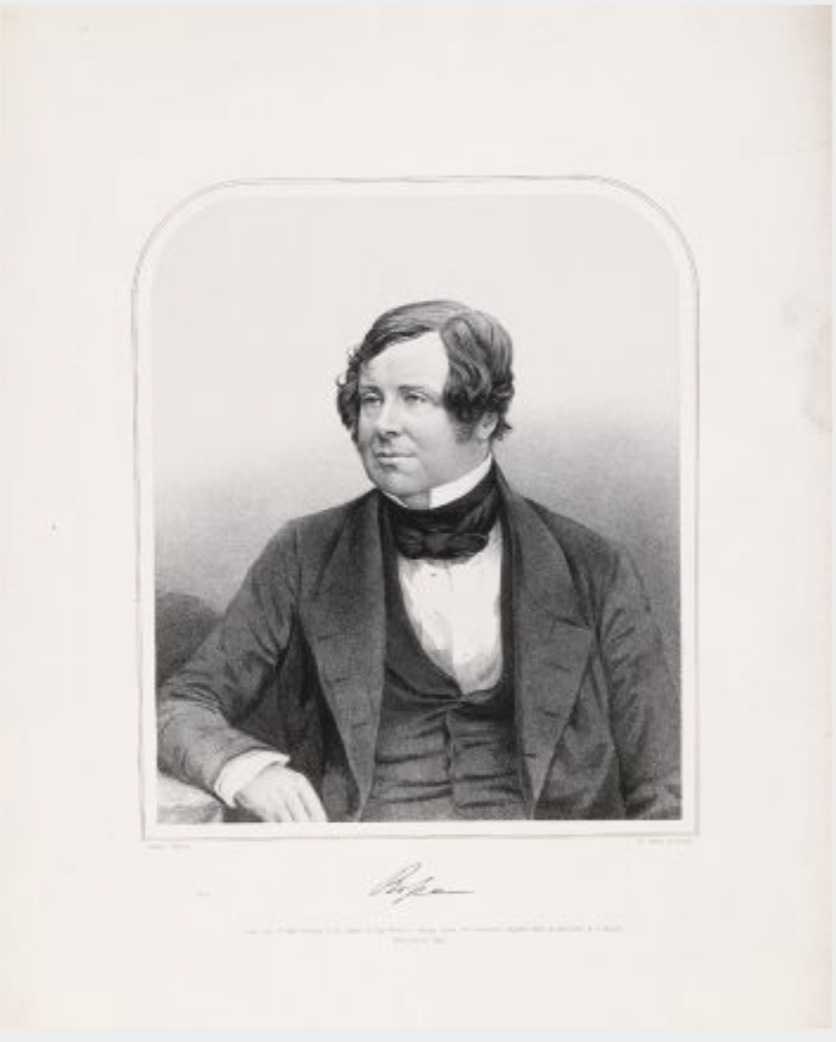
William Parsons (1800-1867) 3rd Earl of Rosse, photograph courtesy of National Gallery of Ireland.
Henrietta Paulet née Crofts, Duchess of Bolton (1682-1730) daughter of James Crofts (Scott), 1st and last Duke of Monmouth, illegitimate son of King Charles II. She married Charles Paulet, 2nd Duke of Bolton. Photograph © Jennifer Winder-Baggot, www.irishhistorichouses.com
Thomas Ryder Pepper (1760-1828) with The Old Castle, Loughton in the background from Loughton house auction, 2016, Shepphards. He married Anne Bloomfield, the sister of Benjamin Bloomfield 1st Baron Bloomfield, of Loughton, County Offaly.
John Perceval (1629–1665), 1st Baronet of Kanturk engraving by J Faber (1743).
Catherine (1637 – 1679) the only daughter of Sir Robert Southwell of Kinsale, wife of Sir John Perceval, 1st Baronet. Engraved by J. Faber (1743).
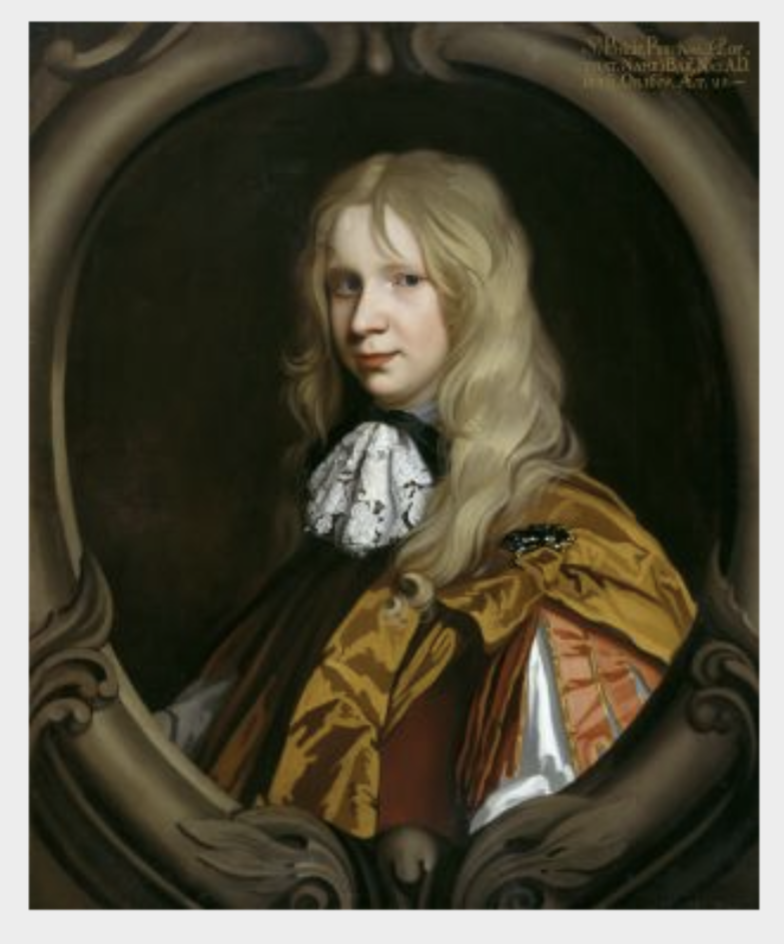
Sir Philip Perceval, 2nd Bt (1656-1680) by Thomas Pooley c. 1670-74, courtesy of National Gallery of Ireland NGI 4626.
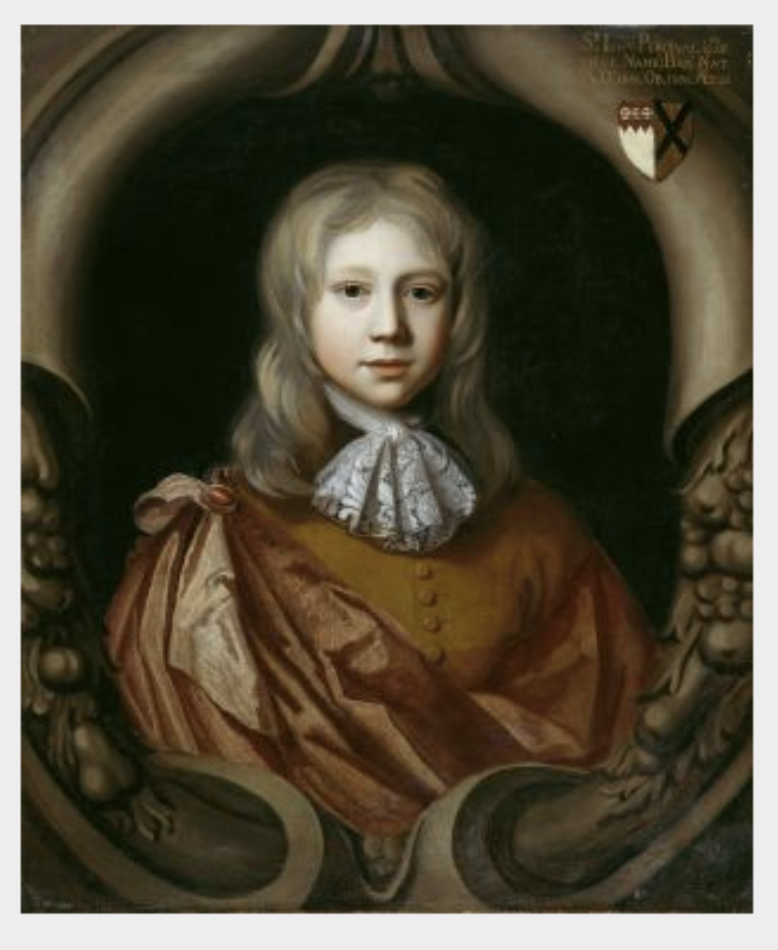
John Perceval, 3rd Bt (1660-1686) by Thomas Pooley, c. 1670-74, courtesy of National Gallery of Ireland NGI 4627.
John Perceval 3rd Bt, by John Faber Jr, National Portrait Gallery of London D29835.
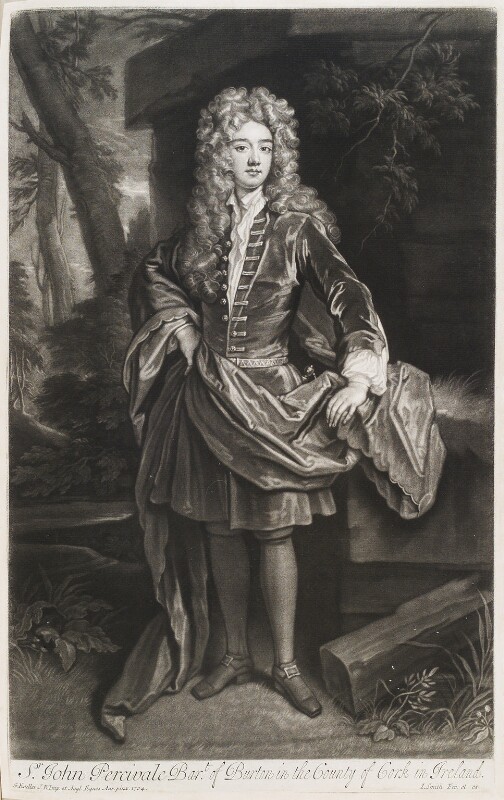
John Perceval (1683-1748) 1st Earl of Egmont, County Cork, by and published by John Smith, after Sir Godfrey Kneller 1704, National Portrait Gallery of England D11553.
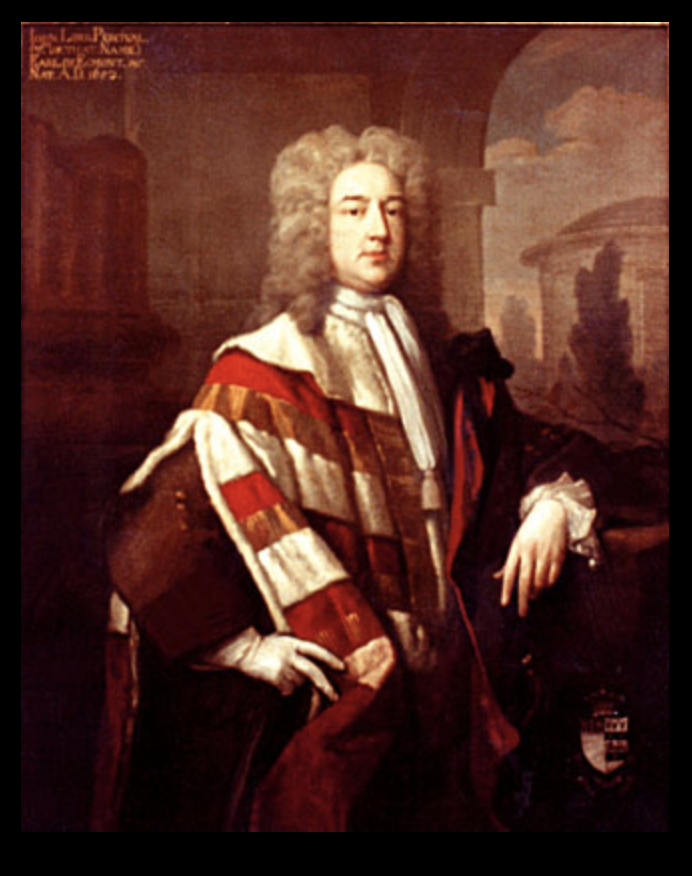
John Perceval, 1st Earl of Egmont (1683-1748) by Hans Hysing.
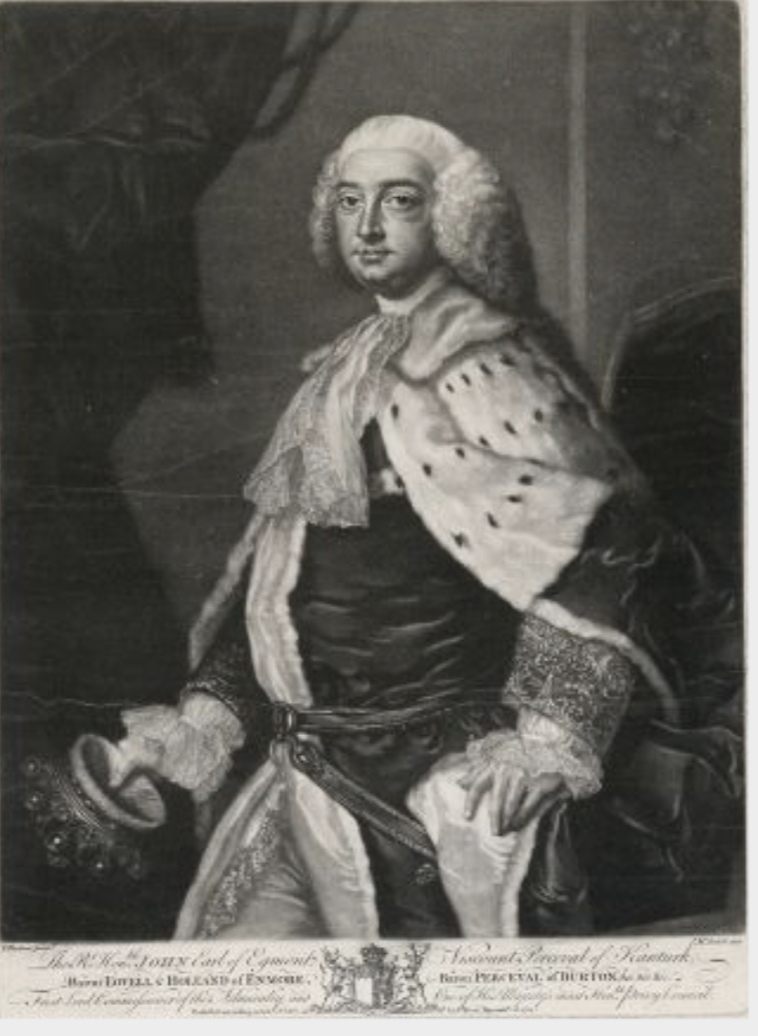
John Perceval, 2nd Earl of Egmont, (1711-1770) Date 1764 by Engraver James McArdell, Irish, c.1729-1765 After Thomas Hudson, English, 1701-1779.
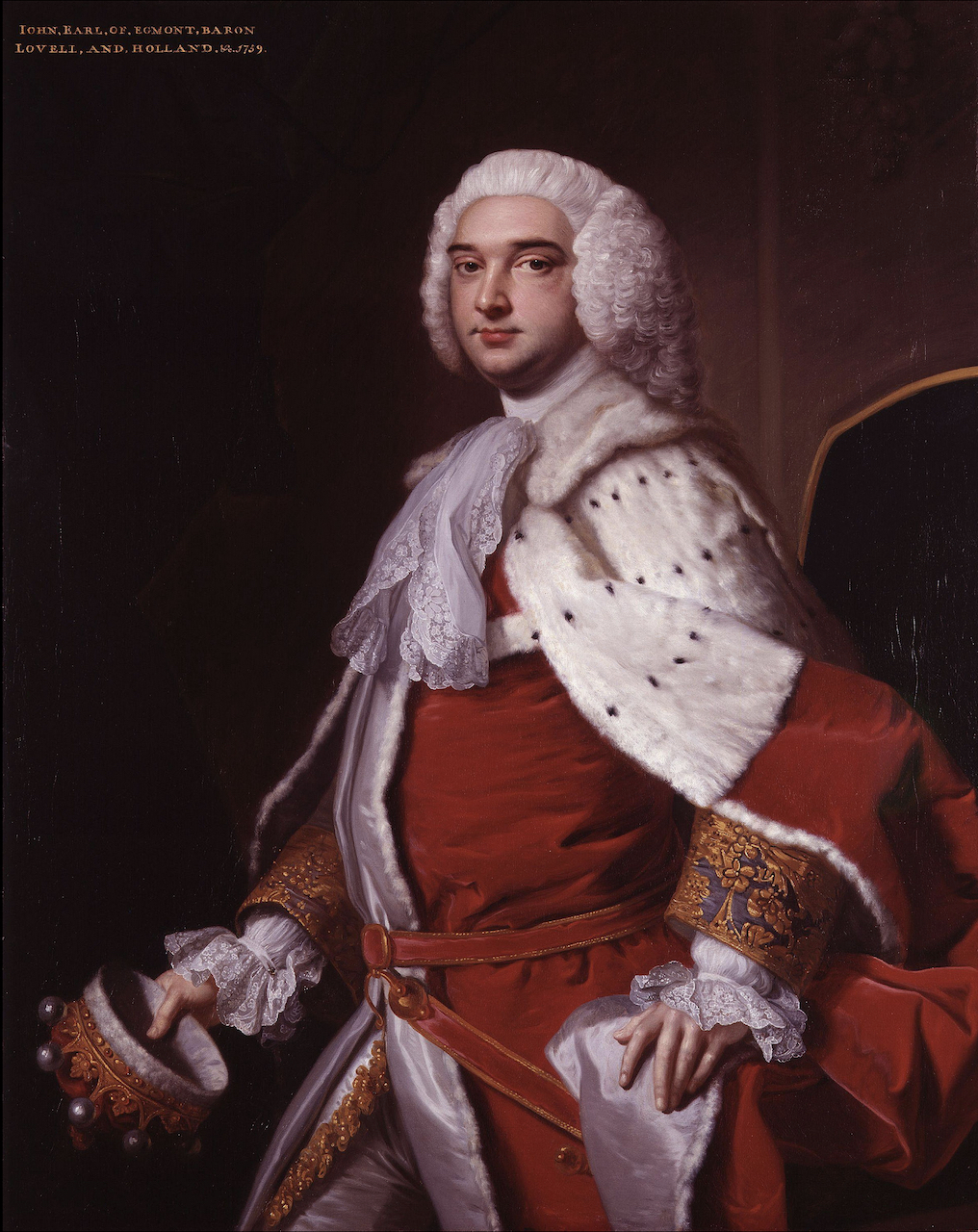
John Perceval (1711-1770) 2nd Earl of Egmont by Thomas Hudson.
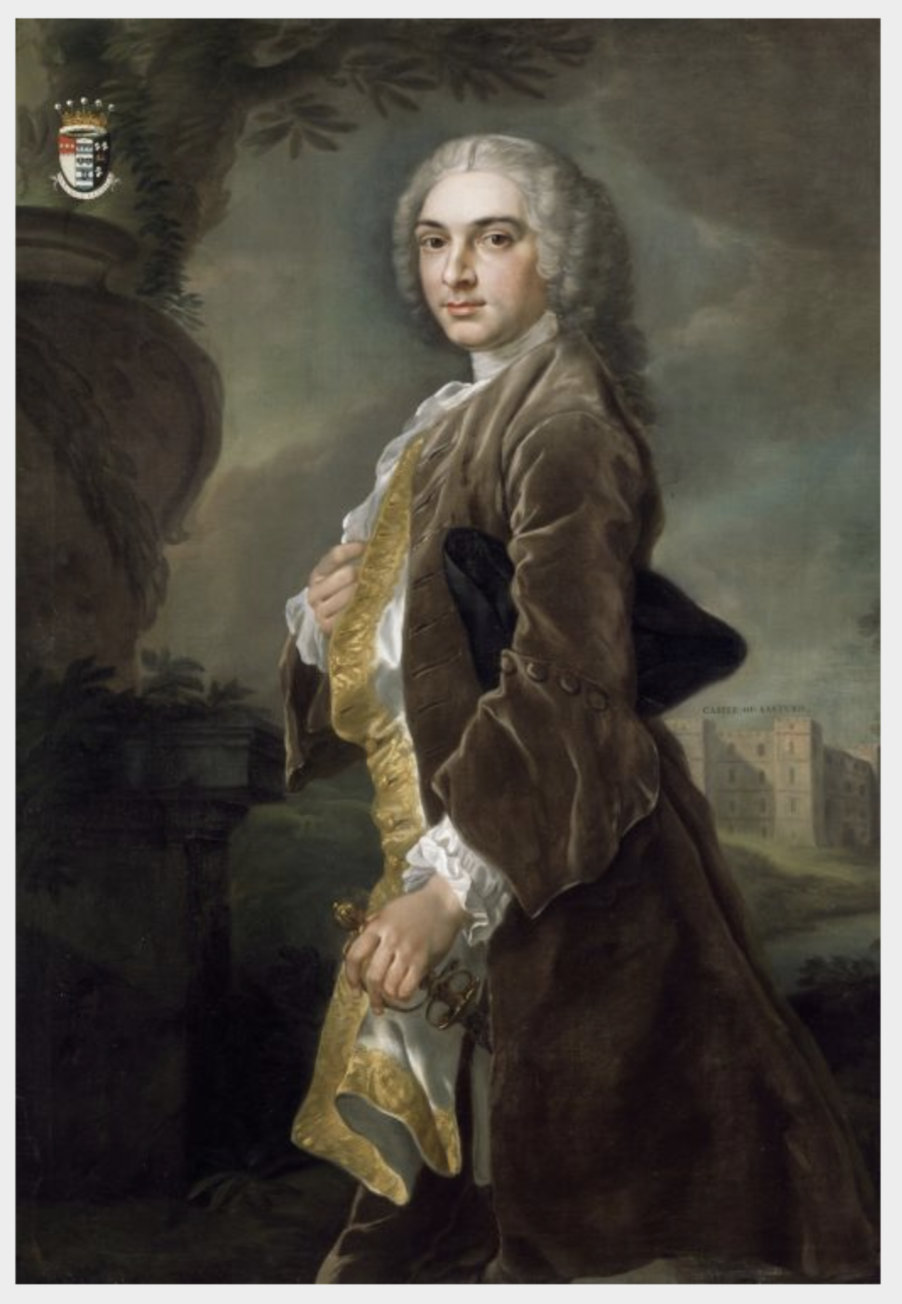
John Percival, later 2nd Earl of Egmont (1711-1770) by Francis Hayman c. 1740, courtesy of National Gallery of Ireland NGI 4489
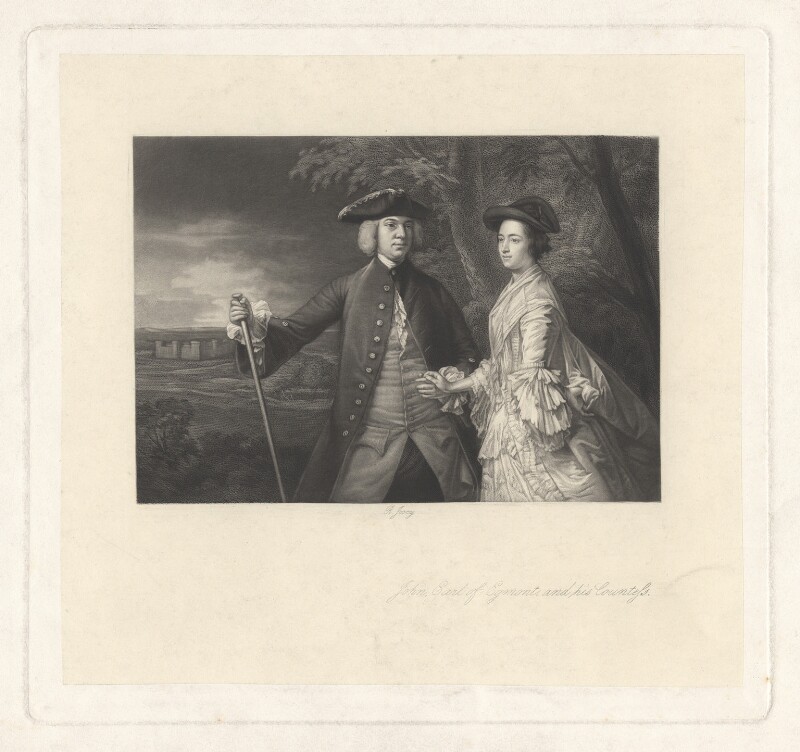
John Perceval, 2nd Earl of Egmont with Catherine Perceval (née Cecil), Countess of Egmont by Richard Josey, after Sir Joshua Reynolds mezzotint, 1876 (1756) National Portrait Gallery of London D1855.
Catherine Perceval (née Compton), Countess of Egmont; Charles George Perceval, 2nd Baron Arden by James Macardell, after Thomas Hudson mezzotint, published 1765, National Portrait Gallery of London D1829.
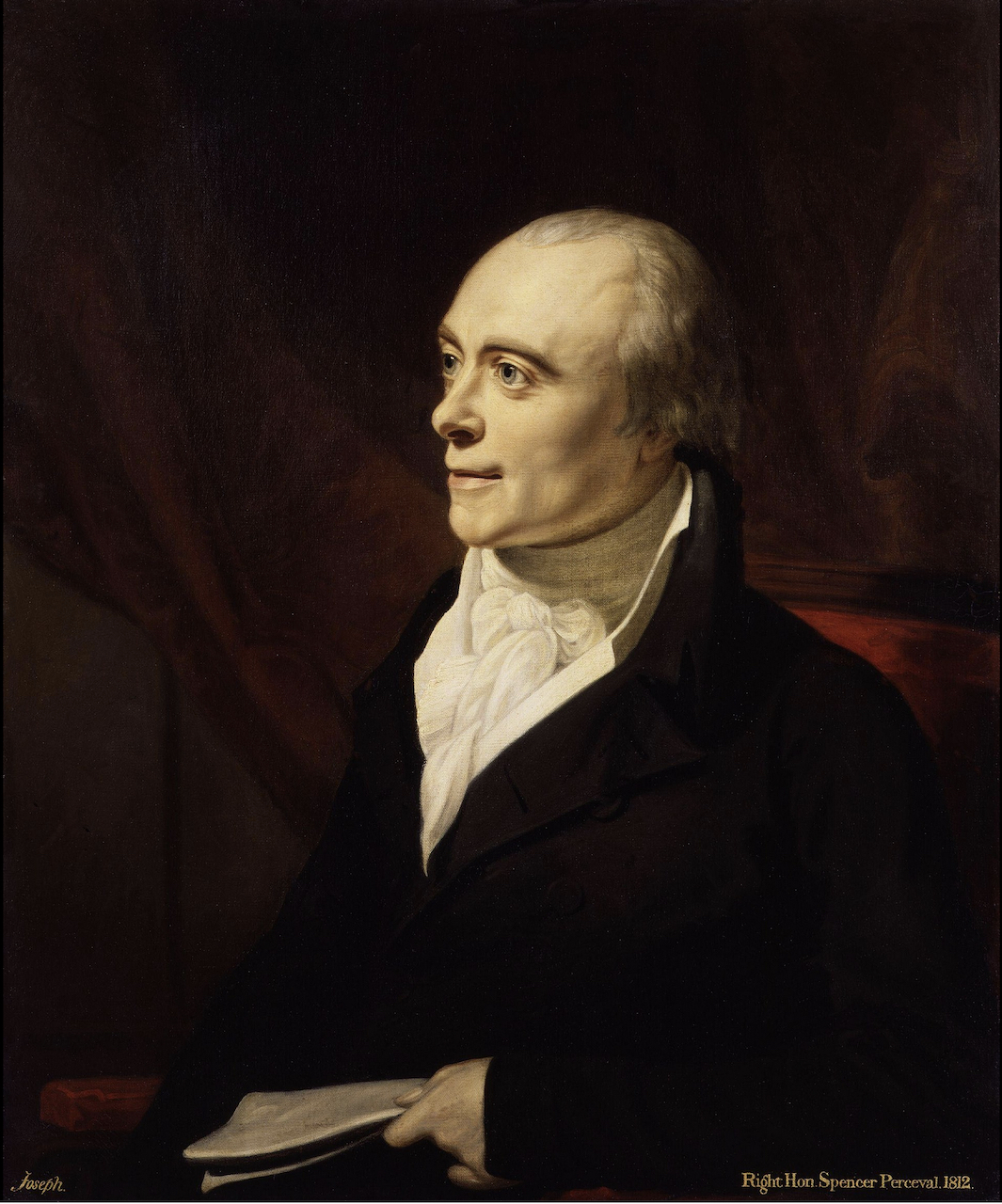
Spencer Perceval (d. 1812) by George Francis Joseph (died 1846), given to the National Portrait Gallery, London in 1857. He was the son of the 2nd Earl of Egmont, and served for a short time as Prime Minister of England.
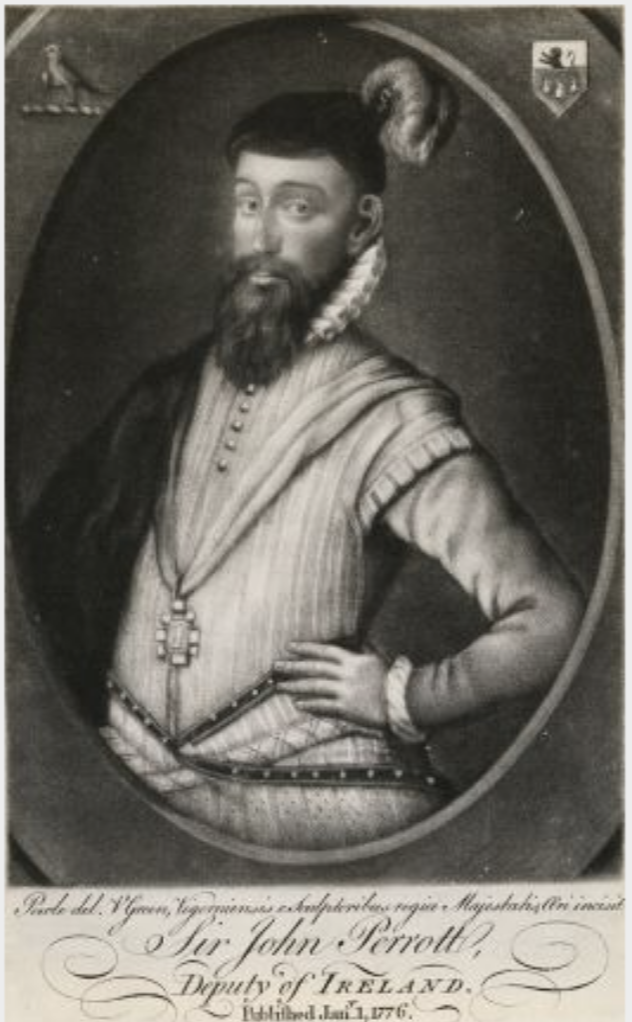
Sir John Perrot 1527-1592, said to be a son of King Henry VIII; soldier and Lord Deputy of Ireland, date 1776, engraver Valentine Green, English 1739-1813 copyist George Powle. His daughter Lettice (d. 1620) married Arthur Chichester 1st and last Baron Chichester of Belfast (b. 1563).
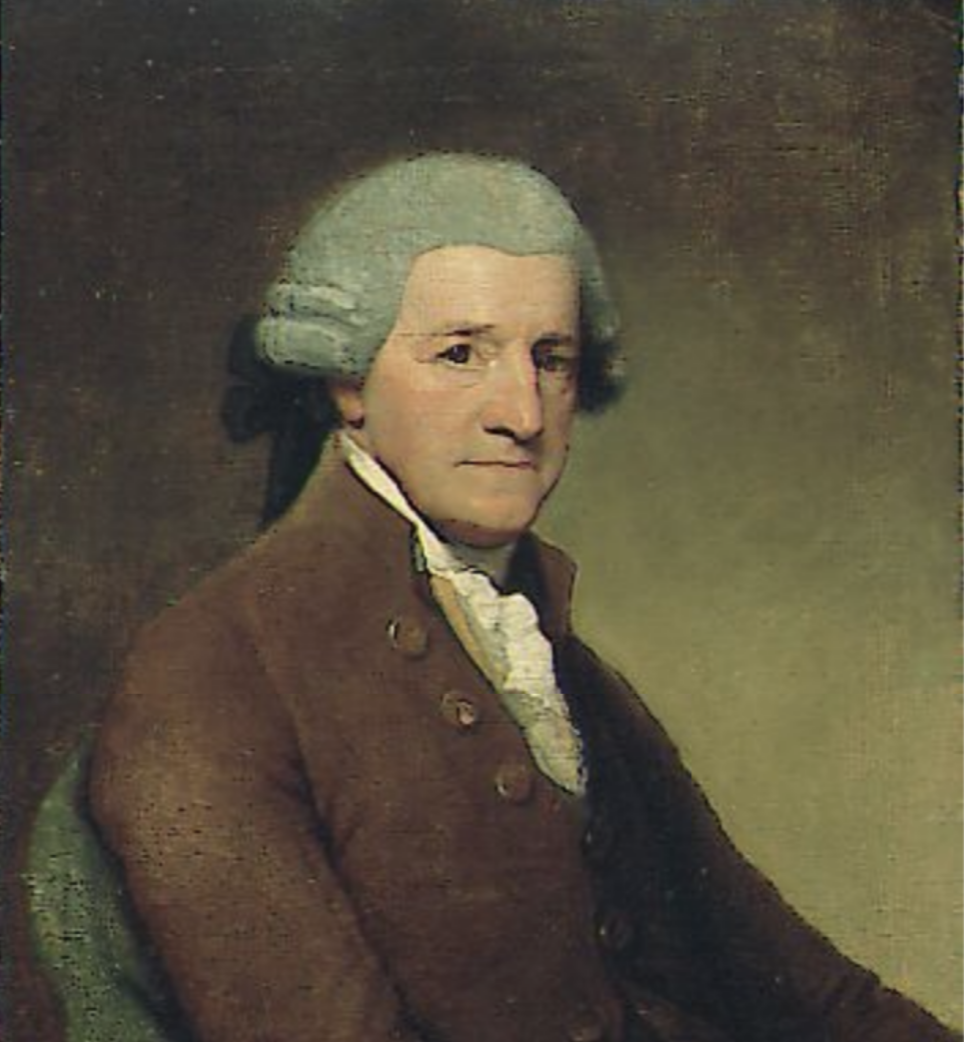
Edmond Sexton Pery, later 1st Viscount Pery (1719-1806) Date: c.1790 by Gilbert Stuart, American, 1755-1828.
William Petty (1623-1687) by Isaac Fuller circa 1651, National Portrait Gallery of London 2924.
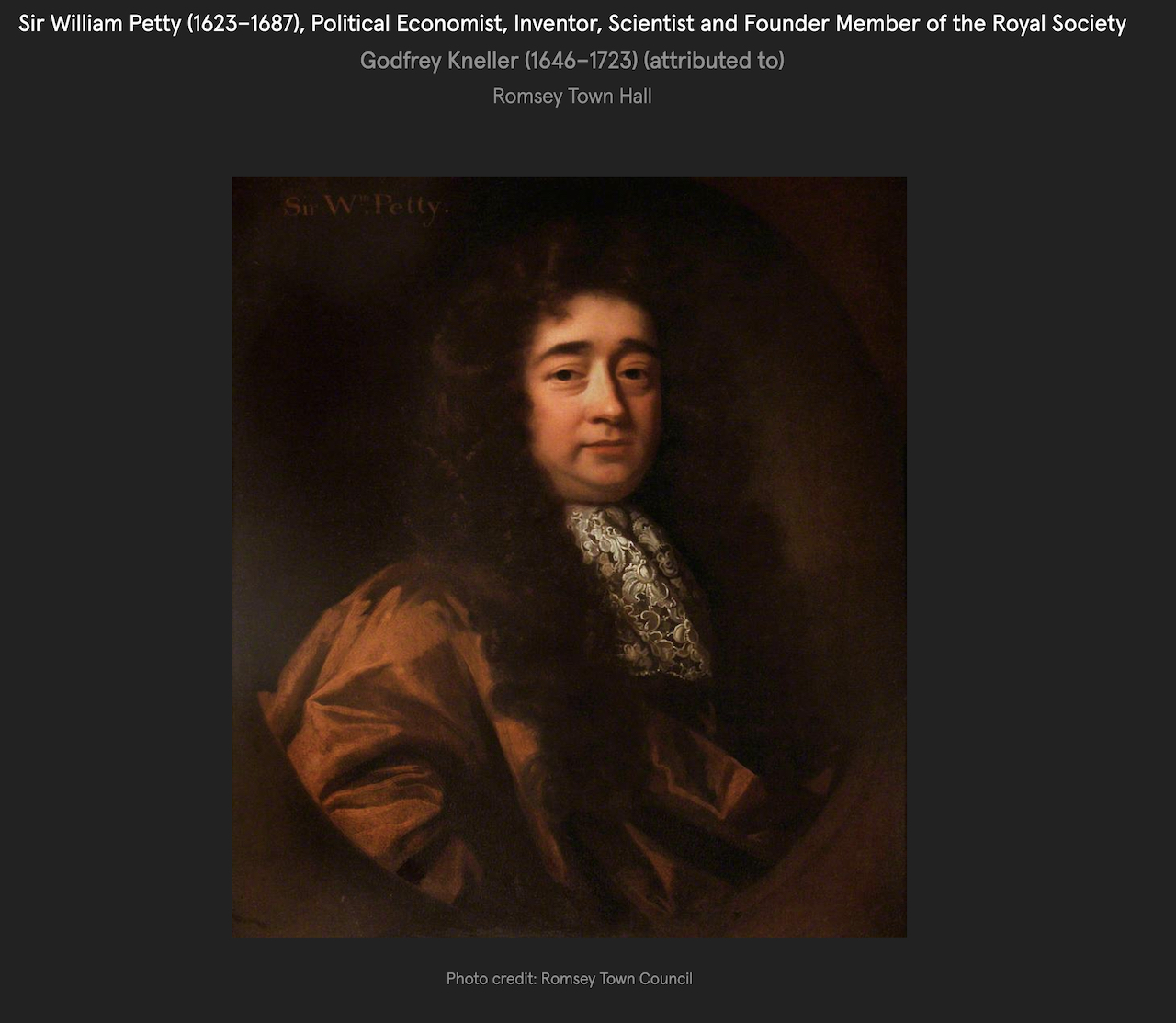
William Petty (1623-1687) by Godfrey Kneller courtesy of Romsey Town Hall.
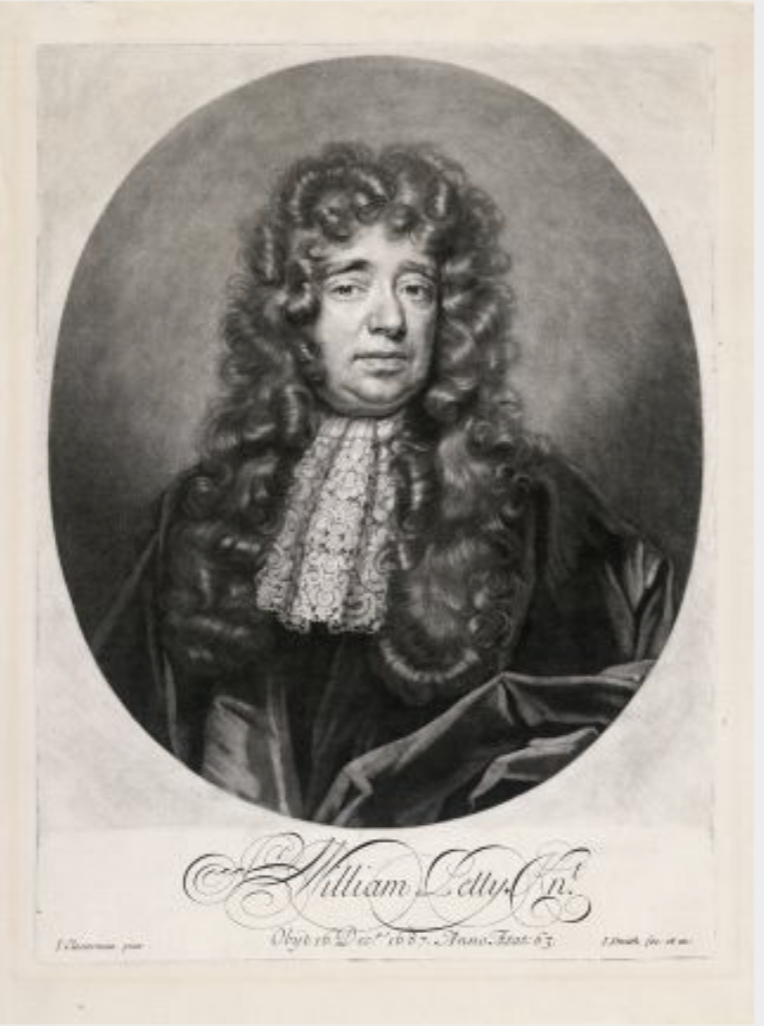
William Petty, (1623-1687), Physician in the Army in Ireland, Surveyor General and Political Economist Date: 1696, Engraver John Smith, English, 1652-1743 After John Baptist Closterman, German, c.1690-1713.
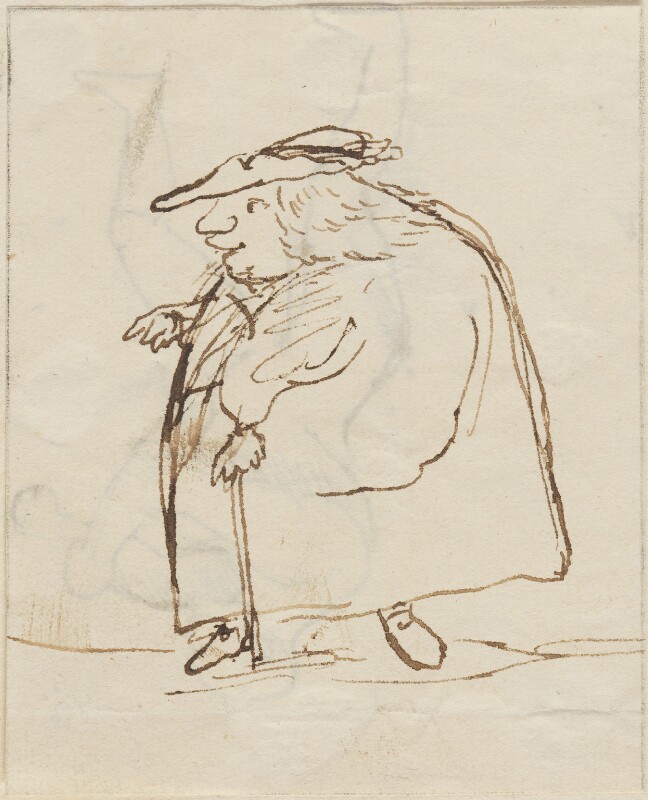
A sketch of Henry Petty (1675-1751) Earl of Shelburne by George Townshend, 4th Viscount and 1st Marquess Townshend National Portrait Gallery of London ref. 4855(15). He was the son of William Petty (1623-1687) and he married Arabella, daughter of Charles Boyle 2nd Baron Clifford of Lanesborough.

Thomas Fitzmaurice (1668-1741) 1st Earl of Kerry (21st Baron of Kerry), Viscount Clanmorris was the father of John Fitzmaurice Petty (1706-1761) 1st Earl of Shelburne, who added Petty to his name after his mother, Anne Petty (d. 1737). Another son of the 1st Earl of Kerry was his heir William FitzMaurice (1694-1747) who succeeded as 2nd Earl of Kerry.

William Petty (1737-1805) 1st Marquess of Lansdowne Lord Shelburne, Prime Minister, after Sir Joshua Reynolds based on a work of 1766, National Portrait Gallery of London 43. He was the son of John Fitzmaurice Petty (1706-1761) 1st Earl of Shelburne, who was the son of Thomas Fitzmaurice 1st Earl of Kerry (21st Baron of Kerry), Viscount Clanmorris
Louisa Lansdowne née Fitzpatrick, wife of William Petty 1st Marquess of Lansdowne by Joshua Reynolds from Catalogue of the pictures and drawings in the National loan exhibition, in aid of National gallery funds, Grafton Galleries, London. She was a daughter of John FitzPatrick 1st Earl of Upper Ossory.
John Henry Petty (1765-1809) 2nd Marquess of Lansdowne National Portrait Gallery of London ref. D37171.
John Henry Petty (1765-1809), 2nd Marquis of Lansdowne by Francois-Xavier Fabre, 1795.
Henry Petty-Fitzmaurice (1780-1863) 3rd Marquess of Lansdowne, Trustee of the National Portrait Gallery, by Henry Walton circa 1805 courtesy of National Portrait Gallery, NPG 178.
Henry Thomas Petty-Fitzmaurice (1816-1866) 4th Marquess of Lansdowne, Politician and railway company chairman, photograph by by John & Charles Watkins circa early 1860s, courtesy of National Portrait Gallery NPG Ax16422.
Henry Charles Keith Petty-Fitzmaurice 5th Marquess of Lansdowne by Philip Alexius de László.
Beatrix Frances Duchess of St Albans, Maud Evelyn Petty-Fitzmaurice, Marchioness of Lansdowne (wife of 5th Marquess), Theresa Susey Helen Vane-Tempest-Stewart, Marchioness of Londonderry and Evelyn Emily Mary Cavendish, Duchess of Devonshire, by Frederick & Richard Speaight.
Mrs Letitia Pilkington (née Van Lewen), (1712-1750), “Adventuress” and Author Date: c.1760 Engraver: Richard Purcell, Irish, c.1736-c.1766 After Nathaniel Hone the Elder, Irish, 1718-1784.
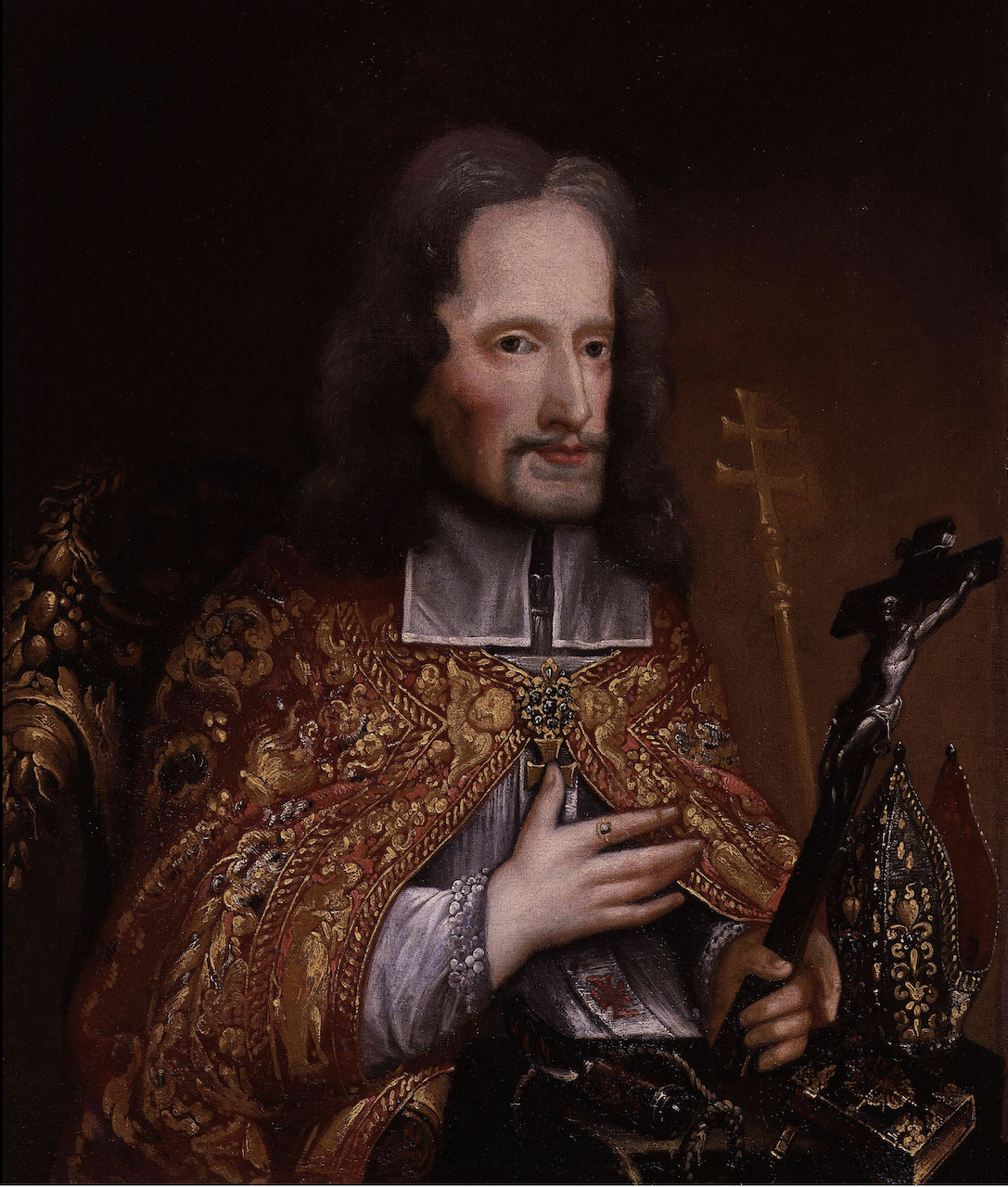
Oliver Plunket, by Edward Luttrell courtesy of National Portrait Gallery London.
Called Frances Hales, Countess of Fingall, possibly Margaret MacCarty later Countess of Fingall, wife of Luke Plunkett (1639-1685) 3rd Earl of Fingall, by Simon Pietersz Verelst courtesy of National Trust Hatchlands. Margaret was daughter of Donough MacCarty (or MacCarthy) 1st Earl of Clancarty; 2nd Viscount Muskerry. Frances Hales married Peter Plunkett (1678-1717) 4th Earl of Fingall.
Arthur James Plunkett (1759-1836) 8th Earl of Fingall by Charles Turner after Joseph Del Vechio NPG D36923.
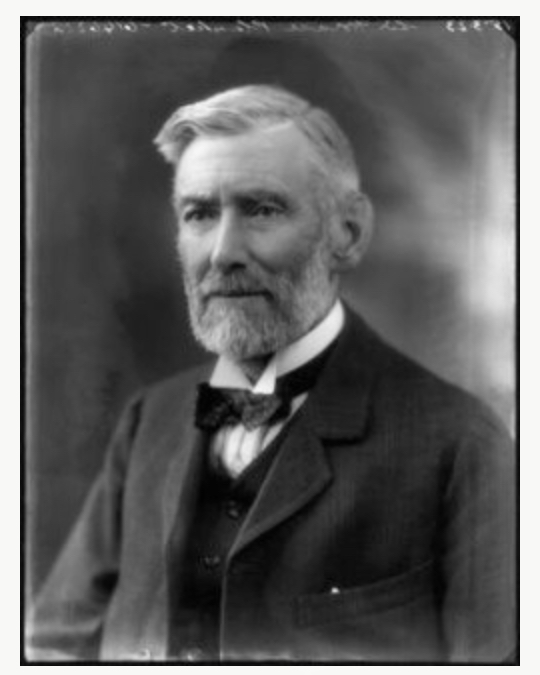
Horace Plunkett by photographer Bassano Ltd, 1923, courtesy of National Portrait Gallery of London, reference NPGx12783.
William Conyngham Plunket, 1st Baron Plunket, (1764-1854), Orator and former Lord Chancellor of Ireland Engraver David Lucas, British, 1802-1881 After Richard Rothwell, Irish, 1800-1868.
Marble bust of William Plunket, 1st Baron Plunket (1764-1854), Lord Chancellor of Ireland, by CHRISTOPHER MOORE RHA (1790 – 1863), courtesy of Adams auction 19 Oct 2021.
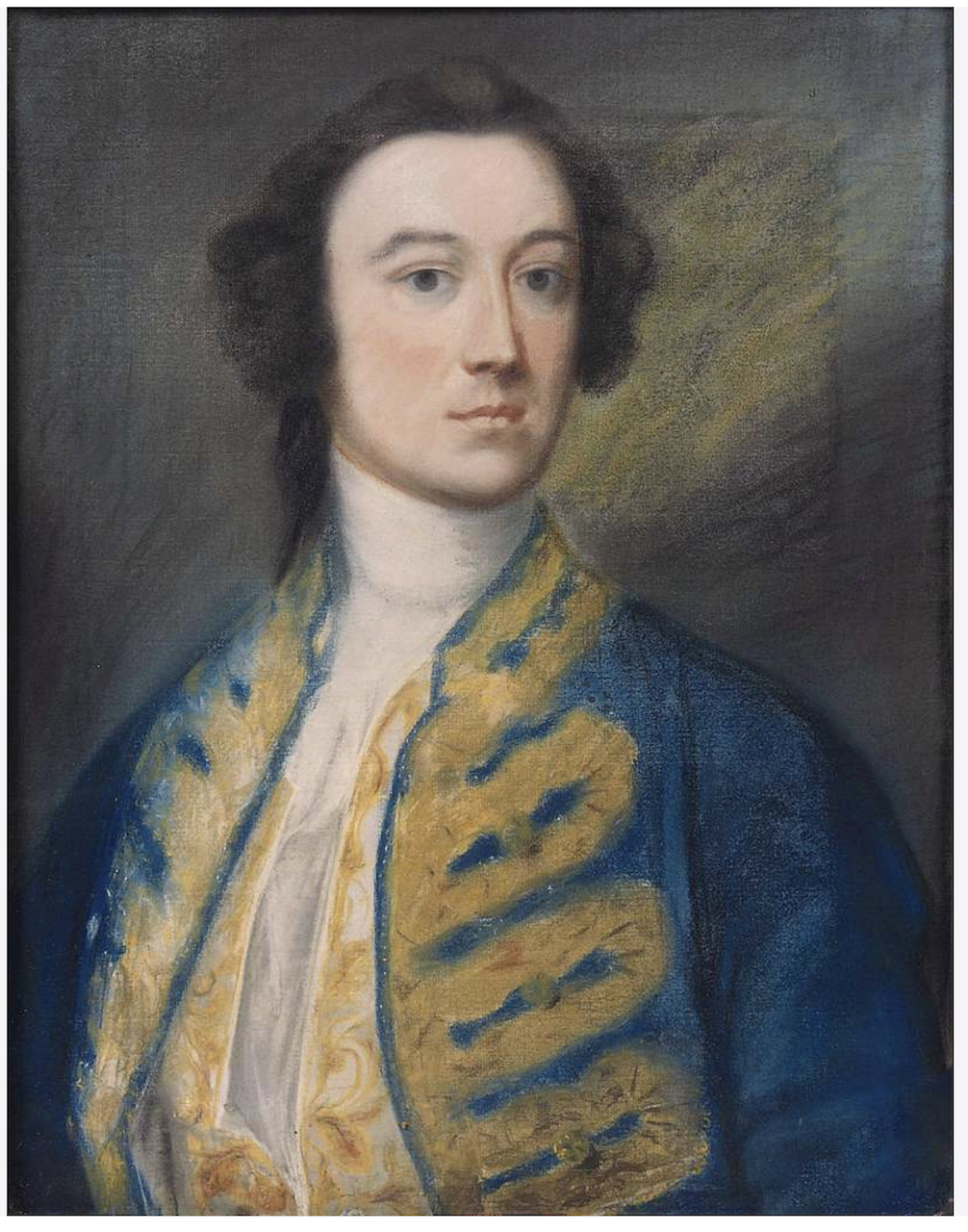
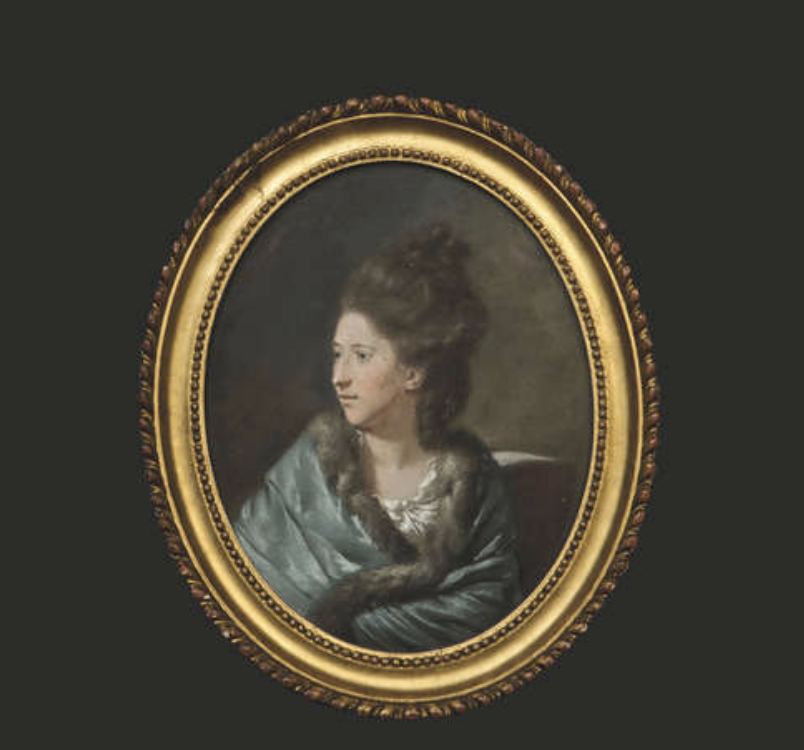
William Pole of Ballyfin (d. 1781), English school of 18th century, pastel, courtesy of Christies auction, wikimedia commons. He married Sarah Moore, daughter of the 5th Earl of Drogheda.

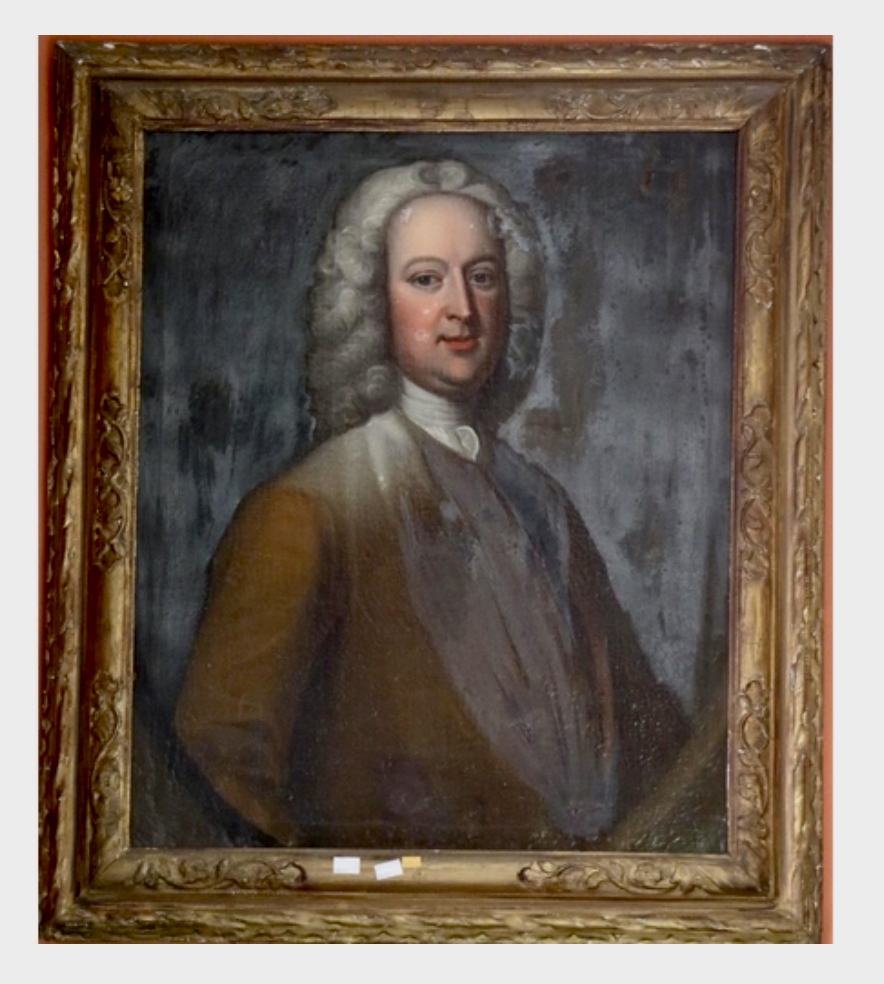
Brabazon Ponsonby (1679-1758) 1st Earl of Bessborough, 2nd Viscount Duncannon, of the fort of Duncannon, Co. Wexford married Sarah Margetson. Their daughter Sarah (d. 1736/37) married Edward Moore, 5th Earl of Drogheda. Their daughter Anne married Benjamin Burton of Burton Hall, County Carlow. Their daughter Letitia (d. 1754) married Hervey Morres, 1st Viscount Mountmorres. Their son William Ponsonby (1704-1793) succeeded as 2nd Earl of Bessborough and a younger son, John (1713-1787) married Elizabeth, daughter of William Cavendish 3rd Duke of Devonshire.

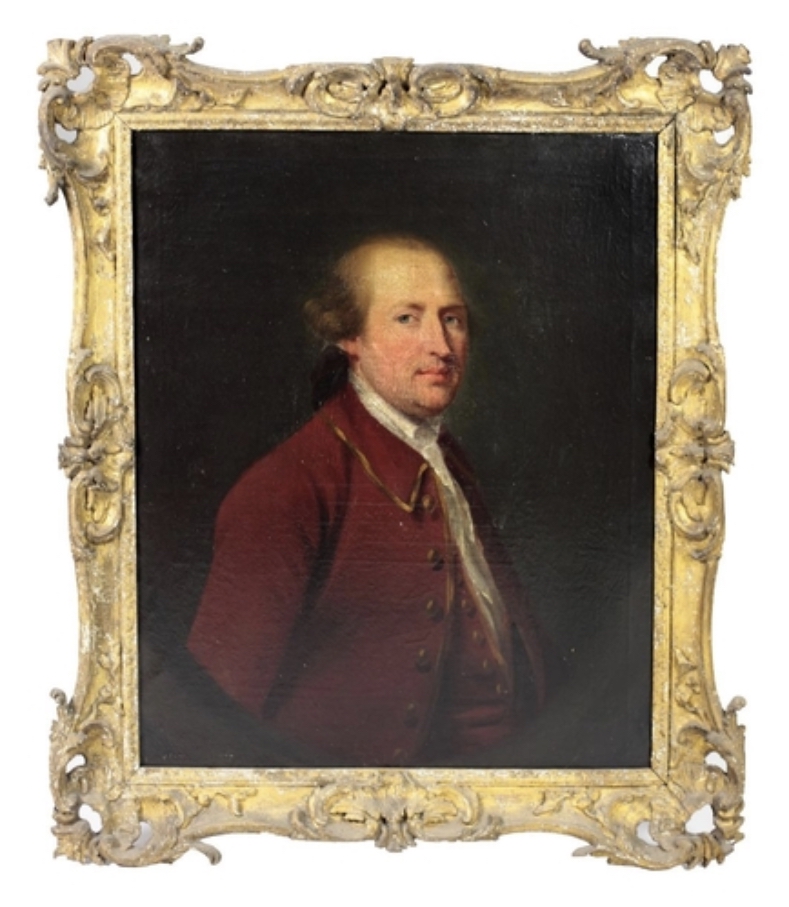
John Ponsonby (1713 – 1787) by Hugh Douglas Hamilton, courtesy of The Library Collection auction 26 April 2023 at Adams. He was Speaker of the Irish House of Commons. He was the son of Brabazon Ponsonby (1679-1758) 1st Earl of Bessborough, 2nd Viscount Duncannon, of the fort of Duncannon, Co. Wexford. He married Elizabeth, daughter of William Cavendish 3rd Duke of Devonshire.
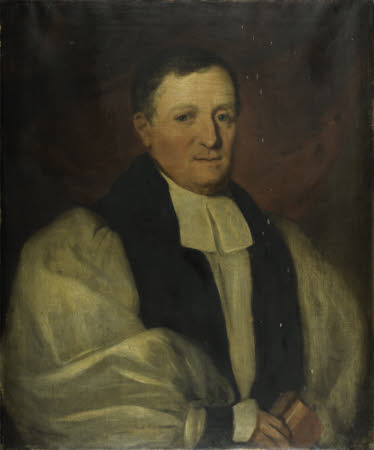
The Hon. Richard Ponsonby (1772-1853), Bishop of Derry and Raphoe, British (English) School, circa 1830. A half-length portrait of a man, known as “handsome Dick Ponsonby”, turned go the right, gazing at the spectator, wearing surplice and white bands. He was a son of William Brabazon Ponsonby, 1st Baron Ponsonby of Imokilly (1744-1806) who was a son of John Ponsonby (1713 – 1787). Courtesy of National Trust images
William Ponsonby, 2nd Earl of Bessborough, (1705-1793), observing a copy of the Borghese Vase Date 1794 by Engraver Robert Dunkarton, English, 1744-1811 After John Singleton Copley, American, 1738-1815.
Oil painting on canvas, William Ponsonby, 2nd Earl of Bessborough (1704-1793), attributed to Jeremiah Davison (Scotland c.1695 ? London after 1750) or George Knapton (London 1698 ? Kensington 1778), circa 1743/50. Oval, half-length portrait, turned slightly to the left, gazing at spectator, wearing oriental costume, composed of a red tunic, blue cloak edged with white fur and a red and white turban. Courtesy of National Trust Hardwick House. He married Caroline Cavendish, daughter of 3rd Duke of Devonshire.
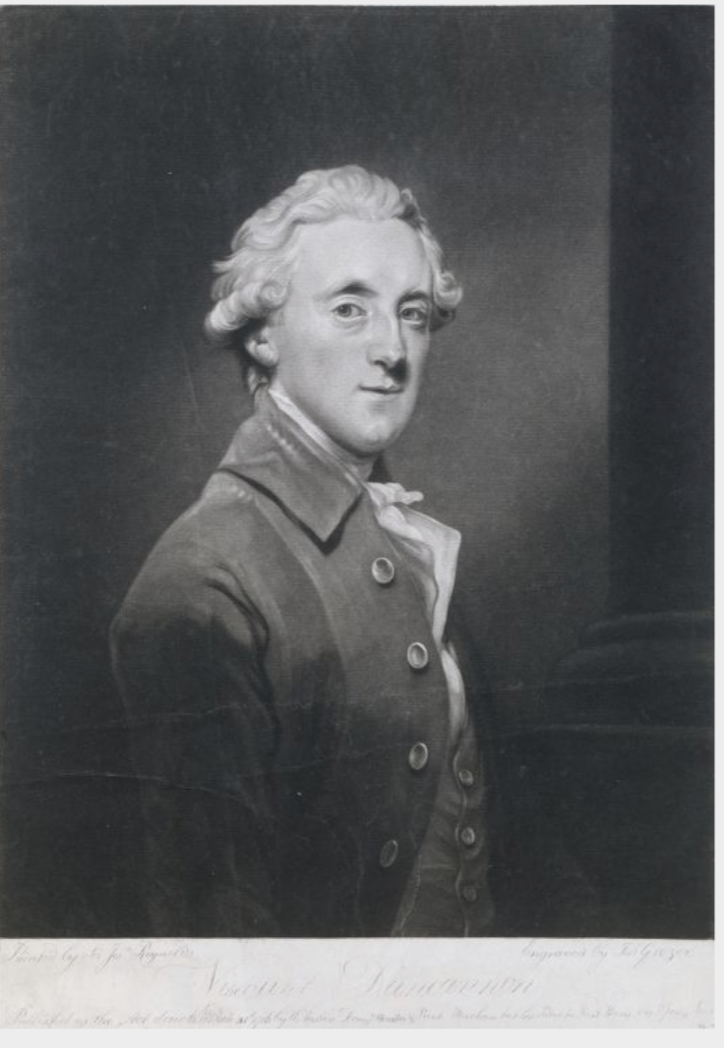
Frederick Ponsonby, Viscount Duncannon, (1758-1844), later 3rd Earl of Bessborough Date 1786, Engraver Joseph Grozer, British, fl.1784-1797 After Joshua Reynolds, English, 1723-1792.
Lady Caroline Lamb née Ponsonby (1785-1828) by Eliza H. Trotter, NPG 3312. She was the daughter of the 3rd Earl of Bessborough.
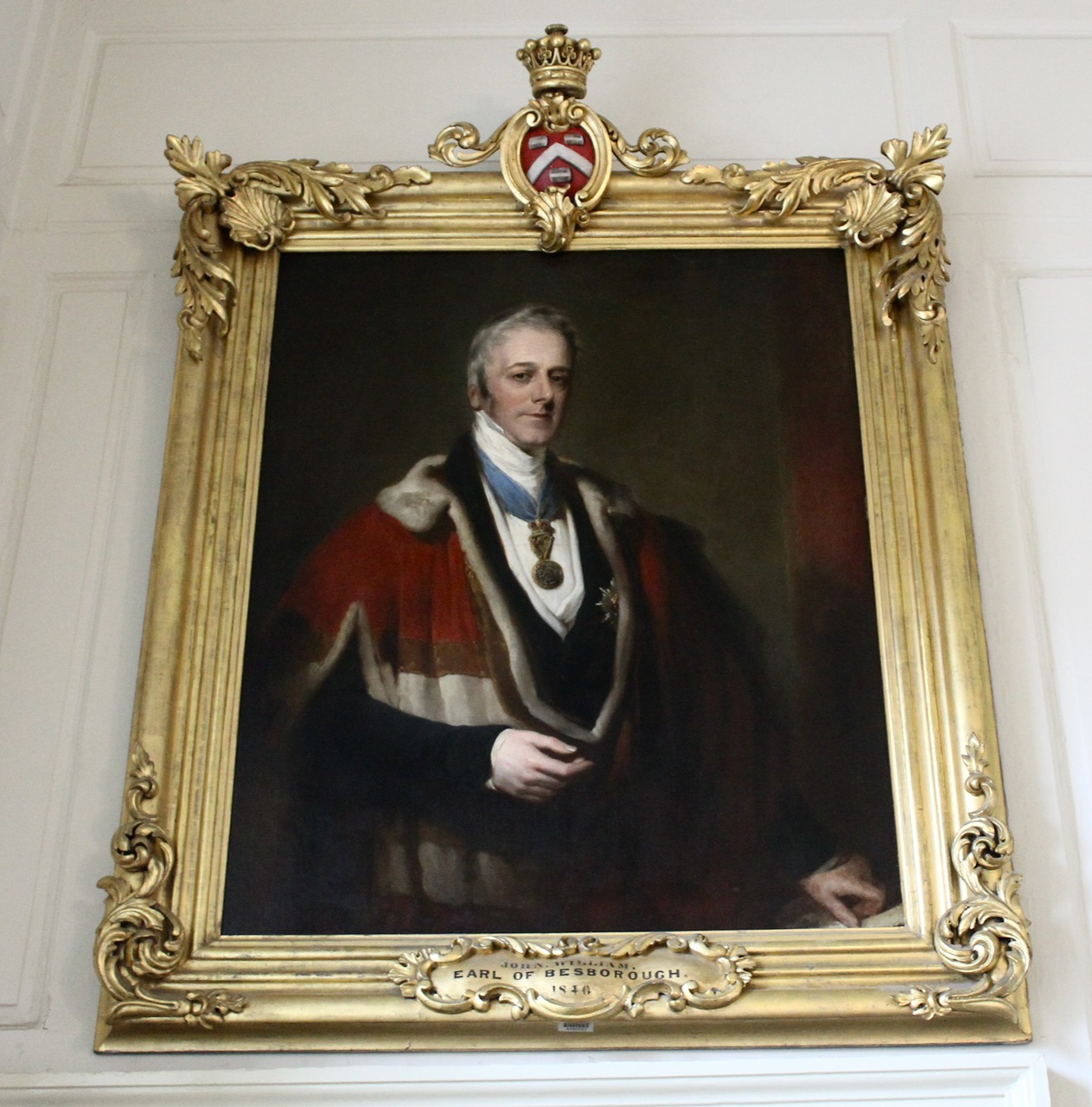
John William Brabazon Ponsonby (1781-1847) 4th Earl of Bessborough, County Kilkenny. Photograph © Jennifer Winder-Baggot, www.irishhistorichouses.com
George Portis (d. 1760), who married Mary Ratcliffe, courtesy of Fonsie Mealy auction.
George M. Portis (b. 10th Nov 1729), Collector of Belfast, by Stephen Slaughter, courtesy of Fonsie Mealy auction.
Isabella Maria Portis (1741-1806), daughter of George and Mary, by Stephen Slaughter, courtesy of Fonsie Mealy auction.
Marguerite née Power, Countess of Blessington. Marguerite (1789-1849) was daughter of Edmund Power, and she married first Maurice St. Leger Farmer, and secondly, Charles John Gardiner, 1st and last Earl of Blessington, son of Luke Gardiner, 1st Viscount Mountjoy. She wrote the book Confessions of an Elderly Gentleman, published 1836, and The Idler in Italy, published between 1839 and 1840, in three volumes. Photograph © Jennifer Winder-Baggot, www.irishhistorichouses.com
Mervyn Pratt (1807-1890), husband of Madeline Jackson, of Enniscoe, County Mayo. Photograph © Jennifer Winder-Baggot, www.irishhistorichouses.com
Mary Preston youngest daughter of the Hon. Henry Hamilton, by Hugh Douglas Hamilton Adam’s auction 20 Sept 2015. Mary Hamilton married in 1764 (as his second wife) the second Nathaniel Preston (1724-1796), Reverend, of Swainstown, Co. Meath. Her father was a younger son of Gustavus Hamilton 1st Viscount Boyne of Stackallan, Co. Meath and her parents were intimate with Mrs Delaney who of them said – “I never saw a couple better suited than Mr Hamilton and his wife, their house like themselves looks cheerful and neat…., they have four children, whose behaviour shows the sense of their parents”. Mary’s brother, Sackville Hamilton became a competent and respected Civil Servant.
Lucretia (1804-1891) Viscountess Gormanston, daughter of William Jerningham, wife of Edward Anthony John Preston 13th Viscount Gormanston courtesy of Adam’s auction 12 Oct 2014.
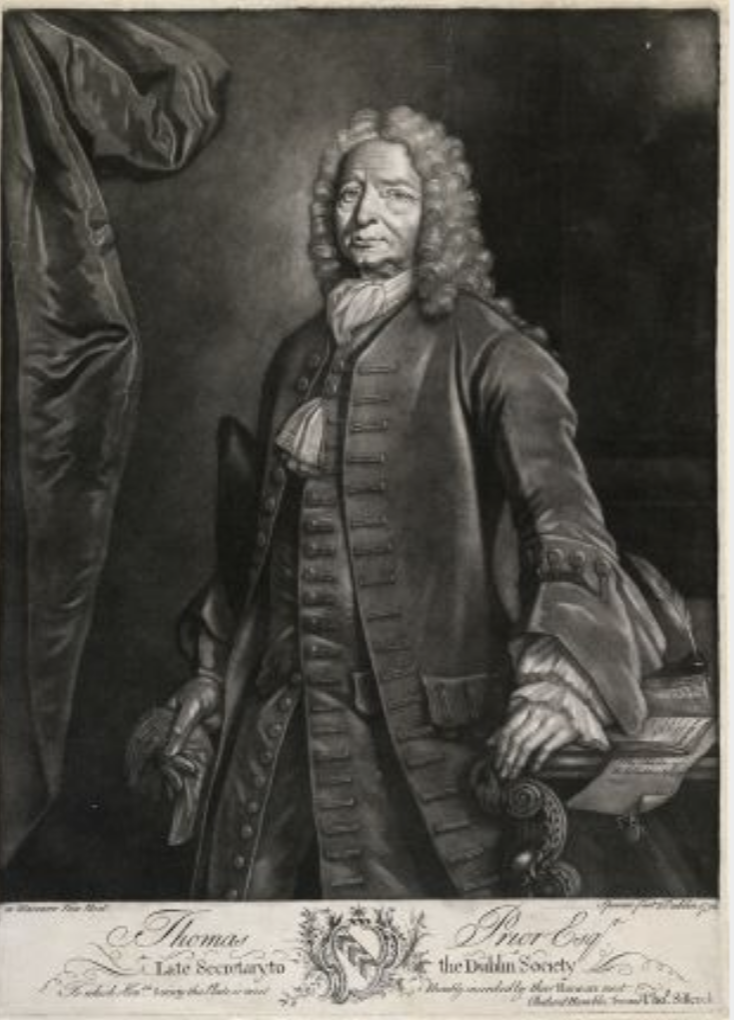
Thomas Prior (1682-1751), Founding Member and Secretary to the Dublin Society, Engraver Charles Spooner, Irish, c.1720-1767 After John van Nost the Younger, Flemish, c.1710 – 1780.
Henry Prittie, 1st Baron Dunalley (1743-1801), Irish school, courtesy of Christie’s.
Henry Prittie, 3rd Baron Dunalley (1807-1885) by Stephen Catterson Smith courtesy of Christie’s 2013.
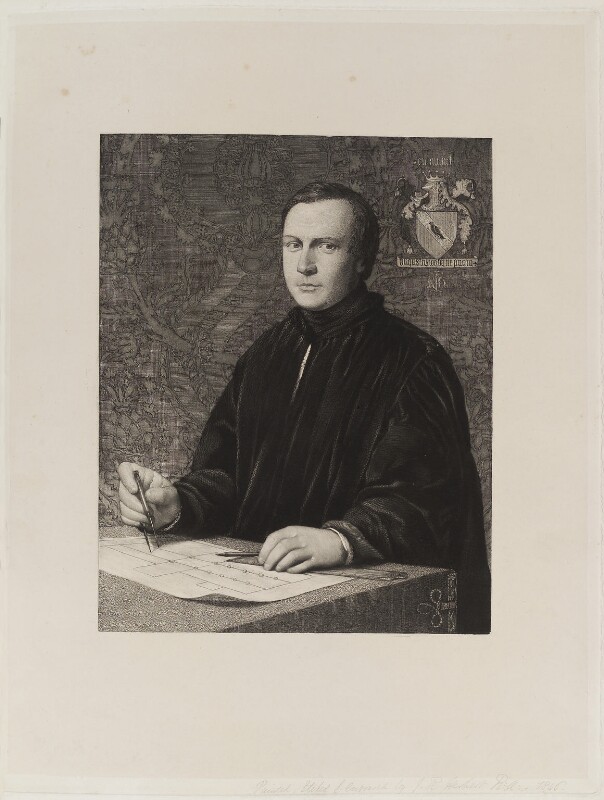
Augustus Welby Northmore Pugin (1812-1852) by James Henry Lynch, after John Rogers Herbert NPG D20474.

Bessborough, Piltown, Co Kilkenny (Kidalton College) 

Bessborough, Piltown, Co Kilkenny (Kidalton College) 

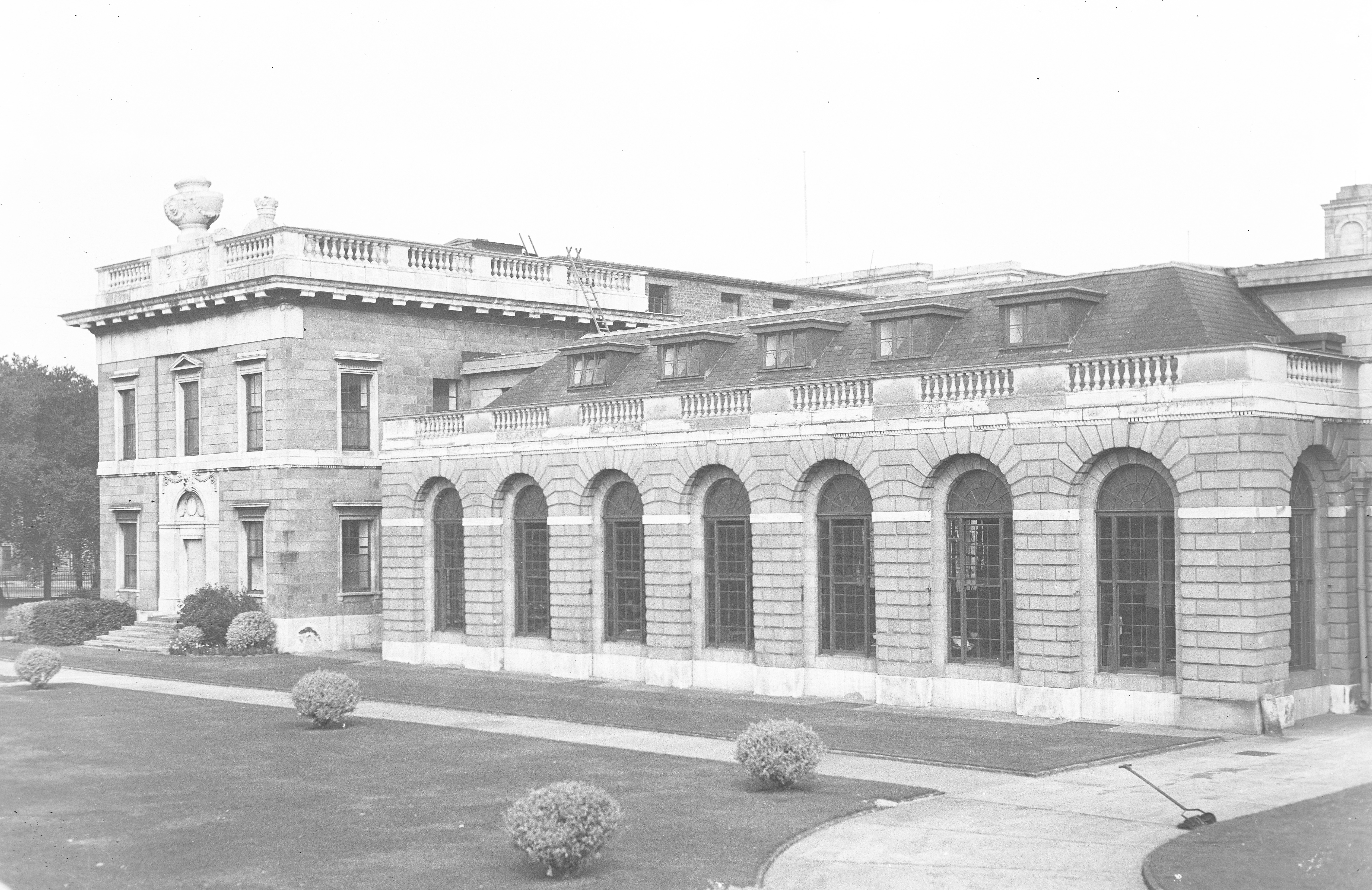
Bessborough, County Kilkenny, now Kidalton College, courtesy National Inventory.

Mark Bence-Jones. A Guide to Irish Country Houses (originally published as Burke’s Guide to Country Houses volume 1 Ireland by Burke’s Peerage Ltd. 1978); Revised edition 1988 Constable and Company Ltd, London. 

“(Ponsonby, Bessborough, E/PB) A large house by Francis Bindon, consisting of a centre block of two storeys over basement joined to two storey wings by curved sweeps. Built 1744 for Brabazon Ponsonby, 1st Earl of Bessborough, replacing an earlier house; the “Bess” in whose honour the estate received its name – which was singled out by Swift in his scornful attack on the custom of naming houses and estates after peoples’ wives – having been the wife of a seventeenth century Ponsonby. Entrance front of nine bays; three bay pedimented breakfont with niche above pedimented Doric doorway; balustraded roof parapet with urns; rusticated basement; perron and double stairway with ironwork railings in front of entrance door. Ingeniously contrived Gibbsian doorways in the curved sweeps, their pediments being above the cornice; niches on either side of them. Six bay garden front with four bay breakfront; Venetian windows in upper storey above round-headed windows. Later wing at side. Hall with screen of Ionic columns of Kilkenny marble, their shafts being monolithic. Saloon with ceiling of rococo plasterwork and chimneypieces with female herms copied from William Kent. The entrance front, never a very inspired composition, was not improved by the removal of the perron and substitution of a porch at basement level early in the present century, so as to enable the hall to be used as a sitting room; the architect of this work being Sir Thomas M. Deane. The house was burnt 1923. It was afterwards rebuilt to the design of H.S. Goodhart-Rendel; but in the end the family never went back to live in it, and it stood empty until it was sold in 1944. It now belongs to a religious order, and has been added to and altered; the urns have been removed from the parapet and are now at Belline.” 

John Ponsonby (1713 – 1787) by Hugh Douglas Hamilton, courtesy of The Library Collection auction 26 April 2023 at Adams. He was Speaker of the Irish House of Commons. He was the son of Brabazon Ponsonby (1679-1758) 1st Earl of Bessborough, 2nd Viscount Duncannon, of the fort of Duncannon, Co. Wexford. He married Elizabeth, daughter of William Cavendish 3rd Duke of Devonshire.

For more on John Ponsonby (1713-1787), Speaker of the House, of Bessborough, see Melanie Hayes, The Best Address in Town: Henrietta Street, Dublin and its First Residents, 1720-80

Oil painting on canvas, William Ponsonby, 2nd Earl of Bessborough (1704-1793), attributed to Jeremiah Davison (Scotland c.1695 ? London after 1750) or George Knapton (London 1698 ? Kensington 1778), circa 1743/50. Oval, half-length portrait, turned slightly to the left, gazing at spectator, wearing oriental costume, composed of a red tunic, blue cloak edged with white fur and a red and white turban. Courtesy of National Trust Hardwick House. He married Caroline Cavendish, daughter of 3rd Duke of Devonshire.
William Ponsonby, 2nd Earl of Bessborough, (1705-1793), observing a copy of the Borghese Vase Date 1794 by Engraver Robert Dunkarton, English, 1744-1811 After John Singleton Copley, American, 1738-1815.
Frederick Ponsonby, Viscount Duncannon, (1758-1844), later 3rd Earl of Bessborough Date 1786, Engraver Joseph Grozer, British, fl.1784-1797 After Joshua Reynolds, English, 1723-1792.
The Hon. Richard Ponsonby (1772-1853), Bishop of Derry and Raphoe, British (English) School, circa 1830. A half-length portrait of a man, known as “handsome Dick Ponsonby”, turned go the right, gazing at the spectator, wearing surplice and white bands. He was a son of William Brabazon Ponsonby, 1st Baron Ponsonby of Imokilly (1744-1806) who was a son of John Ponsonby (1713 – 1787). Courtesy of National Trust images
Lady Caroline Lamb née Ponsonby (1785-1828) by Eliza H. Trotter, NPG 3312. She was a daughter of the 3rd Earl, and she married William Lamb, 2nd Viscount Melbourne.
John William Brabazon Ponsonby (1781-1847) 4th Earl of Bessborough, County Kilkenny.
Bessborough, County Kilkenny, now Kidalton College, courtesy National Inventory.

https://www.buildingsofireland.ie/buildings-search/building/12325001/bessborough-house-kildalton-college-kildalton-piltown-co-kilkenny

Bessborough, County Kilkenny, now Kidalton College, courtesy National Inventory.

Attached nine-bay two-storey over raised basement Classical-style country house with dormer attic, built 1744-55, originally detached on a symmetrical plan with three-bay full-height pedimented breakfront, four-bay three-storey side elevations having two-bay full-height breakfronts, and six-bay three-storey Garden (south) Front having four-bay three-storey breakfront. Renovated, pre-1899, with three-bay single-storey flat-roofed projecting porch added to centre ground floor. Burnt, 1923. Reconstructed, 1929, to accommodate use as convent. Converted to use as agricultural college, post-1944. Hipped slate roofs on a quadrangular plan behind parapet with clay and rolled lead ridge tiles, cut-limestone chimney stacks (some on axis with ridge), lead-lined shallow barrel roofs to dormer attic windows, and cast-iron rainwater goods. Flat roof to porch not visible behind parapet. Limestone ashlar walls with rustication to ground floor (including to porch having piers supporting frieze, cornice, and balustraded parapet with urns on pedestals), stringcourse over, stringcourse to second floor, round-headed recessed niche to centre top floor breakfront with cut-limestone surround framing statuary, carved (moulded) surround to pediment, and carved (moulded) cornice supporting balustraded parapet. Square-headed window openings with cut-limestone sills, rusticated voussoirs to ground floor, carved surrounds to upper floors, and six-over-six timber sash windows. Square-headed opening (original door opening) to centre first floor breakfront with limestone ashlar pedimented Doric surround, and glazed timber double doors. Bulls-eye window opening to pediment with carved surround, and fixed-pane timber fitting. Some round-headed window openings to breakfront to Garden (south) Front (forming Venetian openings to top floor) with cut-limestone sills, channelled voussoirs to ground floor, carved surrounds to Venetian openings, six-over-six and three-over-six (top floor) timber sash windows having one-over-two sidelights to Venetian openings. Camber-headed window openings to dormer attic with timber casement windows. Round-headed openings to porch (in round-headed recesses to outer bays) with cut-limestone voussoirs having double keystones, timber panelled double doors having overlight, and six-over-nine timber sash sidelights. Interior with timber panelled shutters to window openings. Set back from road in own grounds with tarmacadam forecourt, and landscaped grounds to Garden (south) Front incorporating terraces having flights of cut-stone steps with balustraded parapets supporting urns. (ii) Pair of attached single-bay (seven-bay deep) two-storey Classical-style blocks, pre-1944, perpendicular to east and to west with single-bay full-height pedimented breakfronts, and three-bay two-storey lower linking wings on L-shaped plans. Hipped slate roofs behind parapets with clay ridge tiles, rendered squat chimney stacks, copper-clad vents to ridge, and concealed cast-iron rainwater goods. Roofs to linking wings not visible behind parapets. Rock-faced limestone ashlar walls with cut-limestone stringcourse to first floor supporting limestone ashlar Doric frontispiece (incorporating breakfront) having engaged columns, flanking outer pilasters, frieze, moulded cornice, moulded surround to pediment, and balustraded parapet. Square-headed window openings to ground floor with round-headed window openings to first floor having cut-limestone sills, limestone ashlar block-and-start surrounds to first floor, and six-over-six timber sash windows having fanlights to first floor (fixed-pane fittings to Doric frontispiece on panel having foliate swag motif). Square-headed window openings to linking wings (some round-headed window openings) with cut-limestone sills, limestone ashlar block-and-start surrounds, and six-over-six timber sash windows having fanlights to round-headed openings. 

Appraisal 

A very fine substantial house built to designs prepared by Francis Bindon (c.1698-1765) for Brabazon Ponsonby (1679-1768), first Earl of Bessborough, and subsequently reconstructed in the early twentieth century to designs prepared by Harold (Harry) Stuart Goodhart-Rendel (1887-1959) following an extensive fire retaining a porch added in the late nineteenth century by Sir Thomas Newenham Deane (1827-99). Various cut-limestone details displaying expert stone masonry contribute significantly to the Classical elegance of the composition. Of particular importance for the relationship with Ponsonby family the house is of additional significance for the associations with ‘The Troubles’ (1922-3). Subsequently adapted to an alternative use a small number of additional ranges have been planned in a manner complementing the appearance of the original portion: however, further extensive development over the course of the mid to late twentieth century has included a number of accretions that have compromised some of the setting quality of the site. Nevertheless, the house remains an impressive feature in the landscape forming an important element of the architectural heritage of Piltown and the environs. 

Bessborough, County Kilkenny, now Kidalton College, courtesy National Inventory.

Gateway, c.1750, comprising pair of sandstone ashlar piers on cruciform plans with raised bands having stringcourses supporting friezes, carved cut-sandstone cornice capping supporting acorn finials, wrought iron open work panels supporting decorative wrought iron double gates, wrought iron open work panels framing decorative wrought iron flanking pedestrian gates, limestone ashlar outer piers with cut-limestone capping supporting urn finials, limestone ashlar screen wall with cut-limestone coping, limestone ashlar piers with cut-limestone capping supporting urn finials, sections of wrought iron railings, and limestone ashlar terminating piers with cut-limestone capping supporting ball finials. Road fronted at entrance to grounds of Bessborough House (Kildalton College). 

Appraisal 

Constructed in locally-sourced Country Kilkenny limestone and sandstone an elegantly-composed formal gateway known as “The Grand Gates” exhibits particularly fine craftsmanship with robust Classically-derived dressings identifying the architectural design value of the composition. Decorative iron work fashioned at the R. and B. Graham Foundry further enlivens the aesthetic appeal of a commanding gateway forming an imposing landmark at the entrance to the grounds of the Bessborough House (Kildalton College) (12325001/KK-39-25-01) estate. 

Bessborough, County Kilkenny, now Kidalton College, courtesy National Inventory.

Gateway, c.1750, comprising pair of rusticated limestone ashlar piers with cut-limestone capping supporting blocking course having ball finials over, decorative iron double gates, and random rubble stone flanking boundary wall to perimeter of site. Road fronted at entrance to grounds of Bessborough House (Kildalton College). 

Appraisal 

An appealing gateway forming a secondary entrance on to the grounds of the Bessborough House (Kildalton College) estate allowing a direct route to the centre of Piltown. The construction of the piers including heavy rustication in the Classical manner exhibits high quality stone masonry while decorative wrought iron gates further enhance the artistic design value of the composition. 

The Landed Gentry & Aristocracy: Kilkenny. Volume 1. Art Kavanagh, 2004. 

Ponsonby (Earls of Bessborough). 

https://archiseek.com/2013/1744-bessborough-house-fiddown-co-kilkenny

1744 – Bessborough House, Fiddown, Co. Kilkenny 

Bessborough, County Kilkenny, now Kidalton College, courtesy Archiseek.

Large Palladian house with wings, designed by Francis Bindon around 1744 on the site of an earlier house. Later addition of a porch by Sir Thomas Manly Deane, who also moved the principal entrance to the ground floor, and converted the original hall into a sitting room. The cigarette card illustration shows the entrance front prior to this. In 1923 the house was burnt and severely damaged. A thorough and complete reconstruction followed and was completed by 1929. Now known as Kildalton College, an agricultural college run by Teagesc. 

featured in Georgian Mansions in Ireland with some account of the evolution of Georgian Architecture and Decoration by Thomas U. Sadleir and Page L. Dickinson. Dublin University Press, 1915. 

Bessborough, County Kilkenny, in Georgian Mansions in Ireland with some account of the evolution of Georgian Architecture and Decoration by Thomas U. Sadleir and Page L. Dickinson.

“This large mansion, the seat of the Earl of Bessborough, is situated in the south of County Kilkenny, not far from the village of Pilltown, and lies in a well-planted desmesne of over 500 acres. It is built of hewn blue limestone, and rectangular in shape, as may be seen in Plate IX, being 100 feet in length, and in depth 80 feet. 

But this picture, we hasten to point out, does not represent the front exactly as it is now, for some years since the flight of stone steps which appears therein was removed, the principal entrance being changed to the ground-floor, and the original hall turned into a sitting-room. These alterations were carried out by Sir Thomas M. Deane, who also added a porch of the same stone that the house is built with. Thus the convenience of the house has been increased to the detriment of its Georgian appearance. 

Bessborough, County Kilkenny, in Georgian Mansions in Ireland with some account of the evolution of Georgian Architecture and Decoration by Thomas U. Sadleir and Page L. Dickinson.

This sitting-room, a large apartment hung with pictures, was originally decorated with plaster panels, but these, from being painted over, have lost their character as ornament. Two Ionic columns, monoliths, 10 feet 6 inches high, of black Kilkenny marble, polished, support an entablature. The drawing-room, opening off the original hall, but with a south aspect, is a handsome apartment, remarkable for its elaborate white marble mantel, which we illustrate at plate X. Its peculiarity, which was referred to in Vol. V of the Georgian Society at p. 60, is that the figures at either side are portraits. They represent two members of the Ponsonby family: Lady Catherine, wife of the fifth Duke of St. Albans, and Lady Charlotte, wife of the fourth Earl Fitzwilliam, both daughters of the second Earl. The rococo ceiling is worthy of note, and there is a deep frieze with medallions. This room contains a number of interesting pictures… It only remains to mention the well-proportioned dining-room, also on the first floor, and a small sitting-room, with a corner fireplace and handsome mantel. …[p. 22] Unlike most Georgian mansions, the stairs are not an important feature, and serve no purpose save of utility. One of teh bedrooms contains a fine oak Jacobean bedstead. 

p. 22. The history of this estate can be traced from an early period. It was called Kilmodalla, that is the Church of Saint Modailbh, and in the thirteenth century became the property of the Anglo-Norman family of D’Aton, of Dauton, from whom it received the name of Kildaton, sometimes incorrectly written Kildalton. 

Edmund Daton, of Kildaton, was attainted for participation in the rebellion of 1641, and in the time of the Commonwealth his estate was granted to Col. John Ponsonby, whose title to this and other lands, in all 19,979 statute acres, situated in the Counties of Carlow, Kerry, Donegal, Limerick, Waterford and Kilkenny, was confirmed by the Act of Settlement. Ponsonby was a Cumberland gentleman, who had raised a regiment of horse for service in Ireland, and had acted as Governor of Dundalk. [Kavanagh, the Aristocracy of Kilkenny, p. 169, tells us John Ponsonby was from Hale Hall in Cumberland.] On the fall of Richard Cromwell he declared in favour of a monarchy, and was in consequence high in favour at the Restoration, being included in the Act of Indemnity, and on 19th February 1660-1661, dubbed a knight by the Lords Justices. It is singular that Sir John, who was a man of property in England, and in fact the head of his house, should have elected to settle in Ireland. He was at the time a widower with a family, one of whom inherited Hale Hall, his estate in Cumberland, and is said to have come over at the solicitation of his brother Henry, who had obtained a grant of Crotto and other lands in Kerry. 

[Kavanagh writes that when the war of Cromwell was concluded, he was appointed a Commissioner for the taking of depositions concerning atrocities committed against Protestants during the 1641-9 rebellion, and was made Sheriff of Wicklow and Kildare. Her was knighted by Cromwell and granted teh forfeited estate of Edmond Dalton of Kidalton and lands that formerly belonged to the Walshes particularly in the Fiddown area. …The Datons or Daltons as they were later called came to Ireland with the first Normans in 1171. They settled in Westmeath but later purchased a large estate in South Kilkenny, where they were living when the Cromwellians arrived. After their lands were confiscated some of the daltons may have moved to Connaught, but a number remained behind as tenants to the new landowners. Tjere was a number of Daltons in the Inistioge area in the 18th century farming large holdings.] 

It was he who gave the name Bessborough, or Bessie’s Borough, in honour of his second wife, Elizabeth, widow, first, of Sir Richard Wingfield of Powerscourt, Co Wicklow, secondly, of Edward Trevor, and daughter of Henry, first Lord Folliott, probably on building a house to replace the castle of the Datons. In after years this circumstance came to the knowledge of Dean Swift, who makes use of it in his essay “On Barbarous Denominations in Ireland,” in which he vents his raillery on the landed proprietors. “The utmost extent,” he says, “of their genious lies in naming their country habitation by a hill, a mount, a brook, a burrow, a castle, a bawn, a ford, and the like ingenious conceits. Yet those are exceeded by others, whereof some have contrived anagrammatical appellations, from half their own and their wives’ names joined together: other, only from the lady; as, for instance, a person whose wife’s name was Elizabeth, calls his seat by the name Bess-borough.” Sir John was in residence in 1664, when he paid tax for five hearths. He acted in a most considerate and praiseworthy manner by the dispossessed owner, Edmund Daton, for he not only gave him shelter in his house, but maintained him there as his guest till his death. 

By purchasing land, and investing largely in soldiers’ debentures, Ponsonby acquired a considerable fortune. He died in 1668, and was succeeded at Bessborough by his son Henry [the eldest son of his second marriage], who, on Nov 5th 1679, received the honour of knighthood. He doubtless fled to England to escape persecution during the vice-royalty of Tyrconnell, for he was resident there in 1689 when attainted by the Irish Parliament of King James II. On Sir Henry’s death, without issue, a few years later, the estates devolved on his next brother, Col. William Ponsonby, who accordingly made this his residence. He had been a Cornet of Horse in the Royal Army, from which he was removed for being a Protestant in 1686; and subsequently distinguished himself in command of Independent Companies in the memorable defence of Derry. He was prominent in affairs, represented County Kilkenny in five successive parliaments (1692-1721), and in 1715 as sworn of the Privy Council. In 1721 he was raised to the peerage as Baron Bessborough, of Bessborough, and in the following year advanced to the dignity of Viscount Duncannon, of Duncannot Fort, in the County of Wexford. He married Mary, daughter of the Hon. Randal Moore, fourth son of Charles, second Viscount Drogheda (by Lady Jane Brabazon, daughter of Edward, second Earl of Meath), and had issue three sons and six daughters. 

[Kavanagh, p. 171. A son, Henry, married Frances, daughter of Chambre Brabazon 5th Earl of Meath, “by whom he had a son, Chambre Brabazon. Chambre was married three times and by his second wife he had Sarah Ponsonby, one of the Ladies of Llangollen. Fn. Sarah ran away with her friend Eleanor Butler the daughter of the Ormonde heir. Sarah was the object of unwanted affection from her godmother’s husband, Sir William Fownes. Eleanor, a Protestant, was being persecuted by her Catholic stepmother. Sir William Barker of Kilcooley gave Sarah £580 which helped to keep them for a number of years. When Eleanor’s father succeeded as teh Earl of Ormonde he was persuaded by William Barker to make provision for Eleanor which he did. The two girls never married and stayed together at Llangollen in Wales until their deaths. They became a very celebrated couple and received visites from very distinguished peopel including Lord Byron, the Duke of Wellington, Sir Walter Scott, De Quincy, Wordsworth, Southey and many others.”] 

Lord Duncannon died at Bessborough on 17 Nov 1724, and was buried three days later, “with Escocheons,” [Funeral entry in Office of Arms, Dublin Castle], in the family burying-place in Fiddown Church. 

Brabazon, second Viscount Duncannon, who succeeded to the title and estate on his father’s death, had been an officer in the 27th, or Inniskilling Regiment, in which he was Captain of the Granadier Company. By his marriage with Sarah, daughter of John Margetson of Bishopscourt, County Kildare, and widow of Hugh Colville, of Newtown, County Down, he acquired a considerable fortune, including landed property in County Kildare and in Leicestershire, as well as the pocket borough of Newtown Ards, for which he sat in the Irish Parliament from 1704-1714.  

[Kavanagh book, p. 171: “The following story is told of the marriage of Sir William’s eldest son, Brabazon Ponsonby, future MP and Earl of Bessborough, which took place around 1703. Brabazon soon found himself in pecuniary difficulties from which he attempted to extricate himself by proposing to marry a rich widow then living in Dubln, a Mrs Colville, granddaughter of Archbishop Margetson. Mrs Colvill woudl have none of him and refused to listen to his importunities. Brabazon, however, resolved on a plan for making her his wife. She was awakened one morning by a bank playing epithalamic airs outside her lodgings (the custom being to serenade newly married couples), and flying to the window, opened it, and beheld a great crowd cheering; at the same moment, the next window was thrown open [p.172], and Captain Brabazon Ponsonby appeared in a night dress, smiling and thanking the people for their congratulations. He had hired a neighbouring apartment and the band, and by this ruse proclaimed that he was married to Mrs Colvill. In vain she denied the assertion; public opinion, resting on such convincing proofs, was too strong for her, and she finally gave way and bestowed her hand and her fortune on th gallant officer, who left the Army.” His second wife Elizabeth Sankey was twice widowed and also an heiress] 

From 1715 until he succeeded to the peerage he was one of the members for the County of Kildare. In 1726 he was called to the Privy Council, being subsequently appointed a Commissioner of Revenue. In Nov 1733, six months after his first wife’s death, he married Elizabeth, eldest daughter of John Sankey, and widow, first of Sir John King, and secondly of John, Lord Tullamore. During the Lord Lieutenancy of the third Duke of Devonshire, and a few months after his eldest son had married the Duke’s eldest daughter, he was, by patent dated 6th October 1739, created Earl of Bessborough in the peerage of Ireland. Ten years later he received an English peerage as Baron Ponsonby, of Sysonby, in County of Leicester, taking his title from the estate in England which his first wife had inherited from her father. 

p. 25. Til 1743 he sees to have lived principally at Bishopscourt, where in the autumn of that year he had the honour of entertaining the Lord Lieutenant, who had lately become connected with the family by another tie, his daughter, Lady Elizabeth Cavendish, having married John Ponsonby, the Earl’s second son [afterwards the Right Hon. John Ponsonby, Speaker of the Irish House of Commons, and long leader of the patriotic party, who died in 1787. He was father of the first Lord Ponsonby, and of the Rt. Hon. George Ponsonby, Lord Chancellor of Ireland]. In 1744 he pulled down the “large old house” at Bessborough, and erected the present mansion from designs by Francis Bindon. As soon as it was completed, he took up his residence, making over Bishopscourt to his younger son John, who eventually inherited that estate. [This property remained in the possession of the family till sold to the 3rd Earl of Clonmel in 1838.] We have unfortunately no detailed account of the house during the lifetime of the 1st Earl. The Primate, who stayed there in January 1753, contents himself with telling Lord George Sackville that “everything was perfectly right and extremely agreeable.” 

[Kavanagh, p. 173: Brabazon’s second son, John Ponsonby, was perhaps the most talented and outstanding man of hte family. Born in 1713 he entered Parliament in 1739. Five years later he replaced his father as Commissioner for the Revenue. In the year just prior to that prestigious appointment he married Lady Elizabeth Cavendish, daughter of 3rd Duke of Devonshire [who was Lord Lieutenant]. In order to reinforce his position as a most reliable government supporter, John raised four companies of horse for service against the the Scots rebels in 1745. In 1746 he was appointed a Privy Counsellor which carried with it the title of Rt. Honourable. Ten years later he reached the pinnacle of his power when he was appointed as Speaker of the House of Commons (in Ireland). IN addition to this he became an “undertaker” for the government. This meant that he undertook to manage the business of the government in the Irish Parliament in the absence of the Lord Lieutenant. In return he was given power to appoint people to high offices, acted as Lord Justice, was consulted about policies and given the necessary means to enable him to bring in a majority for hte government when bills needed to be passed. He retained this positino until 1770. After this time the practice was discontinued as Lords Lieutenants were obliged to remain in Ireland as residents.” 

p. 174. “John and his wife Lady Elizabeth had five sons and four daughters…His sons were William, John, George, Richard and Frederick. William and George were MPs and were very prominent in their support of the Catholic emancipatino movement, supporting the Catholic Relief Acts according as they were presented in Parliament. George was the more prominent of the two and led the Whig party in the English Parliament after th Union. William tried for the position of Speaker in 1790 but was defeated by John Foster. George was Chancellor of Ireland in 1806. …George had an illegitimate son, George Conolly Ponsonby, who distinguished himself in the Army. He fought in India and Afghanistan. He attained the rank of Major General. He settled his family in Germany and died there in 1866.] 

Lord Bessborough, who held the offices of Mariscal of the Admiralty in Ireland, and Vice-Admiral of Munster, was twice one of the Lords Justices. He died here at 3pm on Tuesday, the 4th July, 1758, after a brief illness, caused by swallowing cherry-stones, aged 79. 

William, second Earl of Bessborough, who now succeeded his father, lived almost entirely in England. [In October 1773, he associated himself with the Duke of Devonshire, the Marquess of Rockingham, the Earl of Upper Ossory, and Lord Milton, in protesting against the Irish Absentee Tax. Their objection was based on the possession of estates in both countries, and that they should not be penalized for spending the greater part of their time residing in the capital of the UK for the purpose of attending to their duties as peers.] A highly cultivated man, an enthusiastic collector, and a patron of the fine arts, he was long prominent both in society and in politics. He had travelled extensively, and had not only made the usual European tour then essential to the man of fashion, but had even penetrated to Greece, which he visited in 1738, taking with him J.E.Liotard, the eminent French painter. [p. 26] In the following year, soon after his return home, he married, during the vice-royalty of her father, Lady Caroline Cavendish, daughter of William, third Duke of Devonshire. On 8th June 1741, he writes from Chatsworth to inform the Lords Justices of his appointment as Principal Secretary to the Lord Lieutenant; in the following November he was sworn as Privy Councillor in Ireland. Prior to his father’s death, Lord Duncannon, as he was then, sat in the Irish House, representing Newtown Ards from 1725-1727, and County Kilkenny 1727-1758. He also sat in the English Parliament, representing Derby, a pocket borough of the Cavendish family, 1741-54; Saltash, 1754-56, and Harwich, 1756-58. In politics a Whig, he more than once held office, first for ten years, as a Lord of the Admiralty; then a Lord of the Treasury, 1756-59; and twice Joint Postmaster-General. 

[Kavanagh p. 176: “The 3rd Earl probably lived most of his life abroad or in Dublinbut he maintained the house at Bessborough. He bought a fine mansion, called Belline that he been built by Peter Walsh in Pilltown in the late 18C, for his agent. Prior to the agent taking up residence it was made available by the Earl of William Lamb, the son of Lord Melbourne, the husband of the Earl’s only daughter, Caroline. He brought her there at the urgings of her frantic family. 

Caroline, who was born in 1788 and married to a besotted William Lamb in 1806. Caroline and William had only one son who survived childhood and he was not mentally capable. The marriage became unstable and  9p. 177) Caroline embarked on a very public affair with Lord Byron, much to the embarressment of her family and the annoyance of her husband. Affairs were very much in vogue but had to be discreet. Byron was just 24 at the time, three years her junior and on the verge of becoming the darling of society having just published Childe Harolde’s Pilgrimage. He was feted everywhere. They began a much recognised and indiscreet affair that lasted a tempestuous four months. Byron ended the affair much to Caroline’s displeasure. 

She then spent the next four years pursuing him. Byron avoided her, seeking refuge ifor some time with his new mistress, Lady Oxford, and eventually marrying a cousin of Caroline’s husband, Annabella Milbanke. As the enforced exile in Belline had no positive effect on Caroline her family frankly told Lamb to divorce her, but this he refused to do. The marriage continued until 1825. During the intervening period Caroline turned to novel writing and the characters of her first novel called Glenarvon were easily recognisable as leading society figures of the period, including Byron. She wrote two further novels, Graham Hamilton, publ, 1822, and Ada Reiss, pub. 1823. She died in 1828.] 

Lady Bessborough, who was a god-daughter of George II, died in 1760 of the same disorder , as Horace Walpole tells us, which had some years previously carried off four of her children. The Earl was a great favourite at Court, particularly with Princess Amedlia, the most attractive of the daughters of George II, and many of his letters relating to her will are preserved in the British Museum. He was so pleased at her condescension in coming to dine with him one night that he greeted her warmly with both hands, on which she exclaimed, “My Lord, you are very good, but I wish you would not paw me so!” When he was finally left alone, on the marriage of his younger daughter, the Princess was anxious that he should not remain a widower, and suggested that Lady Anne Howard would make a suitable bridge. But the Earl, so far from countenancing the idea, took upon himself to propose to the Princess, at which she “laughed to such a degree than she could hardly stand.” [from the Journal of Mary Coke. This does not appear to have caused a quarrel between them, for she appointed him one of her executors, and left him a legacy of £1000 stock]. 

He also admired Lady Mary Coke, the diariest, who describes him as “very entertaining.” … 

p. 27. As one of the first collectors in this country of gems, marbles, and works of art, he ws well qualified to become an original member of the Dilettanti, he was also member of the Accademia di Disegno at Florence, and in 1768 was elected a Trustee of the British Museum. … 

Although an absentee, Lord Bessborough did not neglect his Irish seat, and his artistic taste doubtless suggested the beautiful carved mantel in the drawing-room, with its representations of his two daughters…A visitor said “it felt as warm and comfortable as if the family had left it the day before, and it has not been inhabited these forty years.” 

…He died on May 1793, at the age of 88, being then “Father of the Dilettanti.” [A portrait of the Earl, in Turkish dress, by Knapton, is in the possession of the Society of the Dilettanti.] p. 28. A monument to him and his wife, with busts by Nollenkens, is in All Saints’ Church, Derby, where they were buried in the mausoleum of the Cavendish family. 

p. 28. Frederick, third Earl of Bessborough, his father’s only surviving son, also usually resided in England. He was educated in Christ Church College, Oxford, and entered Parliament in 1780 as M.P. for Knaresborough, which he represented until he succeeded to the peerage, beign twice appointed a Lord of the Admiralty. He tok a decided part in opposing the Union. He was a man of the most amiable and mild manners, who, without affecting the character of an orator, was an able and much-appreciated speaker. As a landlord, he showed the utmost consideration to his tenants and, inheriting the cultured tastes of his father, he was an amateur artist. Lord Bessborough married on 27 Nov 1780, Henrietta Frances, second daughter of John, first Earl Spencer, by whom he had issue, with a daughter and three sons [the daughter was the well-known Lady Caroline Lamb, wife of William, second Viscount Melbourne, and a remarkable woman. She was a devoted admirer of Byron, who is said to be the hero in her novel, Genarvon.] During his declining year he lived chiefly with his youngest son at Canford House, Dorset [the Hon. William Francis Spencer Ponsonby, who was raised to the peerage in 1838 as Baron de Mauley]. He died there on 3rd Feb 1844 aged 86. 

His eldest son and successor, John William, fourth Earl of Bessborough, was the distinguished Whig statesman who died at Dublin Castle, while Lord Lieutenant of Ireland, on 22 May 1847.  

[Kavanagh, p. 178. 4th Earl was reputed to have been an excellent (and resident) landlord. Liek his illustrious forebears he was closely allied to the Whig party and was liberal minded. It was he who first introduced Daniel O’Connell to the House of Commons in 1829 after he had been elected, as the first Catholic, thus gaining Emancipation.  

His was a poisoned chalice. He occupied the post of Lord Lieutenant during the Famine. This dreadful disaster was compounded by political unrest which manifested itself in the Young Ireland movement. Ever since 1829, O’Connell had been seeking Repeal of the Union, using all the peaceful means at his disposal, especially mass meetings. But younger more radical men became more violent in their language and some of their number advocated a peasant led social revolution. These wre the Young Irelanders.  [fn. Some of the persons involved were Smith O’Brien, a member of the gentry from County Limerick and an MP for Ennis, Charles Gavan Duffy, a Monaghan born Catholic journalist and publisher of The Nation, Thomas Davis, the Cork born son of an English Army surgeon, and John Blake Dillon a Mayo born Catholic barrister. 

The Lord Leiut. Threw himself wholeheartedly and vigorously into the efforts devised by the government to combat the effects of the famine. ] 

His fifth son, the Rev. Walter William Ponsonby, who succeeded when the peerage had been held successively by his two elder brothers, was father of Edward, 8th Earl of Bessborough, the present proprietor of the estates.” 

The above engraving of Bessborough, County Kilkenny is taken from John Preston Neale’s Views of the Seats of Noblemen and Gentlemen in England, Wales, Scotland, and Irelandpublished in six volumes between 1818-1824. It shows the house as originally designed by Francis Bindon around 1744 and without any of its later alterations and additions. As was mentioned last week, the Ponsonby family spent relatively little time on their Irish estate. When William Tighe published his Statistical survey of the County of Kilkenny in 1802 he observed ‘The principal absentee proprietor is the Earl of Bessborough, who possesses 17,000 acres in the county, about 2,000 of which are let forever…Though not inhabited for forty years, the house is kept in excellent order.’ 
It would appear that the second Earl of Bessborough, who while on his Grand Tour had travelled as far as Greece and Turkey in the company of the Swiss artist Jean-Etienne Liotard (who painted him in Turkish costume) preferred to live in England where he enjoyed a successful political career. At Roehampton outside London he commissioned a new house from Sir William Chambers which was then filled with an exceptional collection of classical statuary. Only after his father’s death in 1893 did the third earl visit Bessborough for the first time but he too was an infrequent visitor. When staying in the house with the latter’s heir in 1828 Thomas Creevey wrote that following the first earl’s death two years after building’s completion in 1755, ‘His son left Ireland when 18 years old and having never seen it more, died in 1792. Upon that event his Son, the present Lord Bessborough, made his first visit to the place, and he is not certain whether it was two or three days he staid here, but it was one or the other. In 1808, he and Lady Bessborough came on a tour to the Lakes of Killarney and having taken their own house in their way either going or coming, they were so pleased with it as to stay here a week, and once more in 1812, having come over to see the young Duke of Devonshire at Lismore, when his Father died, they were here a month. So that from 1757 to 1825, 68 years, the family was (here) 5 weeks and two days.’ 

In 1826 the fourth earl, when still going by the courtesy title of Lord Duncannon, came over to Ireland with his wife and eleven children and, astonishingly, remained here until his death twenty-one years later: during the year before this occurred he served as Lord Lieutenant, the first resident Irish landlord to hold that office for a generation. Creevey’s letters to his step-daughter Elizabeth Ord tell us a great deal about life in Bessborough at the time. Of Lady Duncannon he wrote, ‘Her life here is devoted to looking after everybody, and in making them clean and comfortable in their persons, cloaths, cottages and everything…I wish you could have seen us walking up Piltown [the local village] last Saturday. Good old Irish usage…is to place the dirt and filth of the house at the entrance instead of behind it, and this was reformed at every house but one as we walked thro’ and Duncannon having called the old woman out told her he would not have the filth remain in that place…to which she was pleased to reply, “Well, my dear, if you do but walk by next Tuesday not a bit of the dirt shall you see remaining”.’ 
One suspects that the Duncannons were what might be described as benign despots, ruling over their tenants with an iron fist in a velvet glove. Creevey reported ‘My Lady’s mode of travelling is on a little pony, she sitting sideways in a chair saddle; one of the little girls was on another pony. My Lord and I sauntered on foot by her side. She got off and went into different cottages as we went. She gives prizes for the cleanest cottages…She put her Cottagers in mind of it, but there is a simplicity and interest and kindness in every communication of hers with the people here, on their part a natural unreserved confidential kind of return…’ 
No doubt worn out by her efforts to improve the lives of those around her, Lady Duncannon died in 1834 at the age of 46. Three of her seven sons became successively Earls of Bessborough, the sixth earl chairing the 1880 commission which investigated the problems of landlord and tenant in Ireland. His younger brother, the seventh earl, had previously been a Church of England clergyman. 

Although Bessborough was occupied more than had previously been the case, it was never a permanent home for the Ponsonbys who continued to spend much of their time in England. In Twilight of the Ascendancy (1993) Mark Bence-Jones reports that the family was in residence for eight weeks each summer and another four at Christmas, but while there they entertained extensively and on one occasion had Queen Victoria’s son the Duke of Connaught and his wife to stay. Bence-Jones notes that the royal party was treated to a concert during which another of the houseguests sang Percy French’s ballad ‘The Mountains of Mourne’; she was supposed to do so in her bare feet but instead wore bedroom slippers. During this period Bessborough was also notable for its amateur dramatic performances, a popular pastime in the Edwardian era; the future ninth Earl of Bessborough was a keen actor and even brought over a professional director from London. 
Nevertheless, like his forbears he was inclined to spend the greater part of his time on the other side of the Irish Sea. Prior to his father’s death in 1920 he had qualified as a barrister and served as an MP as well as becoming a successful businessman (and in the early 1930s he would be appointed Governor General of Canada). When the War of Independence broke out in this country he organised to have much of the contents of Bessborough removed from the house and brought to England. It was a wise decision since in February 1923 during the Civil War Bessborough was gutted by fire, along with another house in the same county, Desart Court. The damage to Bessborough was estimated at £30,000. 

The year after Bessborough was burnt, the ninth earl bought Stansted Park in West Sussex and commissioned Harry Stuart Goodhart-Rendel, an old friend from their days together at Cambridge, to carry out alterations to the house. Goodhart-Rendel was a gentleman architect who had inherited Hatchlands in Surrey, which he gave to the National Trust in 1945. Writing of him in October 1942, James Lees-Milne noted, ‘He told me the order of his chief interests in life is 1. the Roman Catholic Church, 2. the Brigade of Guards and 2. Architecture.’ It was thanks to Lees-Milne that Hatchlands came to be given to the NT and today the house is occupied by that wondrous Irish polymath Alec Cobbe in whose own family property Newbridge, County Dublin (now under the authority of the local council) hangs a portrait of his own ancestor Archbishop Charles Cobbe; this was painted by another gentleman-architect Francis Bindon, in turn responsible for the original design of Bessborough. 
Completing this circle, after he had carried out the job at Stansted Park, Goodhart-Rendel was invited by the ninth earl to oversee the rebuilding of Bessborough, which he duly did from 1925 onwards. In an article on Stansted Park written for Country Life in February 1982, Clive Aslet quotes Goodhart-Rendel’s comment that Lord Bessborough, when it came to reconstructing his family house, ‘relied on my memory for the character of what new internal detail we were able to put in.’ In fact, it does not appear that the house benefitted from much internal detail since the rooms are noticeably plain, the only striking space being the double-height entrance hall with a large staircase that runs up to a screened corridor and has a first-floor gallery on the opposite wall (see the three photographs immediately above). One also has the impression that the central block alone was rebuilt and not the quadrants or wings. 
The reason for this want of detail is most likely that the Ponsonbys never again lived at Bessborough and by the end of the 1930s they had entirely disposed of their County Kilkenny estate. Soon afterwards it was bought by a religious order, the Oblate Fathers who established a seminary there, adding large and aggressively workaday wings to either side of the house; understandably the architect of these extensions is unknown. In 1971 the estate was bought by the Irish Department of Agriculture and today Bessborough, now called Kildalton, serves as an agricultural college at the centre of a large working farm. Other than some fine planting in the immediate parkland, there is little to recall the house’s former existence, so let us end today as we did last week with a page from a visiting book. This one was kept by Lady Olwen Ponsonby who in 1901 married the third Lord Oranmore and Browne. The page below features signatures of guests at a house party at Bessborough in September 1909 and includes that of Harry Stuart Goodhart-Rendel immediately below a charming drawing he made of the front of the old house. Consider it serving as a memento mori not just for the old Bessborough but for many other such places in Ireland. 

Believed to date from September 1908 this photograph, which has appeared on several sites of late, shows the indoor servants at Bessborough, County Kilkenny. The house lay at the centre of an estate owned by the Ponsonby family. The first of their number to settle in Ireland was yet another of those English soldier adventurers who came to this country in such abundance during the late 16th and 17th centuries. Originally from Cumberland, Colonel Sir John Ponsonby was a member of Oliver Cromwell’s army who found himself rewarded for military service here with a parcel of land. He subsequently acquired several more, the largest being an estate by the river Suir in the south of the county hitherto owned by the Anglo-Norman D’Altons after whom it was called Kildalton. Here he settled and having built himself a residence, he re-named the place Bessie-Borough, later Bessborough after his second wife Elizabeth Folliott. 
Subsequent generations increased their landholdings in both Kilkenny and the neighbouring counties of Carlow and Kildare and by the mid-18th century were in possession of almost 30,000 acres. Furthermore, following the example of Sir John who had served as a local MP in the Irish Parliament and especially in the aftermath of the Williamite Wars (in which the Ponsonbys had been decisively opposed to the Roman Catholic James II) they became more engaged in politics. William Ponsonby, third son of Sir John, was created Baron Bessborough in 1721 and Viscount Duncannon two years later; in turn his son Brabazon Ponsonby became first Earl of Bessborough in 1739. 

The main block of Bessborough as we see it today dates from c.1744 and was commissioned by the first Earl to mark his new status. Although it is known that Sir Edward Lovett Pearce wrote a memorial about the building’s setting some time before his death in 1733, the design is attributed to Francis Bindon, a gentleman architect from County Clare, also notable as a portraitist (he painted no less than four likenesses of his friend Dean Swift). Bindon was related by marriage to Pearce and collaborated with Richard Castle on several projects, so his credentials are admirable. Nevertheless, one must be honest and admit that Bessborough was never one of his best works, the handling of the central structure being somewhat heavy. Writing in The Beauties of Ireland (1825) John Norris Brewer pertinently observed ‘The mansion of Bessborough is a spacious structure of square proportions, composed of hewn stone, but the efforts of the architect were directed to amplitude, and convenience of internal arrangement, rather than to beauty of exterior aspect. The house extends in front 100 feet, and in depth about 80. Viewed as an architectural object, its prevailing characteristic is that of massy respectability.’ 
Likewise in an essay on Bindon published in the Irish Georgian Society Bulletin for spring 1967, the Knight of Glin, evidently struggling to find something good to say about Bessborough (he described the garden front as being ‘an uninspiring six-bay breakfront composition with a pair of Venetian windows clumsily adrift on the first floor’) commented ‘The redeeming architectural feature of the house is to be found in the fine handling of the shallow quadrants leading to the flanking pavilions…The facing sides of the pavilions have niches and surmounting lunettes.’ The photographs above show the front of the house before and after it was altered at the end of the 19th century when the double-staircase leading to the raised entrance was removed and the ground was lowered to permit access via a porte-cochere; this work was undertaken by architect Sir Thomas Manly Deane. 

Others found Bessborough more appealing, certainly members of the Ponsonby family even though during the second half of the 18th century they were hardly ever there. The first time the third Earl of Bessborough, who had been raised in England, saw his inheritance was in the aftermath of his father’s death in March 1793. Four months later he wrote to his wife ‘I came here yesterday and am indeed very much pleased with the place…The mountains are beautiful over fine wood, and the verdure is the finest that can be seen…The house is large and very comfortable, but as you may suppose very old-fashioned. There are about 10 or 11 good bedchambers. You would make it very cheerful with cutting down the windows & I believe I should agree.’ 
His proposals were never carried out, not least because another fifteen years were to pass before Henrietta, Lady Bessborough – the beautiful sister of Georgiana, Duchess of Devonshire – came to see her husband’s Irish home, although she was equally delighted with it then, writing ‘I like this place extremely; with a very little expense it might be made magnificent, and it is beautiful…’ Likewise when staying in the house in September 1828 with the next generation of Ponsonbys, that indefatigable diarist and letter-writer Thomas Creevey advised his step-daughter Elizabeth Ord, ‘This is a charming place. I ought to say, as to its position and surrounding scenery – magnificent.’ Above are two photographs of the garden front of the rear. Note the two-storey extension to the left of the main block, which may date from the same time as the alterations to the front. However, as the second picture shows, at the very start of the last century, this development was improved by the addition of a balustrade stone terrace with double steps leading down to the garden. 

We have relatively little information about the interiors of Bessborough, although they were, as both the largely absentee third countess and Thomas Creevey duly noted, certainly magnificent. The entrance hall – which became a sitting room after Deane’s alterations – featured a screen of four Ionic columns of solid Kilkenny marble each ten and a half feet tall. Sadleir and Dickinson’s 1915 Georgian Mansions in Ireland includes a couple of photographs of the saloon or drawing room, both shown above. One features a detail of the splendid rococo plasterwork with which the ceiling was decorated. The other shows the chimney piece, a design supposedly taken from William Kent although Sadleir and Dickinson propose the female herms in profile are portraits of the second earl’s two daughters, the Ladies Catherine and Charlotte Ponsonby who married the fifth Duke of St Albans and the fourth Earl Fitzwilliam respectively. 
Even though the house was not much occupied during this period, it was well-maintained. When staying at Curraghmore, County Waterford in 1785 Lady Portarlington wrote, ‘Another day we went to Bessborough, which is a charming place, with very fine old timber and a very good house with some charming pictures, and it felt as warm and comfortable as if the family had left it the day before, and it has not been inhabited these forty years.’ 
There remains a great deal more to tell about Bessborough, its destruction, reconstruction and subsequent history, so rather in the manner of Country Life, today’s piece finishes with the words: To be concluded next week. 
Meanwhile, below is a photograph of Bessborough with surrounding signatures of members of a house party there, taken from a visiting book kept by one of the Mulholland family (of Ballywalter, County Down) at the start of the last century. 

http://www.turtlebunbury.com/history/history_family/hist_family_bessborough.html 

PONSONBYS of BESSBOROUGH 

SIR JOHN PONSONBY OF BESSBOROUGH 

The Ponsonbys of Bishopscourt, Co Kildare, and Bessborough, Co Kilkenny, were a family of staunch protestant Whigs descended from Sir John Ponsonby, a cavalry officer from Cumberland who was appointed by Cromwell to make a record of all atrocities committed on Protestants during the 1641-49 Rebellion. He was awarded an estate in Kilkenny at Kildalton which he renamed Bessborough after his wife Elizabeth ‘Bess’ Folliott

WILLIAM PONSONBY, VISCOUNT DUNCANNON 

Sir John Ponsonby’s second son William served with the Williamite army at the Siege of Derry. Elected MP for Kilkenny City in 1692, Sir William retained the seat for nearly thirty years when, in 1721, he was elevated to the House of Lords as Baron Bessborough. Two years later, he became Viscount Duncanon.[i] 

THE 1st EARL OF BESSBOROUGH (1679-1758) 

Upon his death in 1724, Sir William was succeeded as 2nd Viscount by his eldest son, Brabazon Ponsonby (1679-1758) who had secured a wealthy heiress as his bride in 1703. The 2nd Viscount played an ingenious hand when he threw his lot in with the 3rd Duke of Devonshire, the rising star of British Whig politics. When the Duke began his seven year tenure as Lord Lieutenant of Ireland in 1737, the 2nd Viscount convinced him to take his son William Ponsonby on as Private Secretary. In 1739, William married the Duke’s 20-year-old daughter, Lady Caroline Cavendish. That same year, the 2nd Viscount superseded Lord Shannon to become Commissioner of the Revenue and was further elevated to the Earldom of Bessborough. In 1743, the Earl’s ambitious younger son John ‘Speaker’ Ponsonby married another of the Devonshire daughters, Lady Elizabeth Cavendish

THE DEVONSHIRE – BURLINGTON MARRIAGE OF 1748 

By 1745, the Earl of Bessborough was a happy man. He had a secure seat in the Irish House of Lords and his family would retain control of the Revenue Board until Lord Townsend’s dismissal of Speaker Ponsonby as First Commissioner of the Revenue in 1770.[ii] His second son John (later the Speaker) further earned the trust of the government when he raised four companies of horse for service against the Jacobite rebels in Scotland in 1745. John was appointed to the Privy Council of Ireland the following year and quickly began to consolidate the foundations laid by his father to make the Ponsonbys one of the principal parliamentary families in 18th century Ireland. 
 
But, if Speaker Boyle was already wary of the Ponsonbys, his heckles were considerably raised when, in 1748, the Duke of Devonshire ‘s heir (the Marquess of Hartington) married the ailing Earl of Burlington’s heiress. On one hand, this bode well as the Duchess-in-waiting was the Speaker’s niece. On the other hand, the Duke-in-waiting was a brother-in-law of not one but two of the dastardly Ponsonby boys. Moreover, it meant that Lord Burlington’s sister (aka Speaker Boyle’s wife) would no longer succeed to any of the fortune. Sure enough, when Lord Burlington died in 1753, Lady Hartington (the future Duchess) secured the whole shebang, including Lismore Castle in Waterford and Chatsworth House in Derbyshire.[iii] 

THE PONSONBYS IN ATTACK 

The Ponsonbys were dog-like in their bid to bring down the Boyles, pushing for control of Cork City itself and angling for control of all the old Burlington boroughs. [iv] But they had no real power at constituency level, owning just one seat in their native Kilkenny plus control of the borough of Newtonards, Co Down, which they acquired amid much notoriety in 1744. Their political influence rested almost entirely on connections and borrowed strength – and it was always to do so. The pendulum swung Boyle’s way in 1751 when the Ponsonbys unsuccessfully challenged Speaker Boyle at a bye-election in Cork City.[v] But by April 1755 it was back with the Ponsonbys when their brother-in-law, Lord Hartington, became Lord Lieutenant of Ireland. Hartington succeeded his father as Duke of Devonshire in December 1755 and, the following year, replaced the Duke of Newcastle to become Prime Minister of Great Britain and Ireland. 

THE TRUCE & THE EARLDON OF SHANNON 

The Duke of Devonshire had no time for the Ponsonby-Boyle vendetta. The achievement of peace in 1756 involved protracted negotiations after which Boyle stepped down as Speaker on condition that he be elevated through three ranks of the Peerage to the Earldom of Shannon. He was further granted an annual pension of £2,000 for 31 years, payable by the Crown. His son was appointed Master-General of the Ordnance, for which one disgruntled contemporary felt he was ‘as fit …as the Primate or one of his own daughters’. 

JOHN ‘SPEAKER’ PONSONBY (1713-1787) 

Lord Bessborough’s second son, John Ponsonby, was duly appointed Speaker with a hefty annual salary of £4,000. He simultaneously became an ‘undertaker’ for the government by which he controversially undertook to manage the business of government in the Irish Parliament in the absence of the Lord Lieutenant. This gave him power to appoint people to high offices, as well as act as Lord Justice, and do anything he deemed necessary to bring about a government majority when bills needed to be passed. 

THE EARLS OF BESSBOROUGH 

Upon the death of the 1st Earl of Bessborough in 1758, the Speaker’s elder brother William Ponsonby (1704-93) succeeded as 2nd Earl. He had been MP for Kilkenny since 1727 and served variously as Lord of the Treasury, Lord of the Admiralty and as Joint Postmaster General. But his principle interests were collecting art and seducing women (including George II’s daughter, Princess Amelia). He and his son were largely absentee landlords but they would continue to exert considerable political influence throughout the 19th and 20th centuries. The 3rd Earl’s daughter Caroline married future Prime Minister Lord Melbourne and enjoyed a very public affair with Lord Byron.[vi] The 4th Earl served as First Commissioner of Woods and Forests, as Home Secretary, as Lord Privy Seal and as First Lord of the Admiralty. He was Lord Lieutenant of Ireland when the Famine broke but died, a day after his friend Daniel O’Connell in May 1847. The 9th Earl of Bessborough was Governor General of Canada from 1931-35. The 10th Earl was a Minister of State in Ted Heath’s cabinet. The 12th and present Earl lives in Hampshire. The family seat of Bessborough in Co Kilkenny was burned in 1922. 

THE PONSONBY-SHANNON MARRIAGE OF 1763 

The Ponsonby, Boyle and Devonshire dynasties were further united by a political marriage of 1763 when Richard Boyle (Lord Shannon’s son and heir) married Speaker Ponsonby’s daughter Catherine. The following year, Richard succeeded as 2nd Earl of Shannon. An uneasy alliance between the two families duly ensued although Lord Shannon and his father-in-law continued to disagree and bicker in private. The castle noted that, though their families were married, the two men ‘do not consult or act together politically’.  

THE DOWNFALL OF THE PONSONBYS 

In a letter to Anthony Foster from 15 August 1765, Speaker Ponsonby expressed himself with characteristic indiscretion: ‘What matters it to us who are Ministers in England? Let us stick to our own circle and manage our own little game as well as we can’. But the Speaker underestimated the charismatic Lord Townshend who became Lord Lieutenant of Ireland in 1767. In 1770, both the Ponsonby and Boyle dynasties took a serious blow when Lord Townshend dismissed Speaker Ponsonby from his lucrative position as Commissioner of the Revenue, and dismissed Lord Shannon from his post as Master-General of the Ordnance. In a state of panic, Ponsonby resigned as Speaker and so lost any remaining influence he might have had. He spent the remainder of his life trying, in vain, to be reelected. His honest but indolent son Billy (aka Lord Shannon’s brother-in-law William Brabazon Ponsonby) tried to follow in his father’s footsteps but lost his way entirely, being defeated in 1790 when he attempted to wrestle the Speakership from John Foster.[vii] The Speaker’s second son George became a prominent advocate of Catholic Relief and led the British Whig party in opposition from 1808-1817. 

FOOTNOTES 

[i] William Ponsonby was created Viscount Duncannon (of the fort of Duncannon in the County of Wexford), and Baron Bessborough (of Bessborough in the County of Kilkenny) in the Peerage of Ireland in 1723 and 1721 respectively. 

[ii] In 1749 Lord Bessborough was given the additional title of Baron Ponsonby of Sysonby, in the County of Leicester, which entitled him to a seat in the British House of Lords. 

[iii] The 4th Duke duly recruited Capability Brown to landscape the gardens. Their son and heir, the 5th Duke, was played by Ralph Fiennes in the recent movie ‘The Duchess’. 

[iv] The Ponsonby’s first broadside had been fired in 1737 when they purchased the seignory of Inchiquin, right in the heart of Lord Shannon’s East Cork empire. 

[v] Their candidate was Sir Henry Cavendish, a kinsman of the Duke of Devonshire who had been collector of the Revenue in Cork from 1743-47 

[vi] The 3rd Earl’s son Major General Sir Frederick Cavendish Ponsonby, a great Waterloo hero, was father to Sir Henry Ponsonby, private Secretary to Queen Victoria. 

[vii] His son William was the General Sir William Ponsonby who so memorably killed leading the cavalry charge at Waterloo. During the 1790s, the General’s older brother John, 2nd Baron Ponsonby, enjoyed an affair with society beauty Lady Elizabeth Conyngham, wife of the Marquess of Conyngham and later mistress to George IV.  

https://lordbelmontinnorthernireland.blogspot.com/2013/08/bessborough-house.html

THE EARLS OF BESSBOROUGH WERE THE SECOND LARGEST LANDOWNERS IN COUNTY KILKENNY, WITH 23,967 ACRES

This ancient and noble family derives its origin from Picardy, in France. Their ancestor accompanied William, Duke of Normandy, in his expedition to England, and his descendants established their residence at Haile, near Whitehaven, in Cumberland.

They assumed their surname from the lordship of Ponsonby, in Cumberland. The office of Barber to the King was  reputedly conferred upon them  in 1177 by HENRY II, about the same time as the Earl of Arran’s ancestor was appointed Butler. Their coat-of-arms includes three combs.

JOHN PONSONBY, of Haugh Heale, Cumberland, and had a son,

SIMON PONSONBY, of Haile, who married Anna Englesfield, of Alenburgh Hall, Cumberland, and had a son,

HENRY PONSONBY, of Haile, who wedded, in 1605, Dorothy, daughter of Henry Sands, of Rottington, Cumberland, and had two sons, of whom the elder,

SIR JOHN PONSONBY (1608-78), Knight, of Haile, and of Bessborough (formerly Kidalton), County Kilkenny, Colonel of a regiment of horse in the service of CROMWELL, who wedded Dorothy, daughter of John Briscoe, of Crofton, Cumberland, and had by her a son, JOHN, ancestor of MILES PONSONBY, of Haile.

Sir John married secondly, Elizabeth, daughter of Henry, 1st Baron Folliott, and widow of Richard, son and heir of Sir Edward Wingfield, and by her had issue, from which derives the family of which we are about to treat.

Colonel Ponsonby, removing himself into Ireland, was appointed one of the commissioners for taking the depositions of the Protestants, concerning murders said to have been committed during the war, and was Sheriff of counties Wicklow and Kilkenny in 1654.

He represented the latter county in the first parliament called after the Restoration; had two grants of lands under the acts of settlement, and, by accumulating debentures, left a very considerable fortune.

Sir John was succeeded by his eldest son,

SIR HENRY PONSONBY, Knight, of Bessborough, at whose decease, in the reign of WILLIAM III, without issue, the estates devolved upon his brother,

THE RT HON WILLIAM PONSONBY (1659-1724), of Bessborough, MP for County Kilkenny in the reigns of ANNE and GEORGE I,who was sworn of the Privy Council in 1715, and elevated to the peerage, in 1721, in the dignity of Baron Bessborough. of Bessborough, County Kilkenny.

His lordship was advanced to a viscountcy, in 1723, as Viscount Duncannon, of Duncannon, County Wexford.

He married Mary, sister of Brabazon Moore, of Ardee, County Louth, and had, with six daughters, three sons,

BRABAZON, his heir;
Henry, major-general;
Folliott.

His lordship was succeeded by his eldest son,

BRABAZON, 2nd Viscount (1679-1758), who was advanced to an earldom, in 1739, as EARL OF BESSBOROUGH; and created a peer of Great Britain, 1749, as Baron Ponsonby of Sysonsby, Leicestershire.

His lordship wedded firstly, Sarah, widow of Hugh Colville, and daughter of James Margetson (son and heir of the Most Rev James Margetson, Lord Archbishop of Armagh), and had issue,

WILLIAM, his successor;
John, Speaker of the Irish House of Commons;
Richard;
Sarah, to Edward, 5th Earl of Drogheda;
Anne, to Benjamin Burton;
Elizabeth, to Rt Hon Sir W Fownes Bt;
Letitia, to Hervey, Viscount Mountmorres.

The 1st Earl espoused secondly, in 1733, Elizabeth, eldest daughter and co-heir of John Sankey, of Tenelick, County Longford (and widow of Sir John King, and of John Moore, Lord Tullamore), but by that lady had no issue.

He was succeeded by his elder son,

WILLIAM, 2nd Earl (1704-93), who married, in 1739, Lady Caroline Cavendish, eldest daughter of William, Duke of Devonshire, and had surviving issue,

FREDERICK, his successor;
Catherine, to Aubrey, 5th Duke of St Albans;
Charlotte, to William, 4th Earl Fitzwilliam.

His lordship was succeeded by his only son,

FREDERICK, 3rd Earl (1758-1844), who wedded, in 1780, Henrietta Frances, second daughter of John, 1st Earl Spencer, and had issue,

JOHN WILLIAM, his successor;
Frederick Cavendish (Sir);
William Francis, 1st Baron de Mauley;
Caroline.

His lordship was succeeded by his eldest son,

JOHN WILLIAM, 4th Earl (1781-1847), LORD LIEUTENANT OF IRELAND, 1846-7, who espoused, in 1805, the Lady Maria Fane, daughter of John, 10th Earl of Westmorland, and had issue,

JOHN GEORGE BRABAZON, his successor;
William Wentworth Brabazon;
FREDERICK GEORGE BRABAZON, 6th Earl;
George Arthur Brabazon;
WALTER WILLIAM BRABAZON, 7th Earl;
Spender Cecil (Rt Hon Sir);
Gerald Henry Brabazon;
Maria Jane Elizabeth; Kathleen Louisa Georgina; Georgiana Sarah; Augusta Lavinia Priscilla.

His lordship was succeeded by his eldest son,

JOHN GEORGE BRABAZON (1809-80), 5th Earl, who wedded twice, though the marriages were without issue, and the family honours devolved upon his brother,

FREDERICK GEORGE BRABAZON (1815-95), 6th Earl, DL, who died unmarried, when the titles devolved upon his brother,

THE REV WALTER WILLIAM BRABAZON (1821-1906), 7th Earl, who married, in 1850, the Lady Louisa Susan Cornwallis Eliot, daughter of Edward, 3rd Earl of St Germans, and had issue,

EDWARD, his successor;
Cyril Walter;
Granville;
Arthur Cornwallis;
Walter Gerald;
Ethel Jemima; Sara Kathleen; Maria.

His lordship was succeeded by his eldest son,

EDWARD, 8th Earl (1851-1920), KP CB CVO JP DL, who wedded, in 1875, Blanche Vere, daughter of Sir Josiah John Guest, 1st Baronet, and had issue,

VERE BRABAZON, his successor;
Cyril Myles Brabazon;
Bertie Brabazon;
Olwen Verena; Helena Blanche Irene; Gweneth Frida.

His lordship was succeeded by his eldest son,

VERE BRABAZON (1880-1956), 9th Earl, GCMG PC DL,

The heir apparent is the present holder’s son, Frederick Arthur William Ponsonby, styled Viscount Duncannon.

BESSBOROUGH HOUSE is located in Kildalton near Piltown in County Kilkenny.

It was first built in 1745 by Francis Bindon for the 1st Earl of Bessborough.

Bessborough House, as stated by Mark Bence-Jones, consists of a centre block of two storeys over a basement joined to two-storey wings by curved sweeps.

The entrance front has nine bays; a three-bay pedimented breakfront with a niche above the pedimented Doric doorway.

The roof parapet has urns, while the basement is rusticated; perron and double stairway with ironwork railings in front of the entrance door.

The Hall has a screen of Ionic columns made of Kilkenny marble.

The Saloon has a ceiling of Rococo plasterwork; and a notable chimney-piece.

Bessborough House had to be rebuilt in 1929 following a catastrophic fire in 1923, and the Bessboroughs never returned to it as a consequence.

In 1940, the Oblate Fathers established a seminary at Bessborough House.

The Oblates worked their own bakery, and farmed dairy cows, poultry, cattle, pigs, sheep. They grew potatoes, grain and other crops.

They also had a very good orchard.

Alas, the great mansion has been altered and added-to since the Ponsonbys left: The urns have been removed from the parapet and are now at Belline. 

From 1941 to 1971, 360 priests were ordained in Bessborough House, Kildalton.

By 1970, numbers joining the order had fallen and the Oblates decided to sell the property.

It was bought for £250,000 by the Irish Department of Agriculture in 1971.

It was then opened as an agricultural and horticultural college and renamed Kildalton College.

Other seats ~ Parkstead House, Surrey; Sysonby, Leicestershire; Stansted Park, West Sussex.

First published in September, 2011.

Office of Public Works Properties Dublin

I have noticed that an inordinate amount of OPW sites are closed ever since Covid restrictions, if not even before that (as in Emo, which seems to be perpetually closed) [these sites are marked in orange here]. I must write to our Minister for Culture and Heritage to complain.

I have written to Minister for Tourism Catherine Martin and received a response in June 2022:

I wish to acknowledge receipt of your recent correspondence to Catherine Martin, TD. Minister for Tourism, Culture, Arts, Gaeltacht, Sport and Media in connection with OPW Sites.

OPW Sites would fall under the remit of Minister of State Patrick O’Donovan and the Department of Office of Public Works. Minister of State O’Donovan’s office can be reached at  ministersoffice@opw.ie and should be able to assist you with your query.

Well, I have another email to write! I’ll keep you posted…

Dublin:

1. Aras an Uachtarain, Phoenix Park, Dublin

2. Arbour Hill Cemetery, Dublin

3. Ashtown Castle, Phoenix Park, Dublin

4. The Casino at Marino, Dublin

5. Customs House, Dublin

6. Dublin Castle

7. Farmleigh House, Dublin

8. Garden of Remembrance, Dublin

9. Government Buildings Dublin

10. Grangegorman Military Cemetery, Dublin

11. Irish National War Memorial Gardens, Dublin

12. Iveagh Gardens, Dublin

13. Kilmainham Gaol, Dublin

14. National Botanic Gardens, Dublin

15. Phoenix Park, Dublin

16. Rathfarnham Castle, Dublin

17. Royal Hospital Kilmainham in Dublin – historic rooms closed

18. St. Audoen’s, Dublin

19. St. Enda’s Park and Pearse Museum, Dublin

20. St. Stephen’s Green, Dublin

donation

Help me to pay the entrance fee to one of the houses on this website. This site is created purely out of love for the subject and I receive no payment so any donation is appreciated!

€15.00

1. Aras an Uachtarain, Phoenix Park, Dublin 8:

July 2012, The Garden Front of the Aras. The portico with giant Ionic columns was added in 1815 by Francis Johnston. Photograph © Jennifer Winder-Baggot, www.irishhistorichouses.com

general enquiries: (01) 677 0095

phoenixparkvisitorcentre@opw.ie

From the OPW website:

Áras an Uachtaráin started life as a modest brick house, built in 1751 for the Phoenix Park chief ranger. It was later an occasional residence for the lords lieutenant. During that period it evolved into a sizeable and elegant mansion.

It has been claimed that Irish architect James Hoban used the garden front portico as the model for the façade of the White House.

After independence, the governors general occupied the building. The first president of the Republic of Ireland, Douglas Hyde, took up residence here in 1938. It has been home to every president since then.” [1]

See my entry https://irishhistorichouses.com/2023/10/17/office-of-public-works-dublin-aras-an-uachtarain-phoenix-park/

The Vice-Regal Lodge (Lord Lieutenant’s Residence), Phoenix Park, Dublin After John James Barralet, Irish, 1747-1815, photograph courtesy of National Gallery of Ireland.
A covered ceiling with original mid-C18 plasterwork of Aesop’s fable theme. This beautiful plasterwork is by Bartholomew Cramillion. Another ceiling by him was taken from a house which was demolished, Mespil House in Dublin, and is now in what is called the President’s Study, and depicts Jupiter presiding over the elements and the four season and dates from the late 1750s. Photograph © Jennifer Winder-Baggot, www.irishhistorichouses.com
Myself and Stephen with the President Michael D. Higgins and his wife Sabina in 2012, in the State Drawing Room. Photograph © Jennifer Winder-Baggot, www.irishhistorichouses.com
The Peach House glasshouse was designed by Richard Turner, constructed between 1836-37. Turner also designed the large palm houses in the Botanic Gardens in Dubln, Belfast and London. The one at the Aras underwent restoration between 2007-2009. Photograph © Jennifer Winder-Baggot, www.irishhistorichouses.com
This lovely building is to one side of the main house at the Aras, I’m not sure what it is but it’s very picturesque. Photograph courtesy of Declan Murray.

2. Arbour Hill Cemetery, Dublin 7:

General enquiries: (01) 821 3021, superintendent.park@opw.ie

From the OPW website:

The military cemetery at Arbour Hill is the last resting place of 14 of the executed leaders of the 1916 Rising. It is therefore a place of pilgrimage for students and aficionados of this tempestuous moment in Irish history.

There is an adjoining church, the chapel for Arbour Hill Prison. At the rear of the church lies the old cemetery, containing fascinating memorials to British military personnel.

The clear focus of Arbour Hill, however, is the legend of the rising. Among those buried here are Patrick Pearse, James Connolly and Major John MacBride. Their bodies were put into an unmarked pit and covered with quicklime, but their grave has now been saved from obscurity with an impressive memorial inscribed in English and Irish.

Arbour Hill Cemetery is at the rear of the National Museum of Ireland, Collins Barracks, where you can currently find a large display of 1916-related material.

3. Ashtown Castle, Phoenix Park, Dublin:

Ashtown Castle is in the Phoenix Park. The OPW are currently running one tour per day. From the OPW website:

Ashtown Castle is a tower house that probably dates from the seventeenth century, but may be as early as the fifteenth.

For years it was completely hidden within the walls of a Georgian mansion once occupied by the under-secretary for Ireland. When that house was demolished in the late 1980s, the castle was rediscovered. It has since been fully restored and now welcomes visitors.”

Ashtown Castle, Phoenix Park, 6th July 2024, Photograph © Jennifer Winder-Baggot, www.irishhistorichouses.com

See my entry https://irishhistorichouses.com/2025/05/17/ashtown-castle-phoenix-park-dublin-an-opw-property/

4. The Casino at Marino, Cherrymount Crescent, Malahide Road, Marino, Dublin 3

The Casino at Marino, Dublin, August 2009. It looks like it houses one large room, but it actually has sixteen rooms, arranged over three floors. Photograph © Jennifer Winder-Baggot, www.irishhistorichouses.com

General enquiries (01) 833 1618, casinomarino@opw.ie

From the website:

“The Casino is a remarkable building, both in terms of structure and history. Sir William Chambers designed it as a pleasure-house for James Caulfeild, first earl of Charlemont, beside his residence in what was then the countryside. It is a gem of eighteenth-century neo-classical architecture. In fact, it is one of the finest buildings of that style in Europe.

The term ‘casino’ in this case means ‘little house’, and from the outside it gives an impression of compactness. However, it contains 16 rooms, each of which is finely decorated and endlessly rich in subtle and rare design. The Zodiac Room, for example, has a domed ceiling which represents the sky with astrological symbols modelled around its base.

See my entry: https://irishhistorichouses.com/2023/11/09/office-of-public-works-dublin-the-casino-at-marino/

5. Custom House, Dublin:

Custom House, Dublin, by James Gandon, 1781-91. Photograph by Chris Hill, 2014, for Tourism Ireland. Ireland’s Content Pool. [2]

General enquiries: 086 606 2729, customhousevc@opw.ie

From the website:

“This architectural icon stands on the Liffey quays, which were once Ireland’s major trade route to the wider world. The architect James Gandon completed the building, a masterpiece of European neoclassicism, in 1791. Admire the decorative detail of Edward Smyth’s beautifully executed stonework carvings on the exterior and the famous carved keystones depicting the terrible heads of the river gods. There are 14 of these – one for every major river of Ireland.

The Custom House witnessed not only the development of a great city, but also some of the most turbulent milestones in its history. The building was destroyed by burning in 1921 and later restored to its former splendour.

The stories of the building, burning and restoration of Dublin’s Custom House are now brought to life in a new and fascinating exhibition, revealing a rich, many-layered story that spans over 200 years.

Custom House, from James Malton, English, 1761-1803, photograph courtesy of National Gallery of Ireland.
Customs House, Dublin, February 2015. Photograph © Jennifer Winder-Baggot, www.irishhistorichouses.com
Custom House detail, 21st November 2023. Photograph © Jennifer Winder-Baggot, www.irishhistorichouses.com
Custom House, 21st November 2023. Photograph © Jennifer Winder-Baggot, www.irishhistorichouses.com

A previous Custom House was located further up the river at Essex Quay, built in 1707. By 1780 it was judged to be unsafe for ships to come all the way up the river to that point, where the Clarence Hotel is now located, and a new building was required. John Beresford (1738-1805) determined position for the new Custom House against much objection as its position affected property prices – raising prices in the area and lowering the value of properties nearer the previous Custom House. Beresford sought to move the city centre eastwards from the Capel Street-Parliament Street axis towards College Green. The new Custom House was built on land reclaimed from the estuary of the Liffey. He wanted to shift the city near to his developer brother-in-law’s estate, the Gardiner estate, where Luke Gardiner Ist Viscount Mountjoy had developed an exclusive area for the gentry to inhabit. Both Luke Gardiner and John Beresford married sisters, daughters of William Montgomery of Magbiehill, 1st Baronet of England, who served as an MP in Ireland.

John Beresford, (1738-1805), First Commissioner of Revenue in Ireland G. Cowen, Dublin and at T. Macklin’s, London, 1st November 1790, Engraver Charles Howard Hodges, English, 1764-1837 After Gilbert Stuart, American, 1755-1828. Photograph courtesy of National Gallery of Ireland.
Barbara Montgomery (?1757-1788), second wife of John Beresford (1738-1805) by Hugh Douglas Hamilton, courtesy of National Gallery of Ireland P5547. His first wife was Anne Constantia Ligondes.
Montgomery sisters, Barbara, Elizabeth and Anne, as Three Ladies Adorning a Term of Hymen, 1773 by Joshua Reynolds courtesy of Tate Gallery, London. Elizabeth married Luke Gardiner 1st Viscount Mountjoy.
John Beresford was related to Luke Gardiner who developed the Gardiner estate.

John Beresford was the son of Marcus Beresford 1st Earl of Tyrone and Catherine De la Poer of Curraghmore in County Waterford.

On the main pediment, Hibernia is seen embracing Britannia while Neptune drives away famine and despair. Above the pediment stand four figures symbolising Neptune, Mercury, Industry and Plenty. At the top of the dome stands a figure of Commerce. [3] Photograph © Jennifer Winder-Baggot, www.irishhistorichouses.com
At the roof line is the coat of arms of the Kingdom of Ireland, with a lion and a unicorn either side of an Irish harp. Photograph © Jennifer Winder-Baggot, www.irishhistorichouses.com

James Gandon was an English-born architect who settled in Dublin in 1781 and was responsible for three major public buildings there – the Custom House, the Four Courts, and the King’s Inns – as well as for Carlisle Bridge and for extensions to the Parliament House. He also designed Emo in County Laois for John Dawson, 1st Earl of Portarlington (formerly 2nd Viscount Carlow). He was apprenticed to William Chambers, who designed on the Casino at Marino.

James Gandon, (1743-1823), Architect, against the Custom House, Dublin, photograph courtesy of National Gallery of Ireland.

The Custom House has four different but consistent facades, linked by corner pavilions. The south facade is of Portland stone, the others of mountain granite. The exterior is adorned with sculptures by Thomas Banks, Agnostino Carlini and Edward Smyth. Smyth carved the series of sculpted keystones symbolising the rivers of Ireland: the Bann, Barrow, Blackwater, Boyne, Erne, Foyle, Lagan, Lee, Liffey, Nore, Shannon, Slaney and Suir. On the north face are personifications of the four continents of world trade: Africa, America, Asia and Europe. [4]

Custom House, photograph taken 1943, Dublin City Library archives. [5]
Custom House 1982 photograph from Dublin City Library archives. [see 5] Smyth carved the series of sculpted keystones symbolising the rivers of Ireland: the Bann, Barrow, Blackwater, Boyne, Erne, Foyle, Lagan, Lee, Liffey, Nore, Shannon, Slaney and Suir.
Custom House detail, 21st November 2023. Photograph © Jennifer Winder-Baggot, www.irishhistorichouses.com
Custom House 1982 photograph from Dublin City Library archives. [see 5]
Custom House detail, 21st November 2023. Photograph © Jennifer Winder-Baggot, www.irishhistorichouses.com
Allegorical statues and motifs on the north façade of Custom House, photograph courtesy of Swire Chin, Toronto.

During the Irish Civil War, the buildings was engulfed in flames and the interior destroyed. The dome was rebuilt with Ardbraccan limestone instead of Portland stone.

Custom House photograph taken 1971, Dublin City Library archives. [see 5]

6. Dublin Castle, Dame Street, Dublin:

Dublin castle, photograph taken 1951, from Dublin City Library archives. [see 5] This is the Bedford Hall and the design has been attributed to Arthur Jones Nevill (d. 1771), who was Surveyor General at the time. He also designed the entrance front of the Battleaxe Hall building with its colonnade of Doric columns. The Bedford Hall was completed by his successor Thomas Eyre (d. 1772). [6]
Dublin Castle, 2020.
Photograph © Jennifer Winder-Baggot, www.irishhistorichouses.com

General Enquiries: 01 645 8813, dublincastle@opw.ie

From the website:

Just a short walk from Trinity College, on the way to Christchurch, Dublin Castle is well situated for visiting on foot. The history of this city-centre site stretches back to the Viking Age and the castle itself was built in the thirteenth century.

The building served as a military fortress, a prison, a treasury and courts of law. For 700 years, from 1204 until independence, it was the seat of English (and then British) rule in Ireland.

Rebuilt as the castle we now know in the seventeenth, eighteenth, nineteenth and twentieth centuries, Dublin Castle is now a government complex and an arena of state ceremony.

The state apartments, undercroft, chapel royal, heritage centre and restaurant are now open to visitors.

See my entry https://irishhistorichouses.com/2024/07/25/dublin-castle-an-office-of-public-works-property/

Dublin Castle, 2020. Photograph © Jennifer Winder-Baggot, www.irishhistorichouses.com

What is called “Dublin Castle” is a jumble of buildings from different periods and of different styles. The castle was founded in 1204 by order of King John who wanted a fortress constructed for the administration of the city. By the beginning of the seventeenth century, the castle contained law courts, meeting of Parliament, the residence of the Viceroy and a council chamber, as well as a chapel.

The oldest parts remaining are the medieval Record Tower from the thirteenth century and the tenth century stone bank visible in the Castle’s underground excavation.

Dublin Castle. Photograph © Jennifer Winder-Baggot, www.irishhistorichouses.com
Dublin Castle July 2011. Photograph © Jennifer Winder-Baggot, www.irishhistorichouses.com

The Chapel Royal, renamed the Church of the Most Holy Trinity in 1943, was designed by Francis Johnston in 1807. It is built on the site of an earlier church which was built around 1700.

Chapel Royal and the Record Tower, Dublin Castle, March 2020. Photograph © Jennifer Winder-Baggot, www.irishhistorichouses.com

The State Apartments consist of a series of ornate decorated rooms, stretching along the first floor of the southern range of the upper yard.

The Battleaxe Staircase, Dublin Castle, September 2021. This staircase dates from 1749 and is the gateway to the State Apartments. The Viceroy’s Guards were called the Battleaxe Guards. Photograph © Jennifer Winder-Baggot, www.irishhistorichouses.com

The State Corridor on the first floor of the State Apartments is by Edward Lovett Pearce in 1758.

The State Corridor, Dublin Castle, September 2021. It was designed in 1758 and provided access to a series of public reception rooms on the left and the Viceregal’s quarters on the right. At the far end it led to the Privy Council Chamber. Photograph © Jennifer Winder-Baggot, www.irishhistorichouses.com
The ceiling of the Apollo Room. Apollo, god of the sun and music, identified by a sunburst and a lyre. Emerging from the clouds are some of the signs of the zodiac, including Sagittarius, Scorpio and Libra. The ceiling was taken in eleven pieces from a nearby townhouse, Tracton House, St Stephen’s Green, which was demolished in 1910. [10] Photograph © Jennifer Winder-Baggot, www.irishhistorichouses.com

The Drawing room was largely destroyed in a fire in 1941, and was reconstructed in 1968 in 18th century style. It is heavily mirrored with five large Waterford crystal chandeliers.

The State Drawing Room, designed in 1838, with its five Waterford crystal chandeliers, installed in the 1960s. Photograph © Jennifer Winder-Baggot, www.irishhistorichouses.com

The Throne Room, originally known as Battleaxe Hall, has a throne created for the visit of King George IV in 1821. The walls are decorated with roundels painted by Gaetano Gandolfi, depicting Jupiter, Juno, Mars and Venus. The Throne Room was created by George Nugent-Temple-Grenville, 1st Marquess of Buckingham, the viceroy of the day.

The Throne Room, originally known as Battleaxe Hall. The walls are decorated with roundels painted by Gaetano Gandolfi depicting Jupiter, Juno, Mars and Venus. The chandelier was created in 1788. (see [6]) Photograph © Jennifer Winder-Baggot, www.irishhistorichouses.com
St. Patrick’s Hall, Dublin Castle. Photograph © Jennifer Winder-Baggot, www.irishhistorichouses.com

7. Farmleigh House, Phoenix Park, Dublin, July 2015:

Farmleigh House, Phoenix Park, Dublin, July 2015. Photograph © Jennifer Winder-Baggot, www.irishhistorichouses.com

See my entry https://irishhistorichouses.com/2025/08/03/farmleigh-house-and-iveagh-house-phoenix-park-dublin/

8. Garden of Remembrance, Parnell Square, Dublin 1:

Garden of Remembrance, Parnell Square, Dublin, Photograph © Jennifer Winder-Baggot, www.irishhistorichouses.com

General enquiries: (01) 821 3021, superintendent.park@opw.ie

From the OPW website:

This beautiful garden in the centre of the city was designed by architect Dáithí Hanly and dedicated to the memory of ‘all those who gave their lives in the cause of Irish freedom’. 

The garden was officially opened on the fiftieth anniversary of the 1916 Rising.

The focus point is a magnificent sculpture by Oisín Kelly, based on the legend of the Children of Lir, in which four children are transformed into swans and remain so for 900 years before becoming human again. A poem by Liam Mac Uistin is inscribed on the wall behind the sculpture. It concludes: ‘O generations of freedom remember us, the generations of the vision.’

Garden of Remembrance, Parnell Square, Dublin, Photograph © Jennifer Winder-Baggot, www.irishhistorichouses.com
Garden of Remembrance, Dublin, photo by Anthony Woods, 2021 for Failte Ireland, Ireland’s Content Pool. (see [2])

The garden is intended as a place of quiet remembrance. It is a perfect place to enjoy some respite from the clamour of the city.

Garden of Remembrance, Dublin, photo by Anthony Woods, 2021 for Failte Ireland, Ireland’s Content Pool.

and

In the eighteenth century, it was the location of pleasure gardens which were intended to raise funds for the maternity hospital to the front of Rutland (now Parnell) Square. In the late nineteenth century, these gardens contained a large temporary building which was used as a hall, and called Rotunda Rink.

It was at Rotunda Rink in 1913 that the Irish Volunteers were formed, at a meeting reportedly attended by around 7,000 people. In 1916, the Rotunda gardens were also where many of the leaders of the Easter Rising were held, before being taken to Kilmainham Gaol for execution. The site for the Garden of Remembrance was bought from the hospital in 1939, and a competition for its design was announced the year after.” [15]

Architect Daithí Hanly (1917-2003) was responsible for the design of the Garden. The centre of the plan contains a large cross-shaped pool, with a tiled mosaic pattern as its base. The tiles show a picture of swords, shields, and spears thrown beneath waves; this is a nod to the Celtic custom of casting weapons into water once a battle had ended. Important objects from the history of prehistoric and medieval Ireland were woven into the structure of the Garden elsewhere; in the railings can be seen the shapes of the Trinity College (Brian Boru) harp, the Loughnashade trumpet, and the Ballinderry sword.” [15]

Commemorated by the Garden of Remembrance are:

  • the 1798 rebellion of the Society of United Irishmen
  • the 1803 rebellion of Robert Emmet
  • the 1848 rebellion of Young Ireland
  • the 1867 rising of the Fenian Brotherhood
  • the 1916 Easter Rising
  • the 1919-21 Irish War of Independence
Garden of Remembrance, Parnell Square, Dublin, Photograph © Jennifer Winder-Baggot, www.irishhistorichouses.com

9. Government Buildings Dublin:

Irish Government Buildings, Dublin, housing the office of the Prime Minister or Taoiseach, as well as the Department of Finance. Photograph by Dave Walsh, 2009, for Tourism Ireland, Ireland’s Content Pool. (see [2])
Government buildings, Photograph by Jeremy Hylton, June 2022.

General Inquiries: 01 645 8813

From the OPW website:

The imposing complex of Government Buildings on Upper Merrion Street, next door to Leinster House, was the last major public building the British constructed in Ireland. It was intended as accommodation for the Royal College of Science and various departments of the administration.

Fortuitously, it was complete by 1922. When independence dawned, the new Free State government moved in.

In more recent times, Taoiseach Charles Haughey converted and entirely refurbished the building to form state-of-the-art accommodation for a number of departments, including the Department of the Taoiseach, the Department of Finance and the Office of the Attorney General. Despite criticism of the expenditure involved, the renovated building won awards for its architectural design when it opened in the 1990s.

There are free guided tours every Saturday, although they are subject to occasional cancellation for urgent government business.

The building was constructed between 1904 and 1922 as a combination of Government offices and Royal College of Science, which occupied the centre block. My father went to college there! The function is represented by statues of William Rowan Hamilton, a mathematician, and Richard Boyle, the scientist, in niches flanking the entrance. The architects were Sir Aston Webb of London (who also designed Admiralty Arch in London’s Trafalgar Square) and Sir Thomas Manley Dean, from Cork. 1,000 people were at the opening ceremony. George V knighted the Architects on the day.

Internally the building was one of the most modern of its day. The floors were made of concrete and all the corridors were paved with marble tiles. Many rooms were fitted with fireplaces but it was mainly central heating that was used. Electricity was installed throughout and there was also a lift. Fans ventilated the rooms. It was one of the first colleges to admit women to its privileges.

The College was taken over by University College Dublin in 1926. In 1989 U.C.D. vacated the premises and moved to Belfield. Between January December 1990 and December 1991 the building was renovated by architects of the Office of Public Works to house the Department of the Taoiseach which had previously occupied as side wing. It was occupied by the Department in January 1991.

Stephen and I took the tour of the buildings in 2020 but one is not allowed to take photographs. We were excited to stand in the Office of the Taoiseach – who was Leo Varadkar at the time.

1947, photograph from Digital Repository, Dublin City Archives and Library, for Failte Ireland. [see 5]

10. Grangegorman Military Cemetery, Blackhorse Avenue, Dublin 7:

General enquiries: (01) 821 3021, superintendent.park@opw.ie

From the OPW website:

The largest military cemetery in Ireland, Grangegorman is a stone’s throw from the landmark Phoenix Park.

The graveyard was opened in 1876 as a resting place for service personnel of the British Empire and their families. It contains war graves from both world wars, as well as the graves of some of the British soldiers who lost their lives during the 1916 Rising.

A simply designed screen-wall memorial, built of Irish limestone and standing nearly 2 metres high, commemorates those war casualties whose graves lie elsewhere in Ireland and can no longer be maintained.

Mature trees and well-maintained lawns cast a sombre and reflective atmosphere over this restful place.” [16]

The cemetery adopts the “garden cemetery” styple promoted by J.C. Louden, the Victorian botanist and garden designer.

11. Irish National War Memorial Gardens, Islandbridge, Dublin:

National War Memorial Gardens, Dublin, 2021. At the centre of the garden is the War Stone, or Stone of Remembrance, on which is written “Their name liveth forevermore.” There is a similar stone is almost all cemeteries of the Commonwealth War Graves Commission. Photograph © Jennifer Winder-Baggot, www.irishhistorichouses.com

General enquiries: (01) 475 7816, parkmanager@opw.ie

From the OPW website:

These gardens in Islandbridge, a Dublin suburb, are one of the most famous memorial gardens in Europe. They are dedicated to the memory of the 49,400 Irish soldiers who died in the First World War. The name of every single soldier is contained in the sumptuously illustrated Harry Clarke manuscripts in the granite bookrooms.” They were created in the 1930s, with the stipulation that labour would be divided with fifty percent coming from ex-soldiers of the British army and fifty percent from ex-soldiers of the Irish army.

These gardens are not only a place of remembrance; they are also of great architectural interest and beauty. The great Sir Edwin Lutyens (1869-1944) designed them. Lutyens was a prolific garden designer, especially of war memorials, but nonetheless lent his expertise to only four gardens in Ireland.

Sunken rose gardens, herbaceous borders and extensive tree-planting make for an enjoyable visit in any season. The solemn, serene atmosphere of this elegant garden makes it a perfect place in which to relax and reflect.

War Memorial Gardens October 2014: the sunken rose garden. Photograph © Jennifer Winder-Baggot, www.irishhistorichouses.com
War Memorial Gardens November 2020. Photograph © Jennifer Winder-Baggot, www.irishhistorichouses.com
War Memorial Gardens October 2014, my Dad and Stephen. Photograph © Jennifer Winder-Baggot, www.irishhistorichouses.com
War Memorial Gardens October 2014, Stephen, and two of the four “bookrooms” which represent the four provinces of Ireland and house a collection of items relating to both world wars, as well as record books which list the names, regiments and places of birth of the Irish soldiers known to have died in the First World War. These books are illustrated by Harry Clarke and are kept in cases designed by Lutyens. I have never seen these pavilions open to the public, however. Photograph © Jennifer Winder-Baggot, www.irishhistorichouses.com
War Memorial Gardens November 2020. Photograph © Jennifer Winder-Baggot, www.irishhistorichouses.com

The site chosen for the Gardens lies on the banks of the River Liffey, and was known as Longmeadows. It is around fifty acres in size. Its location next to this section of the Liffey meant that it was an important ancient and medieval fording point. The earliest Viking burials were discovered in the vicinity in the early nineteenth century. The most recent excavations in 2008 uncovered a grave which contained a sword, spearhead, and ringed pin. In an era when the Liffey was unconstrained by its modern quays, and spread far wider than it does today, Islandbridge was the first navigable point. The Irish National War Memorial Gardens therefore occupy a space that was important at many different points in Irish history.

Today, the location of the Gardens mean that they are a popular recreational destination for both the local community and international visitors alike. The pathways between the rose gardens, tree avenues, and herbaceous borders allow for pleasant walking. The presence of many boatclubs, mainly along the north side of the Liffey, mean that the park is a significant hub for rowing, and other water sports, in Dublin. The 250m-long weir, dating to the 13th century, attracts a steady stream of anglers who fish its salmon and trout.” [17]

12. Iveagh Gardens, Clonmel Street, Dublin 2:

Iveagh Gardens, Dublin, October 2021.

General Enquiries: 01 475 7816, parkmanager@opw.ie

From the OPW website:

Tucked away behind the National Concert Hall, the Iveagh Gardens are among the finest, but least known, of Dublin’s parks and gardens.

They were designed by Ninian Niven in 1865 as the grounds for the Dublin Exhibition Palace – a space ‘where the citizens might meet for the purposes of rational amusement blended with instruction’.

The gardens contain a unique collection of features, which include rustic grottos, sunken formal panels of lawn with fountain centrepieces, woodlands, a maze, a rosarium, the American garden, rockeries and archery grounds.

This oasis of tranquillity and beauty, just a stone’s throw from the city centre, can justly claim to be the capital’s best-kept secret.

This figure used to be in the fountain. Photograph © Jennifer Winder-Baggot, www.irishhistorichouses.com
Iveagh Gardens rose garden, 2009. Photograph © Jennifer Winder-Baggot, www.irishhistorichouses.com
Information about Ninian Niven, from the exhibition at the Irish Georgian Society in July 2022 curated by Robert O’Byrne, “In Harmony with Nature, The Irish Country House Garden 1600-1900.

The website gives us a wonderfully informative history of the garden:

In 1777, Harcourt Street was built southwards from the south-west corner of St Stephen’s Green. The following year, its first residence was completed – Clonmel House – now number 17 Harcourt street. The proprietor was John Scott (1739 – 1798), 1st Earl of Clonmell, whose country estate was Temple Hill House in Blackrock, Co Dublin. A lawyer by profession, Scott was a friend, collaborator, and fellow-scoundrel of the infamous ‘Buck’ Whaley (whose house at number 85 St Stephen’s Green backed onto Leeson’s Fields).” John Scott, or “Jack,” was the original “Copper Faced Jack,” so called because of his face red from alcohol.

John Scott, 1st Earl of Clonmel, (1739-1798), Chief Justice of the King’s Bench in Ireland Date after 1798 by Engraver Pierre Condé, French, fl.1806-after 1840 After Richard Cosway, English, 1742-1821, photograph courtesy of National Gallery of Ireland.

Scott bought eleven acres of Leeson’s Fields as a garden for Clonmel House. Because Harcourt Street separated the two, a subterranean passage was built (believed to be extant), from one of the now-demolished wings of Clonmel House, with two entrances in the garden.  In a map of 1789 this site is named ‘Lord Earlsfort’s Lawn’ after Scott’s first title Baron Earlsfort.  In the 1790s he became Earl of Clonmell, to which he added an ‘L’ (Clonmell).  

In 1817 this private land was leased, made public, and renamed the ‘Cobourg Gardens’, a name probably suggested by recent events on the Continent. For a brief period the Cobourg Gardens, barely altered from their time as the lawn of Clonmell House, enjoyed a very fashionable position among Dublin’s upper-class society…

Iveagh Gardens 2014, photograph by James Fennell for Tourism Ireland, Ireland’s Content Pool. (see [2])

By the 1830s the popularity of the Cobourg Gardens had declined sharply. In 1836, the ground reverted to Thomas, Earl of Clonmell, who seems to have encouraged plans to build a new street across the Garden, parallel to St Stephen’s Green to be called Clonmel Street.

The gardens … were badly neglected until bought by Benjamin Lee Guinness from John Henry, [3rd] Earl of Clonmell, in 1862.

Benjamin Lee Guinness acquired the land to act as a garden for his town house mansion Iveagh House (numbers 80 and 81 St Stephen’s Green), which he acquired in 1856. Being characteristic of his conscientious and philanthropic family, he became a trustee of the Dublin Exhibition Palace and Winter Garden Company, established in 1862.

He sold the land bordered by Harcourt Street, St Stephens Green south, Earlsfort Terrace and Hatch Street, to the Company for the price he had paid for it. This was to be the location of the Company’s planned recreational and cultural centre for Dublin’s citizens…

Meanwhile, considerable labour was required in the pleasure grounds of the Exhibition Palace. Ninian Niven, famed landscape gardener and former Director of the Botanic Gardens Glasnevin (1834 – 1838), designed the layout…” [you can see a picture of the Exhibition building on the OPW website]. The gardens combined the “French formal” style with “English landscape.” Niven also designed the gardens at a Section 482 property, Hilton Park in County Monaghan, as well as the National Botanic Gardens at Glasnevin at gardens at Aras an Uachtarain.

Iveagh Gardens 2014, photograph by James Fennell for Tourism Ireland, Ireland’s Content Pool. (see [2])

The heir to the throne, Albert Edward, Prince of Wales, to rapturous enthusiasm, performed the grand opening, on 9 May 1865. In all a huge 930,000 visitors attended the Exhibition between 9 May and 9 November.  The Company arranged special railway and other concessions and the Palace was equipped with a telegraph centre, post office branch, railway office, and facilities for a large number of international newspapers.

The gardens remained open to the public until the exhibition building was sold and then, the land made private again in 1883. They opened again to the public in 1941, first as part of University College Dublin.

The Gardens feature a unique collection of landscape features, which include a Rustic Grotto and Cascade, sunken formal panels of lawn with Fountain Centre Pieces, Wilderness Woodlands, a Maze, Rosariurn, American Garden, Archery grounds, Rockeries and Rookeries. Happily, many of these features were still visible when the gardens transferred into State care in 1991.

Accordingly, a plan was put in place immediately to undertake restoration and conservation works to the gardens. Looking around the gardens the fruits of this work are visible, in features such as the Yew maze and the Rosarium with its period collection of roses pre-dating 1865. The two fountains, restored in 1994, form a magnificent centerpiece in the gardens.” [18]

Legend tell us that an elephant is buried near the sunken lawn. It may have been used for dissection in the medical school or by a veterinarian, or else could have died in Dublin zoo. However, no remains have ever been found so its presence may be an urban myth.

13. Kilmainham Gaol, Dublin:

The main entrance was the formidable doorway, above which five monstrous shapes writhe. These have variously been called dragons, demons, serpents, and a hydra. It is said that they represented the five worst crimes: murder, rape, theft, treason, and piracy. Just outside this entrance was where public hangings took place until the late nineteenth century, and remains of the fixtures for the gallows can still be seen. [19] Photograph © Jennifer Winder-Baggot, www.irishhistorichouses.com
Kilmainham Gaol, January 2014.

General Enquiries: 01 453 5984, kilmainhamgaol@opw.ie

from OPW website:

Kilmainham Gaol is one of the largest unoccupied gaols in Europe. It opened in 1796 as the new county gaol for Dublin and finally shut its doors as such in 1924. During that period it witnessed some of the most heroic and tragic events in Ireland’s emergence as a modern nation.

Among those detained – and in some cases executed – here were leaders of the rebellions of 1798, 1803, 1848, 1867 and 1916, as well as members of the Irish republican movement during the War of Independence and Civil War.

Names like Henry Joy McCracken [founder of the United Irishmen. He entered the Gaol on the 11th of October 1796 and was hanged two years later], Robert Emmet [United Irishman, hung in 1803], Anne Devlin [friend of Robert Emmet, spent two years in Kilmainham Gaol] and Charles Stewart Parnell [leader of the Irish Parliamentary Party at Westminster, and many of his fellow MPs were detained in Kilmainham after their open rejection of the Land Act introduced by the British government in 1881. Parnell was imprisoned in Kilmainham from October 1881 to May 1882] will always be associated with the building. Not to be forgotten, however, are the thousands of men, women and children that Kilmainham held in its capacity as county gaol. 

Kilmainham Gaol is now a major museum. The tour of the prison includes an audio-visual presentation.

The Gaol was closed as a convict prison in 1910 and handed over to the British Army. It was closed for good as a prison in 1924.

Kilmainham Gaol, January 2014. Photograph © Jennifer Winder-Baggot, www.irishhistorichouses.com
In the late 1850s, the east wing was replaced completely. The architect who won the open competition was John McCurdy, freemason and official college architect of Trinity College Dublin. This new wing was envisaged as a different system as early as its competition advertisement in 1857. It opened four years later, and reflected the very different ideas of the Victorian age. Based on the Panopticon, it is possible to see all ninety-six cells from a central viewing area. The use of light was deliberate and philosophical. It was thought that the huge skylight would spiritually inspire the inmates, while the out-of-reach cell windows would encourage them to turn heavenward. Under the ground of this new wing were four cellar-level isolation cells intended for dark and solitary confinement. [23] Photograph © Jennifer Winder-Baggot, www.irishhistorichouses.com
Eamon De Valera’s cell, who later became President of Ireland. Photograph © Jennifer Winder-Baggot, www.irishhistorichouses.com
Eamon de Valera, as President of Ireland, portrait in the Áras an Uachterain. Photograph © Jennifer Winder-Baggot, www.irishhistorichouses.com

The Easter Rising of 1916 was devised to take place at a time when the British were distracted by fighting the Great War on the continent. Led by members of the Military Council of the Irish Republican Brotherhood, with support from the Irish Citizen Army, the Irish Volunteers, and Cumann na mBan, the rebels seized key sites in Dublin on the 24th of April 1916. It began with a reading of the Proclamation of the Republic by Patrick Pearse. Fighting lasted for six days, until the British Army suppressed the rebellion and Pearse surrendered.

James Connolly was badly wounded and brought to Dublin Castle. Patrick Pearse was brought to Arbour Hill, before transferring to where the rest of the leaders were located, in Richmond Barracks. There they were court-martialled and sentenced to death. They were transferred to Kilmainham Gaol. Here, they were visited by loved ones, and wrote their final goodbyes. It was also here that another leader, Joseph Plunkett, married Grace Gifford in the Gaol chapel the night before he was shot. Between the 3rd and 12th of May 1916, fourteen men were executed by firing squad in the Stonebreakers’ Yard of Kilmainham Gaol. Seven of them had been the signatories of the Proclamation. These were Thomas Clarke, Seán Mac Diarmada, Thomas MacDonagh, Patrick Pearse, Éamonn Ceannt, James Connolly, and Joseph Plunkett.” [23]

The cell of Grace Gifford, Mrs Joseph Plunkett in 1923 (her husband was killed in 1916). Photograph © Jennifer Winder-Baggot, www.irishhistorichouses.com
The place where the executions took place in 1916. Photograph © Jennifer Winder-Baggot, www.irishhistorichouses.com
Kilmainham Gaol, January 2014. Photograph © Jennifer Winder-Baggot, www.irishhistorichouses.com

14. National Botanic Gardens, Glasnevin, Dublin 9:

National Botanic Gardens Glasnevin, 2009: the Richard Turner Palm House. The glass houses were built between 1843-1869. Photograph © Jennifer Winder-Baggot, www.irishhistorichouses.com

General enquiries: (01) 804 0300, botanicgardens@opw.ie

From the OPW website:

The National Botanic Gardens in Glasnevin, just 3 kilometres from Dublin city centre, are renowned for the exquisite plant collections held there. They are home to over 15,000 plant species and cultivars from a variety of habitats from all around the world.

The jewel in the gardens’ crown is a set of exquisitely restored and planted historic glasshouses. Most notable among these are Richard Turner’s Curvilinear Range and the Great Palm House, both winners of an award for excellence in conservation architecture.

Conservation plays an important role in the life of the gardens and Glasnevin is home to over 300 endangered plant species, 6 of which are already extinct in the wild.

The gardens have been closely associated with their counterpart in Kilmacurragh, County Wicklow, since 1854. Unlike the Wicklow branch, though, they provide a calm and beautiful green space in the midst of the nation’s capital.

National Botanic Gardens Glasnevin, 2009. Photograph © Jennifer Winder-Baggot, www.irishhistorichouses.com

“In 1790, the Irish Parliament, with the active support of the Speaker of the House, John Foster, granted funds to the Dublin Society (now the Royal Dublin Society), to establish a public botanic garden.

In 1795, the Gardens were founded on lands at Glasnevin…The original purpose of the Gardens was to promote a scientific approach to the study of agriculture. In its early years the Gardens demonstrated plants that were useful for animal and human food and medicine and for dyeing but it also grew plants that promoted an understanding of systematic botany or were simply beautiful or interesting in themselves.

By the 1830s, the agricultural purpose of the Gardens had been overtaken by the pursuit of botanical knowledge.

This was facilitated by the arrival of plants from around the world and by closer contact with the great gardens in Britain, notably Kew and Edinburgh and plant importers such as Messrs. Veitch. By 1838, the basic shape of the Gardens had been established. Ninian Niven as Curator had, in four years, laid out the system of roads and paths, and located many of the garden features that are present today. [Niven had formerly been head gardener at the Chief Secretary’s Lodge in the Phoenix Park, now the residence of the American Ambassador to Ireland).

The ever increasing plant collection, and especially plants from tropical areas, demanded more and more protected growing conditions and it was left to Niven’s successor, David Moore, to develop the glasshouse accommodation. Richard Turner the great Dublin iron-master, had already supplied an iron house to Belfast Gardens, and he persuaded the Royal Dublin Society that such a house would be a better investment than a wooden house. So indeed it has proved.

“…Moore used the great interest in plants that existed among the estate owners and owners of large gardens in Ireland to expand trial grounds for rare plants not expected to thrive at Glasnevin. The collections at Kilmacurragh, Headford, and Fota, for example, attest to this.

It was David Moore who first noted potato blight in Ireland at Glasnevin on 20th August 1845, and predicted that the impact on the potato crop would lead to famine in Ireland….

A development plan for the Gardens, published in 1992, led to a dramatic programme of restoration and renewal.

Primary amongst these was the magnificent restoration of the Turner Curvilinear Range of glasshouses completed for the bicentenary of the Garden in 1995. A new purpose-built herbarium/library was opened in 1997. The 18th century Director’s House and the Curator’s House have been refurbished. New service glasshouses and compost storage bays have been built. Additional lecture rooms for the Teagasc Course in Amenity Horticulture were opened in 1999. Improved visitor and education facilities have been provided in a new Visitor Centre. In tandem with the restoration and expansion of the buildings, upgrading of the collections and displays has also been in progress. The work of plant identification and classification, of documenting, labelling and publishing continues, as does that of education and service to the visiting public.

The Botanic Gardens came into state care in 1878 and since then have been administered variously by the Department of Art and Industry, the Department of Agriculture, Dúchas the Heritage Service of the Department of Arts, Heritage the Gaeltacht and the Islands, and the Office of Public Works (OPW), which currently has responsibility for the Gardens.” [20]

The gardens include an extensive arboretum as well as rockery, herbaceous border, alpine house, rose garden and woodland garden.

National Botanic Gardens Glasnevin, 2009. Photograph © Jennifer Winder-Baggot, www.irishhistorichouses.com
National Botanic Gardens, Dublin, 2021. Photograph © Jennifer Winder-Baggot, www.irishhistorichouses.com

15. Phoenix Park, Dublin:

Phoenix Park in snow, 1969, photograph from Dublin City Library archive. [see 5]

General Enquiries: 01 821 3021, superintendent.park@opw.ie

One would think it was named for the bird that rose from the flames, but in fact its name comes from the Irish phrase “Fionn Uisce” meaning “clear water.”

A neolithic burial chamber was discovered in the park in 1838, and the grave of a Viking woman.

Information boards in the visitors centre, Phoenix Park, 6th July 2024, Photograph © Jennifer Winder-Baggot, www.irishhistorichouses.com

From the OPW website:

It was originally formed as a royal hunting Park in the 1660s [by James Butler, 1st Duke of Ormond, for King Charles II] and opened to the public in 1747. A large herd of fallow deer still remain to this day. The Park is also home to the Zoological Gardens, Áras an Uachtaráin, and Victorian flower gardens. The Phoenix Park is only a mile and a half from O’Connell Street. Both passive and active recreational pursuits may be viewed or pursued such as walking, running, polo, cricket, hurling, and many more. The Glen Pond is set in very scenic surrounds in the Furry Glen. There are many walks and cycle trails available to the public.

The Phoenix Park is open 24 hrs a day, 7 days a week, all year round.”

Information boards in the visitors centre, Phoenix Park, 6th July 2024, Photograph © Jennifer Winder-Baggot, www.irishhistorichouses.com

The 4th Earl of Chesterfield [Philip Stanhope] was appointed Lord Lieutenant of Ireland in January 1745, and is credited with initiating a series of landscape works, many of which were probably not completed until after his short tenure, having been recalled to London more than a year later. These included considerable replanting of the Park as well as planting of trees on either side of the main avenue and the erection of the Phoenix Column in 1747. He is also credited with opening the Park to the public.

The dominant eighteenth-century managerial and infrastructural characteristics of the Phoenix Park were reflected in the extensive use of the Park by the military and the number of lodges used by government officers and other lesser officials involved in Park management. Apart from the use of the Park for military manoeuvres and practices, there were also a number of military institutions which included the Royal Hibernian Military School (1766) for children who were orphaned, or whose father was on active military service abroad. The Magazine Fort, constructed in 1736 with additions in 1756, was a major military institution from which small arms, munitions and gunpowder were distributed to other military barracks in the Dublin area. Mountjoy Cavalry Barracks (formerly the home of Luke Gardiner, one of the Keepers of the Park) and the Royal Military Infirmary were two further buildings constructed during the eighteenth century, in 1725 and 1786 respectively. The role of the Salute Battery (for firing cannon on Royal and other special occasions), situated in the environs of the Wellington Testimonial, was discontinued, and the lands it occupied within the Park subsequently became known as the Wellington Fields, and on which the Wellington Testimonial was erected.

All the important lodges and accompanying demesnes, which were originally occupied by Park Rangers or Keepers, were purchased for Government use as private dwellings for the chief officers of state. These included the Viceregal Lodge for the Lord Lieutenant (now Áras an Uachtaráin), the Chief Secretary’s Residence (now the residence of the U.S. Ambassador to Ireland [called Deerfield]) and the Under-Secretary’s Residence (subsequently the Papal Nunciature and now the Phoenix Park Visitor Centre [Ashtown Castle, next to a Victorian walled kitchen garden]).

The beginning of the nineteenth century saw the Park in a much-neglected state with poor drainage, the roads in bad order, and most of the trees very old and/or in a state of decay. However with the Commissioners of Woods and Forests taking over the management of the public areas of the Park and the employment of the renowned architect/landscape architect, Decimus Burton, all this was about to change. Burton produced a master plan for the Park which included the building of new gate lodges, the removal and levelling of old hedgerows and shooting butts, tree planting in strategic locations, drainage, the restoration of the boundary wall, creation and realignment of the Park roads, which included Chesterfield Avenue. This latter project involved the relocation of the Phoenix Column on the main avenue. Burton’s involvement for nearly two decades represents the greatest period of landscape change since the Park’s creation by the Duke of Ormond.

“…From the 1830s and particularly after the 1860s, sporting and recreational activities became prominent. The Royal Dublin Zoological Society opened Dublin Zoo in 1830. The Promenade Grounds opened in 1840 (later to be known as the People’s Garden) and were considerably improved in the 1860s with the addition of a Head Gardener’s House, rock garden, and horticultural facilities to allow for flower production for planting in the Gardens. Between the People’s Garden and Dublin Zoo, a bandstand and tearooms were built in the final decade of the nineteenth century.” [21]

Phoenix Park People’s Garden, 1971, photograph from Dublin City Library archive. [see 5]

Next to the visitor’s centre is a Victorian Walled Garden.

Phoenix Park, 6th July 2024, Photograph © Jennifer Winder-Baggot, www.irishhistorichouses.com
Walled garden, Phoenix Park, 6th July 2024, Photograph © Jennifer Winder-Baggot, www.irishhistorichouses.com

An area in the park is designated as People’s Flower Garden:

A 9-hectare section of the massive Phoenix Park is given over to this enclosed and immaculately manicured Victorian flower garden. 

The garden was laid out and opened in the mid-nineteenth century as the Promenade Grounds. It provides an opportunity to enjoy the horticulture of that era at its best. A large ornamental lake with various fowl, a children’s playground, picnic areas and Victorian bedding schemes are just some of the attractions you will come across here.

Whether you’re looking to relax in the sun, have a picnic or simply take a pleasant walk, don’t miss this enchanting portion of the capital’s largest green space.

Phoenix Park People’s Garden, 1959, photograph from Dublin City Library archive. [see 5]

16. Rathfarnham Castle, Dublin:

Rathfarnham Castle, Dublin, September 2021. Photograph © Jennifer Winder-Baggot, www.irishhistorichouses.com

General Enquiries: 01 493 9462, rathfarnhamcastle@opw.ie

From the OPW website:

The castle at Rathfarnham dates back to the Elizabethan period. It was built [around 1583] for Adam Loftus, a Yorkshire clergyman and politician [1533-1605]. Loftus was ambitious and eventually rose to become Archbishop of Dublin and Lord Chancellor of Ireland.

Loftus’s castle, with its four flanker towers, is an excellent example of the Elizabethan fortified house in Ireland. In the late eighteenth century, the house was remodelled on a splendid scale employing some of the finest architects of the day including Sir William Chambers and James ‘Athenian’ Stuart. The collection includes family portraits by Angelica Kauffman, Sir Peter Lely, and Hugh Douglas Hamilton.

See my entry https://irishhistorichouses.com/2025/07/11/rathfarnham-castle-dublin-an-office-of-public-works-property/

17. Royal Hospital Kilmainham, Military Road, Dublin 8:

Royal Hospital Kilmainham, January 2022. Photograph © Jennifer Winder-Baggot, www.irishhistorichouses.com
The Royal Hospital, Kilmainham, North Walk James Malton, English, 1761-1803, photograph courtesy of National Gallery of Ireland.
Aerial view before restoration, Royal Hospital Kilmainham.

General Enquiries: 01 643 7700, rhktours@opw.ie

In Irish, ‘Kil Maignenn’ means Maignenn’s church, and the area takes its name from that saint, who established a church and monastery here around AD 606. After Strongbow’s arrival in Ireland, the land was granted to the Knights Hospitaller of St John of Jerusalem, who established a priory here.

From the OPW website:

The building as we know it today was begun in 1680. Leading architects such as William Robinson, Thomas Burgh and Francis Johnson made it the starting point for Dublin’s development into a city of European standing.

Inspired by Les Invalides in Paris, the building was to be a retirement home for old soldiers. Over the next 247 years, thousands of army pensioners lived out their final days within its walls.

In 1991, the Royal Hospital Kilmainham became home to the Irish Museum of Modern Art.” [22]

Royal Hospital Kilmainham, 15th October 2023. Photograph © Jennifer Winder-Baggot, www.irishhistorichouses.com

See my entry https://irishhistorichouses.com/2025/01/22/royal-hospital-kilmainham-dublin-office-of-public-works/

Royal Hospital Kilmainham dining hall by Robert French, Lawrence Photographic Collection NLI, flickr constant commons.
Royal Hospital Kilmainham, 15th October 2023. Photograph © Jennifer Winder-Baggot, www.irishhistorichouses.com
The Richmond Tower by Francis Johnston, named after the Lord Lieutenant, Charles Lennox, 4th Duke of Richmond, Royal Hospital Kilmainham, 15th October 2023. Photograph © Jennifer Winder-Baggot, www.irishhistorichouses.com

18. St. Audoen’s, Dublin

St Audoen’s, Culture Night 2010. Photograph © Jennifer Winder-Baggot, www.irishhistorichouses.com

General Enquiries: 01 677 0088, staudoenschurch@opw.ie

From the OPW website:

Nestled in the heart of the walled medieval city of Dublin, St Audoen’s Church is the only remaining medieval parish church in the capital. It is dedicated to the seventh-century bishop of Rouen and patron saint of Normandy.

St Audoen’s Church was crucial to the life of the medieval city. Here papal bulls were pronounced and public penances carried out. The Guild Chapel of St Ann houses an award-winning exhibition on the importance of St Audoen’s to medieval Dublin.

Visitors to St Audoen’s can examine the part of the church still in use by the Church of Ireland. They can also view the stunning fifteenth-century tomb to Baron Portlester and his wife.

St Audoen’s, Culture Night 2010. Photograph © Jennifer Winder-Baggot, www.irishhistorichouses.com

The church is dedicated to St Ouen the 7th century bishop of Rouen and patron saint of Normandy, and was built in 1190 to replace an earlier structure. It is said to have the oldest bells in Ireland with three bells dating from 1423 hanging in the tower. In the main porch is stored an early Christian gravestone known as the Lucky Stone which has been kept here since 1309.

The OPW restored and re-roofed St Anne’s Guild Chapel, which had been without a roof since 1826. This chapel dates back to the time of Henry VI of England, who in 1430 authorised the erection of a chantry here, to be dedicated to St. Anne. The story of this Guild is fascinating as it had most of Dublin’s most important businessmen as its members. After Henry VIII made Protestantism the state religion, the Catholic members of St Anne’s Guild had to have meetings and Catholic masses in secret. They held much property, as wealthy patrons gave land to the church and guild as a way to curry favour in heaven, and so Guild members took to hiding the property deeds to the St Anne’s Guild.

An article written for the OPW tells us more about St. Anne’s Guild:

Medieval Christians believed that only the truly saintly would enter heaven after death. Others had to spend time in purgatory to purify their souls. The idea of purgatory became widely accepted after 1290, when a chantry house or lay religious guild was established after the death of Queen Eleanor of Castile to pray for her soul. Masses sung or said for a person after death, especially on the anniversary of their death, would speed the journey through purgatory and into heaven. People regularly left money in their wills to provide for these masses.

Christians came together in sodalities and fraternities to support each other in praying for their dead relatives. St Anne’s Guild, based in St Audoen’s Church, grew out of this movement. There were about six religious guilds in medieval Dublin. St Anne’s is the most well known and probably the most long lived of these.The guild was formally established by charter in 1430, but property deeds relating to the work of the guild go back as far as 1285. The purpose of the guild was to fund chaplains in St Audoen’s church to pray for dead guild members’ souls. Financial support for St Anne’s guild during a person’s lifetime or in their will, was a form of spiritual insurance; your soul would be cared for after your death...

“…All masters and wardens were drawn from the elite of medieval Dublin; Mayors of Dublin, Alderman of Dublin Corporation, Recorders of Dublin (chief magistrates), freemen, citizens, chaplains, knights or merchants. This connection to powerful people was one of the factors that enabled the guild to survive and thrive even through the Reformation.

“…Some of the wealthier members of the guild paid fees to St Audoen’s church so that they could be buried within the walls of the church.

“…Perhaps the most well know endowment at St Audoen’s church was from Sir Roland FitzEustace, Lord of Portlester in 1482. He funded a private chapel to the south east of the church, which was named the Portlester Chapel. FitzEustace was Lord Chancellor of Ireland and it is said he made the donation in thanks for being saved during a perilous sea journey. He also bequeathed a life size cenotaph of himself and his wife Margaret, least anyone forget his generosity. Probably as a gesture of appreciation, St Anne’s guild granted him a messuage; this medieval term referred to a property with buildings, outbuildings, a garden and an orchard. It was located close to St Audoen’s Church and was granted for his and his son’s lifetime.” [23]

The Portlester Chapel. Photograph © Jennifer Winder-Baggot, www.irishhistorichouses.com

The roof of the Portlester Chapel was removed in the 17th century, and the tomb was removed and can be seen in the main porch. The church still holds a weekly Church of Ireland service.

St. Audoen’s. Photograph © Jennifer Winder-Baggot, www.irishhistorichouses.com
The Portlester tomb, St Audoens, featuring Roland FitzEustace (d. 1496), Lord Portlester, and his wife Margaret d’Artois. Photograph from ca. 1898, National Library of Ireland flickr constant commons.

The OPW arcticle continues:

In 1534, the guild acquired Blakeney’s Inn, located to the east of St Audoen’s Church. The guild purchased the Inn from James Blakeney of Rykynhore in exchange for cash and lands at Saucereston, near Rykynhore in the parish of Swords. The Inn is described as having a garden and a turret. It had been the home of the Blakeney family whose ancestors John and James Blakeney had been among the founders of the guild over a hundred years before. The building was renamed the College of St Anne and was used as accommodation for the guild chaplains. Parts of the College were also rented out to raise income.

The building is long gone and St Audoen’s Catholic church stands in its place today.

“…From 1541, the new Protestant religion was promoted in Ireland. Henry VIII abolished lay religious guilds across England. Many in Ireland, including St Anne’s Guild, managed to survive. The new Protestant religion, with King Henry VIII at its head, rejected the doctrine of purgatory. This had been a core part of the existence of St Anne’s Guild. Many of the rituals at the core of St Anne’s Guild, such as veneration of shrines, were called into question by the new religion. With the dissolution of the monasteries (1536-41), St Anne’s guild lost some of its properties, such as the lands rented from St Mary’s Abbey. However, they did manage to salvage some lands in Kilmainham that were leased out to the prior of the Hospital of St John.

Wealthy parishioners continued to support St Anne’s guild and leave money and property in their wills. Chaplains continue to be appointed each year and the property portfolio continued to grow. Affiliation to St Anne’s guild was initially able to transcend the differences between Catholics and Protestants; the guild was able to accommodate both. St Audoen’s Church had been appropriated for Anglican services after 1540s and Catholic services were fully transferred to St Anne’s College by 1611. St Anne’s College was later appropriated by the St Audoen’s Protestant parish clergy and renamed St Audoen’s College.

“..Conscious that they were coming under attack from the state and established church, the guild recorded the minutes of their meetings meticulously. From 1591, measures were taken to secure all the property deeds of the guild. They were put in a stout chest locked with three keys. The keys were held by the wardens and a senior guild member; all three needed to be present to open it...

There were many Catholics and recusants, those who refused to adopt the new state Protestant religion, among the membership of the guild. Walter Sedgrave, guild master in 1593, had been arrested for supporting the rebellion of Viscount Baltinglass in the early 1580s and was known to protect priests in his home. Michael Chamberlain, guild master from 1598, and Matthew Handcock, guild warden in 1593, were imprisoned for their recusancy in 1605-6, having refused an order to accompany the governor to Protestant divine service. Catholics Edmund Malone and Nicholas Stephens held guild wardenships from 1605. Stephen’s execution was ordered in 1613 for his leading role in the riot in Dublin after the overturning of the parliamentary election. He was reprieved. Handcock, Malone and Stephens spent the early months of 1606 in prison in Dublin Castle. Guild member, William Talbot, lost his position as Recorder of Dublin because of his refusal to take the Oath of Supremacy. All of these attacks on guild members hindered the administration of the guild. As the guild came under attack, they employed the services of the Lawyer, Henry Burnell. Burnell was also recusant.

…The decision to refurbish the guild altar in St Audoen’s in 1597 and again in 1605, shows that the shrine was still important to guild members. The hall of St Anne’s college was refurbished in the following years and in 1618 it was said that masses were conducted there – despite being outlawed by the state. Masses were also said in the houses of guild members. It is likely that money paid to Catholic priests was not recorded in the guild accounts. Members of the Sedgrave, Browne and Malone families worked as priests in the Dublin area from 1600-1630 and all had kinfolk in the guild.

In 1611, the state brought proceedings against the continued existence of St Anne’s Guild, with a view to acquiring the guild’s extensive property portfolio. John Davis, the Attorney General, filed a case against Mathew Hancock, Master, and Nicholas Stephens and Edmond Malone, wardens of St Anne’s Guild. Davis was challenging the practices of St Anne’s Guild; demanding to know the legal basis on which they were founded and challenging their corporate status. The guild successfully relied on the original 1430 charter to defend its right to exist, arguing these rights had been exercised uninterrupted since 1430. The Attorney General argued that this was insufficient to protect their property being seized by the King. But the case seemed to rest there and no action was taken.

“…The argument that the guild was being used to support Catholic members, Catholic priests and ultimately a restoration of the Catholic religion was revived in 1634 when the Anglican Vicar of Christchurch, Reverend Thomas Lowe presented his case to the Archbishop of Dublin. Lowe claimed that a Papal Bull from Pope Pius V dating to 1568-9 was found in the papers of Richard and Christopher Fagan; directing the assets of St Anne’s guild be applied only to the benefit of Catholics. He revived the argument that the guild assets were being divided between its own members, Jesuit priests and popish friars. He also accused the guild of swallowing up all the church means to the detriment of the parish church that was in need of funds.

Lowe delivered the documents as proof of wrong-doing to The Lord Deputy of Ireland, Thomas Wentworth, in Dublin Castle. Wentworth had already been involved in a wholesale attempt to seize the assets of Irish Catholics. He sought to have these ‘secret misappropriated livings’ returned to the Anglican church. He ordered that the records of the guild be inspected to investigate their expenditure since 1603. The records showed that St Anne’s guild had investments worth over 800 pounds and were only giving a small part of that to the parish church. They attempted to seize some of the guild property for use by the parish church and imposed thirty Protestant luminaries as members of the guild. They also seize the property of St Anne’s College for the use of Anglican priests and renamed it St Audoen’s College. This attempted coup of St Anne’s Guild failed, probably because of the religious upheaval throughout the country at the time. While this attempt to close the guild failed, the membership was now mostly Protestant.

Lord Deputy Wentworth was recalled to London for ‘high misdemeanours’ and the charges against him specifically refer to his treatment of St Anne’s Guild. Within months, he was taken to the Tower of London where he was executed on the 12th May 1641. Despite the fate of Lord Deputy Wentworth, Reverend Lowe continued his persecution of St Anne’s Guild.

Thomas Wentworth, the 1st Earl of Strafford (1593-1641).

“…After 1690, Catholics were excluded from holding the roles of master or warden of the guild. In 1695, the assets of the guild were handed over to four trustees; Archbishop Narcissus Marsh, Rev. John Finglass, William Molyneux and Christopher Usher. The trustees later sold a large part of the property portfolio to the Wide Streets Commission for clearance prior to the layout of new wider streets in Dublin.

The Charitable work continued through this time with funds used for the relief of poverty, the upkeep of the Blue Coat school, the upkeep of the church and the freeing of Christian slaves in Algeria and the Turkish Empire.

Blackhall Place, Dublin, or The Blue Coat School, by Thomas Ivory, 2019.

Throughout the 18th century, the guild continued its charitable works under the watchful eye of the prebend of St Audoen’s Church. They met every year on the 26th July for their members banquet. Membership remained principally Protestant, although some small number of Catholic families continued to be members. The bonds of friendship between the families still in the guild remained strong and they continued to dispense relief from poverty and distress in a spirit of civic welfare and solidarity.

The Accounts of the Guild of St Anne shows that guild members continued to collect rents and pay out grants up to 1779. The final property transaction in their records dates to 1817, although some small number of their properties were retained by St Audoen’s Church right up to recent years. In 1773, the parish clergy ordered the removal of the roof at the east side of the chapel, including the Portlester Chapel; the cost of maintaining the building was beyond the means of the church. In 1820, they removed the roof from St Anne’s Chapel for the same reason. In 1835, an act of parliament abolished what remained of the medieval guilds but by then St Anne’s had already ceased operation.” [23]

Photograph from the National Library of Ireland.
The arch and old city walls, St. Audoen’s, 1954 photograph from Dublin City Library and Archives. [see 5]

See also https://theirishaesthete.com/2024/05/13/st-audoens/

19. St. Enda’s Park and Pearse Museum:

Pearse Museum, St Enda’s Park, Dublin, photograph 2021 by Aoife O’Neill_Aidona Photography for Fáilte Ireland, Ireland’s Content Pool. (see [2])

General Enquiries: 01 493 4208, pearsemuseum@opw.ie

From the OPW website:

The Pearse Museum in St Enda’s Park is where the leader of the 1916 Rising, Patrick Pearse, lived and operated his pioneering Irish-speaking school from 1910 to 1916.

Set in nearly 20 hectares of attractive parkland in Rathfarnham, Dublin, the museum tells the story of Patrick Pearse and his brother Willie, both of whom were executed for their part in the 1916 Rising. Here you can peruse a fascinating exhibition on Pearse’s life and wander through the historic rooms where he, his family and his students once lived and worked.

The romantic landscape surrounding the museum contains a wild river valley, forested areas and some enchanting eighteenth- and nineteenth-century follies.” The follies were built by two generations of the Hudson family.

and

Edward Hudson, the State Dentist and a Doctor of Physic, signed a lease on the lands known as the ‘Fields of Odin’ in Rathfarnham which were owned by Thomas Connolly of Castletown House in Co. Kildare on 2 April, 1786. He had a home and business premises on St. Stephen’s Green but he also built the house which now houses the Pearse Museum as a country retreat and appropriately named it ‘The Hermitage’.

We stayed in the country house of Edward Hudson in Cork in 2020, Glenville Park, which later became the home of Mark Bence-Jones.

Glenville Park, County Cork, 2020 – the country residence of Edward Hudson and later, Mark Bence-Jones. [24] Photograph © Jennifer Winder-Baggot, www.irishhistorichouses.com

The website continues:

Across the road was The Priory, the home of the famous lawyer John Philpot Curran. His daughter, Sarah, was the sweetheart of the rebel Robert Emmet. Legend has it that Hudson allowed the two young lovers to meet in the grounds of the Hermitage away from the disapproving stares of her father. It was this story which first drew Pearse to this area of Rathfarnham in the summer of 1910.

Edward Hudson was a very learned man with a passionate interest in science and the ancient past. This interest is reflected in the garden monuments and follies which are dotted around the park, many of which were built in imitation of ancient Irish field monuments, including the ogham stone which bears his name. His son William Elliot shared his father’s fascination with Irish history, and in particular the Irish language. He was a founder of the Celtic Society and was a friend of Thomas Davis. He was a lawyer and was involved in the defence of the Young Irelanders, Thomas Francis Meagher and William Smith O’Brien, following their rebellion in 1848. He sold The Hermitage to a legal colleague, Justice Richard Moore, in 1847. Ironically it was Moore who eventually passed sentence on Meagher and Smith O’Brien.

From Justice Moore the property came into the ownership of Major Richard Doyne, a veteran of the Crimean War, who purchased it in 1859. It was then inherited by his son, Lieutenant-Colonel Philip Kavanagh Doyne, who spent much of his life serving with the British Army in India. In 1898, two years before his death, he sold The Hermitage to William Woodbyrne who had made his fortune in the diamond mines of South Africa. Woodbyrne made many improvements to the grounds, including the creation of the ornamental lake. He never lived in the house as his wife contracted tuberculosis and they had to move to a warmer climate. Instead he rented the house to a series of tenants, including Pearse.

One other tenant of particular note was Sir Neville Chamberlain, a former officer in the British army in India and the person credited with the invention of the game of snooker. He moved into The Hermitage in 1900 when he was appointed Chief Inspector of the Royal Irish Constabulary, the police force of Ireland at the time. In an amazing historic coincidence, Sir Neville was head of the RIC in 1916 when Pearse led the Rising against British rule in Ireland!

Surrounded by fifty acres of landscaped parkland, the museum is located in the former home and school of Patrick Pearse, the leader of the 1916 Rising. He founded his school, Scoil Éanna, in 1908 in Cullenswood House, Ranelagh. His initial interest in education stemmed from his involvement in the Gaelic League and the Irish language movement. However he very quickly became passionate about education and its possibilities. His ideas were progressive and radical and he had little time for the exam-focused education system of the time. He felt that schools should nurture the talents of all their pupils, even if those talents lay outside the traditional school subjects.

For Pearse the key to real learning was inspiration, and he felt that to be a success his school needed a suitably inspiring setting. He was anxious to find a home for his school which would allow his pupils direct access to the natural world. He discovered The Hermitage in Rathfarnham in 1910 while on a historical pilgrimage of sites associated with the revolutionary Robert Emmet. Nestled in the foothills of the Dublin Mountains, it was the ideal location for his school.

The house was also Patrick Pearse’s family home. His mother, brother and sisters all assisted in the running of the school. In 1916 he and his brother William left to fight in the 1916 Rising, never to return. Pearse was the leader of the uprising and the author of the Proclamation of the Irish Republic. He also oversaw the surrender once all hope of victory was lost. While revolution was raging in Dublin, his mother and sisters waited for news in Rathfarnham. It was there that they heard that both brothers were to be executed. His mother and eldest sister lived on in the house and ran the school there until 1935. Following the death of Pearse’s last surviving sister in 1968, the house and grounds were handed over to the state with the provision that they be used as a memorial to the lives of Patrick and William Pearse. The Pearse Museum was then opened to the public in 1979.” [25]

20. St. Stephens Green, Dublin:

The park was landscaped between 1877-1880. It was created as a park in 1663 for citizens of the city could take the open air. Photograph © Jennifer Winder-Baggot, www.irishhistorichouses.com
Stephen’s Green 1957, photograph from Dublin City Library archives. [see 5]
Stephen’s Green 1949, photograph from Dublin City Library archives. [see 5]

General Enquiries: 01 475 7816, info@heritageireland.ie

from the OPW website:

In the very centre of Dublin’s shopping district lies one of Ireland’s best-known public parks.

Lord Ardilaun [Arthur Edward Guinness, 1st and last Baron Ardilaun of Ashford (1840-1915)] opened it for the citizens of the city in 1880. This 9-hectare green space has been maintained in its original Victorian layout, with extensive tree and shrub planting and spectacular spring and summer bedding. The herbaceous border provides vibrant colour from early spring to late autumn.

It boasts over 3.5 kilometres of accessible pathways. The waterfall and Pulham rockwork on the western side of the green are well worth a visit. So is the ornamental lake, which provides a home for waterfowl. Several sculptures are located throughout the green, including the James Joyce Memorial Sculpture and a fine specimen by Henry Moore.

A children’s playground in the park is always popular and, if you visit at lunchtime during the summer months, you might even catch a free concert.”

Stephen’s Green 1952, photograph from Dublin City Library archives. [see 5]
Stephen’s Green 1955, photograph from Dublin City Library archives. [see 5]
Stephen’s Green 1963, photograph from Dublin City Library archives. [see 5]
St. Stephen’s Green. Photograph © Jennifer Winder-Baggot, www.irishhistorichouses.com
Stephen’s Green 1966, photograph from Dublin City Library archives. [see 5]
Stephen’s Green 1944, photograph from Dublin City Library archives. [see 5]
Statue of Clarence Mangan in St. Stephen’s Green, March 2011. Photograph © Jennifer Winder-Baggot, www.irishhistorichouses.com

The name St Stephen’s Green originates from a church called St Stephen’s in that area in the thirteenth century. Attached to the church was a leper hospital. Around this time the area was a marshy piece of common ground, which extended as far as the River Dodder and was used by the citizens of the city for grazing livestock.

In 1663 the City Assembly decided that the plot of ground could be used to generate income for the city and a central area of twenty-seven acres was marked out which would define the park boundary, with the remaining ground being let out into ninety building lots. Rent generated was to be used to build walls and paving around the Green. Each tenant also had to plant six sycamore trees near the wall, in order to establish some privacy within the park. In 1670 the first paid gardeners were employed to tend to the park.

Saint Stephen’s Green Gardens, Dublin James Malton, English, 1761-1803, photograph courtesy of National Gallery of Ireland.
Photograph © Jennifer Winder-Baggot, www.irishhistorichouses.com

The Green became a particularly fashionable place during the eighteenth century, owing mainly to the opening of Grafton Street in 1708 and Dawson Street in 1723, and the construction of desirable properties in and around this area. The Beaux Walk situated along the northern perimeter of the park became a popular location for high society to promenade. Lewis’ Dublin Guide of 1787 describes the Beaux Walk as being a scene of elegance and taste. Other walks found in the park included the French Walk found along the western perimeter of the park, and Monk’s Walk and Leeson’s Walk located along the eastern and southern boundaries of the park respectively.

By the nineteenth century the condition of the park had deteriorated to such an extent that the perimeter wall was broken, and many trees were to be found in bad condition around the park. In 1814 commissioners representing the local householders were handed control of the park. They replaced the broken wall with ornate Victorian railings and set about planting more trees and shrubs in the park. New walks were also constructed to replace the formal paths previously found in the park. However with these improvements, the Green then became a private park accessible only to those who rented keys to the park from the Commission, despite the 1635 law which decreed that the park was available for use by all citizens. This move was widely resented by the public.

The Band Stand in St Stephen’s Green. Photograph © Jennifer Winder-Baggot, www.irishhistorichouses.com

Sir Arthur Guinness, later known as Lord Ardilaun, grew up in Iveagh House located on St Stephen’s Green, and came from a family well noted for its generosity to the Dublin public. In 1877 Sir Arthur offered to buy the Green from the commission and return it to the public. He paid off the park’s debts and secured an Act which ensured that the park would be managed by the Commissioners of Public Works, now the OPW.

Sir Arthur’s next objective was to landscape the park, and provide an oasis of peace and tranquility in the city. He took an active part in the design of the redeveloped park, and many of the features in the park are said to have been his suggestions. The main features of the redeveloped park included a three-acre lake with a waterfall, picturesquely-arranged Pulham rockwork, and a bridge, as well as formal flower beds, and fountains. The superintendent’s lodge was designed with Swiss shelters. It is estimated the redevelopment of the park cost £20,000.

After three long years of construction work, and without a formal ceremony the park reopened its gates on 27th of July 1880, to the delight of the public of Dublin.” [26]

St. Stephen’s Green. Photograph © Jennifer Winder-Baggot, www.irishhistorichouses.com
Stephen’s Green 1963, photograph from Dublin City Library archives. [see 5]
Royal Fusiliers Arch, St. Stephen’s Green, 2007, commemorates members of the Royal Dublin Fusiliers who died in the Second Boer War. It was erected in 1907. Photograph © Jennifer Winder-Baggot, www.irishhistorichouses.com
Fusilier’s Arch, St. Stephen’s Green. Photograph © Jennifer Winder-Baggot, www.irishhistorichouses.com

[1] https://heritageireland.ie/visit/places-to-visit/aras-an-uachtarain/

[2] https://www.irelandscontentpool.com

[3] https://www.archiseek.com/2010/1791-custom-house-customhouse-quay-dublin/

[4] https://www.archiseek.com/2010/1791-custom-house-customhouse-quay-dublin/

[5] https://repository.dri.ie/

[6] p. 8, Marnham, Niamh. An Introduction to the Architectural Heritage of Dublin South City. Published by the Department of Culture, Heritage and the Gaeltacht, 2017.

[7] https://www.archiseek.com/2010/1204-dublin-castle/

[8] p. 6, Marnham, Niamh. An Introduction to the Architectural Heritage of Dublin South City. Published by the Department of Culture, Heritage and the Gaeltacht, 2017.

[9] https://www.buildingsofireland.ie/building-of-the-month/chapel-royal-dublin-castle-dame-street-dublin-2/

[10] p. 9, Marnham, Niamh. An Introduction to the Architectural Heritage of Dublin South City. Published by the Department of Culture, Heritage and the Gaeltacht, 2017.

[11] See also https://farmleigh.ie/

* I visited Iveagh House during Open House in October 2014.

[12] https://farmleigh.ie/the-guinness-family/

[13] https://farmleigh.ie/the-parkland/

[14] https://farmleigh.ie/the-parkland/

[15] https://opwdublincommemorative.ie/garden-of-remembrance/learn-more/

[16] https://opwdublincommemorative.ie/grangegorman/learn-more/

[17] https://opwdublincommemorative.ie/war-memorial/

[18] https://iveaghgardens.ie/

[19] https://kilmainhamgaolmuseum.ie/the-building/

[20] https://botanicgardens.ie/glasnevin/history/

[21] https://phoenixpark.ie/

[22] See also https://rhk.ie/about-us/

William Robinson also built Marsh’s Library in Dublin.

Marsh’s Library, photograph from 1975, Dublin City Library and Archive. [see 5]

[23] https://heritageireland.ie/assets/uploads/2022/09/The-Story-of-St-Annes-Guild.pdf

The bibliography for this article is:

Bibliography:
Berry, H. (1904) History of the Religious Guild of St Anne in St Audoen’s Church Dublin 1430-
1740, Taken from its records in the Haliday collection, R.I.A. Proceedings of the Royal Irish
Academy: Archaeology, Culture, History, Literature. Volumn 25 (1904/1905) pp. 21- 106.
Empey, A. (2002) The layperson in the parish: the medieval inheritance, 1169-1536 , in
The Laity and the Church of Ireland 1000-2000 eds. Gillespie,R. and Neely, W.G. Four Court Press,
Dublin
Lennon, C. (2017) Charitable Property: The Manuscripts of St Anne’s Guild, Dublin. RIA lecture
available: https://www.ria.ie/charitable-property-manuscripts-st-annes-guild-dublin
Lennon, C. (2011) ‘The Fraternity of St Anne in St Audoen’s parish, Dublin’, in Salvador Ryan &
Brendan Leahy (eds), Treasures of Irish Christianity: people and places, images and
texts (Dublin: Veritas, 2012), pp 116–18.
Lennon, C. (1990) The Chantries in the Irish Reformation: the case of St Anne’s Guild, Dublin,
1550-1630 in Comerford, R.V., Cullen, M, Hill, J and Lennon, C.
Religious Conflict and Coexistence in Ireland, 1990 published by Gill and Macmillian Ltd. Dublin
McMahon, M (2006) St Audoen’s Church, Cornmarket, Dublin: Archaeology and Architecture.
The Stationary Office, Dublin ‘The Case of St Anne’s Guild’ from National Library of Ireland LO2337
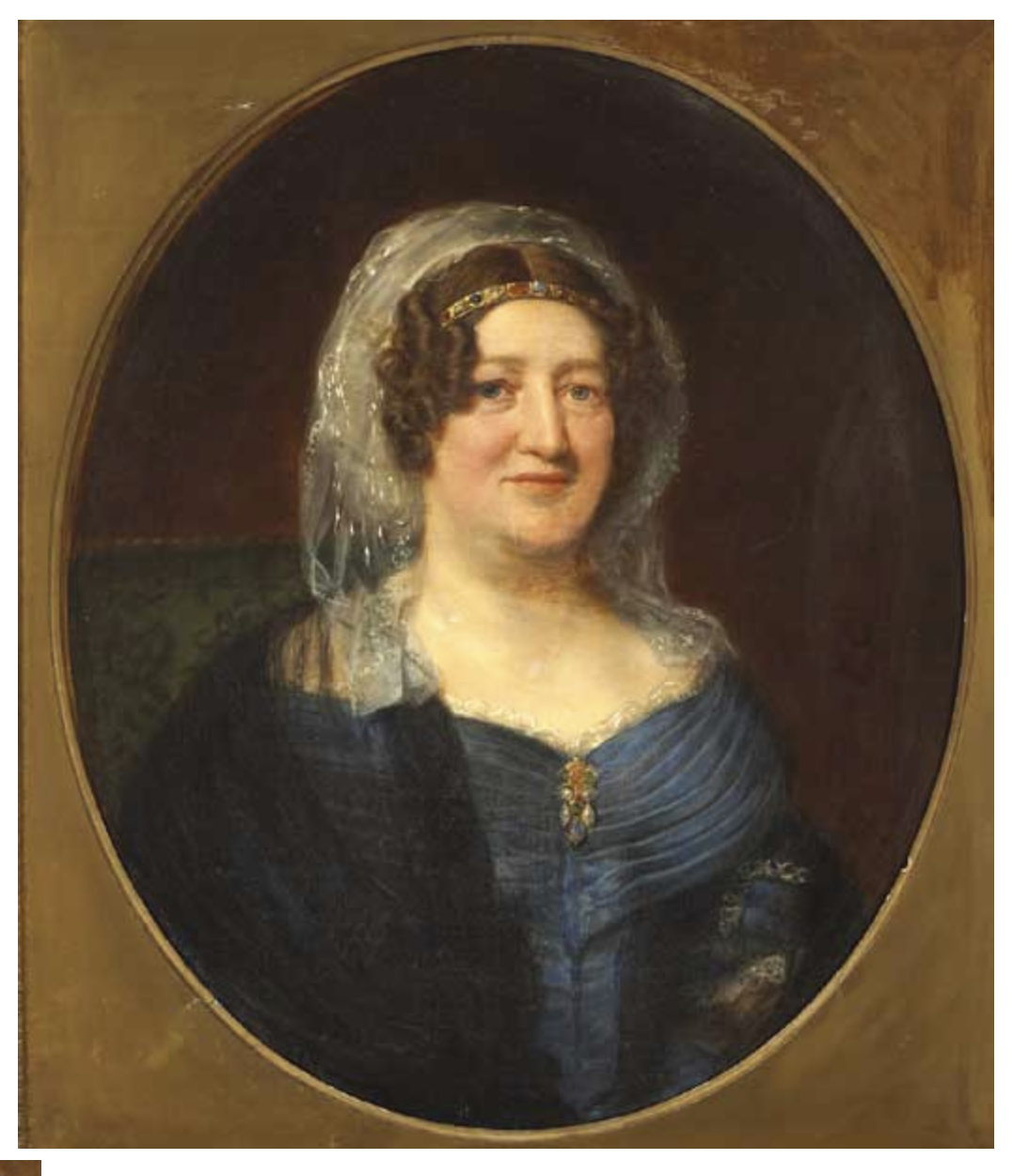
[24] http://www.glenvillepark.com/

[25] https://pearsemuseum.ie/the-museum/

[26] https://ststephensgreenpark.ie/cultural-heritage/

Text © Jennifer Winder-Baggot, www.irishhistorichouses.com