Arthur Chichester, 4th Earl of Donegall (1695–1757)
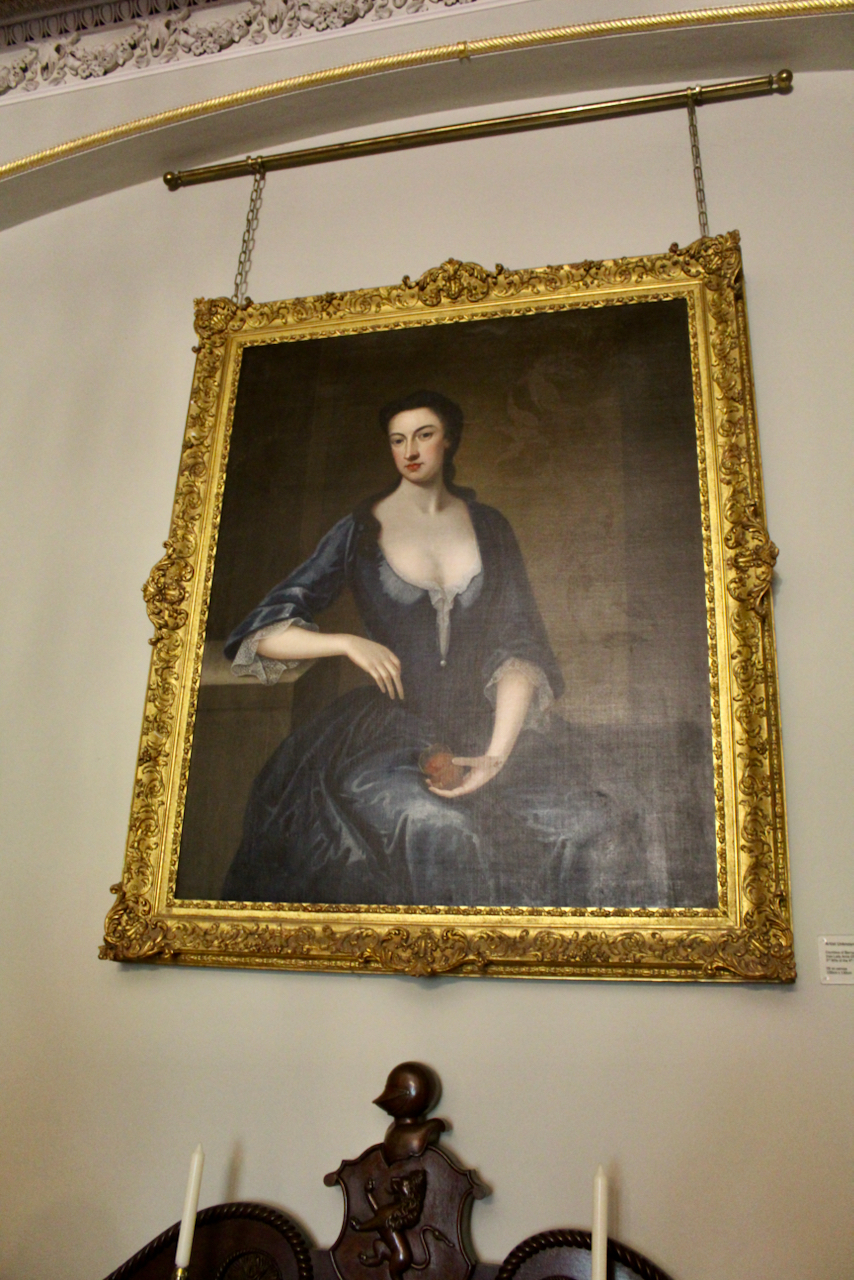
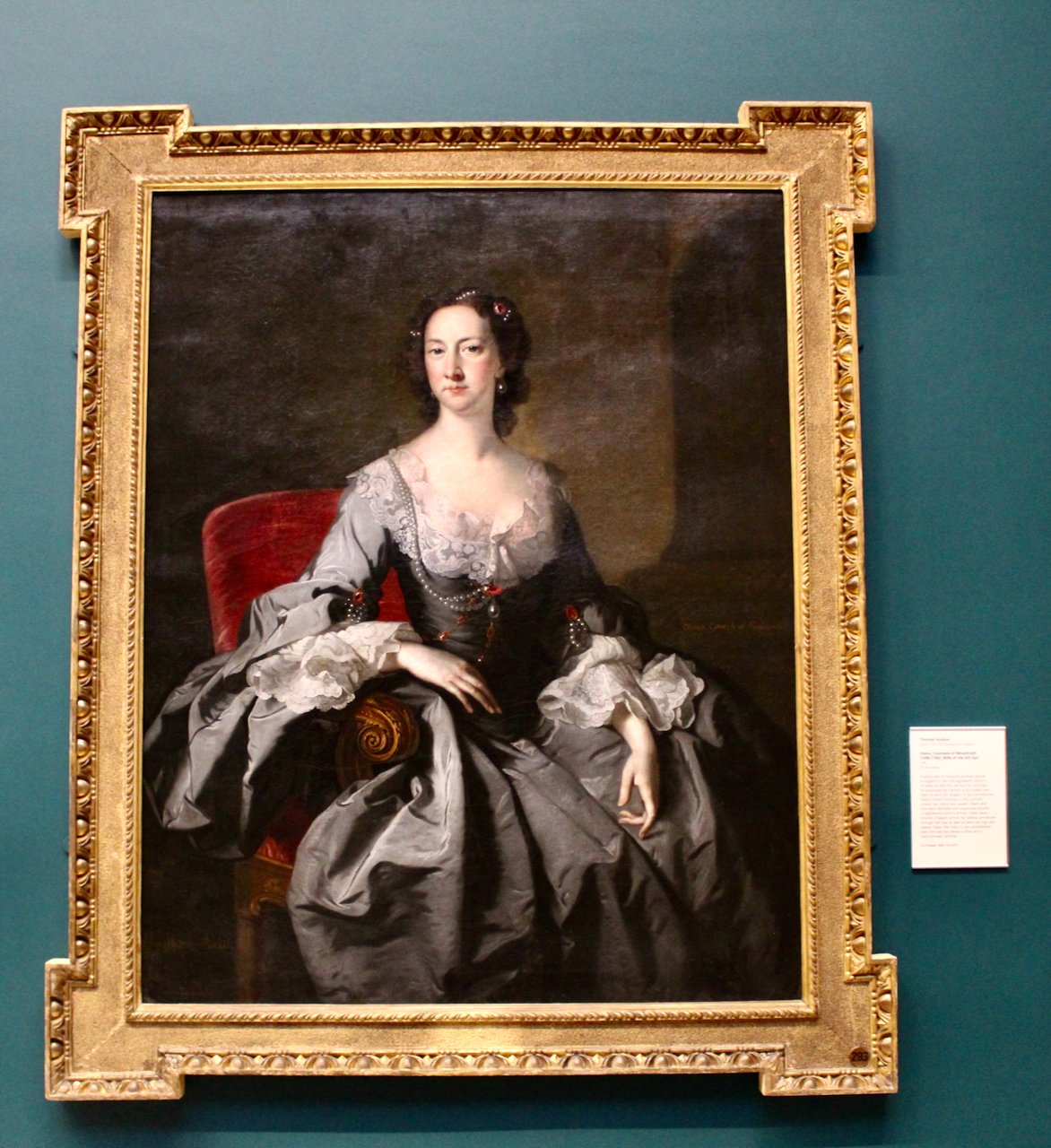
Lady Lucy Ridgeway was the eldest daughter and co-heir of Robert Ridgeway, 4th Earl of Londonderry (d. 1713/14), she married Arthur Chichester, 4th Earl of Donegal (1695-1757), by Jonathan Richardson courtesy of Sothebys L11304.
Arthur Chichester, 5th Earl of Donegall (1739–1799; created Baron Fisherwick in 1790 and Earl of Belfast and Marquess of Donegall in 1791). He married Anne née Hamilton (1731-1780) who was the daughter of James Brandon Douglas Hamilton 5th Duke of Hamilton, Scotland. Arthur the 5th Earl of Donegall was the son of John Chichester (1700-1746), who was the son of Arthur 3rd Earl of Donegall.
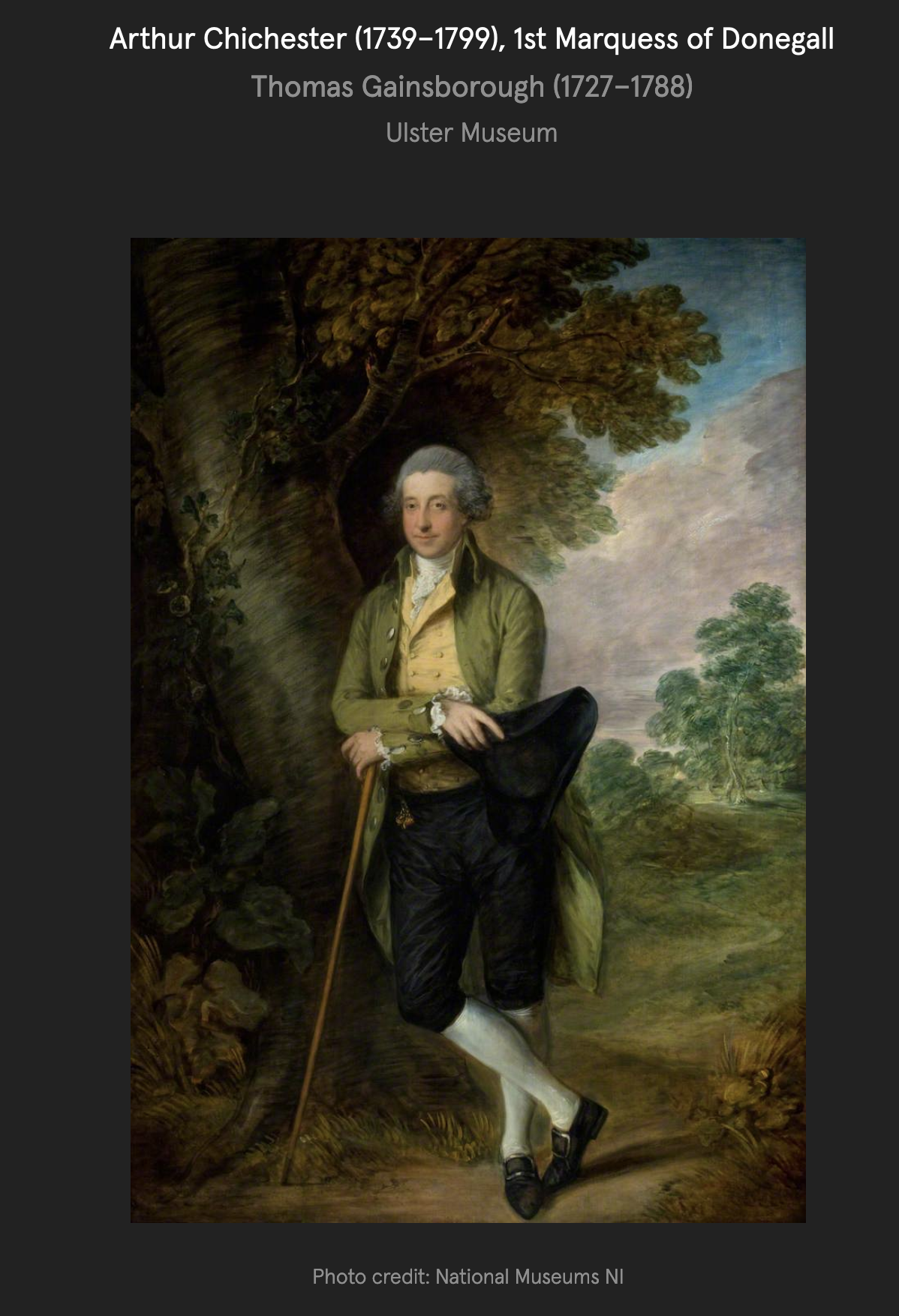
Arthur Chichester, 1st Marquess of Donegall (1739–1799)
Arthur Chichester (1739-1799) 1st Marquess of Donegall, by Thomas Gainsborough, courtesy of Ulster Museum.
George Augustus Chichester, 2nd Marquess of Donegall (1769–1844)
George Augustus Chichester (1769-1844) 2nd Marquess of Donegall, courtesy of Belfast Castle.
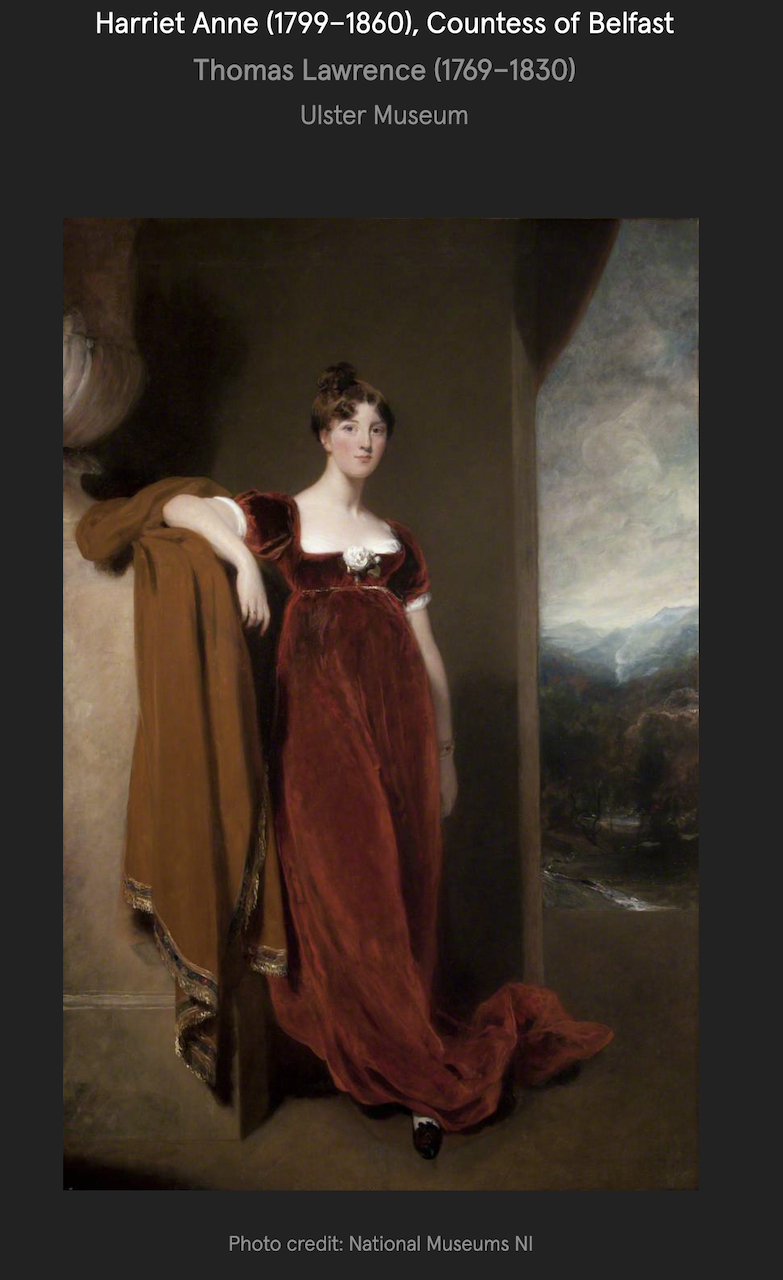
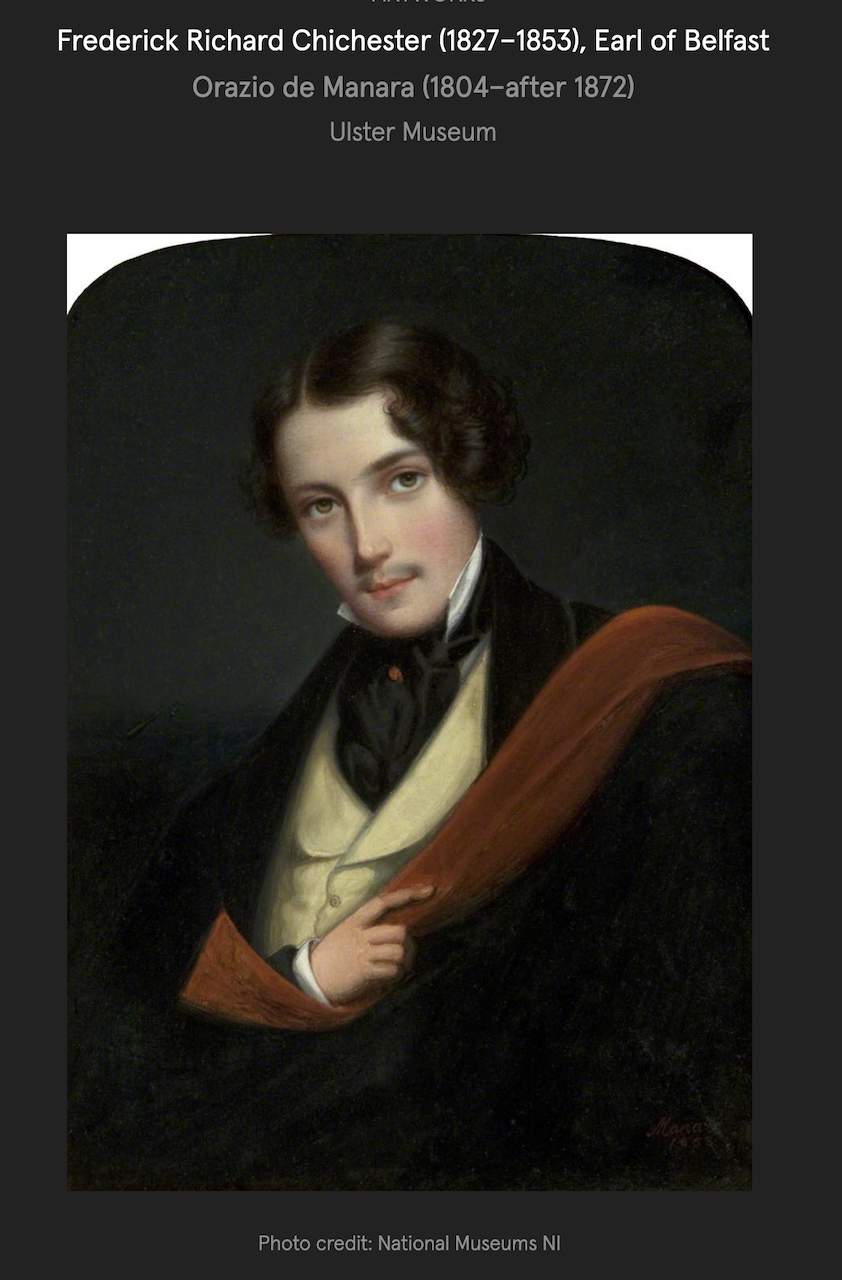
George Hamilton Chichester, 3rd Marquess of Donegall, Baron Ennishowen and Carrickfergus (1797–1883). He married Harriet Anne née Butler (1799-1860), daughter of Richard Butler, 1st Earl of Glengall.
Harriet Anne née Butler (1799-1860) Countess of Belfast, wife of George Hamilton Chichester 3rd Marquess of Donegal and daughter of Richard Butler, 1st Earl of Glengall.Frederick Richard Chichester (1827-1853), Earl of Belfast, Courtesy of Ulster Museum.He was the son of the 3rd Marquess of Donegall.Frederick Richard Chichester (1827-1853) Earl of Belfast courtesy of Ulster Museum.
Edward Chichester, 4th Marquess of Donegall (1799–1889)
George Augustus Hamilton Chichester, 5th Marquess of Donegall (1822–1904)
Edward Arthur Donald St George Hamilton Chichester, 6th Marquess of Donegall (1903–1975)
Dermot Richard Claud Chichester, 7th Marquess of Donegall (5th Baron Templemore) (1916–2007)
Arthur Patrick Chichester, 8th Marquess of Donegall (b. 1952) [1]
I refer to Timothy William Ferres’s terrific blog to look at the Cole family of Florence Court in County Fermanagh, a National Trust property.
William Cole married Susannah, daughter and heir of John Croft, of Lancashire, and widow of Stephen Segar, Lieutenant of Dublin Castle, by whom he left at his decease in 1653,
MICHAEL, his heir; John, of Newland, father of Arthur, 1st BARON RANELAGH; Mary; Margaret.
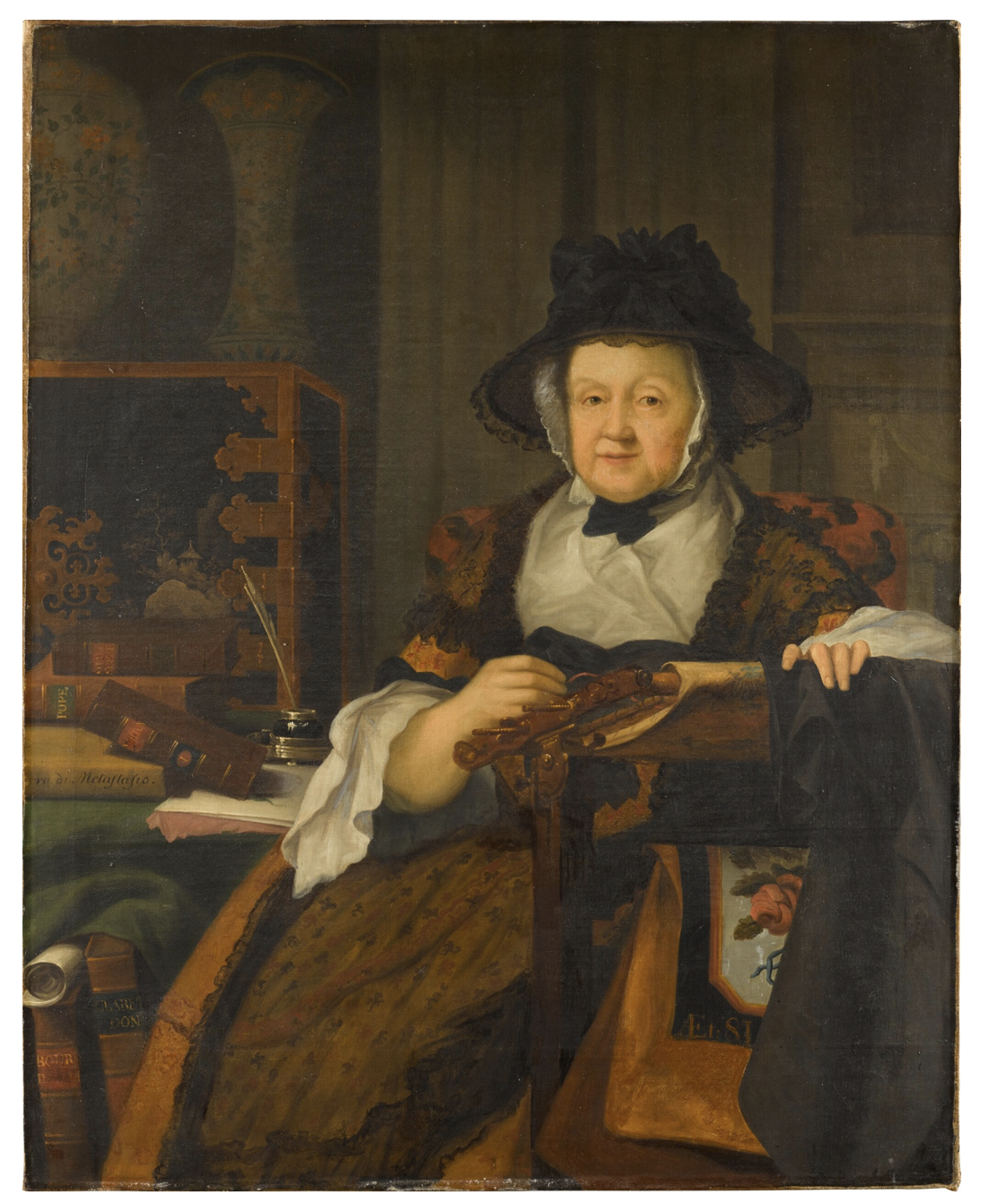
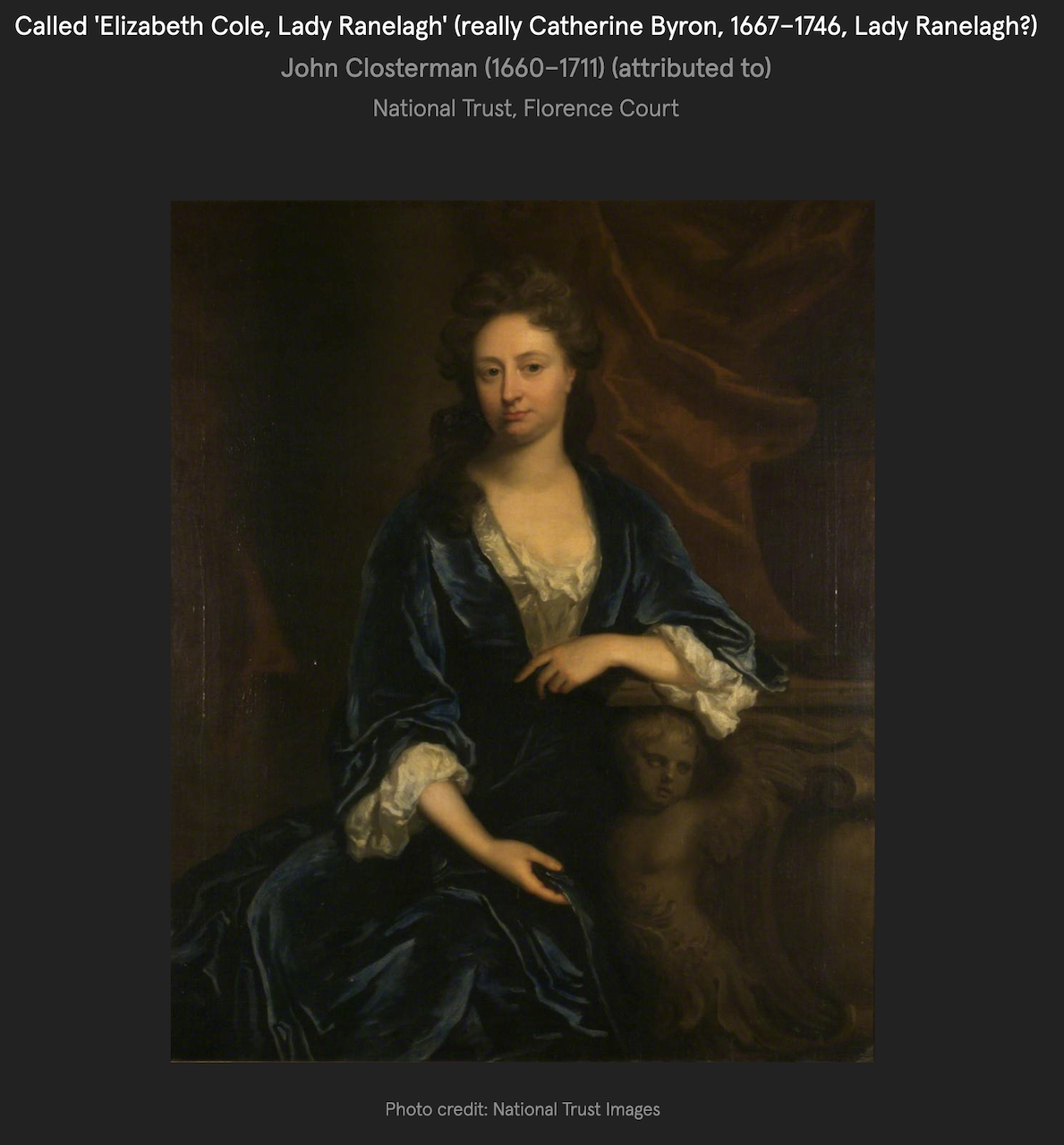
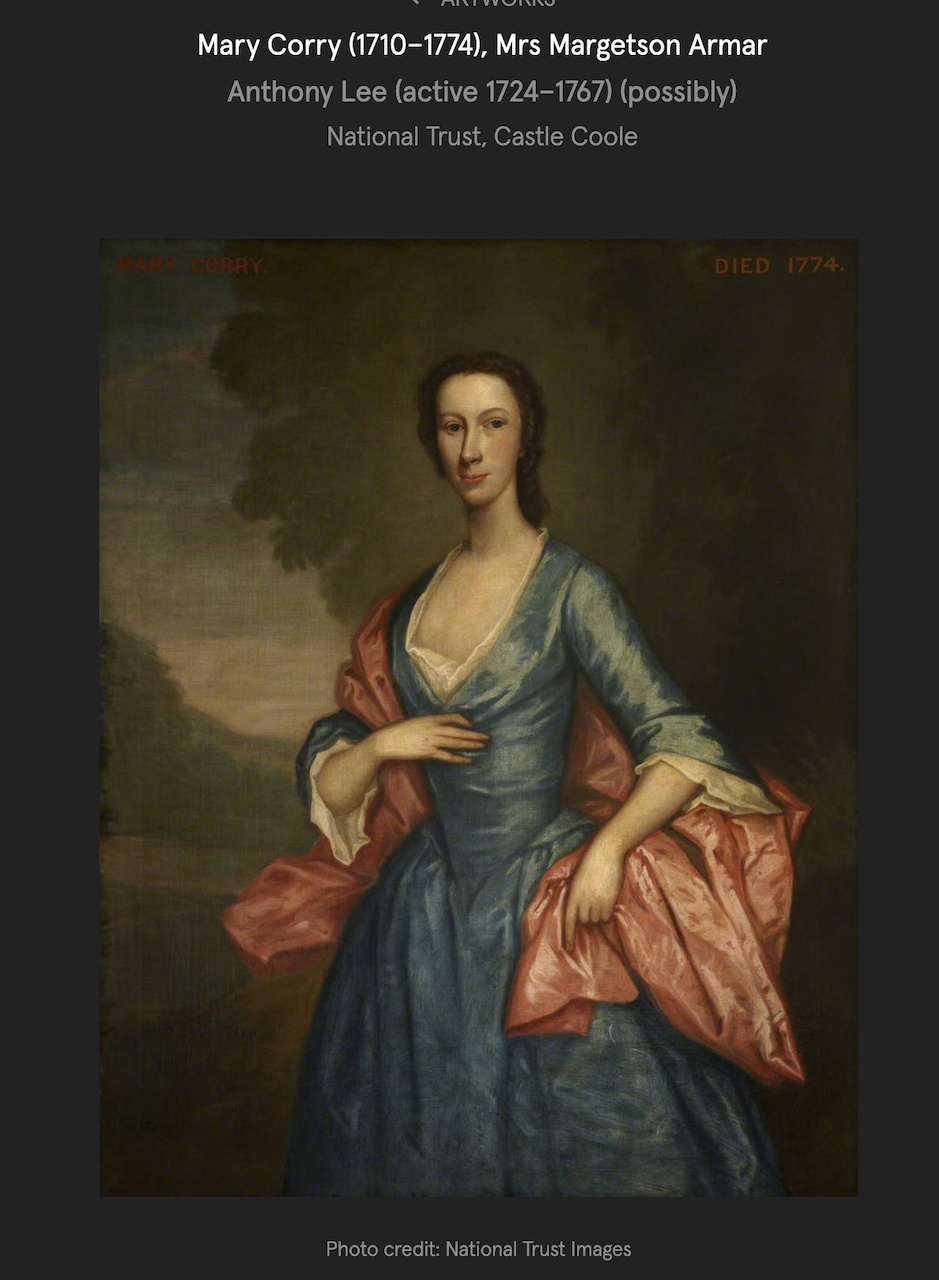
Called Elizabeth Cole Lady Ranelagh, probably really Catherine Cole née Byron (1667-1746) Lady Ranelagh attributed to John Closterman courtesy of National Trust Florence Court. She married Arthur Cole, 1st Baron Ranelagh.
The elder son,
MICHAEL COLE, wedded, in 1640, Catherine, daughter of Sir Laurence Parsons, of Birr, 2nd Baron of the Irish Exchequer, and dvp, administration being granted 1663 to his only surviving child,
SIR MICHAEL COLE, Knight (1644-1710), of Enniskillen Castle, MP for Enniskillen, 1692-3, 95-9, 1703-11, who espoused firstly, Alice (dsp 1671), daughter of Chidley Coote, of Killester; and secondly, 1672, his cousin, Elizabeth (d 1733), daughter of Sir J Cole Bt.
Sir Michael was succeeded by his only surviving child,
JOHN COLE (1680-1726), of Florence Court, MP for Enniskillen, 1703-26, who espoused, in 1707, Florence, only daughter of Sir Bourchier Wrey Bt, of Trebitch, in Cornwall.
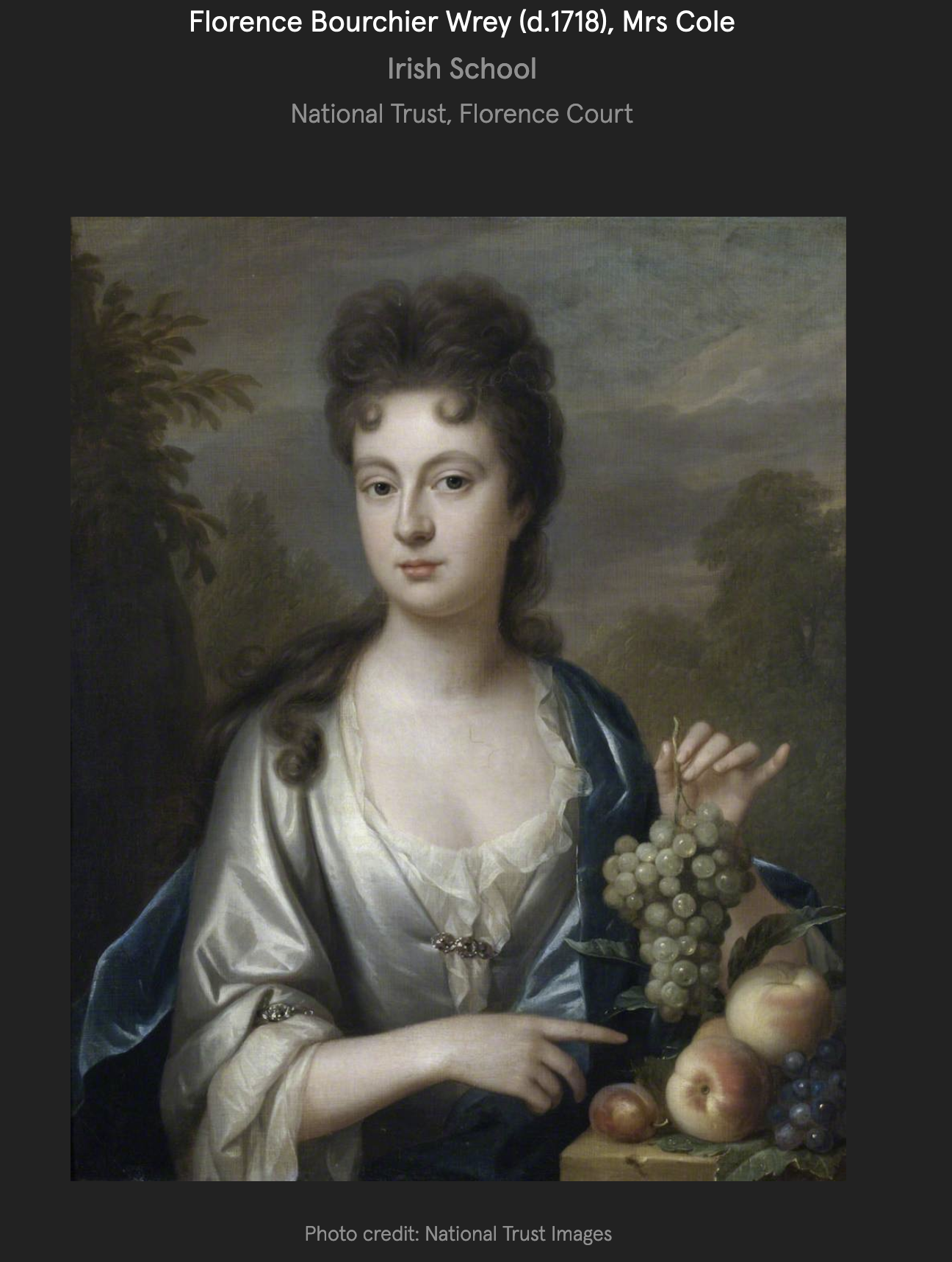
Florence Bourchier Wrey (d. 1718), courtesy of National Trust, Florence Court, County Fermanagh.She married John Cole (1680-1726) who built Florence Court, and named it after her.
John and Florence had the following children:
Henry (Rev); JOHN (1709-67) his heir; Letitia; Florence.
Mr Cole was succeeded by his younger son, John Cole (1709-67) MP for Enniskillen, 1730-60. John married in 1728 Elizabeth, daughter of Hugh Willoughby Montgomery, of Carrow, County Fermanagh. Mr Cole was elevated to the peerage, in 1760, in the dignity of Baron Mountflorence, of Florence Court, County Fermanagh.
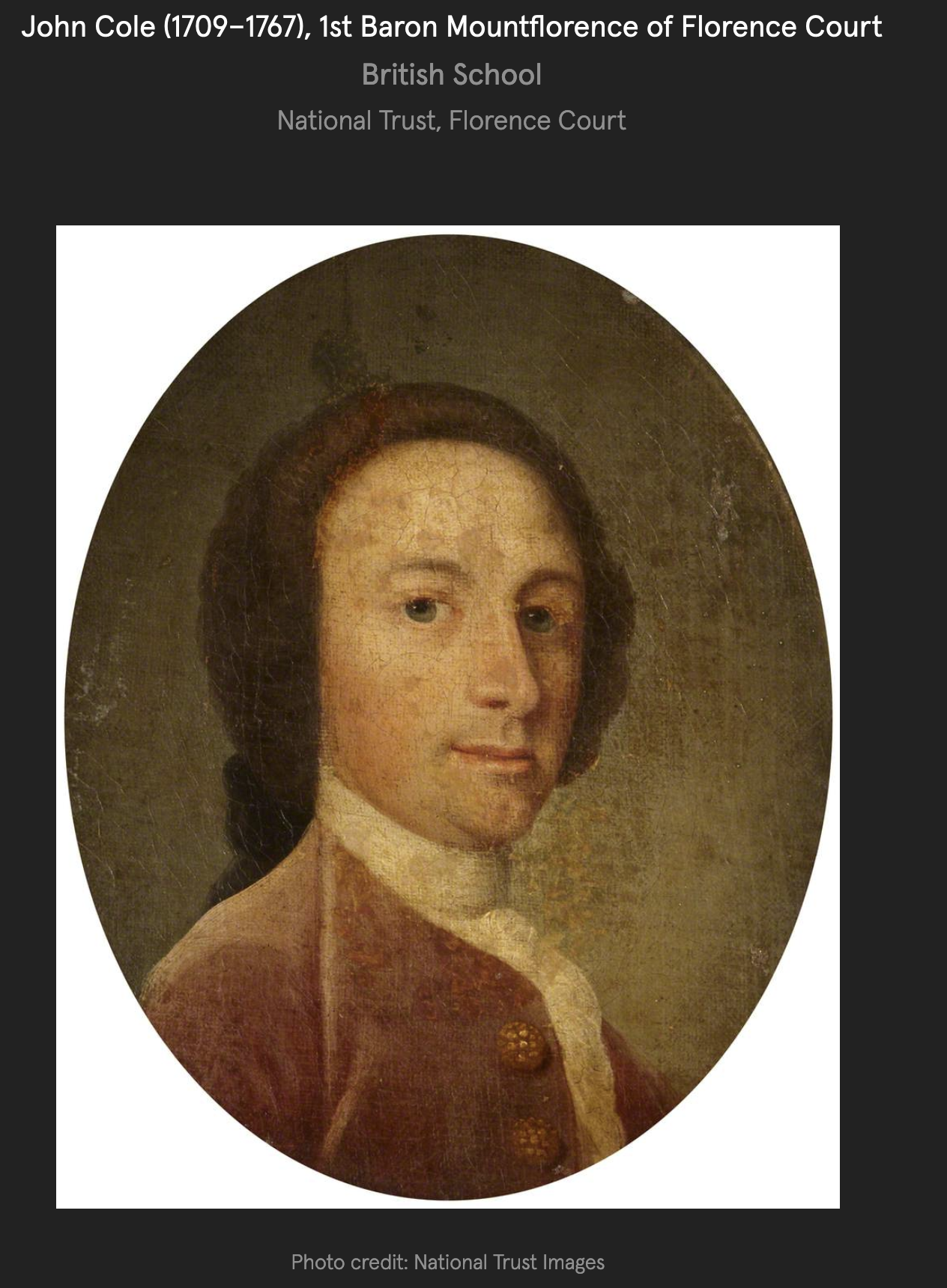
John Cole (1709-1767) 1st Baron Mountflorence of Florence Court, County Fermanagh, courtesy of National Trust, Florence Court, County Fermanagh.
John and Elizabeth had the following children:
WILLIAM WILLOUGHBY (1736-1803) his heir; Arthur, m in 1780 Caroline Hamilton; Flora Caroline; Catherine.
His lordship was succeeded by his elder son, WILLIAM WILLOUGHBY, 2nd Baron (1736-1803), MP for Enniskillen, 1761-7, who was created Viscount Enniskillen in 1776; and advanced to the dignity of an earldom, in 1789, as EARL OF ENNISKILLEN.
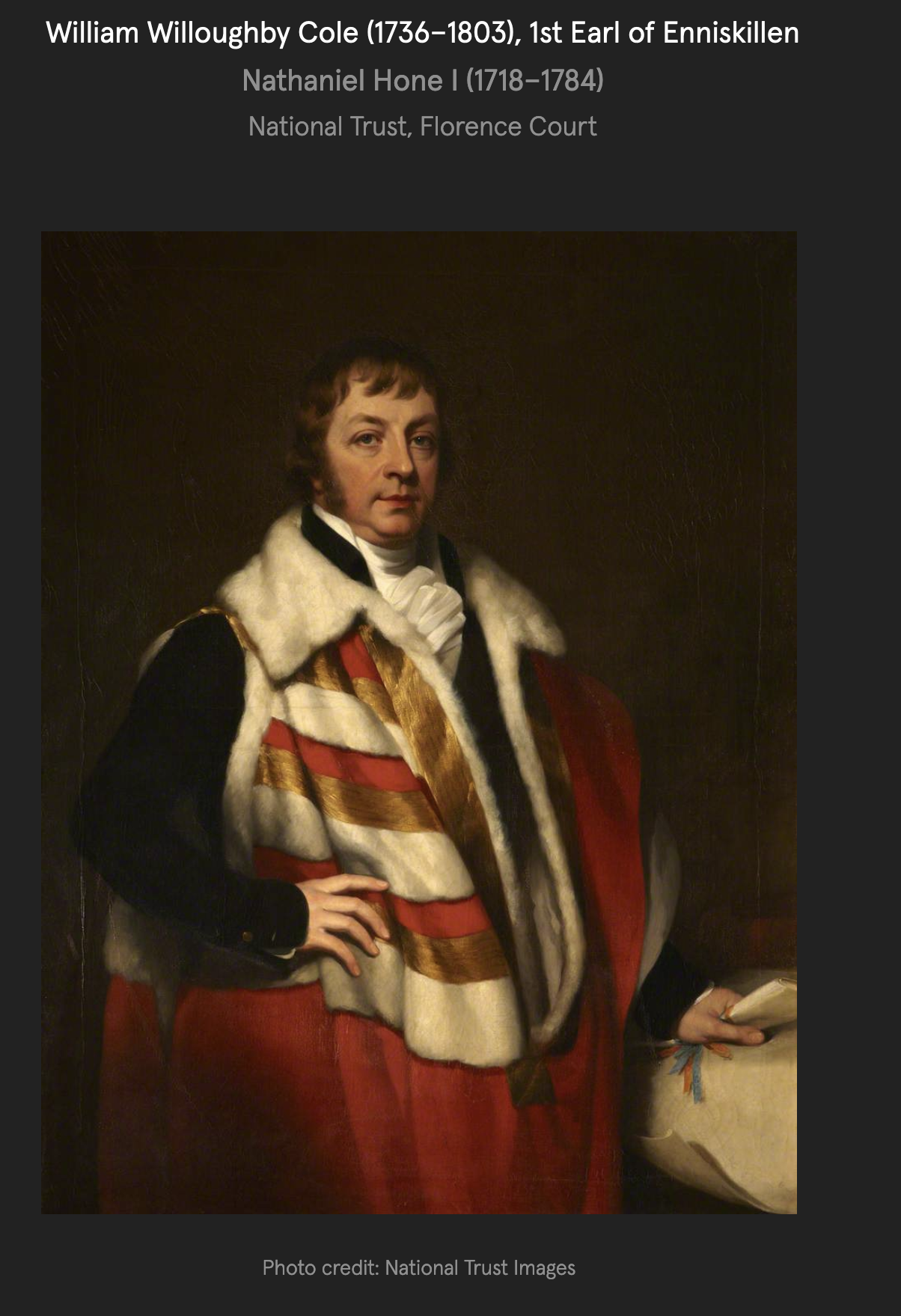
William Willoughby Cole (1736-1803) 1st Earl of Enniskillen, by Nathaniel Hone, courtesy of National Trust, Florence Court, County Fermanagh.He was the son of John Cole 1st Baron Mountflorence.Anne Lowry-Corry, Countess of Enniskillen (1742-1802) by Horace Hone c.1785, watercolour painting on ivory, courtesy National Trust Florence Court. Sister of Armar Lowry-Corry (1740-1802) 1st Earl Belmore and wife of William Willoughby Cole 1st Earl of Enniskillen.
William Willoughby Cole married, in 1763, Anne, daughter of Galbraith Lowry Corry, of Ahenis, County Tyrone, and sister of Armar Corry, Earl of Belmore, and had issue,
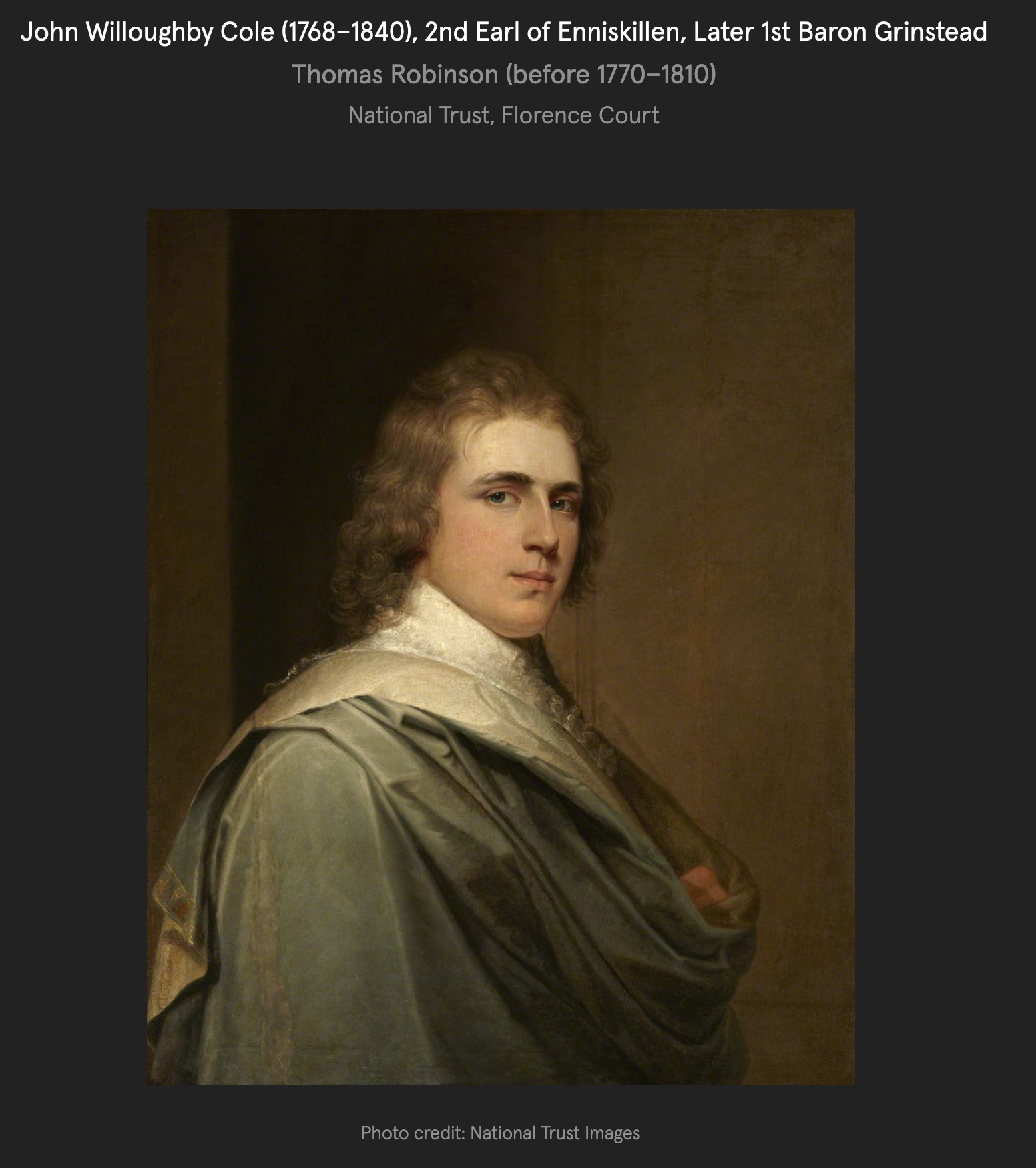
JOHN WILLOUGHBY (1768-1840) his successor, who became 2nd Earl; Galbraith Lowry (Sir), GCB, a general in the army; William Montgomery (Very Rev), Dean of Waterford; Arthur Henry, MP for Enniskillen; Henry, died young; Sarah; Elizabeth Anne; Anne; Florence; Henrietta Frances.
JOHN WILLOUGHBY Cole 2nd Earl (1768-1840) married, in 1805, the Lady Charlotte Paget, daughter of Henry, 1st Earl of Uxbridge. The 2nd Earl of Charlotte had the following children:
WILLIAM WILLOUGHBY (1807-86) his successor, who became the 3rd Earl of Enniskillen.
Henry Arthur; John Lowry; Lowry Balfour; Jane Anne Louisa Florence.
William Willoughby Cole (1807-1886) 3rd Earl of Enniskillen, by William Robinson, courtesy of National Trust, Florence Court, County Fermanagh.
WILLIAM WILLOUGHBY, 3rd Earl (1807-86), Honorary Colonel, 3rd Battalion, Royal Inniskilling Fusiliers, married firstly, in 1844, Jane, daughter of James Casamaijor, and had issue,
John Willoughby Michael, styled Viscount Cole (1844-50);
LOWRY EGERTON, 4th Earl;
Arthur Edward Casamaijor;
Florence Mary; Alice Elizabeth; Charlotte June; Jane Evelyn.
He wedded secondly, in 1865, Mary Emma, daughter of Charles, 6th Viscount Midleton.
His lordship was succeeded by his eldest surviving son,
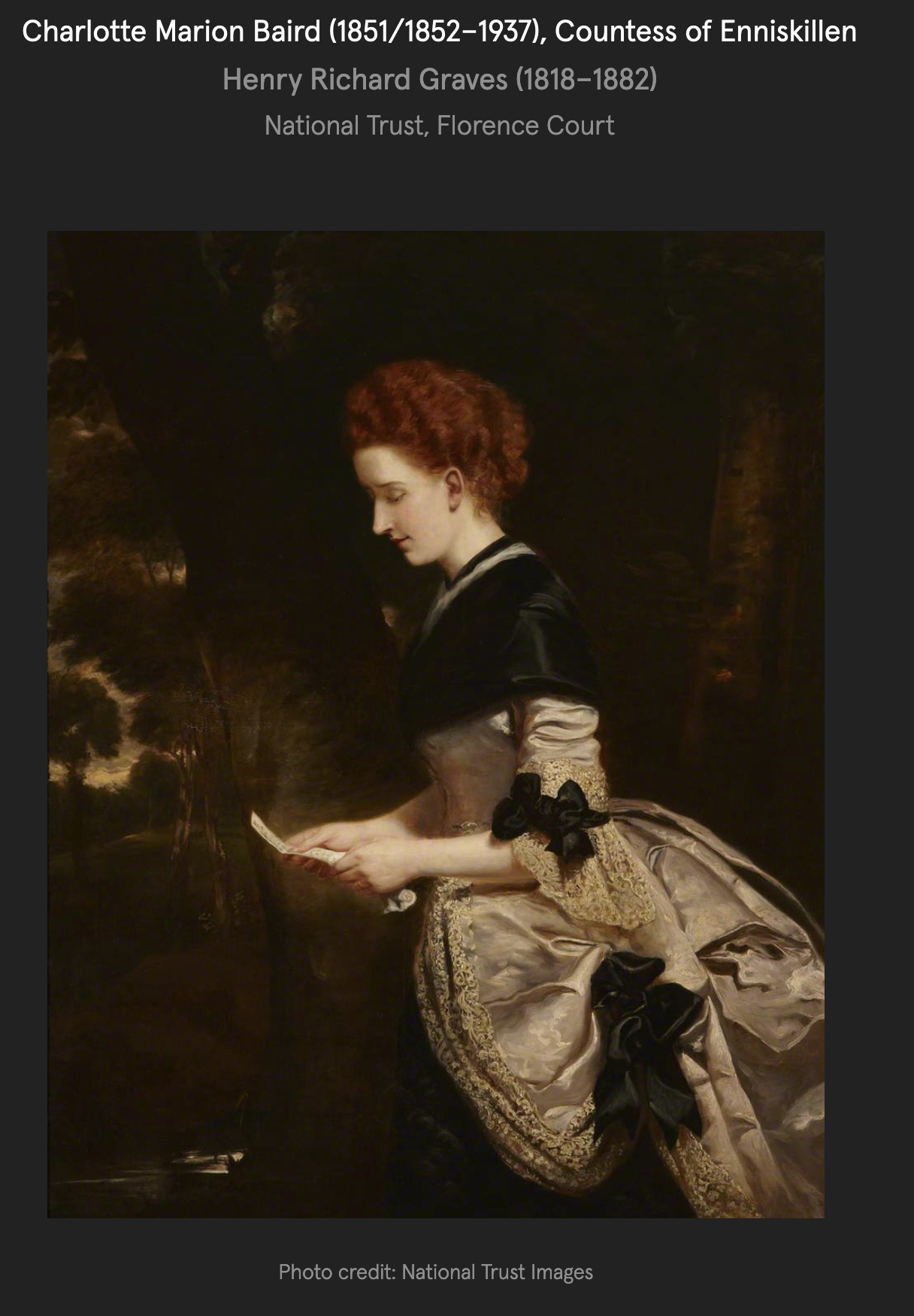
LOWRY EGERTON, 4th Earl (1845-1924), KP JP DL MP, who wedded, in 1869, Charlotte Marion, daughter of Douglas Baird.
Charlotte Marion Baird (1851/2-1937) Countess of Enniskillen, by Henry Richard Graves, courtesy of National Trust, Florence Court, County Fermanagh. She married Lowry Egerton Cole, 4th Earl of Enniskillen.
Nicholas Conway Colthurst (1789-1829) 4th Baronet of Ardrum, County Cork, by Martin Arthur Shee, courtesy of Eton College.He was Member of Parliament (M.P.) for the City of Cork between 1812 and 1829. His son the 5th Earl married Louisa Jane Jefferyes, through whom he acquired Blarney Castle.Ambrose Congreve reading a newspaper at Clonbrock House, Ahascragh, Co. Galway, National Library of Ireland Ref. CLON422.
Timothy William Ferres tells us of the line of the Conolly family who owned Castletown House in County Kildare. [2] It was built by William Conolly (1662-1729), Speaker of the House of Commons in Ireland during the reign of Queen Anne, First Lord of the Treasury until his decease during the reign of GEORGE II, and ten times sworn one of the Lords Justices of Ireland.
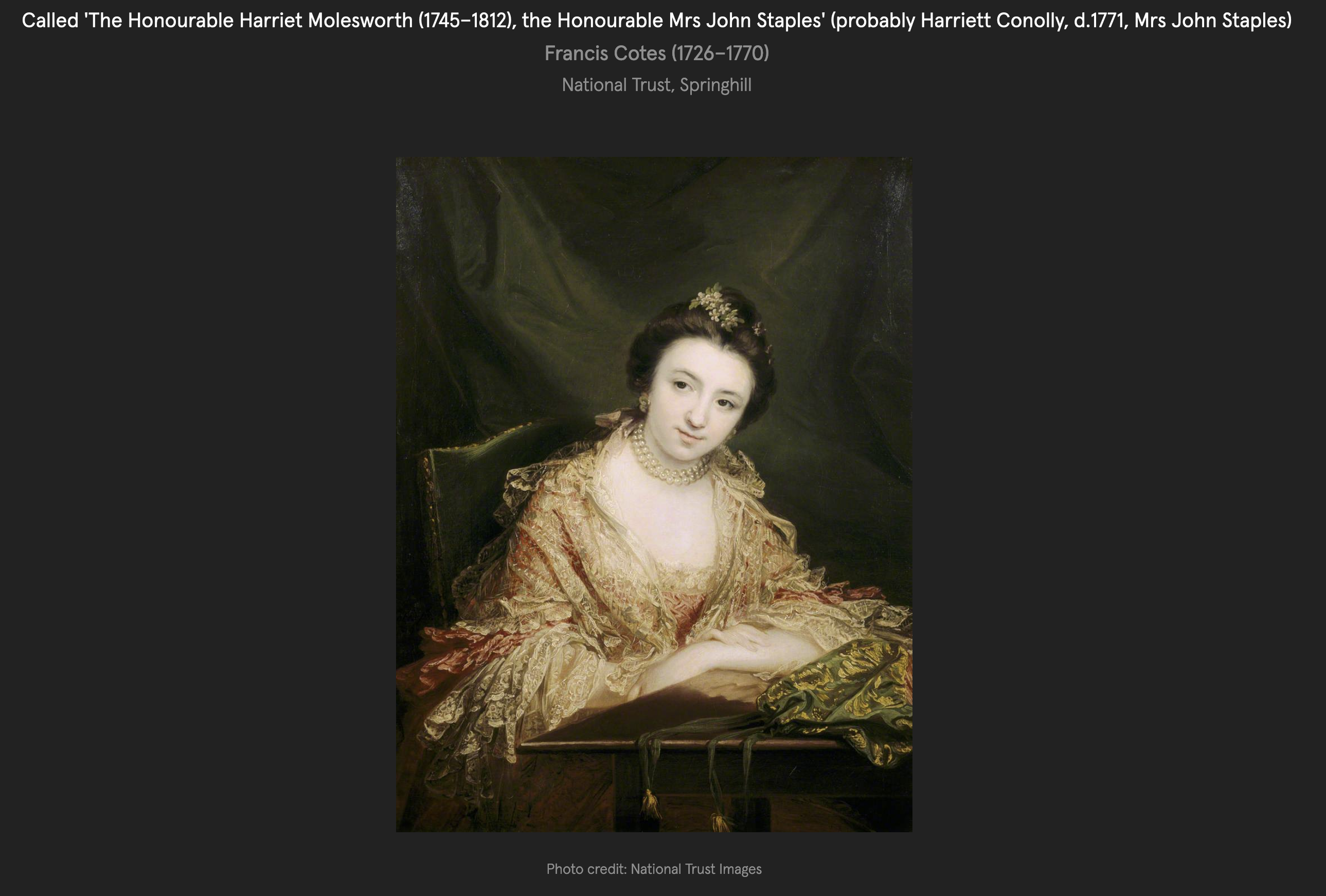
THOMAS (1734-1803) his heir; Katherine, m. Ralph, Earl of Ross; Anne, m. G. Byng; mother of Earl of Strafford; Harriet, m. Rt Hon John Staples, of Lissan; Frances, m. 5th Viscount Howe; Caroline, m. 2nd Earl of Buckinghamshire;
Ferres continues, telling us that Thomas Conolly, MP for County Londonderry, 1761-1800, wedded, in 1758, Louisa Augusta Lennox, daughter of Charles, 2nd Duke of Richmond and Lennox.
Thomas and Louisa had no children so the estate passed to a grand-nephew, Edward Michael Pakenham (1786-1849) who assumed the surname Conolly in 1821. Now Edward Michael Conolly of Castletown, County Kildare, and Cliff, County Donegal, Lieutenant-Colonel, Donegal Militia, MP for County Donegal, 1831-49, he married in 1819, Catherine Jane, daughter of Chambré Brabazon Ponsonby-Barker, by the Lady Henrietta Taylour his wife, daughter of Thomas, Earl of Bective. They had issue,
THOMAS (1823-1876) his heir; Chambré Brabazon, d 1835; Frederick William Edward, d 1826; Arthur Wellesley, 1828-54; John Augustus, VC; Richard, d 1870; Louisa Augusta; Henrietta; Mary Margaret; Frances Catherine.
Thomas (1870-1900), killed in action at S Africa; William, 1872-95; EDWARD MICHAEL, of whom hereafter; CATHERINE, Baroness Carew, mother of 6th BARON CAREW.
Mr Conolly was succeeded by his eldest surviving son,
EDWARD MICHAEL CONOLLY CMG (1874-1956), of Castletown, Major, Royal Artillery, who died unmarried, when Castletown passed to his nephew,
William Francis (Conolly-Carew), 6th Baron Carew. [2]
On his terrific website, Timothy William Ferres tells us about the Conyngham family of Springhill, County Derry in Northern Ireland: [3]
Colonel William Cunningham, of Ayrshire settled in the townland of Ballydrum, in which Springhill is situated, in 1609.
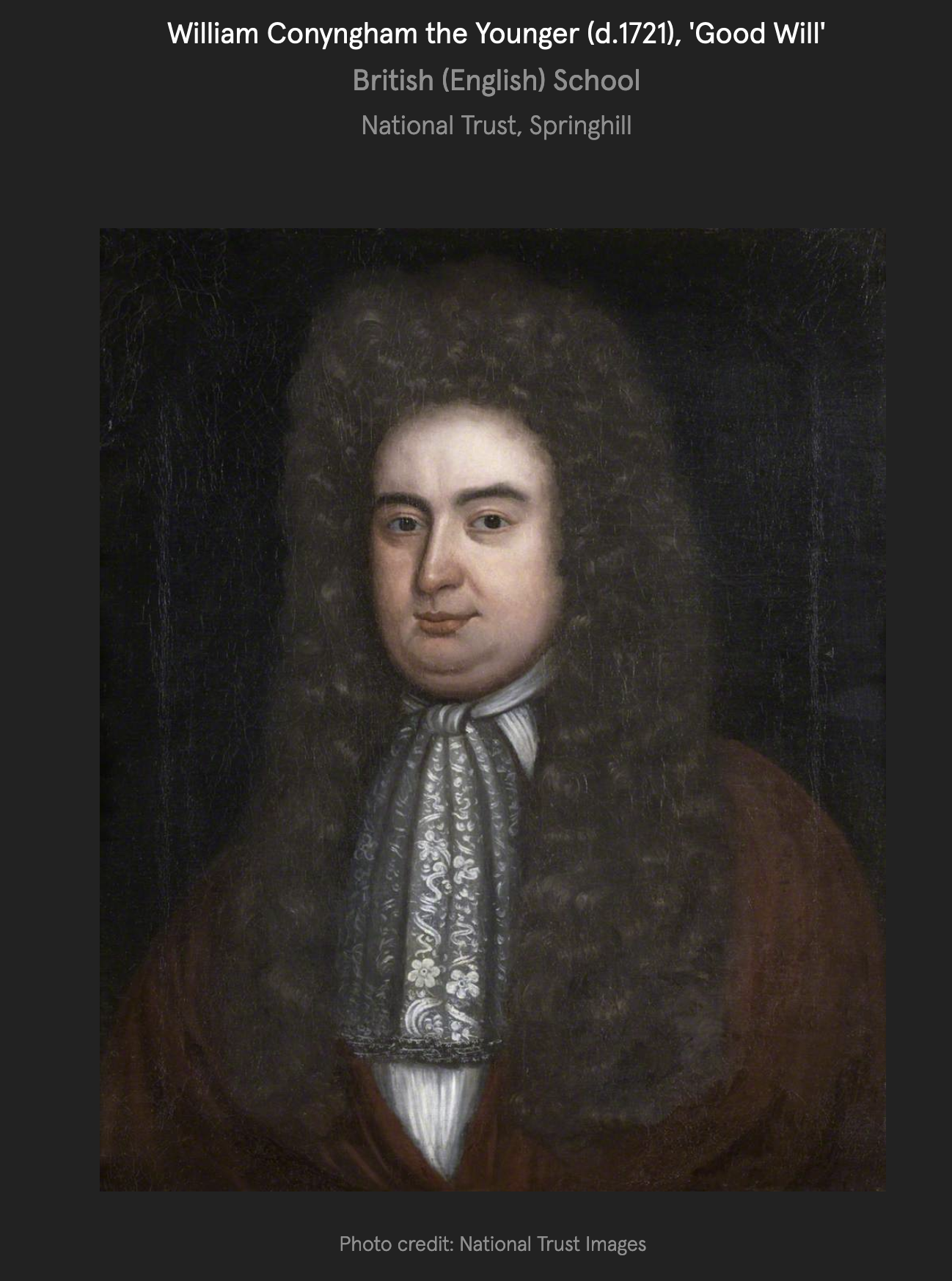
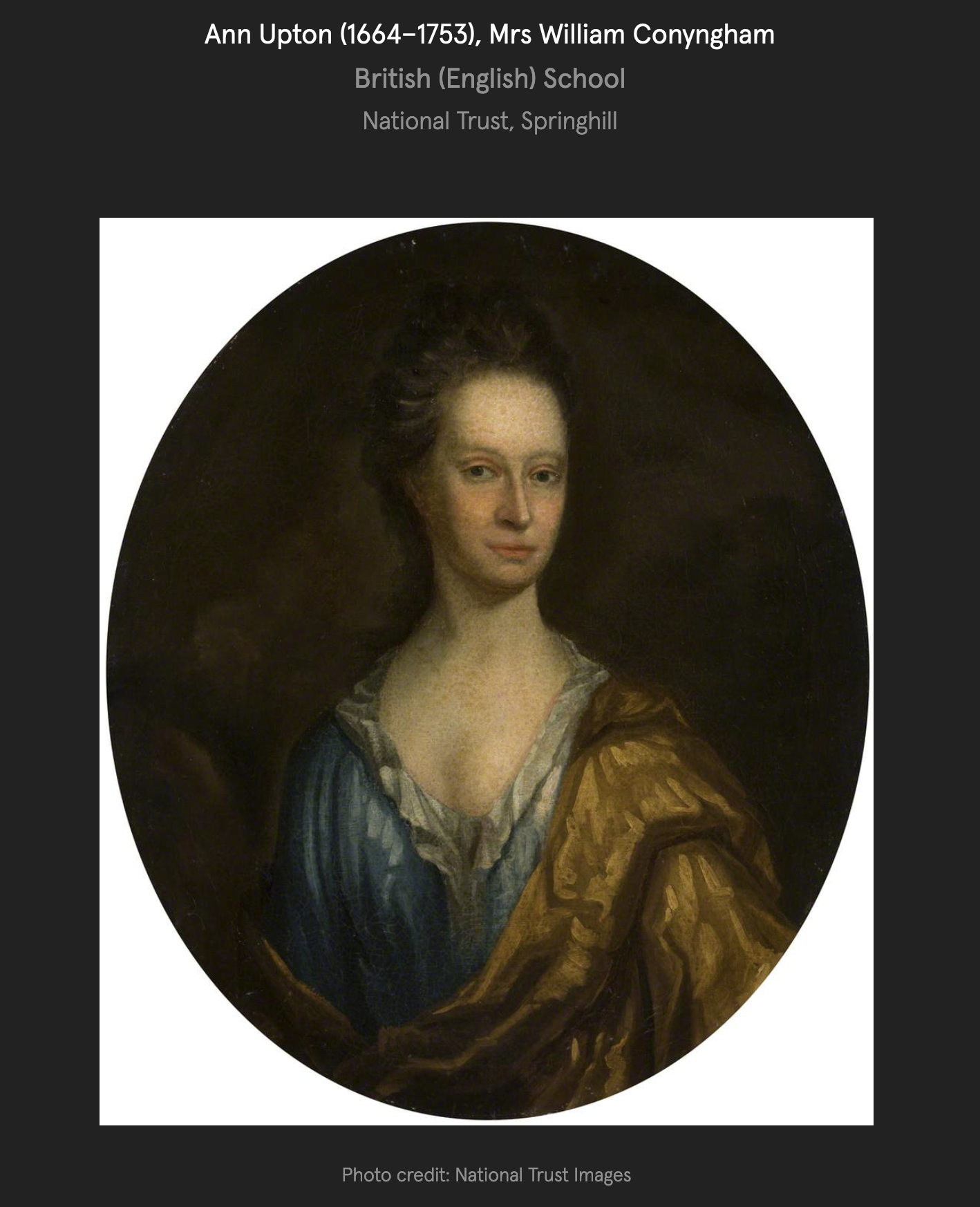
Colonel Cunningham’s son, William Conyngham, known as “Good Will” (d. 1721) married Ann, daughter of Arthur Upton, of Castle Norton (later Castle Upton), County Antrim, by his wife Dorothy, daughter of Colonel Michael Beresford, of Coleraine. William “Good Will” Conyngham died in 1721, and was succeeded by his nephew,
William Conyngham (d. 1721), “Good Will”, courtesy of National Trust. Springhill, County Derry.Ann Upton (1664-1753) wife of William “Goodwill” Conyngham (1660-1721), daughter of Arthur Upton (1623-1706) of Castle Upton, County Antrim, courtesy of National Trust. Springhill, County Derry.
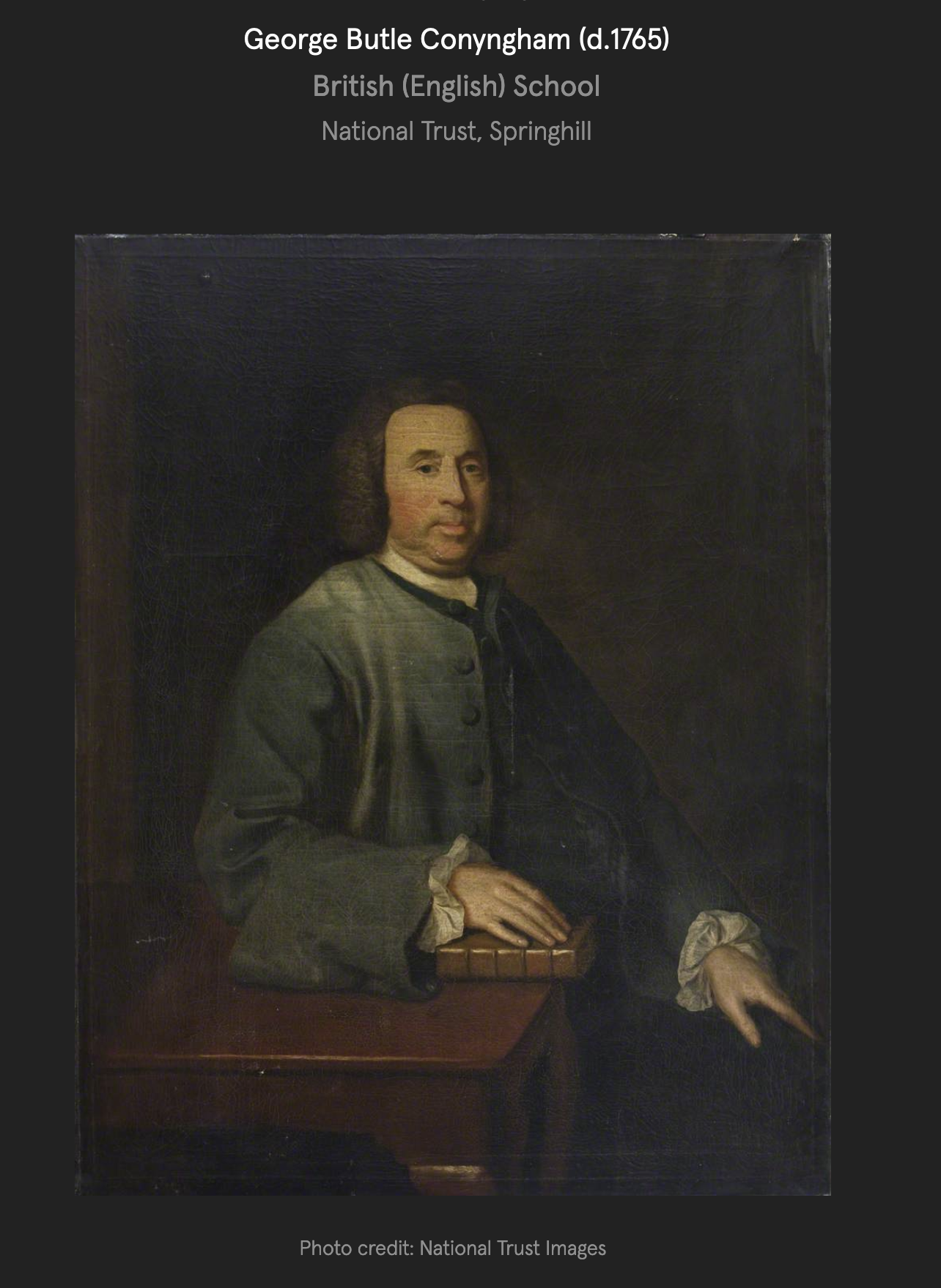
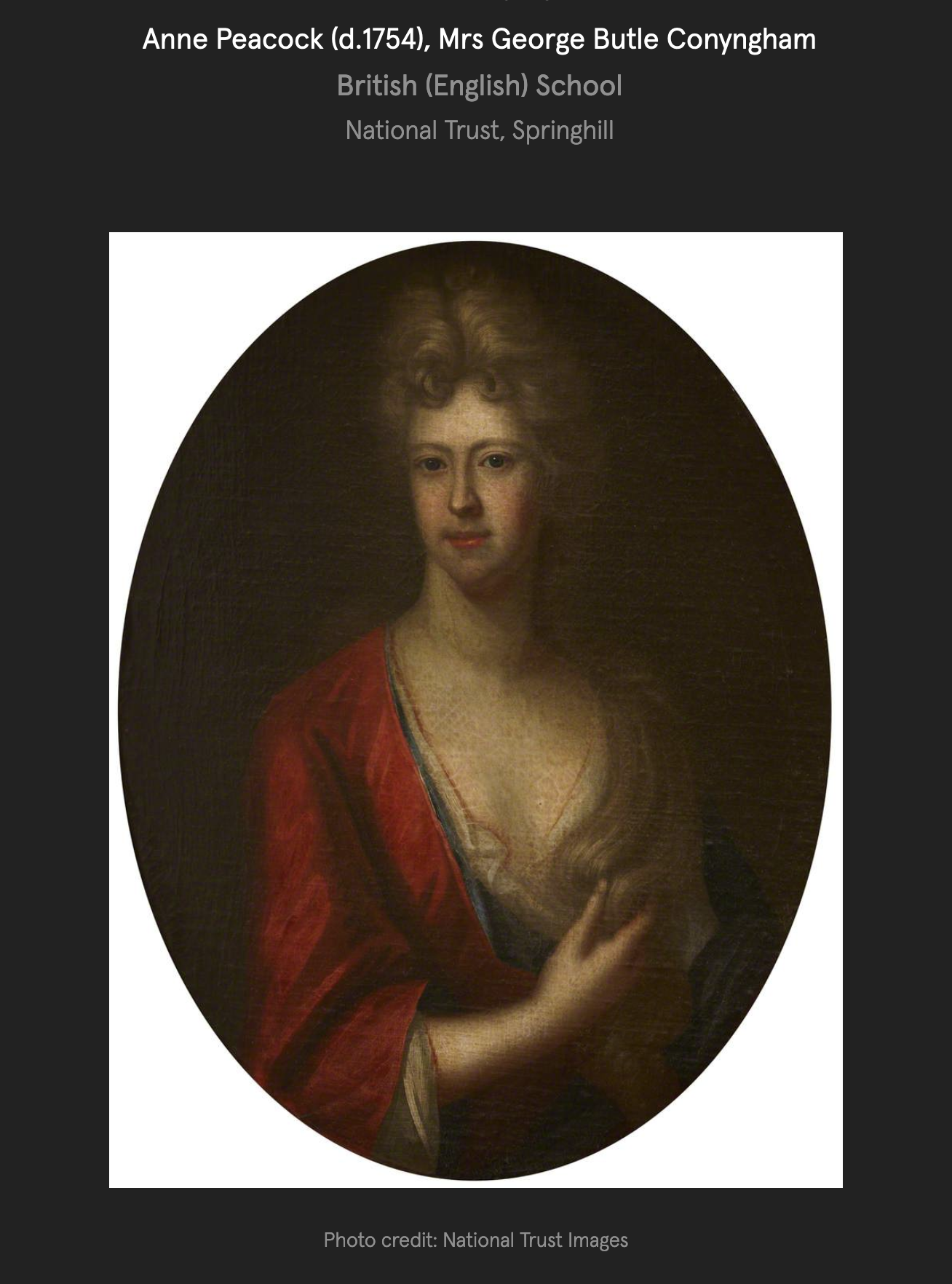
William “Goodwill” Conyngham was succeeded by his nephew George Butle Conyngham (d. 1765). He married , in 1721, Anne, daughter of Dr Upton Peacocke, of Cultra.
George Butle Conyngham (d. 1765), courtesy of National Trust, Springhill, County Derry.Anne Peacocke (d. 1754), Mrs George Butle Conyngham, courtesy of National Trust, Springhill, County Derry.
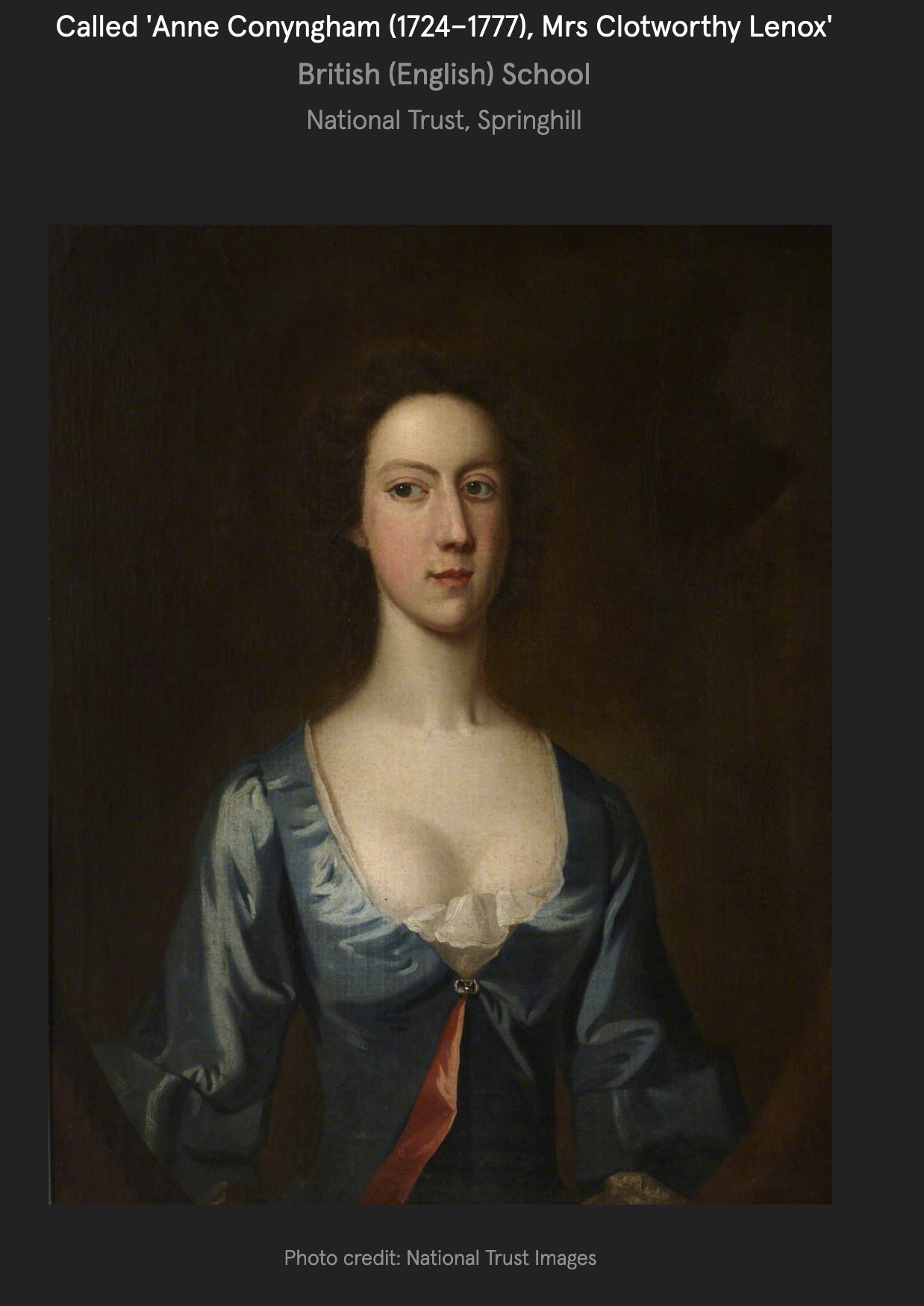
George Butle Conyngham and Anne née Peacocke had children William (1723-84), the heir to Springhill, and David, successor to his brother, John who died unmarried in 1775 and a daughter Anne (1724-1777) who married in 1745 Clotworthy Lenox.
Called Anne Conyngham (1724-1777) Mrs Clotworthy Lenox, courtesy of National Trust. Springhill, County Derry. She was the daughter of George Butle Conyngham.
David who succeeded his brother William died without issue so Springhill passed to his nephew George Lenox (1752-1816), son of his sister Anne, and George adopted the surname of Conyngham. George married, first, Jean née Hamilton (d. 1788), daughter of John Hamilton of Castlefin. They had a son, William Lenox-Conyngham (1792-1858).
Jean Hamilton (d. 1788), wife of William Conyngham (1723-1774) by Joshua Reynolds, courtesy of National Trust. Springhill, County Derry.
George married, second, in 1794, Olivia, fourth daughter of William Irvine, of Castle Irvine, County Fermanagh.
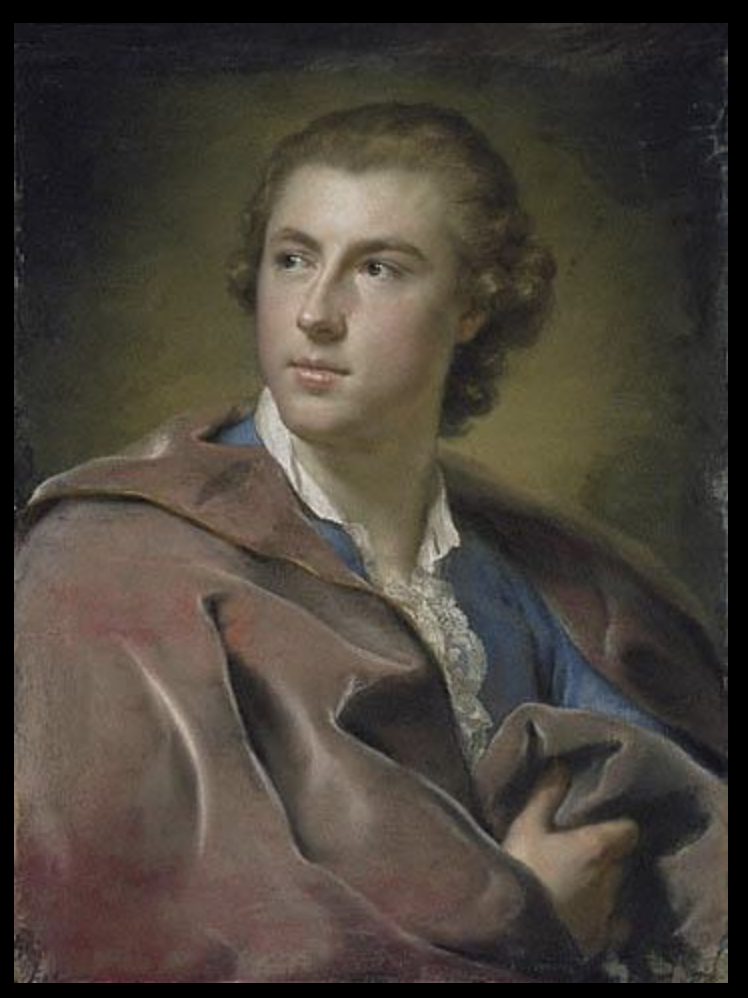
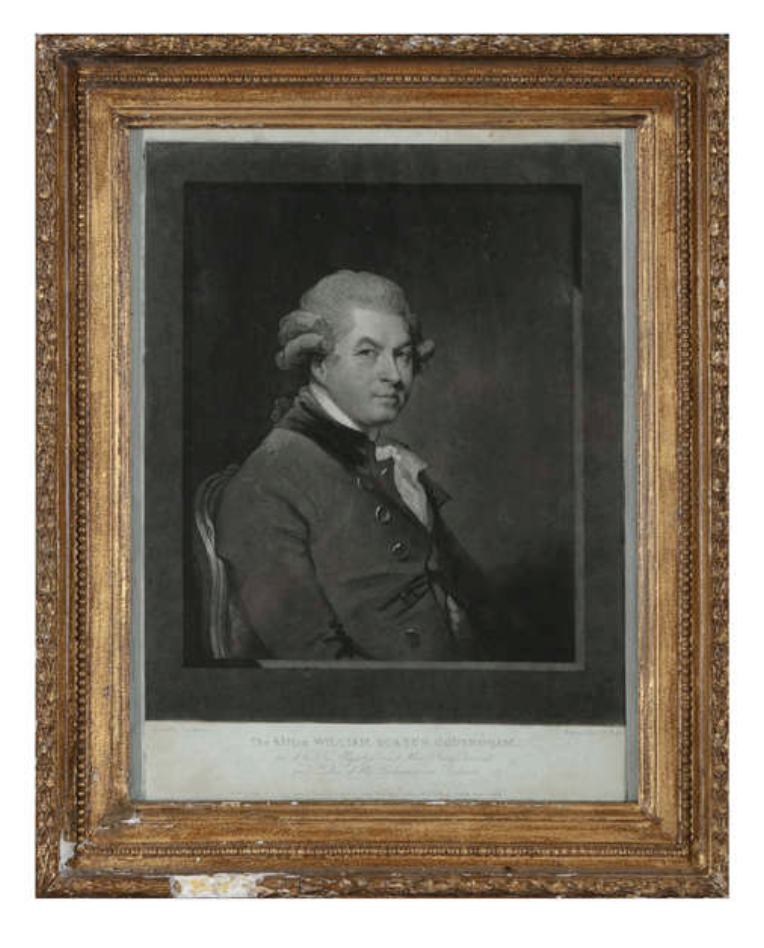
William Burton Conyngham (1733-1796), teller of the Irish Exchequer and treasurer of the Royal Irish Academy, 1780 engraver Valentine Green, after Hugh Douglas Hamilton, courtesy of National Gallery of Ireland.William Burton Conyngham (1733–1796) by Anton Raphael Mengs c. 1754-58, courtesy of wikipedia.He was the son of Francis Burton and Mary Conyngham, and he inherited Slane Castle as well as Donegal estates from his uncle William Conyngham who died in 1781.William Burton Conyngham, engraving After GILBERT STUART courtesy of Adams Country House Collections auction Oct 2023.
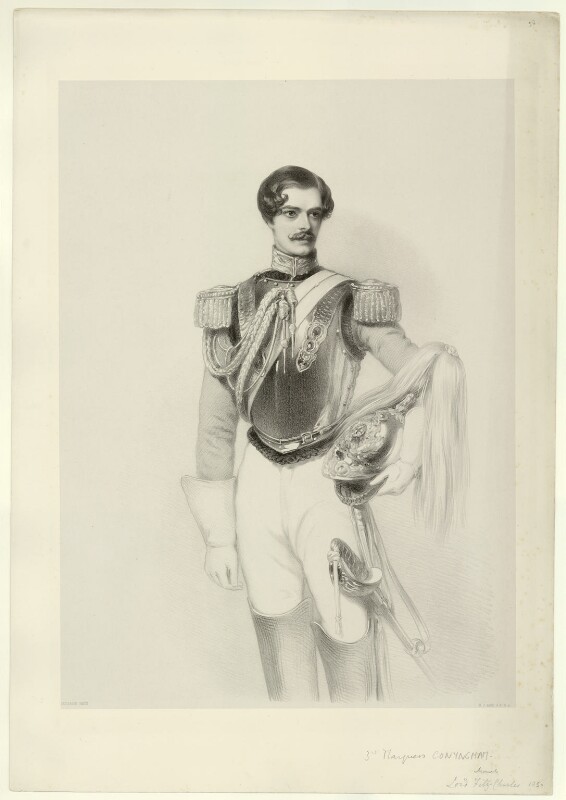
Slane Castle passed to William Burton Conyngham’s nephew Henry Conyngham (1766-1832) 1st Marquess Conyngham. Henry married Elizabeth Denison.
Timothy William Ferres also tells us of the Coote family. Charles Coote (1581-1642), 1st Baronet of Castle Cuffe, Queen’s County (Laois): “The Peerage” website tells us that in 1600 he went to Ireland as Captain of 100 Foot under 8th Lord Mountjoy, Queen Elizabeth I’s Lord Deputy of Ireland. He fought in the siege of Kingsale in 1602. He held the office of Provost Marshal of Connaught between 1605 and 1642, for life. He held the office of General Collector and Receiver of the King’s Composition Money for Connaught in 1613, for life. He held the office of Vice-President of Connaught in 1620. He was appointed Privy Counsellor (P.C.) in 1620. He was created 1st Baronet Coote, of Castle Cuffe, Queen’s Co. [Ireland] on 2 April 1621. He held the office of Custos Rotulorum of Queen’s County in 1634. He held the office of Member of Parliament (M.P.) for Queen’s County [Ireland] in 1639. Before 1641 he held Irish lands, mostly in Conaught, worth £4,000 a year. He held the office of Governor of Dublin in 1641. In 1642 he helped relieve Birr, King’s County (now County Offaly), during the Uprising by the Confederation of Kilkenny, his successful operations there and elsewhere in the area, which was called Mountrath, suggesting the title by which his son was ennobled.
He married Dorothea, youngest daughter and co-heir of Hugh Cuffe, of Cuffe’s Wood, County Cork, and had issue, Charles (c.1610 –1661)1st Earl of Mountrath; Chidley (d. 1688) of Killester, Co Dublin and Mount Coote, County Limerick; RICHARD (1620-83) 1st Baron Coote of Colloony, County Sligo, ancestor of the EARL OF BELLAMONT (1st Creation); Thomas, of Coote Hill; Letitia (married Francis Hamilton, 1st Bt of Killaugh, co. Cavan).
Charles Coote 1st Earl of Mountrath (c.1610 –1661), 2nd Baronet, ca. 1642, before he was ennobled, Circle of William Dobson. By Christina Keddie – Own work, Public Domain, https://commons.wikimedia.org/w/index.php?curid=42002789
Charles Coote (c.1610 –1661), 1st Earl of Mountrath married first, Mary Ruish, who gave birth to his heir, Charles Coote (d. 1672) 2nd Earl of Mountrath, Queen’s County. The 1st Earl of Mountrath, Queen’s County, also had the titles 1st Baron Coote of Castle Cuffe, in Queen’s Co. [Ireland] and 1st Viscount Coote of Castle Coote, Co. Roscommon [Ireland].
Charles Coote (c.1610 –1661), 1st Earl of Mountrath married secondly Jane Hannay, and she had a son Richard (1643-1700), who married Penelope, daughter of Arthur Hill of Hillsborough, County Down. Their daughter Penelope Rose married Charles Boyle (d. 1732) 2nd Viscount Blesington. Another daughter, Jane (d. 1729) married William Evans, 1st and last Baronet of Kilcreene, County Kilkenny.
Charles Coote, 2nd Earl of Mountrath married Alice, daughter of Robert Meredyth of Greenhills, County Kildare. His daughter Anne (d. 1725) married Murrough Boyle, 1st Viscount Blesington (d. 1718). His son Charles (1656-1709) succeeded as 3rd Earl of Mountrath, and he was father to the 4th, 5th and 6th Earls.
The son of Algernon Coote (1689-1744) 6th Earl of Mountrath, Charles Henry Coote (d. 1802) 7th Earl of Mountrath had no legitimate male issue and the earldom and its associated titles created in 1660 died with him. The barony of Castle Coote passed according to the special remainder to his kinsman, Charles Coote. The baronetcy of Castle Cuffe also held by the Earl passed to another kinsman, Sir Charles Coote, 9th Baronet.
Let us return now to Charles Coote (1581-1642), 1st Baronet of Castle Cuffe, Queen’s County (Laois) and trace the line of his younger son, RICHARD COOTE (1620-83), for his hearty concurrence with his brother, SIR CHARLES, 2nd Baronet, in promoting the restoration of CHARLES II, was rewarded with the dignity of a peerage of the realm; the same day that his brother was created Earl of Mountrath, Richard Coote was created, in 1660, Baron Coote, of Colloony.
In 1660, Richard was appointed Major to the Duke of Albemarle’s Regiment of Horse; and the same year he was appointed one of the commissioners for executing His Majesty’s declaration for the settlement of Ireland. He was, in 1675, appointed one of the commissioners entrusted for the 49 Officers. In 1676, the 1st Baron resided at Moore Park, County Meath, and Piercetown, County Westmeath. He married Mary, second daughter of George, Lord St. George, and had issue: RICHARD (1636-1701) his successor; Thomas (d. 1741) Lætitia (married Robert Molesworth, 1st Viscount Molesworth of Swords); Mary (married William Stewart, 1st Viscount Mountjoy); Catherine (married Ferdinando Hastings); Elizabeth (married Lt.-Gen. Richard St. George).
Following his decease, in 1683, he was interred at Christ Church Cathedral, Dublin. He was succeeded by his eldest son,
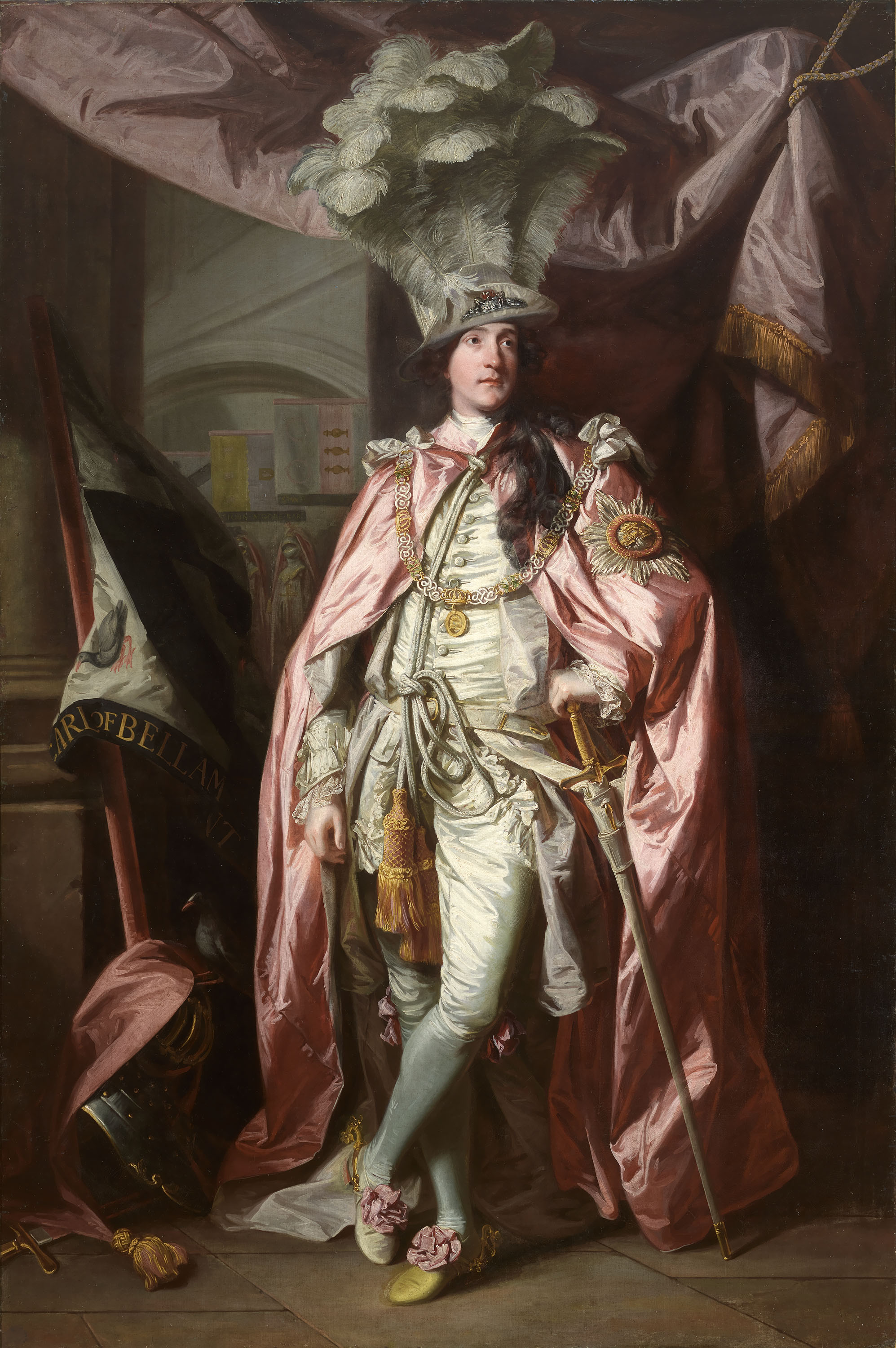
RICHARD, 2nd Baron (1636-1701), Governor of County Leitrim, 1689, Treasurer to the Queen, 1689-93, MP for Droitwich, 1689-95, who was, in 1688, one of the first to join the Prince of Orange. In 1689, he was attainted in his absence by the Irish Parliament of JAMES II. His lordship was created, in 1689, EARL OF BELLAMONT, along with a grant of 77,000 acres of forfeited lands.
Richard Coote (1636-1700/01) 1st Earl Bellomont By Samuel Smith Kilburn (d. 1903) – New York Public Library digital libraryhttp//:digitalgallery.nypl.org/nypldigital/id?423861, Public Domain, https//:commons.wikimedia.org/w/index.php?curid=13014278
Richard 1st Earl of Bellomont was Governor of Massachusetts, 1695, and Governor of New York, 1697-1701. The King had sent Lord Bellomont to New York to suppress the “freebooting.” Unfortunately he was responsible for outfitting the veteran mariner William Kidd, who turned into “Captain Kidd,” who terrorised the merchants until his capture in 1698.
According to Cokayne “he was a man of eminently fair character, upright, courageous and independent. Though a decided Whig he had distinguished himself by bringing before the Parliament at Westminster some tyrannical acts done by Whigs at Dublin.”
The 1st Earl of Bellomont wedded, in 1680, Catharine, daughter and heir of Bridges Nanfan, of Worcestershire, and had issue, NANFAN (1681-1708) his successor as 2nd Earl of Bellomont, and RICHARD (1682-1766), who succeeded his brother.
NANFAN, 2nd Earl (1681-1708) married Lucia Anna van Nassau (1684-1744), daughter of Henry de Nassau, Lord Overkirk, in 1705/6 at St Martin-in-the-Fields Church, London. Nanfan died at Bath, Somerset, from palsy, without male issue, when the family honours devolved upon his brother, RICHARD, 3rd Earl (1682-1766), who, in 1729, sold the family estate of Colloony, County Sligo, for nearly £17,000.
In 1737, he succeeded his mother to the estates of Birtsmorton, Worcestershire. Macaulay described him as “of eminently fair character, upright, courageous and independent.” On his death the earldom expired.
The last Earl was succeeded in the barony of Coote by his first cousin once removed, CHARLES, 5th Baron (1736-1800), KB PC, son of Charles Coote [1695-1750] High Sheriff of County Cavan, 1719, MP for Granard, 1723-27, Cavan County, 1727-50MP for County Cavan, 1761-6, who was son of the HON THOMAS COOTE (c. 1655-1741) a Justice of the Court of the King’s Bench of Ireland, younger son of the 1st Baron. This Thomas’s daughter Elizabeth married Mervyn Pratt (1687-1751) of Cabra Castle.
Sir Charles succeeded his cousin, Richard, in 1766, as 5th Baron Coote; and was created, in 1767, EARL OF BELLAMONT (3rd creation). His lordship was created a baronet, in 1774, designated of Donnybrooke, County Dublin, with remainder to his natural son, Charles Coote, of Dublin.
SIR CHARLES COOTE (1736-1800), KB PC, of Coote Hill (afterwards renamed Bellamont Forest) had an illegitimate son, Charles Coote (1765-1857) who despite his illegitimacy became 2nd Baronet of Bellamont). Charles 1st Earl married, in 1774, the Lady Emily Maria Margaret FitzGerald, daughter of James, 1st Duke of Leinster, and had issue, Charles, Viscount Coote (died age seven, 1778-86); Mary; Prudentia; Emily; Louisa. Following his death in 1800, the titles became extinct as he left no legitimate male issue, though he was succeeded in the baronetcy according to the special remainder by his illegitimate son Charles, 2nd Baronet.
Finally, let us return now to Charles Coote (1581-1642), 1st Baronet of Castle Cuffe, Queen’s County (Laois) and trace the line of his son Chidley Coote (d. 1668). Chidley lived in Mount Coote, County Limerick (later called Ash Hill, a section 482 property, see my entry). He had a son, Chidley (d. 1702) who married Catherine Sandys. They had a daughter Catherine (d. 1725) who married Henry Boyle 1st Earl of Shannon. Another daughter, Anne, married Bartholomew Purdon, MP for Doneraile and later Castlemartyr of County Cork. They had a son Reverend Chidley Coote (1678-1730) who inherited Ash Hill in County Limerick. He married Jane Evans (d. 1763) and it was their grandson Charles Henry Coote (1754-1823) who succeeded as 2nd Baron Castle Coote in 1802. He was the son of Reverend Charles Coote (1713-1796) and Grace Tilson (d. 1766). Another son was Lt.-Gen. Sir Eyre Coote (1762-1823).
Major General Eyre Coote (1762-1823), Governor of Jamaica, 1805 by engraver Antoine Cordon after J.P.J. Lodder, courtesy of National Gallery of Ireland.He was son of Reverend Charles Coote (1713-1796) and Grace Tilson (d. 1766).Eyre Coote (1726-1783) attributed to Henry Robert Morland, c. 1763, National Portrait Gallery of London NPG124. He was the son of Reverend Chidley Coote (1678-1730) who inherited Ash Hill in County Limerick and Jane Evans (d. 1763).Lieutenant General Sir Eyre Coote (1726-1783) Commander-in-Chief in the East Indies (1777-1783) by John Thomas Seton, courtesy of the British Library.He was the son of Reverend Chidley Coote (1678-1730) who inherited Ash Hill in County Limerick and Jane Evans (d. 1763).
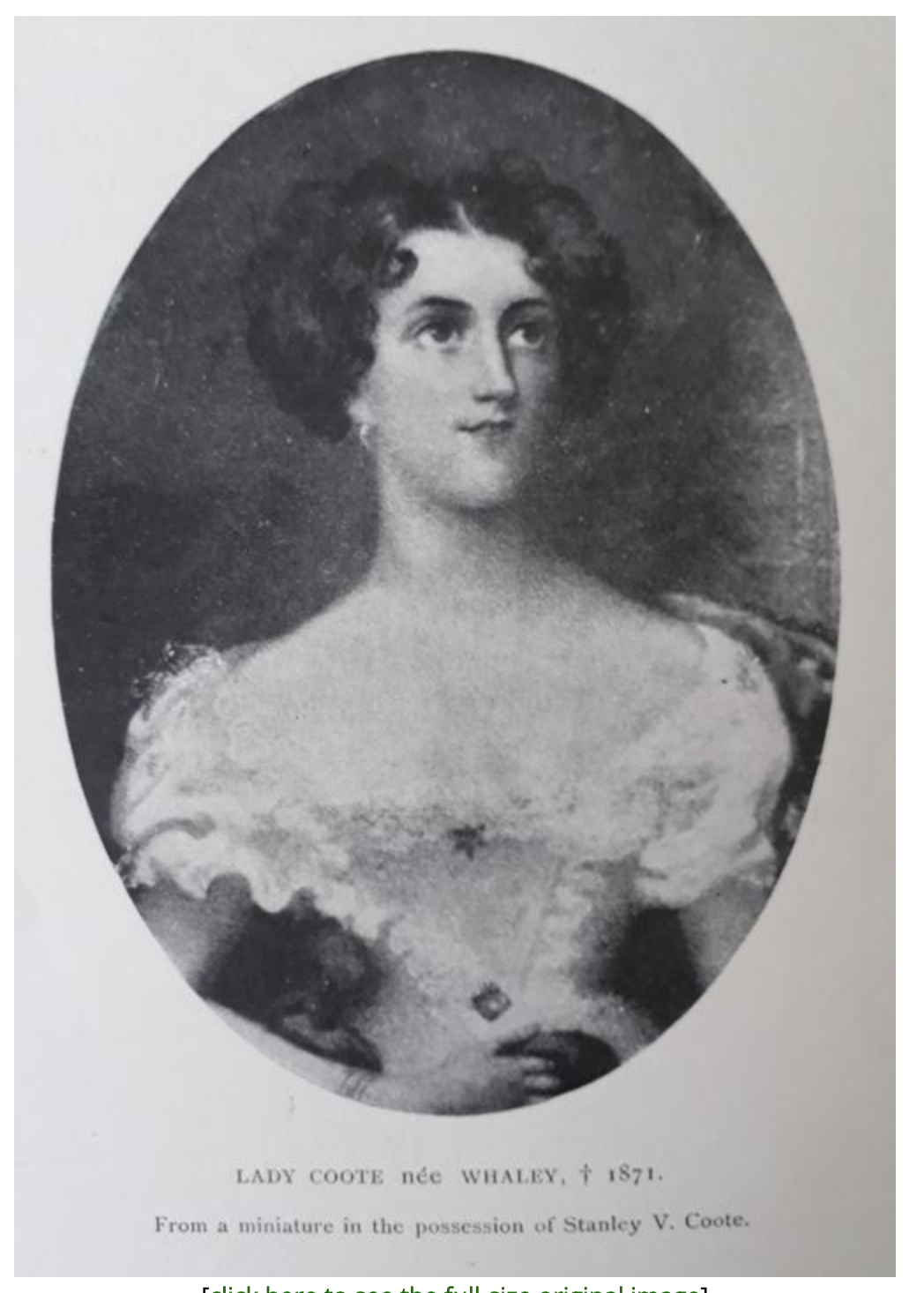
Reverend Chidley Coote (1678-1730) who inherited Ash Hill and Jane Evans (d. 1763) had a daughter Elizabeth who married John Bowen. Reverend Childley Coote and Jane Evans’s son Robert (d. 1745) inherited Ash Hill and married his cousin Anne Purdon, daughter of Bartholomew Purdon and Anne Coote. Robert Coote and Anne Purdon’s grandson was Charles Henry Coote (1792-1864) who succeeded as 9th Baronet of Castle Cuffe, Queen’s County, who married Caroline Elizabeth Whaley (d. 1871), daughter of John Whaley (d. 1847) of Dublin.
Help me to pay the entrance fee to one of the houses on this website. This site is created purely out of love for the subject and I receive no payment so any donation is appreciated!
Thomas Cosby kindly agreed to show us his home, Stradbally Hall, in June, despite ongoing Covid restrictions. This year (2021) Section 482 houses are not required to be open to the public due to the dangers of the Covid virus.
Many people have heard of Stradbally nowadays as it is the venue for Electric Picnic. Being the venue for a festival brings in much-needed finances for some of the big houses in Ireland. Stradbally is owned by the same family for whom it was built, and it is magnificent. I can only imagine how hard it is to maintain. Like many of the owners who inherit their big houses, Thomas farms his land.
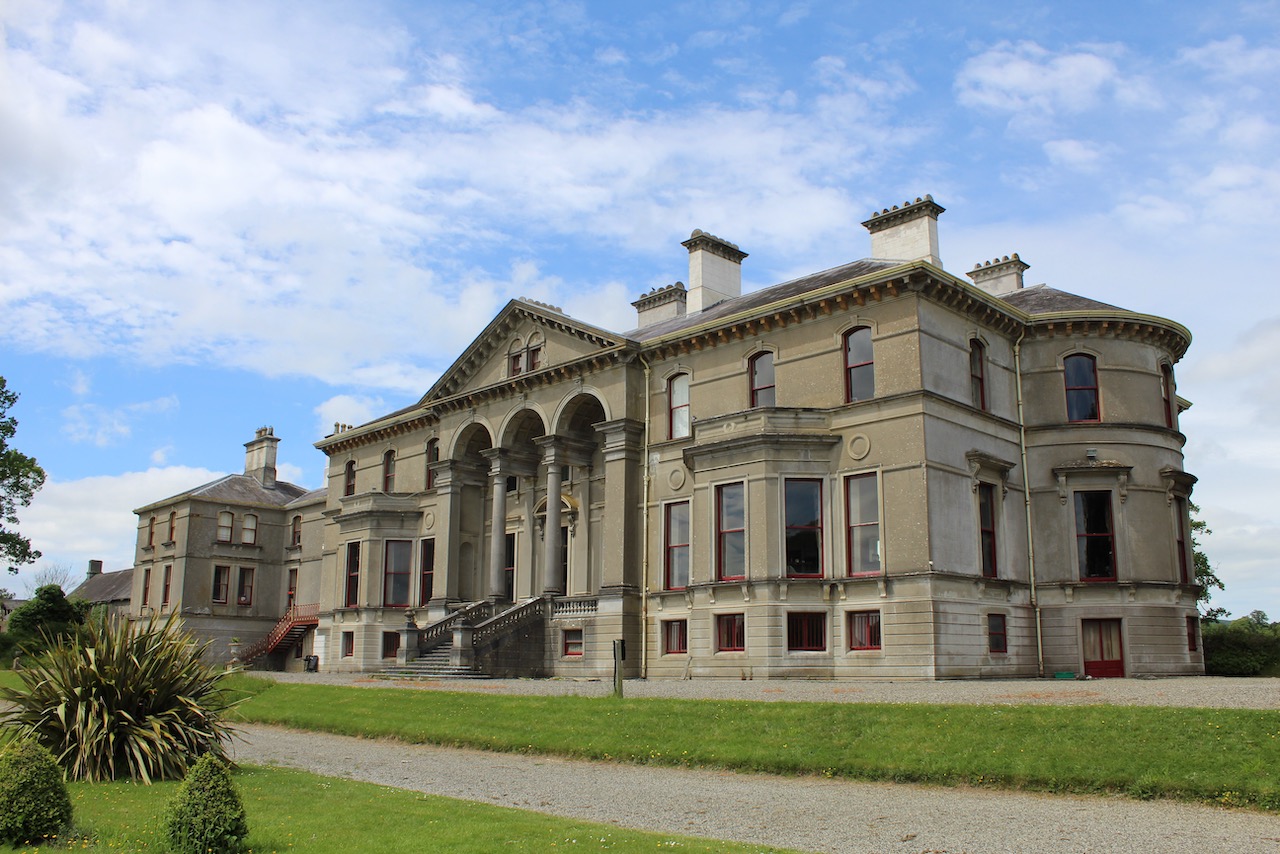
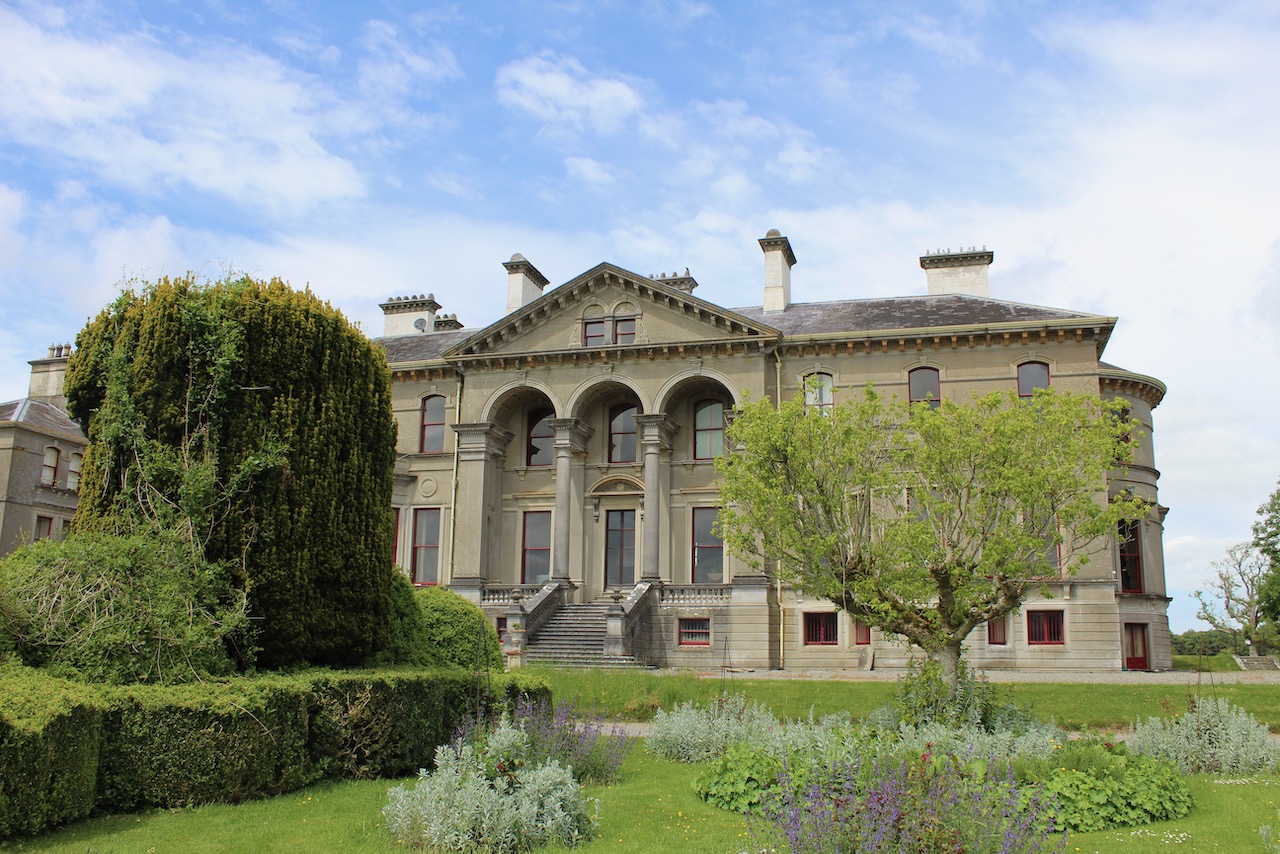
Mark Bence-Jones tells us in his A Guide to Irish Country Houses that a house was built at Stradbally in 1699 for Lt-Col Dudley Cosby (1662-1729). [1] This house, however, was demolished by the grandson of Lt-Col. Dudley, another Dudley (Alexander Sydney) Cosby, 1stand last Lord Sydney of Leix and Baron of Stradbally, in 1768, and a new house was built in 1772, on what was regarded to be a healthier site. It is a nine bay, two storey over basement house. The stone walls of the original house gardens are now the walled garden.
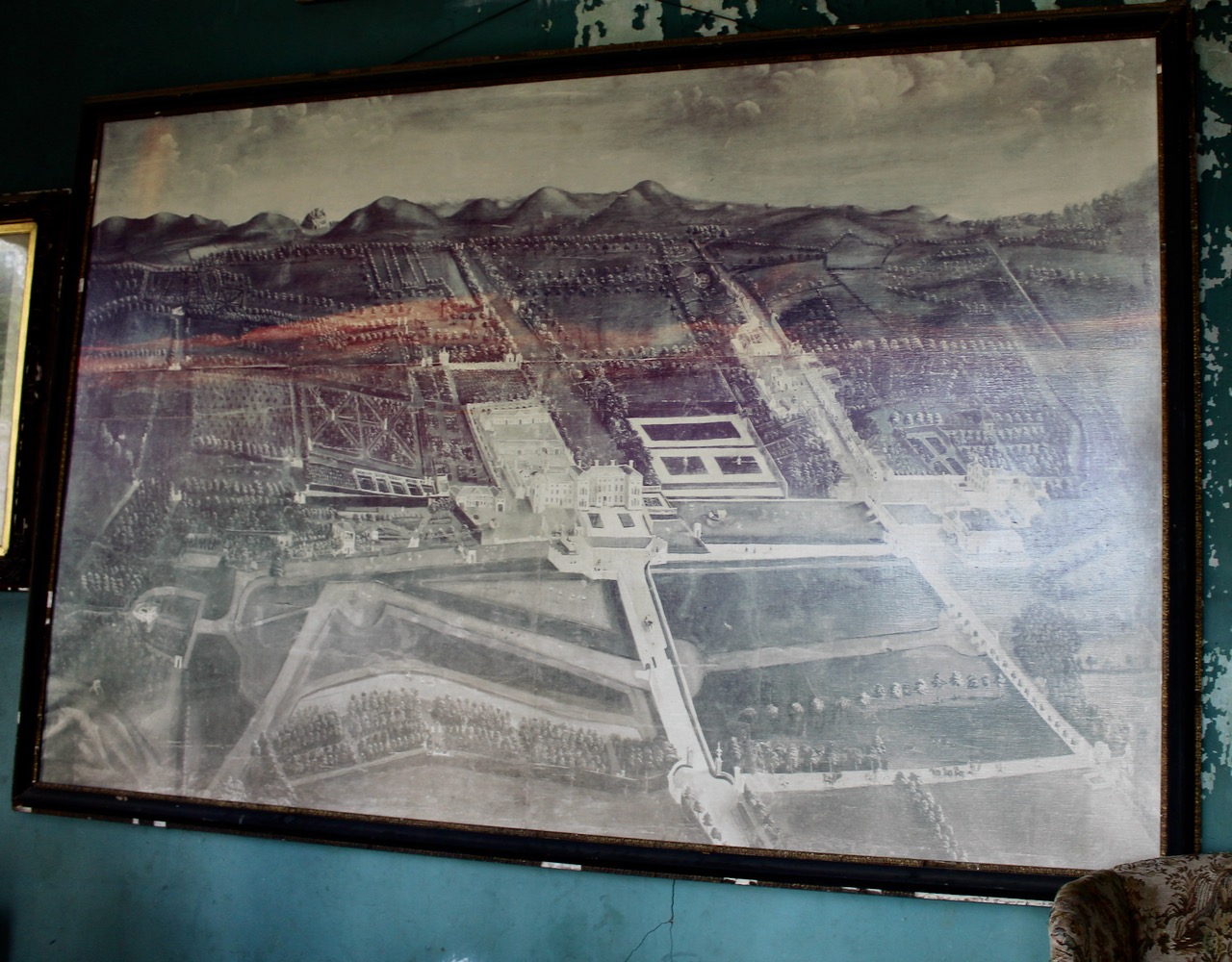
The 1740s painting of Stradbally with the previous (1699) house in the centre. This hangs in the Billiard Room where Thomas brought us first, and used the painting to illustrate the history of his family.The Archers John Dyke Acland and Dudley Alexander Sydney Cosby Baron Sydney, by James Scott, after Sir Joshua Reynolds, mezzotint, late 19th century (1769). Photograph from the National Portrait Gallery, London.
The second (1772) house was enlarged in 1866-69, designed by Sir Charles Lanyon, of Lanyon, Lynn & Lanyon, to form the house which we see today. Lanyon, Lynn & Lanyon also designed Castle Leslie, which we visited – another Section 482 property which is now a hotel. [2]
Lt-Col. Dudley Cosby was not the first Cosby to live in Ireland. The Cosby, or Cosbie, family, came to Ireland around 1538, during the reign of Queen Mary (i.e. “Bloody Mary,” the eldest daughter of King Henry VIII, called “Bloody” as she used bloody means to defend the Catholic faith). General Francis Cosby (1510-1580) was an active defender of the Pale in Ireland, the area around Dublin controlled by the British crown, and in 1562 he was granted the site of the Abbey of Stradbally. [3] Francis Cosby married the daughter of the Lord Protector of England, Edward Seymour, the 1st Duke of Somerset. Lord Seymour was the brother of Jane Seymour, wife of Henry VIII. Due to the struggles for power within the court of Henry VIII, Lord Seymour was executed. Francis Cosby came to Ireland at this time. The Abbey, which had been disestablished in Henry VIII’s time (i.e. was taken from the Catholic church and no longer served as an Abbey) became Francis Cosby’s residence, and part of it still exist in the town of Stradbally in a building still called “the Abbey.”
General Francis Cosby died in battle, at the age of seventy, in the battle of Glenmalure in Wicklow, in 1580. He was succeeded by his son, Alexander. Alexander and his son, Francis, continued to fight, engaged in perpetual battle, Major E.A.S. Cosby tells us, with the O’Moores, who had originally controlled the land in the area. In 1596 Anthony O’Moore sent to demand a passage over Stradbally Bridge. Alexander understood this to be a challenge, so he refused passage, and prepared to fight once again, along with his son Francis. That day both Alexander and Francis Cosby were killed, leaving Francis’s nine week old son, William, to inherit. Parts of Stradbally Bridge still exist.
William died at a young age and so his uncle, Richard (d. 1631), inherited the Stradbally estate. Richard challenged the O’Moores to a further fight to avenge his father, and this time he won. Having won one battle each, the fighting seems to have subsided. Richard married Elizabeth Pigott, daughter of the neighbour Robert Pigott of Dysart.
It was Richard’s great-grandson, Lt-Col. Dudley Cosby (1662-1729) who built the house at Stradbally pictured in the 1740 painting. He married Sarah Pole, daughter of Periam Pole (1625-1704) of Ballyfin in County Laois, now a luxury hotel. Her dowry helped pay for the work on the Stradbally estate.
Ballyfin hotel, Photo by Tony Pleavin, 2018. [9]
Dudley Cosby created gardens and kept racehorses. His father-in-law did not like this extravagance and gave Dudley £100 not to keep them, which Lt-Col Dudley did not strictly observe!
Dudley and Sarah Cosby had a son whom they named Pole (1703-1766).
Pole Cosby wrote an autobiography. [8] His return from a Grand Tour of Europe is pictured in the 1740 painting in the Billiard Room.
As foreseen by his father-in-law, Dudley Cosby overstretched his finances and he purchased a Captain’s Commission in a military regiment. He leased out Stradbally, and his wife returned to Ballyfin while he was fighting abroad. Her father died but she continued to live with her brother in Ballyfin in the winter and in his house in Queens Street, Dublin, in the summer, for five years. The children were sent to board with a family for schooling and to learn French.
After five years, Dudley and his wife Sarah moved to London “for cheapness” (Pole writes in his autobiography) and then to York. They returned to Stradbally in 1714 in better financial circumstances and Dudley continued to do up the house and garden.
Pole Cosby’s autobiography is very detailed and he writes of the places in which he lived and of his father’s battles in the military, then of his own schooling, listing all of his schoolmates. He also discusses family finances in detail. He writes that his father financed himself at first by marrying Miss Ann Owens daughter of Sir Andrew Owens of the City of Dublin and “with her he got £1500,” then in 1699 he married Sarah Pole and “got with her £2000.” He paid £300 for his Captain Commission and had to pay £100 for his brother Alexander for not finishing his apprenticeship (this Alexander moved to the U.S. along with his brother William).
Pole Cosby went to university in Leyden in Holland, as did several of his Irish cousins. There he was studious and abstemious, he tells us. He travelled while in Europe and was introduced by Lord Townsend to King George I and his son Frederick Prince of Wales. He visited a monastery of Irish priests in Prague and argued with them about religion – they told him he was a heretic and would be damned, but when not talking of religion he says they got along very well!
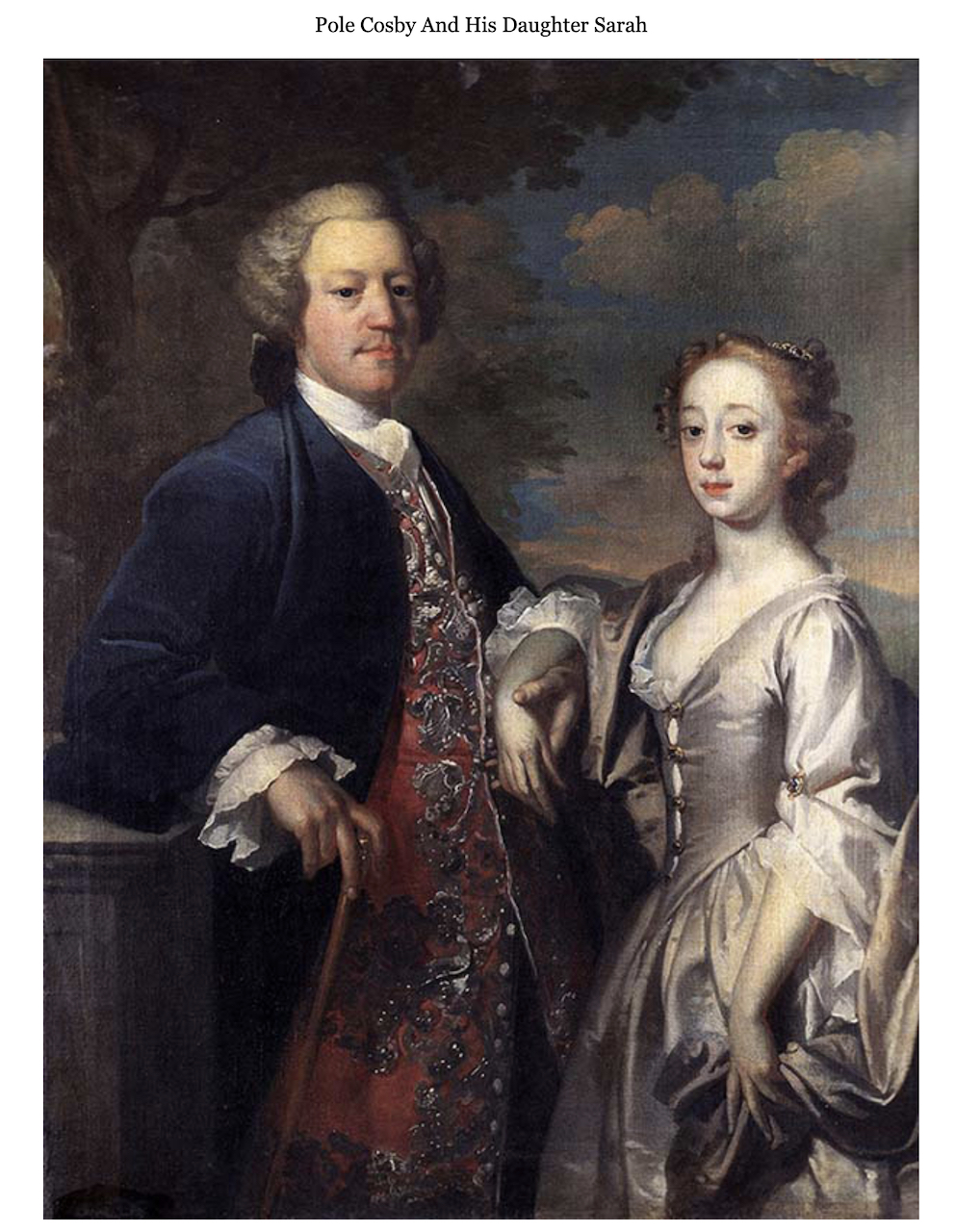
Pole Cosby and his Daughter Sarah, by James Latham, portrait courtesy of Gallery of the Masters website. Sarah (b. 1730) married, first, Arthur Upton (1715-1768) of Castle Upton in County Antrim, after his first wife Sophia Ward had died, and secondly, Robert Maxwell (d. 1779) 1st and last Earl of Farnham. https://www.galleryofthemasters.com/l-folder/latham-james-pole-cosby.html
Pole Cosby married Mary Dodwell and they had a son named Dudley Alexander Sydney Cosby (1732-1774), who served as Ambassador to the Court of Denmark, and for his services, was created Lord Sydney of Leix and Baron of Stradbally, in 1768. When serving as Ambassador to Denmark he helped to arrange the marriage of King George III’s sister to the son of the King of Denmark. It was an unsuccessful marriage and she left her husband for the Prime Minister of Denmark! Despite the lack of success of the marriage he helped to arrange, Dudley Cosby was elevated to the peerage. He married Lady Isabella St Lawrence, daughter of Thomas St Lawrence, 1st Earl of Howth (who lived in Howth Castle – the castle only recently passed out of ownership of the St. Lawrence family).
Pole’s son Dudley, Lord Sydney, built the new (current) house, in 1772.
The overseer for the building of the new house was Arthur Roberts, which is stated on a plaque which reads: “Built by Dudley, Lord Sydney, 1772, Arthur Roberts, overseer.”
Dudley Lord Sydney died in 1774, soon after his marriage, and did not have any children. The estate passed to his nephew, son of his brother Alexander, Admiral Phillips Cosby (1729-1808).
The Historic Houses of Ireland website tells us that Dudley died before the house was finished, and his successor Admiral Phillips had to sell 5000 acres to finance the completion. [4]
Phillips’s father, Alexander (d. 1742), was Lieutenant Governor of Annapolis Royal in the United States, and Alexander’s brother William (c.1690-1736) was Governor of New York between 1732-1736.
General William Cosby (c.1690-1736), Date 1710 by Charles Jervas, Irish, c.1675-1739, photograph courtesy of National Gallery of Ireland.William Cosby became Governor of New York.
William’s daughter Elizabeth Cosby married Lord Augustus Fitzroy (1716-1741) and her son, Augustus Henry Fitzroy, 3rd Duke of Grafton, became Prime Minister of England in 1767. After her first husband died Elizabeth née Cosby married James St. John Jefferyes of Blarney Castle in County Cork.
Admiral Phillips Cosby (1729-1808) was born in the United States and was active in the Navy, in which he continued to serve after inheriting Stradbally Hall. He served on the British side in the American War of Independence. He collected many paintings.
Admiral Phillips had no children, so the estate passed to Thomas Cosby (d. 1798). Thomas was a descendant of Richard Cosby and Elizabeth Pigott. Their son Francis (b. 1612) married Ann Loftus (d. 1673). Francis and Ann née Loftus’s son Alexander (d. 1694) married Elizabeth L’Estrange and their son was Lt-Col. Dudley Cosby (1662-1729) who built the house at Stradbally.
When the Cosby line died out with Admiral Phillips Cosby (1729-1808), it was a descendant of Francis and Ann née Loftus’s Thomas (d. 1713) rather than their son Alexander, who inherited. Thomas Cosby (d. 1713) lived at Vicarstown, Stradbally, County Laois. He married Elizabeth Smith, and they had a son, Francis (d. 1783). Francis married Ann Pigott and they had several children. The Thomas who inherited was a son of their son Thomas (b. 1742), and Frances Bowker.
Thomas Cosby (1765-1798) married Grace Johnstone, daughter of George of Glaslough, County Monaghan.
Stradbally passed to his son Thomas (d. 1832). Thomas (d. 1832) was High Sheriff of Queen’s County in 1809 and also Governor of Queen’s County. He married Charlotte Elizabeth Kelly of Kellyville, County Laois. The property passed via their son Thomas Phillips, who died in 1851. He served as High Sheriff, Deputy Lieutenant and Justice of the Peace for Queen’s County.
The property passed on down to via Thomas Phillips Cosby’s brother Sydney Cosby (who had died in 1840) to Sydney’s son, Colonel Robert Cosby (1837-1920). Sydney Cosby had married Emily, the daughter and co-heir of Robert Ashworth of Shirley House, Twickenham (his brother Wellesley Pole Cosby had married the other daughter and co-heiress, Marie).
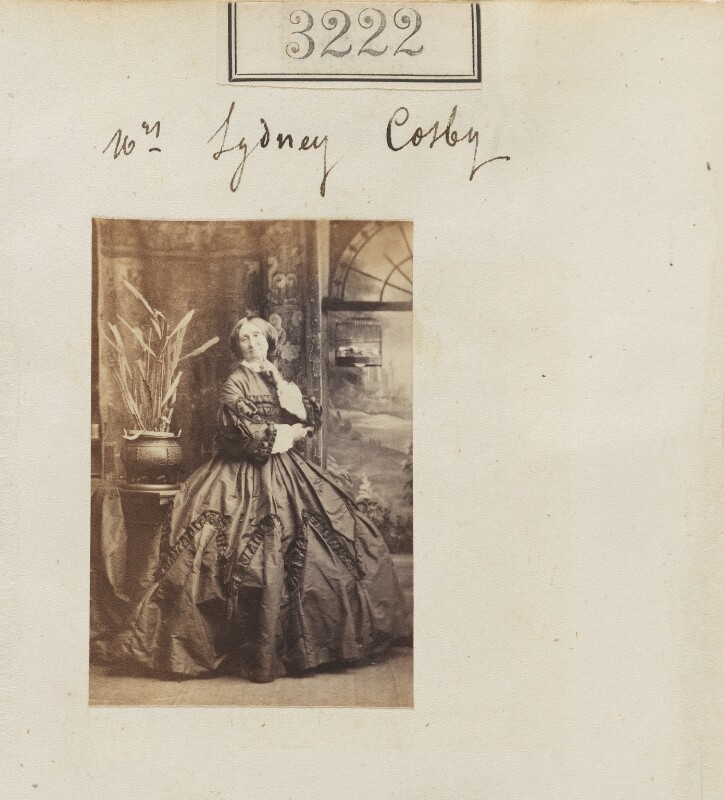
Emily Ashworth, Mrs. Sydney Cosby, by Camille Silvy, albumen print, 21 April 1861, photograph from the National Portrait Gallery, London.
Colonel Robert Cosby employed Charles Lanyon in 1866 to enlarge the house, remodelling it in an Italianate style. He inherited a fortune, and built houses in the nearby village of Stradbally, following in the footsteps of his forebears who had also sought to develop the village.
Stradbally passed to his son, also in the military, Captain Dudley Cosby (1862-1923), and to his son, Major Ashworth Cosby (1898-1984). Major Ashworth married Enid Elizabeth Hamilton from nearby Roundwood, County Laois.
Roundwood House, County Laois, photograph from the National Inventory of Architectural Heritage.
It was Major Ashworth’s grandson, Thomas, who showed us around the house. Thomas’s young son joined us in the Billiard room to look at the old painting of Stradbally, and asked a few intelligent questions, so he is learning the history of his home also!
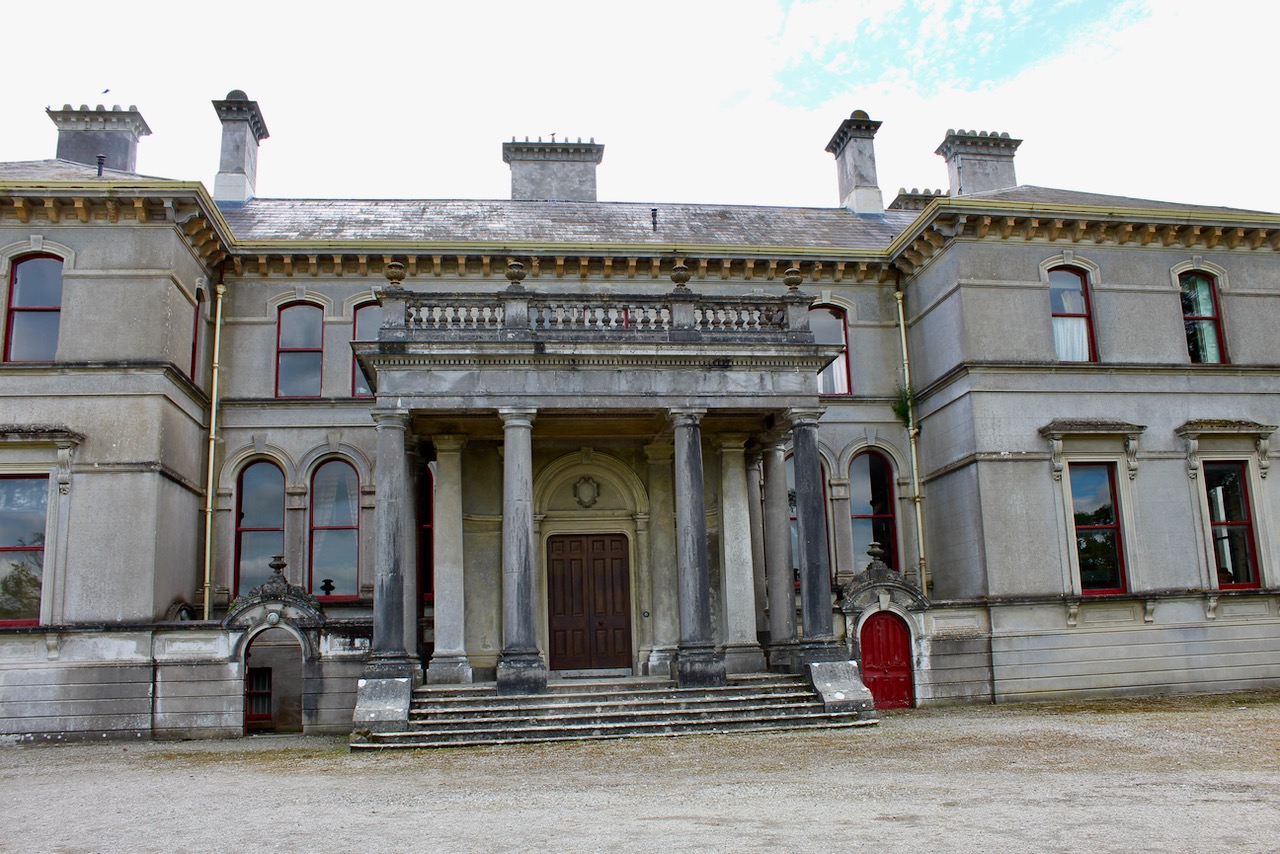
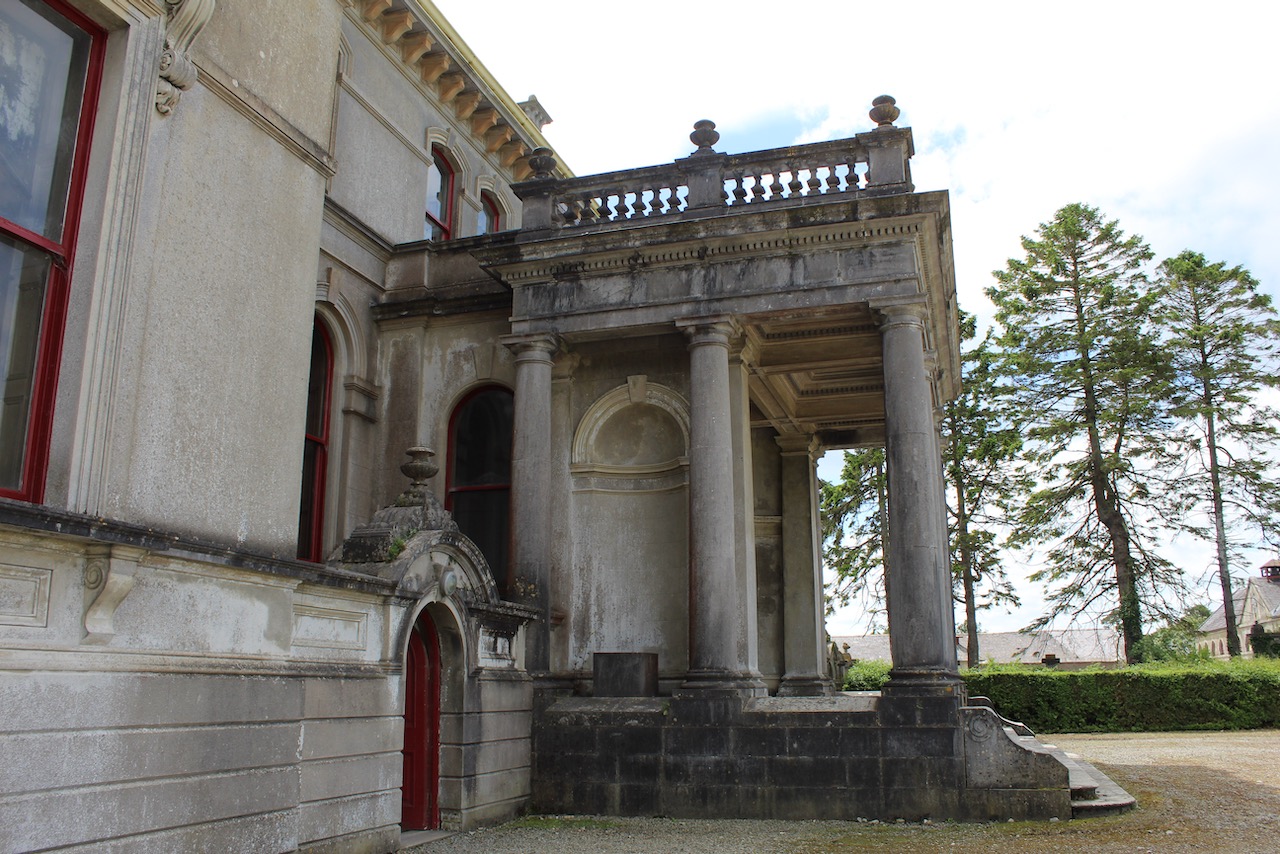
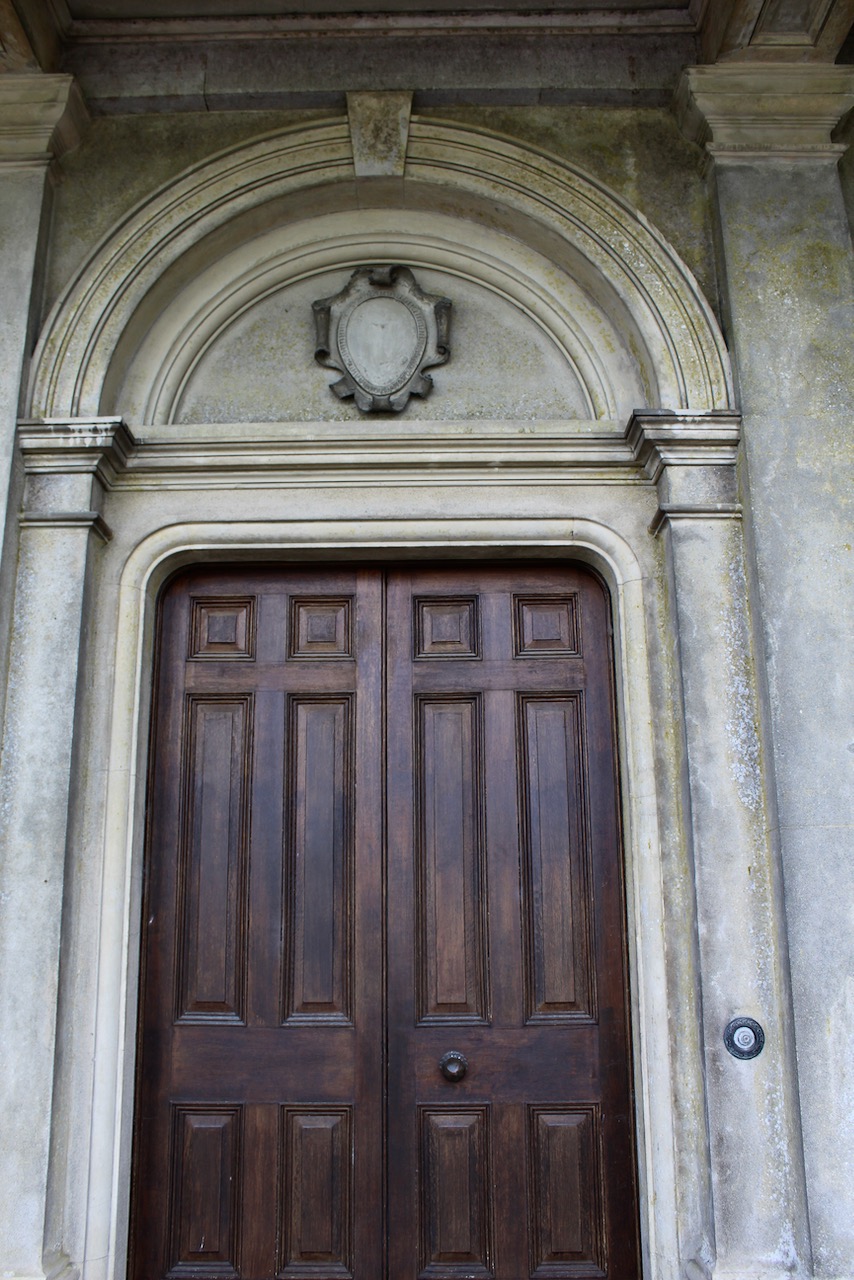
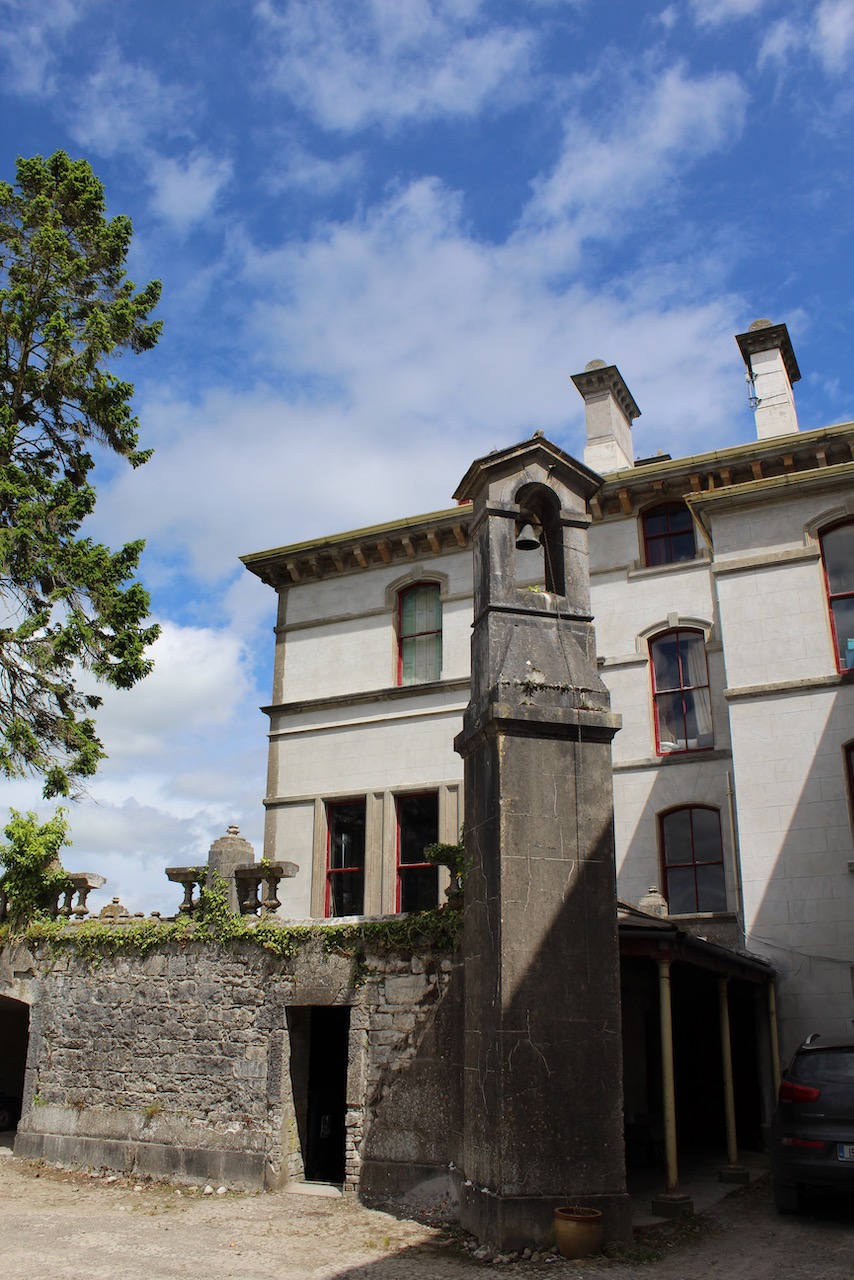
Mark Bence-Jones tells us that Lanyon added a new entrance front, which was advanced from the old front wall so that the house became three rooms deep instead of two. This front has an impressive single-storey balustraded Doric portico leading up a flight of stone steps to the front door. On either side of the portico are a group of three round-headed windows, and beyond those on either side, a two-bay block projecting forward.
The upper storey windows are what Bence-Jones describes as “camber-headed” (he defines camber-headed windows as a window of which the head is in the form of a shallow convex curve). [5]
The house was given a high-pitched eaved roof on a bracket cornice.
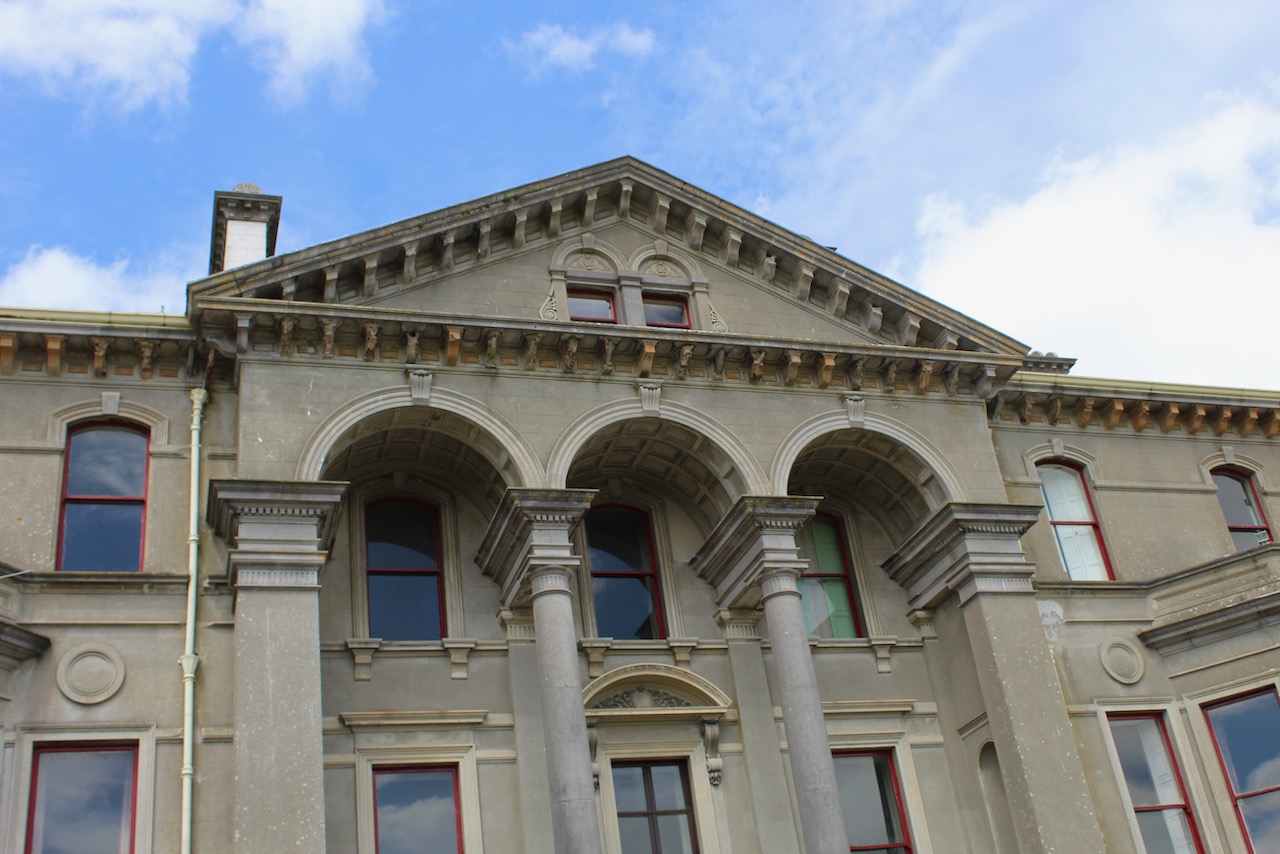
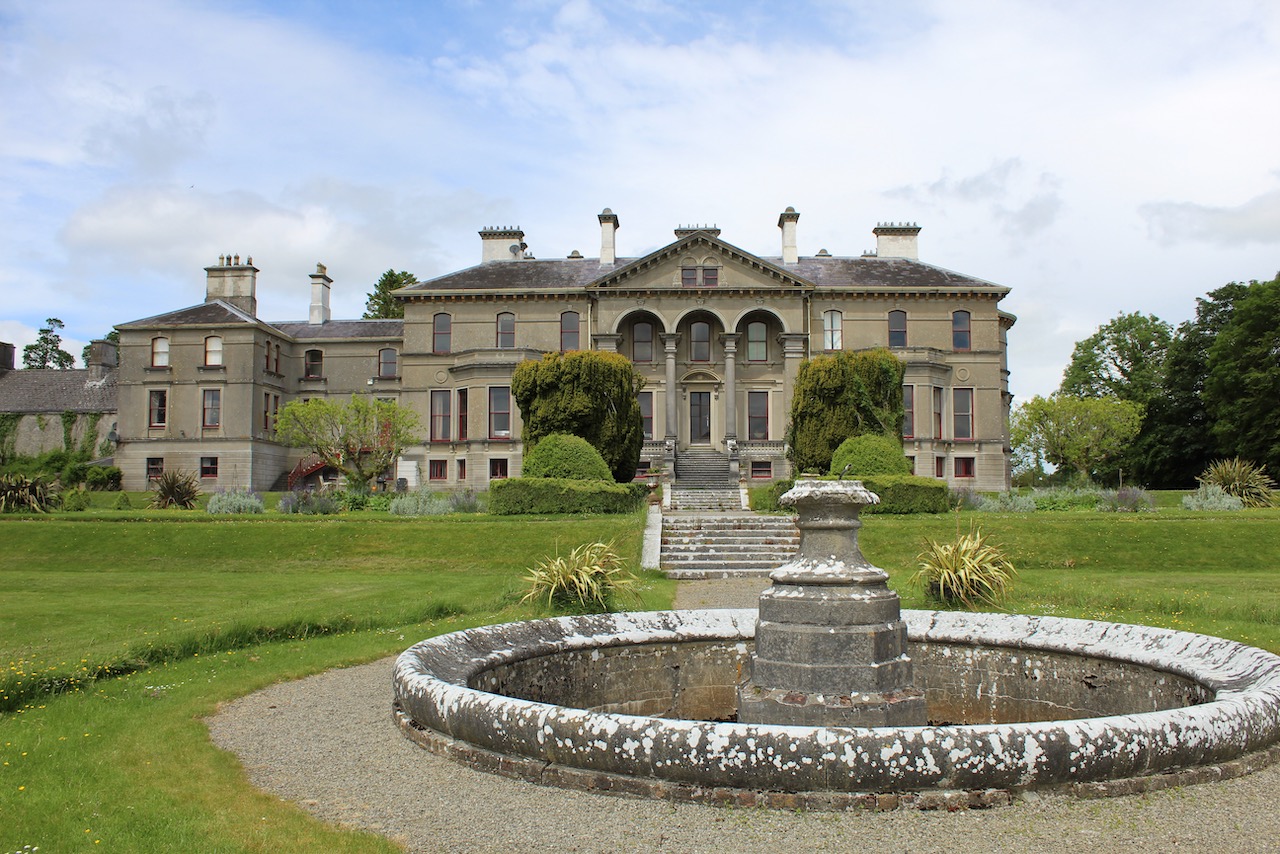
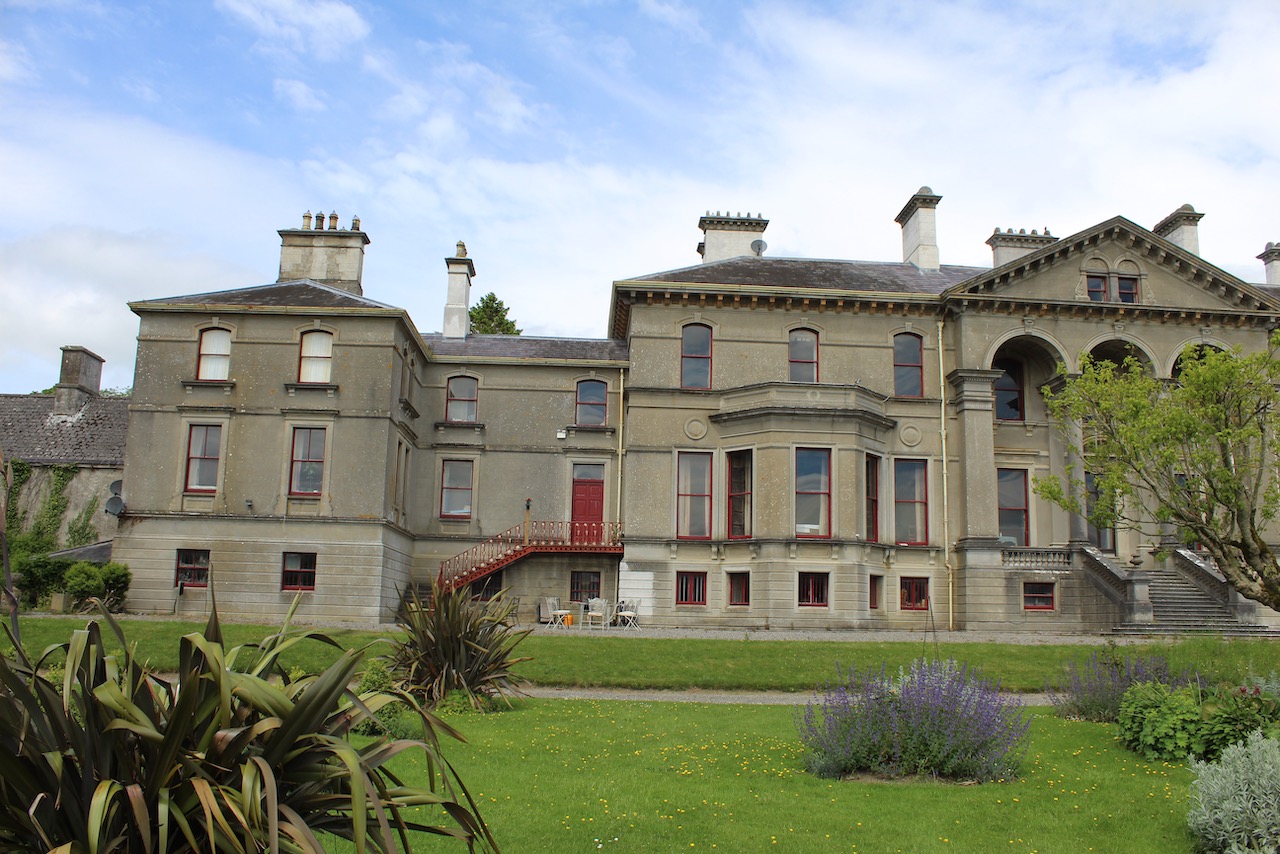
After our tour of the house, we walked around to the back of the house as I wanted to see what Bence-Jones had described: “On the garden front, Lanyon left the two three sided bows, but filled in the recessed centre with a giant pedimented three arch loggia.” It is impressive! According to the National Inventory of Architectural Heritage, this was originally the front of the house, but when the three arches were added, so was the Doric portico on what is now the entrance front, so this impressive two storey over basement treble arch was never intended, it seems, as an entry to a front door! [6]
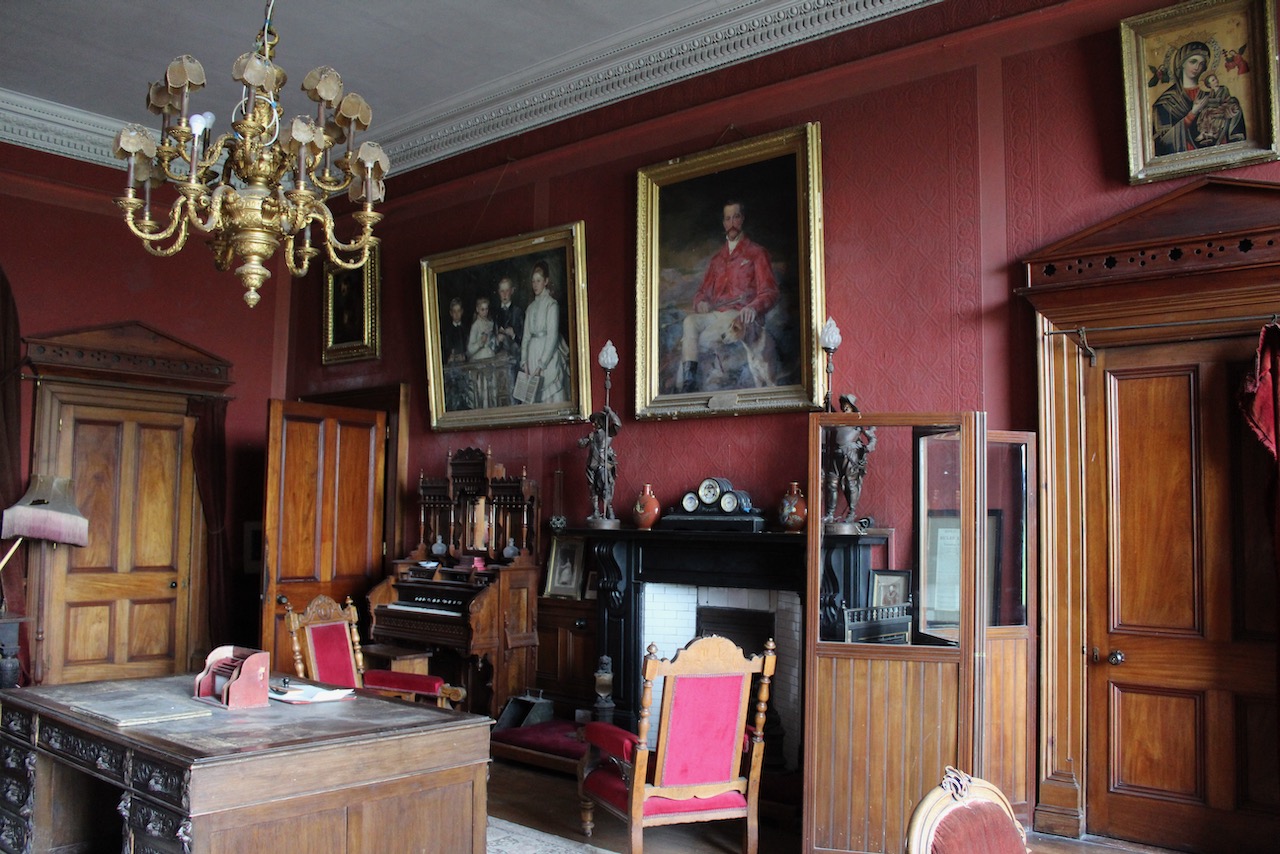
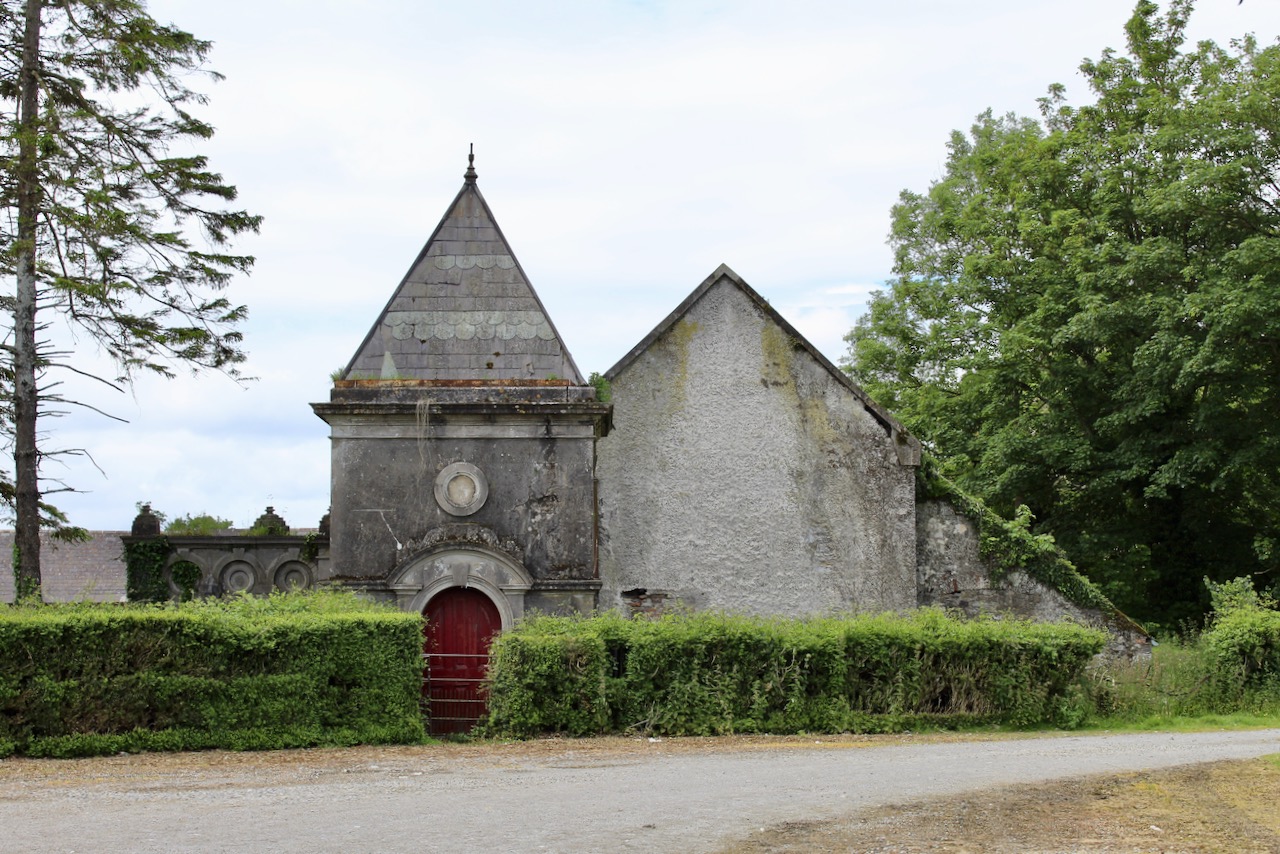
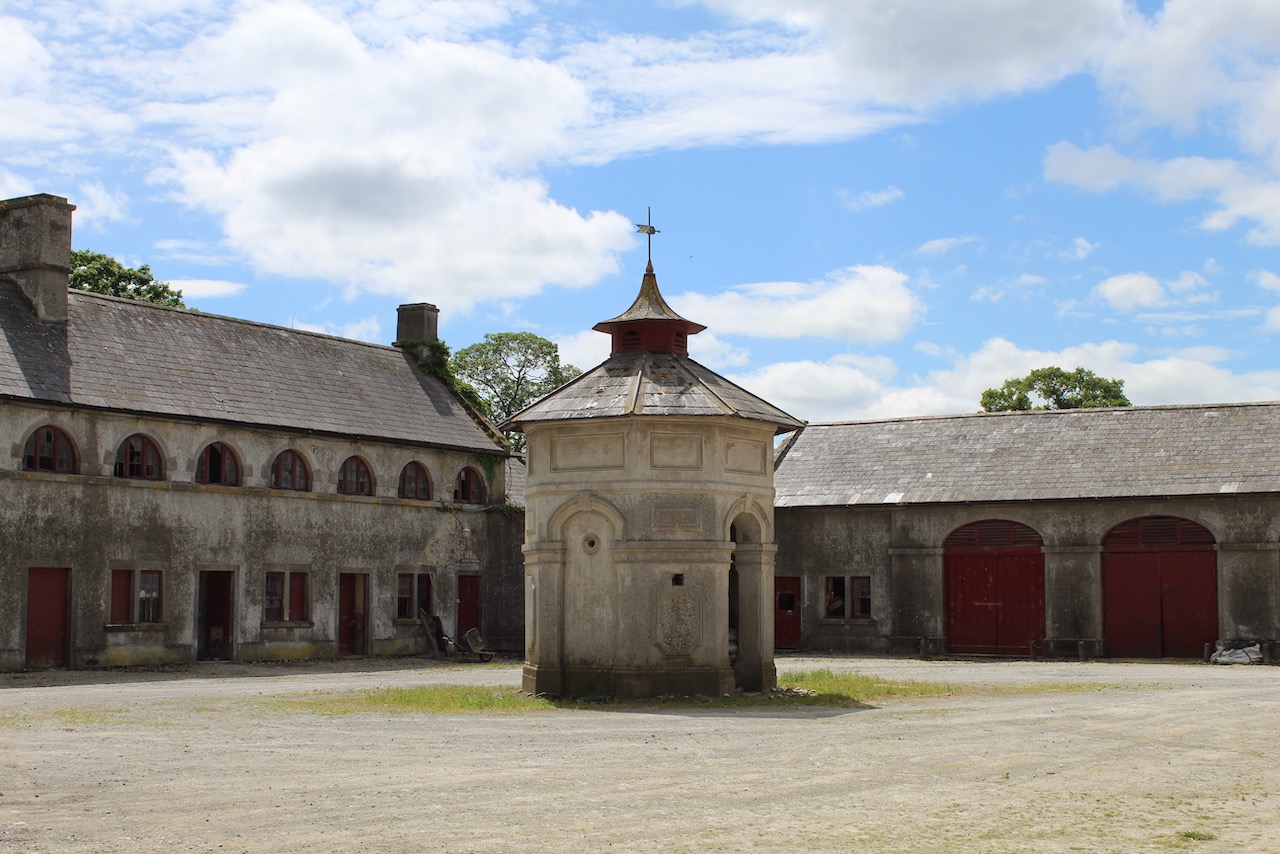
We went first to the billiard room on our right (the newer, Lanyon designed part of the house) to see the large painting of old Stradbally. From the billiard room you have a good view of the beautiful cut-stone farm buildings.
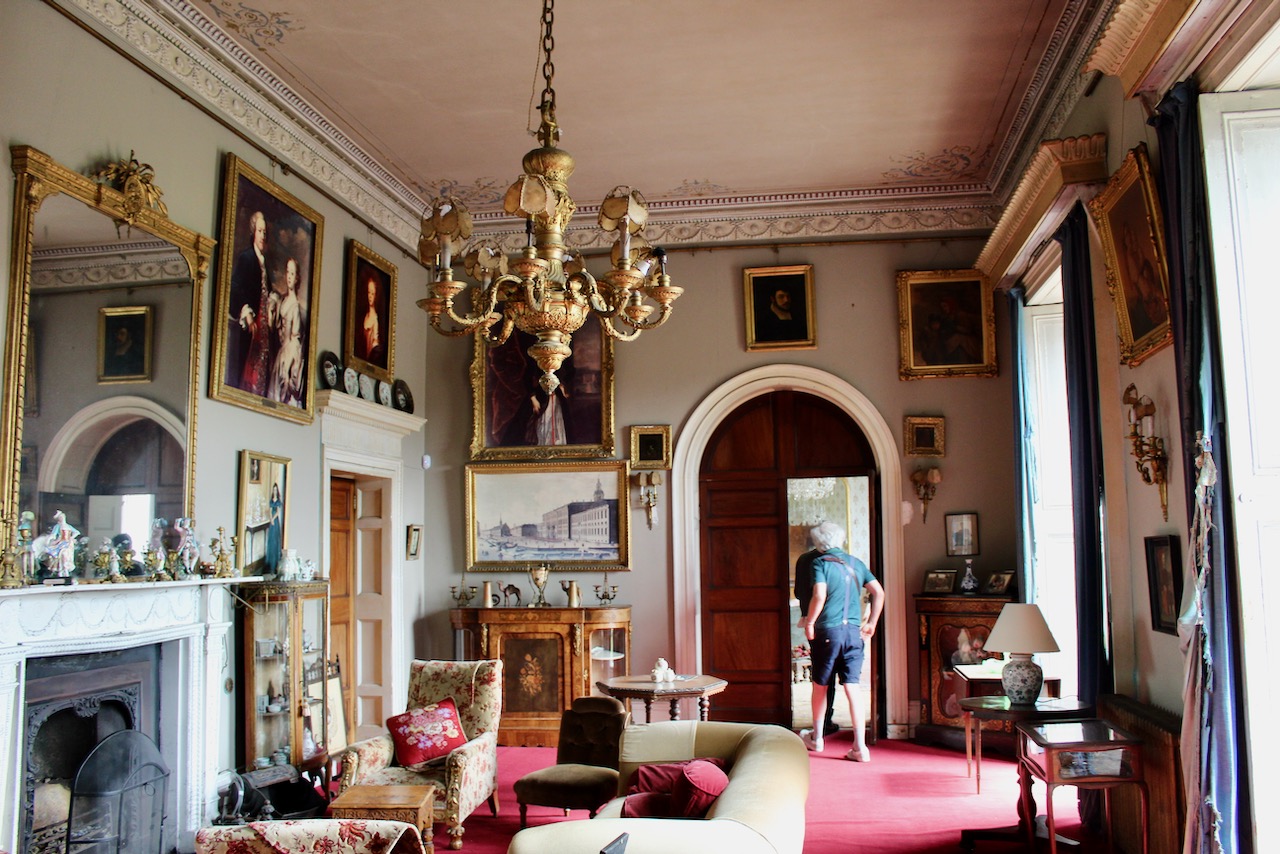
The three reception rooms on the garden front, the dining room, saloon and drawing room, remain much as they were before the Lanyon renovation, with late-Georgian plasterwork.
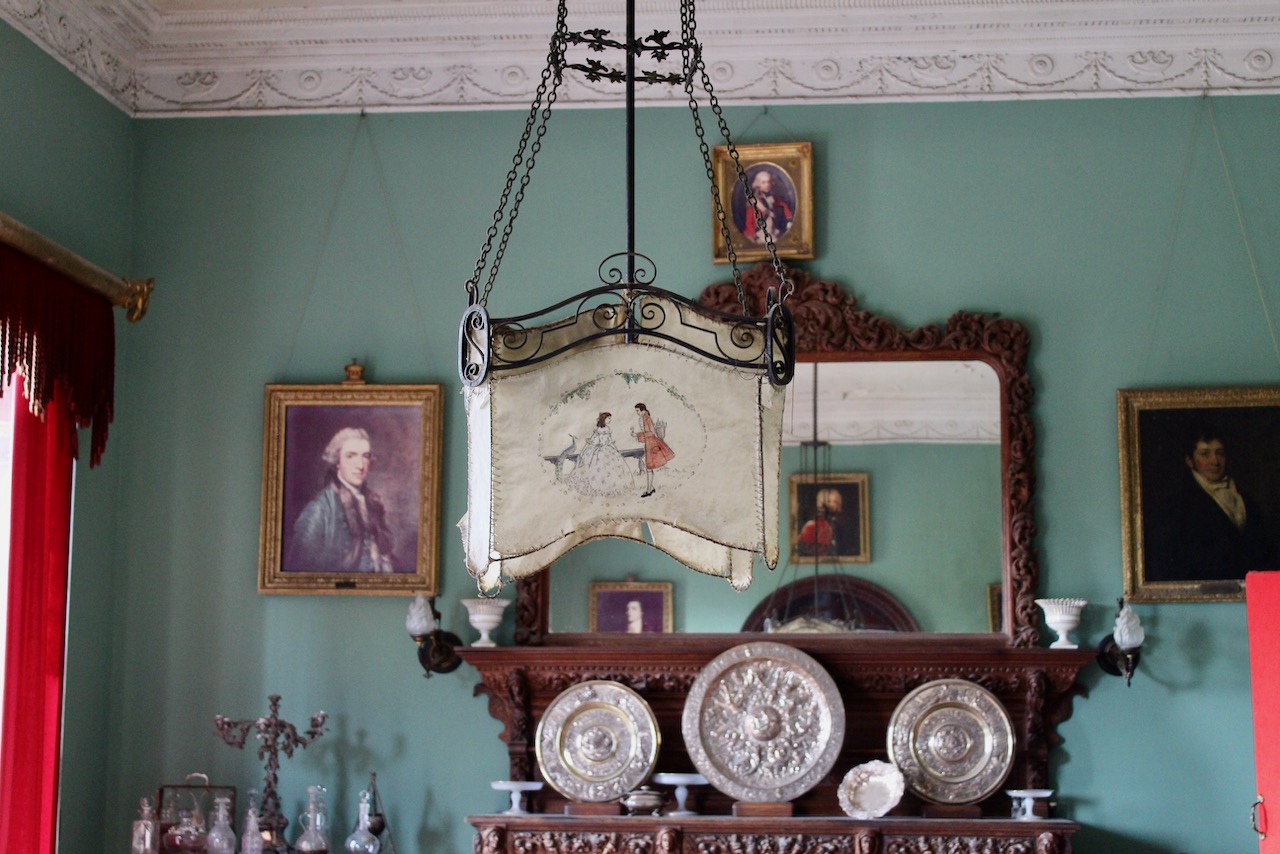
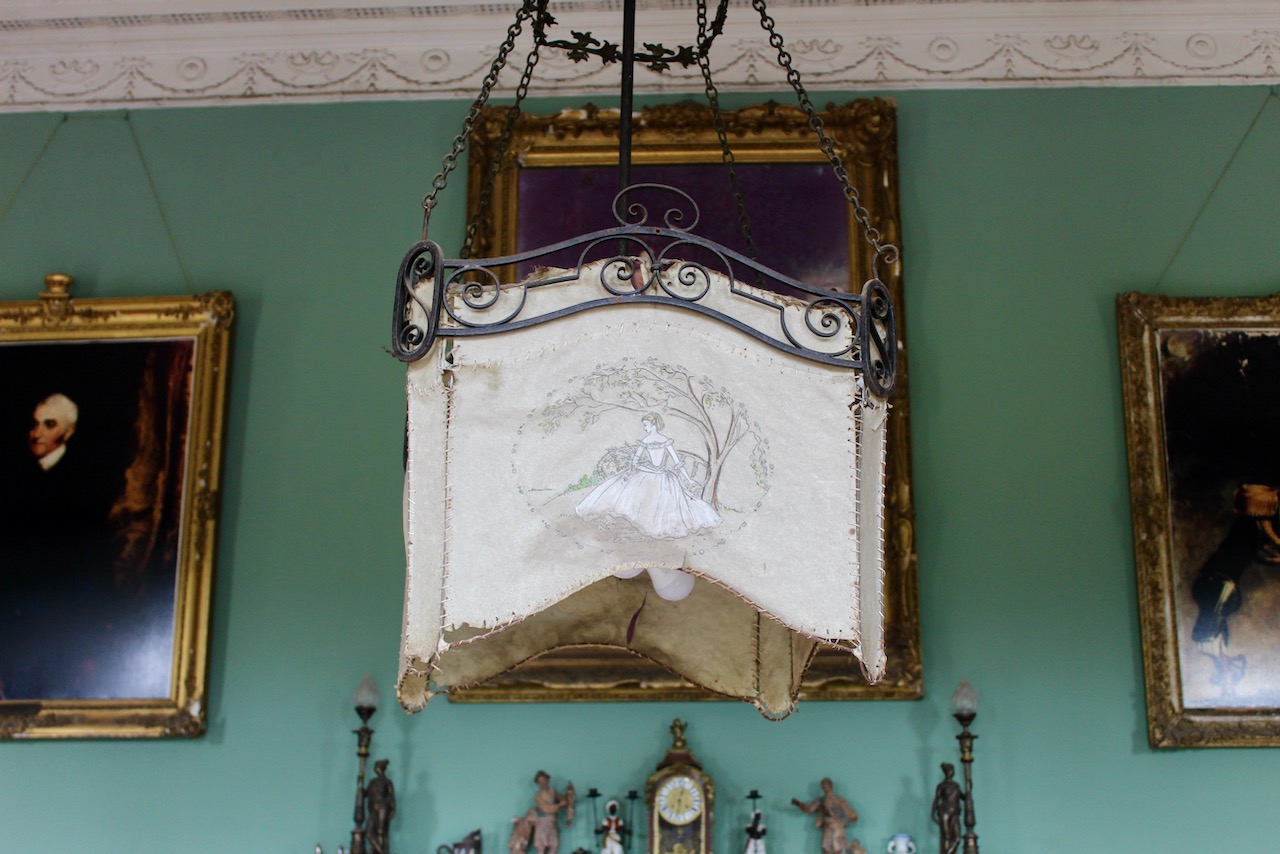
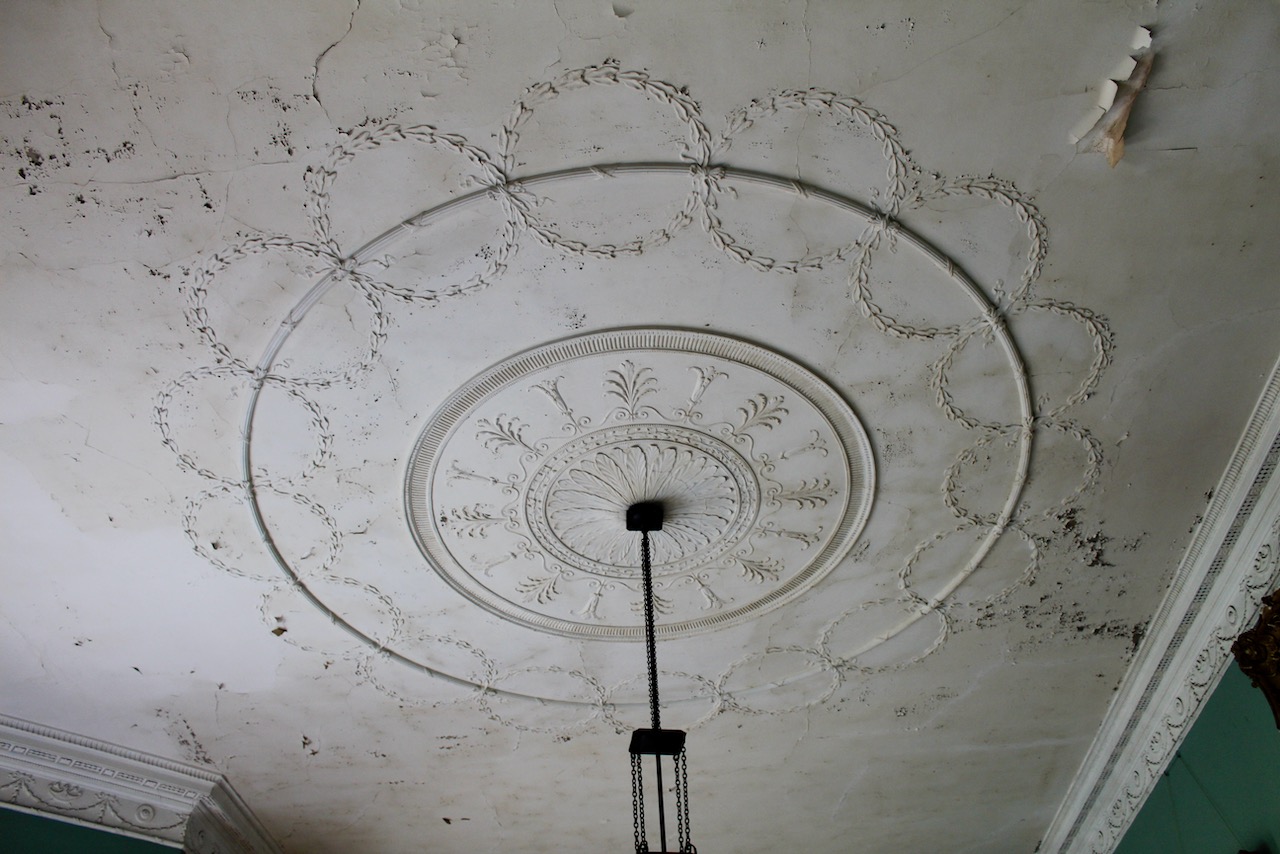
I admired the beautiful lamp shade over the dining table, and the plasterwork ceiling, which the National Inventory describes as “Adamesque” (ie. like the work of William Adams and his sons, most famous of whom are Robert and James). Andrew Tierney in his Buildings of Ireland describes the frieze of swags “framing calyxes and paterae”, and a “guttae cornice.” Patera is a round or oval ornament in shallow relief, and calyxes are the whorls of a plant that encloses the petals and forms a protective layer around a bud. A guttae is one part of a post-and-lintel structure.
The ceiling centrepiece is of acanthus, anthemion and circles of laurel interweaving around a ribbon-and-reed moulding.
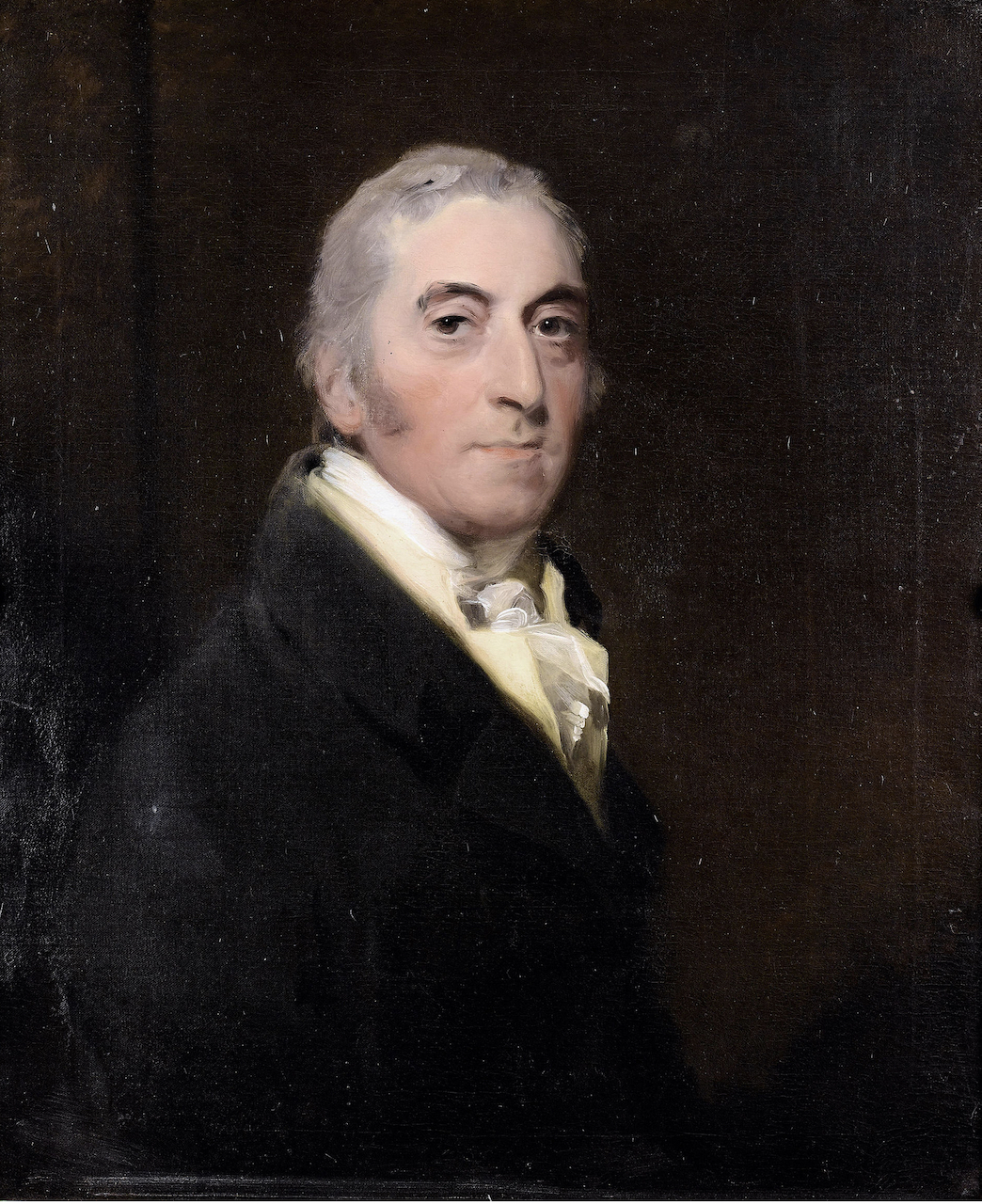
In the dining room are several portraits. There is one of William Wellesley-Pole, 3rd Earl of Mornington. He inherited from William Pole of Ballyfin and added Pole to his surname. He was the elder brother of the Duke of Wellington. Their grandfather, the 1st Baron of Mornington, was born Richard Colley, and he inherited from his cousin and took the name Wesley, which was later changed to Wellesley. His sister Anne Colley married William Pole, of the Poles of Ballyfin. Another portrait is of Captain Thomas Cosby of the Royal Horse Guards; and another of Emily and Marie Ashworth by Sir Thomas Laurence. Elsewhere in the house, are portraits of Dudley Cosby Lord Sydney; the Prime Minister Augustus Henry Fitzroy, 3rd Duke of Grafton; and George Earl of Halifax (William Cosby who was the Governor of New York married Grace Montagu, sister of the 1st Earl of Halifax).
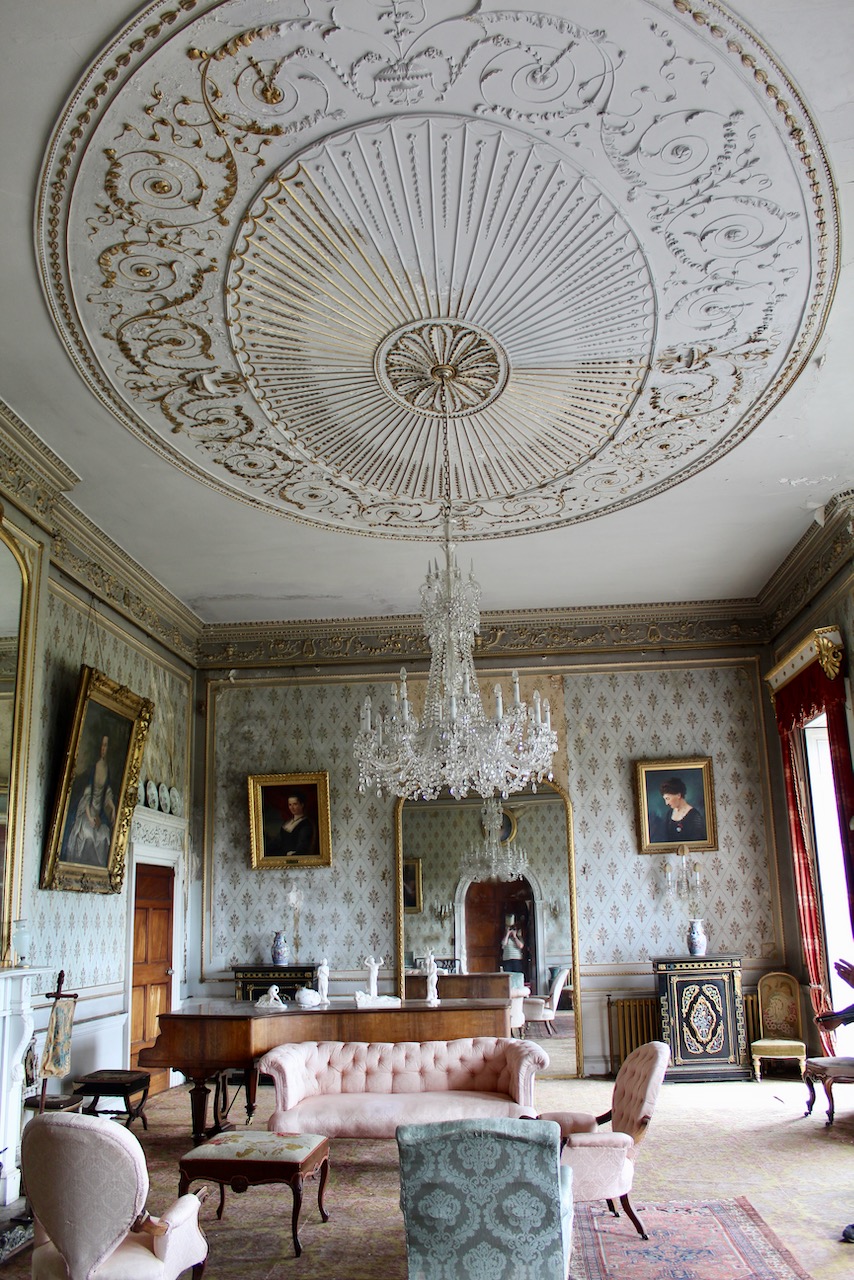
The next room had a ceiling that took my breath away. It has a delicate band of acanthus fronds and an outer band of husks. Andrew Tierney describes also the gilded rinceau freize, in his Buildings of Ireland: Central Leinster. This is a frieze of leafy scrolls branching alternately to left and right. The walls have a Victorian paper in a gilt diamond pattern.
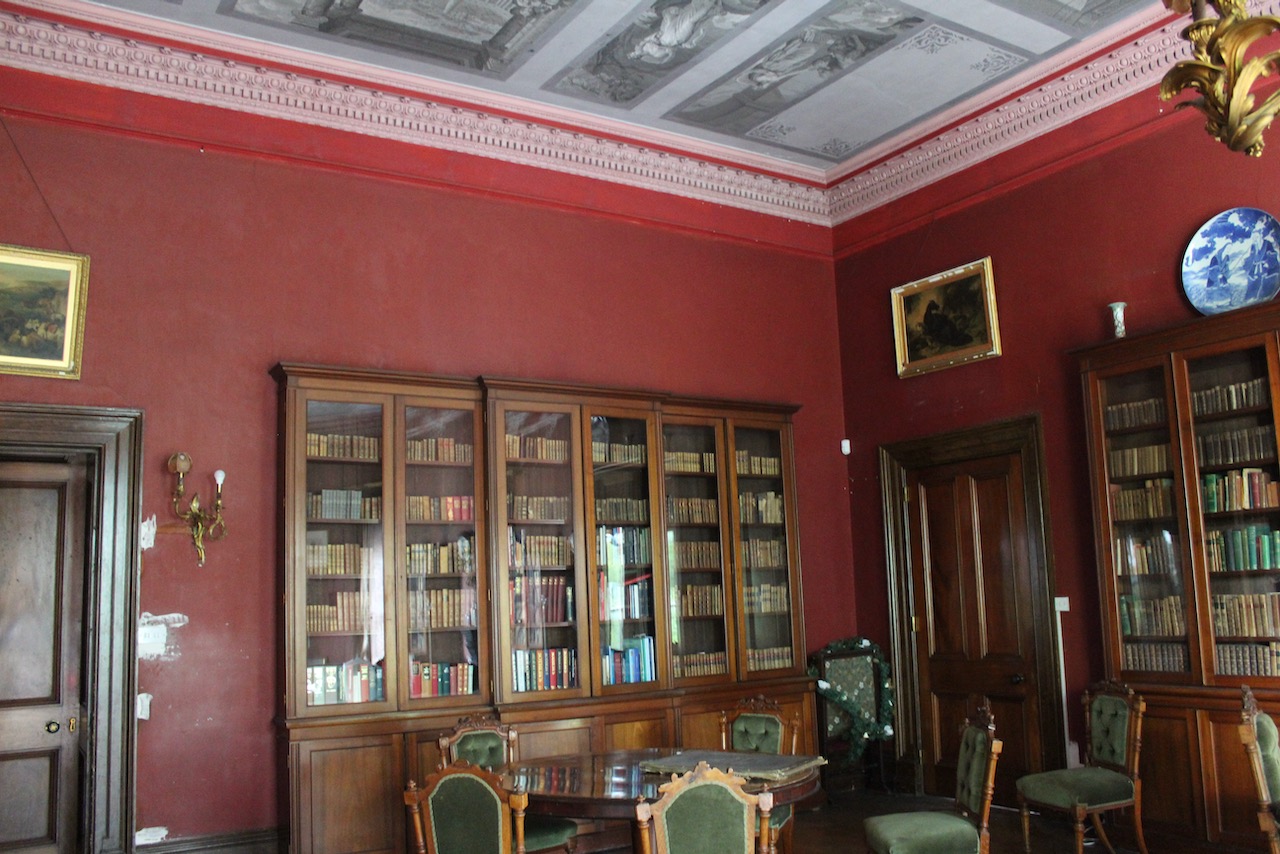
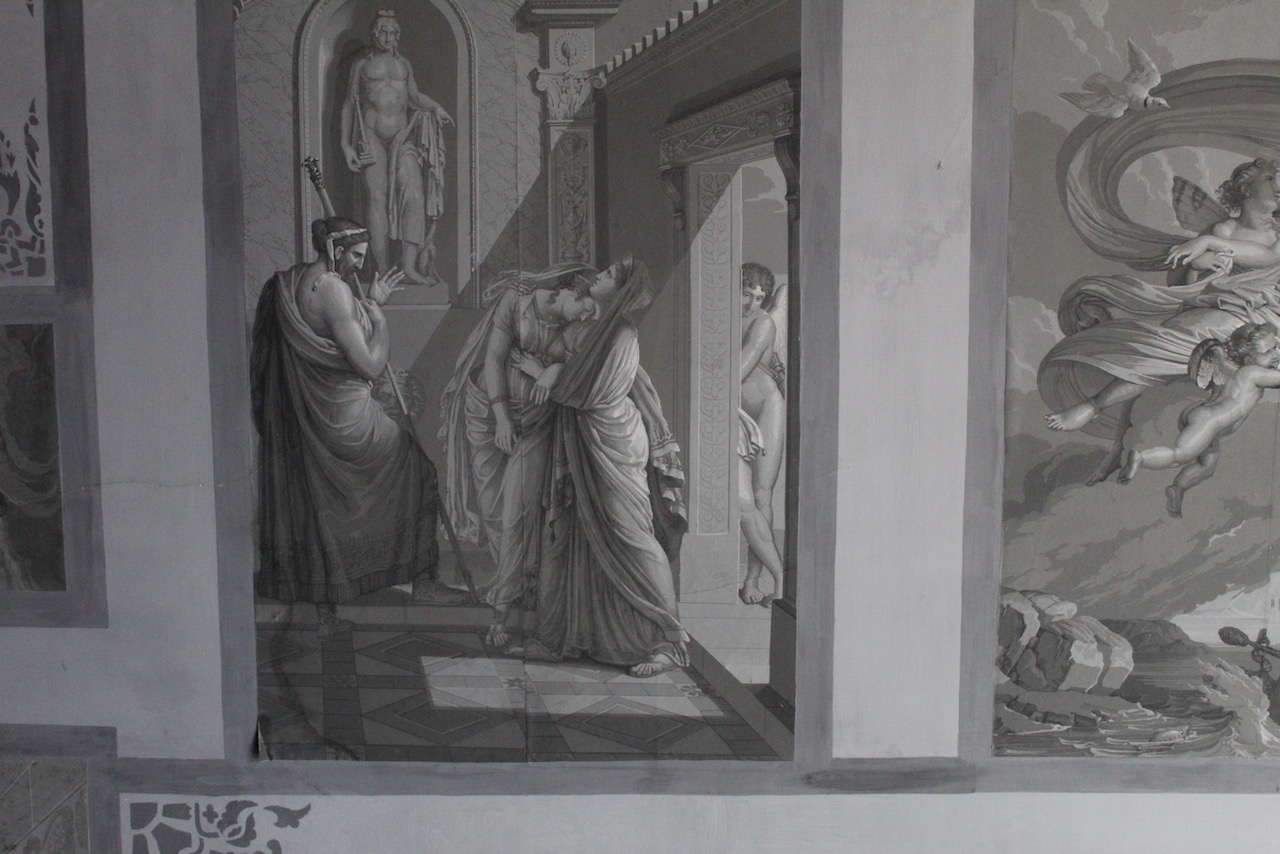
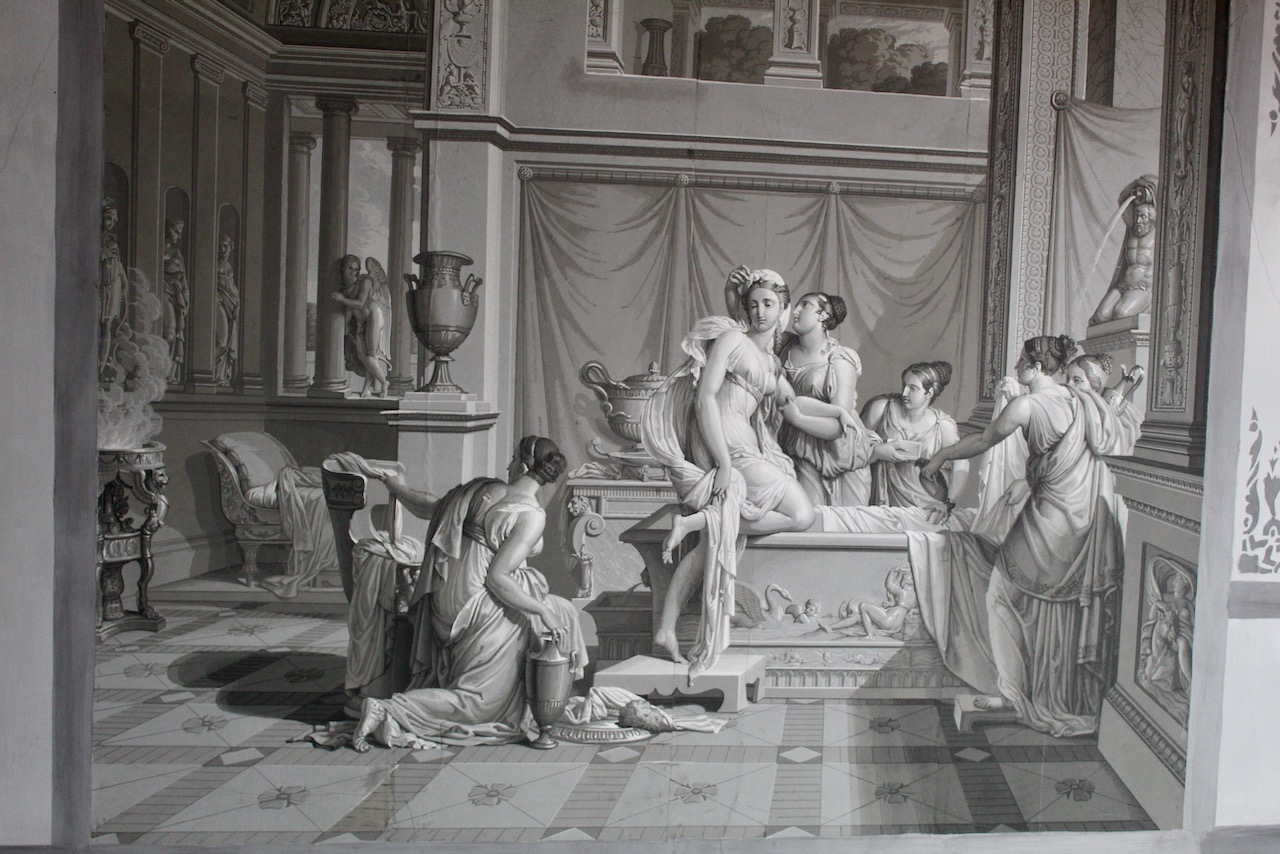
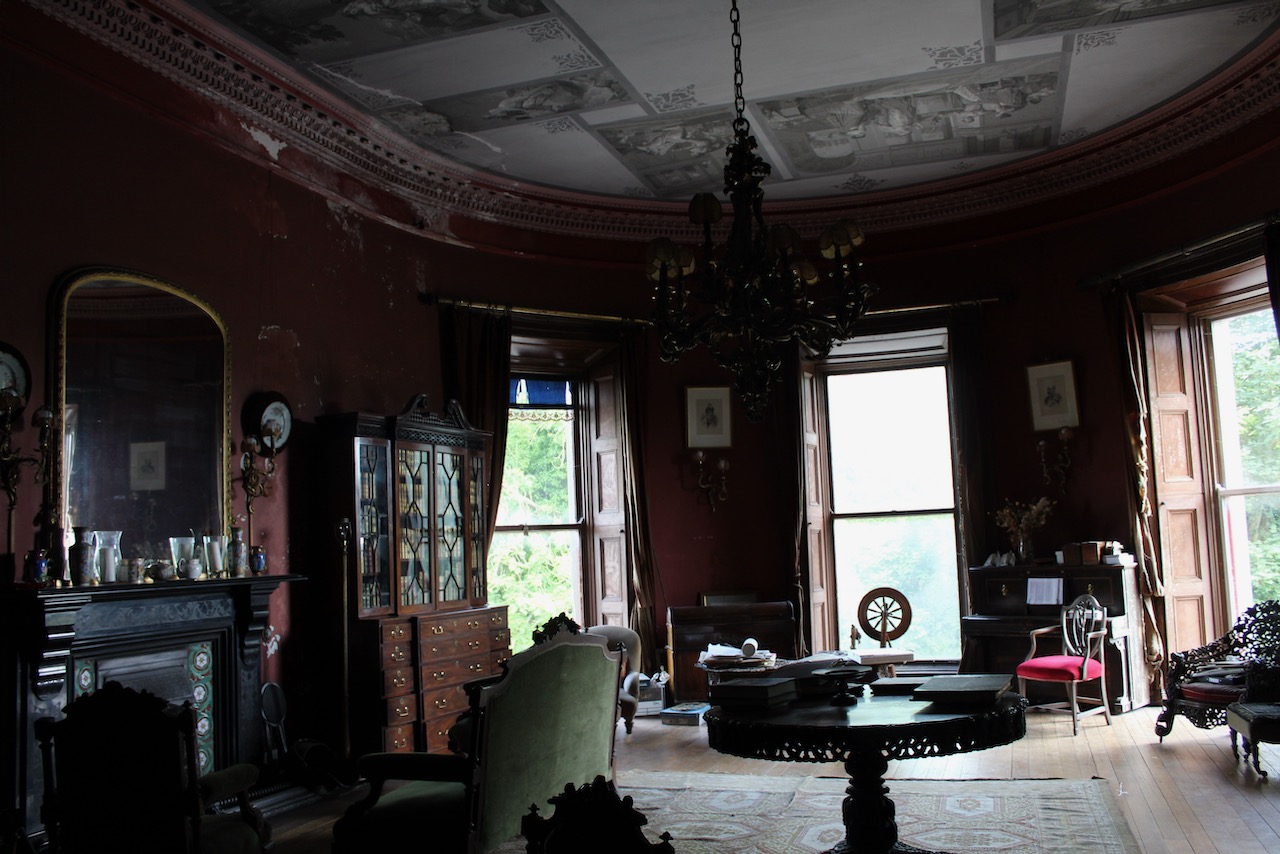
The ballroom, as Bence-Jones calls it, now the library, one of the additional rooms formed 1866-69, extends into the bow at the end of the house. It has a ceiling decorated with panels of early C19 pictorial paper in grissaille, i.e. painting using a palette of greys, or “gris” in French. There is a pink egg and dart and dentil cornice around the ceiling, and patterning similarly painted in the ceiling rose.
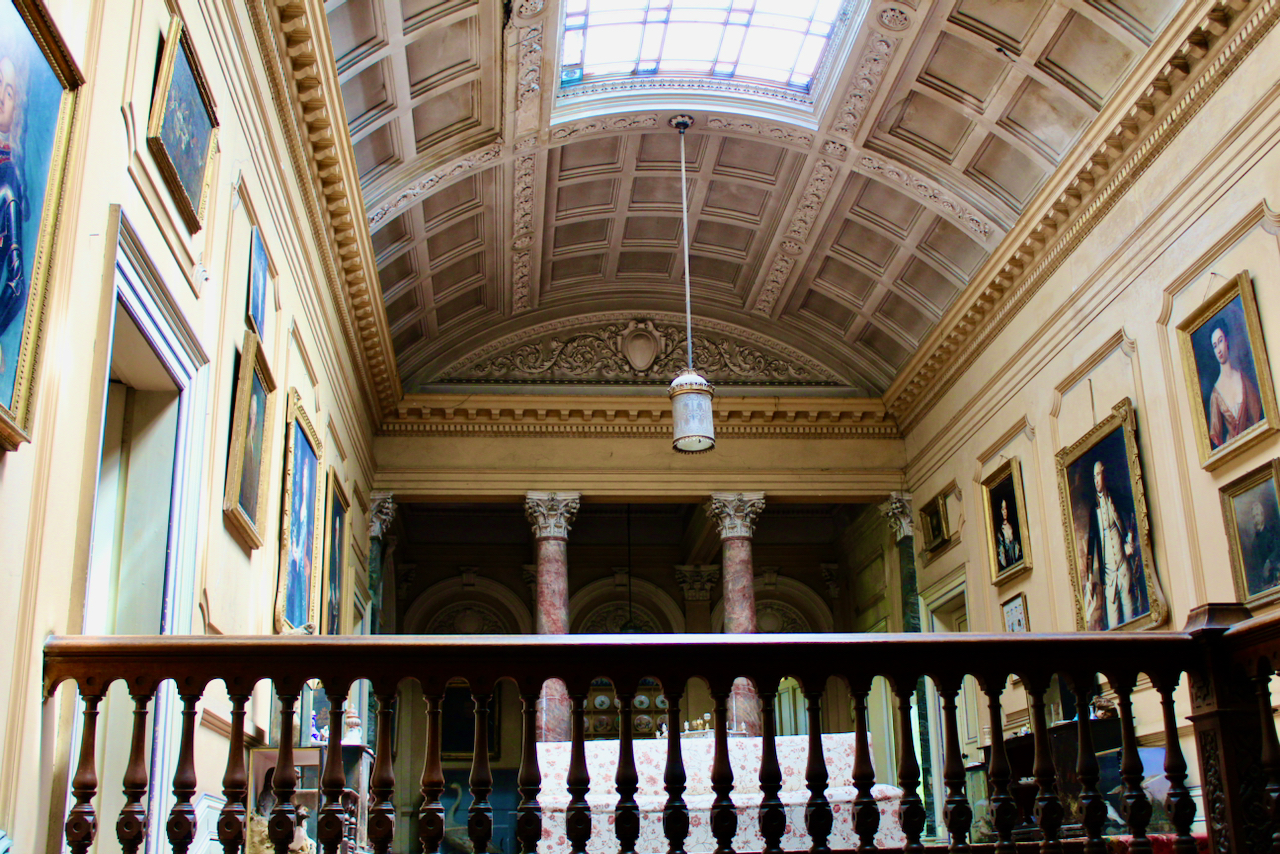
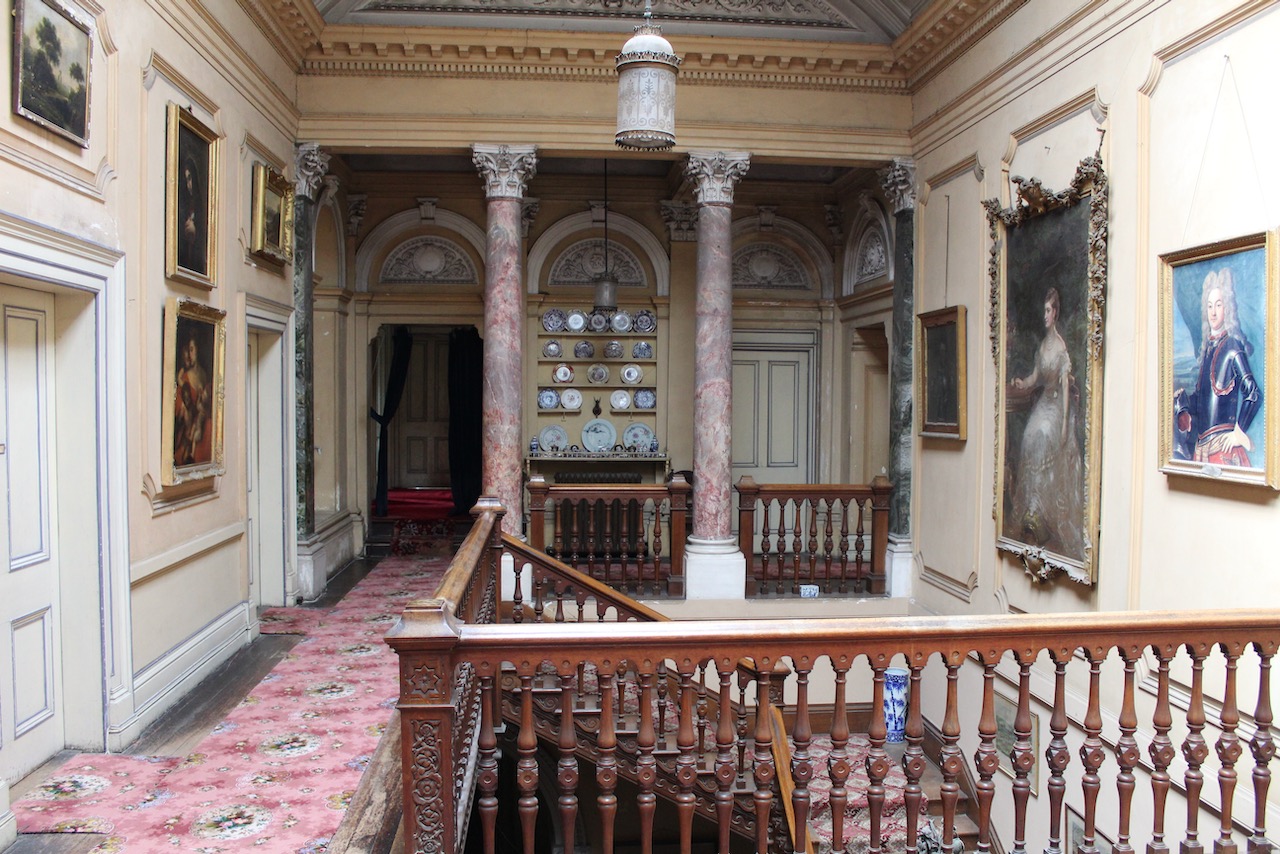
Amazing as the house is so far, the best is yet to come: the front hall leads to the stairwell. The former entrance hall, which keeps its eighteenth century chimneypiece, was made by Lanyon into a central top-lit staircase hall. The staircase is of Victorian oak joinery and leads up to a long picture gallery. This occupies the centre of the house, and is sixty feet in length and twenty in breadth, and is surmounted by an elaborate coffered and ornamented barrel-vaulted ceiling with glass roof of panels set in steel frame.
The gallery is flanked by narrow passages from which open the bedrooms. At the western end is a small lobby separated from the main portion by two pink marble Corinthian pillars, above which is an architrave decorated with a bold design in stucco.
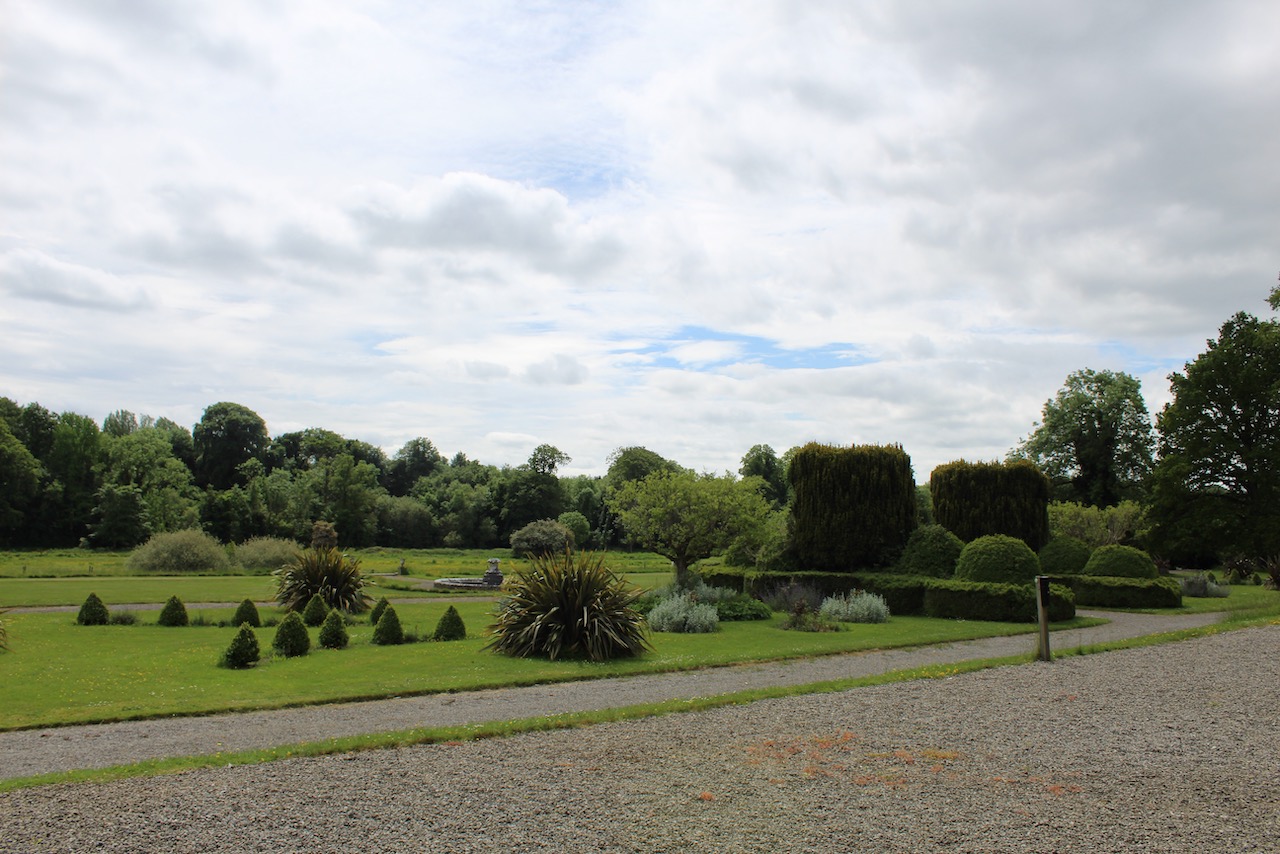
After seeing the house, we went outside to wander around the gardens. The garden front looks on to Italianate gardens, laid out in 1867 by Maurice Armour.
[1] p. 265. Mark Bence-Jones. A Guide to Irish Country Houses (originally published as Burke’s Guide to Country Houses volume 1 Ireland by Burke’s Peerage Ltd. 1978); Revised edition 1988 Constable and Company Ltd, London.
[7] p. 598. Tierney, Andrew. The Buildings of Ireland: Central Leinster. Kildare, Laois and Offaly. Yale University Press, New Haven and London, 2019.
[8] Autobiography of Pole-Cosby of Stradbally, Queen’s County (1703-1766) originally published in the Journal of the Co Kildare Archæological Society and Surrounding Districts, Vol V, 1906-1908. https://www.ornaverum.org/reference/pdf/183.pdf
[10] p. 600. Tierney, Andrew. The Buildings of Ireland: Central Leinster. Kildare, Laois and Offaly. Yale University Press, New Haven and London, 2019.











































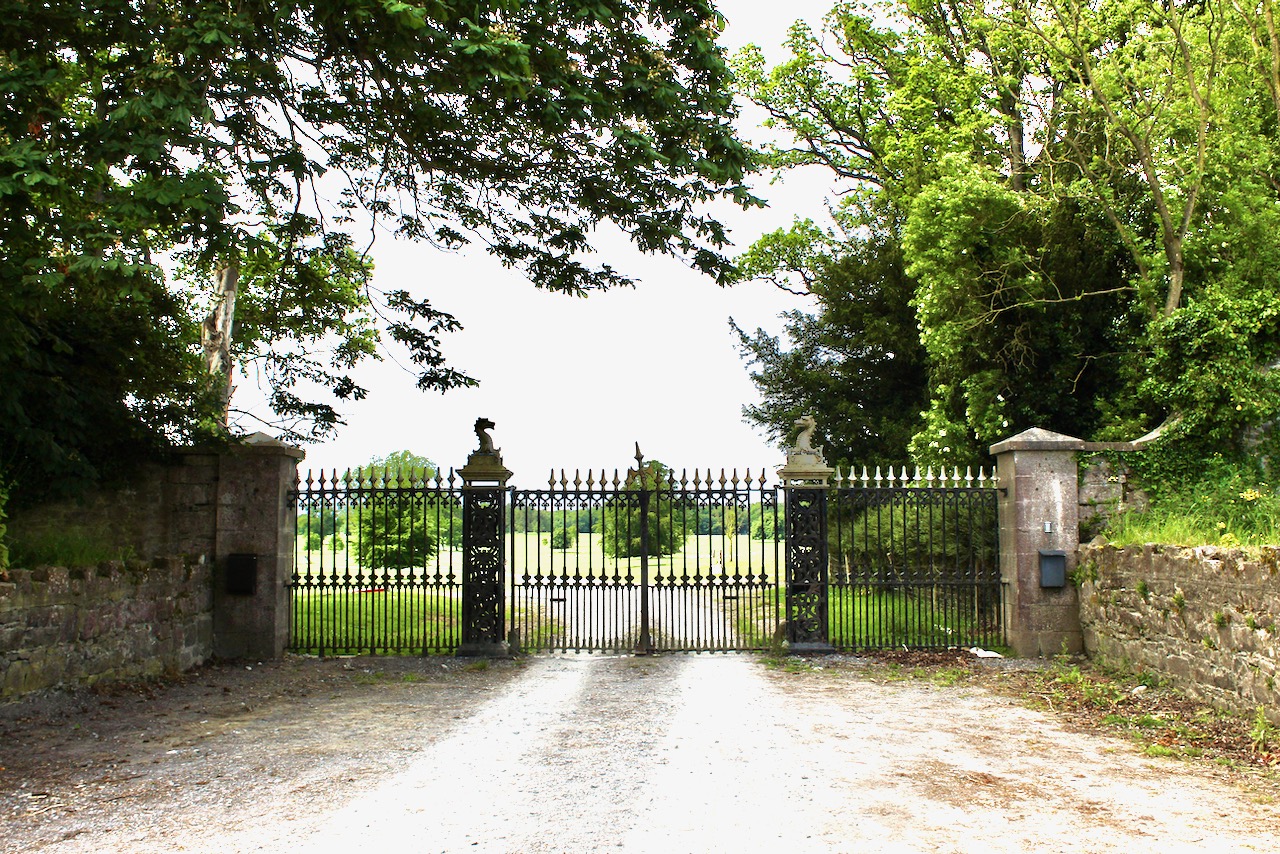
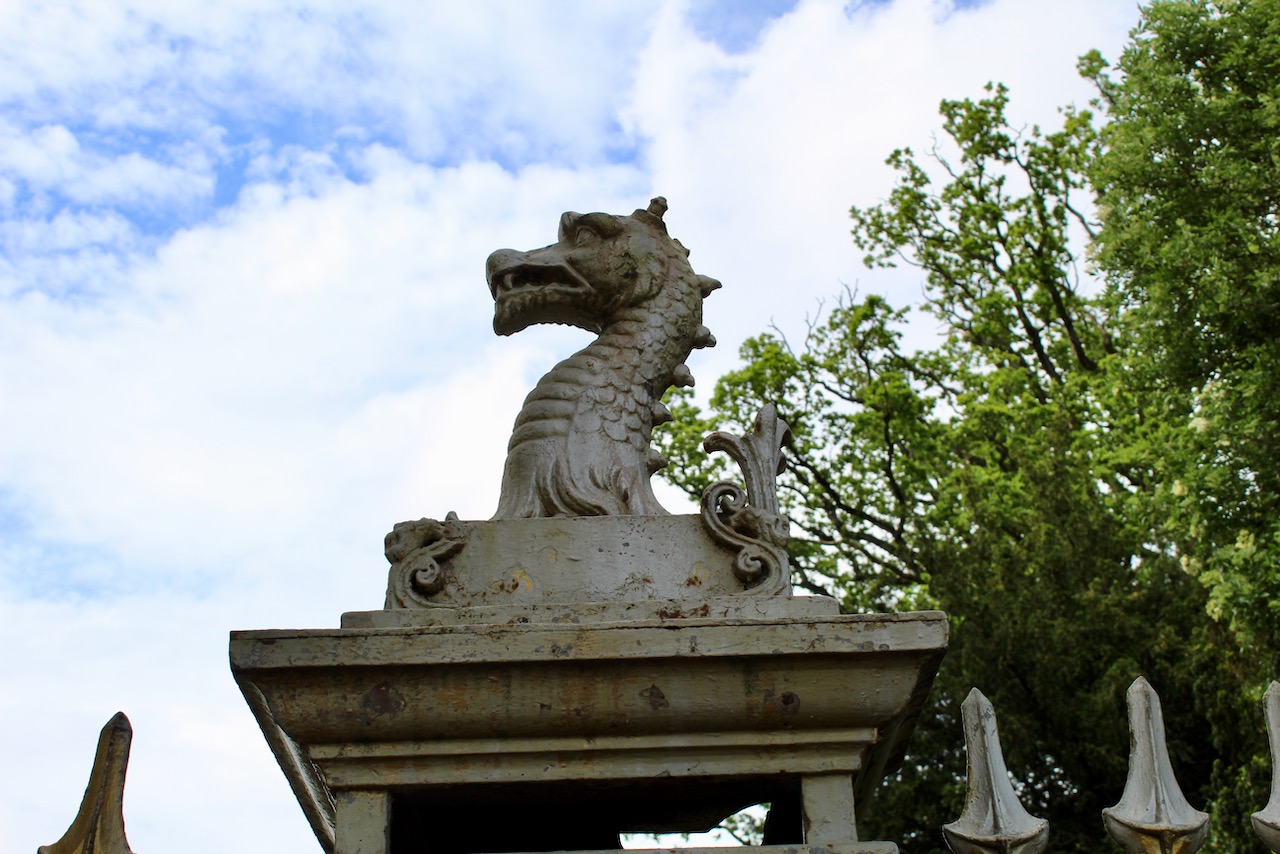
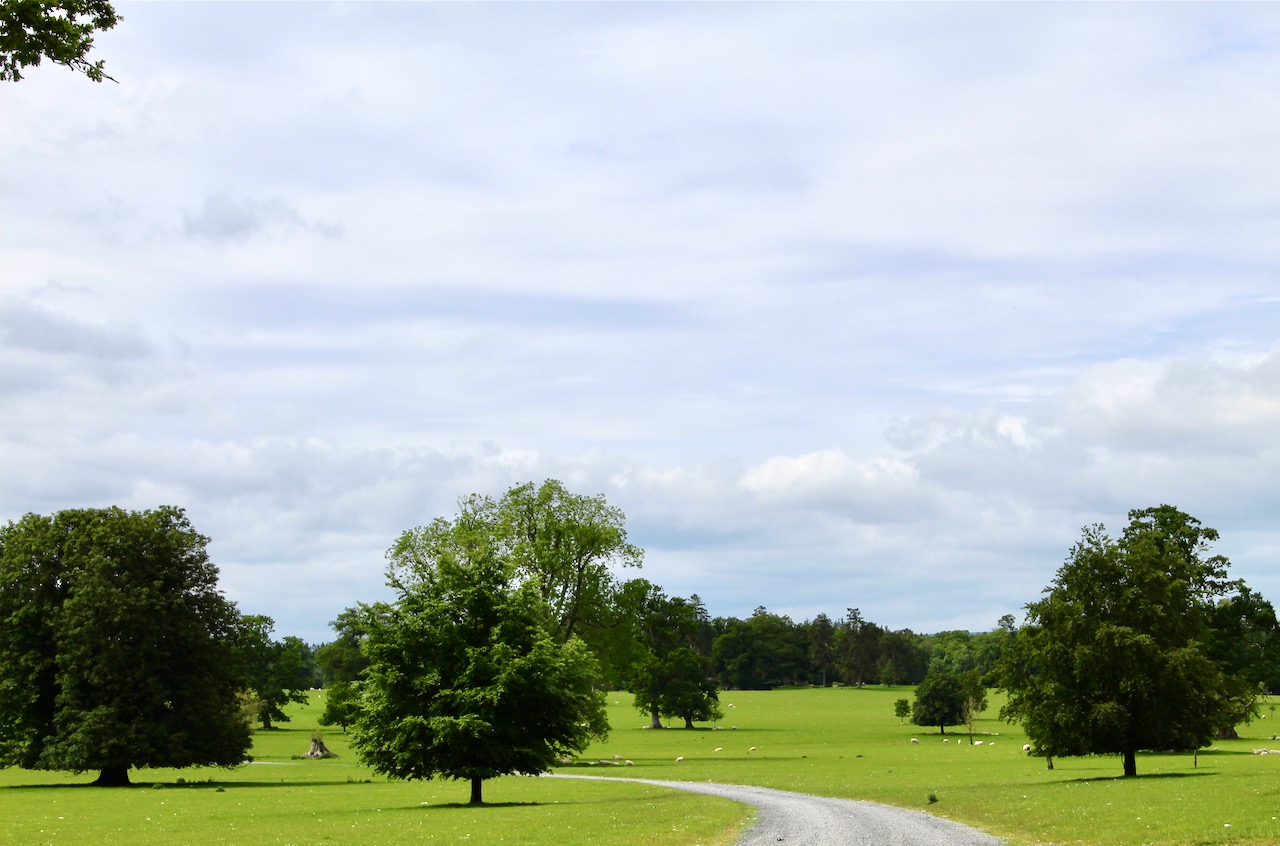
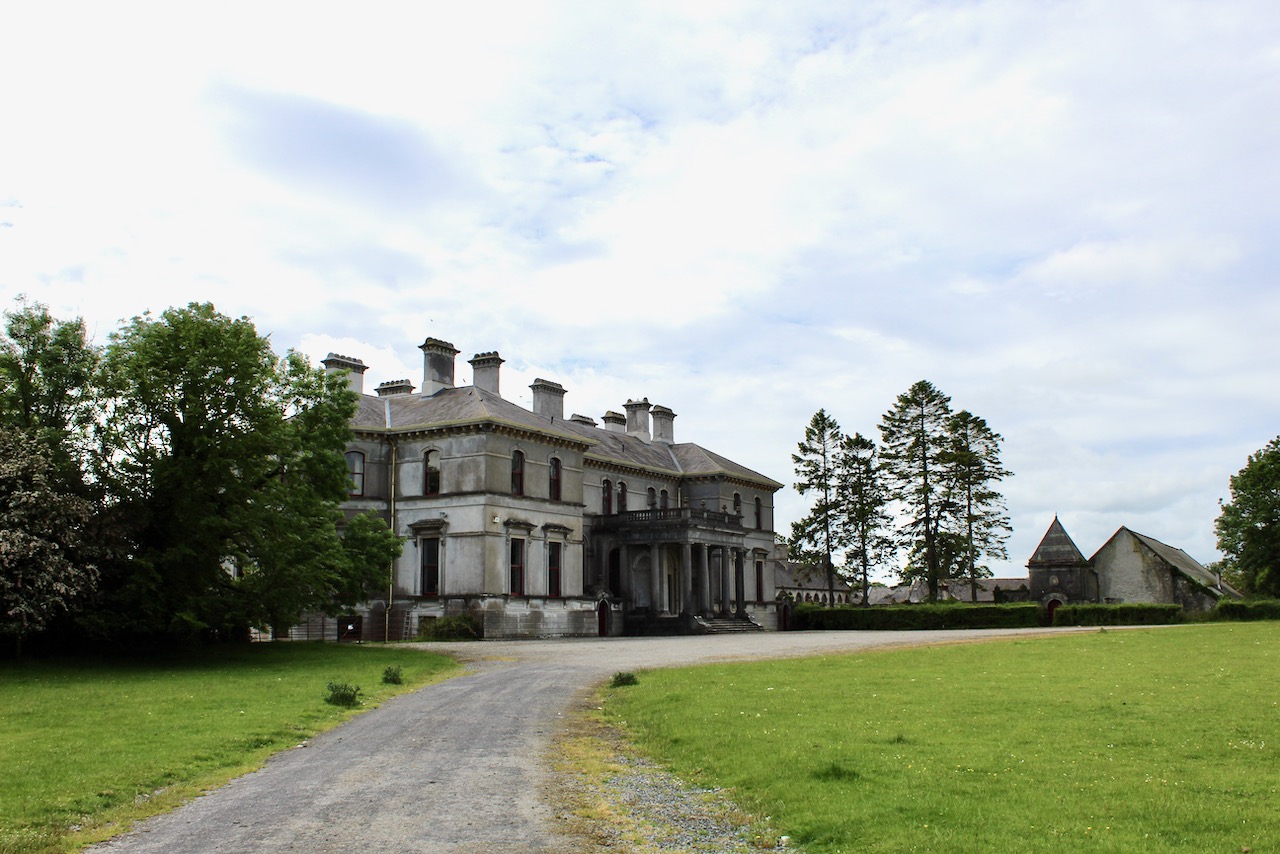


















 Irish Historic Houses
