Dartrey House (formerly Dawson’s Grove), Co Monaghan – demolished

Dartrey House (formerly Dawson’s Grove), Co Monaghan

Dartrey, County Monaghan, garden front, Vanishing Country Houses of Ireland by The Knight of Glin, David J. Griffin and Nicholas K. Robinson, published by The Irish Architectural Archive and The Irish Georgian Society, 1988.
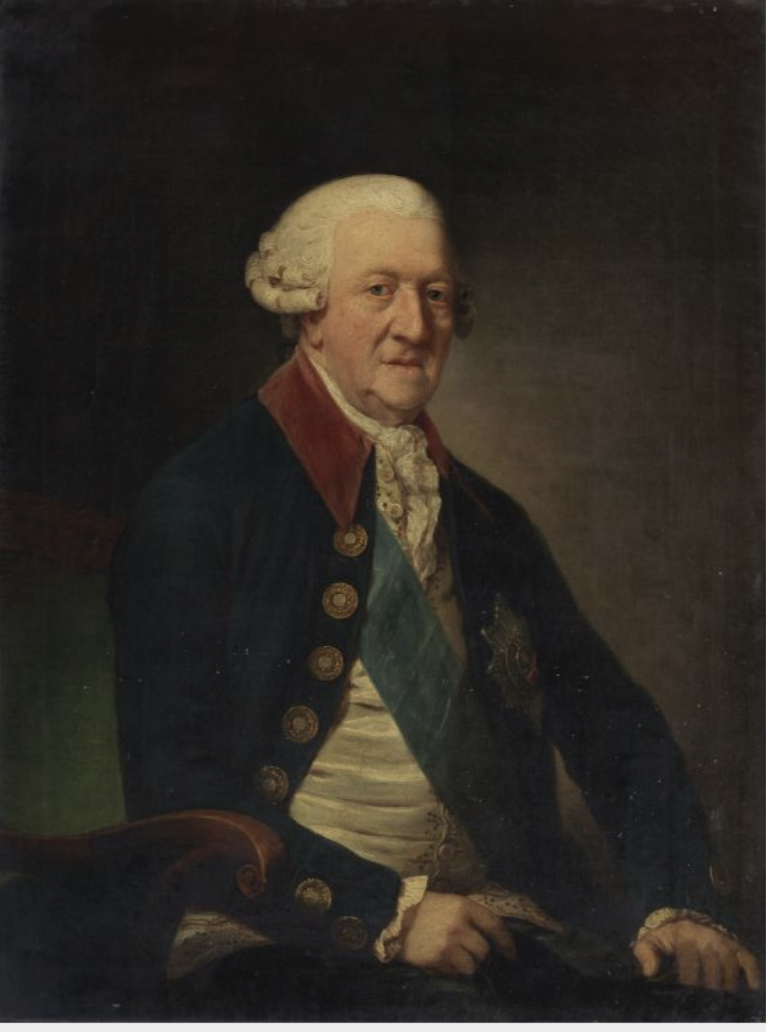
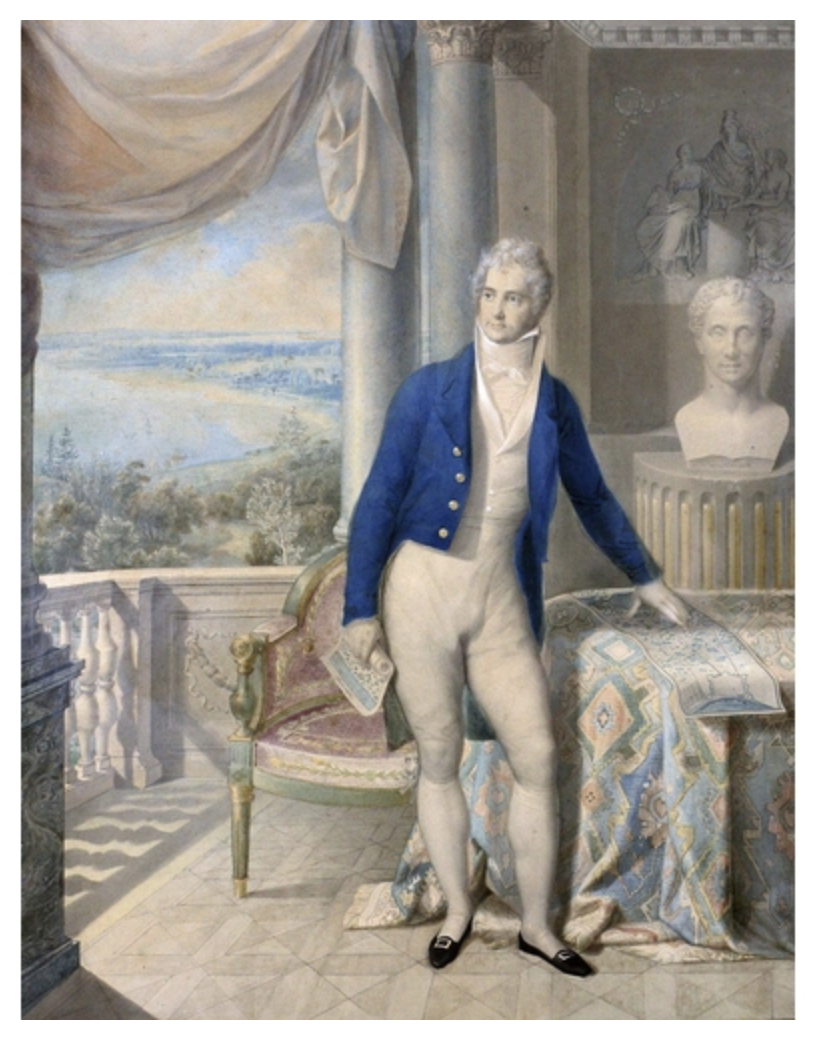
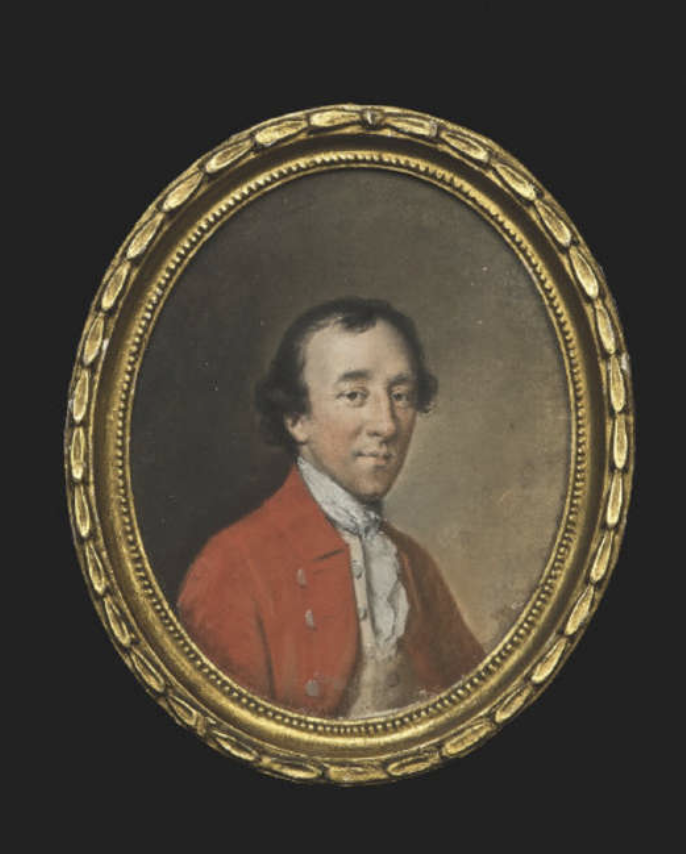
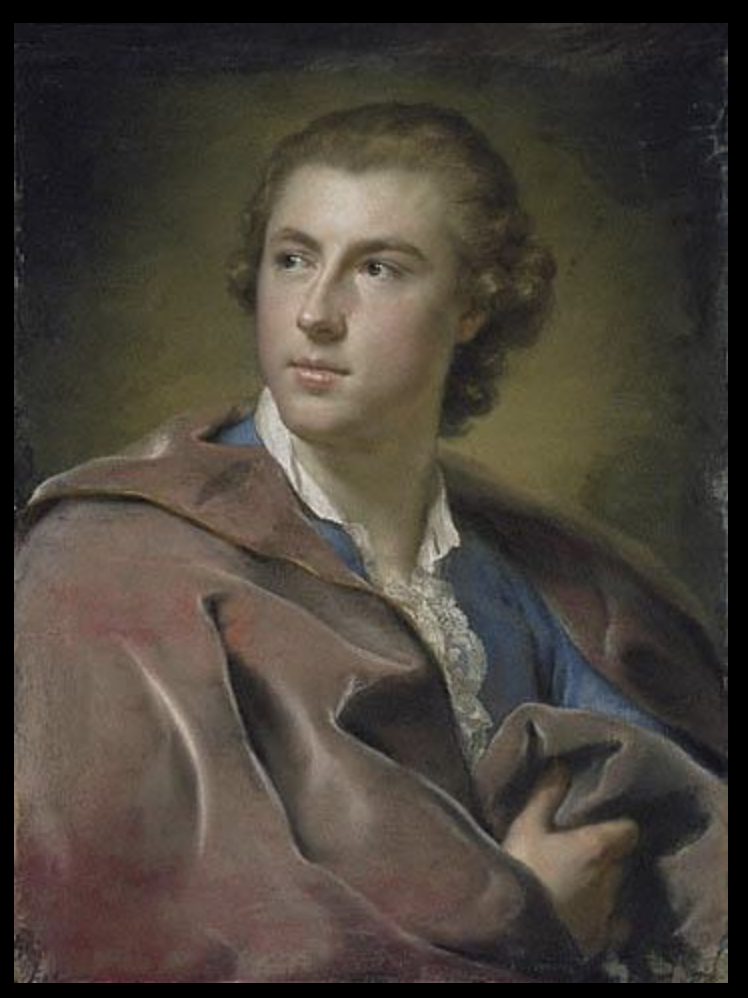
Portrait of Thomas Dawson (1725-1813), Lord Dartrey, 1st Viscount Cremorne, miniature, courtesy of National Gallery of Ireland.

Mark Bence-Jones. A Guide to Irish Country Houses (originally published as Burke’s Guide to Country Houses volume 1 Ireland by Burke’s Peerage Ltd. 1978); Revised edition 1988 Constable and Company Ltd, London.

p. 100. “(Dawson, Dartrey, E/PB1933) A large Elizabethan-Revival mansion by William Burn, built in 1846 to replace an earlier house of about 1770. This earlier house, described 1778 by Rev Daniel Beaufort…was of three storeys over basement, the entrance front was of seven bays…..The Elizabethan-Revival mansion which took the place of this house, built by Richard Dawson, 3rd Lord Cremorne and later 1st Earl of Dartrey, had long and somewhat monotonous elevations of curvilinear gables, mullioned windows and oriels, with, sporadically, a square turret and cupola. There were numerous Tudor chimneys, a generous application of strapwork and a two-tier terrace along the garden front with many yards of latticed balustrading.

The quoins were partly curved.

.”.. The house overlooked Lough Dromore, where, on a wooded island, Thomas Dawson, 1st Lord Dartrey and afterwards Viscount Cremorne, built a domed mausoleum ca 1770 in memory of his first wife, Lady Anne, to the design of James Wyatt, containing a dramatic lifesized sculptural group, including an angel with outstretched wings, by Joseph Wilton. The Elizabethan-Revival mansion, after standing empty for some years, was demolished ca 1950; the mausoleum, which had become roofless, so that the monument was suffering from teh weather as well as from vandalism, was repaired by the Irish Georgian Society 1961.”

Listed in Vanishing Country Houses of Ireland by The Knight of Glin, David J. Griffin and Nicholas K. Robinson, published by The Irish Architectural Archive and The Irish Georgian Society, 1988.

https://archiseek.com/2009/1846-dartry-rockcorry-co-monaghan

1846 – Dartrey, Rockcorry, Co. Monaghan 

Architect: William Burn 

Also known as Dawson Grove, Dartrey was built in 1846 and designed by William Burn as a large Elizabethan Revivial mansion to replace an earlier house on the site. Built for Richard Dawson, 3rd Lord Cremorne and later 1st Earl Dartry, it had very long façades with legions of mullioned windows, oriel windows, tudor chimneys and curvilinear gables relieved by square turrets with cupolas.  

On the garden front (pictured) was a two level terrace facing onto Lough Dromore. On an island in the lake there was also a fine Mausoleum to the design of James Wyatt from around 1770 which was recently restored. 

The house was demolished in the 1950s – after remaining empty for many years, the house was lent by the last owner to the RSPCA for a ball after which the County Council demanded rates for the house. All that remains of the estate are various gatehouses, the ruined Mausoleum and a fine stable block built around five sides of an octagon – built around 1850 to the design of William Burn.  

https://lordbelmontinnorthernireland.blogspot.com/2013/09/dartrey-house.html

THE EARLS OF DARTREY WERE MAJOR LANDOWNERS IN COUNTY MONAGHAN, WITH 17,732 ACRES 

The family of DAWSON was originally from Spaldington, Yorkshire; whence, towards the close 0f ELIZABETH I’s reign, it removed to Ulster.

THOMAS DAWSON, who became, in the following reign, a burgess of Armagh, was grandfather of

JOHN DAWSON, who married into the family of Henry Ussher, Lord Archbishop of Armagh.

Archbishop Ussher was twice married: first about 1573, to Margaret, daughter of Thomas Eliot of Balrisk, County Meath; secondly, to Mary Smith, who survived him. His widow married John Jeeves, of Drogheda, Alderman, by whom she had issue, Anne Jeeves, who married (as his second wife), Walter Dawson in 1660, from which a considerable property in counties Armagh and Tyrone came to the Dawson family.

John Dawson was father of

WALTER DAWSON, of Armagh, who married firstly, Mary, daughter of Edward Dixie, and had issue,

WALTER, his heir;
Thomas, ancestor of Catherine, Countess of Charleville;
Edward;
Margaret; Mary; Elizabeth.

He espoused secondly, in 1680, Anne, daughter of John Jeeves.

Mr Dawson died in 1704, and was succeeded by his elder son,


WALTER DAWSON, who wedded, in 1672, Frances, daughter of Richard Dawson (by which marriage the estate of Dawson Grove, County Monaghan, was conveyed to this family), and had issue,

RICHARD, his heir;
Walter;
John;
Mary; Elizabeth.

Mr Dawson, an officer in Cromwell’s army, died in 1718, and was succeeded by his only surviving son,

RICHARD DAWSON (c1693-1766), of Dawson Grove, an eminent banker, alderman of the city of Dublin, MP for St Canice, 1727-60, Monaghan Borough, 1761-6 (great-grandson of John Dawson, of Armagh, who died intestate).

Alderman Dawson wedded, in 1723, Elizabeth, daughter of the Most Rev Dr John Vesey, Lord Archbishop of Tuam, and sister of Sir Thomas Vesey Bt, Lord Bishop of Ossory, and had issue,

John, died in 1742;
THOMAS, his successor;
Richard, of Ardee;
Frances.

He was succeeded by his eldest surviving son,

THOMAS DAWSON (1725-1813), of Dawson Grove, who was elevated to the peerage, in 1770, in the dignity of Baron Dartrey, of Dawson’s Grove, County Monaghan; and advanced to a viscountcy, in 1778, as Viscount Cremorne, of Castle Dawson, County Monaghan.

His lordship married firstly, in 1754, the Lady Anne Fermor, youngest daughter of Thomas, 1st Earl of Pomfret, by whom he had a son and a daughter, both of whom died in adolescence.

He wedded secondly, in 1770, Philadelphia Hannah, daughter of Thomas Freame, of Philadelphia, by Margaretta, daughter of William Penn, the celebrated founder of that city, by whom he had another son and a daughter, who also died young.

His lordship, thus deprived of direct descendants, was created, in 1797, Baron Cremorne, with remainder to his nephew, Richard Dawson, and the heirs male of that gentleman.

Dying without an heir in 1813, the viscountcy expired, and the barony of Cremorne devolved upon his great-nephew,

RICHARD THOMAS DAWSON (1788-1827) as 2nd Baron (only son of Richard Dawson, MP for Monaghan), who espoused, in 1815, Anne Elizabeth Emily, third daughter of John Whaley, of Whaley Abbey, County Wicklow, and had issue,

RICHARD, his successor;
Thomas Vesey.

His lordship was succeeded by his elder son,
RICHARD, 3rd Baron (1817-97),  who wedded, in 1841, Augusta, second daughter of Edward Stanley, of Cross Hall, Lancashire, by his wife, the Lady Mary Maitland, second daughter of James, 8th Earl of Lauderdale.

His lordship was installed a Knight of St Patrick, 1855; a Lord-in-Waiting, 1857-66; Lord Lieutenant of County Monaghan, 1871-97.

He was advanced to an earldom, in 1866, in the dignity of EARL OF DARTREY.

By his wife he had issue,

VESEY, his successor;
Edward Stanley (1843-1919);
Richard Westland Westenra (1845-1914);
ANTHONY LUCIUS, 3rd Earl;
Mary Eleanor Anne.

His lordship was succeeded by his eldest son,


VESEY, 2nd Earl (1842-1920), MP for County Monaghan, 1865-68, High Sheriff of County Monaghan, 1878, who married, in 1882, Julia Georgiana Sarah, daughter of Sir George Ormby Wombwell Bt, and had issue,

Richard George, 1890-94;
EDITH ANNE (1883-1974), of Dartrey House;
Mary Augusta, 1887-1961.

His lordship died without surviving male issue, when the titles devolved upon his brother,

ANTHONY LUCIUS, 3rd Earl (1855-1933), who wedded, in 1878, Mary Frances, suo jure Baroness de Ros, only child of the 23rd Baron de Ros, and had issue,

Una Mary, Baroness de Ros;Maude Elizabeth; Eleanor Charlotte Augusta.

On the decease of the 3rd Earl, in 1933, the titles became extinct.

The Lady Edith Windham was the last member of the family to live at Dartrey.

The Dartrey Papers contain extensive historical information about the family. 

The Earl of Dartrey possessed the following land during the Victorian era:-

visited Cootehill several years ago.

DARTREY HOUSE, near Rockcorry, County Monaghan, was a large Elizabethan-Revival mansion by William Burn, built in 1846 to replace an earlier house, known as Dawson Grove, of ca 1770.

It was built for Richard Dawson, 3rd Baron Cremorne and later 1st Earl of Dartrey.

This noble and magnificent demesne is situated on the gorgeous chain of the Cootehill lakes, a few miles east-north-east of Cootehill.

It is separated from the neighbouring demesne of Bellamont forest, County Cavan, only by a narrow belt of one of the main lakes, Dromore Lough.

The mansion had long, monotonous elevations of curvilinear gables, mullioned windows and oriels, with, sporadically, a square turret and cupola.

There were numerous Tudor chimneys, a generous application of strapwork and a two-tier terrace along the garden front with many yards of latticed ballustrading.

The quoins were partly curved.

Dartrey House overlooked Lough Dromore where, on a wooded island (Black Island), the 1st Viscount Cremorne built a domed temple about 1770 in memory of his first wife, Lady Anne Dawson.

The sheer size of Dartrey House proved too much for the 20th-century financial resources of the family.

Most of its contents were sold by auction in 1937 and the entire building was demolished in 1946 by the Hammond Lane Foundry, Dublin, who paid £3,000 for the salvage – a dreadful return on the £30,000 it cost to build the great mansion.

Lady Edith, elder daughter of the 2nd Earl, was the last Dawson to live in Dartrey House, and it was she who was forced to make the decision to demolish it in 1946. 

Now, only the magnificent site overlooking Lough Dromore is visible.

The red-brick stable block contemporary with the 1846 house survives, and was renovated by the Irish Georgian Society (presumably at about the same time as Lady Anne’s temple).

There is also a surviving farmyard, in ruinous condition, which seems to be contemporary with (or even earlier than) the early 1770s house.

The following description of the Dartrey Estate near Cootehill, County Monaghan, Ireland, was written in 1773 by the Reverend J Burrows, visiting tutor to the Dawson family:

A thousand acres of lake, three hundred of which flows within a few yards of the house, with hills on each side covered with the most beautiful delicious woods, bring all fairyland to one’s imagination. On the other side of the lake is a large island, wonderfully shaded on all its sides but with a bald pate of open ground on the top, giving a very pleasing and uncommon effect.

Beyond that are woods that lose themselves in the clouds. People who are not used to lakes cannot conceive into what delightful forms they throw themselves, and how much the little islands, here and there interspersed, which contain one or two trees, add to their beauty. 

The Dartrey estate, originally known as Dawson Grove, was established by the Dawson family in the 17th century alongside Bellamont Forest, a demesne of similar size – over a thousand acres.  

Richard Dawson, a banker and Dublin alderman, built the present (Church of Ireland) church on the Dartrey estate in 1729.

It was established in its own separate parish of Ematris soon after.

The Dawsons added a north gallery to the church in 1769, and much later the Corry family (from Rockcorry) added a south gallery, raised on arches to avoid desecrating the burial ground beneath it.

A fire caused serious damaged in 1811 leaving the church for a period without a roof.

The fine west tower was built in 1840, and the sanctuary apse in 1870.

With the demolition of the Dawson mansion in 1950, and their once thriving estate turned over to forestry, St John’s appears isolated.

However it shares services with St James’ church, Rockcorry some 2½ miles away, which the Dawsons built in 1855, and both churches continue well supported by the local farming community. 

But the view from St John’s cemetery across Inner Lough, once described as “one of the best in Ireland”, is currently obscured by conifers.

The Northern Standard, Saturday, 8th March, 1856:-

FIRE  AT  DARTREY  HOUSE

We regret to announce the breaking out of a destructive fire, on Saturday evening last, at Dartrey House, the magnificent residence of Lord Cremorne, in this county. 

The fire is supposed to have originated in the flue of one of the rooms in the basement storeys, which broke out near the roof, and before effective aid could be procured, had enveloped the entire of the upper storey of the north-eastern wing of the building.

The existence of the fire was first observed about six o’clock, by Mr. Little, Lord Cremorne’s steward, who hastened with a number of his labourers to render all the assistance within their power. 

Mr. Little’s exertions up to the final subduing of the fire were unremitting. 

Captain Boyle, of Tanagh, and the Rev. T. A. Robinson, were immediately on the ground, and aided materially in checking the fire, which, however, raged with a great fury until the arrival of the fire engines from Monaghan. 

Previous to the arrival of the engines, the exertions of those present were directed to cutting off the communication between what is termed the Old and New House, a strong wall dividing the two portions of the house.

At a few minutes past seven in the evening, a messenger from Dartrey arrived at Mr. McCoy’s, of Monaghan, in whose care the town engine is; fortunately, all Mr McCoy’s staff were about his concern, it being pay night, and were consequently available for immediate work.

Four horses from Campbell’s posting establishment were immediately harnessed to the engine, and it started for Dartrey, where it arrived at nine o’clock. 

In the meantime, Mr. McCoy sent a requisition for the Ordnance engine, to the officer commanding the detachment of Militia stationed here.

This engine was placed on a float, and, with a pair of horses from the Canal Stores, proceeded to Dartrey, where it arrived in time to do efficient service, under the directions of Sergeant Crooks, of the Monaghan Regiment, whose exertions elicited the commendation of every person present.

Nothing could exceed his intrepidity and cool daring ; indeed, at one moment it was supposed he had fallen a victim, a large beam having fallen just where he had been standing a second before.  A. A. Murray Ker, Esq., Lord Cremorne’s agent, was in Monaghan when intelligence of the fire arrived; he immediately started for Dartrey, where he remained until a late hour on Sunday evening; by his presence and individual exertions he animated the energies of the very many who aided in extinguishing the fire.

Amongst those present who worked with hearty good will were – and certainly first on the list – the Rev. T. A. Robinson, Captain Boyle, Wm. Murray, Esq., Richard Mayne, Esq., (this gentleman, we regret to say, was severely hurt by an accident), Rev. John Wolfe, Subinspectors Kirwan and Fortesque; a number of young gentlemen from Cootehill and Monaghan were also most effectual aids.

We do not know the names of the Cootehill gentlemen or we would gladly give them.  Amongst those from Monaghan we noticed Messrs. Watkins, Lewers, and Campbell.

The Constabulary from the surrounding stations to a man exerted themselves in a most praiseworthy manner, both by individual exertion and protection of property. 

Amongst the most exertive and daring of them was one named Kinsella, from Cootehill station. 

The costly furniture, pictures, and mirrors were all saved, with the exception of such injuries as their removal caused.

On learning the existence of the fire, our own chief anxiety was as to the safety of an exquisite group of statuary, “Cupid and Psyche”, which stood in the vestibule of the Grand Staircase; – this beautiful piece of art, though in extreme danger, escaped with but the fracture of one of the arms of the descending figure; the injury is not material, and can be remedied.

The portion of the building entirely destroyed consists of Lord and Lady Cremorne’s private apartments, Drawing-room, and her ladyship’s Boudoir, both of which were magnificent apartments; the cut stone walls seem safe; all the apartments over the east point are destroyed; the Grand Hall, Billiard-room, and Drawing-room are safe, as is also the entire of the basement storey.

The fire continued smouldering and occasionally to blaze out up to five or six o’clock on Sunday evening. 

The assurance on the house was heavy, and will more than cover the estimated damages; but much depends on the decision architects arrive at as to the state of the outer walls.

It is, on the whole, surprising that the damage done is not of much greater extent, when the means of overcoming it were so distant.

The tenantry in the neighbourhood all assembled on Tuesday with carts and horses, and cleared away all the debris of the fire, before the arrival of Lord and Lady Cremorne.

TO THE EDITOR OF THE NORTHERN STANDARD 

Sir,  Allow me, through your paper, to render Lord Cremorne’s grateful thanks to all those who used such strenuous exertions in checking the conflagration at his Lordship’s beautiful mansion on last Saturday night.

The Assurance Companies concerned have every reason to be thankful, (and indeed have already expressed themselves to that effect), to the assembled multitude who lent their best exertions towards arresting the progress of the flames, and saving such a large amount of property.

It would be impossible to personally thank each and all of those I saw distinguishing themselves, for their name was “Legion”.

The constabulary were early on the ground from Rockcorry, and very shortly after from Cootehill, Drum, and Newbliss, and were most efficient and steady.

The fire engines from Monaghan arrived in quite the brigade style, and certainly deserve especial consideration.

The Corporation engine, under the direction of Mr. McCoy and his very active and intelligent workmen, and the Barrack engine, managed by Sergeant Crooks, who most creditably kept up the character of his regiment by his cool and daring conduct.

The tenantry to a man worked with a will.  I could name hundreds who were towards morning nearly – and often quite – exhausted and faint.

Nothing could exceed the care taken of the furniture, pictures, and mirrors, in their removal, and wonderfully little damage has been done.

I am happy to say that the Assurances cover the loss and damage to both building and furniture – and again thanking most sincerely those who so kindly gave their valuable aid in time of need.  

I remain, your obedient servant,     A A Murray Ker, Newbliss.

Henry Skeath has sent me interesting information with regard to Dartrey:

I have attached an article (above) from The Northern Standard about a serious fire at Dartrey House in 1856 just ten years after the place was built.

Two good articles on Dartrey appeared in recent editions of the Clogher Record.

In 2004 June Brown detailed the rise and fall of the estate. June was friendly with Lady Edith, the last of the family at Dartrey, and keeps in touch with her descendants.

The 2009 edition contains a well-researched article by June’s granddaughter, Victoria Baird, about Lady Augusta wife of the 1st Earl of Dartrey.

Lady Augusta endowed St. James’s in Rockcorry where a photograph of her still hangs.

St. John’s Church is affectionately known as St. John’s in the Wood.

The Dawson gallery contains a fireplace for the comfort of the family.

In 1996 St. John’s celebrated 275 years of worship and the Rev. J. T. Merry, rector, produced a short history of the parish.

The Dartrey Heritage Group is undertaking wonderful refurbishment work on the mausoleum which was designed by James Wyatt.

The building has been stabilised and a new domed roof erected.

The Rev. Daniel Beaufort visited in 1780 and noted that the sculptural group within, by Joseph Wilton, had cost £1,000.

The quarterly bulletin of the Irish Georgian Society for Jan-Mar 1961includes an article on it.

Wilton’s work suffered at the hands of vandals but there are ambitious plans for restoration.

In 2008 the Heritage Group completed the restoration of a 60-foot column, also designed by James Wyatt, erected in 1807 to the memory of Richard Dawson who was elected to five successive Parliaments.

It stands prominently along the main road.

The 1846 stable block, five sides of an octagon, restored by the Irish Georgian Society in 1961, has been allowed to fall into disrepair again in recent years.

Of Dartrey House, hardly a vestige remains.

Parts of the basement can be seen and the once-graceful terraces on the garden front can still be traced.

It was once one of the finest estates in Ireland.

London residence ~ 30 Curzon Street.

First published in September, 2011.   Dartrey arms courtesy of European Heraldry.

https://lordbelmontinnorthernireland.blogspot.com/2020/08/cootehill-iii.html

The Parliamentary Gazetteer of Ireland tells us that County Monaghan is an inland county, in the centre of the south of the historic province of Ulster.

It is bounded, on the north, by Tyrone; on the east, by Armagh; and on the west, by Cavan and Fermanagh.

Dawson Grove, now Dartrey, County Monaghan,

“A noble and magnificent demesne, the property of the Viscount Cremorne [later Earl of Dartrey], on the southern margin of the barony of Dartrey, is situated on the gorgeous chain of the Cootehill lakes, 1½ miles from Cootehill; and is separated from the rival demesne of Bellamont Forest in County Cavan, only by the narrow belt of one of the main lakes called Dromore.”

“From the contiguity of Dawson Grove and Bellamont Forest, and the beautiful natural lakes which in many places form their line of demarcation, they may be said in various instances to reflect each other.”

“Separately they are splendid residences; conjointly they form a rich combination of many of the elements of landscape.”

On Saturday afternoon four of us met Noel Carney, of Dartrey Heritage Association, who took us to see Dartrey demesne, former seat of the extinct Earls of Dartrey.

This was my first visit to Dartrey, once a very large estate comprising almost 18,000 acres, with extensive boundary walls and picturesque gate lodges (there were eight in total) carrying on interminably.

We stopped off en route at the main entrance lodge of ca1847, fully restored, extended, and inhabited, once incorporating the estate post office.

This lodge is made of ashlar stone, with a Tudor-style entrance surmounted by a blank shield.

Several hundred yards further along the main public road we turned into another driveway, which eventually led us to the “new” stable block, a large, impressive, grand affair comprising five sides in red brick.

This derelict stable block was constructed in the 1840s to replace an older block.

The standard of craftsmanship by masons was remarkable, as Noel pointed out to us.

The bricks were made in situ, and even straw marks could be seen on the ones that had dried on the ground.

The New Stable Block is not in a good state, although it’s not beyond redemption for another purpose, such as apartments or business premises, or units.

It was practically ruinous several decades ago, and today at least it’s in better condition than that.

There used to be a large clock encased in a circular stone feature in the middle of the block, though it has disappeared.

A short distance further on we stopped off at the original, or “Old” stable block of, it is thought, the 1770s.

It, like its younger sibling, is privately owned and closed off.

THEREAFTER we drove through overgrown estate tracks to the Island Bridge, also known as the Iron Bridge, which connects the estate to Black Island.

This is a single-arch bridge, erected in the 1840s, which leads to the glorious mausoleum or temple dedicated to the Lady Anne Dawson.

The skill of the blacksmiths and stonemasons  can be admired on this little bridge, with its superbly carved stone abutments and wrought-iron handrails.

When we crossed the bridge we caught a glimpse of the remains of the great mansion house of Dartrey. All that’s left of it today is the basement and rubble.

Dartrey House (or Castle) was demolished in 1946, because the last member of the Dawsons to live there, Lady Edith, simply couldn’t afford to maintain it, and couldn’t find a buyer.

First published in August, 2020.

https://lordbelmontinnorthernireland.blogspot.com/2020/08/cootehill-iv.html

From the edge of the lake, not far from the Iron Bridge, we could see the site of Dartrey House (or Castle), a very large mansion which was built in 1846.

The Dartrey Estate lies in County Monaghan, though straddles the neighbouring county of Cavan.

Dartey: Basement Cellar (Image: Henry Skeath, 2002)

All that remains of the house are the ruins of the basement and cellars, so it’s almost invisible at ground level from a distance.

Dartrey: Basement Cellar (Image: Henry Skeath, 2002)

The Land Acts deprived great estates like Dartrey and Lough Fea of their income and, when the 2nd Earl of Dartrey died in 1920, without a male heir, the estate was inherited by his eldest daughter, Lady Edith.

Dartrey: Ruins (Image: Henry Skeath, 2002)

Crippled by the immense cost of maintaining Dartrey, its outbuildings, gate lodges, stable block, and everything else, Lady Edith decided initially to sell the contents of the house.

A four-day auction of the contents, including thousands of books from the library, and valuable old-master paintings, was held in 1937.

Lady Edith Windham (1883-1974) couldn’t afford the exorbitant rates bills, and found it impossible to find a buyer for the house, so made the decision to salvage what she could of it, including the slates, staircases, and doors, wooden casings etc, before Dartrey House was finally demolished in 1946.

By this stage Lady Edith was living in the former land steward’s house, not far from the big house itself.

First published in August, 2020. https://theirishaesthete.com/2014/09/15/a-shining-distinction-on-earth/

A Shining Distinction on Earth

by theirishaesthete

Bulletin_418_600

The Dawson family of County Monaghan came from Yorkshire to Ireland during the reign of Elizabeth I, Thomas Dawson becoming a Burgess of Armagh. Subsequently Richard Dawson, a Cromwellian cornet of horse, assembled the nucleus of the family’s estate in the 1650s and 1660s through the acquisition of thirty-one townlands, based around a property called Dawson’s Grove on the banks of a chain of lakes separating counties Cavan and Monaghan. Richard Dawson’s only child, a daughter named Frances, married her cousin Walter Dawson. Their son Richard was an Alderman of Dublin, an MP for County Kilkenny and the owner of a family bank. He further expanded the estates both in County Monaghan and elsewhere. With his wife Elizabeth, daughter of John Vesey, Archbishop of Tuam, he had four children, their third son being Thomas Dawson born in 1725. After coming into his inheritance the latter built a new house at Dawson’s Grove in the early 1770s and also bought and redeveloped a residence in London, Cremorne House, Chelsea where the garden designer Nathaniel Richmond was commissioned to lay out the grounds (although the house is long gone, this is now the site of Cremorne Gardens, just down river from Battersea Bridge). In May 1770 Thomas Dawson was created Baron Dartrey of Dawson’s Grove, and in June 1785 Viscount Cremorne. 

IMG_0021
IMG_0022

In August 1754 Thomas Dawson married Lady Anne Fermor, youngest daughter of the first Earl of Pomfret, with whom he had two children before she died in March 1769. Her husband’s grief was considerable, but not so great as to prevent his marrying just over a year later Philadelphia Hannah Freame. She was the granddaughter of William Penn, whose family owned land in County Cork but who is better known as the founder of Pennsylvania. By his second marriage to Hannah Callowhill William Penn had eight children one of whom, Thomas Penn, married Lady Juliana Fermor, eldest daughter of Lord Pomfret. This explains how Thomas Dawson should have met his second wife Philadelphia, whose mother Margaret Freame, was another of William Penn’s children. In other words, he married his first wife’s niece. And, as her name indicates, she was born in the city of Philadelphia in 1740. 

Dartrey_1_480_600
Broken_remains_of_Joseph_Wiltons_sculture_of_Thomas_Dawson__Baron_Dartrey_800_600

Philadelphia Freame’s marriage to Thomas Dawson was marked by the building of a house for the Dartrey estate’s agent, Charles Mayne, which was then given the name Freame Mount. Lady Anne Fermor, however, was commemorated in a more original fashion with the construction of a mausoleum which stands in the middle of Black Island on raised ground facing the former site of Dawson’s Grove. Based on a surviving elevation for the west front which shows the inspiration of the Pantheon in Rome, the design of the Dartrey Mausoleum has been attributed to James Wyatt, making it the English architect’s first commission in Ireland and contemporaneous with Wyatt’s Pantheon, the famous assembly rooms on London’s Oxford Street.
The building in Monaghan is a tall, square block built of locally-fired red brick raised on a limestone plinth. The exterior, featuring a sequence of blind windows and oculi, is relieved on the western front (which would have been visible from Dawson’s Grove) by a shallow tetrastyle portico with four pilasters (note their unusual fluted capitals) beneath a pedimented entablature. Above this cube rises a dome, its open centre providing the only light for the interior which would have been even more dramatic when viewed on nights with a full moon. 

IMG_0036
IMG_0039

In August 1774 the Dublin Hibernian Journal reported, ‘A few days ago was landed in Dublin a beautiful Marble Monument done by Joseph Wilton, Esq., of Portland Street, London, which Lord Dartrey is to erect in a Temple at his seat in Co. Monaghan, to the memory of his late wife, Lady Anne Dawson, daughter of the late Earl of Pomfret.’ The London-born Wilton, a founder-member of the Royal Academy, had in 1764 been appointed ‘Sculptor to his Majesty’ by George III. His funerary monument in the Dartrey Mausoleum, for which he was paid 1,000 guineas, is the only commission he received in Ireland; during the same period he also sculpted a bust of Thomas Dawson, now in the Yale Center for British Art.
Like that piece, Wilton’s work inside the mausoleum is carved in Carrara marble and was installed against the eastern wall above a plain altar. A plaque recalls both Lady Anne, described as possessing ‘all the external Advantages which contribute to form a shining Distinction on Earth’, and the couple’s prematurely deceased daughter Henrietta Anne ‘who lived long enough to justify all the fairest Hopes of a Mother.’ To one side of a large funerary urn are the lifesize figures of Lady Anne’s grieving husband and their young son clinging to his father in both terror and sorrow; the pair of them gaze up at the hovering form of an interceding angel. It is a remarkably theatrical piece of work, and must have been especially effective when seen by moonlight. 

IMG_0029
IMG_0031

The subsequent fortunes of the Dartrey Mausoleum have been mixed. At some date in the 19th century, the dome was taken, or fell, down and replaced with a shallow slated pyramidal roof, and the brick walls plastered. The last member of the Dawson family to live at Dartrey, Lady Edith Windham, eldest child of the second Earl of Dartrey, sold the estate in 1946 to the Irish Forestry Commission (now Coillte) which continues to own the land on which the mausoleum stands. Dawson’s Grove, rebuilt in the 1840s as Dartrey Castle, was demolished and the view across to Black Island obscured by dense planting of evergreen woodland. Meanwhile the mausoleum was left to languish and although the Irish Georgian Society undertook some repairs in the 1960s, the building succumbed to decay, its roof was lost and the sculptural group – as can be seen in photographs above – seriously vandalised.
Such might have remained the case, had it not been for the energy, imagination and commitment of a local group, the Dartrey Heritage Association which over the past decade has steadily worked to ensure the restoration of this outstanding monument. Securing funding from a variety of sources, including the local County Council, the Heritage Council and once more the Irish Georgian Society, together with monies raised by other means, the DHA has now almost completed this project. The building is once more intact and with a domed roof, and inside the sculptural group has been repaired with missing sections scrupulously replaced. The entire project is a wonderful testament to what can be achievied by a local voluntary body with sufficient determination and persistence, and ought to serve as an example for others throughout the country. Above all the restoration of the Dartrey Mausoleum shows that nothing is beyond salvation, provided the will is there. 

IMG_0034

https://theirishaesthete.com/2014/09/23/their-faithful-representative/

Their Faithful Representative

by theirishaesthete

dartrey 1

In the late 18th century, Thomas Dawson, Viscount Cremorne, passed responsibility for his Irish estate Dawson’s Grove, County Monaghan to his heir and nephew, Richard Dawson. To the dismay of his uncle, Richard – who served as a local MP in the Irish parliament – proved to be something of a radical and in 1799 consistently voted against the Act of Union. In the event, he died eight years later (predeceasing Lord Cremorne) after which he was remembered as being ‘the most active in promoting improvements, the most useful and the most popular man this country ever knew.’
As evidence, in the aftermath of his death, a fifty-eight foot high limestone Doric column surmounted by a funerary urn was erected on the edge of the Dawson’s Grove demesne. The arms of the Dawson family appear on two sides of the monument’s square base plinth and the following inscription on the other two sides: ‘This column was erected by the free and independent electors of the county of Monaghan to perpetuate the memory of Richard Dawson Esq., who was unanimously returned by them to five successive parliaments. He died their faithful representative on 3 September 1807, aged 44 years.’ The column, its design attributed to James Wyatt, has been restored in recent years. Dawson’s Grove was eventually inherited by Richard Dawson’s son, another Richard, who in 1813 became Baron Cremorne.

Portraits C

C

Mary Cairnes, Lady Blayney (c. 1703–1790) after Robert Home, courtesy of Sothebys , Old Masters and 19th Century Paintings.
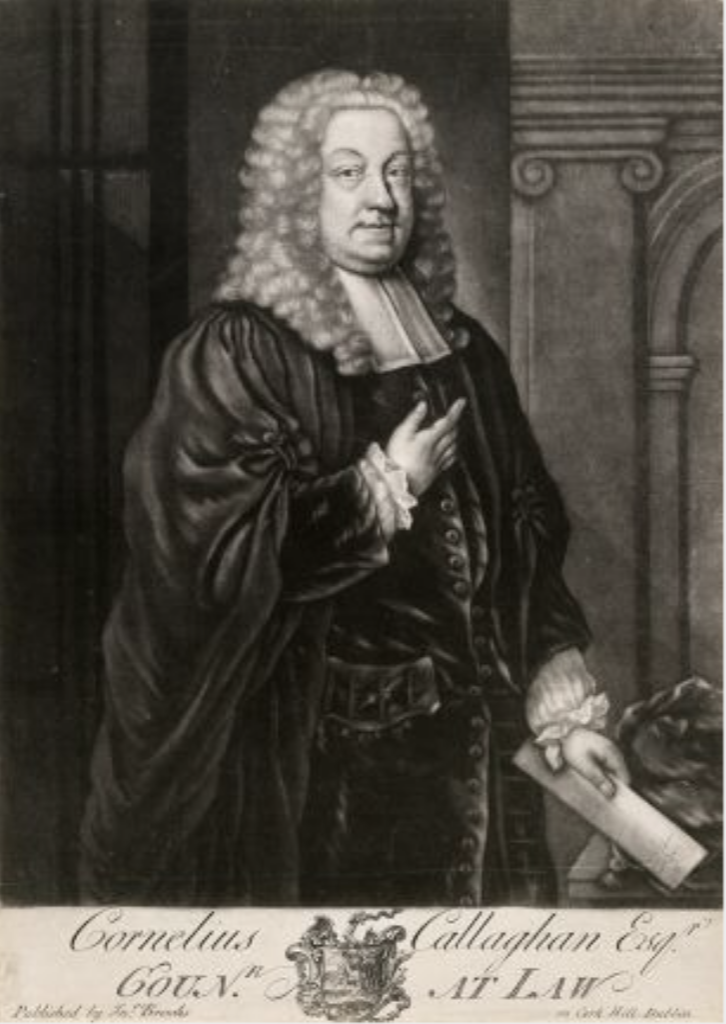
Cornelius Callaghan, M.P., (d.1741), Lawyer Date: 1742 Engraver John Brooks, Irish, fl.1730-1756 After Unknown Artist, courtesy of National Gallery of Ireland.
Cecil Calvert, 2nd Baron Baltimore (1605/6-1675), Aged 51 Date c.1657 by Engraver Abraham Blooteling, Dutch, 1640-1690 After Irish 17th century, Irish, courtesy of National Gallery of Ireland.
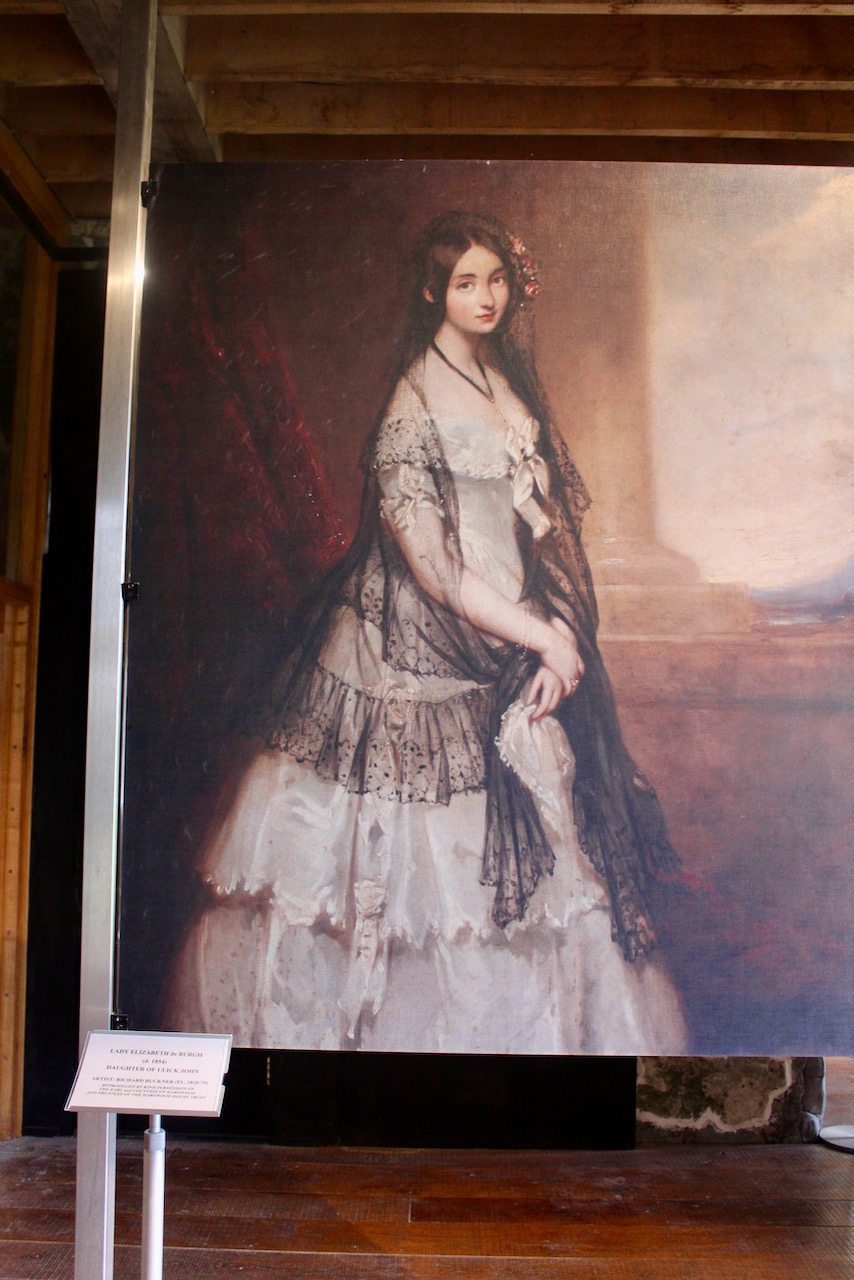
Harriet de Burgh née Canning, Countess of Clanricarde (1804-1876), married to Ulick John De Burgh, 14th Earl and 1st Marquess of Clanricarde (1802-1874). I think the portrait is by John Lucas.
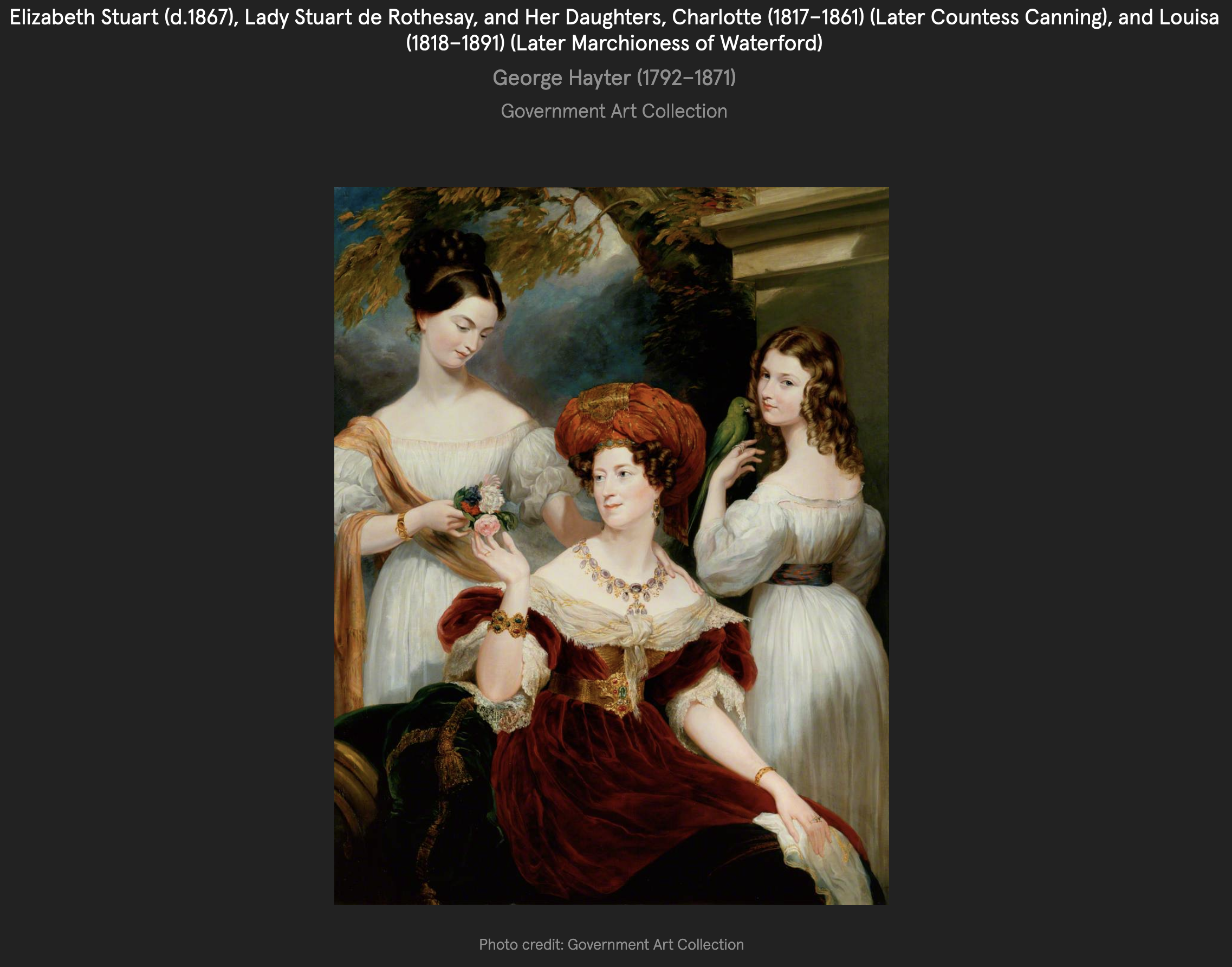
Elizabeth Stuart née Yorke (1789-1867). Lady Stuart de Rothesay, with her daughters Charlotte (1817-1861) and Louisa (1818-1891) by George Hayter, photograph courtesy of UK Government Art Collection. Elizabeth was the daughter of Philip Yorke 3rd Earl of Hardwicke; Louisa married Henry de la Poer Beresford 3rd Marquis of Waterford; Charlotte married Charles John Canning 1st Viceroy of India, 2nd Viscount Canning, 1st Earl Canning.
Algernon Capell (1670-1710) 2nd Earl of Essex. Photograph © Jennifer Winder-Baggot, www.irishhistorichouses.com
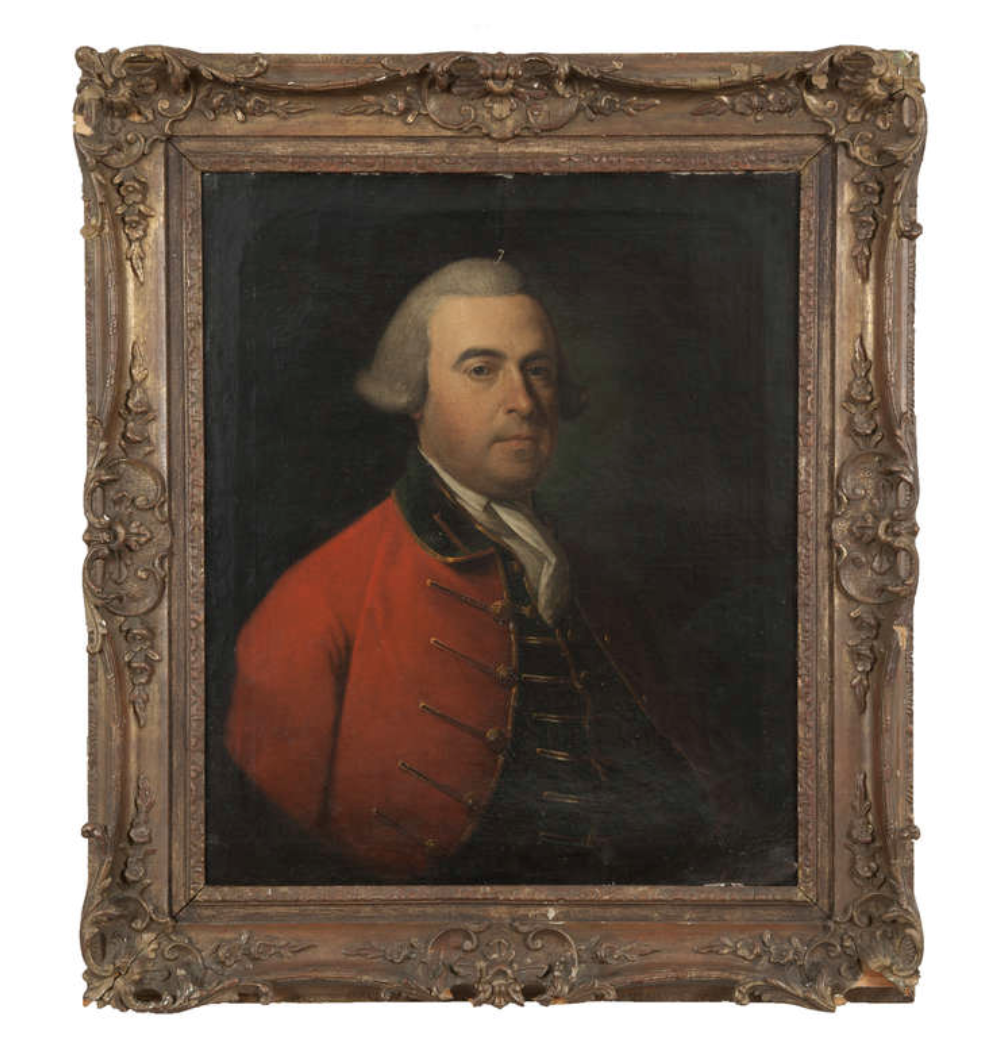
John Craven Carden, 1st Baronet by Robert Hunter courtesy of Adam’s auction 13 Oct 2015. This portrait of John Craven Carden is in the uniform of the Templemore Light Dragoons, a volunteer regiment raised in response to the withdrawal of regular troops required for the American War but which rapidly acquired political leverage. Carden had inherited large estates in Tipperary acquired in the Cromwellian settlement of the 17th Century. Although without parliamentry influence, Carden represented landed interests which the Castle administration were keen to control. Bribes were measured and Carden was made a baronet in 1787. He proved to be a sound man in the 1798 rebellion and by fortifying the Market House in Templemore denied the town to the rebels. He also leased the land for a barracks (now the Garda Training College) and donated the site of the Catholic Church in 1810.
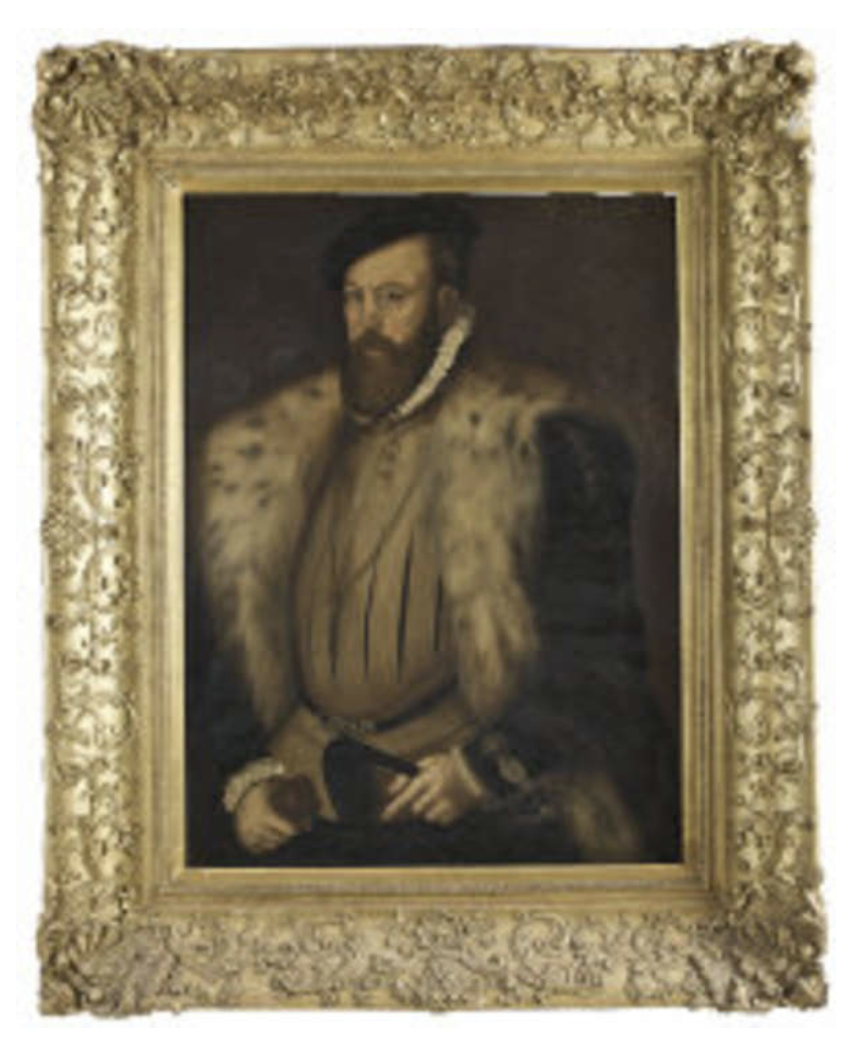
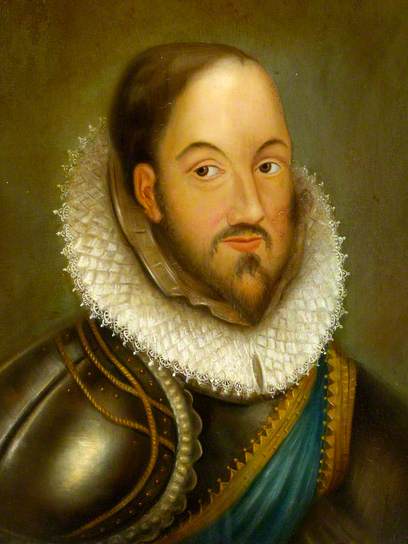
George Carew, knighted 1586 was a hardened soldier and sea captain. Much of his energy was spent in the ruthless execution of the various Elizabethan wars in Ireland, courtesy of Adam’s 5th Oct 2010.
Lord Carew of Ballinamona Park, Co. Waterford, courtesy Fonsie Mealy Nov 2023.
Lady Carew of Ballinamona Park, Co. Waterford, courtesy Fonsie Mealy Nov 2023.
Thomas Carew Of Ballinamona, possibly by Charles Forrest, courtesy Adam’s 23 Sept 2008.
Sarah Cooper née Carleton (born around 1718), wife of Arthur Cooper (b. 1716) of Coopershill, County Sligo. Daughter of Guy Cathcart Carleton of Fermanagh and Mary Brooke of Brookeborough, County Fermanagh. Photograph © Jennifer Winder-Baggot, www.irishhistorichouses.com
The painting is a portrait by William Hogarth of the 1st Earl of Charlemont, James Caulfeild (1728-1799) aged 13, with his mother, Elizabeth Caulfeild née Bernard (1703-1743)(portrait painted in 1741). Photograph © Jennifer Winder-Baggot, www.irishhistorichouses.com
James Caulfeild (1728-1799) 4th Viscount, 1st Earl of Charlemont, 1790 by Martin Ferdinand Quadal, courtesy of National Gallery of Ireland.
James Caulfeild, 1st Earl of Charlemont (1728-1799) by Richard Livesay, British, 1753-1826.
Dorothy Bentinck née Cavendish, Duchess of Portland (1750-1794) by George Romney, c. 1772, daughter of William Cavendish, 4th Duke of Devonshire. She married William Henry Bentinck 3rd Duke of Portland who added Cavendish to his name to become Cavendish-Bentinck. Photograph © Jennifer Winder-Baggot, www.irishhistorichouses.com
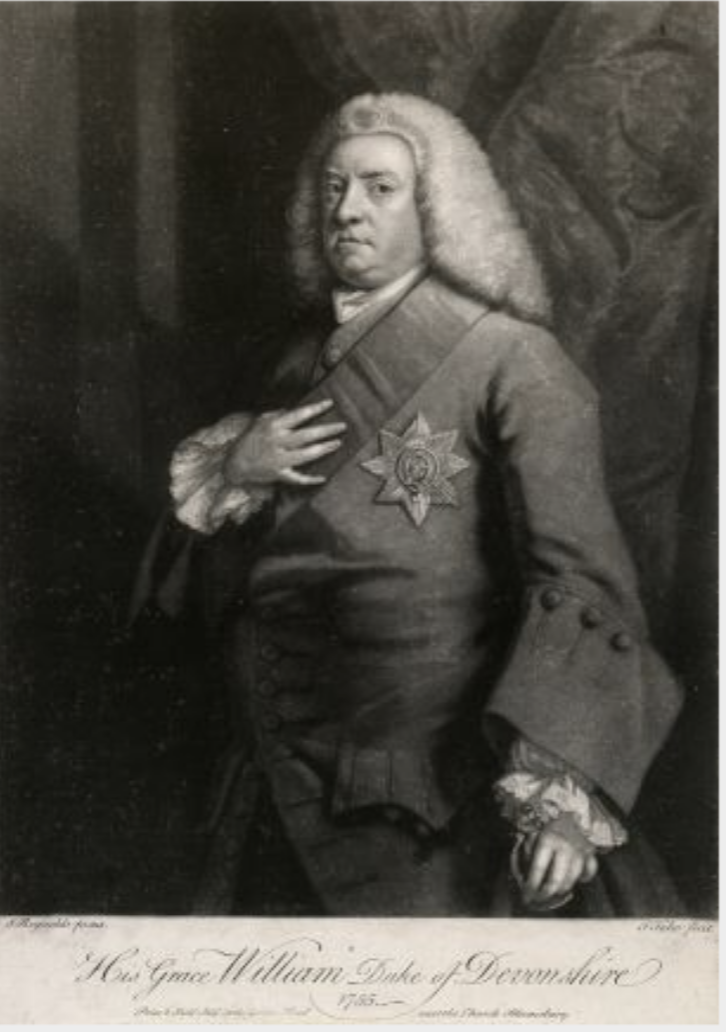
William Cavendish, 3rd Duke of Devonshire, (1698-1755), former Lord Lieutenant of Ireland by Engraver John Faber the Younger, Dutch, c.1695-1756 After Joshua Reynolds, English, 1723-1792, courtesy of National Gallery of Ireland.
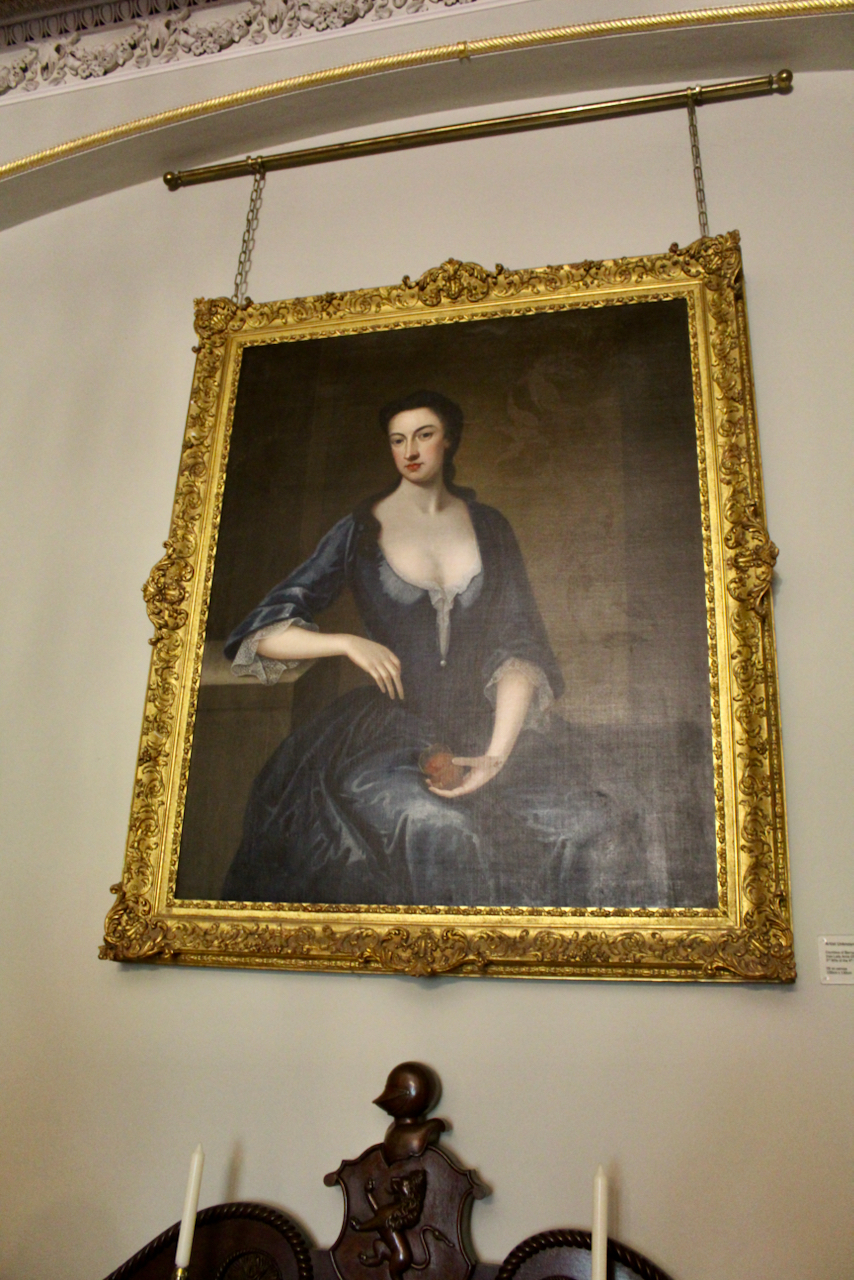
Catherine Cavendish, Duchess Of Devonshire (1700-1777) née Hoskins or Hoskyn, As Saint Catherine by Charles Jervas (1675-1739), courtesy of Whyte’s auction March 2019. She married William Cavendish 3rd Duke of Devonshire.
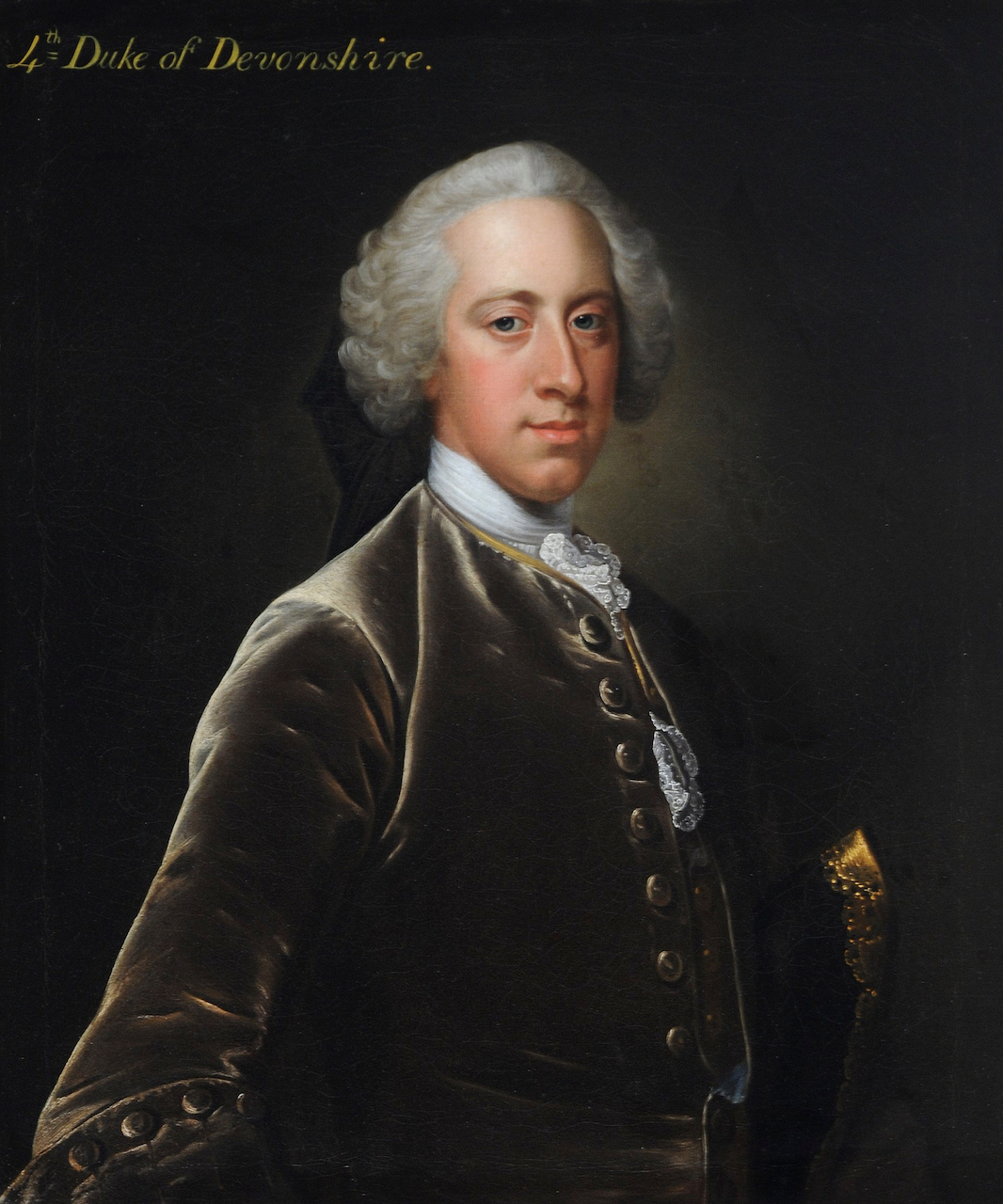
William Cavendish (1720-1764) 4th Duke of Devonshire, who brought Lismore Castle, County Waterford, into the Cavendish family by his marriage. Painting by Thomas Hudson.
Charlotte Boyle (1731-1754) daughter of Richard Boyle (1694-1753) 3rd Earl of Burlington 4th Earl of Cork who married William Cavendish (1720-1764) 4th Duke of Devonshire and brought Lismore Castle, County Waterford, into the Cavendish family. Painting after style of George Knapton, courtesy of Chiswick House collection.
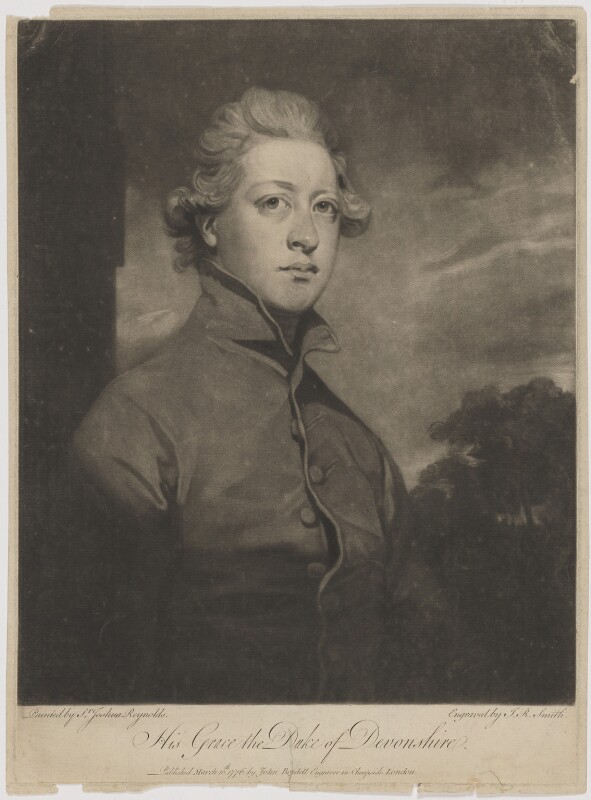
William Cavendish (1748-1811) 5th Duke of Devonshire by John Raphael Smith, after Sir Joshua Reynolds publ. 1776, NPG D1752.
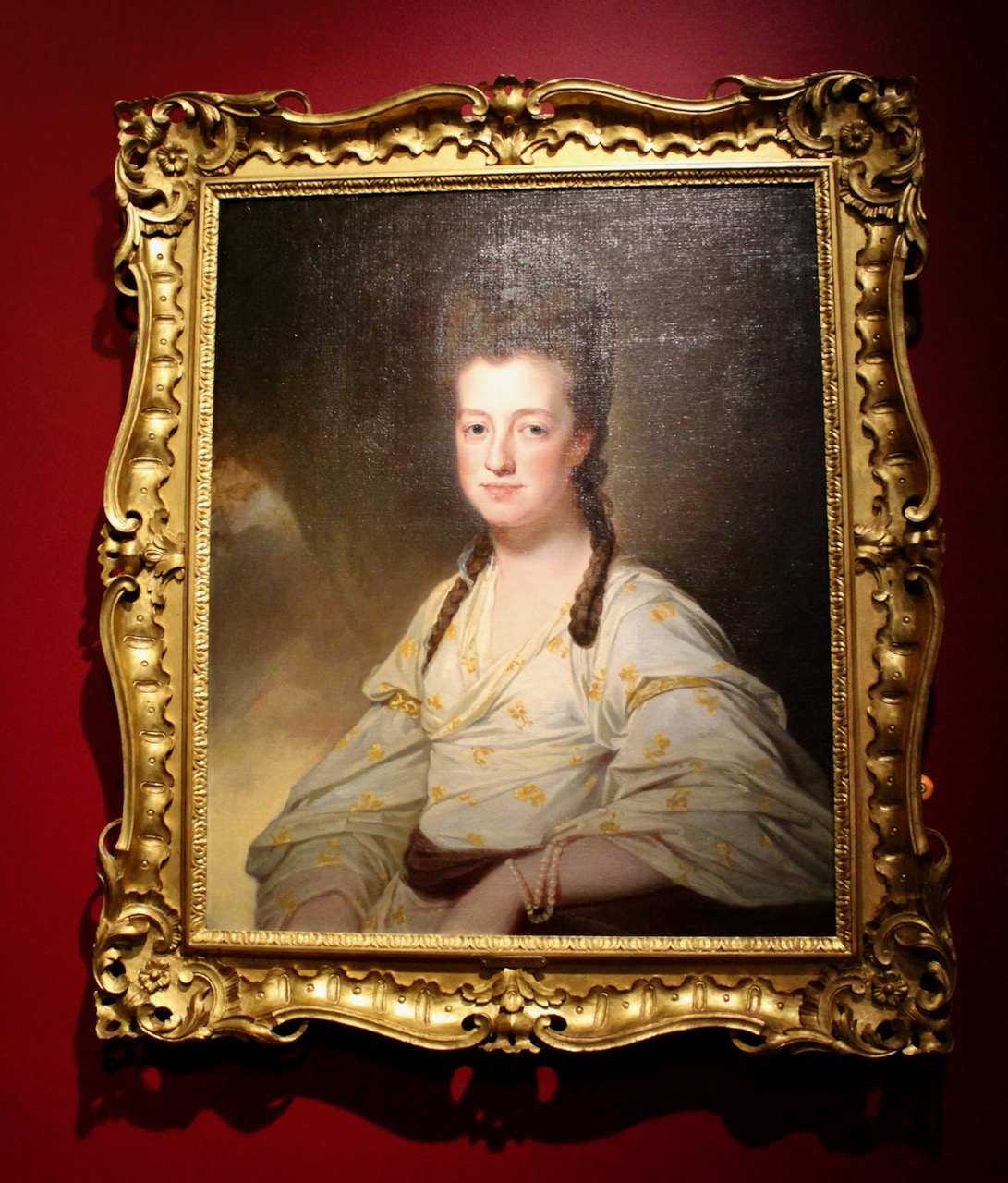
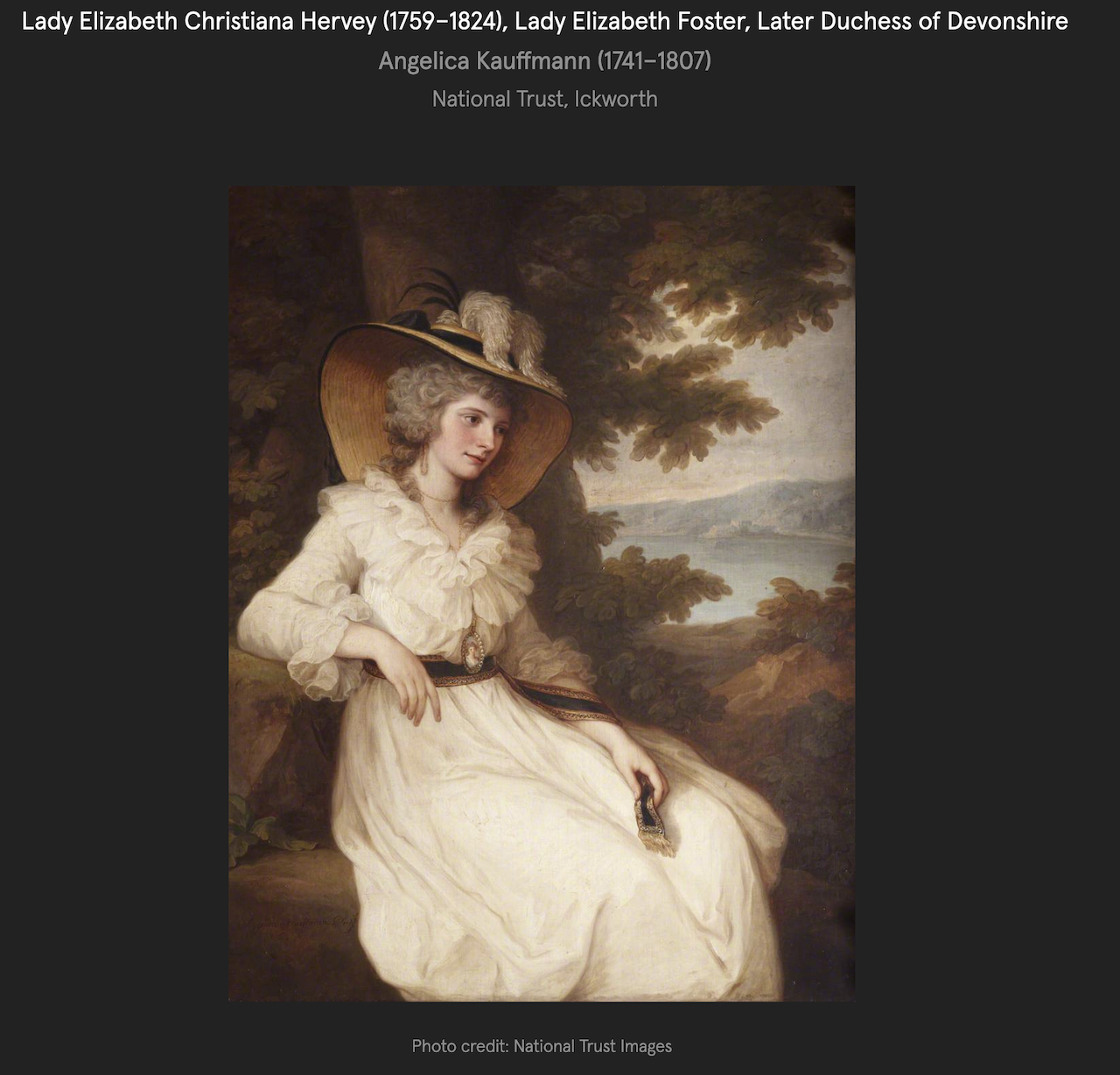
Elizabeth Christina Foster née Hervey (1759-1824) later Duchess of Devonshire by Angelica Kauffmann courtesy of National Trust Ickworth. She was the daughter of Frederick Augustus Hervey 4th Earl of Bristol, Bishop of Derry who built Downhill, Co Derry. She married John Thomas Foster MP (1747-1796) and later, William Boyle Cavendish 5th Duke of Devonshire. Last, she married Valentine Richard Quin 1st Earl of Dunraven and Mount Earl.
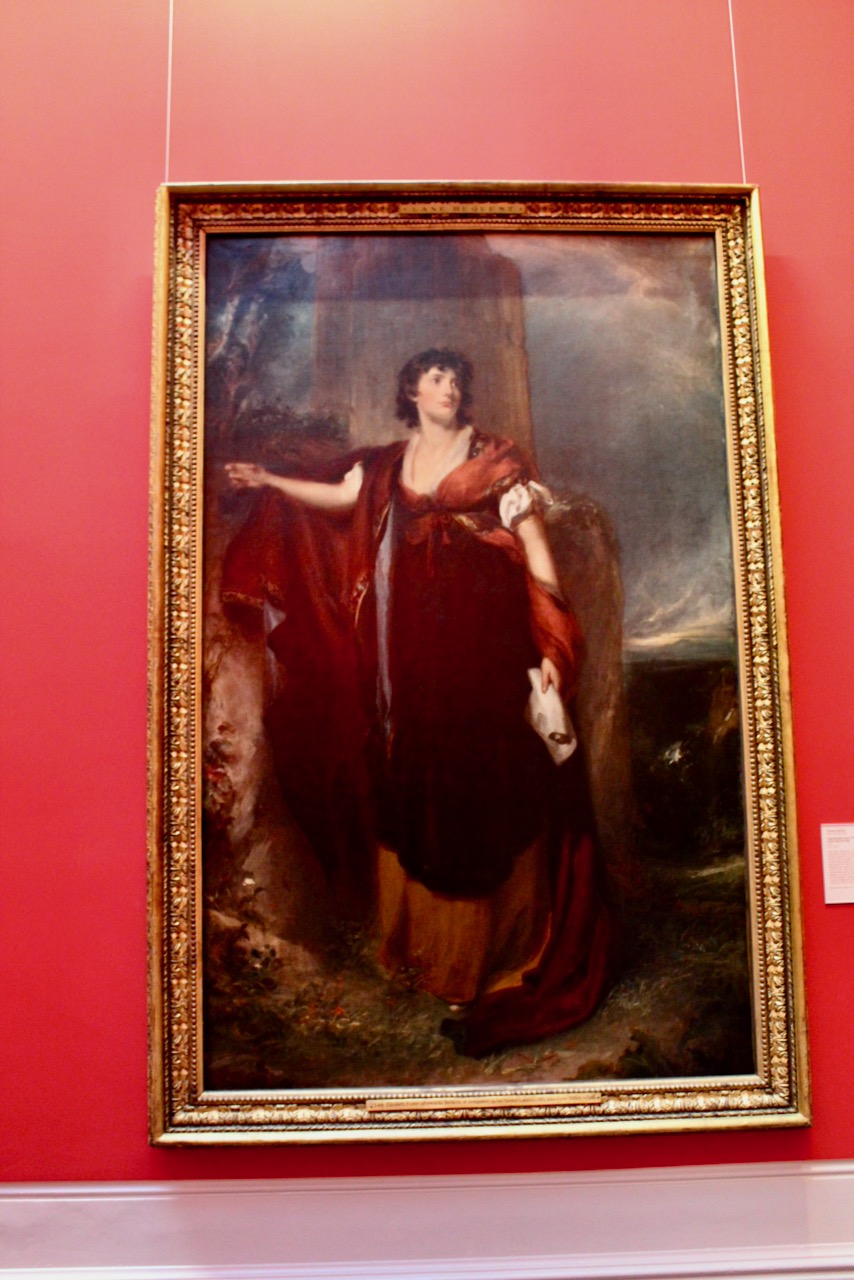
Lady Elizabeth Foster (1759-1824) née Hervey, as the Tiburtine Sibyl c. 1805 by Thomas Lawrence, National Gallery of Ireland NGI788. She was the daughter of Frederick Augustus Hervey 4th Earl of Bristol, Bishop of Derry who built Downhill, Co Derry. She married John Thomas Foster MP (1747-1796) and later, William Boyle Cavendish 5th Duke of Devonshire. Last, she married Valentine Richard Quin 1st Earl of Dunraven and Mount Earl. Photograph © Jennifer Winder-Baggot, www.irishhistorichouses.com
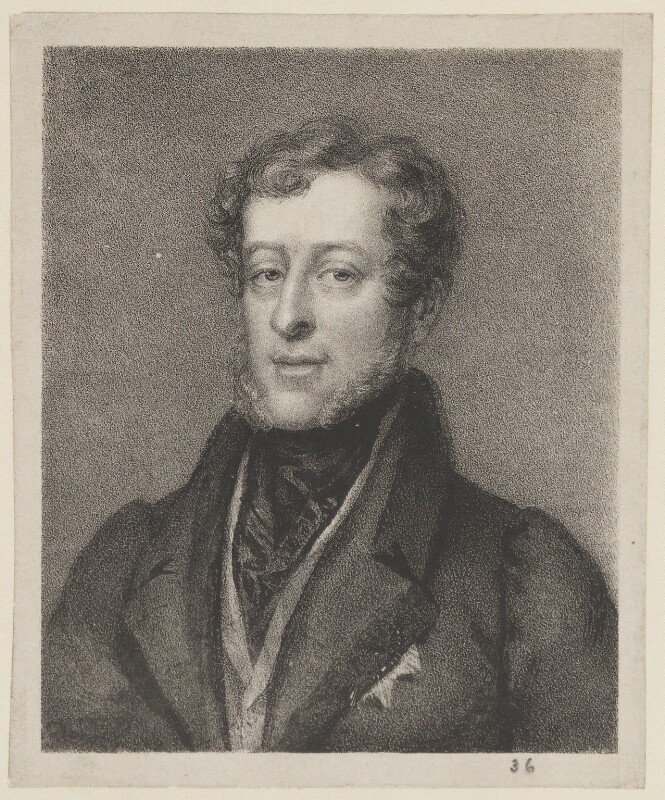
William George Spencer Cavendish (1790-1858) 6th Duke of Devonshire by George Edward Madeley, NPG D15276.
Margaret Jones née Cecil (1673-1727) Countess of Ranelagh, 2nd wife of Richard Jones 1st Earl of Ranelagh Engraver: John Smith, English, 1652-1743 After Godfrey Kneller, German, 1646-1723, courtesy of National Gallery of Ireland.
William Chambers in the style of Joshua Reynolds, courtesy of Adam’s auction 13 Oct 2015
Major Henry Chavasse (1863-1943). 4th Battalion Scottish Rifles. Photograph © Jennifer Winder-Baggot, www.irishhistorichouses.com
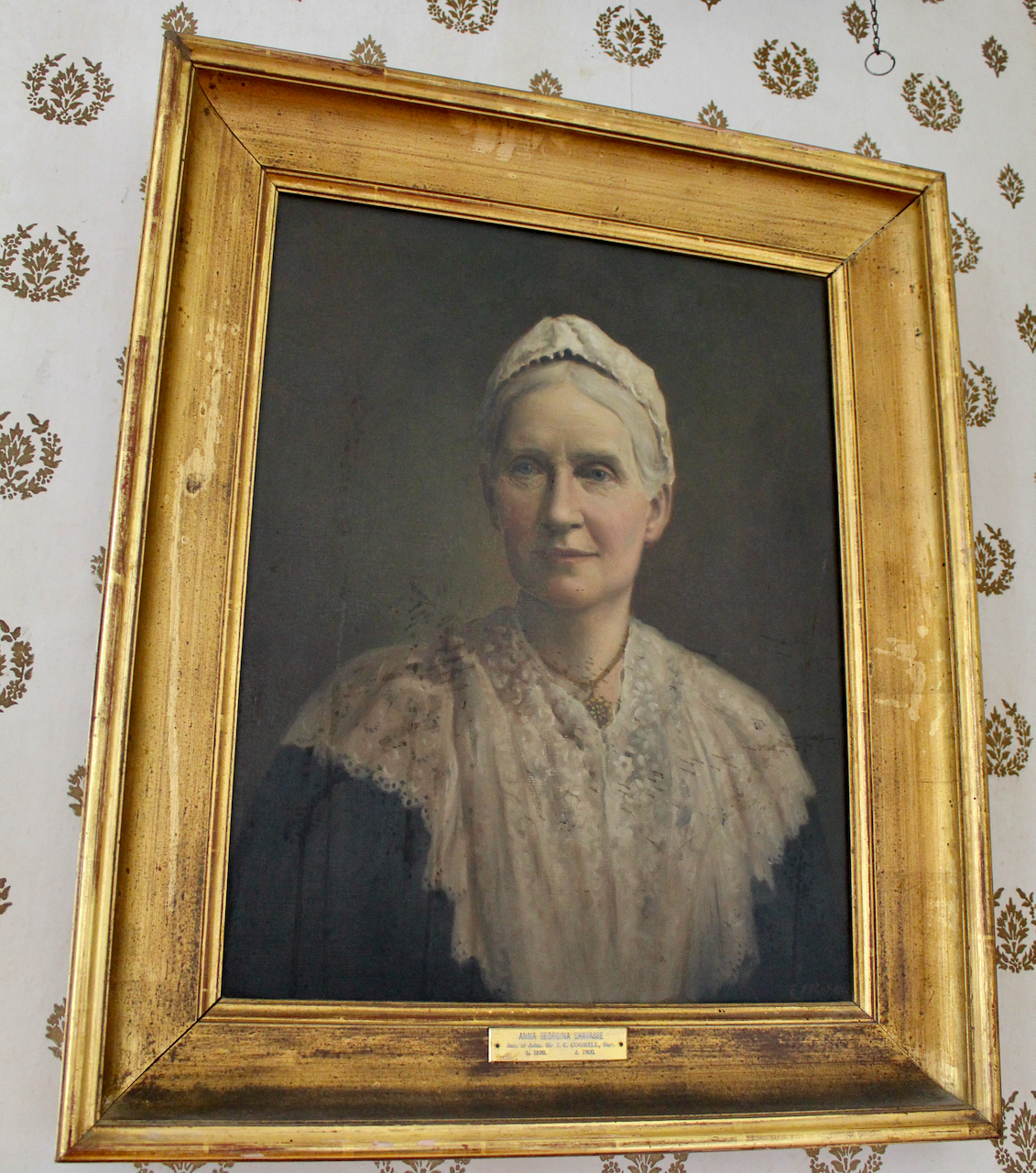
Anna Georgina Chavasse, née Coghill (d. 1899). She married Reverend William Izon Chavasse (1835-1864). Photograph © Jennifer Winder-Baggot, www.irishhistorichouses.com
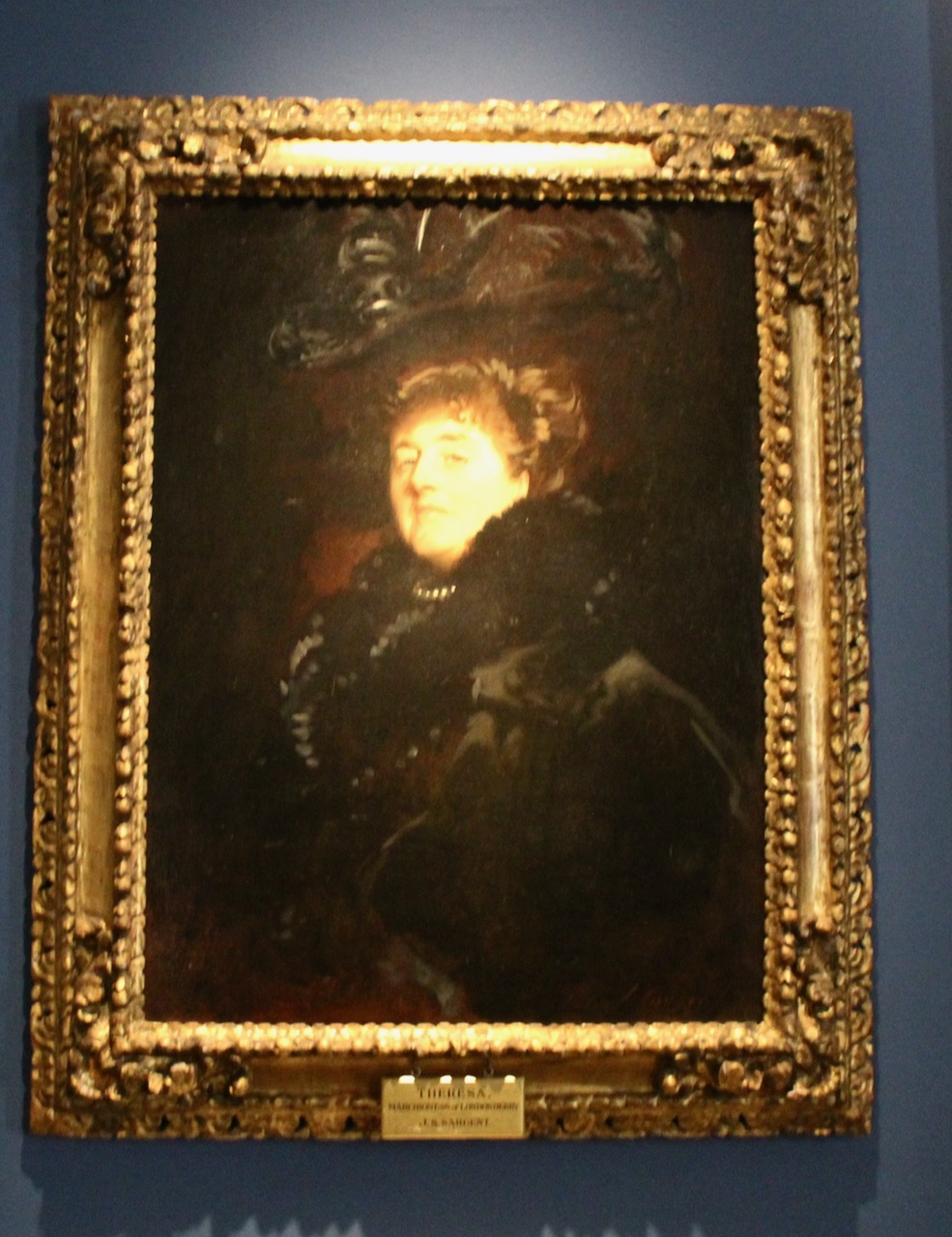
Theresa Susey Helen Vane-Tempest-Stewart née Chetwynd-Talbot, Marchioness of Londonderry (1856-1919) by John Singer Sargent, Vicereine 1886-89, wife of Charles Stewart Vane-Tempest-Stewart , 6th Marquess of Londonderry. Photograph © Jennifer Winder-Baggot, www.irishhistorichouses.com

Baron Chichester (1613)

  • Arthur Chichester, 1st Baron Chichester (1563–1625)
Arthur Chichester (1563-1625) Baron Chichester Of Belfast (c) Belfast Harbour Commissioners; Supplied by The Public Catalogue Foundation.

Baron Chichester and Viscount Chichester (1625)

  • Edward Chichester, 1st Viscount Chichester (1568–1648)
  • Arthur Chichester, 2nd Viscount Chichester (1606–1675; created Earl of Donegall in 1647)

Earl of Donegall (1647)

  • Arthur Chichester, 1st Earl of Donegall (1606–1675)
  • Arthur Chichester, 2nd Earl of Donegall (died 1678)
  • Arthur Chichester, 3rd Earl of Donegall (1666–1706)
Anne Barry née Chichester (1697-1753) Countess of Barrymore, 3rd wife of James Barry 4th Earl of Barrymore. She was the daughter of Arthur, 3rd Earl of Donegall. Photograph © Jennifer Winder-Baggot, www.irishhistorichouses.com
Lady Anne Chichester, Countess of Barrymore (d. 1753) Attributed to Philip Hussey, she was daughter of Major-General Arthur Chichester, 3rd Earl of Donegall (1666-1706) and his wife Lady Catherine Forbes (d. 1743), and she married James Barry 4th Earl of Barrymore, and was the mother of James Smith-Barry.
  • Arthur Chichester, 4th Earl of Donegall (1695–1757)
Lady Lucy Ridgeway was the eldest daughter and co-heir of Robert Ridgeway, 4th Earl of Londonderry (d. 1713/14), she married Arthur Chichester, 4th Earl of Donegal (1695-1757), by Jonathan Richardson courtesy of Sothebys L11304.
  • Arthur Chichester, 5th Earl of Donegall (1739–1799; created Baron Fisherwick in 1790 and Earl of Belfast and Marquess of Donegall in 1791). He married Anne née Hamilton (1731-1780) who was the daughter of James Brandon Douglas Hamilton 5th Duke of Hamilton, Scotland. Arthur the 5th Earl of Donegall was the son of John Chichester (1700-1746), who was the son of Arthur 3rd Earl of Donegall.
Anne Chichester née Hamilton, Countess of Donegall (1731-1780), who married Arthur Chichester 5th Earl of Donegall. She was the daughter of James Brandon Douglas Hamilton 5th Duke of Hamilton, Scotland. Photograph © Jennifer Winder-Baggot, www.irishhistorichouses.com

Marquess of Donegall (1791)

  • Arthur Chichester, 1st Marquess of Donegall (1739–1799)
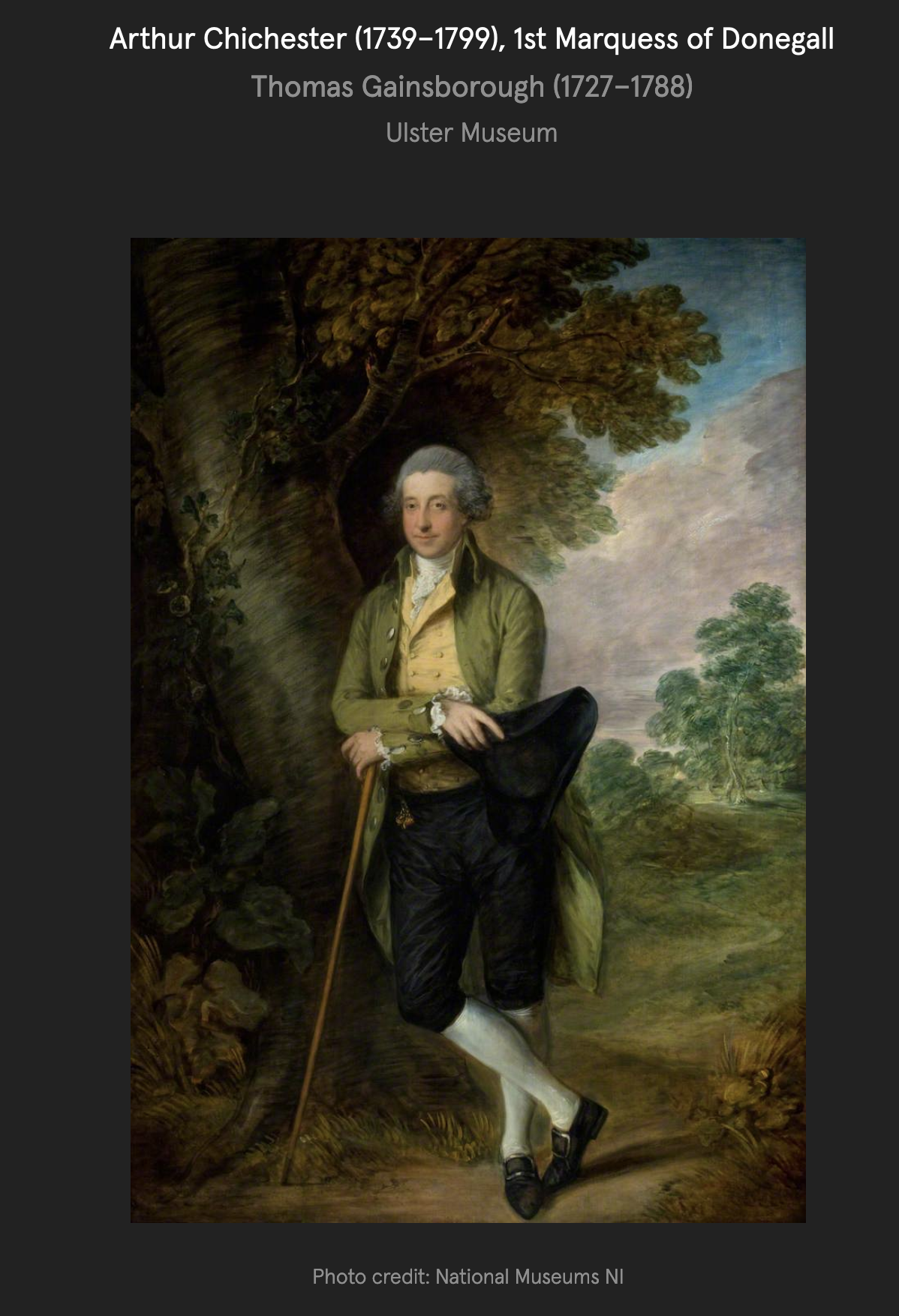
Arthur Chichester (1739-1799) 1st Marquess of Donegall, by Thomas Gainsborough, courtesy of Ulster Museum.
  • George Augustus Chichester, 2nd Marquess of Donegall (1769–1844)
George Augustus Chichester (1769-1844) 2nd Marquess of Donegall, courtesy of Belfast Castle.

George Hamilton Chichester, 3rd Marquess of Donegall, Baron Ennishowen and Carrickfergus (1797–1883). He married Harriet Anne née Butler (1799-1860), daughter of Richard Butler, 1st Earl of Glengall.

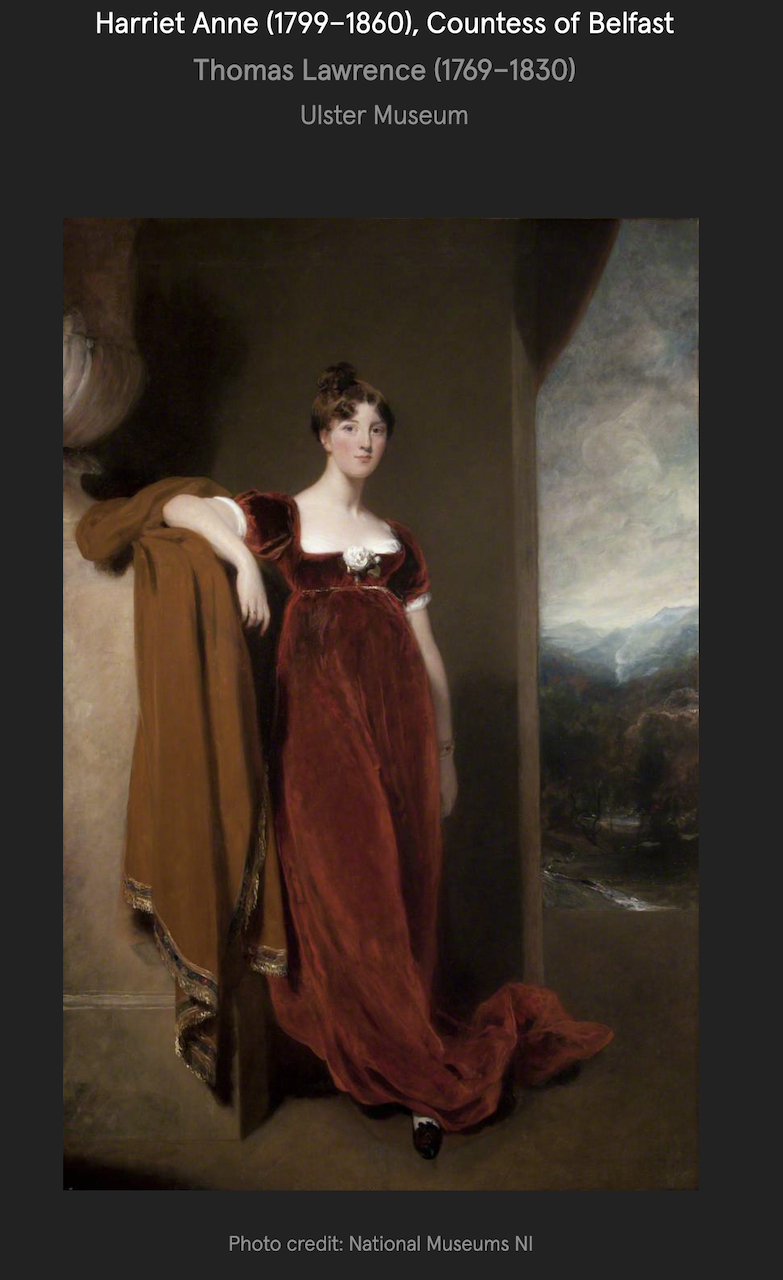
Harriet Anne née Butler (1799-1860) Countess of Belfast, wife of George Hamilton Chichester 3rd Marquess of Donegal and daughter of Richard Butler, 1st Earl of Glengall.
Frederick Richard Chichester (1827-1853), Earl of Belfast, Courtesy of Ulster Museum. He was the son of the 3rd Marquess of Donegall.
Frederick Richard Chichester (1827-1853) Earl of Belfast courtesy of Ulster Museum.
  • Edward Chichester, 4th Marquess of Donegall (1799–1889)
  • George Augustus Hamilton Chichester, 5th Marquess of Donegall (1822–1904)
  • Edward Arthur Donald St George Hamilton Chichester, 6th Marquess of Donegall (1903–1975)
  • Dermot Richard Claud Chichester, 7th Marquess of Donegall (5th Baron Templemore) (1916–2007)
  • Arthur Patrick Chichester, 8th Marquess of Donegall (b. 1952) [1]
Portrait c. 1740 of Archbishop Robert Clayton (1695–1758) and Katherine née Donellan by James Latham, courtesy of National Gallery of Ireland. Known for his unorthodox views, at the time of his death Robert Clayton was facing charges of heresy.
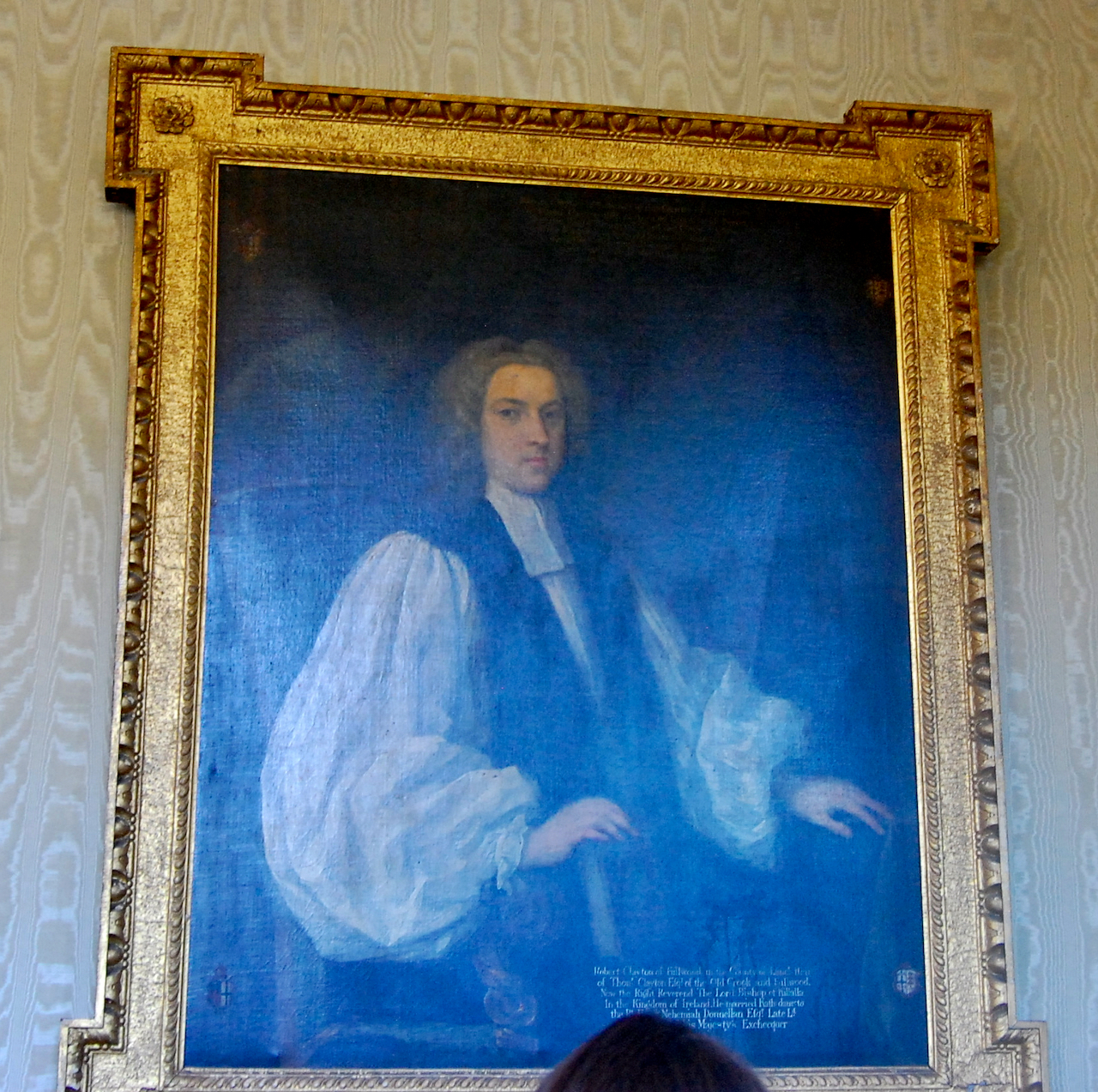
Robert Clayton (1695–1758) Bishop of Cork and Ross, in Iveagh House on St. Stephen’s Green. Photograph © Jennifer Winder-Baggot, www.irishhistorichouses.com
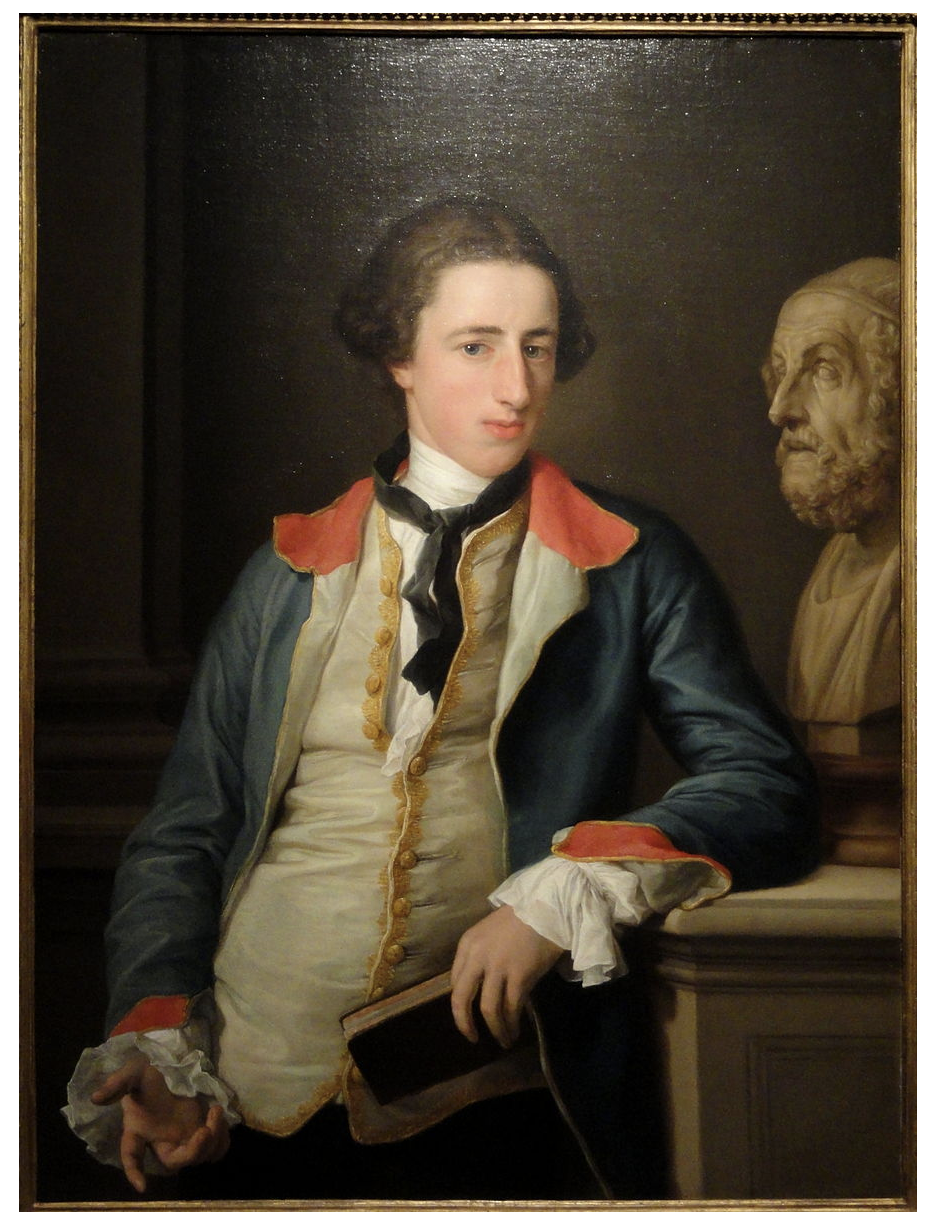
Robert Clements, later First Earl of Leitrim, by Pompeo Batoni, about 1753–1754, Hood Museum of Art.
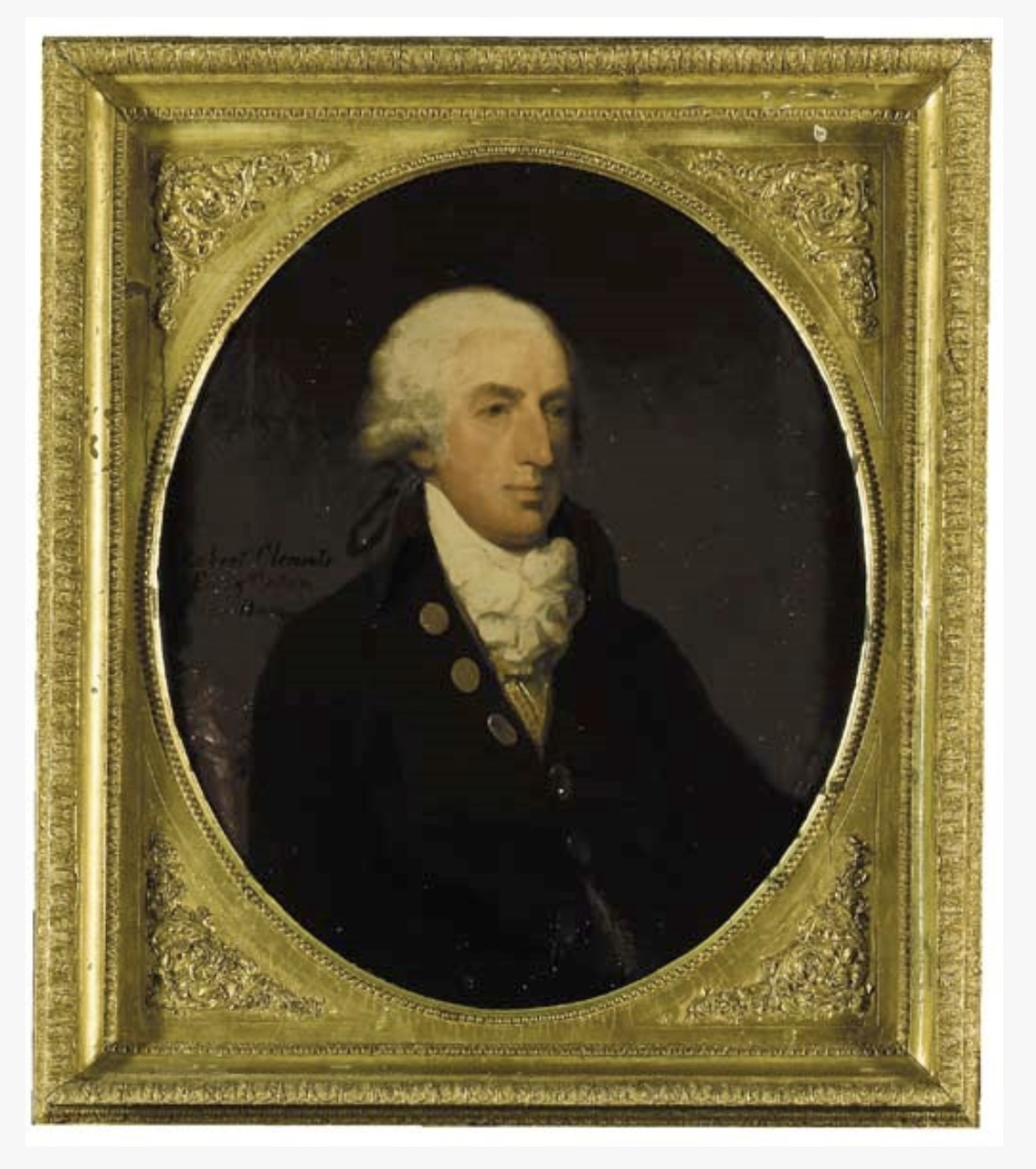
Robert Clements (1732-1804) 1st Earl of Leitrim by Gilbert Stuart courtesy of Christie’s Irish Sale 2001.
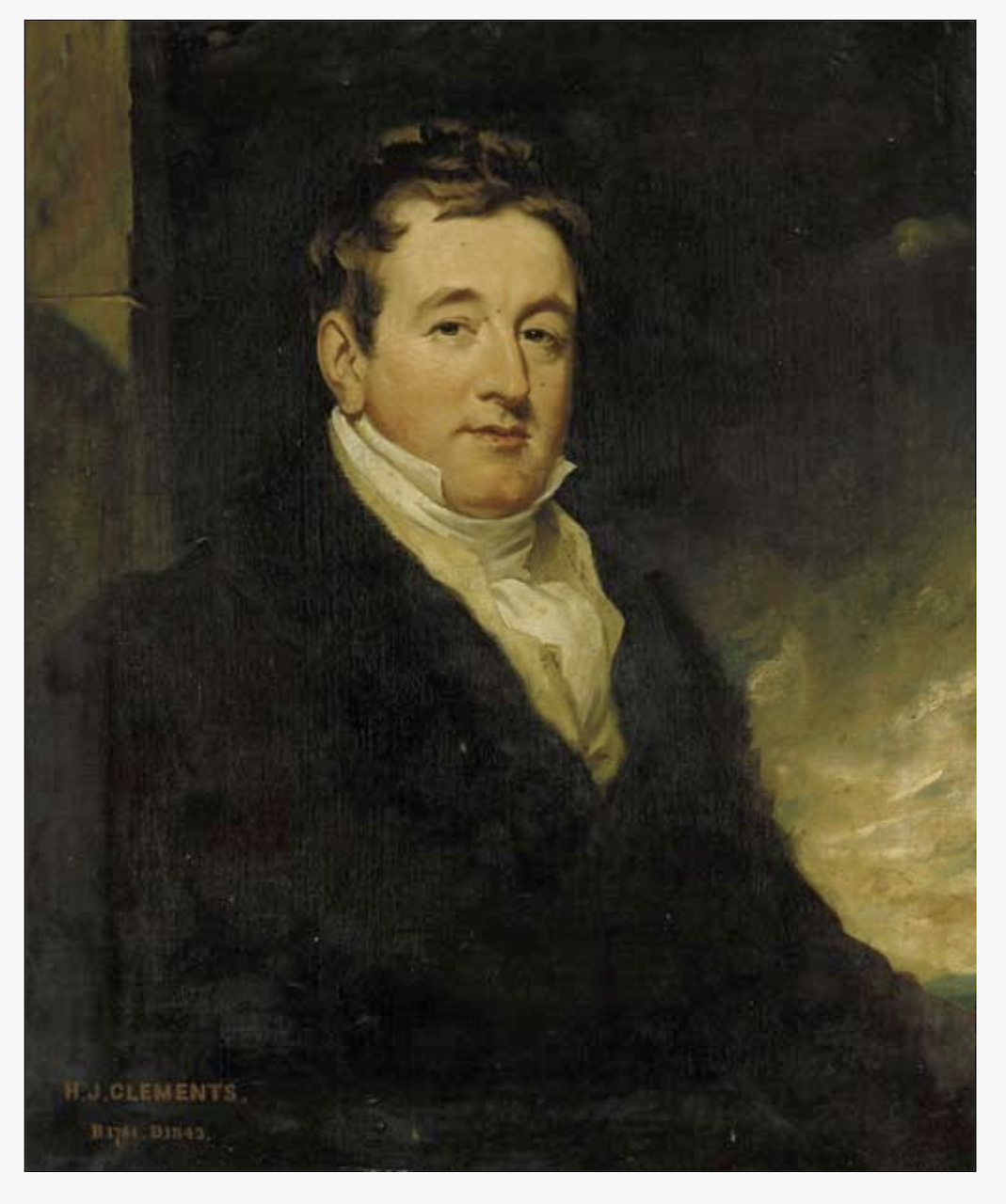
Colonel Henry John Clements (1781-1843) of Ashfield, Co. Cavan by Martin Cregan, courtesy of Christie’s Irish Sale 2001. He was the son of Henry Theophilus Clements (1750-1795), a brother of the 1st Earl of Leitrim, and Catherine Beresford (1761-1836). He married Louisa Stewart (1778-1850) of Killymoon, Country Tyrone, daughter of James Stewart (1741-1821).
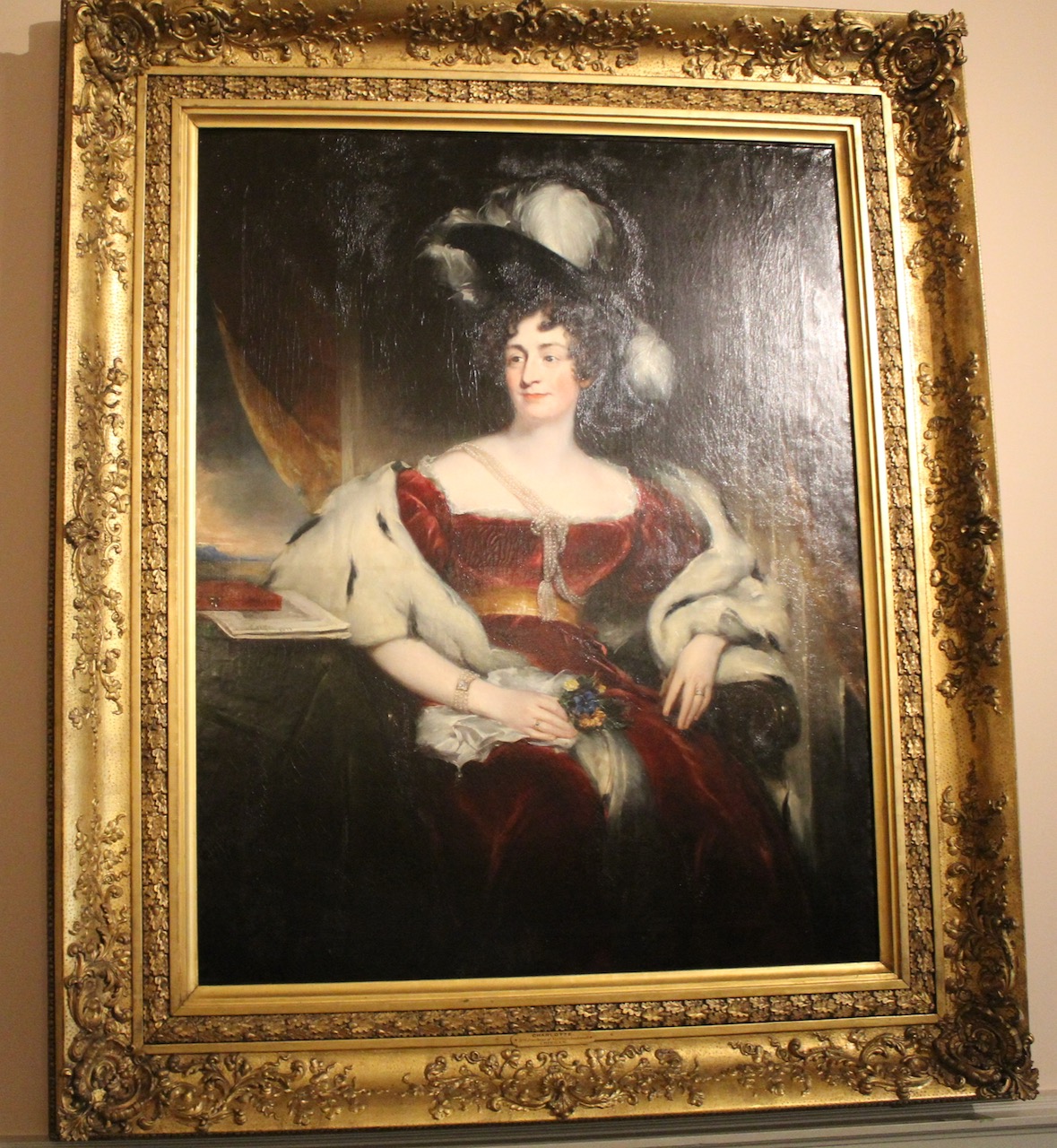
Charlotte Florentia Percy née Clive (1787-1866), Duchess of Northumberland (1787-1866), by Martin Cregan. She was the daughter of Edward Clive, 1st Earl of Powys, and she married Hugh Percy, Earl Percy. Photograph © Jennifer Winder-Baggot, www.irishhistorichouses.com
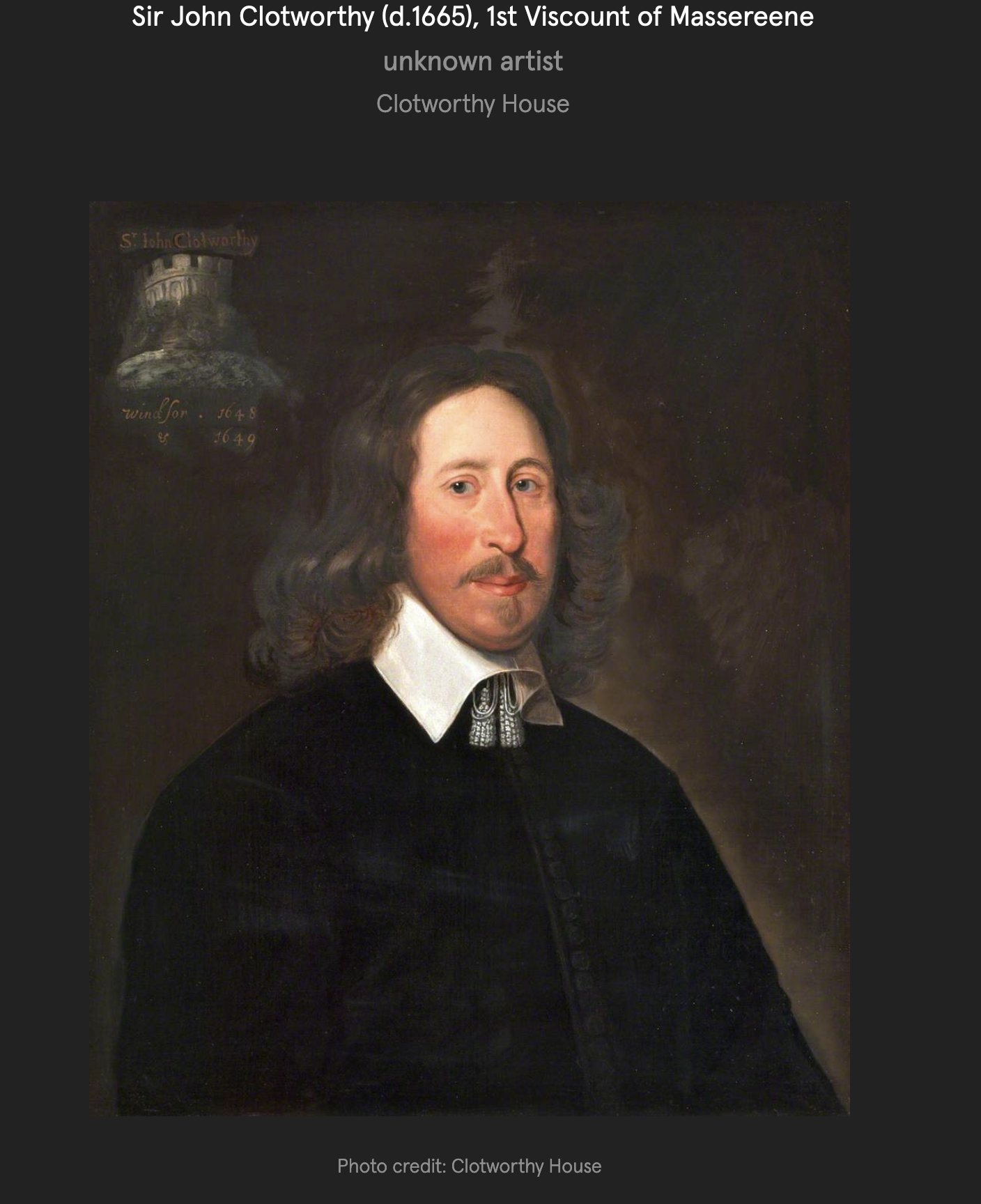
John Clotworthy (d. 1665), 1st Viscount of Massereene, courtesy of Clotworthy House.
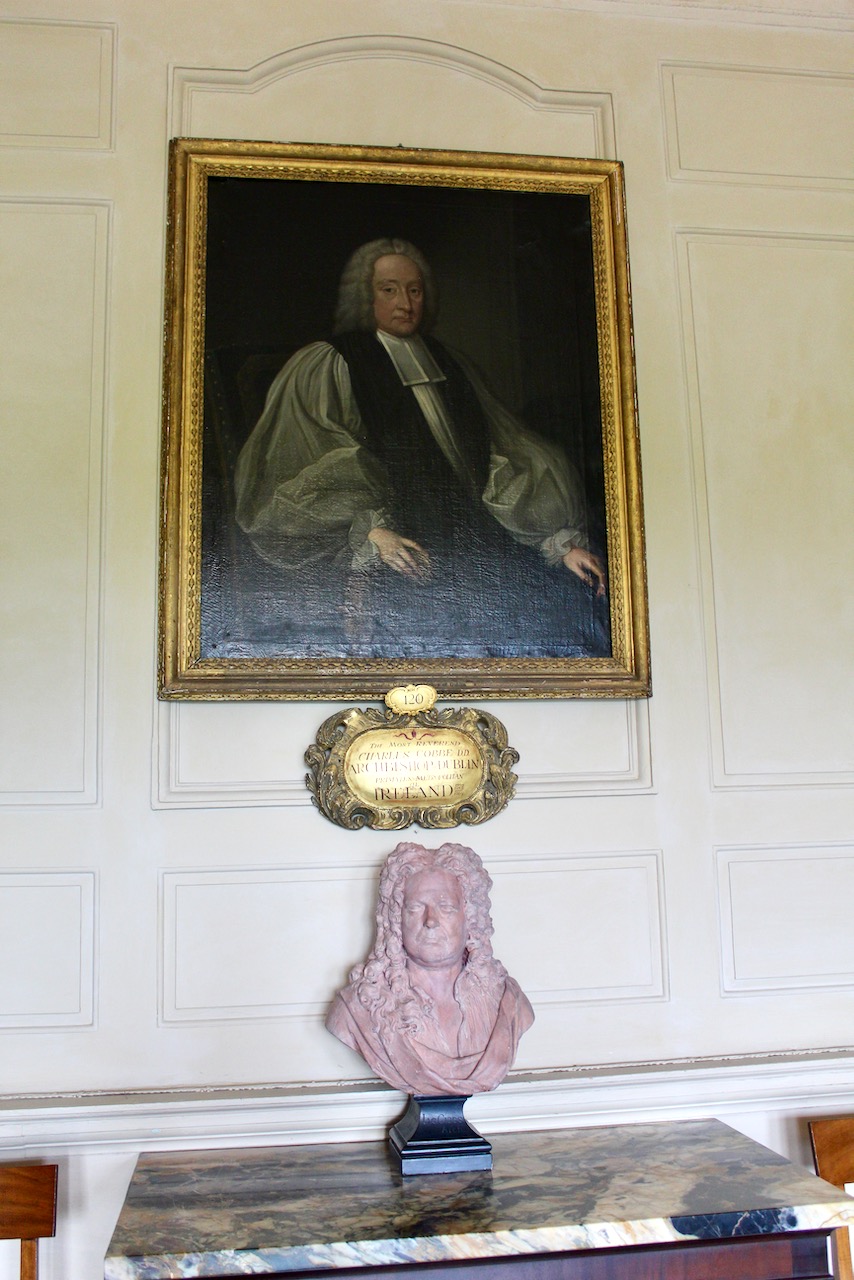
Archbishop Charles Cobbe (1687-1765) of Newbridge House, Dublin Photograph © Jennifer Winder-Baggot, www.irishhistorichouses.com
Charles Cobbe (1687-1765), Protestant Archbishop of Dublin Date 1746 by Engraver Andrew Miller, English, fl.1737-1763 After Francis Bindon, Irish, 1690-1765, courtesy of National Gallery of Ireland.
Charles Cobbe, P. Archbishop of Dublin, (1687-1765) by Engraver Andrew Miller, English, fl.1737-1763 After Francis Bindon, Irish, 1690-1765, courtesy of National Gallery of Ireland.
Elizabeth Cobbe née de la Poer Beresford (1736-1806), wife of Thomas Cobbe (1733-1814) of Newbridge House, Dublin, in a costume evocative of Mary Queen of Scots, miniature, Cobbe Collection.
This portrait was painted the year that Marmaduke Coghill (1673-1739) was appointed Chancellor of the Exchequer, attributed to Francis Bindon, courtesy of Adam’s auction 15 Dec 2019. A firm adherent to the ‘castle’ administration he had ‘inherited’ from his father the position of Judge of the Prerogative Court and had enriched himself sufficiently to re-build Drumcondra House, probably using Edward Lovett Pearce. He had a penchant for commissioning outstanding pieces of silver from the Dublin silversmiths such as the extraordinary cistern in the Ulster Museum and the Monteith in Waterford. There is a monument to him by Peter Scheemakers in Drumcondra Church. Francis Bindon (1690 – 1765) is the most likely artist to have painted this portrait.
Marmaduke Coghill (1673-1738). Never married, he lived in Belvedere House, Drumcondra before building a house at Clonturk, afterwards known as Drumcondra House, he lived there with his sister Mary until his death. Adam’s auction 9 Mar 2014.
John Thomas Coghill, 2nd Bart, 1766 – 1817, attributed to John Russell, for sale courtesy Fonsie Mealy 2016. He purchased land in New Orelands, which was sold by his brother Josiah Coghill.
Admiral Josiah Coghill (1773-1850), 3rd Baronet Coghill, of Coghill, Co. York, UK. Photograph © Jennifer Winder-Baggot, www.irishhistorichouses.com
Anna Georgina Chavasse, née Coghill (d. 1899). She married Reverend William Izon Chavasse (1835-1864). Photograph © Jennifer Winder-Baggot, www.irishhistorichouses.com

I refer to Timothy William Ferres’s terrific blog to look at the Cole family of Florence Court in County Fermanagh, a National Trust property.

William Cole married Susannah, daughter and heir of John Croft, of Lancashire, and widow of Stephen Segar, Lieutenant of Dublin Castle, by whom he left at his decease in 1653,

MICHAEL, his heir;
John, of Newland, father of Arthur, 1st BARON RANELAGH;
Mary; Margaret.

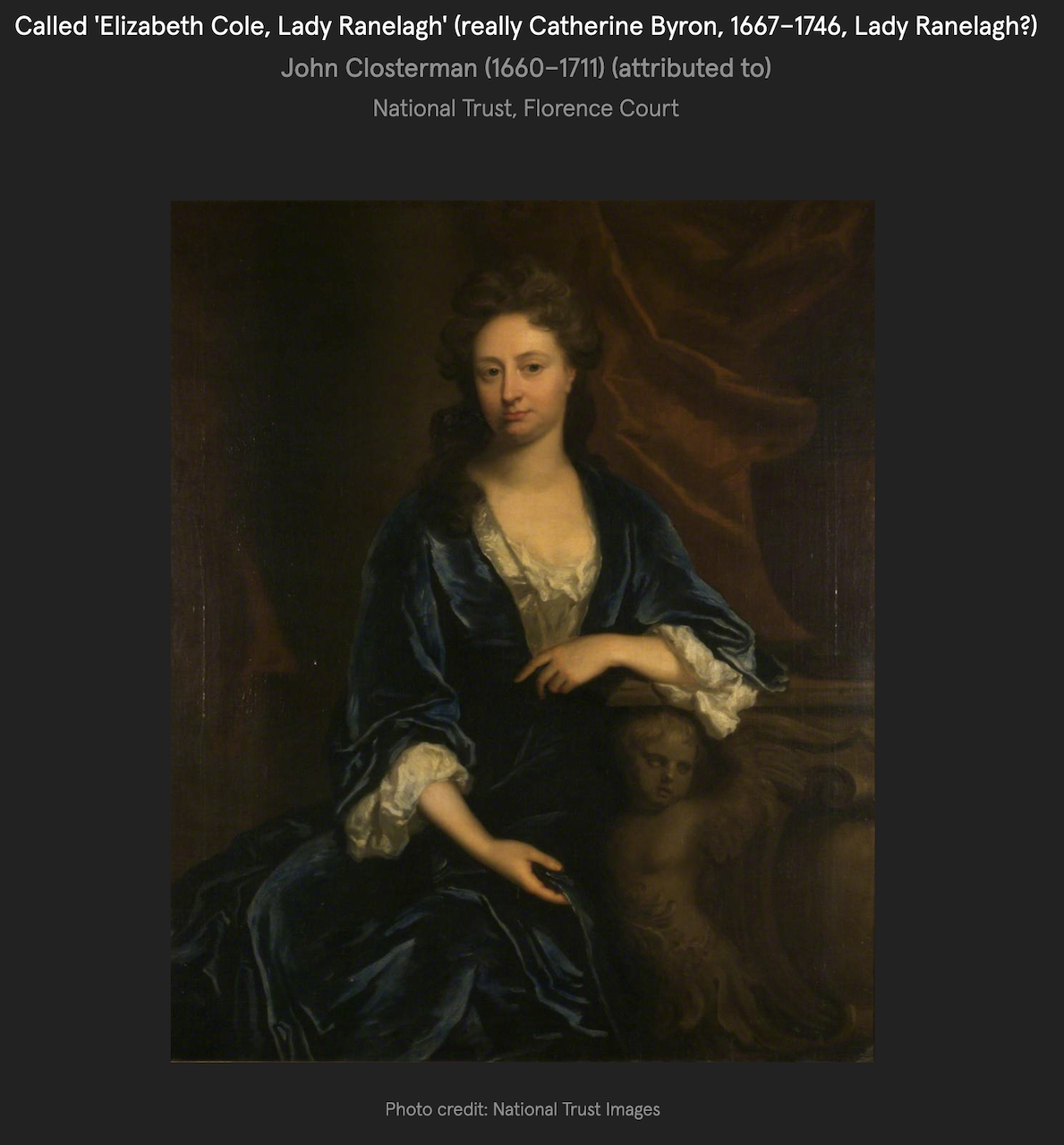
Called Elizabeth Cole Lady Ranelagh, probably really Catherine Cole née Byron (1667-1746) Lady Ranelagh attributed to John Closterman courtesy of National Trust Florence Court. She married Arthur Cole, 1st Baron Ranelagh.

The elder son,

MICHAEL COLE, wedded, in 1640, Catherine, daughter of Sir Laurence Parsons, of Birr, 2nd Baron of the Irish Exchequer, and dvp, administration being granted 1663 to his only surviving child,

SIR MICHAEL COLE, Knight (1644-1710), of Enniskillen Castle, MP for Enniskillen, 1692-3, 95-9, 1703-11, who espoused firstly, Alice (dsp 1671), daughter of Chidley Coote, of Killester; and secondly, 1672, his cousin, Elizabeth (d 1733), daughter of Sir J Cole Bt.

Sir Michael was succeeded by his only surviving child,

JOHN COLE (1680-1726), of Florence Court, MP for Enniskillen, 1703-26, who espoused, in 1707, Florence, only daughter of Sir Bourchier Wrey Bt, of Trebitch, in Cornwall.

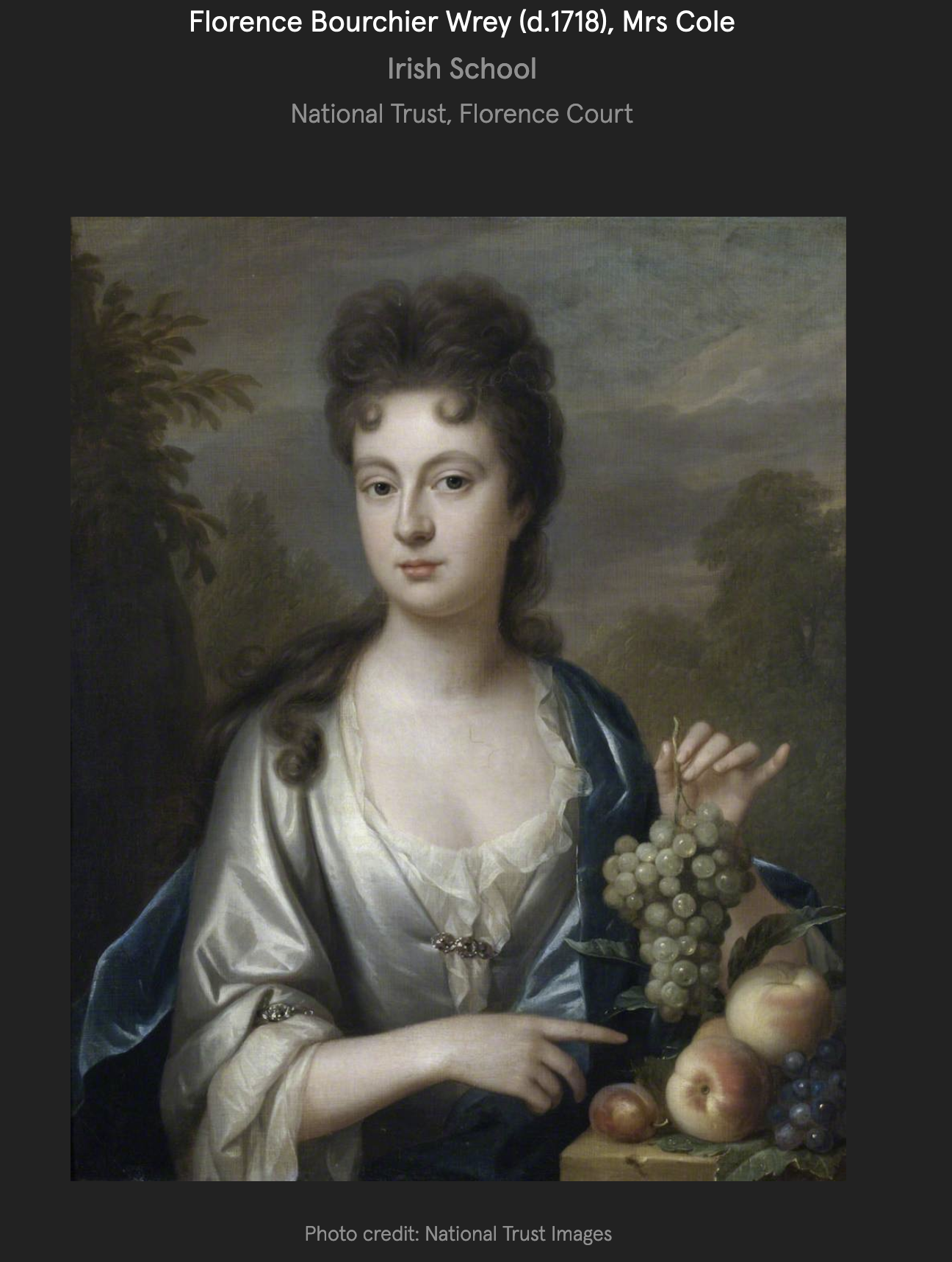
Florence Bourchier Wrey (d. 1718), courtesy of National Trust, Florence Court, County Fermanagh. She married John Cole (1680-1726) who built Florence Court, and named it after her.

John and Florence had the following children:

Henry (Rev);
JOHN (1709-67) his heir;
Letitia; Florence.

Mr Cole was succeeded by his younger son, John Cole (1709-67) MP for Enniskillen, 1730-60. John married in 1728 Elizabeth, daughter of Hugh Willoughby Montgomery, of Carrow, County Fermanagh. Mr Cole was elevated to the peerage, in 1760, in the dignity of Baron Mountflorence, of Florence Court, County Fermanagh.

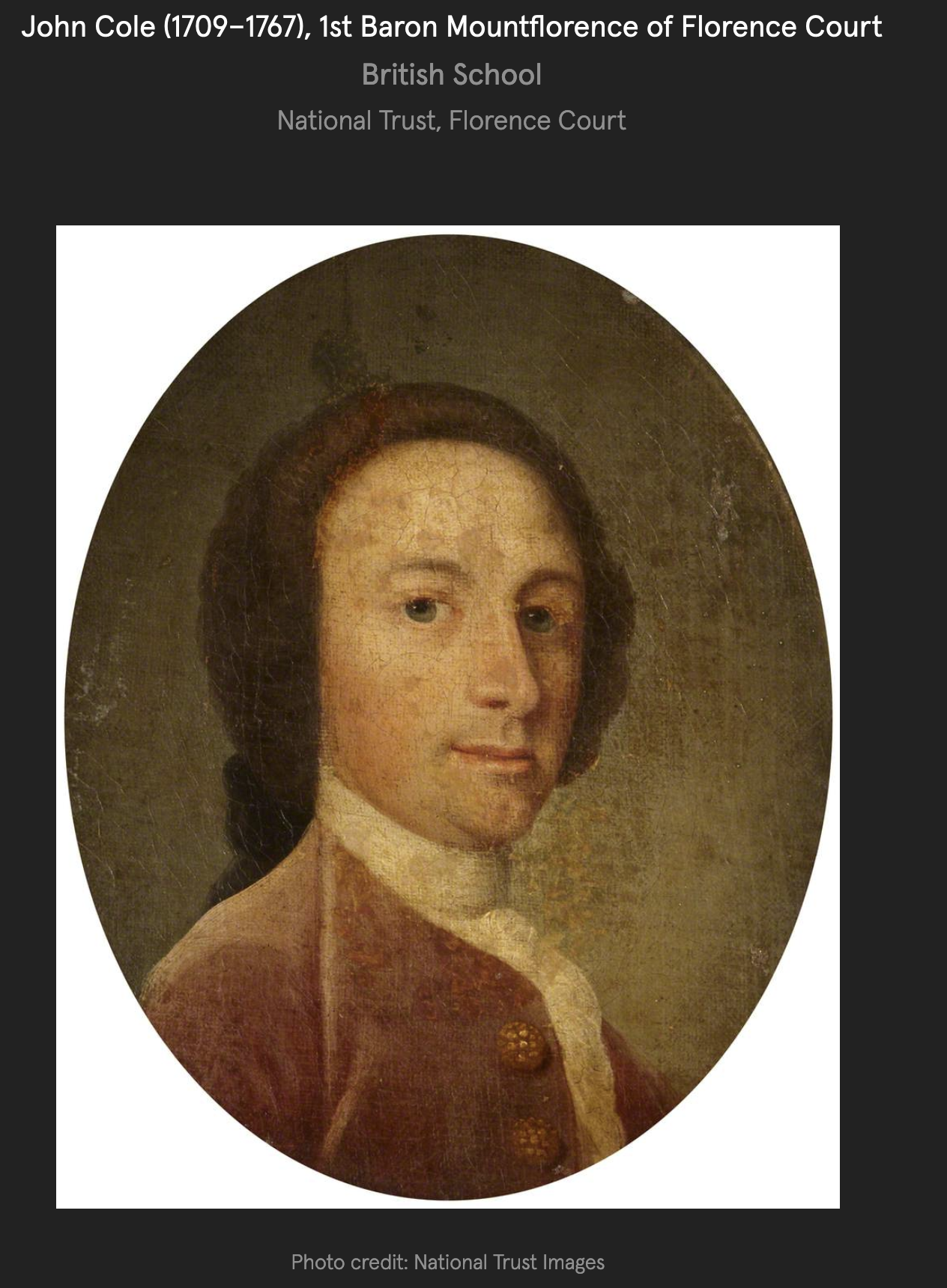
John Cole (1709-1767) 1st Baron Mountflorence of Florence Court, County Fermanagh, courtesy of National Trust, Florence Court, County Fermanagh.

John and Elizabeth had the following children:

WILLIAM WILLOUGHBY (1736-1803) his heir;
Arthur, m in 1780 Caroline Hamilton;
Flora Caroline; Catherine.

His lordship was succeeded by his elder son, WILLIAM WILLOUGHBY, 2nd Baron (1736-1803), MP for Enniskillen, 1761-7, who was created Viscount Enniskillen in 1776; and advanced to the dignity of an earldom, in 1789, as EARL OF ENNISKILLEN.

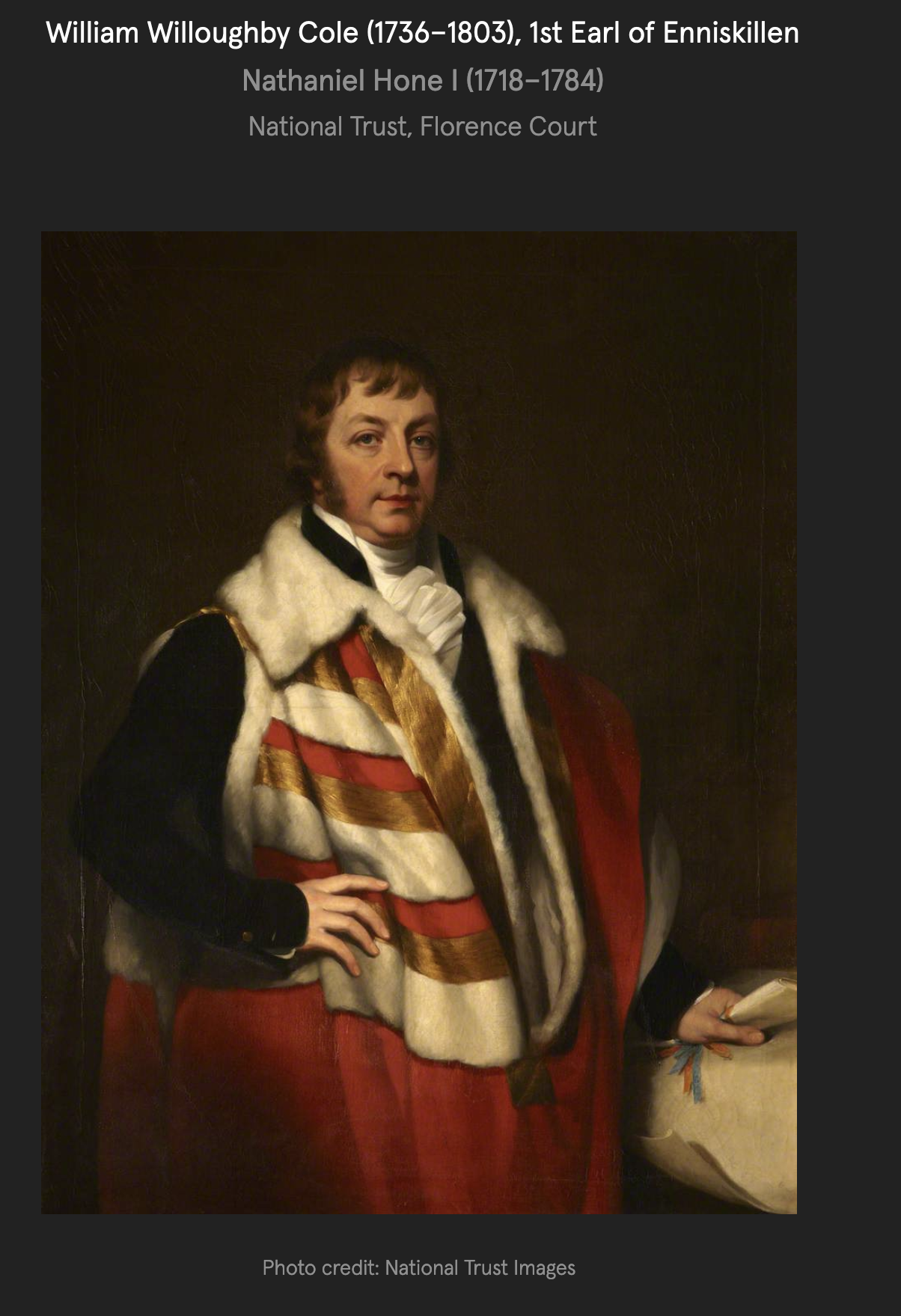
William Willoughby Cole (1736-1803) 1st Earl of Enniskillen, by Nathaniel Hone, courtesy of National Trust, Florence Court, County Fermanagh. He was the son of John Cole 1st Baron Mountflorence.
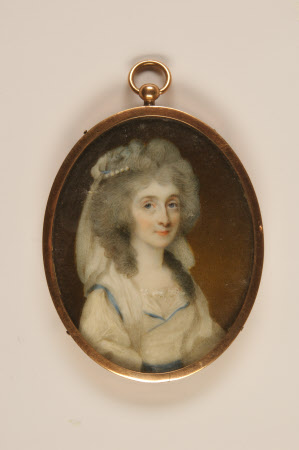
Anne Lowry-Corry, Countess of Enniskillen (1742-1802) by Horace Hone c.1785, watercolour painting on ivory, courtesy National Trust Florence Court. Sister of Armar Lowry-Corry (1740-1802) 1st Earl Belmore and wife of William Willoughby Cole 1st Earl of Enniskillen.

William Willoughby Cole married, in 1763, Anne, daughter of Galbraith Lowry Corry, of Ahenis, County Tyrone, and sister of Armar Corry, Earl of Belmore, and had issue,

JOHN WILLOUGHBY (1768-1840) his successor, who became 2nd Earl;
Galbraith Lowry (Sir), GCB, a general in the army;
William Montgomery (Very Rev), Dean of Waterford;
Arthur Henry, MP for Enniskillen;
Henry, died young;
Sarah; Elizabeth Anne; Anne; Florence; Henrietta Frances.

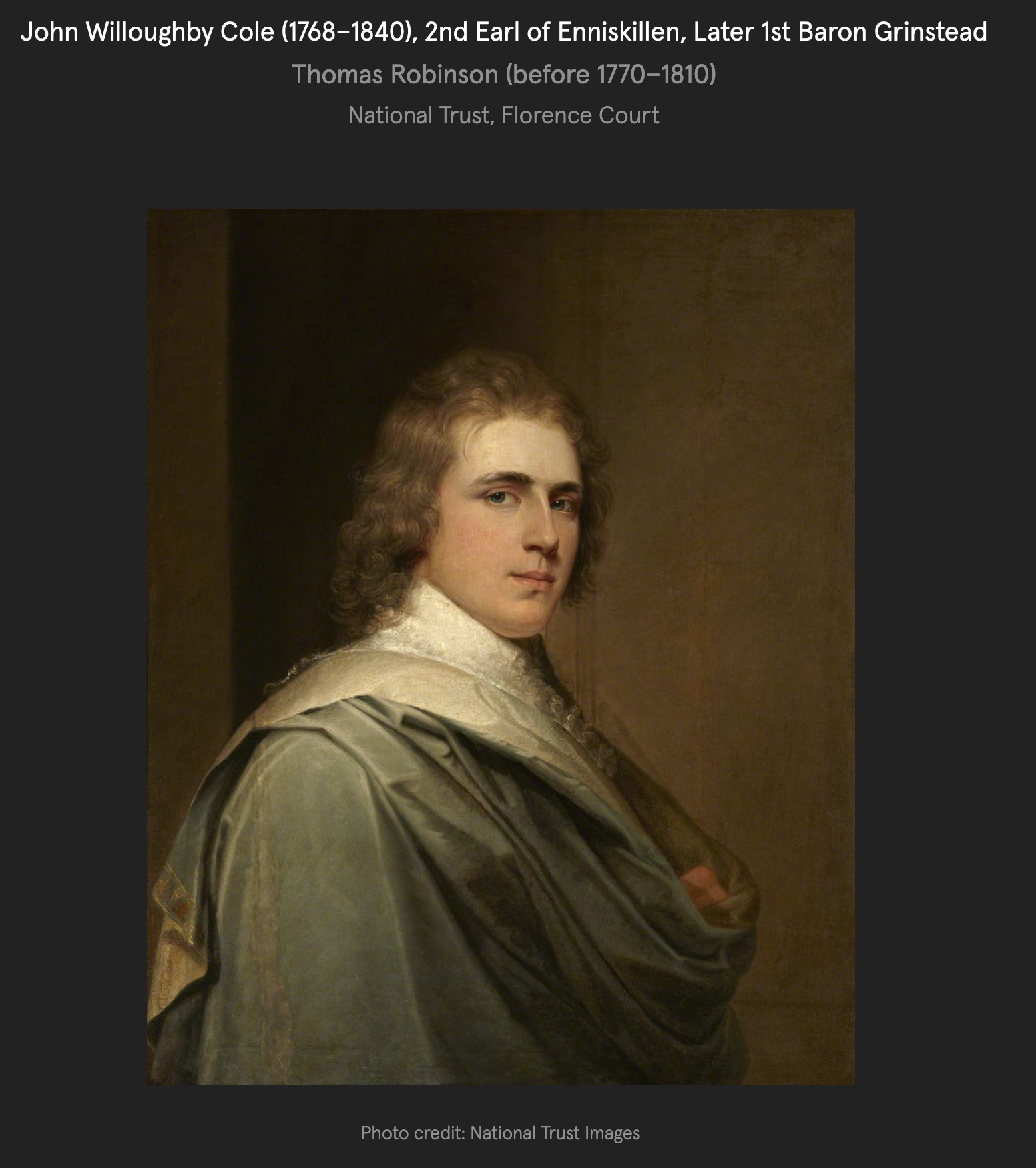
John Willoughby Cole (1768-1840) 2nd Earl of Enniskillen, later 1st Baron Grinstead, by Thomas Robinson, courtesy of National Trust, Florence Court, County Fermanagh.
John Willoughby Cole (1768-1840) 2nd Earl of Enniskillen and 1st Baron Grinstead (1768-1840). Photograph © Jennifer Winder-Baggot, www.irishhistorichouses.com
Lady Henrietta Cole, Lady Grantham, later Countess de Grey (1784-1848), Vicereine 1841-44, from Florence Court, Fermanagh. She was the daughter of William Willoughby Cole the 1st Earl of Enniskillen. Photograph © Jennifer Winder-Baggot, www.irishhistorichouses.com
Florence Townley-Balfour née Cole (1779-1862) daughter of William Willoughby Cole 1st Earl of Enniskillen, she married Blayney Townley-Balfour. Painting by Richard Rothwell, courtesy of National Trust Florence Court.

JOHN WILLOUGHBY Cole 2nd Earl (1768-1840) married, in 1805, the Lady Charlotte Paget, daughter of Henry, 1st Earl of Uxbridge. The 2nd Earl of Charlotte had the following children:

WILLIAM WILLOUGHBY (1807-86) his successor, who became the 3rd Earl of Enniskillen.

Henry Arthur; John Lowry; Lowry Balfour; Jane Anne Louisa Florence.

William Willoughby Cole (1807-1886) 3rd Earl of Enniskillen, by William Robinson, courtesy of National Trust, Florence Court, County Fermanagh.

WILLIAM WILLOUGHBY, 3rd Earl (1807-86), Honorary Colonel, 3rd Battalion, Royal Inniskilling Fusiliers, married firstly, in 1844, Jane, daughter of James Casamaijor, and had issue,

John Willoughby Michael, styled Viscount Cole (1844-50);

LOWRY EGERTON, 4th Earl;

Arthur Edward Casamaijor;

Florence Mary; Alice Elizabeth; Charlotte June; Jane Evelyn.

He wedded secondly, in 1865, Mary Emma, daughter of Charles, 6th Viscount Midleton.

His lordship was succeeded by his eldest surviving son,

LOWRY EGERTON, 4th Earl (1845-1924), KP JP DL MP, who wedded, in 1869, Charlotte Marion, daughter of Douglas Baird.

Charlotte Marion Baird (1851/2-1937) Countess of Enniskillen, by Henry Richard Graves, courtesy of National Trust, Florence Court, County Fermanagh. She married Lowry Egerton Cole, 4th Earl of Enniskillen.

Courtesy of http://lordbelmontinnorthernireland.blogspot.com/2017/08/florence-court-house.html

Nicholas Conway Colthurst (1789-1829) 4th Baronet of Ardrum, County Cork, by Martin Arthur Shee, courtesy of Eton College. He was Member of Parliament (M.P.) for the City of Cork between 1812 and 1829. His son the 5th Earl married Louisa Jane Jefferyes, through whom he acquired Blarney Castle.
Ambrose Congreve reading a newspaper at Clonbrock House, Ahascragh, Co. Galway, National Library of Ireland Ref. CLON422.

Timothy William Ferres tells us of the line of the Conolly family who owned Castletown House in County Kildare. [2] It was built by William Conolly (1662-1729), Speaker of the House of Commons in Ireland during the reign of Queen Anne, First Lord of the Treasury until his decease during the reign of GEORGE II, and ten times sworn one of the Lords Justices of Ireland.

William Conolly (1662-1729) of Castletown, County Kildare. Photograph © Jennifer Winder-Baggot, www.irishhistorichouses.com

William Conolly married, in 1694, Katherine Conyngham, sister of Henry 1st Earl.

Katherine Conolly née Conyngham (c. 1662-1752) who married William Conolly, pictured with her great-niece Molly Burton. Portrait by Charles Jervas. Photograph © Jennifer Winder-Baggot, www.irishhistorichouses.com

Speaker Conolly, MP for Donegal, 1692-9, Londonderry, 1703-29, was succeeded by his nephew, William James Conolly (1706-54).

I’m not sure but the top portrait looks like Katherine Conyngham to me, who marries William Conolly. Photograph © Jennifer Winder-Baggot, www.irishhistorichouses.com
William Conolly, M.P. (d.1754) by Anthony Lee c. 1727 courtesy of National Gallery of Ireland NGI 421

William James Conolly (1706-54) married Anne Wentworth, eldest daughter of Thomas, 1st Earl of Strafford.

Lady Anne Conolly née Wentworth (1713-1797), daughter of Thomas Wentworth (1672-1739) 1st Earl of Strafford). She was married to William James Conolly (1712-1754), of Castletown, County Kildare. Painting attributed to Anthony Lee, courtesy of National Gallery of Ireland. She was the mother of Thomas Conolly (1734-1803).
Lady Anne Conolly (born Wentworth (1712/1713-1797), daughter of Thomas Wentworth (1672-1739) 1st Earl of Strafford). She was married to William James Conolly (1712-1754), of Castletown, County Kildare. She was the mother of Thomas Conolly (1734-1803). Photograph © Jennifer Winder-Baggot, www.irishhistorichouses.com

They had issue,

THOMAS (1734-1803) his heir;
Katherine, m. Ralph, Earl of Ross;
Anne, m. G. Byng; mother of Earl of Strafford;
Harriet, m. Rt Hon John Staples, of Lissan;
Frances, m. 5th Viscount Howe;
Caroline, m. 2nd Earl of Buckinghamshire;

[2]

Thomas Conolly (1734-1803). He was the son and heir of William James Conolly (d.1754) of Castletown House, by his wife Lady Anne Wentworth. Thomas Conolly married Lady Louisa Lennox, a daughter of Charles Lennox, the 2nd Duke of Richmond. Photograph © Jennifer Winder-Baggot, www.irishhistorichouses.com
Thomas Conolly (1738-1803), 1758 by Anton Raphael Mengs, National Gallery of Ireland PGI 4458 Photograph © Jennifer Winder-Baggot, www.irishhistorichouses.com
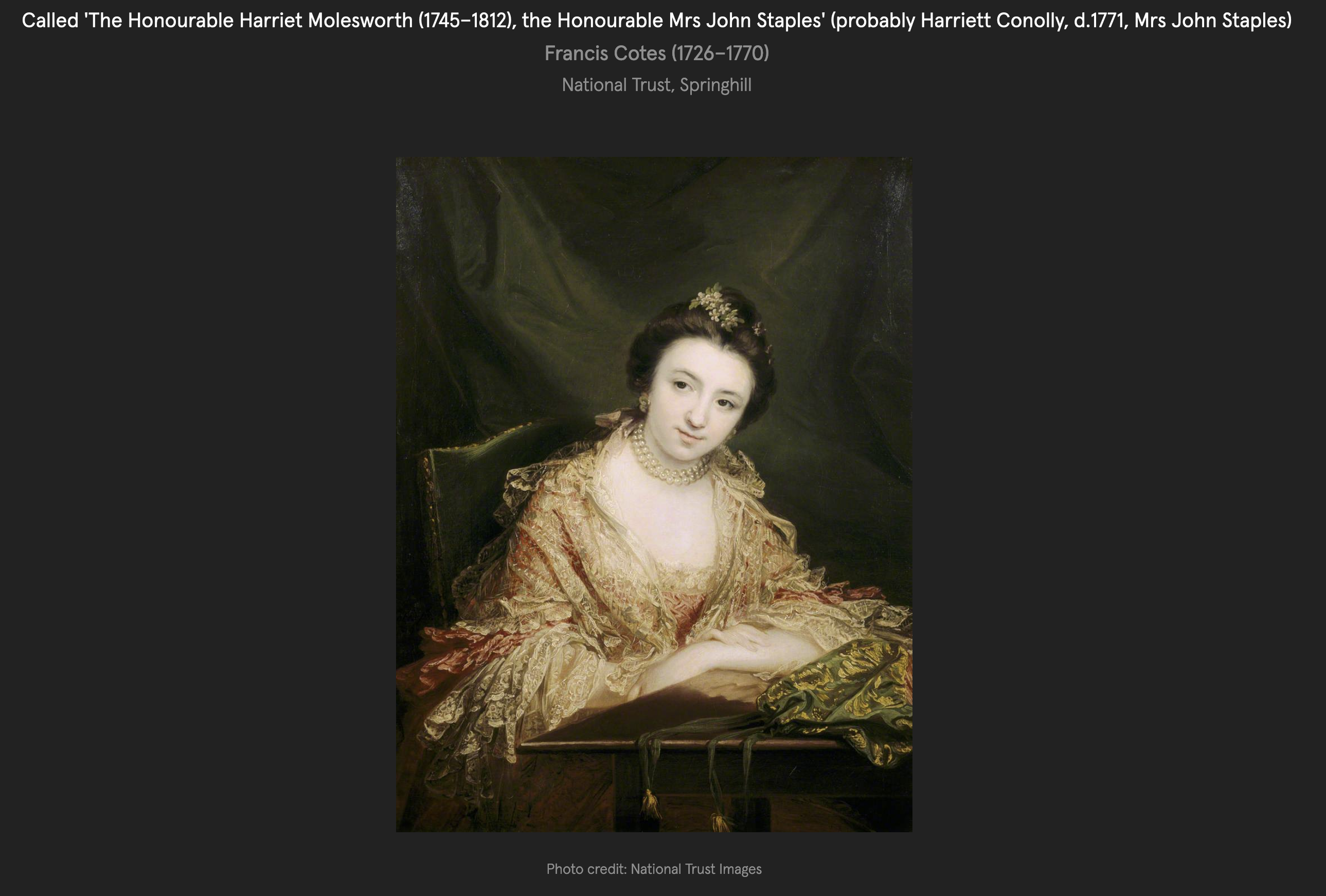
Portrait called The Honourable Harriet Molesworth (1745-1812), wife of John Staples (1736-1820) (probably Harriet Conolly, d. 1771), by Francis Cotes, courtesy of National Trust. Springhill, County Derry.

Ferres continues, telling us that Thomas Conolly, MP for County Londonderry, 1761-1800, wedded, in 1758, Louisa Augusta Lennox, daughter of Charles, 2nd Duke of Richmond and Lennox.

The pastel on the top left is Thomas Conolly (1734-1803), Louisa’s husband.
Thomas Connolly of Castletown by Hugh Douglas Hamilton (1739-1808), courtesy Adam’s auction 28 March 2012.
Lady Louisa Connolly née Lennox (1743-1817) by Hugh Douglas Hamilton, (1739-1808), courtesy Adam’s 28 Sept 2005. She was the daughter of Charles, 2nd Duke of Richmond and Lennox.
Louisa Conolly née Lennox (1743-1817) who married Thomas Conolly (1734-1803). Photograph © Jennifer Winder-Baggot, www.irishhistorichouses.com

Thomas and Louisa had no children so the estate passed to a grand-nephew, Edward Michael Pakenham (1786-1849) who assumed the surname Conolly in 1821. Now Edward Michael Conolly of Castletown, County Kildare, and Cliff, County Donegal, Lieutenant-Colonel, Donegal Militia, MP for County Donegal, 1831-49, he married in 1819, Catherine Jane, daughter of Chambré Brabazon Ponsonby-Barker, by the Lady Henrietta Taylour his wife, daughter of Thomas, Earl of Bective. They had issue,

THOMAS (1823-1876) his heir;
Chambré Brabazon, d 1835;
Frederick William Edward, d 1826;
Arthur Wellesley, 1828-54;
John Augustus, VC;
Richard, d 1870;
Louisa Augusta; Henrietta; Mary Margaret; Frances Catherine.

Thomas Conolly (1823-1876), painting by William Osbourne. Photograph © Jennifer Winder-Baggot, www.irishhistorichouses.com

Thomas married, in 1868, Sarah Elizabeth, daughter of Joseph Shaw, of Temple House, Celbridge, County Kildare.

Sarah Eliza Conolly née Shaw, wife of Thomas. Photograph © Jennifer Winder-Baggot, www.irishhistorichouses.com
Thomas Conolly (1823-1876) and his wife Sarah Eliza. Sarah Eliza was the daughter of a prosperous Celbridge paper mill owner, Joseph Shaw. Her substantial dowry helped to fund her husband’s adventurous lifestyle! A photograph album which belonged to her brother Henry Shaw, of a visit to Castletown, was rescued from the rubble of his home in London when it was destroyed by a German bomb in 1944. Sadly, he died in the bombing. The photograph album is on display in Castletown. Photograph © Jennifer Winder-Baggot, www.irishhistorichouses.com

Thomas and Sarah Elizabeth had several children:

Thomas (1870-1900), killed in action at S Africa;
William, 1872-95;
EDWARD MICHAEL, of whom hereafter;
CATHERINE, Baroness Carew, mother of 6th BARON CAREW.

Mr Conolly was succeeded by his eldest surviving son,

EDWARD MICHAEL CONOLLY CMG (1874-1956), of Castletown, Major, Royal Artillery, who died unmarried, when Castletown passed to his nephew,

William Francis (Conolly-Carew), 6th Baron Carew. [2]

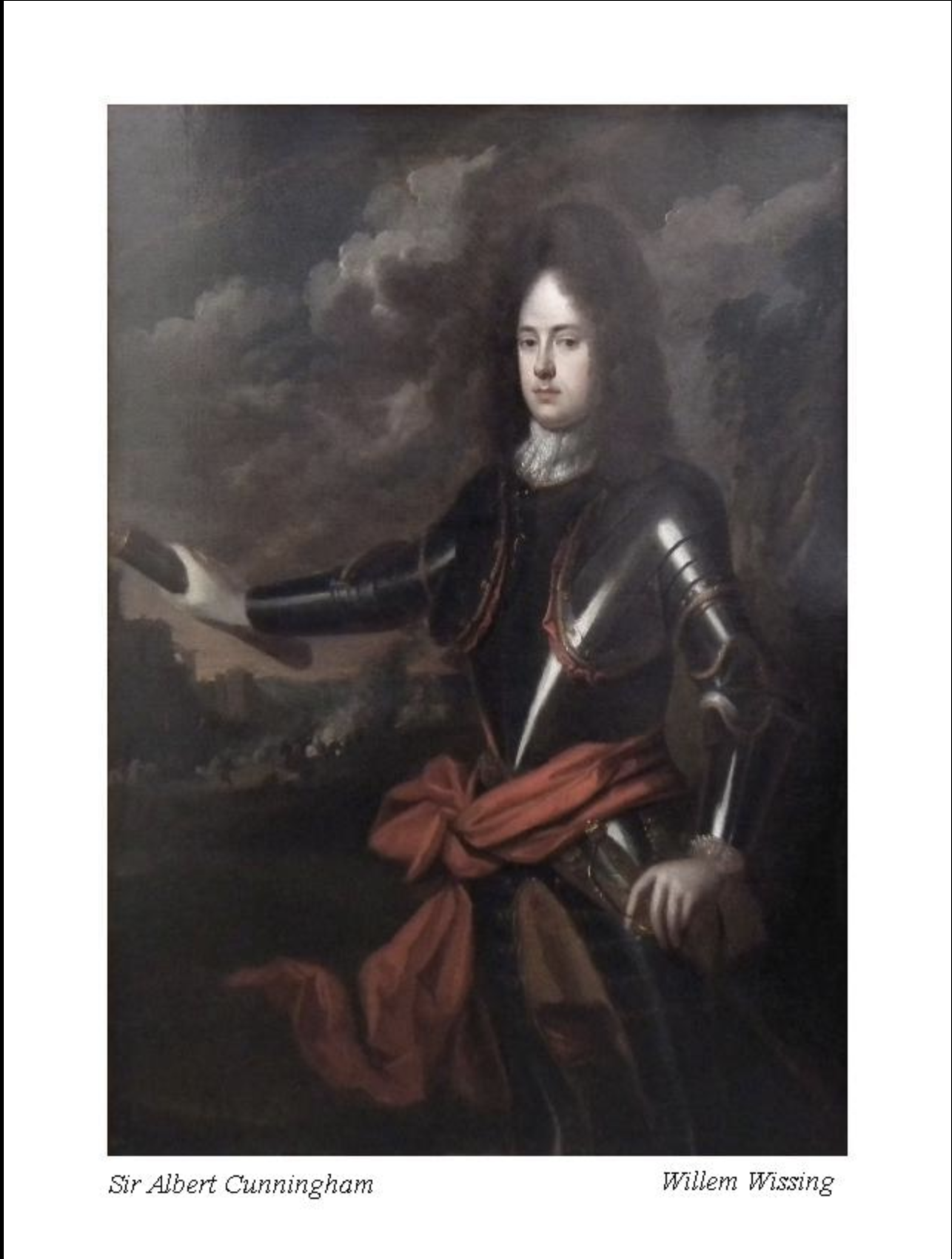
Albert Cunningham (d. 1691) first colonel of the 6th (Inniskilling) Dragoons, by Willem Wissing c. 1690, courtesy of British Cavalry Regiments website and wikipedia.
Albert Conyngham (d. 1691), courtesy of National Trust Springhill.
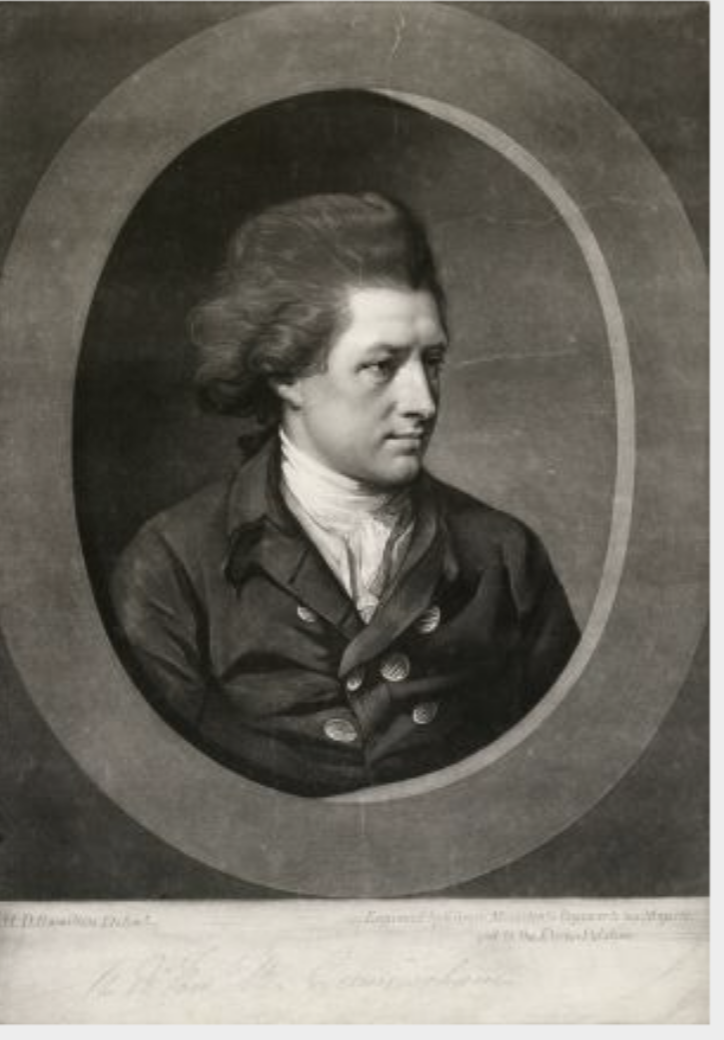
William Burton Conyngham (1733-1796), teller of the Irish Exchequer and treasurer of the Royal Irish Academy, 1780 engraver Valentine Green, after Hugh Douglas Hamilton, courtesy of National Gallery of Ireland.
Katherine Conolly née Conyngham (c. 1662-1752) who married William Conolly, with her great-niece Molly Burton. Portrait by Charles Jervas. Photograph © Jennifer Winder-Baggot, www.irishhistorichouses.com

On his terrific website, Timothy William Ferres tells us about the Conyngham family of Springhill, County Derry in Northern Ireland: [3]

Colonel William Cunningham, of Ayrshire settled in the townland of Ballydrum, in which Springhill is situated, in 1609.

Colonel Cunningham’s son, William Conyngham, known as “Good Will” (d. 1721) married Ann, daughter of Arthur Upton, of Castle Norton (later Castle Upton), County Antrim, by his wife Dorothy, daughter of Colonel Michael Beresford, of Coleraine. William “Good Will” Conyngham died in 1721, and was succeeded by his nephew,

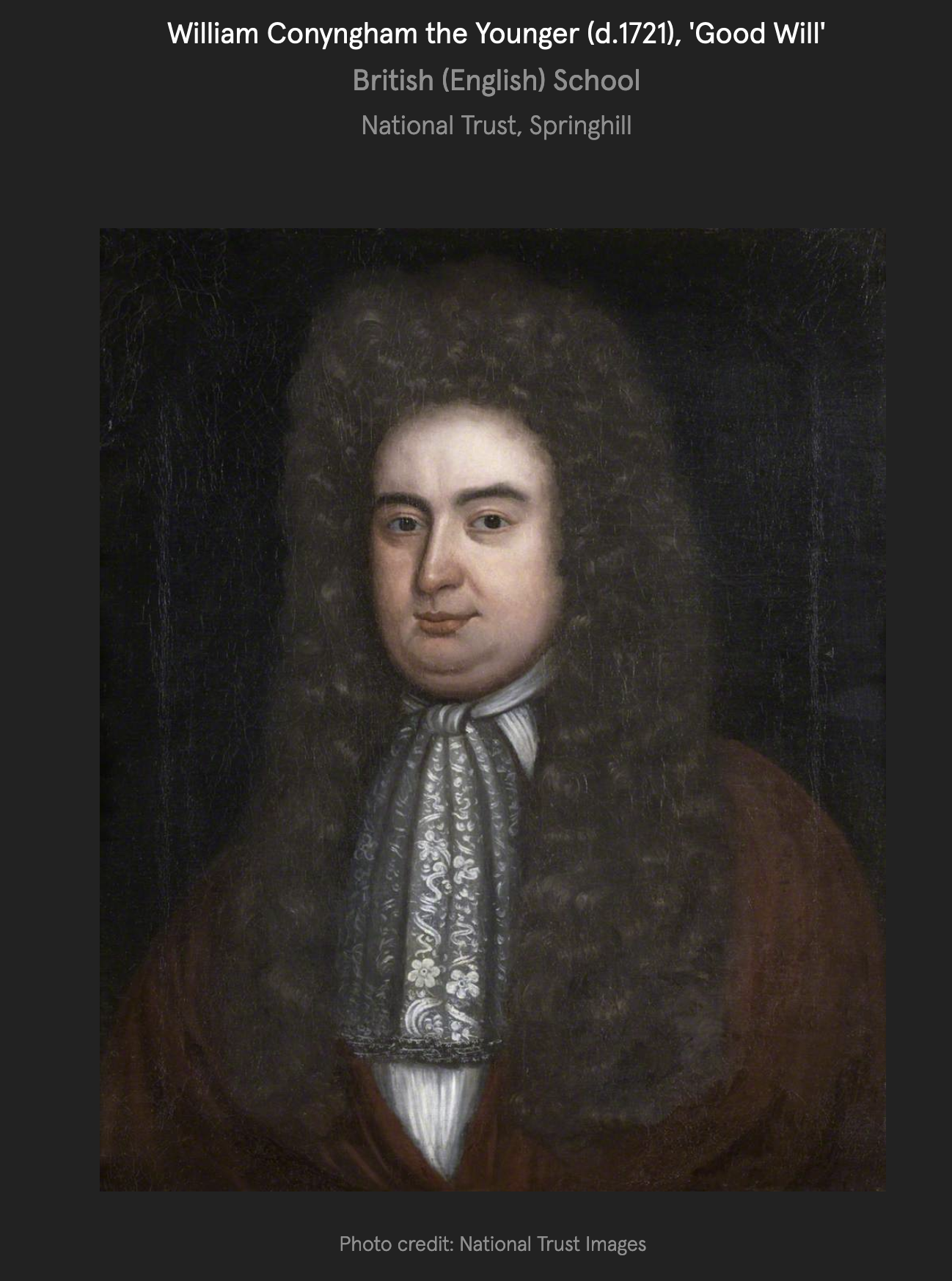
William Conyngham (d. 1721), “Good Will”, courtesy of National Trust. Springhill, County Derry.
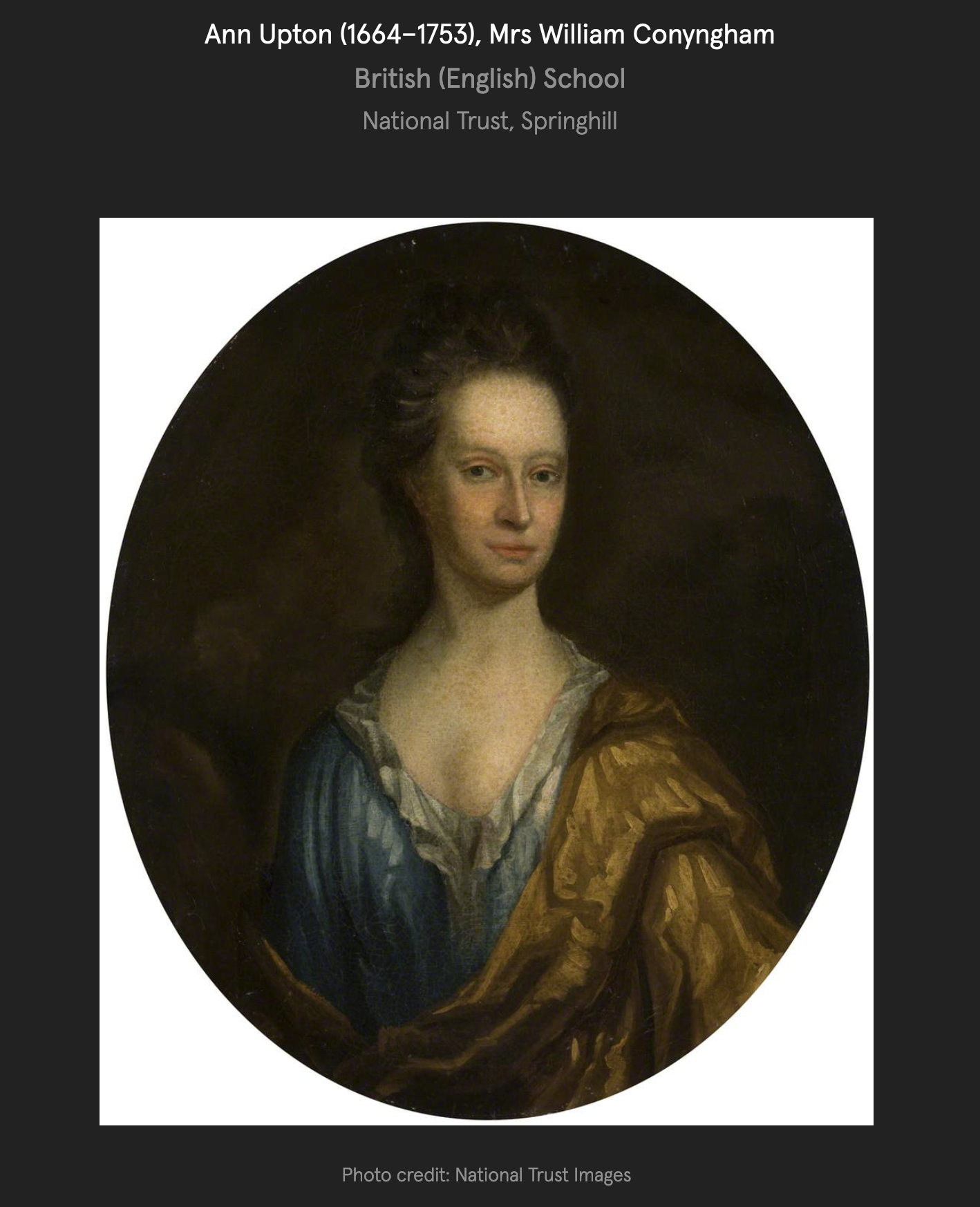
Ann Upton (1664-1753) wife of William “Goodwill” Conyngham (1660-1721), daughter of Arthur Upton (1623-1706) of Castle Upton, County Antrim, courtesy of National Trust. Springhill, County Derry.

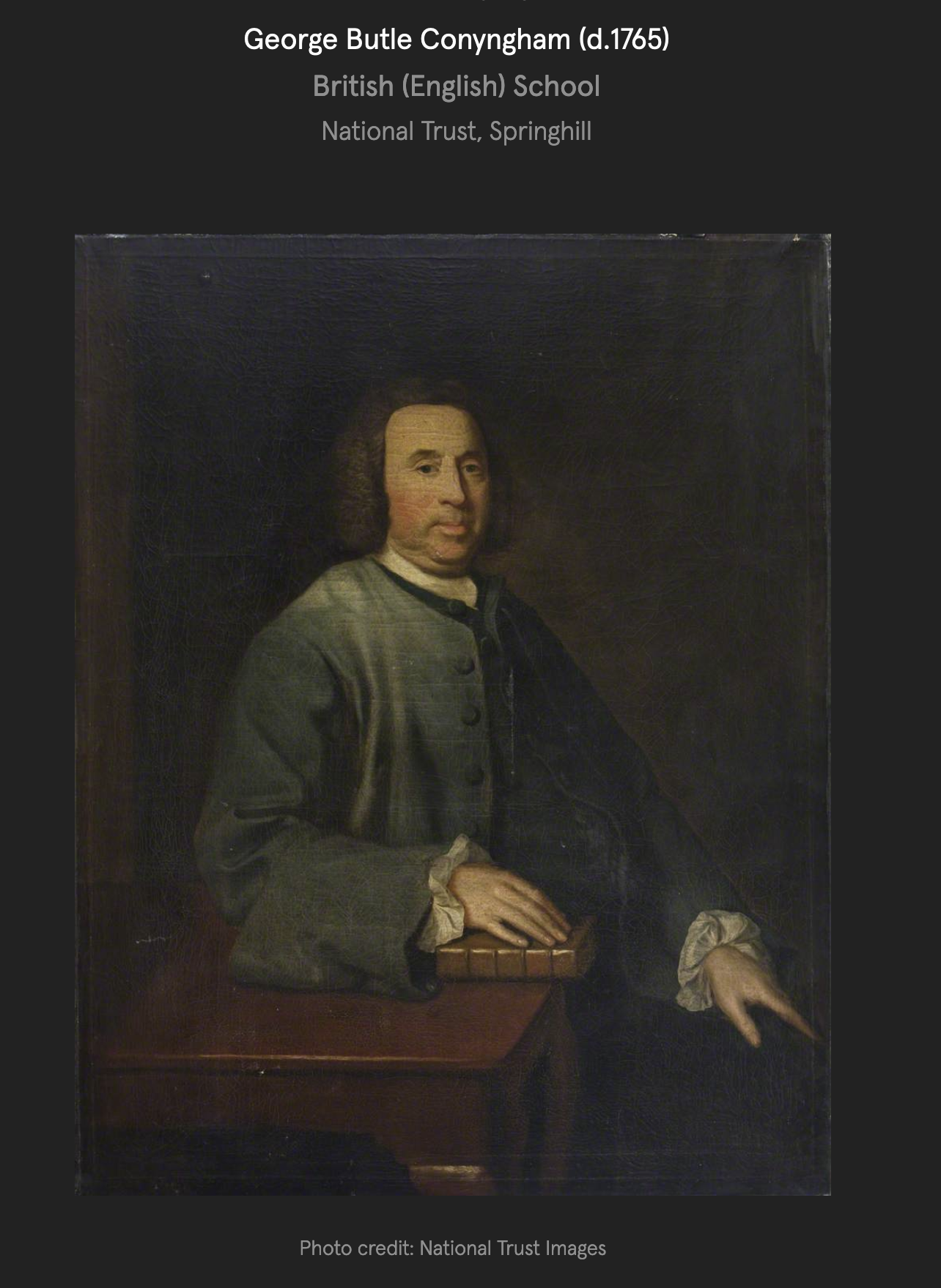
William “Goodwill” Conyngham was succeeded by his nephew George Butle Conyngham (d. 1765). He married , in 1721, Anne, daughter of Dr Upton Peacocke, of Cultra.

George Butle Conyngham (d. 1765), courtesy of National Trust, Springhill, County Derry.
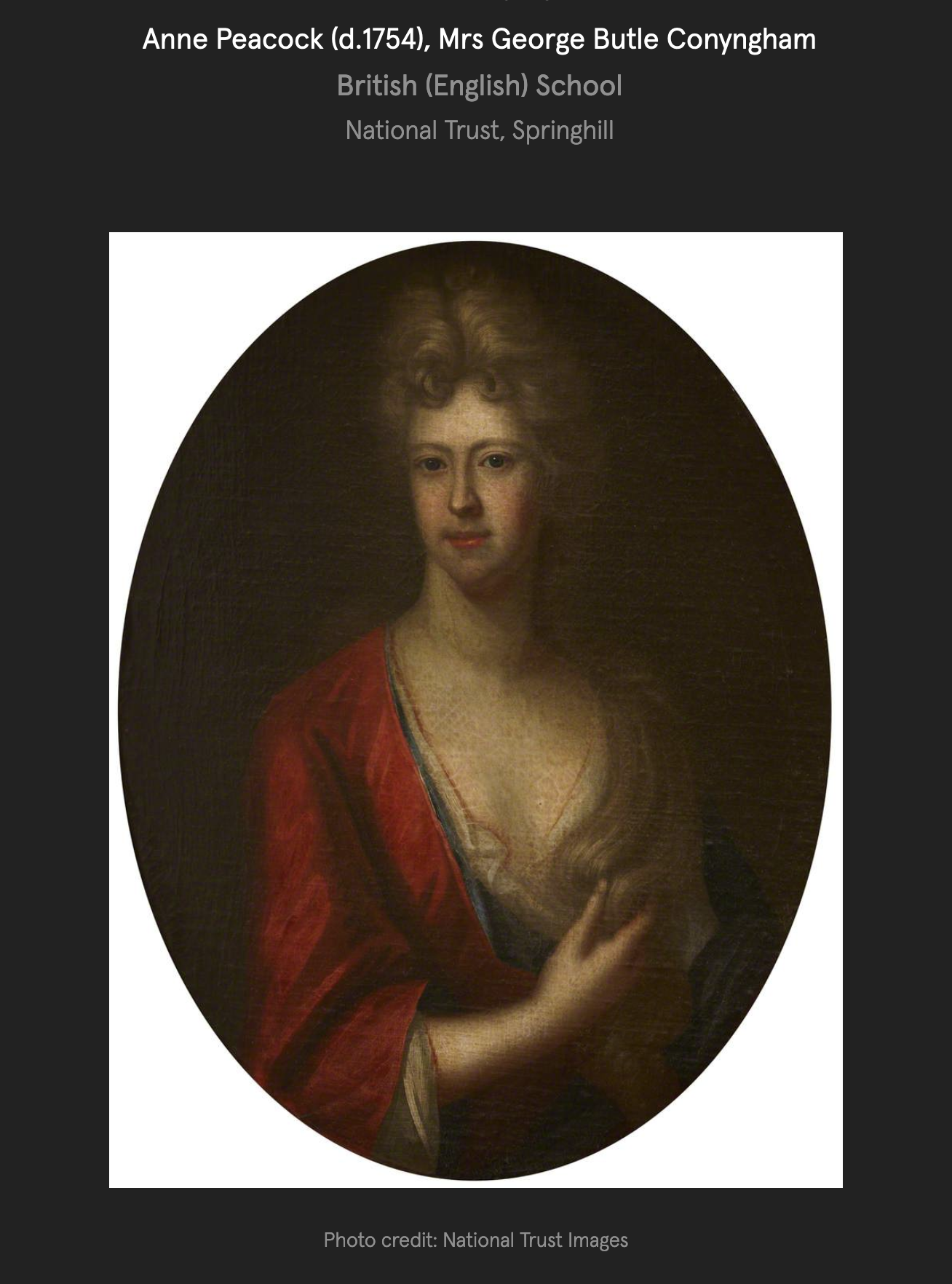
Anne Peacocke (d. 1754), Mrs George Butle Conyngham, courtesy of National Trust, Springhill, County Derry.

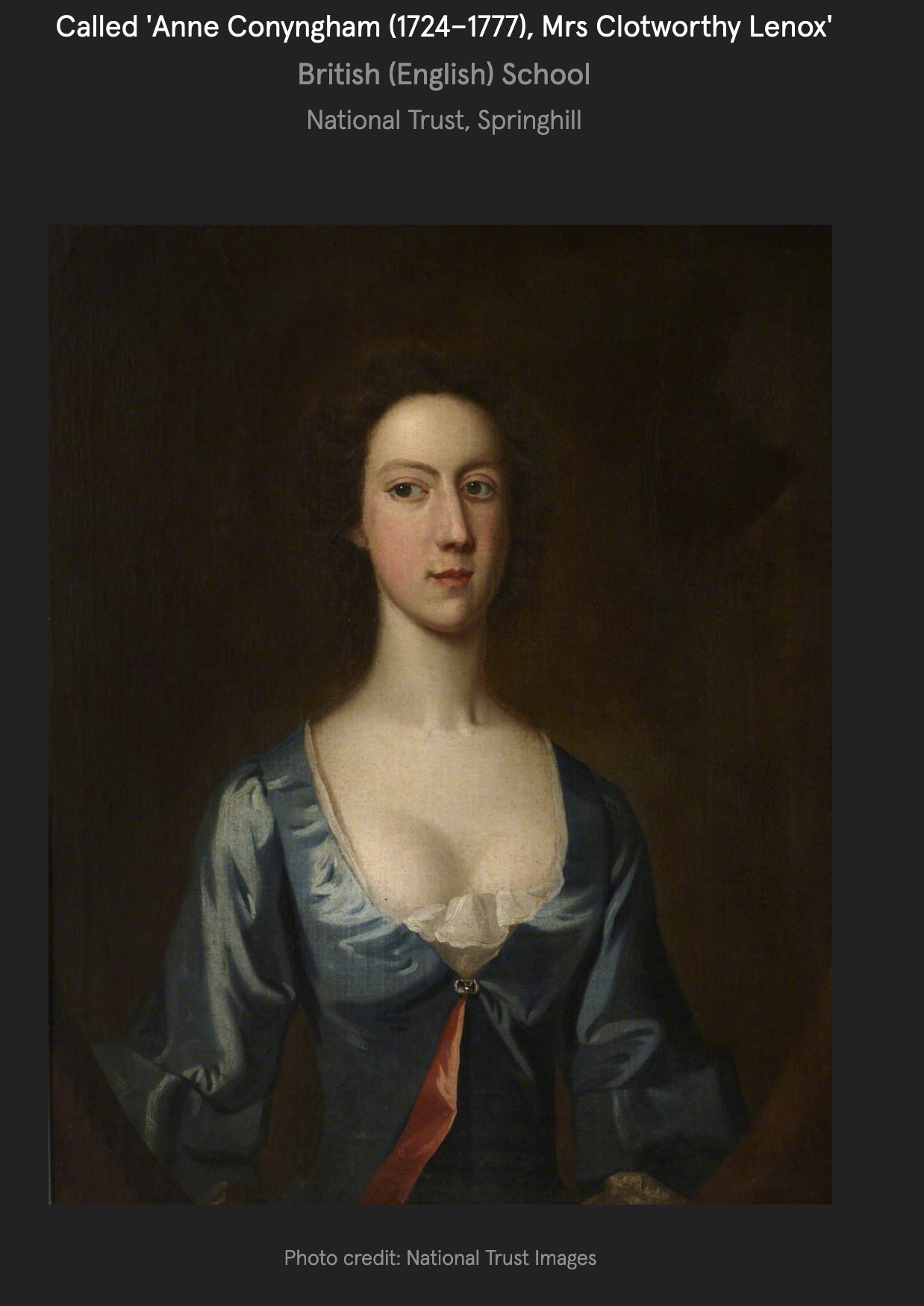
George Butle Conyngham and Anne née Peacocke had children William (1723-84), the heir to Springhill, and David, successor to his brother, John who died unmarried in 1775 and a daughter Anne (1724-1777) who married in 1745 Clotworthy Lenox.

Called Anne Conyngham (1724-1777) Mrs Clotworthy Lenox, courtesy of National Trust. Springhill, County Derry. She was the daughter of George Butle Conyngham.

David who succeeded his brother William died without issue so Springhill passed to his nephew George Lenox (1752-1816), son of his sister Anne, and George adopted the surname of Conyngham. George married, first, Jean née Hamilton (d. 1788), daughter of John Hamilton of Castlefin. They had a son, William Lenox-Conyngham (1792-1858).

Jean Hamilton (d. 1788), wife of William Conyngham (1723-1774) by Joshua Reynolds, courtesy of National Trust. Springhill, County Derry.

George married, second, in 1794, Olivia, fourth daughter of William Irvine, of Castle Irvine, County Fermanagh.

William Burton Conyngham (1733-1796), teller of the Irish Exchequer and treasurer of the Royal Irish Academy, 1780 engraver Valentine Green, after Hugh Douglas Hamilton, courtesy of National Gallery of Ireland.
William Burton Conyngham (1733–1796) by Anton Raphael Mengs c. 1754-58, courtesy of wikipedia. He was the son of Francis Burton and Mary Conyngham, and he inherited Slane Castle as well as Donegal estates from his uncle William Conyngham who died in 1781.
William Burton Conyngham, engraving After GILBERT STUART courtesy of Adams Country House Collections auction Oct 2023.

Slane Castle passed to William Burton Conyngham’s nephew Henry Conyngham (1766-1832) 1st Marquess Conyngham. Henry married Elizabeth Denison.

Elizabeth née Denison, Marchioness Conyngham (1769-1861), wife of Henry 1st Marquess.
Elizabeth Conyngham née Denison, wife of Henry 1st Marquess by Thomas Lawrence 1821 courtesy of Calouste Gulbenkian Museum.
Elizabeth Conyngham (née Denison), Marchioness Conyngham (1769–1861) by George Chinnery, English, 1774-1852.
Maria Conyngham (died 1843), daughter of 1st Marquess of Slane by Sir Thomas Lawrence courtesy of Metropolitan museum.
Francis Nathaniel Conyngham (1797-1876) 2nd Marquess of Slane, County Meath, courtesy of National Gallery of Ireland.
Edward Cooke, (1755-1820), Under-Secretary of State for Ireland Date: 1799 Engraver William Ward the Elder, English, 1766-1826 After William Cuming, Irish, 1769-1852.
Arthur Cooper, b. 1716, of Coopershill, County Sligo. Photograph © Jennifer Winder-Baggot, www.irishhistorichouses.com
Sarah Cooper née Carleton (born around 1718), wife of Arthur Cooper (b. 1716) of Coopershill, County Sligo. Daughter of Guy Cathcart Carleton of Fermanagh and Mary Brooke of Brookeborough, County Fermanagh. Photograph © Jennifer Winder-Baggot, www.irishhistorichouses.com
Arthur Brooke Cooper (c. 1775-1854) of Coopershill, County Sligo. Photograph © Jennifer Winder-Baggot, www.irishhistorichouses.com

Timothy William Ferres also tells us of the Coote family. Charles Coote (1581-1642), 1st Baronet of Castle Cuffe, Queen’s County (Laois): “The Peerage” website tells us that in 1600 he went to Ireland as Captain of 100 Foot under 8th Lord Mountjoy, Queen Elizabeth I’s Lord Deputy of Ireland. He fought in the siege of Kingsale in 1602. He held the office of Provost Marshal of Connaught between 1605 and 1642, for life. He held the office of General Collector and Receiver of the King’s Composition Money for Connaught in 1613, for life. He held the office of Vice-President of Connaught in 1620. He was appointed Privy Counsellor (P.C.) in 1620. He was created 1st Baronet Coote, of Castle Cuffe, Queen’s Co. [Ireland] on 2 April 1621. He held the office of Custos Rotulorum of Queen’s County in 1634. He held the office of Member of Parliament (M.P.) for Queen’s County [Ireland] in 1639. Before 1641 he held Irish lands, mostly in Conaught, worth £4,000 a year. He held the office of Governor of Dublin in 1641. In 1642 he helped relieve Birr, King’s County (now County Offaly), during the Uprising by the Confederation of Kilkenny, his successful operations there and elsewhere in the area, which was called Mountrath, suggesting the title by which his son was ennobled.

Sir Charles Coote (1581-1642) 1st Baronet of Castle Cuffe, Queens County By David Keddie – Own work, Public Domain, https//:commons.wikimedia.org/w/index.php?curid=42005305.jpg

He married Dorothea, youngest daughter and co-heir of Hugh Cuffe, of Cuffe’s Wood, County Cork, and had issue, Charles (c.1610 –1661) 1st Earl of Mountrath;
Chidley (d. 1688) of Killester, Co Dublin and Mount Coote, County Limerick;
RICHARD (1620-83) 1st Baron Coote of Colloony, County Sligo, ancestor of the EARL OF BELLAMONT (1st Creation);
Thomas, of Coote Hill;
Letitia (married Francis Hamilton, 1st Bt of Killaugh, co. Cavan).

Charles Coote 1st Earl of Mountrath (c.1610 –1661), 2nd Baronet, ca. 1642, before he was ennobled, Circle of William Dobson. By Christina Keddie – Own work, Public Domain, https://commons.wikimedia.org/w/index.php?curid=42002789

Charles Coote (c.1610 –1661), 1st Earl of Mountrath married first, Mary Ruish, who gave birth to his heir, Charles Coote (d. 1672) 2nd Earl of Mountrath, Queen’s County. The 1st Earl of Mountrath, Queen’s County, also had the titles 1st Baron Coote of Castle Cuffe, in Queen’s Co. [Ireland] and 1st Viscount Coote of Castle Coote, Co. Roscommon [Ireland].

Charles Coote (c.1610 –1661), 1st Earl of Mountrath married secondly Jane Hannay, and she had a son Richard (1643-1700), who married Penelope, daughter of Arthur Hill of Hillsborough, County Down. Their daughter Penelope Rose married Charles Boyle (d. 1732) 2nd Viscount Blesington. Another daughter, Jane (d. 1729) married William Evans, 1st and last Baronet of Kilcreene, County Kilkenny.

Charles Coote, 2nd Earl of Mountrath married Alice, daughter of Robert Meredyth of Greenhills, County Kildare. His daughter Anne (d. 1725) married Murrough Boyle, 1st Viscount Blesington (d. 1718). His son Charles (1656-1709) succeeded as 3rd Earl of Mountrath, and he was father to the 4th, 5th and 6th Earls.

Charles Coote (d. 1715) 4th Earl of Mountrath, c. 1710 by Charles Jervas. He died unmarried.
Diana Coote (1696-1766), Countess of Mountrath, wife of 6th Earl, 1746 by Thomas Hudson, National Gallery of Ireland NGI293. Photograph © Jennifer Winder-Baggot, www.irishhistorichouses.com

The son of Algernon Coote (1689-1744) 6th Earl of Mountrath, Charles Henry Coote (d. 1802) 7th Earl of Mountrath had no legitimate male issue and the earldom and its associated titles created in 1660 died with him. The barony of Castle Coote passed according to the special remainder to his kinsman, Charles Coote. The baronetcy of Castle Cuffe also held by the Earl passed to another kinsman, Sir Charles Coote, 9th Baronet.

Charles Henry Coote (1794-1864) 9th Baronet of Castle Cuffe, Queens County, By John Hoppner, Public Domain, https://commons.wikimedia.org/w/index.php?curid=42004929

Let us return now to Charles Coote (1581-1642), 1st Baronet of Castle Cuffe, Queen’s County (Laois) and trace the line of his younger son, RICHARD COOTE (1620-83), for his hearty concurrence with his brother, SIR CHARLES, 2nd Baronet, in promoting the restoration of CHARLES II, was rewarded with the dignity of a peerage of the realm; the same day that his brother was created Earl of Mountrath, Richard Coote was created, in 1660, Baron Coote, of Colloony.

In 1660, Richard was appointed Major to the Duke of Albemarle’s Regiment of Horse; and the same year he was appointed one of the commissioners for executing His Majesty’s declaration for the settlement of Ireland. He was, in 1675, appointed one of the commissioners entrusted for the 49 Officers. In 1676, the 1st Baron resided at Moore Park, County Meath, and Piercetown, County Westmeath. He married Mary, second daughter of George, Lord St. George, and had issue: RICHARD (1636-1701) his successor;
Thomas (d. 1741)
Lætitia (married Robert Molesworth, 1st Viscount Molesworth of Swords); Mary (married William Stewart, 1st Viscount Mountjoy); Catherine (married Ferdinando Hastings); Elizabeth (married Lt.-Gen. Richard St. George).

Following his decease, in 1683, he was interred at Christ Church Cathedral, Dublin. He was succeeded by his eldest son,

RICHARD, 2nd Baron (1636-1701), Governor of County Leitrim, 1689, Treasurer to the Queen, 1689-93, MP for Droitwich, 1689-95, who was, in 1688, one of the first to join the Prince of Orange. In 1689, he was attainted in his absence by the Irish Parliament of JAMES II. His lordship was created, in 1689, EARL OF BELLAMONT, along with a grant of 77,000 acres of forfeited lands.

Richard Coote (1636-1700/01) 1st Earl Bellomont By Samuel Smith Kilburn (d. 1903) – New York Public Library digital library http//:digitalgallery.nypl.org/nypldigital/id?423861, Public Domain, https//:commons.wikimedia.org/w/index.php?curid=13014278

Richard 1st Earl of Bellomont was Governor of Massachusetts, 1695, and Governor of New York, 1697-1701. The King had sent Lord Bellomont to New York to suppress the “freebooting.” Unfortunately he was responsible for outfitting the veteran mariner William Kidd, who turned into “Captain Kidd,” who terrorised the merchants until his capture in 1698.

According to Cokayne “he was a man of eminently fair character, upright, courageous and independent. Though a decided Whig he had distinguished himself by bringing before the Parliament at Westminster some tyrannical acts done by Whigs at Dublin.”

The 1st Earl of Bellomont wedded, in 1680, Catharine, daughter and heir of Bridges Nanfan, of Worcestershire, and had issue, NANFAN (1681-1708) his successor as 2nd Earl of Bellomont, and RICHARD (1682-1766), who succeeded his brother.

NANFAN, 2nd Earl (1681-1708) married Lucia Anna van Nassau (1684-1744), daughter of Henry de Nassau, Lord Overkirk, in 1705/6 at St Martin-in-the-Fields Church, London. Nanfan died at Bath, Somerset, from palsy, without male issue, when the family honours devolved upon his brother, RICHARD, 3rd Earl (1682-1766), who, in 1729, sold the family estate of Colloony, County Sligo, for nearly £17,000.

In 1737, he succeeded his mother to the estates of Birtsmorton, Worcestershire. Macaulay described him as “of eminently fair character, upright, courageous and independent.” On his death the earldom expired. 

The last Earl was succeeded in the barony of Coote by his first cousin once removed, CHARLES, 5th Baron (1736-1800), KB PC, son of Charles Coote [1695-1750] High Sheriff of County Cavan, 1719, MP for Granard, 1723-27, Cavan County, 1727-50MP for County Cavan, 1761-6, who was son of the HON THOMAS COOTE (c. 1655-1741) a Justice of the Court of the King’s Bench of Ireland, younger son of the 1st Baron. This Thomas’s daughter Elizabeth married Mervyn Pratt (1687-1751) of Cabra Castle.

Charles Coote (1736-1800) 1st Earl of Bellamont (3rd creation) By Joshua Reynolds – Public Domain, https//:commons.wikimedia.org/w/index.php?curid=4796126.jpg, National Gallery of Ireland NGI 216

Sir Charles succeeded his cousin, Richard, in 1766, as 5th Baron Coote; and was created, in 1767, EARL OF BELLAMONT (3rd creation). His lordship was created a baronet, in 1774, designated of Donnybrooke, County Dublin, with remainder to his natural son, Charles Coote, of Dublin.

SIR CHARLES COOTE (1736-1800), KB PC, of Coote Hill (afterwards renamed Bellamont Forest) had an illegitimate son, Charles Coote (1765-1857) who despite his illegitimacy became 2nd Baronet of Bellamont). Charles 1st Earl married, in 1774, the Lady Emily Maria Margaret FitzGerald, daughter of James, 1st Duke of Leinster, and had issue, Charles, Viscount Coote (died age seven, 1778-86); Mary; Prudentia; Emily; Louisa. Following his death in 1800, the titles became extinct as he left no legitimate male issue, though he was succeeded in the baronetcy according to the special remainder by his illegitimate son Charles, 2nd Baronet.

Finally, let us return now to Charles Coote (1581-1642), 1st Baronet of Castle Cuffe, Queen’s County (Laois) and trace the line of his son Chidley Coote (d. 1668). Chidley lived in Mount Coote, County Limerick (later called Ash Hill, a section 482 property, see my entry). He had a son, Chidley (d. 1702) who married Catherine Sandys. They had a daughter Catherine (d. 1725) who married Henry Boyle 1st Earl of Shannon. Another daughter, Anne, married Bartholomew Purdon, MP for Doneraile and later Castlemartyr of County Cork. They had a son Reverend Chidley Coote (1678-1730) who inherited Ash Hill in County Limerick. He married Jane Evans (d. 1763) and it was their grandson Charles Henry Coote (1754-1823) who succeeded as 2nd Baron Castle Coote in 1802. He was the son of Reverend Charles Coote (1713-1796) and Grace Tilson (d. 1766). Another son was Lt.-Gen. Sir Eyre Coote (1762-1823).

Major General Eyre Coote (1762-1823), Governor of Jamaica, 1805 by engraver Antoine Cordon after J.P.J. Lodder, courtesy of National Gallery of Ireland. He was son of Reverend Charles Coote (1713-1796) and Grace Tilson (d. 1766).
Eyre Coote (1726-1783) attributed to Henry Robert Morland, c. 1763, National Portrait Gallery of London NPG124. He was the son of Reverend Chidley Coote (1678-1730) who inherited Ash Hill in County Limerick and Jane Evans (d. 1763).
Lieutenant General Sir Eyre Coote (1726-1783) Commander-in-Chief in the East Indies (1777-1783) by John Thomas Seton, courtesy of the British Library. He was the son of Reverend Chidley Coote (1678-1730) who inherited Ash Hill in County Limerick and Jane Evans (d. 1763).

Reverend Chidley Coote (1678-1730) who inherited Ash Hill and Jane Evans (d. 1763) had a daughter Elizabeth who married John Bowen. Reverend Childley Coote and Jane Evans’s son Robert (d. 1745) inherited Ash Hill and married his cousin Anne Purdon, daughter of Bartholomew Purdon and Anne Coote. Robert Coote and Anne Purdon’s grandson was Charles Henry Coote (1792-1864) who succeeded as 9th Baronet of Castle Cuffe, Queen’s County, who married Caroline Elizabeth Whaley (d. 1871), daughter of John Whaley (d. 1847) of Dublin.
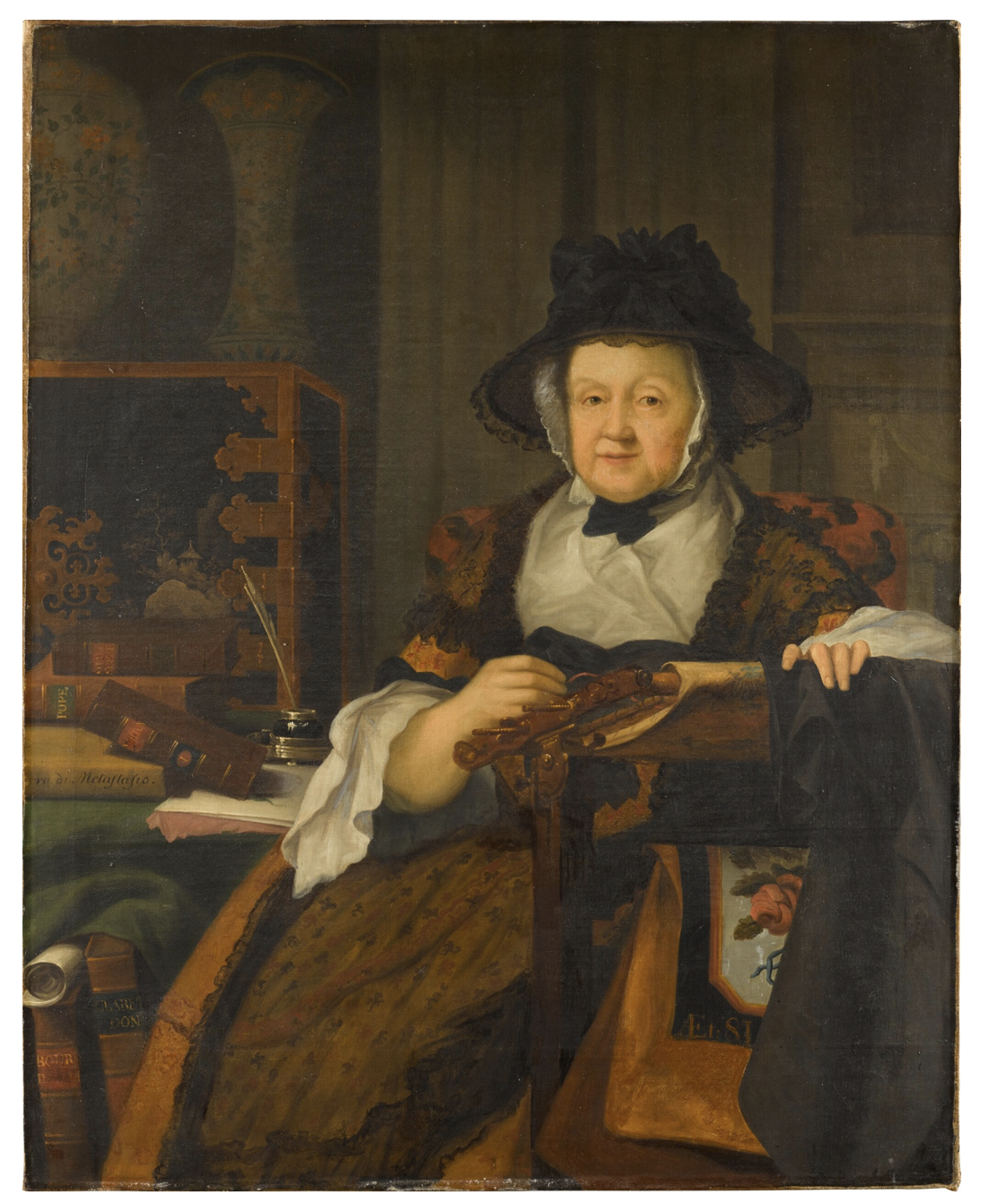
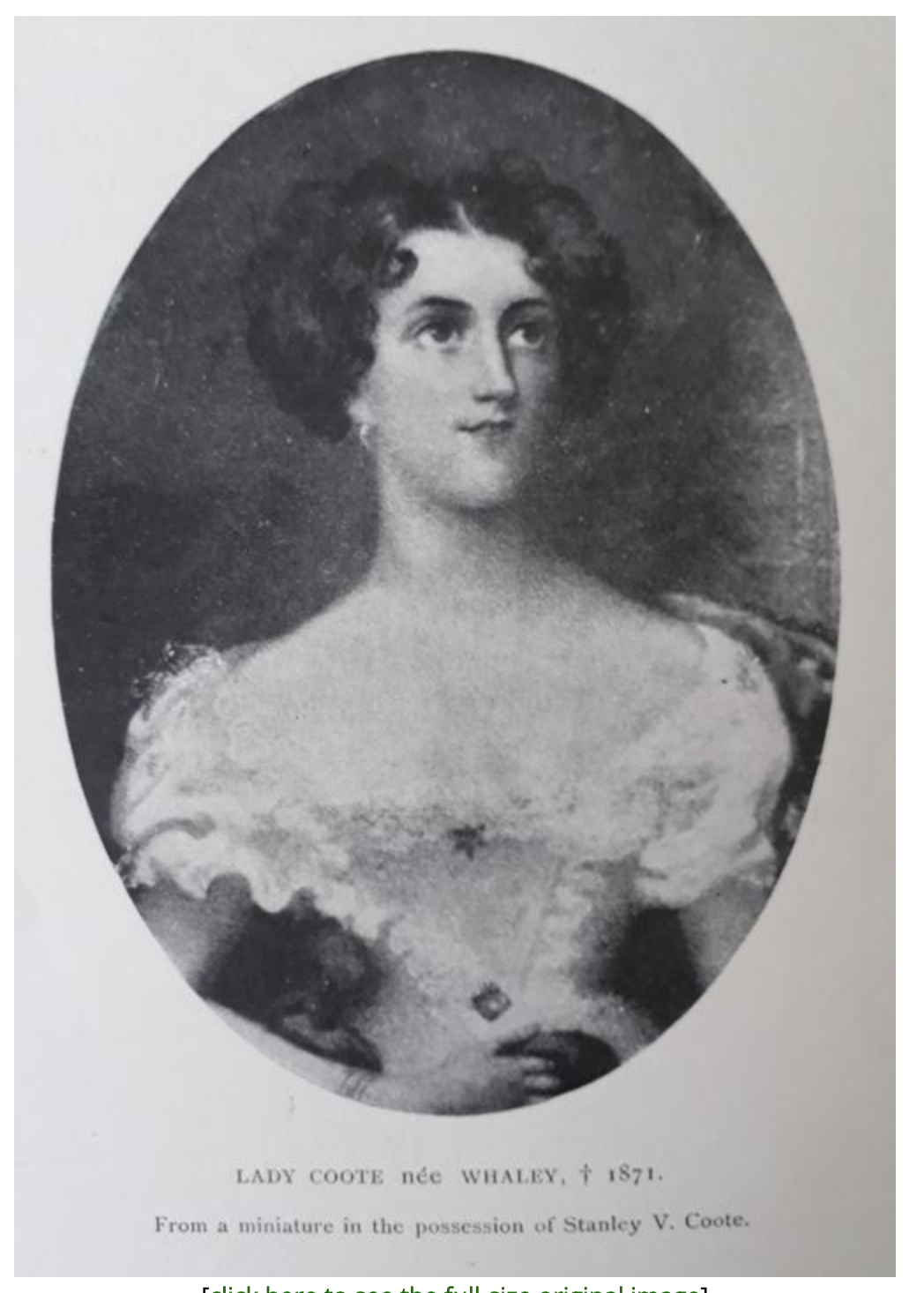
Caroline Elizabeth Coote née Whaley (d. 1871), daughter of John Whaley (d. 1847) of Dublin courtesy of wikitree, uploaded by Desmond William Kelly Lynch SD. She married Charles Henry Coote (1792-1864) who succeeded as 9th Baronet of Castle Cuffe, Queen’s County.
Charles Eyre Coote (1801-1858), third son of Chidley Coote (1776-1843) and Anne Hewitt, by James Butler Brenan RHA (1825-1889) courtesy Whyte’s Sept 2003.
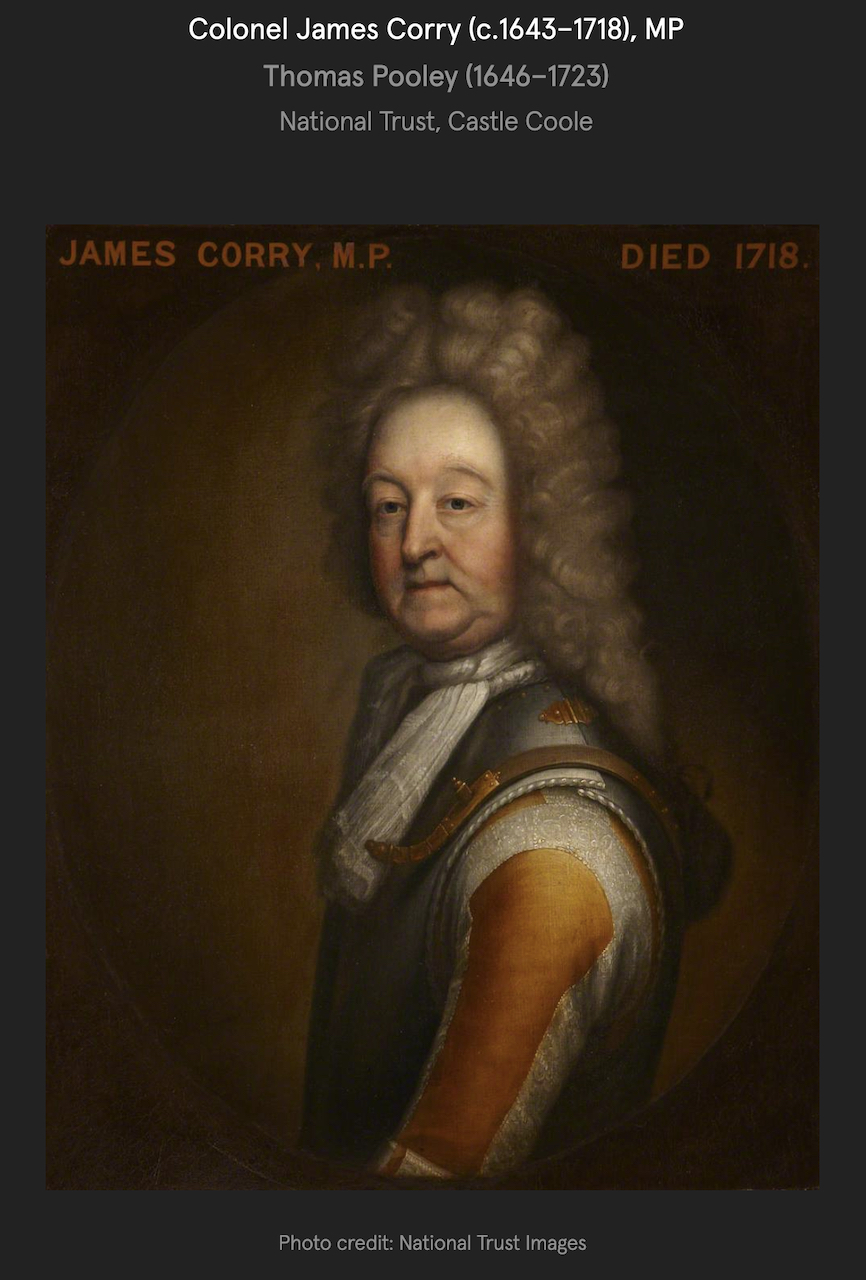
James Corry (c. 1643-1718), MP, Colonel by Thomas Pooley courtesy of National Trust Castle Coole. He was the father of John Corry, MP (d. 1726).
Colonel John Corry, MP (1666–1726), attributed to Thomas Pooley, courtesy of National Trust Castle Coole, County Fermanagh.
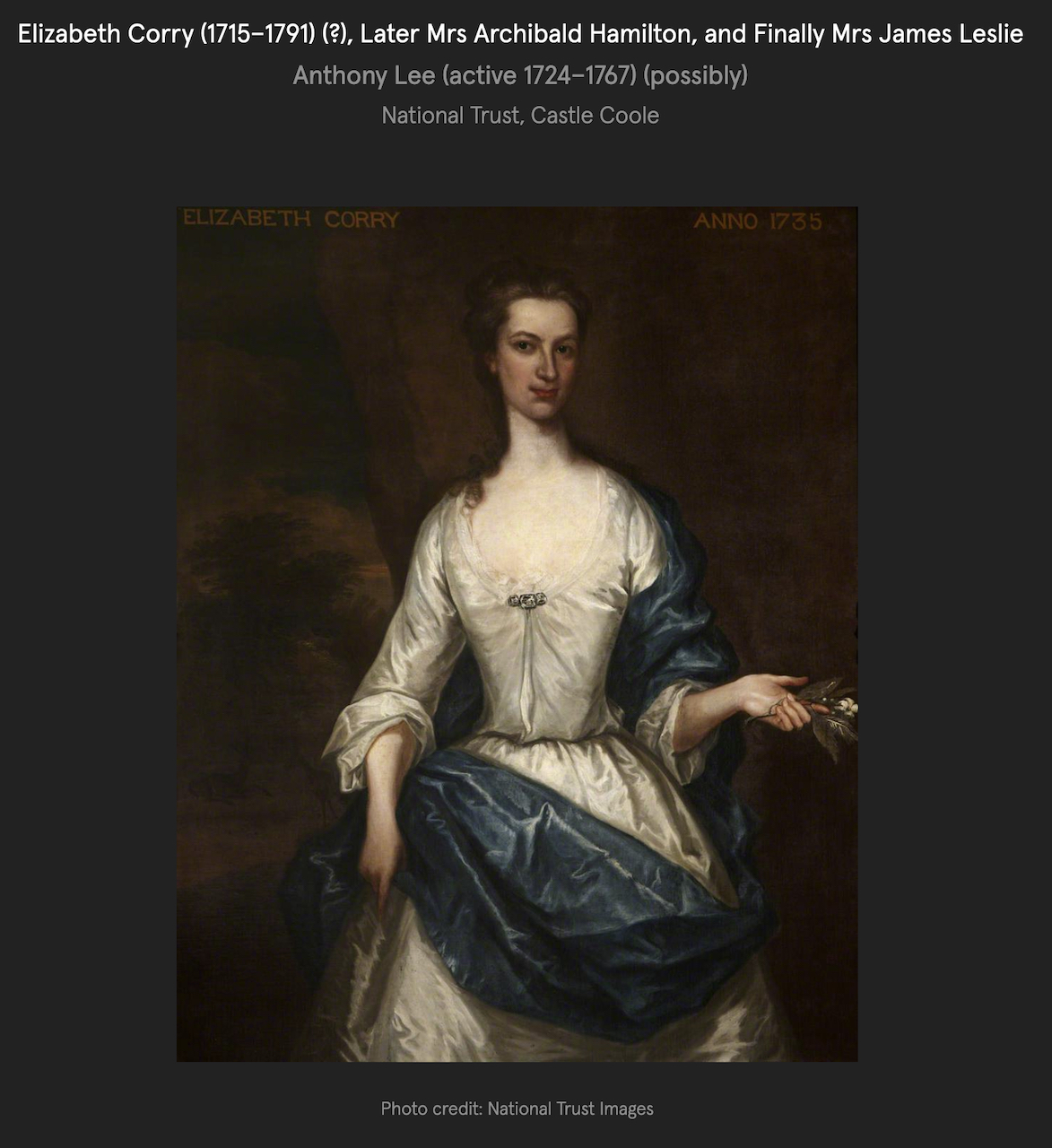
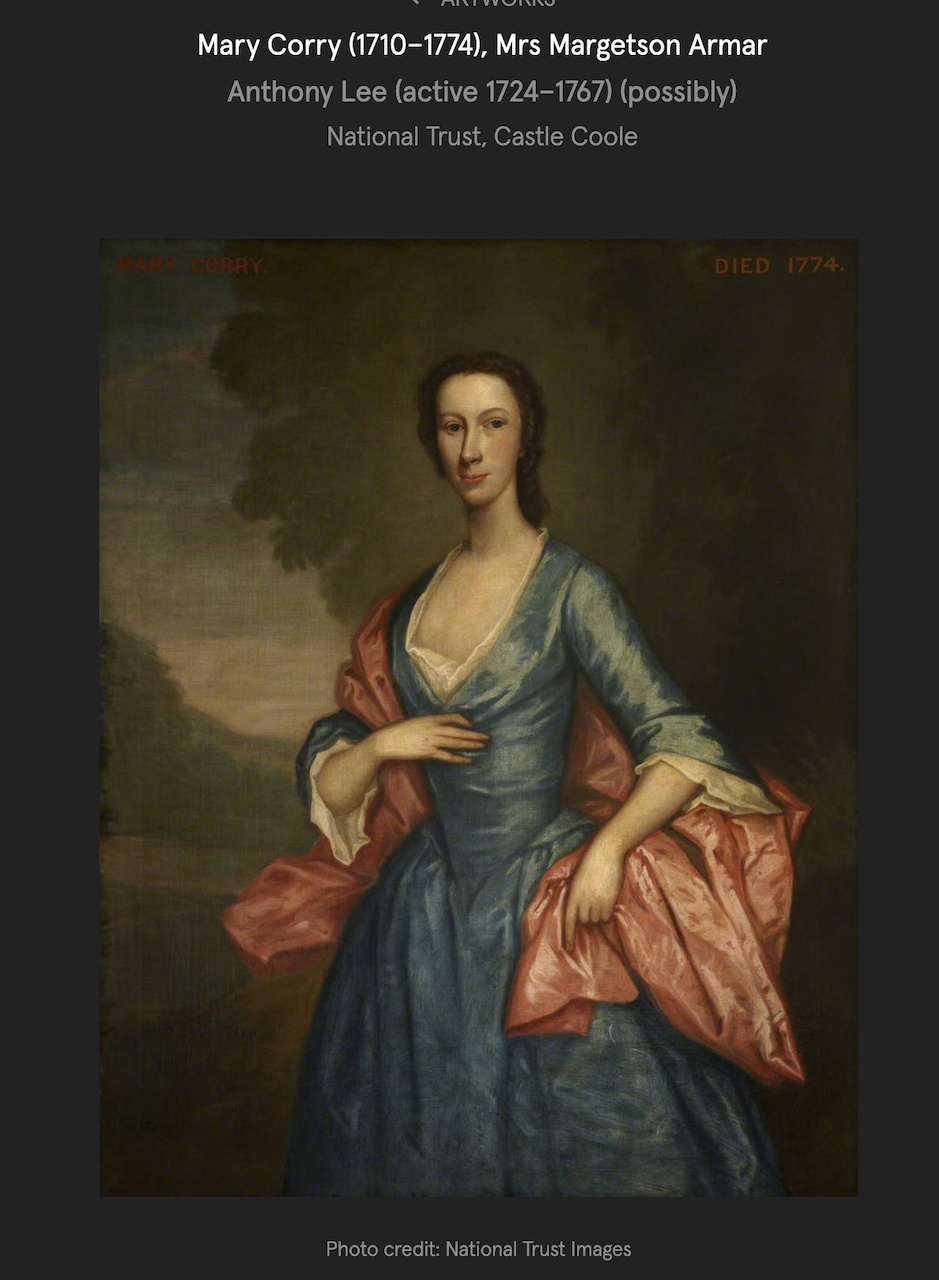
Elizabeth Corry (1715-1791) (?) later Mrs Archibald Hamilton (d. 1752) and finally Mrs James Leslie of Leslie Hill, County Antrim, possibly by Anthony Lee courtesy of National Trust Castle Coole. She was the daughter of Colonel John Corry, MP (1666–1726).
Sarah Corry (1709-1779) later Mrs Galbraith Lowry Corry, by Anthony Lee courtesy of National Trust, Castle Coole, County Fermanagh. She was the daughter of Colonel John Corry, MP (1666–1726).
Martha Leslie née Corry (1704/5-1759) possibly by Anthony Lee courtesy of National Trust Castle Coole. She married Edmund Leslie, MP, of Leslie House, County Antrim. She was the daughter of Colonel John Corry, MP (1666–1726).
Probably Edmund Corry né Leslie (d. after 1764), MP by Irish school; or else Leslie Corry (1712-1740/41), MP, courtesy of National Trust Castle Coole. Edmund Leslie married Martha Corry, and added Corry to his surname to become Edmund Leslie-Corry.
Mary Armar née Corry (1710-1774) Mrs Margetson Armar by Anthony Lee courtesy of National Trust Castle Coole. She was the daughter of Colonel John Corry, MP (1666–1726).
Pole Cosby and his Daughter Sarah, by James Latham, portrait courtesy of Gallery of the Masters website. Sarah (b. 1730) married, first, Arthur Upton (1715-1768) of Castle Upton in County Antrim, after his first wife Sophia Ward had died, and secondly, Robert Maxwell (d. 1779) 1st and last Earl of Farnham. https://www.galleryofthemasters.com/l-folder/latham-james-pole-cosby.html
The Archers, John Dyke Acland and Dudley Alexander Sydney Cosby (1732-1774), 1st Baron Sydney and Stradbally, courtesy of National Gallery of Ireland.
Mrs. Sydney Cosby, courtesy of National Gallery of Ireland. Could it be Emily Ashworth (d. 1863), wife of Sydney Cosby (1807-1840)?
General William Cosby (c. 1690-1736) by Charles Jervas 1710, Governor of New York, courtesy of National Gallery of Ireland.
Anne Boyle née Courteney, Countess of Cork and Orrery (1742-1785) Engraver James Watson, Irish, c.1740-1790 After Hugh Douglas Hamilton, Irish, 1740-1808, courtesy of National Gallery of Ireland. She married Edmund Boyle 7th Earl of Cork, 7th Earl of Orrery.
Portrait Of A Lady traditionally identified as Caroline Courtenay Née Smith-Barry, courtesy of Whyte’s Sept 2007, daughter of James Smith-Barry (1746-1801) of Fota House, County Cork, she married George Courtenay of Ballyedmond House, County Cork (no longer exists).
Mary Creighton (or Crichton) née Hervey, Countess of Erne, with her daughter Lady Caroline Creighton (or Crichton), later Lady Wharncliffe by Hugh D Hamilton courtesy of Christie’s 2004. Mary was daughter of Frederick Augustus Hervey 4th Earl of Bristol, Bishop of Derry, who built Downhill in Derry, and she married John Creighton (or Crichton) 1st Earl Erne of Crom Castle.
Henrietta Paulet née Crofts, Duchess of Bolton (1682-1730) daughter of James Crofts (Scott), 1st and last Duke of Monmouth, illegitimate son of King Charles II. She married Charles Paulet, 2nd Duke of Bolton. Photograph © Jennifer Winder-Baggot, www.irishhistorichouses.com
I think this is Jane Crosbie (c. 1713-1753), who married Thomas Mahon (1701-1782) of Strokestown, County Roscommon. She’s the daughter of Maurice Crosbie, 1st Baron Brandon. Photograph © Jennifer Winder-Baggot, www.irishhistorichouses.com
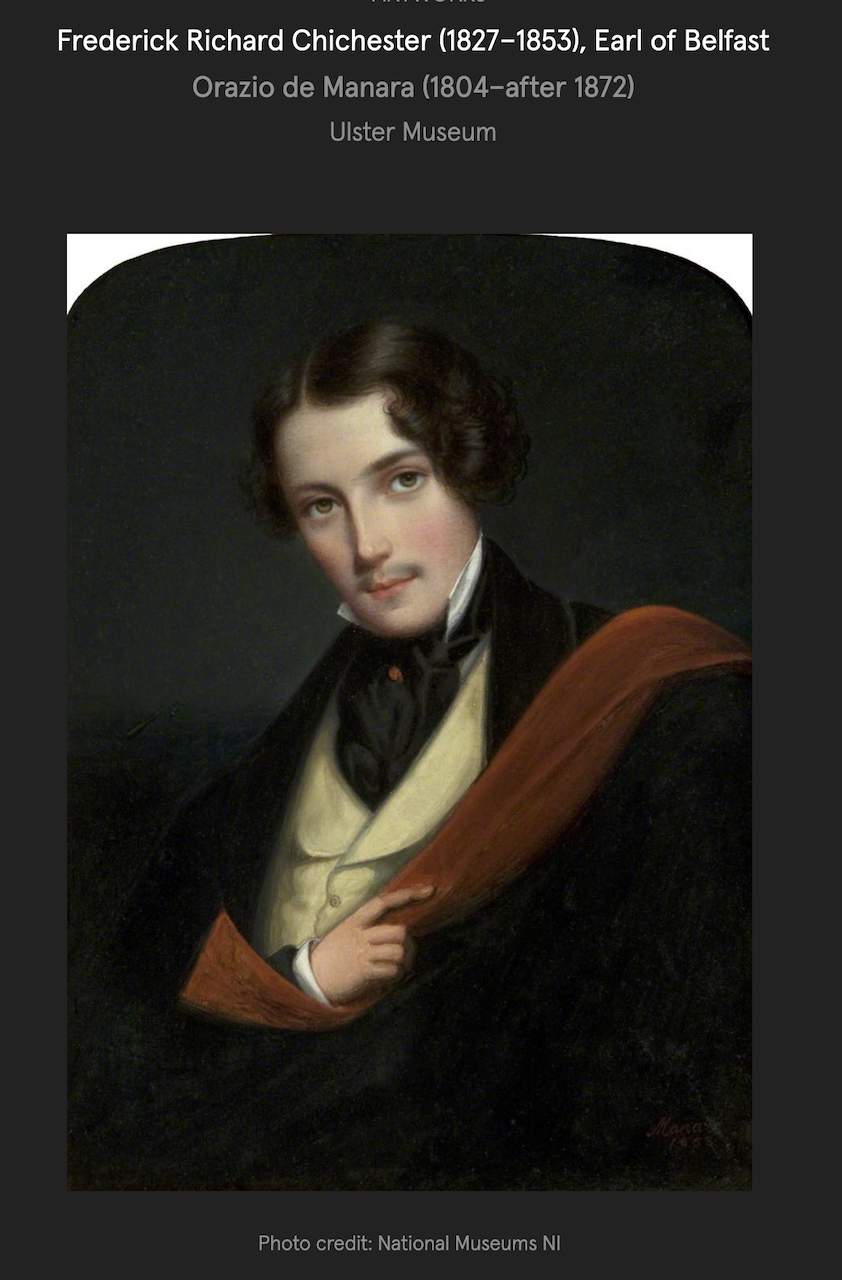
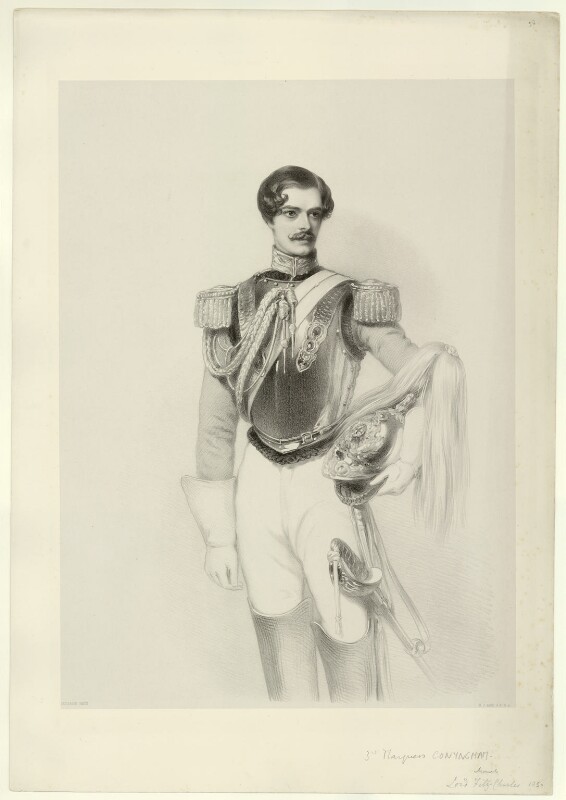
Arabella Crosbie (d. 1813) who married Edward Ward (1753-1812) of Castle Ward, County Down, by Anna Maria Frances Blackwood Price, courtesy of National Trust, Castle Ward. William Crosbie 1st Earl of Glandore, County Cork, son of 1st Baron Brandon.
James Cuffe, 1st Baron Tyrawley, (1748-1821), Barrack-Master General and First Commissioner of the Board of Works in Ireland Date 1802 by Engraver John Raphael Smith, English, 1752-1812 After William Cuming, Irish, 1769-1852, courtesy of National Gallery of Ireland.
A portrait of Jane Cuffe (1719-1806), daughter of James Cuffe of Ballinrobe, County Mayo, wife of George Jackson (1717-1789) of Enniscoe, County Mayo. Photograph © Jennifer Winder-Baggot, www.irishhistorichouses.com
Elizabeth Cuffe (1719-1794) who married Thomas Pakenham, 1st Baron Longford. She became Countess of Longford in her own right, through her father Michael Cuffe (1694-1744), who was heir to Ambrose Aungier, 2nd and last Earl of Longford (1st creation).  Photograph © Jennifer Winder-Baggot, www.irishhistorichouses.com

[1] https://en.wikipedia.org/wiki/Marquess_of_Donegall

[2] http://lordbelmontinnorthernireland.blogspot.com/2016/03/castletown-house.html

[3] http://lordbelmontinnorthernireland.blogspot.com/search/label/County%20Londonderry%20Landowners