I have an editorial decision to make regarding women. Do I put them under their married name or under their maiden name? I think for now I’ll put them under both, as it’s nice to see them in relation to their fathers as well as in relation to their husband!
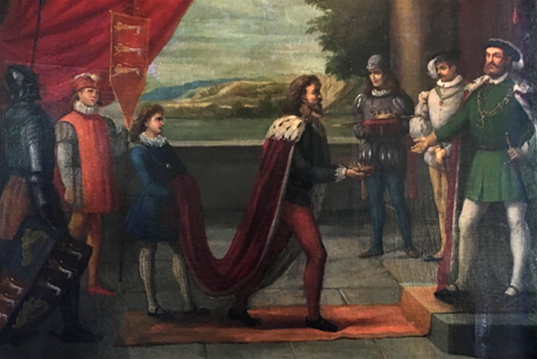
Murrough O’Brien (d. 1551) King of Thomond, submitted to King Henry VIII in 1543 and was created 1st Earl of Thomond [Ireland] on 1 July 1543, for life with a special remainder to his nephew, Donogh. He was also created 1st Baron of Inchiquin [Ireland].
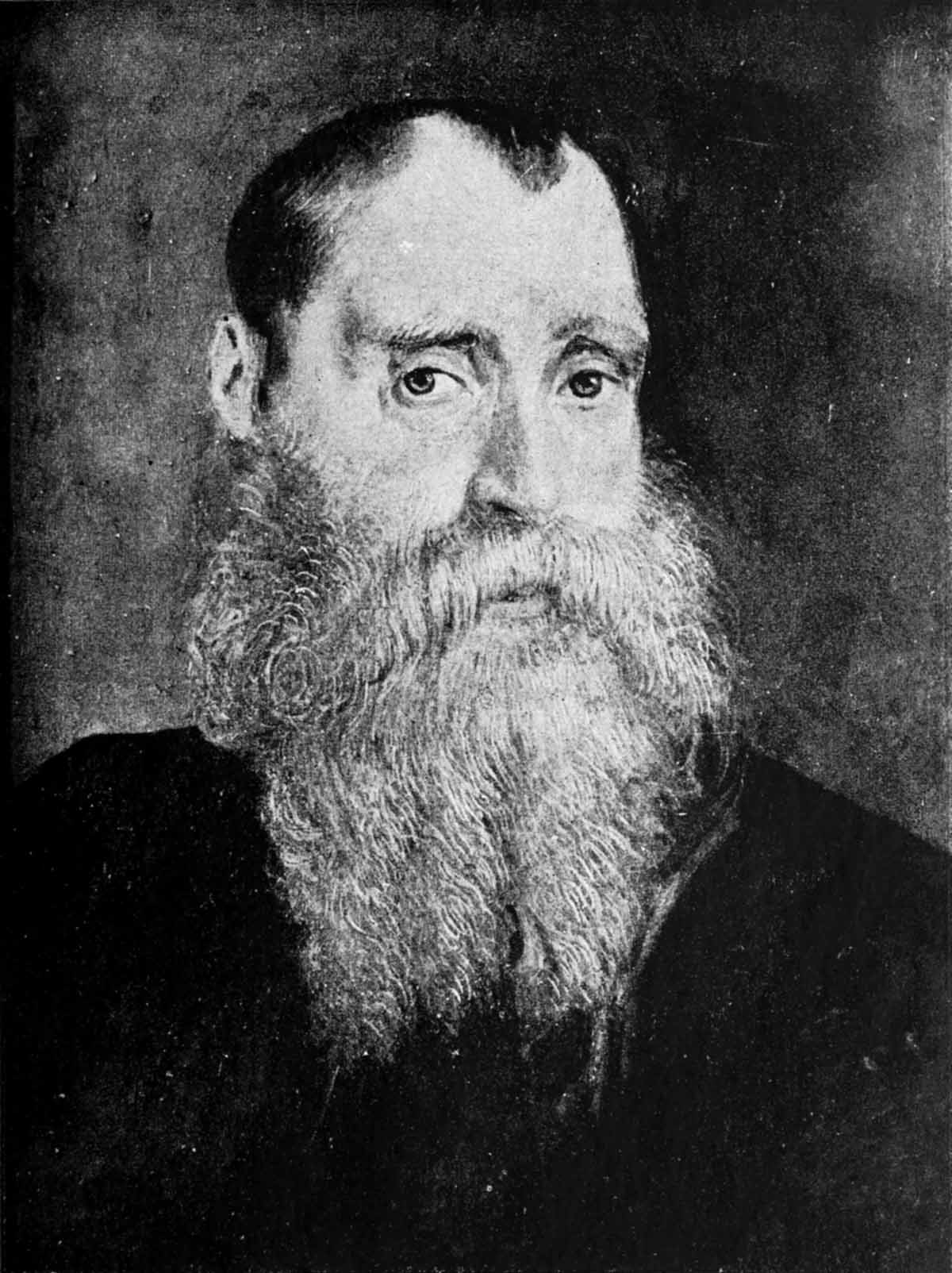
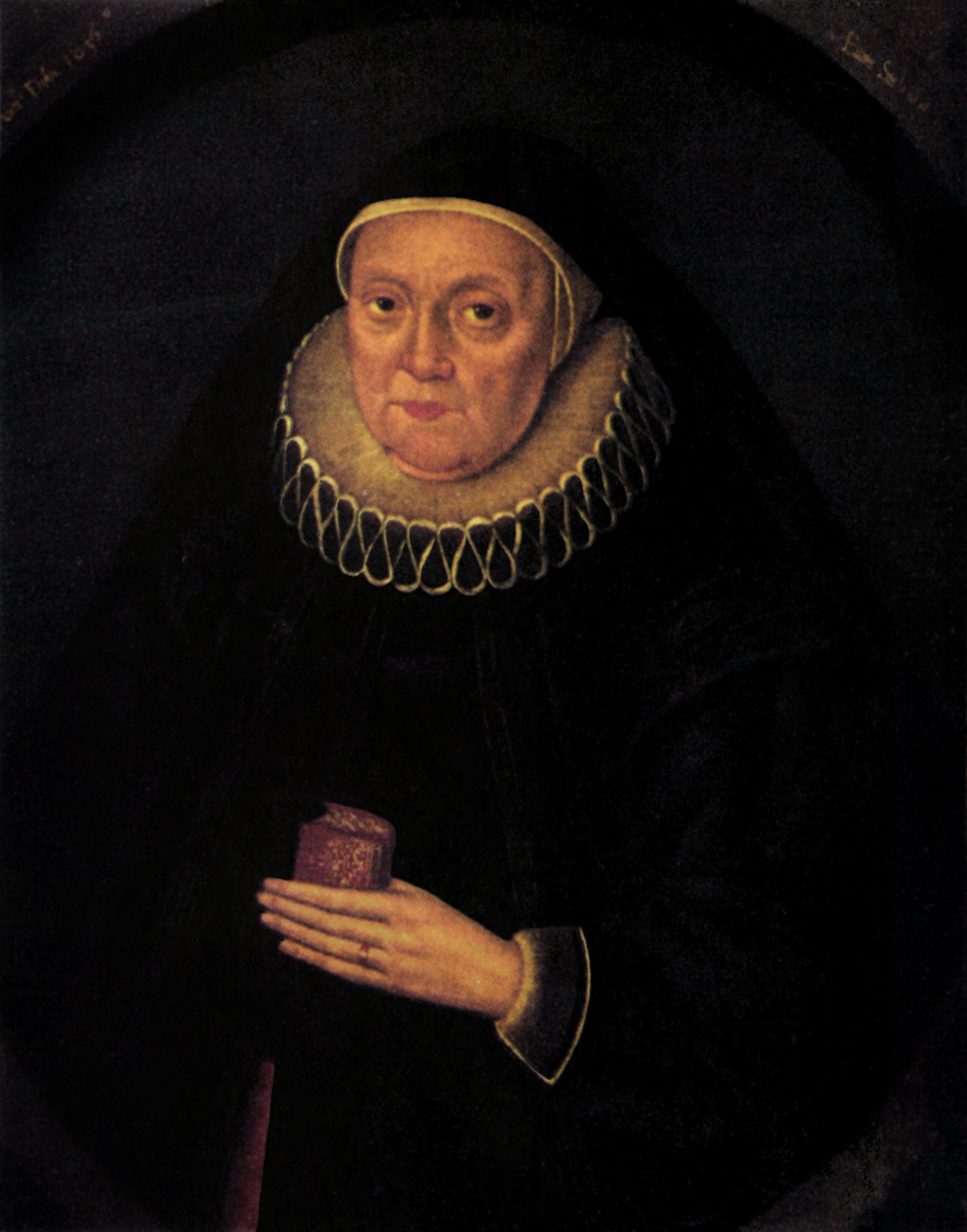
Donough O’Brien (died 1582) of Leameneagh and Dromoland, younger son of Murrough O’Brien last King of Thomond, 1st Earl of Thomond, painted 1577 on panel, courtesy History of the O’Briens from Brian Boroimhe, AD. 1000 to AD. 1945, by Donough O’Brien, page 200.Slaney O’Brien nee McNamara, daughter of John of Cratelagh, wife of Donough O’Brien of Leameneagh (d. 1582), 1577 on panel in her 28th year. History of the O’Briens from Brian Boroimhe, AD. 1000 to AD. 1945, by Donough O’Brien, p 200.
His son Donogh McMurrough O’Brien (d. 1582) lived at Leamanagh and at Dromoland, County Clare. He in turn had a son Connor McDonogh O’Brien (d. 1603/4), who had a son, Donogh O’Brien (1595-1634/35) who married Honora Wingfield.
Slaney O’Brien, wife of Conor, Daughter of Turlough O’Brien of the Dough and Ennistymon courtesy Max Gheeraerts, Historical memoir of the O’Briens, The Origin and History of the O’Brien Clan by John O’Donoghue, Publ.1860, Martin Breen 2002.Donough O’Brien of Lemeneagh (1595-1637) Scan from Historical Memoir of the O’Briens, The Origin and History of the O’Brien Clan John O’Donoghue published by Martin Breen (Collection of Lord Inchiquin).
Donogh and Honoria Wingfield had a son Colonel Connor McDonogh O’Brien (1617-1651) who married Mary ‘Rua’ MacMahon.
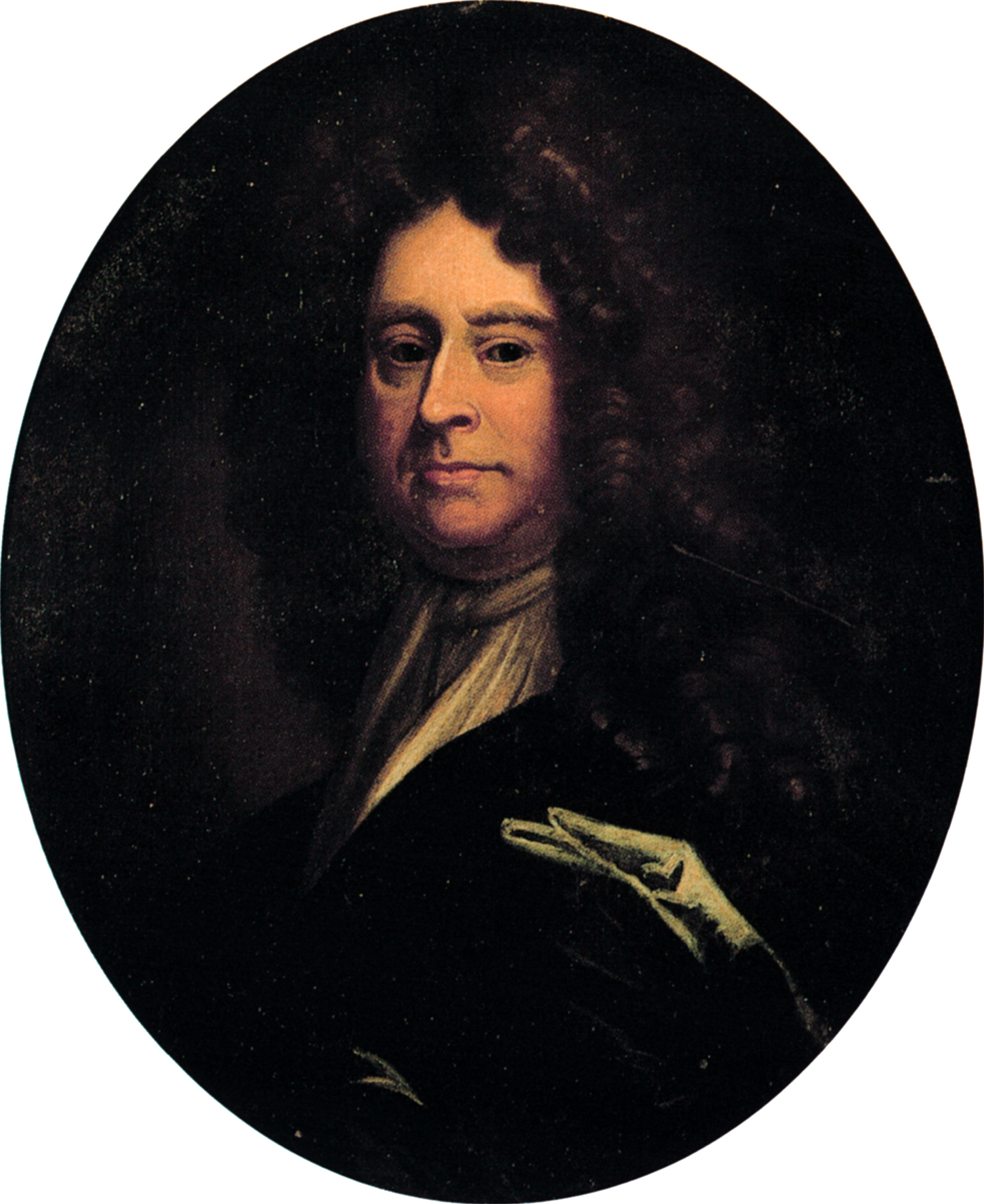
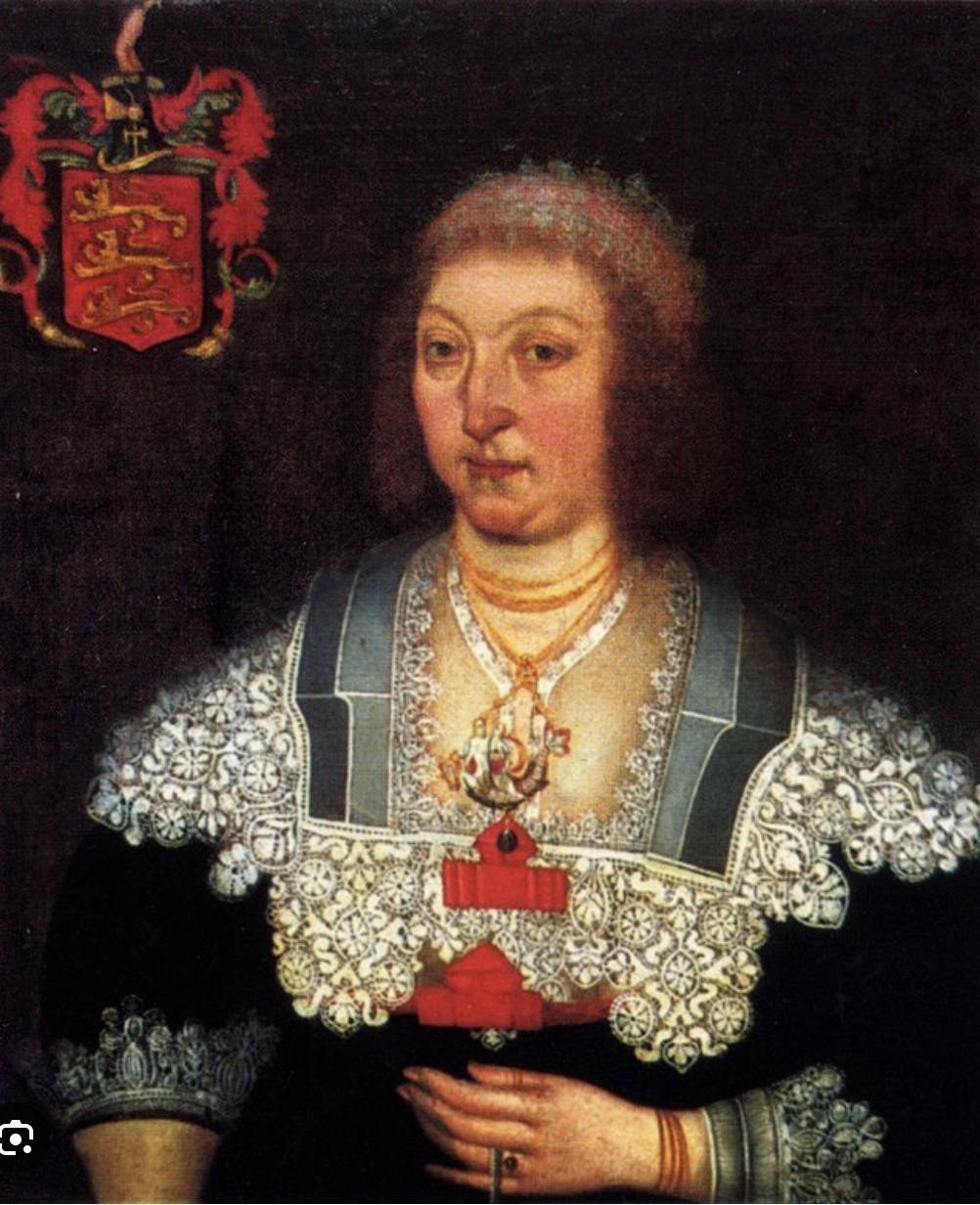
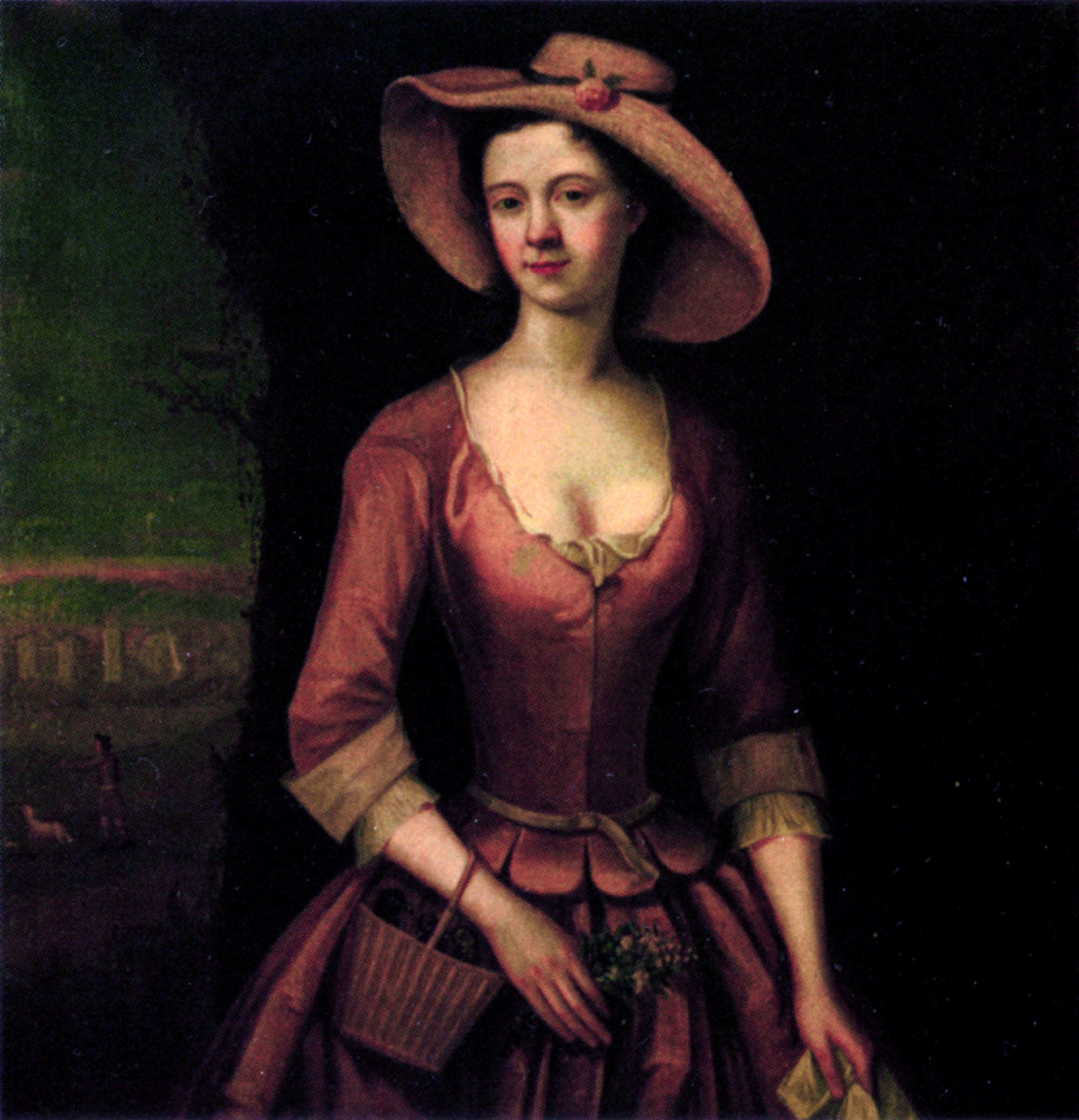
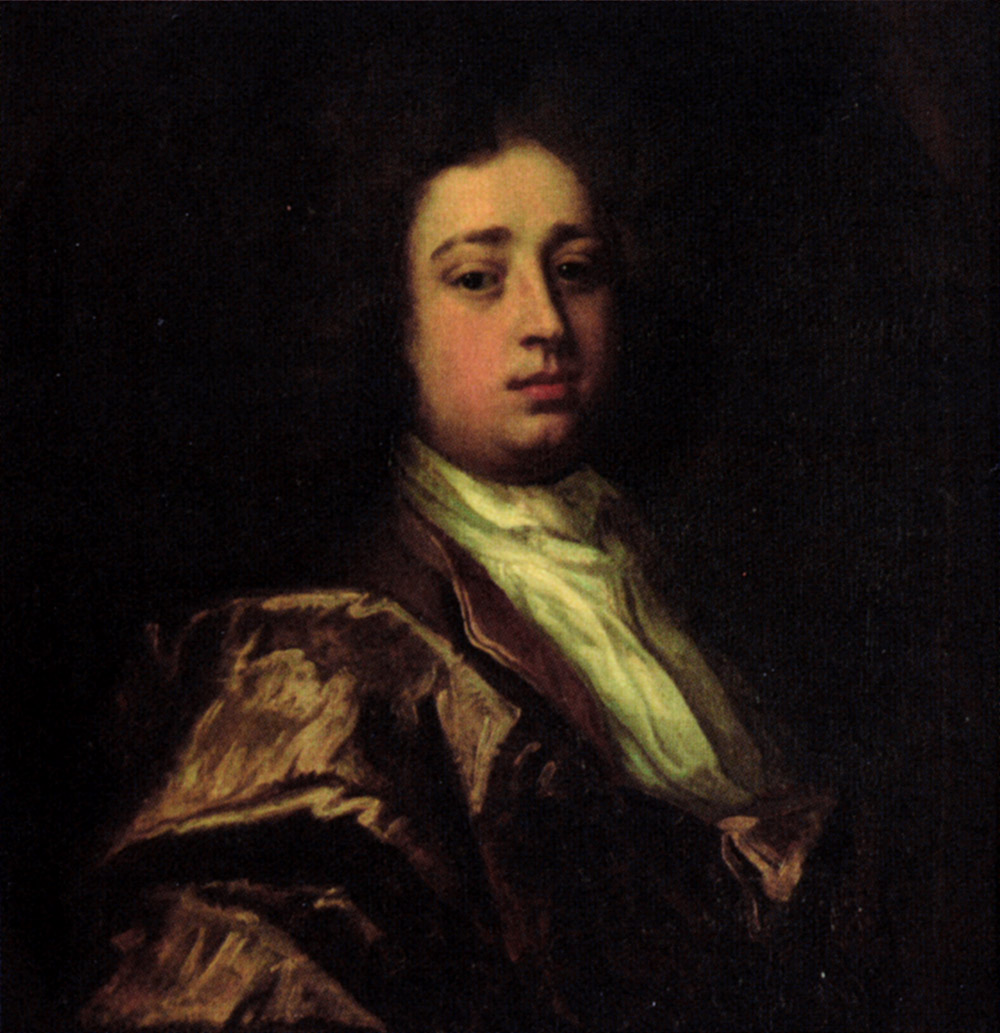
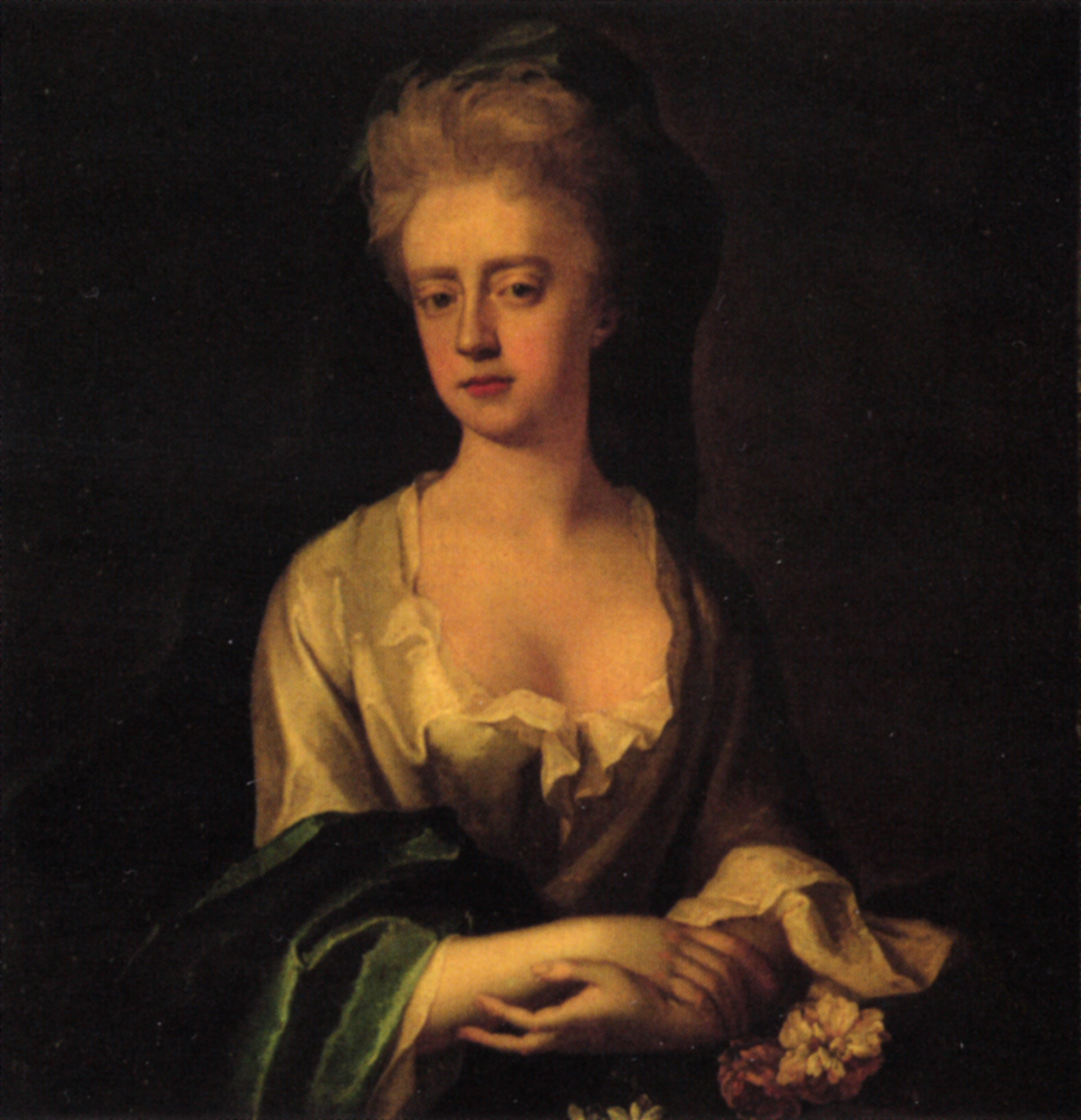
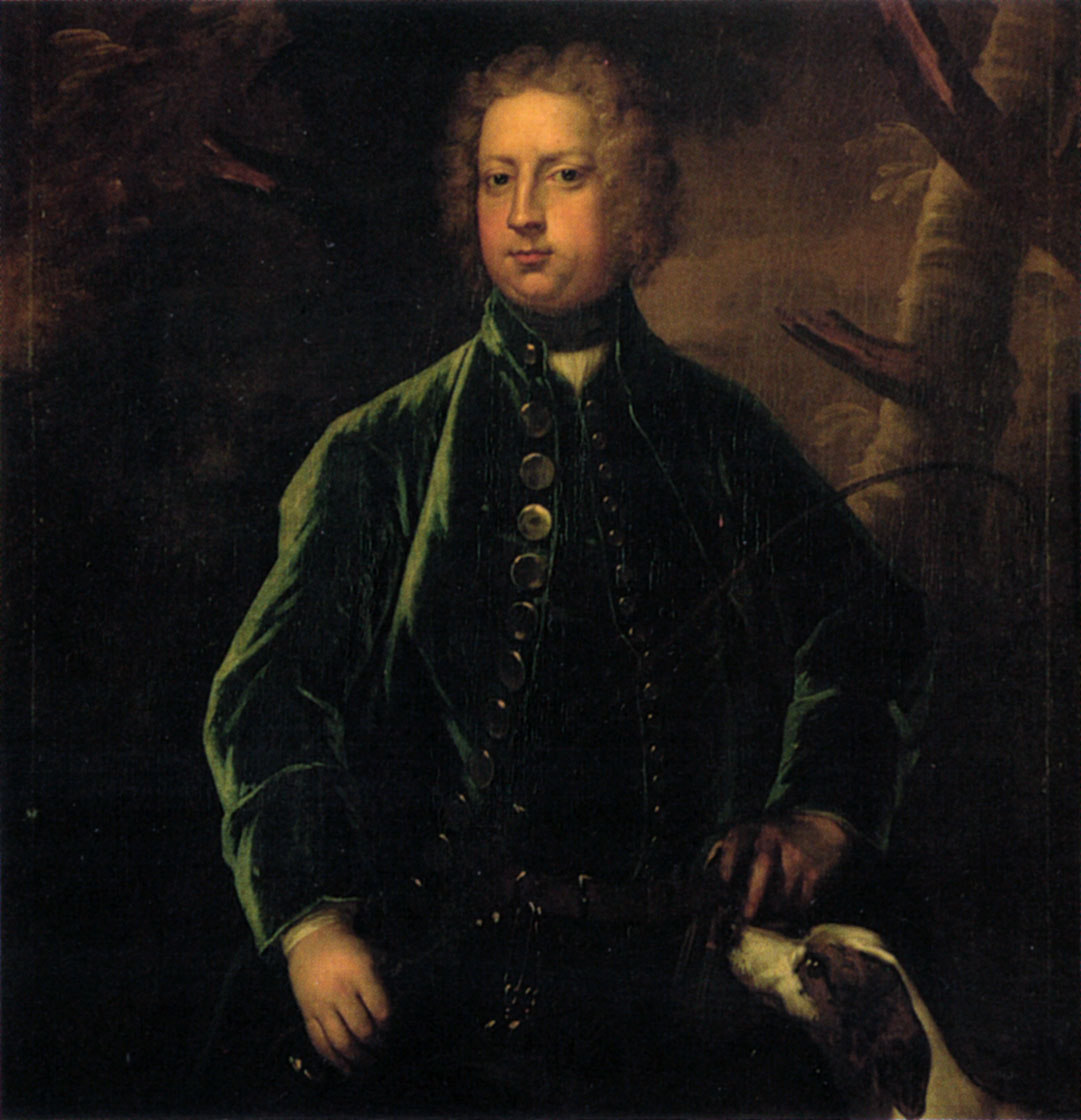
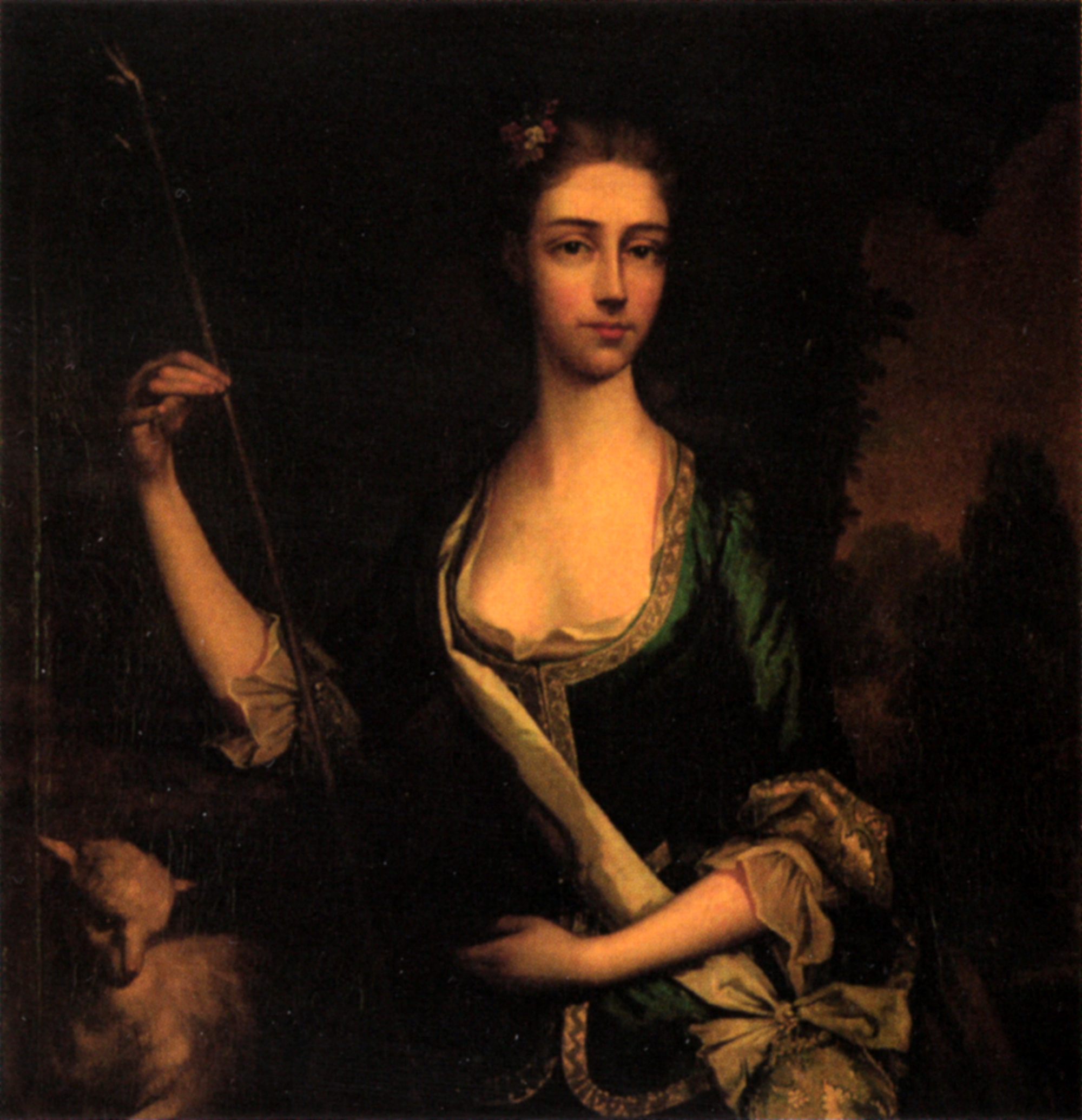
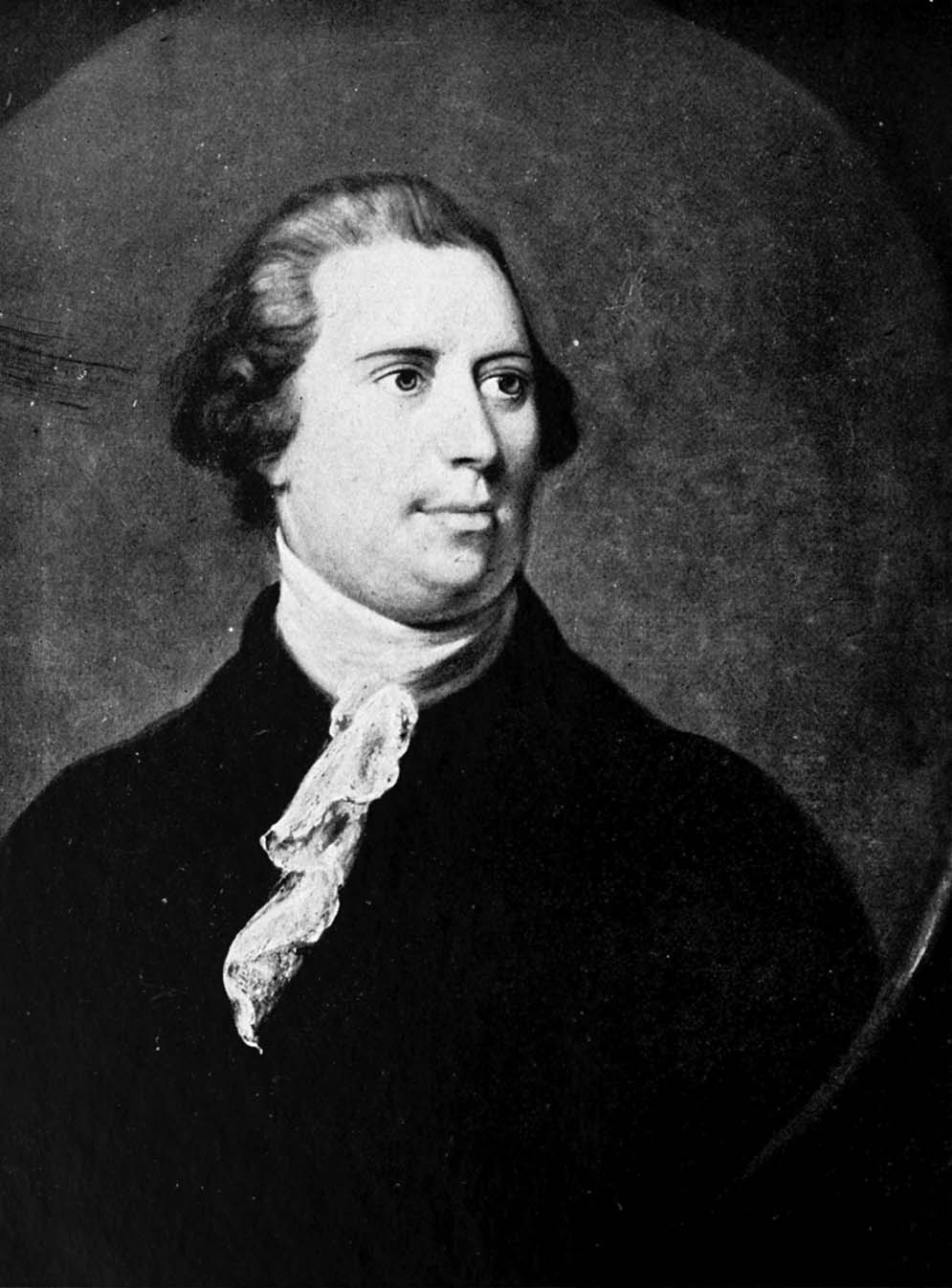
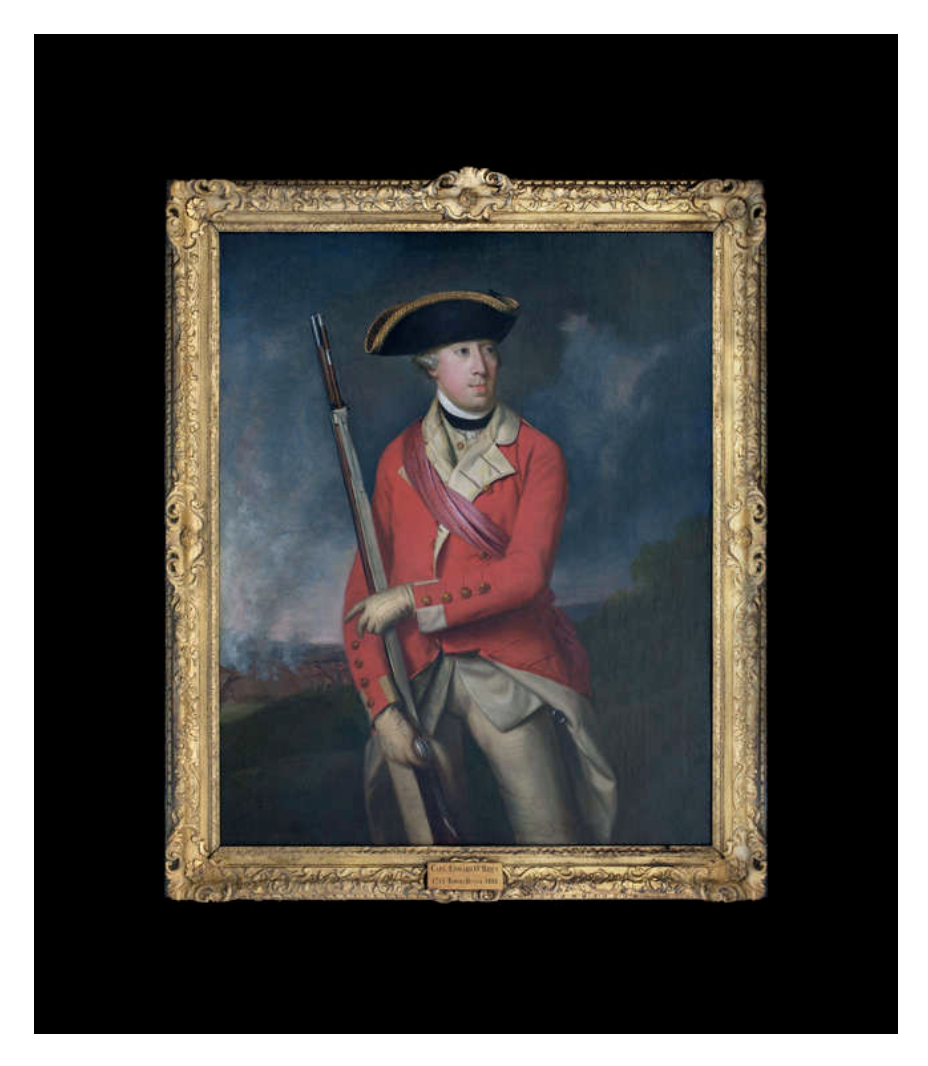
Máire Rua O’Brien née McMahon (1615/1616 – 1686) daughter of Turlough Roe McMahon Baronet, wearing Felemish bobbin lace with O’Brien coat of arms.She married first Colonel Neylan, then in 1639, Colonel Conor O’Brien (1617-1651) of Lemeneagh, ancestor of Barons Inchiquin, but he was slain in battle in 1651. She then married, to keep the family property, Captain John Cooper of Ireton’s army, whom she is said to have murdered! It’s a rare example of a portrait almost certainly painted in Ireland in the first half of the seventeenth century – see Irish Portraits 1660-1860 by Anne Crookshank and the Knight of Glin, published by the Paul Mellon Foundation for British Art 1969.Donough O’Brien (1642-1717), 1st Baronet of Lemeneagh and Dromoland, Co. Clare by Mary Beale, 1690. He lived in Dromoland Castle.He was the son of Máire Rua O’Brien née McMahon (1615/1616 – 1686) and Conor McDonogh O’Brien (1617-1651).Lucia Hamilton, 1674, daughter of George Hamilton. Wife of Donough O’Brien, 1st Baronet, married in 1674. She died two years later, not long after the birth of his son and heir, Lucius.Lucius O’Brien (1675-1717) son of Donough O’Brien 1st Baronet of Leameneh, History of the O’Briens from Brian Boroimhe, AD. 1000 to AD. 1945, by Donough O’Brien, p 212.jpgCatherine Keightley, daughter of Thomas Keightley and Frances Hyde, aunt of Queens Anne and Mary, wife of Lucius O’Brien, History of the O’Briens from Brian Boroimhe, AD. 1000 to AD. 1945, by Donough O’Brien, p 232.Edward O’Brien (1705-1765) 2nd Baronet of Dromoland, County Clare from Historical memoir of the O’Briens : The Origin and History of the O’Brien Clan, by John O’Donoghue A.M, Barrister-at-Law, First Published in 1860 (Martin Breen 2002) Illustrations section (Collection of O’Brien of Dromoland), Public Domain, https://commons.wikimedia.org/w/index.php?curid=109837449He was the son of Lucius O’Brien.Mary Hickman, wife of Edward O’Brien, 2nd Baronet, from Historical memoir of the O’Briens : The Origin and History of the O’Brien Clan, by John O’Donoghue A.M, Barrister-at-Law, First Published in 1860 (Martin Breen 2002) Illustrations section, Public Domain,https://commons.wikimedia.org/w/index.php?curid=109837783Lucius O’Brien (1731-1795) 3rd Baronet, courtesy of Harnet – The Other Clare Vol. 9 page 14,15.Ann Ffrench wife of Sir Lucius O’Brien, 3rd Baronet courtesy Unknown author – These My Friends and Forebears: The O’Briens of Dromoland. She was daughter of Robert Ffrench of Monivea Castle, County Galway, MP for County Galway, and of Nichola Acheson, daughter of Arthur, 5th Baronet of Market Hill, County Armagh.Capt. Edward O’Brien, holding a musket in the uniform of 52nd Regiment of Foot, standing against landscape, line of infantry firing a volley against an advisory, by Robert Hunter (1715 – 1780), courtesy of Adam’s auction 16 Oct 2018. Edward O’Brien (c.1735 1787) was the third son of Sir Edward O’Brien 2nd Baronet of Dromoland and Mary Hickman. A portrait of him and titled Master Edward O’Brien by Philip Hussey was exhibited with the Irish Portraits 1660 1860 Dublin, London and Belfast 1970, Cat no. 31. His ambition was to be a solider but there was no money to buy a Cornecy of Dragoons until 1759. A riding accident prevented his joining Corps being raised to go to America. He became a Captain in the 122nd Regiment and then exchanged (costing £379 3 4) into the 52nd Regiment. He married his cousin Charlotte Hickman of Brickhall, Co. Clare. With his easy-going spendthrift nature and love of horses, it is easy to see why he was his fathers favourite son. Although his father had left him Jockey Hall on the Curragh, he was not able to provide for his family and appealed to his more serious brother, Lucius, for help who assigned him a life interest in lands at Leamanagh and organised his return to military service. However, he forbade him from leaving the kingdom, thereby again preventing him going to America where he thought he could distinguish himself. He died in 1787 with the rank of colonel.
Another son of Murrough O’Brien (d. 1551) 1st Earl of Thomond was Dermod O’Brien (d. 1552) 2nd Baron of Inchiquin. He married Margaret (d. 1568), daughter of Donough O’Brien (d. 1553) 1st Earl of Thomond. She gave birth to their heir, Murrough Macdermot O’Brien (1550-1573) 3rd Baron of Inchiquin. After her husband died, Margaret married Richard Bourke (d. 1582) 2nd Earl of Clanricarde. Murrough O’Brien (1614-1674) 6th Baron of Inchiquin was created 1st Earl of Inchiquin.
Murrough O’Brien (1614-1674) 1st Earl of Inchiquin by John Michael Wright courtesy of Manchester Art Gallery.He married Elizabeth St. Leger (d. 1685).
Murrough O’Brien (1614-1674) 1st Earl of Inchiquin married Elizabeth St. Leger (d. 1685). His daughter Honoria married Lt.-Col. Theobald Bourke, 3rd Lord Bourke, Baron of Brittas. His daughter Elizabeth (d. 1688) married Richard Southwell, MP for Askeaton, County Limerick. His daughter Mary married Henry Boyle (1648-1693) son of the 1st Earl of Orrery. His son was William O’Brien (d. 1691) 2nd Earl of Inchiquin.
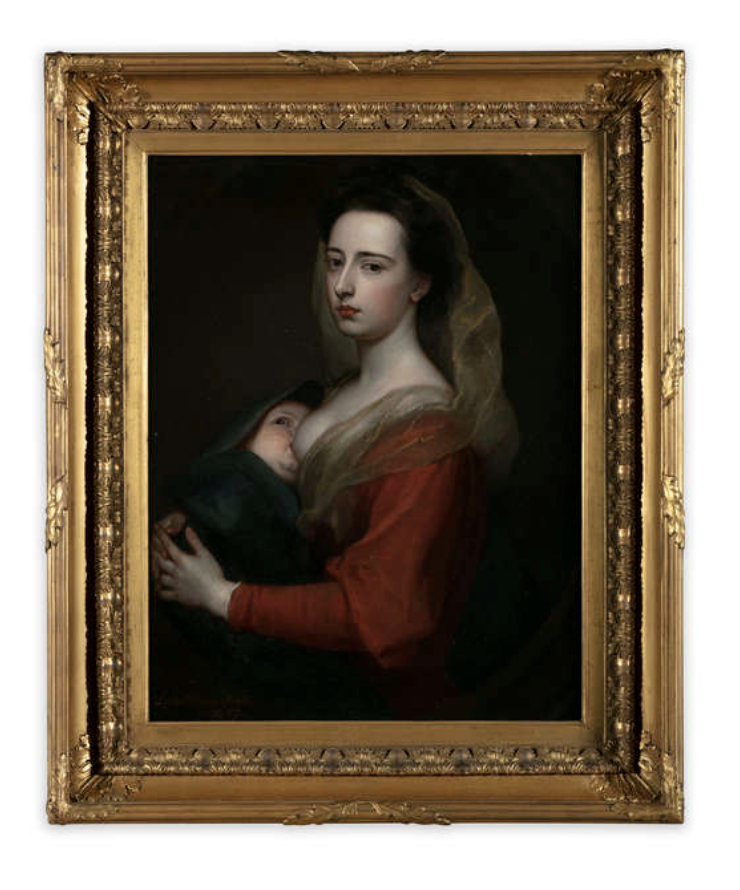
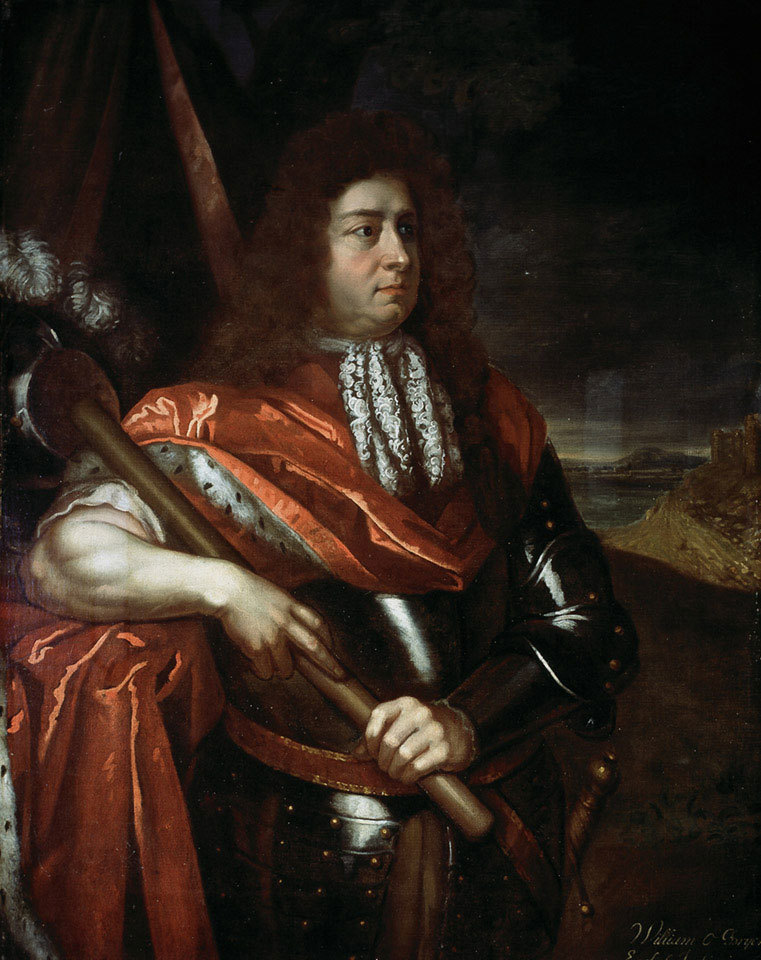
Lady Mary Boyle nursing her son Charles, by Godfrey Kneller (1646-1723) Adams auction 18 Oct 2022. She was daughter of Murrough O’Brien (1614-1674) 1st Earl of Inchiquin. She married married Henry Boyle (1648-1693) son of the 1st Earl of Orrery.William O’Brien (1638-1952) 2nd Earl of Inchiquin, 7th Baron Inchiquinhttps//:commons.wikimedia.org
William O’Brien (1638-1952) 2nd Earl of Inchiquin, 7th Baron Inchiquin married Margaret Boyle, daughter of Roger Boyle 1st Earl of Orrery. Their son was William O’Brien (d. 1719) 3rd Earl of Inchiquin.
William O’Brien (d. 1719) 3rd Earl of Inchiquin married Mary Villiers and their daughter Mary married Robert FitzGerald, 19th Earl of Kildare.
James O’Brien (d. 1771) was a son of William O’Brien (d. 1719) 3rd Earl of Inchiquin and Mary Villiers. He married Mary Jephson. They had a son Murrough O’Brien (1726-1808) 1st Marquess of Thomond.
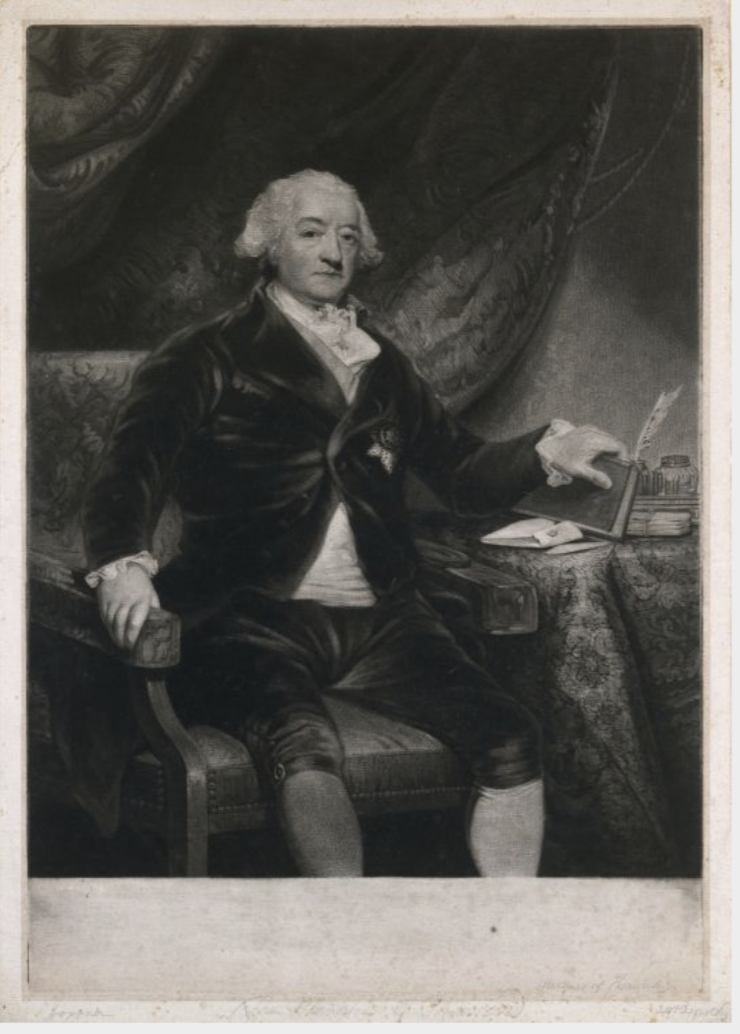
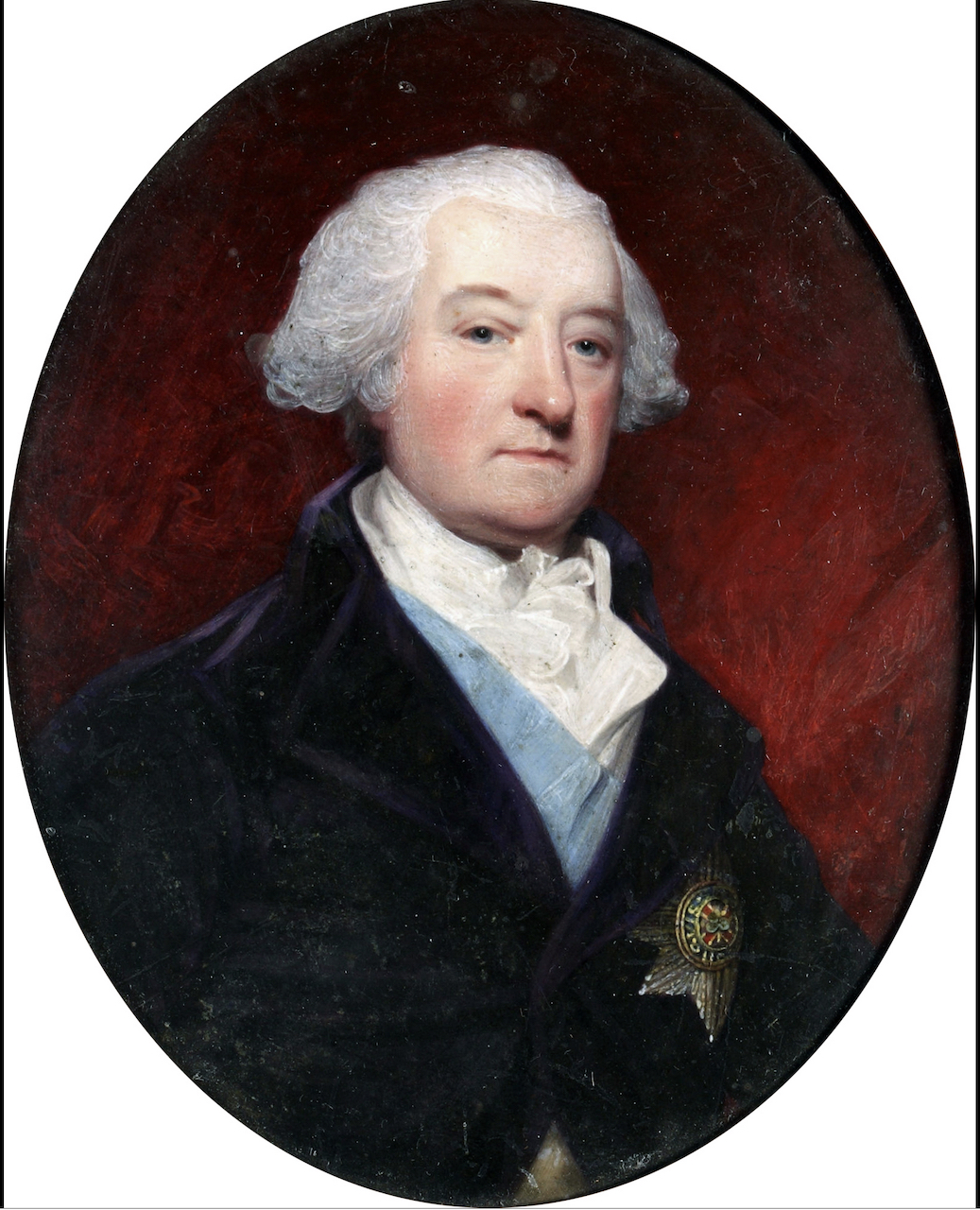
Murrough O’Brien, 1st Marquess of Thomond, (1726-1808) Engraver Samuel William Reynolds, English, 1773-1835 After John Hoppner, English, 1758-1810,courtesy of National Gallery of Ireland.Murrough O’Brien, 1st Marquess of Thomond KP, PC (1726–1808), 5th Earl of Inchiquin (1777–1800) by Henry Bone courtesy of Bonhams.Mary Palmer, Countess of Inchiquin, Marchioness of Thomond (1750-1820), wife of Murrough O’Brien, 1st Marquess (after Sir Joshua Reynolds) by Thomas Phillips courtesy of National Trust Petworth.
James O’Brien (d. 1771) and Mary Jephson had a daughter Anne (1720-1745) who married Most Rev. Michael Cox (1691-1779). James O’Brien (d. 1771) and Mary Jephson had another daughter, Henrietta (d. 1797), who married William Vigors Burdett, 2nd Bt of Dunmore, County Carlow. Murrough O’Brien 1st Marquess had no sons so the title passed to the sons of his brother, Edward O’Brien (d. 1801).
Open dates in 2025: July 1-31, Aug 1-31, 9am-1pm Fee: adult €6, OAP/student/child €3
donation
Help me to pay the entrance fee to one of the houses on this website. This site is created purely out of love for the subject and I receive no payment so any donation is appreciated!
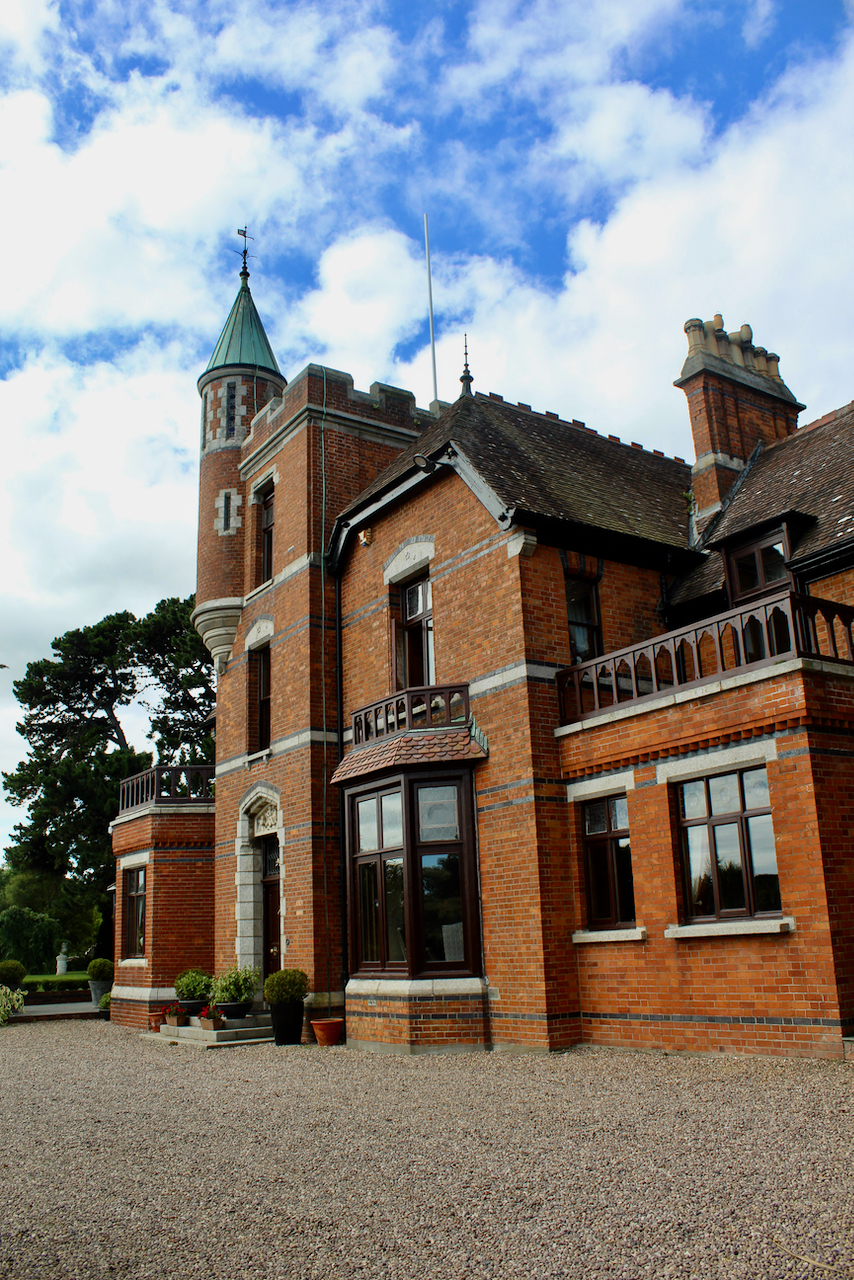
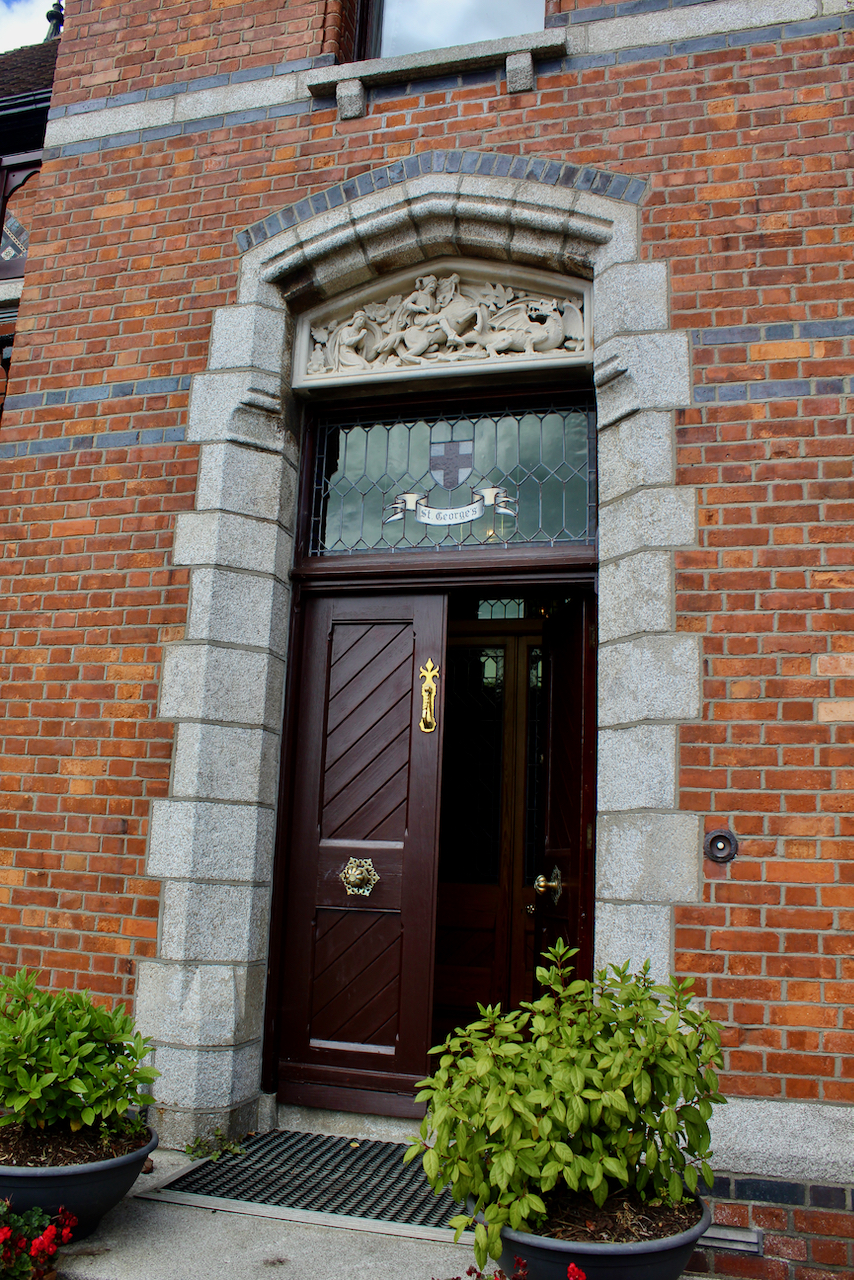
St. George’s is a wonderful Arts and Crafts/Gothic Revival house in the beautiful suburbs of Killiney. It was built in the 1870s by George Coppinger Ashlin, a former pupil and later partner of Edward Welby Pugin, son of Augustus Pugin who played a primary role in initiating the Gothic revival style of architecture. Augustus Pugin designed the Houses of Parliament in Westminster. He also designed the hall ceiling, staircase and gallery in Adare Manor, County Limerick.
Adare Manor staircase, photograph by Chris Brooks 2012 from flickr constant commons.
Augustus Pugin converted to Catholicism. In 1836, Pugin published Contrasts, and in it he argued for “a return to the faith and the social structures of the Middle Ages,” and this was reflected in his Gothic taste in architecture and design. In 1841 he published his illustrated The True Principles of Pointed or Christian Architecture in which he advocated medieval, “Gothic”, or “pointed”, architecture. In the work, he wrote that contemporary craftsmen seeking to emulate the style of medieval workmanship should reproduce its methods. Pugin also designed stained glass.
Edward Welby Pugin joined his father’s firm. Pugin & Pugin were mainly church architects. Pugin was invited first to work in Ireland by the Redmond family of Wexford (I think they lived in Ballytrent).
Edward Welby Pugin’s works in Ireland include a beautiful chapel at Edermine, County Wexford, which I’d love to see, as well as Cobh and Killarney cathedrals.
Edermine was built for the Power family of the firm of John Power & Son, Distillers, of Dublin. It was through John Power’s influence that Pugin was commissioned to built many churches in Ireland. Power was awarded a Baronetcy in 1841and became Sir John Power 1st Baronet of Roe Buck House, Dublin and Edermine and Sampton, Co Wexford. He was a friend and confidant of Daniel O’Connell, “the Liberator.” [1]
The Powers distillery was located at that time near Thomas Street in Dublin, and it must have been John Power’s influence that led to the commission in 1860 for the design of the Church of St. Augustine and St. John, often referred to as John’s Lane church, on Thomas Street.
St. George’s architect, George Coppinger Ashlin (1837-1921), became a pupil of Edward Welby Pugin in 1856, and was then taken into partnership by Pugin, who gave him the responsibility of establishing a Dublin branch, taking charge of Irish commissions. [2]
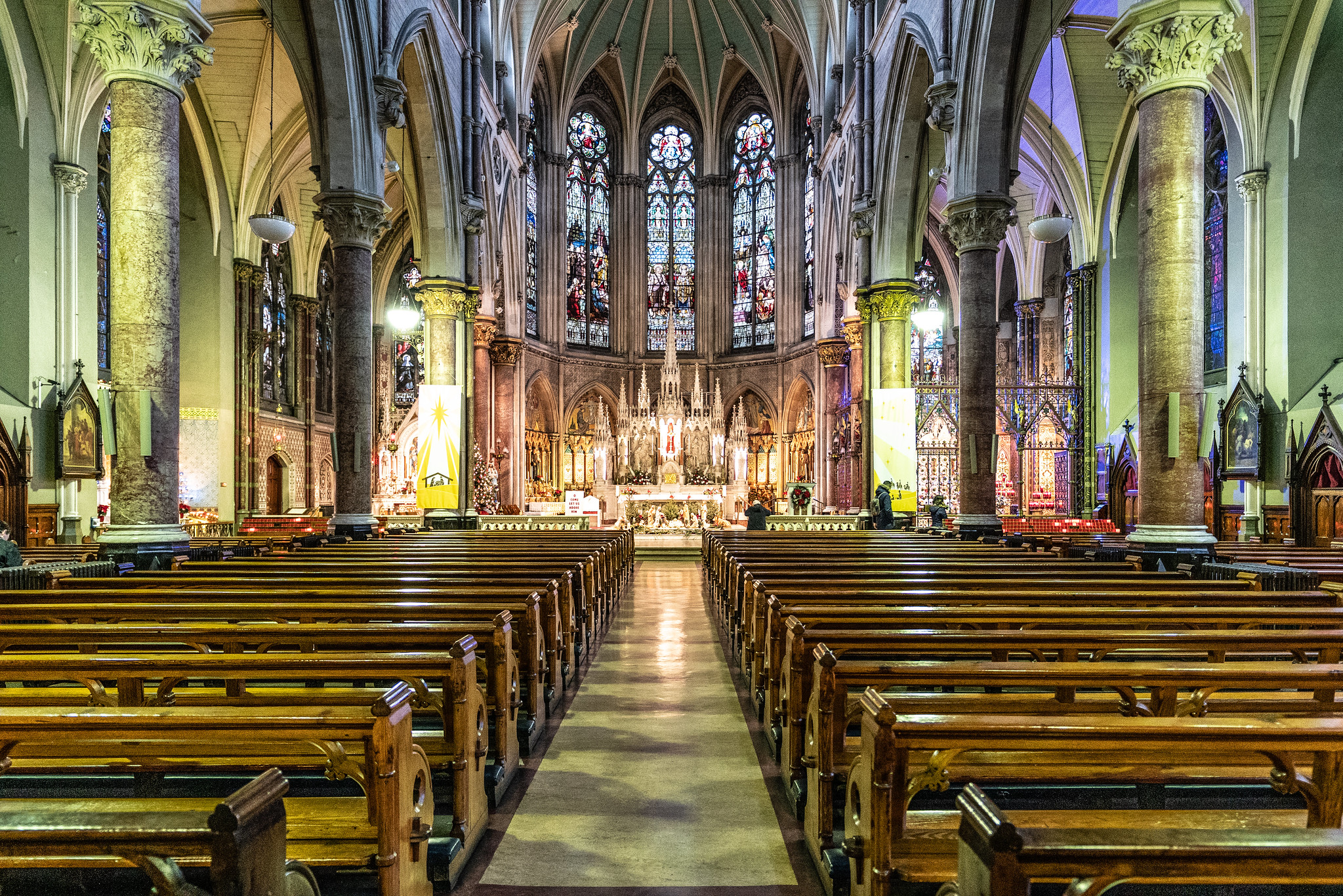
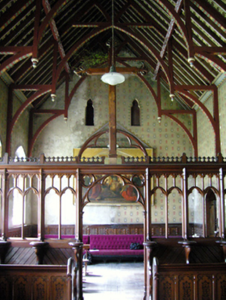
Church of St. Augustine and St. John, Thomas Street, photograph by Warren LeMay 2018, flickr constant commons.The Church of St. Augustine and St. John, commonly known as John’s Lane Church, designed by Edward Welby Pugin, photograph by William Murphy, 2019, courtesy of flickr constant commons.The chapel at Edermine, courtesy of National Inventory of Architectural Heritage.
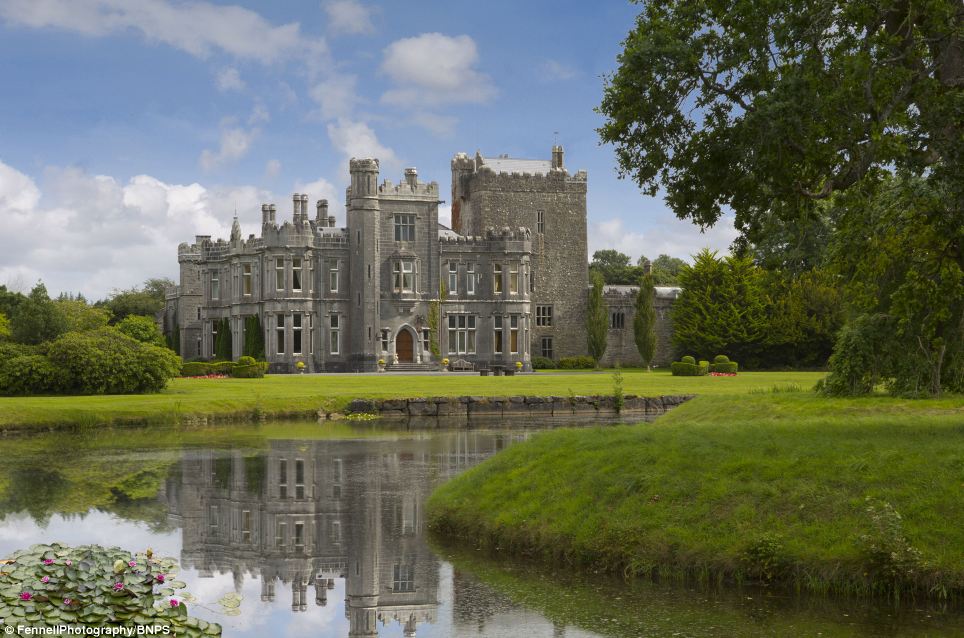
Pugin & Ashlin designed approximately eight Catholic cathedrals and fifty Catholic churches as well as schools and convents. Ashlin did not design many private homes, but his work includes Tullira Castle in County Galway, and designs for Ashford Castle and St. Anne’s Park for the Guinness family. [3]
George Coppinger Ashlin, courtesy of Irish Architectural Archive.Tullira Castle, County Galway, also by George Coppinger Ashlin, photograph by Fennell Photography BNPS from 2013 when the house was for sale.
George Coppinger Ashlin (1837-1921) was from Carrigrenane House in County Cork, third and youngest son of four children of John Musson Ashlin, a Corkman established as a corn merchant in London, and Dorinda Maria Ashlin (née Coppinger), from an old County Cork family. [4]
The partnership of Pugin & Ashlin was dissolved in the latter months of 1868, but Ashlin married Edward Pugin’s younger sister Mary Pugin (1844-1933) in 1867. Ashlin built St. George’s in the late 1870s after his marriage, as a home for his family.
An information leaflet which owner Robert McQuillan gave us tells us that Mary Ashlin née Pugin grew up in The Grange at Ramsgate in Kent, which was situated on a cliff-top, and that the situation of St. George’s on the hill of Killiney would have reminded her of her childhood home. Shortly after the Ashlins moved to Killiney, the local railway station opened, and in 1887 Queen Victoria and Prince Albert opened Killiney Hill as a public park.
The Dictionary of Irish Architects gives an amusing word portrait of Ashlin:
“Alfred Edwin Jones, who became a pupil in Ashlin & Coleman’s office in about 1911, remembered Ashlin as a tall, commanding figure with ‘an appearance of distinction’ and described his morning routine. Each day he would catch a fast train from Killiney to Westland Row and walk from the station to his office at 7 Dawson Street. On reaching the office door he would hand his umbrella and attaché case to an awaiting junior member of staff and mount the horse which a man held ready at the kerb. He would then canter up Dawson Street to to Stephen’s Green and ride several times round the park on the track which ran just inside the railings before returning to the office to start his day’s work. According to his obituarist in the RIAI Journal, Ashlin ‘continued in active energy until a short while before his death’ and ‘preserved his comparatively youthful bearing almost to the end of his active career’. He died, aged eighty-four, on 10 December 1921, at St George’s, Killiney, the house which he had designed for himself, and was buried in the family plot in Glasnevin Cemetery.“
Ashlin wrote an article which was published in Royal Institute of British Architects Journal 9 (1902), 117-119, called ‘The Possibility of the revival of the ancient arts of Ireland and their adaptation to our modern circumstances.’ He presented this in his Presidential Address to the Royal Institute of Architects in Ireland.
The Dictionary of Irish Biography tells us that under the influence of the Celtic revival, Ashlin turned to ancient Irish architecture for inspiration. In 1877 he designed a domestic chapel for A. J. Moore of Mooresfort, Co. Tipperary, which was modelled on Cormac’s Chapel, Cashel, Co. Tipperary. This was an early example of Hiberno-Romanesque, which was to become the dominant style in Irish catholic church design.
Other work listed for Ashlin in the Dictionary of Irish Architects is Enniscorthy Castle, updating it in 1869 for habitation of Isaac Newton Wallop, the 5th Earl of Portsmouth (born as Isaac Newton Fellowes, but later resumed the family surname and arms of Wallop).
Another private residence designed by Ashlin is Clonmeen House in County Cork.
Clonmeen House, County Cork, also designed by Ashlin, for Stephen Grehan in 1893. Photograph courtesy of National Inventory of Architectural Heritage.
Robert McQuillan, the current owner of St. George’s, very generously allowed me to take photographs inside. He and his wife are the fourth owners of St. George’s and have lived there for over thirty years. They have carefully restored and maintained the house.
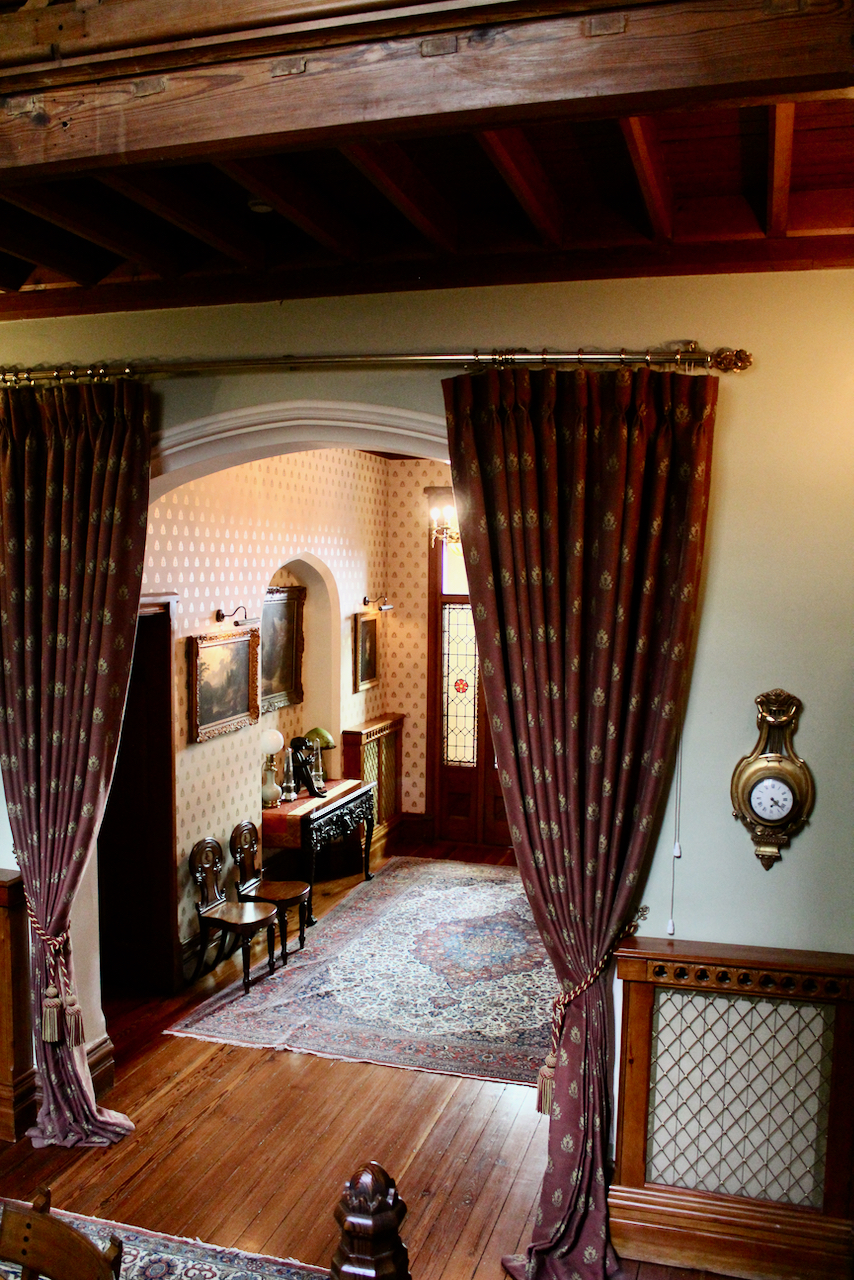
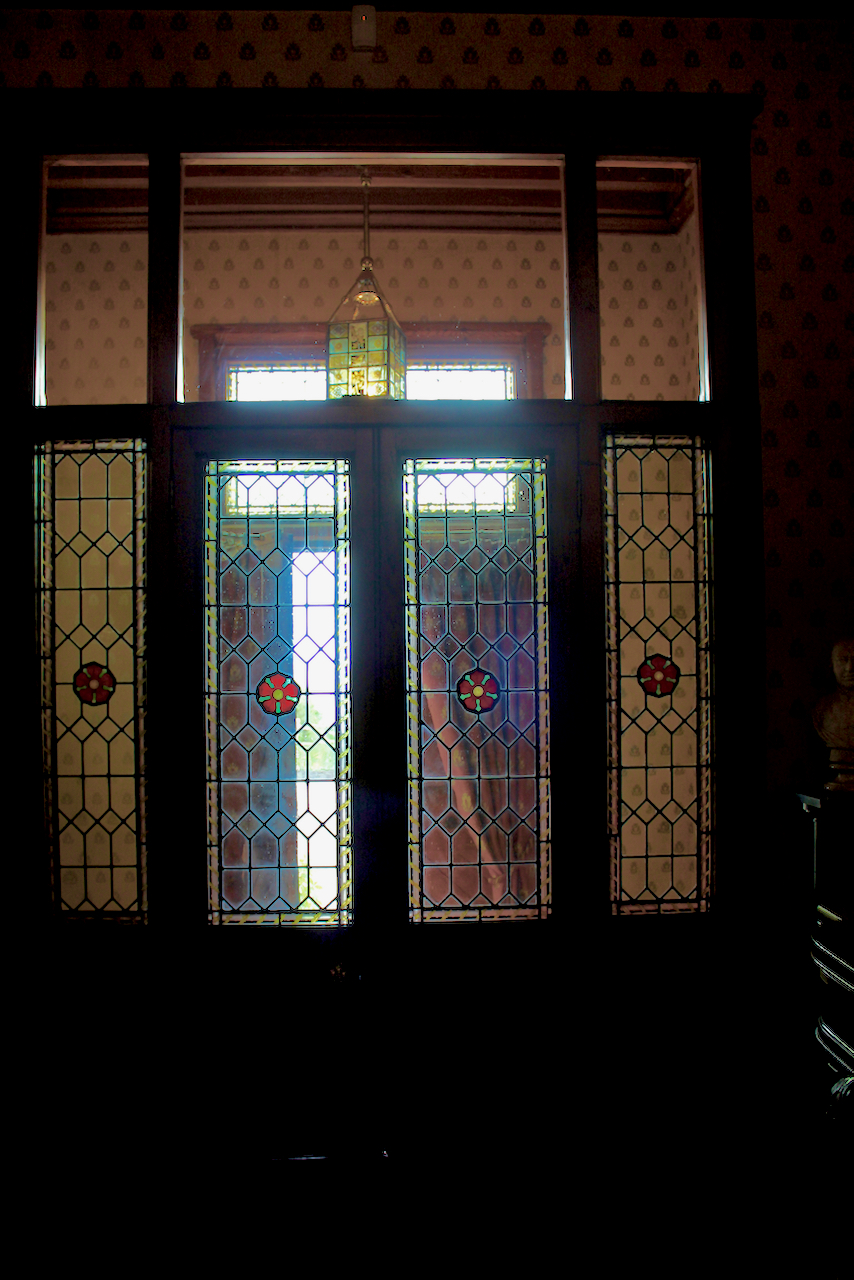
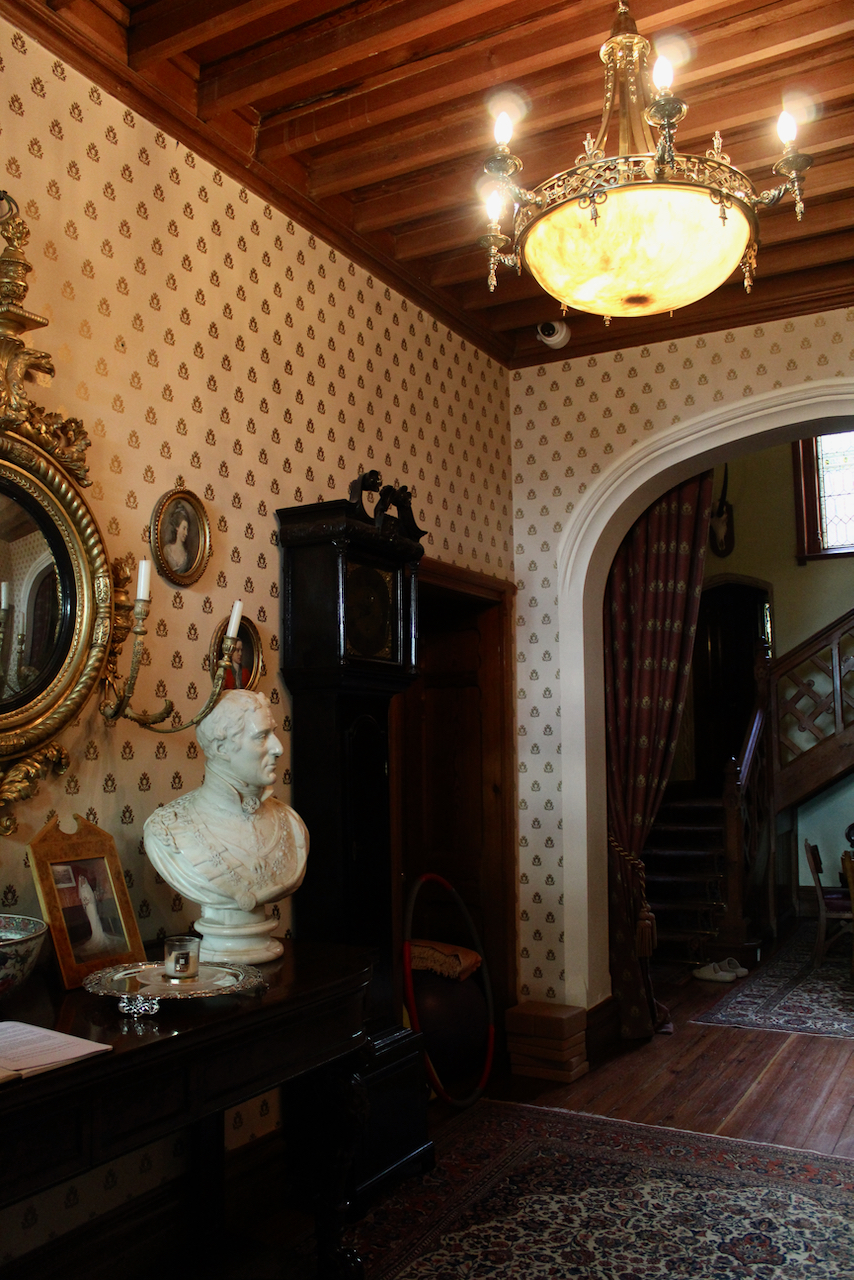
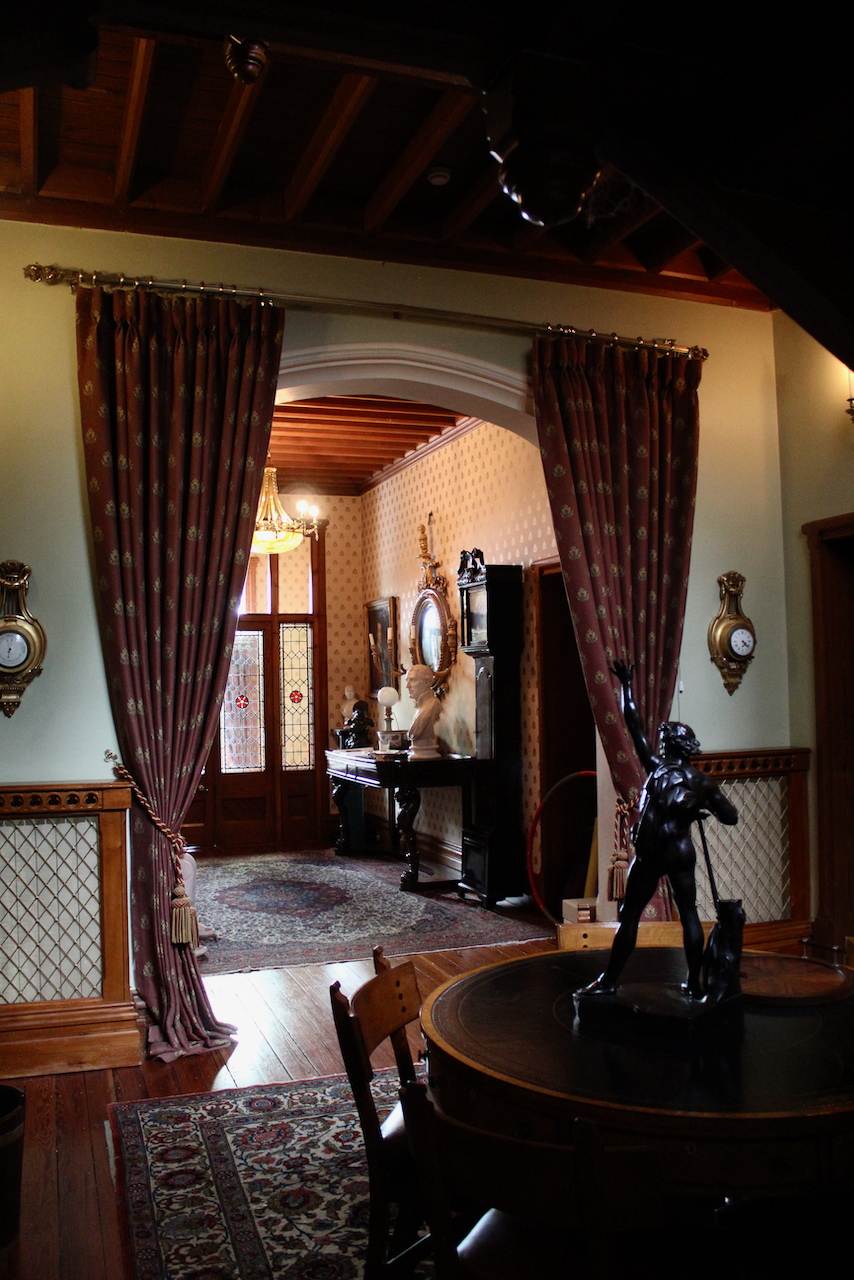
Curtains hang on the back of the front door. The use of portiére rods with drapes were extensively used in Victorian homes to keep out draughts. The wallpaper is modern, supplied by Watts of London, and it copies an original Pugin design. All of the woodwork in the house is the original pitch pine, and has many Gothic details. The ceiling beams in the main hall have moulded ribs. The door to the right before the Tudor arch leads to the dining room, and to the left, the front drawing room.
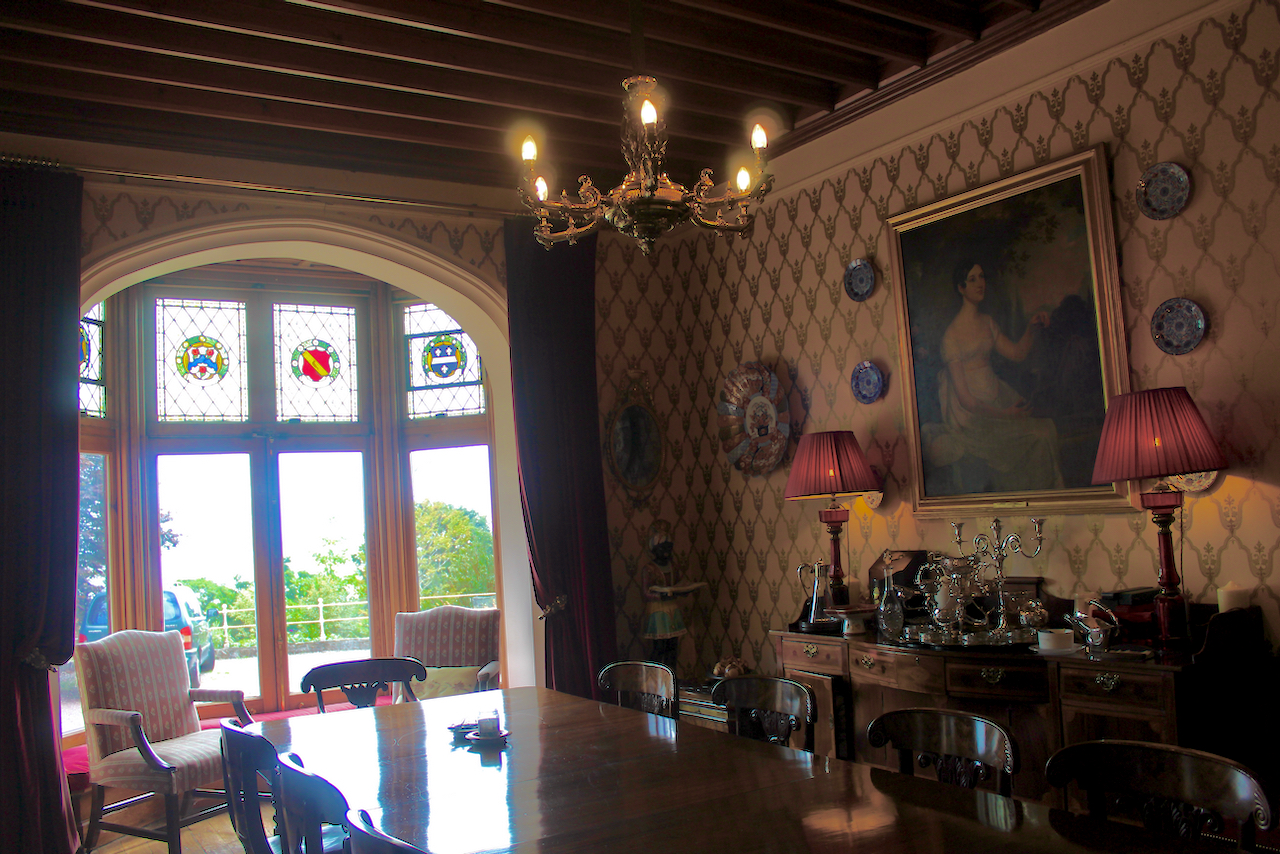
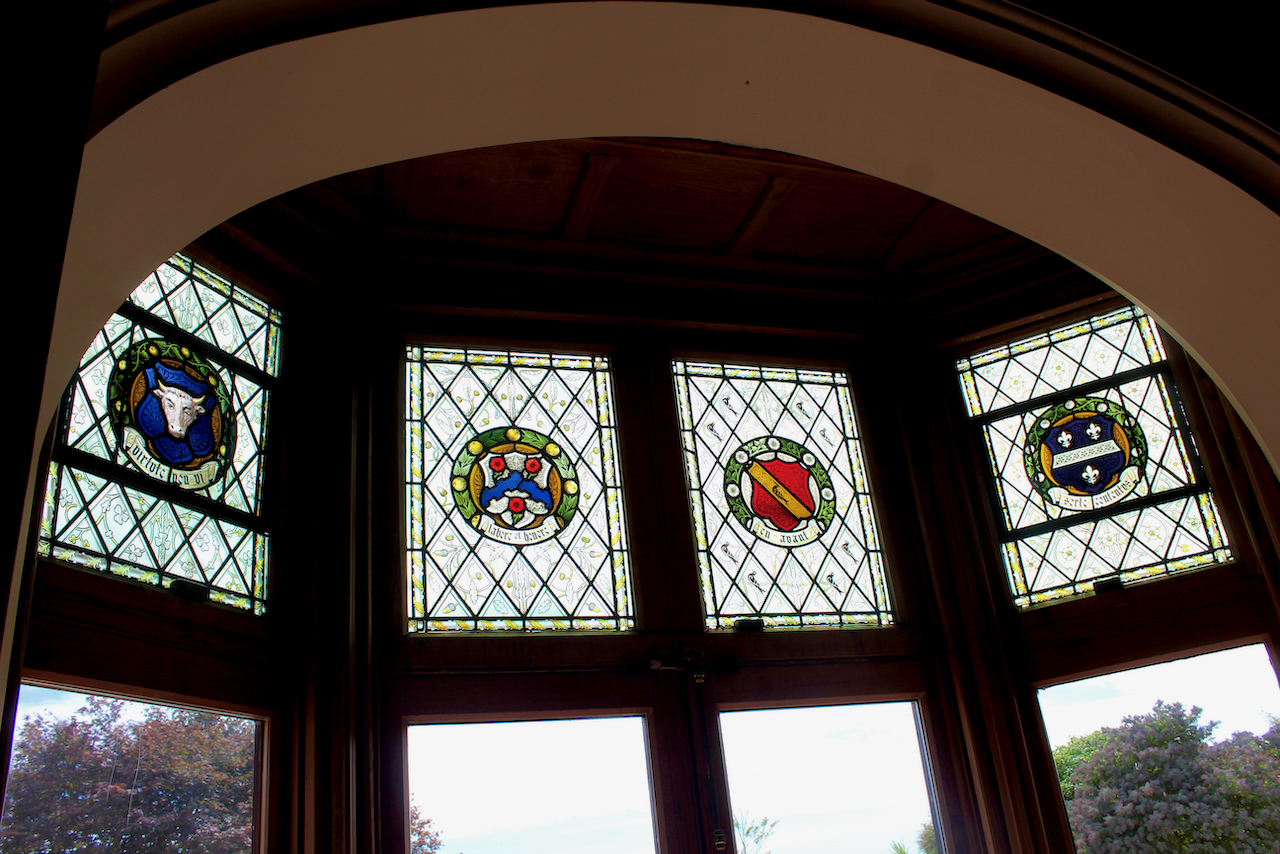
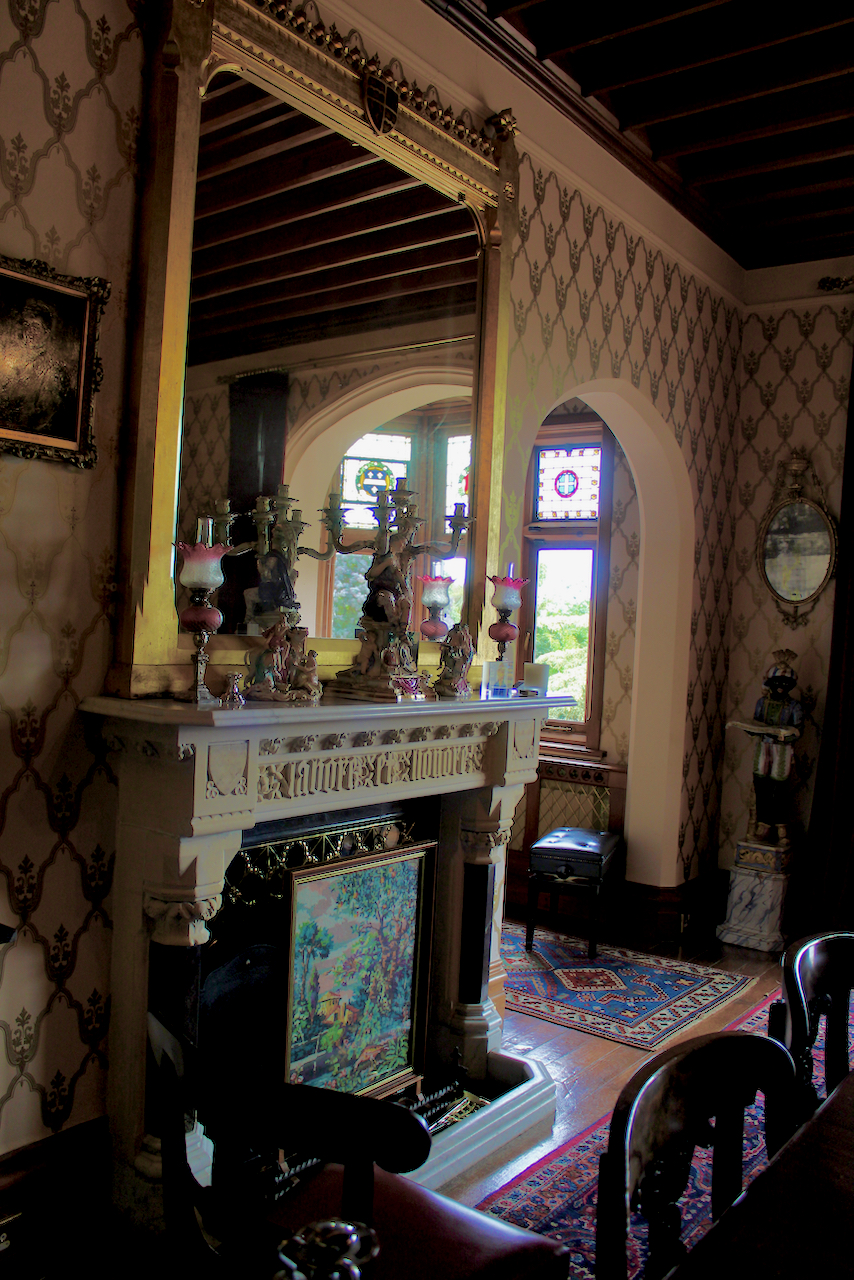
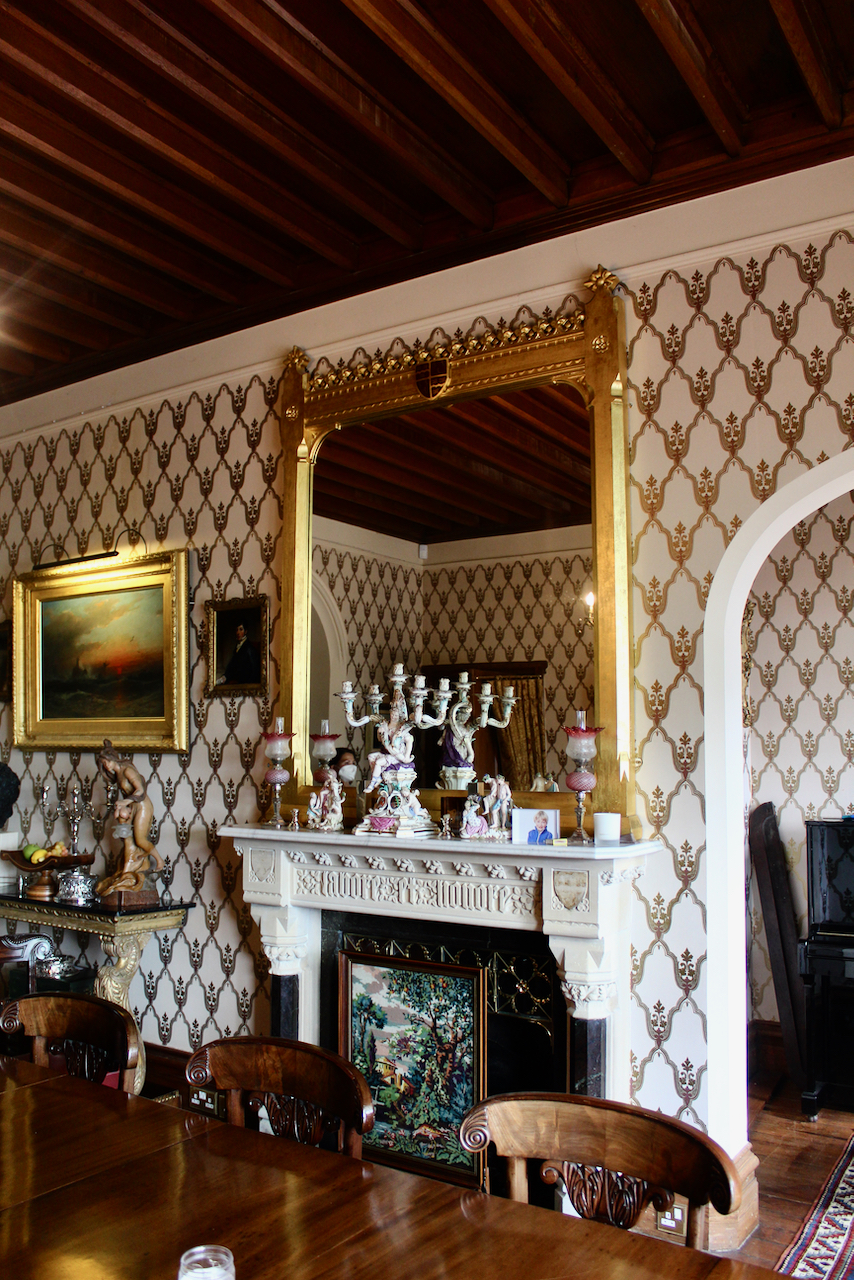
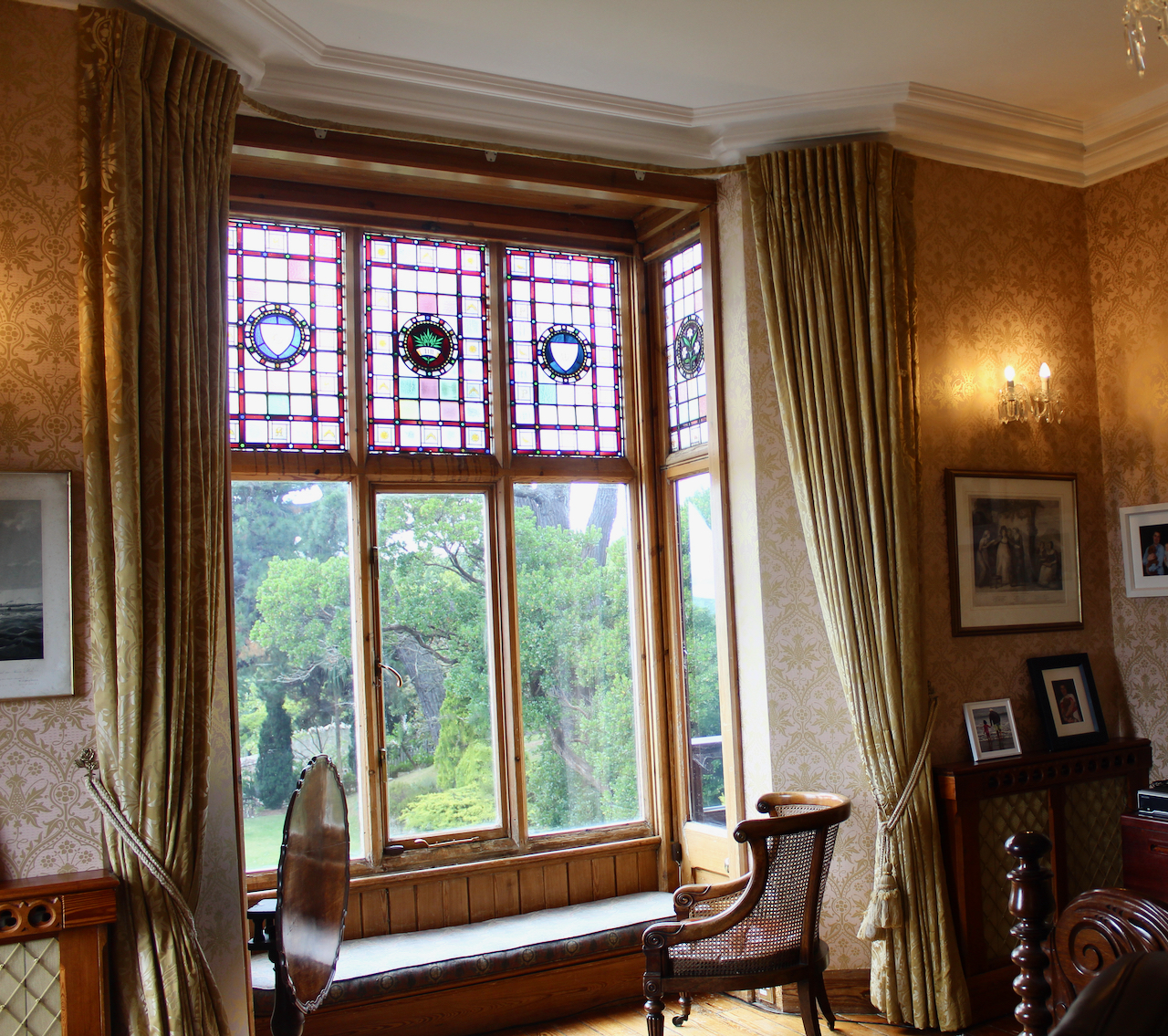
The dining room has a pine ceiling similar to that in the hall. In the bow window on the left is the Ashlin crest and on the right, the Pugin crest. The Gothic designed sandstone fireplace has the Ashlin motto, “Labore et Honore.” The wallpaper design, and that of the drapes, is an original Pugin design.
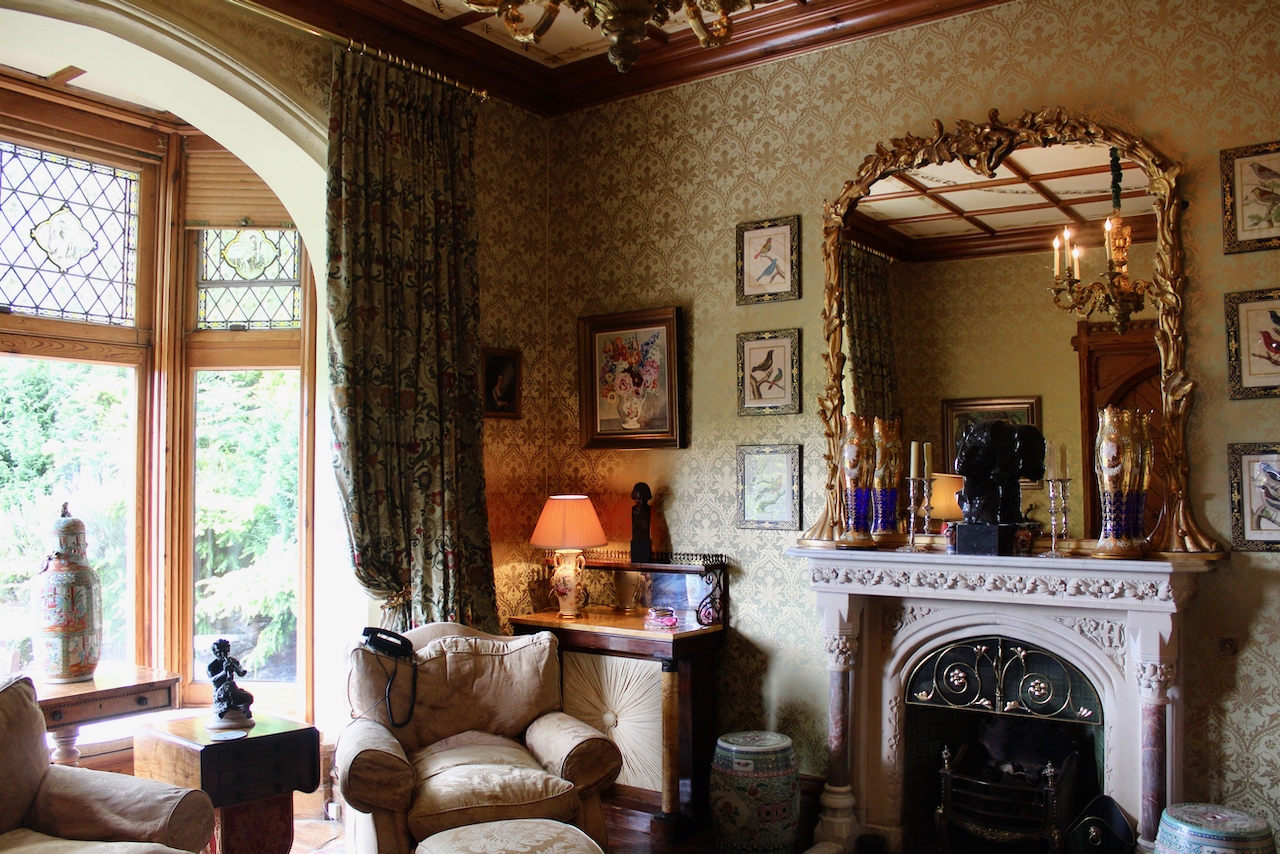
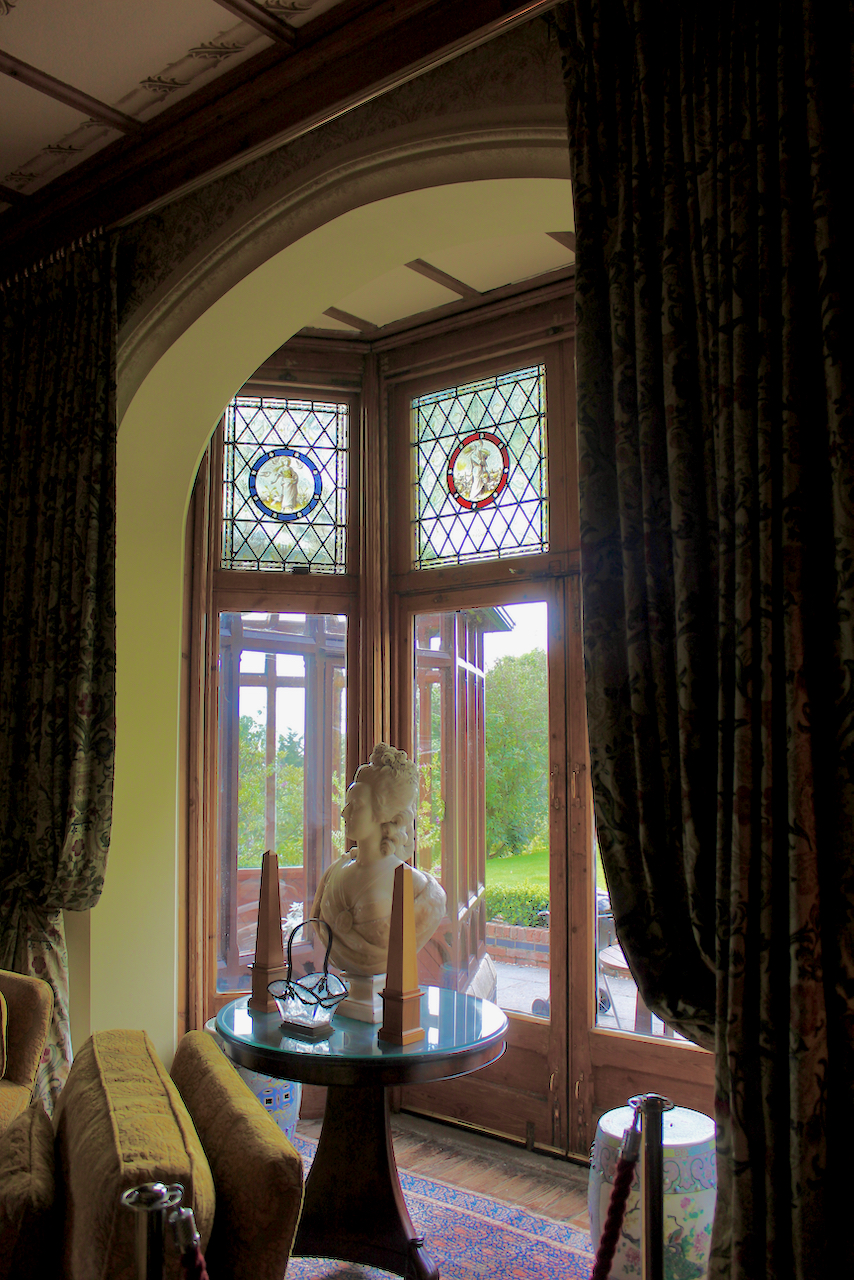
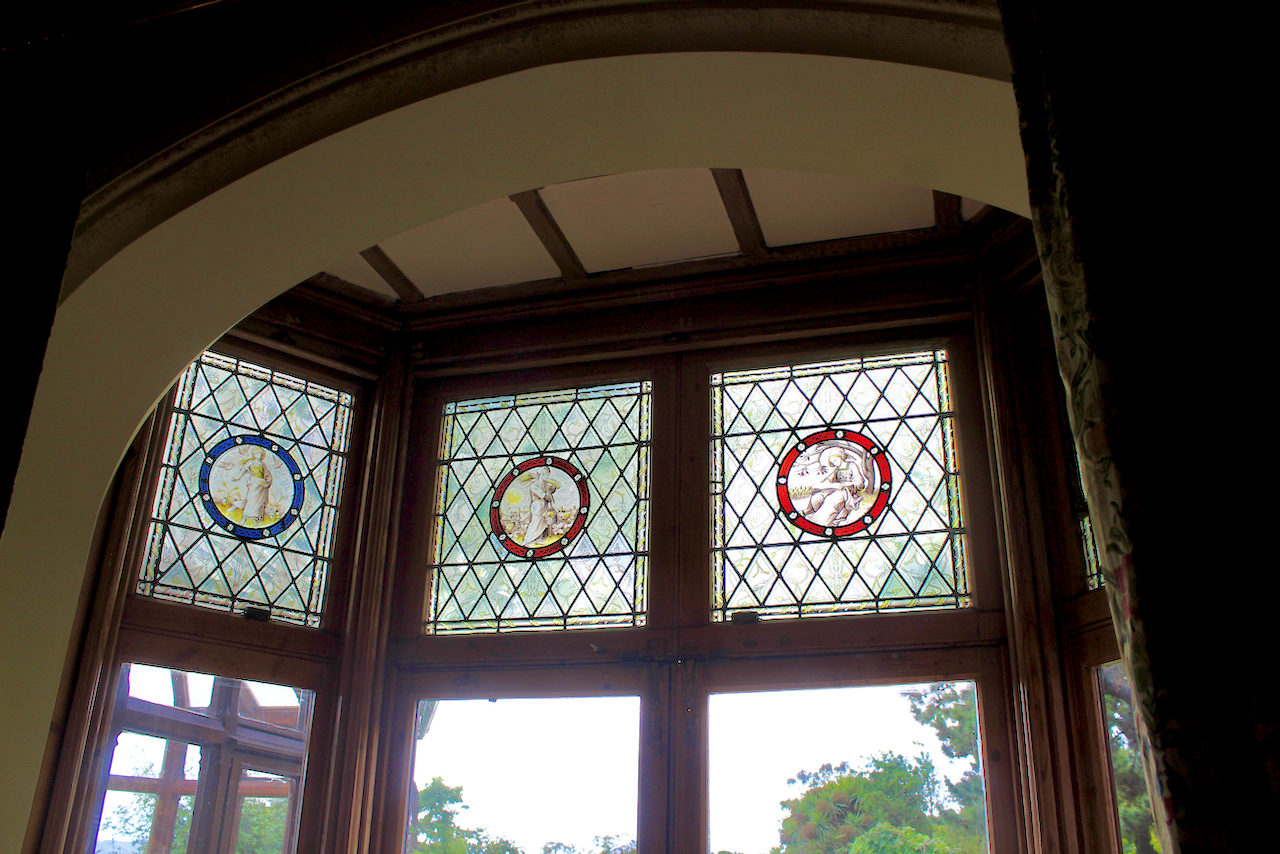
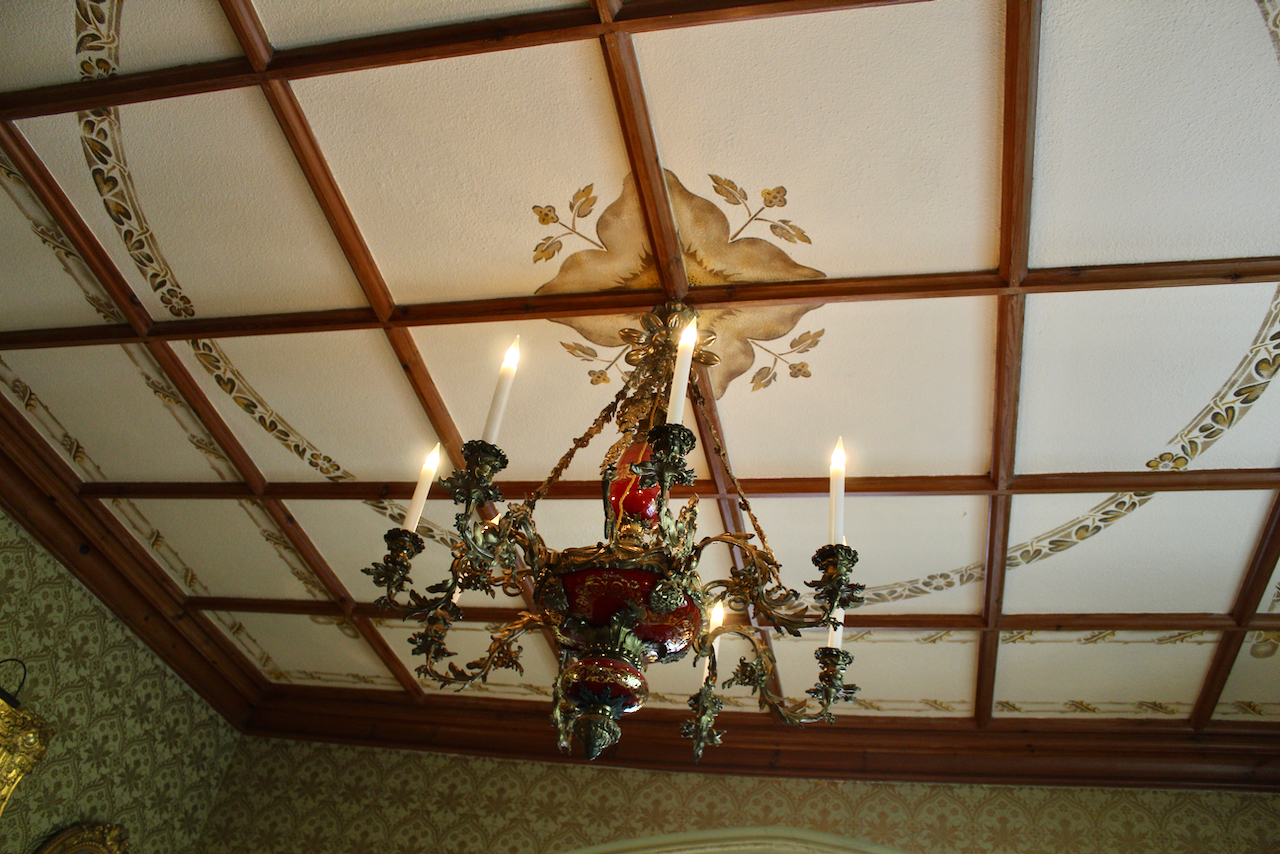
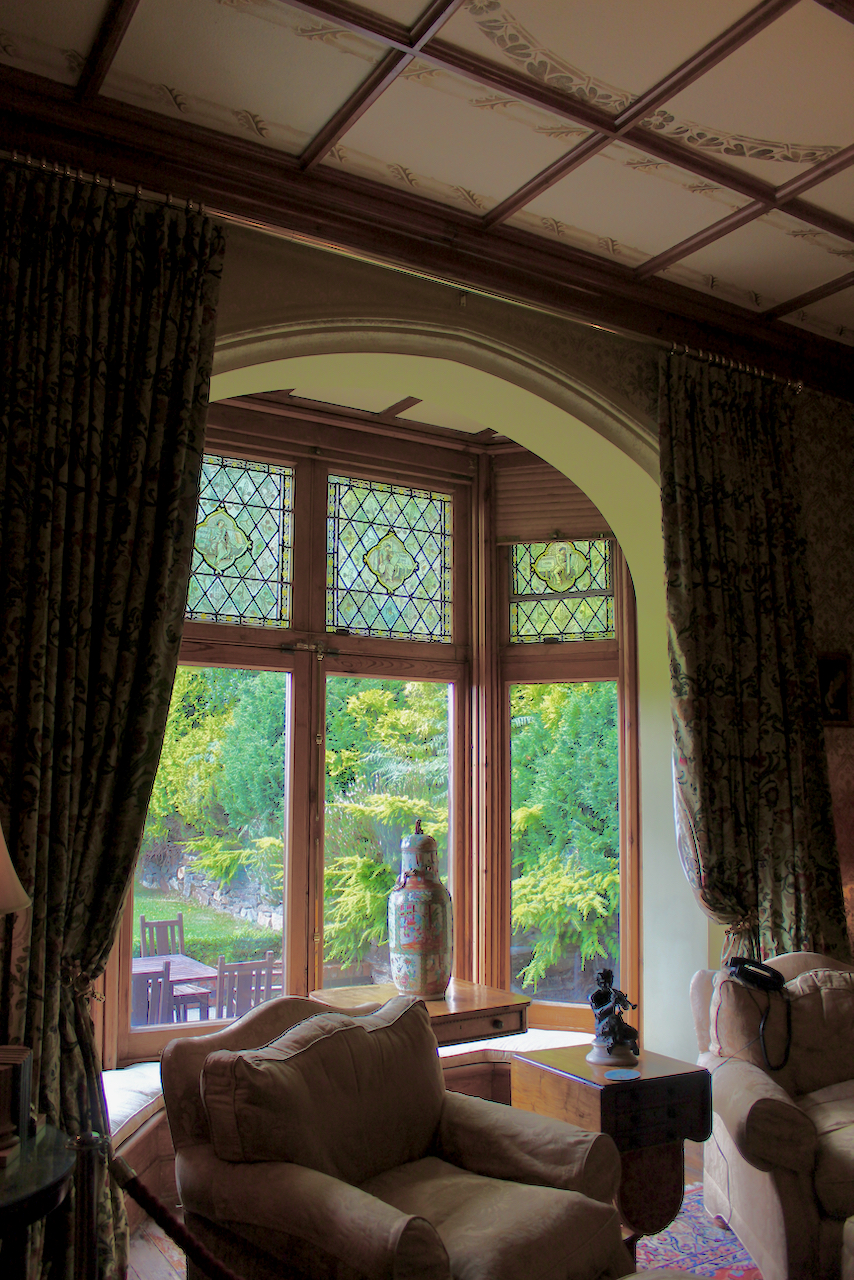
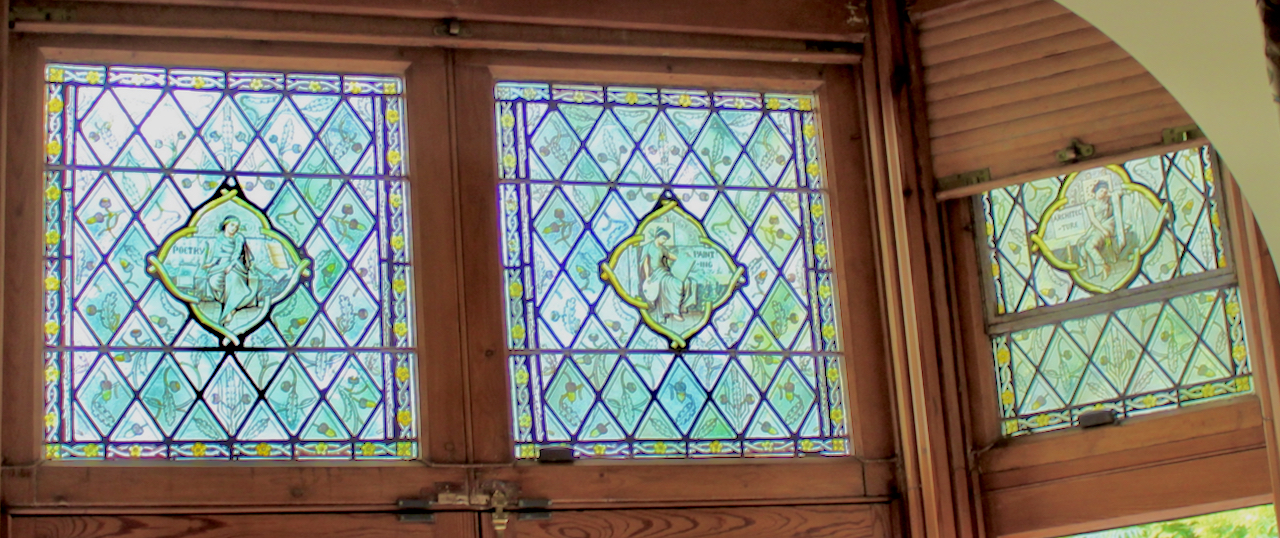
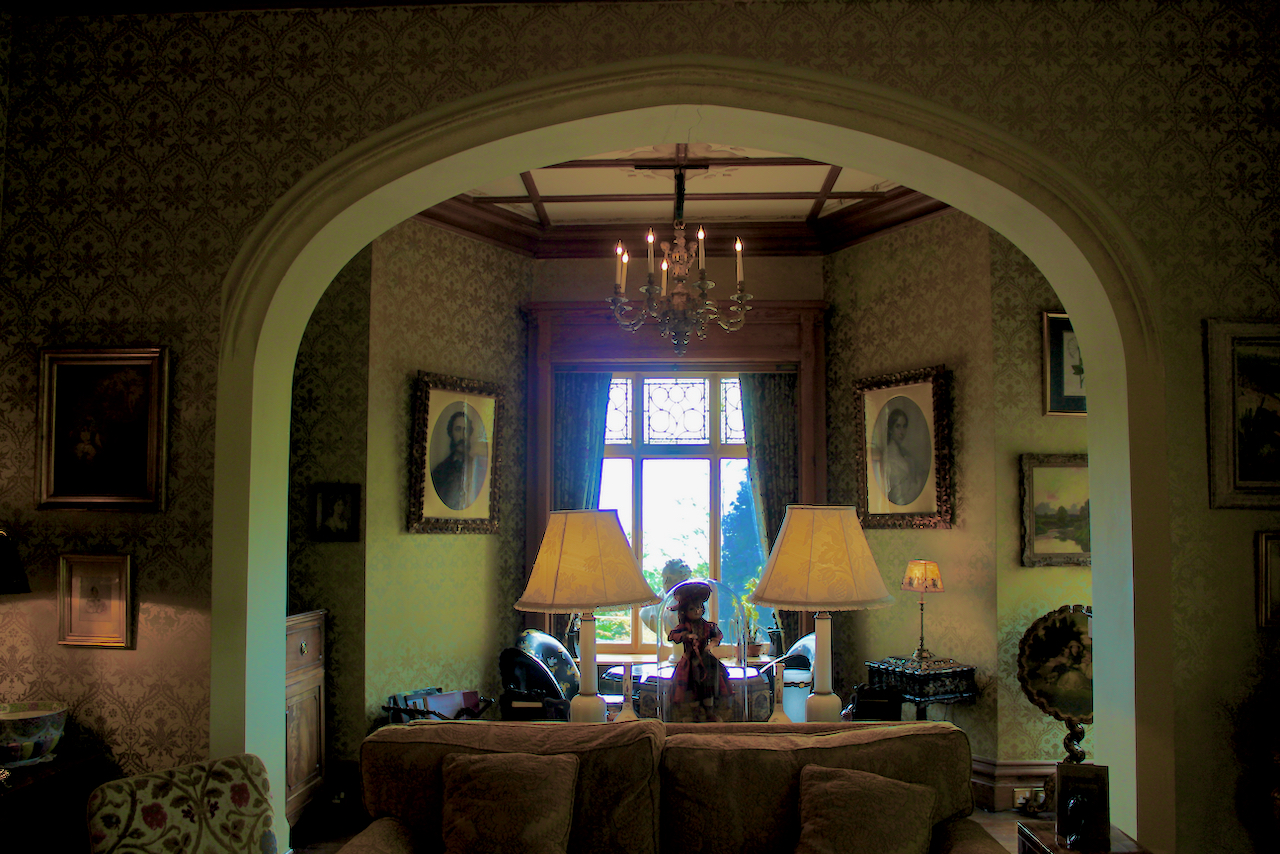
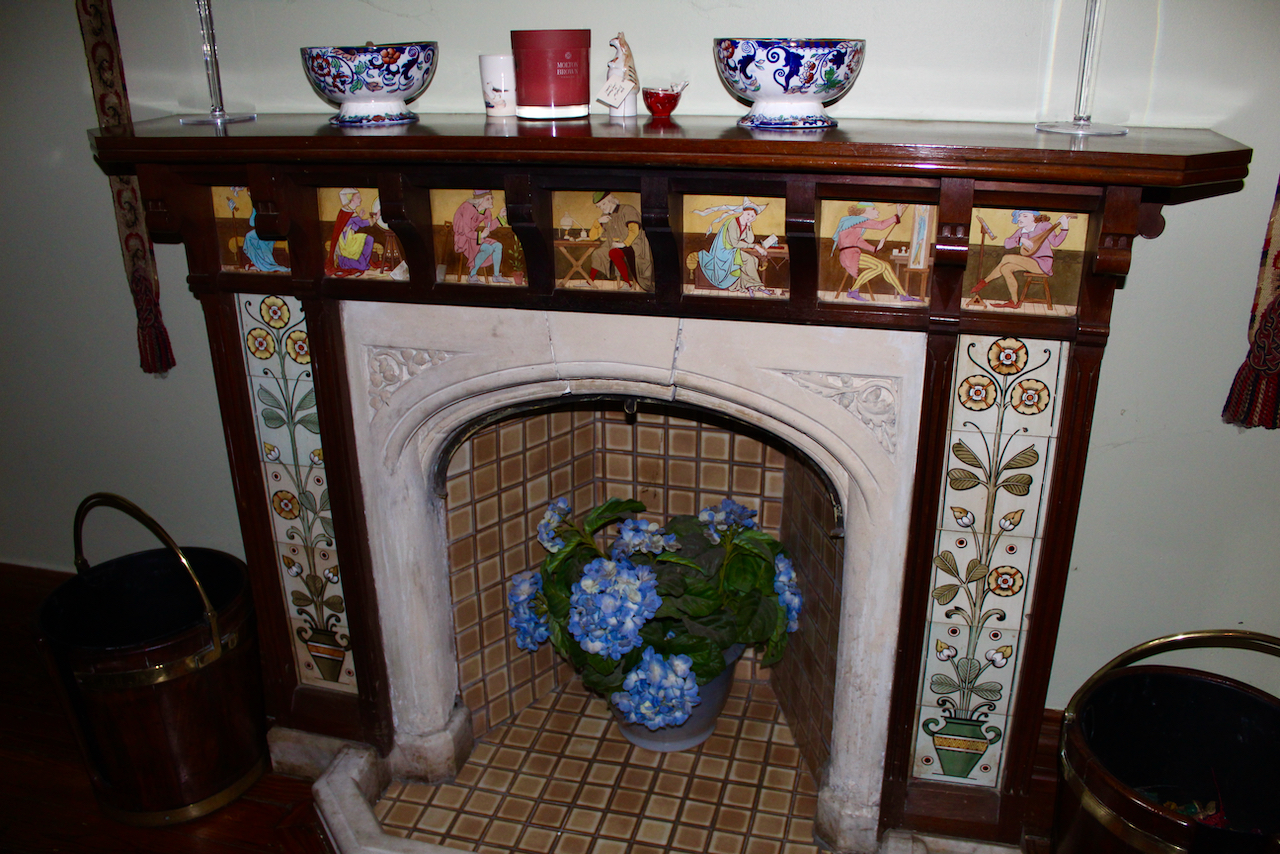
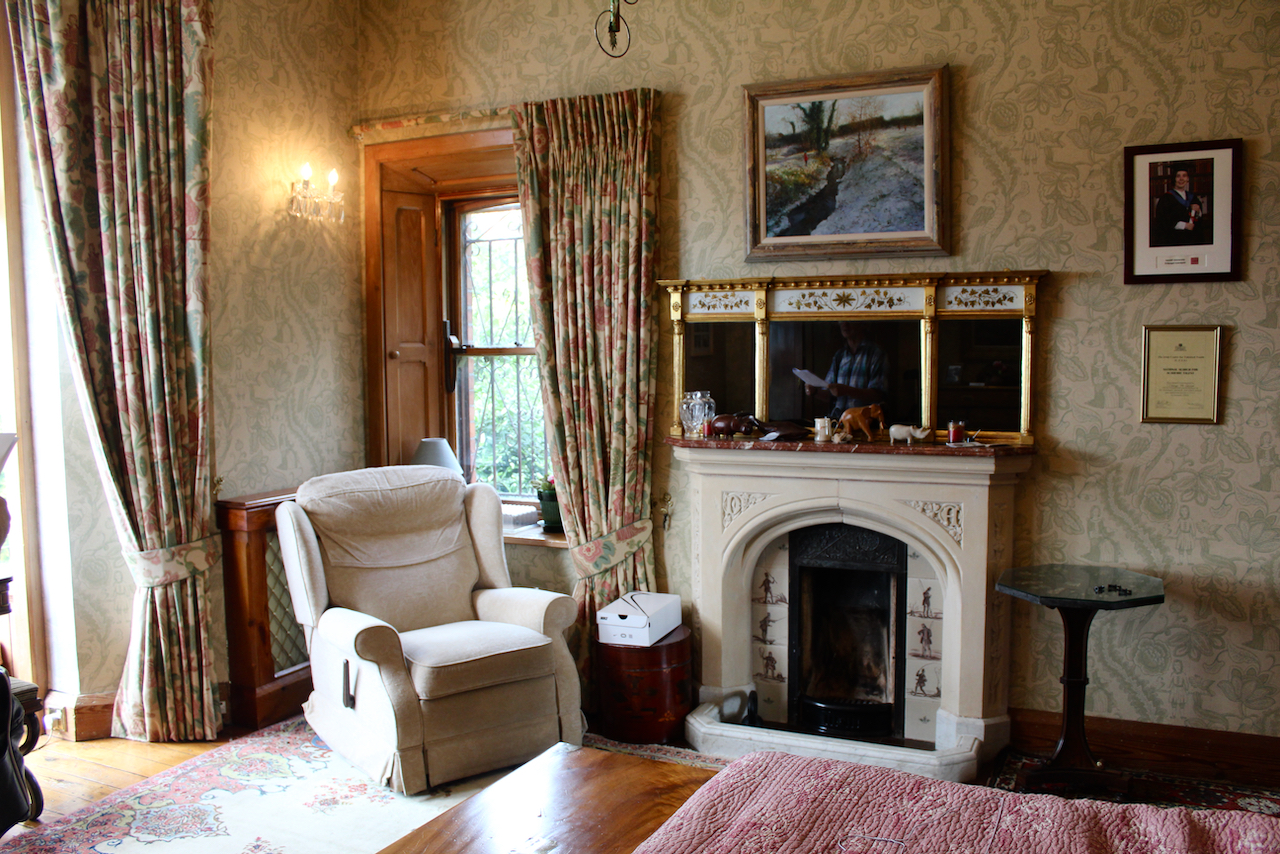
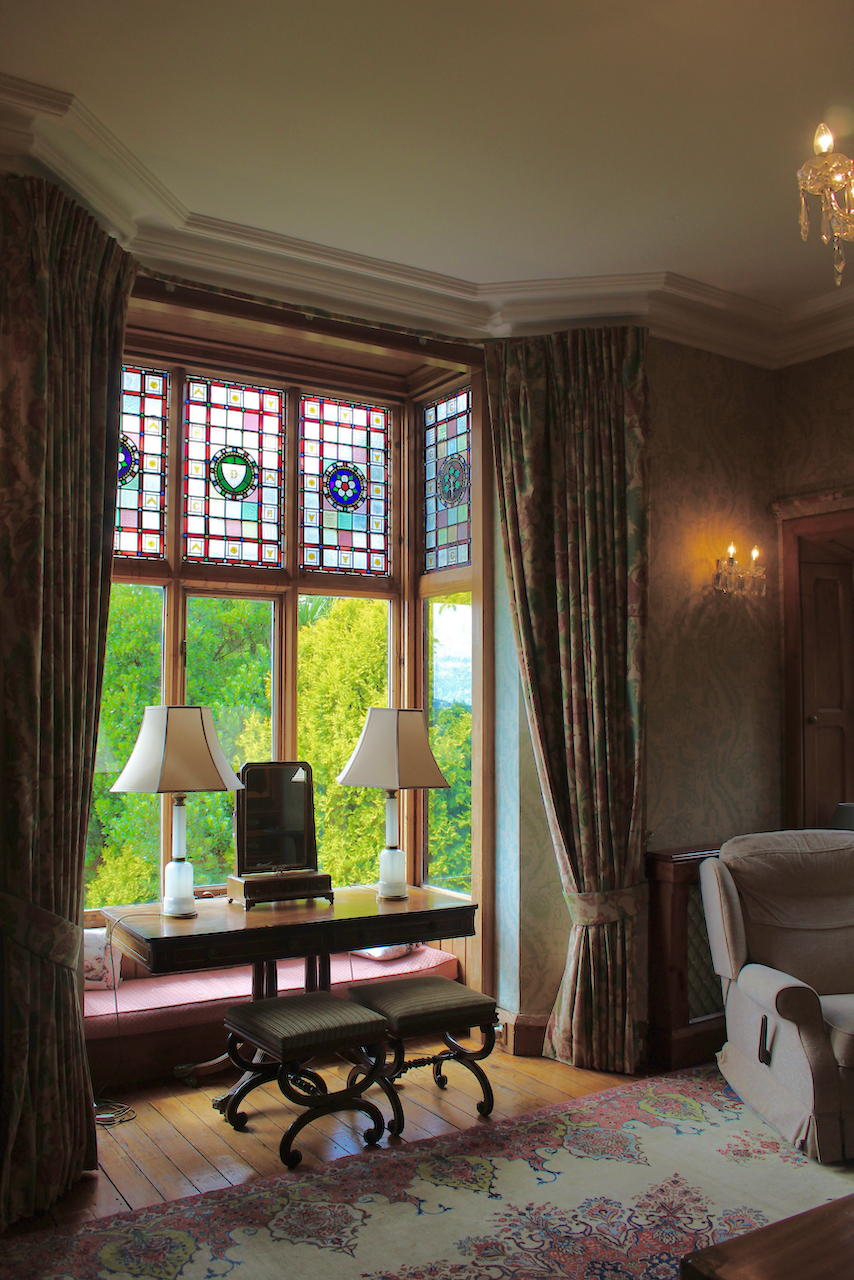
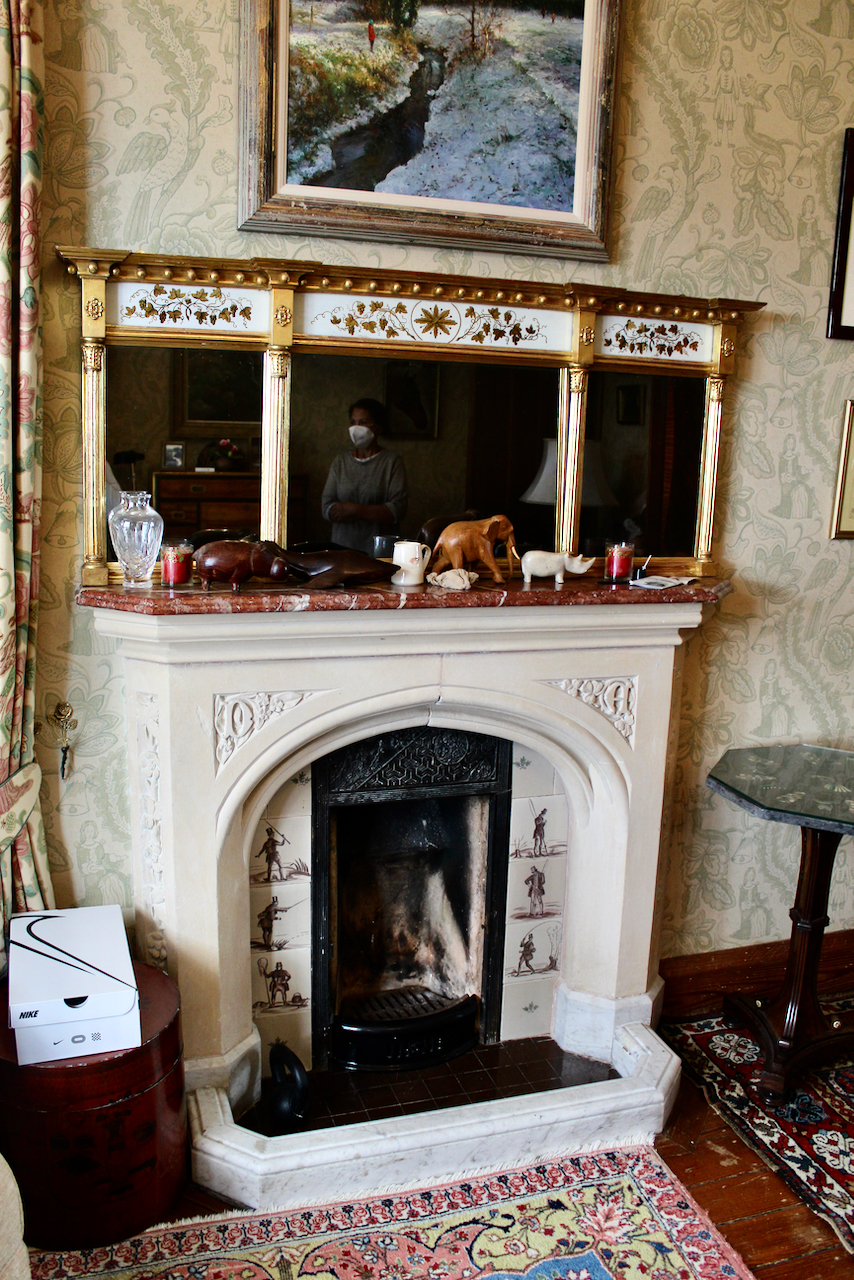
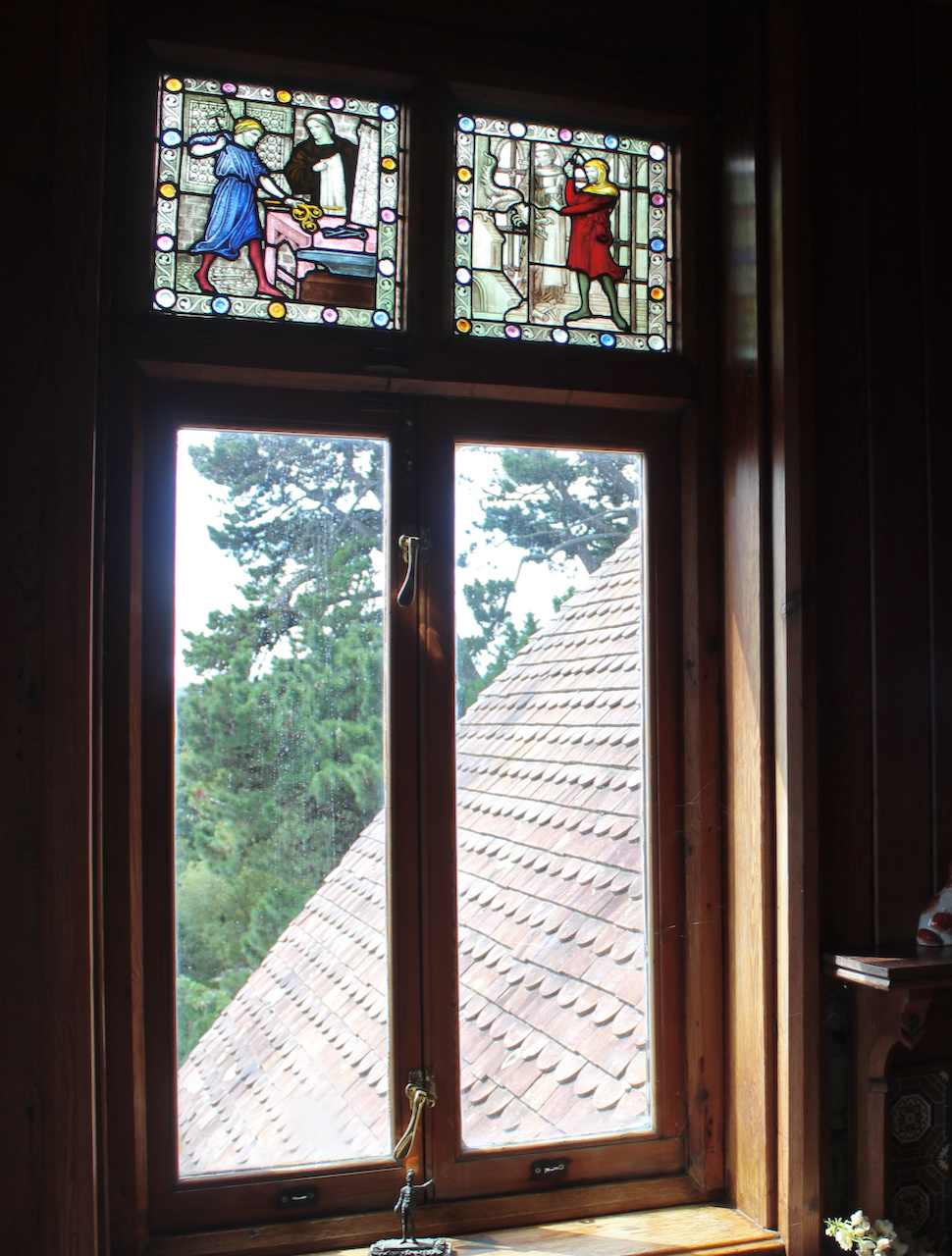
The Front Drawing Room and back study, the leaflet from St. George’s tells us, are interconnecting spaces in the manner of Pugin’s design for The Grange where Ashlin’s wife grew up. Again, the wallpaper and drapes are of Pugin’s design. The fireplace has the inscribed initials of G.A. for George Ashlin. The ceiling is stencilled, which is a feature of Pugin’s domestic designs. The area beyond the arch was initially a Gothic conservatory. There are two canted bays, one with French doors out to the lawn. The stained glass panels in one depict the four seasons and in the other, figures of music, painting, poetry and architecture.
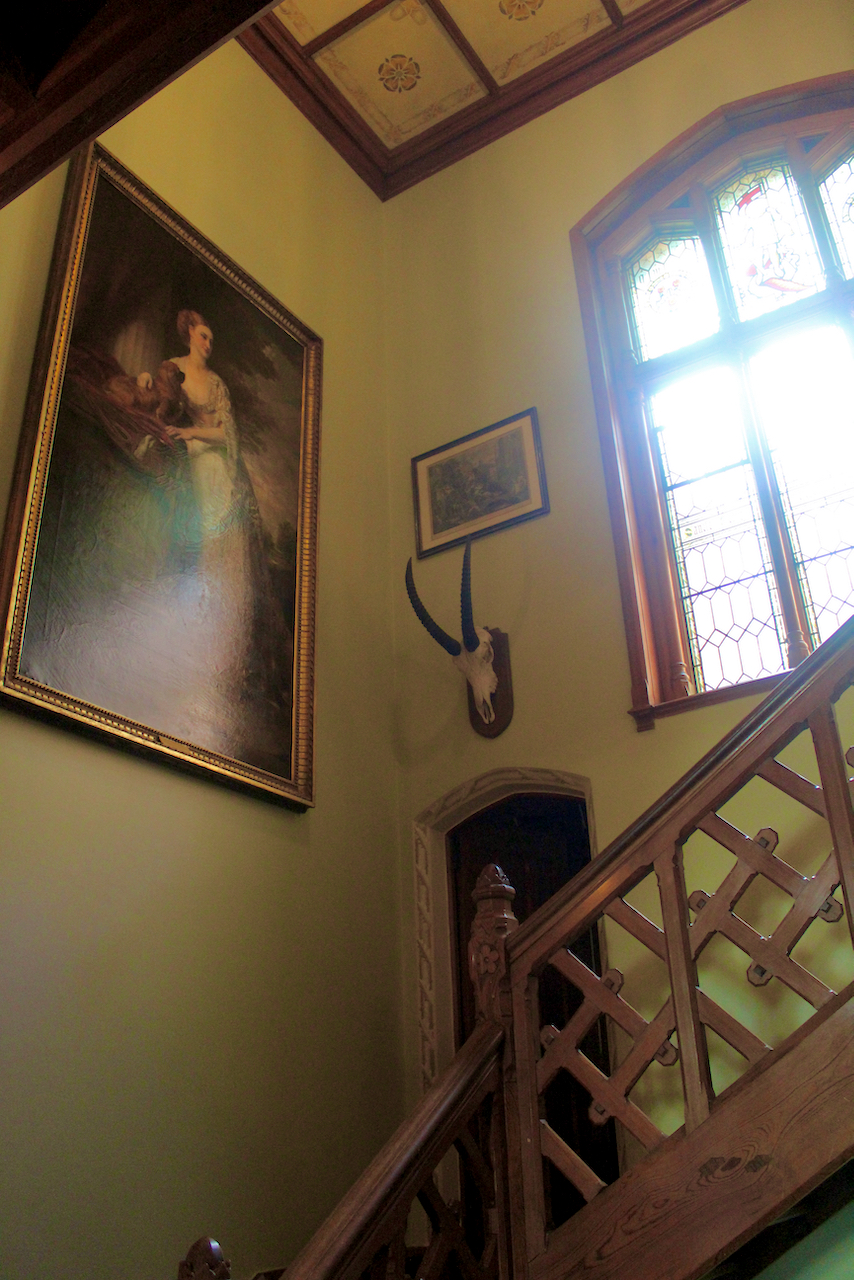
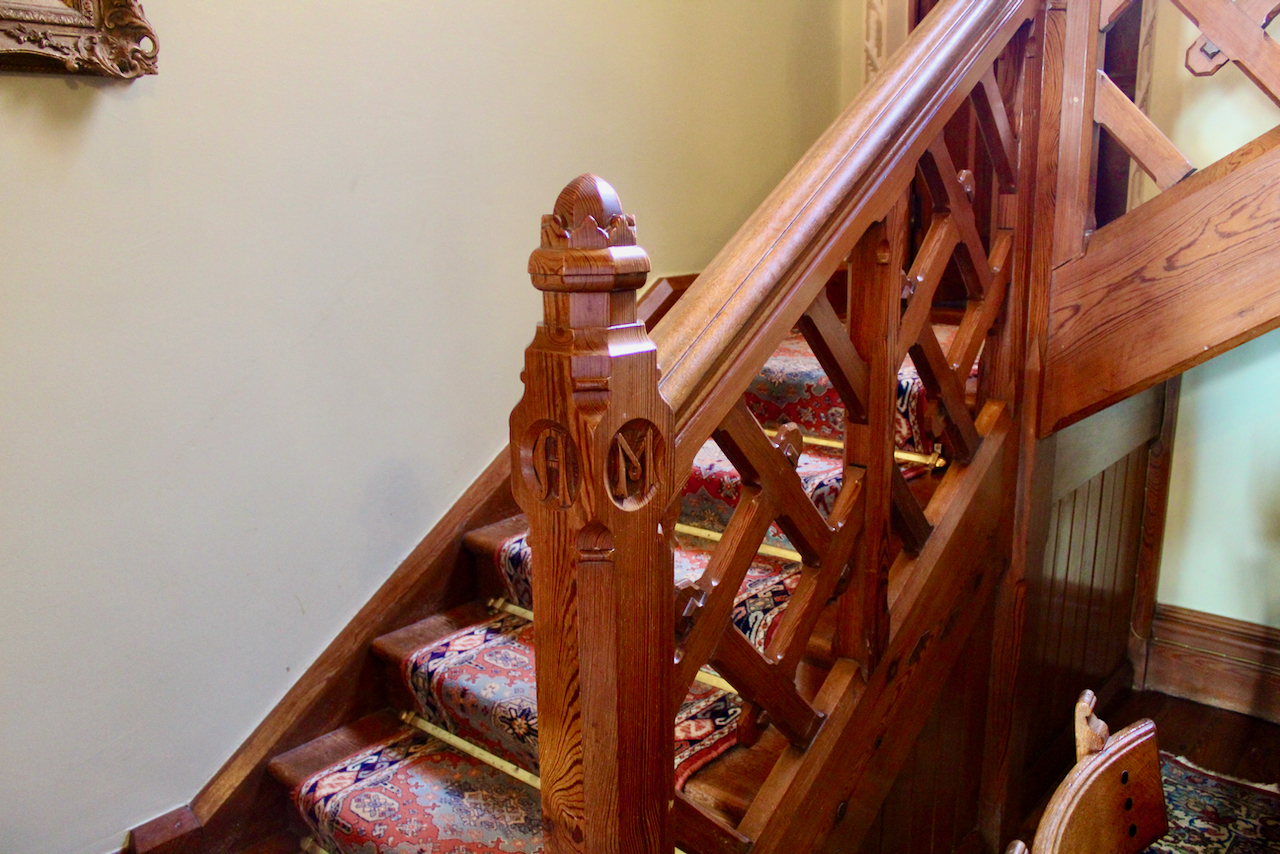
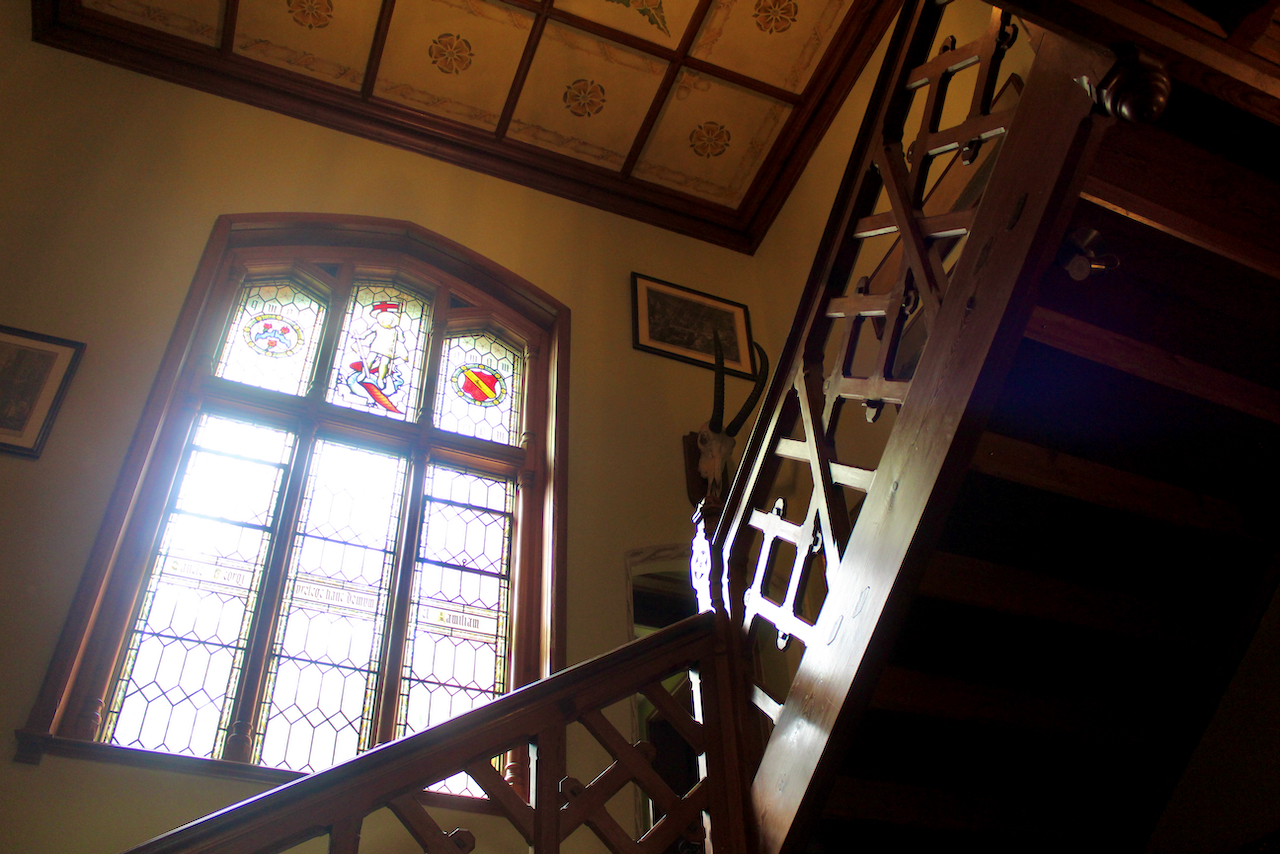
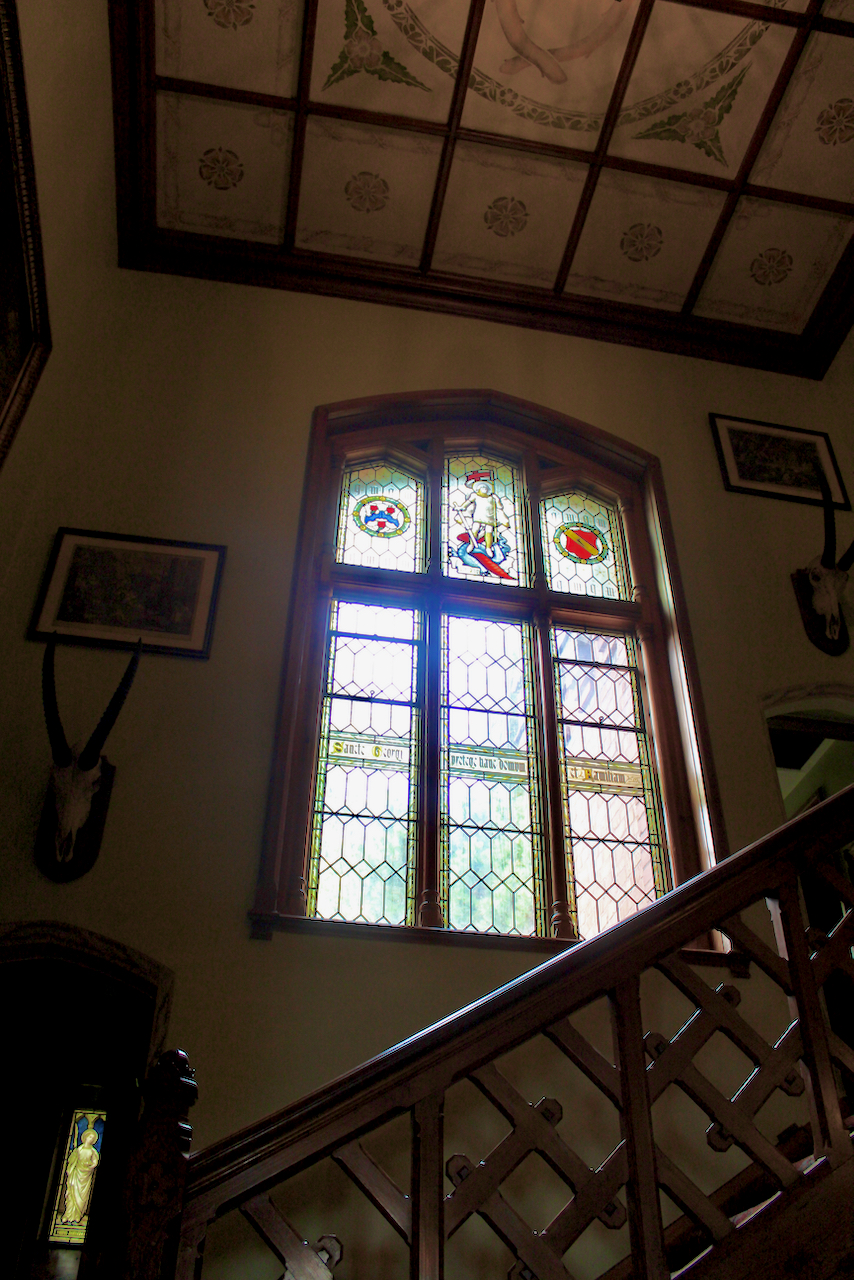
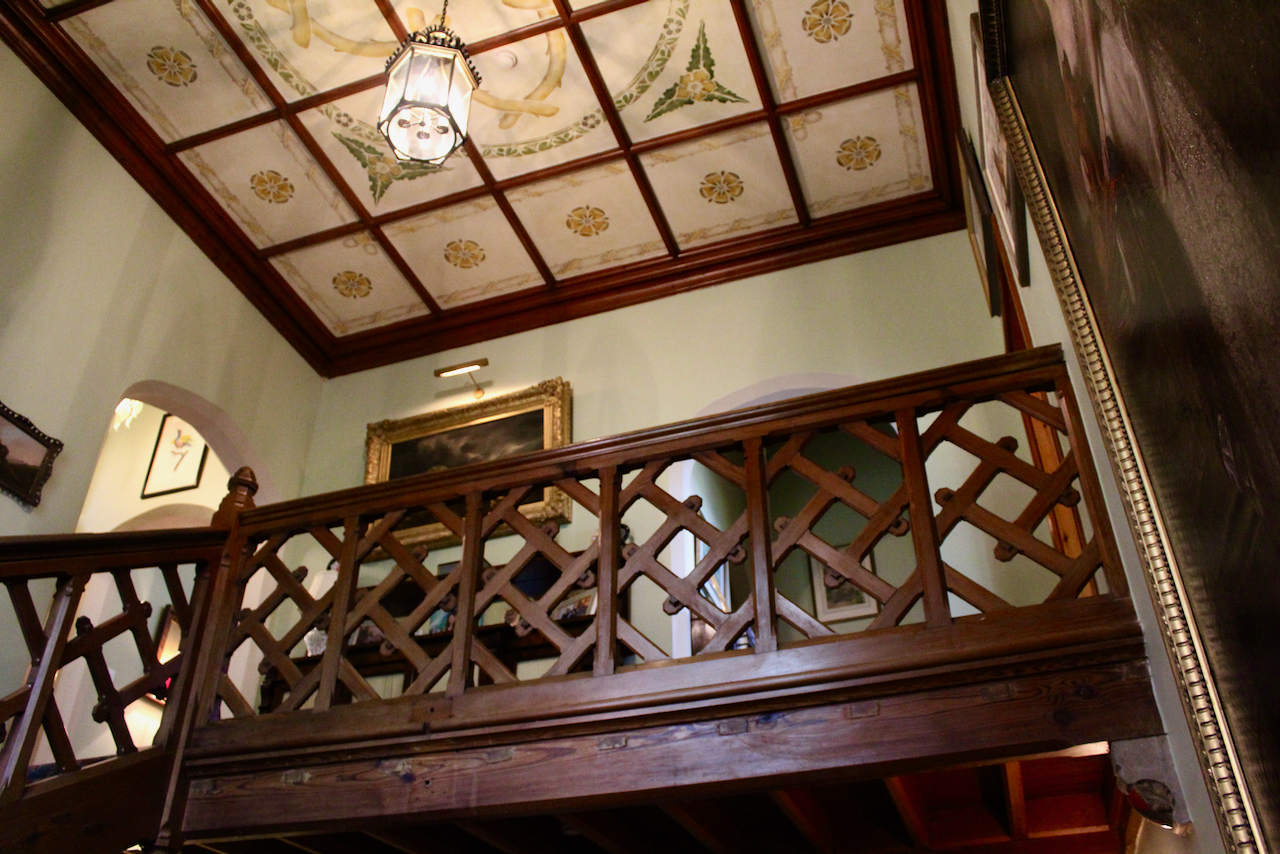
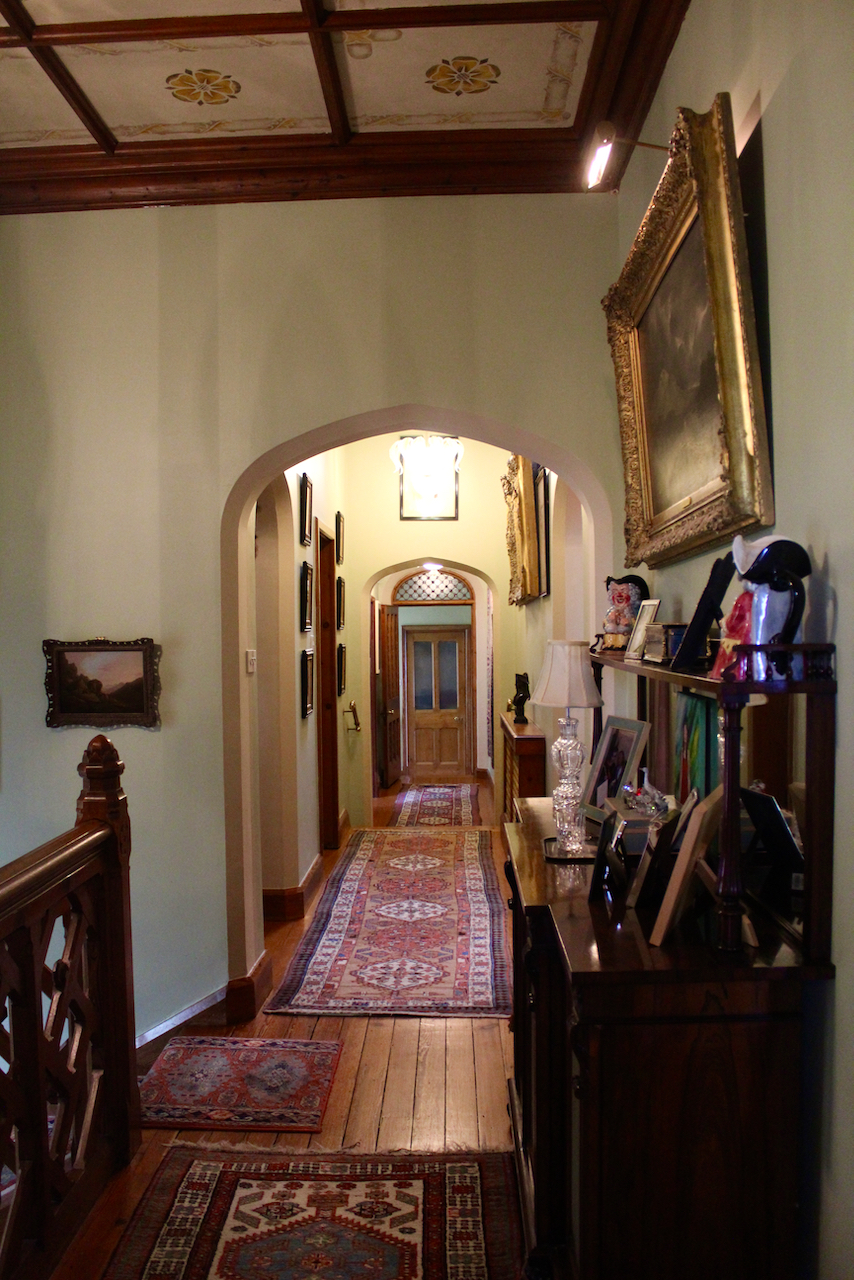
The Back Hall is double height, with a pitch pine staircase winding around the sides. The staircase is similar to that in Mary Pugin’s childhood home, The Grange. The stairs feature St. Brigid cross shapes and on the newels, more initials carved for George and Mary.
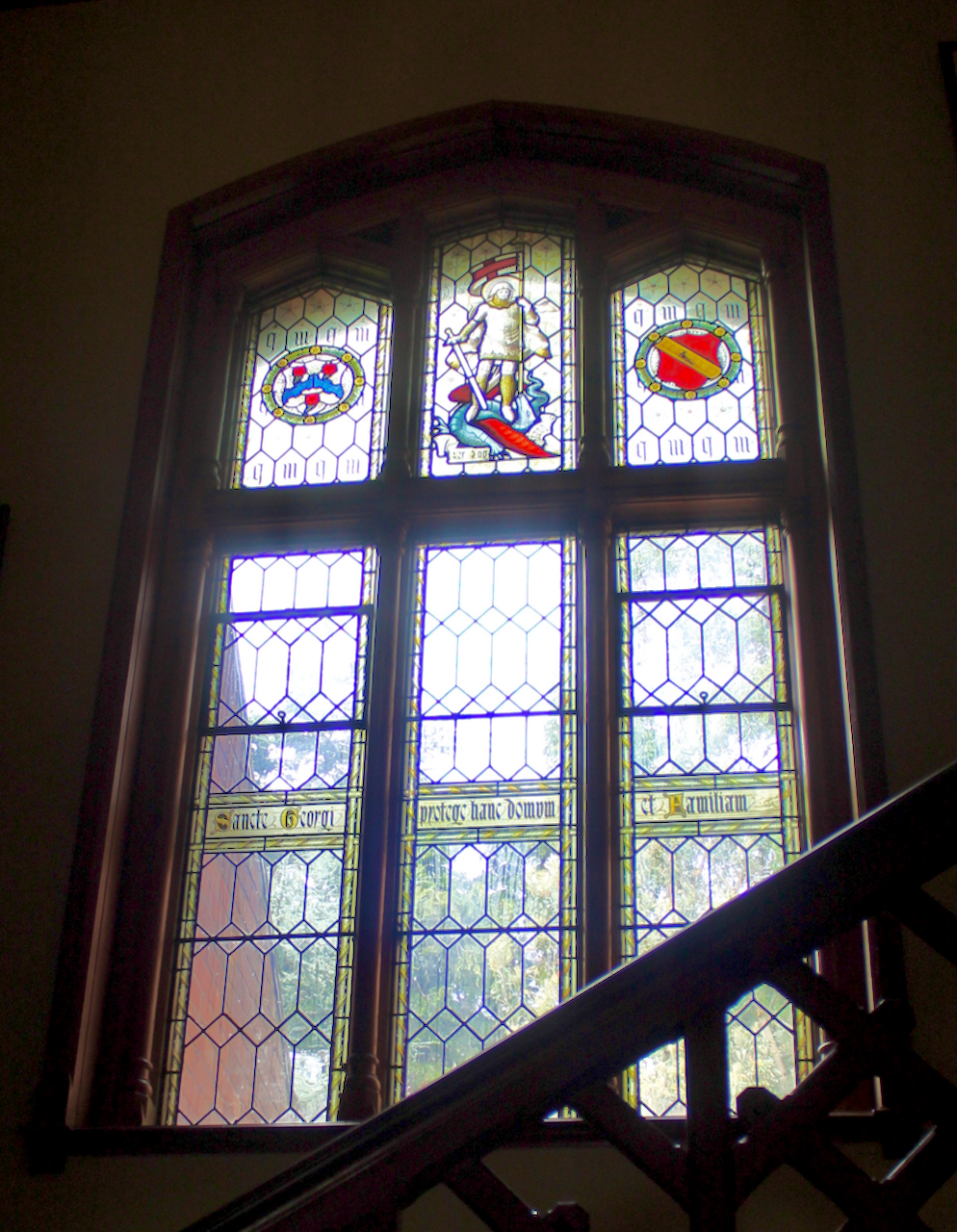
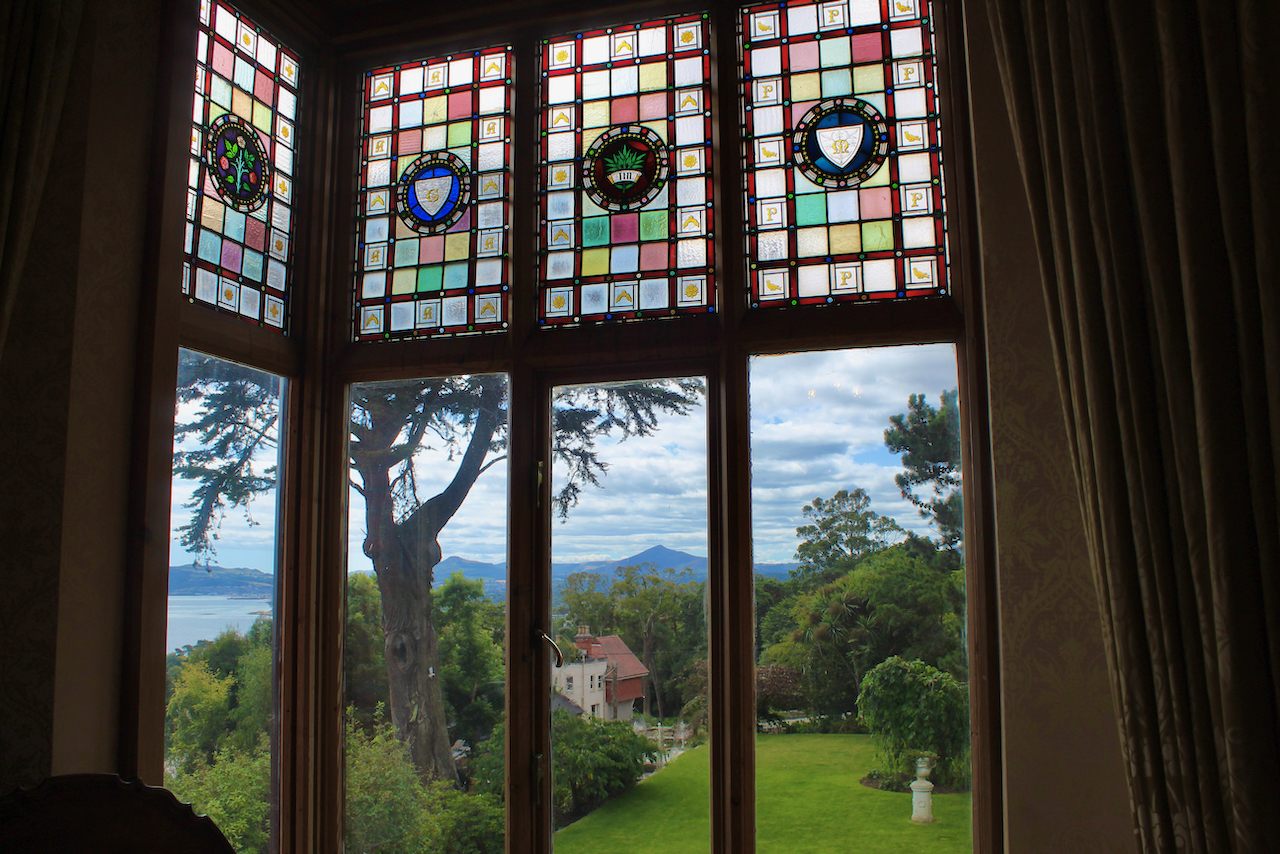
The window which lights the stairs is a three light window in heavy timbered frame with vertical glazed panels. The stained glass depicts St. George, and on one side is the Ashlin crest and the other, the Pugin crest, with G. (George) and M. (Mary) initials.
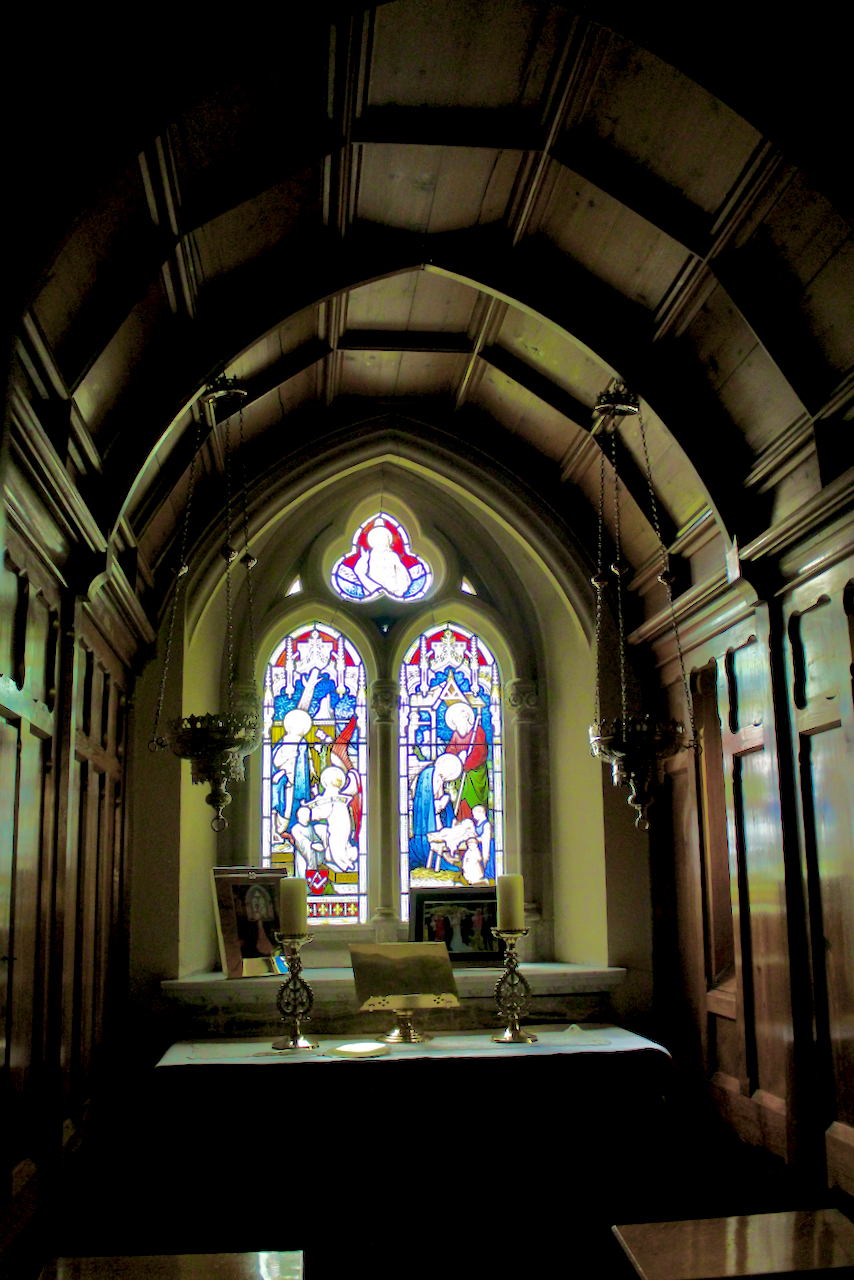
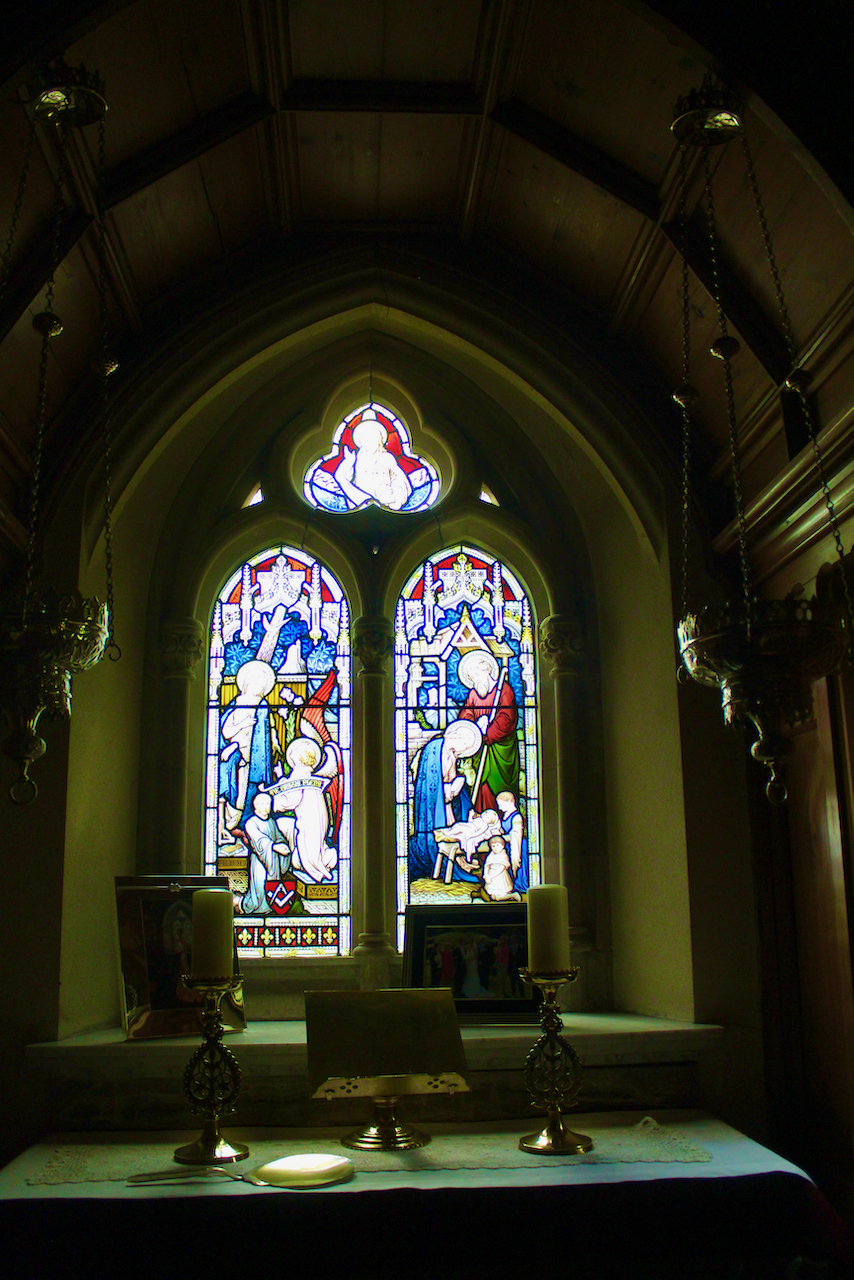
The chapel was built following the birth of George and Mary’s only child, their daughter Miriam. It is panelled with a timber “wagon vault.” The stained glass was designed by Mary Pugin.
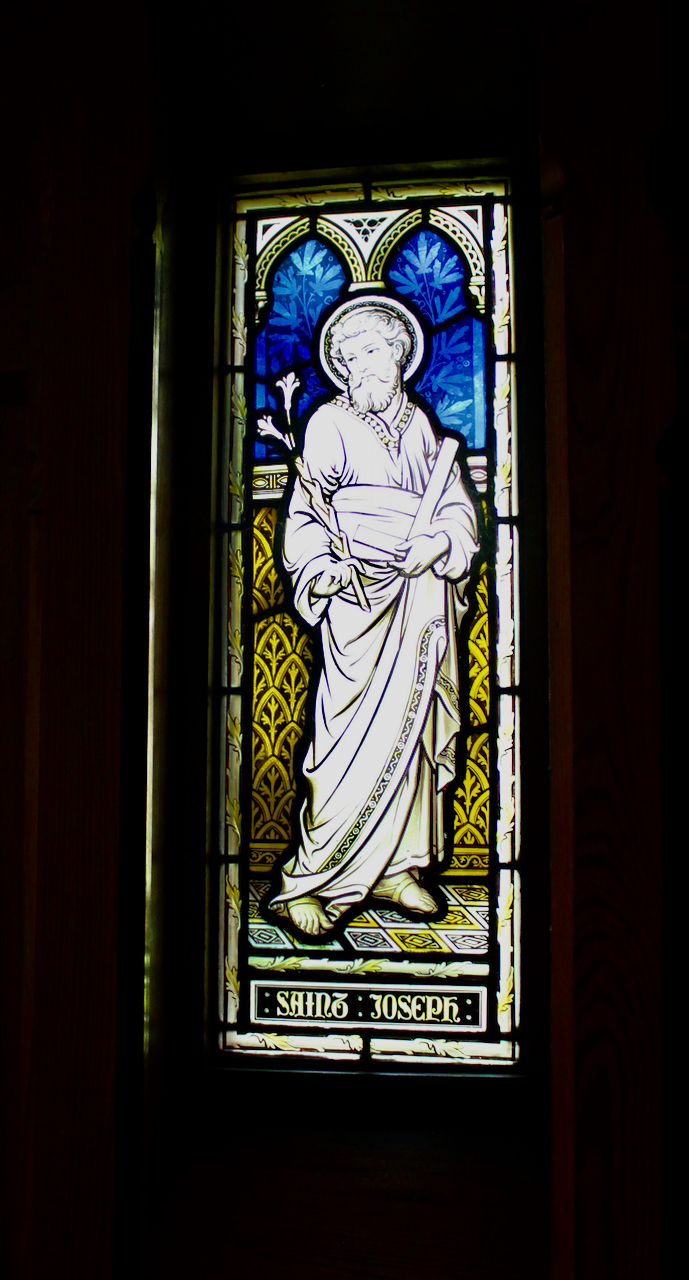
Pictures of many saints are featured in stained glass in the chapel, including St. Dorothea, St. Francis Xavier, St. Joseph and St. George, and there is a beautifully carved altar. George’s mother was named Dorothea (née Coppinger).
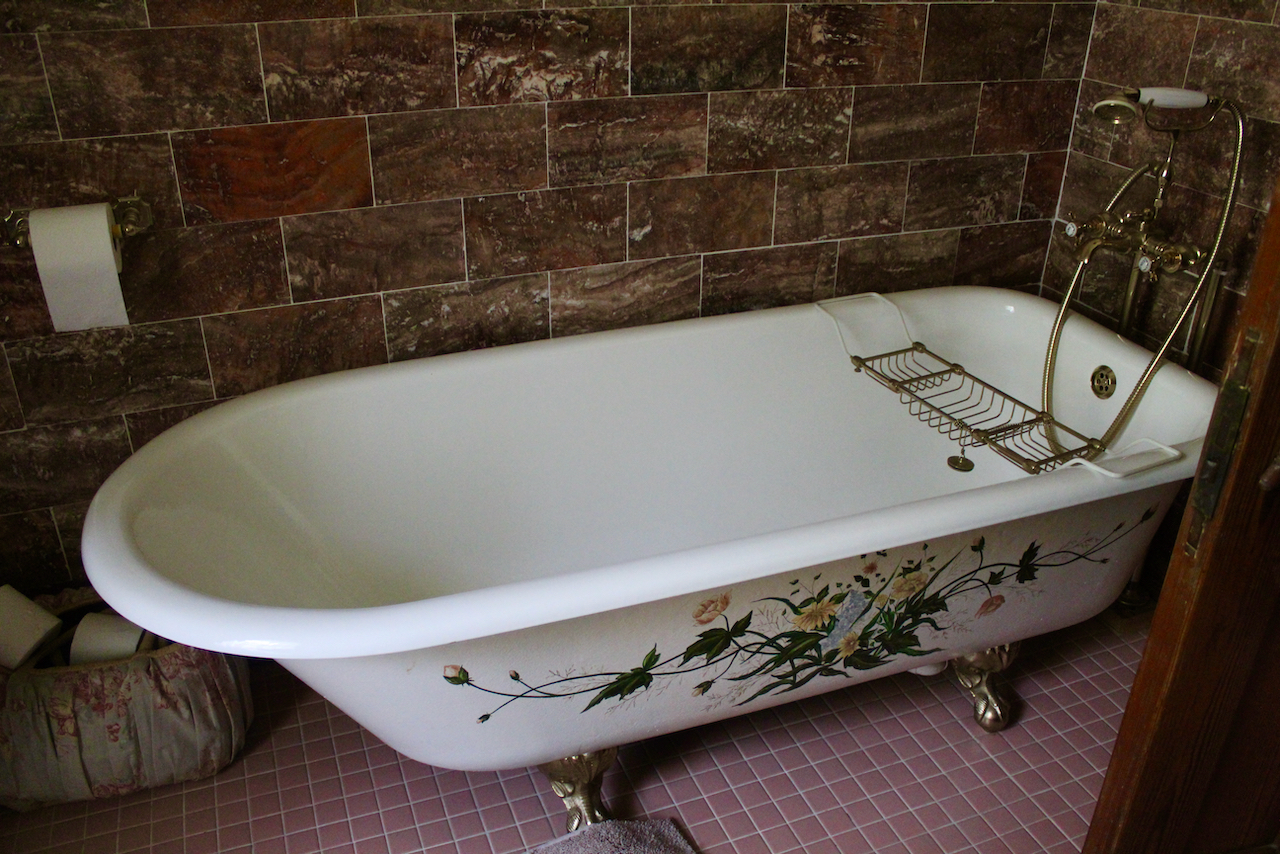
The bedrooms are placed facing the sea and to the south, with bathrooms at the back of the house. The bedroom in front was probably Mary’s, as it has the initials “M.A.” in the fireplace. The stained glass in that room contains symbols of the Ashlin-Pugin marriage.
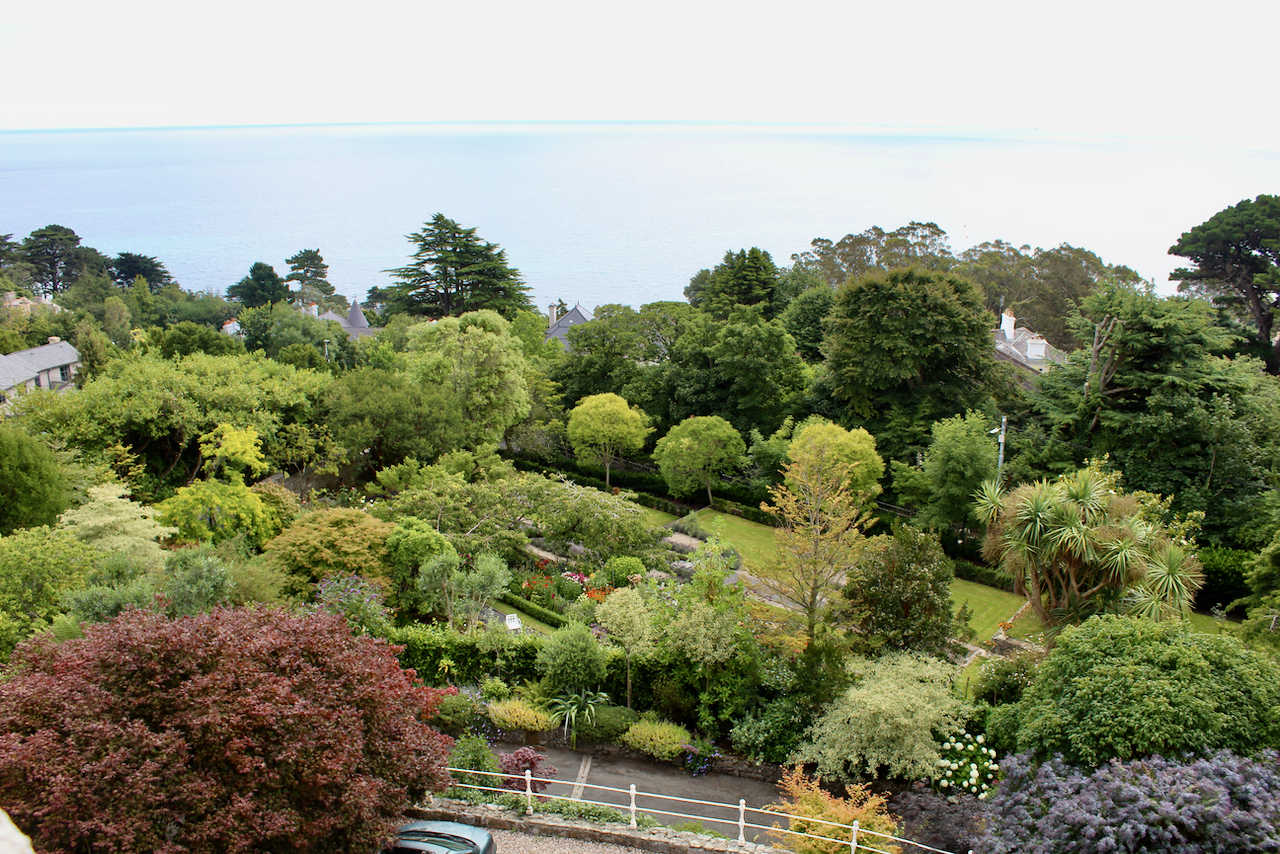
The library is located at the top of an “elbow stairs.” It is completely covered in pitch pine and has a magnificent view of the coast. The stained glass is signed “Frampton” and dated to 1880.
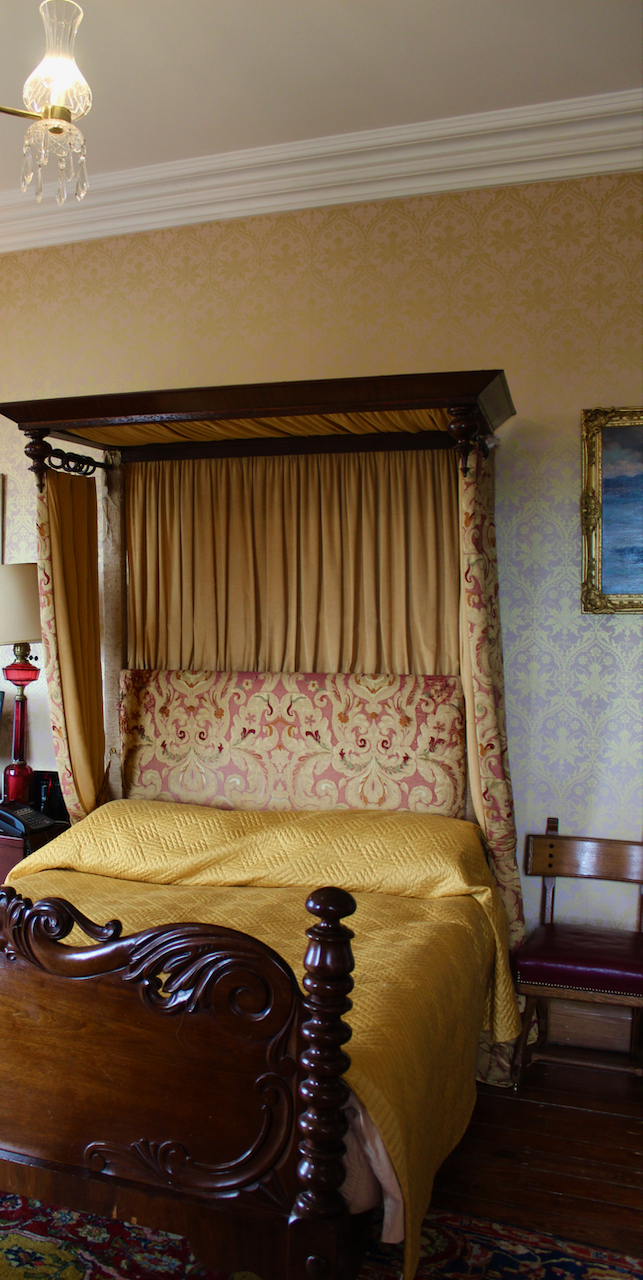
A single bedroom, the staff bedroom, is above the back stairs and would have originally housed three staff bedrooms. Today it is beautifully decorated with an intricately carved wooden sleigh bed, and drapes hanging from a coronet.
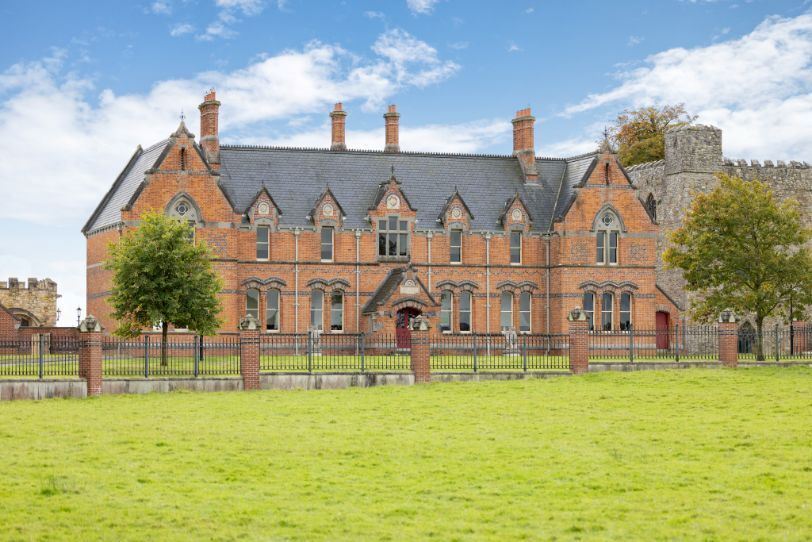
Another property designed by Ashlin has recently come on the market, Netterville Almshouses.
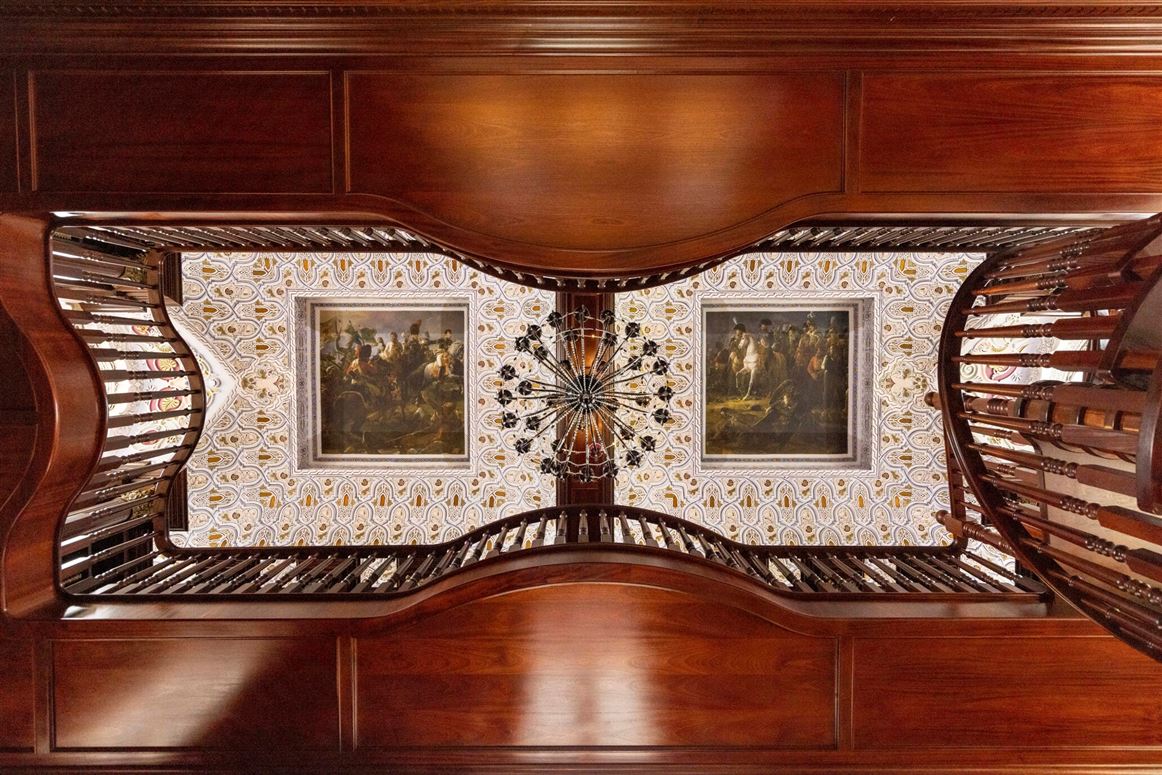
The Netterville Almshouses in County Meath, also designed by George Coppinger Ashlin, in 1877. For sale in April 2023, this photograph courtesy of myhome.ieThe splendid interior of Netterville almshouses, photograph from myhome.ieThe splendid interior of Netterville almshouses, photograph from myhome.ieThe splendid interior of Netterville almshouses, photograph from myhome.ieThe splendid interior of Netterville almshouses, photograph from myhome.ieThe splendid interior of Netterville almshouses, photograph from myhome.ieThe splendid interior of Netterville almshouses, photograph from myhome.ie
[1] The Wexford Gentry by Art Kavanagh and Rory Murphy. Published by Irish Family Names, Bunclody, Co Wexford, Ireland, 1994. p. 168. Power of Edermine.


































 Irish Historic Houses