Oakley Park, Celbridge, Co Kildare (now St. Raphael’s)
Mark Bence-Jones. A Guide to Irish Country Houses (originally published as Burke’s Guide to Country Houses volume 1 Ireland by Burke’s Peerage Ltd. 1978); Revised edition 1988 Constable and Company Ltd, London.
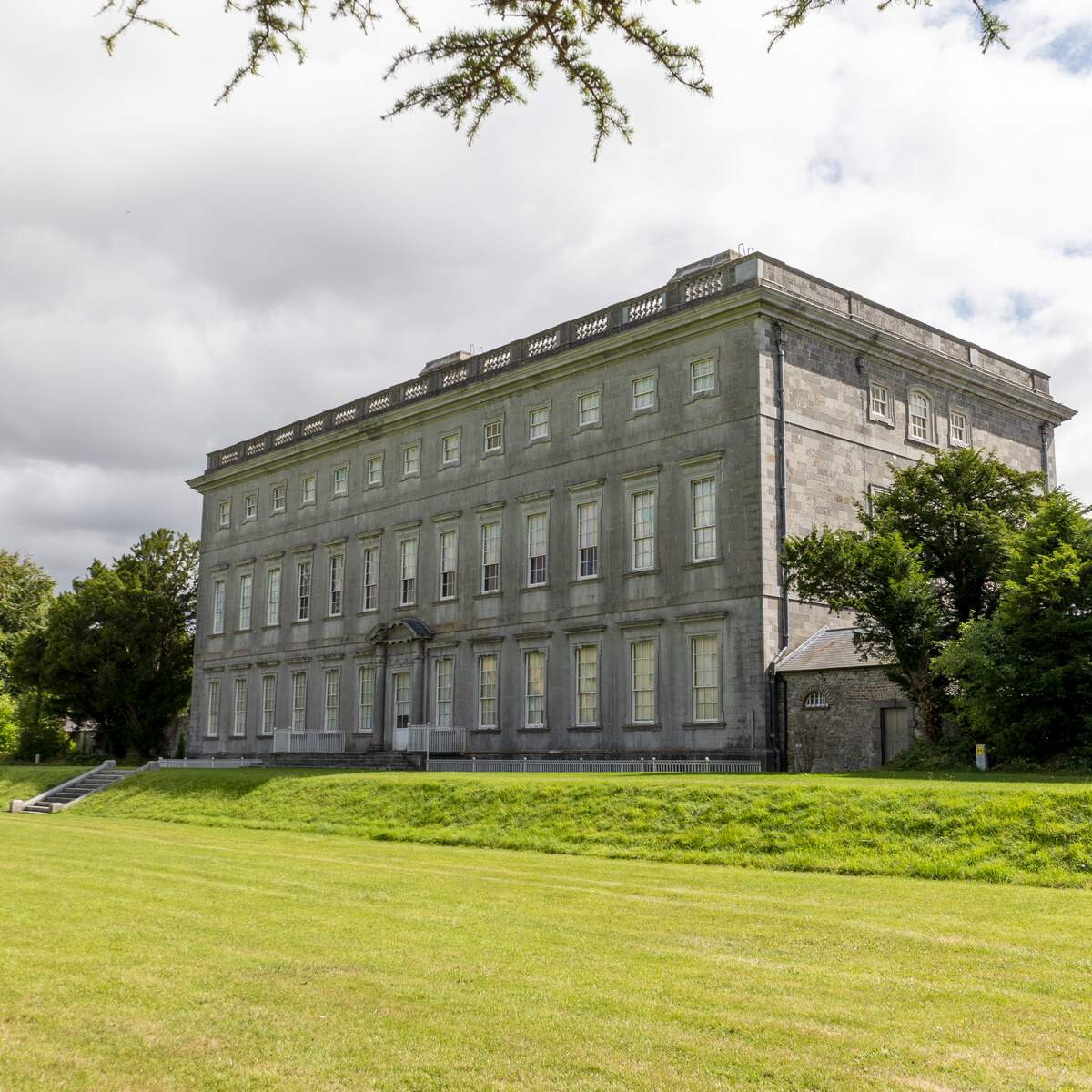
p. 227. “(Napier, sub Napier and Ettrick, B/PB; Maunsell/IFR) A fine three storey ashlar-faced house of 1724, built for Arthur Price, Vicar of Celbridge – who proposed to Swift’s “Vanessa” and who later became Bishop of Meath and Archbishop of Cashel – possibly to the design of Thomas Burgh, MP, Engineer and Surveyor-General for Ireland. Seven bay front, three bay central breakfront; doorway with segmental pediment, solid roof parapet, bold string courses. Various subsequent alterations. Later in C18, it was the home of Lady Sarah Napier, sister of Lady Louisa Conolly, of Castletown, and of Emily, Duchess of Leinster, mother of the United Irish leader, Lord Edward Fitzgerald. Lady Sarah, born Lady Sarah Lennox, daughter of 2nd Duke of Richmod, was the love of the young George III, who, according to a legend, wrote the song The Lass of Richmond Hill, about her. Oakley afterwards became the seat of a branch of the Maunsell family; it now belongs to a religious order.”
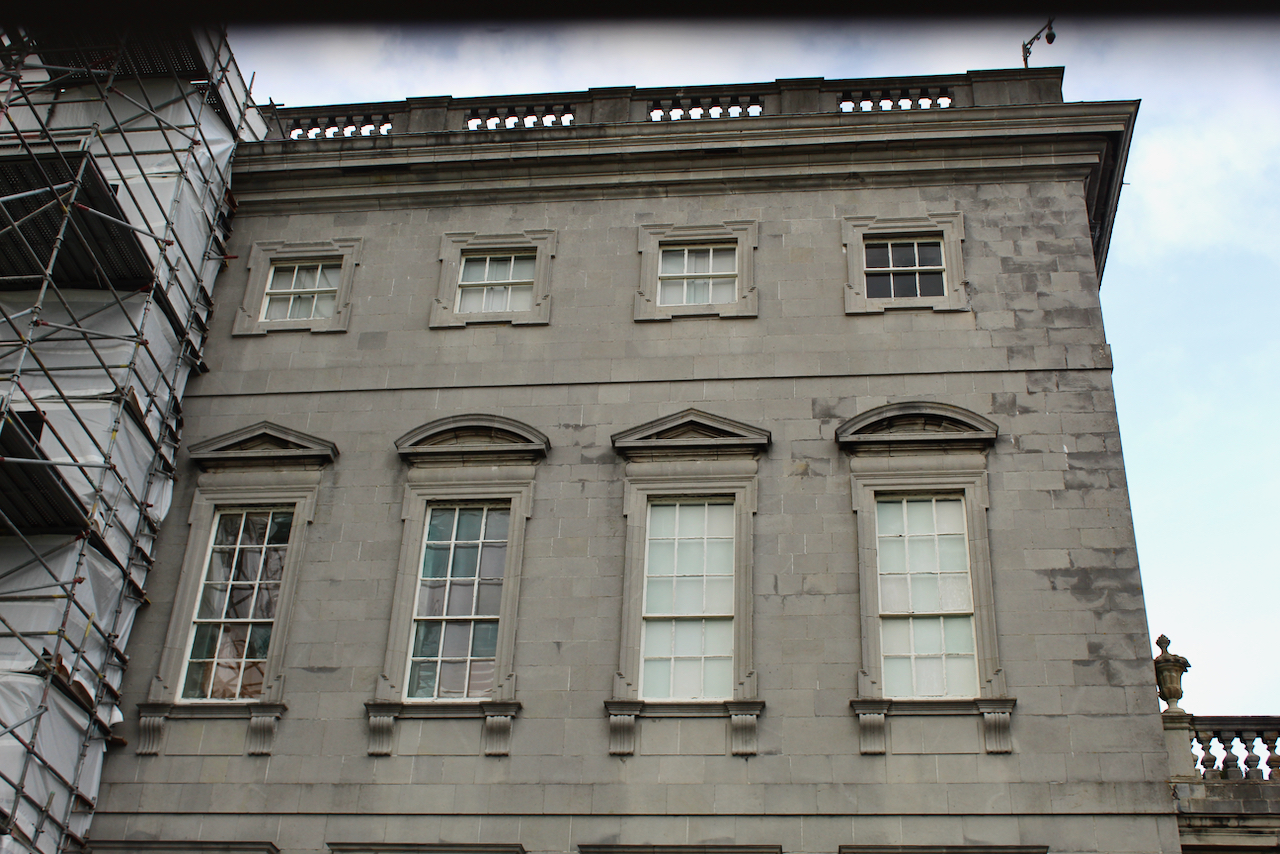
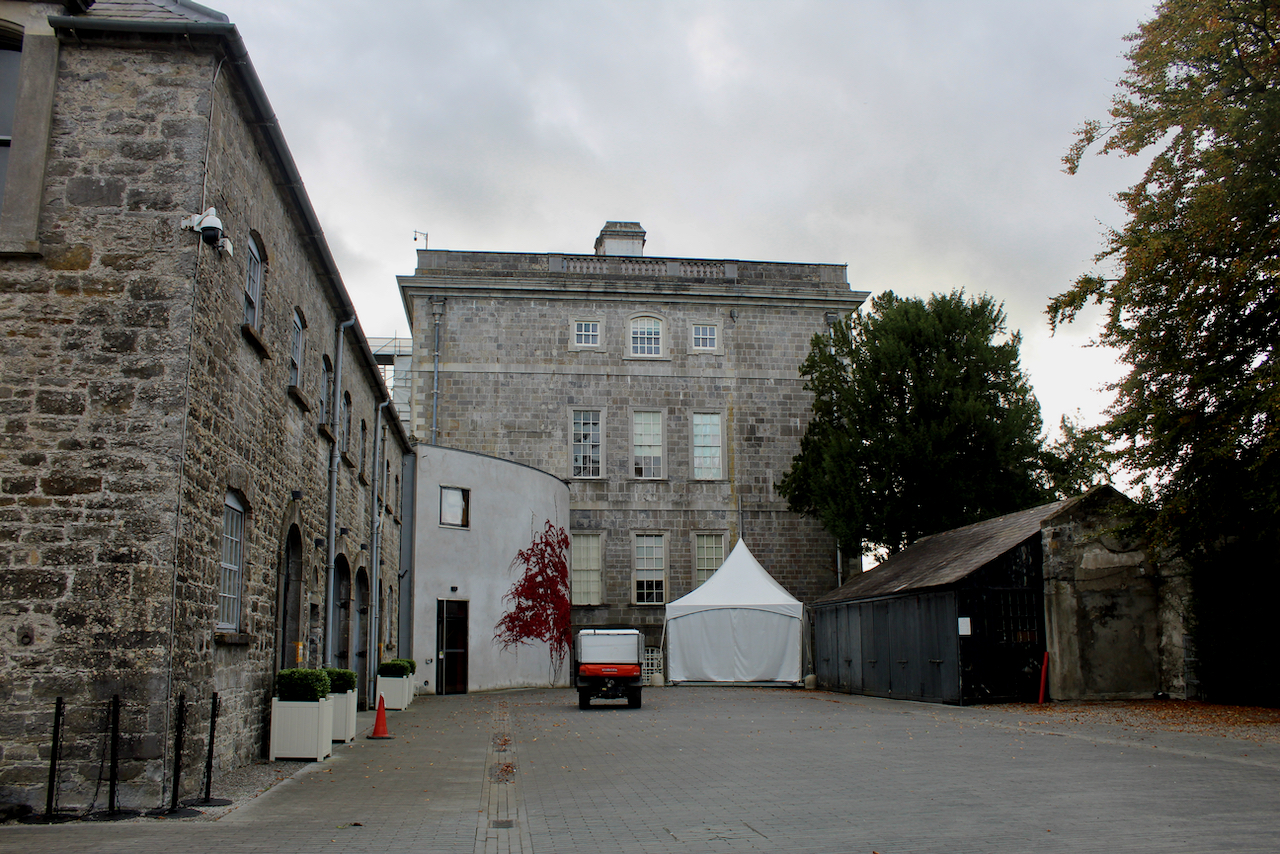
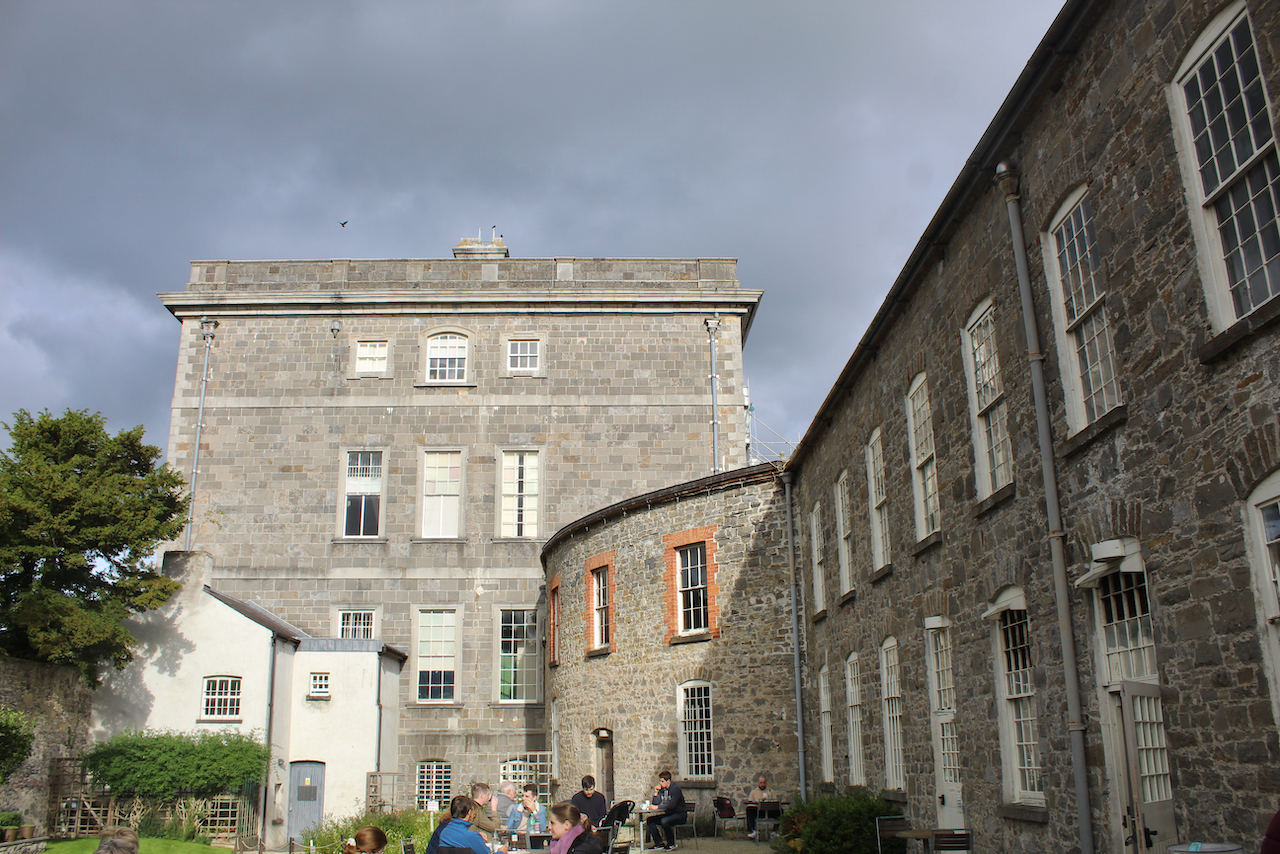
Detached seven-bay three-storey over basement Classical-style house, built 1724, retaining early aspect with three-bay three-storey breakfront, three-bay three-storey side elevation to south-west, single-bay three-storey recessed end bay to north-east and seven-bay three-storey rear elevation to north-west having single-bay single-storey bowed projecting bay to north. Refenestrated, c.1950. Now in use as hospital. Hipped roof behind parapet with slate. Rolled lead ridge tiles. Cut-stone chimney stacks. Cast-iron rainwater goods. Coursed limestone walls. Cut-stone dressings including stringcourses to each floor and moulded cornice having cut-stone parapet walls with cut-stone coping. Square-headed openings (segmental-headed window openings to basement). Stone sills. Cut-stone surrounds. Replacement 9/9, 9/6 and 6/6 timber sash windows, c.1950. Original 6/6 timber sash windows to basement. 1/1 timber sash windows to bowed projecting bay. Cut-stone doorcase to front (south-east) elevation approached by flight of steps with segmental pediment over on consoles. Cut-stone surround to door opening to rear (north-west) elevation. Replacement timber panelled and glazed timber panelled doors, c.1950. Overlights. Interior with timber panelled shutters to window openings. Set back from road in own grounds. Landscaped grounds to site.
Appraisal
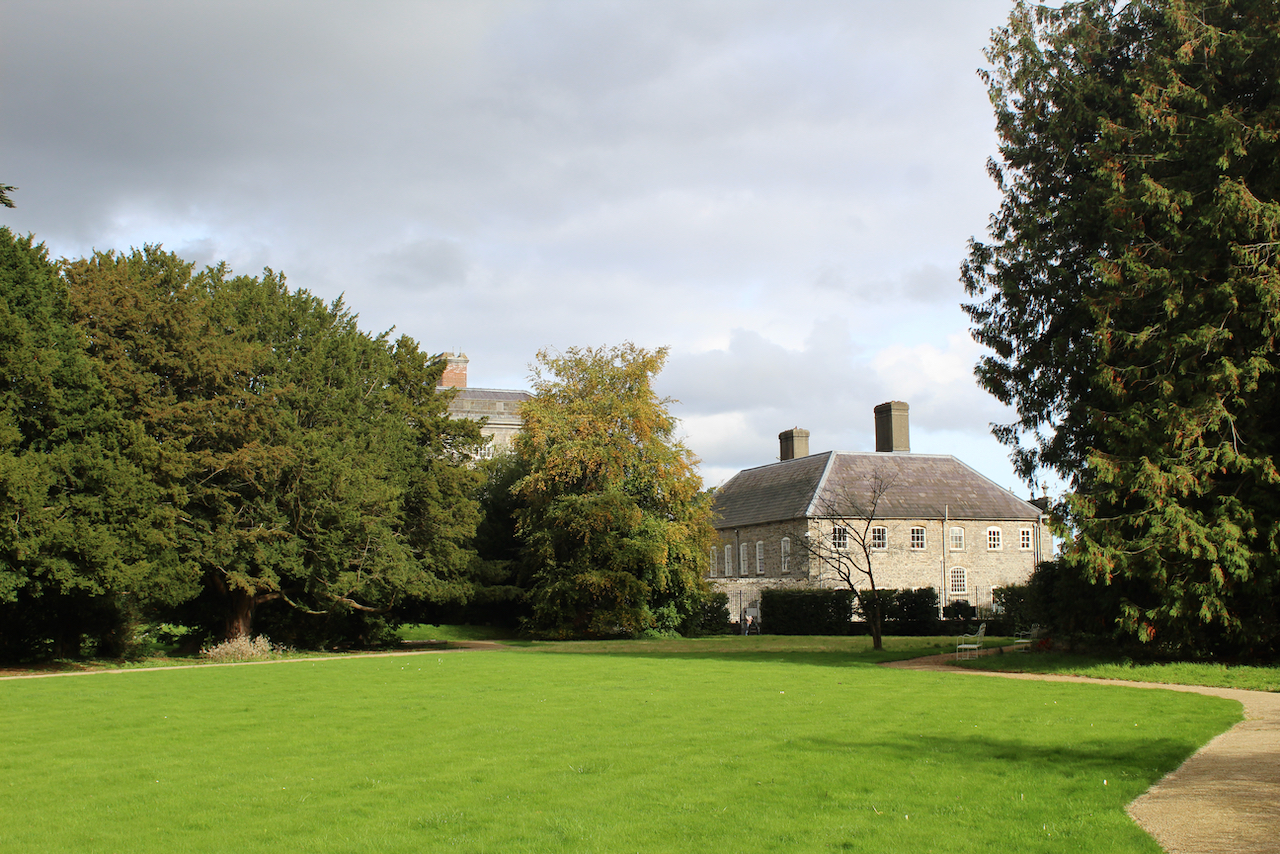
Oakley Park, now known as Saint Raphael’s, is a fine and imposing Classical-style mansion that was built contemporaneously with Castletown House as the residence of Sarah Napier, sister of Lady Louisa Connolly. Of social and historical interest, the house represents the origins of Celbridge as an estate town with sophisticated private buildings flanking both ends of what would become the Main Street. The house retains much of its original character and is a valuable component of the architectural heritage of Celbridge. Composed of graceful Classical proportions on a symmetrical plan centred about a breakfront to both primary elevations (to south-east and to north-west), the house is finely detailed, without unnecessary ornamentation, to include features such as decorative doorcases and a heavy cornice to the roof – the presence of a bowed projecting bay also adds incident to the regular design. The construction of the house in coursed cut-limestone is a good example of the high quality of stone masonry practiced in the locality. Replacement fenestration was inserted in the mid twentieth century, but this has been carried out in keeping with the original integrity of the house – original fenestration remains in situ to the basement, having wide glazing bars, while the interior retains features such as timber panelled shutters to the window openings. Set back from the line of the road in its own grounds, the house retains attractive landscaped lawns to the front (south-east).
Oakley Park, formerly Celbridge House, was built in 1724 by Arthur Price when he was vicar of Celbridge, later Bishop of Meath, and Archbishop of Cashel. Dr. Price’s steward at Oakley Park was one Richard Guinness, known for his brewing talents. His son, Arthur went on to establish the Guinness Brewery in Dublin.
In the early 20th century, the house changed ownership many times and fell into disrepair. In the 1930s, Oakley Park was sold to the Christian Brothers, who planned to open a school there. They never managed to get the school up and running and it was sold again. The house was purchased in 1952 by its present owners, the Brothers of St. John of God. Today Oakley Park forms part of the St. Raphael complex training centre for mentally handicapped children and young adults.
Formerly the entrance but now the garden front of Oakley Park in Celbridge, County Kildare. The house is believed to have been built c.1724 for the Rev. Arthur Price*, who was then the local rector (he later rose through the ranks, eventually becoming Archbishop of Cashel). Tall and somewhat austere, Oakley Park’s design is attributed to Thomas Burgh, also responsible for the Old Library at Trinity College, of which it is somewhat reminiscent. In the late 18th century, the house was acquired by Lady Sarah Napier, sister of Lady Louisa Conolly who lived nearby at Castletown, and Emily, Duchess of Leinster who lived at Carton. It appears thereafter to have changed hands regularly and at some date in the 19th century, the entrance was moved to the other side of the building (see below). Since 1953 the house and surrounding grounds have been used by the St John of God religious order who run a training centre here for disabled children and young adults.
*Arthur Price’s land steward in Celbridge was one Richard Guinness. On his death in 1752 he left £100 to Guinness and his son, Arthur – Price’s godson – who a few years later established a certain well-known and still flourishing brewery.
The following story is an updated version of that contained in Turtle Bunbury’s 2004 book, ‘The Landed Gentry & Aristocracy of Co. Kildare‘. If you should spot any errors or ommissions, or have further information or photographs of relevance, please let us know.
A heroic defense of a Waterford Castle against Cromwell’s army earned the Maunsell family considerable respect from their Irish peers when they first settled in Ireland in the mid 17th century. During the Georgian Age, they rose to prominence in Limerick, as bankers, politicians and Mayors. When not in Limerick, they were invariably leading an army from one international battlefield to the next. In the early 18th century, they moved to Oakley Park, Celbridge, Co. Kildare, formerly home to the Napier family, scions of three mighty Generals. In the early 20th century they married into the Orpen family. The connection to Ireland dwindled after the sale of Oakley Park in 1924. Today the house is run by the St John of Gods.
OrIgin of the Maunsell Family
p. 153. The name Maunsel is said to be derived either from the Norman French word mancel (an inhabitant of Le Mans) or from le mansel (a feudal tenant occupying a manse farm). The Maunsell family claim descent from Philip de Mancel, Cup Bearer to William the Conqueror. He came to England in 1066, settled in Buckinghamshire, acquired a substantial estate in Leicestershire and built a fine mansion house at Oswick in Glamorgan. His descendents prospered greatly under the Plantagenet kings. In 1163, Sir Robert Maunsell served with the Knights Templar while his eldest son Walter was Napkin Bearer to the King. William’s son Sir John was raised in the Royal Court of Edward Longshanks, received numerous lands and manors in southern England and rose to become one of the most prominent statesmen of his age. During the War of the Roses, Sir Philip Maunsell was captured by the Yorkists at the battle of Tewkesbury and beheaded along with his two elder sons.
Rhys Maunsell & the Irish Rebellions
p. 154 In 1535, Sir Philip’s grandson and eventual heir, Sir Rhys Maunsell of Oxwich Castle, Glamorgan was dispatched with a body of troops to assist Lord Deputy Grey in suppressing the rebellion of Silken Thomas FitzGerald. (2) For his efforts, he was given a grant for life for the site of the Cistercian abbey of Margam in Glamorgan, as well as the Office of Chamberlain of the County Palatine of Chester, and the royalty of Avon Waters to him and his heirs. After the dissolution of the monasteries, he got a lease of Margam and in 1540 purchased the entire Margam property where he built a mansion house partly on the site of the abbey. (3) One of his grandsons, Captain Rhys Maunsell served for the English against the O’Neills in the Nine Years War. He was captured along with Sir John Chichester at the Battle of Carrickfergus in 1596 and beheaded. Their heads were sent to Tyrone and their bodies buried at Carrickfergus. (4)
Thomas & APHRA Maunsell (1577 – 1661)
The principal branch of the family continued to live at Chicheley in Buckinghamshire, marrying into some of the greatest dynasties of Tudor and Stuart England. In the early 17th century, the head of the family was Thomas Maunsell (1577 – 1661), a prominent London solicitor and land speculator. In the 1630s he purchased an estate in Waterford from the Earl of Cork where he relocated with his wife Aphra Crayford who bore him a commendable 23 children. Following her death in 1666, Aphra Maunsell was interred in Caherconlish, Co Limerick. A stone tablet in Basso relievo is still within the precincts of the graveyard, though displaced by an overgrowth of trees on the wall of the church.
Thomas and Alphra’s eldest son Colonel Thomas Maunsell, one of the ’49 Officers’, distinguished himself during the Confederate Wars by his defence of Mocollop Castle, Co. Waterford, against Cromwellian forces in 1649. After the siege he converted the ruined castle into his own mansion, which was inherited by his son Thomas. (5)
p. 155. Following the Restoration of Charles II in 1660, Thomas the Younger was awarded land in Galway, Waterford and the Liberties of Limerick. His sons became merchants and magistrates in Limerick and Cork over the ensuing decades but, upon his death in 1692, the inheritance devolved upon his grandson, Richard.
NB: Edward Mansell was chaplain to King Charles I during the civil war. His father, Robert Mansell was born circa 1580 and operated as a miller in Great Bourton, Oxon.
The bankers of limerick
Richard Maunsell (d. 1773) unexpectedly inherited the Maunsell family estates when his three elder brothers predeceased him. He served as Mayor of Limerick in 1734 and was MP for Limerick City in the Irish Parliament from 1740 to 1761, during which time the city developed as a centre of Atlantic trade, particularly in upmarket fashion and woollen manufacture. By his first marriage to Margaret, younger daughter and co-heiress of Thomas Twigg of Donnybrook Castle, Co. Dublin, he had a son, Thomas, and a daughter, Anne. (6)
Although contemporaries recalled him as ‘an honest but a very dull man’, Thomas Maunsell proved himself a very capable lawyer and married one of the Waller girls from Castle Waller. His oldest son Richard Maunsell emigrated to the USA after he graduated from Trinity and no more if known of him. In 1789, his sons Robert and Thomas co-founded Maunsell’s Bank in Limerick City. Maunsell’s Bank later became the Bank of Limerick, which was one of Irelands’ leading private banks before its collapse in the economic depression that overtook Europe at the end of the Napoleonic Wars. (7) The younger Thomas became MP for Johnstown while Robert later settled in India where he was elected to the Supreme Council of Madras. Another son became Dean of Leighlin while another became Rector of Oranmore, respectively marrying daughters from Macroom Castle and Bunratty Castle.
Thomas Snr’s eldest three daughters all married well – barristers and landowners from Tipperary and Limerick – but his youngest daughter Dorothea Maunsell caused a tremendous scandal when, aged 15, she eloped with the famous Italian castrato opera singer Giusto Ferdinando Tenducciduring the 1760s. (Burke’s Irish Family Records claimed Dorothea was married in 1762 to William Long Kingsman, barrister-at-law. He did indeed become her second husband but not until late in the decade). For more on their extraordinary affair, click here.
Thomas Mausell Snr. later became King’s Counsellor in the Court of Exchequer and and MP for Kilmallock. He finished up as Counsel to the Revenue by Lord Harcourt, an office worth £800 a year. When he died in 1783, his legacy was secured through the survival of his aforementioned namesake son and heir, Thomas Maunsell, MP for Johnstown.
The Norbury Connection
Richard’s second wife Jane was the eldest daughter of William Waller of Castle Waller, Co. Tipperary. By this marriage he had a further five sons. Among these were General John Maunsell who commanded the 56th regiment at the Siege of Havana in 1762, Eaton Maunsell who served as Mayor of Limerick in 1779 and, the eldest, Richard Maunsell who settled at Ballywilliam in County Limerick and married Helena Toler, a half-sister of the 1st Earl of Norbury. As Chief Justice of Ireland during the early 19th century, Lord Norbury was infamous for the number of men he condemned to the gallows. An anecdote survives of how the judge was addressing the jury in one such case when his voice was drowned out by the sound of an irate ass. “What noise is that?” he inquired angrily. “Merely an echo of the Court, my lord“, was the defending barristers risqué reply. But Norbury could be quick too. At dinner one day, his host told him he had shot 31 hares that morning. “I don’t doubt it“, replied his lordship, “but you must have fired at a wig.” (8)
The Maori Bible
p. 156. Richard and Helena had four sons. The eldest, Daniel, succeeded to Ballywilliam on Richard’s death in 1790. He was grandfather to General Sir Thomas Maunsell, KCB (1906), a prominent soldier in the Punjabi Campaign, the Crimean War and the Indian Mutiny. (*) The second son Richard Maunsell lived at Queensboro in Limerick. The fourth son George Maunsell also lived in Limerick and was sometime Collector of the Irish Customs, a post he secured when he married the daughter of the previous Collector, James Smyth. George’s youngest son Robert emigrated to New Zealand in 1834 and became the first person to translate the Bible and Prayer Book into Maori. Richard and Helena’s third son John Maunsell was born in 1752 and became a barrister at the Middle Temple in 1774. Six years later, he married Anne Webster, only daughter and heiress of Edward Webster of Whitehall, Dublin. Anne died in August 1788, giving birth to her only child, Richard. Her widowed husband remained at Carrickoreely, Co. Limerick.
* In March 2008, I was contacted by Lois Adam’s, granddaughter of Daniel Toler Thomas Maunsell’s eldest son George Edward Maunsell. George was born in Dublin around 1858 and emigrated to Jamaica in 1882 where he died in 1911. Lois would very much like to find some trace of descendants of his family in Ireland or elsewhere. She has been to Dublin and found the graves of Helen, Daniel and and some of his siblings in Mount Jerome cemetery but so far have been unable to locate any living descendants. Please contact me if you have further information.
The Napiers of Oakley Park
p. 156 In 1787, Oakley Park became the home of Colonel George Napier and his wife, the formerLady Sarah Bunbury. Located between the Conolly estate at Castletown and Lord Cloncurry’s estate at Lyons, the Georgian house was originally built in 1724, most likely by Thomas de Burgh (qv). Its first owner was Dr. Arthur Price, the Vicar of Celbridge who proposed to Jonathan Swift’s “Vanessa“. Price later became Bishop of Meath and Archbishop of Cashel.
p. 157. Dr. Price’s steward at Oakley Park was Richard Guinness, whose son, Arthur went on to establish the Guinness Brewery. Lady Sarah was one of the beautiful Lennox girls, popularised in the book and TV series “Aristocrats” by Stella Tillyard. Her sisters included Lady Louisa Conolly of Castletown and Emily, Duchess of Leinster. (10)
The Napiers raised eight children in this home. They clearly did something right because the sons grew to be remarkable men. Indeed, for many years afterwards, the house was known by country people as “The Eagle’s Nest,” on account of the high spirit of the Napier boys. During the 1798 Rebellion, for instance, Colonel Napier armed his five sons and instructed them all in the strategy of defence. The boys were educated at the grammar school in Celbridge. Here the eldest boy Charles organised his fellow pupils into a volunteer force and made them parade. However, his younger brother William showed such little respect for these military drills that he was tried by “a drum-head court martial” and sentenced to some sadly unknown punishment. William refused to accept the penalty and so Charles reluctantly gave the go-ahead for the other volunteers to teach the young rebel a lesson. However, “William, his fiery nature revolting against the insult, whirling a large bag of marbles like a sling discharged them amid the crowd, and then, charging, broke the obnoxious drum, and forced his most prominent assailant, greatly his superior in age and size, to single combat. Although getting far the worst of it, and badly hurt in the fight, William, still refusing to give in, was restored to the ranks by his brother for the pluck he had shown.” (11) The long term impact of these schoolyard scraps becomes somewhat more formidable when one considers that Charles, William and a third brother George went on to become three of the greatest British heroes of the Peninsula War. Indeed all three were knighted and promoted to the rank of General. After the death of Colonel George Napier the house and lands were sold to Theobold Donnelly. He changed the name from Celbridge House to Oakley Park.
On 1st June 1807, the younger Richard married Maria Woods, only daughter of John Woods of Winter Lodge, co. Dublin, and sister of George Woods, JP, of Milverton Hall, Skerries, Co. Dublin. (9) In 1813 the estate was purchased by John Maunsell for his son Richard Mark Synnot Maunsell, whose son Richard John Caswell Maunsell sold the estate in 1924 and moved to London. So only 3 generations of the family lived there for altogether 111 years.
9. From 1831, George Woods maintained a pack of hounds to hunt both hares and foxes. In 1849, he was granted the right to hunt foxes in the area by the Louth Foxhounds.
Six Maunsells Brothers
In 1840, the Lord Chancellor was “pleased to appoint” Richard Maunsell a magistrate for County Dublin. He served as High Sheriff for Kildare in 1841 and died on 25th November 1866, leaving six sons. (12)
John Maunsell, the 46-year-old firstborn, succeeded to Oakley Park. He also inherited an estate of some 1200 acres at Carrickoreely in Co. Limerick from his grandfather. Little is recorded of John save that he studied at Trinity College Dublin, became a barrister at Gray’s Inn in 1834, served as High Sheriff for Co. Kildare in 1868 and never married.
p. 158 Upon his death in 1882, the property passed to his brother, George Woods Maunsell (1815-1887), previously resident of Ashford, Co. Limerick. George owned several thousand acres in Counties Dublin and Westmeath and was a barrister of prominence in Dublin, with offices at 10 Merrion Square South. He served as JP and Deputy Lieutenant for Kildare and as High Sheriff for Dublin City in 1876 and County Kildare in 1885. On 4th August 1842, he married Maria Synott (d. 1883), eldest surviving daughter and co-heiress of Mark Synnot of Monasterois House, Edenderry, Co. Offaly. (13) Two boys – Mark and George – and two girls Anne and Maria – followed. (14)
p. 159. The third of Richard and Maria’s six sons, the Rev. Richard Dixie Maunsell, succeeded to his maternal grandmothers’ home at Whitehall in Co. Dublin and was Rector of Innistonnagh, Co Tipperary. On 10th February 1859 he married Alicia Laing, daughter of Malcolm Laing, a Scotsman from the Orkney Islands who settled in Jamaica’s Spanish Town at about this time. They had nine childrenincluding Richard Maunsell, BA, MA, (1862-1929), a well-known land agent and secretary of the Irish Landowner’s Convention during a time of much anxiety to Irish landowners. Educated at St Columba’s College and Trinity College Dublin, Richard joined the Dublin firm, Stewart & Kincaird. He subsequently became agent for a number of leading Irish estates and lived at Shielmartin, Portmarnock, which was later home to William ‘The Boss’ McMullan, co-founder of Maxol. On 20 March 1929, Richard and his wife Lucie Eleanor (nee Waters) were on their way to London to meet their only son who had just returned from Egypt where he had been serving for several years with the Sudan Government Railways. Richard had a heart attack and died on the way.
p. 160. The fourth son Edward Maunsell was killed in the muddy trenches at Sebastopol on 10th July 1855 while serving as a captain with the 30th Regiment.
The fifth son Warren Maunsell lived at Hodgestown, Co. Kildare, and was Rector of Thomastown, Co. Kildare.
The sixth son Frances Maunsell was also a clergyman, lived at Shrule in the Queen’s County, was Rector of Symondsbury in Dorset and married Emily, another daughter of Malcolm Laing of Jamaica.
Captain Mark Maunsell
George Woods Maunsell passed away on 26th April 1887 and was succeeded by his only surviving son,Mark Maunsell. Mark was born on 22nd October 1843. At the age of 20, he married Lucy Copeland, eldest daughter of Alexander Copeland of Wingfield, Berkshire. He subsequently served as a captain with the 1st Royal Dragoons. Lucy died without issue in the winter of 1875. Two years later, Captain Maunsell married again. His new bride was Mary Caswell, only daughter and heiress of a wealthy Limerick businessman Samuel Caswell, JP, of Blackwater, co. Clare, who had died a few years previously. The Caswell and Maunsell families had been acquainted for years; Mark may have attended Samuel’s funeral. The marriage took place at St. Mary’s Cathedral, Limerick, on 26th February 1877. “Two processional marches signalled the arrival of the bridal party. Before the ceremony the hymn “The Voice that Breathed o’er Eden” was sung. After the ceremony came Mendelssohn’s Wedding March. The newly married pair, after having received congratulations without number, and ‘wishes for happiness’ of equal extent, left for Dublin by the four o’clock train, whence they proceed on an extended Continental tour.”
p. 161. Mary seems to have been rather a frightening woman, preferring the hunting field to life as a mother. For the next ten years, she and Mark lived at Strand House in Limerick, with occasional visits to see Mary’s mother at Blackwater. Mark retired from the army and was a JP for County Clare. In 1887 they relocated to Oakley Park. Mark was quickly appointed JP for Kildare and, from 1890 to 1892, served as High Sheriff for the county. After Mary’s death in August 1893, he was married a third time to Georgina Middleton.
Dick Maunsell & the Orpen Connection
Captain Mark Maunsell left a daughter Norah and a son, Richard (‘Dick’) John Caswell Maunsell. The latter was born at 80 George Street, Limerick, on 2nd May 1878 and educated at Hailebury College in England and Trinity College Dublin.
In 1905, he left Trinity and entered at the King’s Inn as a barrister. He was subsequently JP for Co. Kildare. On 24th September 1913 he married Mary Winifred (‘Molly’) Orpen, fifth daughter of Richard Orpen of Ardtully, Kilgarvan, Co. Kerry. The Orpens were a family of rising influence. Molly’s first cousin Sir William Orpen (1878 – 1931) was regarded as the most influential Irish artist of his generation.
p. 162. His experiences of the Great War inspired him to paint to some of the most powerful images of that horrific conflict. He was knighted in 1918 and the following year was resident artist at the Paris Peace Conference. (16) Sir William’s brother Richard Orpen (1863 – 1939) was Cathedral architect for both St Patrick’s Cahedral in Dublin and St Canice’s in Kilkenny. He also served as President of the Incorporated Law Society from 1915 – 1916. Molly’s brother Dr. Raymond Orpen (1875 – 1952) spent much of his life advancing knowledge of public health in Sierra Leone, Gambia and Nigeria. Her elder sister Amy married Major John Henry Kennedy, TD, eldest son of Robert Kennedy, JP, of Baronrath, Co. Kildare.
In January 1915, Dick secured a commission as a lieutenant in Kitchener’s army and set off for France with the Inniskilling Fusiliers. He remained with the regiment until 1919, witnessing some of the bloodiest battles of the war. In 1917 he was awarded the OBE, after which he became part of the General Staff.
The Ireland to which Dick returned after the war was a rapidly changing society. In 1919 Irish Republicans initiated a guerrilla war against the occupying British army that culminated in the birth of the Irish Free State. Mollly Maunsell’s family home at Ardtully in Kerry was one of perhaps two hundred country homes in Ireland burned down during the Troubles. In 1924 Dick sold Oakley Park and moved with his wife and two sons to England. He died on 27th September 1955. Molly survived him until 2nd May 1974.They left two sons, Richard and John, and a daughter Aphra Maunsell who rose to a position of some prominence in the Bank of England. Aphra retired in 1974 and passed away on 21st May 2002 aged 85.
Richard Maunsell & the Phosphoric Revolution
The eldest son, Richard Mark Orpen Maunsell, was born on 15th September 1914 and, like his father, went to school at Haileybury. He later graduated from London University and went to Australia for 13 years where he worked with the chemical firm Albright & Wilson. He was subsequently transferred to Toronto, became a Canadian citizen and was sometime Director of Research for the Electric Reduction Company of Canada. In partnership with Richard Courtney Edquist, another Albright & Wilson scientist, he developed a process for the burning of phosphorus in the manufacture of phosphoric acid that has since been the basis of the manufacture of thermal phosphoric acid worldwide. He died on 2 January 2007. He married Gwendolin Minchin of Australia and had three daughters, Catherine, Elizabeth and Helena Claire Maunsell. The eldest daughter Catherine lives in Toronto, Ontario, and was formerly married to Alex Himelfarb, Clerk of the Privy Council, Secretary to the Cabinet and Head of the Public Service. Returning to Ontario in 1980, Catherine began working with the Ministry of Correctional Services and for the last 7 years has served as Manager of Female Offender Programs. She lives in Toronto with her life partner Helen McIlroy. She is grandmother to twin girls – Jesse Grace and Sam Alison Heichert. The second daughter Elizabeth lives in Quebec City where she is a professor of epidemiology at Universite Laval and a researcher in the area of psychosocial aspects of breast cancer. She is married to Guy Dumas, now retired but formerly the deputy minister responsible for language policy in the Quebec government. The younger daughter Claire had a very successful career as a glass blower as ‘H. Claire Maunsell’. married Paul Ostic and has two children, Rachel Sarah Maunsell Ostic, born 1997, and Maxwell Richard Maunsell Ostic, born 1999.
p. 163. Richard’s younger brother John Maunsell was born on 30 April 1920 and educated at Haileybury and London University. He served as a Bomber Commander with the Royal Air Force during World War Two and later worked with Unilever. His memoirs of the war were entitled ‘No Such Thing as an Easy Ride‘ and a precy of them is online here. By his marriage to Eileen Conolly he had a daughter Susan born in 1961. In 2009, he was living in Reading.
Nonie Maunsell
Dick Maunsell’s sister Norah – known as “Nonie”- was the last of the family to live in Ireland. Her niece Aphra Maunsell recalled her as ‘a Dublin character’ such as you will find nowhere else. She was extremely handsome with a beautiful complexion and (as I remember her best) with pretty, softly waving grey hair. She had the wit of the Irish and was a great conversationalist. She dressed in an entirely individual style which had absolutely no reference to any prevailing fashions–usually wearing large picture hats. She was invariably draped in long strings of pearls, and wore diamond rings and a cloak. She lived in Dublin at 8 Wilton Place, in a house which, to the day of her death, had only gas light. There she was surrounded by beautiful furniture, china, and Irish silver. From the time of my father’s marriage in 1913 (she had previously kept house for him at Oakley Park) she shared this flat with her great friend Miss Kathleen Hamilton, who was, in fact my godmother’. Nonie died in Dublin on August 30th 1960 and was buried in the Maunsell plot in the village of Celbridge, Co. Kildare.
St. Raphael’s
Oakley Park was purchased by the Guiney family in 1935 and then sold to the Christian Brothers. Their plans to open a school did not come to fruition and, in the 1950s, the property passed to the St John of Gods. The house now forms part of the St Raphael’s complex training centre for mentally handicapped children and young adults.
Further Reading
The Maunsell family with its numerous branches has not only found extensive coverage in various of Burke’s and other publications, but has also been in depth investigated in Robert George Maunsell’s ‘History of Maunsell or Mansel (And of Some Related Families” (1903) and in Commr Edward Phillips Statham’s and Col Charles Albert Maunsell’s 3 volume work ‘History of the Family of Maunsell (Mansell, Mansel)‘ (1917-1920).
With thanks to Josef Muether, Lois Adams, Paul Ostic, Elizabeth Maunsell, Catherine Maunsell, Anne Armstrong, Wendy Artiss, Patrick Hourigan and others.
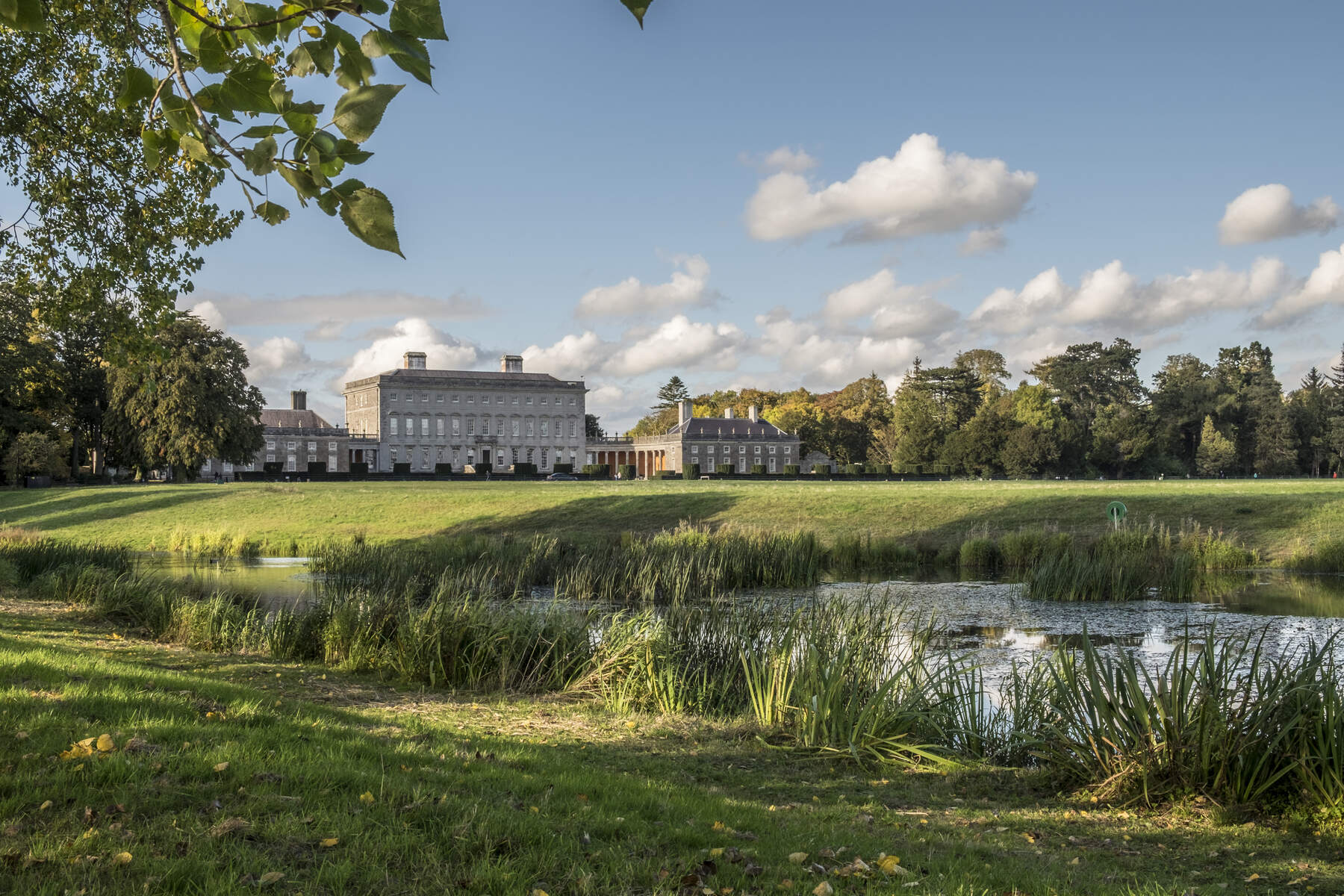
“Castletown is set amongst beautiful eighteenth-century parklands on the banks of the Liffey in Celbridge, County Kildare.
“The house was built around 1722 for the speaker of the Irish House of Commons, William Conolly, to designs by several renowned architects. It was intended to reflect Conolly’s power and to serve as a venue for political entertaining on a grand scale. At the time Castletown was built, commentators expected it to be ‘the epitome of the Kingdom, and all the rarities she can afford’.
“The estate flourished under William Conolly’s great-nephew Thomas and his wife, Lady Louisa, who devoted much of her life to improving her home.
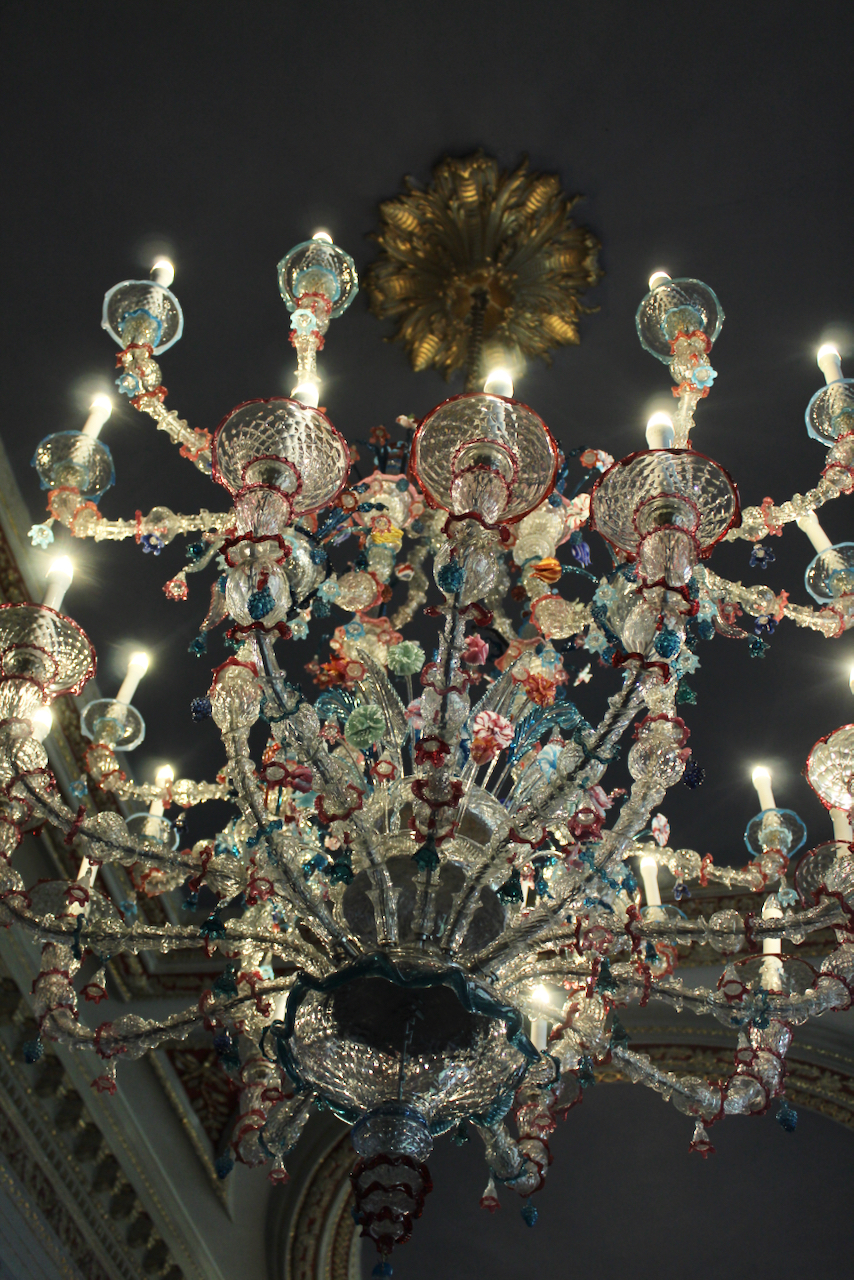
“Today, Castletown is home to a significant collection of paintings, furnishings and objets d’art. Highlights include three eighteenth-century Murano-glass chandeliers and the only fully intact eighteenth-century print room in the country.
“It is still the most splendid Palladian-style country house in Ireland.“
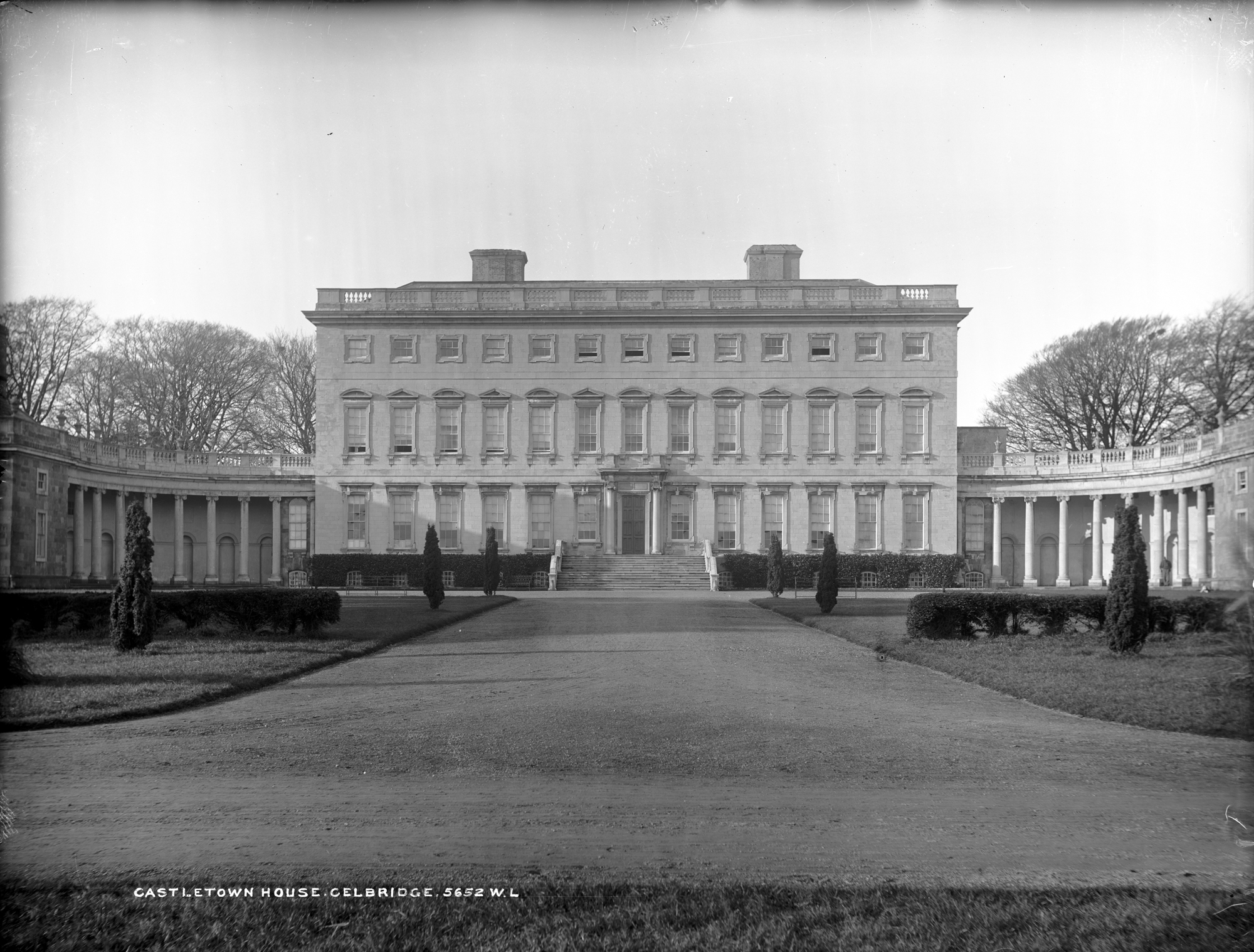
This photo was taken probably by Robert French, chief photographer of William Lawrence Photographic Studios of Dublin, National Library of Ireland flickr constant commons.
The Conolly family sold Castletown in 1965. Mark Bence-Jones tells us that the estate was bought for development and for two years the house stood empty and deteriorating. In 1967, Hon Desmond Guinness courageously bought the house with 120 acres, to be the headquarters of the Irish Georgian Society, and in order to save it for posterity. Since then the house has been restored and it now contains an appropriate collection of furniture, pictures and objects, which has either been bought for the house, presented to it by benefactors, or loaned. It is now maintained by the Office of Public Works and the Castletown Trust.
William Conolly (1662-1729) rose from modest beginnings to be the richest man in Ireland in his day. He was a lawyer from Ballyshannon, County Donegal, who made an enormous fortune out of land transactions in the unsettled period after the Williamite wars.
William Conolly had property on Capel Street in Dublin, before moving to Celbridge. Conolly’s house was on the corner of Capel Street and Little Britain Street and was demolished around 1770. [2] The Kildare Local History webpage gives us an excellent description of William Conolly’s rise to wealth:
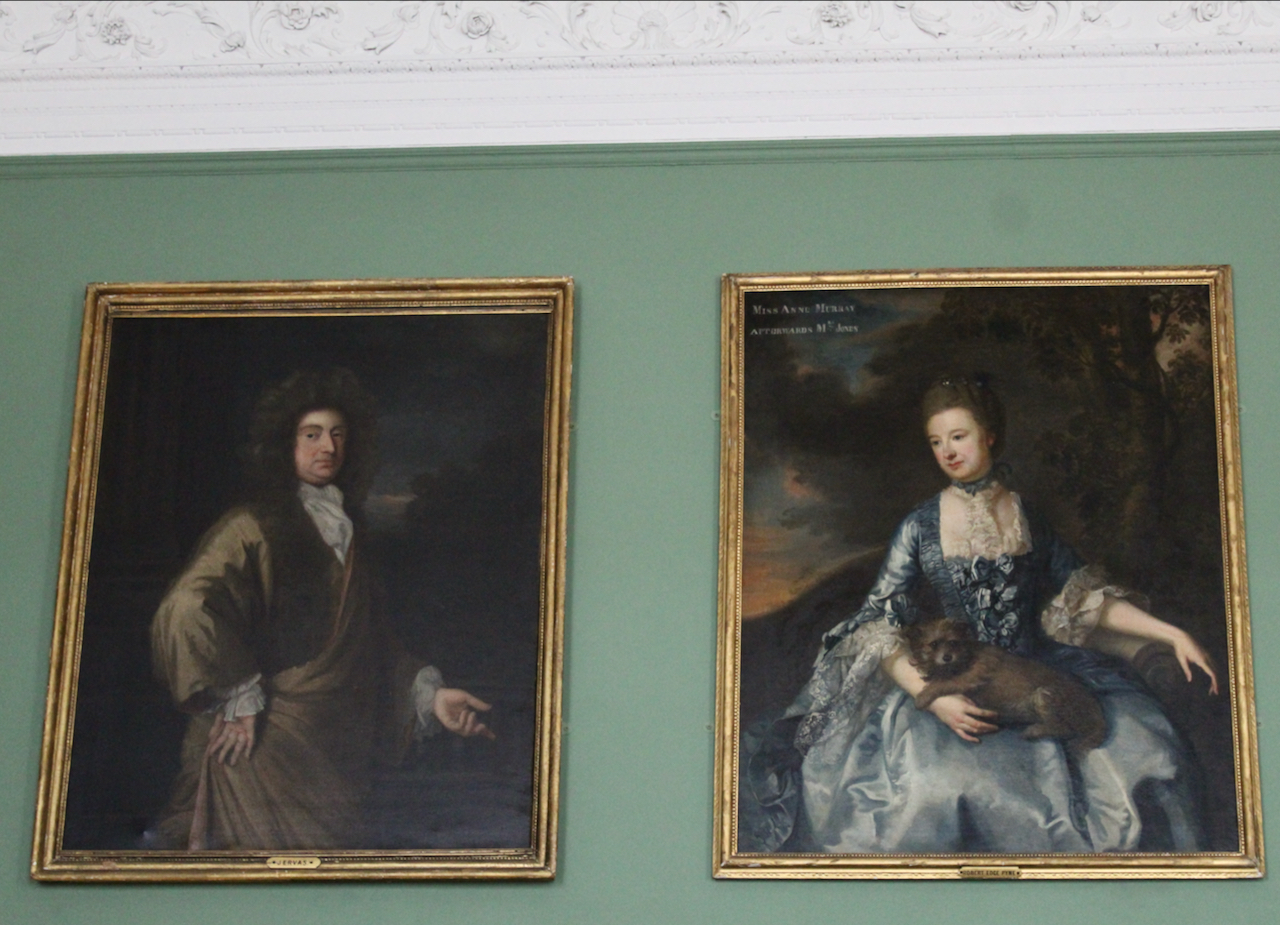
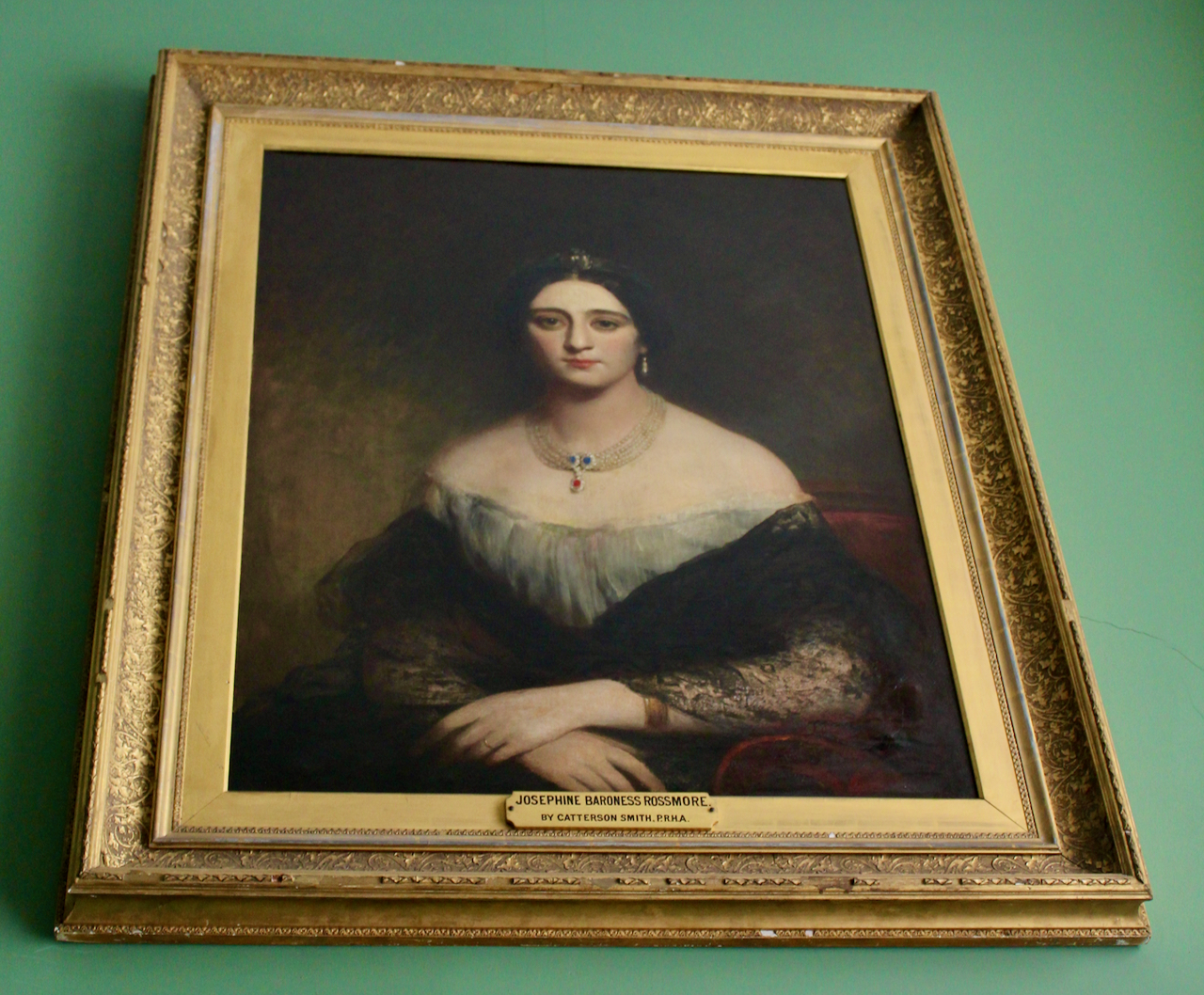
William Conolly (1662-1729) in his robes as Speaker of the Irish House of Commons, by Stephen Catterson Smith the Elder(1806-1872), portrait in Hall of Castletown.The portrait was donated by Mr and Mrs Galen Weston. This posthumous portrait was based on Jervas’s portrait of the Speaker in the Green Drawing Room.
“In November 1688, William Conolly was one of the Protestants who fled Dublin to join the Williamites in Chester alongside his late Celbridge neighbour Bartholomew Van Homrigh.
“On the victory of William III, he acquired a central role dealing in estates forfeited by supporters of James II, commencing his rise to fortune with the forfeited estates of the McDonnells of Antrim.
“In 1691 he purchased Rodanstown outside Kilcock, which became his country residence until he purchased Castletown in 1709.
“A dowry of £2,300 came his way in 1694 when he married Katherine Conyngham, daughter of Albert Conyngham, a Williamite General who had been killed in the war at Collooney in 1691.
“He was appointed Collector and Receiver of Revenue for the towns of Derry and Coleraine on May 2nd 1698.
“Conolly was the largest purchaser of forfeited estates in the period 1699–1703, acquiring also 20,000 acres spread over five counties at a cost of just £7,000.” [3]
William Conolly purchased land in County Kildare which had been owned by Thomas Dongan (1634-1715), 2nd Earl of Limerick, in 1709. Dongan’s estate had been confiscated as he was a Jacobite supporter of James II (he became first governor of the Duke of York’s province of New York! The Earldom ended at his death). Dongan’s mother was the daughter of William Talbot, 1st Baronet of Carton (see my entry about Carton, County Kildare, under Places to stay in County Kildare https://irishhistorichouses.com/2023/06/08/places-to-visit-and-stay-in-county-kildare/ ).
Conolly rose to become Speaker of the House of Commons in the Irish Parliament. He married Katherine Conyngham of Mount Charles, County Donegal, whose brother purchased Slane Castle in County Meath (see my entry https://irishhistorichouses.com/2019/07/19/slane-castle-county-meath/). As well as earning money himself, his wife brought a large dowry.
The Archiseek website tells us about the design of Castletown House:
“Soon after the project got underway Conolly met Alessandro Galilei (1691-1737), an Italian architect, who had been employed in Ireland by Lord Molesworth in 1718 [John Molesworth, 2nd Viscount, who had been British envoy to Florence]. He designed the façade of the main block in the style of a 16th century Italian town palace. He returned to Italy in 1719 and was not associated with the actual construction of the house which began in 1722. Sir Edward Lovett Pearce (died 1733), a young Irish architect, on his Italian grand tour became acquainted with Galilei in Florence and through this connection he was employed by the Speaker to complete Castletown when he returned to Ireland in 1724. Pearce had first hand knowledge of the work of the Italian architect Andrea Palladio (1508-1580) and his annotated copy of Palladio’s Quattro libri dell’architettura survives. It was Pearce who added the Palladian colonnades and the terminating pavillions. This layout was the first major Palladian scheme in Ireland and soon had many imitators.” [4]
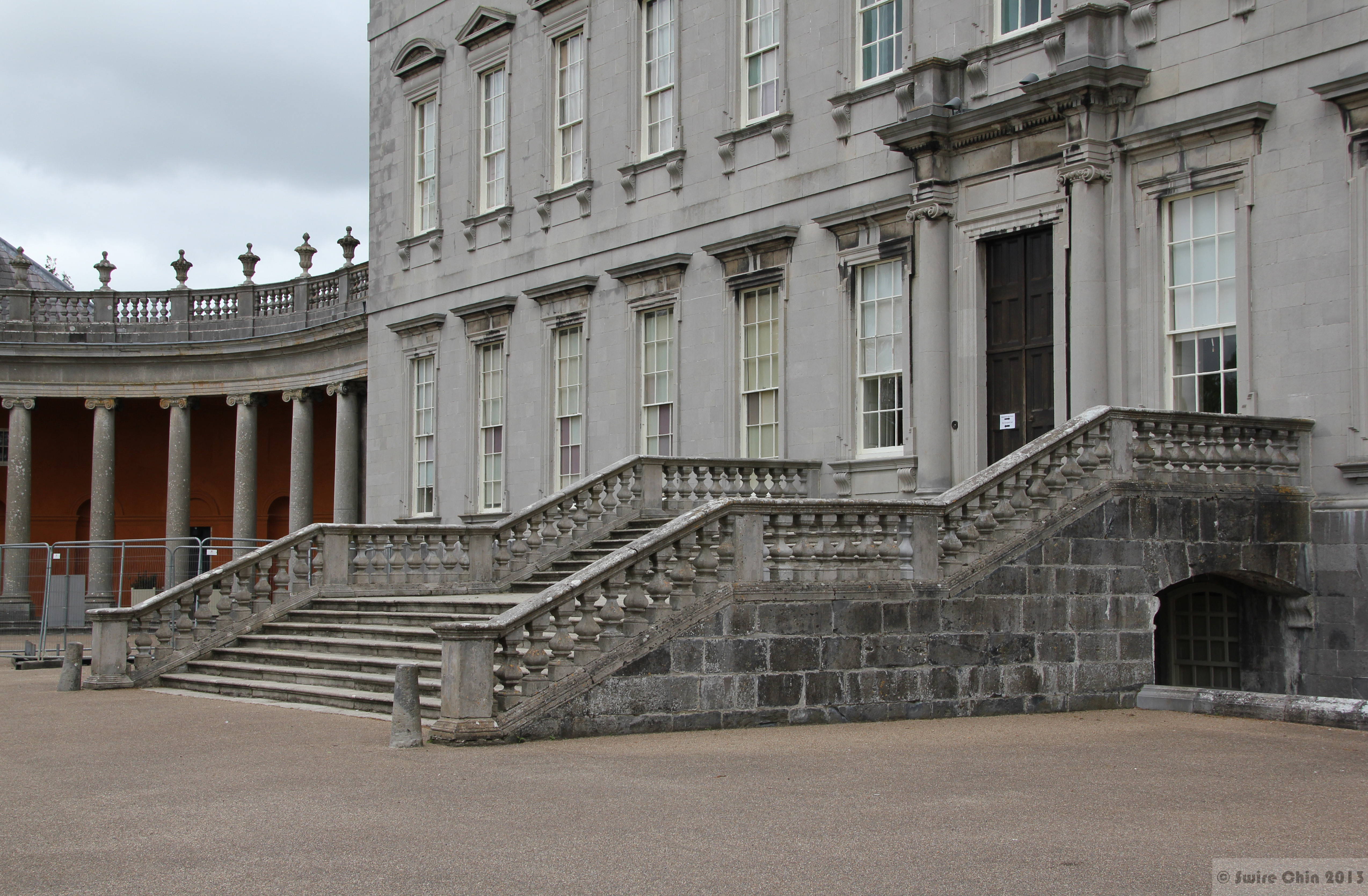
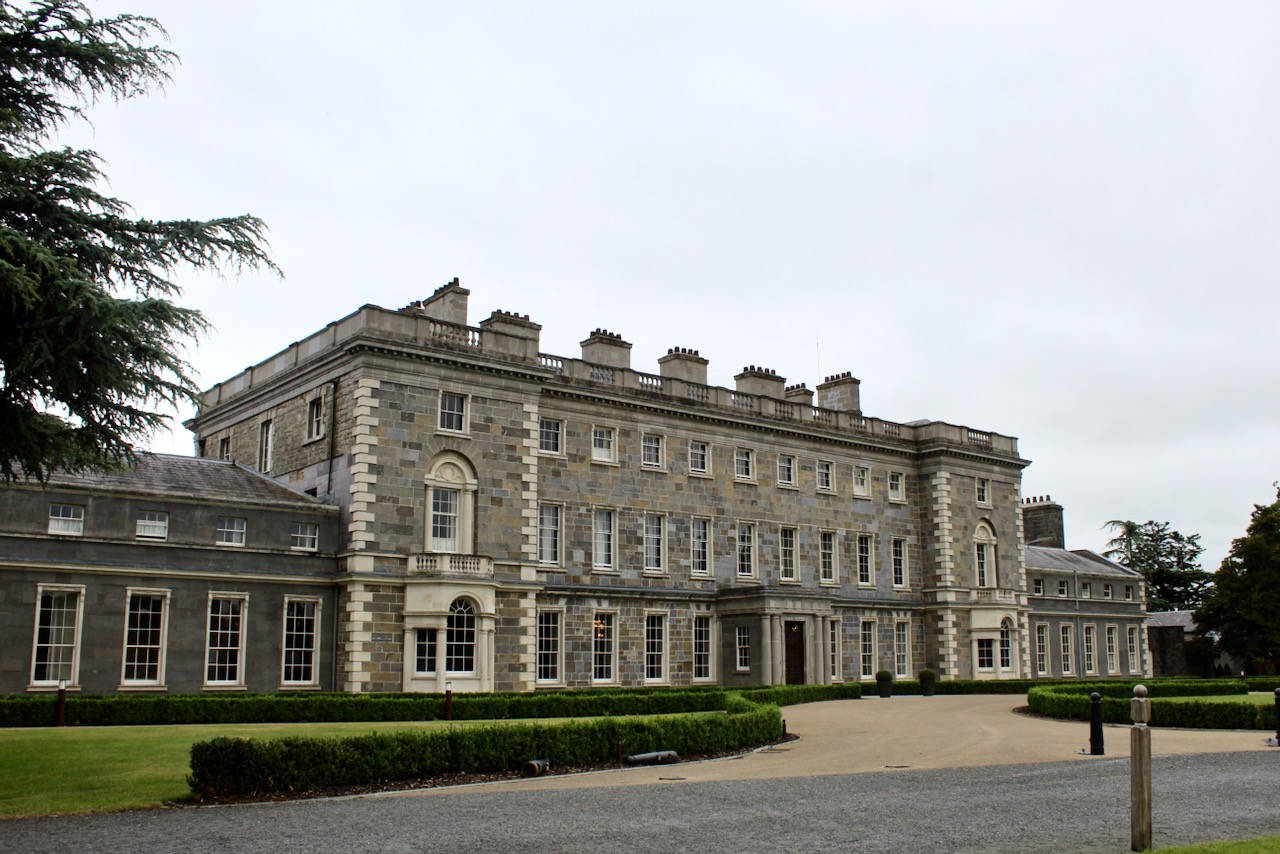
Mark Bence-Jones describes Castletown in his A Guide to Irish Country Houses. The centre block is of three storeys over basement, and has two almost identical thirteen bay fronts “reminiscent of the façade of an Italian Renaissance town palazzo; with no pediment or central feature and no ornamentation except for doorcase, entablatures over the ground floor windows, alternate segmental and triangular pediments over the windows of the storey above and a balustraded roof parapet. Despite the many windows and the lack of a central feature, there is no sense of monotony or heaviness; the effect being one of great beauty and serenity.” [5] The centre block is made of Edenderry limestone, and is topped by cornice and balustrade. On the ground floor the windows have frieze, cornice and lugged architrave, and on the first floor, alternating triangular and segmental pediments.
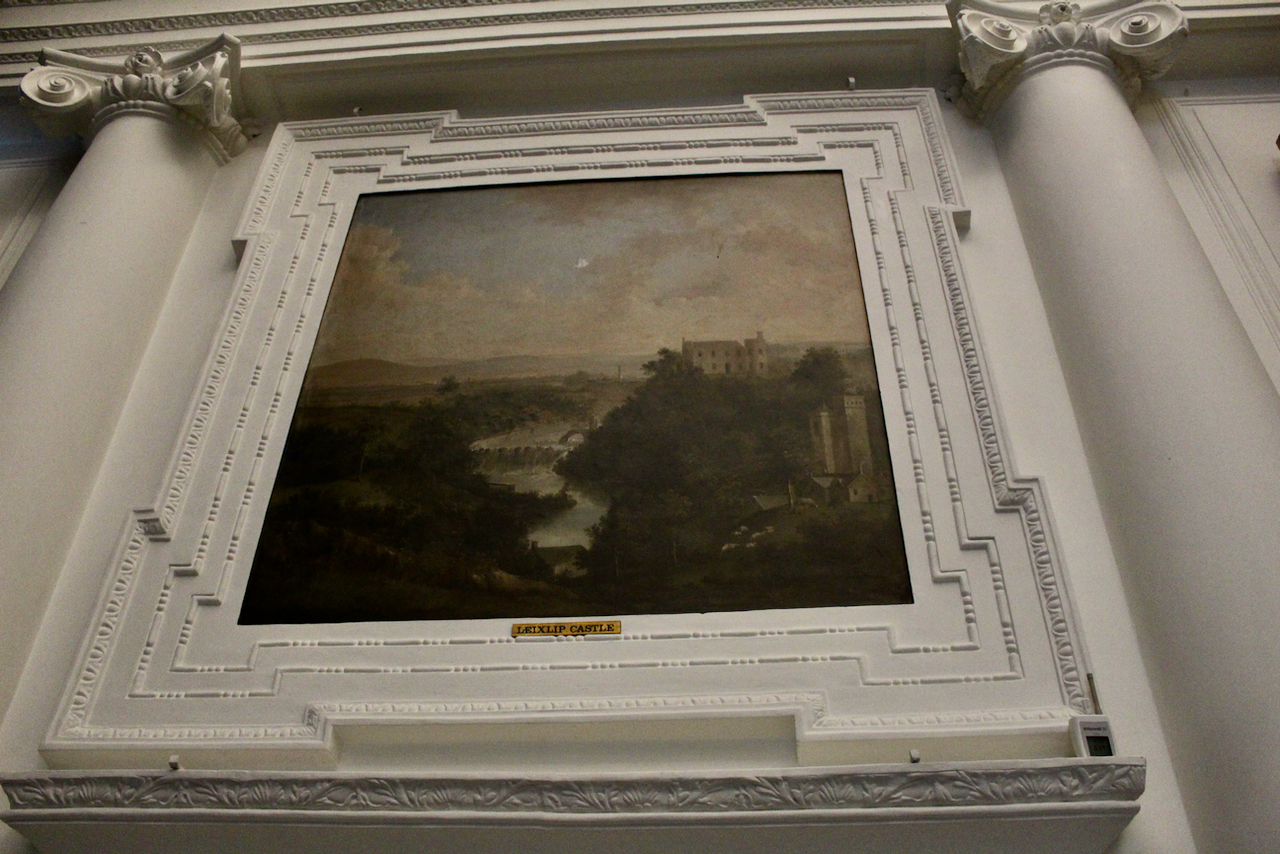
William died in 1729 aged just 67, so he had only a few years to enjoy his house. His wife Katherine lived on in the house another twenty-three years until her death at the age of 90 in 1752. William and Katherine had no children, so his estate passed to his nephew William James Conolly (1712-1754), son of William’s brother Patrick. We came across William James Conolly before in Leixlip Castle (another Section 482 property), which he also inherited. William James married Lady Anne Wentworth, the daughter of the Earl of Strafford. Her father, Thomas Wentworth 1st Earl of Strafford is not the more famous Thomas Wentworth 1st Earl of Strafford who was executed (of whom there is at least one portrait in Castletown) but a later one, of the second creation. William James died just two years after Katherine Conolly, so the estate then passed to his son Thomas Conolly (1738-1803).
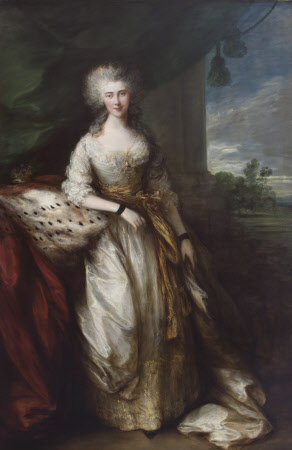
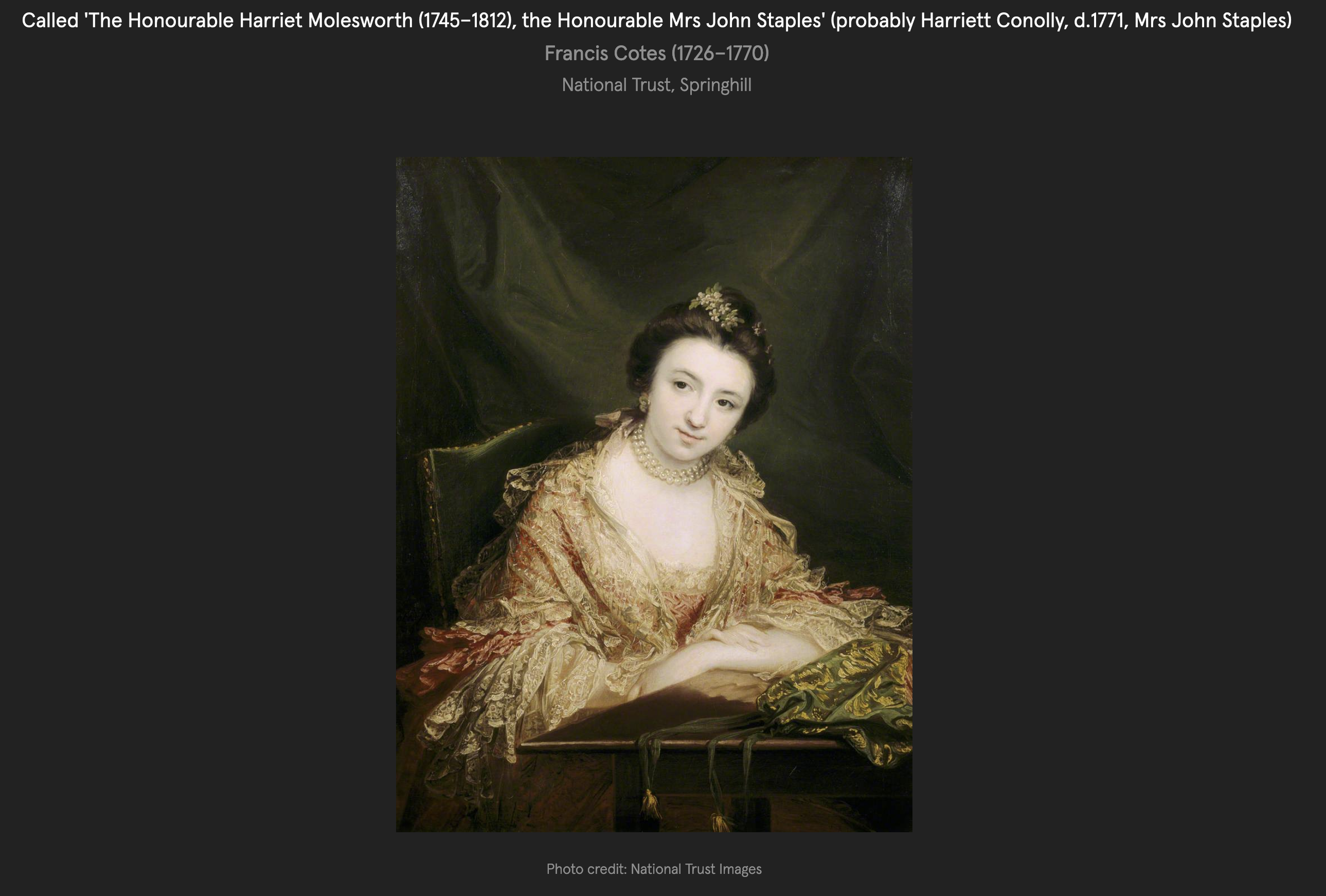
William Conolly, M.P. (d.1754) by Anthony Lee c. 1727 courtesy of National Gallery of Ireland NGI 421Lady Anne Conolly (née Wentworth) (1713-1797) Attributed to Anthony Lee, Irish, fl.1724-1767. Photograph courtesy of National Gallery of Ireland.She was the wife of William Conolly, M.P. (d.1754).Lady Anne Conolly (born Wentworth (1712/1713-1797), daughter of Thomas Wentworth (1672-1739) 1st Earl of Strafford). She was married to William James Conolly (1712-1754), of Castletown, County Kildare. She was the mother of Thomas Conolly (1734-1803).Thomas Conolly (1738-1803) by Anton Raphael Mengs, painted 1758. The German painter Mengs captured Conolly as a 19 year old on his Grand Tour. He is shown posting in front of a Roman sarcophagus, the “Relief of the Muses,” now in the Louvre. He is wearing a rich satin suit with gilt braid, portraying a young cultured aristocrat. In reality he displayed little interest in ancient civilisation, and brought back no souvenirs from Rome save for this portrait. Portrait in the National Gallery of Ireland.Thomas Conolly. He was the son and heir of William James Conolly (d.1754) of Castletown House, by his wife Lady Anne Wentworth. Thomas Conolly married Lady Louisa Lennox, a daughter of Charles Lennox, the 2nd Duke of Richmond. Caroline Conolly, Countess of Buckinghamshire (c.1755 – 1817) by Thomas Gainsborough RA (Sudbury 1727 – London 1788), 1784. She was a daughter of William James Conolly (1712-1754), and the second wife of the 2nd Earl of Buckinghamshire, painted in white court dress and gold sash, with gilt embroidered skirt, and white train, with her right elbow resting on state robes of red velvet ermine-trimmed cloak and coronet behind her. Two black wristbands, black shoes, pearl necklace. Grey powdered hair. Green curtain with tassels behind her with landscape in background.Portrait called The Honourable Harriet Molesworth (1745-1812), wife of John Staples (1736-1820) (probably Harriet Conolly, d. 1771), a daughter of William James Conolly, by Francis Cotes, courtesy of National Trust. Springhill, County Derry.
Thomas married Louisa Lennox in 1758, one of five Lennox sisters, daughters of the Charles Lennox, 2nd Duke of Richmond. From the age of eight she had lived at nearby Carton with her sister Emily, who was married to James Fitzgerald, the 20th Earl of Kildare (who became the 1st Duke of Leinster). At Carton, Louisa was exposed to the fashionable ideas of the day in architecture, decoration, horticulture and landscaping. [6] Louisa loved Castletown and continually planned improvements, planting trees, designing the lake and building bridges.
Archiseek continues: “The Castletown papers, estate records and account books, together with Lady Louisa’s [i.e. Louisa Lennox, wife of Tom Conolly] diaries and correspondence with her sisters, provide a valuable record of life at Castletown and also of the reorganisation of the house. Lady Louisa’s letters from the 1750s onwards are revealing of the fashions in costume design, fabric patterns and furniture. She played an important part in the alteration and redecoration of Castletown during the 1760s and 1770s. As no single architect was responsible for all of the work carried out, she supervised most of it herself. Much of the redecoration of the house was done to the published designs of the English architect Sir William Chambers (1723-1796) who never came to Ireland himself. Chambers also worked for Lady Louisa’s brother, the 3rd Duke of Richmond, at Goodwood in Sussex. In a letter, written in July 1759, Lady Louisa mentions instructions given by Chambers to his assistant Simon Vierpyl who supervised the work at Castletown.” (see [6])
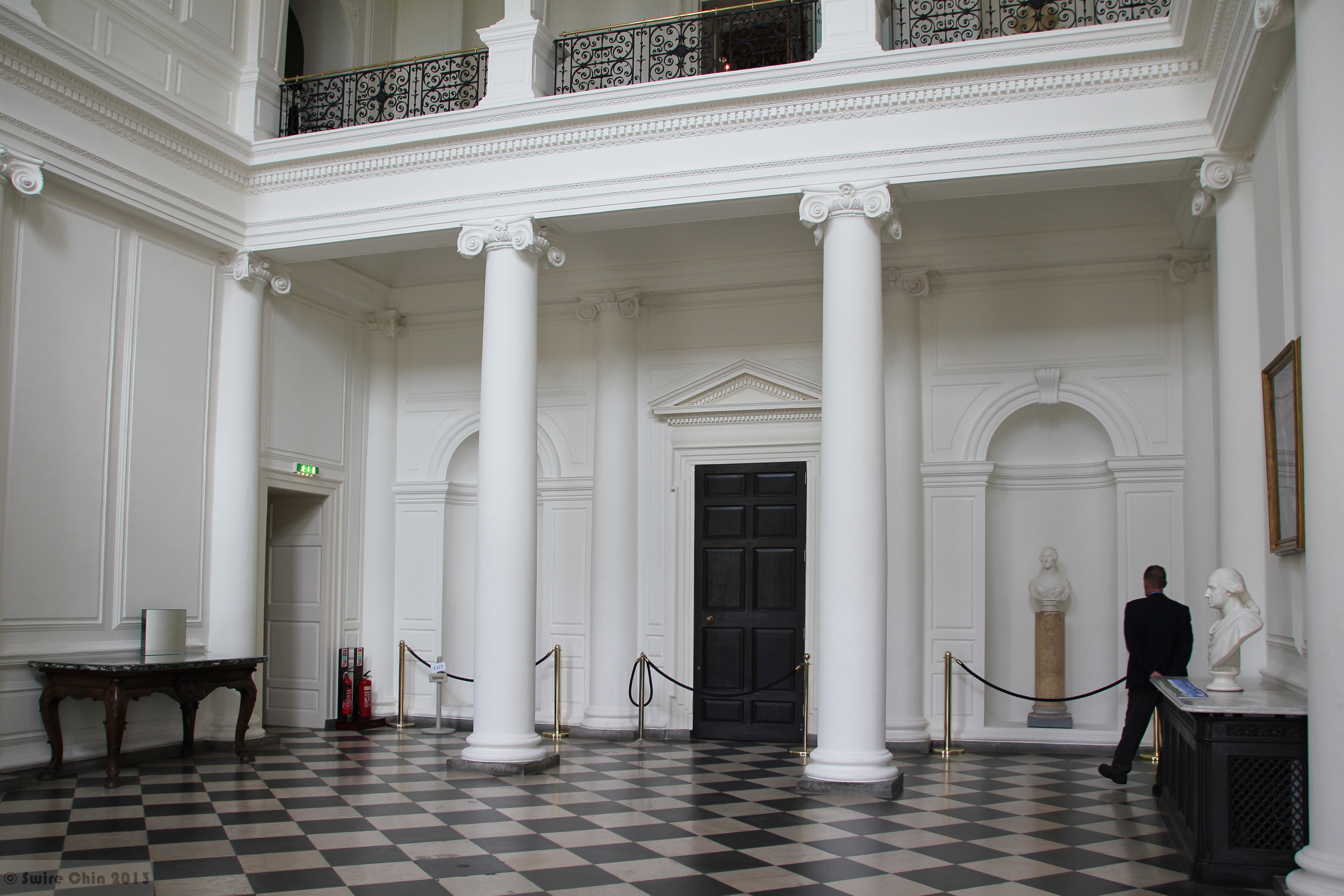
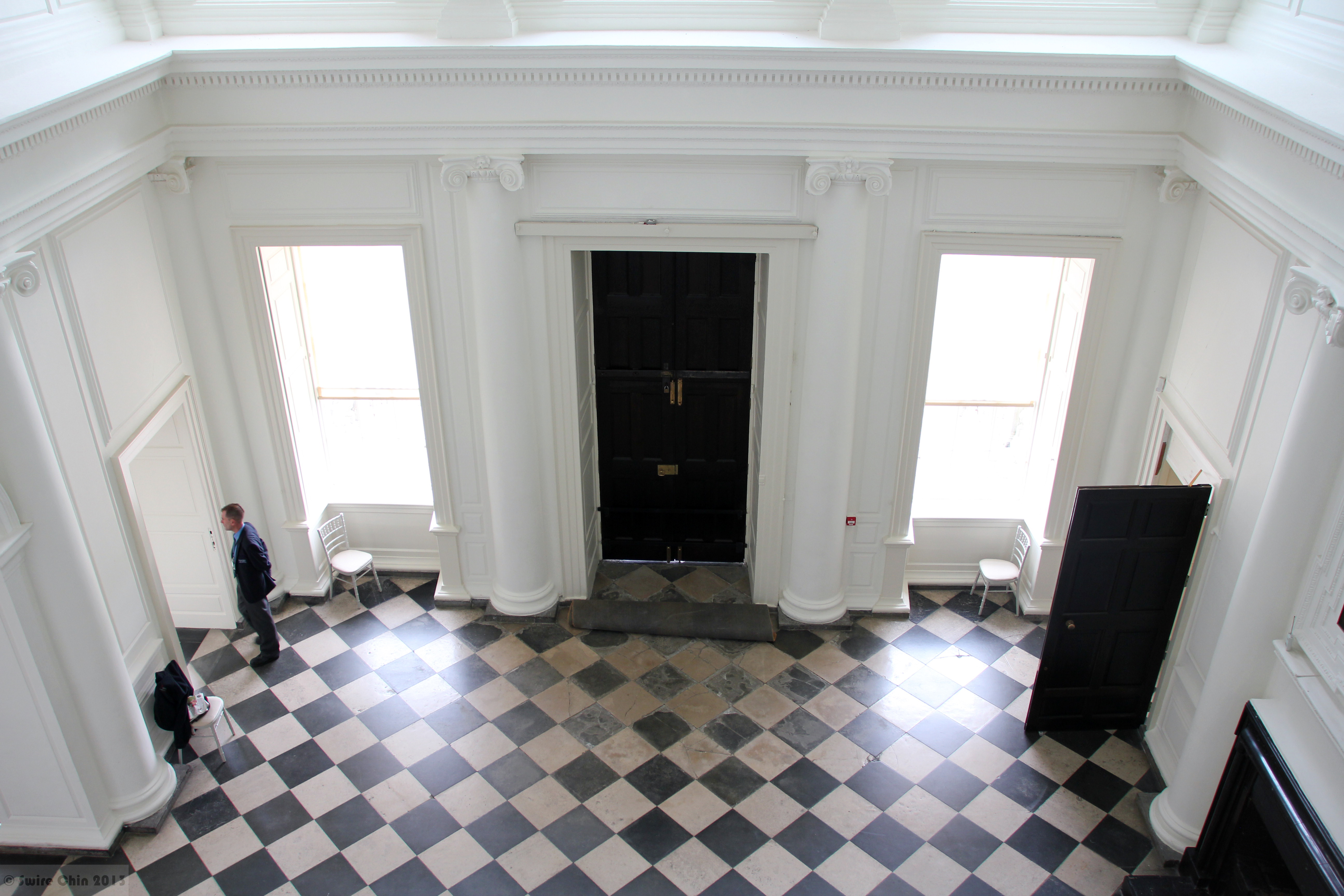
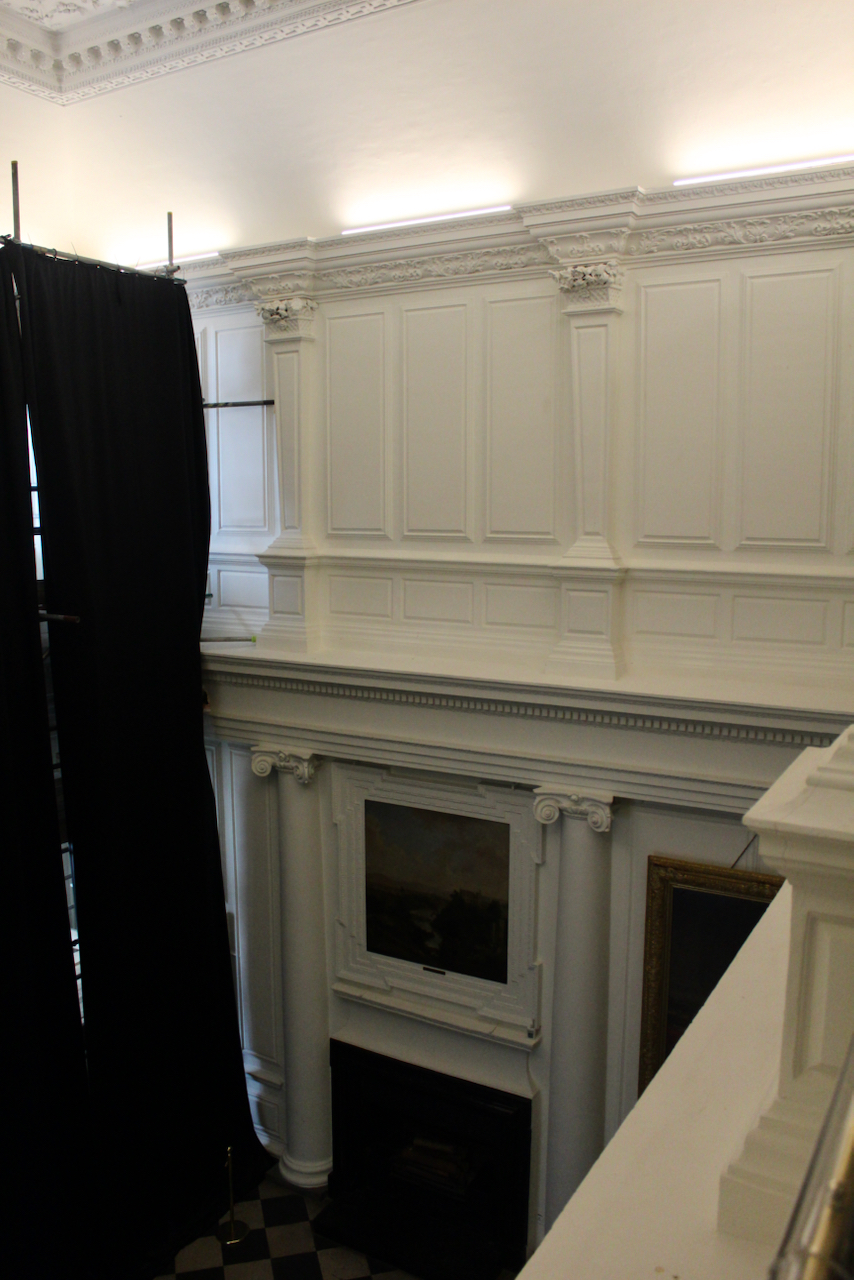
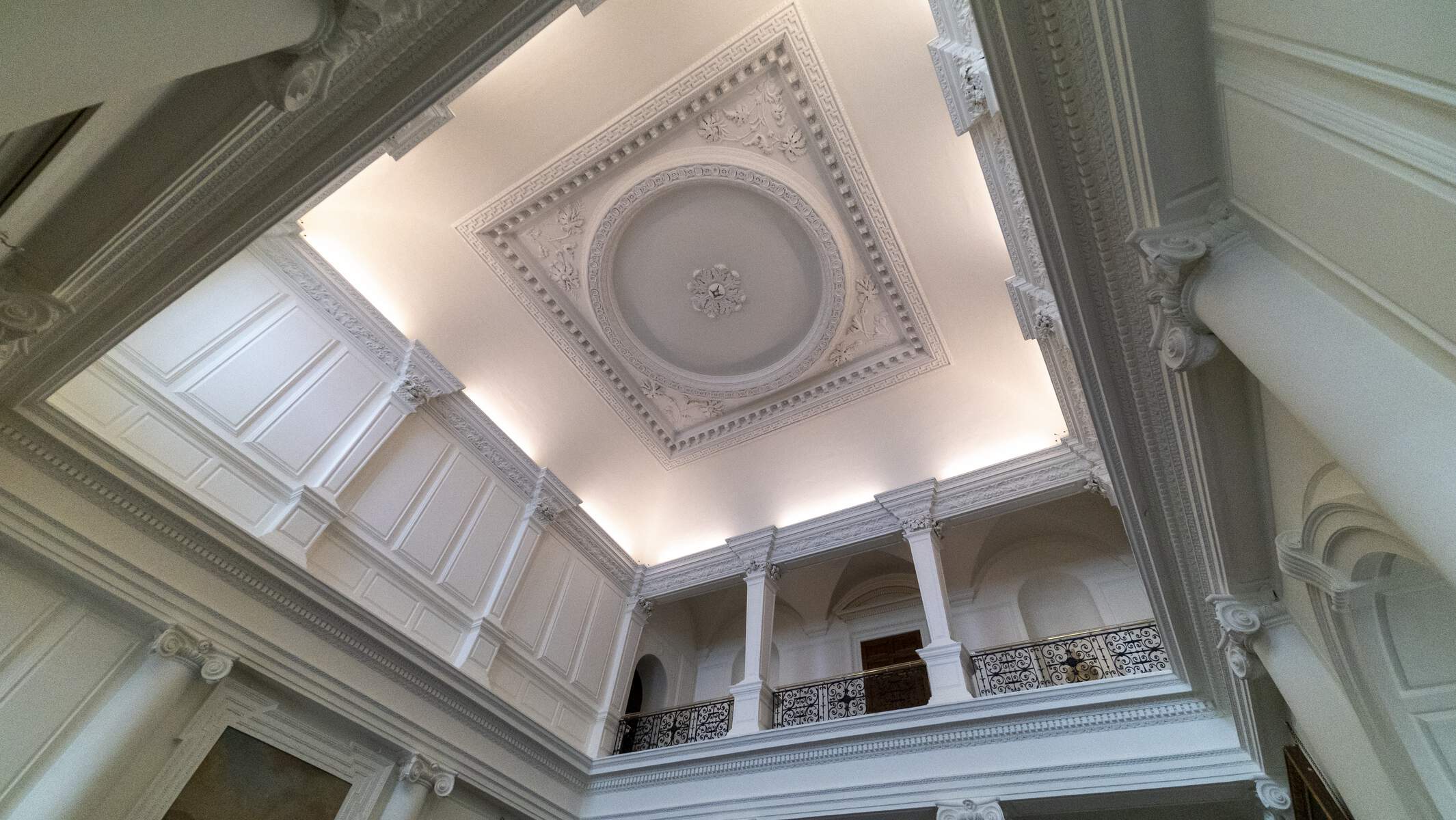
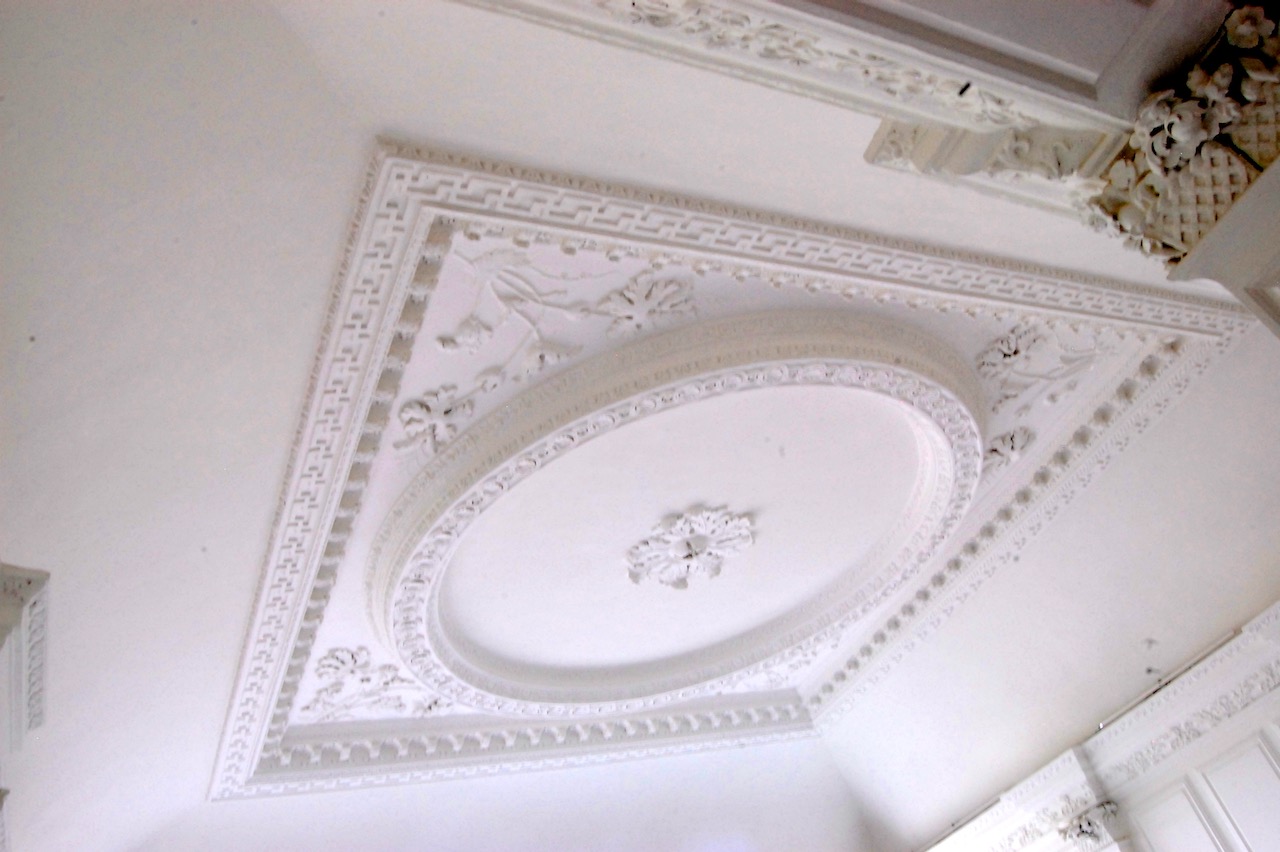
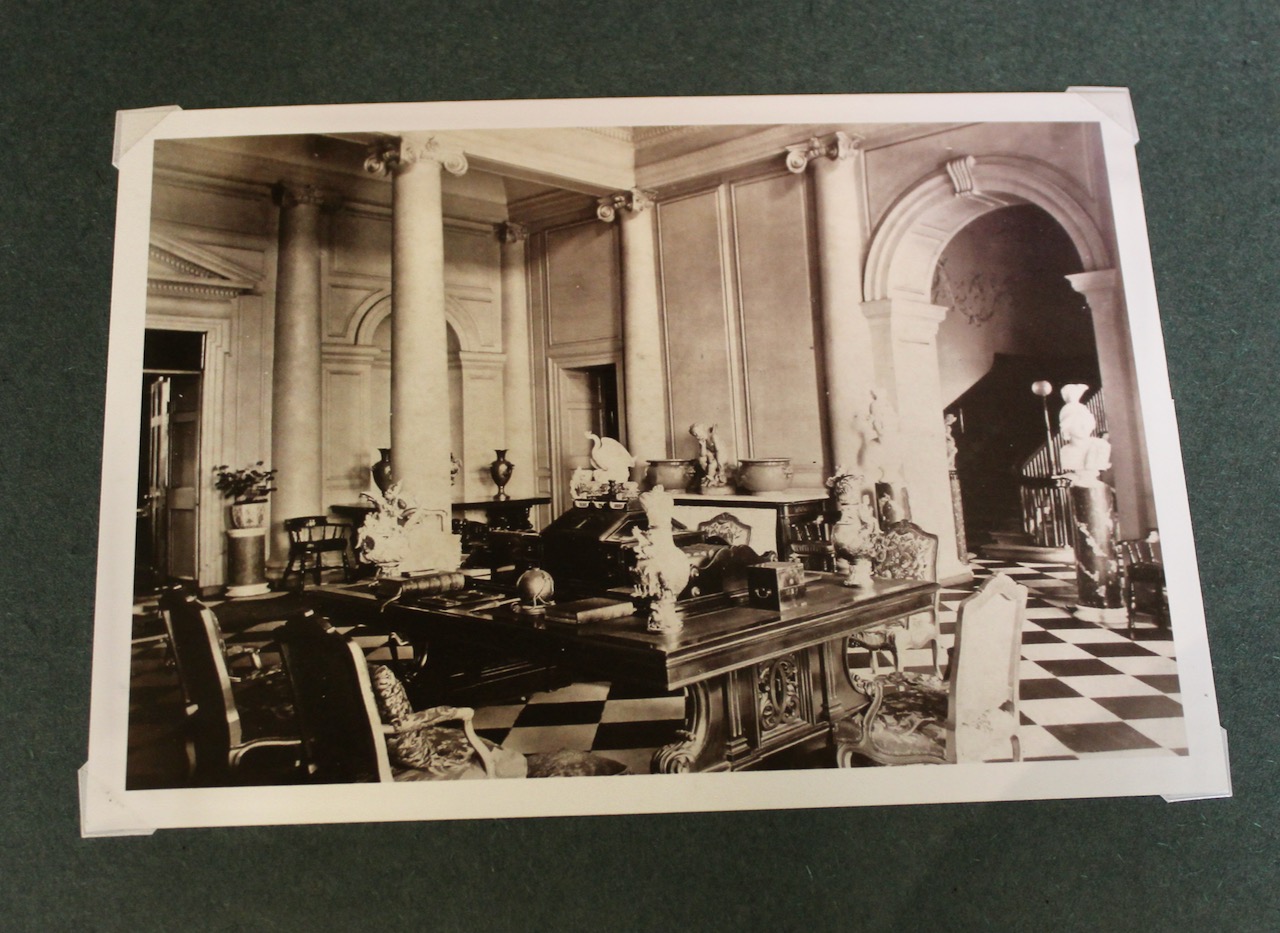
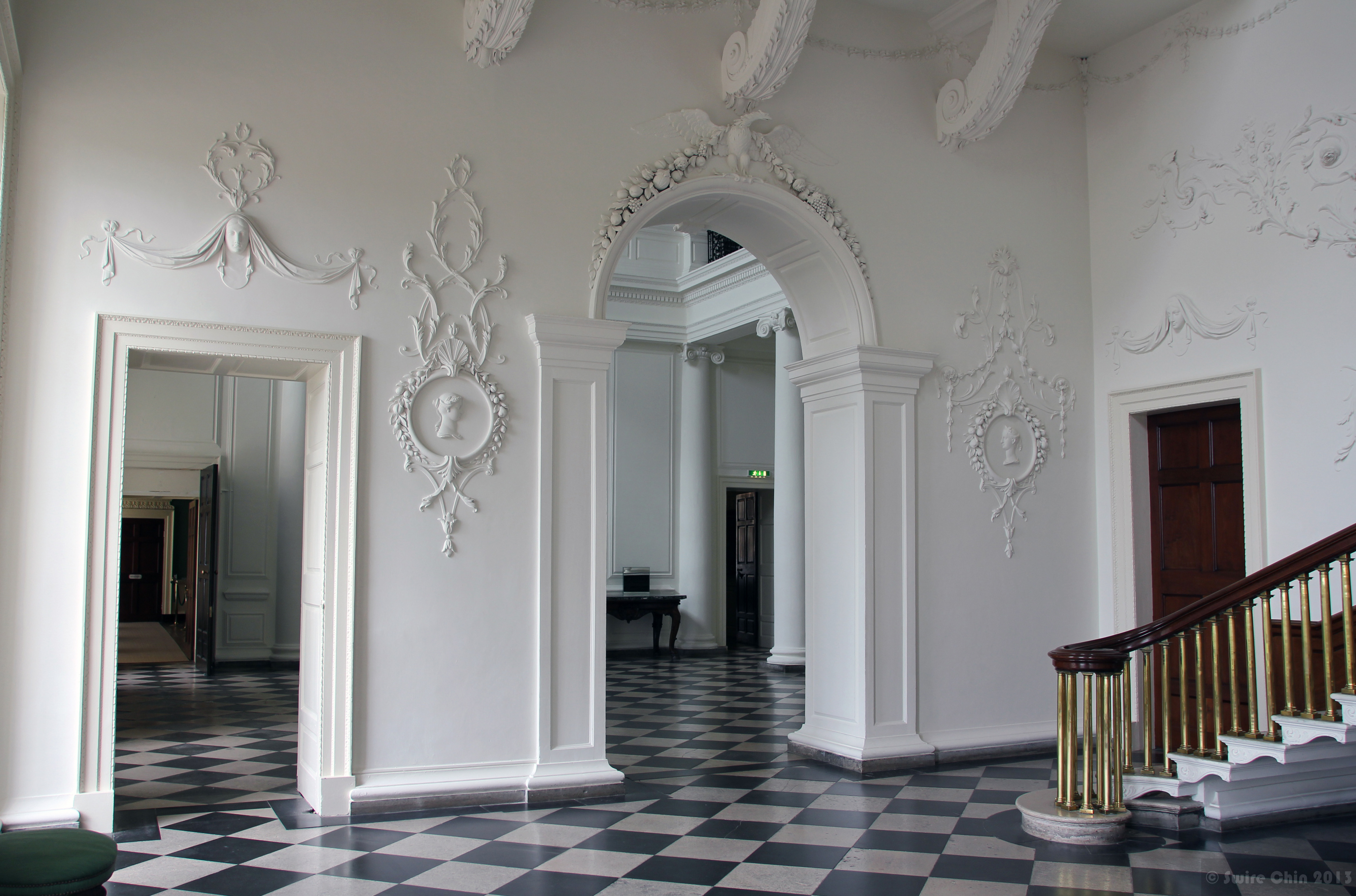
Description of the Hall, from Archiseek: “This impressive two-storeyed room with a black and white chequered floor, was designed by Sir Edward Lovett Pearce. The Ionic order on the lower storey is similar to that of the colonnades outside and at gallery level there are tapering pilasters with baskets of flowers and fruit carved in wood. The coved ceiling has a central moulding comprising a square Greek key patterned frame and central roundel with shell decoration.” [see 6]
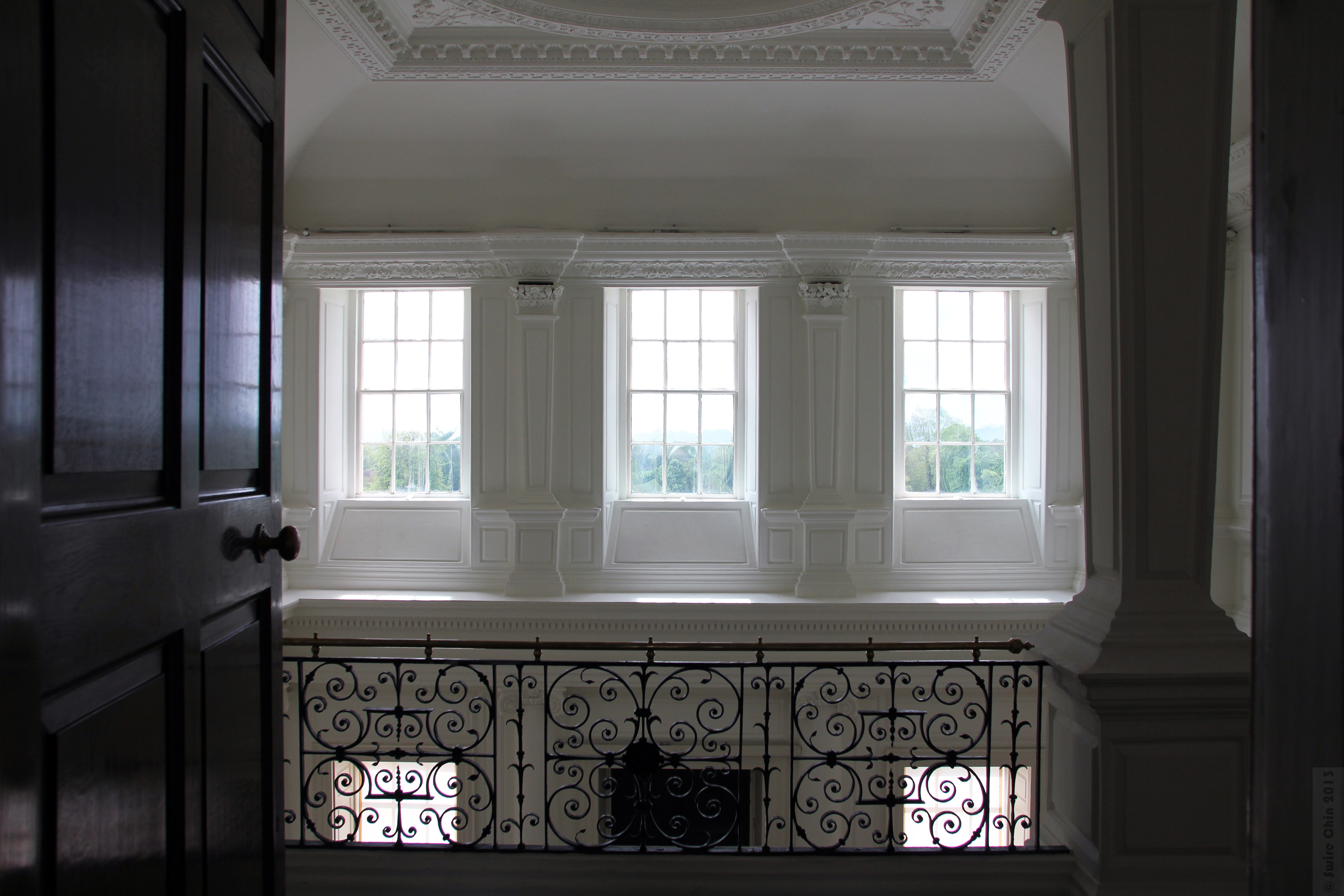
Great Hall,photograph by Swire Chin, Toronto, May 2013 flickr constant commons.The Gallery of the Great Hall. Photograph by Swire Chin, Toronto, May 2013 flickr constant commons.Photograph by Swire Chin, Toronto, May 2013 flickr constant commons.
The polished limestone floor with its chequered design and the Kilkenny marble fireplace reflect William Conolly’s desire to build the house solely of native Irish materials. Unfortunately when we visited in October 2022, the hall was half hidden with a large two storey curtain, as the windows are all being repaired. As we can see in the photograph, the room has an Ionic colonnade to the rear, and a gallery at first floor level, and the stair hall is through an archway in the east wall.
From the entrance hall, one enters the magnificent Stair Hall. The Castletown website describes the stair hall:
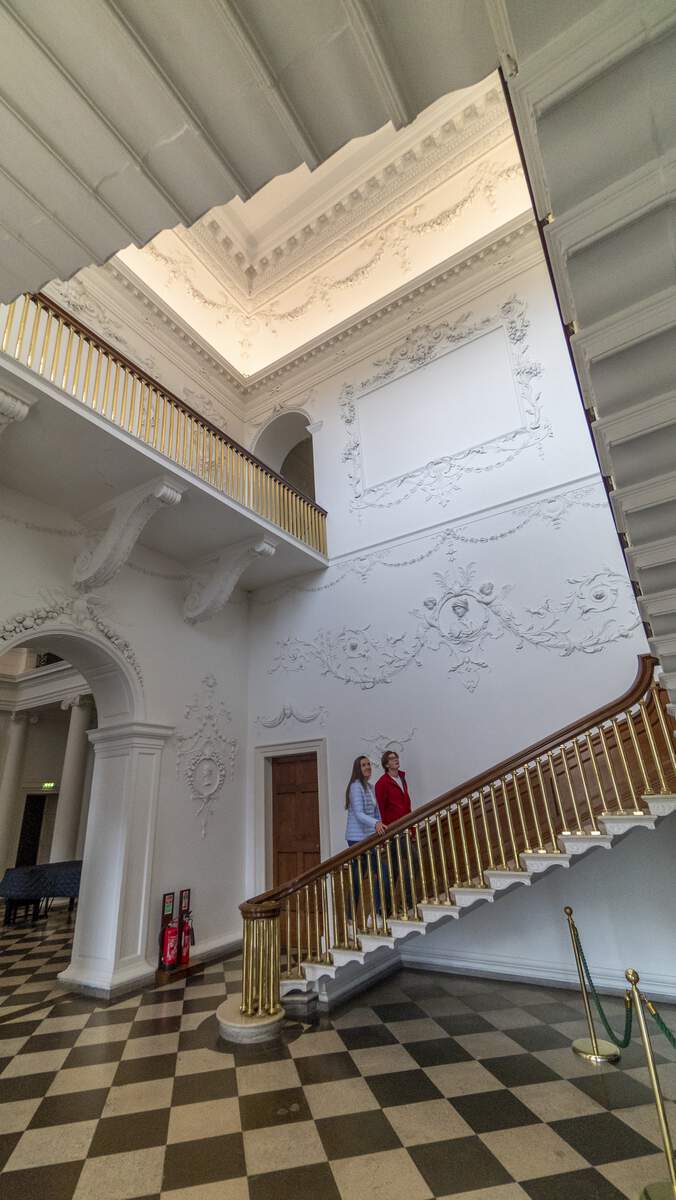
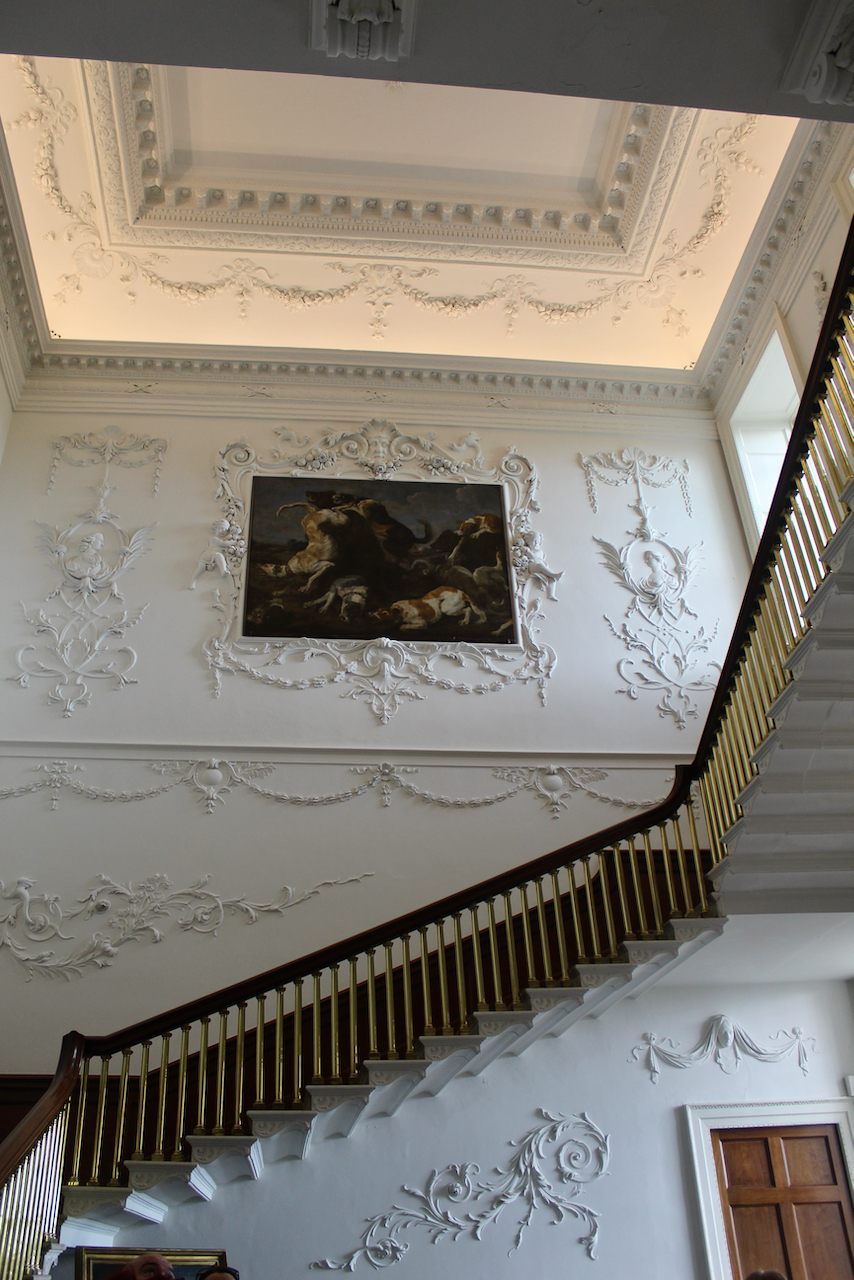
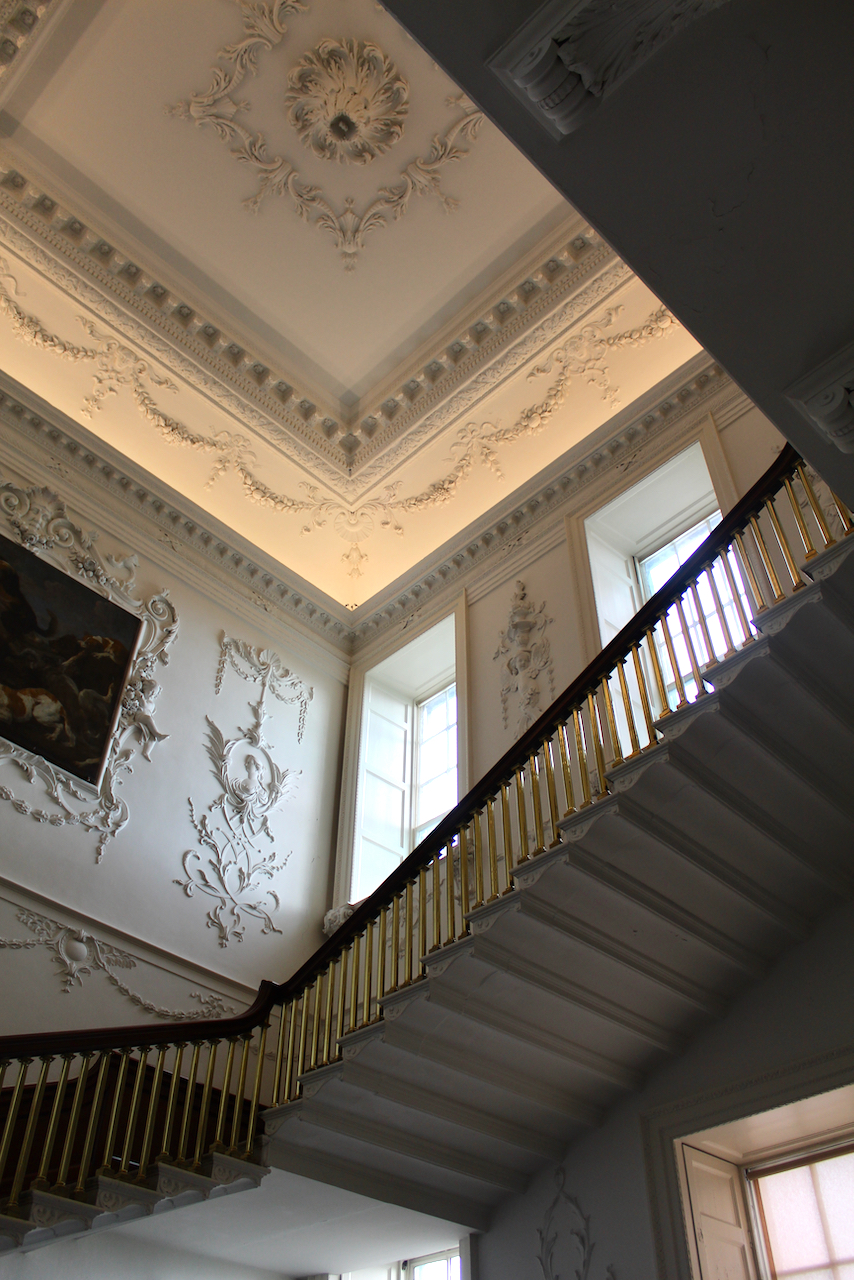
“The Portland stone staircase at Castletown is one of the largest cantilevered staircases in Ireland. It was built in 1759 under the direction of the master builder Simon Vierpyl (c.1725–1811). Prior to this the space was a shell, although a plan attributed to Edward Lovett Pearce suggests that a circular staircase was previously intended.
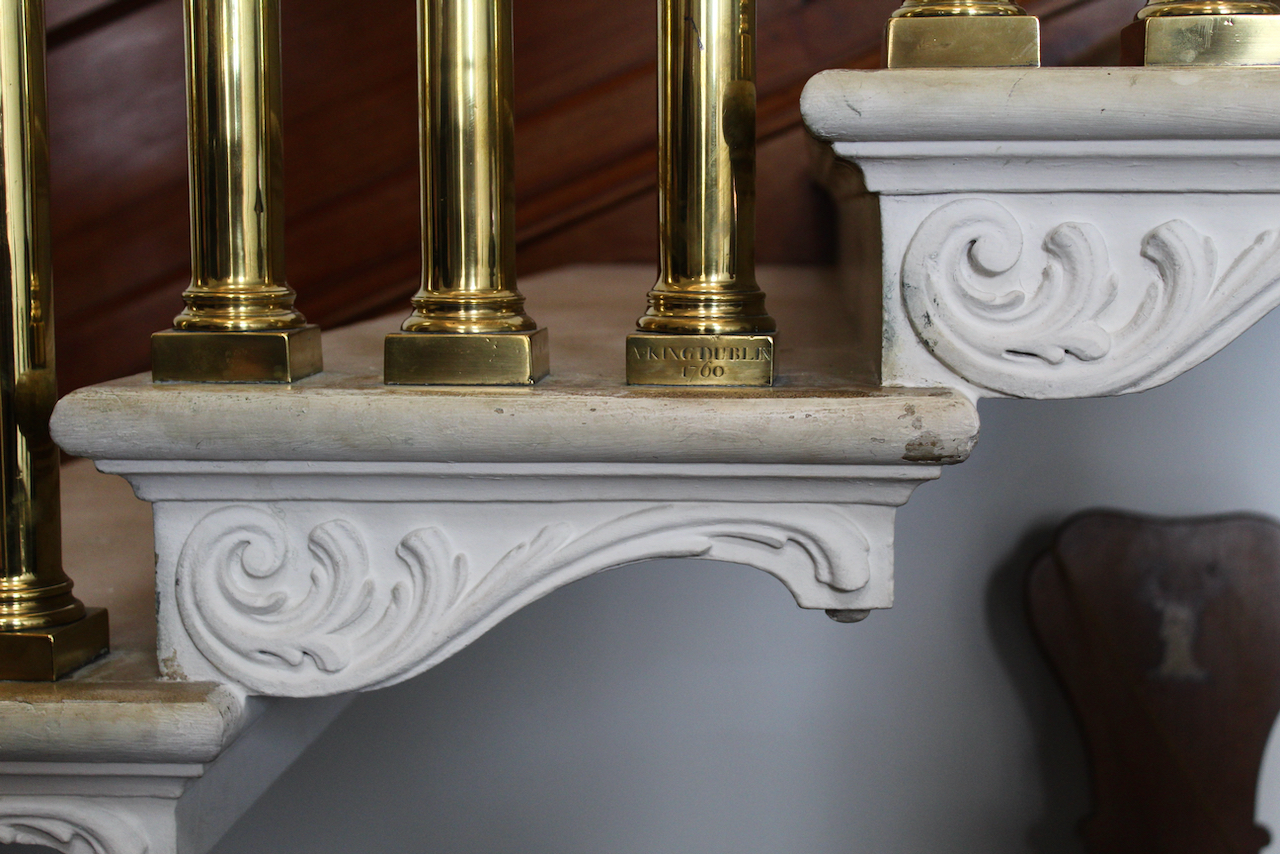
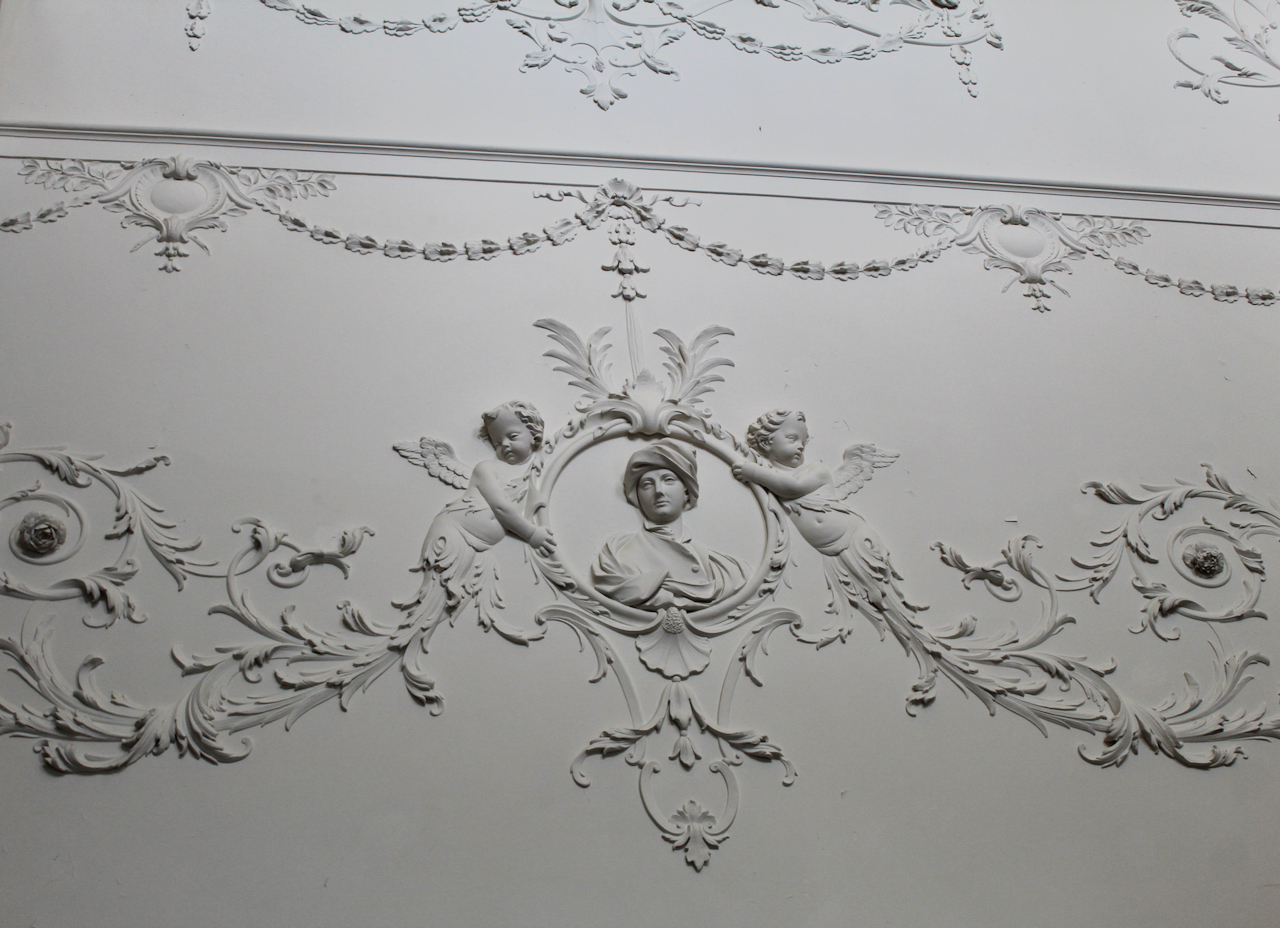
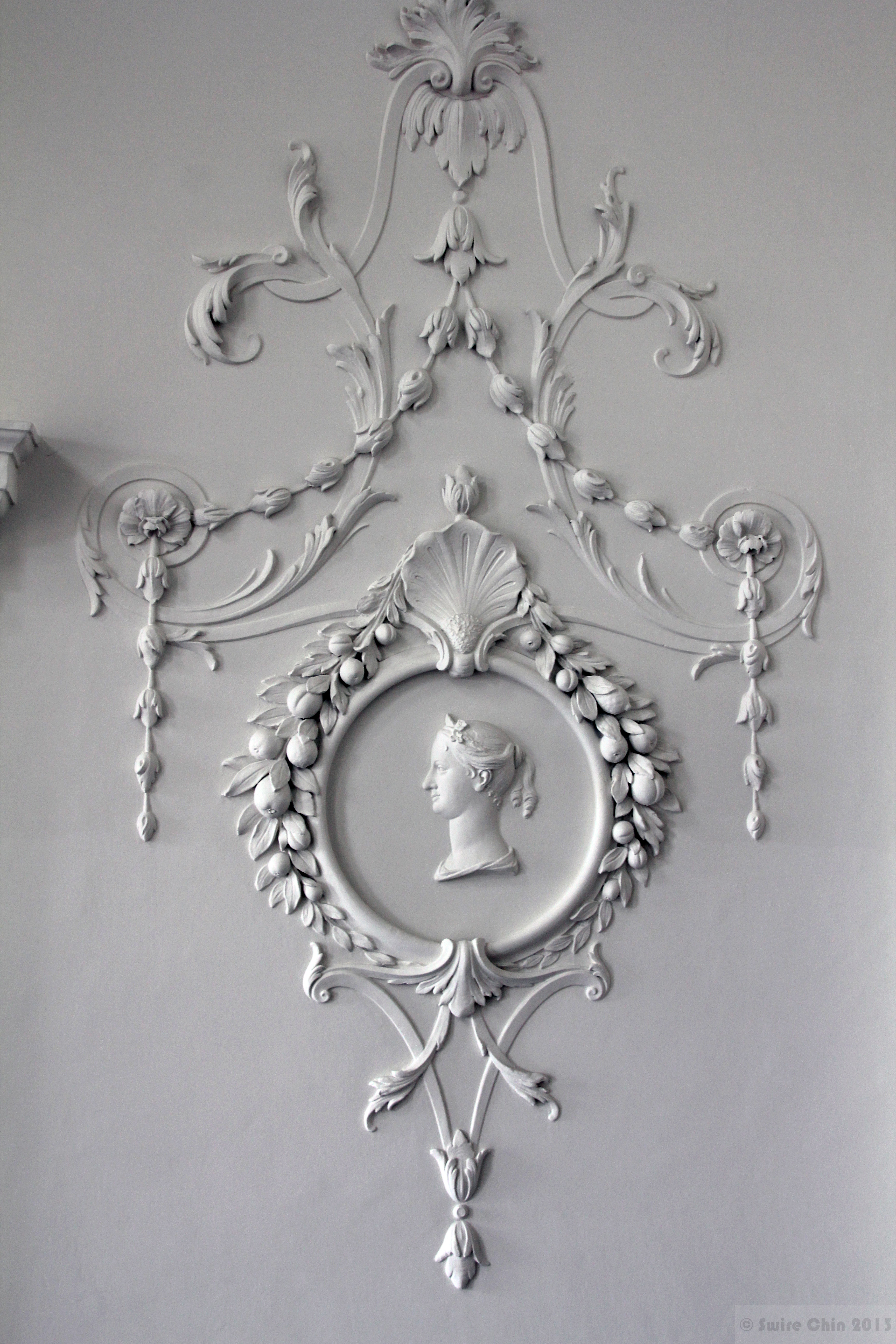
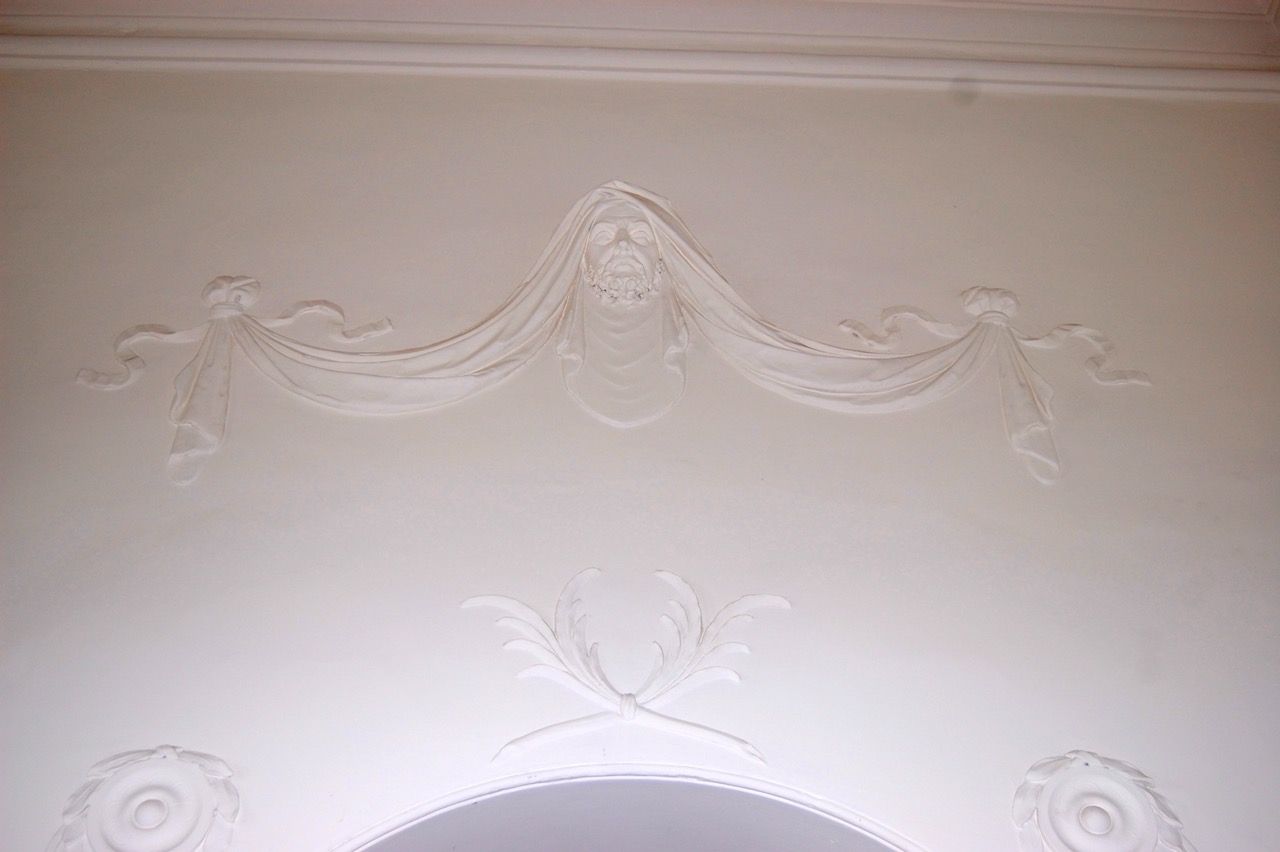
“The solid brass balustrade was installed by Anthony King, later Lord Mayor of Dublin. He signed and dated three of the banisters, ‘A. King Dublin 1760’. The opulent rococo plasterwork was created by the Swiss-Italian stuccadore Filippo Lafranchini, who, with his older brother Paolo, had worked at Carton and Leinster House for Lady Lousia’s brother-in-law, the first Duke of Leinster, as well as at Russborough in Co. Wicklow. Shells, cornucopias, dragons and masks feature in the light-hearted decoration which represents the final development of the Lafranchini style. Family portraits are also included with Tom Conolly at the foot of the stairs and Louisa above to his right. The four seasons are represented on the piers and on either side of the arched screen.“
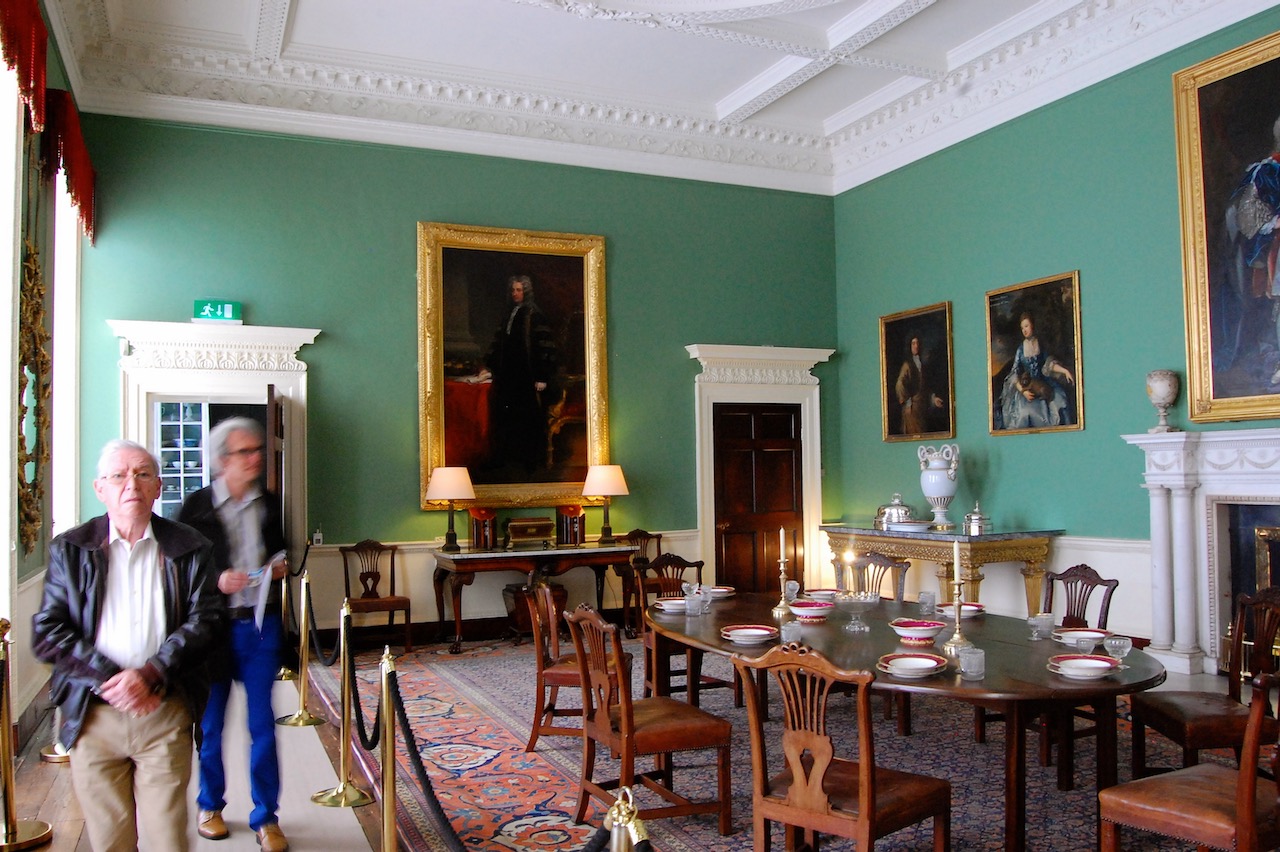
“In the following year, Tom Conolly and Lady Louisa employed the Francini to decorate the walls of thestaircase hall with rococo stuccowork; and in 1760 the grand staircase itself – of cantilevered stone, with a noble balustrade of brass columns – was installed; the work beign carried out by Simon Vierpyl, a protégé of Sir William Chambers. The principal reception rooms, which form an enfilade along the garden front and were mostly decorated at this time, are believed to be by Chambers himself; they have ceilings of geometrical plasterwork, very characteristic of him. Also in this style is the dining room, to the left of the entrance hall. It was here that, according to the story, Tom Conolly found himself giving supper to the Devil, whom he had met out hunting and invited back, believing him to be merely a dark stranger; but had realised the truth when his guest’s boots were removed, revealing him to have unusually hairy feet. He therefore sent for the priest, who threw his breviary at the unwelcome guest, which missed him and cracked a mirror. This, however, was enough to scare the Devil, who vanished through the hearthstone. Whatever the truth of this story, the hearthstone in the dining room is shattered, and one of the mirrors is cracked.“
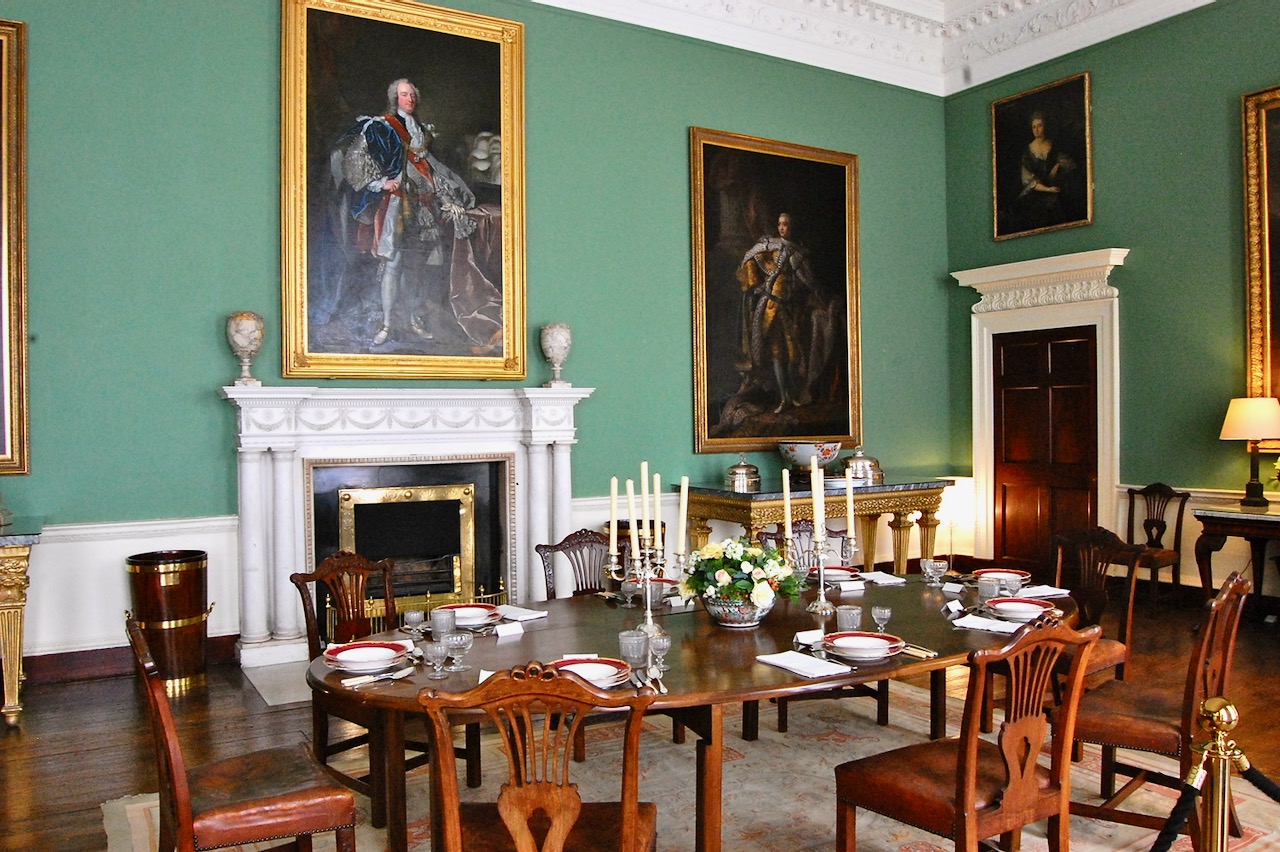
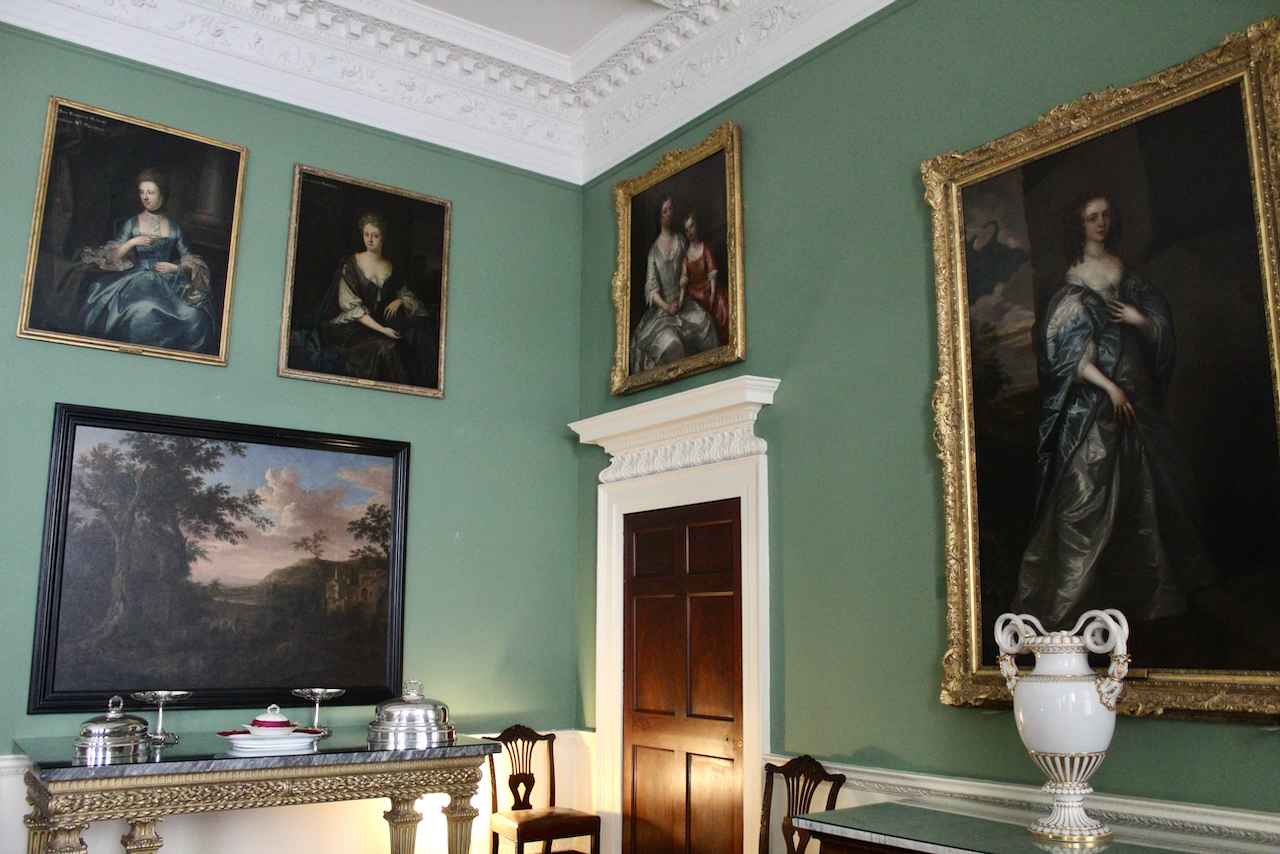
“This room dates from the 1760s redecoration of Castletown undertaken by Lady Louisa Conolly and reflects the mid-eighteenth century fashion for separate dining rooms. Originally, there were two smaller panelled rooms here. It was reconstructed to designs by Sir William Chambers, with a compartmentalised ceiling similar to one by Inigo Jones in the Queen’s House at Greenwich. The chimney-piece and door cases are in the manner of Chambers. Of the four doors, two are false.
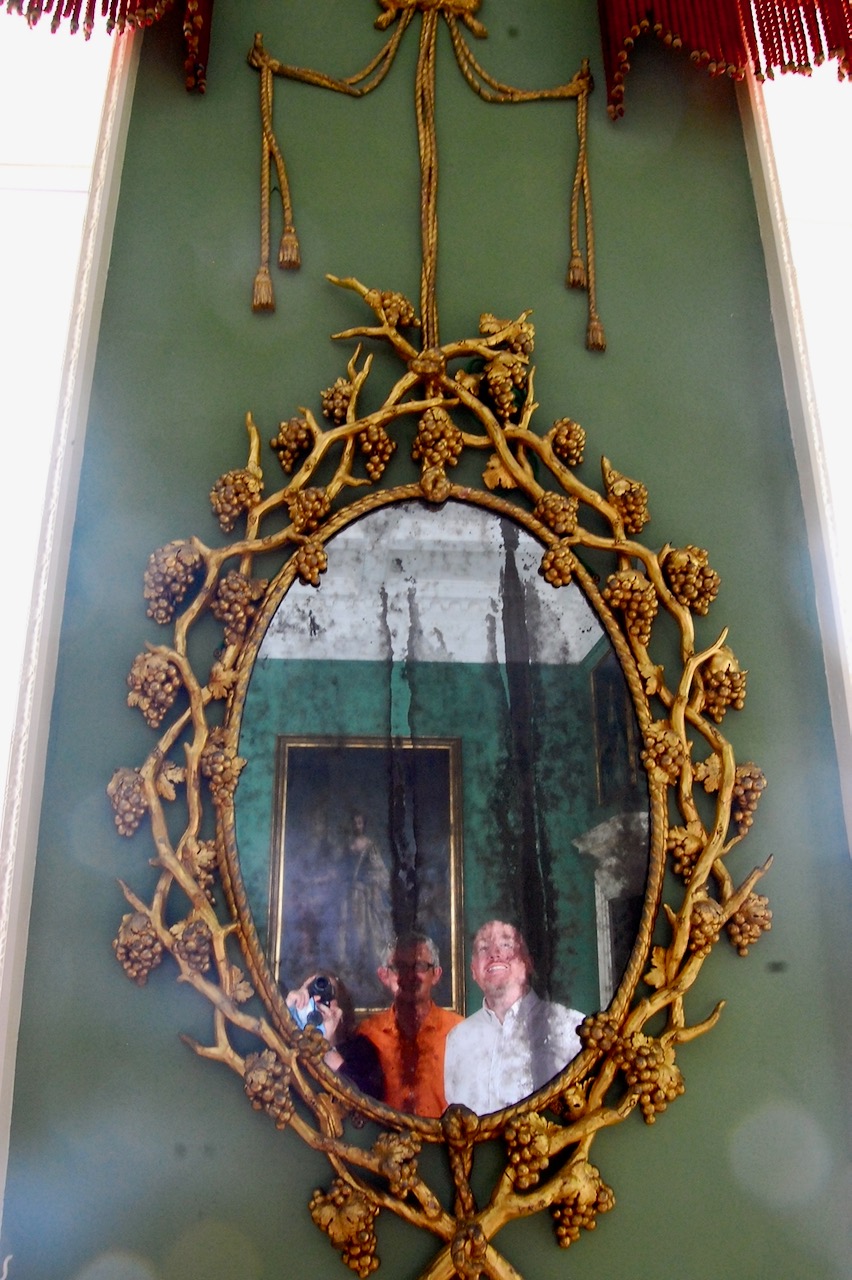
“Furniture original to Castletown includes the two eighteenth-century giltwood side tables. Their frieze is decorated with berried laurel foliage similar to the door entablatures in the Red and Green Drawing Rooms. The three elaborate pier glasses are original to the Dining Room. The frames are carved fruiting vines, symbols of Bacchus and festivity. These are probably the work of the Dublin carver Richard Cranfield (1713-1809) who, with the firm of Thomas Jackson of Essex Bridge, Dublin, was paid large sums for carving and gilding throughout the house.“
Between the front of the house, with its Entrance Hall, Stair Hall and Dining Room is a corridor, or rather, two corridors, one to the west and one to the east of the Entrance Hall. This corridor is on every storey, including the basement. To the rear (north) of the house on the ground floor is an enfilade of rooms: the Brown Study to the west end, next to another staircase, then the Red Drawing Room, the Green Drawing Room, the Print Room, the State Bedroom, and then small rooms called the Healy Room and the Map Room.
Next to the Dining Room at the front of the house is the Butler’s Pantry, which contains photographs of the servants of Castletown, and a portrait of a housekeeper, Mrs Parnel Moore (1649–1761). It’s unusual to have a portrait of a housekeeper but perhaps someone painted her because she was a beloved member of the household, as she lived to be at least 112 years! This is a very old portrait dating back to the 1700s.
The Castletown website tells us about the Butler’s Pantry: “The Butler’s Pantry dates from the 1760s and connected the newly created Dining Room with the kitchens in the West Wing. Food was carried in from the kitchens through the colonnade passageway and then reheated in the pantry before being served. The great kitchens were on the ground floor of the west wing, with servants’ quarters upstairs. Upwards of 80 servants would have been employed in the house and kitchens in the late eighteenth century under the direction of the Butler and the Housekeeper.”
A house like Castletown relied on an army of servants and this portrait of former housekeeper Mrs Parnel Moore – aged 112 according to the inscription – dates back to the beginnings of Castletown and is one of the oldest original items in the collection.English servants of Castletown, photograph in Butler’s Pantry of Castletown.Irish servants of Castletown, photograph in Butler’s Pantry of Castletown.Enfilade of rooms on the north side, photograph by Swire Chin, Toronto, May 2013 flickr constant commons.
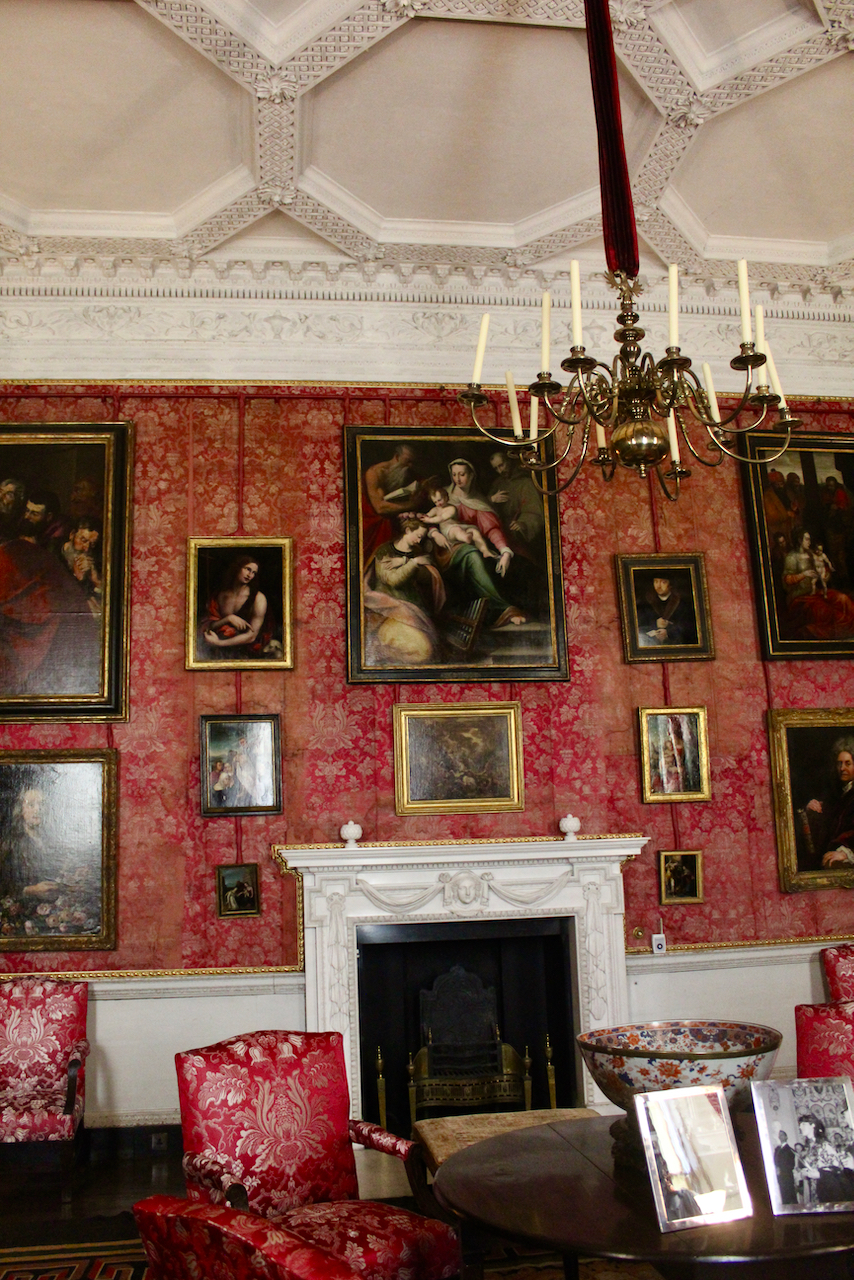
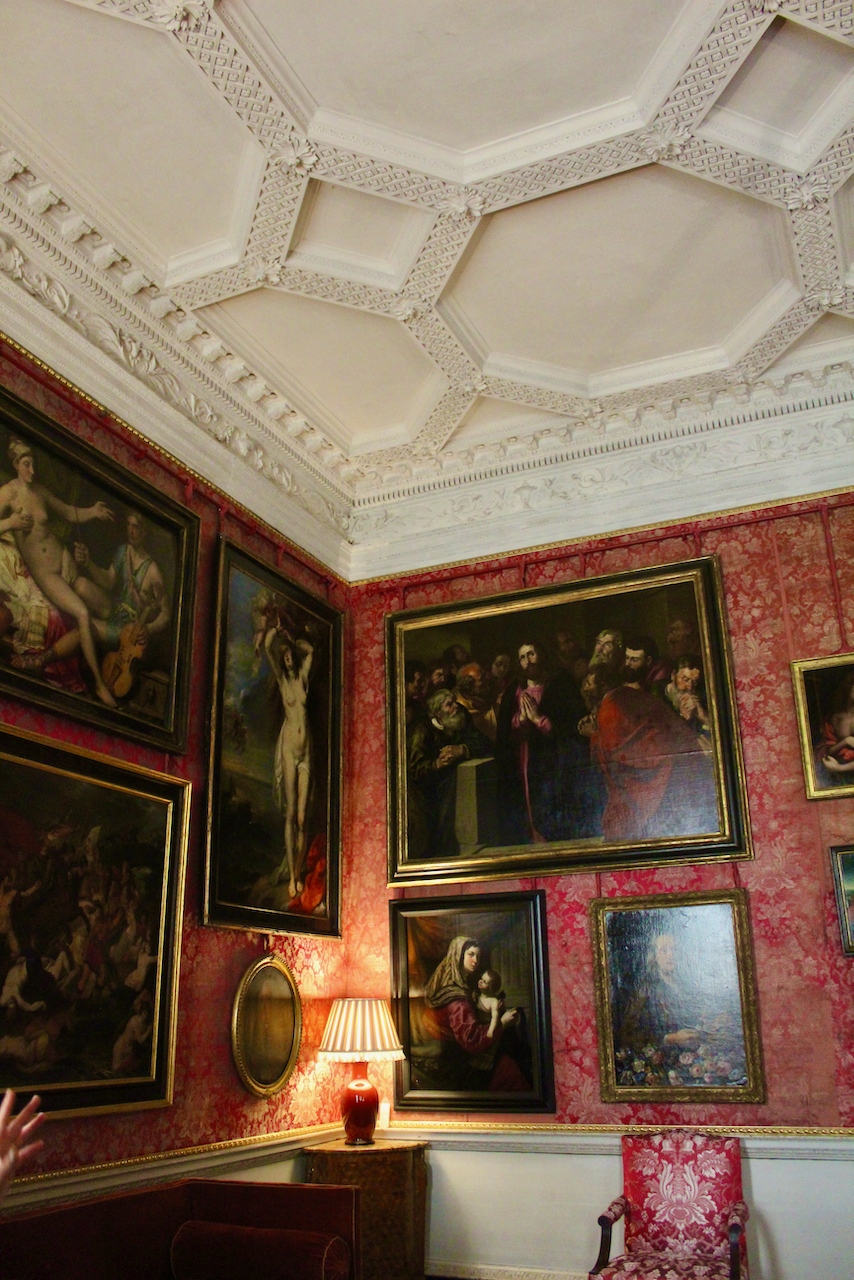
The Red Drawing Room, description from Archiseek:
“It is one of a series of State Rooms that form an enfilade and were used on important occasions in the eighteenth century. This room was redesigned in the mid 1760s in the manner of Sir William Chambers. The chimney-piece, ceiling and pier glasses are typical of his designs.
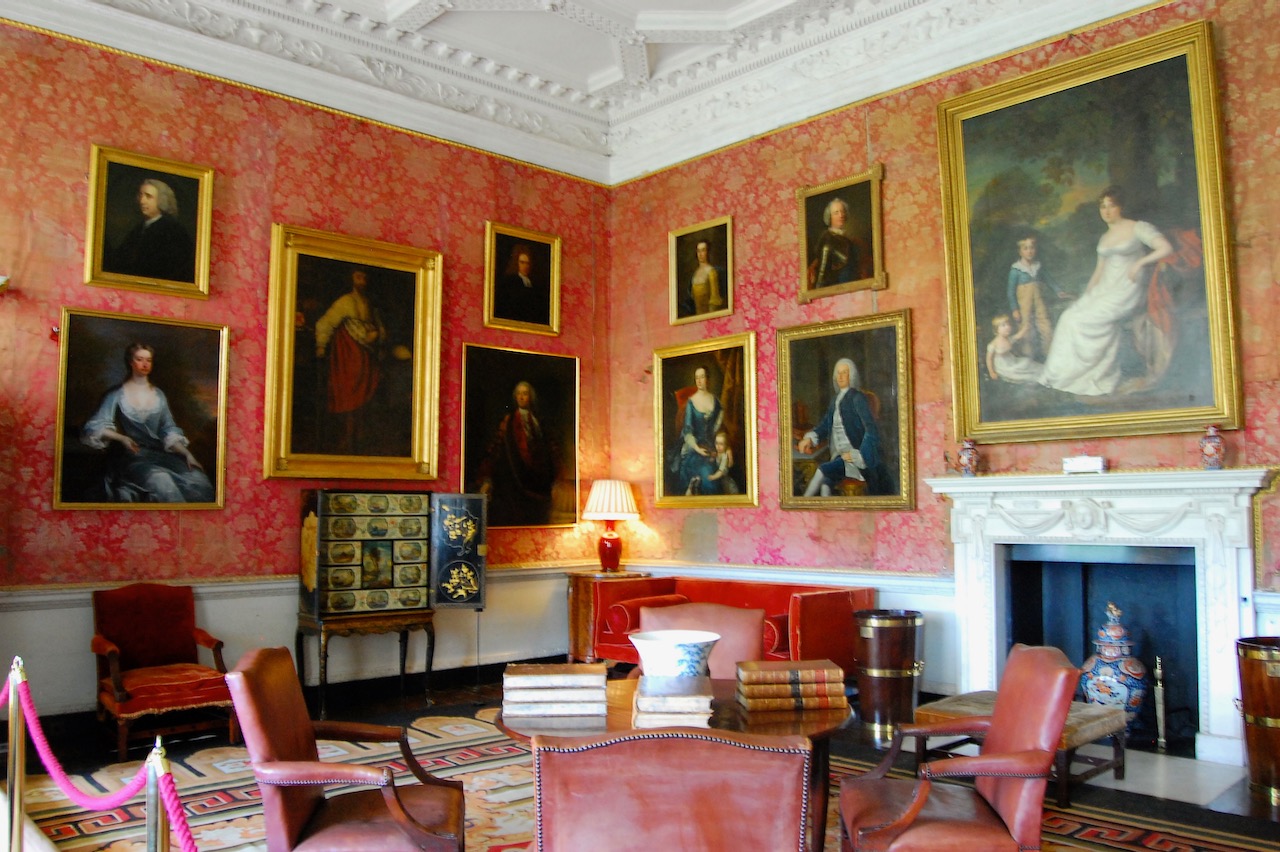
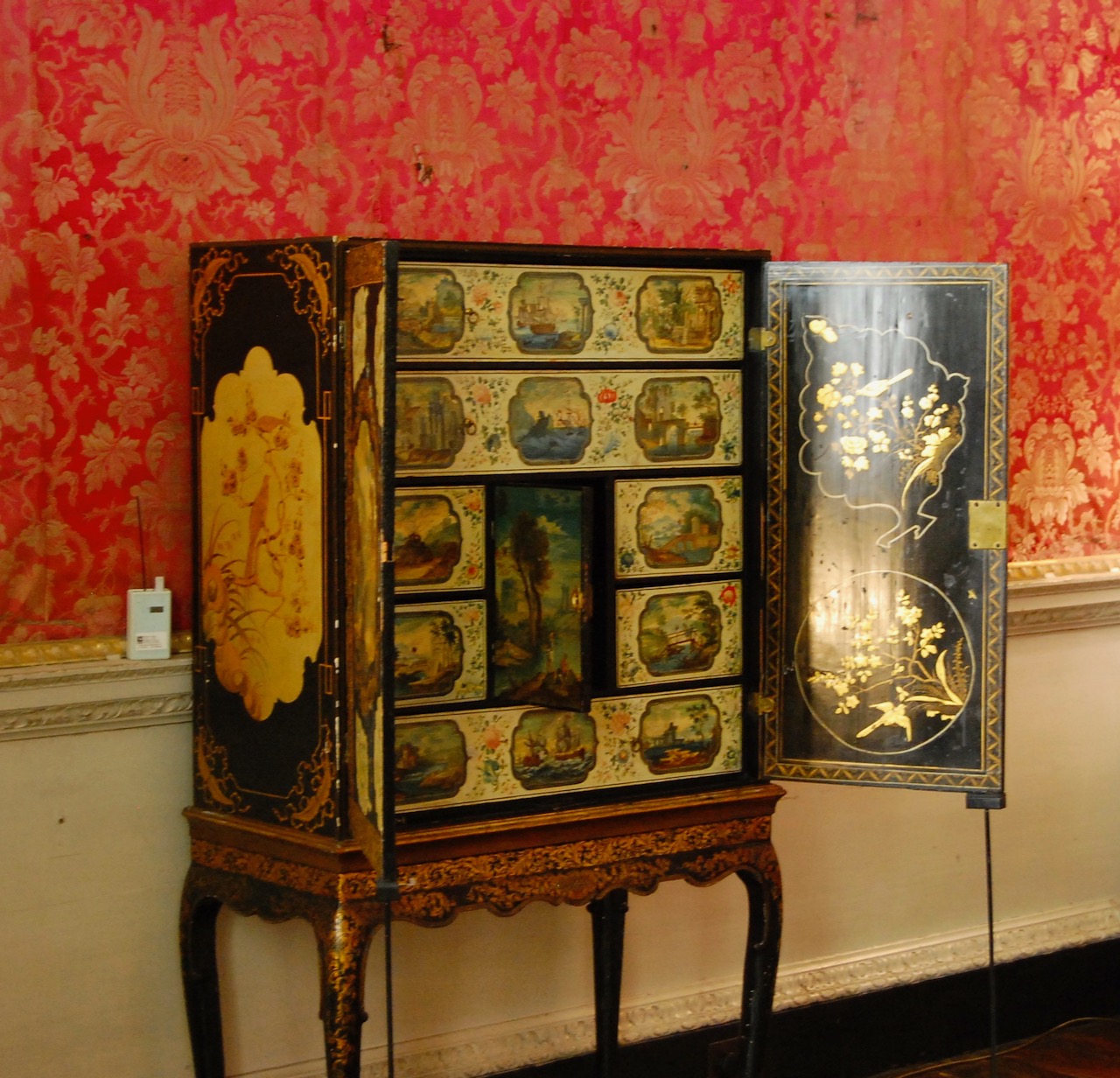
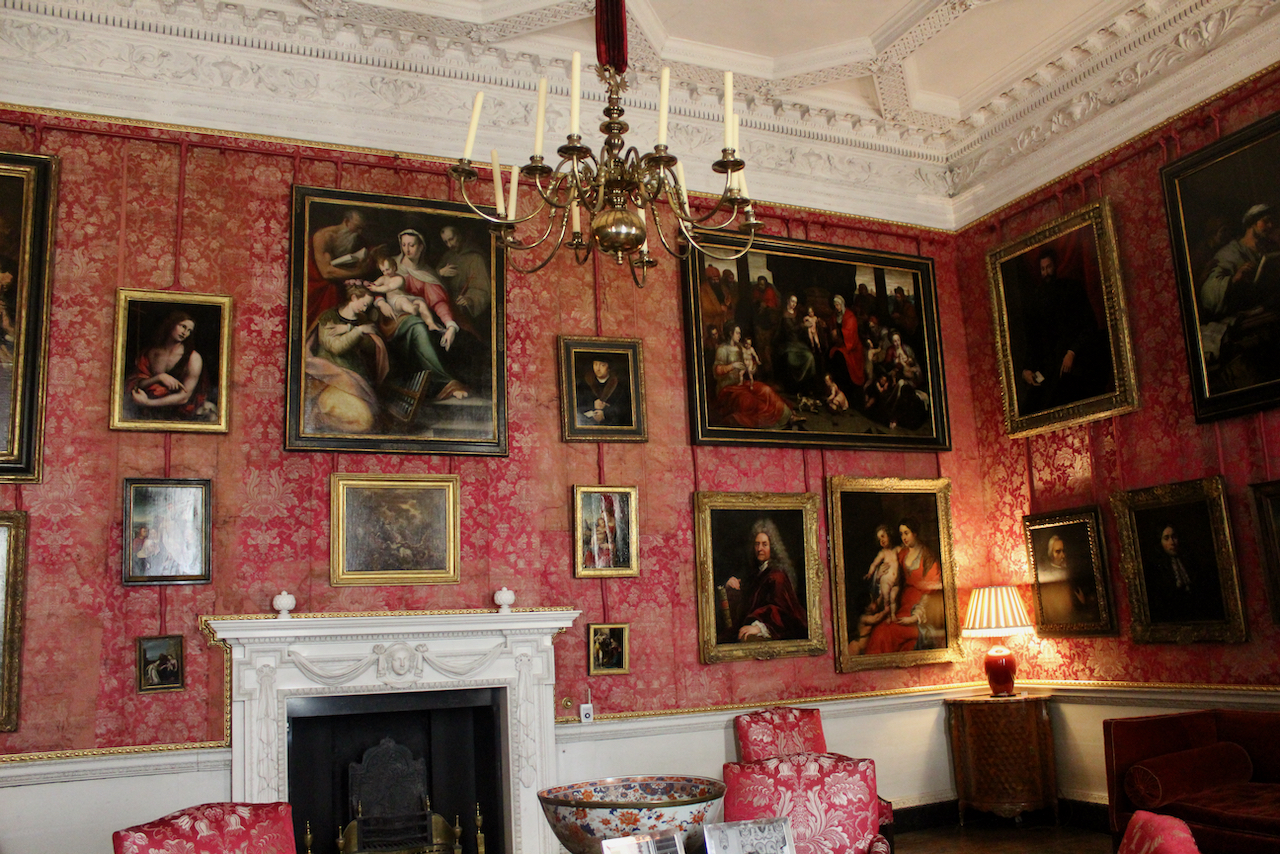
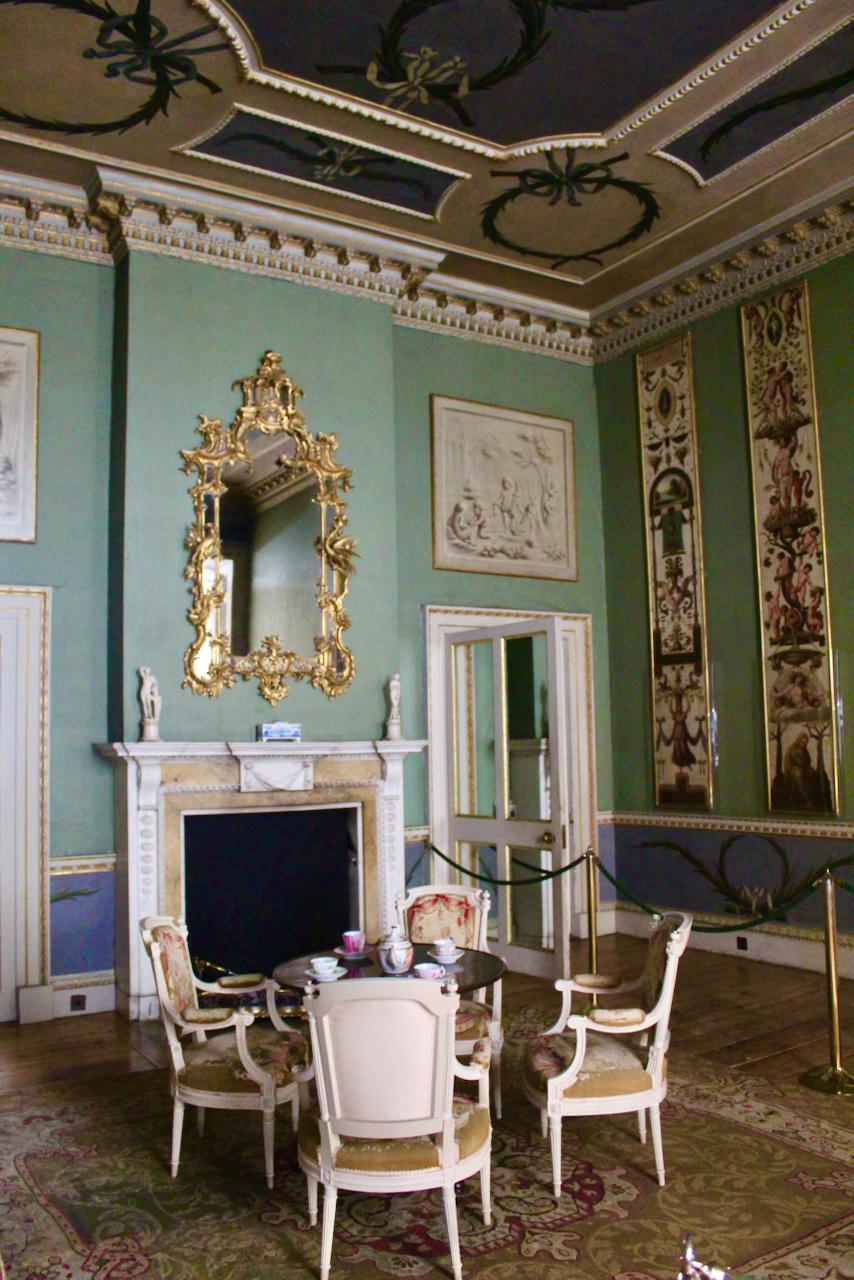
“The walls are covered in red damask which is probably French and dates from the 1820s. Lady Shelburne recorded in her journal seeing a four coloured damask, predominently red, in this room. The Aubusson carpet dates from about 1850 and may have been made for the room. Much of the furniture has always been in the house and Lady Louisa Conolly paid 11/2 guineas for each of the Chinese Chippendale armchairs which she considered very expensive. The chairs and settee were made in Dublin and they are displayed in a formal arrangement against the walls as they would have been in the eighteenth century. The bureau was made for Lady Louisa in the 1760s.“
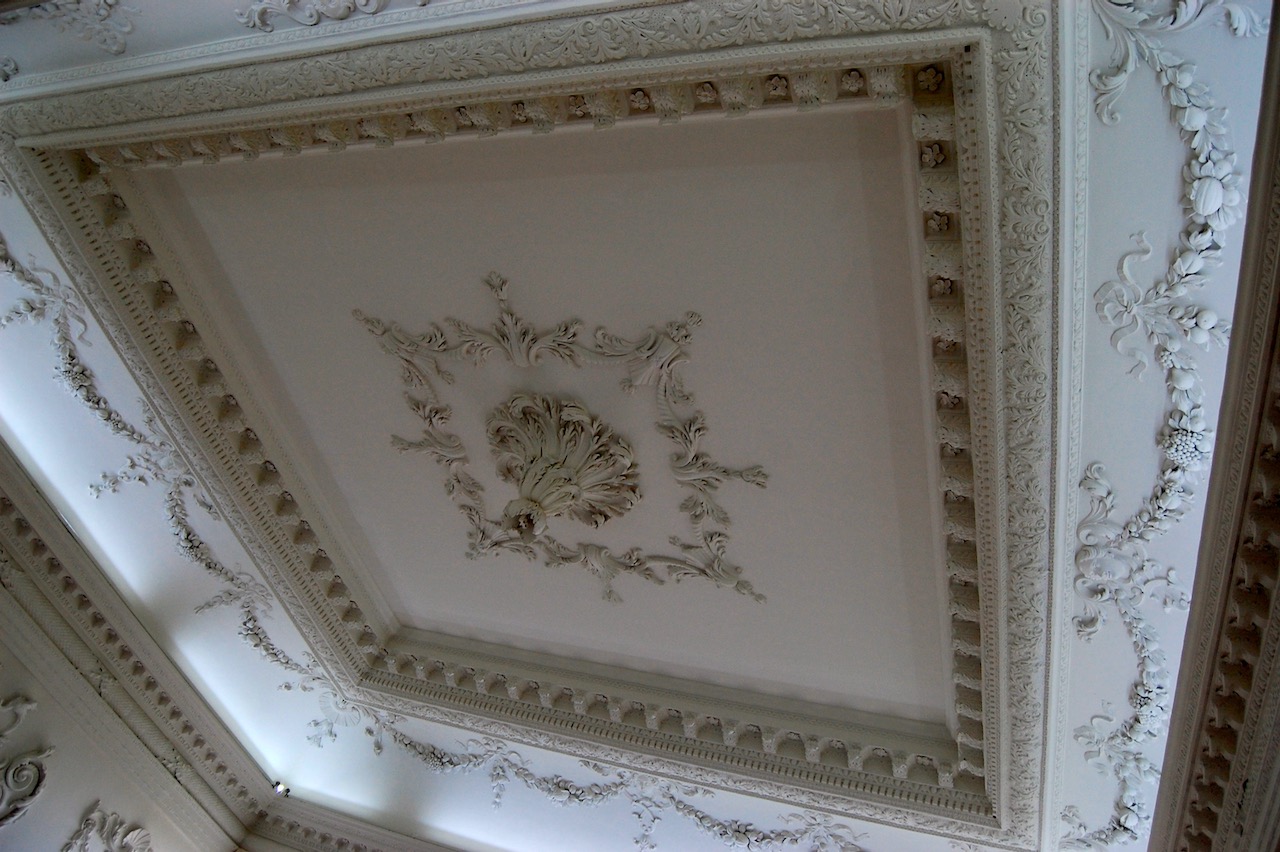
The neoclassical ceiling, which replaced the vaulted original, is based on published designs by the Italian Renaissance architect, Sebastiano Serlio, and is modelled after one in Leinster House (belonging to Lady Louisa’s sister’s husband the Earl of Kildare). The white Carrara chimney-piece came to the house in 1768.
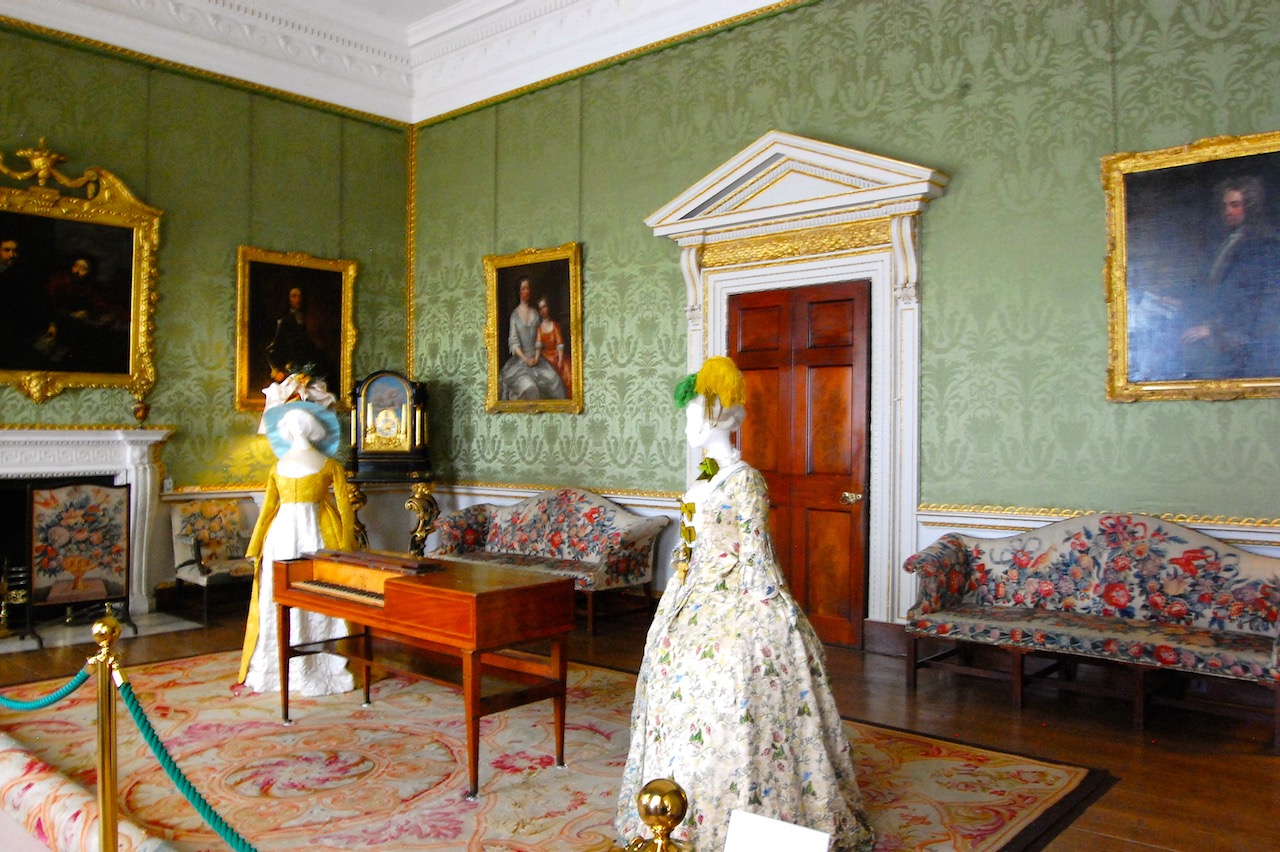
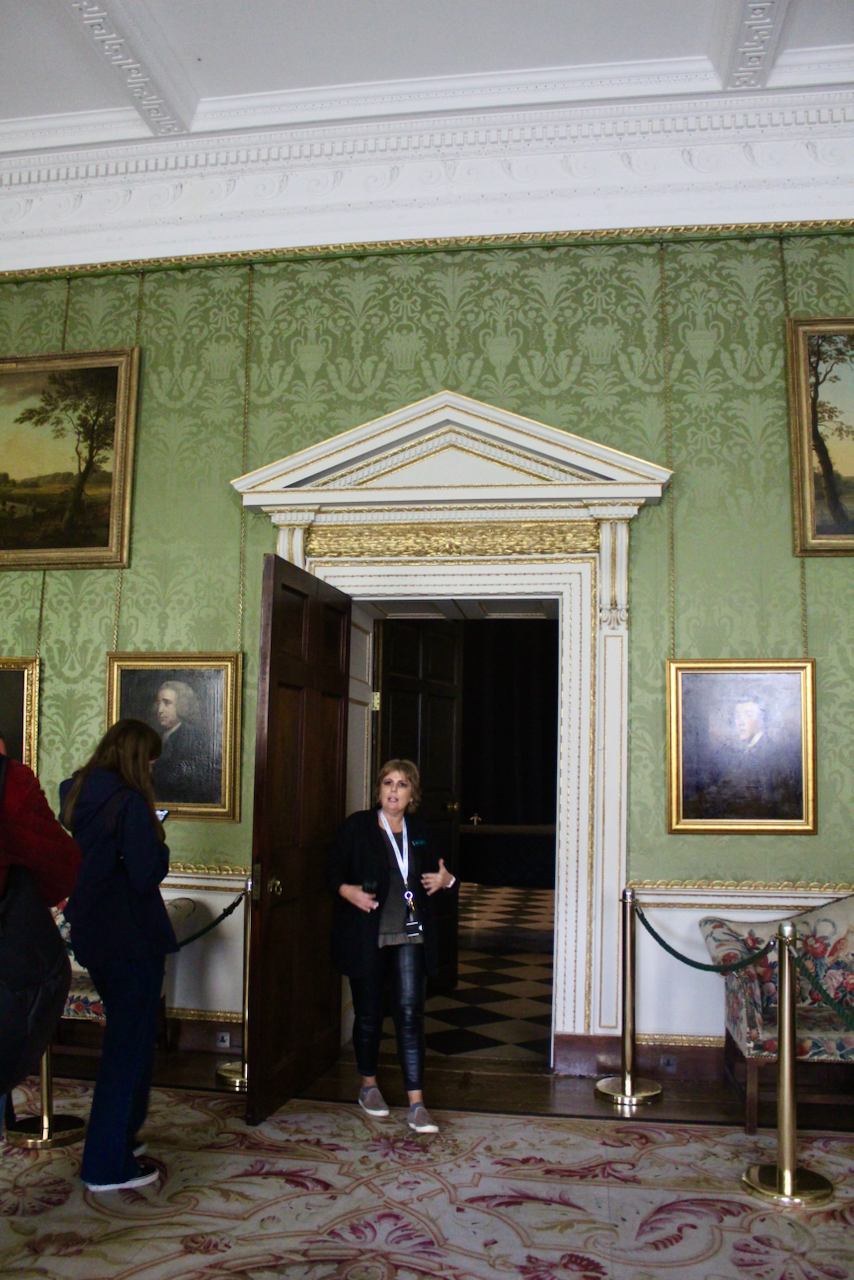
The Green Drawing Room, description from Archiseek:
“The Conollys formally received important visitors to the house in the Green Drawing Room which was the saloon or principal reception room. The room was redecorated in the 1760s and like the other state rooms reflects the neo-classical taste of the architect Sir William Chambers. The Greek key decoration on the ceiling is repeated on the pier glasses and the chimney-piece. Originally these were pier tables with a Greek key frieze and copies of these may be made in the future. The chimney-piece is similar to one designed by Chambers for Lord Charlemont’s Casino at Marino.”
The Castletown website tells us: “The Green Drawing Room was the main reception room or saloon on the ground floor. Visitors could enter from the Entrance Hall or the garden front. Like the other state rooms it was extensively remodelled between 1764 and 1768. The influence of the published designs of Serlio and the leading British architect Isaac Ware can be seen in the neo-classical ceiling, door cases and chimney-piece...The walls were first lined with a pale green silk damask in the 1760s. Fragments of this silk, which was replaced by a dark green mid-nineteenth century silk, survived and the present silk was woven as a direct colour match in 1985 by Prelle et Cie in Lyon, France.”
The Brown Study is at one end of this enfilade of rooms. The website describes it:
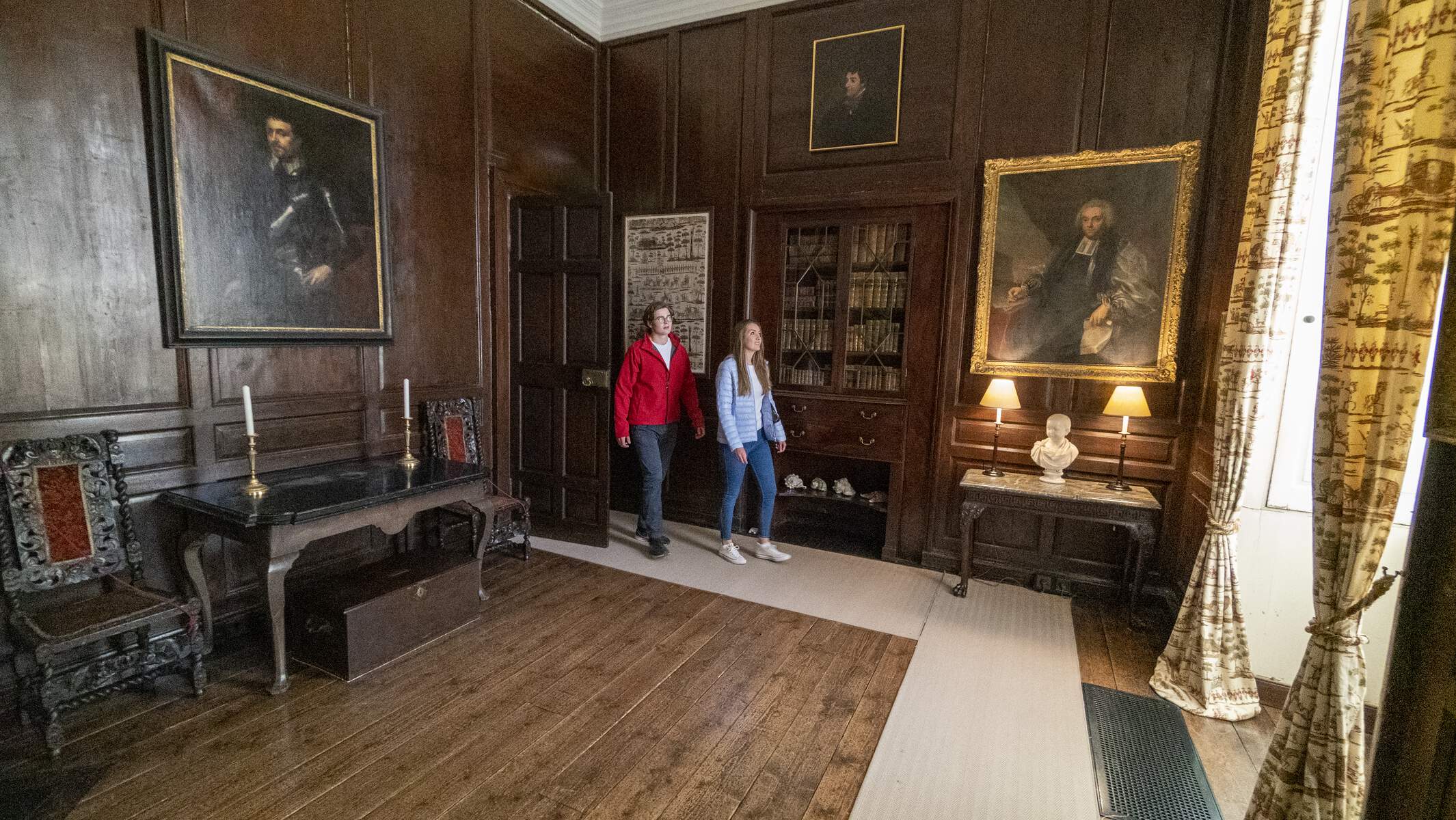
“The Brown Study with its wood-panelled walls, tall oak doors, corner chimney-piece, built-in desk and vaulted ceiling is decorated as it was in the 1720s when the house was first built. This room was used as a bedroom in the late nineteenth century and then as a breakfast parlour in the early twentieth century.
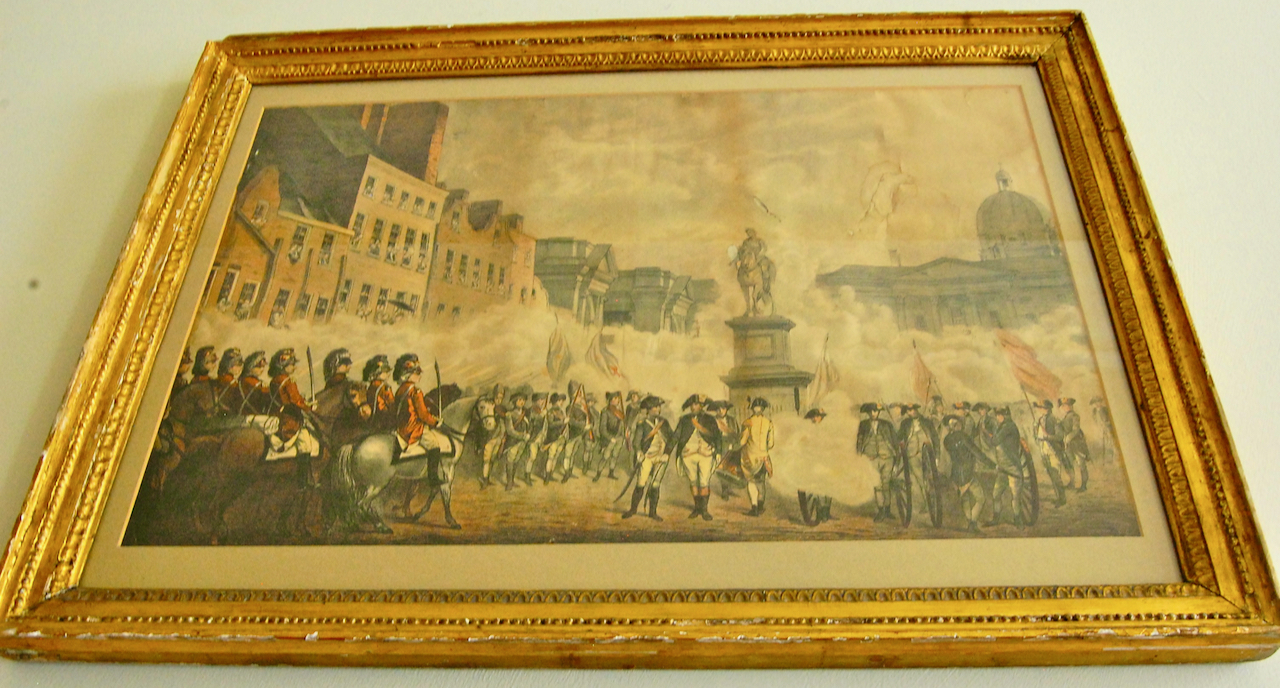
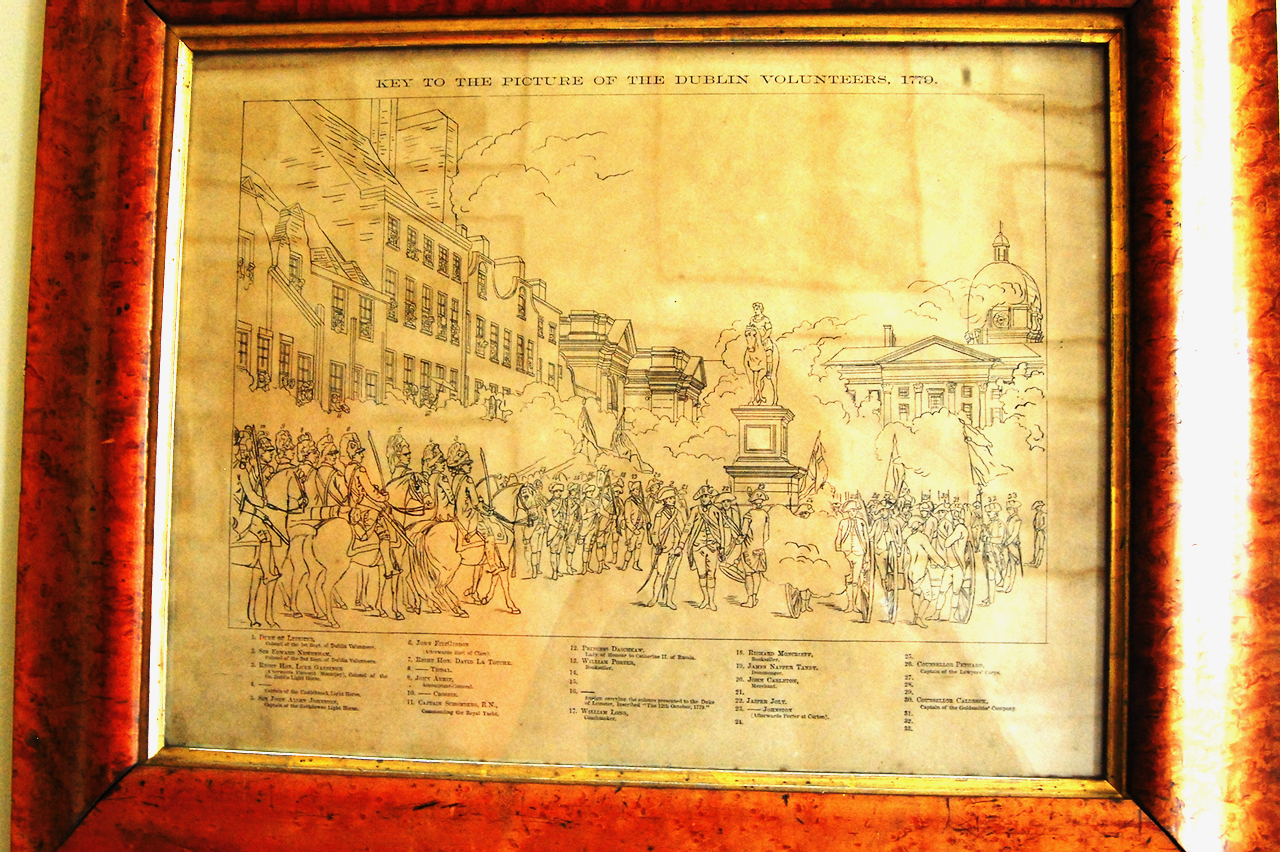
Between the windows is a piece of the ‘Volunteer fabric’. Printed on a mixture of linen and cotton in Harpur’s Mills in nearby Leixlip, it depicts the review of the Leinster Volunteers in the Phoenix Park in 1782. Thomas Conolly was active in the Volunteer leadership in both Counties Derry and Kildare. The Volunteers were a local militia force established during the American War of Independence to defend Ireland from possible French invasion while the regular troops were in America. They were later linked to the Patriot party in the Irish House of Commons led by Henry Grattan and to their campaigns for political reform.“
Mark Bence-Jones continues: “The doing-up of the house was largely supervised by Lady Louisa, and two of the rooms bear her especial stamp: the print room, which she and her sister, Lady Sarah Napier made ca. 1775; and the splendid long gallery on the first floor, which she had decorated with wall paintings in the Pompeian manner by Thomas Riley 1776.“
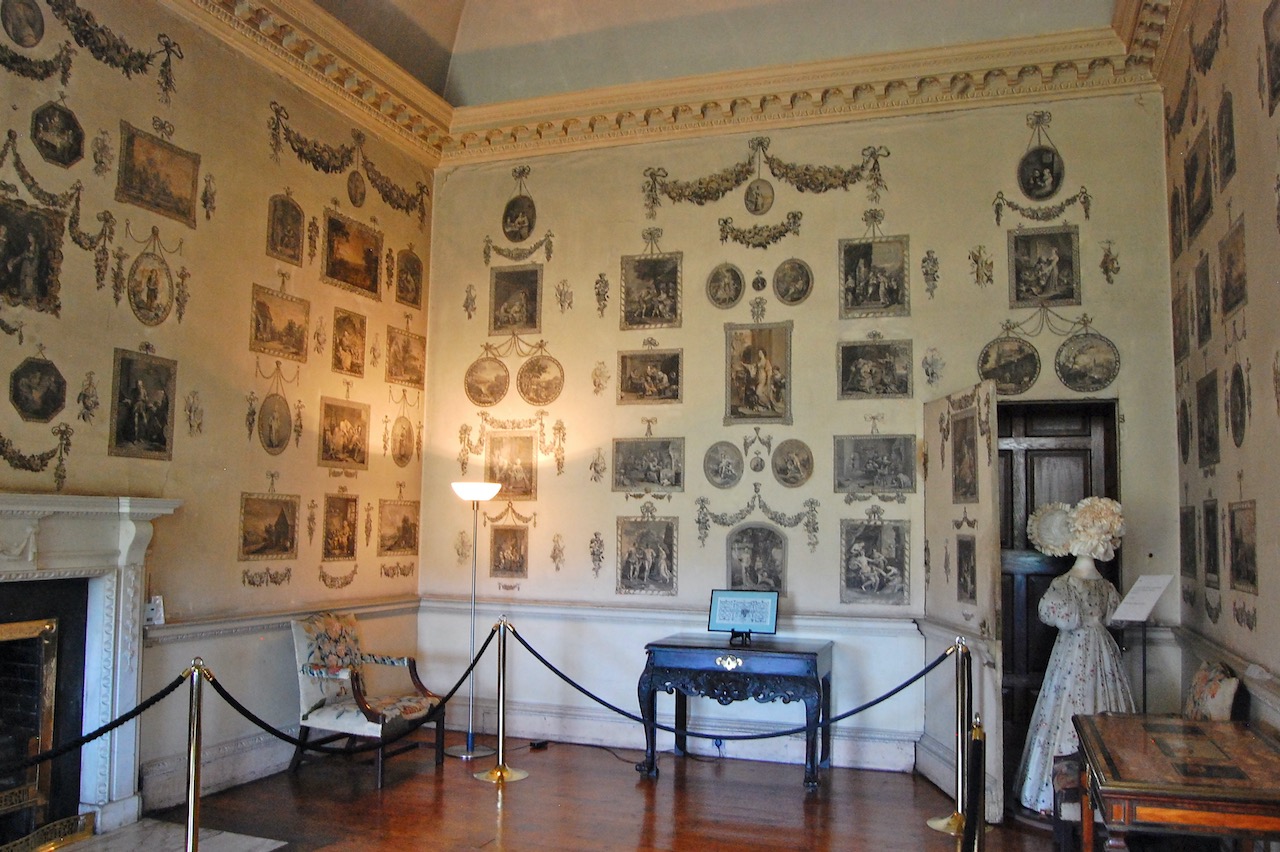
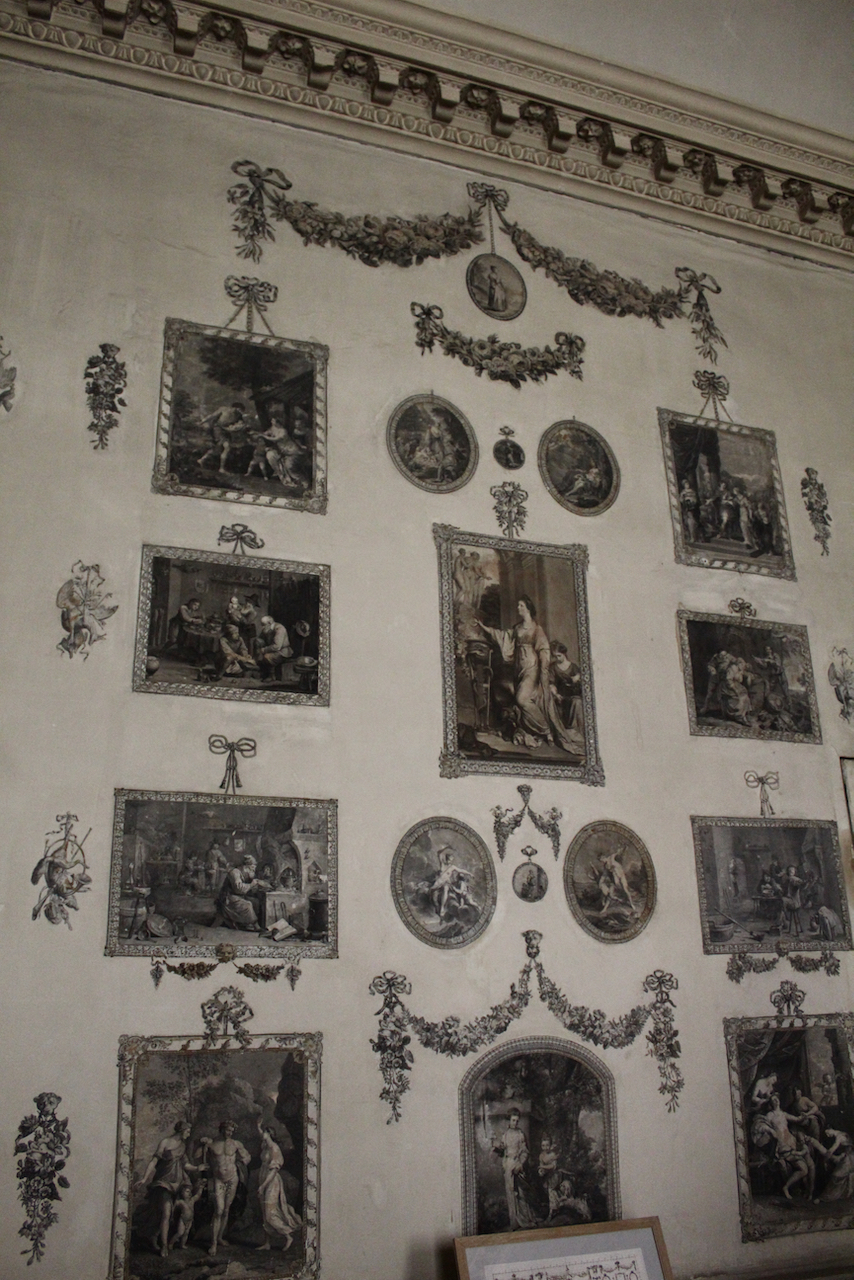
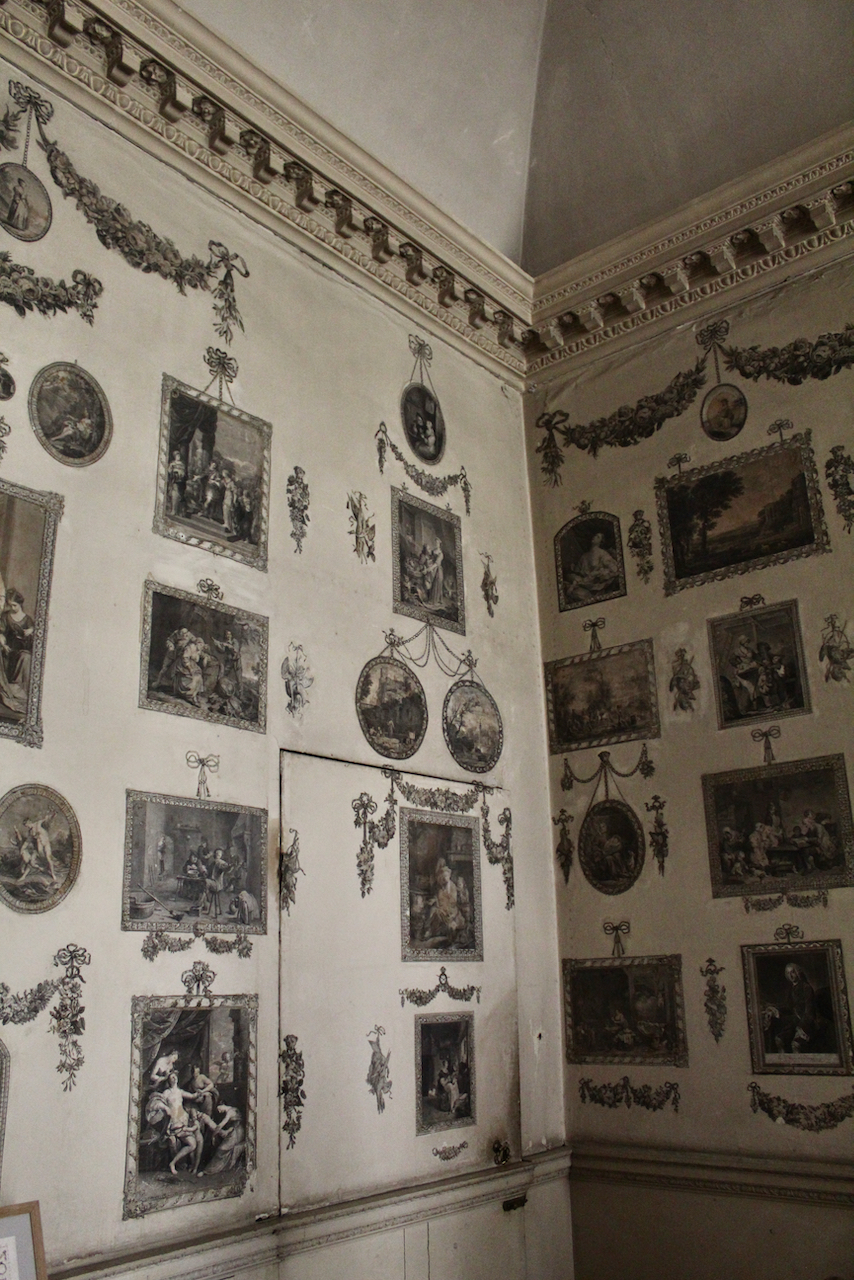
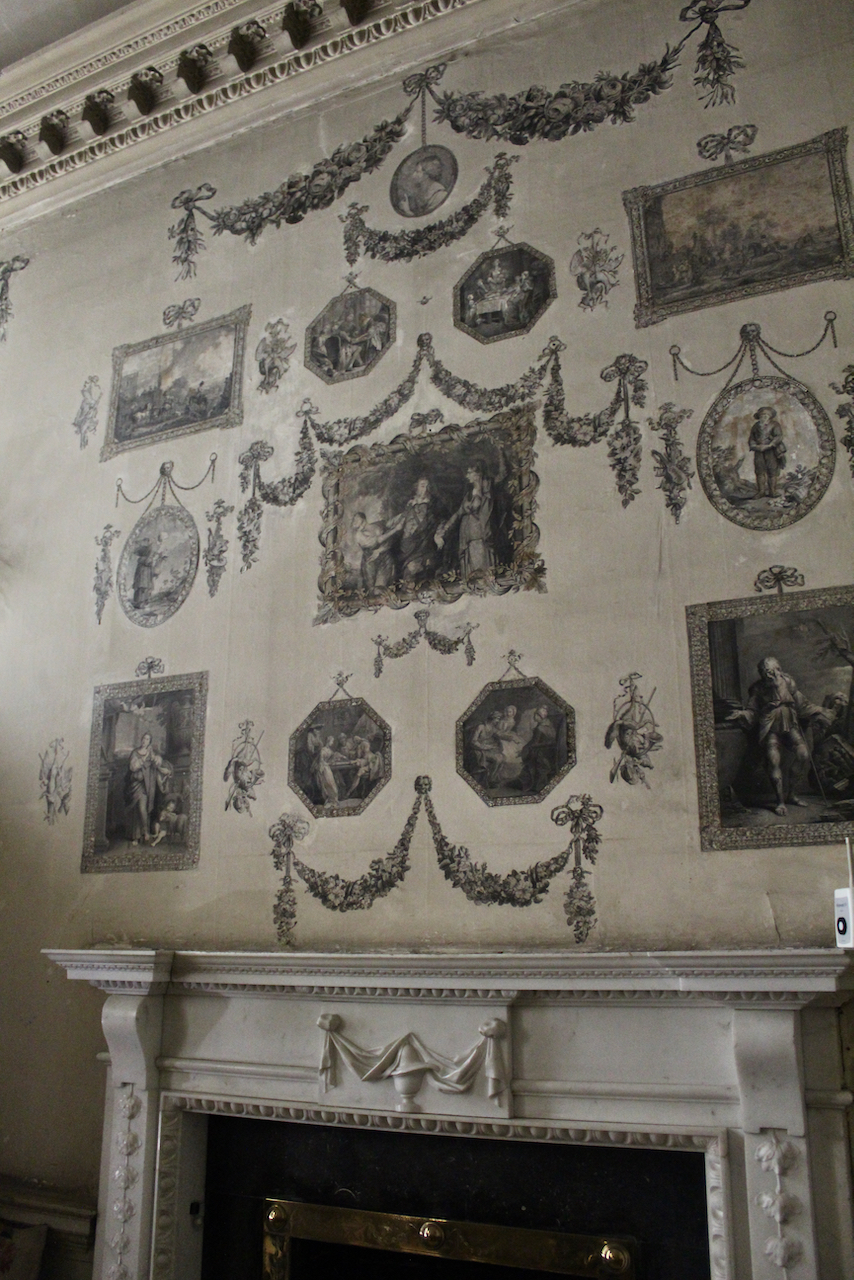
The website tells us about the Print Room, completed in 1769: “More than any other room in Castletown, the Print Room bears the imprint of Lady Louisa, who assiduously collected, cut out, and arranged individual prints, frames and decorations. The prints were glued on panels of off-white painted paper which was later attached to the walls on battens covered with cloth. Lady Louisa thus created an intimate, highly individual room which has survived changing tastes and fashions and is now the only fully intact eighteenth-century print room in Ireland.”
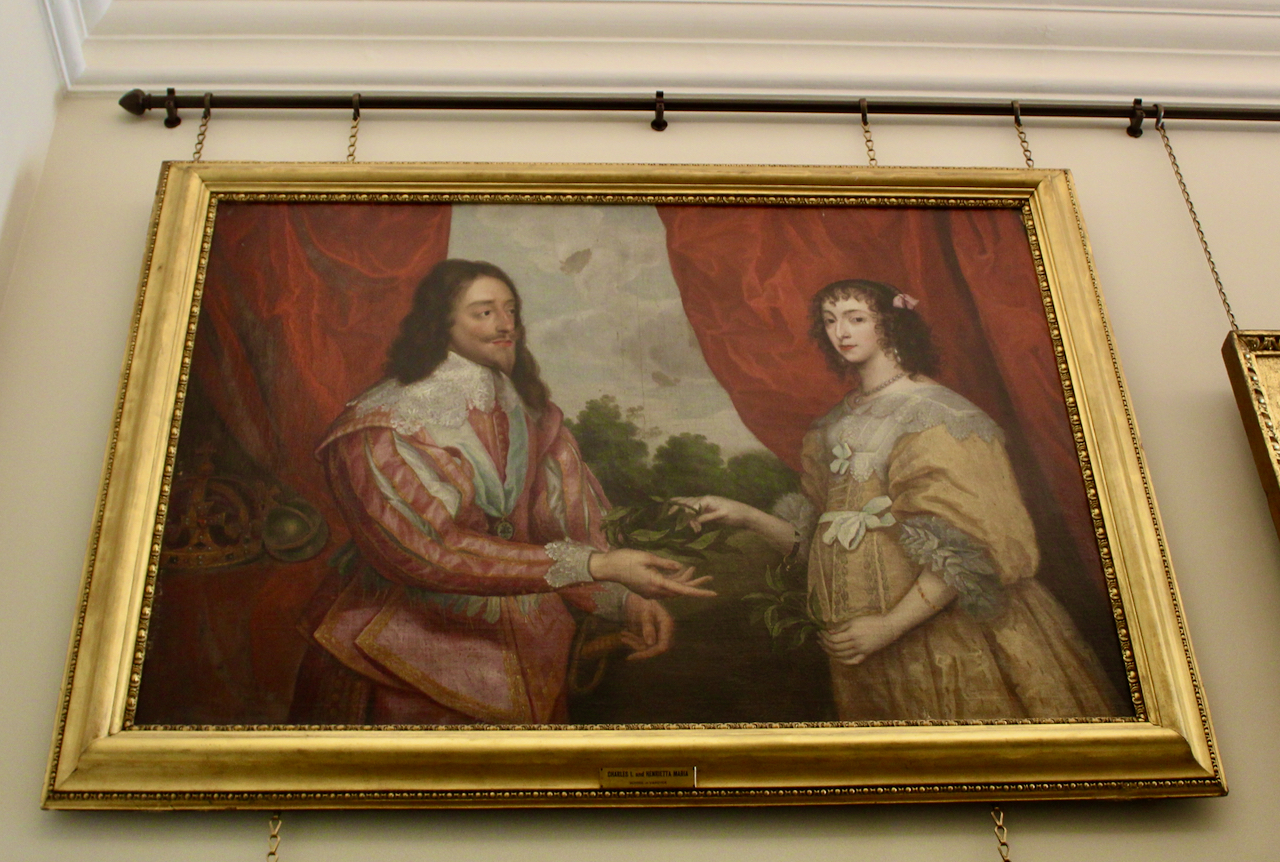
Print rooms were fashionable in the 18th century – ladies would collect their favourite prints and paste the walls with them. Prints featured include Le Bas, Rembrandt and Teniers, the actor David Garrick and Sarah Cibber, Louisa’s sister Sarah, Charles I and Charles II as a boy, with whom Louisa shared a bloodline.
The room was later used as a billiards room, and this helped inadvertedly to save the prints, as our guide told us, as the smoke from their pipes helped to protect against silverfish insects which eat wallpaper.
Next to the Print Room is the State Bedroom. The website tells us:
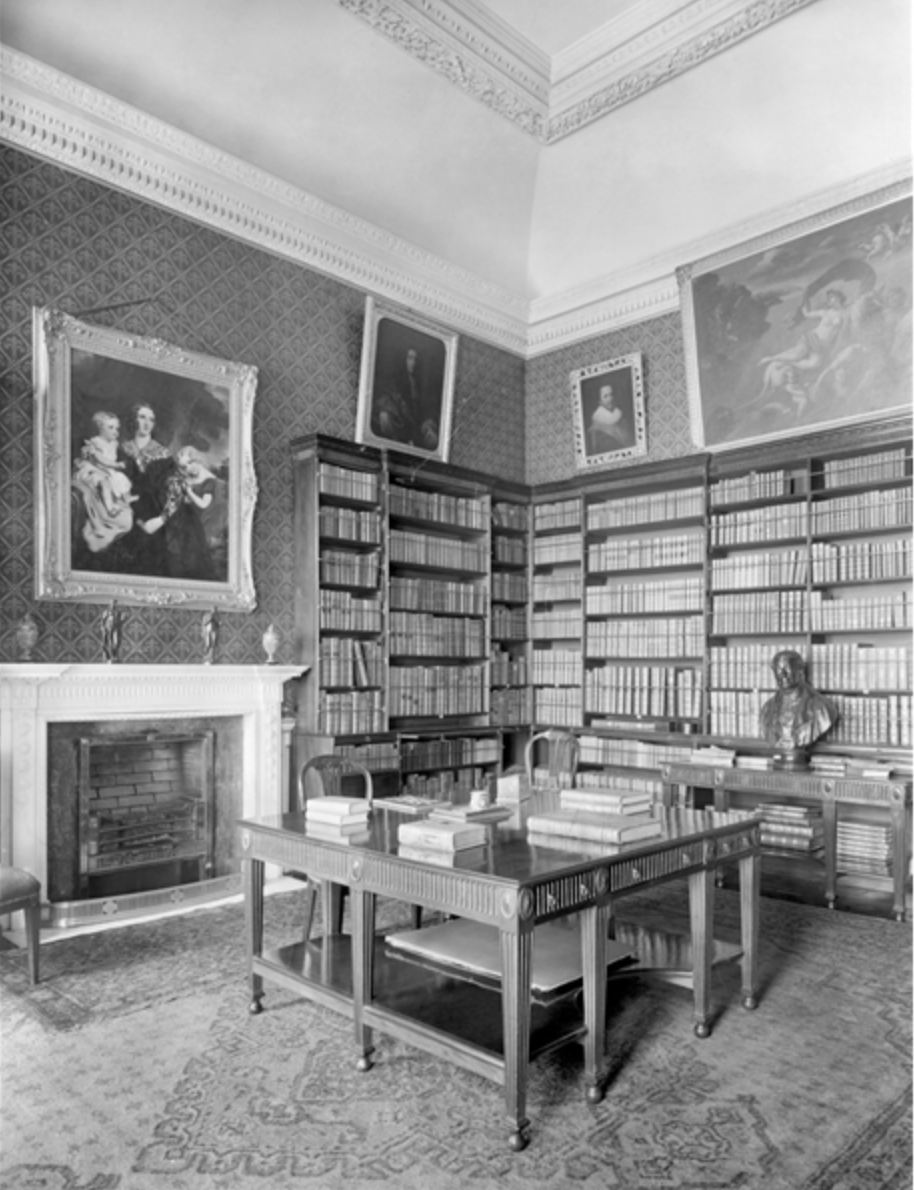
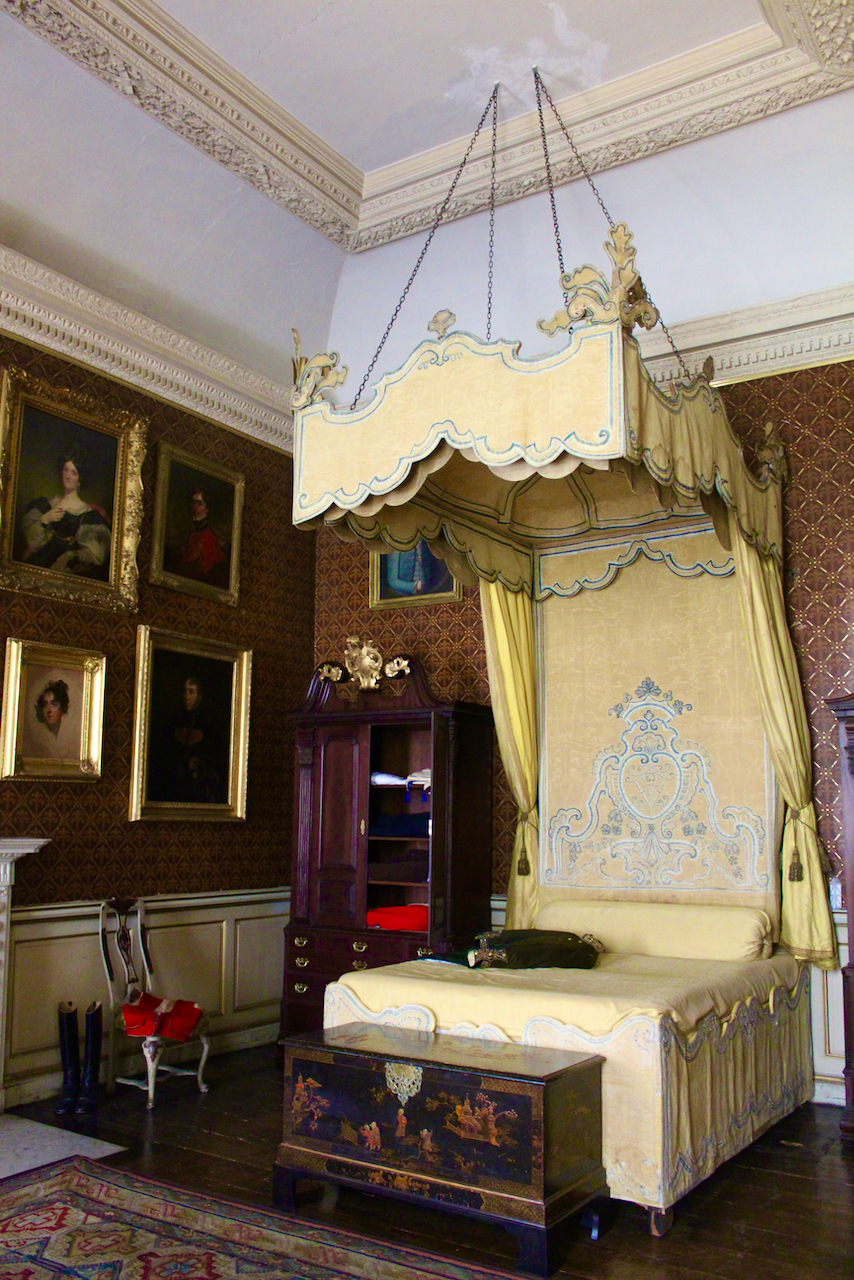
“In the 1720s, when the house was first laid out, this room, along with the rooms either side, probably formed William Conolly’s bedroom suite. It was intended that he would receive guests in the morning while sitting up in bed or being dressed in the manner of the French court at Versailles. In the nineteenth century, the room was converted into a library and the mock leather Victorian wall paper dates from this time. Sadly, the Castletown library was dispersed in the 1960s and today the furniture reflects the room’s original use.“
Next to the State Bedroom is The Healy Room: “This room originally served as a dressing room or closet attached to the adjoining State Bedroom. It was used as a small sitting room and later became Major Edward Conolly’s bedroom in the mid-twentieth century, as it was one of the few rooms that could be kept warm in winter. It is now known as the Healy room after the pictures of the Castletown horses by the Irish artist Robert Healy (d.1771).”
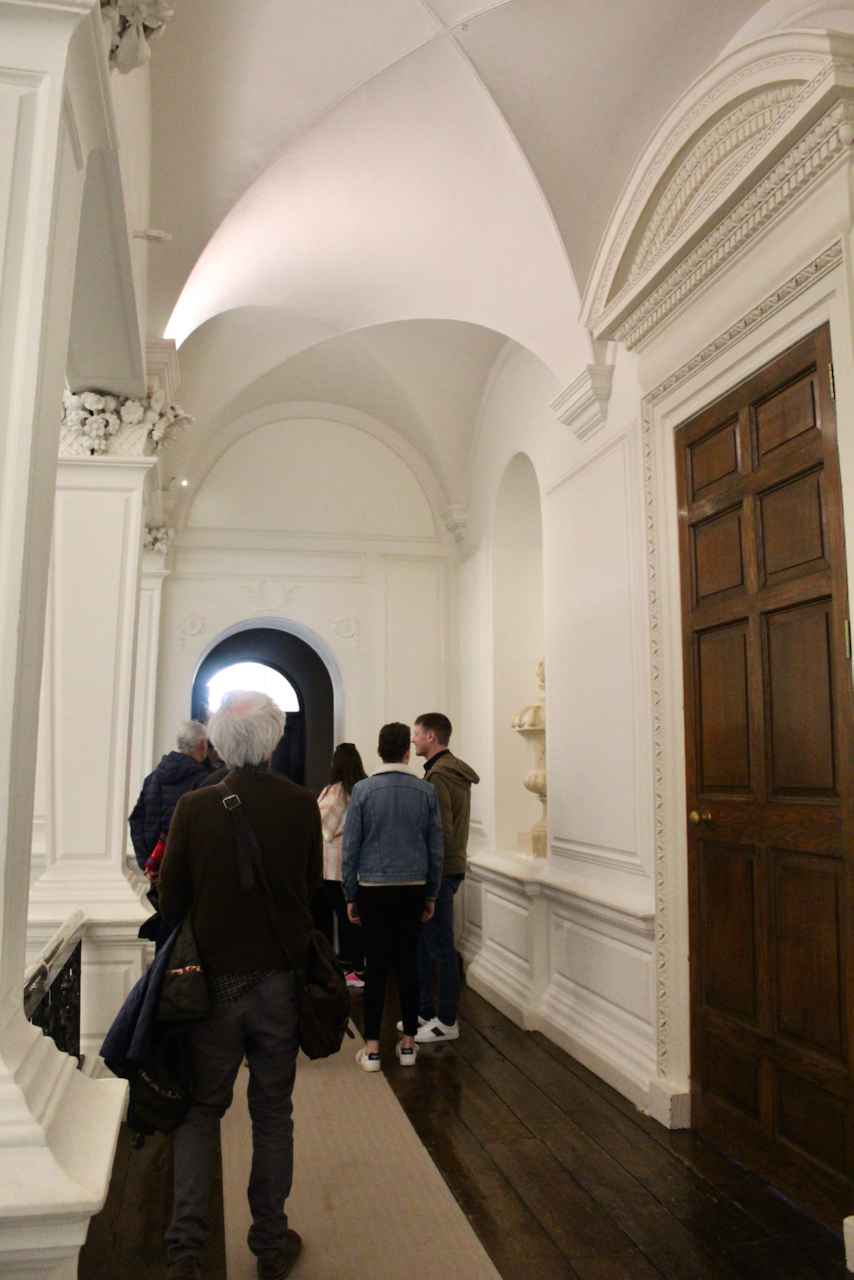
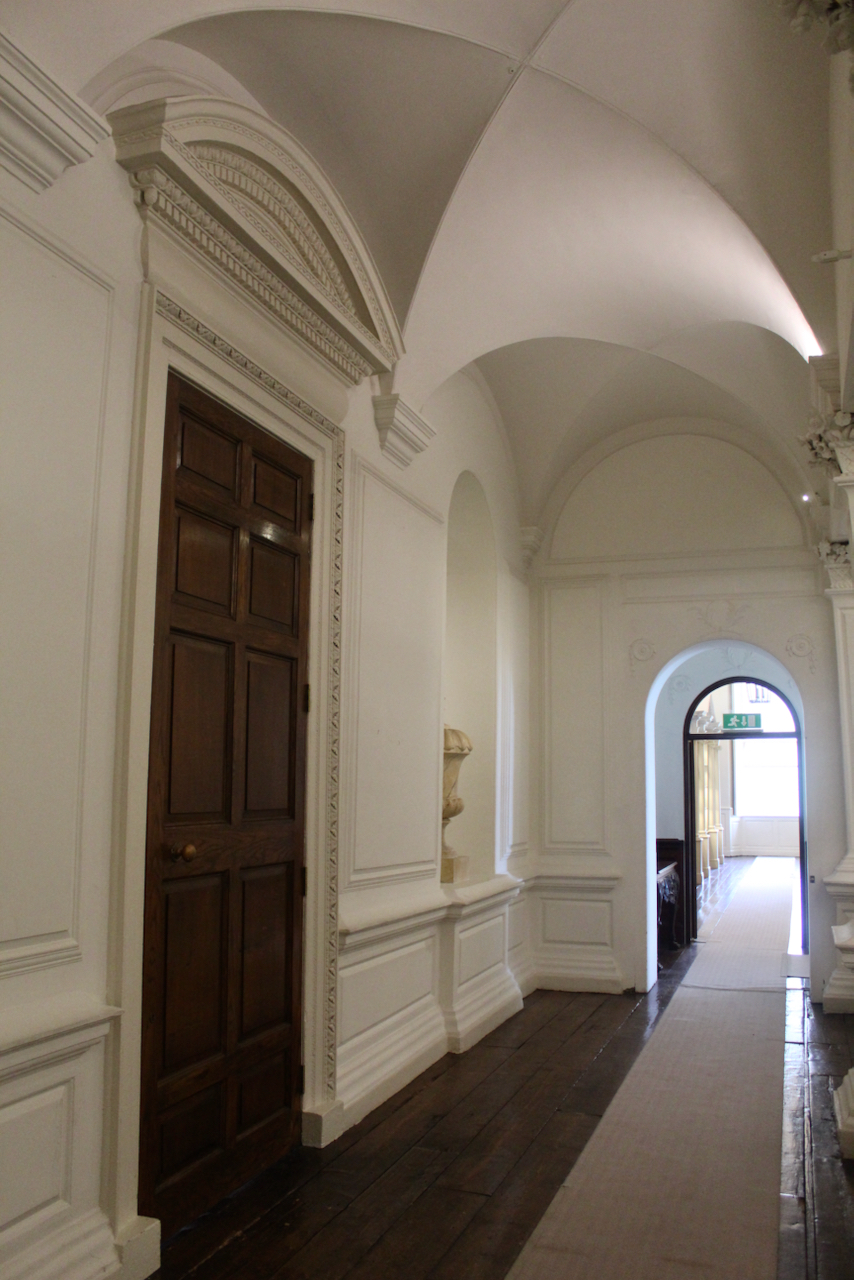
Upstairs has more bedrooms, and the beautiful Long Gallery. A corridor overlooks the Great Hall.
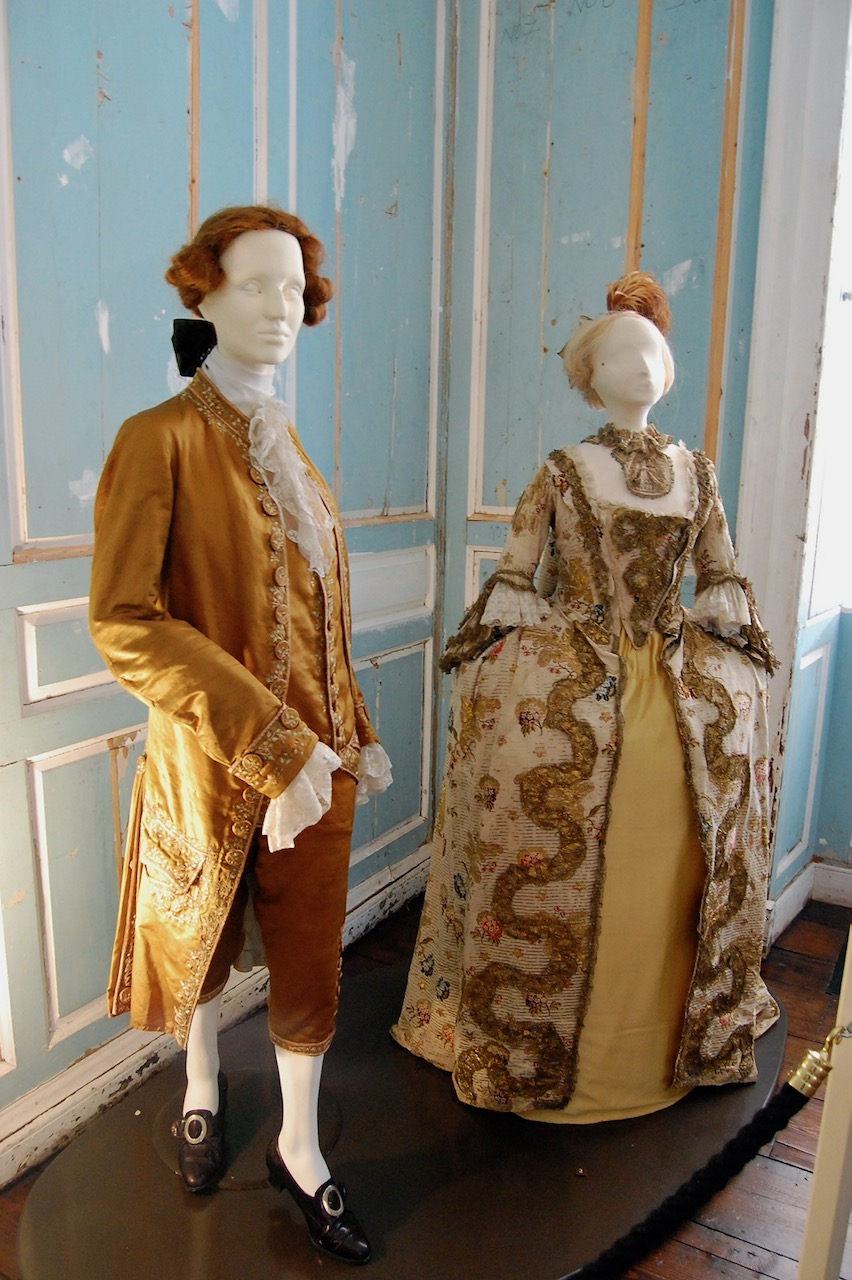
To one side of the Stair Hall upstairs is Lady Kildare’s Room, named after Lady Louisa’s sister Emily, Countess of Kildare and later Duchess of Leinster, who had raised Louisa and the two younger sisters Sarah and Cecilia at nearby Carton House after their parents’ death. Currently being renovated, in the past the room housed the Berkeley Costume Collection. Made in France, Italy, and England, the dresses on display consist of rich embroidered bodices and full skirts made from silk and gold thread.
Across the upstairs East Corridor from Lady Kildare’s room is the Blue Bedroom. The website tells us that the Blue Bedroom provides a fine example of an early Victorian bedroom. Like the Boudoir, it forms part of an apartment with two adjoining dressing rooms, one of which was upgraded into a bathroom with sink and bathtub. The principal bedrooms, used by the family and honoured guests, were on this floor. Bedrooms on the second floor were also used for guests and for children, while the servants slept in the basement. This room has a lovely pink canopied bed, but we did not see the room when we visited in 2022.
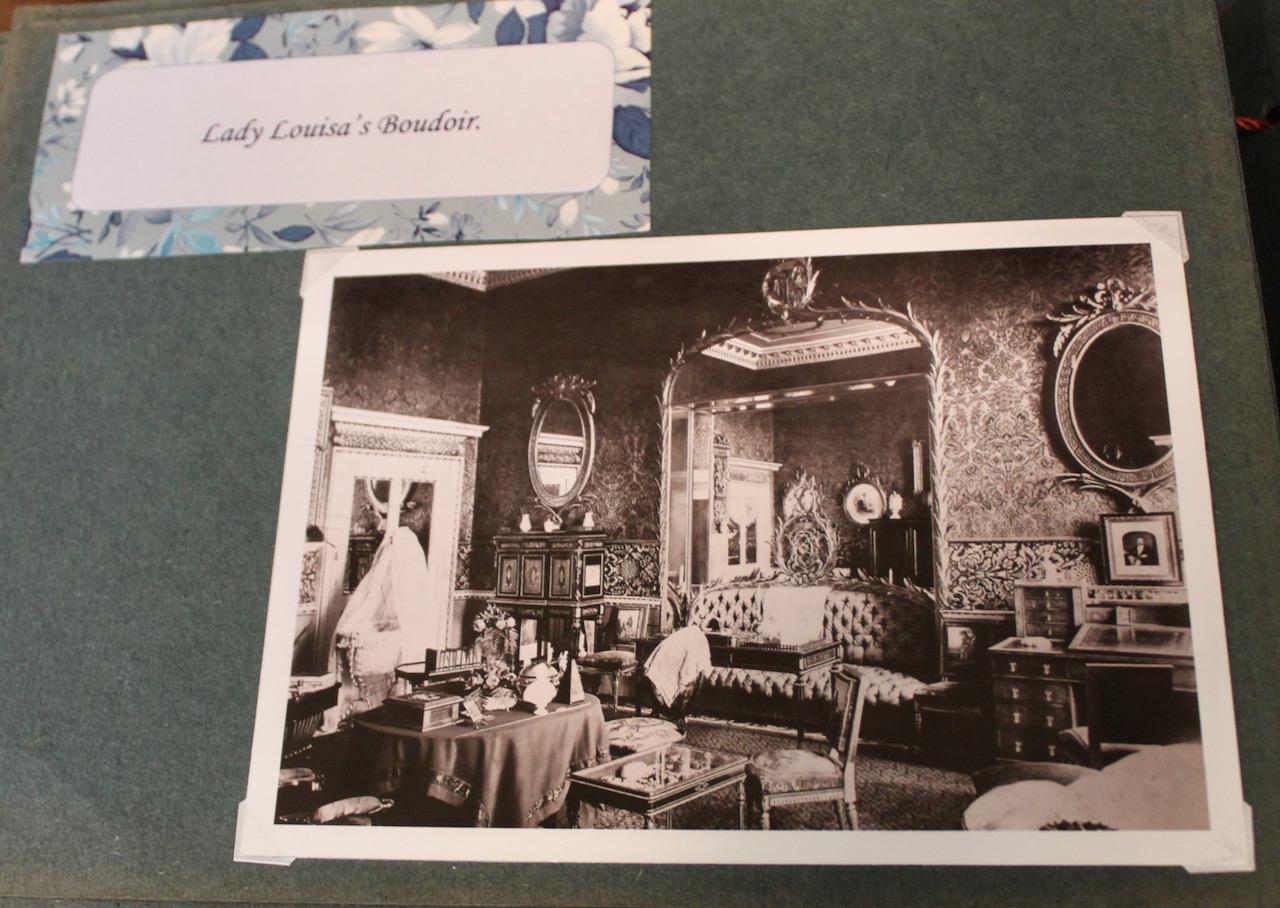
At the front of the house on the other side of the Great Hall upstairs are the Boudoir, and Lady Louisa’s Bedroom, and across the West Corridor upstairs, the Pastel Room. The website tells us:
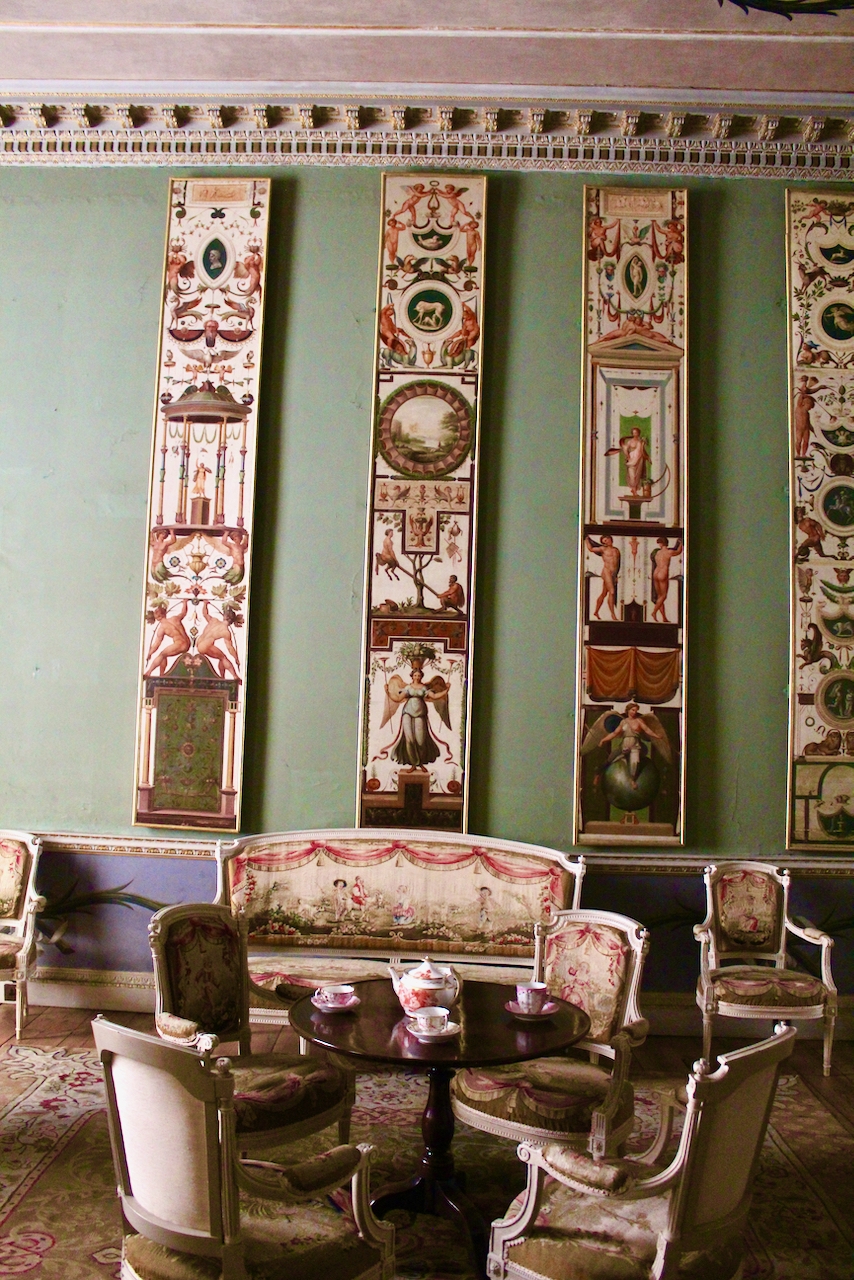
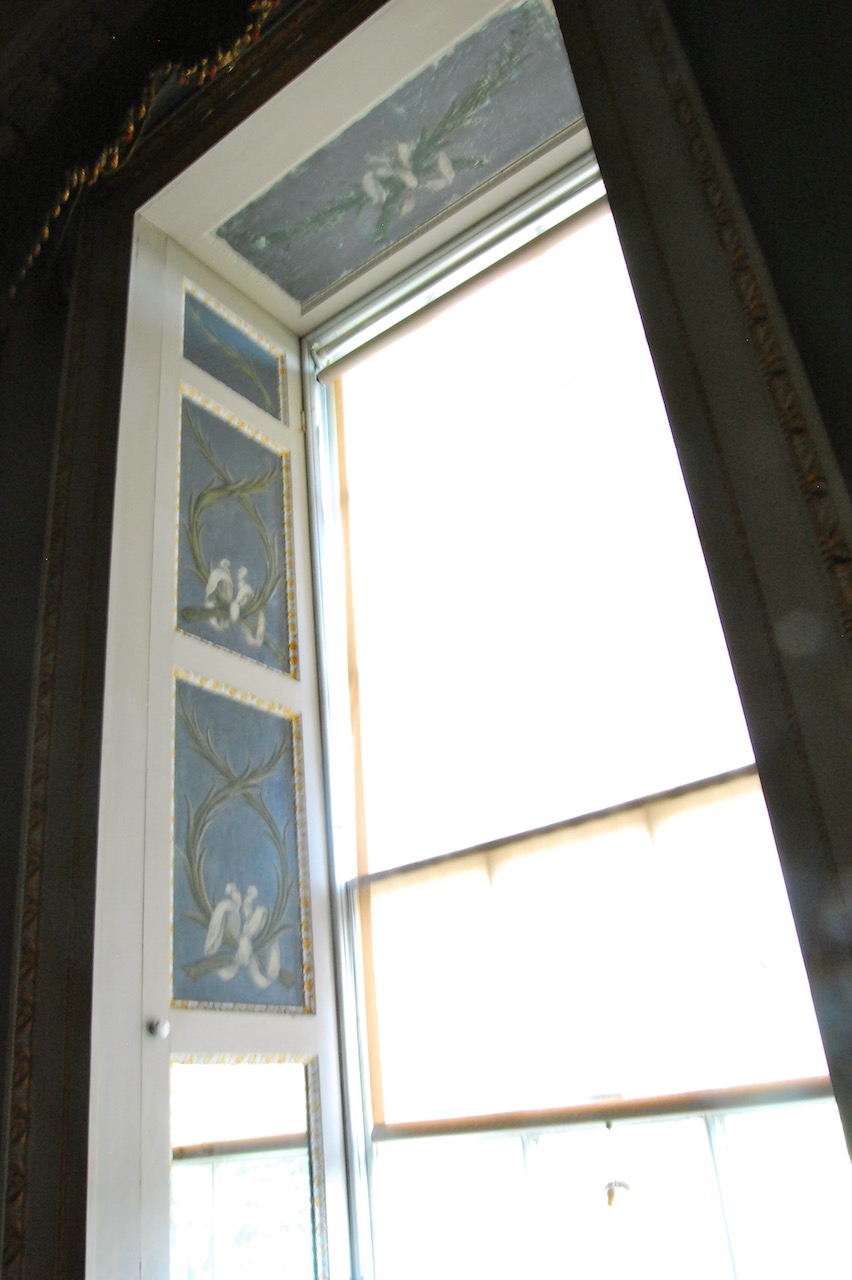
“The Boudoir and the adjoining two rooms formed Lady Louisa’s personal apartment. The Boudoir served as a private sitting room for Louisa and subsequent ladies of the house. The painted ceiling, dado rail and window shutters possibly date from the late eighteenth century and were restored in the 1970s by artist Philippa Garner. The wall panels, or grotesques, after Raphael date from the early nineteenth century and formerly hung in the Long Gallery. Amongst the items inside the built-in glass cabinet are pieces of glass and china featuring the Conolly crest.
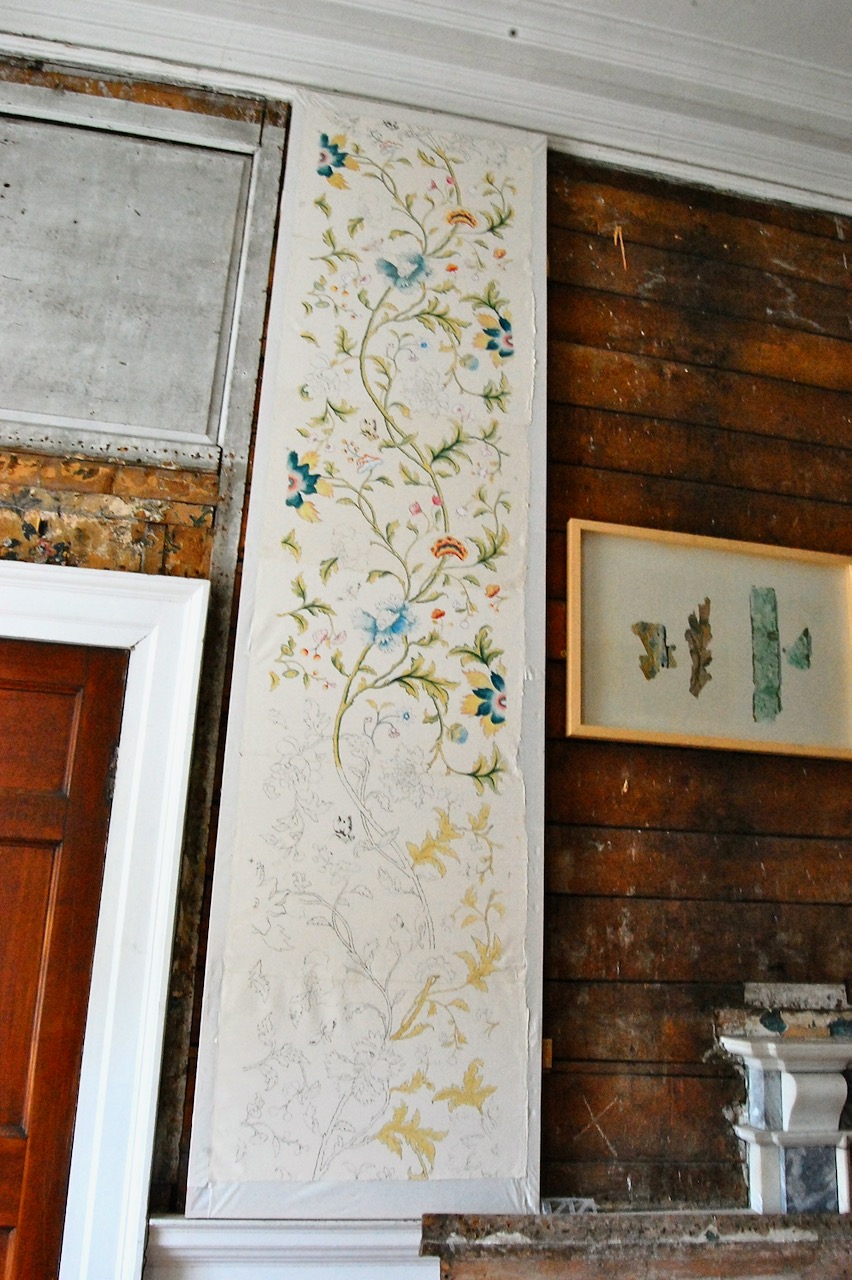
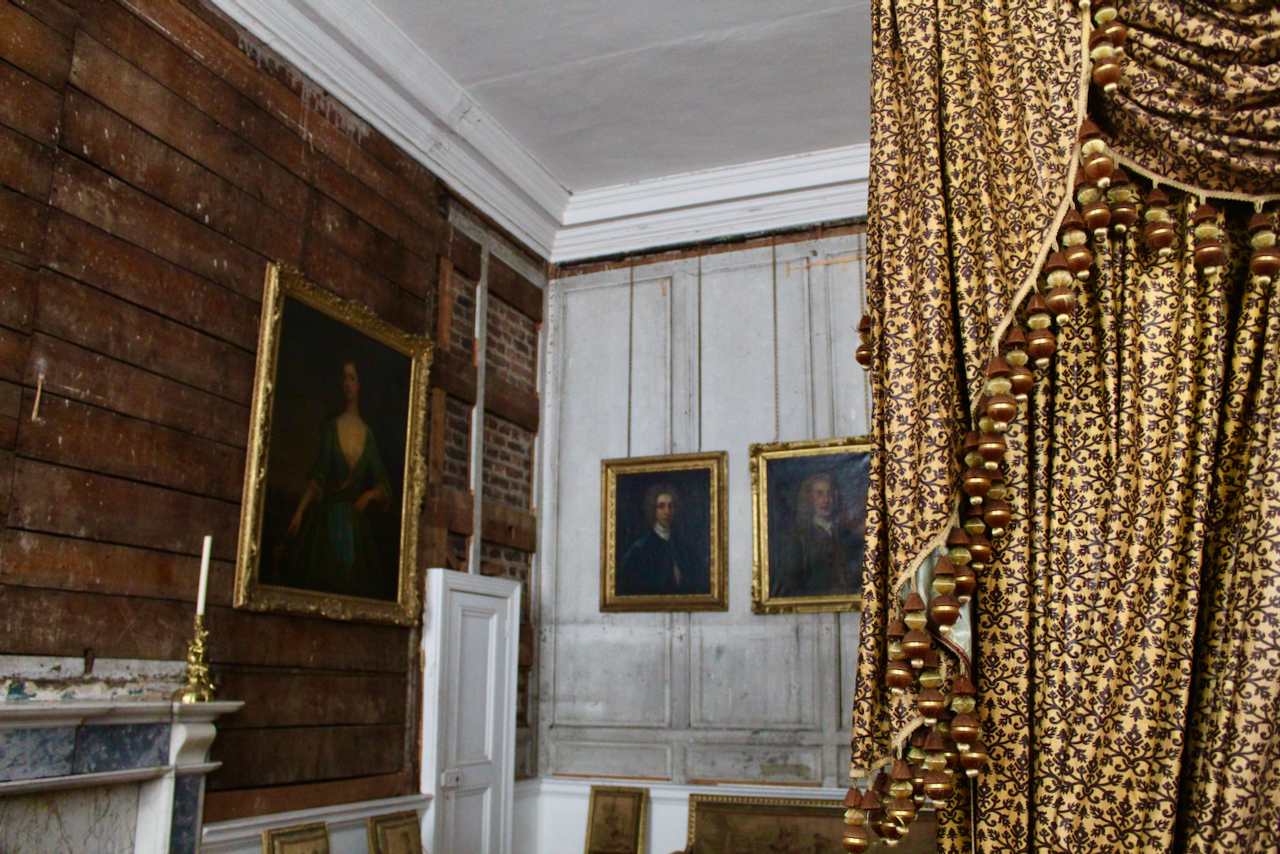
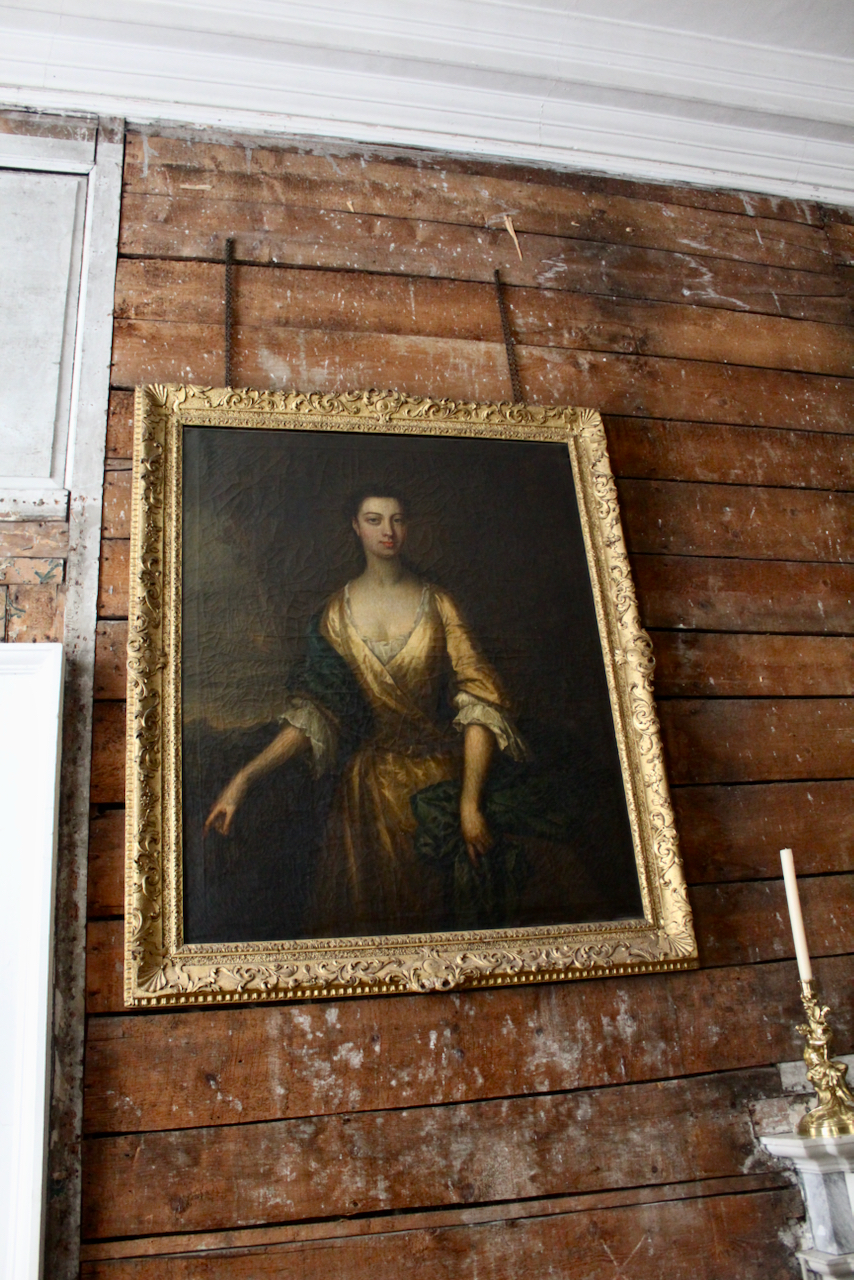
“In the adjoining room, Lady Louisa’s Bedroom, OPW’s conservation architects have left exposed the walls to offer visitors a glimpse of the different historic layers in the room, from the original brick walls, supported by trusses, to wooden panelling to fragments of whimsical printed wall paper that once embellished the room.“
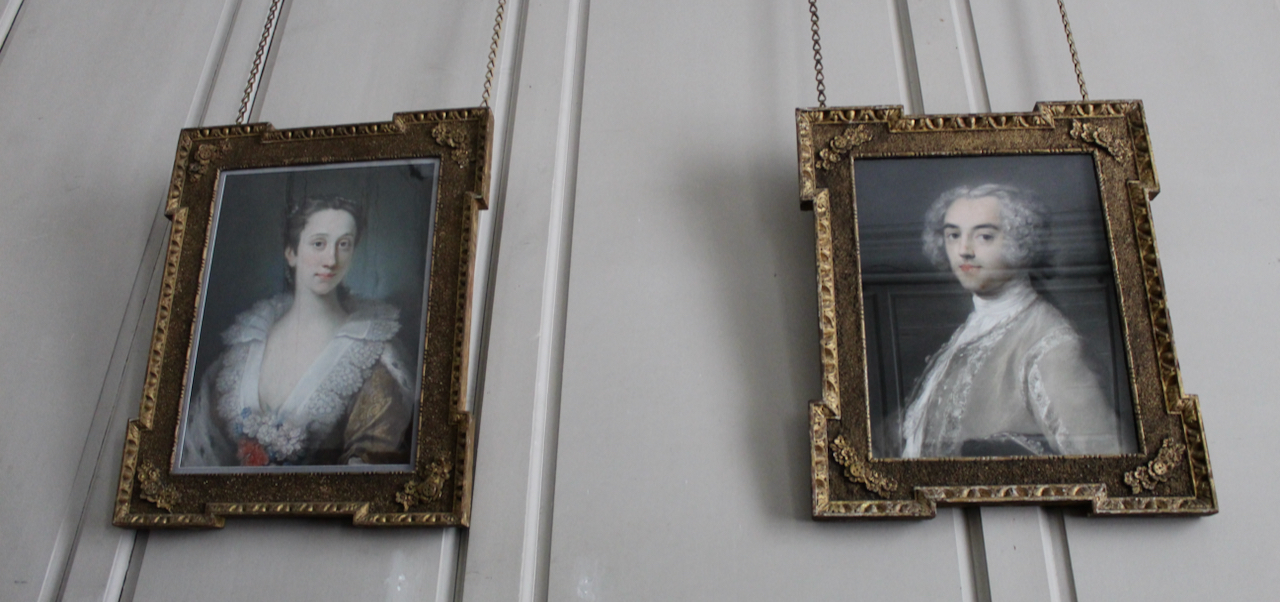
The Pastel Room, the website tells us, was originally an anteroom to the adjoining Long Gallery. It was used as a school room in the nineteenth century and is now known as the Pastel Room because of the fine collection of pastel portraits. The smaller pastels surrounding the fireplace include a pair of portraits of Thomas and Louisa Conolly by the leading Irish pastel artist of the eighteenth century, Hugh Douglas Hamilton.
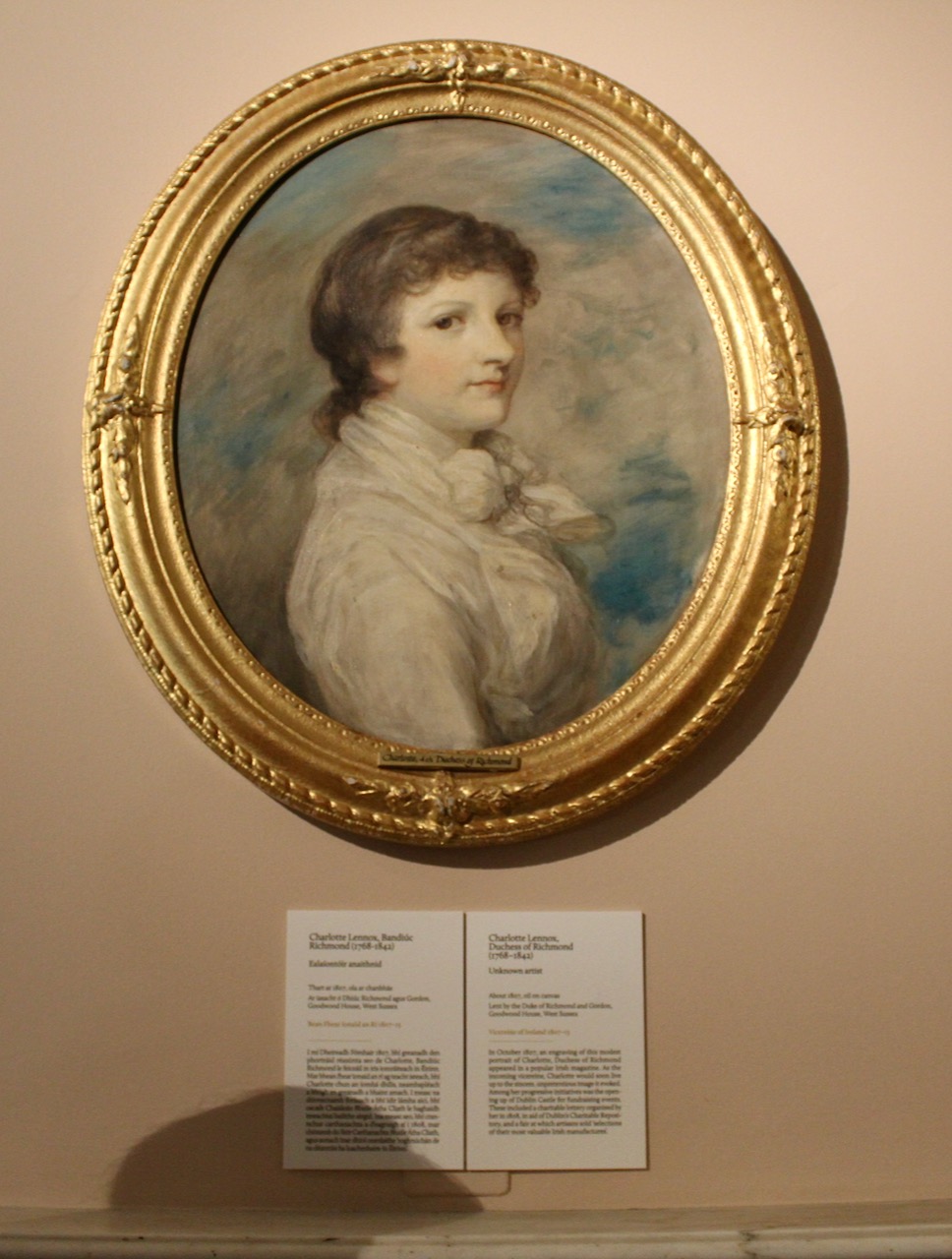
The small medallion in the centre is Lady Louisa by Hugh Douglas Hamilton. The one of the two girls on the right is of Louisa Staples and her sister, by Hugh Douglas Hamilton. William James Conolly (1712-1754) was the nephew of William Conolly who built Castletown, and he inherited the estate. He was the father of Thomas Conolly (1734-1803). Thomas’s sister Harriet married John Staples, and their daughter was Louisa Staples. Louisa married Thomas Pakenham (1757-1836). It was their son, Edward Michael (1786-1849) who inherited Castletown, and added Conolly to his surname, to become Pakenham Conolly.The pastel on the top left is Thomas Conolly (1734-1803), Louisa’s husband.Thomas Connolly of Castletown by Hugh Douglas Hamilton (1739-1808), courtesy Adam’s auction 28 March 2012.The parents of Louisa and Emily: Sarah Cadogen (1705-1751) and Charles Lennox (1701-1750) 2nd Duke of Richmond.Pastel of Lady Louisa Lennox, from the circle of Geoge Knapton, c.1747, it depicts Lady Louisa at the tender age of four. Louisa was the daughter of Charles Lennox, 2nd Duke of Richmond, and his wife, Lady Sarah Cadogan. Her parents died when she was eight years old, and both she and her two younger sisters, Sarah and Cecilia, went to live with their older sister Emily, Countess of Kildare, in Ireland.Charlotte Lennox née Gordon (1768-1842), Duchess of Richmond, Vicereine 1807-1813, wife of Charles Lennox, 4th Duke of Richmond.
From the Pastel Room, we enter the Long Gallery. The website tells us about this room:
“Originally laid out as a picture gallery with portraits of William Conolly’s patrons on display, its function and layout changed under Lady Louisa. In 1760, she had the original doorways to the upper east and west corridors removed, replacing them with the central doorway above the Entrance Hall. The new doorcases as well as new fireplaces at either end were designed by leading English architect, Sir William Chambers, while the actual execution was overseen by Simon Vierpyl. The Pompeian style decoration on the walls dates from the 1770s and was inspired by Montfaucon’s publications on the excavations at Pompeii and Herculaneum and by Raphael’s designs for the Vatican. The murals were the work of an English artist and engraver Charles Ruben Riley (1752–98). The Long Gallery became a space for informal entertaining and was full of life and activity as the following excerpt from one of Louisa’s letters suggests: “Our gallery was in great vogue, and really is a charming room for there is such a variety of occupations in it, that people cannot be formal in it. Lord Harcourt was writing, some of us played at whist, others at billiards, Mrs Gardiner at the harpsichord, others at chess, others at reading and supper at one end. I have seldom seen twenty people in a room so easily disposed of.”
“…measuring almost 80 by 23 feet, with its heavy ceiling compartments and frieze dates from the 1720s. Originally there were four doors in the room and the walls were panelled in stucco similar to the entrance Hall. In 1776 the plaster panels and swags were removed but traces of them were found behind the painted canvas panels when they were taken down for cleaning during recent conservation work.”
Archiseek continues: “In the mid 1770s the room was redecorated in the Pompeian manner by two English artists, Charles Reuben Riley (c.1752-1798) and Thomas Ryder (1746-1810). Tom and Louisa’s portraits are at either end of the room over the chimney-pieces and the end piers are decorated with cyphers of the initals of their families: The portrait of Lady Louisa is after Reynolds (the original is in the Fogg Art Museum, Harvard) and that of Tom after Anton Raphael Mengs (the original is in the National Gallery of Ireland).
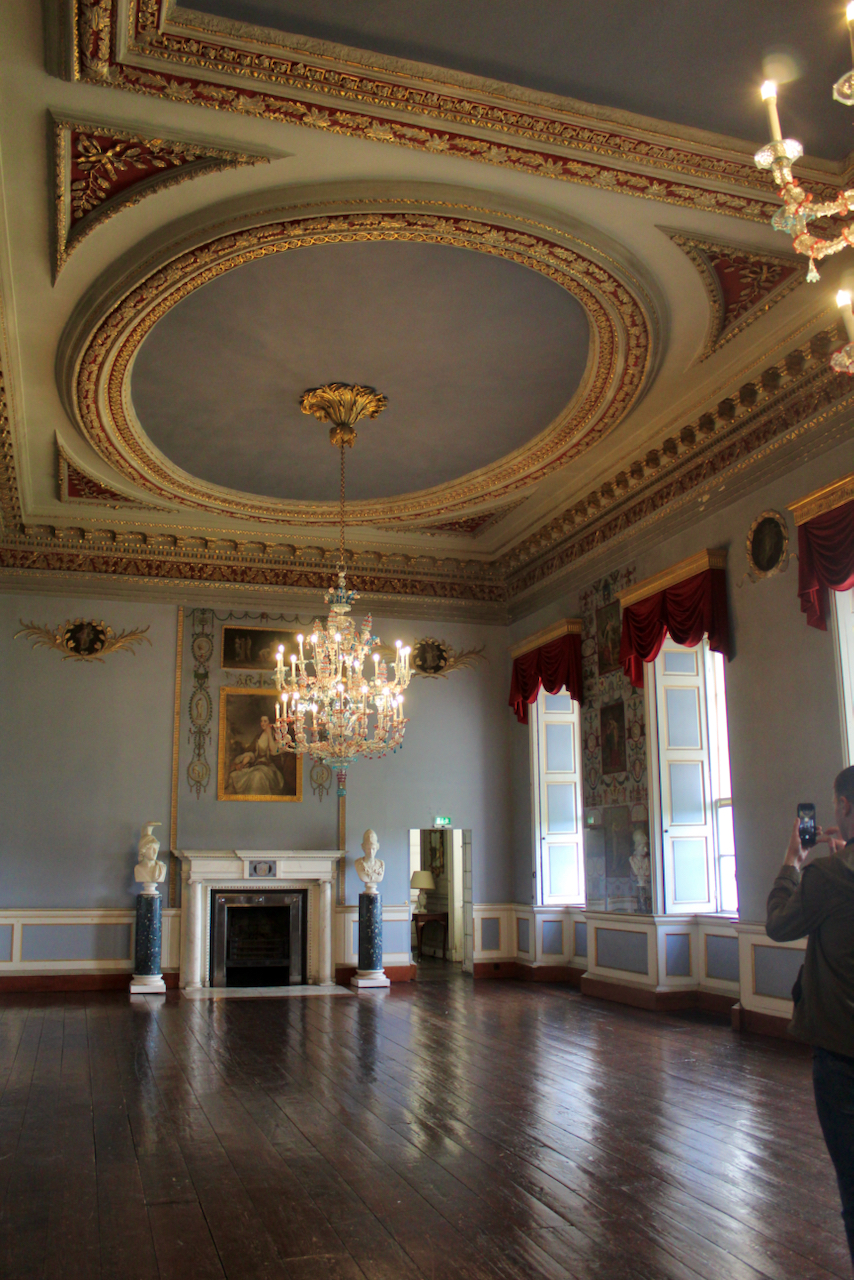
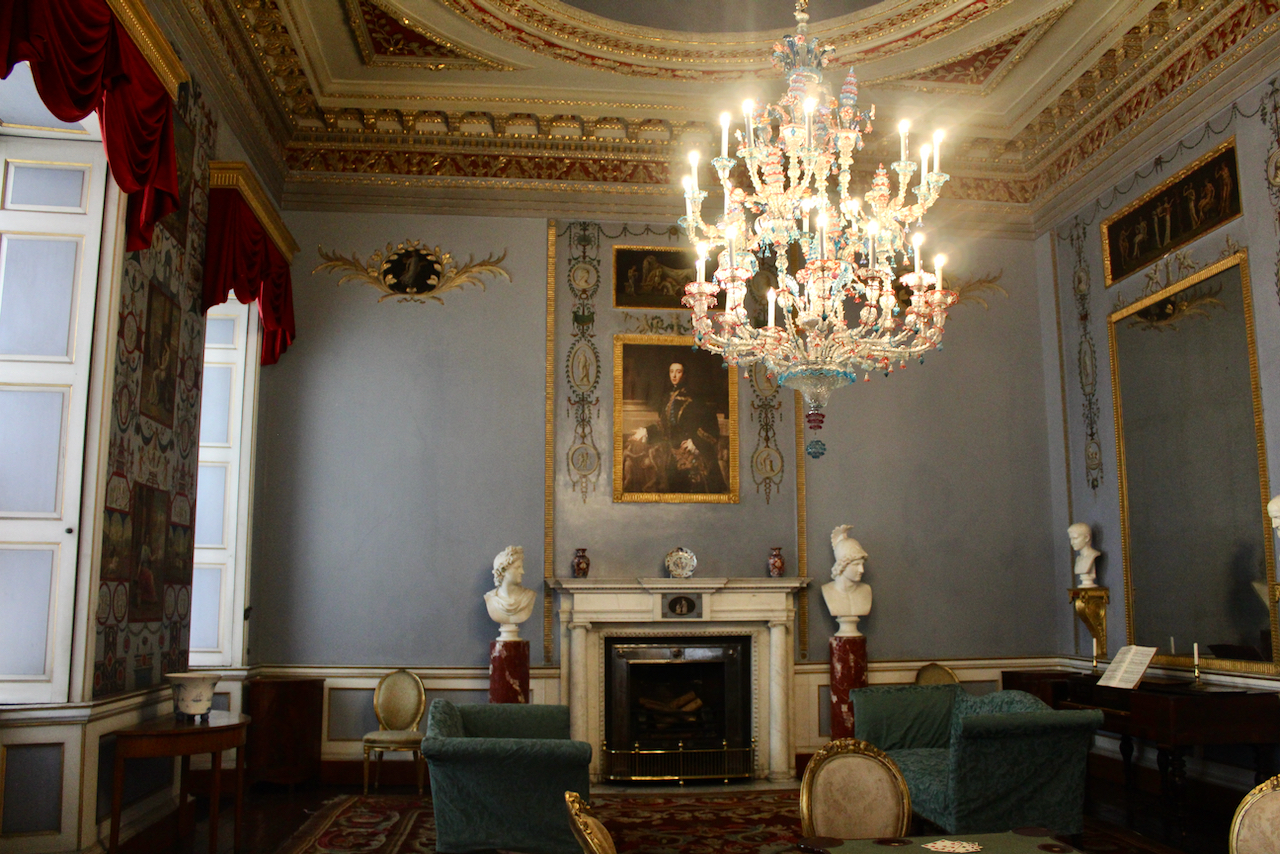
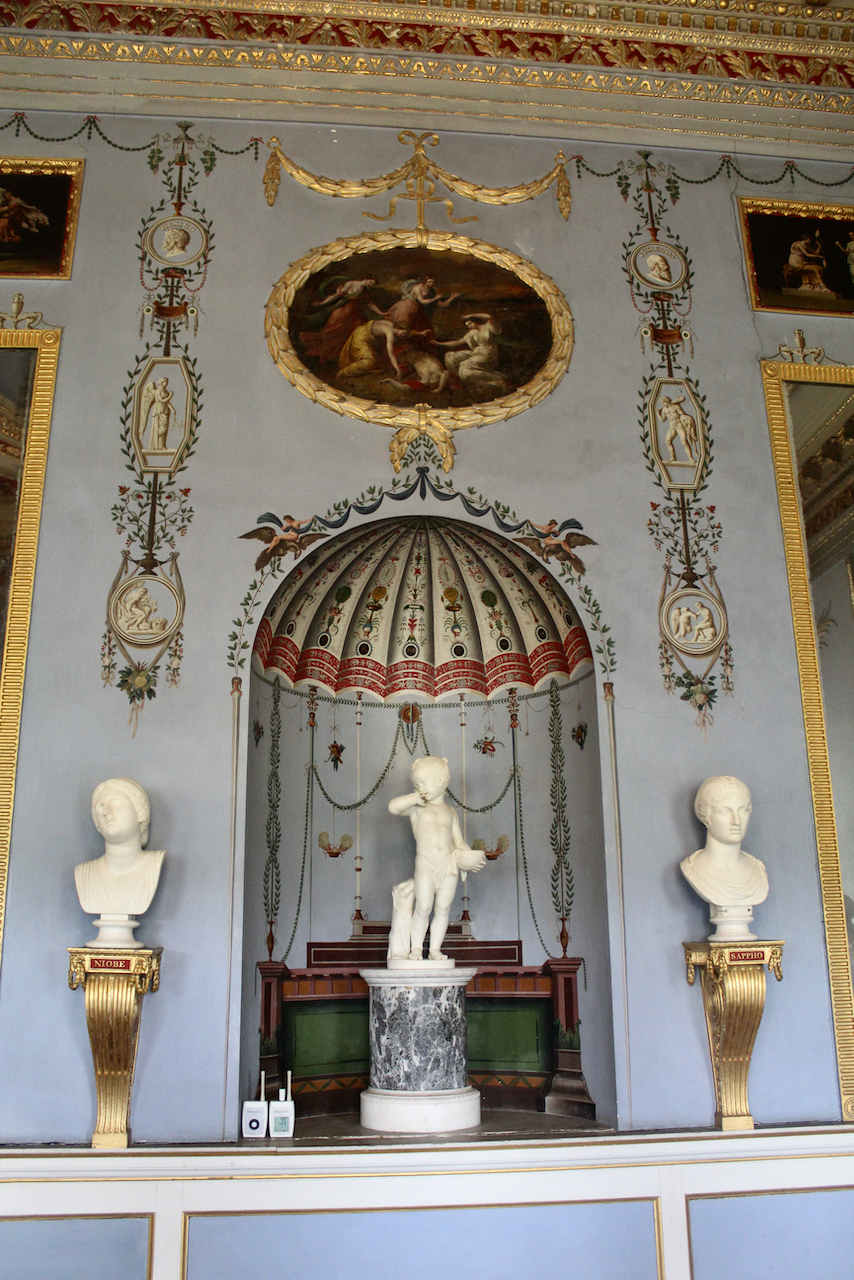
Archiseek tells us: “The subjects of the wall paintings were mostly taken from engraving in d’Hancarville’s Antiquites Etrusques, Greques, et Romaines (1766-67) and de Montfaucon’s L’antiquite expliquee et representee en figures (1719). The busts of the poets and philosophers are placed on gilded brackets designed by Chambers. In the central niche stands a seventeenth-century statue of Diana. Above is a lunette of Aurora, the godess of the dawn, derived from a ceiling decoration by Guido Reni, the seventeenth century Bolognese painter.
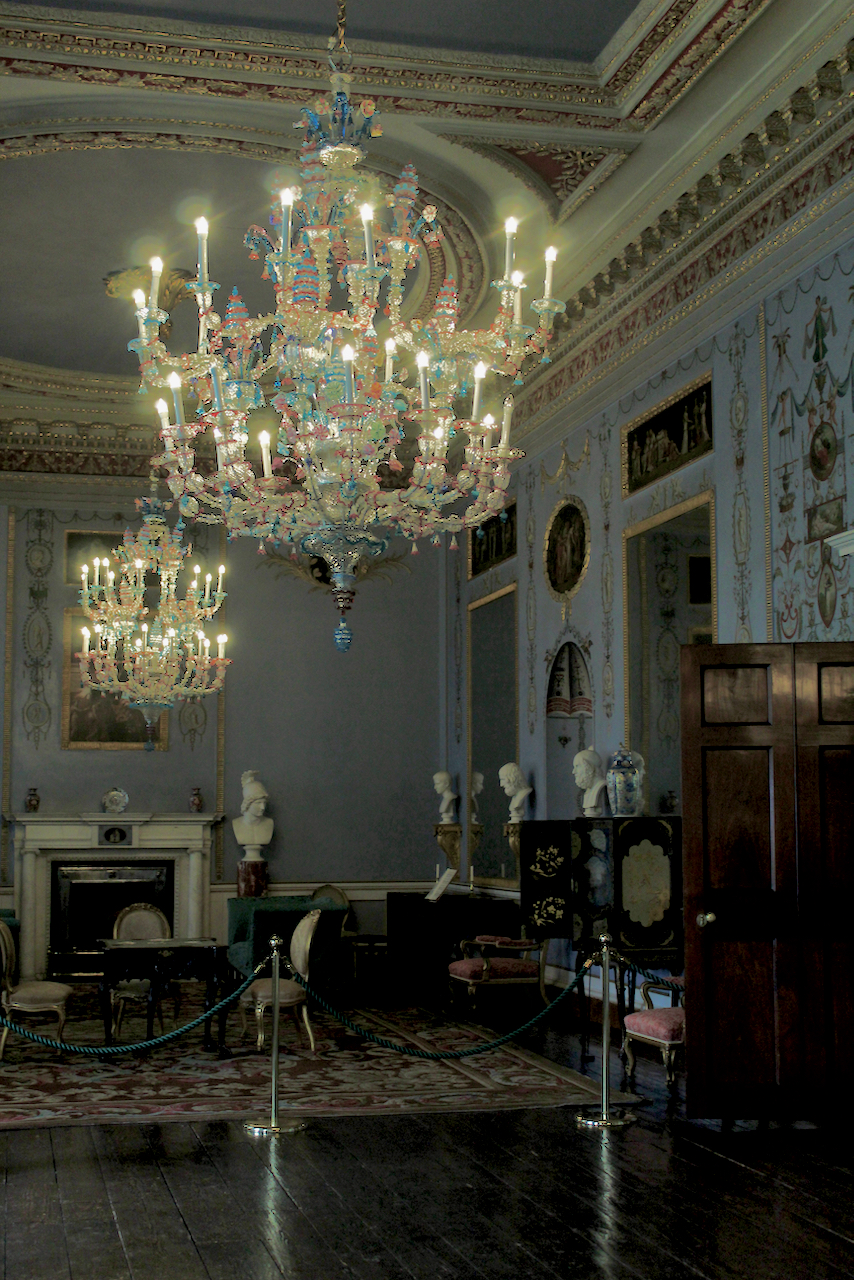
“The three glass chandeliers were made for the room in Venice and the four large sheets of mirrored glass came from France. In the 1770s the Long Gallery was used as a living room and was filled with exquisite furniture. Originally in the room, there were a pair of side tables attributed to John Linnell, with marble tops attributed to Bossi, a pair of commodes by Pierre Langlois, that were purchased in London for Lady Louisa by Lady Caroline Fox and a pair of bookcases at either end of the room.
“In 1989 major conservation work was carried out on the Long Gallery. The wall paintings that had been flaking for many years were conserved. The original eighteenth-century gilding has been cleaned and the chandeliers restored. The project was funded by the American Ireland Fund, the Irish Georgian Society and by private donations.“
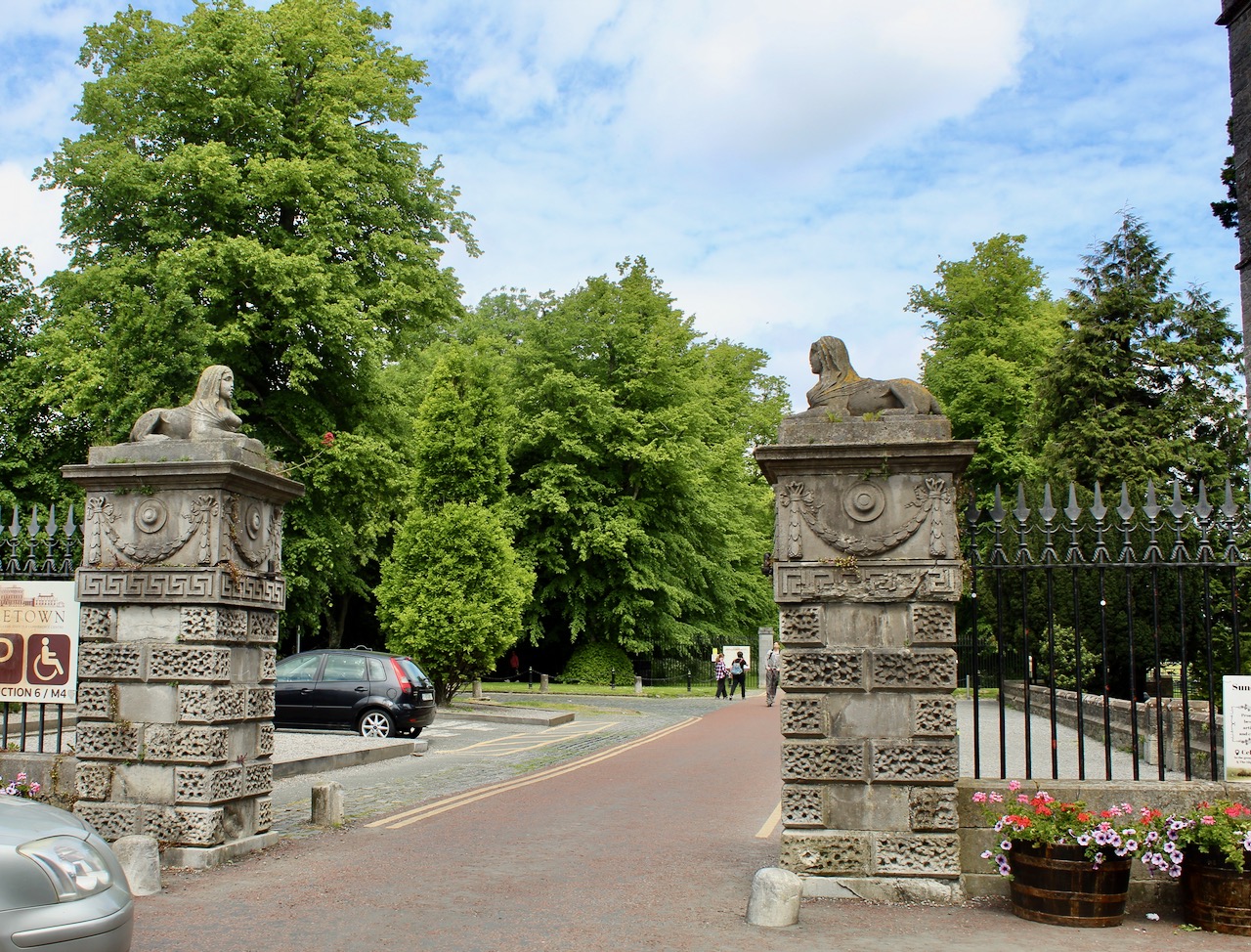
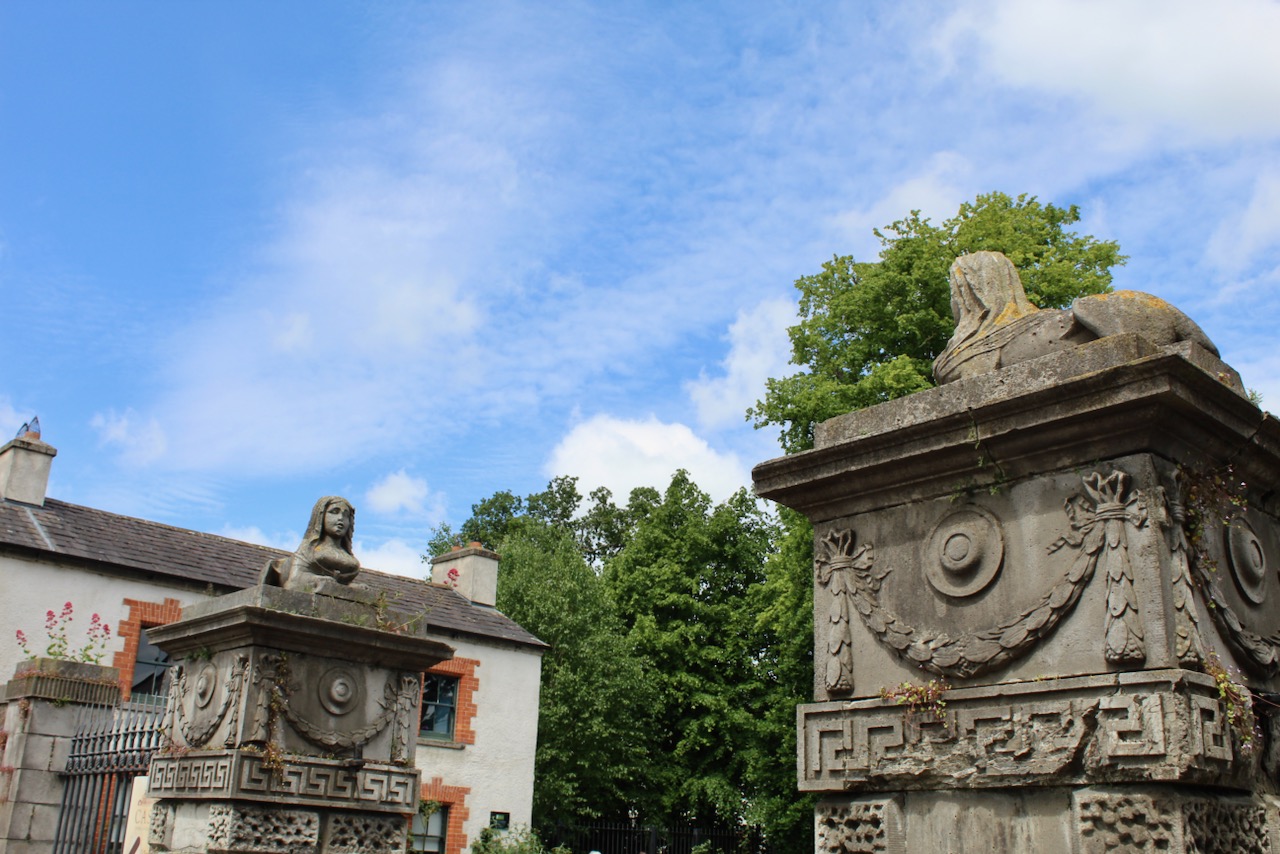
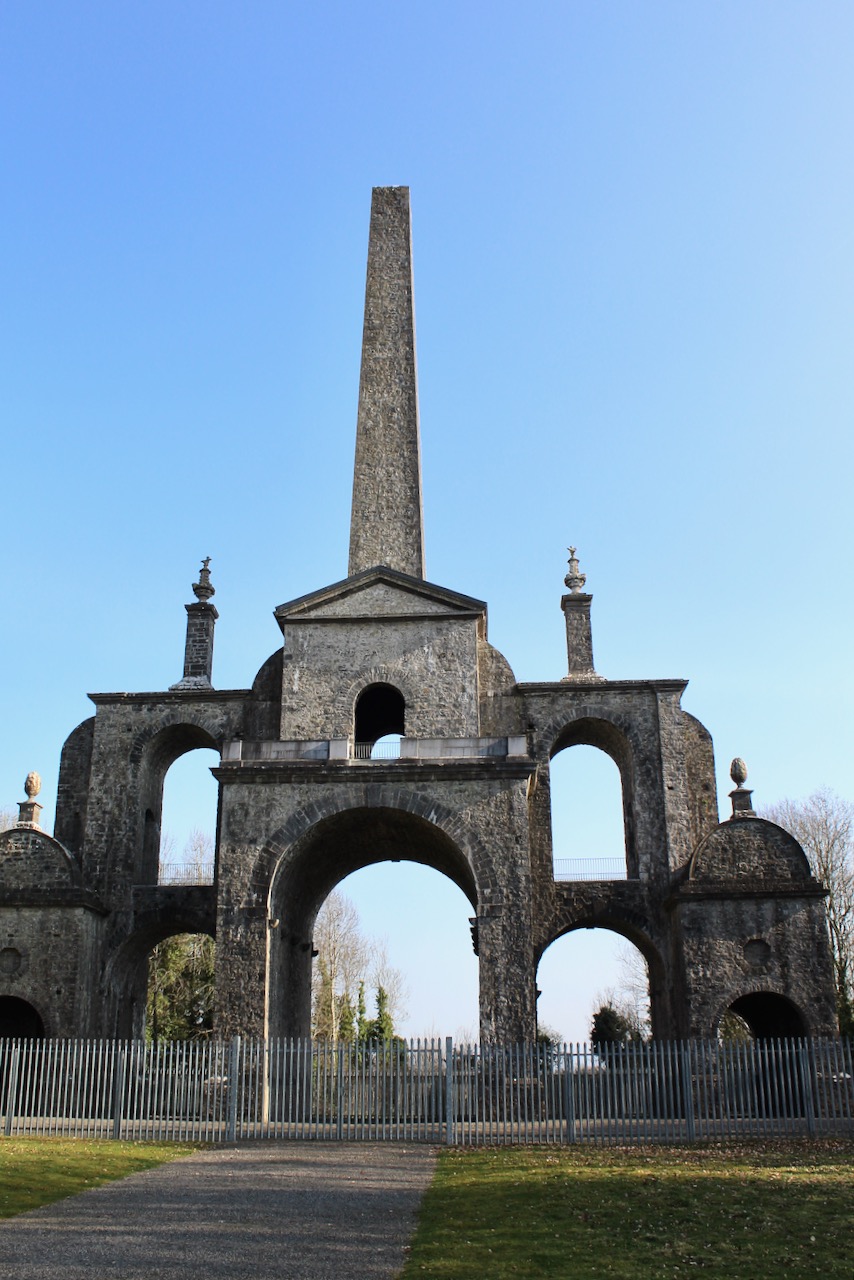
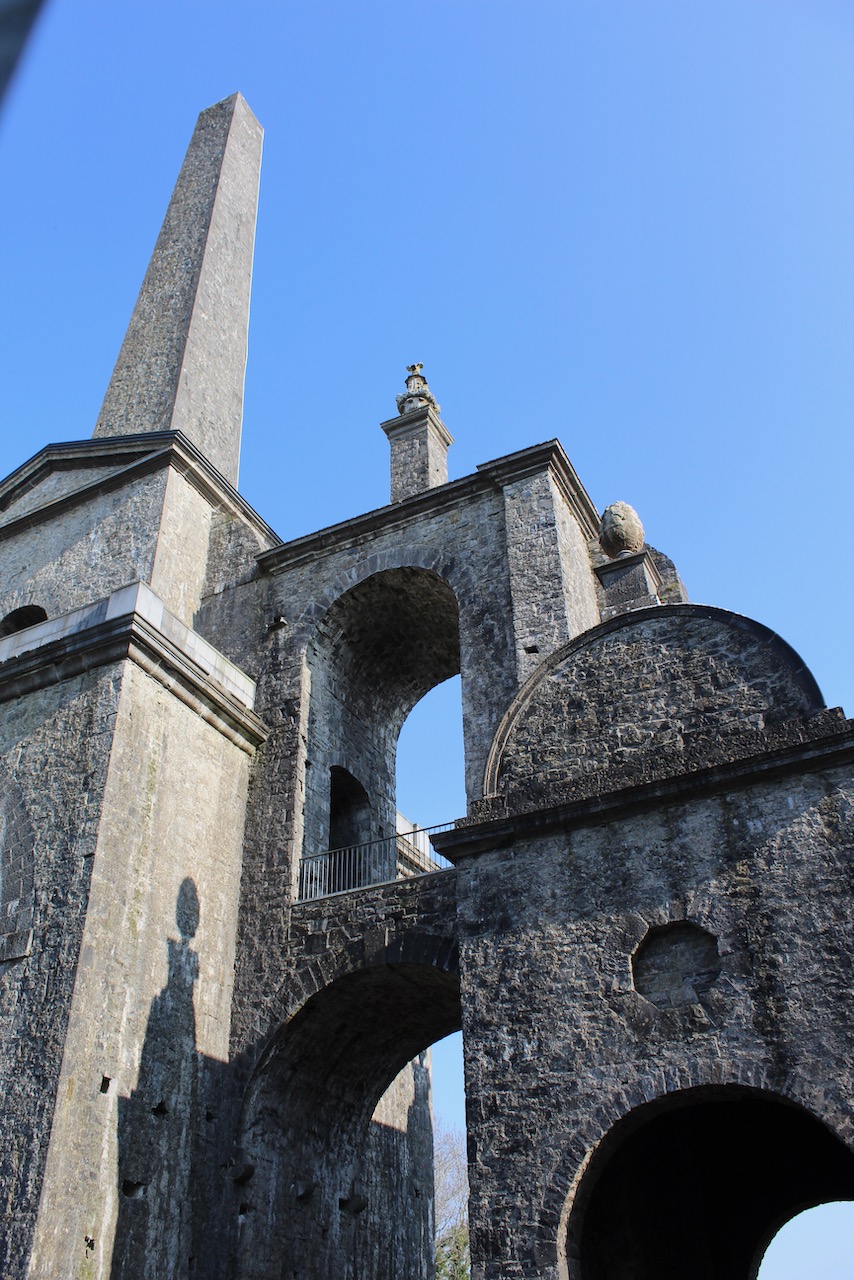
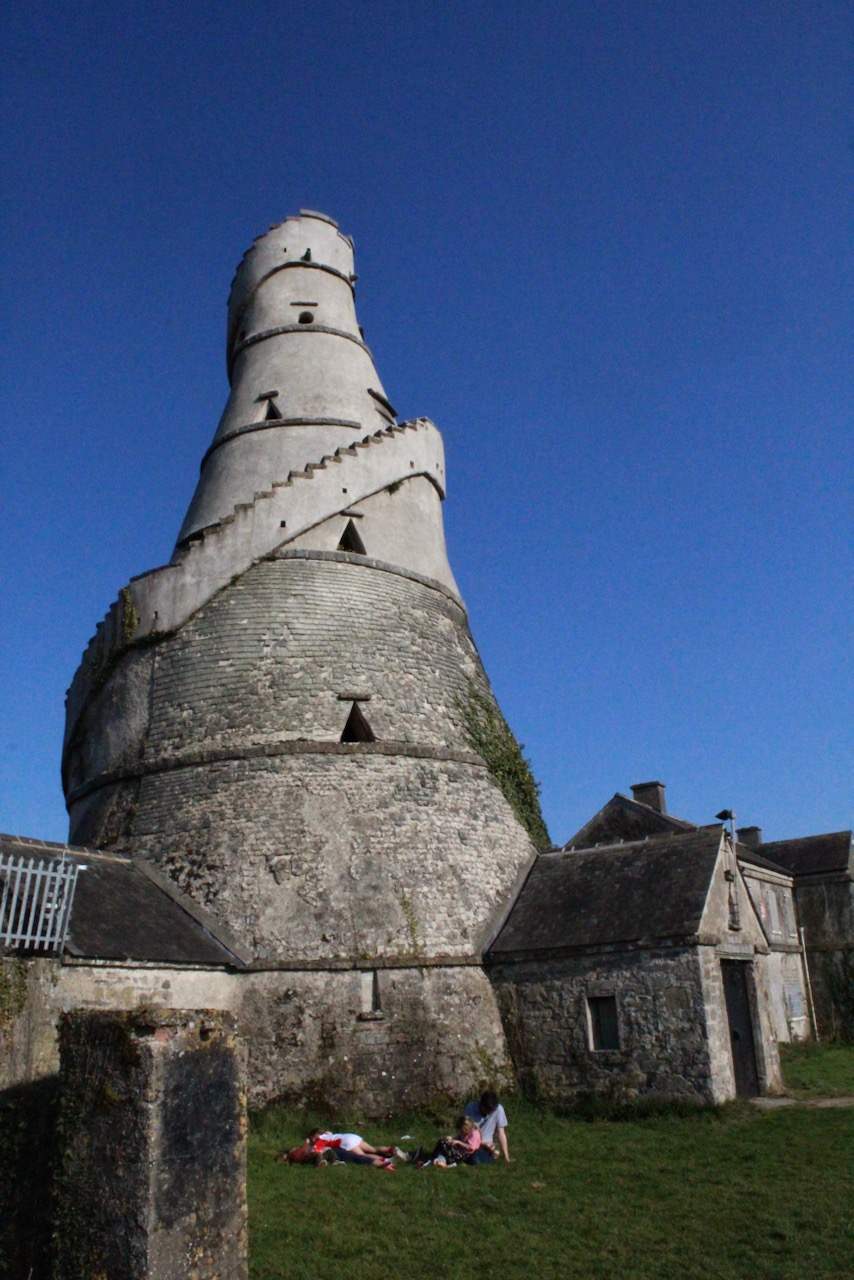
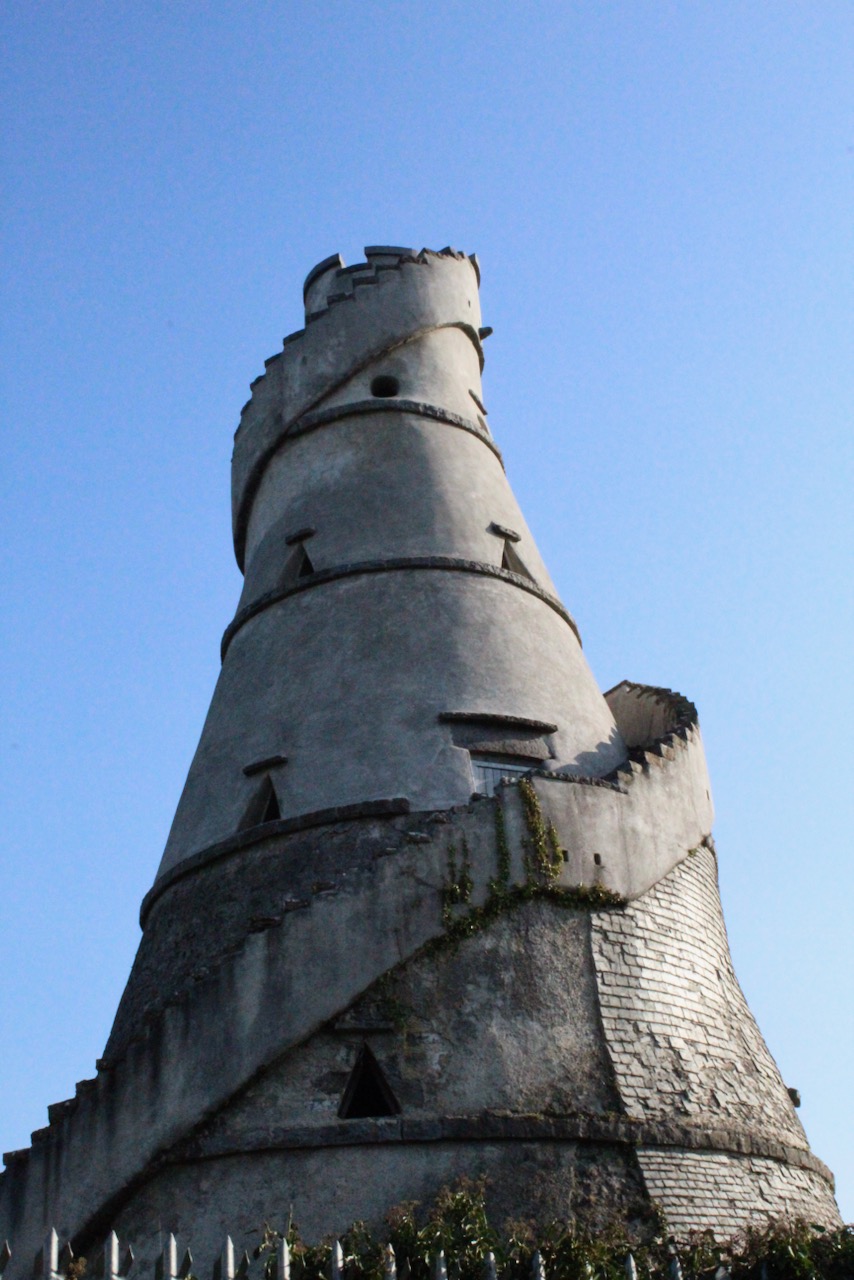
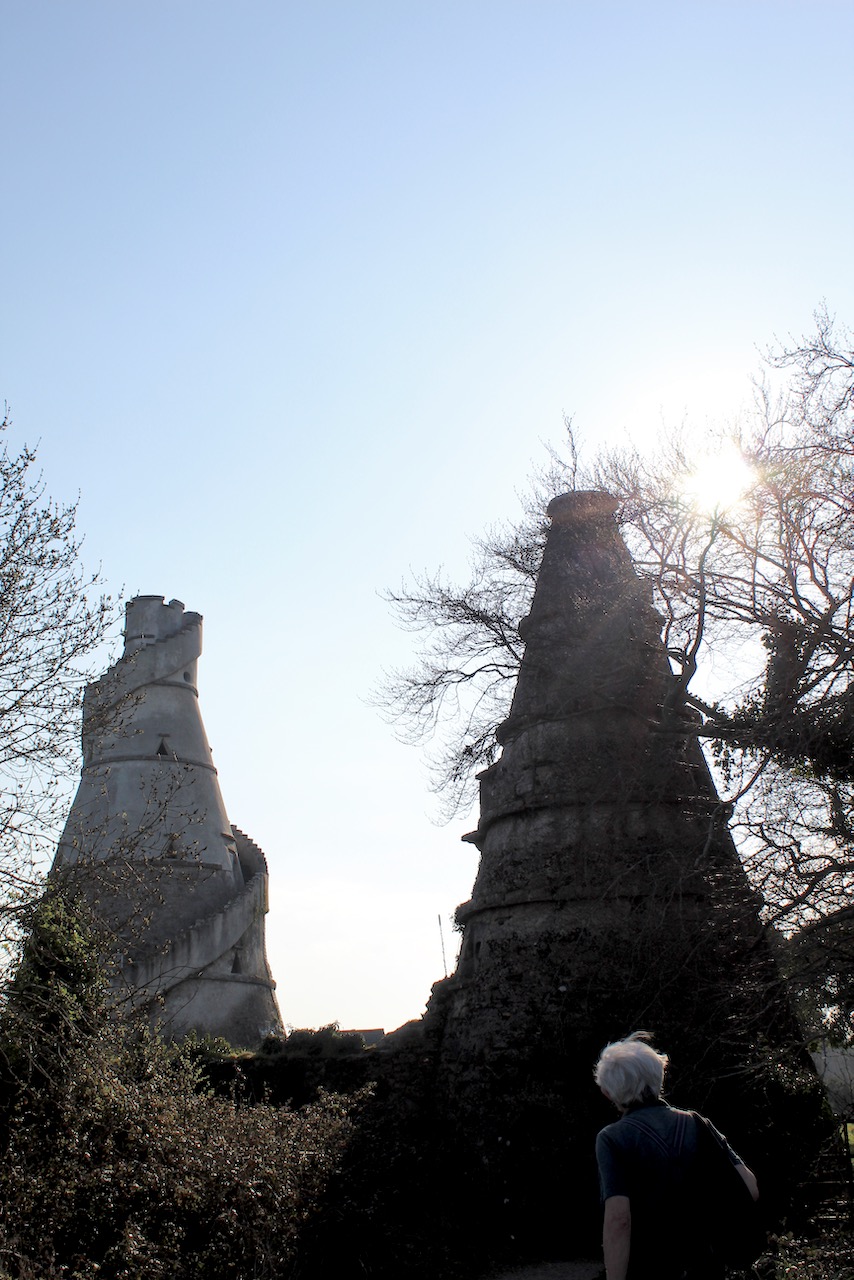
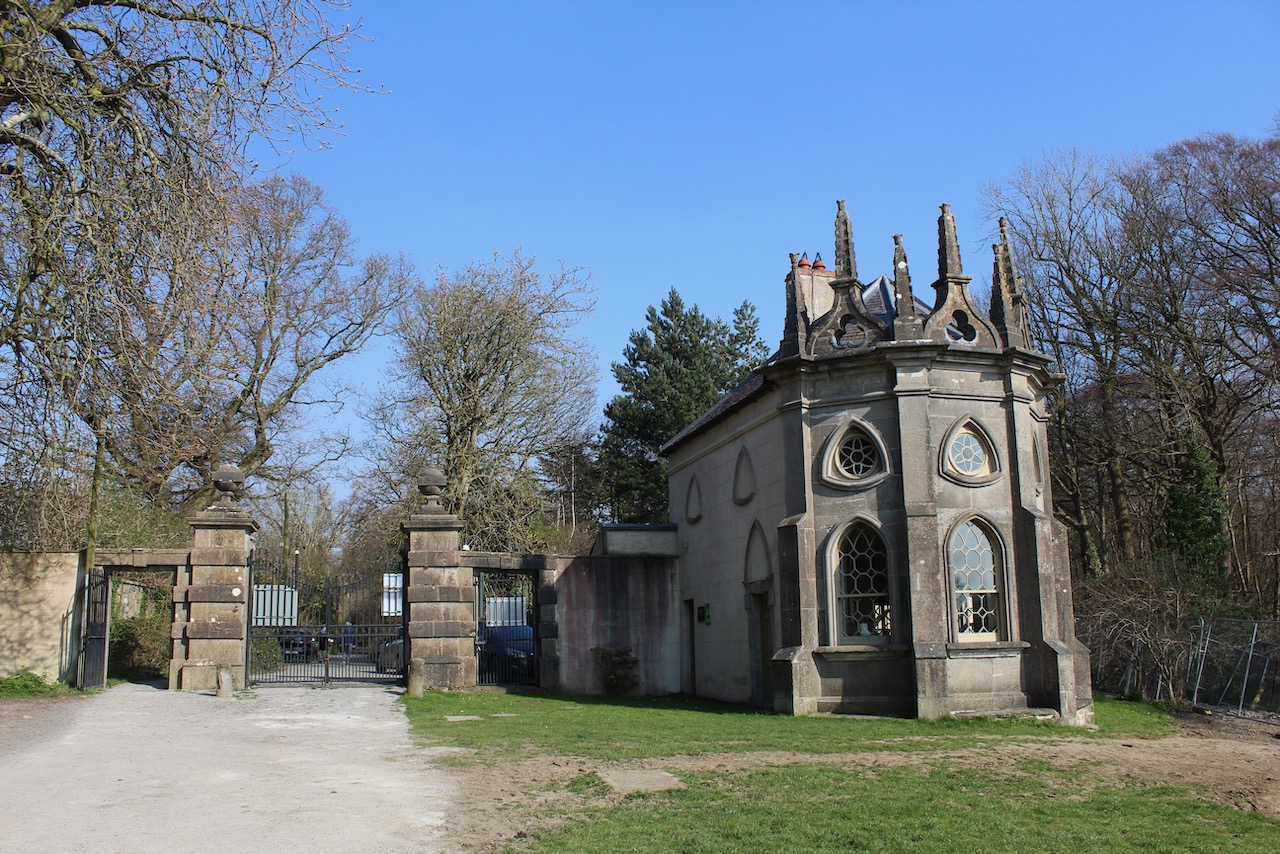
Mark Bence-Jones tells us: “The gallery, and the other rooms on the garden front, face along a two mile vista to the Conolly Folly, an obelisk raised on arches which was built by Speaker Conolly’s widow 1740, probably to the design of Richard Castle. The ground on which it stands did not then belong to the Conollys, but to their neighbour, the Earl of Kildare, whose seat, Carton, is nearby. The folly continued to be a part of the Carton estate until 1968, when it was bought by an American benefactress and presented to Castletown. At the end of another vista, the Speaker’s widow built a remarkable corkscrew-shaped structure for storing grain, known as the Wonderful Barn. One of the entrances to the demesne has a Gothic lodge, from a design published by Batty Langley 1741. The principal entrance gates are from a design by Chambers.“
The Obelisk, or Conolly Folly, was reputedly built to give employment during an episode of famine. It was restored by the Irish Georgian Society in 1960.
As Bence-Jones tells us, Castletown was inherited by Tom Conolly’s nephew, Edward Michael Pakenham, who took the name of Conolly, to become Pakenham Conolly. Thomas and Louisa had no children, and Thomas’s sister Harriet married John Staples, and their daughter was Louisa Staples. Louisa married Thomas Pakenham (1757-1836). It was their son, Edward Michael (1786-1849) who inherited Castletown.
The house then passed to his son, another Thomas Conolly (1823-1876). He was an adventourous character who travelled widely and kept a diary. Stephen and I recently attended a viewing of portraits of Thomas and his wife Sarah Eliza, which are to be sold by Bonhams. His diary of his trip to the United States during the time of the Civil War is being published.
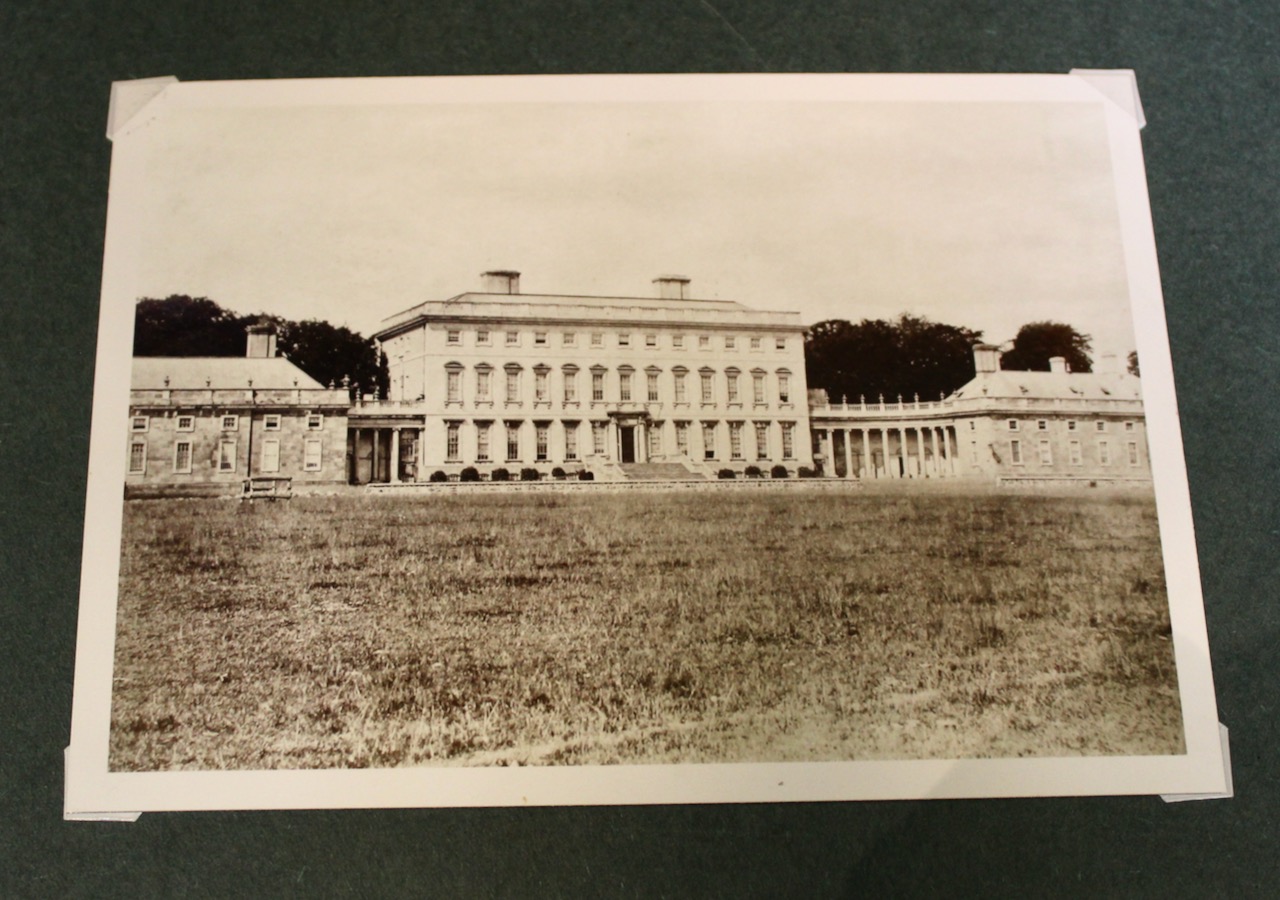
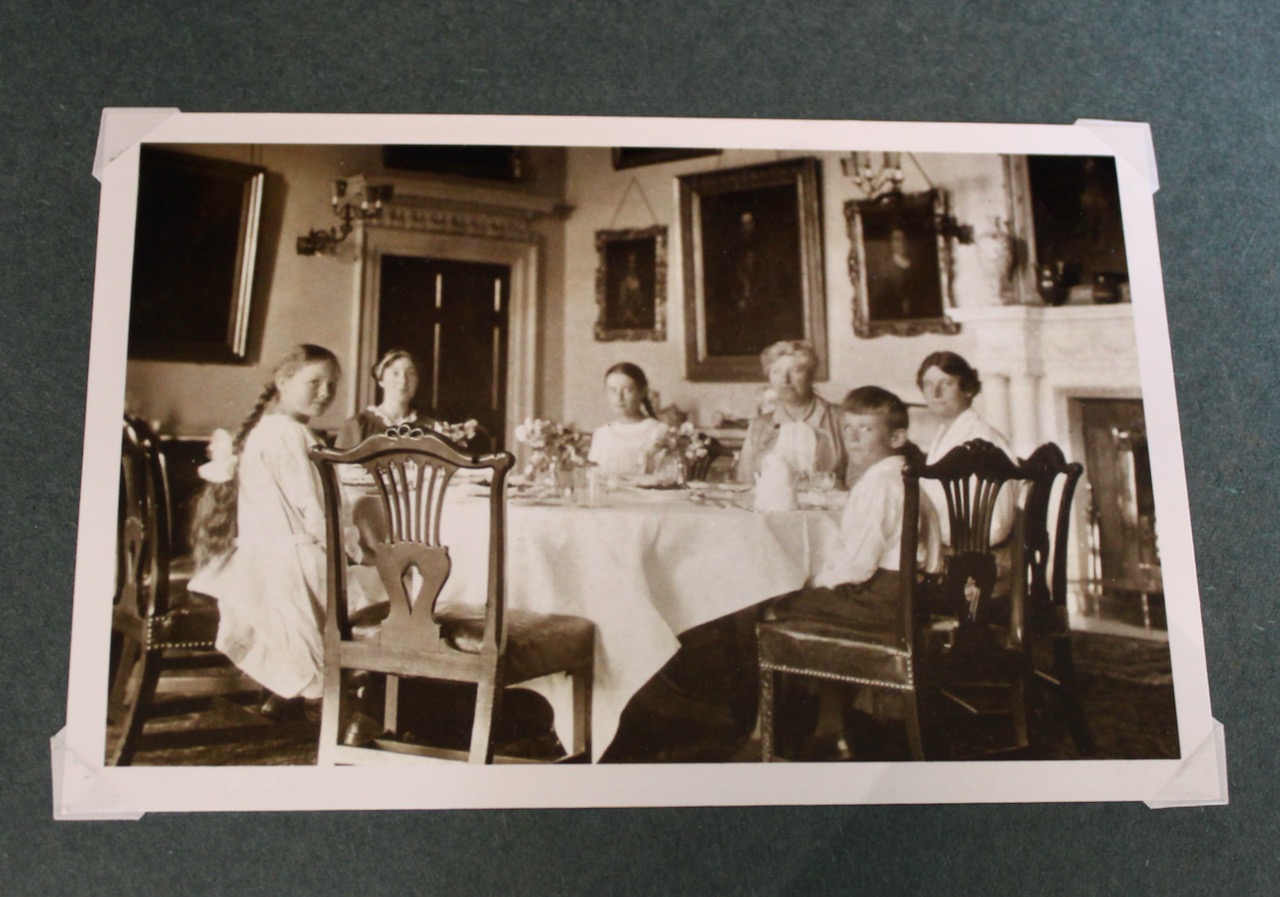
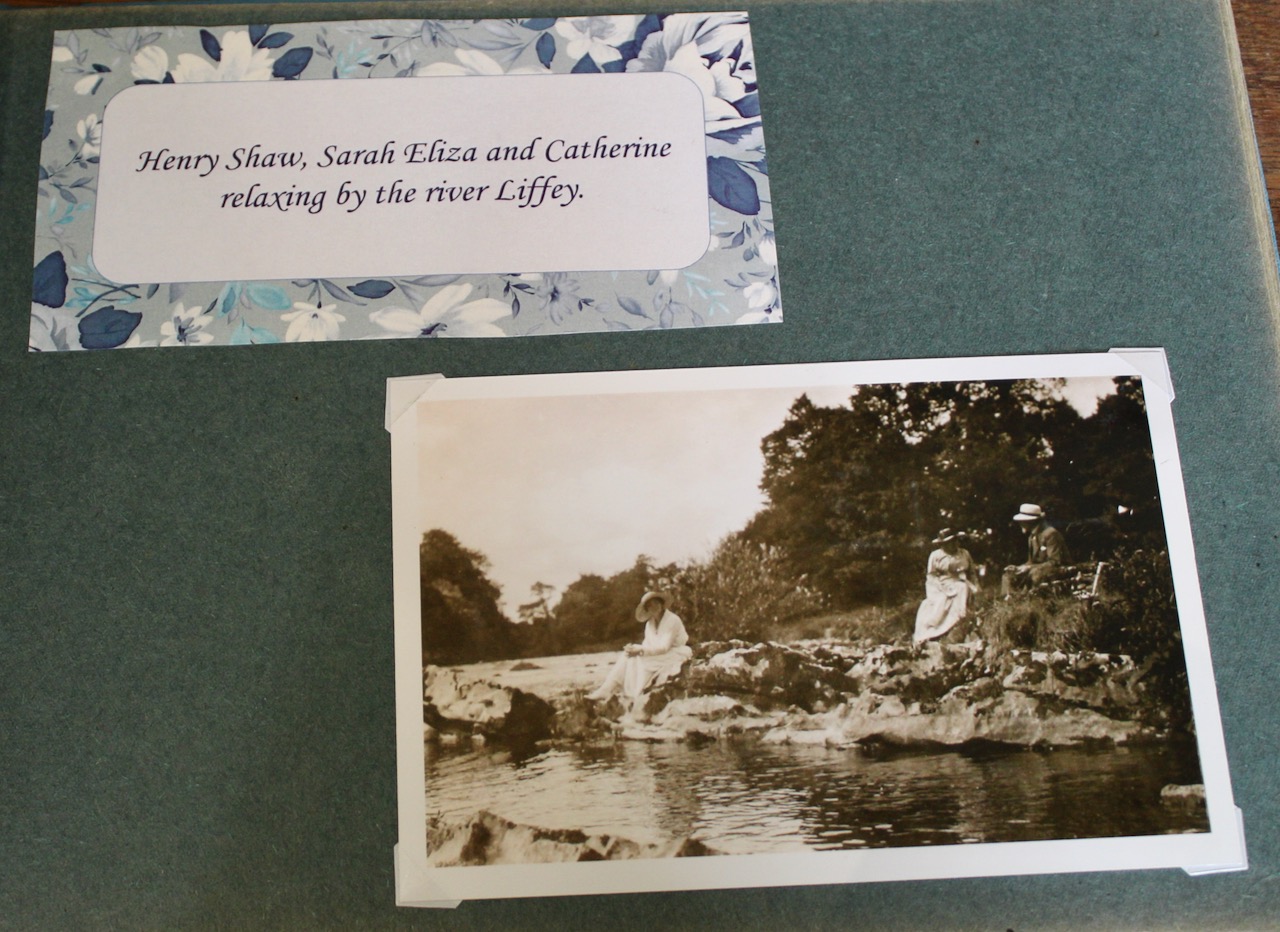
Sarah Eliza was the daughter of a prosperous Celbridge paper mill owner, Joseph Shaw. Her substantial dowry helped to fund her husband’s adventurous lifestyle! A photograph album which belonged to her brother Henry Shaw, of a visit to Castletown, was rescued from the rubble of his home in London when it was destroyed by a German bomb in 1944. Sadly, he died in the bombing. The photograph album is on display in Castletown.
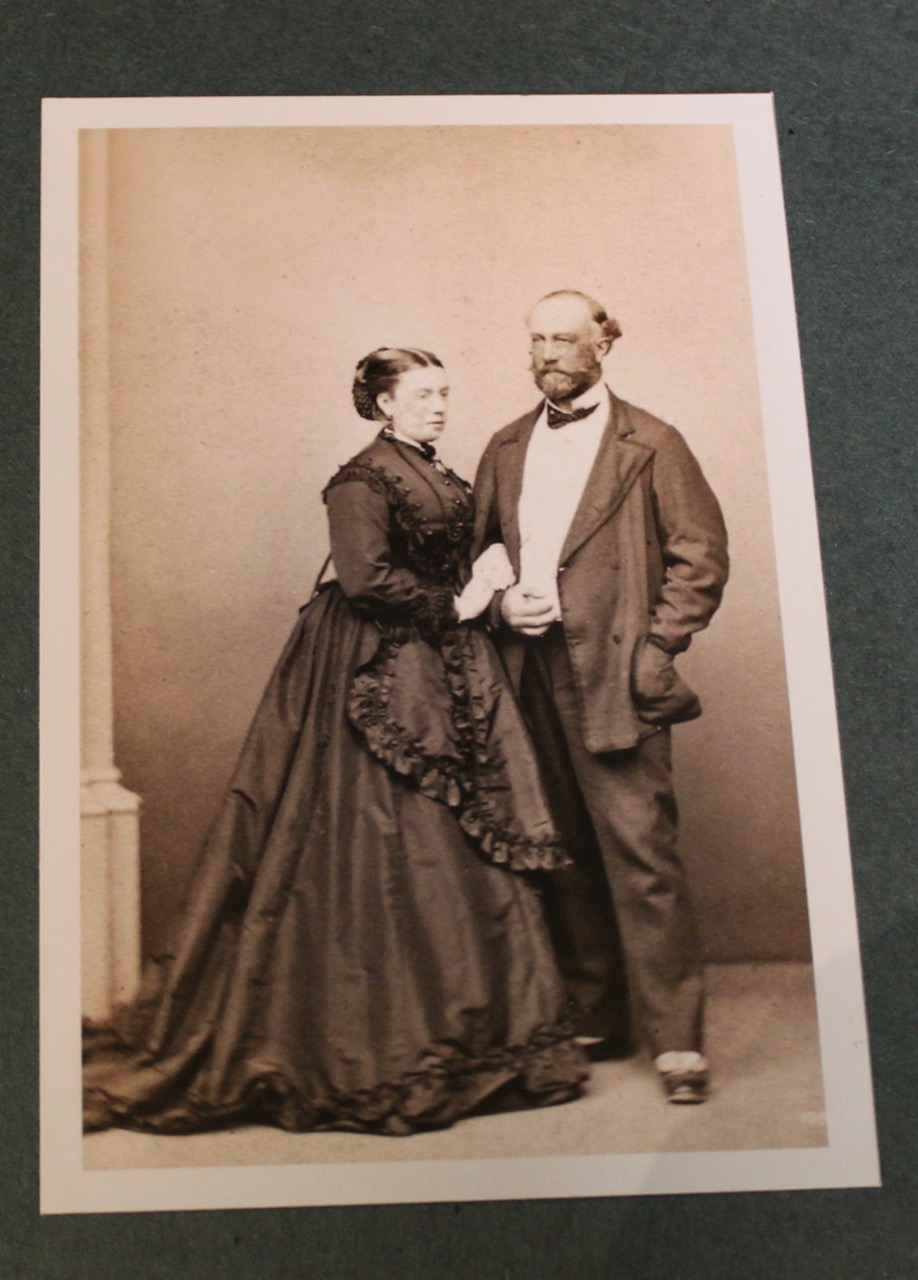
Thomas Conolly (1823-1876)and his wife Sarah Eliza.
Sarah Eliza and Thomas had four children. Thomas, born in 1870, died in the Boer War in 1900. William died at the age of 22. Edward Michael (Ted), born in 1874, lived until his death in Castletown, in 1956. Their daughter Catherine married Gerald Shapland Carew, 5th Baron Carew, the grandson of Robert Carew, 1st Baron Carew of Castleboro House, County Wexford (today an impressive ruin), and son of Shapland Francis Carew and his wife Hester Georgiana Browne, daughter of Howe Peter Browne, 2nd Marquess of Sligo.
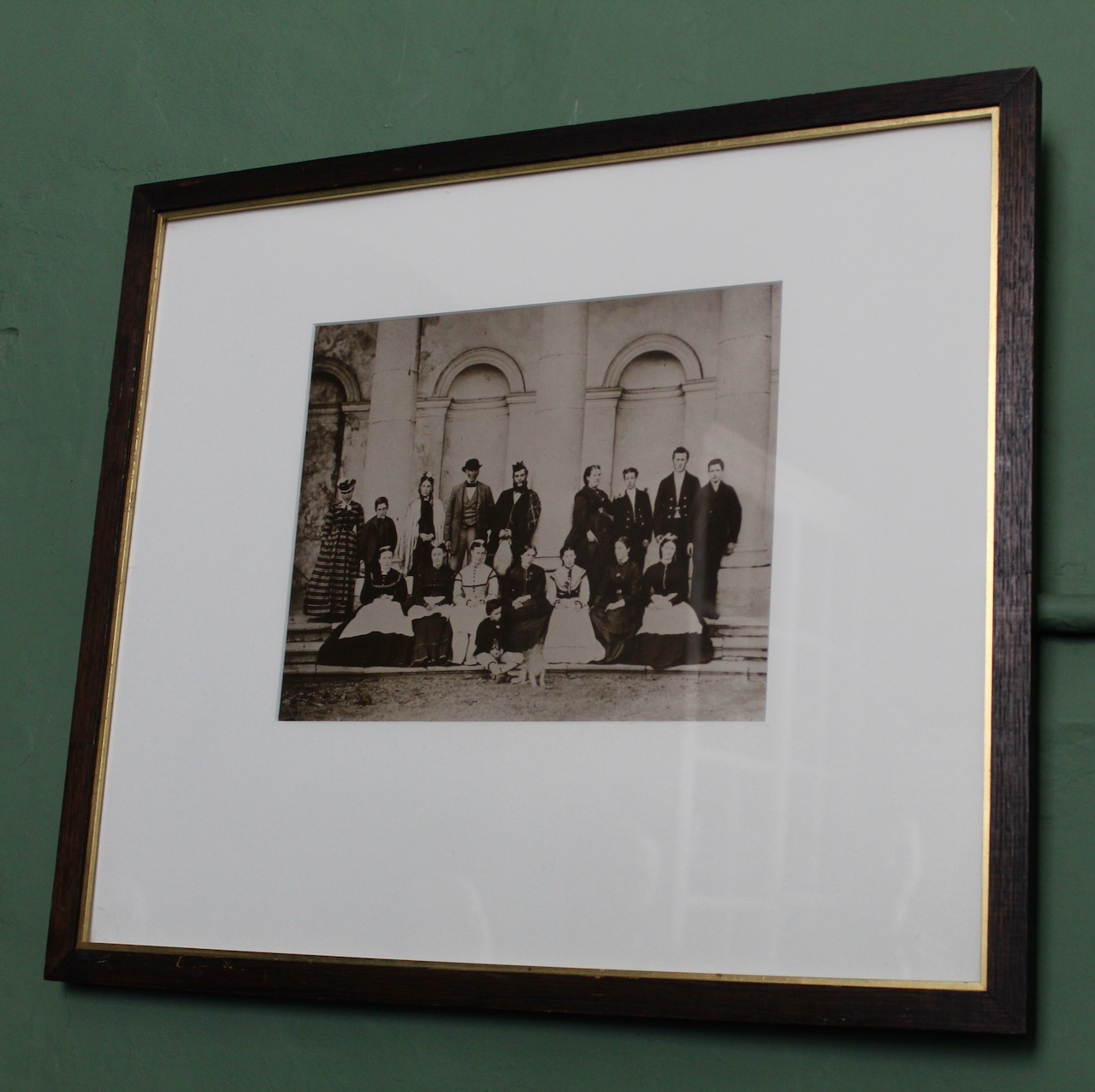
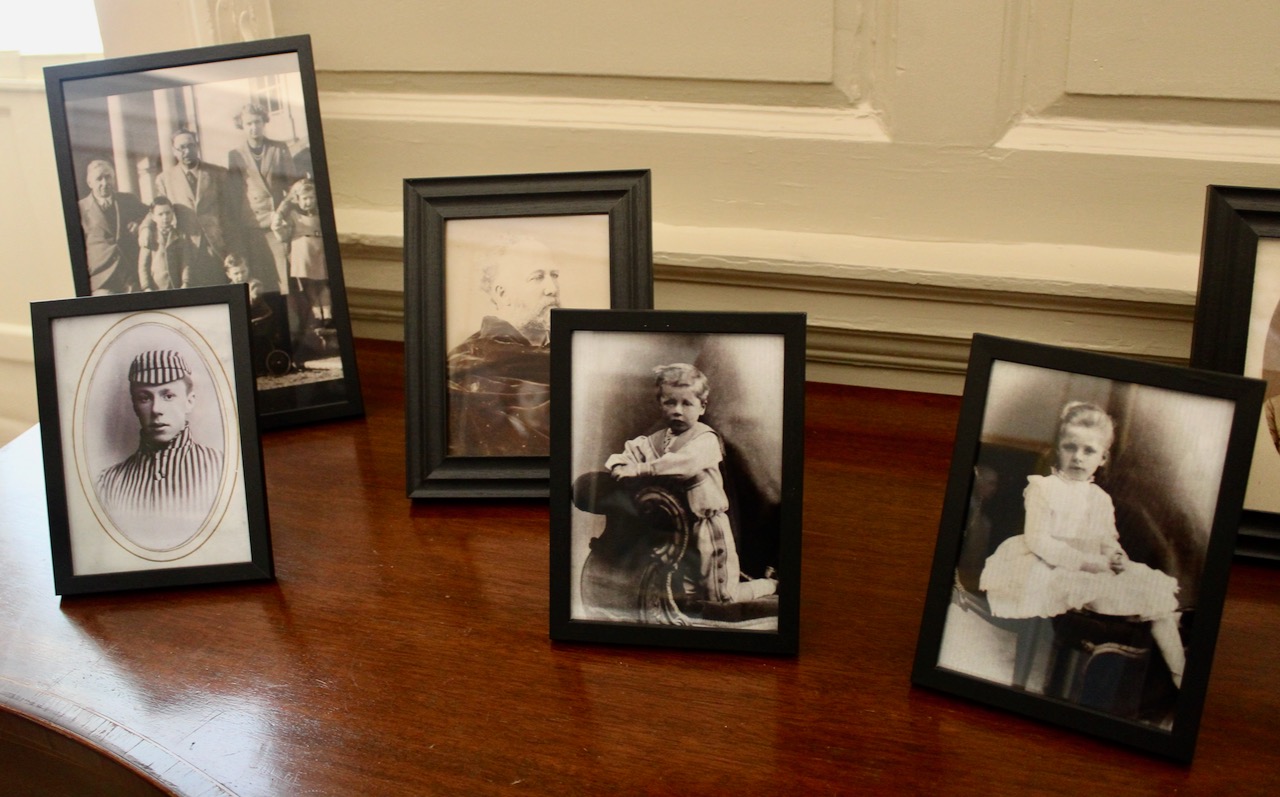
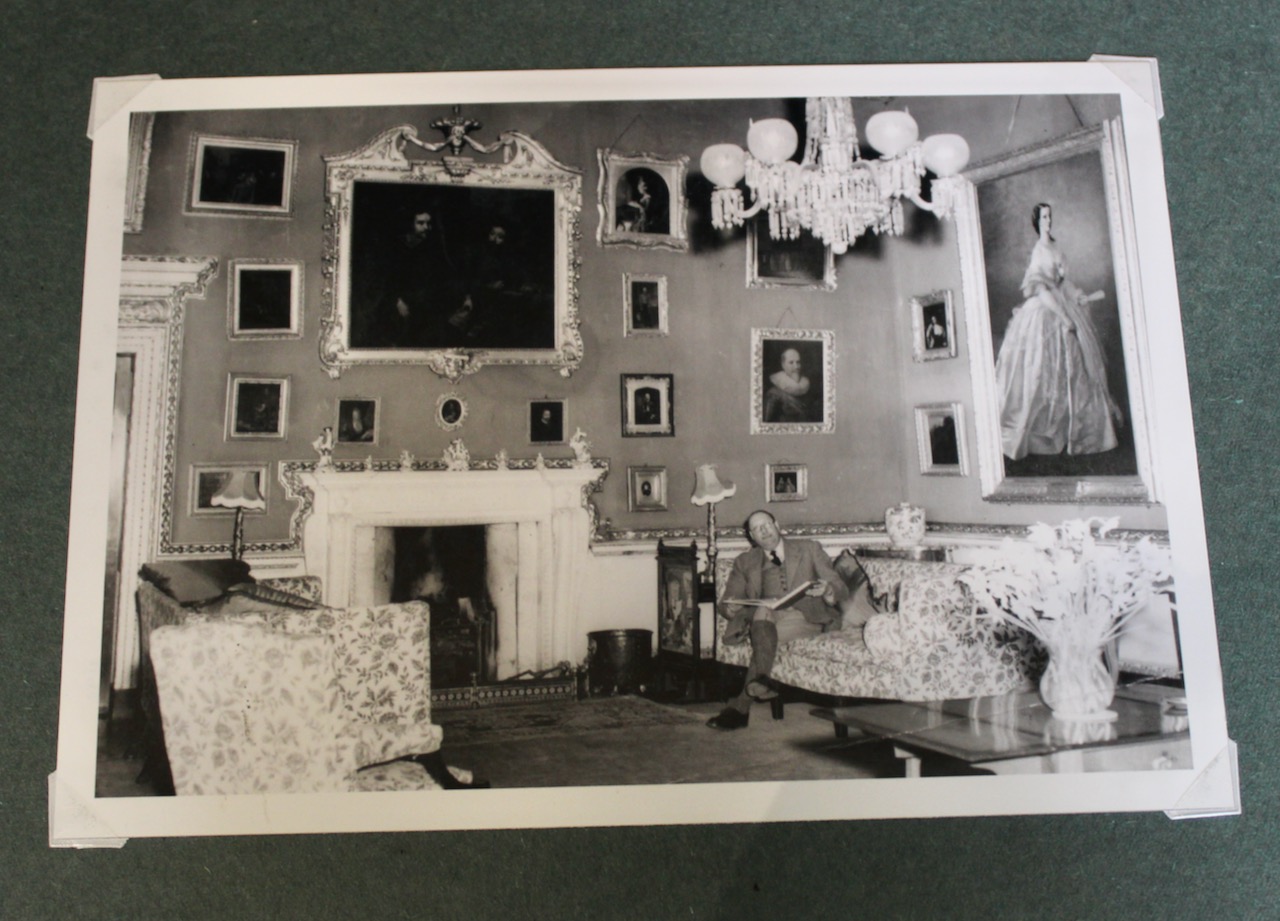
Sarah Eliza sits reading while her daughter Catherine descends the stairs.Photographs of the Conolly family. Thomas Conolly who died in the Boer War is pictured on the left in the striped cap.View of Castletown House from the meadow from Henry Shaw’s album.Sarah Eliza with Catherine and her children seated at the table in the Dining Room.William Francis in foreground.
Catherine’s son, William Francis Conolly-Carew (1905-1994), 6th Baron Carew, inherited Castletown, and added Conolly to his surname.
[2] p. xiii, Jennings, Marie-Louise and Gabrielle M. Ashford (eds.), The Letters of Katherine Conolly, 1707-1747. Irish Manuscripts Commission 2018. The editors reference TCD, MS 3974/121-125; Capel Street and environs, draft architectural conservation area (Dublin City Council) and Olwyn James, Capel Street, a study of the past, a vision of the future (Dublin, 2001), pp. 9, 13, 15-17.
[5] p. 75. Bence-Jones, Mark. A Guide to Irish Country Houses (originally published as Burke’s Guide to Country Houses volume 1 Ireland by Burke’s Peerage Ltd. 1978); Revised edition 1988 Constable and Company Ltd, London.
[6] p. 129. Great Irish Houses. Forewards by Desmond FitzGerald, Desmond Guinness. IMAGE Publications, 2008.
[3] p. 8, Living Legacies: Ireland’s National Historic Properties in the Care of the OPW. Government Publications, Dublin 2, 2018.























































 Irish Historic Houses
