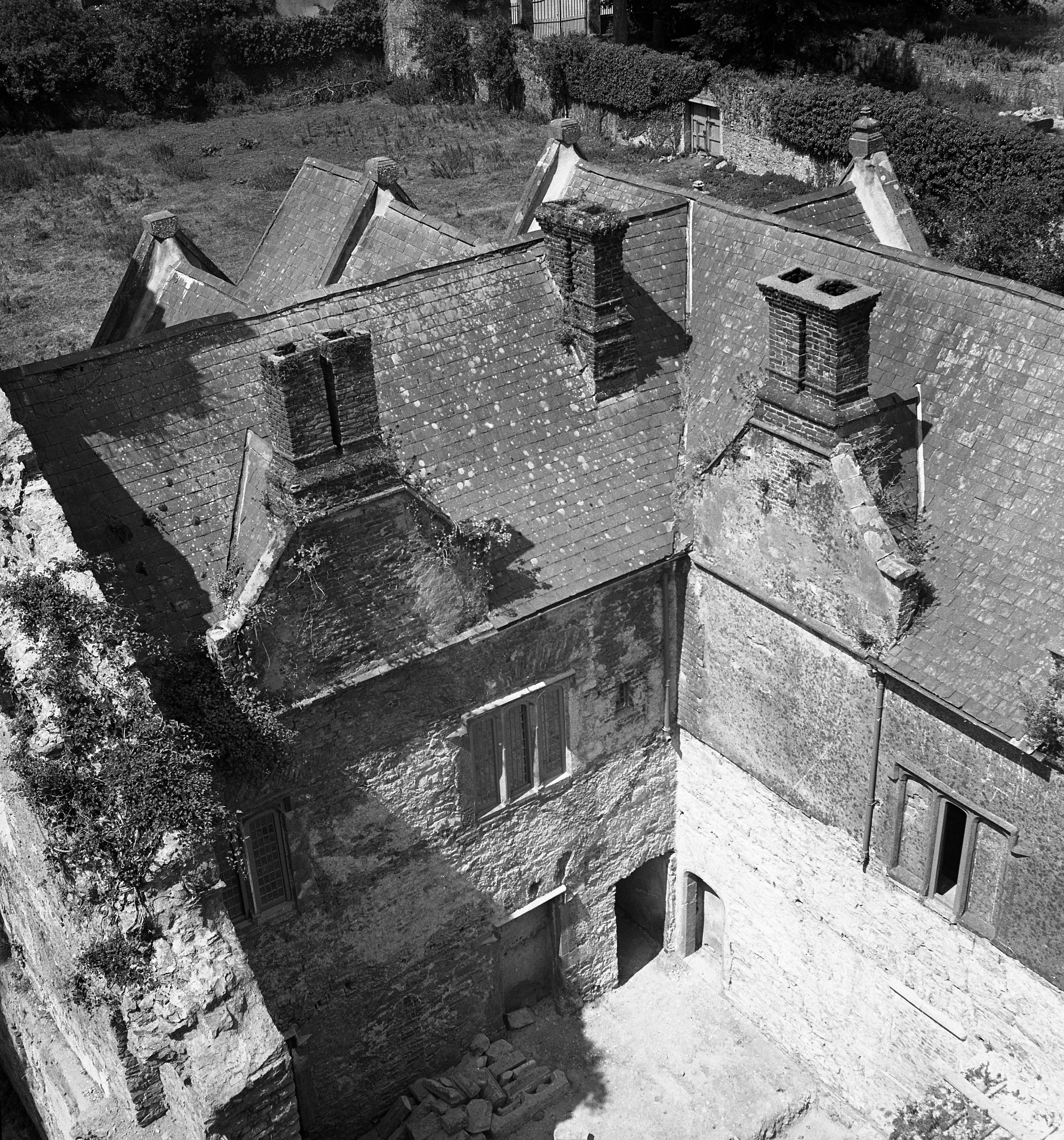
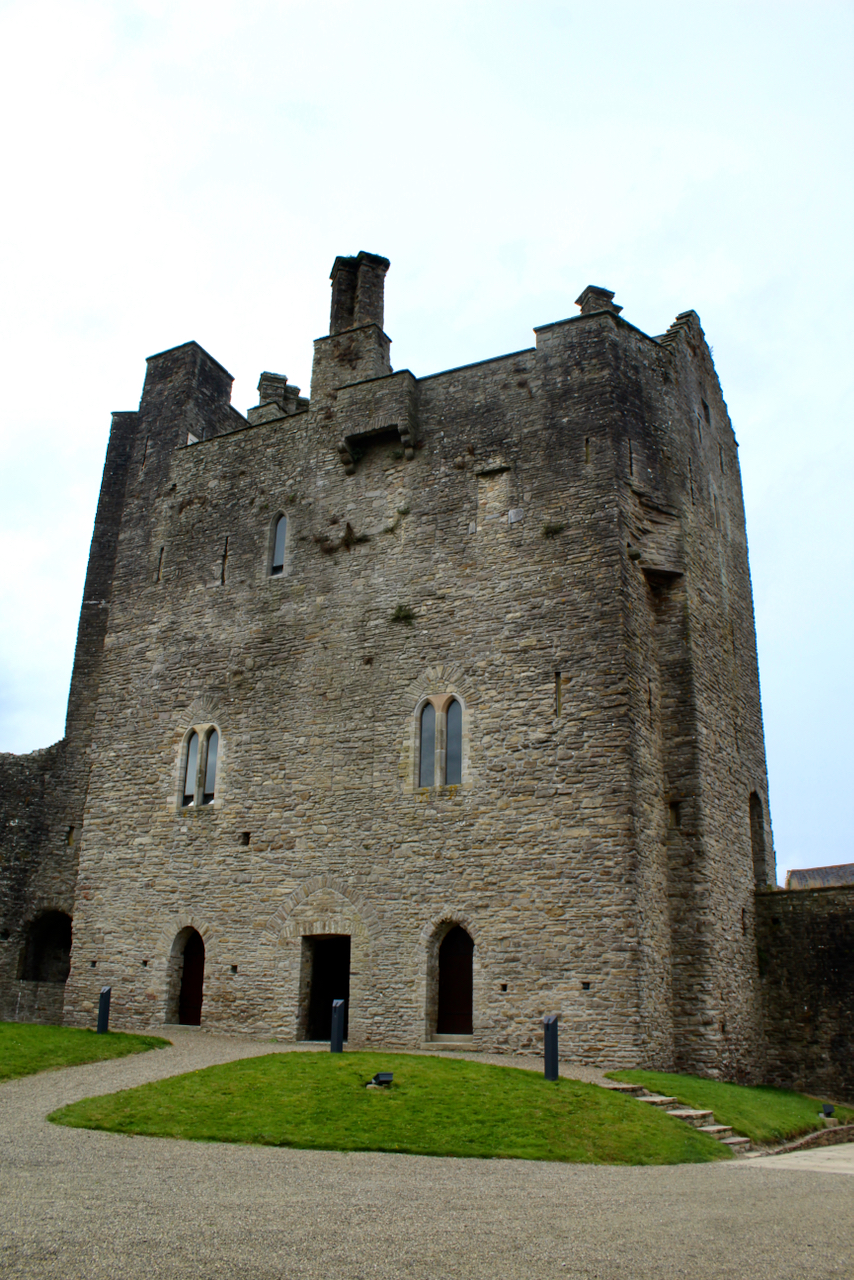
Thomastown Castle, Golden, Co Tipperary – ruin

Thomastown Castle, Golden, Co Tipperary

Thomastown Castle, County Tipperary, entrance front 1917, photograph: Miss Moira Lysaght, Vanishing Country Houses of Ireland by The Knight of Glin, David J. Griffin and Nicholas K. Robinson, published by The Irish Architectural Archive and The Irish Georgian Society, 1988.
Thomastown, County Tipperary, entrance front c. 1969, photograph: Christopher Tynne, Vanishing Country Houses of Ireland by The Knight of Glin, David J. Griffin and Nicholas K. Robinson, published by The Irish Architectural Archive and The Irish Georgian Society, 1988.

Mark Bence-Jones. A Guide to Irish Country Houses (originally published as Burke’s Guide to Country Houses volume 1 Ireland by Burke’s Peerage Ltd. 1978); Revised edition 1988 Constable and Company Ltd, London.

p. 272. “(Mathew/IFR; Daly/IFR) Originally a long two storey house of pink brick built from 1670 onwards by George Mathew, half-brother of the great Great Duke of Ormonde; with a centre one room deep consisting of a great chamber or gallery above a rusticated arcade, and projecting wings; a massive oak staircase led up from the arcade to the first floor. It was probably by the same builders who worked for the Duchess of Ormonde at Dunmore House, near Kilkenny; while Dr Loeber suggests that the arcade may have been a design by Sir William Robinson. The Mathews grew richer through heiress marriages, and the grandson of the builder of the house, another George, who inherited 1711, carried out various additions and improvements…This George Mathew was known as “Grand George” and renowned for his hospitality; people could come uninvited to Thomastown and use it as though it were an inn; many legends have grown up about him, though he has become somewhat confused, in local legend, with “Big George,” Earl of Kingston (see Mitchellstown Castle).  In 1812, Francis Mathew, 2nd Earl of Llandaff, called in Richard Morrison to enlarge the house and transform it into a castle. Morrison’s transformation was literally skin-deep; he refaced the house in cement, which was originally painted the rather surprising shade of pale blue’ a mask of Gothic openings was applied to the front of C17 arcade which was glazecd and turned into a “Gothic Hall” with a Gothic chimneypiece of plaster and other Gothic plasterwork. Slender turrets, square and polygonal, were added to the entrance and garden fronts, which remained symmetrical; the two on either side of the entrance have pinnacles like rockets or darts growing out of them; from a distance they look like rabbit ears. Thr office wing to the right of the entrance front was enlarged into a vast Gothic kitchen court and stables; a detached entrance tower was also built. The great upstairs room became a Gothic library; the drawing room remained Classical and was adorned with scagliola columns. Fr Theobald Mathew, the “Apostle of Temperance,” grew up here, his father having been a cousin of 1st Earl of Landaff who more or less adopted him and made him his agent. Lady Elizabeth Mathew, sister of 2nd Earl, left Thomastown to her cousin on her mother’s side, the Visomte de Rohan Chabot, son of the Comte de Jarnac. It eventually passed to the Daly family, but from ca 1872 onwards it was allowed to fall into disrepair; it is now one of the most spectacular ruined Gothic castles in Ireland, much of it submerged beneath the ivy which grows here with an unbelievable luxuriance. In 1938 the ruin was bought by Archbishop David Mathew, the historian, in order to keep it in the family and to save it from destruction.”

Listed in Vanishing Country Houses of Ireland by The Knight of Glin, David J. Griffin and Nicholas K. Robinson, published by The Irish Architectural Archive and The Irish Georgian Society, 1988. 

p. 136. A large Tudor Revival house designed by Richard Morrison in 1812 for Thomas Mathew 2nd Earl of Llandaff incorporating a late 17C house which may have been designed by Sir William Robinson. Very fine interiors some of which were classical. Now a ruin.

https://www.buildingsofireland.ie/buildings-search/building/22206025/thomastown-castle-thomastown-demesne-tipperary-south

Detached multiple-bay two-storey country house, incorporating seventeenth-century house, enlarged 1812, now in ruins. Comprising central block with office wing to west having square and polygonal towers to front elevation and incorporating an earlier seventeenth-century house. Courtyard with outbuildings to north. Crenellations with machicolations to roofline. Lined-and-ruled render over brick walls with rendered string course to office wing. Ashlar limestone masonry plinths to towers. Projecting entrance bay, in ruins. Square-headed window openings with carved limestone label mouldings having ornate label stops to front. Pointed arch window openings to office wing. Two-storey gate lodge to east having crenellations with machicolations. Rendered brick walls with blank cross-loops to first floor and buttresses to ground floor. Square-headed opening with render hood moulding over pointed arch entrance. Three-stage polygonal tower to east elevation with crenellations and arrow slit windows with hood-mouldings. Coursed rubble limestone walled gardens to north. 

Appraisal 

This former country house was built by the Matthew family, the earliest house on this site, built by George Matthew dating to c. 1670. The house in its present form was enlarged in the Gothic style by Francis Matthew, II Earl of Llandaff in 1812. Richard Morrison designed the house incorporating a veneer of Gothic openings including the ornate polygonal and square towers to front elevation. The office wing to the right was also enlarged in the Gothic style. From 1870 the house fell into disrepair to become the impressive and spectacular ruin it is today. Much of the original seventeenth-century house survives in the interior of the building. The arched gate lodge to the east mirrors the architecture of the main house and retains many fine details such as the cross loops and hood mouldings. The walled gardens provide an example of the many demesne related activities thereby contributing context to the site. 

https://archiseek.com/2012/1812-thomastown-castle-co-tipperary

1812 – Thomastown Castle, Co. Tipperary 

Architect: Richard Morrison 

Built in 1812 for the 2nd Earl of Landaff, the large Tudor Revival castle incorporated a previous 17th century house, thought to have been designed by Sir William Robinson. Now a ruin, the castle was the victim of the decline of the family’s fortunes and was largely closed up in the early part of the 20th century. Now a spectacular ruin. 

 
http://landedestates.nuigalway.ie/LandedEstates/jsp/property-list.jsp?letter=T 

The original building was a two storey house of pink brick built in the 1670s by George Mathew with early 18th additions. Wilson decribed it in 1786 as “an ancient but handsome edifice”. In the second decade of the 19th century it was enlarged and transformed into a Gothic castle, designed by Richard Morrison for the 2nd Earl of Llandaff. Viscount Chabot is recorded as the occupier in the mid 19th century. He held the property in fee and the buildings were valued at £100. Bence Jones writes that it later was in the possession of the Daly family but from the mid 1870s it began to decay. William Daly was the occupier in 1906 when the buildings were valued at £61. 

https://lordbelmontinnorthernireland.blogspot.com/2018/09/1st-earl-landaff.html

The family of MATHEW originated from Wales, where at Radyr, Glamorganshire, they long resided; and possessed the town of Llandaff in that county. 
 
SIR DAVID MATHEW (1400-84), Knight, was Standard-Bearer of EDWARD IV, whose monument is still to be seen in Llandaff Cathedral, Glamorganshire. 
 
EDWARD MATHEW, of Radyr, was possessed, in 1600, of the town of Llandaff, and other estates, which his ancestors enjoyed for time immemorial. 
 
At his decease he left an only son, 
 
GEORGE MATHEW, the first of the family in Ireland, who became seated at Thurles, County Tipperary, and married Elizabeth, daughter of Sir John Poyntz MP, of Iron Acton, Gloucestershire, and widow of Thomas Butler, Viscount Thurles (who died before his father Walter, 11th Earl of Ormond). 
 
Mr Mathew died in 1636, leaving two sons and a daughter, and was succeeded by the elder son, 
 
THEOBOLD MATHEW, of Thurles, who married Margaret, eldest daughter of Sir Valentine Browne Bt, and was succeeded by his elder son, 
 
GEORGE MATHEW, of Thurles, who wedded Eleanor, second daughter of Edmond, 3rd/13th Baron Dunboyne, and was succeeded by his son, 
 
GEORGE MATHEW, who erected a splendid mansion upon his estate at Thurles, containing forty bedrooms, and ample corresponding accommodation for as many guests. 

This gentleman distinguished himself by hospitality upon an unprecedented and almost boundless scale.  

He fitted up his sumptuous residence as a guest house of the first magnitude, and his guests were informed upon their arrival, that as such they were to regard it, and to consider themselves, in every sense of the word, quite at home.  

They might either live in their own suite of rooms, or at the table d’hôte, as they pleased.  

There was a coffee-room, tavern, billiards-room, etc, and Mr Mathew himself appeared only as one of the guests. 

This highly accomplished and celebrated person had the degree of LL.D conferred upon him, 1677, by his half-brother James, 1st Duke of Ormond, Chancellor of the University of Oxford. 
 
Mr Mathew wedded firstly, Catherine, third daughter of Sir John Shelley, 3rd Baronet, by Mary, eldest daughter and co-heiress of Sir John Gage Bt, of Firle, East Sussex, and had issue, an only child, 

GEORGE, his heir

He espoused secondly, in 1716, Ann, widow of James, 3rd Earl of Tyrone, by whom he no issue, and at his decease, the estates devolved upon his brother-in-law, 
 
GEORGE MATHEW, married his cousin, Mary Anne Mathew, and had issue, 

George (1733-8); 
Elizabeth. 

On the failure of male issue in this branch, the estates devolved to 
 
GEORGE MATHEW, of Thomastown, who wedded firstly, Margaret, fourth daughter of Thomas Butler (grandson of the Lord Richard Butler, younger son of James, 1st Duke of Ormond, by the Lady Margaret Burke, eldest daughter of William, 7th Earl of Clanricarde, and widow of Bryan Magennis, Viscount Iveagh, and had issue, a daughter. 
 
Mr Mathew espoused secondly, Isabella, fourth daughter of William Brownlow, of Lurgan, County Armagh (by the Lady Elizabeth Hamilton, eldest daughter of James, 6th Earl of Abercorn), and had issue, a son, who died in infancy, when the estate devolved upon a junior branch of the family, 
 
THOMAS MATHEW, of Thurles, and subsequently of Thomastown, who married, in 1736, Miss Mary Mathews, of Dublin, and had issue, 

FRANCIS, his heir; 
Catherine Ann Maria. 

The only son and heir, 
 
FRANCIS MATHEW (1738-1806), wedded firstly, in 1764, Ellis, second daughter of James Smyth (son of the Rt Rev Edward Smyth, Lord Bishop of Down and Connor), and had issue, 

FRANCIS JAMES, his heir
Montague James, Lieutenant-General in the Army; 
George Toby Skeffington; 
Elizabeth. 

He espoused secondly, in 1784, the Lady Catherine Skeffington; and thirdly, in 1799, ______ Coghlan, second daughter of Jeremiah Coghlan. 
 
Mr Mathew, MP for Tipperary, 1768-83, High Sheriff of County Tipperary, 1769, was elevated to the peerage, in 1783, as Baron Landaff, of Thomastown, County Tipperary; and was advanced to a viscountcy, in 1793, as Viscount Landaff, of Thomastown, County Tipperary. 
 
His lordship was further advanced to the dignity of an earldom, in 1797, as EARL LANDAFF. 
 
He was succeeded by his eldest son, 
 
FRANCIS JAMES, 2nd Earl (1768-1833), MP for County Tipperary, 1801-6, Knight of St Patrick, 1831, who married, in 1797, Gertrude Cecilia, daughter of John La Touche, of Harristown, County Kildare, though the marriage was without issue. 
 
His lordship died of syncope in Dublin, on 12 March 1833, aged 65, when the titles expired. 
 
Dying intestate, his estates went to his sister, the Lady Elizabeth Mathew, who died in 1842, leaving the estates to a cousin, the Vicomte de Chabot, the son of her mother’s sister, Elizabeth Smyth. 

THOMASTOWN CASTLE, Golden, County Tipperary, was built by George Matthew and dated from ca 1670. 

It comprised a long, two-storey house of pink brick. 

The house in its present form was enlarged in the Gothic style by Francis, 2nd Earl Landaff, in 1812. 

(Sir) Richard Morrison designed the house incorporating a veneer of Gothic openings, including the ornate polygonal and square towers to the front elevation. 

The office wing to the right was also enlarged in the Gothic style. 

From ca 1872 the great mansion fell into disrepair to become the impressive and spectacular ruin it is today. 

Father Theobald Mathew, the famous temperance reformer whose father was a cousin of the 1st Earl, grew up at the Castle. 

The 2nd Earl’s sister, Lady Elizabeth Mathew, bequeathed Thomastown to her maternal cousin, the Vicomte de Rohan-Chabot, son of the Comte de Jarnac. 

The estate later passed to the Daly family. 

The ruinous building was purchased in 1938 by the Rt Rev David Mathew, the historian, who wished it to be kept in the family and saved from destruction. 

This expectation proved to have been in vain. 

The arched gate lodge to the east reflects the architecture of the main house and retains many fine details, such as the cross loops and hood mouldings. 

The walled gardens provide an example of the many demesne-related activities thereby contributing context to the site. 

The Tipperary Gentry. Volume 1. By William Hayes and Art Kavanagh. Published by Irish Family Names, c/o Eneclann, Unit 1, The Trinity Enterprise Centre, Pearse St, Dublin 2, 11 Emerald Cottages, Grand Canal St, Dublin 4 and Market Square, Bunclody, Co Wexford, Ireland. 2003. 

Matthew of Thomastown, Annfield and Thurles 

p. 135. Viscount Thurles was Thomas Butler the eldest son of Walter the 11th Earl of Ormonde. Thomas’s wife was Elizabeth the daughter of Sir John Poynz of Acton, Gloucester, and she was a Catholic. Thomas died tragically in a drowing accident when he was travelling to Ireland from England in 1619. His widow, Elizabeth, had three sons and four daughters. Elizabeth’s eldest son became the 12th Earl of 1st Duke of Ormonde. She did not remain a widow for long. She married George Mathew of Llandaff, Glamorgan, in 1620. [This enterprising lady managed to save Thurles during the Cromwellian wards by telling Cromwell taht she had refused to allow a Royalist company under Colonel Brian O’Neill to occupy the town and sought Cromwell’s help. This action saved the town of Thurles from being despoiled and saved the Mathew family from being dispossessed.] 

George and his widow, Elizabeth, had two sons, Theobald, who founded the Thurles adn Annfield dynasties of Mathew, and George Reihill, later of Thomastown, who managed the estates of the Ormondes in Tipperary [The Peerage has him as the son of Theobald]. In the process George succeeded in acquiring substantial properties himself. The fact that George Reihill married Eleanor Butler, the [p. 136] daughter of Lord Dunboyne and widow of Lord Cahir (another Butler) helped considerably. George raised her young son the 4th Lord Cahir and when he was of age married him off to his niece, Elizabeth. George Reihill was the ancestor of the Thomastown Mathews. [George surrendered Cahir Castle to Cromwell in 1649. Apparently he was warned by his mother, Elizabeth, to follow that course of action as she had done in Thurles]. [ note: the Mathew family of Llandaff adopted “Mathews” with an ‘s’ in the mid 17th century] 

When the Duke and Duchess of Ormonde were away in England or in Dublin the maintenance of Kilkenny Castle was the provenance of Captain George Reihill Mathew, their relation. The Duchess bombarded him with orders, “my Lord and I doe so much apprehend the danger to the roof of the old hall of the castle of Kilkenny and he desires it may be secured, repaired and mended with as much speed as may be.”  “I desire you will furnish the castle of Kilkenny to be in readiness to receive me, my son and his family in the middle of next month.”  

p. 137. When the Lady Cahir died George married another widow, who brought with her a dowry of £10,000. She was the widow of the last Earl of Tyrone [ on my family tree I have her as Anne Rickard (1665-1729) but she is married to his son, George Mathew *. She was married to James de la Poer, 3rd Earl of Tyrone (1666-1704), and they had a child, Catherine de la Poer, Baroness de la Poer (1701-1769)]. 

She had no children [Anne Rickard, according to this book] and when George died in 1689 she became somewhat isolated in Thomastown. [Thomastown was built around 1670 by George Reihill. Prior to that he had lived in Cahir Castle]. She fled to London in 1690 whre she petitioned the government for help, stating that she, a Protestant, had been driven out of Ireladn by her in-laws who were Catholic. [see Marnane, Land and Violence in West Tipperary]. 

George Reihill was succeeded by his second son, Theobald, who was also twice married. [the eldest son, George, was educated in England and died on the way home from England in 1666]. He died in 1711. Theobald’s son, George, known as “Grand” George, inherited the estate of Thomastown. In his will, Thomas left several bequests including monies to be put in trust and managed for his three daughters until they got married or reached the age of 21. [The ladies in question were Elizabeth, who married Christopher O’Brien of County Clare, Frances, who married John Butler of Co Tipperary, and Elinor who married Kean O’Hara of County Sligo]. He expected a return of 8% on his money. He left money to the youngest son, Bartholomew, and to his “dear cousin” Major George Mathew of Thurles… 

The problem of succession in the Catholic Mathew families contrasts with the almost smooth successions achieved by the families of the Butlers of Cahir and the Ryans of Inch. 

p. 138. The Thurles Mathews were fortunate that there were three single male heirs following the death of Theobald Mathew in 1699. This meant that no stratagem had to be used to avoid carving up the estate. However, a failsafe plan was put in place in the event that the male heirs were not forthcoming. In 1713 a settlement was put in place, which ensured that in default of male heirs the estate would go to the Annfield and Thomastown branches successively. Similar plans must have been put in place in the other Mathew properties because in 1738 the Thurles and Thomastown estates were joined because of the failure of direct heirs in Thomastown. It should be noted that “Grand” George Mathew who died in 1738 had converted in the early years of the 18th century. This inheritance did put a strain on the Thurles owner, George Mathew, who felt it incumbent to change his religion in 1740. 

p. 138. Theobald of Thurles (who died in 1699) did in fact have several sons and daughters himself. He was married three times. By his first wife, Margaret the daughter of Sir valentine Browne he had three sons, George, known as Major George who inherited in 1699, Edmund who died young and James who married Elizabeth Bourke, daughter of the 3rd Baron Brittas. [he is acknowledged to be the father of James Mathew of Thomastown and later of Rathclogheen, who was adopted by his cousin and guardian the 1st Earl of Llandaff. James of Rathclogheen is the ancestor of the modern day Mathews] James had no family. He also had two daughters – Elizabeth who married the 4th Lord Cahir, and Anne who married Viscount Galmoy [ 3rd] 

By his second marriage to the heiress, Anne Salle of Killough Castle, County tipperary, he had one son….[see tree] 

The Annfield branch of the family found life a little more complicated in that Theobald of Annfield, who inherited in 1714 had two brothers. However there is no record on any legal pressure being applied to compel the family to comply with the penal laws of inheritance. 

p. 139. When Theobald died in 1745 the estate went to his son Thomas Mathew. [Thomas had three sons and two daughters, one of whom, Mary, married John Ryan of Inch. The sons were Theobald, who inherited in 1714, Edmund who died in 1772 and James of Borris who married the heiress Anne Morres. They had one daughter who married her cousin Charles Mathew.]  

Again there does not seem to have been any pressure put on Thomas to divide the estate. Howver, in 1755 just prior to Parliament considering framing anti-Catholic laws Thomas decided to convert. The fact that his relation, George Mathew of Thurles, who had inherited Thomastown, was now elderly and had no male heir may have been a contributory factor also. George died in 1760 and Thomas Mathew of Annfield now became the sole owner of all the Mathew properties. 

p. 141. Thomastown had been repaired and reconstruction began in 1711. [ W. Nolan in Tipperary History and Society] It was reported that “Grand” George Mathew and his family lived ‘frugally’ on the continent for seven years on £600 a year in order to devote his £8,000 rental to the laying out of his 1500 acre demesne and the fitting out of the house with forty bedrooms. [T. Power in Land, Politics and Society in 18th Century Tipperary]… 

“Grand” George of Thomastown turned Protestant in the early decades of the 18th century and was elected an MP for County Tipperary. George sat as a Tory and a supporter of the 2nd Duke of Ormonde. He was also elected MP for the period 1727-1736. He died two years later. This was the same George Mathew who was visited by Dean Swift in 1719. In 1704 he was one of nine Catholics in the country who were given licenses to carry arms. However this situation changed after 1715 when the government ordered the seizure  of Catholics horses and arms. At some stage in th following years George adn his son were apprehended and searched for arms. 

The other two branches of the family remained Catholic. When Lady Thurles died she left her second son Theobald the town and manor of Thurles and an estate of four thousand acres. He was married three times and his second wife was Anne Sall, an heiress. Theobald gave her esate to his second son Thomas and so began the Annfield family. The changes in land ownership, which was effected by the necessity of the Ormonde Duke to reduce his overwhelming debts, benefited many landowners in Tipperary, including the Mathew famiy. They used the opportunity to consolidate and expand their holdings. [other families to benefit were Sadleir, Coote, Langley, Baker, Cleere, Dawson, Dancer and Harrison – T. Power in Land, Politics and Society in 18th C Tipperary

p. 142. The Mathew family owned Thurles town and because of their patronage the Catholic Butler bishop was allowed to live there. [Whelan in Tipperary society and history]. In addition the Mathew family of Annfield built Inch and Thurles chapels. A plaque on the wall of the chapel, which was built in 1730 in Thurles, stated that it was built by “Big” George Mathew. He was the George Mathew of thurles who married his stepsister Martha Eaton. He was also the son of the Major mentioned above.  

The Thomastown dynasty came to an abrupt end with the death of “Grand” George and his grandson who both died in 1738. “Grand” George’s son, Theobald, had died two years earlier in 1736. He was married to a cousin from Thurles, Mary Ann Mathew. Her brother, George of Thurles  inherited Thomastown at this time. As George of Thurles had no sons the Thomastown and Thurles estates passed into the ownershop of Thomas of Annfield in 1760. The will, transferring the ownership, was contested unsuccessfully by Margaret the daughter of George of Thurles. 

Thomas had converted to the Church of Ireland in 1755 and he was returned an MP for Tipperary in 1761. In the turbulent political climate of the times, his election was seen as a triumph for the pro Catholic interest in the county. Thomas was perceived as being of dubious conformity himself. He conformed again in 1762. He was elected MP again [p. 143] in 1768 but by a very small margin of 25 votes. On petition the result was overturned. Unlike the Pritties who were very widely connected with teh Protestant landowning classes, Thomas Mathew had to rely on his own voters and whatver support he could must from among the more liberal gentry. 

…Thomas Mathew’s son Francis was perceived as being a closet Catholic. However, he was fortunate in that he had John Scott (later Lord Clonmell) as his brother-in-law. Scott became solicitor-general and was very influential in government circles. Through his influence, Francis, formerly an opposition MP, became a government supporter and this led to his elevation to the peerage as Lord Llandaff in 1784. Though he had, to some extent, changed his allegiance, he still championed the Catholic cause right up to the end of the century and beyond. 

The Act of 1778, which gave an enormous measure of relief to the Catholics, was widely welcomed by the Catholics in Tipperary. The men most associated with the carriage of the Act were Francis Mathew of Thomastown, Lord Clonmel (John Scott, brother in law of Francis, Sir William Osborne and John Hely-Hutchinson. [This close association between Lord Clonell and Francis Mathew wasn’t always harmonious. According to Barrington, in his Reminiscences, Lord Clonmell fought duels with Lord Llandaff, Lord Tryawley and others.] p. 144. The main features of the Act were (1) the removal of the requirement that Catholic property had to be divided among the surviving sons (2) leases could now be given for more than 31 yers (3) the removal of the decree that a son who converted would get immediate possession making his parent a tenant for life only. The Act would only apply to people who took the Oath of Allegiance. … 

That is not to say that Francis favoured any change in the status quo with regard to property rights. During the heyday of Whiteboyism he stood four square with the landlords. After the murder of Ambrose Power, a landlord, in 1775, over sixty of the leading figures in Tipperary including Francis Mathew nd Thomas Maude, pledged their lives and fortunes to suppress Whiteboyism. 

With the re-emergence of considerable agrarian unrest, the American war of Independence and threatened French invasions, Volunteer Corps were founded all over Ireland. ..Each corps ws comprised of about forty rank and file members drawn from the head tenantry or from friends or associates of the Colonel. Francis Mathew had three corps, one in each of his main holdings at thomastown, Annfield and Thurles. 

…p. 145. Francis was made Baron Llandaff of Thomastown in 1783 and he was later made Earl of Llandaff in 1797. The Earl lived the life of a Lord and entertained and was entertained royally. .. 

In 1812 Francis the 2nd Earl employed the architect Richard Morrison to “throw a Gothic cloak over the earlier house” (at Thomastown)… 

Fortuitous marriages brought additional wealth to the Mathew family starting with George the first Mathew to arrive in Tipperary, who married the widow of Viscount Thurles. His soon George Reihill married the widow of Lord Cahir who was also the daughter of Lord Dunboyne. “Grand” George Mathew, a grandson of George Reihill, married as his second wife Lady Ann Hume who brought him an estate worth £10,000 in the 1680s. He converted the title to his own use and that of his heirs and used the money to make further land purchases. Francis Mathew the 1st Earl received £10,000 with Ellis Smyth of Wicklow when they married in 1764. 

…Francis was in serious debt when he inherited in 1777 due largely to marriage payments and unpaid debts from previous generations. Trustees were appointed by Parliament to unravel his affairs and lands had to be disposed of.  

When he died in 1806 the estate was still very much in debt for a variety of reaons one of which was his sponsoring a bill to bring a water supply to Thomastown Castle. 

p. 147. Francis teh 2nd Earl died in 1833. He had been predeceased by his brother Montague in 1819. His second brother George was insane and had died in 1832, so teh estates passed to Elizabeth his sister. She too died unmarried in 1841. 

While the main branch of the family disappeared the Mathew name was kept aloive…For example, Francis Mathew of Rockview House who was mentioned in the will of Elizabeth was married twice and had four sons and two daughters. .. 

https://theirishaesthete.com/2021/08/30/thomastown/

Recalling a Lavish Host

by theirishaesthete

Thomastown Castle, County Tipperary, photograph by Robert O’Byrne.


Many people in Ireland will be familiar with the name of Theobald Mathew, a 19th century Roman Catholic priest who became known as the Apostle of Temperance. A member of the Capuchin order, in 1838 Fr Mathew, witnessing the problems arising from excessive consumption of alcohol, founded the Total Abstinence Society in Cork city, where he was then living. Within nine months some 150,000 persons had enrolled in this organisation and at its height during the late 1840s it is estimated that half the population of Ireland were members. What may be less well known is that Theobald Mathew was related to a wealthy, and Protestand, landed family and grew up at Thomastown Castle, County Tipperary where his father acted as agent to a cousin, the first Earl of Landaff. Now a striking ruin, Thomastown was for several centuries the seat of the Mathew family. Of Welsh origin (hence the choice of name for their title), they were connected through marriage to the Butlers, and thus acquired land in this part of the country. As was so often the case, a series of judicious marital alliances made them exceedingly rich, allowing the construction of a large residence in the late 17th/early 18th centuries. In Town and Country in Ireland under the Georges (1940) Constantia Maxwell provides an excellent account of life there in the years after the house had been built by Thomas Mathew. The building was ‘surrounded by gardens adorned with terraces, statuary, and fish ponds, and by a park of some two thousand acres stocked with deer. Mr Mathew, besides being very rich, was held to be one of the finest gentlemen of the age, and, having travelled much on the Continent and lived in London and Dublin, had a large circle of friends. Nothing gave him so much pleasure as to invite these to Thomastown, where he had no less than forty guest-rooms, besides handsome accommodation for servants. The guests in his house were invited to order anything they might wish for, as at an inn; they might seat themselves at the dining-room table without paying irksome respect to rank, or, if they preferred it, dine with chosen companions in their own rooms. A large room was fitted up as a city coffee-house with newspapers and chessboards, where servants had been ordered to bring refreshments at any time of the day. For those who liked sport fishing tackle was provided, as well as guns and ammunition, while hounds and hunters were available in the stables. But, although everything at Thomastown was on such a lavish scale, there was no disorder or waste, for Mr Mathew rose early every morning to look over the accounts, and his servants were well paid, and forbidden to take tips.’ A description of life at Thomastown was provided by Thomas Sheridan in his biography of Jonathan Swift described how the later was so delighted with Thomas Mathew’s hospitality that instead of staying for a fortnight, as originally intended, he remained there for four months. 

Thomastown Castle, County Tipperary, photograph by Robert O’Byrne.


As mentioned, the house at Thomastown was once surrounded by splendid gardens. Writing in 1778, Thomas Campbell noted that not only was the setting perfect, with the Galtee Mountains ‘set at such a due distance that they are the finest termination for a prospect a painter could desire’ but ‘behind the house is a square parterre, with flowers, with terraces thickly studded with busts and statues; before it, a long and blind avenue, planted with treble rows of well-grown trees, extends its awkward length. In the centre of this, and on the acclivity of the hill, are little fish ponds, pond above pond. The whole park is thrown into squares and parallelograms, with numerous avenues fenced and planted.’ By the time Campbell visited, this style of garden had fallen out of fashion, so he tut-tutted that ‘if a hillock dared to interpose its little head, it was cut off as an excrescence, or at least cut through; that the roads might be everywhere as level as they are straight. Thus was this delightful spot treated by some Procrustes of the last age.’ A few years later, Joseph Cooper Walker was just as critical of Thomastown’s gardens. ‘They lie principally on the gentle declivity of an hill,’ he explained, ‘resting on terraces, and filled with “statues thick as trees”. A long fish pond, sleeping under “a green mantle” between two rectilineous banks, appears in the midst. And in one corner stands a verdant theatre (once the scene of several dramatic exhibitions) displaying all the absurdity of the architecture of gardening. Thus did our ancestors, governed by the false taste which they imbibed from the English, disfigure, with unsuitable ornaments, the simple garb of nature.’  Not much later, perhaps when the second Earl of Landaff, who inherited title and estate on his father’s death in 1806, transformed the house, these by-now old-fashioned gardens were largely swept away in favour of open parkland. 

Thomastown Castle, County Tipperary, photograph by Robert O’Byrne.

Thomastown, as previously mentioned, was originally a late 17th/early 18th century house of two storeys, the centre just one room deep with projecting wings forming a short entrance courtyard. However, it appears that the generous Thomas Mathew enlarged the house by filling in the space between the wings to create a dining room, some 50 feet long and 20 feet deep, no doubt to feed all the guests he entertained. Several generations later, the second Earl of Landaff decided to alter the building’s appearance by giving it a Gothick makeover. In 1812 the architect Richard Morrison was commissioned to come up with a design for the place. The original entrance arcade was now glazed to create a Great Hall, while the first-floor gallery became a gothic-style library. However, the drawing room retained its classical decoration, with screens of scagliola columns at either end, a typical Morrison flourish which can still be seen in the library at Ballyfin, County Laois. Meanwhile, the exterior was ornamented with a crenellated parapet and a series of octagonal turrets topped with dart-like finials. As Mark Bence-Jones noted, from a distance these look like rabbits’ ears. A kitchen and service wing at right-angles to the house was also thoroughly dressed in Tudor-Gothic decoration, although a stone tower at the corner of the range is in Norman style. The entire building was covered in stucco, which was then rather oddly painted pale blue. An engraving of the completed work made by John PrestonNeale in 1819 although this included an unexecuted family wing and a more simple service range than that actually constructed. The second earl had no children and following his death, Thomastown passed to a sister Lady Elizabeth Mathew who in turn left the estate to a cousin of her mother, the Vicomte de Chabot. Before the end of the 19th century, it had come into the possession of the Dalys of Dunsandle, County Galway but seemingly by then the house was already falling into ruin. And so it has remained, with much of the central block, where those hospitable dinners were once given, long since collapsed. Today the only diners seen here are cattle.

Thomastown Castle, County Tipperary, photograph by Robert O’Byrne.

https://theirishaesthete.com/2021/09/01/thomastown-2/

Copycats

by theirishaesthete

Thomastown Castle gate tower, County Tipperary, photograph by Robert O’Byrne.


After Monday’s post explaining the history of Thomastown Castle, County Tipperary, these pictures might be of interest since they show the gate tower that formerly gave access to the main house. It dates from around 1812 and was likewise designed by Richard Morrison: note the Mathew family coat of arms prominently displayed over the gateway. Aside from this detail, the building is almost identical to a similar gate tower at the entrance to the demesne of Borris House, County Carlow. This was also designed by Morrison and at the same date: one wonders if the estates’ respective owners ever noticed or remarked on the duplication?

Thomastown Castle gate tower, County Tipperary, photograph by Robert O’Byrne.

http://www.patrickcomerford.com/search/label/castles?updated-max=2019-10-29T19:30:00Z&max-results=20&start=8&by-date=false

In recent days, I have been writing about tangled family trees and difficult marriages that led to questions about the inheritance of titles and estates in the Townshend familyand the Leeson family
 
In the Townshend family, scandals and a bigamous marriage threatened the succession to both the title of Marquess Townshend and the ownership of Tamworth Castle. In the Leeson family, a tangled family tree led to the loss of Russborough House in Co Wicklow and the disappearance of the title of Earl of Milltown. 
 
Similar stories are told about the Mathew family of Thomastown, Co Tipperary, and the claims to the title of Earl Landaff. 
 
The Mathew family claimed descent from a branch of the Matthew family of Radyr in Glamorgan, in south Wales. There are three 15th and 16th century Mathew family effigies In Llandaff Cathedral. 

George Mathew sold his estate at Radyr in the mid-17th and moved to Co Tipperary. He became the owner of Thomastown Castle, near Thurles, when he married Elizabeth Poyntz (1587-1673), Lady Thurles, widow of Thomas Butler, Viscount Thurles. 
 
It was a marriage that brought George Mathew into a powerful and influential family circle, and he was the stepfather of James Butler (1610-1688), 1st Duke of Ormond. 
 
George Mathew died in 1638, but the Mathew family maintained close connections with the Ormond Butlers in the generations that followed. In 1666, George Mathew was granted a large estate in Co Tipperary, including part of Thomastown. The original Thomastown Castle was a two-storey house of pink brick built in the 1670s by George Mathew with early 18th additions. 
 
Thomastown Castle was the birthplace and early home of Father Mathew, the ‘Apostle of Temperance,’ and his father was a cousin of Thomas Mathew and worked for him as his agent. 
 
Thomas Mathew of Annefield succeeded to the Mathew estates of Thomastown and Thurles in 1760. Wilson described Thomastown Castle in 1786 as ‘an ancient but handsome edifice.’ Thomas was succeeded by his son Francis Mathew in 1777 who was given the title of Earl Landaff in 1797. 
 
Francis Mathew (1738-1806), 1st Earl Landaff, had been MP for Tipperary in the Irish House of Commons in 1768-1783, and was High Sheriff of Tipperary. He was made a member of the Irish House of Lords in 1783 with the title of Baron Landaff, of Thomastown, in Co Tipperary. In 1793, he received the higher title of Viscount Landaff, and in 1797 he was made Earl Landaff. 
 
The Earls Landaff used the invented courtesy title Viscount Mathew for the heir apparent. Despite their territorial designations, the misspelling of Llandaff as Landaff, and the fact that the titles were in the Irish Peerage, the titles all referred to the place in Glamorgan now spelt Llandaff. After the Act of Union, Lord Landaff was elected as one of the 28 Irish peers to the British House of Lords. 
 
This Lord Landaff was married three times. On 6 September 1764, he married Elisha Smyth (1743-1781) in Bellinter, Co Meath. She was a sister of Sir Skeffington Smyth of Tinney Park, Co Wicklow. They had four children, three sons and two daughters: Francis James Mathew, later 2nd Earl of Landaff; General Montague Mathew (1773-1819); the Hon George Toby Skeffington Mathew (died 1832); and Lady Elizabeth Mathew (died 1842). 
 
In 1784, he married his second wife, Lady Catherine Skeffington (1752-1796), a daughter of Clotworthy Skeffington, 1st Earl of Massereene. They had no children, and in 1799 he married his third wife, a woman named Coghlan from Ardo, Co Waterford. 
 
When he died in 1806, he was succeeded in his titles by his eldest son from his first marriage, Francis James Mathew (1768-1833), 2nd Earl Landaff, who had been known by the courtesy title of Viscount Mathew. He was MP for Tipperary in the Irish House of Commons (1790-1792), Callan (1796) and again for Tipperary (1796-1801). As Earl Landaff, he also took his father’s place as an Irish representative peer in the House of Lords. 
 
He opposed the Act of Union, supported Catholic Emancipation, and was seen as ‘a personal enemy of George IV’ when he gave evidence in favour of Queen Charlotte regarding her conduct at the Court of Naples during her famous trial. 
 
Thomastown Castle was enlarged in the early 19th century, and transformed into a Gothic castle, designed by Richard Morrison for Francis James Mathew, the 2nd Earl Landaff. 
 
Lord Landaff married Gertrude Cecilia La Touche, a daughter of John La Touche, of Harristown, Co Kildare. They had no children, and he died in Dublin on 12 March 1833, aged 65. 

Lord Landaff’s next brother, Lieut-Gen Montague James Mathew (1773-1819), had died 14 years earlier, on 19 March 1819, and so the family titles became extinct. General Mathew was MP for for Ballynakill in the Irish Parliament until 1800, and MP for Co Tipperary in Westminster in 1806-1819. He was a Whig and a supporter of Catholic Emancipation. 
 
Their youngest brother, the Hon George Toby Skeffington Mathew, also died in 1832. So, when the second earl died, the family titles became extinct, and the estates passed to his sister, Lady Elizabeth Mathew. The Ordnance Survey Name Books record Lady Elizabeth Mathew owned townlands in the parish of Kilfeacle, barony of Clanwilliam, in 1840. 
 
When she died in 1842, she left the family estates and fortune to a cousin, the Vicomte de Chabot, the son of her mother’s sister Elizabeth Smyth. Viscount Chabot was living at Thomastown Castle in the mid-19th century. Later it was owned by the Daly family, but from the mid-1870s it began to decay from the mid-1870s. William Daly was living there in 1906. 
 
As Thomastown Castle crumbled and decayed, a number of pretenders came forward, claiming they were the rightful holders of the title Earl Landaff and heirs to the castle. The most outrageous of these pretenders was Arnold Harris Mathew (1852-1919), self-styled de jure 4th Earl Landaff, also self-styled Count Povoleri di Vicenza. 
 
Mathew was also the founder and first bishop of the self-styled Old Roman Catholic Western Orthodox Church in Great Britain, an Old Catholic Church. His episcopal consecration was declared null and void by the Union of Utrecht’s International Old Catholic Bishops’ Conference. In addition, he was excommunicated by Pope Pius X for illicitly consecrating two priests as bishops which led a London jury to find that ‘the words were true in substance and in fact’ that he was a ‘pseudo-bishop.’ 
 
He claimed his father, Major Arnold Henry Ochterlony Mathew, who died in 1894, was the third Earl Landaff, and the son of Major Arnold Nesbit Mathew, of the Indian Army. According to these claims, this Major Arnold Mathew was, in turn, the eldest son of the 1st Earl Landaff, born in Paris five months after his parents married. 
 
This claim was later shown to be based on invented and fictitious information. Arnold Nesbit Mathew originally used the name Matthews, as did his son. He was, in fact, the son of William Richard Matthews and his wife Anne, of Down Ampney in Gloucestershire. Incidentally, Down Ampney was also the home village of the composer Ralph Vaughan Williams (1872-1958(, who composed the tune ‘Down Ampney’ for the hymn ‘Come down, O love divine’ 
 
Arnold Harris Mathew put forward his claim to the Garter Principal King of Arms for the title of 4th Earl Landaff of Thomastown, Co Tipperary, in 1890, and placed his creative pedigree on the official record at the College of Arms. 
 
John H Matthews, Cardiff archivist, said in 1898 that the number of claimants to the dormant or extinct earldom was ‘legion.’ In his opinion, Arnold Henry Mathew’s pedigree was ‘too extra-ordinary to commend itself to an impartial mind.’ 
 
Nevertheless, Arnold Henry Mathew presented his petition to the House of Lords in 1899, claiming a right to vote with the Irish peers for representative peers in the House of Lords. In his petition, he did not repeat other exuberant claims, including one that his grandmother was Eliza Francesca Povoleri, was an Italian countess and the daughter of a Papal marchese. 
 
His petition was read and referred to the Lord Chancellor, Lord Halsbury, who reported in 1902 that Mathew’s claim ‘is of such a nature that it ought to be referred to the Committee for Privileges; read, and ordered to lie on the Table.’ 
 
Mark Bence Jones in a feature in Country Life says Archbishop Mathew also bought the ruins of Thomastown Castle and 20 acres surrounding it to save it from destruction. 
 
Mathew’s aristocratic pretensions, like his life as a ‘wandering bishop,’ were fantasies that continue to resurface in the claims of fantasists and pretenders in many walks of life. 
 
When he died on 19 December 1919, the claims to the Mathew title did not come to an end. 
 
As recently as 1987, a mural memorial was erected in Llandaff Cathedral, claiming it was: ‘In memory of Thomas James Mathew son and heir of Francis James Mathew second Earl of Landaff born in London 1798 died in Cape Town 1862.’ The memorial includes a full display of the coat of arms of the Mathew family of Co Tipperary as Earls Landaff, and the misspelling of Llandaff as Landaff. 
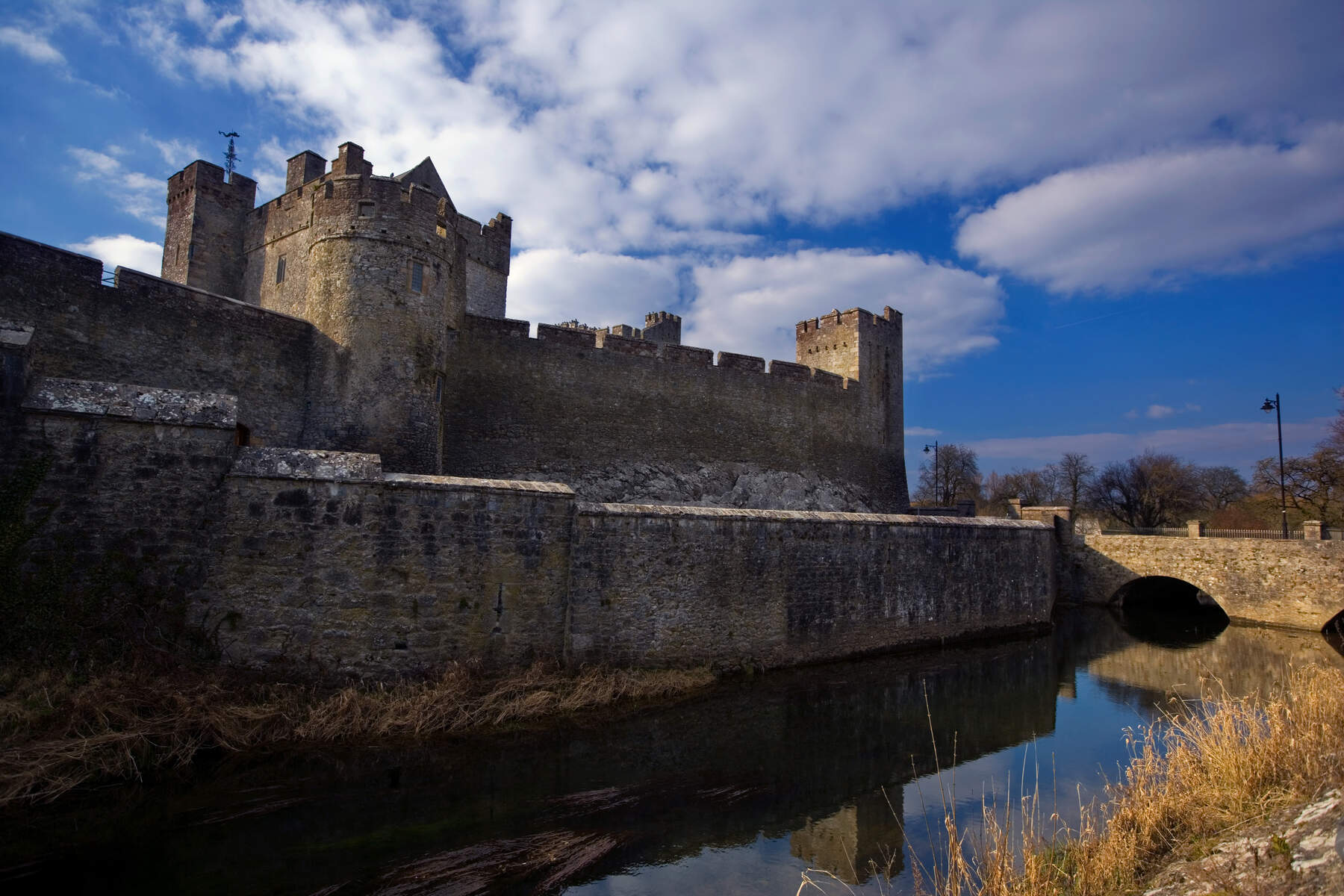
 

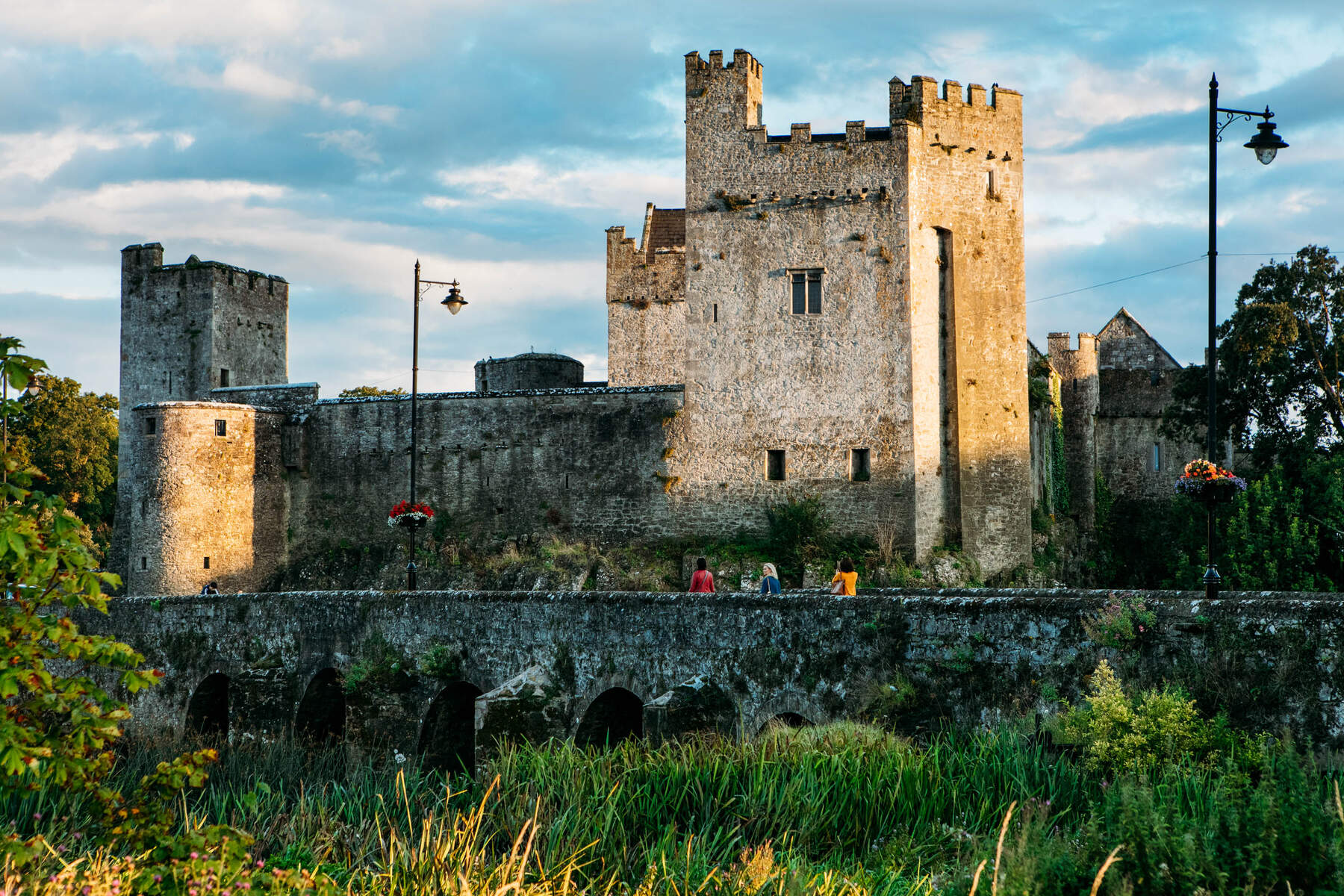
Cahir Castle, County Tipperary, an Office of Public Works property

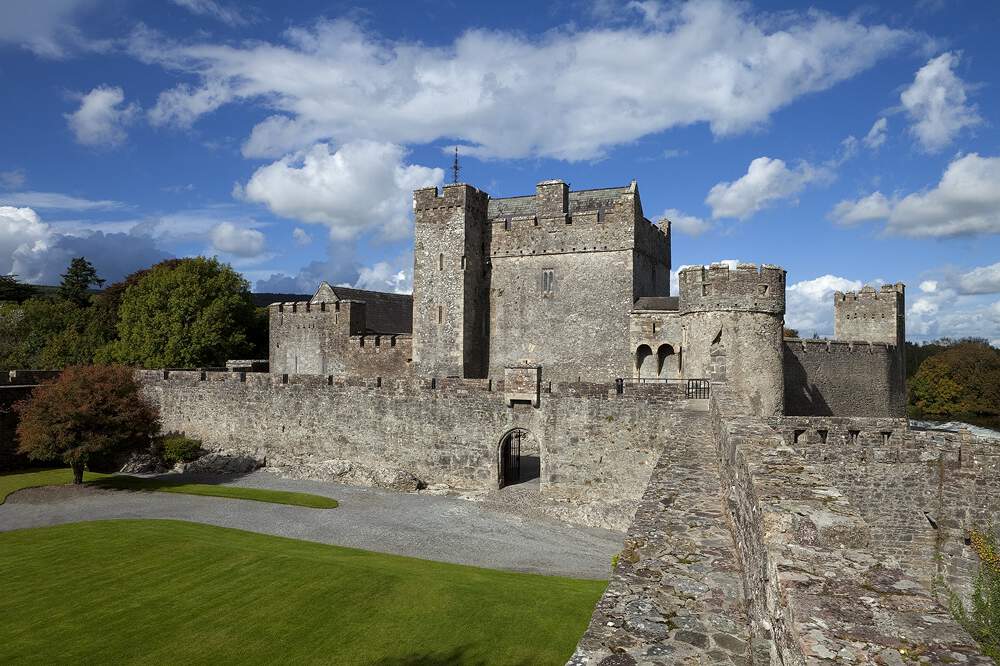
Cahir Castle, photograph from Ireland’s Content pool, by Brian Morrison 2014 for Failte Ireland. [see 1]
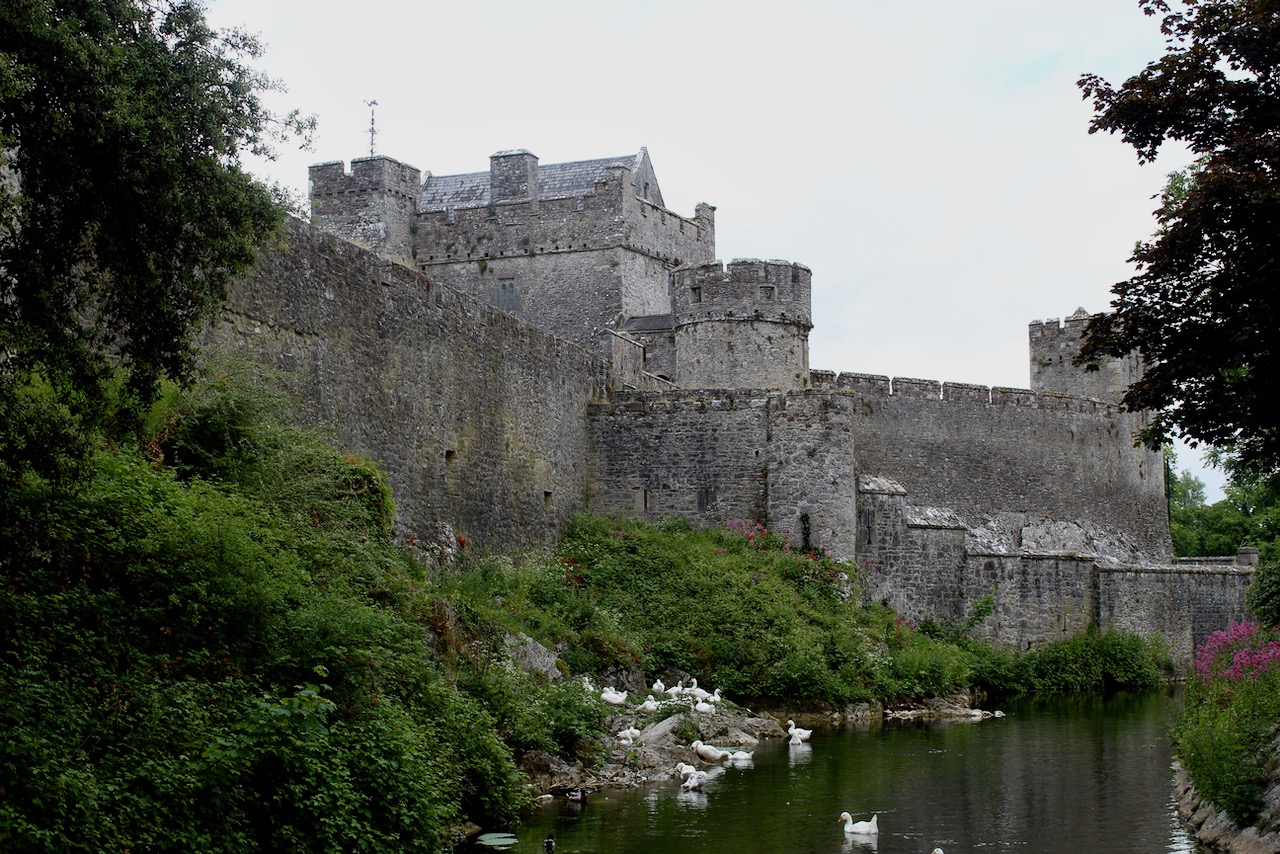
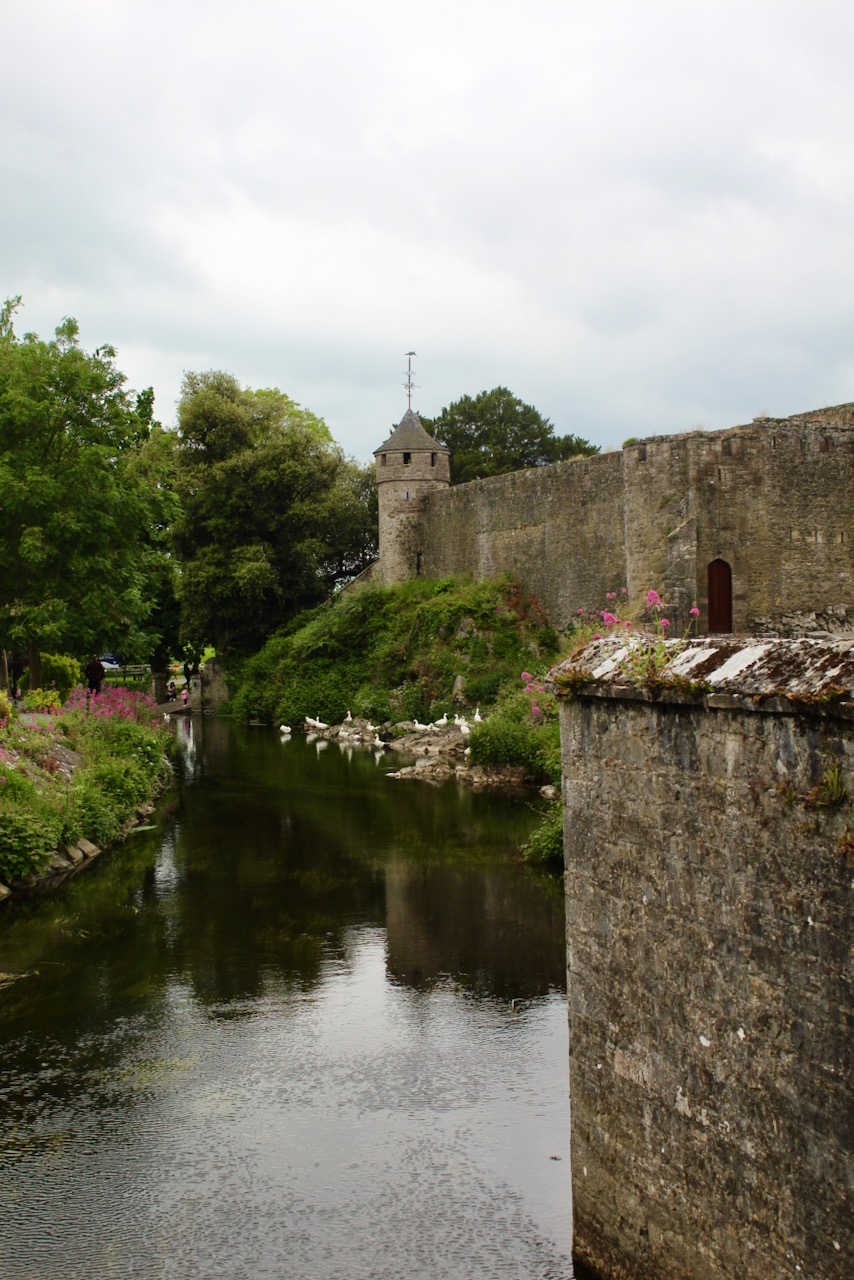
Cahir Castle, June 2022. The geese are particularly picturesque! The outer walls are called the Barbican. When breached, the attacking force gains entry to this area and are vulnerable to missiles fired by defenders and it would be difficult to retreat, due to the enclosed nature of the barbican. Photograph © Jennifer Winder-Baggot, www.irishhistorichouses.com

General information: 052 744 1011, cahircastle@opw.ie

Stephen and I visited Cahir Castle in June 2022, and I was very impressed. I had no idea that we have such an old castle in Ireland with so much intact.

From the OPW website https://heritageireland.ie/visit/places-to-visit/cahir-castle/:

Cahir Castle is one of Ireland’s largest and best-preserved castles. It stands proudly on a rocky island on the River Suir.

The castle was was built in the thirteenth century and served as the stronghold of the powerful Butler family. [The Archiseek website tells us it was built in 1142 by Conor O’Brien, Prince of Thomond] So effective was its design that it was believed to be impregnable, but it finally fell to the earl of Essex in 1599 when heavy artillery was used against it for the first time. During the Irish Confederate Wars it was besieged twice more.

At the time of building, Cahir Castle was at the cutting edge of defensive castle design and much of the original structure remains.

Cahir Castle, photograph from Ireland’s Content pool, by George Munday 2014 for Failte Ireland. [see 1] Barbican wall, courtyard, and gate with overhead machicolation, and the castle keep.
Cahir Caste, County Tipperary, June 2022. Photograph © Jennifer Winder-Baggot, www.irishhistorichouses.com

Our tour guide took us through the castle as if we were invaders and showed us all of the protective methods used. We were free then to roam the castle ourselves.

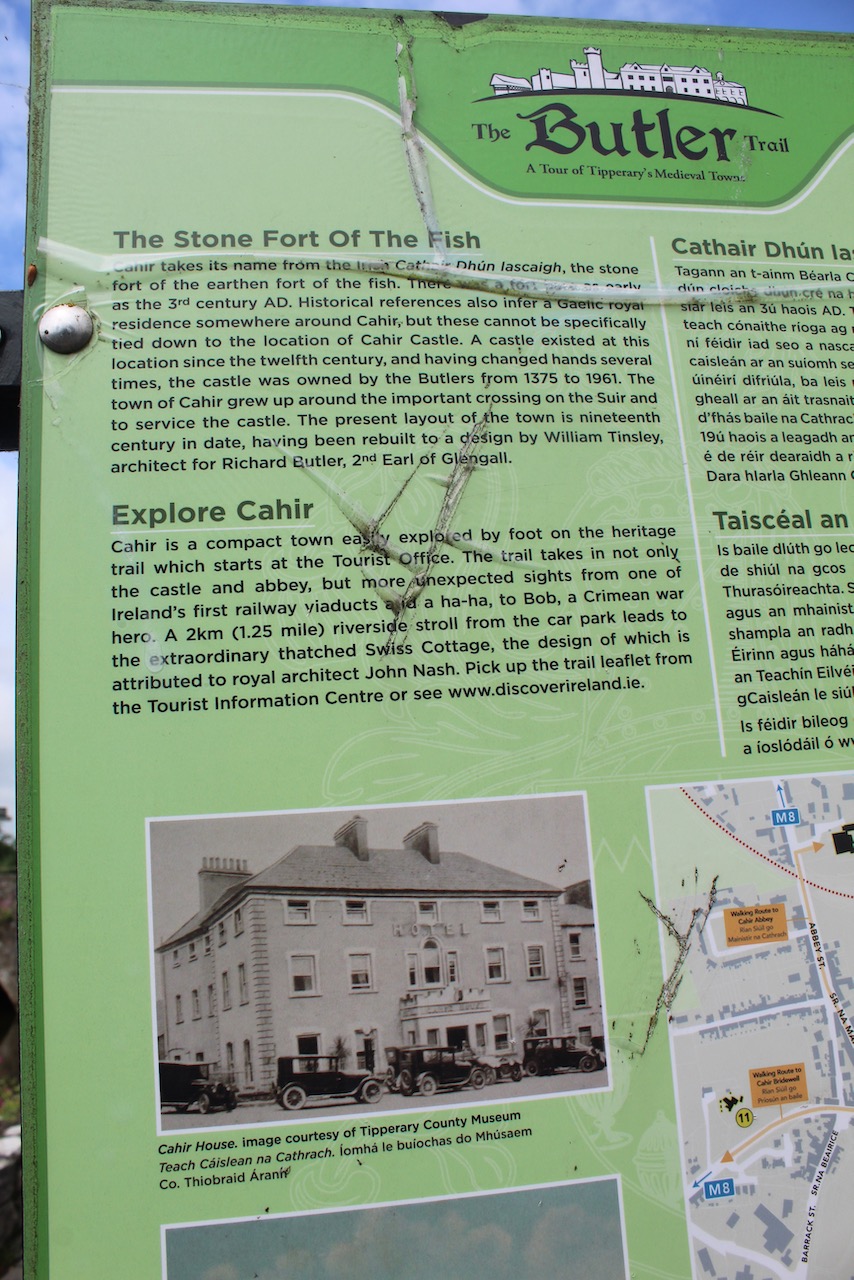
The name derives from the Irish ‘an Chathair Dhun Iascaigh’ meaning stone fort of the earthen fort of the fish.

Cahir Caste, County Tipperary, June 2022. The view of the castle from the parkland beyond. See how it seems to grow out of the rocks! Photograph © Jennifer Winder-Baggot, www.irishhistorichouses.com
Cahir Caste, County Tipperary, June 2022. Photograph © Jennifer Winder-Baggot, www.irishhistorichouses.com
Cahir Castle, photograph from Ireland’s Content pool, by Liam Murphy 2016 for Failte Ireland. [see 1] The large square tower in the foreground was built later than the keep, for housing prisoners.
Cahir Castle, June 2022.

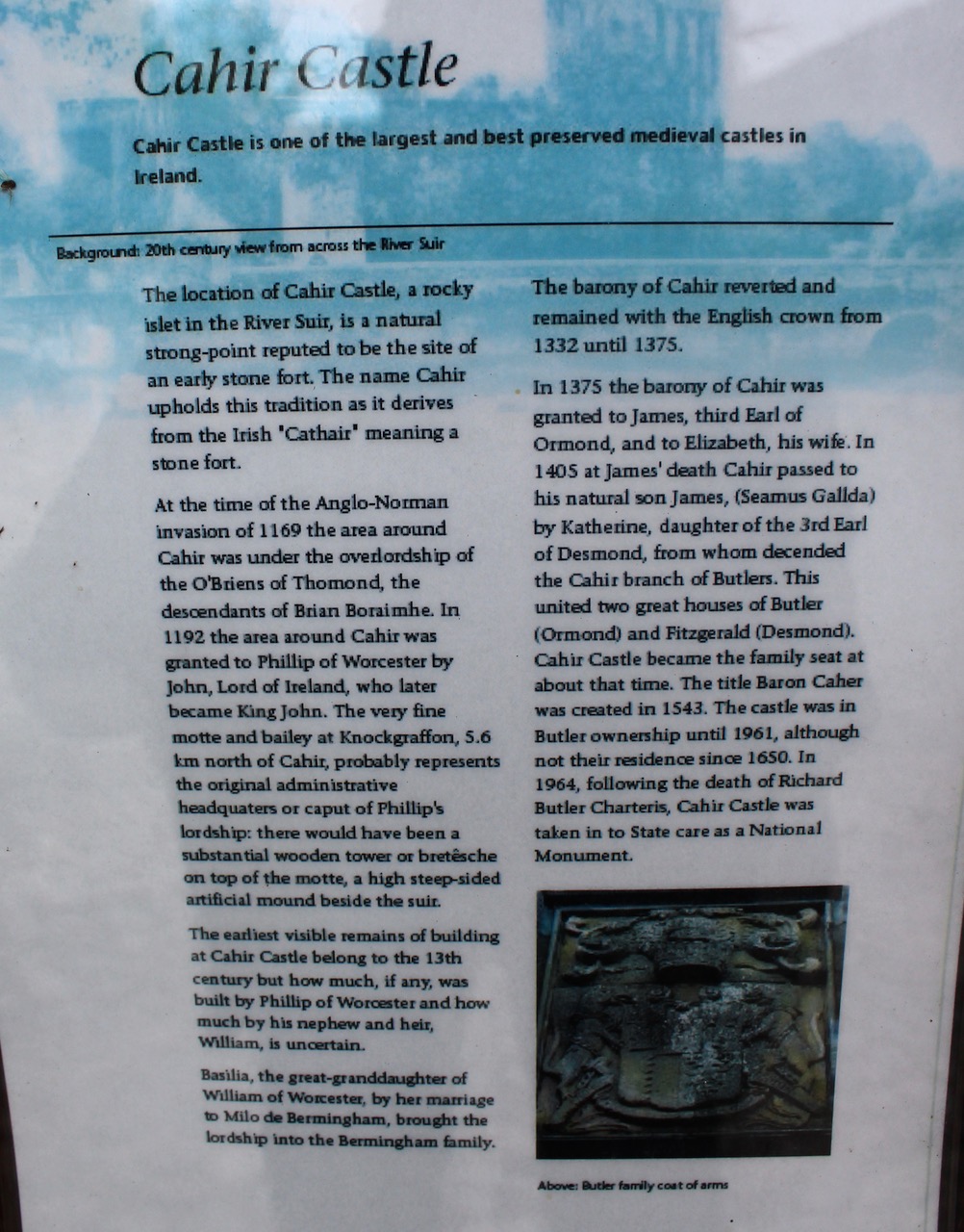
The information leaflet tells us that the area was owned by the O’Briens of Thomond in 1169 at the time of the Anglo-Norman invasion. The area around Cahir was granted to Phillip of Worcester in 1192 by John, Lord of Ireland, who later became King John. His nephew William was his heir – I’m not sure of his surname! But then his great-granddaughter, Basilia, married Milo (or Meiler) de Bermingham (he died in 1263). They lived in Athenry and their son was the 1st Lord Athenry, Piers Bermingham (died 1307).

Edward III (1312-1377) granted the castle to the James Butler 3rd Earl of Ormond in 1357 and also awarded him the title of Baron of Cahir in recognition of his loyalty. The 3rd Earl of Ormond purchased Kilkenny Castle in c. 1392. Cahir Castle passed to his illegitimate son James Gallda Butler. James Gallda was loyal to his mother’s family, the Desmonds, who were rivals to his father’s family, the Butlers.

Cahir Castle, June 2022.
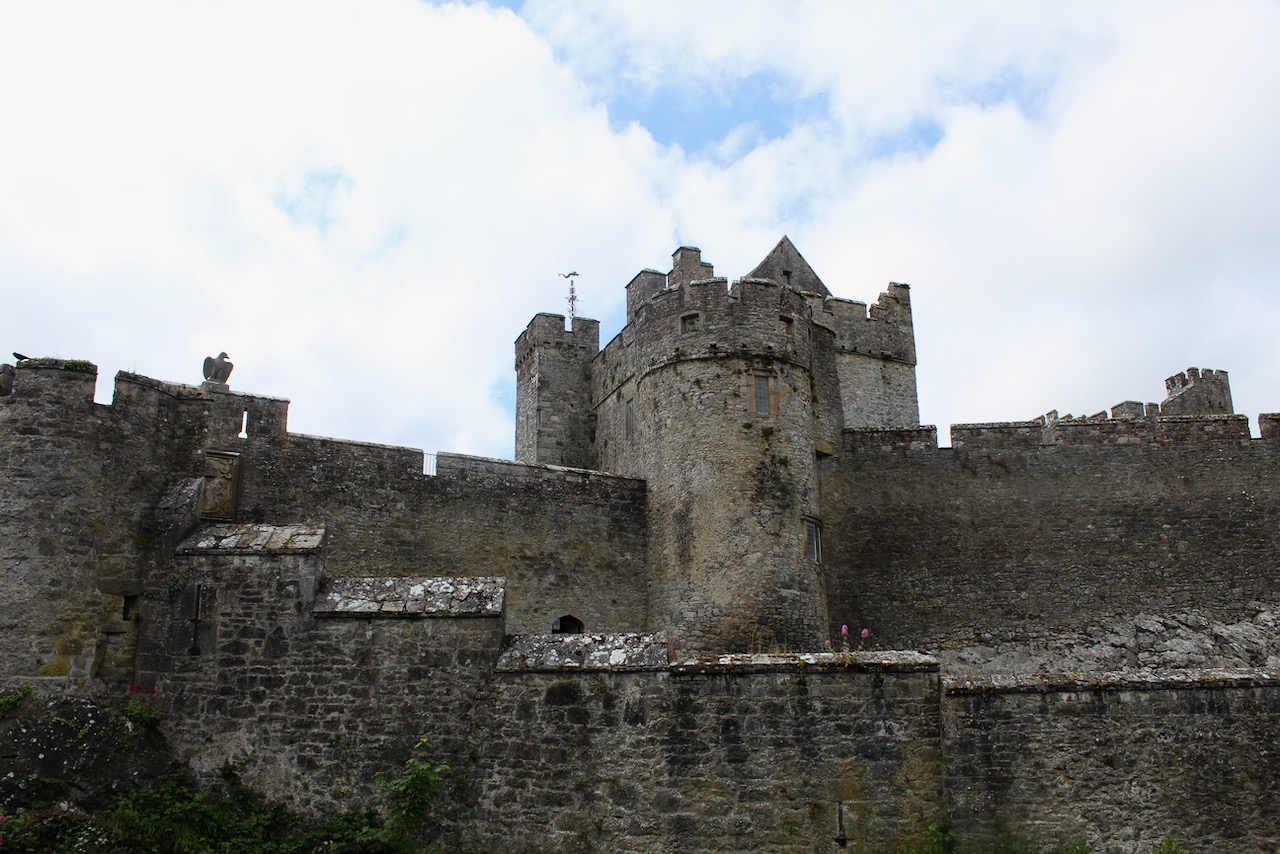
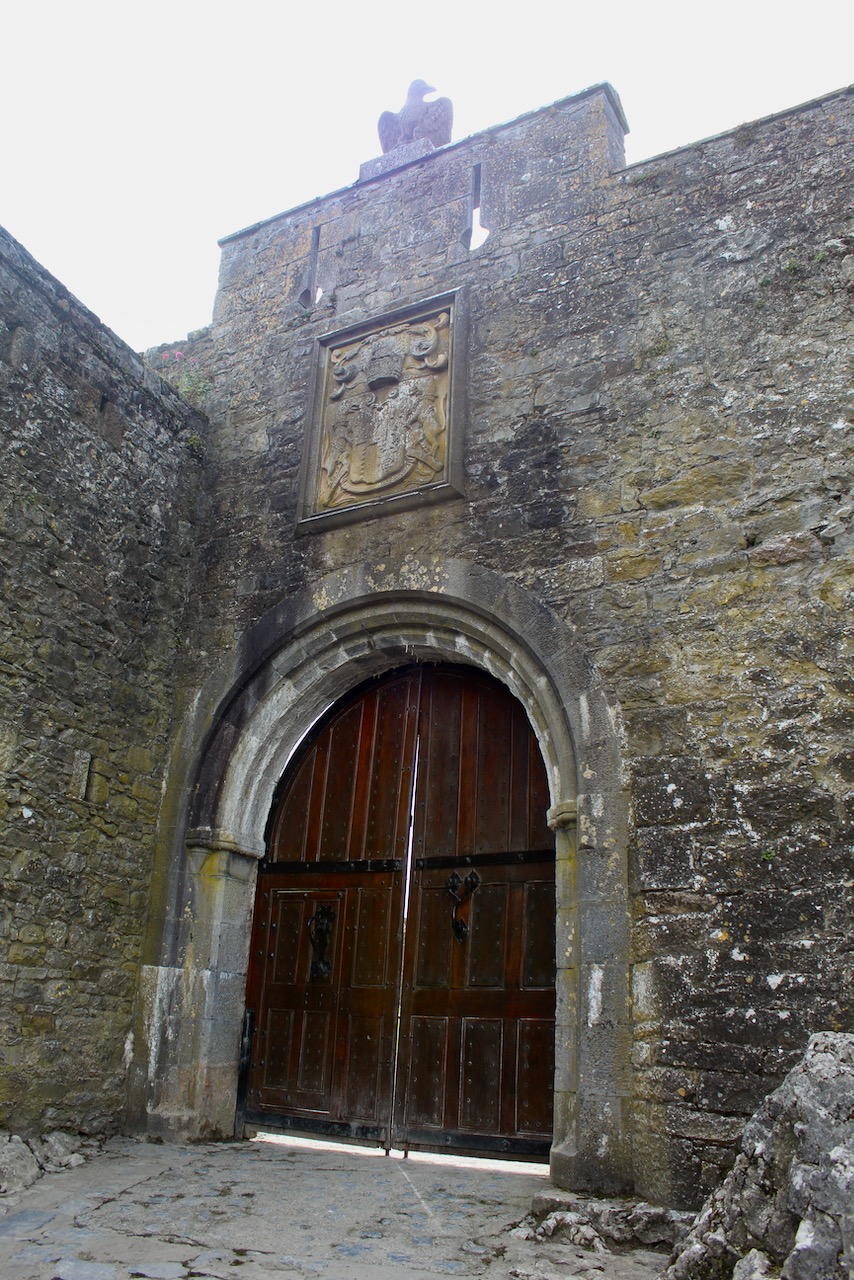
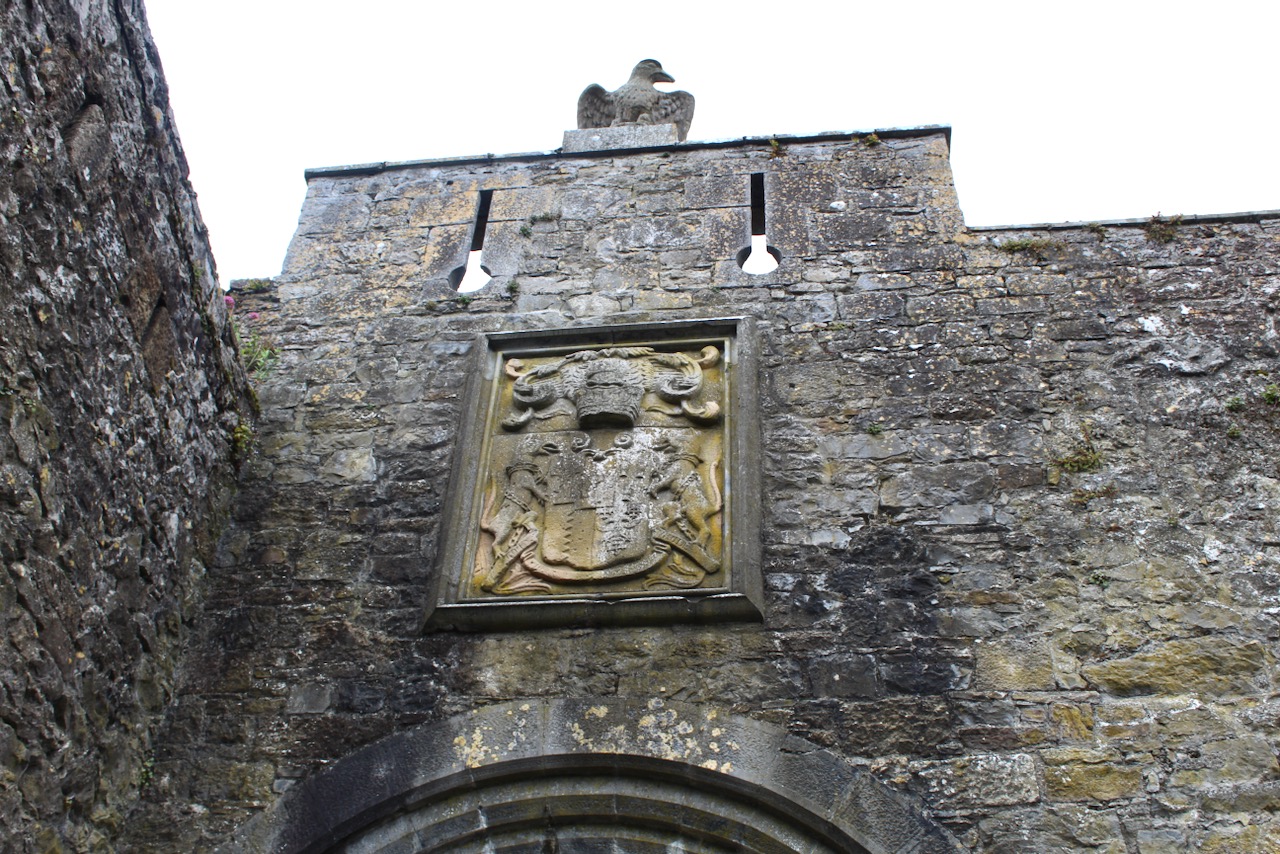
The first entrance gates, to the bawn (walled courtyard or outer enclosure) of Cahir Castle. Above the door on the top of the wall an eagle is perched, symbol of power. Below that is the crest of the Butlers of Cahir. Photograph © Jennifer Winder-Baggot, www.irishhistorichouses.com
Cahir Castle, June 2022. Photograph © Jennifer Winder-Baggot, www.irishhistorichouses.com

In their book The Tipperary Gentry, William Hayes and Art Kavanagh tell us that the rivalry between the Butlers of Ormond and the Fitzgeralds of Desmond turned to enmity when the War of the Roses broke out in England, with the Ormonds supporting the House of Lancaster and the Desmonds the House of York. The enmity found expression in the battle at Pilltown in 1462. The enmity continued for over a century, and the last private battle between the Ormonds and the Desmonds was the Battle of Affane, County Waterford, in 1565. [2]

A descendant of James Gallda Butler, Thomas Butler (d. 1558) was elevated to the peerage of Ireland, on 10 November 1543, by the title of Baron of Caher (of the second creation). He married Eleanor, a daughter of Piers Butler, 8th Earl of Ormond (d. 1539) and Margaret Fitzgerald, daughter of Gerald FitzGerald, 8th Earl of Kildare (d. 1513). His son Edmund became the 2nd Baron (d. 1560) but as there were no legitimate male heirs the title died out.

It was Piers Rua Butler, the 8th Earl of Ormond (c. 1467–1539), who brought peace between the warring factions of Fitzgeralds of Desmond and the Butlers of Ormond. He married Margaret Fitzgerald, daughter of Gerald (or Garret) Fitzgerald (1455-1513) 8th Earl of Kildare. His efforts culminated in a treaty called the Composition of Clonmel. It stated that Edmund Butler of Cahir should receive the manor of Cahir on condition that he and all his heirs “shall be in all things faithful to the Earl [of Ormond] and his heirs.” The Barons of Cahir were not allowed to keep their own private army nor to exact forced labour for the building or repair of their castle or houses. (see [2]).

Cahir Castle, June 2022. Photograph © Jennifer Winder-Baggot, www.irishhistorichouses.com

The brother of Thomas 1st Baron Caher, Piers Butler (d. after February 1567/68) had a son Theobald (d. 1596) who was then created 1st Baron Caher (Ireland, of the 3rd creation) in 1583. [3]

There’s an excellent history of Cahir on the Cahir Social and Historical Website:

Throughout the reigns of Elizabeth I and Charles I, Cahir Castle appears as a frequent and important scene in the melancholy drama of which Ireland was a stage. The Castle was taken and re-taken, but rarely damaged and through it all remained in the hands of the Roman Catholic Butlers of Cahir. By this time Cahir had become a great centre of learning for poets and musicians. Theobald, Lord Cahir [I assume this was 1st Baron Cahir of second creation who died in 1596] was said by the Four Masters “to be a man of great benevolence and bounty, with the greatest collection of poems of any of the Normans in Ireland”. [4]

Cahir Castle, June 2022.

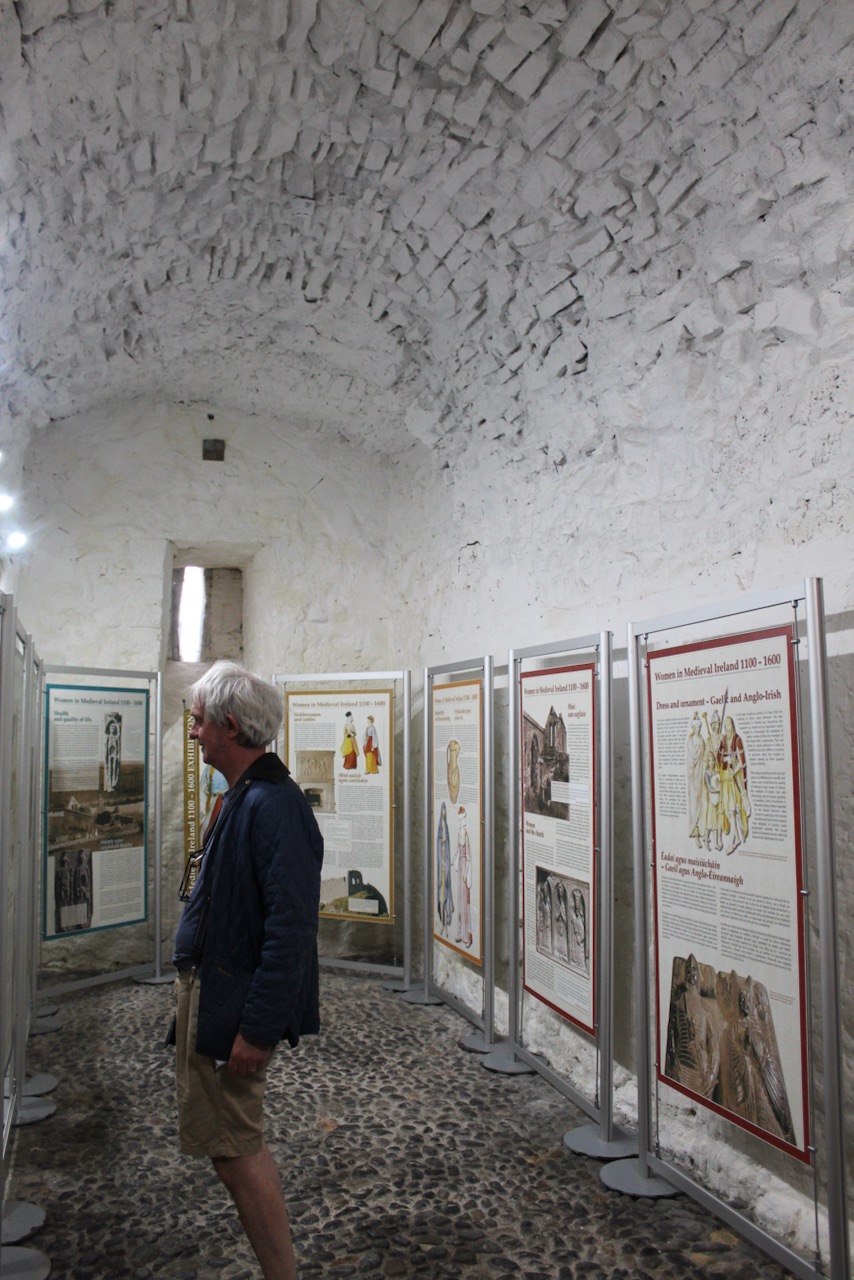
This storyboard tells us that Ireland was dramatically different from Renaissance England in its language, customs, religion, costume and law. It was divided into 90 or so individual “lordships” of which about 60 were ruled by independent Gaelic chieftains. The rest were ruled by Anglo-Irish lords. Queen Elizabeth saw Ireland as a source of much-needed revenue. She did not have sufficient resources nor a strong enough army to conquer Ireland so she encouraged her authorities in Dublin to form alliances between the crown and any local chieftains who would submit to her authority. Many chieftains who submitted did so in order to assist them in their own power struggles against their neighbours. Elizabeth especially needed this support in order to ensure that if Spain invaded Ireland she would be able to quell rebellion.

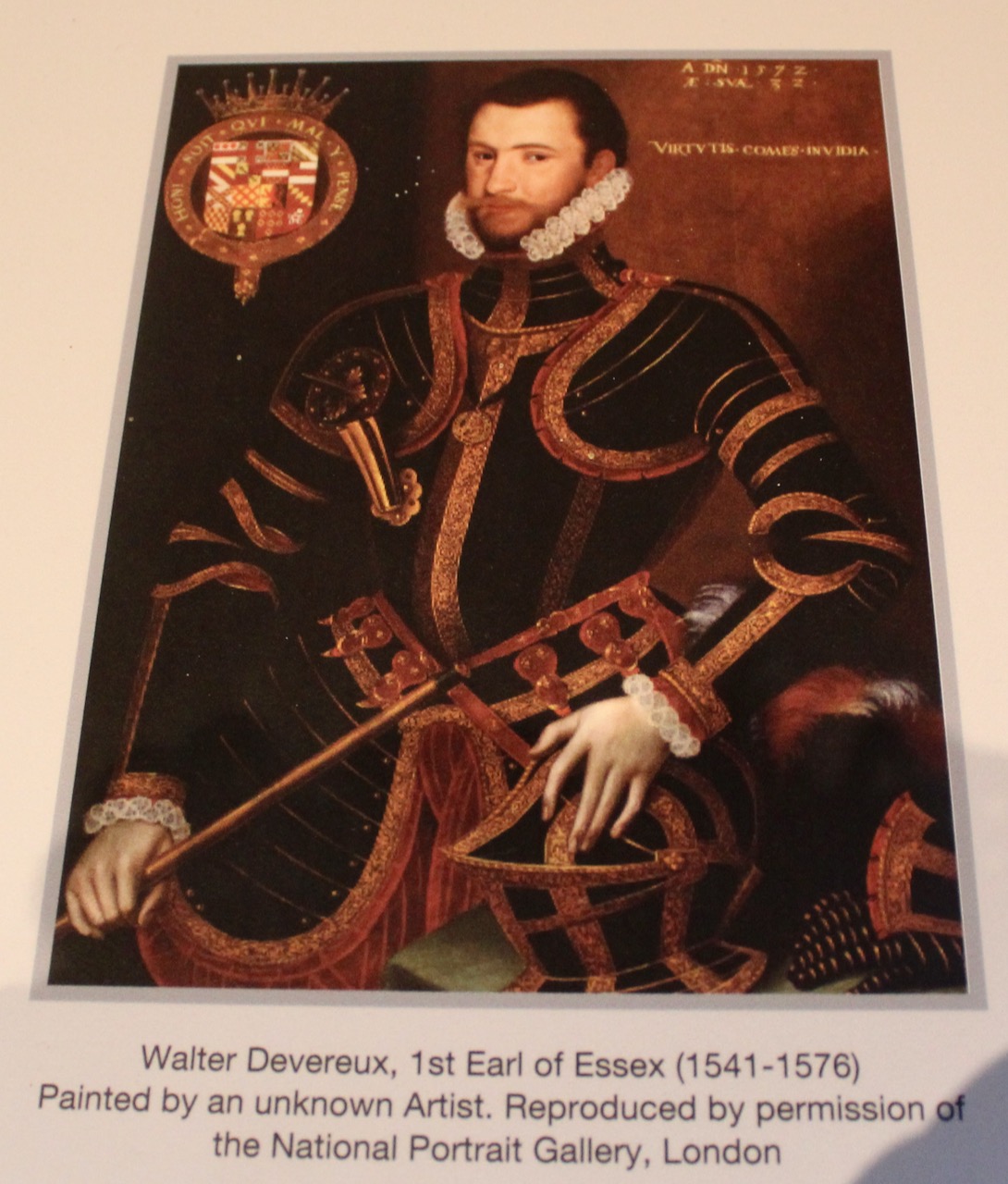
Walter Devereux (1541-1576) 1st Earl of Essex, courtesy of National Portrait Gallery, London.

Walter Devereux, 1st Earl of Essex, travelled to Ireland to subjugate Ulster and Shane O’Neill (“The O’Neill) in 1573. He failed, and had to sell of much of his land in England to pay debts accrued from raising an army. He died in Dublin of typhoid in 1576.

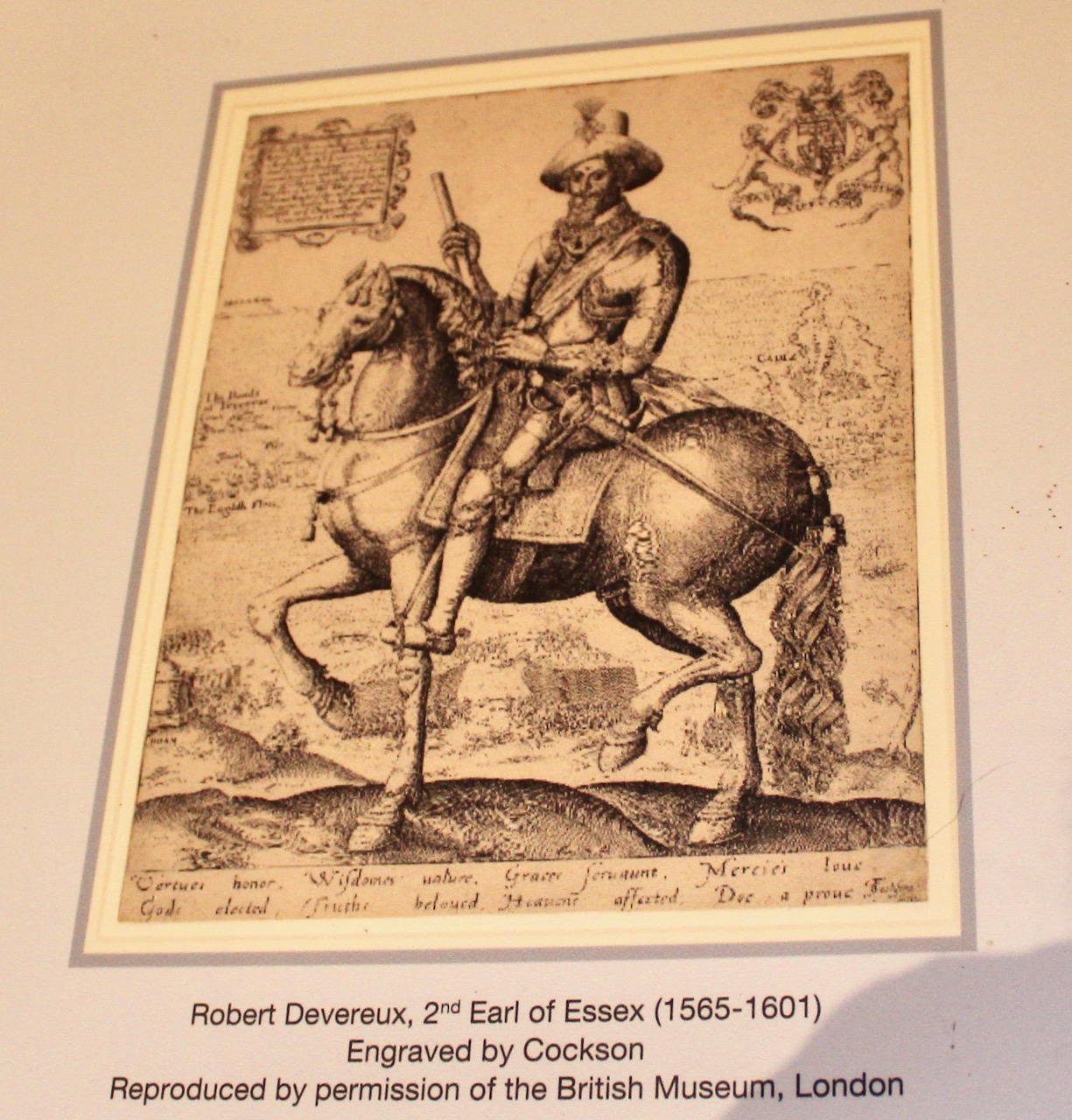
His son, the 2nd Earl of Essex came to Ireland to quell a rebellion which included the rise of Hugh O’Neill, 2nd Earl of Tyrone (1550-1616), cousin of Shane O’Neill.

Cahir Castle, June 2022.

The storyboard tells us that Hugh O’Neill fought alongside the 1st Earl of Essex in Ulster between 1573 and 1575. He also fought for Queen Elizabeth in 1580 against the rebel Gerald Fitzgerald, 14th Earl of Desmond (circa 1533, d. 11 November 1583), and as thanks he was made Earl of Tyrone. However, he turned against the crown in 1594 and formed an alliance with Red Hugh O’Donnell to fight against the Queen’s troops, in the Nine Years War.

The ties between the Earls of Essex and Queen Elizabeth I are complicated. When Walter Devereux the 1st Earl died in Ireland, his wife, Lettice Knollys, remarried. She and Queen Elizabeth’s favourite, Robert Dudley Earl of Leicester, married secretly, a fact which enraged the disappointed Queen. It was Robert Dudley who introduced his stepson Robert Devereux 2nd Earl of Essex to Elizabeth and he subsequently became her favourite, alongside Walter Raleigh. However, Elizabeth was to be angered again when this next favourite, Devereux, also secretly married, this time to Frances Walsingham, who was the widow of Sir Philip Sidney. We came across her before when we visited Portumna Castle as she later married Richard Bourke 4th Earl of Clanricarde. Philip Sidney was the son of Henry Sidney (or Sydney) who had been Lord Deputy of Ireland.

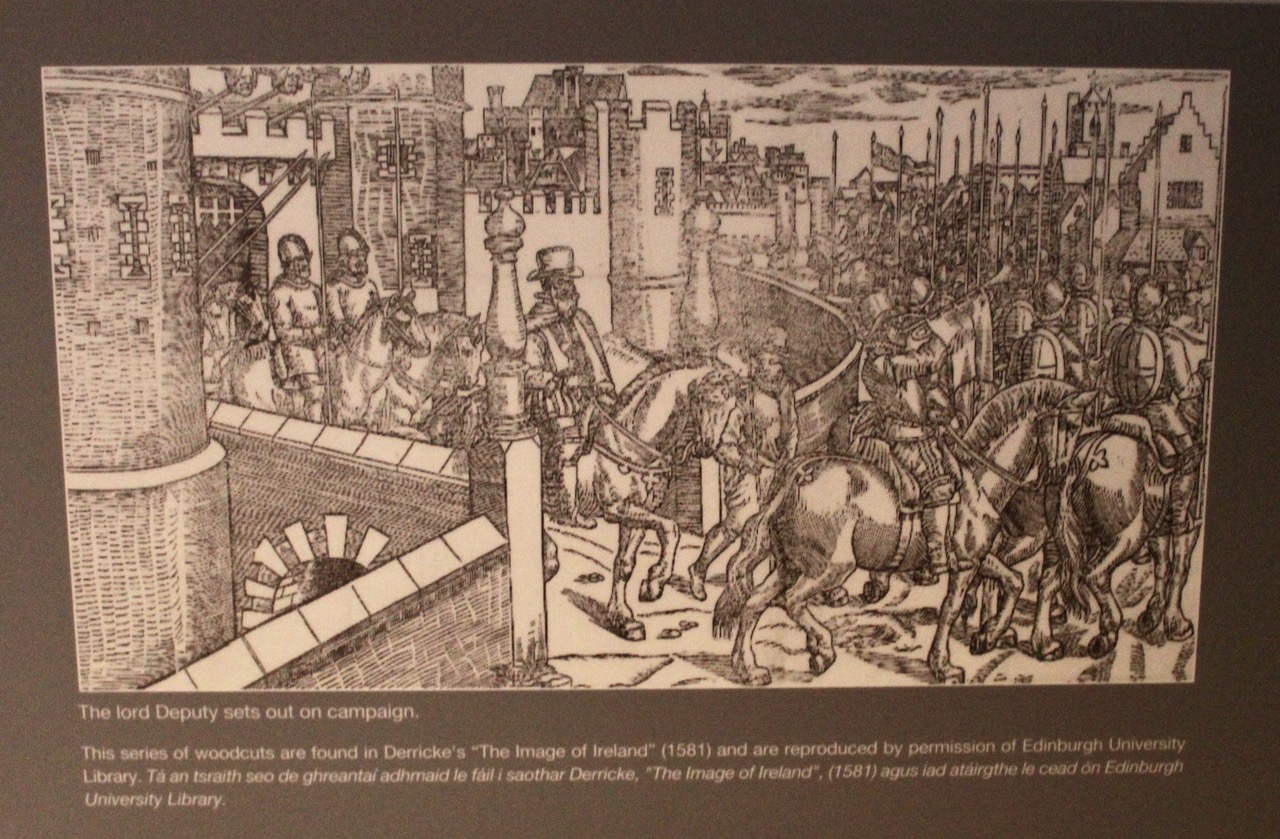
Lord Deputy Henry Sidney is shown crossing a moat leaving Dublin Castle, setting out on a campaign. Above the gate are a number of severed heads!
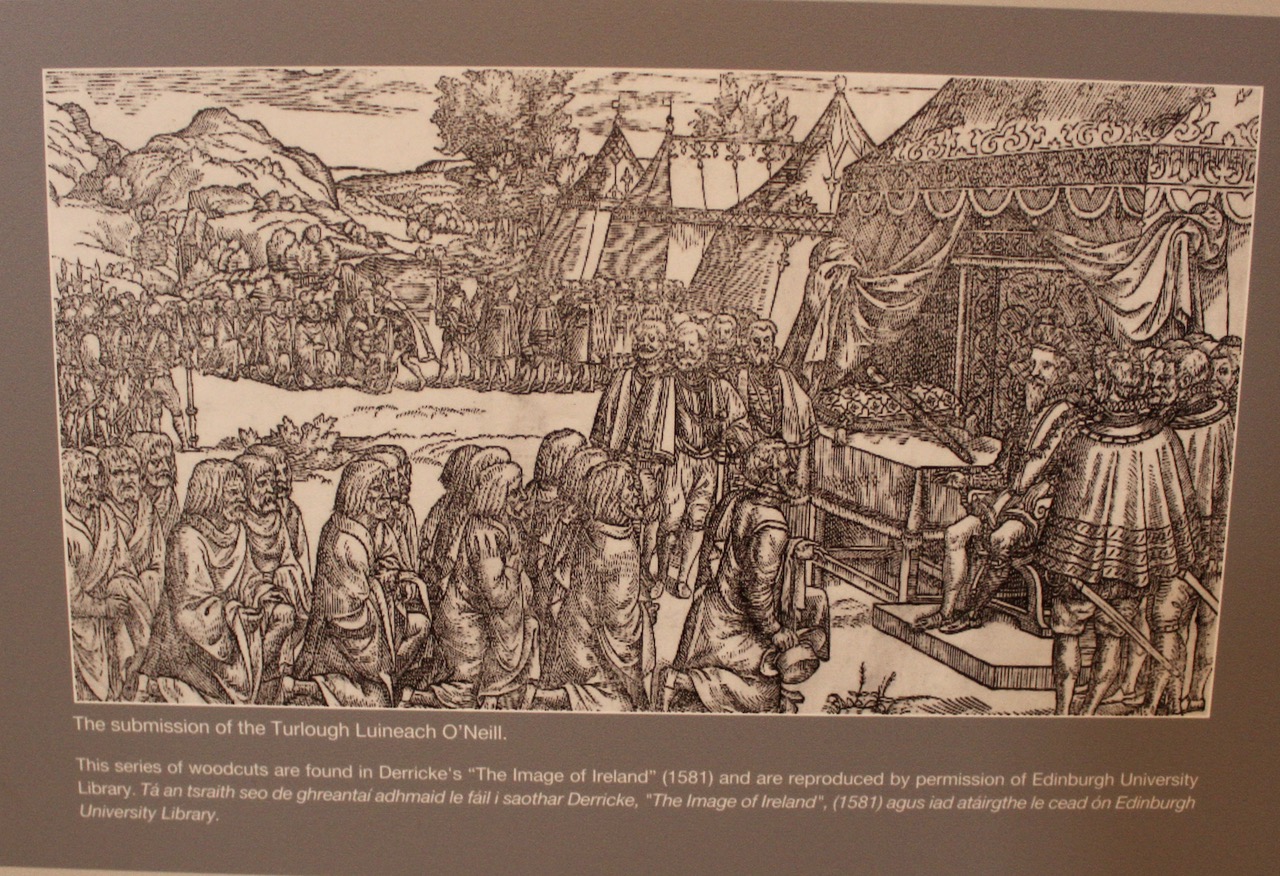
The submission of Turlough Luineach O’Neill to Lord Deputy Sir Henry Sidney in 1575.
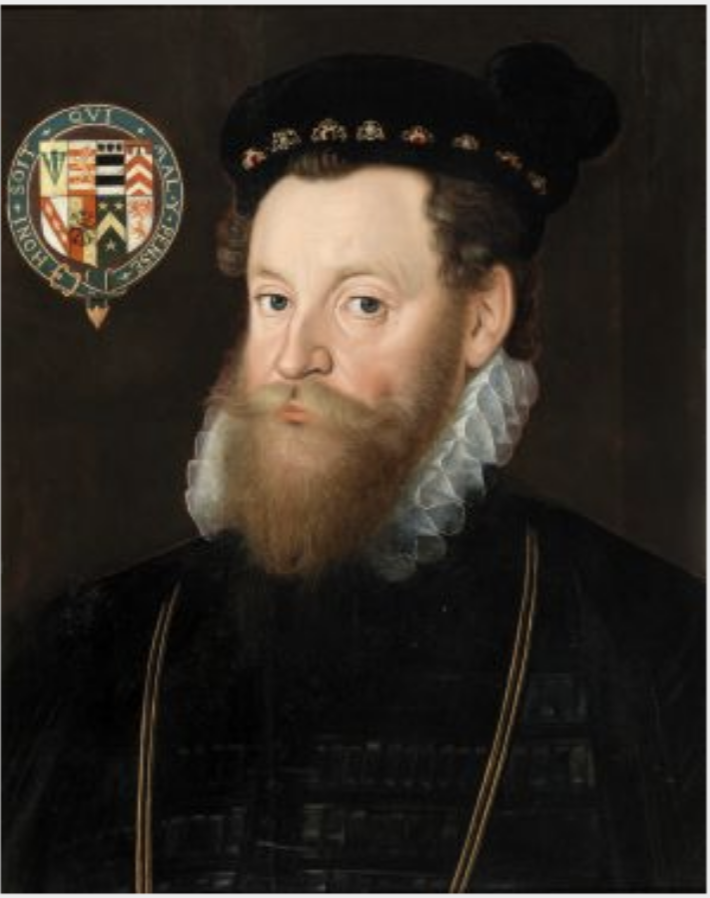
Sir Henry Sidney (1529-1586), Lord Deputy of Ireland, after painter Arnold Van Brounkhorst, courtesy of National Gallery of Ireland.
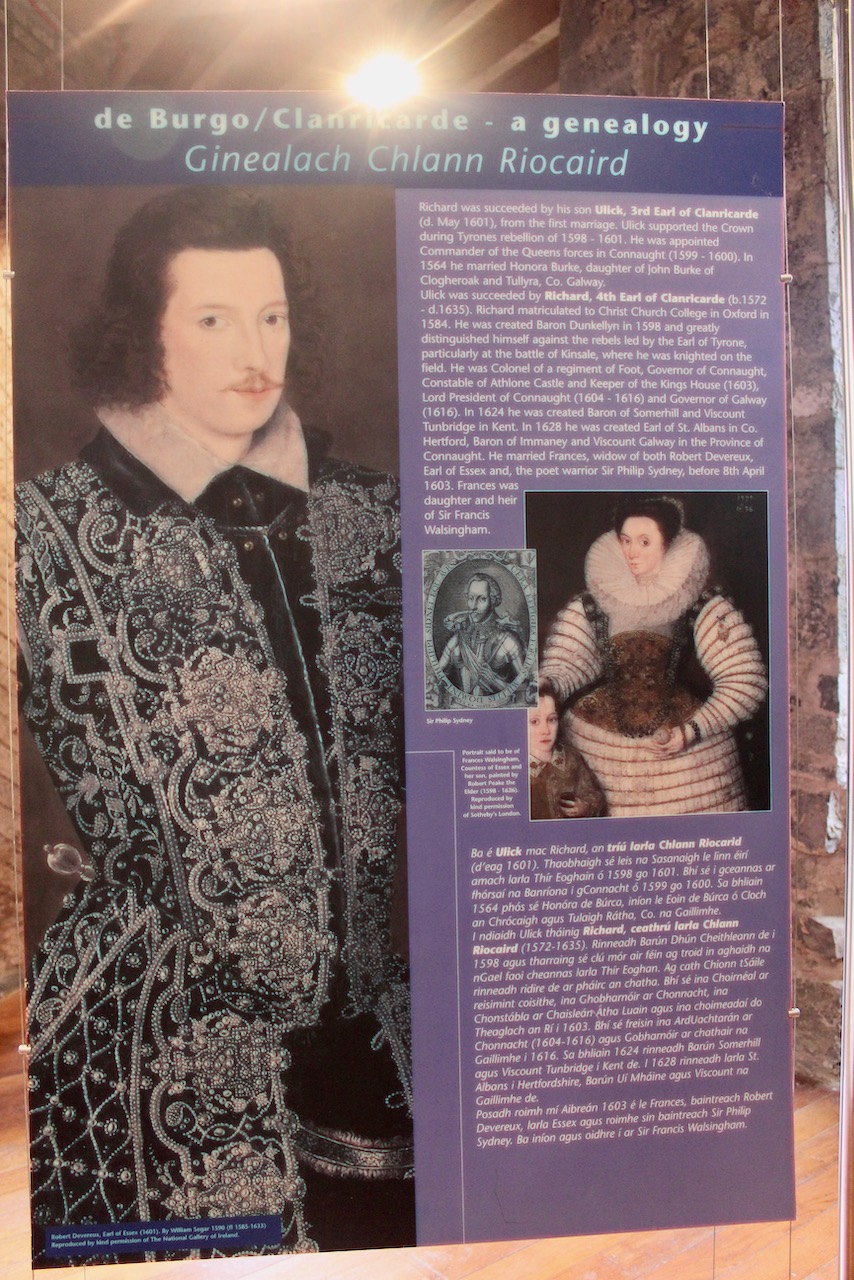
Portrait of Frances Walsingham, along with her husband Robert Devereux, 2nd Earl of Essex, and in the small picture, Sir Philip Sydney, from information board in Portumna Castle.

Robert Devereux the 2nd Earl of Essex sought to re-win courtly favour by going to fight in Ireland, following the footsteps of his father, and persuaded Elizabeth to name him Lord Lieutenant of Ireland.

In May 1599, Essex and his troops besieged Cahir Castle. He arrived with around two to three thousand men, a cannon and a culverin, a smaller and more accurate piece of heavy artillery.

Thomas Butler the 10th Earl of Ormond, who owned the castle in Carrick-on-Suir and was another favourite of the Queen, as he had grown up with her in the English court. However, the storyboards tell us that he at first rebelled, alongside Thomas Butler 2nd Baron Cahir (or Caher – they seem to be spelled interchangeably in historical records) and Edmond Butler, 2nd Viscount Mountgarret (1540-1602), another titled branch of the Butler family.

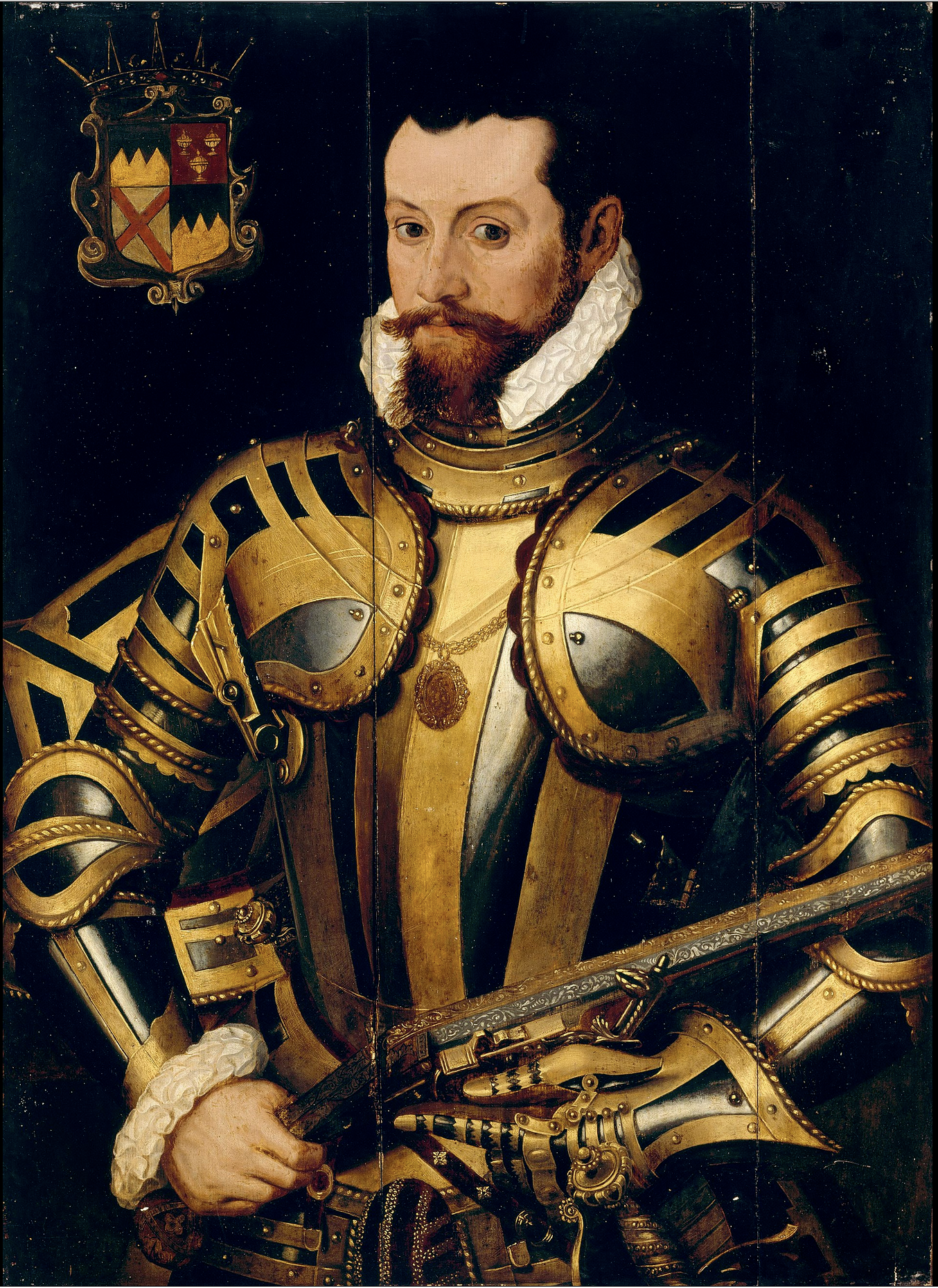
Thomas Butler 10th Earl of Ormond by Steven Van der Meulen. He is holding a wheelcock pistol with his coat of arms in the upper left corner.

By the time of the 1599 siege, the Earl of Ormond was fighting alongside Essex, and Cahir Castle was held by rebels, including Thomas Butler’s brother James Gallada Butler (not to be confused with the earlier James Galda Butler who died in 1434). Thomas Butler 2nd Baron Cahir travelled with Essex toward the castle. Baron Cahir sent messengers to ask his brother to surrender the castle but the rebels refused. Thomas Butler 2nd Baron Cahir was suspected of being involved with the rebels. Thomas was convicted of treason but received a full pardon in 1601 and occupied Cahir Castle until his death in 1627. James Gallada Butler claimed that he had been forced by the rebels to fight against Essex. Essex and his men managed to capture the castle.

During the three days of the siege, the castle incurred little damage, mostly because the larger cannon broke down on the first day! Eighty of the defenders of the castle were killed, but James Gallada Butler and a few others escaped by swimming under the water mill. This siege was to be the only time that castle was taken by force. James Gallada recaptured the castle the following year and held it for some months. The Butlers regained possession of the castle in 1601.

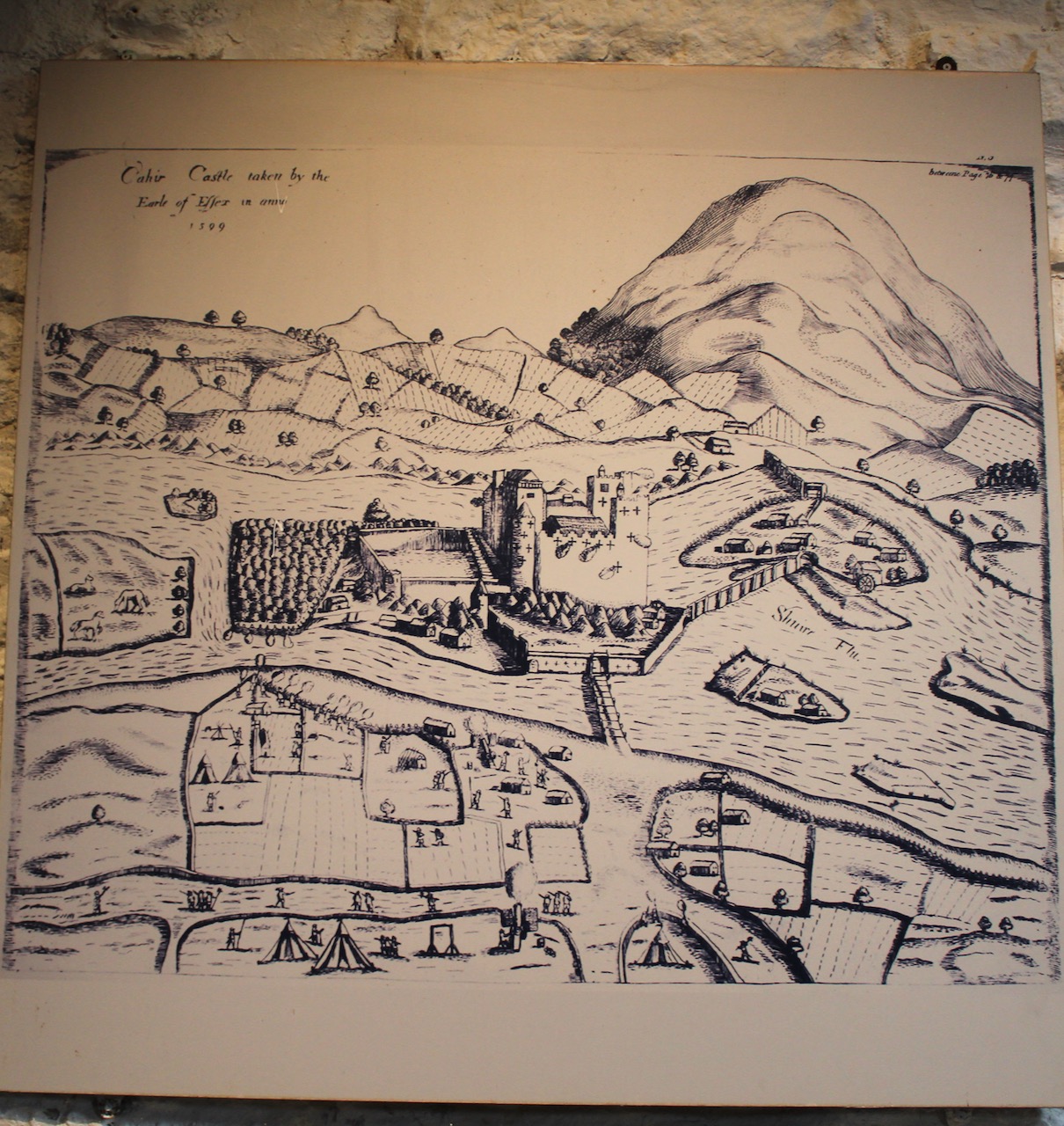
Cahir Castle taken by the 2nd Earl of Essex in 1599.
Cahir Castle, June 2022.

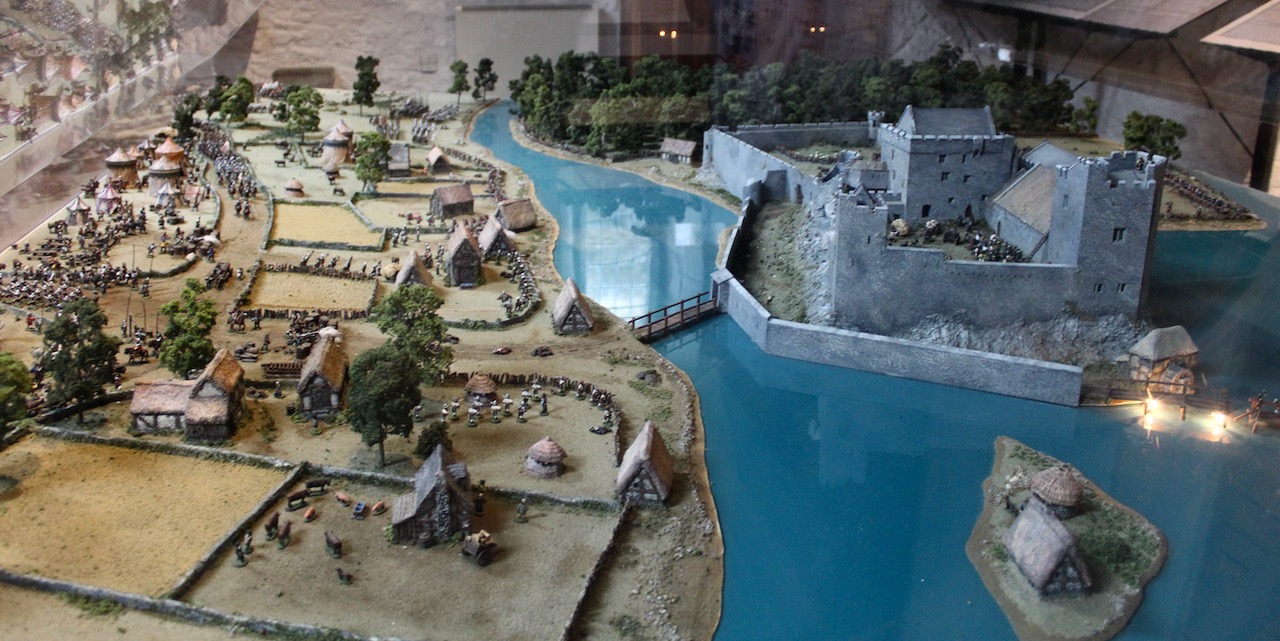
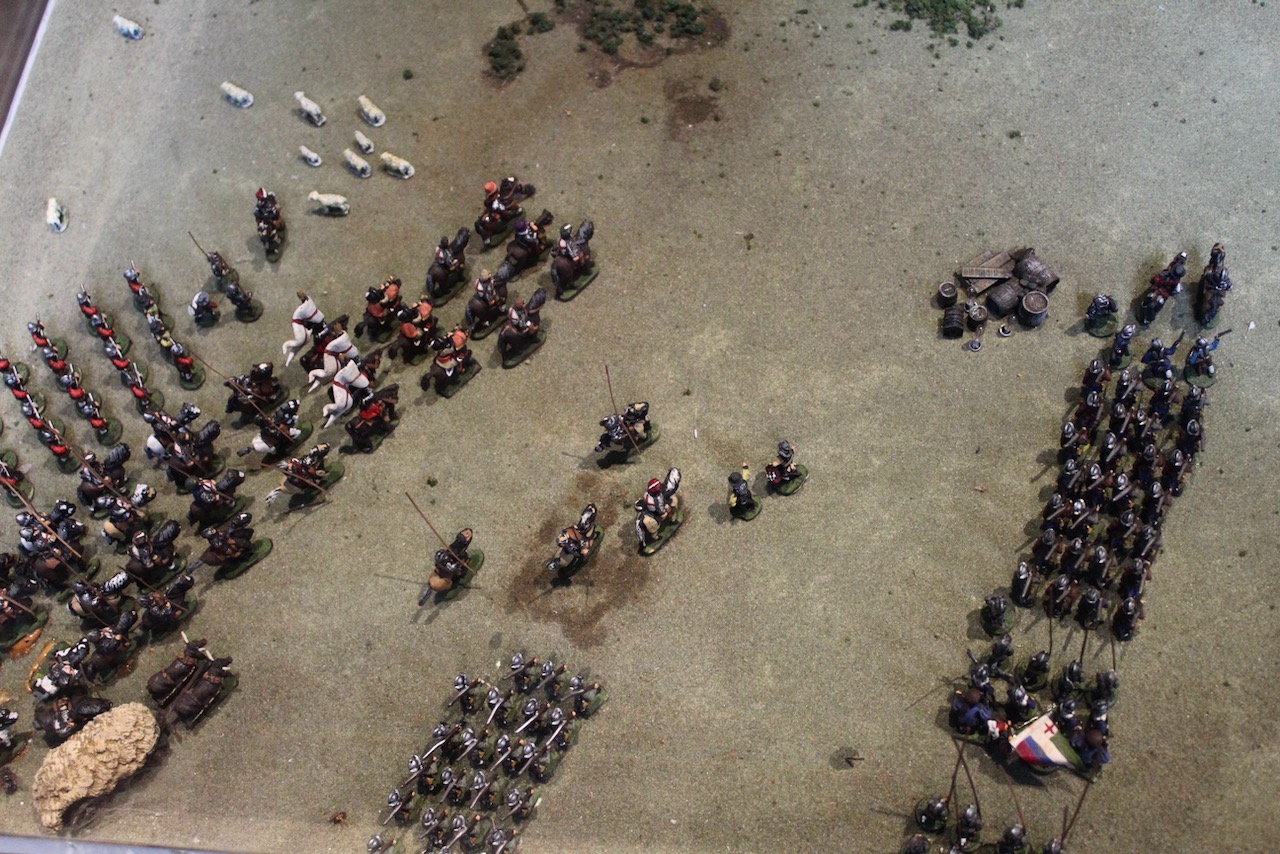
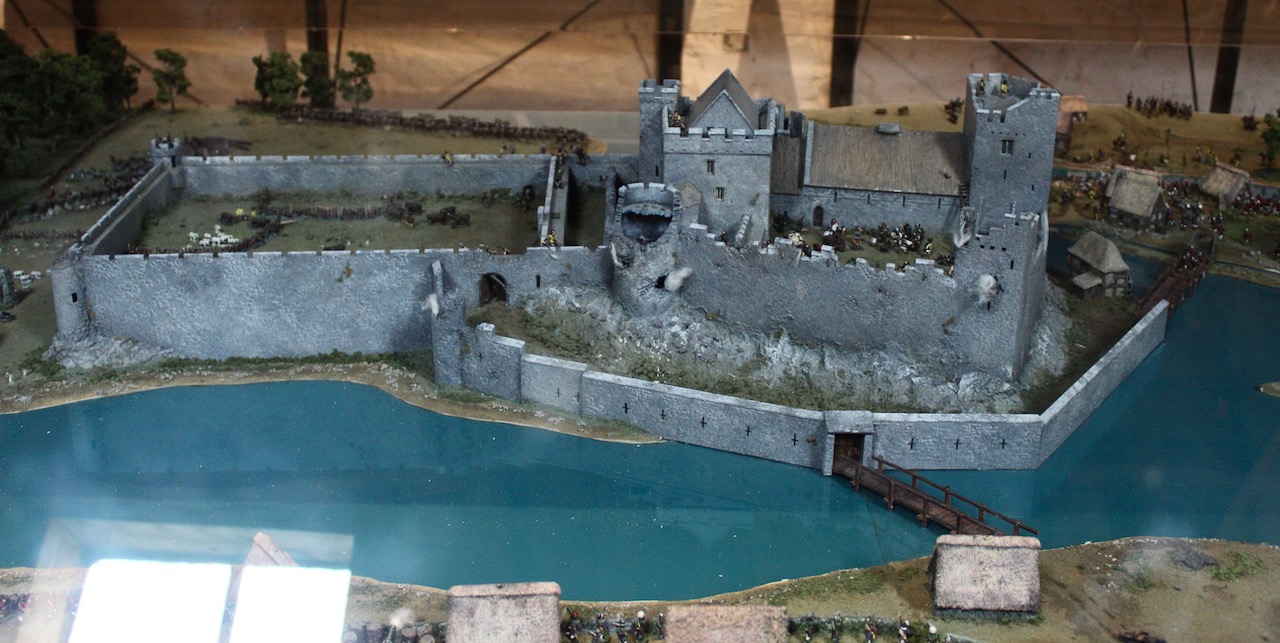
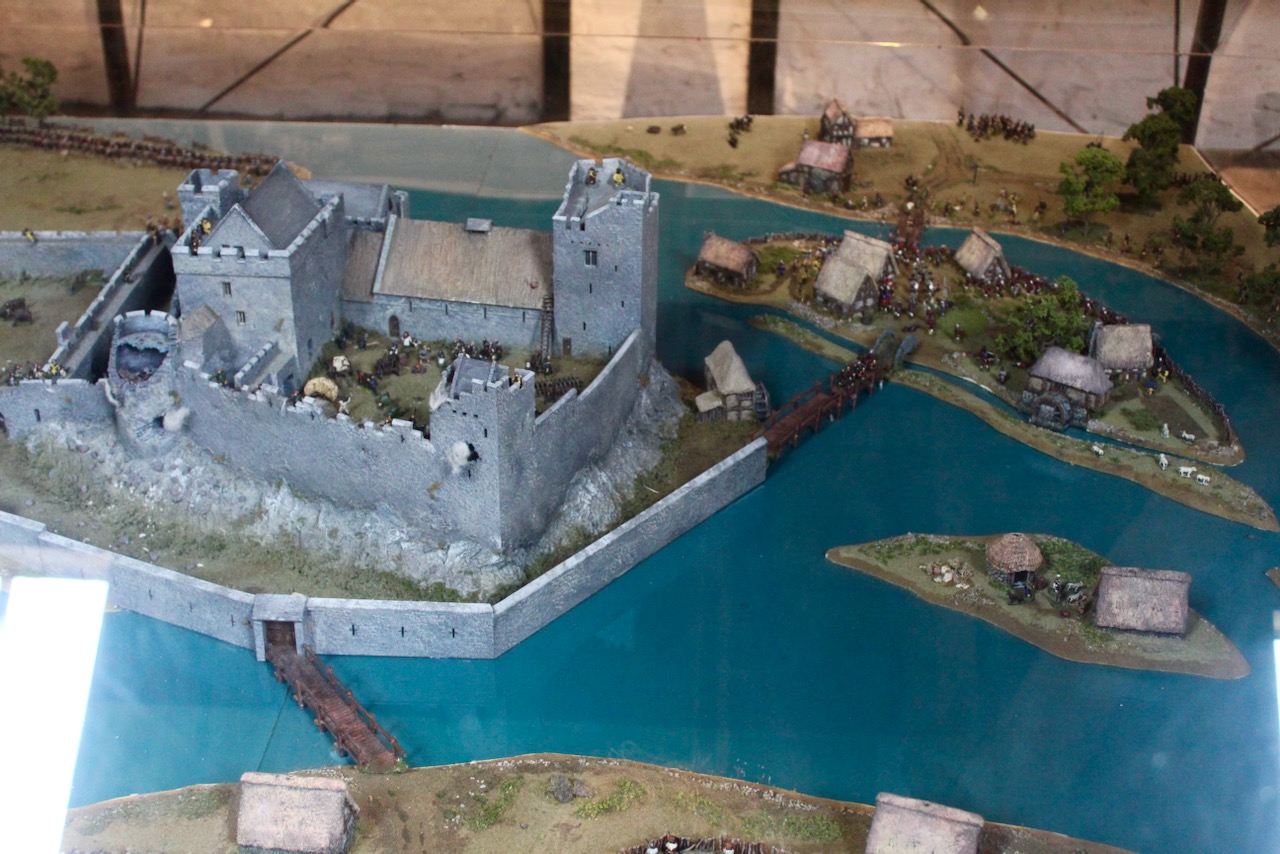
Inside the castle in one room was a wonderful diorama of this siege of Cahir Castle, with terrifically informative information boards.

The Diorama of the 1599 Siege.
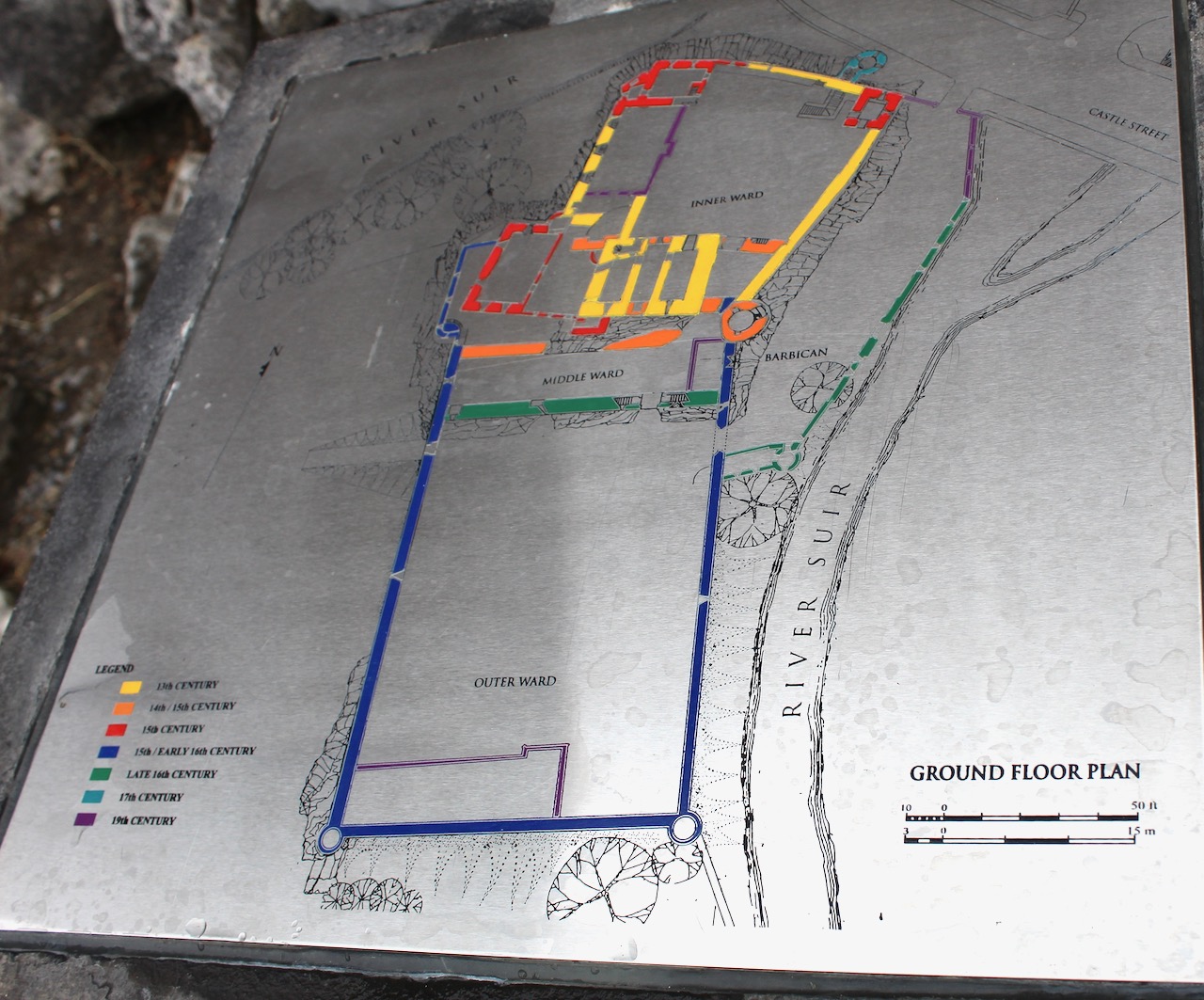
The Diorama of the 1599 Siege. The siege map and diorama show the wall of the barbican extending further than it does now, to the bridge across to the island. The plan also shows a number of buildings in the inner ward that no longer exist. The shape of the islands and riverbanks changed following construction of a weir.
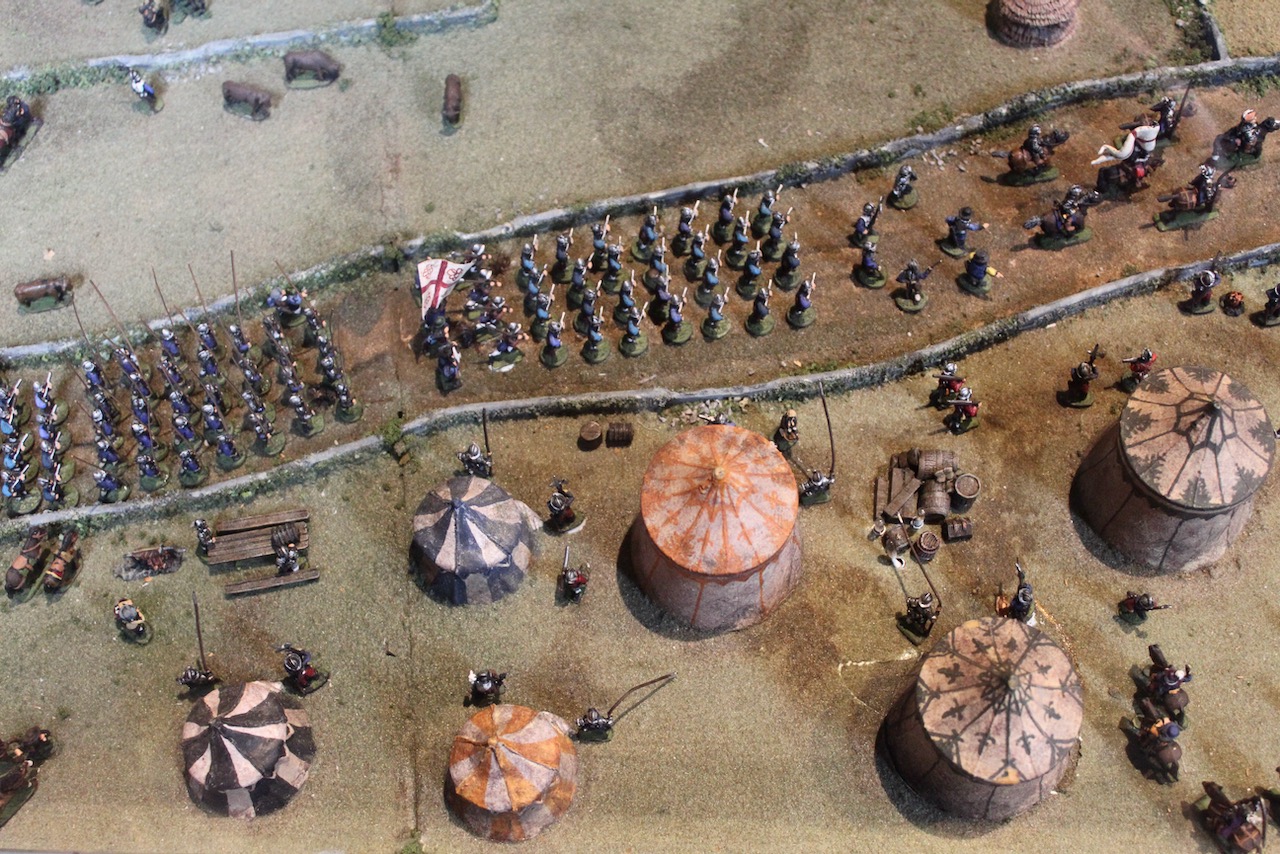
The Diorama of the 1599 Siege.
Someone must have had great fun setting up the little toy soldiers in their fight formations in the diorama.
The Diorama of the 1599 Siege.

Failing to win in his battles in Ireland, however, Essex made an unauthorised truce with Hugh O’Neill. This made him a traitor. The Queen did not accept the truce and forbid Essex from returning from Ireland. He summoned the Irish Council in September 1599, put the Earl of Ormond in command of the army, and went to England. He tried to raise followers to oust his enemies at Elizabeth’s court but in doing so, he brought a small army to court and was found guilty of treason and executed.

The Cahir Social and Historical Website continues:

A study of the Butler Family in Cahir in the sixteenth and seventeenth centuries reveals the rise and fall of one of the minor branches of the House of Ormond. At the end of the fifteenth century, they possessed extensive powers, good territorial possessions and a tenuous link with the main branch of the Butler family. During the sixteenth century, their possession was strengthened by the grant of the title of Baron of Cahir with subsequent further acquisition of land, but they came under closer central government control.”

The Cahir website continues: “A complete reversal in their relations with the Earls of Ormond occurred, strengthened by various marriage alliances. They also participated in political action, both in the Liberty of Tipperary and at National Level. In the late sixteenth and early seventeenth centuries their position was affected by their adherence to Roman Catholicism, which resulted in their revolt during the Nine Years War, and subsequent exclusion from power by the Central Administration. They formed part of the Old English Group and as such, suffered from the discriminatory politics practiced by the Government. From 1641 they became minor landowners keeping their lands by virtue of the favour of their relative, the Duke of Ormond. In 1647 the Castle was surrendered to Lord Inchiquin for Parliament but re-taken in 1650 by Cromwell himself, whose letter describing acceptable terms of surrender still survives.

Murrough O’Brien (1614-1674) 1st Earl of Inchiquin by John Michael Wright courtesy of Manchester Art Gallery.

Murrough O’Brien fought on the side of the Crown – his ancestor Murrough O’Brien was created 1st Baron Inchiquin in 1543 by the Crown in return for converting to Protestantism and pledging allegiance to the King (Henry VIII). Since he took the castle for the crown, it implies that at this time Lord Caher fought against the crown again – and since the information boards tell us that the 1599 siege was the only time it was taken by force, force must not have been used at this later time.

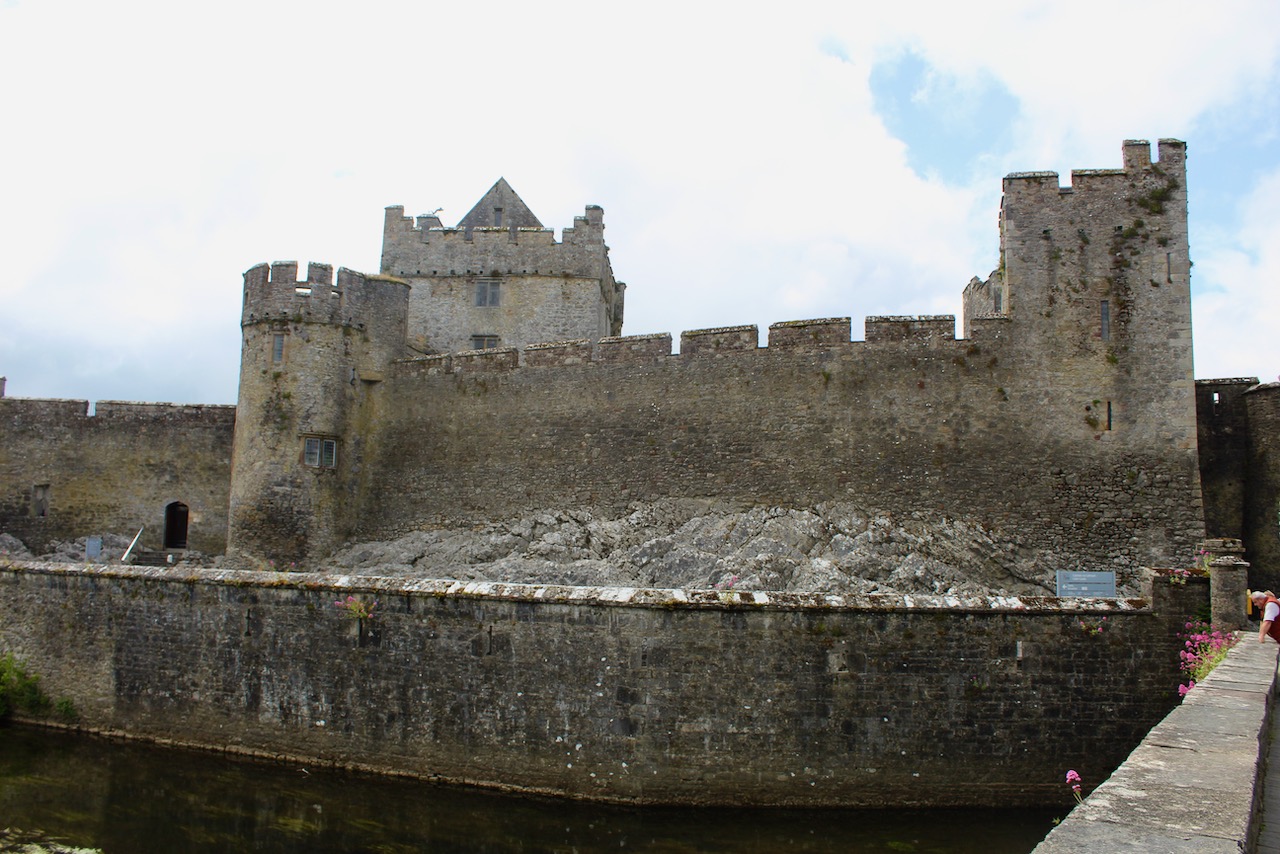
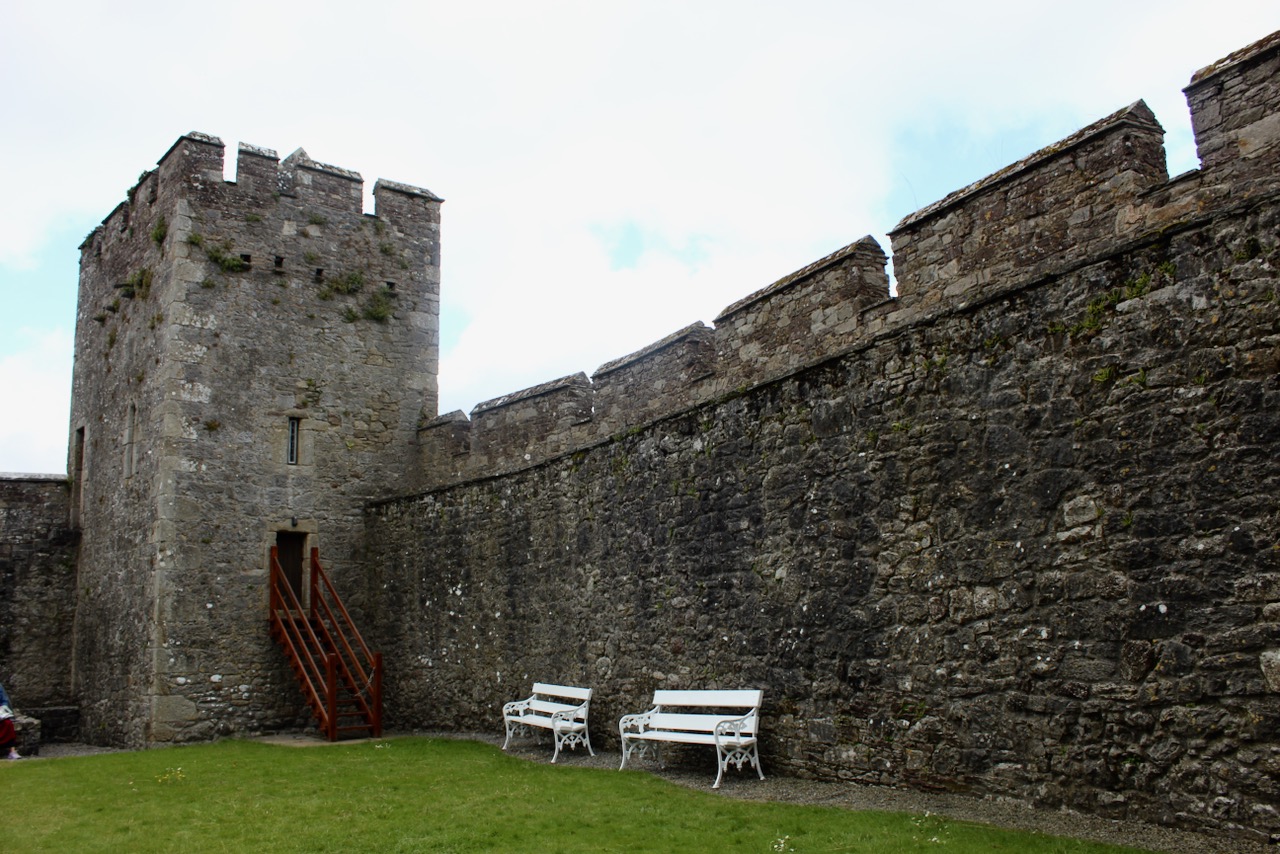
Round flaking towers are positioned at the outside corners acting as guard towers, accessed by wall walks that surmount the walls surrounding the courtyard. Photograph © Jennifer Winder-Baggot, www.irishhistorichouses.com
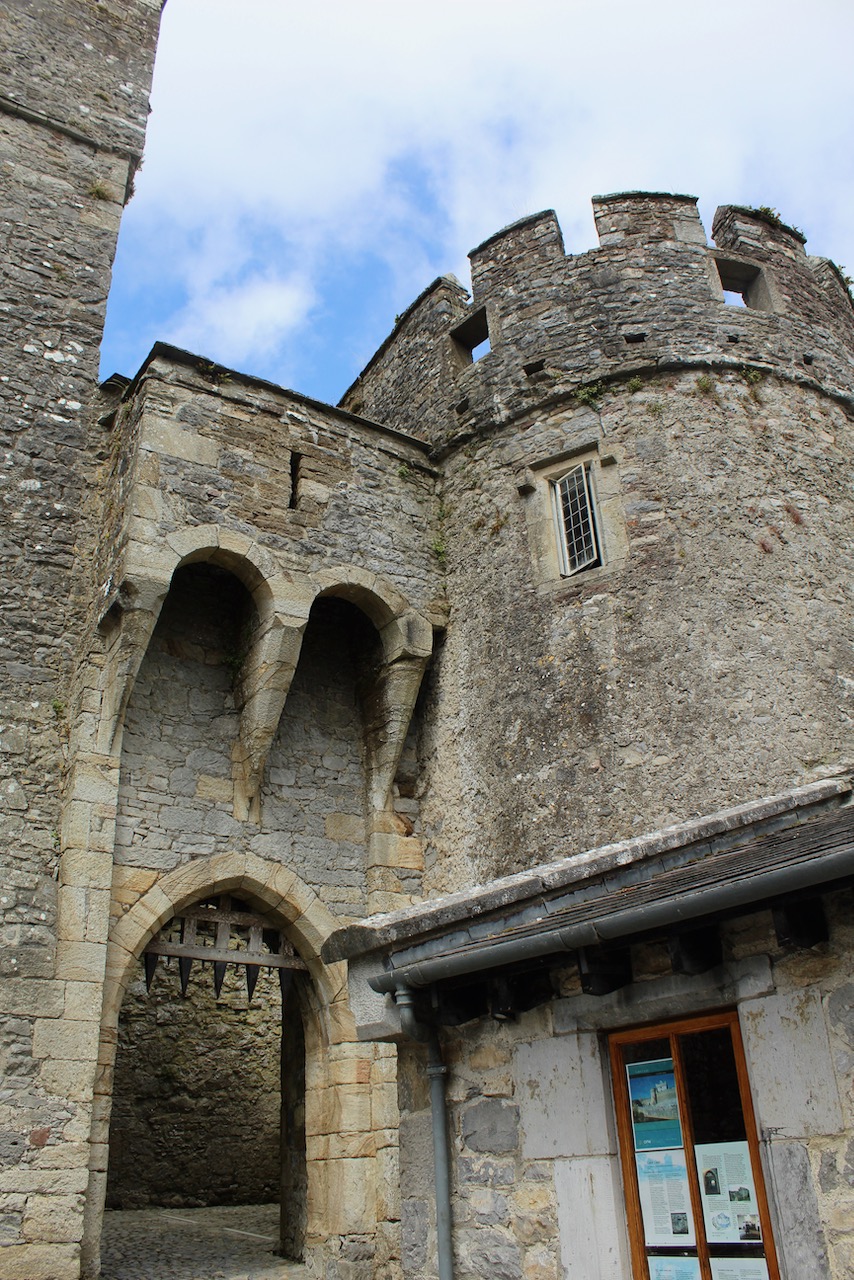
Once over the surrounding moat and river, and through the outer gate into the inner courtyard or bawn, one has another gate to go through, which is protected by a machicolation above the gate, through which things could be dropped on the invader, such as rocks, boiling water or hot sand. Photograph © Jennifer Winder-Baggot, www.irishhistorichouses.com
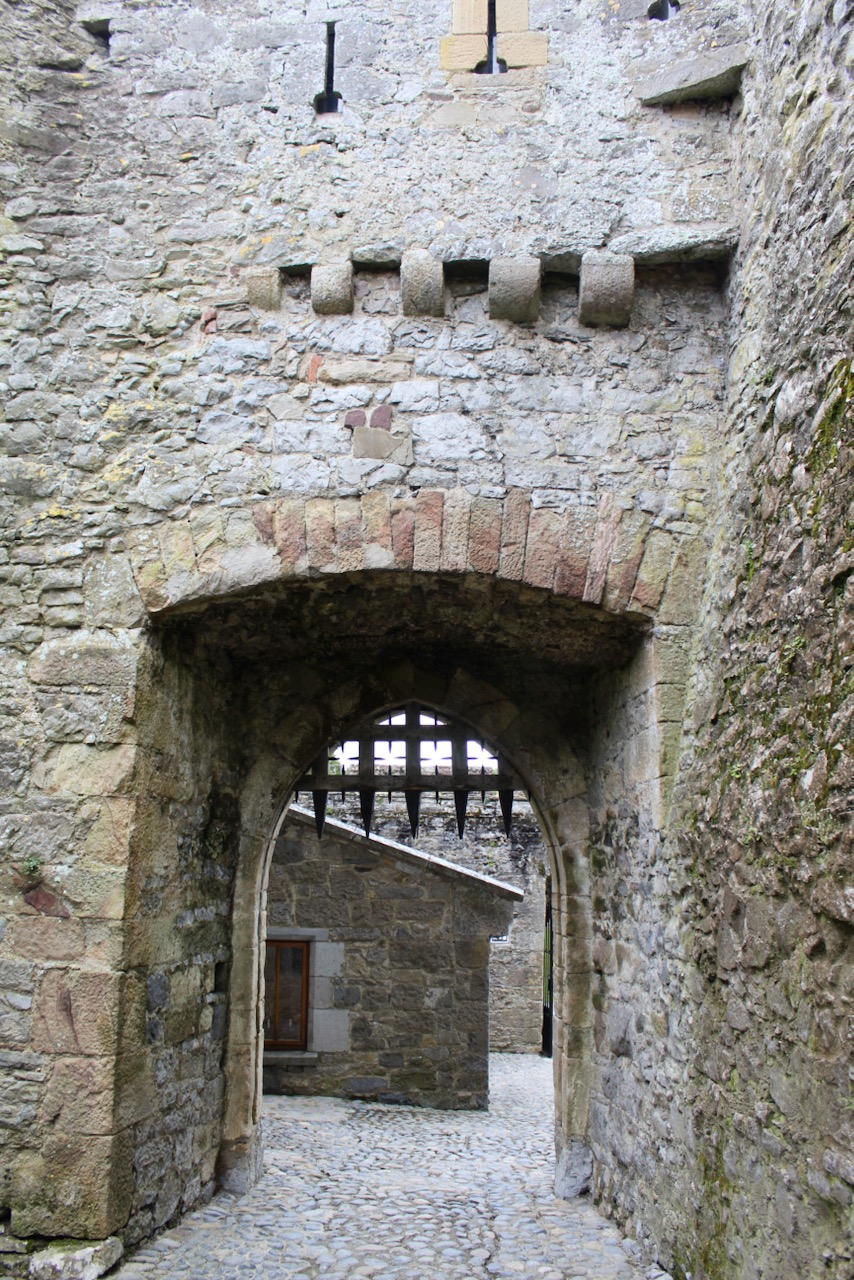
Once one gets through the second gate, the invader would have to get through the portcullis, pictured here. Photograph © Jennifer Winder-Baggot, www.irishhistorichouses.com
The portcullis, from the other side. Photograph © Jennifer Winder-Baggot, www.irishhistorichouses.com
The mechanism for working the portcullis. Photograph © Jennifer Winder-Baggot, www.irishhistorichouses.com

Once invaders get through the portcullis they are trapped in a small area, where defenders can fire arrows and stones at them. The walls of this area slope outwards towards the bottom, known as a base batter, so falling rocks bounce off them to hit the invaders.

The core of the castle is the keep.

The square central keep of Cahir Castle, with watch tower, and river as moat, and entrance gate topped by eagle. Photograph © Jennifer Winder-Baggot, www.irishhistorichouses.com
Cahir Castle, June 2022. Photograph © Jennifer Winder-Baggot, www.irishhistorichouses.com
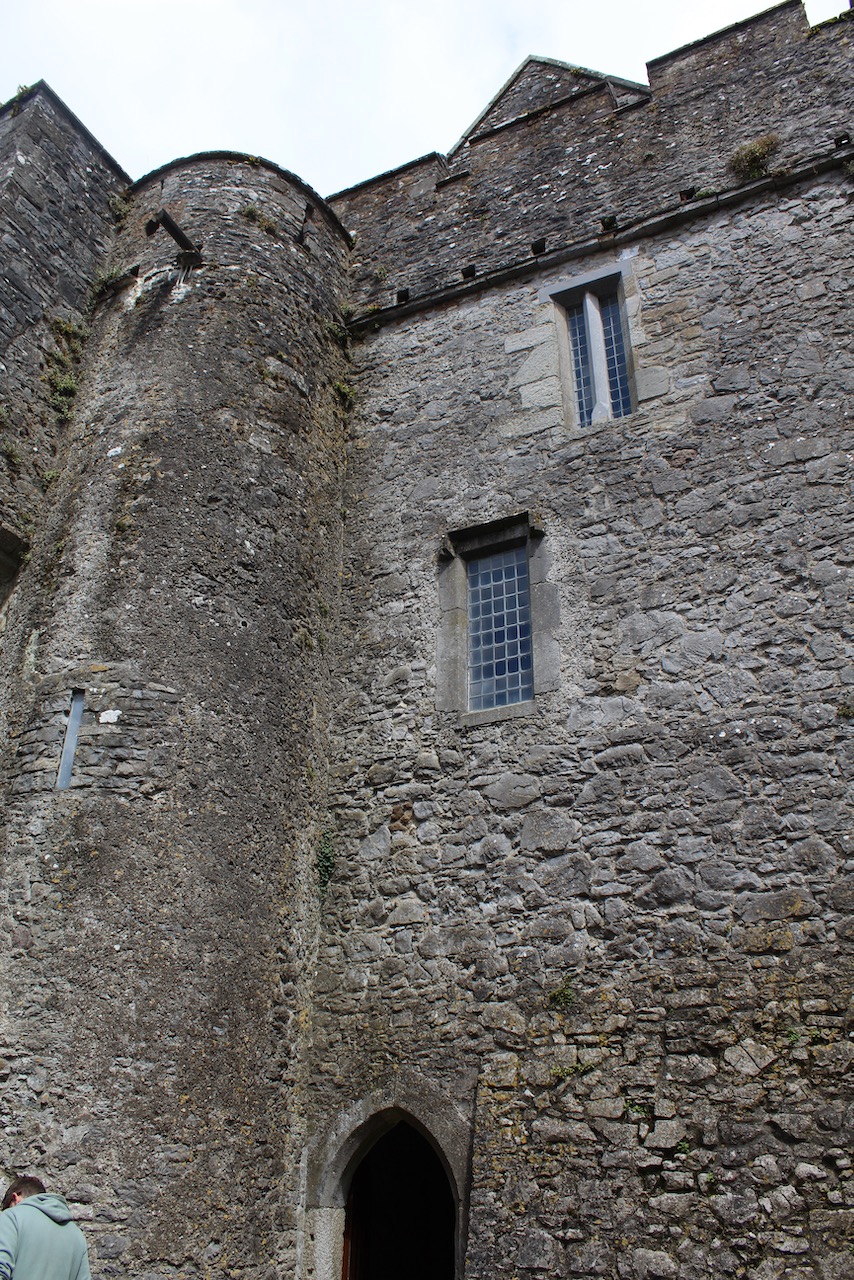
The Castle Keep. The door is protected by a machicolation, and through the door you can see a cross shaped gun loop so the defenders can shoot invaders. Inside the door is the spiral staircase. Photograph © Jennifer Winder-Baggot, www.irishhistorichouses.com

Oliver Cromwell took the castle in 1650 and the occupants, under the 4th Baron Caher Piers Butler (d. 1676), surrendered peacefully.

The Butlers of Ormond also had to forfeit their land in the time of Oliver Cromwell’s Protectorate. Both branches of the Butlers had their lands restored with the restoration of the monarchy with Charles II in 1662.

The Cahir website continues: “At the restoration of Charles II, in 1660, George Matthews, (as Warden of Cahir Castle and half-brother to the Duke of Ormond), retained the Cahir lands for the Lord Cahir, then a minor.” [4] George Matthew (or “Mathew,” 1645-1735) was married to Eleanor Butler, daughter of Edmond Butler, 3rd/13th Baron Dunboyne. She seems to have married twice: first to Edmond Butler son of 3rd Baron Cahir, then to to George Matthew. Her son was Piers Butler, 4th Baron Cahir, who was just seven when his father died.

Piers Butler 4th Baron Cahir (1641-1676) married George Mathew’s niece, Elizabeth Mathew (1647-1704). They had no male issue, but two daughters. His daughter Margaret married Theobald Butler, 5th Baron Cahir (d. 1700), great-grandson of the 1st Baron Cahir.

Margaret Butler daughter of the 4th Baron Cahir was the 5th Baron Cahir’s second wife. His first wife, Mary Everard, gave birth to his heir, Thomas (1680-1744), 6th Baron Cahir. Thomas had several sons, who became 7th (d. 1786) and 8th Barons Cahir (d. 1788), but they did not have children, so that title went to a cousin, James Butler (d. 1788), who became 9th Baron Cahir.

Prisoners’ tower at Cahir Castle. Photograph © Jennifer Winder-Baggot, www.irishhistorichouses.com
Cahir Castle, June 2022.
Cahir Castle, June 2022. Photograph © Jennifer Winder-Baggot, www.irishhistorichouses.com
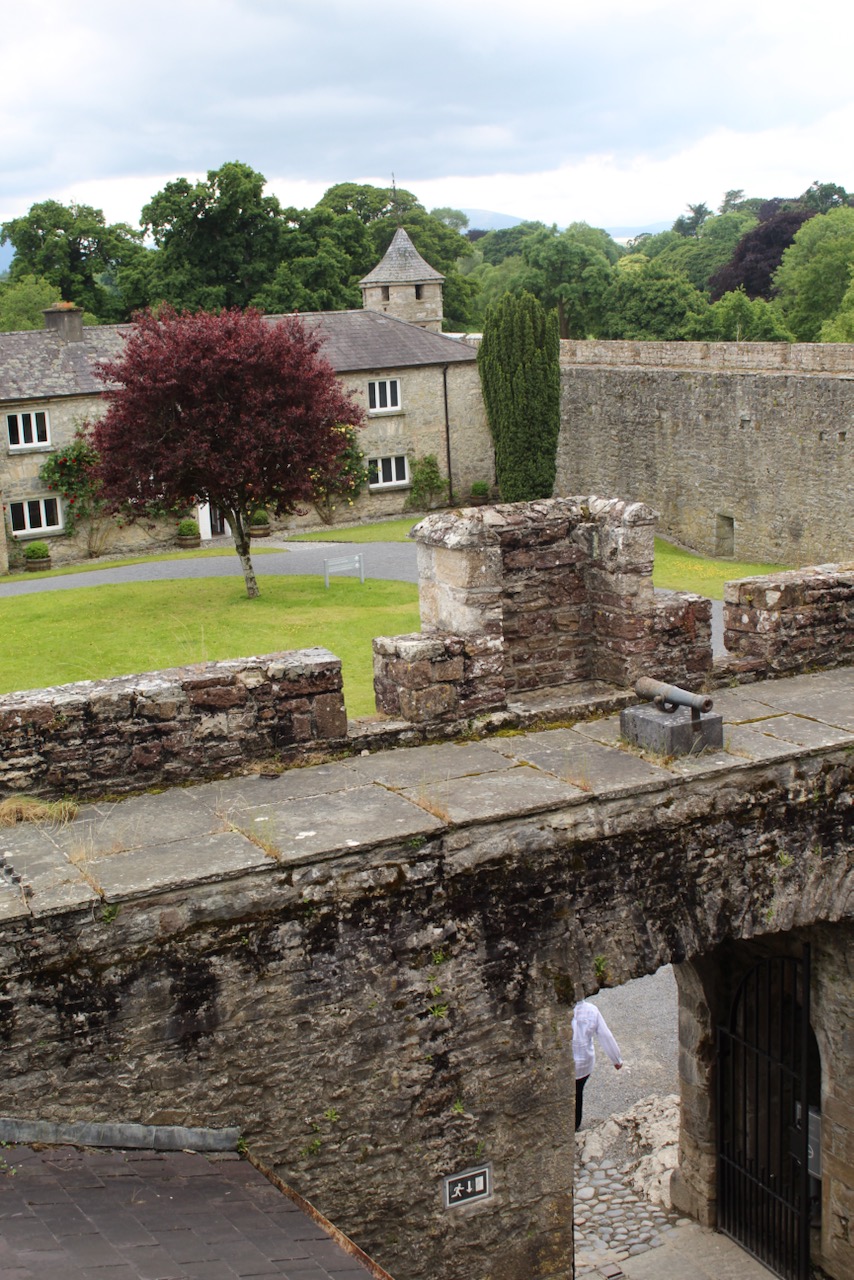
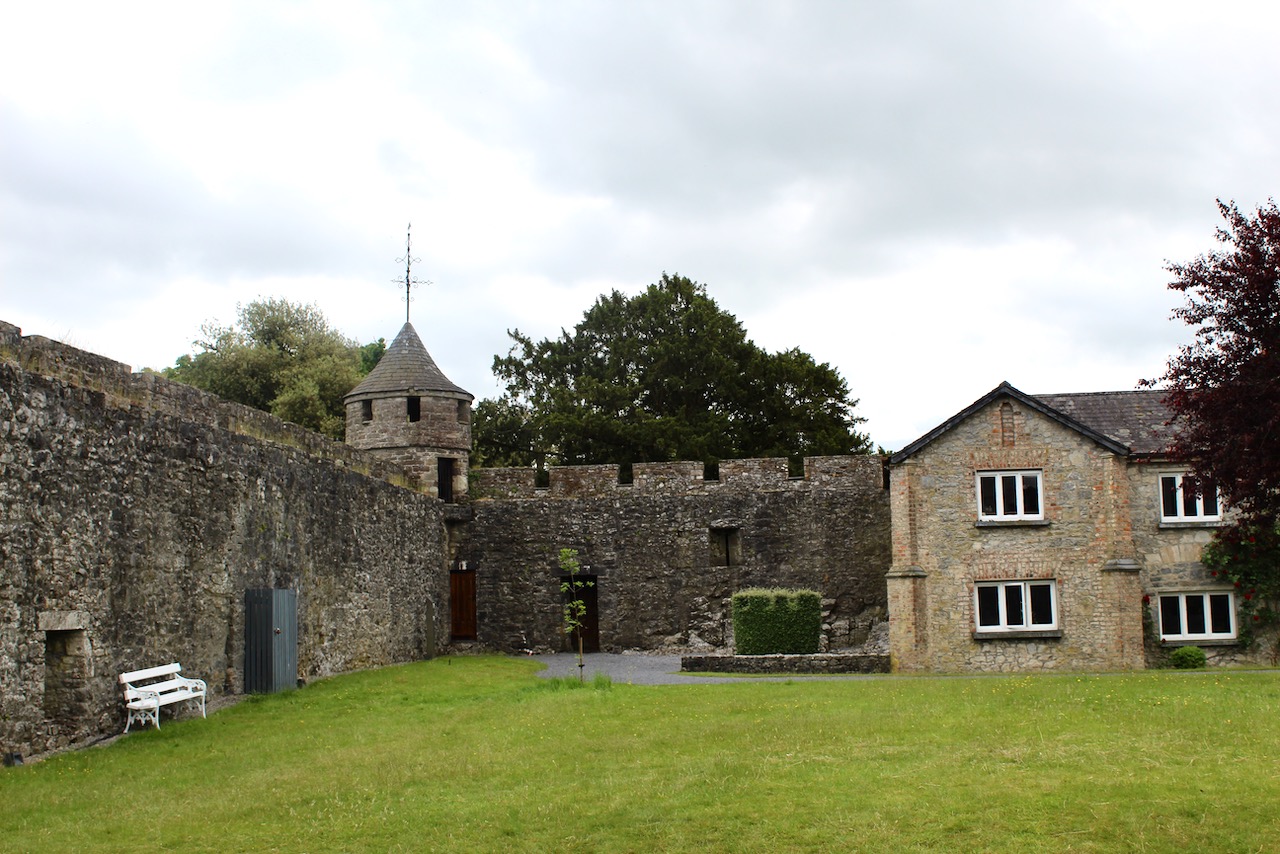
Inside the barbican walls, Cahir Castle. Cahir Cottage was built by the Butler family in the 19th century. Photograph © Jennifer Winder-Baggot, www.irishhistorichouses.com

The Cahir website tells us: “Despite embracing the Jacobite Cause in the Williamite Wars, the Cahir estate remained relatively intact. However, the Butlers never again lived at Cahir Castle but rather at their country manor, Rehill House, where they lived in peace and seclusion from the mid-seventeenth century, when not living abroad in England and France.

“…By 1700 a sizeable town had grown around the Castle, although hardly any other buildings survive from this period. Agriculture, milling and a wide range of trades would have brought quite a bustle to the muddy precursors of our present streets. At this time, the Castle was quite dilapidated and was let to the Quaker William Fennell, who resided and kept a number of wool combers at work there.” [4]

The castle layout was changed considerably and enlarged during work to repair some of the damage caused by the battles, but was then left abandoned until 1840 when the partial rebuilding of the Great Hall took place. [4]

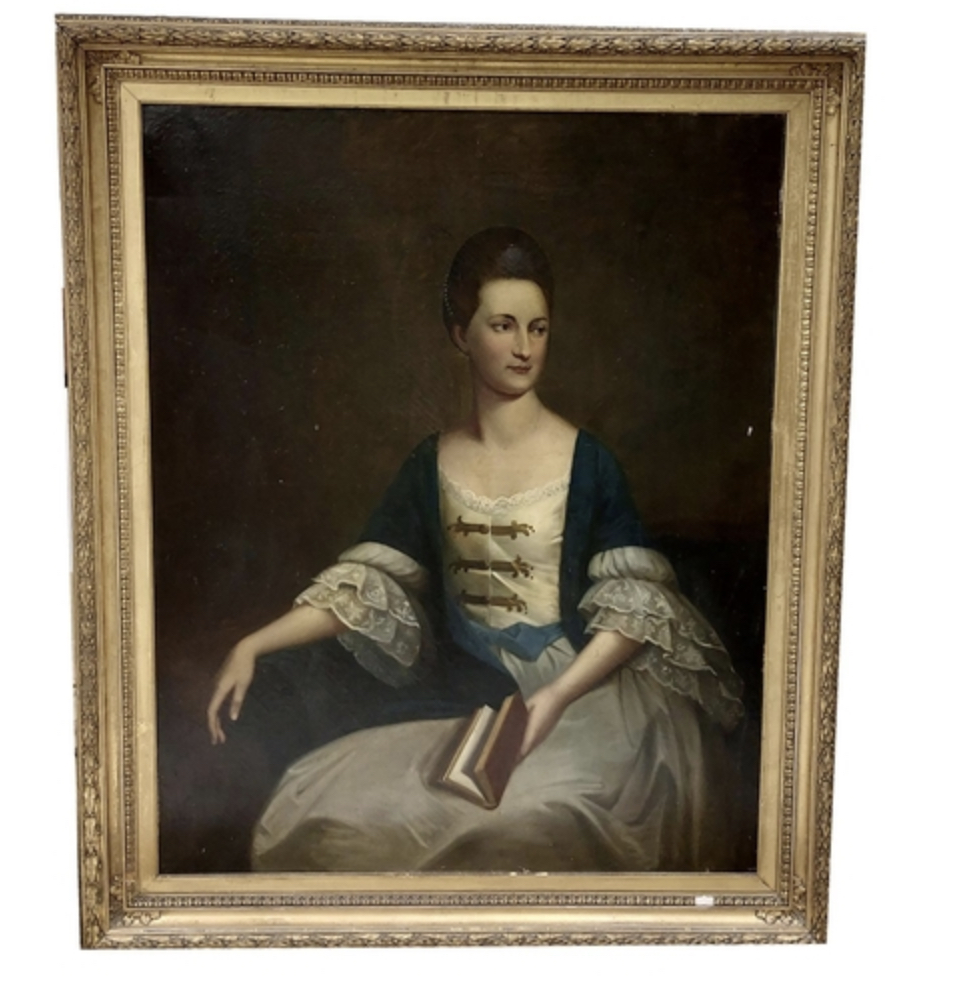
Female member of Butler family, Cahir Castle, courtesy of Fonsie Mealy auction.

The Cahir website tells us: “On the completion of Cahir House [in the town, now Cahir House Hotel] in the later 1770’s, Fennell rented Rehill House from Lord Cahir and lived there over half a century. [The Barons moved to Cahir House.] A strong Roman Catholic middle class emerged. James [d. 1788], 9th Lord Cahir [d. 1788], practiced his religion openly. He maintained strong links with Jacobite France, and paid regular visits to England. While not a permanent resident, he kept his Cahir Estates in impeccable order and was largely responsible for the general layout of the Town of Cahir. Under his patronage, some of the more prominent buildings such as Cahir House, the Market House and the Inn were built during the late 1770s and early 1780s. In addition, the Quakers built the Manor Mills on the Bridge of Cahir, the Suir Mills (Cahir Bakery), and the Cahir Abbey Mills in the period 1775-90.” [4]

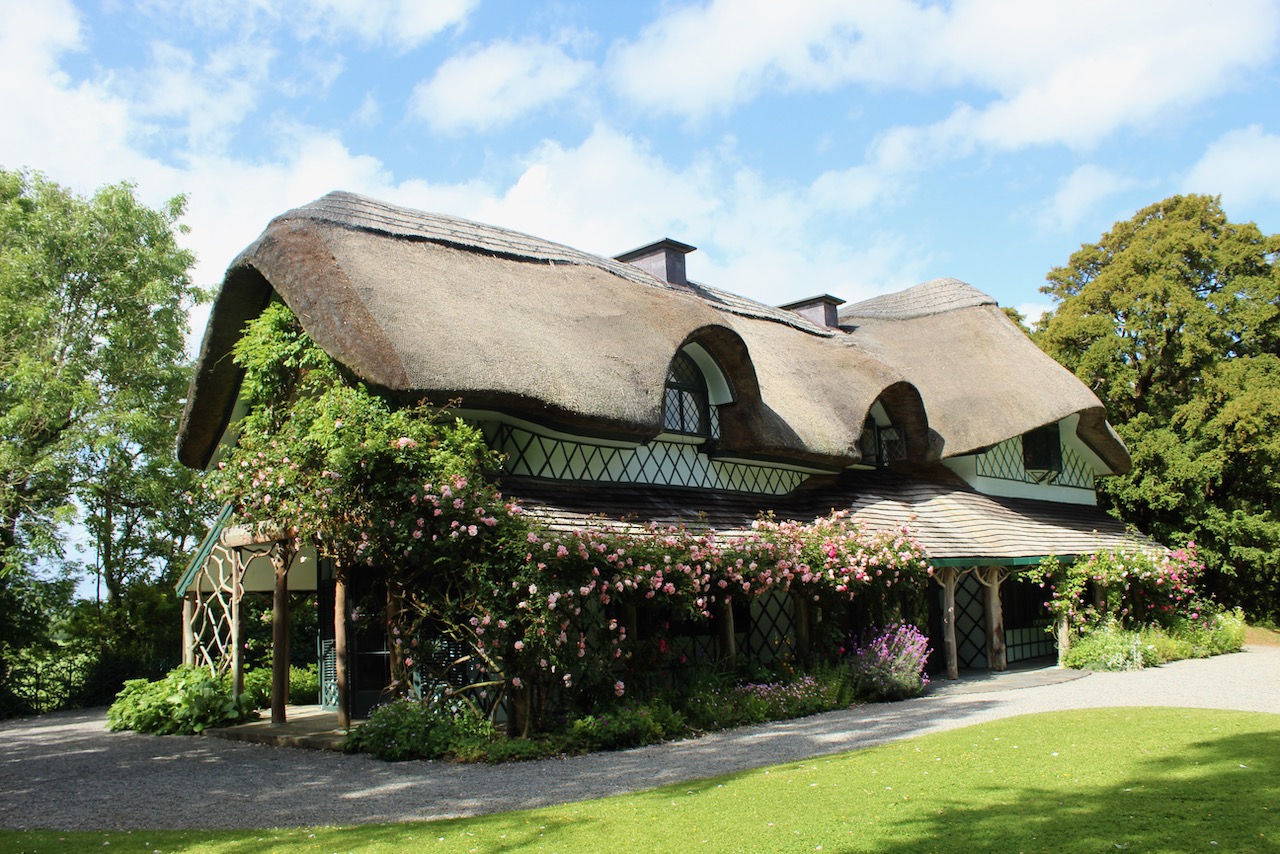
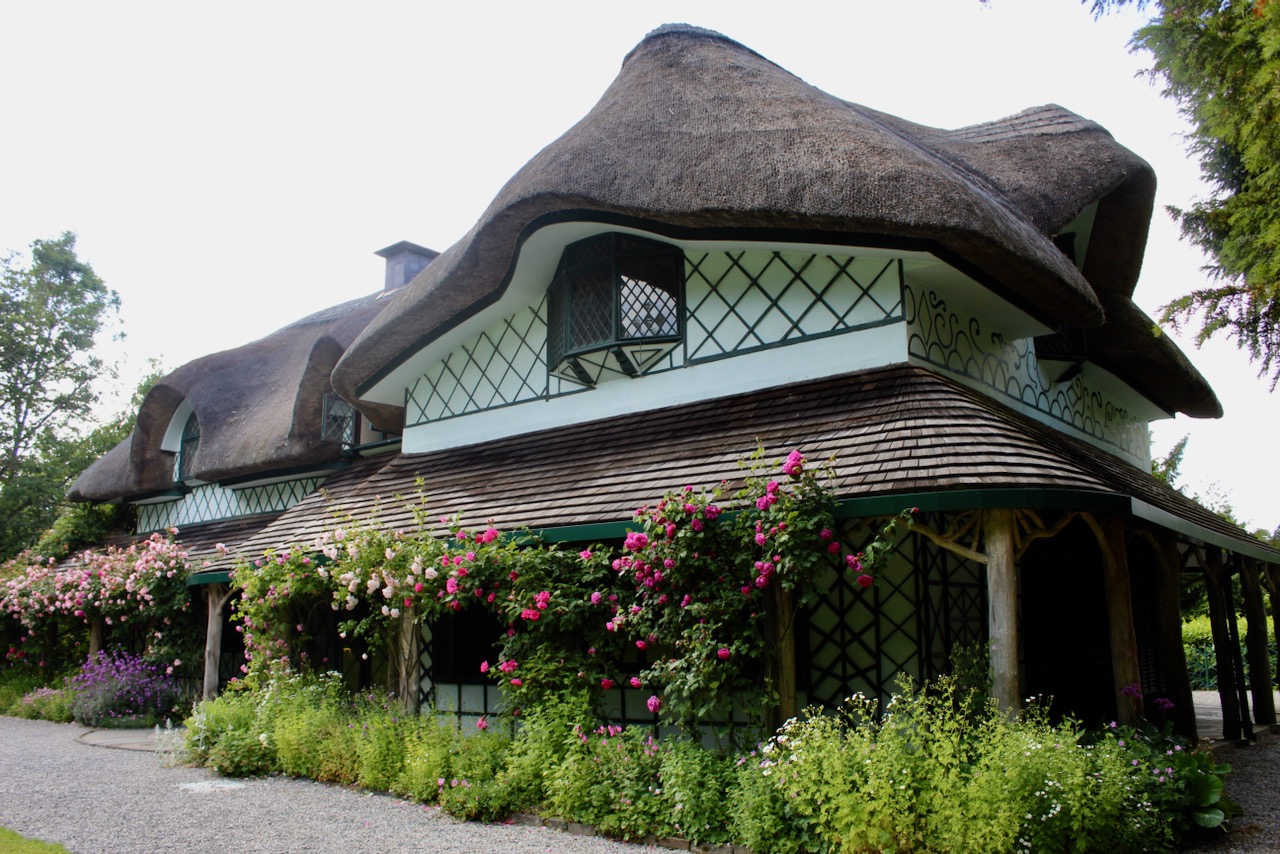
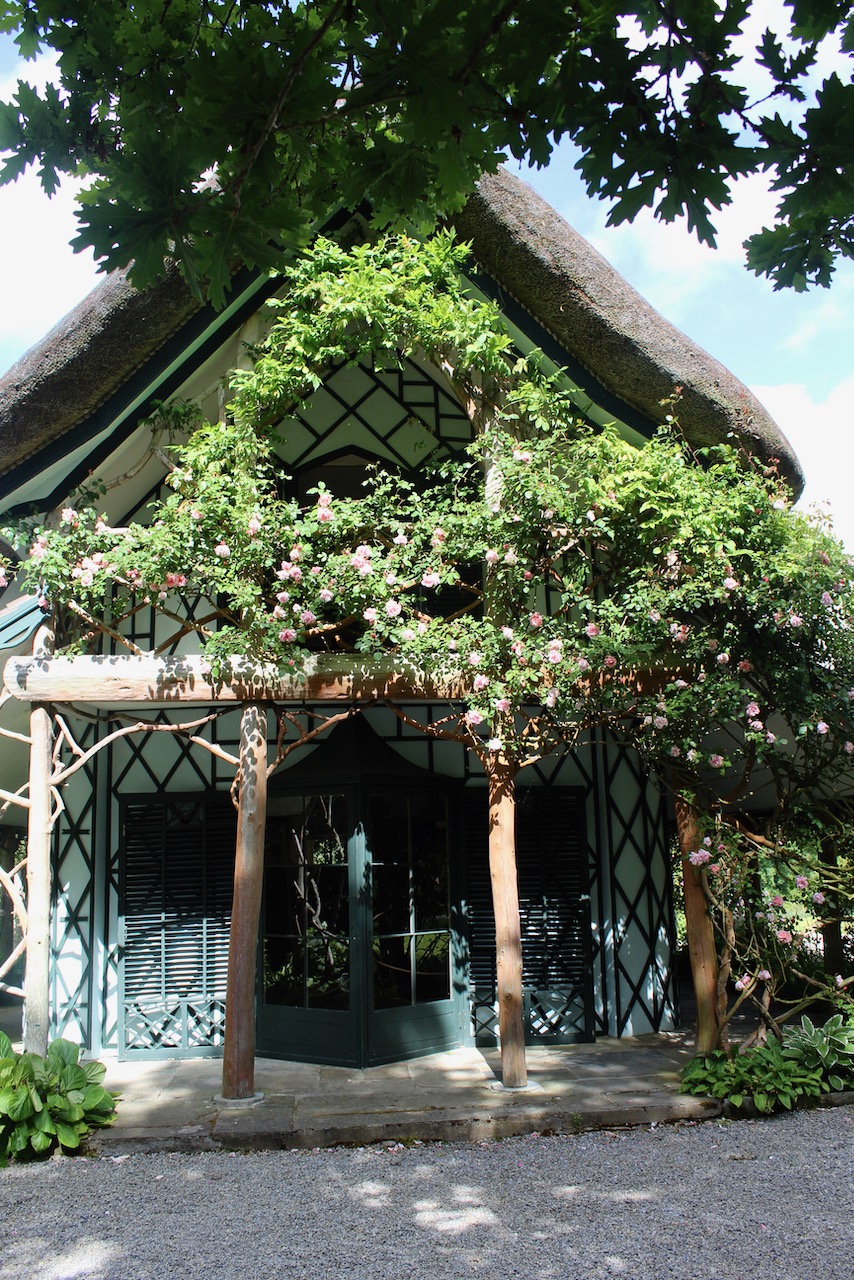
The son of the 9th Baron Cahir, Richard (1775-1819), became 10th Baron and 1st Earl of Glengall. It was he and his wife who had the Swiss Cottage built outside Cahir.

Swiss Cottage, County Tipperary. Photograph © Jennifer Winder-Baggot, www.irishhistorichouses.com

… The young Lord Cahir married Miss Emily Jeffereys of Blarney Castle and together they led Cahir through the most colourful period of its development…Richard, Lord Cahir, sat in The House of Lords as one of the Irish Representative Peers, and in 1816 was created Earl of Glengall, a title he enjoyed for just 3 years. He died at Cahir House of typhus in January 1819, at the age of 43 years. Richard, Viscount Caher, (now 2nd Earl of Glengall), had already taken his place in political circles while his mother, Emily, ran the Estate with an iron fist.” [4]

Richard Butler (1794-1858) 2nd Earl of Glengall, by Richard James Lane, lithograph, 1854, National Portrait Gallery of London D22384.
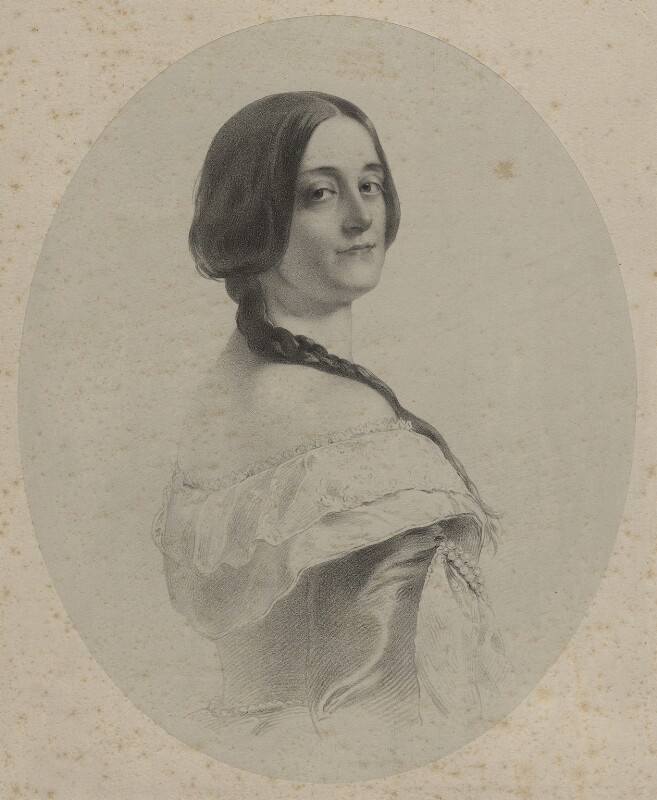
Margaret Lauretta Butler (née Mellish), Countess of Glengall, wife of the 2nd Earl of Glengall by Richard James Lane courtesy of National Portrait Gallery London NPG D22383.
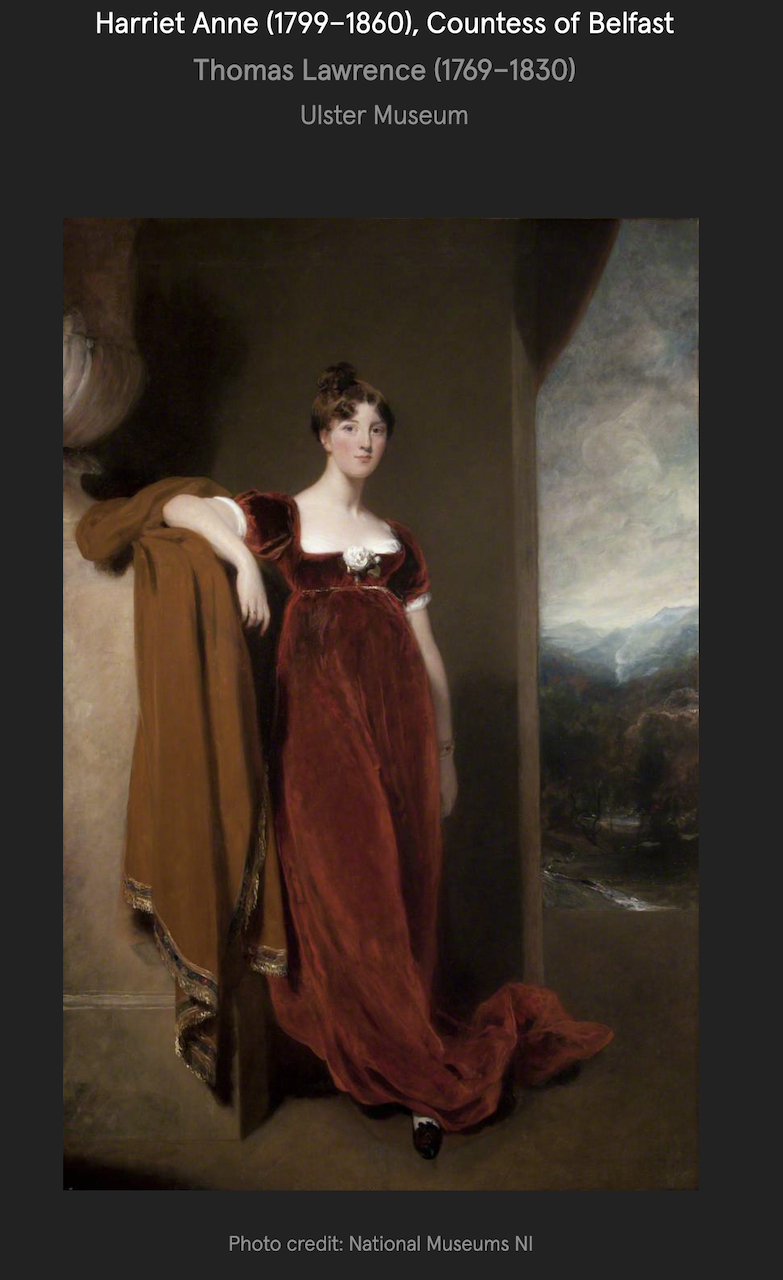
Harriet Anne née Butler (1799-1860) Countess of Belfast, wife of George Hamilton Chichester 3rd Marquess of Donegal and daughter of Richard Butler, 1st Earl of Glengall.
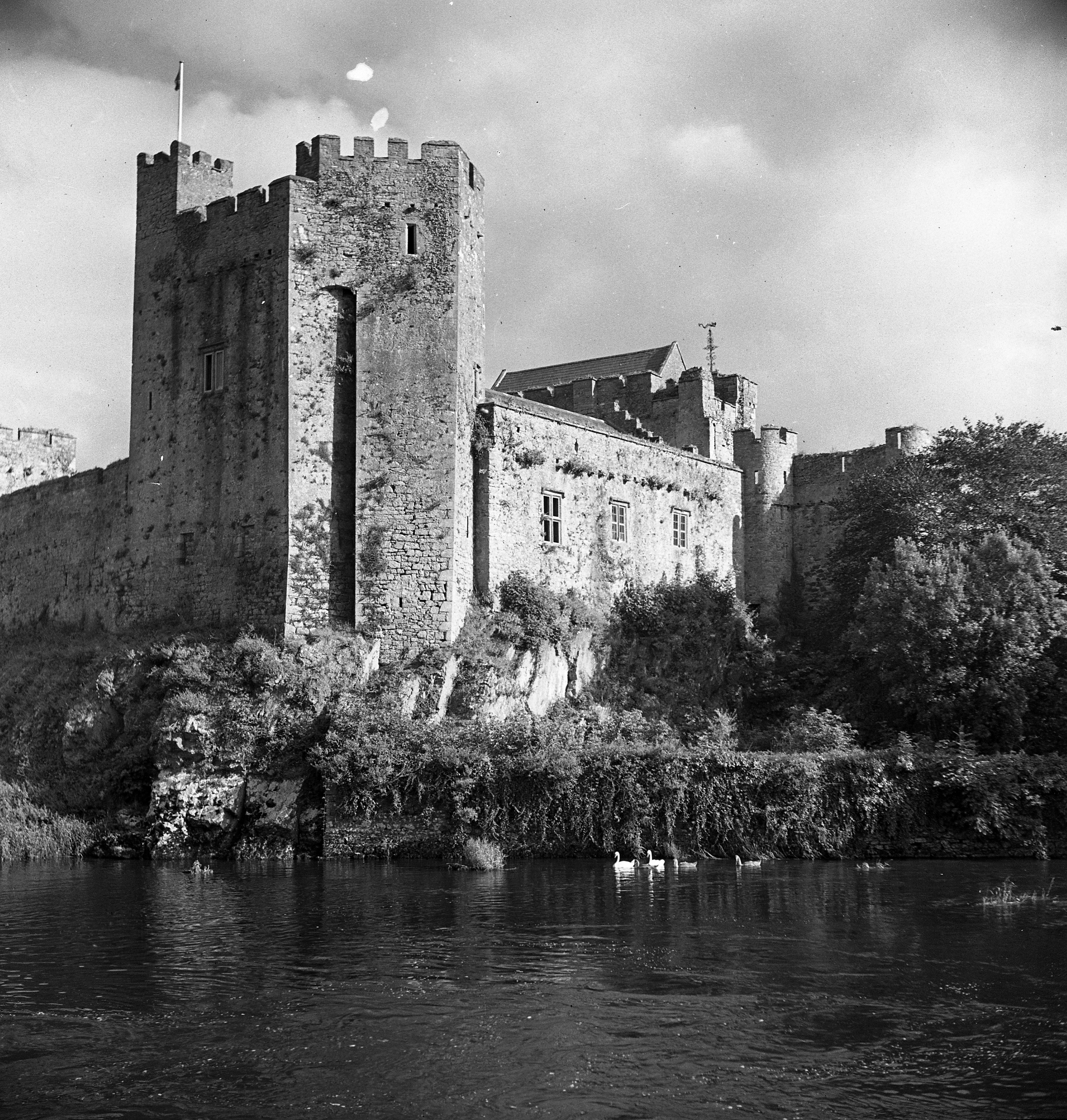
Cahir Castle 1943, photograph from Dublin City Library archives. [5]

During the Great Famine (1846-51), Lord and Lady Glengall did much for the relief of the poor and the starving. Lord Glengall’s town improvement plan was shelved in 1847 due to a resulting lack of funds and his wife’s fortune being tied up in a Trust Fund. The Cahir Estates were sold in 1853, the largest portion being purchased by the Trustees of Lady Glengall. This sale came about due to Lord Glengall being declared bankrupt. The Grubbs had by now become the most important Quaker family in the district and bought parts of the Cahir Estate during the 1853 sale...

In the interim, Lady Margaret Butler (elder daughter and heir of Lord Glengall) had married Lieut. Col. Hon. Richard Charteris, 2nd son of the 9th Earl of Wemyss & March. Using a combination of her mother’s Trust and Charteris funds, Cahir Town and Kilcommon Demesne were repurchased.  

Lady Margaret, although an absentee landlord, resident in London, kept a close watch on her Cahir Estates through two excellent managers, Major Hutchinson and his successor William Rochfort… Her son, Richard Butler Charteris took over her role in 1915 and remained resident in Cahir from 1916 until his death in 1961. In 1962, the House, and circa 750 acre estate core (within the walls of Cahir Park and Kilcommon Demesne) were auctioned…And so ended the direct line of Butler ownership in Cahir, almost 600 years. [4]

The castle became the property of the state after the death of Lord Cahir in 1961; it was classified as a national monument and taken into the care of the Office of Public Works. [6]

Cahir Castle, June 2022. Photograph © Jennifer Winder-Baggot, www.irishhistorichouses.com
The great hall, and adjoining guest accommodation in the northwest tower. This 13th century building was attached to the keep, but in 1840 it was shortened, leaving the original fireplace in the open outside. Photograph © Jennifer Winder-Baggot, www.irishhistorichouses.com
Great Hall and northwest tower of Cahir Castle. Photograph © Jennifer Winder-Baggot, www.irishhistorichouses.com
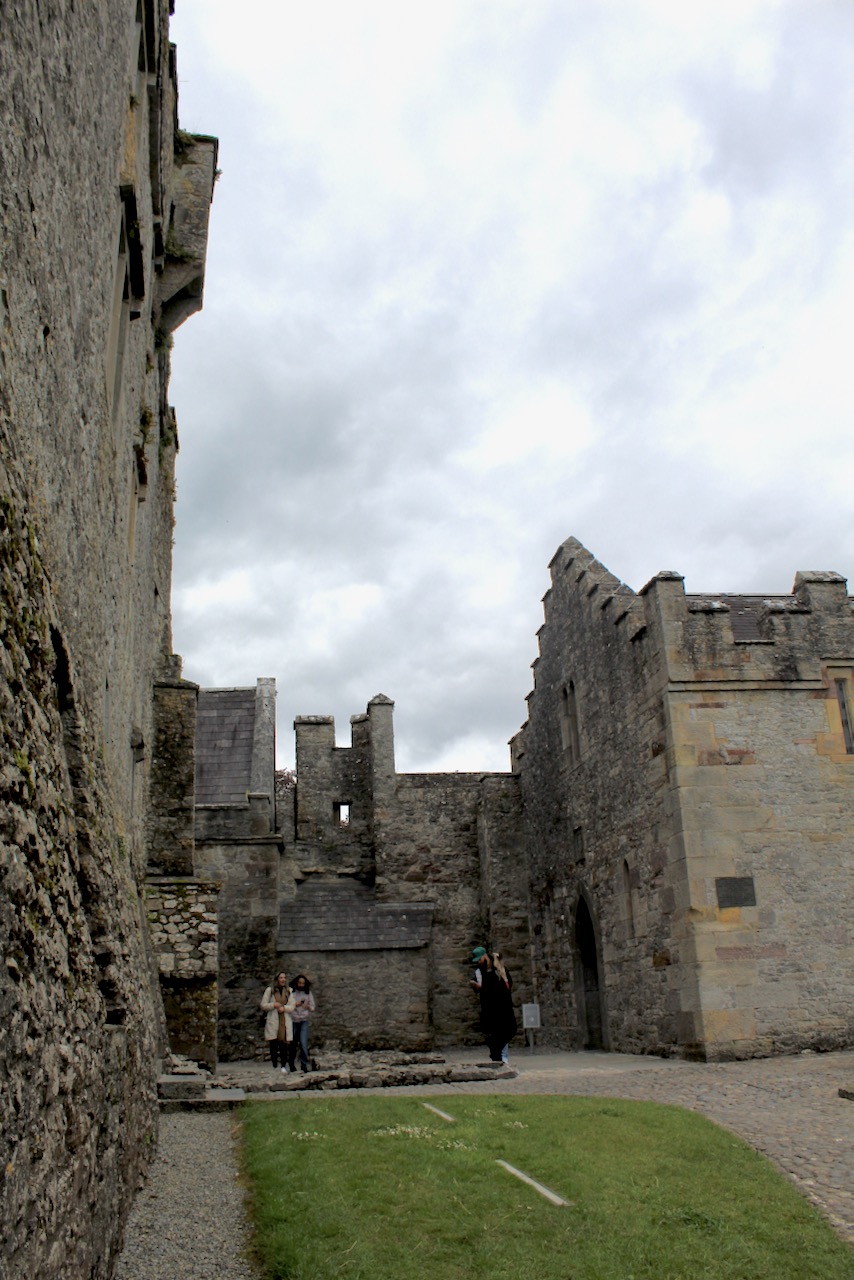
The end of the Great Hall, with its stepped gable. It was originally attached to the keep, pictured on the left. Photograph © Jennifer Winder-Baggot, www.irishhistorichouses.com
This is the exposed fireplace, which was in the now foreshortened Great Hall. Photograph © Jennifer Winder-Baggot, www.irishhistorichouses.com

Our tour guide took us through the outside of the castle, showing us its defenses. Our tour ended inside the Great Hall, or dining hall.

The Great Hall, with giant Irish elk antlers. The fireplace is not genuine – it is made of papier mache and was installed for the filming of a movie. Photograph © Jennifer Winder-Baggot, www.irishhistorichouses.com p.s. we saw a movie recently filmed in Cahir Castle, “The Last Duel” with Matt Damon, Adam Driver and Jodie Comer, and it was brilliant! I highly recommend it.

The dining hall has a magnificent ceiling. The building would have originally been of two storeys, and taller. The appearance today owes much to restoratation work carried out by William Tinsley in 1840, when the building was converted into a private chapel for the Butler family. The hammer-beam roof and the south and east wall belong to this period. The external wall dates from the 13th century.

Ceiling of the Great Hall, Cahir Castle. Photograph © Jennifer Winder-Baggot, www.irishhistorichouses.com
Inside the northwest tower of Cahir Castle. Photograph © Jennifer Winder-Baggot, www.irishhistorichouses.com
Upstairs in the northwest tower. It is fitted with fifteenth century windows and has a Tudor fireplace inserted where the original portcullis machinery was housed. Photograph © Jennifer Winder-Baggot, www.irishhistorichouses.com
The stairs to the upper level of the northwest tower are spiral. Photograph © Jennifer Winder-Baggot, www.irishhistorichouses.com
I love the passageways between the walls of the castle. Photograph © Jennifer Winder-Baggot, www.irishhistorichouses.com
Top floor of the northwest tower. Photograph © Jennifer Winder-Baggot, www.irishhistorichouses.com

Next we explore the keep building.

Cahir Castle, June 2022. Photograph © Jennifer Winder-Baggot, www.irishhistorichouses.com
One can descend these steps and up again on the other side for a view over the river. Photograph © Jennifer Winder-Baggot, www.irishhistorichouses.com

[1] https://www.irelandscontentpool.com/en

[2] p. 58. Hayes, William and Art Kavanagh, The Tipperary Gentry volume 1 published by Irish Family Names, c/o Eneclann, Unit 1, The Trinity Enterprise Centre, Pearse Street, Dublin 2, 2003.

[3] http://www.thepeerage.com/index.htm and G.E. Cokayne; with Vicary Gibbs, H.A. Doubleday, Geoffrey H. White, Duncan Warrand and Lord Howard de Walden, editors, The Complete Peerage of England, Scotland, Ireland, Great Britain and the United Kingdom, Extant, Extinct or Dormant, new ed., 13 volumes in 14 (1910-1959; reprint in 6 volumes, Gloucester, U.K.: Alan Sutton Publishing, 2000), volume IX, page 440.

[4] http://www.cahirhistoricalsociety.com/articles/cahirhistory.html

[5] https://repository.dri.ie/

[6] http://www.britainirelandcastles.com/Ireland/County-Tipperary/Cahir-Castle.html

Text © Jennifer Winder-Baggot, www.irishhistorichouses.com

Office of Public Works properties in County Tipperary

I had initially published the County Tipperary OPW sites along with Munster counties of Clare and Limerick but the entry is too long so I am dividing it.

OPW sites in County Tipperary:

1. Cahir Castle, County Tipperary

2. Damer House and Roscrea Castle, County Tipperary

3. Famine Warhouse 1848, County Tipperary

4. Holycross Abbey, County Tipperary – must prebook for tour

5. The Main Guard, County Tipperary – closed at present

6. Nenagh Castle, County Tipperary

7. Ormond Castle, Carrick-on-Suir, County Tipperary

8. Rock of Cashel, County Tipperary

see 2. Roscrea Castle and Damer House, County Tipperary

9. Swiss Cottage, County Tipperary

donation

Help me to pay the entrance fee to one of the houses on this website. This site is created purely out of love for the subject and I receive no payment so any donation is appreciated!

€15.00

Photograph © Jennifer Winder-Baggot, www.irishhistorichouses.com

1. Cahir Castle, County Tipperary:

Cahir Castle, photograph from Ireland’s Content pool, by Brian Morrison 2014 for Failte Ireland. [see 1]
Cahir Castle, June 2022. The geese are particularly picturesque! The outer walls are called the Barbican. When breached, the attacking force gains entry to this area and are vulnerable to missiles fired by defenders and it would be difficult to retreat, due to the enclosed nature of the barbican. Photograph © Jennifer Winder-Baggot, www.irishhistorichouses.com

General information: 052 744 1011, cahircastle@opw.ie

Stephen and I visited Cahir Castle in June 2022, and I was very impressed. I had no idea that we have such an old castle in Ireland with so much intact. See my entry https://irishhistorichouses.com/2024/03/29/cahir-castle-county-tipperary-an-office-of-public-works-property/

From the OPW website https://heritageireland.ie/visit/places-to-visit/cahir-castle/:

Cahir Castle is one of Ireland’s largest and best-preserved castles. It stands proudly on a rocky island on the River Suir.

The castle was was built in the thirteenth century and served as the stronghold of the powerful Butler family. [The Archiseek website tells us it was built in 1142 by Conor O’Brien, Prince of Thomond] So effective was its design that it was believed to be impregnable, but it finally fell to the earl of Essex in 1599 when heavy artillery was used against it for the first time. During the Irish Confederate Wars it was besieged twice more.

At the time of building, Cahir Castle was at the cutting edge of defensive castle design and much of the original structure remains.

Our tour guide took us through the outside of the castle, showing us its defenses. Our tour ended inside the Great Hall, or dining hall.

The Great Hall, with giant Irish elk antlers. The fireplace is not genuine – it is made of papier mache and was installed for the filming of a movie. Photograph © Jennifer Winder-Baggot, www.irishhistorichouses.com

2. Damer House and Roscrea Castle, County Tipperary

https://heritageireland.ie/places-to-visit/roscrea-castle-gardens-damer-house-black-mills/

In the heart of Roscrea in County Tipperary, one of the oldest towns in Ireland, you will find a magnificent stone motte castle dating from the 1280s. It was used as a barracks from 1798, housing 350 soldiers, and later served as a school, a library and even a sanatorium.

Sharing the castle grounds is Damer House, named for local merchant John Damer, who came into possession of the castle in the eighteenth century. The house is a handsome example of pre-Palladian architecture. It has nine beautiful bay windows. One of the rooms has been furnished in period style.

The grounds also include an impressive garden with a fountain, which makes Roscrea Castle a very pleasant destination for a day out. There is also a restored mill displaying St Crónán’s high cross and pillar stone.” See my entry https://irishhistorichouses.com/2024/10/03/damer-house-and-roscrea-castle-county-tipperary-office-of-public-works-properties/

3. Famine Warhouse 1848, Ballingarry, County Tipperary:

General information: 087 908 9972, info@heritageireland.ie

From the OPW website https://heritageireland.ie/visit/places-to-visit/famine-warhouse-1848/:

How did an ordinary farmhouse near Ballingarry, County Tipperary, become the site of a bloody siege and a monument of the Young Irelander Rebellion of 1848?

It was here that rebels, under the leadership of Protestant aristocrat William Smith O’Brien, besieged 47 police officers who had barricaded themselves into the McCormack homestead, taking 5 children hostage. After two of their number were killed, the rebels finally gave in. They were later transported to penal colonies abroad.

The Warhouse, as it became known, is now a museum. Its contents illuminate the history of the Young Irelander Rebellion, the trials of its leaders, their exile in Australia and escape to the USA. The exhibition places the rebellion in the context of the Great Famine and the upheaval that rocked Europe during that turbulent year.

Traditionally it was known as Ballingarry Warhouse or The Widow McCormack’s House.

4. Holycross Abbey, County Tipperary:

Holycross Abbey, photograph from Ireland’s Content pool, by Liam Murphy 2016 for Failte Ireland [see 1]

From the OPW website https://heritageireland.ie/visit/places-to-visit/holycross-abbey/:

As destination for pilgrims, Holy Cross Abbey, near Thurles, County Tipperary, has a rich history. Pilgrims travelled here for eight centuries to venerate the relic after which the abbey and surrounding villages are named – a piece of the True Cross of Christ’s crucifixion.

Today this working parish church is a peaceful landmark and a place for quiet contemplation and historical discovery. As well as inspecting the relic of the cross, you can marvel at the building’s ornate stonework. The chancel is possibly the finest piece of fifteenth-century architecture in the country. The abbey also houses one of the only surviving medieval wall paintings in Ireland.

5. The Main Guard, Sarsfield Street, Clonmel, County Tipperary:

The Main Guard, or Clonmel Courthouse, County Tipperary. Photograph from National Inventory of Architectural Heritage: five-bay two-storey courthouse and market house, built 1673, with arcaded ground floor to front and north gable, and pediment and cupola to roof. Until restored c.2000, building had been five-bay three-storey with triple public house front to ground floor, and timber sliding sash windows. Now in use as museum. The columns of the arcaded facades were recycled from the ruins of the Cistercian abbey of Inislounaght, to the west of the town and retain some decorative elements that testify to this fact. 

General Information: 052 612 7484, mainguard@opw.ie

From the OPW website https://heritageireland.ie/visit/places-to-visit/the-main-guard/:

In the seventeenth century County Tipperary was a palatinate, ruled by James Butler, duke of Ormond. When the duke decided he needed a new courthouse, he built one in the heart of Clonmel [built in 1673]. Later, when it was used as a barracks, it became known as the Main Guard.

A fine two-storey symmetrical building, some elements of its design were based on works by the famous Sir Christopher Wren.

In the eighteenth century it was the venue for the Clonmel Assizes. The most notable trial it witnessed was that of Father Nicholas Sheehy, the anti-Penal Laws agitator. Sheehy was hanged, drawn and quartered.

In about 1810, the ground floor was converted into shops, but the building has recently undergone an award-winning restoration. The open arcade of sandstone columns is once again an attractive feature of the streetscape, while inside you will find a fantastic exhibition and event space.

Main Guard, 1948, photograph from Dublin City Library and Archives. [2]

6. Nenagh Castle, County Tipperary

Nenagh Castle, photograph by Brian Morrison, 2017, for Tourism Ireland, Ireland’s Content Pool. [see 1]

General information: 067 33850, castlenenagh@gmail.com

The OPW doesn’t seem to have a site for this currently, but there is information at a site about Nenagh:

Nenagh Castle was built by Theobald Walter (the first of the Butlers of Ormond) around 1200. To this day the cylindrical keep adorns the town and like most keeps it formed part of the perimeter of the fortress. The walls have now almost disappeared, but fragments remain. 

Built from limestone Nenagh Castle measures fifty-five feet in external diameter at the base and rises to a height of one hundred feet. The Castle features four storeys and thanks to a recent renovation this wonderful landmark now represents the town’s premier tourist attraction.

The building and has stone spiral stairs to the top. There are 101 steps in all to the top.  Access to the tower is through a passageway within the base of the wall.  This has low head room and visitors will need to stoop to avoid hitting the stone above. All children under the age of 18 must be accompanied by an adult. [3]

Nenagh Castle, photograph by Brian Morrison, 2017, for Tourism Ireland, Ireland’s Content Pool. [see 1]

7. Ormond Castle, Carrick-on-Suir, County Tipperary:

Ormond Castle, Carrick-on-Suir, County Tipperary, May 2018. Maurice Craig tells us in The Architecture of Ireland from the earliest times to 1880 that in style Carrick-on-Suir is like hundreds of buildings in Northamptonshire or the Cotswolds, but like no other in Ireland. Photograph © Jennifer Winder-Baggot, www.irishhistorichouses.com

See my entry https://irishhistorichouses.com/2024/09/05/ormond-castle-carrick-on-suir-county-tipperary-an-opw-property/

General Information: 051 640787, ormondcastle@opw.ie

From the OPW website https://heritageireland.ie/visit/places-to-visit/ormond-castle/:

Joined on to an earlier medieval riverside castle, Ormond Castle Carrick-on-Suir is the finest example of an Elizabethan manor house in Ireland. Thomas, 10th Earl of Ormond [“Black Tom” (1531-1614)], built it in 1565 in honour of his distant cousin Queen Elizabeth. 

The magnificent great hall, which stretches almost the whole length of the building is decorated with some of the finest stucco plasterwork in the country. The plasterwork features portraits of Queen Elizabeth and her brother Edward VI and many motifs and emblems associated with the Tudor monarchy.

Ormond Castle, Carrick-on-Suir 1949, photograph from Dublin City Library and Archive. [see 2]

James Butler the 12th Earl of Ormond and 1st Duke of Ormond (1610-1688) spent much of his time here and was the last of the family to reside at the castle. On his death in 1688 the family abandoned the property and it was only handed over to the government in 1947, who then became responsible for its restoration. 

7. Rock of Cashel, County Tipperary:

Rock of Cashel, Co Tipperary photograph from Ireland’s Content pool, by Brian Morrison 2018 for Failte Ireland. [see 1]

General Information: 062 61437, rockofcashel@opw.ie

From the OPW website https://heritageireland.ie/visit/places-to-visit/rock-of-cashel/:

Set on a dramatic outcrop of limestone in the Golden Vale, the Rock of Cashel, iconic in its historic significance, possesses the most impressive cluster of medieval buildings in Ireland. Among the monuments to be found there is a round tower, a high cross, a Romanesque chapel, a Gothic cathedral, an abbey, the Hall of the Vicars Choral and a fifteenth-century Tower House.

Originally the seat of the kings of Munster, according to legend St. Patrick himself came here to convert King Aenghus to Christianity. Brian Boru was crowned High King at Cashel in 978 and made it his capital.

In 1101 the site was granted to the church and Cashel swiftly rose to prominence as one of the most significant centres of ecclesiastical power in the country.

The surviving buildings are remarkable. Cormac’s Chapel, for example, contains the only surviving Romanesque frescoes in Ireland.

Rock of Cashel, 1955, from Dublin City Library and Archives [see 2].
Rock of Cashel ca. 1901, photograph from National Library of Ireland Flickr constant commons.

8. Roscrea Castle and Damer House, County Tipperary:

Roscrea Castle, photograph from Ireland’s Content pool, by Chris Hill 2014 for Failte Ireland. [see 1]

General information: 0505 21850, roscreaheritage@opw.ie

From the OPW website https://heritageireland.ie/visit/places-to-visit/roscrea-heritage-centre-roscrea-castle-and-damer-house/:

In the heart of Roscrea in County Tipperary, one of the oldest towns in Ireland, you will find a magnificent stone motte castle dating from the 1280s. It was used as a barracks from 1798, housing 350 soldiers, and later served as a school, a library and even a sanatorium. 

Sharing the castle grounds is Damer House, named for local merchant John Damer, who came into possession of the castle in the eighteenth century. The house is a handsome example of pre-Palladian architecture. It has nine beautiful bay windows. One of the rooms has been furnished in period style.

The grounds also include an impressive garden with a fountain, which makes Roscrea Castle a very pleasant destination for a day out. There is also a restored mill displaying St Crónán’s high cross and pillar stone.

See my entry https://irishhistorichouses.com/2024/10/03/damer-house-and-roscrea-castle-county-tipperary-office-of-public-works-properties/

This was originally the site of a motte and bailey fortification known as King John’s Castle. The original wooden castle was destroyed in the late 13th century and was replaced with a stone structure built in 1274-1295 by John de Lydyard. The castle was originally surrounded by a river to the east and a moat on the other sides. [4] It was granted to the Butlers of Ormond in 1315 who held it until the early 18th Century. The castle as we see it today was built from 1332.

The castle was used as a barracks from 1798, housing 350 soldiers. It was used later as a school, a library, and a tuberculosis sanatorium. Roscrea Castle fell into disrepair in the 19th century, and when the roof collapsed extensive repairs were needed in the 1850s. It was named a national monument in 1892, and is now under the care of the OPW. 

Damer House is of three storeys and nine bays and has a scroll pediment doorway and inside, a magnificent carved staircase. The Irish Georgian Society was involved in saving it from demolition in the 1960s.

9. Swiss Cottage, Ardfinnan Road, Cahir, County Tipperary:

General Information: 052 744 1144, swisscottage@opw.ie

Swiss Cottage, June 2022. Photograph © Jennifer Winder-Baggot, www.irishhistorichouses.com

From the OPW website https://heritageireland.ie/visit/places-to-visit/swiss-cottage/:

The Swiss Cottage, just outside the heritage town of Cahir, is a cottage orné – a fanciful realisation of an idealised countryside cottage used for picnics, small soirees and fishing and hunting parties and was also a peaceful retreat for those who lived in the nearby big house.

Built in the early 1800s [around 1810] by Richard Butler, 1st Earl of Glengall, who, we believe, managed to persuade world-famous Regency architect John Nash to design it [he also designed Buckingham Palace for the Crown]. Originally, simply known as “The Cottage” it appears to have acquired its present name because it was thought to resemble an Alpine cottage.”

See my write-up https://irishhistorichouses.com/2025/03/20/swiss-cottage-ardfinnan-road-cahir-county-tipperary-office-of-public-works/

Timber rustic oak posts with triangular arch detailing between posts to verandahs and to bowed bay, having latticework rail to balcony. Photograph © Jennifer Winder-Baggot, www.irishhistorichouses.com
Photograph © Jennifer Winder-Baggot, www.irishhistorichouses.com

[1] https://www.irelandscontentpool.com/en

[2] https://repository.dri.ie/

[3] https://www.nenagh.ie/places-of-interest/details/nenagh-castle

[4] See the blog of Patrick Comerford, http://www.patrickcomerford.com/search/label/castles?updated-max=2019-03-03T14:30:00Z&max-results=20&start=27&by-date=false

[5] https://www.buildingsofireland.ie/buildings-search/building/22208107/swiss-cottage-kilcommon-more-north-tipperary-south

Places to visit and stay in County Tipperary, Munster

On the map above:

blue: places to visit that are not section 482

purple: section 482 properties

red: accommodation

yellow: less expensive accommodation for two

orange: “whole house rental” i.e. those properties that are only for large group accommodations or weddings, e.g. 10 or more people.

green: gardens to visit

grey: ruins

donation

Help me to pay the entrance fee to one of the houses on this website. This site is created purely out of love for the subject and I receive no payment so any donation is appreciated!

€15.00

Tipperary:

1. Beechwood House, Ballbrunoge, Cullen, Co. Tipperary – section 482

2. Cahir Castle, County Tipperary – OPW

3. Carey’s Castle, Clonmel, County Tipperary a ruin, owned by Coillte

4. Clashleigh House, Clogheen, Co. Tipperary – section 482

5. Damer House and Roscrea Castle, Roscrea, County Tipperary

6. Farney Castle, Holycross, County Tipperary

7. Grenane House, Tipperary, Co. Tipperary – section 482

8. Killenure Castle, Dundrum, Co Tipperary – section 482

9. Nenagh Castle, County Tipperary – OPW

10. Ormond Castle, Carrick-on-Suir, County Tipperary – OPW

11. Redwood Castle, Redwood, Lorrha, Nenagh, North Tipperary – section 482

12. Roscrea Castle and Damer House (see “Damer”) County Tipperary

13. Silversprings House, Clonmel, Co. Tipperary – section 482

14. Swiss Cottage, County Tipperary – OPW

Places to stay, County Tipperary

1. Ashley Park, Nenagh, Co Tipperary – boutique accommodation

2. Cahir House Hotel, Cahir, County Tipperary

3. Cashel Palace Hotel,County Tipperary 

4. Clonacody House, County Tipperary – B&B

5. Croc an Oir, Mullinahone, County Tipperary

6. Hotel Minella, Clonmel, County Tipperary

7. Raheen House Hotel, Clonmel, County Tipperary

8. The Rectory, Cashel Road, Cahir, Co. Tipperary – section 482 B&B accommodation

Whole house rental/wedding venue County Tipperary

1. Aherlow Castle, County Tipperary – on airbnb

2. Bansha Castle, County Tipperary – whole house rental up to 16 guests

3. Clonacody House, County Tipperary – whole house holiday rental

4. Cloughjordan House, Cloughjordan, Co. Tipperary – wedding venue

5. Inch House, Thurles, County Tipperary, Ireland – whole house rental up to 10 guests

6. Killaghy Castle, Mullinahone, Tipperary – whole house rental up to 14 guests

7. Kilshane, Tipperary, Co Tipperary – whole house rental

8. Kilteelagh House, Dromineer, Lough Derg, County Tipperary – whole house up to 12 guest

9. Lisheen Castle, Thurles, County Tipperarycastle rental up to 14 guests

10. Lismacue, County Tipperary, ihh member, whole house rental

11. Lissanisky House, County Tipperary – whole house rental

Tipperary:

1. Beechwood House, Ballbrunoge, Cullen, Co. Tipperary E34 HK00 – section 482

Open dates in 2026: Feb 23-27, Mar 9-13, 22-27, April 13-17, May 5-8, 11-15, 18-22, 27-29, Aug 7-10, 15-23, Sept 11-20, 9am-1pm

Fee: adult €5, OAP/student €2, child free, fees donated to charity

We visited during Heritage Week 2022 – https://irishhistorichouses.com/2023/07/13/beechwood-house-ballbrunoge-cullen-co-tipperary-e34-hk00/

2. Cahir Castle, County Tipperary – OPW

See my entry https://irishhistorichouses.com/2024/03/29/cahir-castle-county-tipperary-an-office-of-public-works-property/

Cahir Castle, County Tipperary. Photograph © Jennifer Winder-Baggot, www.irishhistorichouses.com

3. Carey’s Castle, Clonmel, County Tipperary – a ruin, owned by Coillte:

https://www.coillte.ie/site/careys-castle/

This is a beautiful mixed woodland that lies close to the Glenary River, a tributary of the Suir. The main feature of this site is the ruins of the castle that gives the forest its name. It is just 500m from the car park down a mixed woodland trail that leads to the river. It is believed to have been built at some stage during the 1800’s by the Carey family, who were local schoolmasters in the Clonmel area. A number of architectural styles are still evident in the ruined remains, including; Gothic windows, a Celtic round tower, a Norman Keep, and both Romanesque and Gothic arches. The remnants of a walled garden can be found to the southern side of the castle. An ice-house is located just off the trail beyond the castle. This is a stone-lined pit which used to serve as a ‘fridge’ when the castle was inhabited. Carey’s Castle was occupied by monks and up to recent years the ruins of the alms house was still in evidence. A real gem of a site for local historians.”

4. Clashleigh House, Clogheen, Co. Tipperary – section 482

Clashleigh House, County Tipperary, August 2023. Photograph © Jennifer Winder-Baggot, www.irishhistorichouses.com

Open dates in 2026: Mar 3, 5, 10, 12, 19, 24, 26, 31, Apr 2, 7, 9, 14, 16, 21, 23, 28, 30, 12, 14, 19, 21, 23-24, 26, 28, 30-31, June 2, 4, 6-7, 9, 11, 16, 18, 23, 25, 30, 23, Sept 1, 3, 8, 10, 15, 17, 22, 24, 29, Oct 1, 6, 9am-1pm

Fee: adult €8, OAP/student/child €4

See my entry https://irishhistorichouses.com/2024/02/16/clashleigh-house-clogheen-co-tipperary/

5. Damer House and Roscrea Castle, Roscrea, County Tipperary

See my write-up: https://irishhistorichouses.com/2024/10/03/damer-house-and-roscrea-castle-county-tipperary-office-of-public-works-properties/

Damer House, Roscrea, 21st August 2024. Photograph © Jennifer Winder-Baggot, www.irishhistorichouses.com

6. Farney Castle, Holycross, County Tipperary

Farney Castle, photograph from National Inventory of Architectural Heritage.

https://cyrilcullen.wordpress.com/farney-castle/

The website tells us:

Farney Castle Visitor centre

As well as being the Cullen family home, Cyril Cullen Knitwear and porcelain is designed and produced in the converted ‘old stables’ in the castle courtyard. The unique parian/porcelain designs are sold in what was the old dairy at Farney castle, the knitwear boutique is situated in the original kitchen of the castle and a coffee shop is situated in the 15th century round tower.It is the only Round Tower in Ireland occupied as a family home. Tours of the castle are available daily and harp recitals take place in the drawing room by arrangement.

The History of Farney Castle

The first castle was built at Farney in 1185 and this would have been a timbered structure. The present round tower was built in 1495 by Thomas Butler, 7th Earl of Ormond, and it was part of a defensive system created by the Butlers to protect their land in Tipperary. The Butlers were in Farney Castle for 500 years but in 1536 the castle was confiscated by King Henry VIII of England. He returned the lands again to the Butlers in 1538 when he married Anne Boleyn who was the daughter of James, 3rd Earl of Ormond. Subsequently the castle was occupied for short periods by two other English monarchs namely King James 1st from 1617 – 1625, and King George 1st from 1716 -1721.

In 1649 Cromwell landed in Ireland and shortly after 1650 a Cromwellian soldier named Hulett took over the castle. Then in 1660 Capt. William Armstrong, a Cavalier who supported the Stuarts and who fought against Cromwell, acquired the castle and lands, and there were Armstrongs in the castle for the next 200 years. William Armstrong came from a Scottish Border country family which was famed in the sixteenth century for its ferocity, and in 1677 he purchased large estates in the area including Holy Cross Abbey and Holy Cross lands.

The round tower is 58 ft. high and has five stories. It is unusual in being circular whereas the majority of this sort of tower were square or oblong. It possesses a mural staircase (built within the thickness of the walls) off which it appears that secret rooms still exist undiscovered. The main door was opened up by Cyril Cullen having been closed for 200 years. There is a “murdering hole” over the main door and this enabled the castle defenders to shoot from above at any intruders. The tower castles were built to safeguard the Butler lands during the long periods when the family was away in England.”

7. Grenane House, Tipperary, Co. Tipperary E34 EP22 – section 482

Grenane House, County Tipperary, August 2023. Photograph © Jennifer Winder-Baggot, www.irishhistorichouses.com

www.hfhtours.ie

Open dates in 2026: May 1-31 closed Sundays, Aug 15-23, Sept 1-30, closed Sundays, 2pm-6pm,

Tours: booking essential for National Heritage Week

Fee: adult €20, OAP €10, child €10 over 12 years and under 18 yearsFee: adult €20, OAP €10, child €10 over 12 years and under 18 years

See my entry https://irishhistorichouses.com/2024/04/04/grenane-house-tipperary-co-tipperary-e34-ep22/

8. Killenure Castle, Dundrum, Co Tipperary – section 482

Killenure Castle, County Tipperary, photograph from National Inventory of Architectural Heritage.

www.killenure.com

Open in 2026: Feb 1-20, May 1-31, Aug 15-23, 10.30am-2.30pm

Fee: adult €10, child /OAP €8

Mark Bence-Jones tells us (1988): p. 170. “(Cooper/IFR) A large tower-house of the O’Dwyer family, burnt by the Cromwellians but still very well preserved, with a plain and unassuming C18 house of two storeys over basement alongside it. Sold in recent years, now a private school.” 

The National Inventory adds: “Detached two-storey country house, comprising T-plan five-bay block, c. 1770, with central pedimented breakfront and rear return, with four-bay block built to south-west, c. 1800, to give overall L-plan. Two-storey pitched addition to north gable, with single-storey lean-to extension to rear and having catslide addition to rear of later block. Early seventeenth-century fortified house located to west….Fortified house has round-plan corner towers and three-bay four-storey gable-fronted façade, triple-gabled rear elevation, rubble limestone walls, dressed limestone string courses, loops to towers and ground floor of main facades, upper floors of latter having square-headed one-and mullioned two-light and three-light windows, some blocked, to main facades with chamfered limestone surrounds and label-mouldings. Pointed-arch doorways to front and rear walls, and flight of external steps up to north-west tower. Conical slate roof to north-eastern tower, rubble limestone chimneystacks and dripstones. Some later square-headed window openings to south-east tower, with red brick surrounds, one having carved timber traceried casement windows. Lofted stable and coach house to rear of house with half-hipped slate roofs and rendered rubble limestone walls and having square- and segmental-headed openings. Three-bay single-storey gate-lodge with hipped slate roof and rendered walls and entrance gates with dressed limestone piers to vehicluar and pedestrian entrances with wrought-iron gates and flanking rubble limestone walls. 

This multi-period country house was formerly the home of the antiquary Austin Cooper. Its setting, next to a substantial fortified house, indicates considerable continuity of living at this location, and reflects the transition in attitudes to living patterns with a concentration on defence shifting to one of comfortable living. The later wing is typical of an early nineteenth-century country house with centrally-placed chimneystacks and tall sash windows. The fortified house retains mainly notable feature features including defensive elements such as the gun loops. The fortified house, country house and associated outbuildings make an impressive complex in the landscape.”

The Killenure website tells us:

Nestled in the spectacular scenery of South Tipperary, Killenure Castle the home of Killenure Dexter beef is a truly stunning gift from times gone by. It has held a central place in the local community for over five centuries, as a stronghold; a school; an artistic retreat; a visitor attraction; and vitally, a family home. 

“Since its purchase in 2007, the house has been lovingly restored and updated. The renovations reflect the family’s role as both inhabitants and custodians of the castle, and have successfully balanced the needs – and responsibilities – that come with both. This continues the organic pattern of development that Killenure Castle has enjoyed for the over 450 years. From the original castle whose ruinous remains now dominates the space, to a charming ‘Hansel and Gretel’ style tree-house that is built around a 300-year-old living Irish Beech tree, the eclectic range of buildings reflects the fascinating range of almost five centuries of lucky inhabitants. 

As well as providing shelter for generations of owners and their families, Killenure Castle represents the centre of a community. Its survival through 500 years is testament to the strength of the community it represents, and Eavaun and her family are delighted to share the castle with visitors. As custodians of Killenure Castle, we have built a sustainable, community-orientated business, ensuring the survival of the castle and Killenure Dexter beef for future generations. 

Whilst the spectacular medieval castle and grounds have previously been open to visitors during the summer, they will remain closed in 2017 due to ongoing restoration works. If you would like to learn more, a guidebook is available for those wishing to learn more about this extra-ordinary castle, and the community that surrounds it. 

You can purchase a short history of Killenure which documents the history of Killenure from the O’Dwyer Clan up to the contemporary Killenure of today. The cost of the book is €5.00 plus postage. To order a copy please contact info@killenure.com  

9. Nenagh Castle, County Tipperary

See my OPW write-up: https://irishhistorichouses.com/2022/11/17/office-of-public-works-properties-in-county-tipperary/

10. Ormond Castle, Carrick-on-Suir, County Tipperary – OPW

See my entry https://irishhistorichouses.com/2024/09/05/ormond-castle-carrick-on-suir-county-tipperary-an-opw-property/

Carrick-On-Suir, Co Tipperary Courtesy Tipperary Tourism photo by Kerry Kissane All Around Ireland 2021

11. Redwood Castle, Redwood, Lorrha, Nenagh, North Tipperary E45 HT38 – section 482

Redwood Castle by irishfireside on flickr constant commons.

Redwood is off the Birr/Portumna Rd

www.redwoodcastleireland.com

Open dates in 2026: May 20-26, June 11-17, 22-30, July 1-16, 23-31, Aug 5-23, Sept 1-8, 2.30pm-6.30pm,

Fee: adult €15, OAP/student €10, child €5

Redwood Castle from flickr constant commons Discover Lough Derg.

The website tells us:

Welcome to Redwood Castle in Co. Tipperary, ancient home of the MacEgan’s and O’Kennedy’s.

“Today the Castle is one of the main historical attractions in the midlands of Ireland. Come and take a guided tour around Redwood Castle and learn about the history of the Castle and surrounding area.

The website tells us more about the castle:

Redwood is a complex structure made up of two main sections. Firstly, there are a series of main chambers stacked one above the other that form the core of the tower house. These are accompanied by a series of smaller ancillary rooms at the front of the building, which were used as bed chambers.

This layout may seem fairly straightforward but it is complicated by each room being on different levels. While we normally think of castle walls as thick and strong for defensive purposes, they were in reality riddled with passageways and staircases that served the larger rooms inside. Irish castle builders generally made very economical use of walls for domestic purposes rather than military strength, meaning that castles were far less impenetrable than they appeared.

A series of defensive features on the exterior such as battlements and machicolation were instead used to convey a certain military bravado to those who approached the castle. The occupants of these castles were aristocratic warriors who participated in an ancient martial culture, and castles played an important part in dramatising and expressing their identity.

The earliest recorded occupants of Redwood are the O’Kennedy sept who are referred to in possession of the castle in the 1540s. However, it was likely to have previously been in possession of the O’Maddens whose east Galway lordship once extended into the north of Ormond and the parish of Lusmagh beyond. They seem to have lost this territory in the 1440s and it would appear that the sept of O’Kennedy Roe came into possession of the castle around that time.

The Mac Egans were a prominent bardic family in their day, and they were one of only seven Irish families to practice the ancient Brehon Law. Of these seven, five served just one ruling family, one served five senior lords, and members of the Mac Egan clan served as the chief advisors to all of the remaining thirteen lords and chieftains. The position of the “Brehon” was one of great importance. They served as a kind of first minister for their master, functioning as his chief advisors on legal matters as well as those of a more general nature. In addition, they served as ambassadors and negotiators, brokering deals and treaties between the feudal lords of medieval Ireland. As such, they were widely respected and were treated as neutrals in any conflicts. There is only one medieval record of a Brehon being killed by an Irish chief, and even that was a case of mistaken identity. Finally, the Brehons sat in judgement on the Brehon courts, which ran in conflict with the English Common Law system which was theoretically the one and only legal system.

The website gives us more information about Brehon Law.

Redwood Castle was originally constructed around 1210 by an Anglo-Norman family by the name of De Cougan. Redwood’s strategic position was of the utmost importance owing to its close proximity to the River Shannon. The Anglo-Normans made several attempts to cross the Shannon and administer the west of Ireland, but none were successful enough to allow the invaders to settle on a permanent basis. As a result, the Anglo-Normans faced the constant danger of being attacked themselves from across the Shannon, leading to a long line of castles and towerhouses being constructed along its eastern bank. The original structure here at Redwood was only two storeys tall, and there were no entrances or exits here on the ground floor for security reasons. The original doorway would have been on the second floor, accessible by a retractable ladder. The main entrance you see today dates from the mid-1300s. For many years ivy covered all of the castle except this doorway, and so a lot of tourist material still mistakenly dates the entire castle from this period.

The De Cougans eventually vacated Redwood, and the castle was granted to the O’Kennedy family in 1350. It was then that the other floors were added to the castle. The local branch of the O’Kennedy family were based in Lackeen Castle, approximately 3 miles south of here, and so they turned this castle over to their chief bardic family, the Mac Egans. The bardic families played a crucial role in medieval Ireland, serving Gaelic chieftains and English lords alike. They fulfilled many functions, including those of advisors, administrators, lawyers, musicians, poets, physicians and ambassadors. However, each individual family tended to specialise in just one or two specific areas of study. The Mac Egans of Redwood were experts in historical study and the practice of the ancient Irish Brehon law. Only seven families in medieval Ireland practised and studied this ancient legal system. Most of these served only one master, whilst the Mac Egans served at least thirteen lords and chieftains, giving them a virtual monopoly over medieval Irish law. They founded a school of history and law here at Redwood, and some of Ireland’s foremost medieval thinkers had close links to this centre. Michael O’Cleary led a team of historians which compiled the famous Annals of the Four Masters, an enormous and comprehensive text which gave an account of all recorded Irish history up until the early seventeenth century. Upon its completion, Michael O’Cleary brought the text to some of the most influential men in the country, including the Archbishop of Dublin and the Bishop of Tuam. However, the first approval he sought was from a Flann Mac Aoghain, one of his former teachers and the lord of Redwood Castle.

However, by this time, Redwood Castle had reached its apex, and its decline began with a tide of political and religious unrest which culminated with Oliver Cromwell’s invasion of Ireland in 1649. The development of artillery effectively ended the reign of castles and towerhouses in Ireland, which had previously only had to deal with the occasional uprising by poorly armed peasants. Nearby Lackeen Castle was forfeited to Cromwell’s troops in 1653, whilst records of 1654 state that by that date, the castle at Redwood was nothing more than a ruin. It therefore seems likely that Redwood was besieged sometime in 1653. There are no obvious signs of damage from heavy artillery on the outside of the castle, and therefore it seems likely that the castle was forfeited without a fight once the Mac Egans saw what they were facing. Whatever the circumstances of the castle’s seizure, we do know that once it was in the possession of Cromwell’s troops, it was fired and practically burnt to the ground. The roof and most of the floors were wooden, and so only the walls and the spiral stone stairway were left standing.

The castle remained in ruins for over 300 years. At the turn of the twentieth century, a local farmer cut a second opening into the ground floor, just wide enough to let through a horse and cart which could be sheltered from the elements under the stone-barred vaulted arch. It is believed that it took three men a fortnight to cut through the 11 foot thick western wall. In 1972, a lawyer from Castlebar, County Mayo by the name of Michael Egan bought Redwood Castle and undertook its restoration. He was a descendant of the Mac Egans of Redwood, and so was determined to restore his family seat to its former glory. The government refused to support the project with any grants, believing the ruins to be beyond redemption. Michael Egan therefore funded the entire restoration project out of his own pocket. His ultimate goal was to have the castle as a second family home, which could also be used for important family occasions. To avoid tax burdens, the castle was opened to the public for sixty days a year as a site of historical interest, beginning in the early 1980s.

“To this day, Redwood Castle continues to host the Clan Egan Rallies, and to educate the public.

13. Roscrea Castle and Damer House, County Tipperary

Damer House, Roscrea, Co Tipperary, Photographer/Creator: Kerry Kissane – All Around Ireland, 2021, Courtesy Tipperary Tourism.

See my write-up: https://irishhistorichouses.com/2024/10/03/damer-house-and-roscrea-castle-county-tipperary-office-of-public-works-properties/

Roscrea Castle, August 2024. Photograph © Jennifer Winder-Baggot, www.irishhistorichouses.com

14. Silversprings House, Clonmel, Co. Tipperary E91 NT32 – section 482

Silversprings House, County Tipperary, photograph from National Inventory of Architectural Heritage.

Open dates in 2026: May 1-31, June 1-30, Aug 15-23, 12 noon-4pm

Fee: adult €5, OAP/student €3, child free

The National Inventory tells us: “Detached nine-bay two-storey former charter school with projecting pairs of end bays, built 1747, with projecting barrel-roofed porch addition…Patronised by Sir Charles Moore and John Dawson, this former charter school retains much of its original form and is a notable feature in the urban landscape. In the nineteenth century it was occupied by Charles Bianconi, who ran a coach transport enterprise throughout Ireland from his headquarters in Clonmel. It displays evidence of fine stonework in the window surrounds and eaves course which contrast with the limestone of the walls to enliven and offer textural variety to the façade.

14. Swiss Cottage, County Tipperary – OPW

See my write-up https://irishhistorichouses.com/2025/03/20/swiss-cottage-ardfinnan-road-cahir-county-tipperary-office-of-public-works/

Swiss Cottage, County Tipperary.

Places to stay, County Tipperary

1. Ashley Park, Nenagh, Co Tipperary – accommodation

 https://hiddenireland.com/stay/bed-breakfast-guesthouses/

Ashley Park, County Tipperary, December 2016. Photograph © Jennifer Winder-Baggot, www.irishhistorichouses.com

The Hidden Ireland website tells us:

“Ashley Park House has a magical quality that is particularly appealing. The avenue winds along the shore, through deep woods of oak and beech, until–suddenly–you reach the Georgian house, surrounded by tall trees, with beautiful views over a private lake. Inside, the rooms are large, comfortable and well equipped so offering a truly relaxing break away from the busyness of modern life.

Ashley Park, County Tipperary, December 2016. Photograph © Jennifer Winder-Baggot, www.irishhistorichouses.com

The owners, Margaret & David McKenzie  run their home in a relaxed and informal way in the style of the traditional Irish country house, ideal for family and friends taking a break to celebrate a special occasion. Guests like nothing more than losing themselves in the woods and gardens, or rowing around the lake and exploring the ruins of the ancient fort on the island.

Ashley Park House sits peacefully in the middle of 76 acres of beech woodland and formal gardens in the heart of County Tipperary, in the centre of Ireland six miles north of the busy market town of Nenagh with its famous circular keep, on the road to Borrisokane and Birr. This beautiful 18th century country house, with its sweeping Edwardian verandas overlooking the lake, is approached through a rusticated stone arch, down a long tree-lined avenue with lovely views across Lough Ourna (‘the lake of the barley’), framed by ancient ring-forts on the shore, towards Keeper Hill in the distance.”

Ashley Park, County Tipperary, December 2016. Photograph © Jennifer Winder-Baggot, www.irishhistorichouses.com
Photograph © Jennifer Winder-Baggot, www.irishhistorichouses.com

Ashley Park House retains many of its original Georgian fittings and has been faithfully restored to its original appearance, with fine period furniture and all modern comforts, giving visitors the opportunity to appreciate truly authentic Irish country house accommodation. The main rooms are spacious and relaxing, while the large bedrooms either overlook the lake in front, or have views over a series of walled courtyards at the rear where there are hens, ducks and peafowl. Recent renovations have created stylish new rooms in the Coach Houses next to the main house where modern comforts link with traditional styling.

Ashley Park House has a fantastic in house culinary team who prepare delicious suppers using fresh local ingredients to the highest standard. Enjoy a romantic break away with four course dinner in the Main House dining room overlooking the lake and then move into the luxurious drawing room to enjoy a digestif from the residents bar. Wake up refreshed to enjoy a delicious breakfast, which is Highly Recommended by the Georgina Campbell Irish Breakfast Awards.

Our wonderful bedroom suite at Ashley Park, December 2016. Photograph © Jennifer Winder-Baggot, www.irishhistorichouses.com
Ashley Park, County Tipperary, December 2016. Photograph © Jennifer Winder-Baggot, www.irishhistorichouses.com

2. Cahir House Hotel, Cahir, County Tipperary

https://www.cahirhousehotel.ie/en/

The website tells us:

Cahir House Hotel is a Historical Town House and the leading hotel in Cahir, County Tipperary. This former manor house offers luxury  hotel accommodation in Cahir and is the ideal base for your hotel break in the South East of Ireland.

Situated centrally in Cahir, Co. Tipperary, with views of Cahir Castle, Cahir Main Square. Cork, Waterford & Shannon Airport and Cities such as Kilkenny, Cork, Waterford, Limerick, a mere 1 hour drive away.

Cahir House Hotel is the perfect location at the crossroads to the south.

The National Inventory tells us that it was built c. 1770: “This impressive townhouse, designed by William Tinsley on a prominent corner site, which became the residence of the Earls of Glengall when the family ceased to live in Cahir Castle [The first Earl of Glengall was the 10th Baron Cahir, Richard Butler (1775-1819). He married Emilia Jefferyes, daughter of James St. John Jefferyes of Blarney Castle]. Although it has undergone many alterations and a change of use, it retains much character and interesting fabric, such as the stone to the window and door dressings.

3. Cashel Palace Hotel, Cashel, County Tipperary

https://www.cashelpalacehotel.ie

The website tells us it is: “A Palladian manor, in the heart of Ireland, Cashel Palace is a luxury hideaway, meticulously restored and exquisitely reimagined. Spectacularly located by the Rock of Cashel in picturesque Co. Tipperary, the hotel is enveloped in nature and overlooked by ancient history.

Cashel Palace hotel, County Tipperary, photograph by Brian Morrison 2014 for Tourism Ireland, Ireland’s Content Pool. [2]

The website tells us of the history:

Built in 1732, as the home of Church of Ireland Archbishop Theophilus Bolton, Cashel Palace was designed by the eminent architect Sir Edward Lovett Pearce. Lovett Pearce was one of the most celebrated architects of the time, and would go on to design Dublin’s impressive Parliament House – now the Bank of Ireland in College Green.

Palladian in style, Cashel Palace’s handsome red brick facade contrasts with its limestone rear. While the rear façade mirrors the front, the use of different materials makes it exceptionally rare for this period. Carved limestone dressings enhance the house’s symmetry, with the triple-opening Venetian – or Serlian – windows a typical feature of the Palladian style.

“If you look closely at the front elevation, you will spot a crowned harp over the entrance. A fire mark issued by the Hibernian Insurance Company of Dublin, they were in business from 1771 to 1839 and were the first company in Ireland to offer fire insurance.

No expense was spared in the Palace’s construction, with dozens of skilled craftsmen hired to complete the ornate and capacious interiors. Thanks to generations of mindful custodians, many of the house’s original features were well preserved. Described as ‘a place of notable hospitality’ in Loveday’s Tour of 1732, it is clear the residents enjoyed the finest comforts of the day.

The large entrance hall retains its original wood panelling, and two imposing fluted Corinthian columns. Off the hall, stands the remarkable staircase, an early Georgian style carved from red pine and featuring hundreds of intricately hand-turned ‘barley sugar’ banisters.

Photograph from Mark Bence-Jones, A Guide to Irish Country Houses (1988).

Occupying 25 acres, with an impressive driveway and gardens, a private walkway, ‘The Bishops Walk’ was constructed, to give residents private access to the Rock of Cashel, ancient seat of the Kings of Munster and home to a 13th century Cathedral. Cashel Palace was not impervious to political upheaval, and suffered damage during the turbulent Wolfe Tone Rebellion of 1798. The 1st Earl of Normanton, then Archbishop of Cashel, oversaw the room repairs, with the modifications reflecting the fashionable Regency style of the time.

“To the rear of the Palace beautiful gardens were planted, including two ancient mulberry trees. Predating the house, these striking trees stand tall today, planted in 1702 to commemorate the Coronation of Queen Anne.

During the construction and excavation the builders stumbled upon the opening of an ancient well. Perfectly formed and completely intact, the 15-foot well was historically used to provide water to the Main House of the Cashel Palace during the period when the Archbishops occupied the house from the 1730’s to the 1900’s.

Every period house in this time had a land agent who would brew beer for the owners, and it was Richard Guinness, who was the land agent for Archbishop Arthur Price, who used hops from the Palace Garden and water from this well to brew ale for Cashel Palace. His son Arthur Guinness, who was the Archbishop’s godson, was left £100 in his godfather’s will – the same £100 he used to secure the lease on the site of St. James’s Gate brewery in Dublin. This same well can be seen in The Glass Well at our sister property, Mikey Ryan’s Bar & Kitchen adjacent to the hotel.

101 years after it was built, the last Archbishop left Cashel Palace. In 1833, under the Church Temporalities Act, the dioceses of Cashel and Emly were merged with Waterford and Lismore. This act saw the then present resident, Archbishop Richard Lawrence, relocate to Waterford, where he and future successors would make their home. Without an Archbishop in residence, Cashel Palace was divided for use by the Dean of Cashel and a Canon of the Church of Ireland.

For more than 200 years, the Palace had found itself at the heart of religious life, hosting many powerful families and their guests. That all changed in 1959, when the Church of Ireland sold Cashel Palace to Lord Brockett, a man of some means. Opened as a luxury hotel in May 1962, Lord Brockett also owned the Wicklow Hotel in Dublin and Benner’s Hotel in Tralee at the time.

Over the years, Cashel Palace hosted many glamorous guests, including Jacqueline Kennedy, Richard Burton and Elizabeth Taylor, Ronald Reagan, Diana Spencer and Prince Joachim of Denmark.

The hotel has enjoyed a long association with the horse-racing community and was once owned by the legendary horse trainer Vincent O’Brien before being sold to local entrepreneurs Pat and Susan Murphy who took stewardship and operated the hotel until its closure in 2014.

Then, in 2016, the iconic house was purchased by the Magnier Family, also owners of Coolmore, the world’s largest and most successful thoroughbred breeding operation. Since then, the house as undergone an incredible transformation which will see it transformed a magnificent five-star Relais & Châteaux property.

The doors of Cashel Palace opened more on 1st March 2022 after a long slumber, ready to welcome guests from across the globe, thus ushering in a new era in the legacy of a building already steeped in such incredible history.“”The doors of Cashel Palace opened more on 1st March 2022 after a long slumber, ready to welcome guests from across the globe, thus ushering in a new era in the legacy of a building already steeped in such incredible history.

4. Clonacody House, County Tipperary – guesthouse

https://www.clonacodyhouse.com/home

5. Croc an Oir, Mullinahone, County Tipperary – group holiday rental

https://www.airbnb.ie/rooms/6651715?adults=1&children=0&infants=0&check_in=2023-04-18&check_out=2023-04-25&federated_search_id=06207691-0de5-49ec-8323-71f088df9e7c&source_impression_id=p3_1654355901_X6OQQUqoSRlCkOnM

Crocanoir is a home away from home tucked away down a leafy boreen. This beautifully restored house offers a truly relaxing holiday where hospitality and a traditional Irish experience is offered in abundance. It enjoys stunning views of Slievenamon mountain and there are lovely countryside walks only a stroll from the doorstep. Guests are welcome to wander the woodland paths and leave the world behind. The Old House has oodles of character and is ideal for large families or groups of friends.

6. Hotel Minella, Clonmel, County Tipperary

Hotel Minella, Clonmel Co Tipperary, photograph Courtesy Tipperary County Council 2022.

https://www.hotelminella.com

The National Inventory tells us it is a five-bay two-storey over basement country house with three-bay entrance breakfront, three-bay side elevations and having bowed end bays to rear, built 1863. Now in use as hotel, with later three-bay flat-roofed porch. Built for the Malcolmson family by J.S Mulvany, this neo-classical house is located on a fine site on the banks of the River Suir. Its form is enhanced by well-crafted decoration such as the window surrounds, balustrade and channelling and by the retention of features such as the timber sash windows and timber panelled door. It forms a group with the similarly executed gate lodge and well-crafted boundary walls and piers.

7. Raheen House Hotel, Clonmel, County Tipperary

https://www.raheenhouse.ie/

Raheen House Hotel is one of the leading hotels in the vibrant town of Clonmel, County Tipperary. This captivating hotel, with a history dating back to the 17th century, offers visitors the opportunity to relax and luxuriate in exquisite surroundings.

The Hotel offers 15 elegant bedrooms within the tranquillity of its own 3.5 acre gardens. The refinement extends throughout the whole house; have a drink in front of the open fire in the bar, take afternoon tea in the sumptuous Drawing Room or enjoy a delicious formal dinner in our restaurant.”

The tranquil atmosphere at present day Raheen House Hotel belies a turbulent and violent history that spans over nine centuries.The annals of the area stretches from the early thirteenth century to modern day times whilst the house can be chronicled to the middle of the 17th century.

The earliest grantee of the land was William Fitz Adelm, Lord Lieutenant under King Henry the Second, who was granted the “Golden Vale from Cashel to Limerick and the alluvial districts from Clonmel to Carrick in 1220. His property then passed to his son Baron de Burgh [Richard, died abt. 1243], who is largely responsible for founding the town of Clonmel and whose descendants retained commercial interests in the town for generations.

Political upheaval over the intervening years meant that by 1650 ownership of the land was with the Earl of Ormond. It is in connection with the Earl that we find one of the earliest mentions of the name Raheen, though it was spelled “Rahines” during this time. The name is thought to mean ” Little Fort” a combination of “Rath” being fort and the diminutive “een”.

As Ireland was a subject of Great Britain, any political changes there were reflected here, thus, when the monarchy was overthrown, with the execution of King Charles the First, and Cromwell came to power this had a dramatic affect on the history of Raheen. It is thought that it was during the rule of Cromwell that the original Raheen House was built. It is believed that Col Solomon Richards [1636-1691] was the builder of the first house, which still stands today and shows many architectural features of that era. It is estimated that the house was built between 1652 -1654.

Col Richards was a prominent member in Cromwell’s army and sat on his War Council. He was appointed Commissioner of Revenue at Clonmel on December 25th 1652. By April 1655 he was appointed Governor of Clonmel. He operated out of Raheen House in his role of Revenue Commissioner. A daughter of Colonel Richards, Elizabeth, went on to marry Capt. Samuel Foley who had a registered interest in the property of the Revenue Commissioners. Indeed, one of his own grandchildren, Charles Blount held the office of Revenue Commissioner under the reign of King Charles the Second. The descendants of Colonel Solomon Richards produced branches of the Foley, Oliver and Dominick families. In fact his great, great, granddaughter, Elizabeth Dominick became Lady St. George, a peer of the Realm when her husband, St.George Ussher was named Baron St.George in 1773 by King George the Third. It is this king who purchased present day Buckingham Palace.

The Georgian addition to Raheen House was constructed in the early 1840’s and as was common practise at the time it was built adjoining the original Cromwellian structure. The 19th century owners of the house, the Greer family put the house for sale in 1878 for £55 when the legal owner, William Greer, was declared insane.

Another military element was again associated with Raheen House when Col E George Cobden took ownership of the house. As nobility, the Colonel was part of the ruling class in post-famine Clonmel and he was an Ex-Officio Guardian on the Board of Guardians for the Union (workhouse) as well as a Magistrate.

Trouble came to Raheen House in July 1914 due to Cobden’s connection with the house. His son George E Cobden, Jnr, was one of the officers at the Bachelors Walk massacre in Dublin where three people were killed and 38 injured. It is thought he was the officer who gave the order that resulted in these deaths. Nationwide outrage at the slaughter was mirrored locally and an angry mob descended on Raheen House, still home to Cobden Snr, where a violent riot erupted. Fortunately, there were no deaths as a result of the incident.

In more recent times Raheen House was the home of Clonmel senator, Denis E Burke, a Fine Gael politician who held two terms in the 1960’s. The public park opposite Raheen House was named after the late politician.

“The current owners, Elizabeth and John Day, purchased the house in 1988 from the Burke family. After raising their three daughters, Catherine, Lois and Orla, in the house they decided, in 1996, to establish Raheen House as a hotel. The house, including the gate lodge at the entrance, opened its doors as a hotel to the delight of the public. The hotel underwent an extensive re-vamp of both the interior décor and the grounds in 2014, and rightly holds the position of one of the finest manor hotels in Ireland.”

8. The Rectory, Cashel Road, Cahir, Co. Tipperary – section 482 B&B accomodation

The Rectory, Cahir, photograph from National Inventory of Architectural Heritage.

contact: Richard Fahey
Tel: 087-2601994
(Tourist Accommodation Facility

Open for accommodation: May 1- Oct 31 2026

https://www.discoverireland.ie/accommodation/the-rectory

The National Inventory describes the house: “A substantial former rectory with an attractive bowed bay which dominates the principal elevation and creates interest in an otherwise austere design. The placement of the entrance doorway in an end elevation is unusual. Of significance also is the range of outbuildings to the north, with an attractive arched entrance and retaining much interesting fabric.” [20]

Whole house rental County Tipperary

1. Aherlow Castle, County Tipperary – on airbnb

At one stage, Aherlow Castle was a ruin, when it was listed on the Landed Estates database, but it has been renovated! It is on airbnb, https://www.airbnb.ie/rooms/27327721?source_impression_id=p3_1719420952_P3AT57r9rlZLUMvE

Mark Bence-Jones wrote in his  A Guide to Irish Country Houses (originally published as Burke’s Guide to Country Houses volume 1 Ireland by Burke’s Peerage Ltd. 1978), Revised edition, 1988, Constable and Company Ltd, London:

p. 3. “(Moore/IFR) A small late C19 “pasteboard” castle in the Glen of Aherlow, built by the Moore family, of Mooresfort. Polygonal tower, with dummy loops; square tower. Recently demolished.” 

It was built in 1805, a former website for the house tells us: The house was bought as a ruin in 2003 by  Freda and Declan Roche. Freda’s family lived in Aherlow Castle from 1949 to 1955 so it was a life long dream of hers to restore the house and make it a family home again.

2. Bansha Castle, County Tipperarywhole house rental up to 16 guests

Bansha Castle, County Tipperary by Kerry Kissane 2021 for Tourism Ireland (see [2]).

https://www.banshacastle.com

Mark Bence-Jones writes (1988):

p. 30. “(Butler/IFR) A two storey Victorian house with a round tower at one end, a square tower at the other and a gabled porch. Odd-shaped windows and a few blind loops; but no castellations or other pseudo-medieval features.” 

The website tells us: “If you’ve ever dreamed of staying in an Irish castle, then 300-year old Bansha Castle is exactly what you’ve been looking for. This gracious castle with elegant period features is beautifully positioned amid mature private parkland by the Glen of Aherlow, framed by the famous Galtee mountains. Built in 1760 and recently lovingly restored to full former glory, Bansha Castle is the perfect location for a private family gathering, birthday celebration or friendly get-together.

It tells us of the history also:

Bansha Castle was built circa 1760 on the site of the original 11th century castle. Extensively remodelled around 1830 and also in the early 1900s, it originally consisted of a late Georgian wing attached to a medieval tower house. The castle was the home of the O’Ryan family until late 1800s, when it was acquired by the British Government as a grace and favour house for General Sir William Butler on his retirement following the Boer war.

General Butler was born in Ballycarron, about three miles from Bansha village. After joining the British Army he saw service initially in Burma and India and was subsequently posted to Canada where he was responsible for submitting the report which led to the setting up of the North Western Police- the Mounties. Although a brilliant soldier, Butler hated war. As Commander-in-Chief of the British forces in South Africa in the 1890s, he tried to dissuade the British Government from taking on the Boers, knowing it would be a long and costly war, whereas the Government thought they were only up against inexperienced farmers. In 1899 he was forced to resign having been accused of having pro-Boer sympathies. He was made the scapegoat for the bloody war which followed and suffered intense humiliation.

Butler retired to Bansha Castle and happily was able to clear his name before he died in 1910. He carried out a number of alterations to the house – removing the castellations around the roof, demolishing the early tower, and replacing it and re-roofing the house. He was buried in Kilaldriff cemetery, not far from Bansha.

If General Sir William Butler was famous then his wife, Elizabeth Thompson was equally distinguished. She became Lady Butler, The Battle Artist. Never having witnessed war at first hand, her battle scenes won her the popularity and critical success that no other female British painter has ever approached. Among her most famous paintings are The Roll Call, Scotland Forever, and The Charge. Many of her paintings were completed in Bansha Castle. She used the top room of the North tower as her studio.

She continued to live on in Bansha Castle after her husband’s death. During the troubles in 1922, the house was occupied by the IRA. In great indignation Lady Butler walked out of the house, leaving everything behind. She was never to return. It was left to her son, a colonel in the British Army, to retrieve her paintings. One of her paintings, The Camel Corp, is rumoured to have a bullet hole in it,
received in Bansha Castle. She went to live with her daughter, Lady Gormanstown, at Gormanstown Castle where she died in 1932. An account of this episode can be read in her book A Little Kept.

Bansha Castle then became the property of Mr.Tom Givens, retired Chief of Police in Shanghai, before it was acquired in the early fifties by Dr.James Russell He ran it as a stud farm and bred the famous 1970s racehorse Rheingold on the lands. In 1975 there was a major fire and the house was closed for a number of years.

In 1982 John and Teresa Russell decided to renovate the house to provide luxury accommodation in Ireland. As can be observed, this renovation has become an ongoing labour of love.

3. Clonacody House, County Tipperary – accommodation

https://www.clonacodyhouse.com/home

Clonacody has six spacious bedrooms, all boasting genuine antique interiors. Expect the good-old fashioned hospitality of the bygone days, curious family history, artwork and photographs to pour over. Curl up on our squishy sofas with a good book while enjoying an open fire on our ground floor, or have a bath beside an open window taking in the glorious surrounding views of Co. Tipperary’s mountains for endless relaxation. All include quality bedlinen, towels and toiletries.

4. Cloughjordan House, Cloughjordan, Co. Tipperary – wedding venue

Cloughjordan House, County Tipperary, photograph from National Inventory of Architectural Heritage.

https://www.cloughjordanhouse.com/accommodation

The website tells us: “Cloughjordan House has a variety of colourful accommodation options for guests. There is on-site accommodation for up to 86 guests. The attention to detail leaves each finished room with a sense of its own personality and flair, meaning every lodger has a unique experience of the venue. The bathrooms are stocked with The Handmade Soap Company toiletries and the property is littered with Nespresso machines so that guests can take a break during their stay to sit back and smell the coffee.

There are four double bedrooms with ensuites in the beautifully elegant main house. The bedrooms have all the glamour of period features but with modern adjustments for a more comfortable stay. Guests staying here are steeped in luxury with; super king sized beds, crisp Egyptian Cotton sheets, soft cashmere blankets from Hanly Woollen Mills and under floor heating in the bathrooms. They also have use of the sitting room in the main house for relaxing and tea/coffee facilities with homemade cookies. Sleeps 8.

There are two double bedrooms with ensuites above the cookery school in the Coach House. These rooms are an extension of the accommodation available in the main house. Guests have access to the living rooms there for relaxation. This building was originally a store for horse-drawn carriages, hence its name The Coach House. Sleeps 4.

There are four double bedrooms with ensuites located in the Dairy. The structure was the original milking parlour for 150 dairy cows which is why each room; Daisy, Bluebell, Buttercup and Primrose are named after the animals. The décor here is rustic with unique features making use of Cloughjordan farm wood and other farmyard materials like galvanised sheeting. The beds are traditional farm structures with super comfortable mattresses. The handcrafted nature of these rooms means you are guaranteed to have never stayed anywhere like this. Sleeps 8.

There are 18 bedrooms with ensuites located in the Cowshed. The bedrooms are farmyard inspired with wood used from the Cloughjordan House forest and wooden sinks and rugs from South Africa, where both Sarah and Peter love spending time. The beds are large and luxurious and the showers are powerful. The common room is like something out of a novel, spacious and bright with an Argentinian feel. The veranda opens out onto the property with big, comfortable couches complete with blankets for the ultimate in chilling-out and when the sun is shining this is the best spot in the house (or shed)! Sleeps 45.

The glamping area in the walled garden has 11 newly arrived wooden “pod” cabins offering Scandinavian comfort and style. Mattresses and bedding are the same as any of the other rooms in the house. In order to keep our guest’s stay as premium as possible, we have built a Pamper Room so that ladies can get ready in comfort for the day ahead. This Girlie Room is bright and spacious and comes complete with mirrors and plugs for appliances. Glamping guests have access to The Cowshed lounge for relaxing and chilling-out. Sleeps 22.

The website tells us: “An 800 year old French style manor house set in the lush countryside of North Tipperary. Cloughjordan House is at heart a place of wholesome home-grown food, warm, welcoming rooms, gardens to explore and wide lawns to play on.

The website tells us a little about the history of the house: “You can’t walk around the grounds of Cloughjordan House without feeling steeped in Irish history. The house itself has been there for over 800 years, dating back to as early as 1214. It’s covered in a colourful Virginia creeper residual from the historic Hodgins’ Arboretum and nursery gardens that the grounds were once famous for. The property has been in the hands of The Baker family since 1914 when they purchased it from the Hodgins family. In 1922, free state soldiers occupied the house and evidence of their target practise can see be seen on an ancient tree outside.

Peter Baker, his wife Sarah and their children; Julie, Holly and Sam are the proud residents of Cloughjordan House today. Over the past decade or more, they have transformed Cloughjordan House from a dairy farm into a magical destination with the best in food, atmosphere and accommodation. The family live in their own wing of the main house and welcome guests as though they are friends and family, even the family dogs Louis and Monty are available for a belly rub during your stay.”

The National Inventory tells us it is a “Detached multi-period country house, comprising five-bay two-storey central block, built c.1675, having rear stairs return, flanked by two blocks that advance forwards, eastern being medieval tower house and western being ballroom block built c.1850. Flanking blocks are gable-fronted and two-storey with attic, and middle block has pitched slate roofs with massive rendered chimneystacks. Rendered walls, with battered base and dressed quoins to tower house...Round-headed doorway with petal fanlight and replacement timber and glazed door to ballroom block. Part of original staircase with barley-twist balusters survives. Various gabled and lean-to additions to rear. Detached L-plan stable block, built c.1860. Wrought-iron gates set on limestone plinth to entrance. Remains of moat to north and east. 

Cloughjordan House is a substantial farmhouse that contains significant fabric from the medieval period to the nineteenth century. Its form, detailing and original fabric provide important information about rural architectural development in Ireland. The house also contains fine joinery and plaster work and the barley-twist staircase is a rare survival. It has one of the few surviving nursery gardens for which there is substantial documentation that is now preserved in the National Botanic Gardens.

5. Inch House, Thurles, County Tipperary, Ireland – whole house rental

http://www.inchhouse.ie

Inch House County Tipperary, photograph from National Inventory of Architectural Heritage.

The website tells us:

The Egan Family are proud owners of Inch House since 1985. The family bought the house & farm that surrounds it with no idea as to the real treasure that lay inside this Georgian mansion. John, a farmer, and Nora, a nurse, along with their eight children have worked tirelessly to bring their dreams for Inch House to fruition and opened their home to guests in 1989 following a major restoration project.

Having run an  award winning restaurant for some 25 years since then, John and Nora now embark on a new journey and for the first time this year are offering their magnificent house to holiday makers for their exclusive hire. this is an exciting new venture for the Egans’ and given their extensive experience in the hospitality and food sector they aim to bring their experience into this new venture and bring their plans to fruition.

Inch House was built in 1720 by John Ryan [1692-1723] on the site of a previous structure. John, who had inherited extensive lands from his father, Daniel, married Frances Mary Mathew of Thurles in 1723. Frances was daughter of George Mathew, and granddaughter of Lady Thurles (1587-1673), formerly Elizabeth Poyntz.

Lady Thurles was married twice, firstly to Thomas Butler, Viscount Thurles (who, had he lived would have succeeded to the Earldom of Ormonde), and secondly to George Mathew. Her eldest son by the Butler marriage was the remarkable James, 1st Duke of Ormonde and Lord Lieutenant of Ireland. Her daughter was an ancestor of the late Princess of Wales. The descendants of her Mathew alliance were equally notable for they included the saintly Nano Nagle, Foundress of the Presentation Sisters in the 18th Century.

Nano Nagle was a daughter of Garnet Nagle and Anne Mathew granddaughter of Thomas Mathew of Anfield, a mere stone’s throw from the Ryan seat at Inch. The Capuchin priest, Rev. Theobald Mathew, the renowned “Apostle of Temperance” also descended from this Stock.

Ryans of Inch were one of the few landed Catholic families in Tipperary and in the late 18th Century and owned up to 5,000 acres of land. Inch remained the property of the Ryan family until 1985 when it was sold to the present owners, John and Nora Egan.

6. Killaghy Castle, Mullinahone, Tipperary – whole house rental

https://www.airbnb.ie/rooms/41229269?source_impression_id=p3_1646849021_iHJka1F69OaEkVKZ

Mark Bence-Jones tells us (1988):

p. 169. “An old tower-house of the Tobin family, with a two storey five bay C19 castellated wing attached. Doorway with segmental pointed arch, mullioned windows with hood mouldings, bartizan. Forfeited by the Tobins 1653, passed to the Greene family, from whom it passed through marriage to the Despards; it was garrisoned by Lieut Despard 1798. It then passed by inheritance to the Wright family, by whom it was sold. Since then, it has been owned successively by the families of Watson, Fox, Naughton and Bradshaw.” 

The National Inventory describes it: “Detached T-plan five-bay two-storey country house, built c.1760, façade remodelled and octagonal turret added to southwest corner c.1825, and having four-storey tower house, built c.1550, adjoining to east. Lower two-storey extension to north gable of return. Adjoining outbuildings to rear….The turret, crenellations and label-mouldings applied to this building are a witty reference to the original defensive nature of the tower house to which it has been added. This combination of structures of various eras is familiar in large rural houses in Ireland. The later parts form an interesting horizontal counterpoint to the very tall tower house. The house forms an interesting group with the outbuildings and walled garden. “

7. Kilshane, Tipperary, Co Tipperary – whole house rental for weddings.

Kilshane, County Tipperary, photograph from the National Inventory of Architectural Heritage.

https://www.kilshanehouse.ie

Mark Bence-Jones tells us (1988):

p. 299. “(Low/LGI1912) A Classical house of ca 1830; two storey, 6 bay front with single storey Ionic portico; solid roof parapet with central die. A very large and handsome conservatory with curvilinear roofs, in the style of th Dublin ironmasters Richard and William Turner, was added to one end of the house ca 1880; it has an interior of cast-iron columns supporting delicate fan-like arches with. Central fountain. The seat of the Low family; afterwards owned by a religious order, which made some institutional additions to the house. Now owned by Mr and Mrs Ian Horst.

The National Inventory tells us this impressive country house was built by the architect C.F. Anderson for John Lowe. 

Kilshane, County Tipperary: the impressive conservatory – see the website for a better picture, photograph from the National Inventory of Architectural Heritage.

8. Kilteelagh House, Dromineer, Lough Derg, County Tipperary – whole house holiday rental

https://www.airbnb.ie/rooms/16299584?source_impression_id=p3_1646849122_v85eLlk0Y7hZDOYc

Kilteelagh House, County Tipperary, photograph from National Inventory of Architectural Heritage.

Mark Bence-Jones writes (1988):

p. 176. “(Gason/IFR) A house rebuilt in High Victorian style 1863 by Lt-Col W.C. Gason. Two storey; steep gables with bargeboards; rectangular plate glass windows and large two storey Perpendicular window in centre. High-pitched polychrome roof. Fine demesne along the shore of Lough Derg. Sold 1962 by Col A.W. Gason to Lt-Col J.A. Dene.” 
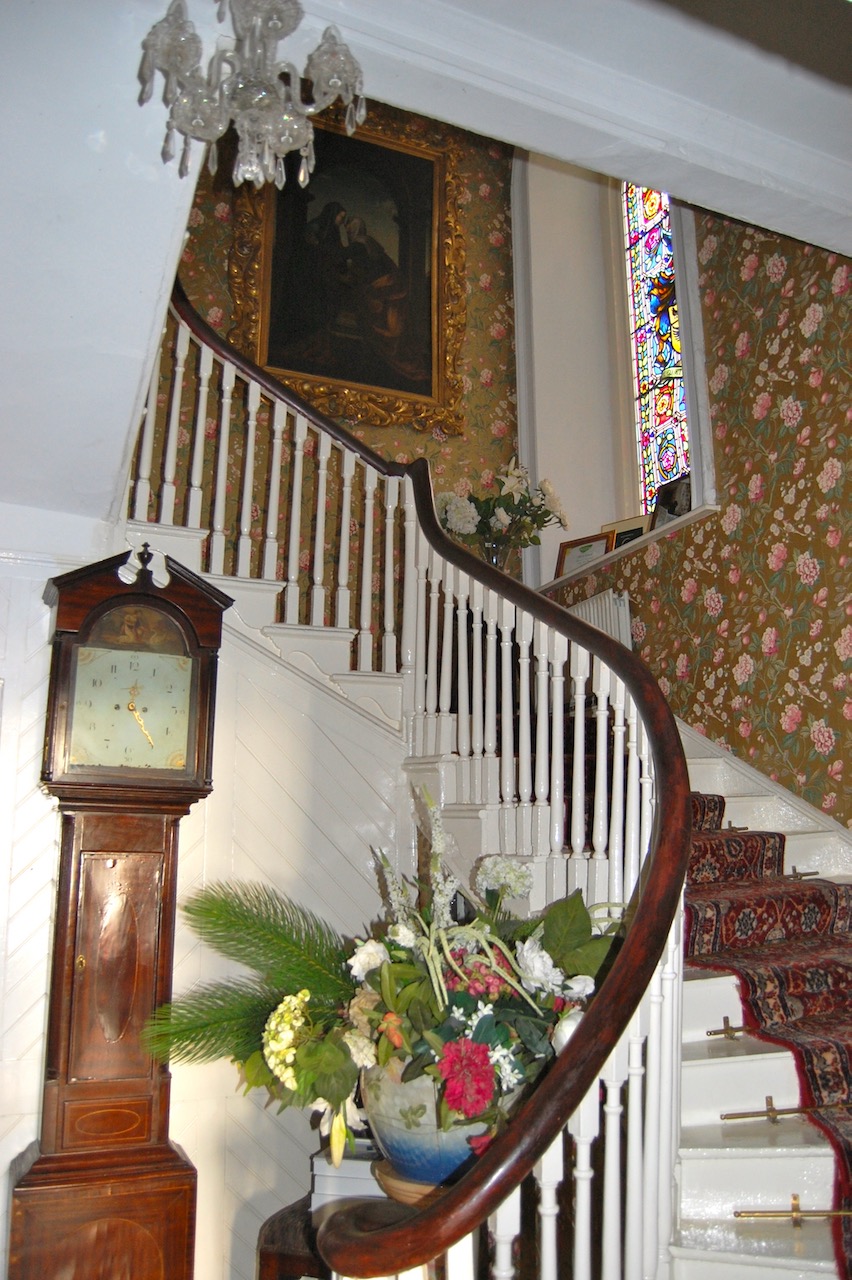
Kilteelagh House, County Tipperary, photograph from National Inventory of Architectural Heritage.

9. Lisheen Castle, Thurles, County Tipperary – castle holiday rental

airbnb https://www.airbnb.ie/rooms/337170?adults=2&category_tag=Tag%3A8047&children=0&infants=0&search_mode=flex_destinations_search&check_in=2022-05-16&check_out=2022-05-21&federated_search_id=e5acaa55-1906-41d1-92c4-e1dcc2012c70&source_impression_id=p3_1652454843_bH11BQ6b7Xq9YDK0

Lisheen Castle, photograph from National Inventory of Architectural Heritage.

The entry tells us: “In 1996, Michael and Joan undertook the complete restoration and renovation of the Castle, their son Zane now runs and manages the castle since 2009. This has been a real labour of love for them, as they have a wonderful appreciation of history and things beautiful. It was specially pleasing to Michael and Joan that all the craftsmen needed to carry our this momentous task were available locally. They have left no stone unturned to ensure that Lisheen Castle would be restored to its former glory, a residence fit for a Lord.

During your Irish castle vacation you will enter the beautiful hallway, through the Great Oak Door,you will be immediately impressed by the opulance of the diningroom, reception rooms and library. At the end of the long corridor visitors will see a beautiful Ash Carved Stairs. Upstairs, there are currently 9 luxury bedrooms, 8 of which are en-suite. While the emphasis in Lisheen Castle is historical, the facilities are up to today’s standard with wi-fi and pc/printer available for use by the guests.

One of the two kitchens is fully fitted to the highest catering standard. Of interest to the guests will be the “old-style kitchen”, which is furnished with pine furniture and terracotta floor.

Even though the Castle is centrally heated throughout, you can still experience the special ambience of the “open turf fires” which are in all the reception rooms.

Lisheen Castle is available for your Irish castle vacation on a weekly or monthly basis. So, go on, if you would like to experience the wonderful opulance of past times, while still having all the modern conveniences.

10. Lismacue House, Bansha, Co. Tipperary – section 482, whole house rental, up to 10 people

Lismacue House, County Tipperary, photograph from National Inventory of Architectural Heritage.

www.lismacue.com
(Tourist Accommodation Facility) Open for accommodation: Mar 1-Oct 31 2026

See my entry https://irishhistorichouses.com/2025/02/10/lismacue-house-bansha-co-tipperary-section-482-accommodation/

Lismacue House, photograph courtesy of website.

The accommodation consists of a classically proportioned drawing room, dining room, breakfast room and library. The house is centrally heated throughout, with traditional warm and welcoming log fires in the reception rooms. All windows have the original pine shutters that are closed each evening.

Lismacue House, photograph courtesy of website.

All bedrooms contain a King or Queen size bed and are especially designed for perfect rest. Each spacious room features antique furniture, direct dial telephones, fresh cut flowers all year round. There’s a sumptuous deep soaking bath and shower in all bathrooms. Each room enjoys panoramic views over the surrounding landscaped gardens and estate.

11. Lissanisky House, County Tipperary – holiday rental

https://www.lissaniskyhouse.com/

Lissanisky House, photograph from National Inventory of Architectural Heritage.

The website tells us:

Lissanisky House is a listed Irish Georgian country house just outside Nenagh in Tipperary, Ireland. Built in approx. 1770 on the site of the 12th century O’Meara castle, it boasts a pedimented breakfront, five bays and three storeys over the basement. It is also renowned for its glorious cobweb fanlight above the front door. It was once a huge estate, but this was carved up by the land commission and now retains 10 acres of the original grounds, including the Victorian walled garden. ​The trees planted in the walled garden are still producing the tastiest apples, pears, quinces, plums and hazelnuts. If you’re around at the right time, you’ll get to enjoy one of our scrumptious homemade apple and toffee puddings with fresh cream. Delicious!

The house itself is full of history, with some interesting previous owners, like Dr Barry O’Meara, Napoleon’s doctor in St Helena and author of the definitive book on Napoleon, ‘Napoleon in Exile’; The Hon Otway Fortescue Graham-Toler, son of the second Earl of Norbury and relation of John Toler, the infamous ‘hanging judge’ and R Smithwick who is believed to be of the Kilkenny brewing family. We also recently discovered that former owners, the Cleeve family, were related to a member of the Guinness brewing family via the matriarch Heath Otway Waller of Priory Park.

THE FUTURE

We fell in love with Lissanisky House and made it our joint life goal to ensure that it would be restored to its full potential and secure it for future generations. By staying with us in our bed and breakfast or celebrating your wedding here, you are helping to fund all future restoration work to the house and outbuildings, making a huge contribution to the preservation of such an important building.

[1] Bence-Jones, Mark. A Guide to Irish Country Houses (originally published as Burke’s Guide to Country Houses volume 1 Ireland by Burke’s Peerage Ltd. 1978); Revised edition 1988 Constable and Company Ltd, London.

[2] https://www.irelandscontentpool.com/en

Text © Jennifer Winder-Baggot, www.irishhistorichouses.com