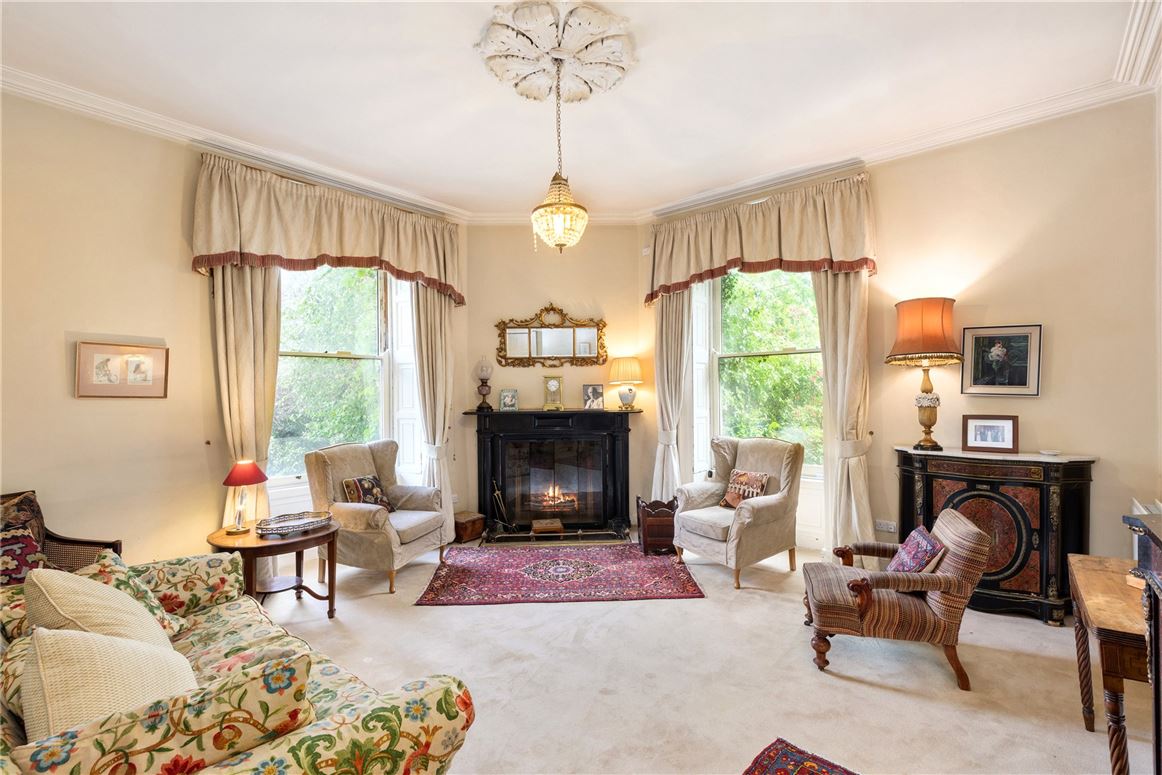
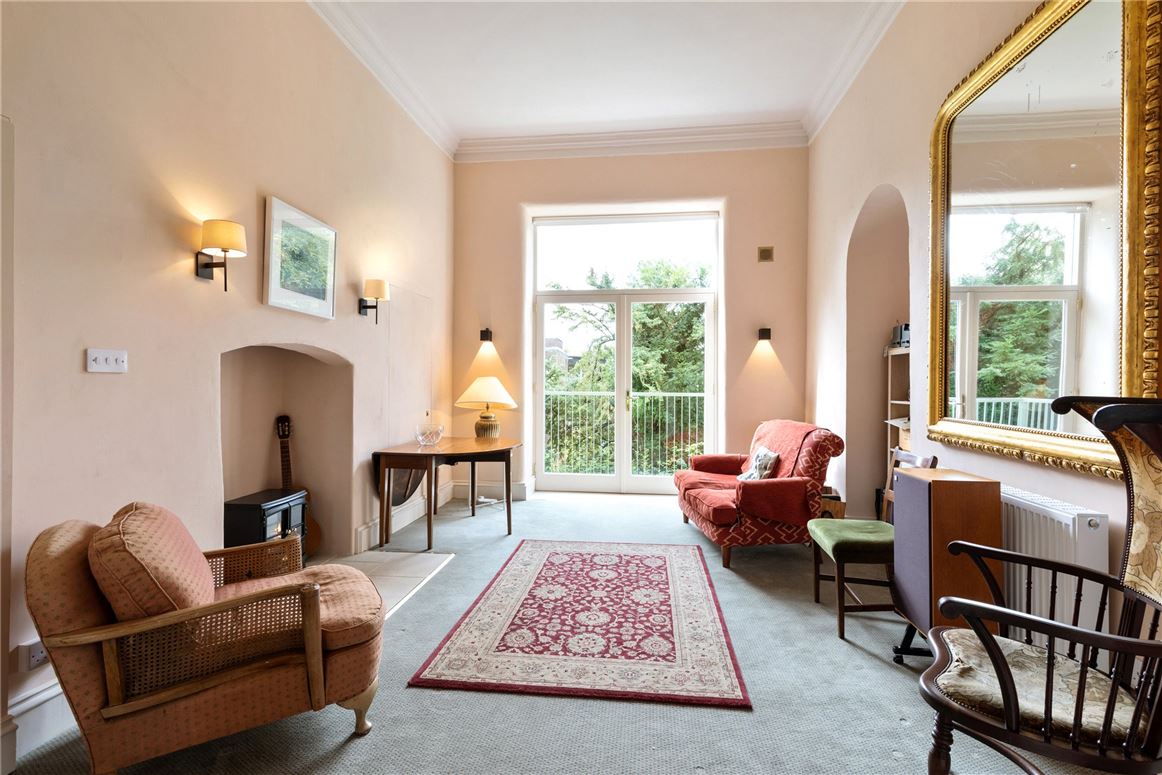
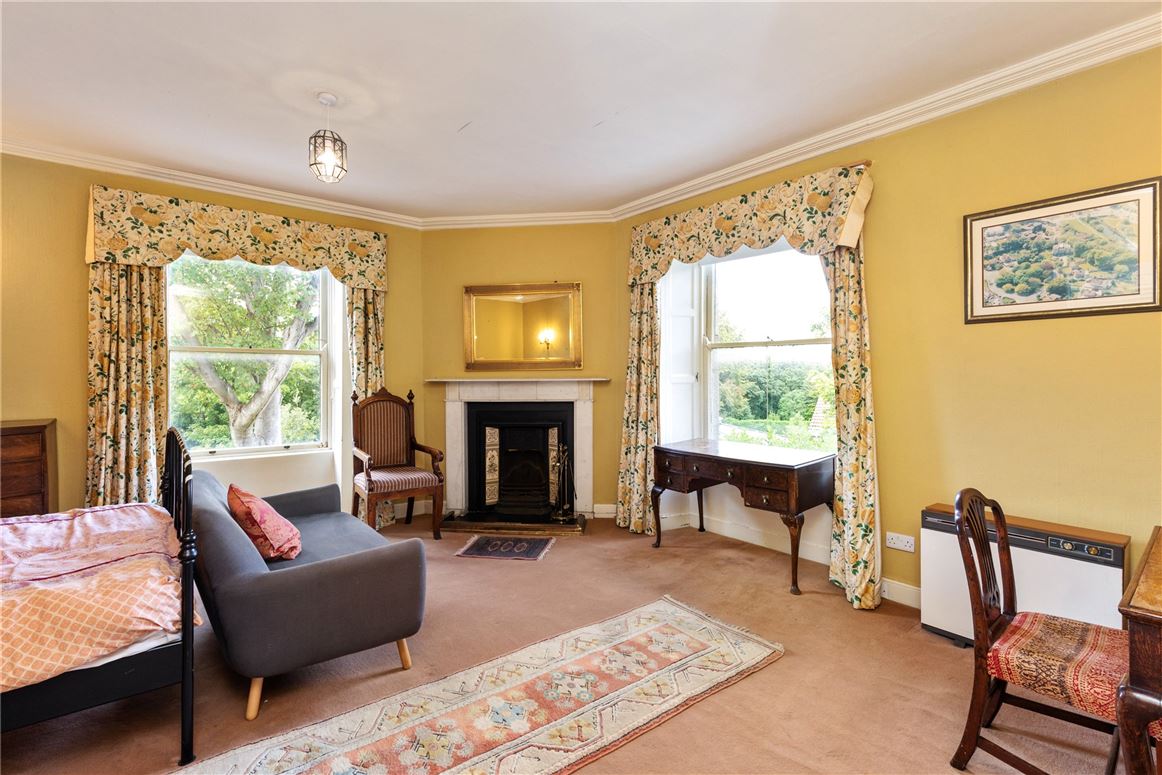
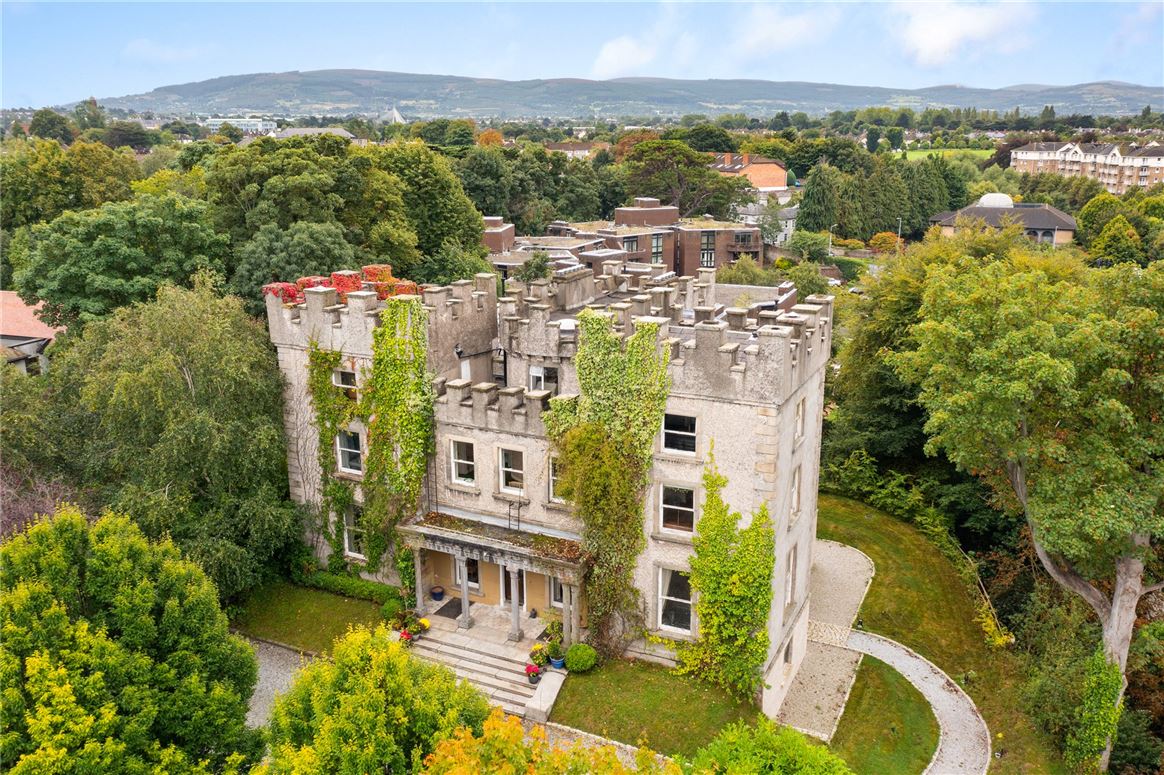
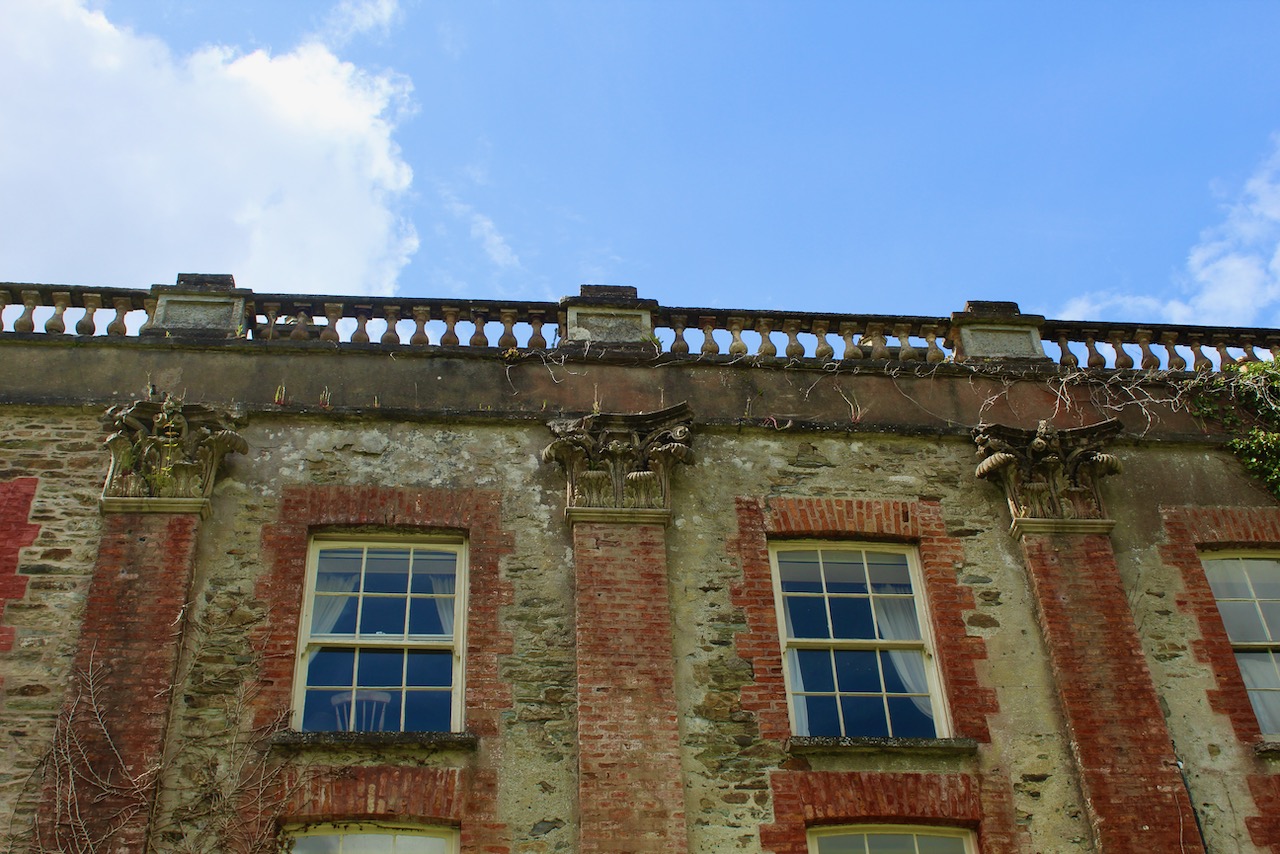
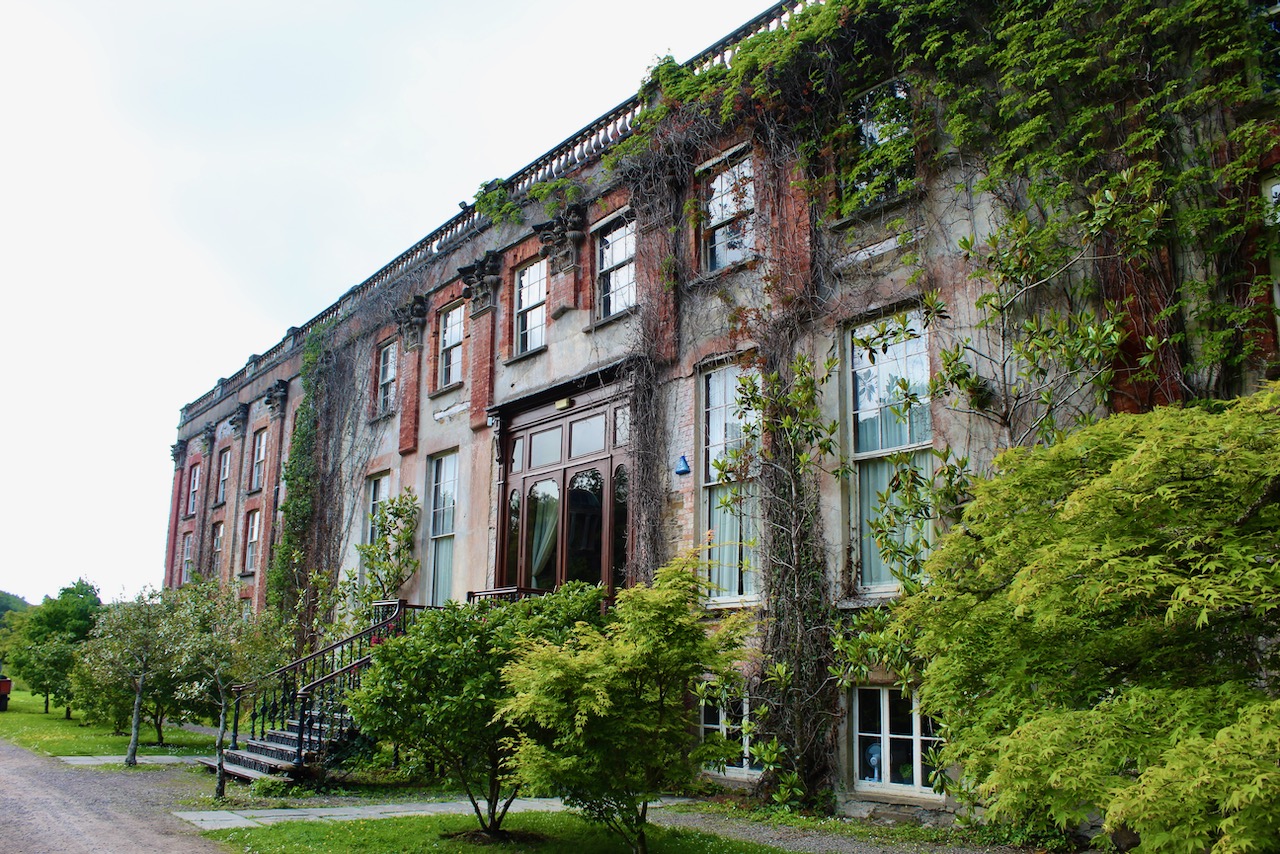
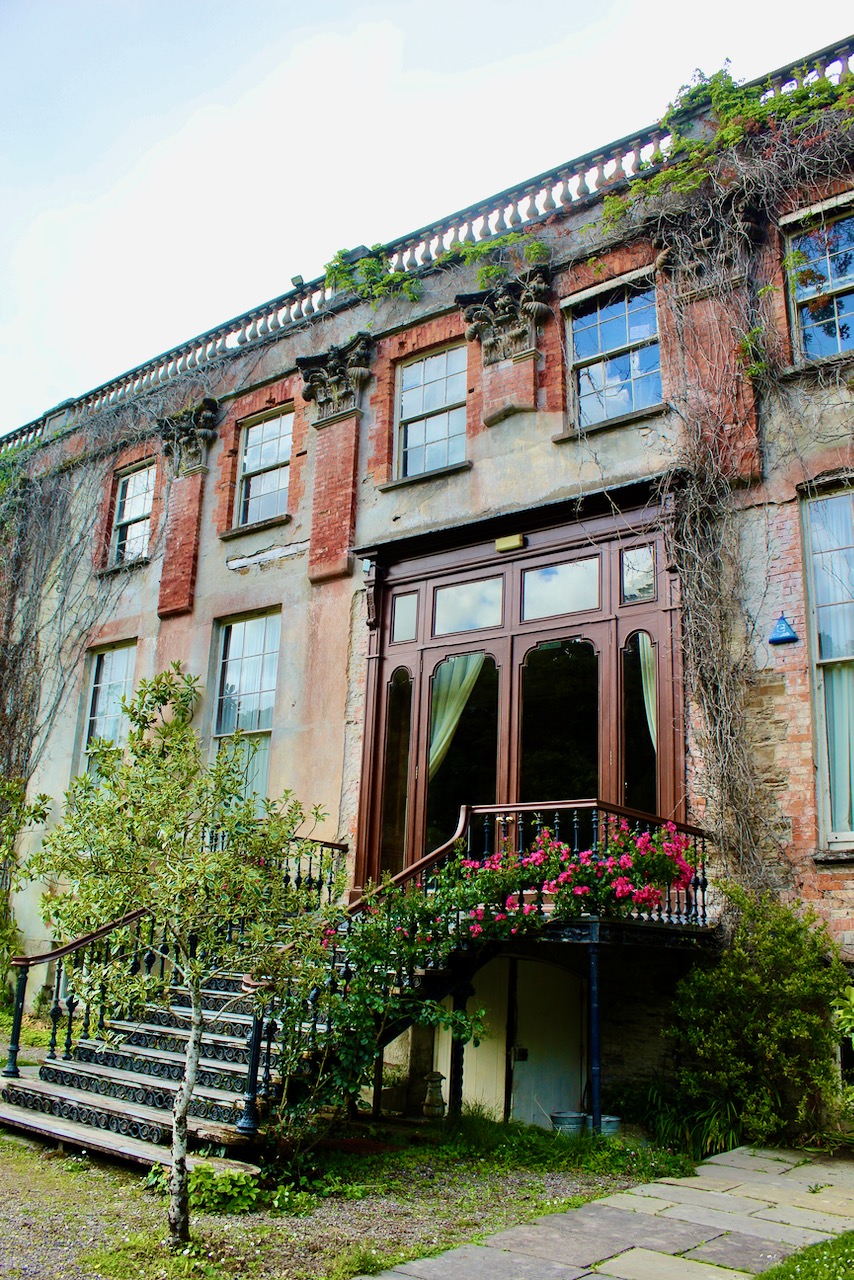
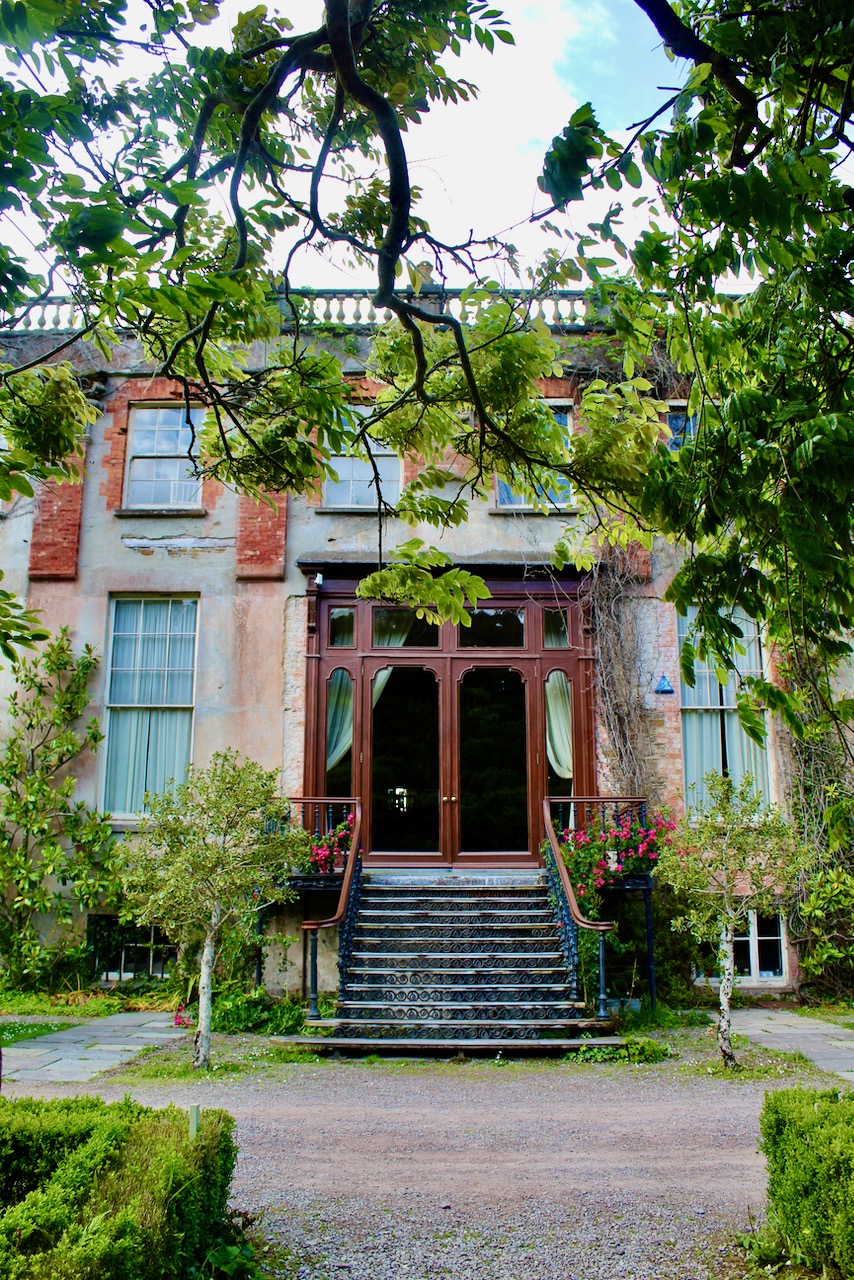
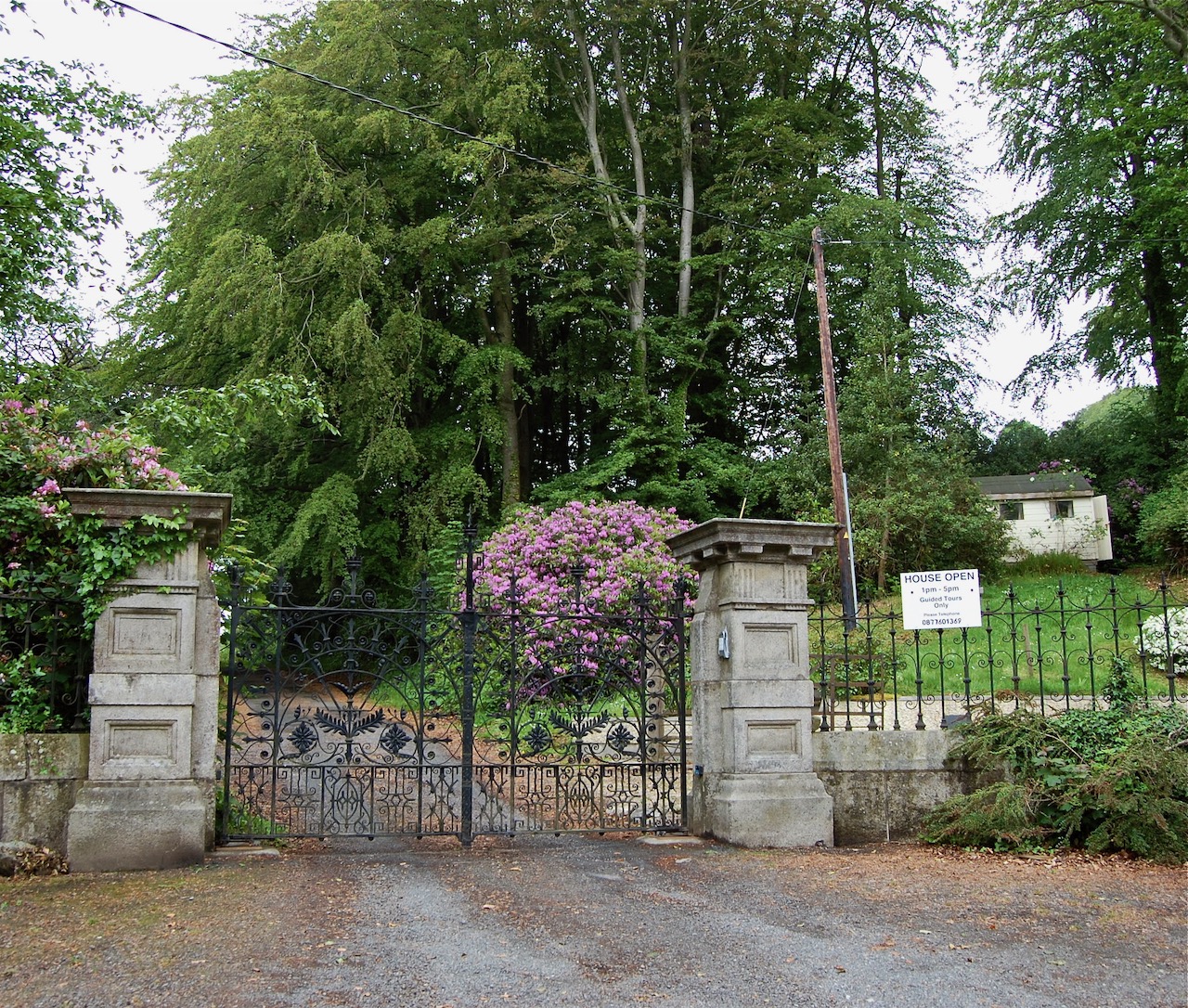
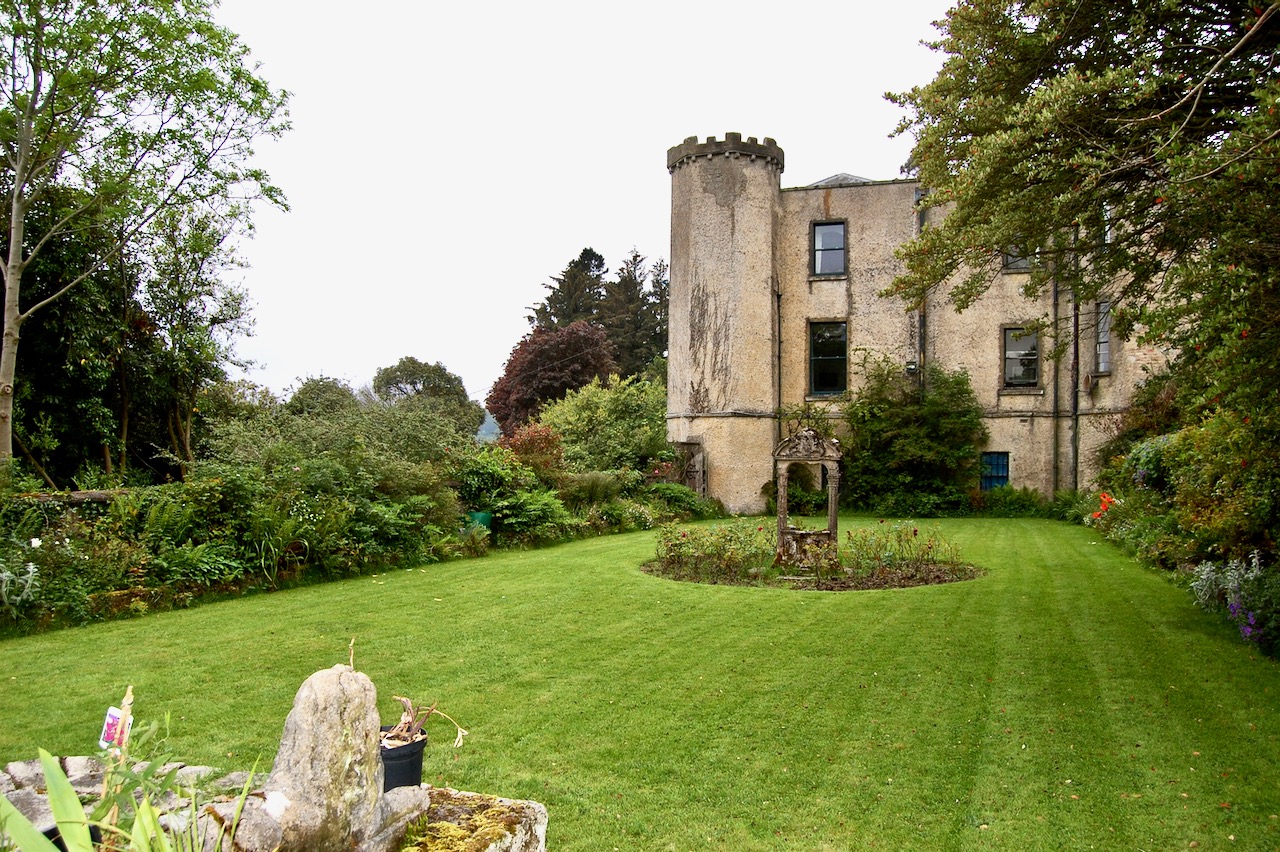
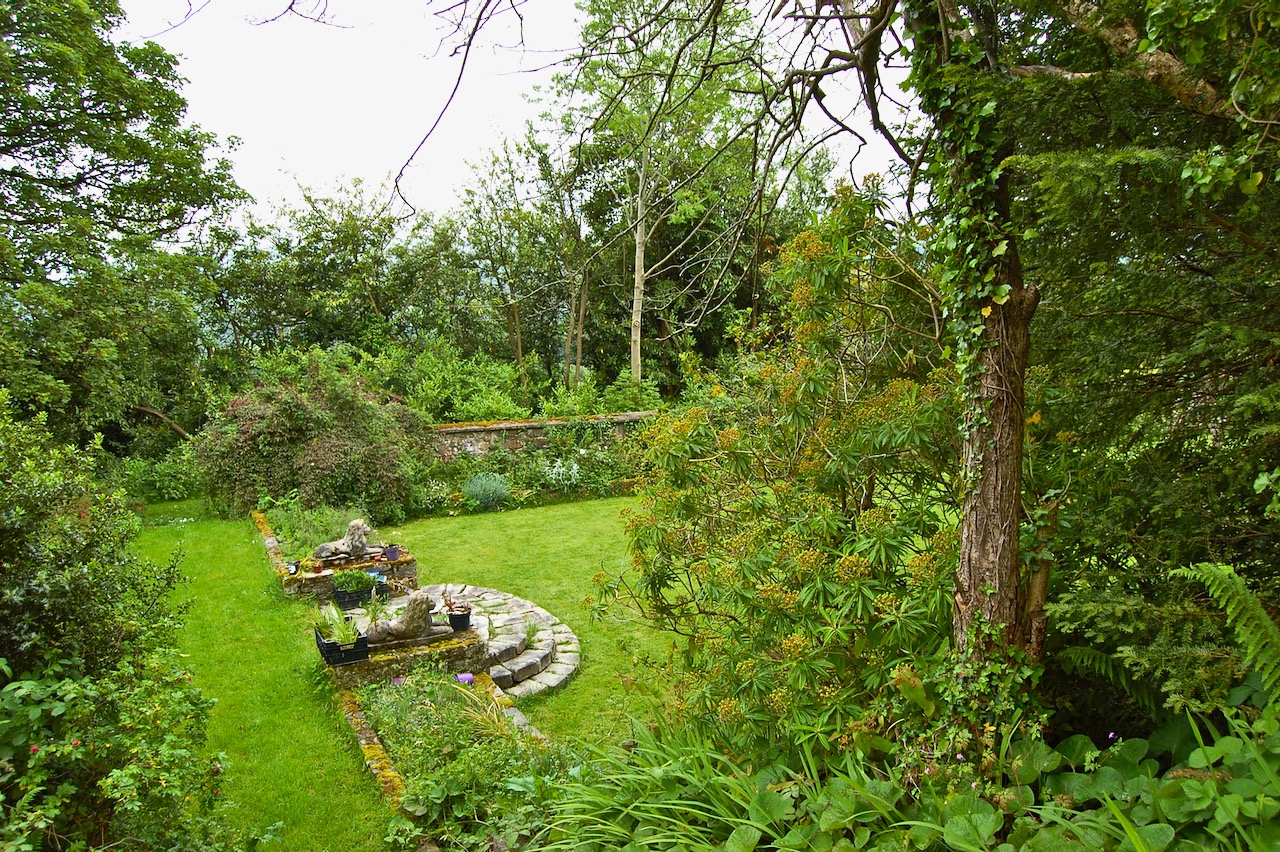
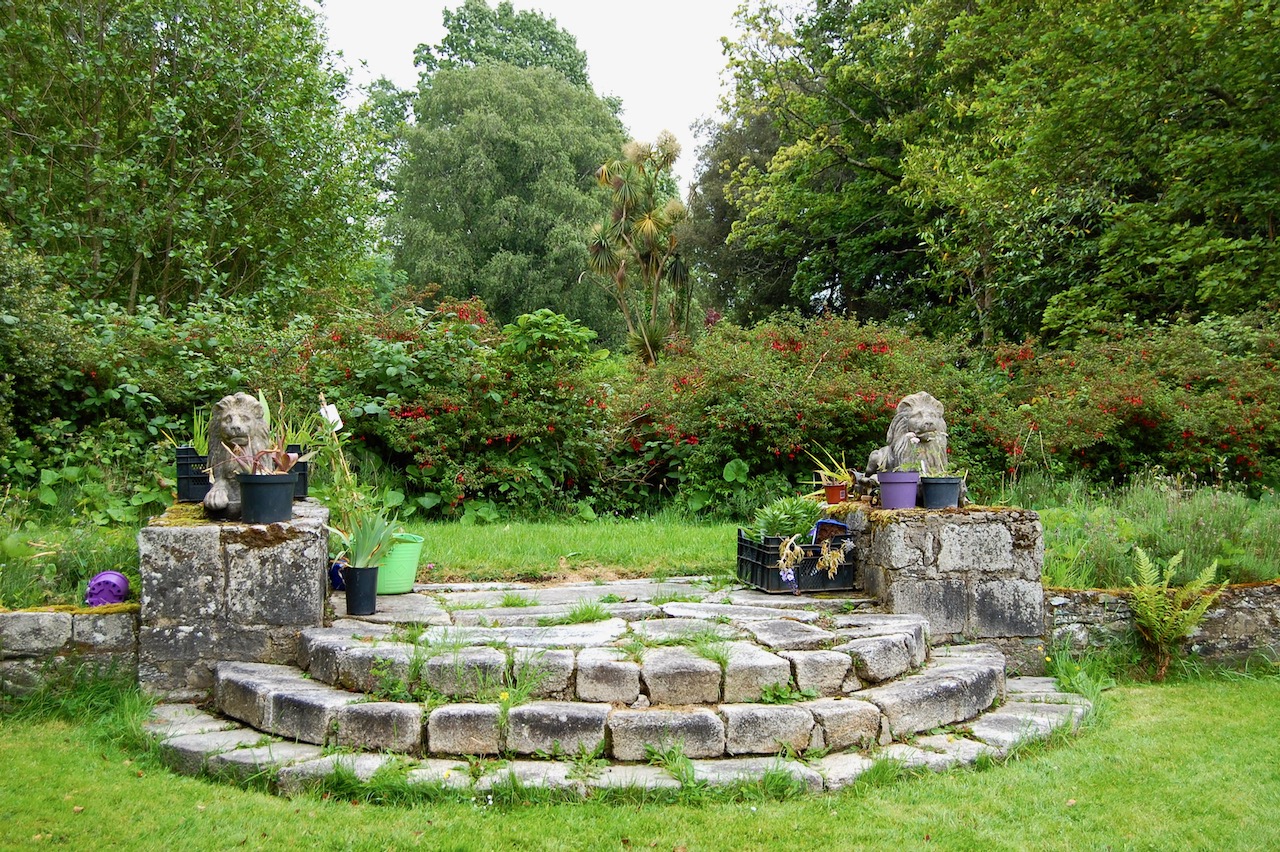
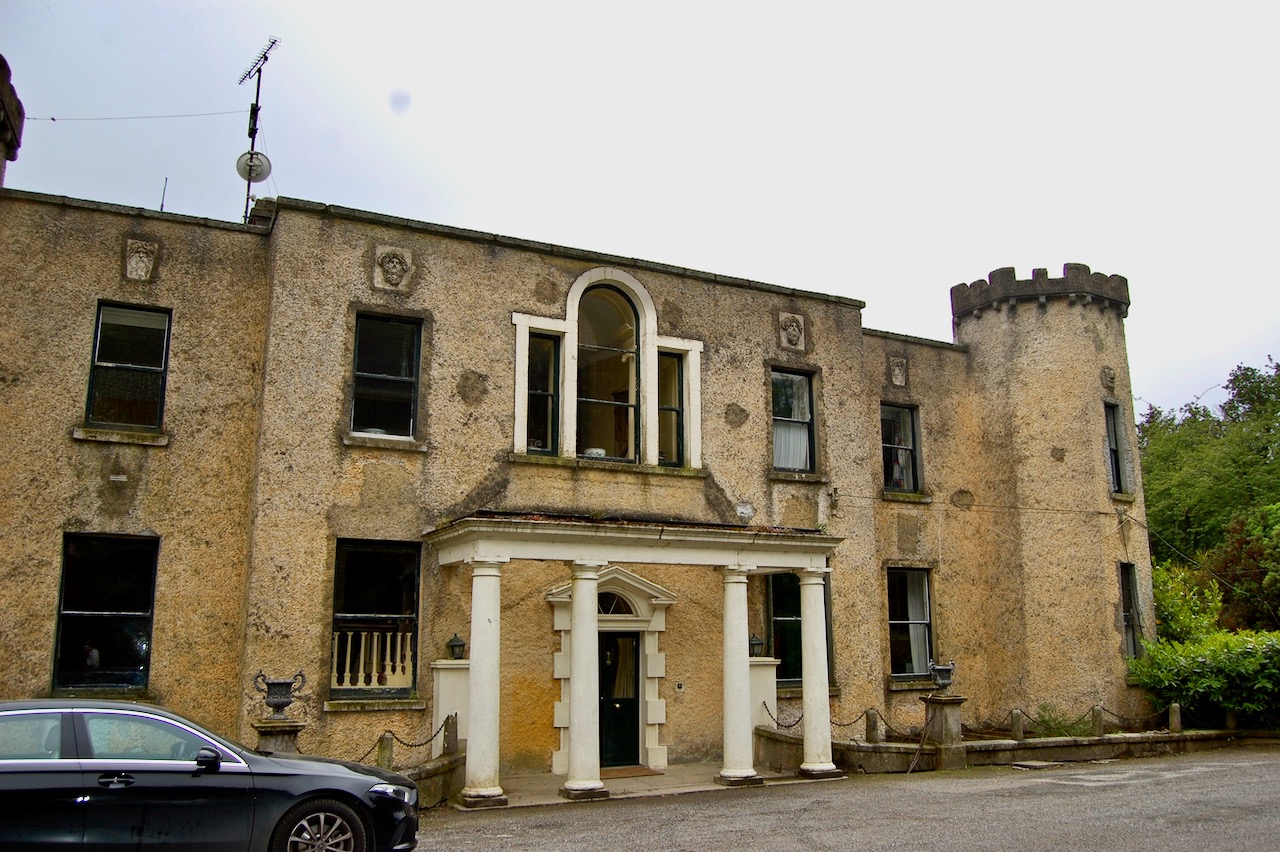
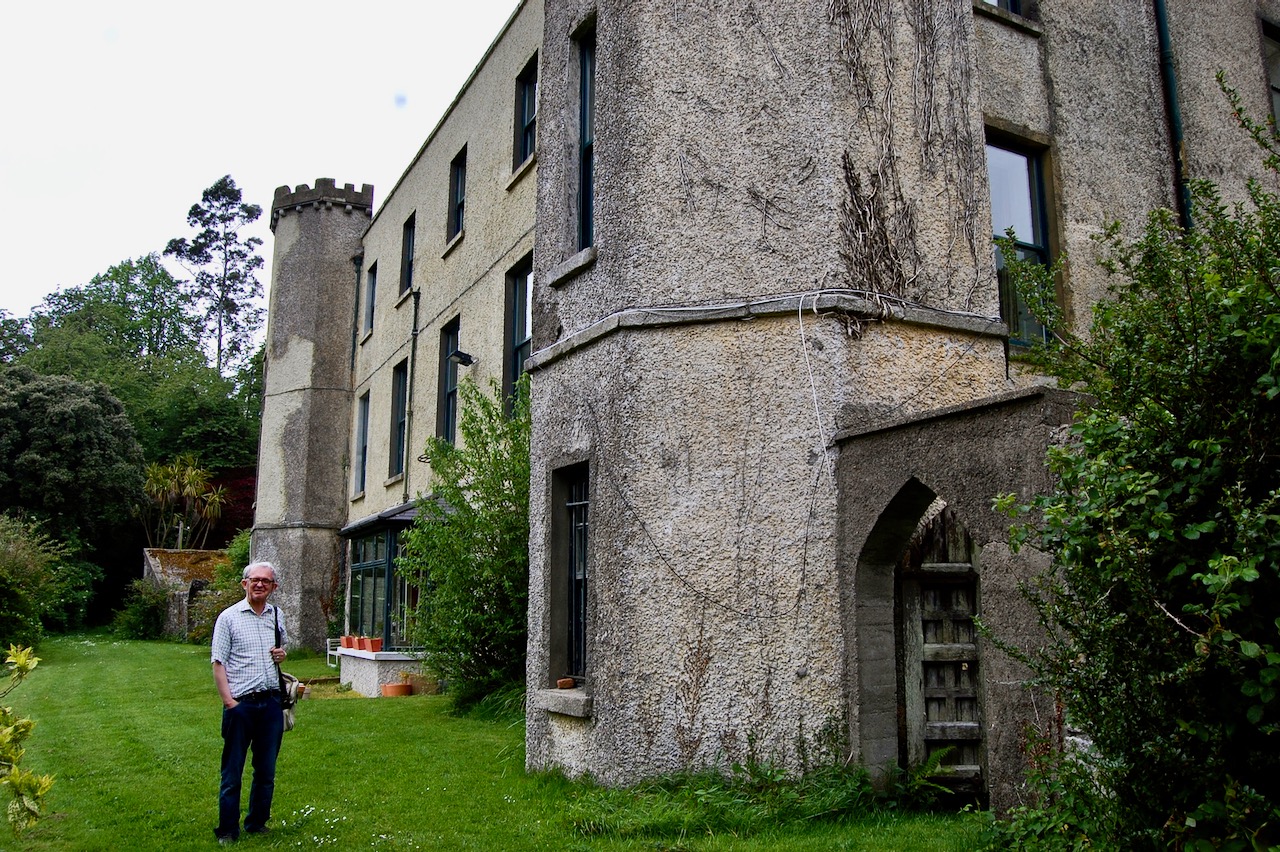
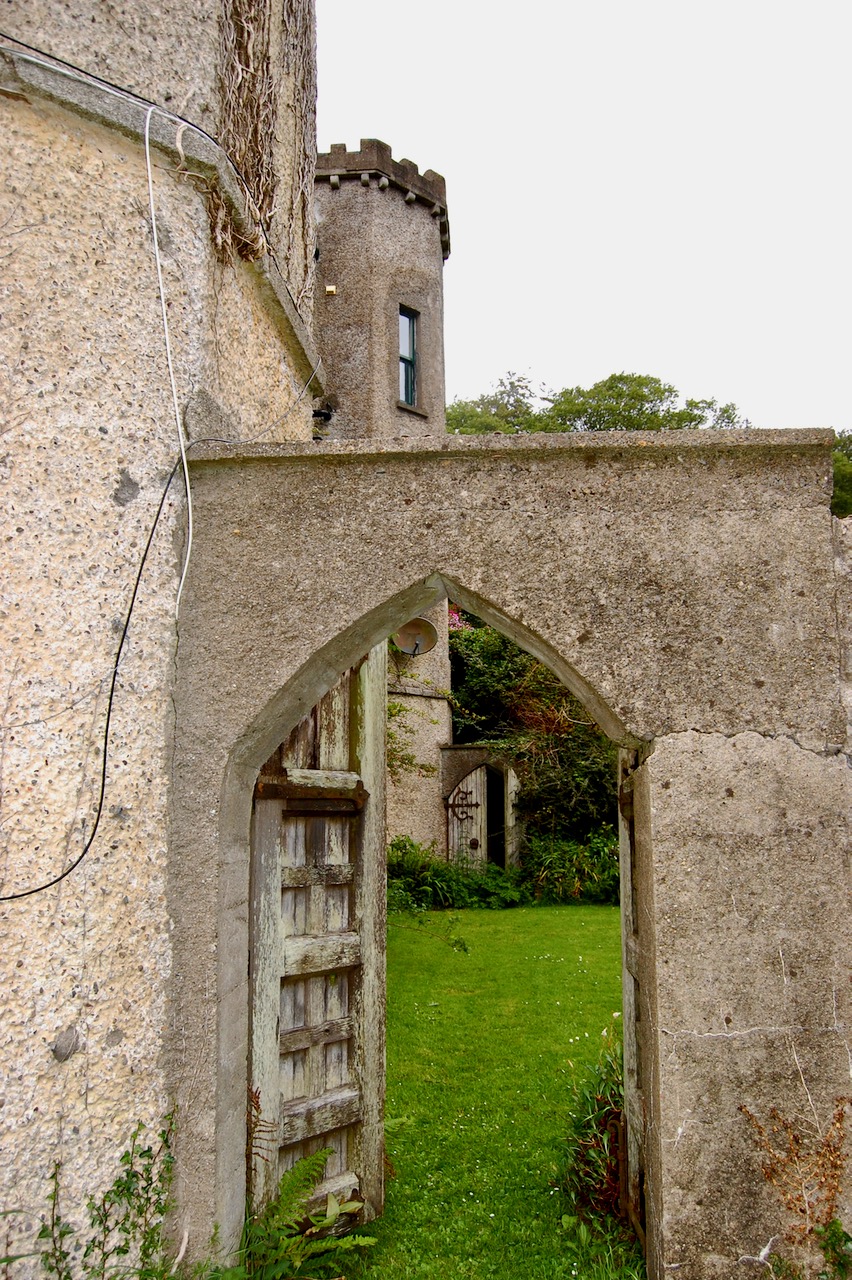
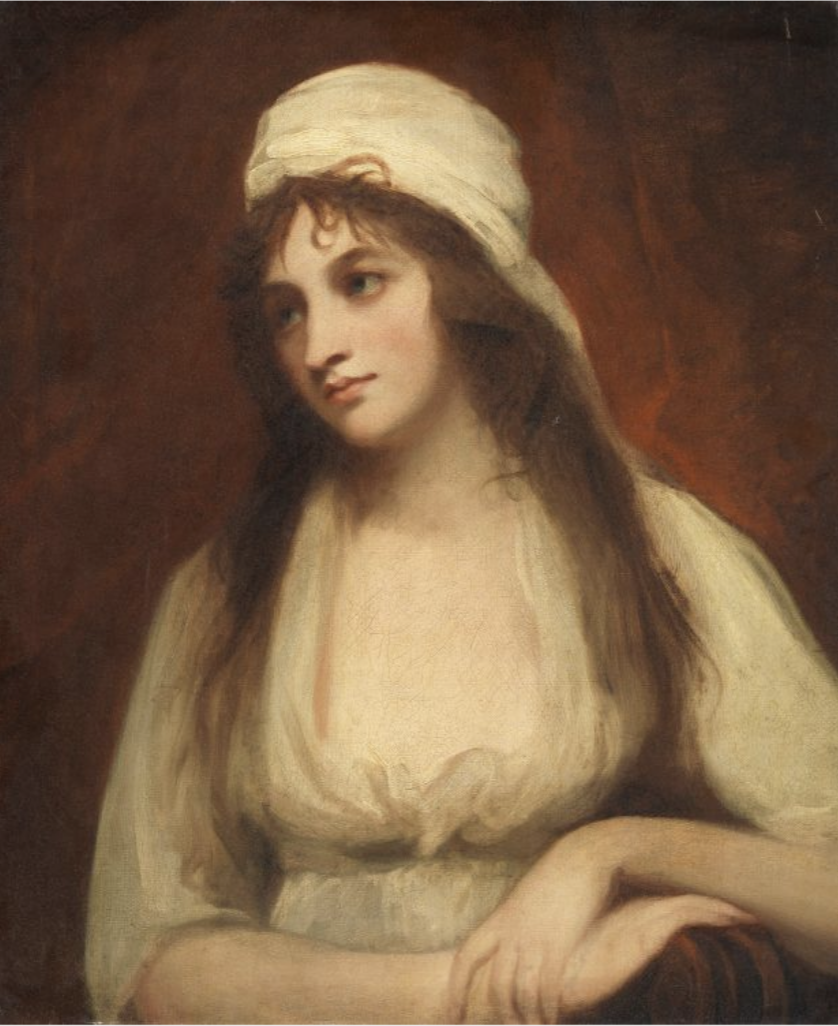
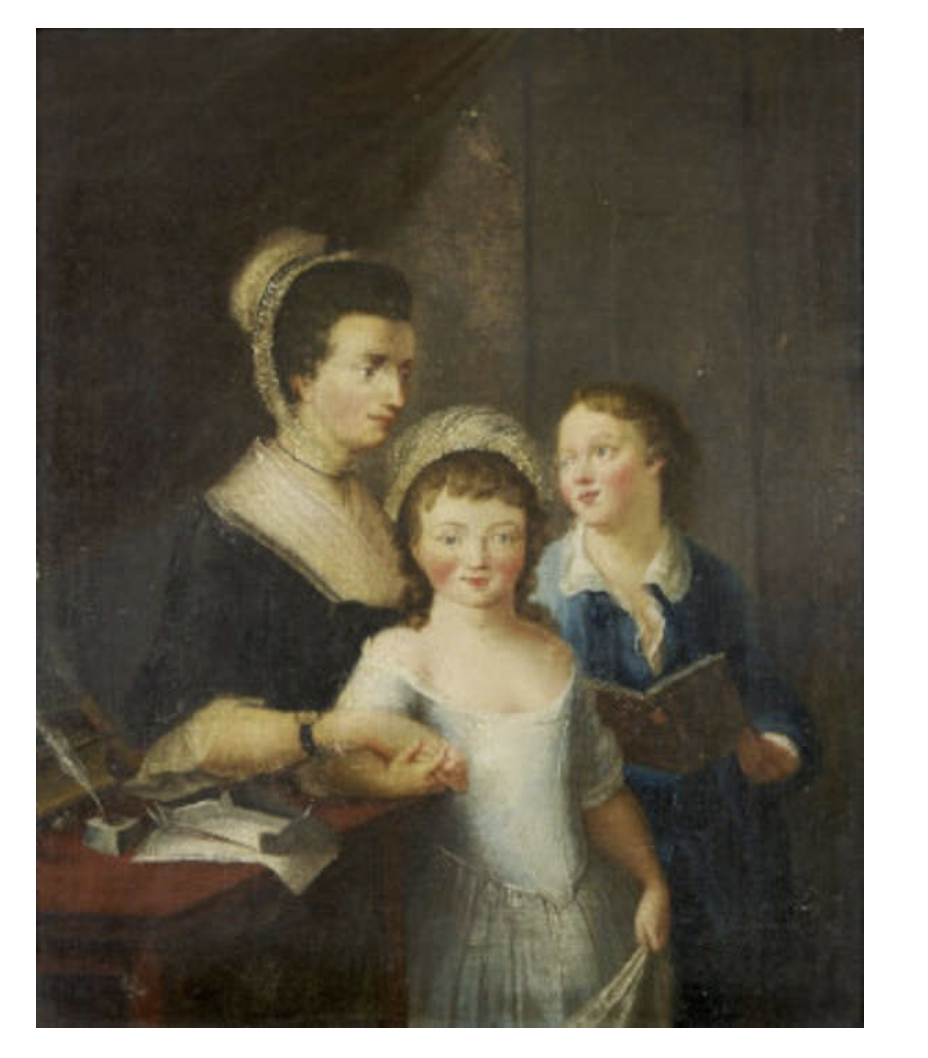
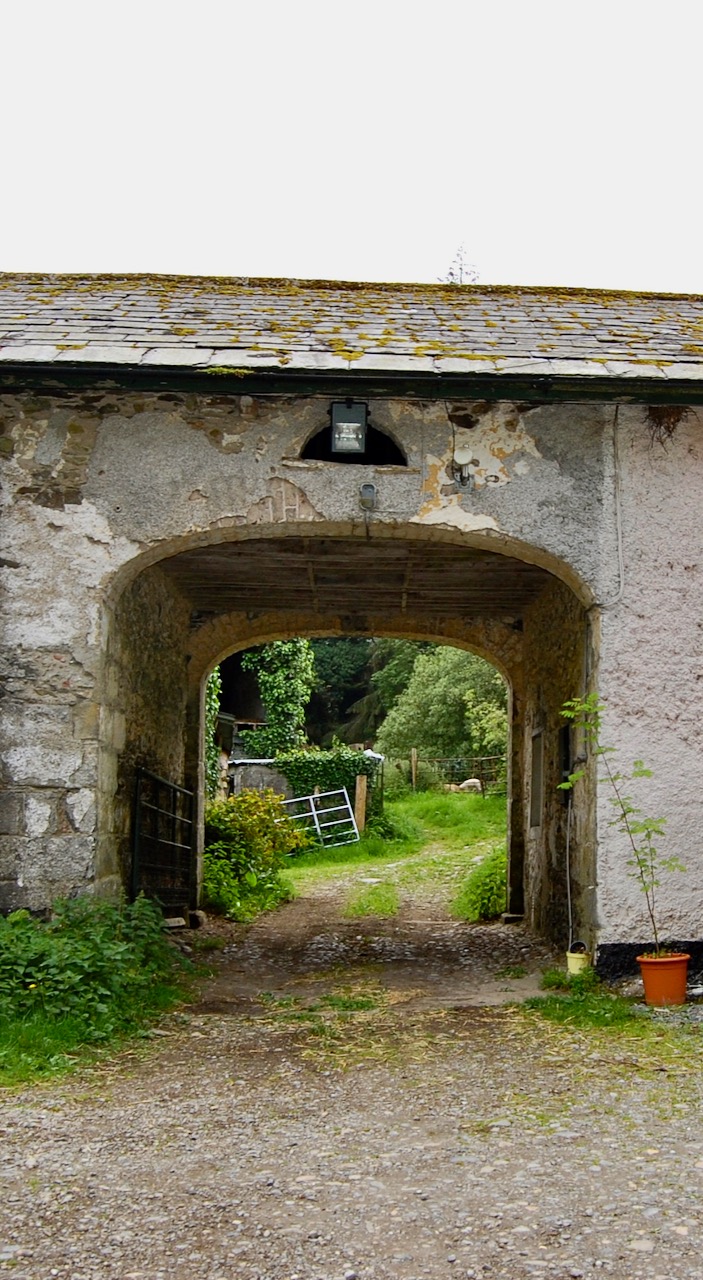
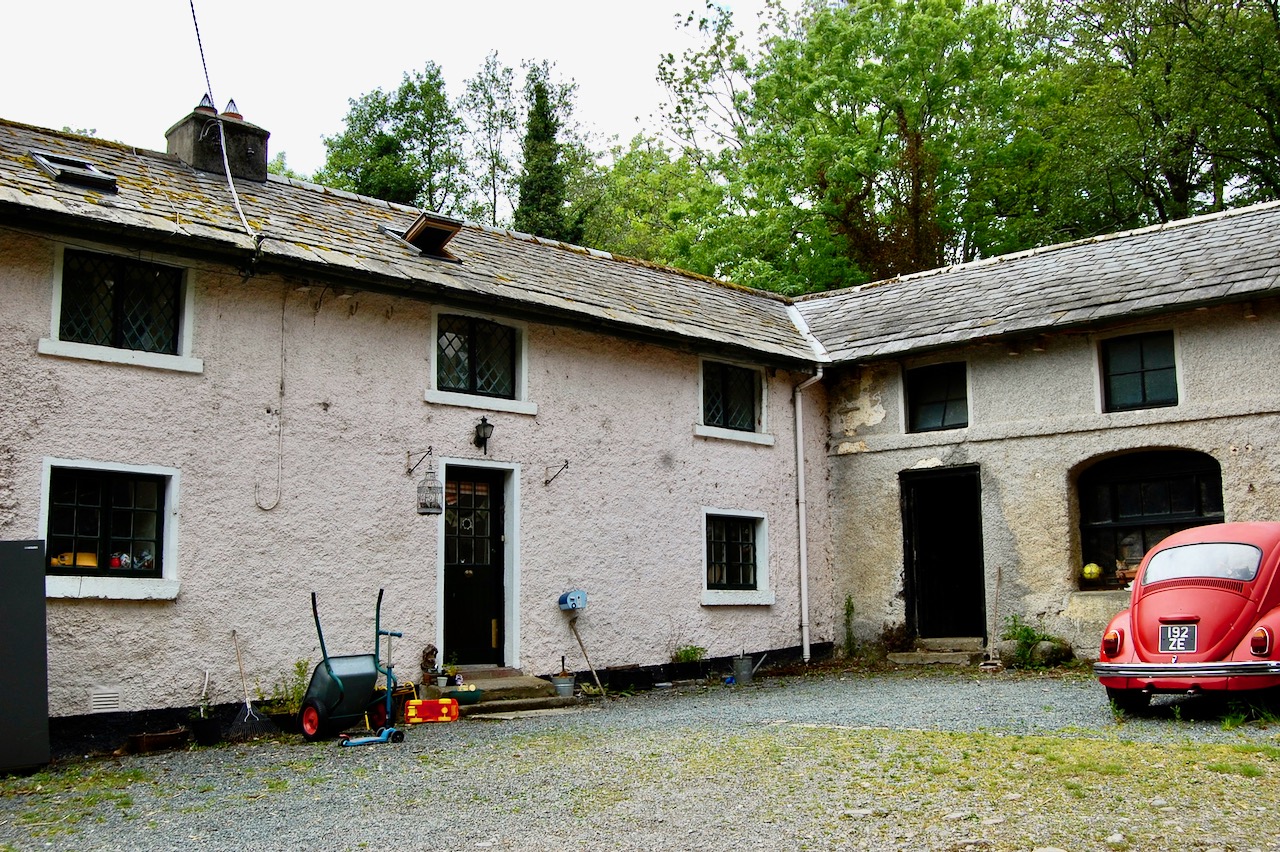
Viewmount House, Kernanstown, Co Carlow

Viewmount House, Kernanstown, Co Carlow

Not in Bence-Jones

http://www.igp-web.com/Carlow/Viewmount.htm

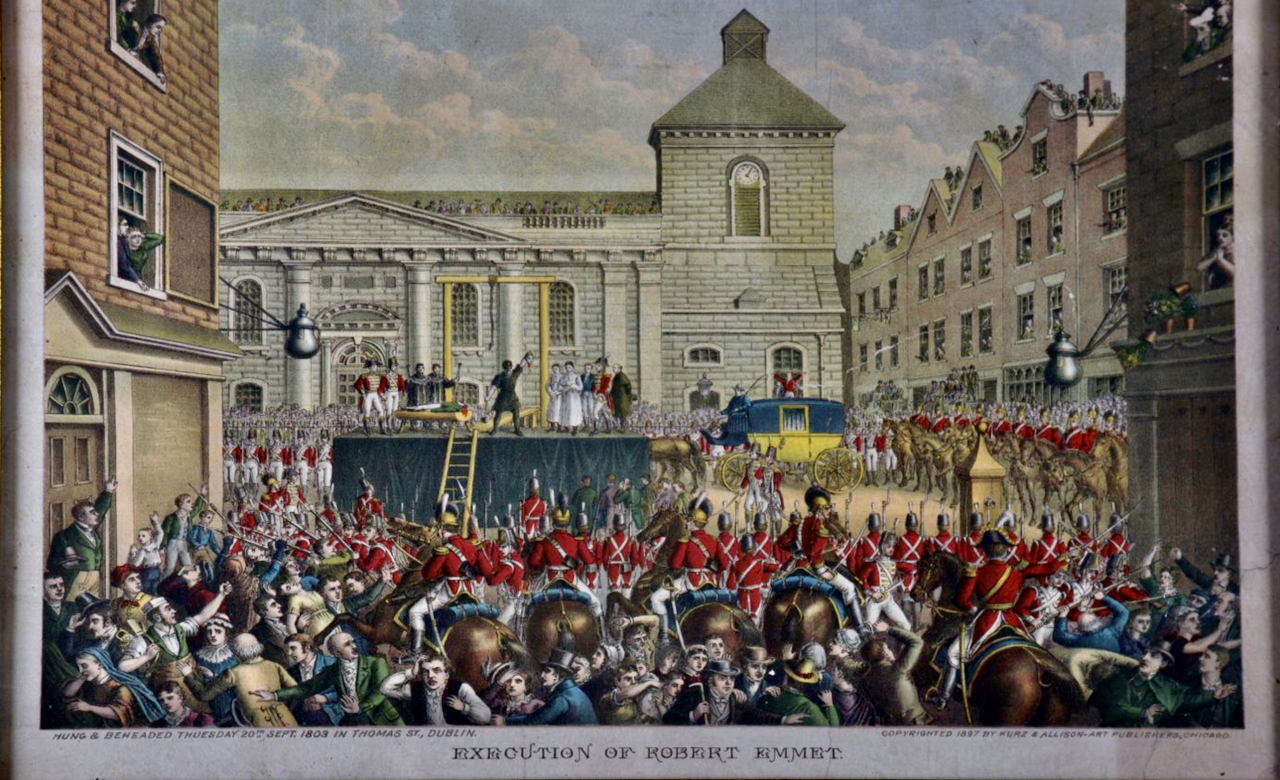
The map (above) has a outline drawing of View Mount House, outhouses, stores and stables and also the Gate Lodge entrance. Accounts from the period claim that it was in the field adjoining View Mount House ( to the left of it as you view the map ) that an estimated 2,000 United Irishmen assembled before they advanced on Carlow town to take part in the Battle of Carlow on the 25th of May 1798 and because of this assembly the then owner of View Mount, Sir Edward Crosbie, a few weeks after the event, was sentenced to be Hanged, Drawn and Quartered . His body was buried near View Mount house and some years later his head was buried at Urglin Churchyard. Up to the present day members of the Browne-Clayton family claim that they often saw a figure in the driveway of their home, Brownes Hill House, walking about with his head under his arm and this long before they heard the story of the execution of Sir Edward Crosbie ! 

The spot where his body was buried could be identified up to a few years ago by several granite stones laid out in a nearby field. On the map the world famous Dolmen is identified in another field marked “Cromlech”. Also identified is the site of St. Kevins Abbey and of course Brownes Hill House itself with it very large stores and stables and its famous gardens. There is another map of View Mount dated 1820 , the house, stables, outhouses and Gate Lodge are illustrated in detail. We will publish this map later. 

Viewmount House, Co. Carlow 

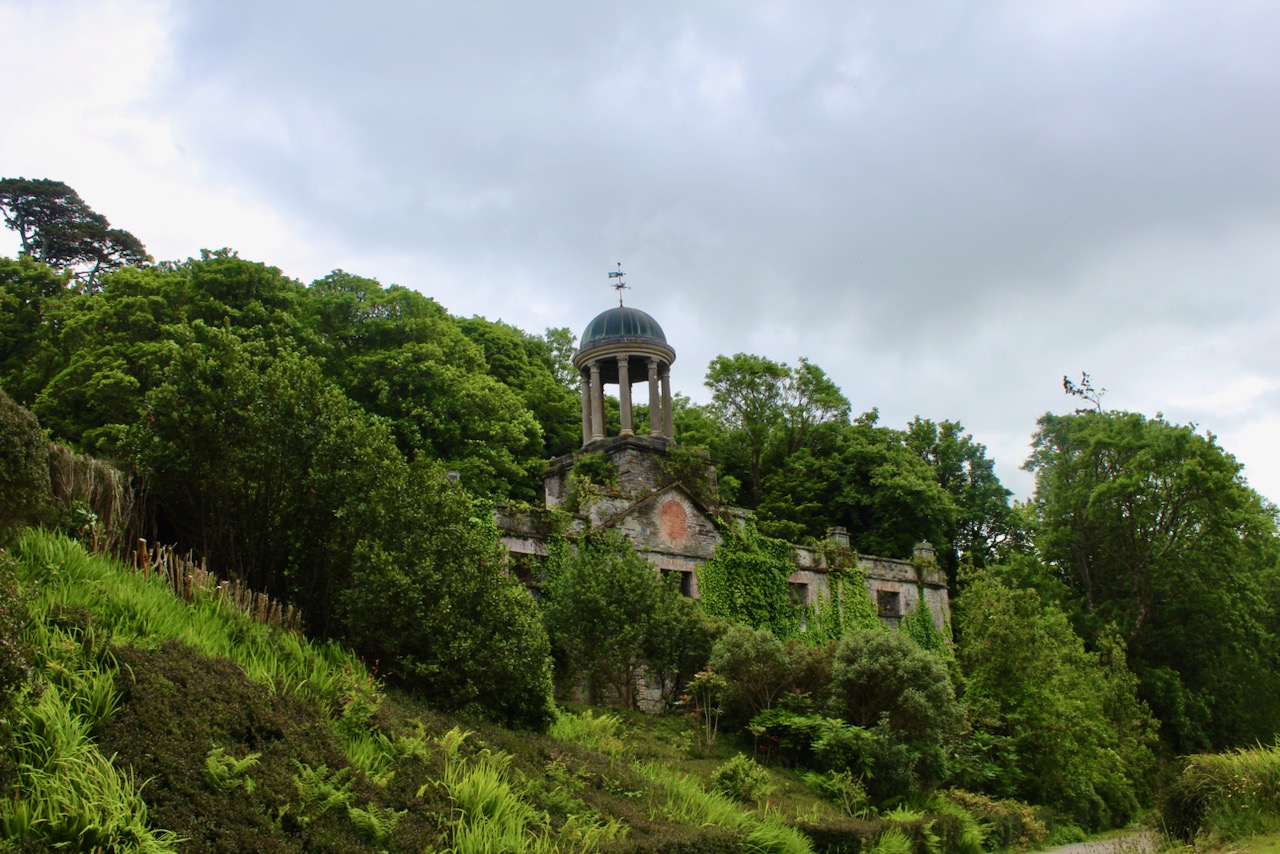
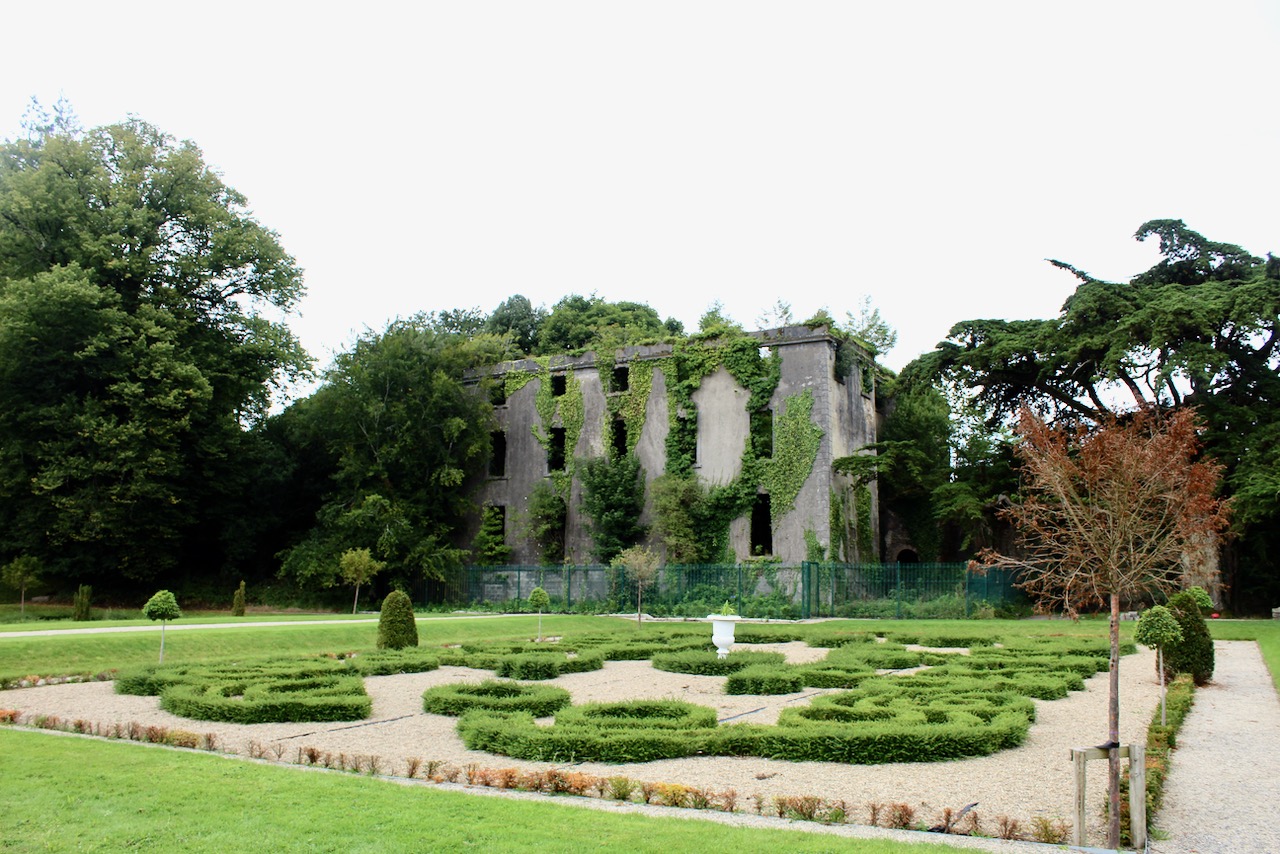
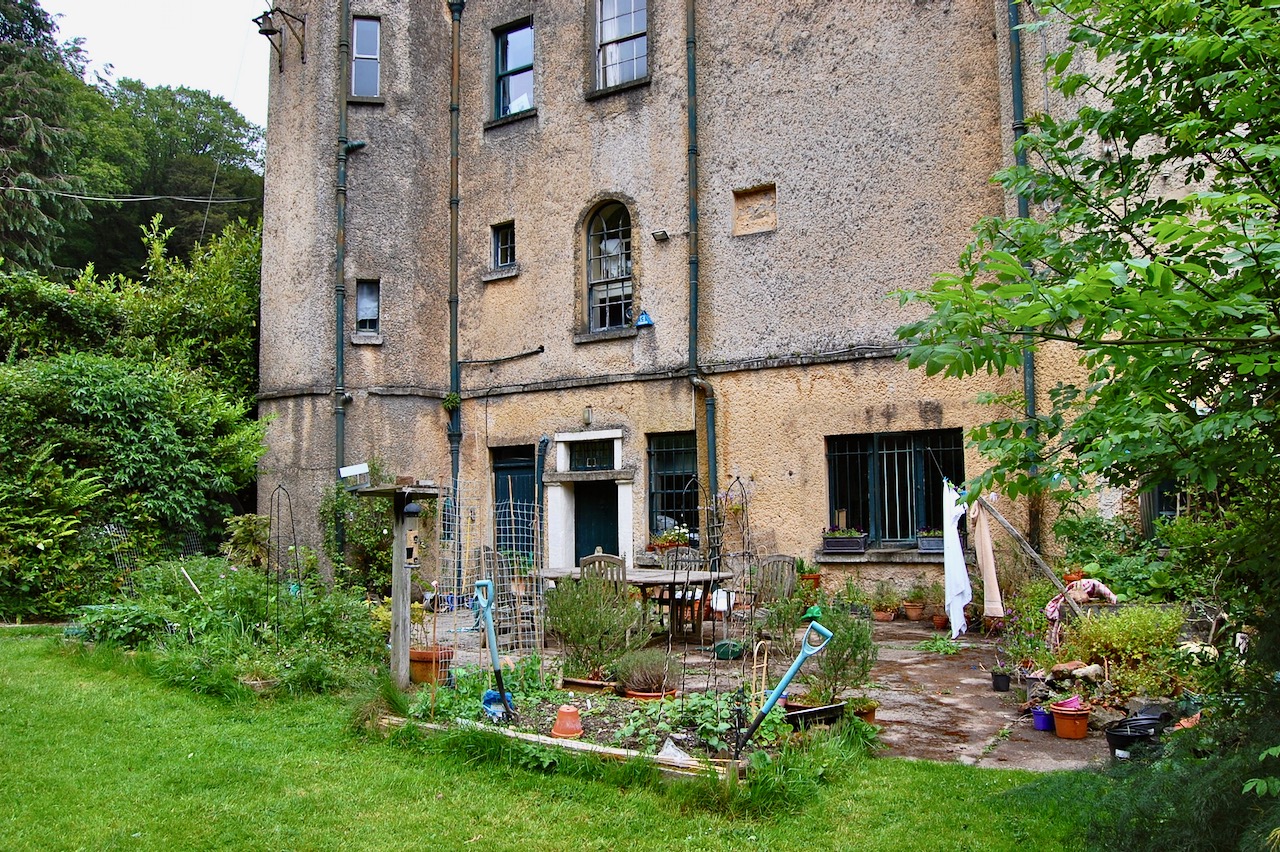
Viewmount House itself was one of several handsome residences built in the charming countryside of County Carlow during the Georgian Age. It was one of the earliest houses in the county, built by the Browne family in 1750 and predating Browne’s Hill by 13 years. 18th century MPs were wont to devote their latter years to overseeing the construction of magnificent new homes that might reflect their lifetime achievements for centuries to come.  

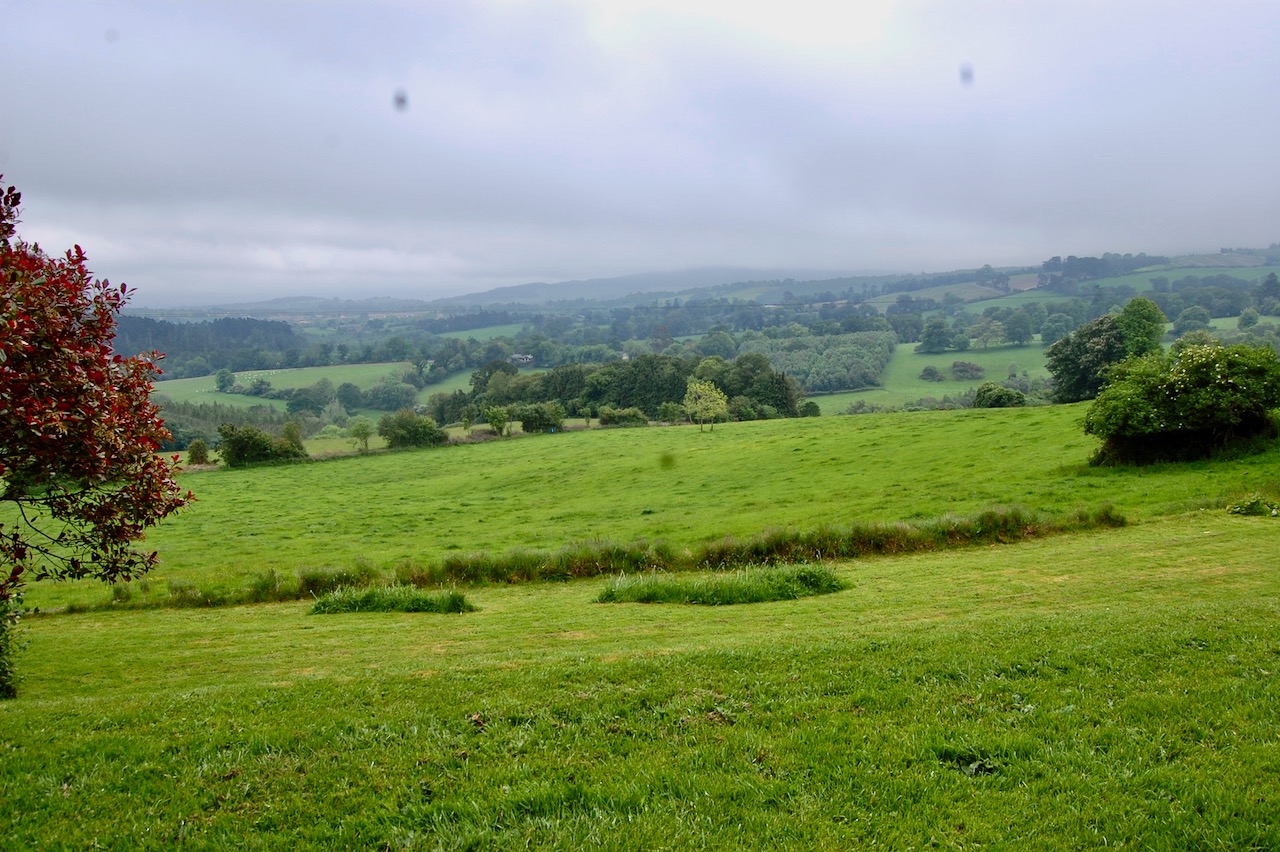
Samuel Lewis noted in 1837, the house is ‘pleasantly situated and commanding a beautiful prospect of the neighbouring country’. (1) To the front rises ‘a noble mountain ridge, while in other directions the prospect is bound by Lugh-naCuillagh and Mount Leinster’. 

Source: Turtle Bunbury’s website: http://www.turtlebunbury.com/ 

http://www.turtlebunbury.com/history/history_houses/hist_hse_viewmount.html 

Viewmount House is situated just outside Carlow Town in southern Ireland. As Samuel Lewis noted in 1837, the house is ‘pleasantly situated and commanding a beautiful prospect of the neighbouring country‘. (1) To the front rises ‘a noble mountain ridge, while in other directions the prospect is bound by Lugh-naCuillagh and Mount Leinster‘. (Burke) The spires and public edifices of the county town of Carlow can be seen in the distance. Together with its neighbouring mansion of Browne’s Hill to the west, the house occupied the site of an ancient religious establishment called St. Kieran’s Abbey. During the suppression of the monasteries, this property was granted to one of the O’Brien forbears of the Earl of Thomond. Three towers of this monastic pile were still standing in the 1760s. Indeed, the walls of Viewmount are apparently built from the remains of these towers, as wall the original park wall at Browne’s Hill. (Parliamentary Gazeteer of Ireland, 1845). One of the most majestic megalithic remains in Europe is to be found in the vicinity – the Browne’s Hill Dolmen. Its 100 ton granite table stone, believed to be the biggest in the world, is 23 feet in length, 19 in breadth, and at the upper end nearly 4 1/2 feet thick; it is supported at the east end on three upright stones, 15 feet 8 inches high, and at a distance is another upright stone standing by itself. The Browne’s Hill Demesne lay in the townland of Chapelstown but the main avenue was the dividing line between the townlands of Kernanstown and Chapelstown . Viewmount was across the ‘border’ in Kernanstown. 

Viewmount House  

Viewmount House itself was one of several handsome residences built in the charming countryside of County Carlow during the Georgian Age. It was one of the earliest houses in the county, built by the Browne family in 1750 and predating Browne’s Hill by 13 years. 18th century MPs were wont to devote their latter years to overseeing the construction of magnificent new homes that might reflect their lifetime achievements for centuries to come. Such properties were erected or exteneded throughout Carlow at this time – consider Burton Hall (1730), Ballintemple (1740s), Beechy Park (1750s), Duckett’s Grove (pre-Gothic, 1760s), Johnstown (altered in 1760) and Browne’s Hill itself (1763). (2) The latter was a detached six-bay three-storey over-basement neo-Classical country house. It was built in the Doric style with a granite ashlar façade, having a pedimented central breakfront and a full-height canted bay to the rear.  

The Browne-Clayton Papers 

In October 2009, the Department of Manuscripts in the National Library of Ireland stumbled upon several boxes of maps, drafts, surveys and correspondence relating to the Browne-Clayton family, which were acquired by the NLI in 1982.  

The Crosbies in a Nutshell 

Viewmount was advertised for lease by the Browne family in 1792. The successful lessee was Sir Edward Crosbie, 5th Bart, eldest son of Sir Paul Crosbie, a baronet of Nova Scotia. The Crosbies descended from a once powerful Catholic dynasty whose influence waned during the religious troubles of the 17th century. Sir Edward’s brother, Richard Crosbie, was a household name across the British Isles on account of his pioneering journey in a hot air balloon from Ranelagh to Clontarf in the summer of 1785. On 24th May 1798, the Viewmount estate was the chosen location for over a thousand United Irishmen from across Leinster to meet in advance of the next days attack on Carlow Town. The attack was an unmitigated disaster, leaving a large number of rebels dead. In the aftermath of the massacre, all United Irishmen suspects were rounded up. Amongst these was Sir Edward Crosbie who appears to have been framed by one of the Burtons who held a grudge against him over a duel fought some weeks earlier. Sir Edward was tried before a military court, hanged and beheaded. The illegality of his murder was still a source of heated debate in Westminster thirty years later. The history of the Crosbie family, including Sir Edward and Richard, is explored in greater detail below. 

The Crosbie Family 

NB: Bryan MacMahon believes the family descend from Sean MacCrossan, a member of a Gaelic family who Anglicised his name in the 16th century …maybe, but this was my understanding: 

The Crosbie family trace their ancestry to Normandy where the family name of Crosbi existed before 1050. By approximately 1100, Sir John de Crosebi, a man of Norse origin, whose ancestors settled in Normandy with Rollo, at a place named Corbic in Picardy. The name was then spelt CROSBJ. Coming to England with the Conqueror, he was granted lands at the mouth of the Mersey River near present day Liverpool.(3) He and his wife raised at least four sons. Simon, the eldest, founded the Lanarkshire branch of the family. Robert, the second, was a man of prominence and founded the Cumberland branch. Adam, the third son, founded the Annandale branch. Thomas the youngest founded the Berwickshire branch. I’m not yet certain which of these branches gave rise to the Crosbies of Co. Kerry and, in due course, Viewmount. 

Patrick Crosbie & Bishop John of Ardfert  

Patrick Crosbie, brother of the Bishop of Ardfert, came to Ireland in the late 16th century and acquired large grants in Laoise and Offaly from the disposessed O’Moore family. These lands were later forfeited by his great-nephew Sir John Crosbie and passed to the Coote family. Patrick also acquired the lordship of the Seignory of Tarbert in north Kerry which his son Sir Piers was later obliged to sell. Patrick’s brother, Dr. John Crosbie, was Prebendary of Dysart, Co. Limerick, and advanced to the see of Ardfert in 1600. According to the patent of his advancement, Dr. Crosbie was ‘of competent private fortune, a graduate of the schools, of English race, and yet skilled in the Irish tongue‘. The Bishop left just two surviving sons – Sir Walter Crosbie, who succeeded to Sir Piers, and Colonel David Crosbie, who became Sir Piers’s enemy and was ancestor to the Crosbies of Kerry. It is said that Patrick Crosby built a castle at Ballyfin during the Elizabethan period but there is no evidence of this.  

Sir Piers Crosbie, 1st Bart, & the Confederate Wars 

Patrick’s son Sir Piers Crosbie was a Privy Councillor in Ireland and a Gentleman of the Bedchamber to Charles I. The baronetcy is supposed to have been created by Charles’s father, James I, on 24th April 1630 but [according to Gentleman’s Magazine, 1833] ‘no enrolment of the patent has been discovered‘. In a Privy Seal of 1832, Piers is distinctly described as a Baronet. When Thomas Wentworth, Earl of Strafford, arrived in Ireland to take up the office of Viceroy, he and Sir Piers seem to have had an instant dislike for one another. When Sir Piers voted against one of Strafford’s bills, he was sequestered from the Privy Council (‘till his Majesty’s pleasure should be known‘) and brought before Strafford’s Court of Star Chamber. He was heavily fined to such an extent that he was bankrupted and thrown in Fleet Street Prison. The Rev. Rowan remarks that a normal man should have been utterly shattered by this situation but Sir Piers reappears from the mists one year later, to find Archbishop Laud and Strafford in the dock and the King powerless to help them. Now allied with Pym and the Puritans, Sir Piers was a key witness in Strafford’s trial. Strafford tried to have him dismissed as ‘it was probable he might be transported by the desire of private revenge beyond the bounds of truth and public justice’. Among those defending Sir Piers was Sir John Clotworthy (whose family later intermarried with the Crosbies). Sir Piers’s evidence was admitted. Strafford is duly ‘done to death’
In 1641, Sir Piers was back as a Privy Councillor in Ireland, signing two proclamations condemning the 1641 Rebellion. However by 1646, Sir Piers had abandoned his allegiance to Pym and his puritanical friends, and overcame his earlier objections to the Rebellion, in order to ally himself with the Irish Catholic Royalists, or Recusants, in the Irish Confederacy. At the time, the Recusants had, ‘by the fortune of war, become rulers for a season‘. This put him in direct conflict with his cousin, Colonel David Crosbie, second son of the Bishop of Ardfert. There was little love lost between the two men. When Sir Piers was struggling against the Star Chamber, the Colonel had purchased his beloved Abbey at Odorney in order to cover his costs. Piers now wanted his Abbey back. Colonel Crosbie dug in his heels at Ballingarry on the Shannon and somehow managed to hold his fortress when every other stronghold in Kerry either submitted or was destroyed by the rebels. The Colonel negotiated a useful peace with the rebels but, when he found the terms ignored, entered into fresh complaints. The rebels struck again and The Colonel was captured and imprisoned. At this point, Sir Piers came forward with a petition requesting that his Abbey at Odoreny be returned to him, not least because its present owner was a good-for-nothing enemy of Catholicism. In May 1646, the Council of Confederate Catholics then in Limerick duly granted him the Abbey. Sir Piers was not to enjoy his repossession long for Cromwell’s army soon arrived and put an end to the Confederacy – and Colonel Crosbie was rewarded for his loyalty with the post of Governor of Kerry. Sir Piers forfeited everything during the Commonwealth; his treachery was that he had been ‘protestant in 1640 but since turned papist and had a troope of horse with ye Irish’.  

In 1618, Sir Piers married Elizabeth Noel, daughter of Sir Andrew Noel of Brooke, and widow of George (Touchet), 1st Earl of Castlehaven. Sir Piers died without issue in 1646, bequeathing his property to Sir Walter Crosbie, eldest grandson of his uncle, the Bishop of Ardfert. Sir Piers by his will, dated November 17th 1646, directed that he should be ‘buried in the chapel of St Patrick, Dublin, if his heir might conveniently do it; if not, in the Franciscan abbey of Kildare‘. The latter request is surely evidence of his continuing adherence to the Roman Catholic faith. However, in this same will, he left the town and castle of Clouniher to his cousin Richard Crosbie, and £40 a year to his cousin Piers Crosbie, on the condition that they both ‘adhere to the Protestant party‘. In his will, he also laid claim to all the lands granted to him by the Confederacy, bequeathing them to ‘his cousin, Sir John Crosbie, Baronet‘ as ‘rightful heir‘. He was married to the Countess of Castlehaven, widow of the 1st Earl of that title, and daughter of Sir Andrew Noel, of Brooke, Rutland, but left no issue. Sir John obtained probate of the will in 1663 but, ‘being attained of rebellion at the time it was made in his favour, took no possession under it‘, and lost all the great [Crosbie family] estates in the Queen’s County. (4) 

Sir John Crosbie, 2nd Bart, of Ballyfin 

Sir Walter Crosbie of Maryborough, Queen’s County, was created a Baronet of Nova Scotia in 1629, according to Beatson, or 1630, according to Lodge. He married Mabel Browne, daughter of Sir Nicholas Browne of Molahiffe. Upon his death in 1638, he was succeeded by his son, Sir John Crosbie, ‘rightful heir’ to Sir Piers. Sir John lived at Ballyfin, Queen’s County (later home of the Coote family). He married Ellice FitzGerald, daughter of Walter FitzGerald of Walterstown. Although he inherited a vast landed estate from Sir Piers, he was unable to take ownership of it due to his support of the Royalist cause. His son Maurice Crosbie married Dorothea Annesley but died young. Thus Sir John was succeeded by his grandson, Sir Warren Crosbie.  

Sir Warren Crosbie, 3rd Bart, of Crosbie Park 

Sir Warren Crosbie, 3rd Bart, [sometimes referred to as Sir Walter] established the family seat at Crosbie Park, Baltinglass, Co. Wicklow and died in 1759. Crosbie Park was situated on lands acquired from the Saunders family of Newtownsaunders. It is presumed the house, now called Slaney Park, dates to Sir Warren’s period. He was born in Wicklow and, as a Captain in the army, served under the Duke of Marlborough in most of his great battles. He ‘made some efforts to recover the estates, and escape the effects of his grandfather’s and father’s attainder, but without effect‘. He was married on 11th February 1705 to Dorothy Howard, daughter of Charles Howard of Haverares, Northumberland, and a kinswoman of the art connoisseur Hugh Howard and the Earls of Wicklow. Lady Dorothy drowned in the Slaney on 29 October 1748. Sir Warren died in February 1759. (5) 

Sir Paul Crosbie, 4th Bart  

Sir Warren was succeeded by his son Sir Paul Crosbie, 4th Bart, the man whose mechanical mind is credited with inspiring his younger son Richard to become Ireland’s first baloonist. On 21st December 1750, he married Mary Daniel, daughter of Edward Daniell (1687 – 1746) of Freadsom, Cheshire, and sister of John Daniell, last owner of Daresbury Hall. Mary died in Bath. Sir Paul died in November 1773, leaving two sons, Sir Edward Crosbie, 5th Bart, and Richard [the balloonist, see below], and three daughters, Mary who married Archibald Douglas of Darnock [a cousin of the Marquess of Queensbury, see below], Dorothea who married M. Bossier and Henrietta who married John Walsh Esq and died, aged 70, on 14th March 1828. (She left a son, Henry Walsh, who died aged 60 on Sep 27 1847). (6) 

Sir Edward Crosbie, 5th Bart, & the Move to Viewmount  

The luckless Sir Edward Crosbie, B.A. Dublin, succeeded his father as 5th Baronet of Crosbie Park in 1773 when he was 18 years old. The young man had been raised at Crosby Park before going on to Trinity College, Dublin, aged 15, as a fellow commoner in 1770. He took his BA in 1774, a year after he succeeded to the baronetcy. On 21st April of that same year, Sir Edward recieved a pension ‘during the King’s pleasure’ of £150 per annum. His younger brother Richard also received £50. In 1778, Sir Edward was called to the bar.  

On 14th December 1790, Sir Edward married Castiliana Westenra. She was the third daughter of Warner Westenra, MP for Maryborough, of Rossmore Park, Co. Monaghan and a sister of Lord Rossmore. Her mother Lady Hester Lambert was the second daughter of Richard, 4th Earl of Cavan. Castiliana was the widow of Captain Henry Dodd, 14th Dragoons, of Swallowfield, Berkshire. Their daughter Hester Dorothea Crosbie died aged 64 on Dec 23 1857. 

In Sister Maura Duggan’s thesis on Sir Edward, she notes that, despite ‘the political agitation and general feverishness’ inspired by the French Revolution, Sir Edward ‘seems to have held himself aloof socially and became neither a yeomanry officer nor a magistrate’. She further notes that while he is sometimes said to have been elected a member of Parliament (for Maryborough), this is in fact untrue. On the contrary, he kept very much to himself and lived quietly in a house just outside Carlow town, adjoining Browne’s Hill. The house was, of course, Viewmount. Finn’s Leinster Journal ran an advertisement for the Lease of Viewmount, Carlow, for several weeks in 1792. At length, Sir Edward decided to go for it and leased the property from Robert Browne of Browne’s Hill.  

The Battle of CARLOW – MAY 1798 

Although not generally welcomed in the county or the garrison town of Carlow, there were approximately 11,000 members of the United Irishmen in the County by 1798. As part of an overall strategy for a rising, Carlow town was attacked by approx. 2,000 rebels on 25th May 1798. The story runs that the Carlow branch of the United Irishmen met at Viewmount on 24th May to plan their attack the next day. By the evening this gathering is said to have numbered 1,195 men. According to an article in ‘Fiacc’s Folk’ Parish Magazine( 1997/98), this included the following corps: 500 pikemen from Ballon, Rathoe and Rathvilly, under Captain Jam Roche; 200 from Kellistown, Chaplestown and Ballinacarrig, under John Murphy and 275 pikemen from Bennekerry, Rutland, Johnstown, Killerig and Pollerton, under Captain Nolan. An auxiliary corps of 200 ”gunmen” under Captain William Murphy and Myles Doran, were assembled at Ballickmoyler with the object of joining in operations. The Queen’s County Corps were to march against the town first and having arrived at Graigue, on their own side of the Barrow, they were to fire three successive volleys as a signal for their brethren.Then the body at Viewmount would go into action, starting by the Staplestown route and entering at a thoroughfare called Tullow Street.  

The plan was doomed to failure because informers had made known the plot to the defenders of the town. A small number of yeomen were placed at the entrance to the town with orders to retreat on the appearance of the rebels. This was to encourage the rebels to break ranks and drop their guard. The plan worked, the rebel divisions advanced so rapidly that they were a disordered mass by the time they entered Tullow Street and the Potato Market, where the whole place seemed deserted. Elated by what looked to be an easy victory they commenced cheering as a signal for their friends to join them. The answer to the ‘roar of a thousand voices’ was a tremendous volley of musketry from every window and roof top. Surrounded on all sides ‘the town became like a slaughter house’. Every vantage point had been occupied in such a way as to lure the rebels to their doom. Many of Carlow’s townfolk also appear to have opened fire on the rebels, understandably seeking to protect their interests. During the battle upwards of fifty houses were burned to the ground. The town was so well defended by the small party of the military stationed in the barracks within the town that the rebels were repulsed with very great loss; forty-eight men, and several rebel officers were taken prisoners, and executed a few days afterwards. Many rebels were killed in action; the actual number is unknown. There were no fatalities recorded on the side of the defenders. A handsome monument rises above the site of an old sand pit in Graiguecullen where in the aftermath of the disastrous rising of the United Irishmen the insurgent dead were thrown into a gravel pit and covered with quick lime in a mass grave. The grave at ’98 Street, Graiguecullen, Carlow Town is now known as the “Croppies Grave”. The monument stands as testimony to those who gave their lives to further the cause of freedom from a harsh regime. Croppies was the name given to the United Irishmen after the habit of cropping their hair to mark their allegiance to the cause 

The 1798 Monument was paid for with funds raised by the GAA and enclosed in 1898. Prior to that the only memorial to the United Irishmen was a plaque erected by Ulster Presbyterian and Orangeman, Rowan McCombe. The inscription on the plaque reads: “To the memory of 640 United Irishmen who fell in Tullow Street on May 25th 1798.” Much doubt has been expressed regarding the figure of 640 dead. Modern historians believe that the real number was much lower. The response of the garrison is also occasionally cited as one of the darker hours of the King’s troops in Ireland even though they were ably assisted by Carlow’s citizens in defeating the rebel attack. Furthermore, these citations are often accompanied by statements to the effect that ‘the cause of the Catholics was spearheaded by Sir Edward Crosbie, a member of the Established Church’. This is palpable nonsense … but one can perhaps forgive the confusion for Sir Edward was certainly tried and executed as a rebel leader. 

THE BURTON-CROSBIE DUEL 

In the spring of 1798, Sir Edward became embroiled in a conflict with the Burton families which led to his infamous duel with ‘Young Burton’, son of William Henry Burton of Burton Hall, MP for Carlow from 1769-1800 and the most influential man in the county. Sister Maura Duggan, author of perhaps the most lucid account of Sir Edward’s trial and execution, believes ‘Young Burton’ was William Henry Burton, born 15 November 1767, died unmarried 31 December 1799. LM Cullen states his name ‘Robert Burton’ but I can find no further reference to Robert. I’d hold with Sister Maura – unless the Rev Douglas’s unlikely report about ‘Young Burton’ committing suicide shortly after learning of Sir Edward’s execution was true and that particular Burton was subsequently written out of the books.[i] 

The Burtons were one of Carlow’s famous ‘B families’ and, as one commentator put it, this B had a sting in its tail. This was a time of considerable tension between the various Whig and Tory interests in Leinster at this time. WH Burton had lately defected from the Whigs in Carlow. LM Cullen, who states that Sir Edward Crosbie played a prominent role in the 1797 election, believes ‘the stresses and strains of this appalling contest’ led directly to ‘the political traumatising of the county’ in general and to Sir Edward’s court martial and execution in particular.[ii]  

According to Sister Maura Duggan, there are at least four different versions of the Burton-Crosbie duel.  

Sir Edward’s friend Robert Robinson maintained it was a strictly personal affair: ‘It was entirely unprovoked on the part of Sir Edward; and would by him have been avoided, could it have been done consistently with the character of honour and courage, which every gentleman is anxious to preserve, and which his severest enemies must acknowledge peculiarly belonged to him. It has its origin in the unsuspected insanity of his antagonist [aka ‘Young Burton], which immediately afterwards became too apparent to be doubted and terminated fatally’. 

Writing 44 years after the event, Sir Edward’s nephew, the Rev Archibald Douglas gave an account of the duel’s immediate aftermath which Sister Maura holds to be ‘unlikely and, in part, manifestly untrue’. His version read: ‘After an exchange of shots, Mr Burton came forward and said: ‘Sir Edward, I was in the wrong and ask your pardon’. When Mr Burton [later] heard that Sir Edward had been hung during the night before by Irish Light [?] at Carlow, he said, well you have murdered the best and most honourable man in the county, he became quickly excited and took up a small pistol, went to the back of the house to a small plantation and shot himself. His duel with Sir Edward Crosbie was not political as both were moderate and high [?] of the school of Flood and Grattan’.  

Sister Maura gives her support to the version as told by saddler-rebel William Farrell[iii]: 

‘Amidst all these scenes of horror and confusion, we were all astonished (if anything in such times could astonish us) at hearing of a prisoner that was after coming in. It was no less a personage than Sir Edward Crosbie, a gentleman of rank and fortune, that lived at Viewmount, convenient to the town, and a protestant gentleman besides. Had Sir Edward been one of those fawning sycophants that could stoop to any meanness or any oppression of the poor or any plunder of the public, he would have been quite safe. The name of his religion alone, in case he never went inside a church … would have been a sure protection for him. But he was not one of these. He did not approve of making the poor man and his little offspring wretched … He lived rather a retired life, was kind and affable to those in the middle and humbler ranks of life … He seldom associated with those in power and when he did, he assumed a dignity and consequence suited to his rank. At one public meeting (I forget now for what purpose it was convened), Sir Edward delivered his opinions freely. They happened however, not to be well relished and were warmly opposed and words ran so high between him and Councillor Burton, son to Mr Burton of Burton Hall, that a challenge was the consequence. 

They met next day. Sir Edward received his fire but did not return it and the matter was made up, though not entirely to the satisfaction of some persons. Old Mr Burton was the most popular gentleman (and deservedly so) of any in the county Carlow … In short the ‘Truth and Honour’ which was the family motto and the kindness and hospitality of Burton Hall were proverbial, and Sir Edward having a dispute with one of the family, no matter whether right or wrong raised him a host of enemies and though it might not be prudent for them to avow it openly, they could not abide him afterwards and he was no fully in their power’. 

THE TRIAL AND EXECUTION OF SIR EDWARD CROSBIE 

Two months later, on 2 June 1798, Sir Edward was charged with ‘traitorous and rebellious conduct in aiding and abetting a most villainous conspiracy for the overthrow of his Majesty’s crown, and the extinction of all loyal subjects. For endeavouring to conceal persons, knowing them to be engaged in the above-mentioned project’. 

Sir Edward’s guilt was purely intellectual, an ‘armchair radical’ as Sister Maura called him. He understood what the radicals sought but did not realise that his sympathy could be construed as active support. Sir Richard Musgrave asserted that Sir Edward was a deist. Lecky labelled him a moderate of the Grattan school. He was absent from a meeting of the county’s magistrates and gentlemen on 12 May, where they called upon the priests to ask the people to deliver up their arms to the sheriff’s office in Browne Street, Carlow Town, before 21 May. The liberal baronet perhaps signed his death warrant when, a week before the insurrection, he wrote to Edward Eustace, the High Sheriff of Carlow, apologizing that he had not yet registered his weapons in accordance with the Insurrection Act. He said he was happy to pay the penalty for his failure (two months imprisonment or forfeit £10) but then compounded this by saying he disagreed with the Insurrection Act so much that he was unable to attend the Grand Jury at the Spring Assizes. ‘And while that attendance is optional … I shall continue to absent myself so long as it is on the Statute book. But, as I have never been a party-man and feel myself out of power of malice of any individual, I shall exercise the right of judgement’.  

As Sister Maura notes, the ranks had begun to close against Catholic sympathizers in November 1797 with the murder of William Bennet, a gentleman farmer from Ballyknockan near Leighlin Bridge. In the spring of 1798, the Orange Society was established in Carlow to further unify the gentry against the mounting threats to their lives and property. The duel took place during the Spring Assizes, which Crosbie had deliberately failed to attend at a time when his last action had been to antagonise the most influential man in the county. He also failed to appear when the magistrates of the county called for all arms in the county to be handed in. 

Professor Cullen notes that Carlow was one of the few places where the United Irishmen lacked upper class leadership. ‘It was in fact the absence of upper-class involvement in Carlow, in contrast to Wicklow, Wexford and Kildare, that accounts in part for the loyalist obsession that Sir Edward Crosbie was both a United Irishman and a military leader of the movement’ (p. 435). During the Trial, efforts were made to link Sir Edward to the republican leader, Lord Edward FitzGerald. This obliged him to make the following statement: 

‘I most solemnly declare, in the presence of Almighty God, not, nor ever have been, a member of the United Irishmen, that I knew not their plans, except from the report of the Secret Committee of the House of Commons; never was present at, nor knew of their meetings; knew not their committee-men in this country; before Thursday 24th May 1798, and then only one committee man, Thomas Myler, by his own confession; or any officer or committee man in any other county expert by report, and then only, after they had been committed to prison, Lord Edward FitzGerald has long been known to be a leader; but I never had any communication with him by letter nor ever saw him, except driving through the streets of Dublin in a phaeton or Curricle, nor ever had the least communication with him by letter or otherwise’. Signed, Edward Wm Crosbie. 

A footnote appended to this statement in the Accurate and impartial narrative read: ‘We have heard some wild fabricated evidence given at the trial of Sir Edward Crosbie, of Lord Edward FitzGerald having been a day and a night at View-Mount. The minutes do not authorise us to assert, that Lord Edward was ever mentioned; but the solemn declaration confirms us in the opinion that he was. He certainly never was at View-Mount’. 

In 1799, a letter claimed Crosbie was alongside Mick Heydon during the march on Carlow. Rumours were soon rife as far as Bath, where the Bunbury family were then living, that Sir Edward was indeed involved. This prompted his friend Counsellor George Powell to write a letter to John Lucas Boissier assuring him that ‘no French uniform, nor any other belonging to any rebellious disaffected society was or could be found in his house’. Nor had any incriminating papers been found. Powell maintained that even though Sir Edward’s servants had been tortured and terrified, they could still add little to the case against Sir Edward. But one of those servants was Henry Rogers and his testimony, based on hearsay, was taken as gospel. A transcript of the examination follows: 

HR: ‘I was told by John Bern, that Myler brought seven or eight pounds to MacDonald [William McDonnell] the brewer for Sir Edward Crosbie, for the use of prisoners in jail, confined for being united Irishmen. 

Q: By virtue of your oath, did Myler tell you in confidence that Sir Edward Crosbie was a United Irishman? 

HR: He did. 

Q: How long since Myler told you? 

HR: About a month ago. 

Q: Did Myler tell you he brought money from Sir Edward, for the use of the United Irishmen? 

HR: He did, walking in Tullow Street and said Sir Edward would be in court himself and would stand by Mr MacNally to support the prisoners at the Bar. 

Sir Edward was arguably doomed by the fact that some of the United Irishmen met on his estate at Viewmount the night before their disastrous attack on Carlow Town. Rogers also claimed Sir Edward had been elected a captain of the United Irishmen. Many years later, Rogers revealed to Farrell that he was lying, that Sir Edward knew nothing of the plans and was never in the United Irishmen. 

Sir Edward was obliged to conduct his own defence from the second day onwards, as the two attorneys resident in Carlow shied off – one pleading illness, the other disappearing off with his military corps after the first day. He realised his case was fragile and advised his friend Robinson that he would be a victim ‘to the madness of these times’. He did not help himself by starting his abhorrence of both the Orange and United Irishmen Societies, considering that most of the Carlow gentry were in the Orange Society. He also failed to appease hostility when he explained that he had purchased six guineas of barley to be distributed to the prisoners just as he had seen done for French prisoners in Liverpool in 1778. 

However, others came forward to say they had seen Sir Edward addressing the insurgents on the night of May 24th. It transpired this was actually Thomas Myler, who was the same build as Crosbie and who was wearing a coat Sir Edward had given him. 

The guilty verdict was reached swiftly and illegally, without a judge advocate (a legal requirement). Several of his ‘judges‘ were said to have been under-age officers, friends of ‘Young Burton’. When Lady Crosbie attempted to reach the court, ‘every effort’ was made to ‘frighten her away’. When she gave evidence, Major Dennis cut short her words and told her that her presence was no longer required. Pat Walshe, one of Sir Edward’s servants, gave a statement that only a few United Irishmen had gathered at Viewmount on the night in question and claimed many more had gathered in the grounds of Sir Charles Burton at Pollerton. Walshe’s statement was suppressed. When Lady Crosbie’s steward, Deane, sought help from Mr Browne of Browne’s Hill, he returned with no good news. At length, Lady Crosbie appealed to Lord Cornwallis, the Governor of Ireland, who agreed to look at the case in January 1799 but then claimed the Minutes of had been lost. (Sister Maura places the blame on Sir Charles Asgill, who had served under Cornwallis in America). Asgill’s report concluded that Sir Edward had ‘assembled the Rebels on his own lands the night of the attack on Carlow and exhorted them to go in and fight their just cause’.  

Sir Edward was hanged in Carlow on 5th June 1798. His head was subsequently fixed to a pool. 

At about this time, a man called Thomas Ham arrived in the county from Cornwall to manage the brewery at Somerton (which apparently produced 65,000 gallons of whiskey per year.) His daughter Elizabeth was escorted on a sight-seeing trip into Carlow town by the Misses Wallace who previously lived at Somerton. The first sight they saw was apparently Sir Edward’s head over the jail. His body was buried beneath a cross of stones at Viewmount and his severed head was buried in a secret grave in a lead box measuring 14 by 12 inches. Later generations of Browne-Claytons claim to have seen his ghost walking the lands of Viewmount.  

As Sister Maura noted, an indication that doubt was early felt in official circles as to Crosbie’s guilt was that the pension which the family held (at the pleasure of the Crown) continued to be paid and he was never publicly attainted. [iv] 

Footnotes 

[i] 1798 in County Carlow: the Case of Sir Edward Crosbie, Sr Maura Duggan (Carlow Past & Present, 1990). See also ‘An Accurate and impartial narrative of the apprehension, trial & execution on the 5th of June, 1798, of Sir Edward William Crosbie, Bart’ (published in 1802, reprinted by William Porter, Dublin). There is a biography of Sir Edward in ‘The Carlovian’ (1963) by Victor Hadden. 

[ii] ‘The stresses and strains of this appalling contest in which Sir Edward Crosbie had played so prominent a part were reflected in the events a year later (which included a duel with young Robert Burton at the time of the spring assizes), and which were a prelude to his becoming on slight evidence, after the rebellion had broken out, the victim of his political enemies. His court martial and execution were a measure of the political traumatising of the county in a sequence of electoral and law and order issues’. (LM Cullen, ‘Politics & Rebellion: Wicklow in the 1790s’, Wicklow History & Society, Hannigan & Nolan, p. 433).  

[iii] Voice of Rebellion: Carlow 1798: The Autobiography of William Farrell (Irish American Book Company, 1999) 

[iv] See: Carlow History and Society, “Irish County History and Society Series” (edited by Dr. Thomas McGrath0, specifically ‘Chapter 19: United Irishmen, Orangemen And The 1798 Rebellion In County Carlow; By Maura Duggan, Dominican Sister And Former Prinicpal, St. Catherines College, Blackrock, Co.Dublin.’  

The later Defence of Sir Edward Crosbie 

There can be little doubt that Edward Crosbie was framed. ‘His innocence of any voluntary participation in the cause of the rebels is strongly maintained by his relatives and friends who some years since published a vindication of his conduct throughout those unfortunate times‘. (8) This defence provided the facts upon which Daniel O’Connell repeatedly raised the issue of Sir Edward’s murder in Westminster during the 1830s.  
On Tuesday Mar 5th 1833, for instance, O’Connell found an excuse to give vent to his outrage to the House of Commons over the court martial of Sir Edward Crosbie and at court martials generally. Standing before Lord Lefroy, he reminded his listeners of Sir Edward’s case explaining how ‘that unfortunate gentleman‘ was tried before a court martial at which a major of dragoons, a field officer of rank presided. O’Connell told the House how he had lately received a letter from Sir Edward’s son Edward Crosbie and asked the house permission to read an extract ‘in justice to the writer [ie: the son] and ‘in justice to the memory of his respected father‘. The letter contained another letter written by Sir Edward’s somewhat unreliable nephew, the Rev. Archibald Douglas, Rector of Kilcullen, on 1st August 1826 from the Glebe House in Kilcullen. ‘I am but glad to communicate a fact which came to my knowledge but a few days ago, and which gives decided confirmation of the generally received opinion of your lamented father’s innocence; indeed, there can be but one opinion on this murder of your father. Mr Dundas, who lives near me, was in the rebellion of 1798, aide-de-camp to his father, General Dundas, who had the command-in-chief in Ireland. When the report of the court martial was laid before him, he saw at one glance that the conviction of Sir Edward Crosbie was against justice and truth, unsupported by any evidence; he instantly sent off an express to stop proceedings, and even to release my uncle; but the General who commanded at Carlow anticipated the reprieve he knew must come, and had my dear uncle executed at torchlight, about 20 minutes before the Dragoons arrived‘. (9) 
However, the following week Mr Stanley stood up in court and announced that he had received word from Edward Crosbie disclaiming all knowledge of this letter to O’Connell. O’Connell swiftly retorted that this letter must have come from a different son, that his had been sent from Liverpool. Meanwhile, General Sharpe took the opportunity to inform the audience that he had been in command of a division of cavalry in Ireland during the period of Sir Edward’s trial and ‘had no doubt that the court martial which tried him had sufficient evidence of his guilt‘. 
Writing from Derrynane in October 1838, O’Connell still insisted that ‘Sir Edward Crosbie, a baronet of most ancient and respected family, of unquestionable loyalty, was hanged by the sanguiry caprice of some officers of the Carlow garrison‘. (10) 

Richard Crosbie, the Ballonist 

Sir Edward’s brother Richard Crosbie, Ireland’s first balloonist and aeronaut, was born at Crosbie Park, Co. Wicklow, in 1755. He was a rather portly man of ‘immense stature being above six feet and three inches high‘. A college friend described him as having ‘a comely looking fat ruddy face’ and remarkably similar to Daniel O’Connell. ‘He was beyond all comparison the most ingenious mechanic I ever knew. He had a smattering of all sciences and there was scarcely an art or trade of which he had not some practical knowledge … he was very good tempered, exceedingly strong and as brave as a lion – but as dogged as a mule. Nothing could change a resolution of his when once made and nothing could check or resist his perseverance to carry it into execution’ (The Irish Quarterly Review) 
From an early age he was mechanically minded, a trait he inherited from his father, Sir Paul Crosbie. However his father tried to suppress his son’s interest in mechanical experiments lest they interfere with his studies and often destroyed his creations and deprived young Richard of his tools. Unfortunately Sir Paul died in 1773 and did not witness the success of his son’s endeavours. He was also spared from seeing Richard during his thuggish years when he lead the notorious Pinking-dindies on the rampage through the streets of Dublin, trashing Peg Plunket’s brothel for god measure.  
Richard was seen as a mechanical genius by his fellow students at Trinity College where his room looked more like an artisans workshop than a study. He had a practical knowledge of many trades and sciences and with his inventive genius often considered the practicability of flight and discussed the idea with his friends and colleagues. He had often discussed the notion of flight by the time the Montgolfier brothers invented the hot air balloon in 1783. The French brothers created the first hot air balloon in the summer of 1783, and later that year launched a balloon containing a sheep, a duck and a rooster before a huge crowd, including Louis XVI.  
The first human flight took place in November 1783, when Pilatre de Rozier and the Marquis d’Arlandes flew for a distance of nine kilometres some 100 metres above Paris, in a journey that lasted 25 minutes. The Montgolfier brothers’ father had allowed his sons to opt out of the family business so as to concentrate on their inventions only on the agreement that they would never themselves fly the balloons. 
Inspired by events in France, Richard set out to make his own flying device and carry out some experiments of his own. He wisely chose to use hydrogen rather than hot air to create lift in his balloons. This was a safer option and eliminated the risks involved in constantly stoking a furnace with straw, sheep’s wool or other combustible materials which could cause sparks that would ignite the balloon fabric. 
It was in a hydrogen balloon that the French physicist Professor J.A.C. Charles achieved the second manned flight just days after the Montgolfier brothers, confirming the suitability of hydrogen as the balloon stayed aloft for more than 2½ hours and travelled a distance of 27 miles. 
Richard’s intention was to cross the Irish Sea and become the first aeronaut to make a sea crossing. This would have been possible with a hydrogen balloon which had greater lifting capacity and was capable of making a much longer flight than a hot air balloon of the same size. Richard also invented what he called an Aeronautic Chariot to carry his equipment, scientific instruments and ballast which he exhibited to the public charging a moderate price in order to raise much needed funds to complete his project. 
To raise additional money and to prove the practicability of his voyage he floated a balloon 12 feet in diameter successively for several days at Ranelagh Gardens in Dublin, each day sending up some animal or another, and eventually launched the balloon with a tame cat on board. The balloon travelled north west and was seen passing over the coast of Scotland that same day. The following day, with a change in the wind direction, it was seen descending near the Isle of Man and fortunately for the experiment, a passing ship recovered both balloon and cat.

Richard continued with preparations for his great aerial voyage and according to newspaper reports at the time he had plenty to occupy his mind. With huge crowds expected to witness the historic event, a traffic plan was announced. 
Although in 1785 Ranelagh was little more than a tree nursery on the outskirts of Dublin, the ladies and gentlemen attending the event were requested to park their carriages in an orderly manner at the rear of Ranelagh House and avoid blocking the drive. Police closed down several roads to cope with the crowd. Carriages were not permitted to stand on the road between Northumberland Street and Cold Blow Lane and their drivers were advised to carry on towards Milltown. 
It was also discovered that forged tickets and passes were in circulation. This caused great inconvenience and resulted in genuine tickets being recalled and replaced with new tickets. With all the stress and fatigue of the project, Crosbie suffered a severe bilious complaint and his colleagues who were regulating all matters relating to his aerial excursion prevailed on him to defer his voyage. 
Bad weather prevented an attempt on the 4th January and Richard Crosbie eventually succeeded in making his historic flight on 19th January 1785. This was the first successful manned flight in Irish history. He was just 30 years of age at the time and ascended from Ranelagh Gardens in Dublin and landed safely near Clontarf a short time later. It was a remarkable achievement occurring just fourteen months after the Montgolfier flight. 
On the morning of the flight he intended to treat his friends to breakfast at Ranelagh House but the owner, Mr. Hollister informed him that it would be utterly impractical because his house had been unoccupied for a long period and that he was not prepared for such entertainment. 
Crosbie initially intended to ascend at 10.00 am but for the benefit of students at Trinity College who were sitting exams that morning the time was put back until 11.00 am.  
At 2.30 in the afternoon, the flamboyant Richard Crosbie stepped into his Aeronautical Chariot. He was a real showman and was dressed in a long robe of oiled silk which was lined with white fur and he wore a waistcoat and breeches of white quilted satin, Morocco boots and a Mantero cap of leopard skin. The balloon now standing fully inflated and anchored to the ground between two tall poles was beautifully embellished with paintings of Minerva, the Roman goddess of wisdom, and Mercury, the messenger of the Gods, carrying the Arms of Ireland. At seventeen minutes to three he ordered the ropes to be cut and he ascended majestically into the Dublin sky. In subsequent years, his balloon was frequently seen flying over Ireland much to the terror of the supernatural country people. He is honoured by a plaque in Ranelagh Gardens and a statue is scheduled for 2009. 

Mr. Crosbie’s experiment yesterday proves his genius as great as his intrepidity; a trial was made in between 8 and 9 o’clock in the morning with filings of iron to fill the balloon, but from its bad quality and consequent slowness of solution, was the cause of considerable delay; from the time Mr. Crosbie ordered to charge with zinc, the process went on with desired success, and about half past two o’clock he took his aerial flight, amidst the concourse of at least 20,000 spectators – idea cannot form anything more aweful and magnificent than his rise; he ascended almost perpendicular and when at a great height seemed stationary, he was but three and a half minutes in view when he was obscured by a cloud. It was agreed upon by his particular friends as the wind was to the SE and being late in the day that when he cleared the city he should descend as soon as possible, accordingly, by means of his valve he let himself down near Clontarf, and fulfilled every engagement and expectation that the public, his friends, and those who have the honour of his acquaintance, always formed of him. 
No man ever undertook such a perilous voyage with so much cheerfulness, and we are doubly happy that no accident has happened this enterprising youth, nor can we doubt a moment of his original plan to cross the Channel succeeding and thereby prove to the World that Ireland in scientific knowledge is not inferior to any part of it. 
Faulkner’s Dublin Journal, 1785 

Richard the balloonist was married in 1780 to Charlotte Armstrong. Their son Edward Crosbie was married on 1st May 1818 to Jane Henry, daughter of James Henry of Co. Kildare and died on 25th June 1834. Richard and Charlotte’s daughter Mary died unmarried.  

THE HOAX 

Incidentally, in April 1784, a letter circulated which perpetrated to have been written in Navan on April 18. It claimed: “Last Thursday the long expected air balloon was liberated in this town, in the presence of the greatest concourse of people ever assembled here, among whom were many of the first fashion. At half aftertwo Mr. Rousseau and a drummer, a boy about ten year old, placed themselves in the gallery, which was composed of ozier , and fixed toa net which covered the balloon, and on cutting the cortd it rose perpendicular, amidst a profound silence, occasioned by the surprize and astonishment at son uncomman a phenomen. After thirty-nine minutes progress it became totally invisible, but wecould destinctly hear the drum beat the grenadier’s march for fifteen minutes after. At four o’clock it grounded in a field near the town of Ratoath. Mr. Rosseau and the drummer arrived here at six o’clock that evening perfectly well, except for the drummer, who received a small contusion on his head, through his eagerness in leaping from the gallery. At night a splendid ball was given by the burgesses and freemen of the town, where Mr. Rosseau received the congratulations and compliments of numerous and brilliant company.” However, balloonist historian Bryan MacMahon informed of a letter to The Irish Times of 17th April 1984 by Richard Hawkins of the Royal Irish Academy who stated that the story was a hoax perpetrated by the editor of the Dublin Evening Post, John Magee. Hawkins cited the authority of the British Aeronautical Society. The hoax succeeded too well, so much so that the story of Rosseau’s fictional flight has been repeated many times. As Bryan says, ‘With the authority of the RIA and the BAS behind this, I am afraid the Navan must yield to Ranelagh! I note that Crosbie is often described as the first Irishman to fly, allowing for the possibility of Rosseau being the first man to fly in Irleland!’ 

The Douglas Connection 

Sir Edward and Richard Crosbie’s sister Mary married Archibald Douglas (born before 1790) of Darnock, a cousin of the 3rd Marquess of Queensbury. Their eldest son was the Rev. Edward Douglas, Rector of Drumgoon, Co. Cavan (died Blackrock, aged 76 in July 1855). Edward married firstly Lady Susan, widow of John Drewe Esq, and before that of John Thorpe Esq, 3rd daughter of John, 4th Earl of Dunmore. Edward and Susan had a daughter, Augusta, who married the Hon. John Wilson Fitzpatrick, MP for Queen’s County, and had issue. After Susan’s death, Edward married secondly Kitty, only daughter of James Collins of Knaresborough & Foleyfote in Yorkshire, who died on 13th March 1955, the same year as Edward, aged 75. (12) 

Edward’s sister Emily Douglas (1796 – 15 Jun 1841) was married twice – firstly, before 1811, to the Hon. Joseph Leeson. In his ‘Recollections‘, her second husband, Sir Valentine Browne Lawless, 2nd Baron Cloncurry, recalls how he had been passing his time ‘entirely in the ordinary employments of a magistrate and country gentleman, until my quiet was painfully disturbed by occurrences that ended, in the year 1811, in a dissolution of my hasty and imprudent marriage’. ‘Shortly afterwards’, he continues, ‘I formed another, and more fortunate connexion, with Emily Douglas, the widow of the Hon. Joseph Leeson, and mother of Joseph, Earl of Milltown, with whom I lived in uninterrupted happiness and affection for thirty years’. The marriage took place at Carnallwey, County Kildare on 30 June 1811. Sir Valentine was the son of Sir Nicholas Lawless, 1st Baron Cloncurry and Margaret Browne. Her father-in-law was raised to the UK peerage in 1831. She died on 15 June 1841 at London Hotel, Albemarle Street, London, England. She was the mother of Hon. Cecil John Lawless (d. 1853) and Sir Edward Lawless, 3rd Baron Cloncurry (13 Sep 1816 – 4 Apr 1869). (13) Emily’s mother, Mary Douglas, would be drawn in to the affairs of the Cloncurry family in due course. 

Crosbie Park 

In the first decade of the nineteenth century, the Rev. William Grogan came to Baltinglass as Rector. He married a Saunders daughter and, with her, secured Crosbie Park, renamed Slaney Park. It has remained with the Grogans ever since. 

Sir William Crosbie, 6th Bart  

Sir Edward was succeeded by his only son, four year old Sir William Crosbie, 6th Bart, who was born on 18 May 1794. On 3rd March 1830, he married his first cousin Dorothea Alicia Walsh, daughter of John Walsh of Dublin and his aunt, Henrietta Crosbie. Sir William, an officer in the Army, severely wounded at the taking of Bergen-op-Zoom. He died aged 66 and without issue in Bray on 3 Oct 1861; his widow passed away at Bray Cottage aged 86 on 11th Feb 1880. Sir William had a sister Hester Dorothea Crosbie who died unmarried. He was succeeded by his cousin, Sir William Richard Crosbie, 7th Bart. 

Sir William Richard Crosbie, 7th Bart  

Sir William R Crosbie died in 1877. His only daughter, Ada Catherine Crosbie, was married on 31st October 1899 to Cecil Augustus Seymour Browne (b. 1864), third son of Hon. Major George Augustus Browne and grandson of James Caulfield, 2nd Baron Kilmaine, MP for Carlow (1790 – 1794) and owner of Gaulston Park in Co. Westmeath. Cecil was a descendent of the Brownes of The Neale in Co. Mayo, see B. Kilmaine). Ada died in 1958, leaving one son Claude Lancelot Seymour, born 25th February 1891. (BP1959p.2852). 

Sir William Edward Douglas Crosbie, 8th Bart  

On March 24th 1881, The Times noted Sir William Crosbie’s appointment as Director of the Pluto Gold Mining Company. On June 9th he was made a Director of the Keystone Gold Mining Company (Limited), headquartered ‘in heavy timber country‘ at Sylvanite, now a wilderness ghost mine near Kalispell in the extreme northwest corner of Montana. In 1897 – 1898 the population at Sylvanite peaked at 1,000, with three hotels. two restaurants, six saloon with dance halls and girls, a post office, three general stores, one meat market, one brewery, one drugstore, and a sawmill. Sylvanite was noted to be very orderly. In other words only 4 men died due to a brawl. By 1899 the easy to work ore was mined out. In 1907 Sylvanite became a hideout for two train robbers, who used one of the tunnels in a mine to store their stash. In late August of 1910 a forest fire swept down and destroyed Sylvanite. All was destroyed but a structure containing whisky. The boys fought hard to preserve the whisky. Those who have seen pictures before the fire destroyed Sylvanite described it as looking like a park, set in a white pine forest. 
The 8th Bart’s wife Dame Georgina Mary Crosbie of Earl’s Court, SW London, died on March 24th 1931. Four days later, The Times revealed that she had ‘left unsettled estate of the gross value of £3, 344, with net personalty £3,196‘.  
Sir William and Dame Georgina’s daughter Marjorie Kathleen Crosbie was married on 13th December 1920 to Godfrey Sutcliffe Marsh, India Civil Service, eldest son of William Sutcliffe Marsh. They had issue and, in 1959, had an address at 37 Scarsdale Villa, W8. 

The Crosbie baronetcy became extinct on 29th December 1936. 

The Bennets of Viewmount 

It is not yet known what happened to Viewmount after Sir Edward’s death. One imagines his widow and children were ill-disposed to living there. At some stage it appears to have been leased to the Bennett family although these may well have been employees or tenants. Could they have been related to William Bennet of Ballylockan, Leighlinbridge, the man murdered in 1797? At the church in Dunleckney is a grave to John Bennet of Viewmount who died in 1827 aged 63. (14) The full text reads:  

BENNET  
Beneath this stone rest the mortal remains of John Bennet, Esq., of Viewmount in this county, who departed this life on the 4th May, 1827, aged 63 years. Truly regretted, an honest man and a sincere friend.  

Pat Purcell Papers. 
Carlow Morning Post. 
December 1821. 
DIED. 
In Gardiners-place, Dublin, Mrs Hamilton, wife of Charles Hamilton, Esquire, and daughter to the late Thomas Bernard, Esquire, of Gayville, Carlow. The deceased was a most excellent woman; she was brought up, we may say, under our own eyes, by her kinsman and guardian, John Bennet, Esquire, of Viewmount, Carlow – having lost both parents at a very tender age – . She has now in her 27th year, left a disconsolate husband and three infant children to deplore their irreparable loss. 

‘I, Beauchamp Urquhart of Auburn Cottage, Carlowhave planted at Chaplestown, parish of Clonmelsh, Barony of Carlow, which I hold from headlandlord William Browne of Browne’s Hill, Carlow the following trees viz: 425 Ash, 125 Common Ash, 60 Horse Chestnut, 300 Dutch Alder’, (signed) Beauchamp Urquhart and Henry Watters. 18th April, 1820. 

Viewmount & the Browne Family 

Viewmount House returned to the Browne family soon after. By 1837, Viewmount was the residence of Robert Clayton Browne, Esq. Viewmount was still his residence two years later when he was recorded in the Commercial Directory under the heading ‘Nobility, Gentry, and Clergy‘. (15) Robert Claton Browne (1799 – 1888) was also described as ‘of Viewmount‘ in an affidavit relating to ‘the last Will and Testament of William Browne of Brownes Hill in the County of Carlow Esquire who died on the 1 April 1840′. (B-C Papers, BP7). See Browne-Clayton family history on turtlebunbury.com for more. 

Footnotes 

1. Carlow Town and Civil Parish from Lewis Topographical Dictionary. The family of the Orator Henry Flood also had a residence called Viewmount near Gowran in Co. Kilkenny. Tom King might have an image of Viewmount and Mick Purcell thinks there’s a map in the PPP. 
2. Ballintemple: Dark Knights, Blue Bells, by Turtle Bunbury 
3. Information from “Edgar’s History of Dumfries” written in 1746, Edited and published by R.C. Reid in 1915 -350 copies printed by J. Maxwell & Sons, Dumfries. Scot H2 11. Crosbie’s mentioned pps. 61, 64, Genealogy Note 62a p. 167-168, Crosbie Genealogy Appendix D 
4. The Sequel of the History of Sir Piers Crosbie, the Rev. Arthur B. Rowan, DD, MRIA, The Gentleman’s Magazine & Historical Review, July 1854. 
5. Sir Warren Crosbie’s will dated 3 Jun 1757, proved in Prerogative Court Ireland, 21 Feb 1759. 
6. See Rootsweb.  
7. See Rootsweb – Croppies Graves.  
﷟HYPERLINK “http://www.igp-web.com/carlow/croppies_graves.htm”8. Letters regarding Crosbie Family, The Gentleman’s Magazine, January 1833, p. 208.  
9. Quoted in The Times, Wednesday, Mar 06, 1833; pg. 1; Issue 15105; col D 
10. The Times, Monday, Oct 15, 1838; pg. 2; Issue 16860; col E 
11. Taken from: Rice, Eoghan (2006-12-17), ‘First Irishman to take to the skies to be honoured‘. Retrieved on 2007-04-09. Irish Ballooning Association Limited. See also: J. C. Kelly-Rogers, ‘Aviation in Ireland – 1784 to 1922′, Éire-Ireland, 6, 2 (Summer 1971), pp.3-17. 
12. The Gentleman’s Magazine, July 1855. 
13. The 3rd Baron Cloncurry married Elizabeth Kirwan, daughter of John Kirwan and Penelope Burke, on 17 September 1839 at Lyons Castle, with whom he had four sons (two of whom died unmarried) and four daughters. He held the office of Sheriff of County Kildare in 1838 and was Sheriff of County Dublin in 1846. He succeeded to the title of 3rd Baronet Lawless, of Abington, co. Limerick [I., 1776]; 3rd Baron Cloncurry, of Cloncurry, co. Kildare [I., 1789] and 2nd Baron Cloncurry, of Cloncurry, co. Kildare [U.K., 1831] on 28 October 1853. He died at Lyons on 4 April 1869 at age 52 by throwing himself out of a window. He was succeeded by his eldest son, Sir Valentine Lawless, 4th Baron Cloncurry, who was born on 2 November 1840. He was educated at Eton College and graduated from Balliol College, Oxford University in 1861 with a Bachelor of Arts (B.A.).On 23 January 1883, the 4th Baron married Hon. Laura Sophia Priscilla Winn, daughter of Rowland Winn, 1st Baron Saint Oswald of Nostell and Harriet Maria Amelia Dumaresq, at Nostell, Yorkshire, England. He died on 12 February 1928 at age 87 at Lyons Castle, County Kildare, Ireland and was succeeded as 5th Baronet by his octogenarian bachelor brother, Sir Frederick Lawless (20 April 1847 – 18 July 1929), sometime Governor of the National Gallery of Ireland, who died at Maretimo in Blackrock in 1929.  
14. John Ryan’s “History & Antiquities of the County of Carlow” (1833), p. 337, transcribed by the indomitable Susie Warren. A copy of this book can be found in the Carlow Library, County Carlow and at the LDS Library Film # 1441050. There is an index in the back of the book, which could be expanded extensively, as many names that appear in the book, do not appear in the index. 
15. THE NEW COMMERCIAL DIRECTORY FOR THE TOWN CARLOW. For F. Kinder & Son. 1839.  

With thanks to Mick Purcell, the P.P.P., Ivor Bowe, Paul Gorry, Tom King, Michael Brennan, JJ Woods, Sister Maura Duggan, Susie Warren, Robert Browne-Clayton, Bryan McMahon and the Irish Ballooning Association Limited. 

Clonskeagh Castle, Dublin – section 482

www.clonskeaghcastle.com

Open dates in 2026: Jan 10-12, 19-20, May 1-3, June 24-30, July 19-26, Aug 15-23, Sept 1-13, Nov 4-8, Dec 1-10, 10am-2pm

Fee: adult €12, student/OAP/groups €8

donation

Help me to pay the entrance fee to one of the houses on this website. This site is created purely out of love for the subject and I receive no payment so any donation is appreciated!

€15.00

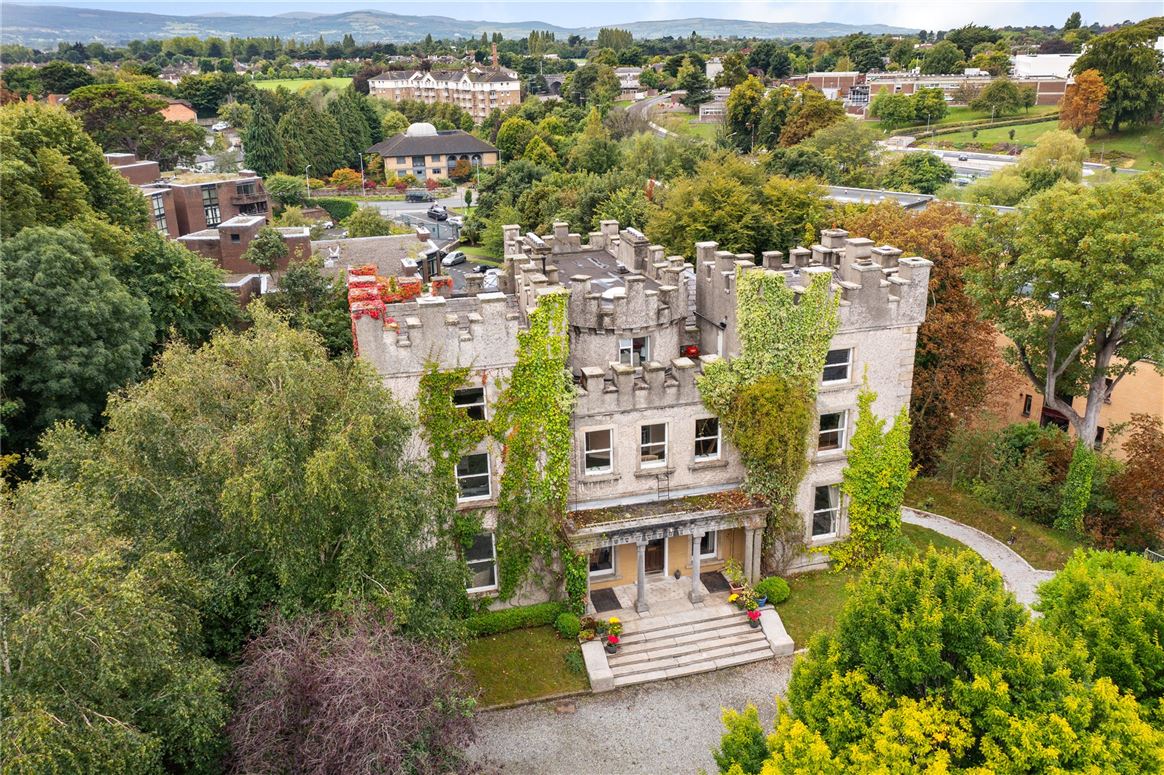
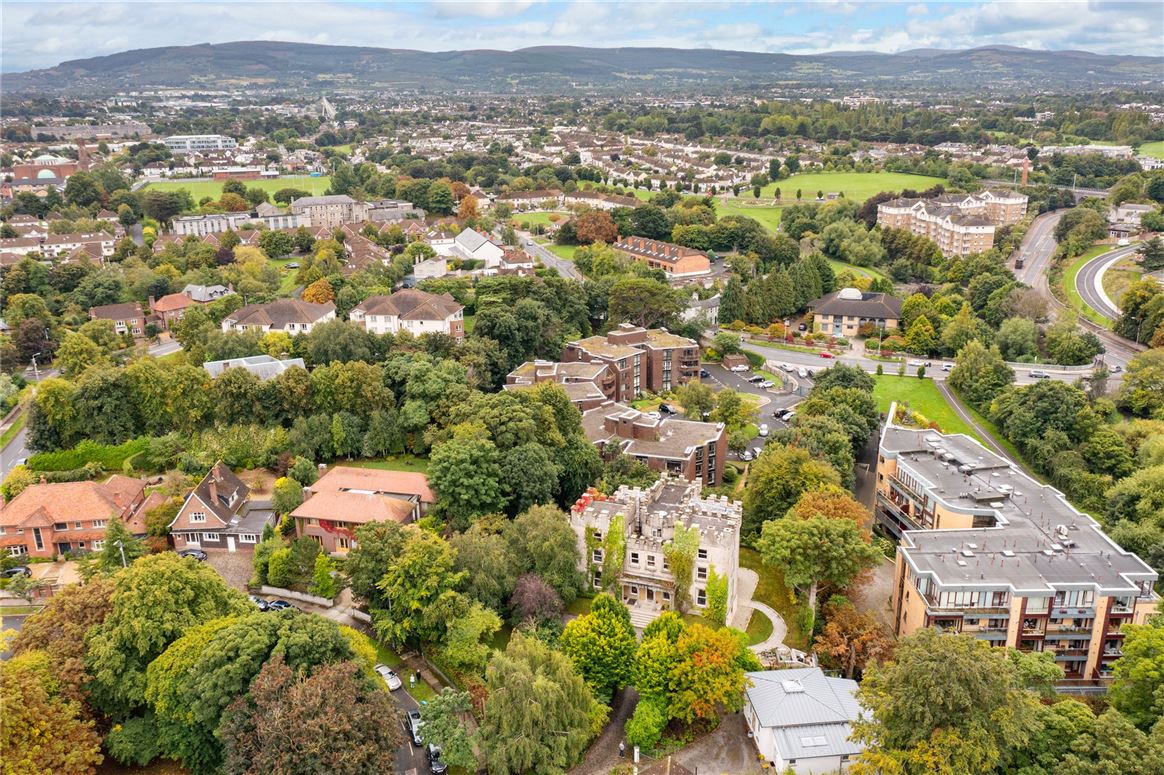
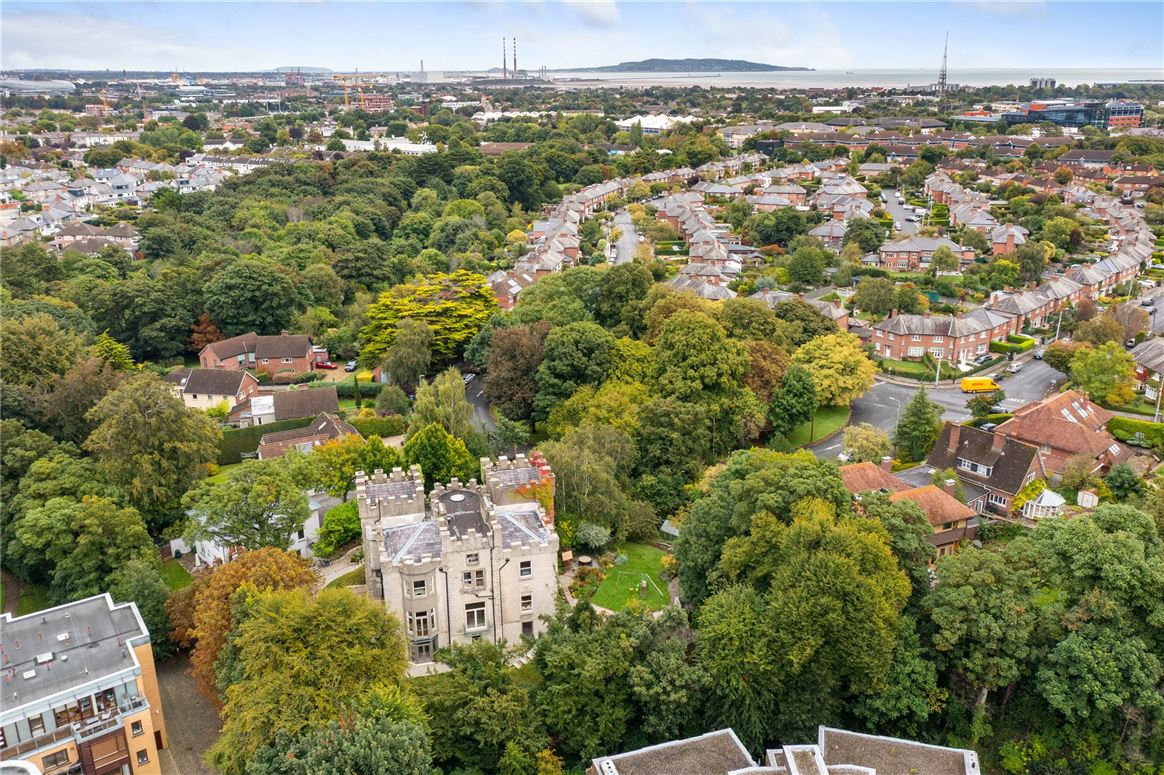
Clonskeagh Castle, photograph courtesy of Sherry Fitzgerald and myhome.ie

We visited Clonskeagh Castle in December 2023. The name Clonskeagh comes from the Irish “Cluain Sceach” – the meadow of the white thorns. The house was built around 1789 as a country residence (he also had a house in the city) for Henry Jackson (d. 1817), who owned an iron foundry.

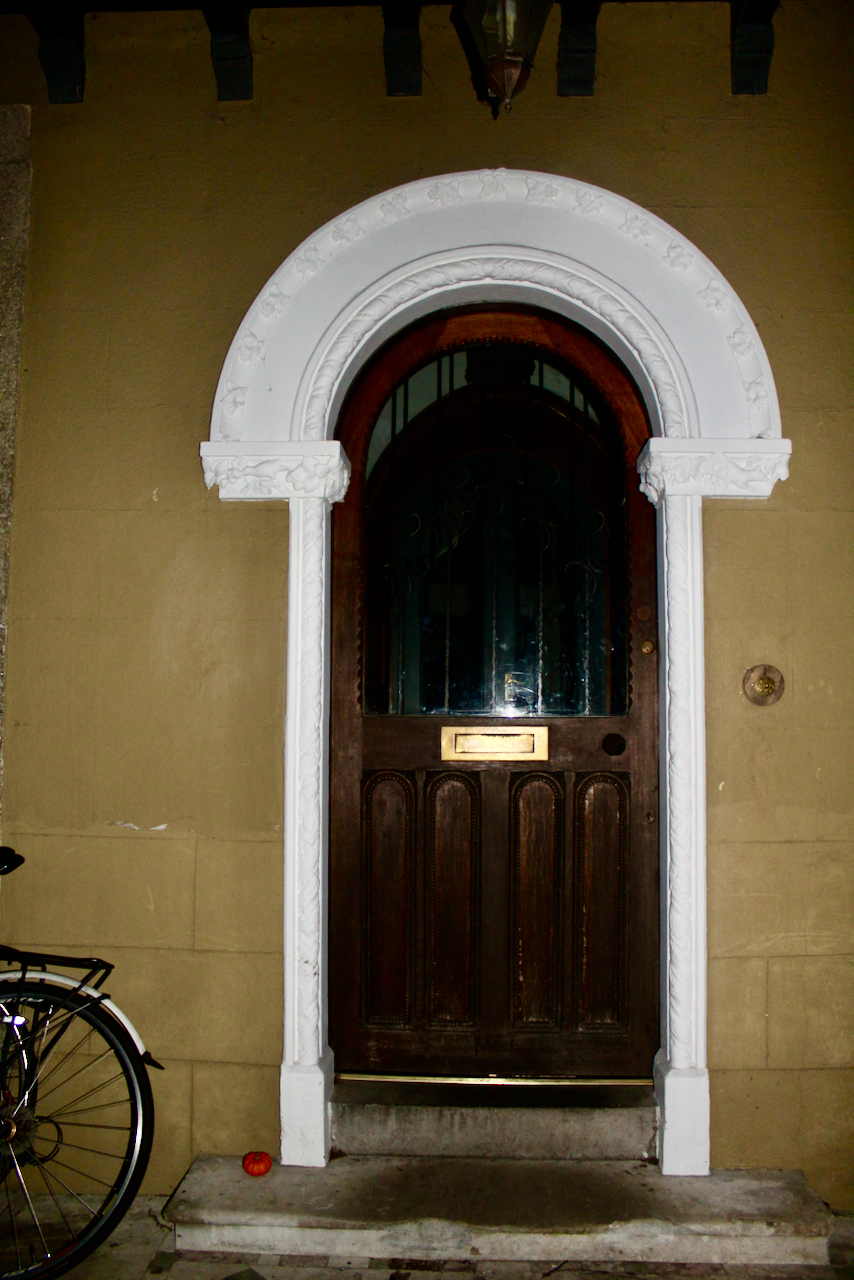
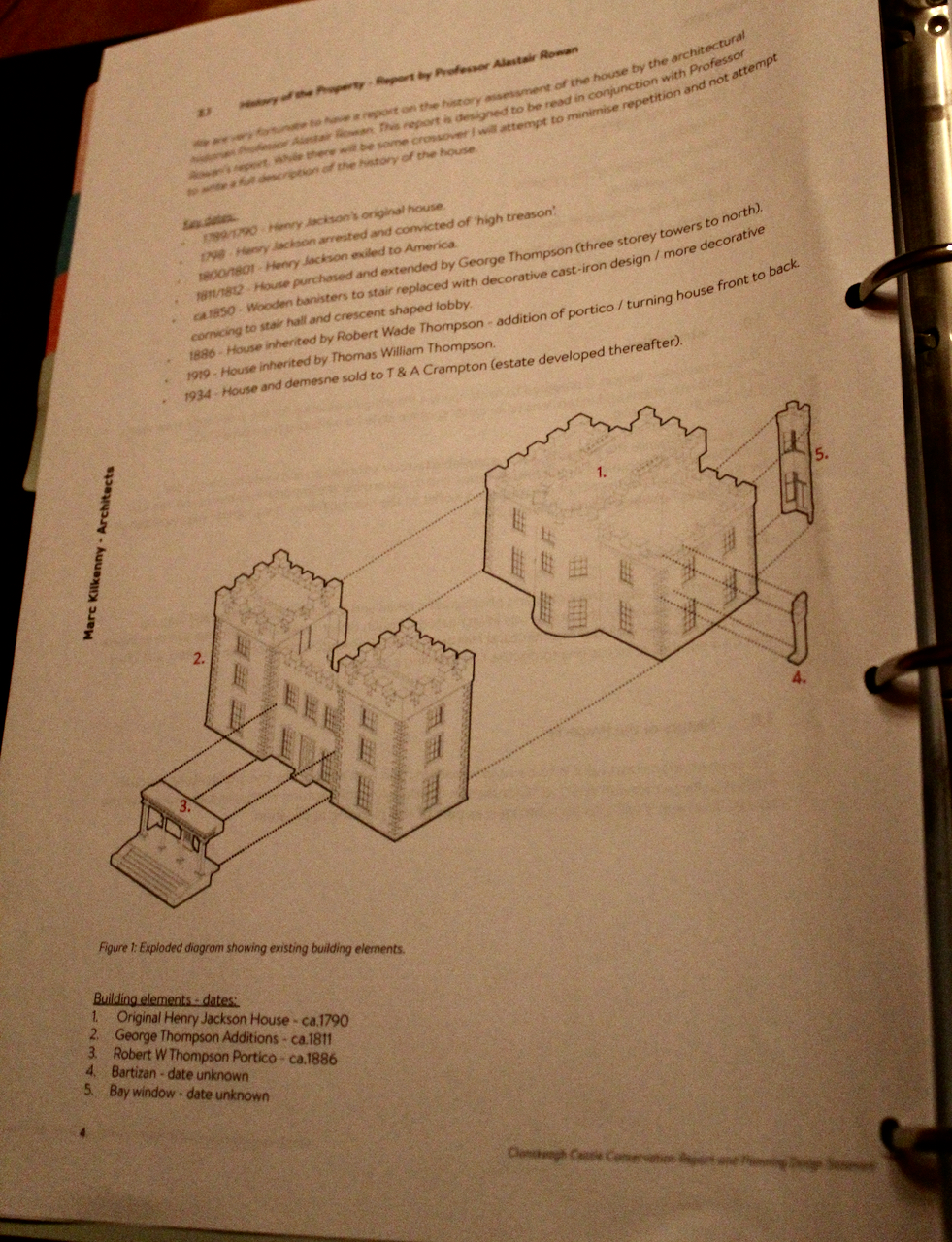
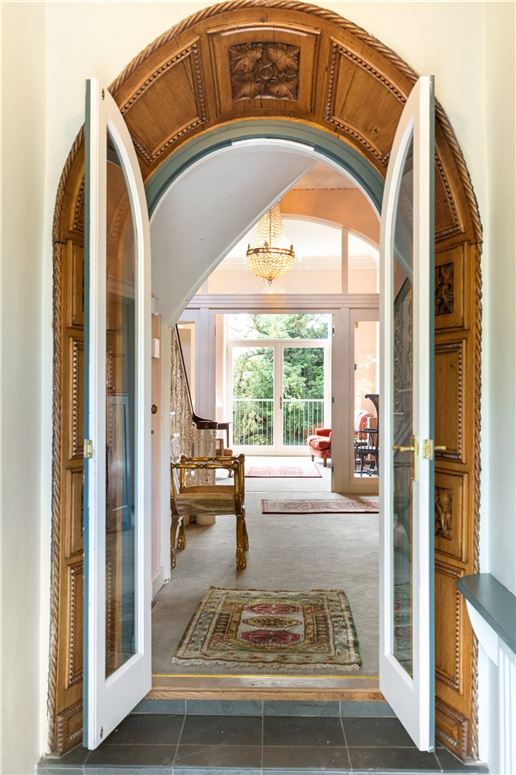
The house was built on an elevated site, and originally faced a toward the Dodder River. It was more compact than the “castle” as we see it today as it did not have the porch or the two towers that now stand at the present front of the house. The front door is less impressive than one would expect but this is because it was not the original front. The portico was added around 1886 when the house was inherited by Robert Wade Thompson.

Owner Frank showed us notes written by architect Marc Kilkenny and architectural historian Alastair Rowan, with a photograph of the original arched entrance to the demesne.
A photograph of the house taken at the beginning of the twentieth century, which shows the landscaped gardens.
The front door of Clonskeagh Castle. Photograph © Jennifer Winder-Baggot, www.irishhistorichouses.com

The house was purchased by the parents of the current owner in 1992. The house had been converted into flats and the Armstrongs converted it back into use as a family home. They carried out much work on the building, with the benefit of research and guidance of architectural historian, Professor Alistair Rowan. The website tells us:

The recent works [in 2019] have included restoration of the major portions of the parapet roof in accordance with best conservation practice; withdrawal of earth from the curtailage of the building, which had been piled up over at least a century giving rise to dampness in the walls; and restoration of rooms in what had been the servants’ quarters to create a small apartment.

These works have been executed by Rory McArdle, heritage contractor, under the supervision of award-winning architect Marc Kilkenny, with frequent reference to the conservation experts at Dun Laoghaire-Rathdown County Council. Fionan de Barra, architect, also provided valuable consultation at the early stages of the project.

Clonskeagh Castle, photograph courtesy of Sherry Fitzgerald and myhome.ie

Frank Armstrong, the owner who showed us around, edits a magazine, https://cassandravoices.com/

In an article in the Irish Times published on October 6th 2022 written by Elizabeth Birdthistle, Marc Kilkenny said: “Working with my father-in-law at Clonskeagh Castle was an immense privilege. This house was like a member of the family and I felt honoured to be entrusted with the works… We reopened the original 18th century entrance to create a new sitting room which reintroduced south light into the entrance hall. We replaced the main roof and rerouted rainwater and transformed part of the basement into a light and spacious apartment with associated garden and steps up to a new terrace by the main kitchen. All works were carried out to the highest conservation standards.” [1]

Clonskeagh Castle, photograph courtesy of Sherry Fitzgerald and myhome.ie

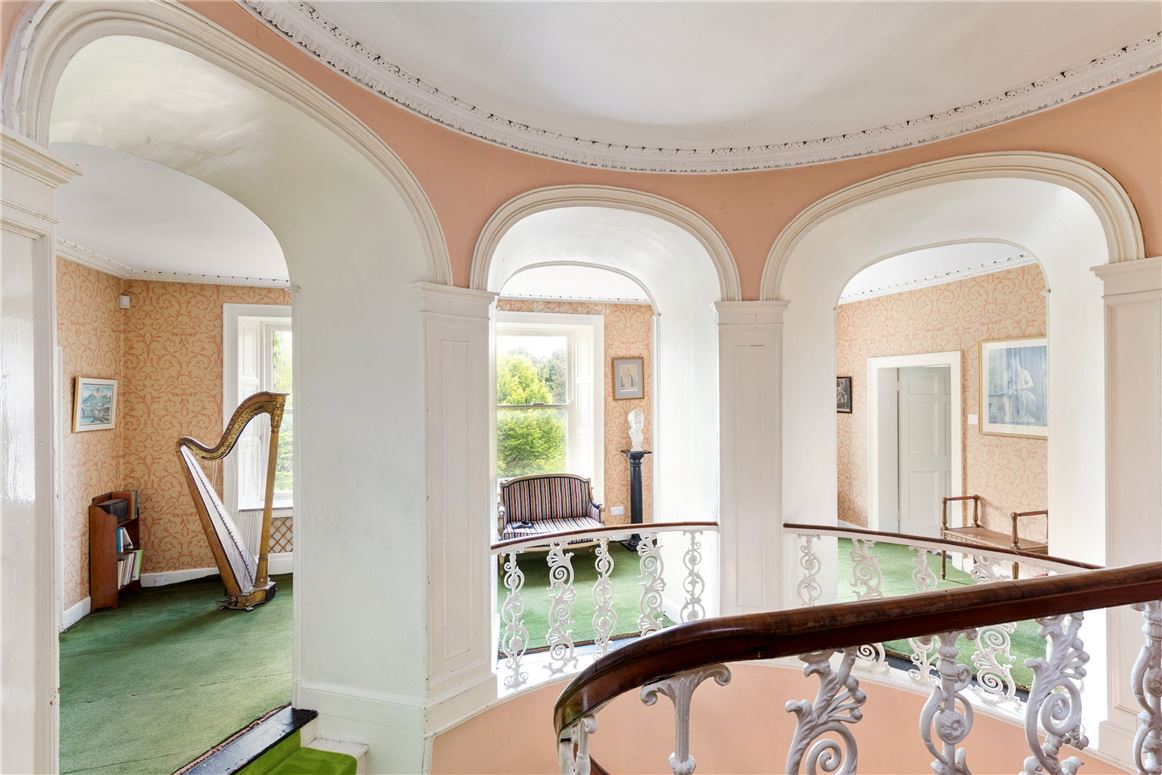
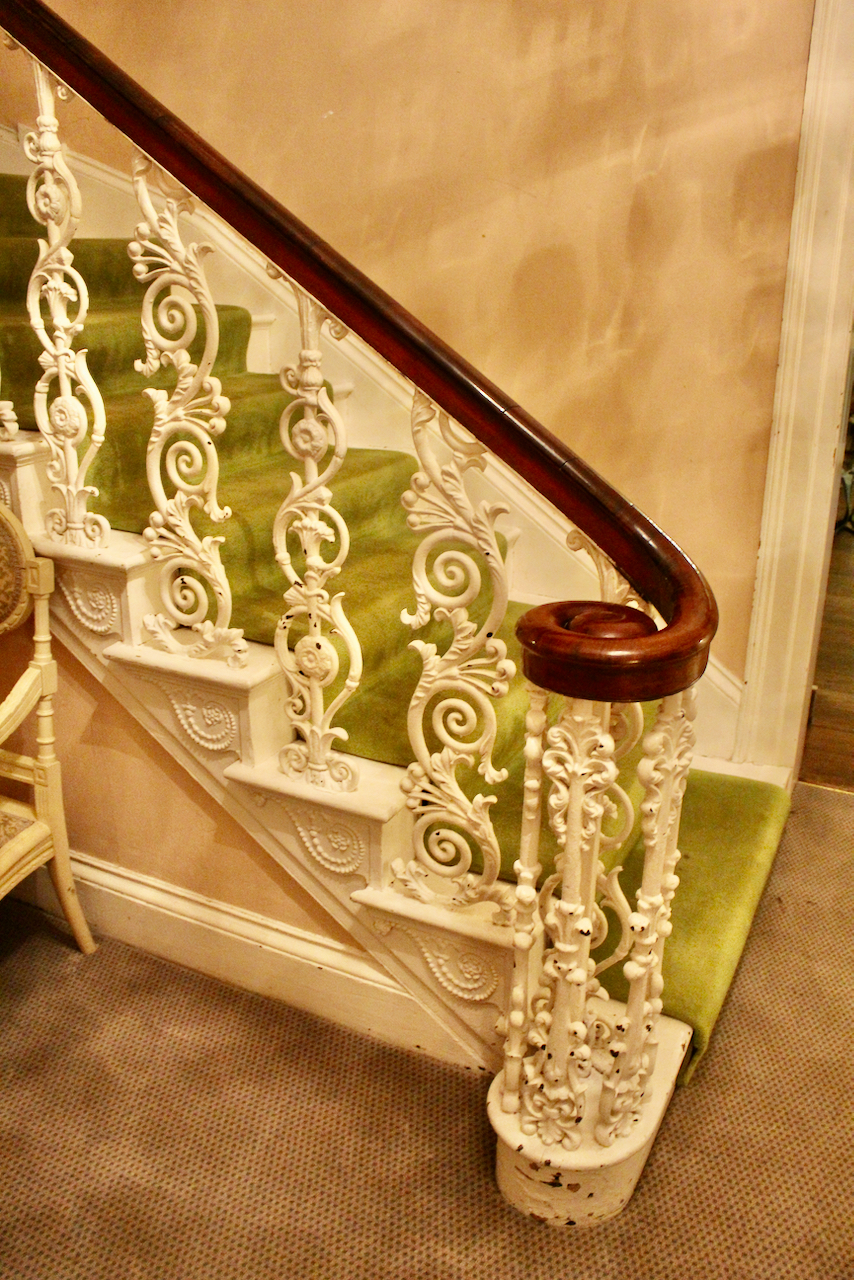
The house contains a beautiful curving staircase with iron balusters, and a spacious upstairs lobby with arches and large sash casement windows letting in the light.

Clonskeagh Castle, photograph courtesy of Sherry Fitzgerald and myhome.ie
The wooden banisters were changed to more decorative cast iron banisters around 1850 and decorative cornicing was added to stair hall and upstairs lobby. Photograph © Jennifer Winder-Baggot, www.irishhistorichouses.com

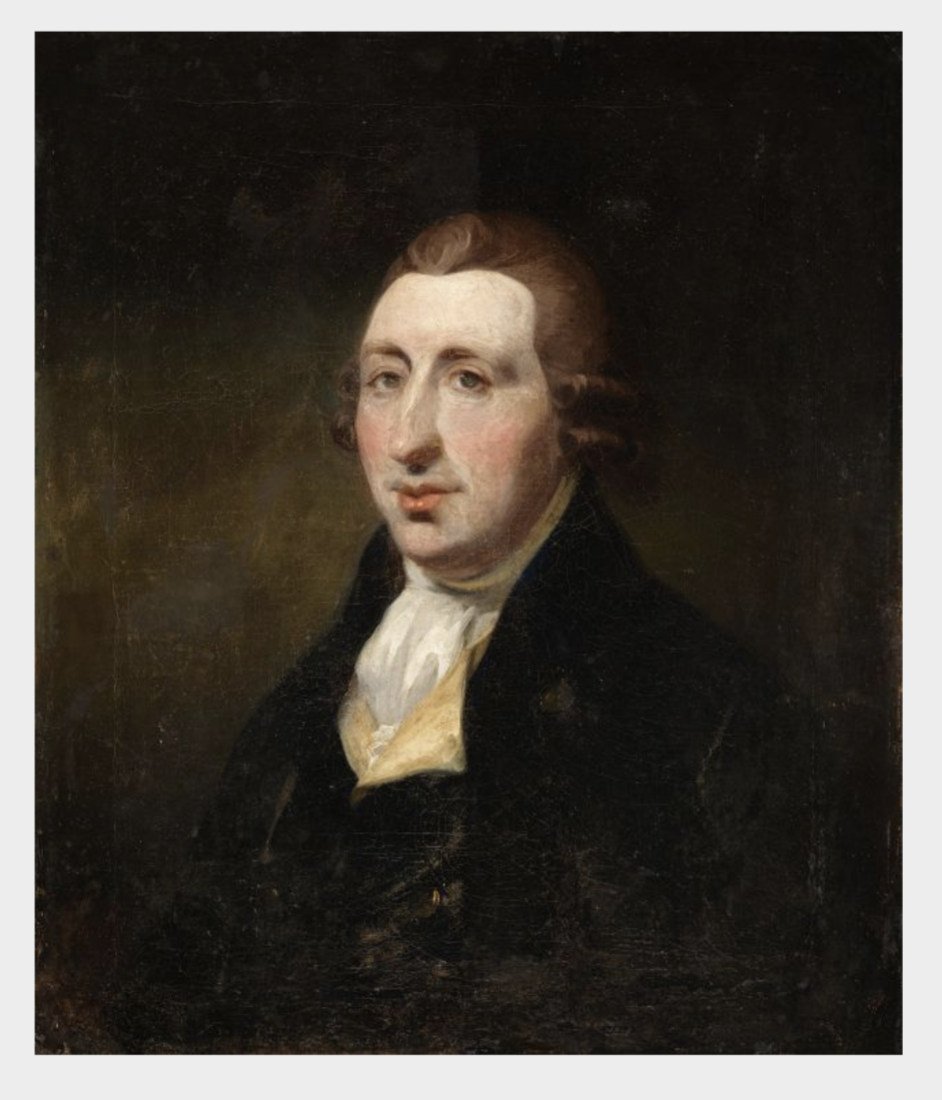
The original owner of the house, Henry Jackson, was the fourth son of Hugh Jackson (1710?–77) of Creeve, Co. Monaghan, and his wife Eleanor (née Gault), who belonged to a family engaged in the linen trade. [2] Hugh Jackson introduced the linen trade to Ballybay, Co. Monaghan, and generally improved the town.

Henry Jackson started in business as an ironmonger in 1766. The Dictionary of Irish Biography tells us that he is listed in the Dublin Directory from 1768 as an ironmonger in Pill Lane, and from 1787 as an iron founder or iron and brass founder in Old Church Street. In 1798 he also had mills for rolling and slitting iron on the quays and for grinding corn in Phoenix Street (both also steam powered) and iron mills at Clonskeagh.

Henry Jackson joined the United Irishmen. He was influenced by the writings of Thomas Paine, the author of The Rights of Man, and Jackson named the house “Fort Paine.” The Society of United Irishmen was formed at a gathering in a Belfast tavern in October 1791. They were influenced by the ideals of the French Revolution, and they wanted to secure “an equal representation of all the people” in a national government. The founders were mostly Presbyterian but they vowed to make common cause with Irish Catholics. Presbyterians as well as Catholics had suffered under the Penal Laws in Ireland, as Presbyterians were “dissenters” from the established Protestant religion. Most of the original United Irishmen were members of the Irish Volunteers, which were local militias set up to keep order and safety when British soldiers were withdrawn from Ireland to fight in the American Revolutionary War (or as those in America call it, the War of Independence).

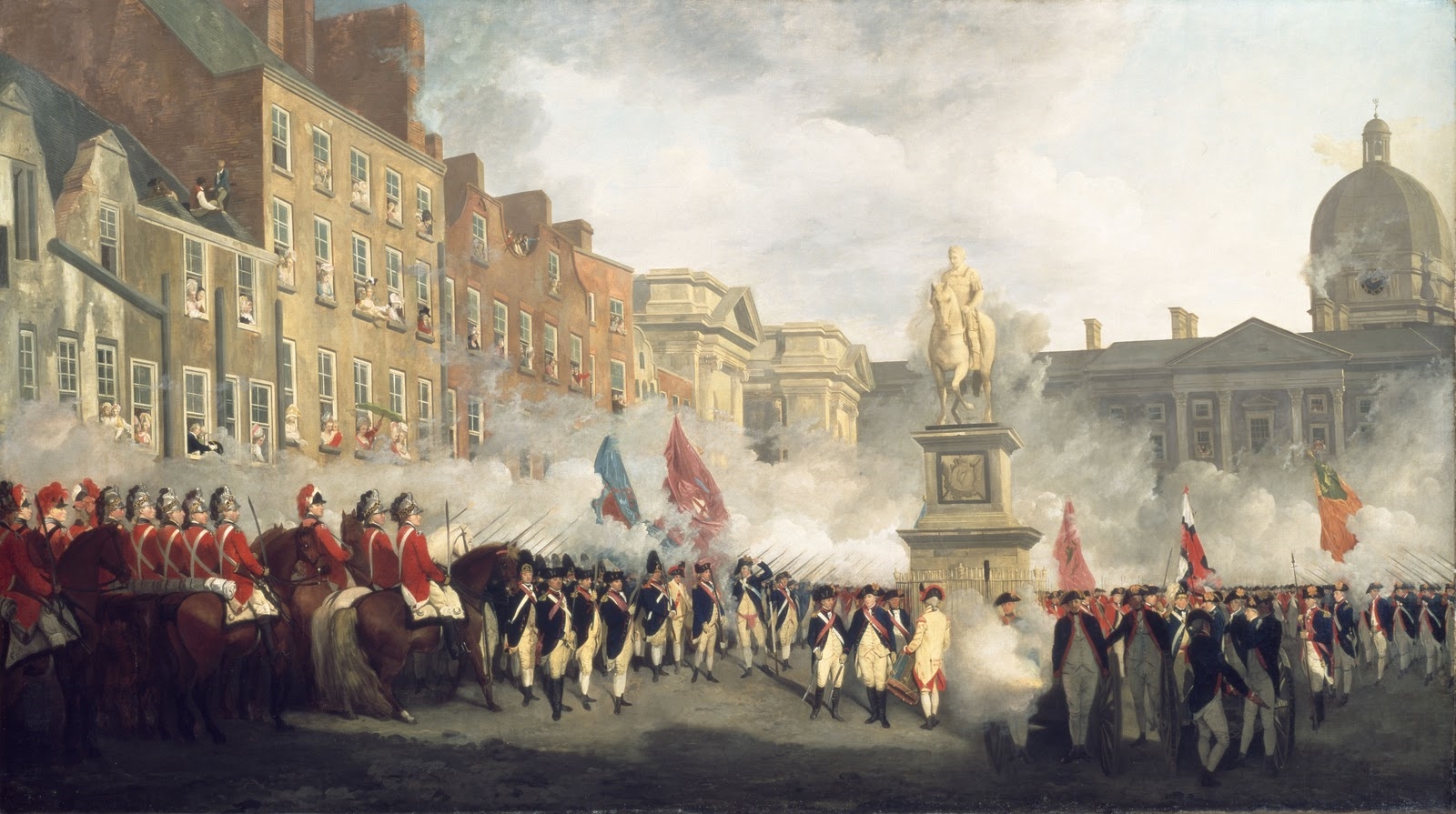
In Dublin on 4 November 1779, the Volunteers took advantage of the annual commemoration of King William III’s birthday, marching to his statue in College Green and demonstrating for the cause of free trade between Ireland and Great Britain. Previously, under the Navigation Acts, Irish goods had been subject to tariffs upon entering Britain, whereas British goods could pass freely into Ireland.

Painting by Francis Wheatley depicting the Dublin Volunteers on College Green, 1779.

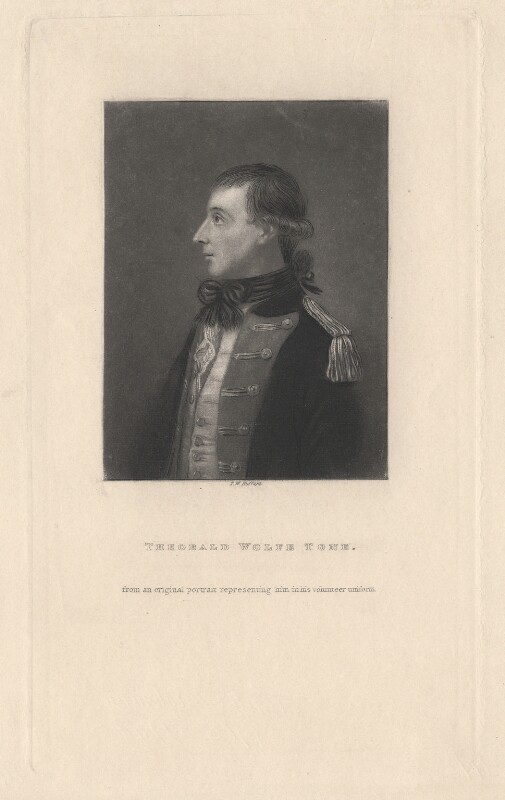
Theobald Wolfe Tone was one of the founders of the United Irishmen. Thomas Russell had invited Tone, as the author of An Argument on behalf of the Catholics of Ireland, to the Belfast gathering in October 1791. By 1798, Tone instigated Rebellion for independence and the formation of a republic in Ireland, and he sought the help of the French. Although Protestant, Tone was secretary to Dublin’s Catholic Committee, a group which had been formed to seek repeal of the Penal Laws. The Catholic Committee was formed in 1757 by Charles O’Conor of Belanagare in County Sligo (see my entry about Clonalis).

Theobald Wolfe Tone, courtesy of National Gallery of Ireland.

In 1786 Henry Jackson, who was from a Presbyterian family, joined his son-in-law Oliver Bond, along with James Napper Tandy and Archibald Hamilton Rowan, to form a Dublin battalion of the Volunteers. He was also a member of the Dublin Society of United Irishmen. He sat on several of its committees, acting as its secretary and later as its treasurer, and was present at what proved to be the final meeting of the society when it was raided by the police (23 May 1794).

James Napper Tandy (1740-1803), United Irishman, by unknown artist, presented to National Gallery of Ireland by Mr. Parker 1872, object number NGI 429.

Henry Jackson of Clonskeagh Castle used his foundry to make pikes for the 1798 Rebellion. The website tells us:

Jackson was involved in preparations for the 1798 Rebellion, and his foundries were engaged to manufacture pikes for combat, and also iron balls of the correct bore to fit French cannons, in anticipation of an expected invasion. His son-in-law Oliver Bond was also heavily implicated in these plans.

In the event, Jackson was arrested before the ill-fated Rebellion, and imprisoned in England. After some time he was released on condition that he went into exile in America. He died in the city of Baltimore, Maryland in 1817.

Frank told us that the lyrics of the song “By the Rising of the Moon” may refer to the foundry in Clonskeagh. The lyrics of the song include:

At the rising of the moon, at the rising of the moon
For the pikes must be together at the rising of the moon
And come tell me Sean O’Farrell, where the gathering is to be
At the old spot by the river quite well known to you and me.

Clonskeagh Castle, photograph courtesy of Sherry Fitzgerald and myhome.ie

There are tunnels under the house which were perhaps used by Jackson to store his pikes and cannonballs.

The tunnels under Clonskeagh Castle. Photograph © Jennifer Winder-Baggot, www.irishhistorichouses.com
This looks like it could have been an outlet from the tunnels, and faces the original front of the house, toward the Dodder River. Photograph © Jennifer Winder-Baggot, www.irishhistorichouses.com

The Clonskeagh Castle website continues: “In 1811 the Castle was purchased by George Thompson, a landed proprietor, who had a post in the Irish Treasury, and it remained in the ownership of that family until the early twentieth century. It is interesting to note that whereas Henry Jackson was fired by the objective of Irish independence, the last Thompson family member to occupy the house was vehemently insistent on the preservation of the Union.

Thompson made alterations to the house and made what was formerly the back of the house into the front. The Armstrongs note that the hallway was thus left quite dark, and they did renovation work to allow light to penetrate from the south.

Notes from a report written by Alastair Rowan, with drawings of the original Henry Jackson house, and the George Thompson additions.
Clonskeagh Castle, photograph courtesy of Sherry Fitzgerald and myhome.ie. We can see that the hall is now made bright by opening up the space to the outside.
Clonskeagh Castle, photograph courtesy of Sherry Fitzgerald and myhome.ie

The house passed from George Thompson (1769-1860) to his son Thomas Higinbotham Thompson, to his son Robert Wade Thompson (1845-1919). [3] Robert Wade Thompson was a barrister, who married Edith Isabella Jameson, daughter of Reverend William Jameson (1811-1886) and Elizabeth Guinness (1813-1897). Reverend William Jameson was son of John Jameson of Jameson’s Whiskey Company. Elizabeth was the daughter of Arthur Hart Guinness (1768-1855) who was the son of Arthur Guinness (1725-1803), founder of Guinness Brewery.

The house then passed to Robert Wade Thompson’s son Thomas William Thompson in 1919.

The website tells us: “During the War of Independence (1919-1921) the Castle was occupied by the British military, and was used for some time to incarcerate Irish Republicans.

The castle was purchased in 1934 by G&T Crampton, a property development company who later developed the redbrick houses that now stand on the nearby Whitethorn, Whitebeam and Maple Roads.

“Clonskeagh Castle,” held by G. & T. Crampton. © Unknown. Digital content by Assoc. Prof. Joseph Brady, published by UCD Library, University College Dublin.

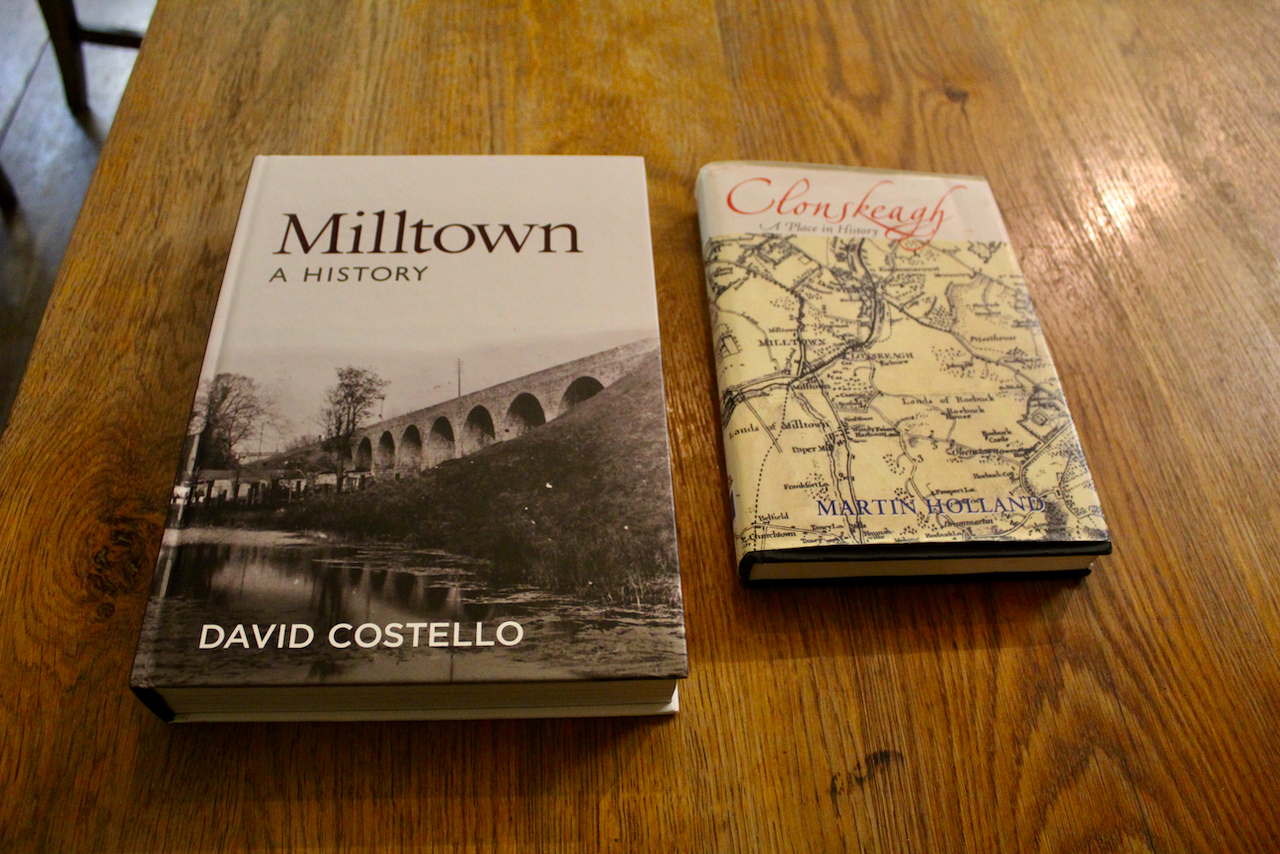
Frank showed us a couple of books about the area. The house was for sale when we visited. The new owners will be very lucky to own piece of Irish history.
Books that Frank showed us about the area. Photograph © Jennifer Winder-Baggot, www.irishhistorichouses.com
Clonskeagh Castle, photograph courtesy of Sherry Fitzgerald and myhome.ie
Frank told us that in the large dining room they held musical events. Photograph © Jennifer Winder-Baggot, www.irishhistorichouses.com
Clonskeagh Castle, photograph courtesy of Sherry Fitzgerald and myhome.ie

[1] https://www.irishtimes.com/property/residential/2022/10/06/clonskeagh-castle-complete-with-tunnel-and-secret-staircases-for-sale-for-295m/

[2] https://www.dib.ie/biography/jackson-henry-a4235

[3] https://www.famousjamesons.com

Text © Jennifer Winder-Baggot, www.irishhistorichouses.com

Bantry House & Garden, Bantry, Co. Cork P75 T293 – section 482

www.bantryhouse.com

Open dates in 2026: Check website in advance. Mar 30-31, Apr 1-Oct 31, Mon-Sun 10am-5pm

Fee: adult €14, OAP/student €11.50, child €5, groups 8-20 people €10p.p. and groups of 21 or more people €9p.p.

donation

Help me to pay the entrance fee to one of the houses on this website. This site is created purely out of love for the subject and I receive no payment so any donation is appreciated!

€15.00

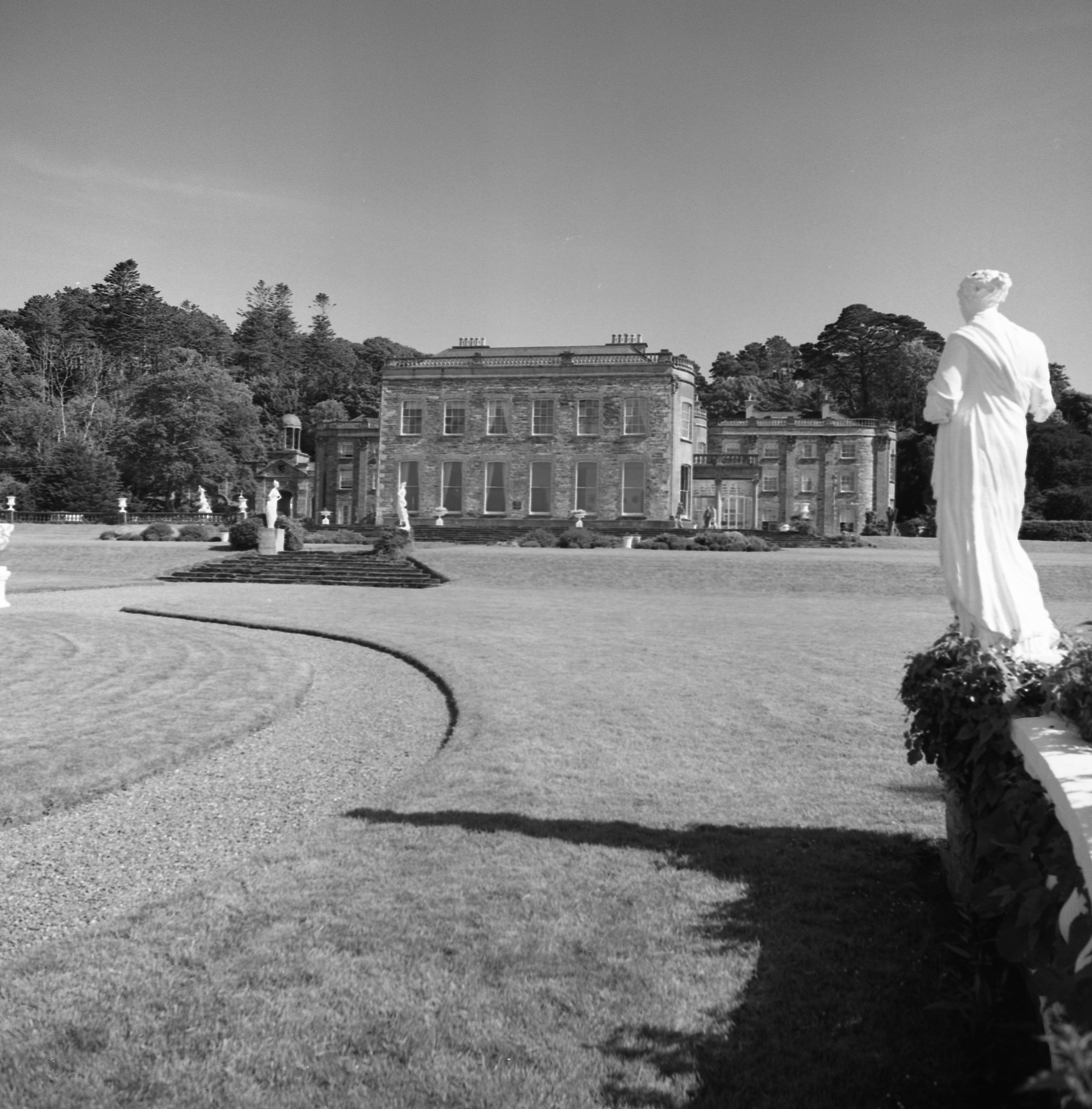
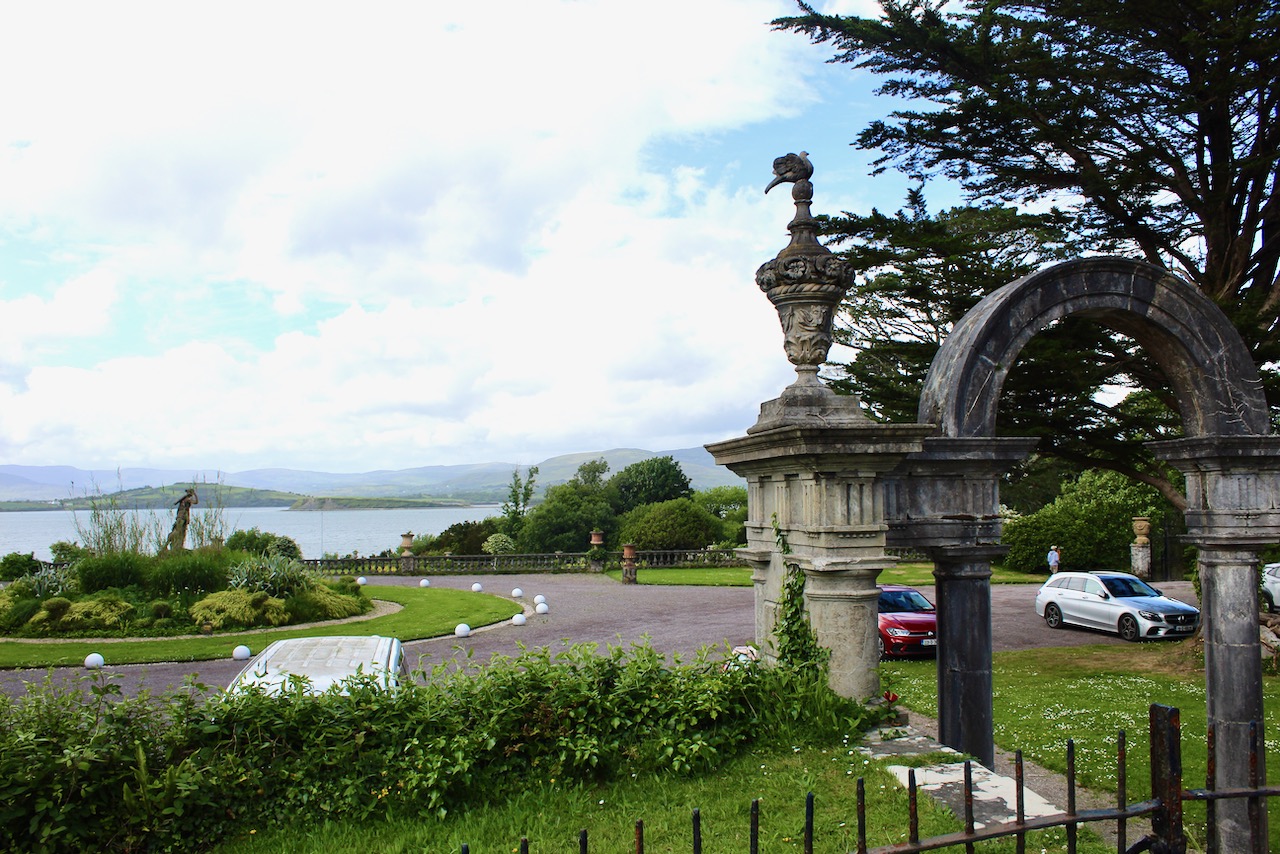
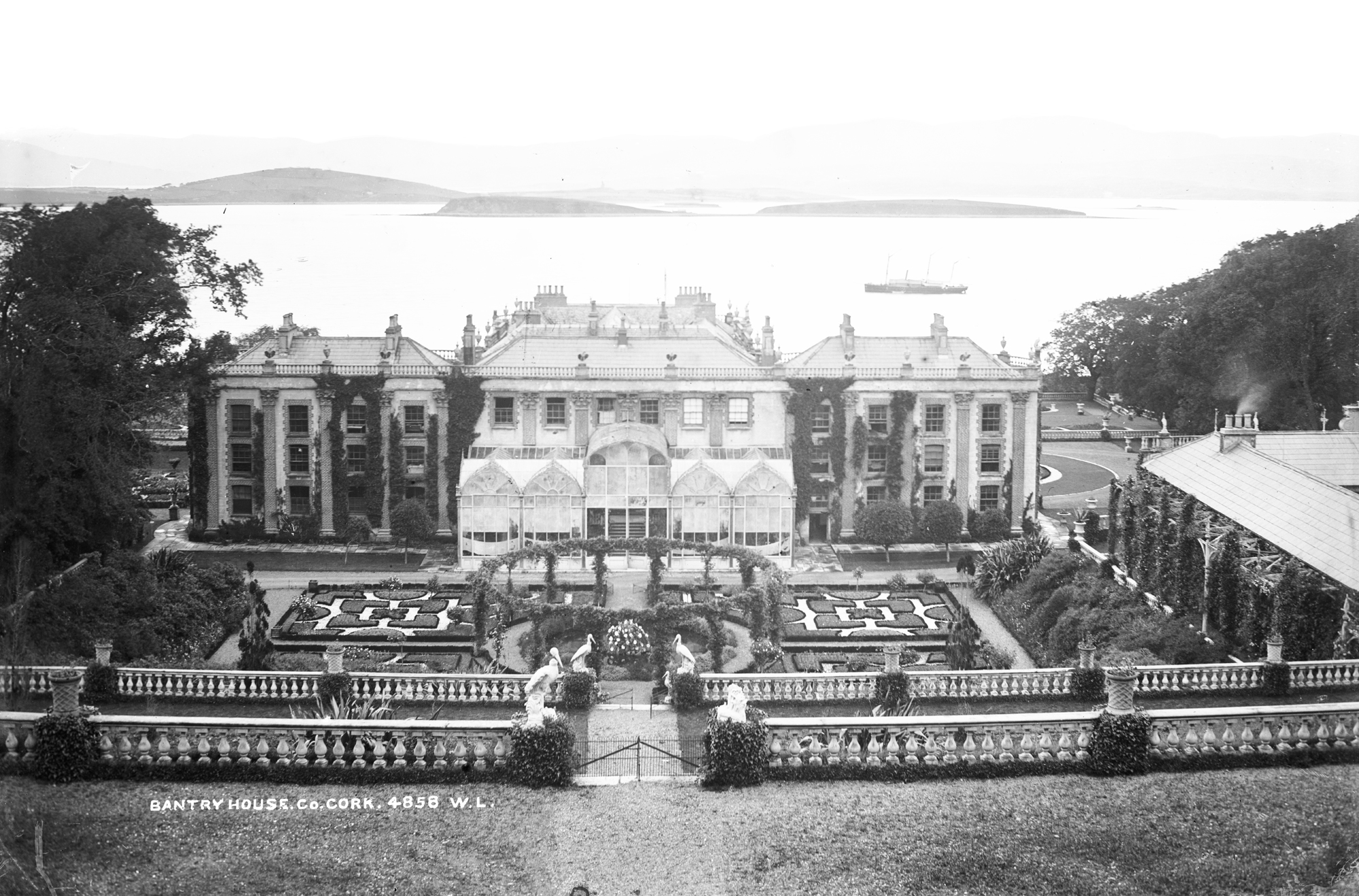
Bantry House, overlooking Bantry Bay, from the top of the “Sky Steps” or 100 Steps. June 2022. © Jennifer Winder-Baggot, www.irishhistorichouses.com
Photograph from the National Library of Ireland Creative Commons. This is taken c. 1895, and the conservatory is now gone, as well, unfortunately, as the stork sculptures on the steps!

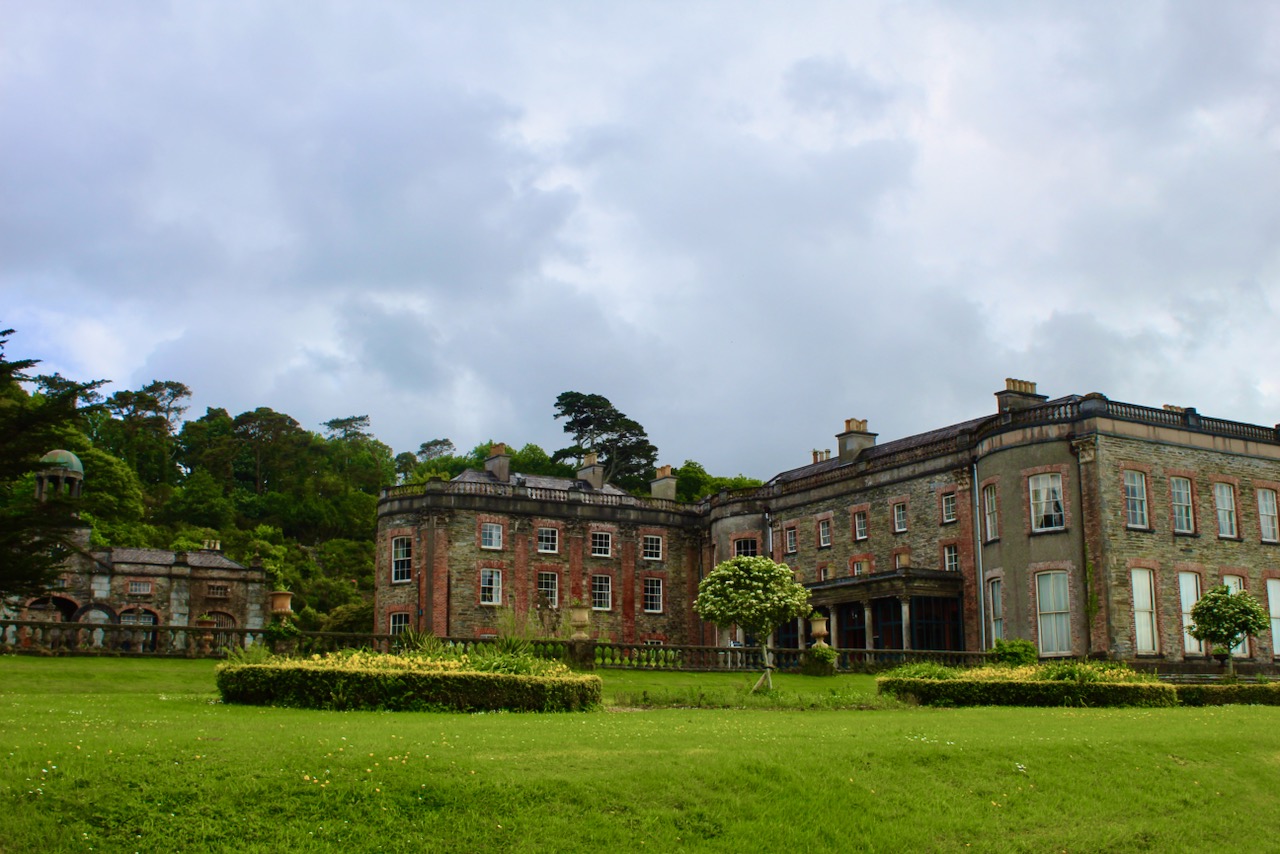
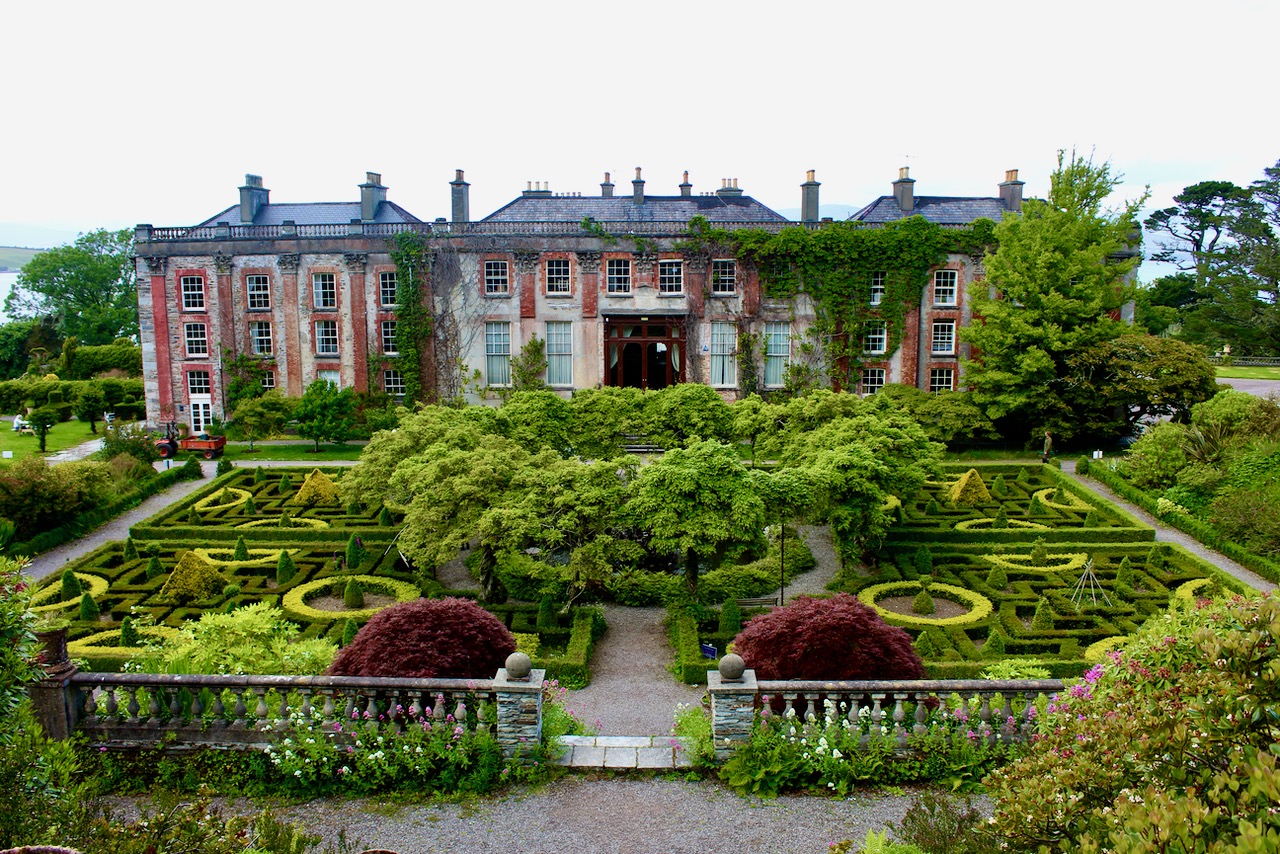
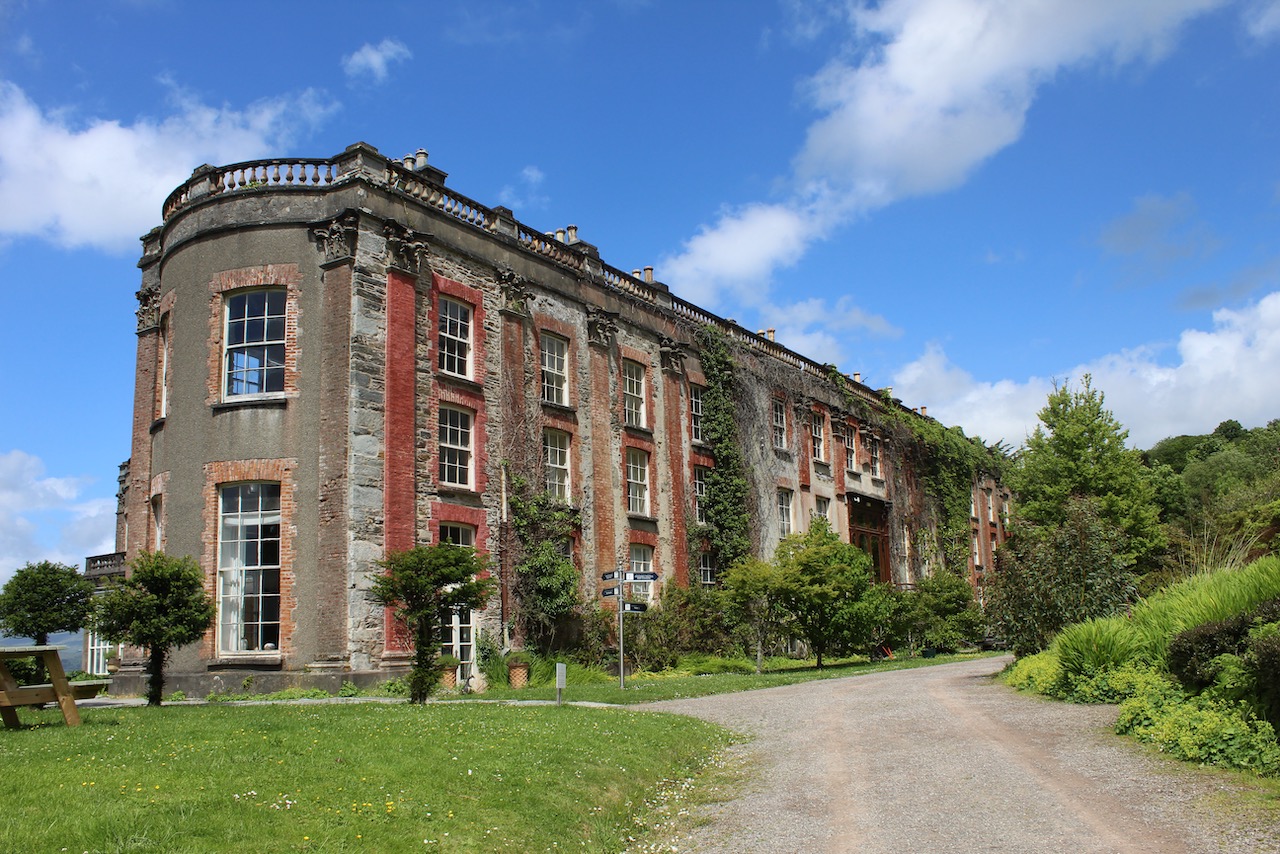
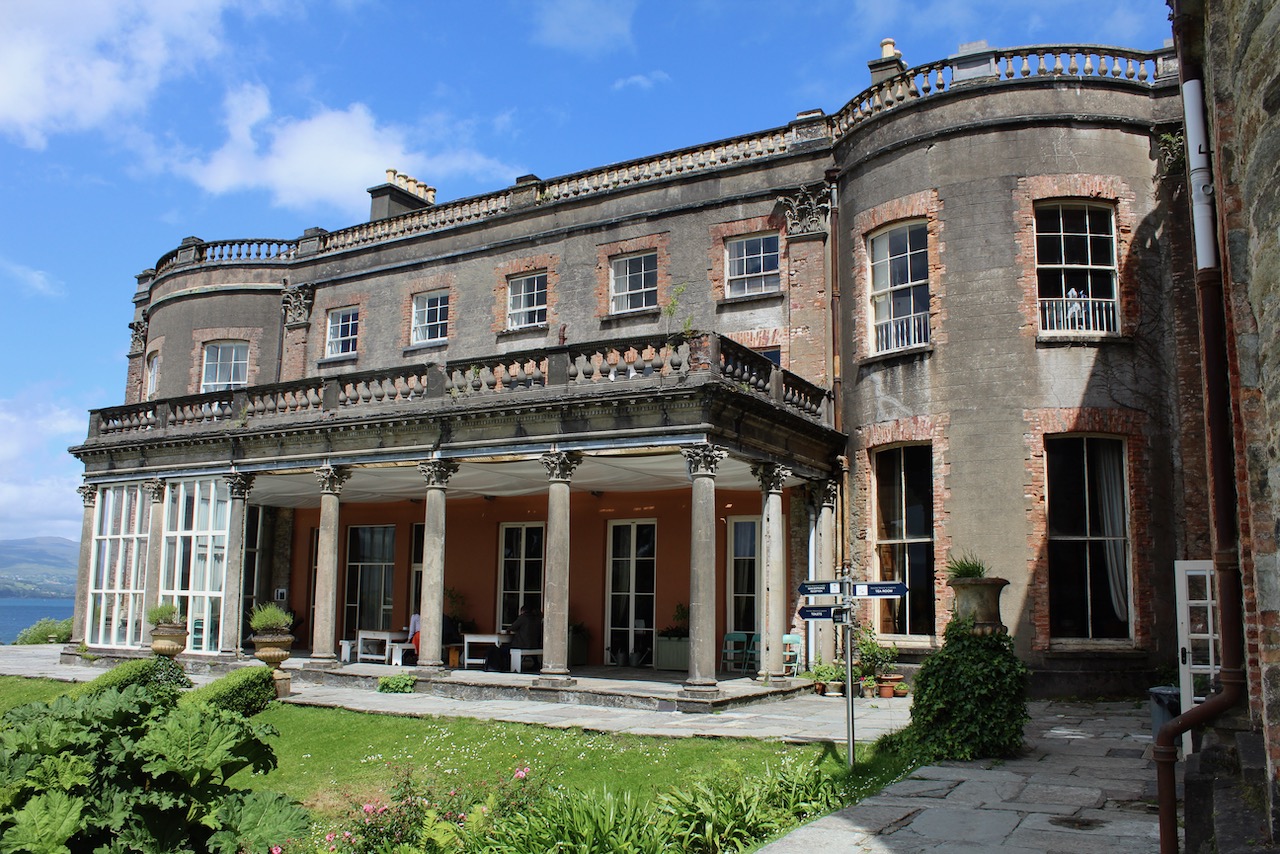
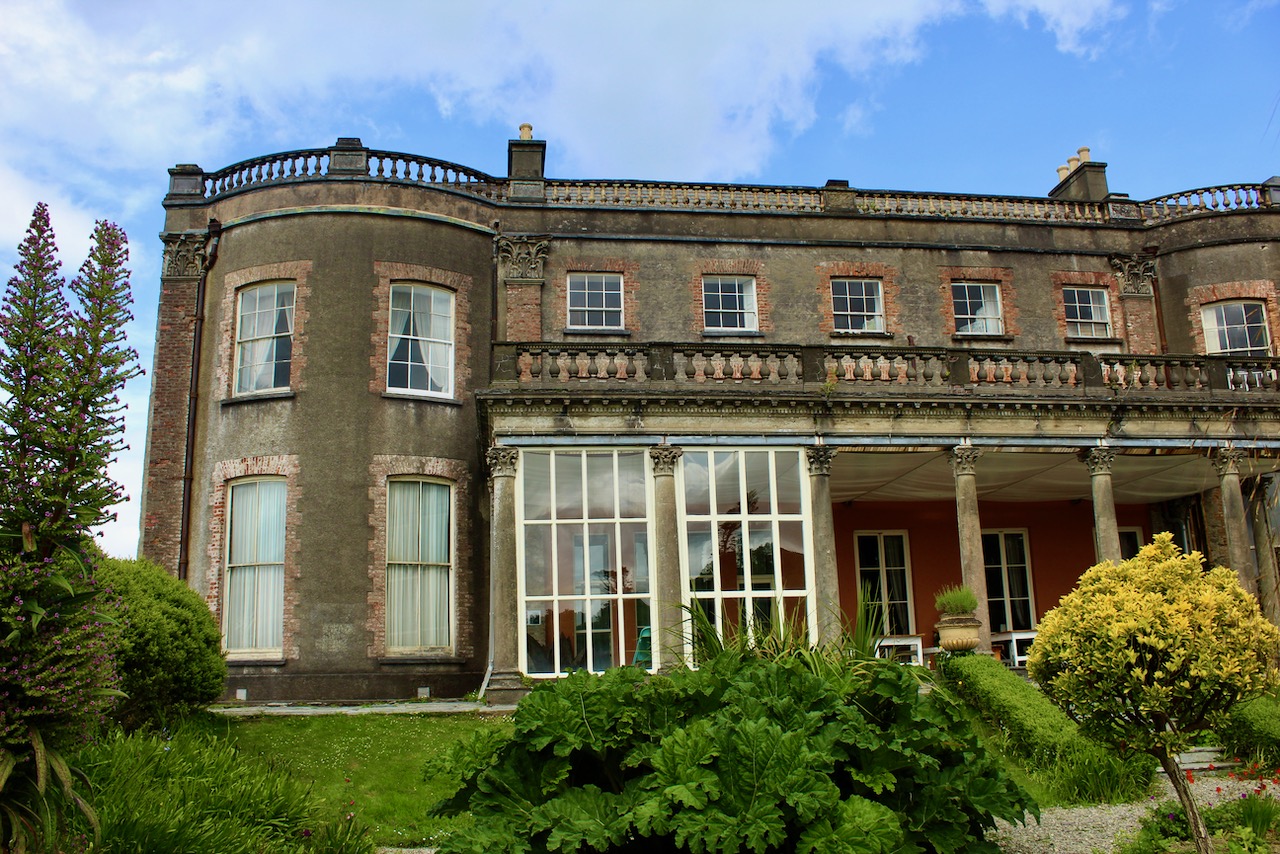
What we see today at Bantry House started as a more humble abode: a three storey five bay house built for Samuel Hutchinson in around 1690. It was called Blackrock. A wing was added in 1820, and a large further addition in 1845.

In the 1760s it was purchased by Captain Richard White (1700-1776). He was from a Limerick mercantile family and he had settled previously on Whiddy Island, the largest island in Bantry Bay. The Bantry website tells us that he had amassed a fortune from pilchard-fishing, iron-smelting and probably from smuggling, and that through a series of purchases, he acquired most of the land around Bantry including large parts of the Beare Peninsula, from Arthur Annesley, 5th Earl of Anglesey. The house is still occupied by his descendants, the Shelswell-White family.

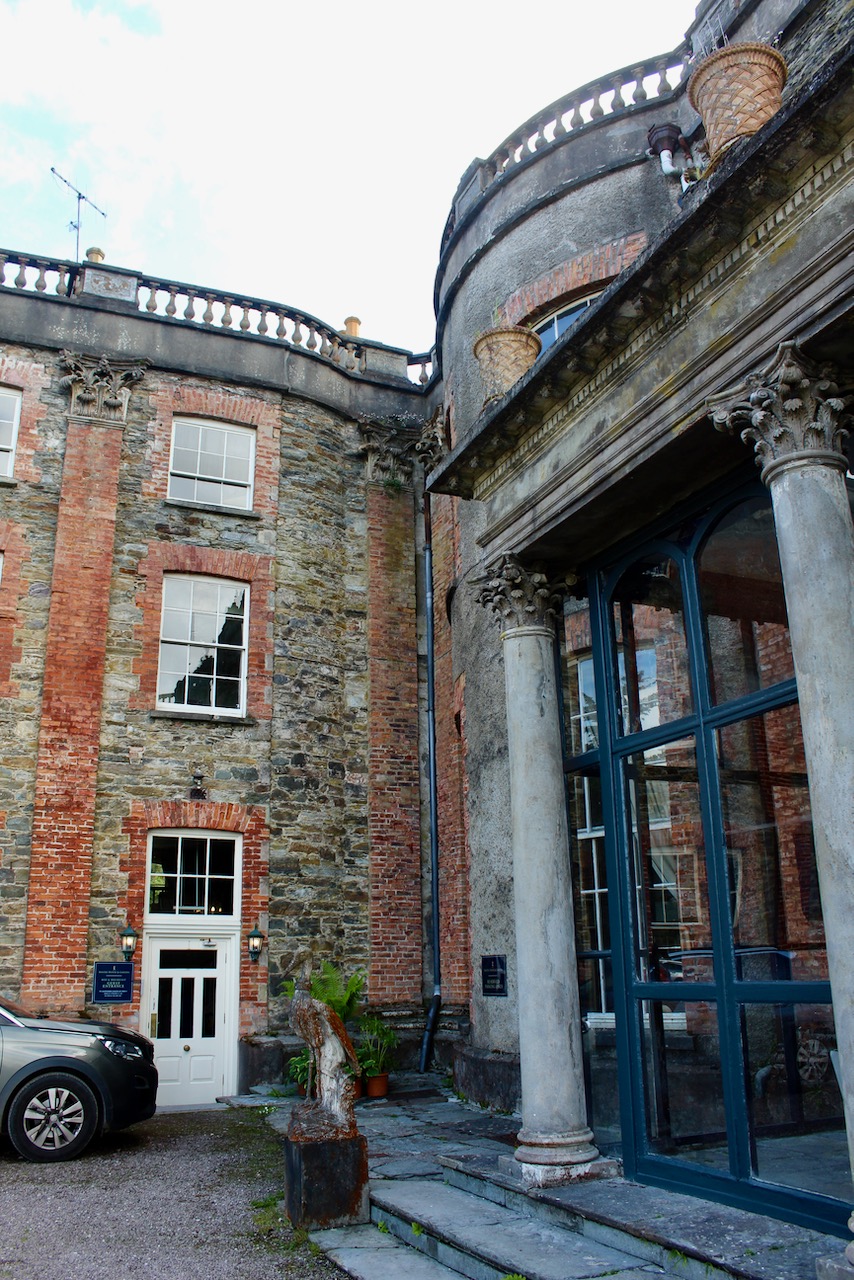
This looks like the main entrance to the house – we came in the back way. © Jennifer Winder-Baggot, www.irishhistorichouses.com
The Visitors’ entry to the house. © Jennifer Winder-Baggot, www.irishhistorichouses.com

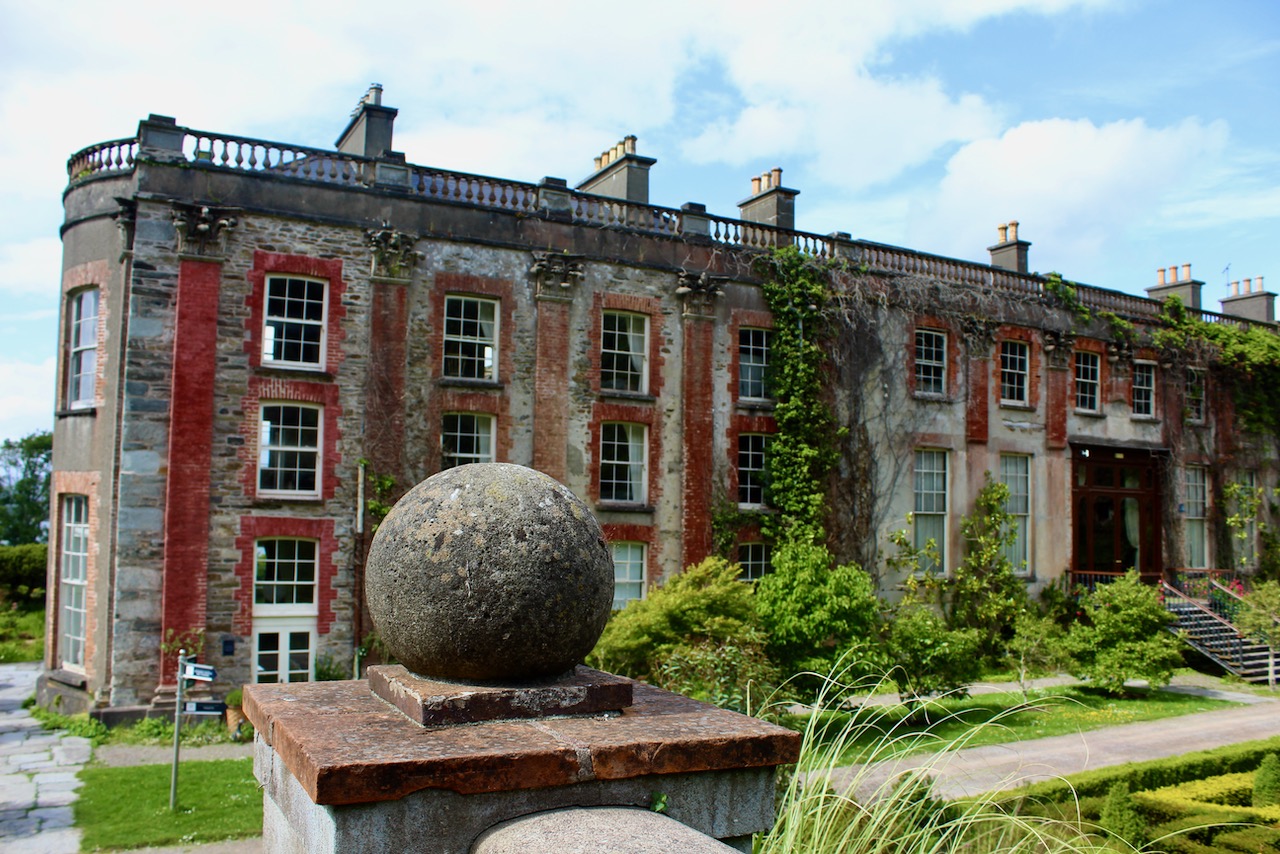
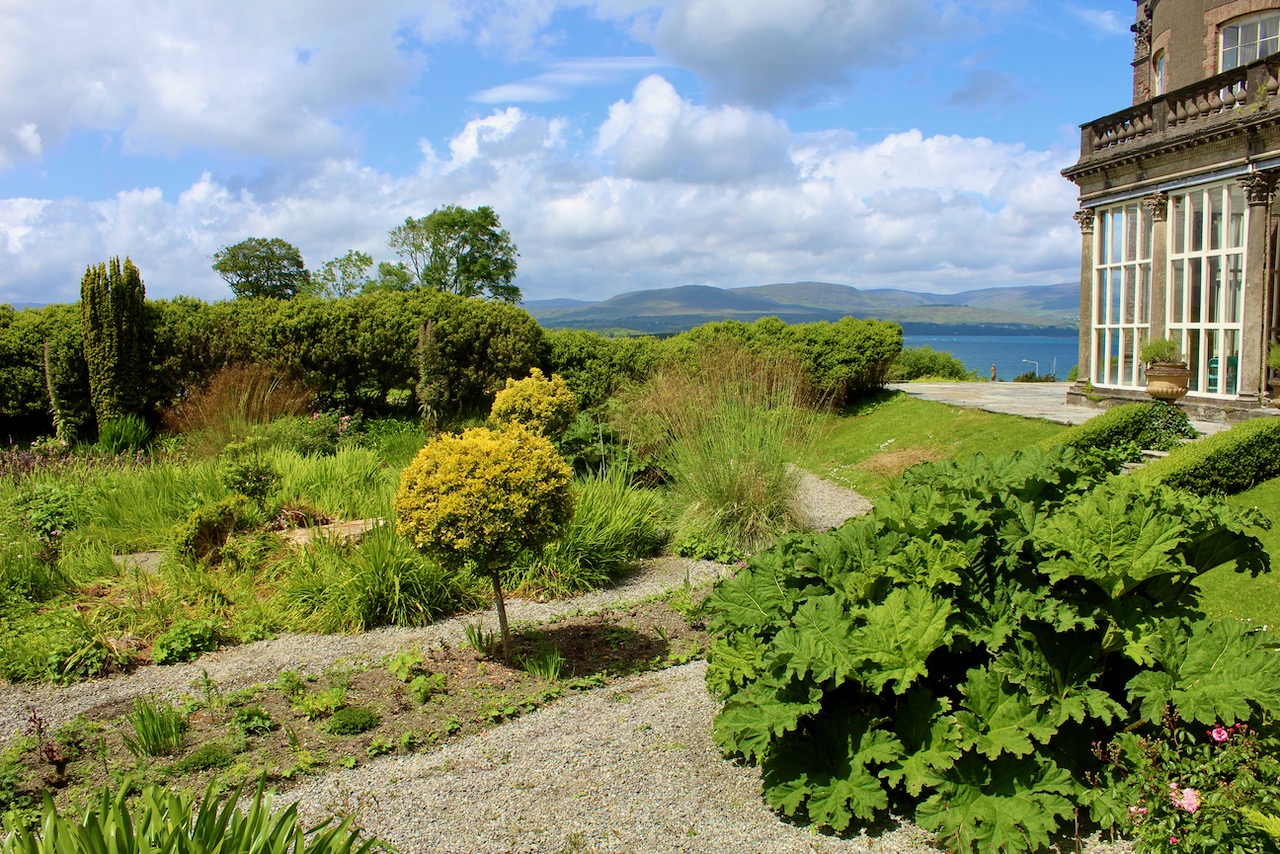
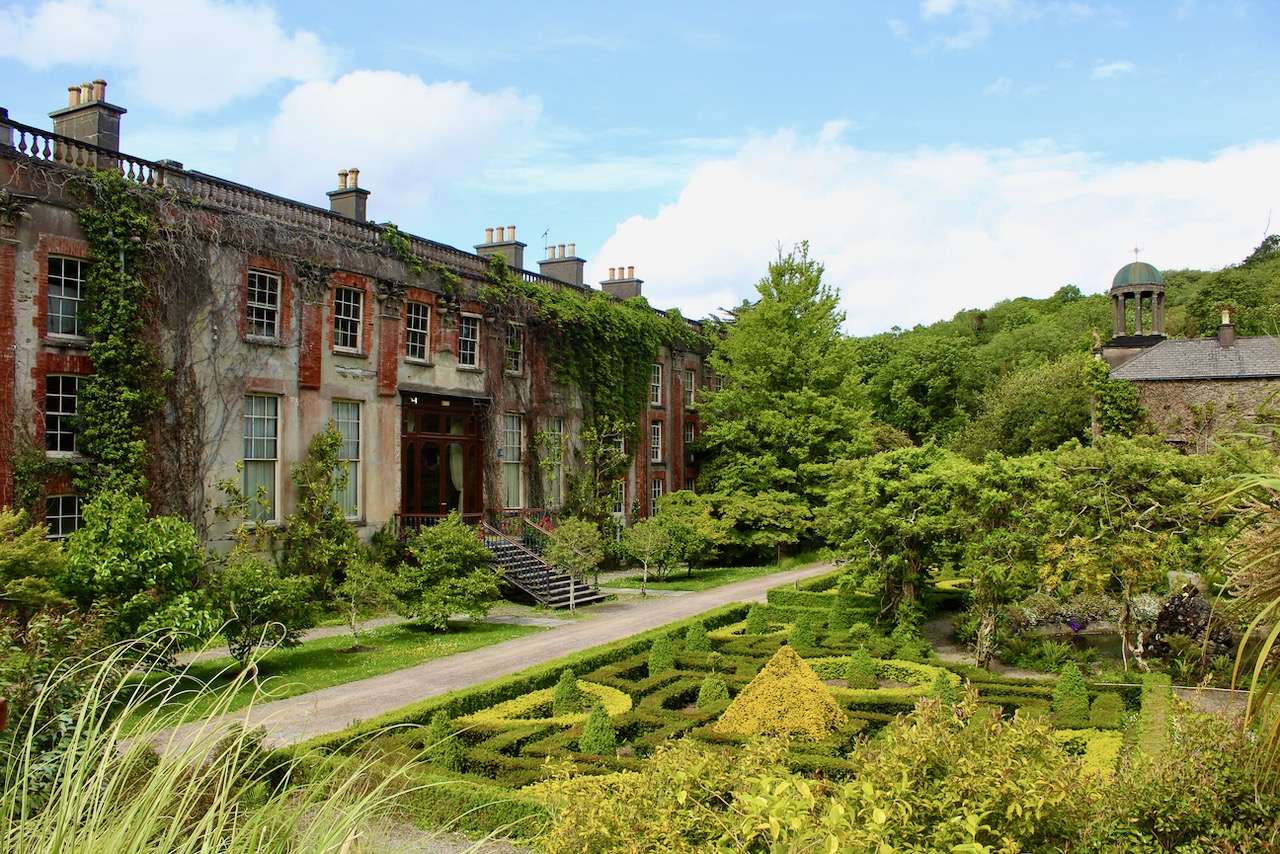
Driving from Castletownshend, we entered the back way and not through the town. From the car park we walked up a path which gave us glimpses of the outbuildings, the west stables, and we walked all around the house to reach the visitors’ entrance. We were lucky that the earlier rain stopped and the sun came out to show off Bantry House at its best. I was excited to see this house, which is one of the most impressive of the Section 482 houses.

We missed the beginning of the tour, so raced up the stairs to join the once-a-day tour in June 2022. Unfortunately I had not been able to find anything about tour times on the website. We will definitely have to go back for the full tour! The house is incredible, and is full of treasures like a museum. I’d also love to stay there – one can book accommodation in one wing.

Captain Richard White married Martha Davies, daughter of Rowland Davies, Dean of Cork and Ross. During his time, Bantry House was called Seafield. They had a son named Simon (1739-1776), who married Frances Hedges-Eyre from Macroom Castle in County Cork. Their daughter Margaret married Richard Longfield, 1st Viscount Longueville.

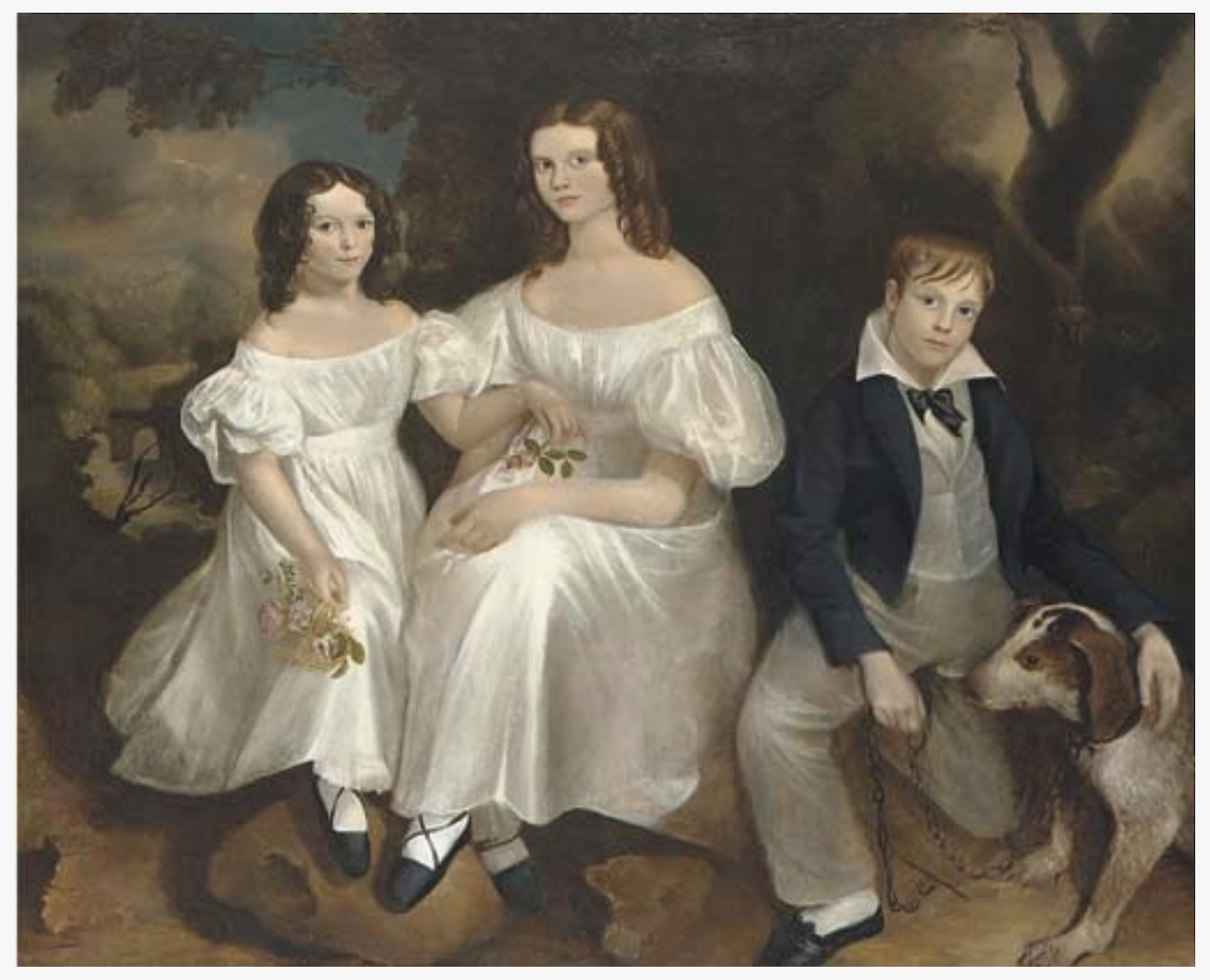
Eyre family portrait of Robert Hedges-Eyre son of Richard Hedges-Eyre of Macroom Castle Co. Cork, courtesy Purcell Auctioneers Feb 2016. Robert Hedges Eyre (d.1840) restored Macroom castle and his daughter married the 3rd Earl of Bantry. Inherited by Olive White who married Lord Ardilaun it was eventually destroyed in 1922 by Republican forces long after it had ceased to have any military significance.
Macroom Castle, County Cork, photograph by Robert French, (between ca. 1865-1914), Lawrence Photograph Collection, National Library of Ireland.

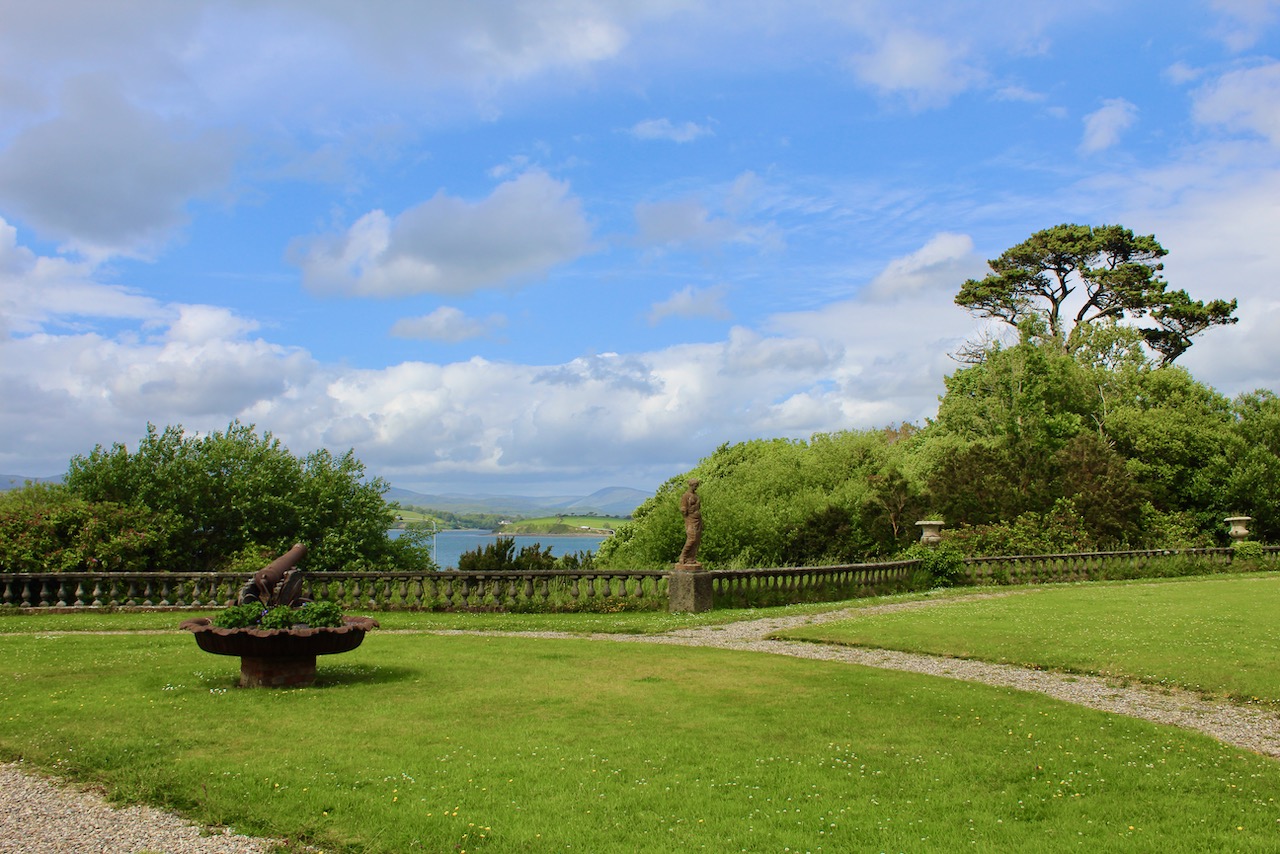
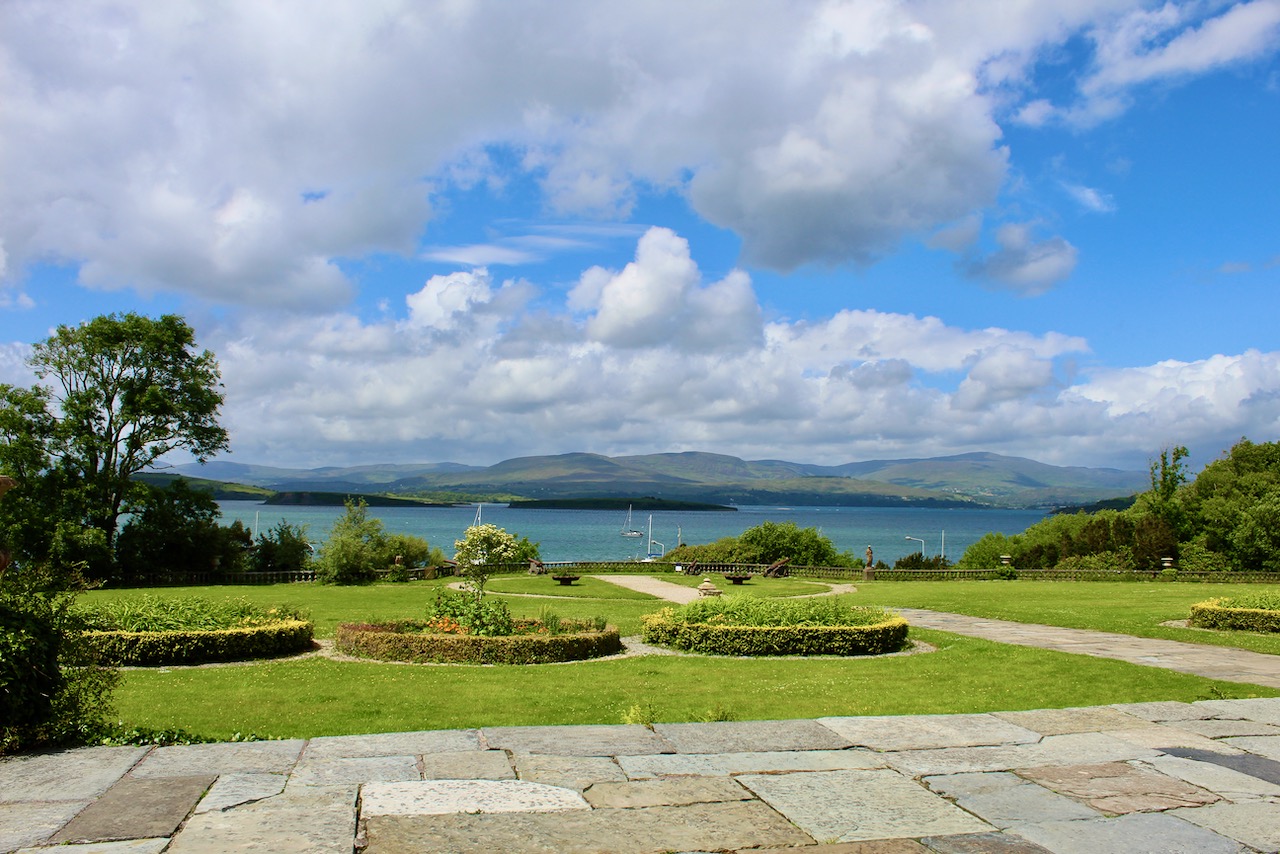
The house overlooks Bantry Bay which is formative in its history because thanks to its views, Richard’s grandson was elevated to an Earldom.

View onto Bantry Bay. © Jennifer Winder-Baggot, www.irishhistorichouses.com
Bantry House, June 2022. © Jennifer Winder-Baggot, www.irishhistorichouses.com

Frances Jane and Simon had a son, Richard (1767-1851), who saw French ships sail into Bantry Bay in 1796. The British and French were at war from February 1793. It was in gratitude for Richard’s courage and foresight in raising a local militia against the French that Richard was given a title.

Bantry House, June 2022. © Jennifer Winder-Baggot, www.irishhistorichouses.com

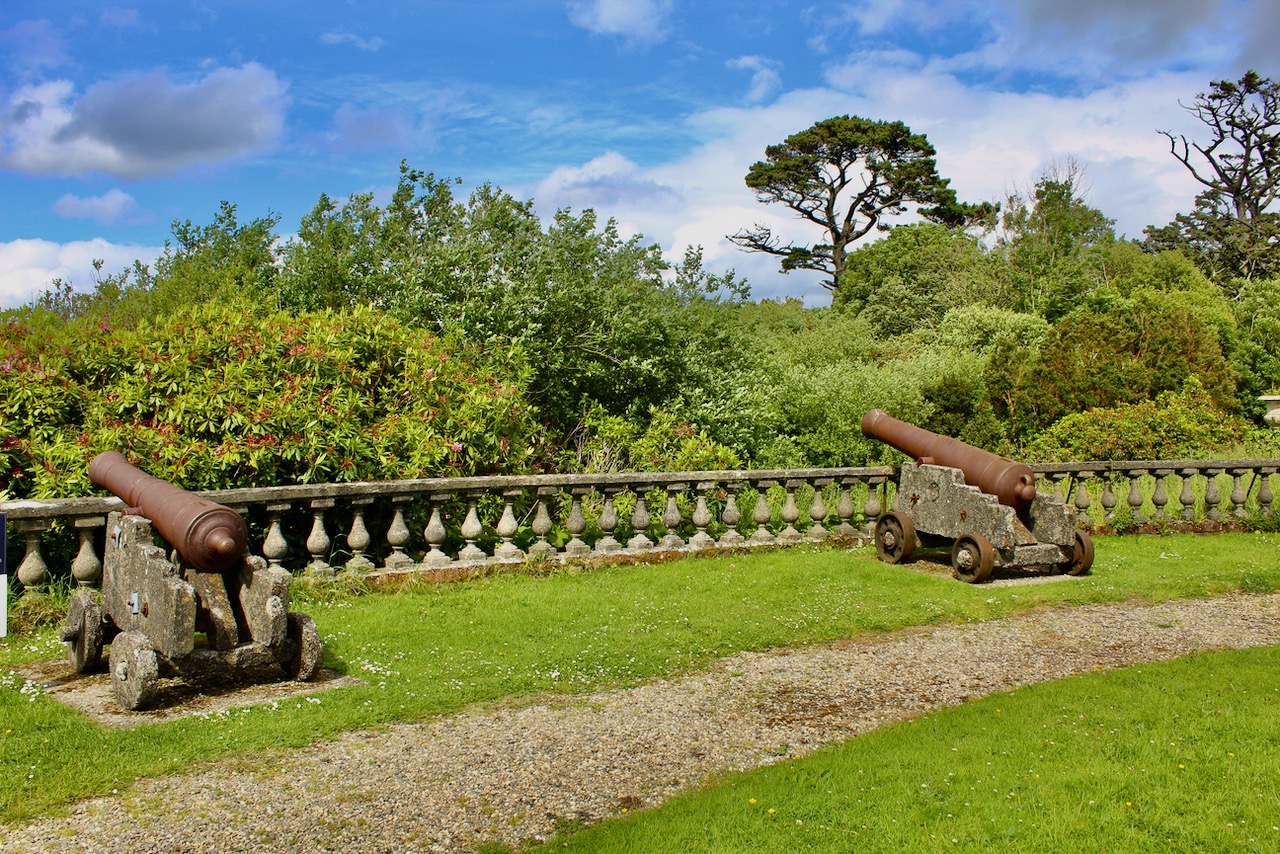
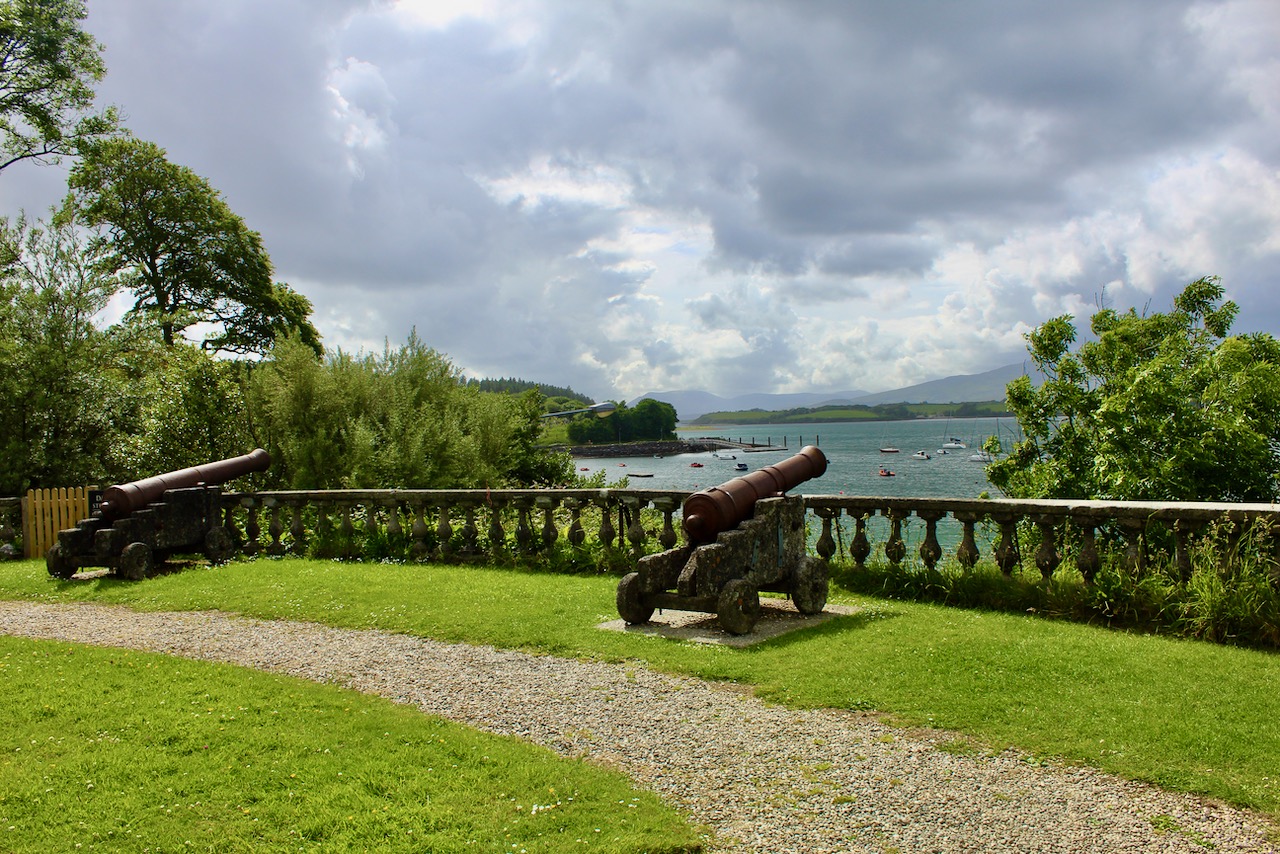
There are four guns overlooking the bay. The two smaller ones are from 1780, and the larger one is dated 1796. One is French and dated 1795 and may have been captured from an invading French ship.

Bantry House, June 2022. © Jennifer Winder-Baggot, www.irishhistorichouses.com

United Irishman Theobald Wolfe Tone was on one of the French ships, which were under command of French Louis Lazare Hoche.

Theobald Wolfe Tone (1763–98) (named after his godfather, Theobald Wolfe) had sought French support for an uprising against British rule in Ireland. The United Irishmen sought equal representation of all people in Parliament. Tone wanted more than the Catholic Emancipation which Henry Grattan advocated, and for him, the Catholic Relief Act of 1793 did not go far enough, as it did not give Catholics the right to sit in the Irish House of Commons. Tone was inspired by the French and American Revolutions. The British had specifically passed the Catholic Relief Act in the hope of preventing Catholics from joining with the French.

Theobald Wolf Tone, who was on the ships which Richard White spotted in Bantry Bay carrying the French who were coming to support Irish Independence.

The Dictionary of Irish Biography tells us that

With the outbreak of war with France, Dublin Castle instituted a crackdown on Irish reformers who had professed admiration for the French, and by the end of the year the United Irishmen and the reform movement were in disarray. In quick succession, the Volunteers were proscribed, the holding of elected conventions was banned, and a number of United Irishmen… were hauled before the courts on charges of seditious libel.

Tone went to the U.S. and thought he might have to settle there but with others’ encouragement he continued in his work for liberating Ireland. He went to France for support. As a result 43 ships were sent to France.

In July 1796 Tone was appointed chef de brigade (brigadier-general) in Hoche’s army ... Finally, on 16 December 1796, a French fleet sailed from Brest crammed with 14,450 soldiers. On board one of the sails of the line, the Indomptable, was ‘Citoyen Wolfe Tone, chef de brigade in the service of the republic.’” [1]

Richard White had trained a militia in order to defend the area, and stored munitions in his house. When he saw the ships in the bay he raised defenses. However, it was stormy weather and not his militia that prevented the invasion. Tone wrote of the expedition in his diary, saying that “We were close enough to toss a biscuit ashore”.

Bantry House, June 2022. © Jennifer Winder-Baggot, www.irishhistorichouses.com

The French retreated home to France, but ten French ships were lost in the storm and one, the Surveillante, sank and remained on the bottom of Bantry bay for almost 200 years. 

For his efforts in preparing the local defences against the French, Richard White was created Baron Bantry in 1797 in recognition of his “spirited conduct and important service.” In 1799 he married Margaret Anne Hare (1779-1835), daughter of William the 1st Earl of Listowel in County Kerry, who brought with her a substantial dowry. In 1801 he was made a viscount, and in 1815 he became Viscount Berehaven and Earl of Bantry. He became a very successful lawyer and made an immense fortune.

Bantry House. June 2022. The entrance is under the portico, which is now glassed in. This middle section is the original house. The part on the sea facing side is the part added in 1820. The addition that appears on the left hand side is part of the fourteen bay block added to the rear of the old house in 1845 by the 2nd Earl. © Jennifer Winder-Baggot, www.irishhistorichouses.com
In this view of the house we can see the two copper domes of the stable ranges, either side of the house. The stable blocks were built in 1845 and the National Inventory tells us they are sited to appear as further lateral extensions of the house beyond its wings; when viewed from the bay they might be read as lower flanking wings in the Palladian manner. © Jennifer Winder-Baggot, www.irishhistorichouses.com

Richard was not Simon White’s only son. Simon’s son Simon became a Colonel and married Sarah Newenham of Maryborough, County Cork. They lived in Glengariff Castle. Young Simon’s sister Helen married a brother of Sarah Newenham, Richard, who inherited Maryborough. Another daughter, Martha, married Michael Goold-Adams of Jamesbrook, County Cork and another daughter, Frances, married General E. Dunne of Brittas, County Laois. Another son, Hamilton, married Lucinda Heaphy.

A wing was added to the house in 1820 in the time of the 1st Earl of Bantry. This wing is the same height as the original block, but of only two storeys, and faces out to the sea. It has a curved bow at the front and back and a six bay elevation at the side. This made space for two large drawing rooms, and more bedrooms upstairs.

The side of the house which faces the bay. This is the six bay elevation with curved bow at front a back (not visible here) which was added to the original house by the 1st Earl of Bantry. © Jennifer Winder-Baggot, www.irishhistorichouses.com
The entrance is under the Corinthian colonnade, which was built later onto the oldest part of the house. The bow in this photograph is part of the house added on during the time of the 1st Earl of Bantry. © Jennifer Winder-Baggot, www.irishhistorichouses.com

The house was greatly enlarged and remodelled in 1845 by the son of the 1st Earl, Richard (1800-1867). The 1st Earl had moved out to live in a hunting lodge in Glengariff. This son Richard was styled as Viscount Berehaven between 1816 and 1851 until his father died, when he then succeeded to become 2nd Earl of Bantry. He married Mary O’Brien, daughter of William, 2nd Marquess of Thomond, in 1836.

The 2nd Earl of Bantry and his wife travelled extensively and purchased many of the treasures in the house. The website tells us he was a passionate art collector who travelled regularly across Europe, visiting Russia, Poland, France and Italy. He brought back shiploads of exotic goods between 1820 and 1840.

To accommodate his new furnishings he built a fourteen bay block on the side of the house opposite to the 1820 addition, consisting of a six-bay centre of two storeys over basement flanked by four-storey bow end wings.

To accommodate his new furnishings, the Viscount built a fourteen bay block to the rear of the old house consisting of a six-bay centre of two storeys over a basement flanked by four-storey bow end wings. © Jennifer Winder-Baggot, www.irishhistorichouses.com

The website tells us:

.”..No doubt inspired by the grand baroque palaces of Germany, he gave the house a sense of architectural unity by lining the walls with giant red brick pilasters with Coade-stone Corinthian capitals, the intervening spaces consisting of grey stucco and the parapet adorned with an attractive stone balustrade.

Bantry House, 2022. © Jennifer Winder-Baggot, www.irishhistorichouses.com
Bantry House, County Cork. © Jennifer Winder-Baggot, www.irishhistorichouses.com
Bantry House, 2022. © Jennifer Winder-Baggot, www.irishhistorichouses.com
Bantry House, June 2022. © Jennifer Winder-Baggot, www.irishhistorichouses.com

He also lay out the Italianate gardens, including the magnificent terraces on the hillside behind the house, most of which was undertaken after he had succeeded his father as the second Earl of Bantry in 1851.

Bantry House, June 2022. © Jennifer Winder-Baggot, www.irishhistorichouses.com

After his death in 1867 the property was inherited by his brother William, the third Earl (1801-1884), his grandson William the fourth and last Earl (1854-91), and then passed through the female line to the present owner, Mr. Shelswell-White.

Mark Bence-Jones tells us: “The house is entered through a glazed Corinthian colonnade, built onto the original eighteenth century front in the nineteenth century; there is a similar colonnade on the original garden front.” [2]

The Corinthian colonnade at the entrance to the house. © Jennifer Winder-Baggot, www.irishhistorichouses.com
There is a colonnade similar to that on the front entrance on the other side of the oldest part of the house. © Jennifer Winder-Baggot, www.irishhistorichouses.com
The cafe area to the side of the house. © Jennifer Winder-Baggot, www.irishhistorichouses.com
Bantry House, 2022. © Jennifer Winder-Baggot, www.irishhistorichouses.com
Bantry House, June 2022. © Jennifer Winder-Baggot, www.irishhistorichouses.com

Unfortunately we were not allowed to take photographs inside. You can see photographs of the incredible interior on the Bantry house website, and on the Irish Aesthete Robert O’Byrne’s blog. [3]

The rooms are magnificent, with their rich furnishings, ceilings and columns. Old black and white photographs show that even the ceilings were at one time covered in tapestries. The Spanish leather wallpaper in the stair hall is particularly impressive.

Mark Bence-Jones continues: “The hall is large but low-ceilinged and of irregular shape, having been formed by throwing together two rooms and the staircase hall of the mid-eighteenth century block; it has early nineteenth century plasterwork and a floor of black and white pavement, incorporating some ancient Roman tiles from Pompeii. From one corner rises the original staircase of eighteenth century joinery.”

Staircase in Bantry House, photograph courtesy of Bantry house website.

The website tells us: “Today the house remains much as the second earl left it, with an important part of his great collection still intact. Nowhere is this more son than the hall where visitors will find an eclectic collection garnered from a grand tour, which includes an Arab chest, a Japanese inlaid chest, a Russian travelling shrine with fifteenth and sixteenth century icons and a Fresian clock. There is also a fine wooden seventeenth century Flemish overmantel and rows of family portraits on the walls. The hall was created by combining two rooms with the staircase hall of the original house and consequently has a rather muddled shape, though crisp black and white Dutch floor tiles lend the room a sense of unity.. Incorporated into this floor are four mosaic panels collected by Viscount Berehaven from Pompeii in 1828 and bearing the inscriptions “Cave Canem” and “Salve.” Other unusual items on show include a mosque lamp from Damascus in the porch and a sixteenth century Spanish marriage chest which can be seen in the lobby.

Bence-Jones continues: “The two large bow-ended drawing rooms which occupy the ground floor of the late eighteenth century wing are hung with Gobelins tapestries; one of them with a particularly beautiful rose-coloured set said to have been made for Marie Antoinette.

The Drawing Room in Bantry House, photograph courtesy of Bantry house website.

The Royal Aubusson tapestries in the Rose drawing room, comprising four panels, are reputed to have been a gift from the Dauphin to his young wife-to-be Marie Antoinette. In the adjoining Gobelin drawing room, one panel of tapestries is said to have belonged to Louis Philippe, Duc D’Orleans, a cousin of Louis XV.

The website tells us: “The most spectacular room is the dining-room, dominated by copies of Allan Ramsay’s full-length portraits of George III and Queen Charlotte, whose elaborate gilt frames are set off by royal blue walls. The ceiling was once decorated with Guardi panels, but these have long since been removed and sold to passing dealers at a fraction of their worth. The differing heights of the room are due to the fact that they are partly incorporated in the original house and in the 1845 extension, their incongruity disguised by a screen of marble columns with gilded Corinthian capitals. Much of the furniture has been here since the second Earl, including the George III dining table, Chippendale chairs, mahogany teapoy, sideboards made for the room, and the enormous painting The Fruit Market by Snyders revealing figures reputedly drawn by Rubens – a wedding present to the first Countess.

The Chippendale chairs and the George III dining table were made for the room.

King George III, a reproduction in Castletown, County Kildare.
Queen Charlotte, wife of King George III, a reproduction in Castletown, County Kildare.

The description on the website continues: “The first flight of the staircase from the hall belongs to the original early eighteenth century house, as does the half-landing with its lugged architraves. This leads into the great library, built around 1845 and the last major addition to the house. The library is over sixty feet long, has screens of marble Corinthian columns, a compartmented ceiling and Dublin-made mantelpieces at each end with overhanging mirrors. The furnishing retains a fine rosewood grand piano by Bluthner of Leipzig, still occasionally used for concerts. The windows of this room once looked into an immense glass conservatory, but this has now been removed and visitors can look out upon restored gardens and the steep sloping terraces behind.

The Library in Bantry House, photograph courtesy of Bantry house website.

The third Earl, William Henry (1801-1884), succeeded his brother, who died in 1868. On 7 September 1840 William Henry’s surname was legally changed to William Henry Hedges-White by Royal Licence, adding Hedges, a name passed down by his paternal grandmother.

His grandmother was Frances Jane Eyre and her father was Richard Hedges Eyre. Richard Hedges of Macroom Castle and Mount Hedges, County Cork, married Mary Eyre. Richard Hedges Eyre was their son. He married Helena Herbert of Muckross, County Kerry. In 1760 their daughter, Frances Jane, married Simon White of Bantry, William Henry’s grandfather. When her brother Robert Hedges Eyre died without heirs in 1840 his estates were divided and William Henry the 3rd Earl of Bantry inherited the Macroom estate. [4] Until his brother’s death in 1868, William Henry Hedges-White had been living in Macroom Castle. [5]

Macroom Castle, photograph taken 2009 by “Shiny Things,” flickr constant commons.
Macroom Castle gate house, photograph taken 2007 by Carole Waller, flickr constant commons.

William Henry Hedges-White married Jane Herbert in 1845, daughter of Charles John Herbert of Muckross Abbey in County Kerry (see my entry about places to visit in County Kerry).

In November 1853, over 33,000 acres of the Bantry estate were offered for sale in the Encumbered Estates Court, and a separate sale disposed of Bere Island. The following year more than 6,000 further acres were sold, again through the Encumbered Estates Court. Nevertheless in the 1870s the third earl still owned 69,500 acres of land in County Cork.

His son, the 4th Earl, died childless in 1891. The title lapsed, and the estate passed to his nephew, Edward Egerton Leigh (1876-1920), the son of the 4th Earl’s oldest sister, Elizabeth Mary, who had married Egerton Leigh of Cheshire, England. This nephew, born Edward Egerton Leigh, added White to his surname upon his inheritance. He was only fifteen years old when he inherited, so his uncle Lord Ardilaun looked after the estate until Edward came of age in 1897. William Henry Hedges-White’s daughter Olivia Charlotte Hedges-White had married Arthur Edward Guinness, 1st and last Baron Ardilaun. Edward Egerton’s mother had died in 1880 when he was only four years old, and his father remarried in 1889.

Lady Olivia-Charlotte White, Lady Elizabeth-Mary White and William, 4th Earl of Bantry, with a dog, Irish school c. 1860 courtesy Christies Irish Sale 2004. William Henry Hare Hedges-White (1801-1884) was the son of William Hedges-White, 3rd Earl of Bantry. His sister Olivia Charlotte Hedges-White married Arthur Edward Guinness (1840-1915), Baron Ardilaun, and they lived in Ashford Castle in County Mayo. Elizabeth Mary Gore Hedges-White, another sister, married Egerton Leigh.
Bantry House, County Cork, photograph 1989 from the National Library, flickr constant commons.

Edward Egerton married Arethusa Flora Gartside Hawker in 1904. She was a cousin through his father’s second marriage. They had two daughters, Clodagh and Rachel. In March 1916 an offer from the Congested Districts’ Board was accepted by Edward Egerton Leigh White for 61,589 tenanted acres of the estate. [6] Edward Egerton died in 1920.

Patrick Comerford tells us in his blog that during the Irish Civil War in 1922-1923, the Cottage Hospital in Bantry was destroyed by fire. Arethusa Leigh-White offered Bantry House as a hospital to the nuns of the Convent of Mercy, who were running the hospital. Arethusa only made one proviso: that the injured on both sides of the conflict should be cared for. A chapel was set up in the library and the nuns and their patients moved in for five years. [7]

In 1926, Clodagh Leigh-White came of age and assumed responsibility for the estate. Later that year, she travelled to Zanzibar, Africa, where she met and married Geoffrey Shelswell, then the Assistant District Commissioner of Zanzibar. (see [7])

Geoffrey Shelswell added “White” to his surname when in 1926 Clodagh inherited Bantry estate after the death of her father. They had a son, Egerton Shelswell-White (1933-2012), and two daughters, Delia and Oonagh.

During the Second World War, the house and stables were occupied by the Second Cyclist Squadron of the Irish Army, and they brought electricity and the telephone to the estate.

Bantry House, 2022. © Jennifer Winder-Baggot, www.irishhistorichouses.com
Bantry House, June 2022. © Jennifer Winder-Baggot, www.irishhistorichouses.com

Clodagh opened the house in 1946 to paying visitors with the help of her sister Rachel who lived nearby. Her daughter Oonagh moved with her family into the Stable Yard.

Clodagh remained living in the house after her husband died in 1962, until her death in 1978. Brigittte, wife of Clodagh’s son Egerton, writes:

As far as I know it never occurred to Clodagh to live elsewhere. She thought nothing of having her sitting room downstairs, her kitchen and bedroom upstairs and her bathroom across the landing. No en suite for her! In the winter when the freezing wing howled through the house, she more or less lived in her fur coat, by all accounts cheerful and contented. She loved bridge and held parties, which took place in the Rose Drawing Room, or in the room next to the kitchen, called the Morning Room.
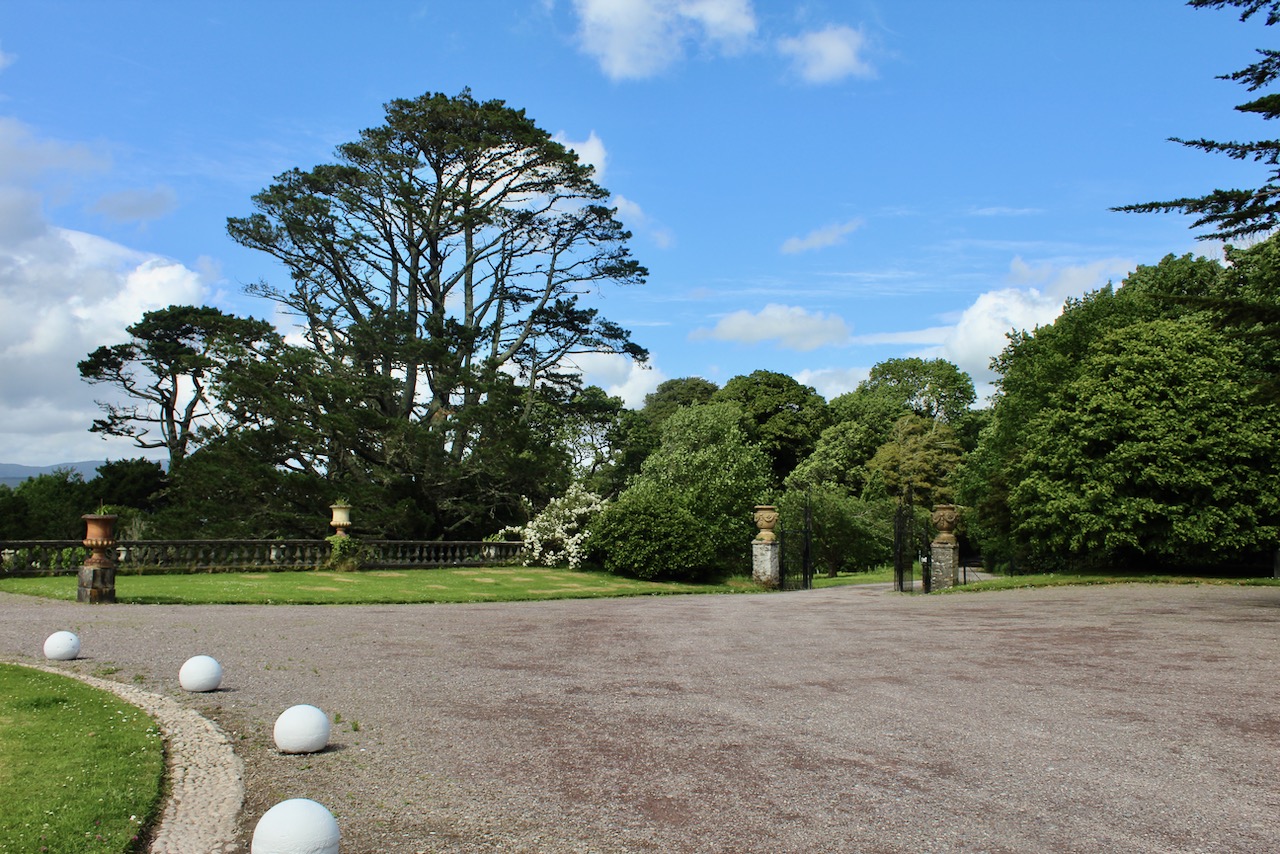
Brigitte also tells of wonderful evenings of music and dance hosted by Clodagh and her friend Ian Montague, who had been a ballet dancer with the Royal Swedish Ballet. Ian put on plays and dancing in period costumes. Members of the audience were taught about eighteenth century dance and were encouraged to join in. I think we should hold such dances in the lovely octagon room of the Irish Georgian Society!

Clodagh’s son Egerton had moved to the United States with his wife Jill, where he taught in a school called Indian Springs. When his mother died he returned to Bantry. The house was in poor repair, the roof leaking and both wings derelict. Jill decided to remain in the United States with their children who were teenagers at the time and settled into their life there.

Bantry House features in Great Irish Houses, which has a foreward by Desmond FitzGerald and Desmond Guinness (IMAGE Publications, 2008). In the book, Egerton is interviewed. He tells us:
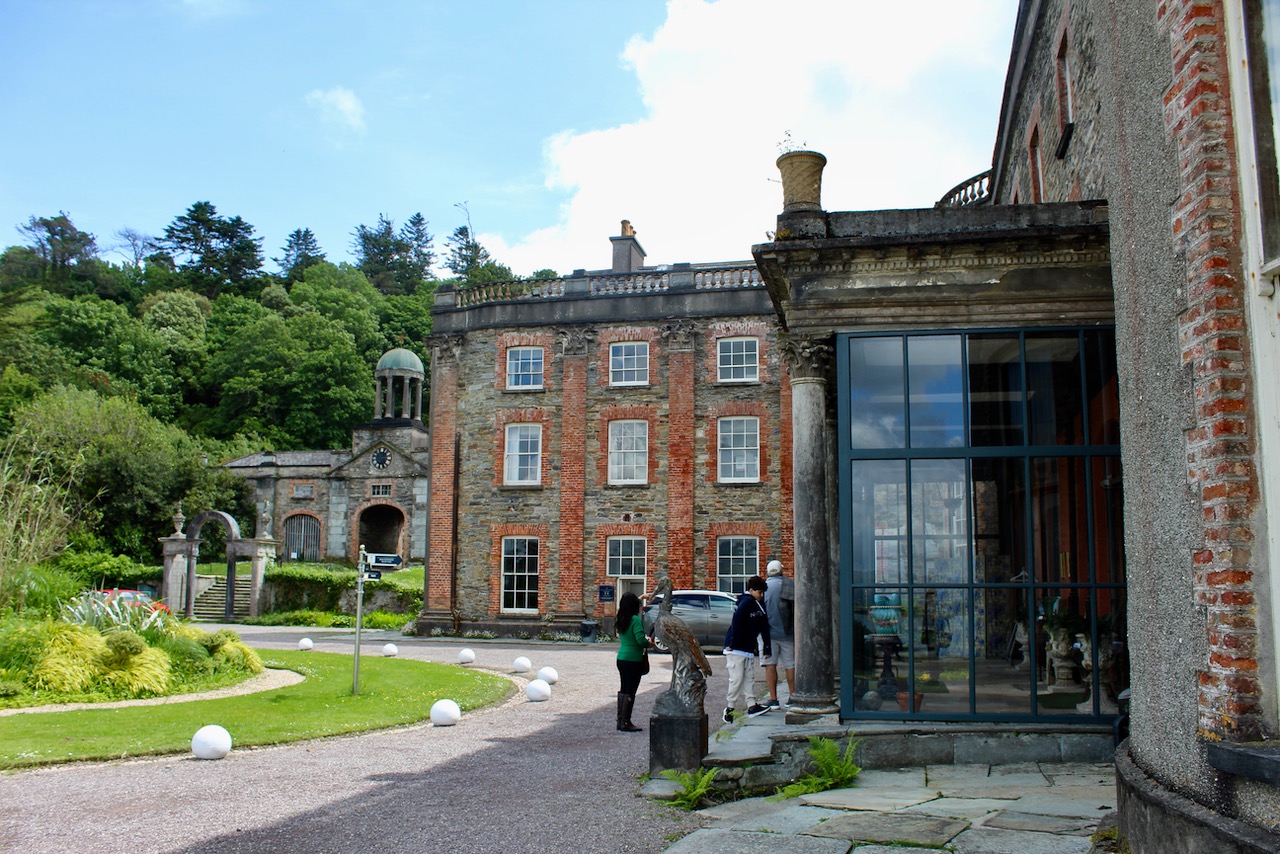
p. 68. “The family don’t go into the public rooms very much. We live in the self-contained area. I remember before the war as children we used the dining rooms and the state bedrooms, but after the war my parents moved into this private area of the house. It feels like home and the other rooms are our business. You never think of all that furniture as being your own. You think of it more as the assets of the company.

The relatively modest private living quarters were completed in 1985. Sophie Shelswell-White, Egerton’s daughter, says, “When we were younger we shied away from the main house because of the intrusion from the public. Everyone imagines we play hide and seek all day long and we did play it a bit. We also used to run around looking for secret tunnels and passageways. I used to believe one day I’d push something and it would open a secret room, but it never happened.”

Mark Bence-Jones continues his description, moving to the stables: “Flanking the entrance front is an imposing stable range, with a pediment and cupola. The house is surrounded by Italian gardens with balustrades and statues and has a magnificent view over Bantry Bay to the mountains on the far shore. The demesne is entered by a fine archway.” (see [2])

The large stable complex is to one side of the house, the East Stables. This is where the horses and carriages were kept. © Jennifer Winder-Baggot, www.irishhistorichouses.com

The National Inventory tells us about the East Stables:

A classically inspired outbuilding forming part of an architectural set-piece, the formal design of which dates to the middle of the nineteenth century when Richard White, Viscount Berehaven and later second Earl of Bantry, undertook a large remodelling of Bantry House. At this time the house was extended laterally with flanking six-bay wings that overlook the bay. This stable block and the pair to the south-west are sited to appear as further lateral extensions of the house beyond its wings; when viewed from the bay they might be read as lower flanking wings in the Palladian manner. This elaborate architectural scheme exhibits many finely crafted features including a distinguished cupola, playful sculptural detailing as well as cut stone pilasters to the façade. The survival of early materials is visible in a variety of fine timber sliding sash windows, which add to the history of the site.

View of the 1820 wing in foreground and 1845 behind, and behind that, the East Stables. © Jennifer Winder-Baggot, www.irishhistorichouses.com
Bantry House, 2022. © Jennifer Winder-Baggot, www.irishhistorichouses.com
This impressive arch with pediment topped by urns and birds, which leads toward the east stable yard, as seen behind. © Jennifer Winder-Baggot, www.irishhistorichouses.com
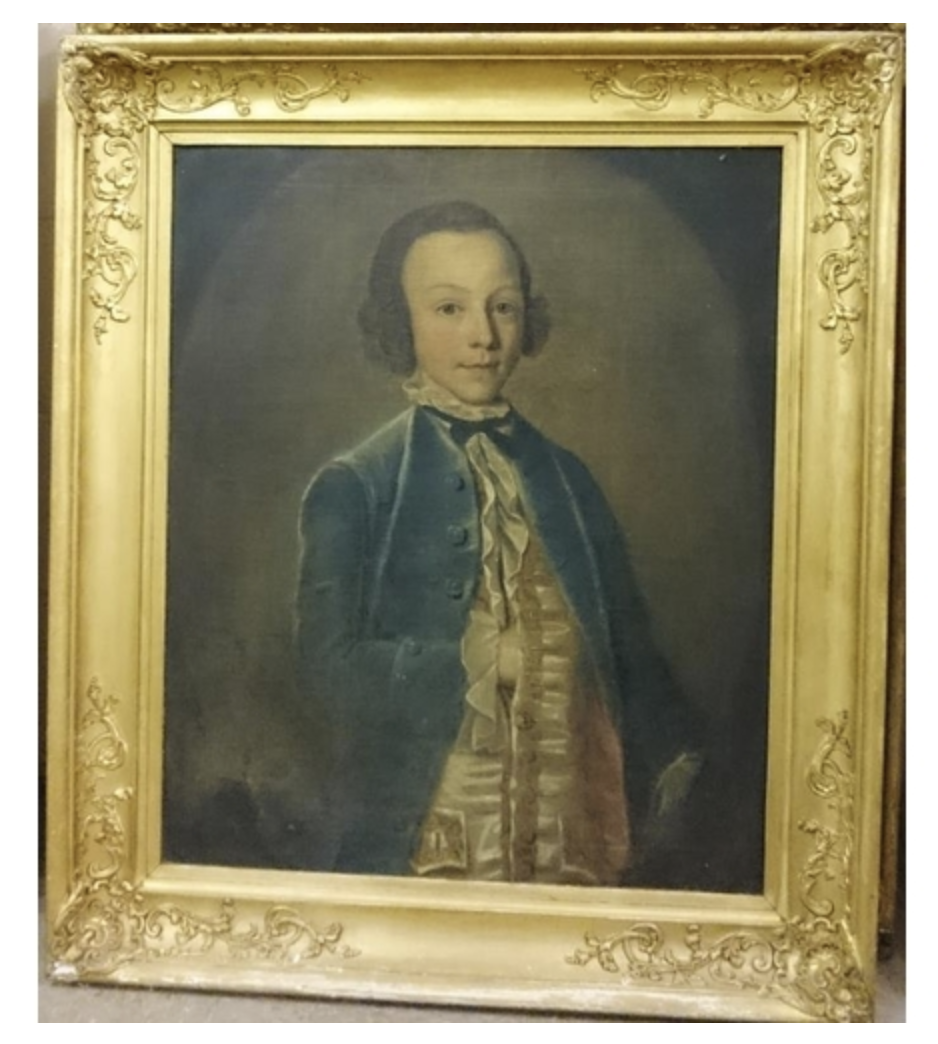
The East Stable yard. © Jennifer Winder-Baggot, www.irishhistorichouses.com
The east stable yard as seen from the garden. © Jennifer Winder-Baggot, www.irishhistorichouses.com

Egerton married Brigitte in 1981. They undertook many of the repairs themselves. They started a tearoom with the help of a friend, Abi Sutton, who also helped with the house. Egerton played the trombone and opened the house to musical events. They continued to open the house for tours. They renovated the went wing and opened it for bed and breakfast guests.

Coffee is served on the terrace, similar to that in the front, but only partly glazed. Unfortunately we arrived too late for a snack. Bantry House is breathtaking and its gardens and location magnify the grandeur. I like that the grandeur, like Curraghmore, is slightly faded: a lady’s fox fur worn down to the leather and shiny in places.

The balustraded area on the side of the house where tea and coffee are served overlooks a garden.

Bantry House, 2022. © Jennifer Winder-Baggot, www.irishhistorichouses.com
From the garden to one side of the house, you can see another stable complex, the West Stables. © Jennifer Winder-Baggot, www.irishhistorichouses.com
Bantry House, June 2022. © Jennifer Winder-Baggot, www.irishhistorichouses.com

Brigitte and Egerton continued restoration of the house and started to tackle the garden. They repaired the fountain and started work on the Italian parterre. In 1998 they applied for an EEC grant for renovation of the garden. They restored the statues, balustrades, 100 Steps, Parterre, Diana’s Bed and fourteen round beds overlooking the sea.

Bantry House, 2022. © Jennifer Winder-Baggot, www.irishhistorichouses.com
Looking past the fountain to the 100 Steps. © Jennifer Winder-Baggot, www.irishhistorichouses.com
Bantry House, County Cork, photograph by Chris Hill, 2016 for Tourism Ireland, Ireland’s Content Pool. Wisteria adds an extra oomph to the garden.
Bantry House, 2022. © Jennifer Winder-Baggot, www.irishhistorichouses.com
Bantry House, June 2022. © Jennifer Winder-Baggot, www.irishhistorichouses.com

It is Egerton’s daughter Sophie who now lives in and maintains Bantry House, along with her husband and children.

The family donated their archive of papers to the Boole Library of University College Cork in 1997.

Bantry House, 2022. © Jennifer Winder-Baggot, www.irishhistorichouses.com
Bantry House, June 2022. © Jennifer Winder-Baggot, www.irishhistorichouses.com

The National Inventory tells us the five-bay two-storey west stables were also built c.1845. They have a pedimented central bay with cupola above, which has a copper dome, finial, plinth and six Tuscan-Corinthian columns. [8] The West Stables were used as a workshop for outdoor maintenance and repairs. They had fallen into disrepair but were repaired to rectify deteriorating elements with the help of the Heritage Council in 2010-11.

Bantry House, 2022. © Jennifer Winder-Baggot, www.irishhistorichouses.com
These buildings, the West Stables, were used as a workshop for outdoor maintenance and repairs. They have fallen into disrepair but were repaired to rectify deteriorating element with the help of the Heritage Council in 2010-11. © Jennifer Winder-Baggot, www.irishhistorichouses.com
Bantry House, 2022. © Jennifer Winder-Baggot, www.irishhistorichouses.com
Bantry House, June 2022. © Jennifer Winder-Baggot, www.irishhistorichouses.com

[1] https://www.dib.ie/biography/tone-theobald-wolfe-a8590

[2] Bence-Jones, Mark. A Guide to Irish Country Houses (originally published as Burke’s Guide to Country Houses volume 1 Ireland by Burke’s Peerage Ltd. 1978); Revised edition 1988, Constable and Company Ltd, London.
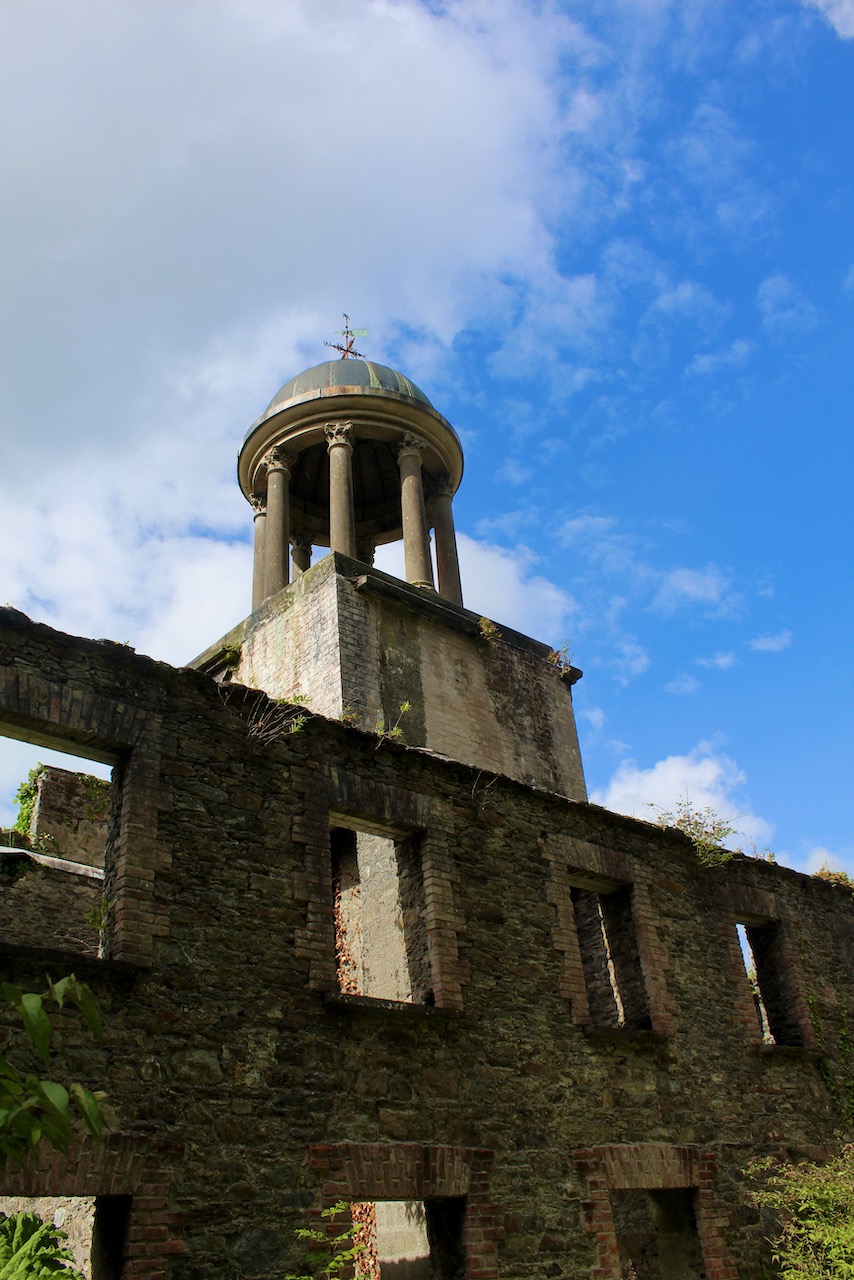
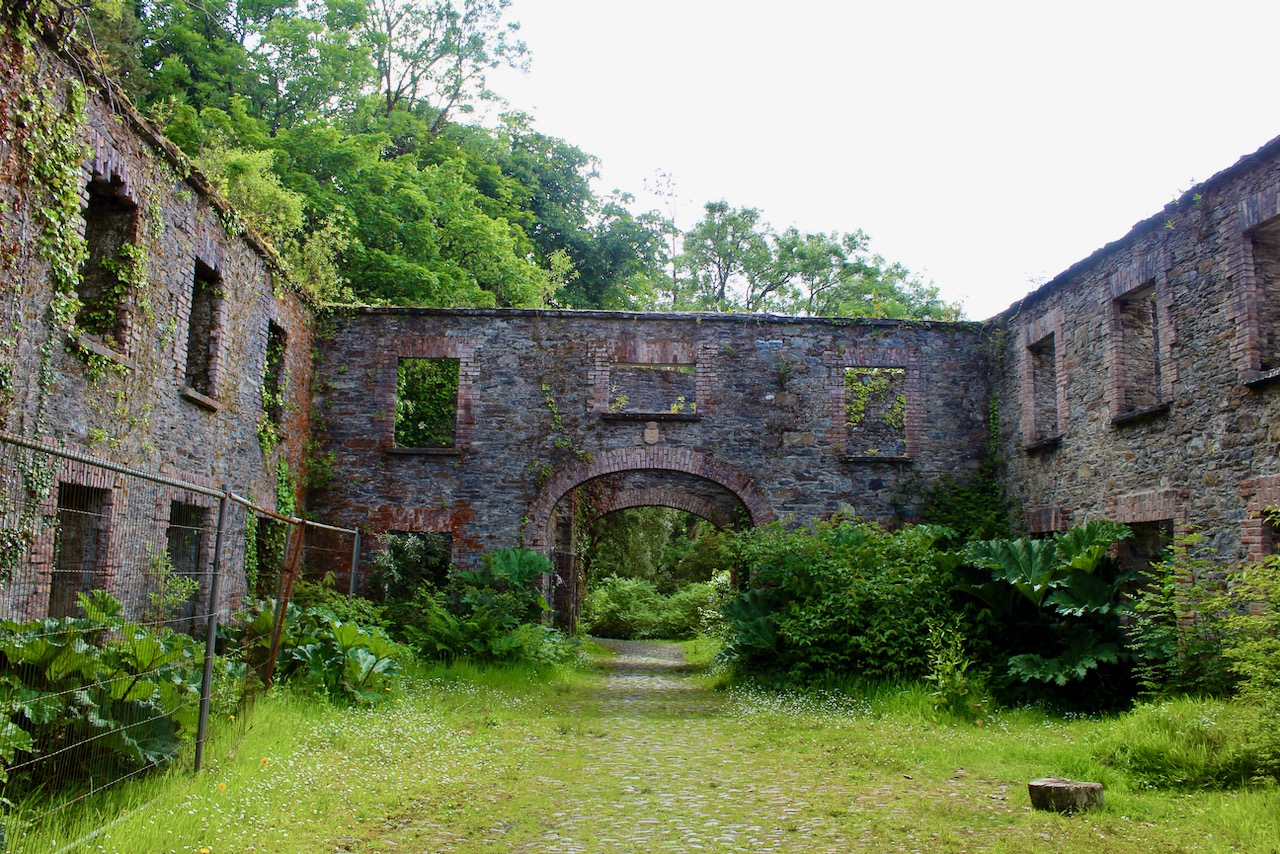
[3] https://theirishaesthete.com/2014/09/08/when-its-gone-its-gone/

[4] https://landedestates.ie/family/1088 and https://www.dib.ie/biography/eyre-robert-hedges-a2978

See also

[5] Shelswell-White, Sophie. Bantry House & Garden, The History of a family home in Ireland. This booklet includes an article by Geoffrey Shelswell-White, “The Story of Bantry House” which had appeared in the Irish Tatler and Sketch, May 1951.

[6] https://landedestates.ie/family/1088

[7] http://www.patrickcomerford.com/2016/05/bantry-house-has-story-that-spans.html

[8] https://www.buildingsofireland.ie/buildings-search/building/20911813/bantry-house-seafield-bantry-co-cork

© Jennifer Winder-Baggot, www.irishhistorichouses.com

Office of Public Works properties: Leinster: Carlow, Kildare

Just to finish up my entries about Office of Public Works properties: Carlow, Dublin, Kildare, Kilkenny, Laois, Longford, Louth, Meath, Offaly, Westmeath, Wexford and Wicklow are the counties that make up the Leinster region.

Carlow:

1. Altamont Gardens

Kildare:

2. Castletown House, County Kildare

3. Maynooth Castle, County Kildare

Carlow:

1. Altamont House and Gardens, Bunclody Road, Altamont, Ballon, County Carlow:

Altamont House and Gardens, photograph by Sonder Visuals, 2015, for Tourism Ireland, from Ireland’s Content Pool. [1]

General information: (059) 915 9444

altamontgardens@opw.ie

https://heritageireland.ie/visit/places-to-visit/altamont-gardens/

From the OPW website:

A large and beautiful estate covering 16 hectares in total, Altamont Gardens is laid out in the style of William Robinson, which strives for ‘honest simplicity’. The design situates an excellent plant collection perfectly within the natural landscape.

For example, there are lawns and sculpted yews that slope down to a lake ringed by rare trees and rhododendrons. A fascinating walk through the Arboretum, Bog Garden and Ice Age Glen, sheltered by ancient oaks and flanked by huge stone outcrops, leads to the banks of the River Slaney. Visit in summer to experience the glorious perfume of roses and herbaceous plants in the air.

With their sensitive balance of formal and informal, nature and artistry, Altamont Gardens have a unique – and wholly enchanting – character.” [2]

From “In Harmony with Nature, The Irish Country House Garden 1600-1900” in the Irish Georgian Society, July 2022, curated by Robert O’Byrne.
Altamont, photograph by Sonder Visuals 2017 for Tourism Ireland, Ireland’s Content Pool. [see 1]

From Living Legacies: Ireland’s National Historic Properties in the care of the OPW, Government Publications, Dublin, 2018:

Altamont House was constructed in the 1720s, incorporating parts of an earlier structure said to have been a medieval nunnery. In the 1850s, a lake was excavated in the grounds of the house, but it was when the Lecky-Watsons, a local Quaker family, acquired Altamont in 1924 that the gardens truly came into their own.

Feilding Lecky-Watson had worked as a tea planter in Ceylon (Sri Lanka) where he nurtured his love of exotic plants, and of rhododendrons in particular. Back in Ireland, he became an expert in the species, cultivating plants for the botanical gardnes at Glasnevin, Kew and Edinburgh. So passionate was he about these plants that when his wife, Isobel, gave birth to a daughter in 1922, she was named Corona, after his favourite variety of rhododendron.” [3]

Altamont House and Gardens lake, photograph by Sonder Visuals, 2015, for Tourism Ireland, from Ireland’s Content Pool. [see 1]

Around the lake are mature conifers that were planted in the 1800s, including a giant Wellingtonia which commemorates the Battle of Waterloo. [3] Corona continued in her father’s footsteps, planing rhododendrons, magnolia and Japanese maples. Another feature is the “100 steps” hand-cut in granite, leading down to the River Slaney. There are red squirrels, otters in the lake and river, and peacocks. Before her death, Corona handed Altamont over to the Irish state to ensure its preservation.

The Temple, Altamont House and Gardens, photograph by Sonder Visuals, 2015, for Tourism Ireland, from Ireland’s Content Pool. [see 1]

Kildare:

2. Castletown House and Parklands, Celbridge, County Kildare.

Castletown House, County Kildare, Photo by Mark Wesley 2016, Tourism Ireland, from Ireland’s Content Pool. [see 1]

General Information: castletown@opw.ie

https://castletown.ie

see my entry: https://irishhistorichouses.com/2024/03/15/castletown-house-and-parklands-celbridge-county-kildare-an-office-of-public-works-property/

Great Hall, photograph by Swire Chin, Toronto, May 2013 flickr constant commons.
Great Hall, Castletown House, Celbridge, Co Kildare, photograph by Sonder Visuals 2022 for Failte Ireland.
The Red Drawing Room in Castletown House, June 2015. Photograph © Jennifer Winder-Baggot, www.irishhistorichouses.com
The Red Drawing Room in October 2022. Photograph © Jennifer Winder-Baggot, www.irishhistorichouses.com
The Print Room, Castletown House, June 2015. Photograph © Jennifer Winder-Baggot, www.irishhistorichouses.com
The Boudoir, Castletown House, July 2017. The website tells us about the writing bureau, Irish-made around 1760: A George III mahogany cabinet with dentilled-scrolled broken pediment carved with rosettes. Throughout her life, Lady Louisa maintained a regular correspondence with her sisters and brothers in Ireland and England, and it is easy to picture her writing her epistles at this bureau and filing the letters she received in the initialled pigeonholes and drawers. A handwritten transcription of her letters to her siblings can be accessed in the OPW-Maynooth University Archive and Research Centre in Castletown.  Photograph © Jennifer Winder-Baggot, www.irishhistorichouses.com
The writing bureau has no “J” or “U” as they are not in the Latin alphabet. Photograph © Jennifer Winder-Baggot, www.irishhistorichouses.com
The wall panels, or grotesques, after Raphael date from the early nineteenth century and formerly hung in the Long Gallery. Photograph © Jennifer Winder-Baggot, www.irishhistorichouses.com
In 2022, Louisa’s bedroom now features a tremendous bed. Photograph © Jennifer Winder-Baggot, www.irishhistorichouses.com
Upstairs, The Long Gallery, Castletown House, June 2015. Photograph © Jennifer Winder-Baggot, www.irishhistorichouses.com
The Long Gallery in the 1880s, photograph from the album of Henry Shaw. Photograph © Jennifer Winder-Baggot, www.irishhistorichouses.com
The Long Gallery: its heavy ceiling compartments and frieze dates from the 1720s and is by Edward Lovett Pearce. It was painted and gilded in the 1770s. Photograph © Jennifer Winder-Baggot, www.irishhistorichouses.com

The Obelisk, or Conolly Folly, was reputedly built to give employment during an episode of famine. It was restored by the Irish Georgian Society in 1960.

Obelisk, Castletown, attributed to Richard Castle, March 2022. Desmond Guinness’s wife Mariga, who played a great role in the Irish Georgian Society, is buried below. Photograph © Jennifer Winder-Baggot, www.irishhistorichouses.com
The Wonderful Barn, Castletown by Robert French, Lawrence Photographic Collection NLI, flickr constant commons.
The Wonderful Barn, March 2022, created in 1743. Photograph © Jennifer Winder-Baggot, www.irishhistorichouses.com
When we went to find the Wonderful Barn, we discovered there is not just one but in fact three Wonderful Barns! Photograph © Jennifer Winder-Baggot, www.irishhistorichouses.com
The grounds around Castletown are beautiful and one can walk along the Liffey. Photograph © Jennifer Winder-Baggot, www.irishhistorichouses.com

3. Maynooth Castle, County Kildare:

Maynooth Castle, photograph by Gail Connaughton 2020, for Faitle Ireland, Ireland’s Content Pool. [see 1]

General information: 01 628 6744, maynoothcastle@opw.ie

From the OPW website https://heritageireland.ie/visit/places-to-visit/maynooth-castle/:

This majestic stone castle was founded in the early thirteenth century. It became the seat of power for the FitzGeralds, the earls of Kildare, as they emerged as one of the most powerful families in Ireland. Garret Mór, known as the Great Earl of Kildare, governed Ireland in the name of the king from 1487 to 1513.

Maynooth Castle was one of the largest and richest Geraldine dwellings. The original keep, begun around 1200, was one of the largest of its kind in Ireland. Inside, the great hall was a nerve centre of political power and culture.

Only 30 kilometres from Dublin, Maynooth Castle occupies a deceptively secluded spot in the centre of the town, with well-kept grounds and plenty of greenery. There is a captivating exhibition in the keep on the history of the castle and the family.

Gerald Fitzgerald (1487-1534) 9th Earl of Kildare, courtesy Bodleian Library.

[1] https://www.irelandscontentpool.com

[2] https://heritageireland.ie/visit/places-to-visit/altamont-gardens/

[3] p. 8, Living Legacies: Ireland’s National Historic Properties in the Care of the OPW. Government Publications, Dublin 2, 2018.

[4] p. xiii, Jennings, Marie-Louise and Gabrielle M. Ashford (eds.), The Letters of Katherine Conolly, 1707-1747. Irish Manuscripts Commission 2018. The editors reference TCD, MS 3974/121-125; Capel Street and environs, draft architectural conservation area (Dublin City Council) and Olwyn James, Capel Street, a study of the past, a vision of the future (Dublin, 2001), pp. 9, 13, 15-17.

[5] http://kildarelocalhistory.ie/celbridge See also my entry on Castletown House in my entry for OPW properties in Kildare, https://irishhistorichouses.com/2022/02/21/office-of-public-works-properties-leinster-carlow-kildare-kilkenny/

[6] https://archiseek.com/2011/1770s-castletown-house-celbridge-co-kildare/

[7] p. 75. Bence-Jones, Mark. A Guide to Irish Country Houses (originally published as Burke’s Guide to Country Houses volume 1 Ireland by Burke’s Peerage Ltd. 1978); Revised edition 1988 Constable and Company Ltd, London.

[8] p. 129. Great Irish Houses. Forewards by Desmond FitzGerald, Desmond Guinness. IMAGE Publications, 2008. 

[9] https://castletown.ie/collection-highlights/

Text © Jennifer Winder-Baggot, www.irishhistorichouses.com

Altidore Castle, Kilpeddar, Greystones, County Wicklow A63 X227 – Section 482

Open dates in 2026: Mar 9-30, May 4-31, June 1-7, 1pm-5pm, Aug 15-23, 2pm-6pm

Fee: adult €10, OAP/child/student €8

Altidore Castle, a seven bay, two storey over basement house. © Jennifer Winder-Baggot, www.irishhistorichouses.com
Beautiful wrought iron gates at the entrance to the farm, and square panelled pillars. © Jennifer Winder-Baggot, www.irishhistorichouses.com

Stephen and I visited Altidore Castle on a grey Saturday, June 1st 2019. I contacted Philip Emmet beforehand and he suggested we come at 3pm for a tour of the house. Philip Emmet is a descendant of the family of the Irish rebel Robert Emmet, who was hung for treason in 1803.

Execution of Robert Emmet, copyright 1897 by Kurz & Allison-Art publishers, Chicago

We arrived early and Philip’s wife Vicky suggested we look around the gardens until the other couple who were coming for the tour arrived. We had spied a pond to our left on our way up the long driveway, and there were stone steps up from the driveway across from the front of the house to a large rectangle of a lawn, edged by huge rhododendrons, so we headed off to explore.

The garden at Altidore, © Jennifer Winder-Baggot, www.irishhistorichouses.com

We only had about fifteen minutes, so after looking at the lawn above, we went down toward the pond and the gardens directly outside the house. We found a lovely sunken garden with two lions guarding it, containing a “wishing well.”

Altidore, County Wicklow. © Jennifer Winder-Baggot, www.irishhistorichouses.com
Steps down to the sunken garden. © Jennifer Winder-Baggot, www.irishhistorichouses.com
Lions flank the steps to the sunken garden. © Jennifer Winder-Baggot, www.irishhistorichouses.com
Stephen at the wishing well. I could not make out what was on the top of the well. © Jennifer Winder-Baggot, www.irishhistorichouses.com
The well has Corinthian columns and a crest on top with two heads, and a cast iron embellishment. © Jennifer Winder-Baggot, www.irishhistorichouses.com

We walked around the back, I was conscious that we could look in the windows and not wanting to disturb or pry, I carefully kept my back to the windows and gazed at the impressive view of the wide valley below. What a view!

The view from Altidore Castle. © Jennifer Winder-Baggot, www.irishhistorichouses.com

We headed back to the front of the house then. It is a most odd-looking home. It’s quite small but has imposing castellations. This must be why it is called a “toy fort” (by Mark Bence-Jones) or a “toy castle” (National Inventory of Historic Architecture).

Mark Bence-Jones describes it in his A Guide to Irish Country Houses:

A charming late-Georgian “toy fort,” with four octagonal corner turrets; of two storeys on the entrance side and three on the other sides, where the ground falls away. Despite the battlements on the turrets, the house is more Classical than Gothic; it is symmetrical and has a central Venetian window over a pillared porch. [1]

The Venetian (tripartite) window over a single-storey pillared porch. © Jennifer Winder-Baggot, www.irishhistorichouses.com
The back of the house is three storeys whereas the front is two, due to the slope of the ground. The basement forms the ground floor in the back. © Jennifer Winder-Baggot, www.irishhistorichouses.com

The house was built for General Thomas Pearce around 1730. It may have been designed by his nephew, Edward Lovett Pearce. General Thomas Pearce (ca. 1670-1739) was a British Army officer, a privy councillor and member of Parliament. He was appointed to Ireland in 1715, ultimately becoming General of His Majesty’s Forces in Ireland. He represented Limerick in Parliament from 1727 until his death. He married Mary daughter of William Hewes of Wrexham, and they had three sons and two daughters. His daughter Anne married her first cousin, Edward Lovett Pearce. [2]

Edward Lovett Pearce was a young Irish architect, born in 1699. He favoured the Palladian style of architecture and studied initially under his cousin the English Baroque architect John Vanbrugh. Lovett Pearce is best known for his work on Castletown House and the Irish Houses of Parliament, which later became the Bank of Ireland on College Green in Dublin. In Italy he met the Florentine architect Alessandro Galilei who was making plans for Castletown. Pearce seems to have taken over the work on Castletown based on Galilei’s plans.

Pearce was also commissioned by his uncle-in-law Thomas Coote (Coote married Edward Lovett Pearce’s aunt Anne Lovett – she was Thomas Coote’s third wife) to build Bellamont House in Cootehill, County Cavan (around 1730). He also designed two houses on Henrietta Street in Dublin, including number 9, for his cousin Mrs. Thomas Carter, and he designed Summerhill, County Meath. He died of an abscess at the young age of 34 in his home The Grove in Stillorgan, Dublin, and is buried in St. Mary’s Graveyard, now a closed graveyard in Donnybrook, which I was lucky enough to see in a tour a couple of years ago.

Archway from the sunken garden to the back of the house. © Jennifer Winder-Baggot, www.irishhistorichouses.com

We followed the other couple in through the porch to meet Philip Emmet, who welcomed us. We stepped into a large high-ceilinged hall.

The inside of the front hall and staircase is odd as the windows don’t look as if they fit the plans, or else the staircase has been moved. Philip does not know a lot about the background of the house. The Irish Historic Houses website states that Altidore was enlarged and modified for a subsequent owner, Major Henry Brownrigg. [3] We did not go upstairs, but Mark Bence-Jones tells us that the staircase is “of stout but elegant joinery with a scrolled end to its balusters.”

By 1773 the house was owned by Reverend William Blachford, Librarian of Marsh’s Library in Dublin. Philip has a portrait of Reverend Blachford’s daughter Mary Tighe, a poet who was famous in her time and was grouped with the Romantic writers Byron and the revolutionary Mary Wollestonecraft. The poet John Keats admired her work. I must borrow her book, Psyche or the Legend of Love from the library!

Mary Tighe (1747-1791), Poet, by George Romney, courtesy of National Gallery of Ireland.

Mary, nee Blachford, had a severely religious upbringing. William Blachford died in 1773 leaving his wife Theodosia (daughter of William Tighe of Rossana, County Wicklow), a son John and daughter Mary. Theodosia converted to Methodism, founded by John Wesley, and was involved in many charitable works including supporting the Leeson Street Magdalen Asylum for unmarried mothers, and the Female Orphan House on Prussia Street in Dublin. [4]

Theodosia Blachford née Tighe (c.1780) A self portrait, seated three-quarter length, with her children, Mary and John courtesy of Adam’s 2 April 2008.
William Tighe of Rosanna! Portrait by by Charles Jervas (c.1675-1739), courtesy of Adams auction 19 Oct 2021.

At the young age of 21, Mary married her cousin Henry Tighe (1771-1836), son of William Tighe of Woodstock, County Kilkenny. Henry served as an MP in the Irish Parliament representing Inistioge, County Kilkenny.

Mary contracted tuberculosis and lived her final months as an invalid in her brother-in-law William Tighe’s estate of Woodstock, where she died at the age of 37.

A marble statue of Mary, commissioned by her son after her death and carved by Lorenzo Bartolini of Tuscany, stood in the hall of Woodstock before the house was burnt in 1922. Although the original statue was destroyed in the fire at Woodstock, the plaster original of Bartolini’s statue is in the Accademia in Florence. There is also another life-size sculpture of her by English sculptor John Flaxman in her mausoleum in the graveyard attached to the former Augustinian priory in Inistioge, County Kilkenny. [5]

Mary Blachford Tighe (1772-1810) as sculpted by Lorenzo Bartolini ca. 1820, photograph from National Library of Ireland, flickr constant commons.

Woodstock was not rebuilt after it was burned in 1922 and it remains a ruin but the gardens are open to the public.

Woodstock, County Kilkenny, where Mary Tighe spent her final years. © Jennifer Winder-Baggot, www.irishhistorichouses.com

Reverend Blachford’s son John inherited Altidore and lived there with his wife Mary Anne, daughter of Henry Grattan MP (1746-1820) from nearby Tinnehinch [6]. I don’t think they had any children.

Henry Grattan (1746-1820).

There was another fascinating portrait in one of the beautifully decorated rooms, this time of an Indian military man, who was a servant of an ancestor of Philip’s wife. This ancestor, named Dennehy, worked in India under Queen Victoria, and introduced Victoria to Indian servants – and through him she met her beloved Indian servant, about whom, and their relationship, there was a movie a few years ago, “Victoria and Abdul”! Philip’s wife was in Osbourne, Victoria’s home on the Isle of Wight, and noticed that there is a series of these pictures, matching her own, of Queen Victoria’s other Indian servants. Stephen and I also loved the tv series about young Victoria.

Before the Emmets purchased the house in 1944, the Dopping-Hempenstals owned the house, from 1834-1918. They owned extensive lands in County Wicklow. They rarely lived in Altidore and instead leased it out. At one stage it housed a tuberculosis sanatorium. According to the Irish Historic Houses website, Altidore changed hands many times over the next decades and was owned by two different banks on separate occasions.

Finally, in 1945, James Albert Garland Emmet (who went by “Garland”) purchased the house on three hundred acres from Percy Burton, a bachelor. The Emmets carried out extensive restoration and created a large new garden, centred on a pair of canals from the early 18th century garden layout. These are the bodies of water we saw on the way in. The present owners, Philip (grandson of Garland Emmet) and his wife Vicky, have farmed the estate organically for nearly 20 years.

One of the “canals.” © Jennifer Winder-Baggot, www.irishhistorichouses.com
Altidore, June 2019. © Jennifer Winder-Baggot, www.irishhistorichouses.com

We moved from the drawing rooms to the dining room. The walls are adorned with fine medallions of Classical figures in stucco relief. They were uncovered when the walls were being redone, under layers of paint and wallpaper! The Irish Aesthete writes about them, and has beautiful photographs on his website:

“One of the past year’s most fascinating personal discoveries was the dining room at Altidore Castle, County Wicklow …. Much of the interior decoration dates from that period [ca. 1730], including the dining room’s panelling. In the last quarter of the 18th century, however, additional ornamentation was added with the introduction of oval and circular plaster medallions featuring female classical deities and graces: this would have been around the period that Altidore was owned by Rev William Blachford … During the same period the interiors of nearby Mount Kennedy – designed by James Wyatt in 1772 but only built under the supervision of Thomas Cooley the following decade – was being decorated by the celebrated stuccadore Michael Stapleton. The medallions are not unlike those seen in Lucan House, County Dublin where Stapleton also worked: might he have had a hand in the plasterwork at Altidore?” [7]

Michael Stapleton (1747-1801) was a famous Irish stuccodore, known as the “Dublin Adam,” referring to the Scottish architect and interior designer Robert Adam (1728-1792), who worked in the neo-Classical style of plasterwork. [8] 

Side view of the house. © Jennifer Winder-Baggot, www.irishhistorichouses.com

Philip told us that his ancestors, the Emmets, had to leave Ireland after Robert (1778-1803) and his brother Thomas Addis Emmet rebelled. Thomas Addis Emmet moved to the United States.

Robert Emmet. Published by Fishel, Alder & Schwartz 64 Fulton St. New York (1880), coloured and framed and entitled ”Robert Emmett, The Irish Patriot” courtesy Adam’s auction 18 April 2012
Thomas Addis Emmett (1764-1827) by William Carroll, bearing inscription on back Thomas Addis Emmet by William O’Carroll, 57 Henry Street Dublin, courtesy of Adam’s auction 22 Nov 2015.

Thomas Addis Emmet (1764-1827) was a lawyer and politician from a wealthy Anglo-Irish Protestant family. He sought to end discrimination against Catholics and Protestant Dissenters such as Presbyterians. He tried to find a peaceful way of introducing a non-sectarian democracy to Ireland.

He acted as a legal advisor for the Society of United Irishmen. However, the United Irishmen were declared illegal, so efforts for a peaceful Catholic emancipation were abandoned. Instead, the United Irishmen sought  independence from Britain by armed rebellion. Thomas Addis Emmet advocated waiting until the French had arrived for the rebellion, but Edward Fitzgerald (1763-1798) was more impatient and decided to go ahead with the rebellion in 1798. British intelligence infiltrated the United Irishmen and arrested most of the leaders, including Thomas Addis Emmet, on the eve of their rebellion on March 12, 1798. On his release in 1802 he went to Brussels, where he was visited by his brother Robert in October that year, who informed of the preparations for a fresh rising in Ireland in conjunction with French aid. However, at that stage France and Britain were briefly at peace, and the Emmets’ pleas for help were turned down by Napoleon.

I came across this painting of the Emmet house in St. Stephen’s Green in Dublin in the museum at Lissadell.

Thomas received news of the failure of Robert Emmet’s rising in July 1803 in Paris. Robert was hung for treason in front of St. Catherine’s Church in Thomas Street in Dublin on September 20th 1803. Thomas Addis then emigrated to the United States and joined the New York bar where he had lucrative practice.

DSC_0963
Memorial in front of St. Catherine’s church, Thomas Street, Dublin. © Jennifer Winder-Baggot, www.irishhistorichouses.com
DSC_0964
Plaque in front of St. Catherine’s church, Thomas Street, Dublin. © Jennifer Winder-Baggot, www.irishhistorichouses.com

Thomas Addis Emmet became a member of the “New York Society for Promoting the Manumission of Slaves, and Protecting Such of Them as Have Been, or May Be Liberated,” commonly known as the New-York Manumission Society (N-YMS). Emmet denounced slavery for destroying the character, dignity and natural rights of man. [9]

Thomas Addis’s son John Patten Emmet (1796–1842) studied medicine and developed an interest in Chemistry. He was a chemistry professor at the University of Virginia from 1825 until his death in 1842.

Thomas Addis Emmet’s grandson, son of John Patten Emmet, also named Thomas Addis Emmet (1828-1919), visited Ireland in 1880. He hoped to move to Ireland but unfortunately he was not allowed by the government to live in Ireland, although he was a gynaecologist by profession, because it was thought that, like his ancestors, he may harbour rebellious tendencies. He requested that he be buried in Ireland so he could “rest in the land from which my family came.” Dr Emmet was interred according to his wishes in Glasnevin Cemetery in Dublin in 1922. His grave marker was designed by the father and brother of the revolutionary Padraig Pearse (they also sculpted the statues adorning St. Augustine and St. John church on Thomas Street).

It was Dr. Thomas Addis Emmet’s grandson, James Garland Emmet, who returned to Ireland and purchased Altidore Castle in 1944. He married Jocelyn Portman, daughter of Claud Berkeley Portman, 4th Viscount Portman of Bryanston, County Dorset in England.

He set up his home as the base the Irish branch of the Emmet family and gathered objects for a collection of Emmet memorabilia. Altidore still hosts an Emmet Museum. Fascinated, Stephen lingered in the museum room and traded stories with Philip. There are lovely miniatures of the Emmet family, and a sketch of Emmet done from his time in court, by – oh, who was it? Someone famous! [10] They also have Robert Emmet’s college books, with his sketches of uniforms – he was a good artist! He was thrown out of Trinity for being a revolutionary. The house also has some artifacts from Thomas Addis Emmet, and also Robert Emmet’s final letter from prison – written not to his fiance, Sarah Curran, as Stephen and I had believed, but to a politician, to urge him to excuse himself for not anticipating the rebellion. Robert Emmet was reknown for his secrecy.

A memorial plaque in St. Patrick’s Cathedral in Dublin, to the Emmet family. It tells us that this plaque is in the place which held the Emmet family vault, and that Thomas Addis Emmet MD of New York and other members of his family placed the plaque in 1908. © Jennifer Winder-Baggot, www.irishhistorichouses.com

We wandered back out to the ponds, which are divided into three, and are part of a canal running down the mountain. We found the old walled garden – not in use currently – and looked around the farm and the beautiful old farm buildings.

© Jennifer Winder-Baggot, www.irishhistorichouses.com

Altidore, County Wicklow. © Jennifer Winder-Baggot, www.irishhistorichouses.com
Above the arch is a half-circle oculus. © Jennifer Winder-Baggot, www.irishhistorichouses.com
Altidore outbuildings, © Jennifer Winder-Baggot, www.irishhistorichouses.com

Donation

Help me to fund my creation and update of this website. It is created purely out of love for the subject and I receive no payment so any donation is appreciated! For this entry I paid for petrol to drive from Dublin and for the entrance fee for myself and Stephen.

€15.00

[1] Bence-Jones, Mark. A Guide to Irish Country Houses published by Constable and Company Limited, London, 1988, previously published by Burke’s Peerage Ltd as Burke’s Guide to Country Houses, vol. 1 Ireland, 1978.

[2] https://en.wikipedia.org/wiki/Thomas_Pearce_(British_Army_officer)

[3] https://www.ihh.ie/index.cfm/houses/house/name/Altidore%20Castle

[4] Mary Delany (1700-1788) whose letters are published, was Godmother to a musician in the Wesley family, and explains how the Methodist Wesleys were cousins of Arthur Wellesley, the Duke of Wellington – who is honoured in the Wellington obelisk in the Phoenix Park.

[5] https://theirishaesthete.com/2013/05/13/of-wonderous-beauty-did-the-vision-seem/

The Irish Aesthete also notes: A new biography of Mary Tighe by Miranda O’Connell has been published by the Somerville Press.

[6] Tinnehinch was presented to Grattan, according to Mark Bence-Jones, in gratitude for  the part he played in obtaining freedom from British control in 1782. The house has been destroyed by fire but one storey of the ruin still stands and has been made into a feature of the garden of the present house, which is in the former stables.

[7] https://theirishaesthete.com/2016/01/02/getting-thoroughly-plastered/

[8] Other work by Michael Stapleton can be seen in Marlay House in Dublin, several houses in North Great George’s Street including Belvedere House, Powerscourt Townhouse, 59 South William Street, Dublin 2 and in Trinity College Dublin, especially in the Exam Hall and the Chapel. Note that Stapleton was the executor of Robert West’s will, and may have trained with Robert West. We came across Robert West’s characteristic stucco work in Colganstown.

DSC_0657 (1)
Examination Hall, Trinity College Dublin.

[9] Landy, Craig A. “Society of United Irishmen Revolutionary and New-York Manumission Society Lawyer: Thomas Addis Emmet and the Irish Contributions to the Antislavery Movement in New York” New York History, Vol. 95, No. 2 (Spring 2014), pp. 193-222 (30 pages).

[10] Perhaps the artist was John Comerford, who sketched Robert Emmet during his trial, and a miniature has been made from the sketch. The miniature is now in the National Gallery.