Rathcline Castle, County Longford courtesy Robert O’Byrne.
Rathcline Castle, County Longford courtesy Robert O’Byrne.
Situated at a strategic crossing point of the river Shannon, Lanesborough (originally called Béal Átha Liag) derives its present name from the Lane family, and specifically Sir George Lane who in the second half of the 17th century did much to improve the place. The son of Sir Richard Lane of Tulsk, County Roscommon, Sir George was a faithful royalist and had followed Charles II into exile. So when the king returned to the throne in 1660, he duly rewarded Sir Richard with additional grants of land in Ireland, as well as a number of high offices; in 1664 he was appointed to the Irish Privy Council, and the following year was made Secretary of State for Ireland, a position he held until his death in 1683. In 1676 he was created first Viscount Lanesborough. Sir Richard’s primary residence in Ireland stood just a few miles south of Lanesborough, at Rathcline Castle, today a spectacular ruin. The lands here originally belonged to the Quinn or O’Quinn family who may have been responsible for constructing the original tower house here in the 15th or early 16th century. During the latter period, it had passed into the possession of the O’Farrells, but by 1620 Rathcline belonged to Sir Thomas Dutton, an English soldier granted some 2,000 acres by the crown as part of the plantation of Ireland. At least some of what remains here was due to Dutton but after he died, his son also called Thomas, sold Rathcline and the surrounding lands to Sir George Lane. In 1724 following the death of his son, the second Viscount Lanesborough without a son, the place was inherited by the latter’s nephew George Fox, who duly changed his surname to Fox-Lane. His heirs in due course sold the Longford estate to Luke White, who amongst other properties also owned Luttrellstown Castle on the outskirts of Dublin.
Rathcline Castle, County Longford courtesy Robert O’Byrne.
Rathcline Castle, County Longford courtesy Robert O’Byrne.
Rathcline Castle, County Longford courtesy Robert O’Byrne.
Rathcline Castle, County Longford courtesy Robert O’Byrne.
The remains of Rathcline Castle date from several different periods, beginning with the original three-storey tower house with battered base which stands on the south-east corner of the site. At the north-east corner is another tower, of also of three-storeys but rectangular and projecting eastwards; this looks to be of a slightly later date. At some point, perhaps in the 17th century, a long range was built linking the two towers, and forming one wall of an enclosed courtyard behind. It had a sequence of large window openings, long since blocked up. Sir George Lane apparently intended to carry out extensive improvements on the property, perhaps inspired by his links with the Duke of Ormonde who did undertake major work on his residence, Kilkenny Castle. In 1664 plans for Rathcline were secured from John Westley, a Dublin-based lawyer and amateur architect married to the daughter of John Webb (Inigo Jones’ pupil); incidentally, Westley also devised plans for Phoenix House, the royal lodge near Dublin, and proposed himself to undertake the construction of new buildings in Dublin Castle. Whether his scheme for Rathcline Castle was carried out even in part is unknown, but in a description of this part of the country written in 1682, Nicholas Dowdall called the building ‘A very noble and spacious house’ which was ‘very pleasant and well Improved with Orchards, Gardens, Fishponds and a Deer Park.’ Whatever it once looked like, as can be seen from within the courtyard, Rathcline Castle was never very deep, perhaps going back no further than a single, admittedly substantial, room: what survives of a great moulded limestone chimneypiece can be found on the first floor of the north wall. Elsewhere in the courtyard the ruins of a range of farm buildings, perhaps erected in the 19th century, occupy one section of the west wall. Otherwise the space stands empty, and evidently much pillaged for stone over 100s of years: it appears that Rathcline Castle suffered badly during the Williamite Wars and may never have been occupied thereafter. The most arresting feature of the site is a limestone classical archway inserted into the south wall, although it too is incomplete, since there were evidently free-standing columns on either side. A second carved limestone archway also survives on the west side. The design of this looks earlier than the classical arch and, given that it occupies the base of a gable wall, suggests this was the public entrance to a chapel on the site. Given its long-term neglect, trying to understand much more about the layout of the castle is a challenge.
Rathcline Castle, County Longford courtesy Robert O’Byrne.
Rathcline Castle, County Longford courtesy Robert O’Byrne.
Killakee, Rathfarnham, Dublin by Robert French, Lawrence Collection, NLI, Vanishing Country Houses of Ireland by The Knight of Glin, David J. Griffin and Nicholas K. Robinson, published by The Irish Architectural Archive and The Irish Georgian Society, 1988.
Bence-Jones, Mark. A Guide to Irish Country Houses (originally published as Burke’s Guide to Country Houses volume 1 Ireland by Burke’s Peerage Ltd. 1978); Revised edition 1988 Constable and Company Ltd, London.
p. 169. (Massy, B/PB) A two storey stucco-faced Victoirain Italianate house of symmetrical aspect…now demolished.”
In Blake, Tarquin. Abandoned Mansions of Ireland II: More Portraits of Forgotten Stately Homes. Collins Press, Cork, 2012.
Listed in Vanishing Country Houses of Ireland by The Knight of Glin, David J. Griffin and Nicholas K. Robinson, published by The Irish Architectural Archive and The Irish Georgian Society, 1988.
“A large two storey early 19C house with single storey granite portico. Attractive interior included one room with Chinese wallpaper. Former seat of the Massys. Demolished.”
Cahercon House (or Cahiracon or Cahircon), County Clare, Killadysert, Co. Clare
Bence-Jones, Mark. A Guide to Irish Country Houses (originally published as Burke’s Guide to Country Houses volume 1 Ireland by Burke’s Peerage Ltd. 1978); Revised edition 1988 Constable and Company Ltd, London.
p. 53. “(Kelly, sub Roche-Kelly/IFR; Vandeleur/IFR) …The seat of the Scott family; afterwards of the Kelly and Vandeleur families. Now owned by a religious order.”
THE HON CHARLES WILLIAM WHITE WAS THE SECOND LARGEST LANDOWNER IN COUNTY TIPPERARY, WITH 23,957 ACRES LUKE WHITE (c1740-1824) was born at Bell’s Lane (now Garfield Street), Belfast.
This bookseller, lottery operator and Whig politician was once known as “the Smithfield Millionaire.”
He started as an impecunious book dealer, first in the streets of Belfast; then, from 1778, at an auction house in Dublin, buying and reselling around the country.
By 1798, during the Rebellion, he helped the Irish government with a loan of £1 million (at £65 per £100 share at 5%).
He then purchased Luttrellstown Castle from Henry Luttrell, 2nd Earl of Carhampton, in 1800, and changed its name to Woodlands in order to eradicate the memory of its previous owner.
Mr White, High Sheriff of County Dublin, 1804, Longford, 1806, MP for Leitrim, 1818-24, married firstly, in 1781, Elizabeth, daughter of Peter de la Mazière, and had, with other issue,
Thomas, Colonel in the army, of Woodlands; Samuel; Luke; HENRY, of whom hereafter; Matilda, m 4th Baron Massy.
He espoused secondly, in 1800, Arabella, daughter of William Fortescue, and had further issue, one son.
Mr White died at his London residence in Park Street, Mayfair.
He left properties worth £175,000 per annum which subsequently devolved upon his fourth son,
HENRY WHITE (1791-1873), of Woodlands, County Dublin, and afterwards of Rathcline, County Longford, who wedded, in 1828, Ellen, daughter of William Soper Dempster, of Skibo Castle, Sutherland, and had issue,
LUKE, his heir; Henry; George Frederick; Francis Samuel; Charles William, of Cahercon; Robert; Eleanor; Emily.
Mr White was elevated to the peerage, in 1863, in the dignity of BARON ANNALY, of Annaly and Rathcline, County Longford.
He was succeeded by his eldest son,
LUKE, 2nd Baron (1829-88), KP, MP for Clare, 1859-60, Longford, 1861-2, Kidderminster, 1862-5, who espoused, in 1853, Emily, daughter of James Stuart, and had issue.
The Heir apparent is the present holder’s only son, the Hon Luke Henry White.
***** The 1st Baron’s fifth son, the Hon Charles William White (1838-90), of Cahercon, inherited the County Clare estates comprising 18,226 acres, and 5,731 acres in County Tipperary.
CAHERCON HOUSE, near Kildysart, County Clare, is situated on the banks of the River Shannon, the seat of the Scott family until at least the 1850s.
The sale rental of 1854 gives a detailed description of the house which included 16 bedrooms.
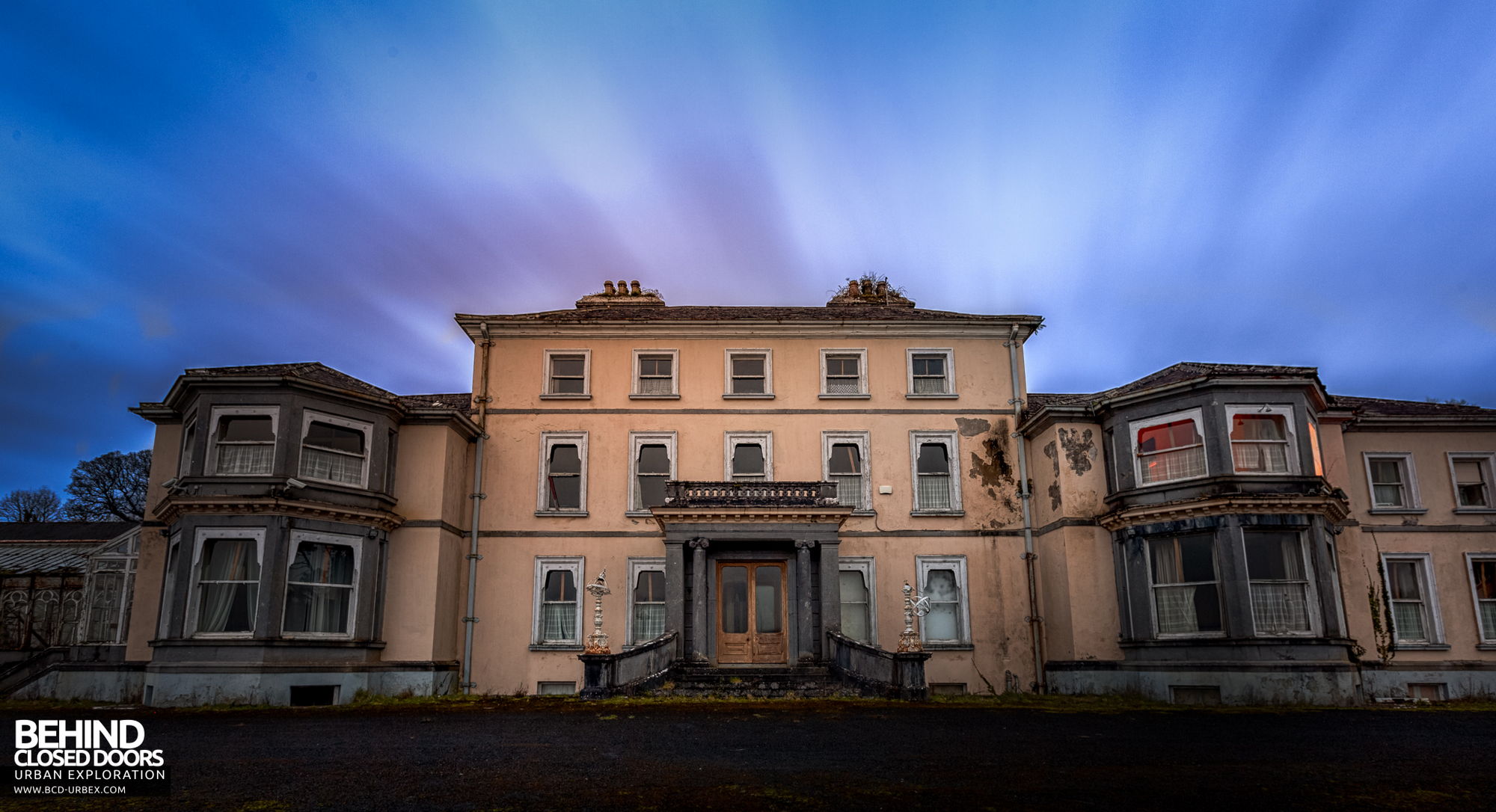
Cahercon, variously known as Cahircon, Caheracon and Cahiracon, is a late-Georgian block of three storeys over a basement, with two-storey, mid-19th century wings and other additions.
The house faces across the Shannon estuary.
The main block is of five bays, with an Ionic porch; the wings have three-sided bows. The roof is prominent.
Cahercon was the seat of the Scott family until at least the 1850s and was constructed around 1790.
In 1873, the wings, conservatory and single storey bay were added.
By the 19th century James Kelly held the house in fee.
The Hon James William White, son of Lord Annally’s son, lived in Cahiracon in the mid 1870s and it was still a seat of the family in 1894.
The Vandeleurs lived in Cahercon at the beginning of the 20th century.
In 1920, it was purchased by the Maynooth Mission to China, and they in turn sold it to the Salesians Sisters of St John Bosco in 1962.
Until 2002, Cahercon House operated as a secondary school, boarding school and convent.
It seems everywhere in Ireland has a rich history behind it, and Cahercon House in Kildysart is no exception. The 60-bedroom Georgian mansion was built around 1790, on 220 acres of land overlooking the Shannon Estuary. Through that time it has been an ascendancy family seat, a seminary for missionaries, a boarding school and, most recently, a pet project for the head of a quarrying conglomerate.
The house was built by the Scott family, but soon becoming the home of the White family in 1800s. The Whites were regarded as “new money” by high society after rapidly making their fortune operating a lottery, however this proved to be the start of an aristocracy and the house stayed in the family for the next 90 years.
Cahercon House, Ireland – Exterior of the house
Cahercon House was sold to the Vandeleurs in 1897, after their previous residence in Kilrish was destroyed by fire, and they remained there for the next two decades. The Vandeleurs, however, were not popular landlords amongst the community, and were responsible for over 1,000 evictions following the potato famine.
The estate was sold to the Maynooth Mission to China, later called the Missionary Society of St Columban and better known as “the Columbans” in 1920 for £14,000. Cahercon became St Senan’s College, a philosophical institute and seminary. A few years later, it would become a convent for the Sisters of Saint Columban, who ran a high school there until 1948. The Columbans sold the place, in October 1962, to the Salesian sisters who turned it into a boarding school for girls, which closed in 2002.
The house then fell into the hands of Clareman Paddy Whelan, a businessman who owned an extensive quarrying business and was looking to set up an explosives factory. Planning permission was granted for construction of the factory in the grounds, but faced furious local opposition, including from the nuns of Cahercon House themselves. The Whelan Group purchased the house from the nuns for something over €1 million, and the objections were silenced.
The planning permission still became overturned in 2003, but following a 10-year legal battle, was reinstated with various conditions. In a strange twist of fate, in 2010 the Whelan group, including the explosives venture, were liquidated in the High Court.
The property is now empty and for sale again, including planning permission to build an explosives factory.
Our visit was late in the day and the daylight was fading, but some of the lights inside were working.
Cahercon House, Ireland – Exterior of the house
Cahercon House was sold to the Vandeleurs in 1897, after their previous residence in Kilrish was destroyed by fire, and they remained there for the next two decades. The Vandeleurs, however, were not popular landlords amongst the community, and were responsible for over 1,000 evictions following the potato famine.
The estate was sold to the Maynooth Mission to China, later called the Missionary Society of St Columban and better known as “the Columbans” in 1920 for £14,000. Cahercon became St Senan’s College, a philosophical institute and seminary. A few years later, it would become a convent for the Sisters of Saint Columban, who ran a high school there until 1948. The Columbans sold the place, in October 1962, to the Salesian sisters who turned it into a boarding school for girls, which closed in 2002.
The house then fell into the hands of Clareman Paddy Whelan, a businessman who owned an extensive quarrying business and was looking to set up an explosives factory. Planning permission was granted for construction of the factory in the grounds, but faced furious local opposition, including from the nuns of Cahercon House themselves. The Whelan Group purchased the house from the nuns for something over €1 million, and the objections were silenced.
The planning permission still became overturned in 2003, but following a 10-year legal battle, was reinstated with various conditions. In a strange twist of fate, in 2010 the Whelan group, including the explosives venture, were liquidated in the High Court.
The property is now empty and for sale again, including planning permission to build an explosives factory.
Our visit was late in the day and the daylight was fading, but some of the lights inside were working.
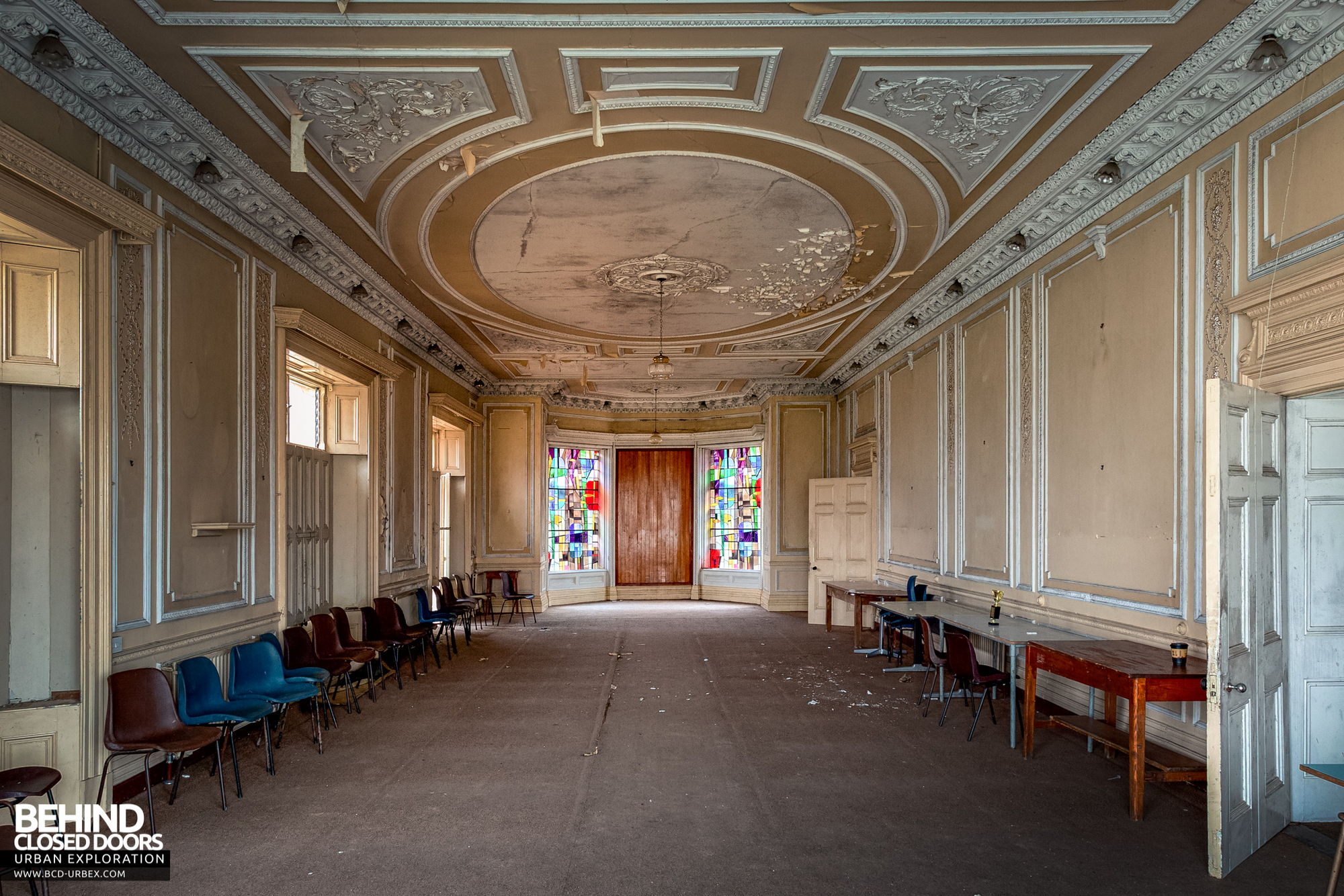
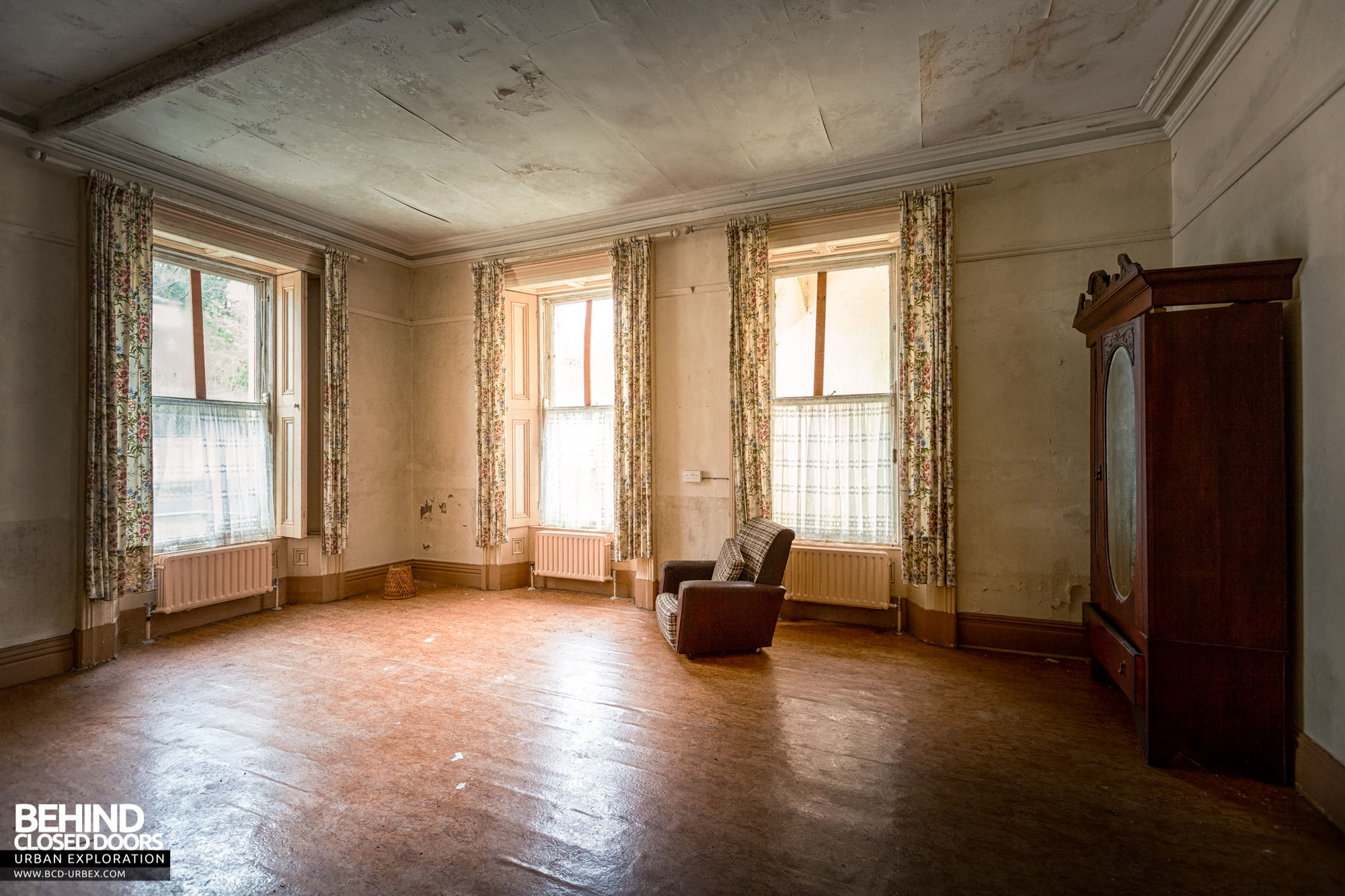
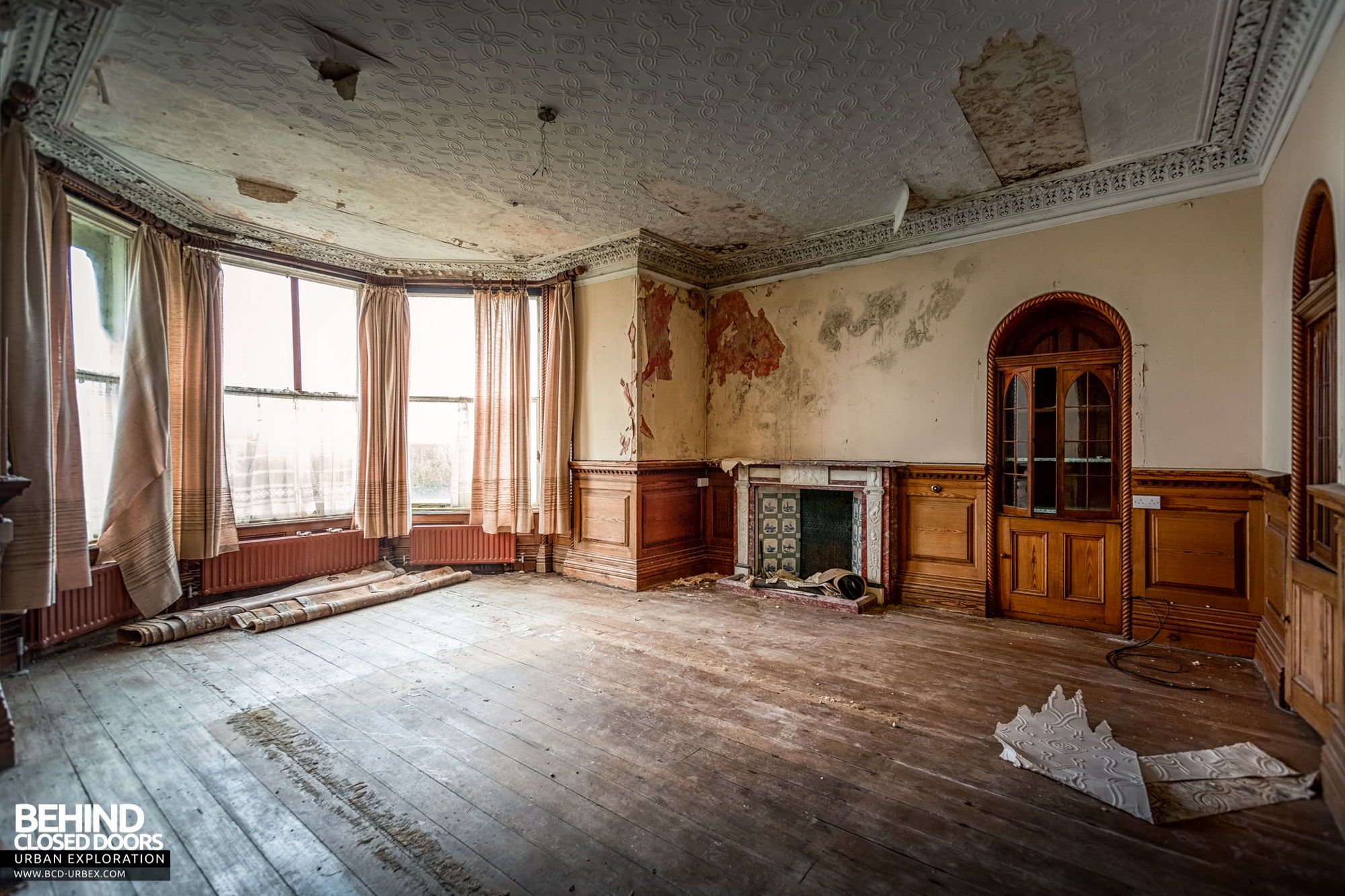
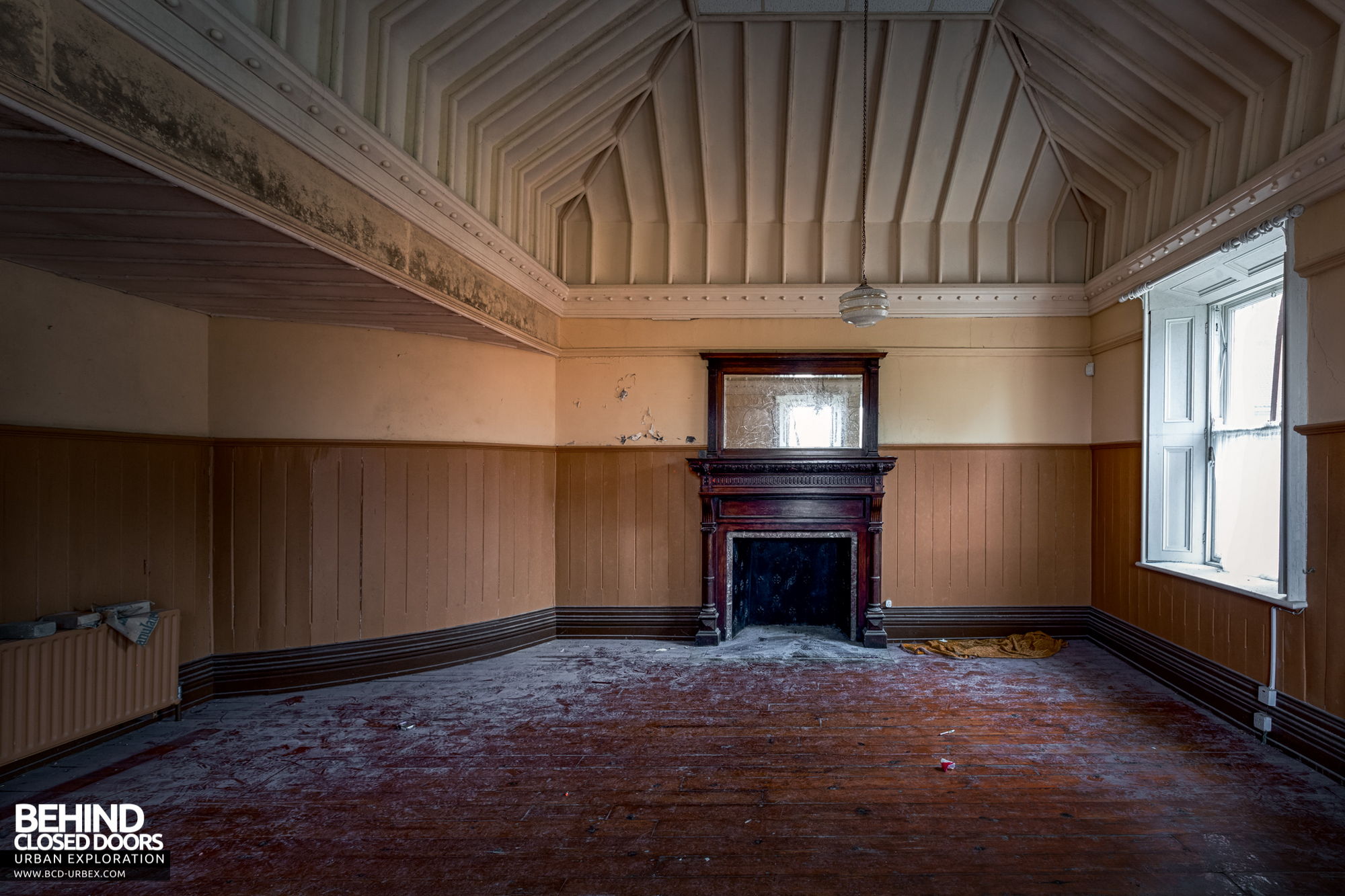
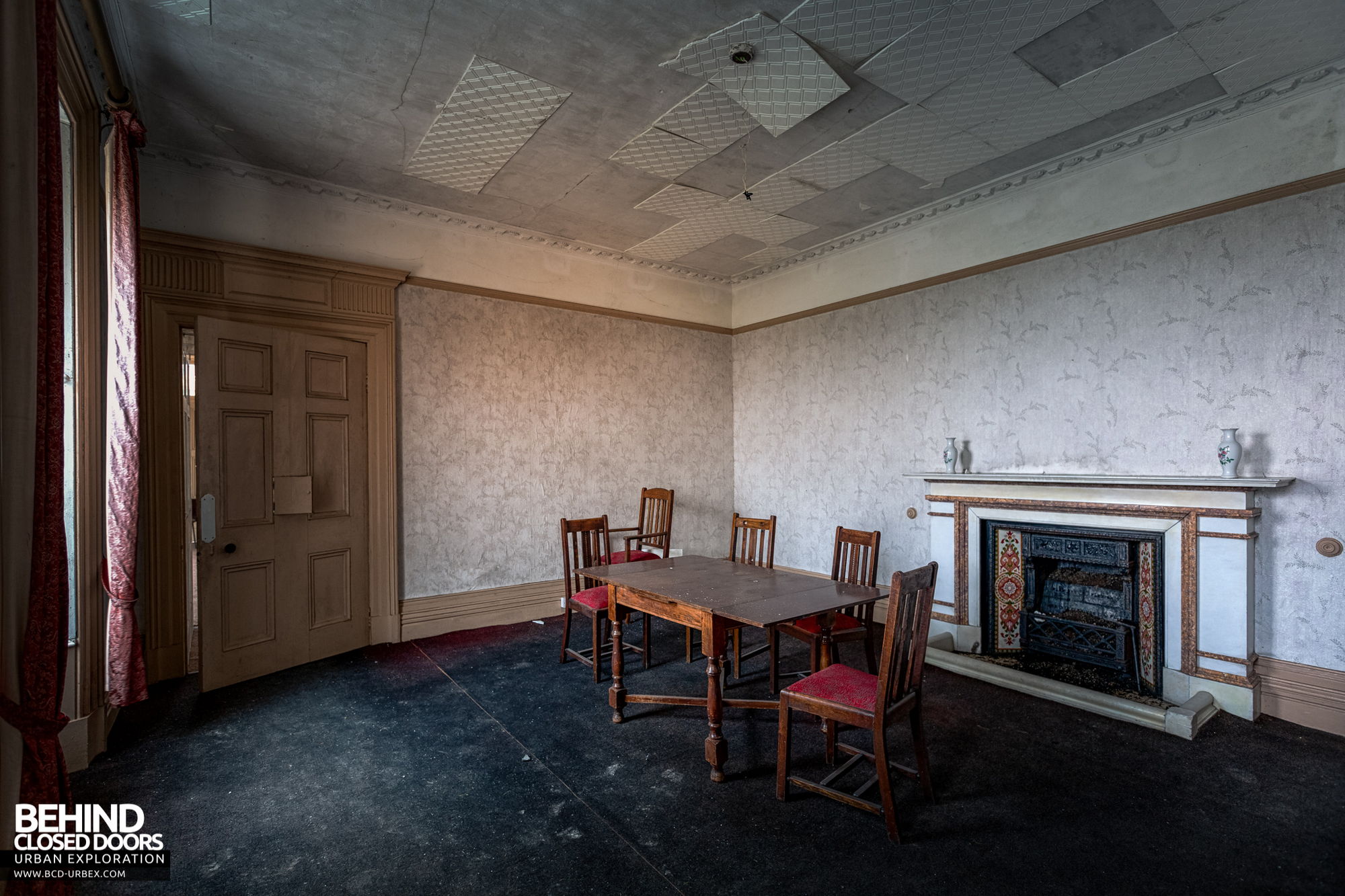
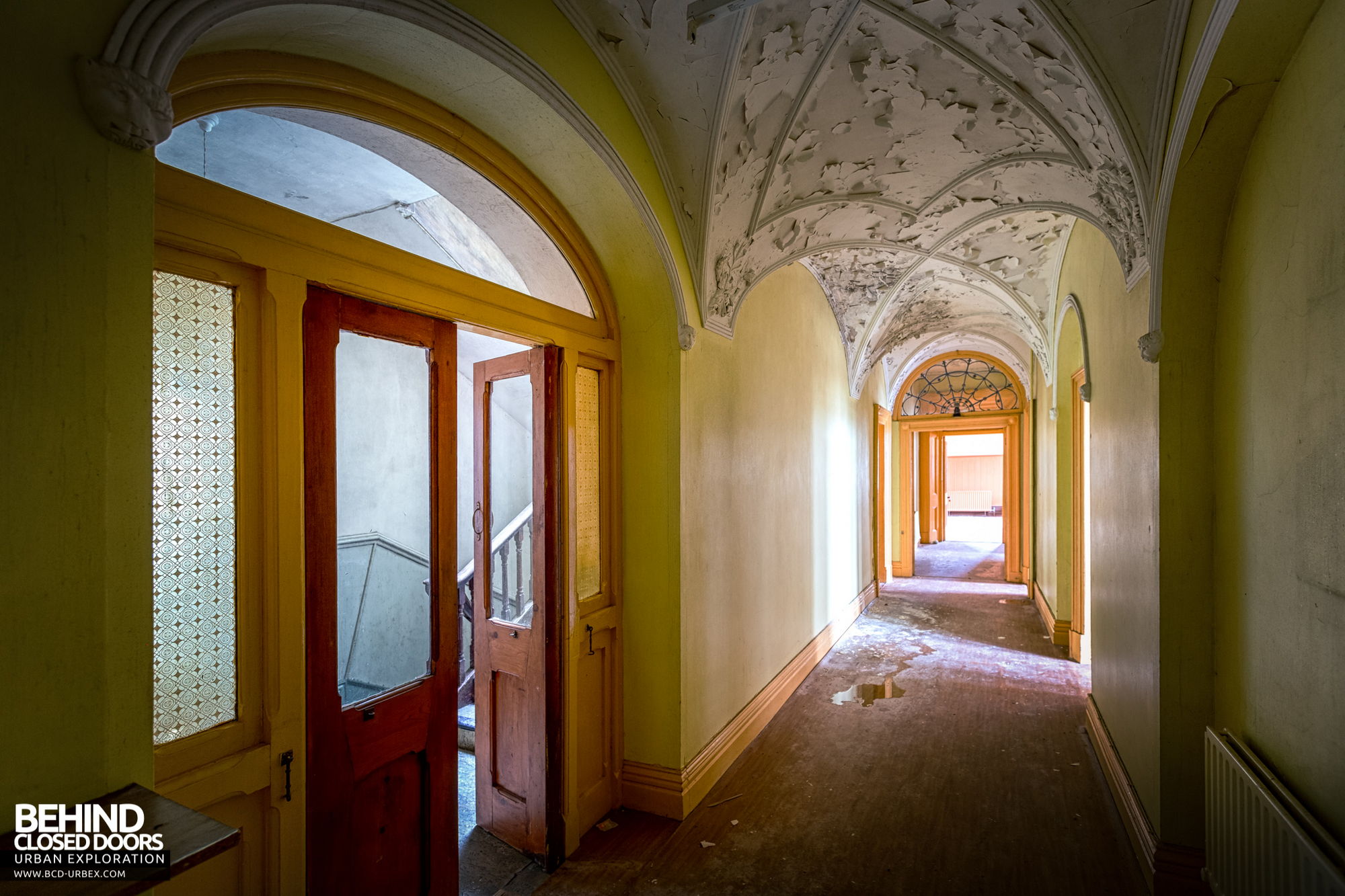
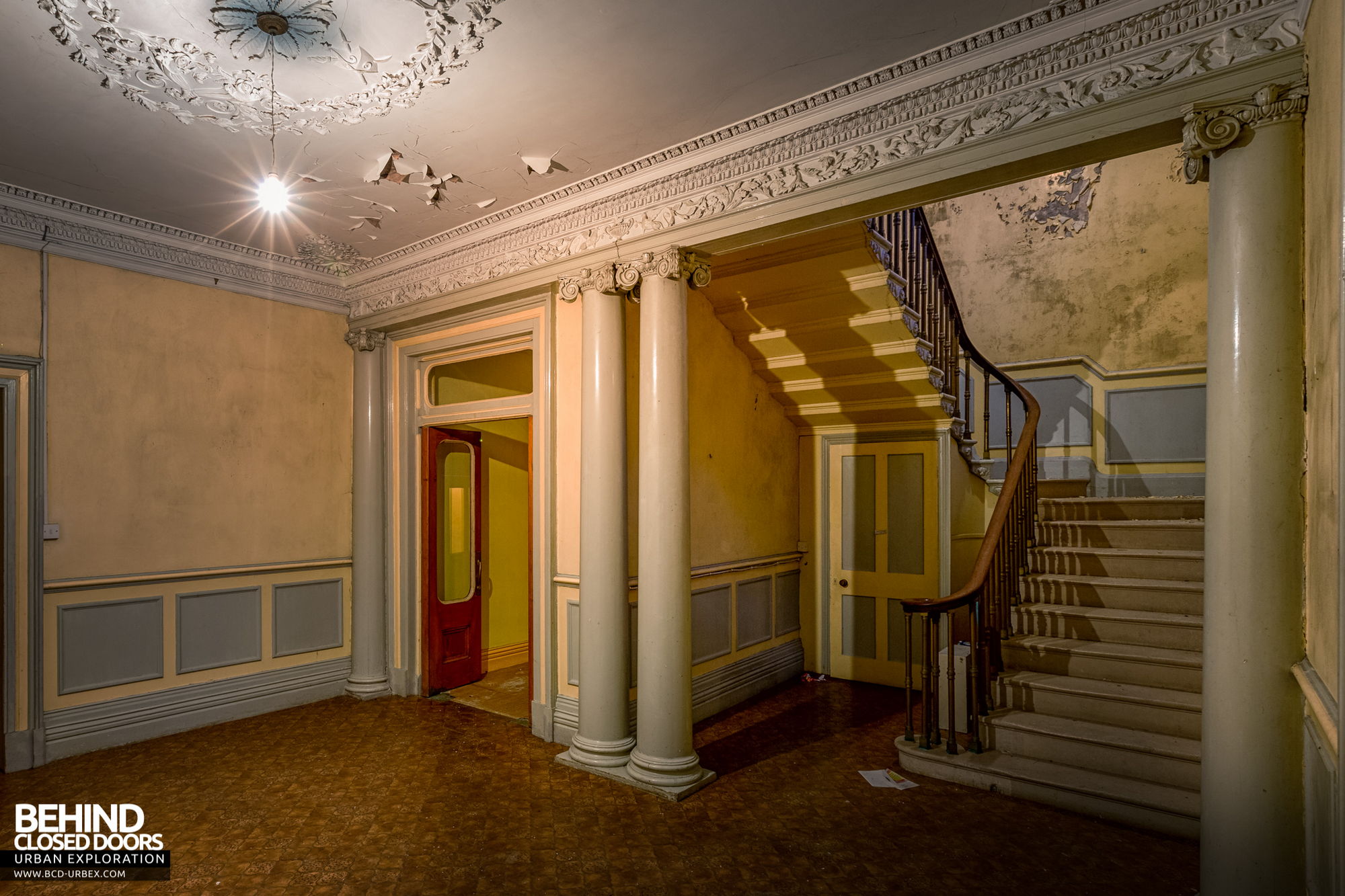
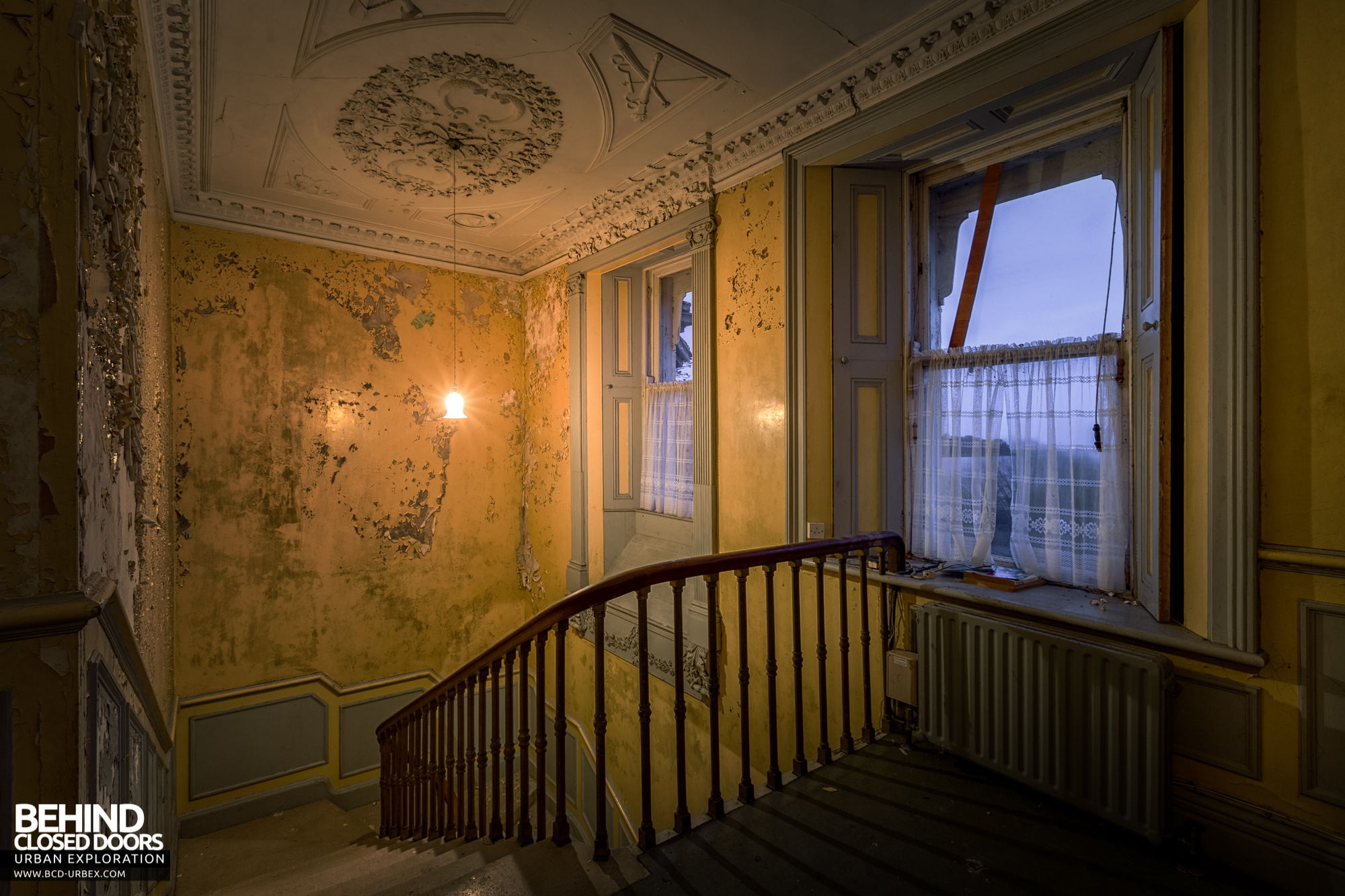
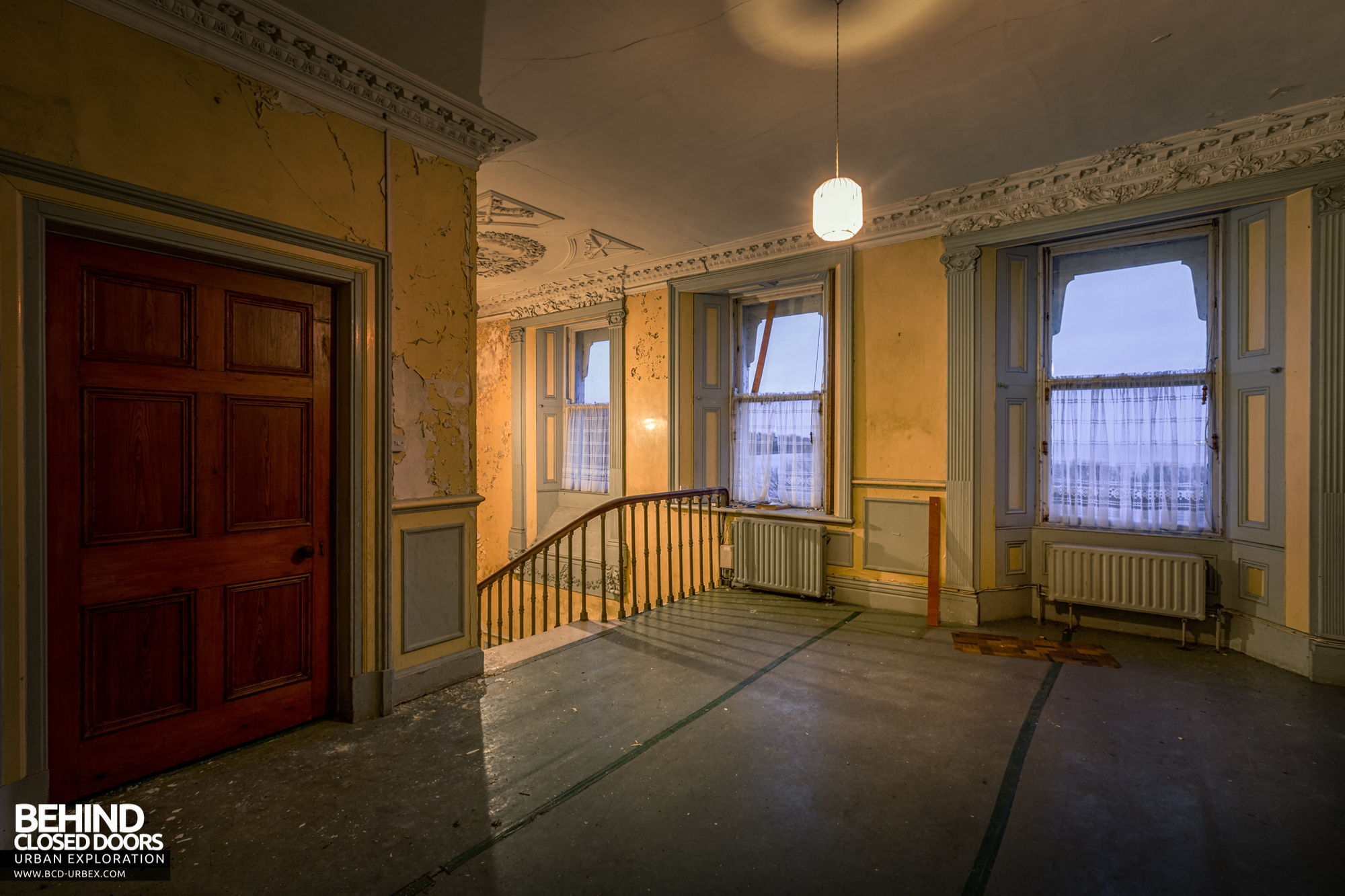
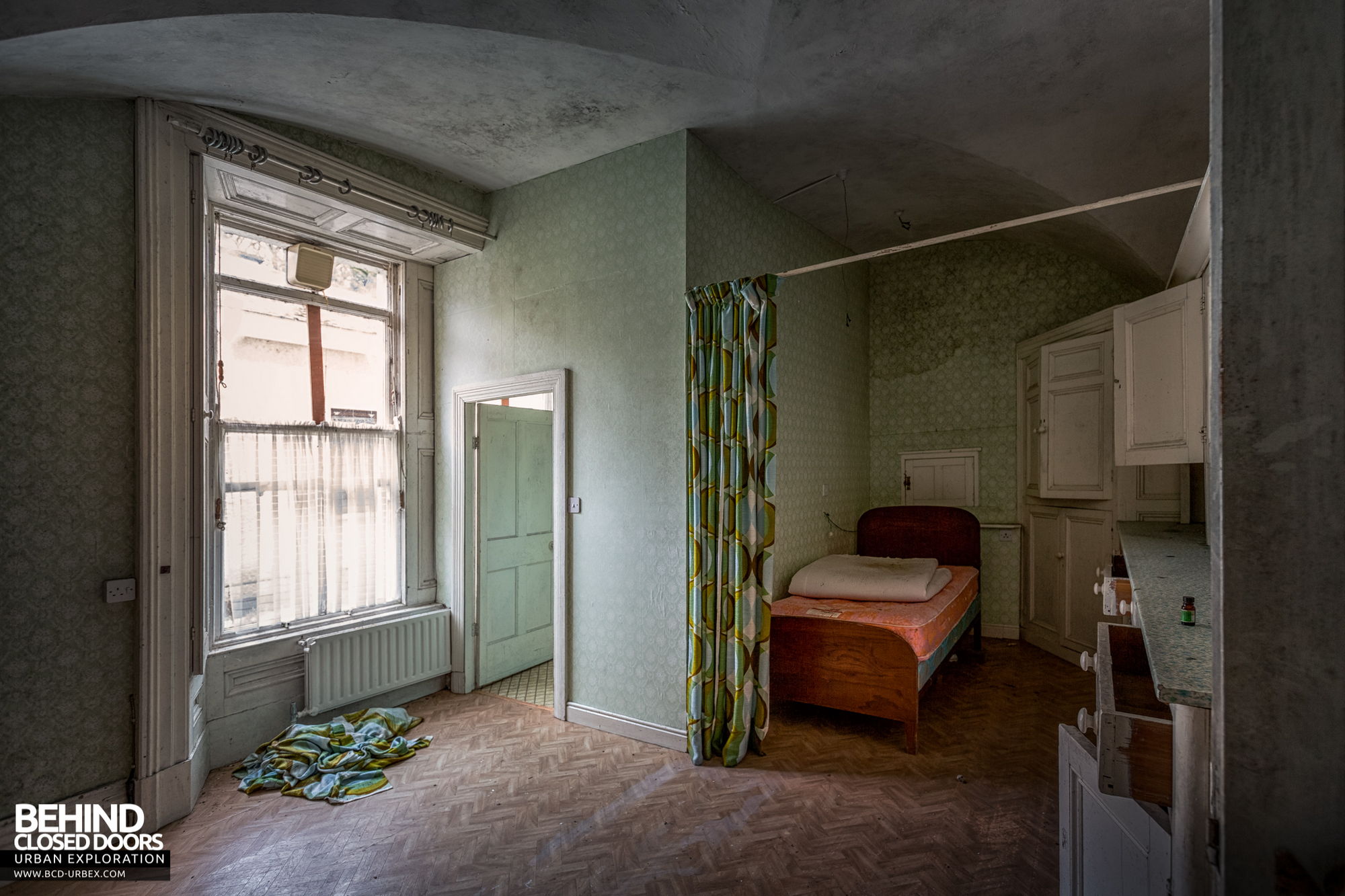
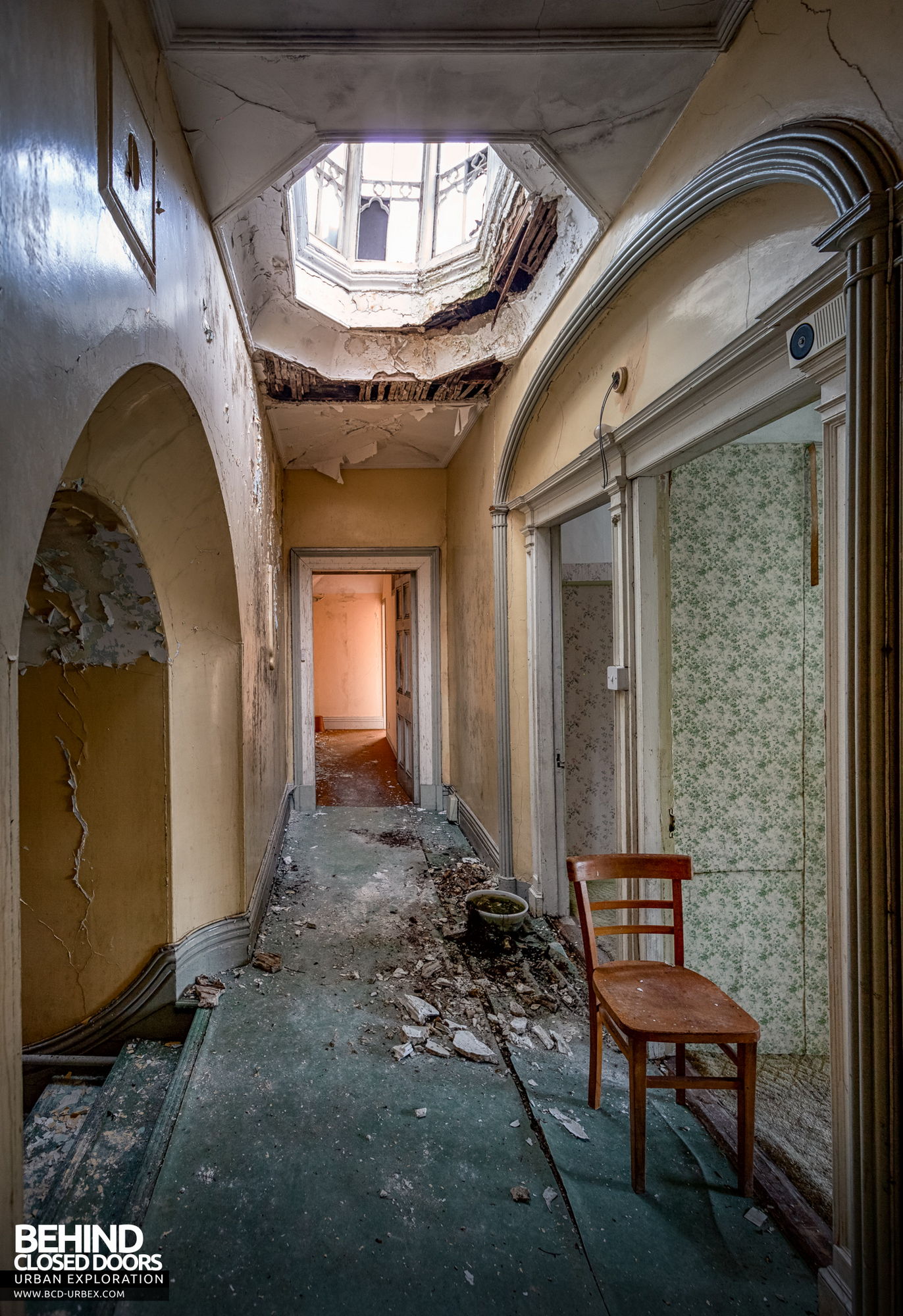
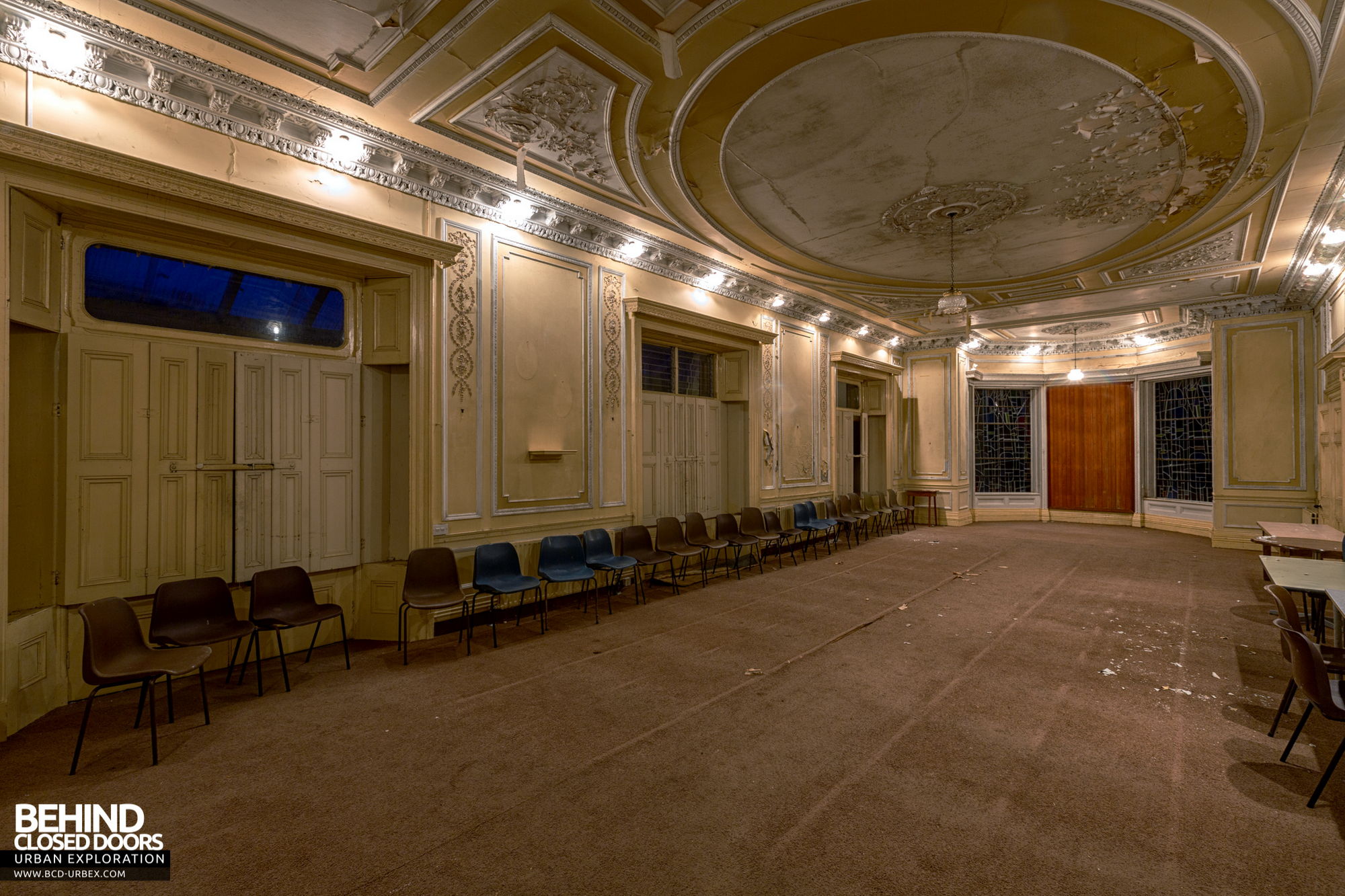
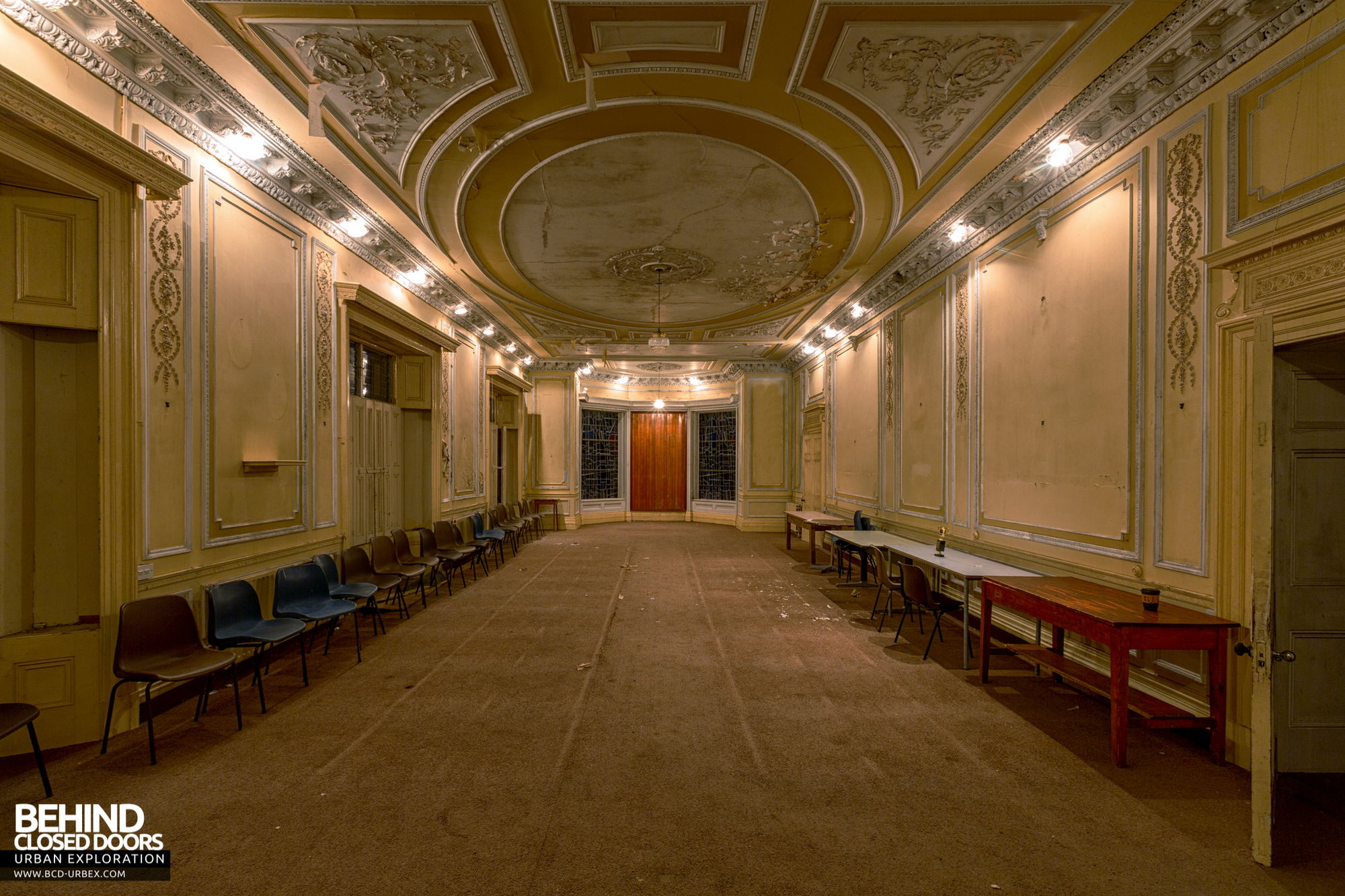
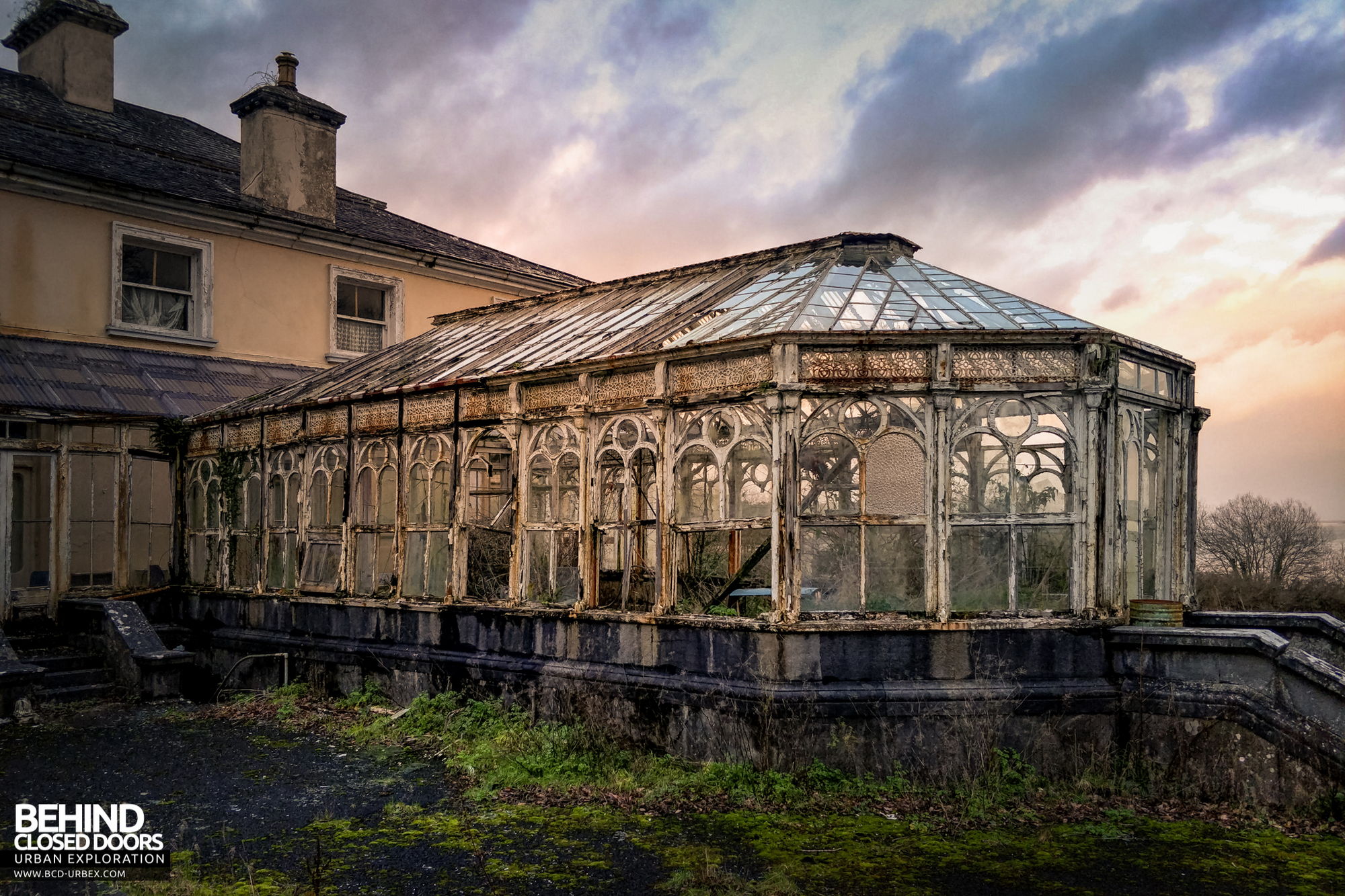
Cahercon House, Ireland – The grand ballroomCahercon House, Ireland – The grand ballroomCahercon House, Ireland – One of the reception roomsCahercon House, Ireland – Bay windowCahercon House, Ireland – Sitting roomCahercon House, Ireland – A decaying roomCahercon House, Ireland – Room with lots of timberworkCahercon House, Ireland – Dining roomCahercon House, Ireland – Hallway with nice peely ceilingCahercon House, Ireland – Entrance hall and staircaseCahercon House, Ireland – Top of the staircaseCahercon House, Ireland – Upstairs landingCahercon House, Ireland – One of the bedroomsCahercon House, Ireland – Fantastically dated roomCahercon House, Ireland – Hallway with collapsing lanternCahercon House, Ireland – Ballroom with the lights onCahercon House, Ireland – Ballroom with the lights onCahercon House, Ireland – Victorian wrought iron conservatoryCahercon House, Ireland – Exterior of the house






 Irish Historic Houses