Farmleigh House (and Iveagh House), Phoenix Park, Dublin

Farmleigh House, Phoenix Park, Dublin

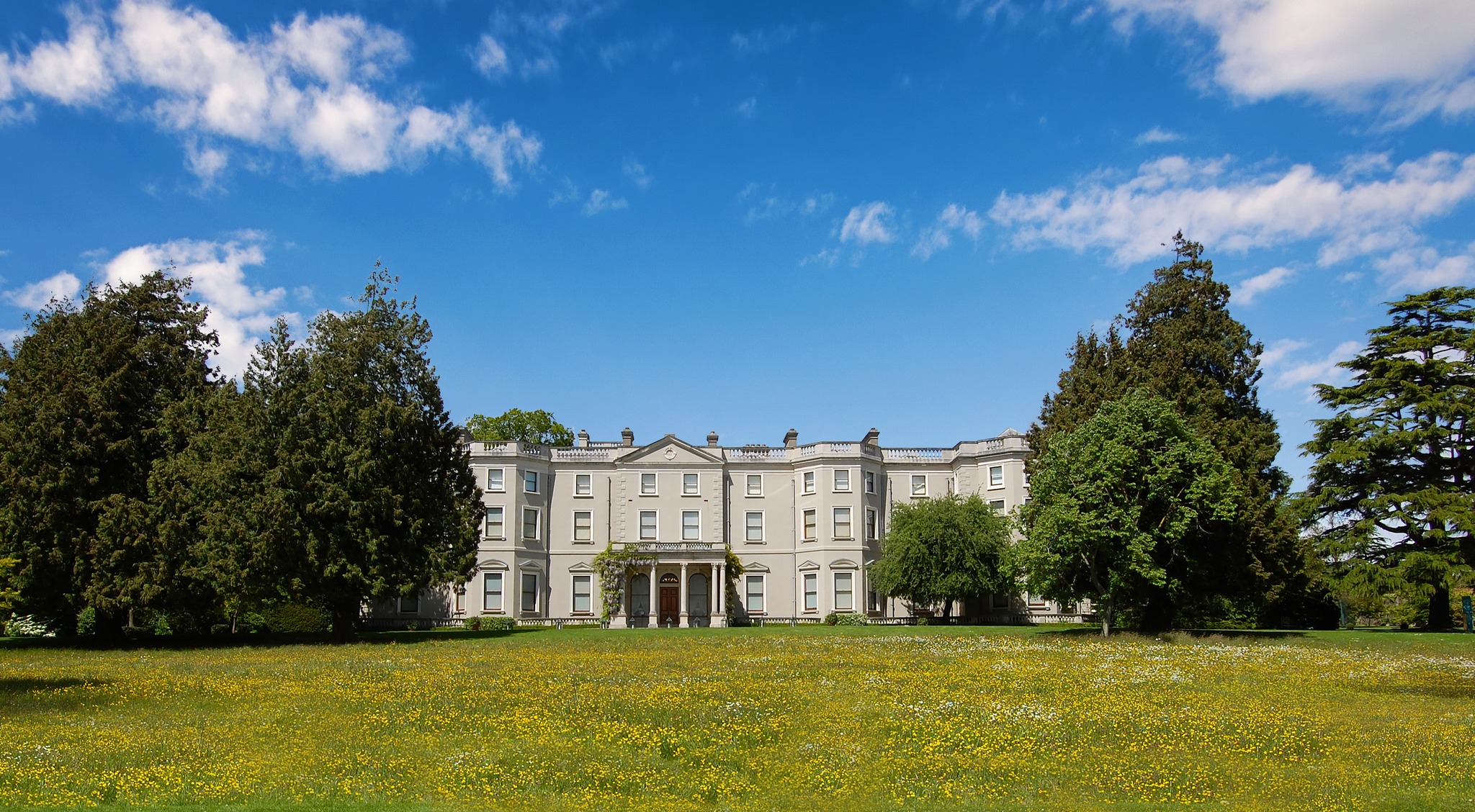
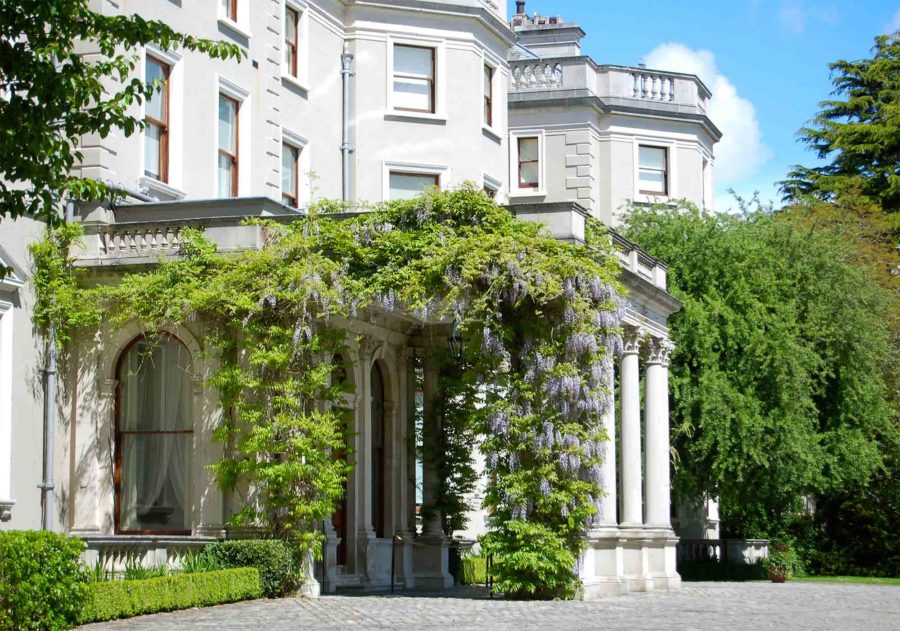
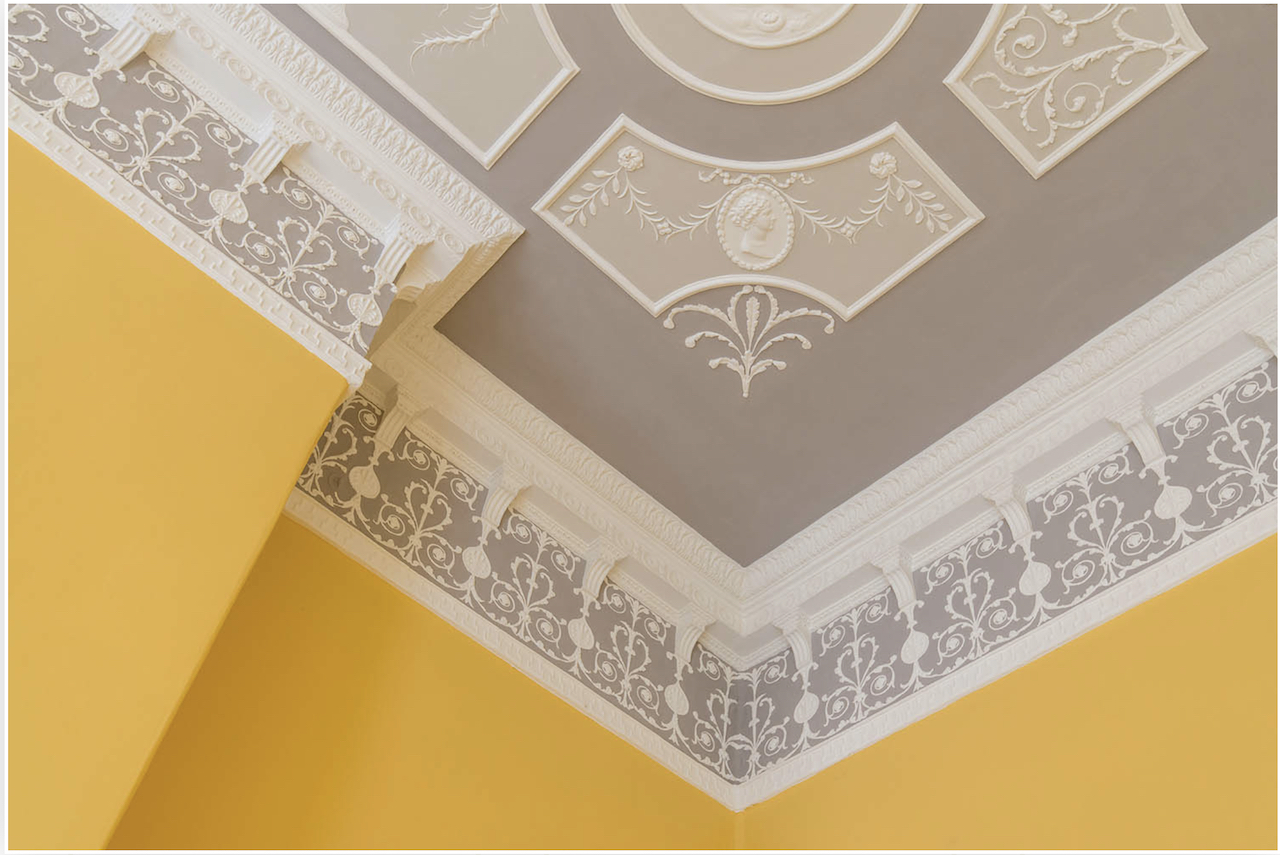
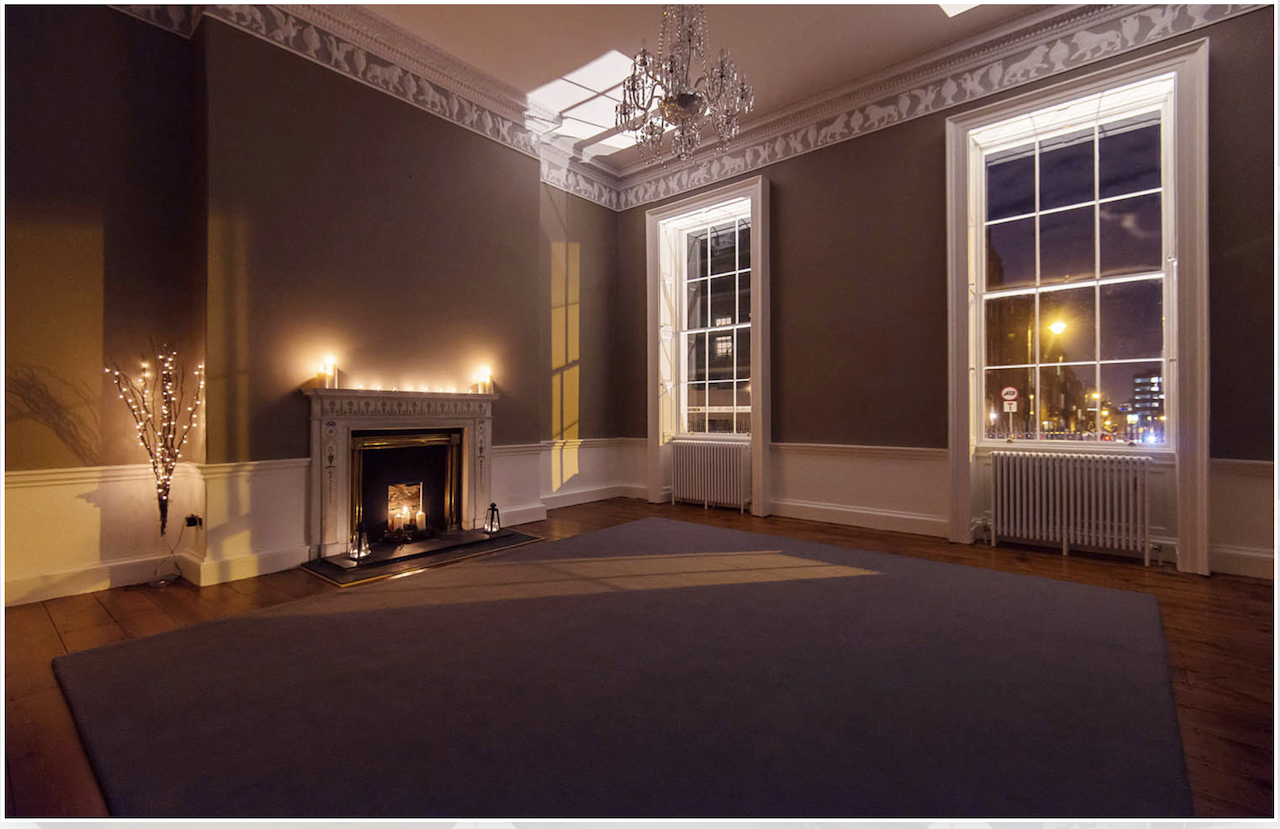
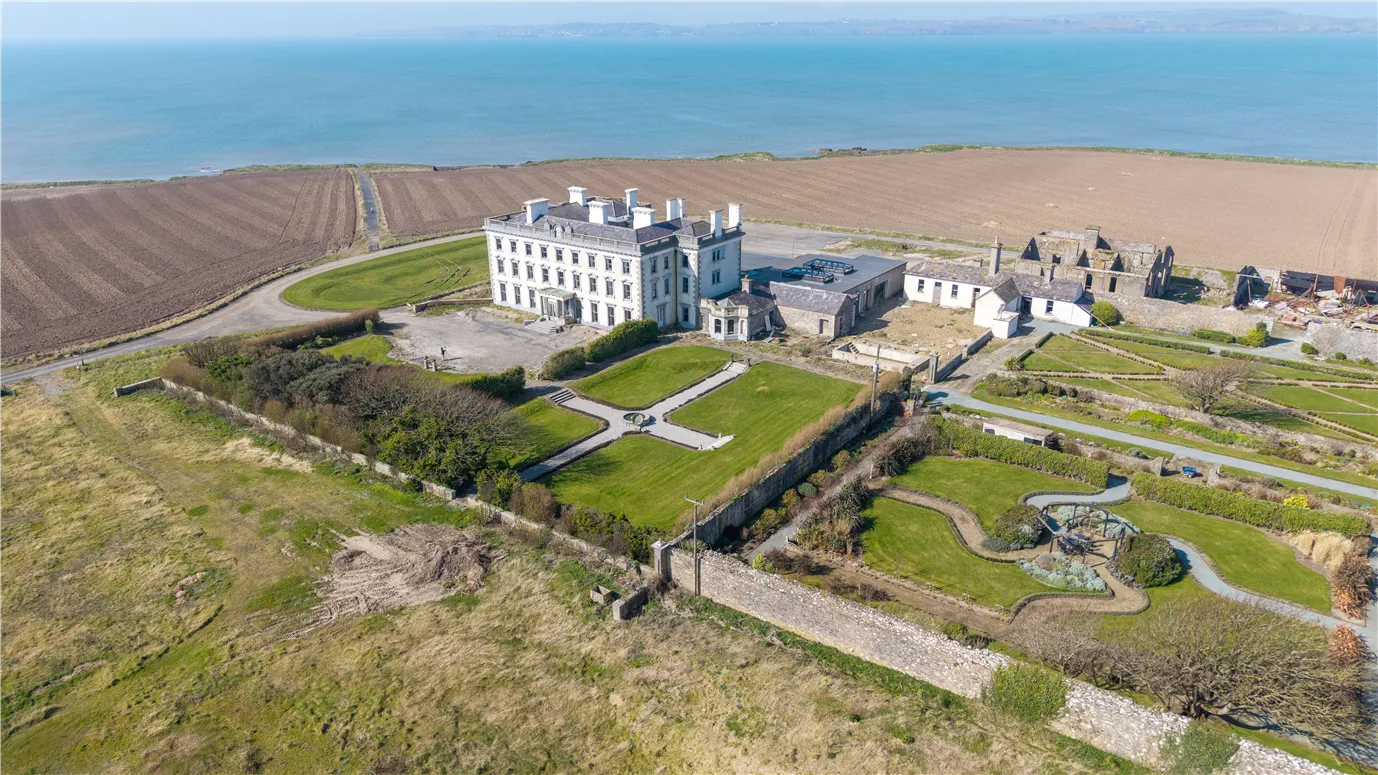
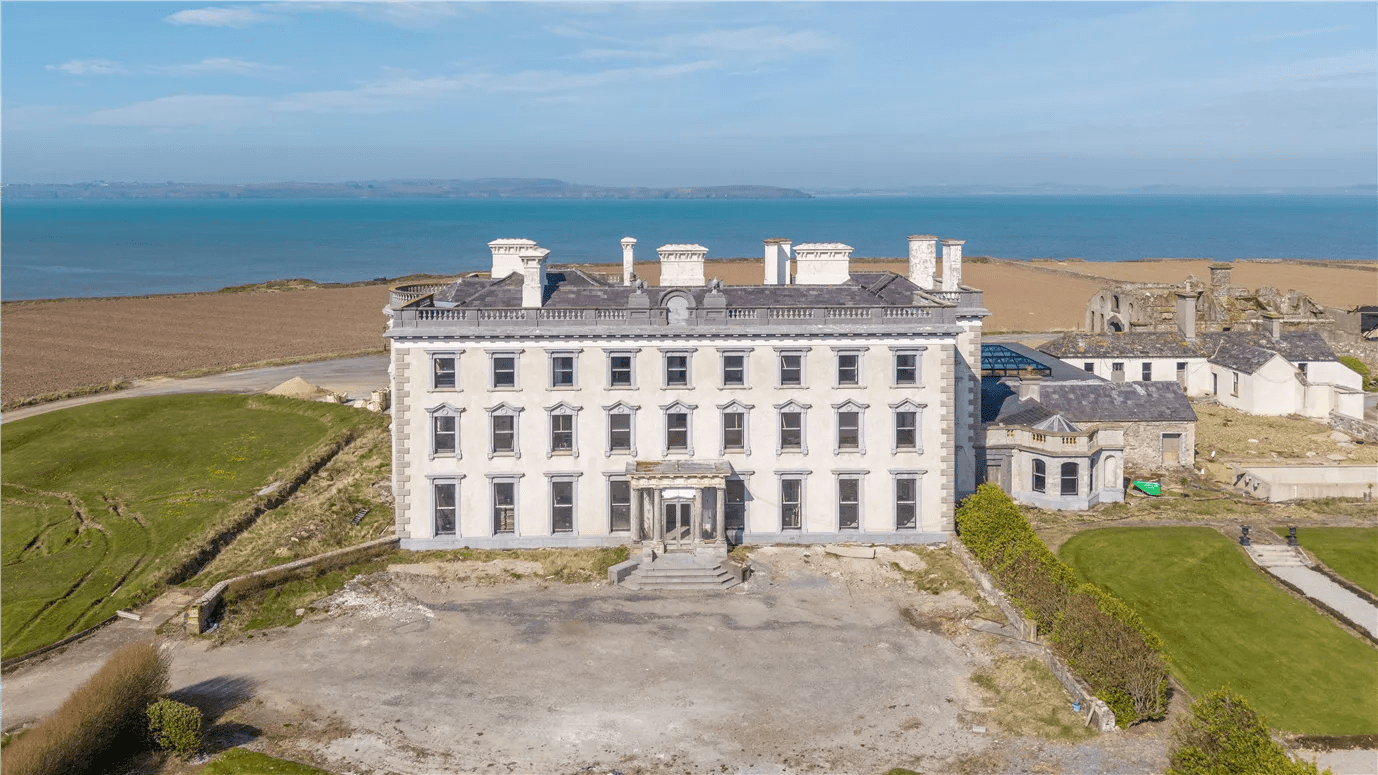
Farmleigh, photograph courtesy of Farmleigh facebook page.

Farmleigh House is part of a 78-acre estate inside Dublin’s Phoenix Park. The government bought it in June 1999 to provide accommodation for high-level meetings and visiting guests of the nation. The rest of the time it is maintained by the Office of Public Works and is open to the public for tours.

Farmleigh was originally a two storey Georgian house, belonging to the Coote family and the Trenches, then bought by Edward Cecil Guinness (1847-1927) in 1873, a great grandson of brewery owner Arthur Guinness, at the time of his marriage to his cousin Adelaide Guinness.

Farmleigh was built for the Trench family in 1752, according to a Dublin City Council website, Bridges of Dublin. Charles Trench built the walled garden. I am afraid I am unable to find more information about the Trenches of Farmleigh so I would appreciate any feedback about them.

The Landed Estates database identifies John Chidley Coote (1816-1879) as a previous owner, the son of Charles Henry Carr Coote (1794-1864) 9th Baronet. John Chidley was from Ballyfin in County Laois, later and school and now a beautiful hotel. He married his neighbour Margaret Mary Pole Cosby from Stradbally Hall in County Laois (see my entry https://irishhistorichouses.com/2021/10/14/stradbally-hall-stradbally-co-laois/ ), daughter of Sydney Cosby (1807-1840). They had no children, and she went on to marry Charles Robert Piggott 3rd Baronet of Knapton, County Laois, after John Chidley’s death.

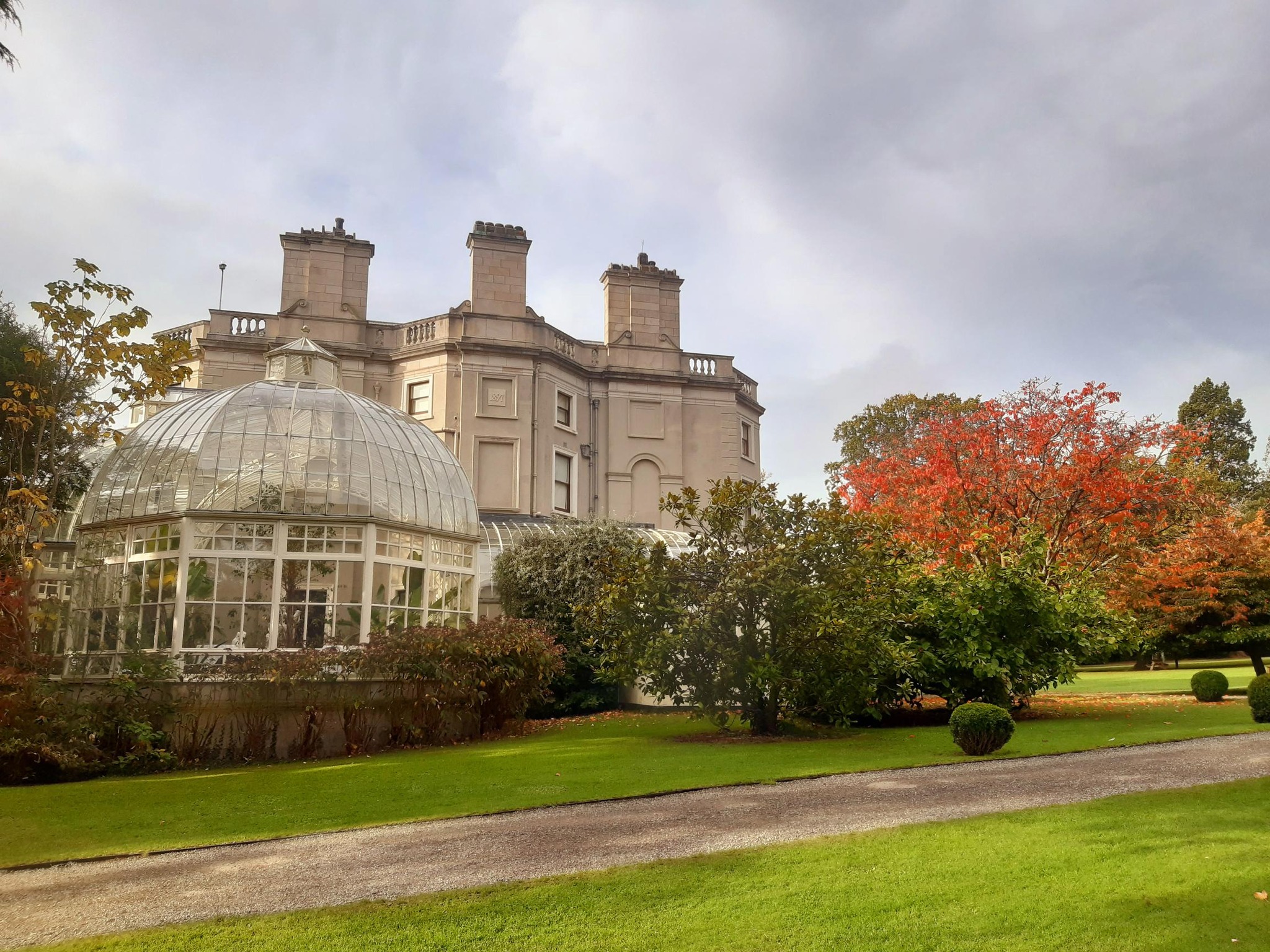
Edward Cecil Guinness enlarged the house, using designs first by James Franklin Fuller (1832-1925), who extended the house to the west, refurbished the existing house and added a third storey. Edward Cecil later engaged William Young (1843-1900), a young Scottish architect, who added the ballroom wing in 1896. Young also worked on the Guinness’s English country seat Elveden in Surrey and Edward Cecil’s house on St. Stephen’s Green. A conservatory was added adjoining the ballroom in 1901. Edward Cecil Guinness was created the 1st Earl of Iveagh in 1919.
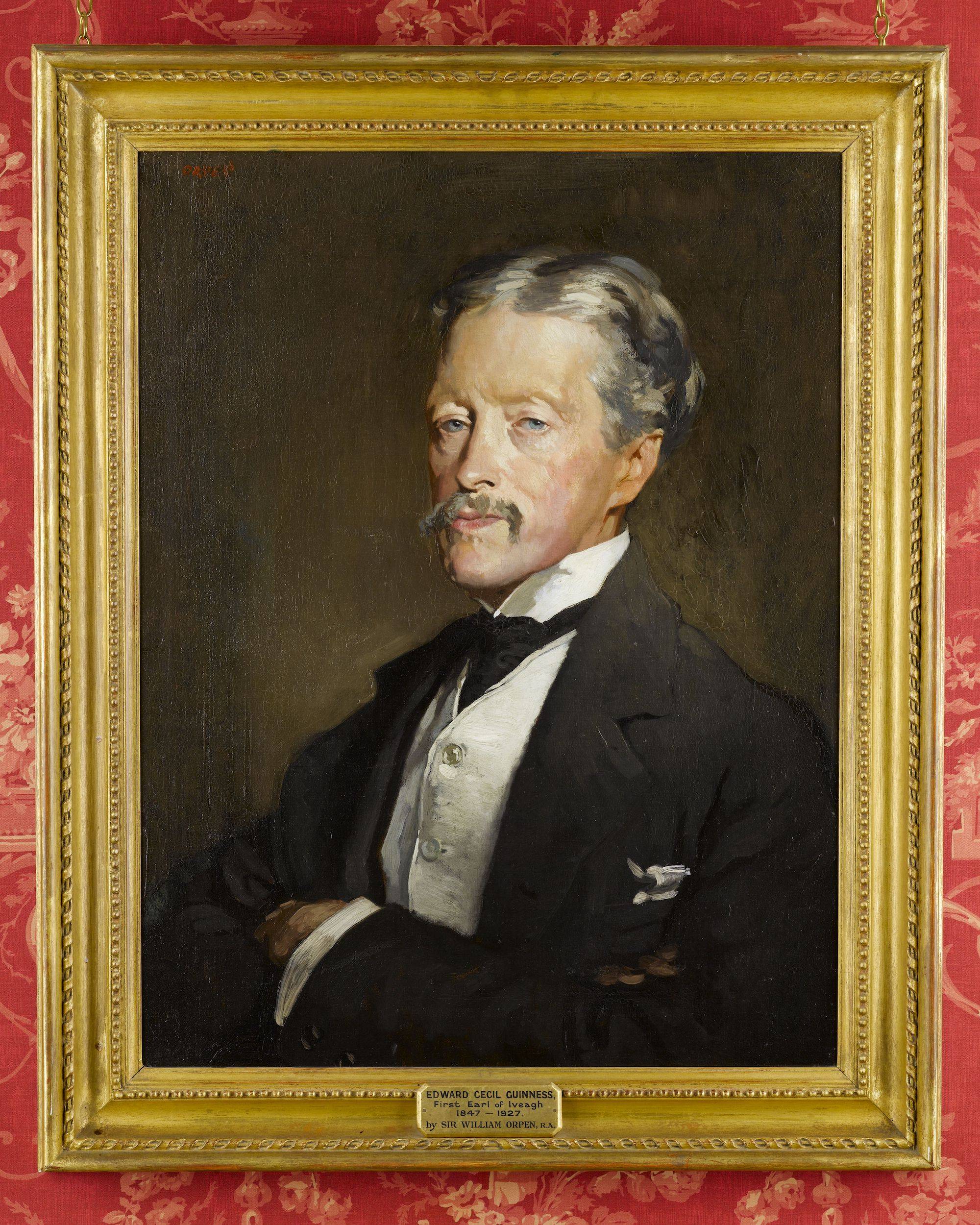
Edward Cecil Guinness (1847-1927) 1st Earl of Iveagh, by William Orpen, photograph courtesy of Farmleigh website.
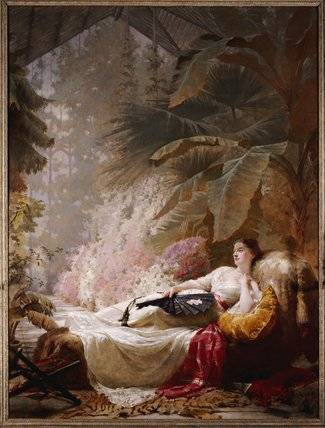
Adelaide Maria Guinness by George Elgar Hicks, photograph courtesy of Farmleigh website.

From the website:

Farmleigh is a unique representation of its heyday, the Edwardian period. Edward Cecil Guinness [(1847-1927) 1st Earl of Iveagh], great-grandson of Arthur Guinness (founder of the brewery), constructed Farmleigh around a smaller Georgian house in the 1880s. According to his tastes, the new building merged a variety of architectural styles.

Many of the artworks and furnishings that Guinness collected remain in the house. There is a stunning collection of rare books and manuscripts in the library. The extensive pleasure-grounds contain wonderful Victorian and Edwardian ornamental features, with walled and sunken gardens and scenic lakeside walks. The estate also boasts a working farm with a herd of Kerry cows.” [1]
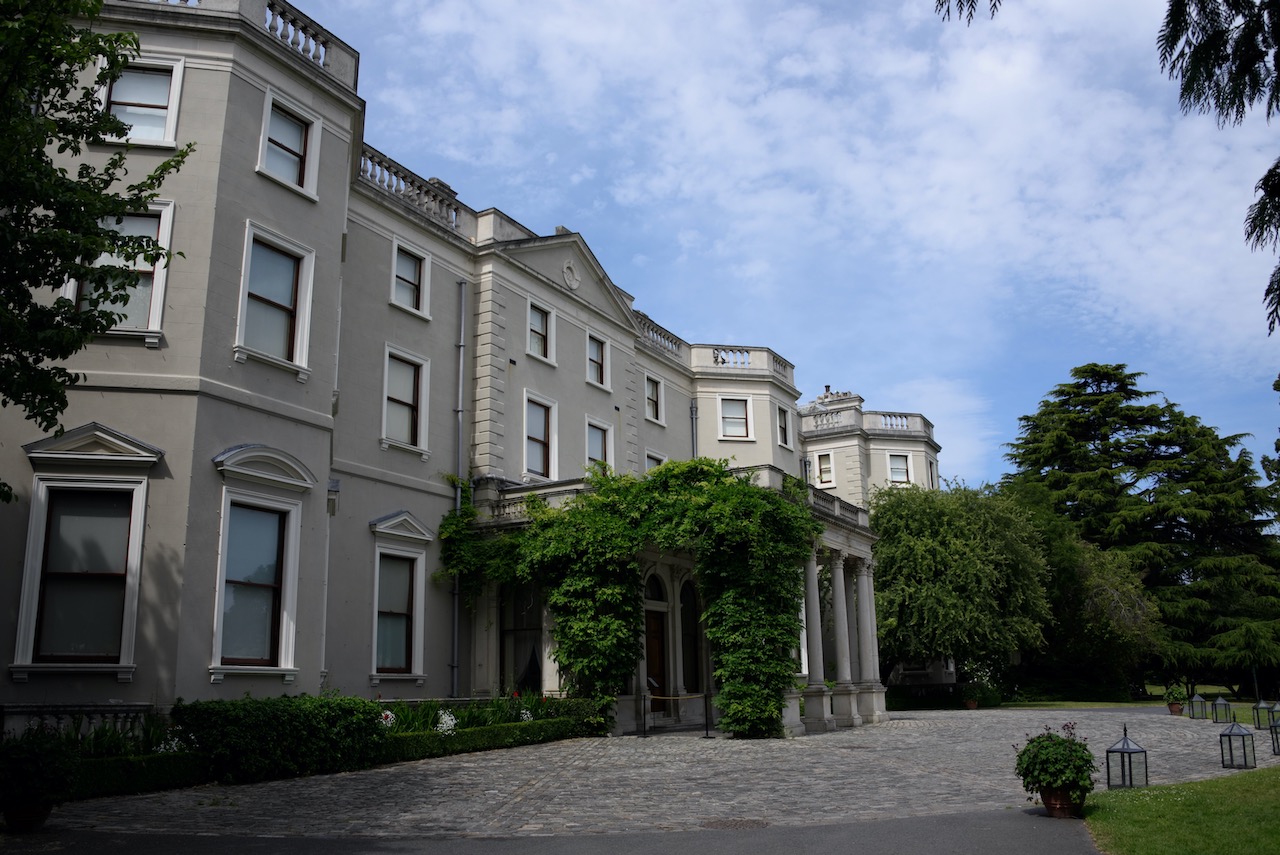
Farmleigh House, Phoenix Park, Dublin, July 2015. It was renovated by architect James Franklin Fuller. Photograph © Jennifer Winder-Baggot, www.irishhistorichouses.com

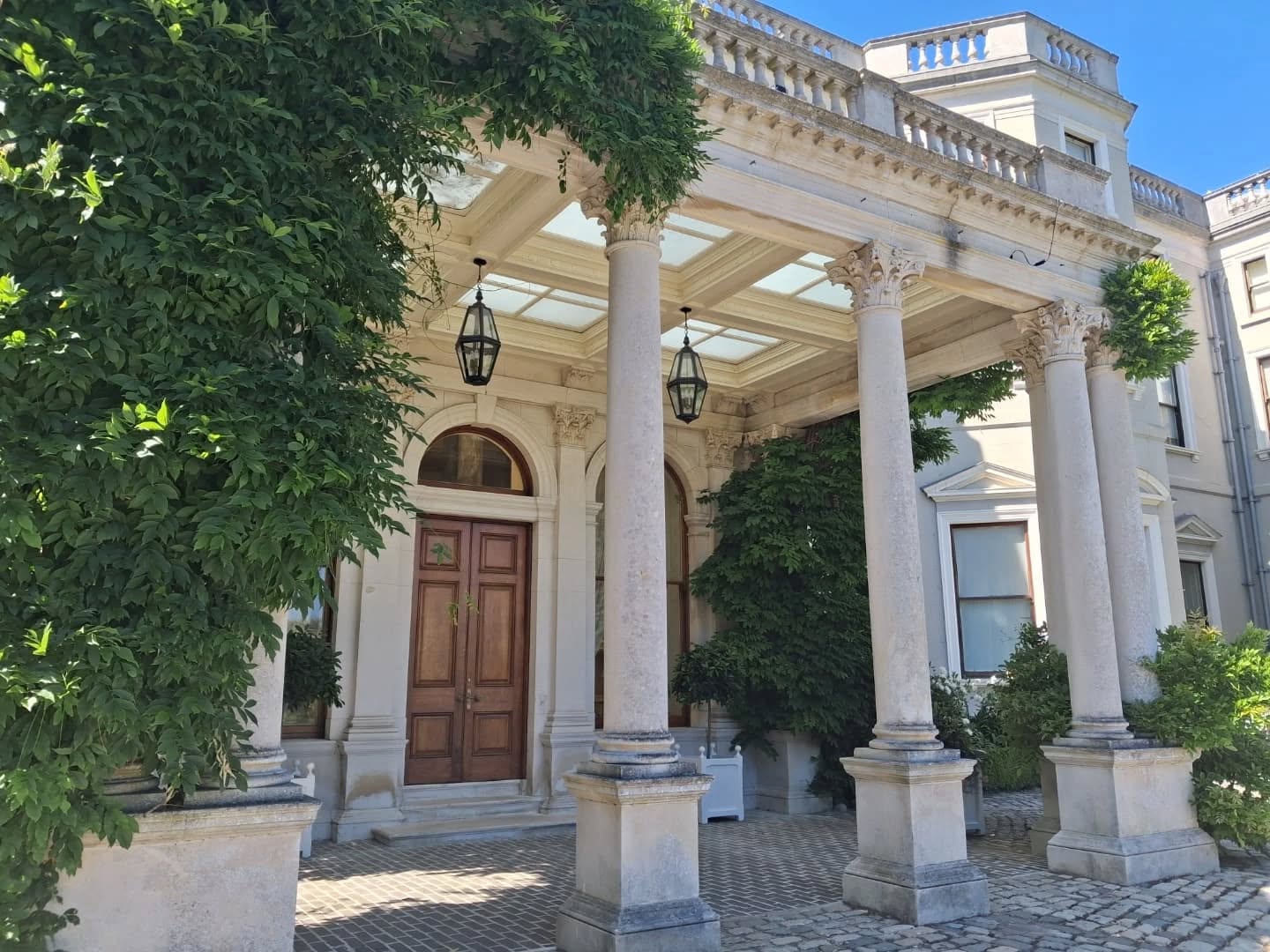
In the Dublin between the canals book by Christine Casey, part of the Buildings of Ireland series, she describes Farmleigh as a mediocre building. It is of three storeys with an extensive south facing front, rendered with a pediment and Corinthian Portland stone portico to the two advanced central bays and central canted bows to the flanking five-bay ranges. The five bays on the right of the porch correspond to the eighteenth century house, of which one interior survives, she tells us.
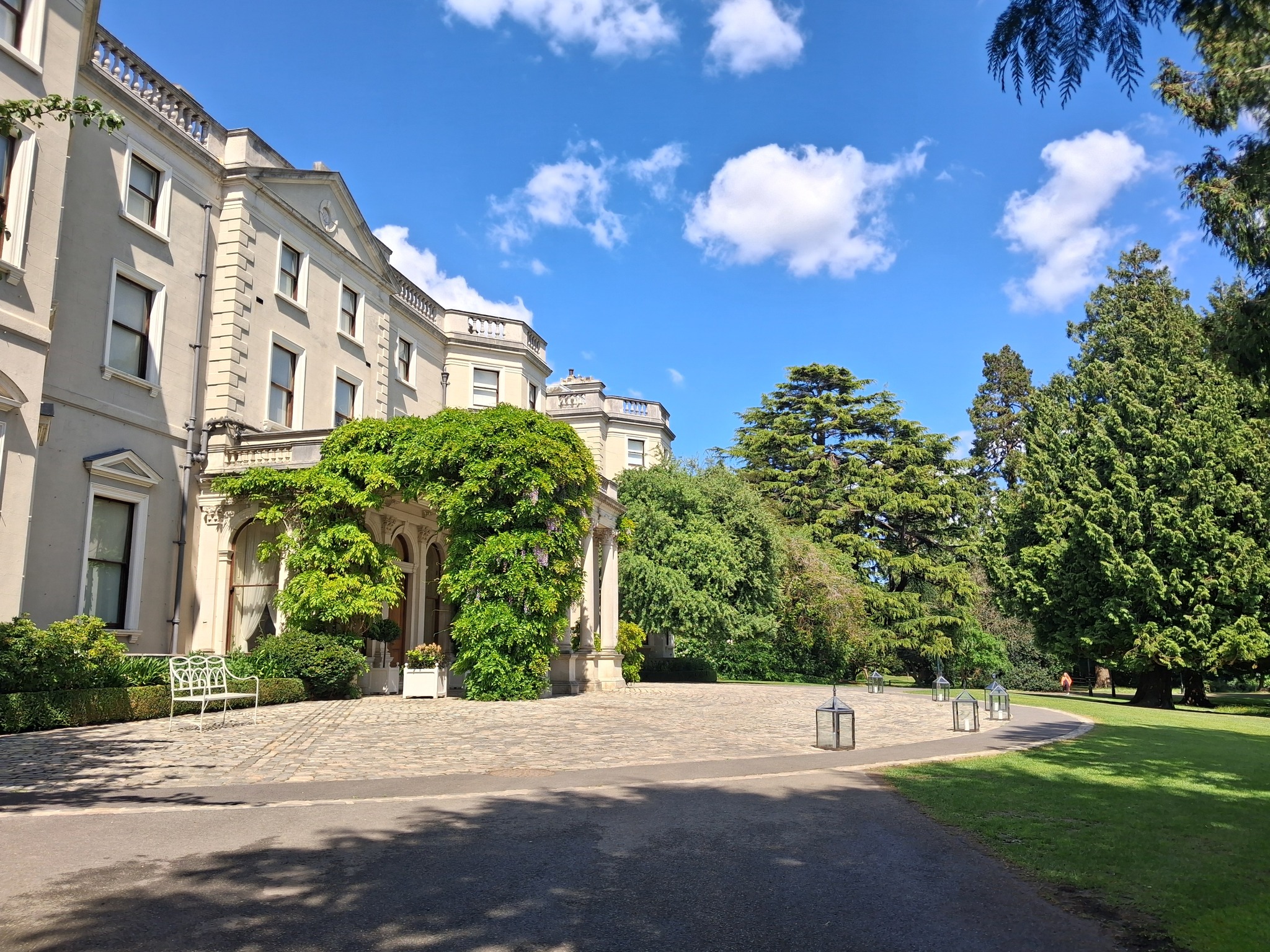
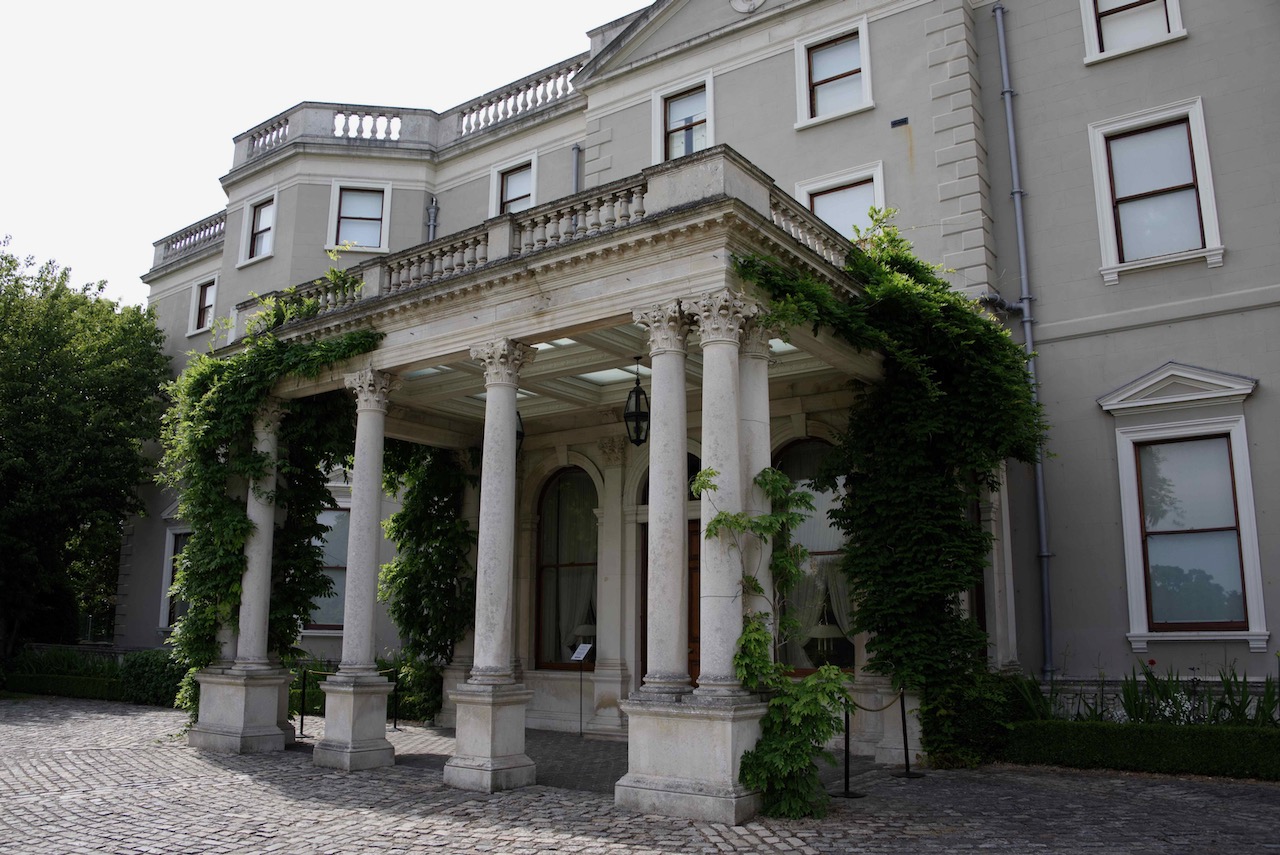
Farmleigh, Dublin, photograph courtesy of Farmleigh facebook page.
Farmleigh House, Phoenix Park, Dublin, July 2015. Photograph © Jennifer Winder-Baggot, www.irishhistorichouses.com
Farmleigh, Dublin, photograph courtesy of https://heritageireland.ie/places-to-visit/farmleigh-house-and-gardens/
Farmleigh, Dublin, photograph courtesy of Farmleigh facebook page.
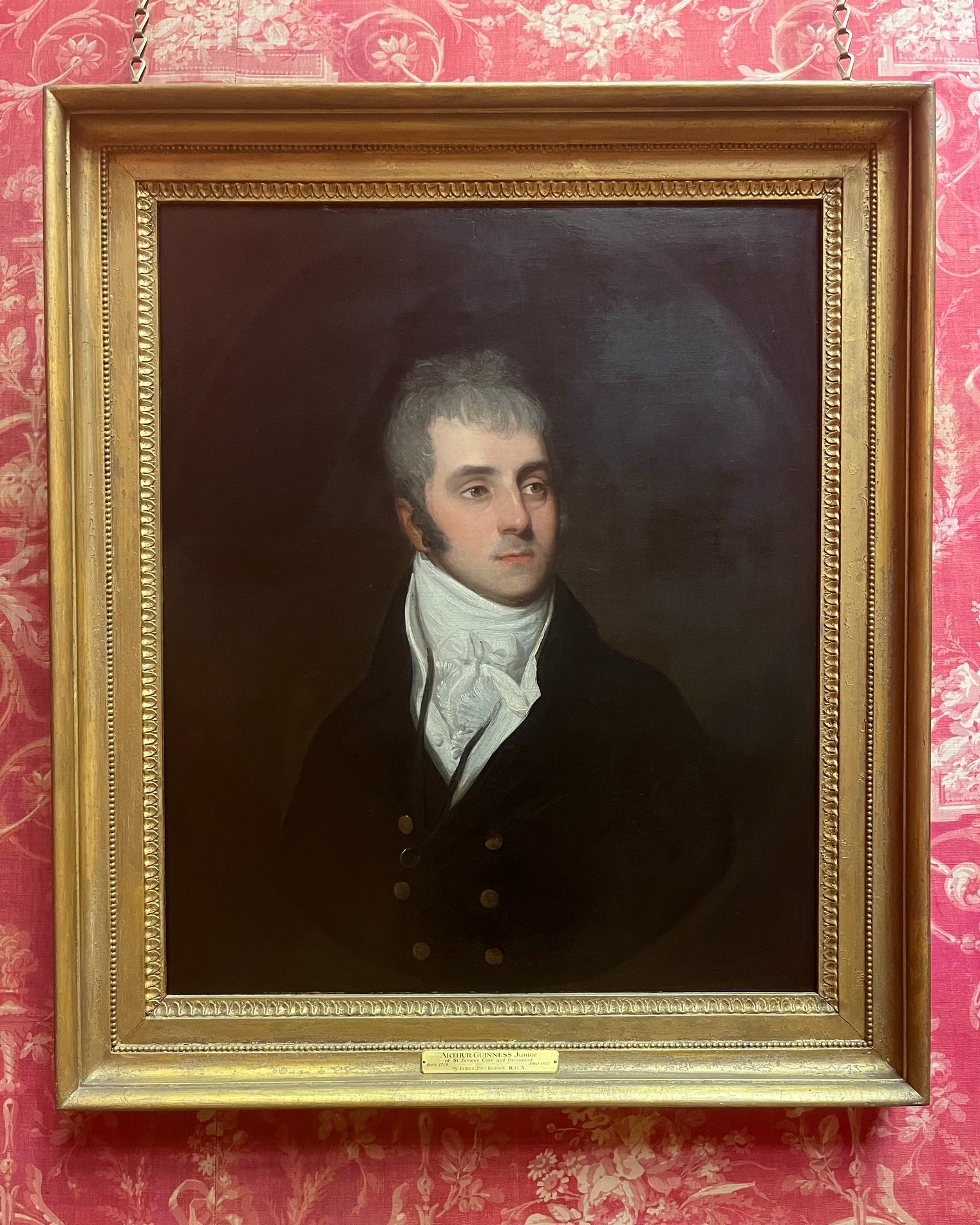
Arthur Guinness Junior: After his father’s passing in 1803, Arthur II took over the business and oversaw a period of significant growth, during which Guinness became the largest brewery in Ireland and began to concentrate on its now-famous stout. Photograph courtesy of Farmleigh facebook page.
Arthur Guinness of Beaumont, J.P., (1768-1855), courtesy of National Gallery of Ireland.

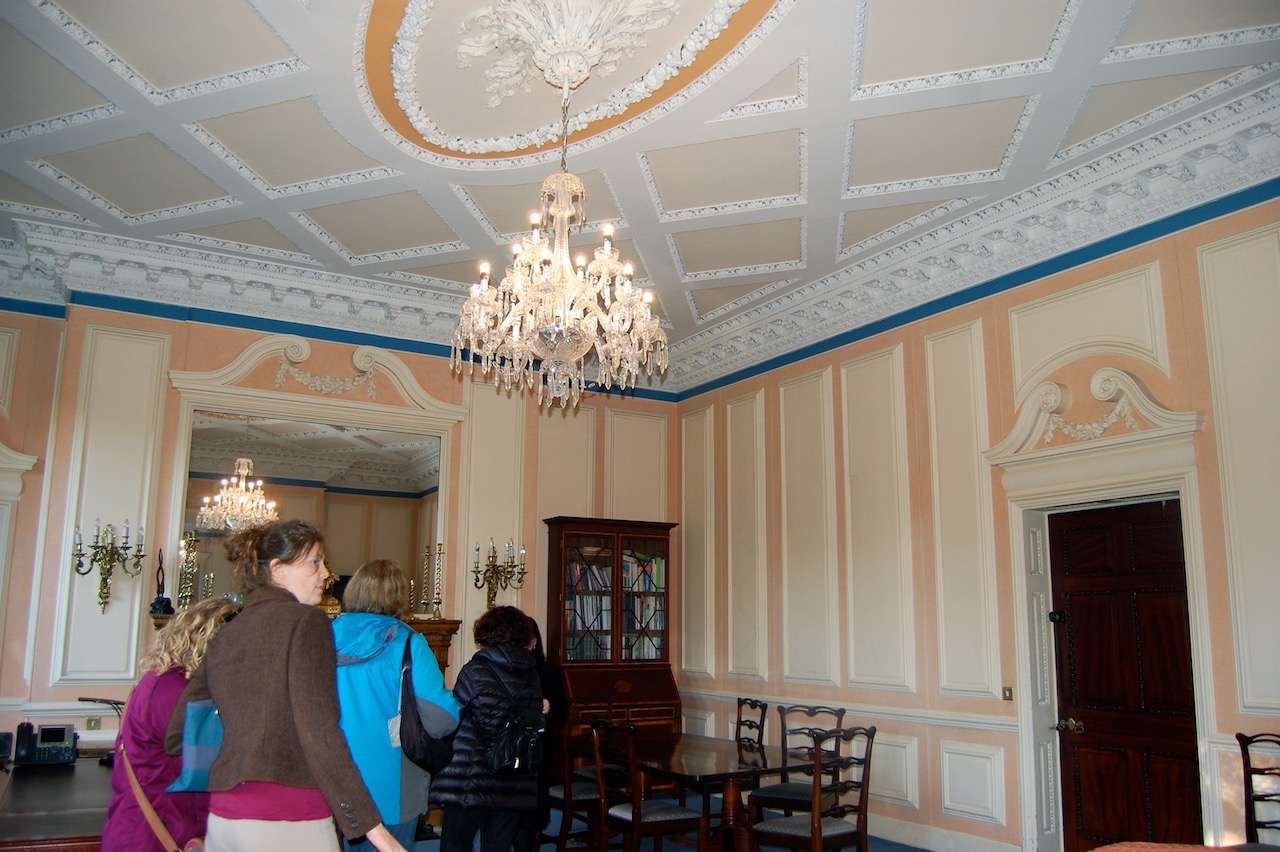
One is not allowed to take photographs inside the house but you can see pictures of the house and take an online tour on the website. It operates as the official residence for guests of the Irish state, which is why photography is not allowed inside.

The website tells us:

With the addition of a new Conservatory adjoining the Ballroom in 1901, and increased planting of broadleaves and exotics in the gardens, Farmleigh had, by the early years of the twentieth century, all the requisites for gracious living and stylish entertainment. Its great charm lies in the eclecticism of its interior decoration ranging from the classical style to Jacobean, Louis XV, Louis XVI and Georgian.

Farmleigh  was purchased from the Guinness family by the Irish Government in 1999 for €29.2m. The house has been carefully refurbished by the Office of Public Works as the premier accommodation for visiting dignitaries and guests of the nation, for high level Government meetings, and for public enjoyment.” [2]

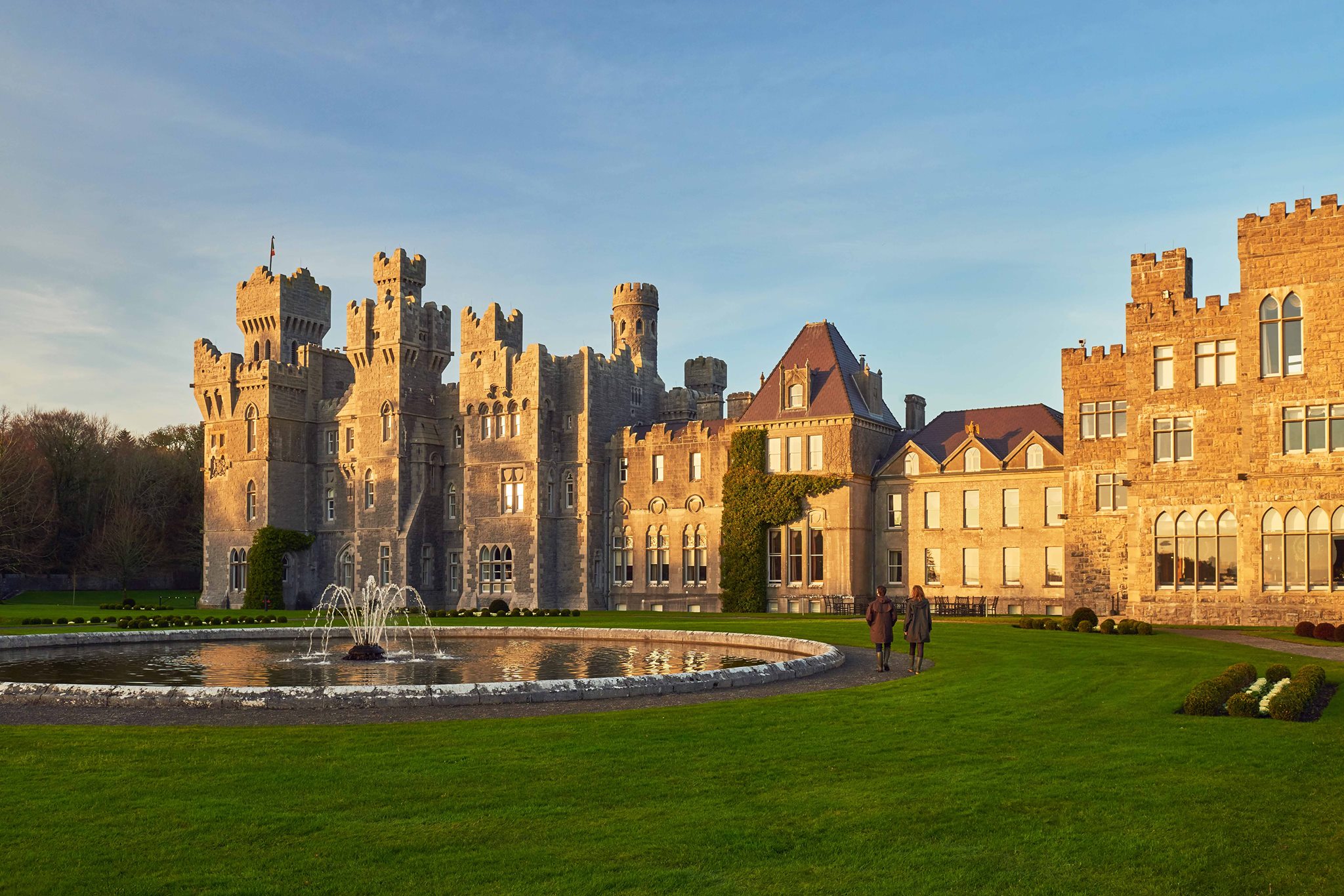
Edward Cecil Guinness was the son of Benjamin Lee Guinness (1798-1868), who purchased Ashford Castle, County Galway, in 1855. The castle had been a shooting lodge belonging to Lord Oranmore and Browne. In 1867 Benjamin Lee Guinness was created 1st Baronet of Ashford Castle in thanks for his restoration of St. Patrick’s Cathedral in Dublin at his own expense. His father had lived in St. Anne’s Park in Clontarf, a house unfortunately no longer in existence.
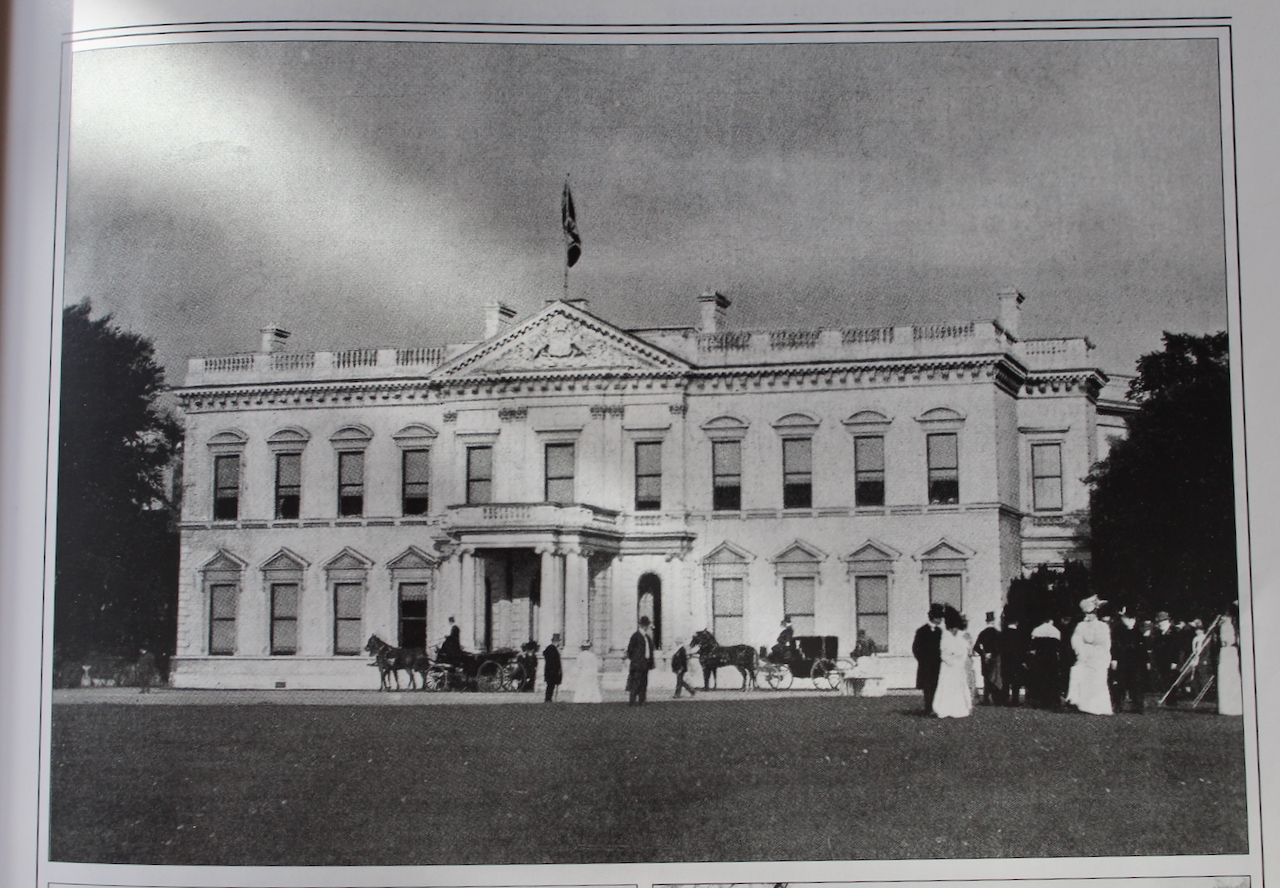
St. Anne’s, Dublin entrance front with garden party 1912, Gillman Collection Vanishing Country Houses of Ireland by The Knight of Glin, David J. Griffin and Nicholas K. Robinson, published by The Irish Architectural Archive and The Irish Georgian Society, 1988.
Ashford Castle, photograph courtesy of Ashford Castle facebook page.

Edward Cecil’s older brother Arthur Edward (1840-1915), like his father, held the office of Member of Parliament (M.P.) (Conservative) for the City of Dublin. He succeeded as 2nd Baronet of Ashford Castle. He added to the residence at Ashford Castle and developed its grounds. He was created Baron Ardilaun of Ashford Castle in 1880. In 1871 he married Lady Olivia Charlotte White, daughter of the 3rd earl of Bantry. They had no children, and the Ardilaun barony became extinct after his death in Dublin on 20 January 1915. 

The Dictionary of Irish Biography tells us about Arthur Edward:

As well as providing funding for the completion of the restoration of Marsh’s library, begun by his father, he also contributed to the rebuilding of the Coombe Hospital. As president of the Artisans’ Dwellings Company (in which he was a large shareholder), he took particular interest in improving working-class housing conditions, most notably in the areas around St Patrick’s cathedral. Perhaps his most notable legacy was financing the transformation of the twenty-two-acre St Stephen’s Green into a landscaped garden, which, through an act of parliament sponsored by Guinness, was presented to the Board of Works for the use of Dublin citizens. This generosity was marked by the erection of a bronze statue of him in the park, financed by public subscription in 1891. Another significant purchase of his was the 17,000-acre Muckross estate in Co. Kerry, adjoining the lakes of Killarney, which he bought for £60,000 to prevent the land being exploited by a commercial syndicate, thus enabling it to continue as an important tourist attraction.

Muckross House Killarney Co. Kerry, photograph by Chris Hill 2014 for Tourism Ireland, Ireland’s Content Pool.

Another brother, Benjamin Lee (1842-1900) who went by his middle name Lee, married Henrietta Eliza St. Lawrence of Howth Castle. It was their son who became the 3rd Baronet of Ashford Castle.

Edward Cecil Guinness, the Dictionary of Biography tells us, was: “Socially innovative, with a concern for the welfare of employees, from as early as 1870 he had established a free dispensary for his workforce and made provisions for pension and other allowances – acts of social reform that were remarkable for the time. To mark his retirement in 1890 he placed in trust £250,000 to be expended in the erection of working-class housing in London and Dublin.

Before the Iveagh Market was built in 1906, hundreds of traders sold their goods outdoors, especially around St. Patrick’s Cathedral, and the area was a maze of poor and dirty streets and alleys with homes, as the city council said, “unfit for human habitation.” Children were sent out by their parents to work selling goods in the streets, and women tried to make money as dealers selling fish, flowers, old clothes and fruit. 

Edward Cecil Guinness cleared the markets in the area to build a park and housing for the labouring poor – you can see the beautiful Victorian style brick buildings still run by the “Iveagh Trust” around St. Patrick’s Cathedral. He donated what in today’s money would be almost 20 million euro for the new housing. As the traders had long established market rights, he built a new market building, moving trading indoors, in the tradition of Victorian covered markets. 

Edward’s main residence at the time he purchased Farmleigh was 80 St. Stephen’s Green, now Iveagh House, the headquarters of the Department of Foreign Affairs. He viewed Farmleigh as ‘a rustic retreat’.

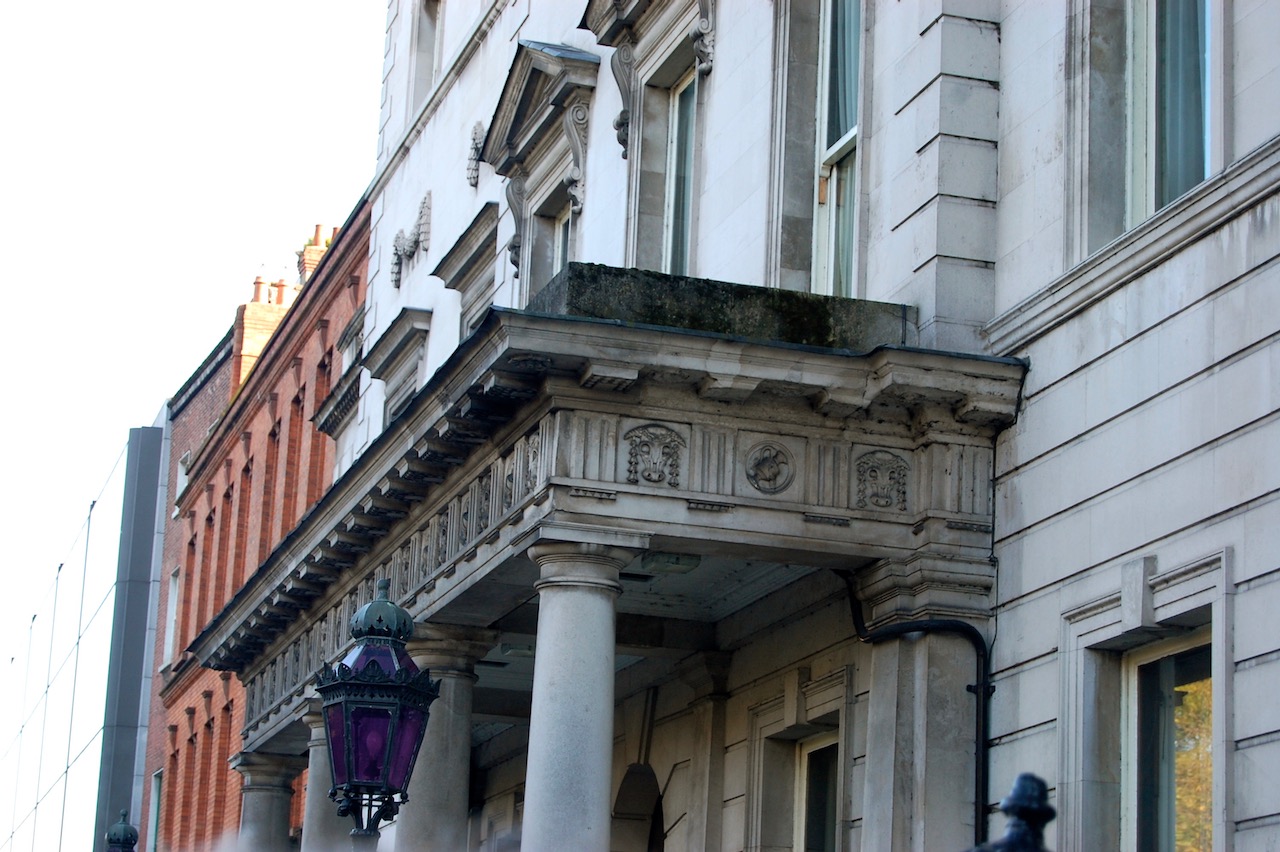
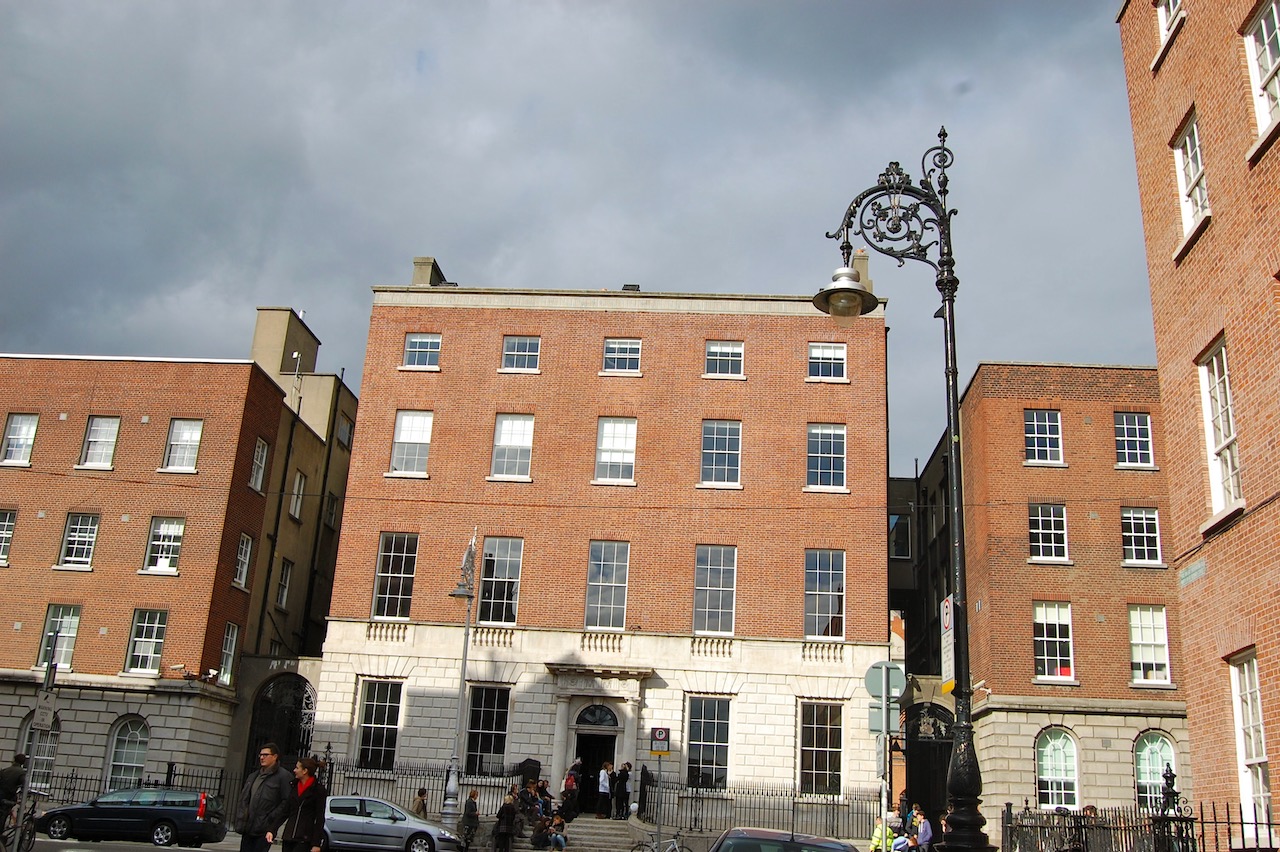
Let’s take a quick diversion to Iveagh House (80 and 81 St. Stephen’s Green), which I was lucky enough to visit during Open House Dublin in 2014. 80 St. Stephen’s Green was built for Bishop Robert Clayton (1695-1758), Bishop of Cork and Ross, by Richard Castle in 1736. After both number 80 and 81 were bought by Benjamin Guinness in 1862, he acted as his own architect and produced the current house, combining the two houses. [see Archiseek] In 1866 a Portland stone facade by James Franklin Fuller was added.
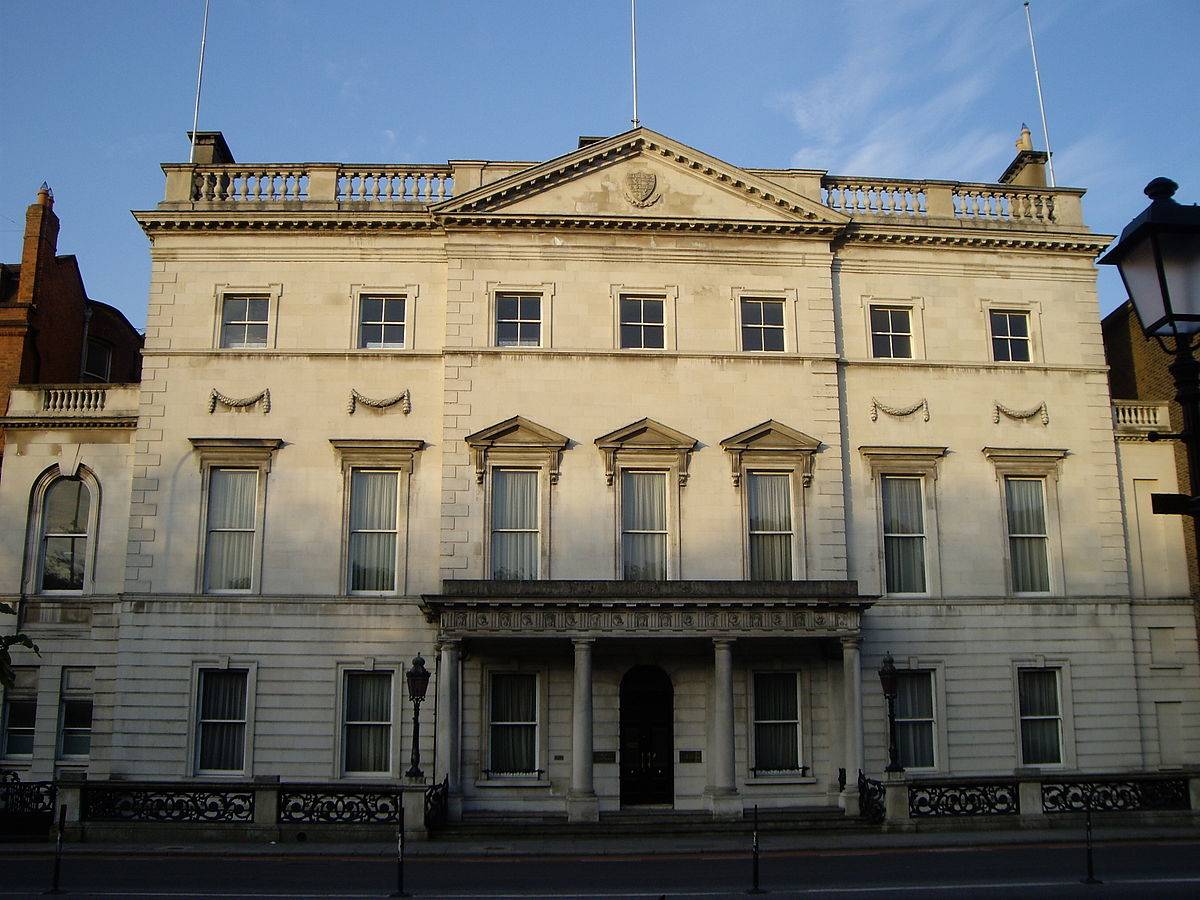
Iveagh House, 80-81 St. Stephen’s Green, Dublin, photograph courtesy of Farmleigh website.
Iveagh House, St Stephen’s Green, October 2014. Portland stone facade (1866) by James Franklin Fuller (1835-1924) disguises an early eighteenth century townhouse by Richard Castle (d. 1751) for Robert Clayton (1695-1758), Bishop of Cork and Ross. The original house, three windows wide, is on the left of the portico. Photograph © Jennifer Winder-Baggot, www.irishhistorichouses.com
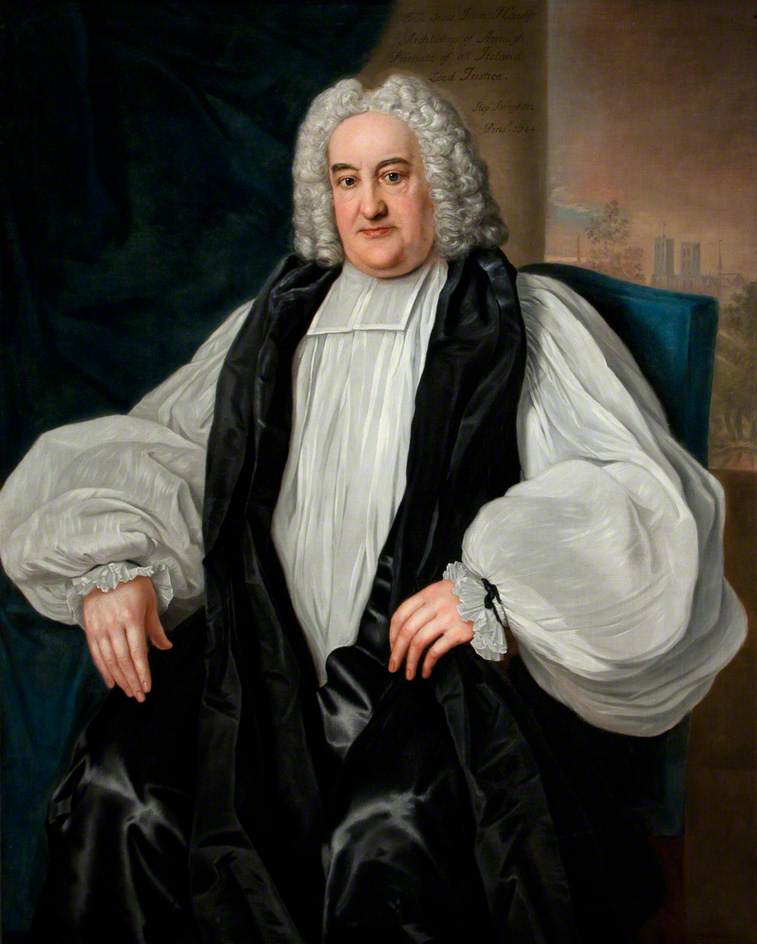
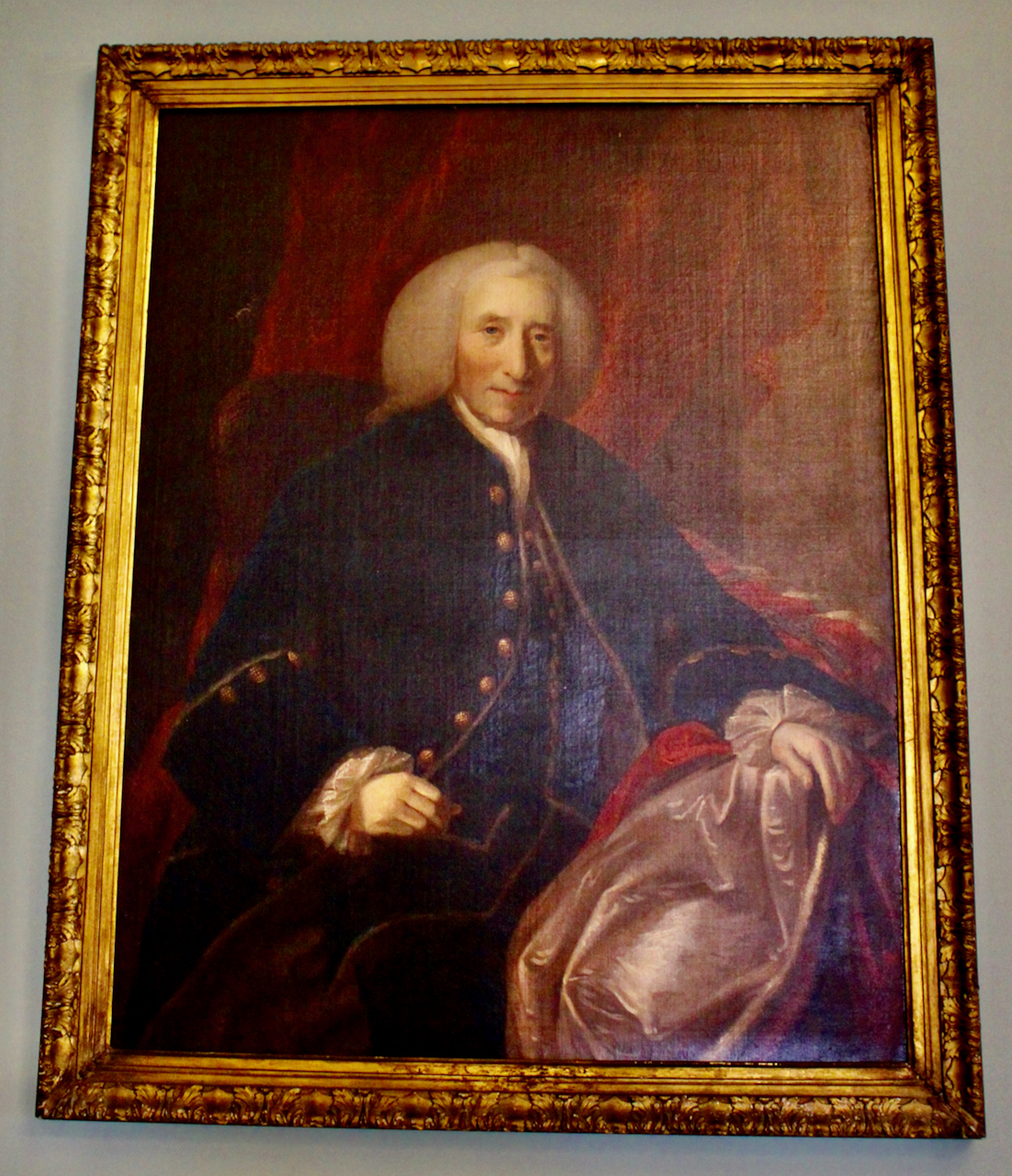
Iveagh House, St Stephen’s Green, the original owner, Robert Clayton (1695-1758), Bishop of Cork and Ross, portrait attributed to Charles Philips. Photograph © Jennifer Winder-Baggot, www.irishhistorichouses.com
Robert Clayton (1695-1758) Right Reverend The Lord Bishop of Killalla attributed to Charles Philips courtesy Christies 2007.
Portrait c. 1740 of Archbishop Robert Clayton (1695–1758) and Katherine née Donellan by James Latham, courtesy of National Gallery of Ireland. Known for his unorthodox views, at the time of his death Robert Clayton was facing charges of heresy.

The Dictionary of Irish Biography entry by C. J. Woods tells us that Archbishop Robert Clayton was born in England to John Clayton (1657–1725) and his wife, Eleanor (née Atherton). John Clayton moved to Ireland as prebendary of St Michan’s, Dublin (1698–1725), and was later dean of Kildare (1708–25). On his father’s death Robert inherited his estate and so could afford to resign his fellowship and marry, which he did on the same day (17 June 1728), marrying Catherine Donnellan (1703?–1766), a daughter of Nehemiah Donnellan, chief baron of the Irish exchequer. Robert inherited estates in England, and had a fine house built on the south side of St Stephen’s Green, designed in Italian style by Richard Castle in the mid 1730s. He also acquired a country house in Co. Kildare, St Wolstan’s near Celbridge (1752), and spent freely. He and his wife had no children.
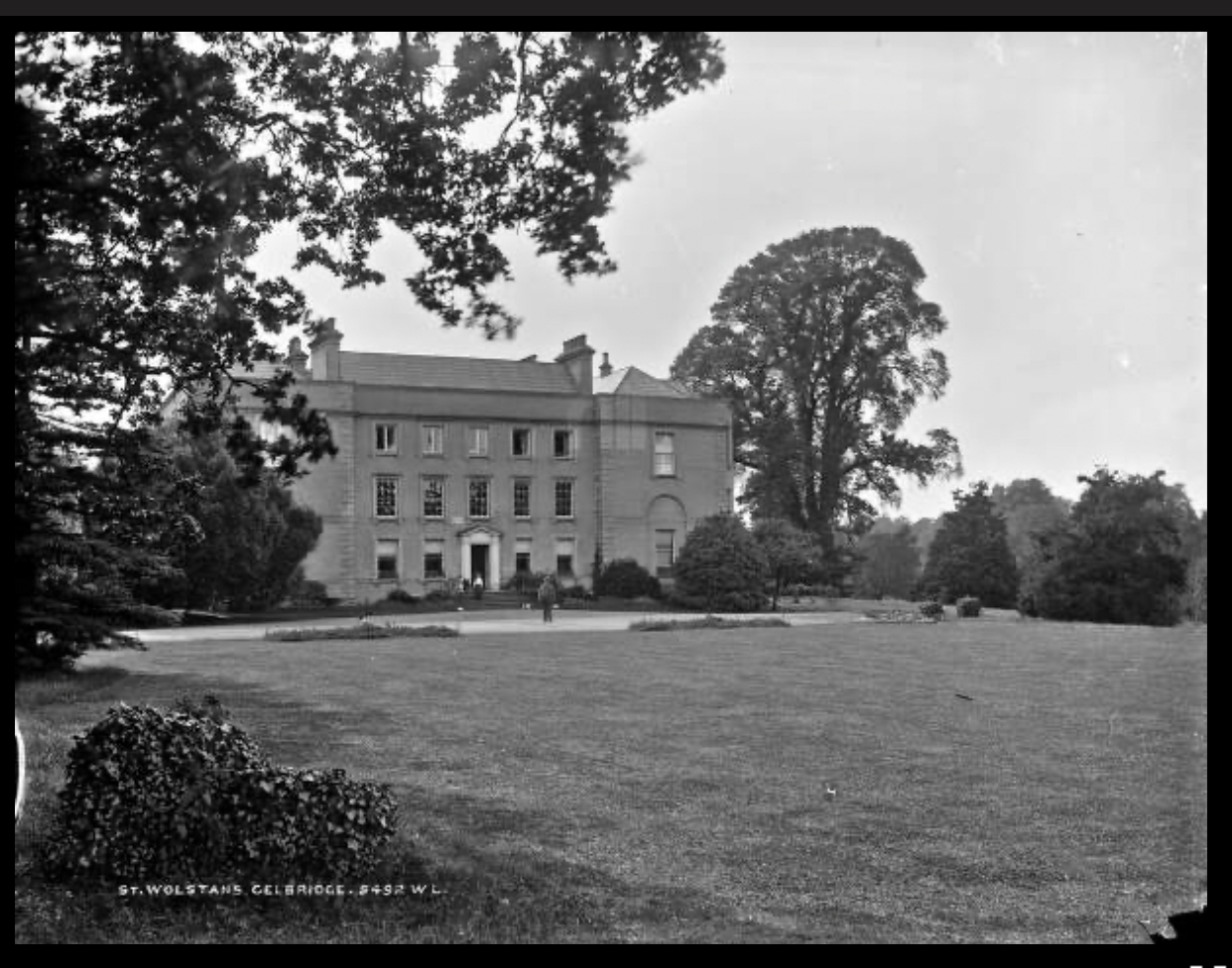
St. Wolstan’s, Celbridge, County Kildare, photograph by Robert French, (between ca. 1865-1914), Lawrence Photograph Collection, National Library of Ireland.

The Archiseek website tells us about Iveagh House:

“The Dublin Builder, February 1 1866: ‘In this number we give a sketch of the town mansion of Mr. Benjamin Lee Guinness, M.P, now in course of erection in Stephen’s Green, South, the grounds of which run down to those of the Winter Garden. As an illustration so very quiet and unpretending a front is less remarkable as a work of architectural importance than from the interest which the name of that well-known and respected owner gives it, and from whose own designs it is said to have been built. The interior of the mansion promises to be of a very important and costly character, and to this we hope to have the pleasure of returning on a future occasion when it is more fully advanced. The works, we believe, have been carried out by the Messrs. Murphy of St. Patrick’s Cathedral notoriety, under Mr. Guinness’s own immediate directions, without the intervention of any professional architect.’ “
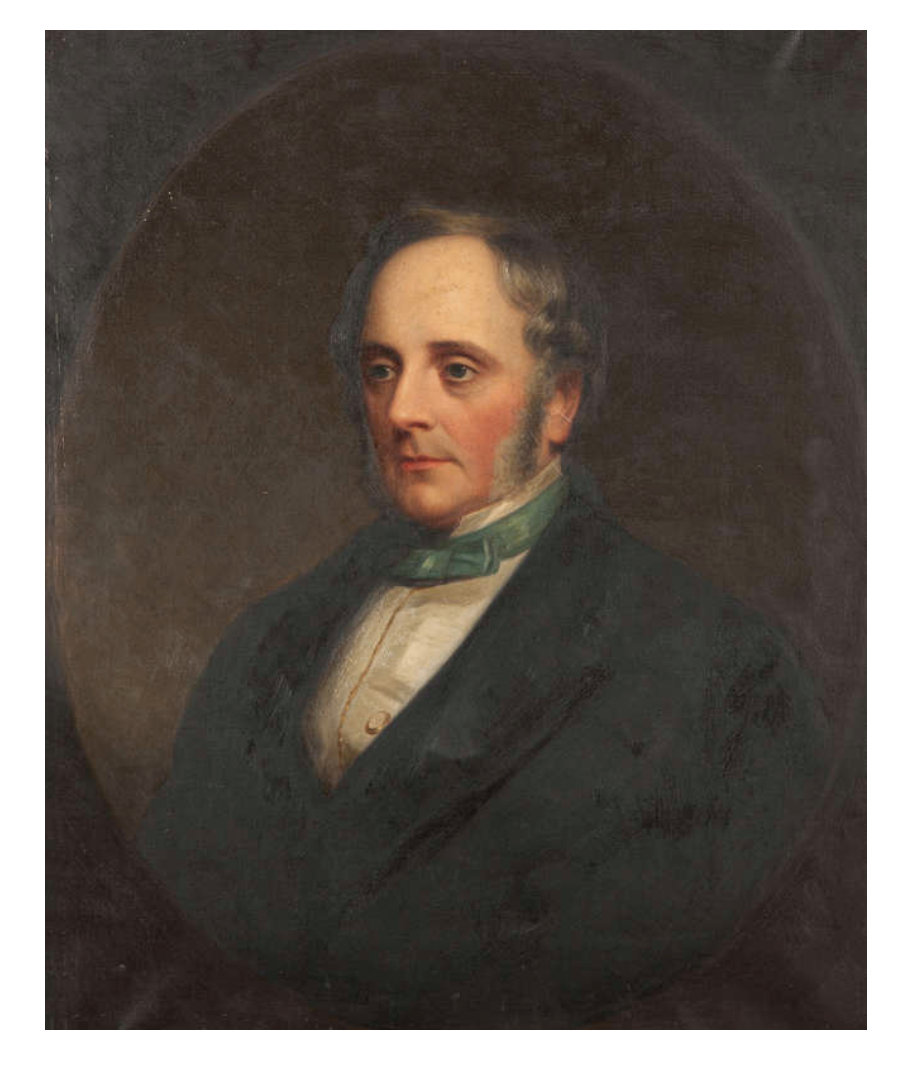
Benjamin Lee Guinness by Stephen Catterson Smith Jr courtesy of Adam’s auction 13 Oct 2015, Provenance: St. Annes, Clontarf, and by descent in the family.

The Farmleigh website tells us of the Guinness family’s source of wealth: “In 1886 Edward Cecil Guinness floated the brewery on the Stock Exchange increasing his wealth and social standing and this reflected in an extensive rebuild of Farmleigh. Despite this work, Edward and his wife Adelaide spent relatively little time there. Their primary residence was in London, but when in Dublin, they stayed mostly at 80 St. Stephen’s Green. The family only stayed in Farmleigh for short periods of a couple of weeks, mainly in the spring and summer months.

80/81 St. Stephen’s Green was donated to the Irish government by Benjamin Guinness’s grandson Rupert, the 2nd Earl of Iveagh, in 1939 and was renamed Iveagh House.

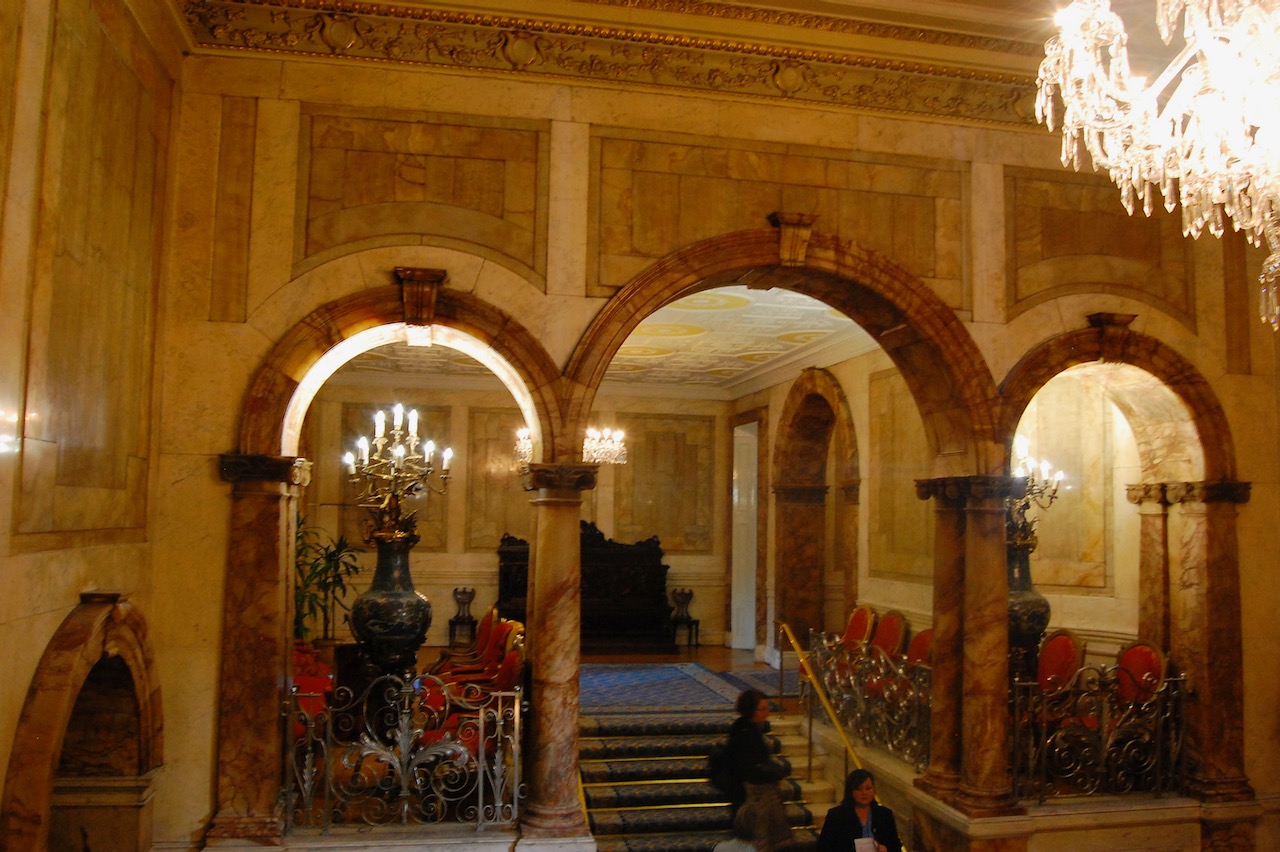
One enters Iveagh House through a large nineteenth century entrance hall with two screens of Ionic columns, which incorporates the front parlour of the Clayton house. The hall is adorned with sculptures bought by the Guinnesses at the Dublin Exhibition of 1865. Through a door at the west end is a Victorian domed vestibule and beyond it a service stair. East of the hall is an Inner Hall that was the entrance hall of Bishop Clayton’s house. This has niches flanking the chimney breast, fielded panelling and a modillion cornice.
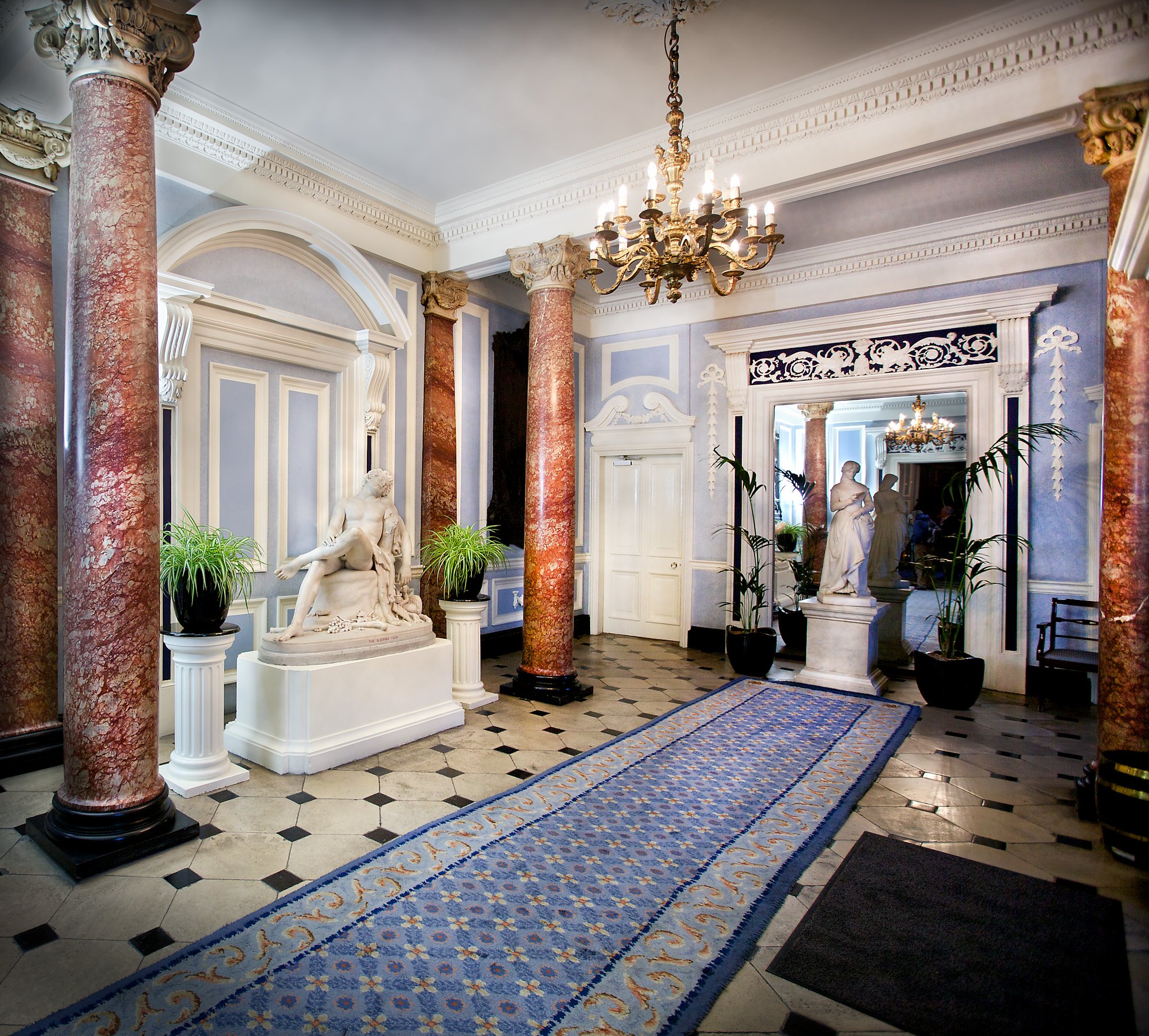
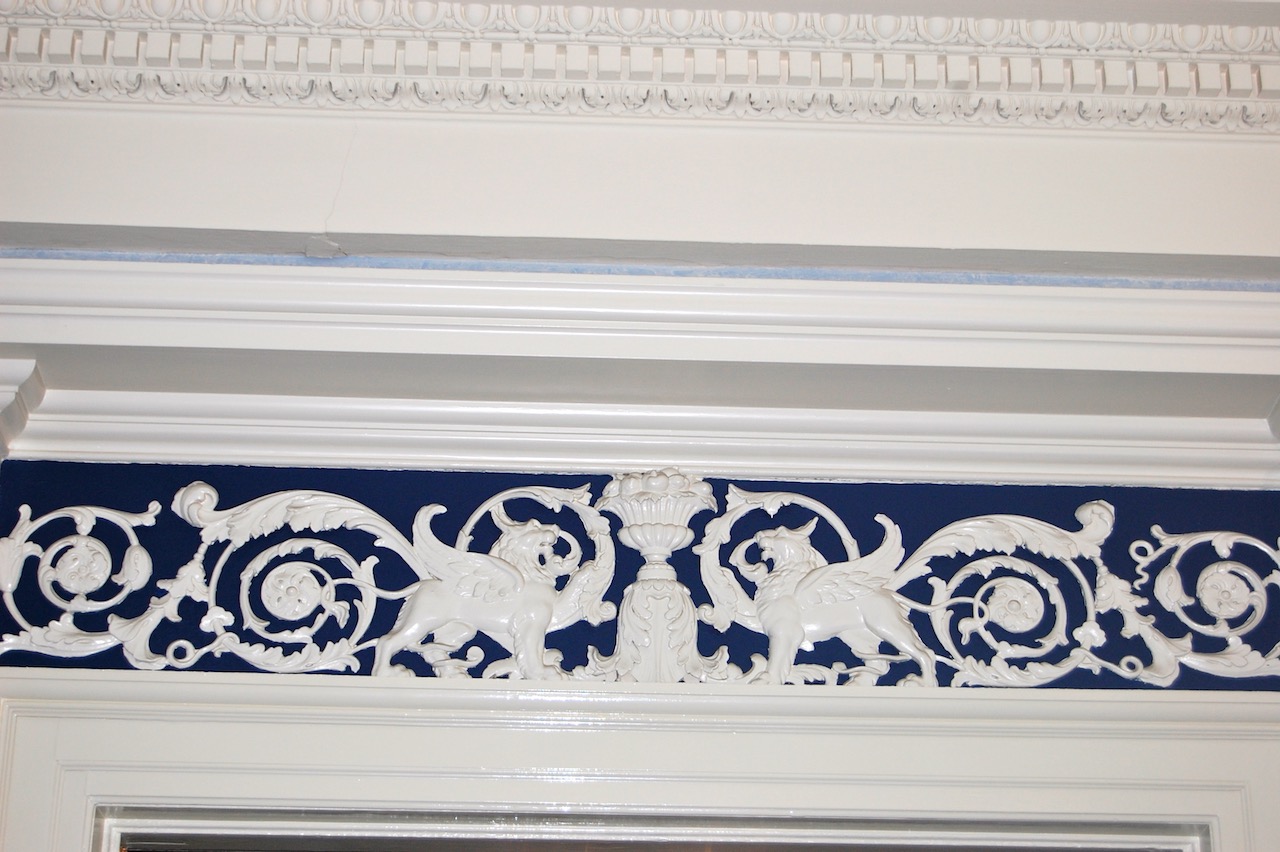
The Entrance Hall, Iveagh House, 80 St. Stephen’s Green, photograph by Michael Foley, 2013.
Iveagh House, St Stephen’s Green. Photograph © Jennifer Winder-Baggot, www.irishhistorichouses.com
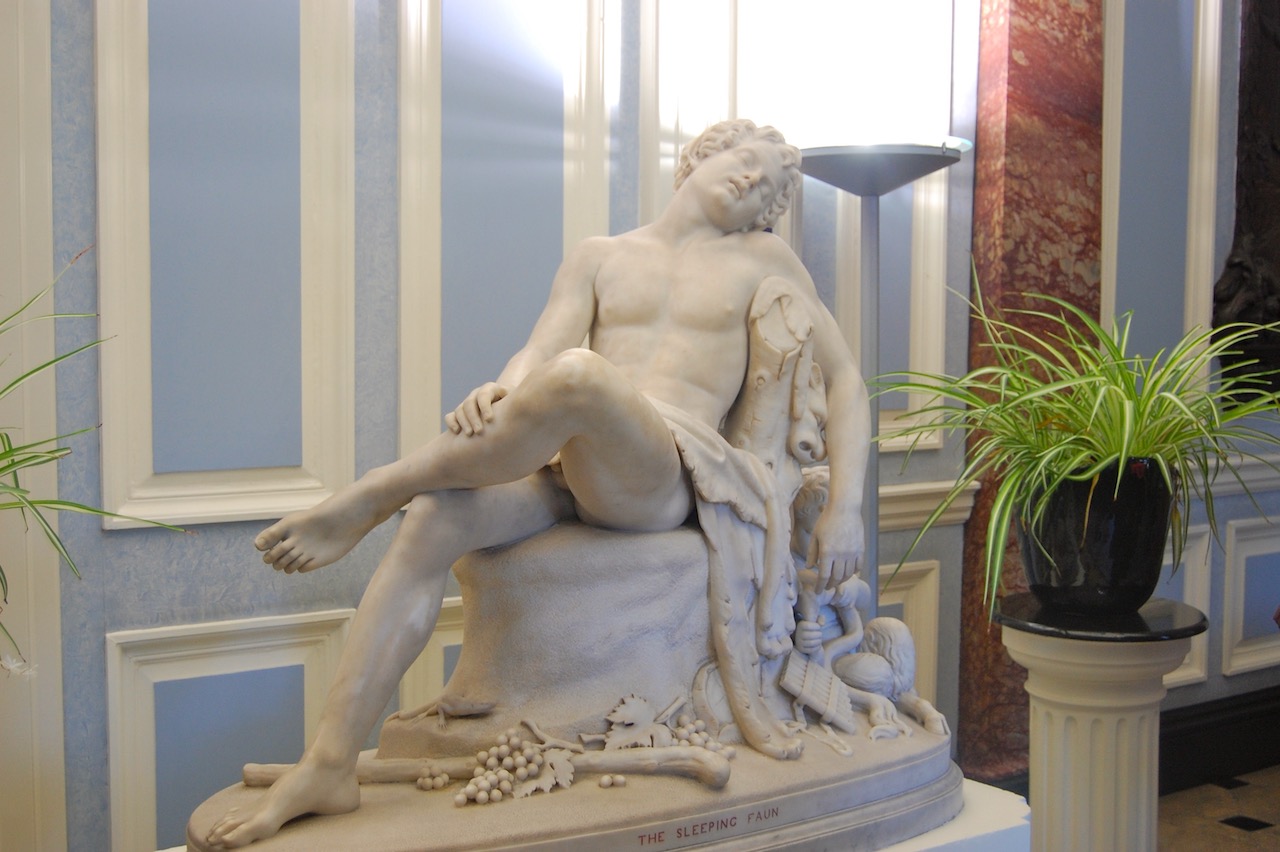
The Sleeping Faun by Harriet Hosner bought by the Guinnesses at the Dublin Exhibition of 1865, for almost the same price, our guide told us, as the house on St. Stephen’s Green! Donated by the Guinnesses along with the house to the state. Photograph © Jennifer Winder-Baggot, www.irishhistorichouses.com
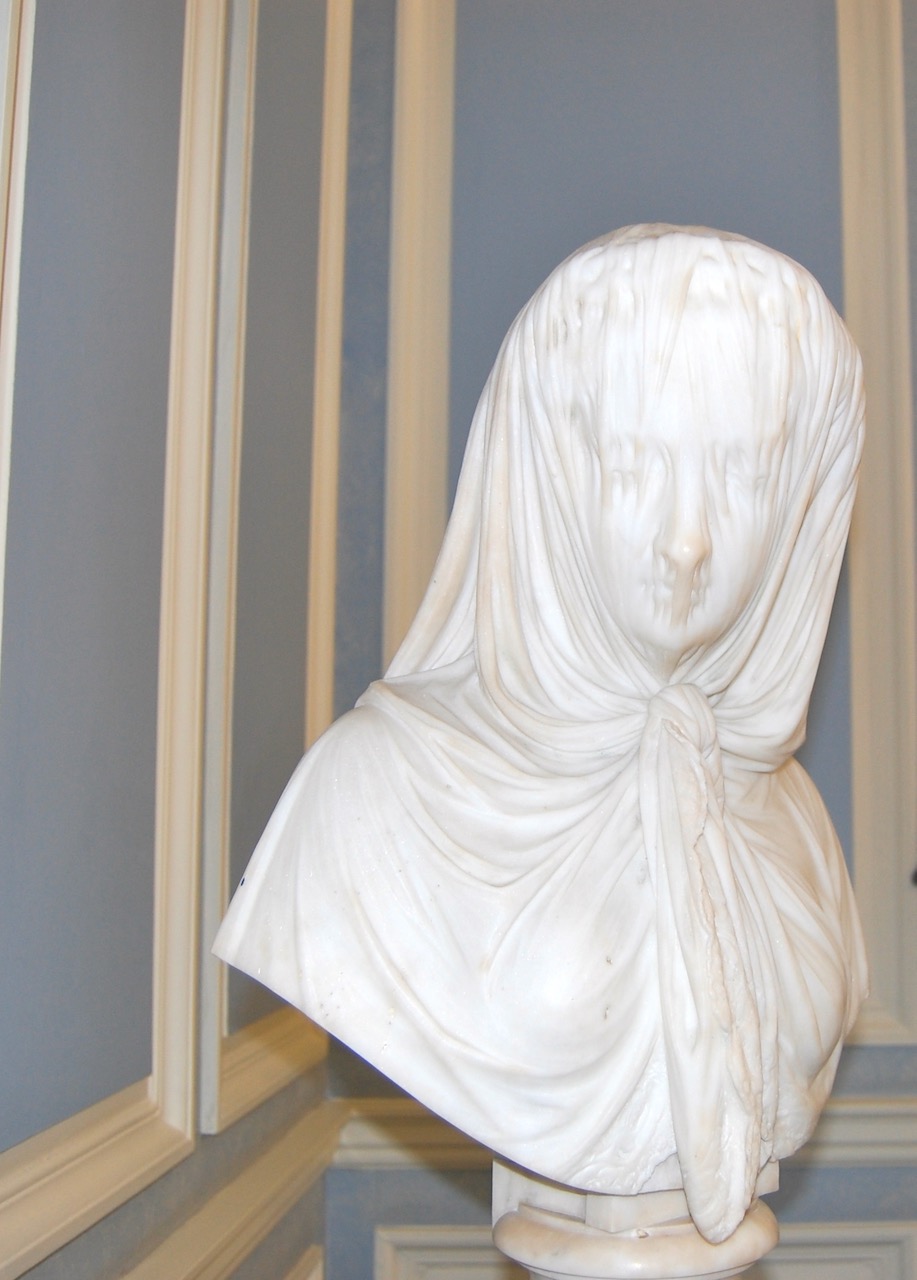
Iveagh House, St Stephen’s Green, “Modestyby G. M. Lombardi. Photograph © Jennifer Winder-Baggot, www.irishhistorichouses.com
Iveagh House, St Stephen’s Green, medieval wooden carving, according to our tour guide, picturing Homer’s Illiad scenes. I think, however, it is a mid nineteenth century bas relief carving mentioned by Christine Casey, by Richard Barrington Boyle, of King Priam entreating Achilles to release the body of Hector. Photograph © Jennifer Winder-Baggot, www.irishhistorichouses.com

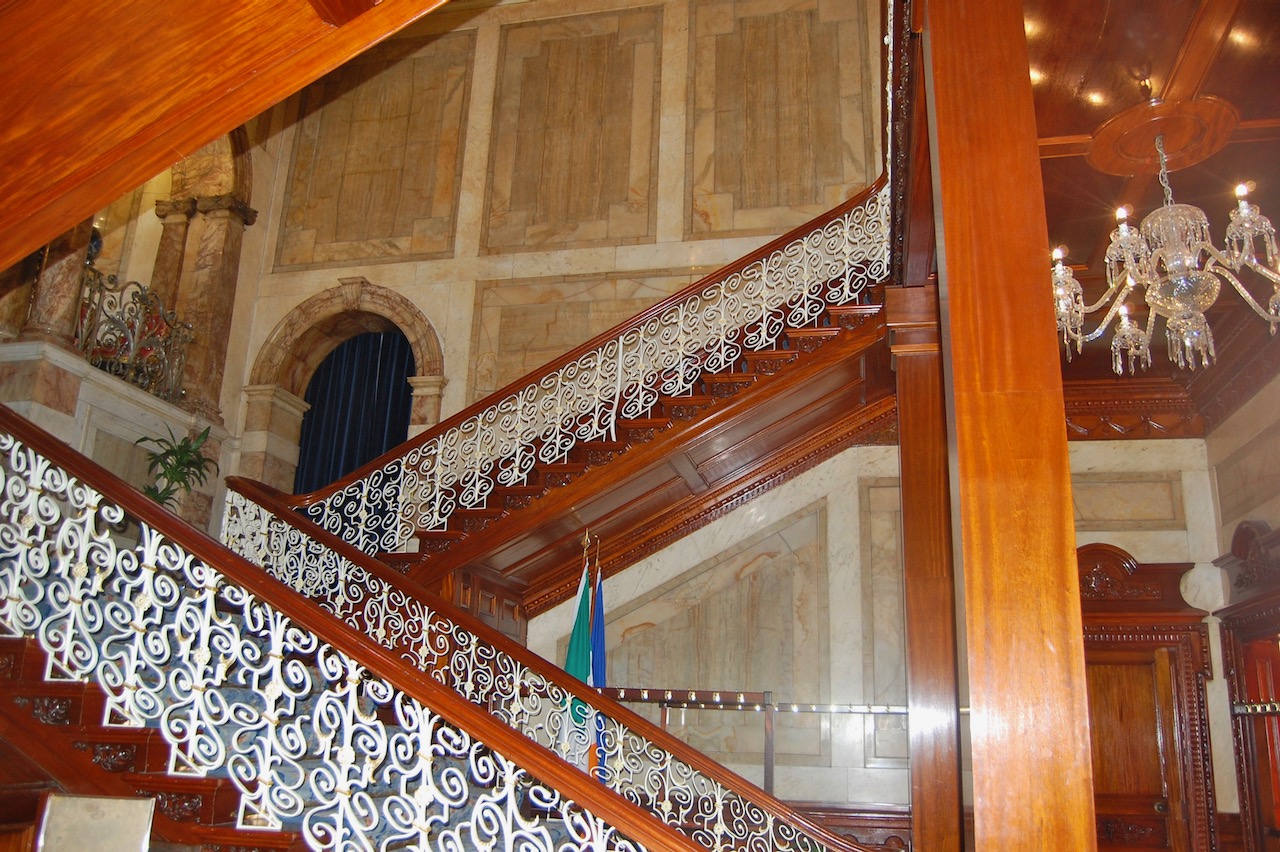
The two stair compartments of the eighteenth century house on St. Stephen’s Green were combined to create the space for the grand imperial staircase inserted by James Franklin Fuller in 1881.
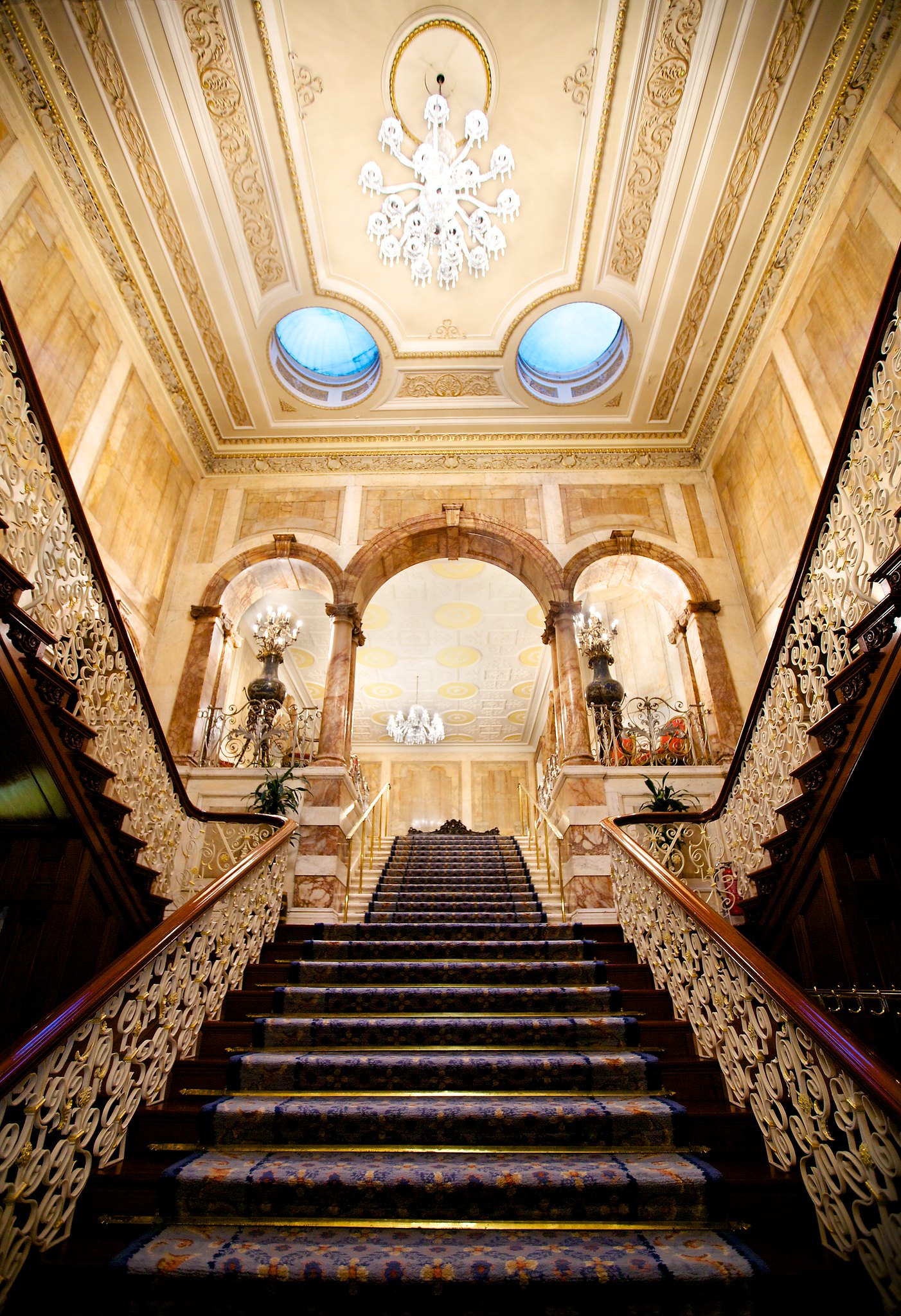
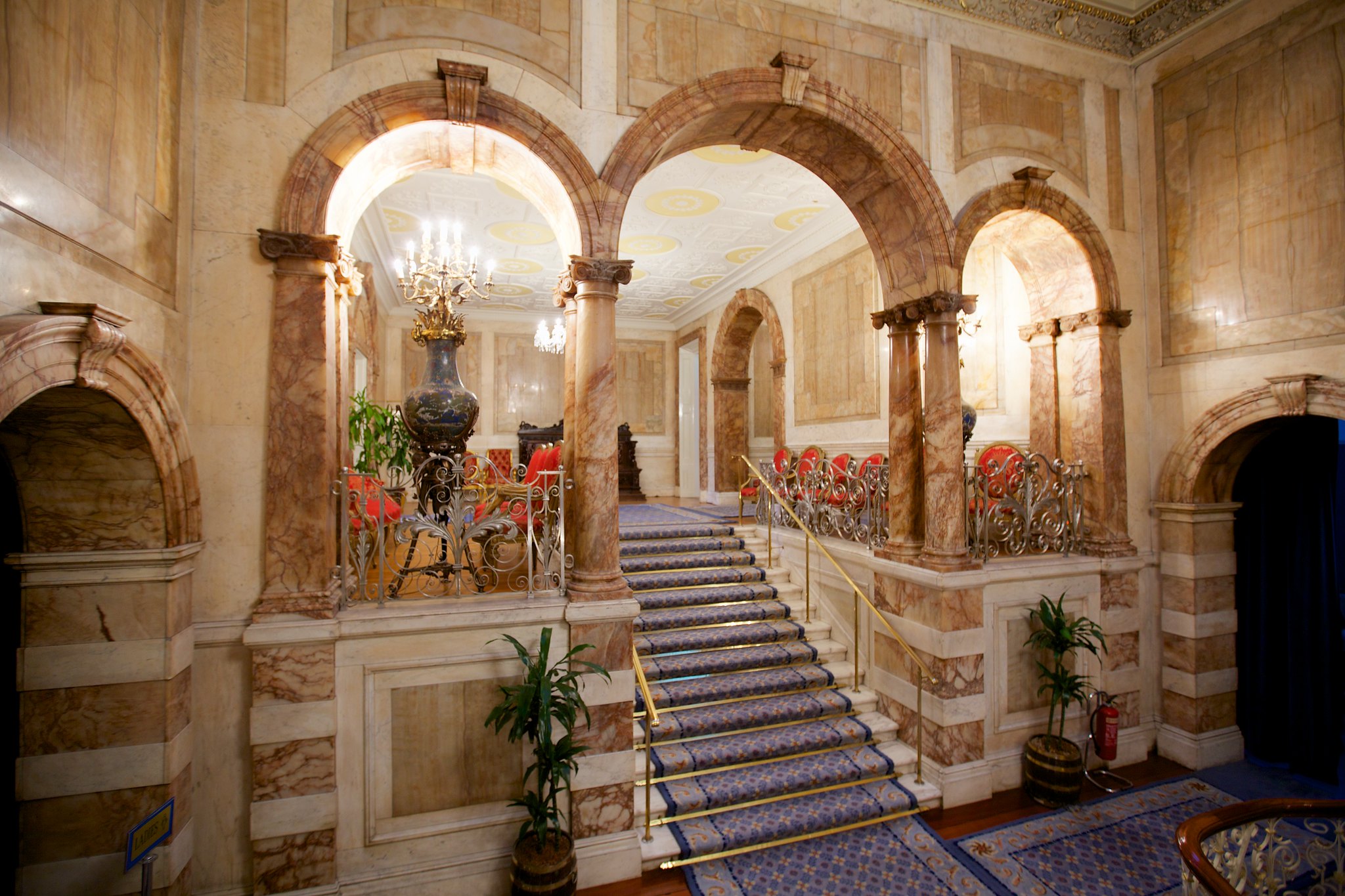
Stair Hall, Iveagh House, 80 St. Stephen’s Green, photograph by Michael Foley, 2013.
Iveagh House, 80 St. Stephen’s Green, photograph by Michael Foley, 2013.
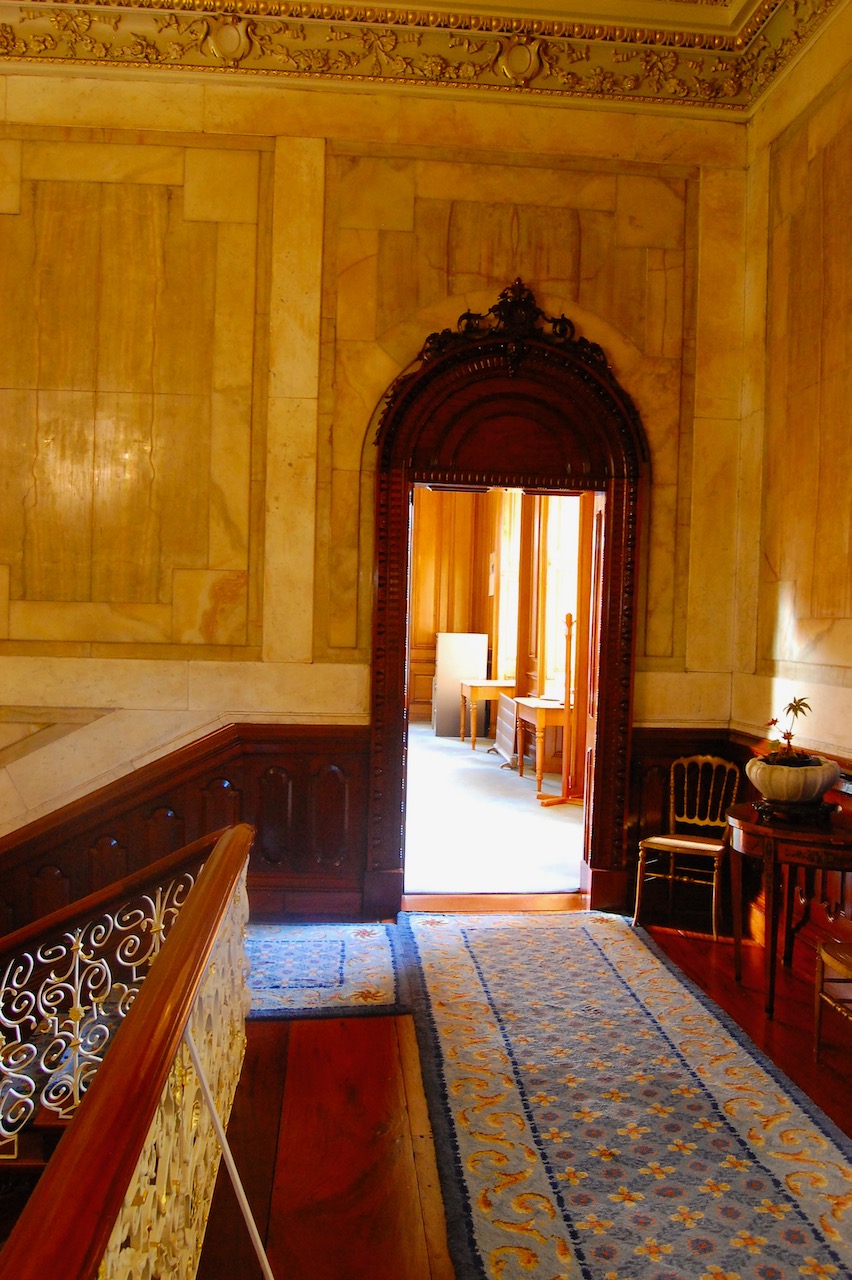
Iveagh House, St Stephen’s Green, October 2014. The grand imperial stair was inserted by James Franklin Fuller in 1881, with onyx and alabaster wall panelling from 1896 by William Young. Photograph © Jennifer Winder-Baggot, www.irishhistorichouses.com
Iveagh House, St Stephen’s Green, October 2014. Photograph © Jennifer Winder-Baggot, www.irishhistorichouses.com
Iveagh House, St Stephen’s Green. Photograph © Jennifer Winder-Baggot, www.irishhistorichouses.com
Iveagh House, St Stephen’s Green, October 2014. Painting by De Chirico. Photograph © Jennifer Winder-Baggot, www.irishhistorichouses.com
Iveagh House, St Stephen’s Green, October 2014. Photograph © Jennifer Winder-Baggot, www.irishhistorichouses.com

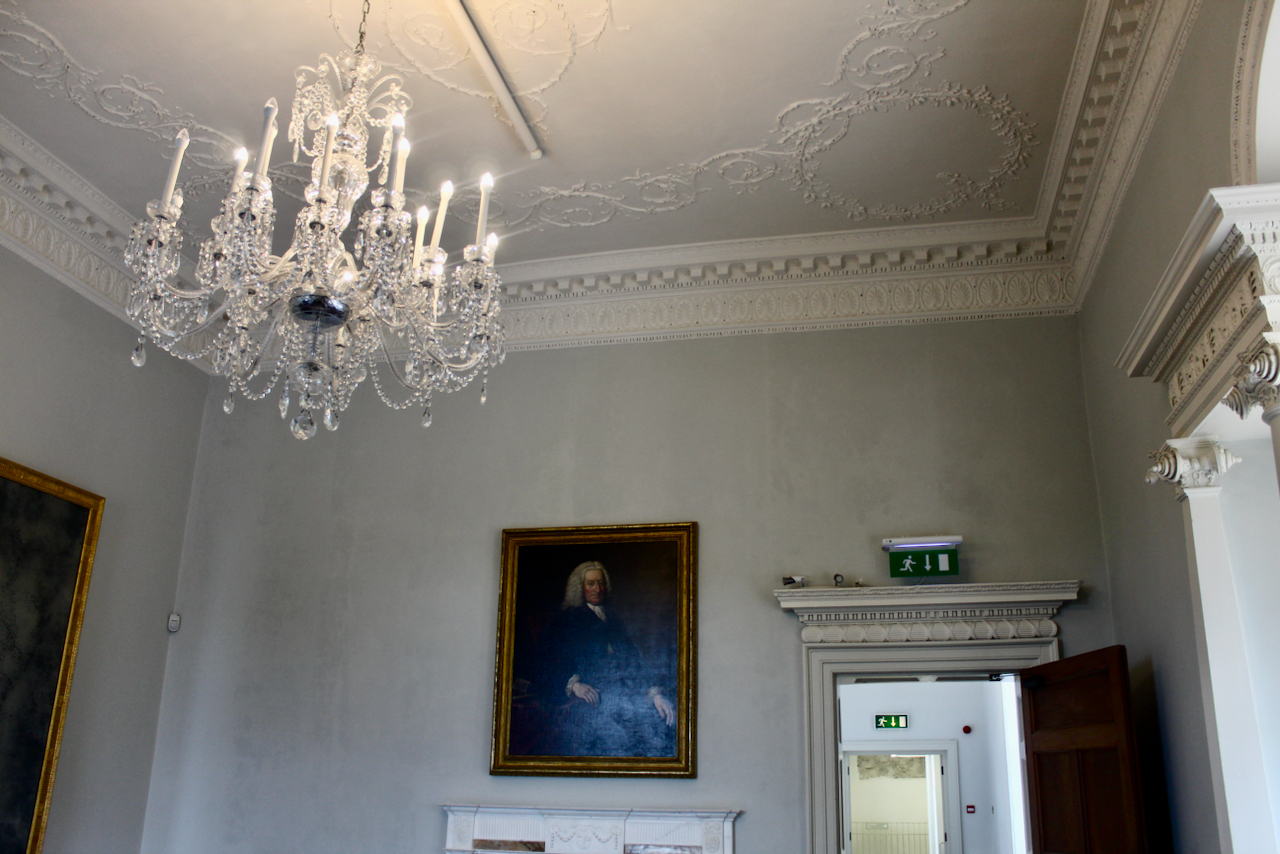
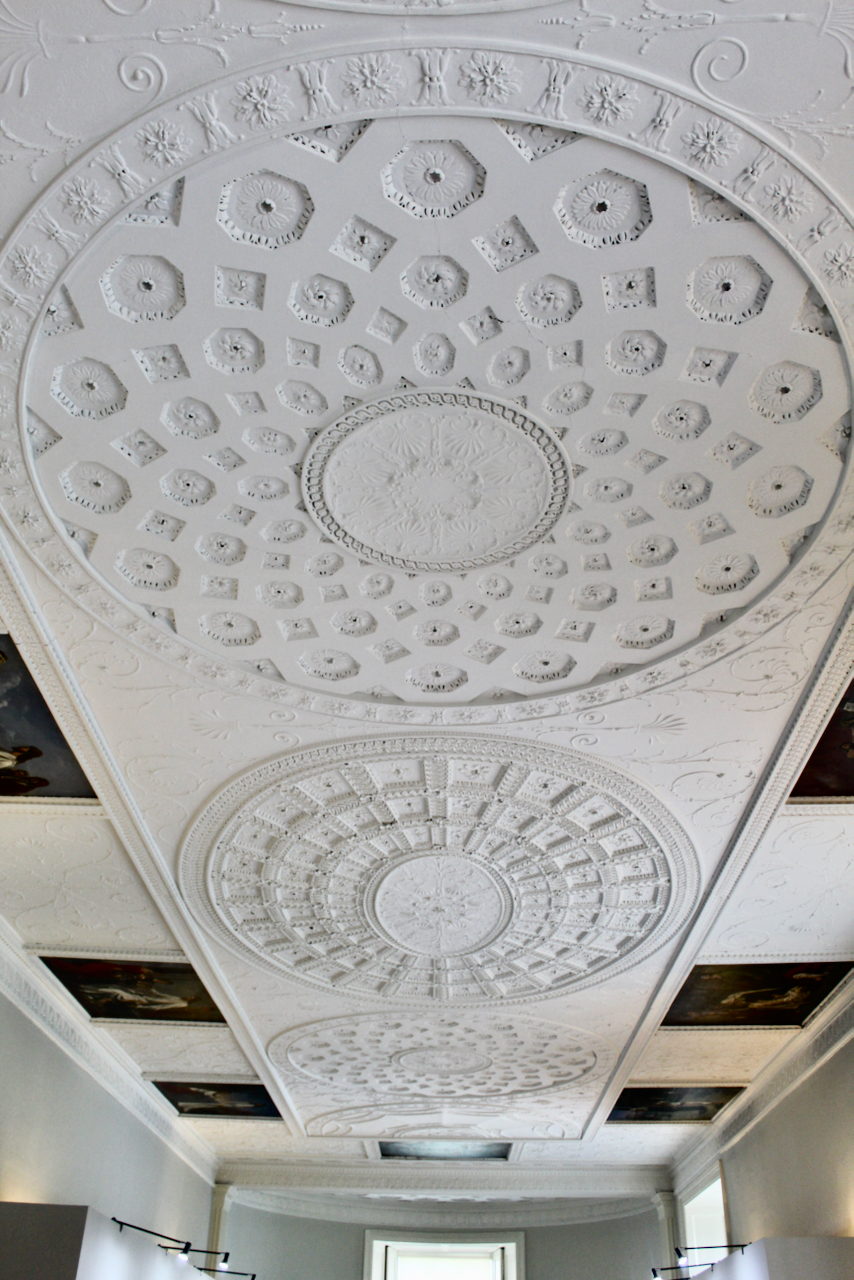
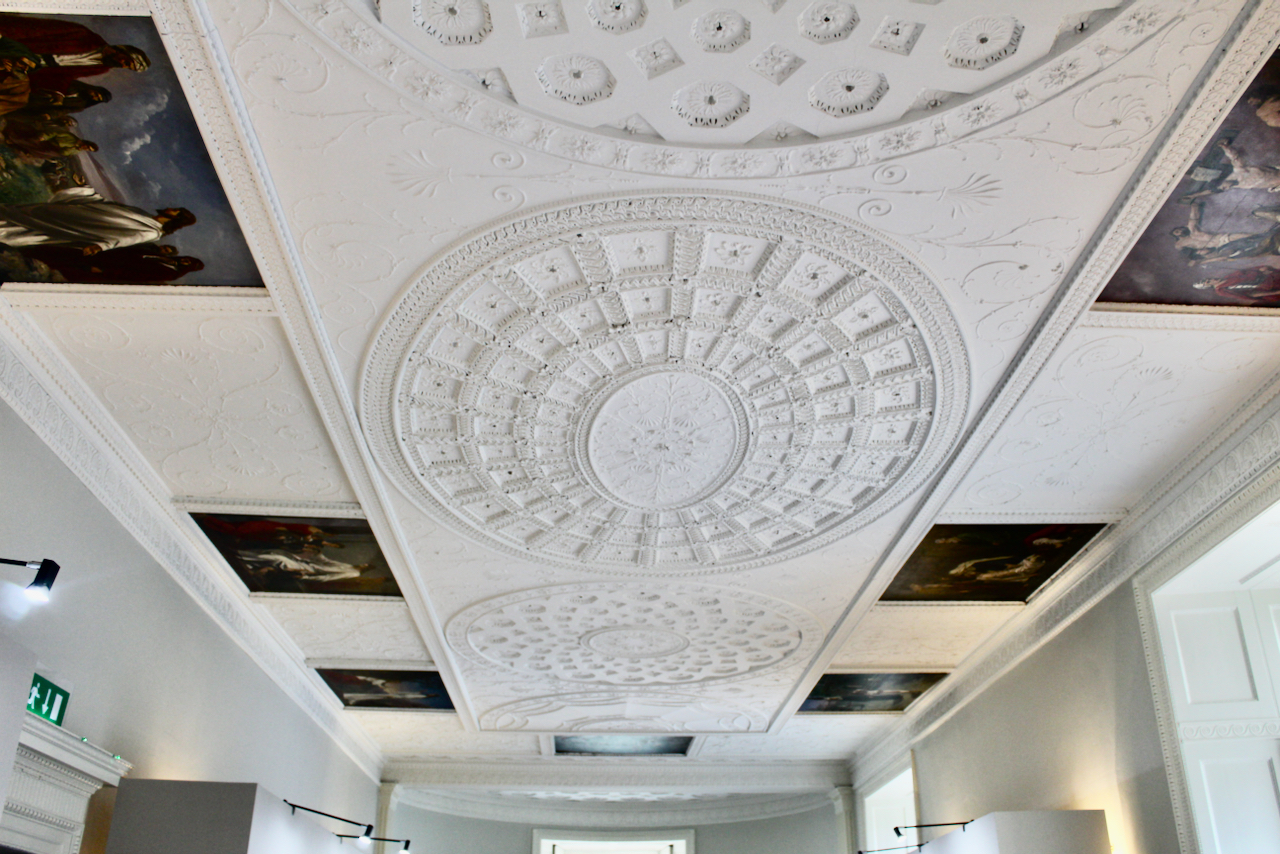
The drawing room’s ceiling is modelled on the Provost of Trinity House dining room ceiling. There is also a room downstairs in Iveagh House with a room which was added in 1866 with Georgian Revival ornament derived from the Provost’s House.
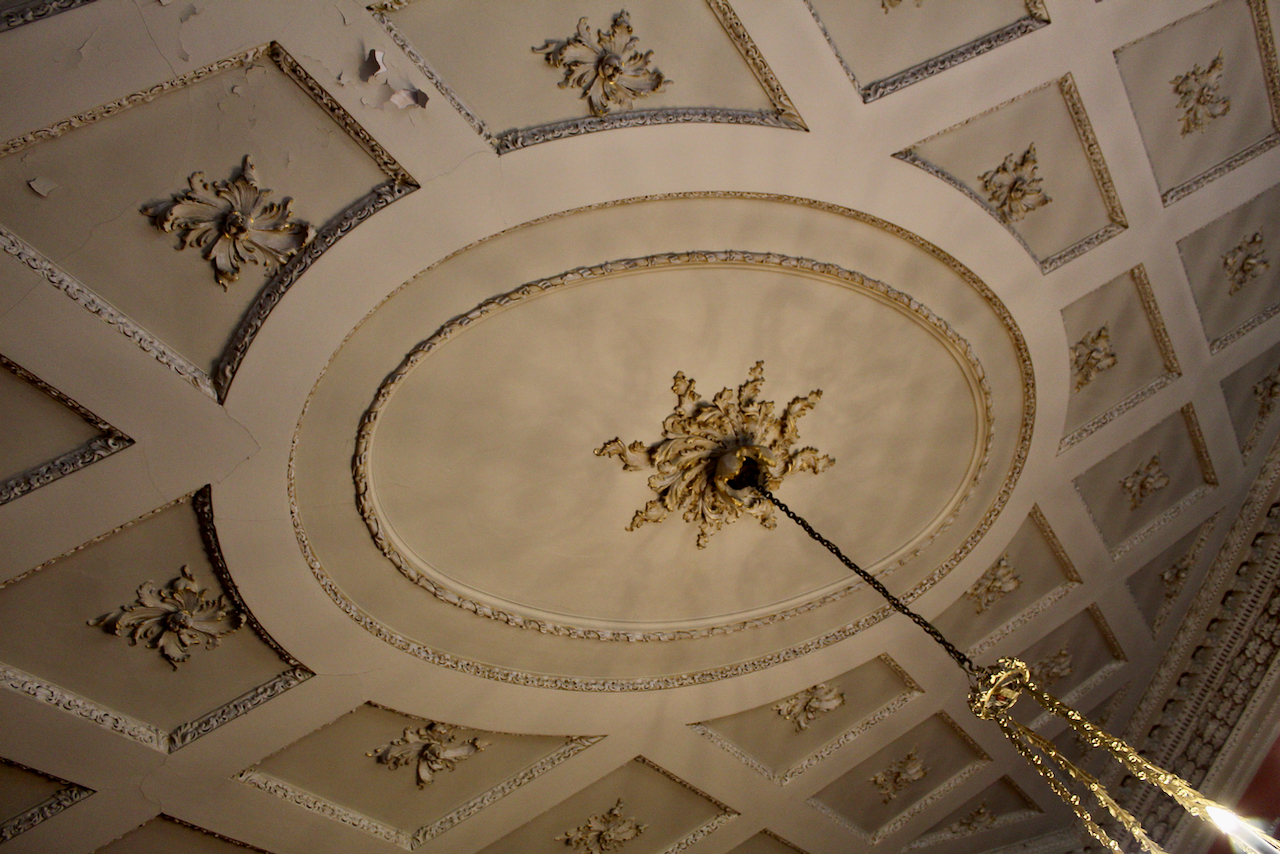
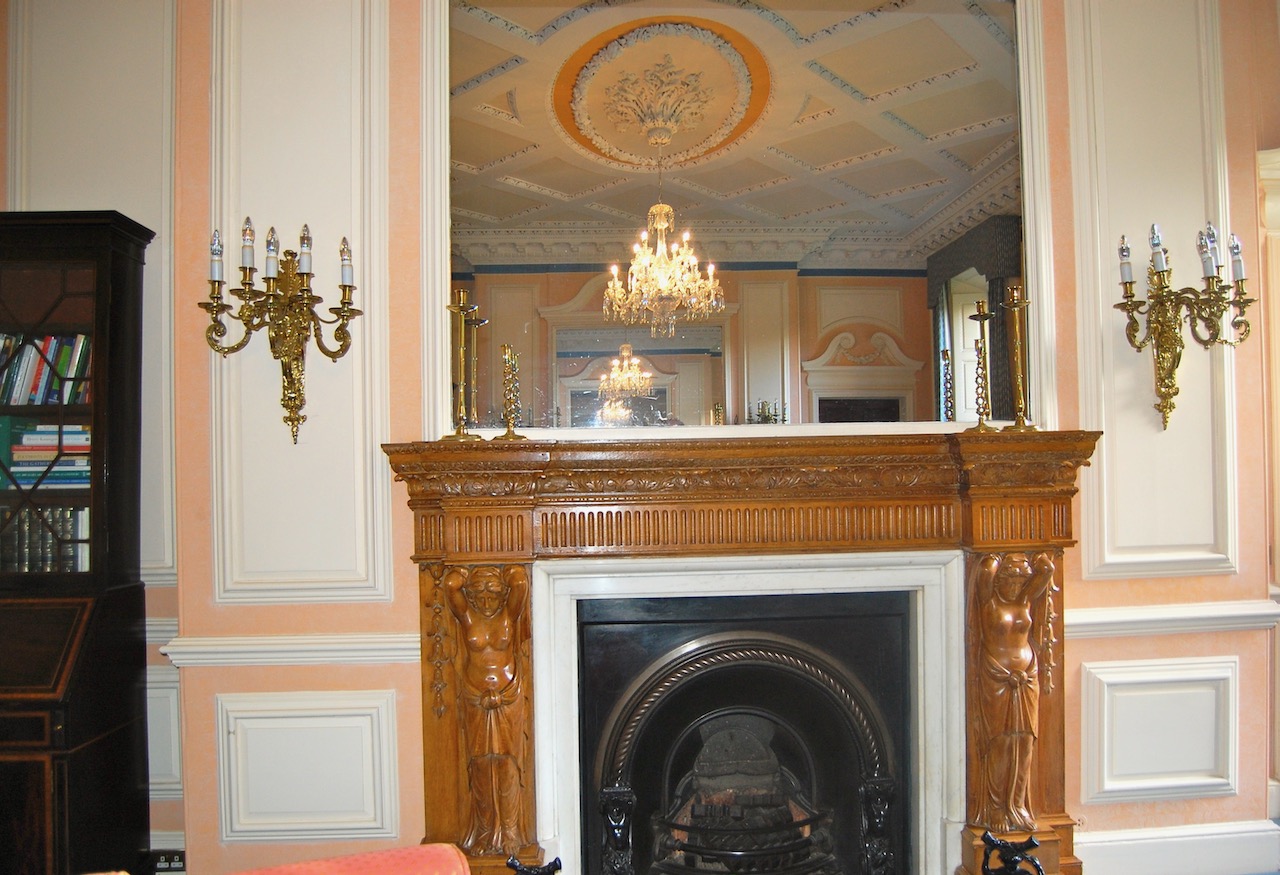
The ceiling rose and ceiling of the dining room in the Provost’s House. Provost’s House, Trinity College Dublin. Photograph © Jennifer Winder-Baggot, www.irishhistorichouses.com.
Iveagh House, St Stephen’s Green, October 2014. Photograph © Jennifer Winder-Baggot, www.irishhistorichouses.com
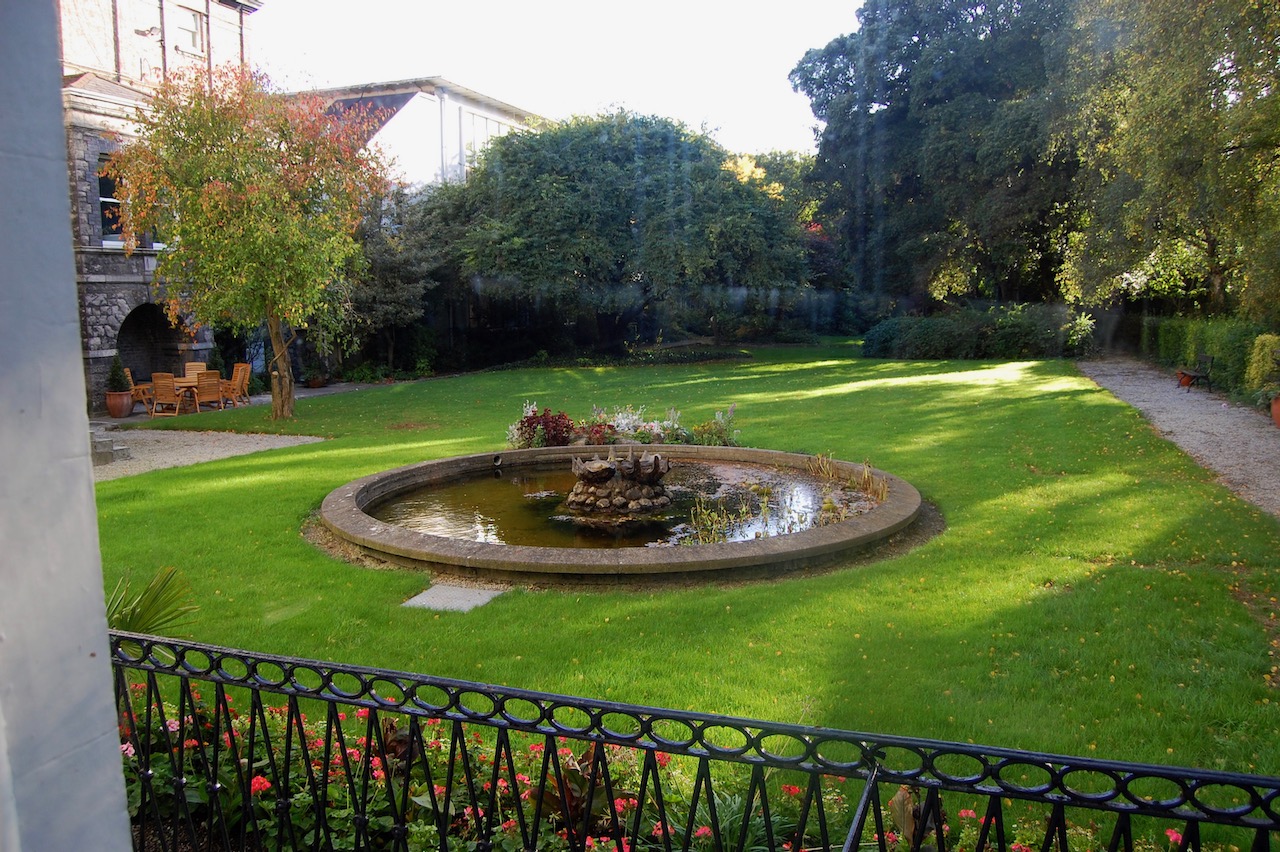
Iveagh Gardens, the part kept by the Guinness’s as part of Iveagh House. Photograph © Jennifer Winder-Baggot, www.irishhistorichouses.com
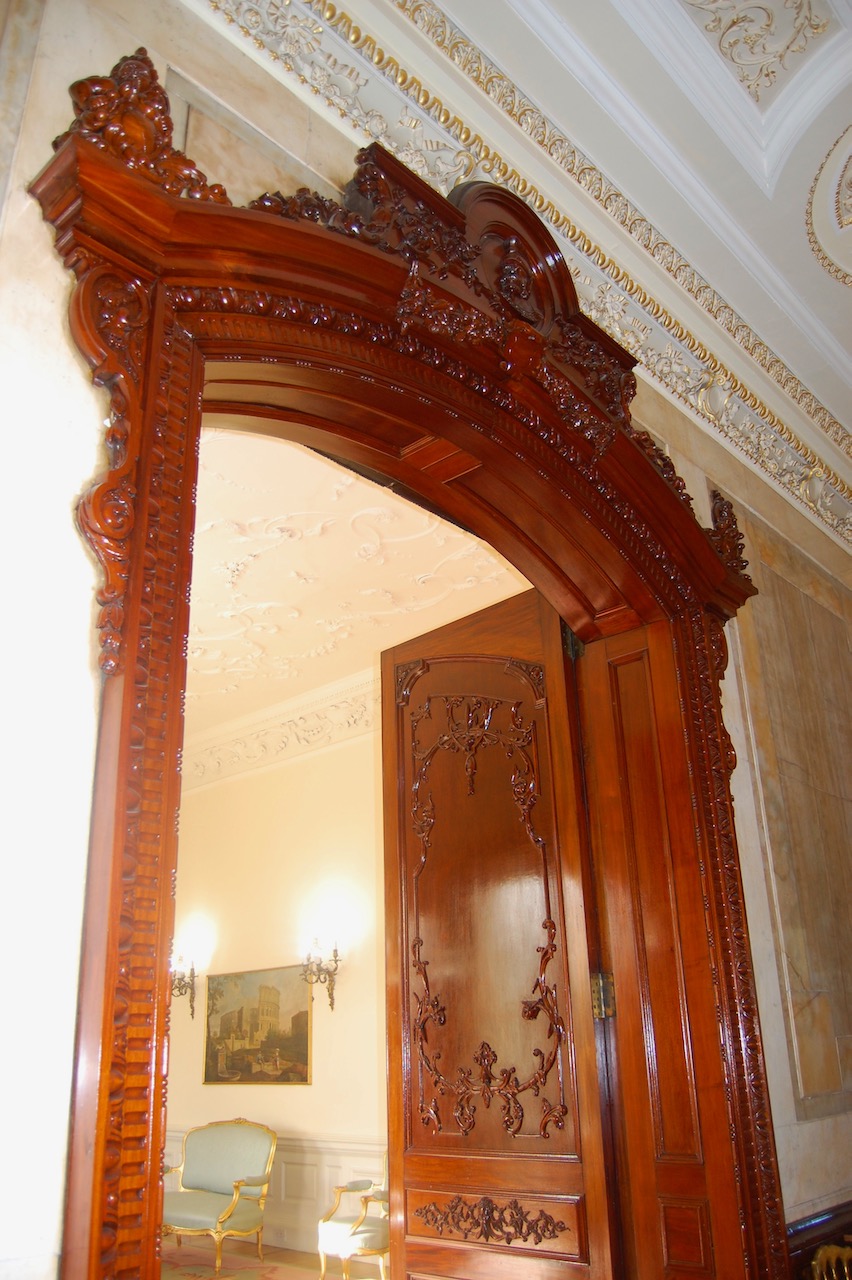
Mahogany doorframe and door, Iveagh House, Stephen’s Green. The architect took advantage of the tax on mahogany not imposed in Ireland. Photograph © Jennifer Winder-Baggot, www.irishhistorichouses.com
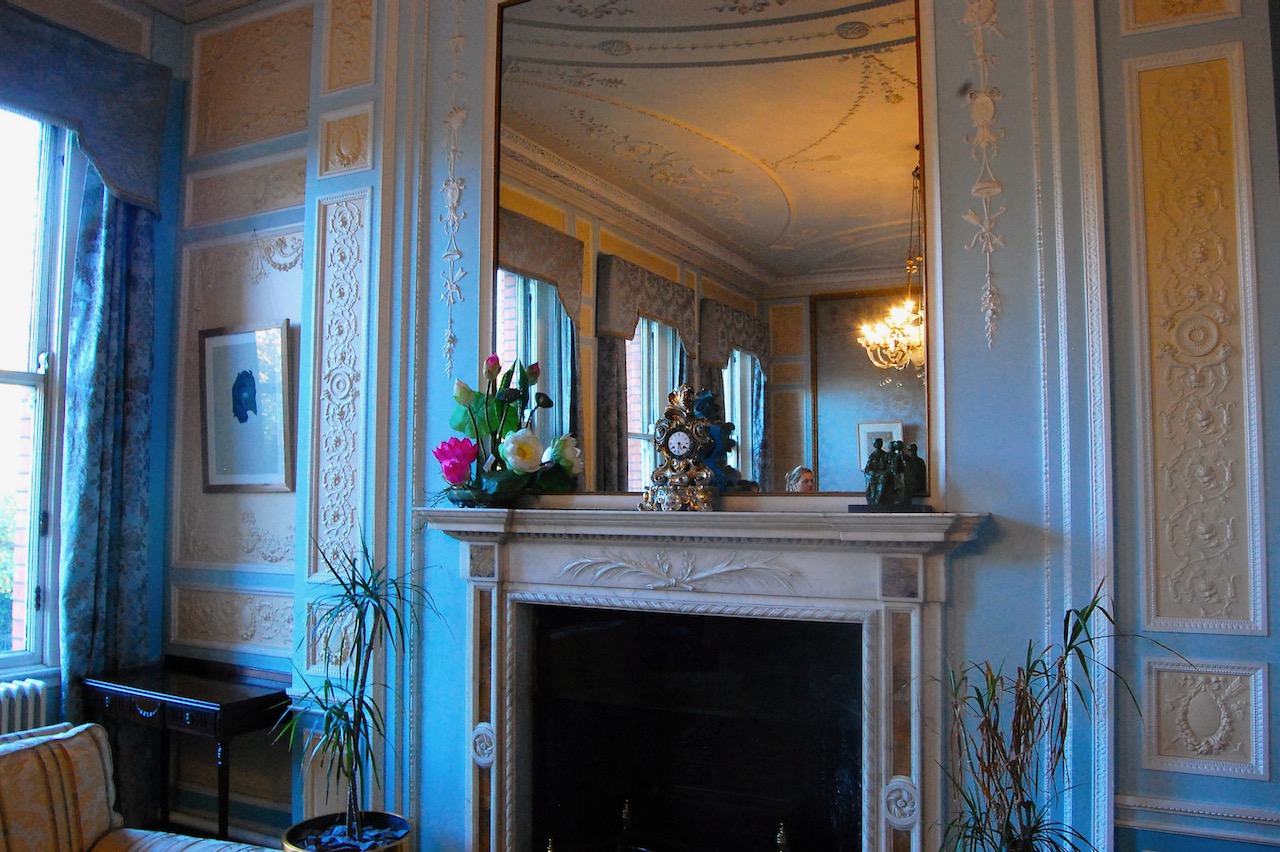
Iveagh House, St Stephen’s Green, original fireplace. Photograph © Jennifer Winder-Baggot, www.irishhistorichouses.com
Iveagh House, St Stephen’s Green, originally the study. Photograph © Jennifer Winder-Baggot, www.irishhistorichouses.com
Iveagh House, St Stephen’s Green, originally the study. Our guide told us that they were Medieval wood carvings of scenes from Homer’s Illiad, and crest of Lord Iveagh who donated the house to the state. Original fireplace. Photograph © Jennifer Winder-Baggot, www.irishhistorichouses.com
Iveagh House, St Stephen’s Green, The Music Room. Photograph © Jennifer Winder-Baggot, www.irishhistorichouses.com

The Music Room at the head of the stairs has a Rococo-cum Neoclassical ceiling of the late 1760s.
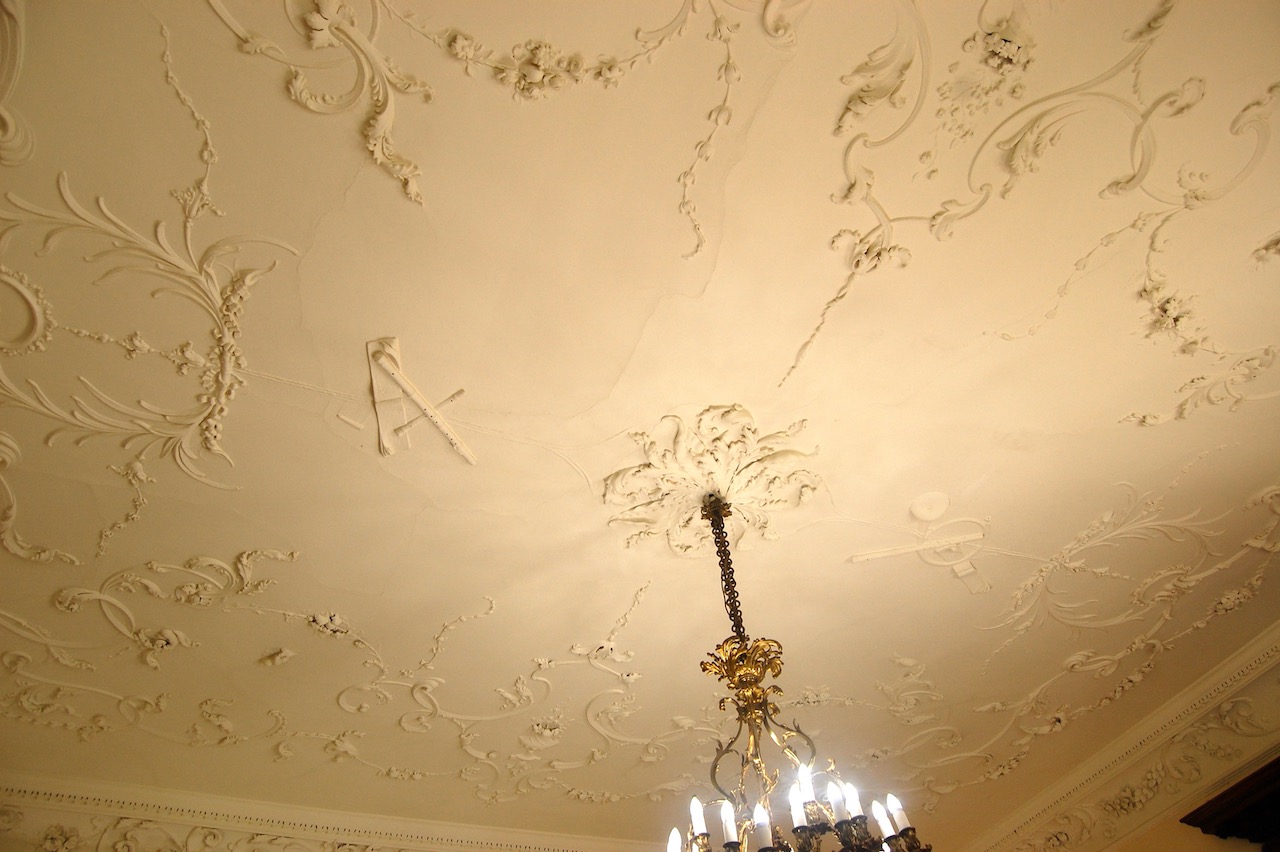
The Music room ceiling, in Iveagh House. Photograph © Jennifer Winder-Baggot, www.irishhistorichouses.com
The Saloon or Great Room, the breadth of the 18th century house in the front, with its coved and coffered ceiling, Iveagh House, St Stephen’s Green. Photograph © Jennifer Winder-Baggot, www.irishhistorichouses.com
Iveagh House, St Stephen’s Green, probably originally the withdrawing room of the Lady of the house. Photograph © Jennifer Winder-Baggot, www.irishhistorichouses.com

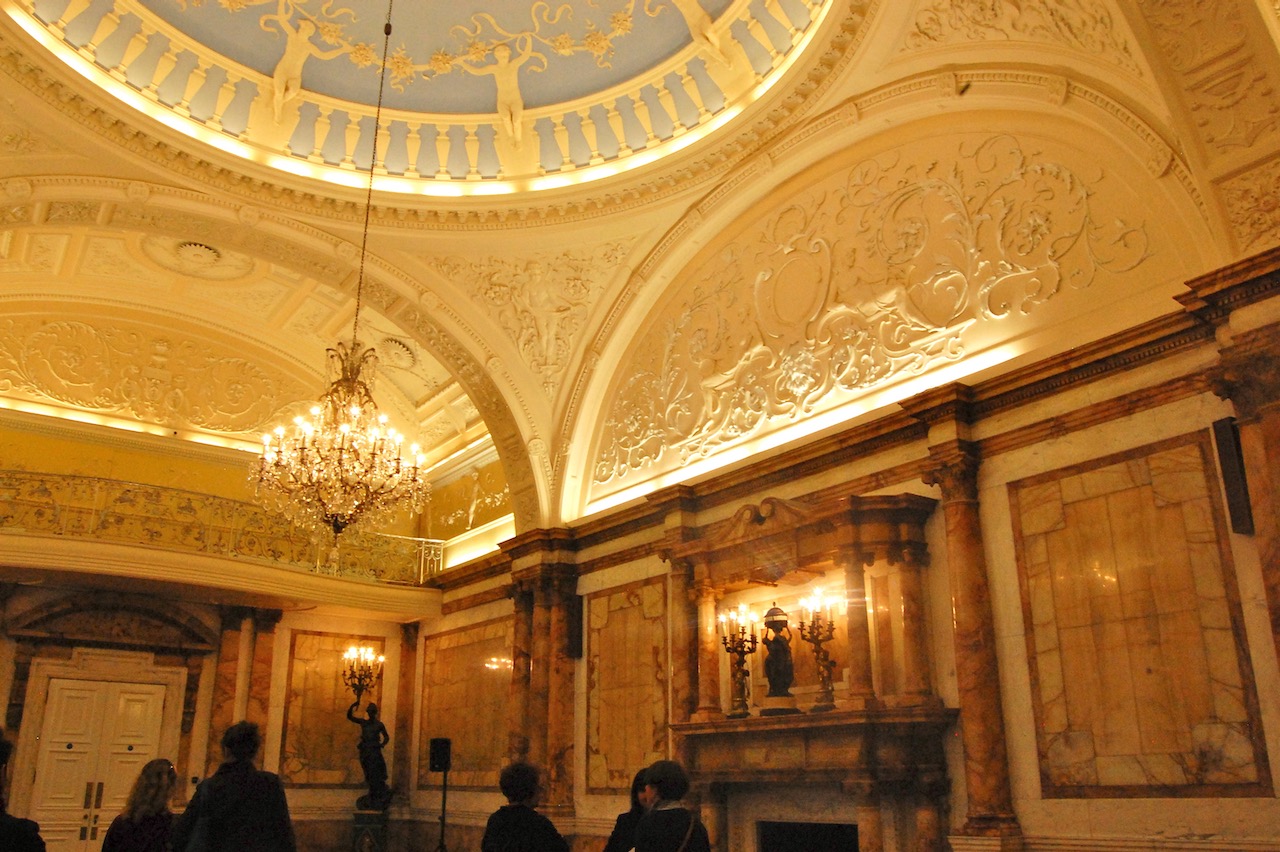
Christine Casey describes the ballroom of Iveagh House, which was designed, as was that in Farmleigh, by William Young. Casey writes in her Buildings of Ireland: Dublin book (p. 498): “This is an impressive if vulgar room. Tripartite, with a big shallow central dome and lower vaulted end bays with canted bay windows overlooking the garden. Elaborate, almost Mannerist stucco decoration by D’Arcy’s of Dublin.”

The ballroom, our guide to Iveagh House told us, was created to host a Royal visit. The room was built specially to have room for the guests, for £30,000.
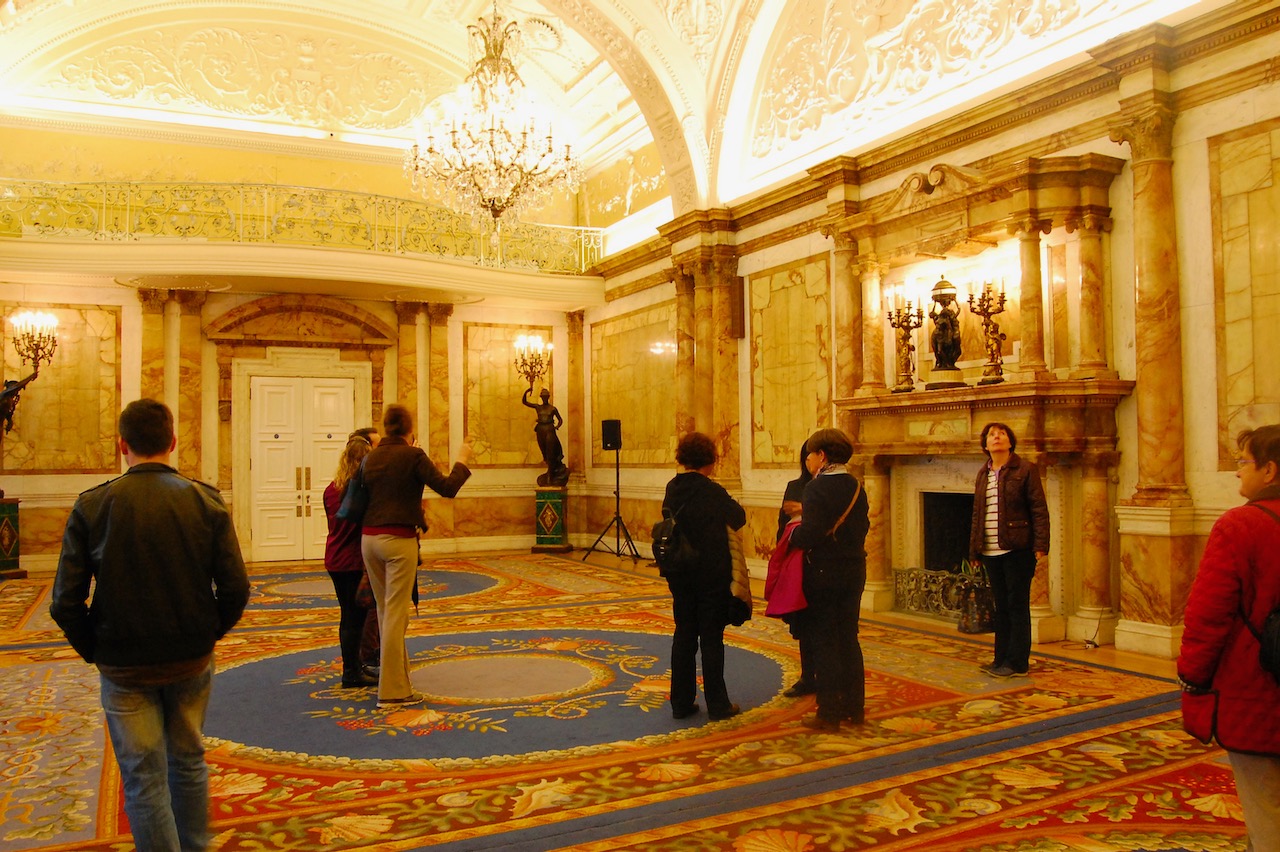
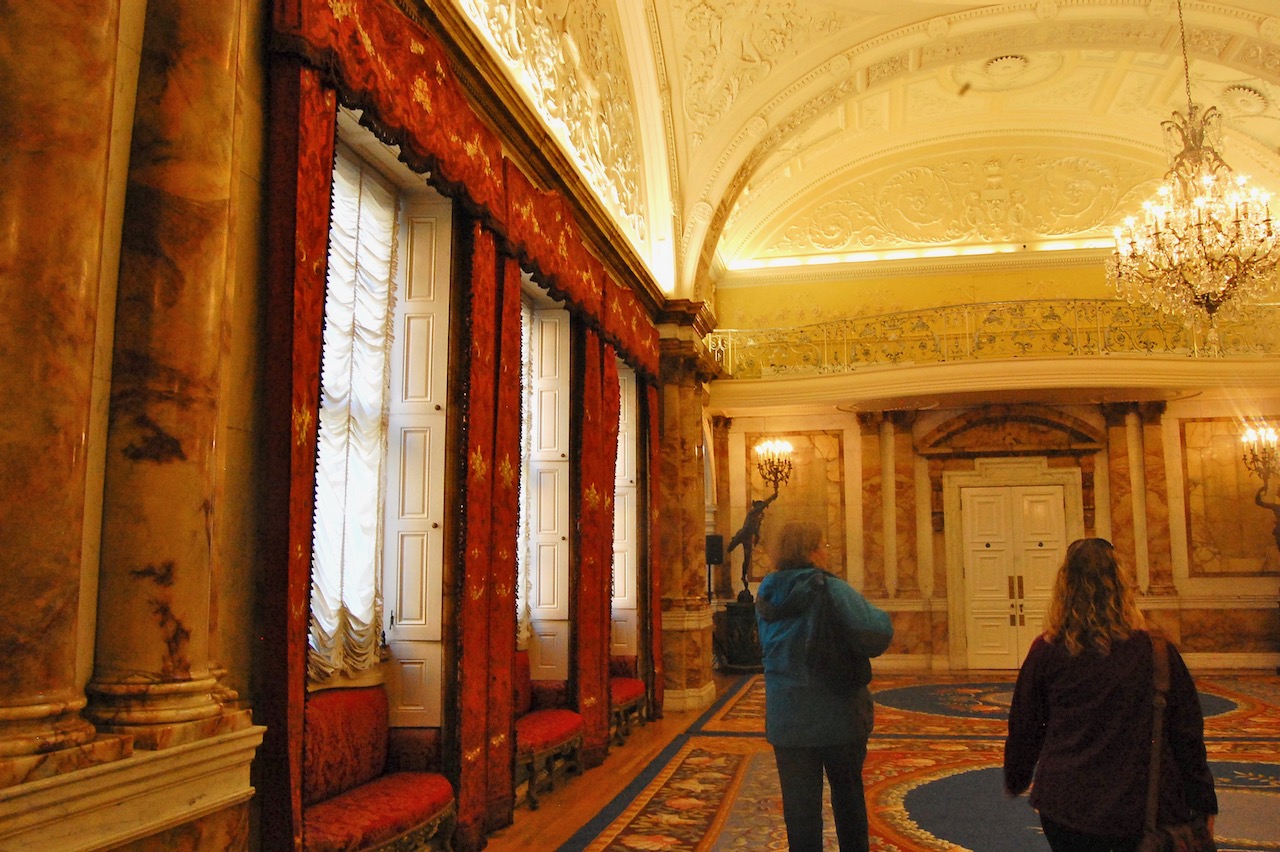
Iveagh House ballroom. Photograph © Jennifer Winder-Baggot, www.irishhistorichouses.com
Original curtains and seats in ballroom in Iveagh House. They remind me of the portiéres in Farmleigh’s ballroom. Photograph © Jennifer Winder-Baggot, www.irishhistorichouses.com
Iveagh House ballroom. Photograph © Jennifer Winder-Baggot, www.irishhistorichouses.com
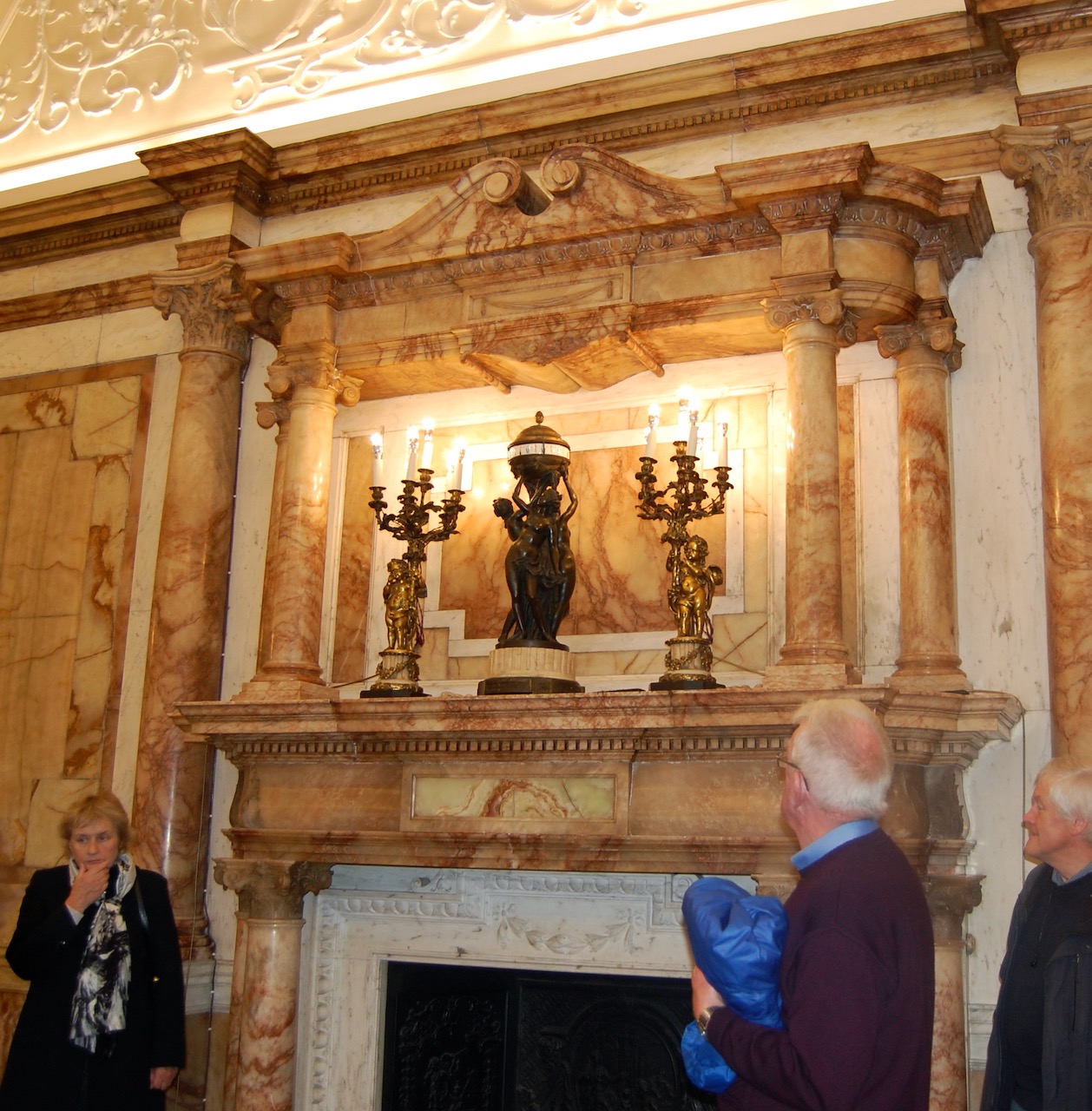
Fireplace built for ballroom in Iveagh House. JFK was hosted at a reception here and had his picture taken in front of the fireplace, and his daughter Caroline Kennedy had her picture taken there years later. Photograph © Jennifer Winder-Baggot, www.irishhistorichouses.com
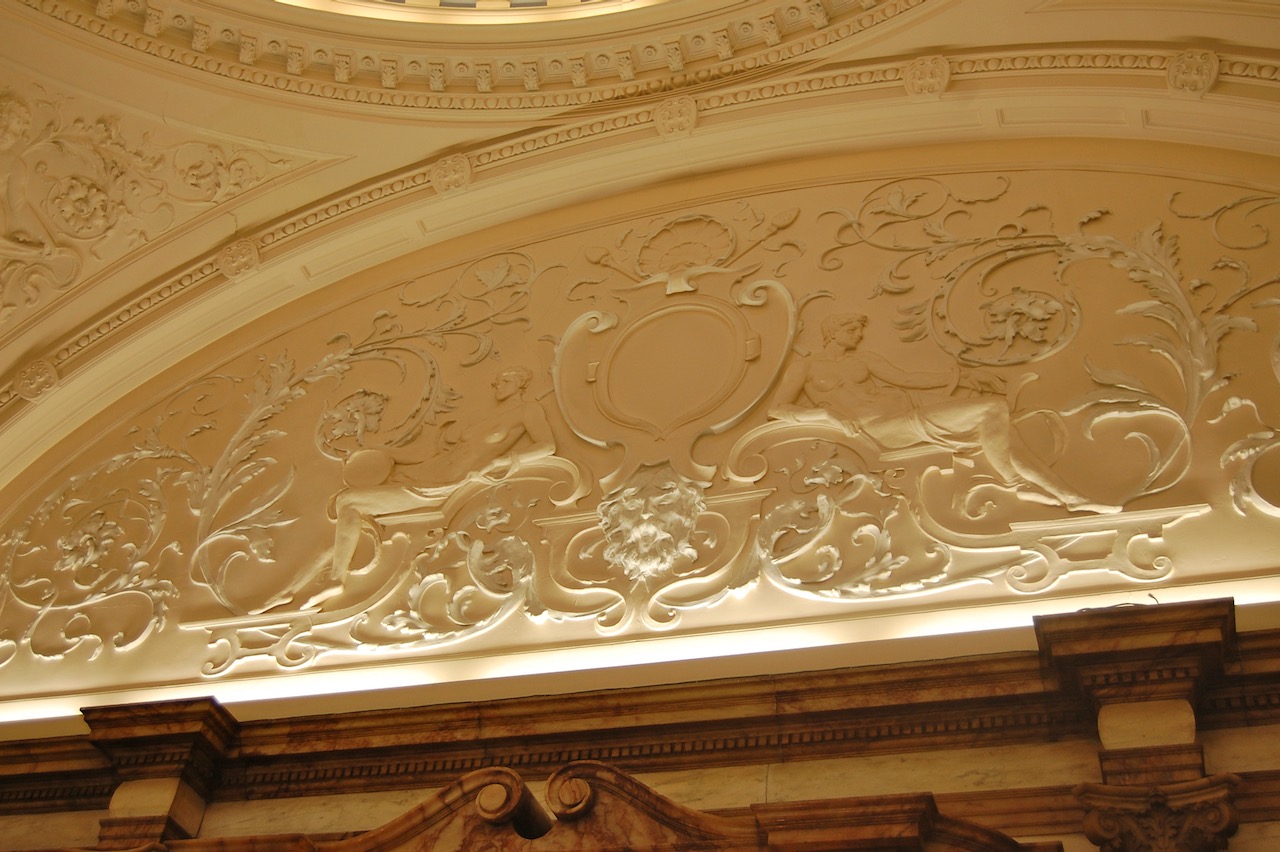
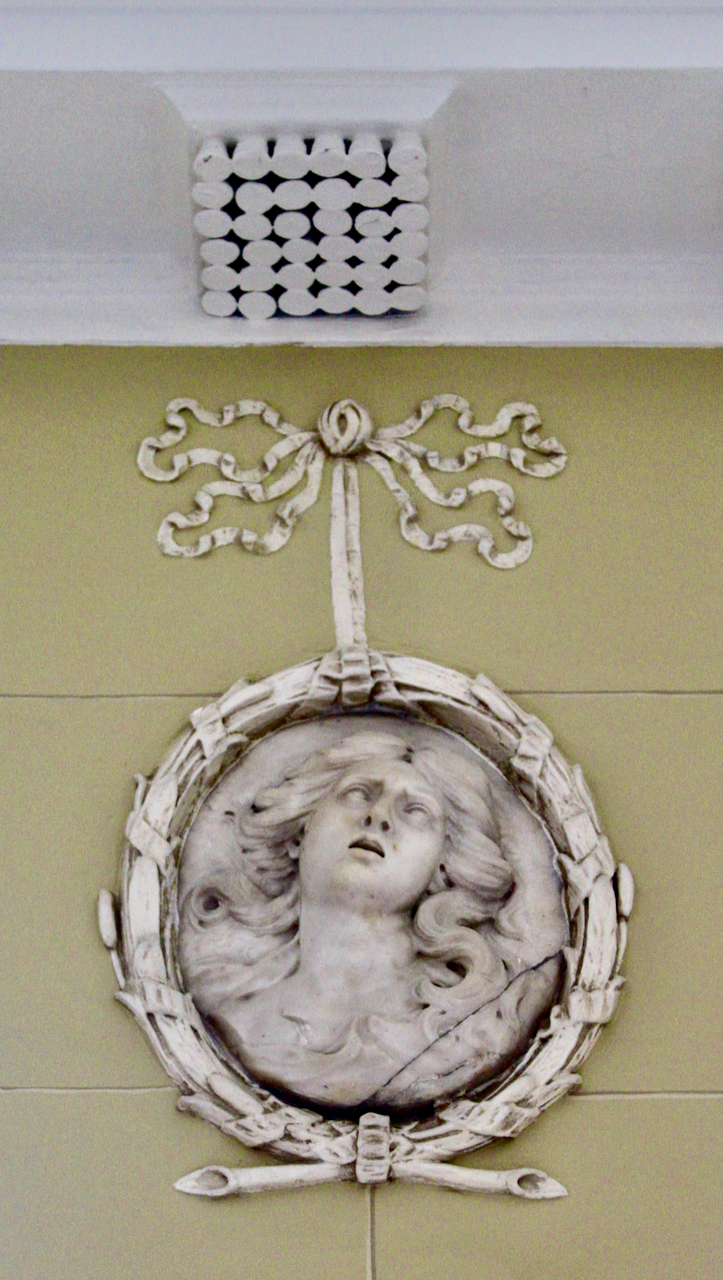
Ballroom stucco in Iveagh House, made from moulds but then finished by hand to make look like fully hand-done. Photograph © Jennifer Winder-Baggot, www.irishhistorichouses.com
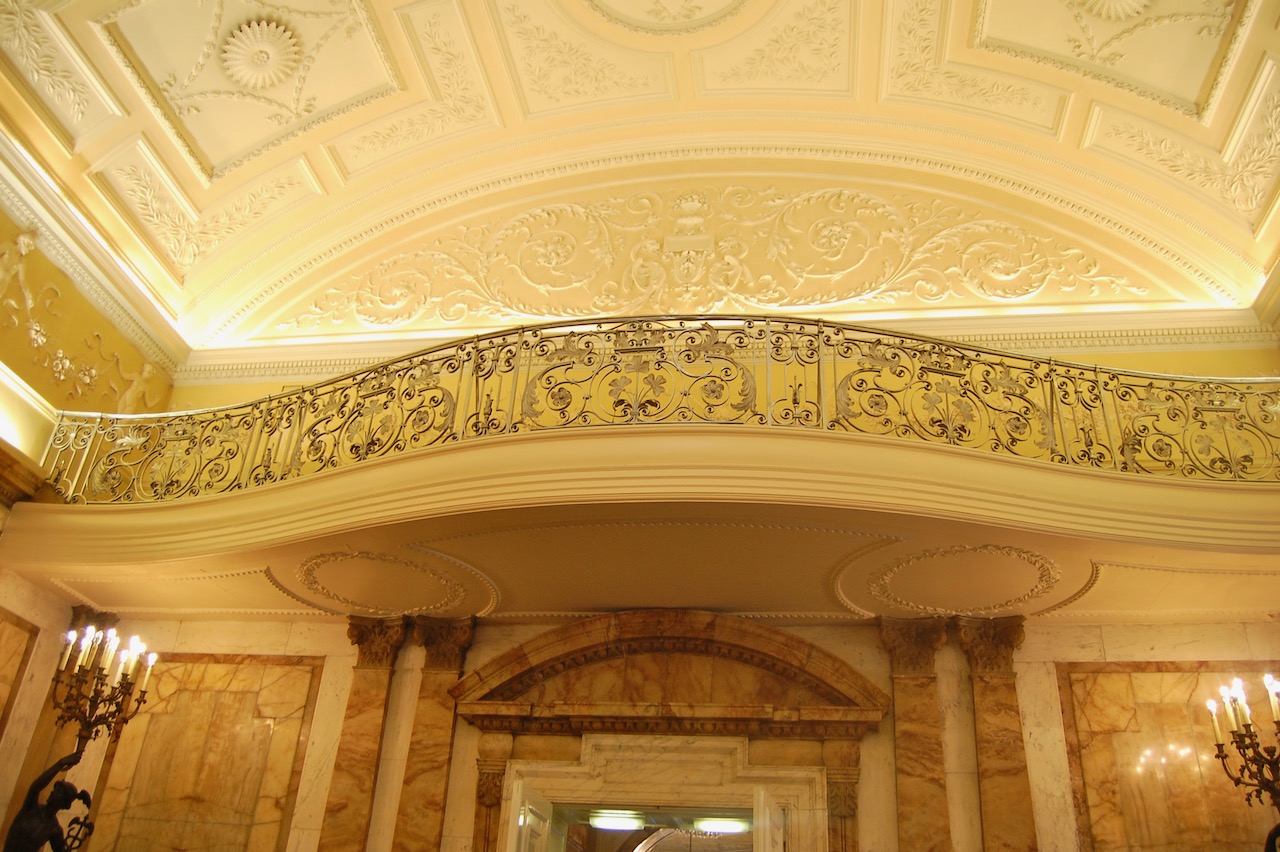
Minstrals’ gallery in Iveagh House ballroom, made of the new at the time material, aluminium. Photograph © Jennifer Winder-Baggot, www.irishhistorichouses.com
Ceiling of Iveagh house ballroom, in Wedgewood blue. Photograph © Jennifer Winder-Baggot, www.irishhistorichouses.com

Now that we have placed Edward Cecil Guinness in the context of the house he lived in at the time of purchasing Farmleigh, let’s return to Farmleigh.

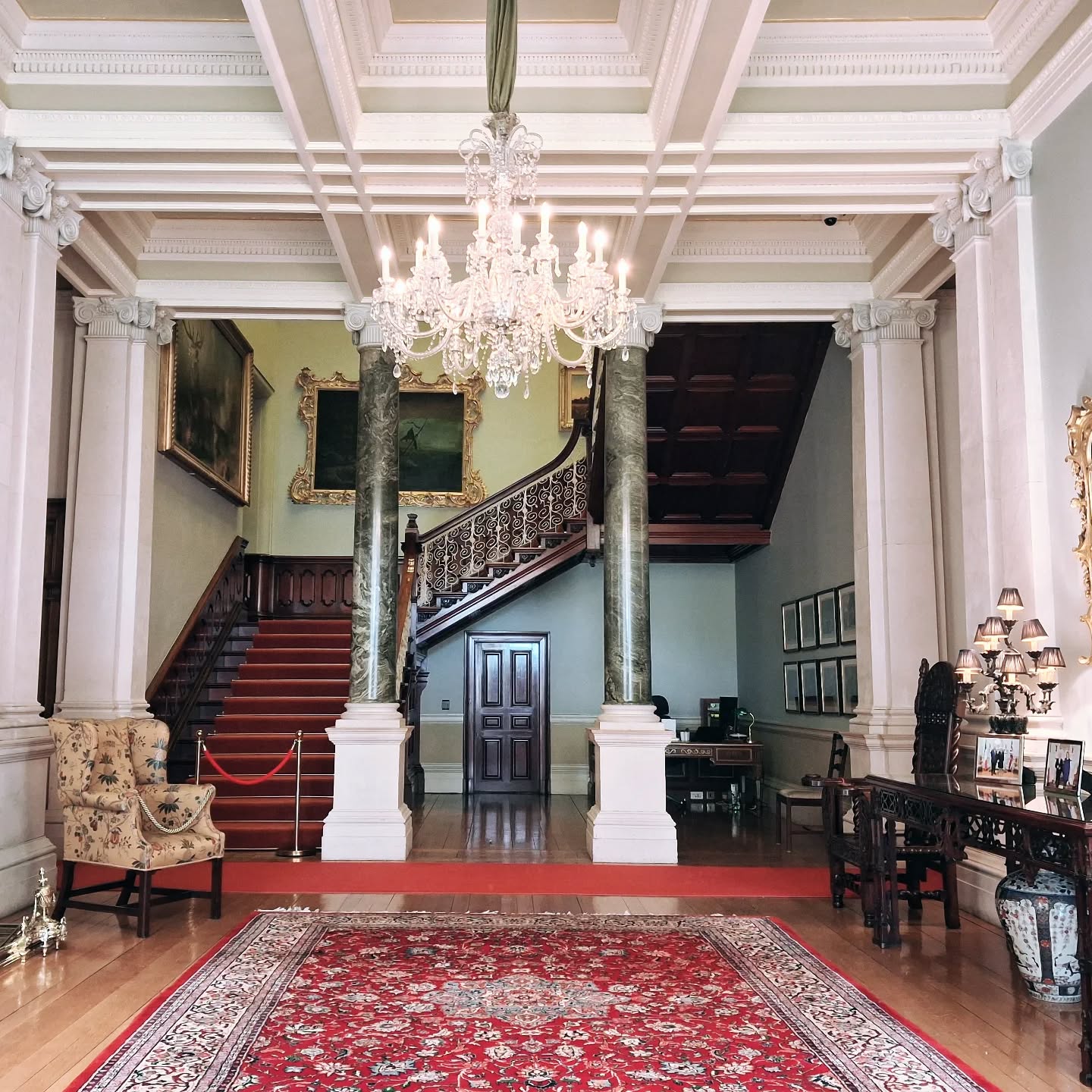
Casey writes that inside Farmleigh, two ranges of rooms open off an east-west spinal corridor, with a “showy” central entrance hall opening through a columnar screen to a large top-lip double-height stair hall.
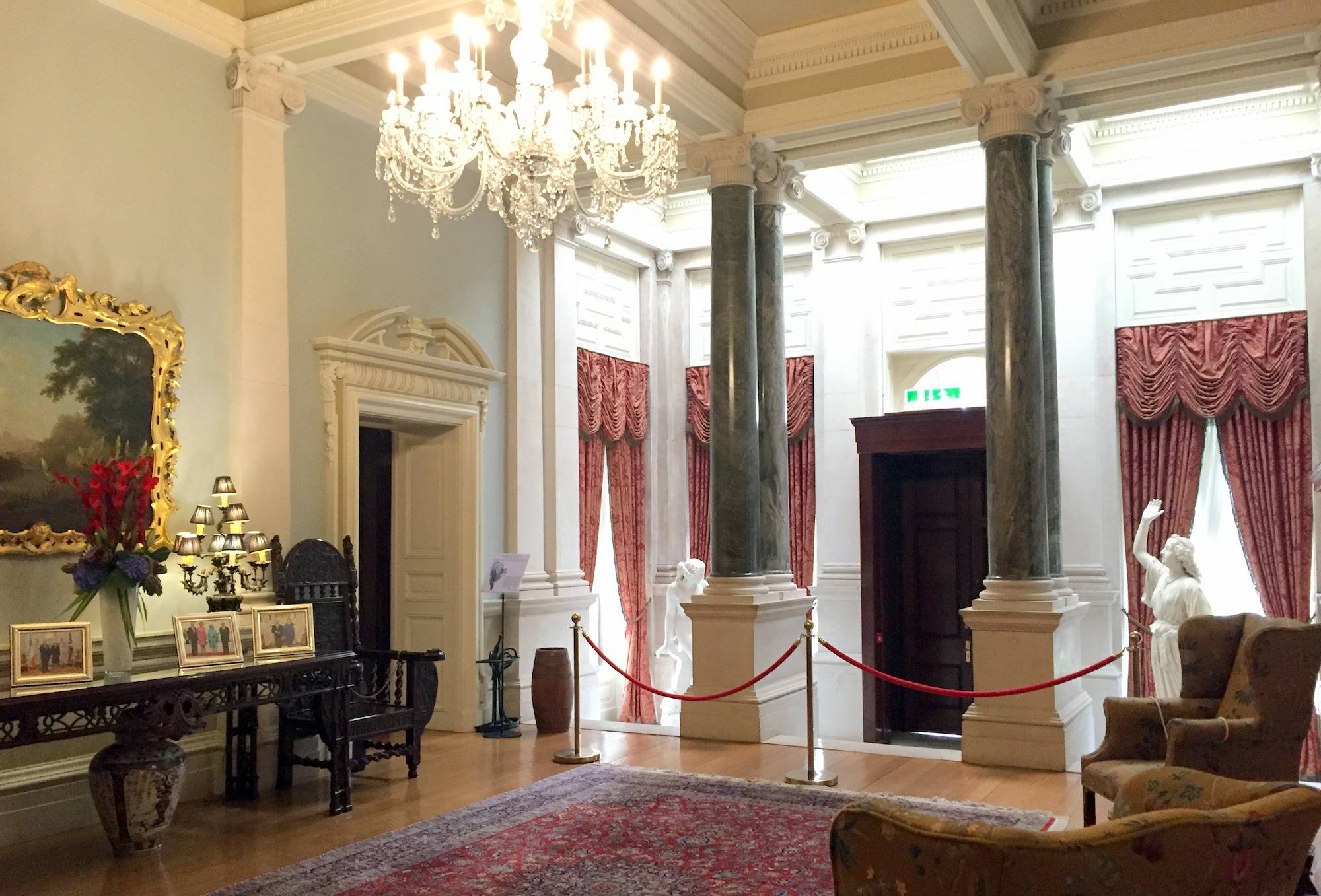
The entrance hall at Farmleigh, photograph courtesy of Office of Public Works Farmleigh website.

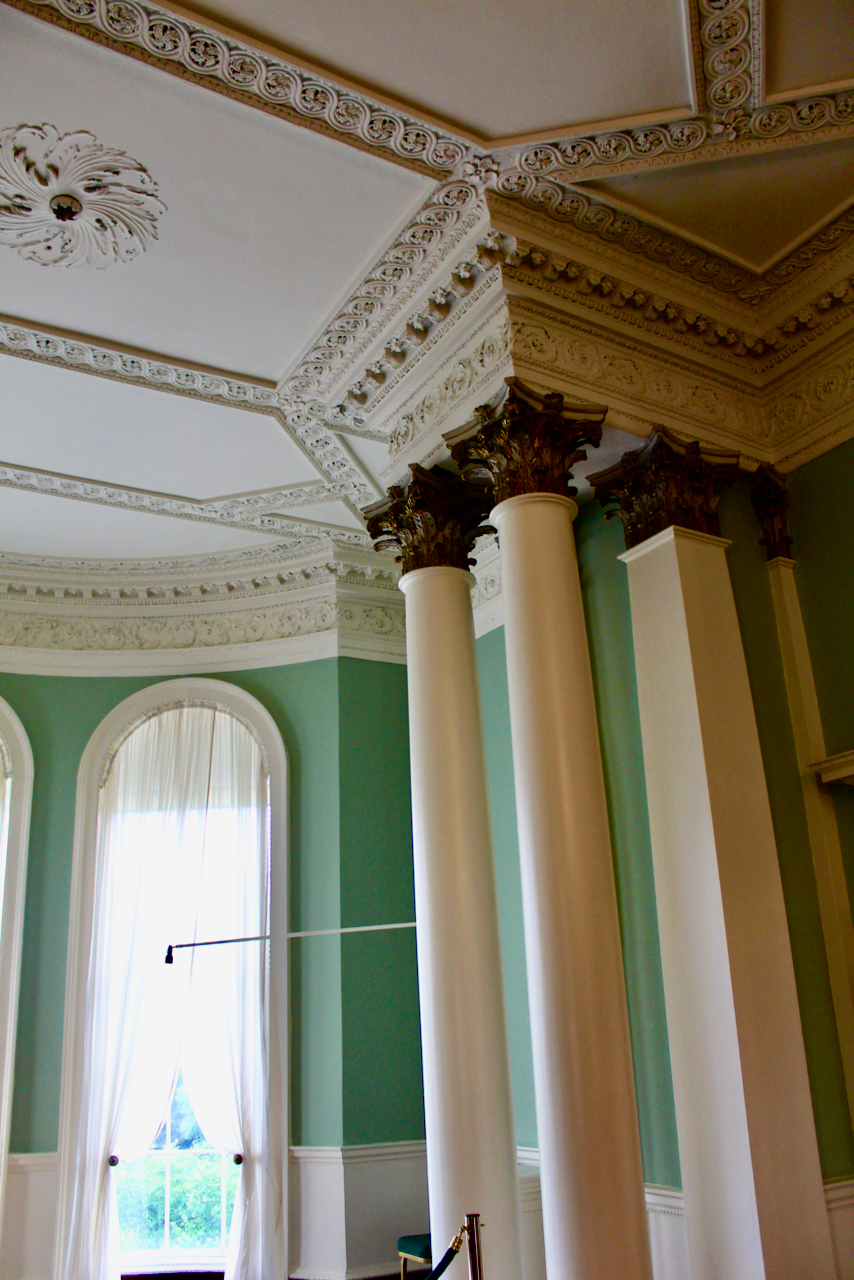
The immediate front hallway is also toplit by roundels set in the ceiling of the hallway/porte cochere. The porte cochere is upheld by Portland stone pilasters and there is a screen of six columns of Connemara marble on pedestals with Ionic capitals on pedestals. The columns support the coffered ceiling of the Entrance Hall. 
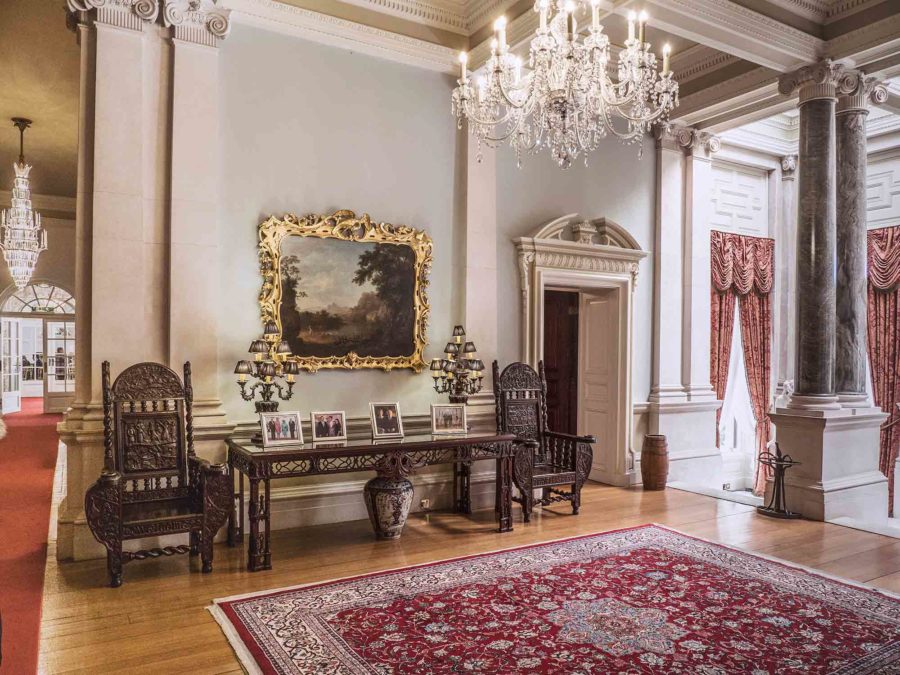
Farmleigh, Dublin, photograph courtesy of https://heritageireland.ie/places-to-visit/farmleigh-house-and-gardens/

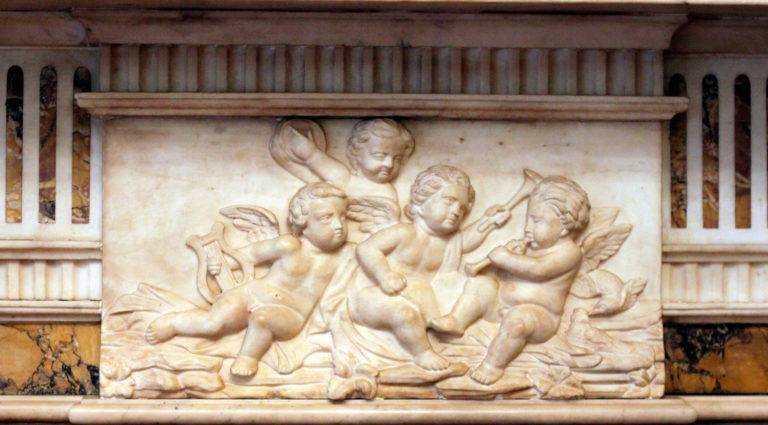
The chimneypiece is of carved and inlaid marble, and the website tells us it is probably a nineteenth-century copy of an original, though the plaque may date from the eighteenth century.
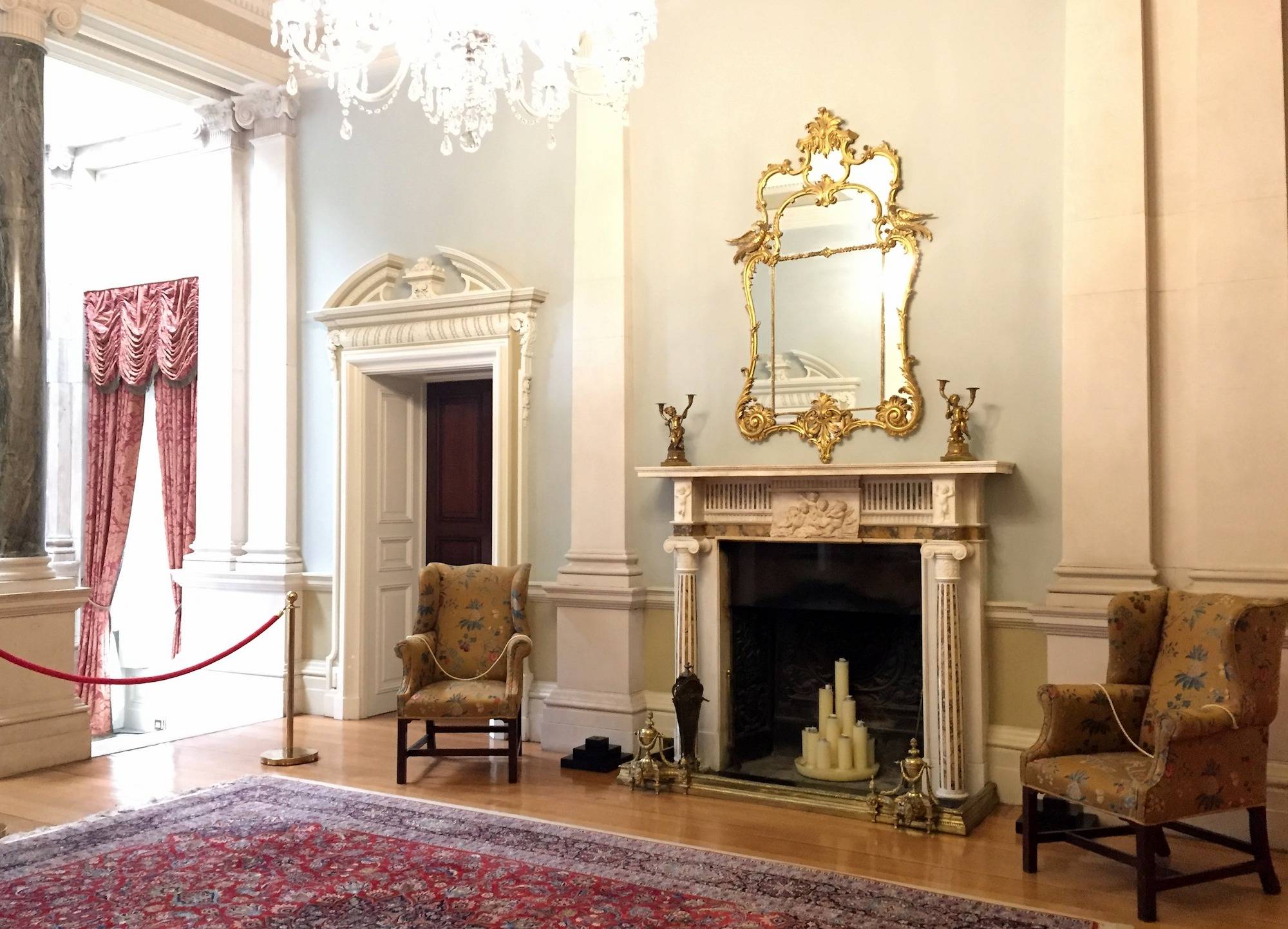
The entrance hall at Farmleigh, photograph courtesy of Office of Public Works Farmleigh website.
Fireplace plaque in the entrance hall at Farmleigh, photograph courtesy of Office of Public Works Farmleigh website.

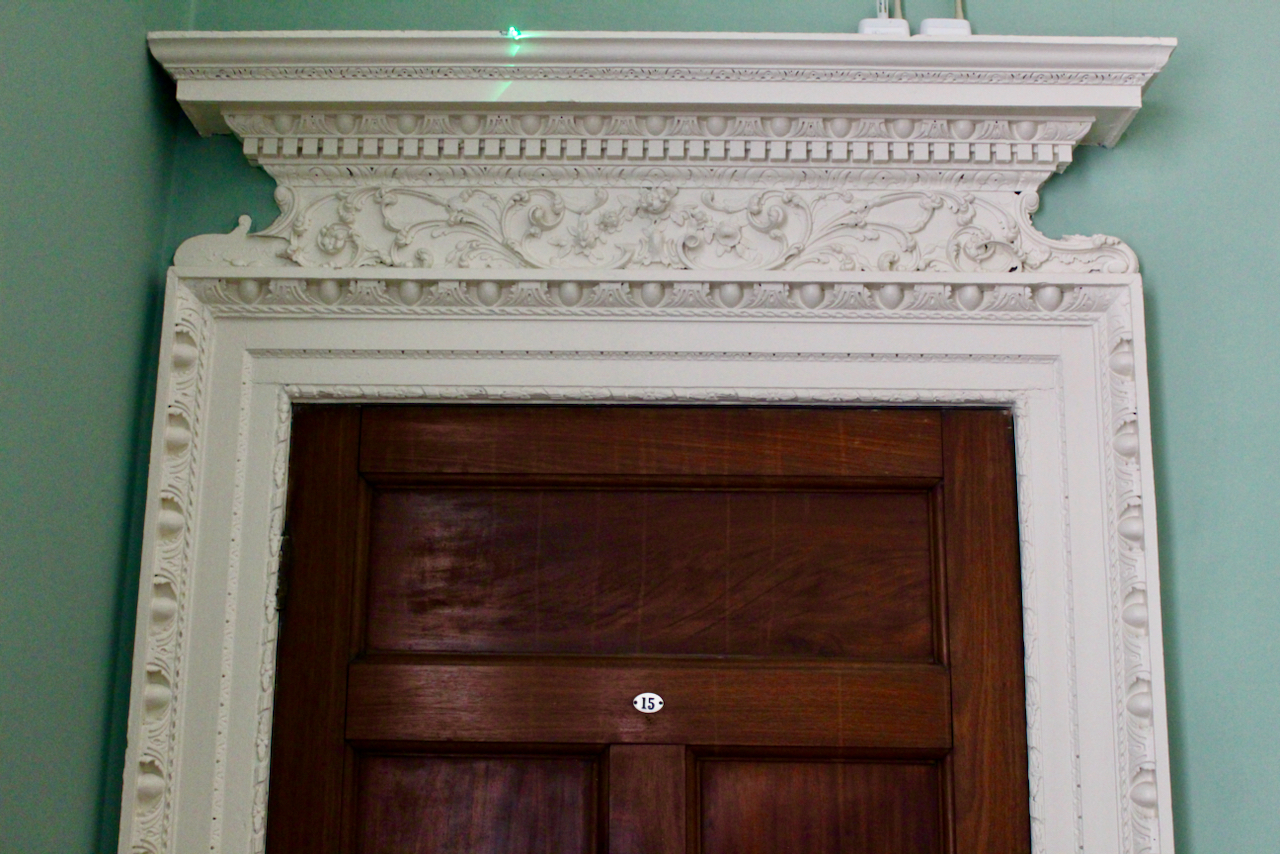
The doors leading off the hall have carved mouldings and pediments, and the doors are of veneered mahogany on the hall side and of oak on the other.

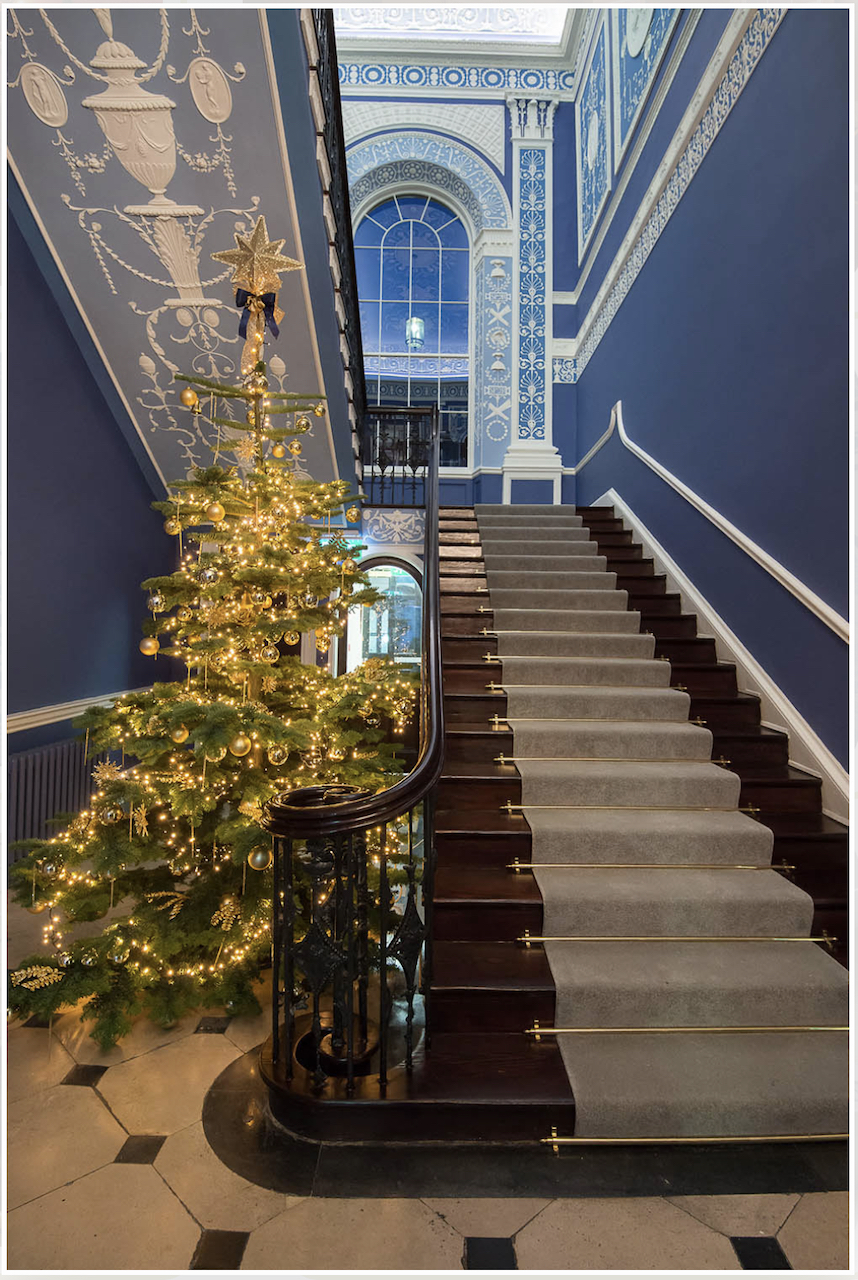
The website continues: “The classical motif continues at the Staircase to the rear of the hall. Corinthian pilasters rise from first-floor level to a strongly projecting cornice. San Domingo mahogany is used for the Staircase on which the wrought iron balusters were made to correspond exactly with those on the staircase of Iveagh House, formerly the Earls of Iveaghs’ city mansion.

The stairwell is toplit also.

Stair Hall, Farmleigh, photograph courtesy of Farmleigh facebook page.
The wrought iron balusters were made to correspond exactly with those on the staircase of Iveagh House: Iveagh House, St Stephen’s Green. Photograph © Jennifer Winder-Baggot, www.irishhistorichouses.com

After Edward Cecil’s death in 1927 his eldest son Rupert became the second Earl of Iveagh and inherited Farmleigh and 80 St Stephen’s Green. He was a British MP for Southend at the time, and ceased to be an MP when he succeeded to his father’s earldom. His wife Gwendolen the Countess of Iveagh won the Southend by-election in November 1927 to replace her husband as MP. She served until her retirement in 1935.

He presented the house on St. Stephen’s Green to the Irish State in 1939.

The website tells us about the family in Farmleigh: “Rupert gave Farmleigh to his grandson and heir, Benjamin (Rupert’s eldest son and Benjamin’s father, Arthur, was killed in WWII). Farmleigh became a family home for Benjamin (3rd Earl of Iveagh) and Miranda Guinness, and their children. Benjamin became a keen bibliophile and collector of rare books, parliamentary and early bindings, as well as first editions of the modern poets and playwrights. The library in Farmleigh in now dedicated to Benjamin Iveagh and his wonderful collection of books.

Benjamin died in 1993 in London and in 1999, his son Arthur Guinness (4th Earl of Iveagh), sold Farmleigh to the Irish State.” [2]

The website continues:

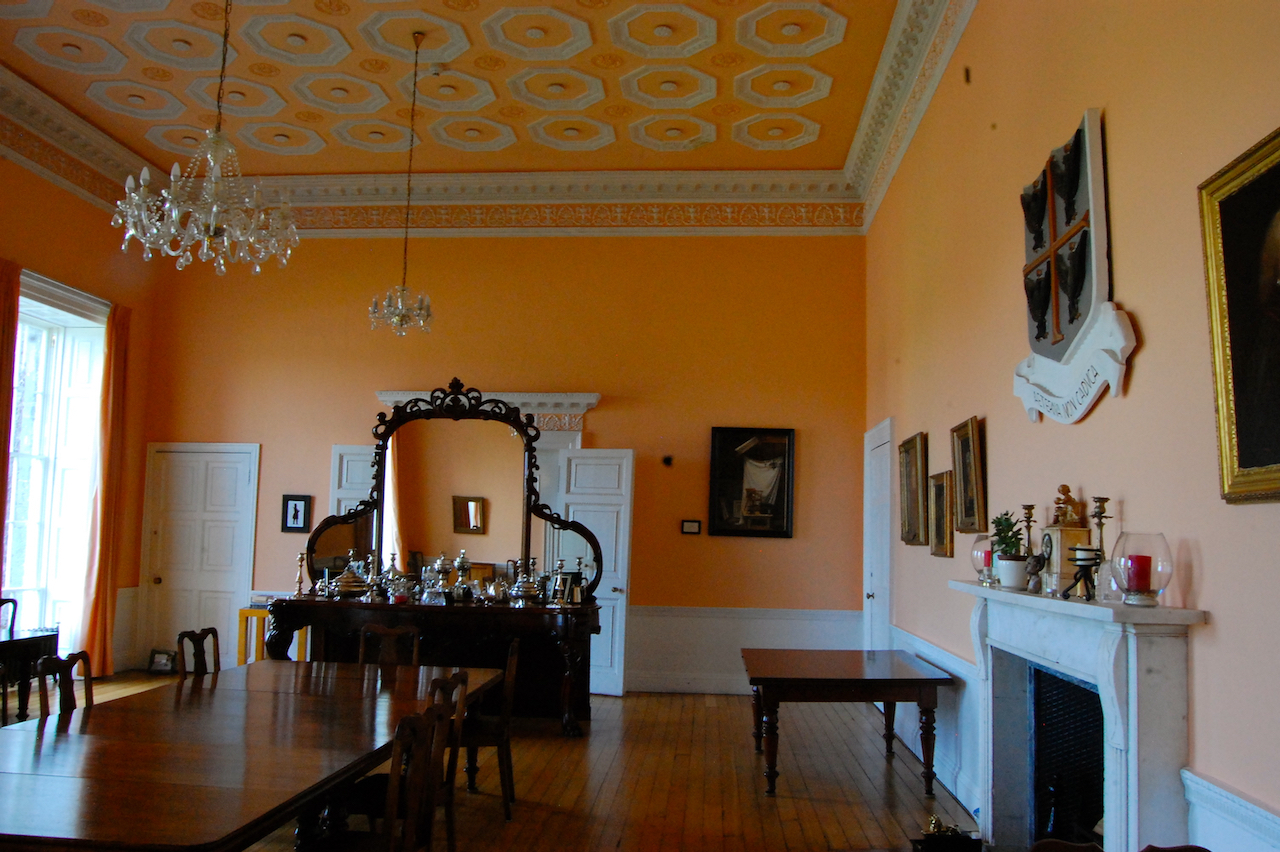
The door to the left of the hall leads to the Dining Room, which is lined with boiseries in the style of Louis XV. There is some spectacular woodcarving in this room, of particular note is the chimney piece, supported by a pair of female herms, with a clock at its centre surmounted by a grotesque face. Bronze figures of Bacchantes are placed in the shell-topped niches on either side of the fireplace, while beneath them are late Victorian oak buffets. The London firm of Charles Mellier & Co., supplied the interior here (apart from the ceiling which was designed by the architect J.F. Fuller).”

The Dining Room panelling was designed by decorators Charles Mellier & Co to incorporate four late seventeenth century Italian tapestries which once belonged to Queen Maria Christina of Spain. Three of the embroidered panels have been identified as the planetary gods, Jupiter, Venus, and Saturn. These panels are likely to be part of a larger set of seven panels relating to the Roman deities. One such panel, apparently from the same set and depicting Mercury, is in the Hermitage Museum in St Petersburg. The fourth panel above the fireplace is thought to depict a personification of Africa and to be part of a further set, depicting the continents.
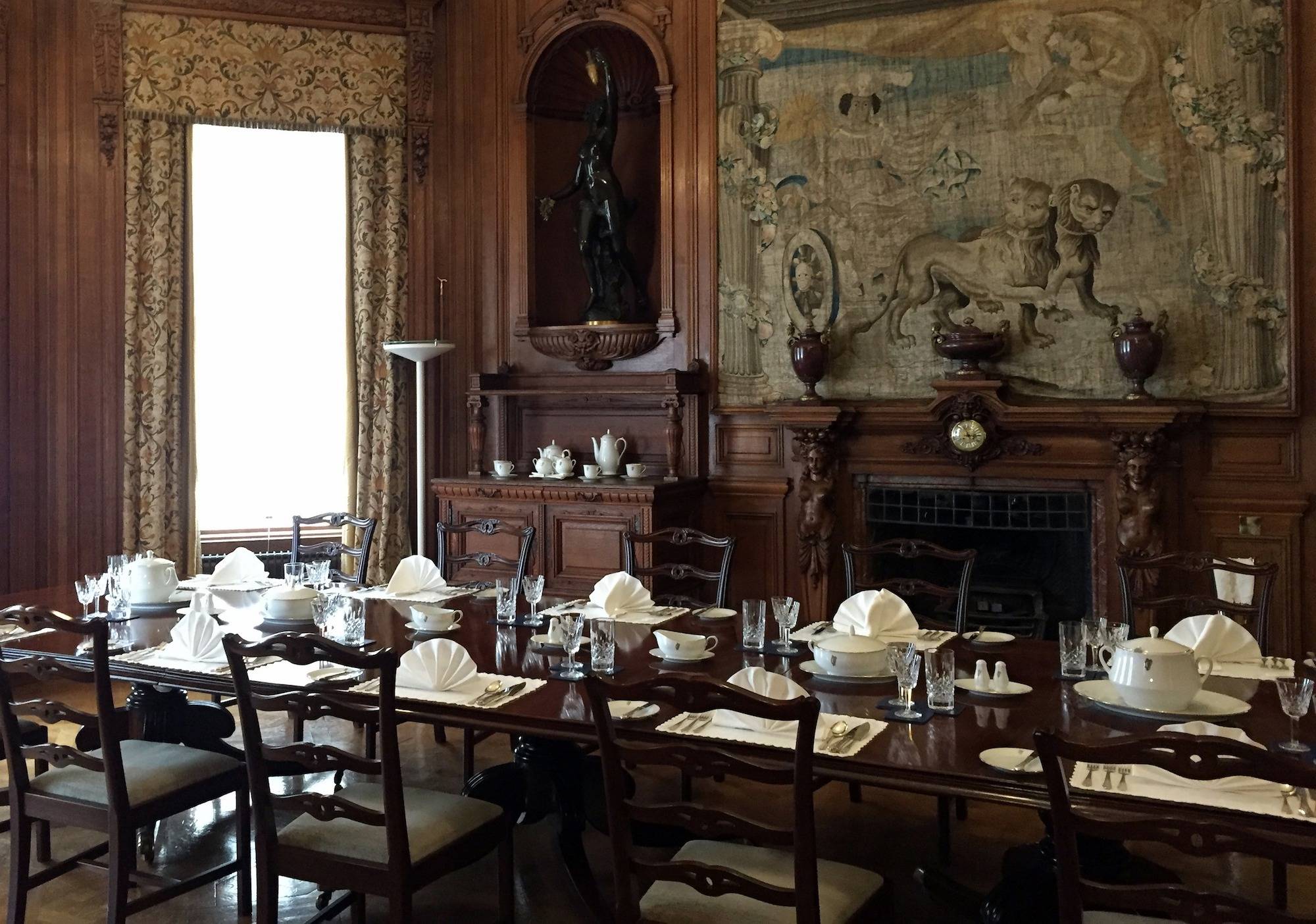
The Dining Room in Farmleigh, photograph courtesy of Office of Public Works Farmleigh website.

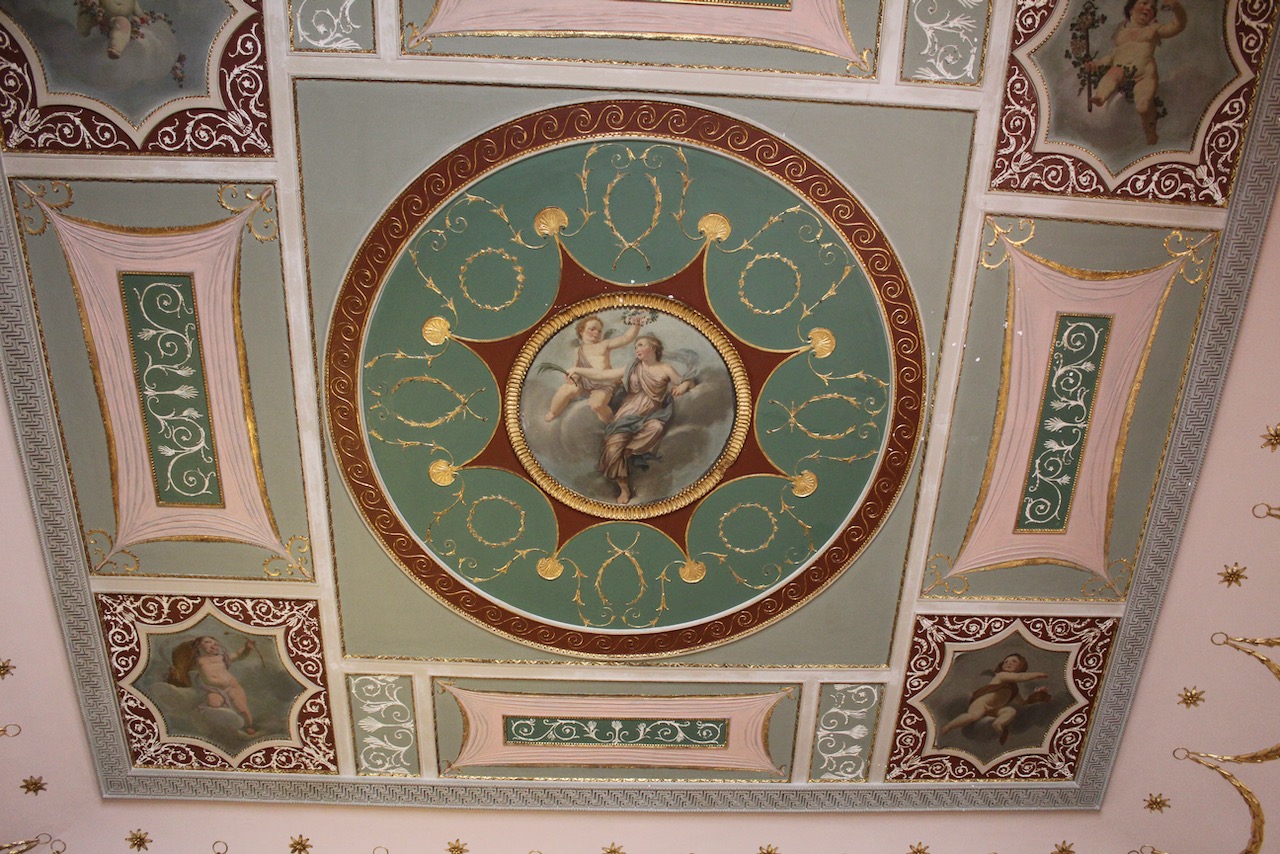
Beyond the dining room is Guinness’s Study, a wainscoted room with a sky painted ceiling. A concealed door next to the window at the southwest corner led to a basement stronghold, a secret chamber for Guinness to escape in case of attack.
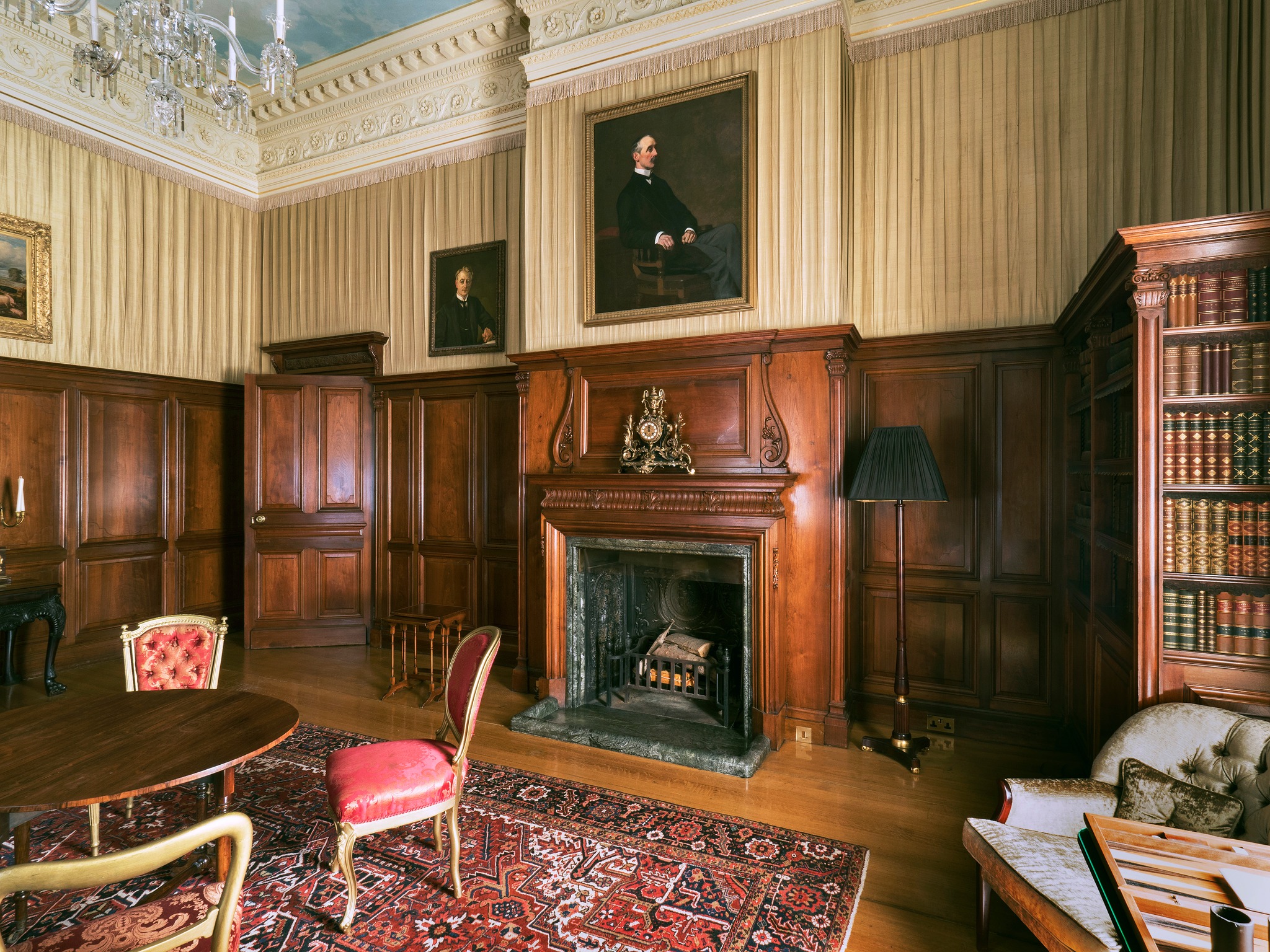
The Study in Farmleigh, photograph courtesy of Farmleigh facebook page.

The website tells us:

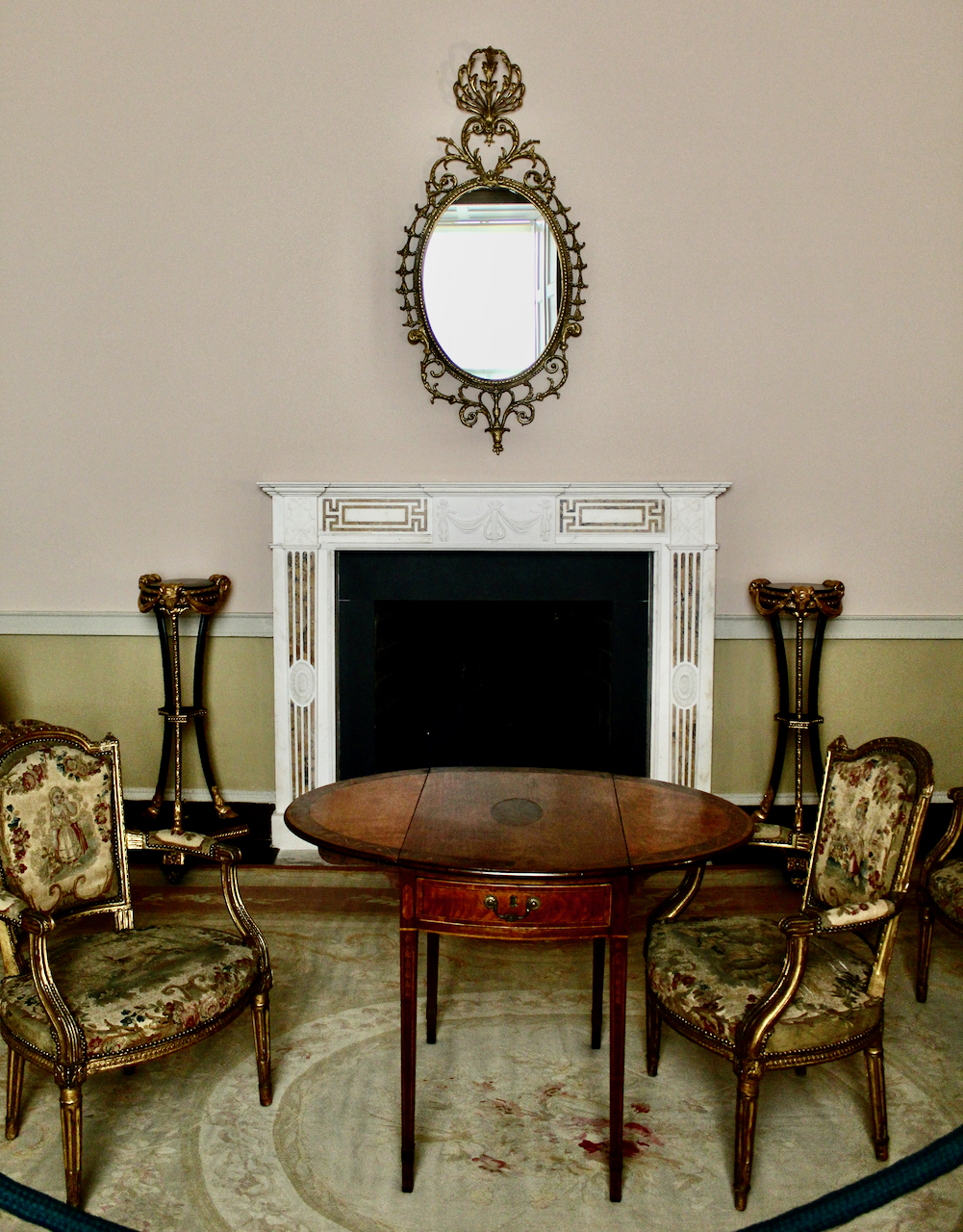
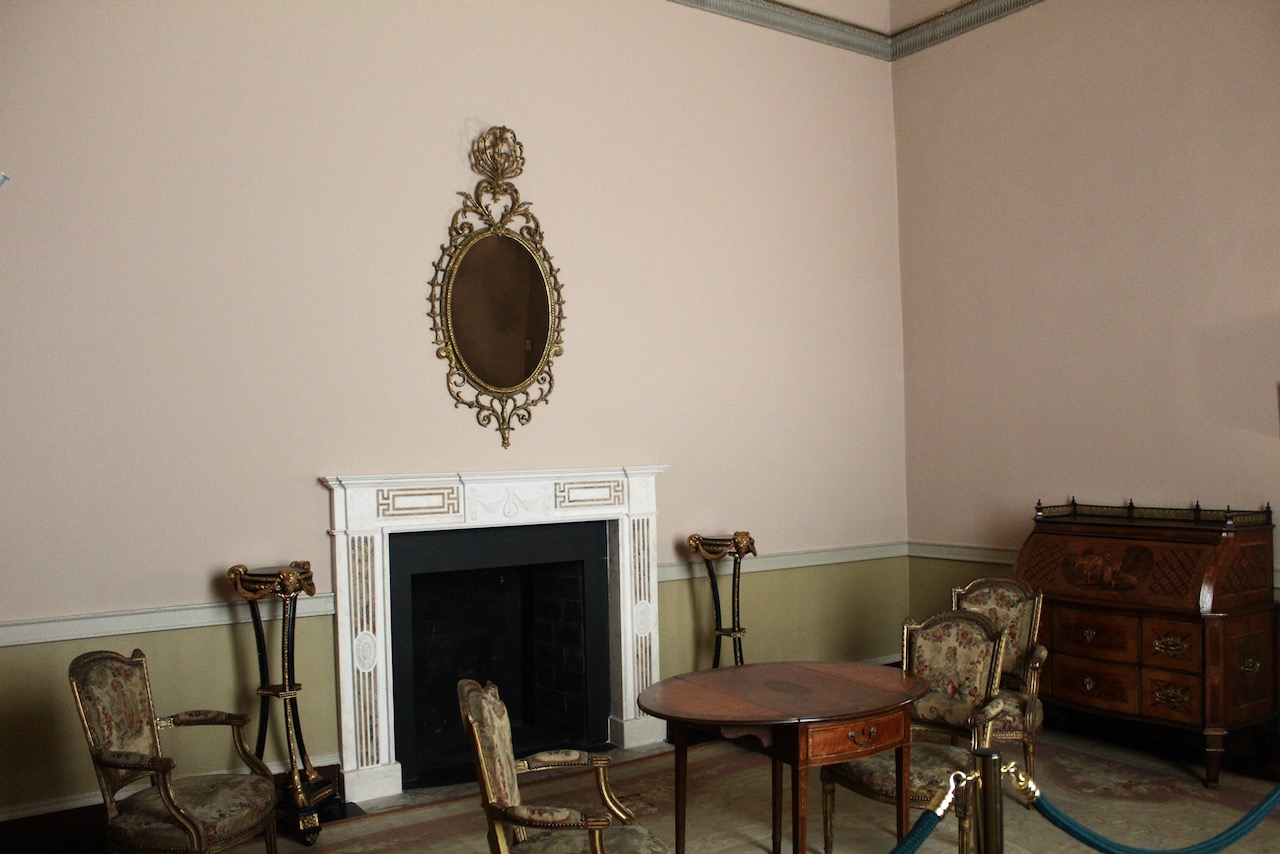
The main entrance to Farmleigh was originally on the north side of the house (in part of what is now the Library) and this was probably a reception room where guests either dined or withdrew after dinner. By 1873, when Edward Cecil Guinness bought the house, the entrance had been changed to the south of the building and this room was the entrance hall. It subsequently became a boudoir and reverted in later years with the Guinness family to a reception room while keeping its appellation as ‘boudoir’. (Generally the boudoir was a ‘private’ room for the lady of the house, decorated in a light and elegant style. Her ‘public’ room was the drawing room, just as the gentleman’s study was his ‘private’ room and the library his ‘public’ room.).

The Boudoir is oval in shape with two niches, one each side of the door into the Corridor. The niche to the right of the door as one enters contained a jib door into the Oak Room but the space between the rooms now holds a safe accessed from the Oak Room.

Christine Casey describes the Oak Room in her Buildings of Ireland: Dublin (p. 298). She writes: “On the right of the hall is the studiolo-like Oak Room, which has a coffered oak ceiling and tall panelling with pilasters, scalloped tympana and grotesque terms. …Beefier and more textured than most of the carving at Farmleigh. It has been suggested that Fuller used salvaged panelling, although the regularity of execution seems at odds with the seventeenth century style.”
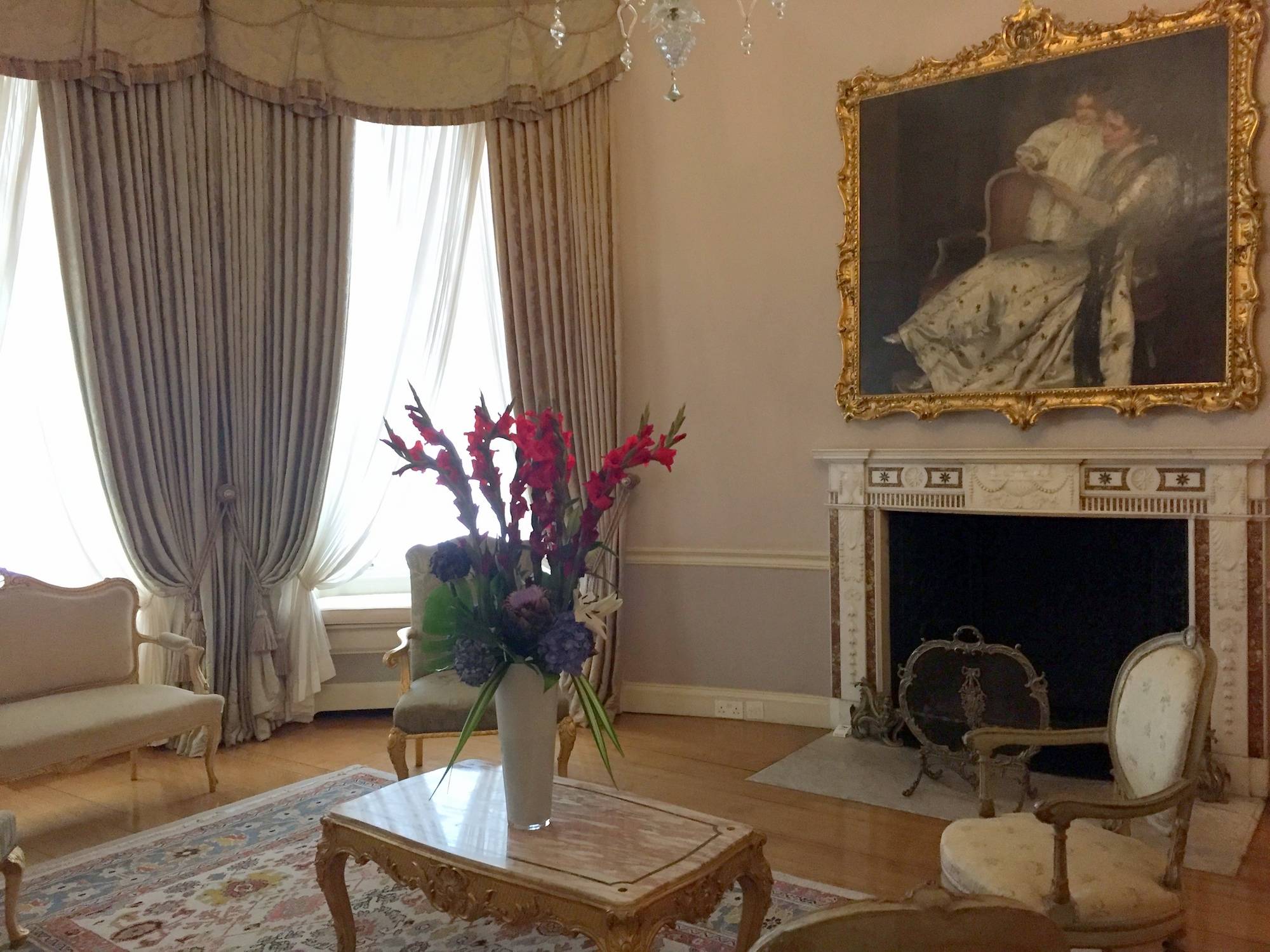
The Boudoir, Farmleigh, photograph courtesy of Office of Public Works Farmleigh website.

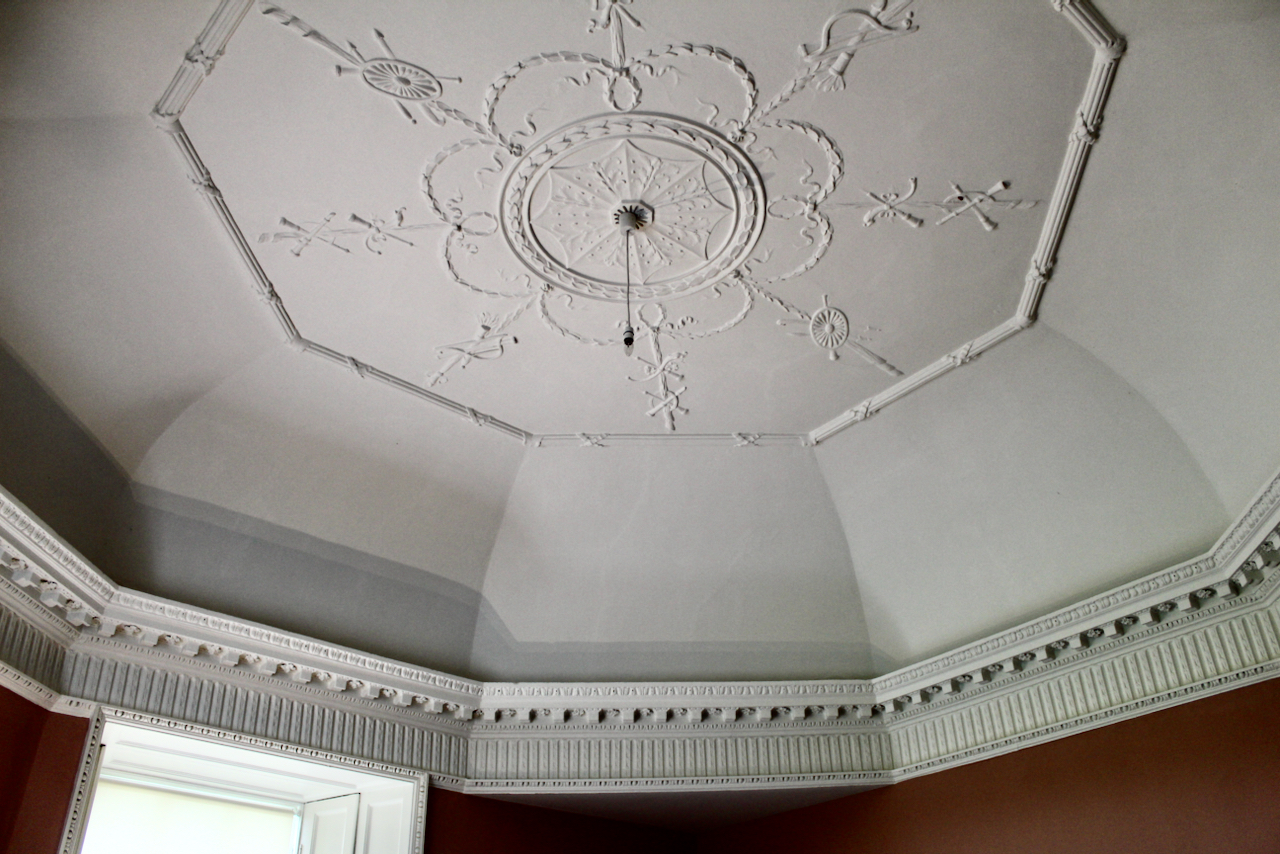
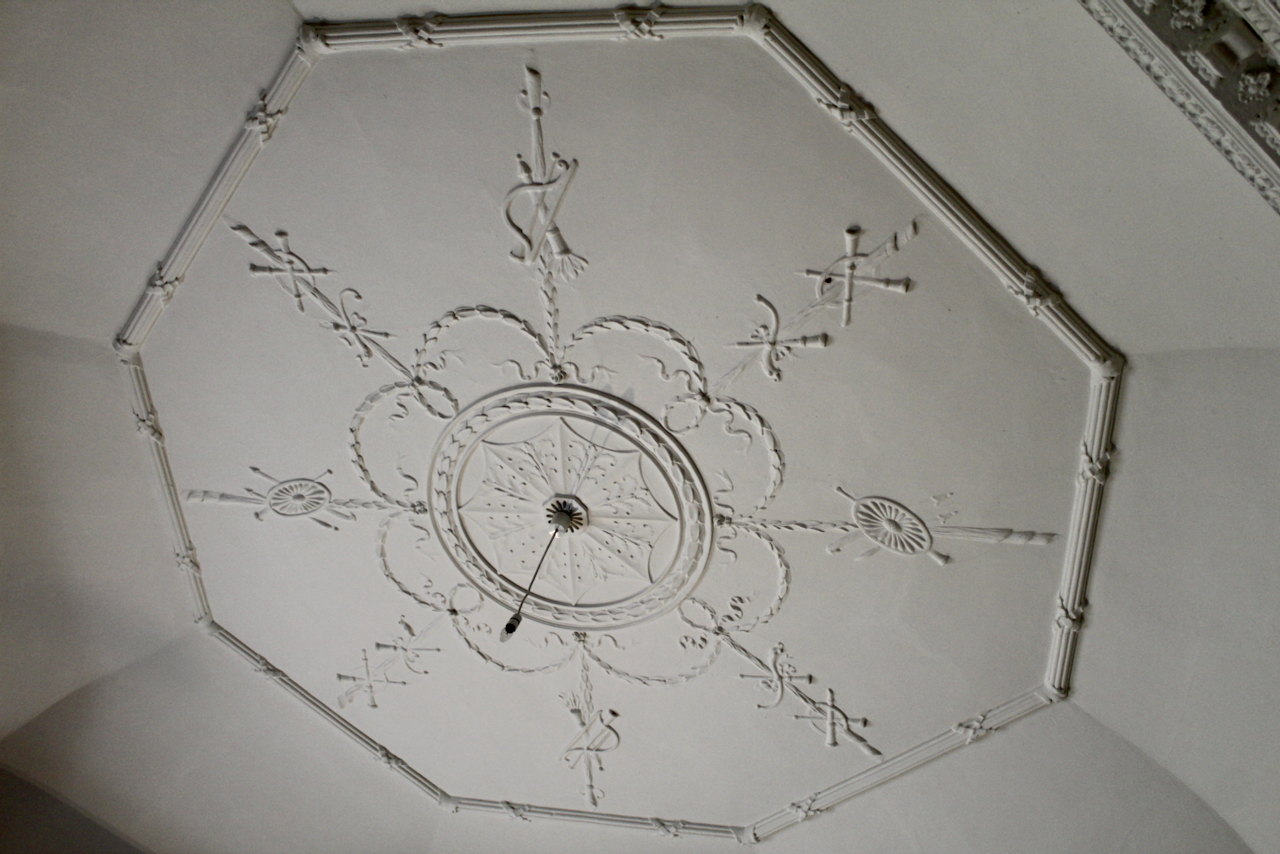
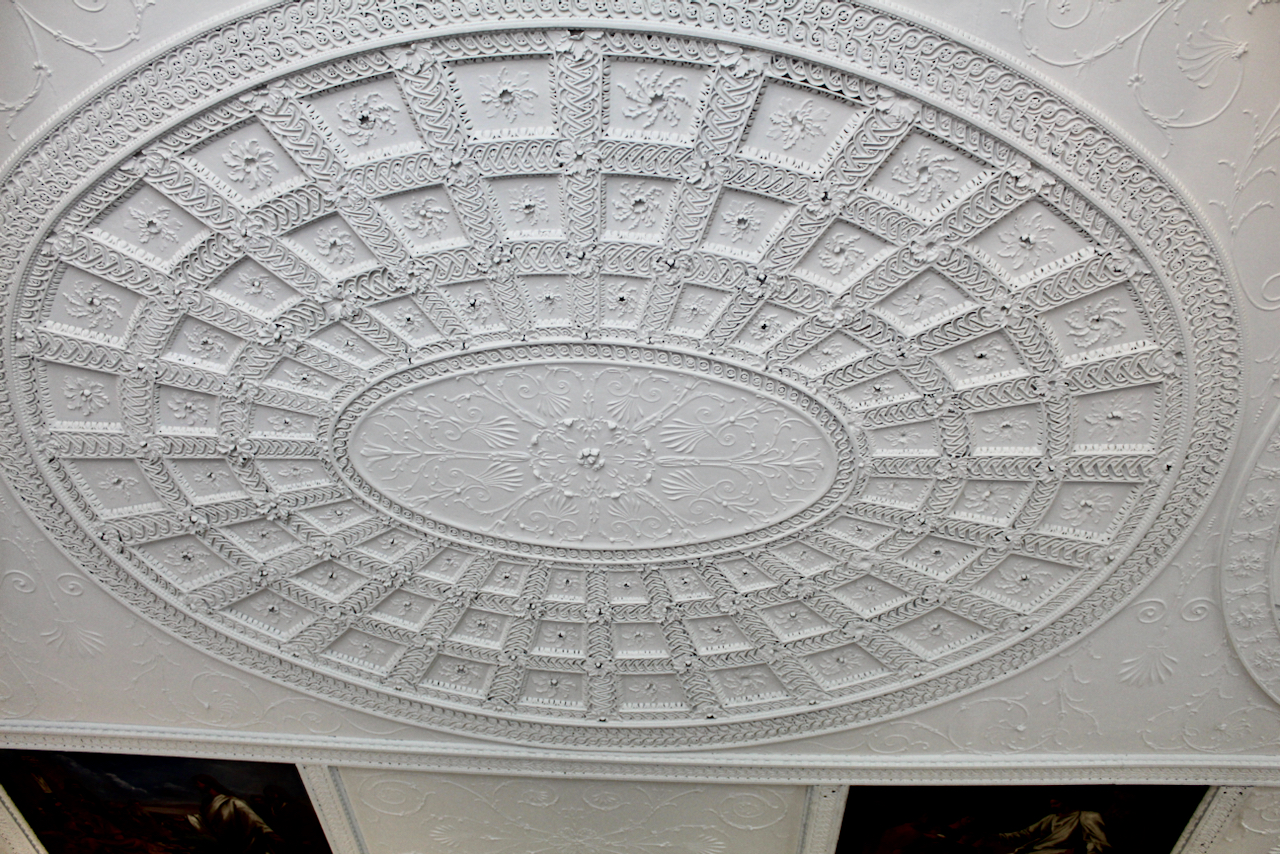
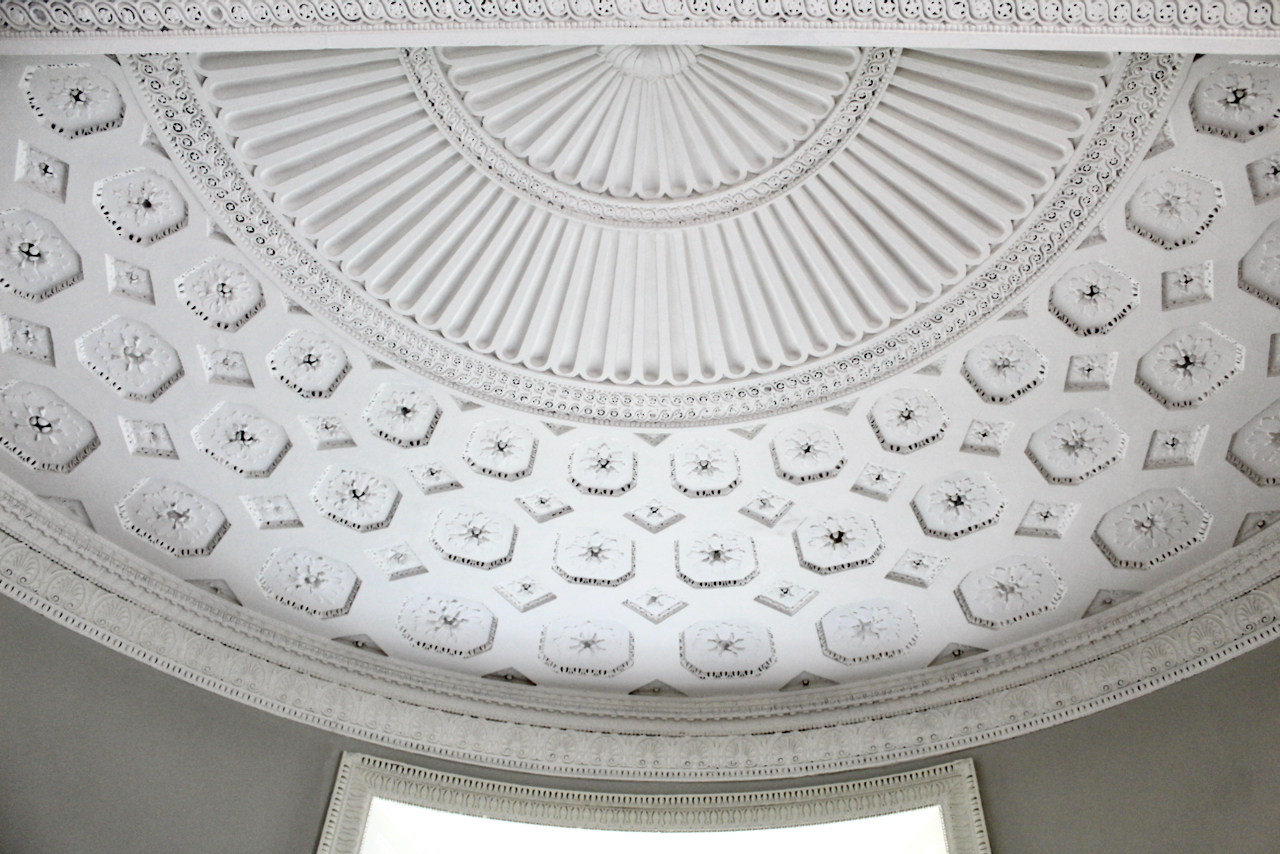
The website describes the Boudoir: “The ceiling plasterwork dates from about 1790 and is in the Adam style, with husk chains and classical motifs in medallions surrounding the central decoration of a fan-like or bat’s-wing motif, which is itself echoed in the heads of the niches. The unusual medallion motifs here are similar to those in a ceiling in 35 North Great George’s Street, Dublin which has been attributed to Francis Ryan or Michael Stapleton and dated to 1783. It is in particularly fine condition and clearly articulated without excessive applications of paint.

During the OPW restoration work, it was possible to examine the original decorations and colour scheme of the Georgian house here because the ceiling heights had been changed in the Guinness alterations. Particular attention has been paid in the selection of fabrics for this room to reflect its character.

An item of particular interest is the pair of engraved brass lock-plates on the door into the corridor which are similar to some in Iveagh House where they are original to that 1736 house! They are the only examples of these at Farmleigh and it is presumed that they got here through Fuller who also worked at Iveagh House.

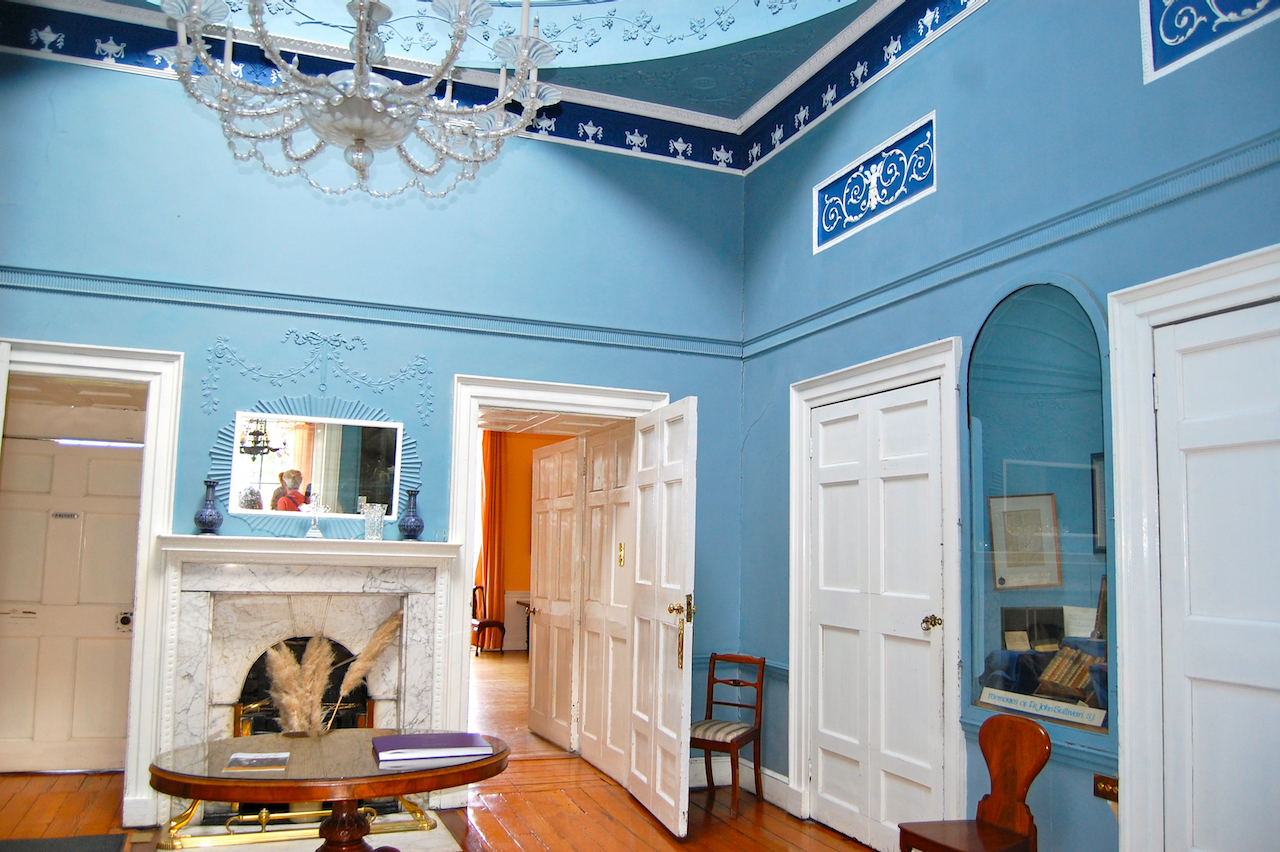
One of the former drawing rooms is now called the “Nobel Room” and honours the memory of Ireland’s four Nobel Laureates for literature: George Bernard Shaw, William Butler Yeats, Samuel Beckett and Seamus Heaney. It interconnects with the “Blue Drawing Room.” These rooms were significantly re-modelled by Fuller in the 1880s, and again in the 1890s by William Young. The saucer-domed ceiling in the Nobel Room is in the style of the 1820s and its plasterwork of vine-leaves, grapes and vases filled with fruit and flowers indicates that it may have been a dining room. A clever touch is the window over the fireplace, an unusual feature. Christine Casey writes: “Taking a leaf from Charles Barry’s book, Fuller went to pains to move the fireplace to the centre of the rear wall to create an arresting overmantel window.”
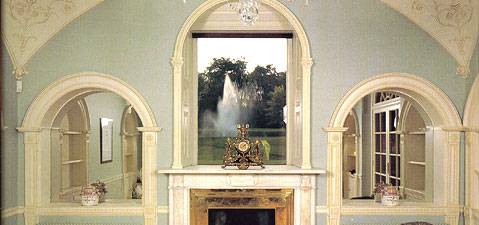
The Nobel Room and Blue Room, with the window over the fireplace, Farmleigh, photograph courtesy of Office of Public Works Farmleigh website.

The Blue Room is an ante room to the Ballroom. The ceiling was copied from that in the Oval Room, though it is not at all as finely executed as the original. The three arched doorways in these rooms were created out of windows in the old house when Young added the Ballroom in 1896.
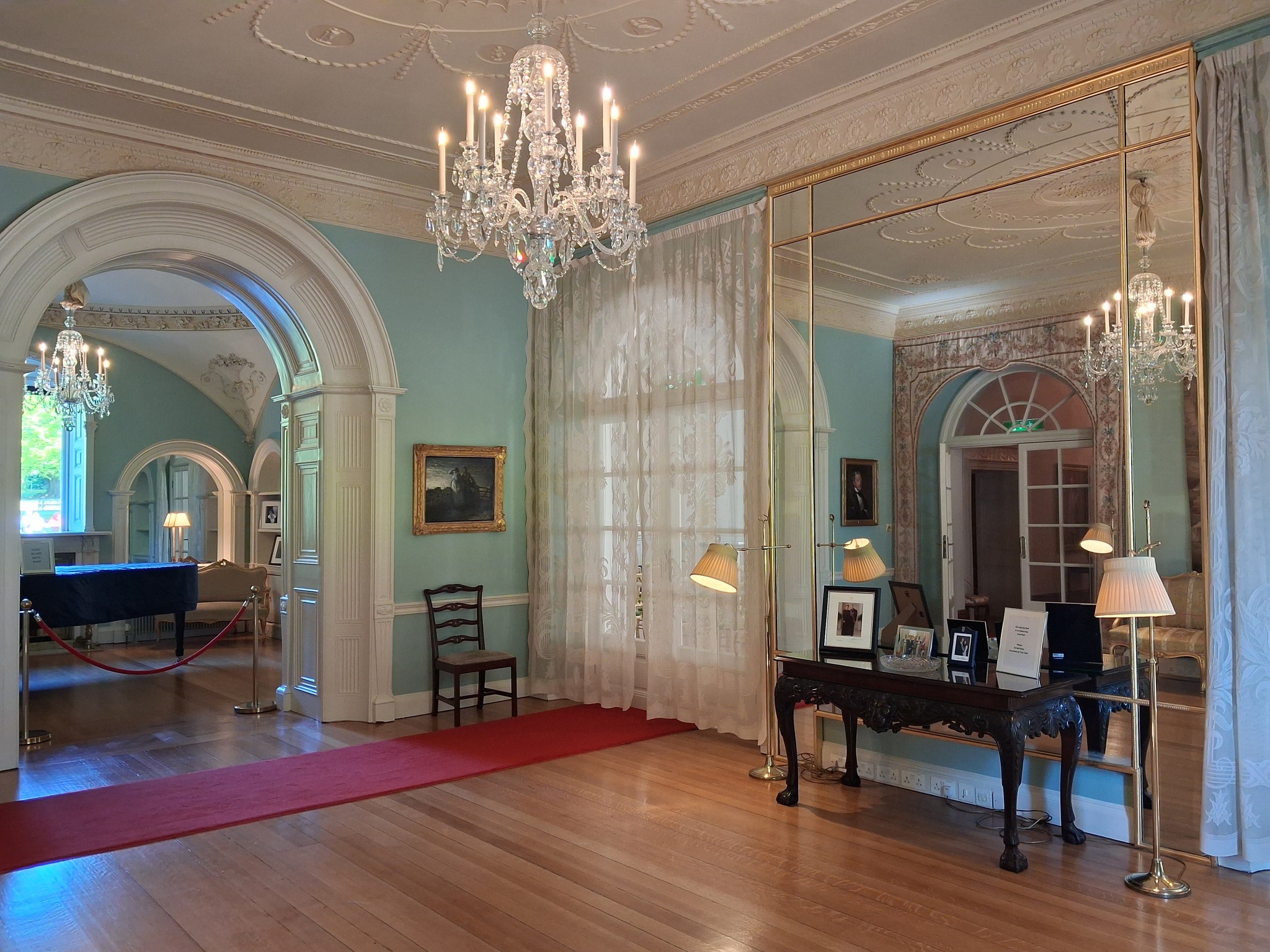
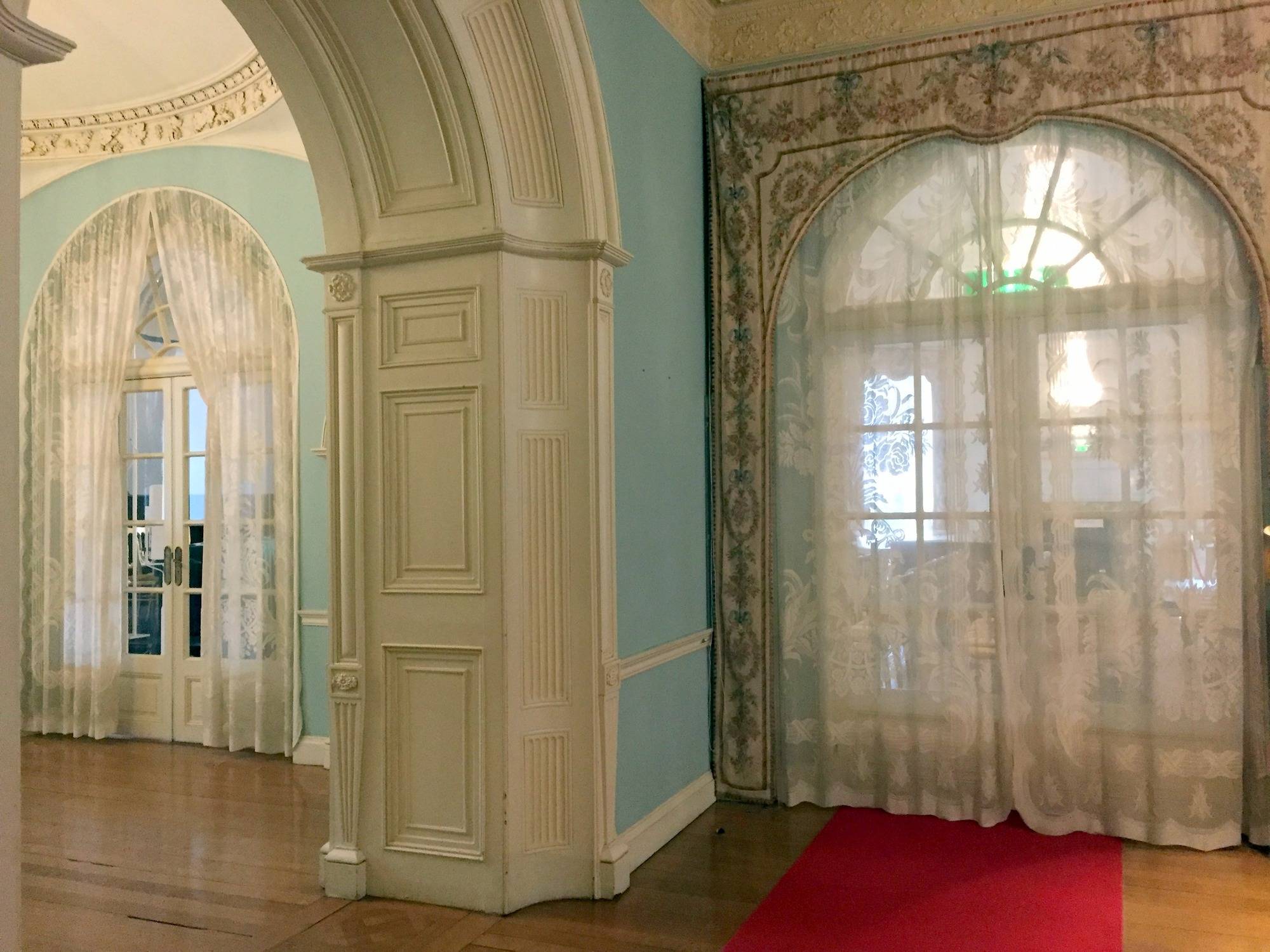
The Blue Drawing Room, photograph courtesy of Farmleigh facebook page.
Blue Room, Farmleigh, with a “portiere” over the arched door on the right, photograph courtesy of Office of Public Works Farmleigh website.
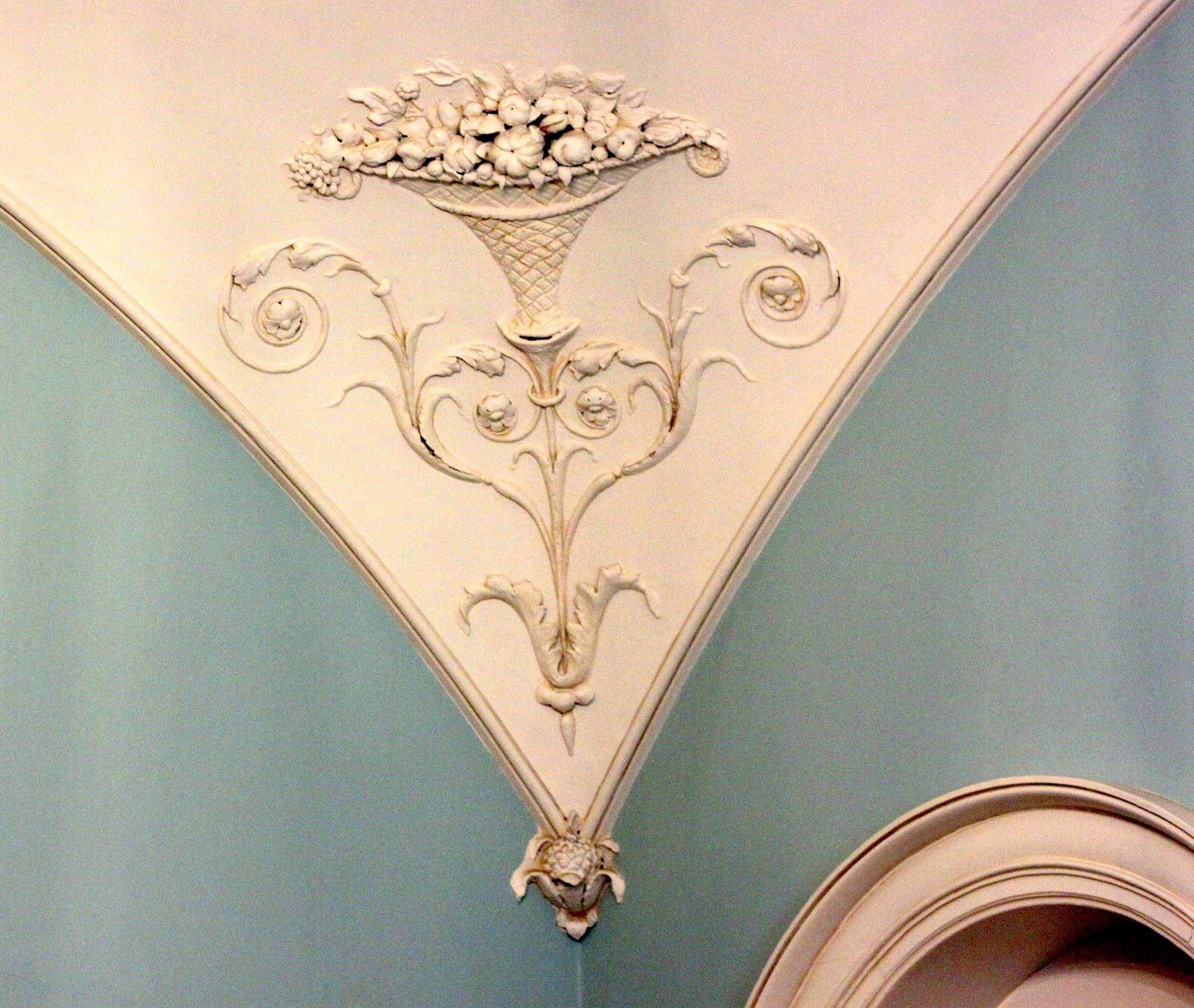
The spandrels in the Nobel Room support a circular ceiling. The spandrels have overscaled Rococo-revival flower baskets, Farmleigh, photograph courtesy of Office of Public Works Farmleigh website.

The suite for state guests, which is not included in the house tour, is inspired by designs of Irish modernist Eileen Gray (you can see examples of her work in the Museum at Collins Barracks in Dublin). 

The house also contains the Benjamin Iveagh Library, donated by the Guinness family to Dublin’s Marsh’s Library and on permanent display in Farmleigh. The Library, which is panelled in Austrian Oak with exquisitely rendered carvings in the neo – Jacobean style, was part of the renovation undertaken by Edward Cecil in the 1880s. Scholars can access material from the collection by arrangement. The Benjamin Iveagh Library is open for use by suitably qualified scholars, third-level students, and independent researchers. A full electronic catalogue of the collection may be viewed online via Marsh’s Library.
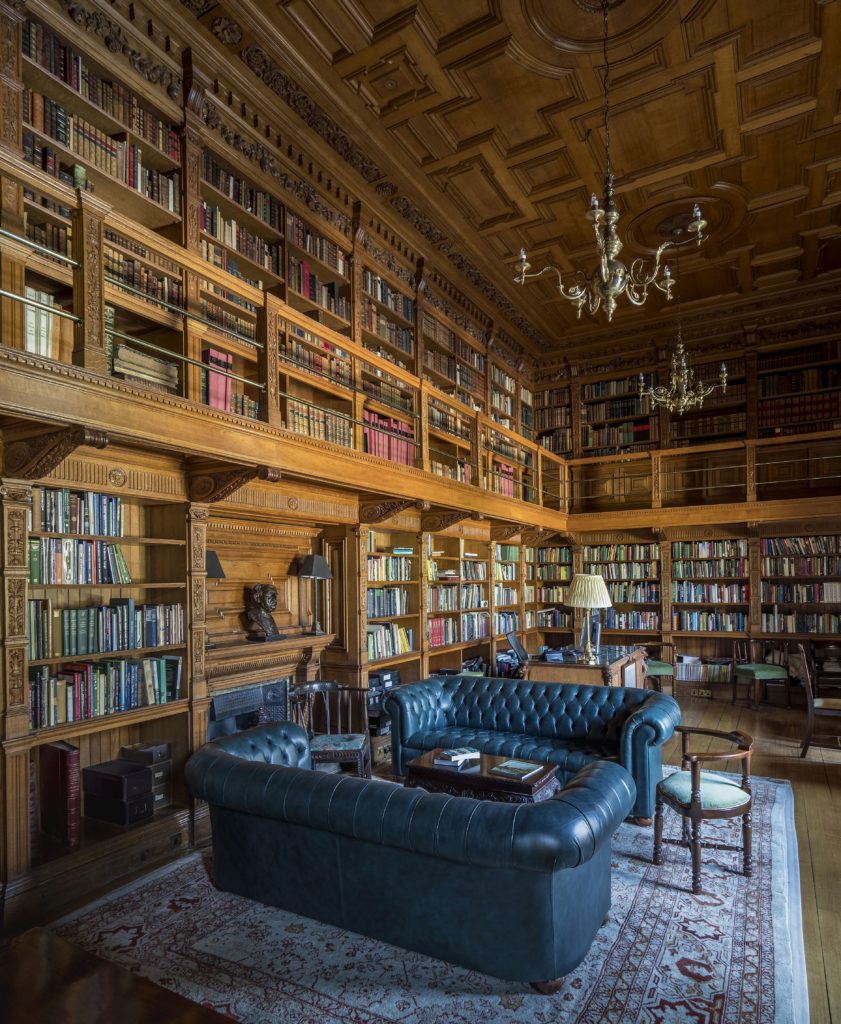
The Library, Farmleigh, photograph courtesy of Office of Public Works Farmleigh website.

Applications to carry out research in the Benjamin Iveagh Library may be made to the Keeper of Marsh’s Library.
Email: reading.room@marshlibrary.ie

The librarian Nuala Canny writes:

“While the printed works which include many rare imprints and early periodicals represent the majority of the holdings, there is some exceptional manuscript material, including a copy of the Topography of Ireland by Gerald of Wales c.1280, and the trilingual language primer used by Queen Elizabeth I c. 1564  to learn Irish, together with letters from Sean O’Casey, W.B. Yeats, Lennox Robinson, Daniel O’Connell and Roger Casement.

“The items that adorn these shelves represent important moments in the areas of Irish Politics, Literature, and Science: we have a triumphant letter from Daniel O’Connell to his wife in 1829 telling her of the passing of the Roman Catholic Relief Act, which led to Catholic Emancipation,  a first edition of James Joyce’s seminal work Ulysses published in 1922 and the first appearance in print in 1662 of Boyle’s Law.”

The Ballroom with adjoining conservatory is the piéce de resistance of the house. The ballroom was designed by William Young in 1892. It is a large rectangular room with bows in the centre of the north, east and south walls. Casey writes that “it is a much more reticent affair than the showy marble ballroom that Young designed the Guinness townhouse at St. Stephen’s Green [as pictured above].”
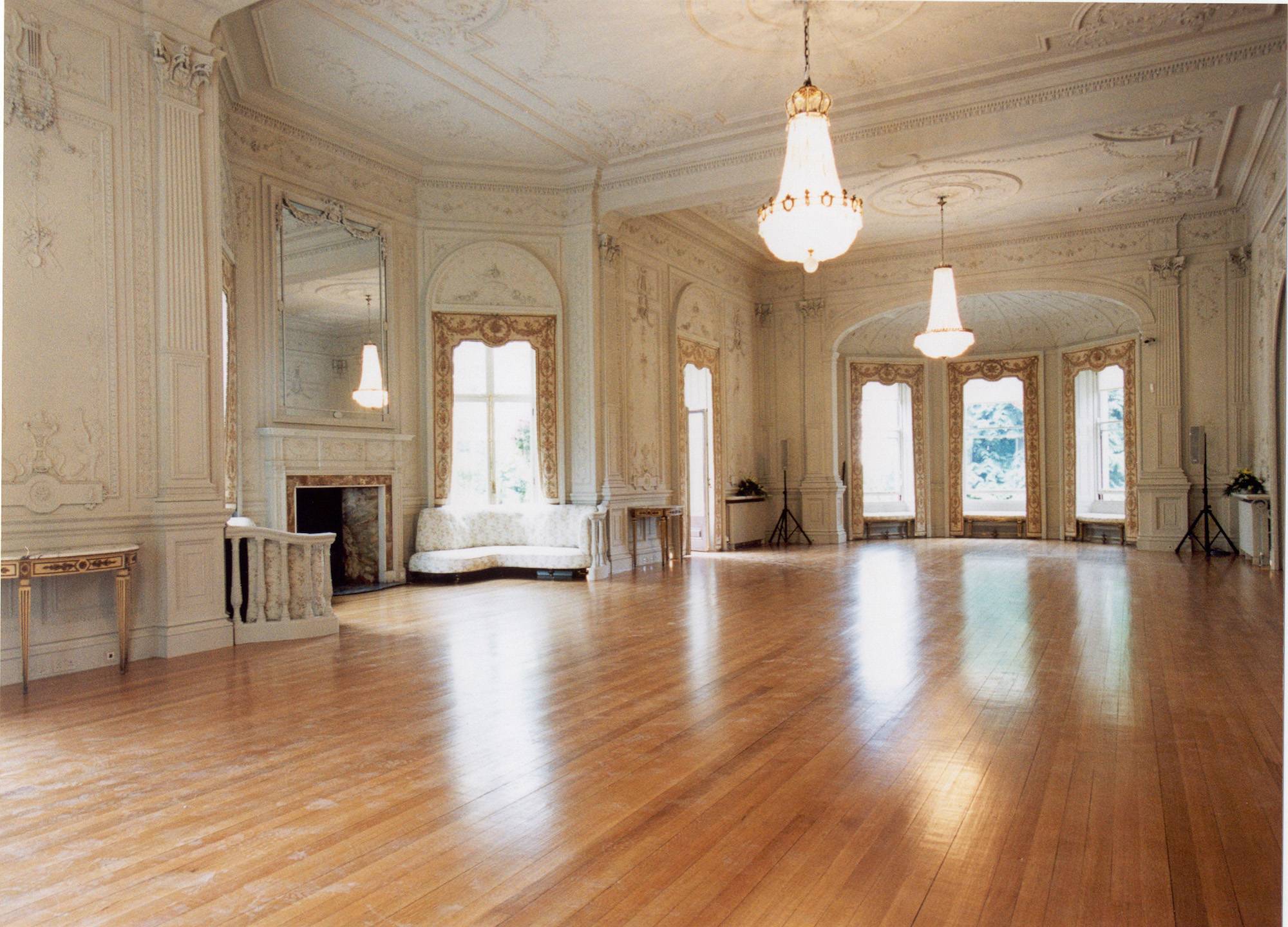
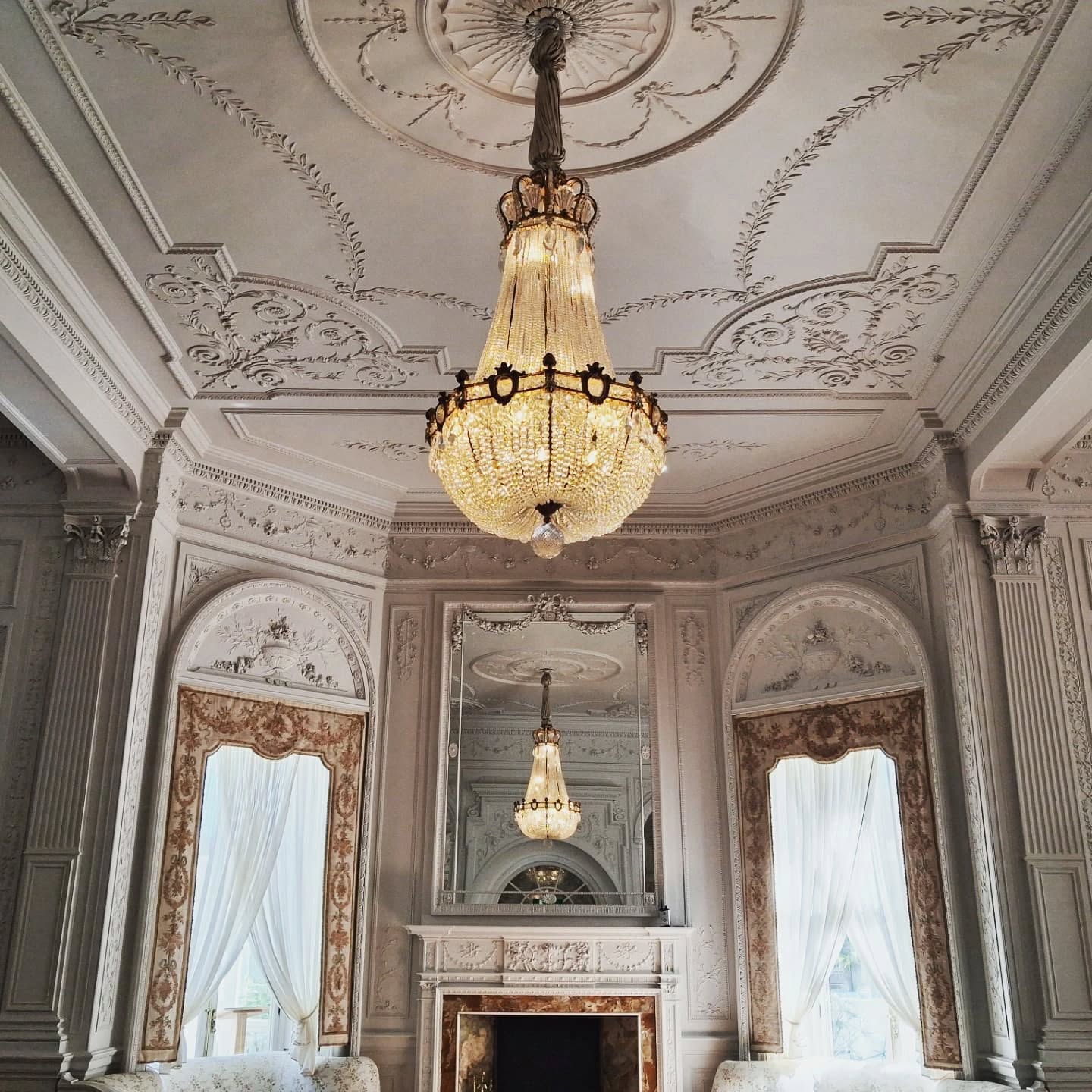
The Ballroom, Farmleigh, photograph courtesy of Office of Public Works Farmleigh website.
Ballroom at Farmleigh, photograph courtesy of Farmleigh facebook page.

The website tells us:

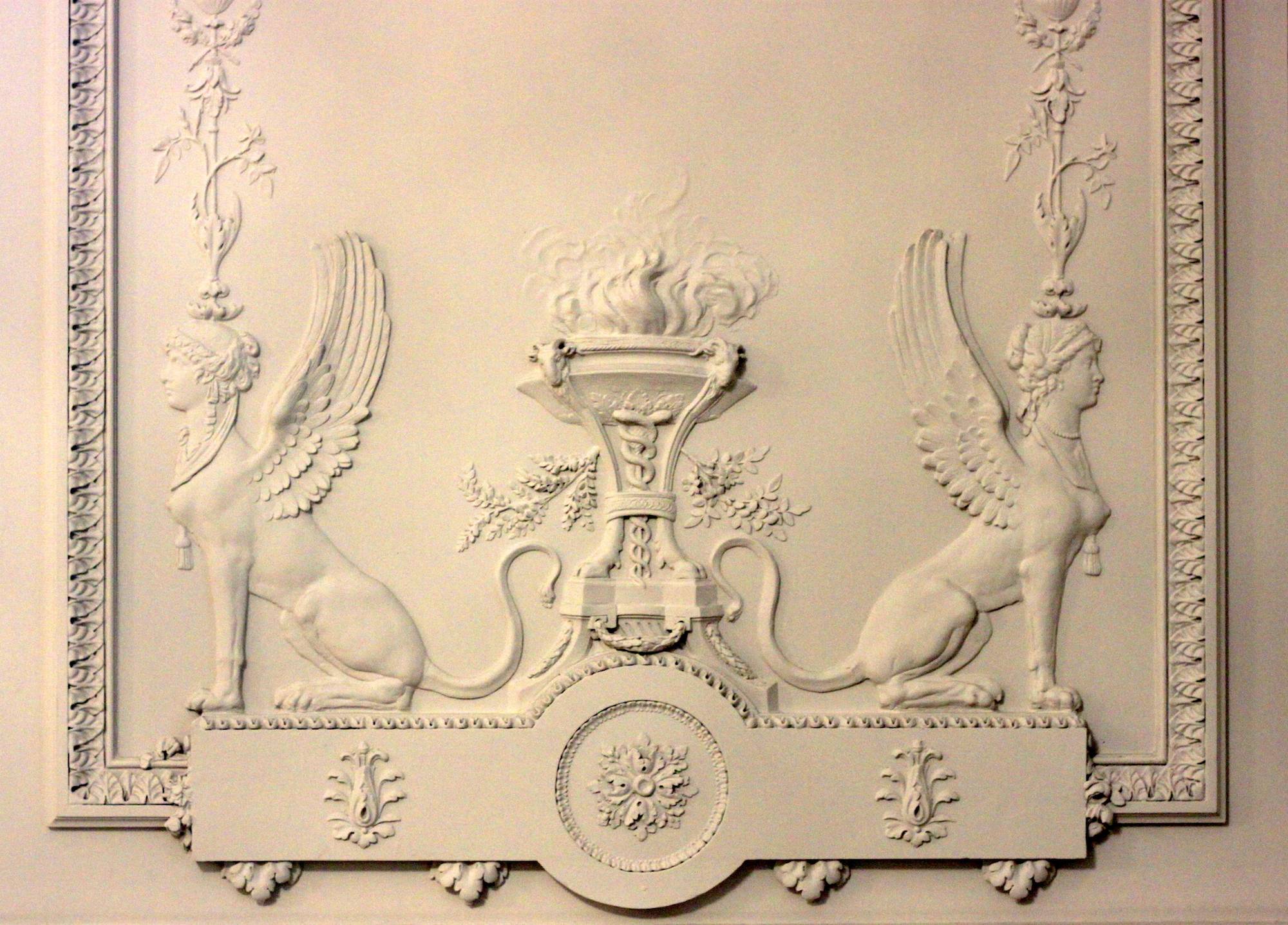
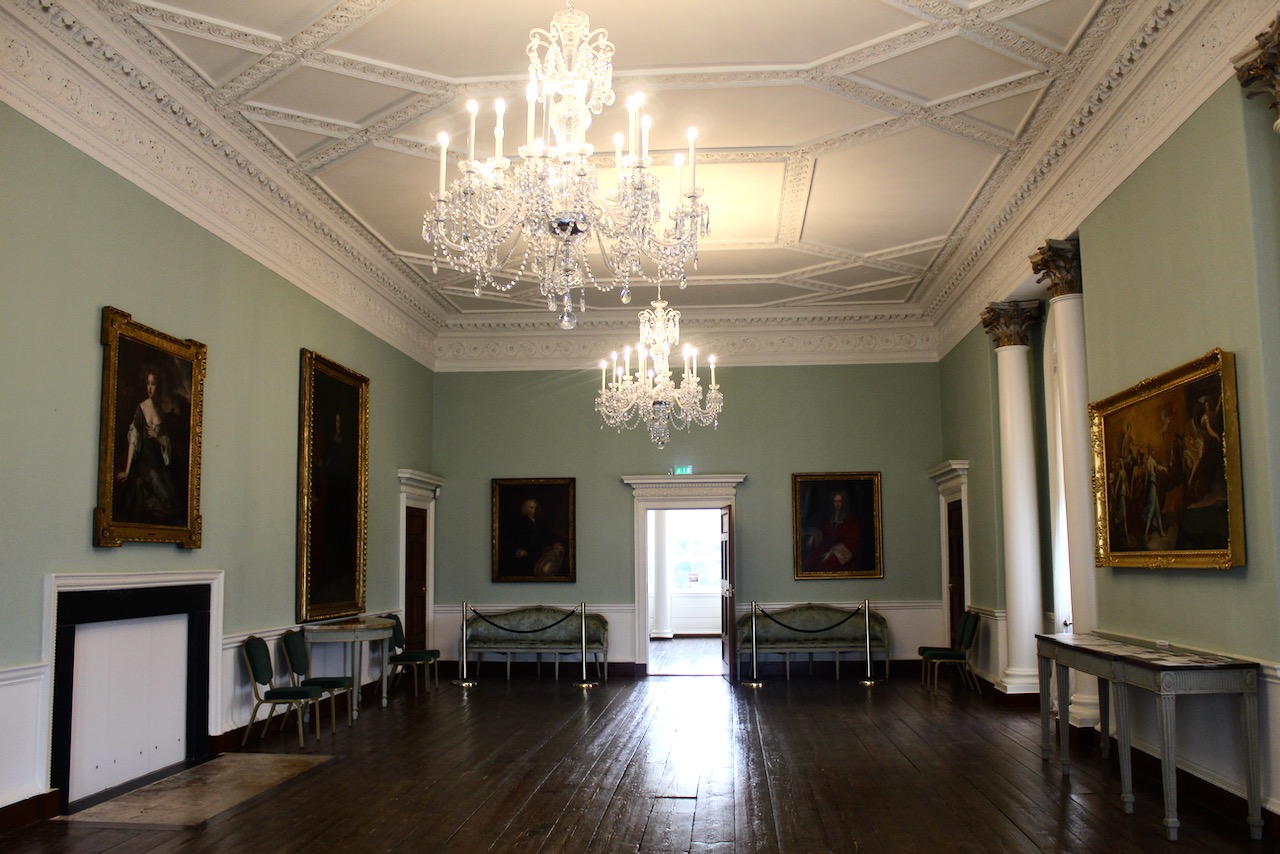
The Guinness’ guests could not fail to be impressed with the superb decoration in the style of Louis XVI with swags, wreaths, musical trophies, urns, sphinxes, and Corinthian pilasters. The rich decoration is executed in plaster that is applied to wood panelling, and the whole room, including the ceiling, is painted off-white to resemble plaster. The chimney piece is also made of wood and this, together with the overmantel, the ceiling, and the elegant portieres, were all part of an integrated scheme designed by Young. The Edinburgh-based interior design company Morrisons probably supplied the portieres as they had done so for the Young-designed ballroom at Iveagh House.

The plaster decoration is also by Mellier.
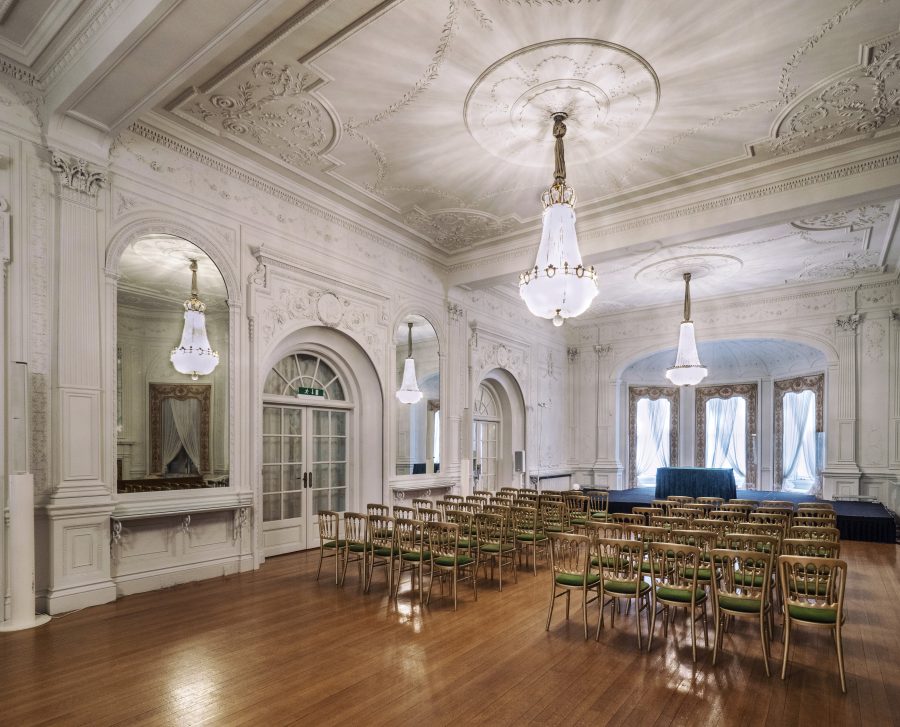
Farmleigh, Dublin, photograph courtesy of https://heritageireland.ie/places-to-visit/farmleigh-house-and-gardens/

Hanging from the centre of the ceiling is a magnificent late nineteenth-century cut-glass and gilt metal chandelier complete with coronet. Purchased specifically for the Ballroom, it is on loan from the Guinness family. There is a story that the oak floor was made from disused barrels at the brewery but that has never been confirmed!

The Ballroom, Farmleigh, photograph courtesy of Office of Public Works Farmleigh website.

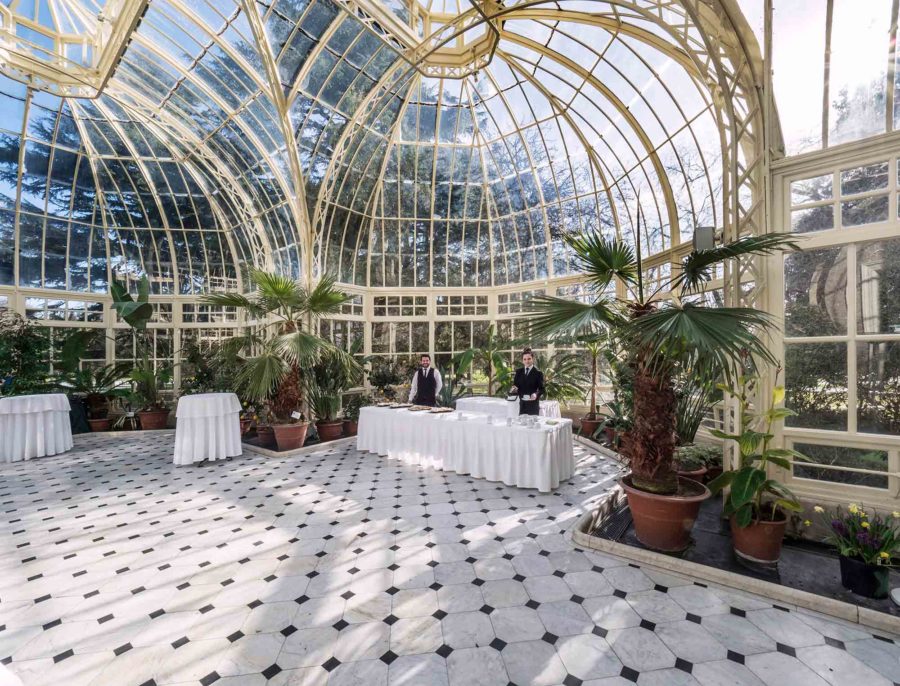
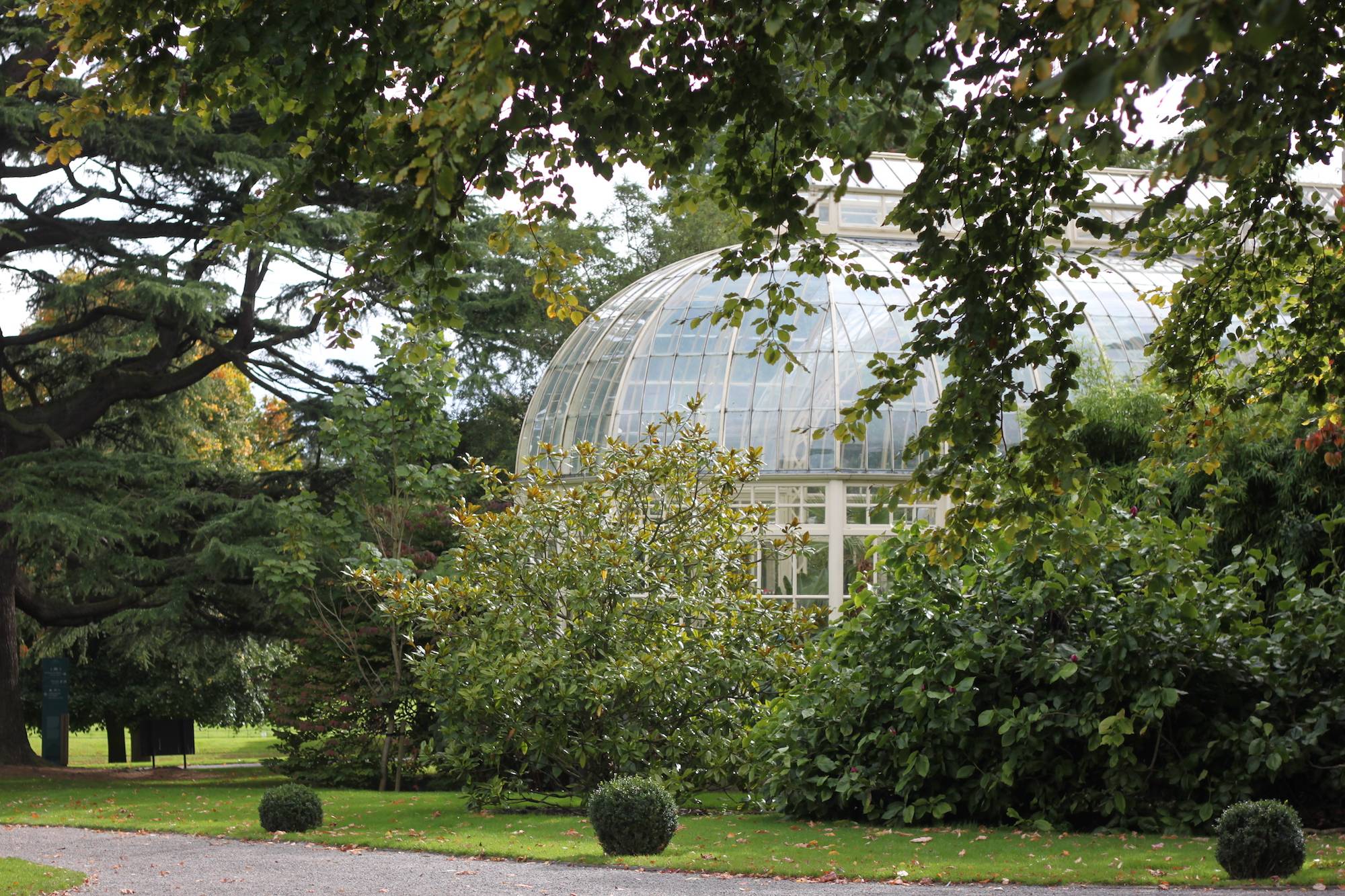
The Conservatory: “Erected in 1901-2, it was supplied by Mackenzie and Moncur of Edinburgh, on the recommendation of Young. Exotic plants and flowers were grown here, and have been re-introduced by the Office of Public Works. Hot water pipes that ran around the perimeter were covered up by cast iron grilles, which have been restored. The marble floor, which is original, is tiled in the traditional eighteenth-century pattern of carreaux octagons.

This room posed one of the most difficult conservation problems for the OPW at Farmleigh, as it was in a dangerous condition when the State took over the house. It was completely re-glazed and new structural supports for high-level metal work were introduced. As a result the character of the Conservatory has been retained and its life span increased for at least another 100 years.

Farmleigh, Dublin, photograph courtesy of https://heritageireland.ie/places-to-visit/farmleigh-house-and-gardens/
The Conservatory at Farmleigh, photograph courtesy of Office of Public Works Farmleigh website.
Farmleigh, photograph courtesy of Farmleigh facebook page.

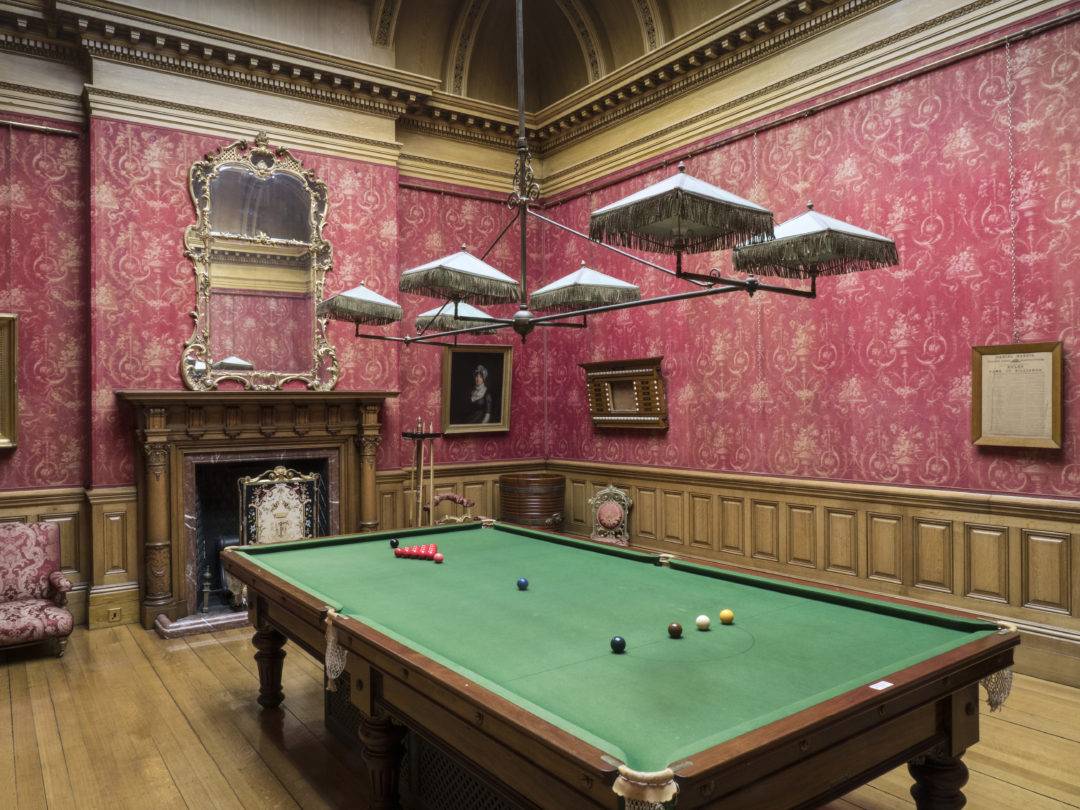
A room we don’t see on the tour is discussed on the blog on the Farmleigh website: the Billiard Room:

Located at mezzanine level between the ground and first floors, typical of nineteenth century billiard rooms to keep offending cigar odours away from the rest of the house and male visitors appropriately distanced from visiting ladies, it is very much a masculine enclave. Beneath a top-lit roof – reconstructed and reglazed with ultraviolet screens by the OPW – the plaster cornice, deep ceiling cove and decorative ribs are painted in imitation of timber. The oak chimneypiece with Corinthian columns and carved frieze to the south of the room is dark in colour, lending to the heaviness about the overall decor when combined with the distinctive red cotton wall fabric which is printed with an arabesque motif.

The Billiard Room at Farmleigh, photograph courtesy of Office of Public Works Farmleigh website.

The grounds contain a clock tower, a large classical fountain in the Pleasure Grounds, an ornamental dairy, garden temple and four acre walled garden and sunken garden. The outbuildings have been adapted to house an art gallery and a theatre and a courtyard for additional state accommodation. The Boathouse now houses a cafe overlooking the lake.
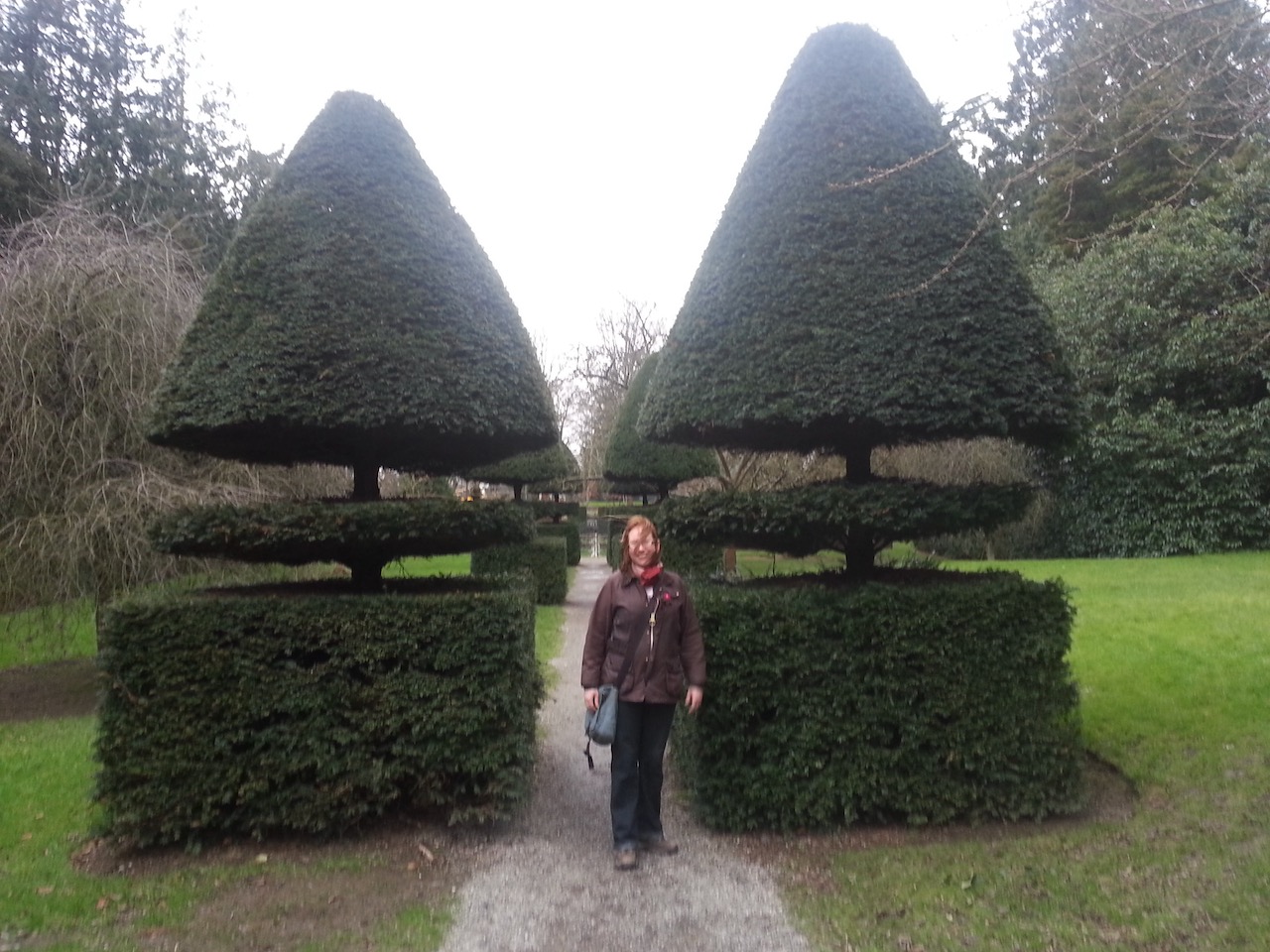
Gardens at Farmleigh, Phoenix Park, February 2014. Photograph © Jennifer Winder-Baggot, www.irishhistorichouses.com
Gardens at Farmleigh, Phoenix Park, Dublin, August 2015. Photograph © Jennifer Winder-Baggot, www.irishhistorichouses.com

Sunken gardens in various formal styles were popular in the early twentieth century… This one is in the Dutch of Early English style and was created some time after 1907, probably by Edward Cecil Guinness. The design has some similarities with the sunken pond garden at Hampton Court, which dates from the original Early English period, and may relate to his connections with the British Royal family.

An ornamental gate leads into the rectangular garden, which was designed with three descending brick terraces leading to an oval pool in the centre, with a marble fountain of carved putti figures. The fountain has been restored under the direction of OPW and the Carrara marble exposed. Fine topiary peacocks and spirals surround this fountain on two levels. A brick wall enclosing the garden is paralleled by a high yew hedge, which leads the eye to the two conifers framing the view to the small apple orchard beyond.” [3]
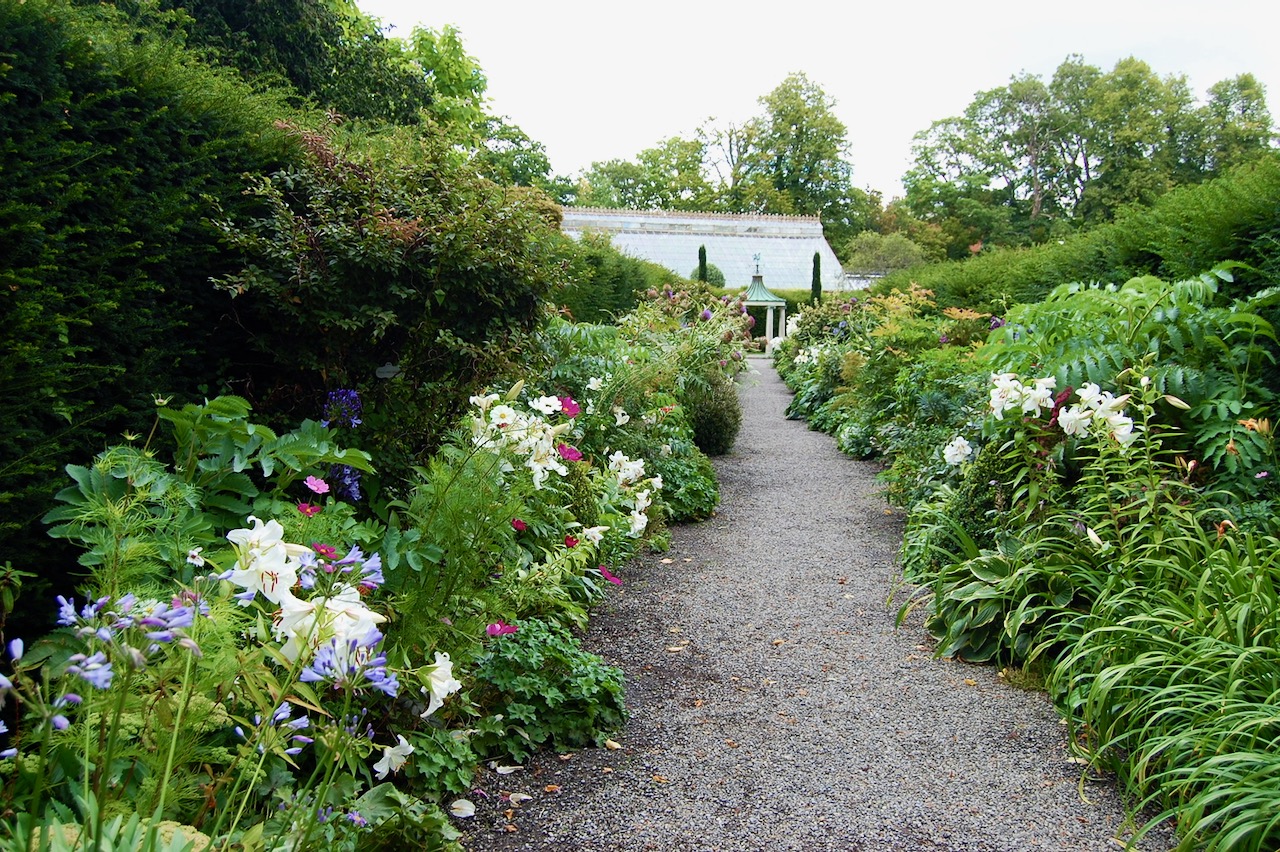
Gardens at Farmleigh, Phoenix Park, Dublin, August 2015. Photograph © Jennifer Winder-Baggot, www.irishhistorichouses.com

“The Walled Garden covers about four acres and is sloped ideally towards the south. A fine pair of highly decorative wrought iron gates lead into a diagonal walk with double herbaceous borders backed by high yew hedges. South of the main crosswalk is a small orchard and potager, while north of it there is a small rose and lavender garden. The Walled Garden dates from the early nineteenth century, when Charles Trench owned Farmleigh; it is shown on the 1837 Ordnance Survey map as having a diagonal layout with seven squares and glasshouse. Later that century it had an extensive range of glasshouses on the south wall for many plants grown in typical Victorian fashion to support large-scale bedding schemes as well as producing exotic fruit and flowers and foliage, particularly orchids and ferns, for year round display in the house.

Among the additions made by Edward Cecil Guinness were the small Victorian fernery under glass and grotto nearby with two old ogee windows from St Patrick’s Cathedral in the end wall of the garden. He also erected a number of glasshouses, including a fine three quarter span cast-iron vinery behind the high yew hedge, the potting shed, and the gardener’s house and pump house which were built in the Arts and Crafts style. His daughter in-law, Gwendolen, Lady Iveagh, subsequently created a compartmentalised layout, which was fashionable in the early twentieth century along with renewed interest in old style garden plants and herbaceous borders. A new traditional path led from the wrought iron gateway connecting the Walled Garden to the broad walk at the back of the house. This new axis of the garden was reinforced by tall yew hedges backing the long double herbaceous borders which she also planted.

A stone temple was created as a focal point of the garden by Benjamin and Miranda Guinness in 1971: it has six antique columns of Portland with a copper roof and ornamental weather vane. The main cross path either side of the temple has metal structures designed by Lanning Roper for climbing roses and wisteria similar to those in the famous Bagatelle Garden in Paris. A paved rose garden was laid out to the north east of the temple backed by a yew hedge and looking across a lawn to the small orchard and potage. Lanning Roper suggested planting a quince, a mulberry, a catalpa, and a magnolia, to complete what he described as a Carolingian Quartet on this lawn. Lady Iveagh subsequently planted the double herbaceous borders, which include yuccas, phormiums, paeonies, astilbe and euphorbias.” [4]
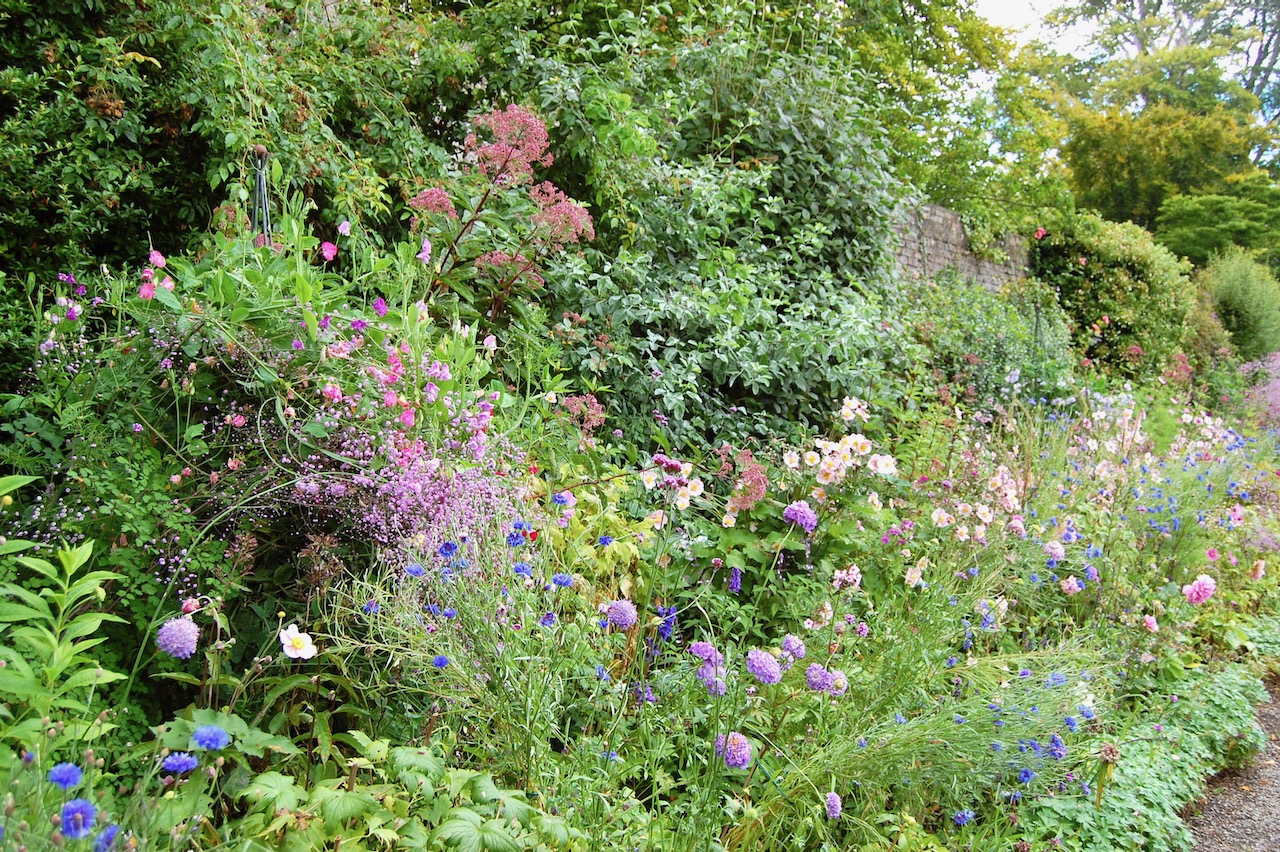
Gardens at Farmleigh, Phoenix Park, Dublin, August 2015. Photograph © Jennifer Winder-Baggot, www.irishhistorichouses.com

[1] See also https://farmleigh.ie/

[2] https://farmleigh.ie/the-guinness-family/

[3] https://farmleigh.ie/the-parkland/

[4] https://farmleigh.ie/the-parkland/

85 North King Street, Smithfield, Dublin 7

85 North King Street, Smithfield, Dublin 7, Smithfield, Dublin 7 for sale July 2025 photgraphs courtesy DNG

85 North King Street, Smithfield, Dublin 7, Smithfield, Dublin 7 for sale July 2025 photgraphs courtesy DNG.

D07RK6A

€850,000

7 Bed3 Bath276 m²

DNG are delighted to present one of the earliest Georgian architectural buildings c. 1650 situated adjacent Stoneybatter and opposite Smithfield Market and close to the soon to be redeveloped Fruit Market. A very highly impressive four storey over basement residence. Rich in period features including high ceilings, ornate coving, carved cornice, elaborately carved and scrolled consoles, fanlight over carved lintel, elegant doorcase, red brick voussoirs, Round-headed door opening and sash windows. The house is of wonderful proportions and briefly comprises of an entrance hallway, two grand reception rooms, kitchen, seven bedrooms and three bathrooms.

85 North King Street, Smithfield, Dublin 7, Smithfield, Dublin 7 for sale July 2025 photgraphs courtesy DNG.

To the front there is a city garden with wrought iron gates and railings leading to round-headed entrance door. There is walled yard to rear with pedestrian access and derelict cook house. The building benefits a new roof, reinforced staircase and added steel in the basement. The property presents an excellent opportunity to set up home in a much sought after, central location less than 400m from Smithfield Luas and 20 minutes from Heuston Station. This historic building is within easy access to an excellent selection of amenities including cafés, shops, bars and restaurants in close proximity. The Lighthouse Cinema and Jameson visitor centre are on your doorstep as are The Four Courts, Law Library, the new TUD College Campus at Grangegorman and only 8 minutes by bicycle to Trinity College. Dublin Airport is within a short drive and the area allows easy access to the M3/M50 intersection. Viewing of this fine home comes very highly recommended.

85 North King Street, Smithfield, Dublin 7, Smithfield, Dublin 7 for sale July 2025 photgraphs courtesy DNG.

Hall Entrance hallway with high ceilings, hardwood front door with ornate fan light, original ornate coving,original floor boards – leading to original reinforced stairs Reception 1 Front reception with new floor boards, two front sash windows, open plan to second reception room – original high ceilings and ornate covings – original centre rose Reception 2 Back reception room with new floor boards, sash windows and high ceilings – open plan to front reception room Stairs and landing Reinforced original staircase with original floor boards First floor First floor – 2 bedroooms, utility area, fully fitted kitchen, new shower room, new wc – access to hot press Second Floor Second floor – open plan front bedroom/drawing room and large open plan bathroom/bedroom Third/top floor Third/top floor – landing with original floor boards, back bedroom with original floor boards and original open fireplace- wc, whb and cubicle shower – Two bedrooms to front with original floor boards – access to new roof Basement Recently reinforced basement – suitable for a variety of uses Front Cast iron railings to front with pedestrian access Rear Rear – walled yard and incomplete cook house – gated pedestrian access Derelict Cookhouse To rear, requires complete renovation including roof, floors, electric, heating and plumbing.

85 North King Street, Smithfield, Dublin 7, Smithfield, Dublin 7 for sale July 2025 photgraphs courtesy DNG.
85 North King Street, Smithfield, Dublin 7, for sale July 2025 photgraphs courtesy DNG.
85 North King Street, Smithfield, Dublin 7, Smithfield, Dublin 7 for sale July 2025 photgraphs courtesy DNG.
85 North King Street, Smithfield, Dublin 7, for sale July 2025 photgraphs courtesy DNG.

Seamount House, Seamount Road, Malahide, Co Dublin

https://www.buildingsofireland.ie/buildings-search/building/11344033/seamount-house-seamount-road-malahide-malahide-co-dublin

Detached seven-bay two-storey neo-Elizabethan style house with dormer attic, c.1904, incorporating fabric of earlier house. Single-bay two-storey sandstone built canted projecting bay to centre, single-bay single-storey gabled projecting end bay to left. Single-storey flat-roofed extension to rear, c.1980. Partly refenestrated, c.1990. ROOF: Double-pitched and gable-fronted; red clay tiles; red clay ridge tiles; pebble dashed chimney stacks; red clay pots; overhanging timber eaves; cast-iron rainwater goods; flat-roof to projecting canted bay having consoled sandstone canopy over entrance; flat-roof to return. WALLS: Pebble dashed; unpainted; sandstone ashlar to canted projecting bay; sandstone ashlar to ground floor rear elevation. OPENINGS: Square-headed; cut-sandstone surrounds to ground floor; nap rendered surrounds to first floor; leaded timber fixed-pane and casement windows; some replacement uPVC windows; elliptical-headed door opening; diocletian windows to part of dormer attic; timber panelled door.

Seamount House, Seamount Road, Malahide, Co Dublin for sale July 2025 courtesy Sherry Fitzgerald

K36W718

€6,000,000

10 Bed6 Bath660 m²

Seamount House – Perched at the summit of Seamount Hill, Seamount House is a truly remarkable detached residence that combines rich historical heritage with timeless architectural beauty. Set within approximately 1.78 H/A (4.4 acres) of mature, landscaped grounds, this impressive home dates back to circa 1816, originally conceived as a summer retreat for the prominent Talbot de Malahide Estate. Its elegant Neo-Elizabethan design and commanding presence reflect its prestigious origins. From the 1890s to the 1940s, it was home to the illustrious Jameson family, and the property underwent a significant rebuild in 1905, preserving its grand character while incorporating the finest craftsmanship of its time. Designed to be both a luxurious haven and a prestigious residence, Seamount House embodies the grace and refinement of a bygone era. The three-storey, seven-bay façade speaks to a time when architecture was expressive and bold, with every detail carefully considered. The residence was crafted not merely as a home, but as a refined destination—a place of comfort and distinction overlooking the coastline. An Elevated Setting with Breathtaking Views Accessed via secure electronic entrance gates and a meandering private driveway, the property sits high above the surrounding landscape, offering an extraordinary level of privacy and seclusion. The grounds are meticulously maintained, featuring sweeping lawns, mature trees, and sheltered gardens. Pedestrian access from the estate leads directly to Sea park Hill and the picturesque shoreline below, placing nature and coastal serenity right at your doorstep. Panoramic vistas unfold from nearly every corner of the estate, offering dramatic views to the south across Dublin Bay and the city skyline toward the Sugar Loaf Mountains. To the east, the view extends along the scenic Malahide coastline, while to the west, one can glimpse Dublin Airport and the expansive rural hinterlands. The grounds also include a substantial original stone outbuilding, a gravelled courtyard, and a charming arched entrance to the rear, enhancing both the aesthetic and functional value of the estate. A Home of Character and Comfort On entering Seamount House, visitors are immediately struck by its sense of grandeur and refined elegance. The home has been lovingly preserved and sympathetically maintained by its current owners, ensuring that the spirit of its historical origins remains intact. Many original period features have been retained, including ornate cornicing, timber panelling, intricate fireplaces, and sash windows, creating a living environment that is rich in detail and history. The interiors are characterised by high ceilings, light-filled spaces, and an atmosphere of warmth and hospitality. A generous reception hall sets the tone for the rest of the house, leading into five substantial reception rooms on the ground floor—each offering spectacular views southward over the city and bay. These formal and informal spaces provide ample room for both entertaining and family life. A charming breakfast room connects to a well-appointed kitchen, and further accommodation includes a private study, guest WC, washroom, utility room, and a walk-in freezer room. Just off the kitchen lies a secluded courtyard—an ideal retreat for outdoor dining or morning coffee. Elegant Private Quarters with Unrivalled Views An original staircase with carved balustrade leads to the first floor, where a stunning stained-glass window—featuring the Jameson family crest—floods the landing with coloured light. This level hosts five generous bedrooms, including the principal suite, which boasts a bay window that frames sweeping views across the coastline. A recently installed, modern shower room adds contemporary comfort to the historic setting, while an additional WC completes the floor. The rear staircase provides discrete access to the upper level. The second floor, once the staff quarters, is now thoughtfully repurposed for modern living. A large open plan landing currently functions as a home gym, with four additional bedrooms, a separate shower room, and attic storage completing the accommodation. This floor offers flexible space that can easily adapt to a variety of lifestyle needs—be it for guests, family, hobbies, or home working. An Exceptional Opportunity in a Prestigious Coastal Location Seamount House represents a unique and generational opportunity to acquire one of North Dublin’s most historically significant and architecturally outstanding private residences. Its location is second to none—just a short distance from the vibrant centre of Malahide Village, where an abundance of amenities awaits. Residents can enjoy fine dining, boutique shopping, quality schools, and a host of recreational facilities, including sailing, golf, tennis, and more. The scenic coastline offers endless opportunities for walking and water sports, while the magnificent Malahide Castle and its 300-acre demesne provide woodland trails, ornamental gardens, and a historic setting for leisure and community events. With convenient access to Dublin Airport and excellent transport links to the city, Seamount House combines the tranquillity of a private coastal estate with the connectivity and convenience of urban living. This is not just a home—it is a legacy. A place where history, beauty, and lifestyle converge in perfect harmony. • Dublin City Centre circa 16km away • Dublin Airport circa 8KM • M50/M1 Motorway and Port Tunnel circa 7.5km Seamount House is rich in history and perfectly presented with classical style and timeless elegance. GROUND FLOOR Reception Hall 3.61m x 3.16m. Original black and white tiled floors with ornate ceiling coving, original door CEILING HEIGHT- 3.0M Archway to Open Closet 2.13m x 1.36m Comms Room 2.16m x 1.02m Washroom 2.38m x 1.63m. Original black and white tiled floor, Burlington wash hand basin, taps and finishes, angles picture window Guest WC 2.41m x 0.91m. WC , angled picture window and original black and white tiled floor Sitting Room 6.08m x 4.46m. Adam style fireplace, feature wall panelling, ornate hand painted ceiling, maple hardwood floor, large south facing bay window with magnificent views from Howths head to sugar loaf, Dublin mountains, Dublin city and Dublin airport BAY WINDOW- 2.79M X 0.66M Recess to Stairs 2.09m x 0.98m Drawing Room 10.50m x 4.85m. Polished maple hardwood floor, dual aspect windows, arched fireplace with marble fireplace with brass insert and raised basket, double north facing windows, large south facing bay window with magnificent views from Howths head to sugar loaf, Dublin mountains, Dublin city and Dublin airport, ornate ceiling coving BAY WINDOW- 4.07M X 1.70M ARCHED FIREPLACE- 3.03M X 1.24M Original Entrance Hall 1.37m x 1.13m Dining Room 6.89m x 4.56m. Marble fireplace with brass insert, large south facing bay window, arched recess, parquet flooring, coving on ceiling with ornate centre piece ARCHED RECCESS- 2.11M X 0.44M BAY WINDOW- 3.94M X 0.60M Inner Hall 11.5m x 1.17m Freezer Room 2.19m x 1.29m. Fridge freezer storage space with original red quarry tile floors, wall panelling Utility Room 3.64m x 1.64m. Floor to ceiling fitted storage units with Korean countertops, 1.5 sink units, picture window, original red quarry tile flooring Study 3.75m x 2.73m. Floor to ceiling height fitted cabinets, bespoke fitted shelving, ceiling coving and original red quarry tile floors Breakfast Room 5.67m x 3.76m. Large east facing picture window, ceiling coving with ornate centre pieces, built in shelving units, arched recess with fireplace, original red quarry tile floor ARCHED FIREPLACE- 1.34M X 0.54M Kitchen 4.82m x 4.60m. Exposed beams on ceiling, diamond red quarry floor, classic 90’s oven with bespoke cabinets and Korean countertops, sink unit, central island, door to courtyard Television Room 4.75m x 3.61m. Electric fireplace, built in shelving units, wall panelling, coving on ceiling with ornate centrepiece, polished pine hardwood floor, guest wc off, double patio doors to south facing sun room Guest WC 1.93m x 1.0m. Fully tiled, WHB, WC Sun Room 7.67m x 2.52m. Tiled floor, feature wall panelling, large picture windows to south, east and west, double patio doors leading to south facing rear gardens Rear Hall to Staff Staircase 2.86m x 1.94m FIRST FLOOR Main Landing 5.32m x 4.45m. Impressive open landing with feature stained glass windows with original Jameson crest, ornate arches with detailed coving overlooking staircase, detailed ceiling coving Principal Bathroom 3.67m x 2.98m. South facing picture window with magnificent views from Howth Head to Sugar Loaf mountain, Dublin mountains, Dublin city and Dublin airport Principal Bedroom 6.80m x 5.00m. Large south facing picture window with magnificent views from Howth Head to the Sugar Loaf mountain, Dublin mountains, Dublin city and Dublin airport CEILING HEIGHT- 2.89M OVAL BAY WINDOW- 3.24M X 1.15M MAIN BAY WINDOW- 5.00M X 3.00M Bedroom 4 4.97m x 3.73m. West facing picture window, hand wash basin , carpet flooring Middle Hall 10m – 1.17m. Stairs to former staff quarters Bedroom 2 6.89m x 4.64m. East facing picture window with magnificent views from Howth Head to the Sugar Loaf mountain, Dublin mountains, Dublin city and Dublin airport, carpet flooring, built in wardrobes and ceiling coving Bedroom 3 5.91m x 3.87m. East facing picture window with magnificent views from Howth Head to the Sugar Loaf mountain, Dublin mountains, Dublin city and Dublin airport, carpet flooring, built in wardrobes, ceiling coving and north facing window Hall to Bathrooms 2.5m x 1.16m Bathroom 2.91m x 2.52m. Fully tiled bathroom comprising bath with Mira Elite shower, wash hand basin, wc and picture window Inner Hall 1.1m x 0.95m. Carpet with hotpress and linen storage Shower Room 3.26m 2.65m. Newly tiled with walk in open rainfall shower and floating wash hand basin Bedroom 5 3.44m x 2.35m. Picture window, carpet flooring Rear Stairs Landing 3.85m x 2.06m WC 2.0m x 1.13m. Fully tiled, WHB, WC, frosted picture window Bedroom 6 5.90m x 3.87m. Spacious bedroom with coastal views UPPER FLOOR-FORMER STAFF QUARTERS Landing / Gym 4.76m x 3.89m. Large double glazed picture window, carpet flooring Bedroom 7 5.06m x 4.39m. Large South facing picture window overlooking Howth Head to Dublin city, Sugar loaf mountain, Dublin mountains and Dublin airport, hotpress and built in wardrobe Bedroom 8 3.50m x 3.15m. Large south facing picture window overlooking Howth Head to Dublin city, Sugar loaf mountain, Dublin mountains and Dublin airport, built in wardrobe and shelfing units Inner Hall (Left Side) 2.29m x 0.88m. Carpet flooring with access to bedrooms and shower room Bedroom 9 4.97m x 2.94m. Arched picture window, carpet flooring Inner Hall (Right Side) 3.60m x 1.0m. Carpet Flooring Shower/ Wc 2.28m x 2.19m. Shower , w/c Bedroom 10 3.86m x 3.40m. Arched picture window with arched doorway to attic storage area Attic Storage 3.85m x 3.0m

Rathfarnham Castle, Dublin, an Office of Public Works property

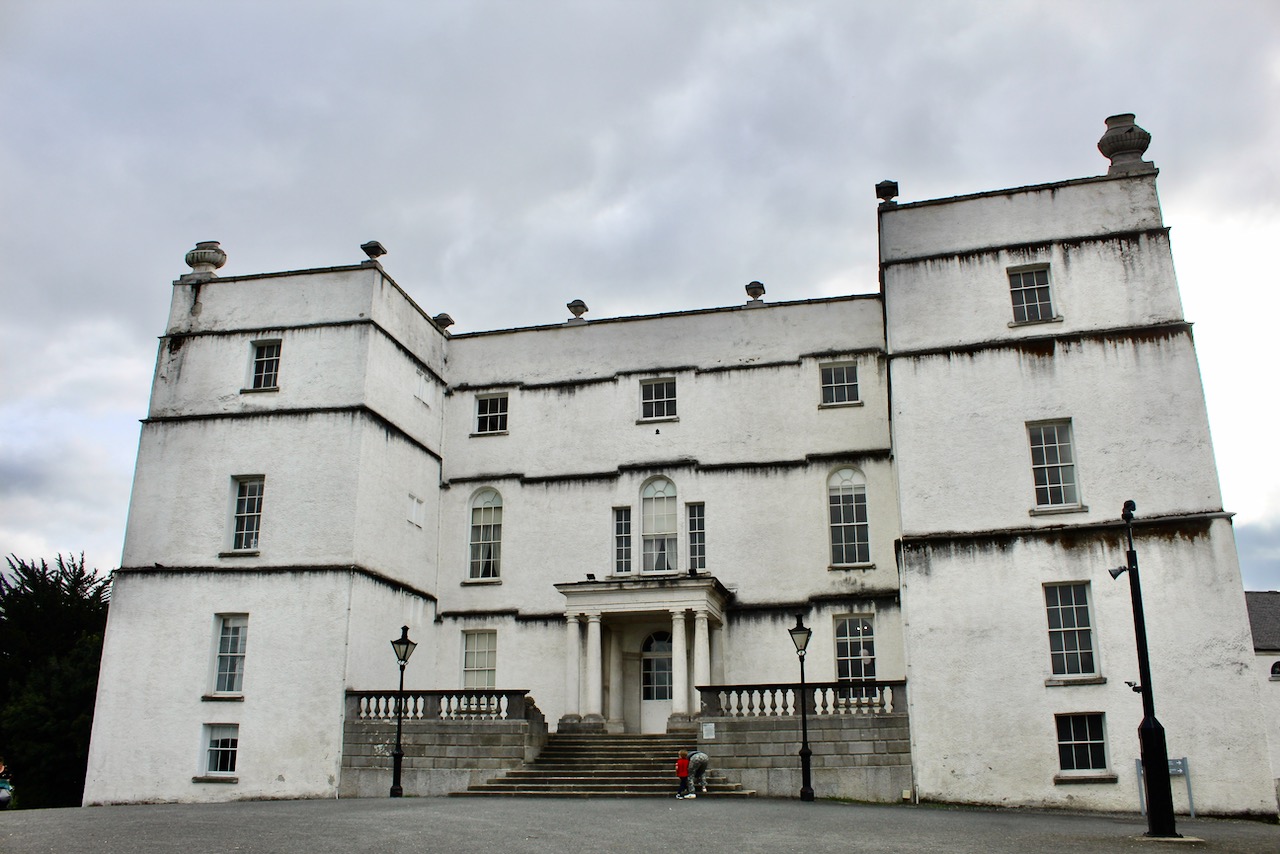
Rathfarnham Castle, Dublin

https://heritageireland.ie/places-to-visit/rathfarnham-castle/

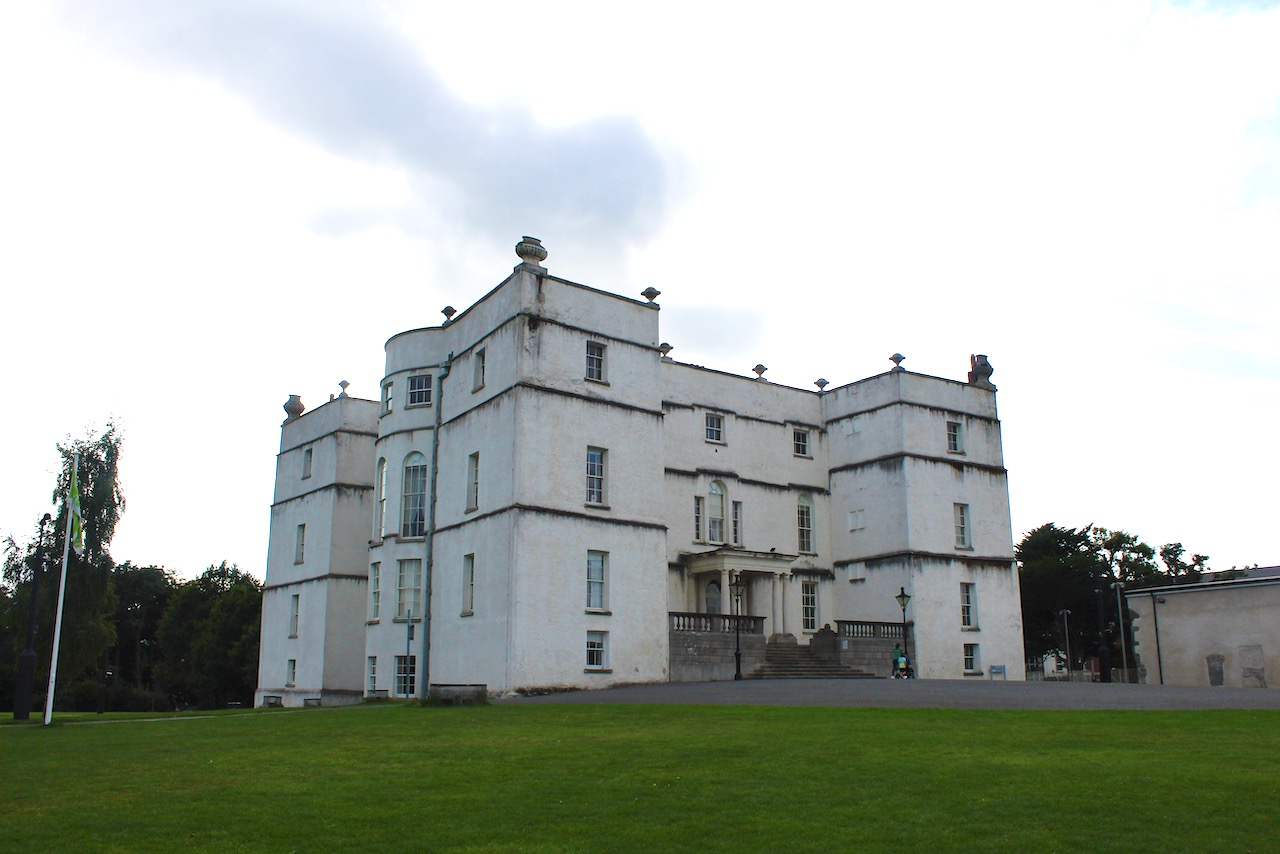
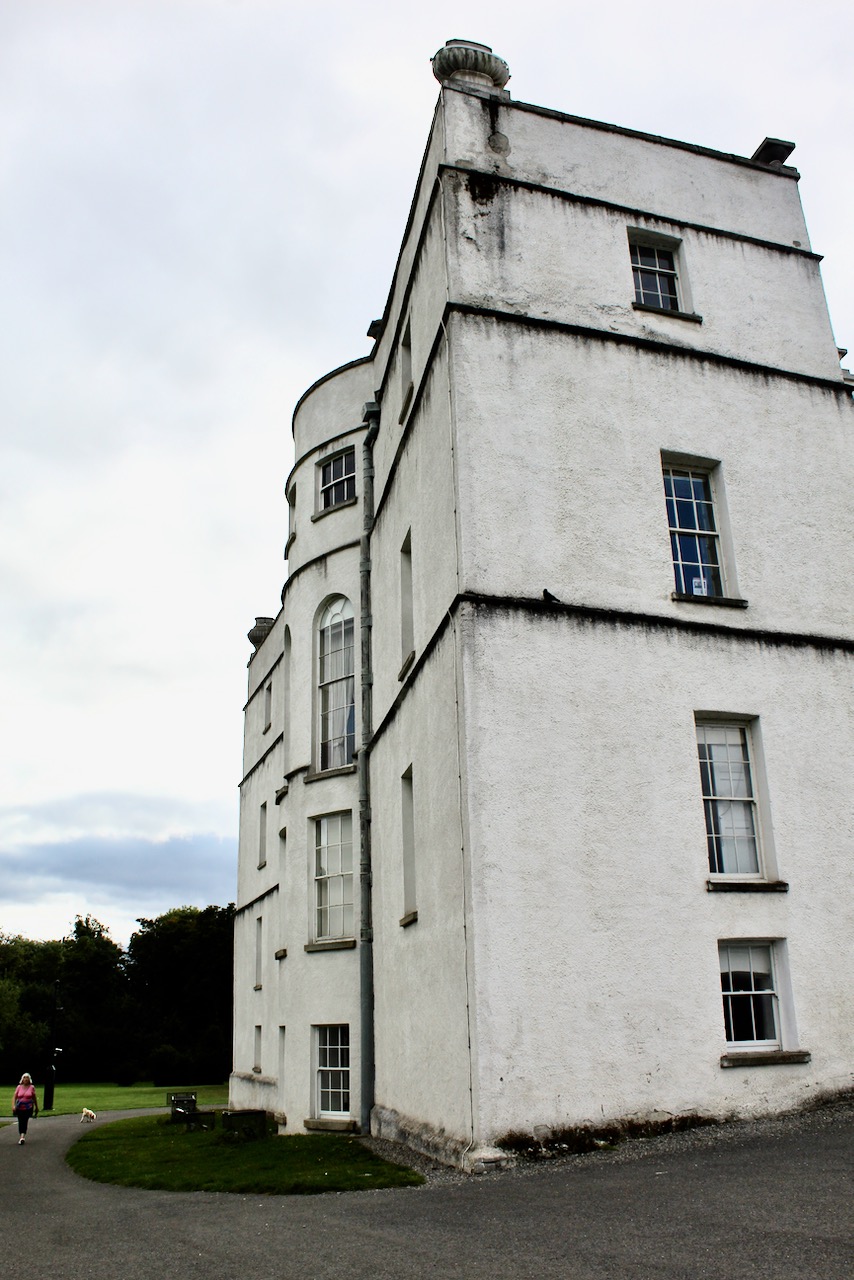
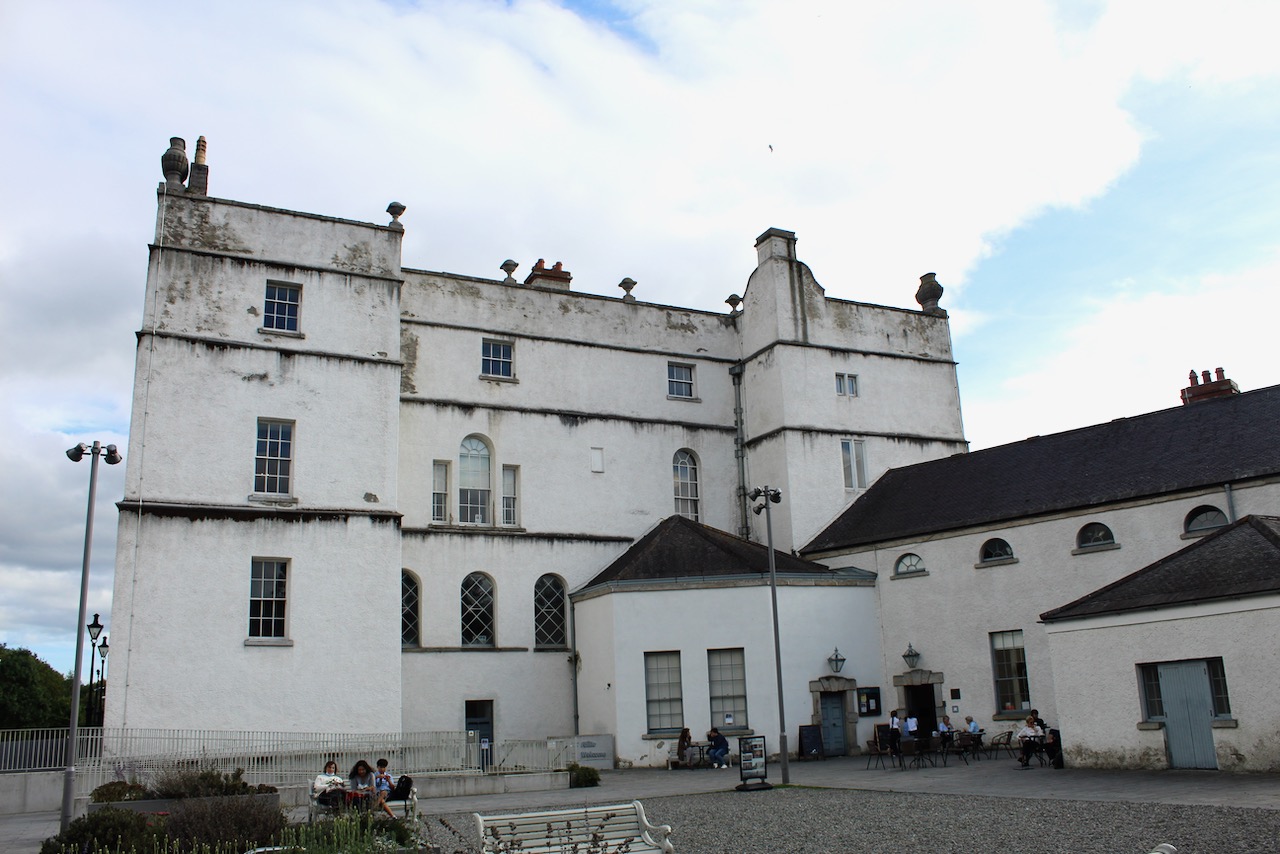
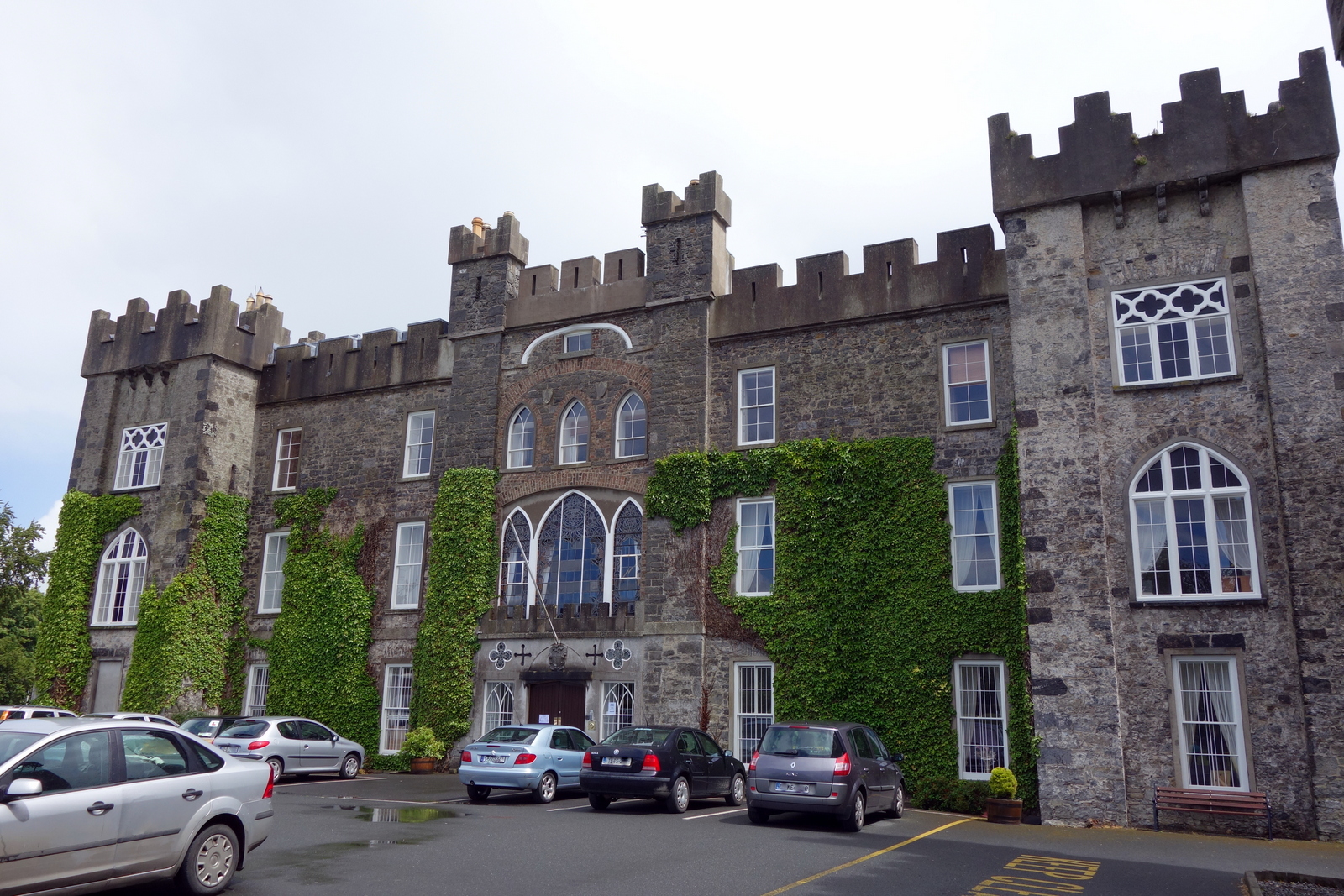
Rathfarnham Castle, Dublin, September 2021. Photograph © Jennifer Winder-Baggot, www.irishhistorichouses.com

General Enquiries: 01 493 9462, rathfarnhamcastle@opw.ie

Rathfarnham Castle is a wonderful property to visit and I suspect, much underappreciated! It is one of the oldest surviving residences in Ireland, and has a variety of impressive ceilings. It is also another property which was inhabited by the Jesuits at one time, as was Emo Court in County Laois. Although they no longer own either of these properties, they still run schools in the former Castle Browne in County Kildare (now Clongowes Wood College) and Belvedere House in Dublin. They certainly knew how to pick impressive properties! [1]

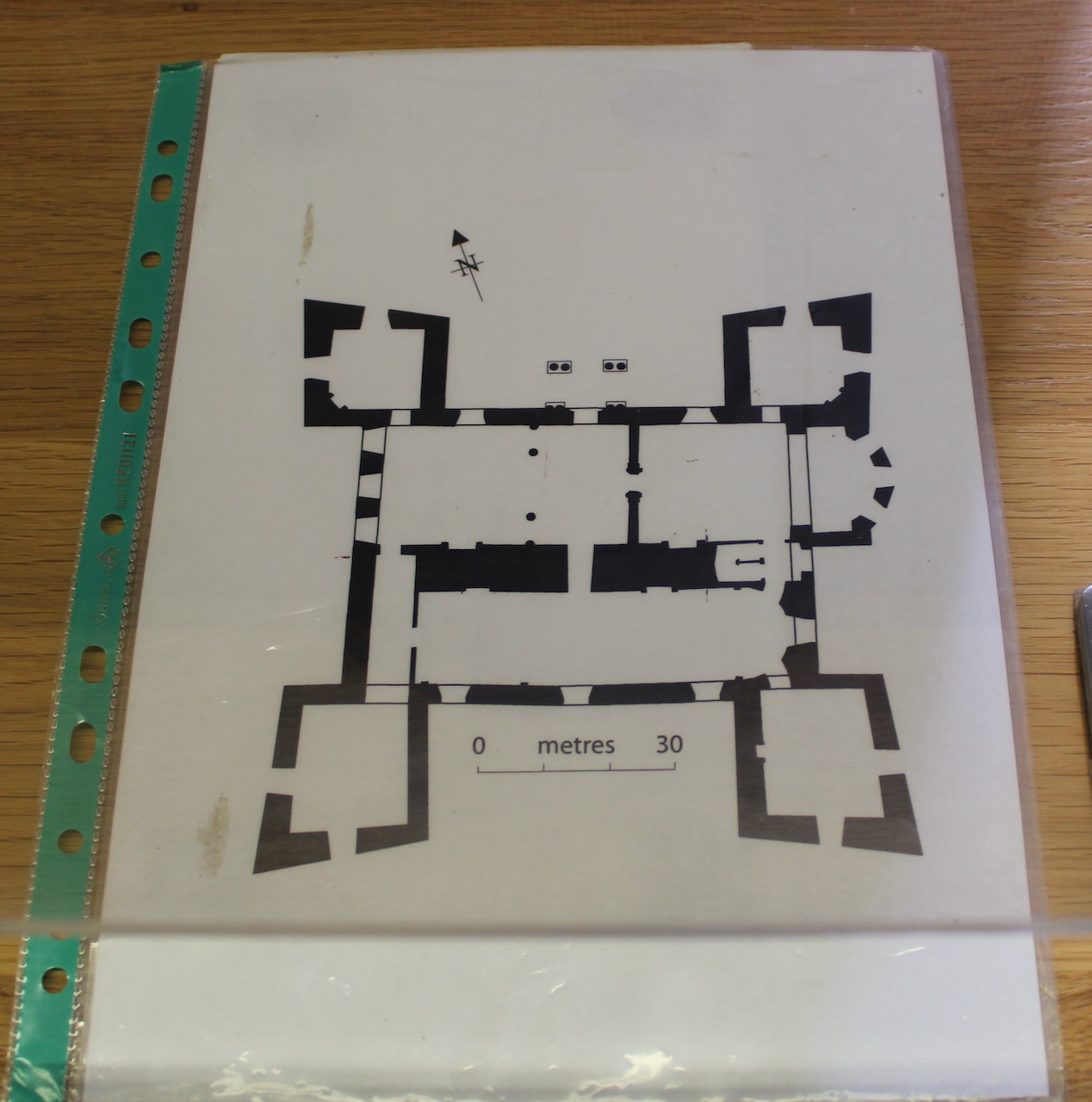
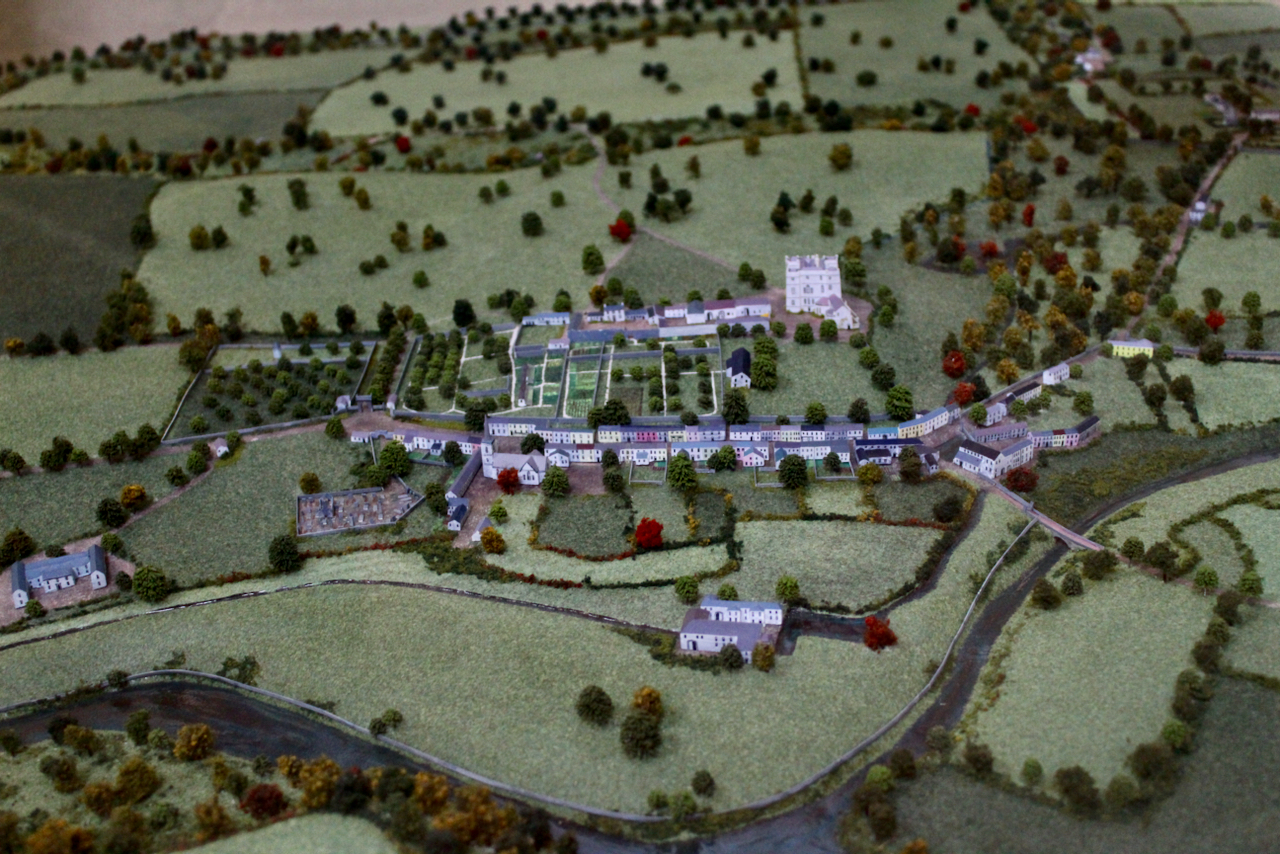
Rathfarnham Castle was built around 1583 for Adam Loftus (1533-1605), a clergyman originally from Yorkshire, who rose to the position of Archbishop of Dublin and Lord Chancellor of Ireland. Its position outside the city of Dublin made it vulnerable to attack, so it was built as a fortified house, with four flanker towers shaped to give maximum visibility of the surrounding landscape. The OPW website tells us:

Loftus wanted the Castle to be a grand and impressive home which would reflect his high status in Irish society. He also needed it to be easily defended against attack from hostile Irish families such as the O’Byrnes based in the mountains to the south. The design was radically modern for the time and based on recent continental thinking about defensive architecture. The angled bastion towers located at each corner of the building were equipped with musket loops which allowed a garrison of soldiers to defend all approaches to the castle.”

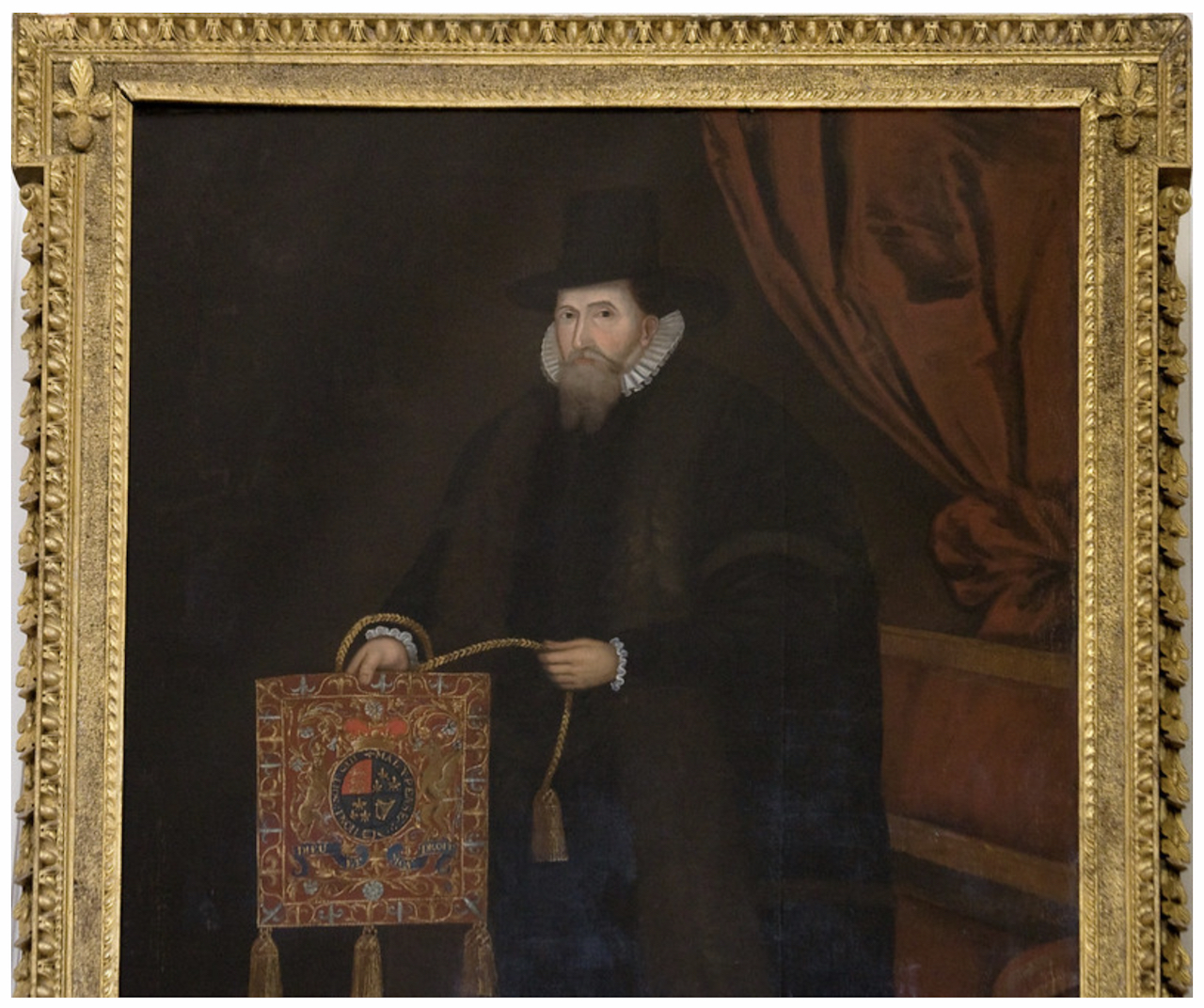
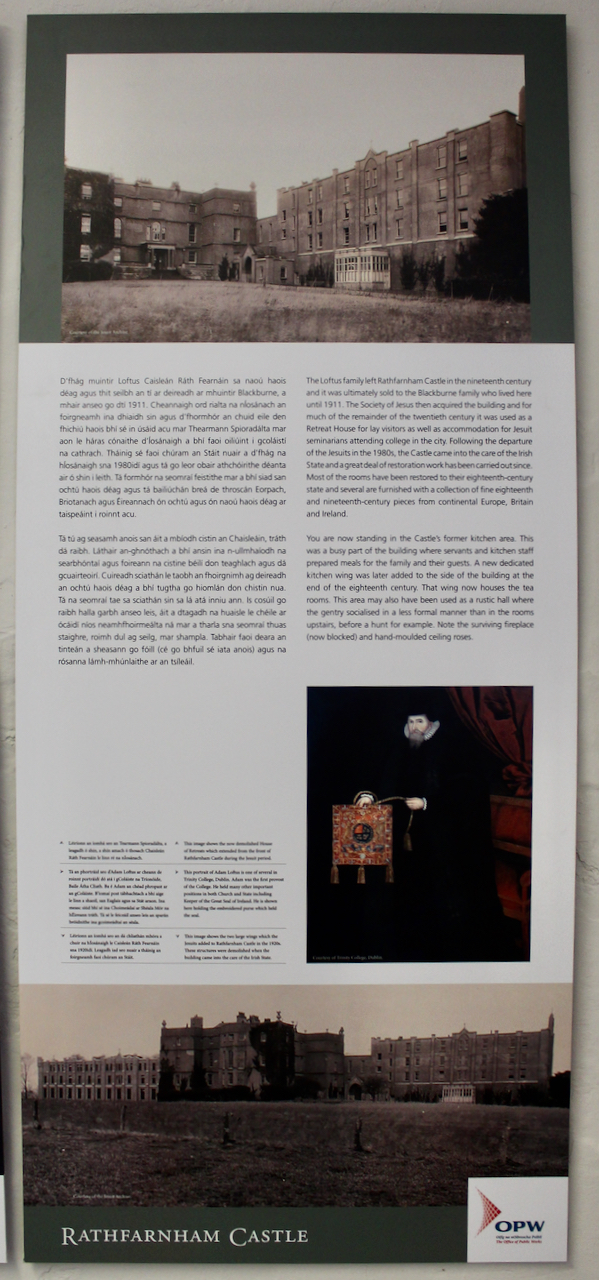
Archbishop-Chancellor Adam Loftus (1533-1605). The portrait is in Trinity College Dublin, as he was the first Provost. He was also Keeper of the Great Seal of Ireland, and he is here holding the embroidered purse which held the seal.
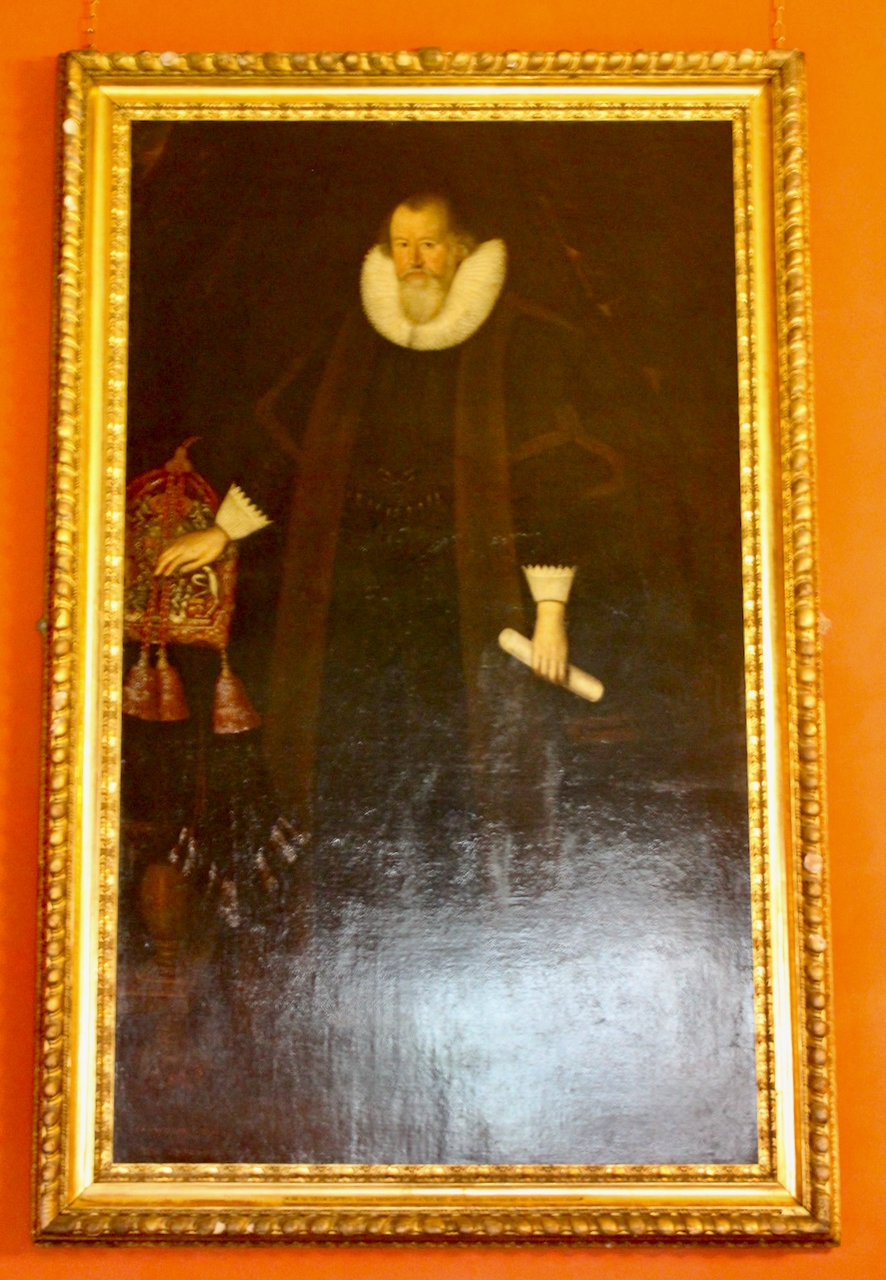
Adam Loftus (1533-1605), Lord Chancellor, 1619. Painting hangs in Malahide Castle, courtesy of National Museum of Ireland.
This shows the special shape of Rathfarnham Castle’s flanker towers.

Loftus had previously lived in an archiepiscopal palace in Tallaght, and it had been sacked by the O’Byrnes and O’Tooles from the Wicklow mountains, which is why he ensured that his new house in Rathfarnham had strong defenses. The Bishop’s Palace in Raphoe, now a ruin, is similarly shaped.

Ruin of Bishop’s Palace in Raphoe, County Donegal, built for Bishop John Leslie in 1636. Photograph © Jennifer Winder-Baggot, www.irishhistorichouses.com

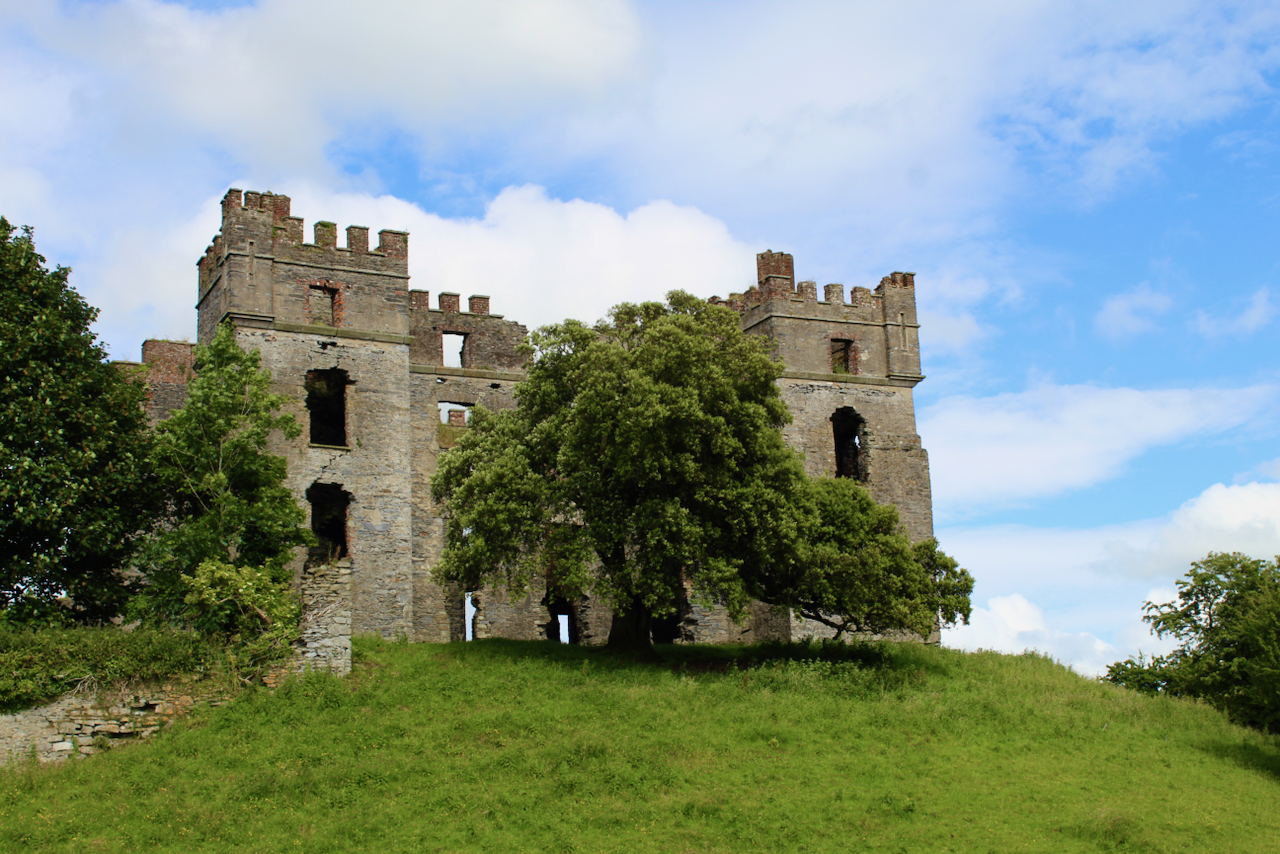
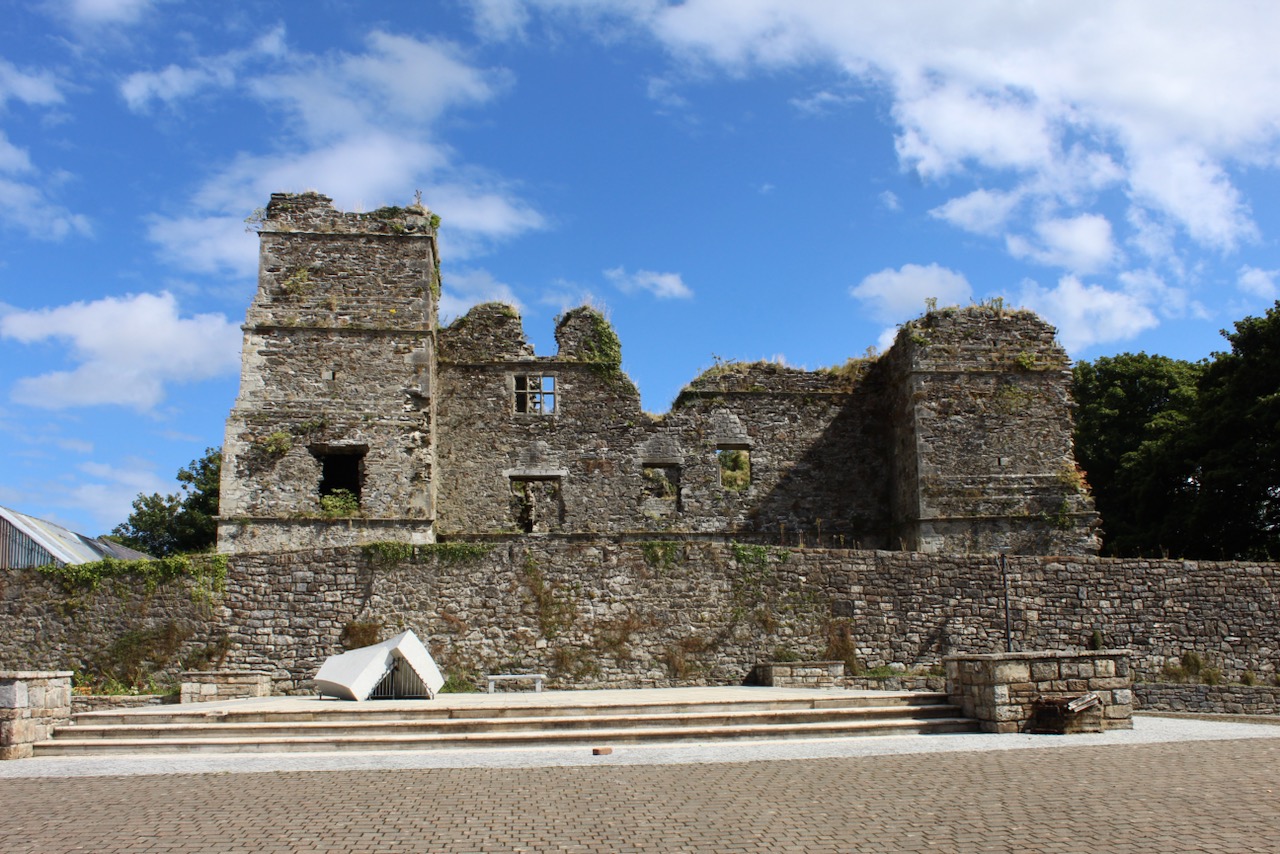
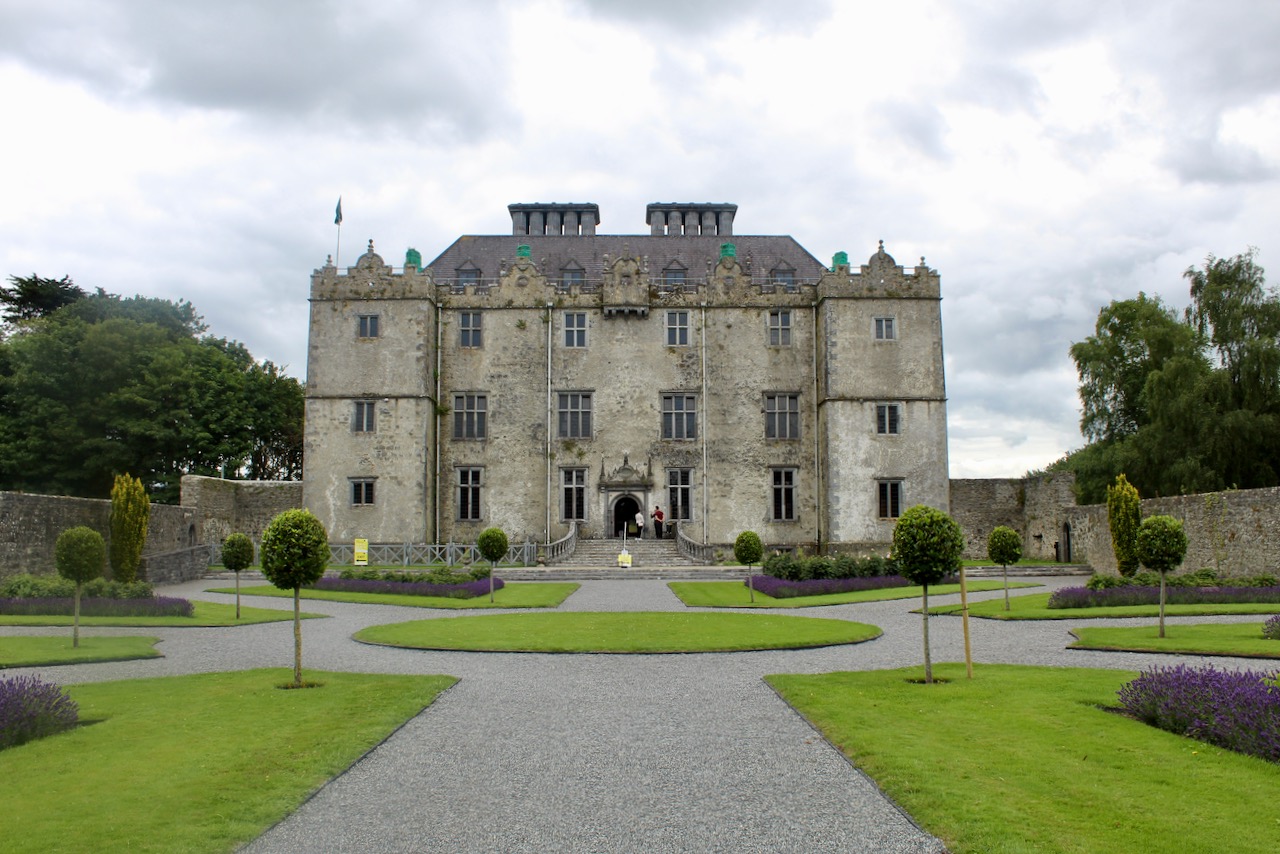
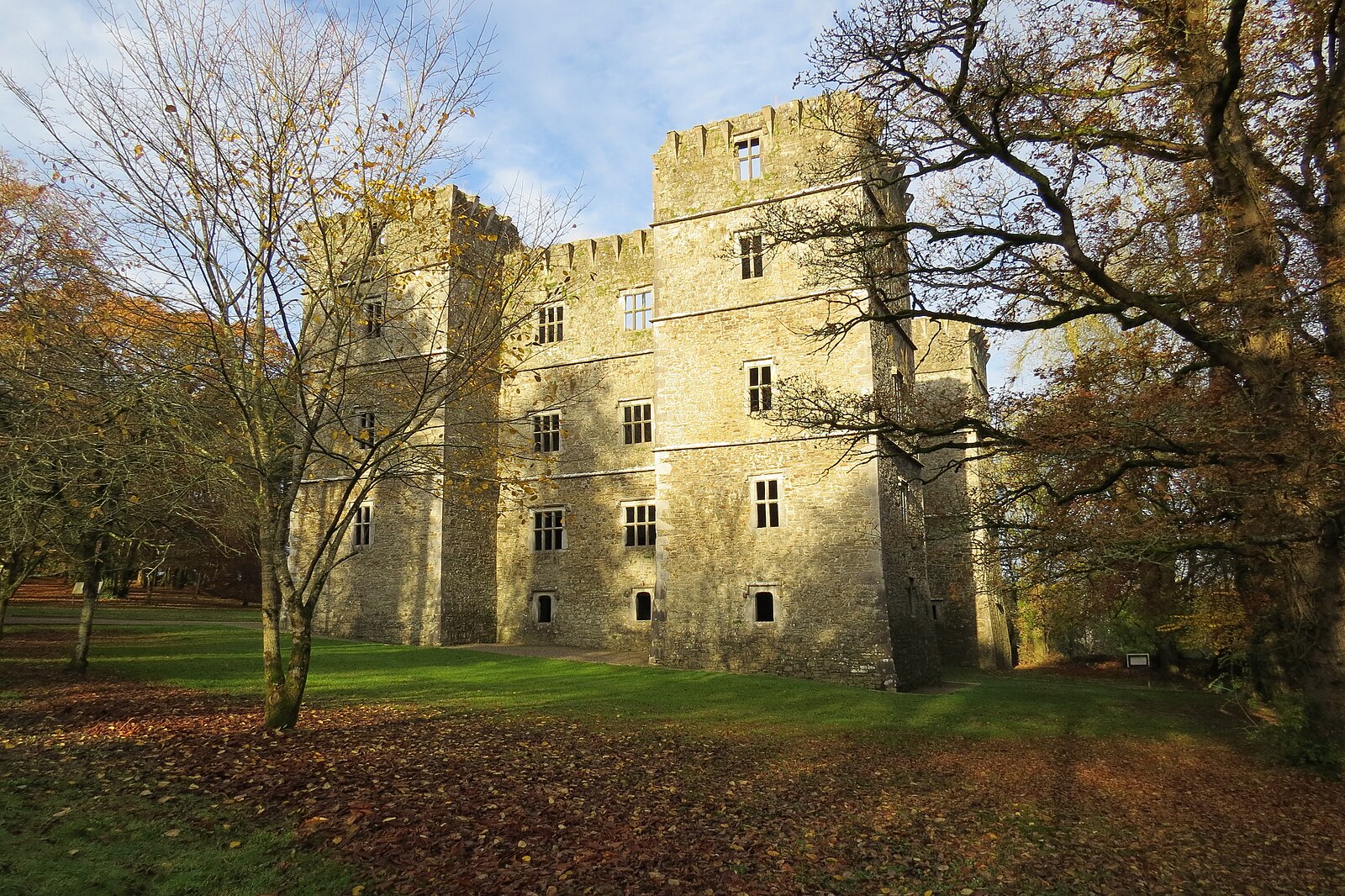
Maurice Craig points out in his The Architecture of Ireland from the earliest times to 1880 that there are a group of similar buildings, built over a period of fifty years or more: Rathfarnham; Kanturk for MacDonagh MacCarthy, built before 1609; Portumna for the Earl of Clanrickarde, before 1618; Manorhamilton for Sir Frederick Hamilton, probably around 1634; Raphoe, for Bishop John Leslie (the “Fighting Bishop” – see my entry on Castle Leslie https://irishhistorichouses.com/2020/08/07/castle-leslie-glaslough-county-monaghan/) in 1636, and Burncourt for Sir Richard Everard before 1650. Manorhamilton is a section 482 ruin (see my entry https://irishhistorichouses.com/2025/02/20/manorhamilton-castle-castle-st-manorhamilton-co-leitrim/) and we visited Portumna in County Galway – see my entry https://irishhistorichouses.com/2022/02/14/office-of-public-works-properties-connacht/. The buildings resemble a fort, such as Mountjoy Fort in County Tyrone built 1600-1605. Killenure, County Tipperary, is similar but has cylindrical flankers, Craig tells us. This last was unroofed by 1793, and it is now (2025) a Section 482 property which I must visit!

Manorhamilton, County Leitrim, August 2022, built for Sir Frederick Hamilton, probably around 1634. Photograph © Jennifer Winder-Baggot, www.irishhistorichouses.com
Portumna Castle, County Galway, July 2021, built for the Earl of Clanrickarde, before 1618. Photograph © Jennifer Winder-Baggot, www.irishhistorichouses.com
Kanturk Castle, built for MacDonagh MacCarthy, built before 1609. Photograph courtesy Breda O’Mullane, photograph licensed under the Creative Commons Attribution-Share Alike 4.0 International license.
Burncourt, County Tipperary, for Sir Richard Everard before 1650. Photograph courtesy Mike Searle, Creative Commons geograph.org.uk -1393348
Killenure Castle, similar but with cylindrical flankers, courtesy of Michael Daniels estate agent. A section 482 property in 2025.

Loftus attended Cambridge, where he took holy orders as a Catholic priest. Upon Queen Elizabeth’s accession to the throne in 1558, he declared himself Anglican. The Dictionary of Irish Biography tells us that a major turning point in Loftus’s life and career occurred in 1560, when he emigrated to Ireland as a chaplain to Thomas Radcliffe, 3rd Earl of Sussex, who had been granted a commission to serve as Lord Lieutenant of Ireland by Queen Elizabeth. On the recommendation of Sussex, Loftus was appointed Archbishop of Armagh, his consecration taking place on 2 March 1563. In January 1565, on account of the poverty of the archbishopric of Armagh, Queen Elizabeth granted Loftus the deanery of St Patrick’s cathedral in Dublin. In 1567 he was made Archbishop of Dublin.

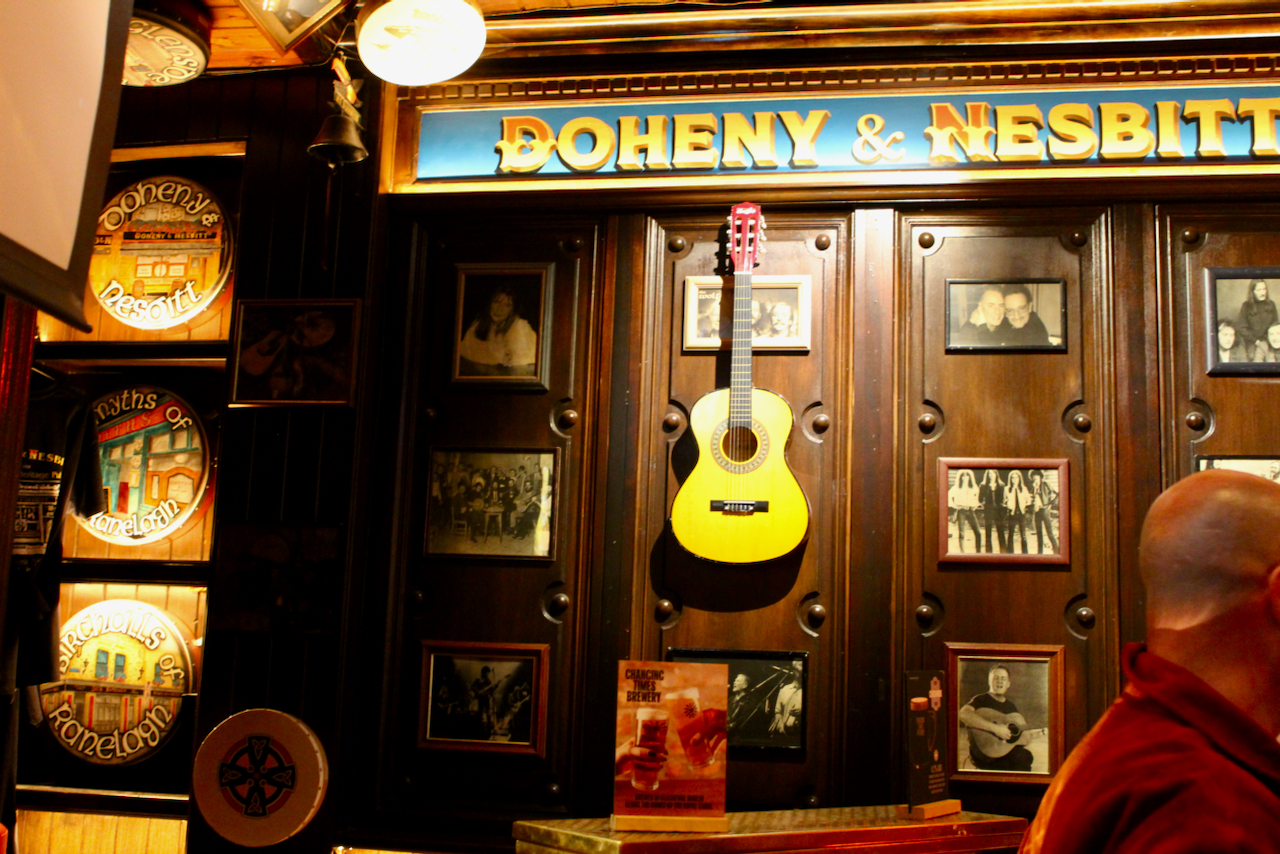
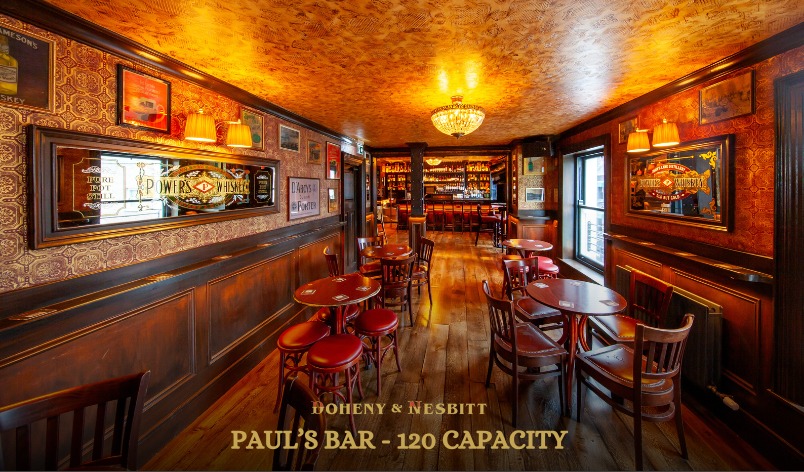
It was Adam Loftus who had Reverend Dermot O’Hurley executed, whom I wrote about a couple of weeks ago in my entry about Doheny & Nesbitt.

The Dictionary of Irish Biography tells us:

He was “a strongly delineated establishment figure whose primary concerns were to serve the crown in Ireland, in whatever capacity the queen and her advisers thought fit; and to build up his own personal affinity, so that he would be in a position to execute the offices that came his way with a measure of genuine political and social authority. Thus, during the periods when the archbishop served as lord chancellor of Ireland (1581–1605), or as acting governor of the country during the periodic absences from Ireland of a serving viceroy (August 1582–June 1584, November 1597–April 1599, September 1599–February 1600), he was also careful to establish a network of connections throughout the country, particularly through the marriage of his children to leading families among the new English protestant elite. Among the families with which Loftus made these connections were the Bagenals of Co. Down, the Dukes of Castlejordan, the Hartpoles of Shrule, the Usshers of Dublin, the Colleys of Castle Carbury, the Berkeleys of Askeaton, and the Warrens of Warrenstown. The social ascent of Loftus and his family was also evident in the archbishop’s decision to proceed with the purchase of the estate of Rathfarnham, Co. Dublin (c.1589–90), on which he built a stately castle.” [2]

Adam Loftus married Jane Purdon. They had twenty children, not all of whom survived to adulthood, and those who did married very well.

  1. Anne Loftus married, first, Henry Colley of Castle Carbury in County Kildare, and second, Edward Blayney, 1st Lord Blayney, Baron of Monaghan.
  2. Martha Loftus (d. 1609) married Thomas Colclough (1564-1624) of Tintern Abbey in Wexford.
  3. Isabelle Loftus (d. 1597) married William Ussher (1561-1659)
  4. Thomas Loftus (d. 1635) married Helen Hartpole of Shrule.
  5. Alice Loftus (d. 1608) married Henry Warren of Warrenstown, County Offaly.
  6. Katherine Loftus married Francis Berkeley of Askeaton, County Limerick.
  7. son Adam died unmarried in 1599.
  8. Margaret Loftus married George Colley of Castle Carbury.
  9. Edward Loftus (d. 1601) married Anne Duke of Castle Jordan, County Meath.
  10. Dudley Loftus (1561-1616) married Anne Bagenal of Newry Castle, County Down, daughter of Nicholas Henry Bagenal, Marshal of Ireland.
  11. Dorothy Loftus (d. 1633) married John Moore (d. 1633)

Adam Loftus was the first Provost of Trinity College Dublin.

The Dictionary of Irish Biography continues:

Although by the early 1590s Loftus had largely reconciled himself to the reality that the task of converting the indigenous community to protestantism, and securing its allegiance to the state church, was beyond him, the queen and her advisers still expected him to discharge his religious duties and press ahead with reforming initiatives on behalf of the state church. To this end, and in the midst of a period of mounting political crisis that culminated in the outbreak of the Nine Years War, Loftus was the prime mover behind the foundation of TCD, which received its royal charter on 3 March 1592. The archbishop also served as the college’s first provost till June 1594.

Adam Loftus died in the old Palace of St. Sepulchre beside St. Patrick’s Cathedral, which until recently was the Garda barracks on Kevin Street, now housed in a new building. I hope they will make something of the historic old archbishop’s palace now, which could be a great museum!

Adam’s son Dudley (1561-1616) sat in the Irish parliament for Newborough in County Wexford. He married Anne Bagenal of Newry Castle, County Down, daughter of Nicholas Henry Bagenal, Marshal of Ireland. The castle passed to their son, Adam Loftus (1590-1666), who married Jane Vaughan of Golden Grove, County Offaly.

Another son of Dudley and Anne Bagenal was Nicholas Loftus (1592-1666), the ancestor of Henry Loftus, the Earl of Ely. Nicholas’s second son Henry (1636-1716) lived in Loftus Hall in County Wexford.

Loftus Hall, County Wexford, for sale April 2025 courtesy Colliers. Formerly named Redmond Hall, it is a three-storey mansion built in 1871, incorporating parts of a previous house here, which was late 17th century or early C18. [3]

Adam Loftus (1590-1666) and Jane née Vaughan’s children also made good marriages. Their son Arthur Loftus (1616-1659) married Dorothy Boyle (1616-1668), daughter of Richard Boyle the 1st Earl of Cork. Arthur also served as MP for County Wexford, as well as Provost Marshall of Ulster.

The castle came under seige in 1641 and in 1642 the house was occupied by Cromwell’s Parliamentary troops. [4] In 1649 it was stormed and taken by Royalist troops under the Marquess of Ormond and all occupants were taken as prisoners. Ormond writes that nobody was killed. [5] Rathfarnham Castle was restored to Adam Loftus (1590-1666) when Charles II was crowned king.

Adam’s son Arthur predeceased him, so the castle passed to Arthur’s wife Dorothy née Boyle. In 1665 she obtained six firelock muskets from the Master of Ordinance to protect the castle.

Arthur Loftus and Dorothy née Boyle had a son Adam Loftus (1632-1691). Adam Loftus was Ranger of the Phoenix Park in Dublin and from 1685, a member of the Irish Privy Council. King James II created him Baron of Rathfarnham and Viscount Lisburne in the Peerage of Ireland. Adam married Lucy Brydges, daughter of George Brydges, 6th Baron Chandos of Sudeley, England.

Lucy Loftus née Brydges (1654-1681), by Peter Lely. She was a renowned Restoration beauty and the first wife of Viscount Adam Loftus. He died at the Siege of Limerick in 1691 and the cannon ball which reputedly killed him hangs in St Patrick’s Cathedral. Lucy is dressed in pseudo-antique clothing against an Arcadian landscape. The parrot in the background is an ambiguous symbol and can refer to a number of characteristics including eloquence, marital obedience or exoticism. Peter Lely was of Dutch origin but spent most of his career in England and became the most influential portrait painter at court following the death of Anthony van Dyck. He successfully navigated the turbulence of the 17th century to paint at the court of Charles I, the Cromwellian Commonwealth and Charles II following the Restoration. Lely was prolific, often only painting the sitter’s head while students and assistants at his studio completed the portraits.

After his wife Lucy died, Adam Loftus married Dorothy, the daughter of Patrick Allen or Alen, of St. Wolstan’s of Celbridge in County Kildare. Adam was a gallant at the court of King Charles II.

Despite earning his peerage from King James II, Adam Viscount Lisburn supported the cause of William III. He died at the Siege of Limerick in 1691 and the cannon ball which reputedly killed him hangs in St Patrick’s Cathedral.

The castle passed to Adam’s daughter Lucy, who married Thomas Wharton, 1st Marquess of Wharton in 1692, who in 1715 was created 1st Earl of Rathfarnham, 1st Marquess of Carlow and 1st Baron of Trim.

Lucy Loftus, Marchioness of Wharton (1670-1717) by Godfrey Kneller.

Lucy and the Marquess of Wharton had a son Philip, who became the Duke of Wharton. He was a Jacobite and supporter of the titular James III, and was subsequently granted many titles. The Peerage website lists the titles. As well as those he inherited from his father, he was created 1st Viscount Winchendon, Co. Buckingham [England] and 1st Marquess of Woodburn, Co. Buckingham [England], 1st Earl of Malmesbury, Co. Wilts [England] on 22 December 1716, Jacobite. 

He was appointed Privy Counsellor (P.C.) in Ireland between 1717 and 1726. He was created 1st Duke of Wharton, Co. Westmorland [Great Britain] on 28 January 1717/18, in an attempt by the authorities to wean him from his Jacobitism and make him a good Whig like his father. Darryl Lundy of The Peerage website tells us that his Dukedom did at least make him for a while speak and vote with the Tories in the House of Lords, for instance in debates on the South Sea Bubble. He lost a fortune from participation in the South Sea Bubble. In June 1725 he left the country. He was Envoy to Vienna in August 1725, for the Jacobite King James III, and then Envoy to Madrid in March 1725/26. 

Philip Wharton Duke of Wharton by Rosalba Carriera – Royal Collection, Public Domain.

Out of money, he took a position in the Jacobite forces and commanded a Spanish detachment at the Siege of Gibraltar in 1727, fighting against the English. On 3 April 1729 he was outlawed and his titles and such estates as he still held in Britain forfeited. 

He had no surviving male issue when he died on 31 May 1731. On his death, all his titles, most forfeited by his treason, expired, except the Barony of Wharton, which was deemed by the House of Lords in 1915 to be descendible to his heirs.

He sold Rathfarnham Castle in 1724. It was purchased by Speaker William Conolly for £62,000. Speaker Conolly never lived in the Castle since he had built Castletown in County Kildare, and he leased Rathfarnham in 1742 to Dr. Hoadley, Archbishop of Armagh.

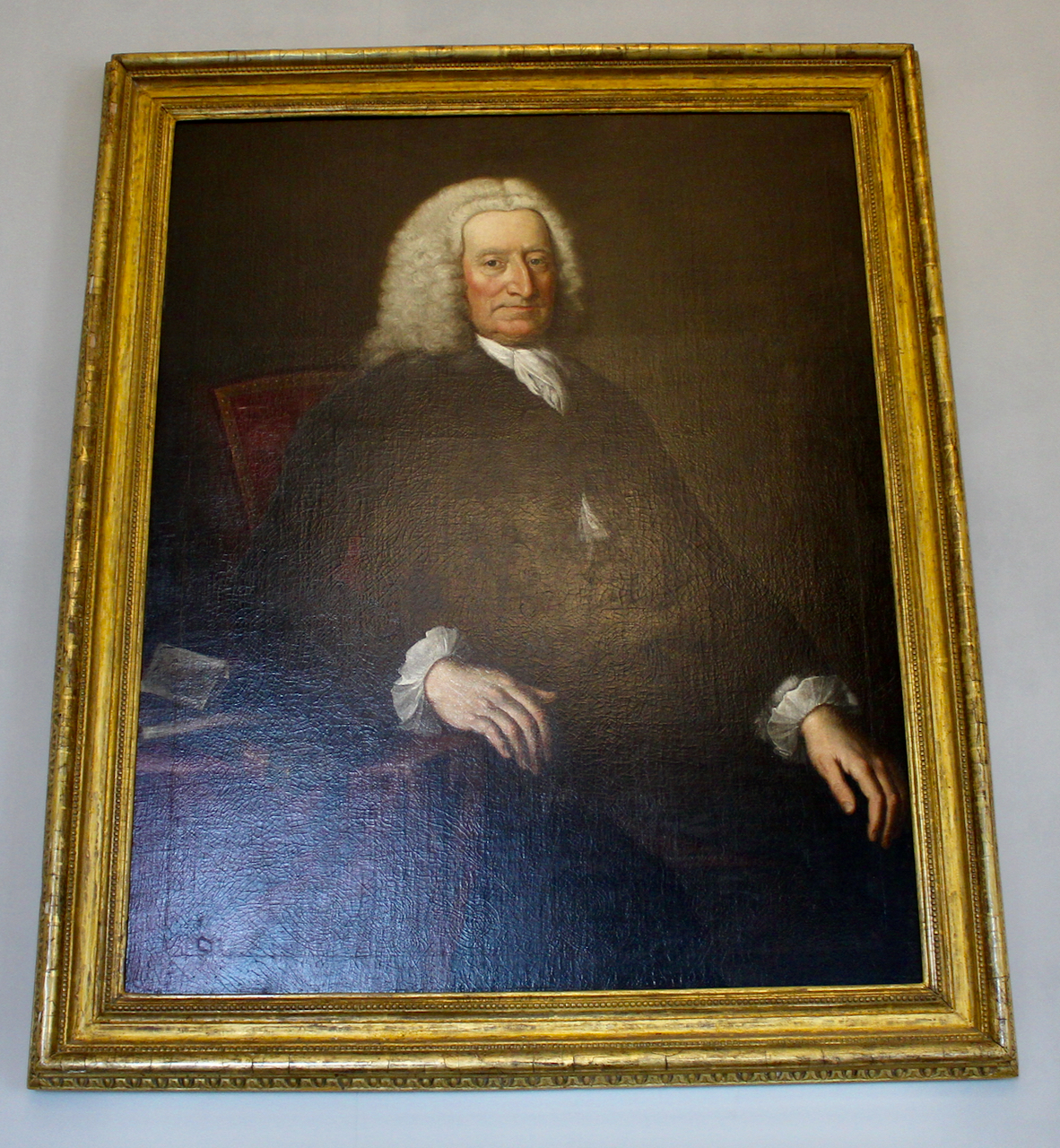
John Hoadly (1678-1746), Archbishop of Armagh and Primate of All Ireland by Stephen Slaughter; Armagh City, Banbridge & Craigavon Borough Council; http://www.artuk.org/artworks/john-hoadly-16781746-archbishop-of-armagh-and-primate-of-all-ireland-122812

Dr. Hoadley was interested in building, and he had built an Episcopal mansion in Tallaght to replace a medieval castle. He then restored Rathfarnham Castle. It was famed for its excellent agriculture and fruit gardens. [see 5].

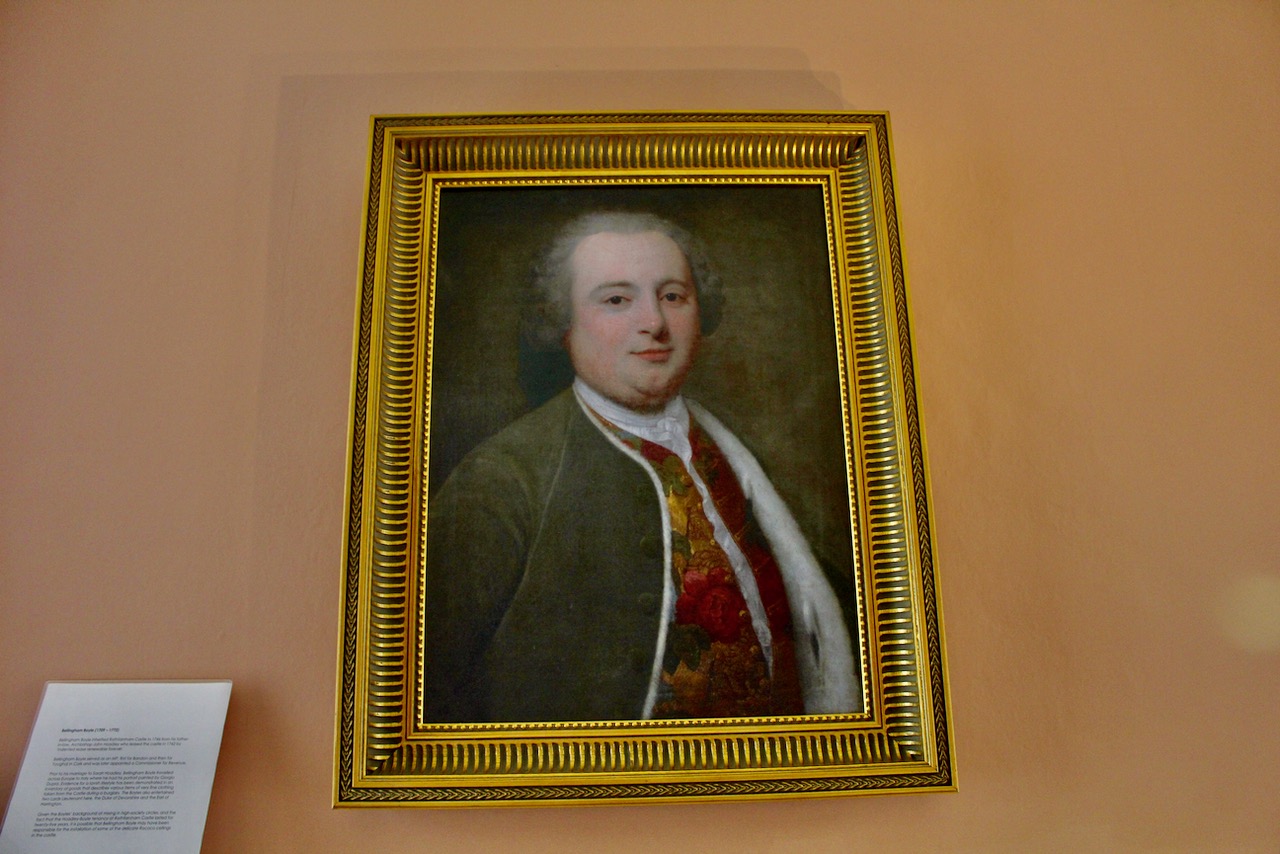
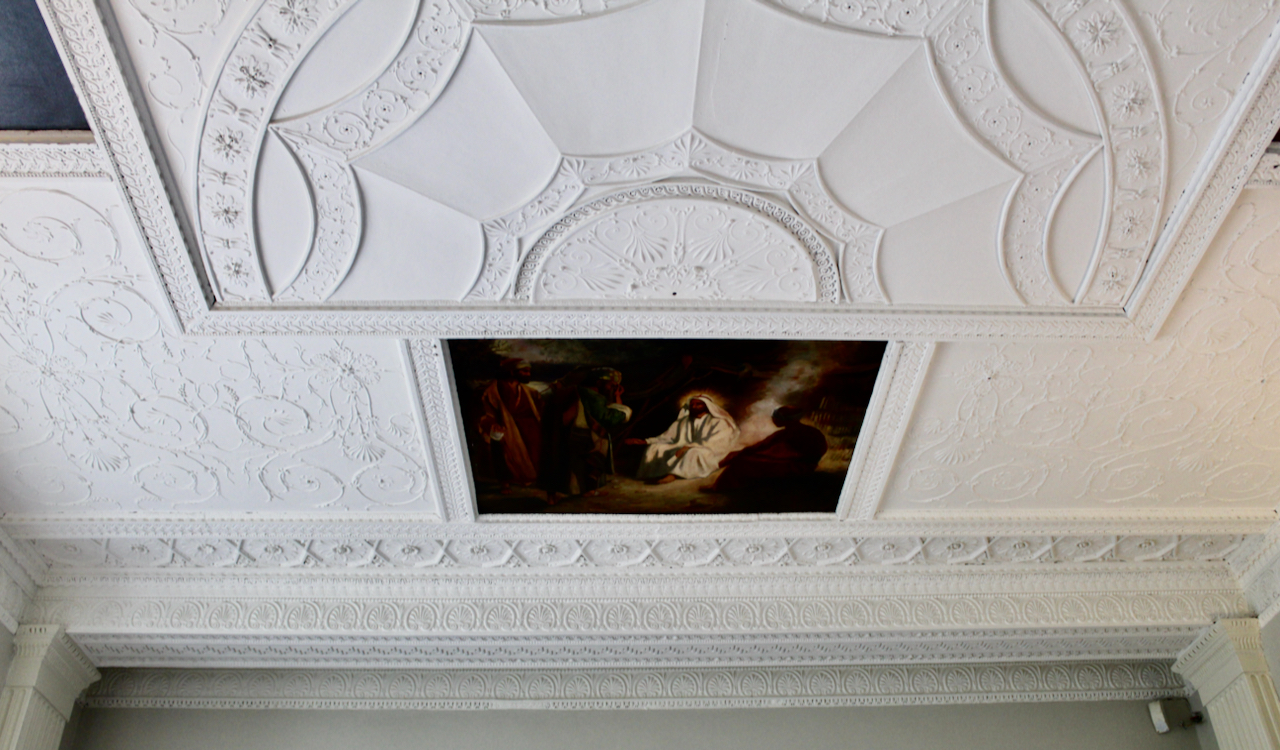
Dr. Hoadley’s daughter Sarah married Bellingham Boyle (1709-1772), and they inherited Rathfarnham Castle. Boyle also took an interest in farming and grew the first oats in Ireland. [see 5]. The Hoadley-Boyle tenancy lasted for twenty-five years, and Bellingham Boyle and his wife mixed in high society, entertaining two Lords Lieutenant in the castle: the Duke of Devonshire and the Earl of Harrington. Boyle may be be responsible for installing some of the delicate rococo ceilings in the castle.

“Bellingham Boyle (1709-1772). He inherited Rathfarnham Castle in 1746 from his father-in-law, Archbishop John Hoadley who leased the castle in 1742 by “indented lease renewable forever.” Bellingham Boyle served as an MP, first for Bandon then for Youghal in Cork and was later appointed a Commissioner for the Revenue. Prior to his marriage, Belingham travelled across Europe to Italy where he had his portrait painted by Giorgio Dupra.”

Interestingly, in Aug 1742, Bellingham Boyle was appointed to a commission to investigate the soundness of mind of Jonathan Swift, Dean of St. Patrick’s Cathedral in Dublin. The Writ “De Lunatico Inquirendo,” in the case of Jonathan Swift, D.D. was issued to investigate and ascertain whether the ailing Dean Swift was of unsound mind and memory to safely conduct his own business. Belllingham Boyle was one of 12 commissioned to perform the investigation. Dean Swift was found to be of unsound mind and memory and was placed under the protection of the Court of Chancery. [6]

Boyle’s daughter Anne married Robert Langrishe 2nd Baronet Langrishe, of Knocktopher, Co. Kilkenny.

Knocktopher Abbey, Knocktopher, Co. Kilkenny, for sale November 2024, photograph courtesy DNG Country Homes & Estates.

The castle returned to the ownership of the Loftus family in 1767, to Nicholas Hume Loftus, 2nd Earl of Ely, a descendant of the original owner Adam Loftus. Nicholas never married and on his death in 1769 the Castle passed to his uncle, Henry Loftus (created Earl of Ely in 1771). Henry continued the remodelling of the castle and the works were completed by the time of his death in 1783. 

Let us backtrack now to look at the descendants of the first Adam Loftus. Adam’s grandson Nicholas lived in Fethard, County Wexford, in the precursor to Loftus Hall. His son Henry (1636-1716) of Loftus Hall was the father of Nicholas Loftus (1687-1763) who was created 1st Viscount Loftus of Ely.

Nicholas Loftus, 1st Viscount Ely (1687-1763). Painter unknown. This painting was completed in 1758 to mark the 70th birthday of Nicholas, father of both Nicholas (the 1st Earl of Ely) and Henry Loftus. He sits next to a book entitled The Present State of Ireland. This anonymous work was originally published in 1730 and contained criticism of the amount of money flowing out of Ireland to absentee landlords, no doubt reflecting Nicholas’s concern with the financial state of the kingdom. He is sometimes known as “the Extinguisher” because of his threat to extinguish the Hook lighthouse in Wexford unless the rent he received from it was increased.

Nicholas served as MP for Wexford, and married Anne Ponsonby, daughter of William Ponsonby, 1st Viscount Duncannon. He was first created Baron Loftus of Loftus Hall in 1751, and then assumed a seat in the House of Lords, and became Privy Counsellor of Ireland in 1753. He was created Viscount Loftus of Ely in County Wicklow in 1756.

After Anne died, around 1724, Nicholas Viscount Ely married Letitia Rowley (d. 1765) of Summerhill in County Meath. To make matters more confusing, she had been previously married to Arthur Loftus (1644-1725) 3rd Viscount of Ely!

Summerhill, County Meath, etnrance front, photograph: Maurice Craig, Vanishing Country Houses of Ireland by The Knight of Glin, David J. Griffin and Nicholas K. Robinson, published by The Irish Architectural Archive and The Irish Georgian Society, 1988.

Viscount Loftus is a title that has been created three times in the Peerage of Ireland for members of the Anglo-Irish Loftus family. The first creation was for Adam Loftus (1568-1643) on 10 May 1622, who served as Lord Chancellor of Ireland in 1619. He is not to be confused the our Adam Loftus (1533-1605) of Rathfarnham Castle. This title became extinct in 1725 upon the death of the third viscount, who had no male heir, despite having married three times. 

Nicholas Viscount Loftus and Anne née Ponsonby had a daughter Elizabeth Loftus (d. June 1747) who married John Tottenham 1st Baronet, MP for New Ross. Another daughter, Mary (1710-1779), married William Alcock (1702-1779) of Wilton Castle in Wexford (see my entry https://irishhistorichouses.com/2022/02/04/wilton-castle-bree-enniscorthy-co-wexford-and-a-trip-to-johnstown-castle/ )

Nicholas and Anne’s son Nicholas Loftus (1708-1766) became the 1st Earl of Ely, and added Hume to his surname after marrying Mary Hume, daughter of Gustavus Hume, 3rd Baronet of Castle Hume, County Fermanagh. As well as Loftus Hall in Wexford, they owned 13 Henrietta Street in Dublin. He became known as the “wicked earl” due to a court hearing about the supposed mental incapacity of his son, also named Nicholas. Young Nicholas’s uncle, George Rochfort (1713-1734), brother of the 1st Earl of Belvedere, sought to have young Nicholas declared incapable of succeeding to the title. George Rochfort was married to another daughter, Alice, of Gustavus Hume, 3rd Baronet of Castle Hume. Family members testified that young Nicholas was of normal intelligence, and that any eccentric behaviour should be blamed on his father’s ill-treatment. The trial lasted for nine years and was even brought to the House of Lords. Poor young Nicholas died before the trial was finished and Rochfort’s case was declared invalid.

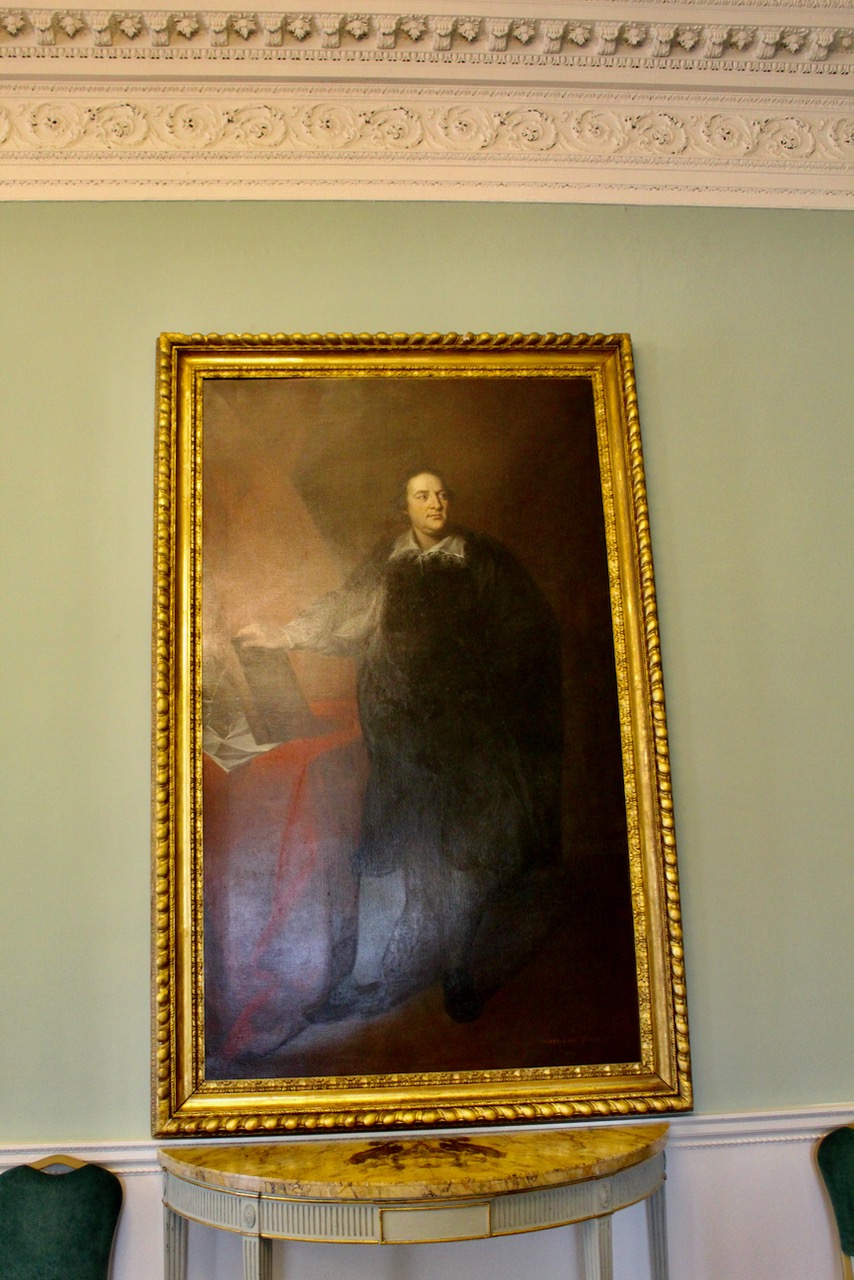
Nicholas Hume Loftus, 1st Earl of Ely (1708-1766), unknown artist. It was after Nicholas Loftus (son of the Extinguisher) had married into the wealthy Hume family that the Ely earldom was created for the first time. This depicts Nicholas, the so-called “Wicked Earl” in the doctoral robes of Trinity College Dublin.
Nicholas Hume Loftus, 1st Earl of Ely (1708-1766) by Jacob Ennis. These two portraits depict Nicholas, the so-called “Wicked Earl” at various stages of his life. Nicholas is much older in the Ennis portrait. Jacob Ennis was an Irish historical and portrait painter who spent some time studying in Italy. He was later a Master in the Dublin Society’s Drawing Schools.

Nicholas Loftus Hume officially succeeded as 2nd Earl of Ely (1738-1769). It was through him that Rathfarnham Castle returned to Loftus ownership. Nicholas bequeathed Rathfarnham Castle and the estate to his uncle, Henry Loftus (1709-1783) who became the 1st Earl of Ely of the second creation. Henry was the younger son of Nicholas Loftus (d. 1763) 1st Viscount Loftus and Anne née Ponsonby, brother to the earlier Nicholas Hume Loftus (d. 1766) 1st Earl of Ely, the Wicked Earl.

Henry Loftus, 1st Earl of Ely of the 2nd Creation (1709-1783) by Angelica Kauffman. Henry inherited Rathfarnham Castle and its demesne in 1769 upon the death of Nicholas, his nephew. Nicholas had been the subject of a long running legal case concerning the state of his mind and Henry had supported him throughout. The Swiss artist Angelica Kauffman is known to have spent several months in Dublin in 1771. As well as this portrait which was probably completed to mark Henry’s elevation to the earldom of Ely, this renowned painter also completed a group portrait of Henry and his family (now in the National Gallery) as well as a series of ceiling paintings for the long gallery on the first floor depicting scenes from Greek mythology.

Between 1769 and his death in 1783 Henry funded some of the most substantial 18th century changes to Rathfarnham Castle and the demesne.

He contracted Sir William Chambers to remodel several of the rooms including the Ballroom and Anteroom. Externally, the window openings were enlarged, and a new stone Tuscan entrance portico added, probably to the designs of William Chambers. The original battlements were removed and the new parapet was embellished with ball finials and urns some of which also serve as chimneys. On the south front new garden steps were added, while on the east front a three bay bow had been added by 1774.

Rathfarnham Castle, Dublin, September 2021. Photograph © Jennifer Winder-Baggot, www.irishhistorichouses.com
Rathfarnham Castle. Photograph © Jennifer Winder-Baggot, www.irishhistorichouses.com

From the OPW website:

Loftus’s castle, with its four flanker towers, is an excellent example of the Elizabethan fortified house in Ireland. In the late eighteenth century, the house was remodelled on a splendid scale employing some of the finest architects of the day including Sir William Chambers and James ‘Athenian’ Stuart. The collection includes family portraits by Angelica Kauffman, Sir Peter Lely, and Hugh Douglas Hamilton.

The entrance hall, Rathfarnham Castle. Photograph © Jennifer Winder-Baggot, www.irishhistorichouses.com

From an information panel in the entrance hall: “This room is believed to have been built to a design by the influential architect Sir William Chambers (1723-1796). Despite never visiting Ireland, Chambers left a significant mark on Dublin where he also designed the Casino at Marino, Charlemont House on Parnell Square, and much of Front Square in Trinity College. The floor and free standing Doric columns are in Portland stone. The painted glass panels featuring fruit and flowers are believed to be by the Dublin Huguenot artist Thomas Jervais (d. 1799). The marble relief busts on the walls depict well known figures from the Classical and Renaissance past, including the Egyptian queen Cleopatra and Italian poet Dante. These sculptures seem to have been acquired in Italy and would have been incorporated into the design of the Entrance Hall to signal the taste and refinement and learning of the Loftus family. The original eighteenth century marble fireplace was replaced with a painted timber one in around 1913. It was one of several of the original fireplaces which were removed and sold when the Blackburne family left the castle in 1911.

The painted glass panels featuring fruit and flowers are believed to be by the Dublin Huguenot artist Thomas Jervais (d. 1799). Designs for windows for the castle were by Joshua Reynolds. [see 5] Photograph © Jennifer Winder-Baggot, www.irishhistorichouses.com
The entrance hall, Rathfarnham Castle. Photograph © Jennifer Winder-Baggot, www.irishhistorichouses.com
Information board, Rathfarnham Castle.
Cleopatra. The asp that killed her can be seen on her shoulder. Rathfarnham Castle. Photograph © Jennifer Winder-Baggot, www.irishhistorichouses.com
The Ante-Room. This served as a reception or waiting room for guests attending the Ball. The Ionic columned Venetian style window is the highlight of this room. The columns are wooden and hollow, and feature intricately carved foliage. The whole window may be referencing the form of a Roman triumphal arch. The wall separating this room from the ballroom was reinstated in the 1990s by the OPW. It had been removed in the 19th century by the then owner, Lord Chancellor Francis Blackburne (1782-1867), to accommodate a large pipe organ. Photograph © Jennifer Winder-Baggot, www.irishhistorichouses.com
The Ante-Room, Rathfarnham Castle. Photograph © Jennifer Winder-Baggot, www.irishhistorichouses.com
The Ballroom. The Ballroom was the principal room for entertainment and dancing and it is believed that the room was designed by Sir William Chambers. The door to the left on entering the room is false. It opens to reveal the wall behind. It was installed to maintain the balance and symmetry of the room. Musicians may have played in the eastern bow at the top of the Ballroom when dancing took place. Later, the Jesuits transformed the room into a chapel placing an altar in the bow with pews arranged down the centre of the room. Photograph © Jennifer Winder-Baggot, www.irishhistorichouses.com
The Ballroom, Rathfarnham Castle. Photograph © Jennifer Winder-Baggot, www.irishhistorichouses.com
The Ballroom, Rathfarnham Castle, Dublin. Photograph © Jennifer Winder-Baggot, www.irishhistorichouses.com
Information board about the Farmily Withdrawing Room in Rathfarnham Castle.
The Farmily Withdrawing Room in Rathfarnham Castle. Photograph © Jennifer Winder-Baggot, www.irishhistorichouses.com

Henry Loftus (1709-1783) is pictured below. He married first, Frances Monroe of Roe’s Hall, County Down, (pictured below), who died in 1774, then married secondly Anne Bonfoy. He purchased Ely House in Dublin (built 1770) from Sir Gustavus Hume, 3rd Baronet (now owned by the Knights of Columbanus).

Painting by Angelica Kauffman, who spent several months in Dublin in 1771. It shows Henry Loftus 1st Earl of Ely of the 2nd Creation (1709-1783) with his wife Frances, her nieces and an exotic trophy servant, a young Indian page in Oriental dress carrying a cushion with two coronets, symbolising the title the Earl had just received. The older niece, Dolly Monroe, was Classical costume. Her younger sister Frances plays a fashionable aria on the harpsichord.

As well as the ante room and ballroom and the entrance hall on the first floor, Chambers was responsible for the small drawing room ceiling, back staircase lobby, and the octagonal room in one of the towers.

The Octagonal Room. In the 18th century it may have been a withdrawing room where guests could step out of the Ballroom for private conversation or relaxation. It was later used as a sacristy by the Jesuits. Photograph © Jennifer Winder-Baggot, www.irishhistorichouses.com
The Octagonal Room. This room features an eight sided ceiling and is decorated with ancient Roman symbols of war. The border is made up of bound groups of timber rods (fasces), a symbol of authority and power in the Roman period. Rathfarnham Castle. Photograph © Jennifer Winder-Baggot, www.irishhistorichouses.com
The Octagonal Room. Rathfarnham Castle. Photograph © Jennifer Winder-Baggot, www.irishhistorichouses.com
This tiny little passageway between the Dining Room and Long Gallery/Saloon was clearly a space of some importance. The passageway looks out onto the garden, and is decorated with very fine plasterwork. A head of Apollo adorns the ceiling, most likely to the design of Sir William Chambers, and on either side of the doorway there are ornamental plaster plaques with classical figures, celebrating wine, music and dance, a feature favoured and used repeatedly by James ‘Athenian’ Stuart. On one side of the passage there is a narrow wooden stairs, with a fanlight and satyr mask. The stairway has decorative niches, and leads all the way from the garden level to the third floor. Photograph © Jennifer Winder-Baggot, www.irishhistorichouses.com
On either side of the doorway there are ornamental plaster plaques with classical figures, celebrating wine, music and dance, a feature favoured and used repeatedly by James ‘Athenian’ Stuart. On one side of the passage there is a narrow wooden stairs, with a fanlight and satyr mask. The stairway has decorative niches, and leads all the way from the garden level to the third floor. Photograph © Jennifer Winder-Baggot, www.irishhistorichouses.com

There are also several rooms which are attributed to architect and designer James “Athenian” Stuart, whose best work in Ireland is the Temple of the Winds at Mount Stewart, County Down. Stuart was employed at Rathfarnham from at least 1769 and was responsible for the design of the ground floor gallery and two rooms above it. He was also involved in the decoration of some interiors at the family townhouse, Ely House, Dublin.

This long room would have been used as a saloon or drawing room to entertain guests and perhaps also as a space to display a collection of art works. It is believed the room was designed by James “Athenian” Stuart (1713-1788). The original ceiling paintings were a series of Greek mythological scenes by Angelica Kauffman (1741-1807). These were sold at auction in the early 20th century and are now believed to be in a private collection in the United States. The Jesuits commissioned a new series of ceiling paintings featuring scenes from the life of Christ by Dublin artist Patrick Tuohy (1894-1930). The residents of the Castle had direct access from this room to the lawn, woods and ornamental lake beyond via a double-cantilevered exterior staircase in Portland stone.” Photograph © Jennifer Winder-Baggot, www.irishhistorichouses.com
The Long Room, Rathfarnham Castle, Photograph © Jennifer Winder-Baggot, www.irishhistorichouses.com
The Jesuits commissioned a new series of ceiling paintings featuring scenes from the life of Christ by Dublin artist Patrick Tuohy (1894-1930).
The Long Room, Rathfarnham Castle, Photograph © Jennifer Winder-Baggot, www.irishhistorichouses.com
The Four Seasons Room, Rathfarnham Castle, believed to have been designed by James “Athenian” Stuart. In each corner of the ceiling a cherub represents one of the four seasons while the central painting is that of the goddess of agriculture and the harvest (Demeter in Greek or Ceres in Roman mythology). Photograph © Jennifer Winder-Baggot, www.irishhistorichouses.com
The Four Seasons Room, Rathfarnham Castle. The mirror is from the late 18th century and constructed from a type of papier-mache treated to give the appearance of gilded wood or metal. The Louis XVI giltwood and tapestry chairs feature scenes from La Fontaine’s fables which were adapted from the classics and published in the late 17th century. They are accompanied by an inlaid George III Pembroke Table. Photograph © Jennifer Winder-Baggot, www.irishhistorichouses.com
The Four Seasons Room, Rathfarnham Castle. The bureau belonged to Henry Loftus and is of German manufacture (c. 1775). The carpet is a late 19th century Aubusson. Photograph © Jennifer Winder-Baggot, www.irishhistorichouses.com
The Four Seasons Room, Rathfarnham Castle. Photograph © Jennifer Winder-Baggot, www.irishhistorichouses.com
The Gilt Room ceiling, Rathfarnham Castle. A design by James “Athenian” Stuart, features eight rondels containing objects symbolising different Greek gods and goddesses. Facing toward the window and moving clockwise, these symbols are thought to represent Apollo, Hermes, Dionysus, Ares, Aphrodite, Pen, Demeter and Artemis. Photograph © Jennifer Winder-Baggot, www.irishhistorichouses.com
The Gilt Room ceiling, Rathfarnham Castle. Photograph © Jennifer Winder-Baggot, www.irishhistorichouses.com
The Gilt Room, Rathfarnham Castle. Photograph © Jennifer Winder-Baggot, www.irishhistorichouses.com

Henry Loftus was succeeded by his nephew Charles Tottenham (1738-1806), son of Henry’s sister Elizabeth (1720-1747) and her husband John Tottenham (1714-1786) 1st Baronet of Tottenham Green, County Wexford. Charles Tottenham’s name was changed to Charles Loftus in 1783 after the death of Henry Loftus 1st Earl of Ely of the 2nd Creation.

Charles held the office of Member of Parliament (M.P.) for New Ross between 1761 and 1768, M.P. for Bannow between 1768 and 1776, M.P. for New Fethard between 1776 and 1783. and M.P. for County Wexford between 1783 and 1785. He was created 1st Baron Loftus of Loftus Hall, Co. Wexford [Ireland] on 28 June 1785. He succeeded as the 2nd Baronet Tottenham [I., 1780] on 29 December 1786. He was created 1st Viscount Loftus of Ely [Ireland] on 28 December 1789 and 1st Earl of Ely [Ireland] on 2 March 1794. He was created 1st Marquess of Ely [Ireland] on 1 January 1801 and 1st Baron Loftus of Long Loftus, Co. York [U.K.] on 19 January 1801. He was also Privy Counsellor. 

Charles Tottenham Loftus, Marquis of Ely by Hugh Douglas Hamilton. Charles was the nephew of Henry Loftus Earl of Ely and inherited Rathfarnham Castle and the demesne on his death in 1783. The painting shows Charles in the robes of the Irish House of Lords. He is also wearing a chain indicating his membership of the prestigious Order of St Patrick. He was elevated to a Marquis, given a baronetcy in England as well as £45,000 in return for his votes in favour of the Act of Union. Hugh Douglas Hamilton (1740-1808) was born and grew up in Dublin and attended the Dublin Society’s Drawing Schools. He had a long and successful career as an artist and worked in London and Rome as well as Dublin. He is perhaps best known for his work in pastels and left an extensive series of portraits of leading figures in Irish society.

At Rathfarnham, Charles did little beyond the erection in 1790 of the Gothic or Back Gate, now almost competely demolished to make way for a road.

He married Jane Myhill of Killarney, County Kerry. Her sister Hannah married Hercules Langrishe, 1st Baronet of Knocktopher, County Kilkenny.

Jane Tottenham-Loftus (nee Myhill), 1740-1807, Marchioness of Ely, painting after Angelica Kauffman. She was married to Charles Tottenham Loftus, 1st Marquess of Ely, whose portrait hangs in the Ballroom. He was the son of John Tottenham, 1st Baron Tottenham of Ireland, and of Elizabeth Loftus, daughter of Nicholas Loftus, 1st Viscount Loftus of Ely.
The Dining Room, Rathfarnham Castle, Dublin. Photograph © Jennifer Winder-Baggot, www.irishhistorichouses.com

The Dining Room. “This room remains unrestored which allows us to see the changes and alternations which were made to the building over the years. The door on the left-hand (northern) wall is typically eighteenth century in style and decoration. However to the left of it a trace of the original Elizabethan doorway is visible. It was blocked up during the 18th century refurbishments. The bow extension to the eastern side of the building is another change dating to that period which added space and brought more light into these rooms. The 18th century timber wall panelling and lining paper survives in this room. It is likely that the walls were covered with silk. Although designed as a dining room, in the 20th century the Jesuits used this room as a library.

The dining room, Rathfarnham Castle. Photograph © Jennifer Winder-Baggot, www.irishhistorichouses.com
The door on the left-hand (northern) wall is typically eighteenth century in style and decoration. However to the left of it a trace of the original Elizabethan doorway is visible. It was blocked up during the 18th century refurbishments.  Photograph © Jennifer Winder-Baggot, www.irishhistorichouses.com

The Castle fell into disrepair. From the Parliamentary Gazetteer of Ireland 1846 (vol. iii):
Rathfarnham Castle, situated in a once noble demesne, at the south-east extremity of the village, was not long ago esteemed a magnificent building, and boasted a gorgeous picture-gallery, and superb series of garden and pleasure grounds, but it was allowed to fall into decay in consequence of the prolonged non-residence of its proprietor, the Marquis of Ely, and it now prosaically, though usefully, figures as a diary‘.

At this time, John Loftus (1770-1845) was 2nd Marquess of Ely, who inherited the Castle and lands from his father, Charles Tottenham Loftus. John Loftus rented out the house and surrounding lands, and between 1812 and 1852 the estate was leased to the Roper family. [from the castle’s Instagram page]

Oil painting on canvas, John Loftus, 2nd Marquess of Ely (1770-1845), attributed to Sir Thomas Lawrence (1769-1830). A three-quarter-length portrait, in a brown coat and blue sash. Peer’s robes to the right, red curtain to the background. A picture of the sitter’s wife by Lawrence is in the Art Institute of Chicago. By Studio of Thomas Lawrence – Sothebys, Public Domain, https://commons.wikimedia.org/w/index.php?curid=15266849

Rathfarnham Castle was sold in 1852 to Francis Blackburne (1782-1867), Lord Chancellor of Ireland.

Francis Blackburne (1782-1867), Lord Chancellor of Ireland, 1852 by engraver George Sanders, after Stephen Catterson Smith, courtesy of National Gallery of Ireland.

His family lived there until 1911. Coincidentally almost in the footsteps of Adam Loftus who built Rathfarnham Castle, Francis Blackburne became Vice-Chancellor of Trinity College.

The Society of Jesus then acquired the building and for much of the remainder of the 20th century it was used as a Retreat House for lay visitors as well as accommodation for seminarians attending college in the city. Following the departure of the Jesuits in 1985, the Castle came into the care of the state and a great deal of restoration work has been carried out. Most of the rooms have been restored to their 18th century state and several are furnished with a collection of fine eighteen and nineteenth century pieces from continental Europe, Britain and Ireland.

The Pistol Loop Room: “This room in the south-eastern corner of the Castle reminds us of the orignal defensive function of the building. A blocked-up gun loop is still visible in the corner of the room. These gun loops allowed those defending the Castle to fire their weapons at any approaching attackers. Note also the odd shape of the room which tapers off to the left. This reflects the shape of the angled bastion towers which were designed to allow defending soldiers to protect all approaches to the castle. The plates and wine decanters depicted in the plaster frieze just below the ceiling would suggest that in the eighteenth century this room may have been used as a private or smaller dining room.” Photograph © Jennifer Winder-Baggot, www.irishhistorichouses.com
The Pistol Loop Room, Rathfarnham Castle. Photograph © Jennifer Winder-Baggot, www.irishhistorichouses.com
Rathfarnham Castle. Photograph © Jennifer Winder-Baggot, www.irishhistorichouses.com
A model based on 19th century maps, showing Rathfarnham demesne before it was broken up in the following century.
The information board shows surrounding buildings which must have been demolished.

[1] Other Jesuit properties include Emo Court, see my entry, https://irishhistorichouses.com/2024/10/22/emo-court-county-laois-office-of-public-works/

Belvedere House in Dublin, Castle Browne, now Clongowes Wood College, and Manresa House in Clontarf, formerly called Granby Hall and Baymount Castle.

Manresa Jesuit Retreat Centre, Clontarf, photograph courtesy of National Inventory. A three-bay three-storey house over basement, dated 1838, incorporating mid-eighteenth-century fabric. Originally known as Granby Hall, this house was leased by Doctor James Traill, Church of Ireland Bishop of Down and Connor, in 1775. Robert Warren was later granted a lease of the land and house from J.E.V. Vernon in 1838, undertaking to construct new outbuildings, gate lodges, and to repair and improve the house, and renaming it Baymount Castle. 

Clongowes Wood College, County Kildare:

Clongowes Wood College, County Kildare, is a school run by the Jesuits. It was purchased by the Jesuits in 1814. There was a castle here since 1450, built by the Eustace family to protect the area called The Pale. The Pale rampart itself was a six foot high bank surrounded by a double ditch. There are two areas of well preserved Pale on the property of Clongowes Wood. The name comes from a hybrid of Latin and Irish, meaning “the wood of the meadow of the smith.” See https://www.clongowes.net/about-us/clongowes-history/ Photograph by Brian O’Neill, This file is licensed under the Creative Commons Attribution-Share Alike 3.0 Unported license.
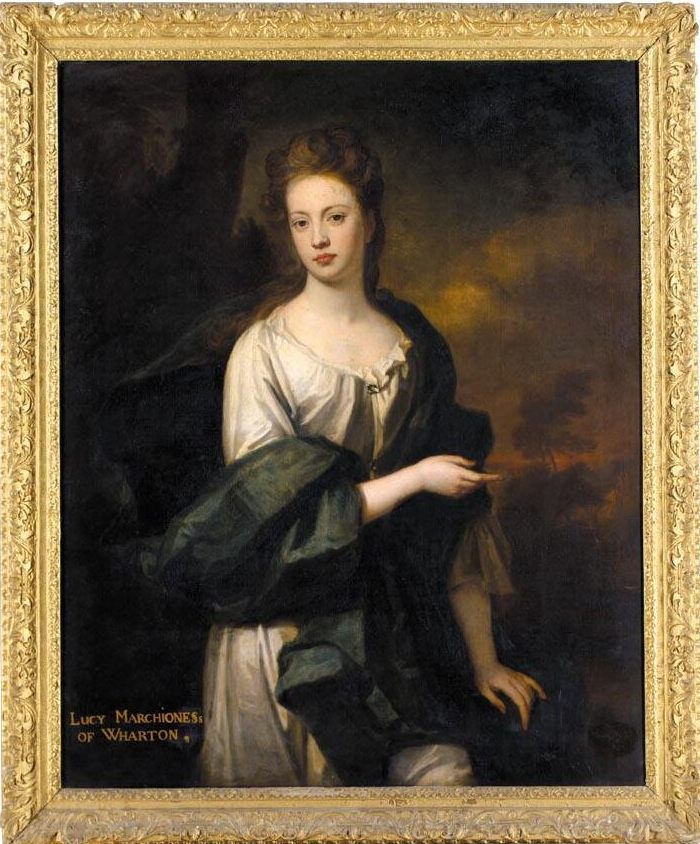
In 1718 Stephen Fitzwilliam Browne (d. 1767) rebuilt Clongowes Wood Castle, creating the western front facade as it appears today, comprising the central keep and two square towers. In 1788 Thomas Wogan Browne (d. 1812) extended and decorated the castle. The extension consists of the eastern facade and two round towers at the back of the castle. Note that this information is from the Clongowes Wood school website, with information from A Short History of Clongowes Wood College by Brendan Cullen.

Clongowes Wood College, photographed during a tour taken in August 2018. Photograph © Jennifer Winder-Baggot, www.irishhistorichouses.com
Staff dining room, Clongowes Wood College, photographed during a tour taken in August 2018. Photograph © Jennifer Winder-Baggot, www.irishhistorichouses.com
Staff Reading Common Room, Clongowes Wood College. Photograph by Brian O’Neill, This file is licensed under the Creative Commons Attribution-Share Alike 3.0 Unported license.

Belvedere House, 6 Great Denmark Street, Dublin (visited during Open House 2015):

https://www.oreillytheatre.com/belvedere-house.html

Open House 2015, Belvedere House, Belvedere College, Dublin. Photograph © Jennifer Winder-Baggot, www.irishhistorichouses.com

Stephen and I visited Belvedere House during Open House in 2015. We went into three rooms upstairs, up the beautiful staircase. We weren’t allowed photograph on the tour, unfortunately, in the Apollo Room, Venus Room and Jupiter Room.

Belvedere House is a symmetrical five-bay four-storey Georgian townhouse over exposed basement, completed 1786, designed by Robert West who, in addition to being a stuccodore was also an architect and property developer. It was built for George Augustus Rochfort, 2nd Earl of Belvedere. The house was built for £24,000 on what would have been rural green fields with a view of the Custom House, the bay and distant mountains. It is alleged that the house is haunted by Mary Molesworth, the first lady of Belvedere, mother to George Rochfort – we came across her at Belvedere in County Westmeath.

Rochfort was the son of the cruel Robert Rochfort, 1st Earl of Belvedere, who kept his wife under lock and key in the countryside after he believed she had an affair with his brother. Some believe that she was the inspiration for Charlotte Bronte’s “madwoman in the attic.” Robert Rochfort had the summer lodge, Belvedere, built in County Westmeath, now open to the public, which also has fine plasterwork. Robert O’Byrne writes that it was the 1st Earl who bought the property on Great Denmark Street. At first his son attempted to sell the property, but then he finished having the house built. Robert O’Byrne also tells us that it is similar to 86 St Stephen’s Green (Newman House, now housing the Museum of Literature of Ireland (MOLI), which was begun in 1765, and which is also attributed to Robert West.

North Great Georges Street itself was originally laid out in 1774 as a driveway leading to Belvedere House.

In 1841 the house was bought by the Society of Jesus (Jesuits) to accommodate their growing boys school which had started life ten years previously around the corner on Hardwicke Street, now known as Belvedere College.

One of the more outstanding features of the house is the stucco-work of Adamesque style popularised by Robert and James Adam. This can be seen in the ornamental surrounds, wherein pictures are framed in plaster rather than oil.

Dublin stuccodore and designer Michael Stapleton (1740-1801) was responsible for this work and further examples of his craftsmanship include the ceiling in the exam hall in Trinity College as well as some of the plasterwork in Powerscourt House in South William Street in Dublin and the Aras an Uachtarain in Phoenix Park.

Open House, Belvedere House, Belvedere College, Dublin. Photograph © Jennifer Winder-Baggot, www.irishhistorichouses.com
Belvedere House, Dublin, photograph from Brendan Merry and Partners website from their conservation and restoration of Belvedere House.

It seems odd that a house designed by Robert West would have plasterwork by Michael Stapleton. Robert O’Byrne elucidates this for us:

“In 1967 C.P. Curran’s  Dublin Decorative Plasterwork of the 17th and 18th centuries noted in the collection of drawings left by stuccodore Michael Stapleton several items directly relating to the design of ceilings in Belvedere House. Accordingly, this work was assigned to Stapleton. However, the fact that West was responsible for designing the house complicates matters, and the consensus now appears to be that both he and Stapleton had a hand in the plasterwork. Conor Lucey (in The Stapleton Collection, 2007) suggests that Stapleton may have been apprenticed to, or trained with, West and the fact that he was named the sole executor of the latter’s will in 1790 indicates the two men were close. The source material for the stucco work is diverse, that in the stair hall deriving in part from a plate in Robert Adam’s Works in Architecture, but the first-floor rooms feature a wider range of inspiration, much of it from France and Italy.”

Open House 2015, Belvedere House, Belvedere College, Dublin – excuse the shakey camera – I need to visit again! Photograph © Jennifer Winder-Baggot, www.irishhistorichouses.com
Belvedere House, Dublin, photograph from Brendan Merry and Partners website from their conservation and restoration of Belvedere House.

We were given a leaflet, which tells us:

The ground floor rooms were intended for everyday and business use and therefore are minimally ornamented. However when one ascends they will encounter Stapleton’s stucco-work that depicts scenes from Greek and Roman mythology. On the half-landing the Bacchanalia is celebrated. The left panel depicts Bacchus with his thyrsis and staff, the right panel is Ceres with her cornucopia. The central oval shows Cupid being demoted by the three Graces. The arched window is ornamented with symbols of the authority of ancient Rome. The tall pilasters on each side have the Green anthemion (honeysuckle) motifs.

At the top of the stairs the panel between the two doors on the right show Juno seated on a cloud with her peacock. The panel on the centre wall is Aurora in her chariot pulled by winged horses. Under this plaque “The New Bride” from an ancient marble popular in 18th century Rome. All the five doors have the same over-door: Silenus, the tutor of Bacchus. On the ceiling, Eros is depicted gazing at Psyche as she sleeps. Next is an Apollo head with winged lions and lastly, Cupid with a flower.

The door immediately to the right of the stairs leads to the Apollo Room, named after the featured frieze of Apollo the music-maker holding court with attendent putti playing a variety of instruments. The adjoining Diana Room depicts Diana, patron of the chase, in a chariot drawn by stags. The design is taken directly from Pergolesi, however, Stapleton added the outer circle of flowers.

Finally the Venus Room’s flanking panels have lunettes representing astronomy, architecture and sculpture. Notice the beautiful over-doors in all three rooms, each with the head of the principle subject.”

Venus was taken down by the Jesuits as she was nude, and it is supposedly in the National Gallery.

Belvedere House, Dublin, photograph from Brendan Merry and Partners website from their conservation and restoration of Belvedere House.

[2] https://www.dib.ie/biography/loftus-adam-a4867

[3] Loftus Hall: Formerly named Redmond Hall, it is a three-storey mansion built in 1871, incorporating parts of a previous house here, which was late 17th century or early C18.

Loftus Hall, County Wexford, for sale April 2025 photograph courtesy Colliers.

[4] https://www.archiseek.com/1583-rathfarnham-castle-co-dublin/
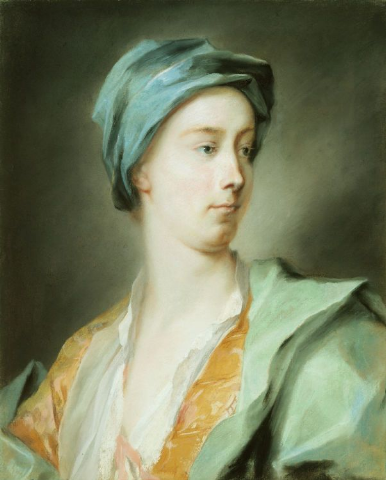
[5] “Rathfarnham Castle” by C. Scantlebury, Dublin Historical Record, Vol. 12, No. 1 (Feb., 1951), pp. 20-30. https://www.jstor.org/stable/30080721

[6] https://bellinghamswanhistory.club/descendant-tree-for-bellingham-boyle-mp1690-1771-and-sarah-hoadly-b1720/
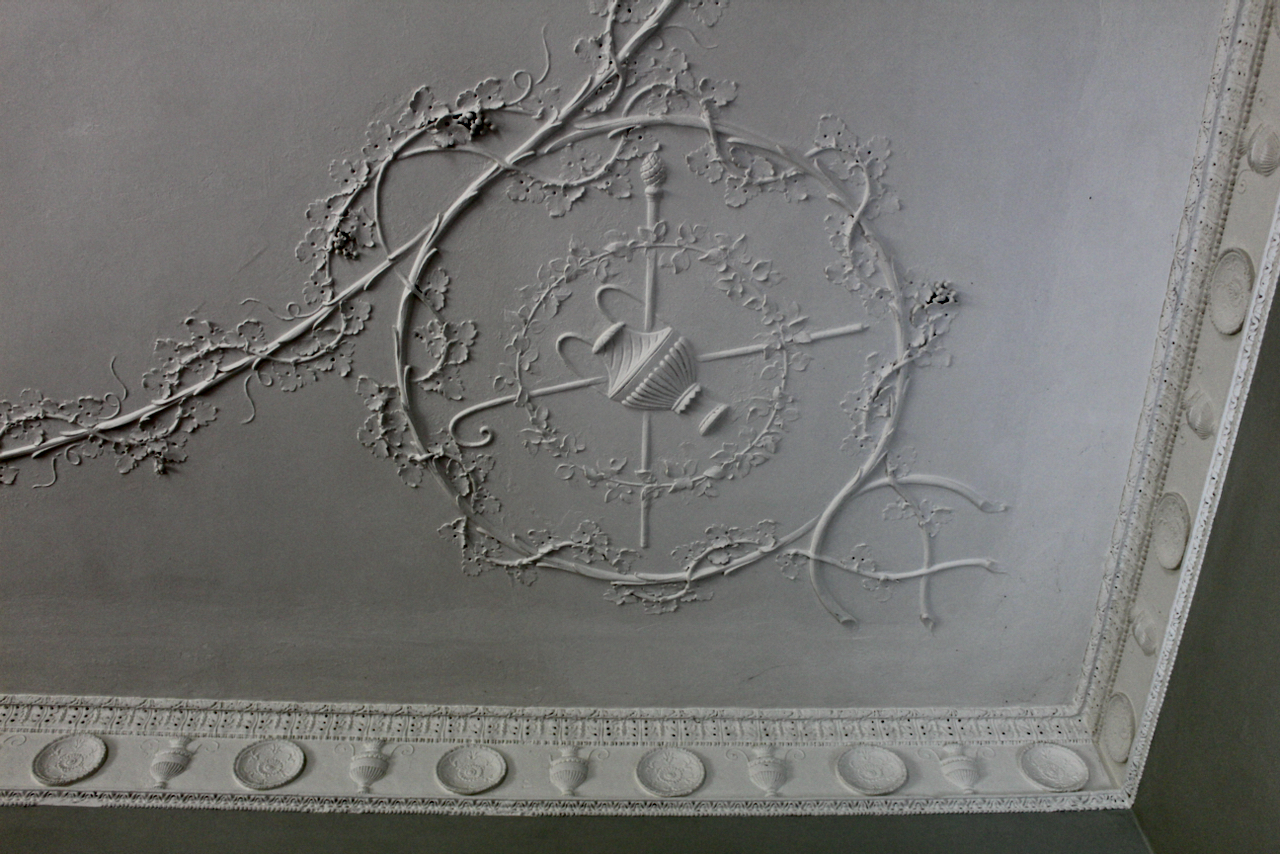
The Old Vicarage, Skerries Road, Rush, Co. Dublin,

The Old Vicarage, Skerries Road, Rush, Co. Dublin for sale June 2025 courtesy Savills. K56FK84

€1,650,000

4 Bed

Victorian period home in a coastal setting Set in mature landscaped gardens and adjoining Rush Cricket Club, this former Church of Ireland rectory is a home full of character and history. Designed in 1866 by the well-known architect James Edward Rogers, who also designed the nearby Kenure Church, this detached house with a half-dormer attic is a fine example of 19th-century design. The house has a T-shaped layout with a pitched slate roof topped by terracotta ridge tiles. Limestone chimneys with red brick detailing rise above the roof, while timber bargeboards, cast-iron gutters, and exposed timber beams add to its charm. The exterior walls combine red brick and rough limestone, giving the house a strong and stylish look. Tall pointed windows with red brick surrounds and timber sashes let in plenty of natural light and reflect the home’s historic past. Set back from the road, The Old Vicarage is approached through limestone pillars with pyramid-shaped tops and wrought-iron gates, sitting quietly in peaceful gardens just a short walk from the sea and Rush. Extending to 242.7 sq m (2,612 sq ft), (excluding the Mews) this home is spread over two floors, each carefully designed for comfortable living. The ground floor offers a relaxed, open layout perfect for daily family life, alongside a range of more formal rooms that provide privacy and ideal for entertaining. At the centre of the home is a bright and welcoming entrance hall, leading to connected family areas filled with plenty of natural light. The main living spaces feature quality materials throughout, including hardwood floors, stylish tiles, custom woodwork, and modern lighting, all creating a feeling of simple elegance. The ground floor includes a large kitchen, a formal drawing room, a cosy living room, a dining room, everyday sitting room, a breakfast room, a utility room, and a guest WC. Upstairs, the first floor holds a spacious master bedroom and three more double bedrooms, with one bedroom featuring its own en suite and a family bathroom and linen cupboard. Mews The mews (125 sq/m / 1,345 sq/ft) is located across the cobbled court yard from the house, is double storey and a multifunctional space with plenty of scope to convert or use as storage and maybe an ideal area for working from home or indeed a workshop. Gardens Well established gardens and grounds (extending to about 3.4 acres) offering great privacy and shelter. The garden has been very well maintained over the years and includes well kept lawns, mature trees and shrubbery throughout the garden. The garden also includes a large paddock to the rear of the home which could be used for variety of uses including development (S.P.P.), equestrian use or just a fantastic mature garden area. Development potential A large portion of the site is zoned residential and offers a development company an opportunity to develop a scheme of homes subject to the relevant permissions – further detail is available from Savills. Viewing Strictly by appointment with Savills Residential and Country Agency. Services Oil fired central heating, mains waste water, mains water and fibre broadband. Entry & Possession Entry is by agreement with vacant possession. Offers Offers may be submitted to the selling agents: Savills, 33 Molesworth Street, Dublin 2. Email address: country@savills.ie

Summerville, 21 Cross Avenue, Blackrock, Dublin

Summerville, 21 Cross Avenue, Blackrock, Dublin for sale June 2025 courtesy Christies

Summerville, 21 Cross Avenue, Blackrock, Dublin for sale June 2025 courtesy Christies.

A94 K1V0. $5,735,128. 6 Bedrooms, 3/1 Bathrooms. 5,543 ft², 0.50 ac

Dating from c.1807, Summerville is undoubtedly one of Blackrock’s most impressive and attractive residences. 

Summerville, 21 Cross Avenue, Blackrock, Dublin for sale June 2025 courtesy Christies.

Standing on .5 acres (approx.) of wonderfully mature and secluded gardens, Summerville comprises a very imposing two storey over garden level detached residence with elaborate ironwork canopies to the front at Hall Floor level in addition to a most attractive cast iron balcony to the side and rear. Further enhancing Summerville’s appeal, is its prime location on Cross Avenue, one of South Co. Dublin’s most desirable and convenient residential roads.

Summerville, 21 Cross Avenue, Blackrock, Dublin for sale June 2025 courtesy Christies.

Providing over 515 sq m / 5,540 sq ft (approx.) of wonderfully elegant and flexible accommodation, this majestic property has retained its numerous period features enabling the discerning purchaser to create a truly outstanding residence of unique style and character.

In brief, the property comprises:

Summerville, 21 Cross Avenue, Blackrock, Dublin for sale June 2025 courtesy Christies.

Hall Level:

Entrance Porch: incorporating original stained glass panels leading to

Gracious Entrance Hall:

Drawing Room: with feature bow window incorporating 2 windows and glazed door to balcony. Magnificent ceiling with ornate shell & vine motif, original white marble mantlepiece, dual aspect with twin windows to front and rear

Dining Room: with original marble mantlepiece, tiled insert and hearth, impressive ornate cornice and centre rose, feature arched dresser and door to back hall and serving hatch, 2 windows to front and door to inner hallway

Large Kitchen/Breakfast Room: with oak timber floor, Clive Nunn wall and floor units, with Kilkenny limestone worktop, Belfast sink, Bosch dishwasher, island unit, gas AGA, gas & electric hob, Neff oven, door to

Walk-in Pantry with door to

Bathroom: wash hand basin, w.c. and bath

Garden Level:

Hallway: with door to understairs store/cellar and to

Inner Hallway: with door to understairs storage, door to rear and storeroom

Living Room: with feature bow window, door to rear garden, dual aspect, feature cast iron fireplace, John Daly fitted shelves and presses and door to

Conservatory: large double glazed Hampton Conservatory, with glazed pitched roof, tiled floor, John Daly radiator cover and double doors to garden

Home office/Study: with bookshelves and door to

Games Room: with door to

Office/Bedroom 5: with built-in desk window overlooking the back garden

Bedroom 6: double with twin windows to rear

Self-contained Annex: double stained glass doors from front garden to outer hall with tiled floor and cloaks press, door to

Laundry/Kitchen: with pine wall and floor presses, Belfast sink, plumbing for washing and dryer, 2 recently installed Viessmann boilers and door to

Enclosed yard: with a variety of storage areas, large bicycle shed and garden sheds

Library: with extensive wall to wall book shelves and door to

Shower Room: tiled floor, step in shower, w.c., wash hand basin

First Floor:

Landing: leading to

Main Bedroom: large double room with dual aspect, extensive built in John Daly wardrobes and dressing table, feature bow windows overlooking the back garden

Bedroom 2: double, with walk-in wardrobe and outlook over the front garden

Shower Room Ensuite: with shower, wash hand basin, w.c., built in storage, heated towel rail, tiled floor

Bedroom 3: double, with outlook over the back garden, built in John Daly bookshelves, study desk and built in wardrobes

Bedroom 4: double with view of the back garden, built in John Daly wardrobe, cast iron fireplace and book shelves

Main Bathroom: with His & Her sink, bath with shower attachment and w.c., heated towel rail and recessed lighting

Landing: with stairwell leading to roof space and outside roof, accessed via glass panelled doors 

Outside:

To the front, accessed through large security gates, is a good sized front garden providing generous off-street parking for 5/6 cars. The back garden, which is laid out in lawn, is an outstanding feature of the property due to its very generous size and the excellent seclusion provided by the numerous mature trees, including Monterey Pine, Californian Redwood, Monkey Puzzle, apple trees and shrubs. Located in an enclosed courtyard to the rear of the property are numerous storage and garden sheds.

Located to the side of the property is an annex which currently provides additional accommodation to the main house but could be converted into a self-contained apartment, (subject to planning permission).

17 Hume Street, Dublin 2

17 Hume Street, Dublin 2 For sale June 2025 courtesy Knight Frank

https://www.buildingsofireland.ie/buildings-search/building/50100296/17-hume-street-dublin-2-co-dublin

Attached two-bay four-storey former house over basement, built c. 1780, having full-height hip-roofed closet return to rear. Now in use as offices. Pitched L-plan slate roof with terracotta ridge tiles, fronted by rebuilt brick parapet with granite coping. Parapet gutters, cast-iron hopper and downpipe. Large buff brick chimneystack to east party wall with yellow clay pots. Flemish bond red brick walling with granite plinth course, over painted rendered walling to basement; rendered to rear. Square-headed window openings, diminishing in height to upper floors, with brick voussoirs, granite sills and painted rendered reveals. Six-over-six pane timber sliding sash windows to lower floors with ogee horns and three-over-three pane to top floor. Decorative cast-iron balconettes to first floor and decorative cast-iron grilles to basement; apparently timber sash windows to rear. Round-headed door opening with projecting painted masonry doorcase comprising entablature with fluted frieze and rosettes over engaged Adamesque Ionic columns, leaded cobweb fanlight and replacement eight-panel timber door with beaded muntin and recent brass furniture. Granite entrance platform with cast-iron boot-scrape and three steps to street. Basement area enclosed by spear-headed cast-iron railings with decorative corner posts over granite plinth. Recent door and window to basement in slated single-pitched porch, accessed by replacement mild-steel steps. Yard to rear.

Appraisal

A modest late eighteenth-century Georgian house displaying well-balanced proportions and the graded fenestration typical of the period. The relatively plain façade is enriched by a good neo-Classical doorcase, pretty fanlight and ironwork setting features. In conjunction with Ely Place, Hume Street forms a T-plan arrangement of former residential streets, laid out in 1768 by the surgeon and property developer Gustavus Hume. Variations in scale, detailing and parapet height across this northern section of the street are indicative of the speculative and piecemeal nature of its construction. Despite some replacement fabric insertions, the overall character of No. 17 is largely well retained. The decorative doorcase and balconettes add visual interest to the facade and the setting is intact, contributing to the significant eighteenth-century character of Hume Street, which is largely well preserved on this northern section, and to the wider architectural heritage of south Dublin.

For sale June 2025 courtesy Knight Frank, D04V9F2

€1,900,000

3 Bed4 Bath236 m²

‘A rare opportunity to acquire a Georgian residence extending to approximately 236 sq. m / 2,540 sq. ft., situated beside St Stephen’s Green one of Dublin’s most sought-after and historic districts.’ No. 17 Hume Street is a distinguished four-storey over lower ground floor Georgian townhouse extending to approximately 236 sq. m / 2,540 sq. ft., situated in one of Dublin’s most sought-after and historic districts. Beautifully presented across its upper four floors, the property showcases elegant period features. The lower ground floor offers excellent potential to create a self-contained apartment, home office, or additional income generating accommodation. A flight of granite steps leads to the original Georgian panelled front door, complete with a classic Mahogany brass lock plate, opening into a gracious entrance hallway. Off the inner hall is the first reception room, featuring a period fireplace, along with a well-appointed bathroom. A staircase from the hallway leads to the lower ground level, which includes a living room, a kitchen, and a shower room. From the living room, a lobby area leads to a traditional coal store and provides direct access to the main street with generous under street storage. This level offers flexible usage and could enhance both the functionality and value of the property. On the first floor is a magnificent drawing room with a feature fireplace, perfect for entertaining or relaxing. A fully fitted kitchen is positioned to the rear. On the second floor is the principal bedroom with access to the main bathroom, also accessible from the landing. The third floor offers two further double bedrooms and a stylish shower room. This is a rare opportunity to acquire this elegant Georgian residence in such a prime central location. No. 17 Hume Street offers charm, character, and potential in abundance as a prestigious private residence, a stylish city home, or a valuable investment with flexible living arrangements. Location Few residential properties enjoy such a prime location. Just a stone’s throw away are St. Stephen’s Green and Merrion Square one of Dublin’s finest Georgian garden squares and home to the National Gallery of Ireland and Leinster House. Nearby, Grafton Street, Baggot Street, and Merrion Row offer some of the city’s best dining experiences, including renowned venues such as The Shelbourne and The Merrion Hotel, alongside a wide array of shops, bars, and cafés.The Iveagh Gardens are also close by, offering an additional peaceful retreat in the heart of the city, often referred to as Dublin’s Secret Garden’. The convenience of Hume Street cannot be overstated, with all the city’s key amenities within walking distance, including a Dublinbikes station on St. Stephen’s Green. Meanwhile, the superb shopping and leisure facilities of Grafton Street and St. Stephen’s Green are just a five-minute walk away. A number of prestigious educational institutions are also nearby, including Loreto College, the Royal College of Surgeons, and Trinity College Dublin.

Doheny & Nesbitt pub, 4/5 Lower Baggot Street, Dublin 2 – section 482

www.dohenyandnesbitts.ie

Open dates in 2026: all year, except Christmas Day, Mon-Thurs, 9am -11.30pm, Fri-Sat 9am -12.30am, Sunday 10am-midnight,
Fee: Free

Donation

Help me to fund my creation and update of this website. It is my “full time job” and created purely out of love for the subject and I receive no payment so any donation is appreciated! My costs include travelling to our destinations from Dublin, accommodation if we need to stay somewhere nearby, and entrance fees. Your donation could also help with the cost of the occasional book I buy for research (though I mostly use the library – thank you Kevin Street library!). Your donation could also help with my Irish Georgian Society membership or attendance for talks and lectures, or the Historic Houses of Ireland annual conference in Maynooth.

€15.00

Doheny & Nesbitt, photograph courtesy of Flickr, “photos by Joe.”

Doheny & Nesbitt, a popular bar on Lower Baggot Street, occupies what was once a residence, built around 1790. Now it holds one of the finest Victorian pubs in Dublin.

Not long before, until 1773, the road had been called Gallows Road, as it led to the Gallow Mount, where criminals were hung. It was not just criminals, however, but also Catholics: Dermot O’Hurley, Archbishop of Cashel, was hung on 20 June 1584, and officially recognised as a Catholic martyr by Pope John Paul II in 1992. I first heard of the painful fate of Dermot O’Hurley when exploring the park of St. Kevins church, where the Archbishop is buried. His feast day, coincidentally, is this week, the 20th June.

A plaque in St. Kevin’s Park in Dublin tells us about Archbishop Dermot O’Hurley, who was hung on the Gallow Mount in 1584 near where Doheny & Nesbitt is located. Photograph © Jennifer Winder-Baggot, www.irishhistorichouses.com

Dermot O’Hurley was born in County Tipperary and studied in Louvain in Belgium. Catholics from Ireland had to go abroad to study. He knew that when he was ordained, his life would be that of a fugitive, ministering when possible. When he travelled to Ireland after his appointment, he never reached Cashel . Officials believed that O’Hurley was plotting to overthrow the English in Ireland. He was captured and tortured, including putting his feet into boots filled with boiling pitch and oil.

Richard Verstegen’s depiction of the 1584 torture and execution of Archbishop Dermot O’Hurley. The 1579 hanging of fellow Irish Catholic Martyrs Bishop Patrick O’Hely and Friar Conn Ó Ruairc is shown in the background. Coloured engraving from Richard Verstegan, Theatrum crudelitatum haereticorum nostri temporis, 1587.

Another person executed in the same spot was “Darkey” Dorcas Kelly, a “Madam” who operated the Maiden Tower brothel on Copper Alley, off Fishamble Street in Dublin. She was burnt at the stake in 1761 – not all that long before the Georgian houses were built on Gallows Road.

Doheny & Nesbitt, photograph from the pub’s facebook page.

The pub occupies both numbers 4 and 5, two Georgian houses of two bays and four storeys, fronted in brown brick, with corner quoins. The windows diminish in size from ground to top storey. The Georgian period spans over a century, referring to the four successive reigns of King Georges of the House of Hanover, from the accession of George I to the throne in 1714 to the death of George IV in 1830. 

Dublin Georgian town houses are typically terraced. Dublin Civic Trust’s website tells us that the house facade, including the spacing and shape of windows, is designed in accordance with classical rules of proportion. Servants quarters and kitchens were housed in the basement, while the principal living space was at first floor level, called a ‘piano nobile’ (Italian for main floor). Large windows at this level let in lots of light. Bedrooms, with smaller windows, were on upper storeys.

The National Inventory tells us that the timber pub front is from around 1890. The Inventory describes panelled pilasters over a painted masonry plinth.

Doheny & Nesbitt, photograph from the National Inventory.

A decorative brass sheet reads ‘Tea & Wine Merchant’. 

Doheny & Nesbitt, photograph from the National Inventory.

Wooden oversize scrolled foliate consoles frame the signage. Inside the pub retains its Victorian decor, with its original joinery in the bar, snugs and carved timberwork ceilings (according to the National Inventory). The website tells us that the ceiling is of papier maché, and that it has been restored. There’s a replica Victorian bar in the rear.

Doheny & Nesbitt, photograph from the National Inventory.
Doheny & Nesbitt, photograph from the pub’s facebook page.

The main bar retains the original counter, and almost all of the original fittings date from the 19th century. I think it’s unfortunate the bar has big tvs so that customers can follow sports, as they ruin the old world atmosphere.

Doheny & Nesbitt, 4/5 Lower Baggot Street, Dublin 2. Photograph © Jennifer Winder-Baggot, www.irishhistorichouses.com

The National Inventory tells us that the liquor licence has been held by several owners. It was a grocers as well as a pub. Shaw’s Directory of 1850 records William Burke as the occupant of the premises. The website tells us that it became a pub in the 1840s. Burke ran the pub as ‘Delahuntys’ for almost fifty years.

In 1924, Philip Lynch and James O’Connor took it over for around thirty years, before passing it onto a Felix Connolly. A sign over the bar retains the Connolly name. Ned Doheny and Tom Nesbitt, two Co. Tipperary men, then took over and gave it the current name. It now has newer owners, who retained the name.

Doheny & Nesbitt, 4/5 Lower Baggot Street, Dublin 2. Photograph © Jennifer Winder-Baggot, www.irishhistorichouses.com
The front bar, with mirror and wood divisions, Doheny & Nesbitt, 4/5 Lower Baggot Street, Dublin 2. Photograph © Jennifer Winder-Baggot, www.irishhistorichouses.com
A row of old whiskey jugs decorate the top shelf over the bar, Doheny & Nesbitt, 4/5 Lower Baggot Street, Dublin 2. Photograph © Jennifer Winder-Baggot, www.irishhistorichouses.com

The pub sells food and tables can be reserved in advance if one wants a meal.

Doheny & Nesbitt, photograph from the pub’s website.

The bar has several rooms, and function rooms upstairs and in the basement, catering for different capacities.

Doheny & Nesbitt, photograph from the pub’s website.
Stephen and Denise in Doheny & Nesbitt in June 2025. Photograph © Jennifer Winder-Baggot, www.irishhistorichouses.com
Doheny & Nesbitt, photograph from the pub’s website.

Old advertisments and memorabilia line the walls, and the back bar has an unusual panelled barrel ceiling.

Doheny & Nesbitt, photograph from the pub’s facebook page.
Doheny & Nesbitt, 4/5 Lower Baggot Street, Dublin 2. Photograph © Jennifer Winder-Baggot, www.irishhistorichouses.com
Doheny & Nesbitt, photograph from the pub’s facebook page.
Wall of fame, Doheny & Nesbitt, 4/5 Lower Baggot Street, Dublin 2. Photograph © Jennifer Winder-Baggot, www.irishhistorichouses.com
Doheny & Nesbitt, photograph from the pub’s website.

There are three rooms available to book for functions: Tom’s Bar, Paul’s Bar and the Marble Bar. There is also a cellar bar.

Doheny & Nesbitt, photograph from the pub’s facebook page.
Doheny & Nesbitt, photograph from the pub’s website.
The smoking area, Doheny & Nesbitt, photograph from the pub’s website.
Doheny & Nesbitt, photograph from the pub’s website.

https://www.buildingsofireland.ie/buildings-search/building/50100456/doheny-nesbitt-4-baggot-street-lower-dublin-2-co-dublin

https://www.buildingsofireland.ie/buildings-search/building/50100457/doheny-nesbitt-5-baggot-street-lower-dublin-2-co-dublin

Donation towards accommodation

I receive no funding nor aid to create and maintain this website, it is a labour of love. I travel all over Ireland to visit Section 482 properties and sometimes this entails an overnight stay. A donation would help to fund my accommodation.

€150.00

2026 Diary of Irish Historic Houses (section 482 properties)

To purchase an A5 size 2026 Diary of Historic Houses send your postal address to jennifer.baggot@gmail.com along with €20 via this payment button. The calendar of 84 pages includes space for writing your appointments as well as photographs of the historic houses. The price includes postage within Ireland. Postage to U.S. is a further €11 for the A5 size, so I would appreciate a donation toward the postage – you can click on the donation link.

€20.00

Donation

Help me to fund my creation and update of this website. It is my “full time job” and created purely out of love for the subject and I receive no payment so any donation is appreciated! My costs include travelling to our destinations from Dublin, accommodation if we need to stay somewhere nearby, and entrance fees. Your donation could also help with the cost of the occasional book I buy for research (though I mostly use the library – thank you Kevin Street library!). Your donation could also help with my Irish Georgian Society membership or attendance for talks and lectures, or the Historic Houses of Ireland annual conference in Maynooth.

€15.00

The Odeon (formerly Harcourt Street Railway Station), Dublin 2, D02VE22 – Section 482

The Odeon, formerly Harcourt Street Railway Station.

Donation

Help me to fund my creation and update of this website. It is my “full time job” and created purely out of love for the subject and I receive no payment so any donation is appreciated! My costs include travelling to our destinations from Dublin, accommodation if we need to stay somewhere nearby, and entrance fees. Your donation could also help with the cost of the occasional book I buy for research (though I mostly use the library – thank you Kevin Street library!). Your donation could also help with my Irish Georgian Society membership or attendance for talks and lectures, or the Historic Houses of Ireland annual conference in Maynooth.

€15.00

I have created my 2026 Diary Calendar, which is available to order now. Please note that if you are purchasing from outside Ireland, I would appreciate a donation toward postage, by clicking on the donation button.

2026 Diary of Irish Historic Houses (section 482 properties)

To purchase an A5 size 2026 Diary of Historic Houses send your postal address to jennifer.baggot@gmail.com along with €20 via this payment button. The calendar of 84 pages includes space for writing your appointments as well as photographs of the historic houses. The price includes postage within Ireland. Postage to U.S. is a further €11 for the A5 size, so I would appreciate a donation toward the postage – you can click on the donation link.

€20.00

Donation towards accommodation

I receive no funding nor aid to create and maintain this website, it is a labour of love. I travel all over Ireland to visit Section 482 properties and sometimes this entails an overnight stay. A donation would help to fund my accommodation.

€150.00

The Odeon, 57 Harcourt Street, Dublin 2, D02VE22, formerly the Old Harcourt Street Railway Station, is now a bar and currently a Section 482 property:

Open in 2026: all year Tue-Sat, National Heritage Week, Aug 15-23, 12 noon-12 midnight

Fee: Free

www.odeon.ie

Last week Lisney Real Estate advertised the building for sale for €6,500,000. It’s a beautiful venue for a party.

The Odeon, 1931, from the National Library archives, see flickr constant commons.
The Odeon, December 2020. Photograph © Jennifer Winder-Baggot, www.irishhistorichouses.com

Railways began in the 1550s as wooden rails used in mines to transport tubs carrying ore. That reminds me of the way Bord na Mona used trains to carry their turf on the bog, and the Guinness brewery also had its own train lines for transporting barrels of stout within the site.

The first public commuter railway system in Ireland launched in 1834 and ran between Dublin and Dún Laoghaire, formerly named Kingstown. [1] The Dublin and Kingstown Railway (D&KR) travelled from Westland Row in Dublin.

The Harcourt Street Station, built in 1859, was the terminus for the Dublin to Bray, County Wicklow train. Passengers could travel to the villages of Dundrum, Stillorgan and Milltown, and the train line helped to develop Bray into a seaside resort. An article in the Irish Independent, “Fascinating story of Harcourt Street line retold,” published 29th February 2012, tells us that two companies vied for the contract to run the train line. One company started building from Harcourt Street, the other from Bray. It was decided that the first to reach Dundrum would win the contract to run the Railway line. William Dargan was the successful contractor. [2]

The Odeon, December 2020. Photograph © Jennifer Winder-Baggot, www.irishhistorichouses.com

Before trains, public transportation comprised of stagecoaches travelling specified routes between coaching inns and horse-drawn boats carried paying passengers along canals.

The Harcourt-Bray train travelled for a century, ceasing in 1959. Much of the former trackbed remained intact and now carries the Luas, the Dublin light rail, the modern version of the tram. The Luas station ‘furniture’ impedes photography of the building and my attempts to highlight its architectural features!

The Odeon, December 2020. Photograph © Jennifer Winder-Baggot, www.irishhistorichouses.com

An entry about Dublin tram history on the Dublin City Public Participation Network tells us that the idea of transporting people along a fixed route within a city began in Nantes, France, around 1823, when Stanislas Baudry opened a bath house outside the city and started a shuttle service that left the town centre on a regular schedule. [3] I’m glad that the first fixed route city public transport system was for bathing and not for work, as I would have expected!

After Baudry realised some passengers used the shuttle to travel to destinations along the route, he created the first urban transit service in 1826 in Nantes, calling his coaches the “Omnibus” (Latin for “for all”). He quickly expanded to Bordeaux, Lyon, and eventually Paris. [see 3]

Architect George Wilkinson (1840-1890) designed the Harcourt Street station. [4] After he built twenty-four workhouses in England, in 1839 the Poor Law Commission in Ireland invited Wilkinson to design 130 workhouses. After eleven years, the Commissioners of the Poor Law decided that they could no longer afford their own full-time architect, and in September 1855 Wilkinson was retired on a pension of £300 per annum. [5]

The Odeon, December 2020. Photograph © Jennifer Winder-Baggot, www.irishhistorichouses.com

Next, Wilkinson designed railway stations, mostly for the Midland Great Western Railway Company. As he acknowledged, a workhouse had to be “uniform and cheap, durable and unattractive” so that people would be discouraged from applying to them for aid and accommodation. He took pride in his work, however. To underline the painstaking attention he had given to the materials used in the construction of the workhouses, Wilkinson published in 1845 his Practical Geology and Ancient Architecture of Ireland, which included a detailed account of the building materials available in the different counties with tables of the experiments he had conducted on the principal Irish building stones. [see 5] He managed to insert an Italianate tower in the Carlow workhouse.

The Dictionary of Irish Architects tells us that in August 1860 Wilkinson was appointed architect to the Commissioners of Asylums for the Lunatic Poor at a salary of £300 per annum. He designed two identical asylums at Castlebar, Co. Mayo, and Letterkenny, Co. Donegal. He remained in the post until 1886. He appears to have done relatively little private work. A few houses are recorded in Bray and Dalkey and a marble staircase for the Marquess of Sligo at Westport House (1858) but he does not seem to have designed any commercial premises or churches. His last important recorded commission was the new agricultural hall for the Royal Dublin Society at Ballsbridge, built in 1879-80. [see 5]

The Odeon, December 2020. Photograph © Jennifer Winder-Baggot, www.irishhistorichouses.com

The building is brown brick with granite stone dressing. Two colonnades of Tuscan columns flank the central monumental arch porch which has the entrance doors inside under a further two stone arches. The building is fronted by stone steps as it was built on an embankment.

The central block is double height, topped by an open pediment portico which has ends sitting on a frieze on top of pairs of oversized granite scrolled “corbels.” The large entrance arch is supported on a structure of paired columns.

The Odeon, December 2020. Photograph © Jennifer Winder-Baggot, www.irishhistorichouses.com

A keystone in the cut granite arch sits under a granite plaque inscribed ‘MDCCCLIX’ (1859).

The Odeon, December 2020. Photograph © Jennifer Winder-Baggot, www.irishhistorichouses.com

The windows have granite architraves (decorative moulding around a window or door).

I like the added stripes inside the colonnades. The Odeon, December 2020. Photograph © Jennifer Winder-Baggot, www.irishhistorichouses.com
The Odeon, photograph courtesy of Lisney Commercial Real Estate, June 2025.
The building features lovely ovoid windows with wooden crosshatching. Photograph courtesy of Archiseek.

At the rear of Harcourt Street Station at Hatch Street is the curved end wall of the former trainshed. The curved is due to the placement of the former turntable upon which steam locomotives turned to travel in the opposite direction. [6] This engine shed was used at another time as a bonded warehouse.

Curved wall which housed the turntable for turning the trains, photograph courtesy of National Inventory.
The Odeon, the sheds and vaults are of brick and Calp (limestone) to contrast with the main building of brown brick with granite. December 2020. Photograph © Jennifer Winder-Baggot, www.irishhistorichouses.com
The Odeon, December 2020. Photograph © Jennifer Winder-Baggot, www.irishhistorichouses.com
The station platforms, photograph courtesy of Archiseek.
The Harcourt Street station, photograph courtesy of The Odeon website.

In 1900 an accident occurred, when a train failed to stop at the station due to the weight of 30 wagonloads of cattle.

The 1900 crash, photograph courtesy of Odeon website
The 1900 crash, photograph courtesy of Odeon website, copyright Ciaran Cooney.

Archiseek describes:

Beneath the station shed are excellent arched vaults originally designed as a bonded spirit store and now housing a wine merchants and one of Dublin’s trendiest nightspots. The main front part of the building has recently been renovated and cleaned and is now an enormous bar which looks and feels bigger that the external dimensions of the station would suggest. The bar design manages to be sympathetic to the original design suggesting a large ‘Gentleman’s Club’ of the Victorian era without descending to pastiche.

The rear of the station has various store buildings which were accessible from a raised ramp off Harcourt Road. Due for redevelopment, these stores are quite large containing many brick archways from area to area and were used by Dunlop for many years.” [4]

The Odeon, photograph courtesy of Lisney Commercial Real Estate, June 2025.

This entry makes me want to visit the Steam Museum in County Kildare, another Section 482 property! More next week on a different pub, Doheny and Nesbitt.

[1] https://modelrailwaymuseum.ie/history-of-irish-rail/

[2] https://www.independent.ie/regionals/wicklow/news/fascinating-story-of-harcourt-street-line-retold/27868681.html

[3] https://dublincityppn.ie/stories/the-rise-and-fall-of-the-first-dublin-tram-network-part-1-beginnings-to-one-network/

[4] https://www.archiseek.com/2010/1859-former-harcourt-street-station-dublin/

[5] https://www.dia.ie/architects/view/4918/Wilkinson-George

[6] http://eiretrains.com/Photo_Gallery/Railway%20Stations%20H/Harcourt%20Street/IrishRailwayStations.html#

Ashtown Castle, Phoenix Park, Dublin – an OPW property

Donation

Help me to fund my creation and update of this website. It is my “full time job” and created purely out of love for the subject and I receive no payment so any donation is appreciated! My costs include travelling to our destinations from Dublin, accommodation if we need to stay somewhere nearby, and entrance fees. Your donation could also help with the cost of the occasional book I buy for research (though I mostly use the library – thank you Kevin Street library!). Your donation could also help with my Irish Georgian Society membership or attendance for talks and lectures, or the Historic Houses of Ireland annual conference in Maynooth.

€15.00

Ashtown Castle, Phoenix Park, Dublin:

Ashtown Castle, Phoenix Park, 6th July 2024, Photograph © Jennifer Winder-Baggot, www.irishhistorichouses.com

Ashtown Castle is in the Phoenix Park. The Office of Public Works are currently running one tour per day. [1] The tower house had been incorporated into a house in the late 1700s, and the Office of Public Works demolished the house, which had become very dilapidated, to restore the tower house.

Hugh Tyrrell (d. 1199), later 1st Baron of Castleknock, came to Ireland with Strongbow, Richard de Clare, 2nd Earl of Pembroke. Tyrrell, a second cousin of Strongbow, became right hand man to Hugh de Lacy, Lord of Meath. De Lacy conferred the feudal barony of Castleknock to Tyrrell.

The land at Ashtown, now part of the Phoenix Park, was granted by Hugh Tyrrell to the Hospital of St. John the Baptist in the 12th century. The Hospital belonged to the “Crutched Friars” (brothers of the cross) and was one of the earliest city charities.

When the monasteries were dissolved in 1540, Walter Foster was leasing the land, which he in turn sublet to two tenants.

Ashtown Castle, Phoenix Park, 6th July 2024, Photograph © Jennifer Winder-Baggot, www.irishhistorichouses.com

It is not known when the tower house was built but a fragment of a wooden roof truss, found in the wall during the restoration project, has been dated by dendrochronology to the early seventeenth century. The OPW website tells us that it could date further back, as early as the fifteenth century.

Ashtown Castle, Phoenix Park, 6th July 2024, Photograph © Jennifer Winder-Baggot, www.irishhistorichouses.com

In 1429 a statute was passed by King Henry IV to grant £10 to every man within the Pale who would build a castle of certain minimal dimentions in the following ten years. Ashtown may have been built in this period.

Ashtown Castle, Phoenix Park, 6th July 2024, Photograph © Jennifer Winder-Baggot, www.irishhistorichouses.com

On the tour, our tour guide told us the castle was built for a General Lambert in the early 1600s. I am not sure if this is conjecture or fact! General John Lambert (7 September 1619 – 1 March 1684) was an English army officer and politician and he fought in Cromwell’s army for the Parliamentarians. He was also Deputy Lord Lieutenant of Ireland.

Major-General John Lambert, (1619-1683), Parliamentarian, Deputy Lord Lieutenant of Ireland, courtesy of National Gallery of Ireland.

From the OPW website:

For years it was completely hidden within the walls of a Georgian mansion once occupied by the under-secretary for Ireland. When that house was demolished in the late 1980s, the castle was rediscovered. It has since been fully restored and now welcomes visitors.”

Ashtown Castle, Dublin, courtesy of Phoenix Park website. The arrangement of the growing hedges outline where the house was, before it was demolished.

Outside, the hedges to one side of the castle form the shape of the house that used to stand there, attached to the old castle.

An aerial picture of the castle that the guide showed us, with the shape of the hedges illustrated. Ashtown Castle, Phoenix Park, Photograph © Jennifer Winder-Baggot, www.irishhistorichouses.com
Ashtown Castle, Phoenix Park, 6th July 2024, Photograph © Jennifer Winder-Baggot, www.irishhistorichouses.com

The National Inventory tells us:

The castle was dated to the early seventeenth century on the basis of surviving fragments of a roof truss found in the wall during the restoration project in the early 1990s. There is in the stonework some suggestion of a further wing to the north, but no archaeological evidence was found, leaving this section unresolved. The builder is unknown, but in 1641 the estate was in the ownership of John Connell, a distant ancestor of Daniel O’Connell. Curiously the Civil Survey, 1654, lists him as a Protestant. Stone from a quarry at Pelletstown owned by Connell was used in the building of the original wall of the Park.”

Ashtown Castle, Phoenix Park, 6th July 2024, Photograph © Jennifer Winder-Baggot, www.irishhistorichouses.com

At that time, the estate consisted of 200 acres.

When James Butler 12th Earl of Ormond (who later became 1st Duke of Ormond) was created Lord Lieutenant of Ireland in 1662, he purchased the tower house and lands around it to create a deer park for King Charles II.

In 1668 Marcus Trevor, Viscount Dungannon, was appointed Ranger of the Park. Along with two Keepers, he was responsible for overseeing the Fallow deer imported from England.

The tower house became the official residence of second Keeper of the Park, William Flower, but he assigned it to a subordinate.

In the late eighteenth century the tower house was extended to become the Under Secretary’s residence, and was called Ashtown Lodge.

After Irish Independence, the house served as the residence of the Papal Nuncio. In 1978 the Papal Nuncio moved to a different residence.

The guide showed us what the house used to look like, that had been attached to the castle. For some more photographs, you can visit the Irish Tower House website. [2]

The guide showed us a photograph of a painting of the house as it used to look.
Ashtown Castle, Phoenix Park, with a picture of the castle superimposed onto the house to show its position, although it was not visible. Photograph of photograph © Jennifer Winder-Baggot, www.irishhistorichouses.com
This is what the house looked like before demolition. The upper storey of the castle had been made into a chapel for the Papal Nuncio when he lived in the house.
Ashtown Castle, Phoenix Park, 6th July 2024, Photograph © Jennifer Winder-Baggot, www.irishhistorichouses.com

The extension was demolished in the 1980s, due to poor condition.

Ashtown Castle, Phoenix Park, 6th July 2024, Photograph © Jennifer Winder-Baggot, www.irishhistorichouses.com

Restoration started in Autumn 1989. Corbels that carried the floor levels were uncovered, and also portions of fireplaces on the first and second floors and a piece of window jamb on the first floor.

Restoration work including new stonework, insertion of oak floors and roof was carried out by craftsmen attached to the National Monuments depot in the Phoenix Park.

Ashtown Castle, Phoenix Park, 6th July 2024, Photograph © Jennifer Winder-Baggot, www.irishhistorichouses.com
Entrance to Ashtown Castle, Phoenix Park, 6th July 2024, Photograph © Jennifer Winder-Baggot, www.irishhistorichouses.com
Ashtown Castle, Phoenix Park, 6th July 2024, Photograph © Jennifer Winder-Baggot, www.irishhistorichouses.com

The ground floor would have had only small windows and no fireplace. Recesses and niches may have served for cupboard space or lamp shelves.

Ground floor, Ashtown Castle, Phoenix Park, 6th July 2024, Photograph © Jennifer Winder-Baggot, www.irishhistorichouses.com
Ashtown Castle, Phoenix Park, 6th July 2024, Photograph © Jennifer Winder-Baggot, www.irishhistorichouses.com
Ashtown Castle first floor, Phoenix Park, 6th July 2024, Photograph © Jennifer Winder-Baggot, www.irishhistorichouses.com
Ashtown Castle, Phoenix Park, 6th July 2024, Photograph © Jennifer Winder-Baggot, www.irishhistorichouses.com

We then went up to the next level, which had been the chapel for the Papal Nuncio after Ireland gained independence from the United Kingdom.

Ashtown Castle, Phoenix Park, 6th July 2024, Photograph © Jennifer Winder-Baggot, www.irishhistorichouses.com

[1] https://heritageireland.ie/places-to-visit/phoenix-park-visitor-centre-ashtown-castle/

[2] https://irishtowerhouses.ie/county-dublin/ashtown-castle-co-dublin/