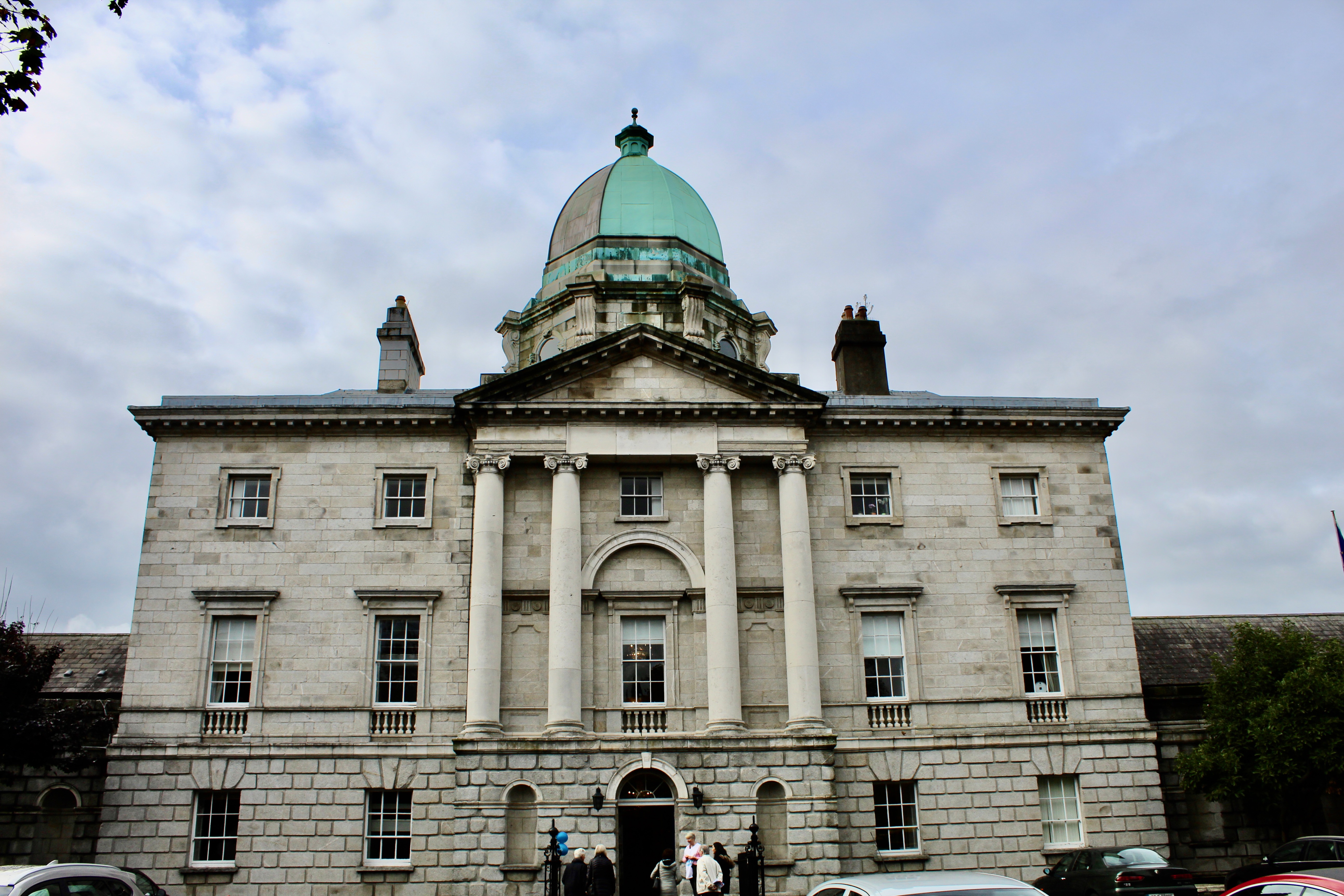
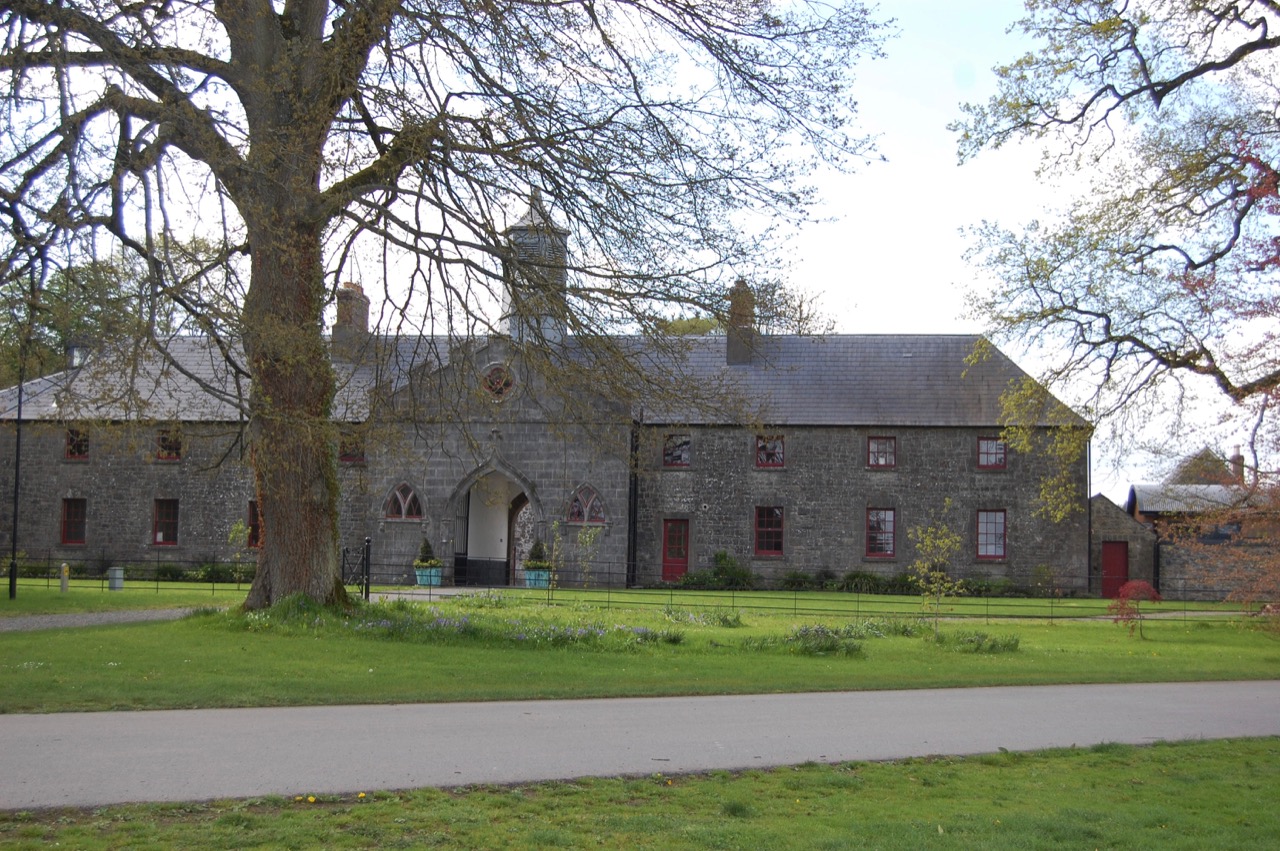
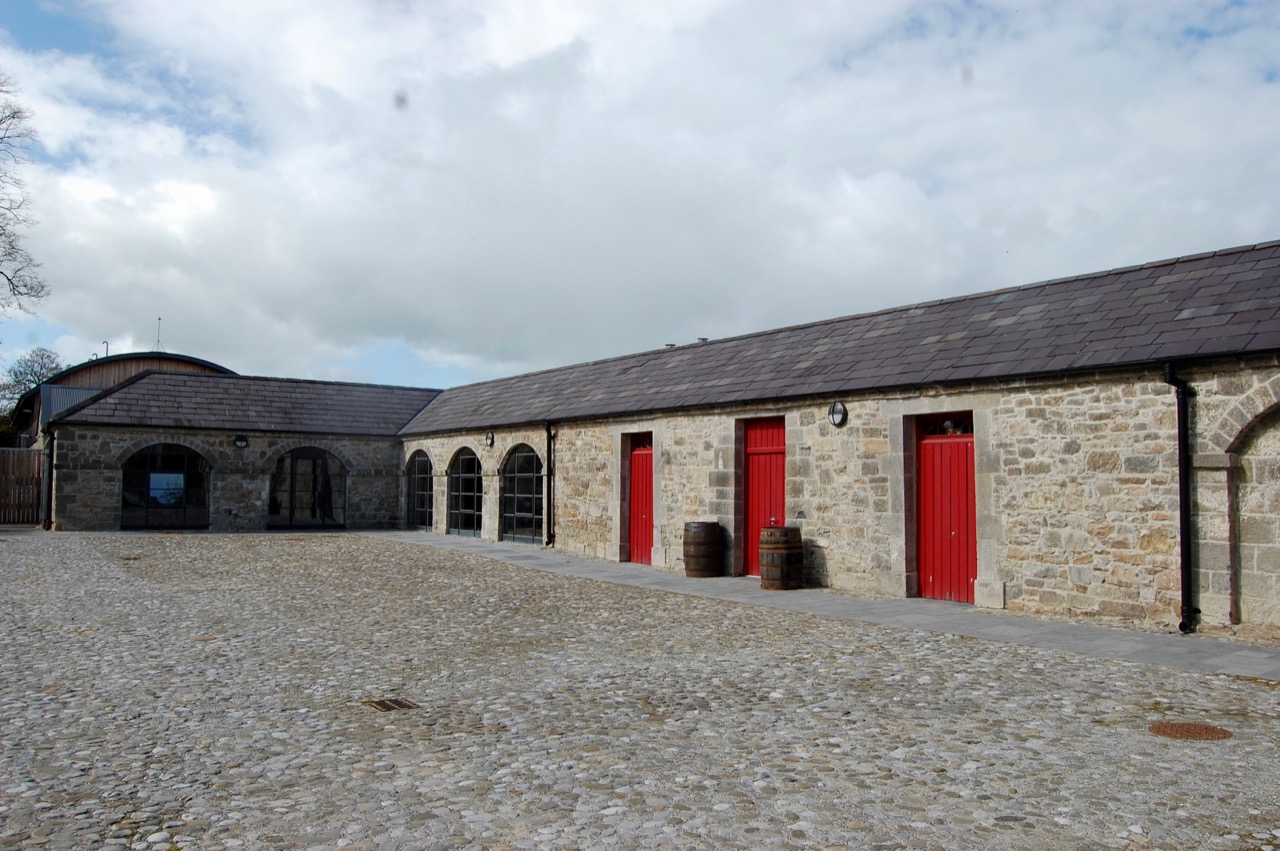
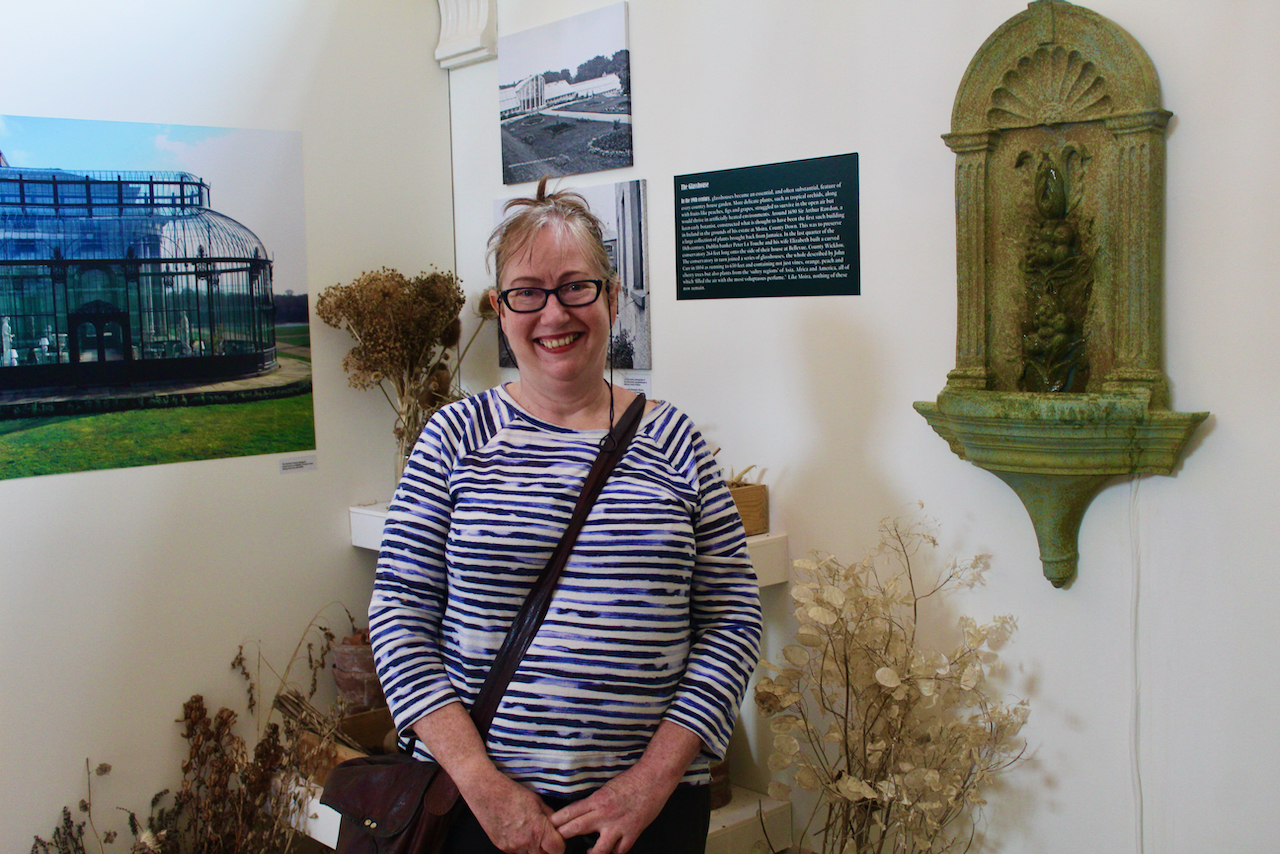
St. Mary’s Abbey, Abbey Lane, Trim, Co. Meath – section 482

Open dates in 2026: Apr 20-26, May 6-8, 16-17, June 22-28, July 20-26, Aug 15-23, 31, Sept 1-5, 21-26, Oct 16-21, Nov 23-29, 2pm-6pm

Fee: adult €5, OAP/student/child €2

donation

Help me to pay the entrance fee to one of the houses on this website. This site is created purely out of love for the subject and I receive no payment so any donation is appreciated!

€15.00

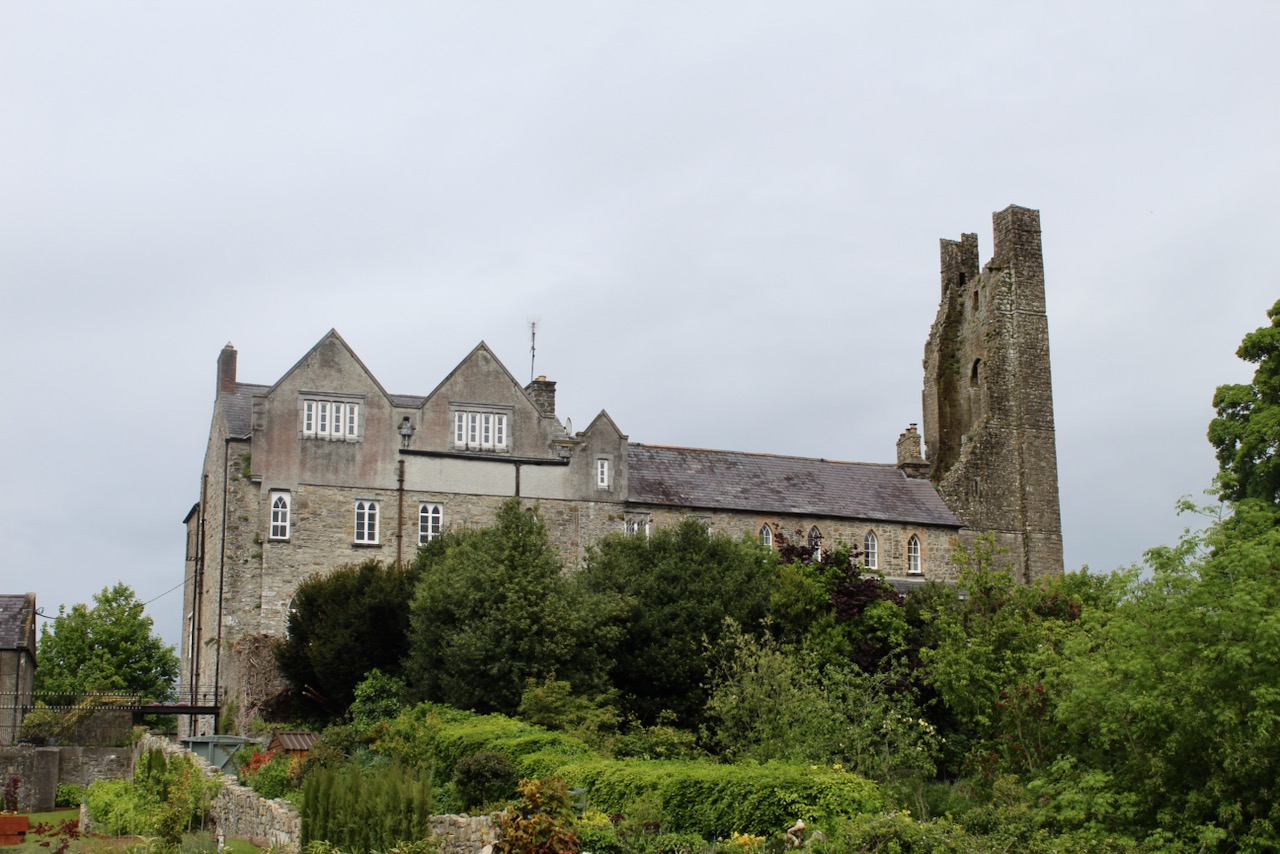
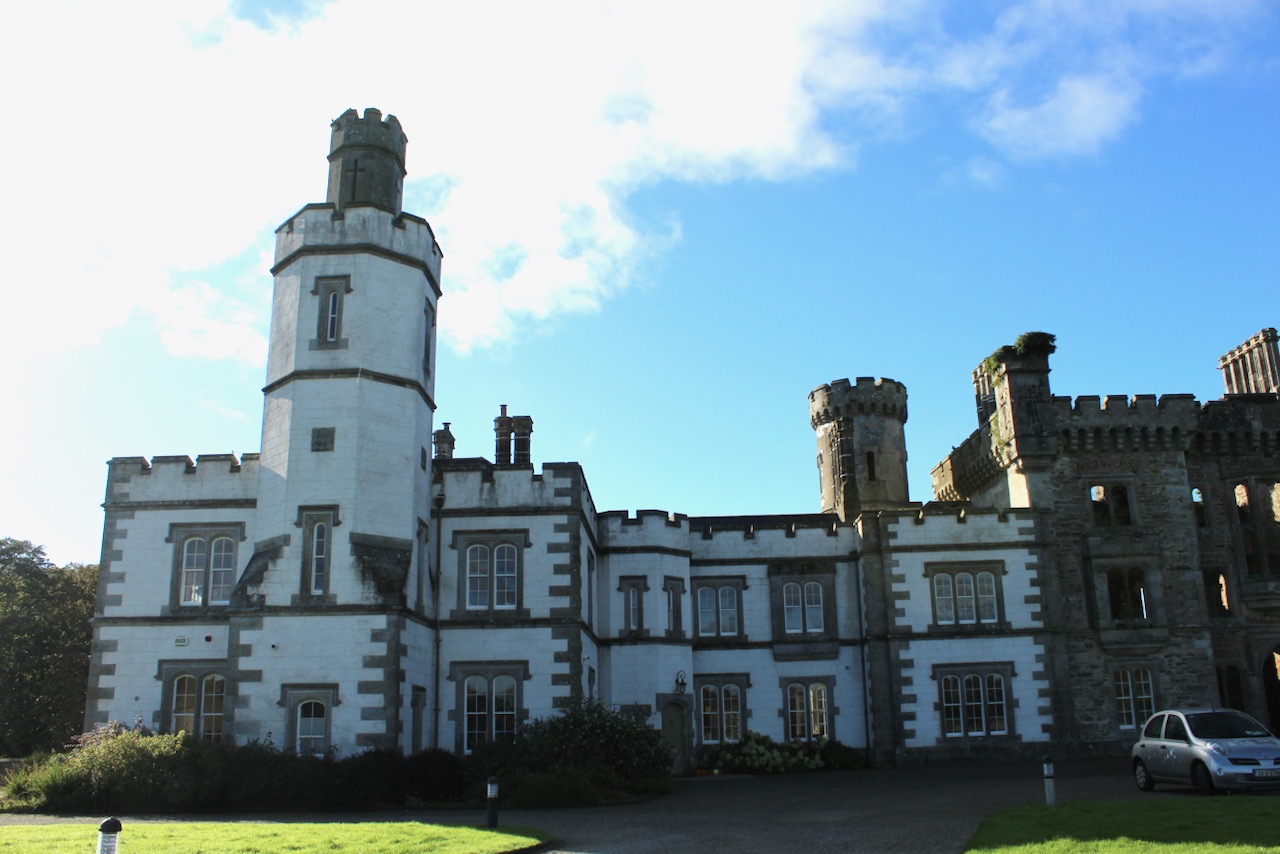
St. Mary’s Abbey overlooks Trim, impressively tall. The ruin of the Abbey, the “yellow steeple,” looks deceptively like part of the building although it is not. The yellow steeple is the ruin of the abbey bell tower, named for the yellow colour reflected by the stonework in the setting sun. Photograph © Jennifer Winder-Baggot, www.irishhistorichouses.com
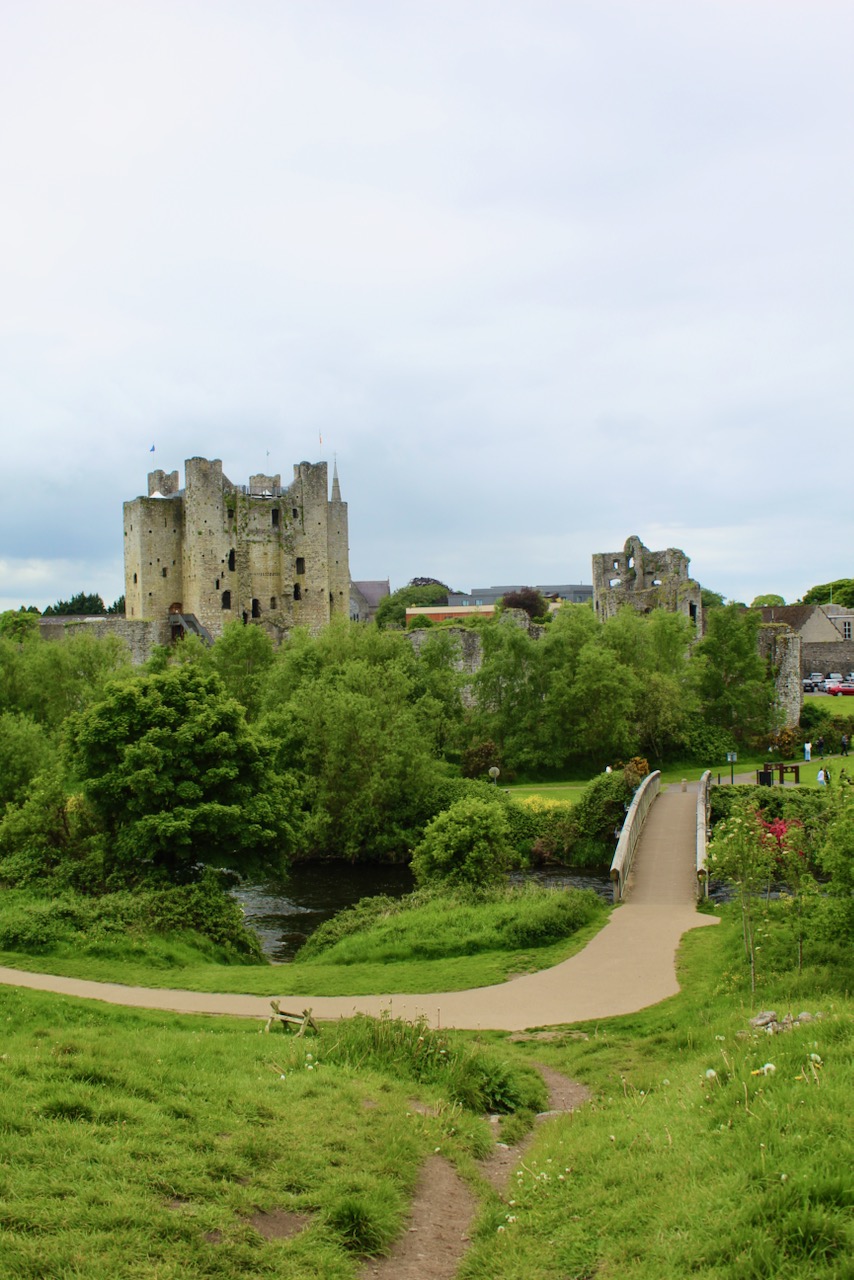
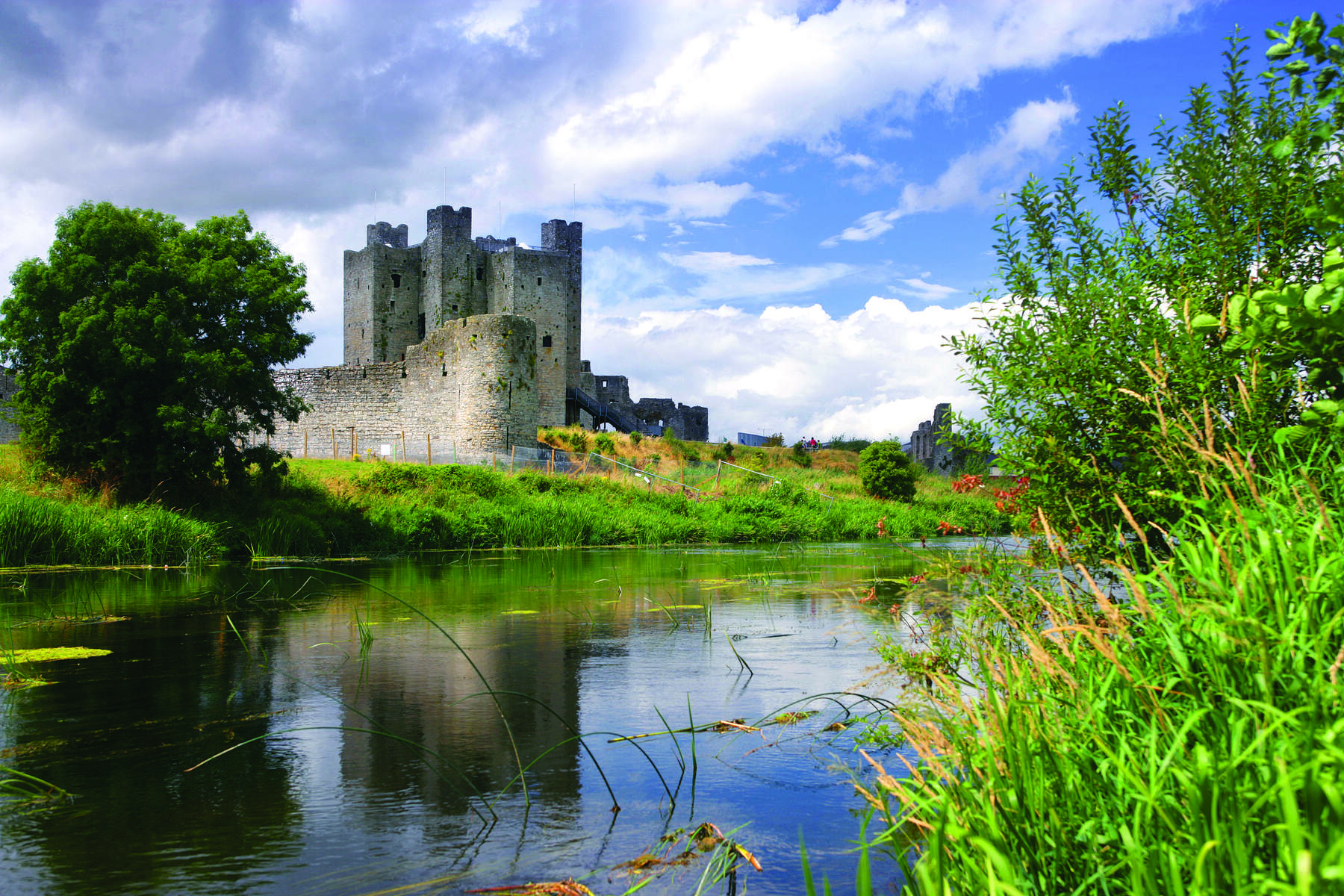
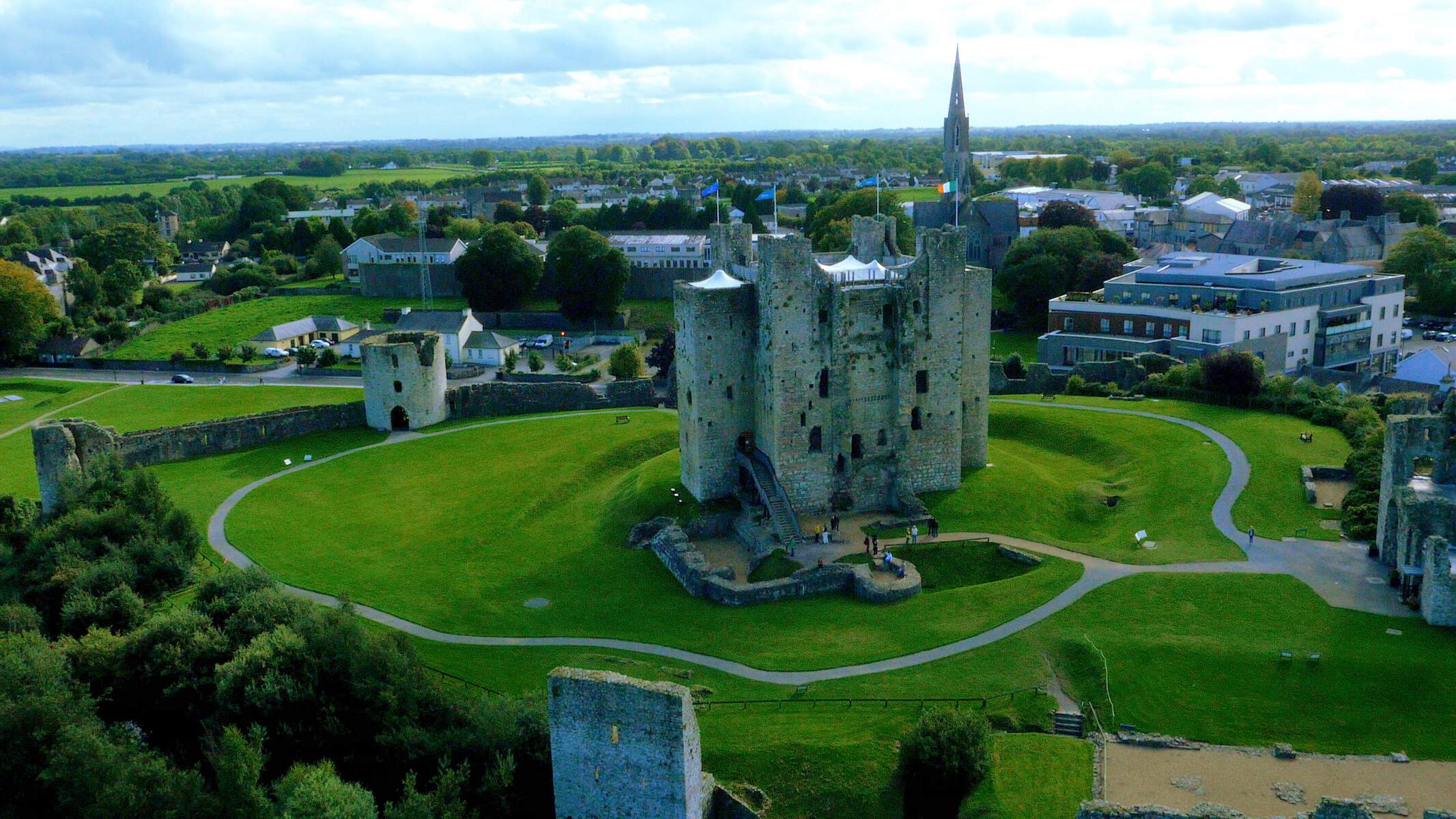
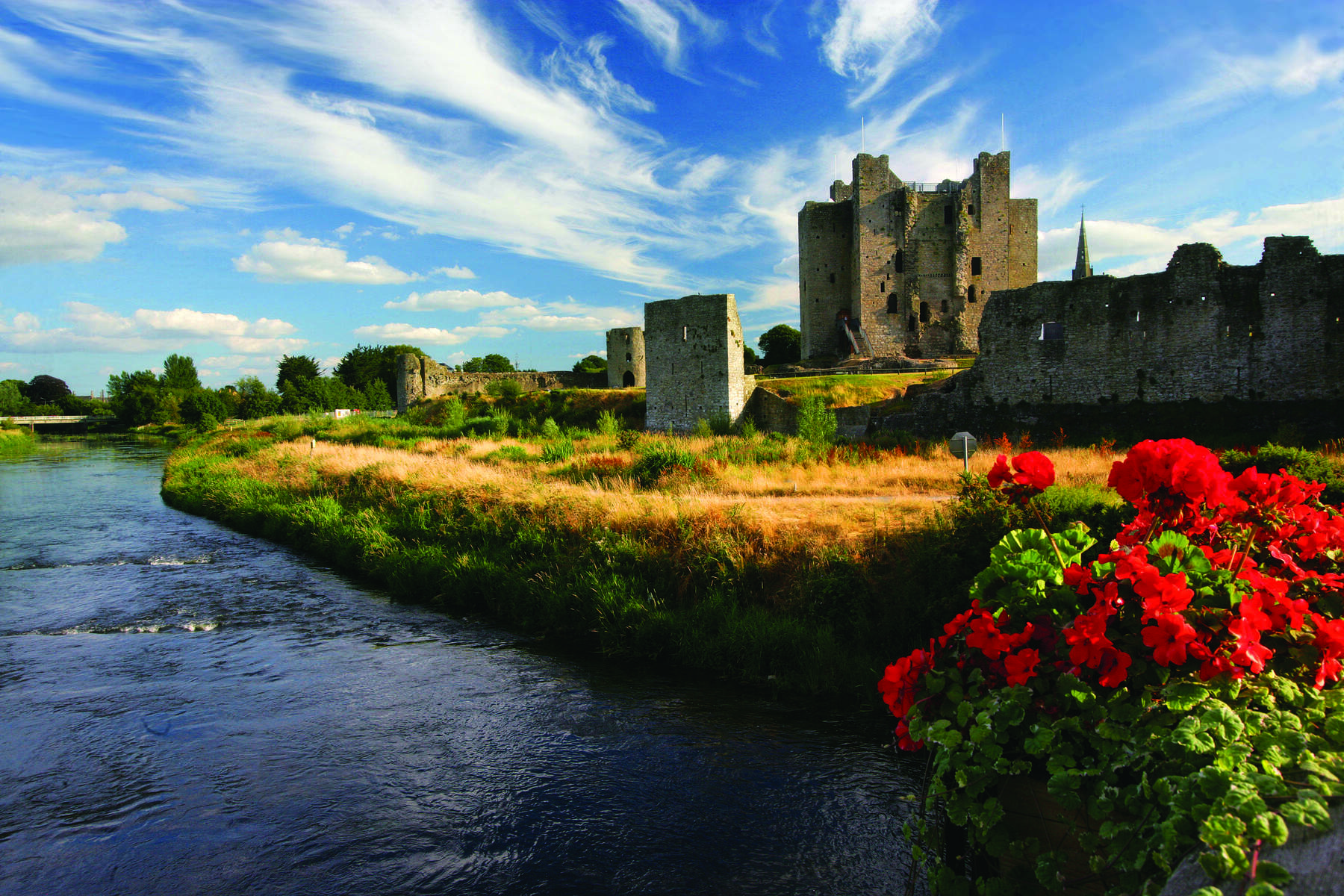
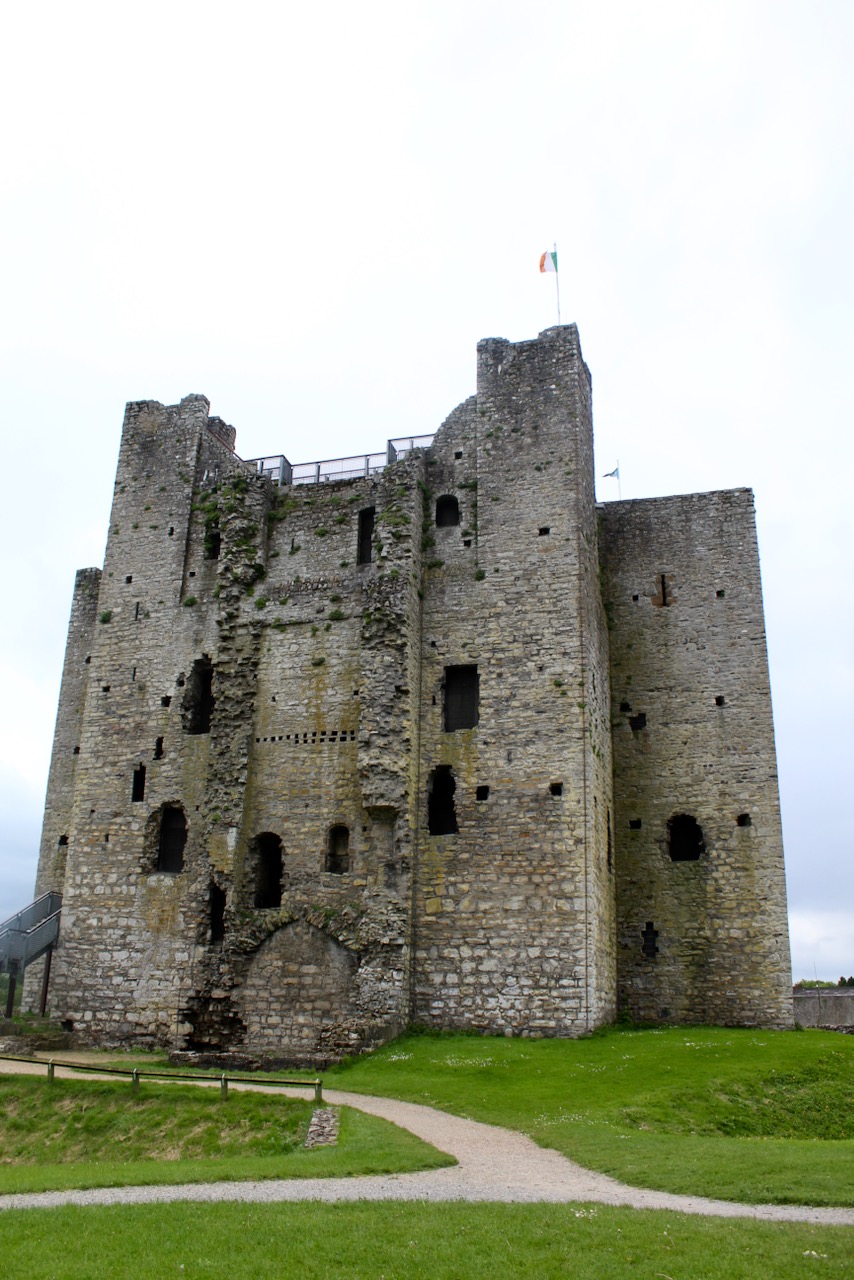
Trim Castle, built around 1175 by Hugh de Lacy, across the River Boyne from St. Mary’s Abbey. Photograph © Jennifer Winder-Baggot, www.irishhistorichouses.com

St. Mary’s Abbey house is one of the oldest properties on the Section 482 list. Now a private home, the building was probably initially part of an Augustinian Abbey, situated across the River Boyne from Trim Castle. We visited Trim Castle after seeing the Abbey, and learned that in 1182 when Hugh de Lacy was granted the Liberty of Meath, he occupied this site at Trim Castle. See my entry about Trim Castle.

Hugh de Lacy (born before 1135, died 1186) was an Anglo-Norman who came to Ireland with King Henry II’s troops. He was created Lord Justice and fought to establish English authority. He was also put in charge of Dublin Castle so was a sort of first Viceroy of Ireland. As well as having Trim Castle built, he built a ring of castles around Dublin to secure the land. Other castles reputedly built by Hugh de Lacy in Meath are Dunsany, which is also a Section 482 property, and Killeen Castle, both of which were held by the Cusack family on behalf of the de Lacys.

St. Mary’s Abbey was established in the twelfth century, and is said to be on the site of a church established by St. Patrick, the fifth century missionary in Ireland. The church was destroyed in 1172 by the local Irishman Conor O’Loughlinn [1], and rebuilt by Hugh de Lacy, so the still standing steeple may have been built around the same time as Trim’s Castle Keep, or as the author of Trim: Its Ecclesiastical Ruins, Its Castle, Etc writes, the steeple was probably built after a fire in 1368.

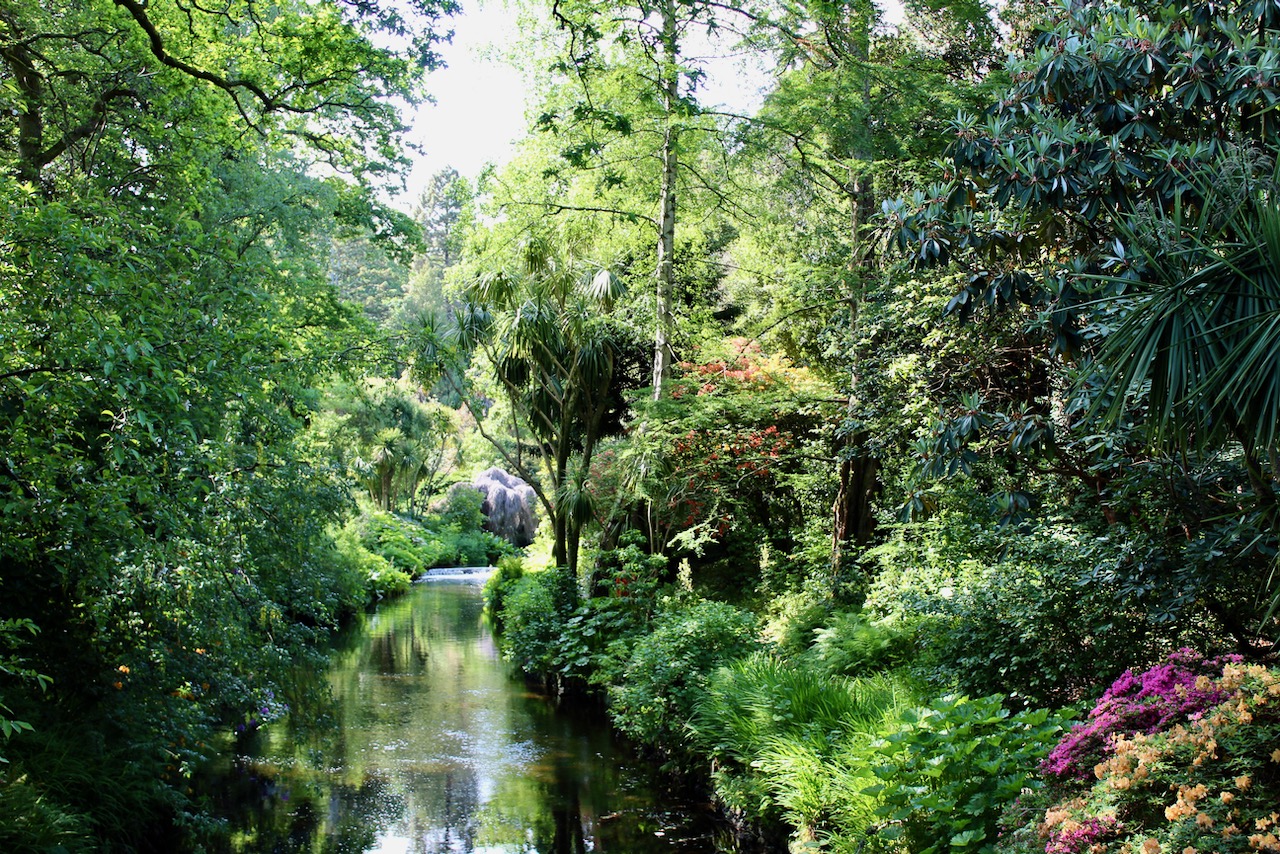
The gardens of St. Mary’s Abbey go down to the River Boyne. Photograph © Jennifer Winder-Baggot, www.irishhistorichouses.com
The River Boyne runs through the village of Trim. Photograph © Jennifer Winder-Baggot, www.irishhistorichouses.com
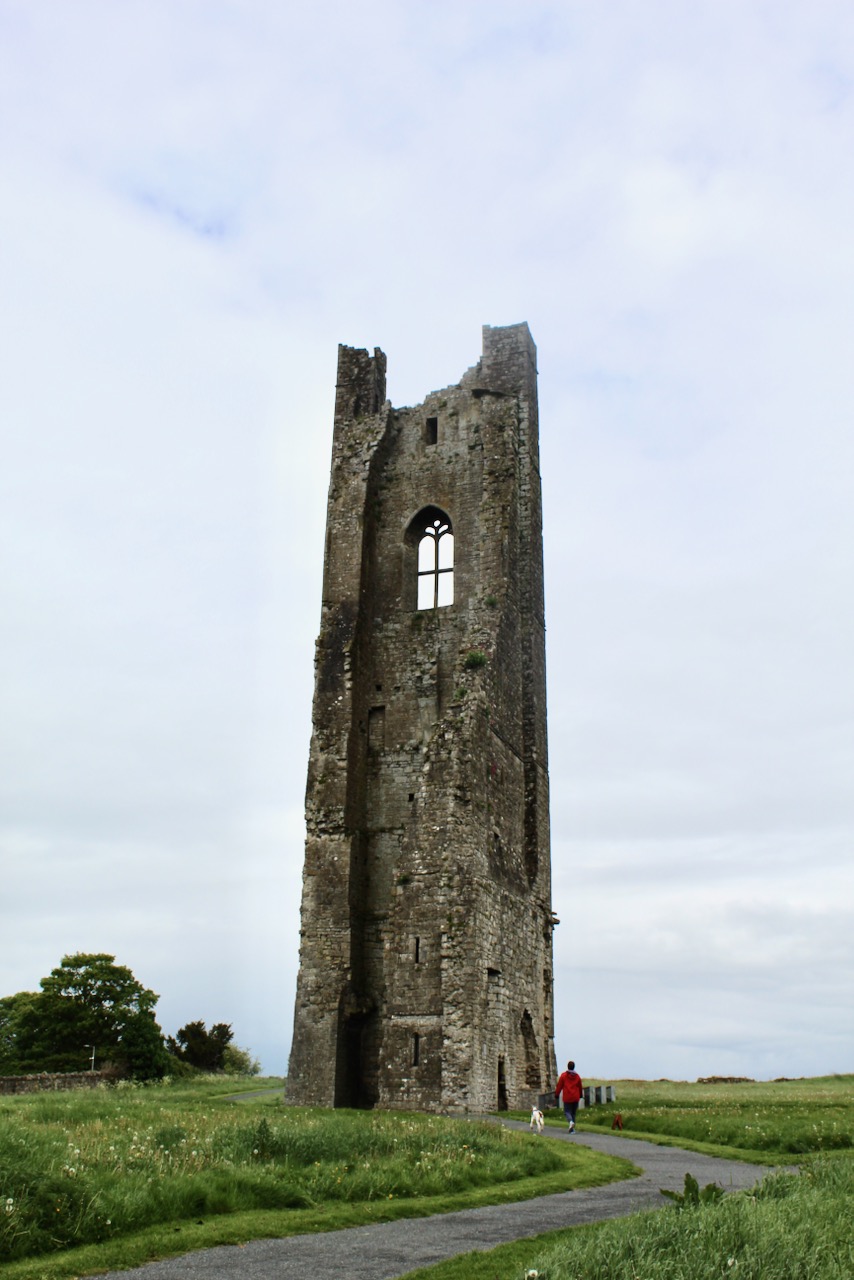
The Yellow Steeple, 40 metres (130 ft) tall (seven storeys), a remnant of St. Mary’s Abbey, established in the twelfth century. The most elaborate part of the remaining tower of St. Mary’s Abbey is the belfry window, described in Casey and Rowan’s The Buildings of Ireland: North Leinster as “a generous pointed opening with two pointed lights bisecting at the centre by a cross-mullion, with a flowerlet formed in the tracery pattern above.” [2] Photograph © Jennifer Winder-Baggot, www.irishhistorichouses.com
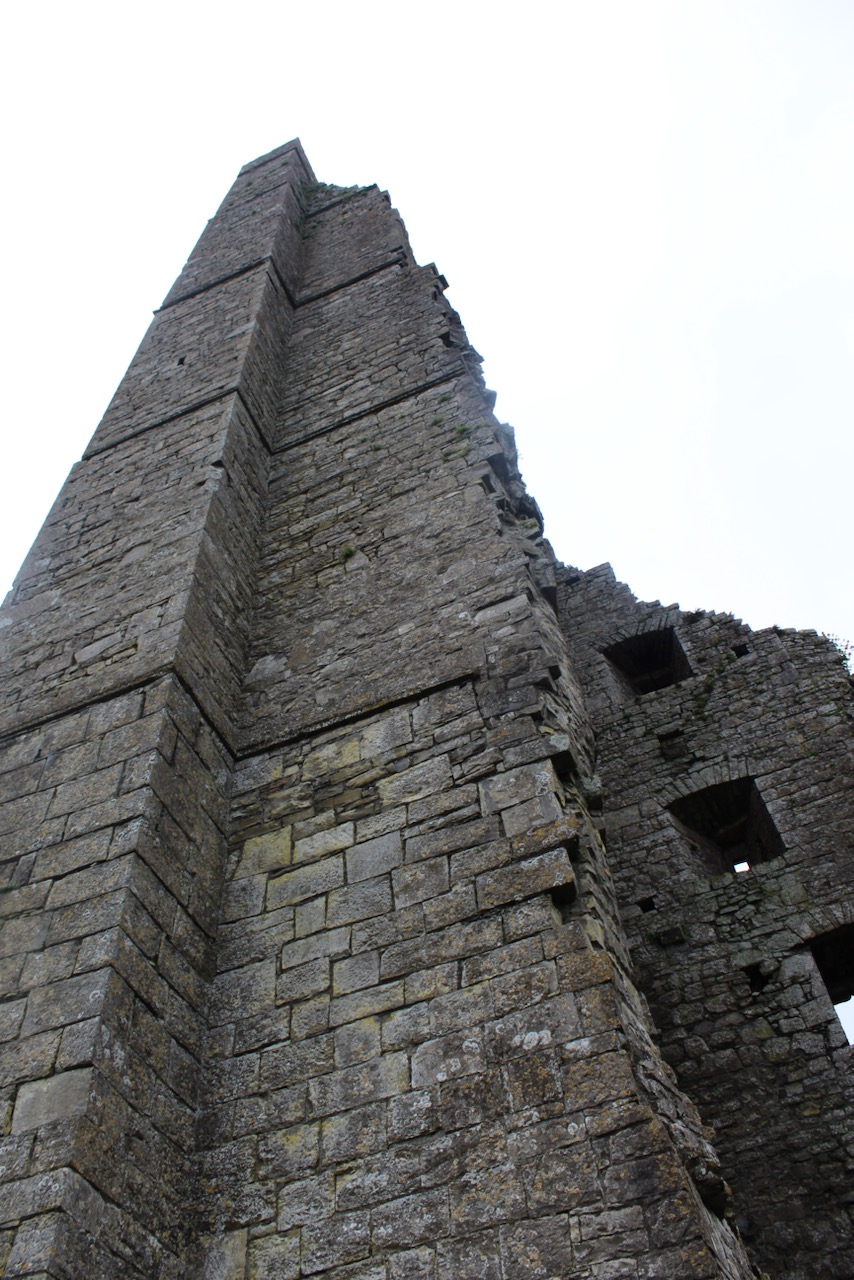
It’s incredible how well-built the steeple is, one wall still in immaculate condition. Photograph © Jennifer Winder-Baggot, www.irishhistorichouses.com
The Yellow Steeple. Photograph © Jennifer Winder-Baggot, www.irishhistorichouses.com
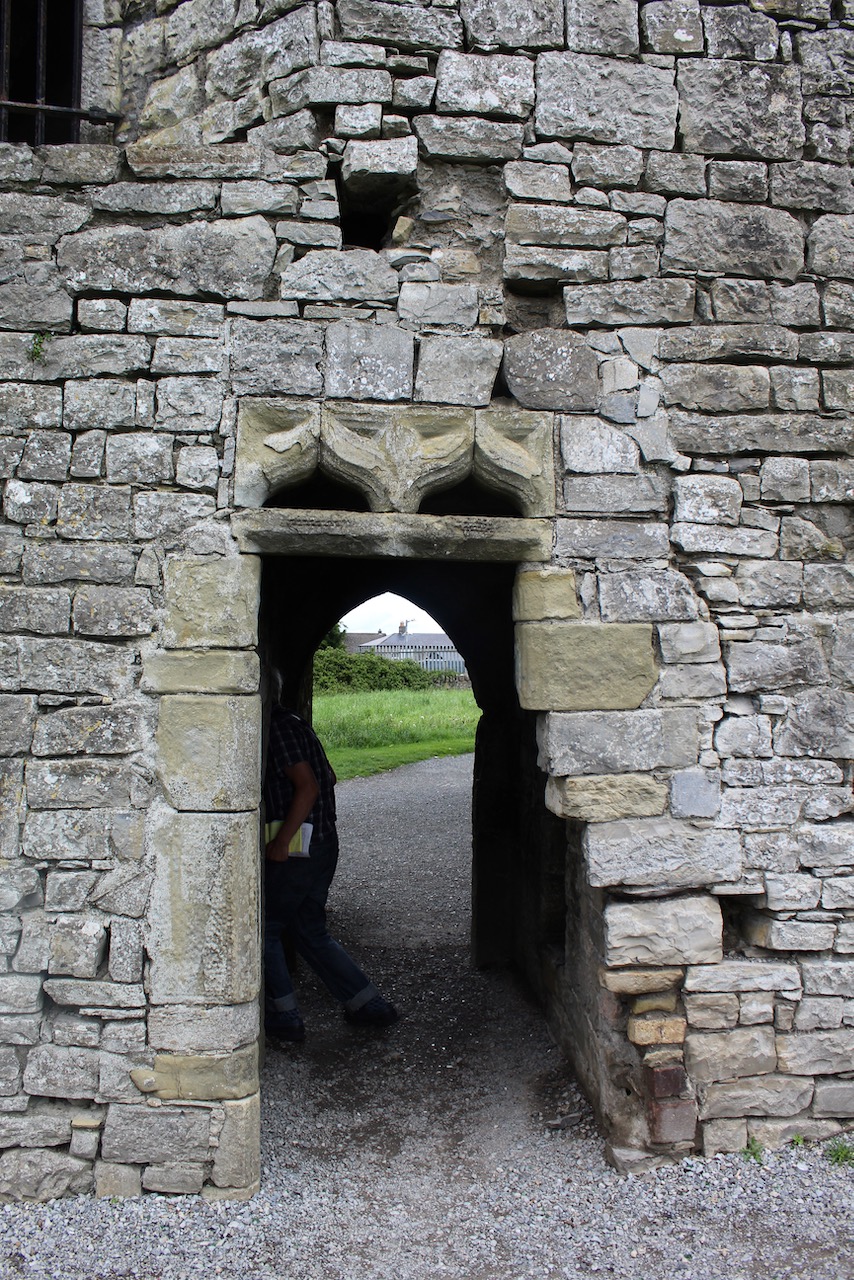
One can even go inside the steeple tower remains, through its doorway with Gothic arches surmounting the lintel. Photograph © Jennifer Winder-Baggot, www.irishhistorichouses.com
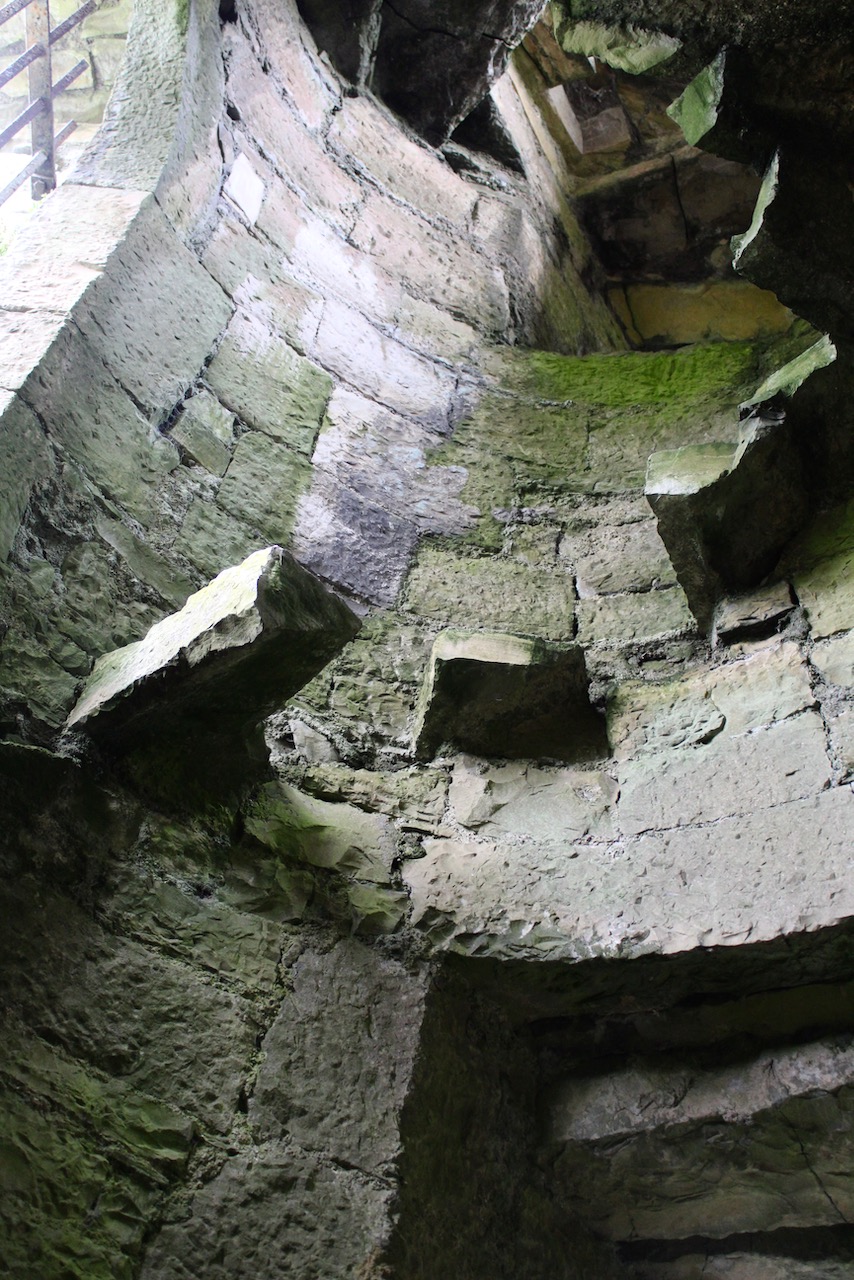
This looks like remnants of a staircase in the steeple tower. Photograph © Jennifer Winder-Baggot, www.irishhistorichouses.com
Remains of the St. Mary’s Abbey tower. Photograph © Jennifer Winder-Baggot, www.irishhistorichouses.com
The tower is unusual, I would think, for an Abbey. It looks more like a tower-house, as it has large windows. Photograph © Jennifer Winder-Baggot, www.irishhistorichouses.com

The building listed on Revenue Section 482 is now called St. Mary’s Abbey, after the abbey of which it was probably a part. It is also called Talbot’s Castle as it was said to have been built, Mark Bence-Jones tells us, by Sir John Talbot (c. 1384-1453), 1st Earl of Shrewsbury, for his own occupation when he was Lord-Lieutenant of Ireland, although as I will explain, I do not think that this was the case. [3]

John Talbot (c. 1384-1453), 1st Earl of Shrewsbury, Detail of illuminated miniature from the Talbot Shrewsbury. He is in a habit as a knight of the Garter. Behind him a Talbot hound, his heraldic badge. presenting the book to Margaret of Anjou, Queen of England, 1445. His robe displays several encircled Garters. See Poems and Romances (Shrewsbury book), illuminated by the MASTER OF JOHN TALBOT – http://www.bl.uk/catalogues/illuminatedmanuscripts/ILLUMIN.ASP?Size=mid&IllID=47542

The National Inventory dates the building to the incredibly early date of 1415, which would coincide with the idea that it may have been built by John Talbot. The Abbey itself existed before this, so Talbot may have taken part of the abbey to be his home. His crest adorns the wall of a tower part of the house. However, I think it is unlikely that Talbot ever lived here.

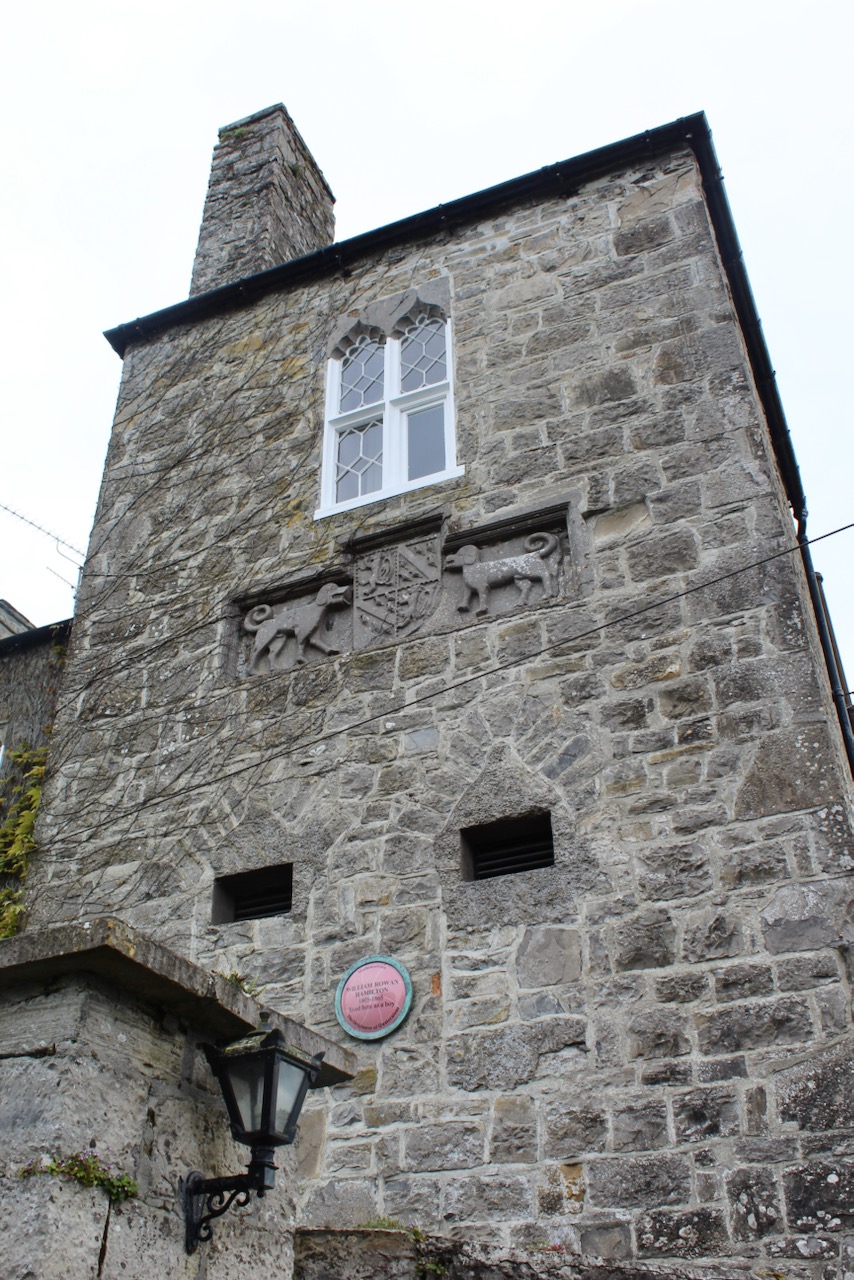
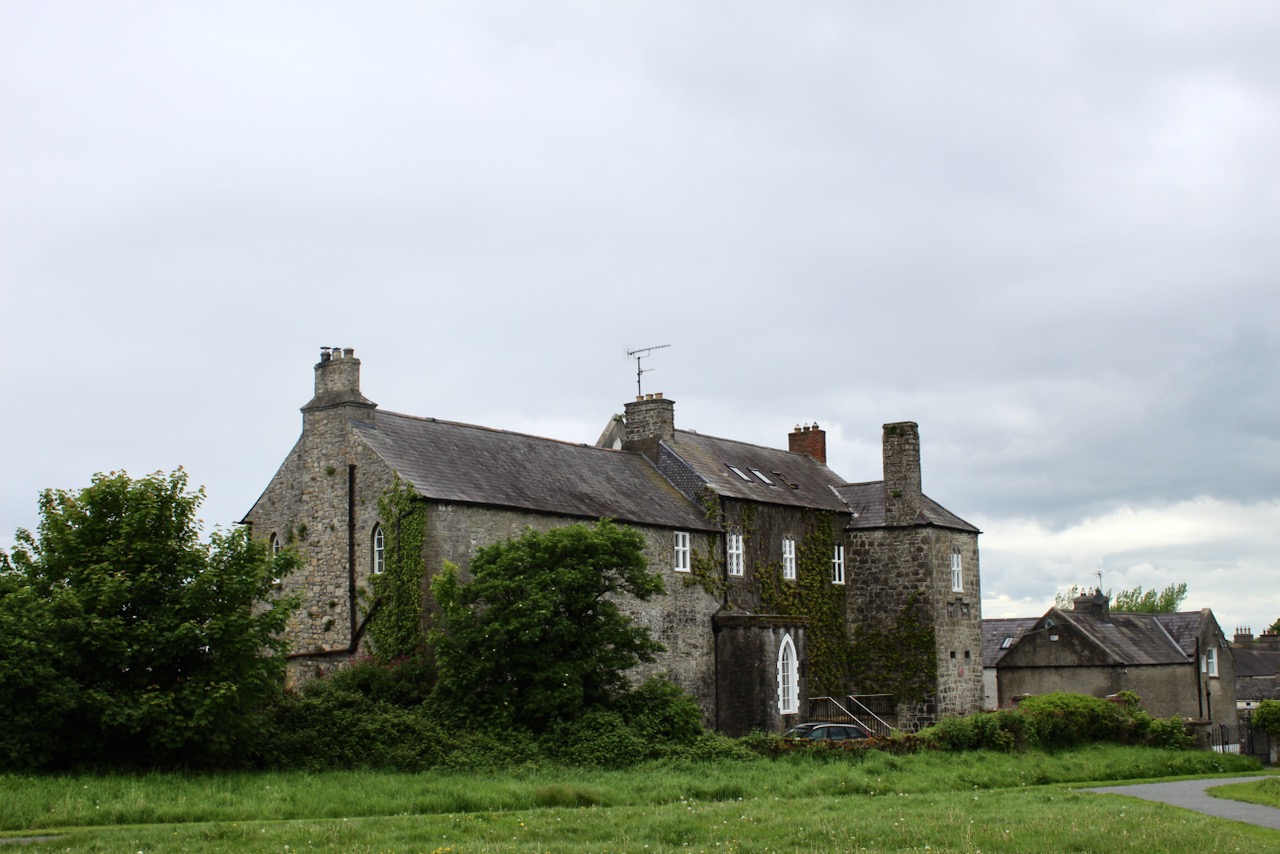
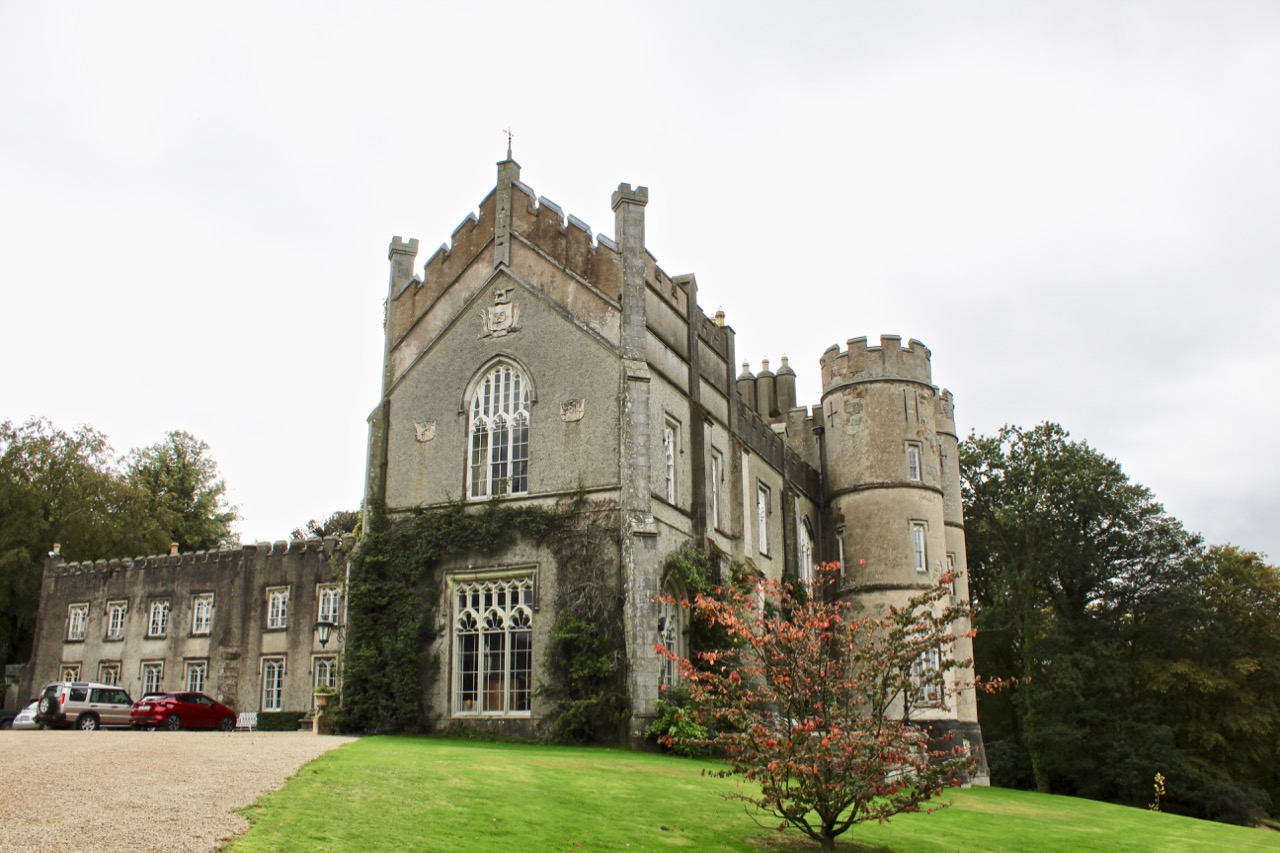
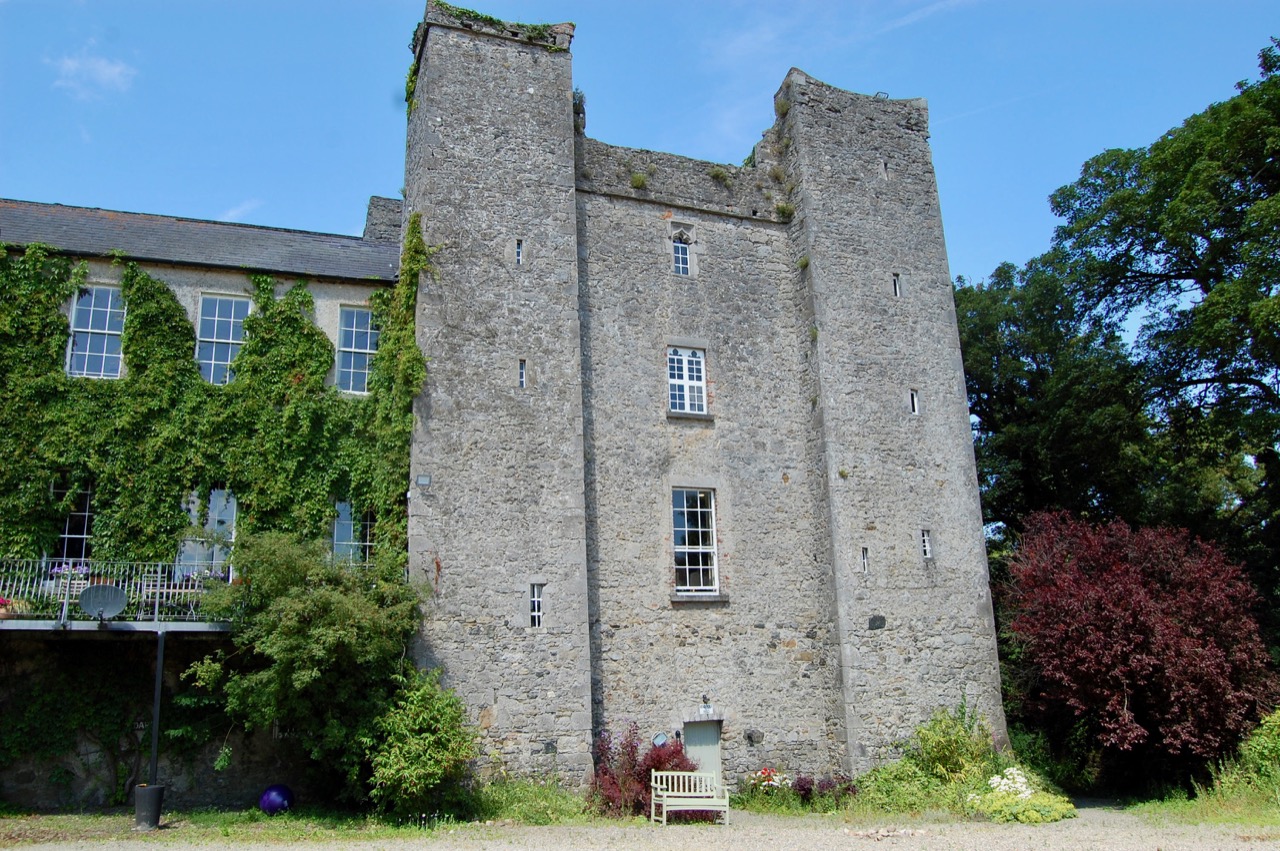
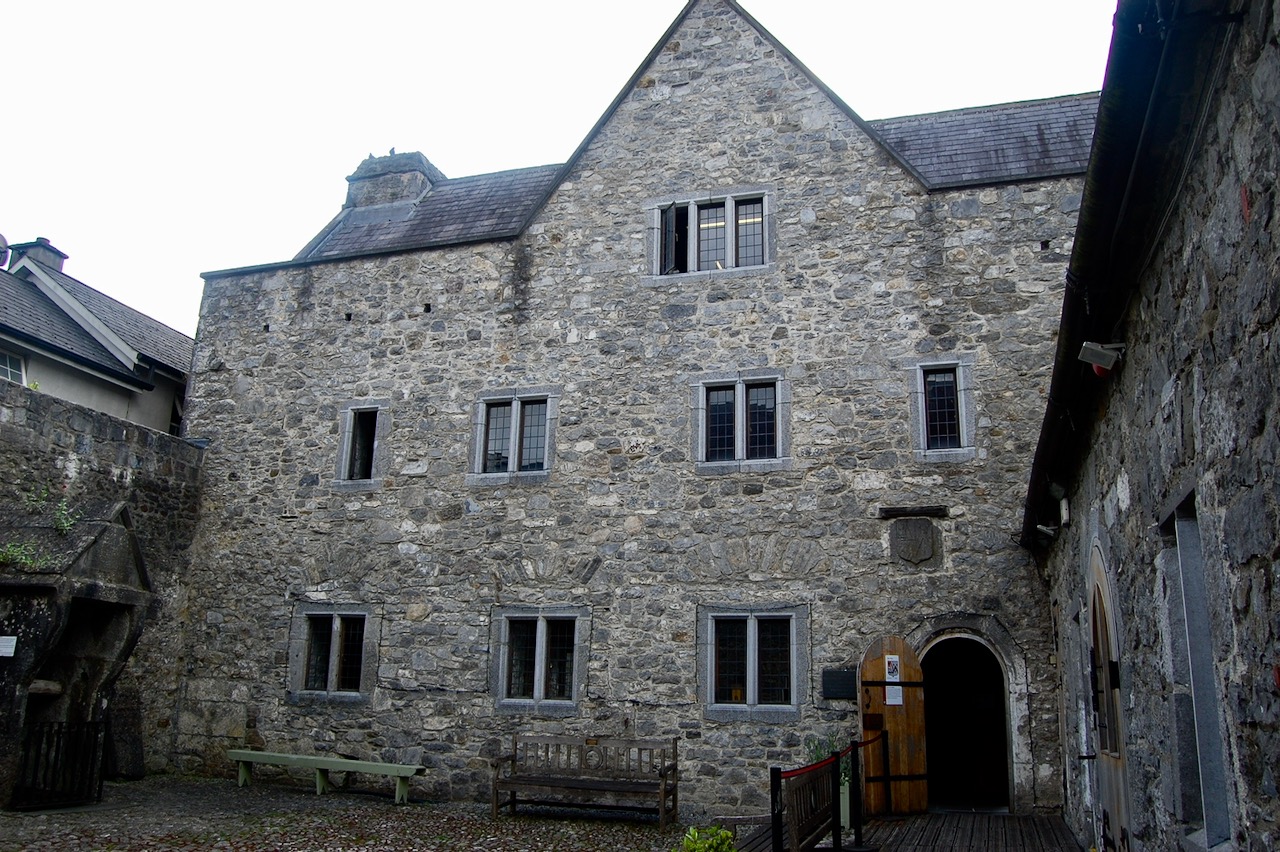
St. Mary’s Abbey, a fifteenth century tower house, still has the Talbot crest. Probably due to the presence of the coat of arms, it is said to have been built by Sir John Talbot (c. 1384-1453), 1st Earl of Shrewsbury, when he was Lord-Lieutenant of Ireland, but this may not be the case. As well as the Talbot crest, with accompanying dogs, the tower has a plaque noting that William Rowan Hamilton, noted mathematician, attended the school that had been housed in the St. Mary’s Abbey building. Photograph © Jennifer Winder-Baggot, www.irishhistorichouses.com
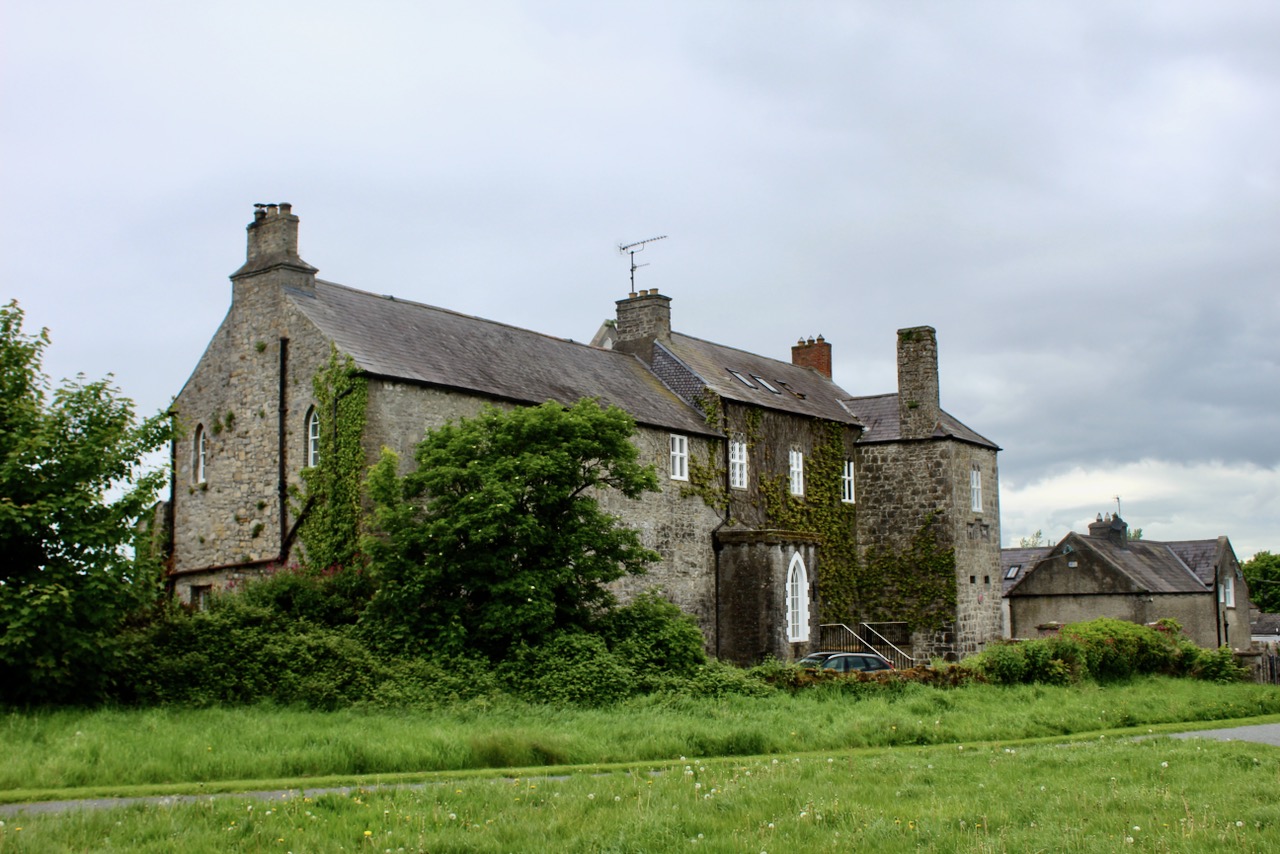
St. Mary’s Abbey house. Photograph © Jennifer Winder-Baggot, www.irishhistorichouses.com

The Abbey was burned in 1368. Shortly after the fire, the abbey erected a statue of the Virgin Mary that became famous for its miracles of healing, and so became a place of pilgrimage. It seems unlikely that Talbot lived in the Abbey at this time, therefore. It was still an Abbey at the time of John Talbot, in 1415. Perhaps his coat of arms marks his financial support of the Abbey, thus giving him the blessings and prayers of the Abbey.

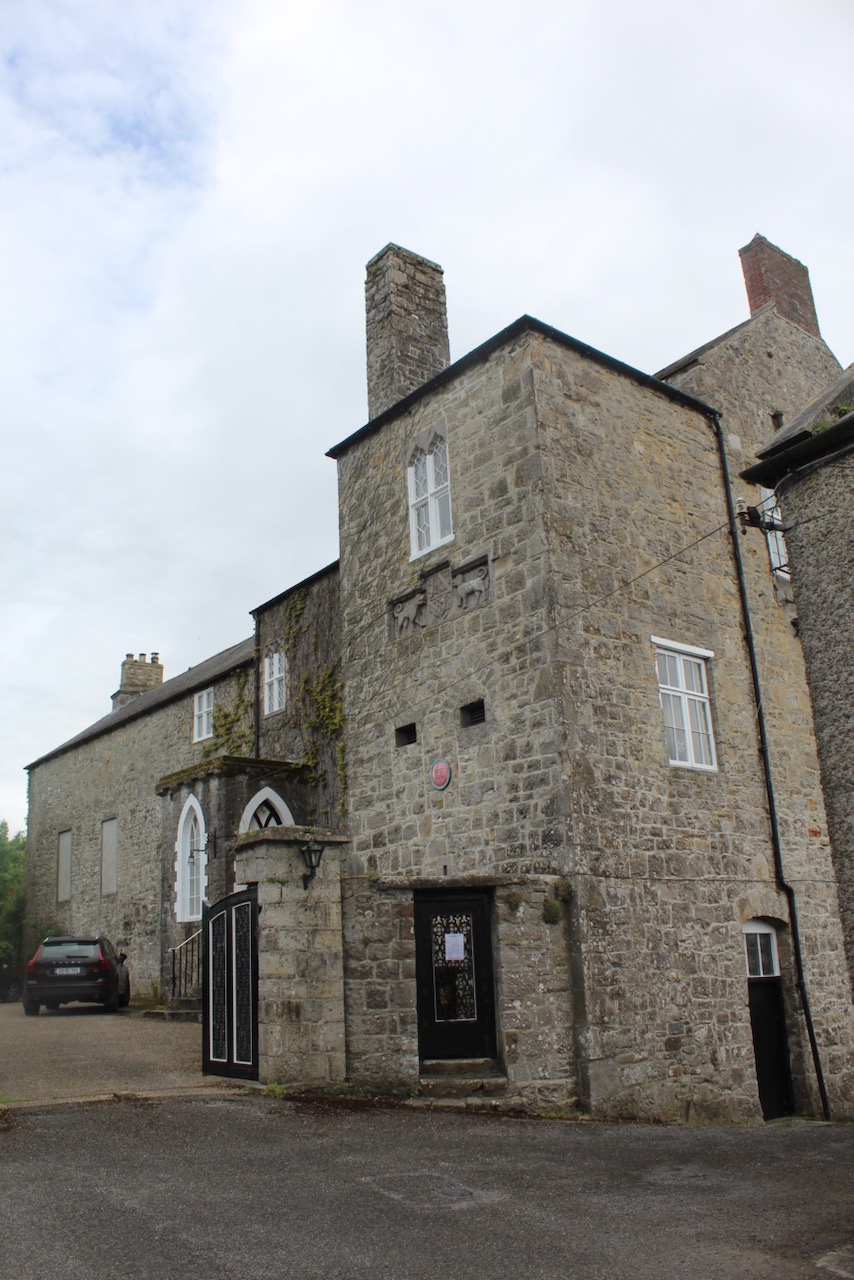
St. Mary’s Abbey, a fifteenth century tower house, still has the Talbot crest, and is also called Talbot’s Castle. Photograph © Jennifer Winder-Baggot, www.irishhistorichouses.com
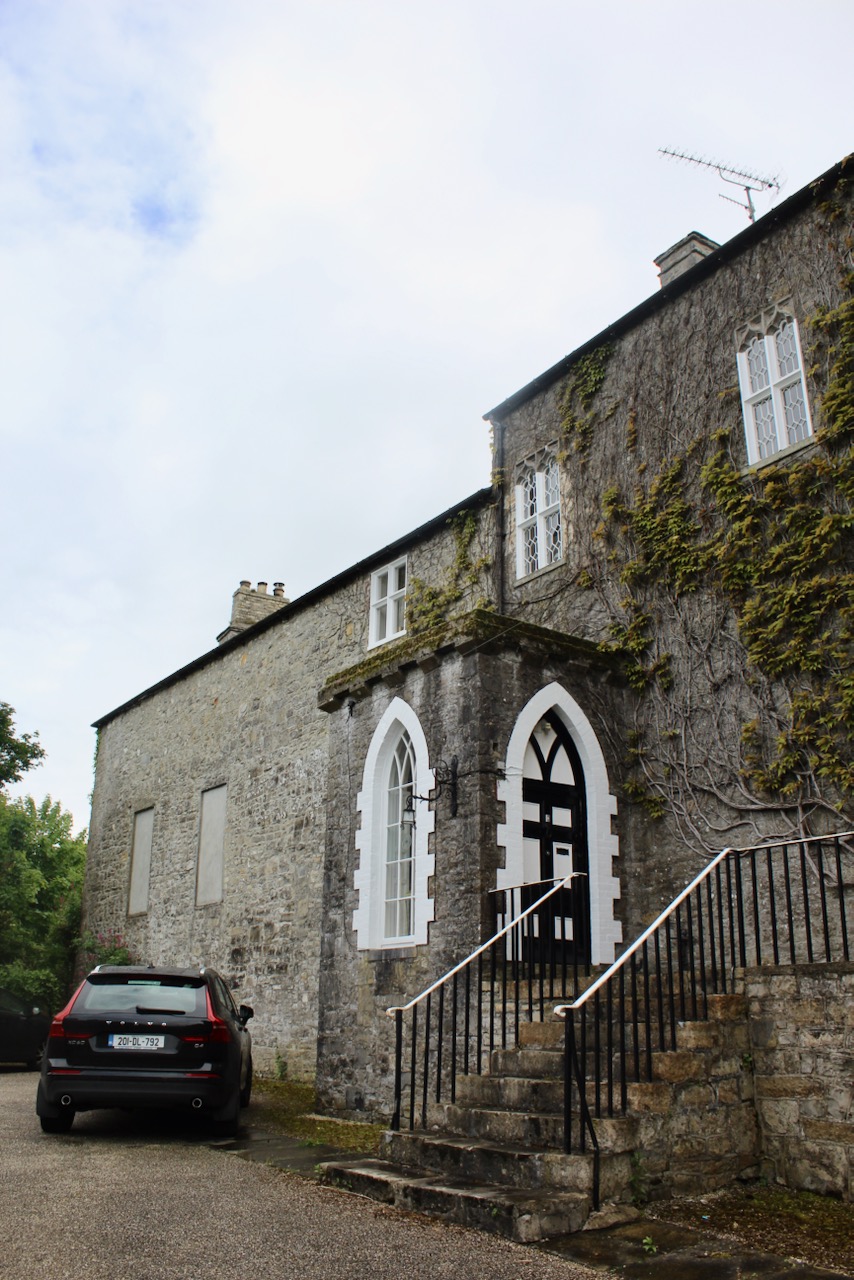
The house looks much smaller, when one approaches, than it appears from Trim Castle, dominating the hill above the river bank. It is just one room deep. Photograph © Jennifer Winder-Baggot, www.irishhistorichouses.com
The front door is in a Gothic arch, up stone steps, with matching arched window. Photograph © Jennifer Winder-Baggot, www.irishhistorichouses.com

The Abbey was dissolved at the time of King Henry VIII’s dissolution of the monasteries. The author of Trim: Its Ecclesiastical Ruins, Its Castle, Etc tells us that on 15 May 1542 agents of Henry VIII forced Geoffrey Dardis, St. Mary’s last abbot, to sign his own expulsion, and the abbey’s lands were granted to Sir Anthony St. Leger (b. circa 1496, d. 1559), who in 1540 was Lord Deputy of Ireland. (see [1]).

It seems to me that it would have been after the dissolution of the abbey that the abbey building was converted into a secular residence.

The turret with the Talbot arms, which is of two storeys over a basement (although today it looks three storey), is distinct from the rest of the range, Christine Casey and Alistair Rowan point out in their Buildings of Ireland: North Leinster book. (see [2]) They write that: “The punched limestone rubble and big square embrasures still visible in the basement are similar to the Yellow Steeple and support and early to mid-C15 date.”

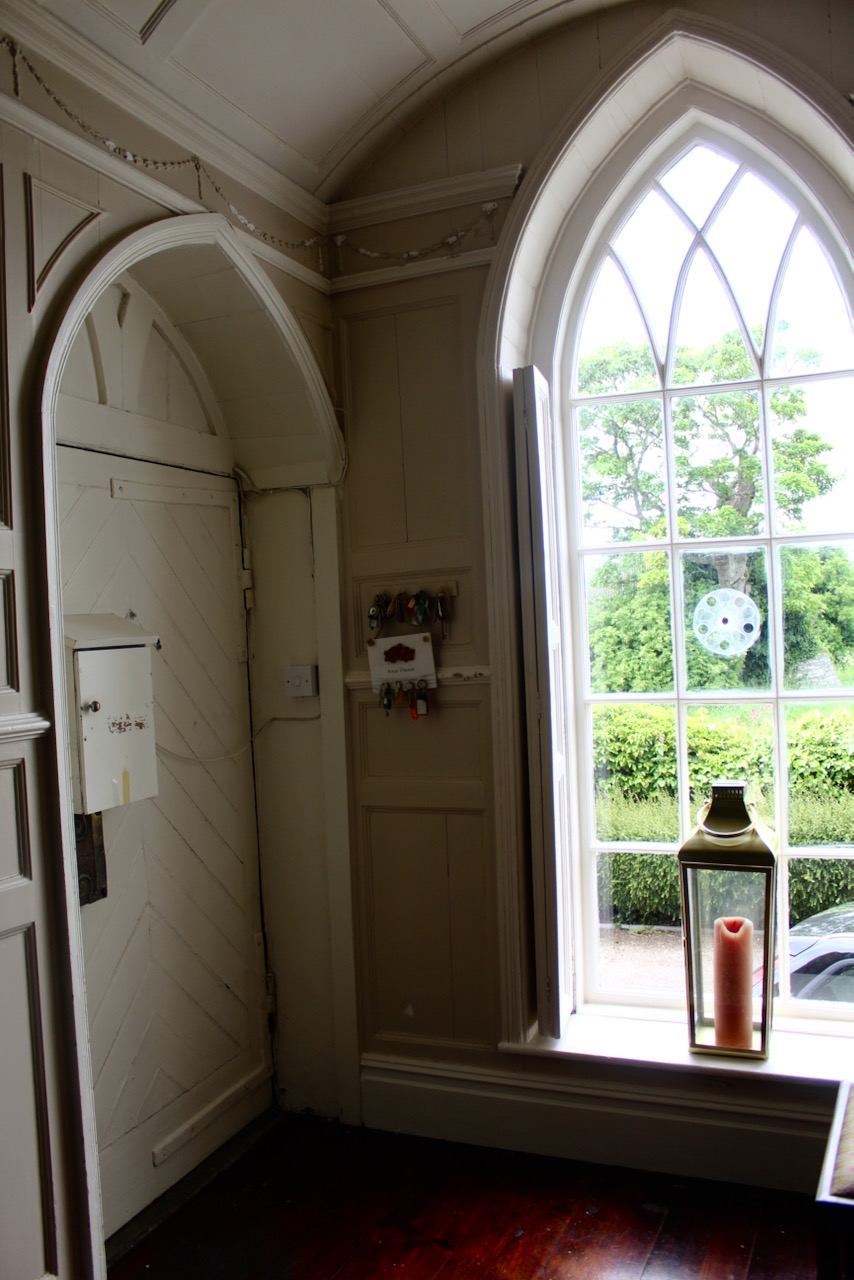
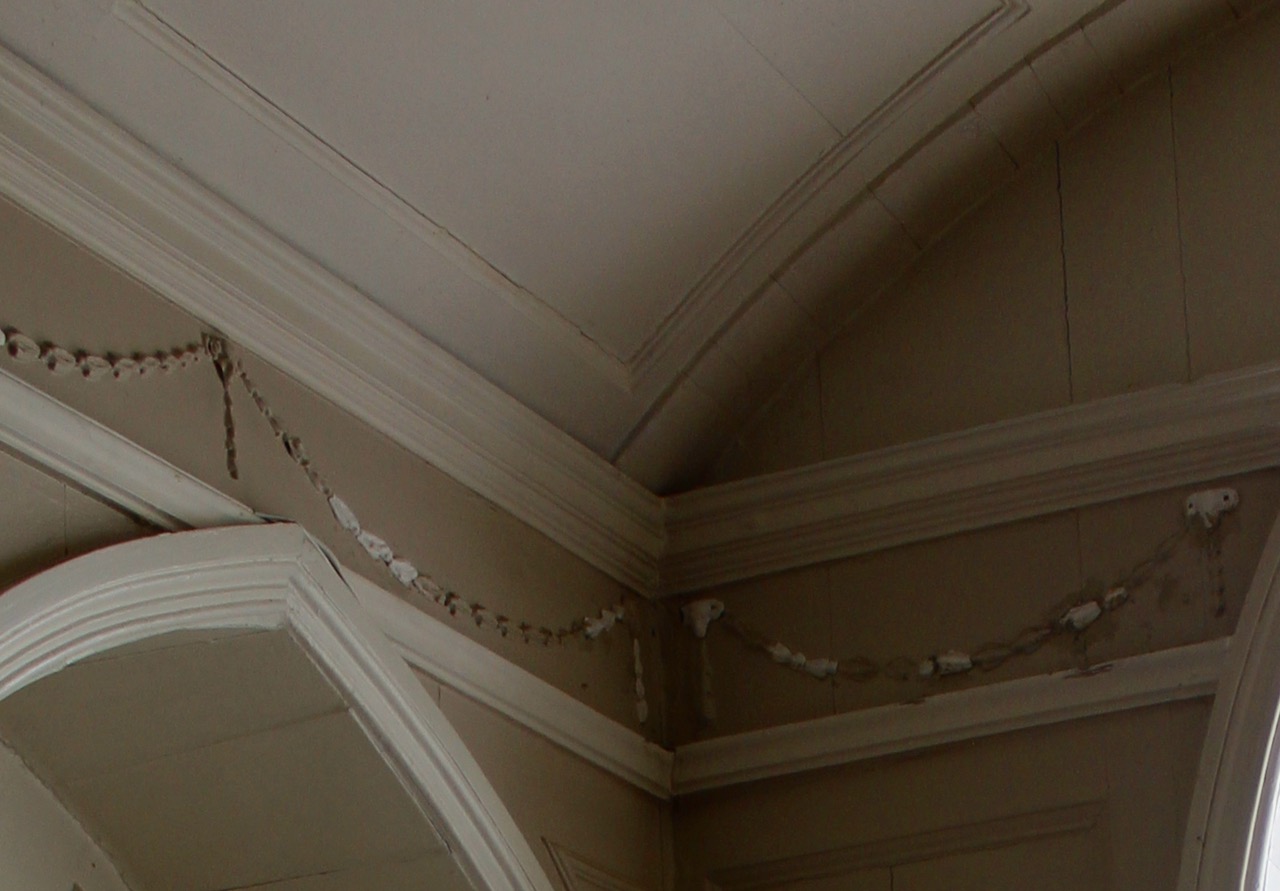
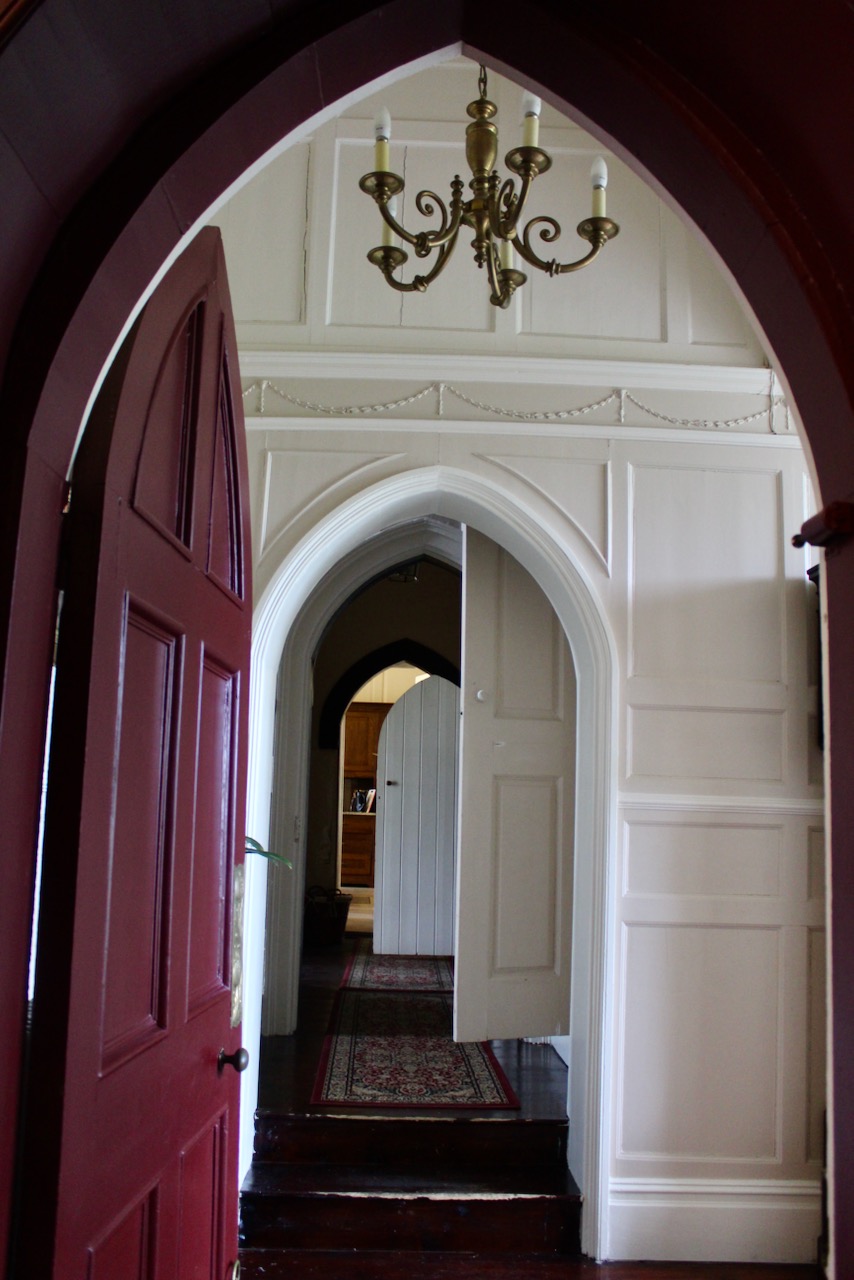
The entrance vestibule has panelled walls and ceiling and pretty decorative swags draped from bucranium, or rams heads, above the wall panelling. Photograph © Jennifer Winder-Baggot, www.irishhistorichouses.com
St. Mary’s Abbey house. Photograph © Jennifer Winder-Baggot, www.irishhistorichouses.com

The stucco work would not have been part of the abbey, as bucrania, ox’s skulls, allude to the ancient Greek and Roman ceremonies of sacrifice, and sacrificial cattle were decorated with garlands of fruit and flowers or decorative ropes with tassels.

Many of the interior doors are arched. Photograph © Jennifer Winder-Baggot, www.irishhistorichouses.com

From the vestibule one enters the Gothic maroon coloured dining room, which leads into the drawing room, which is thought to have been the refectory of the abbey. Mark Bence-Jones tells us that the building incorporated part of the Abbey cloister, which forms a vaulted recess on one side of the drawing room.

The dining room has a fireplace that looks like Connemara marble, and the swags again adorn the walls over the wood panelling.

The Drawing Room in what may have been the Refectory of the Abbey. A vaulted recess on one side may have been a cloister of the Abbey. Photograph © Jennifer Winder-Baggot, www.irishhistorichouses.com

The drawing room has what Casey and Rowan call a “remarkable and very rare medieval survival, an oriel window or gallery opening off the room in the southeast corner, roofed over by two bays of quadripartite vaulting, springing from octagonal shafts, all of punched grey limestone.”

St. Mary’s Abbey house. Photograph © Jennifer Winder-Baggot, www.irishhistorichouses.com

Rowan and Casey continue: “One has only to look at the refectory building at Newtown Trim to recognize that this is the characteristic position of the reader’s desk or gallery from which scripture was read while the monks ate their meals.”

There’s also a wonderful fireplace that looks very old.

In 1617 King James I granted the churches, rectories and chapels of the Blessed Virgin Mary of Trim to Thomas Ashe of Trim. A website about the Ashe family tells us that Sir Thomas Ashe, of St. John‘s and of Drumsill (now Ashfield Hall), in the county of Cavan, was knighted at Dublin Castle by Sir George Carew, Lord Deputy, on St. James’s day, 25 July 1603, on the occasion of the coronation of James I. [4]

Little seems to be known about the building until it became a school. Mark Bence-Jones tells us that the property was given gables in C17, by which time it has become a “Latin school.” Casey and Rowan write that in the opening years of the eighteenth century the Diocesan School of Meath, which was being run by Dean Jonathan Swift’s curate at Laracor, was without fixed accommodation.

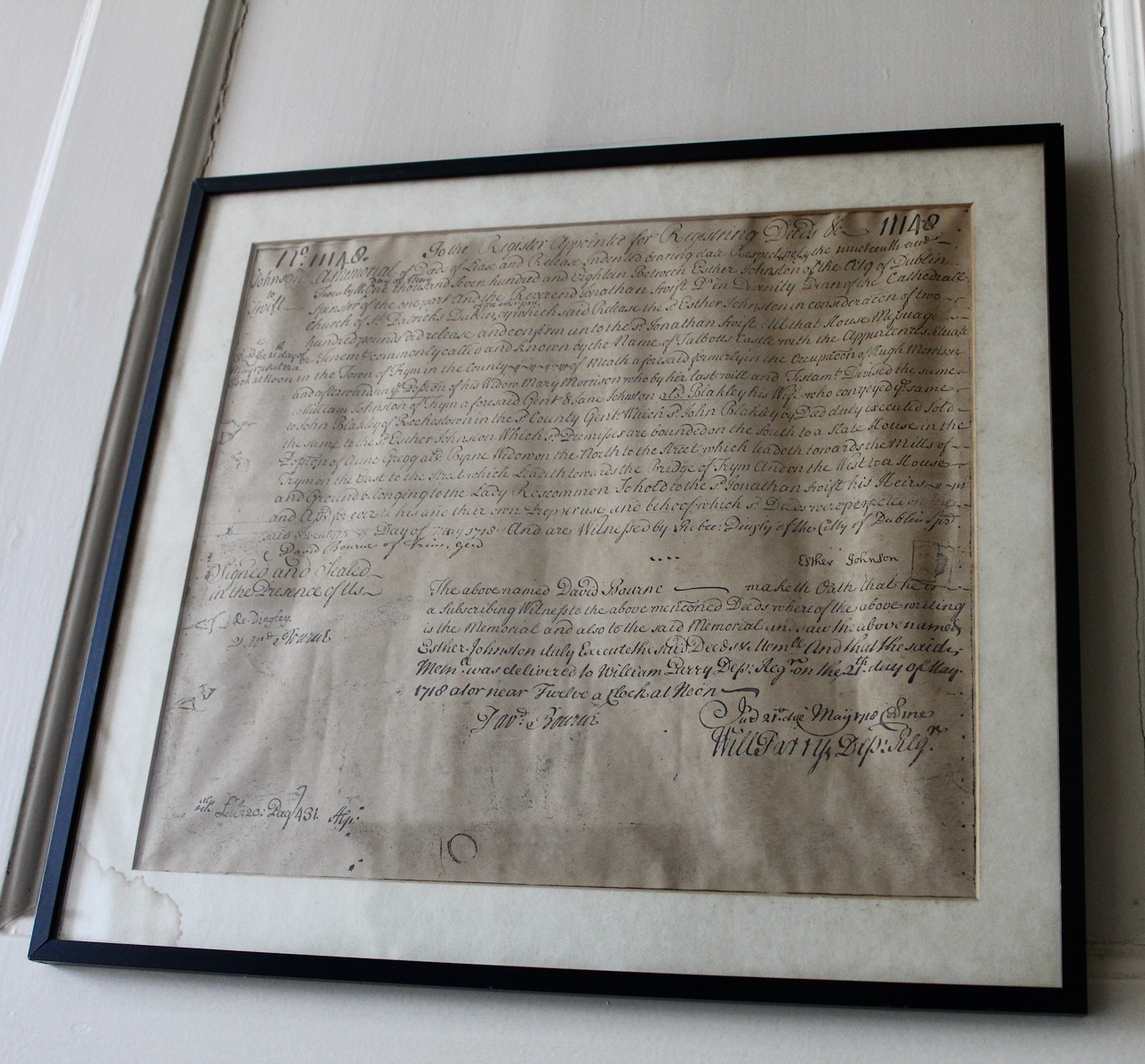
In 1716 Jonathan Swift’s friend “Stella” (her read name was Esther Johnson) bought “St Mary’s Abbey” from John Blakely and the following year she either sold it or gave it to Swift, and it then became the Diocesan School. Peter has copies of the deeds framed. Swift sold it after another year.

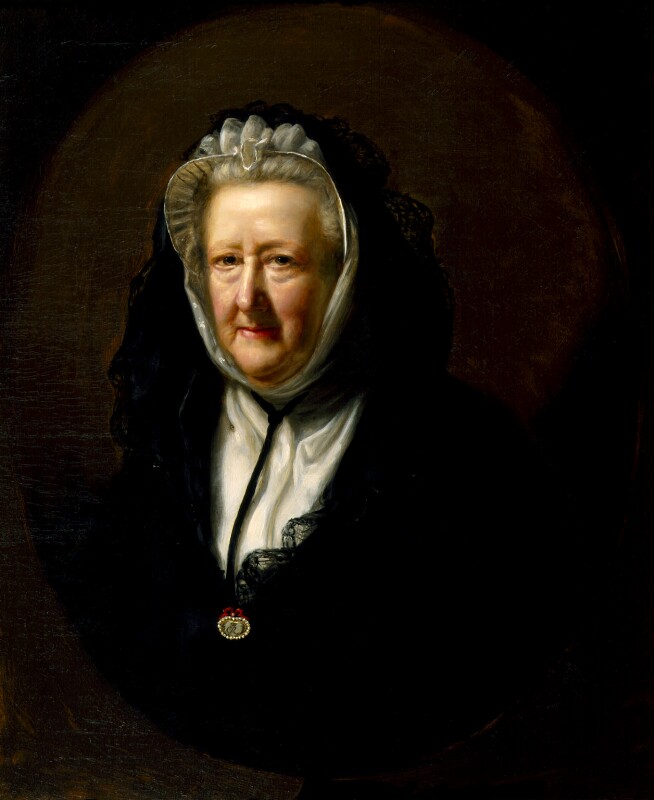
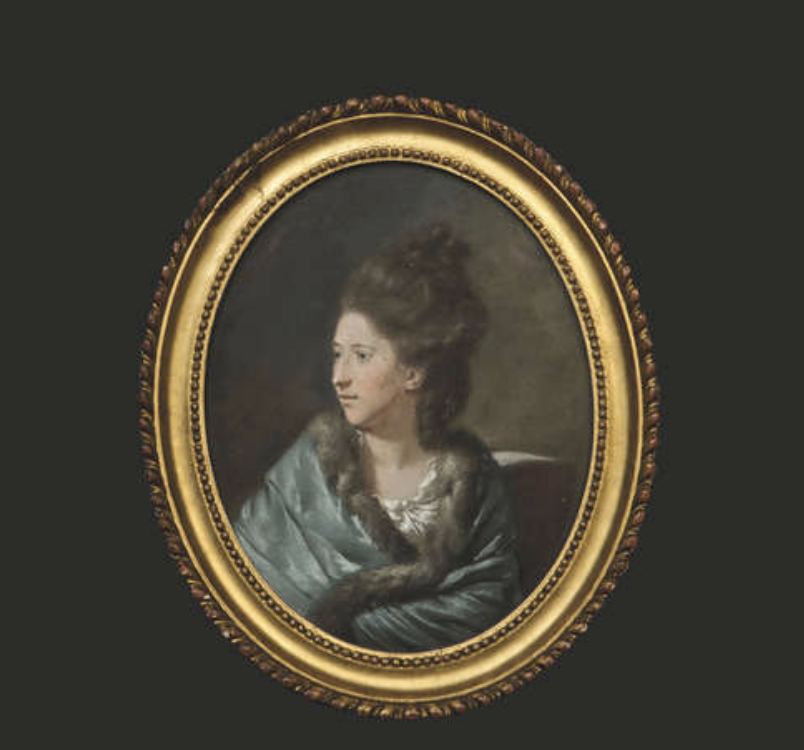
Portrait of Esther Johnson (Stella), late 18th-early 19th century. after James Latham (1696-1747), courtesy of Fonsie Mealy Fortgranite sale.

In an essay by Eileen MacCarvill, “Johnsons, Lineal Descendants of Uí Néill,” MacCarvill writes that “Stella” and Elizabeth Dingley, who had relatives named Hammond who lived in Trim, moved from their home at Moor Park in England where Ester had lived with the Temple family in 1698-99, to Talbot Castle in Trim, where they lived with William Johnson and his wife Jane née Blakeley. In 1708 William Johnson sold Talbot Castle to his wife’s brother John Blakeley of Rochestown, County Meath, for £45. Esther Johnson then purchased the house in 1718 for £65 and sold it some months later to Swift for £200. He sold it to George Dennis of Summerhill, County Meath, for £223. [ http://www.limerickcity.ie/media/NMAJ%20vol%2017%2009%20Johnsons%20-%20lineal%20descendents%20of%20Ui%20N%82ill,%20by%20Eileen%20MacCarvill.pdf ]

The land Deed signed by Esther Johnson, Jonathan Swift’s friend “Stella.” Photograph © Jennifer Winder-Baggot, www.irishhistorichouses.com

Casey and Rowan tell us that after the building had become the Diocesan School in the eighteenth century, a report of the Commission for Irish Education of 1827 described it as “a very old building forming part of the quadrangle of St Mary’s Abbey.” Famous past pupils include Arthur Wellesley, the future Duke of Wellington (1769-1852) and William Rowan Hamilton (1805-1865), Irish mathematician, astronomer, and physicist.

Peter showed us some metal bars outside an upstairs window which he suggested may have been supports for William Rowan Hamilton to mount a telescope.

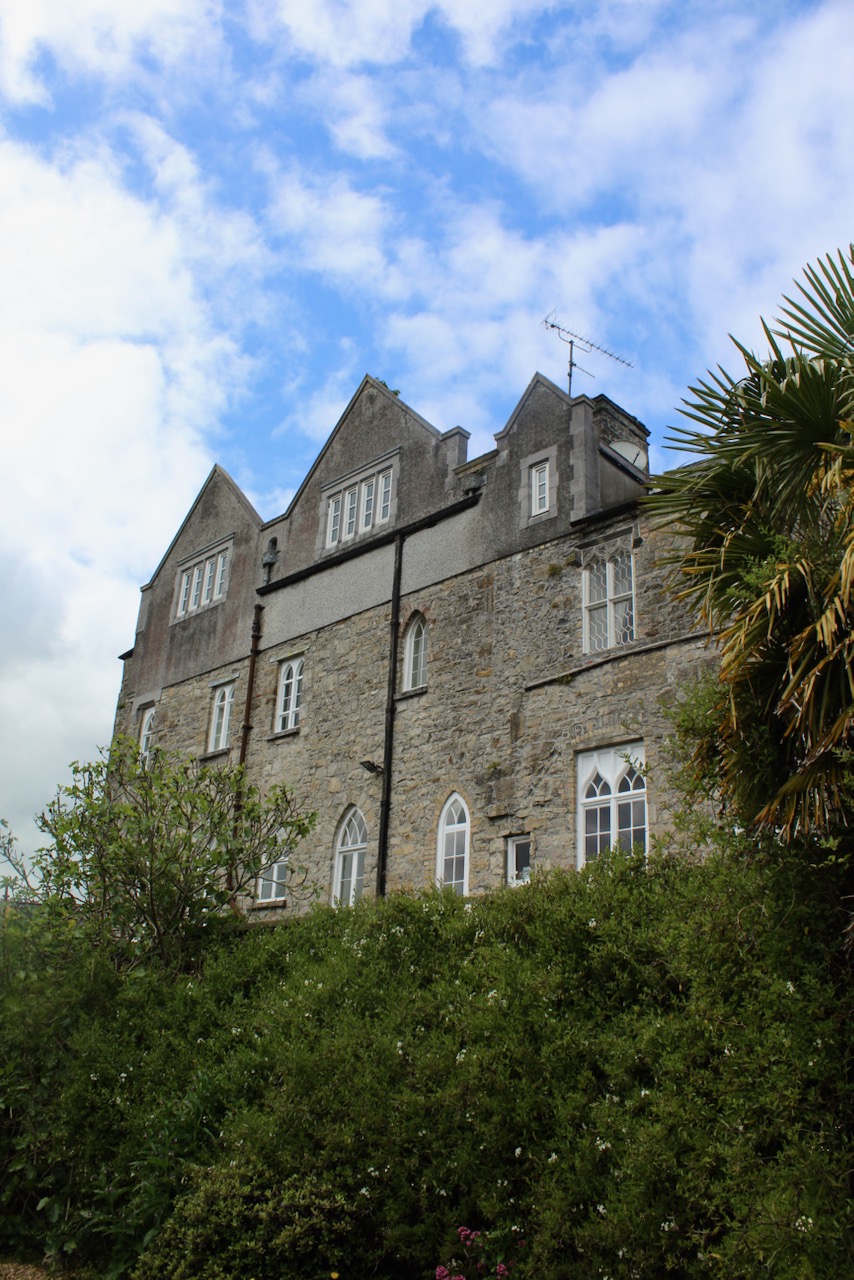
Bence-Jones tells us that the Georgian Gothic windows and the long two-storey wing was added in the early nineteenth century, but I don’t think this is correct since that is the part that houses what seems to have been the Abbey refectory. He may mean that this wing was converted at that time into a drawing room, as described by Rowan and Hamilton. Photograph © Jennifer Winder-Baggot, www.irishhistorichouses.com
St. Mary’s Abbey house. Photograph © Jennifer Winder-Baggot, www.irishhistorichouses.com

The school closed down and the building was bought by the last schoolteacher, Rev James Hamilton. He was the uncle of William Rowan Hamilton. [5] The Dictionary of Irish Biography describes Reverend James Hamilton: “James Hamilton was a classicist with some knowledge of oriental languages; he recognised his nephew’s precocious talent and fed him an extraordinary diet of the classics, Hebrew, and a wide range of oriental and modern languages. He was quite a taskmaster, albeit a kindly and supportive one, and his nephew responded positively.” [6]

William Rowan Hamilton,(1805-1865), Astronomer Royal and President of the Royal Irish Academy,(pl. for ‘Dublin University Magazine’, Vol. XIX, January 1842)Engraver John Kirkwood After Charles Grey, Scottish, c.1808-1892. Photograph courtesy of the National Gallery of Ireland.

It was occupied as a private house by him and his descendants until 1909, when it was bought by Archibald Montgomery, who carried out various improvements and panelled the principal rooms. Montgomery was a Dublin lawyer and Sheriff of Dublin.

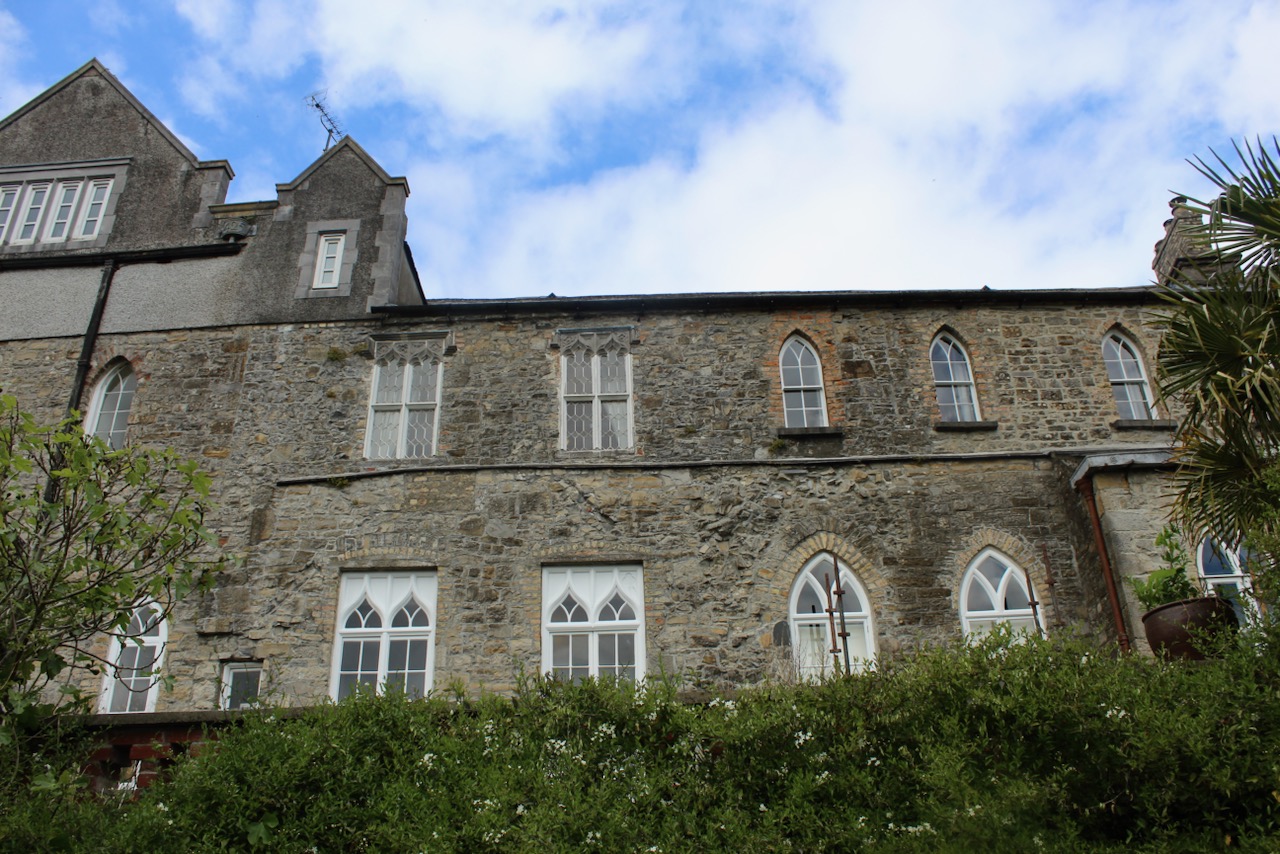
Casey and Rowan tell us that Archibald Montgomery added an attic storey with yellow-brick gables to the west end, and retained a mish-mash of pointed eighteenth century sash windows and Gothic-French windows throughout the rest of the building.

The lobby upstairs has lovely trefoil style windows. Casey and Rowan write that there are angel shield bearers in some window spandrels upstairs, and that they were probably found and reused in the 1909 reconstruction.

The attic storey with pointed gables was added in 1909. Photograph © Jennifer Winder-Baggot, www.irishhistorichouses.com
The hopper on the left has the date 1909, to indicate that it is the addition, while the one on the right has the date 1425 on it. Photograph © Jennifer Winder-Baggot, www.irishhistorichouses.com
There are angel shield bearers in some window spandrels upstairs, and that they were probably found and reused in the 1909 reconstruction. Photograph © Jennifer Winder-Baggot, www.irishhistorichouses.com

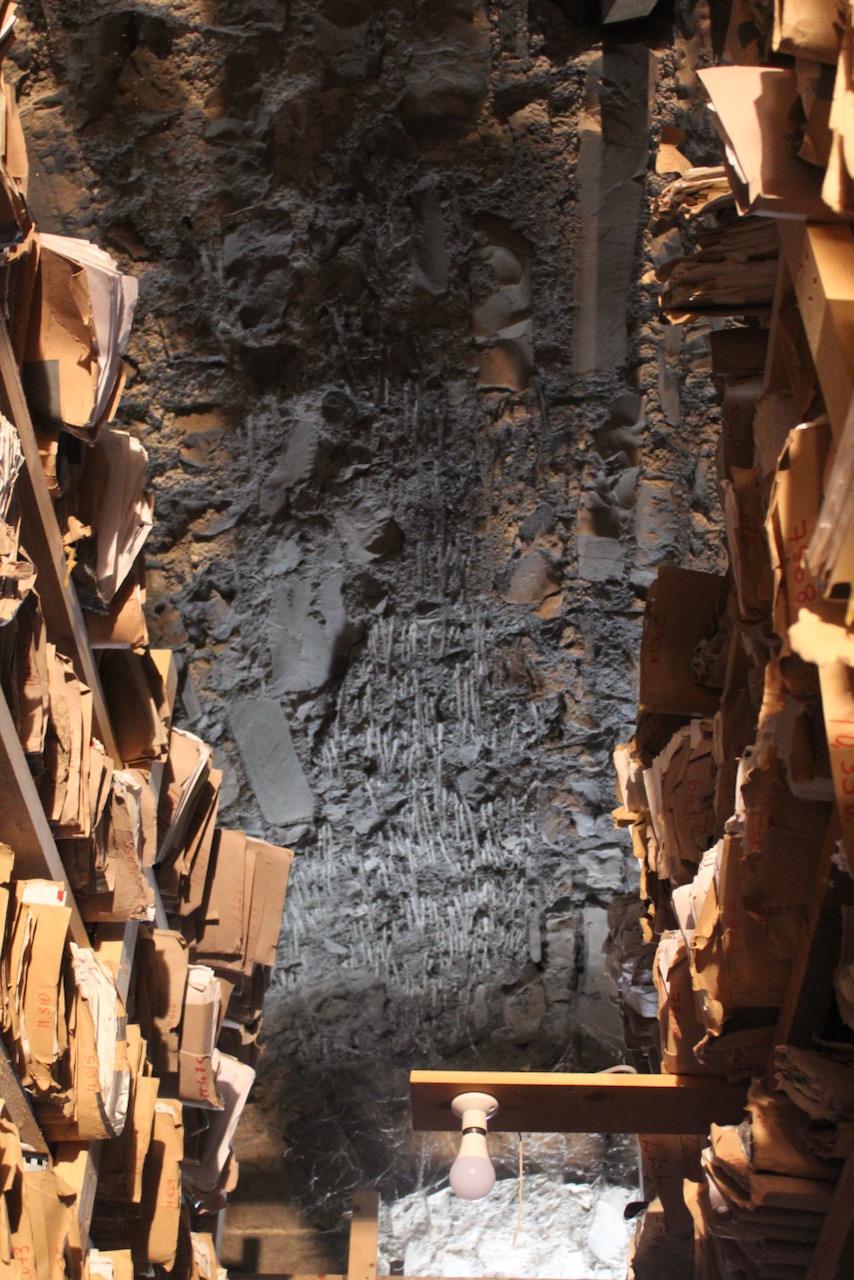
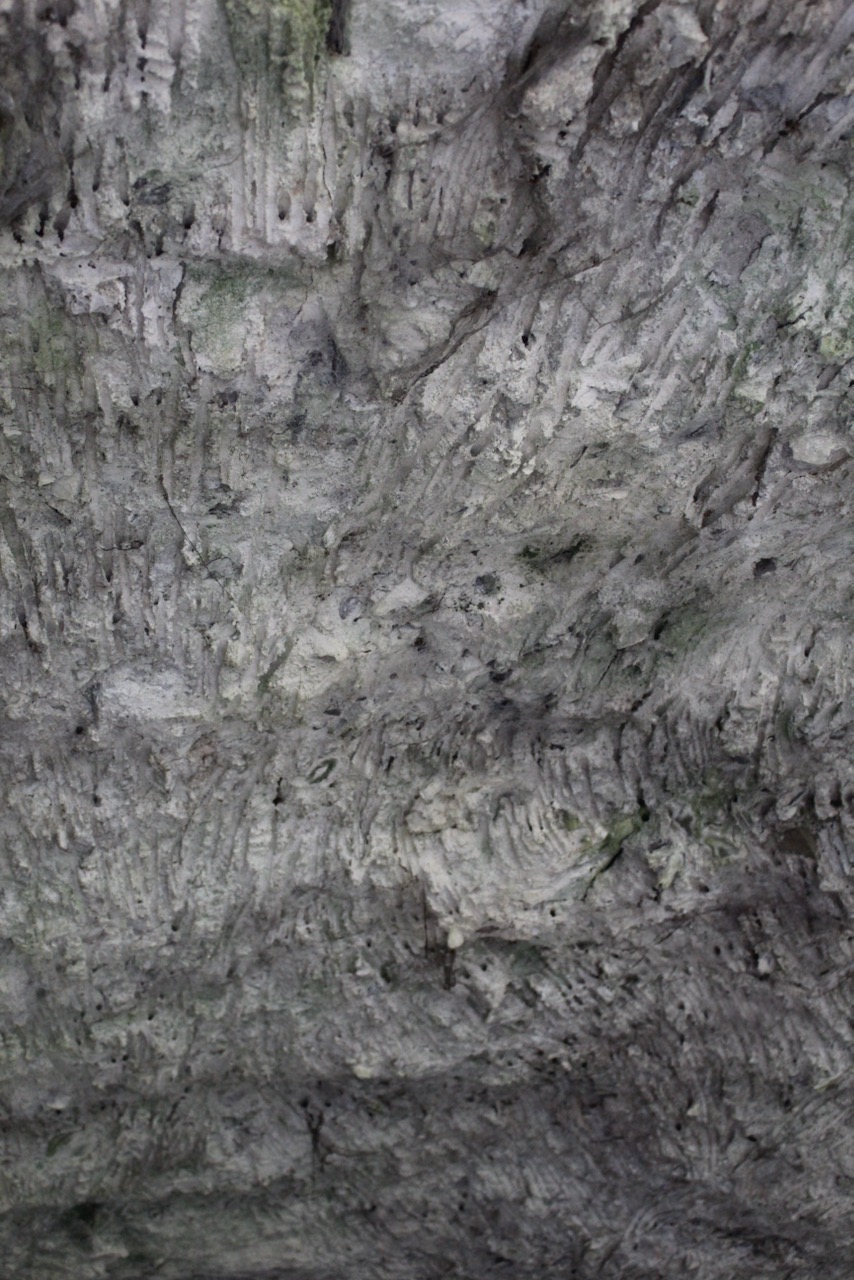
In the basement Peter pointed out a feature of the ceiling which would indicate its age. There are what look like scratches, which would be the remains of wickerwork ceiling.

Scratches on ceiling show where an ancient wickerwork ceiling used to be. Photograph © Jennifer Winder-Baggot, www.irishhistorichouses.com

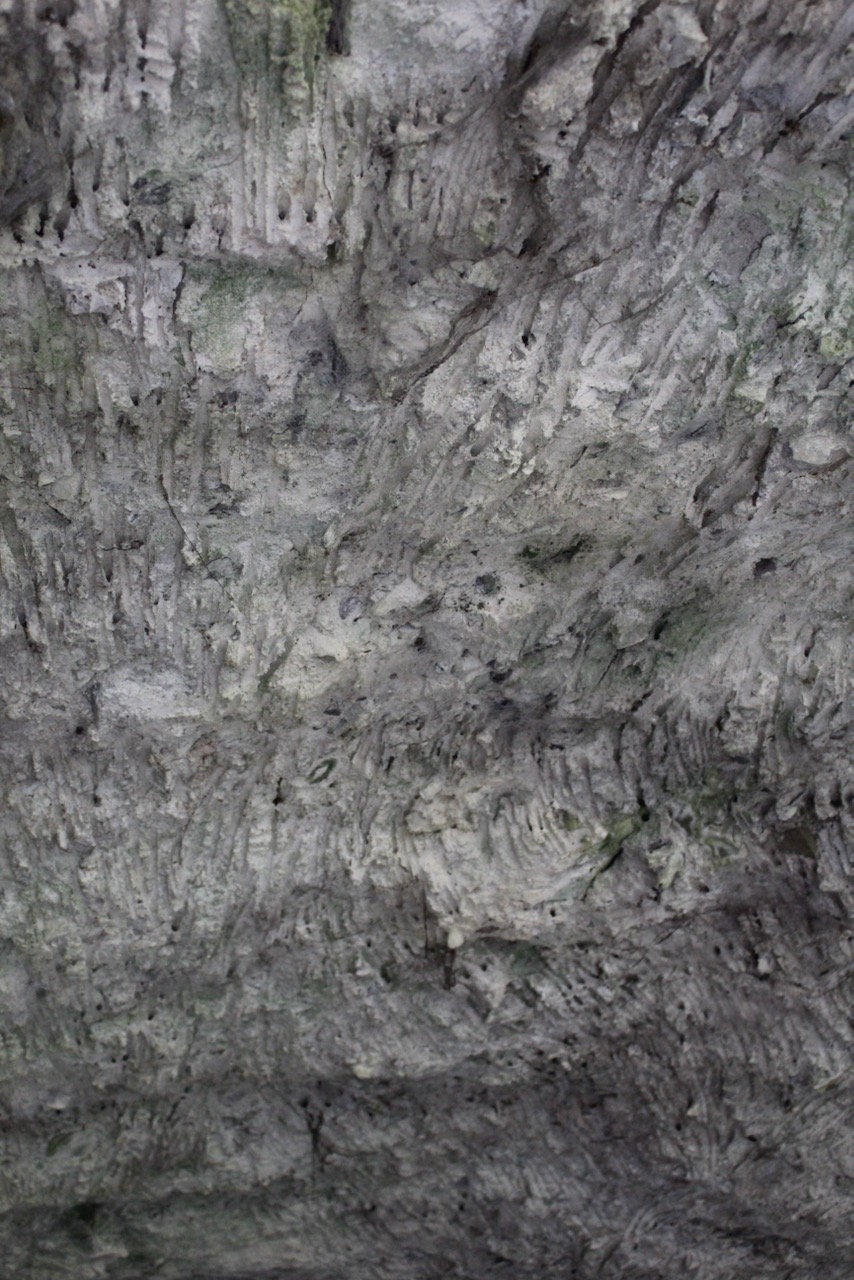
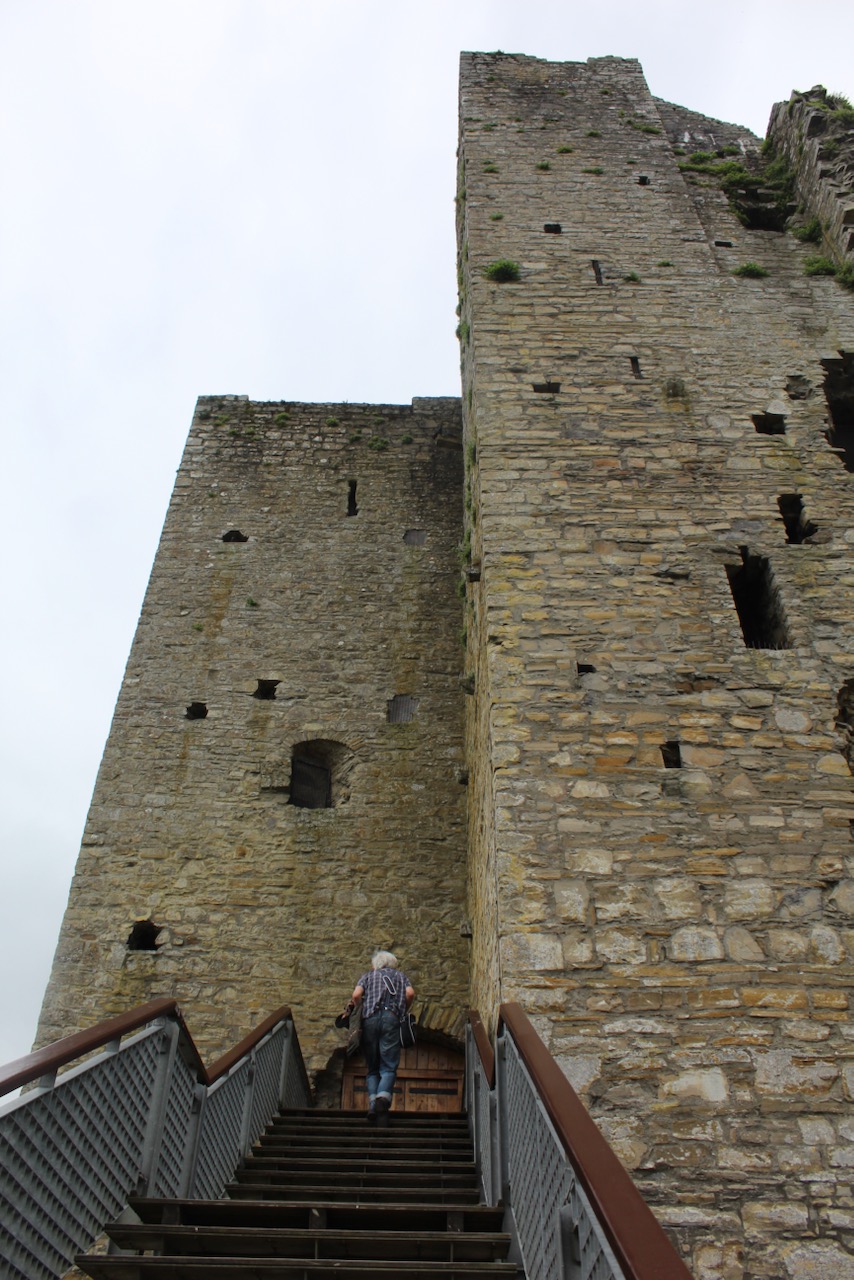
We saw the same scratches on a ceiling in Trim Castle:

Similar markings on ceiling in part of Trim Castle. Photograph © Jennifer Winder-Baggot, www.irishhistorichouses.com

Montgomery died in 1942 and everything in the house was sold. The house was purchased in 1951 by an engineer from Manchester, John O’Leary. He was also a big game hunter, and won the bronze medal in the 1924 Olympics in Paris for shooting. He and his wife had no children, and he died in 1967 and his wife Eileen in 1981. They left all the contents in the house. Peter Higgins moved in as Caretaker, in 1984 and later had the opportunity to buy the property in 1991.

The gardens tier down to the river, and the house has wonderful views of Trim Castle and the River Boyne.

[1] Trim: Its Ecclesiastical Ruins, Its Castle, Etc. : Together with a Collection of Documents Not Hitherto Published, and Notes of Trim and Its Environs for Past Two Centuries. Jan 1886 · Printed at the Office of the Irish Builder. https://play.google.com/store/books/details?id=MvcRAAAAYAAJ&rdid=book-MvcRAAAAYAAJ&rdot=1

[2] Casey, Christine and Alistair Rowan. The Buildings of Ireland, North Leinster. The Counties of Longford, Louth, Meath and Westmeath. Penguin Books, London, 1993.

[3] Mark Bence-Jones. A Guide to Irish Country Houses (originally published as Burke’s Guide to Country Houses volume 1 Ireland by Burke’s Peerage Ltd. 1978); Revised edition 1988 Constable and Company Ltd, London.

[4] https://ashefamily.info/people/born-in-the-16th-century/sir-thomas-ashe-of-trim-1567-1626/

[5] I found more about Reverend James Hamilton’s family on https://www.annevanweerden.nl/docs/Family_of_Uncle_James.pdf

[6] https://www.ria.ie/ga/node/95871

Text © Jennifer Winder-Baggot, www.irishhistorichouses.com

Beauparc House, Beau Parc, Navan, Co. Meath C15 D2K6 – section 482

Open dates in 2026: May 1-31, June 1-5, 8-12, 15-19, 22-26, Aug 15-23, 11am -3pm,

Fee: adult €14, OAP/student €12.50, child €8.40

donation

Help me to pay the entrance fee to one of the houses on this website. This site is created purely out of love for the subject and I receive no payment so any donation is appreciated!

€15.00

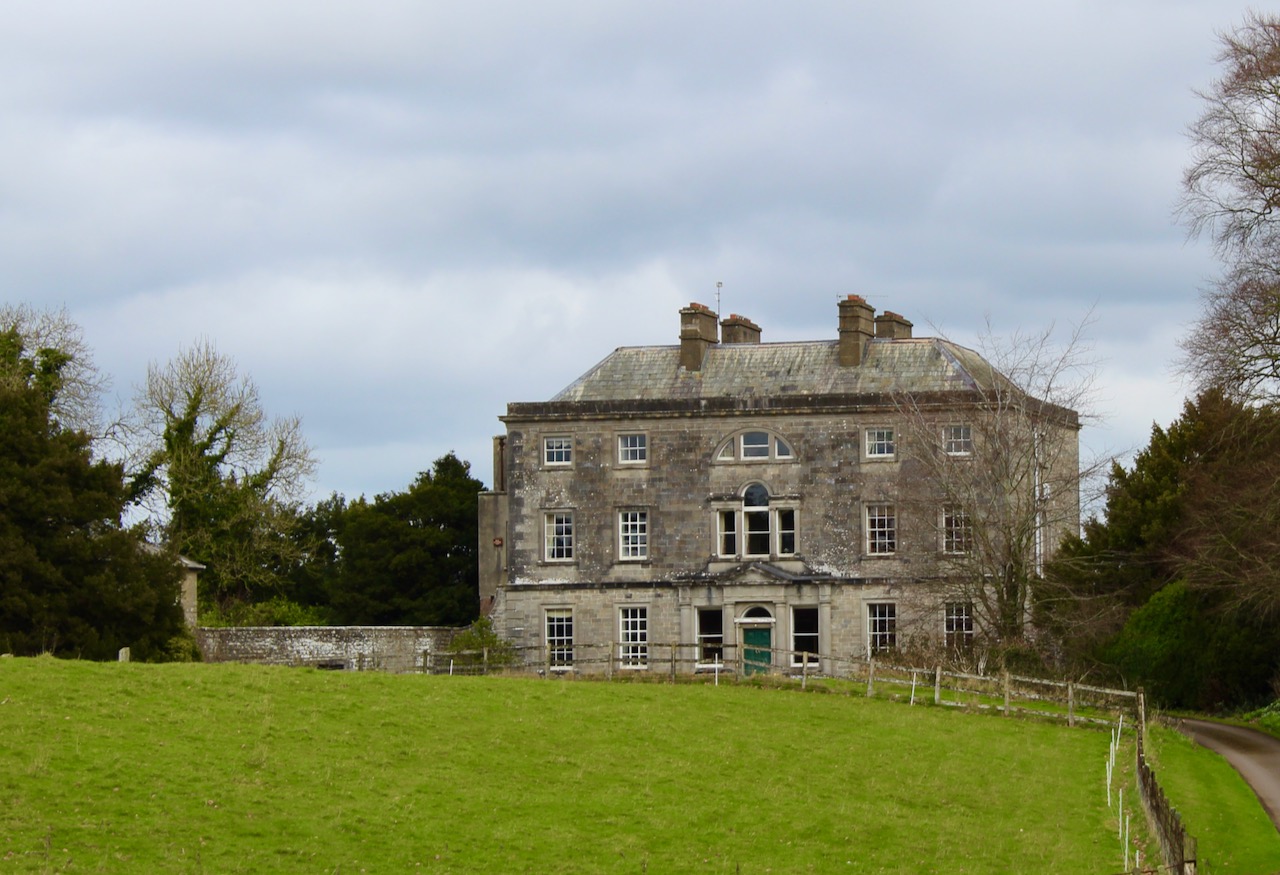
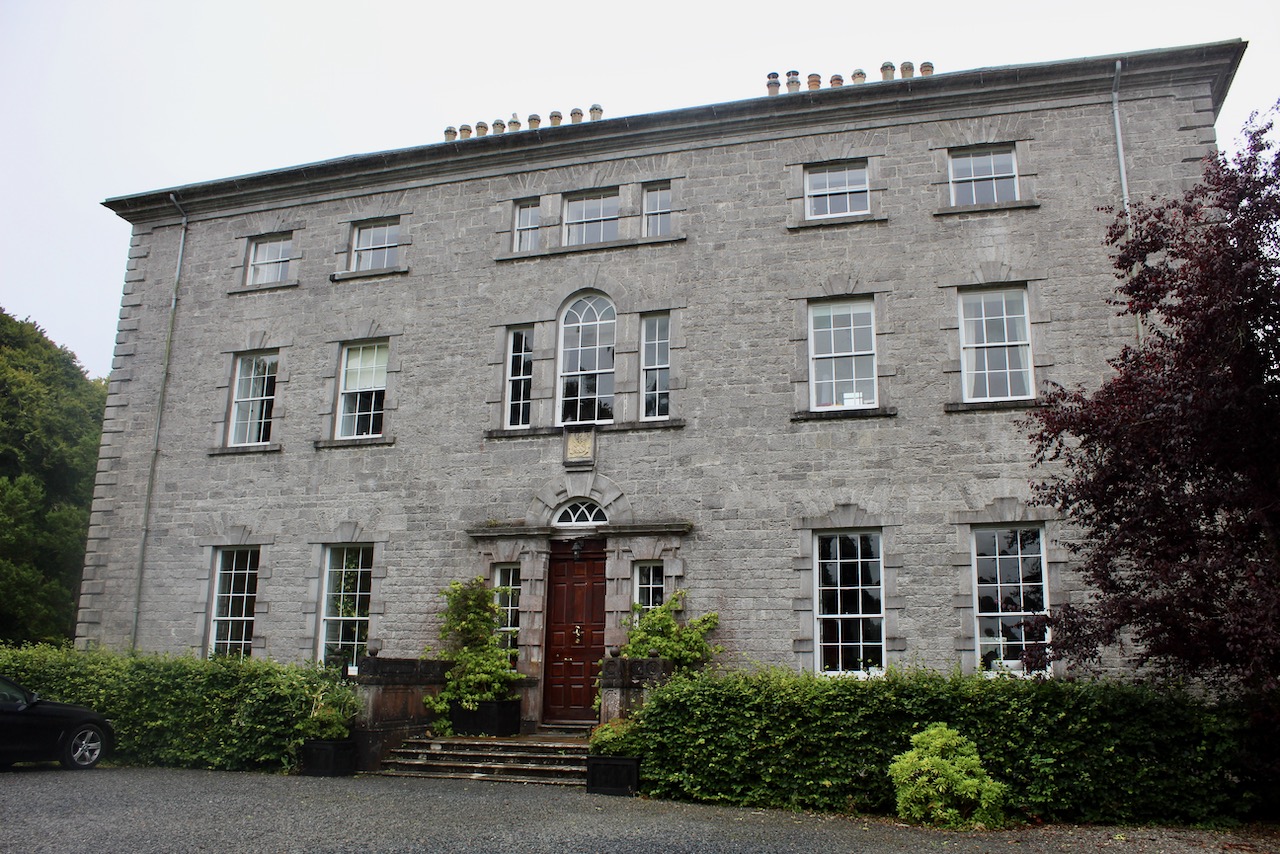
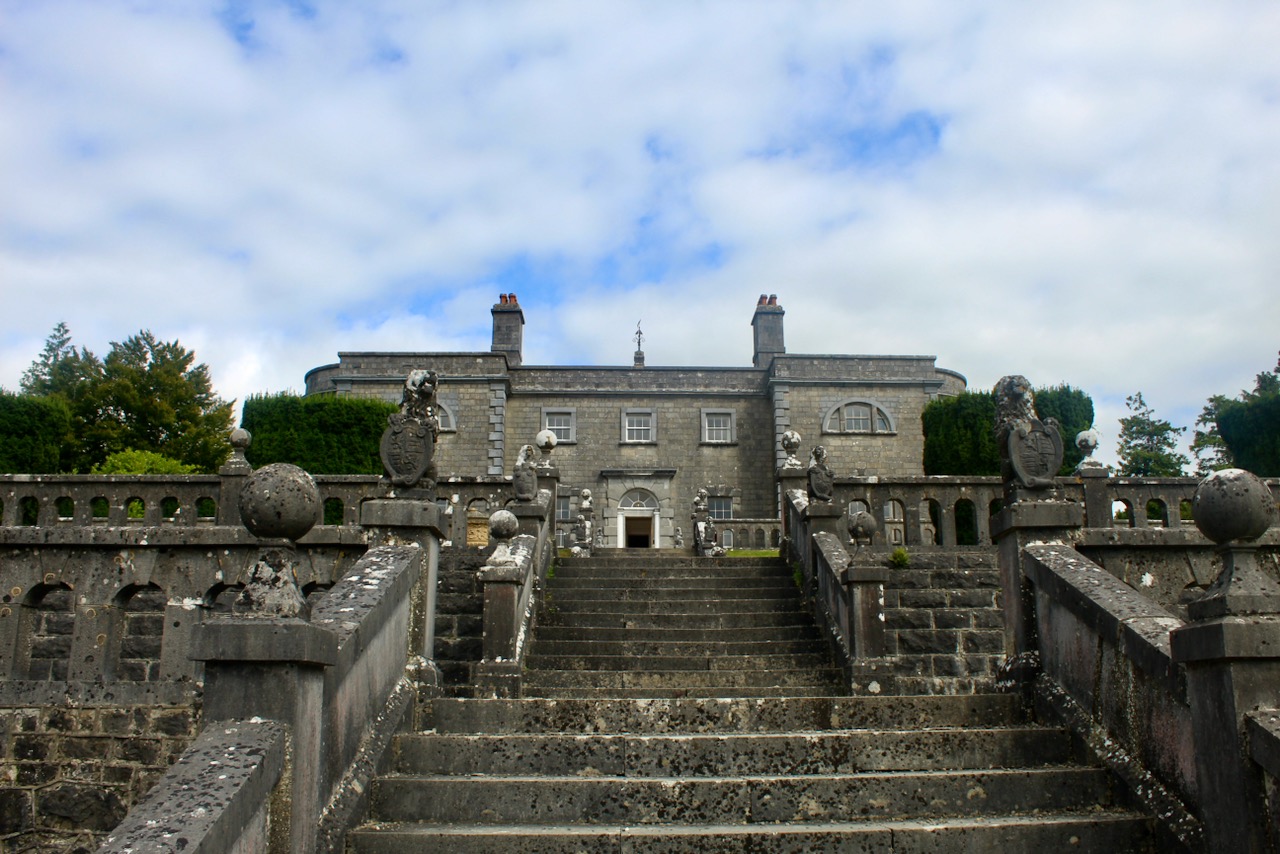
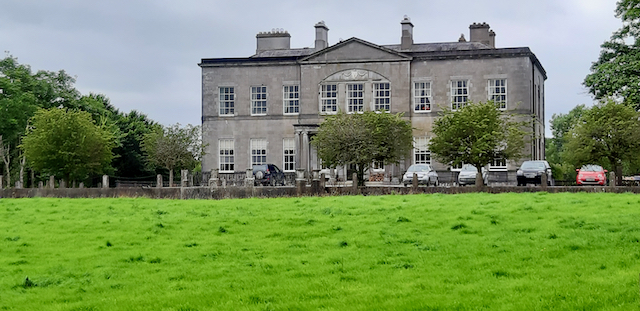
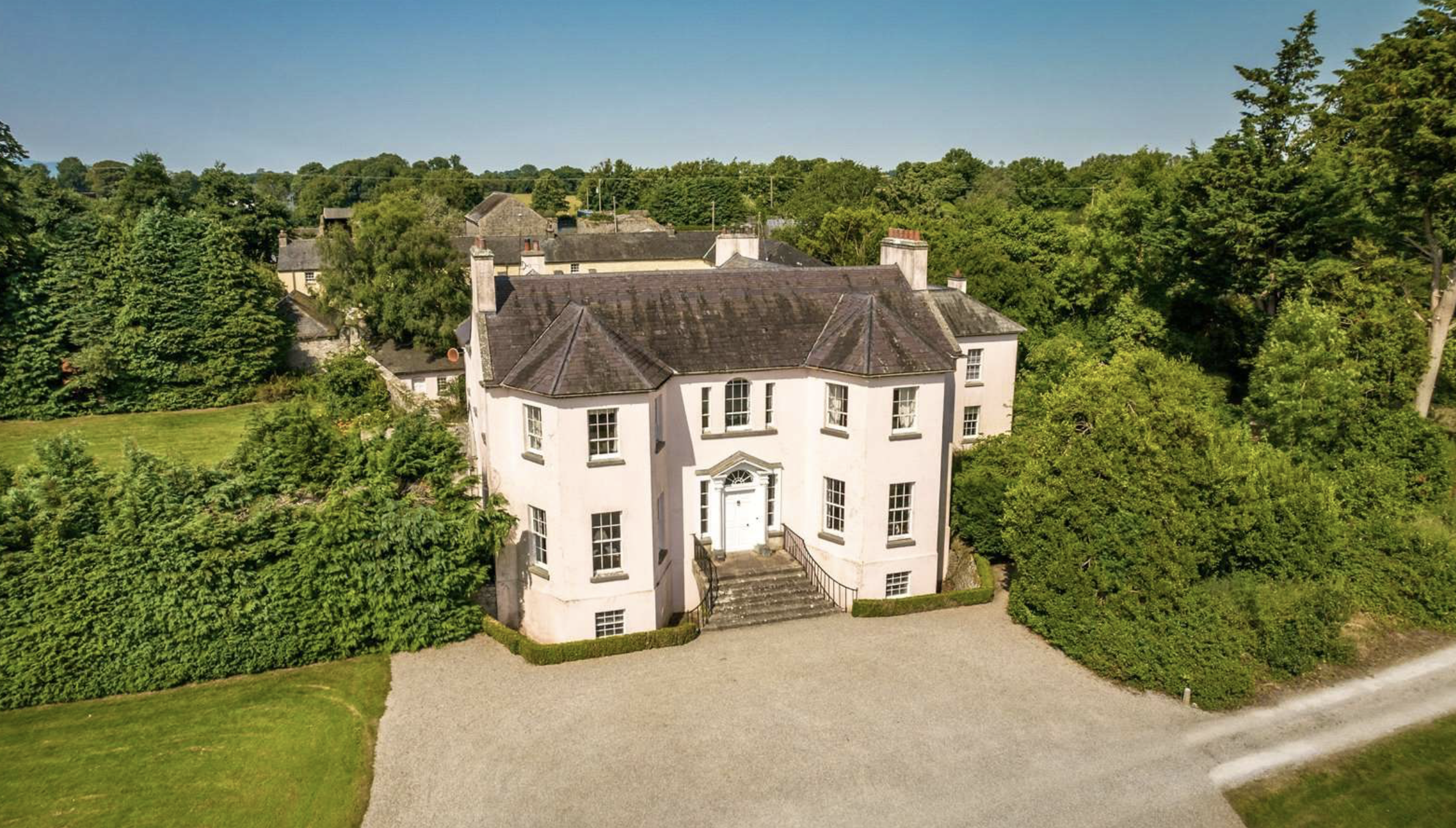
Beauparc House, County Meath, March 2022. © Jennifer Winder-Baggot, www.irishhistorichouses.com

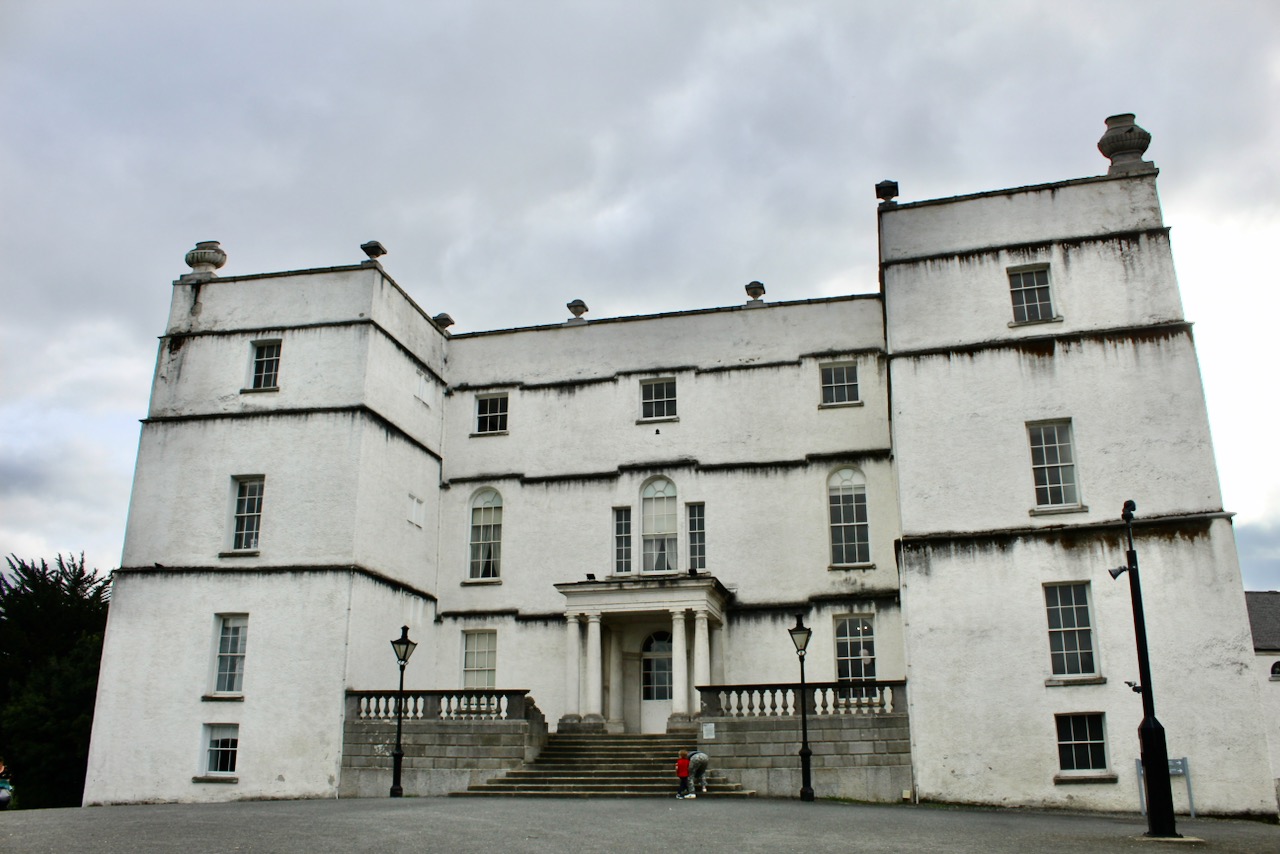
Beauparc House has been in the one family since it was built around 1755. It is a beautiful ashlar stone faced three storey over basement house with the classic sequence of Diocletian window above a Venetian window above a tripartite doorway. The architecture is attributed to Nathaniel Clements (or it could have been Richard Castle, Iona told us, although if built in 1755 that is after Castle’s death in 1751. The central window arrangement is reminiscent of Richard Castle [1]). The door is framed by two pairs of Doric columns topped by a central pediment. The Dictionary of Irish Biography tells us about the architecture of Nathaniel Clements: “A talented architect, he is credited with an important part in developing the Palladian villa-farm style of Irish country houses. In the 1750s and ‘60s he may have designed or advised on the design of several country houses, for example at Brooklawn and Colganstown in Co. Dublin [also a Section 482 property, see my entry], at Belview, Co. Cavan, Beauparc, Co. Meath, and at Newberry Hall and Lodge Park, Co. Kildare [another Section 482 property which I have yet to visit], all of which show the influence of his mentor Richard Castle. His residences were Manor Hamilton and Bohey, Co. Leitrim; Ashfield, Cootehill, Co. Cavan; and Woodville, Lucan, Co. Dublin.”

The house reminds me of Coopershill in County Sligo which was designed around 1755 by Francis Bindon, who also worked with Richard Castle.

Coopershill House, County Sligo, attributed to Francis Bindon, started in 1755. © Jennifer Winder-Baggot, www.irishhistorichouses.com

Approximately twenty years after it was built, two three-bay two-storey wings were added by Charles Lambart, in around 1778, joined to the house by quadrant walls, the design attributed to the Reverend Daniel Beaufort. Beaufort was the Rector of Navan, County Meath, from 1765. He is associated also with the architecture of Ardbraccan House in County Meath (along with Thomas Cooley and James Wyatt) and Collon church in County Louth (where his daughter Louisa designed the stained glass window).

We were greeted at the door by Iona Conyngham, who gave us a tour of her home.

The central three storey house of Beauparc was built in 1755 and the design is attributed to Nathaniel Clements. © Jennifer Winder-Baggot, www.irishhistorichouses.com
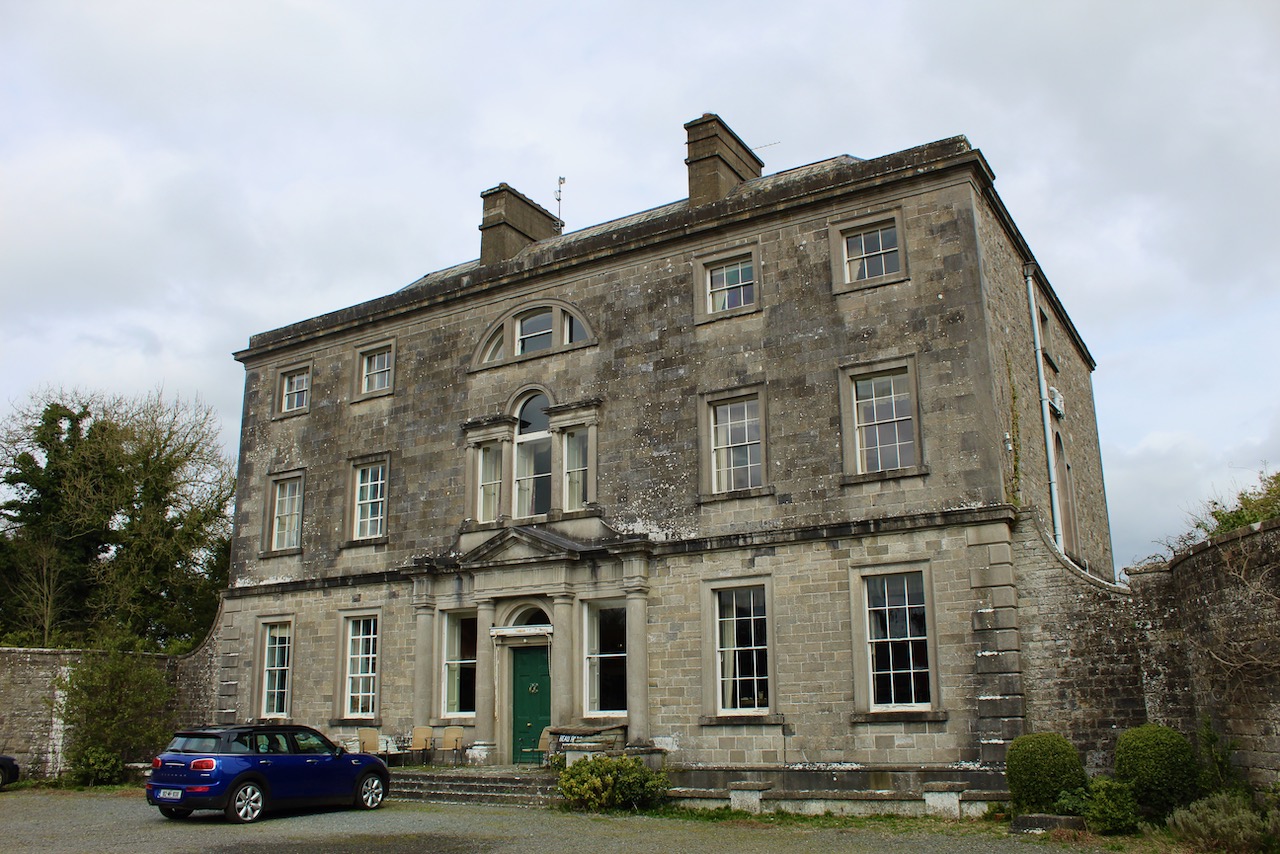
The two two-storey wings of three bays, connected by curved walls, were added c. 1778 and were probably designed by talented amateur architect, Rev. Daniel Beaufort. © Jennifer Winder-Baggot, www.irishhistorichouses.com

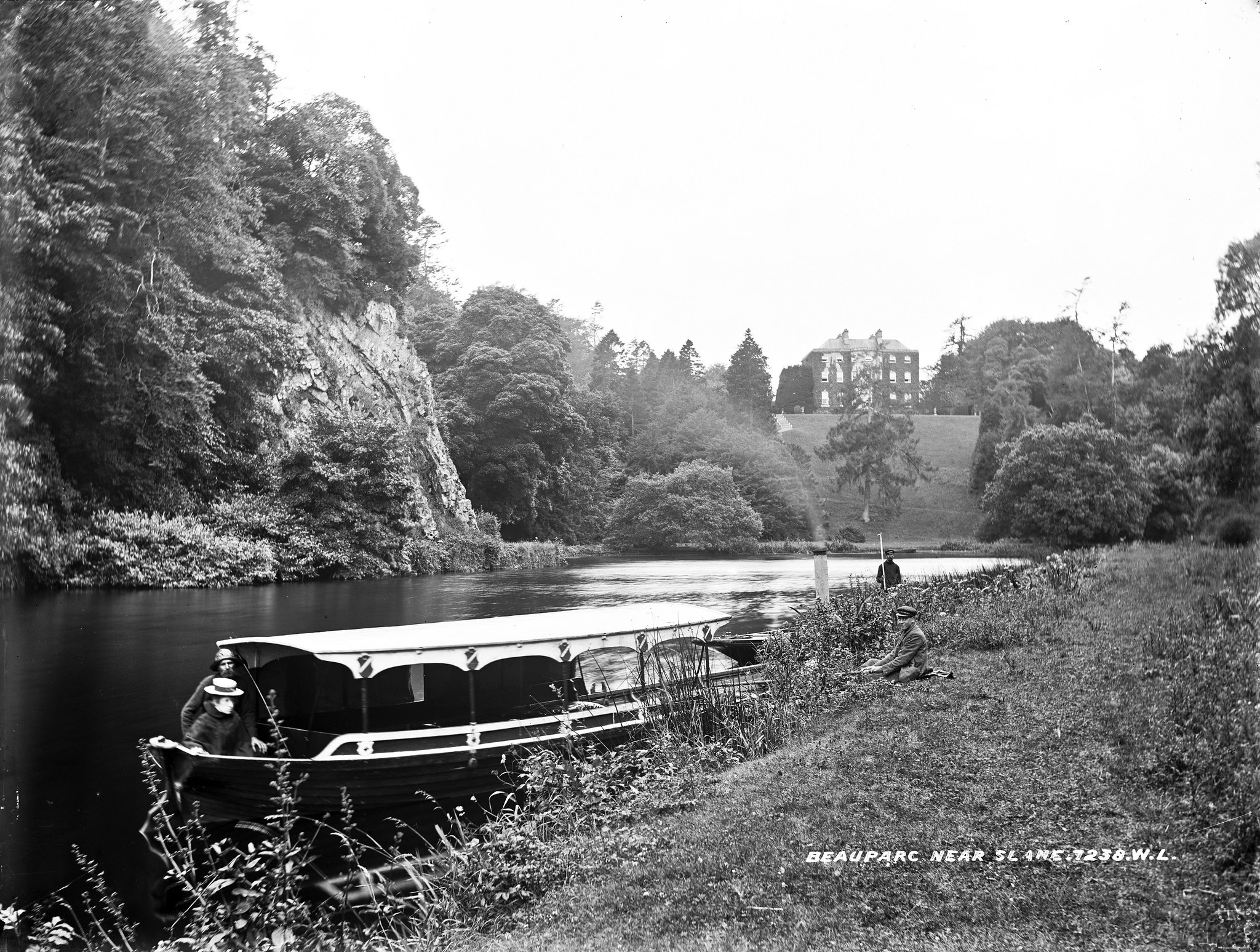
The back of the house, or garden front, as Mark Bence-Jones tells us, is of two bays on either side of a curved central bow, which you can just about see in the photograph taken around 1900 by Robert French (see below). [2] We did not see the back of the house.

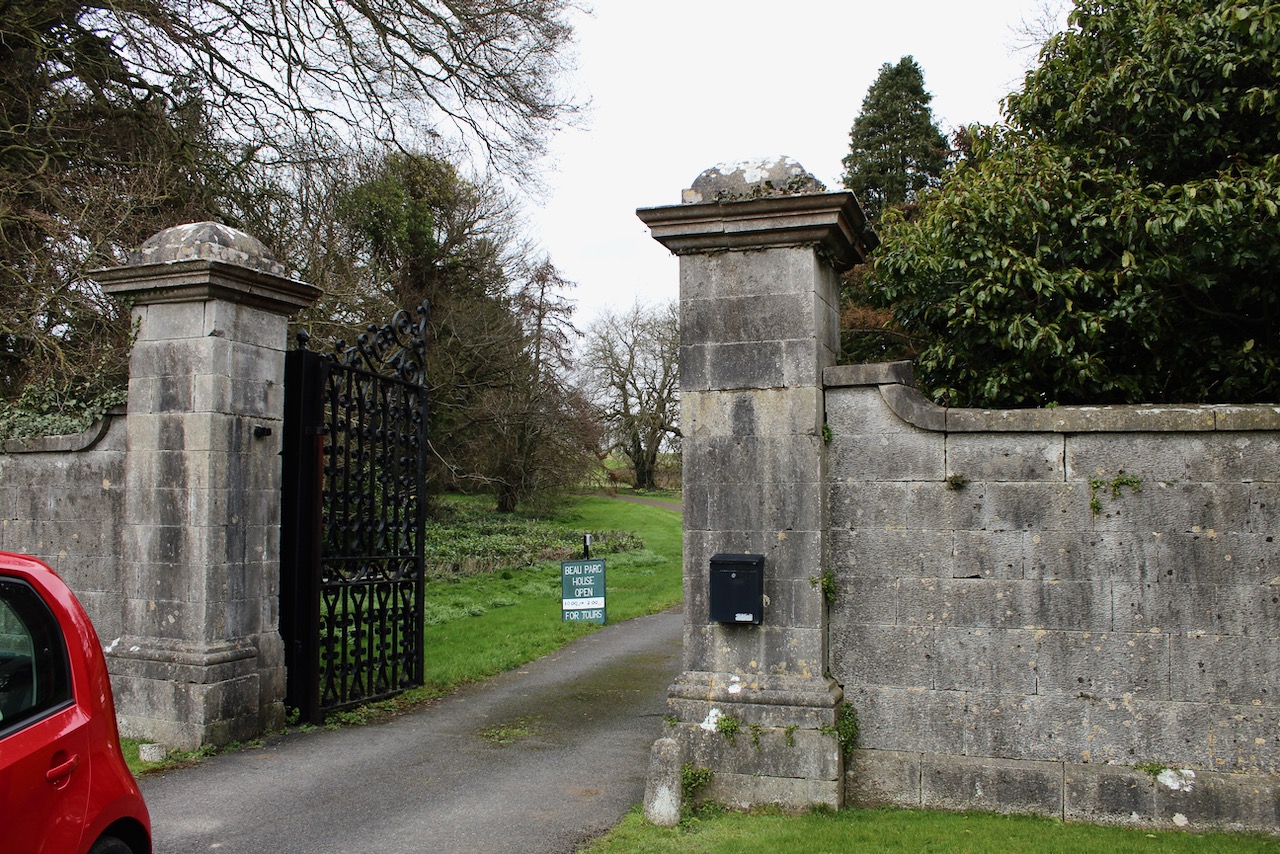
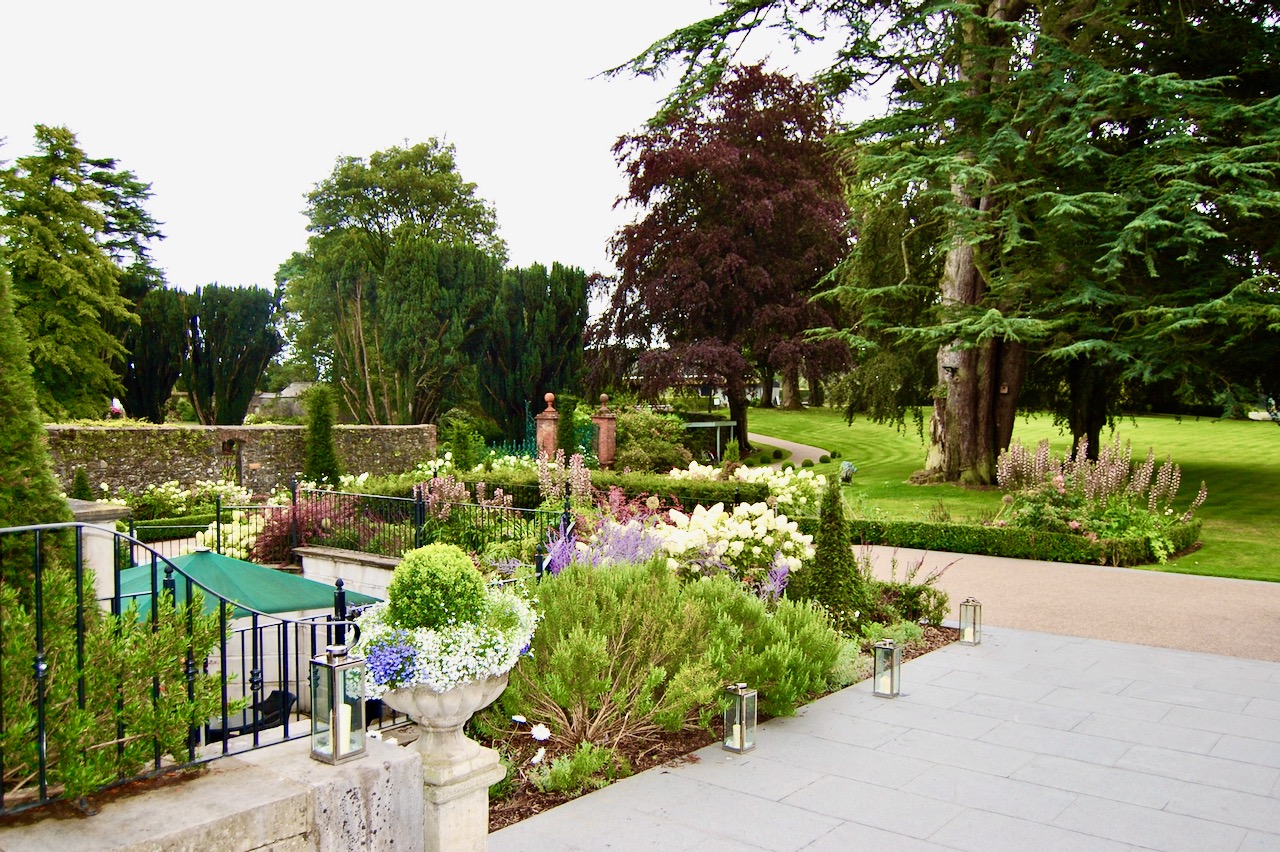
The estate has fine stone entrance piers and a cast iron gate, and a long sweeping drive to the house. The house is beautifully situated above the Boyne River, at the back of the house, giving beautiful views.

Entrance gates to Beauparc. © Jennifer Winder-Baggot, www.irishhistorichouses.com
Beauparc, photograph by Robert French, circa 1880-1900, Lawrence Photographic Collection, National Library of Ireland, flickr constant commons.

The house was built for Gustavus Lambart (born in 1717). He was MP for Kilbeggan from 1741-1776 and Collector of the Revenue for Trim, County Meath, from 1746-1760. He received excise tax from Kilbeggan Whiskey, a distillery that was established in 1757 under Gustavus Lambart’s patronage, by Matthias McManus. Iona told us that before Gustavus Lambart changed the name to Beauparc, it was previously called Fair Park.

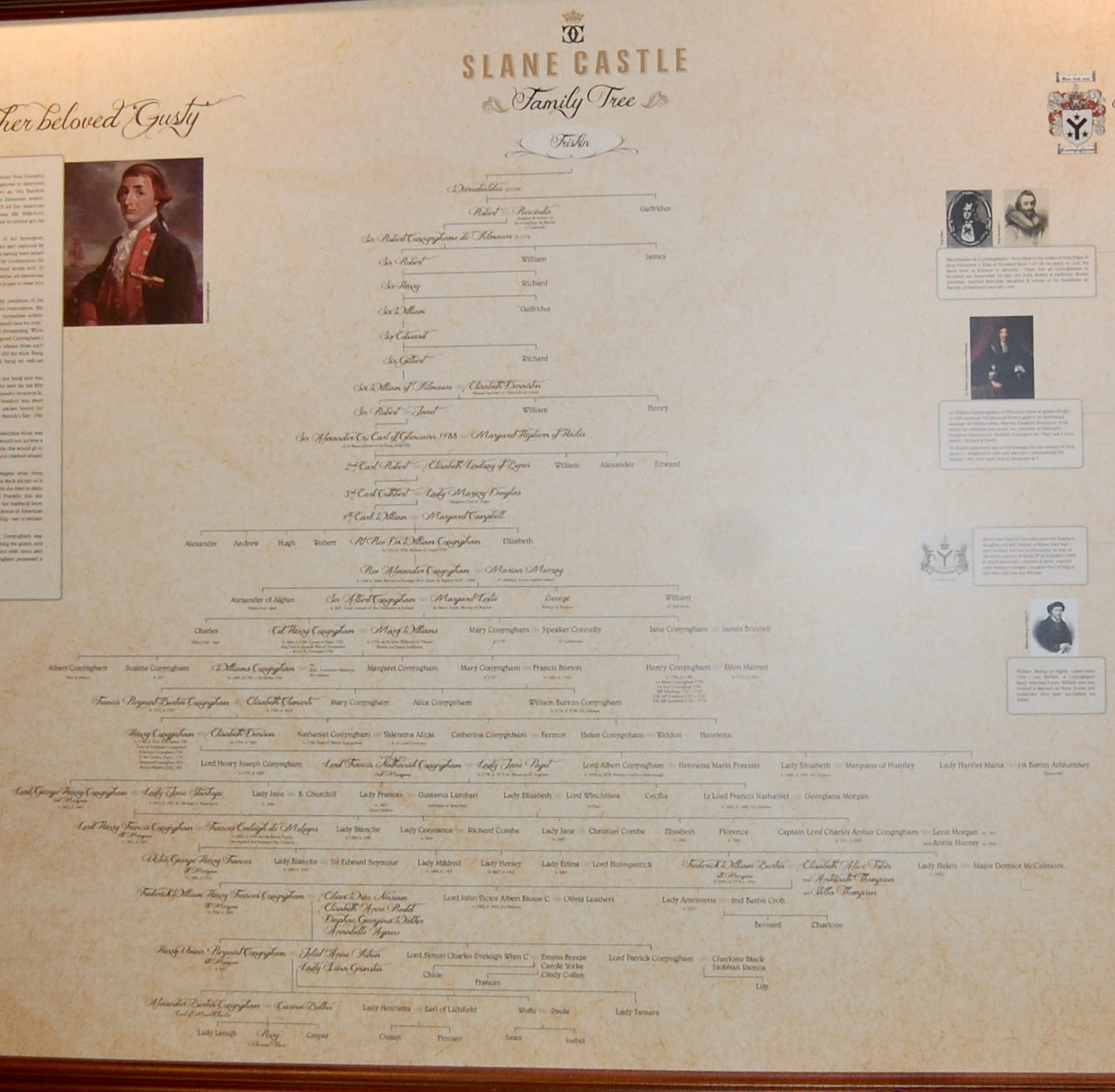
It passed rather indirectly but within the same family to its current owner Lord Henry Mount Charles Conyngham of Slane Castle (and his wife Iona) after the death of the previous owner, Sir Oliver Lambart, in 1986. The Navan History website tells us:

“[The previous owner] willed the house and estate to Lord Henry Mount Charles a distant relative. Sir Oliver never told him and it came as a shock to Lord Henry.”

It must indeed have been a pleasant surprise to Lord Henry Mount Charles, since he already owned Slane Castle, and although Sir Oliver Lambart had no siblings nor children, his father had eleven siblings. However, only four of those siblings, Oliver’s aunts, lived longer than his father Gustavus, and none of Gustavus’s brothers had children. Oliver had several first cousins, but most, if not all of them, predeceased him. Sir Oliver’s grandmother was Frances Caroline Maria Conyngham, daughter of the 2nd Marquess. Henry Mount Charles Conyngham is the 8th Marquess, which makes him only distantly related to Sir Oliver Lambart, the previous owner.

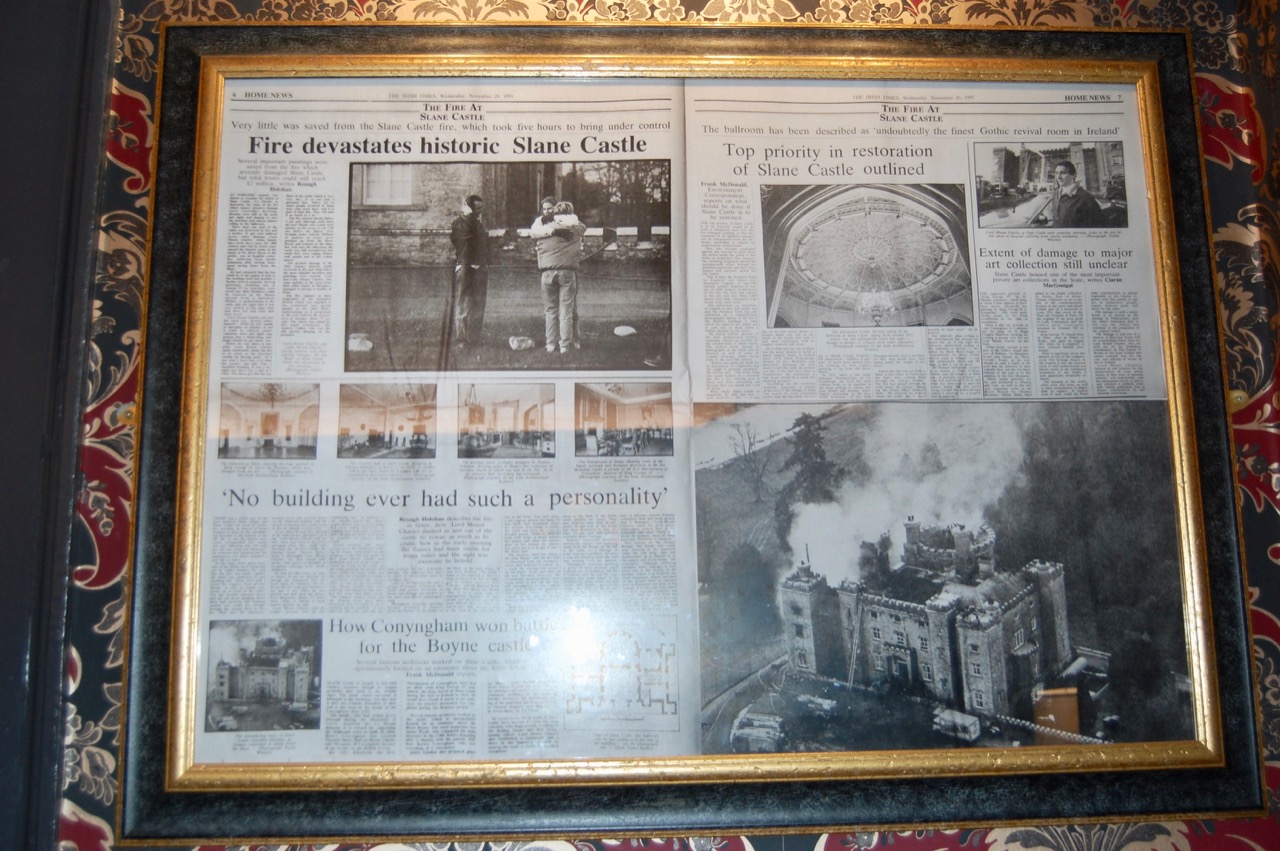
It is fortunate that the Conynghams inherited Beauparc before the disaster of the fire at Slane Castle in 1991, so they had somewhere to live when Slane Castle was being renovated. Lord Mount Charles had already started to host rock concerts to raise money for the upkeep of the castle so perhaps Sir Lambart admired his enterprising spirit and felt that he was leaving his house to someone who would be able to undertake the upkeep of Beauparc. Henry Mountcharles also earns some of his money from the making of whiskey as in 2015 he opened a whiskey distillery at Slane Castle, the Slane Irish Whiskey Brand. Kilbeggan Whiskey still continues today also.

Gustavus Lambart married Thomasine Rochfort of Gaulstown, County Westmeath, the sister of the “wicked” Robert Rochfort, 1st Earl of Belvedere, who imprisoned his wife at her home for allegedly having an affair with his brother (see my entry about Belvedere [3]). She was the daughter of George Rochfort.

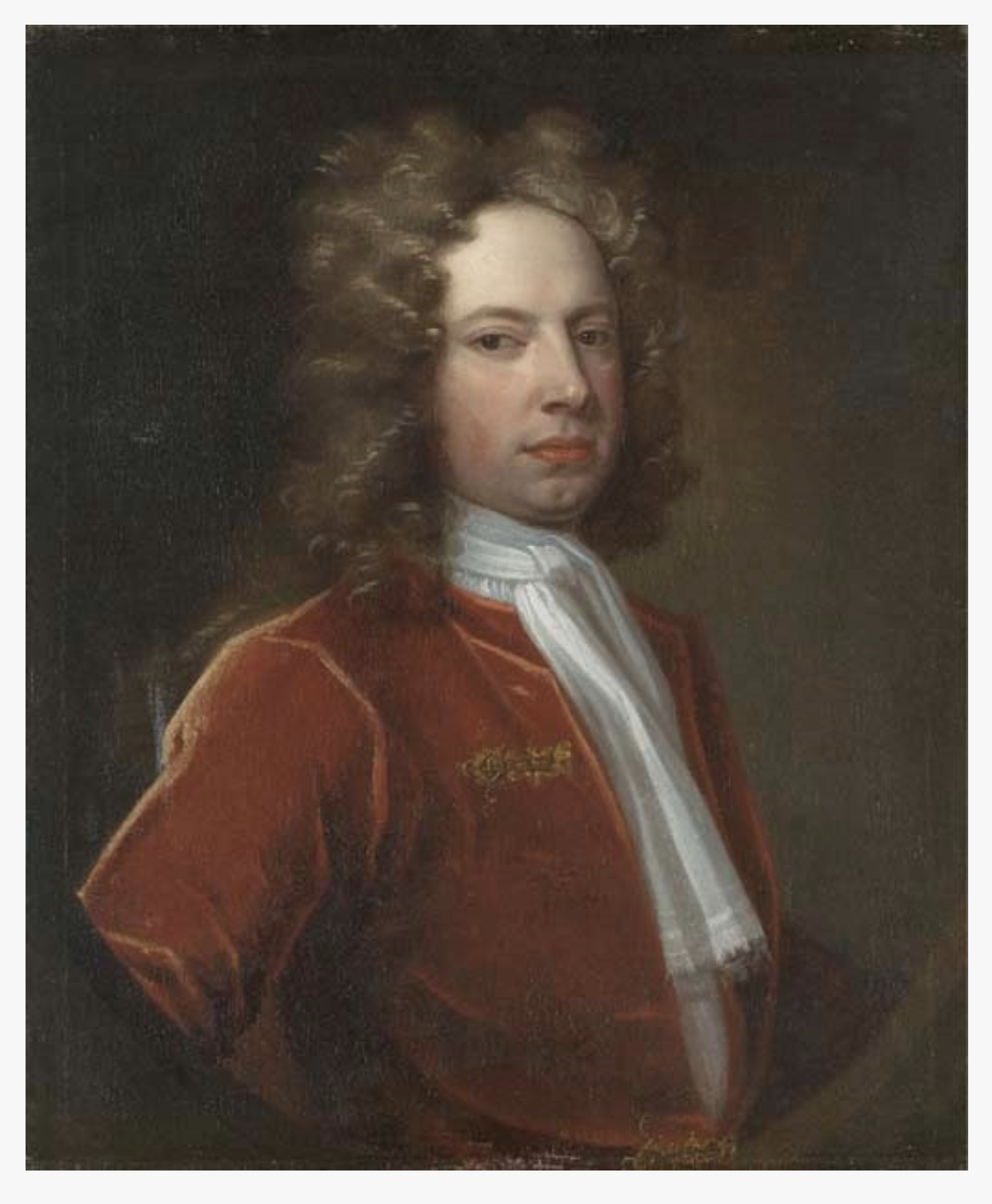
George Rochfort, of Gaulstown, Co. Westmeath, M.P. for Co. Westmeath by Charles Jervas courtesy of Christies Auction 2002.

The Navan History website tells us of the history of the Lambart family:

Oliver Lambart, first Baron Lambart [1573-1618], acquired lands in Cavan.” [4]

Oliver Lambart was a military commander and came to Ireland with the 2nd Earl of Essex and fought in the Nine Year’s War (1593-1603). Earlier he had fought against Spain and was knighted. In 1597 he was an MP for Southampton in England. In 1603 he served as Privy Counsellor in Ireland and In 1613 he was elected as MP for County Cavan in the Irish House of Parliament. He is buried in Westminster Abbey. [5]

His son Charles Lambart (1600-1660) succeeded him in 1618 as the 2nd Lord Lambart, Baron of Cavan, County Cavan. He followed in his father’s footsteps as MP, Privy Counsellor, and the military: He was commander of the forces of Dublin in 1642, helping to suppress the 1641 Uprising with a 1000 strong infantry regiment. [6] Previous to this, he had lived in England as an absentee landlord, due to debts which he inherited from his father. He took a seat in the Irish House of Lords in 1640 after failing to secure a seat in the English Parliament. He allied himself with the Catholic opposition to the government at first, criticising Thomas Wentworth (1593–1641), Earl of Strafford, Lord Lieutenant of Ireland. However, with the rebellious uprising in 1641, Lambart fled to Dublin and there took up arms against the Catholic rebels. He became an ally of the Duke of Ormond. The king rewarded his loyalty by creating him 1st Earl of Cavan in April 1647. [7]

His son Richard became the 2nd Earl of County Cavan. However, it was the 1st Earl of Cavan’s younger son Oliver (1628-1700) who inherited the family estates. The Navan History website tells us:

Oliver Lambart was third son of Charles Lambart, and lived at Painstown. His elder brother, the second Earl [Richard], was deprived of his reason by a deep melancholy by which he was seized before, from a sense of injuries put upon him by his younger brother, Oliver, who by his father’s will got the estate of the family settled upon him. His son, Charles, succeeded him at Beau Parc.”

Oliver married four times. He married, firstly, Catharine Bridges from England, daughter of John Bridges, circa 1662. He and Eleanor Crane of Dublin obtained a marriage license on 6 September 1671. They had several children. He and Dorothy Whitfield obtained a marriage license on 12 December 1681, but they had no children together. He married, fourthly, Anne Tighe, daughter of Richard Tighe, Alderman of Dublin, circa 1688.

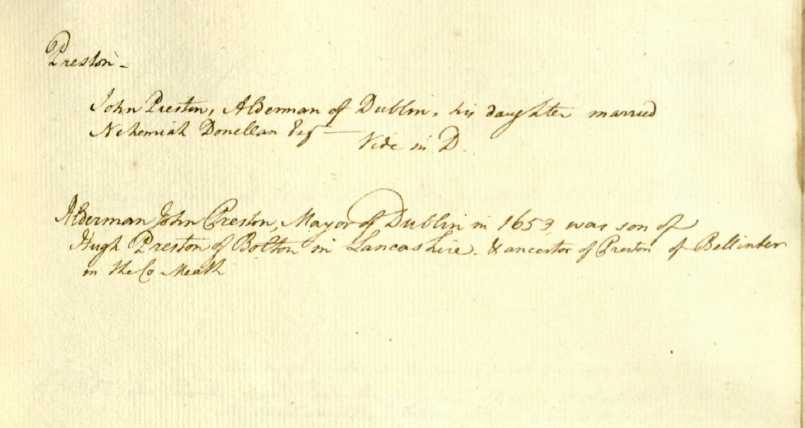
He was Anne Tighe’s third husband. Anne had been previously married to John Preston (d. 1686), Alderman of Dublin, who lived in Ardsallagh, County Meath. By him she had a son Nathaniel Preston (d. 1760) who lived at Swainstown in County Meath, another Section 482 property. Her second husband was Theophilus Sandford who lived in Moyglare, County Meath.

He held the office of Member of Parliament (M.P.) for Kilbeggan in 1661. He died in 1700.

His son Charles (d. 1753) was MP for Kilbeggan and later for Cavan. He lived at Painstown, County Meath. He married Elizabeth Hamilton, daughter of Gustavus Hamilton (1642-1723), 1st Viscount Boyne. It was their son, Gustavus Lambart who had the house at Beauparc built. Gustavus was the second son. His elder brother Charles predeceased their father, unmarried.

Beauparc House, County Meath, March 2022. © Jennifer Winder-Baggot, www.irishhistorichouses.com

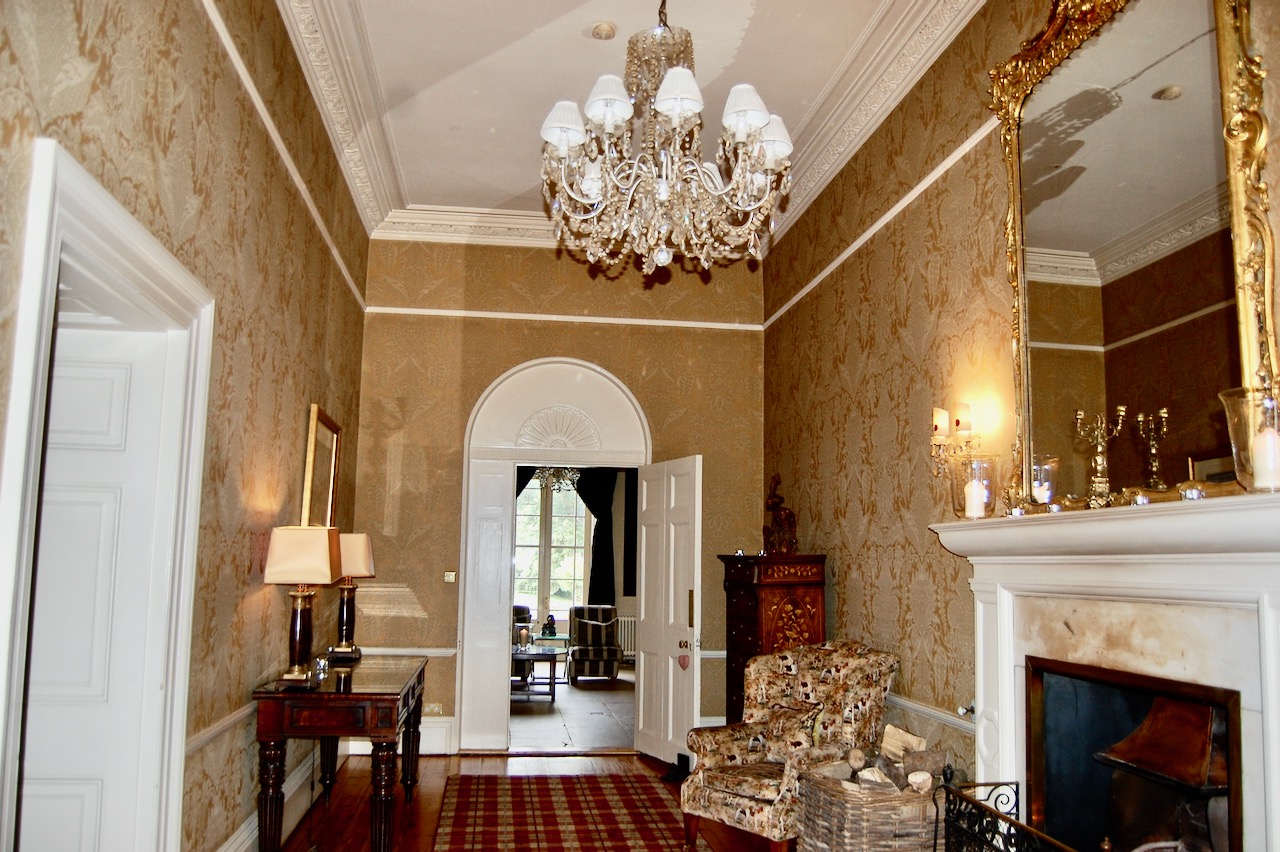
We stepped into the impressive front hall. The plasterwork reminded me of that in Leinster House, which I have seen in photographs. A portrait of Lady Conyngham looks down over a map table, which was a gift to her, with shamrock, thistle and rose, symbols of Ireland, Scotland and England. The hall has stone flags. The interior is laid out, Christine Casey and Alistair Rowan tell us, in a variant of the standard mid-eighteenth century double-pile plan (see [1]). The house is two rooms deep. The hall has a large Doric cornice and six doors in lugged (i.e. shouldered) frames.

The Navan History website tells us: “Gustavus Lambert, son of Charles, was MP for Kilbeggan from 1741 to 1776 and was collector of Revenue for Trim from 1746-60. His son, Charles Lambart [c. 1740-1819], was M.P. for Kilbeggan between 1768 and 1783.” As mentioned earlier, Gustavus married Thomasine Rochfort. His son Charles married Frances Dutton, whose father was born James Lenox Naper (c. 1713-1776) but later took the surname Dutton after his mother, daughter of Ralph Dutton 1st Baronet Dutton, of Sherborne, Co. Gloucester. James Lenox Naper lived at lived at Loughcrew, County Meath, which is also a Section 482 property. It was Charles Lambart who added the wings to Beauparc.

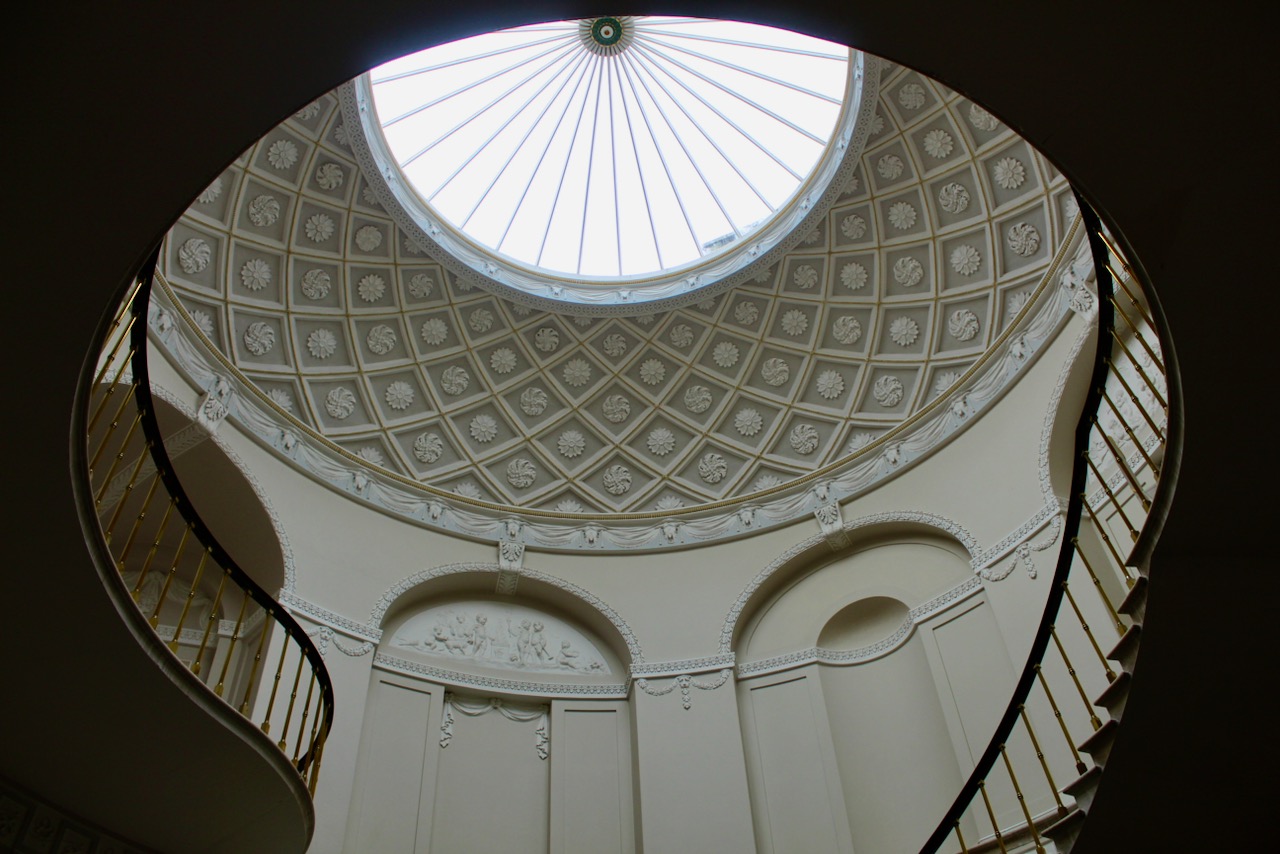
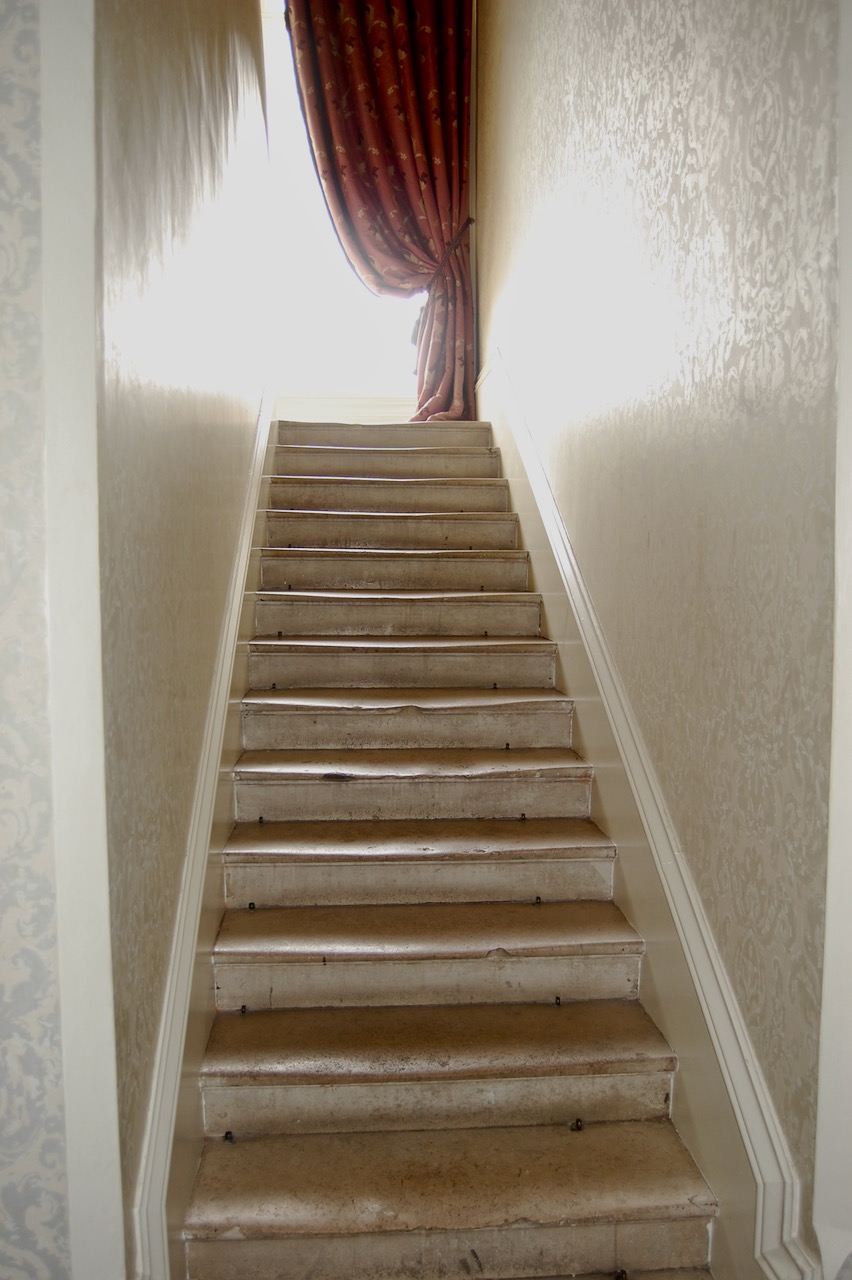
The hall opens directly into the drawing room, with its wonderful view of the Boyne. The dining room and sitting room are on either side. The sitting room retains its original modillion cornice and two stuccoed niches flanking the chimneybreast (see [1]). The main stair is located off the hall to one side and is lit by the big Venetian window. The staircase is mahogany, with two Tuscan balusters per tread and side modillion motifs carved into the tread ends.

The Navan website continues: “Charles’s son, Gustavus [1772-1850], was born in 1772. As M.P. for Kilbeggan Gustavus voted against the Act of Union in 1800.” He married in 1810. Casey and Rowan tell us that Gustavus Lambart II may have had minor alterations made to Beauparc. He may have added Neoclassical chimneypieces, plasterwork, and some “vaguely Gothick joinery” in different rooms (see [1]).

His eldest son, Gustavus William Lambart (1814-1886)married Lady Frances Caroline Maria Conyngham, daughter of the 2nd Marquess Conyngham (Francis Nathaniel Burton Conyngham (1797-1876), of Slane Castle) in 1847.

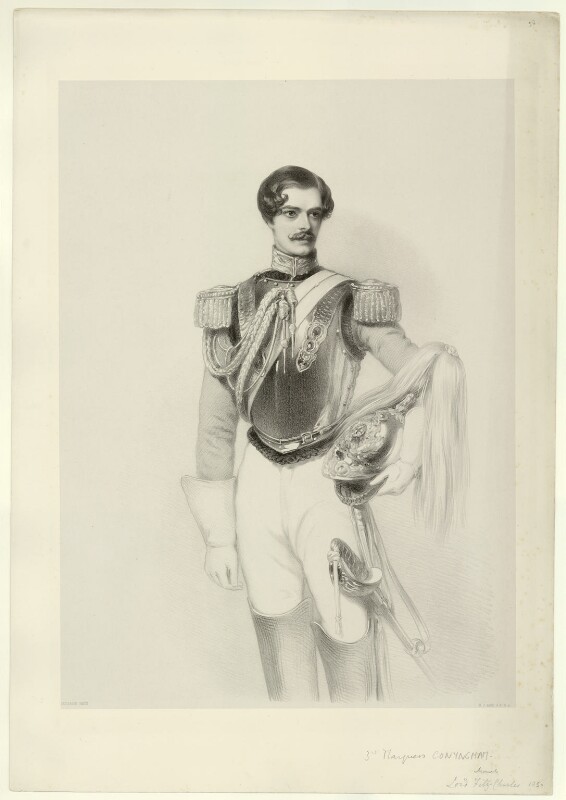
Francis Nathaniel Conyngham 2nd Marquess Conyngham, by Richard James Lane, after Stephen Catterson Smith, lithograph, 1850, photograph from the National Portrait Gallery. [8]

The Navan website tells us about Gustavus William Lambart: “A graduate of Trinity College he was State Steward to the Lord Lieutenant of Ireland. In 1876 Gustavus W. Lambart of Beauparc held 512 acres in County Meath. It is said that a Miss Lambart danced a jig in front of Queen Victoria and asked for the head of the Prime Minister, Gladstone. Gladstone was a supporter of Home Rule for Ireland, a cause which did not find favour among the Irish gentry and nobles. Gustavus William died in 1886.

The Navan website continues: “His eldest son, Gustavus Francis William Lambart, was Chamberlain to the Lord-Lieutenant of Ireland between 1876 and 1880. He gained the rank of Major in the service of the 5th Battalion, Leinster Regiment. High Sheriff of County Meath in 1901, Gustavus was Comptroller and Chamberlain to the Lord-Lieutenant of Ireland between 1902 and 1905. He held the office of Secretary of the Order of St. Patrick. He was created 1st Baronet Lambart, of Beau Parc on 13 July 1911. He married Kathleen [Moore] Brabazon in 1911.” Kathleen Moore-Brabazon was daughter of John Arthur Henry Moore-Brabazon of Tara Hall, County Meath, who was born with the surname Moore but changed his name on the death of his uncle, the Reverend William John Moore-Brabazon, son of John Moore and Barbara Brabazon.

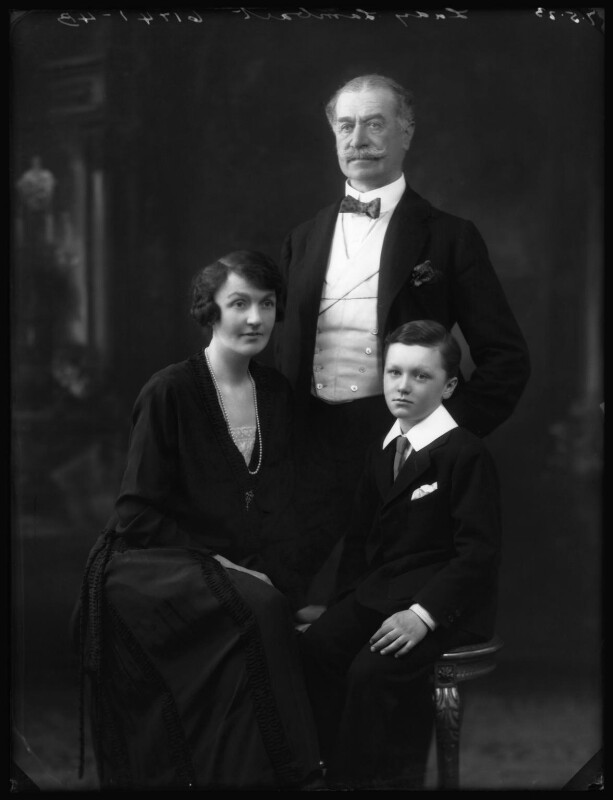
Kathleen Barbara Sophia nee Moore-Brabazon, Lady Lambart, with her son Sir Oliver Francis Lambart 2nd Baronet, and husband, Sir Gustavus Francis Lambart 1st Baronet by Bassano Ltd, whole-plate glass negative, 7 May 1923, photograph from National Portrait Gallery. [8]

The Navan history website tells us that: “In January 1890 Cyril, brother of Gustavus, experimented with chasing kangaroos with the Beau Parc Staghounds. He also tried hunting Barbary sheep and Tralaia deer. Cyril later emigrated to Australia.” It sounds like he must have imported kangaroos to Beauparc! Unless the Navan website does not imply that he moved to Australia after chasing kangaroos!

The website continues, telling us of the final generation of Lambart who lived in Beauparc: “Gustavus’s son, Sir Oliver Francis Lambart, born in 1913, became the 2nd Baronet on his father’s death in 1926. He served as 2nd Lieutenant in the service of the Royal Ulster Rifles. He fought in the Second World War between 1939 and 1944, with the Royal Army Service Corps. Sir Oliver’s uncle was Lord Brabazon of Tara and Minister of Aircraft Production during the Second World War. Sir Oliver Lambart was last of the Lambarts to live in the house. A popular local figure Sir Oliver had an interest in cricket and took part in the local team. He donated a field to the local GAA club as a football pitch. The Land Commission acquired 300 acres of the estate in the 1960s for distribution. Sir Oliver’s mother died in 1980 at 100 years of age. Sir Oliver died in 1986 aged 72. He willed the house and estate to Lord Henry Mount Charles a distant relative. Sir Oliver never told him and it came as a shock to Lord Henry.”

Sir Oliver Lambart’s mother, Kathleen Moore-Brabazon, seems to have been quite a character. Iona told us that she bred German Shepherd dogs, had racehorses, and also raced hot air balloons! There was a photograph of her in a hot air balloon! When I “googled” her I found a wonderful resource, the National Portrait Gallery of England’s website, that allows downloads for non-commercial use. [8]

Iona pointed out an 1853 portrait of a young boy, and asked us to notice that his belt is red. It was Queen Victoria, she told us, who changed the traditional colour for male babies to blue!

Casey and Rowan tell us that the cross-corridor of the double-pile plan appears in the basement and at the bedroom-floor level, where it is vaulted. We did not see either the basement nor the bedroom floor level of the house. Casey and Rowan tell us that the large central bedroom at the rear of the house has an internal apse backing onto this cross-corridor, which echoes its bow windows. The room must have a splendid view over the River Boyne.

Henry Mount Charles and his wife brought some of the family heirlooms from Slane Castle, which join the historic portraits and photographs of the Lambarts. Beauparc is a beautiful secluded family home. Unfortunately we did not explore the grounds. I must make a return trip to Slane Castle, which is now occupied by Henry Mount Charles’s son and his family.

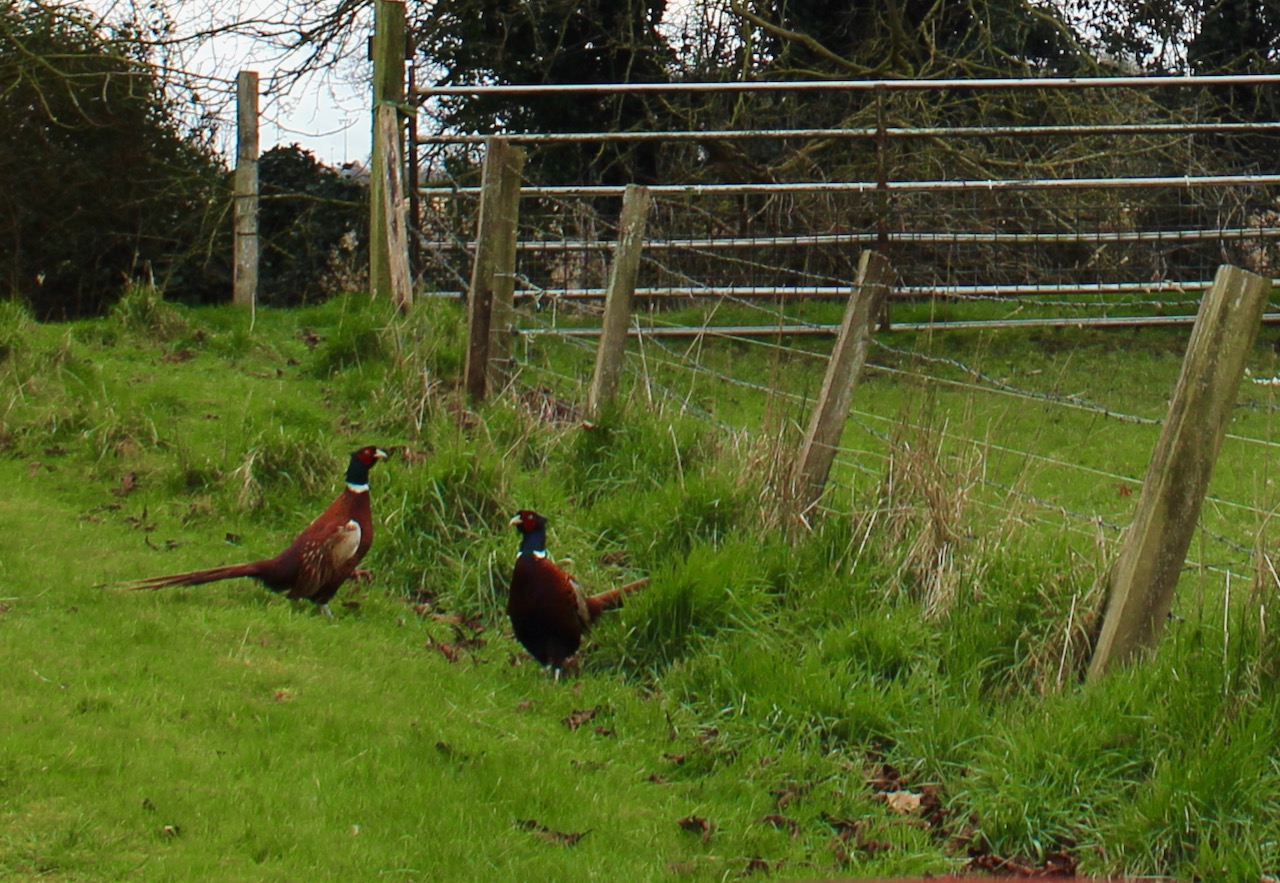
On our way out along the drive we stopped to photograph a lovely pair of pheasants.

Beauparc House, County Meath, March 2022. © Jennifer Winder-Baggot, www.irishhistorichouses.com

[1] p. 157. Casey, Christine and Alistair Rowan, The Buildings of Ireland: North Leinster. The Counties of Longford, Louth, Meath and Westmeath. Penguin Books, London, 1993.

[2] Bence-Jones, Mark. A Guide to Irish Country Houses (originally published as Burke’s Guide to Country Houses volume 1 Ireland by Burke’s Peerage Ltd. 1978); Revised edition 1988 Constable and Company Ltd, London.

[3] https://irishhistorichouses.com/2022/05/07/places-to-visit-and-stay-in-leinster-offaly-and-westmeath/

[4] http://www.navanhistory.ie/index.php?page=lambart

[5] G.E. Cokayne; with Vicary Gibbs, H.A. Doubleday, Geoffrey H. White, Duncan Warrand and Lord Howard de Walden, editors, The Complete Peerage of England, Scotland, Ireland, Great Britain and the United Kingdom, Extant, Extinct or Dormant, new ed., 13 volumes in 14 (1910-1959; reprint in 6 volumes, Gloucester, U.K.: Alan Sutton Publishing, 2000), volume III, page 116. Hereinafter cited as The Complete Peerage.

Quoted on http://www.thepeerage.com

[6] Mosley, Charles, editor. Burke’s Peerage, Baronetage & Knightage, 107th edition, 3 volumes. Wilmington, Delaware, U.S.A.: Burke’s Peerage (Genealogical Books) Ltd, 2003. Quoted on http://www.thepeerage.com

[7] https://www.dib.ie/biography/lambart-charles-a4650

[8] https://www.npg.org.uk/collections/search/person/mp64076/kathleen-barbara-sophia-nee-moore-brabazon-lady-lambart

© Jennifer Winder-Baggot, www.irishhistorichouses.com

2022 Section 482 and Other Places to visit and stay: summary list

I am compiling a list of Historic Houses open for visits.

I am working on fuller descriptions with photographs of places that may not be Section 482 but may be open to the public on specific dates, and will be publishing these soon, probably by Province, as I did for the Office of Public Works properties.

Some big houses are now hotels or b&bs, and may be possible to visit, so I am including them on this list [in red]. This list is neither exhaustive nor necessarily accurate – check listing in advance to see if they are still open to the public.

Here is the Summary List – I hope it will be useful for you for trips around the country, including Northern Ireland which is a treasure trove! Let me know if you have any other recommendations!

I am listing the Section 482 properties in purple to distinguish them from other places to visit. On the map, what I call “whole house accommodation,” by which I mean for 10 or more guests, such as wedding venues, are marked in orange.

For places to stay, I have made a rough estimate of prices at time of publication: 

€ = up to approximately €150 per night for two people sharing; 

€€ – up to approx €250 per night for two; 

€€€ – over €250 per night for two.

Antrim:

1. Antrim Castle and Clotworthy House, County Antrim – estate and gardens open to the public, the Castle was destroyed by fire. The stable block, built in the 1840s and now known as Clotworthy House, is used as an arts centre.

https://discovernorthernireland.com/things-to-do/antrim-castle-gardens-and-clotworthy-house-p704051

2. Belfast Castle estate , County Antrim

https://discovernorthernireland.com/things-to-do/belfast-castle-estate-p676051

3. Carrickfergus Castle, County Antrim

https://discovernorthernireland.com/things-to-do/carrickfergus-castle-p674971

4. Dunluce Castle (ruin), County Antrim

https://discovernorthernireland.com/things-to-do/dunluce-castle-medieval-irish-castle-on-the-antrim-coast-p675011

5. Galgorm Castle, County Antrim – now part of a golf club.

https://www.galgormcastle.com/galgorm-estate.html

6. Glenarm Castle, County Antrim – private, can book a tour

https://glenarmcastle.com

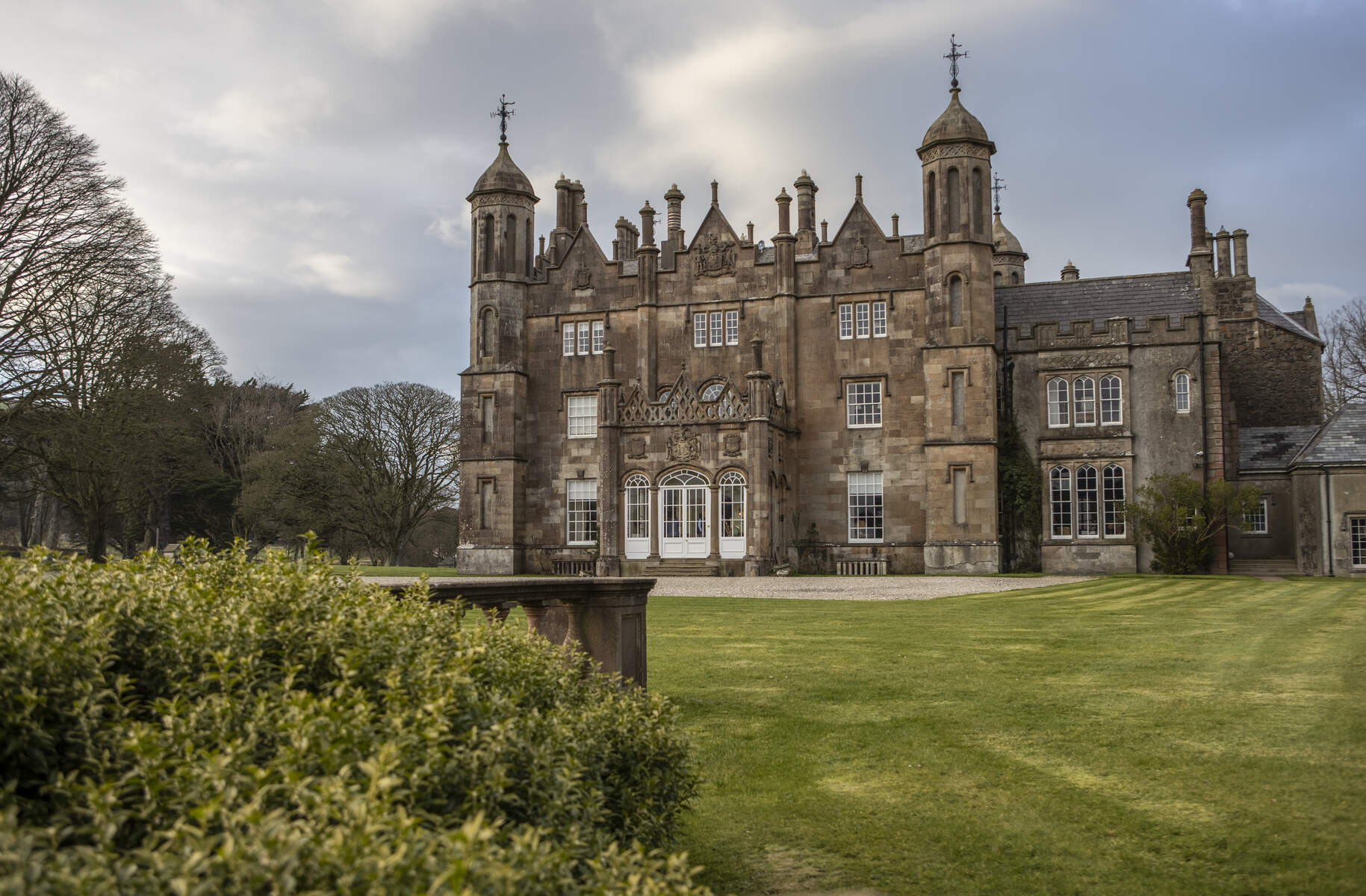
Glenarm Castle & Garden, photo by Donal Maloney 2021 for Tourism Ireland [1]

Dates are limited and booking in advance is required.  

7. Lissanoure Castle, County Antrim – private, wedding venue

https://lissanourecastle.com

George MacCartney, 1st and last Earl Macartney, lived at Lissanoure Castle, is an ancestor of my husband, Stephen! His mother was a Winder.

8. Malone House, Belfast, County Antrim – wedding and conference venue

https://discovernorthernireland.com/things-to-do/malone-house-p674831

9. Wilmont House (park only), Sir Thomas and Lady Dixon Rose Gardens.

https://discovernorthernireland.com/things-to-do/sir-thomas-and-lady-dixon-park-p674891

Places to stay. Count Antrim: 

1. Ballyealy Cottage, Castle Shane Estate, County Antrim €€ for two, € for 3-5

https://www.irishlandmark.com/propertytag/cottages-and-houses/?gclid=Cj0KCQiApL2QBhC8ARIsAGMm-KFInICcRSxwLSiDxfFNk5WFytNcVrLvOQYhzJbIBes4V-M65iXz0gYaAln_EALw_wcB

2. Ballygally Castle, Larne, County Antrim 

https://www.hastingshotels.com/ballygally-castle/?gclid=CjwKCAjwybyJBhBwEiwAvz4G7w8_p7MWKXCL6Vrjer6k5D4AaaJg8CVSfc31wnqzX2CTqPmXQcBoLBoCez8QAvD_BwE

3. Ballylough House, County Antrim 

https://ballyloughbnb.co.uk

4. Drum Gate Lodge, Ballylough House, Bushmills, County Antrim €€

https://www.irishlandmark.com/propertytag/cottages-and-houses/?gclid=Cj0KCQiApL2QBhC8ARIsAGMm-KFInICcRSxwLSiDxfFNk5WFytNcVrLvOQYhzJbIBes4V-M65iXz0gYaAln_EALw_wcB

5. Blackhead Cutter Lighthouse keeper’s house, Whitehead, County Antrim €€ for two, € for 4/5 https://www.irishlandmark.com/property/blackhead-cutter/

3 houses: https://www.irishlandmark.com/properties/

6. Culloden Estate and Spa, Bangor Road, Holywood, Belfast, BT18 0EX €€€ https://www.cullodenestateandspa.com

The website tells us Colloden was originally built as an official palace for the Bishops of Down. The Culloden Estate and Spa stands in twelve acres of secluded gardens and woodland.

5. Dunadry Hotel, County Antrim €€

https://www.originalirishhotels.com

8. Barbican, Glenarm Castle, County Antrim €€

https://www.irishlandmark.com/property/the-barbican/

9. Kilmore House, County Antrim

https://kilmorecountryhouse.com

10. Kiln Wing, Old Corn Mill, Bushmills, County Antrim €€

https://www.irishlandmark.com/property/kiln-wing-old-corn-mill/

11. Larchfield Estate, Lisburn, Co Antrim, BT27 6XJ, Northern Irelandhttps://www.larchfieldestate.co.uk/staying-over

12. Lissanoure Estate cottages: all currently let

https://lissanourecastle.com/the-estate/

13. Magherintemple Gate Lodge, Ballycastle, County Antrim €€ for 2; € for 3/4

https://www.irishlandmark.com/propertytag/cottages-and-houses/?gclid=Cj0KCQiApL2QBhC8ARIsAGMm-KFInICcRSxwLSiDxfFNk5WFytNcVrLvOQYhzJbIBes4V-M65iXz0gYaAln_EALw_wcB

14. Merchant Hotel, Belfast €€€

https://www.themerchanthotel.com/our-history

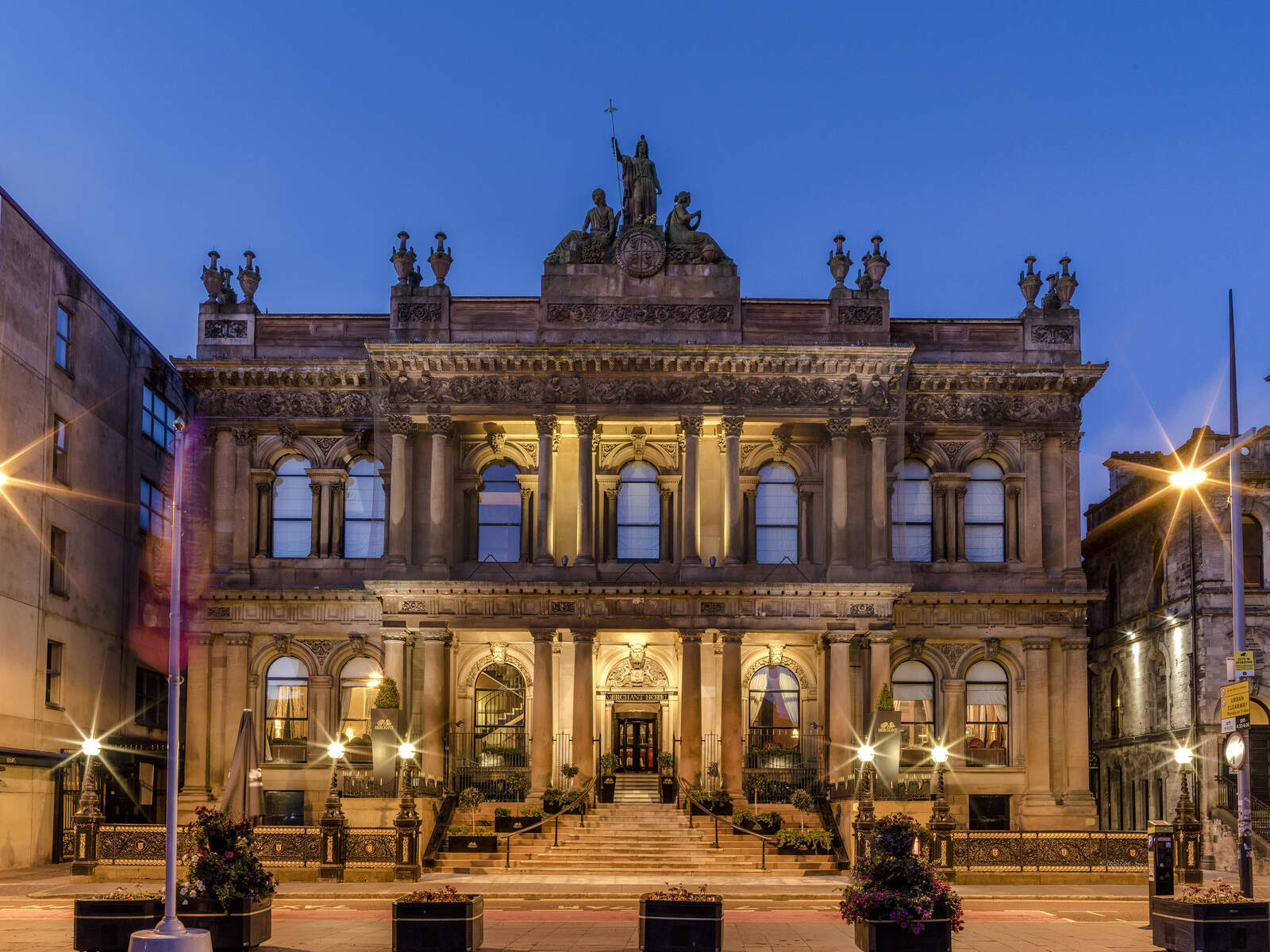
The Merchant Hotel – Front Entrance, Courtesy of Merchant Hotel, Belfast 2017, Ireland’s Content Pool (see [1]).

15. Old Bushmills Barn, 15 Priestlands Road, Antrim €€€ for two; € for four

https://www.theoldbushmillsbarn.com

16. Portbradden Cottage, Bushmills, County Antrim

17. Strand House, Ballymena, County Antrim 

18. Tullymurry House, Banbridge, County Antrim, whole house rental: €€€ for two; € for 3-8

https://www.irishlandmark.com/propertytag/cottages-and-houses/?gclid=Cj0KCQiApL2QBhC8ARIsAGMm-KFInICcRSxwLSiDxfFNk5WFytNcVrLvOQYhzJbIBes4V-M65iXz0gYaAln_EALw_wcB

19. Whitepark House, 150 Whitepark Road, Ballintoy, County Antrim, BT54 6NH €€

http://www.whiteparkhouse.com/about.html

Armagh:

1. Ardress House, County Armagh

https://www.nationaltrust.org.uk/ardress-house

2. The Argory, County Armagh

https://discovernorthernireland.com/things-to-do/the-argory-p675201

3. Brownlow House, County Armagh

http://www.brownlowhouse.com

4. Derrymore House, Bessbrook, County Armagh – National Trust, open to public. 

5. Milford House, Armagh

https://discovernorthernireland.com/things-to-do/milford-house-p700871 http://www.milfordhouse.org.uk

Places to Stay, County Armagh

1. Crannagael House, 43 Ardress Road, Portadown Craigavon Armagh BT62 1SE €€

Mob: +44 (0) 75 9004 7717
Mob: +44 (0) 78 3153 0155
Email: crannagaelhouse@gmail.com

https://www.crannagaelhouse.com

2. Newforge House, Magheralin, Craigavon, Co. Armagh, BT67 0QL €€

https://www.newforgehouse.com

Carlow:

1. Altamont, Kilbride, Co Carlow – gardens open to public, see OPW entry [19]

https://irishhistorichouses.com/2022/02/21/office-of-public-works-properties-leinster-carlow-kildare-kilkenny/

2. Borris House, Borris, County Carlow – section 482

See my write-up:

https://irishhistorichouses.com/2020/10/04/borris-house-county-carlow/
contact: Morgan Kavanagh
Tel: 087-2454791
www.borrishouse.com
Open: Apr 5-7, 12-14, 19-21, 26-28, May 1, 3-5, 8, 10-12, 15, 17-19, 22, 24-26, 31, July 10, 12-14, 17, 19-21, 24, 26-28, Aug 2-4, 14-25, 30-31, Sept 1, 6-8, 13-15, 20- 22, 27-29, 12 noon-4pm

Fee: adult €10, child €6, OAP/student €8

3. Carlow Castle, Carlow, Co Carlow – a ruin  

4. Duckett’s Grove, Carlow – a ruin 

maintained by Carlow County Council.

6. Hardymount House, Castlemore, Co Carlow – can visit gardens

https://www.discoverireland.ie/Arts-Culture-Heritage/the-garden-hardymount-house/70913

7. Huntington Castle, Clonegal, Co Carlow – on section 482 

See my write-up:

https://irishhistorichouses.com/2019/06/28/huntington-castle-county-carlow/
Postal address: Huntington Castle, Enniscorthy, Co. Wexford
contact: Alexander Durdin Robertson
Tel: 086-0282266
www.huntingtoncastle.com
Open: Feb 5-6, 12-13, 19-20, 26-27, Mar 5-6, 12-13, 19-20, 26-27, Apr 2-3, 9-10,16- -18, 23-24, May 1-31, June 1-30, July 1-31, Aug 1-31, Sept 1-30, Oct 1-2, 8-9, 15-16, 22-31, Nov 5-6, 12-13, 19-20, 26-27, Dec 3-4, 10-11, 17-18, 11am-5pm
Fee: house/garden, adult €12, garden €6, OAP/student, house/garden €10, garden €5, child house/garden €6, garden €3, group and family discounts available

8. The Old Rectory, Killedmond, Borris, Co Carlow – section 482 

See my write-up:

https://irishhistorichouses.com/2020/07/16/the-old-rectory-killedmond-borris-co-carlow/
contact: Mary White
Tel: 087-2707189
https://www.blackstairsecotrails.ie/
Open: July 1-31, Aug 1-31, 9am-1pm
Fee: adult €10, OAP/student €6, child free.

9. Lorum Old Rectory, Kilgreaney, Bagenalstown, Co. Carlow – section 482 

contact: Bobbie Smith
Tel: 059-9775282, 087-2735237
www.lorum.com
(Tourist Accommodation Facility)

Open: April-Sept

Places to stay, County Carlow

1. Ballykealey, Tullow, Co Carlow  – whole house rental and self-catering accommodation €€€

and lodges: https://ballykealeyhouse.com

2. Coolanowle House, Coolanowle, Ballickmoyler, County Carlow

http://www.coolanowle.com

3. Huntington Castle, County Carlow – see above €

4. Killedmond Rectory, County Carlow – shepherd’s huts €

https://www.blackstairsecotrails.ie/

Shepherd’s Hut, Old Rectory Killedmond, County Carlow, October 2021. Photograph © Jennifer Winder-Baggot, www.irishhistorichouses.com

5. Lisnavagh, County Carlow, holiday cottages

www.lisnavagh.com

6. Lorum Rectory, County Carlow – €€

www.lorum.com

7. Mount Wolseley, Tullow, Co Carlow – hotel € 

8. Sandbrook, Tullow, Co Carlow  – whole house rental and an apartment in house

https://sandbrook.ie

County Cavan

1. Cabra Castle, Kingscourt, Co. Cavan (Hotel) – section 482

see my write-up:

https://irishhistorichouses.com/2021/03/28/cabra-castle-kingscourt-county-cavan/
contact: Howard Corscadden.
Tel: 042-9667030
www.cabracastle.com
Open: all year, except Dec 24, 25, 26, 11am-4pm
Fee: Free

2. Castle Saunderson, Co. Cavan – a ruin 

https://www.thisiscavan.ie/fun/article/luanch-of-new-heritage-trail-at-castle-saunderson

3. Clough Oughter, County Cavan

https://www.discoverireland.ie/Activities-Adventure/clough-oughter-castle/48729

4. Corravahan House & Gardens, Drung, Ballyhaise, Co. Cavan – section 482

see my write-up:

https://irishhistorichouses.com/2020/08/28/corravahan-house-and-gardens-drung-county-cavan/
contact: Ian Elliott
Tel: 087-9772224
www.corravahan.com
Open: Jan 3-4, 10-11, 17-18, 24-25, 31, Feb 1, 7-8, 14-15, 21-22, 28, Mar 1, 7-8, May 1-4, 8-11, 15-18, 22-25, 29-31, Aug 13-27, 29-30, Sept 5-6, 12-13, 9am-1pm, Sundays 2pm-6pm
Fee: adult €10, OAP/student/child €5

Places to stay, County Cavan

1. Cabra Castle, on section 482 – hotel – €€

www.cabracastle.com

and lodges

2. Clover Hill Gate Lodge, Cloverhill, Belturbet, Cavan

https://www.airbnb.ie/rooms/4962376?source_impression_id=p3_1646316400_8H59V8wuqVzXlMog

3. Farnham House, Farnham Estate, Cavan – hotel €€

https://www.farnhamestate.ie

4. Killinagh House, McNean Court, Blacklion, County Cavan – whole house rental €

https://www.discoverireland.ie/accommodation/killinagh-house

and Killinagh Lodge, https://killinaghlodge.com/facilities.html

5. Lismore House, Co Cavan – was a ruin. Place to stay: Peacock House on the demesne: € https://www.airbnb.ie/rooms/27674042?source_impression_id=p3_1646316758_vwGIKKMTwiWKK%2FB7

6. Olde Post Inn, Cloverhill, County Cavan €€

https://www.theoldepostinn.com

7. Ross Castle, Co Cavan (address is in Mountnugent, County Meath) – whole castle, plus self-catering accommodation €€€ for 2, € for 10 or more

https://www.ross-castle.com

8. Slieve Russel Hotel, Cavan € 

https://www.originalirishhotels.com/destinations/irelands-ancient-east

Stands on the site of what was once Cranaghan House.

Whole House Rental, County Cavan:

1. Killinagh House, McNean Court, Blacklion, County Cavan – whole house rental

https://www.discoverireland.ie/accommodation/killinagh-house

2. Ross Castle, Co Cavan (address is in Mountnugent, County Meath) €€€ for 2, € for 10 or more

https://www.ross-castle.com

3. Virginia Park, Co Cavan – weddings only

https://www.irelands-blue-book.ie/houses.html?country=Cavan

Clare:

1. Barntick House, Clarecastle Co. Clare – section 482

contact: Ciaran Murphy
Tel: 086-1701060
Open: May 1-31, Aug 1-31, 5pm-9pm
Fee: adult/student €5, child/OAP free, group discount available.

2. Bunratty Castle, County Clare

maintained by Shannon Heritage

3. Craggaunowen Castle, Kilmurray, Sixmilebridge, Clare

– history park, maintained by Shannon Heritage, www.craggaunowen.ie

4. Dunguaire Castle, Kinvara, County Clare

Maintained by Shannon Heritage.

5. Kilrush House, Co Clare

– ‘lost’, Vandeleur Gardens open 

www.vandeleurwalledgarden.ie 

6. Knappogue Castle, County Clare

which is maintained by Shannon Heritage.

7. Loughnane’s, Main Street, Feakle, Co. Clare – section 482

contact: Billy Loughnane
Tel: 086-2565012
www.clareecolodge.ie
Open: June 1-August 31, Wed-Sun, Aug 13-21, 2pm-6pm Fee: Free

8. Mount Ievers Court, Sixmilebridge, Clare  

mountieverscourt.ie

9. Newtown Castle, Newtown, Ballyvaughan, Co. Clare – section 482

contact: Mary Hawkes- Greene
Tel: 065-7077200
www.newtowncastle.com , 
Open: Jan 10-May 31, Mon-Fri, June 1-30 Mon-Sat, July 1-Aug 31 daily, Sept 1-Dec 16 Mon-Fri, 10am-5pm
Fee: Free

10. O’Dea’s, or Dysert Castle, Co Clare

– can visit http://www.dysertcastle.com/castle.htm

Places to Stay, County Clare 

1. Ballynalacken Castle, Lisdoonvarna, Co Clare – hotel €€

https://www.ballinalackencastle.com/ 

2. Ballyhannon, County Clare – coach house accommodation €€€ or € for 15 or castle €€ for 10

www.ballyhannon-castle.com

There is a private house, a tower house castle and coach house.

The Lodge: https://www.castleferguslodge.com/

“A 19th century coach house adjacent to Ballyhannon Fortress Castle. Take a step back in time, and enjoy the unique experience of this historic landmark, at our bed and breakfast. We are at the end of a private drive, so no one will be “passing by” to interfere with your peace and tranquility.” 

The Tower House: http://rentacastleinireland.com/history.html

3. Ballyportry Castle, Corofin, County Clare € for 4-8 for one week

http://www.ballyportry.ie

Rising bluntly out of the craggy landscape, Ballyportry is the finest example in Ireland of a complete medieval Gaelic Tower House. Built in the 15th century it has been beautifully restored with careful attention being paid to retaining all its original features and style, yet with the comforts of the 21st century.”

4.  Dromoland Castle, Newmarket-on-Fergus, Co. Clare – hotel €€€

www.dromoland.ie 

5. Ennistymon House, Ennistymon, Co. Clare, now Falls Hotel €€

www.fallshotel.ie 

6. Gregan’s Castle Hotel, County Clare €€€

https://www.irelands-blue-book.ie/houses.html?country=Clare

7. Loop Head Lightkeeper’s Cottage, County Clare €€ for 2; € for 4-6

https://www.irishlandmark.com/properties/

8. Loughnane’s, Main Street, Feakle, Co Clare

contact: Billy Loughnane
Tel: 086-2565012
www.eastclarehostels.com 

9. Mount Callan House and Restaurant, Inagh, Co Clare – B&B 

https://www.mountcallanhouse.ie

10. Mount Cashel Lodge, Kilmurry, Sixmilebridge, Co Clare 

https://www.mtcashel.com

and Stables https://hiddenireland.com/stay/self-catering-holiday-rentals/

11. Newpark House, Ennis, County Clare

https://www.newparkhouse.com/rates/

12. Sheedy’s Hotel and Restaurant, County Clare €€ 

https://www.originalirishhotels.com/hotels/sheedys-country-house-hotel

13. Smithstown Castle (or Ballynagowan), Co Clare € for 4-8 for one week

http://smithstowncastle.com 

14. Spanish Point House, Spanish Point, County Clare 

https://spanishpointhouse.ie

15. Strasburgh Manor coach houses, Inch, Ennis, County Clare

https://www.strasburghmanor.com/about-strasburgh-manor/

Whole House Rental, County Clare

1. Inchiquin House, Corofin, County Clare – whole house rental €€€ for 2, € for 6-10

https://www.irishlandmark.com/propertytag/cottages-and-houses/?gclid=Cj0KCQiApL2QBhC8ARIsAGMm-KFInICcRSxwLSiDxfFNk5WFytNcVrLvOQYhzJbIBes4V-M65iXz0gYaAln_EALw_wcB

2. Mount Vernon lodge, Co Clare – whole house accommodation € for 7-11 people 

https://www.mountvernon.ie

Cork:

1. Annegrove Gardens, County Cork – OPW

See my OPW write-up. https://irishhistorichouses.com/2022/01/19/office-of-public-works-properties-munster/

2. Ashton Grove, Ballingohig, Knockraha, Co. Cork – section 482

contact: Gerald McGreal
Tel: 087-2400831
Open: Feb 10-13, 19-27, Mar 10- 13, May 5-8, 19-22, 26-29, June 9-12, 23-26, July 21-24, Aug 13-21, 25-28, Sept 1-4, 22-25, 8am-12 noon

Fee: adult €6, OAP/student/child €3

3. Ballymaloe House, Cloyne, County Cork

4. Ballynatray, Youghal, County Cork (also Waterford) – section 482

5. Ballyvolane House, Castlelyons, Co. Cork – section 482

contact: Justin Green
Tel: 025-36349
(Tourist Accommodation Facility) 

www.ballyvolanehouse.ie

Open: all year except Jan 1, Dec 24-31

6. Bantry House & Garden, Bantry, Co. Cork – section 482

contact: Julie Shelswell-White
Tel: 027-50047
www.bantryhouse.com
Open: Apr 1-Oct 31, 10am-5pm
Fee: adult €14, OAP/student €11.50, child €5, groups over 8-20, €8 and groups of 21 or more €9

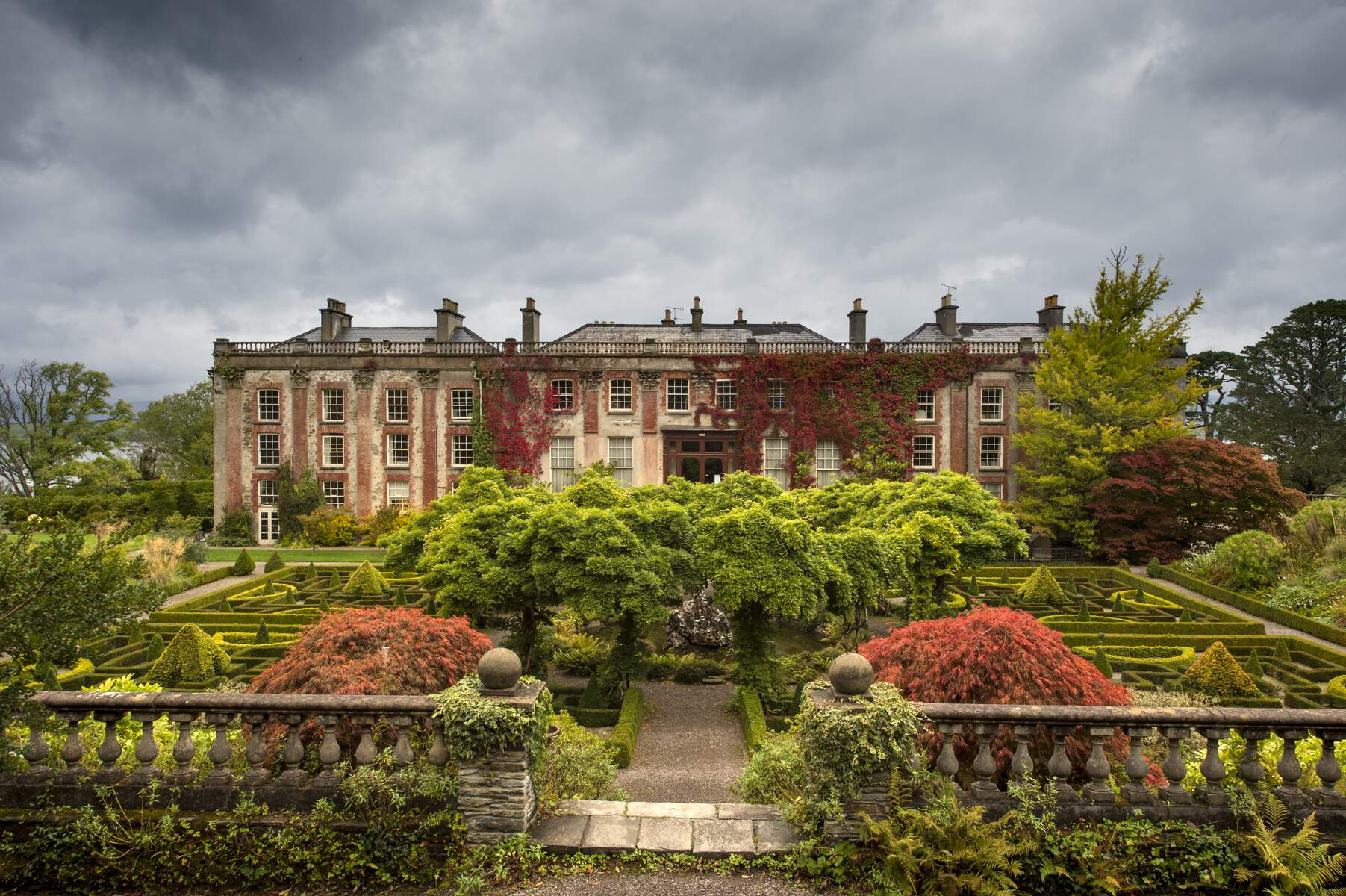
Bantry House, County Cork, photograph by George Karbus, 2016 for Tourism Ireland, Ireland’s Content Pool. (see [1])

7. Blackrock Castle Observatory, Cork

8. Blarney Castle & Rock Close, Blarney, Co. Cork – section 482

contact: Charles Colthurst
Tel: 021-4385252
www.blarneycastle.ie
Open: all year except Christmas Eve & Christmas Day, Jan-Feb, Nov-Dec, 9am-4pm, Mar-Oct, 9am-5pm

Fee: adult €18, OAP/student €15, child €10, family and season passes

9. Blarney House & Gardens, Blarney, Co. Cork – section 482

contact: Charles Colthurst
Tel 021-4385252
www.blarneycastle.ie
Open: June 1-Aug 31, Mon-Sat, National Heritage Week, Aug 13-21, 10am-2pm Fee: adult €10, OAP/student €7, concession joint with castle

10. Brideweir House, Conna, Co. Cork – section 482

contact: Ronan Fox
Tel: 025-36386
www.brideweir.ie
Open: Jan 1-Dec 24, 11am-4pm
Fee: adult €10, child/student €5, OAP free

11. Burton Park, Churchtown, Mallow, Co. Cork – section 482

contact: Jess Angland
Tel: 022-59955
www.slieile.ie 

Open: May 8-July 7, Mon-Sat, closed Bank Holidays, Aug 13-21, 11am-3pm Fee: adult/child/OAP/student €9

12. Creagh House, Main Street, Doneraile, Co. Cork – section 482

contact: Michael O’Sullivan
Tel: 022-24433
(Tourist Accommodation Facility)
Open: April-Sept
Public tours of house all year

13. Desmond Castle, Kinsale, County Cork – OPW

See my OPW write-up. https://irishhistorichouses.com/2022/01/19/office-of-public-works-properties-munster/

14. Doneraile Court, County Cork – OPW

See my OPW write-up. https://irishhistorichouses.com/2022/01/19/office-of-public-works-properties-munster/

15. Drishane Castle & Gardens, Drishanemore, Millstreet Town, Co. Cork – section 482

contact: Thomas Duggan
Tel: 087-2464878, 029-71008
www.millstreet.ie
Open: June 1-Sept 30, Mon-Sat, (Jan-May, Oct-Dec Mon-Fri, 9am-5pm by appointment only) National Heritage Week, Aug 13-21, 9am-5pm
Fee: adult €5, OAP/student free, child free when accompanied by adult

16. Drishane House, Castletownshend, Co. Cork – section 482

See my write-up:

https://irishhistorichouses.com/2021/03/07/drishane-house-castletownshend-co-cork/
Contact: Thomas Somerville
Tel: 028-36126, 083-574589
www.drishane.com
Open: May 1-31, Aug 13-21, Oct 2-21, 11am-3pm Fee: adult €10, OAP €8, student/child €6

17. Dunkathel House [or Dunkettle], Glanmire, Cork

– open to public May-Oct

18. Dún Na Séad Castle, Baltimore, Co. Cork – section 482

Donna O’Driscoll
Tel: 087-7374592
www.baltimorecastle.ie
Open: March 1-Oct 31, 11am -6pm
Fee: adult/OAP/student €5, children under 12 free

19. Fenns Quay, 4 & 5 Sheares Street, Cork – section 482

contact: Clare Supple
Tel: 089-4646208
www.encorestaging.org
Open: May 1-Nov 30, Sat-Sun, National Heritage Week Aug 13-21, 10am-2pm Fee: Adult €3, OAP €2, student €1

20. Fota House, Arboretum and Gardens

maintained by the Irish Heritage Trust, now OPW.

https://irishhistorichouses.com/2022/01/19/office-of-public-works-properties-munster/

21. Garrettstown House, Garrettstown, Kinsale, Co. Cork – section 482

contact: Denis Mawe
Tel: 021-4778156
www.garrettstownhouse.com
Open: May 15-Sept 5, 12 noon-5pm
Fee: adult €8, OAP/student/child €5, groups of 10+ adults €5 per person

22. Ilnacullin, Garanish Island, County Cork – OPW

See my OPW write-up. https://irishhistorichouses.com/2022/01/19/office-of-public-works-properties-munster/

23. Kilcascan Castle, Ballineen, Co. Cork – section 482

contact: Alison Bailey
Tel: 023- 8847200
Open: Aug 1-31, Sept 1-30, 9.30am-1.30pm
Fee: Free

24. Kilshannig House, Rathcormac, Co. Cork – section 482

https://irishhistorichouses.com/2020/12/10/kilshannig-house-rathcormac-county-cork/
contact: Hugo Merry
Tel: 025-36124
Open: May 1-31, June 1-30, July 1-31, National Heritage Week, Aug 13-21, 8.30am- 2.30pm 

Fee: adult €10, child/student €8.50, group discount by arrangements 

25. 4 Mulgrave Place, No 4, Mulgrave Road, Cork City – section 482 in 2021, not in 2022

contact: Trevor Leacy
Tel: 087-2808302
Open: May 1-Sept 30, closed Sundays except National Heritage Week August 14-22, weekdays 11am-4pm, Saturdays 11am-3pm
Fee: adult €4, OAP/student/child €2, family €7 (2+2)

26. Riverstown House, Riverstown, Glanmire, Co. Cork – section 482

contact: Denis/Rita Dooley
Tel: 021-4821205
Open: May 5-Sept 10, Thurs, Fri, Sat, National Heritage Week Aug 13-21, 2pm-6pm Fee: adult €10, OAP €7, student €5

27. Woodford Bourne Warehouse, Sheares Street, Cork – section 482

contact: Edward Nicholson
Tel: 021-4273000
www.woodfordbournewarehouse.com
Open: all year except Christmas Eve, Christmas Day, 1pm-11pm
Fee: Free

Places to stay, County Cork

1. Annes Grove (formerly Ballyhemock or Ballyhimmock), Castletownroche, Co Cork – gate lodge accommodation €€

https://www.irishlandmark.com/property/annes-grove-miniature-castle/

A miniature medieval castle, Annes Grove Gatelodge was designed in 1853 to impress visitors to the main house – Annesgrove House and Gardens.

2. Ballinacurra House, County Cork – coach house, estate cottages, and whole house rental

https://hiddenireland.com/house-pages/ballinacurrahouse/

and https://www.ballinacurra.com/the-coach-house/

  1. Estate Cottage 1 – The Coach House – up to 7 people – Self Catering – from €1,200 A 3 bedroom/4 bathroom separate 1,200 square foot home with a private outdoor dining terrace. This building has been renovated from the original coach house for the main manor house – and perfect for up to 7 people.
  2. Estate Cottage 2 – The Stone Cottage – up to 10 people – Self Catering – from €2,200 A stand-alone 1,800 square foot home with 4 bedrooms/4.5 bathrooms with its own private garden. This building was the original gardener’s cottage for the main manor house – now fully renovated that will sleep up to 10 people comfortably.
  3. Manor House (Partial) – up to 20 people – Self Catering – from €8,800 You will enjoy private use of Two Wings of the Manor House including 8 ensuite bedrooms and a range of living rooms, dining rooms, country style kitchen and outdoor dining options (can be catered or staffed by request).
  4. Manor House (Whole) – from 28 to 36 people – Full Catered & Staffed Only – on request There are 14 Bedrooms in the Manor House that can accommodate up to 36 adults + 3 children sharing and a whole range of living and entertainment spaces. Due to the numbers, this is only available on a fully catered and staffed basis.
  5. Whole Estate – from 44 to 54 people – Fully Catered & Staffed Only – on request The entire Estate consisting of the Manor House, Stone Cottage and Coach House for your private and exclusive use. A total of 22 ensuite bedrooms which is fully staffed and catered. This can cater for up to 54 adults + 4 children sharing.

3. Ballinterry House, Rathcormac, Co Cork – accommodation 

https://www.facebook.com/BallinterryH/

https://castlelyonsparish.com/who-i-am/accommodation/accommodation-2/

Ballinterry House Accommodation 
P: +353 (0)25 87835  or  +353 (0)87-6508555 
E: ballinterryhouse@yahoo.co.uk 

4. Ballylickey House, Bantry, Co Cork – now the Seaview House Hotel €€

https://www.seaviewhousehotel.com/

5. Ballymacmoy, Killavullen, Co Cork – coach house airbnb

https://www.airbnb.ie/rooms/6862913?source_impression_id=p3_1589550654_DKKIguPPQK2Nhhvp&guests=1&adults=1

https://thecoachhouseatballymacmoy.weebly.com/ballymacmoy-house.html

The website tells us: “Ballymacmoy is the estate of origin of the wild geese family, the Hennessy’s of Cognac and is still owned and inhabited by their descendants.  40 kilometres from Cork International Airport, Ballymacmoy is a 23 acre estate located at the edge of the little village of Killavullen (200 inhabitants).  It is made up of grasslands and wooded areas with 3.5 miles of exclusive fishing rights along the Blackwater river, it includes a 1 acre walled garden and a unique prehistoric private cave reserved for guests.” 

6. Ballymaloe, Cloyne, Co Cork – accommodation €€

https://www.ballymaloe.ie/

7. Ballynatray, Youghal, Co Cork, holiday cottages and whole house rental

https://hiddenireland.com/house-pages/ballynatray-coach-house-area/

a. the Coach House: The two storey Coach House takes centre stage in the stable yard and has been transformed into a beautiful, luxurious 4 bedroom self catering property. Downstairs there is a very relaxing style open plan kitchen & dining area with comfortable couches which allow for great conversations even while you prepare a bite of lunch or dinner.

b. the Garden Flat is located in the stable yard and is suitable for those looking for a self-catering holiday. There are two double bedrooms on the ground floor which would ideally suit two couples or if the need arises one of the bedrooms can be changed to be a twin room.

c. The Garden House is a quaint little cottage that sits at the bottom of the walled garden next to the beautiful Ballynatray House. Set across two floors the Garden House boasts a beautiful double room complete with comfortable armchairs either side of the open fire that fills the complete upstairs area. This is an ideal adult only location where romantic notions are never very far away.

d. Renovated & situated in the stable yard the Groom’s Flat is an ideal self catering option for two people.

8. Ballyvolane, Castlelyons, Co Cork – Hidden Ireland accommodation €€€

https://ballyvolanehouse.ie

9. Bantry House & Garden, Bantry, Co. Cork €€ 

10. Castle Martyr, Co Cork – hotel €€€

and Castle Martyr Lodges

https://www.castlemartyrresort.ie

11. Castle Townshend, Co Cork – accommodation, hotel €

http://castle-townshend.com/

12. Clifford House, Clifford, Co Cork – airbnb

https://www.airbnb.ie/rooms/23073945?source_impression_id=p3_1589821677_g%2Fl3KzQeCDhVcv1s&guests=1&adults=1

13. Creagh (former Glebe House), Skibbereen, Co Cork – B&B 

14. Creagh House, Main Street, Doneraile, Co. Cork – section 482

15. Drishane House whole house rental and holiday cottages – see above

16. Eccles Hotel, Glengarriff, Co Cork €€

Email: reservations@eccleshotel.com

Tel: +353 – 27 – 63003
www.eccleshotel.com

17. Elizabeth Fort Parade Houses, County Cork € for 3

https://www.irishlandmark.com/properties/

18. Galley Head Lighthouse Keepers House, County Cork € for 3-4

https://www.irishlandmark.com/properties/

19. Coach House Apartments, Glebe Country House, Ballinadee Bandon County Cork

https://glebecountryhouse.ie

20. Glenlohane cottage, Kanturk, Cork – accommodation €€ in house; Pink Cottage € for 3-5 for one week

www.glenlohane.ie

21. Glenville Park, Glenville, County Cork (previously known as The Manor and as Mount Pleasant) – accommodation €

http://www.glenvillepark.com 

22. Inis Beg estate, Baltimore, County Cork – €

https://www.inishbeg.com/homepage/

23. Killee Cottage, Mitchelstown, County Cork €€

https://www.irishlandmark.com/properties/

Once one of a number of bothies stretching along this quiet country lane, Killee Cottage and its neighbour are now the only two thatched cottages remaining.

24. Kilmahon House, County Cork €€ http://www.kilmahon.com/

25. Kilshannig, County Cork holiday accommodation – see above http://thecourtyardkilshannig.com/

26. Liss Ard Estate, County Cork

https://www.irelands-blue-book.ie/houses.html?country=Cork

27. Lota Lodge, Glanmire, Co Cork – now the Vienna Woods Hotel 

https://www.originalirishhotels.com/hotels/corks-vienna-woods-hotel

28. Lough Ine House and Lodge, Skibereen, County Cork – whole house or gate lodge

29. The Courtyard, Mallow

https://hiddenireland.com/house-pages/the-courtyard-mallow/

30.  Maryborough, Douglas, Co Cork – Maryborough Hotel €€

https://www.maryborough.com

31. Old Bank Townhouse, Kinsale, County Cork

https://www.oldbankhousekinsale.com

32. Perryville, Kinsale, Co Cork – hotel €€

https://www.perryvillehouse.com

[see 6]. Seaview House Hotel, Ballylicky, County Cork

33. Springfort Hall, Mallow, Co cork – hotel

Whole House Accommodation, County Cork

1. Aspen House, Dromgarriff Estate, Glengarriff, Cork, Ireland – whole house rental  

https://cashelfean.ie/aspen-house/  

2. Ballinacurra House, County Cork – coach house, estate cottages, and whole house rental

3. Ballynatray, Youghal, Co Cork, holiday cottages and whole house rental

4. Barnabrow, Cloyne, Co Cork – accommodation

https://www.barnabrowhouse.ie/

Cloyne, Midleton, East Cork, Ireland. 
info@barnabrowhouse.ie 
+353 21 4652534

5. Blackwater Castle (Castle Widenham, or Blackwater Valley Castle) Castletownroache, Co Cork www.blackwatercastle.com

6. Blairscove House, County Cork www.blairscove.ie

7. Careysville (Ballymacpatrick Castle), Clondulane, Fermoy, Co.Cork, Ireland P61 VF53 – accommodation

https://careysville.com 

Careysville House sits on an escarpment overlooking the fishery, with stunning views of the Blackwater valley. Guests can look out of their bedroom window and see one of the most stunning stretches of salmon fishing in Ireland, not to mention watch the salmon jumping in the pools below. It was built in 1812 in the Georgian style, on the site of the old ruined Ballymacpatrick Castle.

8. Drishane House whole house rental and holiday cottages – see above

www.drishane.com

9. Dunowen House, Co Cork – Blue Book Accommodation www.dunowenhouse.ie

10. Farran House, County Cork, whole house rental € for 5-8 for one week www.farranhouse.com

https://hiddenireland.com/house-pages/farran-house/

An elegant Italiante style Manor house in mature beech woodland and gardens close to Cork City (15km).

11. Longueville, Mallow, Co Cork – Blue Book accommodation €€€

https://www.longuevillehouse.ie/

12. Lough Ine House and Lodge, Skibberreen, County Cork – whole house €€€ for two, € for 5-8; or gate lodge €

http://www.loughinehouse.com

This beautiful holiday house and cottage are set on stunning Lough Ine sometimes spelt Lough Hyne – which is well known as one of the most romantic spots in West Cork.

14. Rincolisky Castle, Whitehall, co Cork – renovated, whole house. €€€ for 2, € for 5.

  https://www.airbnb.ie/rooms/20771431?source_impression_id=p3_1646737924_o%2BwxYCDhpDgJDHfX

15. Southernmost House, Cape Clear Island, County Cork

https://hiddenireland.com/stay/self-catering-holiday-rentals/

Derry:

1. Bellaghy Bawn, County Derry

https://discovernorthernireland.com/things-to-do/bellaghy-bawn-p675661

Built around 1619 by Sir Baptist Jones, Bellaghy Bawn is a fortified house and bawn (the defensive wall surrounding an Irish tower house). What exists today is a mix of various building styles from different periods with the main house lived in until 1987.

2. Hezlett House, 107 Sea Road, Castlerock, County Derry, BT51 4TW on Downhill Demesne. https://discovernorthernireland.com/things-to-do/hezlett-house-p687301

3. Mussenden Temple, Downhill Demesne

https://www.nationaltrust.org.uk/mussenden-temple-and-downhill-demesne

4. Springhill House, County Derry

https://discovernorthernireland.com/things-to-do/springhill-p675711

Springhill has a beguiling spirit that captures the heart of every visitor.  Described as ‘one of the prettiest houses in Ulster’, its welcoming charm reveals a family home with portraits, furniture and decorative arts that bring to life the many generations of Lenox-Conynghams who lived here from 1680. The old laundry houses one of Springhill’s most popular attractions, the Costume Collection with some exceptionally fine 18th to 20th century pieces.

See also https://www.nationaltrust.org.uk/springhill

Places to stay, County Derry

1. Ardtara Country House and restaurant, County Derry €€

 WWW.ARDTARA.COM

2. Brown Trout Inn, Aghadowey, Nr Coleraine Co. Derry, BT51 4AD

https://www.originalirishhotels.com/hotels/brown-trout-golf-country-inn

3. Roselick Lodge, County Derry – for 8 people

https://www.roselicklodge.co.uk

Dating back to 1830, this sympathetically restored Georgian property offers a tranquil rural setting midway between Portstewart and Portrush. Whilst retaining many of the original features and charm, the open plan extension has been adapted to suit modern living. The accommodation comprises three main reception areas, a Magnificent Family Kitchen /Living and Dining area, a cosy and tastefully decorated Snug with open fire, access to south facing Orangery and large secluded cottage gardens. Upstairs are four well proportioned bedrooms sleeping up to eight guests and a spacious first floor balcony with sea views. Minimum 3 night stay.

Whole House Rental, County Derry

1. Beechill House, 32 Ardmore Road, Derry-Londonderry, Northern Ireland BT47 3QP – weddings

https://www.beech-hill.com/

Beechill Country House Hotel, Courtesy of Tyrone and Sperrins destination, for Tourism Ireland.

2. Drenagh House, County Derry – whole house rental, 22 people

https://www.drenagh.com

Donegal:

1. Cavanacor House, Ballindrait, Lifford, Co. Donegal – section 482

contact: Joanna O’Kane
Tel: 074-9141143, 085-8165428
www.cavanacorgallery.ie
Open: Feb 1-20, May 1-31, Aug 14-22, 1pm-5pm 

Fee: adult €8, OAP/student/child €6 

2. Doe Castle, County Donegal – OPW

see OPW entry https://irishhistorichouses.com/2022/01/18/office-of-public-works-properties-ulster/

3. Donegal Castle, County Donegal – OPW

see OPW entry https://irishhistorichouses.com/2022/01/18/office-of-public-works-properties-ulster/

4. Glebe Art Museum, County Donegal – OPW

see OPW entry https://irishhistorichouses.com/2022/01/18/office-of-public-works-properties-ulster/

5. Glenveagh Castle, County Donegal

Glenveagh, photograph by Gareth Wray, 2020 for Tourism Ireland (see [1])

6. Oakfield Park Garden, Oakfield Demesne, Raphoe, Co. Donegal – section 482, garden only

contact: Louise Devenney
Tel: 074-9173922
www.oakfieldpark.com
Open: Mar 30-31, Apr 1-3, 6-10, 13-18, 20-24, 27-30, May 1-2, 4-8, 11-15, 18-22, 25-29, June 1-30, July 1-31, Aug 1-31, Sept 1-4, 7-11, 14-18, 21-25, Oct 1-2, 8-9, Nov 30, Dec 1-4, 7-11, 14-23, Mar, Apr, May, Sept, Oct, 12 noon-6pm, June, July, Aug, 11am-6pm, Nov, 4pm-10pm, Dec 1-18, weekdays, 4pm-10pm, weekends, 12 noon-10pm, 19-20, 4pm-10pm, 21-23, 12 noon-10pm

Fee: adult €9, child €6, family and season passes

7. Salthill Garden, Salthill House, Mountcharles, Co. Donegal – section 482, garden only

See my write-up:

https://irishhistorichouses.com/2021/10/06/salthill-garden-salthill-house-mountcharles-county-donegal/
contact: Elizabeth Temple
Tel:  087-7988078, 074-9735014
www.donegalgardens.com
Open: May 5-7, 12-14, 19-21, 26-28, June 2-4, 9-11, 16-18, 23-25, July 1-2, 4-9, 11- 16, 18-23, 25-30, Aug 1-6, 8-27, 29-31, Sept 1-2, 5-9, 12-16, 19-23, 26-30, 2pm-6pm Fee: adult/OAP €6, student €5, child €3

Places to Stay, County Donegal

1. Bruckless House Gate Lodge, Bruckless, County Donegal

https://hiddenireland.com/stay/self-catering-holiday-rentals/

2. Castle Grove, County Donegal – hotel €€

https://www.irelands-blue-book.ie/houses.html?country=Donegal 

3. Cavangarden, Ballyshannon, Co Donegal – B&B http://www.cavangardenhouse.com

4. Dunmore, Carrigans, Co Donegal – accommodation for weddings, conferences 

https://www.dunmoregardens.ie/our-history/

5. Frewin, Ramelton, Co Donegal – accommodation

https://hiddenireland.com/house-pages/frewin/ 

6. Lough Eske Castle, near Donegal, Co Donegal – hotel  €€€

www.lougheskecastlehotel.com

7. Rathmullan House, Co Donegal – hotel €€

https://www.irelands-blue-book.ie/houses.html?country=Donegal

8. Railway Crossing Cottage near Donegal town €€

https://www.irishlandmark.com/properties/

9. Rock Hill, Letterkenny, Co Donegal – hotel 

https://www.rockhillhouse.ie

10. Sandhouse Hotel, Rossknowlagh, Co Donegal €€

https://www.originalirishhotels.com/hotels/sandhouse-hotel

11. St. Columb’s, St Mary’s Road, Buncrana, Co Donegal, Ireland ~ Tel: 087 4526696 ~ Email: info@stcolumbshouse.com https://stcolumbshouse.com

12. St John’s Point Lighthouse cottage, Dunkineely, County Donegal € for 3-4

https://www.irishlandmark.com/properties/

13. Termon House, Dungloe, County Donegal, whole house rental: € for 3-6

https://www.irishlandmark.com/propertytag/cottages-and-houses/?gclid=Cj0KCQiApL2QBhC8ARIsAGMm-KFInICcRSxwLSiDxfFNk5WFytNcVrLvOQYhzJbIBes4V-M65iXz0gYaAln_EALw_wcB

Termon House, a former 18th century land agent’s house in Maghery, near Dungloe, is located in the heart of the Gaeltacht area.

14. Woodhill House, Ardara, County Donegal

https://www.woodhillhouse.com

Whole House Rental County Donegal:

1. Drumhalla House, Rathmullen, County Donegal – whole house rental and wedding venue https://drumhallahouse.ie

Down:

1. Audley’s Castle, County Down

https://discovernorthernireland.com/things-to-do/audleys-castle-p707501

2. Bangor Castle Park, County Down

https://discovernorthernireland.com/things-to-do/bangor-castle-town-hall-p676451

3. Castle Ward, County Down

https://discovernorthernireland.com/things-to-do/castle-ward-p675331

4. Dundrum Castle, County Down https://discovernorthernireland.com/things-to-do

5. Hillsborough Castle, County Down

https://www.hrp.org.uk/hillsborough-castle

6. Montalto Estate, County Down

https://discovernorthernireland.com/things-to-do/montalto-estate-p728301

7. Mount Stewart, County Down

https://discovernorthernireland.com/things-to-do/mount-stewart-p675341

8. Newry and Mourne Museum, Bagenal’s Castle, County Down

https://discovernorthernireland.com/things-to-do/newry-and-mourne-museum-bagenals-castle-p690251

9. Portaferry Castle, County Down

https://discovernorthernireland.com/things-to-do/portaferry-castle-p676311

Places to stay, County Down

1. Barr Hall Barns, Portaferry, County Downwww.barrhallbarns.co.uk

2. Castle Ward, Potter’s Cottage in farmyard:

https://www.nationaltrust.org.uk/holidays/the-potters-cottage-northern-ireland

and Castle Ward bunkhouse: https://www.nationaltrust.org.uk/holidays/castle-ward-bunkhouse-northern-ireland

Sleeps 14 people.

3. Culloden, County Down – hotel €€€

4. Florida Manor, 22 Florida Road, Killinchy, Newtownards, Co Down, BT23 6RT Northern Ireland http://www.floridamanorni.com/cgi-bin/greeting?instanceID=1

5. Helen’s Tower, Bangor, County Down €€

https://www.irishlandmark.com/property/helens-tower/

6. Kiltariff Hall, County Down

https://www.kiltariffhall.co.uk 

7. Narrow Water Castle, apartment, Newry Road, Warrenpoint, Down, Northern Ireland, BT34 3LE http://narrowwatercastle.co.uk

8. Slieve Donard hotel and spa, County Down

https://www.slievedonardhotel.com

9. St John’s Point Lighthouse Sloop, Killough, County Down € for 3-4

https://www.irishlandmark.com/properties/

10. Tullymurry House, Tullymurry road, Donaghmore, Newry, County Down – sleeps 8, € for 8

https://www.irishlandmark.com/property/tullymurry-house/

11. Tyrella, Downpatrick, County Down, BT30 8SU – accommodation

https://www.tyrellahouse.com/the-rooms

Whole house County Down

1. Ballydugan House, County Down

http://ballyduganhouse.com/

Dublin:

1. Airfield, Dundrum, Dublin

 https://www.airfield.ie

2. Aras an Uachtarain, Phoenix Park, Dublin – OPW

see my OPW entry https://irishhistorichouses.com/2022/01/21/office-of-public-works-properties-dublin/

3. Ardan, Windgate Road, Howth – gardens by appt https://www.dublingardengroup.com/ardan/

4. Ardgillan Castle, Dublin

5. Ashtown Castle, Phoenix Park, Dublin – OPW

see my OPW entry https://irishhistorichouses.com/2022/01/21/office-of-public-works-properties-dublin/

6. Bewley’s, 78-79 Grafton Street/234 Johnson’s Court, Dublin 2 – section 482

Contact: Peter O’ Callaghan
Tel 087-7179367
www.bewleys.com
Open: all year except Christmas Day, 9am-5pm Fee: Free

7. Cabinteely House [formerly Clare Hill, or Marlfield], Cabinteely, Dublin

 https://www.dlrcoco.ie/en/heritage/heritage

There’s a terrific online tour, at https://www.dlrcoco.ie/en/heritage/3d-online-tours-–-heritage-home

8. The Casino at Marino, Dublin – OPW

see my OPW entry https://irishhistorichouses.com/2022/01/21/office-of-public-works-properties-dublin/

9. Charlemount House, Parnell Square, Dublin – Hugh Lane gallery

 https://www.hughlane.ie

10. Clonskeagh Castle, 80 Whitebean Road, Clonskeagh, Dublin 14 – section 482

contact: Frank Armstrong
Tel: 089-4091645, 087-9787357 

www.clonskeaghcastle.com

Open: Jan 6-9, Feb 6-9, Mar 6-9, Apr 6-9, May 1-8, June 1-8, July 1-8, August 13-22, Sept 1-8, Nov 6-9, 2pm-6pm
Fee: adult/OAP €5, child/student €2.50

11. Colganstown House, Hazelhatch Road, Newcastle, Co. Dublin – section 482

see my write-up:

https://irishhistorichouses.com/2020/05/21/colganstown-house-hazelhatch-road-newcastle-county-dublin/
contact: Lynne Savage Jones
Tel: 087-2206222
Open: Apr 11-17, May 5-27, June 9-11, Aug 13-26, Oct 31, Nov 1-12, 9am-1pm Fee: adult/OAP €10, student/child free.

12. Corke Lodge Garden, Shankill, Co. Dublin – section 482

Postal address Woodbrook, Bray, Co. Wicklow
contact: Alfred Cochrane
Tel: 087-2447006
www.corkelodge.com
Open: June 21-Sept 8, Tue-Sat, National Heritage Week Aug 13-21, 9am-1pm Fee: €8

13. Dalkey Castle, Dublin – heritage centre 

https://www.dalkeycastle.com

Believe it or not, I did my Leaving Certificate examinations in this building!! I was extremely lucky and I loved it and the great atmosphere helped me to get the points/grades I wanted!

14. Doheny & Nesbitt, 4/5 Lower Baggot Street, Dublin 2 – section 482

contact: Niall Courtney
Tel: 086-0647083, 01-4925395 

www.dohenyandnesbitts.ie

Open: all year, except Christmas Day, Jan, 9am-8pm, Feb-Dec, Mon-Wed, 10am- 11.30pm, Thurs-Sat, 10am-1.30am, Sun, 11am-11.30pm
Fee: Free

15. Drimnagh Castle, Dublin

 https://www.drimnaghcastle.org

16. Dublin Castle, Dublin – OPW

see my OPW entry https://irishhistorichouses.com/2022/01/21/office-of-public-works-properties-dublin/

17. Fahanmura, 2 Knocksina, Foxrock, Dublin 18 – section 482

contact: Paul Harvey
Tel: Paul 086-3694379
www.fahanmura.ie
Open: May 5-15, June 13-19, July 4-12, Aug 13-25, Sept 10-24, Oct 10-14, 9am-1pm Fee: adult €5, student €2, OAP/child free

18. Farm Complex, Toberburr Road, Killeek, St Margaret’s, Co. Dublin – section 482

contact: David Doran
Tel: 086-3821304
OpenJan 1-10, 15-16, 22-23, 29-30, 12 noon 4pm, May 1-8, 14-15, June 4-13, Mon- Fri, 10am-2pm, Sat-Sun, 2pm-6pm, Aug 12-21, 2pm-6pm, Sept 16-25, Mon- Fri, 9.30-1.30pm, Sat-Sun, 2pm-6pm, Oct 22, 29-31, 12 noon-4pm

Fee: adult €6, student/OAP/child €5

19. Farmleigh, Phoenix Park, Dublin – OPW

see my OPW entry. https://irishhistorichouses.com/2022/01/21/office-of-public-works-properties-dublin/

20. Fern Hill, Stepaside, Dublin – gardens open to public

 https://www.dlrcoco.ie/en/parks-outdoors/fernhill-park-and-gardens

21. Georgian House Museum, 29 Lower Fitzwilliam Street, Merrion Square, Dublin 2 – virtual visit only

http://www.numbertwentynine.ie

22. “Geragh”, Sandycove Point, Sandycove, Co. Dublin – section 482

contact: Gráinne Casey
Tel: 01-2804884
Open: Jan 4-23, May 3-29, Aug 13-21, Sept 1, 12-14, 2pm-6pm Fee: adult €7, OAP/student €4, child free

23. 14 Henrietta Street, Dublin – tenement museum https://14henriettastreet.ie

24. Hibernian/National Irish Bank, 23-27 College Green, Dublin 2 – section 482

contact: Dan O’Sullivan
Tel: 01-6755100
www.clarendonproperties.ie
Open: all year, except Dec 25, Wed-Fri, 9.30am-8pm, Sun, 11am-7pm, Sat, Mon, Tue, 9.30-7pm

Fee: Free

25. Howth Castle gardens, Howth, County Dublin

26. Knocknagin House, Delvin Bridge, Balbriggan, Co. Dublin – section 482

contact: Richard Berney
Tel: 087-2847797
Open: June 23-30, July 1-31, Aug 1-21, 9am-1pm Fee: adult/OAP/child/student €5

27. Knockrose Garden, The Scalp, Kiltiernan – garden open 

28. Lambay Castle, Lambay Island, Malahide, Co. Dublin – section 482

contact: Alexander Baring
Tel: 087-1905236 

www.lambayisland.ie
(Tourist Accommodation Facility) Open: May-October

29. Lissen Hall, County Dublin – ihh member, check dates, May and June.

30. Malahide Castle, County Dublin

maintained by Shannon Heritage.

31. Marlay Park, Rathfarnham, County Dublin

https://www.dlrcoco.ie/en/heritage/heritage

and online tour https://www.dlrcoco.ie/en/heritage/3d-online-tours-–-heritage-home

32. Martello Tower, Portrane, Co. Dublin – section 482

contact: Terry Prone
Tel: 01-6449700
Open: March 6-Sept 26, Sat & Sun and National Heritage Week, Aug 13-21, 9am-1pm
Fee: adult €5, student €4, OAP €1

33. Meander, Westminister Road, Foxrock, Dublin 18 – section 482

contact: Ruth O’Herlihy,
Tel: 087-2163623
Open: Jan 3-7, 10-14, 17-21, 24-28, May 3-7, 12-14, 16-21, June 7-11, 13-18, 20-25, Aug 13-21, 9am-1pm

Fee: adult €5, OAP/child/student €2

34. Irish Architectural Archive, 45 Merrion Square, Dublin

 www.iarc.ie

35. MOLI, Museum of Literature Ireland, Newman House, St Stephen’s Green, Dublin

https://moli.ie

Rococo stucco work in Museum of Literature of Ireland (MOLI), Newman House, Stephen’s Green, Dublin. Photograph © Jennifer Winder-Baggot, www.irishhistorichouses.com

36. Mornington Garden, Dalkey – gardens open https://dalkeygardenschool.com/home/mornington-garden/dgs-garden-opening-dates-times/

37. Newbridge House, Donabate, County Dublin

which is maintained by Shannon Heritage

https://www.newbridgehouseandfarm.com

38. 11 North Great George’s Street, Dublin 1 – section 482

see my write-up:

https://irishhistorichouses.com/2019/12/31/11-north-great-georges-street-dublin-1/
contact: John Aboud
Tel: 087-7983099
www.number11dublin.ie
Open: March 7-11, 21-25, May 10-14, June 6-11, July 4-9, Aug 1-6, 13-22, Sept 5-11, Oct 3-7, 17-21, 12 noon-4 pm
Fee: adult €7, students/OAP €3, child free under 12 years

39. 81 North King Street, Smithfield, Dublin 7 – section 482

contact: James Kelly
Tel: 086-8597275
Open: Apr 1-30, June 1-30, July 1-30, National Heritage Week 13-21 Aug, closed Sundays except Aug 14 & 21, Mon-Fri, 9am-4.30, Sat, 12.30pm-4.30pm

Fee: Free 

40. The Odeon (formerly the Old Harcourt Street Railway Station), 57 Harcourt Street, Dublin 2 – section 482

contact: Mary Lacey
Tel: 01-6727690
www.odeon.ie
Open: March-December, 12 noon to midnight Fee: Free

41. The Old Glebe, Upper Main Street, Newcastle, Co. Dublin – section 482

See my write-up:

https://irishhistorichouses.com/2019/12/31/the-old-glebe-newcastle-lyons-county-dublin/
contact: Hugh F. Kerins, Martin Connelly
Tel: Frank 087-2588356, and Martin 087-6686996
Open: May 3-31, June 1-30, Mon-Sat, Aug 13-22, 10am-2pm, 4 tours daily during National Heritage Week, 10am, 11am, 12 noon, 1pm, tour approx. 45 minutes
Fee: adult €5, student €3, child/OAP free, no charge during National Heritage Week

42. Powerscourt Townhouse Centre, 59 South William Street, Dublin 2 – section 482

see my write-up:

https://irishhistorichouses.com/2020/04/02/powerscourt-townhouse-59-south-william-street-dublin-2/
contact: Mary Larkin
Tel: 01-6717000, 01-6755100
https://www.powerscourtcentre.ie/
Open: All year except New Year’s Day, Easter Sunday, Easter Monday, Christmas Day, St. Stephen’s Day & Bank Holidays, Mon-Sat, 10am-6pm, Thurs, 10am-8pm, Sundays, 12 noon-6pm
Fee: Free

43. Primrose Hill, Very Top of Primrose Lane, Lucan, Co. Dublin – section 482

contact: Robin Hall
Tel: 01-6280373
Open: Feb 1-28, June 1-30, July 1, Aug 13-21, 2pm-6pm Fee: adult/OAP €6, child free

44. Rathfarnham Castle, Dublin – OPW

see my OPW entry. https://irishhistorichouses.com/2022/01/21/office-of-public-works-properties-dublin/

45. Royal Hospital Kilmainham (Irish Museum of Modern Art, IMMA)

46. 10 South Frederick Street, Dublin 2 – Section 482

contact: Joe Hogan
Tel: 087-2430334
Open: Jan 1-20, May 1-21, 23-27, 30-31, June 1-3, Aug 13-21, 2pm-6pm Fee: Free

47. St. Enda’s Park and Pearse Museum, Dublin – OPW

see my OPW entry https://irishhistorichouses.com/2022/01/21/office-of-public-works-properties-dublin/

48. St. George’s, St. George’s Avenue, Killiney, Co. Dublin – section 482

contact: Robert McQuillan
Tel: 087-2567718
Open: July 1-31, Aug 1-31, 9am-1pm
Fee: adult €5, OAP/student/child €3.50

49. Swords Castle, Swords, County Dublin.

50. The Church, Junction of Mary’s Street/Jervis Street, Dublin 1 – section 482

contact: Ann French
Tel: 087-2245726
www.thechurch.ie
Open: Jan 1-Dec 23, 27-31, 12 noon-11pm Fee: Free

51. Tibradden House, Mutton Lane, Rathfarnham, Dublin 16 – section 482

contact: Selina Guinness
Tel: 01-4957483
www.selinaguinness.com
Open: Jan 6-10, 14, 17, 21, 24, 28, Feb 4, 7, 11, 14, 28, Mar 7, 11, 14, 25, 28, May 3-6, 10-13, 17-22, 24-29, June 8-11, 13, 17-19, 21-23, Aug 13-21, Jan, May, June, 10am-2pm, Feb, Mar, 2.30pm-6.30pm, National Heritage Week, 2pm-6pm
Fee: adult/OAP €8 student/child free, Members of An Taisce and The Irish Georgian Society €6

52. Tickknock Gardens, Ticknock Lodge, Ticknock Road, Sandyford, Dublin, Dublin 18, IE 

www.ticknockgardens.ie 

53. Tyrrelstown House Garden, Powerstown Road, Tyrrelstown, Dublin, D15 T6DD, IE 

www.tyrrelstownhouse.ie 

Open days 3rd Friday & Sat of months Feb – October 

54. Transport Museum in Howth Martello Tower or at Howth Castle and Hurdy Gurdy Radio Museum https://sites.google.com/site/hurdygurdymuseum/home 

Places to stay, County Dubin:

1. Clontarf Castle, Clontarf, Co Dublin – hotel www.clontarfcastle.ie

2. Finnstown, Lucan, Co Dublin – hotel https://www.finnstowncastlehotel.com/weddings.html

3. Harrington Hall, 70 Harcourt St, Saint Peter’s, Dublin 2, D02 HP46

https://www.harringtonhall.com  

4. Killiney Castle, Killiney, Co Dublin  – Fitzpatrick’s hotel www.fitzpatrickcastle.com

5. Kilronan Guesthouse, 70 Adelaide Road, Dublin 2

https://www.kilronanhouse.com

6. Lambay Castle, Lambay Island, Malahide, Dublin  – section 482

Alexander Baring
Tel: 087-1905236 

www.lambayisland.ie
(Tourist Accommodation Facility) Open: May-October

7. The Merchant House, Temple Bar https://www.themerchanthouse.eu

8. Merrion Mews, Merrion Square, Dublin € for 4-6

https://www.irishlandmark.com/property/merrion-mews/

9. Mooreen House, Newlands Cross, Dublin. (built 1936) 

http://www.mooreen.ie npnewlands@gmail.com 

10. Mornington House, Merrion Street, Dublin – Merrion Hotel 

11. Number 31, Leeson Close, Dublin 2, D02 CP70

https://www.number31.ie

12. Number 11 North Great Georges Street,

https://number11dublin.ie/airbnb/

13. St. Helen’s, Booterstown, Co Dublin – now Radisson Blu Stillorgan hotel 

14. The Cottage, Kiltiernan, Dublin €

https://thecottagedublin.com/

The Cottage has a great history and has stood here for over 200 years looking down over the City boundaries, Dublin Bay and beyond.

This unique Irish Cottage has been tastefully restored to the highest modern standards so as to provide four star comforts within its two foot thick walls.
The Cottage is a great place from which to explore.

15. Tibradden Farm Cottages, Rathfarmham, Dublin 16 € for 4-8

https://www.dublincottages.com/

16. Waterloo House, Waterloo Road, Dublin 4 €€

https://www.waterloohouse.ie

Waterloo House is situated in Ballsbridge Dublin 4, just off the bustling Baggot Street and only a few minutes walk from St. Stephen’s Green, Grafton Street and many of Dublin’s key places of interest.

17. The Wilder Townhouse, Dublin 2

https://www.thewilder.ie/en/

Whole House Rental, Dublin:

1. Dalkey Lodge, Barnhill Road, Dalkey, County Dublin – whole house rental http://www.dalkeylodge.com/Contact.htm

2. Dartry House, Orwell Woods, Dartry, Rathgar, Dublin 6 – whole house rental https://www.airbnb.ie/rooms/46375076?federated_search_id=cb6603db-efd7-498c-8b21-dadc954e11ce&source_impression_id=p3_1646747923_dTbQ0T%2FnCNjzHKYX

3. Luttrellstown Castle, (known for a period as Woodlands), Clonsilla, Co Dublin – whole house? wedding venue https://www.originalirishhotels.com/hotels/luttrellstown-castle-resort

4. Martello Tower, Sutton, Dublin https://martellotowersutton.com

5. Orlagh House, Dublin www.orlaghestate.ie

Fermanagh:

1. Castle Archdale Countryside Centre & War Museum, County Fermanagh

https://discovernorthernireland.com/things-to-do/castle-archdale-countryside-centre-and-war-museum-p675541

2. Castle Balfour (ruin), County Fermanagh

https://discovernorthernireland.com/things-to-do/castle-balfour-p675501

3. Castle Coole, County Fermanagh

https://discovernorthernireland.com/things-to-do/castle-coole-p676121 https://www.nationaltrust.org.uk/castle-coole

4. Crom Estate, County Fermanagh

https://discovernorthernireland.com/things-to-do/crom-estate-p675551 https://www.nationaltrust.org.uk/crom

5. Enniskillen Castle, County Fermanagh

https://discovernorthernireland.com/things-to-do/enniskillen-castle-p742361

6. Florence Court, County Fermanagh

https://discovernorthernireland.com/things-to-do/florence-court-p675531

Places to stay, County Fermanagh

1. Ashbrooke House, Brookeborough, Enniskillen Co Fermanagh BT94 4GX – whole house rental https://www.ashbrookehouse.com

Ashbrooke House is the dower house to Colebrook Park – see below.

2. Belle Isle Courtyard cottages, Lisbellaw, Enniskillen, County Fermanagh Northern Ireland

Belle Isle Estate, photo by Brian Morrison 2008 for Tourism Ireland. (see [1])

https://belle-isle.com

3. Colebrooke gate lodge, Colebrooke Park, County Fermanagh

https://www.irishlandmark.com/propertytag/cottages-and-houses/?gclid=Cj0KCQiApL2QBhC8ARIsAGMm-KFInICcRSxwLSiDxfFNk5WFytNcVrLvOQYhzJbIBes4V-M65iXz0gYaAln_EALw_wcB

see also https://colebrooke.info

and Triumphal Arch Lodge, Colebrook, County Fermanagh € for 4

https://www.irishlandmark.com/property/triumphal-arch-lodge/ and

https://colebrooke.info/cottages/triumphal-arch-lodge/

4. West Wing, Crom Castle, County Fermanagh

Crom Castle, Fermanagh Courtesy of Tourism Northern Ireland, by Brian Morrison, 2008

https://cromcastle.com

Holiday cottages at Crom:

https://www.nationaltrust.org.uk/crom/features/holiday-cottages-at-crom

Adler’s cottage € and Bluebell Cottage € and Aspen Cottage €

5. Erne View Cottage, Enniskillen, County Fermanagh €

https://www.nationaltrust.org.uk/holidays/erne-view-northern-ireland

6. Florence Court, County Fermanagh – Butler’s Apartment

https://www.nationaltrust.org.uk/holidays/butlers-apartment-northern-ireland

7. Killadeas Manor, County Fermanagh – Manor House Hotel 

https://www.manorhousecountryhotel.com

Galway:

1. Athenry Castle, County Galway (OPW)

see my OPW entry: https://irishhistorichouses.com/2022/02/14/office-of-public-works-properties-connacht/

2. Ardamullivan Castle, Galway – national monument, to be open to public in future – check status 

3. Ardcarrig Garden, Oranswell, Bushypark, Galway, IE 

https://www.gardensofireland.org/directory/22/ardcarrig/

4. Athenry Castle, County Galway  – open to public 

5. Aughnanure Castle, County Galway (OPW)

see my OPW entry: https://irishhistorichouses.com/2022/02/14/office-of-public-works-properties-connacht/

6. Ballinderry House, Ballinderry Park, Kilconnell, Ballinasloe, Galway, H53XP26 – open to public, and accommodation 

www.ballinderrypark.com

7. Ballynahinch Castle hotel and gardens,

https://www.discoverireland.ie/galway/ballynahinch-castle-hotel-and-gardens

8. Castle Ellen House, Athenry, Co. Galway – section 482

contact: Míceál P. O’Cionnaith and Diarmuid
Tel: 087-2747692, 087-8137058
http://www.castleellen.ie/
Open: June 5-9, 12-16, 19-23, 26-30, July 3-7, 10-14, 17-21, 24-28, 31, Aug 7-11, 13- 25, 28-31, National Heritage Week, Aug 13-21, 12 noon-4pm
Fee: Free

9. Claregalway Castle, Claregalway, Co. Galway – section 482

contact: Eamonn O’ Donoghue
Tel: 091-799666
www.claregalwaycastle.com
Open: June-Sept, Sunday-Wednesday, National Heritage Week, Aug 13-21, 12 noon- 4pm

Fee: adult €6, student/OAP/child €4

10. Coole Park, County Galway – house gone but stables visitor site open

11. Gleane Aoibheann, Clifden, Galway, IE  – gardens

https://www.gardensofireland.org/directory/23/gleann+aoibheann/

12. Kylemore Abbey, County Galway

13. Lisdonagh House, Caherlistrane, Co. Galway – section 482

contact: John & Finola Cooke
Tel: 093-31163, John, 086-0529052, Finola, 086-0546565
www.lisdonagh.com
(Tourist Accommodation Facility)
Open: May 1-Nov 1
Fee: Free

14. The Grammer School, College Road, Galway – section 482

contact: Terry Fahy
www.yeatscollege.ie
Tel: 091-533500
Open: May 7-8, 14-15, 21-22, 28-29, June 11-12, July 1-31, Aug 1-21, 9am-5pm Fee: adult/OAP/student €5, child under 12 free

15. Oranmore Castle, Oranmore, Co. Galway – section 482

Leonie Phinn
http://www.oranmorecastle.com/
Tel: 086-6003160
Open: April 14-30, May 10-20, June 10-20, Aug 10-24, Sept 1-6, 11am-3pm Fee: adult €8, child €3

16. Portumna Castle, County Galway (OPW)

see my OPW entry: https://irishhistorichouses.com/2022/02/14/office-of-public-works-properties-connacht/

17. Ross, Moycullen, Co Galway – gardens open 

www.rosscastle.com 

18. Signal Tower & Lighthouse, Eochaill, Inis Mór, Aran Islands, Co. Galway – section 482

contact: Michael Mullen
Tel: 087-2470900
www.aranislands.ie
Open: June-Sept, 9am-5pm.
Fee: adult €2.50, child €1.50, family €5, group rates depending on numbers

19. Thoor Ballylee, County Galway

20. Woodville House Dovecote & Walls of Walled Garden – section 482, garden only
Craughwell, Co. Galway

Margarita and Michael Donoghue
Tel: 087-9069191
www.woodvillewalledgarden.com
Open: Jan 28-31, Feb 4-7, 11-14, 18-21, 25-28, June 1-30, Aug 13-22, 12 noon-4pm Fee: adult €10, OAP €8, student, €6, child €3 must be accompanied by adult, family €20-2 adults and 2 children

Places to stay, County Galway

1. Abbeyglen Castle, Galway €€ 

www.abbeyglen.ie

2. Ashford Castle, Cong, Galway/Mayo  – hotel €€€

3. Ballynahinch Castle, Connemara, Co. Galway – hotel €€€

https://www.ballynahinch-castle.com

4. Cashel House, Cashel, Connemara, Co Galway – hotel €€

https://cashelhouse.ie/cms/

5. Castle Hacket, Belclare, County Galway H54 E977

https://castlehacket-house.com/

6. Claregalway Castle, Claregalway, Co. Galway – section 482 €€

https://www.airbnb.ie/users/85042652/listings

7. Cregg Castle, Corrandulla, Co Galway – Airbnb

https://www.airbnb.ie/rooms/7479769?adults=1&guests=1&federated_search_id=183d53cc-d5ff-4694-b6e9-c9364ec13218&source_impression_id=p3_1646847320_U8Q%2BQhs8xA6BUsHo

8. Crocnaraw Country House, Moyard, Clifden, County Galway

http://www.crocnaraw.ie 

9. Currarevagh, Oughterard, Co Galway – country house hotel €€

https://www.currarevagh.com

10. Delphi Lodge, Leenane, Co Galway €€€

https://delphilodge.ie

and Boathouse Cottages €€ https://hiddenireland.com/stay/self-catering-holiday-rentals/

and Wren’s Cottage €€

11. Emlaghmore Cottage, Connemara, County Galway

https://hiddenireland.com/stay/self-catering-holiday-rentals/

12. Glenarde, Co Galway – hotel (Ardilaun House Hotel) €

https://www.theardilaunhotel.ie

13. Glenlo Abbey, near Galway, Co Galway – accommodation €€

https://www.glenloabbeyhotel.ie

14. Kilcolgan Castle, Clarinbridge, Co Galway €€€

https://www.airbnb.ie/rooms/3828868?source_impression_id=p3_1646846790_ewMVmVyqLYmix%2FSv

15. Lisdonagh House, Caherlistrane, Co. Galway – section 482, see above

contact: John & Finola Cooke
Tel: 093-31163, John, 086-0529052, Finola, 086-0546565
www.lisdonagh.com
(Tourist Accommodation Facility)
Open: May 1-Nov 1

16. Lough Cutra Castle, County Galway, holiday cottages

https://www.loughcutra.com

and Cormorant Cottage https://www.loughcutra.com/cormorant.html

17. Lough Inagh Lodge Hotel, County Galway https://www.loughinaghlodgehotel.ie/en/

18. The Quay House, Clifden, Co Galway €€ 

https://thequayhouse.com  

19. Renvyle, Letterfrack, Co Galway – hotel

https://www.renvyle.com

20. Rosleague Manor, Galway – accommodation

https://www.rosleague.com

21. Ross, Moycullen, Co Galway 

www.rosscastle.com 

22. Ross Lake House Hotel, Oughterard, County Galway

http://rosslakehotel.com/

23. Screebe House, Camus Bay, County Galway €€€

https://www.screebe.com/

24. Thorn Park, Oranmore, Co Galway – now the Oranmore Lodge Hotel  https://www.oranmorelodge.ie

Whole House Accommodation and Weddings, County Galway:

1. Cloghan Castle, near Loughrea, County Galway – whole castle accommodation and weddings, €€€ for two.

Kerry:

1. Ballyseede Castle, Tralee, Co. Kerry – section 482

contact: Marnie Corscadden
Tel: 066-7125799
www.ballyseedecastle.com
Open: Feb 25-Dec 21, 8am-8pm, Dec 27-31,10am-4pm Fee: Free

2. Derrynane House, Caherdaniel, Kerry – OPW

see my OPW entry: https://irishhistorichouses.com/2022/02/14/office-of-public-works-properties-connacht/

3. Derreen Gardens, Lauragh, Tuosist, Kenmare, Co. Kerry – section 482

John Daly
Tel: 087-1325665
https://www.derreengarden.com/
Open: all year, 10am-6pm
Fee: adult/OAP/student €8, child €3, family ticket (2 adults and all children and 2 maps) €20

4. Dhu Varren garden, Knockreigh, Milltown, Kerry, V93 VX27, IE 

www.dhuvarrengarden.com 

5. Kells Bay House & Garden, Kells, Caherciveen, Co Kerry – section 482 

contact: Billy Alexander
Tel: 066-9477975 

www.kellsbay.ie 

https://www.discoverireland.ie/kerry/kells-bay-house-and-gardens
Open: Jan 1-9, Feb 1-Dec 18, 27-31, Jan 9.30am-4.30pm, Feb, Mar, Nov, Dec, 9.30am-5pm, Apr-Oct 9.30am-6pm
Fee: adult/OAP €8.50, child/student €6, annual membership €30, family €80, couple €55, family ticket €26

6. Knockreer House and Gardens, County Kerry

https://www.discoverireland.ie/kerry/knockreer-house-and-gardens

7. Listowel Castle, co Kerry – open to visit. 

8. Muckross House (or Muckruss),  Killarney, Co Kerry – open to visitors 

9. Ross’s Castle, Killarney, County Kerry

See my OPW write-up:

https://irishhistorichouses.com/2022/01/19/office-of-public-works-properties-munster/

10. Steig Fort, County Kerry

11. Tarbert House, Tarbert, Co. Kerry – section 482

contact: Ursula Leslie
Tel: 068-36198
Open: May, June, July, Aug, Mon-Sat, National Heritage Week Aug 13-21, 10am-12 noon, 2pm-4pm

Fee: adult/OAP/student €5, child free

Places to Stay, County Kerry: 

1. Arbutus Hotel, Killarney, Co Kerry €€ 

https://www.originalirishhotels.com

2. Ballyseede Castle/ Ballyseedy (Tralee Castle), Tralee, county Kerry –hotel €€ www.ballyseedecastle.com

3. Cahernane (or Cahirnane) House, Killarney, Co Kerry – hotel 

https://www.irelands-blue-book.ie/houses.html?country=Kerry

4. Carrig Country House, County Kerry €€€

https://carrighouse.com

5. Castlemorris House, outside Tralee, County Kerry – website not working, linked to the Failte Ireland website:

https://www.discoverireland.ie/accommodation?more-filters=historic_house

6. Castlewood House, Dingle, County Kerry €€

https://www.castlewooddingle.com/about-castlewood/about-us/

7. Churchtown House, Killarney, Co Kerry – whole house rental

https://hiddenireland.com/house-pages/churchtown-house/

8. Coolclogher House, Killarney, co Kerry – whole house rental accommodation https://hiddenireland.com/house-pages/coolclogher-house/ 

9. Dingle Benners Hotel, Dingle, Co Kerry €€ 

https://www.originalirishhotels.com

10. Dromquinna Estate, Co Kerry – accommodation https://www.dromquinnamanor.com

11. Glanleam, Valentia Island, Co Kerry – accommodation €

https://hiddenireland.com/house-pages/glanleam-house/ 

12. Kenmare House, formerly Killarney House, Killarney, Co Kerry – Killarney Park Hotel  €€€

https://www.parkkenmare.com

13. Killeen House Hotel and Rozzers Restaurant, Aghadoe, Killarney, Co Kerry 

https://www.originalirishhotels.com

14. Muxnaw Lodge, Kenmare, Co Kerry € 

https://www.ireland-guide.com/establishment/muxnaw-lodge.3655.html

15. Parknasilla Resort and Spa, Kenmare, Co Kerry https://www.originalirishhotels.com/hotels/type/manor-house-hotels

16. Randles Hotel, Killarney, Co Kerry €€ 

https://www.originalirishhotels.com/hotels/randles-hotel

17. Sneem Hotel, Sneem, Co Kerry www.sneemhotel.com

18. Westcove House – whole house rental, stables and garden cottage, Castlecove Co. Kerry, Ireland https://www.westcove.ie

Kildare:

1. Blackhall Castle, Calverstown, Kilcullen, Co. Kildare – section 482

https://irishhistorichouses.com/2020/05/14/blackhall-castle-calverstown-kilcullen-county-kildare/
contact: Jeffrey & Naomi White
Tel: 087-6771661
Open: May 1-31, Aug 13-22, Sept 1-15, Dec 1-20, 2pm-6pm Fee: Free

2. Burtown House and Garden, Athy, Co. Kildare – section 482

contact: James Fennell
Tel: 059-8623148
www.burtownhouse.ie
Open: May 4-7, 11-14, 18-21, 25-28, June 1-4, 8-11, 15-18, 22-25, July 6-9, 13-16, 19-23, 27-30, August 3-6, 10-21, 24-27, 10am-2pm

Fee: adult €10, OAP/student €5, child under €5 free

3. Castletown House, County Kildare – OPW, see [9]

see my OPW entry: https://irishhistorichouses.com/2022/02/21/office-of-public-works-properties-leinster-carlow-kildare-kilkenny/

4. Coolcarrigan House & Gardens, Coolcarrigan, Coill Dubh, Naas, Co. Kildare – section 482

https://irishhistorichouses.com/2020/05/31/coolcarrigan-house-and-gardens-coill-dubh-naas-county-kildare/
contact: Robert Wilson-Wright
Tel: 086-2580439
www.coolcarrigan.ie
Open: Feb 1-4, 21-25, Mar 1-4, April 23-29, May 9-17, Aug 13-31, Sept 1-9, 14-16, 9am-1pm
Fee: adult €8, OAP/student €5, child free

5. Donadea Forest Park and ruins of Donadea Castle, County Kildare (former home of the Aylmer family up to 1935)

5. Farmersvale House, Badgerhill, Kill, Co. Kildare – section 482

contact: Patricia Orr
Tel: 086-2552661
Open: May 1-18, Aug 1-22, Dec 1-20, 9.30am-1.30pm
Fee: adult €5, student/child/OAP €3, (Irish Georgian Society members free)

6. Griesemount House, Ballitore, Co Kildare – section 482

contact: Katharine Bulbulia
Tel: 087-2414556
www.griesemounthouse.ie
Open: April 4-8, 25-29, May 3-17, June 7-10, 13-26, July 4-8, 11-15, Aug 13-21, 10am-2pm

Fee: adult/OAP/student €5, child €3

7. Harristown House, Brannockstown, Co. Kildare – section 482

https://irishhistorichouses.com/2020/09/27/harristown-brannockstown-county-kildare/
contact: Hubert Beaumont
Tel: 087-2588775
https://www.harristownhouse.ie/
Open: Jan 3-14, Feb 21-28, Mar 1-4, May 3-13, June 13-26, Aug 13-21, Sept 1-9, 9am-1pm

Fee: adult/OAP/student €10, child €5

8. Kildrought House, Celbridge Village, Co. Kildare – section 482

contact: June Stuart
Tel: 01-6271206, 087-6168651
Open: Jan 15-31, Feb 1-3, May 16-31, June 1-3, Aug 11-31, 10am-2pm
Fee: adult €6, OAP/student/child €3, child under 5 years free, school groups €2 per head

9. Larch Hill, Kilcock, Co. Kildare – section 482

contact: Michael De Las Casas
Tel: 087-2213038
www.larchill.ie
Open: May 1-20, 23-31, June 1-10, 14-17, 21-24, 28-30, Aug 13-21, 27-28, 10am- 2pm
Fee: adult/OAP/student €8, child €4, concession for groups

10. Leixlip Castle, Leixlip, Co. Kildare – section 482

https://irishhistorichouses.com/2020/09/04/leixlip-castle-county-kildare-desmond-guinnesss-jewelbox-of-treasures/
contact: Penelope Guinness
Tel: 01-6244430
Open: Jan 31, Feb 1-4, 7-11, Mar 28-31, Apr 1, 4-8, May 9-20, June 7-17, Aug 13-22, Sept 5-11, 9am-1pm

Fee: adult €8, OAP/student/child €4, concessions no charge for school groups

11. Maynooth Castle, County Kildare – OPW, see [9]

12. Millbrook House, County Kildare:

House and limited garden access for groups only

Minimum 4, maximum 8 visitors

May to September: 

Monday-Thursday, 11 am to 3 pm

Open during Heritage Week

13. Moone Abbey House & Tower, Moone Abbey, Moone, Co. Kildare – section 482

https://irishhistorichouses.com/2020/06/13/moone-abbey-house-and-tower-moone-county-kildare/
contact: Jennifer Matuschka
Tel: 087-6900138
Open: May 1-31, Aug 13-21, Sept 1-20, 12 noon- 4pm Fee: adult €8, OAP/student/child €4

14. Moyglare Glebe, Moyglare, Maynooth, Co. Kildare – section 482

contact: Joan Hayden
Tel: 01-8722238
Open: Jan 3-7, 10-14, 17-21, 24-28, May 1-31, Aug 13-21, 8.30am-12.30pm Fee: adult €6, OAP/student/child €3

15. Steam Museum Lodge Park Heritage Centre, Lodge Park, Straffan, Co. Kildare – section 482

contact: Robert C Guinness
Tel: 01-6288412
www.steam-museum.com
Open: June 1-6, 8-12, 15-19, 22-26, 29-30, July 1-3, 6-10, 13-17, 20-24, 27-31, Aug 1, 3-7, 10-21, 24-28, 31, 2pm-6pm,
Fee: adult €7.50, OAP/child/student €5, concession by negotiation

Places to stay, County Kildare:

1. Balyna, Moyvalley, Co Kildare – Moyvalley Hotel https://www.moyvalley.com/balyna-house-weddings.html

2. Barberstown Castle, Kildare – hotel www.barberstowncastle.ie

3. Batty Langley Lodge, Celbridge, County Kildare €€

https://www.irishlandmark.com/propertytag/cottages-and-houses/?gclid=Cj0KCQiApL2QBhC8ARIsAGMm-KFInICcRSxwLSiDxfFNk5WFytNcVrLvOQYhzJbIBes4V-M65iXz0gYaAln_EALw_wcB

Batty Langley Lodge, Castletown, County Kildare. Photograph © Jennifer Winder-Baggot, www.irishhistorichouses.com

4. Burtown House holiday cottages – see above

www.burtownhouse.ie

5. Carton House, Kildare – hotel www.cartonhouse.com

6. Castletown Gate House, Celbridge, County Kildare € for 3

https://www.irishlandmark.com/propertytag/cottages-and-houses/?gclid=Cj0KCQiApL2QBhC8ARIsAGMm-KFInICcRSxwLSiDxfFNk5WFytNcVrLvOQYhzJbIBes4V-M65iXz0gYaAln_EALw_wcB

7. Castletown Round House, Celbridge, County Kildare € for 3-6

https://www.irishlandmark.com/property/castletown-round-house/

The Round House at Castletown is one of three adjoining gatelodge buildings – known separately as The Round House, The Pottery and The Gate House.

8. The Cliff at Lyons, County Kildare

www.cliffatlyons.ie

9. The K Club, Straffan House, County Kildare www.kclub.ie

10. Kilkea Castle, Castledermot, Kildare – hotel www.kilkeacastle.ie

11. Leixlip Manor Leixlip, Co Kildare – hotel https://www.leixlipmanorhotel.ie

12. Martinstown House, Kilcullen, Co Kildare – accommodation http://martinstownhouse.com/wordpress/ 

13. Moone Abbey, County Kildare holiday cottages – see above https://www.airbnb.ie/rooms/11415715?source_impression_id=p3_1646847728_W3hyRercGEyRM%2FwC

Whole house accommodation in County Kildare:

1. de Burgh Manor, Kilberry, County Kildare – whole house rental 

https://www.deburghmanor.ie

2. Griesemount House, County Kildare, whole house rentals – see above

Kilkenny:

1. Aylwardstown, Glenmore, Co Kilkenny – section 482 

contact: Nicholas & Mary Kelly
Tel: 051-880464, 087-2567866
Open: Aug 1-31, Sept 1-30, 9am-5pm Fee: adult €5, OAP €3, child/student free

2. Ballysallagh House, Johnswell, Co Kilkenny – section 482 

contact: Geralyn & Kieran White
Tel: 087-2906621, 086-2322105
Open: Feb 1-20, May 1-31, Aug 13-21, 9am-1pm
Fee: adult €7.50, OAP/student €5, child free, groups by arrangement

3. Creamery House, Castlecomer, Co Kilkenny – 482 

contact: John Comerford
Tel: 056-4400080
www.creameryhouse.com
Open: May 14-Sept 30, Friday, Saturday, and Sundays, National Heritage Week, Aug 13-21, 12 noon-5pm

Fee: adult/OAP/student €5, child under 18 free

4.  Kilfane Glen & Waterfall Garden, Thomastown, County Kilkenny – 482 – garden only

https://irishhistorichouses.com/2021/12/16/kilfane-glen-waterfall-kilfane-thomastown-co-kilkenny/
contact: Susan Mosse
Tel: 056-7727105, 086-7919318 

www.kilfane.com

Open: July 1-31, Aug 1-31, 11am-6pm
Fee: adult €7, OAP/student €6.50, child €6, family €20

5. Kilkenny Castle, Kilkenny – OPW

see my OPW entry, https://irishhistorichouses.com/2022/02/21/office-of-public-works-properties-leinster-carlow-kildare-kilkenny/

6. Kilkenny Design Centre, Castle Yard, Kilkenny – Design Centre on 482 

contact: Aaron Quill
Tel: 064-6623331
www.kilkennydesign.com
Open: all year except Christmas Day and St Stephens Day, 10am-7pm Fee: Free

7. Kilrush House, County Kilkenny, ihh member, by appt. 

8. Rothe House, Kilkenny, County Kilkenny  

9. Shankill Castle, Paulstown, Co. Kilkenny – section 482 

contact: Geoffrey Cope,
Tel: 087-2437125
www.shankillcastle.com
Open: Feb 5-6, 12-13, 19-20, 26-27, Mar 5-6, 12-13, 19-20, 26-27, Apr 2-3, 9-10, 16- 17, 23-24, 30, May 1, 5-8, 12-15, 19-22, 26-29, June 2-5, 9-12, 16-19, 23-26, 30, July 1-3, 7-16, 21-24, 28-31, Aug 3-6, 10-21, 24-27, 31, Sept 1-4, 8-11, 15-18, 22-25, 29- 30, Oct 1-2, 8-9, 15-16, 22-23, 29-30, 31, Feb- Apr, 11am-4pm, May- Oct, 11am-5pm Fee: house & garden, adult €10 garden €5, OAP/student €8, gardens €4

10. Tybroughney Castle, Piltown, Co Kilkenny – 482 

contact: Louis Dowley
Tel: 087-2313106
Open: Aug 1-31, Sept 1-30, 10am-4pm Fee: adult €5, student €3, child/OAP free

11. Woodstock Gardens and Arboretum, Woodstock, Inistioge, Kilkenny, maintained by Kilkenny County Council

Places to stay, County Kilkenny

1. Ballyduff, Thomastown, Co Kilkenny – wedding venue, B&B 

http://ballyduffhouse.ie/booking-enquiries/ 

2. Blanchville Coachyard, Dunbell, County Kilkenny €

https://blanchville.ie/

3. Butler House, Kilkenny, co Kilkenny – accommodation https://www.butler.ie/ 

4. Grange Manor, Ballyragget, County Kilkenny B&B http://grangemanorkilkenny.com

5. Lyrath Estate, near Kilkenny, County Kilkenny – hotel https://www.lyrath.com

6. Mount Juliet, Thomastown, County Kilkenny – hotel 

7. Shankill Castle, Co Kilkenny – see above

8. Waterside Guest House, Graiguenamanagh, County Kilkenny

https://www.watersideguesthouse.com

Whole House rental, County Kilkenny:

1. Annamult House, Bennettsbridge, Co Kilkenny – whole house rental 

https://annamultcountryhouseestate.com/terms-and-conditions/

2. Ballybur Castle, County Kilkenny €€€ for two, € for 10

http://www.ballyburcastle.com/

3. Castle Blunden, County Kilkenny whole house rental

hhiref@castleblunden.com

4. Clomantagh Castle, Co Kilkenny – whole house on airbnb: €€ for two, € for 3-8

https://www.airbnb.ie/rooms/29346656?federated_search_id=050f383f-6e5e-45b5-9989-b166bfe7e70d&source_impression_id=p3_1650104926_er%2FjFSqCgEWzQLW5

 https://www.airbnb.ie/rooms/29346656?source_impression_id=p3_1646838859_B9E3WKYf8cWwx5Ku

5. Tubbrid Castle, County Kilkenny €€€ for two, € for 8

Laois:

1. Ballaghmore Castle, Borris in Ossory, Co. Laois – section 482

contact: Grace Pym
Tel: 0505-21453
www.castleballaghmore.com
Open: all year except Christmas Day, 10am-6pm Fee: adult €5, child/OAP/student €3, family of 4, €10

2. Ballintubbert House and Gardens, Stradbally, Co Laois – open to public  https://www.discoverireland.ie/laois/ballintubbert-gardens-house

3. Gardens at Castle Durrow, County Laois

www.castledurrow.com 

4. Clonohill Gardens, Coolrain, Portlaoise, Laois

https://www.gardensofireland.org/directory/31/clonohill+gardens/

5. Emo Court, County Laois – OPW

see my OPW entry, https://irishhistorichouses.com/2022/02/07/office-of-public-works-properties-leinster-laois-longford-louth-meath-offaly-westmeath-wexford-wicklow/

6. Heywood Gardens, County Laois – OPW

see my OPW entry: https://irishhistorichouses.com/2022/02/07/office-of-public-works-properties-leinster-laois-longford-louth-meath-offaly-westmeath-wexford-wicklow/

7. Stradbally Hall, Stradbally, Co. Laois – section 482

contact: Thomas Cosby
Tel: 086-8519272
www.stradballyhall.ie
Open: May 1-31, June 1-9, Aug 13-21, Oct 1-14, 9am-1pm Fee: adult €10, OAP/student €5, child free

https://irishhistorichouses.com/2021/10/14/stradbally-hall-stradbally-co-laois/

Places to Stay, County Laois:

1. Ballaghmore Castle, Borris in Ossory, Co. Laois – section 482

www.castleballaghmore.com

 2. Ballyfin House, Co. Laois – hotel €€€ 

www.ballyfin.com

3. Castle Durrow, Co Laois – a hotel www.castledurrow.com

4. Coolanowle Country House, Ballickmoyler, County Laois

http://www.coolanowle.com

5. Roundwood, Mountrath, Co Laois – guest house https://roundwoodhouse.com 

and the forge and writer’s cottage at Roundwood.

Whole House Rental County Laois:

1. Preston House, Abbeyleix, County Laois

https://hiddenireland.com/house-pages/preston-house/

Leitrim:

1. Lough Rynn Castle gardens, Mohill, Co Leitrim 

2. Manorhamilton Castle (Ruin), Castle St, Manorhamilton, Co. Leitrim – section 482

contact: Anthony Daly
Tel: 086-2502593 

www.manorhamilton.ie

Open: Mar 6-31, April 3-Oct 31, Nov 3-6, 10-13, 17-20, 24-27, Dec 1-4, 8-11, 15-18, 9am-4pm
Fee: adult €5, audio €10, child free

3. Parke’s Castle, County Leitrim (OPW)

Leitrim Places to stay:

1. Bush Hotel, Carrick on Shannon, Co Leitrim

https://www.bushhotel.com/ 

2. Lough Rynn Castle, Mohill, County Leitrim

https://www.loughrynn.ie/

Limerick:

1. Ash Hill, Kilmallock, Co. Limerick – section 482

contact: Simon and Nicole Johnson
Tel: 063-98035
www.ashhill.com
(Tourist Accommodation Facility)
Open: Apr 1-Sept 30, 9.30am-4.30pm Fee: adult €5, child/OAP/student €3

2. Ballynacourty, Ballysteen, Askeaton, Limerick, Co Limerick – gardens open 

www.stacpooleantiques.com 

3. Coolwater Gardens, www.coolwatergarden.com 

4. Desmond Castle, Newcastle West, Co Limerick (Desmond Hall) – OPW

see my OPW entry

5. Desmond Castle, Adare, Co Limerick (also called Adare Castle) – OPW

see my OPW entry

6. Glebe House, Holycross, Bruff, Co. Limerick – section 482

contact: Kate Hayes and Colm McCarthy
Tel: 087-6487556
Open: Jan 4-7, 10-14, 17-21, 24-28, 31, Aug 13-22, Sept 1-30, Mon-Fri, 5.30pm- 9.30pm, Sat-Sun, 8am-12 noon

Fee: Free

7. Glenville House, Glenville, Ardagh, Co. Limerick – section 482

contact: Owen O’Neill
Tel: 086-2541435
Open: Apr 1-30, May 1-31, Sept 1-13, Tue-Sat, Aug 13-21, 9.30am-1.30pm Fee: adult €5, OAP/student €3, child free

8. Glenstal Abbey, County Limerick

9. Glenquin Castle, Newcastle West, Co Limerick – open to visitors 

10. Kilpeacon House, Crecora, Co. Limerick – section 482

contact: Donie and Mary Costello
Tel: 087-9852462
Open: May 3-June 30, Mon- Sat, Aug 13-21, 10am-2pm Fee: adult €8, child/OAP/student €4

11. King John’s Castle, Limerick

maintained by Shannon Heritage

12. Knockpatrick Garden, Knockpatrick, Foynes, Limerick, IE 

myinfo.ie/Knockpatrick-Gardens 

https://www.gardensofireland.org/directory/37/knockpatrick+gardens/

13. Mount Trenchard House and Garden, Foynes, Co. Limerick – section 482

contact: Frieda Keane Carmody
Tel: 087-2220692
Open: June 1-31, July 1-31, Aug 1-31, 10am-4pm Fee: adult €10, child/OAP/student €5

14. Odellville House, Ballingarry, Co. Limerick – section 482

contact: Aisling Frawley
Tel: 085-8895125
www.odellville.simplesite.com
Open: May 1-31, June 1-30, Aug 13-21, 10am-2pm Fee: adult €8, student/OAP/child €4

15. The Turret, Ryanes, Ballyingarry, Co. Limerick – section 482

contact: Donal Mc Goey
Tel: 086-2432174
Open: May 1-31, June 1-30, July 1-31, Aug 1-31,12 noon-4pm Fee: adult €5, OAP/child/student/ free

16. The Old Rectory, Rathkeale, Co. Limerick – section 482

contact: John Roche
Tel: 087-8269123
Open: May 1-Nov 27, Saturday and Sundays, National Heritage Week, Aug 13-21 10am-2pm

Fee: adult €8, child/OAP/student €3

Places to stay, County Limerick:

1. Adare Manor, Limerick – hotel €€€

Adare Manor, Limerick, October 2012. Photograph © Jennifer Winder-Baggot, www.irishhistorichouses.com

2. Ash Hill Towers, Kilmallock, Co Limerick – section 482, Hidden Ireland accommodation €

https://www.ashhill.com

3. The Dunraven, Adare, Co Limerick 

https://www.dunravenhotel.com/

4. Flemingstown House, Kilmallock, Co. Limerick, Ireland – whole house rental and a self-catering cottage

https://flemingstownhouse.com

5. Longcourt House Hotel, Newcastle West, Co Limerick 

https://www.longcourthousehotel.ie/our-story/

6. Woodlands House and Spa, Adare, Co Limerick €€ 

https://www.woodlands-hotel.ie/home/history/

Whole House Rental County Limerick:

1. Ballyteigue House, Bruree, Co. Limerick – whole house rental per week. €€ for two, € for 4-10

https://hiddenireland.com/stay/self-catering-holiday-rentals/

2. Flemingstown House, Kilmallock, Co. Limerick, Ireland whole house accommodation, up to 11 guests. €€€ for two for a week, € for 4-11

3. Glin Castle, County Limerick – whole house rental www.glin-castle.com

4. Springfield Castle, Drumcollogher, Co. Limerick, Ireland – whole house rental €€€ for 2, € for 5-25. https://www.springfieldcastle.com

Longford:

1. Castlecor House, County Longford, open by previous arrangement:

https://castlecorhouse.com/

2. Maria Edgeworth Visitor Centre, Longford, County Longford.

https://www.discoverireland.ie/longford/the-maria-edgeworth-visitor-centre

3. Moorhill House, Castlenugent, Lisryan, Co. Longford – section 482

contact: Michael O’Donnell
Tel: 047-81952
Open: Aug 1-31, Sept 1-29, 9.30am-1.30pm
Fee: adult/OAP/student/child €8

Places to stay, County Longford:

1. Castlecor House, County Longford

https://castlecorhouse.com/

2. Newcastle House Hotel, County Longford.

3. Viewmount House, Longford

http://viewmounthouse.com

Discover this boutique gem, a secret tucked away in the heart of Ireland. This magnificent 17th century manor is complemented by its incredible countryside surroundings, and by the four acres of meticulously-maintained garden that surround it. Within the manor you’ll find a place of character, with open fires, beautiful furniture, fresh flowers and Irish literature. The manor retains its stately, historic charm, and blends it with thoughtful renovation that incorporates modern comfort.

Louth

1. Barmeath Castle, Dunleer, Drogheda, Co. Louth – section 482

https://irishhistorichouses.com/2020/10/23/barmeath-castle-dunleer-drogheda-county-louth/

contact: Bryan Bellew
Tel: 041-6851205
Open: May 1-31, June 1-10, Aug 13-21, Oct 1-10, 9am-1pm Fee: adult /OAP/student €5, child free

2. Castle Bellingham, Co. Louth

3. Collon House, County Louth

4. Killineer House & Garden, Drogheda, Co. Louth – section 482

https://irishhistorichouses.com/2021/08/10/killineer-house-county-louth/
contact: Charles & Eithne Carroll
Tel: 086-2323783
www.killineerhouse.ie
Open: Feb 1-20, May 1-15, June 1-10, Aug 10-24, 9am-1pm
Fee: adult/OAP/child/student, house: €4, garden €6

5. Rokeby Hall, Grangebellew, Co. Louth – section 482

https://irishhistorichouses.com/2020/08/17/rokeby-hall-grangebellew-county-louth/
contact: Jean Young
Tel: 086-8644228
www.rokeby.ie
Open: May 1-31, Mon-Sat, Aug 13-21, Sept 1-30, Mon-Sat, 10am-2pm Fee: adult/OAP €7, child/student €5

Places to stay, County Louth:

1. Ballymascanlon House, Louth  – hotel https://www.ballymascanlon.com

2. Collon House, Ardee Street, Collon, Louth [also Oriel Temple] – B&B, plus guided tours www.collonhouse.com

3. Ghan House, Co Louth – accommodation www.ghanhouse.com

4.  Hatch’s Castle, Ardee, Co Louth – accommodation 

Whole House accommodation, County Louth:

1. Barmeath Castle, Dunleer, Drogheda, Co. Louth – section 482

2. Castle Bellingham, co. Louth – for weddings only 

https://www.originalirishhotels.com

Mayo:

1. Belleek Castle and Ballina House, originally Belleek Castle, Ballina, Mayo – hotel and gives tours 

2. Brookhill House, Brookhill, Claremorris, Co. Mayo – section 482

contact: Patricia and John Noone
Tel: 094-9371348, 087-3690499, 086-2459832
Open: Jan 13-20, Apr 13-20, May 18-24, June 8-14, July 13-19, Aug 1-25, 2pm-6pm
Fee: adult €6, OAP/child/student €3, National Heritage Week free

3. Enniscoe House & Gardens, Castlehill, Ballina, Co. Mayo – section 482

https://irishhistorichouses.com/2021/11/25/enniscoe-house-gardens-castlehill-ballina-co-mayo/
contact: Susan Kellett
Tel: 096-31112
www.enniscoe.com
(Tourist Accommodation Facility)
Open: April 1-Oct 31
Open: garden, April 1-Oct 31, 10am-5pm,
Fee: garden & heritage centre adult €8, OAP €6, child €3 under 4 years free, student €3, family 2 adults and 2 children €15, tour of house €5 per adult, free tour in National Heritage Week

4. Old Coastguard Station, Rosmoney, Westport, Co. Mayo – section 482

contact: James Cahill
Tel: 094-9025500
www.jamescahill.com/coastguardstation.html
Open: July 1-Sept 9 closed Sundays, National Heritage Week Aug 13-21, 11am-4pm
Fee: €1

5. Owenmore, Garranard, Ballina, Co. Mayo – section 482

contact: Jerry O’ Mara
Tel: 087-2446744 

www.owenbeg.ie

(Tourist Accommodation FacilityOpen: March-Oct and Dec

6. Partry House, Mayo

http://www.museumsofmayo.com/partry-house/partry-house.html

7. Prizon House, Prizon North, Balla, Co. Mayo – section 482

contact: Tom O’Connor
Tel: 087-9032133

www.prisonehouse.wordpress.com
Open: May 1-31, June 1-30, July 1-31, Aug 1-31, 2pm-6pm Fee: adult €5, student/OAP/child free

8. Turlough Park, Museum of Country Life, Mayo

9. Westport House, County Mayo

Places to stay, County Mayo:

1. Ashford Castle, Mayo/Galway – hotel €€€

2. Belleek Castle and Ballina House, originally Belleek Castle, Ballina, Mayo – hotel and gives tours €€ www.belleekcastle.com

3. Breaffy House resort (or Breaghwy), Castlebar, Co Mayo – hotel www.breaffyhouseresort.com

4. Enniscoe House, Castlehill, Ballina, Co Mayo – section 482  – accommodation 

5. Knockranny House Hotel and Spa, County Mayo www.knockrannyhousehotel.ie

6.  Mount Falcon, Ballina, County Mayo – hotel €€ www.mountfalcon.com

7. Newport House, Newport, Co. Mayo, Ireland

http://www.newporthouse.ie

8. Owenmore, Garranard, Ballina, Co. Mayo – section 482 www.owenbeag.ie

contact: Jerry O’ Mara
Tel: 087-2446744 

(Tourist Accommodation FacilityOpen: March-Oct and Dec

9. Turin Castle, Turin, Kilmaine, Co. Mayo, Ireland – whole castle rental, €€ for two, € for 10-12

http://turincastle.com

10. Westbrook Country House, Castlebar, County Mayo https://www.westbrookhousemayo.com

Meath

1. Balrath, Kells, Co Meath –  accommodation and sometimes open for visits

2. Beau Parc House, Beau Parc, Navan, Co. Meath – section 482

contact: Emer Mooney
Tel: 041-9824163, 087-2329149
Open: Mar 1-20, May 1-31, Aug 13-21, 10am-2 pm Fee: adult €10, OAP/student/child €8

3. Cillghrian Glebe now known as Boyne House Slane, Chapel Street, Slane, Co. Meath – section 482

contact: Alan Haugh
Tel: 041-9884444
www.boynehouseslane.ie
Open: all year, National Heritage Week, Aug 13-21, 9am-1pm Fee: Free

4. Dardistown Castle, Dardistown, Julianstown, Co. Meath – section 482

https://irishhistorichouses.com/2019/07/19/dardistown-castle-county-meath/
contact: Lizanne Allen
Tel: 086 -2774271
www.dardistowncastle.ie
Open: Jan 8-31, July 1-23, closed Sundays, August 8-28, 10am-2pm Fee: adult €6, student/OAP/child €3

5. Dunsany Castle, Dunsany, Co. Meath – section 482

contact: Randall Plunkett
Tel: 046-9025169
www.dunsany.com
Open: June 24-30, July 1-31, Aug 1-22, 10am-2pm
Fee: adult €25, OAP/student/12-18 years €15, child under 12 years free, National Heritage Week €10, under 12 years free

6. Gravelmount House, Castletown, Kilpatrick, Navan, Co. Meath – section 482

contact: Brian McKenna
Tel: 087-2520523
Open: Jan 2-15, May 10-30, Aug 13-22, Sept 1-15, 9am-1pm Fee: adult €6, OAP/student/child €3

7. Hamwood House, Dunboyne, Co. Meath – section 482

contact: Charles Hamilton
Tel: 086-3722701
www.hamwood.ie
Open: Apr 1-Sept 25, Fri-Sun, National Heritage Week, Aug 13-21, 10am-7pm Fee: adult €10, child under 12 free

8. Kilgar Gardens, Kilgar house, Gallow, Kilcock, Co Meath W23E7FK www.kilgargardens.com

9. Killeen Mill, Clavinstown, Drumree, Co. Meath – section 482

contact: Dermot Kealy
Tel: 086-2619979
(Tourists Accommodation Facility) Open: April 1- Sept 30

10. Loughcrew House, Loughcrew, Old Castle, Co. Meath – section 482

Contact: Emily Naper
Tel: 049-8541356
(Tourist Accommodation FacilityOpen: all year

www.loughcrew.com

Garden: all year, 11am-5pm
Fee: adult €7, OAP €6, student €5, child €3.50, group concessions

11. Moyglare House, Moyglare, Co. Meath – section 482

https://irishhistorichouses.com/2021/02/15/moyglare-house-county-meath/
Postal address Maynooth Co. Kildare
contact: Angela Alexander
Tel: 086-0537291
www.moyglarehouse.ie
Open: Jan 3-7, 10-14, 17-21, 24-28, 31, May 1-21, 23-27, 30-31, June 1-2, Aug 12- 21, 9am-1pm
Fee: adult €7.50, OAP/student/child

12. Oldbridge House, County Meath – Battle of the Boyne Museum – OPW

see my OPW entry, https://irishhistorichouses.com/2022/02/07/office-of-public-works-properties-leinster-laois-longford-louth-meath-offaly-westmeath-wexford-wicklow/

13. Slane Castle, Slane, Co. Meath – section 482

https://irishhistorichouses.com/2019/07/19/slane-castle-county-meath/
contact: Jemma Smith
Tel: 041-9884477
www.slanecastle.ie
Open: Jan 16, 23, 30Feb 6, 13, 20, 27, Mar 5-6, 12-13, 19-20, 26-27, April 2-3, 9- 10, 16-18, 23-24, 30, May 1-2, 6-8, 13-15, 20-23, June 3, 6, 10, 17, 24, July 1, 7-8, 14-15, 22, 28, 31, Aug 1, 4-5, 11-21, 25-26, 28, Sept 4,18, 25, Jan- Apr, and June 10am-4pm, May, Fri-Sat, 10am-4pm, Sunday, 12 noon 4pm, July, Thurs-Sat, 10am- 4pm, Sunday, 12 noon-4pm, Aug, Mon-Sat, 10am-4pm, Sunday, 12 noon-4pm, Sept, Sunday, 12 noon-4pm

Fee: adult €14, OAP/student €12.50, child €7.50, concession family ticket (2 adults and 2 children €39, additional adults €1, additional children €6

14. St. Mary’s Abbey, High Street, Trim, Co. Meath – section 482

contact: Peter Higgins
Tel: 087-2057176
Open: Jan 24-28, 31, Feb 1-4, 28, Mar 1-4, 7-11, May 7-22, June 27-30, July 1, 4-8, Aug 13-22, Sept 27-30, 2pm-6pm

Fee: adult €5, OAP/student/child €2

15. The Former Parochial House, Slane, Co. Meath – section 482

contact: Alan Haugh
Tel: 087-2566998
www.parochialhouseslane.ie
Open: May 1-Sept 30, Mon-Sat, National Heritage Week, Aug 13-21, 9am-1pm Fee: adult 5, child/OAP/student €3

16. Swainstown House, Kilmessan, Co. Meath – section 482

https://irishhistorichouses.com/2020/10/10/swainstown-house-kilmessan-county-meath/
contact: Caroline Preston
Tel: 086-2577939
Open: Mar 7-8, 10-11, April 4-5, 7-8, May 2-8, June 6-12, July 4-10, Aug 13-21, Sept 5-16, Oct 3-4, 6-7, Nov 7-8, 10-11, Dec 5-6, 8-9, 11am-3pm

Fee: adult/OAP/student €5, child free

17. Tankardstown House, Rathkenny, Slane, Co. Meath – section 482

https://irishhistorichouses.com/2020/07/11/tankardstown-estate-demesne-rathkenny-slane-co-meath/
contact: Brian Conroy
Tel: 087-2888925
www.tankardstown.ie
Open: all year including National Heritage Week, Aug 13-21, 9am-1pm Fee: Free

18. Trim Castle, County Meath – OPW

see my OPW entry: https://irishhistorichouses.com/2022/02/07/office-of-public-works-properties-leinster-laois-longford-louth-meath-offaly-westmeath-wexford-wicklow/

Places to stay, County Meath:

1. Balrath House and Courtyard, Balrath, Navan, Co. Meath tel:+ 353 (0)41 982 5749 

http://balrathcourtyard.com

2. Bellinter House near Bective, County Meath – hotel and restaurant https://www.bellinterhouse.com

3. Cillghrian Glebe now known as Boyne House Slane, Chapel Street, Slane, Co. Meath – see above

contact: Alan Haugh
Tel: 041-9884444
www.boynehouseslane.ie

4. Clonleason Gate Lodge, Fordstown, County Meath

https://hiddenireland.com/house-pages/clonleason-gate-lodge/

Our 18th century riverside cottage has been converted into an elegant one bedroom hideaway for a couple.Set in blissful surroundings of gardens and fields at the entrance to a small Georgian house, the cottage is surrounded by ancient oak trees, beech and roses. It offers peace and tranquillity just one hour from Dublin.

A feature of the cottage is the comfy light filled sitting room with high ceiling,windows on three sides, an open fire, bundles of books and original art. The Trimblestown river, once famous for its excellent trout, runs along the bottom of its secret rose garden. Garden and nature lovers might enjoy wandering through our extensive and richly planted gardens where many unusual shrubs and trees are thriving and where cyclamen and snowdrops are massed under trees.The Girley Loop Bog walk is just a mile down the road.

The bedroom is luxurious and the kitchen and bathroom are well appointed. There is excellent electric heating throughout.

5. Crow’s Hermitage, Ardcath, County Meath

https://www.crowshermitage.com/

6. Dardistown Castle, Dardistown, Julianstown, Co. Meath – section 482, see above

https://irishhistorichouses.com/2019/07/19/dardistown-castle-county-meath/
contact: Lizanne Allen
Tel: 086 -2774271
www.dardistowncastle.ie
Open: Jan 8-31, July 1-23, closed Sundays, August 8-28, 10am-2pm Fee: adult €6, student/OAP/child €3

7. Highfield House, Trim, County Meath

https://highfieldguesthouse.com

8. The Johnstown Estate, Enfield, Co Meath – hotel https://thejohnstownestate.com

9. Killyon manor, County Meath, holiday cottages

https://www.killyonmanor.com/

10. Killeen Mill, Clavinstown, Drumree, Co. Meath – section 482

contact: Dermot Kealy
Tel: 086-2619979
(Tourists Accommodation Facility) Open: April 1- Sept 30

11. Moyglare House, Moyglare, Co. Meath – section 482

https://irishhistorichouses.com/2021/02/15/moyglare-house-county-meath/
Postal address Maynooth Co. Kildare
contact: Angela Alexander
Tel: 086-0537291
www.moyglarehouse.ie
Open: Jan 3-7, 10-14, 17-21, 24-28, 31, May 1-21, 23-27, 30-31, June 1-2, Aug 12- 21, 9am-1pm
Fee: adult €7.50, OAP/student/child

12. Ross Castle, Mountnugent, County Meath whole castle €€€ for 2, € for 10 or self-catering accommodation €

13. Rossnaree, Slane, Co Meath – accommodation 

http://www.rossnaree.ie/rooms  

13. Tankardstown House, Rathkenny, Slane, Co. Meath – section 482

https://irishhistorichouses.com/2020/07/11/tankardstown-estate-demesne-rathkenny-slane-co-meath/
contact: Brian Conroy
Tel: 087-2888925
www.tankardstown.ie
Open: all year including National Heritage Week, Aug 13-21, 9am-1pm Fee: Free

Whole house booking/wedding venues, County Meath

1. Boyne Hill estate, Navan, County Meath – whole house rental https://www.boynehillhouse.ie

2. Durhamstown Castle, Bohermeen, County Meath – whole house rental https://durhamstowncastle.com

3. Loughcrew House, Loughcrew, Old Castle, Co. Meath – section 482

Contact: Emily Naper
Tel: 049-8541356
(Tourist Accommodation FacilityOpen: all year

www.loughcrew.com

4. Mill House, Slane www.themillhouse.ie

5. Ross Castle, Mountnugent, County Meath whole castle €€€ for 2, € for 10 or self-catering accommodation €

Monaghan:

1. Castle Leslie, Glaslough, Co. Monaghan – section 482

https://irishhistorichouses.com/2020/08/07/castle-leslie-glaslough-county-monaghan/
contact: Samantha Leslie
Tel: 047-88091
www.castleleslie.com
(Tourist Accommodation Facility)
Open: all year, National Heritage Week events August 13-21, 9am-1pm.
Fee: Free

2. Hilton Park House, Clones, Co. Monaghan – section 482

contact: Fred Madden
Tel 047-56007
www.hiltonpark.ie
(Tourist Accommodation Facility)
Open: April- Sept
House and garden tours available for groups Jan 31, Feb 1-4, 7-11, 28, Mar 1-4, 7-11, May 3-6, 8-20, June 2, 13-17, 20-24, National Heritage Week, Aug 13-21, Sept 11, 18, 25, weekdays, 9am-1pm, Sunday, 1pm-5pm
Fee: adult €10, OAP/student €8, child €5

3. Mullan Village and Mill, Mullan, Emyvale, Co. Monaghan – section 482

contact: Michael Treanor
Tel: 047-81135
www.mullanvillage.com
Open: Aug 1-31, Sept 1-30, 2pm-6.30pm
Fee: €6

Places to stay, County Monaghan

1. Castle Leslie, Glaslough, Co. Monaghan – section 482

https://irishhistorichouses.com/2020/08/07/castle-leslie-glaslough-county-monaghan/
contact: Samantha Leslie
Tel: 047-88091
www.castleleslie.com
(Tourist Accommodation Facility)
Open: all year, National Heritage Week events August 13-21, 9am-1pm.

2. Hilton Park House, Clones, Co. Monaghan – section 482, see above
contact: Fred Madden
Tel 047-56007
www.hiltonpark.ie
(Tourist Accommodation Facility)
Open: April- Sept

Offaly:

1. Ballindoolin House, Edenderry, Co. Offaly – section 482

contact: Rudolf Prosoroff
Tel: 0043 676 5570097
Open: April 4-8, 19-28, May 2-5, 7-12, 14-19, 21-26, 30-31, June 1-2, 6-9, 13-16, 20- 23, 27-30, Aug 13-21, 10am-2pm

Fee: adult €10, student /OAP/child €5

2. Ballybrittan Castle, Ballybrittan, Edenderry, Co. Offaly – section 482

contact: Rosemarie
Tel: 087-2469802 

www.ballybrittancastle.com

Open: Jan 30-31, Feb 6-7, 13-14, 20-21, 27-28, May 1-31, Aug 13-21, Sept 21-30, 2pm-6pm.
Fee: Free – except in case of large groups a fee of €5 p.p.

3. Birr Castle, Birr, Co. Offaly – section 482

contact: Alicia Clements Tel: 057-9120056

www.birrcastle.com

Open: May 17-Aug 31, Mon-Sat, National Heritage Week, Aug 13-21, Sept 1-2, 10am-2pm
Fee: adult/OAP/student €20, child free,

4. Boland’s Lock, Cappincur, Tullamore, Co. Offaly – section 482

contact: Martin O’Rourke
Tel: 086-2594914
Open: June 1-30, July 1-31, Aug 1-31, 12 noon-4pm Fee: adult €2, student/child free, family €5

5. Charleville Castle, County Offaly

6. Clonony Castle, County Offaly

7. Corolanty House, Shinrone, Birr, Co. Offaly – section 482

contact: Siobhan Webb
Tel: 086-1209984
Open: Jan, Feb, July, Aug, Sept, daily 2pm-6pm Fee: Free

8. Crotty Church, Castle Street, Birr, Co. Offaly section 482

contact: Eoin Garry
Tel: 086-3286277
Open: all year, 1pm-5pm Fee: Free

9. Gloster House, Brosna, Birr, Co. Offaly – section 482

contact: Tom & Mary Alexander
Tel: 087-2342135
Open: Jan 3-28, Mon-Fri, May 1-31, Aug 13-21, 9am-1.30pm Fee: adult/student/child/OAP €7

10. High Street House, High Street, Tullamore, Co. Offaly – section 482

contact: George Ross
Tel: 086-3831992

www.no6highstreet.com

Open: Jan 4-31, Mon -Fri, May 1-18, Aug 13-21, Sept 1-24, 9.30am-1.30pm Fee: adult/student €5, OAP €4, child under 12 free

11. Leap Castle, County Offaly

https://www.discoverireland.ie/galway/ballynahinch-castle-hotel-and-gardens

12. Loughton, Moneygall, Birr, Co. Offaly – section 482

https://irishhistorichouses.com/2020/11/01/loughton-house-moneygall-county-offaly/
contact: Michael Lyons 
Tel: 089-4319150
www.loughtonhouse.com
Open: May 10-June 30, Tue-Sunday, Aug 2-7, 9-21, 11am-3.30pm
Fee: adult €5, OAP/student €4, child €3 (under 12 free), family (2 adults & 2 children over 12) €15

13. Springfield House, Mount Lucas, Daingean, Tullamore, Co. Offaly – section 482

contact: Muireann Noonan
Tel: 087-2204569
www.springfieldhouse.ie

Open: Jan 1-9, 1pm-5pm, April 15-19, May 21-29, June 10-12, 17-19, July 1-3, 8-10, 15-17, Aug 13-28, 2pm-6pm, Dec 26-31, 1pm-5pm
Fee: Free

14. The Maltings, Castle Street, Birr, Co. Offaly – section 482

contact: Eoin Garry
Tel: 086-3286277 

www.canbe.ie

(Tourist Accommodation FacilityOpen: all year

15. Woodland Cottage Garden, Birr, Offaly 

https://www.gardensofireland.org/directory/42/woodland+cottage+garden/

Contact: Anne Ward 

Tel: +353 (0) 57 912 1215 

Mobile: +353 (0) 86 305 1697 

Email: nanoward@eircom.net 

Web: www.loughderggardens.com 

Places to stay, County Offaly

1. Kinnitty Castle (formerly Castle Bernard), Kinnity, Co Offaly www.kinnittycastlehotel.com

2. Loughton House, County Offaly

https://loughtonhouse.com

3. The Maltings, Castle Street, Birr, Co. Offaly

contact: Eoin Garry
Tel: 086-3286277 

www.canbe.ie

(Tourist Accommodation FacilityOpen: all year

Whole House Rental County Offaly:

1. Ballycumber, County Offaly – whole house rental https://www.airbnb.ie/rooms/21064152?source_impression_id=p3_1646848147_zcYarfp2zhDKFdHo

Roscommon:

1. Castlecoote House, Castlecoote, Co. Roscommon – section 482

contact: Kevin Finnerty
Tel: 087-2587537
www.castlecootehouse.com
Open: July1-31, Aug 1-31
Garden-guided tours, 2pm-6pm
Home of the Percy French Festival, www.percyfrench.ie 

July 20,21,22, 10am-4pm Fee: €5

2. Clonalis House, Castlerea, Co. Roscommon – section 482

https://irishhistorichouses.com/2020/10/16/clonalis-castlerea-county-roscommon/
contact: Pyers O’Conor Nash, Richard O’Connor Nash
Tel: 094-9620014, 087-3371667
(Tourist Accommodation Facility)
April 1-September 30
www.clonalishouse.com
Open: Jun 1-Aug 31, Mon-Sat, National Heritage Week, Aug 13-21, guided tours,11am-4pm
Fee: adult €10, child €5, group rates available

Clonalis, County Roscommon. Photograph © Jennifer Winder-Baggot, www.irishhistorichouses.com

3. King House, Main Street, Boyle, Co. Roscommon – section 482

contact: Majella Hunt
Tel: 090-6637100

www.visitkinghouse.ie

Open: April 1-Sept 30, National Heritage Week Aug 13-21, Mon-Sat 11am-5pm, Sunday 11am-4pm
Fee: adult €7, OAP/student /child €5, Family €20

4. Shannonbridge Fortifications, Shannonbridge, Athlone, Co. Roscommon – section 482

contact: Fergal Moran
Tel: 090-9674973 

www.shannonbridgefortifications.ie 

Open: May 1-Sept 30, 10am-6pm

Fee: Free

5. Strokestown Park House, Strokestown Park House, Strokestown, Co. Roscommon – section 482

contact: Ciarán
Tel: 01-8748030
www.strokestownpark.ie www.irishheritagetrust.ie
Open: Mar 17-Dec 20, Mar, Apr, May, Sept, Oct, 10am-5pm, June, July, Aug, 10am- 6pm, Nov, Dec 10.30am-4pm

Fee: adult €14, €12.50, €9.25, OAP/student €12.50, child €6, family €29, groups €11.50

Places to stay, County Roscommon:

1. Abbey Hotel, Abbeytown, Ballypheasan, Roscommon, Co Roscommon www.abbeyhotel.ie

2. Castlecoote, County Roscommon – Section 482

www.castlecootehouse.com

3. Clonalis House, Castlerea, Co Roscommon – accommodation and 482 

www.clonalishouse.com

4. Edmondstown (Bishop’s Palace or St. Nathy’s), Ballaghaderreen Co Roscommon – airbnb 

5.  Kilronan Castle (formerly Castle Tenison), Ballyfarnan, County Roscommon – hotelwww.kilronancastle.ie

Sligo:

1. Ballymote Castle, County Sligo (OPW)

see my OPW entry: https://irishhistorichouses.com/2022/02/14/office-of-public-works-properties-connacht/

2. Ballynafad Castle (or Ballinafad), Co Sligo – a ruin, OPW

3. Coopershill House, Riverstown, Co. Sligo – section 482

https://irishhistorichouses.com/2022/01/11/coopershill-house-riverstown-co-sligo/
contact: Simon O’Hara
Tel: 071-9165108
www.coopershill.com
(Tourist Accommodation Facility)
Open: April-Sept, Tues-Sat, 11am-5pm
Fee: adult/child/OAP/student €5.

4. Lissadell House & Gardens, Lissadell, Ballinfull, Co. Sligo – section 482

contact: Edward Walsh
Tel: 087-2550969
www.lissadell.com
Open: June-Aug, 10am-6pm Fee: adult €14, child €7

5. Markree Castle, Collooney, Co Sligo – section 482

https://irishhistorichouses.com/2021/11/06/markree-castle-collooney-co-sligo/
contact: Nicholas Ryan
Tel: 071-9167800
www.markreecastle.ie
Open: June, July, Aug, 12 noon-4pm 
Fee: Free

6. Newpark House and Demesne, Newpark, Ballymote, Co. Sligo – section 482

https://irishhistorichouses.com/2021/11/30/newpark-house-and-demesne-newpark-ballymote-co-sligo/
contact: Christopher & Dorothy-Ellen Kitchin
Tel: 087-3706869
Open: Feb 14-18, 28, March 1-4, 28-31, April 1, 25-29, May 3-27, Aug 12-26, 9am- 1pm
Fee: adult €7, OAP/student €5, child free

7. Rathcarrick House, Rathcarrick, Strandhill Road, Co. Sligo – section 482

contact: Michael Sweeney
Tel: 071-9128417
Open: June, July, Aug, Tue-Sat, National Heritage Week Aug 13-21, 2pm-6pm Fee: adult €5, OAP/student/child free

8. Temple House, Ballymote, Co. Sligo – section 482

contact: Roderick and Helena Perceval
Tel: 087-9976045 

www.templehouse.ie
(Tourist Accommodation Facility) Open: April 1-October 31

Places to stay, County Sligo:

1. Annaghmore, Colloony, County Sligo

https://www.annaghmore.ie/history

2. Schoolhouse at Annaghmore € for 3-4

https://www.irishlandmark.com/propertytag/cottages-and-houses/?gclid=Cj0KCQiApL2QBhC8ARIsAGMm-KFInICcRSxwLSiDxfFNk5WFytNcVrLvOQYhzJbIBes4V-M65iXz0gYaAln_EALw_wcB

3. Ardtarmon Castle, Ballinfull, Co Sligo – accommodation http://www.ardtarmon.com

4. Castle Dargan Lodges, Ballygawley, Co. Sligo, Ireland https://www.castledargan.com

5. Carrowcullen old Irish Farmhouse, County Sligo www.oldirishfarmhouse.com

6. Coopershill House, Riverstown, Co. Sligo – section 482, see above

https://irishhistorichouses.com/2022/01/11/coopershill-house-riverstown-co-sligo/
contact: Simon O’Hara
Tel: 071-9165108
www.coopershill.com
(Tourist Accommodation Facility)
Open: April-Sept, Tues-Sat, 11am-5pm

7. Lissadell rental properties, County Sligo

http://lissadellhouse.com/lissadellrentals/

8. Markree Castle, Collooney, Co Sligo – section 482, see above

https://irishhistorichouses.com/2021/11/06/markree-castle-collooney-co-sligo/
contact: Nicholas Ryan
Tel: 071-9167800

www.markreecastle.ie
Open: June, July, Aug, 12 noon-4pm

9. Newpark House and Demesne, Newpark, Ballymote, Co. Sligo – section 482, see above

https://irishhistorichouses.com/2021/11/30/newpark-house-and-demesne-newpark-ballymote-co-sligo/
contact: Christopher & Dorothy-Ellen Kitchin
Tel: 087-3706869

10. Temple House, Ballymote, Co. Sligo – section 482

contact: Roderick and Helena Perceval
Tel: 087-9976045 

www.templehouse.ie
(Tourist Accommodation Facility) Open: April 1-October 31

and Gardener’s Cottage, https://hiddenireland.com/house-pages/temple-house/the-gardeners-cottage/

Tipperary:

1. Ballyowen (formerly New Park), Cashel, Co Tipperary – tours

2. Beechwood House, Ballbrunoge, Cullen, Co. Tipperary – section 482

contact: Maura & Patrick McCormack
Tel: 083-1486736
Open: Jan 10-14, 17-21, 24-28, Feb 14-18, May 6-9, 13-23, Aug 13-21, Sept 2-5, 9- 12, 16-19, 23-26, 10.15am-2.15pm

Fee: adult €5, OAP/student €2, child free, fees donated to charity

3. Cahir Castle, County Tipperary – OPW

see my OPW write-up

4. Carey’s Castle, Clonmel, County Tipperary

5. Clashleigh House, Clogheen, Co. Tipperary – section 482

contact: Elizabeth O’Callaghan
Tel: 086-8185334
Open: April 5-28, May 3-31, Tues & Thurs, June 2-30, Tue, Thurs, Sat & Sun, Aug 13-21, Sept 1-29, Oct 4-27, Tues & Thurs, 9am-1pm

Fee: adult €8, OAP/student/child €4

6. Cloughjordan House, Cloughjordan, Co. Tipperary – section 482

contact: Sarah Baker
Tel: 085-2503344
www.cloughjordanhouse.com
Open: May 2-31, June 1-30, Sept 5-30 Mon- Sat, National Heritage Week Aug 13-21, 9.30am-1.30pm

Fee: adult €6, OAP €4

7. Fancroft Mill, Fancroft, Roscrea, Co. Tipperary – section 482

contact: Marcus & Irene Sweeney
Tel: 0505-31484, 087-9263300 

www.fancroft.ie

Open: May 11-31, June 1-2, 9-30, Aug 13-22, Oct 3-7, 10am-2pm
Fee: adult €8, OAP/student €6, child free under 5 years, adult supervision essential, group rates available

8. Farney Castle, Holycross, County Tipperary

9. Grenane House, Tipperary, Co. Tipperary – section 482

contact: Philippa Mansergh-Wallace Tel: 062-52484 

www.hfhtours.ie

Open: May & Sept, Mon-Sat, Aug 13-21, 2pm-6pm, closed Sundays Fee: adult €8, student/OAP €6, group rates available

10. Hough’s Garden, Ballinderry, Nenagh, Tipperary, E45 HY51, IE 

11. Killenure Castle, Dundrum, Co Tipperary – section 482

contact: Eavaun Carmody
Tel: 087-6402664
www.killenure.com
Open: Feb 1-20, May 1-31, Aug 13-21, 10.30am-2.30pm Fee: adult €10, child /OAP/student €5

12. Lismacue House, Bansha, Co. Tipperary – section 482

contact: Katherine Nicholson
Tel: 062-54106
www.lismacue.com
(Tourist Accommodation Facility) Open: Mar 18-Oct 31

13. Nenagh Castle, County Tipperary

14. Ormond(e) Castle, Carrick-on-Suir, Tipperary – open to public 

15. Redwood Castle, Redwood, Lorrha, Nenagh, North Tipperary – section 482

Redwood is off the Birr/Portumna Rd

contact: Coleesa Egan
Tel: 087-7479566 

www.redwoodcastleireland.com

Open: June 15-30, July 1-17, Aug 9-31, Sept 1-7, 2.30pm-6.30pm Fee: adult €10, OAP/student/child €5

16. The Rectory, Cashel Road, Cahir, Co. Tipperary – section 482

contact: Richard Fahey
Tel: 087-2601994
(Tourist Accommodation FacilityOpen: May 1-Oct 31

17. Roscrea Castle and Damer House, County Tipperary – OPW

see my OPW write-up

18. Silversprings House, Clonmel, Co. Tipperary – section 482

contact: Jim Gilligan
Tel: 086-2539187
Open: May 1-31, June 1-30, Aug 13-21, 12 noon-4pm Fee: adult €6, OAP/student€3, child €2

19. Swiss Cottage, Cahir, Co. Tipperary – open to public 

Places to stay, County Tipperary

1. Ashley Park, Nenagh, Co Tipperary – accommodation

 https://hiddenireland.com/stay/bed-breakfast-guesthouses/

2. Ballinacourty House, Co Tipperary – guest house and restaurant

3. Birdhill House, Clonmel, County Tipperary

https://hiddenireland.com/house-pages/birdhill-house-gardens/

Birdhill House & Gardens offers the ultimate mix of homeliness and grandeur. The perfect place to reflect and re-energize. Enjoy the welcoming warmth of this mid 1700’s Georgian country house. Nestled in the Suir valley with panoramic views of Knockmealdown and Comeragh mountains.

Explore the tranquil and breathtaking beauty of the gardens. Take the time to relax on one of the many terraces. Sip a glass of wine or dine al fresco around the fire pit. If you feel like a little exercise you might stroll along the river bank, be tempted to take out the rowing boat/kayak. Or maybe enjoy an energetic game of tennis. On a chilly day sit by a roaring fire in the drawing room or gather friends and family around the kitchen table to play games. Hide away in the library for a quiet read surrounded by relaxed elegance. Retire to the delightfully decorated bedrooms and snuggle down for sweet dreams, but be warned: the morning chorus here at Birdhill House & Gardens is quite spectacular. Oh! And watch out for Millie and her daughter Hettie, the sweetest of dogs.

Birdhill House and Gardens offers guests luxury accommodation with the option to add breakfast and dinner if you wish.

The west wing of the house also can be exclusively rented where guests can enjoy the freedom of self-catering and is an ideal house for family breaks. Contact the house directly to check availability for the exclusive rental of Birdhill House & Gardens.”

4. Cahir House Hotel, County Tipperary €

https://www.cahirhousehotel.ie/en/

Cahir House Hotel is a Historical Town House and the leading hotel in Cahir, County Tipperary. This former manor house offers luxury hotel accommodation in Cahir and is the ideal base for your hotel break in the South East of Ireland.

This was the home of Richard Butler (1775-1819), 10th Baron Cahir and 1st Earl of Glengall and his wife, Emilia Jefferyes of Blarney Castle, when they moved from Cahir Castle. It was they who built the Swiss Cottage.

5. Cashel Palace Hotel, Cashel, County Tipperary €€€

https://www.cashelpalacehotel.ie

6. Croc an Oir, Mullinahone, County Tipperary € for 4-15

https://www.airbnb.ie/rooms/6651715?adults=1&children=0&infants=0&check_in=2023-04-18&check_out=2023-04-25&federated_search_id=06207691-0de5-49ec-8323-71f088df9e7c&source_impression_id=p3_1654355901_X6OQQUqoSRlCkOnM

Crocanoir is a home away from home tucked away down a leafy boreen. This beautifully restored house offers a truly relaxing holiday where hospitality and a traditional Irish experience is offered in abundance. It enjoys stunning views of Slievenamon mountain and there are lovely countryside walks only a stroll from the doorstep. Guests are welcome to wander the woodland paths and leave the world behind. The Old House has oodles of character and is ideal for large families or groups of friends.

7. Dundrum House, County Tipperary – hotel and self-catering cottages €€

https://www.dundrumhousehotel.com

8. The Rectory, Cashel Road, Cahir, Co. Tipperary – section 482

contact: Richard Fahey
Tel: 087-2601994
(Tourist Accommodation FacilityOpen: May 1-Oct 31

Whole house rental County Tipperary

1. Bansha Castle, County Tipperarywhole house rental €€€ for 2; € for 7-16

https://www.banshacastle.com

2. Cloughjordan House, County Tipperary https://www.cloughjordanhouse.com/contact

3. Inch House, Thurles, County Tipperary, Irelandwhole house rental €€€ for 2; €€ for 7-10

http://www.inchhouse.ie

4. Killaghy Castle, Mullinahone, Tipperarywhole house rental €€€ for 2; € for 11-14

https://www.airbnb.ie/rooms/41229269?source_impression_id=p3_1646849021_iHJka1F69OaEkVKZ

5. Kilshane, Tipperary, Co Tipperary –  

https://www.kilshanehouse.ie

6. Kilteelagh House, Dromineer, Lough Derg, County Tipperarywhole house €€€ for 2; €€ for 10-12

https://www.airbnb.ie/rooms/16299584?source_impression_id=p3_1646849122_v85eLlk0Y7hZDOYc

7. Lisheen Castle, Thurles, County Tipperary €€€ for two, € for 11-14

https://www.airbnb.ie/rooms/337170?adults=2&category_tag=Tag%3A8047&children=0&infants=0&search_mode=flex_destinations_search&check_in=2022-05-16&check_out=2022-05-21&federated_search_id=e5acaa55-1906-41d1-92c4-e1dcc2012c70&source_impression_id=p3_1652454843_bH11BQ6b7Xq9YDK0

8. Lismacue, County Tipperary, ihh member, whole house rental

www.lismacue.com
(Tourist Accommodation Facility) Open: Mar 18-Oct 31

Tyrone:

1. Ashfield Park, County Tyrone – gardens open to visitors 

http://www.ni-environment.gov.uk/index.htm 

2. Blessingbourne, Fivemiletown, County Tyrone – open for tours, self catering accommodation on the grounds 

3. Hill of The O’Neill and Ranfurly House Arts & Visitor Centre, County Tyrone

https://discovernorthernireland.com/things-to-do/hill-of-the-oneill-and-ranfurly-house-arts-and-visitor-centre-p705241

4. Killymoon Castle, County Tyrone

https://discovernorthernireland.com/things-to-do/killymoon-castle-p762011

5. Lissan House, County Tyrone

https://discovernorthernireland.com/things-to-do/lissan-house-p704981 https://www.lissanhouse.com/visit/

6. Prehen, County Tyrone

http://prehenhouse.com/?msclkid=cbb767dba6a711ec8a9ab161a56f043c

Places to stay County Tyrone

1. An Creagan,Omagh, County Tyrone € for 4 or more nights, €€ for 2 nights

https://ancreagan.com

2. Ashbrook House, Aucnacloy, County Tyrone,

https://ashbrook-house.co.uk

3. Baronscourt Estate, Newtownstewart, Omagh, County Tyrone https://barons-court.com

4. Blessingbourne Estate and Courtyard, Fivemiletown, Co Tyrone

https://www.blessingbourne.com

5. Cobblers Cottage Omagh, County Tyrone http://www.cobblerscottagecreggan.com

6. Corick House Hotel, Clogher, County Tyrone https://www.corickcountryhouse.com

7. Grange Lodge, Dungannon, County Tyrone

https://www.grangelodgecountryhouse.com

8. Kilcootry Barn, Fintona, County Tyrone

https://www.kilcootrybarn.com

9. Killymoon Castle Lodge, 302 Killymoon Road, BT80 8ZA.

10. The Lower House Rooms, Donaghmore, Dungannon, Co. Tyrone, BT70 3EZ https://thelowerhouserooms.com/rooms/

11. Spice Cottages, Dungannon, County Tyrone https://www.spicecottages.com/cottages/ginger-cottage-dungannon/

Waterford:

1. Ballynatray Estate, Co. Waterford – section 482

Postal address: Glendine, Youghal, Co. Cork

contact: Carmel O’Keeffee-Power
Tel: 024-97460
www.ballynatray.com
Open: April 1-Sept 30, 12 noon-4pm
Fee: adult €6, child OAP/student €3

2. Ballysaggartmore Towers, County Waterford

3. Bishop’s Palace Museum, Waterford

4. Cappagh House (Old and New), Cappagh, Dungarvan, Co Waterford – section 482

contact: Charles and Claire Chavasse
Tel: 087-8290860, 086-8387420
http://www.cappaghhouse.ie
Open: April, June, & August, Wednesday & Thursday, May & September Wednesday Thursday & Saturday, National Heritage Week, August 13-21, Oct 1, 9.30am-1.30pm Fee: adult/OAP/student/€5, child under 12 free

5. Cappoquin House & Gardens, Cappoquin, Co. Waterford – section 482

https://irishhistorichouses.com/2021/01/24/cappoquin-house-gardens-cappoquin-co-waterford/
contact: Sir Charles Keane
Tel: 058-54290, 087-6704180
www.cappoquinhouseandgardens.com
Open: July 1-2, 4-9, 11-16, 18-23, 25-30, Aug 1-6, 8-22, Sept 16-17, 19-24, 26-30, 9am-1pm

Gardens open all year, 9am-6pm, closed Sundays except July 17, August 14, 21, 28, Fee: house/garden €15, house only €10, garden only €6

6. Curraghmore House, Portlaw, Co. Waterford – section 482

https://irishhistorichouses.com/2020/08/01/curraghmore-portlaw-county-waterford/
contact: Vanessa Behal
Tel: 051-387101
www.curraghmorehouse.ie
Open: May, June, July, Aug, Sept, Thurs-Sun and Bank Holidays, National Heritage Week, Aug 13-21,10am-4pm

Fee: adult/OAP/student, house/garden/shell house tour €20, house €15, garden & shell house €12, garden €7, child under12 years free

7. Dromana House, Cappoquin, Co. Waterford – section 482

https://irishhistorichouses.com/2021/02/06/dromana-house-cappoquin-co-waterford/
contact: Barbara Grubb
Tel: 086-8186305
www.dromanahouse.com
Open: June 1-12, 14-19, 21-26, 28-30, July 1-3, 5-10, 12-17, 19-24, 26-31, Aug 13- 21, 2pm-6pm

Fee: adult/OAP/student, house and garden €15, house €10, garden €6, child under 12 free, groups of 100 or more house/garden €12, garden €5, house €9

8. Dungarvan Castle, Waterford

9. Fairbrook House, Garden and Museum, County Waterford

10. Lismore Castle Gardens

https://www.discoverireland.ie/waterford/lismore-castle-gardens

11. Mount Congreve Gardens, County Waterford

https://www.discoverireland.ie/waterford/mount-congreve-estate-gardens

12. The Presentation Convent, Waterford Healthpark, Slievekeel Road, Waterford – section 482

contact: Michelle O’ Brien
Tel: 051-370057

www.rowecreavin.ie
Open: Jan 1-Dec 31, excluding Bank Holidays, 8.30am-5.30pm, National Heritage Week, Aug 13-21
Fee: Free

13. Tourin House & Gardens, Tourin, Cappoquin, Co. Waterford – section 482

https://irishhistorichouses.com/2020/04/30/tourin-house-gardens-cappoquin-county-waterford/
contact: Kristin Jameson
Tel: 086-8113841
www.tourin-house.ie
Open: April 1-Sept 30, Tue-Sat, National Heritage Week Aug 13-21, 1pm-5pm
Fee: adult €6, OAP/student €3.50, child free.

Places to stay, County Waterford

1. Annestown House, County Waterford – B&B €

http://homepage.eircom.net/~annestown/welcome.htm 

2. Ballynatray, Youghal, Co Cork, holiday cottages and whole house rental 

3. Ballyrafter House, Lismore, Co Waterford – https://www.dungarvantourism.com/ballyrafter-house-hotel/

4. Cappoquin House holiday cottages, County Waterford

www.cappoquinhouseandgardens.com

5. Dromana, Co Waterford – 482. See above  €

6. Faithlegg House, Waterford, Co Waterford – hotel €€

https://www.faithlegg.com

7. Fort William, County Waterford, holiday cottages

www.fortwilliamfishing.ie

8. Gaultier Lodge, Woodstown, Co Waterford €€ 

http://www.gaultierlodge.com 

9. Glenbeg House, Glencairn, County Waterford P51 H5W0 – whole house rental http://www.glenbeghouse.com

10. Lismore Castle, whole house rental

www.lismorecastlegardens.com

11. Richmond House, Cappoquin, Co Waterford – guest house https://www.richmondcountryhouse.ie

The Earl of Cork built Richmond House in 1704. Refurbished and restored each of the 9 bedrooms feature period furniture and warm, spacious comfort. All rooms are ensuite and feature views of the extensive grounds and complimentary Wi-Fi Internet access is available throughout the house. An award winning 18th century Georgian country house, Richmond House is situated in stunning mature parkland surrounded by magnificent mountains and rivers.

Richmond House facilities include a fully licensed restaurant with local and French cuisine. French is also spoken at Richmond House. Each bedroom offers central heating, direct dial telephone, television, trouser press, complimentary Wi-Fi Internet access, tea-and coffee-making facilities and a Richmond House breakfast.”

12. Salterbridge Gate Lodge, County Waterford €

https://www.irishlandmark.com/property/salterbridge-gatelodge/

See my write-up about Salterbridge, previously on the Section 482 list but no longer:

https://irishhistorichouses.com/2020/04/16/salterbridge-house-and-garden-cappoquin-county-waterford/

and www.salterbridgehouseandgarden.com

13. Waterford Castle, The Island, Co Waterford €€

Westmeath:

1. Athlone Castle, Co Westmeath – ruin, open to visitors 

2. Belvedere House, Gardens and Park, County Westmeath

3. Lough Park House, Castlepollard, Co. Westmeath – section 482

contact: Liam O’Flanagan
Tel: 044-9661226
Open: Mar 16-22, Apr 15-18, May 1-4, June 1-7, July 14-24, Aug 1-7, 13-22, Sept 1- 7, Oct 28-31, 2pm-6pm

Fee: adult €4

4. St. John’s Church, Loughstown, Drumcree, Collinstown, Co. Westmeath – section 482

contact: Billy Standish
Tel: 044-9666570
Open: Aug 1-31, Sept 1-30, 2pm-6pm
Fee: adult €4, child/OAP/student €2

5. Tullynally Castle & Gardens, Castlepollard, Co. Westmeath – section 482

Tullynally, County Westmeath, August 2019. Photograph © Jennifer Winder-Baggot, www.irishhistorichouses.com

https://irishhistorichouses.com/2020/11/19/tullynally-castle-and-gardens-castlepollard-county-westmeath/
contact: Octavia Tullock
Tel: 044-9661856 

www.tullynallycastle.com
Open: Castle, May 5-7, 12-14, 19-21, 26-28, June 2-4, 9-11, 16-18, 23-25, 30, July 1- 2, 7-9, 14-16, 21-23, 28-30, Aug 13-21, 25-27, Sept 1-3, 8-10, 15-17, 10am-2pm Garden: Apr 1-3, 7-10, 14-17, 21-24, 28-30, May 1-2, 5-8, 12-15, 19-22, 26-29, June 2-6, 9-12, 16-19, 23-26, 30, July 1-3, 7-10, 14-17, 21-24, 28-30, Aug 1, 4-7, 11-21, 25-28, Sept 1-4, 8-11, 15-18, 22-25, 29-30, 11am-5pm

Fee: adult, castle/garden €16, garden €8.50, child, castle/garden €8, garden €4 (over 10 years only admission to castle) families (2+2) garden €22

6. Turbotstown, Coole, Co. Westmeath – section 482

contact: Peter Bland
Tel: 086-2475044
Open: July 22-31, Aug 1-31, Dec 1-20, 9am-1pm Fee: adult/student €8, child/OAP €4

7. Tyrrelspass Castle, Co Westmeath – restaurant and gift shop 

Places to stay, County Westmeath: 

1. Annebrook House Hotel, Austin Friars Street, Mullingar, Co.Westmeath, Ireland, N91YH2F.

https://www.annebrook.ie/gallery.html

2. Lough Bawn House, Colllinstown, Co Westmeath – accommodation €€

https://hiddenireland.com/house-pages/lough-bawn-house/

A classic Georgian house in a unique setting. Lough Bawn house sits high above Lough Bane with amazing sweeping views. Nestled in a 50 acre parkland at the end of a long drive, Lough Bawn House is a haven of peace and tranquillity.

3. Mornington House, County Westmeath – accommodation 

https://hiddenireland.com/house-pages/mornington-house/

Mornington House, a historic Irish Country Manor offering luxury country house accommodation located in the heart of the Co. Westmeath countryside, just 60 miles from Ireland’s capital city of Dublin. Tranquility and warm hospitality are the essence of Mornington, home to the O’Hara’s since 1858.

Whole House Rental/Wedding Venue County Westmeath:

1. Bishopstown House, Rosemount, Westmeath – whole house rental https://www.bishopstownhouse.ie

2.  Middleton Park, Mullingar, County Westmeath – available to rent http://mph.ie

Wexford:

1. Ballyhack Castle, Co. Wexford – open to public OPW

see my OPW write-up https://irishhistorichouses.com/2022/02/07/office-of-public-works-properties-leinster-laois-longford-louth-meath-offaly-westmeath-wexford-wicklow/

2. Ballymore, Camolin, Co Wexford – museum http://www.ballymorehistoricfeatures.com

3. Berkeley Forest House, County Wexford

https://www.discoverireland.ie/wexford/berkeley-forest-house

4. Clougheast Cottage, Carne, Co. Wexford – section 482

contact: Jacinta Denieffe
Tel: 086-1234322
Open: Jan 10-31, May 1-31, August 13-21, 9am-1pm Fee: €5

5. Enniscorthy Castle, County Wexford

6. Ferns Castle, Wexford – open to public, OPW

see my OPW entry: https://irishhistorichouses.com/2022/02/07/office-of-public-works-properties-leinster-laois-longford-louth-meath-offaly-westmeath-wexford-wicklow/ 

7. Johnstown Castle, County Wexford maintained by the Irish Heritage Trust

8. Kilcarbry Mill Engine House, Sweetfarm, Enniscorthy, Co Wexford – section 482

Contact: Stephen Hegarty
Tel: 087-2854143
Open: Apr 30, May 1-13, July 25-31, Aug 1-30, Dec 12-24, 12 noon-4pm Fee: adult €10, student/OAP €5

9. Kilmokea Country Manor & Gardens, Great Island, Campile, New Ross, Co. Wexford – section 482

Contact: Mark Hewlett
Tel: 086-0227799
www.kilmokea.com
(Tourist Accommodation Facility)
Open: April – Oct
Gardens:

Open Apr, May, Sept, Oct, Wed-Sun, June, July, Aug, daily, 10am-5pm Fee: adult €7, OAP €6, student €5, child €4, family €20

10. Loftus Hall, County Wexford

https://www.discoverireland.ie/wexford/loftus-hall

11. Newtownbarry House, Wexford

12. Tintern Abbey, Ballycullane, County Wexford – concessionary entrance to IGS members, OPW

see my OPW write-up https://irishhistorichouses.com/2022/02/07/office-of-public-works-properties-leinster-laois-longford-louth-meath-offaly-westmeath-wexford-wicklow/

13. Wells House, County Wexford

Wells House, County Wexford, photograph by Brian Morrison, 2015 for Tourism Ireland, Ireland’s Content Pool. (see [1])

14. Wilton Castle, Bree, Enniscorthy, Co. Wexford – section 482

contact: Sean Windsor
(Tourist Accommodation Facility)
Tel: 053-9247738
www.wiltoncastleireland.com
Open: all year

See my write-up:https://irishhistorichouses.com/2022/02/04/wilton-castle-bree-enniscorthy-co-wexford-and-a-trip-to-johnstown-castle/

15. Woodbrook House, Killanne, Enniscorthy, Co. Wexford – section 482

contact: Giles Fitzherbert
(Tourist Accommodation Facility)
053-9255114
www.woodbrookhouse.ie
Open April 1-October 31

16. Woodville House, New Ross, Co. Wexford – section 482

contact: Gerald Roche
Tel: 087-9709828

www.woodvillegardens.ie
Open: May 1-31, June 1-30, July 1-31, Aug 1-21, 10am-2pm Fee: adult €7.50, OAP/student/child €5

Places to Stay, County Wexford

1. Artramon House, Castlebridge, Co Wexford – B&B 

https://www.artramon-farm.com/english/welcome

2. Ballytrent House, Broadway, Co Wexford

http://ballytrenthouse.com 

3. Belfry at Old Boley, County Wexford

http://oldboleywexford.com

4. Berkeley Forest, New Ross, Co Wexford – B&B? 

http://berkeleyforesthouse.com 

5. Butlerstown Castle, Tomhaggard, Co Wexford – A ruin, coach house accommodation  

http://www.butlerstowncastle.com/  

6. Clonganny House, Wexford – accommodation 

https://hiddenireland.com/bed-breakfast-guesthouses

7. Dunbrody Park, Arthurstown, County Wexford – accommodation 

WWW.DUNBRODYHOUSE.COM 

8. Fruit Hill Cottages, Fruit Hill House, Campile, New Ross, County Wexford

https://www.fruithillcottages.com/

9. Kilmokea Country Manor & Gardens, Kilmokea, Great Island, Campile, New Ross, Co. Wexford  – accommodation 

https://hiddenireland.com/house-pages/kilmokea/

Kilmokea is a former Georgian rectory, in a quiet, rural location where the Three Sister Rivers, the Suir, Nore and Barrow, meet before flowing out into Waterford Harbour. It’s rightly renowned for its seven acres of award-winning gardens, with a wide range of unusual sub-tropical plants and wonderful organic vegetables. Nearby is beautiful Hook Peninsula, with excellent coastal walks and magnificent Blue Flag beaches, or you can stay at home and relax in our private indoor pool or with a soothing aromatherapy treatment.

Kilmokea in County Wexford, was originally a simple late Georgian Church of Ireland rectory built in 1794 and bought by Colonel and Mrs. David Price, who planned and planted a seven acre garden between 1950 and the mid 1980s with determination and taste. The mild, frost-free climate allowed them to plant a wide range of unusual plants from all around the world, including a number of sub-tropical species. These all flourished at Kilmokea and the garden became justly famous.

10. Killiane Castle, County Wexford

https://killianecastle.com/our-location/ 

11. Marlfield, Gorey, Co Wexford – accommodation 

WWW.MARLFIELDHOUSE.COM 

12. Monart, Enniscorthy, Co Wexford – 5* hotel www.monart.ie

13. Rathaspeck Manor “doll’s house” gate lodge, County Wexford https://www.airbnb.ie/rooms/18288598?source_impression_id=p3_1646906004_9dSSY0tDTw%2FmQ8TE

and Manor https://www.rathaspeckmanor.ie

14. Riverbank House Hotel, The Bridge, Wexford, Ireland Y35 AH33 https://www.riverbankhousehotel.com

15. Rosegarland House, Wellingtonbridge, County Wexford – accommodation https://rosegarlandestate.ie 

16. Wells House, County Wexford – self-catering cottage accommodation

https://wellshouse.ie/self-catering-accommodation-wexford 

17. Wilton castle, Enniscorthy, Co Wexford – see above

Wilton Castle, County Wexford, November 2021. Photograph © Jennifer Winder-Baggot, www.irishhistorichouses.com

18. Woodbrook, Killane, Co Wexford – accommodation and 482 

www.woodbrookhouse.ie 

19. Woodlands Country House, Killinierin, County Wexford B&B https://www.woodlandscountryhouse.com

20. Woodville House, New Ross, Co Wexford – 482 – see above

Whole House Rental County Wexford

1. Ballinkeele, whole house rental:

www.ballinkeele.ie

2. Horetown House, County Wexford 

3. Newbay House, County Wexford (weddings)

https://www.newbayhouse.ie/index.html

Wicklow:

1. Altidore Castle, Kilpeddar, Greystones, Co. Wicklow – section 482

see my write-up:

https://irishhistorichouses.com/2020/06/25/altidore-castle-kilpeddar-greystones-county-wicklow/
contact: Philip Emmet
Tel: 087-7601369
Open: Mar 10-29, May 1-31, June 1-3, 1pm-5pm, Aug 13-21, 2pm-6pm
Fee: adult /OAP €5, child under 12 years free, child over 12 and student negotiable, group rates.

2. Avondale House, County Wicklow

3. Ballymurrin House, Kilbride, Wicklow, Co. Wicklow – section 482

see my write-up:

https://irishhistorichouses.com/2020/11/27/ballymurrin-kilbride-county-wicklow/
contact: Philip Geoghegan
Tel: 086-1734560
www.ballymurrinquakerfarmstead.eu
Open: Jan 2-21, July 23-31, Aug 1-31, 2pm-6pm Fee: free

4. Castle Howard, Avoca, Co. Wicklow – section 482

Castle Howard, County Wicklow, September 2019. Photograph © Jennifer Winder-Baggot, www.irishhistorichouses.com

https://irishhistorichouses.com/2020/11/13/castle-howard-avoca-county-wicklow/
contact: Ailish Macken
Tel: 01-6327664
Open: Jan 10-12, Feb 14-18, Mar 7-9, 21-23, June 21-25, 29-30, July 1-2, 11-16, 25- 28, Aug 13-21, Sept 5-10, 17, 20-24, Oct 3-5, 10-12, 9am-1pm

Fee: adult €8.50, OAP/student €6.50, child €5

5. Charleville, Enniskerry, Co. Wicklow – section 482

https://irishhistorichouses.com/2020/09/18/charleville-county-wicklow/
contact: Tatiane Baquiega
Tel: 01-6624455
Open: Feb 1-4, 7-11, 14-18, 21-25, 28, May 3-27, 30-31, June 1-3, 7, Aug 13-21, Mon-Fri, 1pm- 5pm, Sat & Sun, 9am-1pm

Fee: house €9, garden €6

6. Corke Lodge, Co Wicklow – gardens open to visitors www.corkelodge.com

7. Dower House, Rossanagh, Ashford, Co Wicklow – gardens open https://www.dublingardengroup.com/the-dower-house/

8. Festina Lente Gardens, Old Connaught Avenue, Bray, Wicklow, IE 

Tel: +353 (0) 1 272 0704 

Email: gardens@festinalente.ie 

Web: www.festinalente.ie 

The Festina Lente non-profit Walled Victorian Gardens are one of the largest working Victorian Walled Garden in Ireland and contains many beautiful features and stunning fauna and flora. 

The Ornamental Formal Garden, Pool Garden & Kitchen Garden have been restored all within the original Victorian walls from 1780’s. 

Opening Hours 

All year round. 
Mon – Fri 9 – 5 pm 
Saturday 9.30 – 6 pm 
Sun: 11 – 6 pm 
Closed Christmas Week 

9. Greenan More, Rathdrum, Co Wicklow – section 482

contact: Paul Arnold
Tel: 087-2563200
www.greenanmore.ie
Open: May 1-31, June 1-12, Aug 12-31, Sept 1-18, Wed- Sun, National Heritage Week Aug 13-21, 10am-3pm

10. Huntingbrook, – gardens open to public www.huntingbrook.com

11. Killruddery House & Gardens, Southern Cross Road, Bray, Co. Wicklow – section 482

Killruddery, County Wicklow, April 2021. Photograph © Jennifer Winder-Baggot, www.irishhistorichouses.com

contact: Anthony Ardee
Tel: 01-2863405
www.killruddery.com
Open: Apr 1-Oct 31, Tue-Suns and Bank Holidays. National Heritage Week 13-21, 9am-6pm,
Fee: adult €8.50, garden and house tour €15.50, OAP/student €7.50, garden and house tour €13, garden and house tour €13, child €3, 4-16 years, garden and house tour €5.50

12. Kiltimon House, Newcastle, Co. Wicklow – section 482

contact: Michelle O’Connor
Tel: 087-2505205
Open: May 2-22, Aug 13-21, Sept 1-30, 9am-1pm Fee: adult €10, OAP/student/child €5

13. Kingston House, Rathdrum, Co. Wicklow – section 482

contact: Liam Lynam
Tel: 087-2415795
Open: Aug 1-31, Sept 1-30, 10am-2pm
Fee: adult €3, OAP/student/child €2

14. Knockanree Garden, Avoca, Co Wicklow – section 482, garden only

contact: Peter Campion and Valerie O’Connor
Tel: 085-8782455
www.knockanreegardens.com
Open: May 20-21, 23-28, 30-31, June 1-4, 6-11, 13-18, 20-25, 27-30, July 1-3, Aug 13-21, Oct 1, 3-8, 10-14, 9.30am-1.30pm
Fee: adult €3, OAP/student €2

15. 1 Martello Terrace, Strand Road, Bray, Co. Wicklow – section 482

contact: Liz McManus
Tel: 087-2357369
Open: May, June, Sept, Oct, Mon & Thurs, July & Aug, Mon, Thurs, & Sun, National Heritage Week, Aug 13-21, 1pm-5pm, Sunday, 9am-1pm

Fee: Free

16. Mount Usher Gardens, Ashford, Co. Wicklow – section 482, garden only

Mount Usher, County Wicklow, June 2021. Photograph © Jennifer Winder-Baggot, www.irishhistorichouses.com

https://irishhistorichouses.com/2021/06/30/mount-usher-gardens-ashford-co-wicklow/
contact: Caitriona Mc Weeney
Tel: 01-2746900
www.mountushergardens.ie

www.avoca.com/en
Open: all year, Jan-Mar, Nov-Dec, 10am-6pm, Apr-Oct, 10am-6pm Fee: adult €9, student/OAP €8, child €5, no charge for wheelchair users

17. Powerscourt House & Gardens, Powerscourt Estate, Enniskerry, Co. Wicklow – section 482

Powerscourt House and Gardens, photograph by Chris Hill 2015, for Tourism Ireland, Ireland’s Content Pool. (see [1])

https://irishhistorichouses.com/2020/04/26/powerscourt-house-gardens-enniskerry-county-wicklow/
contact: Sarah Slazenger
Tel: 01-2046000
www.powerscourt.ie
Open: all year, closed Christmas Day and St Stephens Day, 9.30am-5.30pm, ballroom and garden rooms Sun, 9.30am-1.30pm
Fee: Mar-Oct, adult €11.50, OAP €9, student €8.50, child €5, family ticket €26, Nov- Dec, adult €8.50, OAP €7.50, student €7, child €4, family €18

19. Russborough, The Albert Beit Foundation, Blessington, Co. Wicklow – section 482

Russborough House, County Wicklow, photography by Chris Hill 2015 for Tourism Ireland, Ireland’s Content Pool. (see [1])

https://irishhistorichouses.com/2020/11/08/russborough-house-blessington-county-wicklow/
contact: Eric Blachford
Tel: 045-865239
enc@russborough.ie
Open: Jan 1-Dec 24, 10am-5pm,
Fee: adult €12, OAP/student €8, child €6, parking €3 per car

20. Tinode, Blessington, Co Wicklow – June Blake’s Garden www.juneblake.ie

21. Trudder Grange, Newtownmountkennedy, Co Wicklow – gardens open https://www.dublingardengroup.com/trudder-grange/

22. Warbel Bank gardens, Newtownmountkennedy, Wicklow 

https://www.gardensofireland.org/directory/59/warbel+bank/

Contact: Anne Condel 

Tel: +353 (0) 1 281 9298 

Email: warbelbank@yahoo.ie 

Web: www.warblebankgarden.com 

Places to stay, County Wicklow:

1. Ballyknocken House, Ashford, County Wicklow

www.ballyknocken.ie

2. Ballymurrin House, Kilbride, Co Wicklow – 482 and Airbnb 

3. Brook Lodge and Macreddin Village, County Wicklow https://www.originalirishhotels.com/hotels/brooklodge-macreddin-village

4. Cronroe, Ashford, Co Wicklow – Bel Air Hotel

www.belairhotelequestrian.com 

5. Croney Byrne, Rathdrum, Co Wicklow – courtyard accommodation

https://croneybyrne.ie

6. Druid’s Glen hotel and golf club (formerly Woodstock), Newtownmountkennedy, Co Wicklow www.druidsglenresort.com

7. June Blake’s Garden, Turkey House and Cow House, Tinode, Blessington, Co Wicklow – June Blake’s Garden 

http://www.juneblake.ie/cms/ 

8. Rathsallagh, co Wicklow – accommodation €€ 

www.rathsallagh.com

9. Summerhill House Hotel, County Wicklow

https://summerhillhousehotel.com

10. Tinakilly House, Rathnew, Co Wicklow – – country house hotel

https://tinakilly.ie 

11. Tulfarris, Blessington, Co Wicklow - hotel 

www.tulfarrishotel.com

12. Wicklow Head Lighthouse, Dunbur Head, County Wicklow € for 4

https://www.irishlandmark.com/property/wicklow-head-lighthouse/

Wicklow Head Lighthouse has safeguarded the scenic Wicklow coastline since 1781. It is a peace seeker’s haven with inspiring and refreshing views of the Irish Sea. The landscape and scenery surrounding the lighthouse provide a perfect backdrop for a unique and memorable break.

13. Gate Lodge, Woodenbridge, Avoca, County Wicklow €€ www.woodenbridgehotel.com

Airbnb: https://www.airbnb.ie/rooms/32381149?adults=2&category_tag=Tag%3A8047&children=0&infants=0&search_mode=flex_destinations_search&check_in=2022-07-10&check_out=2022-07-15&federated_search_id=c0dd098c-52b4-4f57-8873-90347b40e6c0&source_impression_id=p3_1652453929_%2FOAm61MZ%2FV9wewli

[1] https://www.irelandscontentpool.com/en

Office of Public Works properties: Leinster: Laois, Longford, Louth, Meath, and Offaly

Carlow, Dublin, Kildare, Kilkenny, Laois, Longford, Louth, Meath, Offaly, Westmeath, Wexford and Wicklow are the counties that make up the Leinster region.

I have noticed that an inordinate amount of OPW sites are closed ever since Covid restrictions, if not even before that (as in Emo, which seems to be perpetually closed) [these sites are marked in orange here]. I must write to our Minister for Culture and Heritage to complain.

Laois:

1. Emo Court, County Laois – house closed at present

2. Heywood Gardens, County Laois

Longford:

3. Corlea Trackway Visitor Centre, County Longford

Louth:

4. Carlingford Castle, County Louth

5. Old Mellifont Abbey, County Louth – closed at present

Meath:

6. Battle of the Boyne site, Oldbridge House, County Meath

7. Hill of Tara, County Meath

8. Loughcrew Cairns, County Meath – guides on site from June 16th 2022

9. Newgrange, County Meath

10. Trim Castle, County Meath

Offaly:

11. Clonmacnoise, County Offaly

donation

Help me to pay the entrance fee to one of the houses on this website. This site is created purely out of love for the subject and I receive no payment so any donation is appreciated!

€15.00

Laois:

1. Emo Court, County Laois:

Emo, County Laois, June 2021. Unfortunately the stone lions which flank the front steps, carved by Richard Carter of Cork in 1854, were in boxes on the day we visited. [1] Photograph © Jennifer Winder-Baggot, www.irishhistorichouses.com

General enquiries: 057 862 6573, emocourt@opw.ie

See my entry https://irishhistorichouses.com/2024/10/22/emo-court-county-laois-office-of-public-works/

From the OPW website https://heritageireland.ie/visit/places-to-visit/emo-court/:

Emo Court is a quintessential neo-classical mansion, set in the midst of the ancient Slieve Bloom Mountains. The famous architect James Gandon, fresh from his work on the Custom House and the Four Courts in Dublin, set to work on Emo Court in 1790. However, the building that stands now was not completed until some 70 years later [with work by Lewis Vulliamy, a fashionable London architect, who had worked on the Dorchester Hotel in London and Arthur & John Williamson, from Dublin, and later, William Caldbeck].

The estate was home to the earls of Portarlington until the War of Independence forced them to abandon Ireland for good. The Jesuits moved in some years later [1920] and, as the Novitiate of the Irish Province, the mansion played host to some 500 of the order’s trainees.

Major Cholmeley-Harrison took over Emo Court in the 1960s and fully restored it [to designs by Sir Albert Richardson]. He opened the beautiful gardens and parkland to the public before finally presenting the entire estate to the people of Ireland in 1994.

You can now enjoy a tour of the house before relaxing in its charming tearoom. The gardens are a model of neo-classical landscape design, with formal lawns, a lake and woodland walks just waiting to be explored.” [2]

[1] p. 336. Tierney, Andrew. The Buildings of Ireland: Central Leinster: Kildare, Laois and Offaly. Yale University Press, New Haven and London, 2019.

[2] https://heritageireland.ie/visit/places-to-visit/emo-court/

2. Heywood Gardens, Ballinakill, County Laois:

Heywood Gardens by Edwin Lutyens, photograph by Chris Hill 2014 for Tourism Ireland, Ireland’s Content Pool. [see 6]

General enquiries: 086 810 7916, emocourt@opw.ie

See my entry https://irishhistorichouses.com/2025/05/02/heywood-gardens-ballinakill-county-laois-office-of-public-works/

From the OPW website https://heritageireland.ie/visit/places-to-visit/heywood-gardens/:

The entrancing eighteenth-century landscape at Heywood Gardens, near Ballinakill, County Laois, consists of gardens, lakes, woodland and some exciting architectural features. The park is set into a sweeping hillside. The vista to the south-east takes in seven counties.

The architect Sir Edwin Lutyens designed the formal gardens [around 1906], which are the centrepiece of the property. It is likely that renowned designer Gertrude Jekyll landscaped them.

The gardens are composed of elements linked by a terrace that originally ran along the front of the house. (Sadly, the house is no more.) One of the site’s most unusual features is a sunken garden containing an elongated pool, at whose centre stands a grand fountain.

The Heywood experience starts beside the Gate Lodge. Information panels and signage will guide you around the magical Lutyens gardens and the surrounding romantic landscape.

Longford:

3. Corlea Trackway Visitor Centre, Kenagh, County Longford:

Corlea Trackway Visitor Centre, Co. Longford, photograph by Chris Hill 2018 for Tourism Ireland, Ireland’s Content Pool. [see 6]

General enquiries: 043 332 2386, corlea@opw.ie

From the OPW website https://heritageireland.ie/visit/places-to-visit/corlea-trackway-visitor-centre/:

Hidden away in the boglands of Longford, not far from Kenagh village, is an inspiring relic of prehistory: a togher – an Iron Age road – built in 148 BC. Known locally as the Danes’ Road, it is the largest of its kind to have been uncovered in Europe. 

Historians agree that it was part of a routeway of great importance. It may have been a section of a ceremonial highway connecting the Hill of Uisneach, the ritual centre of Ireland, and the royal site of Rathcroghan.

The trackway was built from heavy planks of oak, which sank into the peat after a short time. This made it unusable, of course, but also ensured it remained perfectly preserved in the bog for the next two millennia.

Inside the interpretive centre, an 18-metre stretch of the ancient wooden structure is on permanent display in a hall specially designed to preserve it. Don’t miss this amazing remnant of our ancient past.

Corlea Trackway Visitor Centre, Co. Longford, photograph by Christ Hill 2018 for Tourism Ireland, Ireland’s Content Pool. [see 6]
Wooden block wheel excavated in Doogarymore, County Roscommon, now in the National Museum of Ireland, Kildare Street, Dublin. From around 400BC. It may be the type of wheel that was used on the ancient roads! Photograph © Jennifer Winder-Baggot, www.irishhistorichouses.com
Information board from the National of Ireland Kildare Street.

Louth:

4. Carlingford Castle, County Louth:

Carlingford Castle, also known as King John’s Castle (not to be confused with the one in Limerick), County Louth, photograph by Brenda Harris 2021 for Fáilte Ireland, Ireland’s Content Pool. [see 6]

From the OPW website https://heritageireland.ie/visit/places-to-visit/carlingford-castle/:

Carlingford lies in the shade of Slieve Foye, a mountain that in legend takes its form from the body of the sleeping giant Finn MacCumhaill. The castle dominates the town and overlooks the lough harbour. It was a vital point of defence for the area for centuries.

Carlingford Castle was built around 1190, most likely by the Norman baron Hugh de Lacy. By this time Hugh’s family had grown powerful enough to make King John of England uneasy. John forced them into rebellion and seized their property in 1210. He reputedly stayed in his new castle himself. It is still known as King John’s Castle.

Carlingford Castle, County Louth

The Jacobites fired on the castle in 1689; William of Orange is said to have accommodated his wounded soldiers there following the Battle of the Boyne.

Carlingford Lough Heritage Trust provides excellent guided tours of this historic Castle from March to October.

By 1778 the building was ruinous. The task of repair and preservation was begun by the Henry Paget the 1st Marquess of Anglesey in the later nineteenth century (he served as Lord Lieutenant of Ireland from 1848, and as Master General of the Ordinance), and has been continued by the OPW. [13]

Carlingford Castle Co Louth National Library of Ireland by Robert French, Lawrence Photograph Collection.
Henry Paget, 1st Marquess of Anglesey (1768-1854), Viceroy in 1828 and 1830.

5. Old Mellifont Abbey, Tullyallen, Drogheda, County Louth:

Old Mellifont Abbey, photograph by Eilish Tierney, 2020 for Fáilte Ireland, Ireland’s Content Pool. [see 6]
Mellifont Abbey from National Library of Ireland Lawrence photograph collection, flickr constant commons.

General enquiries: 041 982 6459, mellifontabbey@opw.ie. Mellifont means “fountain of honey.”

From the OPW website https://heritageireland.ie/visit/places-to-visit/old-mellifont-abbey/:

Mellifont Abbey was the first Cistercian monastery in Ireland. St Malachy of Armagh created it in 1142 with the help of a small number of monks sent by St Bernard from Clairvaux [and with the aid of Donough O’Carroll, King of Oriel – see 14]. The monks did not take well to Ireland and soon returned to France, but the abbey was completed anyway and duly consecrated with great pomp.

It has several extraordinary architectural features, the foremost of which is the two-storey octagonal lavabo [the monk’s washroom]

The monks at Mellifont hosted a critical synod in 1152. The abbey was central to the history of later centuries, too, even though it was in private hands by then. The Treaty of Mellifont, which ended the Nine Years War, was signed here in 1603, and William of Orange used the abbey as his headquarters during the momentous Battle of the Boyne.

Mellifont Abbey ruins, the octagonal lavabo, built in around 1200, photograph by Brian Harte, 2015 for Tourism Ireland, Ireland’s Content Pool. [see 6]

The ruins contain the medieval gatehouse, parish church, chapter house and lavabo. The octagonal lavabo was designed as a freestanding structure of two storeys, with an octagonal cistern to supply the water located at the upper level over the wash room. Wash basins were arranged around a central pier, now gone, which supported the weight of the water above. [14] The entire monastery was surrounded by a defensive wall. After the dissolution of the monasteries, Mellifont was acquired in 1540 by William Brabazon (died 1552), Vice Treasurer of Ireland, and passed later to Edward Moore (Brabazon’s wife Elizabeth Clifford remarried three times after Brabazon’s death, and one of her husbands was Edward Moore), who established a fortified house within the ruins around 1560. His descendents (Viscounts of Drogheda) lived there until 1727 (until the time of Edward Moore, 5th Earl of Drogheda), after which the house, like the abbey, fell into disrepair.

Garret Moore, 1st Viscount of Drogheda, hosted the negotiations which led to the Treaty of Mellifont in 1603.

Mellifont Abbey ruins, photograph by Chris Hill, 2014 for Tourism Ireland, Ireland’s Content Pool. [see 6]

Meath:

Photograph © Jennifer Winder-Baggot, www.irishhistorichouses.com

6. Battle of the Boyne site and visitor centre, Oldbridge House, County Meath.

Oldbridge House, County Meath, October 2019. Photograph © Jennifer Winder-Baggot, www.irishhistorichouses.com

General Enquiries: 041 980 9950, battleoftheboyne@opw.ie

The Battle of the Boyne museum is housed in Oldbridge Hall, which is built on the site where the Battle of the Boyne took place. See my entry https://irishhistorichouses.com/2025/12/12/oldbridge-hall-county-meath-site-of-the-battle-of-the-boyne-visitor-centre/

7. Loughcrew Cairns, Corstown, Oldcastle, County Meath:

Loughcrew cairns, photograph by Macmillan media, 2015 for Tourism Ireland, Ireland’s Content Pool. [see 6]

general enquiries: 087 052 4975, info@heritageireland.ie

From the OPW website https://heritageireland.ie/visit/places-to-visit/loughcrew-cairns/:

The Loughcrew cairns, also known as the Hills of the Witch, are a group of Neolithic passage tombs near Oldcastle in County Meath. Spread over four undulating peaks, the tombs are of great antiquity, dating to 3000 BC. 

Cairn T is one of the largest tombs in the complex. Inside it lies a cruciform chamber, a corbelled roof and some of the most beautiful examples of Neolithic art in Ireland. The cairn is aligned to sunrise at the spring and autumn equinoxes and at these times people gather there to greet the first rays of the sun.

Loughcrew cairns, photograph by Macmillan media, 2015 for Tourism Ireland, Ireland’s Content Pool. [see 6]
Carved stone from Loughcrew, in the National Museum of Ireland, Kildare Street, Dublin. Photograph © Jennifer Winder-Baggot, www.irishhistorichouses.com

8. Brú na Bóinne Visitor Centre, Newgrange and Knowth, County Meath.

Newgrange, seen from the top of another nearby tumulus, Dowth. Newgrange is a UNESCO World Heritage Site, and dates to some 5,000 years ago…Photograph by Dave Walsh, 2004 for Tourism Ireland. [see 6]

General Information: 041 988 0300, brunaboinne@opw.ie

From the website https://heritageireland.ie/visit/places-to-visit/bru-na-boinne-visitor-centre-newgrange-and-knowth/:

The World Heritage Site of Brú na Bóinne is Ireland’s richest archaeological landscape and is situated within a bend in the River Boyne. Brú na Bóinne is famous for the spectacular prehistoric passage tombs of Knowth, Newgrange and Dowth which were built circa 3200BC. These ceremonial structures are among the most important Neolithic sites in the world and contain the largest collection of megalithic art in Western Europe.

Newgrange, County Meath, December 2013. Photograph © Jennifer Winder-Baggot, www.irishhistorichouses.com
Newgrange, Co Meath, Ireland, photograph by Brian Morrison, 2018 for Tourism Ireland, Ireland’s Content Pool. [see 6]
Newgrange, Co Meath , Ireland, photograph by Brian Morrison, 2018 for Tourism Ireland, Ireland’s Content Pool. [see 6]
Winter Solstice, Newgrange, Co Meath , Ireland, photograph by Brian Morrison, 2018 for Tourism Ireland, Ireland’s Content Pool. [see 6]

9. Hill of Tara, Navan, County Meath:

Hill of Tara, County Meath, photograph by macmillan media 2015 for Tourism Ireland, Ireland’s Content Pool. [see 6]
Diorama of Tara in the National Museum of Ireland, Kildare Street, Dublin, 2022. Key: 2. Rath/Fort of the Kings, a hilltop enclosure; 3: Royal Seat, a barrow; 4. Cormac’s House, a ringfort; 5. Stone of Destiny, Liah Fail, a standing stone; 6. Mound of the Hostages, a passage tomb; 7. Rath of the Synods, an enclosure; 8. Banqueting Hall, a linear earthwork.

General information: 046 902 5903, hilloftara@opw.ie

From the OPW website:

The Hill of Tara has been important since the late Stone Age, when a passage tomb was built there. However, the site became truly significant in the Iron Age (600 BC to 400 AD) and into the Early Christian Period when it rose to supreme prominence – as the seat of the high kings of Ireland. All old Irish roads lead to this critical site.

St Patrick himself went there in the fifth century. As Christianity achieved dominance over the following centuries, Tara’s importance became symbolic. Its halls and palaces have now disappeared and only earthworks remain. 

There are still remarkable sights to be seen, however. Just one example is the Lia Fáil – the great coronation stone and one of the four legendary treasures of the Tuatha Dé Danann – which stands proudly on the monument known as An Forradh.

Guided tours of the site will help you understand the regal history of this exceptional place and imagine its former splendour.

Article about the 1956 excavation of the portal tomb passage grave on the Mound of the Hostages, in the National Museum of Ireland, Kildare Street.
Information boards from the exhibition in the National Gallery of Ireland Kildare Street, January 2022.
Items excavated at Tara, in the National Museum of Ireland Kildare Street. Photograph © Jennifer Winder-Baggot, www.irishhistorichouses.com
Information boards from the exhibition in the National Gallery of Ireland Kildare Street, January 2022.

10. Trim Castle, County Meath:

Trim Castle and the River Boyne, photograph by Brian Morrison, 2015 for Tourism Ireland, Ireland’s Content Pool. [see 6]
Trim Castle and the River Boyne, photograph by macmillan media, 2015 for Tourism Ireland, Ireland’s Content Pool. [see 6]

General information: 046 943 8619, trimcastle@opw.ie

From the OPW website https://heritageireland.ie/visit/places-to-visit/trim-castle/:

Few places in Ireland contain more medieval buildings than the heritage town of Trim. Trim Castle is foremost among those buildings.

“In fact, the castle is the largest Anglo-Norman fortification in Ireland. Hugh de Lacy and his successors took 30 years to build it.

The central fortification is a monumental three-storey keep. This massive 20-sided tower, which is cruciform in shape, was all but impregnable in its day. It was protected by a ditch, curtain wall and water-filled moat.

Modern walkways now allow you to look down over the interior of the keep – a chance to appreciate the sheer size and thickness of the mighty castle walls.

The castle is often called King John’s Castle although when he visited the town he preferred to stay in his tent on the other side of the river. Richard II visited Trim in 1399 and left Prince Hal later Henry V as a prisoner in the castle.” I never knew we had such a link to King Henry V and Shakespeare’s play, Henry IV!

Trim Castle and the River Boyne, photograph by Brian Morrison, 2006 for Tourism Ireland, Ireland’s Content Pool. [see 6]

Patrick Comerford gives an excellent history of Trim Castle in his blog. [18] The castle stands within a three acre bailey, surrounded by a defensive perimeter wall. The curtain wall of the castle is fortified by a series of semicircular open-back towers. There were two entrances to Trim Castle, one, beside the car park, is flanked by a gatehouse, and the second is a barbican gate and tower. [19]

We visited in May 2022, after visiting St. Mary’s Abbey (also called Talbot’s Castle) – more on that soon. We were late entering so the entry to inside the castle was closed, unfortunately – we shall have to visit again!

Trim Castle, May 2022. Photograph © Jennifer Winder-Baggot, www.irishhistorichouses.com
The view of Trim Castle from St. Mary’s Abbey, over the Boyne River, May 2022. Photograph © Jennifer Winder-Baggot, www.irishhistorichouses.com
Trim Castle and the River Boyne, photograph by Brian Morrison, 2015 for Tourism Ireland, Ireland’s Content Pool. [see 6]
Trim Castle, Co. Meath, 1938, photograph from National Library of Ireland, flickr constant commons.
The entrance to Trim Castle, May 2022. Photograph © Jennifer Winder-Baggot, www.irishhistorichouses.com
Trim Castle, May 2022. Photograph © Jennifer Winder-Baggot, www.irishhistorichouses.com
The information board tells us that the Trim Gate was built around 1180, on the site of an earlier timber gatehouse. A forward tower or pier would have received a bridge over the moat. The gatehouse was rebuilt early in the 13th century when the passageway was vaulted. The vaulted floor housed the lifting mechanism for the portcullis and above this were the porters’ lodgings. The chambers to the north side of the passage were added to provide guard accommodation with a prison below.
The other side of the gate through which we entered. Photograph © Jennifer Winder-Baggot, www.irishhistorichouses.com
The Keep, Trim Castle, May 2022. Photograph © Jennifer Winder-Baggot, www.irishhistorichouses.com
Inside the walls of Trim Castle, with a view of St. Mary’s Abbey house and the remaining tower of St. Mary’s Abbey. Photograph © Jennifer Winder-Baggot, www.irishhistorichouses.com
Trim Castle, May 2022.

The information board tells us that in 1182 when Hugh de Lacy was granted the Liberty of Meath, he occupied this site bounded by the River Boyne to the north and marshy ground to the south. By 1175 his original wooden fortification had been replaced by this unusual keep, later surrounded by curtain walls with a simple gate to the north and a bridge across the moat. The south curtain wall with its D shaped buildings was completed by 1200, when new siege tactics forced a change in the design of castles. Later, the forebuildings and plinth were built, protecting the entrance and base of the keep.

Trim Castle, May 2022.

Sometime before 1180, Hugh de Lacy replaced the timber palisade fence enclosing the keep with a stone enclosure. The fore-court enclosed stables and stores and protected the stairway and door to the keep. The new entrance was on the north side of the enclosure and had a drawbridge over the deepened ditch.

With the development of the curtain walls, the inner enclosure became obsolete.

The ditch was filled and three defensive towers – two survive – were built on its site. The drawbridge was replaced by a stone causeway leading to an arched gate and entrance stairway. A reception hall was built to accommodate visitors before they entered the Keep.

As the town and approach roads developed, the barbican gate provided a new entrance from the south. After the siege of 1224, the north curtain walls, towers and Trim gate required major repairs. During a period of prosperity in the second half of the 13th century, the great hall and solar were constructed on the site of the north curtain wall and tower. Trim and its abbeys and the Cathedral and borough of Newtown developed in the security of the castle.

The Boyne was used for transport of goods to the river gate. Stores, workshops and kitchens were built in the castle yard.

Though the castle buildings were often adapted to suit changing military and domestic needs, much of the fabric of Trim Castle has remained unchanged since the height of Anglo-Norman power in Ireland.

The Keep, Trim Castle, May 2022. Photograph © Jennifer Winder-Baggot, www.irishhistorichouses.com
Trim Castle, May 2022.
Trim Castle, May 2022. Photograph © Jennifer Winder-Baggot, www.irishhistorichouses.com
The area that was the Great Hall, Trim Castle, May 2022. Photograph © Jennifer Winder-Baggot, www.irishhistorichouses.com
Trim Castle, May 2022.

The information board tells us that courts, parliaments, feasts and all issues relating to the management of the Lordship were discussed at meetings in the Great Hall. After 1250, the great public rooms in the Keep were considered unsuitable for such gatherings, so this hall was built, lit by large windows with a view of the harbour and the Abbey of St. Mary’s across the river. The hall had a high seat at the west end, with kitchens and undercroft cellars to the east. Ornate oak columns rising from stone bases supported the great span of the roof.

The hall was heated from a central hearth and vented by a lantern-like louvre in the roof.

Trim Castle, May 2022.
I’m not sure what this is, at Trim Castle. Photograph © Jennifer Winder-Baggot, www.irishhistorichouses.com
See the “scratches” or marks on the ceiling of this vaulted space – we see similar marks in the basement of St. Mary’s Abbey house. Photograph © Jennifer Winder-Baggot, www.irishhistorichouses.com
Trim Castle, May 2022. Photograph © Jennifer Winder-Baggot, www.irishhistorichouses.com
I think this is the River Gate, at Trim Castle. Photograph © Jennifer Winder-Baggot, www.irishhistorichouses.com
The information board tells us that the River Gate allowed for the delivery os stores from boats on the river. The gate was made in the curtain wall to the east of the Great Hall. Short stretches of canal allowed boats to bring supplies to teh castle to avoid the many weirs and protruding rocks on the river. A section of the canal was cut below the riverside curtain wall. Inside the River Gate, a passage was cut through the bedrock to the door of the cellar of the Great Hall. Boats could be moored in the wide harbour with its pier and stairway to the apartments in the Solar.
The Barbican Gate, Trim Castle. Photograph © Jennifer Winder-Baggot, www.irishhistorichouses.com
Trim Castle, May 2022. Photograph © Jennifer Winder-Baggot, www.irishhistorichouses.com
Inside the Barbican Gate, Trim Castle. Photograph © Jennifer Winder-Baggot, www.irishhistorichouses.com
Trim Castle, May 2022.

Early in the 13th century the weirs were completed on the Boyne, allowing the moat to be flooded, and the Leper River was channelled along the south curtain wall. A new gate was constructed guarding the southern approaches to the castle. This gatehouse, of a rare design, was built as a single cylindrical tower with a “barbican,” defences of a forward tower adn bridge. An elaborate system of lifting bridges, gates and overhead traps gave the garrison great control over those entering the castle. The arrangement of plunging loops demonstrates the builders’ knowledge of the military requirements of defending archers.

By the middle of the 13th century, the design of castle gates was further developed and a twin tower gatehouse with a passage between the two towers became standard.

Trim Castle, May 2022.

Offaly:

11. Clonmacnoise, County Offaly:

Clonmacnoise, May 2018. Photograph © Jennifer Winder-Baggot, www.irishhistorichouses.com

General information: 090 9674195, clonmacnoise@opw.ie

From the OPW website https://heritageireland.ie/visit/places-to-visit/clonmacnoise/:

St Ciarán founded his monastery on the banks of the River Shannon in the 6th Century. The monastery flourished and became a great seat of learning, a University of its time with students from all over Europe.

The ruins include a Cathedral, two round Towers, three high crosses, nine Churches and over 700 Early Christian graveslabs.

The original high crosses, including the magnificent 10th century Cross of the Scriptures area on display in a purpose built visitor centre adjacent the monastic enclosure.

An audiovisual presentation will give you an insight into the history of this hallowed space.

Clonmacnoise, May 2018. O’Rourke’s Tower. The Annals of the Four Masters record that it was completed in 1124 under the patronage of Toirrdelbach O Conchobhair, King of Connacht. In 1135 its top was struck off by lightning. The eight square headed windos at the top belong to a late medieval arrangement. Photograph © Jennifer Winder-Baggot, www.irishhistorichouses.com
Clonmacnoise, May 2018. Photograph © Jennifer Winder-Baggot, www.irishhistorichouses.com
Clonmacnoise, May 2018. Temple Finghin, a twelfth century church with integrated round tower. Photograph © Jennifer Winder-Baggot, www.irishhistorichouses.com
Clonmacnoise, May 2018. Photograph © Jennifer Winder-Baggot, www.irishhistorichouses.com

[1] p. 336. Tierney, Andrew. The Buildings of Ireland: Central Leinster: Kildare, Laois and Offaly. Yale University Press, New Haven and London, 2019.

[2] https://heritageireland.ie/visit/places-to-visit/emo-court/

[3] p. 119. Bence-Jones, Mark. A Guide to Irish Country Houses (originally published as Burke’s Guide to Country Houses volume 1 Ireland by Burke’s Peerage Ltd. 1978); Revised edition 1988, Constable and Company Ltd, London.

[4] https://emocourt.ie/history/

For information on Gandon’s house in Lucan, see https://www.buildingsofireland.ie/buildings-search/building/11201034/canonbrook-house-lucan-newlands-road-lucan-and-pettycanon-lucan-dublin

Canonbrook, Lucan: “Detached multiple-bay two-storey over basement house, c.1800, on an L-plan. A handsome, substantial rural Georgian house which, though altered, retains its imposing form and feel, and is situated in mature grounds. Historically important as the former home of James Gandon.” Gandon is also said to have designed Primrose Hill House in Lucan, which is a section 482 property.

[5] https://theirishaesthete.com/2019/02/27/emo-court/

[6] https://www.irelandscontentpool.com/en/media-assets/media/81101

[7] http://www.fatherbrowne.com

[8] https://theirishaesthete.com/2016/03/14/of-changes-in-taste/

and https://theirishaesthete.com/2016/02/01/seen-in-the-round/

For photographs of the stuccowork, see https://theirishaesthete.com/2016/03/21/forgotten-virtuosi/

[9] p. 96. Sadleir, Thomas U. and Page L. Dickinson. Georgian Mansions in Ireland with some account of the evolution af Georgian Architecture and Decoration. Dublin University Press, 1915. 

[10] p. 356. Tierney, Andrew. The Buildings of Ireland: Central Leinster: Kildare, Laois and Offaly. Yale University Press, New Haven and London, 2019.

[11] p. 61. O’Reilly, Sean. Irish Houses and Gardens. From the Archives of  Country Life. Aurum Press Ltd, London, 1998. 

[12] https://theirishaesthete.com/2018/08/27/heywood/

and https://theirishaesthete.com/2014/05/12/to-smooth-the-lawn-to-decorate-the-dale/

[13] p. 175, Casey, Christine and Alistair Rowan. The Buildings of Ireland: North Leinster: the counties of Longford, Louth, Meath and Westmeath. Penguin Books, London, 1993.

[14] p. 387, Casey, Christine and Alistair Rowan. The Buildings of Ireland: North Leinster: the counties of Longford, Louth, Meath and Westmeath. Penguin Books, London, 1993.

and see also my entry on Killineer, County Louth.

[18] http://www.patrickcomerford.com/2016/10/trim-castle-is-strong-symbol-in-stone.html

[19] p. 511, Casey, Christine and Alistair Rowan. The Buildings of Ireland: North Leinster: the counties of Longford, Louth, Meath and Westmeath. Penguin Books, London, 1993.

Happy New Year!

I love starting a new year. The new listing for Section 482 properties won’t be published until February or March, so at the moment we will have to rely on 2021 listings (January listings below).

I had an amazing 2021 and visited lots of properties! As well as those I’ve written about so far, I am hoping to hear back for approval for a few more write-ups. Last year Stephen and I visited thirteen section 482 properties, thirteen OPW properties, and some other properties maintained by various groups.

The Section 482 properties we visited were Mount Usher gardens and Killruddery in County Wicklow; Killineer House and gardens in County Louth; Salthill Gardens in County Donegal; Stradbally Hall in County Laois; Enniscoe in County Mayo; Tullynally in County Westmeath; Kilfane Glen and Waterfall in County Kilkenny; Killedmond Rectory in County Carlow; Coopershill, Newpark and Markree Castle in County Sligo and Wilton Castle in County Wexford.

Mount Usher Gardens, County Wicklow (June 2021). Photograph © Jennifer Winder-Baggot, www.irishhistorichouses.com
Killruddery, County Wicklow (we visited in April 2021). Photograph © Jennifer Winder-Baggot, www.irishhistorichouses.com
Killineer House and Gardens, County Louth (visited in June 2021). Photograph © Jennifer Winder-Baggot, www.irishhistorichouses.com
Salthill Gardens, County Donegal (visited in July 2021.) Photograph © Jennifer Winder-Baggot, www.irishhistorichouses.com
Stradbally Hall, County Laois (visited in June 2021). Photograph © Jennifer Winder-Baggot, www.irishhistorichouses.com
Enniscoe, County Mayo (visited in August 2021). Photograph © Jennifer Winder-Baggot, www.irishhistorichouses.com
Tullynally, County Westmeath (visited in August 2021). Photograph © Jennifer Winder-Baggot, www.irishhistorichouses.com
Kilfane Glen and Waterfall, County Kilkenny (visited in August 2021). Photograph © Jennifer Winder-Baggot, www.irishhistorichouses.com
Gardens at Killedmond Rectory, County Carlow (visited in August 2021). Photograph © Jennifer Winder-Baggot, www.irishhistorichouses.com
Coopershill, County Sligo (visited in August 2021). Photograph © Jennifer Winder-Baggot, www.irishhistorichouses.com
Newpark House, County Sligo (visited in August 2021). Photograph © Jennifer Winder-Baggot, www.irishhistorichouses.com
Markree Castle, County Sligo (visited in August 2021). Photograph © Jennifer Winder-Baggot, www.irishhistorichouses.com
Wilton Castle, County Wexford (visited in November 2021). Photograph © Jennifer Winder-Baggot, www.irishhistorichouses.com

The OPW properties we visited were Dublin Castle, the Irish National War Memorial Gardens, National Botanic Gardens, Rathfarnham Castle, St. Stephen’s Green, Iveagh Gardens, Phoenix Park and Royal Hospital Kilmainham in Dublin; Emo Court, County Laois; Portumna Castle, County Galway; Fore Abbey in County Westmeath; Parke’s Castle, County Leitrim; and Ballymote Castle, County Sligo.

Inside Dublin Castle (visited in September 2021). Photograph © Jennifer Winder-Baggot, www.irishhistorichouses.com
Irish National War Memorial Gardens, Dublin, designed by Lutyens (we go walking here all the time!). Photograph © Jennifer Winder-Baggot, www.irishhistorichouses.com
National Botanic Gardens, Dublin (visited in September 2021). Photograph © Jennifer Winder-Baggot, www.irishhistorichouses.com
Inside Rathfarnham Castle (visited in September 2021). Photograph © Jennifer Winder-Baggot, www.irishhistorichouses.com
The Iveagh Gardens, Dublin (visited in October 2021). Photograph © Jennifer Winder-Baggot, www.irishhistorichouses.com
The Gardens at Royal Hospital Kilmainham (visited in January 2022). Photograph © Jennifer Winder-Baggot, www.irishhistorichouses.com
Emo Park, County Laois (visited in June 2021). Photograph © Jennifer Winder-Baggot, www.irishhistorichouses.com
Portumna Castle, Galway (visited in July 2021). Photograph © Jennifer Winder-Baggot, www.irishhistorichouses.com
Fore Abbey, County Westmeath (visited in August 2021). Photograph © Jennifer Winder-Baggot, www.irishhistorichouses.com
Parke’s Castle, County Leitrim, maintained by the OPW (visited in August 2021). Photograph © Jennifer Winder-Baggot, www.irishhistorichouses.com
Ballymote Castle, County Sligo (visited in August 2021). Photograph © Jennifer Winder-Baggot, www.irishhistorichouses.com

We also visited Duckett’s Grove, maintained by Carlow County Council; Woodstock Gardens and Arbortetum maintained by Kilkenny County Council; Johnstown Castle, County Wexford maintained by the Irish Heritage Trust (which also maintains Strokestown Park, which we have yet to visit – hopefully this year! it’s a Section 482 property – and Fota House, Arboretum and Gardens, which we visited in 2020); Dunguaire Castle, County Clare, which is maintained by Shannon Heritage, as well as Newbridge House, which we also visited in 2021. Shannon Heritage also maintains Bunratty Castle, Knappogue Castle and Cragganowen Castle in County Clare, King John’s Castle in Limerick, which we visited in 2019, Malahide Castle in Dublin which I visited in 2018, GPO museum, and the Casino model railway museum. We also visited Belvedere House, Gardens and Park – I’m not sure who maintains it (can’t see it on the website).

Duckett’s Grove, County Carlow (visited in August 2021). Photograph © Jennifer Winder-Baggot, www.irishhistorichouses.com
Woodstock House, County Kilkenny, maintained by Kilkenny County Council (visited in August 2021). Photograph © Jennifer Winder-Baggot, www.irishhistorichouses.com
Johnstown Castle, County Wexford, maintained by the Irish Heritage Trust (visited in November 2021). Photograph © Jennifer Winder-Baggot, www.irishhistorichouses.com
Dunguaire Castle, County Clare (visited in July 2021). Photograph © Jennifer Winder-Baggot, www.irishhistorichouses.com
Newbridge House, County Dublin (visited in June 2021). Photograph © Jennifer Winder-Baggot, www.irishhistorichouses.com
Belvedere House, County Westmeath (visited in August 2021). Photograph © Jennifer Winder-Baggot, www.irishhistorichouses.com

We were able to visit two historic properties when we went to view auction sales at Townley Hall, County Louth and Howth Castle, Dublin.

The domed rotunda in Townley Hall, County Louth (visited in October 2021). Photograph © Jennifer Winder-Baggot, www.irishhistorichouses.com
Howth Castle, County Dublin (visited in September 2021). Photograph © Jennifer Winder-Baggot, www.irishhistorichouses.com

Finally some private Big Houses that we visited, staying in airbnbs, were Annaghmore in County Sligo and Cregg Castle in Galway.

Annaghmore, County Sligo, where we stayed as airbnb guests with Durcan and Nicola O’Hara (in August 2021). Photograph © Jennifer Winder-Baggot, www.irishhistorichouses.com
Cregg Castle, County Galway (in July 2021). Photograph © Jennifer Winder-Baggot, www.irishhistorichouses.com

Here are the listings for January 2021:

Cavan

Cabra Castle (Hotel)

Kingscourt, Co. Cavan

Howard Corscadden.

Tel: 042-9667030

www.cabracastle.com

Open dates in 2021: all year, except Dec 24, 25, 26, 11am-12 midnight

Fee: Free

Cabra Castle, County Cavan. Photograph © Jennifer Winder-Baggot, www.irishhistorichouses.com

Corravahan House & Gardens

Corravahan, Drung, Ballyhaise, Co. Cavan

Ian Elliott

Tel: 087-9772224

www.corravahan.com

Open dates in 2021: Jan 4-5, 11-12, 18-19, 25-26, Feb 1-2, 8-9, 15-16, 22-23, Mar 1-2, 8-9, May 4- 5, 9-12, 16-19, 23-26, 30-31, June 1-4, Aug 14-31, Sept 1-2, 9am-1pm, Sundays 2pm- 6pm
Fee: adult €10, OAP/student/child €5 

Corravahan, County Cavan. Photograph © Jennifer Winder-Baggot, www.irishhistorichouses.com

Clare

Newtown Castle

Newtown, Ballyvaughan, Co. Clare

Mary Hawkes- Greene

Tel: 065-7077200

www.newtowncastle.com , www.burrencollege.ie

Open dates in 2021: Jan 4-May 31, Mon-Fri, June 1-30 Mon-Sat, July 1-Aug 31 daily, Sept 1-Dec 17 Mon-Fri, 10am-5pm
Fee: Free 

Newtown Castle, County Clare. Photograph from National Inventory of Architectural Heritage.

Cork

Blarney Castle & Rock Close

Blarney, Co. Cork

C. Colthurst

Tel: 021-4385252

www.blarneycastle.ie

Open dates in 2021: all year except Christmas Eve & Christmas Day, Jan-Mar, Mon-Sat, 9am- sundown, Sun, 9am-6pm 

Apr-May, 9am-6pm, June-Aug, Mon-Sat, 9am-7pm, Sun, 9am-6pm, Sept, Mon-Sat, 9am-6.30pm, Sun, 9am-6pm,
Oct, Nov, Dec daily 9am-6pm,
Fee: adult €18, OAP/student €15, child €10, family and season passes 

Brideweir House

Conna, Co. Cork

Ronan Fox

Tel: 087-0523256

Open dates in 2021: Jan 1-Dec 24, 11am-4pm 

Fee: adult €10, OAP/student €5, child free

Woodford Bourne Warehouse

Sheares Street, Cork

Edward Nicholson

Tel: 021-4273000

www.woodfordbournewarehouse.com

Open dates in 2021: all year except Christmas Eve, Christmas Day, 1pm-11pm 

Fee: Free

Donegal

Portnason House 

Portnason, Ballyshannon, Co. Donegal
Madge Sharkey
Tel: 086-3846843
Open dates in 2021: Jan 18-22, 25-29, Feb 1-5, 8-12, Aug 14-30, Sept 1-17, 20-23, 27-28, Nov 15- 19, 22-26, Dec 1-3 6-10, 13-14, 9am-1pm 

Fee: adult €8, OAP/student/child €5 

Dublin City

Bewley’s 

78-79 Grafton Street/234 Johnson’s Court, Dublin 2

Peter O’ Callaghan

Tel 087-7179367

www.bewleys.com

Open dates in 2021: all year except Christmas Day, 

11am-7pm Fee: Free 

Hibernian/National Irish Bank

23-27 College Green, Dublin 2

Dan O’Sullivan 

Tel: 01-6755100

www.clarendonproperties.ie

Open dates in 2021: all year, except Dec 25, Wed-Fri 9.30am-8pm, Sun 11am-7pm, Sat, Mon, Tue, 9.30-7pm 

Fee: Free 

Powerscourt Townhouse Centre

59 South William Street, Dublin 2

Mary Larkin

Tel: 01-6717000

Open dates in 2021: All year except New Year’s Day, Easter Sunday, Easter Monday, Christmas Day, St. Stephen’s Day & Bank Holidays, Mon-Sat, 10am-6pm, Thurs, 10am-8pm, Sundays, 12 noon-6pm

Fee: Free

Powerscourt Townhouse, Dublin City. Photograph © Jennifer Winder-Baggot, www.irishhistorichouses.com

10 South Frederick Street

Dublin 2

Joe Hogan

Tel: 087-2430334

Open dates in 2021: Jan 1-24, May 1, 3-8, 10-15, 17-22, 24-27, Aug 14-22, 2pm-6pm 

Fee: Free 

County Dublin 

“Geragh” 

Sandycove Point, Sandycove, Co. Dublin

Gráinne Casey

Tel: 01-2804884

Open dates in 2021: Jan 28-29, Feb 1-5, 8-12, 15-22, May 4-31, Aug 14-22, Sept 1-3, 2pm-6pm Fee: adult €7, OAP €4, student €2, child free  

Meander

Westminister Road, Foxrock, Dublin 18,

Ruth O’Herlihy, 

Tel: 087-2163623

Open dates in 2021: Jan 4-8, 11-15, 18-22, 25-29, May 1, 4-8, 10-11, 17-22, June 8-12, 14-19, 21- 26, Aug 14-22, 9am-1pm 

Fee: adult €5, OAP/child/student €2 

Tibradden House

Mutton Lane, Rathfarnham, Dublin 16

Selina Guinness

Tel: 01-4957483

www.selinaguinness.com

Open dates in 2021: Jan 14-17, 23-24, 28-29, Feb 4-7, 11-12, 19-21, 26-28, May 3-13,16, 18-20, 23-27, June 2-4, 8-10, 14-16, 19-20, Aug 14-22, weekdays 2.30pm-6.30pm, weekends 10.30am-2.30pm
Fee: adult/OAP €8 student €5, child free, Members of An Taisce the The Irish Georgian Society (with membership card) €5 

Galway 

Woodville House Dovecote & Walls of Walled Garden 

Craughwell, Co. Galway
Margarita and Michael Donoghue
Tel: 087-9069191
www.woodvillewalledgarden.com
Open dates in 2021: Jan 29-31, Feb 1-28, Apr 1-13, 11am- 4.30pm, June 1, 6-8, 13-15, 21-22, 27- 29, July 10-11, 17-18, 24-25, 31, Aug 1-2, 6-8, 13-22, 27-29, Sept 4-5, 11am-5pm Fee: adult/OAP €6, child €3, student, €5, family €20, guided tours €10 

Kerry

Derreen Gardens

Lauragh, Tuosist, Kenmare, Co. Kerry

John Daly

Tel: 087-1325665

www.derreengarden.com 

Open dates in 2021: all year, 10am-6pm

Fee: adult/OAP/student €8, child €3, family ticket (2 adults and all children under 18 and 2 maps) €20 

Kildare

Farmersvale House

Badgerhill, Kill, Co. Kildare

Patricia Orr

Tel: 086-2552661

Open dates in 2021: Jan 18-31, Feb 1-6, July 23-31, Aug 1-31, 9.30am-1.30pm
Fee: adult €5, student/child/OAP €3, (Irish Georgian Society members free) 

Harristown House

Brannockstown, Co. Kildare

Hubert Beaumont
Tel: 087-2588775

www.harristownhouse.ie

Open dates in 2021: Jan 11-15, 18-22, Feb 8-12, 15-19, May 4-28, June 7-11, Aug 14-22, Sept 6-10, 9am-1pm 

Fee: adult/OAP/student €10, child €5 

Harristown House, County Kildare. Photograph © Jennifer Winder-Baggot, www.irishhistorichouses.com

Kildrought House

Celbridge Village, Co. Kildare

June Stuart

Tel: 01-6271206, 087-6168651

Open dates in 2021: Jan 1-20, May 18-26, Aug 11-31,10am-2pm
Fee: adult €6, OAP/student/child €3, child under 5 years free, school groups €2 per head 

Moyglare Glebe

Moyglare, Maynooth, Co. Kildare

Joan Hayden

Tel: 01-8722238

Open dates in 2021: Jan 4-8, 11-15, 18-22, 25-29, May 1-31, Aug 14-22, Sept 4-7, 8.30am-12.30pm Fee: adult €6, OAP/student/child €3 

Kilkenny

Kilkenny Design Centre

Castle Yard, Kilkenny

Joseph O’ Keeffe, Tel: 064-6623331

www.kilkennydesign.com

Open dates in 2021: all year,10am-7pm 

Fee: Free

Laois

Ballaghmore Castle

Borris in Ossory, Co. Laois

Grace Pym

Tel: 0505-21453

www.castleballaghmore.com

Open dates in 2021: all year, 9.30am-6pm
Fee: adult €5, child/OAP €3, student free, family of 4, €10 

Leitrim

Manorhamilton Castle (Ruin)

Castle St, Manorhamilton, Co. Leitrim

Anthony Daly

Tel: 086-2502593

Open dates in 2021: Jan 7-Dec 21, National Heritage Week, Aug 14-22, closed Sat & Sun, 10am- 5pm
Fee: adult €5, child free 

Limerick

Ash Hill 

Kilmallock, Co. Limerick

Simon and Nicole Johnson 

Tel: 063-98035

www.ashhill.com

(Tourist Accommodation Facility)

Open dates in 2021: Jan 15-Oct 31, Nov 1-29, Dec 1-15, 9am-4pm Fee: adult/student €5, child/OAP free 

Glebe House

Bruff, Co. Limerick

Colm McCarthy

Tel: 087-6487556

Open dates in 2021: Jan 4-29, May 10-28, Aug 13-22, Sept 13-24, Mon-Fri, 5.30pm-9.30pm, Sat- Sun, 8am-12 noon 

Fee: Free 

Mayo

Brookhill House

Brookhill, Claremorris, Co. Mayo

Patricia and John Noone

Tel: 094-9371348

Open dates in 2021: Jan 13-20, Apr 13-20, May 18-24, June 8-14, July 13-19, Aug 1-23, 2pm-6pm

Fee: adult €6, student €3, OAP/child/National Heritage Week free

Meath

Cillghrian Glebe now known as Boyne House Slane (or Stackallan)

Slane, Co. Meath

Alan Haugh

Tel: 041-9884444

www.boynehouseslane.ie

Open dates in 2021: all year, National Heritage Week, Aug 14-22, 9am-1pm Fee: Free 

Dardistown Castle

Dardistown, Julianstown, Co. Meath

Lizanne Allen

Tel: 086 -2774271

www.dardistowncastle.ie

Open dates in 2021: Jan 9-31, Feb 11-21, May 15-21, Aug 14-31, Sept 1-30, 10am-2pm Fee: adult €6, student/OAP €5, child free 

Dardistown Castle, County Meath. Photograph © Jennifer Winder-Baggot, www.irishhistorichouses.com

Gravelmount House 

Castletown, Kilpatrick, Navan, Co. Meath
Brian McKenna
Tel: 087-2520523
Open dates in 2021: Jan 1-13, May 10-30, June 1-20, Aug 14-22, 9am-1pm Fee: adult €6, OAP/student/child €3 

Moyglare House

Moyglare, Co. Meath

Postal address Maynooth Co. Kildare

Angela Alexander

Tel: 086-0537291

www.moyglarehouse.ie

Open dates in 2021: Jan 1, 4-8, 11-15, 18-22, 25-29, May 1-21, 24-28, 31, June 1-3, Aug 14-22, 9am-1pm
Fee: adult €7.50, OAP/student/child €5 

St. Mary’s Abbey

High Street, Trim, Co. Meath

Peter Higgins 

Tel: 087-2057176

Open dates in 2021: Jan 25-29, Feb 22-26, Mar 8-12, Apr 12-16, May 24-30, June 21-27, July 19- 25, Aug 14-22, Sept 13-17, 20-24, 2pm-6pm 

Fee: adult €5, OAP/student/child €2 

Tankardstown House 

Rathkenny, Slane, Co. Meath

Tadhg Carolan, Tel: 087-7512871

www.tankardstown.ie

Open dates in 2021: All year including National Heritage Week, 9am-1pm

Fee: Free

Tankardstown, County Meath. Photograph © Jennifer Winder-Baggot, www.irishhistorichouses.com

Monaghan

Castle Leslie

Glaslough, Co. Monaghan

Samantha Leslie 

Tel: 047-88091

www.castleleslie.com

(Tourist Accommodation Facility)

Open dates in 2021: all year, National Heritage Week, events August 14-22 Fee: Free 

Castle Leslie, County Monaghan. Photograph © Jennifer Winder-Baggot, www.irishhistorichouses.com

Offaly

Ballybrittan Castle

Ballybrittan, Edenderry, Co. Offaly

Rosemarie

Tel: 087-2469802 

Open dates in 2021: Jan 3-4, 10-11, 17-18, 23-24, 30-31, Feb 6-7, 13-14, 20-21, 27-28, Mar 6-7,13- 14, 20-21, 27-28, May 1-2, 8-9, 15-16, 22-23, June 12-13,19-20, 26-27, July 3-4,10- 11,17-18, 24-25, 31, Aug 14-22, Sept 4-14, 2pm-6pm. 

Fee: free – except in case of large groups a fee of €5 p.p. 

Corolanty House

Shinrone, Birr, Co. Offaly

Siobhan Webb

Tel: 086-1209984

Open dates in 2021: Jan, Feb, July, Aug, Sept, daily 2pm-6pm

Fee: Free

Crotty Church

Castle Street, Birr, Co. Offaly

Brendan Garry

Tel: 086-8236452

Open dates in 2021: All year, except Dec 25, 9am-5pm 

Fee: Free

High Street House

High Street, Tullamore, Co. Offaly

George Ross

Tel: 086-3832992

www.no6highstreet.com

Open dates in 2021: Jan 4-8, 11-15, 18-22, 25-29, May 1-18, Aug 14-22, Sept 1-24, 9.30am-1.30pm Fee: adult/student €5, OAP €4, child under 12 free 

Springfield House 

Mount Lucas, Daingean, Tullamore, Co. Offaly Muireann Noonan
Tel: 087-2204569
www.springfieldhouse.ie 

Open dates in 2021: Jan 1-14, 1pm-5pm, May 14-16, 24-28, July 2-4, 9-11, 16-18, Aug 7-29, 2pm- 6pm, Dec 26-31, 1pm-5pm
Fee: Free 

Roscommon

Strokestown Park House

Strokestown Park House, Strokestown, Co. Roscommon

Ciarán

Tel: 01-8748030

www.strokestownpark.ie

Open dates in 2021: Jan 2-Dec 20, Jan, Feb, Mar 1-16, Nov, Dec,10.30am-4pm, March 17-Oct 31, 10.30am-5.30pm,
Fee: adult €14, €12.50, €9.25, OAP/student €12.50, child €6, family €29, groups €11.50 

Tipperary

Beechwood House

Ballbrunoge, Cullen, Co. Tipperary

Maura & Patrick McCormack

Tel: 083-1486736

Open dates in 2021: Jan 4-8, 18-22, Feb 1-5, 8-12, May 1-3, 14-17, 21-24, June 11-14, 18-21, Aug 14-22, Sept 3-6, 10-13, 17-20, 24-27, 10.15am-2.15pm 

Fee: adult €5, OAP/student €2, child free, fees donated to charity 

Waterford 

The Presentation Convent 

Waterford Healthpark, Slievekeel Road,Waterford Michelle O’ Brien
www.rowecreavin.ie
Tel: 051-370057 

Open dates in 2021: Jan 1-Dec 31, excluding Bank Holidays and Sundays, Mon-Fri, 8am-6pm, Sat, 10am-2pm, National Heritage Week, Aug 14-22
Fee: Free 

Wexford

Clougheast Cottage

Carne, Co. Wexford

Jacinta Denieffe

Tel: 086-1234322

Open dates in 2021: Jan 11-31, May 1-31 August 14-22, 9am-1pm Fee: €5 

Wilton Castle

Bree, Enniscorthy, Co. Wexford

Sean Windsor

(Tourist Accommodation Facility)

Tel: 053-9247738 

www.wiltoncastleireland.com   

Open dates in 2021: all year

Wilton Castle, County Wexford. Photograph © Jennifer Winder-Baggot, www.irishhistorichouses.com

Wicklow

Castle Howard

Avoca, Co. Wicklow

Mark Sinnott

Tel: 087-2987601

Open dates in 2021: Jan 11-13, Feb 1-5, Mar 1-3, 22-24, June 10-12, 14-15, 19, 21-26, 28, July 5-9, 19-22, Aug 13-22, Sept 6-11, 18, 25, Oct 4-6, 11-13, 9am-1pm 

Fee: adult €8.50, OAP/student €6.50, child €5 

Castle Howard, County Wicklow. Photograph © Jennifer Winder-Baggot, www.irishhistorichouses.com

Mount Usher Gardens

Ashford, Co. Wicklow

Caitriona Mc Weeney

Tel: 0404-49672

www.mountushergardens.ie

Open dates in 2021: all year 10am-6pm

Fee: adult €8, student/OAP €7, child €4, no charge for wheelchair users

Powerscourt House & Gardens

Powerscourt Estate, Enniskerry, Co. Wicklow

Sarah Slazenger

Tel: 01-2046000

www.powerscourt.ie

Open: All year, closed Christmas day and St Stephens day, 9.30am-5.30pm, ballroom and garden rooms Sun, 9.30am-1.30pm
Fee: Mar-Oct, adult €11.50, OAP €9, student €8.50, child €5, family ticket €26, Nov- Dec, adult €8.50, OAP €7.50, student €7, child €4, family ticket 2 adults + 3 children €18, children under 5 free 

Powerscourt, County Wicklow. Photograph © Jennifer Winder-Baggot, www.irishhistorichouses.com

Moyglare House, County Meath W23 RT91 – section 482

www.moyglaremanor.ie

Open dates in 2026: Feb 2-6, 9-13, 16-20, 23, 27, June 1-30, July 1, Aug 15-23, 9am-1pm

Fee: adult/OAP €12, child/student €6

donation

Help me to pay the entrance fee to one of the houses on this website. This site is created purely out of love for the subject and I receive no payment so any donation is appreciated!

€15.00

Moyglare House. Photograph © Jennifer Winder-Baggot, www.irishhistorichouses.com

Moyglare House is listed as being in County Meath under section 482 but the postal address is County Kildare – it lies on the border, just outside the town of Maynooth. The house has a long avenue approach, between trees and fields.

Having been a hotel called Moyglare Manor in the 1970s-90s which boasted high profile guests such as Hilary Clinton and Robert Redford, the house is once again a home, restored by Dr. Angela Alexander, the foremost academic on Dublin cabinet makers from the Irish Regency period, and her husband Malcolm. [1] The construction of the house may have begun as early as the 1750s but was not completed until twenty years or so later.

It is three storeys over a basement and two rooms deep. The entrance front has five bays, with two flanking curtain walls, and the garden front has six bays. It has wings which were added at a later date. The front central three bays form a bow rising the full height of the house. The one-story balustraded portico containing the front door was added in 1990. The doorcase has Ionic columns, which Christine Casey and Alastair Rowan tell us in their book on North Leinster, are “taken exactly from William Pain’s Builder’s Companion (first published in 1758).” [2] The original doorcase with its fanlight, mirrored in the outer doorcase, is inside the portico. The finishing of the new door and windows matches the original limestone doorframe and protects it from the elements. There is a window on either side of the front door in the porch. 

The sloped roof is partly concealed by the parapet. The corners have raised limestone quoins. When it was converted into a hotel it was enlarged on the west side.

Construction began sometime after 1737 when the land was acquired by John Arabin (1703-1757), son of a French Huguenot who fled France when his land was seized after King Louis XIV revoked the Edict of Nantes in 1685. [3] The Edict of Nantes, of 1598, signed by King Henry IV of France, granted rights to the French Protestants to practise their religion without persecution from the state. When revoked by the Edict of Fontainebleau, Louis XIV’s dragoons destroyed Protestant schools and churches and the Huguenots were forced to convert or flee. John’s father, Bartelemy, or Bartholomew, joined the army of William III and fought in Ireland in the Battle of the Boyne in 1690, as did another Huguenot, Jean Trapaud, whose property in France was also seized. Bartholomew and Jean both settled in Ireland, and Bartholomew was closely connected to the Huguenot community in Portarlington. He died in 1713. [4]

The area in Dublin where I live was also a Huguenot area. In Dublin they brought their skills in weaving and cloth-making, which brought prosperity and recognition to the Liberties of Dublin. They brought their business acumen also. 

Bartholomew’s son John Arabin also served in the military. He married Jeanne Marie Bertin, also of French background: her father was a wealthy merchant from Aquitaine who settled in County Meath. John was made Captain-Lieutenant of the 1st Carabiniers in Ireland in 1733, and became a Freemason, serving as Treasurer. Soon after becoming Treasurer of the Irish Grand Lodge he purchased land at Moyglare. 

A room inside the Freemasons Hall on Molesworth Street in Dublin. This wasn’t built until 1866 but perhaps John Arabin sat in halls like this one. Photograph from the National Inventory of Architectural Heritage. One can visit the Freemason Hall usually on Culture Night in Dublin. Photograph © Jennifer Winder-Baggot, www.irishhistorichouses.com

John’s sister Elizabeth married a cousin, John Adlercron Trapaud (c. 1691-1766), son of Jean Trapaud. John Adlercron purchased some of the Moyglare land from John Arabin in 1737. [5]

John Adlercron by James Latham.
General John Adlercron (Trapaud) (d. 1766) courtesy of Armagh County Museum.
‘John Adlercron Esq., Lieut in the 9th Dragoons. 1760 afterwards Captain in the 39th foot’ by circle of Joseph Highmore, courtesy Christies.

In 1745 John Arabin was appointed Lieutenant-Colonel of the 8th Dragoons. They were deployed to Scotland as part of the response to the Jacobite rising in 1745 when James II’s grandson tried to regain the British throne.

The Historic Houses of Ireland website tells us that:

“The colonel also had a successful army career with the 8th Dragoons. He took part in the capture of Carlisle and the relief of Blair Castle during the Jacobite rebellion, and subsequently commanded his regiment in Gibraltar, after England declared war on France in 1756. He died there the following year when his fellow officers erected a monument in the King’s Chapel.” [see 3]

The King’s Chapel is in Gibraltar.

Colonel Arabin’s son John (1727-1757) followed him into the army. He died before his father, so it was the Colonel’s grandson Henry (1752-1841) who was Colonel Arabin’s heir.

Both the Arabins and the Adlercron Trapauds owned land at Moyglare. 

Turtle Bunbury writes that “Henry [Arabin (1752-1841)] was living at Moyglare, the Adlercron home, at the time of his marriage.” [my italics] In 1781 he married Anne Faviere Grant, who was from a Scottish based Huguenot family, but was brought up in Dublin.

In 1756 Colonel John Arabin’s daughter Elizabeth, Henry’s aunt, married Lt-Col Daniel Chenevix (1731-1776), of the family who owned the Corkagh Gunpowder Mills near Clondalkin in Dublin. The Chenevix family was also of French Huguenot extraction, and Daniel’s grandfather Colonel Philip Chenevix also fought in the Battle of the Boyne on William III’s side. Colonel Philip Chenevix married the French Susannah Grueber whose brother Nicholas Grueber (also the son of a French Huguenot) constructed the Corkagh Gunpowder Mills in 1719.

Henry Arabin became a lawyer, studying in Trinity College Dublin and Lincoln’s Inn. However, instead of pursuing law, he assumed responsibility for the running of the Corkagh Gunpower Mills. Turtle Bunbury writes that after their marriage in 1781, Henry and Ann Arabin moved to Corkagh, taking over management of the business which had passed through the Huguenot families by marriage. Unfortunately the house at Corkagh no longer exists. We can see how the Huguenots who escaped France to Protestant Holland or England served in the military under William III of Holland, fought in the Battle of the Boyne and then settled in Ireland, and established business and intermarried. In Ireland we tend to regard the fighting between William III and James II at the Battle of the Boyne as a battle over who would sit on the throne in England. For William III, however, it was part of a larger struggle for the domination of Europe and of Holland’s wars against France. The Corkagh Mills supplied gunpowder to the military in which the Huguenot Arabins, Trapauds and Chenevixes had fought. By joining the Dutch army fighting against the Catholic French, the Huguenots supported Holland’s William III in his ousting of James II of Britain, who was supported by Louis XIV and the French. Continuing in the military, John Arabin fought to prevent James II’s grandson “Bonnie Prince Charlie” from taking the British throne. By this time, 1745, George I (son of the British King James I’s granddaughter Sophie) had already reigned as monarch of Britain and died, and his son George II was on the throne.

I learned about the Corkagh Gunpower Mills first when Stephen and I went on a walk with the “Friends of the Camac” last year – we were eager to see more of the Camac River as we are familiar with the part of it which runs through Inchicore and Kilmainham. The River Camac provided the energy for the mills. We learned about the accidental gunpowder explosion which occurred in 1733, which would have been before Henry Arabin’s time. There was another explosion in Arabin’s time, in 1787. [6]

In the meantime, the Adlercron family lived at Moyglare. The Landed Families website tells us that John Adlercron Trapaud and Elizabeth Arabin’s son John (b. 1782) added Ladaveze to his surname after inheriting property in Europe, and dropped the name ‘Trapaud.’ This John Ladaveze Adlercron (1738-1782) married and had a son, John Ladaveze Adlercron (1782-1852). This son married Dorothea Rothe, daughter of Abraham George Rothe of Kilkenny. They had a son George Rothe Ladaveze Adlercron (1834-1884), who was born at Moyglare. [7] The Rothe House in the city of Kilkenny is well worth a visit, a house built from 1594-1610, open to the public as a museum. It is unique and there is nothing like it open to the public in Dublin.

Rothe House, Kilkenny. Photograph © Jennifer Winder-Baggot, www.irishhistorichouses.com

John Ladaveze Adlercron and his wife Dorothea travelled extensively. Dorothea kept diaries about their travels, and was interested in art and architecture. They lived in Moyglare and also had a house in Fitzwilliam Square in Dublin. [8]

Moyglare House was sold around 1840. [9] It passed through a few owners before Colonel William Tuthill bought it in the 1850s. [see 3]

According to the Landed Estates Database:

The Tuthills of Moyglare, county Kildare, descend from the Reverend Christopher Devonsher Tuthill [1781-1846], fourth son of John Tuthill of Kilmore, county Limerick. Captain William Tuthill [1815-1885] of Moyglare owned 286 acres in county Limerick in the 1870s and a further 821 acres in the same county in association with William Bredin.” [10]

Several generations of Tuthills seem to have lived at Moyglare. William Tuthill married Alicia Gabbett, daughter of John FitzGerald Gabbett of Strand House, County Limerick. They had a son, John Fitzgerald Tuthill (1856-1932), who continued to live at Moyglare, as did his son, William Fitzgerald Tuthill (d. 1880).

By the 1960s, Dr. and Mrs. William George Fegan lived in the house. Dr. Fegan, known as George, was a surgeon, academic and art collector. When he sold Moyglare in the 1970s it was separated from the bulk of the estate, which now houses Moyglare Stud. 

The west wing was added and it became a boutique country house hotel. The hotel closed in 2009 and the house stood empty for several years before the Alexanders purchased it. It was full of dry rot, and the beautiful original staircase had to be rescued by insertion of a steel beam.

Angela is an expert in antiques and Malcolm in paintings, and they have an obvious passion for their project. Before they purchased the house they had already collected some paintings, furniture and even a chimneypiece that fit perfectly.

The front hall is high ceilinged and corniced, with a fine plaster frieze with a combination of musical instruments and military trophies, which reflect the military background of its originators. There is a decorative niche between two doors. [10] Leading off the hall are the library, dining room and drawing room, all tastefully and sensitively renovated and furnished. You can see more photographs on the facebook page for the house, which charts the progress of work in the house and garden.

The Alexanders have renovated the west annex and outbuildings for further B&B accommodation.

We had a great chat about an unusually shaped picture of the Great Exhibition in London, and the Alexanders also have pictures from the Great Exhibitions in Ireland. Angela gave us recommendations for an upholsterer, and she brought us into the private part of their house, the kitchen, which we loved – it’s in the newer part of the house which was built on when it was a hotel. The good taste continues into their private area with more fascinating collectable pieces, including a door I admired with lovely stained glass panels. Chatting with them, we participated in their excitement about the house, a work in progress. I envy them – I would love to have such a project! Visiting and staying in such houses is the next best thing!

[1] Yvonne Hogan, Irish Independent, June 11, 2009. 

[2] p. 408. Casey, Christine and Alistair Rowan. The Buildings of Ireland: North Leinster. Penguin Books, London, 1993.

[3] https://www.ihh.ie/index.cfm/houses/house/name/Moyglare%20House

[4] Bunbury, Turtle. ‘CORKAGH – The Life & Times of a South Dublin Demesne 1650-1960’ by Turtle Bunbury, published by South Dublin County Council in May 2018.

[5] Ibid.

[6] https://localstudies.wordpress.com/2013/09/25/the-1787-explosion-at-corkagh-gunpowder-mills/

[7] https://landedfamilies.blogspot.com/search/label/Meath?updated-max=2016-01-29T17:52:00Z&max-results=20&start=3&by-date=false

The Peerage website claims that George Rothe Ladaveze Adlercron was born in 1834 at Moyglare. www.thepeerage.com

[8] Byrne, Angela. The European Travels of Dorothea Ladeveze Adlercron (nee Rothe) c. 1827-54. Old Kilkenny Review: Journal of Kilkenny Archaeological Society, vol. 65, 2013. 

[9] According to the Historic Houses of Ireland website, Henry’s son, another Henry Arabin, sold Moyglare in 1842. 

Turtle Bunbury writes that it was Henry’s youngest son, John Ladaveze Arabin, who consented to the sale of the estate in 1839, and sold it to his cousin, Henry Morgan Tuite. [Elizabeth Arabin who married Daniel Chenevix had a daughter, Sarah Chenevix, who married Hugh Tuite].

The Landed Families website claims that it was John Ladaveze Adlercron (1872-1947) who sold Moyglare. This places the sale quite a bit later than Bunbury’s date. According to Angela Byrne (see [7]) the Adlercrons were referred to as “of Moyglare” until the 1880s. This discrepancy can be explained by the fact that there were two houses at Moyglare.

[10] http://landedestates.nuigalway.ie:8080/LandedEstates/jsp/estate-show.jsp%3Fid=3552

[11] You can see a photograph of the front hall on the Irish Aesthete’s blog, https://theirishaesthete.com/2016/09/17/restoration-drama-2/

Text © Jennifer Winder-Baggot, www.irishhistorichouses.com

Swainstown House, Kilmessan, County Meath C15 Y60F – section 482

Open dates in 2026: Mar 2-3, 5-6, April 6-7, 9-10, May 4-10, June 1-7, July 6-12, Aug 15-23, Sept 7-11, 14-18, Oct 5-6, 8-9, Nov 2-3, 5-6, Dec 7-8, 10-11, 11am-3pm

Fee: adult €8, OAP/student/child €5

Swainstown, August 2019. Photograph © Jennifer Winder-Baggot, www.irishhistorichouses.com

donation

Help me to pay the entrance fee to one of the houses on this website. This site is created purely out of love for the subject and I receive no payment so any donation is appreciated!

€15.00

We visited Swainstown House on Monday 19th August 2019, during Heritage Week. Stephen took the entire week off work. It was an opportunity to visit the section 482 Houses, as all are open that week!

Swainstown is a house built in 1750 of two storeys with a seven bay centre block attached to two wings by curved sweeps with Ionic pilasters, in the Palladian style. It is not known who the architect was, but the Irish Aesthete suggests that Richard Castle may have had a hand in designing it. The wings originally housed the servants’ quarters and the stables. The centre block has a breakfront of three bays, and an arched pediment over the front door. The Irish Aesthete comments on the limestone window lintels, which he says show a “whimsical caprice,”along with the exaggeratedly tall and narrow doorcase [1]. I think the caprice of the lintels must be that the ones on the first storey resemble the ones on the lower storey upside-down. The front door is approached by a broad flight of stone steps.

Swainstown, August 2019. Photograph © Jennifer Winder-Baggot, www.irishhistorichouses.com

I always like when the house is still owned by descendants, and Swainstown is one such property. It was built for Nathaniel Preston, an ancestor of the current owner, John “Punch” Preston. Caroline, the listed contact, is his wife. I contacted Caroline in advance, and she told me that Anne, who stood in as tour guide while Caroline was away, would meet us at the door at 2pm. Indeed she was there as promised, and gave us a tour of the house. “Punch” farms the land, and his son Arthur now also farms and has started a chemical-free produce business, Swainstown Farm. [2] We came across Punch in the yard in a tractor when we explored the grounds after the house tour. Caroline and her husband live in the main house and her son in what was formerly the servants’ area.

Nathaniel was given the lands of Swainstown by his father, John (1611 – 1686). According to a website about the history of Navan, John Preston was a grandson of Jenico Preston, 3rd Viscount Gormanston [3]. After much digging, I have found that he was in fact the great grandson. [4]

Stephen found this reference to John Preston in his ancestor Earl George Macartney’s papers! Stephen’s six-times great aunt, Elizabeth Winder, married George Macartney (1695-1779). Earl Macartney recorded genealogical data of some prominent families in Ireland. He writes that John Preston, Alderman of Dublin, was son of Hugh Preston of Bolton in Lancashire. The Prestons originally came from Lancashire.

Reference to John Preston in Earl George Macartney’s papers. Photograph © Jennifer Winder-Baggot, www.irishhistorichouses.com

John’s grandfather Martin, although being the son of Viscount Gormanston, was the youngest son so did not inherit a fortune. John Preston therefore had to build up his own fortune, and so he went into business as a merchant in Dublin. There are conflicting accounts of how John acquired land beyond Dublin. According to a website on Bellinter House, a house built on lands which John purchased, he bought up property after Oliver Cromwell confiscated lands of those who had fought against his Parliamentary armies. The land of Swainstown previously belonged to the Nangle family, an Anglo-Norman family who held the title Baron of Navan. They were Catholic and fought in the army against Cromwell, so were outlawed and their lands confiscated. Confiscated lands were parcelled out to Cromwell’s soldiers as a means of payment for their services. Many of these soldiers sold the land if they had no interest in farming or of living in Ireland. John Preston took advantage of this to establish his family country seats, acquiring 7,859 acres of land in County Meath and Queens County (now Laois) in 1666.

Bellinter House, County Meath, photograph courtesy of Bellinter website. Bellinter is now a hotel, https://www.bellinterhouse.com

The website also tells us of a clever ploy utilised by Preston to protect his land from being returned to its original owners. He placed 1,737 acres in trust for the keeping of two schools, one in Navan and one in Ballyroan in Laois. The website for Bellinter House tells us that this placing of land in trust for schools was probably done in order to make it more difficult for the original owners to seek return of their property, since charitable institutions were now involved! [5]

There is a note, however, on the Navan History website, that “It is reputed that John Preston married a daughter of Baron Nangle of Navan and that this was how he came into the lands in Co. Meath. However, this cannot be confirmed.” I think instead that John Preston’s mother was a Nangle, Mary Margaret, grand-daughter of Thomas Nangle, the 17th Baron of Navan. He may therefore have come into some of his land through his mother. Using the website ancestry.co.uk, I believe Mary Margaret’s father was Jocelyn Nangle, and that he fought in the rebellion of 1641. He probably had land confiscated, but as his family supported Charles II, much of their land was restored to them. A study of the history of the Prestons and the families with which they intermarried would certainly give a fascinating picture of land ownership in the tumultuous and violent times of the Civil War between the armies of Charles I and Oliver Cromwell and struggles for land ownership and restoration under King Charles II.

As well as being a merchant, John Preston was also involved in government and administration. He was appointed as Clerk of the Tholsel (the seat of Dublin city council) in 1650. The Tholsel building stood on the site that is now Dublin’s City Hall. Two days after being appointed as Clerk he was elected as Alderman in the Corporation of Dublin. A few years later he was elected to be Lord Mayor of Dublin in 1653.

John was elected as a Member of Parliament for Navan in 1661. His land ownership was confirmed under the Act of Settlement after the restoration of the monarchy to Charles II. He also owned property in Dublin and he donated the site for the “Hospital and Free School of King Charles II” or more informally called Blue Coat School, a school which was founded in 1669, which is now the home of the Law Society of Ireland. The building of the school became quite controversial as it became a tool for showing off one’s wealth and generosity, and subsequently the building, built by Thomas Ivory, was far grander than that required for a school.

The “Blue Coat School” by Thomas Ivory, now known by its address as Blackhall Place, the home of the Law Society of Ireland. Photograph © Jennifer Winder-Baggot, www.irishhistorichouses.com

John married, first, Mary Morris of Lancashire, and had three children with her: Mary, Phineas and Samuel. She died in 1654 and he married a second time, to Katherine Ashburnham, widow of a John Sherlock. He married a third time, to Anne Tighe, who was the daughter of Richard Tighe who had also served as an Alderman and then Mayor of Dublin, and had two more sons, John and Nathaniel [6]. He distributed the land he had acquired to his four sons: Phineas, Samuel, John and Nathaniel.

Ardsallagh, which had formerly been a property of the Nangles, went to his son Phineas, although Phineas died before his father so it went to Phineas’s son, John. By the way, it is exciting to note as a former philosophy student that Ardsallagh passed down to the English philosopher Bertrand Russell! According to the Bellinter website, Ardsallagh was passed down through the family and was left by the heirless George James Ludlow, Third Earl of Ludlow, to the Duke of Bedford, as they shared the same political views. This Duke willed the property to his brother Lord John Russell, who became Prime Minister of England. From him, the estate passed down to Bertrand Russell!

Ardsallagh House, County Tipperary, courtesy of myhome.ie

John’s second son Samuel inherited land in County Laois (around Ballyroan and Emo, although Emo Court was not built for another 100 years, by Joshua Dawson in 1790). He married Mary Sandford, daughter of Theophilus Sandford of Moyglare, County Meath.

The third son, John, inherited land in Balsoon, County Meath, and built Bellinter House, near to Swainstown, and Nathaniel, the fourth son, inherited Swainstown.

Nathaniel was born around 1678. In 1713 he followed in the footsteps of his father and was elected M.P. for Navan, and he held this position until 1760, the year he died. He married Anne Dawson in 1719, sister of Joshua Dawson (1660-1725) who developed Dawson Street, Dublin (as well as Anne Street – probably named for his wife Anne [nee Carr] and Grafton Street, and also organised construction of the Mansion House in Dublin in 1710 which was purchased in 1715 to be the official residence of the Mayor of Dublin). [The Navan history website says Nathaniel’s wife was a niece of Joshua Dawson but according to the Peerage website, she was a sister.] Nathaniel’s daughter Anne married Joseph Leeson, 1st Earl of Milltown – another prominent Dublin street name! He had Russborough House in County Wicklow built, so Nathaniel’s daughter married very well!

Joseph Leeson (1701-1783), painted by Anthony Lee. Portrait from the National Gallery of Ireland. Later he was created 1st Earl of Milltown. Photograph © Jennifer Winder-Baggot, www.irishhistorichouses.com

The Navan history website quotes a lovely description of Nathaniel Preston, written by Mrs. Delaney:

“an old prim beau, as affected as a fine lady: but an honest man, obstinate in his opinions, but the pink of civility in his own house, which is as neat as a cabinet, and kept with an exactness which is really rather troublesome.‟ [7]

Mary Delany (née Granville) (1700-1788) Paper collage artist; memoir and letter writer, by John Opie, 1792, courtesy of National Portrait Gallery NPG 1030.

Nathaniel’s second son, also named Nathaniel, born in 1723, became a Protestant clergyman. His older brother died, and he inherited Swainstown. Reverend Nathaniel died in 1796 and left Swainstown in turn to his son, also named Nathaniel (the third, 1752-1812) – the name was passed on through the family and continues today. [8]

Reverend Nathaniel (1724-1796) married first Alice Dillon, daughter of John of Lismullen. They had several children. After she died, he married again, this time to Mary Hamilton, granddaughter of Gustavus Hamilton, 1st Viscount Boyne, and they didn’t have any more children.

The Preston ancestors are interred in a vault under Kilmessan Church, next to Swainstown.

Mary Preston youngest daughter of the Hon. Henry Hamilton, by Hugh Douglas Hamilton Adam’s auction 20 Sept 2015. Mary Hamilton married in 1764 (as his second wife) the second Nathaniel Preston (1724-1796), Reverend, of Swainstown, Co. Meath. Her father was a younger son of Viscount Boyne of Stackallan, Co. Meath and her parents were intimate with Mrs Delaney who of them said – “I never saw a couple better suited than Mr Hamilton and his wife, their house like themselves looks cheerful and neat…., they have four children, whose behaviour shows the sense of their parents”. Mary’s brother, Sackville Hamilton became a competent and respected Civil Servant.

Swainstown is built on land near an old abbey – Anne showed us the remains of the abbey on the property.

Swainstown. Photograph © Jennifer Winder-Baggot, www.irishhistorichouses.com

In the house we were shown one of the few still-in-use dumb waiters in Ireland, and I was allowed to take a photograph:

Swainstown. Photograph © Jennifer Winder-Baggot, www.irishhistorichouses.com

We were also shown Caroline Preston’s book, This Tumult, when we told Anne that we honed our interest in history first by researching our family genealogies. Caroline too researched her family history and what she found was so interesting that she wrote a book about what she found!

Swainstown. Photograph © Jennifer Winder-Baggot, www.irishhistorichouses.com

It was raining on and off, so we didn’t get to explore the grounds as much as we would have liked, but Anne did show us around close to the house and I took some photographs. I envied them the  pool they had installed a few years ago! Also the beautiful grounds.

Swainstown, County Meath. Photograph © Jennifer Winder-Baggot, www.irishhistorichouses.com
Swainstown. Photograph © Jennifer Winder-Baggot, www.irishhistorichouses.com

I love the bridge which we could see from the back of the house! Arthur is developing a path through the woods, that will lead to the ice house, which is being restored. I look forward to returning for a walk in the woods!

[1] https://theirishaesthete.com/tag/swainstown/

[2] https://www.swainstownfarm.com/pages/about-us

[3] http://www.navanhistory.ie/index.php?page=preston

[4] I worked this out using family trees on www.ancestry.co.uk

John Preston’s father was Hugh Preston. Hugh Preston was the son of Martin Preston, who was a son of Jenico Preston, 3rd Viscount Gormanston.

[5] https://www.bellinterhouse.com/history.html

[6] https://en.wikipedia.org/wiki/John_Preston_(alderman)

Anne Tighe’s brother was an ancestor of the Tighes of Altidore, another section 482 property.

[7] http://www.navanhistory.ie/index.php?page=preston

[8] The genealogy is complicated, due to the repetition of names passed from father to son. Note that the Navan history website states that Reverend Nathaniel Preston married Alice Dillon, in 1751, as does http://www.bomford.net/IrishBomfords/Chapters/Chapter18/Preston%20in%20Burke%201912.htm

According to the peerage website http://www.thepeerage.com/p14786.htm#i147860, the Reverend Nathaniel Preston (second Nathaniel) married Mary Hamilton. However, as the third Nathaniel was born in 1752, Mary Hamilton must have been Reverend Nathaniel’s second wife, as he married Mary Hamilton in 1763.

The Navan history website also claims that this Reverend Nathaniel served on the Grand Jury of Meath in 1801 and 1811, and that his wife Alice’s father John Dillon, his son Charles, and Nathaniel Preston formed a company to exploit a vein of copper ore on the Walterstown lands of Nathaniel Preston. As the second Nathaniel died in 1796, I wonder if it was the third Nathaniel Preston who served on the Grand Jury and who formed the mining company i.e. not the Reverend but the Reverend’s son.

Nathaniel (the third, b. 1752 died 1812) also had a son named Nathaniel (the fourth, b. 1813), who inherited and lived in Swainstown. The fourth Nathaniel is said on the peerage website to have died in 1840, but elsewhere is said to have had his son Nathaniel (the fifth), ie. Nathaniel Francis Preston, in 1843, so the death in 1840 does not make sense. The Bomford website says he died in 1853, which makes more sense. The fourth Nathaniel (b. 1813) married Margaret Winter in 1839. When his father died he inherited Swainstown, which at the time consisted of about 320 acres.

Nathaniel Francis Preston married Augusta Florence Caulfield of Bloomfield, Mullingar, in 1865. According to the Navan history website, a cousin, Arthur John Preston, inherited Swainstown from this Nathaniel, in 1903. Arthur John Preston had a son, John Nathaniel (Nat) Preston. Arthur John was killed along with most of the Dublin Fusiliers in Gallipoli in August 1915. He had written letters to his wife and to his father at Swainstown the day he was killed. His son, Nat, born the same year his father died, inherited Swainstown. He let the lands while in agricultural college in England, then returned to farm the land. He also established a saw mill. He married Madeleine Emily Shirley in 1938, and they had five children. John Peter William Preston, “Punch,” was born in 1947 and inherited Swainstown, and married Caroline.

Text © Jennifer Winder-Baggot, www.irishhistorichouses.com

Tankardstown Estate & Demesne, Rathkenny, Slane, Co. Meath C15 D535 (hotel) – section 482

www.tankardstown.ie

Open in 2026: all year, National Heritage Week, Aug 15-23, 9am-1pm

Fee: Free to visit.

Tankardstown, 2019. Photograph © Jennifer Winder-Baggot, www.irishhistorichouses.com

Stephen and I went to Tankardstown on the way to Monaghan in 2019, where we were staying a night on our drive to Donegal to visit his Mum.

Tankardstown is now a boutique hotel, although the manager Tadhg who showed us around prefers it not to be called a hotel, as it is more like an opulent modernized seventeenth century home. Unfortunately we were not staying the night!

In his Guide to Irish Country Houses (1988) Mark Bence-Jones describes Tankardstown as a two storey late-Georgian house. According to wickipedia, the Georgian period is 1740-1837.

Tankardstown, 2019. Photograph © Jennifer Winder-Baggot, www.irishhistorichouses.com

He writes that the entrance front consists of three bays and an end bay breaking forward, as you can see in the photograph above. The entrance doorway has a pediment on consoles, not in line with the window above. [1] There are steps up to the front door.

Tankardstown, 2019. Photograph © Jennifer Winder-Baggot, www.irishhistorichouses.com

It has a three bay side elevation, with ground floor windows set in arched recesses with blocking (the use of alternating large and small blocks of stone, or of intermittent large blocks, in a doorcase, window surround or similar feature. Also known as rustication), with blocking around the first floor windows also. Bence-Jones also mentions its parapeted roof (“a low protective wall along the edge of a roof, bridge, or balcony”).

Tankardstown, County Meath. Photograph © Jennifer Winder-Baggot, www.irishhistorichouses.com
Tankardstown, 2019. Photograph © Jennifer Winder-Baggot, www.irishhistorichouses.com

John Coddington purchased nearby Oldbridge Estate from the Earl of Drogheda in 1729 (Oldbridge is now the Battle of the Boyne museum). It looks as though a nephew of John’s, Dixie Coddington, Sheriff, lived in Tankardstown at some point, perhaps with his wife Catherine de Burgh and seven daughters.

Oldbridge, County Meath, which was owned by the Coddington family, and which now houses the Battle of the Boyne museum. Photograph © Jennifer Winder-Baggot, www.irishhistorichouses.com

Coincidentally, a brother of Dixie, Henry Coddington of Oldbridge (1728 – 1816) had a daughter, Elizabeth Coddington, who married Edward Winder of Bellview in 1798. This Edward Winder is an ancestor of Stephen’s! So our relatives, by marriage, owned Tankardstown!

Tankardstown, 2019. Photograph © Jennifer Winder-Baggot, www.irishhistorichouses.com

The house, as you can see from the photographs, is incredibly opulent with many period features which I assume are original. Above, one can see the unusual black rose patterned wall panels in the inner doorway of the hall, with an arch of alternate black panelling and stuccowork. The drawing room has painted stuccowork on the ceiling and a carved marble fireplace.

Tankardstown, County Meath. Photograph © Jennifer Winder-Baggot, www.irishhistorichouses.com
Tankardstown, 2019. Photograph © Jennifer Winder-Baggot, www.irishhistorichouses.com

The plush furnishings and decor are so overwhelming that the place that touched me most, in terms of feeling a link with the former residents, feeling the house’s history,  were some worn stone stairs:

Tankardstown, 2019. Photograph © Jennifer Winder-Baggot, www.irishhistorichouses.com

The Coddingtons sold the house to Brabazon Morris. According to Ireland’s Blue Book [5], Brabazon Morris built a neo-Classical villa on the land in 1789, in part on the foundations of a tenth century castle, close to pre-existing stone yards which were built in 1745. The present Tankardstown house must be his neo-Classical villa so the house the Coddingtons inhabited was probably incorporated into this house.

Brabazon Morris married Anne Hamlin (she died before 1800 aged just 52) [3] and had a daughter Anne, who married Reverend Frederick Cavendish (1803-1875) in 1834, son of Frederick Cavendish and Eleanor Gore, sixth daughter of Arthur Gore the Second Earl of Arran [4].

Brabazon Morris mortgaged the house in 1791 until it was bought by Francis Blackburne in 1815, as his country residence.

Francis Blackburne (1782-1867), Lord Chancellor of Ireland Date 1852 Engraver George Sanders, Scottish, 1810-c.1876 After Stephen Catterson Smith, Irish, 1806-1872. Photograph courtesy of National Gallery of Ireland.

According to an article in the Irish Independent newspaper by Anthony Smith, Francis Blackburne was born in 1782 and lived to be 84 years old [6]. He married Jane Martley of Ballyfallen, County Meath. [7] He was called to the bar in 1805 and became Attorney General of Ireland in 1831. He was a devout Protestant and Unionist and prosecuted Daniel O’Connell. In 1852 he was appointed Lord Chancellor of Ireland.

Tankardstown, 2019. Photograph © Jennifer Winder-Baggot, www.irishhistorichouses.com

With his new position, Francis Blackburne must have felt he needed something more grand, and purchased Rathfarnham Castle in Dublin. However his position as Lord Chancellor ended later the same year. He obtained the position again in 1866 shortly before his death. He gave Tankardstown to his second son, Judge Francis William Blackburne (d. 1921). His older son inherited Rathfarnham Castle.

Rathfarnham Castle, which was purchased by Francis Blackburne in 1852 when he was Lord Chancellor of Ireland. He had previously purchased Tankardstown in 1815 as his country residence. Photograph © Jennifer Winder-Baggot, www.irishhistorichouses.com

Judge Francis Blackburne married Olivia Beatrice Louisa Anstruther-Thomson, and had a son Jack and two daughters, Elena and Amable. The Blackburnes carried out extensive additions, refurbishment and redecoration in the 1880s. Jack Blackburne inherited the estate and worked the farm though his first love was racing cars. (see [6])

Judge Blackburne’s daughter Elena married Charles Maurice Waddington Loftus Townshend (called Maurice) (1899-1966) of Castle Townshend, County Cork, in 1928. They moved to Zimbabwe (then Rhodesia) for a while, where two of his brothers as ex-British officers were granted free land, but returned to Ireland when WWII broke out. They lived in Tankardstown after Jack died in the 1940s. They had two children, Francis b. 1930 and Maurice born 1932 [8]. C. Maurice Townshend seems to have been a little eccentric as he believed he had a sort of second sight – he was able to point to a place on a map where his sister’s missing friend was located. He also pursued the art of water divination. [9]

Tankardstown, 2019. Photograph © Jennifer Winder-Baggot, www.irishhistorichouses.com

When Maurice Townsend died in 1966, Judge Blackburne’s other daughter, Amable, moved back to Tankardstown, and she and her sister ran the farm as best they could. Anthony Smith, writer of the Irish Times article, remembers the two elderly ladies giving him treats in the kitchen while his father serviced Jack’s Aston Martin racing car. The article does not mention Elena’s sons but one moved to Australia and the other studied agriculture and farmed in Meath.

Eventually in the 1970s the sisters Elena and Amable sold the house and moved into a smaller house built at the rear entrance to the estate. I am not sure who owned the house directly after the Blackburnes. Both sisters died in 1996. Brian Conroy bought the estate when it came on the market in 2002. [see 2]

Brian and his wife Patricia spent four years restoring the mansion from complete disrepair. It was to be their dream home.

In the lead up to the Ryder Cup golf tournament which was being held in Ireland that year, a scout contacted Trish and asked if they could rent her property for the duration of the tournament. When the scout visited Tankardstown, she noticed the stable block next to the house and proposed that if it could be refurbished in time, they would rent that out for the tournament as well! The stable block now holds self-contained accommodation.

Tankardstown, 2019. Photograph © Jennifer Winder-Baggot, www.irishhistorichouses.com

Tankardstown has a café for lunch and afternoon tea and a dining room, supplied by their own fresh farm produce.

Tankardstown, County Meath. Photograph © Jennifer Winder-Baggot, www.irishhistorichouses.com
Tankardstown, 2019. Photograph © Jennifer Winder-Baggot, www.irishhistorichouses.com

The restaurant, the Brabazon, which was originally the milking parlour, retains the old walls and arches.

The tea rooms, Tankardstown. Photograph © Jennifer Winder-Baggot, www.irishhistorichouses.com

It has a large function room, formerly the Orangerie, for weddings and events.

The house is situated on an 80 acre estate with woodland, rolling parkland and walled gardens. There is also a pampering treatment room in a “hide-out” beside the walled garden.

Tankardstown, County Meath.
Tankardstown, County Meath. Photograph © Jennifer Winder-Baggot, www.irishhistorichouses.com
Tankardstown, 2019. Photograph © Jennifer Winder-Baggot, www.irishhistorichouses.com

Brian Conroy is an entrepreneur with a successful track record in property development, restoration of heritage buildings and operation of hospitality venues. Having grown up in Monkstown, Co Dublin, he moved to the UK and built an engineering and property business before returning with his family to Tankardstown, Co Meath. He also owns another property on the section 482 register in 2019 which is also now a hotel, Boyne House, Slane (formerly known as Cillghrian Glebe). [10]

Donation

Help me to fund my creation and update of this website. It is created purely out of love for the subject and I receive no payment so any donation is appreciated! For this entry I paid for petrol to drive to our destination from Dublin.

€15.00

[1] architectural definitions

[2] https://www.tankardstown.ie

[3] https://historicgraves.com/kilberry/me-klby-0037/grave

[4] http://www.thepeerage.com/p25513.htm#i255125

[5] https://www.irelands-blue-book.ie/itinerary-detail.html/hotels-history-html

[6] https://www.independent.ie/regionals/droghedaindependent/news/pink-floyd-drummer-and-the-old-aston-martin-38038851.html

[7] https://en.wikipedia.org/wiki/Francis_Blackburne

[8] http://www.thepeerage.com/p35219.htm#i352181

[9] http://www.astro.wisc.edu/~townsend/tree/record.php?ref=5C17

[10] https://www.boynehouseslane.ie

Text © Jennifer Winder-Baggot, www.irishhistorichouses.com

Slane Castle, County Meath C15 XP83 – section 482 tourist accommodation

www.slanecastle.ie

(Tourist Accommodation Facility)

Open in 2026: every day throughout Feb, May, June, Aug, Sept, Oct, Nov, Mar 1-11, Apr 10-30, July 1-12, 21-31, Dec 1-21

DSC_0503
The view of Slane Castle from just inside the gate, driving in. Photograph © Jennifer Winder-Baggot, www.irishhistorichouses.com

Today (Saturday 27th April 2019) my husband Stephen and I made our first official blog trip.  We started in the “ancient east,” going to Slane Castle in County Meath. The land around the Boyne River is beautiful, rolling and fertile. It took almost exactly one hour to drive from our home in Dublin, taking the M1 which I find easier than the M2 through the city’s north side, with which I’m less familiar. Our timing was perfect, we arrived at 2:10pm, in time for the 2:15 tour – there are tours every hour on the quarter hour. [1]

DSC_0504
Coming closer to Slane Castle. Photograph © Jennifer Winder-Baggot, www.irishhistorichouses.com
Slane Castle, County Meath, photograph by Robert French, (between ca. 1865-1914), Lawrence Photograph Collection, National Library of Ireland.

The castle is three storeys over basement, in the Gothic Revival style. There is a bow on the back side of the castle, facing the river, and the basement serves as the ground floor on this side due to the steep slope down to the River Boyne. The bow forms a round tower, but you cannot see it as you approach the castle as the river is behind.

Slane Castle, County Meath, photograph by Robert French, (between ca. 1865-1914), Lawrence Photograph Collection, National Library of Ireland.
DSC_0505
The view over the beautiful River Boyne. Photograph © Jennifer Winder-Baggot, www.irishhistorichouses.com
DSC_0507
Stephen in front of the Castle. Photograph © Jennifer Winder-Baggot, www.irishhistorichouses.com

Our guide Matthew told us that the castle was reconstructed and enlarged by William Burton Conyngham (1733-1796). It was built on the foundations of a medieval castle of the Fleming family, replacing an earlier house.

William Burton Conyngham was a classicist and the front hall features Greek columns and key patterns on the walls and many marble Greek sculptures, including a sculpture of King George IV of England, donated by the king himself.

William Burton Conyngham (1733–1796) by Anton Raphael Mengs c. 1754-58, courtesy of wikipedia.

William Burton Conyngham argued with his architects, Matthew told us, so ended up having three architects for his castle: James Gandon, James Wyatt and Francis Johnston. According to Mark Bence-Jones in A Guide to Irish Country Houses, Francis Johnston completed the house for the the second Lord Conyngham’s son, nephew of William Burton Conyngham, Henry (1766-1832), who later became the 1st Marquess Conyngham.

Other architects were consulted at various times, including James Gandon, who most famously designed the Custom House and the Four Courts in Dublin, and Emo in County Laois. Francis Johnston designed the General Post Office in Dublin, and Townley Hall, County Louth. Another architect consulted was a favourite of King George IV, the English Thomas Hopper.

William Burton Conyngham, (1733-1796), Teller of the Irish Exchequer and Treasurer of the Royal Irish Academy Date 1780 Engraver Valentine Green, English, 1739 – 1813 After Hugh Douglas Hamilton, Irish, 1740-1808.

In 1785 the castle was remodelled to the design of James Wyatt (1746 – 1813). Wyatt also designed another house on the section 482 list this year, Curraghmore in County Waterford, and a house not on the list, unfortunately, as I would love to see inside, Abbeyleix House (incidentally, my father grew up in Abbeyleix and we used to enjoy the gardens which used to be open and which were reknowned for the bluebells. Also, coincidentally, according to wikipedia, Wyatt spent six years in Italy, 1762–68, in company with Richard Bagot of Staffordshire, who was Secretary to the Earl of Northampton’s embassy to the Venetian Republic. My family is rumoured to be descended from the Staffordshire Bagots, although I have not found the connection!).

The Conyngham family have owned the castle since 1703.

Slane Castle, County Meath, photograph by Robert French, (between ca. 1865-1914), Lawrence Photograph Collection, National Library of Ireland.

The Flemings of Slane

The Conynghams bought the land in Slane after it was confiscated from the Flemings. In 1175, Richard Le Fleming built a castle at the western end of Slane hill and, three generations later, Simon Fleming was created Baron of Slane. [4]

The Conynghams did not acquire Slane directly after it was confiscated from the Flemings – Terry Trench of the Slane History and Archaeology Society writes that the estate changed hands, at least on paper, seven times between 1641 and 1703. The estate was taken from the Flemings in 1641, when William Fleming, the 14th Baron Slane, joined the Catholic Irish forces in rebellion against the British. He remained loyal to the king, but objected to the laws that the British parliament passed to make the Irish parliament subservient to the British parliament. The estate was restored to William’s son Randall under the Act of Settlement and Distribution of Charles II’s reign, by decree dated 27th March 1663. [5] Many estates that had been confiscated by Cromwell’s parliament were restored when Charles II was restored to the throne in 1660.

The Flemings had their land confiscated again as Christopher, 17th Baron Slane (1669-1726), backed James II in his battles against William of Orange. He served in the Irish Parliament of King James II in 1689, and as colonel in James’s army in Ireland 1689-91, fighting in both the Battle of the Boyne and in Aughrim, where he was taken prisoner by William’s forces. Released, he emigrated and fought in the French and Portuguese armies, as did many of James II’s followers who were attainted and lost their estates, as they needed to be able to earn a living. He was later reconciled with Queen Anne of England (daughter of James II) and returned to Ireland, to live in Anticur, County Antrim. In 1703, Henry Conyngham purchased the estate of Slane.

The Conynghams of Slane

The Conyngham motto, Over Fork Over, recounts the way Duncan hid from Macbeth (familiar to us from Shakespeare). Matthew told us that Duncan hid in straw in a barn, having it forked over him. After that, he managed to defeat Macbeth and to become king. So the Conynghams are descendants of a Scottish king!

DSC_0512
The Conyngham coat of arms, with its motto, Over Fork Over. Photograph © Jennifer Winder-Baggot, www.irishhistorichouses.com
At Slane, April 2019.

Alexander Conyngham moved from Scotland to Ireland when he was appointed in 1611 to be the first Protestant minister to Enver and Killymardin the diocese of Raphoe, County Donegal. [3] He was appointed dean of Raphoe in 1631.

The Bishop’s Palace at Raphoe, now a ruin. Photograph © Jennifer Winder-Baggot, www.irishhistorichouses.com

He settled at Mount Charles, County Donegal, on an estate he leased from John Murray, earl of Annandale, the owner of ‘a vast estate’ in Scotland. Conyngham subsequently acquired the Mount Charles property through his marriage to the earl’s grand-neice, Marian, daughter of John Murray of Broughton, in Scotland (see [3]).

Alexander’s son Albert lived at Mountcharles. [2] Albert had fought with William III’s troops in the Battle of the Boyne, against Fleming and James II’s troops.

Albert Cunningham (d. 1691) first colonel of the 6th (Inniskilling) Dragoons, by Willem Wissing c. 1690, courtesy of British Cavalry Regiments website and wikipedia.

Albert married Mary, daughter of the Right Reverend Robert Leslie, Bishop of Raphoe – this Bishop is the ancestor of the Leslie family of Castle Leslie in County Monaghan, another property on the Section 482 list that I will be visiting. Albert was killed by Irish Royalist rebels, and succeeded by his only surviving son, Henry (1664-1705). 

Henry, a military man who also served as MP for County Donegal, purchased the land in Slane in 1703.

He built himself a residence, which he called Conyngham Hall, on the foundations of an older castle formerly belonging to the Flemings.

DSC_0511
The intertwined “C” is the symbol of the Conyngham family. Photograph © Jennifer Winder-Baggot, www.irishhistorichouses.com
The Conyngham family tree, on the walls going to the public dining area.

Henry Conyngham (d. 1705) fought first in James II’s army, but then persuaded his regiment to transfer their loyalty to William III.

Henry’s son Henry (1705-1781) inherited the Slane estate. Henry became an Member of the Irish Parliament and was raised to the peerage in 1753 to the title of Baron Conyngham of Mount Charles, and later became Viscount and eventually, Earl. He died without a son so the Barony passed to his nephew, William Burton (his sister Mary had married Francis Burton).

William Burton (1733-1796) took the name of Conyngham upon inheriting the estate in 1781. It was he who rebuilt Slane Castle.

William Burton Conyngham, engraving After GILBERT STUART courtesy of Adams Country House Collections auction Oct 2023.

His brother Francis Pierpoint Burton also who then took the name of Conyngham in 1781 as he inherited the title to become 2nd Baron Conyngham of Mount Charles, Co. Donegal. He died six years later, in 1787. [see 3]. In 1750 he had married Elizabeth, the daughter of amateur architect Nathaniel Clements, whose work we will see later in other houses on the section 482 list of heritage properties. For himself, Nathaniel Clements built what is now the Áras an Uachtaráin, the residence of our President, Michael D. Higgins, in Phoenix Park in Dublin.  

The castle and estate passed to Francis 2nd Baron Conyngham’s son Henry (1766-1832). Henry succeeded as the 3rd Baron Conyngham of Mount Charles, Co. Donegal in 1787. He served as a politician and moved quickly up the ranks of the peerage and was Lord Steward of the Royal household between 1821-30. He married Elizabeth Denison in 1794.

Elizabeth née Denison, Marchioness Conyngham (1769-1861), wife of Henry 1st Marquess.

In 1821 King George IV visited Ireland, and he spent time in the Castle with his lover, Elizabeth, wife of Frances Pierpoint Burton Conyngham. “In return,” as our guide told us, the king made Conyngham a Marquess, although this isn’t quite true as he became Marquess in 1816. [6].

Elizabeth Conyngham (née Denison), Marchioness Conyngham (1769–1861) by George Chinnery, English, 1774-1852.
Elizabeth Conyngham née Denison, wife of Henry 1st Marquess by Thomas Lawrence 1821 courtesy of Calouste Gulbenkian Museum.
Maria Conyngham (died 1843), daughter of 1st Marquess of Slane by Sir Thomas Lawrence courtesy of Metropolitan museum.

One of the rooms of the castle, the Smoking Room, has two cartoons from the period mocking the King and his consort Elizabeth, drawing them as overweight. In one, she aids her son when he has to move from the Castle of Windsor where he was Royal Chamberlain. It was he who announced to Victoria that she was Queen, upon death of the previous monarch. He was let go from his position when he tried to move his lover into his rooms in Windsor. His mother came to fetch him, with several wheelbarrows, the story goes, and she took all the furniture from his rooms. Somehow she brought a grand piano back from Windsor to Slane Castle where it sat in a specially made arbor for music in the Smoking room, until it was destroyed by a fire in Slane Castle in the 1990’s. One of the Punch style cartoons is of Elizabeth with a wheelbarrow fetching her son from Windsor. I can’t quite remember the other – it had King George IV and herself in a carriage. The Irish were very annoyed that when he came to Ireland he spent his entire time at Slane Castle!

Cartoons at Slane Castle Tour, Slane, Co Meath, photograph by Nomos Productions, 2022, Courtesy Failte Ireland.
At Slane, April 2019. Photograph © Jennifer Winder-Baggot, www.irishhistorichouses.com

The Irish Aesthete writes of the visit:

Neither the king nor his inamorata were in the first flush of youth, and both were equally corpulent. These circumstances however did nothing to dampen their ardour. As was written of them at the time, ‘Tis pleasant at seasons to see how they sit/ First cracking their nuts, and then cracking their wit/ Then quaffing their claret – then mingling their lips/ Or tickling the fat about each other’s hips.’ And according to one contemporary observer, Lady Conyngham ‘lived exclusively with him during the whole time he was in Ireland at the Phoenix Park. When he went to Slane, she received him dressed out as for a drawing-room; he saluted her, and they then retired alone to her apartments.’” [7]

Our tour started with a video of Charles Conyngham, now known as Lord Mount Charles, telling of his childhood in the Castle, growing up in a very old-world upper class manner.  He did not join his parents at the dining table until he was twelve years old, dining until then in the Nursery. His nurse, Margaret Browne, came to the Castle at 16 years old, and he held her in such regard that he named his bar after her.

DSC_0516
The menu in Browne’s Bar, which gives an explanation of the name, telling of the housekeeper.

Lord Mount Charles described how he started out, when he had to take over the Castle, with a restaurant, which is now the Gandon Restaurant. To further fund the Castle maintenance, Lord Mount Charles started concerts at the venue, beginning with Thin Lizzy in 1981. To seal the deal, the next show was the Rolling Stones! With such august imprimateur, the Castle’s concerts became world-famous and featured many top performers including David Bowie, Bob Dylan, Neil Young and Queen.

DSC_0514
Lovely picture of Phil Lynnott of Thin Lizzy carrying a child at Slane.

Henry 1st Marquess Conyngham’s son, Francis Nathaniel Burton Conyngham (1797-1876) inherited the property and the title, to become 2nd Marquess Conyngham. His daughter Frances Caroline Maria married Gustavus William Lambart (1814-1886), who we will come across later as the owner of Beauparc in County Meath, another Section 482 property https://irishhistorichouses.com/2022/07/22/beauparc-house-beau-parc-navan-co-meath/ . The current owner of Slane inherited Beauparc from the Lambarts.

A son, George Henry (1825-1882) became 3rd Marquess Conyngham, and his son, Henry Francis the 4th Marquess. He married the daughter of the 4th Baron Mollens of Ventry, County Kerry. Their son the 5th Marquess died unmarried, so the title passed to his brother, Frederick William Burton, 6th Marquess. The current Marquess is the 8th, who is known as Lord Henry Mount Charles, but is officially 8th Marquess Conyngham since 2009.

A disasterous fire in the castle in 1991 destroyed the roof and one third of the castle.

DSC_0525
Newspaper clippings about the fire, in the entry to pub and restaurant.
DSC_0524
At Slane, April 2019.

The magnificent library with its intricate ceiling and impressive wooden chandelier was saved by two firemen fighting the fire from within the room, battling for nine hours. The smoke was so thick that one couldn’t see the ceiling. I think they deserve a plaque in the room to recognise their effort! Meanwhile the family saved as many priceless historic paintings and antiques as they could, including a huge portrait of King George IV that is now hanging again in the library, by cutting it from its giant gilt frame then taking the frame apart into four pieces in order to get it out through the doors. Lord Mount Charles now suffers with his lungs, probably partially as a result of long exposure to the flames and smoke. It took ten years to reconstruct the castle, but it has been done excellently so traces of the fire barely remain.

Portrait of George IV which was saved from the fire, Slane Castle Tour, Slane, Co Meath, photograph by Nomos Productions, 2022, Courtesy Failte Ireland.

We weren’t allowed to take pictures inside, as usual with these properties. There is a picture of the ornate roof in the library on the wonderful blog of the Irish Aesthete [8].

Mark Bence-Jones describes the room in his 1988 book (published before the fire, but this room remained intact!), A Guide to Irish Country Houses:

“…the great circular ballroom or library which rises through two storeys of the round tower and is undoubtedly the finest Gothic Revival room in Ireland; with a ceiling of Gothic plasterwork so delicate and elaborate that it looks like filigree. Yet this, too, is basically a Classical room; the Gothic ceiling is, in fact, a dome; the deep apses on either side of the fireplace are such as one finds in many of Wyatt’s Classical interiors, except that the arches leading into them are pointed; they are decorated with plasterwork that can be recognised as a very slightly Gothicized version of the familiar Adam and Wyatt fan pattern.

Slane Castle Tour, Slane, Co Meath, photograph by Nomos Productions, 2022, Courtesy Failte Ireland.
Slane Castle, Slane, Co Meath, photograph by Nomos Productions, 2022, Courtesy Failte Ireland

Of the tales on the tour, I especially enjoyed the story of the funeral of a soldier’s leg. Apparently it was quite the custom to have funerals for body parts – his leg had to be amputated on the field of battle and the soldier brought it back to be buried with a full-scale military funeral. It must have been to do with the fact that a person’s body is to be resurrected on the Last Day, so it’s good to know where all the parts are! Cremation used to be forbidden in the Catholic church, as somehow it would be too difficult for God to put the ashes back together – never mind a disintegrated body!

We had lunch in the bar after the tour.

DSC_0509
Outer entrance to the bar and Gandon Restaurant. Photograph © Jennifer Winder-Baggot, www.irishhistorichouses.com
DSC_0523
Entrance to the bar and Gandon Restaurant. Photograph © Jennifer Winder-Baggot, www.irishhistorichouses.com
DSC_0519
Browne’s Bar. Photograph © Jennifer Winder-Baggot, www.irishhistorichouses.com
DSC_0513
Album covers of musical performers at the Castle, in the bar: Van Morrison, Santana, Bruce Springstein, Neil Young, the Rolling Stones, Chris Rea, Bob Dylan, U2 and Bon Jovi.
DSC_0515
Memorabilia from music events: I think the guitar was signed by Phil Lynott (it was signed, anyway).
DSC_0517
Slane Castle.
DSC_0518
The music theme of Browne’s Bar is reflected in the gramophone horn lampshade. Photograph © Jennifer Winder-Baggot, www.irishhistorichouses.com

There is an adjoining distillery in what used to be the stables, and a tour of that can be purchased in combination if desired. Lord Charles’s mother bred horses before the stables were converted. The stables were designed by Capability Brown.

DSC_0543
The stables, designed by Capability Brown, now a whiskey distillery. Photograph © Jennifer Winder-Baggot, www.irishhistorichouses.com

According to the Irish Aesthete:

Henry Conyngham, grandson of General Henry Conyngham who purchased the property, around 1770 invited Capability Brown around 1770 to produce a design both for the landscaping of the parkland at Slane, and also for a new stable block. In the collection of the Irish Architectural Archive in Dublin a drawing survives of Brown’s proposal for the latter. It is not unlike the finished building, but more elaborate than what we see today.” [9]

DSC_0527
I noticed this on the wall on the lower level outside the Castle – I don’t know its origin or age. Photograph © Jennifer Winder-Baggot, www.irishhistorichouses.com

I found a blog by the Irish Aesthete on a portrait now in Slane, of Lady Elizabeth wife of the first Marqess’s daughter, Lady Maria Conyngham. Reportedly Lady Elizabeth looked very like her daughter – which one would not guess from the unflattering cartoons of her! [10]

Donation

Help me to fund my creation and update of this website. It is created purely out of love for the subject and I receive no payment so any donation is appreciated! For this entry I paid for petrol and entrance fee for myself and Stephen.

€15.00

[1] https://www.slanecastle.ie/tours/castle-tours/

[2] https://www.buildingsofireland.ie/buildings-search/building/40847025/the-hall-hall-demesne-mountcharles-co-donegal

[3] http://lordbelmontinnorthernireland.blogspot.com/2017/11/slane-castle.html

[4] https://www.culturenorthernireland.org/article/1323/the-flemings-barons-of-slane

[5] http://slanehistoryandarchaeologysociety.com/index.php/famous-people/13-the-flemings-and-the-conynghams

[6] https://en.wikipedia.org/wiki/Elizabeth_Conyngham,_Marchioness_Conyngham

“She probably became his [George IV’s] lover in 1819, when he was Prince Regent, but finally supplanted her predecessor, Isabella Seymour-Conway, Marchioness of Hertford, after he became king in 1820. He became besotted with her, constantly “kissing her hand with a look of most devoted submission.” While his wife Caroline of Brunswick was on trial in 1820 as part of efforts to divorce her, the king could not be seen with Lady Conyngham and was consequently “bored and lonely.” During his coronation, George was constantly seen “nodding and winking” at her.
“Lady Conyngham’s liaison with the king benefited her family. Her husband was raised to the rank of a marquess in the Peerage of the United Kingdom and sworn to the Privy Council, in the coronation honours of 1821. He was also given several other offices, including Lord Steward of the Household and the lieutenancy of Windsor Castle. Her second son was made Master of the Robes and First Groom of the Chamber.”

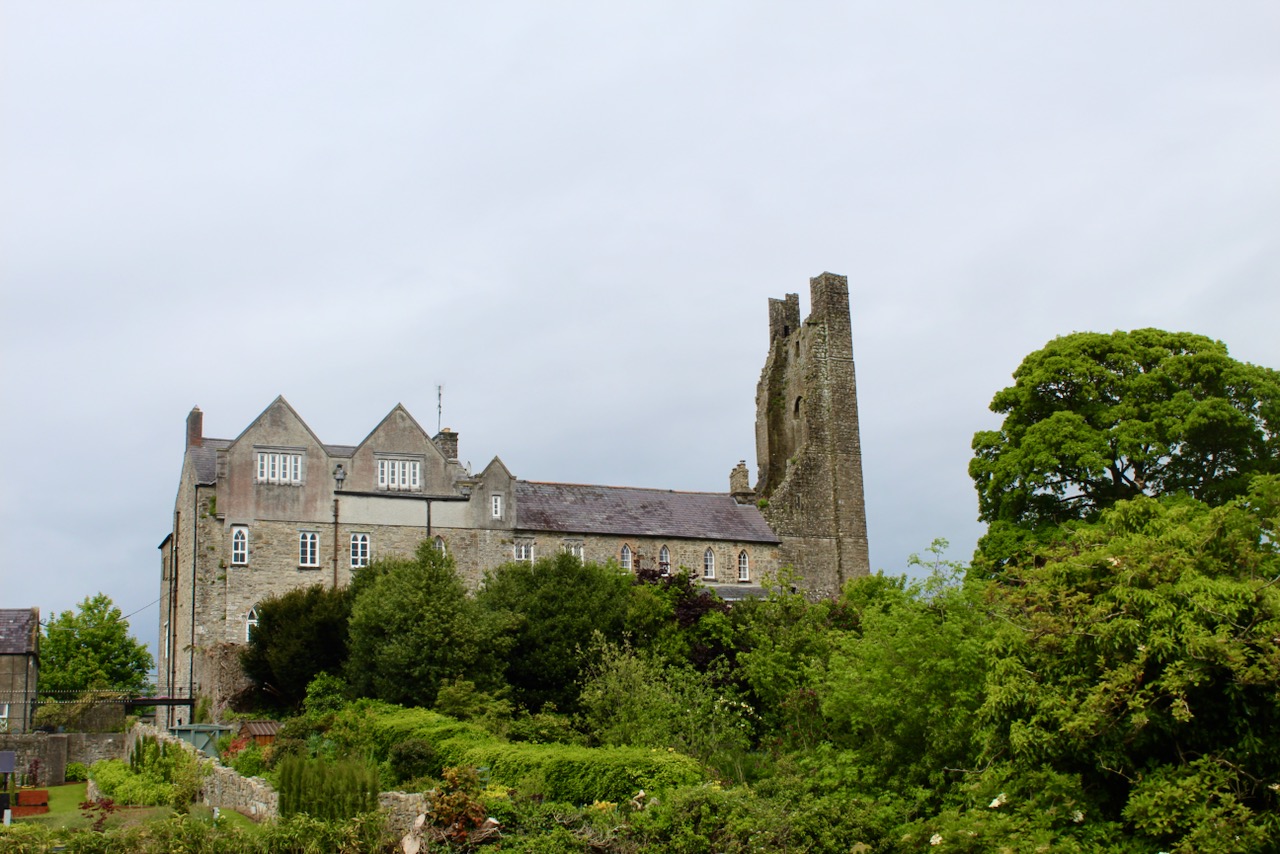
[7] https://theirishaesthete.com/2015/10/12/when-royalty-comes-to-call/

[8] https://theirishaesthete.com/2015/10/24/vaulting-ambition/

[9] https://theirishaesthete.com/2014/10/27/after-the-horses-have-bolted/

[10] https://theirishaesthete.com/2015/03/21/ireland-crossroads-of-art-and-design-vi/

Text © Jennifer Winder-Baggot, www.irishhistorichouses.com

Irish Historic Homes