Blayney Castle, (also known as Hope castle), Co Monaghan

Blayney Castle, (also known as Hope castle), Co Monaghan 

Blayney Castle (or Hope Castle), Castleblayney, Co Monaghan, photograph by Robert French, (between ca. 1865-1914), Lawrence Photograph Collection, National Library of Ireland.

Mark Bence-Jones. A Guide to Irish Country Houses (originally published as Burke’s Guide to Country Houses volume 1 Ireland by Burke’s Peerage Ltd. 1978); Revised edition 1988 Constable and Company Ltd, London.

(Blayney, B/DPE; Hope.LG1937; Pelham-Clinton-Hope, Newcastle, D/PB) A three storey five bay Georgian block, built near the site of a C17 “Plantation Castle”; refaced and embellished during the Victorian period. Entablatures over windows; scrolled cresting on roof parapet; segmental pediment with arms on garden front. Entrance front with central curved bow, to which a projecting porch, and a canopy of ornamental cast iron work and glass, was added. Top storey treated as attic, above cornice. Lower service wing, and single-storey four bay C19 addition with roof on bracket cornice prolonging garden front. Centre first floor window of garden treated like a niche, sheltering a statue. Sold 1853 by 12th and last Lord Blayney to Henry Hope, of Deepdene, Surrey, son of Thomas HOpe, the great exponent of neo-Classicism and a member of the Scottish-Dutch banking family, famous for its ownership of the Hope Diamond. Passed by descent to Lord Henry Francis Hope Pelham-Clinton-Hope, afterwards 8th Duke of Newcastle. Now a convent.” 

Blayney Castle (or Hope Castle), Castleblayney, Co Monaghan, photograph by Robert French, (between ca. 1865-1914), Lawrence Photograph Collection, National Library of Ireland.
Mary Cairnes, Lady Blayney (c. 1703–1790) after Robert Home, courtesy of Sothebys , Old Masters and 19th Century Paintings. She married Cadwallader Dominic Blayney 7th Baron Blayney of Monaghan. She was the daughter of Alexander Cairnes, 1st Baronet. She married secondly Colonel John Murray, MP, from Glenalla House, near Rathmullan in Donegal.
Dowager Lady Cunninghame, prob Elizabeth Murray who inherited vast estates of Alexander Cairnes. Adams auctioh house tells us she should be called Lady Rossmore, and that she married Bernard Cunninghame of Mount Kennedy, but I think she she married Robert Cuninghame, 1st Baron Rossmore. Courtesy Adam’s 5 Oct 2010, Hugh Douglas Hamilton (1739-1808). She was also a daughter of Colonel John Murray MP and his wife Mary Cairns.

https://archiseek.com/2015/1600s-blayney-castle-castleblayney-co-monaghan

1600s – Blayney Castle, Castleblayney, Co. Monaghan 

Blayney Castle, County Monaghan, courtesy Archiseek.
Blayney Castle or Hope Castle, County Monaghan, courtesy Archiseek.

The area of Muckno and Ballynalurgan was granted to Sir Edward Blayney under the Plantation of Ulster in 1607 and 1611. Blayney was a Welsh soldier, and built a stone defensive castle, Blayney Castle, consisting of a fortified house and bawn.  

The town of Castleblayney has grown up round that original site. Blayney was created the first Baron Blaney in 1621 and the Blayneys would continue to occupy the estate until the 1850s. The castle was derelict by the 1790s, by which time the family had moved into a large Georgian house nearby. No trace remains today. 

https://archiseek.com/2009/1799-hope-castle-castleblayney-co-monaghan

1799 – Hope Castle, Castleblayney, Co. Monaghan 

Architect: Robert Woodgate 

Blayney Castle or Hope Castle, County Monaghan, courtesy Archiseek.

Known also as Blayney Castle after the plantation castle nearby (from which the town gets its name), Hope Castle has had many owners and uses over the years. Originally a three storey 5 bay Georgian block, it was sold in 1853 by the twelfth and last Lord Blaney to the Hope family after whom the famous Hope Diamond is name.  

Henry Hope had the house extended, and the facade of the house received many embellishments including scrolled cresting on the roof parapets and at one stage an ornamental cast iron and glass porch canopy. After the Hopes, it was used as a military base and later as a convent. 

The building has suffered greatly during its lifetime – after being an convent, it remained empty for many years and was taken over the the local County Council who demolished the 19th century additions to the garden and main fronts and renovated the building. Its most interesting internal feature – a Soanesque toplit upper stair landing was destroyed during the building’s phase of dereliction. It has since been badly damaged by fire and is currently boarded up and derelict. The estate still has a good stableyard and cast-iron gateway with matching gatehouses.  

The sad remains of Hope Castle, County Monaghan. Built on the edge of Castleblayney, the house – like the town – owes its existence to the Blayney family who settled here at the start of the 17th century. Initially they lived in a castle built by Sir Edward Blayney, created first Baron Blayney in 1721 but at the end of the 18th century his descendant, the 11th Lord Blayney commissioned a new house designed by Dublin-born Robert Woodgate who for several years had worked in London for Sir John Soane. In 1853 the 12th Lord Blayney sold the estate to the rich Henry Thomas Hope; he enlarged and remodelled the building in what has been called ‘a frivolous kind of Italianate classicism.’ Occupied by Queen Victoria’s son the Duke of Connaught for several years at the start of the last century when he served Commander of the Forces in Ireland, Hope Castle was sold in 1928 and served as a military barracks and then a county hospital before being occupied until the mid-1970s by Franciscan nuns. It was then acquired by the local county council, which leased it to an hotelier who was permitted to strip out all of Woodgate’s interiors. In 2010 the building was badly damaged by arsonists and has remained in a sorry state ever since. 

and https://lordbelmontinnorthernireland.blogspot.com/2014/07/blayney-castle.html

THE BARONS BLAYNEY WERE THE SECOND LARGEST LANDOWNERS IN COUNTY MONAGHAN, WITH 24,546 ACRES 

SIR EDWARD BLAYNEY(1570-1629), Knight, a native of Wales, said to be descended from Cadwallader, King of Cambria and a younger son of the Prince of Wales, had been employed from his youth in the armies of ELIZABETH I. 

He accompanied Robert, Earl of Essex, as Colonel, into Ireland, 1598, where he obtained both wealth and renown in the subsequent wars. 

Sir Edward, Governor of Monaghan, was granted the thirty-two townlands of Ballynalurgan and in 1611 he obtained the termon of Muckno as well. 

Blayney built a castle, around which a Planter village soon began to develop. 

This was the origin of the present town of Castleblayney. 

Sir Edward married Anne, second daughter of the Most Rev Dr Adam Loftus, Lord Archbishop of Dublin, CHANCELLOR OF IRELAND, by whom he had, with six daughters, two sons, 

HENRY (Sir), his successor
ARTHUR (Sir), of Castle Shane

Sir Edward was elevated to the peerage by JAMES I, in 1621, in the dignity of BARON BLAYNEY, of Monaghan.  

His lordship was succeeded by his elder son, 

HENRY, 2nd Baron, who wedded, in 1623, Jane, daughter of Gerald, Viscount Drogheda, by whom he had two surviving sons and five daughters. 
 
His lordship, who was a military man, was slain at the battle of Benburb, County Tyrone, 1646, and was succeeded by his elder son, 

EDWARD, 3rd Baron (c1625-69), who died unmarried, and was succeeded by his brother,  

RICHARD, 4th Baron (c1625-70), who was high in favour with CROMWELL, and had been appointed, in 1656, the usurper’s custos-rotulorum of County Monaghan, and escheator of County Tyrone. 
 
His lordship espoused firstly, in 1653, Elizabeth, eldest daughter of Mr Alderman Vincent, of Dublin, MP, by whom he had several children; and secondly, Jane, daughter of John Malloch. 
 
His lordship was succeeded by his eldest son, 
 
HENRY VINCENT, 5th Baron, who wedded Margaret Moore, eldest sister of John, 1st Lord Tullamore, by whom he had an only surviving child, Elinor. 
 
His lordship fled Castleblayney at the outbreak of the Williamite wars and was chosen as commander-in-chief of the Protestant forces raised to defend Monaghan and Armagh against JAMES II, who transmitted it to his brother,  

WILLIAM, 6th Baron, who married, in 1686, Mary, eldest daughter of William, 1st Viscount Charlemont, and dying in 1705, was succeeded by his only surviving son,  

CADWALLADER, 7th Baron (1693-1732), who married Mary, daughter of the Hon John Tucket, and niece of Charles, Duke of Shrewsbury, Lord Lieutenant of Ireland, and had issue. 
 
His lordship espoused secondly, Mary, daughter and heiress of Sir Alexander Cairnes Bt, of Monaghan.  
 
His lordship was succeeded by his eldest son, 

THE VERY REV CHARLES TALBOT, 8th Baron (1714-61), Dean of Killaloe, at whose decease, without surviving issue, the title devolved upon his brother,  

CADWALLADER, 9th Baron (1720-75), who married, in 1767, Sophia, daughter of Thomas Tipping, of Beaulieu, and had issue, 

CADWALLADER DAVIS, his successor
ANDREW THOMAS, succeeded his brother
Sophia; Mary. 

His lordship, a lieutenant-general in the army, was succeeded by his elder son, 

CADWALLADER DAVIS, 10th Baron (1769-84); at whose decease, unmarried, the title reverted to his brother, 

ANDREW THOMAS, 11th Baron (1770-1834), a lieutenant-general in the army, who wedded, in 1796, Mabella, eldest daughter of James, 1st Earl of Caledon, and had issue, 

CADWALLADER DAVIS, his successor
Anne; Charlotte Sophia. 

His lordship was succeeded by his son, 

CADWALLADER DAVIS, 12th Baron (1802-74), MP for County Monaghan, 1830-34, at whose decease, unmarried, the title expired. 


THE CALEDON CONNECTION 

The Caledon estate in County Tyrone is just a few fields away from that of the Leslies in Glaslough, County Monaghan, and the Earls of Caledon themselves owned some land in County Monaghan. 

Because of the family connection between the lst and 2nd Earls and the 11th Lord Blayney, who was their son-in-law and brother-in-law respectively, the correspondence between Blayney and the two earls yields a lot of information about his military and political careers; for example, the siege of Alexandria and as a prisoner of war in Napoleonic France. 

During Blayney’s long incarceration, the 2nd Earl of Caledon looked after his financial, domestic, and political affairs, thus being drawn into the Monaghan sphere. 

This brought political figures such as Dawson and Leslie beating a path to Caledon’s door, because during this period he was the representative of Blayney and ‘the Blayney interest’. 

On his return, Blayney was given a seat in parliament for Caledon’s infamous ‘rotten borough’ of Old Sarum, Wiltshire. Later, he attempted to get Caledon to use his influence with the Government to get him elected an Irish Representative Peer. 

This yields a very illuminating and often pained correspondence between the two men. 

The Blayney/Hope Papers are deposited at PRONI.  

HOPE CASTLE, Castleblayney, County Monaghan, formerly known as Blayney Castle after the plantation castle nearby (from which the town gets its name), has had many owners and uses over the years. 

Originally a three storey, five bay Georgian block, the house received many embellishments during the Victorian era including scrolled cresting on the roof parapets and at one stage an ornamental cast iron and glass porch canopy. 

In 1853, Cadwaller, 12th and last Lord Blayney, sold the Castle and estate to Henry Thomas Hope from Deepdene in Surrey, a former MP at Westminster. 

Thereafter the Castle was renamed Hope Castle, as it still called. 

Hope gave the Georgian Castle with its splendid prospect a Victorian makeover that the present building retains, externally at least. 

After his death in 1862, Hope’s wife Anne inherited the estate. 

Soon after 1887, the Castle and demesne fell to the next heir, a grandson of Hope: Lord Henry Francis Hope Pelham-Clinton-Hope, famous for having sold the renowned family heirloom, the Hope Diamond. 

From 1900 until 1904, the Castle became the residence of Field-Marshal HRH The Duke of Connaught,  Commander-in-Chief, Ireland. 

After 1916, Lord Henry no longer resided in the Castle nor in Ireland. 
 
On becoming 8th Duke of Newcastle in 1928, he later sold both the Castle and the estate, which was broken up and used in part for local political patronage. 

In 1919-21, the Castle was used as a barracks by the British Army. 
 
Some time afterwards it functioned as a hospital; and from 1943-74, it was occupied by Franciscan nuns who also managed an adjacent guest house. 

After some years of neglect, the Castle has been used for catering and hotel purposes set in what is now a Leisure Park with golf course. 

In October 2010, the Castle was burnt down in an arson attack.  

The building has suffered greatly during its lifetime – after being an convent, it remained empty for many years and was taken over the the local County Council who demolished the 19th century additions to the garden and main fronts and renovated the building. 

Its most interesting internal feature – a Soanesque top-lit upper stair landing, was destroyed during the building’s phase of dereliction. 

The estate still has a good stable-yard and cast-iron gateway with matching gatehouses. 

http://davidhicksbook.blogspot.com/search?updated-max=2015-02-16T12:14:00-08:00&max-results=7&start=26&by-date=false 

THURSDAY, 12 FEBRUARY 2015 

 Hope Castle  

 Co. Monaghan 

Hope Castle can be found near the town of Castleblayney in County Monaghan. Perched high on a hill overlooking an expanse of water known as Lough Muckno, the castle is hidden by trees and accessed from the town through impressive entrance gates. The town of Castleblayney is the third largest in County Monaghan and its development is closely linked to the influential Blayney family. From the late 1700s the Blayneys were responsible for the creation of local industry and the construction of a number of the public buildings in the town. A few months after I began to compile this piece, I learnt that the castle had been deliberately burnt to the ground. As a result of the loss of this building I felt I had to highlight its history and beauty, in the hope it would rally local people to ensure that it is restored. It is also fascinating that the family that gave their name to the worlds most famous gem stone also lent their surname to this castle in Monaghan. 

A large white building

Description automatically generated, Picture 
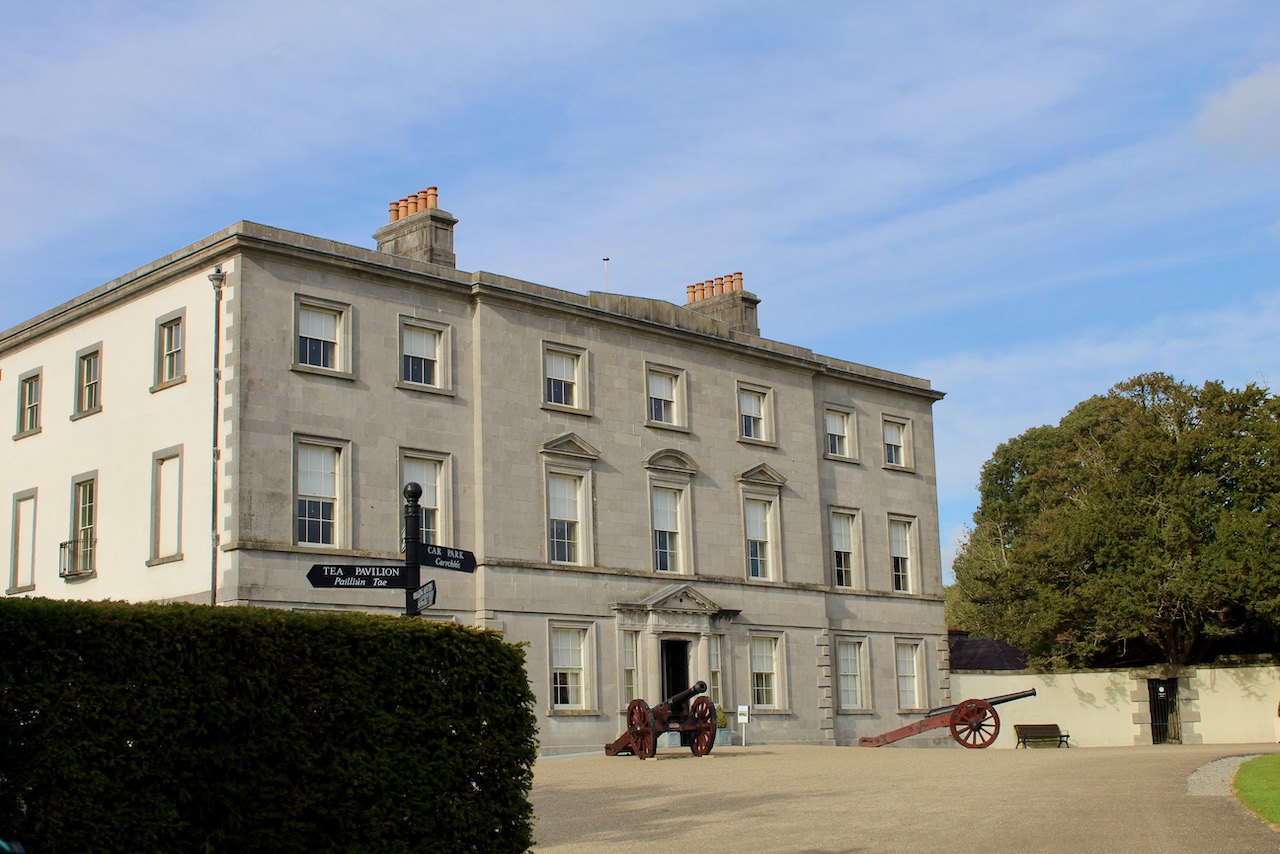
The entrance front of Castle Hope with its large extension added by Henry  Thomas Hope in the 1860s. The Hope family crest is emblazoned  on the castle in the centre of this facade.  Accreditation- The National Library of Ireland 

In the 1600s, the lands around Lough Muckno were owned by the Blayney family who built the original castle that preceded the existing building. The eleventh Baron Blayney, Lord Andrew Thomas Blayney eventually built a new castle near the site of the original ancestral seat. It is little wonder that the site for the new castle was chosen as it enjoys one of the most spectacular views of Lough Muckno and the surrounding countryside. Robert Woodgate who designed the new castle in 1799 had previously served as an apprentice to the architect John Soane in London. In the same year, he also set up his Irish practise in Dublin and secured the commission from Baron Blayney in County Monaghan. Woodgate wrote to Soane, his former employer, in November 1799 and enclosed a sketch of Castle Blayney. The grateful apprentice recorded the following in the accompanying letter- ‘Sketch of the first house I ever built as a small tribute due for your former kindness to me’. The completed three storey, five bay block of Castle Blayney now stood on the hill overlooking the lough but its completion would also mark the end of the Blayneys connection with the estate. The eleventh Baron was a generous man and in 1814 he donated a painting of St. Sebastian to be used as an alter piece in the local Catholic Church which stood on land that he had donated in 1803.During the time that the eleventh Baron Blaney succeeded to the Monaghan estate he did much to improve the town of Castleblayney and he was responsible for its streetscape and development of local industry. Lord Blayney died on April 8, 1834 and was succeeded by his son Cadwallader Davis Blayney, the twelfth and last Lord Blayney. In 1853, the Hope family purchased the remainder of the Blayney estate under the Encumbered Estates Act 1849 for £180,000 

A picture containing outdoor, building, road, grass

Description automatically generated, Picture 
The castle is now boarded up since it was destroyed by fire in 2010. The  substantial wing built by Henry Thomas Hope was demolished around the  time the castle was renovated  in the 1980s leaving the building as it  appeared when it was first built.  Accreditation- Photograph by Ellie Ross 

The most famous diamond in the world which shares its name with a castle  

in Monaghan once owned by Henry Hope 

A large white building

Description automatically generated, Picture 
A niche on the rear elevation of the castle still contains a statue that  once overlooked a formal garden. Accreditation- Photograph by Ellie Ross 

 
The estate had been sold to Henry Thomas Hope of Surrey who was a member of the Scottish-Dutch banking family, famous for their ownership of Hope Diamond. The diamond was a supposedly cursed jewel that had passed through both the French and British Royal families and had supposedly brought ruin to whoever owned it. Henry Thomas Hope had the building in Monaghan refaced and embellished during the 1860s which included the addition of the Hope family crest to the parapet of all the facades of the castle. A large extension was added to the building which now became a modern country retreat for the extremely affluent family. Inside a large collection of art treasures were amassed which included a gallery of pictures by the Dutch and early English masters. Henry Thomas Hope died in 1862 and the castle eventually passed to his grandson, Lord Henry Francis Hope Pelham-Clinton. Between 1900 and 1904, Hope Castle was occupied by the Duke of Connaught, son of Queen Victoria, during his appointment as Commander in Chief to Ireland. It was said at the time that the Duke and Duchess experienced a great deal of difficulty in finding an Irish home as they did not wish to spend all their time in the official residence at the RoyalHospital in  Kilmainham, Dublin. The Irish residence associated with the office of Commander in Chief was not thought to be suitable for habitation by such high ranking royals as the grounds of the residence were far from private and its location was thought to be in an inferior part of the city. The residence of the Lord Lieutenant and the Chief Secretary in the Phoenix Park would have been suitable but neither of these residents could vacate those houses. The large administrative staffs associated with these official roles could not be moved easily without huge disruption. Several other houses such as Castletown House in Kildare were considered before the Duke settled on Castle Hope in Monaghan which he leased from Lord Henry Francis Hope.  

A person standing in front of a window

Description automatically generated, Picture 
Prince Arthur, 1st Duke of Connaught  (The National Portrait Gallery, London) 
A vintage photo of a dirt field

Description automatically generated, Picture 
The garden front of the castle that overlooks Lough Muckno, the large  drawing room of the house was contained behind the large projecting  bay window that can be seen in this picture. Accreditation- Photograph from The Irish Historical Picture Company 

Leonie Leslie  

It is believed that Castle Hope was chosen as it was located near the home of Leonie Leslie, a prominent socialite at the time, who lived at Castle Leslie. She was a close friend of the Duke and Duchess of Connaught but it is alleged that she was a closer friend of the Duke. The royal couple arrived in Castle Blayney in June 1900 and received a warm welcome from the local people; both the gates to the castle and the whole town were decorated with bunting and flags. The Duke had taken the castle for the summer season in 1900 with an option of leasing it for a further five years.  It was thought at the time that Castle Hope would become an official royal residence and that Queen Victoria would visit her son here. She never graced Castle Hope with her presence before her death in 1901 and the Duke of Duchess of Connaught ended their association with the castle in 1904.  

A black and white photo of an old building

Description automatically generated, Picture 
The entrance gates to the castle  in the 1900s around the time that Duke and  Duchess of Connaught were in residence. The presence of police officers  also gives credence to this assumption. Accreditation- The National Library of Ireland. 
A car parked on a city street

Description automatically generated, Picture 
Today the handsome gates piers and adjoining lodges are a distraction  surrounded by parked cars, incongruous signage and electric wires. Accreditation- Photograph by Ellie Ross 

Lord Henry, the castle’s owner, lived beyond his means which eventually led to marriage troubles and financial woes. He was forced to sell the Hope Diamond in 1901 for £29,000, which would be over two million pounds in today’s money, but this was not sufficient to plug the gapping hole in his finances. Lord Henry Francis Hope had mortgaged the estate in Monaghan heavily and ceased to live there from 1914. After this, the castle was occupied by every army that the country had seen since 1919 which included the Auxiliaries, Black and Tans and the Free State Army. It was also recorded that after the ratification of the treaty that the Crown forces were evacuated from Hope Castle on January 16, 1922. 

Lord Henry Francis Hope Pelham-Clinton 

(The National Portrait Gallery, London) 

 None of these occupants had caused serious damage to the stately pile’s contents and in 1926, an auction of the property of Lord Henry Francis Hope was announced. The contents of the castle consisting of antique furniture, paintings, china and the entire furnishings contained in the billiard room, drawing room, boudoir, library, smoking room, bedrooms, servant’s quarters and kitchen were to be auctioned. The sale of the furniture was the final severance of the connection that the Hope Family had with the town of Castleblayney and the auction attracted a huge attendance for the sale of the 1,400 lots. A lot of the large antique furniture sold quite cheaply due to its large size not being suitable for the average family home of the time. Items dispatched for sale included a grand piano and a billiard table which were sold to the nearby Hope Arms Hotel. Over the following years, the castle remained empty and unoccupied until it was used as a temporary hospital between 1932 and 1937 while the new county hospital was being built. It again lay idle for a number of years until it was purchased by a Franciscan Order of nuns who lived there from 1942 until the early 1970s. The Franciscan Sisters had purchased their new home in Monaghan as their previous convent in Londonhad been lost in the blitz during the Second World War. They sought permission to come to Monaghan in December 1941 and secured a loan of £6,000 to establish their convent in Castleblayney. In 1951 the lands of the Hope Estate was taken over by the Land Commission and divided up among the former tenants of the estate. In later years the Franciscan Sisters ran the castle as a guesthouse and they had converted the ballroom into a chapel. 

A person sitting on a bench next to a body of water

Description automatically generated, Picture 
A gravel path led directly from the French doors of the drawing room, down to the shores of Lough Muckno and a boat house.  Accreditation- The National Library of Ireland. 
A bench in front of a house

Description automatically generated, Picture 
The boarded up windows of the drawing room of the castle once overlooked  Lough Muckno which is considered to rival the famous Lakes of  Killarney in County Kerry. Accreditation- Photograph by David Hicks 

 
In 1979, the castle and the remaining estate lands were offered for sale which extended to 1,000 acres but only fifty-five acres were deemed to be agricultural land as over 900 acres were occupied up by Lough Muckno and its twelve islands. The castle was described as having a floor area of 22,500 sq.ft. which included five reception rooms, twenty-six bedrooms and four bathrooms. There were also coach houses, stables, two gate lodges, farm buildings and a boat house. An asking price of £500,000 was sought and eventually in the 1980s the castle and surrounding lands were purchased by Monaghan County Council. The nineteenth century additions built by Henry Thomas Hope were demolished and the surviving main block of the building was renovated. The eighteenth century castle was leased and operated as a fourteen bedroom hotel for the next number of decades.  

A large stone building

Description automatically generated, Picture 
A niche on the rear elevation of the castle still contains a statue  that once overlooked a formal garden. Accreditation- Photograph by Ellie Ross 
A large white building

Description automatically generated, Picture 
The castle once was surrounded by gardens that contained elaborate  planting, statues and stone balustrades topped with flower filled urns. Accreditation- Photograph From the National Library of Ireland 

In 2010, the townspeople of Castleblayney were shocked to hear that a fire had swept through Hope Castle which caused extensive interior damage. The alarm was raised by Gardai who were on an early morning patrol when they discovered a huge fire was raging inside the building. Fire units from all the neighboring towns were called but serious damage had been done, the castle had been unoccupied at the time and the fire was started maliciously by trespassers. The blaze ripped through the building leaving large sections of the castle destroyed and many of the antiques that furnished its reception rooms were also lost. For the moment Hope Castle remains cordoned off behind a high fence that shields it from public view. Behind this hoarding is a scene of desolation of broken windows and blackened walls, a view reminiscent of the house burnings of the 1920s. I sincerely hope that this building is restored as a resource that can be enjoyed by the local community and the tourists of Castleblayney. Surely this building could become a place where the history of the many famous people associated with this castle could be recorded. How many buildings in Ireland have their history’s interwoven with the world’s most famous diamond and members of the British Royal family? 

A large white building with a grassy field

Description automatically generated, Picture 
As a result of the fire, the castle is now surrounded by hoardings that  prevents public access but this also inhibits the replication of the above  historical image. Architecturally, the facades of this side of the building  remain relatively unchanged. Accreditation- Photograph by Ellie Ross 

Comparing the aerial photograph above and the period ordinance survey  

map belowillustrates the reduction in size of the Castle  

Copyright OSI 

Ravensdale Park, Dundalk, Co Louth – demolished

Ravensdale Park, Dundalk, Co Louth  

Ravensdale Park rere view, County Louth, Gillman Collection, Vanishing Country Houses of Ireland by The Knight of Glin, David J. Griffin and Nicholas K. Robinson, published by The Irish Architectural Archive and The Irish Georgian Society, 1988.

Mark Bence-Jones. A Guide to Irish Country Houses (originally published as Burke’s Guide to Country Houses volume 1 Ireland by Burke’s Peerage Ltd. 1978); Revised edition 1988 Constable and Company Ltd, London.

p. 240. “(Fortescue, sub Fortescue-Brickdale/LG1972; and Carlingford, B/PB 1898; Dixon, Glentoran, B/OB; Borbe, Arran, E/PB) A large and somewhat severe early Victorian mansion of granite, of plain but irregular aspect, dominated by a tall Italianate campanile with an open belvedere at the top. Built for Thomas Fortescue, 1st Lord Clermont of later creation, the architect being Thomas Duff, of Newry. Partly two storey and partly three, but mostly of the same height; eaved roof. Entrance front with a deep central recess enclosed by a screen of arches and Ionic pilasters and columns; the tower being at one side of the recess. Very long and austere two storey ten bay garden front adjoining. Another front of five bays with domed octagon at one corner. Imposing if slightly hotel-like partly top-lit hall, with screens of fluted columns and pilasters on two sides; staircase with wrought-iron handrail rising from one end. Dining room with scroll pediments over doors, supporting medallions; elaborate plasterwork frieze and cornice of foliage, and oval-shaped plasterwork surround in flat of ceiling; similar ceiling in ballroom. Library with rather Soanian flat arched recesses, containing bookcases. Domed first floor landing with Ionic columns. Became the home of Lord Clermont’s younger brother and successor, the politician Chichester Fortescue, 1st (and last) Lord Carlingford; who married the celebrated Frances, Countess Waldegrave, subject of Osbert Wyndham Hewett’s biography, Strawberry Fair. Sold to Sir Daniel Dixon, Mayor and subsequently Lord Mayor of Belfast, father of the 1st Lord Glentoran, later sold to the Earl fo Arran. Finally sold 1920, and burnt soon afterwards.”

Ravensdale Park, County Louth, library, Gillman Collection, Vanishing Country Houses of Ireland by The Knight of Glin, David J. Griffin and Nicholas K. Robinson, published by The Irish Architectural Archive and The Irish Georgian Society, 1988.
Frances Fortescue née Murray (1724-1820) Countess of Clermont, sister of Harriet and Anne. Portrait after Sir Joshua Reynolds, 1864, National Portrait Gallery of London, D147. She was the daughter of Colonel John Murray MP and she married William Henry Fortescue 1st Earl of Clermont, Sheriff of County Louth.

Listed in Vanishing Country Houses of Ireland by The Knight of Glin, David J. Griffin and Nicholas K. Robinson, published by The Irish Architectural Archive and The Irish Georgian Society, 1988. 

p. 109. “A two storey Italianate early Victorian house designed by Thomas Duff for Thomas Fortescue 1st Lord Clermont. Good interior. Burnt 1920. Demolished.”

http://lordbelmontinnorthernireland.blogspot.com/2013/05/ravensdale-park.html

THE BARONS CLERMONT WERE THE GREATEST LANDOWNERS IN COUNTY LOUTH, WITH 20,369 ACRES


This family deduces its pedigree from common ancestors with the EARLS FORTESCUE, viz. remotely, Sir Richard le Forte, a Norman knight, in the train of WILLIAM THE CONQUEROR; and, more remotely, Lord Chief Justice Fortescue.

The first of its members that settled in Ireland,

SIR FAITHFUL FORTESCUE (c1581-1666), Knight, removed to that kingdom early in the reign of JAMES I, and commanded an infantry regiment there.

Sir Faithful obtained large possessions in Ireland, amongst which was Dromiskin Castle, County Louth.

He wedded Anne, daughter of Garret, 1st Viscount Moore, of Drogheda, and was succeeded by his eldest surviving son,

SIR THOMAS FORTESCUE (c1620-1710), Knight, Governor of Carrickfergus Castle, who espoused firstly, Sydney, daughter of Colonel William Kinsmill; and secondly, Elizabeth, daughter of Colonel Ferdinand Carey, and had issue,

WILLIAM;
Chichester.

Sir Thomas was succeeded by his grandson,

THOMAS FORTESCUE (1683-1769), MP for Dundalk, 1727-60, who married Elizabeth, daughter of James Hamilton, and sister of James, 1st Earl of Clanbrassil, and had issue,

James, father of WILLIAM, 2nd VISCOUNT CLERMONT;
WILLIAM HENRY, of whom hereafter;
Margaret; Charlotte.

Mr Fortescue’s younger son,

THE RT HON WILLIAM HENRY FORTESCUE (1722-1806), MP for County Louth, 1745-60, Monaghan, 1761-70, was sworn of the Privy Council, 1764, and appointed Postmaster-General.

Mr Fortescue was elevated to the peerage, in 1770, in the dignity of Baron Clermont, of Clermont, County louth.

His lordship was created, in 1776, BARON and VISCOUNT CLERMONT, with remainder to his brother, the Rt Hon James Fortescue, of Ravensdale Park, County Louth, MP for that county.

His lordship was further advanced to the dignity of an earldom, in 1777, as EARL OF CLERMONT, but without the reversionary grant.

He was installed as a Knight Founder of the Order of St Patrick (KP) in 1795.

His lordship espoused Frances, eldest daughter of Colonel John Murray, County Monaghan; but dying without issue, in 1806, the earldom expired, while the other honours devolved, according to the limitation, upon his nephew,

WILLIAM CHARLES FORTESCUE, 2nd Viscount (1764-1829), only surviving son of his deceased brother, mentioned above, by Mary Henrietta, eldest daughter of Thomas Orby Hunter, of Crowland Abbey, Lincolnshire.

His lordship died at Ravensdale Park, County Louth, unmarried, when the viscountcy expired.

The title was revived, however, in 1852, when his kinsman, 

THOMAS FORTESCUE, was created BARON CLERMONT (2nd & 3rd creation).

RAVENSDALE PARK, near Dundalk, County Louth, was a large, rather austere, early Victorian house built of granite with a plain, irregular aspect.

A lofty Italianate campanile with an open belvedere atop dominated the mansion.

Ravensdale was built for Thomas Fortescue, 1st Baron Clermont, the architect being Thomas Duff of Newry.

It was partly two and partly three storeys, though mainly the same height, with an eaved roof.

The garden front was remarkably long, being ten bays.

There was another front of five bays with a domed octagon at one corner.

Ravensdale became the home of Lord Clermont’s younger brother and successor, the politician Chichester Fortescue, 1st and last Lord Carlingford (who married the famous Frances, Countess Waldegrave).

It was sold to Sir Daniel Dixon Bt, father of 1st Lord Glentoran; then sold again to Lord Arran.

Ravendale was sold, yet again, in 1920, and was burnt shortly afterwards. 

Much of the former estate is now a forest park; while the Ravensdale Equestrian and Trekking Centre operates from the demesne.

Ravensdale Forest is part of the former demesne.

First Published in May, 2011.   Clermont arms courtesy of European Heraldry.

https://archiseek.com/2015/1840-ravensdale-park-dundalk-co-louth

1840 – Ravensdale Park, Dundalk, Co. Louth 

Architect: Thomas Duff 

Ravensdale Park, County Louth, courtesy Archiseek.

Constructed in an austere Italianate style, by Thomas Duff of Nerwy, For 1st Baron Clermont. Later changes by Lanyon & Lynn in 1859 with further additions.  

It was partly two and partly three storeys, though mainly the same height, with an eaved roof. The garden front was remarkably long, being ten bays. There was another front of five bays with a domed octagon at one corner. The house was burned in 1921. 

Ravensdale Park, County Louth, courtesy Louth County Archives.

Office of Public Works properties: Leinster: Laois, Longford, Louth, Meath, and Offaly

Carlow, Dublin, Kildare, Kilkenny, Laois, Longford, Louth, Meath, Offaly, Westmeath, Wexford and Wicklow are the counties that make up the Leinster region.

I have noticed that an inordinate amount of OPW sites are closed ever since Covid restrictions, if not even before that (as in Emo, which seems to be perpetually closed) [these sites are marked in orange here]. I must write to our Minister for Culture and Heritage to complain.
Laois:

1. Emo Court, County Laois – house closed at present

2. Heywood Gardens, County Laois

Longford:

3. Corlea Trackway Visitor Centre, County Longford

Louth:

4. Carlingford Castle, County Louth

5. Old Mellifont Abbey, County Louth – closed at present

Meath:

6. Battle of the Boyne site, Oldbridge House, County Meath

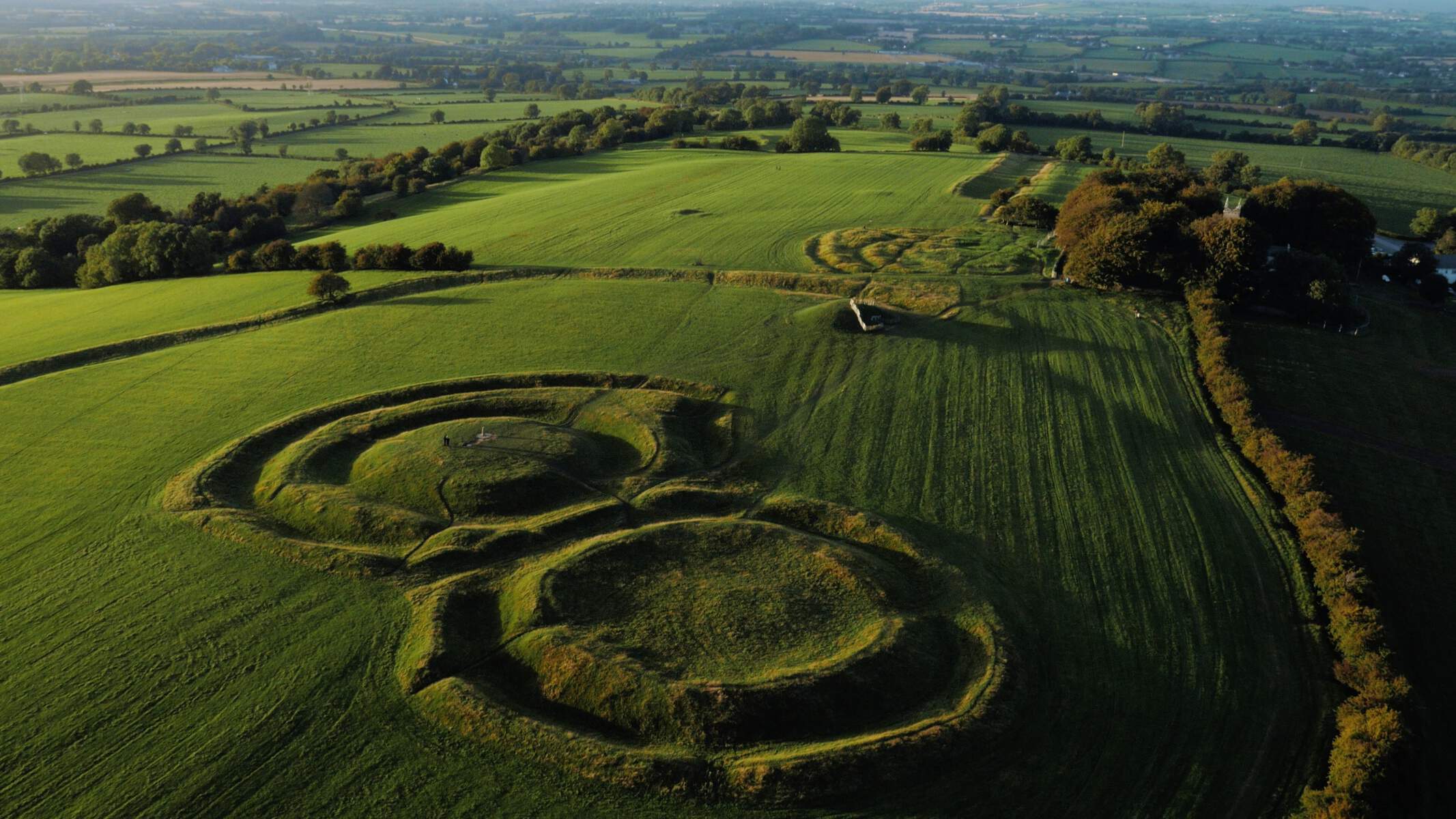
7. Hill of Tara, County Meath

8. Loughcrew Cairns, County Meath – guides on site from June 16th 2022

9. Newgrange, County Meath

10. Trim Castle, County Meath

Offaly:

11. Clonmacnoise, County Offaly

donation

Help me to pay the entrance fee to one of the houses on this website. This site is created purely out of love for the subject and I receive no payment so any donation is appreciated!

€15.00

Laois:

1. Emo Court, County Laois:

Emo, County Laois, June 2021. Unfortunately the stone lions which flank the front steps, carved by Richard Carter of Cork in 1854, were in boxes on the day we visited. [1] Photograph © Jennifer Winder-Baggot, www.irishhistorichouses.com

General enquiries: 057 862 6573, emocourt@opw.ie

See my entry https://irishhistorichouses.com/2024/10/22/emo-court-county-laois-office-of-public-works/

From the OPW website https://heritageireland.ie/visit/places-to-visit/emo-court/:

Emo Court is a quintessential neo-classical mansion, set in the midst of the ancient Slieve Bloom Mountains. The famous architect James Gandon, fresh from his work on the Custom House and the Four Courts in Dublin, set to work on Emo Court in 1790. However, the building that stands now was not completed until some 70 years later [with work by Lewis Vulliamy, a fashionable London architect, who had worked on the Dorchester Hotel in London and Arthur & John Williamson, from Dublin, and later, William Caldbeck].

The estate was home to the earls of Portarlington until the War of Independence forced them to abandon Ireland for good. The Jesuits moved in some years later [1920] and, as the Novitiate of the Irish Province, the mansion played host to some 500 of the order’s trainees.

Major Cholmeley-Harrison took over Emo Court in the 1960s and fully restored it [to designs by Sir Albert Richardson]. He opened the beautiful gardens and parkland to the public before finally presenting the entire estate to the people of Ireland in 1994.

You can now enjoy a tour of the house before relaxing in its charming tearoom. The gardens are a model of neo-classical landscape design, with formal lawns, a lake and woodland walks just waiting to be explored.” [2]

[1] p. 336. Tierney, Andrew. The Buildings of Ireland: Central Leinster: Kildare, Laois and Offaly. Yale University Press, New Haven and London, 2019.

[2] https://heritageireland.ie/visit/places-to-visit/emo-court/

2. Heywood Gardens, Ballinakill, County Laois:

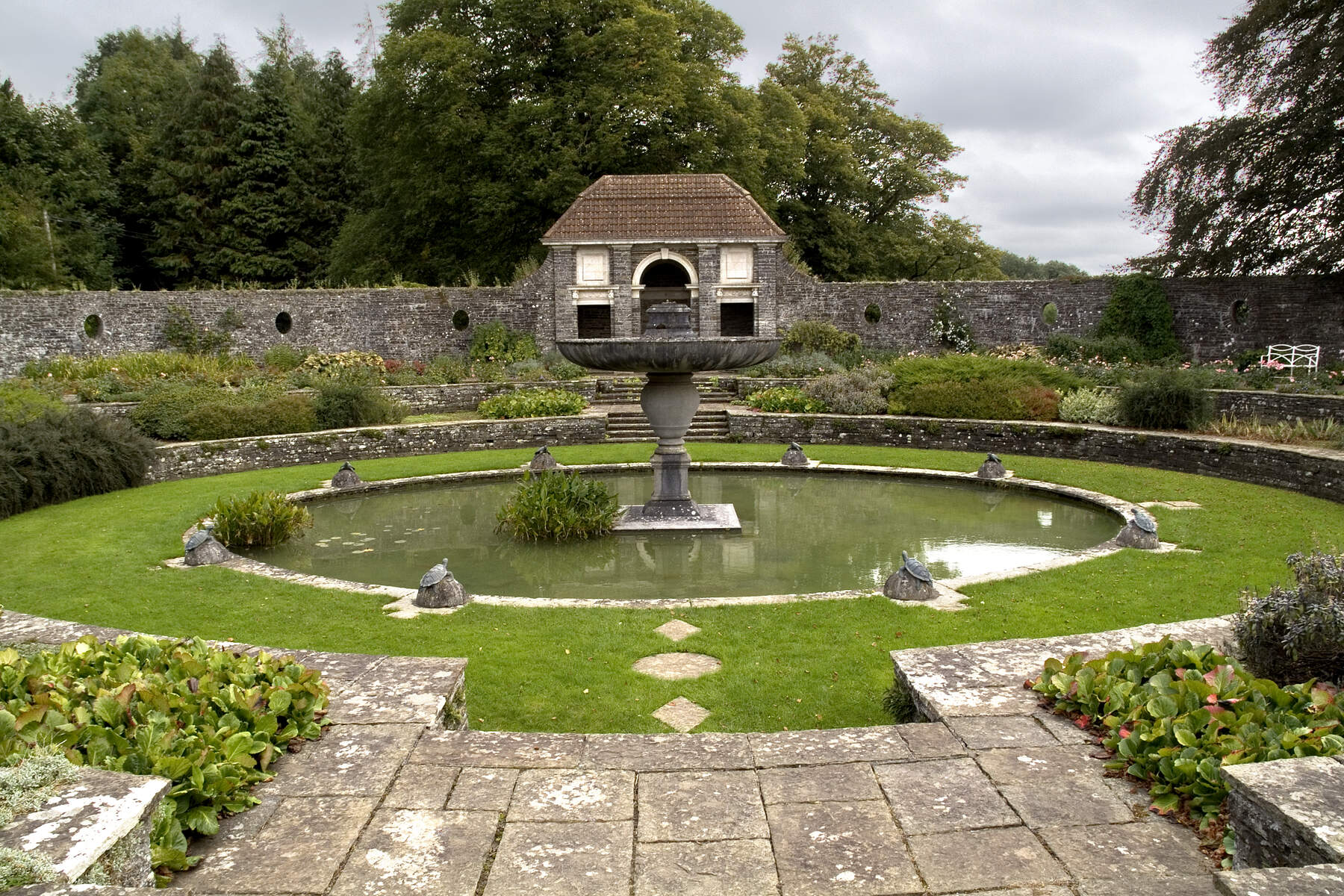
Heywood Gardens by Edwin Lutyens, photograph by Chris Hill 2014 for Tourism Ireland, Ireland’s Content Pool. [see 6]

General enquiries: 086 810 7916, emocourt@opw.ie

See my entry https://irishhistorichouses.com/2025/05/02/heywood-gardens-ballinakill-county-laois-office-of-public-works/

From the OPW website https://heritageireland.ie/visit/places-to-visit/heywood-gardens/:

The entrancing eighteenth-century landscape at Heywood Gardens, near Ballinakill, County Laois, consists of gardens, lakes, woodland and some exciting architectural features. The park is set into a sweeping hillside. The vista to the south-east takes in seven counties.

The architect Sir Edwin Lutyens designed the formal gardens [around 1906], which are the centrepiece of the property. It is likely that renowned designer Gertrude Jekyll landscaped them.

The gardens are composed of elements linked by a terrace that originally ran along the front of the house. (Sadly, the house is no more.) One of the site’s most unusual features is a sunken garden containing an elongated pool, at whose centre stands a grand fountain.

The Heywood experience starts beside the Gate Lodge. Information panels and signage will guide you around the magical Lutyens gardens and the surrounding romantic landscape.

Longford:

3. Corlea Trackway Visitor Centre, Kenagh, County Longford:

Corlea Trackway Visitor Centre, Co. Longford, photograph by Chris Hill 2018 for Tourism Ireland, Ireland’s Content Pool. [see 6]

General enquiries: 043 332 2386, corlea@opw.ie

From the OPW website https://heritageireland.ie/visit/places-to-visit/corlea-trackway-visitor-centre/:

Hidden away in the boglands of Longford, not far from Kenagh village, is an inspiring relic of prehistory: a togher – an Iron Age road – built in 148 BC. Known locally as the Danes’ Road, it is the largest of its kind to have been uncovered in Europe. 

Historians agree that it was part of a routeway of great importance. It may have been a section of a ceremonial highway connecting the Hill of Uisneach, the ritual centre of Ireland, and the royal site of Rathcroghan.

The trackway was built from heavy planks of oak, which sank into the peat after a short time. This made it unusable, of course, but also ensured it remained perfectly preserved in the bog for the next two millennia.

Inside the interpretive centre, an 18-metre stretch of the ancient wooden structure is on permanent display in a hall specially designed to preserve it. Don’t miss this amazing remnant of our ancient past.

Corlea Trackway Visitor Centre, Co. Longford, photograph by Christ Hill 2018 for Tourism Ireland, Ireland’s Content Pool. [see 6]
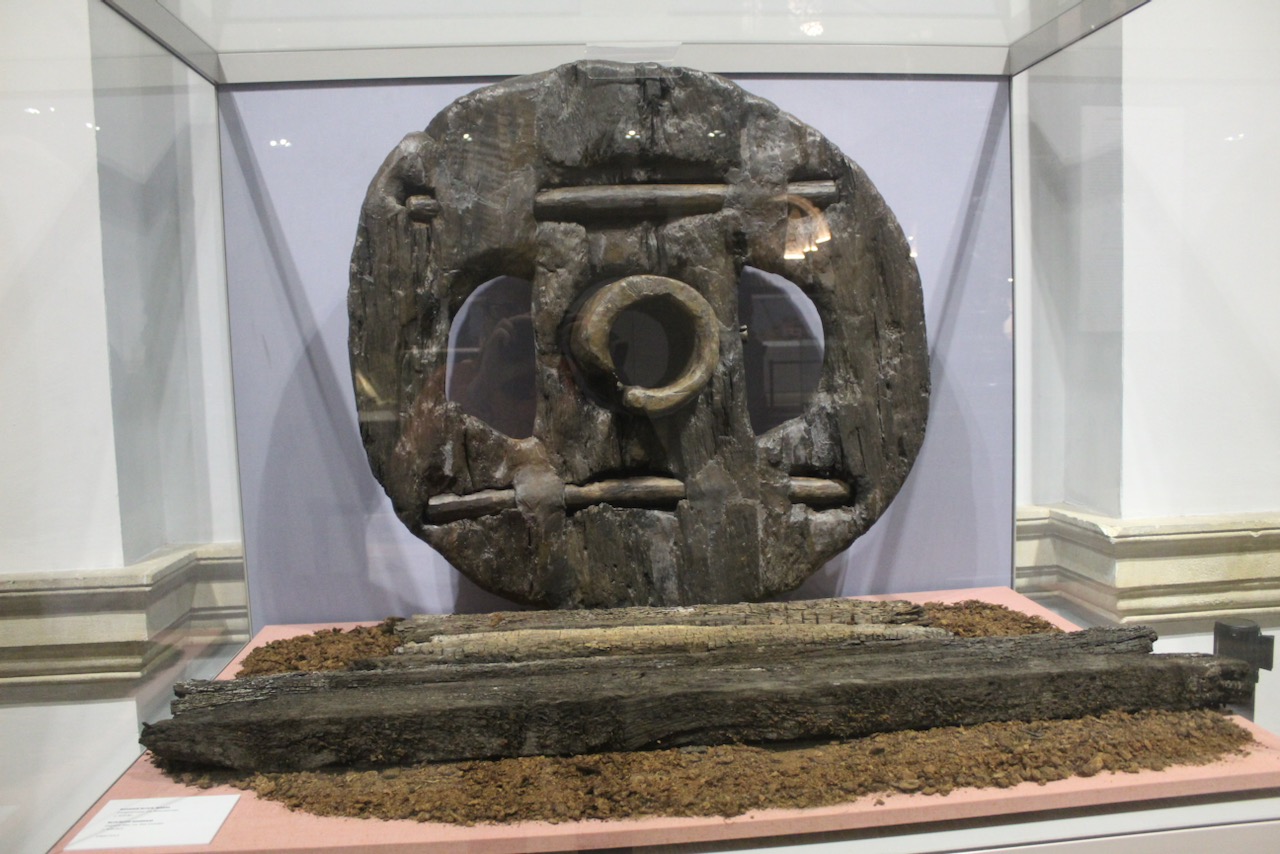
Wooden block wheel excavated in Doogarymore, County Roscommon, now in the National Museum of Ireland, Kildare Street, Dublin. From around 400BC. It may be the type of wheel that was used on the ancient roads! Photograph © Jennifer Winder-Baggot, www.irishhistorichouses.com
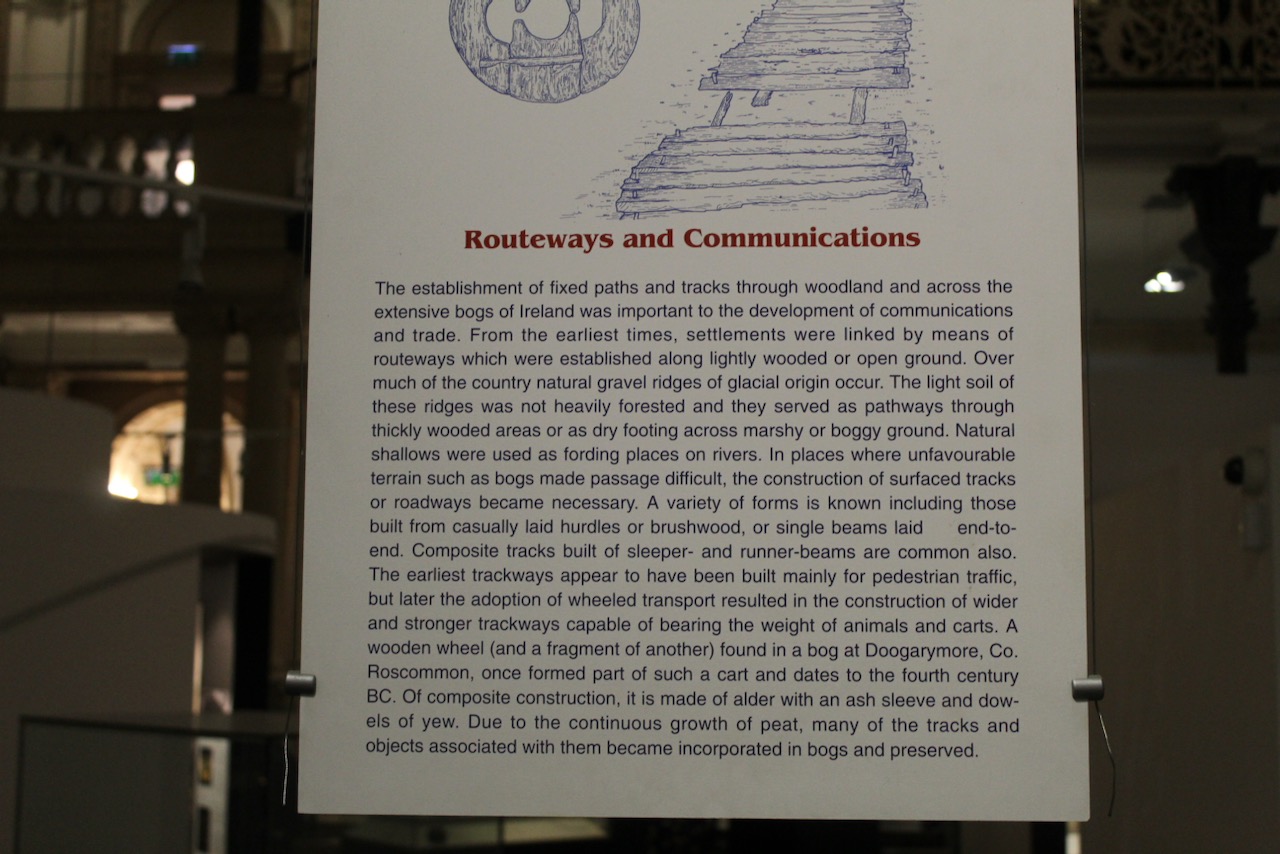
Information board from the National of Ireland Kildare Street.

Louth:

4. Carlingford Castle, County Louth:

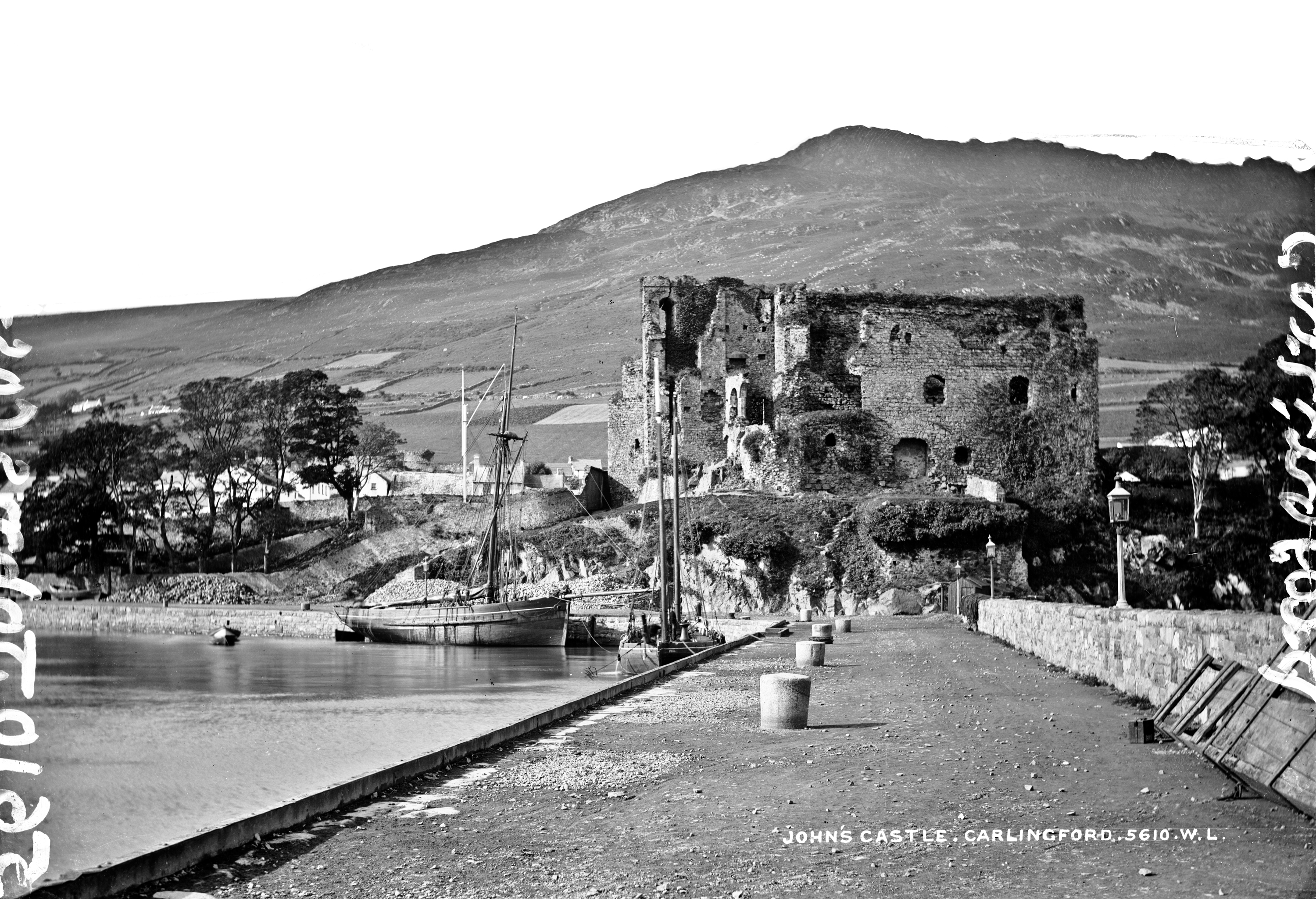
Carlingford Castle, also known as King John’s Castle (not to be confused with the one in Limerick), County Louth, photograph by Brenda Harris 2021 for Fáilte Ireland, Ireland’s Content Pool. [see 6]

From the OPW website https://heritageireland.ie/visit/places-to-visit/carlingford-castle/:

Carlingford lies in the shade of Slieve Foye, a mountain that in legend takes its form from the body of the sleeping giant Finn MacCumhaill. The castle dominates the town and overlooks the lough harbour. It was a vital point of defence for the area for centuries.

Carlingford Castle was built around 1190, most likely by the Norman baron Hugh de Lacy. By this time Hugh’s family had grown powerful enough to make King John of England uneasy. John forced them into rebellion and seized their property in 1210. He reputedly stayed in his new castle himself. It is still known as King John’s Castle.

Carlingford Castle, County Louth

The Jacobites fired on the castle in 1689; William of Orange is said to have accommodated his wounded soldiers there following the Battle of the Boyne.

Carlingford Lough Heritage Trust provides excellent guided tours of this historic Castle from March to October.

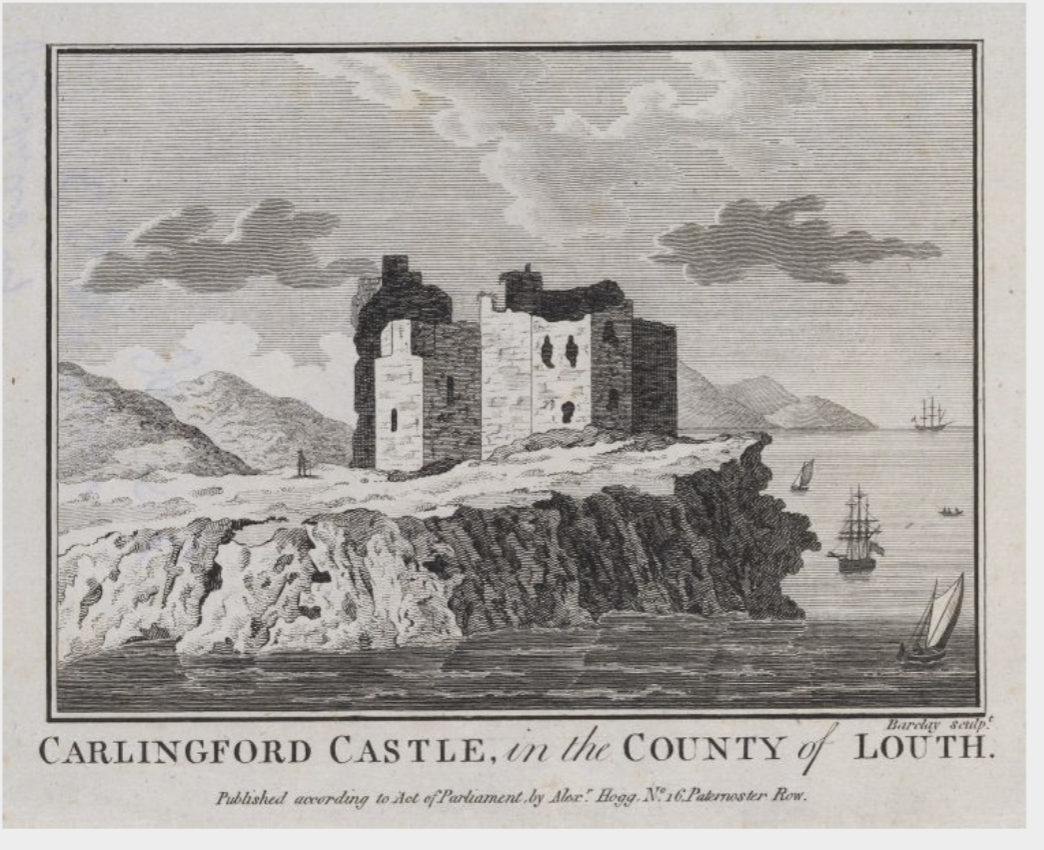
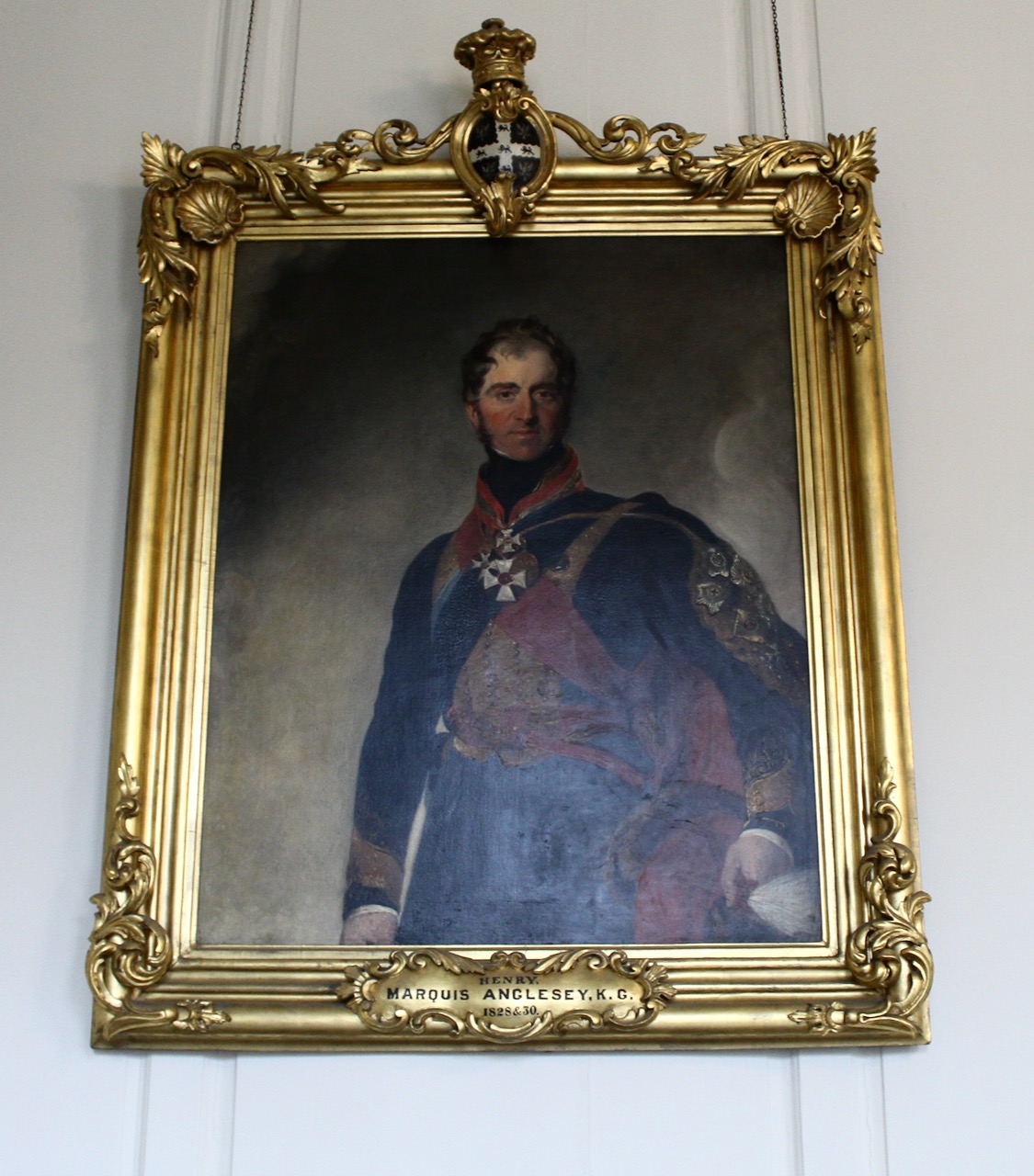
By 1778 the building was ruinous. The task of repair and preservation was begun by the Henry Paget the 1st Marquess of Anglesey in the later nineteenth century (he served as Lord Lieutenant of Ireland from 1848, and as Master General of the Ordinance), and has been continued by the OPW. [13]

Carlingford Castle Co Louth National Library of Ireland by Robert French, Lawrence Photograph Collection.
Henry Paget, 1st Marquess of Anglesey (1768-1854), Viceroy in 1828 and 1830.

5. Old Mellifont Abbey, Tullyallen, Drogheda, County Louth:

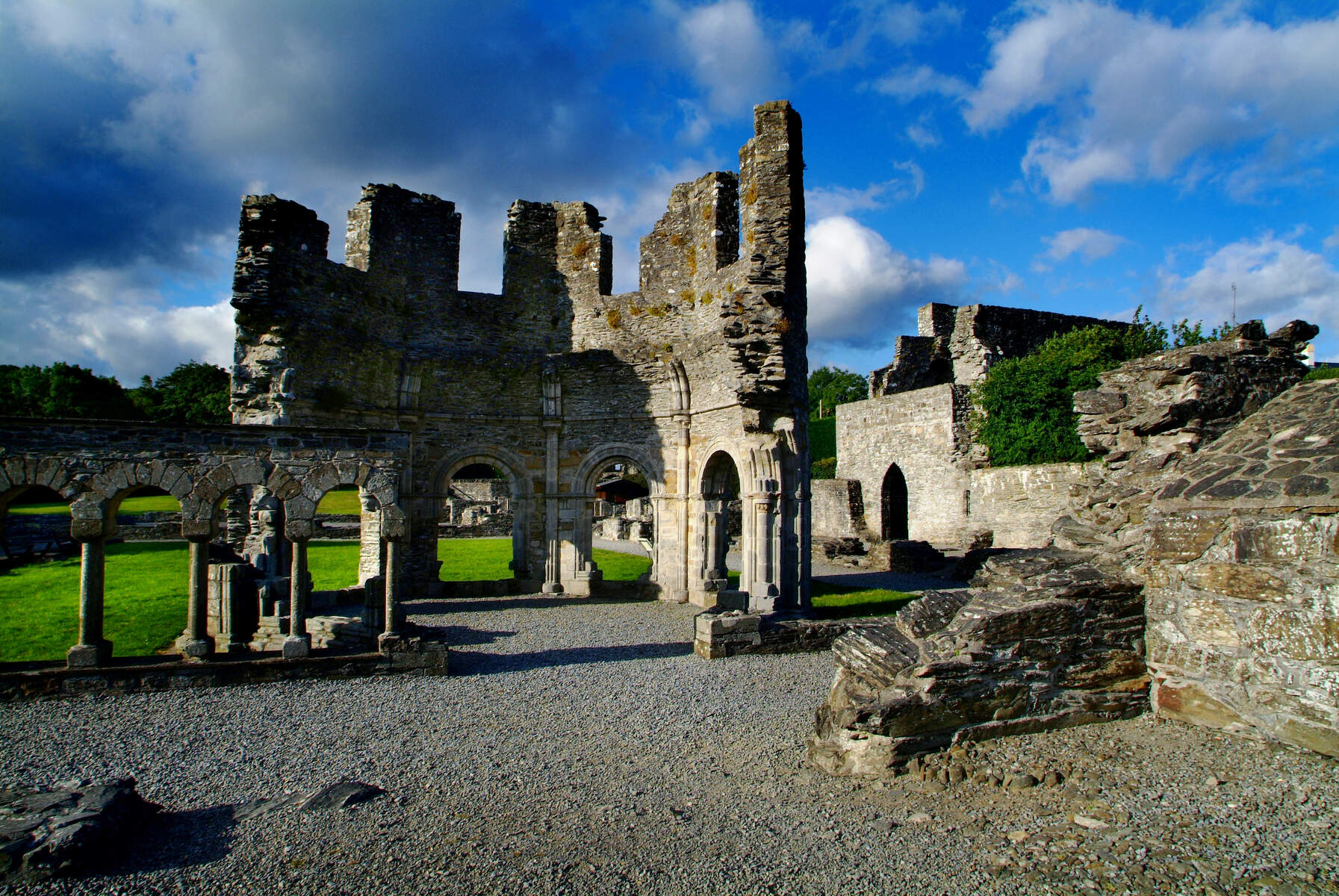
Old Mellifont Abbey, photograph by Eilish Tierney, 2020 for Fáilte Ireland, Ireland’s Content Pool. [see 6]
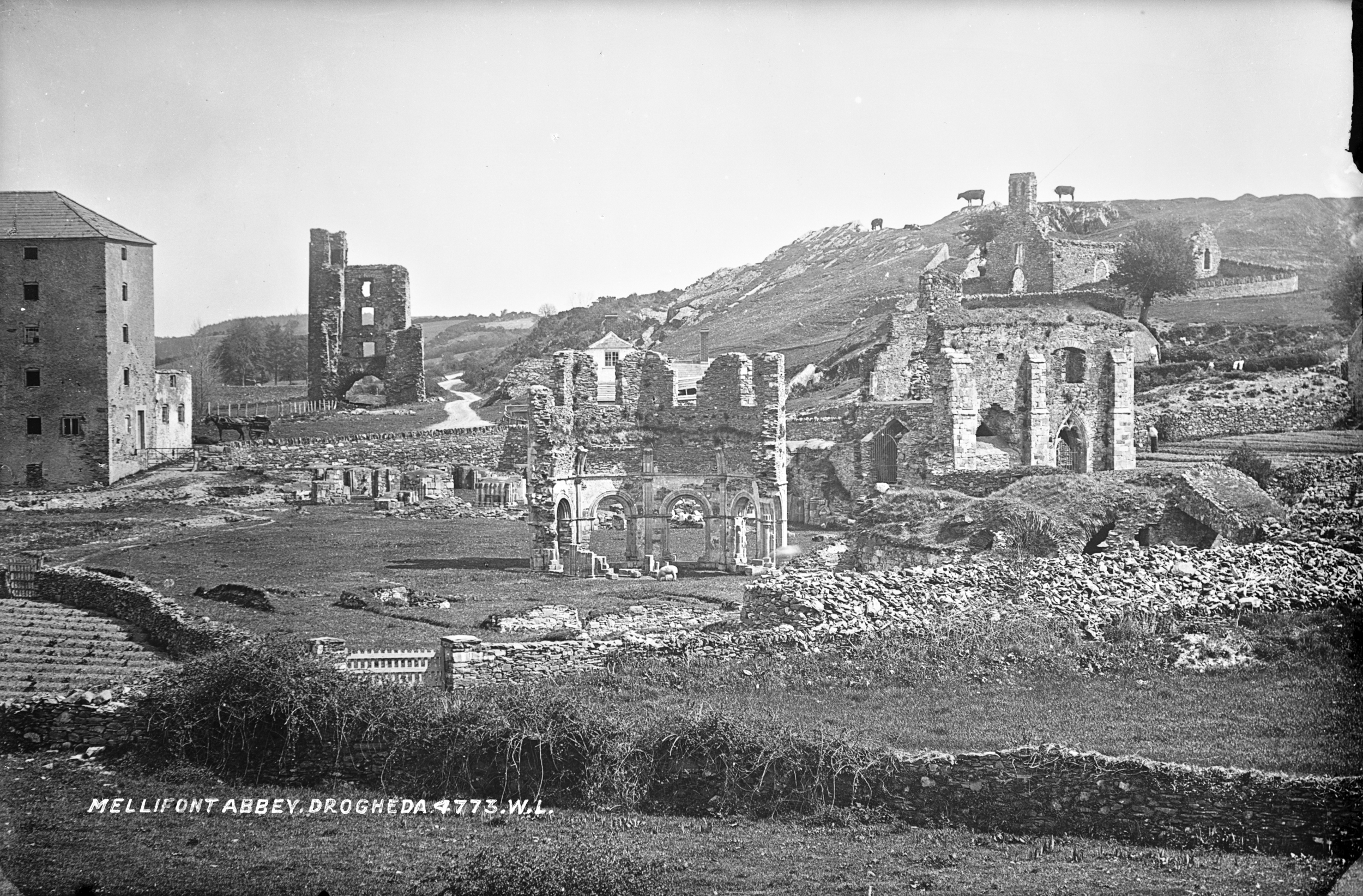
Mellifont Abbey from National Library of Ireland Lawrence photograph collection, flickr constant commons.

General enquiries: 041 982 6459, mellifontabbey@opw.ie. Mellifont means “fountain of honey.”

From the OPW website https://heritageireland.ie/visit/places-to-visit/old-mellifont-abbey/:

Mellifont Abbey was the first Cistercian monastery in Ireland. St Malachy of Armagh created it in 1142 with the help of a small number of monks sent by St Bernard from Clairvaux [and with the aid of Donough O’Carroll, King of Oriel – see 14]. The monks did not take well to Ireland and soon returned to France, but the abbey was completed anyway and duly consecrated with great pomp.

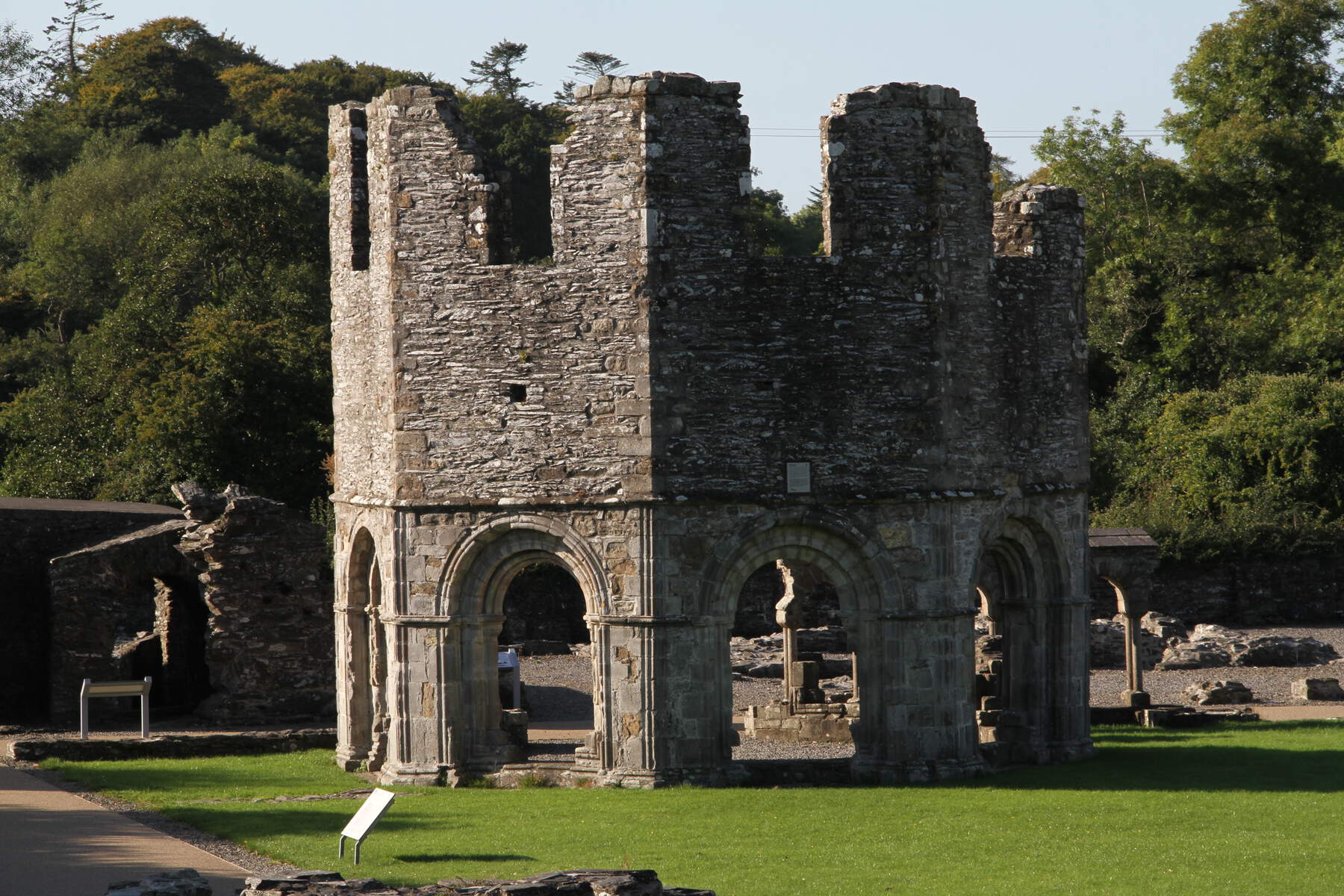
It has several extraordinary architectural features, the foremost of which is the two-storey octagonal lavabo [the monk’s washroom]

The monks at Mellifont hosted a critical synod in 1152. The abbey was central to the history of later centuries, too, even though it was in private hands by then. The Treaty of Mellifont, which ended the Nine Years War, was signed here in 1603, and William of Orange used the abbey as his headquarters during the momentous Battle of the Boyne.

Mellifont Abbey ruins, the octagonal lavabo, built in around 1200, photograph by Brian Harte, 2015 for Tourism Ireland, Ireland’s Content Pool. [see 6]

The ruins contain the medieval gatehouse, parish church, chapter house and lavabo. The octagonal lavabo was designed as a freestanding structure of two storeys, with an octagonal cistern to supply the water located at the upper level over the wash room. Wash basins were arranged around a central pier, now gone, which supported the weight of the water above. [14] The entire monastery was surrounded by a defensive wall. After the dissolution of the monasteries, Mellifont was acquired in 1540 by William Brabazon (died 1552), Vice Treasurer of Ireland, and passed later to Edward Moore (Brabazon’s wife Elizabeth Clifford remarried three times after Brabazon’s death, and one of her husbands was Edward Moore), who established a fortified house within the ruins around 1560. His descendents (Viscounts of Drogheda) lived there until 1727 (until the time of Edward Moore, 5th Earl of Drogheda), after which the house, like the abbey, fell into disrepair.

Garret Moore, 1st Viscount of Drogheda, hosted the negotiations which led to the Treaty of Mellifont in 1603.

Mellifont Abbey ruins, photograph by Chris Hill, 2014 for Tourism Ireland, Ireland’s Content Pool. [see 6]

Meath:

Photograph © Jennifer Winder-Baggot, www.irishhistorichouses.com

6. Battle of the Boyne site and visitor centre, Oldbridge House, County Meath.

Oldbridge House, County Meath, October 2019. Photograph © Jennifer Winder-Baggot, www.irishhistorichouses.com

General Enquiries: 041 980 9950, battleoftheboyne@opw.ie

The Battle of the Boyne museum is housed in Oldbridge Hall, which is built on the site where the Battle of the Boyne took place. See my entry https://irishhistorichouses.com/2025/12/12/oldbridge-hall-county-meath-site-of-the-battle-of-the-boyne-visitor-centre/

7. Loughcrew Cairns, Corstown, Oldcastle, County Meath:

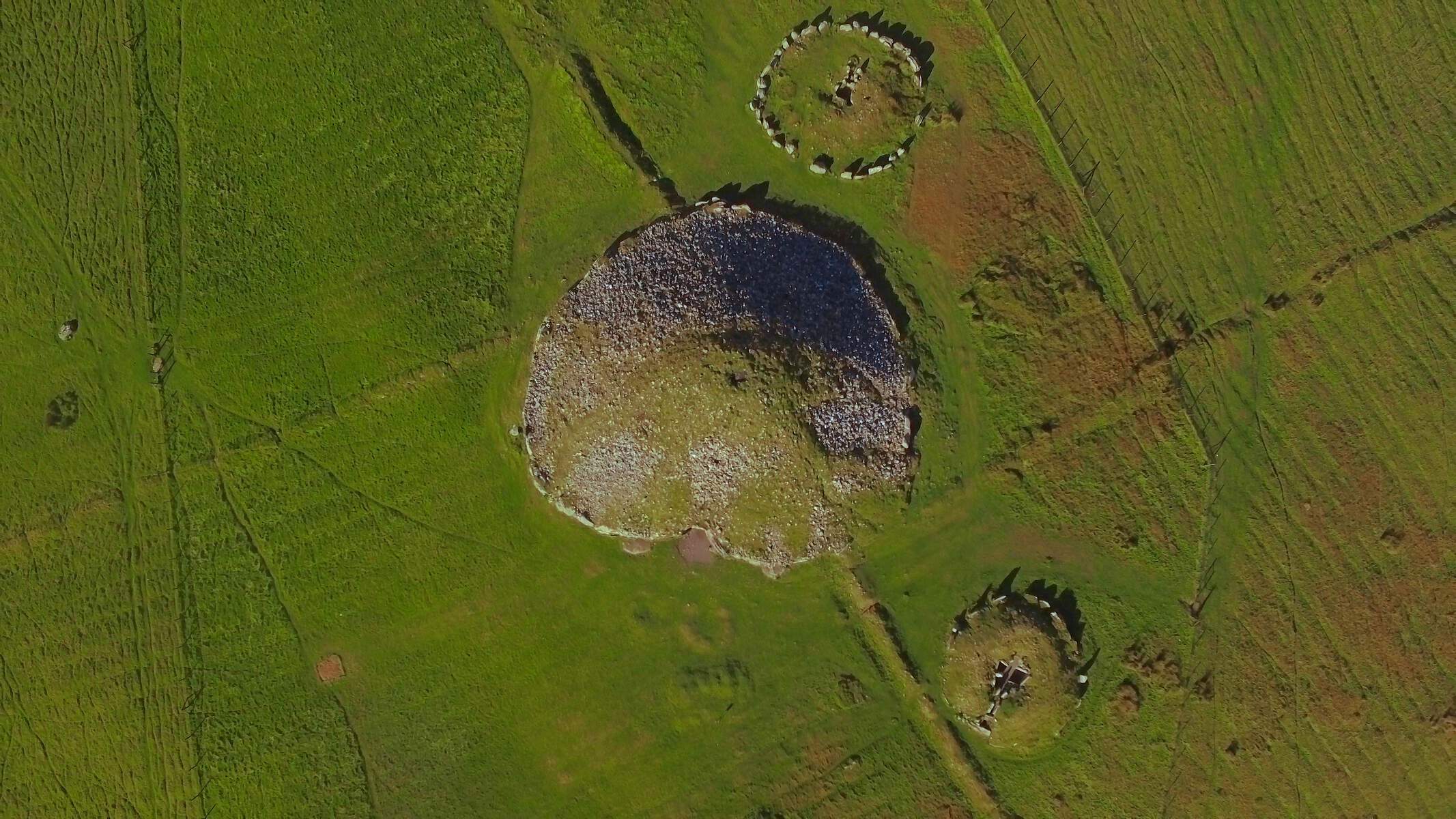
Loughcrew cairns, photograph by Macmillan media, 2015 for Tourism Ireland, Ireland’s Content Pool. [see 6]

general enquiries: 087 052 4975, info@heritageireland.ie

From the OPW website https://heritageireland.ie/visit/places-to-visit/loughcrew-cairns/:

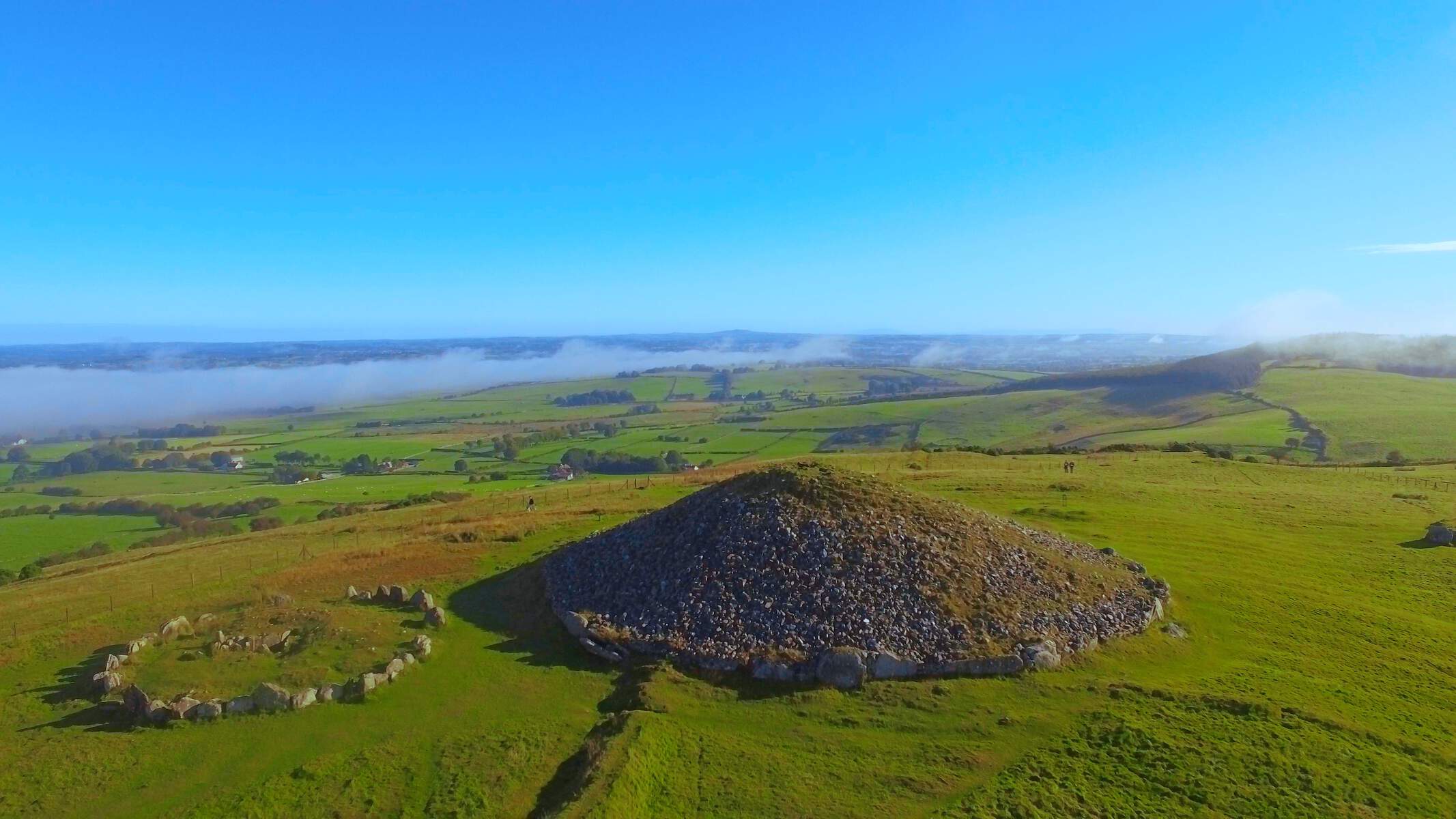
The Loughcrew cairns, also known as the Hills of the Witch, are a group of Neolithic passage tombs near Oldcastle in County Meath. Spread over four undulating peaks, the tombs are of great antiquity, dating to 3000 BC. 

Cairn T is one of the largest tombs in the complex. Inside it lies a cruciform chamber, a corbelled roof and some of the most beautiful examples of Neolithic art in Ireland. The cairn is aligned to sunrise at the spring and autumn equinoxes and at these times people gather there to greet the first rays of the sun.

Loughcrew cairns, photograph by Macmillan media, 2015 for Tourism Ireland, Ireland’s Content Pool. [see 6]
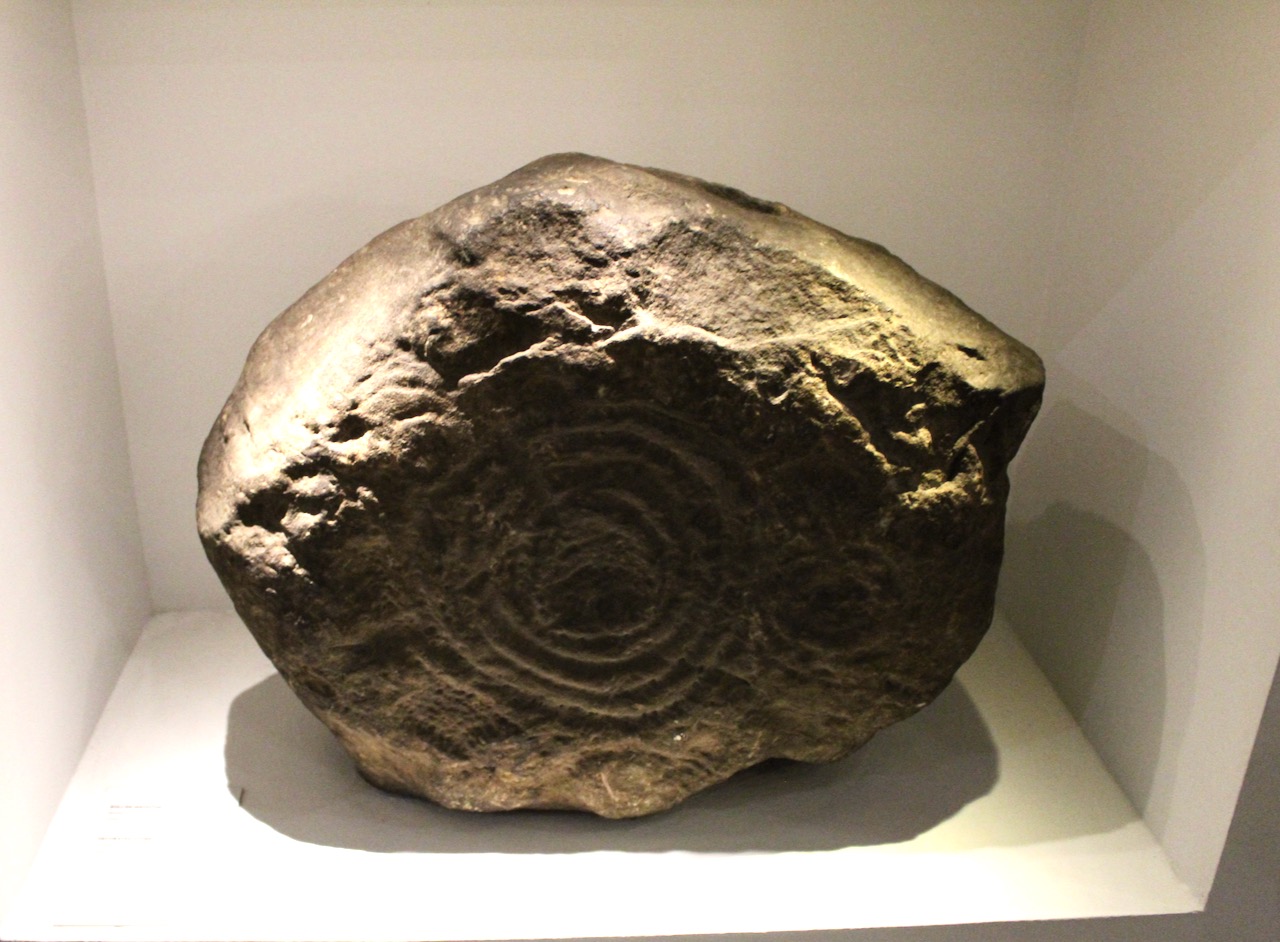
Carved stone from Loughcrew, in the National Museum of Ireland, Kildare Street, Dublin. Photograph © Jennifer Winder-Baggot, www.irishhistorichouses.com

8. Brú na Bóinne Visitor Centre, Newgrange and Knowth, County Meath.

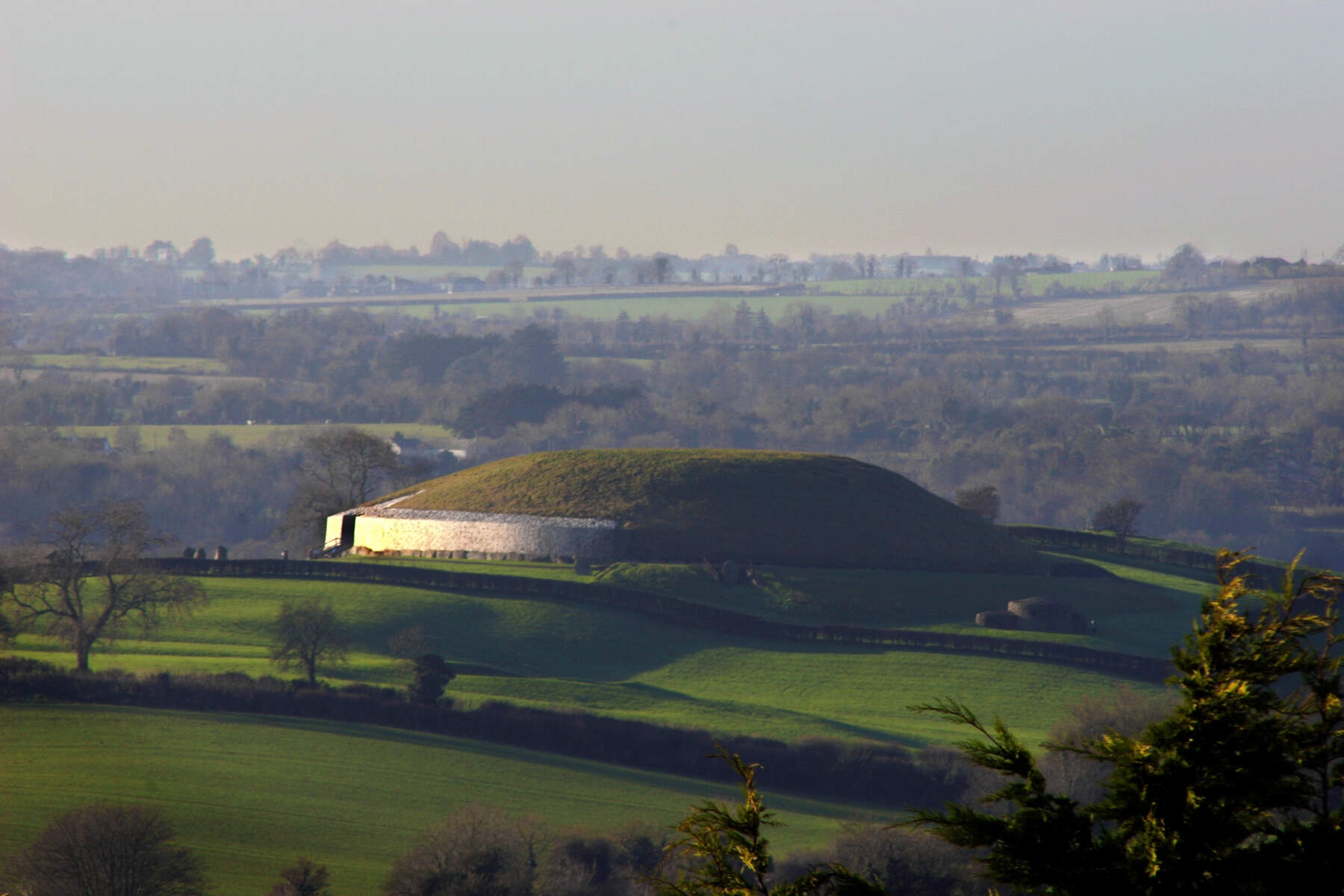
Newgrange, seen from the top of another nearby tumulus, Dowth. Newgrange is a UNESCO World Heritage Site, and dates to some 5,000 years ago…Photograph by Dave Walsh, 2004 for Tourism Ireland. [see 6]

General Information: 041 988 0300, brunaboinne@opw.ie

From the website https://heritageireland.ie/visit/places-to-visit/bru-na-boinne-visitor-centre-newgrange-and-knowth/:

The World Heritage Site of Brú na Bóinne is Ireland’s richest archaeological landscape and is situated within a bend in the River Boyne. Brú na Bóinne is famous for the spectacular prehistoric passage tombs of Knowth, Newgrange and Dowth which were built circa 3200BC. These ceremonial structures are among the most important Neolithic sites in the world and contain the largest collection of megalithic art in Western Europe.

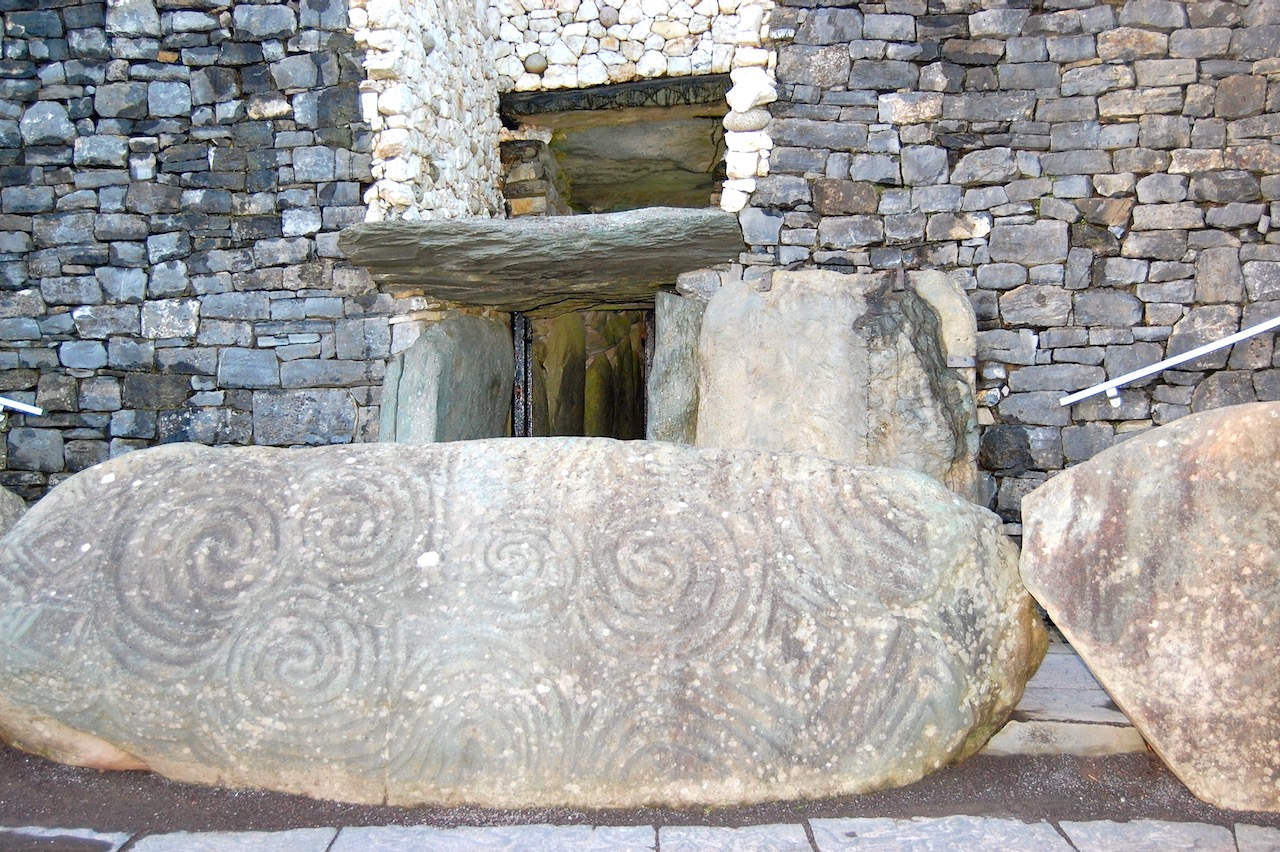
Newgrange, County Meath, December 2013. Photograph © Jennifer Winder-Baggot, www.irishhistorichouses.com
Newgrange, Co Meath, Ireland, photograph by Brian Morrison, 2018 for Tourism Ireland, Ireland’s Content Pool. [see 6]
Newgrange, Co Meath , Ireland, photograph by Brian Morrison, 2018 for Tourism Ireland, Ireland’s Content Pool. [see 6]
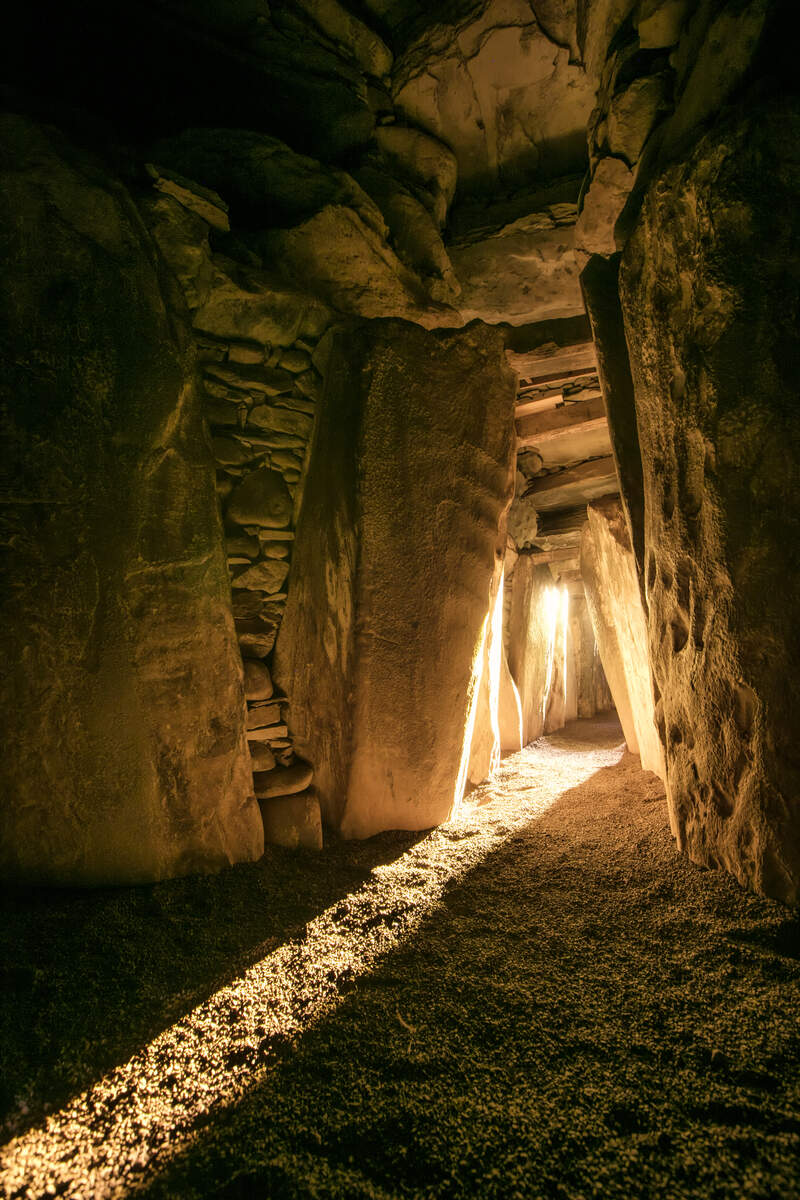
Winter Solstice, Newgrange, Co Meath , Ireland, photograph by Brian Morrison, 2018 for Tourism Ireland, Ireland’s Content Pool. [see 6]

9. Hill of Tara, Navan, County Meath:

Hill of Tara, County Meath, photograph by macmillan media 2015 for Tourism Ireland, Ireland’s Content Pool. [see 6]
Diorama of Tara in the National Museum of Ireland, Kildare Street, Dublin, 2022. Key: 2. Rath/Fort of the Kings, a hilltop enclosure; 3: Royal Seat, a barrow; 4. Cormac’s House, a ringfort; 5. Stone of Destiny, Liah Fail, a standing stone; 6. Mound of the Hostages, a passage tomb; 7. Rath of the Synods, an enclosure; 8. Banqueting Hall, a linear earthwork.

General information: 046 902 5903, hilloftara@opw.ie

From the OPW website:

The Hill of Tara has been important since the late Stone Age, when a passage tomb was built there. However, the site became truly significant in the Iron Age (600 BC to 400 AD) and into the Early Christian Period when it rose to supreme prominence – as the seat of the high kings of Ireland. All old Irish roads lead to this critical site.

St Patrick himself went there in the fifth century. As Christianity achieved dominance over the following centuries, Tara’s importance became symbolic. Its halls and palaces have now disappeared and only earthworks remain. 

There are still remarkable sights to be seen, however. Just one example is the Lia Fáil – the great coronation stone and one of the four legendary treasures of the Tuatha Dé Danann – which stands proudly on the monument known as An Forradh.

Guided tours of the site will help you understand the regal history of this exceptional place and imagine its former splendour.

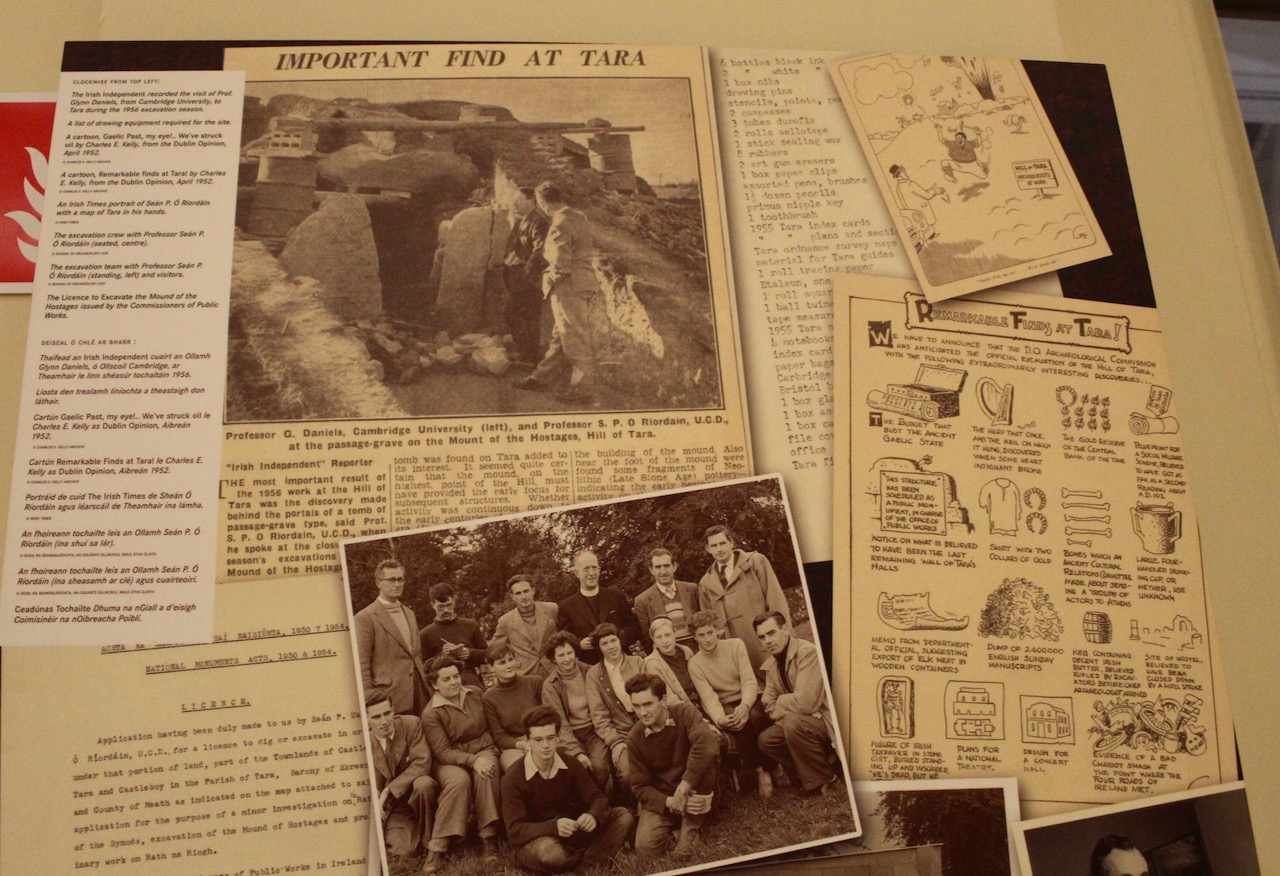
Article about the 1956 excavation of the portal tomb passage grave on the Mound of the Hostages, in the National Museum of Ireland, Kildare Street.
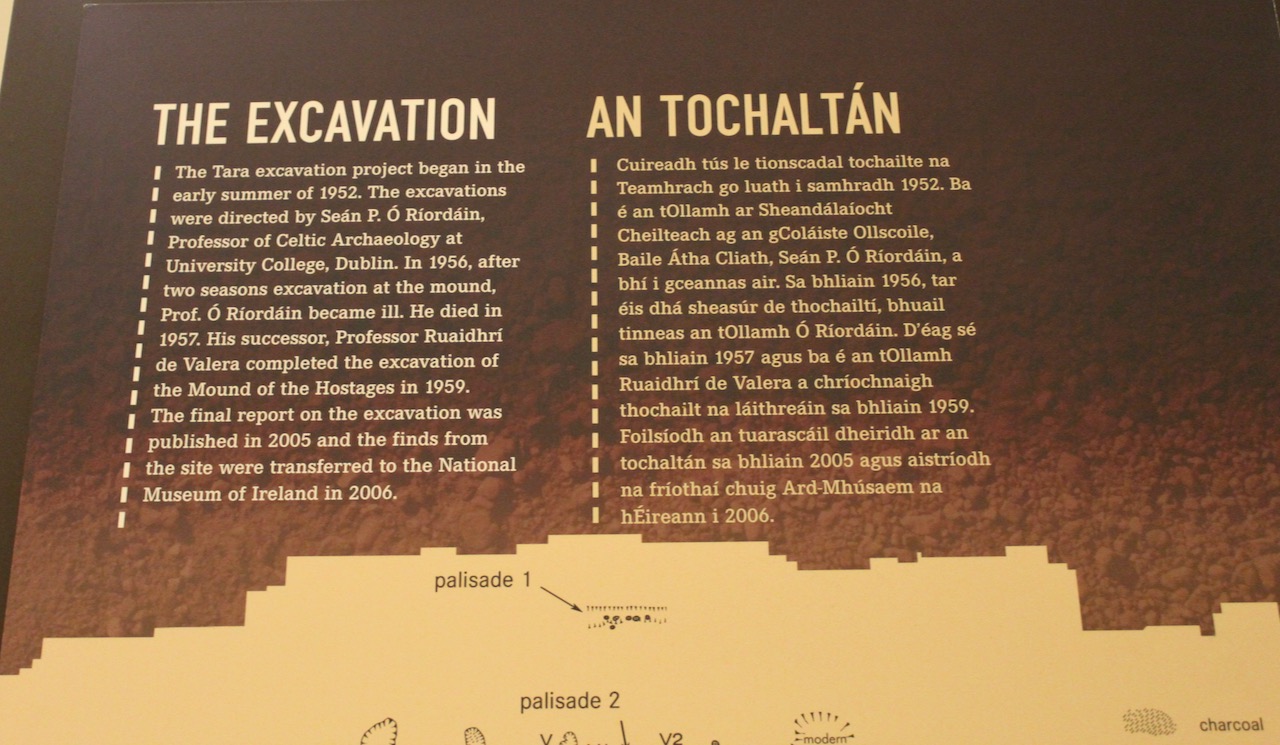
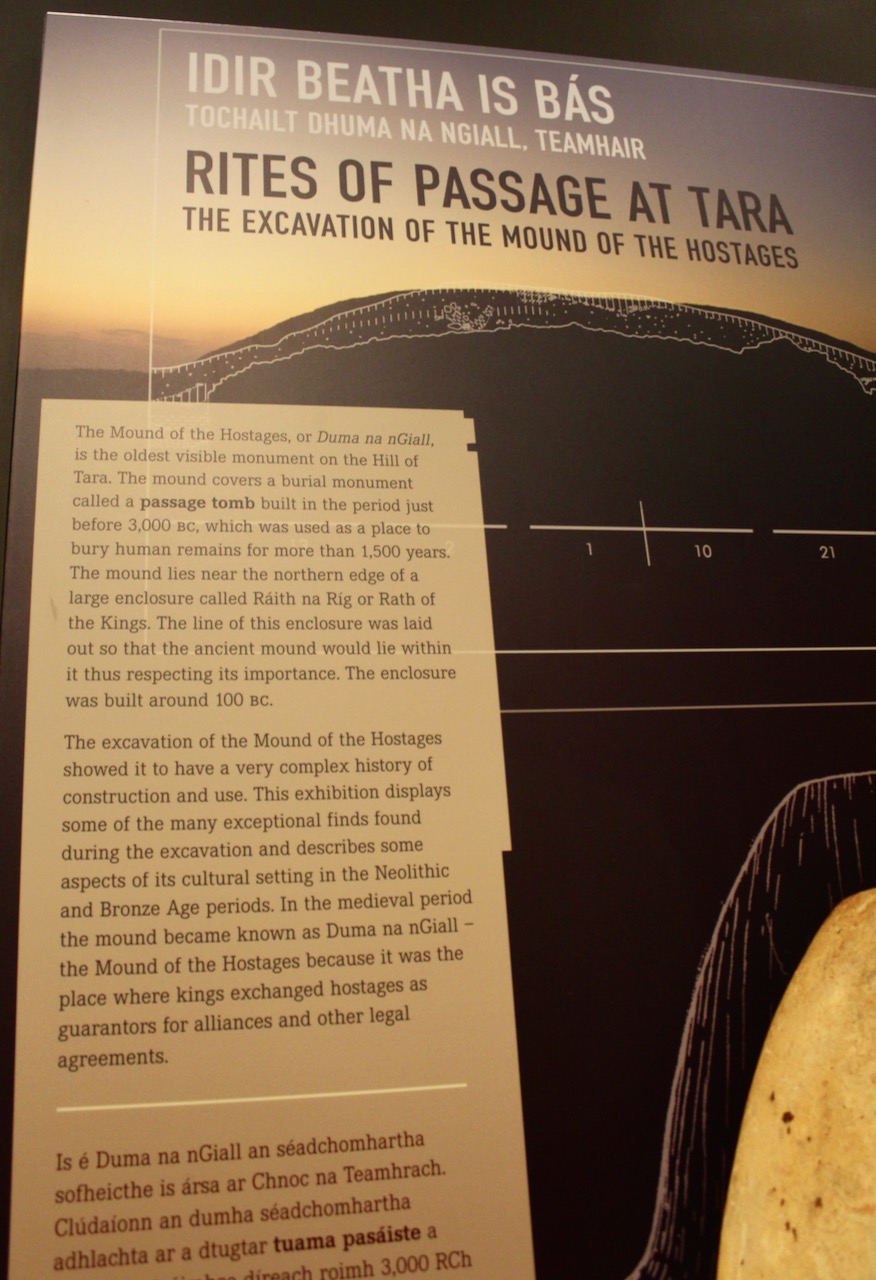
Information boards from the exhibition in the National Gallery of Ireland Kildare Street, January 2022.
Items excavated at Tara, in the National Museum of Ireland Kildare Street. Photograph © Jennifer Winder-Baggot, www.irishhistorichouses.com
Information boards from the exhibition in the National Gallery of Ireland Kildare Street, January 2022.

10. Trim Castle, County Meath:

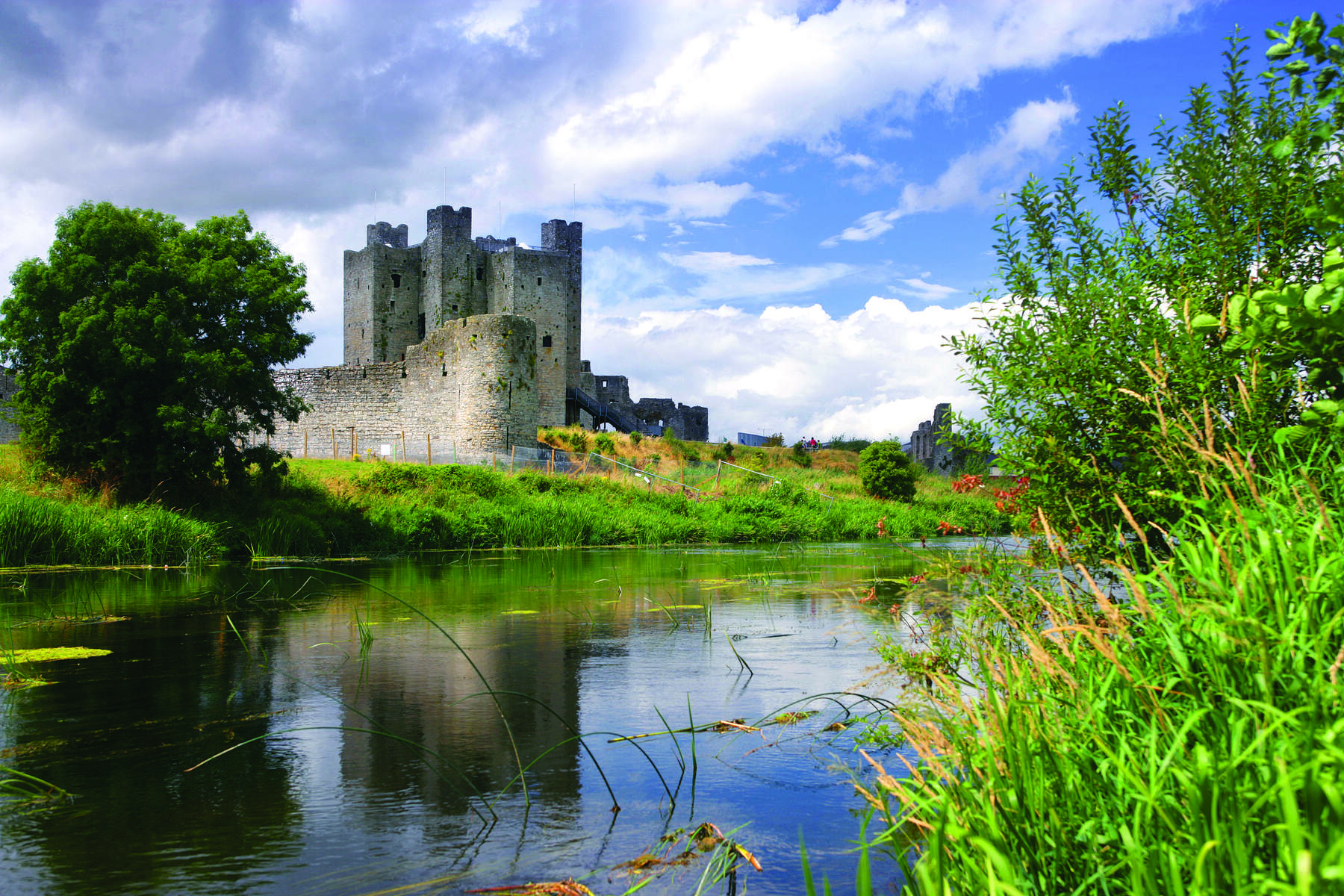
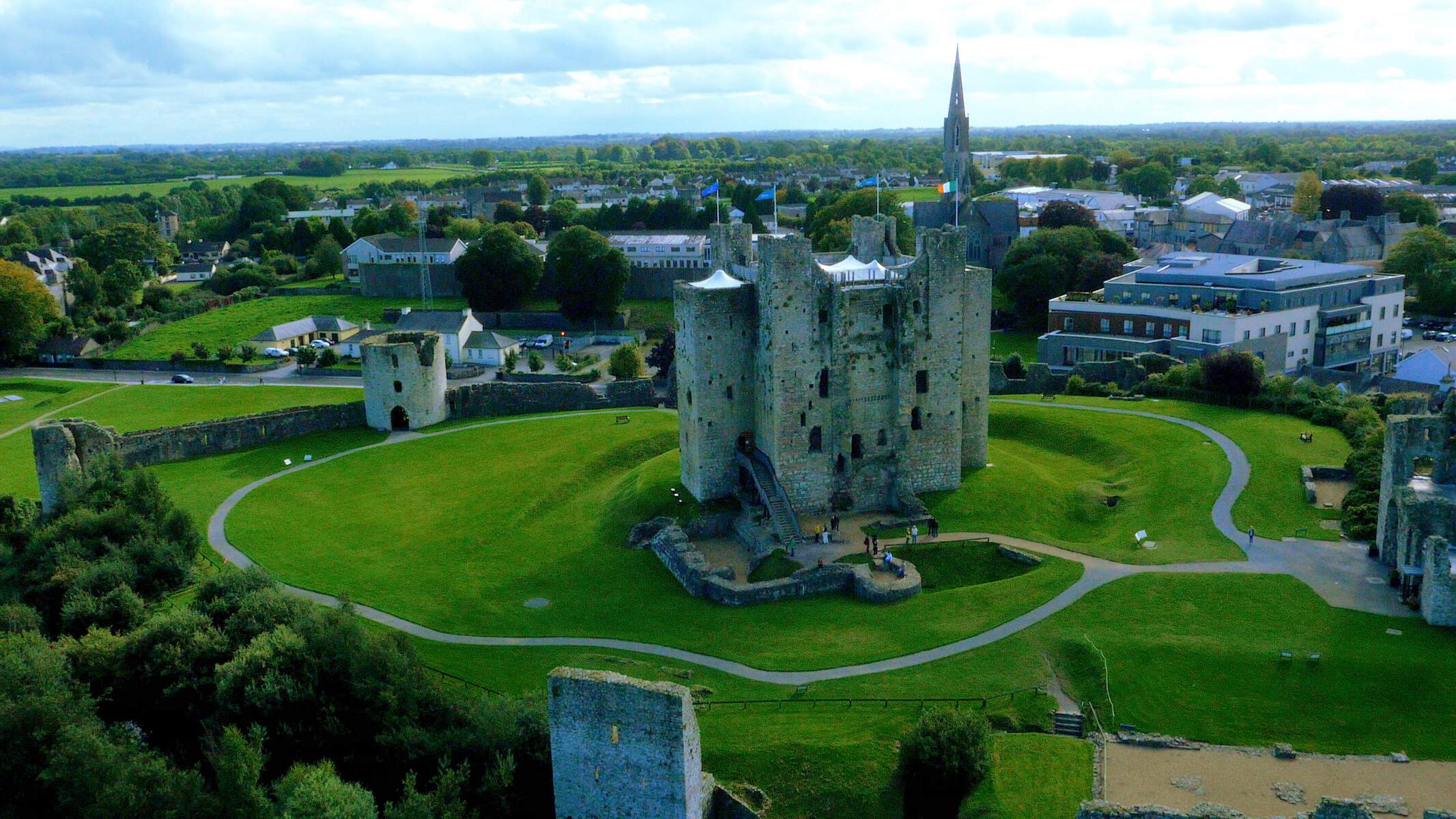
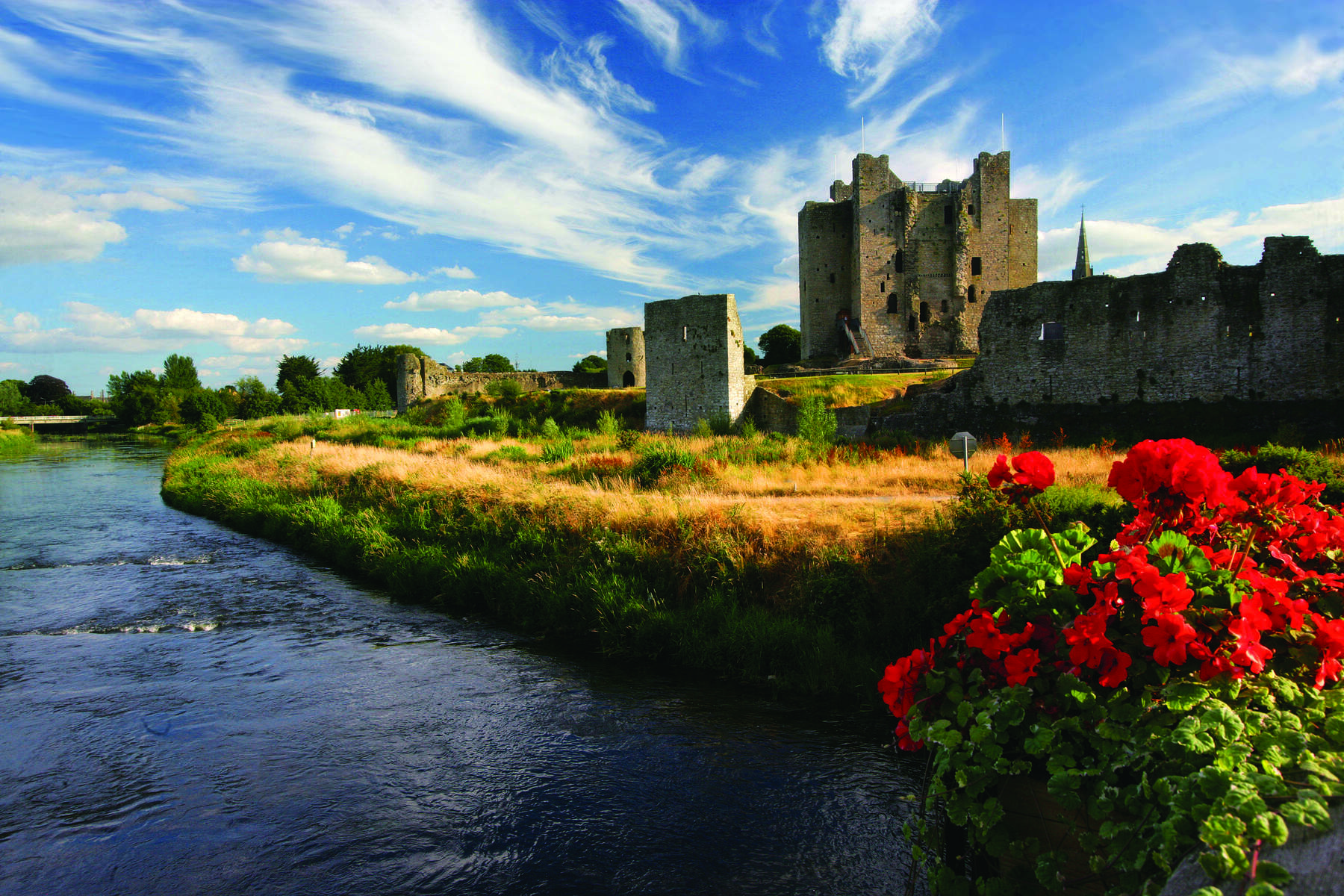
Trim Castle and the River Boyne, photograph by Brian Morrison, 2015 for Tourism Ireland, Ireland’s Content Pool. [see 6]
Trim Castle and the River Boyne, photograph by macmillan media, 2015 for Tourism Ireland, Ireland’s Content Pool. [see 6]

General information: 046 943 8619, trimcastle@opw.ie

From the OPW website https://heritageireland.ie/visit/places-to-visit/trim-castle/:

Few places in Ireland contain more medieval buildings than the heritage town of Trim. Trim Castle is foremost among those buildings.

“In fact, the castle is the largest Anglo-Norman fortification in Ireland. Hugh de Lacy and his successors took 30 years to build it.

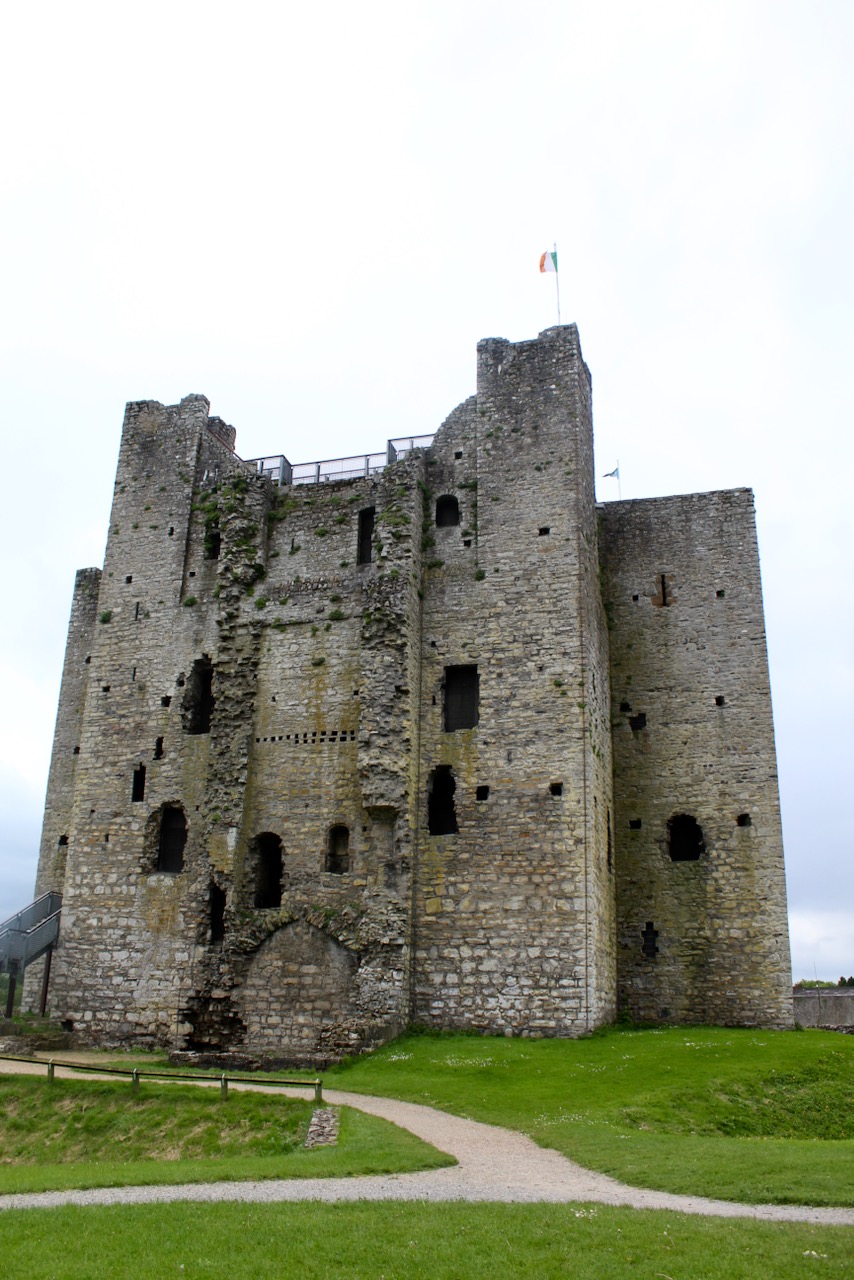
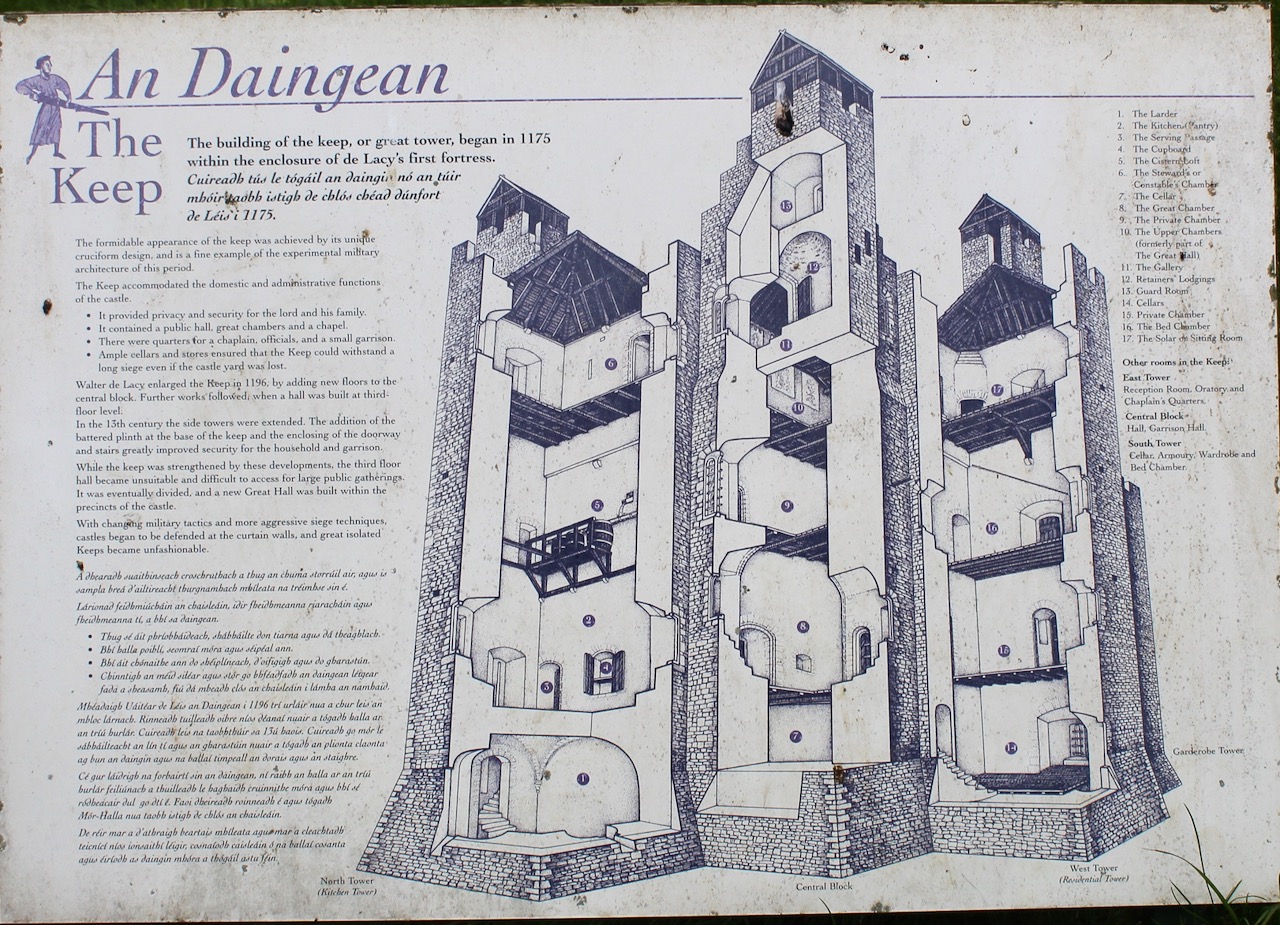
The central fortification is a monumental three-storey keep. This massive 20-sided tower, which is cruciform in shape, was all but impregnable in its day. It was protected by a ditch, curtain wall and water-filled moat.

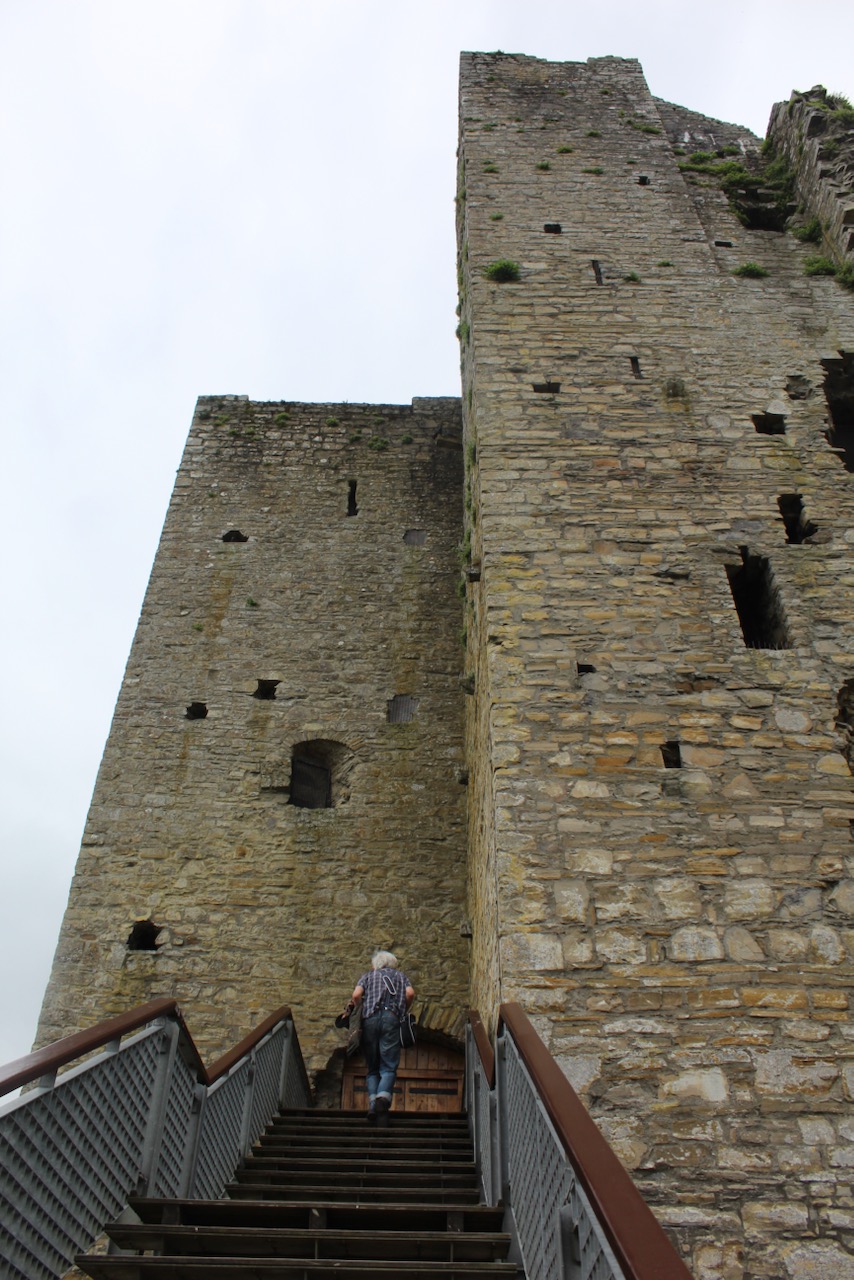
Modern walkways now allow you to look down over the interior of the keep – a chance to appreciate the sheer size and thickness of the mighty castle walls.

The castle is often called King John’s Castle although when he visited the town he preferred to stay in his tent on the other side of the river. Richard II visited Trim in 1399 and left Prince Hal later Henry V as a prisoner in the castle.” I never knew we had such a link to King Henry V and Shakespeare’s play, Henry IV!

Trim Castle and the River Boyne, photograph by Brian Morrison, 2006 for Tourism Ireland, Ireland’s Content Pool. [see 6]

Patrick Comerford gives an excellent history of Trim Castle in his blog. [18] The castle stands within a three acre bailey, surrounded by a defensive perimeter wall. The curtain wall of the castle is fortified by a series of semicircular open-back towers. There were two entrances to Trim Castle, one, beside the car park, is flanked by a gatehouse, and the second is a barbican gate and tower. [19]

We visited in May 2022, after visiting St. Mary’s Abbey (also called Talbot’s Castle) – more on that soon. We were late entering so the entry to inside the castle was closed, unfortunately – we shall have to visit again!

Trim Castle, May 2022. Photograph © Jennifer Winder-Baggot, www.irishhistorichouses.com
The view of Trim Castle from St. Mary’s Abbey, over the Boyne River, May 2022. Photograph © Jennifer Winder-Baggot, www.irishhistorichouses.com
Trim Castle and the River Boyne, photograph by Brian Morrison, 2015 for Tourism Ireland, Ireland’s Content Pool. [see 6]
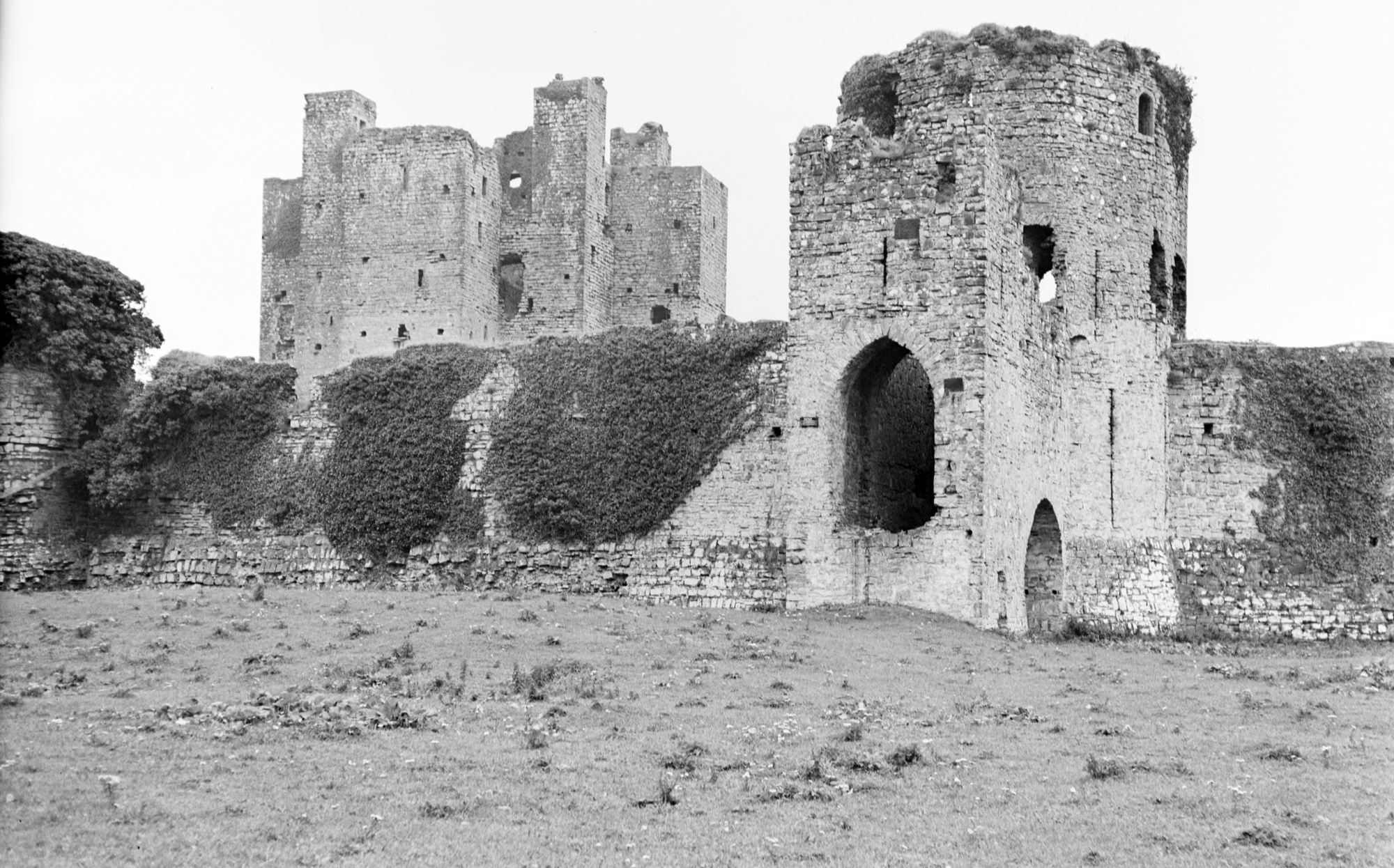
Trim Castle, Co. Meath, 1938, photograph from National Library of Ireland, flickr constant commons.
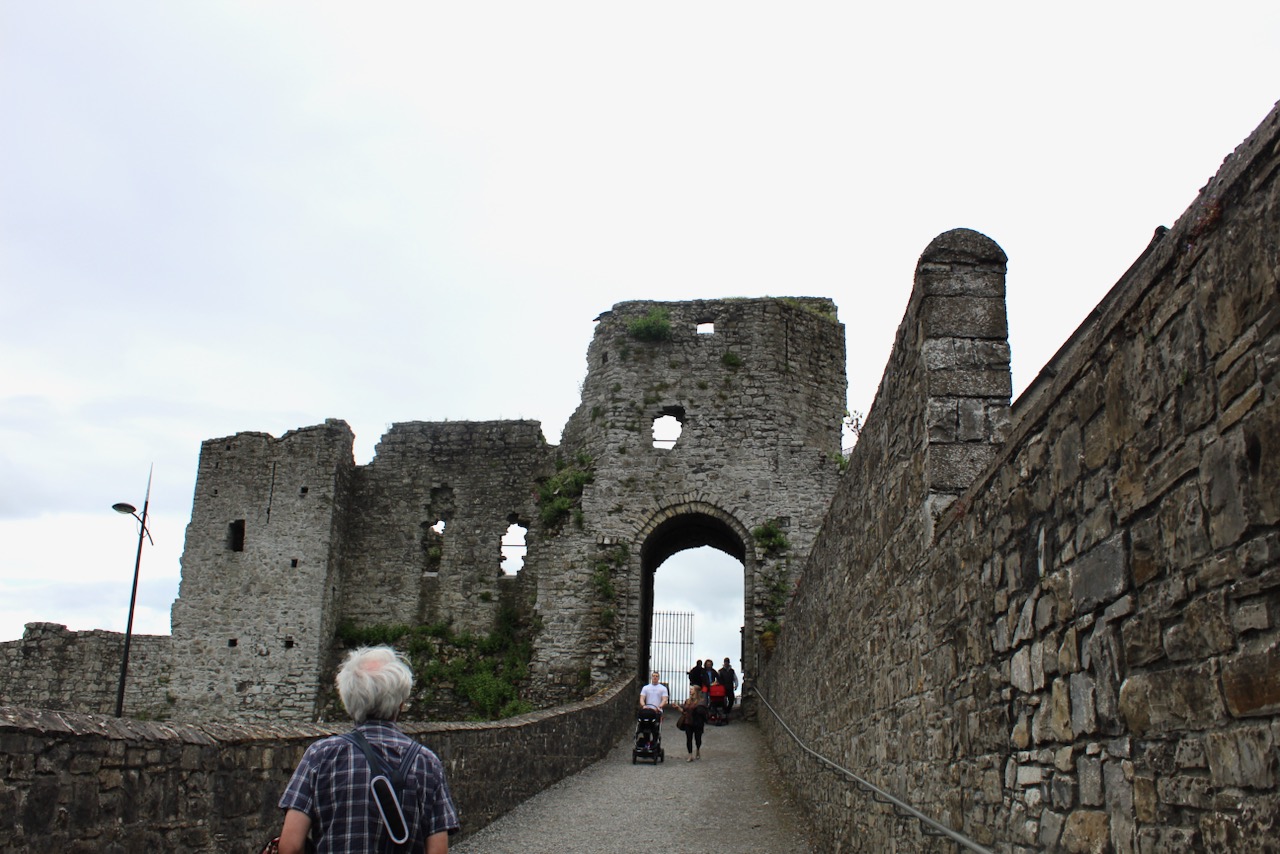
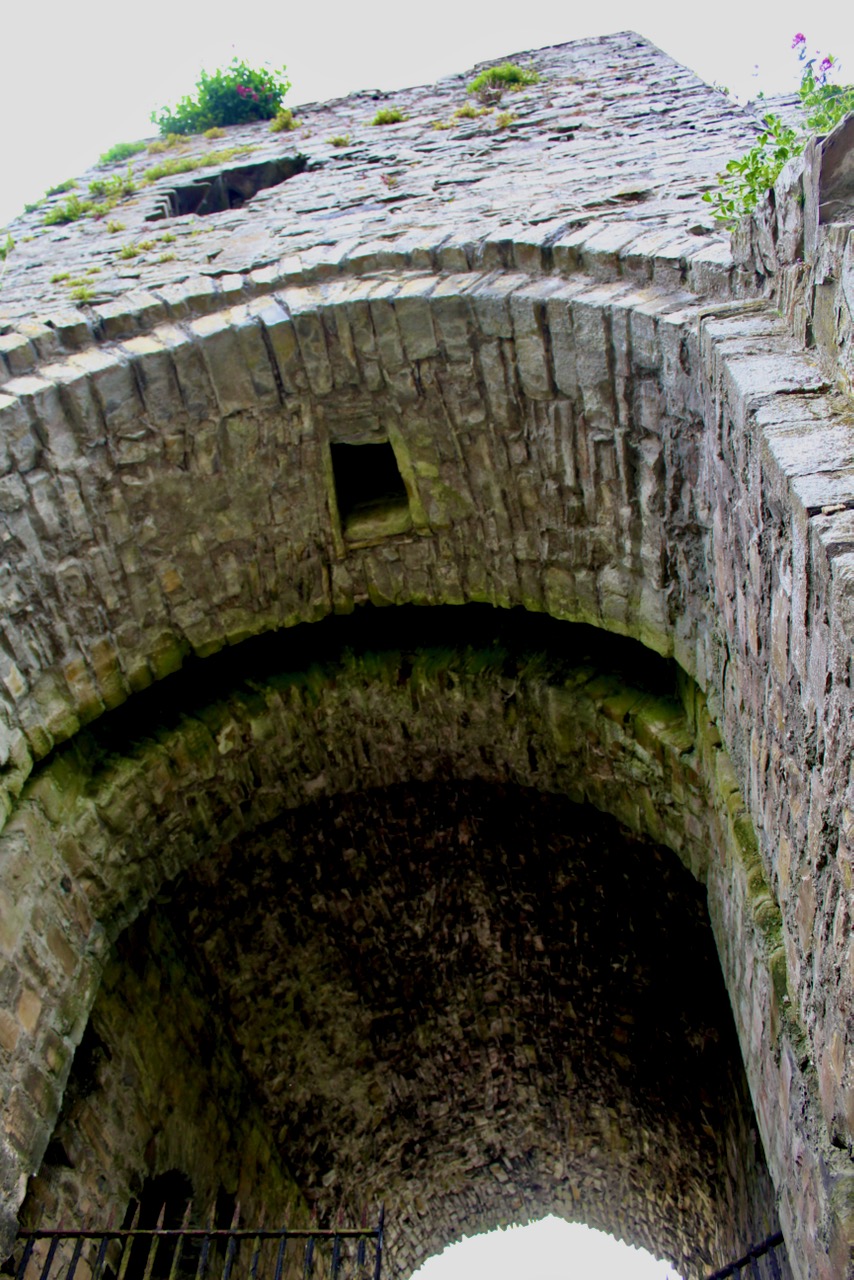
The entrance to Trim Castle, May 2022. Photograph © Jennifer Winder-Baggot, www.irishhistorichouses.com
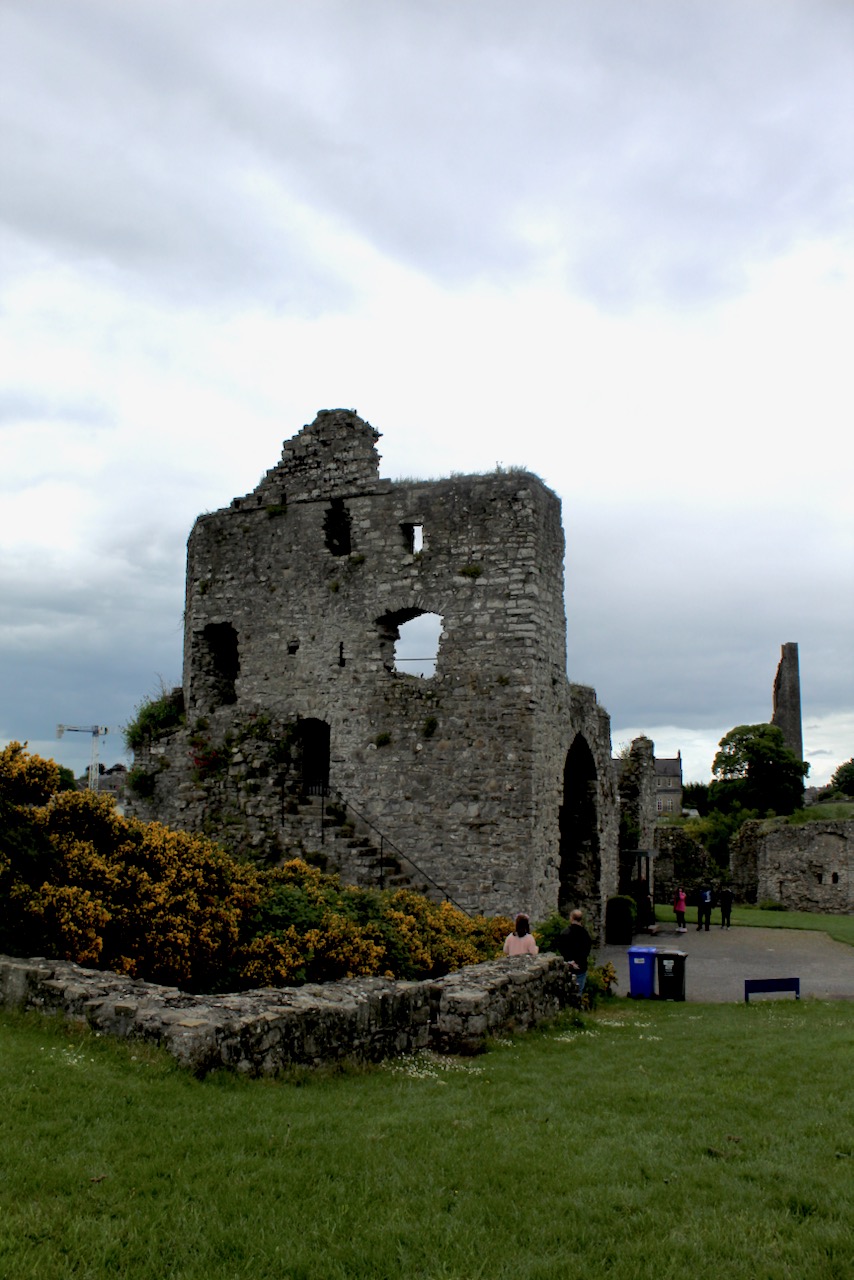
Trim Castle, May 2022. Photograph © Jennifer Winder-Baggot, www.irishhistorichouses.com
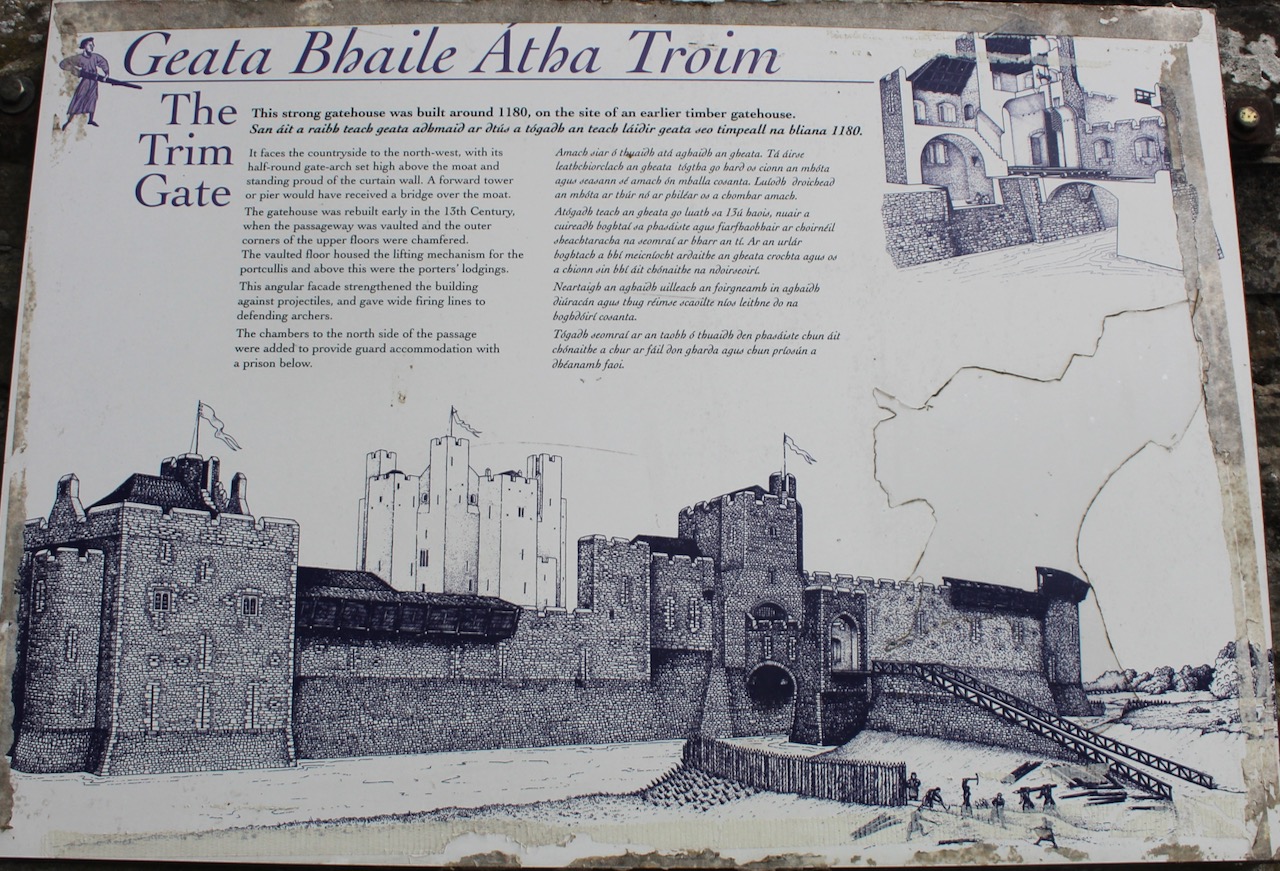
The information board tells us that the Trim Gate was built around 1180, on the site of an earlier timber gatehouse. A forward tower or pier would have received a bridge over the moat. The gatehouse was rebuilt early in the 13th century when the passageway was vaulted. The vaulted floor housed the lifting mechanism for the portcullis and above this were the porters’ lodgings. The chambers to the north side of the passage were added to provide guard accommodation with a prison below.
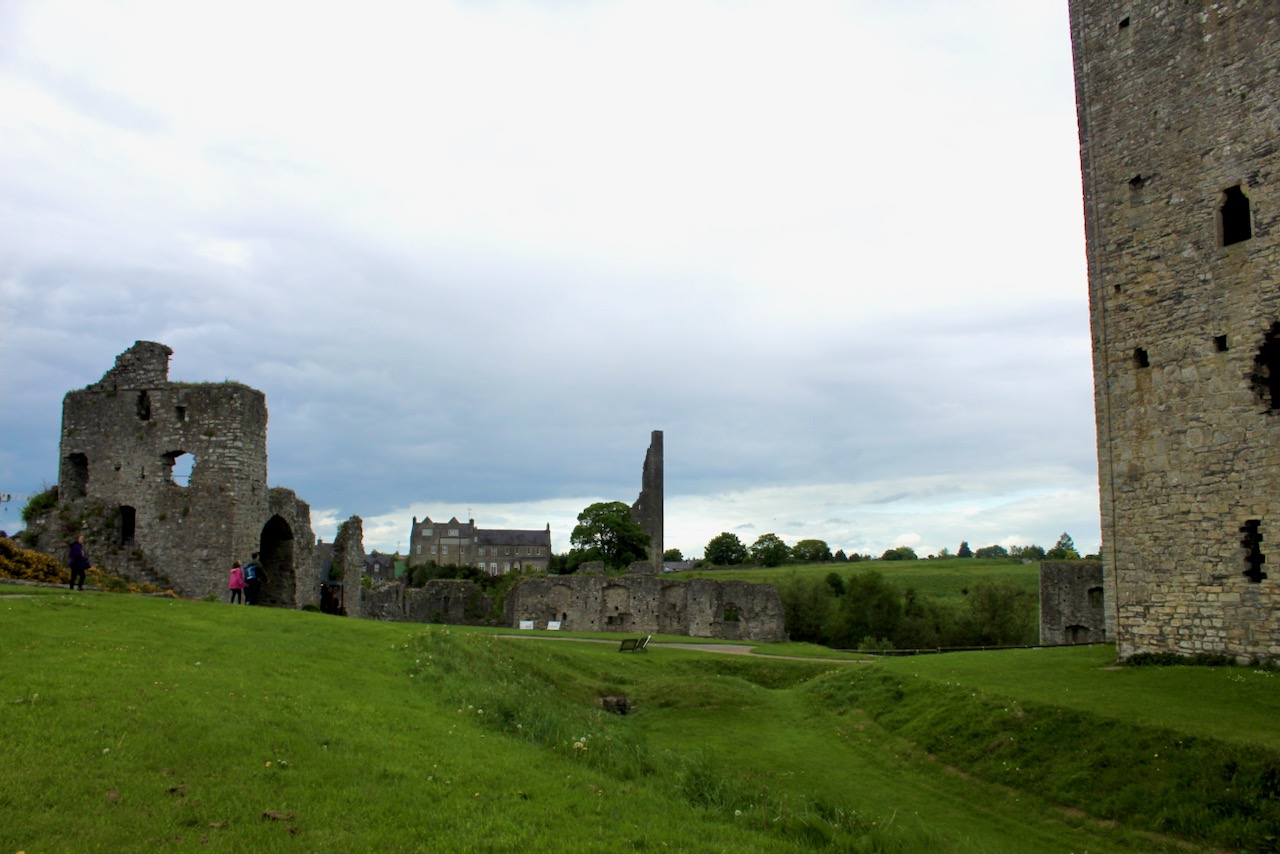
The other side of the gate through which we entered. Photograph © Jennifer Winder-Baggot, www.irishhistorichouses.com
The Keep, Trim Castle, May 2022. Photograph © Jennifer Winder-Baggot, www.irishhistorichouses.com
Inside the walls of Trim Castle, with a view of St. Mary’s Abbey house and the remaining tower of St. Mary’s Abbey. Photograph © Jennifer Winder-Baggot, www.irishhistorichouses.com
Trim Castle, May 2022.

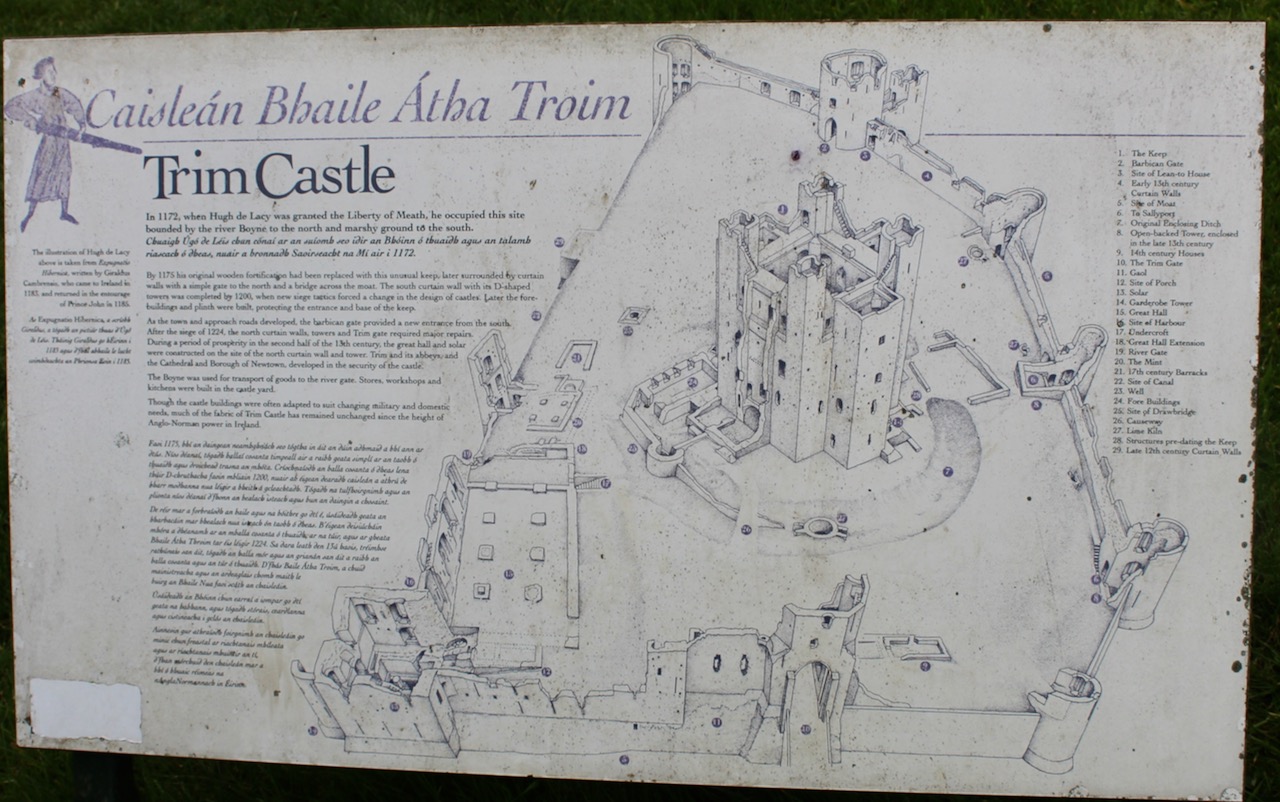
The information board tells us that in 1182 when Hugh de Lacy was granted the Liberty of Meath, he occupied this site bounded by the River Boyne to the north and marshy ground to the south. By 1175 his original wooden fortification had been replaced by this unusual keep, later surrounded by curtain walls with a simple gate to the north and a bridge across the moat. The south curtain wall with its D shaped buildings was completed by 1200, when new siege tactics forced a change in the design of castles. Later, the forebuildings and plinth were built, protecting the entrance and base of the keep.

Trim Castle, May 2022.

Sometime before 1180, Hugh de Lacy replaced the timber palisade fence enclosing the keep with a stone enclosure. The fore-court enclosed stables and stores and protected the stairway and door to the keep. The new entrance was on the north side of the enclosure and had a drawbridge over the deepened ditch.

With the development of the curtain walls, the inner enclosure became obsolete.

The ditch was filled and three defensive towers – two survive – were built on its site. The drawbridge was replaced by a stone causeway leading to an arched gate and entrance stairway. A reception hall was built to accommodate visitors before they entered the Keep.

As the town and approach roads developed, the barbican gate provided a new entrance from the south. After the siege of 1224, the north curtain walls, towers and Trim gate required major repairs. During a period of prosperity in the second half of the 13th century, the great hall and solar were constructed on the site of the north curtain wall and tower. Trim and its abbeys and the Cathedral and borough of Newtown developed in the security of the castle.

The Boyne was used for transport of goods to the river gate. Stores, workshops and kitchens were built in the castle yard.

Though the castle buildings were often adapted to suit changing military and domestic needs, much of the fabric of Trim Castle has remained unchanged since the height of Anglo-Norman power in Ireland.

The Keep, Trim Castle, May 2022. Photograph © Jennifer Winder-Baggot, www.irishhistorichouses.com
Trim Castle, May 2022.
Trim Castle, May 2022. Photograph © Jennifer Winder-Baggot, www.irishhistorichouses.com
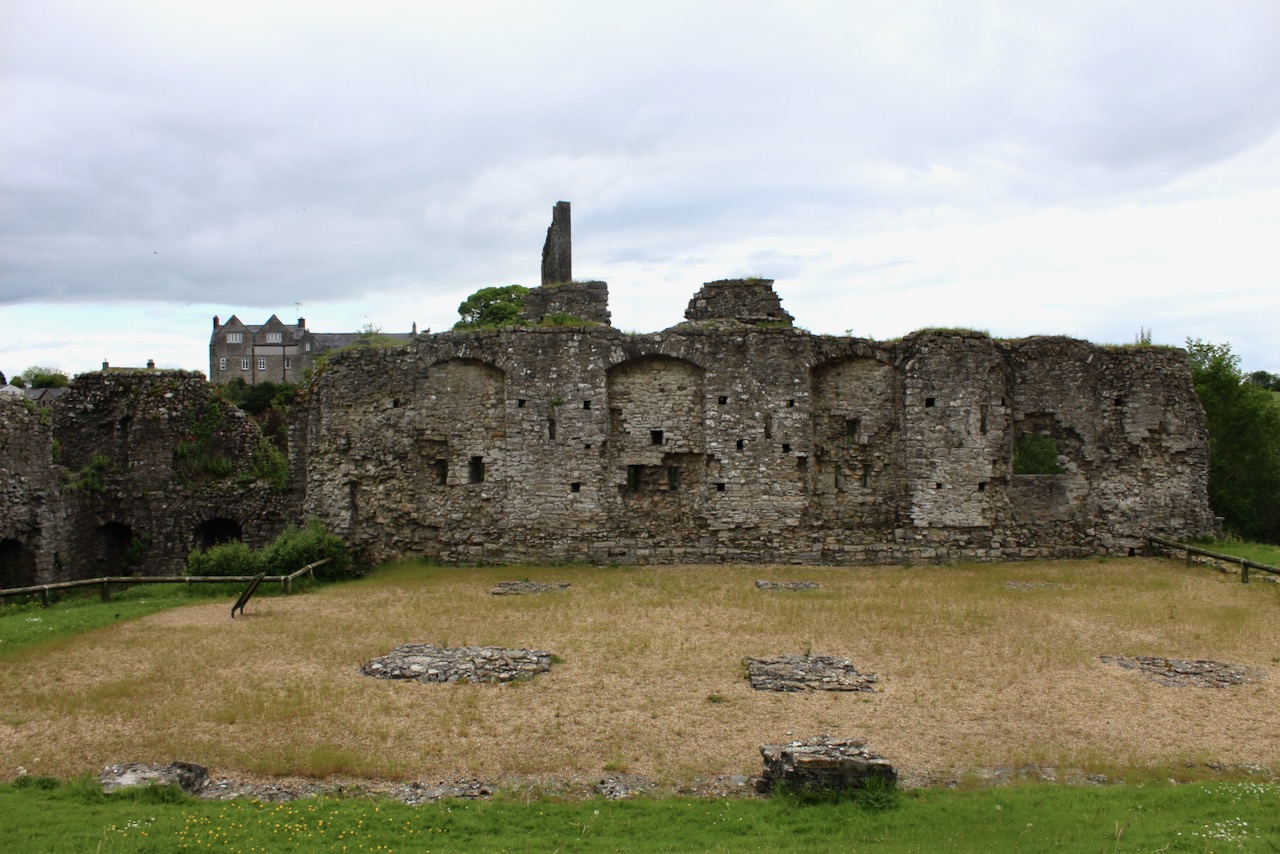
The area that was the Great Hall, Trim Castle, May 2022. Photograph © Jennifer Winder-Baggot, www.irishhistorichouses.com
Trim Castle, May 2022.

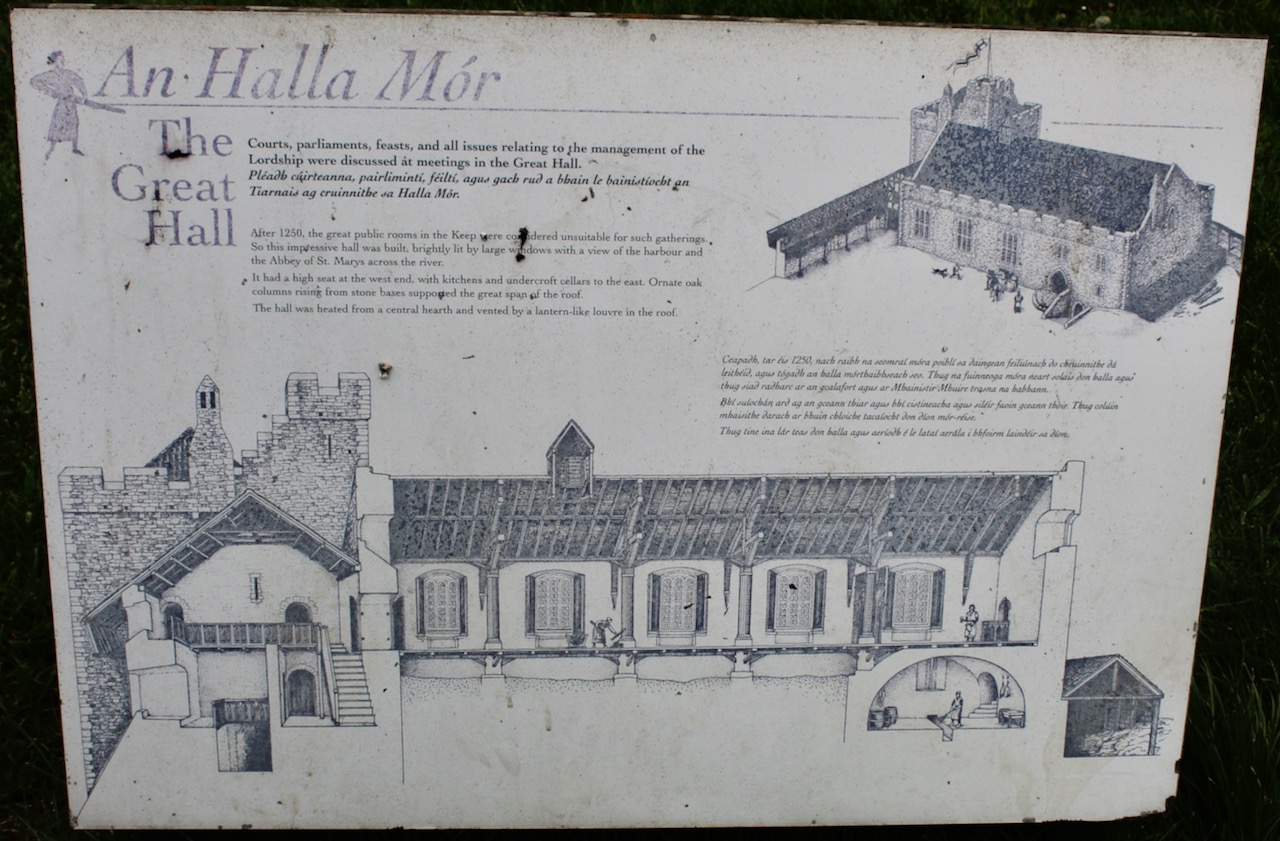
The information board tells us that courts, parliaments, feasts and all issues relating to the management of the Lordship were discussed at meetings in the Great Hall. After 1250, the great public rooms in the Keep were considered unsuitable for such gatherings, so this hall was built, lit by large windows with a view of the harbour and the Abbey of St. Mary’s across the river. The hall had a high seat at the west end, with kitchens and undercroft cellars to the east. Ornate oak columns rising from stone bases supported the great span of the roof.

The hall was heated from a central hearth and vented by a lantern-like louvre in the roof.

Trim Castle, May 2022.
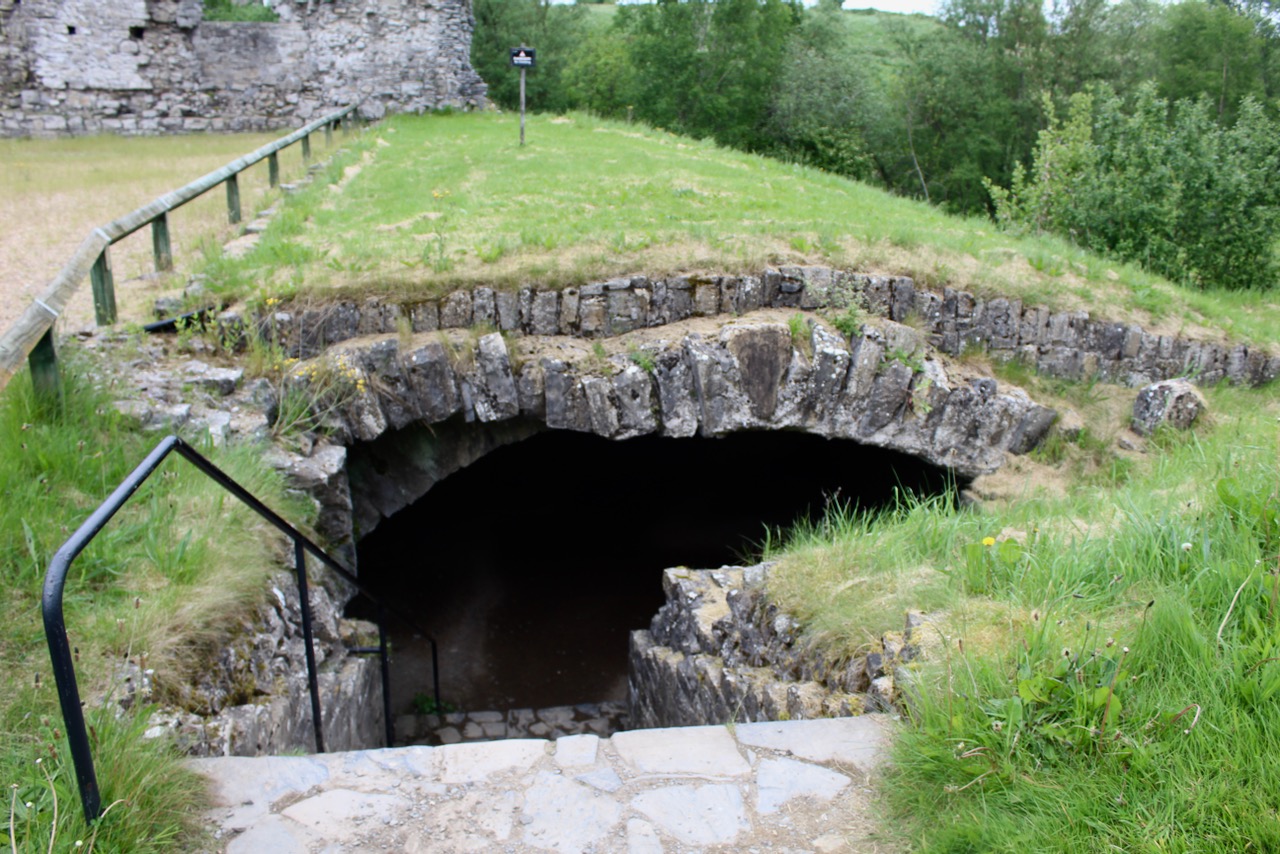
I’m not sure what this is, at Trim Castle. Photograph © Jennifer Winder-Baggot, www.irishhistorichouses.com
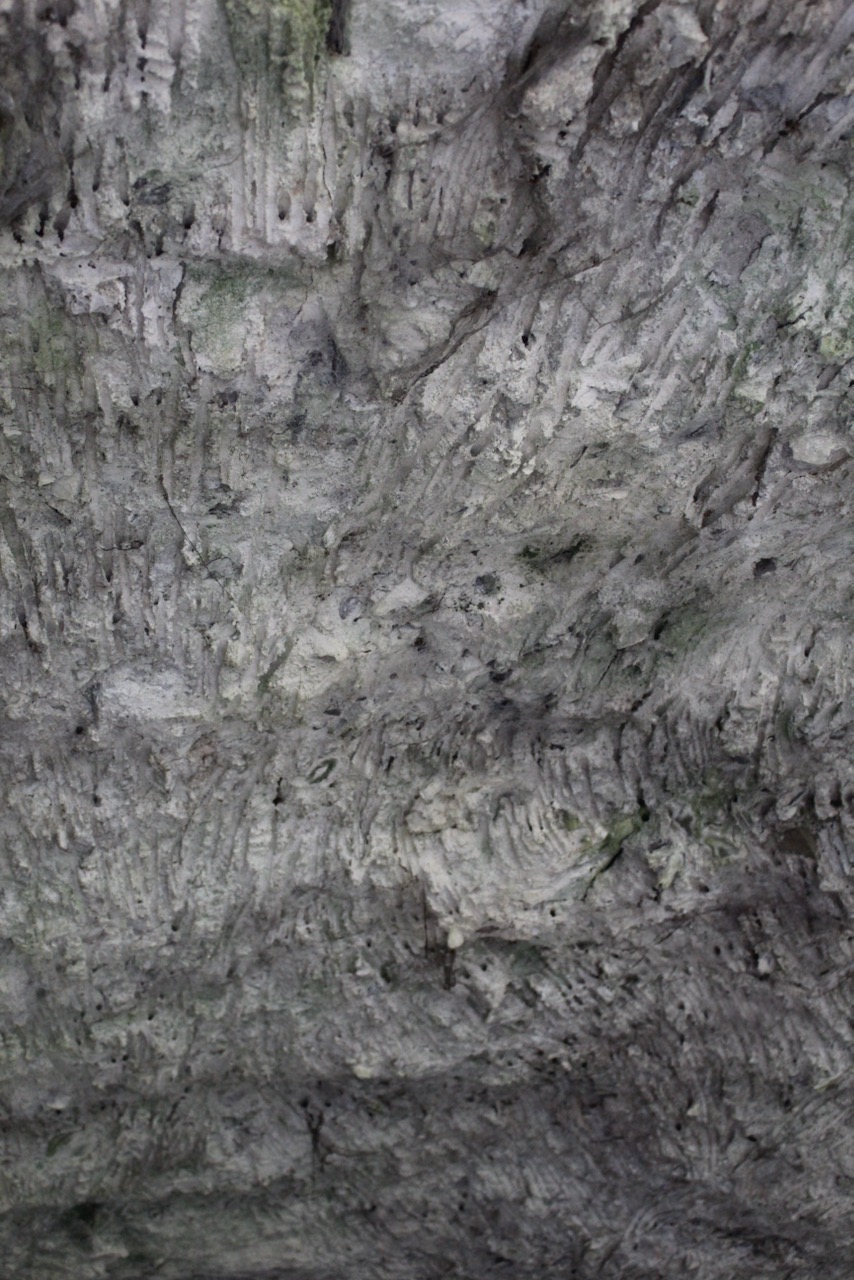
See the “scratches” or marks on the ceiling of this vaulted space – we see similar marks in the basement of St. Mary’s Abbey house. Photograph © Jennifer Winder-Baggot, www.irishhistorichouses.com
Trim Castle, May 2022. Photograph © Jennifer Winder-Baggot, www.irishhistorichouses.com
I think this is the River Gate, at Trim Castle. Photograph © Jennifer Winder-Baggot, www.irishhistorichouses.com
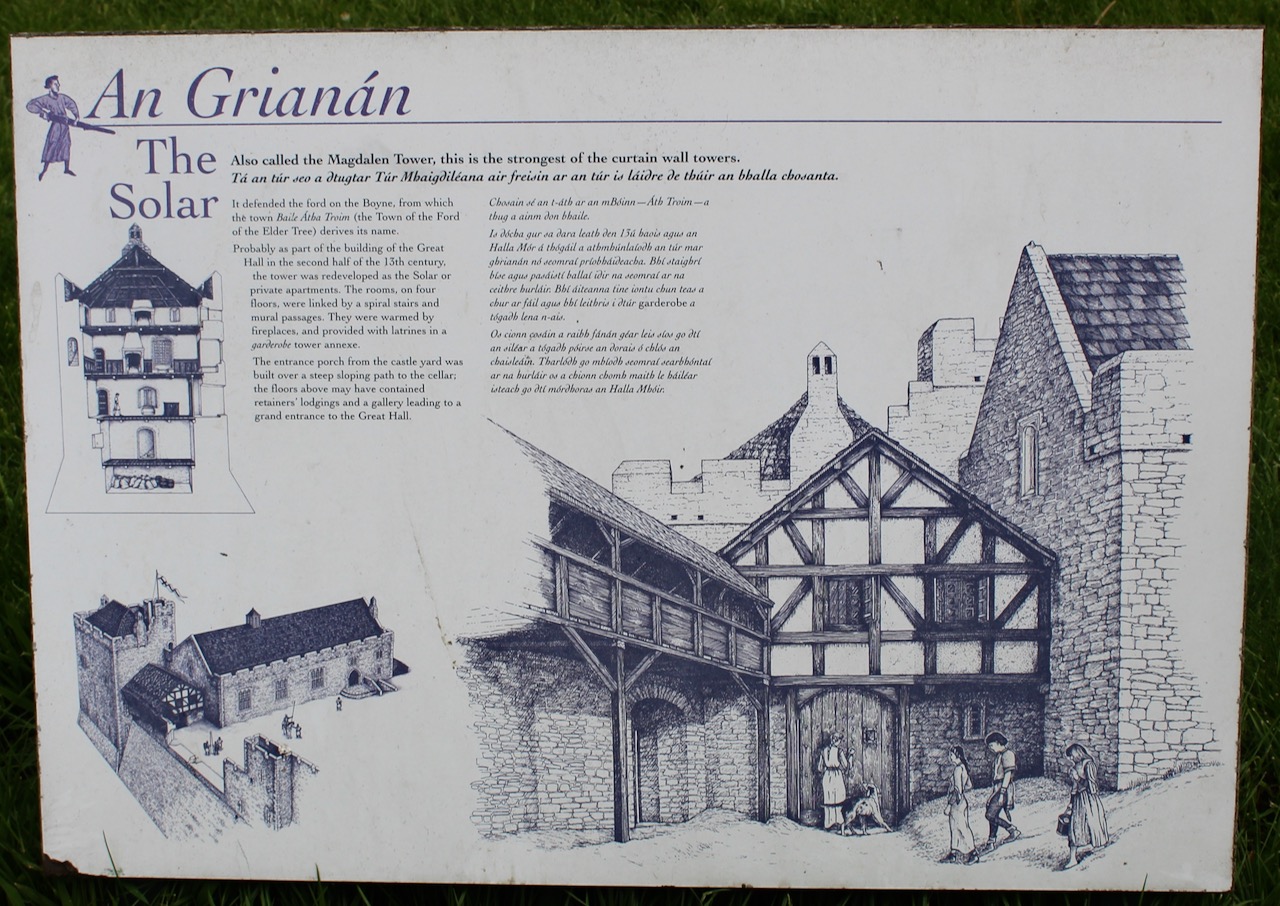
The information board tells us that the River Gate allowed for the delivery os stores from boats on the river. The gate was made in the curtain wall to the east of the Great Hall. Short stretches of canal allowed boats to bring supplies to teh castle to avoid the many weirs and protruding rocks on the river. A section of the canal was cut below the riverside curtain wall. Inside the River Gate, a passage was cut through the bedrock to the door of the cellar of the Great Hall. Boats could be moored in the wide harbour with its pier and stairway to the apartments in the Solar.
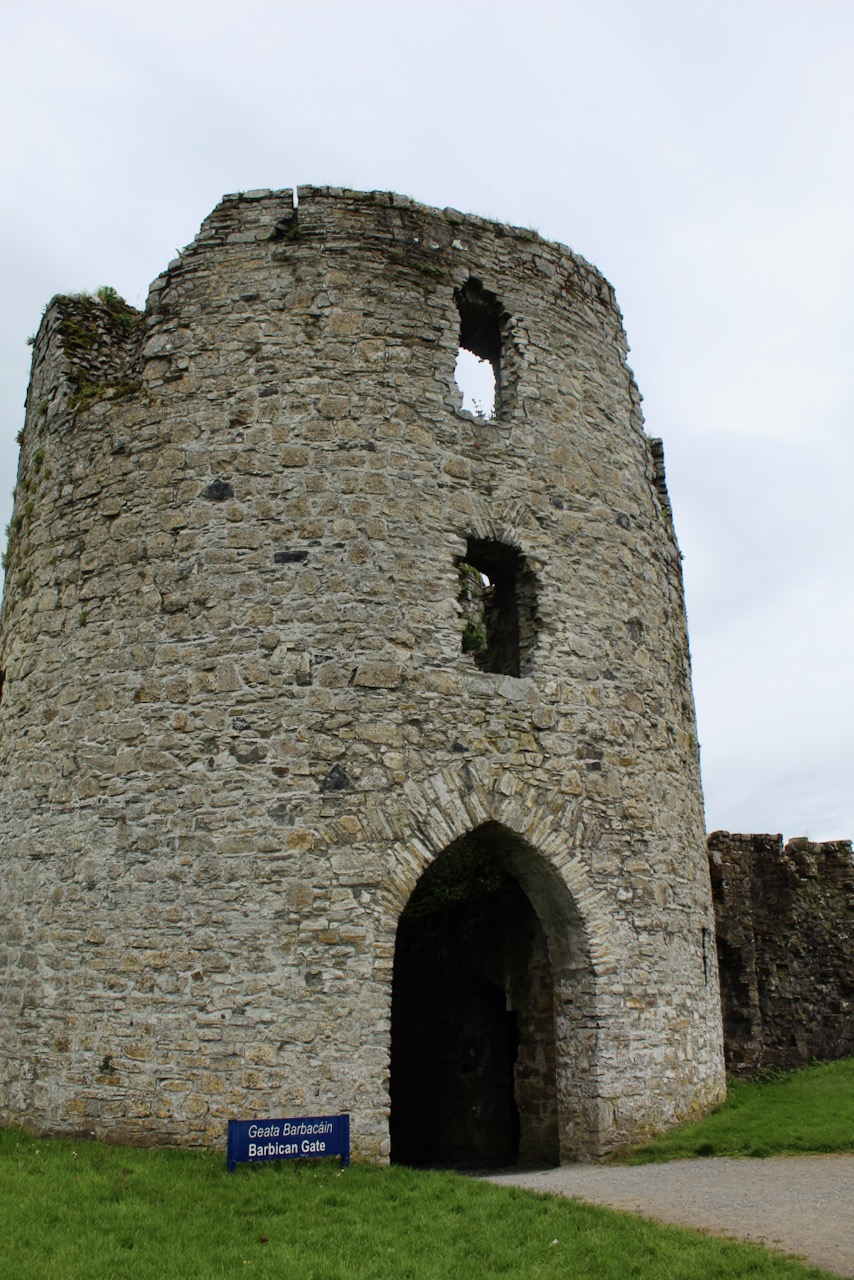
The Barbican Gate, Trim Castle. Photograph © Jennifer Winder-Baggot, www.irishhistorichouses.com
Trim Castle, May 2022. Photograph © Jennifer Winder-Baggot, www.irishhistorichouses.com
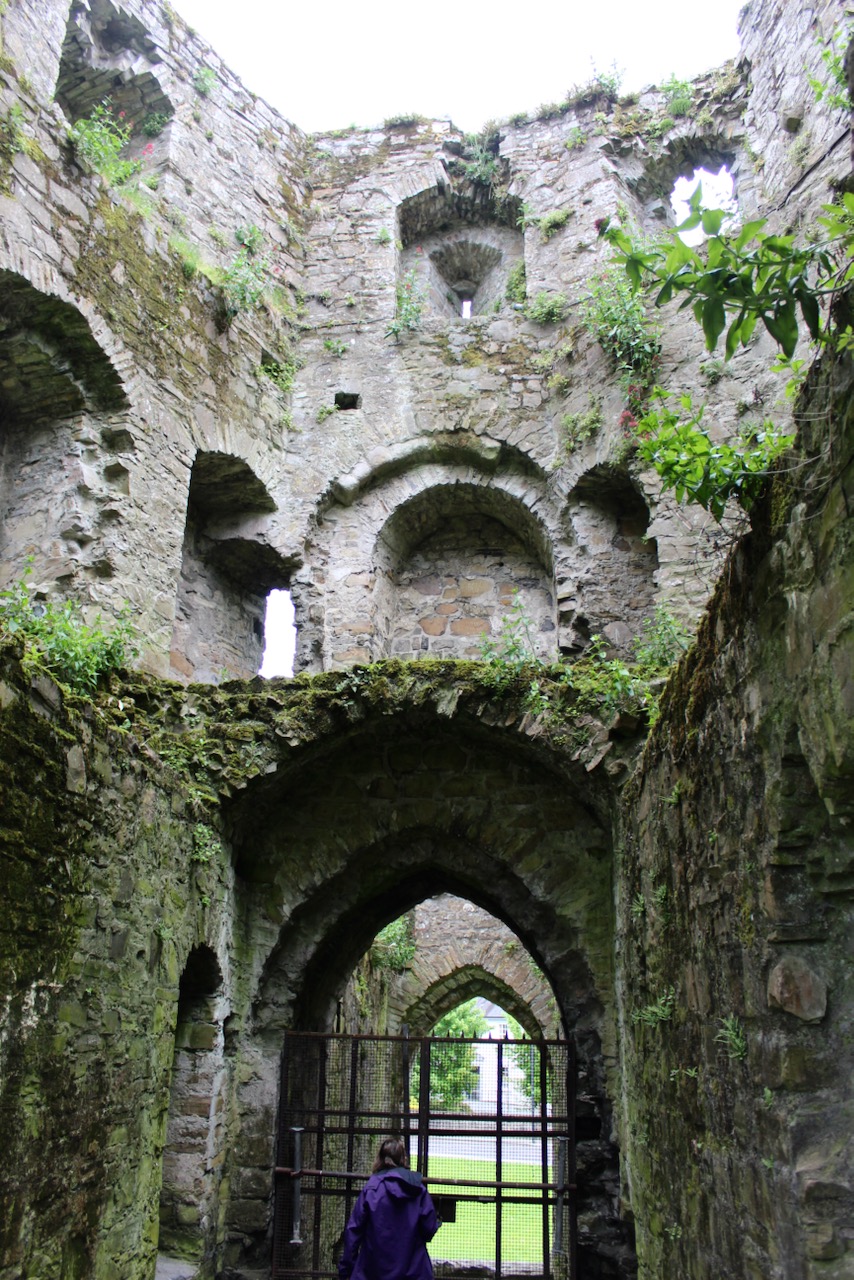
Inside the Barbican Gate, Trim Castle. Photograph © Jennifer Winder-Baggot, www.irishhistorichouses.com
Trim Castle, May 2022.

Early in the 13th century the weirs were completed on the Boyne, allowing the moat to be flooded, and the Leper River was channelled along the south curtain wall. A new gate was constructed guarding the southern approaches to the castle. This gatehouse, of a rare design, was built as a single cylindrical tower with a “barbican,” defences of a forward tower adn bridge. An elaborate system of lifting bridges, gates and overhead traps gave the garrison great control over those entering the castle. The arrangement of plunging loops demonstrates the builders’ knowledge of the military requirements of defending archers.

By the middle of the 13th century, the design of castle gates was further developed and a twin tower gatehouse with a passage between the two towers became standard.

Trim Castle, May 2022.

Offaly:

11. Clonmacnoise, County Offaly:

Clonmacnoise, May 2018. Photograph © Jennifer Winder-Baggot, www.irishhistorichouses.com

General information: 090 9674195, clonmacnoise@opw.ie

From the OPW website https://heritageireland.ie/visit/places-to-visit/clonmacnoise/:

St Ciarán founded his monastery on the banks of the River Shannon in the 6th Century. The monastery flourished and became a great seat of learning, a University of its time with students from all over Europe.

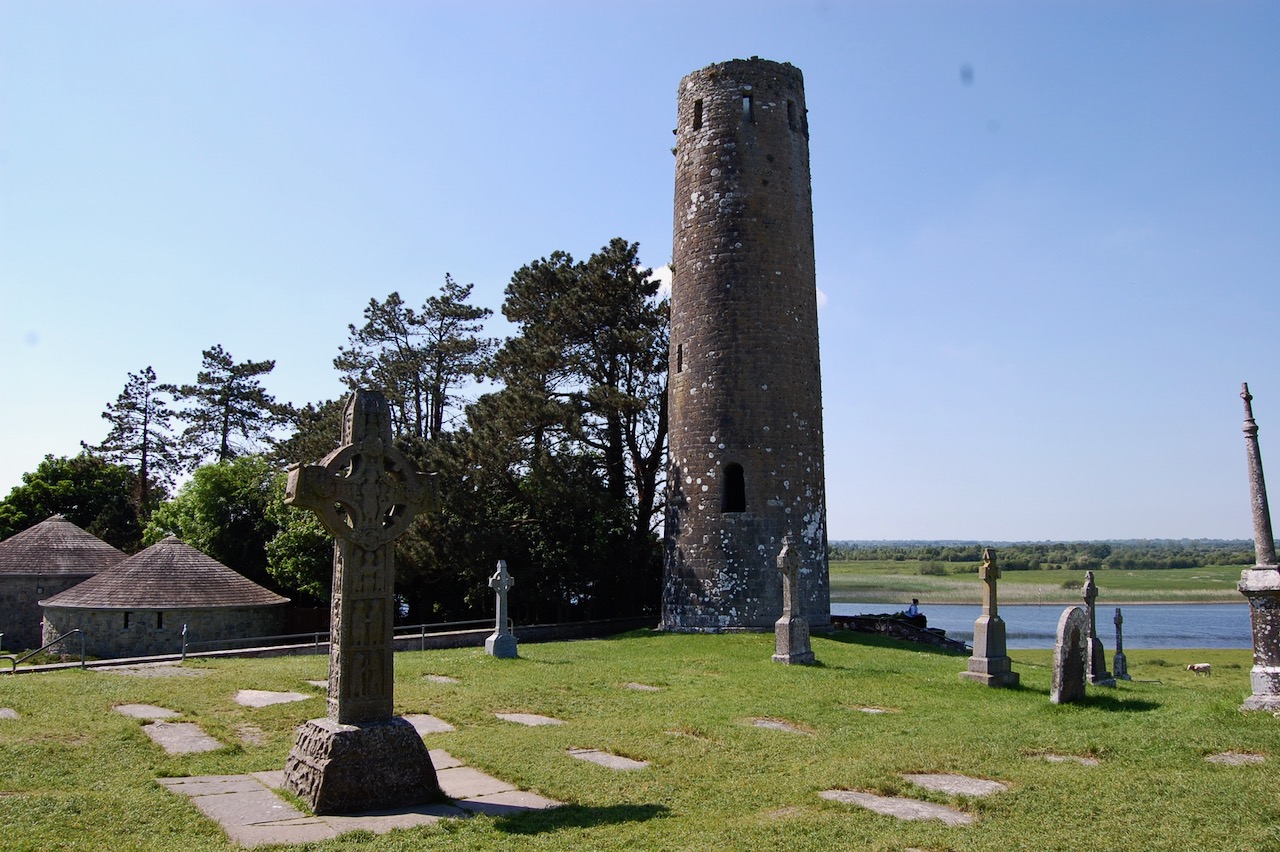
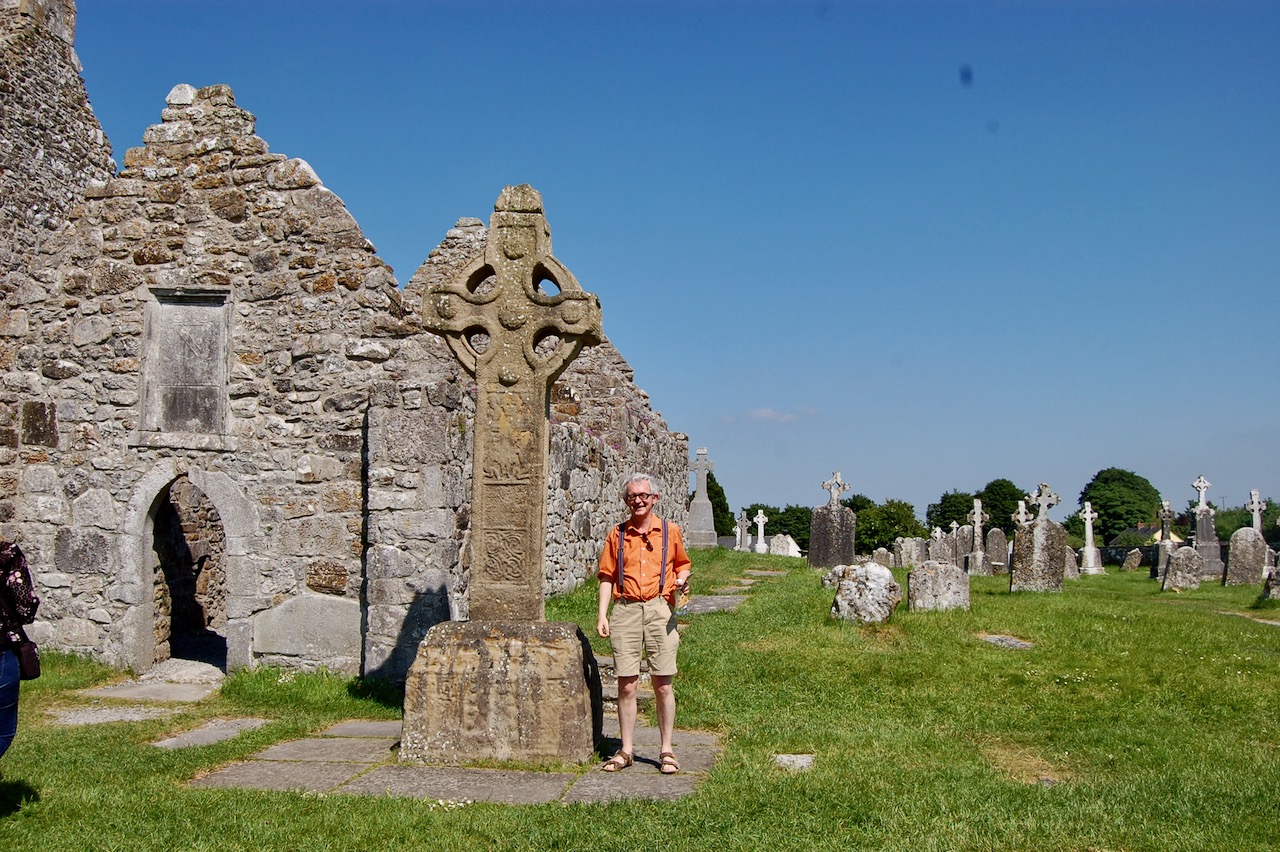
The ruins include a Cathedral, two round Towers, three high crosses, nine Churches and over 700 Early Christian graveslabs.

The original high crosses, including the magnificent 10th century Cross of the Scriptures area on display in a purpose built visitor centre adjacent the monastic enclosure.

An audiovisual presentation will give you an insight into the history of this hallowed space.

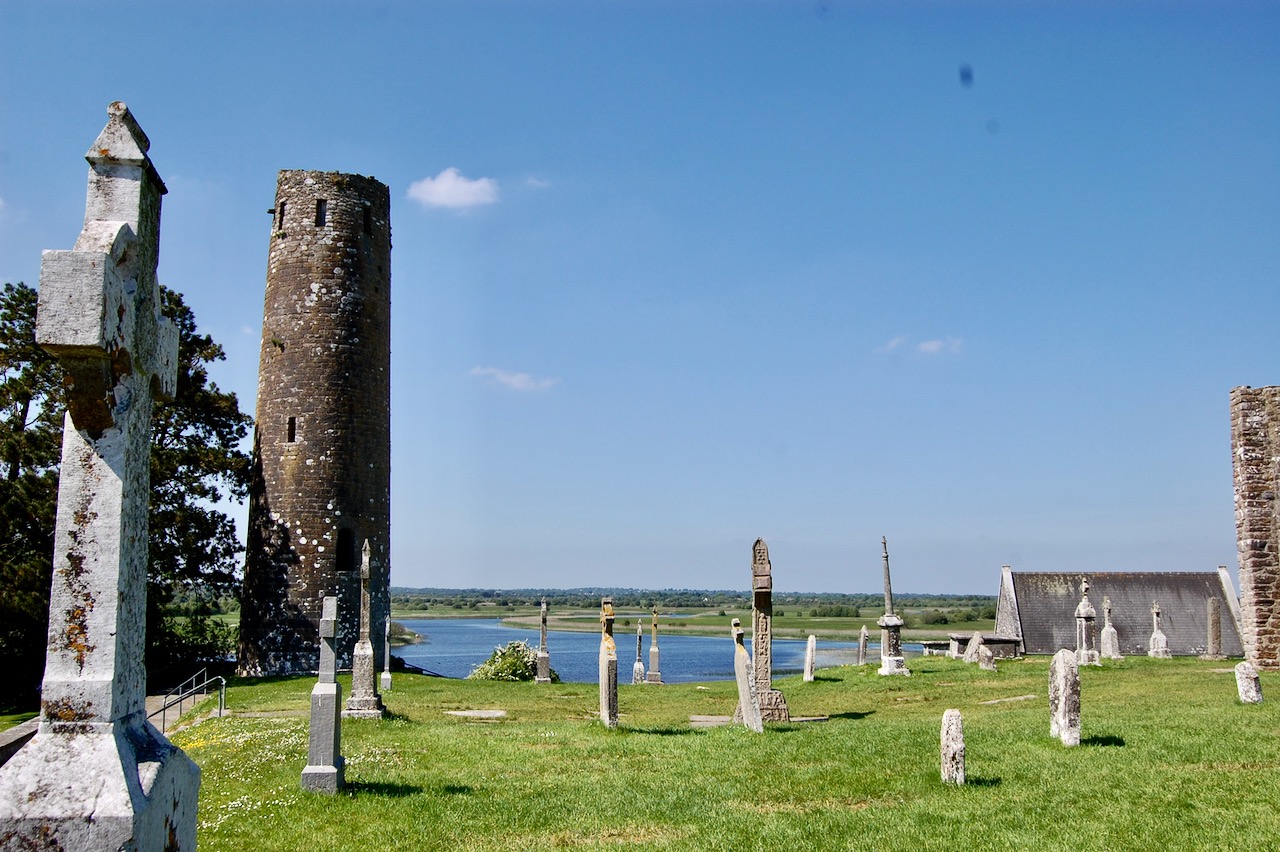
Clonmacnoise, May 2018. O’Rourke’s Tower. The Annals of the Four Masters record that it was completed in 1124 under the patronage of Toirrdelbach O Conchobhair, King of Connacht. In 1135 its top was struck off by lightning. The eight square headed windos at the top belong to a late medieval arrangement. Photograph © Jennifer Winder-Baggot, www.irishhistorichouses.com
Clonmacnoise, May 2018. Photograph © Jennifer Winder-Baggot, www.irishhistorichouses.com
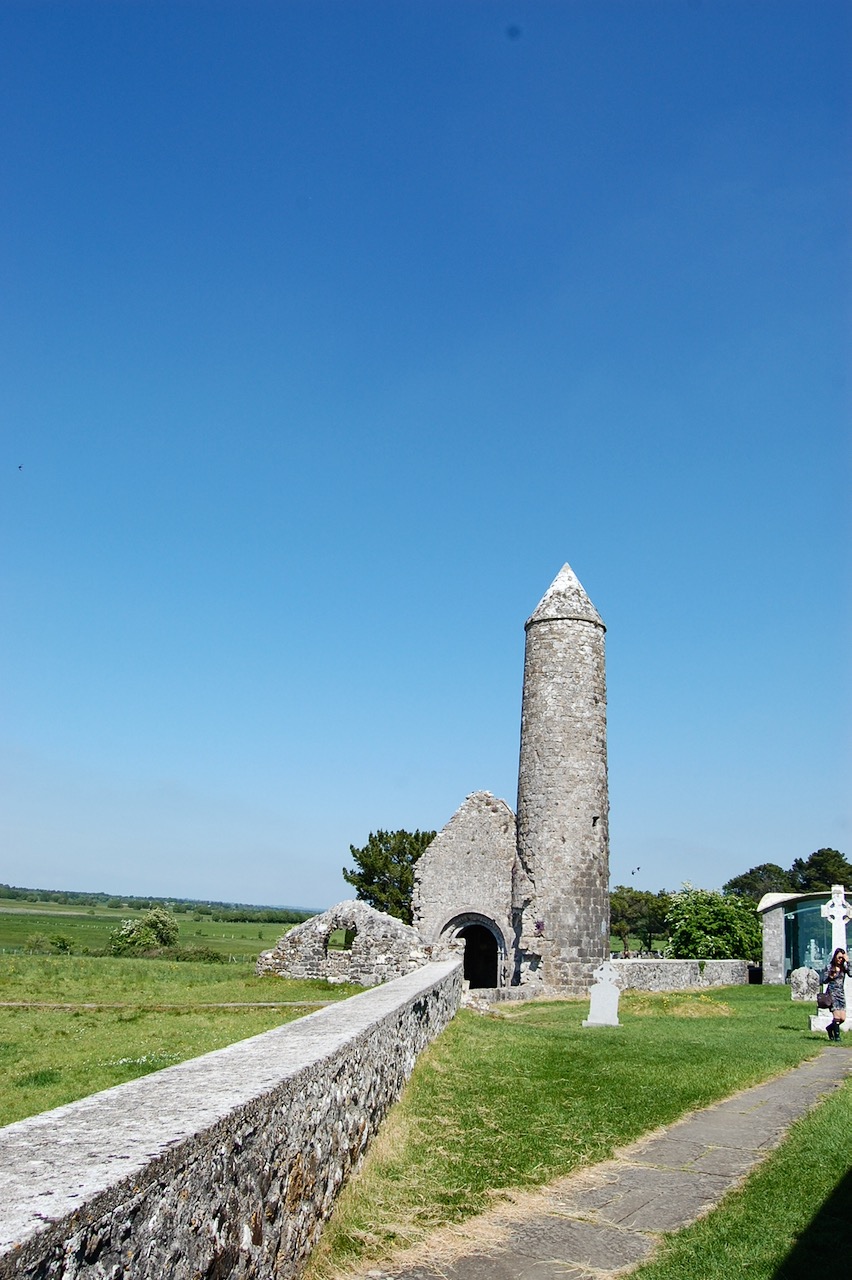
Clonmacnoise, May 2018. Temple Finghin, a twelfth century church with integrated round tower. Photograph © Jennifer Winder-Baggot, www.irishhistorichouses.com
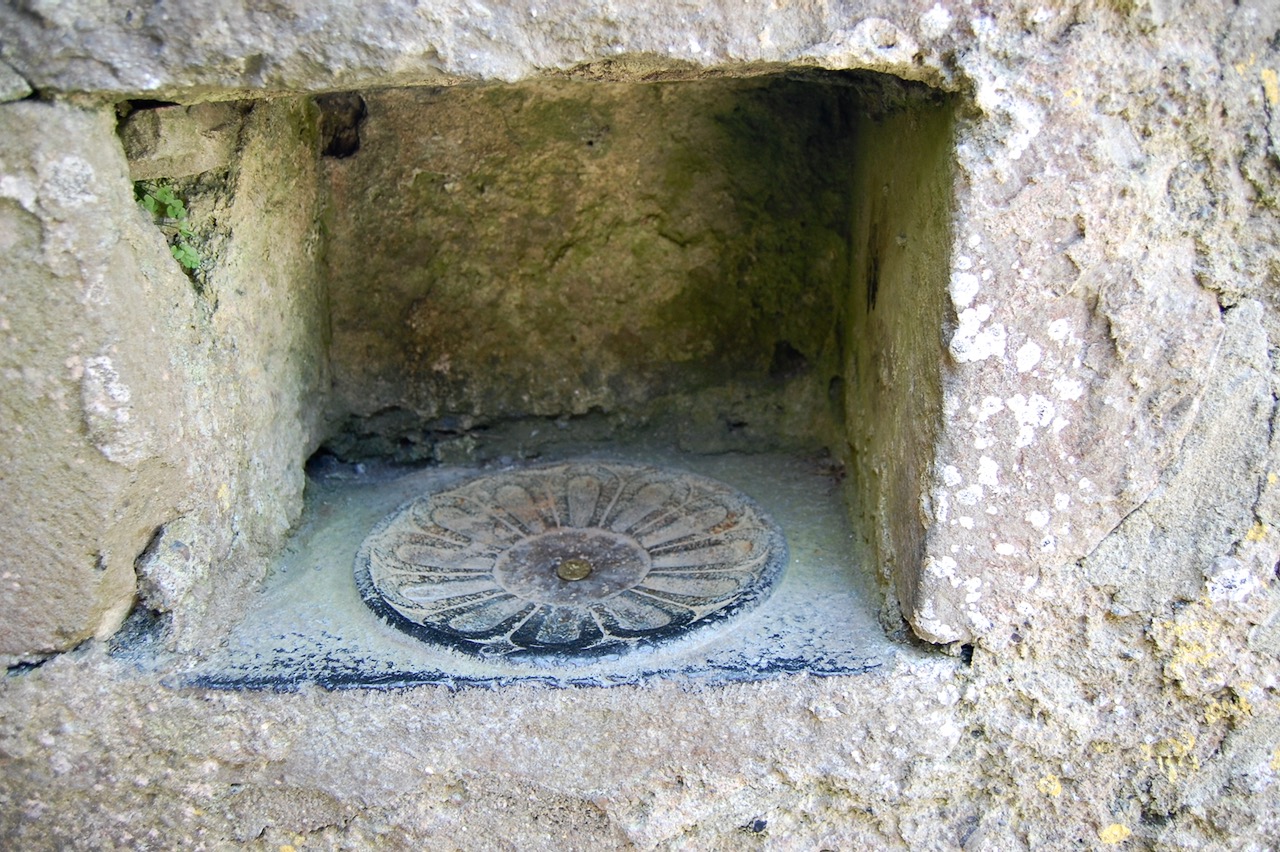
Clonmacnoise, May 2018. Photograph © Jennifer Winder-Baggot, www.irishhistorichouses.com

[1] p. 336. Tierney, Andrew. The Buildings of Ireland: Central Leinster: Kildare, Laois and Offaly. Yale University Press, New Haven and London, 2019.

[2] https://heritageireland.ie/visit/places-to-visit/emo-court/

[3] p. 119. Bence-Jones, Mark. A Guide to Irish Country Houses (originally published as Burke’s Guide to Country Houses volume 1 Ireland by Burke’s Peerage Ltd. 1978); Revised edition 1988, Constable and Company Ltd, London.

[4] https://emocourt.ie/history/

For information on Gandon’s house in Lucan, see https://www.buildingsofireland.ie/buildings-search/building/11201034/canonbrook-house-lucan-newlands-road-lucan-and-pettycanon-lucan-dublin

Canonbrook, Lucan: “Detached multiple-bay two-storey over basement house, c.1800, on an L-plan. A handsome, substantial rural Georgian house which, though altered, retains its imposing form and feel, and is situated in mature grounds. Historically important as the former home of James Gandon.” Gandon is also said to have designed Primrose Hill House in Lucan, which is a section 482 property.

[5] https://theirishaesthete.com/2019/02/27/emo-court/

[6] https://www.irelandscontentpool.com/en/media-assets/media/81101

[7] http://www.fatherbrowne.com

[8] https://theirishaesthete.com/2016/03/14/of-changes-in-taste/

and https://theirishaesthete.com/2016/02/01/seen-in-the-round/

For photographs of the stuccowork, see https://theirishaesthete.com/2016/03/21/forgotten-virtuosi/

[9] p. 96. Sadleir, Thomas U. and Page L. Dickinson. Georgian Mansions in Ireland with some account of the evolution af Georgian Architecture and Decoration. Dublin University Press, 1915. 

[10] p. 356. Tierney, Andrew. The Buildings of Ireland: Central Leinster: Kildare, Laois and Offaly. Yale University Press, New Haven and London, 2019.

[11] p. 61. O’Reilly, Sean. Irish Houses and Gardens. From the Archives of  Country Life. Aurum Press Ltd, London, 1998. 

[12] https://theirishaesthete.com/2018/08/27/heywood/

and https://theirishaesthete.com/2014/05/12/to-smooth-the-lawn-to-decorate-the-dale/

[13] p. 175, Casey, Christine and Alistair Rowan. The Buildings of Ireland: North Leinster: the counties of Longford, Louth, Meath and Westmeath. Penguin Books, London, 1993.

[14] p. 387, Casey, Christine and Alistair Rowan. The Buildings of Ireland: North Leinster: the counties of Longford, Louth, Meath and Westmeath. Penguin Books, London, 1993.

and see also my entry on Killineer, County Louth.

[18] http://www.patrickcomerford.com/2016/10/trim-castle-is-strong-symbol-in-stone.html

[19] p. 511, Casey, Christine and Alistair Rowan. The Buildings of Ireland: North Leinster: the counties of Longford, Louth, Meath and Westmeath. Penguin Books, London, 1993.