A Guide to Irish Country Houses by Mark Bence-Jones contents and pictures, houses beginning with C

As you can see as I work my way though the contents of Mark Bence-Jones’s A Guide to Irish Country Houses [1], there are thousands of “big houses” in Ireland – though many are “houses of middle size.” It’s not clear why some houses are included in Bence-Jones’s book and others are not. If it were up to me, I’d compile a more defined list – I’d like to compile a list of houses built before 1700, for example, to have a more clear cut-off, and another list of houses built before 1800. I would also like to group houses by architect, and I will do that eventually, I hope! But Bence-Jones gives us a good idea as to what exists – albeit he includes some important houses that no longer exist.

Note that the majority of these are private houses, not open to the public. I discovered “my bible” of big houses by Mark Bence-Jones only after I began this project of visiting historic houses that have days that they are open to the public (Section 482 properties).

This is a project I have been working on for a while, collecting pictures of houses. Enjoy! Feel free to contact me to send me better photographs if you have them! I’ll be adding letters as I go…

[1] Mark Bence-Jones. A Guide to Irish Country Houses (originally published as Burke’s Guide to Country Houses volume 1 Ireland by Burke’s Peerage Ltd. 1978); Revised edition 1988 Constable and Company Ltd, London.

Donation

Help me to fund my creation and update of this website. It is created purely out of love for the subject and I receive no payment so any donation is appreciated! My website costs €300 per year on WordPress.

€15.00

Cabinteely House (formerly Clare Hill), Cabinteely, Dublin – sometimes open to public

Cabinteely House, Dublin, photograph from Dun Laoghaire Rathdown County Council website.

See my entry https://irishhistorichouses.com/2020/06/06/covid-19-lockdown-20km-limits-and-places-to-visit-in-dublin/

Cabra Castle, County Cavan, on section 482 in 2019-2025 – hotel 

Cabra Castle, County Cavan. Photograph © Jennifer Winder-Baggot, www.irishhistorichouses.com.

See my entry https://irishhistorichouses.com/2021/03/28/cabra-castle-kingscourt-county-cavan/

Cabra (or Cabragh) House, Co Dublin – demolished 1948

Caherelly Grange, Herbertstown, Co Limerick 

An old castle, not lived in since mid-C19.

Cahir Castle, Cahir, Tipperary – OPW

Cahir Castle, photograph from Ireland’s Content pool, by George Munday 2014 for Failte Ireland

See my entry https://irishhistorichouses.com/2024/03/29/cahir-castle-county-tipperary-an-office-of-public-works-property/

Cahircalla, Ennis, Co Clare – nursing home

Cahircon House (or Cahercon or Cahiracon), Killadysert, Co. Clare

The National Inventory tells us that Cahercon is a “five-bay three-storey over basement late-Georgian house, built c. 1790, with limestone cut-stone projecting Ionic porch to centre. Three-bay two-storey over basement flanking wings with full-height canted bay windows, lean-to conservatory to left hand side and two-bay single-storey bay to right hand side, added 1873. Five-bay single-storey return, added c. 1990, to accommodate use as convent and school.”

Cahercon, County Clare, photograph courtesy National Inventory.

Cahirduggan, Midleton, Co Cork

A two storey house of late-Georgian appearance.  

Cahirduggan, Midleton, Co Cork courtesy National Inventory.

Cahir-Guillamore, Kilmallock, Co Limerick 

Cahir-Guillamore, County Limerick, entrance front 1965 copy photograph: David Davison, Vanishing Country Houses of Ireland by The Knight of Glin, David J. Griffin and Nicholas K. Robinson, published by The Irish Architectural Archive and The Irish Georgian Society, 1988.

Cahirmoyle, Ardagh, Co Limerick 

Cahirmoyle House, County Limerick, courtesy Archiseek.
Cahirmoyle House, County Limerick, courtesy National Inventory.
Cahirmoyle House or Cahermoyle, County Limerick, courtesy National Library of Ireland.

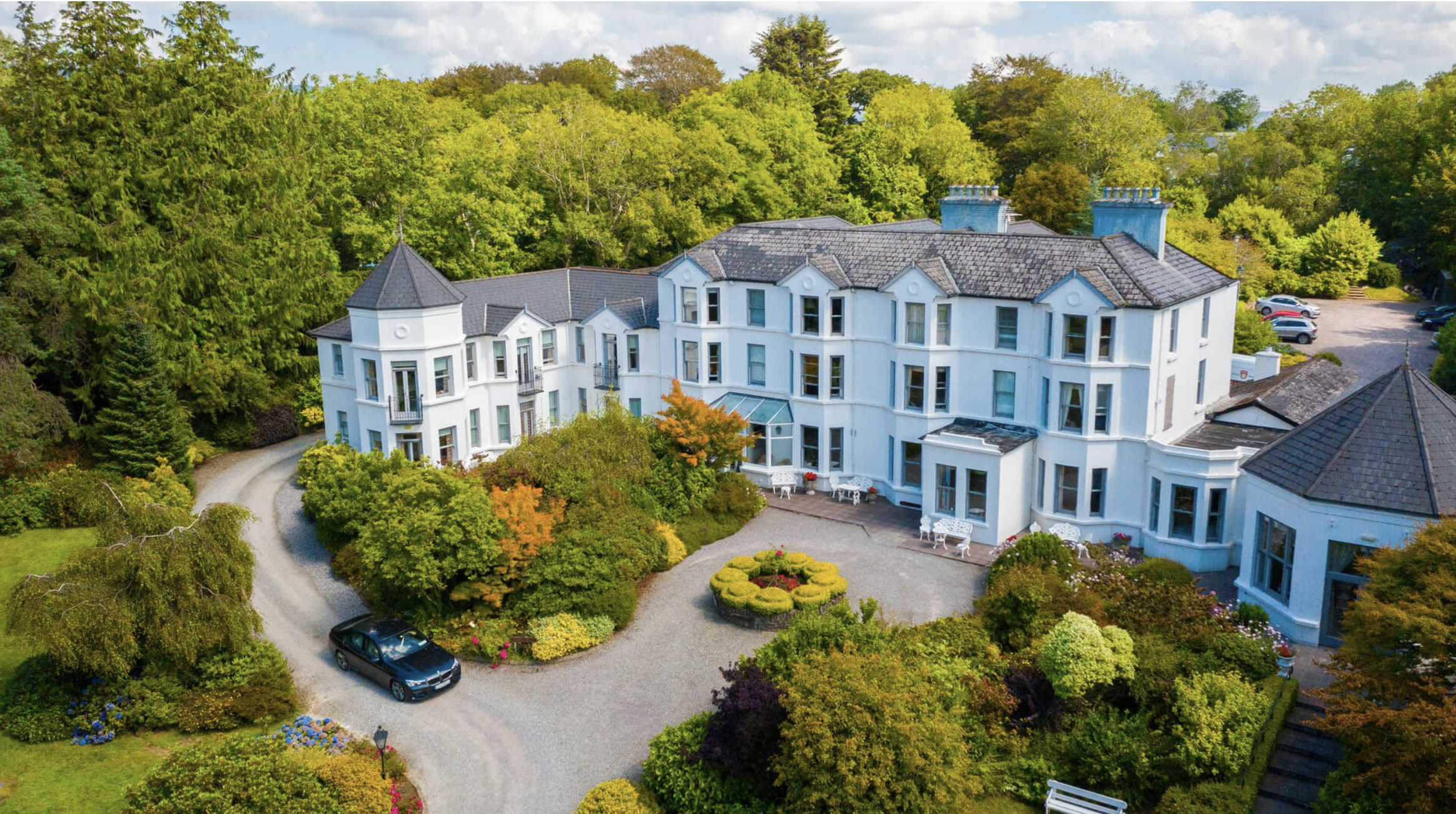
Cahirnane House (or Cahernane), Co Kerry – accommodation

Cahernane House, County Kerry, photograph from National Inventory of Architectural Heritage, which tells us it is a seven-bay two-storey over part-raised basement Ruskinesque Gothic Revival style country house with dormer attic, dated 1877, possibly incorporating fabric of earlier house. Designed by James Franklin Fuller.

See my entry https://irishhistorichouses.com/2022/10/19/places-to-visit-and-stay-in-county-kerry-munster/

Cahore House, Cahore, Co Wexford 

Cahore House, County Wexford, courtesy National Inventory of Architectural Heritage.

Cairndhu, Larne, County Antrim

A two storey, many-gabled Victorian house, given a Chinese flavour by the design of the ornate open-work bargeboards, and of the elaborate wooden verandah and balcony running along most of the front. 

Caledon, County Tyrone

Caledon, County Tyrone, photograph by Robert French, [between ca. 1865-1914], Lawrence Photograph Collection, National Library of Ireland.

Callinafercy House, Milltown, Co Kerry 

A Victorian Tudor house of 1861, built for Robert Leeson, grandson of 1st Earl of Milltown. 

Callinafercy House, Co Kerry courtesy National Inventory.

Camass House, Bruff, Co Limerick  

Camass House, County Limerick, courtesy National Inventory.

Camla Vale, Monaghan, Co Monaghan

Camla Vale, County Monaghan.

Camlin Estate, Co Donegal  – demolished  

Camlin, County Donegal or Fermanagh (?) entrance front c. 1890, Robert French, Lawrence Photgraph Collection NLI. It was on the border of the counties, and a gate still exists. The National Inventory tells us of the gate lodge: “This gateway and lodge was built to designs by the eminent architect John Benjamin Keane (died 1859), a noted architect of his day who is probably best remembered for his numerous church commissions for the Catholic Church. It was Keane who designed the extensive alterations and additions to Camlin Castle itself at the same time, incorporating fabric from the earlier house that, reputedly, included seventeenth century fabric, for a John A Tredennick c. 1838. The Tredennick family lived at Camlin Castle from c. 1718 when a William Tredennick obtained the lease of Camlin from William ‘Speaker’ Conolly who had purchased the estates of Lord Folliott in and around Ballyshannon area. The Tredennick family had another seat at nearby Fortwilliam or Fort William (see 40910774). The estate was sold to the Land Commission c. 1900; the last member of the family to reside at Camlin was a Charles Joseph Haydon Tredennick up until 1929. Camlin Castle itself was sadly – and erroneously – later demolished as part of Erne Hydro-Electric Scheme in the 1940s/50s, when it was thought that the house would be submerged by new lake. However, the water level of this lake did not reach the site of the building so it could have been saved, and it represents a sad loss to the architectural heritage of the local area.”

Camolin Park, Camolin, Co Wexford

A square block of superior quality, dating from first half of C18. Good doorcase with segmental pediment. The seat of the Annesleys, Earls of Mountnorris and Viscounts Valentia, sold by them 1858. A ruin for many years, demolished ca 1974.

Camphire, Cappoquin, Co Waterford 

Camphire House, County Waterford, courtesy of National Inventory.

Cangort, Shinrone, Co Offaly

Cangort Park, County Offaly, photograph courtesy of National Inventory.

Cangort Park, Shinrone, Co. Offaly 

Cangort House, Cangort demesne, County Offaly, Courtesy of National Inventory.
Cangort Park, County Offaly courtesy Sherry Fitzgerald Country Homes, Farms and Estates.

Capard, Rosenalis, Co Laois

Capard, County Laois, courtesy Savills.

Cappagh House, Cappagh, Co Waterford (Old and New, section 482) 

Cappagh House, County Waterford. Photograph © Jennifer Winder-Baggot, www.irishhistorichouses.com.

See my entry https://irishhistorichouses.com/2023/12/09/cappagh-house-old-and-new-dungarvan-co-waterford/

Cappamurra, Dundrum, Co Tipperary  

A two storey house with round-headed windows in its upper storey and windows of unusual shape below. 

Cappamura, County Tipperary, photograph courtesy of National Inventory.

Cappoquin House, Waterford – section 482 

Cappoquin House, County Waterford. Photograph © Jennifer Winder-Baggot, www.irishhistorichouses.com.

See my entry https://irishhistorichouses.com/2021/01/24/cappoquin-house-gardens-cappoquin-co-waterford/

Carbury Castle, Co Kildare (or Castle Carbury or Carbery)  – ruin 

Carbury Castle, County Kildare, courtesy of Brian T. McElherron, Irish Antiquities.
Carbury Castle, County Kildare, photograph by Robert French, (between ca. 1865-1914), Lawrence Photograph Collection, National Library of Ireland.

Careysville, (Ballymacpatrick Castle), Clondulane, Fermoy, County Cork

Careysville, Fermoy, County Cork courtesy National Inventory.

See my entry https://irishhistorichouses.com/2022/05/17/places-to-visit-and-stay-munster-county-cork/

Cargins Park, Roscommon, Co Roscommon

A two storey three bay Victorian house with a porch.

Carker House, Doneraile, Co Cork  

A two storey C18 house, 6 bay front; two bay breakfront, with small pediment-gable; tripartite round-headed doorcase.

Carker House, County Cork, courtesy National Inventory.

Carnagh House, New Ross, Co Wexford 

Carnalea House, County Down 

Carnalway Glebe, Kilcullen,  Co. Kildare 

Carnelly, Ennis, Co. Clare

A 3 storey mid-C18 house of pink brick, built for George Stamer almost certainly to the design of his brother-in-law Francis Bindon.

Carnelly House, County Clare, photograph by Eric Shaw, courtesy Clarecastle Ballyea Heritage website.

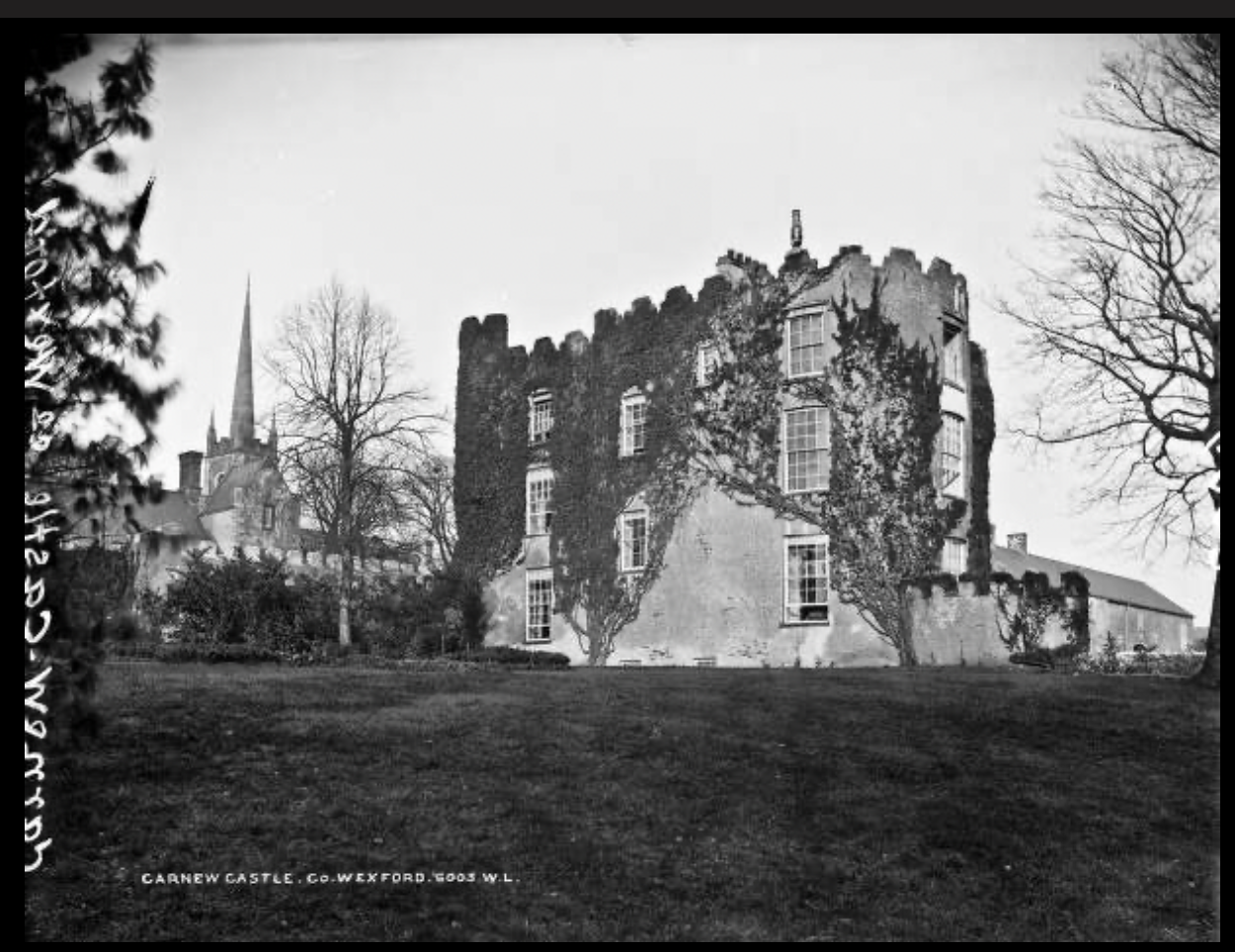
Carnew Castle, Carnew, Co Wicklow 

Carnew Castle, County Wicklow, Photograph courtesy of National Inventory of Architectural Heritage.
Carnew Castle, County Wicklow, photograph by Robert French, [between ca. 1865-1914], Lawrence Photograph Collection, National Library of Ireland.
Carnew Castle, County Wexford/ Wicklow, photograph by Robert French, (between ca. 1865-1914), Lawrence Photograph Collection, National Library of Ireland

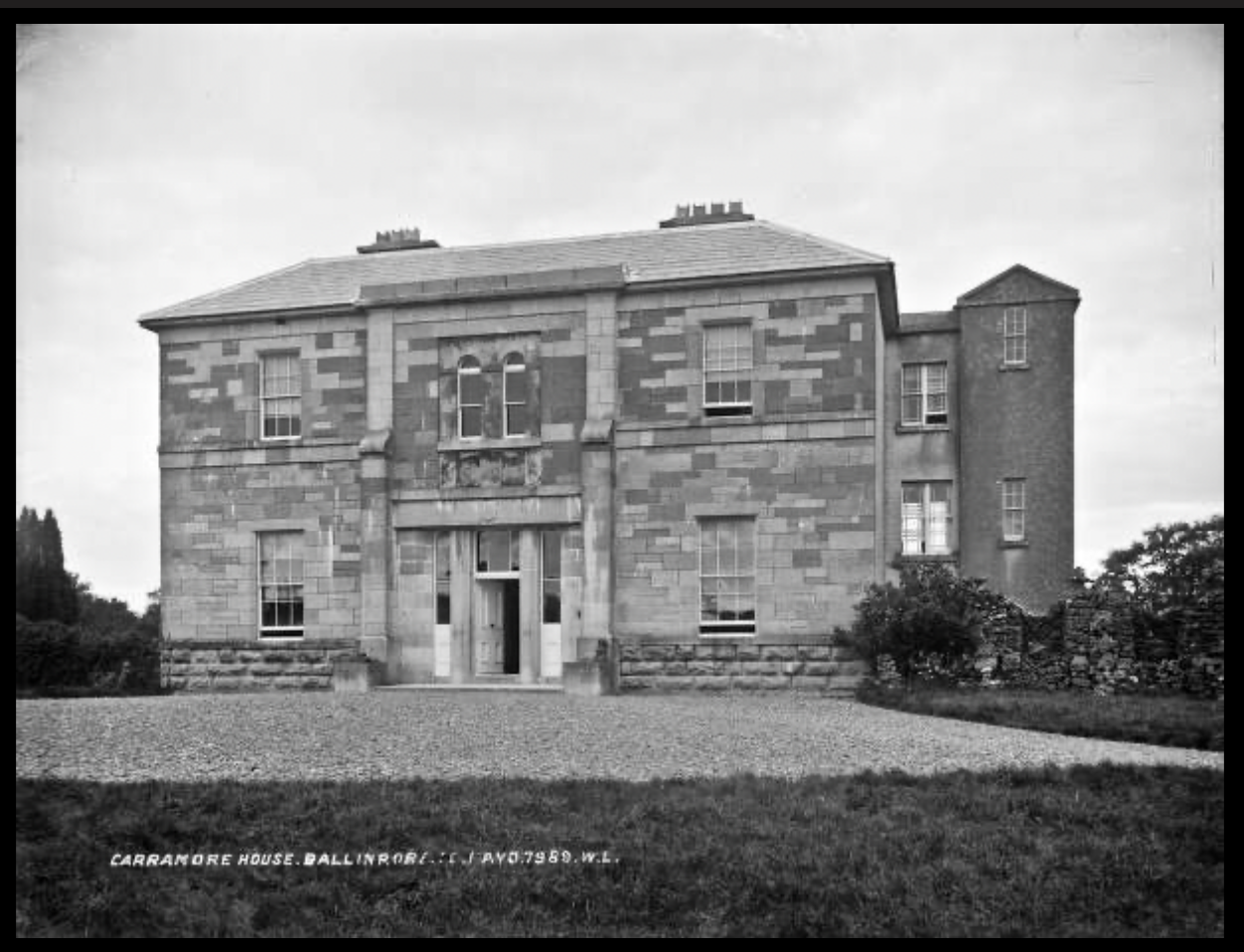
Carramore, Ballina, County Mayo

Carrowmore House, County Mayo, courtesy National Inventory.

Carrick Barron, or Carrickbarrahane, Stradbally, Co. Waterford  

Carrickblacker, Portadown, County Armagh – demolished 

Carrick Blacker, County Armagh, photograph by Robert French, [between ca. 1865-1914], Lawrence Photograph Collection, National Library of Ireland.

Carrickmore House (formerly Carrickmore Hall), County Tyrone

Carrig Park, Mallow, Co Cork

 A two storey bow ended Georgian house. 

Carrigacunna Castle, Killavullen, Co Cork  

Carrigacunna Castle, Killavullen, Mallow, County Cork for sale May 2025 courtesy Lisney Sothebys.

A two storey early nineteenth century house alongside an old tower-house above the River Blackwater.

Carrigaholt Tower and the Cottage, Shannon, County Clare

Carrigaholt Tower, Shannon, County Clare, photograph courtesy Sherry Fitzgerald McMahon, 2024.

Bence-Jones writes of the cottage: “A C19 house of random ashlar consisting of a 2 storey centre with pointed windows, flanked by single-storey gabled wings; overlooking the mouth of the Shannon, close to the ruins of an old castle of the MacMahons which was captured by the O’Briens of Thomond and afterwards passed to the Burton family. Now rebuilt, but the old C18 pink brick garden walls still survive.

Carrigaholt Tower, Shannon, County Clare, photograph courtesy Sherry Fitzgerald McMahon, 2024.

 Carriglas Manor, Longford

Carriglas Manor, County Longford, courtesy of National Inventory.
Carriglas or Carrigglass Manor, County Longford, photograph by Robert French, [between ca. 1865-1914], Lawrence Photograph Collection, National Library of Ireland.
Cariglas or Carriglas Manor, County Longford, photograph by Robert French, [between ca. 1865-1914], Lawrence Photograph Collection, National Library of Ireland.

Carriglea, Dungarvan, Co Waterford 

Carrigmore, Ballineen, Co Cork

A two storey house in the late Georgian manner, built 1842 by James Lysaght on the site of an earlier house, known as Connerville, which had formerly belonged to the Conner family and which he purchased from them. 

Carrigmore, Montenotte, Cork, Co Cork  

A very handsome C19 Classical house…Now ruinous.

Carrignavar, Co Cork

A late C19 castellated house incorporating some fragments of an old castle.  

Carrignavar, County Cork (http://homepage.eircom.net/~carriglake/carrig_lake24.htm), photograph courtesy Landed Estates database.

Carrigoran, Newmarket-on-Fergus, Co Clare – demolished in the 1980s 

Carrigrenane, Little Island, Co Cork  

A pleasant square late-Georgian house of two storeys over a basement on a promontory jutting out into Lough Mahon.

Carrigrohane Castle, Carrigrohane, County Cork

Detached four-bay three-storey over basement and with dormer attic house, built c.1850, incorporating fabric of an earlier building.   

Carrigrohane, County Cork, photograph by Robert French, [between ca. 1865-1914], Lawrence Photograph Collection, National Library of Ireland.

Carrowdore Castle, Donaghadee, County Down 

A Georgian Gothic castle built 1818 by Nicholas de la Cherois-Crommelin. 

Carrowgarry, Beltra, Co Sligo – coffee roasters 

A Victorian house built ca 1880 by A.J. Crichton.

Carrowmore (also known as Fairfield House), Aughrim, Co Galway 

A plain three storey 5 bay Georgian house.

Carrowmore House, Carrowmorelacken, Co Mayo

Carrowmore House, County Mayo, courtesy National Inventory.
Carrowmore, or Carramore, County Mayo, photograph by Robert French, [between ca. 1865-1914], Lawrence Photograph Collection, National Library of Ireland.

Carrowroe Park, Roscommon, Co Roscommon 

An early C19 Classical house of two storeys and three bays, pedimented breakfront with Wyatt window over Doric portico. The front prolonged by single-storey wings with pairs of pedimented pavilions, those on one side being wider apart; blind wall with pilasters on one side, windows on the other. Garden front with two arched loggias joined by colonnade.

Carstown, Drogheda, Co Louth

Carstown, Drogheda, Co Louth, photograph courtesy National Inventory.

Carton House, Kildare – hotel 

At Carton House, County Kildare. Photograph © Jennifer Winder-Baggot, www.irishhistorichouses.com.

See my entry https://irishhistorichouses.com/2024/06/04/carton-house-county-kildare-a-hotel/

Cashel Palace, Cashel, Co Tipperary – hotel

Cashel Palace hotel, County Tipperary, photograph by Brian Morrison 2014 for Tourism Ireland, Ireland’s Content Pool.

See my entry https://irishhistorichouses.com/2022/10/19/places-to-visit-and-stay-in-county-tipperary-munster/

Cashel House, Cashel, Connemara, County Galway

Casino at Marino, County Dublin – Office of Public Works

The Casino, Marino, County Dublin. Photograph © Jennifer Winder-Baggot, www.irishhistorichouses.com.

See my entry https://irishhistorichouses.com/2023/11/09/office-of-public-works-dublin-the-casino-at-marino/

Castle Archdale, Irvinestown, County Fermanagh – house a ruin but War museum in stables

Castle Archdale, County Fermanagh, from Discover Northern Ireland website.

See my entry https://irishhistorichouses.com/2022/04/03/places-to-visit-and-stay-in-ulster-counties-fermanagh-monaghan-and-tyrone/

Castle Archdale, County Fermanagh, photograph by Robert French, [between ca. 1865-1914], Lawrence Photograph Collection, National Library of Ireland.

Castle Bellingham, County Louth – hotel 

Castle Bellingham, County Louth, 20th November 2022. Photograph © Jennifer Winder-Baggot, www.irishhistorichouses.com.

See my entry https://irishhistorichouses.com/2022/10/28/places-to-visit-and-stay-in-county-louth-leinster/

Castle Bernard (formerly Castle Mahon), Bandon, Co Cork – ruin  

Castle Bernard (formerly Castle Mahon), Bandon, Co Cork photograph by Robert French, [between ca. 1865-1914], Lawrence Photograph Collection, National Library of Ireland.

Castle Blunden, County Kilkenny – whole house rental

Castle Blunden, County Kilkenny, courtesy National Inventory.

See my entry https://irishhistorichouses.com/2022/10/28/places-to-visit-and-stay-in-county-kilkenny-leinster/

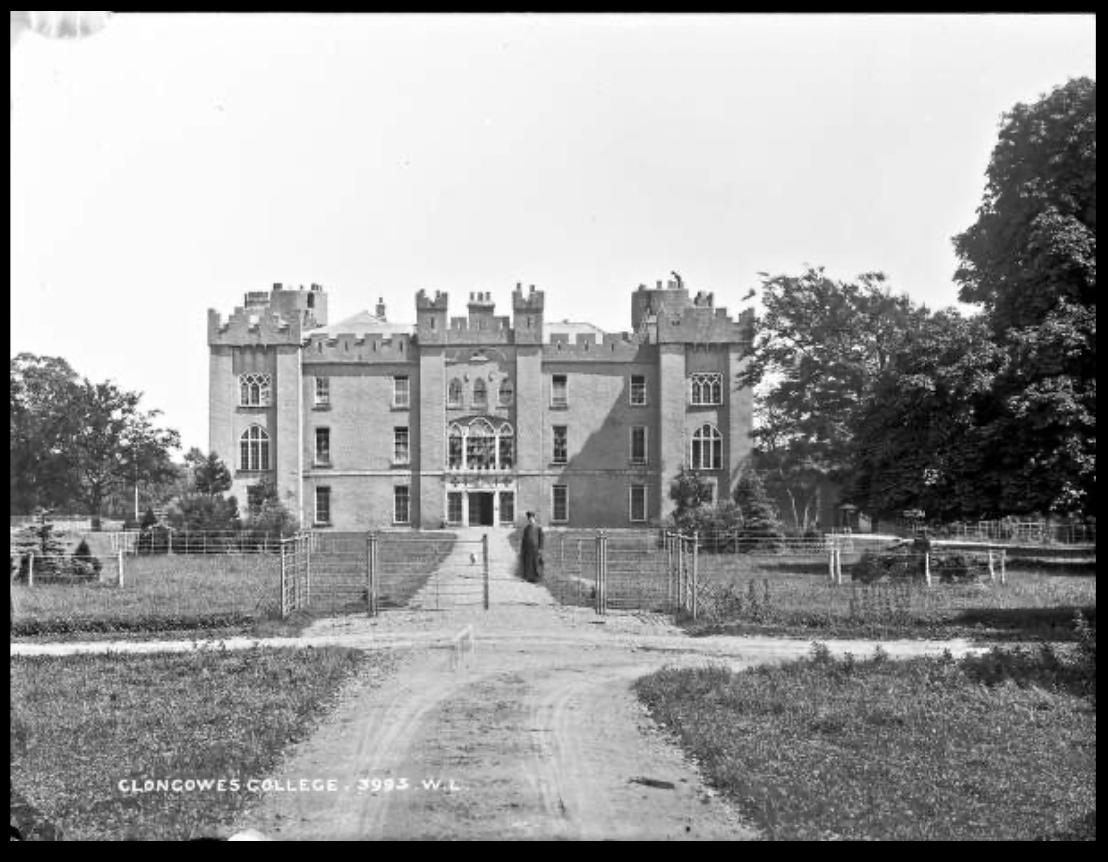
Castle Browne (Clongowes Wood College), Clane, Co Kildare

Clongowes Wood College, formerly Castle Browne, County Kildare. Photograph © Jennifer Winder-Baggot, www.irishhistorichouses.com.
Clongowes College, County Kildare, photograph by Robert French, (between ca. 1865-1914), Lawrence Photograph Collection, National Library of Ireland.

Castle Caldwell, Belleek, County Fermanagh

A C18 house of two storeys over a basement, on the shores of Lough Erne, with a delightful Georgian “pasteboard Gothic” façade… The house was ruinous by the end of C19.” 
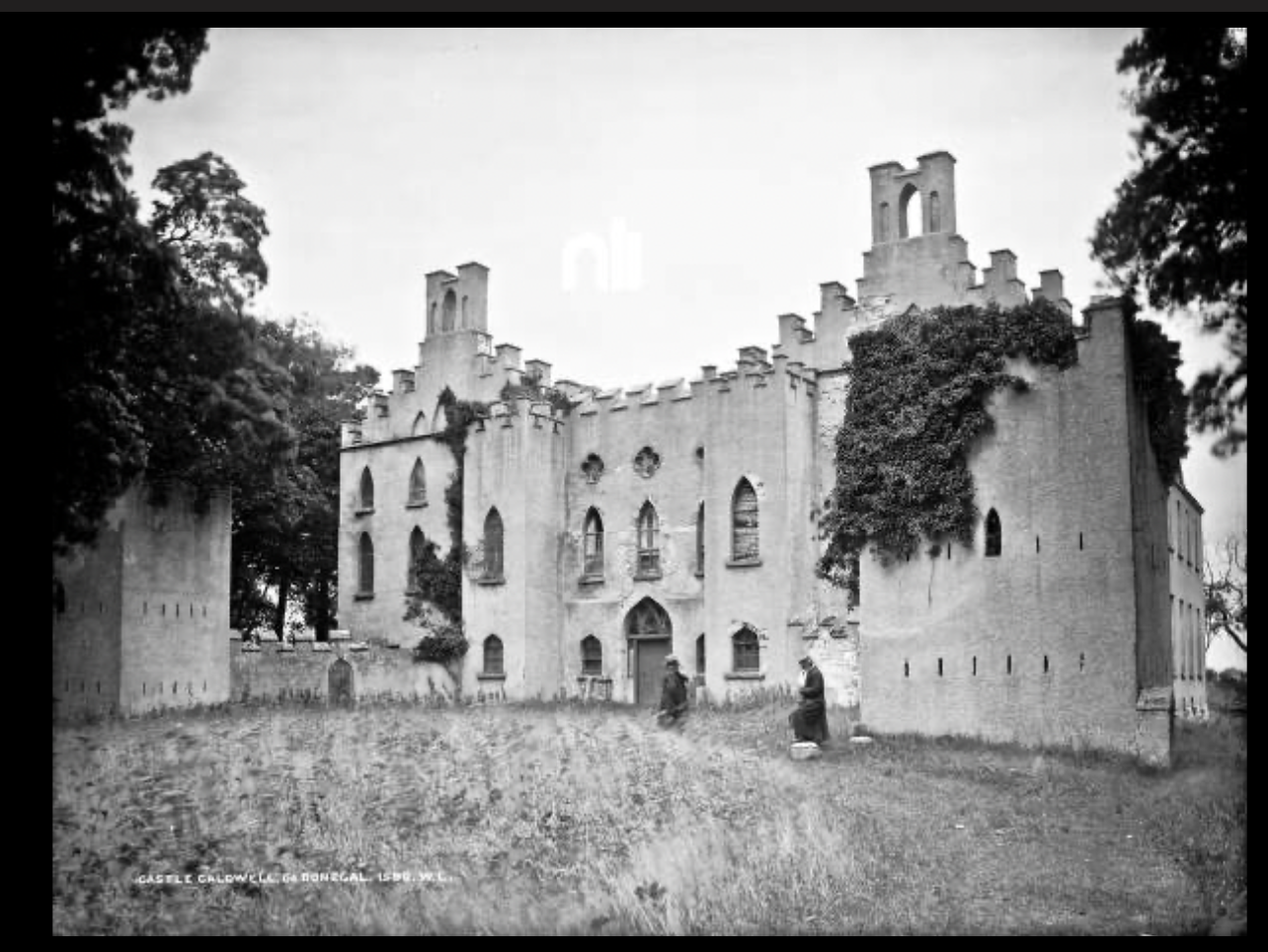
Castle Caldwell, County Fermanagh/Donegal, photograph by Robert French, (between ca. 1865-1914), Lawrence Photograph Collection, National Library of Ireland.

Castle Cooke, Kilworth, Co Cork – ‘lost’  

The old castle of Dungallane was acquired by Thomas Cooke, a Cork Quaker merchant, in second half of C17, and subsequently named Castle Cooke.

Castle Cor, Kanturk, Co Cork – ‘lost’  

Castle Cor, County Cork entrance front, Vanishing Country Houses of Ireland by The Knight of Glin, David J. Griffin and Nicholas K. Robinson, published by The Irish Architectural Archive and The Irish Georgian Society, 1988.

Castle Crine, near Sixmilebridge, Co Clare –

A castellated late-Georgian house, demolished in 1955. 

Castle Daly, Loughrea, Co Galway – ‘lost’ 

Castle Daly, County Galway entrance front, photograph collection: Miss Olive Daly, Vanishing Country Houses of Ireland by The Knight of Glin, David J. Griffin and Nicholas K. Robinson, published by The Irish Architectural Archive and The Irish Georgian Society, 1988.

Castle Dillon, Armagh, County Armagh

A large and austere mansion of 1845 by William Murray; built for Sir George Molyneux, 6th Bt, to replace a rather low and plain mid-C18 winged house, which had itself replaced the second of two earlier houses again.  
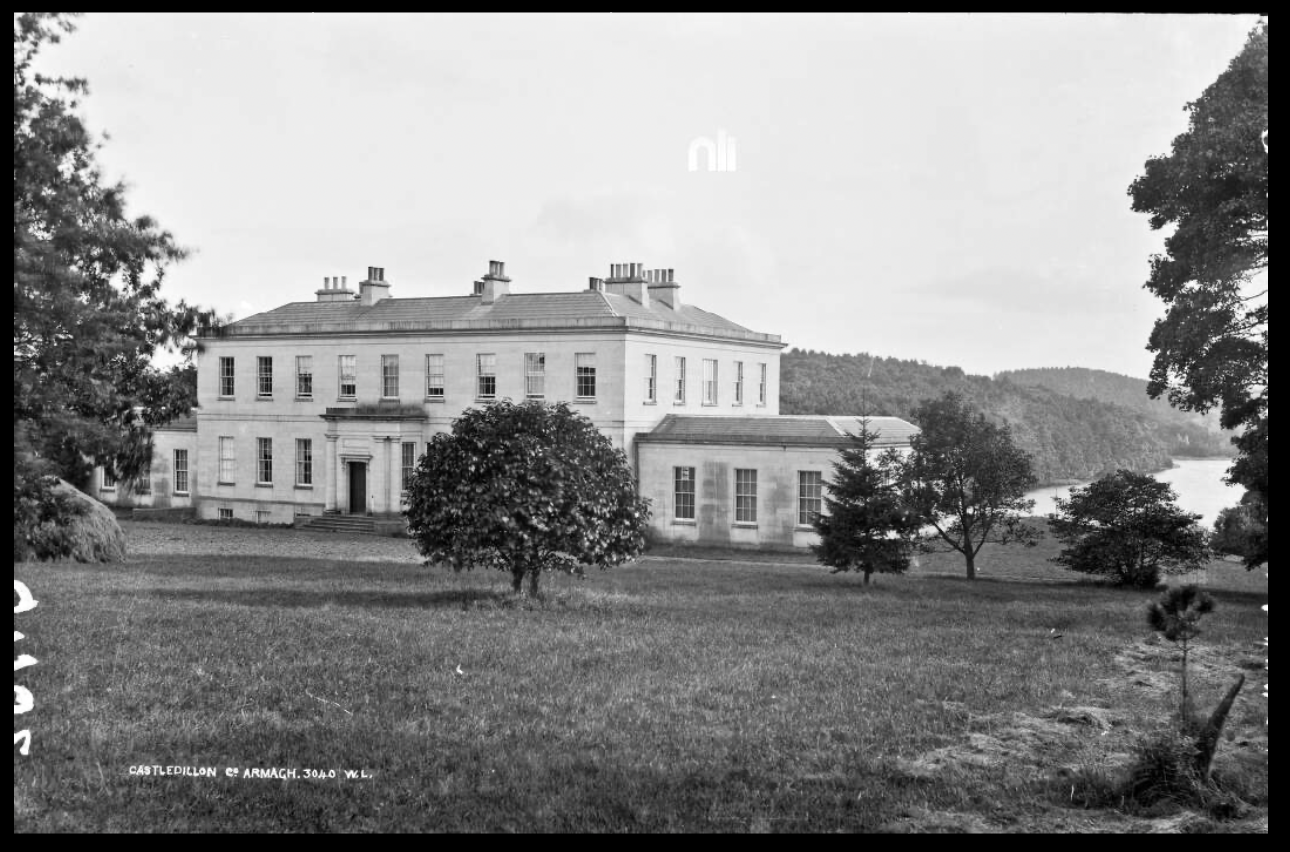
Castle Dillon, County Armagh, photograph by Robert French, (between ca. 1865-1914), Lawrence Photograph Collection, National Library of Ireland.

Castle Dobbs, Carrickfergus, County Antrim

An early C18 house in the manner of Sir Edward Lovett Pearce, built 1730 by Arthur Dobbs, Surveyor-General of Ireland, Governor of North Carolina, agriculturalist and organizer of expeditions to discover the NW passage from Hudson’s Bay to the Pacific.  

Castle Dobbs, County Antrim, courtesy Archiseek.

Castle Dodard, Lismore, County Waterford 

Castle Dodard, County Waterford, courtesy National Inventory.

Castle Durrow, Co Laois – a hotel, gardens open to public 

Castle Durrow, County Laois. Photograph © Jennifer Winder-Baggot, www.irishhistorichouses.com.

See my entry https://irishhistorichouses.com/2022/10/27/places-to-visit-and-stay-in-county-laois-leinster/

Castle Ellen, Athenry, County Galway – on 482 in 2019-2025 

Castle Ellen, County Galway, courtesy of National Inventory of architectural heritage.

See my entry https://irishhistorichouses.com/2023/05/31/places-to-visit-and-stay-in-county-galway/

Castle Ffogarty, Thurles, Co Tipperary

A rather insubstantial C19 castle; burnt 1922 and now a ruin except for one tower which has been rebuilt. 

Castle Ffrench, Ahascragh, Co Galway 

An elegant ashlar-faced house of three storeys over a basement, built in 1779 for Sir Charles ffrench, Mayor of Galway; replacing a late C17 house on a different site which itself replaced a castle built by the ffrench family soon after they bought the estate in late C16. 

Castle Ffrench, County Galway, courtesy National Inventory.

Castle Forbes, County Longford 

Castle Forbes, County Longford, Photograph from Archiseek, photograph by Robert French, (between ca. 1865-1914), Lawrence Photograph Collection, National Library of Ireland.
Castle Forbes, County Longford, Photograph from National Library of Ireland. 

Castle Forward, Newtowncunningham, Co Donegal – ruin  

Castle Freke, Rosscarbery, Co Cork  

Castle Freke, County Cork, courtesy of Dublin City Library archives.
Castle Freke, Rosscarbery, Co Cork  courtesy Archiseek.

Castle Gore (or Old Castle, Deel Castle), Ballina, Co Mayo

Castle Gore (or Old Deel Castle), County Mayo, courtesy National Inventory.

Castle Grace, Clogheen, Co Tipperary  

Castle Grace, Clogheen, Co Tipperary, photograph Michael Daniels and Shelley and Purcell estate agents 2019.

Castle Grove, County Donegal – accommodation  

Castlegrove, County Donegal. Photograph from National Inventory of Architectural Heritage.

See my entry https://irishhistorichouses.com/2022/10/27/places-to-visit-and-stay-in-county-donegal-ulster/

Castle Hacket (or Castlehacket), Belclare, Co Galway 

Castlehacket, photograph courtesy of airbnb Castlehacket entry.

See my entry https://irishhistorichouses.com/2023/05/31/places-to-visit-and-stay-in-county-galway/

Castle Harrison, Charleville, Co Cork – ‘lost’  

C18 house…sold 1956 and subsequently demolished

Castle Hewson, Askeaton, Co Limerick 

Castle Hewson, County Limerick, courtesy National Inventory.

Castle Howard, Avoca, Co Wicklow – section 482 

Castle Howard, County Wicklow. Photograph © Jennifer Winder-Baggot, www.irishhistorichouses.com.

See my entry https://irishhistorichouses.com/2020/11/13/castle-howard-avoca-county-wicklow/

Castle Hyde, Fermoy, County Cork

Castle Hyde, Fermoy, County Cork courtesy National Inventory.

Castle Ievers, Croom, Co Limerick 

Castle Ievers, County Limerick, courtesy National Inventory.
Castle Irvine (or Necarne Castle), County Fermanagh courtesy Lord Belmont.

See my entry https://irishhistorichouses.com/2022/04/03/places-to-visit-and-stay-in-ulster-counties-fermanagh-monaghan-and-tyrone/

Castle Kevin, Mallow, Co Cork  

Castle Kevin, Mallow, Co Cork courtesy National Inventory.

Castle Kevin, Annamoe, County Wicklow 

Castle Kevin, County Wicklow, Photograph courtesy of National Inventory of Architectural Heritage.

Castle Lackin, near Ballycastle, Co Mayo

A plain two storey late Georgian house, with a wide curved bow at one end of its garden front; simple entablatures over ground floor windows. A vast complex of outbuildings at rear of the house, partly surrounded by a high battlemented wall with castellated gate piers. “Eyecatcher” folly on hill opposite. Now the house and outbuildings are in ruins and some of the wall has collapsed.

Castle Leslie, County Monaghan – section 482 in 2019, hotel 

Castle Leslie, County Monaghan. Photograph © Jennifer Winder-Baggot, www.irishhistorichouses.com.

See my entry https://irishhistorichouses.com/2020/08/07/castle-leslie-glaslough-county-monaghan/

Castle Lough, Co Tipperary 

A two storey five bay Georgian house with a high roof.

Castle Lyons, Fermoy, Co Cork – ‘lost’  

A C16 fortified mansion, built on the foundations of the castle of the O’Lenans, from whom the place too its name; principal seat of the Earls of Barrymore. …The house was burnt 1771, through the carelessness of a workman, and never rebuilt. 

Castle MacGarrett, Claremorris, County Mayo

Castle MacGarrett, County Mayo, courtesy Sherry FitzGerald Claremorris.
Castle MacGarrett, County Mayo, photograph by Robert French, (between ca. 1865-1914), Lawrence Photograph Collection, National Library of Ireland.

Castle Martin, Co Kildare 

Castlemartin, County Kildare, courtesy of myhome.ie
Castlemartin House, County Kildare, photograph by Robert French, (between ca. 1865-1914), Lawrence Photograph Collection, National Library of Ireland.

Castle Martyr (or Castlemartyr), Co Cork – hotel  

Castlemartyr, County Cork courtesy National Inventory.

See my entry https://irishhistorichouses.com/2022/05/17/places-to-visit-and-stay-munster-county-cork/

Castle Mary, Cloyne, Co Cork – ‘lost’  

Castle Mary, Cloyne, Co Cork courtesy National Inventory.

Castle Matrix, Rathkeale, Co. Limerick (also called Castle Mattress)

Castle Matrix, County Limerick, photograph courtesy Archiseek.

Castle Morres, Kilmaganny, Co Kilkenny

Castle Morres, County Kilkenny, entrance front c. 1900, photograph collection Mrs. de Montmorency, Vanishing Country Houses of Ireland by The Knight of Glin, David J. Griffin and Nicholas K. Robinson, published by The Irish Architectural Archive and The Irish Georgian Society, 1988.

Castle Neynoe (Ballysumaghan House), Balintogher, Co Sligo

 “A small symmetrical Gothic-Revival castle with a central bow carried upwards as a three storey tower. Seat of the Neynoes. Now a ruin.” 

Castle Oliver (also known as Clonodfoy), Kilfinane, Co Limerick

Castle Oliver, County Limerick, Vanishing Country Houses of Ireland by The Knight of Glin, David J. Griffin and Nicholas K. Robinson, published by The Irish Architectural Archive and The Irish Georgian Society, 1988.
Castle Oliver, County Limerick, courtesy National Inventory.

Castle Otway, Templederry, Co Tipperary

Castle Otway, County Tipperary view of entrance and garden fronts, Vanishing Country Houses of Ireland by The Knight of Glin, David J. Griffin and Nicholas K. Robinson, published by The Irish Architectural Archive and The Irish Georgian Society, 1988.
Castle Otway, County Tipperary, entrance front 1979, photograph: William Garner, Vanishing Country Houses of Ireland by The Knight of Glin, David J. Griffin and Nicholas K. Robinson, published by The Irish Architectural Archive and The Irish Georgian Society, 1988.

Castle Park, Limerick, Co Limerick

Castle Park, County Limerick, courtesy National Inventory.

Castle Pollard (formerly Kinturk), Co Westmeath  

Castle Ring, Dundalk, Co Louth 

A two storey five bay gable-ended C18 house with simple round-headed doorway.

Castle Saunderson, Co. Cavan – a ruin, can visit 

Castle Saunderson, County Cavan. Photograph © Jennifer Winder-Baggot, www.irishhistorichouses.com.

See my entry https://irishhistorichouses.com/2020/07/03/county-cavan-historic-houses-to-see-and-stay/

Castle Shane, Co Monaghan

Castle Shane, County Monaghan, photograph courtesy of National Inventory.

Castle Sheppard, Borrisokane, County Tipperary – ruinous

Castle Strange, Athleague, Co Roscommon- ruin 

Castle Talbot, Blackwater, County Wexford 

Castle Talbot, County Wexford, courtesy National Inventory.

Castle Taylor, Ardrahan, Co Galway  – ruin 

Castle Townshend, Co Cork  – accommodation, hotel  

Castletownshend, County Cork. Photograph © Jennifer Winder-Baggot, www.irishhistorichouses.com.

See my entry https://irishhistorichouses.com/2025/04/25/the-castle-castletownshend-co-cork-accommodation/

Castle Upton, Templepatrick, County Antrim

Castle Upton, County Antrim, courtesy Archiseek.

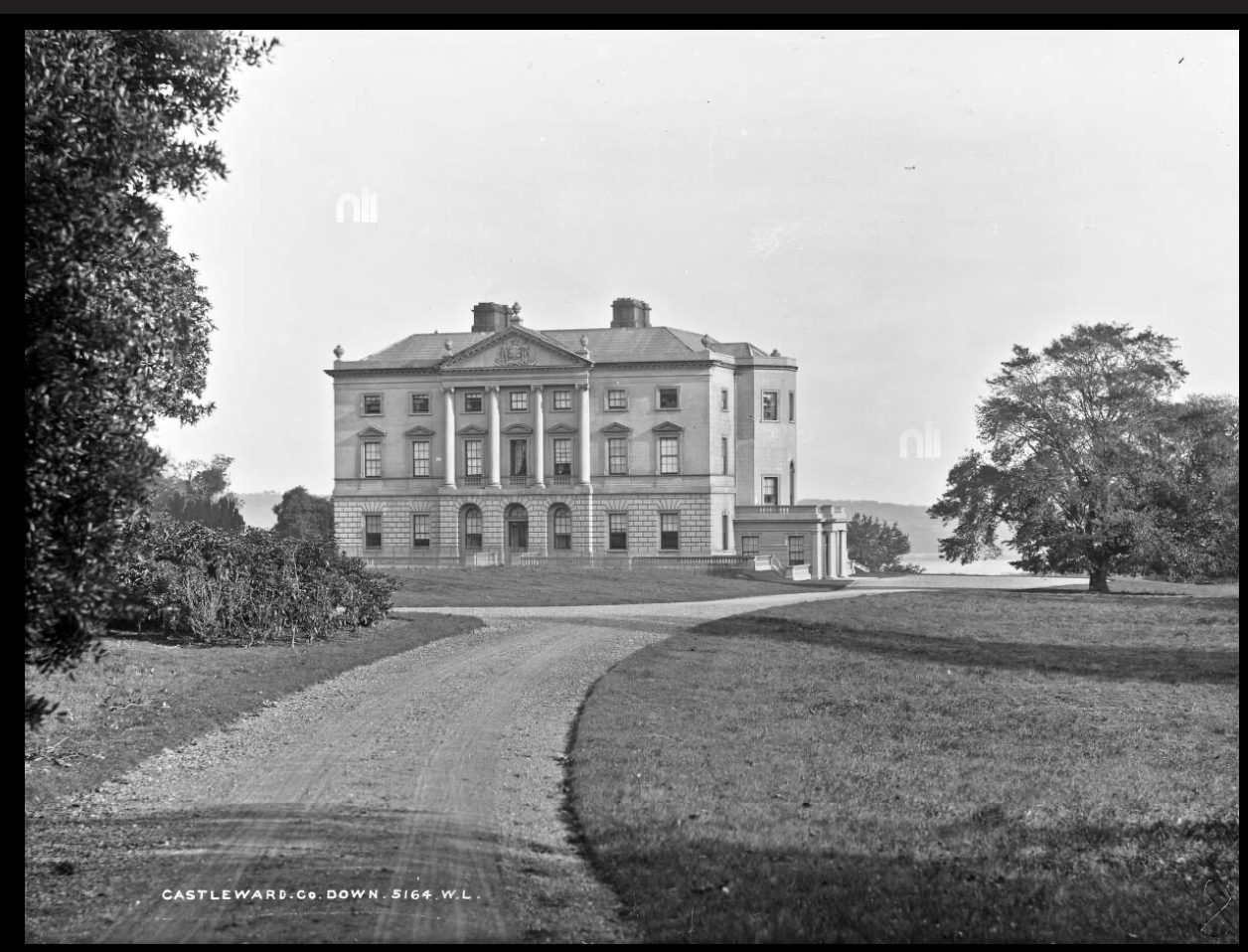
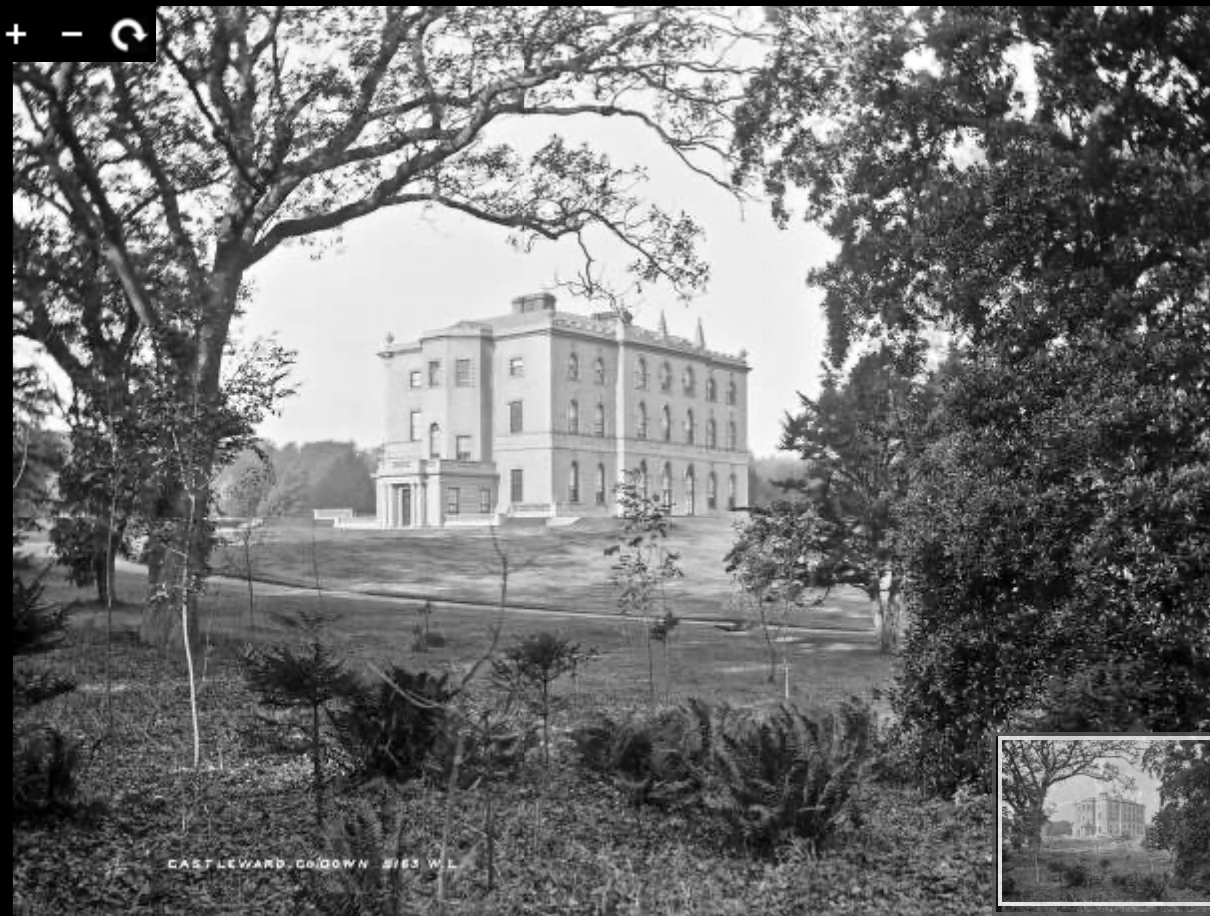
Castle Ward, Strangford, County Down 

Castle Ward, County Down, photograph by Robert French, (between ca. 1865-1914), Lawrence Photograph Collection, National Library of Ireland.

See my entry https://irishhistorichouses.com/2023/10/06/places-to-visit-and-stay-in-county-down-northern-ireland/

Castle Ward, County Down courtesy National Trust Images, photograph by Matthew Antrobus.
Castle Ward, County Down, photograph by Robert French, (between ca. 1865-1914), Lawrence Photograph Collection, National Library of Ireland.
Blackwater Castle (Castle Widenham, or Blackwater Valley Castle) Castletownroache, Co Cork courtesy of Sherry Fitzgerald.
Castle Widenham, County Cork, photograph by Robert French, (between ca. 1865-1914), Lawrence Photograph Collection, National Library of Ireland.

Castle Wilder (also known as Cloughdoo), Abbeyshrule, County Longford

Castle Wilder, County Longford, courtesy National Inventory.

Castle Willington, Nenagh, Co Tipperary 

Castle Willington, County Tipperary, courtesy National Inventory.

Castle Wray, Letterkenny, Co Donegal – ruins  

Castlebar House, Castlebar, Co Mayo – burned

Castleboro House, County Wexford – ruin

William Blacker married Elizabeth Anne Carew, from Castleboro House in County Wexford, now a splendid ruin. The ruins of Castleboro House, County Wexford (geograph_3716684) By Mike Searle, https://commons.wikimedia.org
Castleboro, County Wexford, photograph by Robert French, [between ca. 1865-1914], Lawrence Photograph Collection, National Library of Ireland.

Castlecaulfeild, County Tyrone – ruin

Castlecomer House, Co Kilkenny

Castlecomer House, County Kilkenny, photograph: Gillman Collection, Vanishing Country Houses of Ireland by The Knight of Glin, David J. Griffin and Nicholas K. Robinson, published by The Irish Architectural Archive and The Irish Georgian Society, 1988.

Castlecoole, Enniskillen, County Fermanagh – open to the public 

Castle Coole, County Fermanagh. Photograph © Jennifer Winder-Baggot, www.irishhistorichouses.com.

See my entry https://irishhistorichouses.com/2024/03/21/castle-coole-county-fermanagh-a-national-trust-property/

Castlecor, Ballymahon, County Longford 

Castlecor House, County Longford, photograph from the National Inventory of Architectural Heritage

See my entry https://irishhistorichouses.com/2024/03/16/places-to-visit-and-stay-in-county-longford-leinster/

Castlefield, Co Kilkenny 

A three storey bow-fronted Georgian house, the bow having a trefoil window and battlements. Pillared porch. 

Castlegar, Ahascragh, Co Galway 

The grandest of Sir Richard Morrison’s villas, built from 1803 onwards for Ross Mahon, afterwards 1st Bt; replacing an earlier house. 

Castlegar, County Galway, courtesy Archiseek.

Castlegarde, Cappamore, Limerick   

Castlegarde, County Limerick, courtesy of National Inventory.

Castlegrove, Tuam, County Galway

Castlegrove, County Galway, courtesy Mark Bence-Jones.

Castlehaven House, Castletownsend, Co Cork

Castlehaven House, Castletownsend, Co Cork  courtesy National Inventory.

Castlemaine Lodge, Hare Island, Athlone, Co Westmeath (or Hare Island)

Hare Island Lodge, Athlone, Co. Westmeath by Robert French, Lawrence Photographic Collection NLI L-ROY-05263.

Castlemore, Tullow, Co. Carlow – ruins

Castlemore, Tullow, Co. Carlow courtesy National Inventory.

Castlerea, Killala, Co Mayo demolished 1937

Castlerea House, Co Roscommon – demolished

Castlesize, Sallins, Co Kildare 

A two storey late C18 house of seven bays, the two outer bays on either side projecting slightly. 

Castletown Castle, Dundalk, Co Louth 

Castletown Castle, County Louth, Castlemore, County Cork, photograph by Robert French, (between ca. 1865-1914), Lawrence Photograph Collection, National Library of Ireland.

Castletown Castle/ House, Co Carlow

Castletown House, County Carlow courtesy National Inventory.

Castletown House, County Kildare  – open to public

Castletown House, photograph courtesy of Ireland Content Pool, Tourism Ireland.

See my entry https://irishhistorichouses.com/2024/03/15/castletown-house-and-parklands-celbridge-county-kildare-an-office-of-public-works-property/

Castletown Castle, Dundalk, County Louth

Castletown Castle, County Louth, Castlemore, County Cork, photograph by Robert French, (between ca. 1865-1914), Lawrence Photograph Collection, National Library of Ireland.

Castletown Conyers, Ballyagran, Co Limerick 

Castletown Conyers, County Limerick, courtesy of National Inventory.

Castletown ‘Cox’ Kilkenny 

Castletown Cox, County Kilkenny, courtesy Knight Frank.

Castletown Manor, Enniskillen, County Fermanagh – demolished 

Castletown Manor, Pallaskenry, Co Limerick – demolished

Castlewellan, County Down 

Castlewellan Castle, County Down, 2014 © George Munday/Tourism Ireland.

Cavangarden, Ballyshannon, Co Donegal – B&B  

See my entry https://irishhistorichouses.com/2022/10/27/places-to-visit-and-stay-in-county-donegal-ulster/

Cecil Manor, Augher, County Tyrone

Celbridge Abbey, Celbridge, Co Kildare 

Celbridge Abbey, courtesy of National Library of Ireland published between ca. 1865-1914 Lawrence Photographic Collection, photographer: Robert French.

Celbridge Lodge, Co Kildare 

Celbridge Lodge, County Kildare, courtesy Sherry Fitzgerald.

Chaffpool, Ballymote, Co Sligo – derelict 

Chanter Hill, Enniskillen, County Fermanagh 

A two storey house built 1780 as a Glebe for Rev Thomas Smyth DD. Front of one bay between two three sided bows.

Charlesfort, Kells, Co Meath 

A two storey house of ca 1800, with a lower wing. 

Charlesfort, Co Wexford 

Charlesfort, County Wexford.

Charlestown House, Clara, Offaly 

Charlestown House, County Offaly, photograph courtesy of National Inventory.
Charlestown House, County Offaly, photograph by Robert French, (between ca. 1865-1914), Lawrence Photograph Collection, National Library of Ireland.

Charlestown, Clogher, Co Roscommon 

The house is no longer extant but extensive estate architecture survives.

Charleville, Co Cork – gone  

A fine house built 1661 to his own design by the 1st Earl of Orrery, who at the same time developed the nearby town which is named Charleville after Charles II. The house stood on one side of a fortified enclosure, it had extensive gardens and a park. It was burnt 1690 during the Williamite war by the troops of Berwick and not rebuilt

Charleville, Castlebar, Co Mayo 

A square C18 house, now in ruins.

Charleville, Enniskerry, Co Wicklow – section 482 

Charleville, County Wicklow, August 2020. Photograph © Jennifer Winder-Baggot, www.irishhistorichouses.com.

See my entry https://irishhistorichouses.com/2020/09/18/charleville-county-wicklow/

Charleville Forest Castle, Tullamore, County Offaly 

Charleville Woods Castle, Tullamore, 17 Aug 2024. Photograph © Jennifer Winder-Baggot, www.irishhistorichouses.com.

See my entry https://irishhistorichouses.com/2024/08/29/charleville-forest-castle-tullamore-county-offaly-sometimes-open-to-public-run-by-charleville-castle-heritage-trust/

Charleville Park (also known as Sanders Park), Charleville, Co Cork –

A three storey six bay late C18 house, built by Christopher Sanders, now divided into flats.  

Church Hill, Maghera, County Down

An early to mid-C18 two storey gable-ended house of five bays; extended towards the end of C18 to form a new drawing room, the addition begin of the same height as the original front; and also gable-ended; but single-storey, with a three sided bow in its front and end walls.  

Churchill House, Chapeltown, County Kerry 

Church hill House, County Kerry courtesy National Inventory.

Churchtown House, Churchtown, County Kerry – whole house accommodation

Churchtown House, Churchtown, County Kerry courtesy National Inventory.

See my entry https://irishhistorichouses.com/2022/10/19/places-to-visit-and-stay-in-county-kerry-munster/

Cill-Alaithe, Killala, Co Mayo 

Cill-Alaithe, Killala, Co Mayo, courtesy National Inventory. 

Clandeboye, County Down

Clandeboye, County Down, photograph by Jonny84, CC-BY-SA-3.0
Clandeboye, County Down, photograph by Robert French, (between ca. 1865-1914), Lawrence Photograph Collection, National Library of Ireland.

Clara House, Clara, County Offaly

Three-bay two-storey over basement house, built c.1800, with attic, conservatory to rear and projecting entrance porch added to front. 

Clare Park, Ballycastle, County Antrim 

Claremont, Claremorris, Co Mayo 

Claremount House, County Mayo, courtesy Tuohy O’Toole.

Clarisford, Killaloe (Bishops’ Palace), Co Clare

The Palace of the (C of I) Bishops of Killaloe, a late C18 block of three storeys over a basement in a demesne by the River Shannon outside the town.

Clashenure House, Ovens, Co Cork

Clashenure House, Ovens, Co Cork courtesy National Inventory.

Classiebawn Castle, County Sligo 

Classiebawn, County Sligo, photograph courtesy of National Inventory.

Cleggan Lodge, Ballymena, County Antrim

Originally a hunting lodge, owned at various times by the O’Neills and the O’Haras. 

Cleariestown Hall, Cleariestown, County Wexford 

Cleariestown House, Co Wexford for sale Aug 2023, photograph courtesy of sales advertisement.

Clearmont, Claremorris, County Mayo

Clermont, Co Wicklow– school then sold 2005 

Clermont House, County Wicklow, photograph courtesy of National Inventory.

Clifden Castle, Clifden, Co Galway – ‘lost’ 
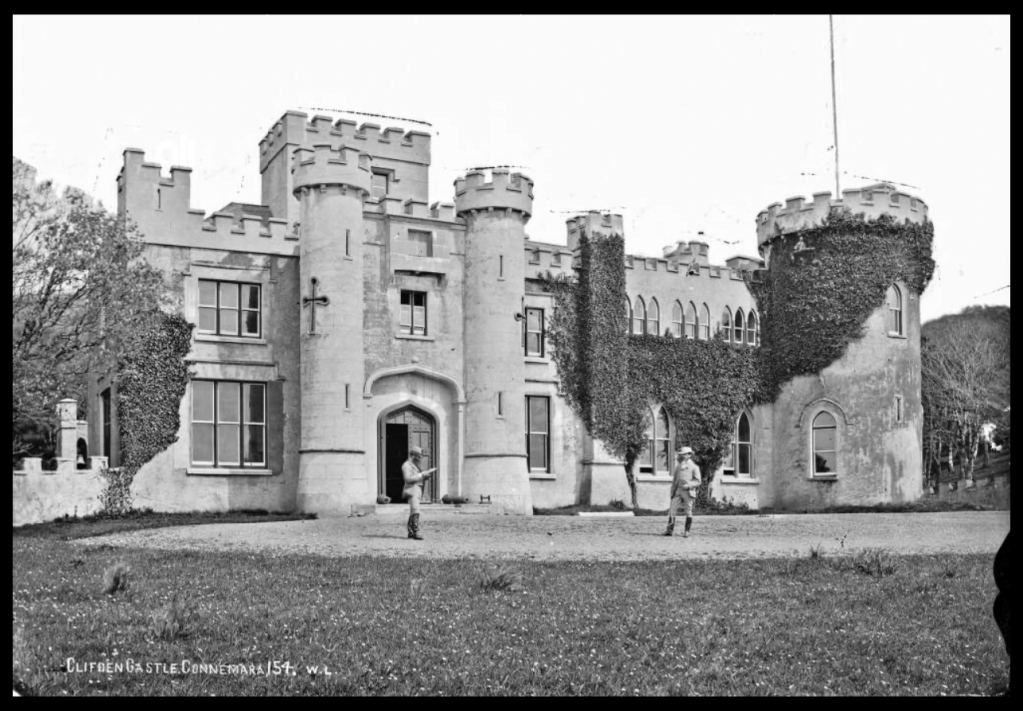
Clifden Castle, County Galway, entrance front, photograph by Robert French, (between ca. 1865-1914), Lawrence Photograph Collection, National Library of Ireland.

Clifden House, Corofin, Co Clare

A two storey seven bay early C18 house. Central niche over Doric doorcase of stone. Seat of the Burton family, which produced the C19 portrait painter and miniaturist Sir Frederick Burton. 

Cliff, Ballyshannon, Co Donegal – demolished in late 1940s  

Cliff House, County Fermanagh/Donegal, photograph by Robert French, (between ca. 1865-1914), Lawrence Photograph Collection, National Library of Ireland.

The Cliffs, Baily, Co Dublin

A C19 house added to at various times in the present centry, and full of Edwardian charm.

Clifton, Montenotte, Cork, Co Cork – convalescent home  

Two storey five bay early C19 house, with a single storey two bay wing balanced by conservatory, behind which is a chapel, with a lantern.  

Clobemon Hall, Ferns, County Wexford

Cloghans, Co Mayo 

Cloghans House, County Mayo, courtesy National Inventory.

Clogher House, Ballyglass, Co Mayo

Clogher House, County Mayo, courtesy National Inventory.

Clogher Palace (subsequenty Clogher Park), Clogher, County Tyrone

Cloghroe House, Blarney, Co Cork

A Georgian house built on the site of an old castle.

Clogrenane (or Clogrennan), Carlow, Co Carlow – a ruin 

Clogrenane (or Clogrennan House), Carlow, County Carlow courtesy National Inventory.

Clohamon House, near Ferns, Co Wexford 

Clohamon House, County Wexford, photograph courtesy Lisney Sothebys 2024.

Clonacody, Fethard, County Tipperary – accommodation

Clonacody, County Tipperary, photograph courtesy National Inventory.

See my entry https://irishhistorichouses.com/2022/10/19/places-to-visit-and-stay-in-county-tipperary-munster/

Clonageera House, Durrow, Co Laois 

Cloonageera, County Laois, courtesy National Inventory.

Clonalis House, Castlerea, Co Roscommon – accommodation and section 482 

Clonalis, County Roscommon, which is still the home of the O Conor family, ancient High Kings of Ireland. Photograph © Jennifer Winder-Baggot, www.irishhistorichouses.com.

See my entry https://irishhistorichouses.com/2020/10/16/clonalis-castlerea-county-roscommon/

Clonard, near Wexford, Co Wexford 

Clonard House, County Wexford, photograph courtesy National Inventory.

Clonattin House, Gorey, Co Wexford

Clonboy, O’Brien’s Bridge, County Clare – demolished

Clonbrock, Ahascragh, Co Galway  – ‘lost’ 

Clonbrock, County Galway, photograph courtesy of National Library of Ireland.
Clonbrock, County Galway, courtesy of National Inventory of Architectural Heritage.

Cloncorick Castle, Carrigallen, Co Leitrim

A two storey early to mid C-19 Tudor-Gothic house with buttresses and stepped gables. 

Cloncoskraine, Dungarvan, Co Waterford 

Clonearl, Daingean (formerly Philipstown), Offaly

Clonebraney, Crossakeel, Co Meath – only a ruinous wing remains. 

Clonfert Palace, Eyrecourt, Co Galway – ‘lost’ 

Clonfert Bishop’s Palace, County Galway courtesy National Inventory.

Clonganny House, Wexford – accommodation 

Clonganny House, County Wexford, courtesy of their website.

See my entry https://irishhistorichouses.com/2023/11/15/places-to-visit-and-stay-in-county-wexford/

Clongill Castle, Co Meath – ruin 

Clonhugh, Multyfarnham, County Westmeath 

Clonhugh, County Westmeath, photograph by Robert French, (between ca. 1865-1914), Lawrence Photograph Collection, National Library of Ireland.

Clonleigh, Ballindrait, Co Donegal – demolished

Clonlost House, Killucan, Co Westmeath

A tall Georgian block with a central pedimented attic. Now a ruin.

Clonmannon, Rathnew, Co. Wicklow – plans for retirement home 

Clonmannon, Ashford, Co Wicklow courtesy sales advertisement 2022.

Clonmeen, Banteer, Co Cork – whole house airbnb  

Clonmeen House, County Cork, courtesy of airbnb.

See my entry https://irishhistorichouses.com/2022/05/17/places-to-visit-and-stay-munster-county-cork/

Clonmore House, Piltown, Co Kilkenny 

Clonmore House, County Kilkenny, courtesy National Inventory.

Clonshavoy, Co Limerick 

The Irish Tourist Association surveyor writes in 1944 that the house was interesting as it was the remains of a very old Elizabethan house. He says that more than half the house was pulled down as it was unsafe “and the present eastern wing is a reconstruction”. Photograph from the Irish Tourist Association Survey 1943-44. 

Clonshire House, Adare, Co Limerick 

Clonshire House, County Limerick, courtesy National Inventory.

Clonskeagh Castle, Co Dublin

Clonskeagh Castle, County Dublin, photograph courtesy of myhome.ie

See my entry https://irishhistorichouses.com/2024/04/25/clonskeagh-castle-dublin/

Clontarf Castle, Clontarf, Co Dublin  – hotel 

Clontarf Castle, County Dublin, 1952 (image reversed), Dublin City Library Archives.

See my entry https://irishhistorichouses.com/2023/05/26/places-to-visit-and-stay-in-dublin-city-and-county/

Clontead More, Coachford, Co Cork

Clontead More, Coachford, Co Cork courtesy National Inventory.

Clontra, Shankill, Co Dublin

A delightful Ruskinian Gothic villa, almost certainly by Sir Thomas Newenham Deane, and possibly designed by his brilliant younger partner, Benjamin Woodward.

Clonyn Castle, County Westmeath 

Clonyn Castle, County Westmeath, photograph by Robert French, (between ca. 1865-1914), Lawrence Photograph Collection, National Library of Ireland.

Clonyquin (or Clooneyquin or Cloonyquin), Elphin, Co Roscommon – demolished

Cloonacauneen Castle, Co Galway  

An old tower-house with a two storey three bay castellated wing attached

Cloonamahon, Collooney, County Sligo 

Clooncahir, Mohill, Co Leitrim 

A plain two storey four bay house of ca 1820.

Clooney House, Clooney, Co Clare – ruin

Originally a two storey five bay C17 house of the Bindon family, which produced the C18 amateur architect and portrait painter Francis Bindon. The house burnt C19 and the property was sold by the impecunious Burton Bindon, who emigrated to Australia; his daughter and her husband Joseph Hall subsequently returned to Ireland and bought back Clooney. They rebuilt the burnt-out shell of the house in a rich Victorian Italianate style, … Unfortunately the Hall’s finances did not last out; he is said to have gambled and she was extravagant; so that by early C20 the house was once again ruinous. 

Cloverhill, Belturbet, Co Cavan 

Clover Hill, County Cavan, entrance front c. 1975. Photograph: William Garner. Vanishing Country Houses of Ireland by The Knight of Glin, David J. Griffin and Nicholas K. Robinson, published by The Irish Architectural Archive and The Irish Georgian Society, 1988.

Clown (now known as Cloncarneel), Trim, Co Meath 

Cloncarneel (formerly Clown), County Meath, photograph courtesy National Inventory.

Colebrook Park, County Fermanagh

An austere Classical house of 1825 by William Farrell; built for Sir Henry Brooke, 1st Bt of 2nd creation. 

Colebrook Park, County Fermanagh, photograph courtesy the house’s website.

See my entry https://irishhistorichouses.com/2022/04/03/places-to-visit-and-stay-in-ulster-counties-fermanagh-monaghan-and-tyrone/

Coleraine Manor House (formerly Jackson Hall), Coleraine, County Derry 

Colganstown, Newcastle, Co Dublin – 482

Colganstown House, with rendered walls and stone quoins. Photograph © Jennifer Winder-Baggot, www.irishhistorichouses.com.

See my entry https://irishhistorichouses.com/2020/05/21/colganstown-house-hazelhatch-road-newcastle-county-dublin/

 Collierstown House, Collierstown, Co Meath 

A late C18 house, built ca 1775.

Collon House, Ardee Street, Collon, Louth (also Oriel Temple)  – accommodation and tours 

Collon House, County Louth, courtesy National Inventory.

See my entry https://irishhistorichouses.com/2022/10/28/places-to-visit-and-stay-in-county-louth-leinster/

Combermere, Glounthaune, Co Cork – Danish consulate

An early c19 “gentleman’s cottage” mostly of one storey, with a small castellated wing.   

Conlig (or Little Clandeboye) House, County Down 

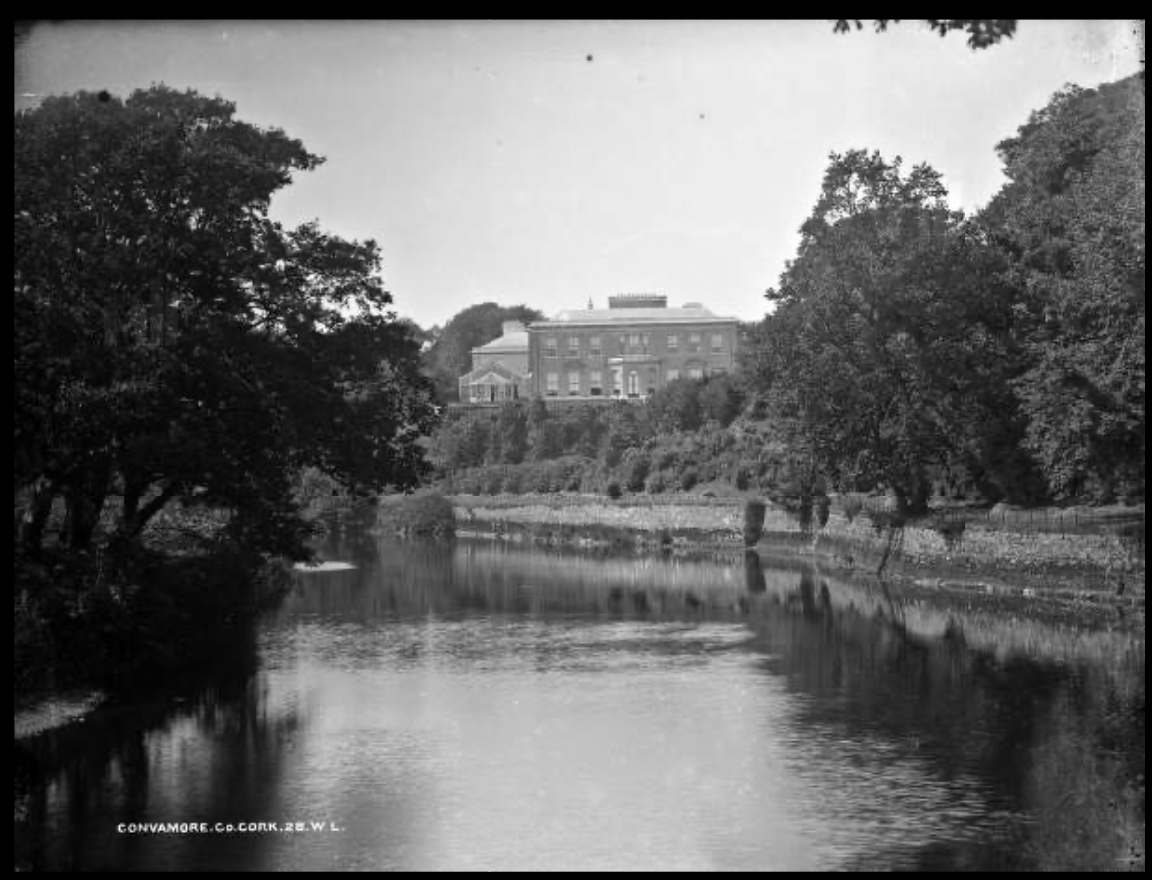
Convamore, Ballyhooly, Co Cork – ‘lost’  

Convamore, County Cork, photograph by Robert French, (between ca. 1865-1914), Lawrence Photograph Collection, National Library of Ireland.
At Convamore House, County Cork, courtesy of National Inventory.

Conway, Dunmurry, County Antrim 

A two storey Victorian house with a symmetrical front of two shallow curved bows and a central projection; on either side of which runs a pillared and balustraded veranda, joining at one end to a single-storey wing, and at the other to a pilastered conservatory. Became hotel; suffered irreparable bomb damage 1970.

Coolamber, Street, Co Westmeath

Coolamber, County Westmeath, courtesy National Inventory.

Coolamber Manor, Lisryan, County Longford 

Coolamber Manor, County Longford, courtesy National Inventory.

Coolavin, Monasteraden, Co Sligo

Multiple-bay two- and three-storey stone house, built 1898, to designs by architect James Franklin Fuller.  

Coolbawn House, near Enniscorthy, Co Wexford – ruin 

Coolbawn, County Wexford, photograph print: Richard Dann, Vanishing Country Houses of Ireland by The Knight of Glin, David J. Griffin and Nicholas K. Robinson, published by The Irish Architectural Archive and The Irish Georgian Society, 1988.

Coolcarrigan House and Gardens, Naas, County Kildare – section 482 in 2019  

Coolcarrigan, County Kildare. Photograph © Jennifer Winder-Baggot, www.irishhistorichouses.com.

See my entry https://irishhistorichouses.com/2020/05/31/coolcarrigan-house-and-gardens-coill-dubh-naas-county-kildare/

Coolderry House, Carrickmacross, Co Monaghan – lost 

A two storey late C18 house of five bays between two semi-circular bows. …Sold 1920 by Col G.J. Brownlow, afterwards demolished.

Coole, Millstreet, Co Cork

A long and low two storey Georgian house with a plain seven bay front. 

Coole House, Millstreet, County Cork, photograph by Robert French, (between ca. 1865-1914), Lawrence Photograph Collection, National Library of Ireland.

Coole Abbey, Fermoy, Co Cork 

A house built ca 1765 by Henry Peard; attributed, on stylistic grounds, to Davis Duckart. 

Coole Abbey, County Cork, photograph courtesy National inventory.

Coole Park, County Galway  – ‘lost’ 

Coole Park, County Galway, Lady Gregory in Drawing Room c. 1920, photograph by George Bernard Shaw, courtesy Shaw Estate. Vanishing Country Houses of Ireland by The Knight of Glin, David J. Griffin and Nicholas K. Robinson, published by The Irish Architectural Archive and The Irish Georgian Society, 1988.

See my entry https://irishhistorichouses.com/2023/05/31/places-to-visit-and-stay-in-county-galway/

Cooleville, Clogheen, County Tipperary

Cooleville House, courtesy of National Inventory of Architectural Heritage, a house built for the Grubb family in Clogheen.

Coolhull Castle, County Wexford

Coolhull Castle, County Wexford, Photographic Archive, National Monuments Service, Government of Ireland.

Coolkelure, Dunmanway, Co Cork

A late-Victorian house of stone, with gables of timber open-work in the Swiss manner and a pyramidal roofed tower. 

Coolkelure House, County Cork, photograph by Robert French, (between ca. 1865-1914), Lawrence Photograph Collection, National Library of Ireland.

Coollattin (also known as Malton), Shillelagh, Co Wicklow – golf club 

Coollattin House, County Wicklow, photograph courtesy of the house’s website.

Coolmain Castle, Kilbrittain, Co Cork

Coolmain Castle, Kilbrittain, Co. Cork for sale June 2025 courtesy Lisney Sotheby’s International Realty.

Coolmore, Carrigaline, Co Cork

A large late C18 block built 1788 by W.W. Newenham to replace a house built ca 1701 built by Thomas Newenham. 

Coolmore, Thomastown, Co Kilkenny 

Coolmore, County Kilkenny, courtesy National Inventory.

Coolnamuck, Carrickbeg, Co Waterford

“A three storey C18 block…Formerly the seat of a branch of the Wall family. It is said that one of the families who owned it in the past lived very extravagantly; and when, as a result, they went bankrupt, they committed mass suicide by driving their coach over the cliff at Tramore. In the present century, the main block became derelict; a house was made in the wing, which in recent years was the home of Mr C.C. Sanders. The house has now been demolished.”

Cooper Hill, Clarina, Co Limerick

Cooper Hill, County Limerick front doorcase 1974, photograph: William Garner, Vanishing Country Houses of Ireland by The Knight of Glin, David J. Griffin and Nicholas K. Robinson, published by The Irish Architectural Archive and The Irish Georgian Society, 1988.

Coopershill, Riverstown, Co Sligo – 482, accommodation 

Coopershill, County Sligo. Photograph © Jennifer Winder-Baggot, www.irishhistorichouses.com.

See my entry https://irishhistorichouses.com/2022/01/11/coopershill-house-riverstown-co-sligo/

Coppinger’s Court, Cork, Co.Cork – ruin  

An impressive early to mid C17 semi-fortified house built by Sir Walter Coppinger; with gables, machiolations and mullioned windows. Now a ruin.

Coppinger’s Court, County Cork, courtesy National Inventory.

Cor Castle, Innishannon, Co Cork

A small, early Gothic Revival castle, its doorway being a Gothicized Venetian window in the Batty Langley manner

Cor Castle, County Cork, photograph by Robert French, (between ca. 1865-1914), Lawrence Photograph Collection, National Library of Ireland.

Corbally, Taghadoe, Co Kildare 

A small early C18 gable-ended house of two storeys over basement. 

Corballymore (formerly Summerville), Dunmore East, Co Waterford 

Corbally More, County Waterford, courtesy National Inventory.

Corbalton Hall (formerly Cookstown House), Tara, Co Meath

Corbalton Hall (formerly Cookstown House), Tara, Co Meath, photograpy by Tom Coakley, Barrow Coakley Photography Ltd., 25th May 2018.

Corduff, Ballinamore, Co Leitrim 

A two storey five bay house probably of late C18. 

Corick, Clogher, County Tyrone – hotel

https://www.corickcountryhouse.com

See my entry https://irishhistorichouses.com/2022/04/03/places-to-visit-and-stay-in-ulster-counties-fermanagh-monaghan-and-tyrone/

Corkagh House, Clondalkin, Co Dublin – demolished 

Corkagh House, Clondalkin 1930 courtesy The Hone Family, https///source.southdublinlibraries.ie/bitstream/10599/11129/1/wm_img127

Corkbeg, Whitegate, Co Cork – demolished

A square two storey early to mid-C19 house on an island just inside the entrance to Cork Harbour joined to the mainland by a causeway; built to replace an earlier house by the water’s edge.

Corke Lodge, Bray, County Wicklow  – the gardens are open to the public as Section 482. www.corkelodge.com

See my entry https://irishhistorichouses.com/2023/05/26/places-to-visit-and-stay-in-dublin-city-and-county/

Corke Lodge, Bray, County Wicklow.

Cornacassa, Monaghan, Co Monaghan

Cornacassa House, County Monaghan, courtesy Archiseek.

Cornahir (or Cornaher), Tyrrellspass, Co Westmeath 

Cornaher or Cornahir House, County Westmeath, courtesy National Inventory.

Corradoo, Ballinafad, Co Sligo 

A house built 1768 by William Phibbs, of Hollybrook, for use as a school.

Corries, Bagenalstown, Co Carlow

Corries (or Corris) House, Bagenalstown, Co Carlow courtesy National Inventory.

Corville, Roscrea, Co Tipperary

A C18 house with a breakfront centre.  

Costello Lodge, Costello, Co Galway

A fishing lodge in Connemara, owned earlier this century by J. Bruce Ismay, head of the White Star Line at the time of the sinking of the Titanic and one of the survivors from that ill-fated ship. Burnt 1922 and rebuilt 1925; a two storey house with gables, dormer gables and pantiled roof.” 

Court Hill, Dunboyne, Co Meath 

An elegant mid-C19 neo-Classical villa in the style of J.S. Mulvany, of one storey over a basement and three bays; the centre bay being raised as a pedimented attic. Flanking service tower. Remodelled in Edwardian period.

Courtown, Kilcock, County Kildare 

A plain two storey house of ca 1815, built by John Aylmer to replace the earlier house here, which was burned and looted 1798 during the ownership of his father, Michael Aylmer, who had been unable to rebuilt it, not having received sufficient compensation from the state. Five bay front, with strip pilasters. Much enlarged ca 1900 by J.A. Aylmer, who added a wing at right angles to the original block to form a new entrance front, with a three sided bow and an open porch, at one side of a pedimented projection; containing, among other rooms, a hall with a massive oak staircase. 

Courtown House, Courtown, Co Wexford

A C18 house overlooking the sea at Courtown Harbour, much altered and enlarged C19 after being sacked during 1798 Rebellion. The front of the house…Sold post WWII, subsequently demolished.

Courtown House, County Wexford, photograph by Robert French, (between ca. 1865-1914), Lawrence Photograph Collection, National Library of Ireland.

Craddenstown, County Westmeath 

Craddenstown, County Westmeath, photograph courtesy National Inventory.

Cragleigh House, Ennis, Co Clare

Cragleigh House, Cragleigh, Ennis, Co. Clare, for sale July 2025 photograph courtesy Cormac O’Sullivan.

A two storey three bay early C19 house with Wyatt windows and fanlighted doorway, standing in front of an older building to which it is linked.

Craigavad House, County Down 

A restrained Classical house on the shores of Belfast Lough, built ca 1852 for John Mulholland, afterwards 1st Lord Dunleath, to the design of the Belfast architect Thomas Turner. Top-lit central hall with a circular gallery and a glazed dome. Now a golf club.”

Craigavon, Strandtown, County Down 

A two storey Victorian house with a front of two bays on either side of a central bow. Round-headed windows in lower storey, camber-headed windows above. Pavilion with pedimented portico at back of house, joined to main block by orangery. The home of James Craig, 1st Viscount Craigavon, 1st Prime Minister of Northern Ireland. Given to the nation.” 

CRAIGAVON HOUSE is owned and run by the Somme Association, a charity which cares for elderly war veterans. The future of Craigavon House remains uncertain.

Craigdun or Craigdunn Castle, Dunminning, County Antrim

A Victorian Scottish Baronial castle of basalt, built by Edmund McNeill. 

Craigdun, County Antrim, photographs courtesy Irish Independent 20th March 2015.

Cranagh Castle, Templemore, Co Tipperary 

A three storey house of 1768 built on to a medieval round tower.

Cranaghan House, Ballyconnell, Co Cavan – Slieve Russell hotel? 

Slieve Russell hotel, Co Cavan photograph by Geoffrey Arrowsmith 2019.

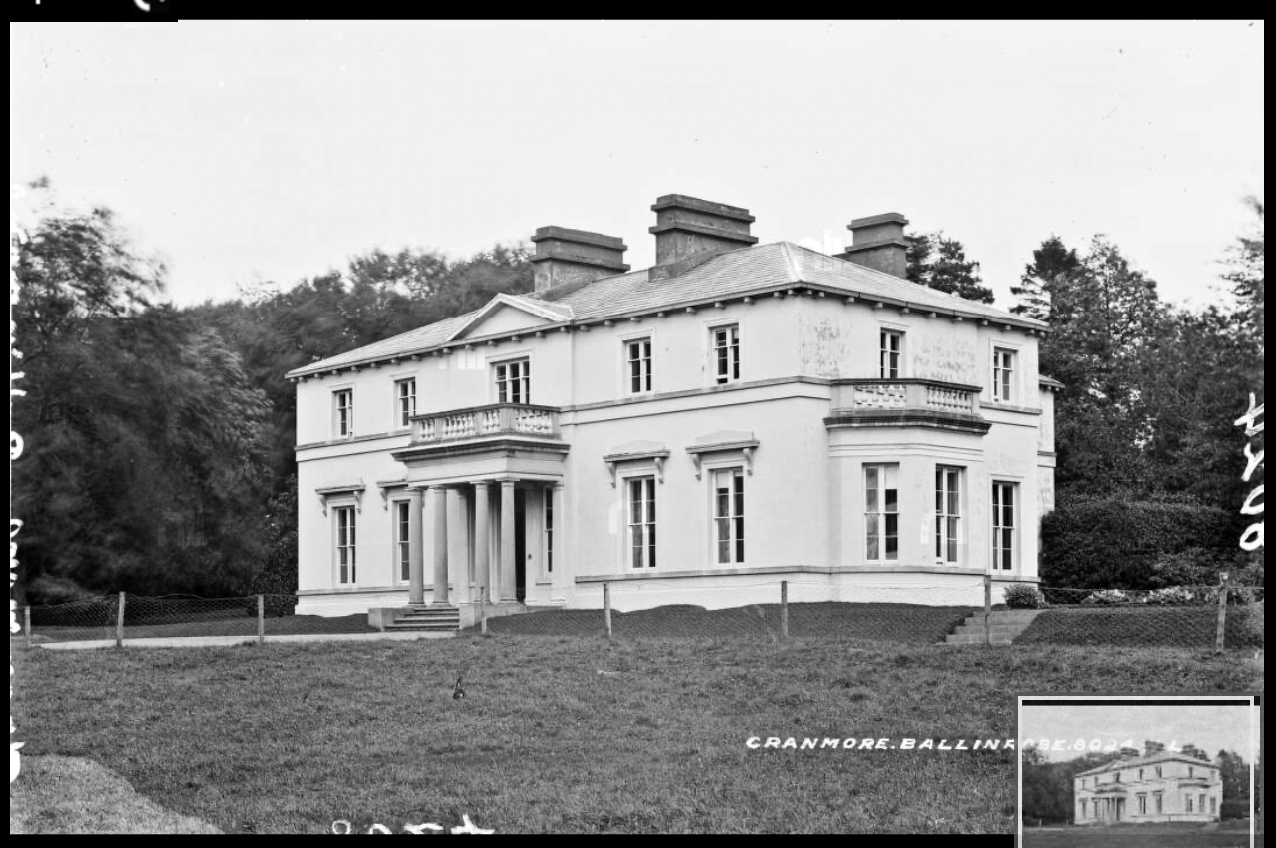
Cranmore House, Ballinrobe, Co Mayo 

Cranmore, County Mayo, photograph by Robert French, (between ca. 1865-1914), Lawrence Photograph Collection, National Library of Ireland.

Cratloe Woods House, Cratloe, County Clare  – private, used to be public, in public woods 

A long, low two storey gable ended C17 house one room thick. Its principal elevation, of thirteen bays, with Georgian sash windows and central three sided bow, is now the garden front; a new entrance front, in simple style with timbered porch, having been added to other side ca 1850 to provide a corridor and larger staircase, possibly to the design of James Pain, who gave the garden front bow a Tudor-Revival gable and heightened the chimneystacks, also in Tudor-Revival style.

Crawfordsburn Park, Bangor, County Down 

Originally a two storey five bay gable-ended house overlooking Belfast Lough. Triple window above fanlighted doorway. Return. Enlarged in C19 gable style. Now a hospital and much altered.

Creagh, Skibbereen, Co Cork

A pleasant Regency house of two storeys over basement, built ca. 1820.  

Creagh House, West Cork, photograph courtesy Irish Examiner 23rd March 2014.

Creagh Castle/House, Doneraile, Co Cork

Creagh House, County Cork, courtesy of National Inventory.

Creagh House, County Mayo

Creagh, County Mayo, photograph by Robert French, (between ca. 1865-1914), Lawrence Photograph Collection, National Library of Ireland.
Creagh, Ballinrobe, Co. Mayo courtesy National Inventory.

Crebilly House, County Antrim 

A two storey C19 Italianate house which from its appearance could be an early work of Sir Charles Lanyon. 

Creevaghmore, Ballymahon, Co Longford 

Creevaghmore House, County Longford courtesy National Inventory.

Cregg Castle, Fermoy, Co Cork

A home of mid-C18 appearance, of three storeys over a basement; the top storey being treated as an attic, above the cornice. 

Cregg House or Castle, County Cork, photograph courtesy National Inventory.

Cregg Castle, Corrandulla, Co Galway

Cregg Castle, County Galway, photograph from Savills estate agent.

See my entry https://irishhistorichouses.com/2023/05/31/places-to-visit-and-stay-in-county-galway/

Crevenagh House, Omagh, County Tyrone

Crobeg, Doneraile, Co Cork – demolished in 1980s  

Crocknacrieve, Enniskillen, County Fermanagh 

Crom Castle, Newtown Butler, County Fermanagh 

Crom Castle, Fermanagh Courtesy of Tourism Northern Ireland, by Brian Morrison, 2008.

See my entry https://irishhistorichouses.com/2022/04/03/places-to-visit-and-stay-in-ulster-counties-fermanagh-monaghan-and-tyrone/

Crom Castle, County Fermanagh, photograph by Robert French, (between ca. 1865-1914), Lawrence Photograph Collection, National Library of Ireland.

Cromore House, Portstewart, County Derry 

A mid-C18 house of two storeys with a dormered attic and four bays, enlarged and remodelled 1834 by John Cromie, who added a two storey wing on either side, of the same height as the centre; with a single large many-paned window in each storey. 

Cromwellsfort, Co Wexford 

Cromwellsfort, County Wexford, photograph courtesy of National Inventory.

Croney Byrne, Rathdrum, Co Wicklow – courtyard accommodation 

https://croneybyrne.ie

See my entry https://irishhistorichouses.com/2022/10/20/places-to-visit-and-stay-in-county-wicklow-leinster/

Cronroe, Ashford, Co Wicklow – Bel Air hotel and equestrian centre 

Cronroe, now Bel Air Hotel, County Wicklow, Photograph courtesy of National Inventory of Architectural Heritage.

See my entry https://irishhistorichouses.com/2022/10/20/places-to-visit-and-stay-in-county-wicklow-leinster/

Crossdrum, Oldcastle, Co Meath

Crossdrum, County Meath, courtesy National Inventory.

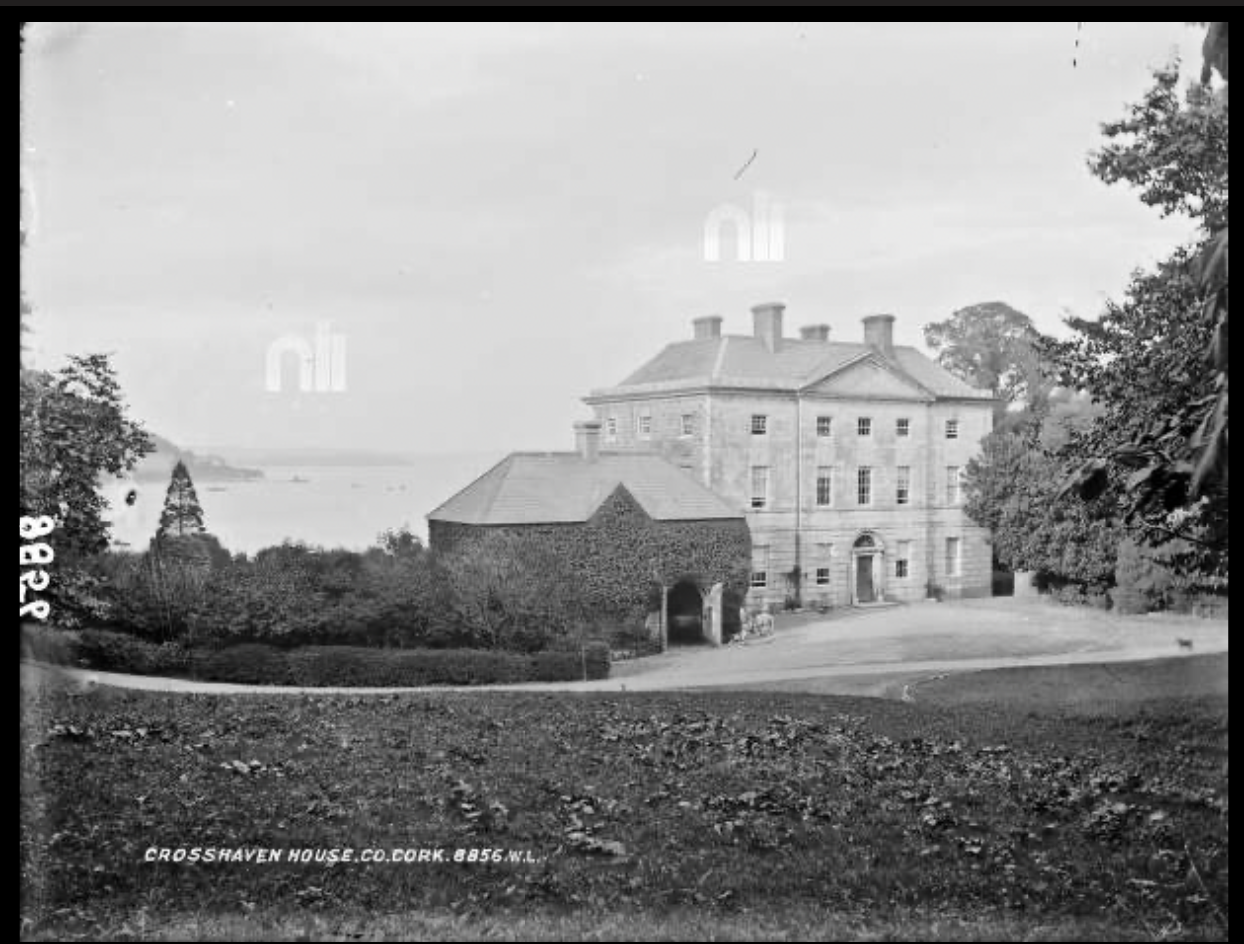
Crosshaven House, Crosshaven, Co Cork – whole house rental  

A three storey house built 1769 by William Hayes, wiht two identical fronts of crisp grey ashlar which almost certainly derive from Isaac Ware’s design for Clifton Hill House, Bristol. https://www.crosshavenhouse.ie/

Crosshaven House, photograph courtesy of the houses’s website https://www.crosshavenhouse.ie

See my entry https://irishhistorichouses.com/2022/05/17/places-to-visit-and-stay-munster-county-cork/

Crosshaven House, County Cork, photograph by Robert French, (between ca. 1865-1914), Lawrence Photograph Collection, National Library of Ireland.

Crossogue House, Ballycahill, Co Tipperary

An early Victorian house with a high basement. 

Crotto, Kilflynn, Co Kerry – ‘lost’ 

Crotto, Kilflynn, Co Kerry courtesy Archiseek.

Crowhill, Annaghmore, County Armagh

A two storey late Georgian house; five bay front with one bay pedimented breakfront. 

Cuba Court, Banagher, Co Offaly – demolished 

Cuba Court, County Offaly, entrance front 1978 photograph: William Garner, Vanishing Country Houses of Ireland by The Knight of Glin, David J. Griffin and Nicholas K. Robinson, published by The Irish Architectural Archive and The Irish Georgian Society, 1988.

Cuffesborough, Durrow, Co Laois

A three storey house of 1770 which from both elevation and plan would appear to have been built about thirty years earlier. 

Culdaff House, Carndonagh, Co Donegal  

Culdaff House, County Donegal, photograph by Robert French, [between ca. 1865-1914], Lawrence Photograph Collection, National Library of Ireland.
Culdaff House, County Donegal courtesy of Mark Bence-Jones.

Cullamore, Carney, Co Sligo 

Cullagh More, County Sligo, courtesy National Inventory.

Cullane, Sixmilebridge, Co Clare – ruin

A Georgian house with a bow window, overlooking the lake. Had a good scrolled overmantel in one room. Now a ruin.  

Culmore House, Ballykelly, County Derry 

A good quality late-Georgian house of brilliant red brick, built 1805.

Cultra Manor, Craigavad, County Down 

Originally a large plain house with a central bow and a battlemented parapet. Towards the end of the C19, or in the opening years of C20, Robert Kennedy, a diplomat who eventually became Minister to Uruguay, replaced the house with a long two storey mansion built of rubble and ashlar facings, which he named Cultra Manor. 

Cultra Bishops’ Palace, Cultra, County Down 

“A gabled Victorian house with a battlemented tower at one corner.” 

Curragh, Lisnaskea, County Fermanagh

A two storey three bay house with quoins, said to have been originally built ca 1699-1700.  

Curragh Chase, Adare, Co Limerick

Curragh Chase, County Limerick garden front 1938, Vanishing Country Houses of Ireland by The Knight of Glin, David J. Griffin and Nicholas K. Robinson, published by The Irish Architectural Archive and The Irish Georgian Society, 1988.

Curraghmore, Ballinrobe, Co Mayo 

Curraghmore, County Mayo, courtesy National Inventory.

Curraghmore, Portlaw, County Waterford – section 482 in 2019 

Curraghmore, County Waterford, the garden facing side of the house, designed by James Wyatt (1746-1813), 14th August 2023. Photograph © Jennifer Winder-Baggot, www.irishhistorichouses.com.

See my entry https://irishhistorichouses.com/2020/08/01/curraghmore-portlaw-county-waterford/

Curraglass, Co Cork – ‘lost’  

Currarevagh, Oughterard, Co Galway – accommodation 

Currarevagh, County Galway, from website.

See my entry https://irishhistorichouses.com/2023/05/31/places-to-visit-and-stay-in-county-galway/

Cuskinny, Cobh, Co Cork  

Cuskinny House, County Cork, photograph courtesy of sale advertisment by Knight Frank and Michael H. Daniels, June 2023.

A Guide to Irish Country Houses by Mark Bence-Jones contents and pictures, houses beginning with B

Note that the majority of these are private houses, not open to the public. I discovered “my bible” of big houses by Mark Bence-Jones only after I began this project of visiting historic houses that have days that they are open to the public (Section 482 properties).

This is a project I have been working on for a while, collecting pictures of houses. Enjoy! Feel free to contact me to send me better photographs if you have them! I’ll be adding letters as I go…

Donation

Help me to fund my creation and update of this website. It is created purely out of love for the subject and I receive no payment so any donation is appreciated! My website costs €300 per year on WordPress.

€15.00

Bagenalstown House, Bagenalstown, Co Carlow

Bagenalstown House, County Carlow, between 1880-1900, photograph by Robert French, Lawrence Photographic Collection, National Library of Ireland.

Bailieborough Castle (also known as Lisgar House or The Castle), Co Cavan  – demolished 

Bailieborough Castle (also known as Lisgar House or The Castle), Co Cavan, courtesy Archiseek

Balheary House, Swords, Co Dublin  – demolished 2005 

Ballaghtobin, Callan, Co Kilkenny 

Ballea Castle, County Cork 

Ballea Castle, County Cork, photograph courtesy of https://balleacastle.com

This is great, I am finding new places to stay! See their website https://balleacastle.com

Ballibay House (or Ballybay), Ballibay, Co Monaghan – demolished 

Ballibay, County Monaghan, courtesy Archiseek.

Ballin Temple (or Ballintemple), Tullow, Co Carlow – demolished 

Ballintemple, County Carlow, photograph courtesy of Ballin Temple website https://www.ballintemple.com/archive/history/archive.html

Ballinaboola House, Co Wexford

Ballinaboy, Clifden, Co Galway 

Ballinacarriga (or Ballynacarriga), Kilworth, Co Cork 

Ballinacarriga (or Ballynacarriga), Kilworth, Co Cork photograph courtesy of National Inventory.

Ballinaclea (or Ballinclea), Killiney, Co Dublin – demolished 

Ballinaclough House, Nenagh, Co Tipperary 

Ballinacor House, Rathdrum, County Wicklow 

Ballinafad (or Ballinafed), Balla, Co Mayo 

Ballinafad, County Mayo, courtesy National Inventory. Photography by James Fraher.

They offer accommodation, see their website: http://www.ballinafadhouse.com

Ballinahina, White’s Cross, Co Cork 

Ballinahown Court (or Ballynahown, Bence Jones), Count Westmeath

Ballinakill House, Waterford, Co. Waterford 

Ballinaminton, Clara, Co Offaly 

Ballinamona, Cashel, Co Tipperary 

Ballinamona Park, Waterford 

Ballinamore House, Kiltimagh, Co Mayo 

Ballinamore, County Mayo, Photography by James Fraher, National Inventory.

Ballinclea, Killiney, County Dublin

Ballinderry Park, Ballinderry Park, Kilconnell, Ballinasloe, Galway

Ballinderry, County Galway, photograph courtesy of Historic Houses of Ireland.

Ballinderry, Carbury, Co Kildare 

Ballindoon House (formerly Kingsborough), Derry, Co Sligo

Ballindoon, County Sligo, photograph courtesy Wilsons Auctioneers.

Ballingarrane (formerly known as Summerville), Clonmel, Co. Tipperary 

Ballinkeele, Ballymurn, Enniscorthy, Wexford  – whole house rental 

Ballinkeele House, County Wexford, photograph courtesy of website.

See my entry https://irishhistorichouses.com/2023/11/15/places-to-visit-and-stay-in-county-wexford/

Ballinlough Castle, Clonmellon, Co. Westmeath or Meath – accommodation

Ballinlough Castle, County Westmeath, photograph courtesy of Ballinlough website https://www.ballinloughcastle.ie/history

See my entry https://irishhistorichouses.com/2022/10/28/places-to-visit-and-stay-in-county-meath-leinster/

Ballinrobe, Co. Mayo 

Ballinrobe, County Mayo, courtesy National Inventory.

Ballintaggart, Colbinstown, Co. Kildare 

Ballinterry House, Rathcormac, Co Cork – accommodation 

Ballinterry House, County Cork, photograph from National Inventory of Architectural Heritage.

See my entry https://irishhistorichouses.com/2022/05/17/places-to-visit-and-stay-munster-county-cork/

Ballintober House, Ballinahassig, Co Cork  – demolished

Ball’s Grove, Drogheda, Co Louth 

Ball’s Grove, County Louth, courtesy National Inventory.

Bally Ellis, County Wexford

Ballyanahan (or Ballyenahan), Co Cork

Ballyanahan (or Ballyenahan), Co Cork, photograph courtesy National Inventory.

Ballyanne House, New Ross, Co Wexford

Ballyarnett, Derry, County Derry 

Ballyarthur, Woodenbridge, Co Wicklow 

Ballyarthur, County Wicklow, Photograph courtesy of National Inventory of Architectural Heritage.
Ballyarthur Castle entrance, County Wicklow, photograph by Robert French, Lawrence Photograph Collection, National Library of Ireland.

Ballybricken, Ringaskiddy, Co Cork

Ballybroony, Co Mayo 

Ballybroony, County Mayo, courtesy National Inventory.

Ballyburly, Edenderry, Co Offaly

Ballyburly, County Offaly, entrance front, Vanishing Country Houses of Ireland by The Knight of Glin, David J. Griffin and Nicholas K. Robinson, published by The Irish Architectural Archive and The Irish Georgian Society, 1988.

Ballycanvan House, Waterford, Co Waterford  

Ballycarron House, Golden, Co Tipperary 

Ballycastle Manor House, County Antrim

Ballyclough, Kilworth, Co Cork – partly demolished 

Ballyclough, Kilworth, Co Cork courtesy National Inventory.
Ballyclough, County Cork, Victorian photograph, Irish Architectural Archive, Vanishing Country Houses of Ireland by The Knight of Glin, David J. Griffin and Nicholas K. Robinson, published by The Irish Architectural Archive and The Irish Georgian Society, 1988.

Ballyclough House, Ballysheedy, Co Limerick

Ballyconnell House, Ballyconnell, Co Cavan

Ballyconnell House, County Cavan, photograph courtesy of www.ballyconnell.org

Ballyconnell House, Falcarragh, Co Donegal  

Ballyconnell House, County Donegal, photograph by Robert French, Lawrence Photograph Collection, National Library of Ireland.

Ballyconra House, Ballyragget, Co. Kilkenny 

Ballyconra House, County Kilkenny, courtesy National Inventory.

Ballycross, Bridgetown, Co Wexford  – demolished 

Ballycullen, Askeaton, Co Limerick 

Ballycurrin Castle, Co Mayo 

Ballycurrin, County Mayo, courtesy Colman Sherry Solicitors.

Ballycurry, Ashford, Co Wicklow 

Ballycurry House, County Wicklow, Photograph courtesy of National Inventory of Architectural Heritage.

Ballydarton, near Leighlinbridge, Co Carlow

Ballydarton, County Carlow, designed by Daniel Robertson, in 1830. Photograph courtesy Historic Houses of Ireland.

Ballydavid, Woodstown, County Waterford

Ballydivity, Ballymoney, County Antrim

Ballydonelan Castle, Loughrea, Co Galway – ‘lost’ 

Ballydonelan Castle entrance front, County Galway, collection: Bertie Donohoe, Vanishing Country Houses of Ireland by The Knight of Glin, David J. Griffin and Nicholas K. Robinson, published by The Irish Architectural Archive and The Irish Georgian Society, 1988.

Ballydrain House, Drumbeg, County Antrim

Ballydrain House, Drumbeg, County Antrim, photograph courtesy Archiseek.

Ballyduff, Thomastown, Co Kilkenny 

Ballyduff House, County Kilkenny, courtesy of National Inventory.

Ballydugan House, Portaferry, County Down

Used to provide accommodation, I’m not sure if it still does.

Ballydugan House, County Down, photograph courtesy of Discover Northern Ireland.

Ballyedmond, Midleton, Co Cork – demolished after 1960.  

Ballyedmond Castle, Killowen, County Down – can visit gardens. 

Ballyedmond Castle, County Down, photograph courtesy of Archiseek.

Ballyeigan, Birr, Co Offaly

Ballyeigan House, County Offaly, photograph courtesy National Inventory of Architectural Heritage.

Ballyellis, Buttevant, Co Cork

Ballyfin House, Mountrath, County Laois – hotel 

Ballyfin, photograph by Tony Pleavin 2018 for Tourism Ireland. Wrought-iron curvilinear Victorian conservatory, c.1855, on a rectangular plan with apsidal ends and glazed corridor linking it to Ballyfin House. Designed by Richard Turner.

See my entry https://irishhistorichouses.com/2022/10/27/places-to-visit-and-stay-in-county-laois-leinster/

Ballygally Castle, Larne, County Antrim – hotel

At Ballygally Castle, County Antrim, 2023. Photograph © Jennifer Winder-Baggot, www.irishhistorichouses.com.

See my entry about it on my page of places to stay in County Antrim https://irishhistorichouses.com/2022/03/21/places-to-visit-and-stay-in-ulster-county-antrim/

Ballygarth Castle, Julianstown, Co Meath 

Ballygawley Park, Ballygawley, Couny Tyrone

Ballygawley, County Tyrone. Photograph © Jennifer Winder-Baggot, www.irishhistorichouses.com.

Ballygiblin, near Mallow, Co Cork – ruin  

Ballygiblin, County Cork, 1986, photograph: William Garner. Vanishing Country Houses of Ireland by The Knight of Glin, David J. Griffin and Nicholas K. Robinson, published by The Irish Architectural Archive and The Irish Georgian Society, 1988.

Ballyglan, Woodstown, Co Waterford 

Ballyglunin Park, Monivea, Co. Galway 

Ballyglunin Park, County Galway, photograph courtesy of house’s website.

Available for hire https://ballygluninpark.ie

Ballyhaise House, Ballyhaise, Co. Cavan – agricultural college 

Ballyhaise House, Ballyhaise, Co. Cavan courtesy National Inventory.

Ballyheigue Castle, near Tralee, Co Kerry – ‘lost’  

Ballyheigue Castle, Co Kerry courtesy Archiseek.

Ballyhossett, Downpatrick, County Down 

Ballyin, Lismore, Co Waterford 

Ballyin Garden House, Co Waterford, photograph courtesy of myhome.ie on 23 April 2021

Ballykealey, Tullow, Co Carlow – now a hotel 

Ballykealey House, County Carlow, courtesy of Ballykealey House website.

See my entry on places to stay in County Carlow https://irishhistorichouses.com/2022/10/14/places-to-visit-and-stay-in-leinster-carlow/

Ballykeane, Redcross, County Wicklow

Ballykilbeg, County Down 

Ballykilcavan, Stradbally, Laois – runs a brewery 

Ballykilcavan House, Stradbally, Co. Laois courtesy Archiseek.

Ballykilty, Quin, Co Clare 

Ballykilty Manor, Quin, County Clare, photograph courtesy Sherry Fitzgerald McMahon and Cushman and Wakefield.

Ballyknockane, Ballingarry, County Limerick

Ballyknockane Lodge, Ballypatrick, Co. Tipperary

Ballylickey House, Bantry, Co Cork – hotel, Seaview House Hotel

See their website https://seaviewhousehotel.com

Seaview House Hotel, formerly Ballylickey House, County Cork, photograph courtesy of their website.

Ballylin House, Ferbane, Co Offaly – demolished 

Ballyline House (formerly White House), Callan, Co Kilkenny 

Ballylough House, Bushmills, County Antrim 

See my entry about it on my page of places to stay in County Antrim https://irishhistorichouses.com/2022/03/21/places-to-visit-and-stay-in-ulster-county-antrim/

Ballymack House, Cuffesgrange, Co Kilkenny 

Ballymaclary House, Magilligan, Co Derry 

Ballymacmoy, Killavullen, Co Cork – coach house airbnb  

See my entry https://irishhistorichouses.com/2022/05/17/places-to-visit-and-stay-munster-county-cork/

Ballymacool, Letterkenny, Co Donegal – ruin  

Ballymacool House, County Donegal, photograph by Robert French, Lawrence Photograph Collection, National Library of Ireland.

Ballymagarvey, Balrath, Co Meath – wedding venue

See their website https://www.ballymagarvey.ie

Ballymagarvey House, County Meath, courtesy website.

Ballymaloe, Cloyne, Co Cork  – accommodation  

Ballymaloe House, 2017, photograph for Failte Ireland, Ireland’s Content Pool.

See my entry https://irishhistorichouses.com/2022/05/17/places-to-visit-and-stay-munster-county-cork/

Ballymanus, Stradbally, Co Laois

Ballymartle, Kinsale, County Cork

Ballymascanion (the Cottage), Co Louth  

Ballymascanlon House, Louth  – hotel 

Ballymascanlon hotel, County Louth. Photograph © Jennifer Winder-Baggot, www.irishhistorichouses.com.

See my entry https://irishhistorichouses.com/2022/10/28/places-to-visit-and-stay-in-county-louth-leinster/

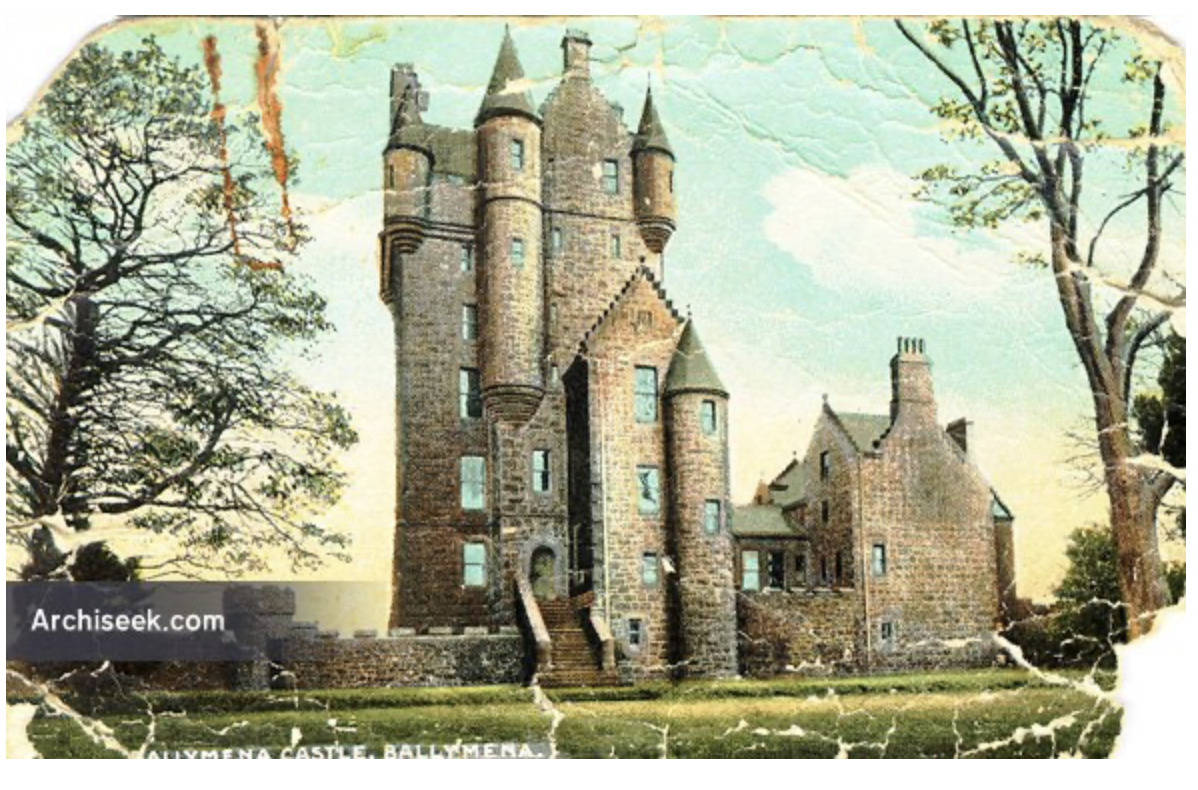
Ballymena Castle, County Antrim – demolished

Ballymena Castle, County Antrim, courtesy Archiseek.

Ballymoney Park, Kilbridge, County Wicklow

Ballymore, Cobh, Co Cork

Ballymore, Cobh, Co Cork courtesy National Inventory.

Ballymore Castle, Laurencetown, Co. Galway 

Ballymore Castle, County Galway, photograph by Mike Searle, Creative Commons Attribution Share-alike license 2.0.

Ballymore, Camolin, Co Wexford – museum 

Ballymore, County Wexford, photograph courtesy of National Inventory of Architectural Heritage.

See my entry https://irishhistorichouses.com/2023/11/15/places-to-visit-and-stay-in-county-wexford/

Ballymoyer House, Belleek, County Armagh – demolished

Ballymoyer House, County Armagh, photograph courtesy Archiseek.

Ballynacourty, Co Limerick

Ballinacourty House, Ballynacourty, Castleconnell, Co. Limerick For sale April 2025 courtesy GMV Auctioneers.

Ballynacree House, Ballymoney, County Antrim – available for accommodation

Ballynacree House, County Antrim photograph courtesy airbnb

Available for accommodation, https://ballynacreehouse.com

Ballynaguarde, Ballyneety, Co Limerick

Ballynaguarde, County Limerick, c.1949. The main facade with statue of Hercules, photograph: Standish Stewart. Vanishing Country Houses of Ireland by The Knight of Glin, David J. Griffin and Nicholas K. Robinson, published by The Irish Architectural Archive and The Irish Georgian Society, 1988.

Ballynahinch Castle, Connemara, Co. Galway  – hotel

Ballynahinch Castle, photograph courtesy of hotel website.

See my entry https://irishhistorichouses.com/2023/05/31/places-to-visit-and-stay-in-county-galway/

Ballynalacken Castle, Lisdoonvarna, Co Clare – hotel 

Ballinalacken Castle, Co Clare, photograph by Robert French, Lawrence Collection National Library of Ireland.

See my entry https://irishhistorichouses.com/2023/01/20/places-to-visit-and-stay-in-county-clare/

Ballynaparka, Cappoquin, Co Waterford 

Ballynastragh, Gorey, Co Wexford

Ballynastragh House, County Wexford, photograph by Robert French, Lawrence Photograph Collection, National Library of Ireland.

Ballynatray House, Glendine, Co Waterford – 482 gardens in 2023 

Ballynatray, County Waterford, 19th August 2023. Photograph © Jennifer Winder-Baggot, www.irishhistorichouses.com.

See my entry https://irishhistorichouses.com/2023/12/21/ballynatray-estate-county-waterford-p36-t678-gardens-only/

Ballyneale House, Ballingarry, Co Limerick 

Ballyneale House, County Limerick, courtesy of National Inventory.

Ballynegall, Mullingar, Co Westmeath

Ballynegall, County Westmeath entrance hall 1961 photograph: Hugh Doran, Vanishing Country Houses of Ireland by The Knight of Glin, David J. Griffin and Nicholas K. Robinson, published by The Irish Architectural Archive and The Irish Georgian Society, 1988.

Ballynoe (or Newtown), Tullow, Co Carlow

Ballynoe (or Newtown), Tullow, Co Carlow photograph courtesy Irish Times April 18, 2013.

Ballynoe House, Rushbrooke, Co Cork

Ballynoe House, Rushbrooke, Co Cork courtesy National Inventory.

Ballynoe, Ballingarry, Co Limerick

Ballynoe, County Limerick, courtesy of National Inventory.

Ballynure, Grange Con, Co Wicklow 

Ballynure House, County Wicklow, Photograph courtesy of National Inventory of Architectural Heritage.

Ballyorney House, Enniskerry, County Wicklow

Ballyowen (formerly New Park), Cashel, Co Tipperary

Ballyowen House, County Tipperary, photograph courtesy of National Inventory.

Ballyquin House, Ardmore, Co Waterford 

Ballyrankin, Ferns, County Wexford

Ballysaggartmore, Lismore, Co Waterford – lost 

The Gate Lodge, Ballysaggartmore, Lismore, Co Waterford Courtesy of Luke Myers 2015, for Tourism Ireland, Ireland’s Content Pool.

See my entry https://irishhistorichouses.com/2022/05/26/places-to-visit-and-stay-in-munster-county-waterford/

Ballysallagh House, Johnswell, Co Kilkenny 

Ballysallagh, County Kilkenny. Photograph © Jennifer Winder-Baggot, www.irishhistorichouses.com.

See my entry https://irishhistorichouses.com/2022/06/17/ballysallagh-house-johnswell-co-kilkenny/

Ballyscullion, Bellaghy, County Derry – Ballyscullion Park 

Wedding venue https://www.ballyscullionpark.com

Ballyscullion Park, County Derry, photograph courtesy of their website.

Ballyseede Castle/ Ballyseedy, Tralee, county Kerry – section 482 

Ballyseede Castle, March 2023. Photograph © Jennifer Winder-Baggot, www.irishhistorichouses.com.

See my entry https://irishhistorichouses.com/2023/09/02/ballyseede-castle-ballyseede-tralee-co-kerry/

Ballyshanduffe House (also known as The Derries), Portarlington, Co Laois 

Ballyshannon House, Ballyshannon, Co Donegal  

Ballyteigue Castle, Kilmore Quay, County Wexford

Ballytrent House, Broadway, Co Wexford – one wing rental 

Ballytrent House, County Wexford, courtesy of their website.

See my entry https://irishhistorichouses.com/2023/11/15/places-to-visit-and-stay-in-county-wexford/

Ballytrim, County Down 

Ballyvolane, Co Cork  – demolished  

Ballyvolane, Castlelyons, Co Cork – Hidden Ireland accommodation  

Ballyvolane, County Cork, photo taken 2014 for Tourism Ireland, Ireland’s Content Pool.

See my entry https://irishhistorichouses.com/2022/05/17/places-to-visit-and-stay-munster-county-cork/

Ballyvonare (also called Ballinavonear), Buttevant, Co Cork   

Ballyvonare (also called Ballinavonear), Buttevant, Co Cork courtesy of National Inventory.

Ballywalter Park, Newtownards, Co Down 

See their website https://ballywalterpark.com

Ballywalter Park, County Down, photograph courtesy of their website.

Ballyward Lodge, County Down 

Ballywhite House, Portaferry, County Down 

Ballywillwill House, near Castlewellan, County Down 

Balrath, Kells, Co Meath – section 482 and accommodation

See https://balrathcourtyard.ie 

Balrath, County Meath, photograph courtesy of their website.

Balrath Bury, County Meath 

Baltiboys, Blessington, Co Wicklow  

Baltiboys, County Wicklow, Photograph courtesy of National Inventory of Architectural Heritage.

Baltrasna, Oldcastle, Co Meath 

Baltrasna House, Ardee, Co. Louth for sale June 2025, photograph courtesy Lisney Sotheby’s International Realty.

Balyna, Moyvalley, Co Kildare – weddings (Moy Valley Hotel)

See my entry https://irishhistorichouses.com/2023/06/08/places-to-visit-and-stay-in-county-kildare/

Moy Valley hotel, formerly Balyna House, County Kildare, photograph courtesy of their website.

Bancroft House, County Down 

Bangor Castle, County Down

Bangor Castle, County Down, photograph courtesy of Glenn Norwood, North Down Brorough Council.

See my entry https://irishhistorichouses.com/2023/10/06/places-to-visit-and-stay-in-county-down-northern-ireland/

Bannow House (originally Grange House), Bannow, Co Wexford 

Bannow House, County Wexford, photograph by Robert French, Lawrence Photograph Collection, National Library of Ireland.

Bansha Castle, Bansha, Co Tipperary 

Bansha Castle, County Tipperary by Kerry Kissane 2021 for Tourism Ireland

See my entry https://irishhistorichouses.com/2022/10/19/places-to-visit-and-stay-in-county-tipperary-munster/

Bantry House & Garden, Bantry, Co. Cork – section 482, and accommodation  

Bantry House, County Cork, a treasurehouse of culture. Photograph © Jennifer Winder-Baggot, www.irishhistorichouses.com.

See my entry https://irishhistorichouses.com/2022/12/01/bantry-house-garden-bantry-co-cork/

Barbavilla, Collinstown, Co Westmeath 

Barberstown Castle, Kildare  – hotel 

Barberstown Castle, County Kildare, photograph courtesy of barberstowncastle.ie

See my entry https://irishhistorichouses.com/2023/06/08/places-to-visit-and-stay-in-county-kildare/

Bargy Castle, Tomhaggard, Co Wexford 

Bargy Castle, County Wexford, photograph courtesy of National Inventory.
Bargy Castle, County Wexford, photograph by Robert French, Lawrence Photograph Collection, National Library of Ireland.

Barmeath Castle, Dunleer, Drogheda, Co Louth – section 482 in 2019 

Barmeath, County Louth, photograph courtesy of Historic Houses of Ireland.

See my entry https://irishhistorichouses.com/2020/10/23/barmeath-castle-dunleer-drogheda-county-louth/

Barnabrow, Cloyne, Co Cork – accommodation and wedding venue

See my entry https://irishhistorichouses.com/2022/05/17/places-to-visit-and-stay-munster-county-cork/

See their website https://www.barnabrowhouse.ie

Barnabrow, Cloyne, Co Cork courtesy National Inventory.

Barnane, near Templemore, Co Tipperary

Barnane Castle, Templemore, County Tipperary, photograph by Robert French, Lawrence Photograph Collection, National Library of Ireland.

Barne, Clonmel, Tipperary 

Barne, County Tipperary, photograph courtesy of myhome.ie in July 2023.

Baronrath House, Straffan, Co Kildare

Barons Court, Newtownstewart, County Tyrone

See their website https://barons-court.com

Baronscourt, County Tyrone, courtesy of their website.

Baronston House (or Baronstown), Ballinacargy, Co Westmeath

Baronstown , County Westmeath entrance front, collection: Geoffrey Brooke, Vanishing Country Houses of Ireland by The Knight of Glin, David J. Griffin and Nicholas K. Robinson, published by The Irish Architectural Archive and The Irish Georgian Society, 1988.

Barraghcore House, Goresbridge, Co Kilkenny 

Barraghcore, County Kilkenny, courtesy National Inventory.

Barretstown Castle, Ballymore Eustace, Kildare  – children’s camp 

Barretstown Castle, County Kildare, photograph courtesy of their website.

Barretstown House, Newbridge, Co Kildare 

Barretstown House, Newbridge, Co Kildare courtesy myhome.ie

Barrowmount, Co Kilkenny 

Barrowmount, County Kilkenny, courtesy National Inventory.

Barrymore Lodge, Castlelyons, Co Cork 

Barryscourt Castle, Carrigtwohill, Co Cork  – ruin, open to public

Barryscourt Castle, County Cork

See my entry https://irishhistorichouses.com/2022/01/19/office-of-public-works-properties-munster/

Baymount, Clontarf, Co Dublin (Manresa) – owned by Jesuits 

Manresa, formerly Baymount, County Dublin, photograph courtesy National Inventory.

Beamond House, Duleek, County Meath or Beaumond House, Duleek, Co Meath 

Beardiville House, County Antrim 

Bearforest, Mallow, Co Cork 

Bearforest, Mallow, Co Cork courtesy National Inventory.

Beaulieu, Drogheda, County Louth 

Beaulieu, County Louth. Photograph © Jennifer Winder-Baggot, www.irishhistorichouses.com.

See my entry https://irishhistorichouses.com/2021/03/17/beaulieu-county-louth/

Beaumond House, Duleek, Co Meath 

Beauparc, Co Meath – section 482 

Beauparc House, County Meath. Photograph © Jennifer Winder-Baggot, www.irishhistorichouses.com.

See my entry https://irishhistorichouses.com/2022/07/22/beauparc-house-beau-parc-navan-co-meath/

Bective House, Bective, Co Meath 

Bective House, County Meath, photograph courtesy Irish Times.

Bedford House, Listowel, Co Kerry 

Bedford House, County Kerry, courtesy of National Inventory of Architectural Heritage.

Beech Park, Clonsilla, Co Dublin 

Beechmount, Rathkeale, Co Limerick 

Beechmount House, County Limerick, photograph by Robert French, Lawrence Photograph Collection, National Library of Ireland.
Beechmount House, County Limerick, courtesy of National Inventory.

Beechwood Park, Nenagh, Co Tipperary

Beechwood, County Tipperary, courtesy of National Inventory of Architectural Heritage.

Beechy Park (formerly Bettyfield), Rathvilly, Co Carlow

Beechy Park, County Carlow, photograph courtesy Irish Independent 13 January, 2009.

Belan, Co Laois

Belan House, County Laois, courtesy National Inventory

Belan, County Kildare – ‘lost’ 

Belcamp House (also known as Belcamp Hutchinson), Balgriffin, County Dublin  – a college 

Belcamp House, County Dublin, photograph by Lainey Tess Quinn, abandonedworldphotograph.com

Belcamp Hall, Balgriffin, County Dublin

Belcamp, Dublin photograph by Bob Linsdell, Creative Commons Attribution 3.0 Unported license.

Belcamp Park, Balgriffin, County Dublin

Belfast Castle, County Antrim 

Belfast Castle and Gardens, photograph by Aidan Monaghan 2015 for Tourism Ireland

See my entry on my page Places to visit and stay in County Antrim https://irishhistorichouses.com/2022/03/21/places-to-visit-and-stay-in-ulster-county-antrim/

Belfort, Charleville, Co Cork – demolished 1958  

Belgard Castle, Clondalkin, Co Dublin 

Belgard, County Dublin, photograph courtesy of Georgian Mansions in Ireland with some account of the evolution of Georgian Architecture and Decoration by Thomas U. Sadleir and Page L. Dickinson. Dublin University Press, 1915. 

Belgrove, Cobh, Co Cork – demolished 1954  

Bellaghy Castle and Bawn, Bellaghy, County Derry

Bellair, Ballycumber, County Offaly 

Bellair House, Tullamore, Ballycumber, County Offaly for sale, photograph courtesy Savills.

Bellamont Forest, Cootehill, Co Cavan

Bellamont Forest, Cootehill, Co Cavan courtesy National Inventory.

Bellarena, Magilligan, County Derry 

Belle Isle, Lisbellaw, County Fermanagh 

Belle Isle Castle, County Fermanagh by Brian Morrison, 2008 for Tourism Ireland.

Belle Isle, Lorrha, Co Tipperary 

Belle Isle, I think this is County Tipperary, photograph by Robert French, Lawrence Photographic Collection, National Library of Ireland.

Belleek Castle (or Manor, or Ballina House), Ballina, Mayo  – gives tours and hotel 

Belleek Manor, or Castle, courtesy of National Inventory of Architectural Heritage.

See my entry https://irishhistorichouses.com/2022/05/15/places-to-stay-and-visit-in-connacht-leitrim-mayo-and-sligo/

Bellegrove (also Rathdaire), Ballybrittas, Co Laois – (demolished) 

Bellegrove, County Laois, photographs by Colin Colleran on facebook.

Belleview, Co Cavan

Bellevue, Tamlaght, County Fermanagh

Bellevue, County Kilkenny, Vanishing Country Houses of Ireland by The Knight of Glin, David J. Griffin and Nicholas K. Robinson, published by The Irish Architectural Archive and The Irish Georgian Society, 1988.

Bellevue, Co Leitrim 

Bellevue, Borrisokane, County Tipperary

Bellevue, Delgany, Co Wicklow

Bellevue, County Wicklow, photograph by Robert French, Lawrence Photographic Collection, National Library of Ireland.

Belline, Piltown, Co Kilkenny 

Belline, County Kilkenny, courtesy National Inventory.

Bellinter House near Bective, County Meath – hotel and restaurant 

Bellinter House, County Meath, 2007, photograph courtesy of flickr commons.

See my entry https://irishhistorichouses.com/2022/10/28/places-to-visit-and-stay-in-county-meath-leinster/

Bellmont House, Mullingar, County Westmeath

Bellville Park (or Belleville, formerly Bettyville), Cappoquin, Co Waterford 

Bellwood, Templemore, Co Tipperary 

Bellwood Castle, Templemore, County Tipperary photograph by Robert French, Lawrence Photographic Collection, National Library of Ireland.

Belmont, Banbridge, County Down

A hotel, https://www.belmontbanbridge.co.uk

Belmont House hotel, County Down, photograph courtesy of website.

Beltrim Castle, Gortin, County Tyrone

Belvedere, Mullingar, County Westmeath– open to visitors 

At Belvedere, County Westmeath. Photograph © Jennifer Winder-Baggot, www.irishhistorichouses.com.

See my entry https://irishhistorichouses.com/2024/05/23/belvedere-house-gardens-and-park-county-westmeath/

Belvedere, County Down 

Belvoir, Sixmilebridge, Co Clare – ruin 

Belvoir Park, Newtownards, County Down – demolished 1950s 

Belvoir, County Down, designed by Christopher Myers in 1755 with later additions by William Barre, courtesy Archiseek.

Benburb, County Tyrone: Manor House

Benekerry (or Bennekerry), near Carlow, Co Carlow

Benekerry (or Bennekerry) House, Co Carlow courtesy of National Inventory.

Bennett’s Court, Cobh, Co Cork – medical clinic  

Benown (also known as Harmony Hall), Athlone, Co Westmeath 

Benown, County Westmeath.

Benvarden House, Dervock, County Antrim

Benvarden, County Antrim, photograph courtesy www.historichouses.org

The gardens are open to the public in the summer, https://www.benvarden.co.uk

Berkeley Forest, New Ross, Co Wexford

Berkeley Forest House, County Wexford, photograph courtesy of the house’s website.

See my entry https://irishhistorichouses.com/2023/11/15/places-to-visit-and-stay-in-county-wexford/

Bermingham House, Tuam, Co Galway 

Bermingham House, County Galway.

Bert (or De Burgh Manor), Athy, Co Kildare 

Bert House, or de Burgh Manor, County Kildare, courtesy Sherry FitzGerald O’Reilly.

See my entry https://irishhistorichouses.com/2023/06/08/places-to-visit-and-stay-in-county-kildare/

Bessborough, Blackrock, Co Cork 

Bessborough, County Cork, courtesy of National Inventory.

Bessborough, Piltown, Co Kilkenny (Kidalton College) 

Bessborough, County Kilkenny, in Georgian Mansions in Ireland with some account of the evolution of Georgian Architecture and Decoration by Thomas U. Sadleir and Page L. Dickinson.

Bessmount Park, Drumrutagh, Co Monaghan

Bessmount, County Monaghan, photograph courtesy of National Inventory.

Bingfield, Crossdoney, Co Cavan

Bingfield, Crossdoney, Co Cavan courtesy National Inventory.

Bingham Castle, Belmullet, Co Mayo

Birchfield, Co Clare – ‘lost’ 

Birchfield, County Clare entrance front, Collection of Mrs Grania Weir. Vanishing Country Houses of Ireland by The Knight of Glin, David J. Griffin and Nicholas K. Robinson, published by The Irish Architectural Archive and The Irish Georgian Society, 1988.

Birdstown House, Muff, Co Donegal  – burnt ca 1984  

Birr Castle, Co Offaly – open to public 

Birr Castle, Count Offaly, photograph by Chris Hill 2018, for Tourism Ireland, Ireland’s Content Pool.

See my entry https://irishhistorichouses.com/2025/07/21/birr-castle-county-offaly-section-482/

Bishops’ Palace, Cork, Co Cork

Bishop’s Palace, Derry, County Derry 

Bishops’ Palace, Raphoe, Co Donegal  – a ruin  

Bishop’s Palace, Raphoe, County Donegal. Photograph © Jennifer Winder-Baggot, www.irishhistorichouses.com.

Bishop’s Palace, Cultra, County Down

Bishop’s Palace, Dromore, County Down

Bishop’s Palace, Kilkenny, County Kilkenny  

Bishop’s Palace, Kilkenny, photograph by Robert French, Lawrence Photographic Collection, National Library of Ireland.
Bishop’s Palace, Kilkenny, County Kilkenny, courtesy National Inventory.
Bishop’s Palace, Waterford, photograph from the National Library of Ireland, flickr constant commons.

Bishopscourt, Straffan, Co Kildare 

Bishopscourt House in 1879, from The County Seats of the Noblemen and Gentlemen of Great Britain and Ireland, by Francis Orpen Morris.

Black Castle, Navan, Co Meath

Black Hall, Termonfeckin, Co Louth 

Black Hall, County Louth, courtesy National Inventory.

Blackhall, Clane, Co Kildare 

Blackwater Castle (or Castle Widenham), Castletownroche, Co Cork

Blackwater Castle (Castle Widenham, or Blackwater Valley Castle) Castletownroache, Co Cork, courtesy of Sherry Fitzgerald.

Available for hire, see my entry https://irishhistorichouses.com/2022/05/17/places-to-visit-and-stay-munster-county-cork/

Blanchville, Gowran, Co Kilkenny 

Blanchville, County Kilkenny, courtesy National Inventory.

Coachyard accommodation, see https://irishhistorichouses.com/2022/10/28/places-to-visit-and-stay-in-county-kilkenny-leinster/

Blanchville Coachyard, Dunbell, County Kilkenny, photograph from website https://blanchville.ie/

Blandsfort, Abbeyleix, Co Laois 

Blandsfort, County Laois, courtesy of National Inventory.

Blarney Castle, Co Cork – section 482 – open to the public  

Blarney Castle, County Cork. Photograph © Jennifer Winder-Baggot, www.irishhistorichouses.com.

See my entry https://irishhistorichouses.com/2022/09/23/blarney-castle-rock-close-blarney-co-cork/

Blarney House & Gardens, Blarney, Co Cork – section 482 

Blarney House, County Cork. Photograph © Jennifer Winder-Baggot, www.irishhistorichouses.com.

See my entry https://irishhistorichouses.com/2022/09/30/blarney-house-gardens-blarney-co-cork/

Blayney Castle, or Hope Castle, County Monaghan

Blayney Castle or Hope Castle, County Monaghan, courtesy Archiseek.

Blessingbourne, Fivemiletown, County Tyrone

Blessingbourne, County Tyrone, photograph courtesy of Tourism Northern Ireland, 2019.

See my entry https://irishhistorichouses.com/2022/04/03/places-to-visit-and-stay-in-ulster-counties-fermanagh-monaghan-and-tyrone/

Blessington House, Co Wicklow

Joseph Tudor’s engraving dated 1745 of Blessington House. Joseph Tudor (1695–1759). “A North Prospect of Blessingtown, A Seat belonging to the Right Honourable The Earl of Blessingtown Viscount Mountjoy, Baron of Ramelton and Baronet.”

Bloomfield, Claremorris, Co Mayo – demolished 

Bloomfield, Co Westmeath 

Bloomfield, a country house erected for William Russell Farmar JP (1802-71) to a design by Daniel Robertson. Photograph from National Inventory of Architectural Heritage.

Bloomsbury House, Kells, County Meath 

Boakefield, Ballitore, Co Kildare 

Boakefield, Ballitore, Co Kildare courtesy National Inventory.

Bogay, Newtowncunningham, Co Donegal 

Bogay House, County Donegal, courtesy of daft.ie

Bolton Castle, Moone, Co Kildare 

Bonnettstown Hall, Kilkenny, Co Kilkenny  

Bonnetstown, County Kilkenny, courtesy of National Inventory.

Boomhall, County Derry 

Boomhall, County Derry, photograph courtesy Derry Journal 26 March 2022.

Borris House, County Carlow – section 482 in 2019 

Borris House, Borris, Co Carlow, photograph by Suzanne Clarke 2016, for Tourism Ireland, Ireland’s Content Pool.

See my entry https://irishhistorichouses.com/2020/10/04/borris-house-county-carlow/

Borrismore House (formerly Marymount), Urlingford, Co Kilkenny 

Bowen’s Court, Kildorrery, County Cork – demolished 1961  

Bowen’s Court, County Cork courtesy Archiseek.

Boytonrath, Cashel, Co Tipperary 

Bracklyn Castle, Killucan, Co Westmeath 

Bracklyn House, County Westmeath, photograph courtesy of National Inventory.

Brade House, Leap, Co Cork

Braganstown, Castlebellingham, Co Louth 

Braganza, Carlow, Co Carlow – converted into apartments

Braganza, Carlow, Co Carlow courtesy Archiseek.

Breaghwy (or Breaffy), Castlebar, Co Mayo – hotel

Breaffy House Resort, Castlebar, Co Mayo (formerly Breaghwy), photograph courtesy National Inventory.

Brianstown, Cloondara, Co Longford 

Bridestown, Glenville, Co Cork

Bridestown County Cork courtesy National Inventory.

Bridestream House, Knocknatulla, Co Meath 

Brightsfieldstown, Minane Bridge, Co Cork – demolished 1984  

Brittas Castle, Clonaslee, Co Laois – ruin 

Brittas Castle, County Laois, courtesy National Inventory.

Brittas, Nobber, County Meath 

Brittas Castle, Thurles, Co Tipperary 

Brittas Castle, County Tipperary, photograph courtesy of National Inventory.

Brockley Park, Stradbally, Co Laois – a ruin 

Brockley Park, County Laois drawing room ceiling c. 1944, Vanishing Country Houses of Ireland by The Knight of Glin, David J. Griffin and Nicholas K. Robinson, published by The Irish Architectural Archive and The Irish Georgian Society, 1988.

Brook Lodge, Glanmire, Co Cork – new house  

Brook Lodge, Halfway House, Co Waterford 

Brookfield House, County Down 

See https://www.abandonedni.com/single-post/brookfield-house

Brooklands, Belfast

Browne’s Hill House, Chapelstown, Co Carlow

Browne’s Hill, County Carlow, photograph courtesy of Irish Times 30th July 2020.

Brownhall, Ballintra, Co Donegal 

Brownlow House, Lurgan, County Armagh – National Trust 

Brownlow House, Lurgan Castle, Lurgan, Photographer: Christopher Heaney, 2022 for Tourism Ireland.

See my entry on my page https://irishhistorichouses.com/2023/10/05/places-to-visit-and-stay-in-county-armagh-northern-ireland/

Brownsbarn, Thomastown, Co Kilkenny 

Brownsbarn, County Kilkenny, courtesy National Inventory.

Brownswood, Enniscorthy, Co Wexford 

Brownswood House, County Wexford, courtesy National Inventory.
Brownswood House, County Wexford, courtesy Archiseek.

Bruree House, Bruree, County Limerick

Bruree House, County Limerick, courtesy National Inventory.

Bullock Castle, Dalkey, Co Dublin

Bullock Harbour Dalkey castle, photograph courtesy of Sherry Fitzgerald Dalkey.

Buncrana Castle, Buncrana, Co Donegal

Buncrana Castle, County Donegal, dated 1718, courtesy of National Inventory.

Bunowen Castle, Co Galway  – ‘lost’ 

Bunratty Castle, Co. Clare – open to public 

Bunratty Castle, County Clare, photograph by Chris Hill 2014, for Tourism Ireland, Ireland’s Content Pool.

See my entry https://irishhistorichouses.com/2023/01/20/places-to-visit-and-stay-in-county-clare/

Burgage, Leighlinbridge, Co Carlow

Burgage, County Carlow, photograph from Carlow Tourism facebook page.

Accommodation is available in the mews, www.themews.ie/

Burnchurch House, Bennettsbridge, Co Kilkenny  

Burnchurch house, County Kilkenny, courtesy National Inventory.

Burnham House, near Dingle, Co Kerry 

Burnham Manor, Dingle, County Kerry, photograph by Robert French, Lawrence Photographic Collection, National Library of Ireland.
Burnham House, Co Kerry courtesy Archiseek.

Burntcourt Castle, or Burncourt, or Everard’s Castle, Clogheen, Co Tipperary 

Burncourt, CountyTipperary courtesy Mike Searle, Creative Commons geograph.org.uk -1393348

Burrenwood Cottage, County Down 

Burton Hall, County Carlow – demolished

Burton Hall, County Carlow, entrance front before removal of top floor. Victorian Photographs. Vanishing Country Houses of Ireland by The Knight of Glin, David J. Griffin and Nicholas K. Robinson, published by The Irish Architectural Archive and The Irish Georgian Society, 1988.

A three-bay single-storey over basement granite built residence remains, built c. 1725, originally wing of the larger house, which was demolished around 1930.

Burton Park (formerly Burton House), Churchtown, Co Cork – section 482 in 2019 

Burton Park, County Cork, August 17th 2023. Photograph © Jennifer Winder-Baggot, www.irishhistorichouses.com.

See my entry https://irishhistorichouses.com/2024/02/08/burton-park-churchtown-mallow-county-cork-p51-vn8h/

Burtown House and Garden, Athy, Co Kildare – section 482 in 2019 

Burtown, County Kildare

See my entry https://irishhistorichouses.com/2023/06/08/places-to-visit-and-stay-in-county-kildare/

Busherstown, Moneygall, County Offaly 

Busherstown, County Offaly, photograph courtesy of National Inventory.

Bushy Park, Terenure, Co Dublin – apartments 

Bushey Park, Enniskerry, Co Wicklow, courtesy sales advertisement 2022.

Butlerstown Castle, Tomhaggard, Co Wexford 

See my entry https://irishhistorichouses.com/2023/11/15/places-to-visit-and-stay-in-county-wexford/

Butlerstown Castle, County Wexford, photograph by Robert French, Lawrence Photographic Collection, National Library of Ireland.

Buttevant Castle, Buttevant, Co. Cork  – ruin  

Buttevant, or Barry, Castle, County Cork, courtesy http://www.castles.nl

Byblox, Doneraile, Co Cork – demolished  

2026 Diary of Irish Historic Houses (section 482 properties)

To purchase an A5 size 2026 Diary of Historic Houses send your postal address to jennifer.baggot@gmail.com along with €20 via this payment button. The calendar of 84 pages includes space for writing your appointments as well as photographs of the historic houses. The price includes postage within Ireland. Postage to U.S. is a further €11 for the A5 size, so I would appreciate a donation toward the postage – you can click on the donation link.

€20.00

Donation

Help me to fund my creation and update of this website. It is created purely out of love for the subject and I receive no payment so any donation is appreciated! My website costs €300 per year on WordPress.

€15.00

Donation towards website

I receive no funding nor aid to create and maintain this website, it is a labour of love. The website hosting costs €300 annually. A generous donation would help to maintain the website.

€150.00

just a note

Yesterday I posted the first of my entries based on Mark Bence-Jones’s Guide to Irish Country Houses [1] but today I have updated it with links to my relevant entries, about the places which are open to the public or which provide accommodation. I will make sure to include them in further entries. Do let me know if I need to update my site or include other accommodation etc. Here’s the updated page: https://irishhistorichouses.com/2025/09/26/a-guide-to-irish-county-houses-by-mark-bence-jones-contents-and-pictures-houses-beginning-with-a/

[1] Bence-Jones, Mark. A Guide to Irish Country Houses published by Constable and Company Limited, London, 1988, previously published by Burke’s Peerage Ltd as Burke’s Guide to Country Houses, vol. 1 Ireland, 1978.

A Guide to Irish Country Houses by Mark Bence-Jones contents and pictures, houses beginning with A

Note that the majority of these are private houses, not open to the public. I discovered “my bible” of big houses by Mark Bence-Jones only after I began this project of visiting historic houses that have days that they are open to the public (Section 482 properties).

This is a project I have been working on for a while, collecting pictures of houses. Enjoy! Feel free to contact me to send me better photographs if you have them! I’ll be adding letters as I go…

[1] Mark Bence-Jones. A Guide to Irish Country Houses (originally published as Burke’s Guide to Country Houses volume 1 Ireland by Burke’s Peerage Ltd. 1978); Revised edition 1988 Constable and Company Ltd, London.

Donation

Help me to fund my creation and update of this website. It is created purely out of love for the subject and I receive no payment so any donation is appreciated! My website costs €300 per year on WordPress.

€15.00

Abbeville, Malahide, Co Dublin

Abbeville, Malahide, County Dublin, courtesy of Sherry Fitzgerald and TheJournal.ie

A house built for Rt Hon John Beresford, Taster of the Wines in the Port of Dublin, brother of the 1st Marquess of Waterford and one of the most powerful men in Ireland at the end of C18; its name commemorating the fact that Bereford’s first wife came from Abbeville in Northern France. Of two storeys over a basement; front of 7 bays between two wide curved bows prolonged by singe-storey 1 bay wings, each with a fanlighted triple window and an urn on a die. Pilastered entrance doorway. Good drawing room with alcove, ceiling of Adamesque plasterwork and husk decoration on walls, incorporating circular painted medallions.” [1]

Abbeylands, Whiteabbey, Co Antrim – burnt 1914 

Abbeylands, Whiteabbey, Co Antrim courtesy Lord Belmont.

A two storey Victorian house, vaguely Italianate, but with mullioned windows in the centre of its symmetrical front. Shallow curved bows on either side of front, single storey Ionic porch; narrow pedimented attic storey, with three narrow windows, in centre. Burnt 1914 by Suffragettes.” (!) [1]

Abbeyleix House, County Laois

Abbeyleix House, County Laois, photograph courtesy of Colliers.

P. 1. Abbey Leix, Co Leix: “[Vesey, De Vesci, V/PB] A three storey late C18 block, built from 1773 onwards by Thomas Vesey, 2nd Lord Knapton and afterwards 1st Viscount de Vesci, with some interiors being designed by James Wyatt. Seven bay entrance front, with three bay pedimented breakfront; frontispiece of coupled Doric columns and entablature around entrance door. Five bay garden front with three bay breakfront. In C19 the elevations were made more ornate with a balustraded roof parapet, entablatures over the windows, balconies and other features. A large conservatory was also added at one side of the house, which was blown away by the “great wind” of 1902 and replaced by a wing containing a new dining room. The principal rooms in the main block have ceilings and, in the old dining room, walls decorated with Wyatt plasterwork. The hall has a screen of fluted Ionic columns; the drawing room is hung with a C19 blue wallpaper. The demesne contains some magnificent trees, including oaks which are part of a primeval forest. A formal garden with terraces and ironwork balustrades was laid out by Lady Emma Herbert, who married 3rd Viscount 1839; inspired by the garden of her Russian grandfather, Count Simon Woronzow, at Alupka, near Yalta, in the Crimea. Towards the end of C19, in the time of 4th Viscount, whose wife was Lady Evelyn Charteris, daughter of 10th Earl of Wemyss, Abbey Leix was the Irish outpost of the “Souls.” ” [1]

Abbeyville, Ballymote, Co Sligo – lost

p. 1. “(Phibbs/LGI1912) A 2 storey house built between 2 fortified towers 1716 by William Phibbs. Sold 1810 to Richard Fleming, who modernised it and altered the house 1816. Sold by the Flemings ca 1990; eventually fell into ruins.” [1]

Abbotstown House (formerly also known as Sheephill), Castleknock, Co Dublin – sports centre 

Abbotstown House (formerly Sheepshill) County Dublin, courtesy of Lord Belmont.

“(Hamilton, Holm Patrick, B/PB) A 2 storey house, added to at various times, but of predominantly early to mid-C19 aspect, 5 bay entrance front, the centre bay breaking forward with a triple window above a projecting pilastered porch. Similar side elevation, with a single-storey pillared bow instead of porch; prolonged by curved bow of full height. Parapeted roof; entablatures on console brackets over triple windows and other embellishments.” [1]

Aberdelghy, Lambeg, Co Antrim

p. 1. “Richardson/LGI1912). An irregular two storey house of mid-C19 aspect; shallow gables with bargeboards; hood mouldings over windows. A seat of Alexander Airth Richardson, son of Jonathan Richardson, MP, of Lambeg, and his wife, Margaret Airth.” [1]

Aclare House,  Drumconrath, Co Meath

p. 1. “(Singleton/LG1912; Lindsay, sub Crawford, E/PB). An almost Italianate house built 1840 for H.C. Singleton; 2 storey and faced with ashlar. Three bay entrance front, projecting central bay with pedminent and Wyatt windown about Grecian Doric portico; three bay side with slightly projecting end by. Office wing set back, fronted by graceful conservatory with curving ends and roof. Inner hall ceiling supported on carved wood brackets; upstairs landing screened from central top-lit space by arcade supported on Tuscan columns. Opened as a hotel ca. 1950 by its then owner, Mr D.E.T. Lindsay; it has since been sold, but is still run as a hotel.” [1]

Adare Manor, County Limerick – hotel

Adare Manor, County Limerick, from the hotel website.

See my entry https://irishhistorichouses.com/2023/07/21/places-to-visit-and-stay-in-county-limerick/

Mark Bence-Jones writes (1988):

Originally a two storey 7 bay early C18 house with a 3 bay pedimented breakfront and a high-pitched roof on a bracket cornice; probably built ca 1720-1730 by Valentine Quin [1691-1744], grandfather of the first Earl of Dunraven [Valentine Richard Quin (1752-1824)].” [1]

Adelphi, Corofin, Co Clare

Adelphi, Corofin, Co Clare courtesy National Inventory.

p. 2. “(Fitzgerald/ LG1863; Blood/IFR) early 19C house of one storey to the front and two storeys to the back. Five bay front with Wyatt windows; end bow; wide eaved roof. Behind the house is an old ruined tower.” [1]

Affane House, County Waterford

Affane House, County Waterford, courtesy National Inventory.

p. 289. “(Browning/IFR; Poer/LG1863) A three storey three bay house of C17 or C18 appearance…The last of the great battles between the Earls of Ormonde and Desmond was fought near here 1564. Affane was later famous for producing the best cherries in Ireland, which were said to have been first planted by Sir Walter Raleigh. Since Affane is one of the houses associated with the legendary old Countess of Desmond, it is possible that the cherry tree from which she fell to her death was here. In C17 Affane was the seat of Valentine Greatrakes, known as “the Stroker” from his ability to cure the King’s Evil and all manner of diseases by stroking.  Affane was inherited by his only daughter who married Major Edmund Browning; it passed by inheritance C18 to a branch of the Poers or Powers, who were here until 1954. The house is now ruinous.” [1]

Aggard, Craughwell, County Galway

Aggard, Craughwell, County Galway courtesy National Inventory.

p. 2. “(Lambert/IFR) A house of mid to late C18 appearance of two storeys over a high basement. Front of two bay on either side of a central three sided bow incorporating a fanlighted doorcased with rustications, pylons and a keystone surmounted by a pedestal.” [1]

Aghaboe, Ballybrophy, County Laois

Aghaboe, County Laois. Photograph © Jennifer Winder-Baggot, www.irishhistorichouses.com.

p. 2. “A 2 storey 7 bay house with a pedimented and fanlighted doorcase, probably dating from 1st half of C18; formerly linked to two flanking wings, one of which has disappeared; the surviving wing being in fact a small late C17 house with plaster panelling in its interior.” [1]

Aghada House, Aghada, Co Cork – gone

p. 2. A late Georgian house by the elder Abraham Hargrave, built for John Roche between 1791 and ca. 1808. [1]

Aghade Lodge, Tullow, Co Carlow

Aghade Lodge, Tullow, County Carlow courtesy of myhome.ie

p. 2. “(Roche/Bt/PB; Browne/ifr) A two storey gabled Victorian house on the River Slaney, with an overhanging roof and bargeboards.” [1]

Aghadoe House, Killarney, County Kerry

Aghadoe House, Killarney, County Kerry, between ca. 1865-1914, photograph courtesy of National Library of Ireland, photograph by Robert French, Lawrence Collection.

p. 2. (Winn, Headley, B/PB) A Victorian house of red sandstone ashlar with limestone facings, consisting of an irregular two storey main block that goes in and out a great deal, and a three storey office wing. Vast round-headed plate glass windows on ground floor of main block, either single or grouped in threes, separated by slender mullions. Much narrower mullioned windows with round-headed lights above, and in the wing; mostly two-light, and in one case, five-light. Limestone porch with three arches and balustrade. Burnt 1922 and subsequently rebuilt, when the eaves of the roof were made to overhang much more than they did previously.” [1]

Aghadoe, Killeagh, Co Cork 

p. 289. “(De Capell Brooke, Bt/PB1967) A plain early C19 house in the villa style, standing above a romantic wooden glen on an estate which was granted to Philip de Capell 1172, and continued to be owned by his descendents until the present century; it was known by the local inhabitants as “the Maidan estate” to distinguish it from the other large properties in the neighbourhood, all of which had, at some period in their history, been forfeited. By C16, the family name had been corrupted to Supple; 1797 Richard Brooke Supple of Aghadoe changed his name to de Capell Brooke on inheriting the estate of the Brookes in Northamptonshire. There is a design of ca 1700, probably by a French architect, for an elaborate Palladian mansion at Aghadoe, which was never carried out.” [1]

Aghamarta Castle, Carrigaline, Co Cork – house with ruined castle

Aghamarta Castle, Carrigaline, Co Cork – house with ruined castle courtesy National Inventory.

“(O’Grady.LGI1912; Clarke/IFR) An irregular two storey house faced in cement, with an enclosed porch fronted by Doric columns and some dormer-gables. The house stands in a fine position overlooking the Owenboy estuary. There is a ruined castle in the grounds.” [1]

Aghern, Conna, Co Cork – stud farm

Aghern, Conna, County Cork courtesy Michael O’Brien Auctioneers.

p. 3. “(Bowles/LGI1912/ Kinahan/IFR; Hare, sub Listowel, E/PB) A simple two storey late Georgian house built alongside an old Desmond castle on the northern bank of the River Bride. The principal north front has a central semi-circular bow with a single bay on either side of it; the long adjoining front facing the river has irregular fenestration and a shallow bow window which is a later addition…” [1]

Ahanesk or Ahanisk, Midleton, Co Cork

Ahanesk or Ahanisk, Midleton, Co Cork courtesy of National Inventory.

p. 3. “(Jackson/LGI1894; Sadlier-Jackson, sub Trench/IFR; Lomer, sub Stafford-King-Harman, Bt/PB) A plain rambling predominantly C19 house, with a rectangular oriel on one wing; overlooking a backwater of Cork Harbour. Large, characteristically Edwardian hall, with a low, heavily embossed ceiling and a straight enclosed staircase rising from one side of it down which, in the late-Victorian and Edwardian period, the dashing Mrs Sadlier-Jackson (the first lady in Cork to ride astride) is said to have been in the habit of sliding on a tray, wearing pink tights, to entertain her guests. Other reception rooms with higher ceilings.…” [1]

Aharney, County Laois

Aharney House, County Laois, courtesy Mark Bence-Jones.

Aherlow Castle, Bansha, County Tipperary  – ruin restored, runs courses 

Aherlow Castle, County Tipperary, photograph by Robert French, Lawrence Photograph Collection, National Library of Ireland

p. 3. “(Moore/IFR) A small late C19 “pasteboard” castle in the Glen of Aherlow, built by the Moore family, of Mooresfort. Polygonal tower, with dummy loops; square tower. Recently demolished.” [1]

Allenton, Tallaght, Co Dublin – Demolished in 1984

Allenton, County Dublin entrance front, Vanishing Country Houses of Ireland by The Knight of Glin, David J. Griffin and Nicholas K. Robinson, published by The Irish Architectural Archive and The Irish Georgian Society, 1988.

p. 3. “An attractive little two storey five bay early C18 house with a pedimented three bay breakfront and a fanlighted, pedimented and rusticated doorcase. Lunette window in pediment. Originally weather-slated. Given its present name after it was built by Sir Timothy Allen, who acquired it in ca mid-C18. In 1814 the residence of George F. Murphy; in 1837, of F.R. Cotton. Demolished in 1984.” [1]

Altamira, Liscarroll, Co Cork

Altamira, Liscarroll, Co Cork courtesy National Inventory.

p. 3. “(Purcell/LGI1912) A plain three storey Georgian block, 3 bay entrance front, 4 bay front adjoining; entrance doorway of rather urban style with a large fanlight extending over the door and two sidelights.” [1]

Altamont, Kilbride, Co Carlow – gardens open to public

Altamont House and Gardens, County Carlow, Courtesy Tourism Ireland.

See my entry https://irishhistorichouses.com/2022/02/21/office-of-public-works-properties-leinster-carlow-kildare-kilkenny/

p. 3. “(St. George/IFR; Borrer, sub Orlebar/LG1952; Watson/IFR) Main block of ca 1760, incorporating earlier house, with three sided bow in centre and two bays on either side, high-pitched roof and odd Gothic cresting; gabled C19 Gothic wings added 1870.” [1]

Altavilla, Rathkeale, Co Limerick 

Altavilla, County Limerick, courtesy National Inventory.

p. 3. “(Bateman/LGI1912; Greenall, Daresbury, B/PB) A house built ca 1745-46 by John Bateman undoubtedly to the design of Francis Bindon; consisting of a centre block of three storeys over basement joined by screen walls to two storey flanking wings enclosing courts. Centre block with six bay entrance front, two bay breakfront, tripartite pedimented and rusticated doorcase; wings with two modified Venetian windows, having niches in their centre section, in th upper storey; straight screen walls with rusticated doors flanked by niches. Garden front of centre block with two bays on either side of a nice and oculus; quadrant walls on this side joining centre blocks to wings, showing the influence of Vanbrugh. Its pedimented interior doors and fielded panelling were burnt. The hosue became a ruin but has now been restored by second and present Lord Daresbury, though without a top story.” [1]

Altidore Castle, Kilpeddar, Greystones, Co Wicklow – section 482

Altidore, County Wicklow. Photograph © Jennifer Winder-Baggot, www.irishhistorichouses.com.

See my entry https://irishhistorichouses.com/2020/06/25/altidore-castle-kilpeddar-greystones-county-wicklow/

A charming late-Georgian “toy fort,” with four octagonal corner turrets; of two storeys on the entrance side and three on the other sides, where the ground falls away. Despite the battlements on the turrets, the house is more Classical than Gothic; it is symmetrical and has a central Venetian window over a pillared porch.” [a Venetian window is one having a centre light wider than the flanking lights and with an arched head. In elaborate examples the lights are separated by columns. Craig, Maurice and Knight of Glin, Ireland Observed, A Handbook to the Buildings and Antiquities. Mercier Press, Dublin and Cork, 1970.] 

The interior makes even fewer concessions to medievalism: there are fine C18 marble chimneypieces, medallions with Classical figures on the walls of the dining room and a staircase similar to those in numerous Irish C18 houses, of stout but elegant joinery with a scrolled end to its balusters. Altidore originally belonged to a family named Blachford. It was acquired by the Hepenstals early in C19; subsequent owners included Percy Burton, who may have been attracted to it by its superficial resemblance to the Jacobean Lulworth Castle in Dorset, where he had been land agent. Since 1945 it has been the home of the Emmet family, who are descended from Thomas Addis Emmet, a leader of the United Irishmen and brother of Robert Emmet, “the Patriot.” [1]

Ampertain House, Upperlands, County Derry 

Ampertain House, County Derry, photograph courtesy Belfast Live UK.

p. 4. “(Clark/IFR) The most important of several country houses in the neighbourhood built by members of the Clark family, whose linen mills, which gave rise to the nearby “linen village” of Upperlands, are still basically situated in the yard of one of these country houses, driven by water power. A plain late-Georgian type house built post 1821 by Alexander Clark. Two storeys over high basement, five bay front; shallow projecting porch, with fanlighted doorway set in arched recess. Eaved roof on bracket cornice. The front prolonged by a two storey three bay wing of similar style, set back; added 1915. At the other end, a Victorian conservatory on a high plinth.” [1]

Anaverna, Dundalk, Co Louth 

Anaverna, Dundalk, Co Louth courtesy National Inventory.

p. 4. “(Lenox-Conyngham/IFR) A plain late-Georgian house built ca. 1807 for Baron McClelland to the design of an architect named Gallier, who afterwards designed many buildings in New Orleans, USA. Five bays, 3 bay breakfront centre, fanlighted doorway; windows of upper storey set under relieving arches. Owned by the Thompson family 1831-1915; bought by E.F. Lenox-Conyngham 1916.” [1]

Anketill Grove (or Ancketill’s Grove or Anketell Grove), Emyvale,  County Monaghan – gate lodge accommodation 

Anketell Grove, County Monaghan courtesy National Inventory.

p. 4. “Captain Oliver Ancketill built first Ancketill’s Grove ca. 1640, on low ground. His grandson Oliver rebuilt the house on higher ground at the head of the copper beech avenue. This house was demolished in 1781, and a third dwelling was erected on another site: A two-storey, five-bay, gable-ended main block with a small pediment, joined by curved sweeps to single-storey, two-bay wings. There are Georgian-Gothic windows in the wings; a door with a good keystone between two round-headed windows in each of the sweeps. 

The house was extensively remodelled ca 1840; its most freakish feature, an Italianate campanile sprouting from the centre of the main block, would appear to date from this time; though there may always have been a central attic-tower, following the precedent at Gola, in the same county. The additions of 1840 included a porch and a new staircase; while at the same time the principal rooms were given ceilings of carved woodwork. Sold 1920.” [1]

Anna Liffey House, Lucan, Co Dublin 

Anna Liffey House, County Dublin, courtesy of National Inventory.

p. 4. “(Shackleton, B/PB) A Georgian mill-house by the side of the River Liffey, with a noted garden. The home of the Shackleton family, cousins of Sir Ernest Shackleton, the explorer.” [1]

Annagh, Riverstown, Co Tipperary – ruin 

Annagh Castle County Tipperary courtesy Brian T. McElherron, Irish Antiquities.

p. 4. “(Minchin/IFR) An attractive late-Georgian villa which became the seat of the Annagh branch of the Minchin family when they left Annagh Castle.” [1]

Annaghdown House, Carrandulla, Co Galway 

Annaghdown House, Carrandulla, Co Galway courtesy National Inventory.

p. 289. “(Blake/LG1886) A house in Georgian style on the eastern shore of Lough Corrib; built ca 1868 by Richard Blake, of the Cregg Castle family.” [1]

Annaghlee, Cootehill, Co Cavan – gone

Annaghlee, County Cavan, entrance front c. 1955. Photograph: Maurice Craig. Vanishing Country Houses of Ireland by The Knight of Glin, David J. Griffin and Nicholas K. Robinson, published by The Irish Architectural Archive and The Irish Georgian Society, 1988.

A distinguished mid C-18 red-brick house attributed to Richard Castle…. In 1814, the residence of Michael Murphy. Now almost completely destroyed.” [1]

Annaghmore, Tullamore, Offaly 

Annaghmore, County Offaly, courtesy of National Inventory.

p. 4. “(Fox/LGI1912) A house with fine neo-Classical bifurcating staircase. Much altered externally.” [1]

Annaghmore, Collooney, Sligo  – accommodation, airbnb 

Annaghmore, County Sligo. Photograph © Jennifer Winder-Baggot, www.irishhistorichouses.com.

See my entry https://irishhistorichouses.com/2022/10/19/places-to-visit-and-stay-in-county-sligo-connaught/

p. 4. “[O’Hara] A house of ca. 1820, consisting of a 2 storey 3 bay centre with single-storey Ionic portico and single-storey 2 bay wings, greatly enlarged ca. 1860-70 by C. W. O’Hara to the design of James Franklin Fuller; the additions being in the same late-Georgian style as the original house. The wings were raised a storey and extended back so that the house had a side elevation as high as the front and as long, or longer, consisting of 1 bay, curved bow, 3 further bays and a three-sided bow. At the same time, the fenestration of the original centre was altered, paired windows being inserted into the two outer bays instead of the original single window above a Wyatt window. All the ground floor windows except for those in the three sided bow have plain entablatures over them. Parapeted roof. Short area balustrade on either side of centre. Curved staircase behind entrance hall. Doorcases with reeded architraves and rosettes.” [1]

Annaghs Castle, Glenmore, Co Kilkenny 

Annaghs Castle, County Kilkenny, courtesy National Inventory.

p. 4. “A square two storey house of 1797, five bay front, fanlighted tripartite doorway with Composite columns; four bay side. Balustraded roof. Very delicate plasterwork in the style of Patrick Osborne in the hall. Later plasterwork in other rooms. In later C19, a residence of the Sweetman family.” [1]

Annamakerrig (or Annaghmakerrig, Tyrone Guthrie Centre), Newbliss, Co Monaghan – artist residence 

Annaghmakerrig House (Tyrone Guthrie Centre), Mullaghmore, County Monaghan.

p. 289. “(Power/LGI1912) A house of Victorian appearance, in watered-down Tudor-Jacobean. Entrance front with central porch-gable; adjoining front with two curvilinear gables, single-storey three sided bows, windows with blocked surrounds. Finials on gables. The seat of the Moorhead family; inherited by Martha (nee Moorhead), wife of Sir William James Tyrone Power – whose father was the early C19 Irish actor, Tyrone Power, ancestor of the film actor of the name – and in recent years the home of her grandson, Sir William Tyrone Guthrie, the producer, who bequested it to the Irish nation as a centre for artists and writers.” [1]

Annemount, Glounthaune, Co Cork – Fire in 1948, destroyed 

Annmount was built by Riggs Falkiner in 1775 but was heavily modified in the 19th century. It burned down accidentally in 1948. The grounds are now filled with a housing estate

p. 5. “Falkiner/BT,PB; Cummins/IFR; Beamish/IRF; Gillman/IFR; Murphy/IFR; Bence-Jones/IFR) A two storey house in a magnificent situation overlooking Lough Mahon and the upper reaches of Cork Harbour; built in late C18 by Sir Riggs Falkiner, 1st Bt, who named it in honour of his second wife; enlarged and remodelled ca 1883 to the design of George Ashlin for John Murphy, Master of the United Hunt, who first discovered the house when the fox when he was hunting led him there. As remodelled, the big house was faced in cement, with entablatures over the windows; a projecting two storey porch, with a pediment and pilasters in the upper storey, was added  in the centre in its upper storey, was added in the centre of the front, with a single-storey three-sided pilastered bow on either side of it. The front was extended at one end by the addition of a two-storey wing of the same height and in the same style, with a third singel-storey bow and an Italianate campanile tower. Impressive two storey hall, with staircase and gallery of oak and pitch-pine; ceiling of coloured C19 plasterwork. Coloured C19 plasterwork also in drawing room and dining room, and richly ornamented pilaters; flat of drawing room ceiling covered with embossed gilt paper; moulded entablatures over doors; fine late-Georgian chimneypiece of white marble in drawing room, with Classical head and medallion, flowers, foliage and trophies. Brought 1945 by Col Philip Bence-Jones; destroyed by fire 1948, when a mild sensation was caused by the fact that a statue of the Madonna in the small oratory upstairs was untouched by the flames. The ruin was subsequently demolished.” [1]

Anner Castle (formerly Ballinahy), Clonmel, Co Tipperary  

Anner Castle, County Tipperary courtesy of National Inventory.
Anner Castle, County Tipperary, photograph by Robert French, Lawrence Photographic Collection, National Library of Ireland.

An impressive C19 castle of random ashlar, built in 1860s by Rev. N.H. Mandeville to the design of a Cork architect, William Atkins; incorporating an old square castle of the Mandeville family which had up to then been known as Ballinahy, but which was renamed Anner Castle after being enlarged and transformed. Impressive entrance front with two octagonal battlemented and machicolated towers. Burnt 1926 and only front part rebuilt.” [1]

Annerville, Clonmel, Co Tipperary  

Annerville, Clonmel, Co Tipperary courtesy Landed Estates website.
Annerville, County Tipperary, photograph by Robert French, Lawrence Photographic Collection, National Library of Ireland.

p. 5. “(Riall/LGI1958) A two storey Victorian house with a roof carried on a bracket cornice; entrance front with a two storey porch between two single storey three sided balustraded bows; and in the upper storey, two Venetian windows.” [1]

Annes Grove (formerly Ballyhemock or Ballyhimmock), Castletownroche, Co Cork – gardens open to public; gate lodge accommodation

Annesgrove (formerly Ballyhimmock), County Cork courtesy National Inventory.

See my entry https://irishhistorichouses.com/2022/01/19/office-of-public-works-properties-munster/

p. 5. (Grove Annesley/IFR and sub Annesley, E/PB). An early 19C house of two storeys over basement, built by Lt-Gen Hon Arthur Grove Annesley, who inherited the estate from his aunt by marriage, the heiress of the Grove family, who owned it previously. Seven bay entrance front; wooden porch with engaged Doric columns and entablature and sidelights with curved astragals; eaved roof. Irregular garden front facing the River Awbeg, in which, owing to the ground falling away, the basement forms an extra storey. Flaning the garden are two stable courts. Walled garden with C18 “mount”; Famous river garden of great extent, laid out and planted by R.A. Grove Annesley between ca. 1900 and his death in 1966, and continued by his son, the late E.P. Grove Annesley. Castellated entrance gateway at one end of the demesne.” [1]

Annesbrook, Duleek, Co Meath 

Annesbrook, County Meath photograph courtesy Irish Times Feb 20, 2016.

p. 5. “(Smith/LGI1912) A two storey three bay Georgian house with ground floor windows set under relieving arches and a large rusticated and fanlighted doorway; to which an impressive pedimented portico of four fluted Ionic columns and a single-storey wing containing a charming Georgian-Gothic “banqueting room” were added early in C19 by Henry Smith. According to the story, he made these additions in 1821, for when George IV came over to dine with him while staying with Lady Conyngham at Slane Castle; the monarch, however, never saw the banqueting room, preferring to dine out of doors.” [1]

Annestown House, County Waterford – B&B 

Annestown House, County Waterford, courtesy of Savills Residential & Country Agency and myhome.ie.

See my entry https://irishhistorichouses.com/2022/05/26/places-to-visit-and-stay-in-munster-county-waterford/

p. 5. “(Palliser, sub Galloway/IFR) Rambling three storey house at right angles to the village street of Annestown, which is in fact two houses joined together. The main front of the house faces the sea; but it has a gable end actually on the street. Low-ceilinged but spacious rooms; long drawing room divided by an arch with simple Victorian plasterwork; large library approached by a passage. Owned at beginning of 19C by Henry St. George Cole, bought ca. 1830 by the Palliser family, from whom it was inherited by the Galloways.” [1]

Anngrove (formerly Ballinsperrig), Carrigtwohill, Co Cork – demolished by ca. 1965

p. 6. “(Cotter, Bt/PB; Barry/IFR; Gubbins/LG1937 supp) A remarkable late C17 house built by Sir James Cotter, MP, a staunch adherent of Charles II who, in 1664, went to Switzerland with two companions and shot the fugitive Regicide, John Lisle. ..One of the rooms originally contained a velvet bed with hangings and gold brocade which was said to have belonged to Charles I and to have been given to Sir James Cotter by Queen Henrietta Maria “as a mark of her royal favour and thanks” for having led the successful action against Lisle. James II is traditionally supposed to have stayed a night in the house and to have slept in this bed. The lands on which the house was built were leased from the Barrys, Earls of Barrymore; some time post 1720, the widow of sir James Cotter’s son sold the reversion of the lease to the 4thEarl and the Cotter family seat was henceforth Rockforest. The 5th Earl of Barrymore, as Viscount Buttevant, lived for a period in Anngrove; but it was afterwards let. Charles I’s bed, which the Cotters left behind, was removed to Castle Lyons, the principal Barrymore seat, where it was burnt in the fire of 1771. Towards the end of the C18, or in early C19, Anngrove passed to the Wise family, from whom it was inherited, later in C19, by the Gubbins family. The house was still standing in 1950s but was demolished by ca. 1965.” [1]

Antrim Castle, County Antrim – open to the public 

Antrim Castle from the river, by R. Welch (Photographer) Date c.1888 PRONI Ref D1403_1_017_A

See my entry https://irishhistorichouses.com/2022/03/21/places-to-visit-and-stay-in-ulster-county-antrim/

(Skeffington, Massereene and Ferrard, V/PB) A castle by the side of the Sixmilewater, just above where it flows into Lough Neagh, built originally 1613 by the important English settler, Sir Hugh Clotworthy, and enlarged 1662 by his son, 1st Viscount Massereene [John Clotworthy (1614-1665)]. The castle was rebuilt 1813 as a solid three storey Georgian-Gothic castellated mansion, designed by John Bowden, of Dublin, faced in Roman cement of a pleasant orange colour; the original Carolean doorway of the castle, a tremendous affair of Ionic pilasters, heraldry, festoons and a head of Charles I, being re-erected as the central feature of the entrance front, below a battlemented pediment. Apart from this, and tower-like projections at the corners, with slender round angle turrets and shallow pyramidal roofs, the elevations were plain; the entrance front being of four bays between the projections, and the long adjoining front of 11 bays. Mullioned oriels and a tall octagonal turret of ashlar were added to the long front in 1887, when the castle was further enlarged. Remarkable C17 formal garden, unique in Ulster, its only surviving counterpart being at Killruddery, Co Wicklow. Long canal, bordered with tall hedges, and other canal at right angles to it, making a “T” shape; old trees, dark masses of yew and walls of rose-coloured brick. Mount, with spiral path, originally the motte of a Norman castle. Imposing Jacobean revival outbuildings of course rubble basalt with sandstone dressings; built ca. 1840. Entrance gateway to the demesne with octagonal turrets. Antrim Castle was burnt 1922.” [1]

Antrim Castle gardens and Clotworthy House, County Antrim – estate and gardens open to the public, the Castle was destroyed by fire. The stable block, built in the 1840s and now known as Clotworthy House, is used as an arts centre.

Aras an Uachturain, (formerly Vicegreal Lodge and before that, Phoenix Lodge), Phoenix Park, Dublin  

Aras an Uachtarain, Phoenix Park, Dublin. Photograph © Jennifer Winder-Baggot, www.irishhistorichouses.com.

See my entry https://irishhistorichouses.com/2023/10/17/office-of-public-works-dublin-aras-an-uachtarain-phoenix-park/

Arbutus Lodge, Montenotte, Co. Cork  – apartments  

p. 7. “A 2 storey mid-C19 Italianate house with Romaneque overtones. Modillion cornice; porch at end of house with Romanesque columns. Ballroom with Corinthian columns at one side.…” [1]

Arch Hall, Co Meath  – lost 

Arch Hall, County Meath, courtesy Colin Colleran photographer facebook page.

p. 7. “(Garnett/LGI1912) A three storey early C18 house attributed, as is the arch in the garden, to Sir Edward Lovett Pearce. Curved bow in centre of front, doorway with pediment and blocking; curved ends, with round-headed windows. Top storey treated as an attic. In the C19, the house was given a high-pitched roof on a bracket cornice, the curved ends being given conical roofs, so that they looked like the round towers of a French chateau. Also in C19, the windows in the attic storey were replaced by rather strange Romanesque windows in pairs. Now a ruin.” [1]

Archbishop’s Palace (or Armagh Palace), County Armagh 

Archbishop’s Palace, Armagh, photograph by Eric Jones, Creative Commons Attribution Share-alike license 2.0.

p. 12. “The Palace of the (C. of I.) Archbishops of Armagh and Primates. A plain and dignified late C18 block, nine bays long and four bays deep, originally of two storeys over a high rusticated basement. Built 1770, to the design of Thomas Cooley, by Primate Richard Robinson, who added a third storey 1786, his architect then being Francis Johnston. Later, a large enclosed porch was added, with pairs of Ionic columns set at an angle to the front. Flanking the entrance front of the Palace is the Primate’s Chapel, a detached building in the form of an Ionic temple. The exterior, of 1781, is by Cooley; but the interior was carried out after Cooley’s death in 1784 by Francis Johnston, who succeeded him as architect to Primate Robinson. Johnston’s interior, a modification of Cooley’s design, is one of the most beautiful surviving C18 ecclesiastical interiors in Ireland; with a coffered barrel-vaulted ceiling, a delicate frieze, Corinthian pilasters, a gallery with a curved rear wall, and splendid panelling and pews. The Palace is surrounded by a well-wooded demesne, in which there is an obelisk, also by Johnston. The Church of Ireland is at present building a modern residence for the Primate on Cathedral Hill, so that the future of the Palace is uncertain.” [1]

Archerstown, Thurles, Co Tipperary  – ruin 

Archerstown, Thurles, Co Tipperary courtesy National Inventory.

p. 7. “(Langley/IFR) A plain two storey three bay high-roofed Georgian house. Wing with Wyatt windows.”

and supplement: 

The house incorporates parts of the medieval castle of the Archer family. A section of the castle bawn wall is incorporated in the wall of a small deer park, which still contains deer believed to be descended from the deer that were here in the Archer’s time.” [1]

Ardagh House, County Longford

Ardagh House, County Longford, photograph courtesy of National Inventory.

p. 7. “[Fetherston, Bt/PB1923] An irregular 2 storey house of predominantly early to mid C19 appearance. Eaved roof on bracket cornice; porch and corridor with pilasters. Now a domestic science college.” [1]

Ardamine, Gorey, Co Wexford – Destroyed by IRA in 1921  

Ardamine, Gorey, County Wexford, photograph by Robert French, Lawrence Photographic Collection, National Library of Ireland.

p. 7. “Richards/LGI1912) An early to mid-C19 house of two storeys over basement, consisting of two contiguous blocks one slightly higher than the other. Eaved roofs on bracket cornices; wide projecting porch, partly open, with Doric columns, party enclosed, with pilasters. Single storey curved bow. Giant corner pilasters on both blocks. Balustraded area.” [1]

Ardavilling, Cloyne, Co Cork  – burned 2017, being rebuilt  

Ardavilling, County Cork, courtesy of National Inventory.

“Litton/LGI1912; Beckford, sub Nutting, Bt/PB) A mildly Tudor-Revival C19 house, gabled and with a mullioned bow. The seat of the Litton family; in the present century, of the Stacpoole famly. Owned for some years after WWII by Lt-Col and Mrs F.J. Beckford.” [1]

Ardbraccan House, Navan, Co Meath 

Ardbraccan House, Ardbraccan, Navan, County Meath, for sale March 2025 courtesy Sherry Fitzgerald

p. 7. “The Palace of the (C of I) Bishops of Meath, on the site of the old castle where the Bishops lived from C14. Bishop Evans left money for the building of a new house here early in C18; his successor, Bishop Henry Downes, came here with Dean Swift to lay out the ground; but it was not until the time of the next Bishop again, Arthur Price, that the house was begun ca 1734, to the design of Richard Castle. When the two 2 storey 5 bay wings of what was to be a Palladian mansion had been completed, Price was elevated to the Archdiocese of Cashel. For the next 30 years, the subsequent Bishops did nothing about building the central block, but lived in one of the wings, using the other for guests. It was not until early 1770s that Bishop Henry Maxwell, a younger son of 1st Lord Farnham, decided to complete the house; he is said to have boasted that he would build a palace so grand that no scholar or tutor would dare to live in it. He obtained designs from Thomas Cooley and also from one of his own clergy, Rv. Daniel Beaufort, Rector of Navan, who was a talented amateur architect. Both of them were, to a certain extent, under the influence of James Wyatt, who produced a sketch of the garden front. The centre block, which was eventually begun 1776 and took several years to build, is a simple and dignified grey stone house of 2 storeys and 7 bays, with an Ionic doorcase; it harmonises well with Castle’s wings, to which it is joined by curved sweeps with niches. The garden front, also of 7 bays, has a 3 bay central breakfront in which the ground floor windows are set in a blind arcade. The restrained neo-Classical interior plasterwork is said to have been designed by Wyatt, though Beaufort was asked by Bishop Maxwell to design a ceiling for the entrance vestibule 1780. This is a narrow room with a barrel-vaulted ceiling of shallow hexagonal coffering; a door under a large and elegant internal fanlight at its inner end opens into the main hall or saloon in the middle of the garden front, which has a cornice of mutules and elliptical panels above the doors. The principal and secondary stairs lie on either side of this saloon, which also communicates with the drawing room and dining room in the entrance front, on either side of the vestibule. Despite Bishop Maxwell’s hope that the grandeurs of Ardbraccan would discourage scholars and tutors from aspiring to the diocese, his successor was Thomas O’Beirne who had started life as a humble schoolmaster; but who none the less carried out improvements to the outbuildings, advised by Beaufort. The more aristocratic Bishop Nathaniel Alexander carried out grander improvements to the outbuildings in 1820s and 30s. The handsome farm and stable yards are joined by a tunnel under the garden terrace.” [1]

Ardbrack House, Kinsale, Co Cork 

Ardbrack House, Kinsale, Co Cork courtesy National Inventory.

p. 8. “(Lucas/IFR) An attractive two storey five bay weather-slated late-Georgian house. Camberheaded windows; pedimented and fanlighted doorcase.” [1]

Ardcandrisk House, County Wexford https://aguidetoirishcountryhouses.com/2024/11/24/ardcandrisk-house-county-wexford/

Ardcandrisk, photographer Robert French, Lawrence Collection NLI L-IMP_1336.

p. 8. “(Grogan-Morgan/LG1863; Deane, Muskerry, B/PB) A two storey Regency villa composed of three polygons of different sizes. Eaved roofs; Wyatt windows at one end. Tail blind panels on narrow faces of polygons.” [1]

Ardee House, Co Louth – hospital 

Ardee House, County Louth, courtesy National Inventory.

p. 8. “(Ruxton/LGI1912 and sub Fitzherbert/IFR) A three storey seven bay C18 house of red brick. Small porch with pilasters, pediment and fanlights. Now a hospital.” [1]

Ardfert Abbey, County Kerry   – Destroyed by IRA by fire in 1922. 

Ardfert Abbey entrance front, photograph: c. 1870, collection: Col. Talbot Crosbie, Vanishing Country Houses of Ireland by The Knight of Glin, David J. Griffin and Nicholas K. Robinson, published by The Irish Architectural Archive and The Irish Georgian Society, 1988.

p. 8. “Crosbie/IFR) A house originally built towards the end of C17 by Sir Thomas Crosbie, MP; “modernized” 1720 by Maurice Crosbie, 1st Lord Brandon, and again altered ca 1830, though keeping its original character. Two-storey main block with seven-bay front, the two outer bays on either side breaking forwards and framed by quoins; a pedimented centre, in which a single triple window was substituted at some period – presumably during the alterations of ca 1830 – for the three first floor bays. Plain rectangular doorcase; and a high eaved roof on a modillion cornice. 
 
The front was elongated by lower two-storey wings which protruded forwards at right angles to it, thus forming an open forecourt, then turned outwrds and extended for a considerable way on either side. Irregular wing at back of house. 
 
Inside the house, the panelled hall was decorated with figures painted in monochrome on panels. There was an early 18th century staircase and gallery; Corinthian newels, and more panelling on the landing with Corinthian pilasters; modillion cornice. A large drawing-room boasted compartmented plasterwork on the ceiling. Here there was a full-length Reynolds portrait of Lady Glandore. Caryatid chimneypiece in one room.  
 
The gardens had an early formal layout: sunken parterre; yew alleys; trees cut into an arcade; avenues of beech, lime and elm. A ruined Franciscan friary was in the grounds. 
 
The mansion was burnt to the ground by the IRA ca 1922, and all that remains are some relics of the formal garden

Ardfert eventually passed to Rev John Talbot (see Mount Talbot), son of 2nd Earl of Glandore’s sister, who assumed the additional surname of Crosbie. It was sold in the present century by J.B. Talbot-Crosbie. Nothing now remains of the house, but there are still some relics of the formal garden.” [1]

Ardfinnan Castle, Ardfinnan, Co. Tipperary 

Ardfinnan Castle, County Tipperary, August 2023. Photograph © Jennifer Winder-Baggot, www.irishhistorichouses.com.

p. 9. “(Prendergast/LGI1937 supp) An old tower house above the River Suir, with a three storey gable-ended Georgian wing and also a three storey battlemented tower added in C19, when the gable of the Georgian wing was stepped and the old tower was given impressive Irish battlements.” [1]

Ardfry, County Galway  – ruins 

Ardfry House, County Galway.

p. 9. “(Blake/IFR) A long, two storey house probably of ca. 1770 on a peninsula jutting out into Galway Bay where previously there had been a castle which, during the Civil War, Sir Richard Blake garrisoned in the service of Charles I. Principal front of nine bays with a central pediment and a higher, pyramidal-roofed pavilion at either end. On the front face of each pavilion is a two storey curved bow roof with a shallow half-dome. Hall with alcoves supported by pairs of columns edmbeeded in the wall. Dorothea Herbert and a cousin called here in 1784 during the celebrations for the wedding of Joseph Blake, afterwards the Lord Wallscourt, to a daughter of the Earl of Louth; when an unfortunate incident was caused by the cousin’s dog (to which he was in the habit of feeding “ripe peaches and apricots”) “dirtying the room and Lord Louth’s blindly stepping into it.” At the time of 3rd Lord Wallscourt’s marriage to the beautiful Bessie Lock 1822, the house had been empty for some years and was very dilapidated; at first they thought it was beyond repair, but then they decided to restore it; the work was completed by 1826. It was probably then that the house was given its few mild Gothic touches: a pointed entrance doorway with pinnacles beneath a quatrefoil window; battlements on the end pavilions; and a Gothic conservatory with stone piers. The rather strange four storey block at teh back of teh house which has hood mouldings over its small windows may either have been built, or re-faced, at this time. The 3rd Lord Wallscourt, a man of exceptional strength and often very violent, liked walking about the house naked; his wife persuaded him to carry a cowbell when he was in this state so as to warn the maidservant of his approach. In the early years of the present century, the 2nd wife of 4th Lord Wallscourt sold the lead off the roof to pay her gambling debts; so that the house gradually fell into ruin. It was recently re-roofed and re-windowed so as to be used for the film Macintosh Man; now, wiht the film-property roof a skeleton and the windows falling out, the house seems like the ghost of what it was in an earlier stage of its decay.” [1]

Ardgillan Castle, Balbriggan, County Dublin  – open to public

Ardgillan, County Dublin. Photograph © Jennifer Winder-Baggot, www.irishhistorichouses.com.

See my entry https://irishhistorichouses.com/2022/10/15/places-to-visit-in-dublin-ardgillan-castle-balbriggan-county-dublin/

p. 9. [Taylour, sub. Headfort, M/PB]. A C18 house consisting of a 2 storey bow-fronted centre with single-storey overlapping wings, mildly castellated either towards the end of C18 or early C19. The central bow has been made into a round tower by raising it a storey and giving it a skyline of Irish battlements; the main roof parapet has been crenellated and the windows given hood mouldings. Over each of the windows was thrown, literally speaking, a Gothic cloak of battlements and pointed arches; below which the original facade, with its quoins and rectangular sash windows, shows in all its Classical nakedness. Battlemented ranges and an octagon tower were added on the other side of the house.” [1]

Ardglass Castle (also known as The Newark), County Down

Ardglass Castle, County Down.

p. 10. “(FitzGerald, sub Leinster, D/PB; Beauclerk, sub St. Albands, D/PB) Originally a row of C15 warehouses by the harbour, protected by three towers standing alongside it. Made into a castellated house at the end of C18 by Lord Charles FitzGerald, 1st and last Lord LeCale; also lived in by his mother, Emily, Duchess of Leinster, and her second husband William Ogilvie, a Scot who had been tutor to her more famous son, Lord Edward FitzGerald, and who subsequently developed Ardglass as a fashionable seaside resort. The old warehouses were given battlements, regularly-disposed windows with Georgian Gothic astragals, and a fanlighted doorway; the interior was decorated with plasterwork of the period, one room having a frieze with olive sprays and a repeated bust, which might perhaps be of Lord Edward. Ardglass Castle was eventually inherited by William Ogilvie’s daughter by a former marriage, who was the wife of Charles Beauclerk, a great-grandson of the 1st Duke of St. Albans. In the later C19, some of the Georgian astragals were replaced by heavy window frames, and a porch, rather like a miniature truncated version of the canopy of the Albert Memorial, was added to one front. The castle became a golf club in 1911.” [1]

Ardglass Castle, County Down, photograph by Robert French, [between ca. 1865-1914], Lawrence Photograph Collection, National Library of Ireland.

Ardigon, Killyleagh, County Down

p. 10. “(Heron/IFR) A solid Georgian block.” [1]

Ardkeen, Waterford, Co Waterford – hospital 

p. 10. “A two storey early to mid C19 house with five bay front and single-storey Doric portico. Built by a member of the Quaker family of Malcolmson, who founded the great cotton mills of Portlaw in early C19. Afterwards owned by the Bromhead family. Now a hospital.” [1]

Ardmore, Passage West, Co Cork

Ardmore House, Ardmore, Passage West, Co. Cork, courtesy Cohalan Downing Estate Agents Nov 2024.

Ardmore Place, Bray, Co Wicklow – film studio 

Ardmore House, County Wicklow, photograph courtesy of screenireland.ie

p. 10. “(Paget/LG1972; Carleton-Paget, sub Carleton/IFR) A plain 2 storey C19 house, with an eaved roof and three sides bows on adjoining fronts.” [1]

Ardmulchan, Beauparc, Co. Meath 

Ardmulchan, Beauparc, County Meath.

p. 10. [Taaffe; Galvin, sub. Law] “Originally a house of the Taaffe family; bought 1904 by Mrs. F.G. Fletcher (later Mrs R.W. McGrath), who replaced it by an Edwardian mansion to the design of Sidney, Mitchell & Wilson, of Edinburgh; mostly in the plan, gabled and mullioned Tudor manor house style, but with a large Baronial tower, and an English Renaissance doorway: an elaborate confection of coupled Doric columns, a Doric frieze, scroll pediments and heraldic beasts...” [1]

Ardnalee, Carrigrohane, Co Cork 

Ardnalee, Carrigrohane, Co Cork courtesy National Inventory.

p. 10. “Collins/LGI1912; Aldworth/IFR; Daly, sub Villiers-Stuart/IFR) A two storey house built by a member of the Morgan family 1832. Five bay principal front, overlooking the River Lee; fanlighted entrance porch beneath single-storey semi-circular Doric portico in side elevation, not centrally placed. Eaved roof. Small room panelled with the wooden blocks used for printing wallpapers.…” [1]

Ardnargle, Limavady, County Derry 

Ardnargle House, County Derry, photograph courtesy Northern Ireland Community Archive.

p. 10. (Ogilby/LG1937supp) A plain two storey 5 bay house of ca 1780, built by John Ogilby; given a porch, a three sided bow, window surround with console brackets and a modillion cornice ca 1854 by R.L. Ogilby. Victorian Classical plasterwork in hall and main reception rooms.” [1]

Ardo (also known as Ardogena), Ardmore, Co Waterford

p. 10. “(McKenna/LGI1912) A gingerbread Carcassonne on a bare clifftop overlooking the Atlantic, consisting of a plain two storey house to which a tall battlemented square tower and numerous round turrets, with pointed windows, hood mouldings and quatrefoil openings, were added in the late-Georgain period; the turrets continuing far beyond the house itself, joined by straight and curving castellated walls, to form a line of brittle fortifications….In the latter part of C18 and early C19, the home of Jeremiah Coghlan, a gentleman of slender means whose wife, known as “Madam”, maintained a recklessly grandiose and extravagant way of life here which she supported by helping the smugglers who frequented the coast. Two fo her four children were idiots, but she also had two beautiful daughters, one of whom she married off to “Cripplegate,” 8th and last Earl of Barrymore and the other to 9th Duc de Castries. The Coghlans, like the Barrymores – ended with a financial crash, but the Duc de Castries was rich and Ardo, though leased, remained in his family. It eventually passed to his grandson by his first marriage, the great Mashall Macmahon, victor ofMagenta and President of France in the early years of the Third Republic, who sold it 1874 to Sir Joseph McKenna of the National Bank, uncle of the politician Reginald McKenna. Ardo was abandoned ca 1918, it eventually became roofless and is now a crazy ruin.” [1]

Ardowen House, Co Sligo 

Ardowen House, County Sligo, photograph by Robert French, Lawrence Photographic Collection, National Library of Ireland.

p. 10. “a plain Georgian house of two storeys over a basement; 4 bay front, with single storey 3 sided bow at one side. Return.” [1]

Ardoyne House, Edenderry, County Antrim 

p. 10. “ (Andrews/IFR) A house said to be basically late C17 but enlarged and remodelled in the late-Georgian period. Two storey; three bay front, with deep end bow and simple Doric porch.” [1]

Ardress House, Charlemont, County Armagh (National Trust), open to public 

Ardress House, County Armagh, photograph courtesy of Ardress house website.

See my entry https://irishhistorichouses.com/2023/10/05/places-to-visit-and-stay-in-county-armagh-northern-ireland/

p. 11. “(Ensor/LG1894) A two storey five bay gable-ended house of ca. 1664 with two slight projections at the back; enlarged and modernized ca. 1770 by the Dublin architect, George Ensor – brother of better-known architect, John Ensor – for his own use. Ensor added a wing at one end of the front, and to balance it he built a screen wall with dummy windows at the other end. These additions were designed to give the effect of a centre block two bays longer than what the front was originally, with two storey one bay wings having Wyatt windows in both storeys. To complete the effect, he raised the façade to conceal the old high-pitched roof; decorating the parapet with curved upstands and a central urn; the parapet of the wings curving downwards on either side to frame other urns. Ensor also added a pedimented Tuscan porch and he altered the garden front, flanking it with curved sweeps. Much of the interior of the hosue was allowed to keep its simple, intimate scale; the oak staircase dates from before Ensor’s time. But he enlarged the drawing room, and decorated the walls and ceiling with Adamesque plasterwork and plaques of such elegance and quality that the work is generally assumed to have been carried out by the leading Irish artist in this style of work, Michael Stapleton. Ardress now belongs to the Northern Ireland National Trust and is open to the public.” [1]

Ardrum, Inniscarra, Co Cork – demolished  

p. 11. “(Colthurst, Bt/Pb) A Georgian house with a long elevation. The original seat of the Colthurst family, who gave up living in the house in mid-C19, when they built the new Blarney Castle; it is now demolished.” [1]

Ardrumman House, Ramelton, County Donegal (supplement)

p. 289. “A house of ca. 1830 in mild Tudor-Revival overlooking Lough Swilly. 3 bay entrance front, central projecting gable with pointed entrance doorway; adjoining front with 3 pointed entrance doorway; adjoining front with three bay recessed centre and a two bay gabled projection at each end, one having a single Wyatt window in its lower storey surmounted by a label, as are the other windows which have simple mullions. Eaved roof with bargeboards.”  [1]

Ards, Sheephaven, Donegal - demolished ca 1965  

Ards, County Donegal, photograph by Robert French, Lawrence Photographic Collection, National Library of Ireland.

p. 11. “(Wray/LG1863; Stewart/ LGI1912). The former seat of the Wray family. ..When Alexander Stewart rebuilt the house in 1830 it was to the design of John Hargrave of Cork. [1]

Ardsallagh, Navan, Co Meath 

Ardsallagh House, Navan, Co. Meath, June 1955, by Alexander Campbell Morgan, Morgan Aerial Photographic Collection, National Library of Ireland.

p. 11. [French/LGI1912] Tudor revival house of 1844; with steeply pointed gables and dormer-gables, oriels, mullions and tall chimneys.” [1]

Ardsallagh, Fethard, Co Tipperary 

Ardsallagh House, County Tipperary, courtesy of myhome.ie

p. 11. “(Farquhar, Bt, PB) A gable-ended double bow-fronted C18 house of two storeys over a basement; the bows being three sided and having between them a Venetian window over a pedimented and fanlighted tripartite doorway. Broad flight of steps with railings up to hall door. Hall open to spacious staircase; drawing room and dining room with modern plasterwork friezes in late C18 style. Originally the seat of the Frend family; bought after WWII by Mrs Reginald Farquhar who has made a noteable garden her with a series of walled enclosures, one of which is laid out as an Italian garden with a pool, also a wild garden planted with many rare trees and shrubs.” [1]

Ardtully, Co Kerry  – burnt in 1921, ruin 

Ardtully, County Kerry, courtesy Archiseek.

p. 12. “A Victorian Baronial house.. built by Sir Richard Orpen on the site of an earlier house which in turn had replaced an old MacCarthy stronghold. Burnt 1921.” [1]

The Argory, Charlemont, County Armagh (National Trust) – open to the public

The Argory, County Armagh, photograph courtesy the Argory website.

See my entry https://irishhistorichouses.com/2023/10/05/places-to-visit-and-stay-in-county-armagh-northern-ireland/

The Argory, County Armagh, photograph by Robert French, Lawrence Photographic Collection, National Library of Ireland.

p. 12. “(MacGeough Bond/IFR) Built ca. 1820 by Walter MacGeough (who subsequently assumed the surname of Bond), to the design of two architects, named A. and J. Williamson, one or both of whom worked in the office of Francis Johnston. A house with imposing and restrained Classical elevations, very much in the Johnston manner, of two storeys, and faced with ashlar. Main block has seven bay front, the centre bay breaking forward under a shallow pediment with acroteria; Wyatt window in centre above porch with Doric columns at corners. Unusual fenestration: the middle window in both storeys either side of the centre being taller than those to the left and right of it. Front prolonged by wing of same height as main block, but set back from it; of three bays, ending with a wide three-sided bow which has a chimneystack in its centre. Three bay end to main block; other front of main block also of seven bays, with a porch; prolonged by service wing flush with main block. Dining room has plain cornice with mutules; unusual elliptical overdoors with shells and fruit in plasterwork. Very extensive office ranges and courtyards at one corner of house; building with a pediment on each side and a clock tower with cupola; range with polygonal end pavilions; imposing archway. The interior is noted for a remarkable organ and for the modern art collection of the late owner. Now maintained by the National Trust.” [1]

Archbishop’s Palace, Armagh, photograph by Eric Jones, Creative Commons Attribution Share-alike license 2.0.

Artramon House, Castlebridge, Co Wexford – B&B 

Artramon House, County Wexford, photograph from Artramon website.
Artramon House, County Wexford, photograph from National Inventory of Architectural Heritage

See my entry https://irishhistorichouses.com/2023/11/15/places-to-visit-and-stay-in-county-wexford/

p. 12. “(Le Hunte/LGI 1912; Neave, Bt/Pb) A late C18 house, remodelled after being burnt 1923. 2 storey; entrance front with pediment of which the peak is level with the coping of the parapet, and the base is well below the level of the main cornice. In the breakfront central feature below the pediment are two windows and a tripartite Venetian doorway; two bays on either side of the central feature.” [1]

Ash Hill Towers, Kilmallock, Co Limerick  – hidden Ireland accommodation, was 482 

Ash Hill house, County Limerick. Photograph © Jennifer Winder-Baggot, www.irishhistorichouses.com.

See my entry https://irishhistorichouses.com/2023/04/06/ash-hill-kilmallock-co-limerick/

“(Evans/Carbery/ Johnson/ Harrington) A C18 pedimented house [the National Inventory tells us it was built in 1781], the back of which was rebuilt in Gothic 1833, probably to the design of James and George Richard Pain [the National Inventory corrects this – it was designs by Charles Frederick Anderson], with two slender round battlemented and machiolated towers. Rectangular windows with wooden tracery. Good plasterwork in upstairs drawing room in the manner of Wyatt and by the same hand as the hall at Glin Castle; saloon with domed ceiling. The towers have, in recent years, been removed. Originally a seat of the Evans family; passed in the later C19 to John Henry Weldon. Now the home of Major Stephen Johnson.” [1]

Ash Park, Feeny, County Derry (glamping) 

p. 13. “(Stevenson/IFR) A two storey five bay house built ca. 1796 by James Stevenson, of Knockan, Co Derry, as a residence for his elder son, William. High pitched roof, partly gable-ended, partly hipped.” [1]

Ashbourne House, Co Cork  – no longer a hotel 

Ashbourne House was the residence of Richard Beamish in the second half of the 19th century. Beamish created the fine gardens with plants and trees from all over the world on the triangular grounds between the Old Cork Road (up the hill) and the New Cork Road running along the waterfront.  It was later bought by the Hallinan family, who ran the Avoncore Mills in Midleton.  They maintained the gardens into the 20th century, until it was put up for sale. After a few years of lying empty the house was finally bought by the Garde family who turned it into a hotel and proceeded to restore the gardens for the enjoyment of their guests. It is thanks to the Gardes that these gardens were listed for protection.

p. 12. “(Beamish/IFR; Hallinan/ IFR) A plain 2 storey 5 bay late-Georgian house with additions in the late Victorian or Edwardian half-timbered style. Interiors of the period: fancy timber studding in the walls, oak panelling, beams and fretted ceilings. Garden with noted collection of trees and shurbs. Home of Richard Pigott Beamish, whose part in the Pike court case is recounted by Mark Bence-Jones in Twilight of the Ascendancy…” [1] 

Ashbrook, County Derry – whole house rental accommodation 

Ashbrook House, County Derry, photograph courtesy of Ashbook House facebook page.

See my entry on https://irishhistorichouses.com/2023/10/05/places-to-visit-and-stay-in-county-derry-northern-ireland/

p. 12. “(Beresford-Ash/IFR) A two storey bow-fronted gable-ended C18 house, reputed to incorporate a house built by John Ash 1686. Unusual fenestration: two windows on either side of the central curved bow in the upper storey, but only one on each side below. All the windows in the front and the entrance doorway have rusticated surrounds. Both sides of the house are gabled and irregular.” [1]

Ashburn, Limerick, County Limerick – demolished

p. 12. “A 2 storey house of 1829 built onto a three storey C18 house. Three bay front with central breakfront and semi-circular Ionic porch; roof parapet and corner pilasters. Bought 1870 by the Dunphy family; sold 1949, demolished ca. 1960.” [1]

Ashfield, Rathfarnham, Co Dublin 

Ashfield House, Rathfarnham, County Dublin, courtesy National Inventory.

p. 12. “(Cusack-Smith, Bt/Pb; Denis-Tottenham, sub Tottenham/IFR) A Georgian house of two storeys over high basement. Three bay front; solid roof parapet with urns; C19 porch. Blind lunette windows in side elevation. The seat of Sir William Cusack-Smith, 2nd Bt Baron of the Court of Exchequer in Ireland 1801-36.” [1]

Ashfield Lodge, Cootehill, Co Cavan – gone  

p. 12. “(Clements/IFR) a two storey late-Georgian house… sold after the death of Lt-Col M.L.S. Clements 1952; subsequently demolished.” [1]

Ashford Castle, Cong, County Galway/ County Mayo  – hotel 

Ashford Castle, Cong, Co. Mayo courtesy Archiseek.

See my entry in https://irishhistorichouses.com/2022/05/15/places-to-stay-and-visit-in-connacht-leitrim-mayo-and-sligo/

p. 12. “(Browne, Oranmore and Browne, B/PB; Guinness, Bt/PB) A vast and imposing Victorian-Baronial castle of rather harsh rough-hewn grey stone in a superb postion and the head of Lough Corrib. close to County Mayo village of Cong; built onto an earlier house consisting of a 2 storey 5 bay Georgian shooting-box enlarged and remodelled in French chateau style. The shooting-box and estate originally belonged to the Oranmore and Browne family; they were sold by the Encumbered Estates Court in 1855 and bought by Benjamin Lee Guinness, afterwards 1st Bt., head of Guinness’s brewery, who transformed the shooting-box into the French chateau. From the 1870s onwards, his son, Arthur, 1st and Last Lord Ardilaun, added the castle, which was designed by James Franklin Fuller and George Ashlin. He also built the tremendous castellated 6 arch bridge across the river, with outworks and an embattled gateway surmounted by a gigantic A and a Baron’s coronet, which is the main approach; from the far side of this bridge the castle looks most impressive. Its interior, however, is a disappointment, like the interiors of so many late-Victorian houses. The rooms are not particularly large, and some of them are rather low; everything is light oak, with timbered ceilings and panelling. The main hall was formed out of 2 or more rooms in the earlier house, and has a somewhat makeshift air; it is surrounded by an oak gallery with thin uprights and a staircase rises straight from one side of it. Another room has an immense carved oak mantel with caryatids and the Guinness motto. Magnificent gardens and grounds; large fountain, vista up the hillside with steps; castellated terrace by the lake. Sold ca 1930, now a hotel.” [1]

Ashgrove, Co Cavan

Ashgrove, Co Cavan courtesy National Inventory.

p. 13. “Two storey three bay C18 house with rusticated Venetian doorway below Venetian window.” 

Ashgrove, Cobh, Co Cork – demolished  

p. 13. “(Beamish/IFR) A plain three storey late Georgian house built for Councillor Franklin by Abraham Hargrave, overlooking the water between Great Island and the mainland… now a ruin. Old keep by entrance gate.” [1]

Ashley Park, Nenagh, Co Tipperary  – accommodation 

Ashley Park, County Tipperary, December 2016. Photograph © Jennifer Winder-Baggot, www.irishhistorichouses.com.

See my entry: https://irishhistorichouses.com/2022/10/19/places-to-visit-and-stay-in-county-tipperary-munster/

p. 13. “(Head/LGI 1958, Atkinson/IFR) A two storey house of early C19 appearance, said to incorporate older building. Polygonal ends; external shutters; verandah.” [1]

Ashline, Ennis, Co Clare

Ashlin House, Ennis, County Clare, photograph by Robert French, Lawrence Photographic Collection, National Library of Ireland.

p. 13. “(Mahon/LGI1912) A two storey Georgian house with a curved bow in the centre of its front, incorporating the entrance doorway; and with one bay on either side. Windows grouped away from the corners, leaving wide expanses of blank wall at either side of the façade. Extension set back and lower wing.” [1]

Ashton House, Castleknock, Co Dublin 

Ashton House, County Dublin.

p. 13. “An imposing Victorian Italianate house consisting of three storey main block with single-storey wings. Both the main block and the wings have balustraded roof parapets; the main block has a central projection, with small segmental pediment, and a pilastered and balustraded enclosed porch. Small triangular pediment on each wing.” [1]

Ashurst, Killiney, Co Dublin 

Ashurst House, County Dublin photos from Irish Times Thu May 05 2022.

Askeaton Castle, Limerick  

Askeaton Castle, County Limerick, courtesy Office of Public Works website.

See my entry https://irishhistorichouses.com/2022/11/17/office-of-public-works-properties-in-county-tipperary/

Assolas, Kanturk, Co Cork 

Assolas, Kanturk, Co Cork courtesy myhome.ie

Athavallie, Castlebar, County Mayo 

Athavillie, County Mayo, courtesy National Inventory.

Athcarne Castle, Duleek, Co Meath

Athcarne Castle, County Meath entrance front c. 1975, photograph: William Garner, Vanishing Country Houses of Ireland by The Knight of Glin, David J. Griffin and Nicholas K. Robinson, published by The Irish Architectural Archive and The Irish Georgian Society, 1988.

Athclare Castle, Co Louth 

Athclare Castle, County Louth, courtesy National Inventory.

Athgoe Park, Hazelhatch, Co Dublin 

Athgoe Castle, County Dublin, photograph courtesy National Inventory.

Attyflin, Patrickswell, Co Limerick  

Attyflin, County Limerick, courtesy Archiseek.

Auburn, Athlone, Co Westmeath – Now in use as offices

Aughentaine Castle, Fivemiletown, County Tyrone

Aughentaine Castle, Fivemiletown, County Tyrone photo from Aughentaine Castle website.

This is a private home and the gardens are not open to the public: https://aughentaine.com

Aughrane Castle, also known as Castle Kelly, Ballygar, Co Galway  – demolished 1951 

Castle Kelly, or Aughrane Castle, County Galway, photograph courtesy of Melvin and de Burca.

Aughnagaddy House, Ramelton, County Donegal (supplement)

Avondale House, County Wicklow – open to public 

Avondale, County Wicklow. Photograph © Jennifer Winder-Baggot, www.irishhistorichouses.com.

See my entry https://irishhistorichouses.com/2022/10/20/places-to-visit-and-stay-in-county-wicklow-leinster/

Avonmore, Annamoe, Co Wicklow 

Avonmore House, County Wicklow, built around 1830, photograph courtesy of National Inventory of Architectural Heritage.

Ayesha Castle, Victoria Road, Killiney, Dublin 

Ayesha Castle, Dublin entrance gate, photograph by Robert French, Lawrence Photograph Collection, National Library of Ireland

2026 Diary of Irish Historic Houses (section 482 properties)

To purchase an A5 size 2026 Diary of Historic Houses send your postal address to jennifer.baggot@gmail.com along with €20 via this payment button. The calendar of 84 pages includes space for writing your appointments as well as photographs of the historic houses. The price includes postage within Ireland. Postage to U.S. is a further €11 for the A5 size, so I would appreciate a donation toward the postage – you can click on the donation link.

€20.00

Donation

Help me to fund my creation and update of this website. It is created purely out of love for the subject and I receive no payment so any donation is appreciated! My website costs €300 per year on WordPress.

€15.00

Donation towards website

I receive no funding nor aid to create and maintain this website, it is a labour of love. The website hosting costs €300 annually. A generous donation would help to maintain the website.

€150.00

Loughmoe Castle, Co Tipperary 

Loughmoe Castle, Co Tipperary 

Loughmoe or Loughmore Castle, County Tipperary, photograph by Robert French, (between ca. 1865-1914), Lawrence Photograph Collection, National Library of Ireland.

Mark Bence-Jones. A Guide to Irish Country Houses (originally published as Burke’s Guide to Country Houses volume 1 Ireland by Burke’s Peerage Ltd. 1978); Revised edition 1988 Constable and Company Ltd, London.

p. 193. “(Purcell/IFR) A C15 tower with a large early C17 semi-fortified house of three storeys over a basement added to it; the later house ending in a square tower which balances the older tower. Regularly disposed mullioned windows; small curved gables, similar to those at Portumna Castle, Co Galway. String courses. Armorial fireplace in first floor room. The seat of the Purcells, one of whom, Nicholas Purcell, Baron of Loughmoe, was a Jacobite signatory of the Treaty of Limereick 1691. Now a ruin.” 

https://archiseek.com/2012/loughmore-castle

17th C – Loughmore Castle, Co. Tipperary 

A 14th century tower house to which a 17th century fortified house has been built on to creating a larger h-plan house. It was the seat of the Purcell family, who were Barons of Loughmoe. Construction of the castle commenced in 1328: the same year that the family were granted the title of Barons of Loughmoe by James Butler, first Earl of Ormonde. The monument is now in the care of the Office of Public Works. 

http://irishantiquities.bravehost.com/tipperary/loughmoe/loughmoe.html 

Map Reference: S115672 (2115, 1672) 

 
Loughmoe (or Loughmore) Castle consists of a massive tower-house with a fine mansion attached to the north side. This mansion has projecting wings at the NW and SE corners and is four storeys high plus attic. The doorway was at first floor level.  

The top storey is fragmentary but there is a portion of a round gable at the top of one of the projecting wings. There are many mullioned and transomed windows and at least nine fireplaces. There is a good string course at each level.  

The entrance to the tower-house is in its north wall. It is a fine double doorway with a murder-hole guarding the space. This leads from a recess on the first floor. 

 
There are corbels for bartizans along the top of the north and south walls and a machicolation on the west wall. The tower is vaulted above the ground floor and above the second floor. The room at first floor level has a very fine fireplace featuring coats of arms and foliage as well as the initials F.P. (This is a Purcell castle).  

A spiral stairway rises in the NE corner. There is a passage in the west wall at the first floor and another in the east wall has a garde-robe. Another garde-robe directly above this shares a latrine chute. The roof is missing but the room above the second vault has a blind arcade in the east and west walls. A mural stairway leads to roof level. There is the usual pecked decoration at the doorways and some fine hinge-stones at the windows and doorways. The tower has rounded corners and the windows are mostly small. 

In Blake, Tarquin. Abandoned Mansions of Ireland. Collins Press, Cork, 2010. 

https://theirishaesthete.com/2019/04/22/loughmoe/

A Former Family Seat

by theirishaesthete

Loughmoe, County Tipperary, photograph by Robert O’Byrne, Irish Aesthete.


About half way on the train journey between Dublin and Cork, passengers will see a vast ruin close to the line: this is Loughmoe Castle, County Tipperary former seat of the Purcell family. The Purcells were of Norman origin, their name derived from the word Pourcel, meaning Piglet and indicating they were once swineherds. Their circumstances improved when members of the family moved to Ireland in the late 12th century and settled in Counties Tipperary and Kilkenny. At the start of the 13th century Hugh Purcell married a daughter of Theobald FitzWalter, Chief Butler of Ireland and founder of the powerful Butler clan. As part of the marriage agreement, the Purcells were granted territory around Loughmore/Loughmoe, which thereafter became their principal residence. The name Loughmoe derives from the Irish ‘Luach Mhagh’ meaning Field of the Reward. This refers to a legend that Purcell won both his bride and estate by meeting a challenge to rid the area of wild beasts. Whatever the truth, this was the start of a powerful and enduring alliance. In 1328 James Butler, first Earl of Ormonde created his kinsman Richard Purcell Baron of Loughmoe: since the title was not granted by the crown it had no official status but was used by successive generations of the family until the last male heir Colonel Nicholas Purcell died in 1722.

Loughmoe, County Tipperary, photograph by Robert O’Byrne.Loughmoe, County Tipperary, photograph by Robert O’Byr
Loughmoe, County Tipperary, photograph by Robert O’Byrne.


The earliest section of Loughmoe Castle is a tower house on the south side of the site, dating from either the 15th or 16th century. Of five storeys, it has curved corners and, on the ground floor, a typical vaulted chamber measuring 37 by 29 feet. At some point in the late 16th or early 17th century, the family greatly expanded the building to the north, creating an immense fortified manor house. The middle section rises four storeys, but that at the far end matches the original tower house by rising five storeys. The main difference between the two portions is that the newer has mullioned windows of eight, six or twelve panels, ensuring the interiors enjoyed much more light. A number of chimney pieces survive within the castle from this period, one of them bearing the arms of the Purcells and Butlers, further evidence of their close links.

Loughmoe, County Tipperary, photograph by Robert O’Byrne.


The Purcells were still in residence at Loughmoe Castle in the 17th century, but problems arose owing during two great periods of civil disturbance. In the Confederate Wars James Purcell, whose wife Elizabeth was sister of James Butler, first Duke of Ormonde, supported the Roman Catholic cause, with consequences when this side lost. Matters were made worse by his death in 1652, leaving a widow and young son fighting to hold onto the family’s hereditary lands. Following the restoration of Charles II in 1660, and the appointment of the Duke of Ormonde as Lord Lieutenant of Ireland the following year, the Purcells’ circumstances improved. Nicholas’ son James seems to have lived quietly at Loughmoe until the onset of the Williamite Wars when he supported the Catholic James II from the moment the king arrived in Ireland in May 1689. James Purcell fought at the Battles of the Boyne and Aughrim, and was a signatory of the Treaty of Limerick. Following the defeat of the Jacobite cause, he did not follow the example of others and flee to France but remained in Ireland, living on at Loughmoe where he appears to have retained his property; in 1705 he was one of the limited number of Roman Catholics permitted to carry firearms. He died in 1722, predeceased by his only son, after which Loughmoe passed to one of his daughters, married to a member of the White family; they were the last link of the Purcells with the castle.

Loughmoe, County Tipperary, photograph by Robert O’Byrne.

http://www.patrickcomerford.com/search/label/castles?updated-max=2019-05-27T06:30:00%2B01:00&max-results=20&start=19&by-date=false

On my regular train journeys between Limerick and Dublin, I never cease to be amazed by the sight of Loughmoe Castle, which stands out by the tracks in rich green pastures, between Templemore and Thurles railway stations. 
 
Loughmoe Castle is a 15th century tower house that was extensively added to in the 17th century. The castle was home to the Purcell family, who were given the palatinate title of Baron of Loughmoe by the Butlers, Earls of Ormonde. 
 
The village near the castle is now known incorrectly as Loughmore, which would mean the ‘Big Lake.’ But the original Irish name is of the area is Luach Mhagh, meaning ‘the field of the reward.’ This name alludes to the legend of how the Purcells first gained possession of this area. 
 
Many years ago, the story says, a king lived in Loughmoe Castle, and the densely wooded land around it was terrorised by a boar and sow of gigantic size, who uprooted crops and killed anyone and everyone they encountered. 
 
To rid the countryside of these beasts, the king offered their slayer the hand of his daughter, the Castle of Loughmoe and the vast lands around it. 
 
After all other hunters had tried and failed, a young man named Purcell set out to stalk the beasts. He made his way through the forest by leaping from branch to branch, until he finally reached the spot where the creatures lay. With his bow he peppered them with arrows from above, but to no avail. Finally, two of his shots went into the mouths of beasts, who fled in pain and terror. They were later found dead near Thurles, and Purcell claimed his generous prize. 
 
The area in which the castle stands is known as ‘the field of the reward,’ referring to the Purcell’s royal rewards, and the legend is alluded to in the Purcell family coat of arms, which depicts the heads of four boars. 
 
The true story of how the Purcell family came to Loughmoe is less romantic. 
 
Hugh Purcell accompanied Strongbow’s army to Ireland in 1169. Shortly before 1200, his son, also Hugh, arrived in Loughmoe. Through his marriage with a member of the Butler family, Hugh acquired lands in Loughmoe. 
 
Sir Hugh Purcell founded a Monastery of Franciscans or Grey Friars in Waterford in 1241. 
 
After the Butlers established the Palatinate of Tipperary in 1328, the Purcells were created ‘Palatinate’ Barons of Loughmoe. It was not a peerage title, but more of an hereditary honorific, like the titles of the Knights of Glin and the Knights of Kerry, or the supposed title of Baron of Danganmore associated with the Comerford family. On my regular train journeys between Limerick and Dublin, I never cease to be amazed by the sight of Loughmoe Castle, which stands out by the tracks in rich green pastures, between Templemore and Thurles railway stations. 

Loughmoe Castle is situated between the railway line and the River Suir. ‘The magnificent remains,’ as John O’Donovan described them in 1840, comprise an earlier tower-house and a later mansion house.

Although it looks like one large castle, it is actually a 15th century tower house to which a 17th century fortified house has been added, which makes it look like an H-plan house.

Loughmoe Castle is four storeys high in the middle block, with an attic and semi basement, while the newer towers at either end are five storeys high. The roof probably had dormer windows that provided light for the top rooms. There are many mullioned windows, each containing six, eight or 12 panels.

The castle has some fine, large fireplaces, of which the most ornate and interesting are on the first floor of the old tower. This has a moulded stone frame with leaf-work carving and two shields at each end. Two of these are defaced, but the other two depict the heraldic arms of the Purcell and Butler families, who intermarried on several occasions over the generations.

The tower house was much modified in keeping with the later 17th century portion, but it can be clearly identified with its rounded corners, gun loops and machicolations. It is said there is a hidden prison chamber on the top floor.

The basement floor is now missing but the level of the floor can still be made out. 

During the Jacobite and Williamite wars in the late 17th century, the Purcells sided James II and the last Baron of Loughmoe, Nicholas Purcell (1651-1723), fought at the battles of the Boyle and Aughrim and signed the Treaty of Limerick. He did not flee Ireland, unlike other ‘Wild Geese,’ after the wars, but chose to stay in Ireland. Because of their support for the 1641 rebellion and the Jacobite cause, the Purcells temporarily lost their estates. However, on each occasion, they succeeded in regaining Loughmoe Castle, possibly because of their kinship with the Ormonde Butlers.

The wealth and influence of the Barons of Loughmoe waned during the early 18th century, and considerable portions of the estate were sold to meet mounting debts.

The last Baron of Loughmoe, Nicholas Purcell, was a maternal nephew of James Butler, 1st Duke of Ormonde. Nicholas died without male heirs on 24 March 1723, and the estate was divided between his sisters and daughters. The Purcell-Whites were the last to live in Loughmoe Caastle, and remained there until about1760.

The English composer Henry Purcell (1659-1695) is said to be related to the Purcell family of Loughmoe. He was the son of Henry Purcell, who is said to have been born in Ireland, and the grandson of Thomas Purcell of Gortanny and Ballyross, Co Tipperary.

The Loughmoe part of the estate was sold to the Goolds in 1787, then parts of it to George Adair in 1857, to the Cardens in 1875 and then under the 1923 Land Act to the Land Commission. The Land Commission conveyed the freehold on favourable terms to former tenants. Loughmoe Castle is now in the care of the Office of Public Works.

I am particularly interested in Loughmoe Castle because my direct ancestors include Mary Purcell, a daughter of Thomas Purcell of Loughmoe Castle, and her husband, Richard Comerford ‘fitzThomas’ (1564-1637), of Ballybur Castle, Co Kilkenny.

Richard Comerford’s first wife was Joanna Sweetman, daughter of John Sweetman of Castle Eve, Co Kilkenny, and aunt of William Sweetman of Castle Eve, executor of Richard Comerford’s will with John Purcell of Crannagh Castle, Co Tipperary. She was alive when Thomas Comerford died in 1589, but she died without having any children.

Richard Comerford of Ballybur Castle then married his second wife Mary, a daughter of Thomas Purcell (1538-1609) of Loughmoe Castle.

Richard’s will, dated 21 April 1637, was witnessed by his first cousin, Richard Comerford of Danganmore, Peter Rothe, Walter Butler and James Purcell, his brother-in-law. He died on 15 June 1637, aged 73, and was buried according to his will in Grange Church, near Desart, Co Kilkenny.

Two monuments in Cuffesgrange, Co Kilkenny, commemorated Richard and Mary (Purcell) Comerford, a wayside cross and an altar tomb. The remaining base of the wayside cross was later inserted in the masonry of the north-west corner of the parish church in Cuffesgrange. This fraction was covered in cement when Carrigan visited Grange in the early 20th century, but is now clearly visible. It reads:

… Rich … Comerford de Ballibvr eqvitis et Dominae Mariae Pvrcell vxoris eivs qvi hanc crvcem in honorem Almae crvcis Dni. nri. fieri fecervnt, 20 jvlii …

Translated, this reads:

[Pray for the souls of] Rich[ard] Comerford of Ballybur, Knight, and of Mrs Mary Purcell, his wife, both of whom had this cross erected in honour of the Holy Cross of our Lord, 20 July …

The second monument in the graveyard in Grange was an altar-tomb with an ornamental reredos and Latin inscription, which was re-erected in 1869 by the Kilkenny historians John Hogan of Ormond House, Kilkenny, and William Healy, and the Carlow historian, Bishop Michael Comerford (1831-1895), a founder member of the Ossory Archaeological Society. The inscription reads:

D.O.M.
Sacrum
Amoris mortisque monumentum Richardus Comerford, Armiger, Dominus de Ballibvr, vire vere pivs, probvs, prvdens, fortis variis, in Revblica mvnerbus pace belloque svmma integriate perfvnctvs, obiit 15 Junii, 1637. Posvit Richardo Marito avo charissimo sibi ac liberis Maria Purcell, obiit Marie Pvrcell. Defunctis Viator bene pecare

Translated, this reads:

To God Omnipotent, Most High,
Sacred.
A monument of love and death. Richard Comerford, Esquire, Lord of Ballybur, a man truly pious, upright, prudent, valiant, having fulfilled various offices of state in peace and war with strictest rectitude, died on 15 June 1637. Mary Purcell erected [this monument] to Richard, her most beloved husband, herself and children. Mary Purcell died … Traveller, pray piously for the departed.

Richard and Mary Comerford had three sons and eleven daughters. Their second but eldest surviving son, John Comerford (ca 1598-ca 1667), who inherited Ballybur and the other family estates. 

John was the last Comerford to live at Ballybur Castle and, despite his kinship with the Ormonde Butlers, and unlike the Purcells of Loughmoe, he never recovered his castle and estates after the wars and po9litical turmoil of the 1640s and 1650s. He is my direct ancestor through his descendants who moved first to north Co Kilkenny and then to north Co Wexford.

Derry Castle, Co Tipperary

Derry Castle, Co Tipperary – lost 

Mark Bence-Jones. A Guide to Irish Country Houses (originally published as Burke’s Guide to Country Houses volume 1 Ireland by Burke’s Peerage Ltd. 1978); Revised edition 1988 Constable and Company Ltd, London. 

(Gartside-Spaight/LGI1912) Originally a large C18 block of three storeys over basement. Entrance front with three bay centre between two bows; round headed windows on either side…subsequently became a ruin, alongside which was built a rambling, gable lodge-type house of two storeys with a half-timbered tower and a side with many angular dormers.” 

Not in national inventory  

Cappamurra, Dundrum, Co Tipperary 

Cappamurra, Dundrum, Co Tipperary 

Mark Bence-Jones. A Guide to Irish Country Houses (originally published as Burke’s Guide to Country Houses volume 1 Ireland by Burke’s Peerage Ltd. 1978); Revised edition 1988 Constable and Company Ltd, London. 

p. 56. ” A two storey house with round-headed windows in its upper storey and windows of unusual shape below. A seat of the Grene family.” 

https://www.buildingsofireland.ie/buildings-search/building/22205210/cappamurra-house-cappamurragh-tipperary-south

Detached formerly T-plan five-bay two-storey house, built c. 1720, with attic, shallow breakfront with gable-fronted entrance porch to front with windows to side walls, and having central return, slightly lower two-storey addition and single- and two-storey extensions to rear and north-west. Pitched sprocketed artificial slate roof with overhanging eaves and rendered chimneystacks, one projecting to south-west gable. Painted roughcast rendered walls with smooth rendered plinth. Façade has round-headed window openings to first floor with cut limestone voussoirs and keystones and segmental-arched openings to ground floor with roughly-dressed voussoirs narrowing from impost level to flat-headed windows. Square-headed windows to rear. Painted sills and replacement uPVC windows throughout except for one timber sliding sash three-over-six window to return. Round-headed tooled limestone doorcase with block-and-start surround, voussoirs, having hood-moulding linking raised keystone to imposts. Replacement timber door with plain fanlight and inner doorway with spoked fanlight. Ranges of outbuildings to rear with rubble limestone walls and cut limestone segmental-headed arches. Rendered rubble limestone coach house to north-east range with pedimented bellcote with croix pommées over segmental carriage arch with imposts. Cast-iron pump to courtyard. 

Appraisal 

The classical proportions enhance the form and scale of this imposing house. The stone doorcase and the unusual limestone voussoirs to the windows enliven the otherwise regular form of the building. The related outbuildings contribute to the setting of the house. 

http://landedestates.nuigalway.ie/LandedEstates/jsp/property-list.jsp?letter=C 

The Grene family home occupied by John Grene in the first half of the 19th century. He held the property in fee and the buildings were valued at £24 in the early 1850s. In 1841 the Ordnance Survey Name Books describe it as “a gentleman’s seat in a very handsome demesne of considerable extent”. It is still extant.   

Cahir House Hotel, Cahir, County Tipperary

Cahir House Hotel, Cahir, County Tipperary

https://www.cahirhousehotel.ie/en/

The website tells us:

Cahir House Hotel is a Historical Town House and the leading hotel in Cahir, County Tipperary. This former manor house offers luxury  hotel accommodation in Cahir and is the ideal base for your hotel break in the South East of Ireland.

Situated centrally in Cahir, Co. Tipperary, with views of Cahir Castle, Cahir Main Square. Cork, Waterford & Shannon Airport and Cities such as Kilkenny, Cork, Waterford, Limerick, a mere 1 hour drive away.

Cahir House Hotel is the perfect location at the crossroads to the south.

The National Inventory tells us that it was built c. 1770: “This impressive townhouse, designed by William Tinsley on a prominent corner site, which became the residence of the Earls of Glengall when the family ceased to live in Cahir Castle [The first Earl of Glengall was the 10th Baron Cahir, Richard Butler (1775-1819). He married Emilia Jefferyes, daughter of James St. John Jefferyes of Blarney Castle]. Although it has undergone many alterations and a change of use, it retains much character and interesting fabric, such as the stone to the window and door dressings.

Bellwood, Templemore, Co Tipperary 

Bellwood, Templemore, Co Tipperary 

Bellwood Castle, Templemore, County Tipperary photograph by Robert French, Lawrence Photographic Collection, National Library of Ireland.

Mark Bence-Jones. A Guide to Irish Country Houses (originally published as Burke’s Guide to Country Houses volume 1 Ireland by Burke’s Peerage Ltd. 1978); Revised edition 1988 Constable and Company Ltd, London.

p. 39. “A two storey C19 house with low-pitched gables and fancy bargeboards. Wide windows with astragals.” 

Not in national inventory