Ooops! I published my Howth Castle entry before it was ready – pressed the publish button by mistake. I will publish the completed version soon.
Howth Castle, Dublin
Howth Castle, Dublin
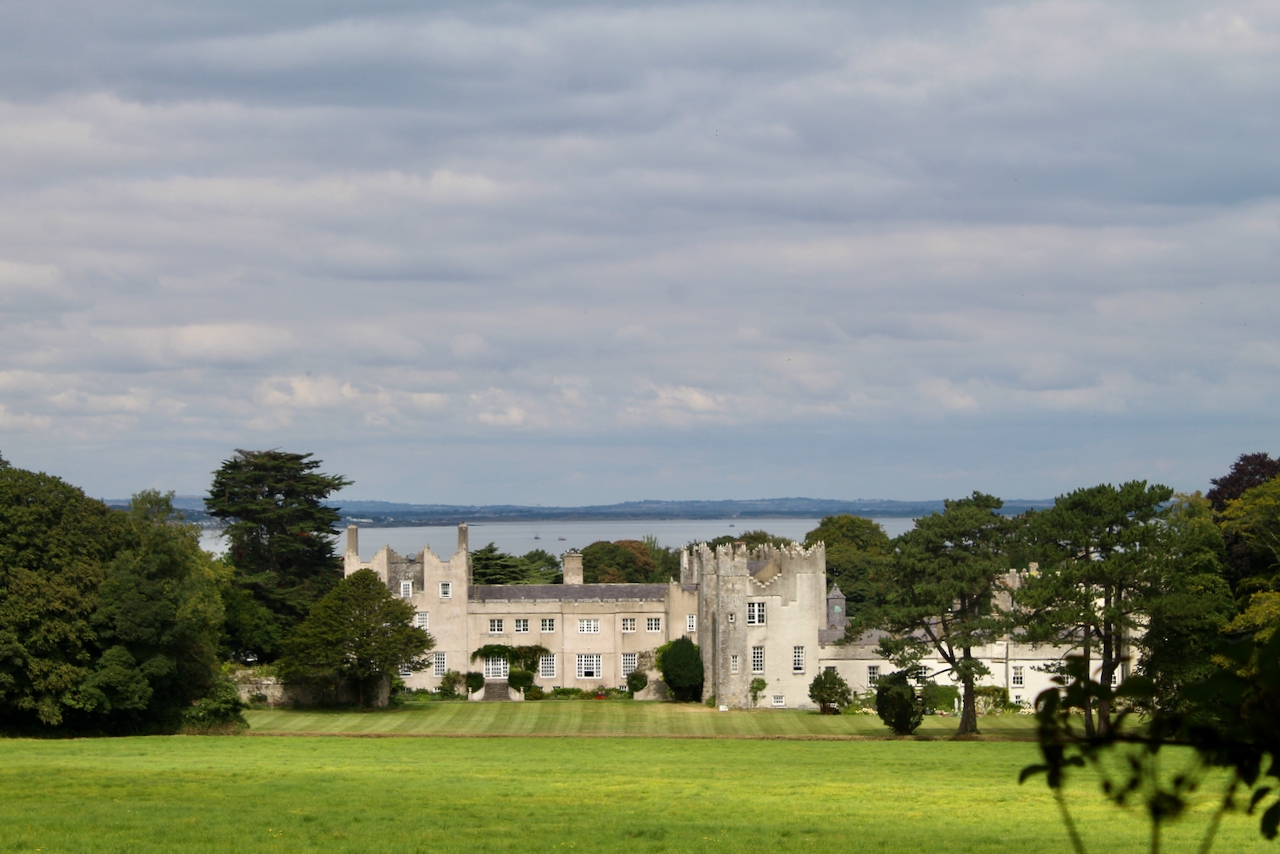
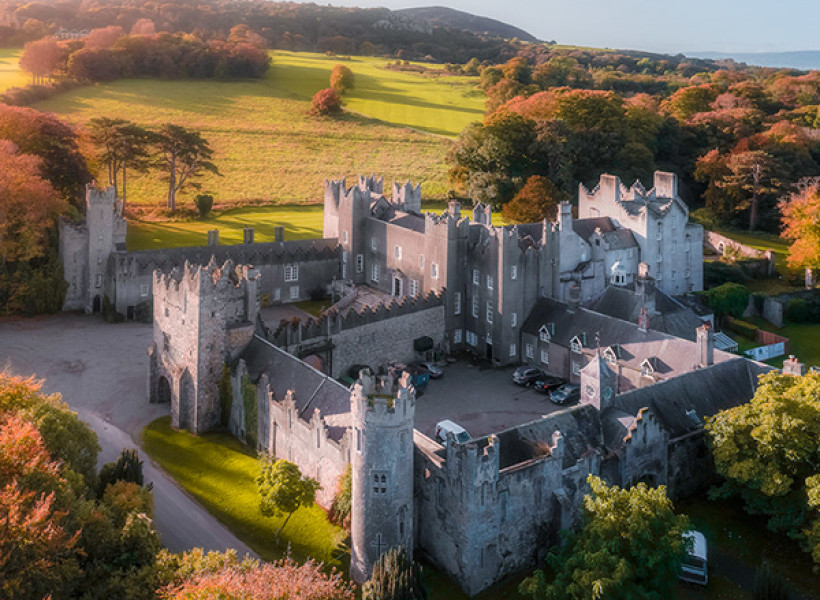
My friend Gary and I went on a tour of Howth Castle in Dublin during Heritage Week in 2025. You can arrange a tour if you contact the castle in advance, see the website https://howthcastle.ie
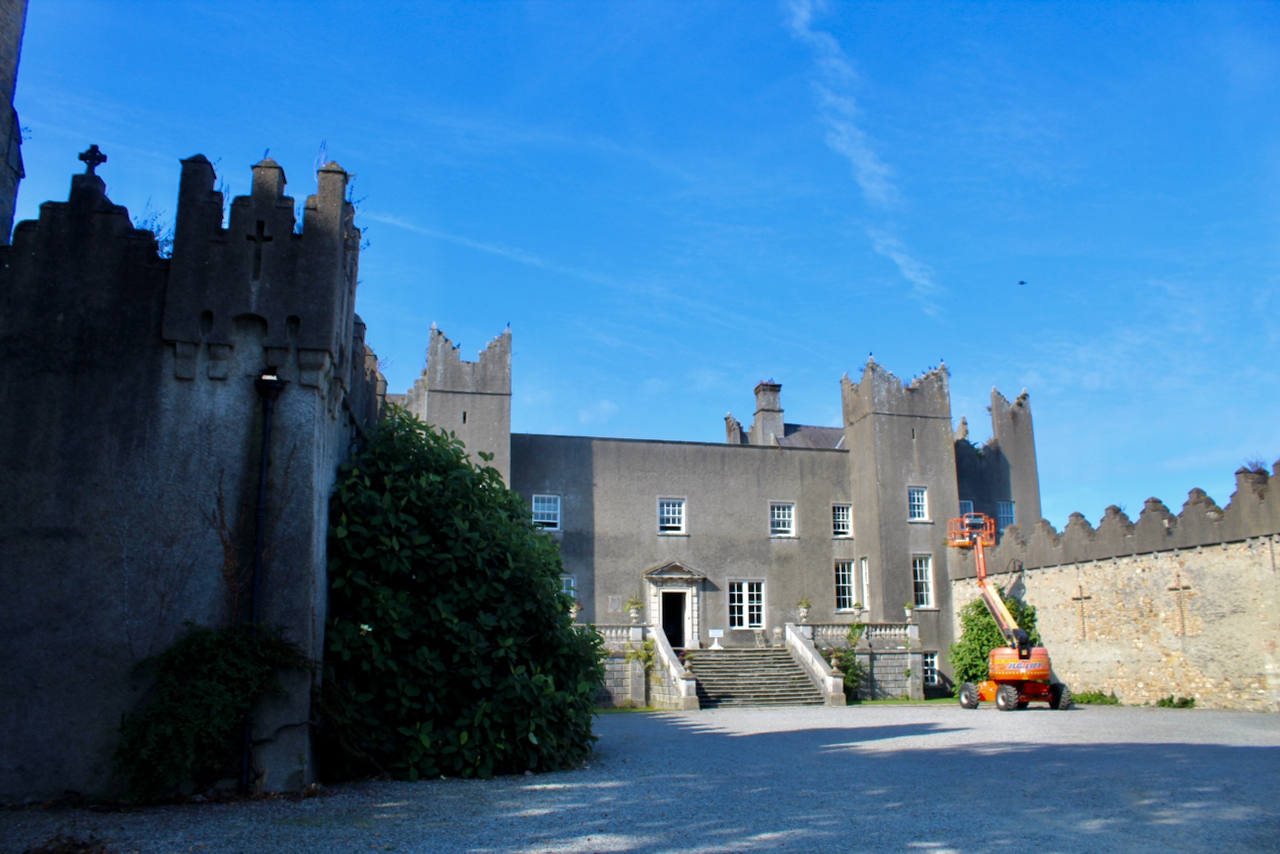
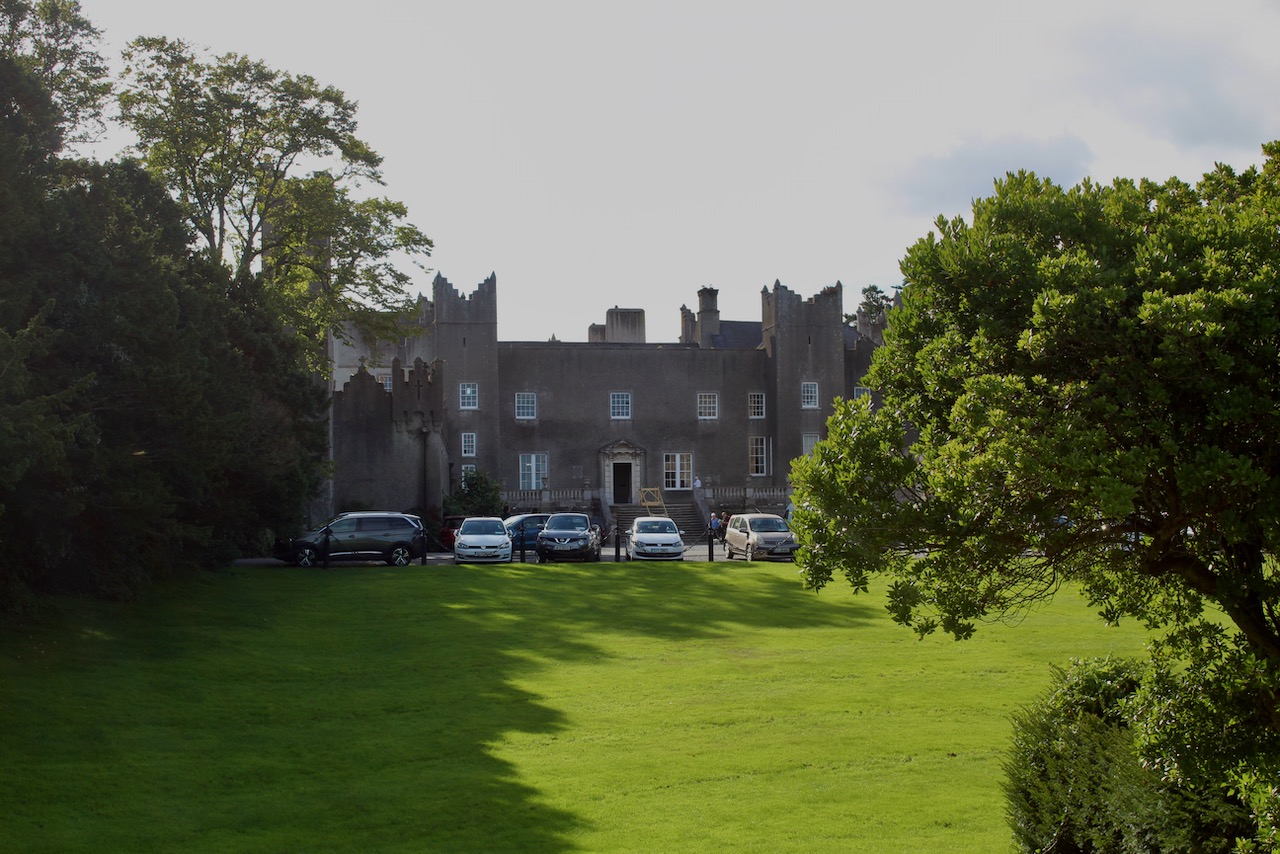
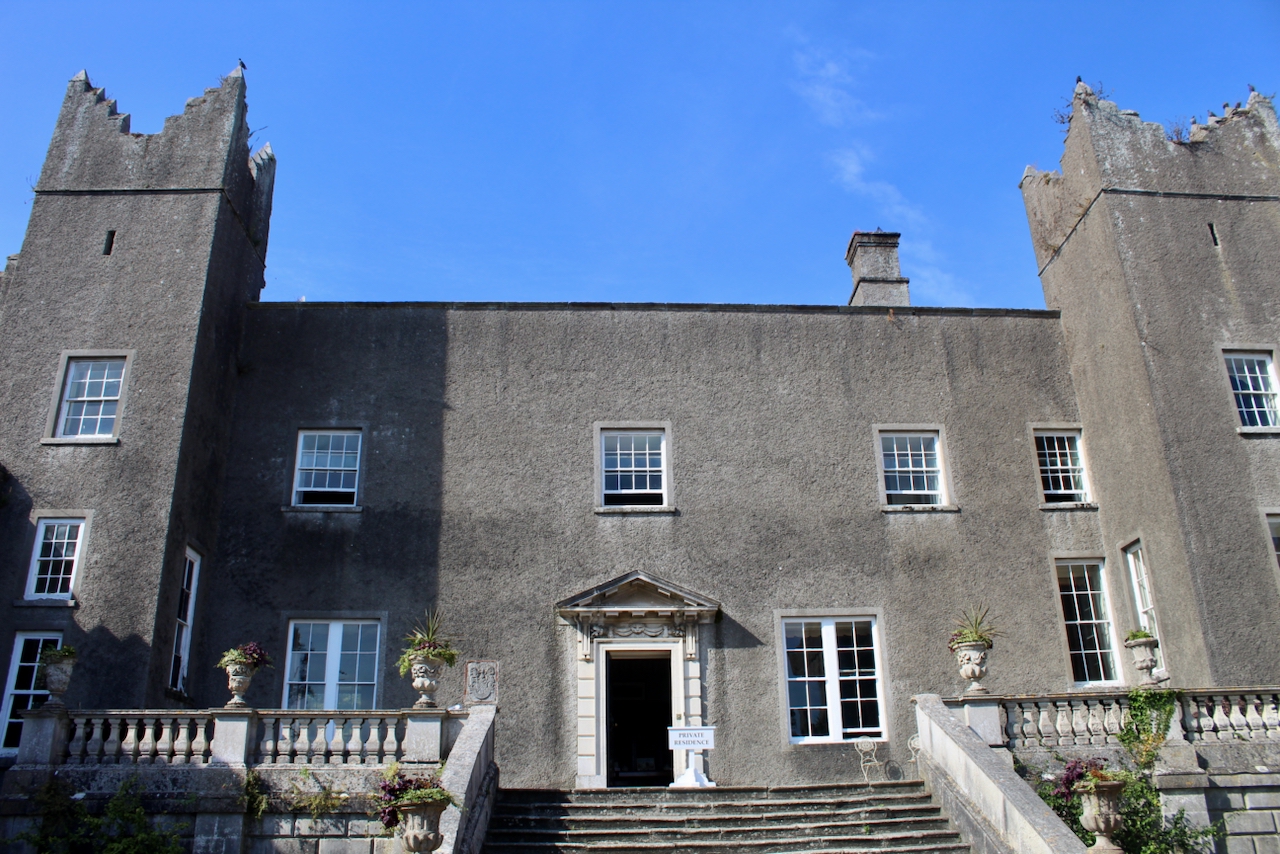
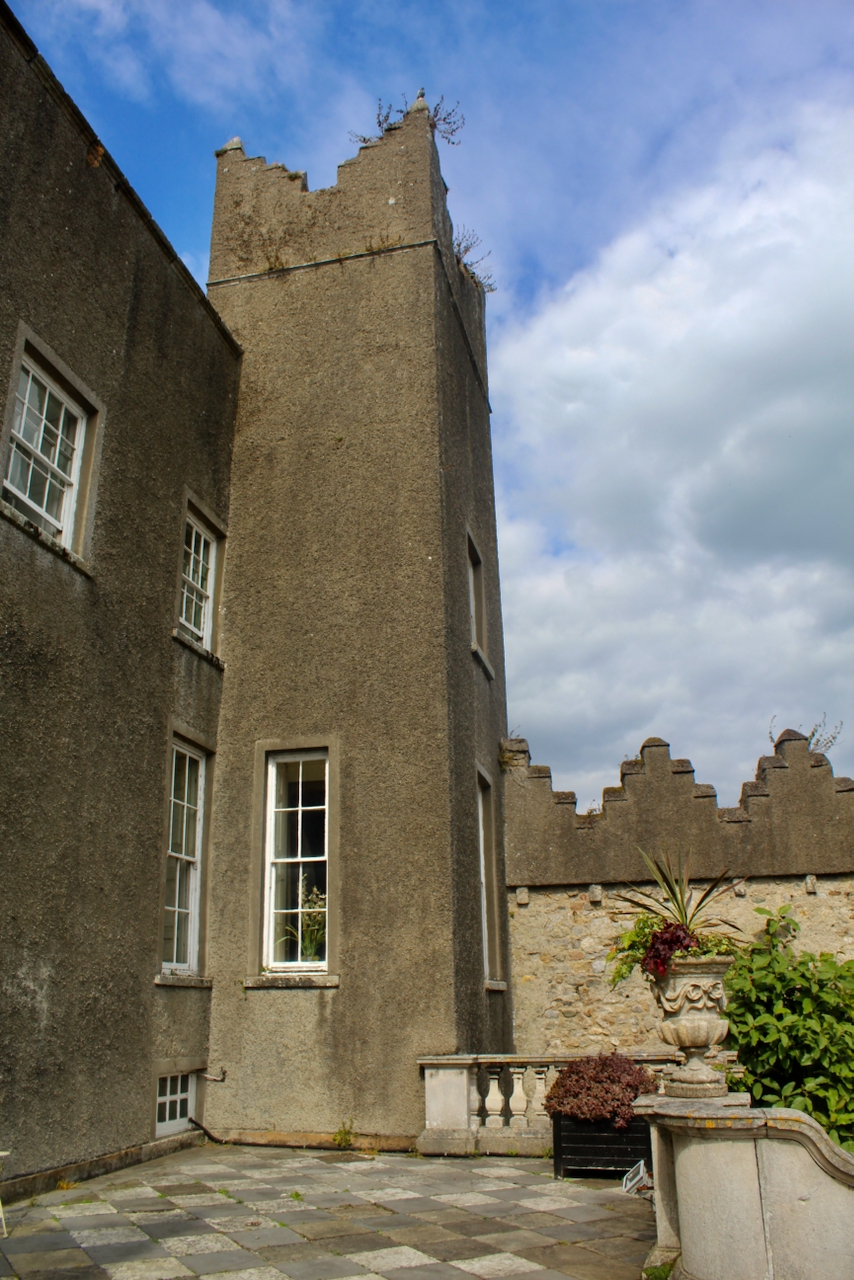
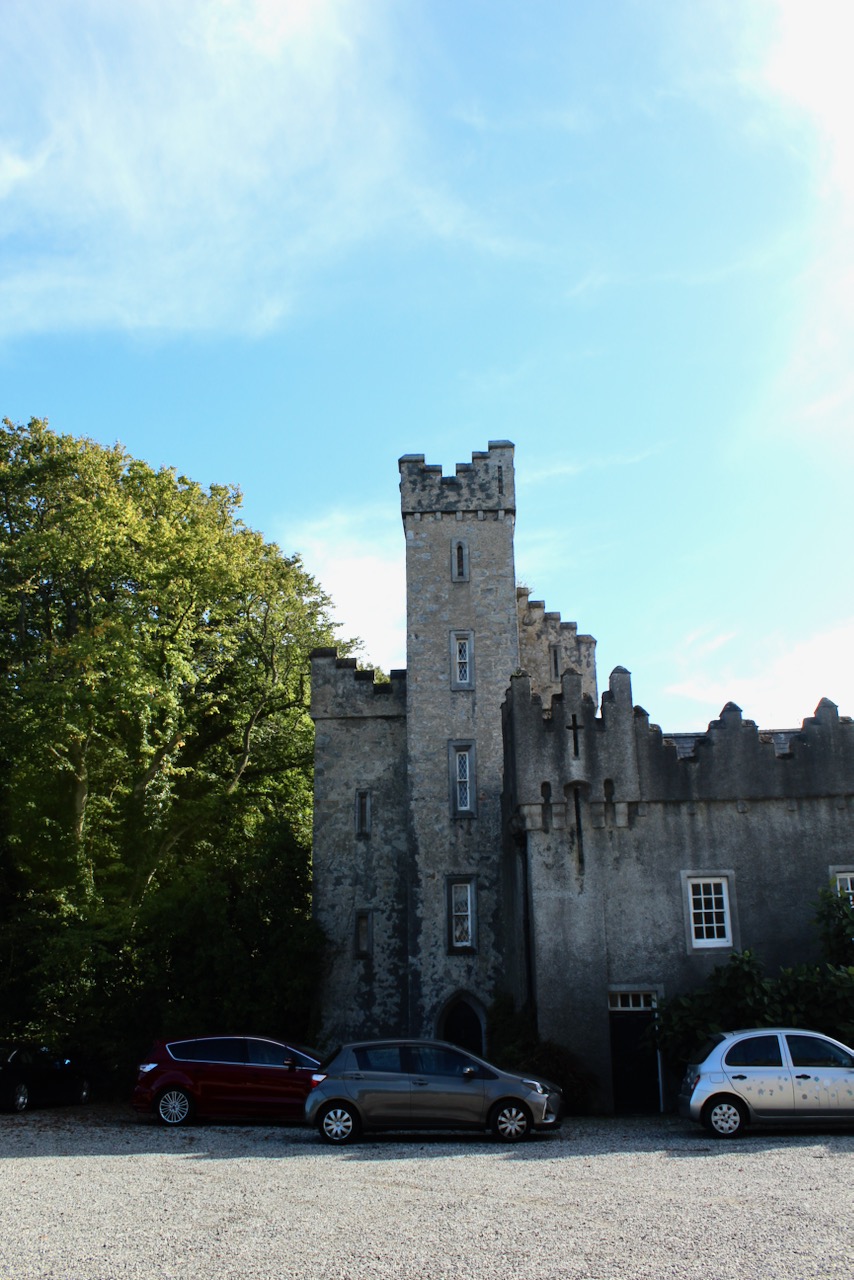
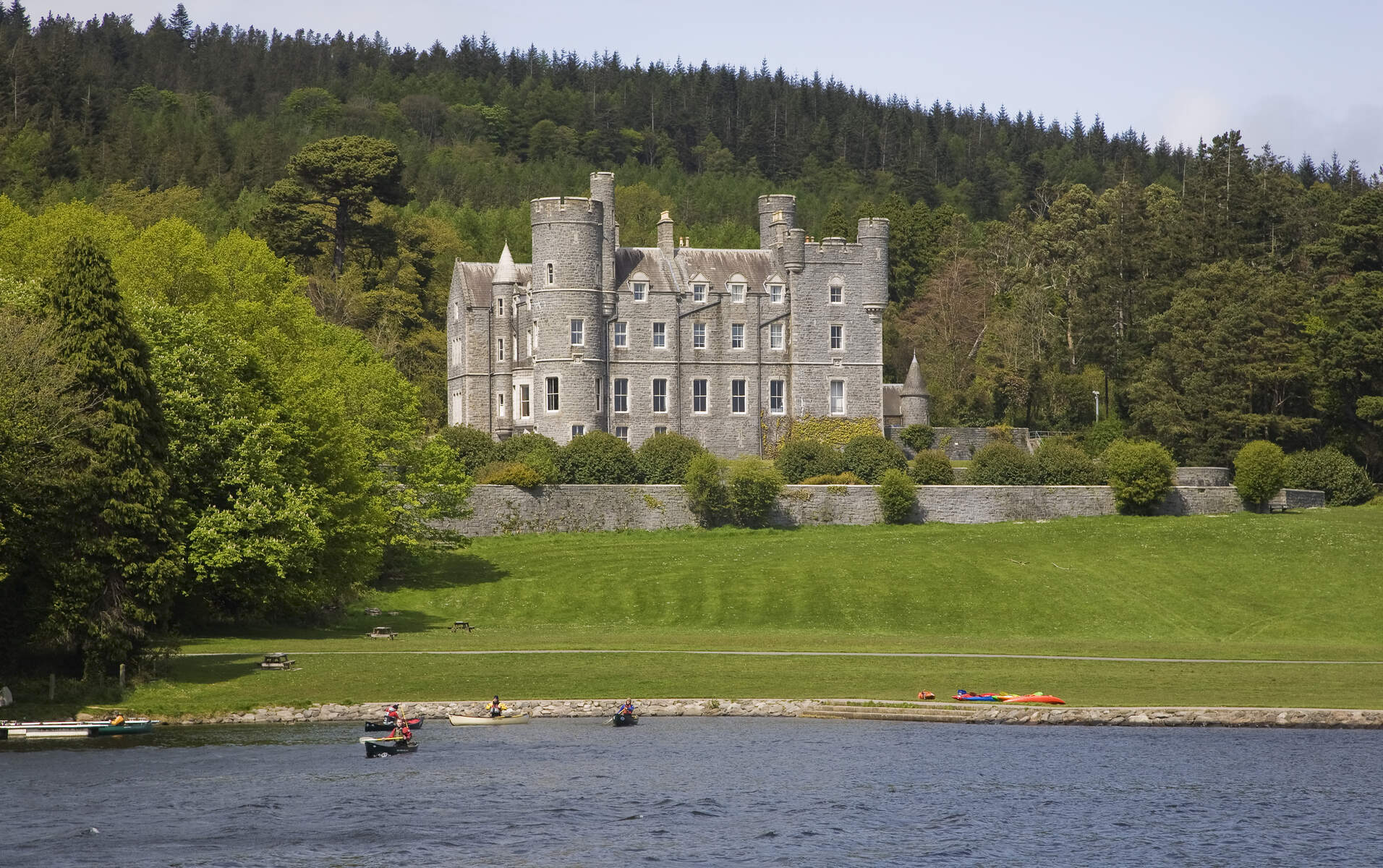
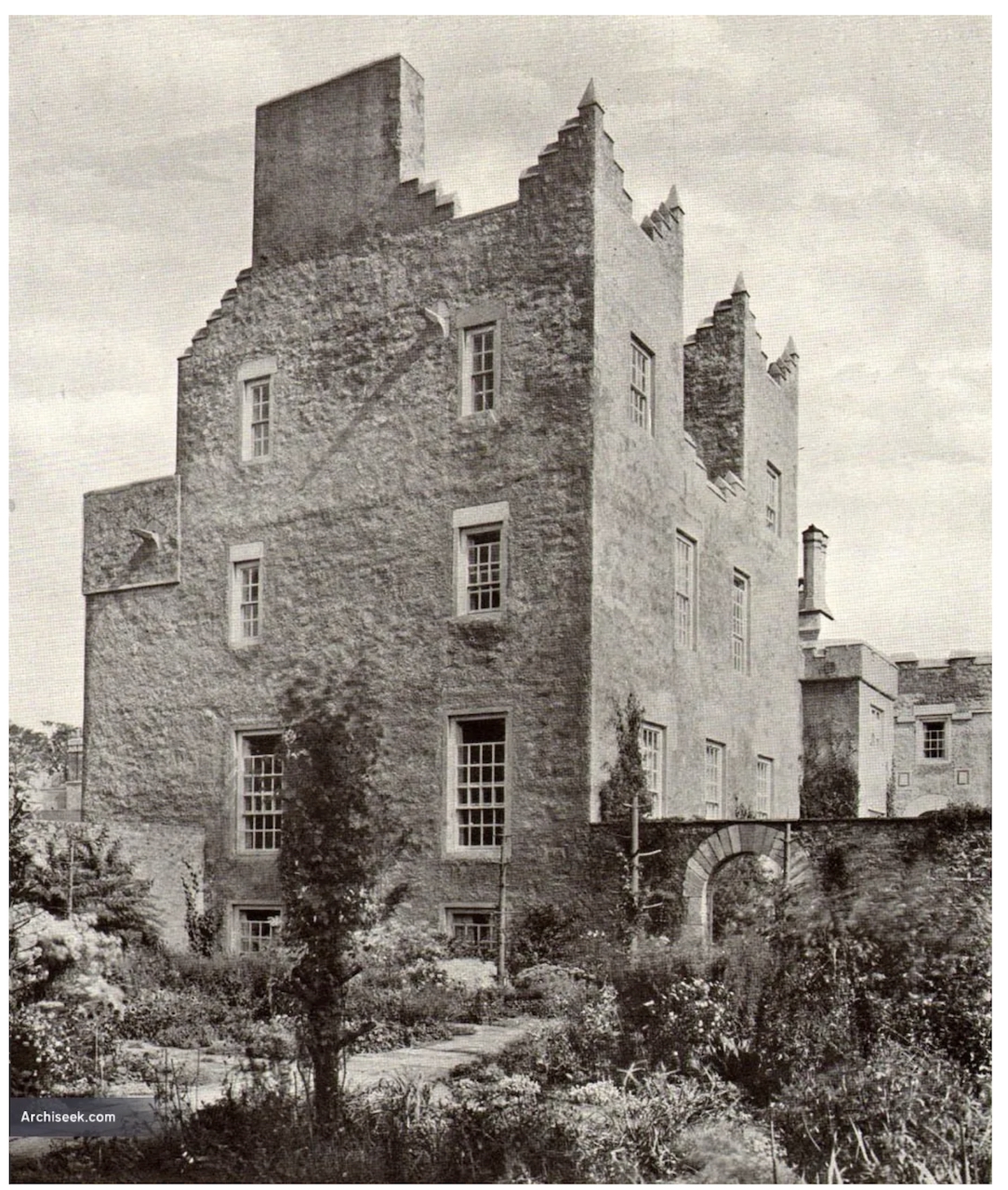
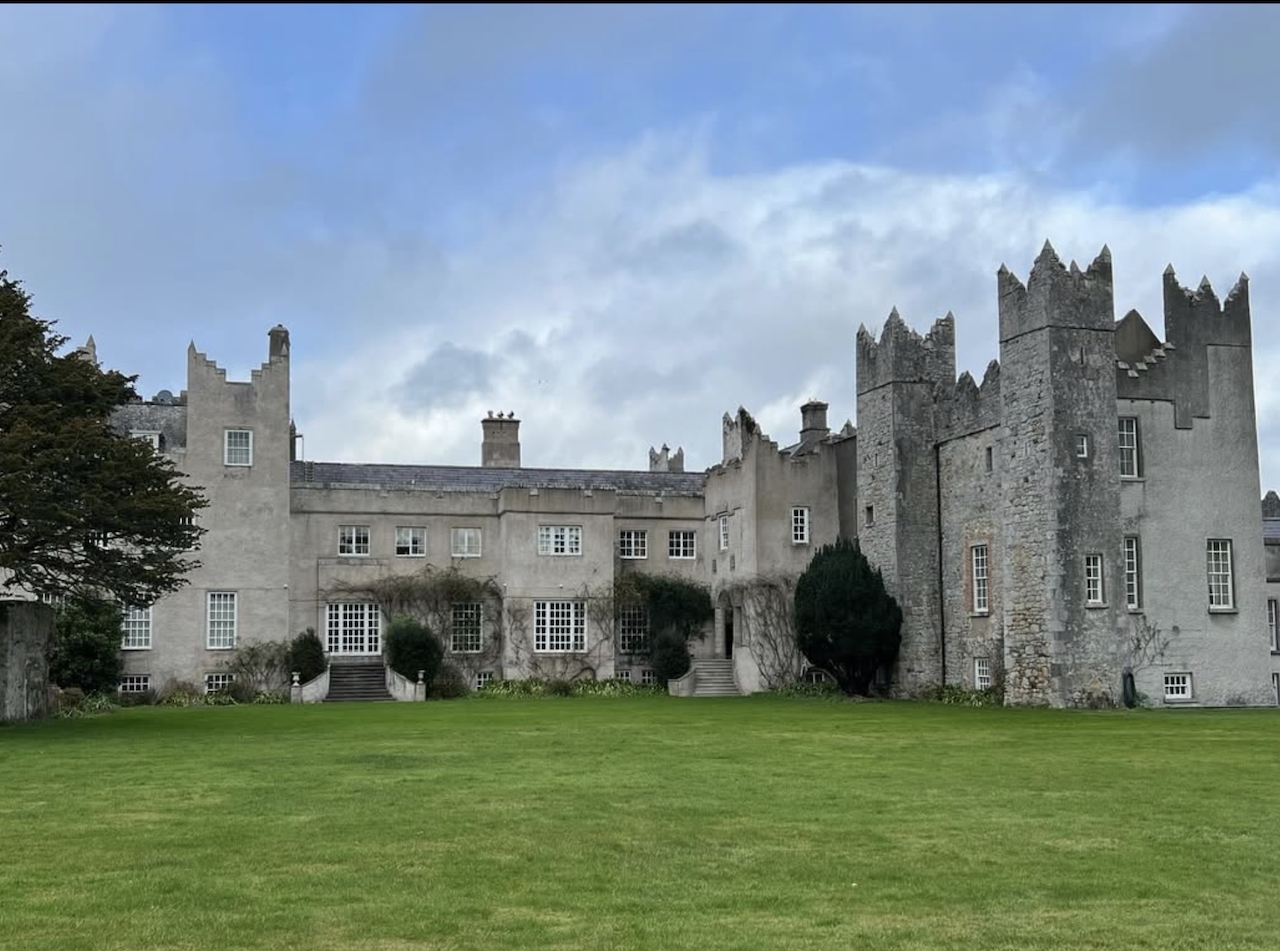
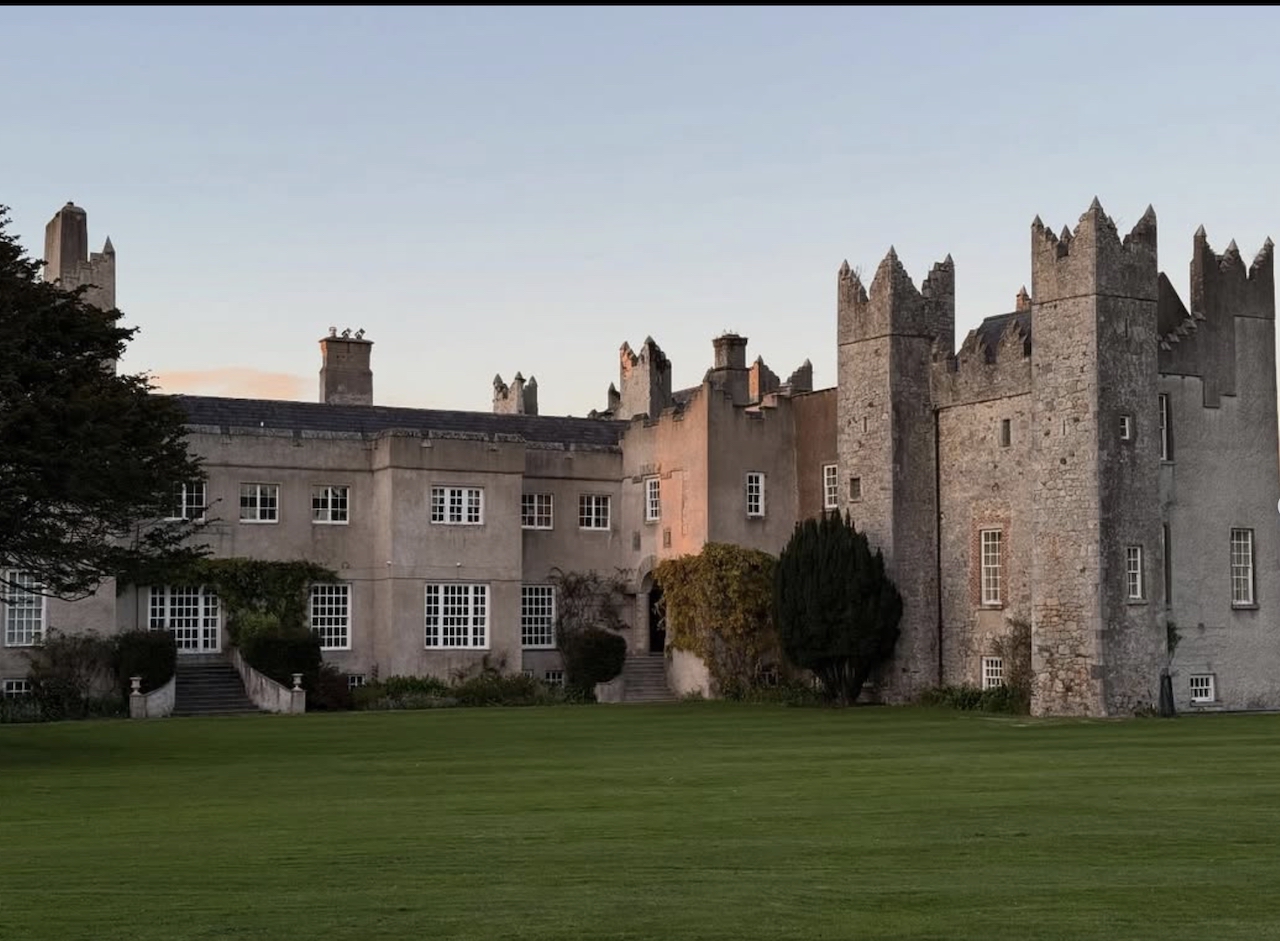
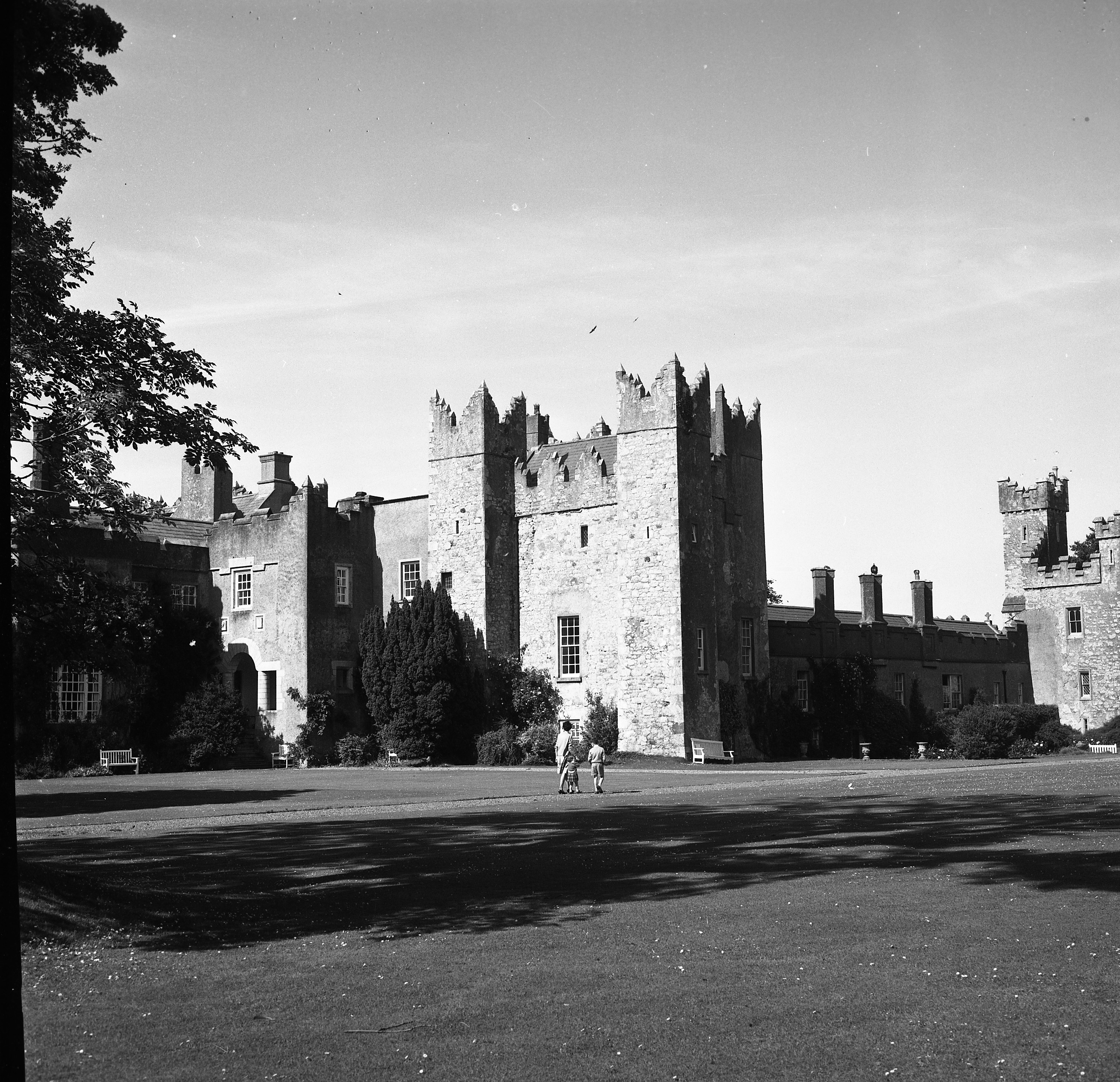
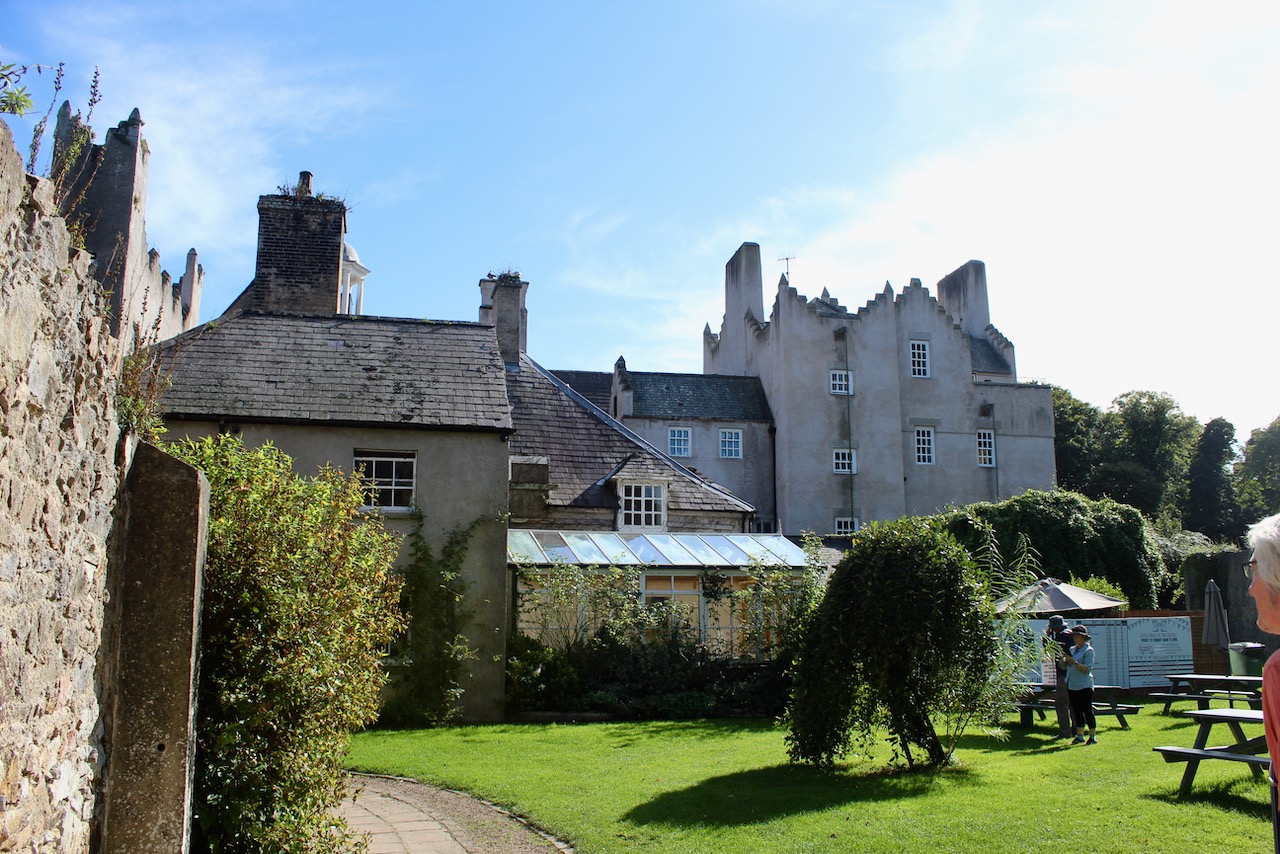
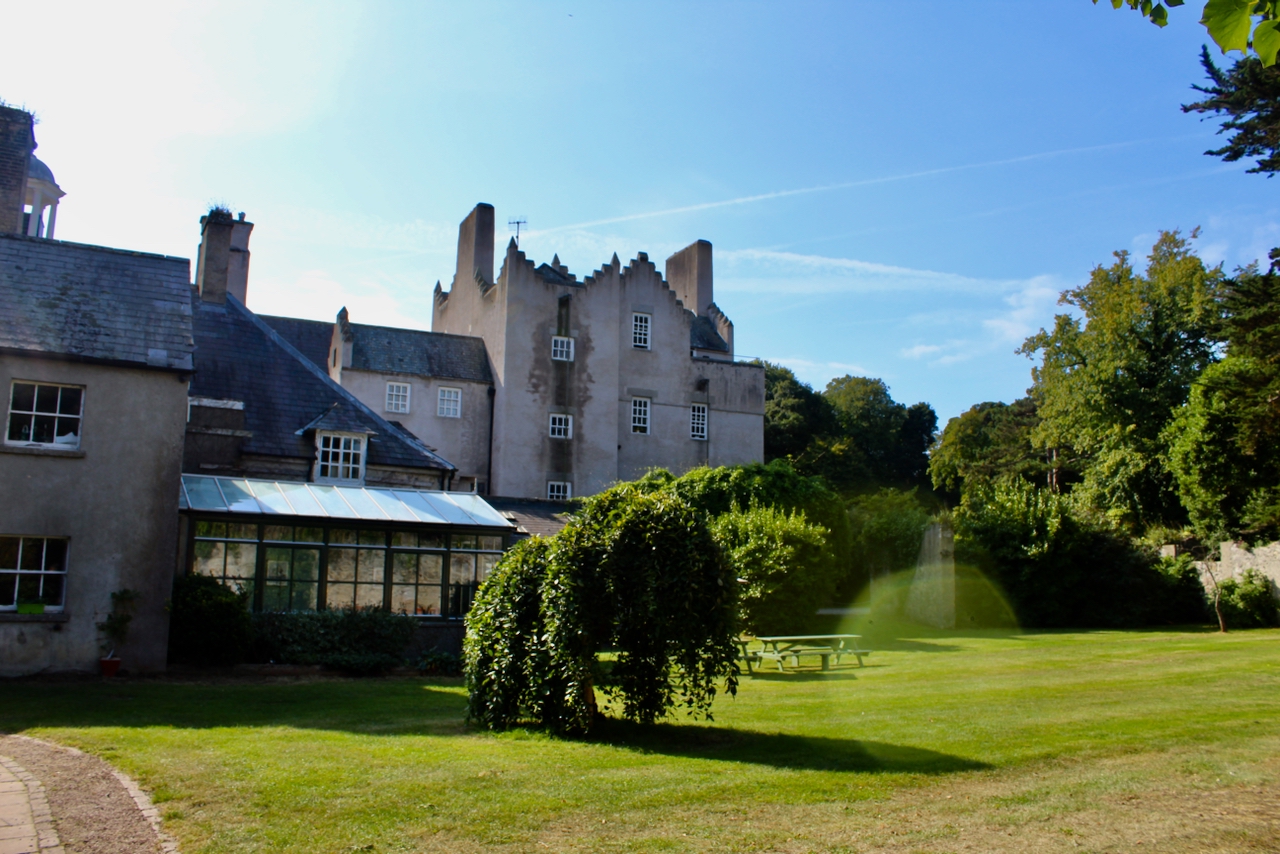
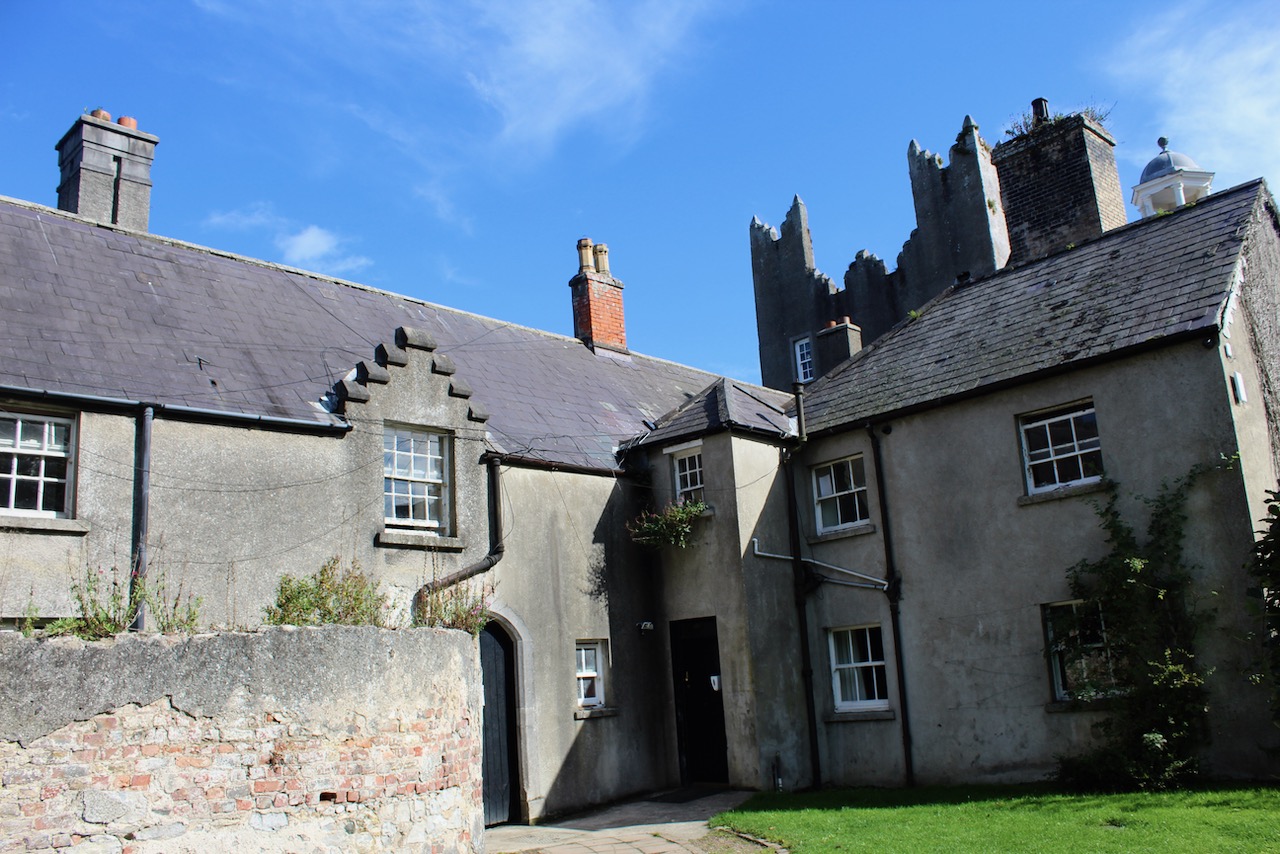
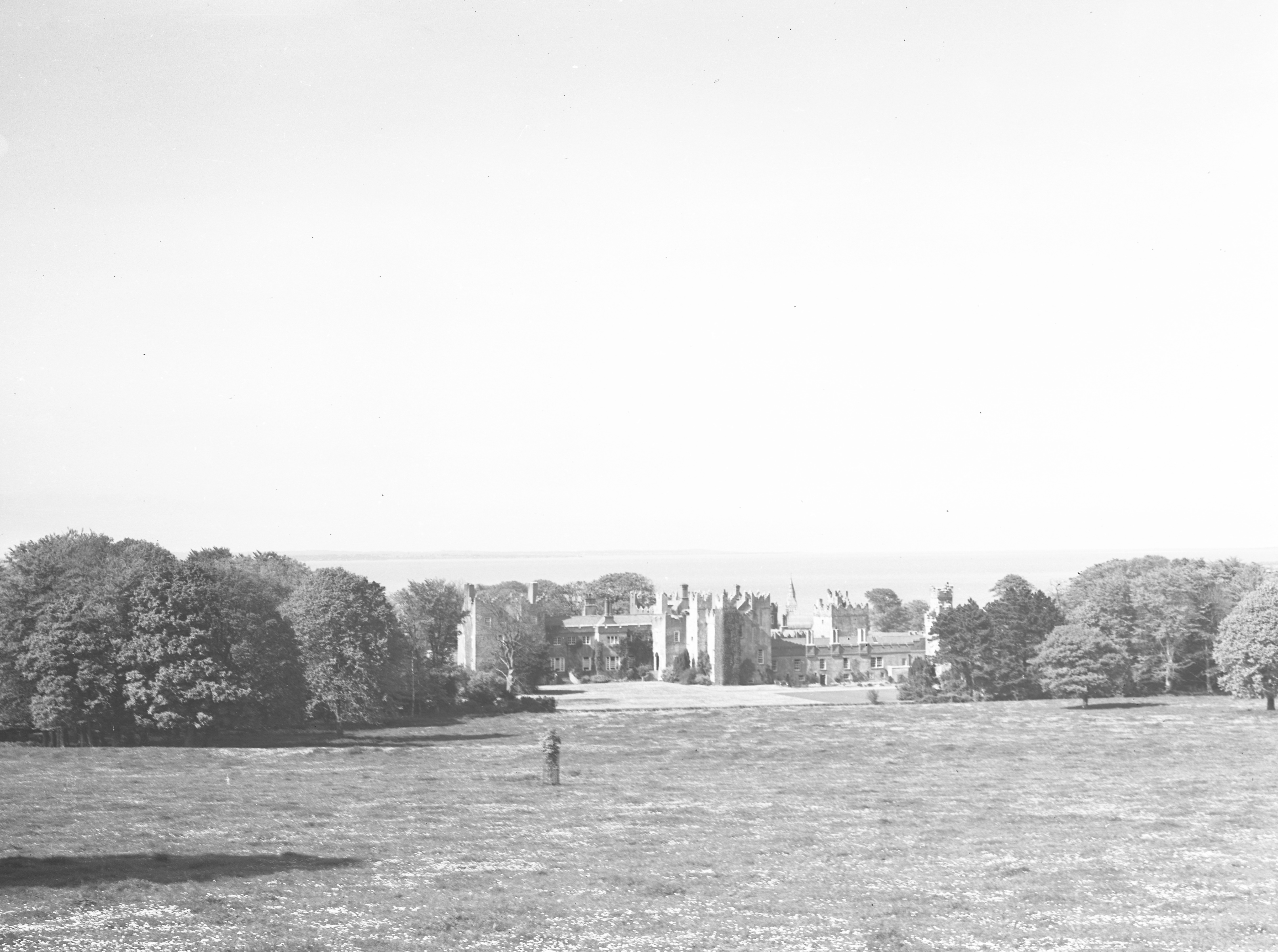
I envy historian Daniel, our tour guide, as he lives in the castle! Mark Bence-Jones describes the castle as a massive medieval keep, with corner towers crenellated in the Irish crow-step fashion, to which additions have been made through the centuries. [1]
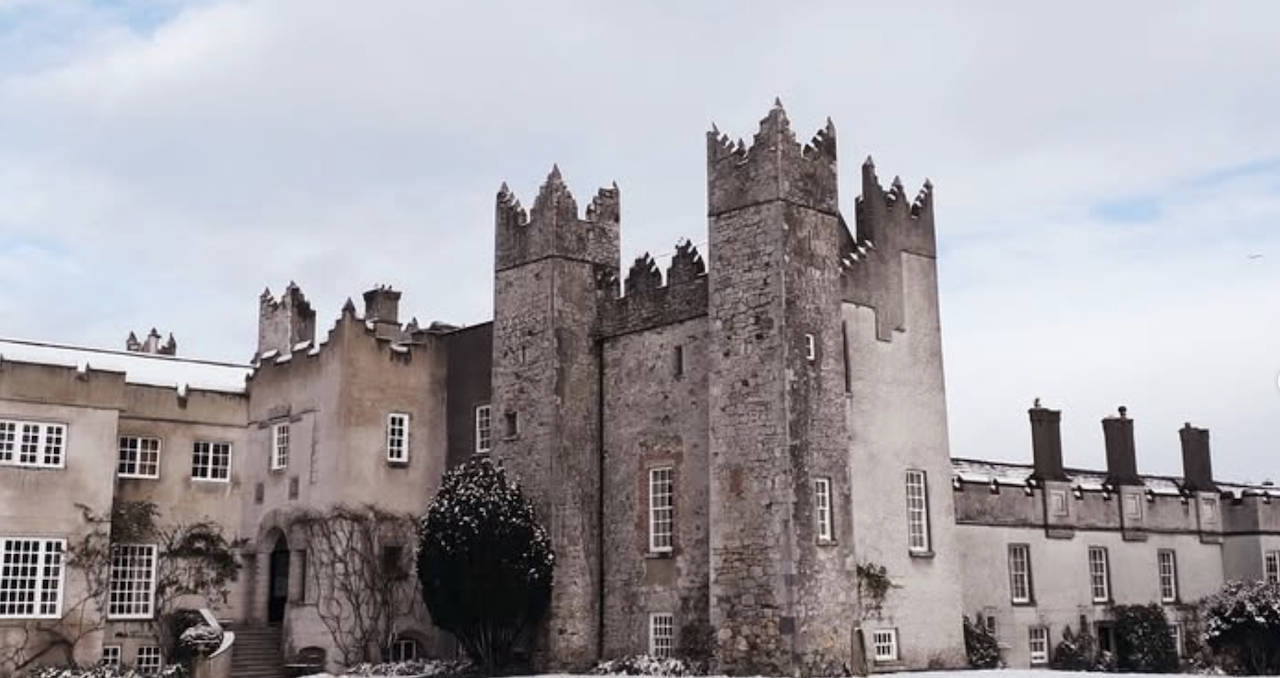
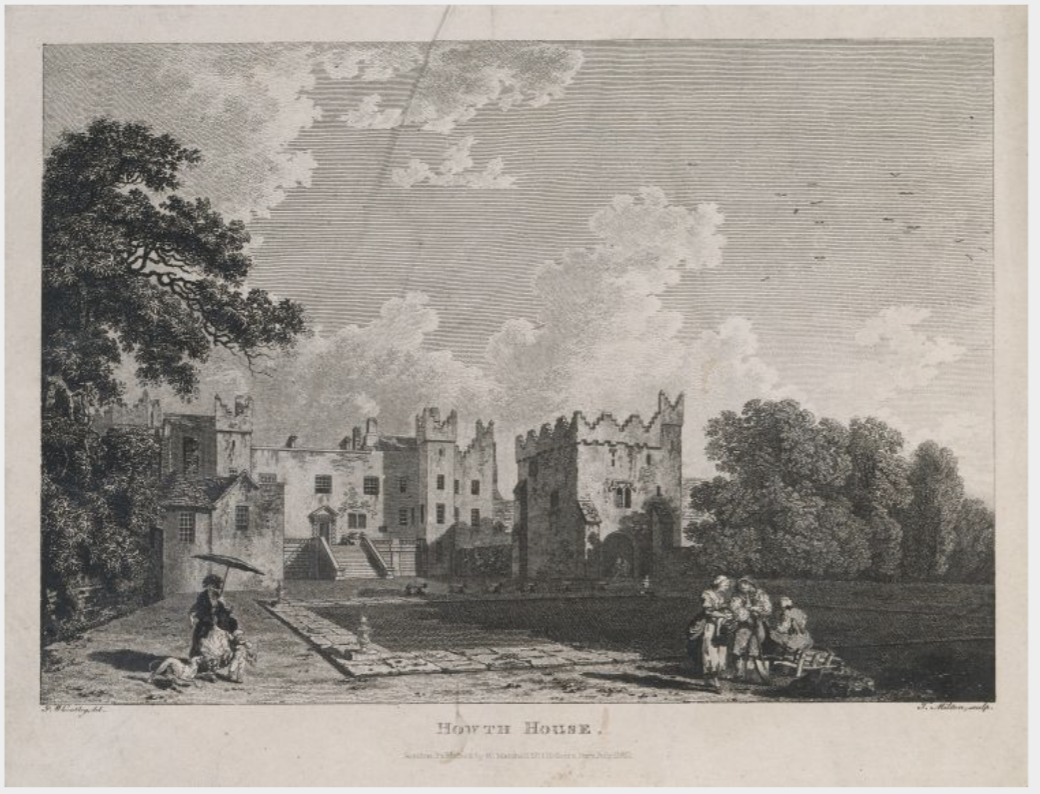
Timothy William Ferres tells us that the current building is not the original Howth Castle, which was on the high slopes by the village and the sea. [2]

Until recently, the castle was owned by the Gaisford-St. Lawrence family. Irish investment group Tetrarch who purchased the property in 2019 plan to build a hotel on the grounds. It had been owned by the same family, originally the St. Lawrences, ever since it was built over eight hundred years ago. Over the years, wings, turrets and towers were added, involving architects such as Francis Bindon (the Knight of Glin suggests he may have been responsible for some work around 1738), Richard Morrison (the Gothic gateway, and stables, around 1810), Francis Johnson (proposed works for the 3rd Earl of Howth), and Edward Lutyens (for Julian Gaisford-St. Lawrence).
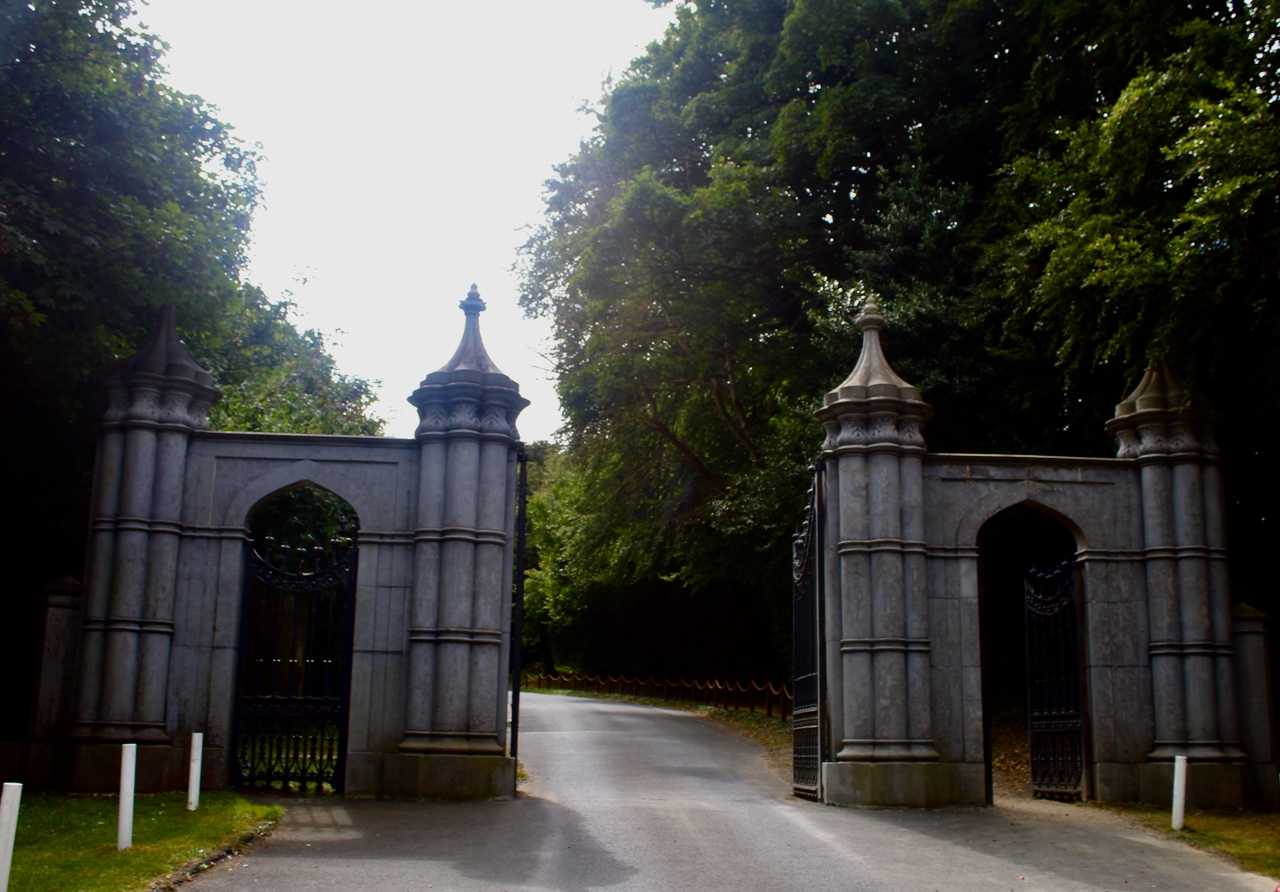
Timothy William Ferres tells us that the St. Lawrence family was originally the Tristram family. Sir Almeric Tristram took the name St. Lawrence after praying to the saint before a battle which took place on St. Lawrence’s Day near Clontarf in Dublin. Sir Almeric landed in Howth in 1177. After the battle he was rewarded for his valour in the conflict with the lands and barony of Howth. [see 2]
In an article in the Irish Times on Saturday August 14th 2021, Elizabeth Birthistle tells us that a sword that is said to have featured in the St. Lawrence’s Day battle is to be auctioned. A “more sober assessment” of the Great Sword of Howth, she tells us, dates it to the late 15th century. Perhaps, she suggests, Nicholas St. Lawrence 3rd Baron of Howth used it in 1504 at the Battle of Knockdoe. The sword is so heavy that it must be held with two hands. It is first recorded in an inventory of 1748, and is described and illustrated in Joseph C Walker’s An Historical Essay on the Dress of the Ancient and Modern Irish. [3]
Almeric went on to fight in Ulster and then Connaught. In Connaught, he was killed by the O’Conor head of the province, along with his thirty knights and two hundred infantry. He left three sons by his wife, a sister of John de Courcy, Earl of Ulster. The eldest son, Nicholas Fitz Almeric, relinquished his father’s Ulster conquests to religious houses, and settled in Howth. [see 2]
The first construction on the site would have been of wood.
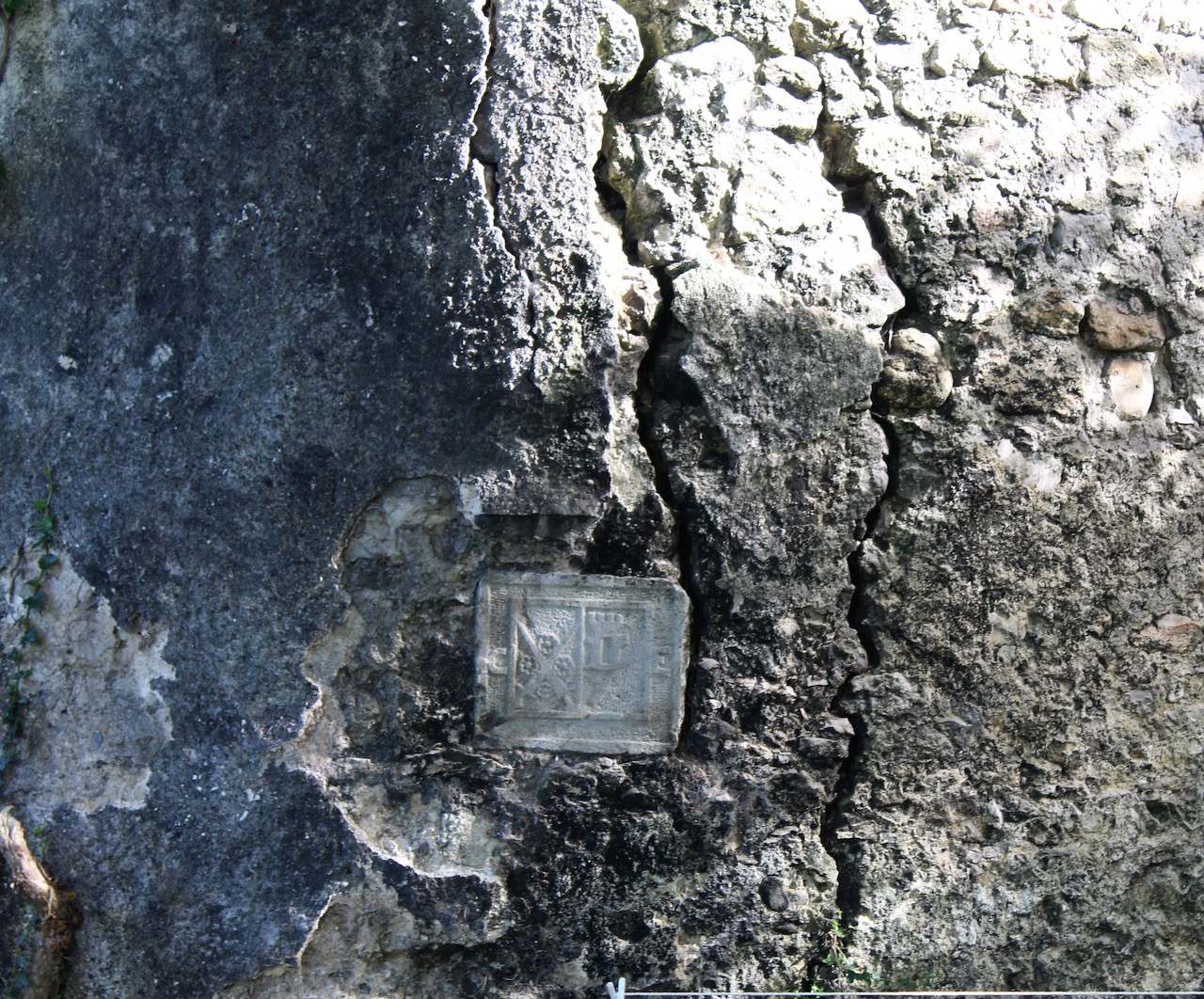
The family coat of arms depicts a mermaid and a sea lion. The mermaid is often pictured holding a mirror. There is a coat of arms on the wall of the front of the castle which was probably moved from an older part of a castle. The Howth Castle website tells us:
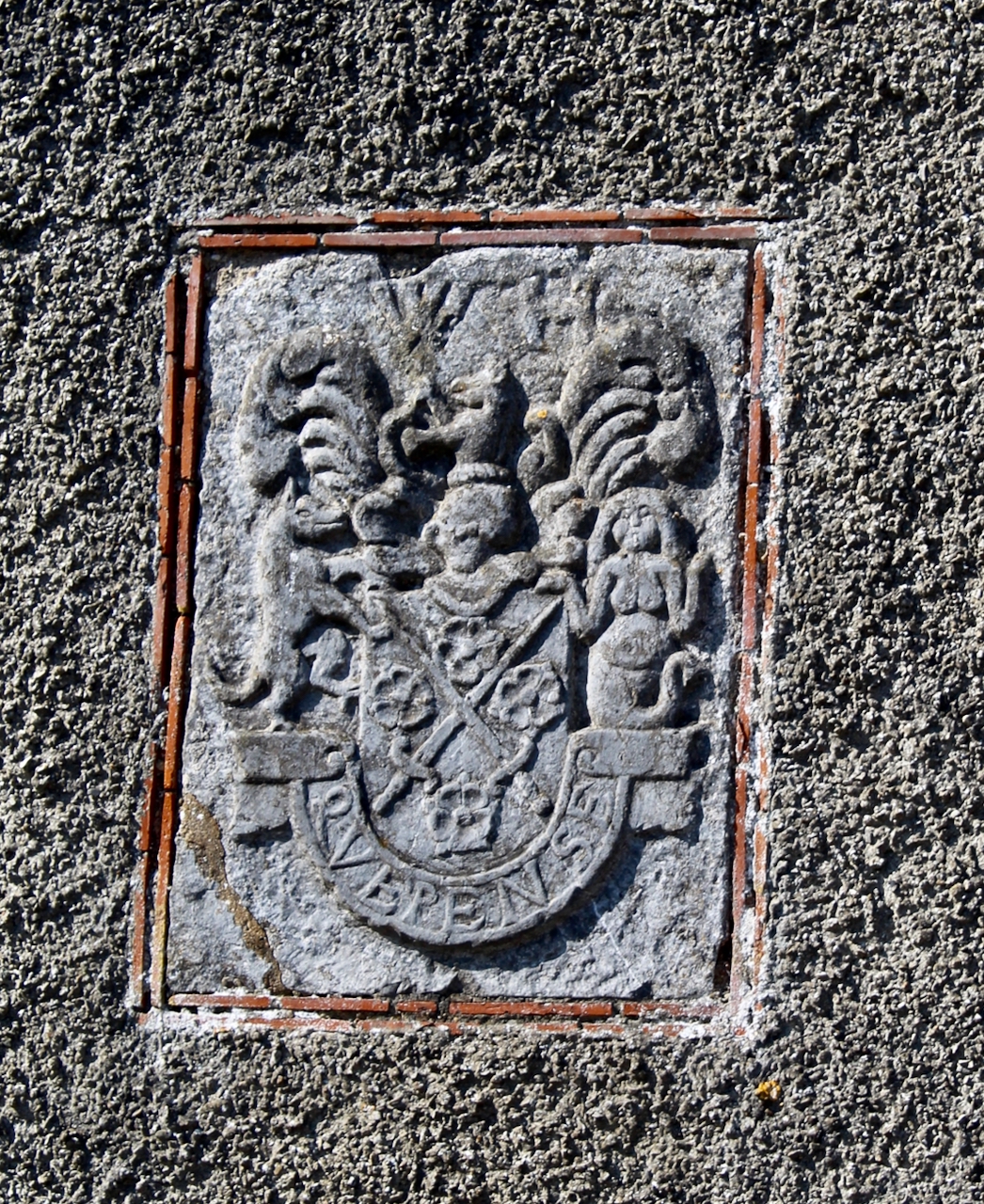
“A mermaid is one of the supporters of the St. Lawrence family coat of arms, alongside a sea lion. The mermaid is often portrayed holding a small glass mirror. According to legend, the mermaid was once Dame Geraldine O’Byrne, daughter of The O’Byrne of Wicklow. She fell victim to dark magic at Howth Castle and was transformed into a mermaid. One item she left behind in her bedroom was a small glass mirror. The tower she slept in was from then always known as the ‘Mermaid’s Tower’. “


An article in the Irish Times tells us that there was a tryst between Dame Geraldine O’Byrne and Tristram St. Lawrence which left the Wicklow woman heartbroken and shamed, so she transformed into a mermaid. It is said her wails of melancholy are still carried through the winds at night near the Mermaid’s Tower on the estate. [3]
The Howth Castle website tells us that:
“One Christmas, Thomas St. Lawrence, Bishop of Cork and Ross [(1755–1831), son of the 1st Earl, 15th Baron of Howth] returned to Howth Castle to find that the family had gone to stay with Lord Sligo for the holiday season. Bishop St. Lawrence was left alone in the cold and dark castle with just a housekeeper for company and his ancestors glaring at him from the portraits in the dark hallways. The housekeeper put him to bed in the ‘Mermaid’s Tower’. His room was described as if ‘designed as the locus in quo for a ghost scene. Its moth-eaten finery, antiquated and shabby – -its yellow curtains, fluttering in the air…the appearance of the room was enough to make a nervous spirit shudder.’
“He was suddenly and violently awoken in the night by the feeling of a cold, wet hand clasping his wrist and a cold hand covering his mouth. He made one large leap from his bed, lit his candle and there he found not a sinner in the room with him but one bloody yellow glove lying on his bed. Was he visited in the night by the mermaid?”
I’m confused about Barons of Howth as different sources number the Barons differently. I will follow the numbering used on The Peerage website, which refers to L. G. Pine, The New Extinct Peerage 1884-1971: Containing Extinct, Abeyant, Dormant and Suspended Peerages With Genealogies and Arms (London, U.K.: Heraldry Today, 1972), page 150. According to this, Christopher St. Lawrence (died around 1462) was 1st Baron Howth. He held the office of Constable of Dublin Castle from 1461.
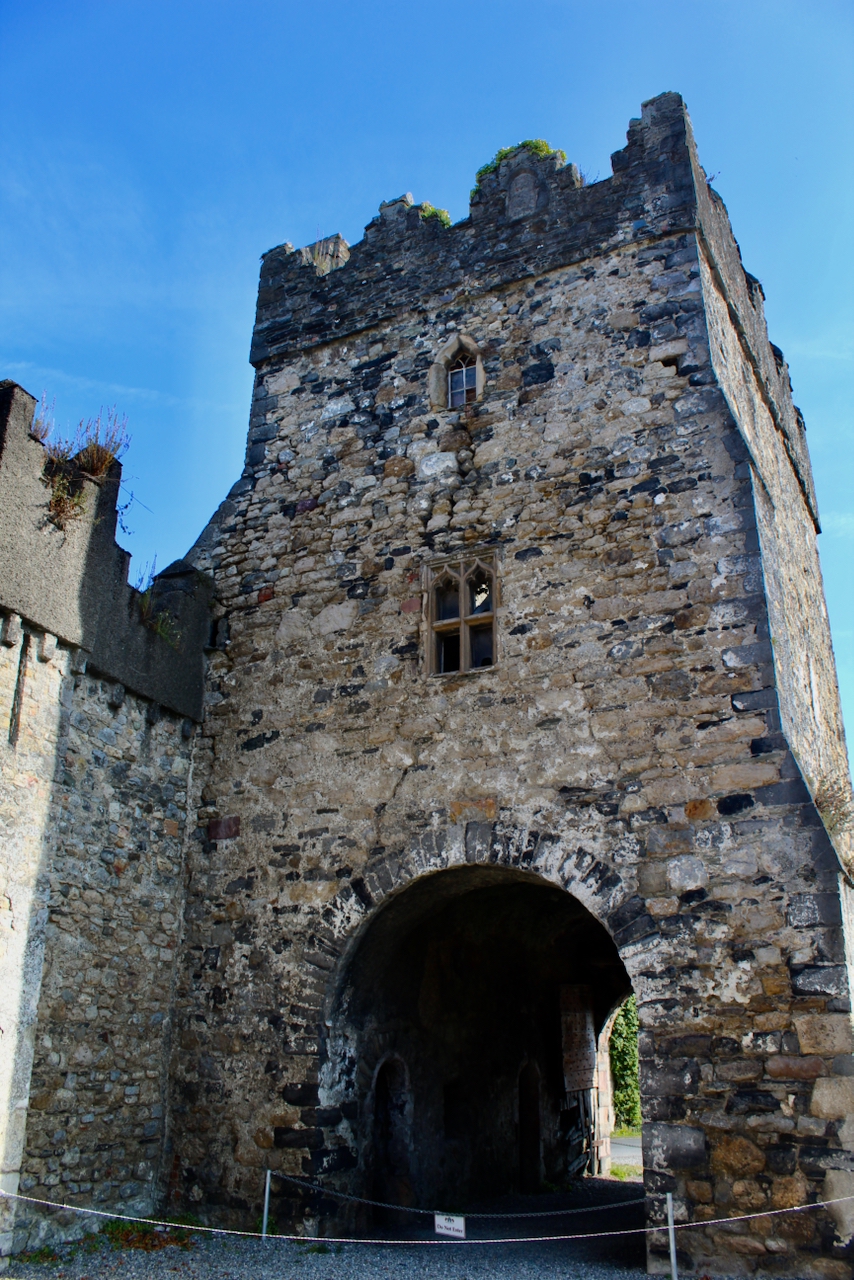
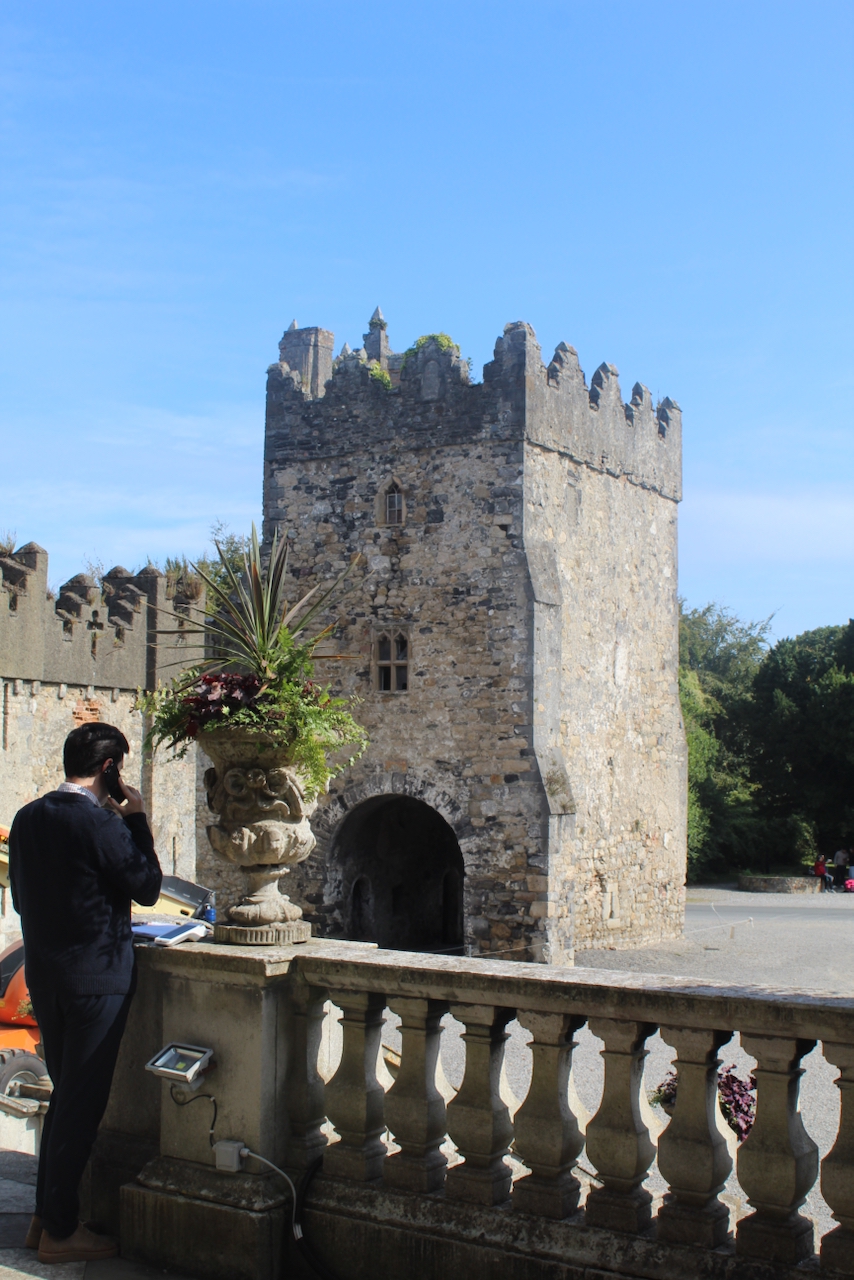
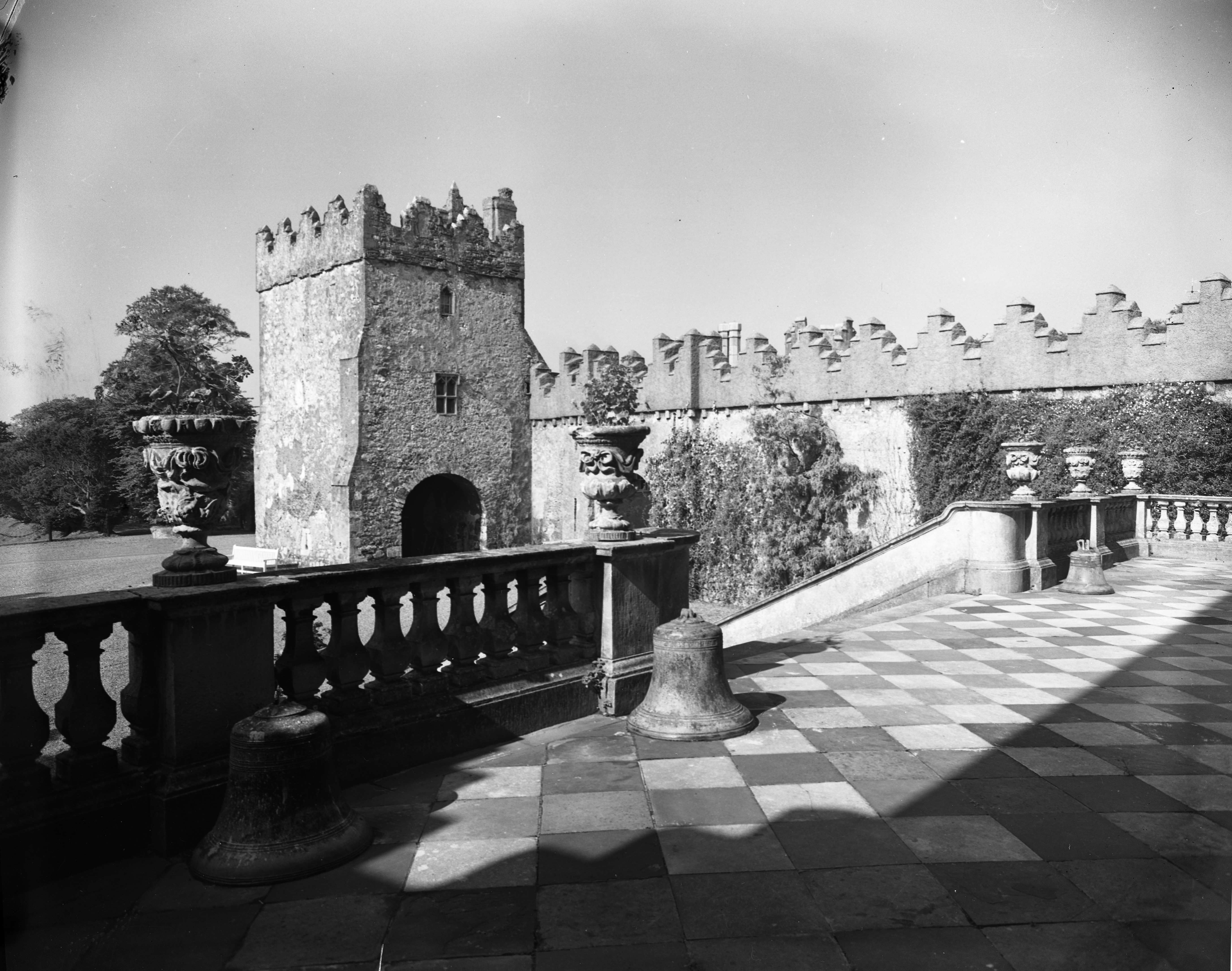
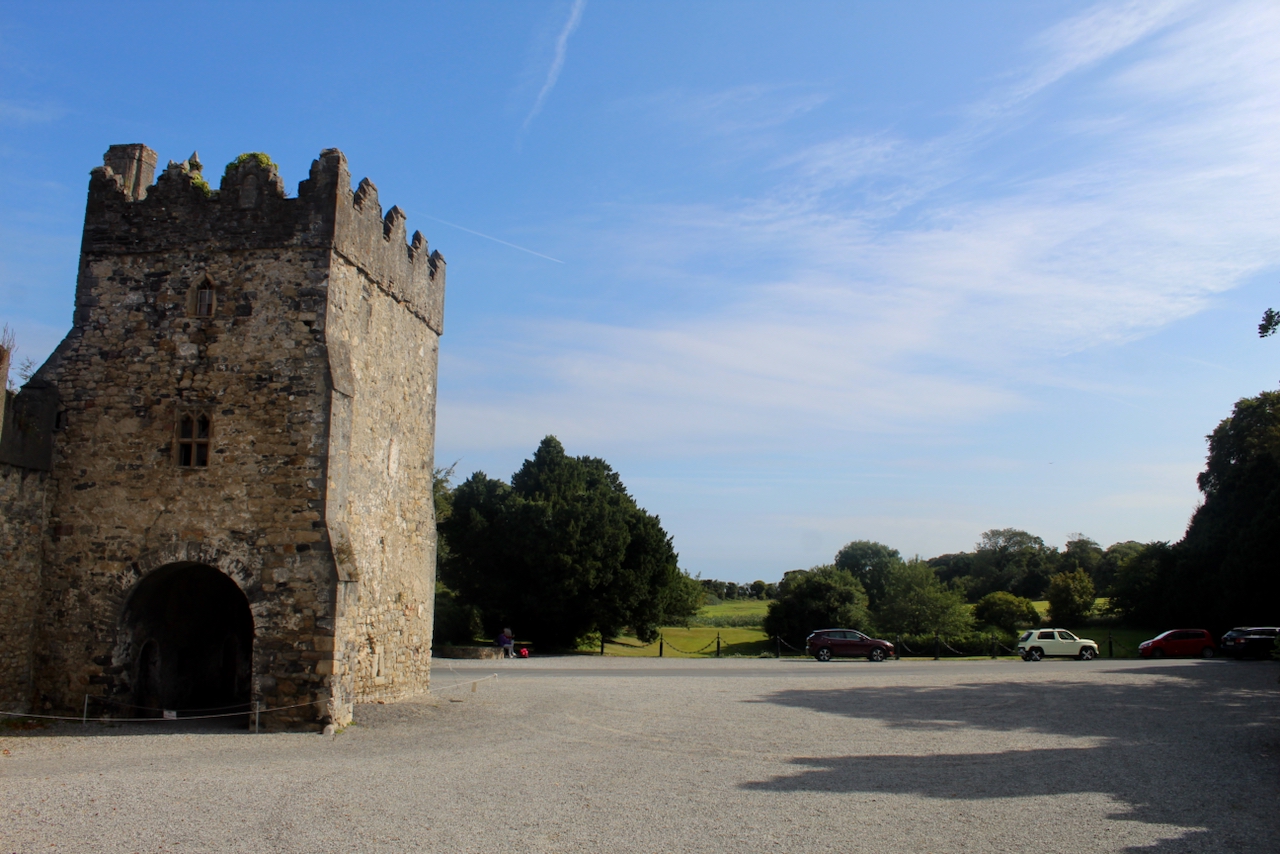
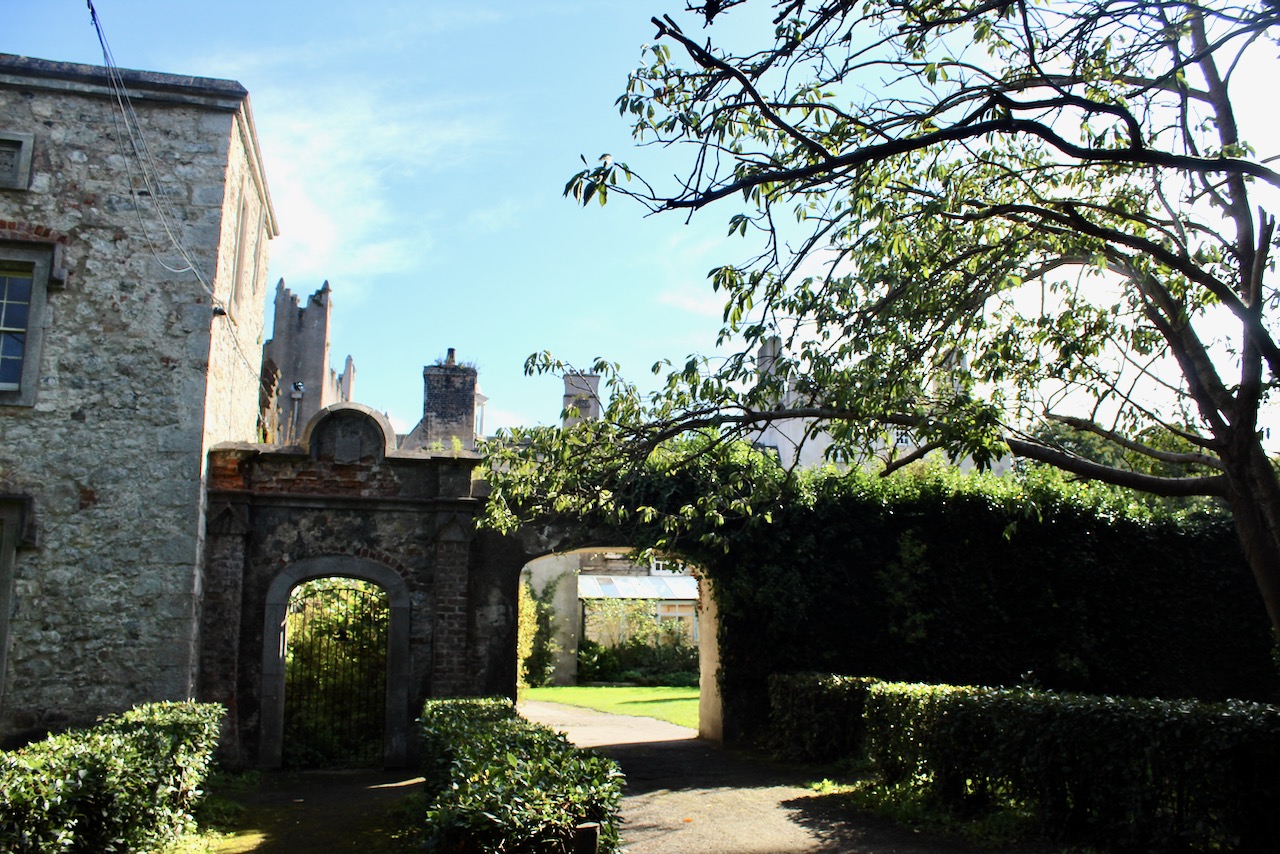
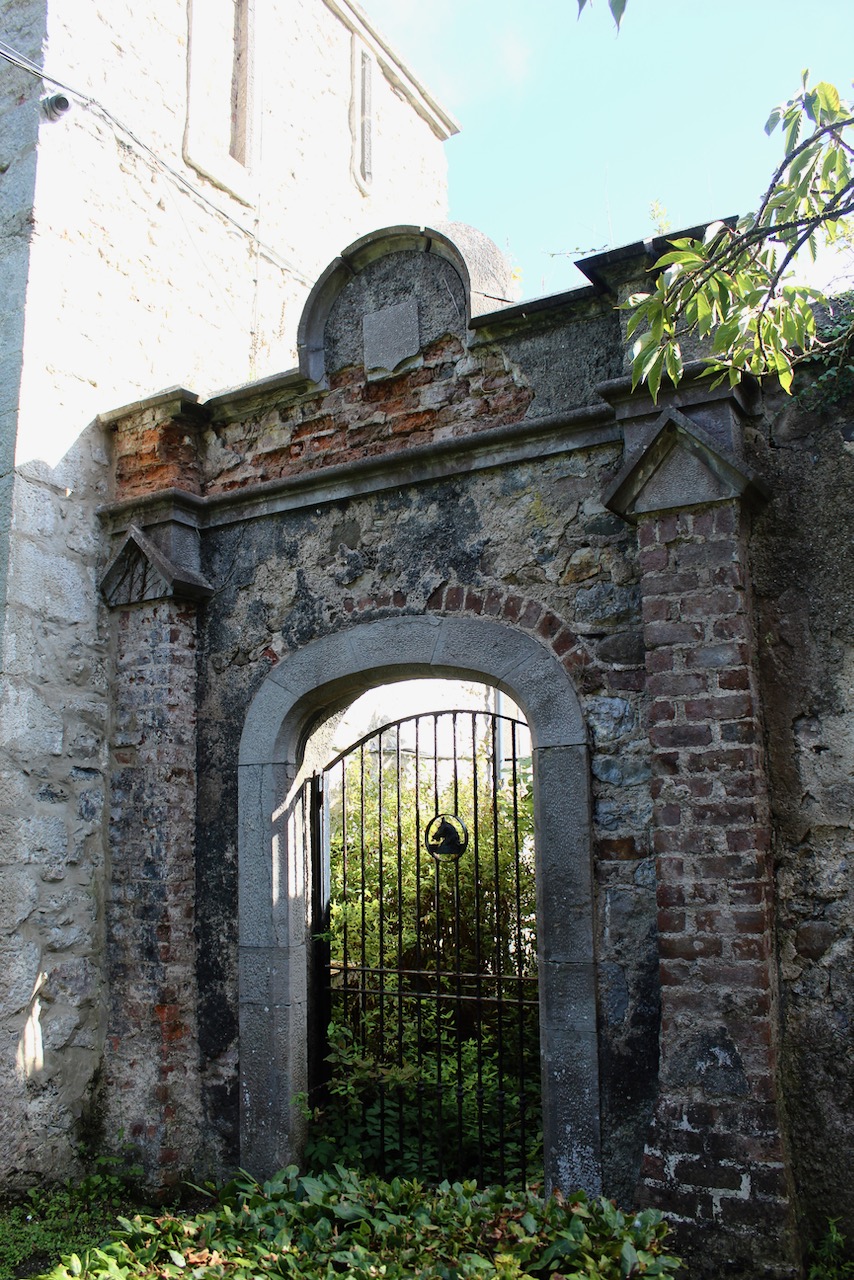
The oldest surviving part of the castle is the gate tower in front of the main house. It dates to around 1450, the time of the 1st Baron Howth.
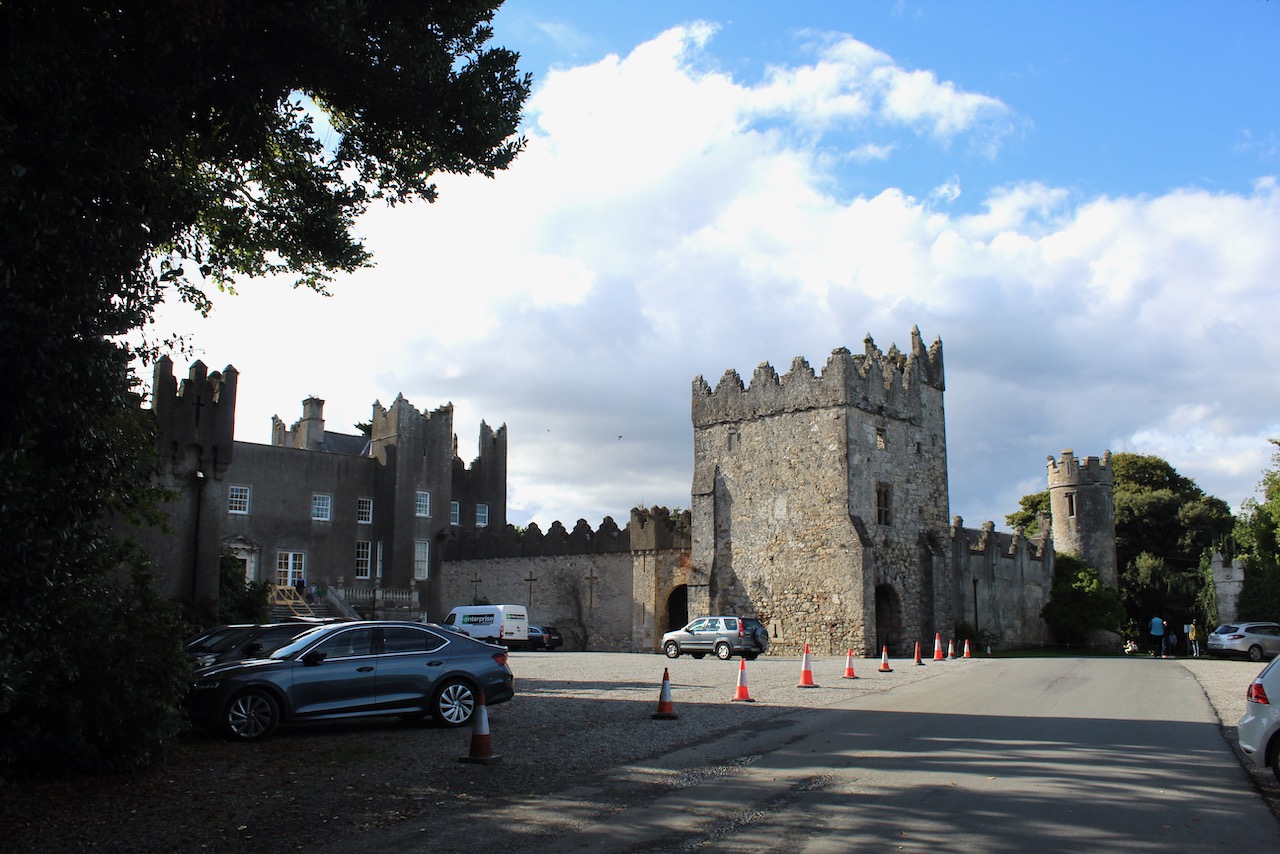
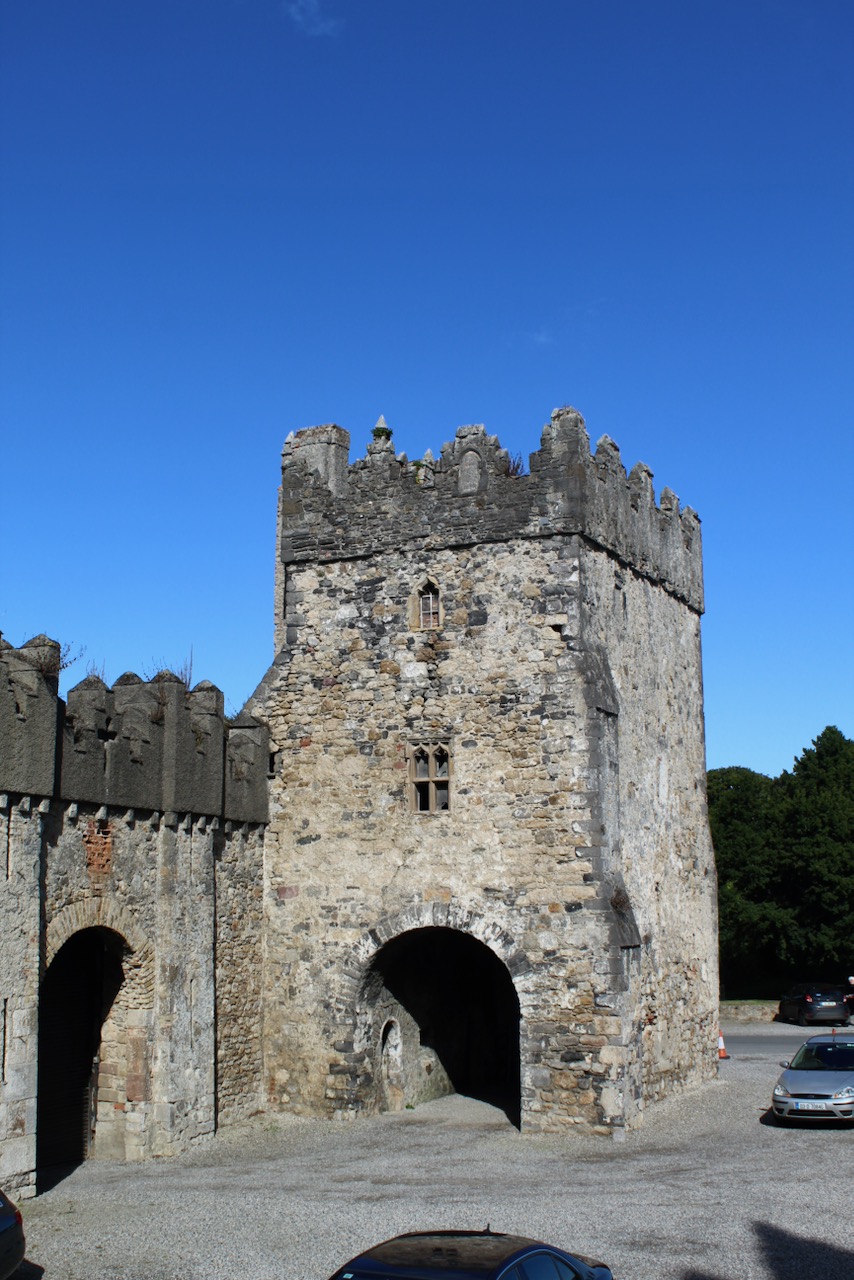
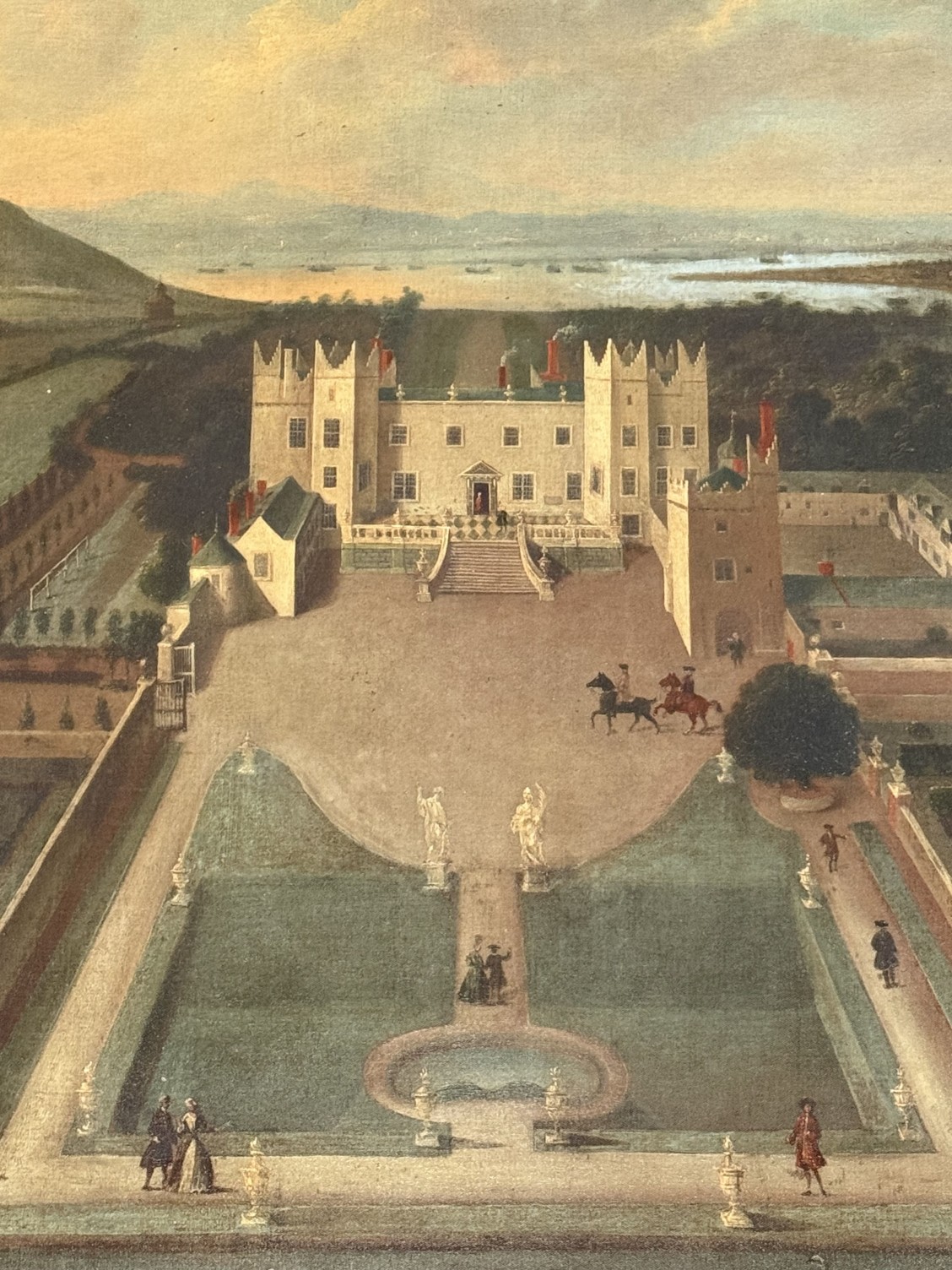
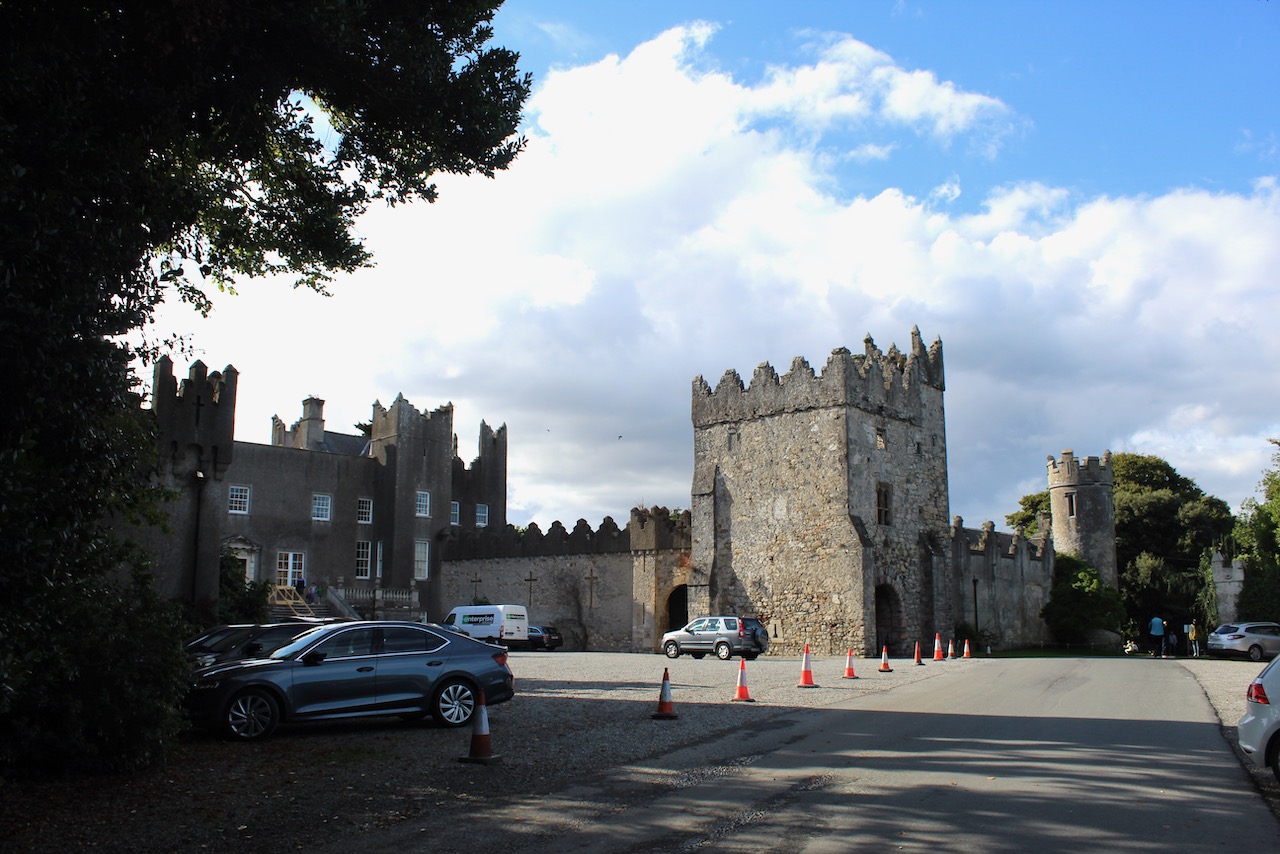
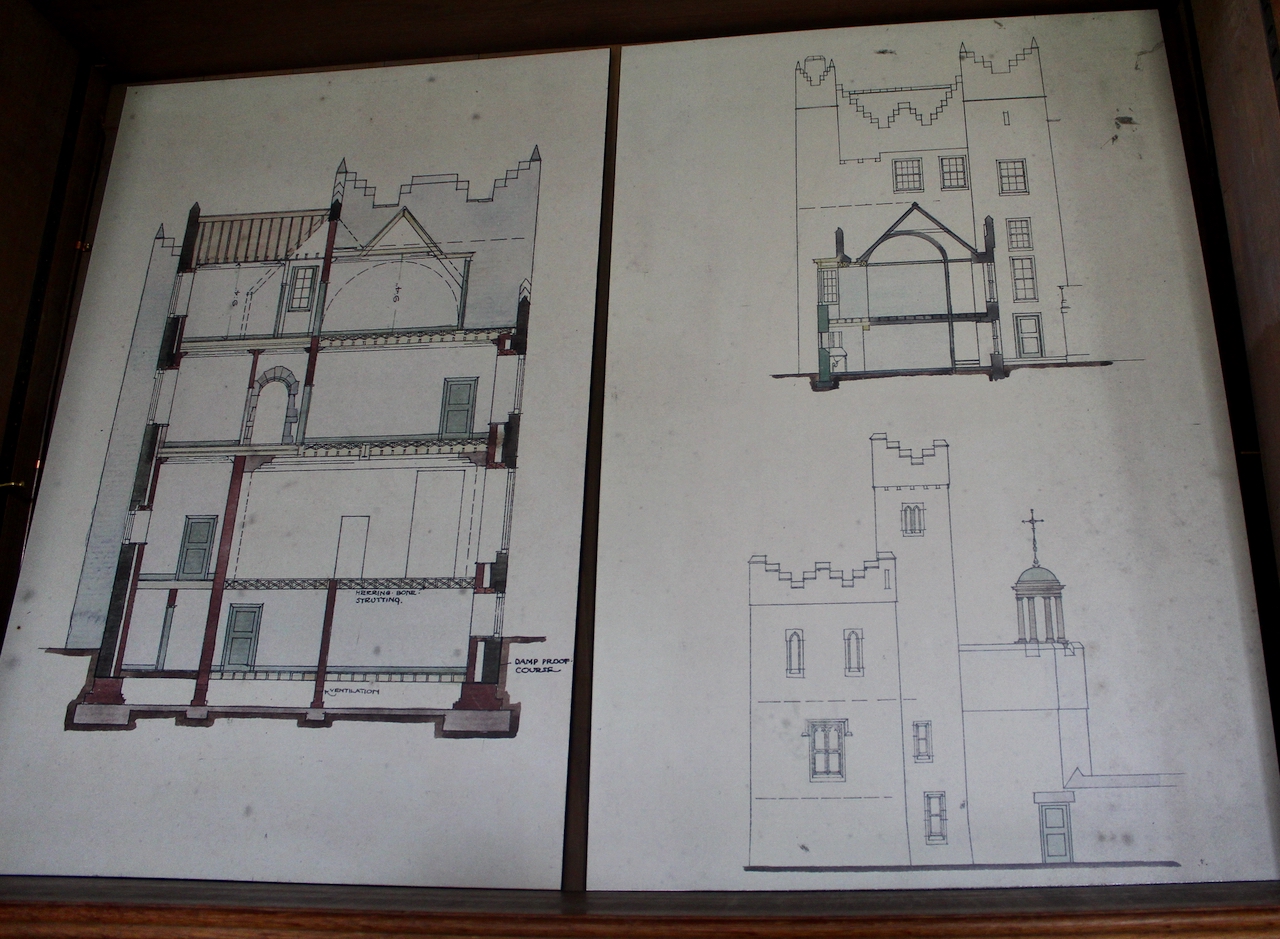
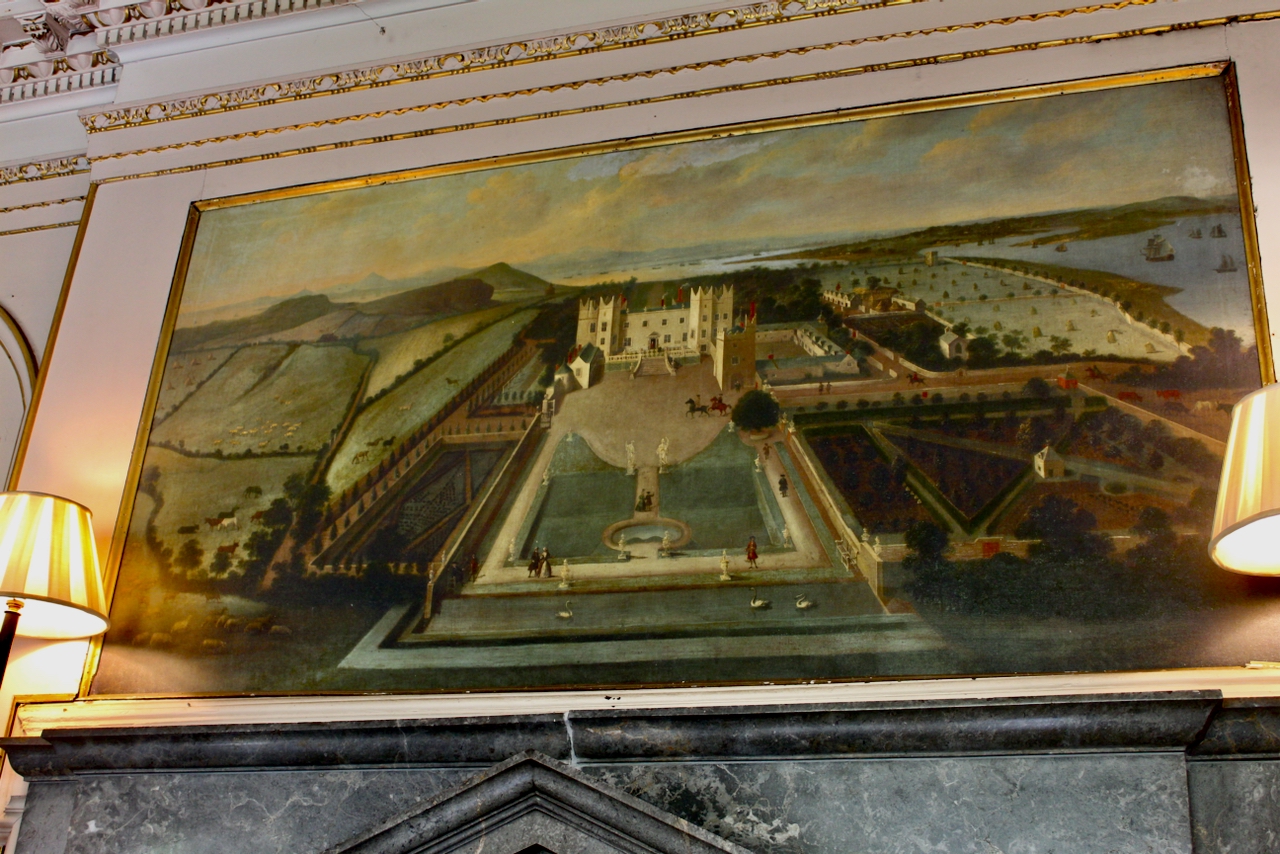
The Howth Castle website tells us that the Keep, the tower incorporated into the castle, also dates from the mid fifteenth century. Unfortunately I have misplaced the notes I took on my visit to the castle. Daniel pointed out the various parts of the castle as we stood on the balustrade looking out into the courtyard, telling us when each part was built. From the photograph of the painting above, the Keep is the large tower on the left of the front door, and the Gate House is slightly to the front of the building to the right. Traces remain in the gardens of the wall and turrets, which would have enclosed the area. You can’t fully see the keep from the front of the house.
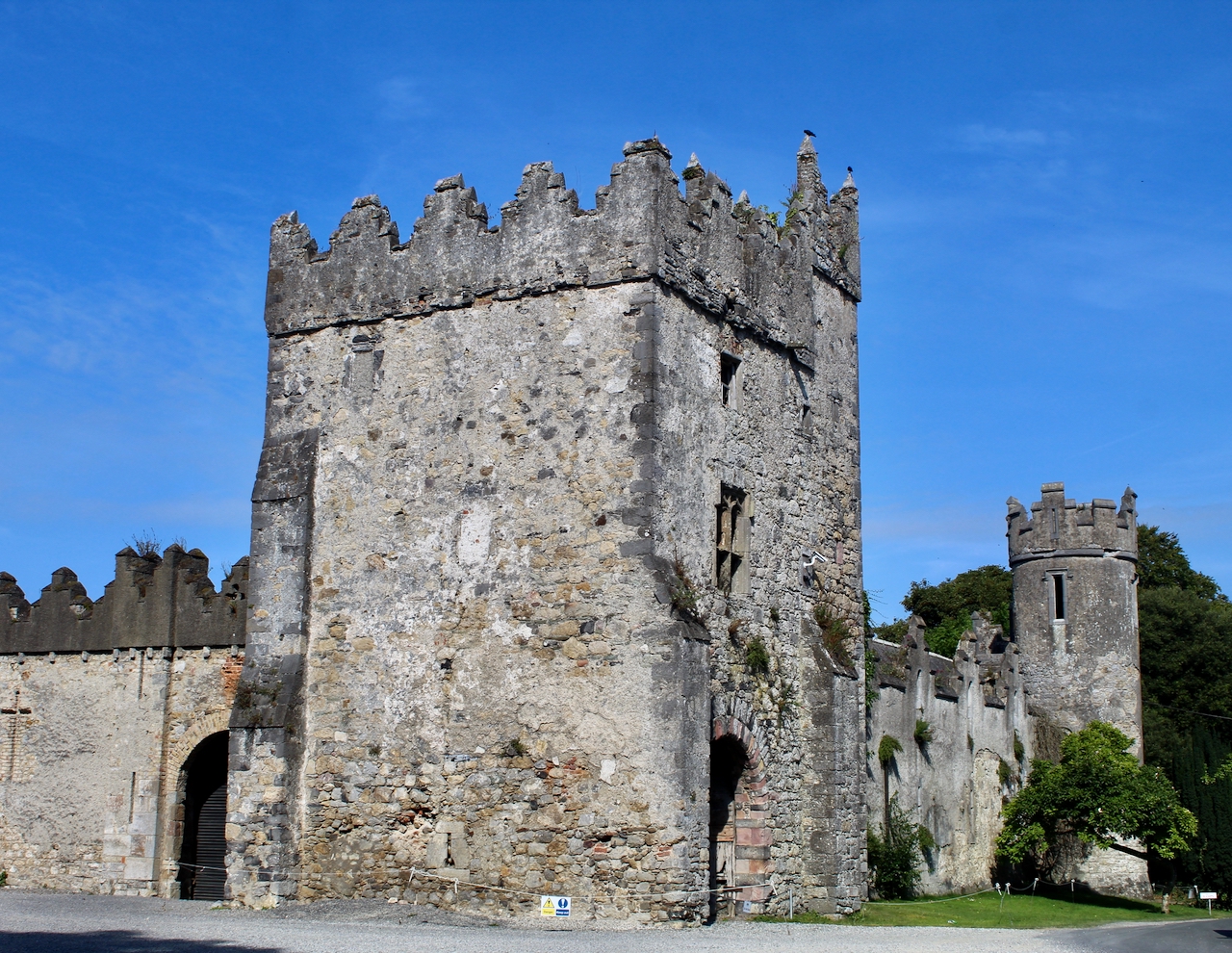
Christopher’s son Robert St. Lawrence (d. 1486) 2nd Baron Howth served as Lord Chancellor of Ireland, after first serving as “Chancellor of the Green Wax,” which was the title of the Chancellor of the Exchequer of Ireland. He married Joan, second daughter of Edmund Beaufort, 2nd Duke of Somerset, so by marriage, Timothy William Ferres tells us, Lord Howth’s descendants derived descent from King Edward III, and became inheritors of the blood royal. [see 2]
Nicholas St. Lawrence (d. 1526) was 3rd Baron Howth according to the Dictionary of Irish Biography. He also served as Lord Chancellor of Ireland. He married three times. The first bride was Janet, daughter of Christopher Plunkett 2nd Baron Killeen. We came across the Plunketts of Killeen and Dunsany when we visited Dunsany Castle in County Meath.
The Dictionary of Irish Biography tells us that when Lambert Simnel came to Ireland in 1487 and was crowned as King Edward VI in Christchurch catheral in Dublin, Nicholas the 3rd Baron remained loyal to King Henry VII. [4] In 1504, as mentioned earlier, the 3rd Baron Howth played a significant role at the battle of Knockdoe in County Galway, where the lord deputy, 8th Earl of Kildare, defeated the MacWilliam Burkes of Clanricard and the O’Briens of Thomond. [see 4]
The family were well-connected. The third baron’s daughter Elizabeth married widower Richard Nugent, 3rd Baron Delvin, whose first wife had been the daughter of Gerald Fitzgerald 8th Earl of Kildare.
The son and heir of the 3rd Baron, Christopher (d. 1542), served as Sheriff for County Dublin. Christopher the 4th Baron was father to the 5th, Edward (d. 1549), 6th (Richard, d. 1558 and married Catherine, daughter of the 9th Earl of Kildare, but they had no children) and 7th Barons of Howth.
The Hall, which is the middle of the front facade, was added to the side of the Keep in 1558 by Christopher, who is the 20th Lord of Howth according to the Howth Castle website, or the 7th Baron. He was also called “the Blind Lord,” presumably due to weak eyesight. The 1558 hall is now entered by the main door of the Castle.

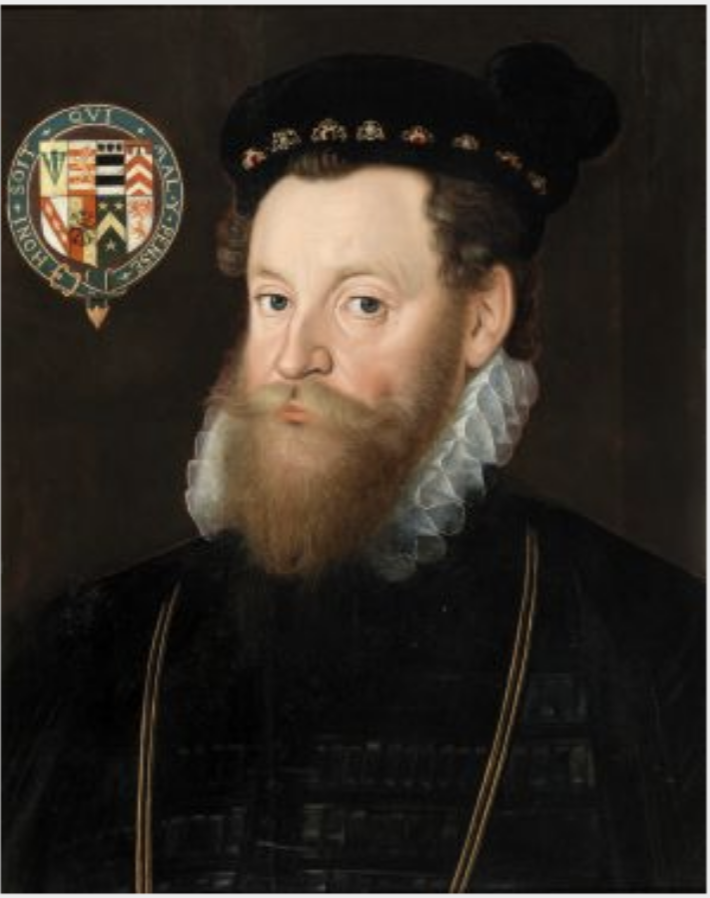
Christopher St. Lawrence (d. 1589) 7th Baron Howth was educated at Lincoln’s Inn, along with his two elder brothers, the 5th and 6th barons. Christopher entered Lincoln’s Inn in 1544 and was still resident ten years later in 1554. That year he was threatened with expulsion from Lincoln’s Inn for wearing a beard, which indicates, Terry Clavin suggests in the Dictionary of Irish Biography, a rakish side to his personality. He inherited his family estate of Howth and the title on the death of his brother Richard in autumn 1558 and was sworn a member of the Irish privy council soon afterward. [5]
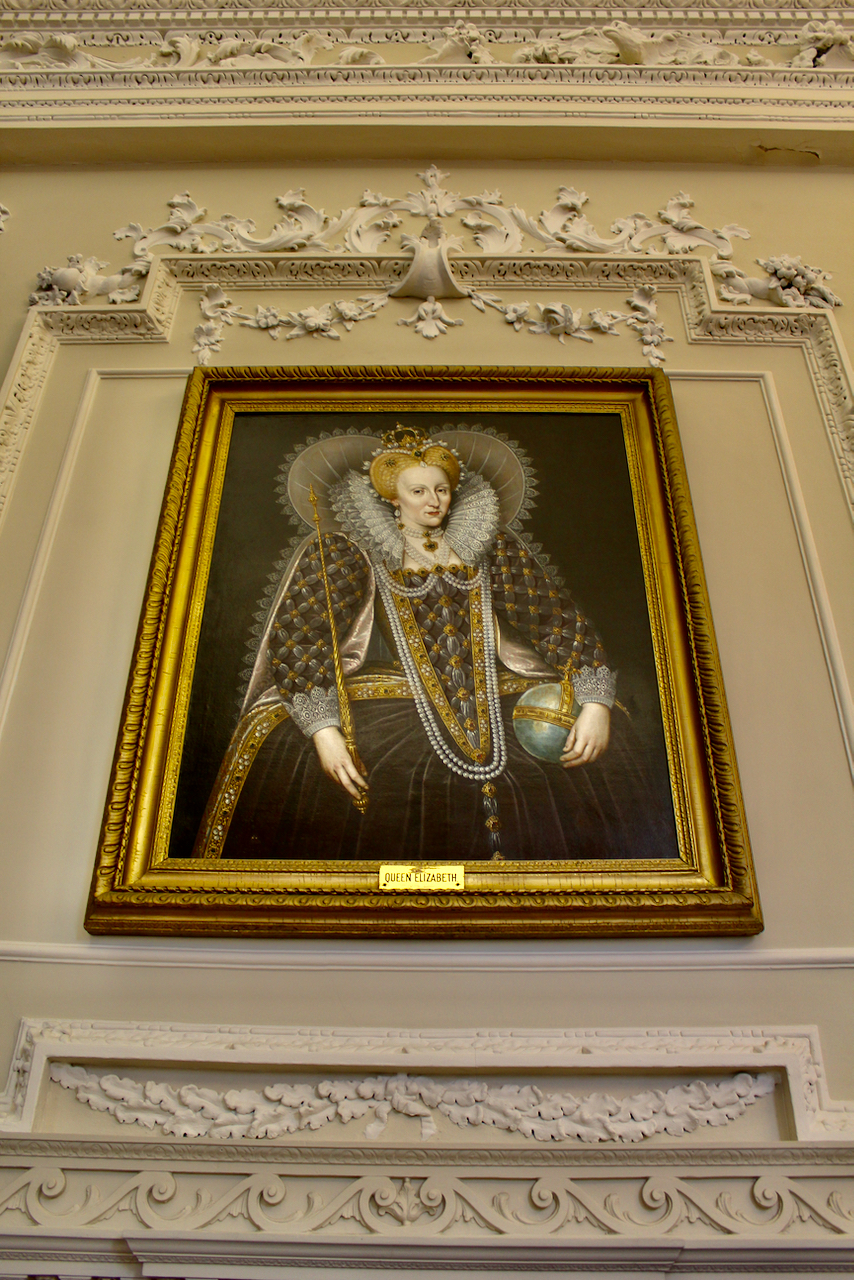
The Dictionary of Irish Biography tells us that between December 1562 and February 1563 the 7th Baron represented Thomas Radcliffe 3rd Earl of Sussex’s views on the government of Ireland to Queen Elizabeth. [5]
The Dictionary tells us that from 1570 onward the 7th Baron Howth ceased to play an active role in the privy council and became increasingly estranged from the government. By 1575, concerned about his loyalty, the government briefly imprisoned him, following the arrest of his close associate Gerald Fitzgerald, 11th Earl of Kildare, upon charges of treason.
Christopher St. Lawrence (d. 1589) 7th Baron Howth compiled a book, The Book of Howth, in which he rebutted Henry Sidney’s views of Ireland.
Sidney believed that the medieval conquest of Ireland failed due to the manner in which the descendants of the Norman colonists, the so-called ‘Old English,’ embraced Gaelic customs. He regarded as especially pernicious the system of ‘coign and livery.’ Under ‘coign and livery,’ landowners maintained private armies. Sidney believed this impoverished the country and institutionalised violence. Clavin writes that Lord Howth produced the ‘Book of Howth’ to rebut this interpretation of Irish history and to provide a thinly-veiled critique of Sidney’s reliance on and promotion of English-born officials and military adventurers at the expense of the Old English community. Howth held that the abolition of ‘coign and livery’ would leave the Old English exposed to the depredations of the Gaelic Irish. [5]
Instead of “coign and livery,” the English maintained a royal army, with landowners providing for the soldiers with the “cess.” Christopher St. Lawrence 7th Baron opposed the “cess.” Sidney suggested that a tax be imposed instead of the cess. Lord Howth objected and was imprisoned for six months. He and others similarly imprisoned were released when they acknowledged that the queen was entitled to tax her subjects during times of necessity. [5]
In 1579, Christopher was convicted cruelty towards his wife and children. His wife Elizabeth Plunket was from Beaulieu in County Louth (see my entry https://irishhistorichouses.com/2021/03/17/beaulieu-county-louth/). After he whipped his thirteen year old daughter Jane to punish her, she died. He beat his wife so badly that she had to remain in bed for two weeks, and then fled to her brother. Howth was tried before the court of castle chamber on charges of manslaughter and domestic abuse. Clavin writes that: “In an unprecedented step, given Howth’s social status, the court accepted testimony providing lurid details of his dissolute private life. This may reflect either the crown’s desire to discredit a prominent opposition figure or simply the savagery of his crimes.” [5] He was imprisoned and fined, and made to pay support for his wife and children, from whom he separated, and he fell out of public life.
Amazingly, he later married for a second time, this time to Cecilia Cusack (d. 1638), daughter of an Alderman of Dublin, Henry Cusack. After Christopher died in 1589, she married John Barnewall of Monktown, Co. Meath, and after his death, John Finglas, of Westpalstown, Co. Dublin.
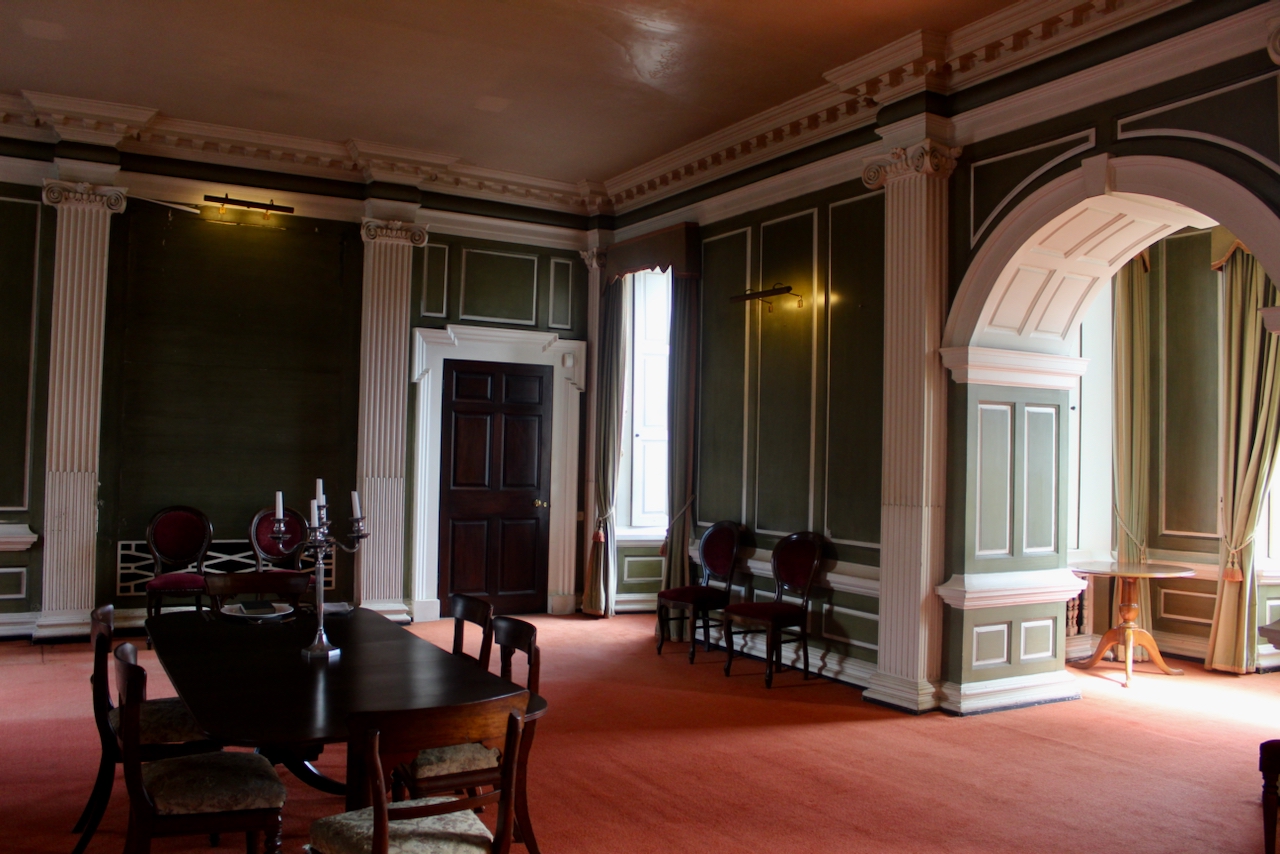
Another legend of the castle stems from around the time of Christopher 7th Baron. When we visited the castle, the dining room was set with a place for a guest. The tradition is to keep a place for any passing guest. This stems from a legend about Grace O’Malley (c.1530-1603), “the pirate queen.”
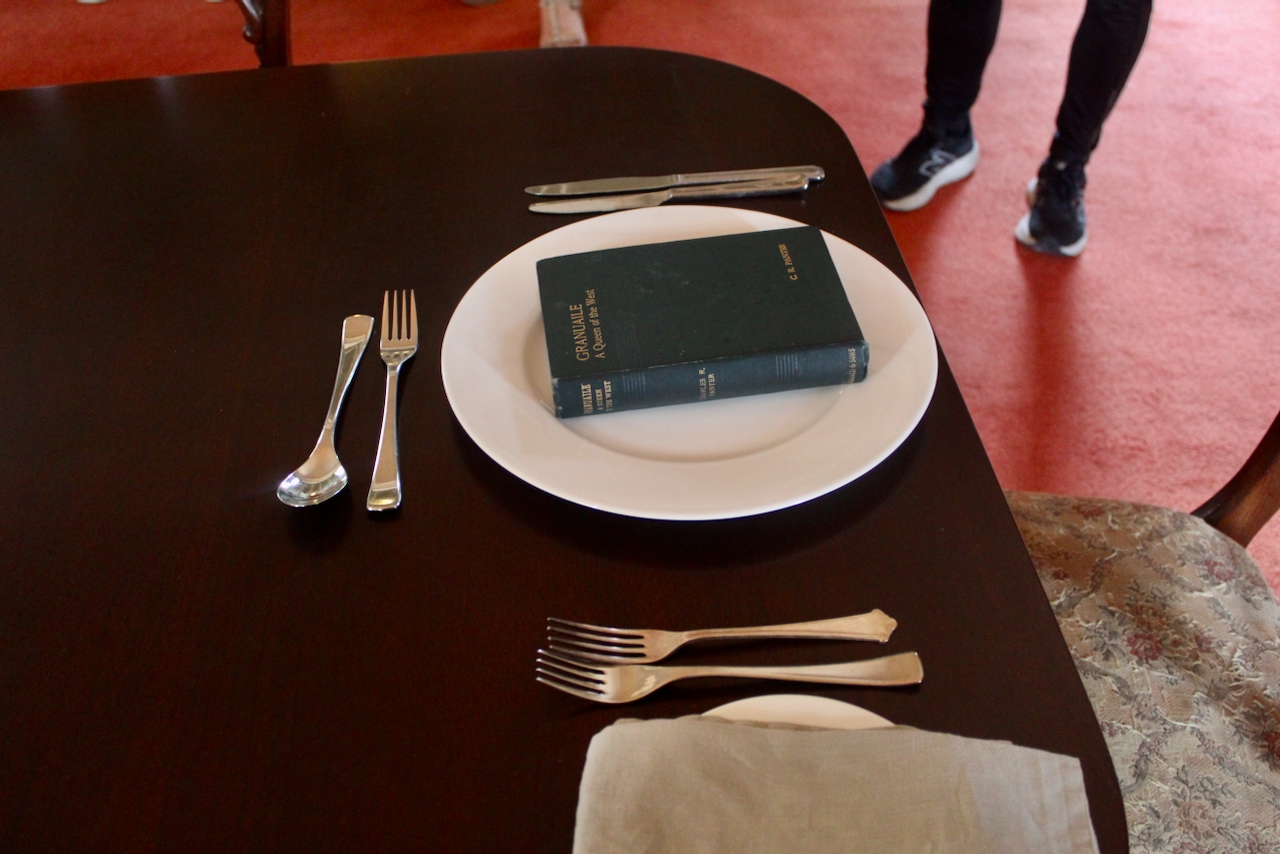
Grace O’Malley was nicknamed ‘Grainne Mhaol’ (Grace the Bald) because when she was a child she cut her hair when her father Eoghan refused to take her on a voyage to Spain because he believed that a ship was no place for a girl. She cropped her hair to look like a boy. [6]

The story is told that in around 1575, Grace O’Malley landed in Howth on her return from a visit to Queen Elizabeth. However, the Howth website tells us that Grace O’Malley did not visit Queen Elizabeth until 1593. She was in Dublin, however, in 1576, visiting the Lord Deputy. The story tells us that Grace O’Malley proceeded to Howth Castle, expecting to be invited for dinner, and to obtain supplies for her voyage home to Mayo. However, the gates were closed against her. This breached ancient Irish hospitality.
Later, when Lord Howth’s heir was taken to see her ship, she abducted him and brought him back to Mayo. She returned him after extracting a promise from Lord Howth that his gates would never be closed at the dinner hour, and that a place would always be laid for an unexpected guest.
Nicholas the 8th Baron fought with the British against the rebels in the Nine Years War (1594–1603). He fought alongside Henry Bagenal (d. 1598) against Hugh O’Neill (c.1540–1616) 2nd Earl of Tyrone, and accompanied Lord Deputy William Russell, later 1st Baron Russell of Thornhaugh, on his campaign against the O’Byrnes in County Wicklow. In 1601 he went to London to discuss Irish affairs, and the Queen formed a high opinion of him. She was also impressed by Howth’s eldest son Christopher, later 9th Baron Howth. [7]
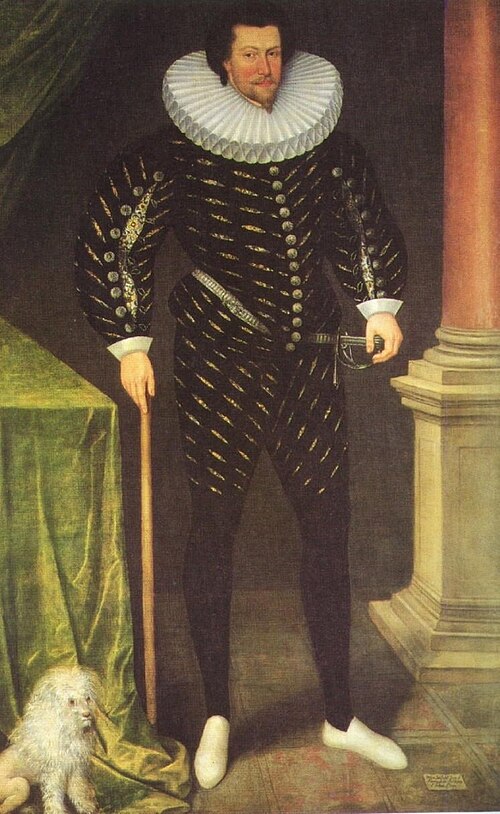
Nicholas married Margaret, daughter of Christopher Barnewall of Turvey in Dublin. She gave birth to the heir, and her daughter Margaret married Jenico Preston, 5th Viscount Gormanston. When widowed, daughter Margaret married Luke Plunkett, 1st Earl of Fingall.
After his wife Margaret née Barnewall’s death, Nicholas married secondly Mary, daughter of Sir Nicholas White of Leixlip, Master of the Rolls in Ireland, who lived in Leixlip Castle. See my entry https://irishhistorichouses.com/2020/09/04/leixlip-castle-county-kildare-desmond-guinnesss-jewelbox-of-treasures/.
Nicholas and Margaret’s son Christopher (d. 1619) succeeded as 9th Baron Howth. Christopher 9th Baron also fought against the rebels in the Nine Years War. At some point Christopher converted to Protestantism. He conducted a successful siege at Cahir Castle in County Tipperary against Catholic Butlers. See my entry https://irishhistorichouses.com/2024/03/29/cahir-castle-county-tipperary-an-office-of-public-works-property/
In 1599, Christopher St. Lawrence 9th Baron was one of six who accompanied Robert Devereux 2nd Earl of Essex on his unauthorised return to England, riding with the earl to the royal palace at Nonesuch, where Essex burst in to Queen Elizabeth’s bedchamber.
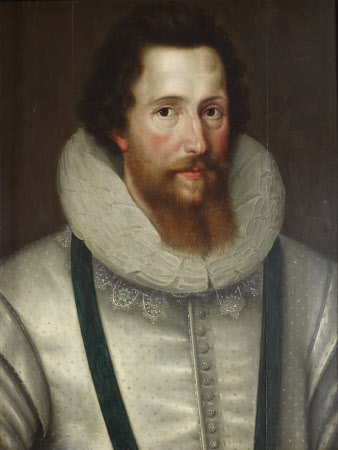
Rumour circulated that Christopher St. Lawrence pledged to kill Essex’s arch-rival Sir Robert Cecil. The Dictionary of Irish Biography tells us:
“In late October he was summoned before the English privy council, where he denied having threatened Cecil’s life. One of the counsellors then referred to his Irishness, the clear implication being that as such he could not be trusted, at which he declared: ‘I am sorry that when I am in England, I should be esteemed an Irish Man, and in Ireland, an English Man; I have spent my blood, engaged and endangered my Liffe, often to doe Her Majestie Service, and doe beseech to have yt soe regarded’ (Collins, Letters and memorials of state, i, 138). His dignified and uncharacteristically tactful response eloquently summed up the quandary of the partially gaelicised descendants of the medieval invaders of Ireland (the Old English), who were regarded with suspicion by the Gaelic Irish and English alike. It also mollified his accusers, who, in any case, recognised that his martial prowess was urgently required in Ireland. Prior to his return to Dublin on 19 January, the queen reversed an earlier decision to cut off his salary, and commended him to the authorities in Dublin.” [8]
Christopher married Elizabeth Wentworth, daughter of Sir John Wentworth of Little Horkesley and Gosfield Hall, Essex, but by 1605 they separated, and the Privy Council ruled that he must pay for her maintenance. The St. Lawrence family inherited estates near Colchester from her family.
By 1601, while fighting in Ulster alongside the Lord Deputy Charles Blount, 8th Baron Mountjoy, many of the men Christopher commanded were Gaelic Irish. Increasingly dissatisfied, Christopher St. Lawrence began to alienate leading members of the political establishment.
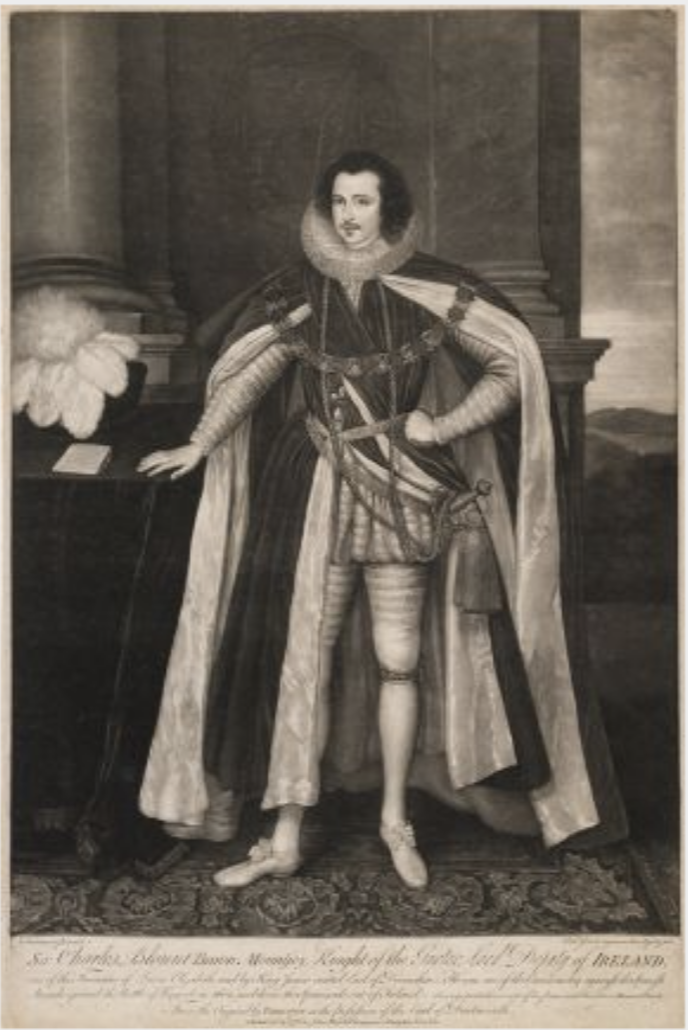
In 1605 the government began prosecuting prominent Catholics for failing to attend Church of Ireland services. Although Protestant, St. Lawrence’s family connections led him to identify with the Catholic opposition. The Dictionary of Irish Biography tells us that he became involved in the planning of an uprising in late 1605, along with Hugh O’Neill, despite his father having previously battled against O’Neill. [8]
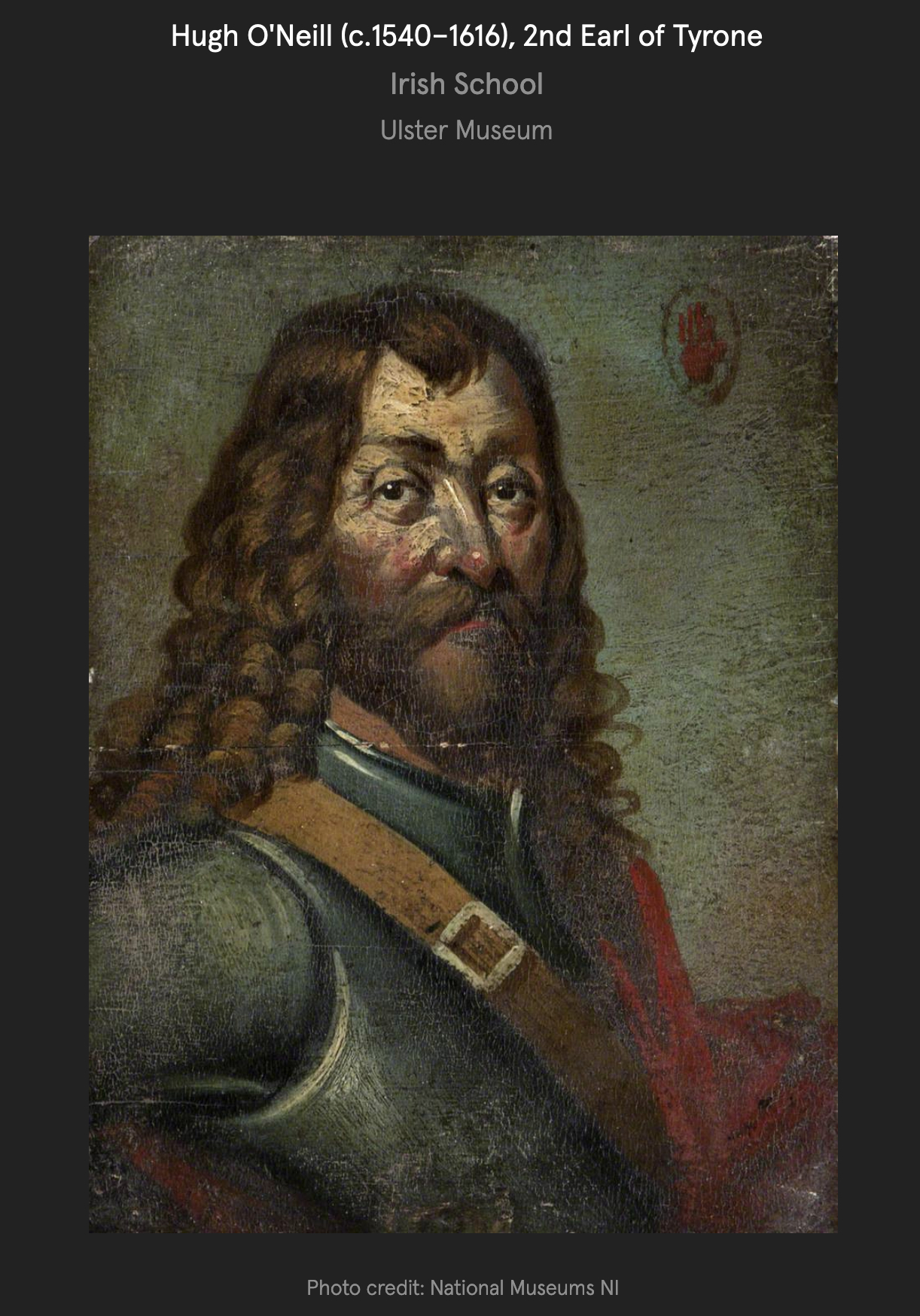
Low on funds, and not having yet inherited Howth, he sought to join the Spanish army in Flanders, where an Irish regiment had been established in 1605. He wanted support for a rebellion against the British crown. However, perhaps realising that an uprising would fail, he turned into an informant for the government. The Dictionary of Irish Biography tells us that he sought to consolidate ties to the establishment by arranging the marriage of his son and heir Nicholas to a daughter of the Church of Ireland bishop of Meath, George Montgomery, in 1615.
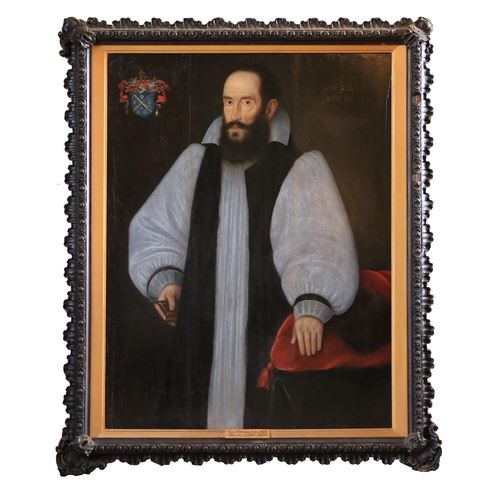
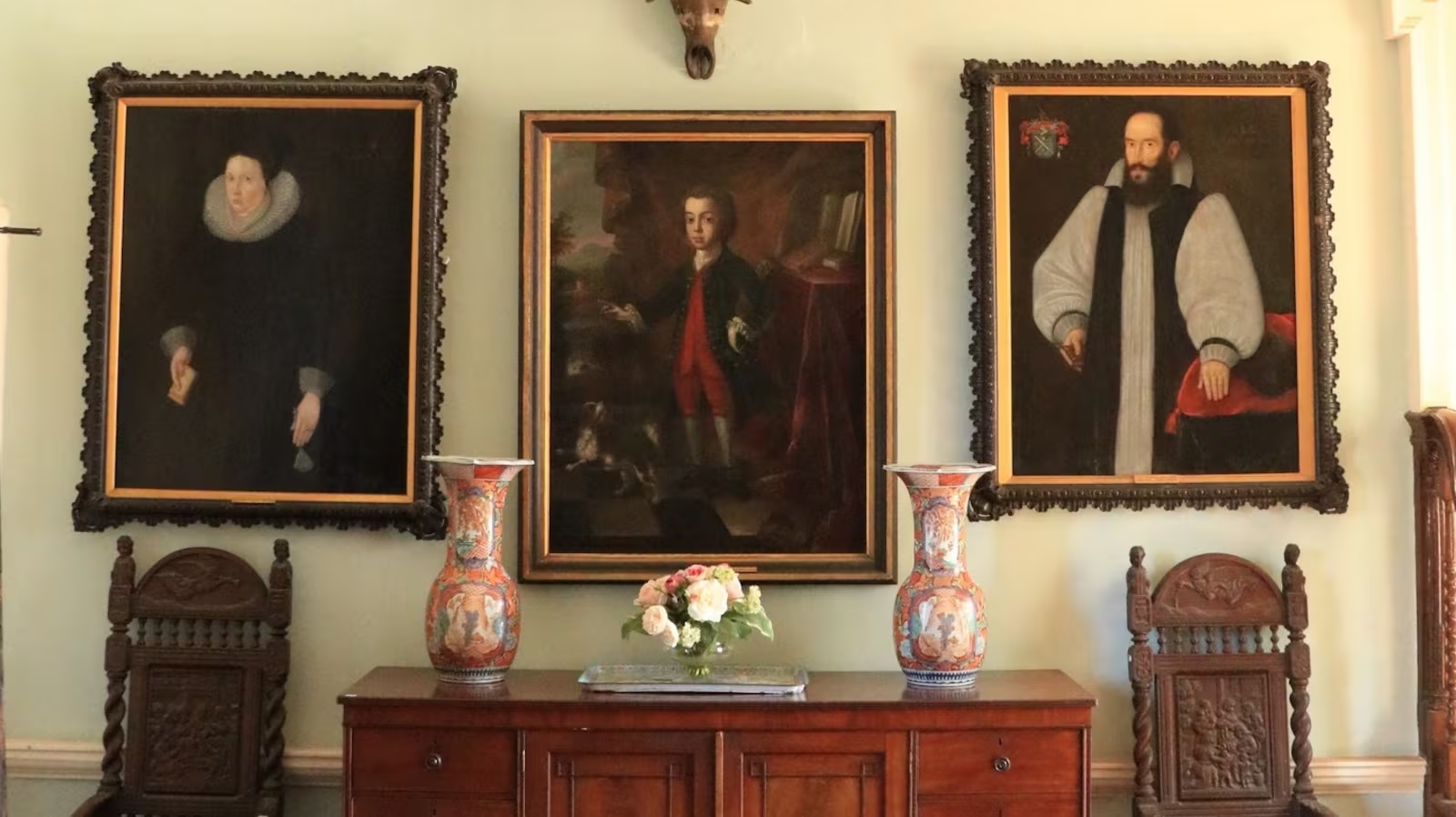
Christopher acted as a secret agent for the Crown, while pretending to be part of the rebellion against the Crown. He was afraid of being discovered as a traitor. The Dictionary of Biography has a long entry about his and his double dealings. He died in 1619 at Howth and was buried at Howth abbey on 30 January 1620. He and his wife had two sons and a daughter; he was succeeded by his eldest son, Nicholas. [8]
Nicholas St. Lawrence (d. 1643/44) 10th Baron Howth added the top floor above the hall of Howth Castle sometime prior to 1641. He and his wife Jane née Montgomery had two daughters: Alison, who married Thomas Luttrell of Luttrellstown Castle (now a wedding venue), and Elizabeth.

Nicholas’s brother Thomas (d. 1649) succeeded as 11th Baron. Thomas’s son, William St. Lawrence (1628-1671), succeeded as 12th Baron Howth. The 12th Baron was appointed Custos Rotulorum for Dublin in 1661, and sat in the Irish House of Lords.
Nicholas the 10th Baron’s daughter Elizabeth married, as her second husband, her cousin William St. Lawrence 12th Baron Howth. She gave birth to the 13th Baron Howth.
Thomas St. Lawrence (1659-1727) 13th Baron Howth inherited the title when he was only twelve years old. Thomas Butler, 6th Earl of Ossory was appointed by his father as his legal guardian.
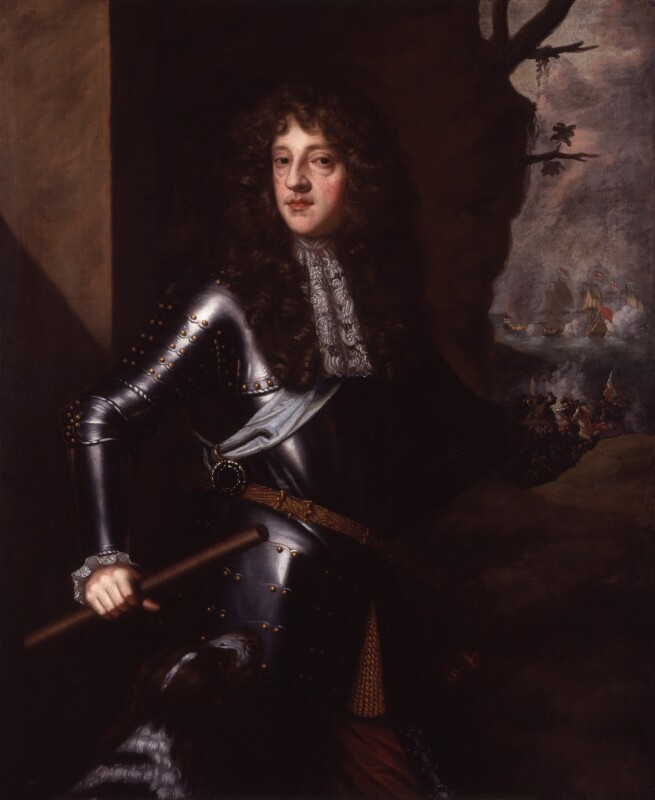
Thomas St. Lawrence married Mary, daughter of Henry Barnewall, 2nd Viscount Barnewall of Kingsland, County Dublin. After first backing King James II, in 1697 he signed the declaration in favour of King William III.
His son William (1688-1748) succeeded as 14th Baron, and carried out extensive work on Howth Castle, completing the project in 1738. A painting dating from this period commemorates the work.
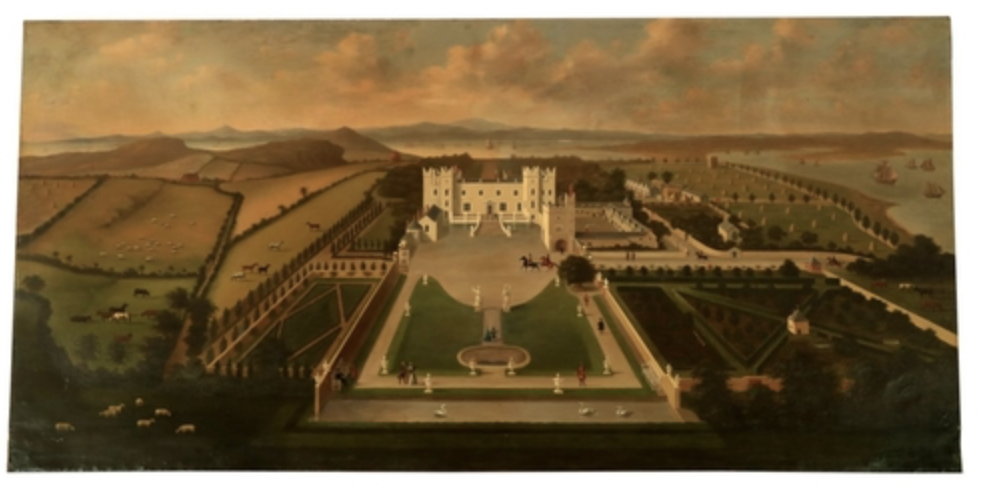
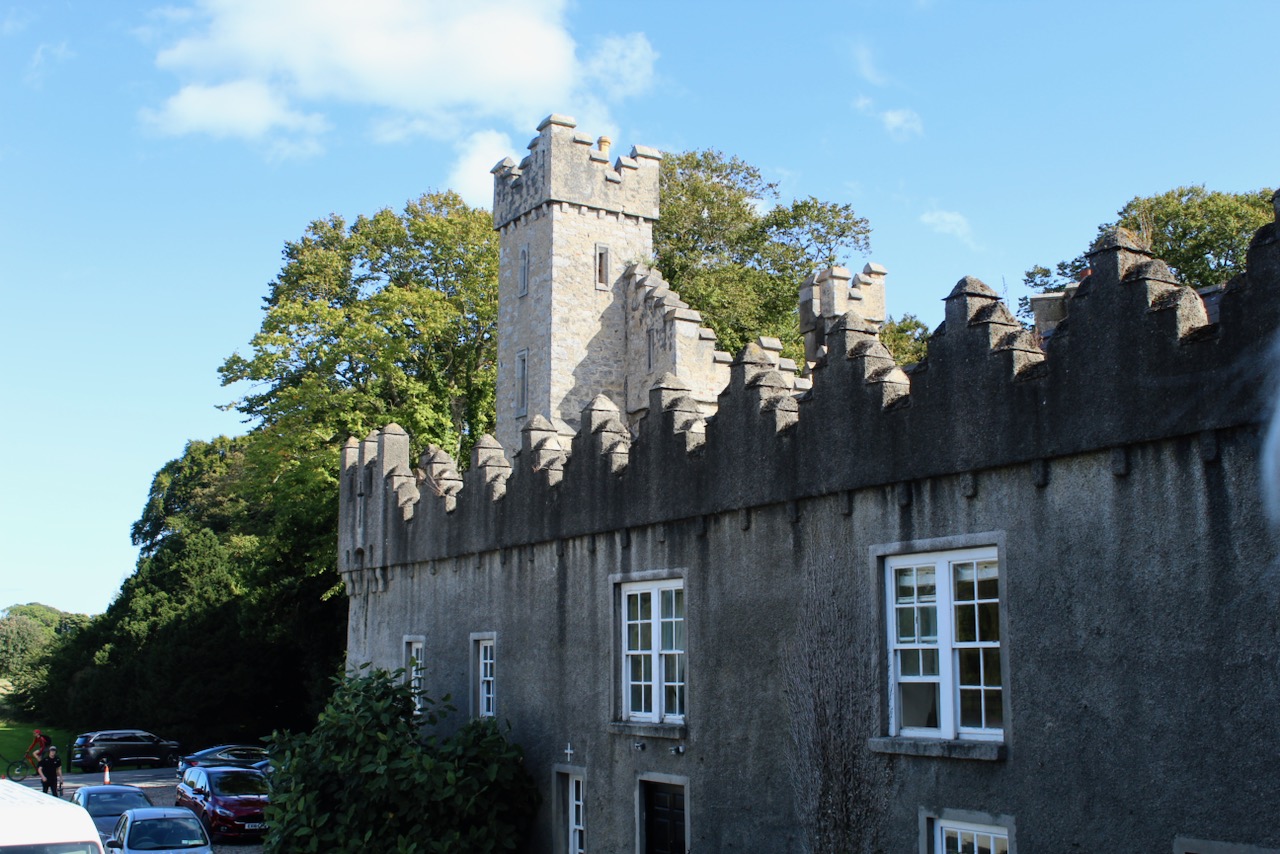
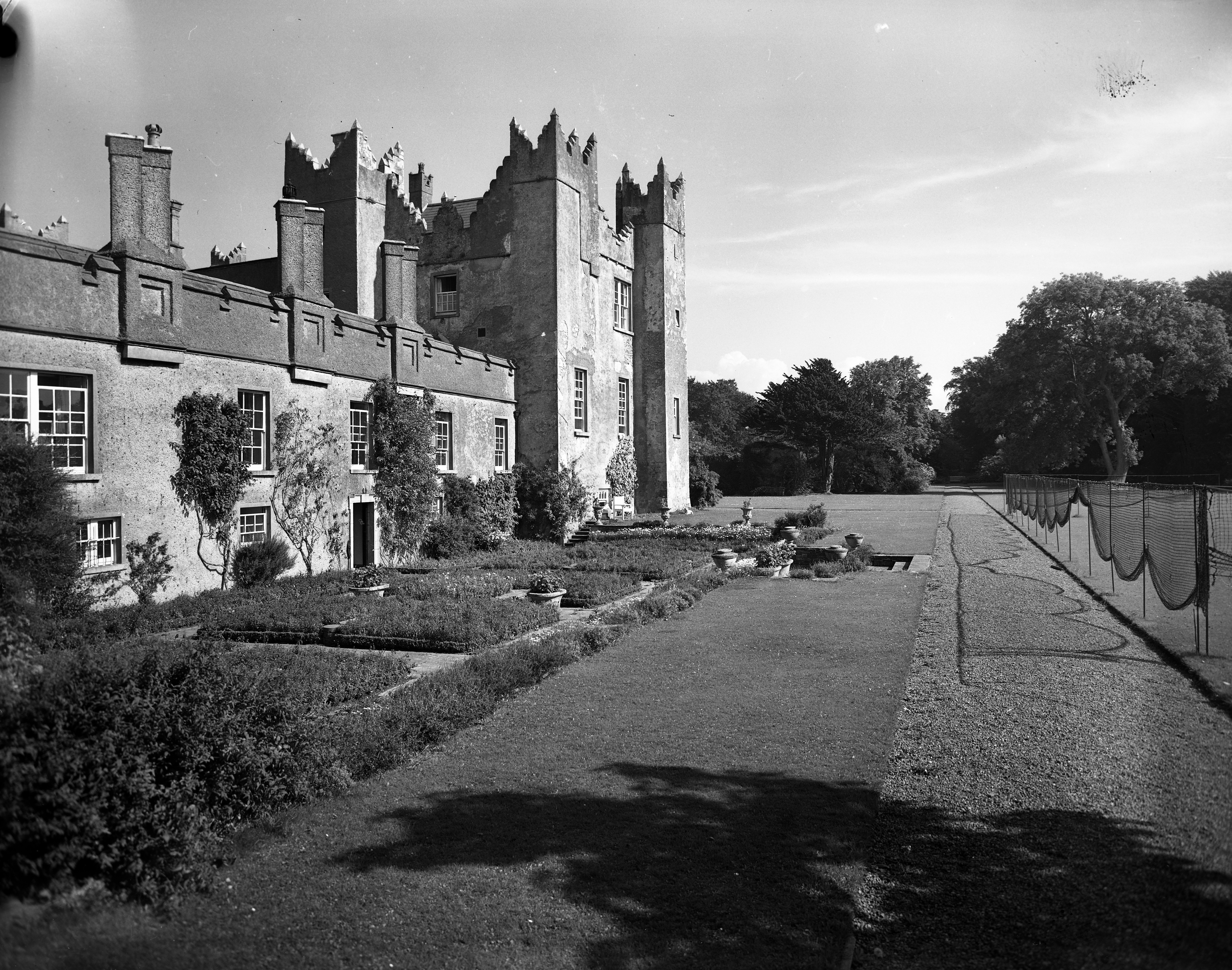
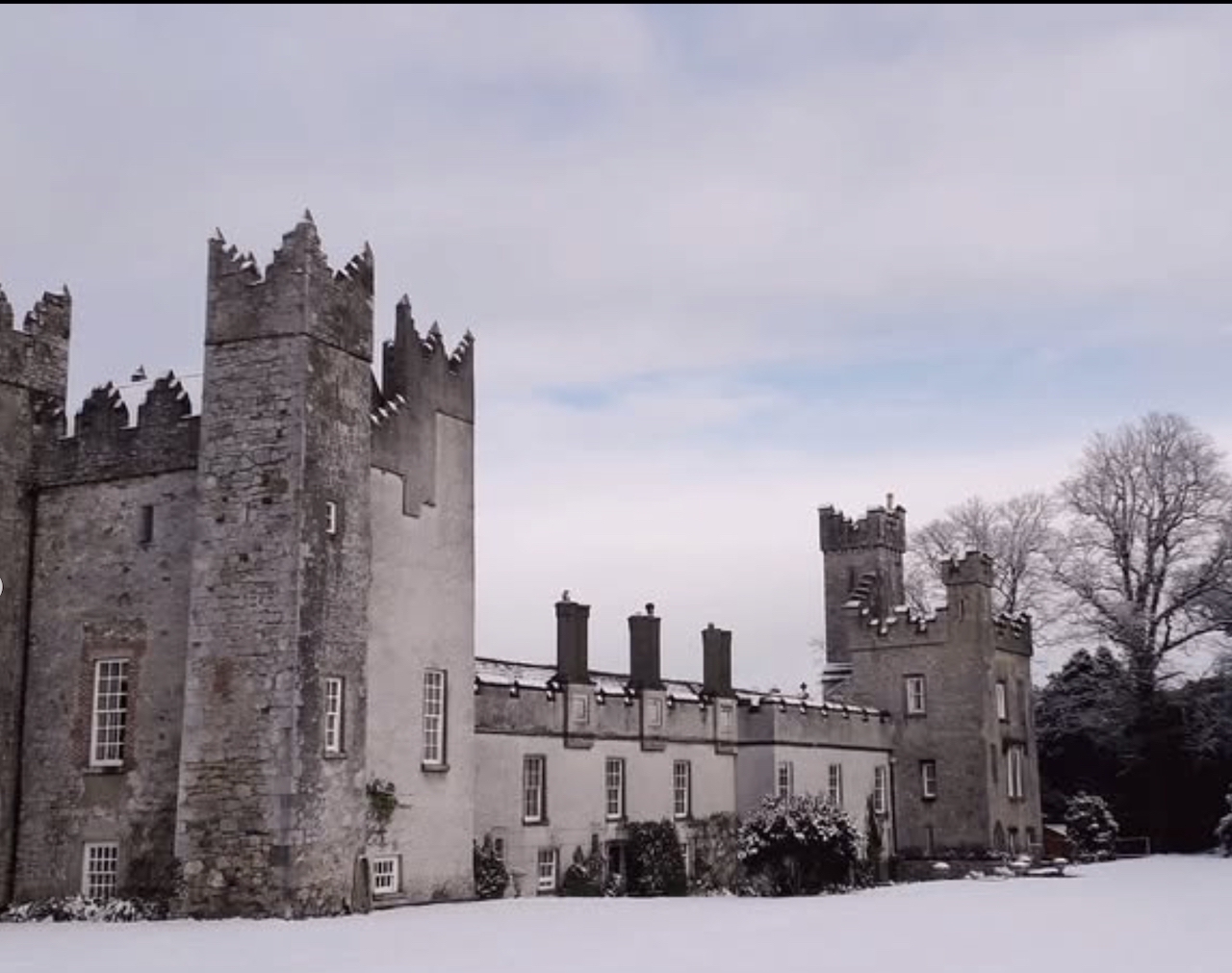
Mark Bence-Jones writes that the castle is “Basically a massive medieval keep, with corner towers crenellated in the Irish crow-step fashion, to which additions have been made through the centuries. The keep is joined by a hall range to a tower with similar turrets which probably dates from early C16; in front of this tower stands a C15 gatehouse tower, joined to it by a battlemented wall which forms one side of the entrance court.” [see 1]
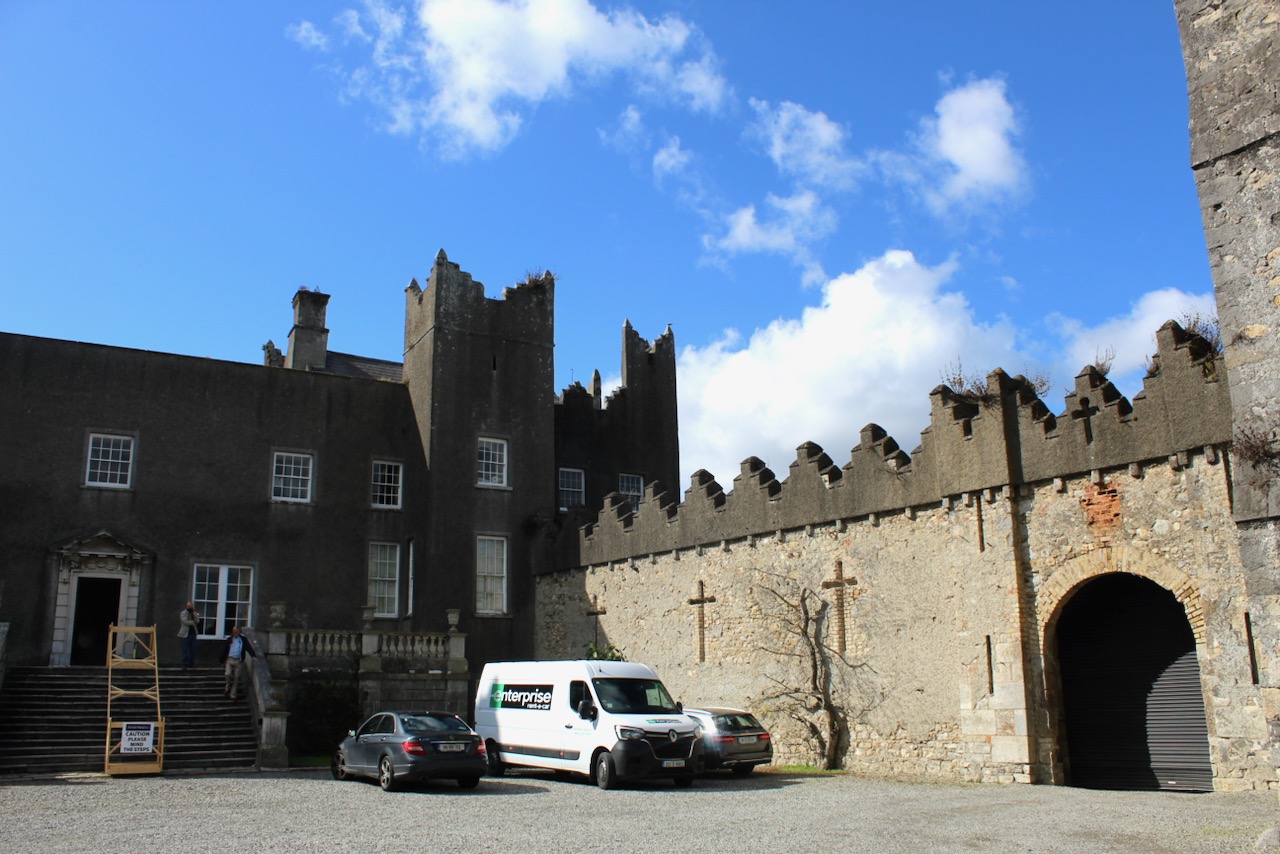
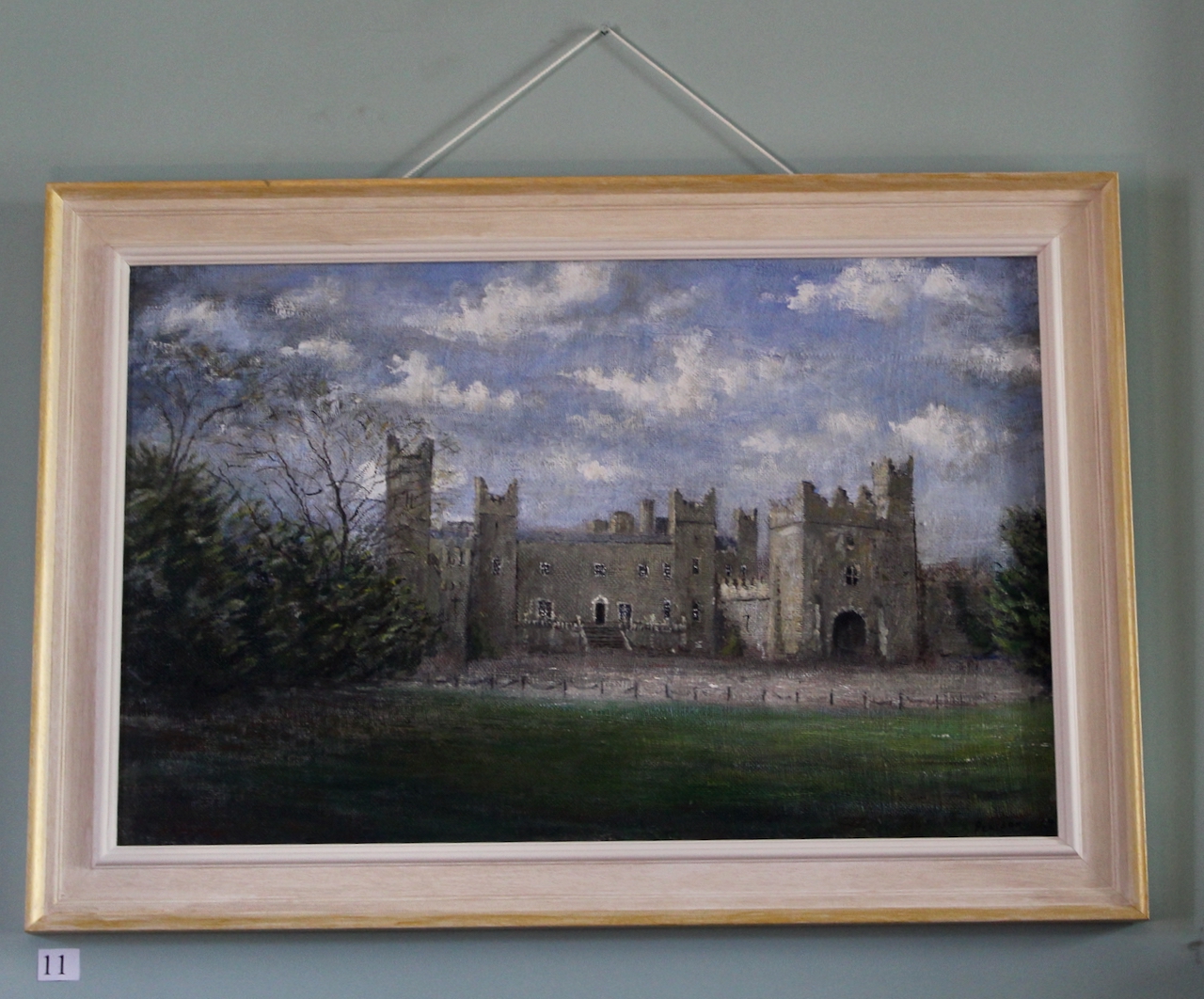
Mark Bence-Jones describes the central part of the front of the house:
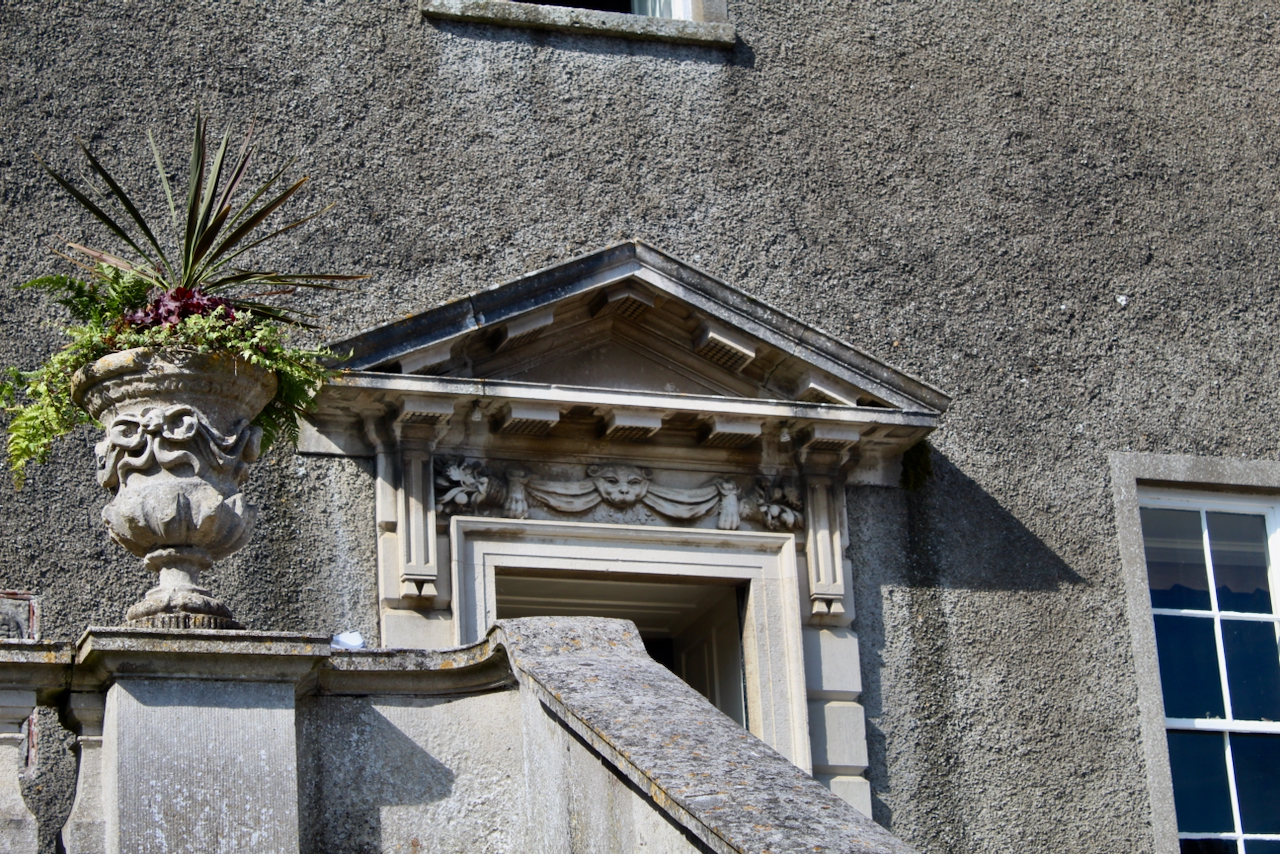
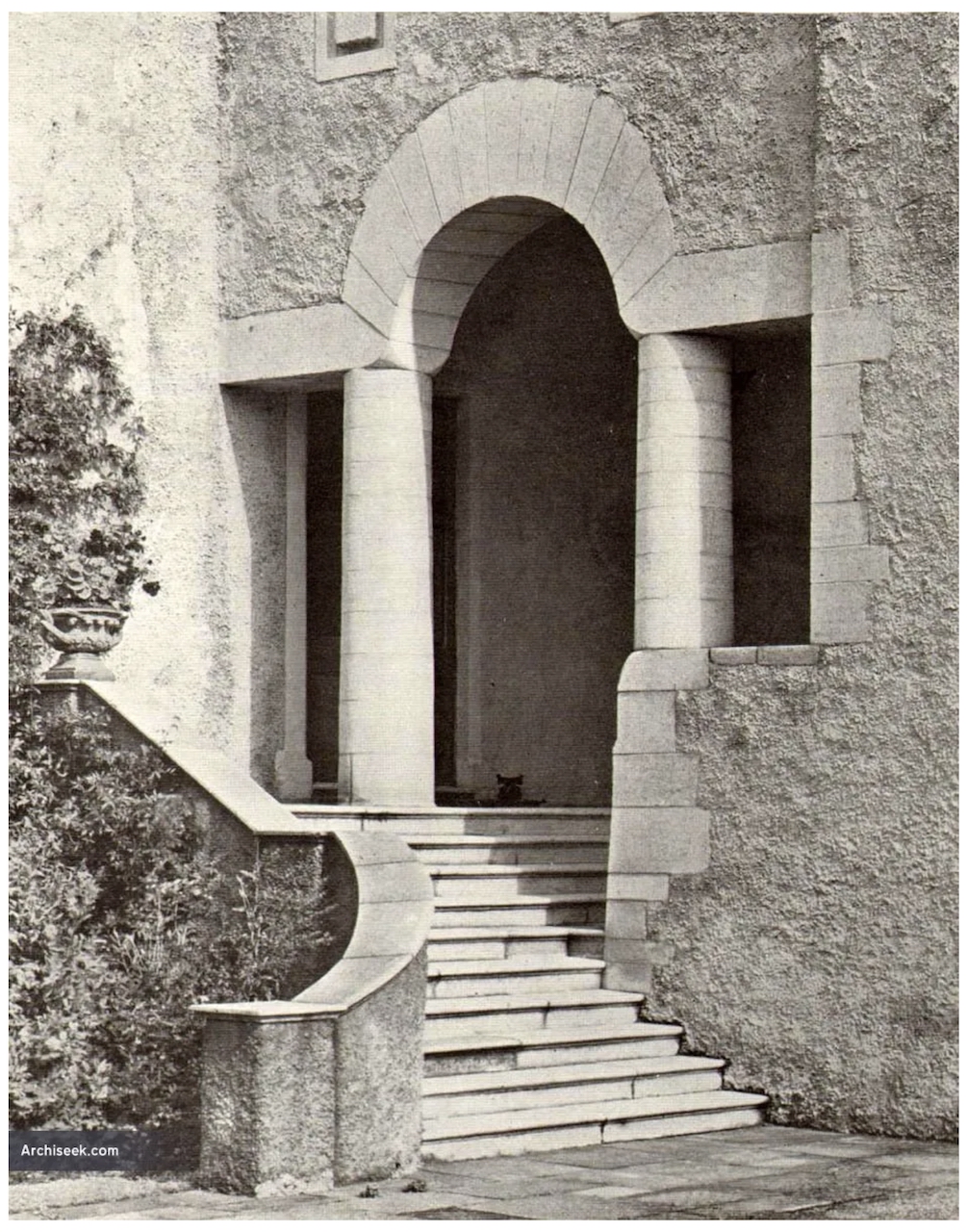
“The hall range, in the centre, now has Georgian sash windows and in front of it runs a handsome balustraded terrace with a broad flight of steps leading up to the entrance door, which has a pedimented and rusticated Doric doorcase. These Classical features date from 1738, when the castle was enlarged and modernized by William St. Lawrence, 14th Lord Howth, who frequently entertained his friend Dean Swift here.” [see 1]
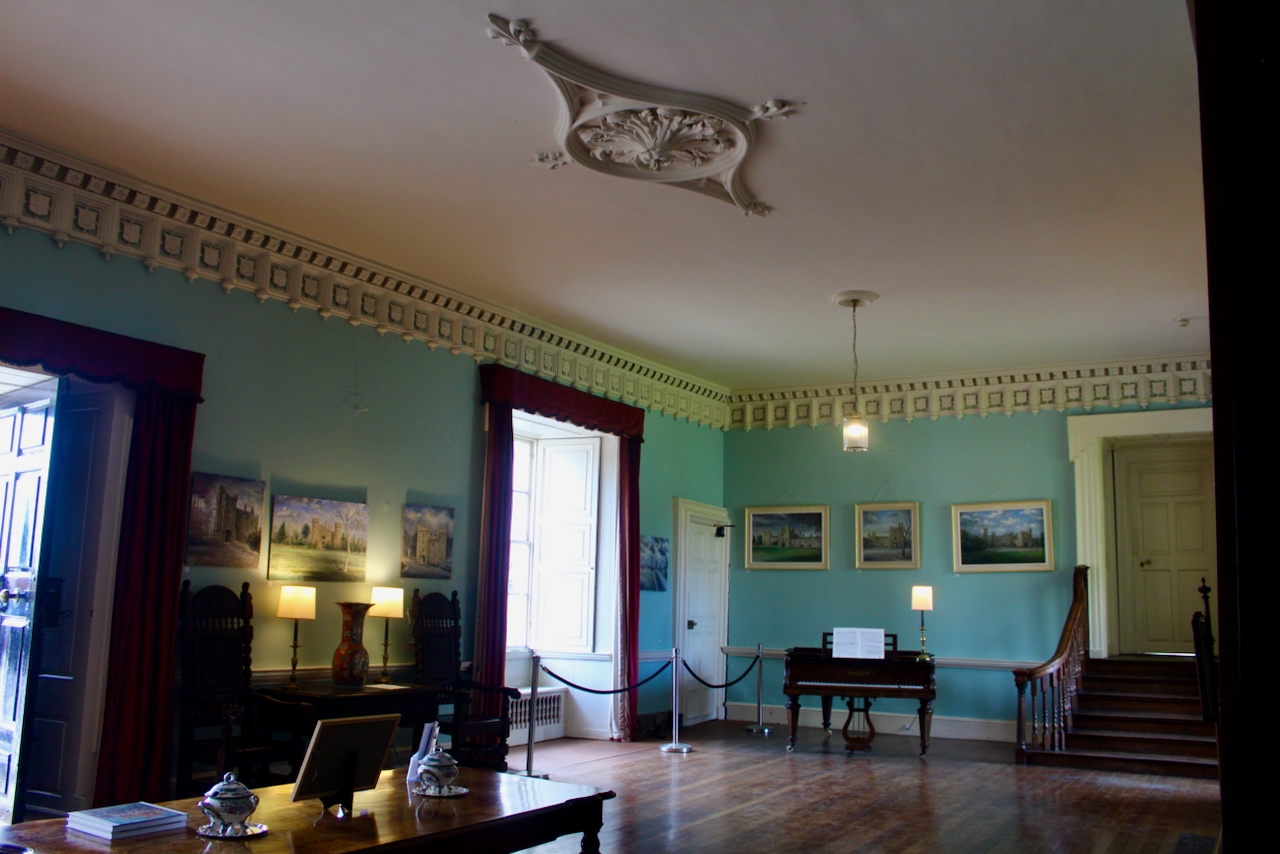
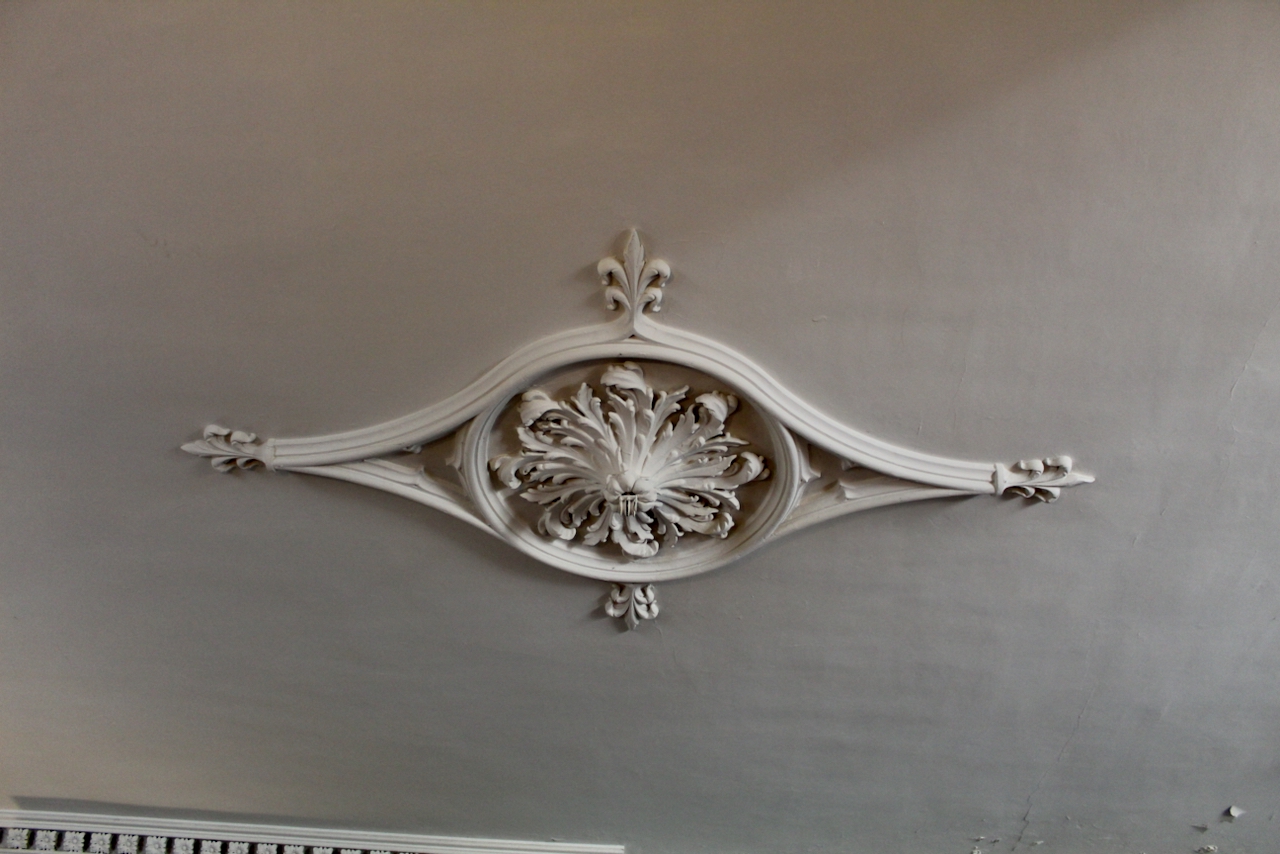
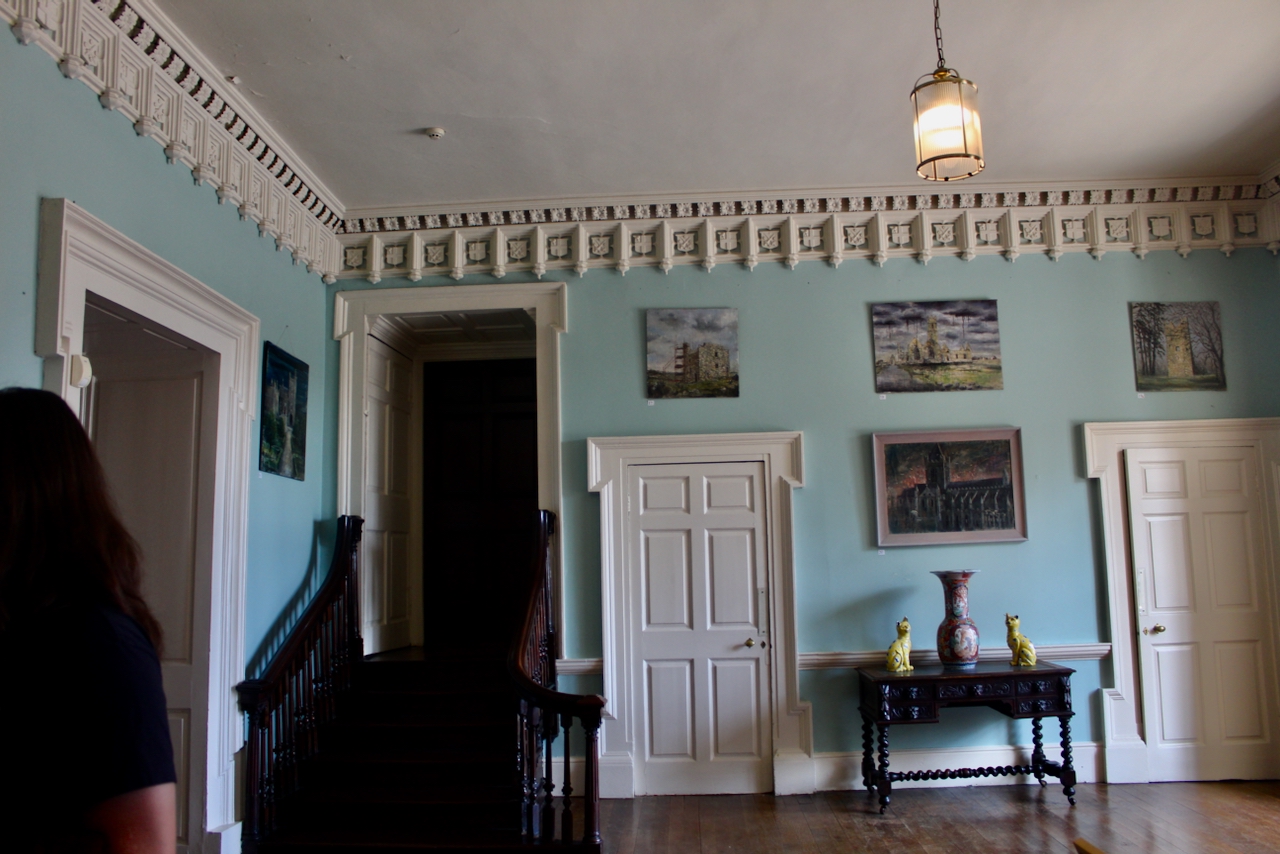
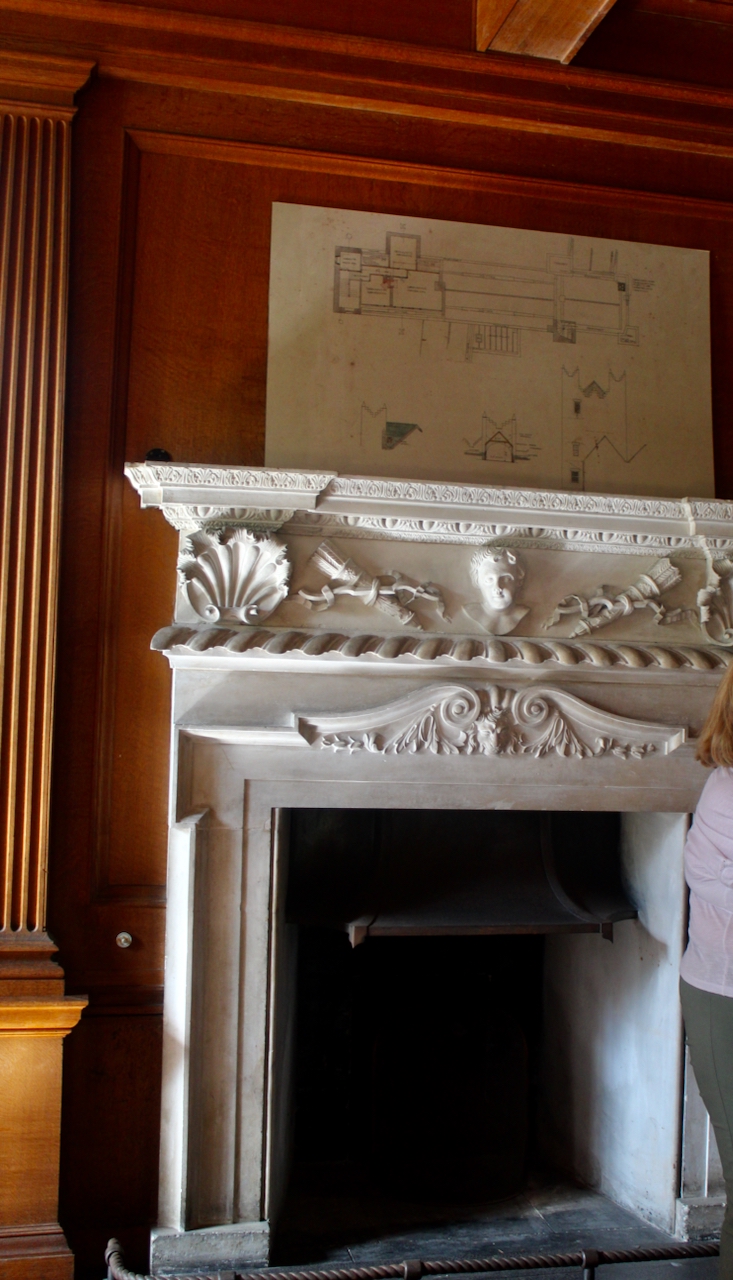
Mark Bence-Jones describes: “The hall has eighteenth century doorcases with shouldered architraves, an early nineteenth century Gothic frieze and a medieval stone fireplace with a surround by Lutyens.” [see 1] The hall was added to the medieval tower in 1558 by Christopher, who is the 20th Lord of Howth according to the Howth Castle website, or the 7th Baron. It was later adapted by Edwin Lutyens in around 1911.
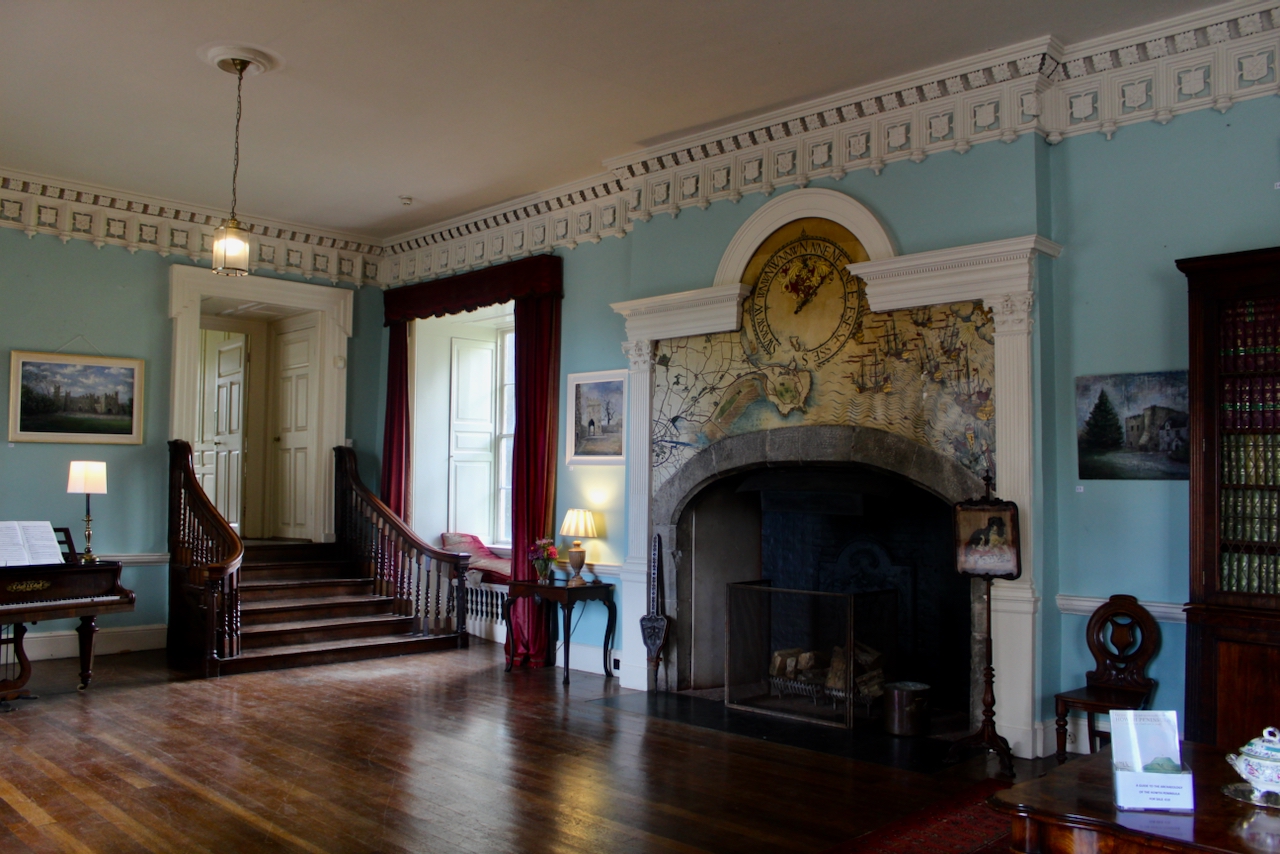
In Irish Houses and Gardens. From the Archives of Country Life, Sean O’Reilly writes about the article written about Howth Castle by Weaver for Country Life:
“It is Lutyens’s selective retention and sensitive recovery of surviving original fabric from a variety of eras that distinguishes his work at Howth. The entrance hall, at the head of a wide flight of stairs, displays best his ability to empathise. While the photographs, by an unknown photographer and by Henson, convey his success, Weaver’s summary clarifies the architect’s methodology: ‘The general work of reparation in the interior revealed in the hall fireplace an old elliptical arch which enabled the original open hearth to be used once more. Above it Mr Macdonald Gill had painted, under Mr Lutyens’ direction, a charming conventional map of Howth and the neighbouring sea and a dial which records the movement of a wind gauge.’ ” [11]
The chimneypiece in the entrance hall was developed from existing Georgian and Victorian features, Seán O’Reilly tells us, with medieval fabric recovered during renovation, providing a mix of styles typical of Lutyens’ restorations. I wish I could find my notes to tell you more about the map painted by MacDonald Gill! I will just have to return so historian Daniel can tell me again.
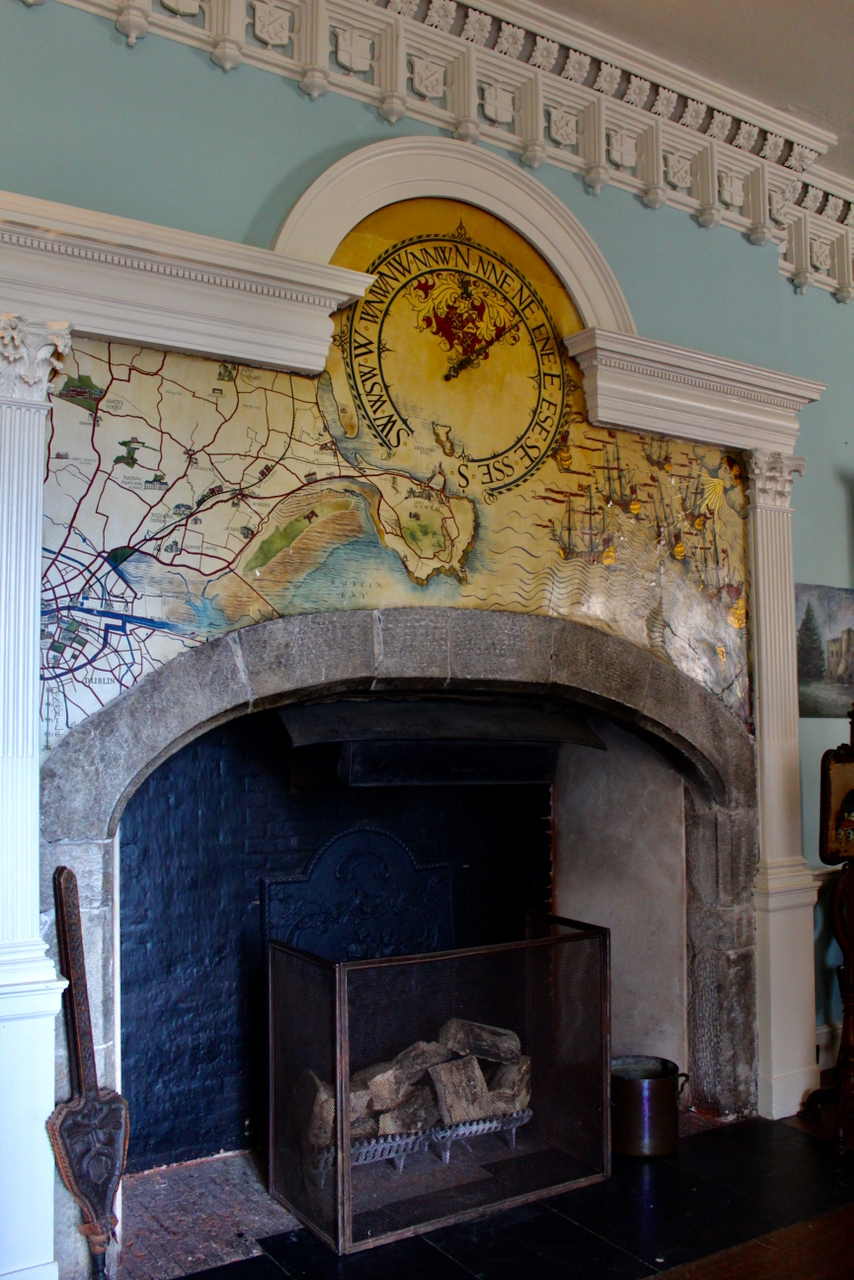
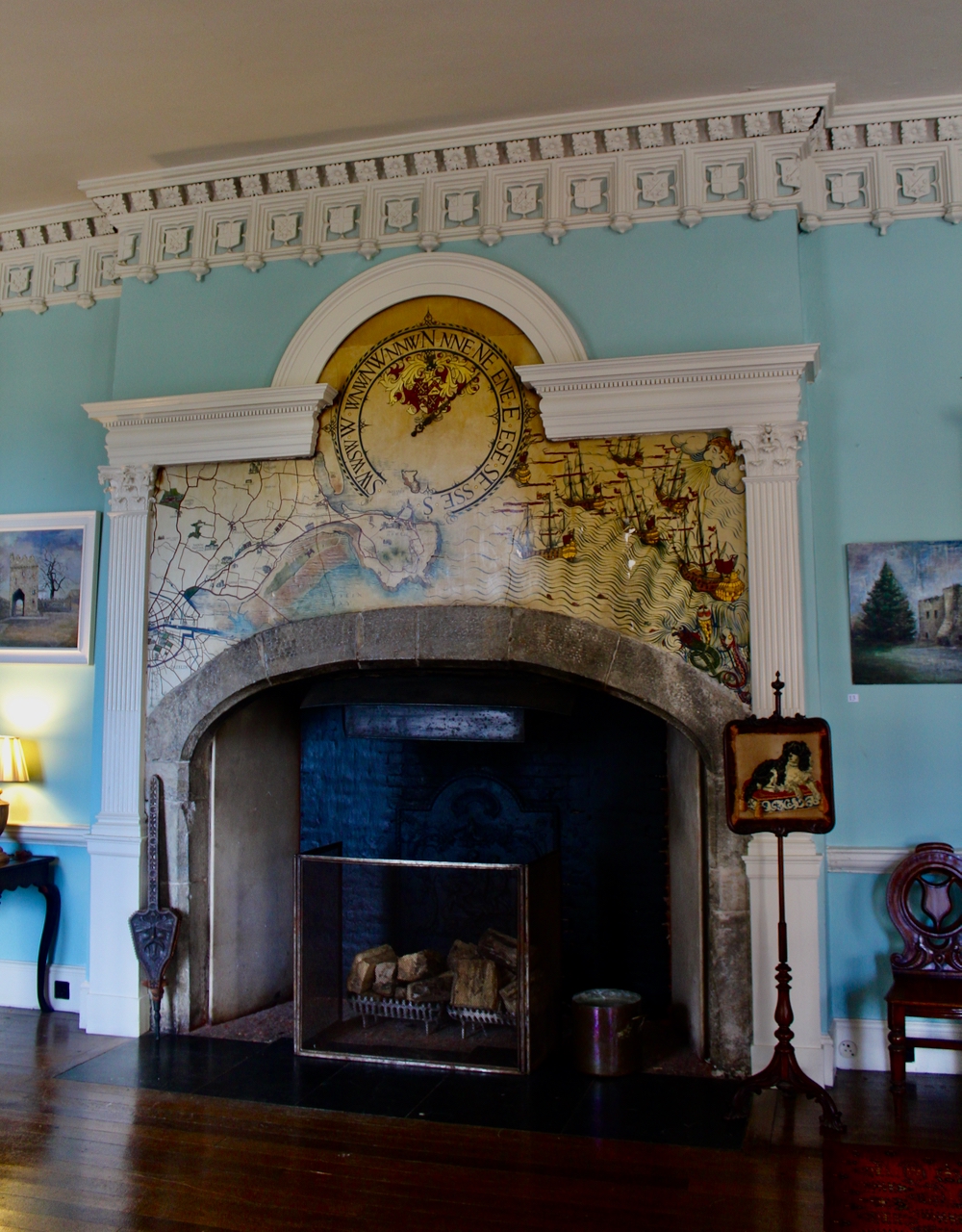
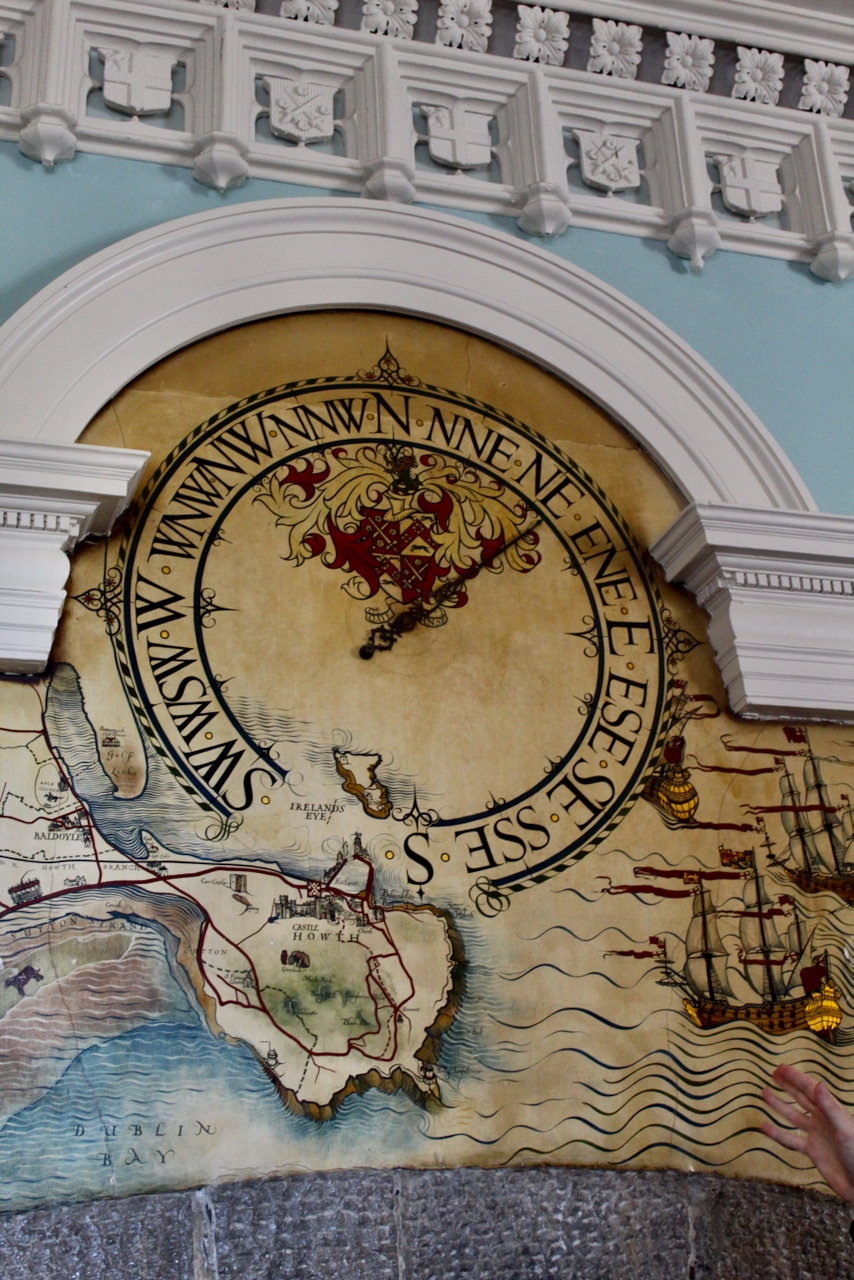
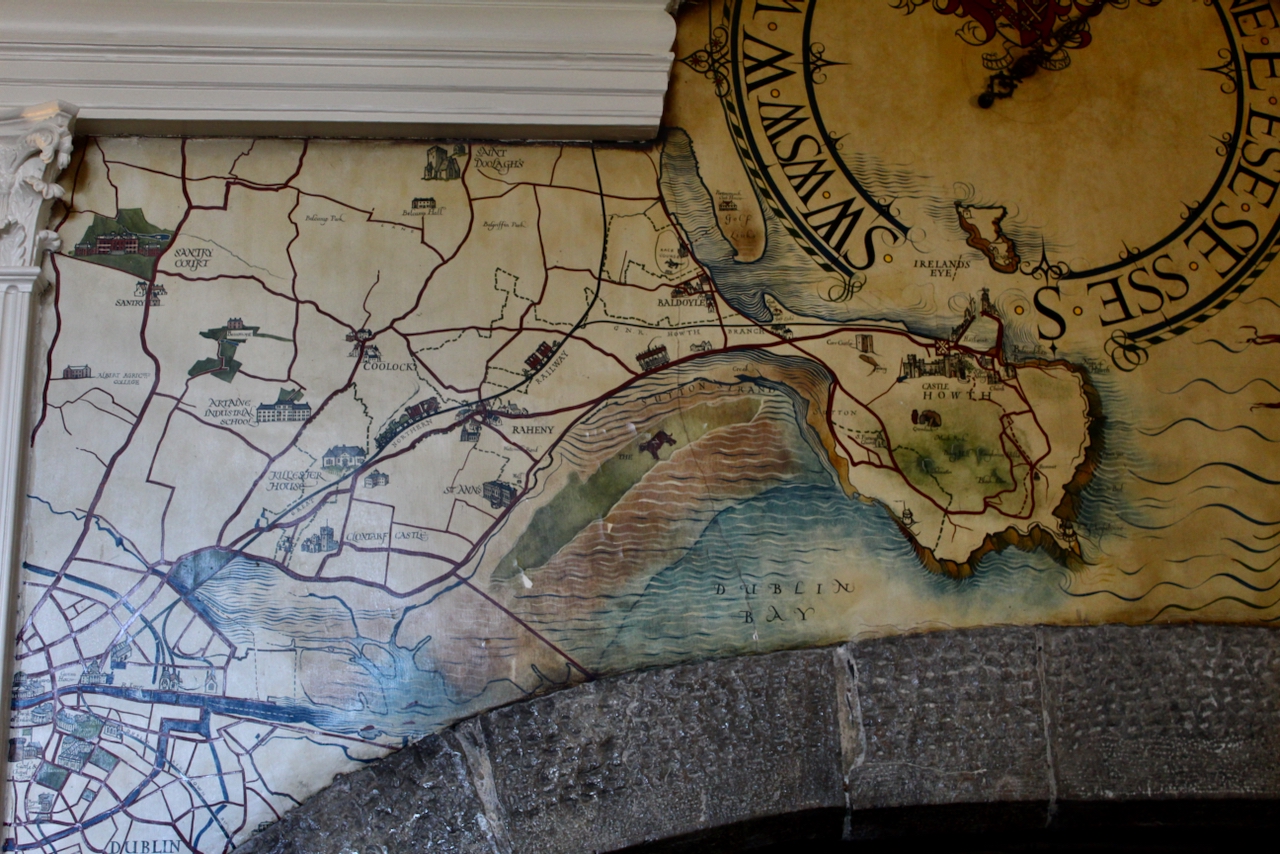
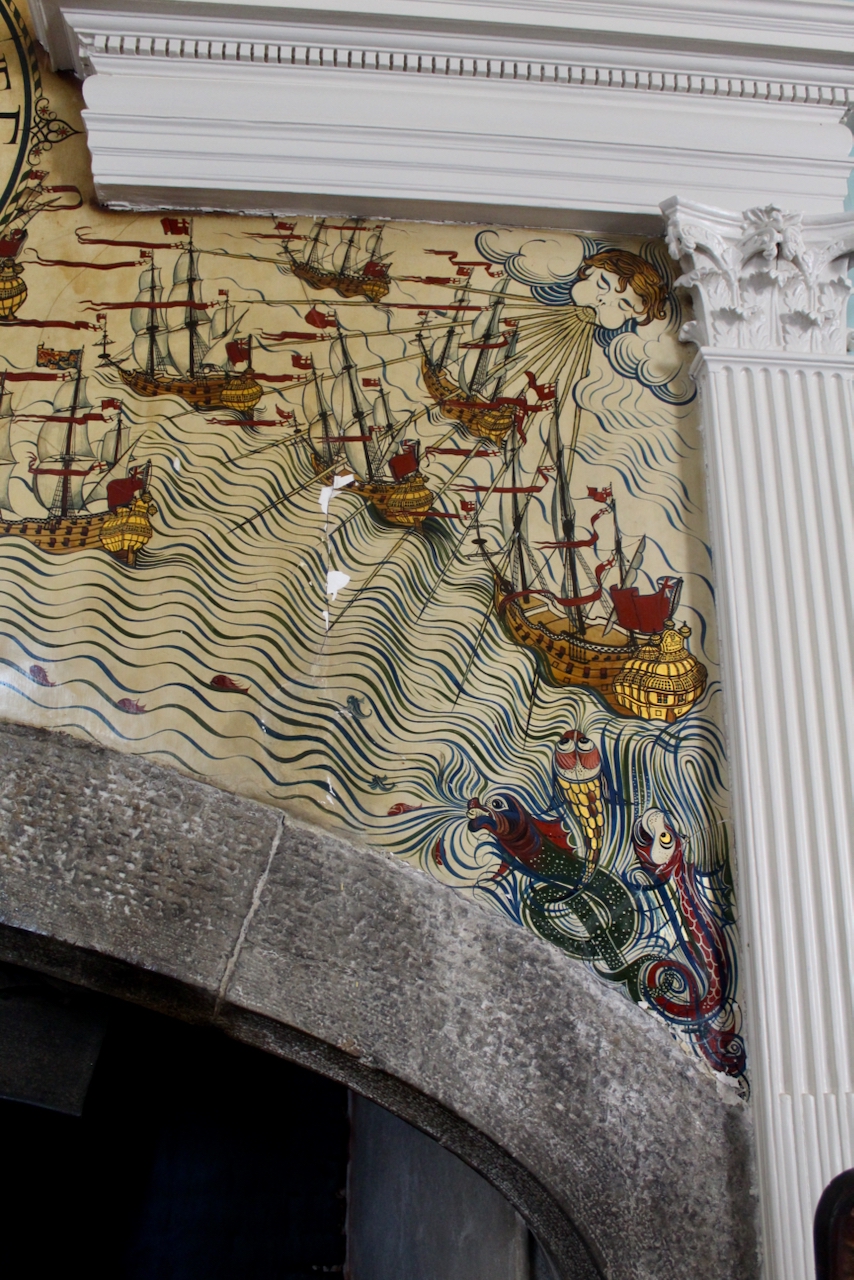
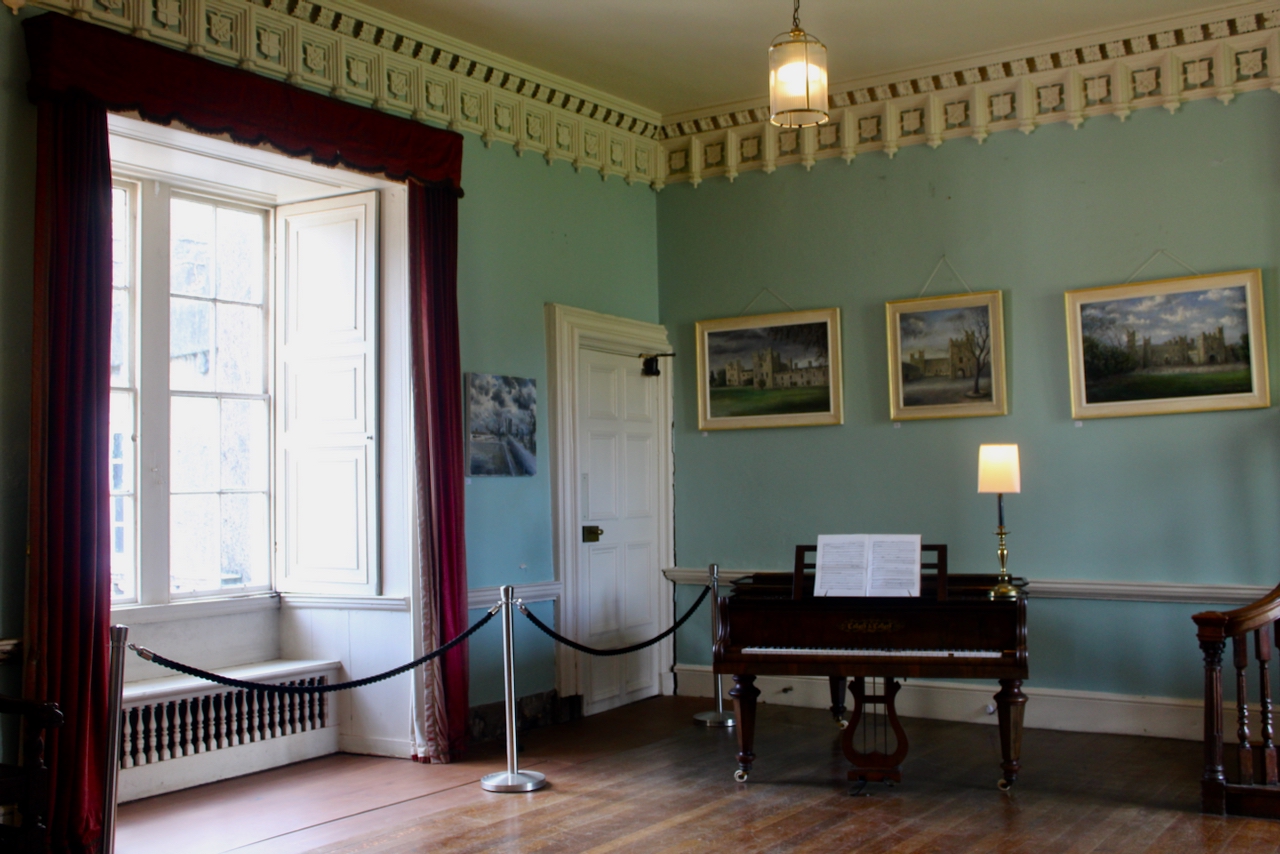
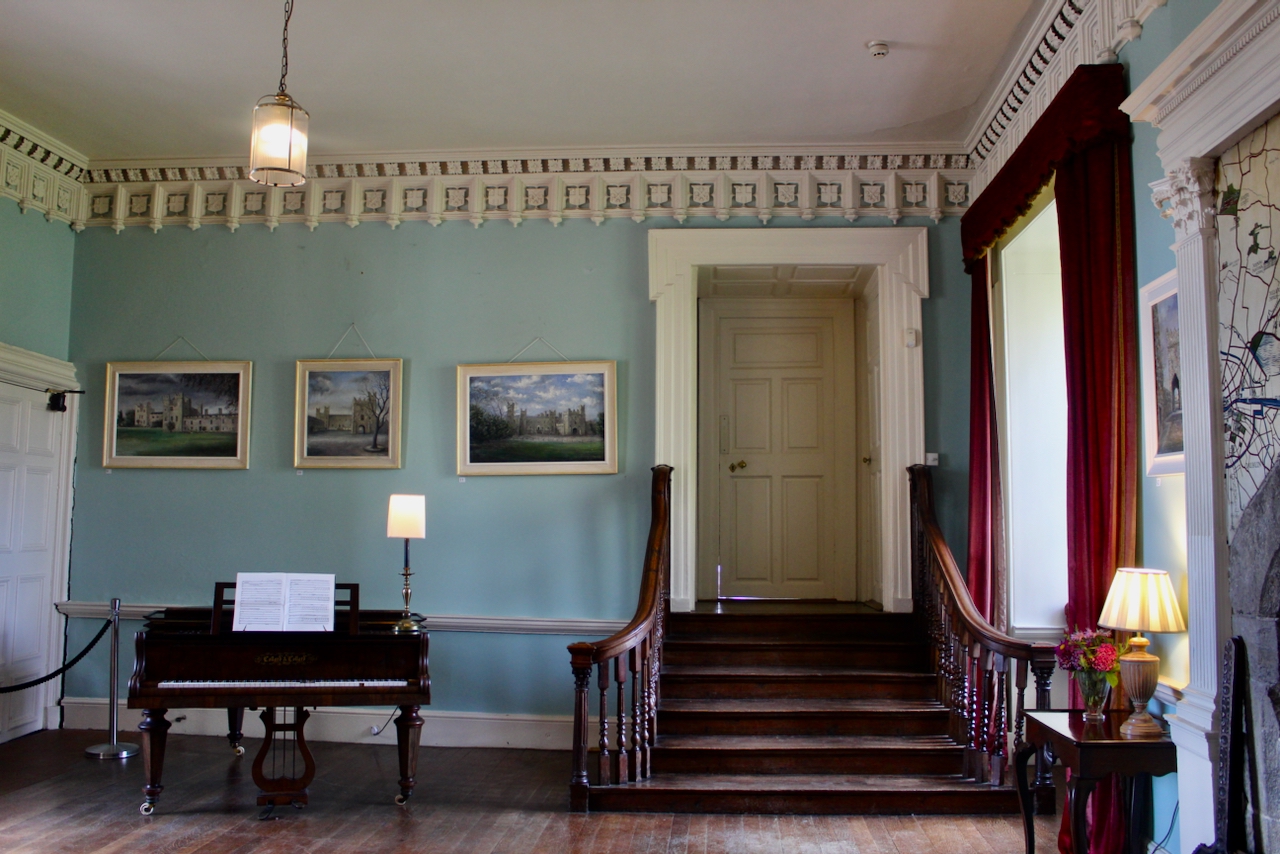
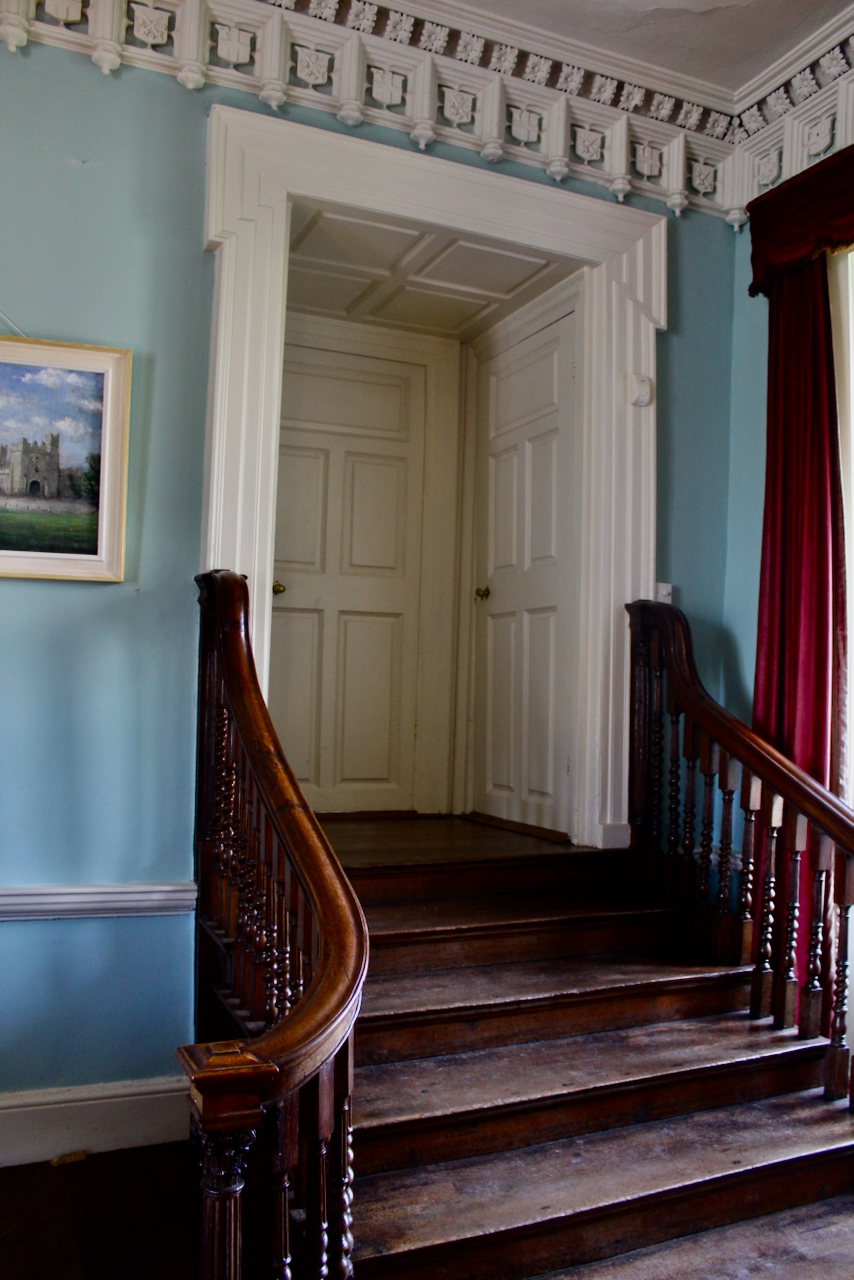
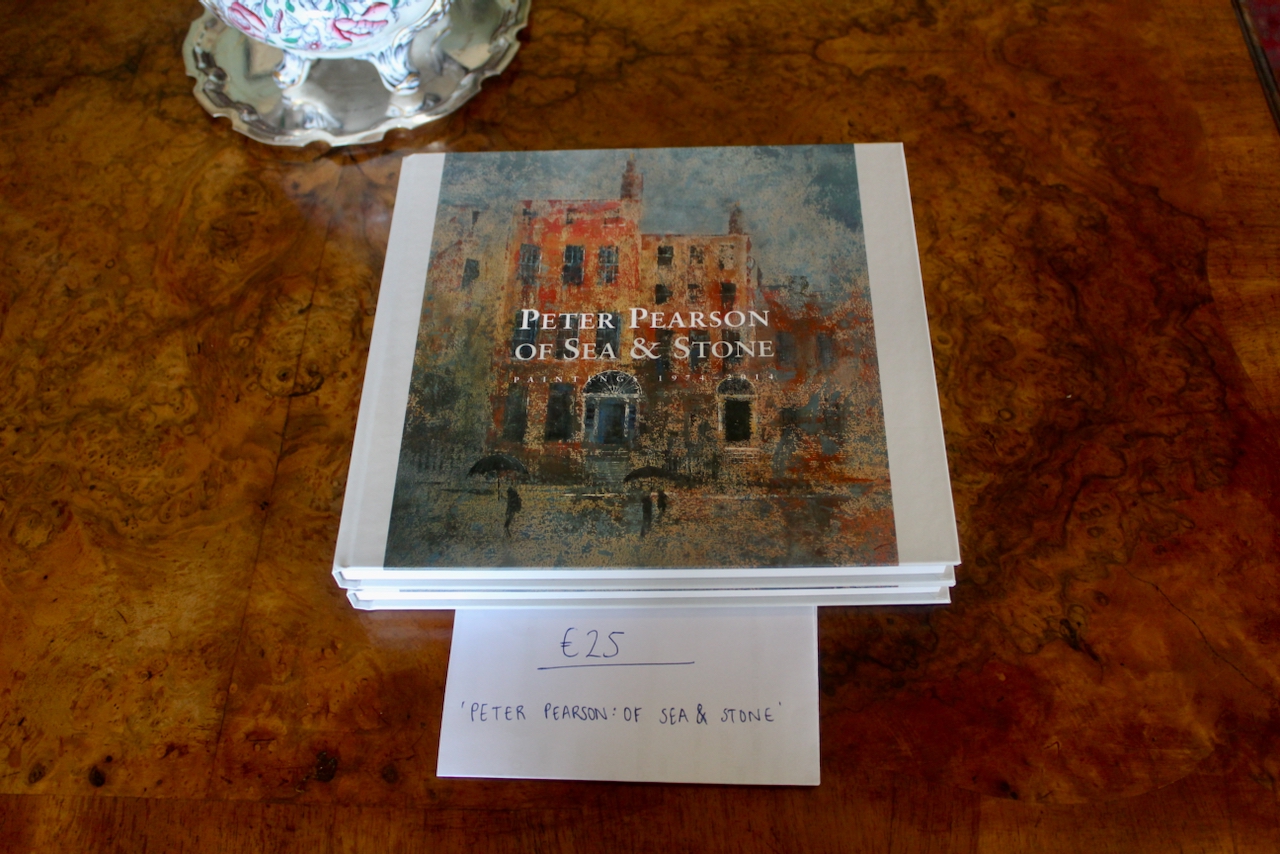
We were lucky enough to visit the castle when it hosted an exhibition of paintings by Peter Pearson, which feature in a book: Of Sea and Stone: Paintings 1974-2014.
William the 14th Baron (1688-1748) married Lucy, younger daughter of Lieutenant-General Richard Gorges of Kilbrew, County Meath. Her mother was Nicola Sophia Hamilton, who before marrying Richard Gorges, had been married to Tristram Beresford, 3rd Baronet of Coleraine.
The Howth Castle website reminds us of a story that our guide on our visit to Curraghmore in County Waterford told us:
“For many years in the Drawing Room of the castle hung the portrait of a handsome woman. To the back of the portrait was attached an unsigned and undated note stating that the painting once had a black ribbon round the wrist but that this had been removed during cleaning. The woman is Nicola Hamilton born 1667 who married firstly Sir Tristram Beresford and subsequently General Richard Gorges. The younger daughter of this marriage was Lucy Gorges, wife of the 27th Lord Howth, Swift’s ‘blue-eyed nymph’.”
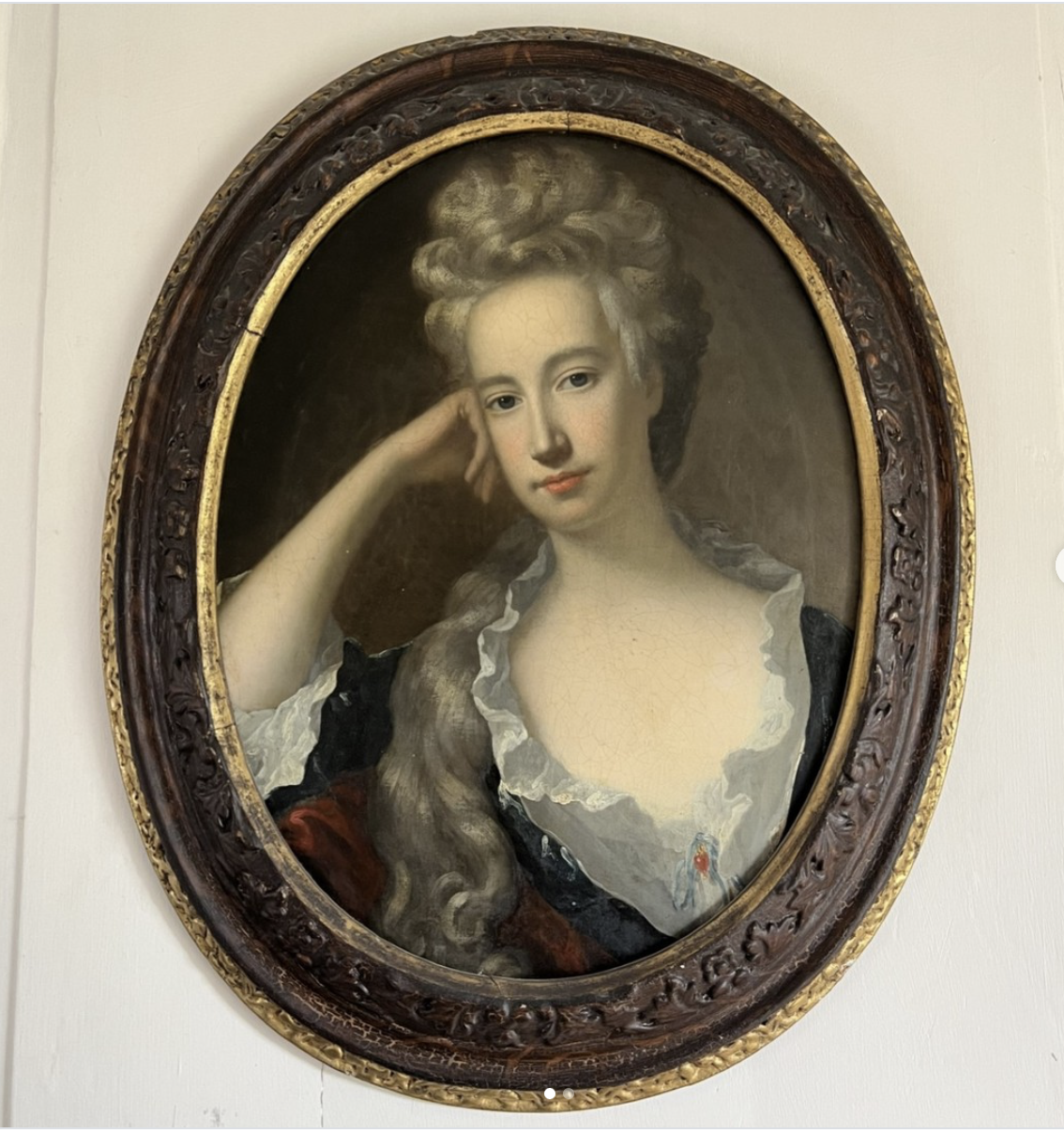
“The legend is that when she was quite young, she made an agreement with John Le Poer, Earl of Tyrone that whoever died first would come back and appear to the other. On dying Lord Tyrone came to her in the night, assured her of the truth of the Christian Revelation and made various predictions, that her first husband would soon die, that her son would marry the Tyrone heiress, and that she herself would die in her forty-seventh year, all of which came true. To convince her of the reality of his presence, he grasped her wrist causing her an injury and permanent scar which she concealed beneath a black ribbon.
“The ease with which the ribbon was removed from the portrait does little to enhance the veracity of the story.“
Nicola’s son was Marcus Beresford (1694-1763) 4th Baronet of Coleraine and as the ghost predicted, he married Catherine Le Poer of Curraghmore, daughter and heiress of James, 3rd Earl of Tyrone.
William St. Lawrence 14th Baron of Howth spent much time at another house he owned in Ireland, Kilfane in County Kilkenny. [12] He sat in the Irish House of Commons as MP for Ratoath between 1716 and 1727, and became a member of the Privy Council of Ireland in 1739.
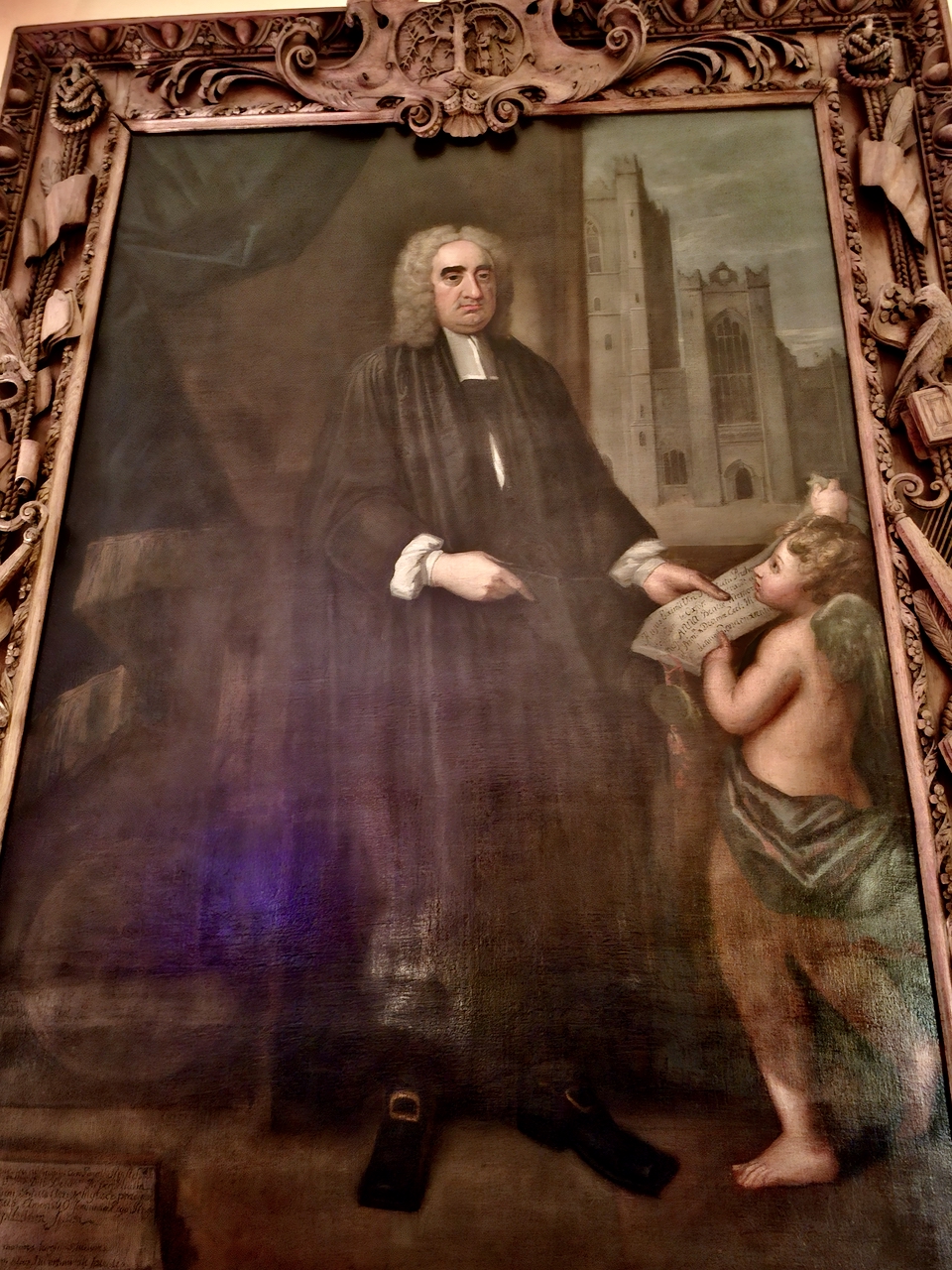
William 14th Baron came to know Jonathan Swift through his wife. Swift became a regular visitor to Howth Castle and they exchanged numerous letters. At Howth’s request, Swift had his portrait painted by Francis Bindon.
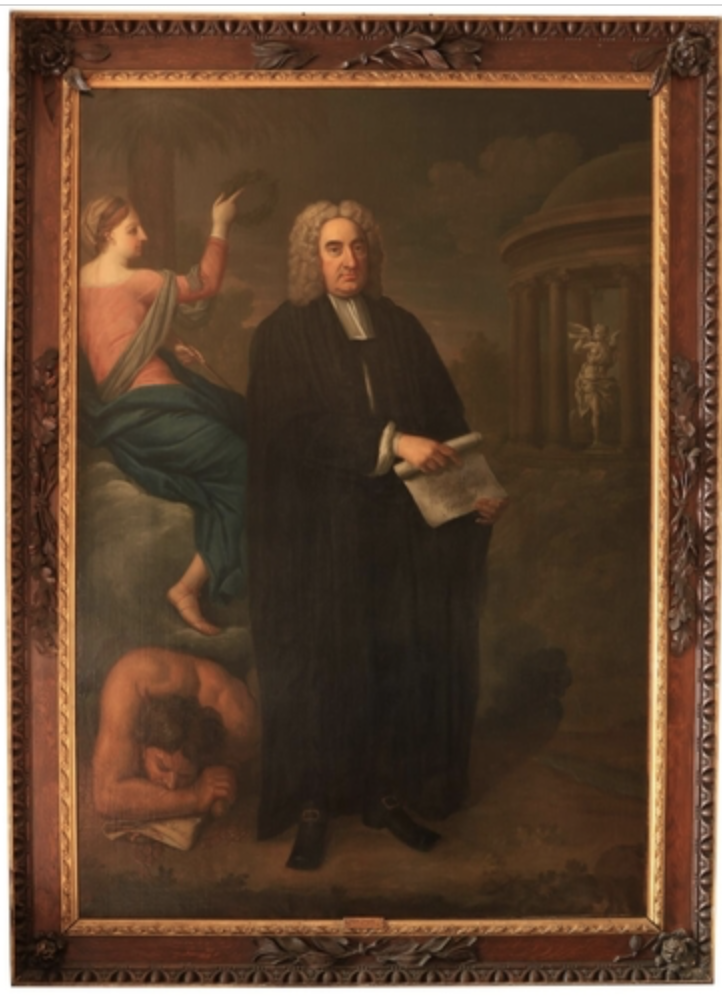
The painting of Jonathan Swift by Francis Bindon was offered at auction in 2021. A very similar painting by Bindon is owned by the Deanery of St. Patrick’s Cathedral. An obituary notice about Bindon in Faulkner’s Journal from 1765 describes Bindon as “one of the best painters and architects this nation has ever produced” and a copy of the Swift picture, painted by Robert Home, hangs in the Examination Hall at Trinity College, Dublin.
In 1736, Lady Lucy Howth’s brother Hamilton Gorges killed Lord Howth’s brother Henry St. Lawrence in a duel. Gorges was tried for murder but acquitted.
After her husband died, Lucy married Nicholas Weldon of Gravelmount House in County Meath, a Section 482 property which we visited. (see my entry https://irishhistorichouses.com/2024/06/13/gravelmount-house-castletown-kilpatrick-navan-co-meath/ )
William 14th Baron and Lucy’s son Thomas (1730-1801) succeeded as 15th Baron. He was educated in Trinity College Dublin, and succeeded to the title when he was eighteen years old, after his father’s death. He became a barrister, and was elected as a “Bencher,” or Master of the Bench of King’s Inn in Dublin in 1767.
In 1750 he married Isabella, daughter of Henry King, 3rd Baronet of Boyle Abbey in County Roscommon.

In 1767 Thomas was created Viscount St. Lawrence and then Earl of Howth. He was appointed to Ireland’s Privy Council in 1768. Timothy William Ferres tells us that in consideration of his own and his ancestors’ services, he obtained, in 1776, a pension of £500 a year.
His daughter Elizabeth married Dudley Alexander Sydney Cosby, 1st and last Baron Sydney and Stradbally, whom we came across when we visited Stradbally Hall in County Laois (see my entry https://irishhistorichouses.com/2021/10/14/stradbally-hall-stradbally-co-laois/ ). A younger son, Thomas St. Lawrence (1755-1831), became Lord Bishop of Cork and Ross. He’s the one who supposedly heard the mermaid in the tower!
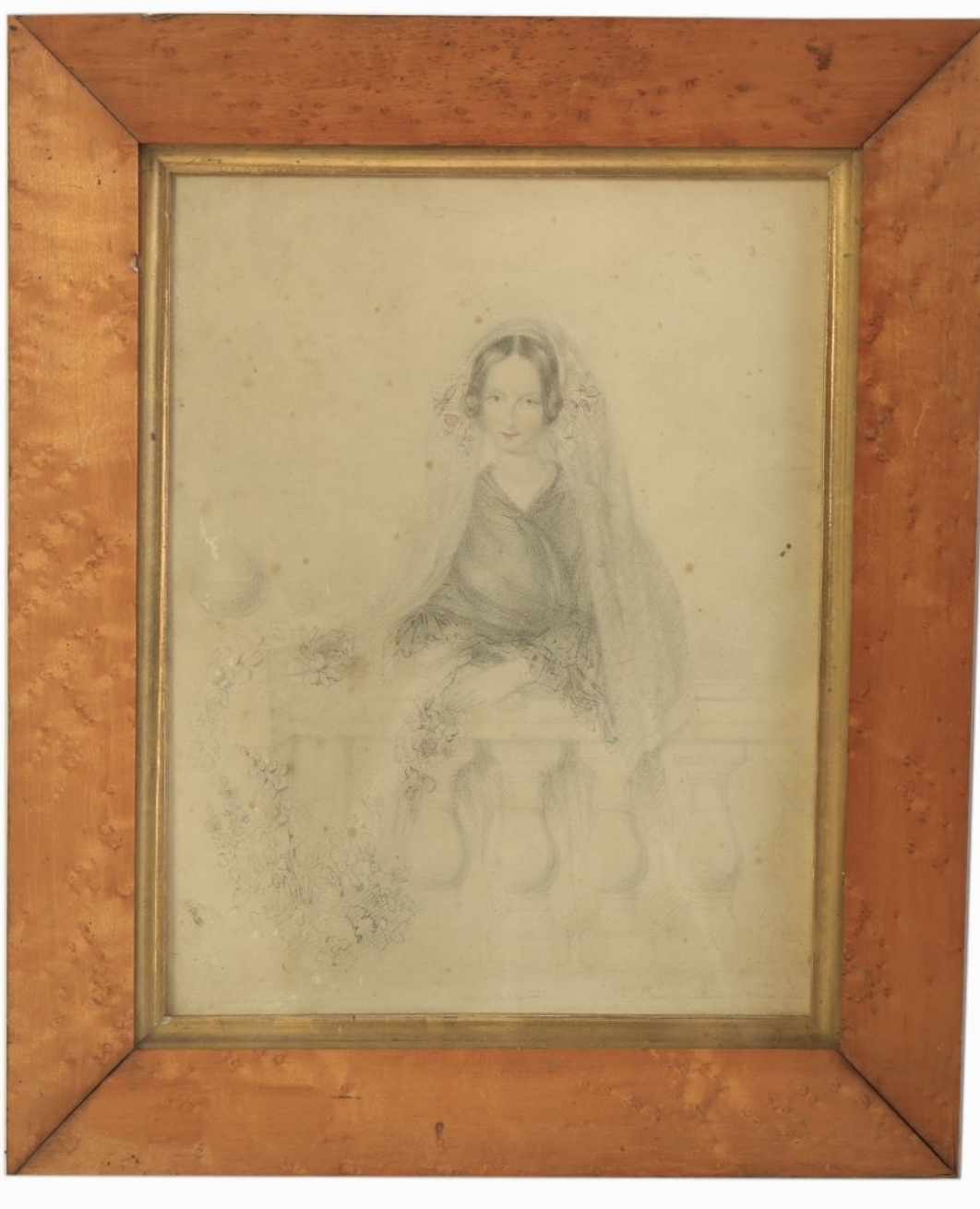
Thomas’s son William (1752-1822) succeeded as 2nd Earl. William married firstly, in 1777, Mary Bermingham, 2nd daughter and co-heiress of Thomas, 1st Earl of Louth. Mary gave birth to several daughters.

A daughter of the 2nd Earl of Howth, Isabella (d. 1837), married William Richard Annesley, 3rd Earl Annesley of Castlewellan, County Down.
Mary née Bermingham died in 1773 and William 2nd Earl of Howth then married Margaret Burke, daughter of William Burke of Glinsk, County Galway.
Howth Harbour was constructed from 1807, and in 1821, King George IV visited Ireland, landing at Howth pier.
Margaret the second wife, Countess of Howth, gave birth to a daughter Catherine, who married Charles Boyle, Viscount Dungarvan, son of the 8th Earl of Cork. She also gave birth to the heir, Thomas (1803-1874), who succeeded as 3rd Earl of Howth in 1822.
Thomas the 3rd Earl served as Vice-Admiral of the Province of Leinster, and Lord-Lieutenant of County Dublin. He married Emily, daughter of John Thomas de Burgh, the 1st Marquess of Clanricarde.
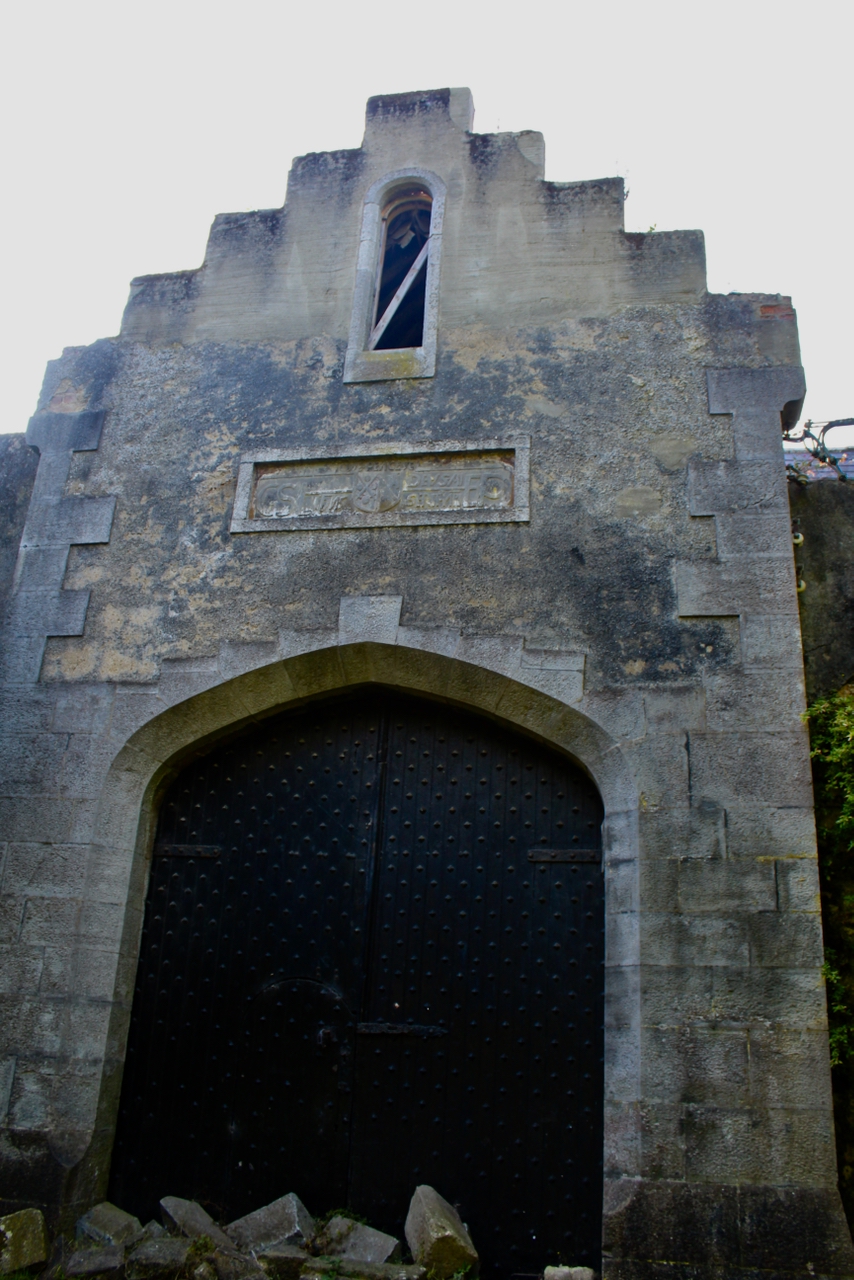
Around 1840, Richard Morrison drew up plans for alterations in the castle, which were only partially executed, including Gothicizing the stables. [see 2]
Emily gave birth to several children, including the heir, but died of measles at the age of thirty-five, in 1842.
Emily and Thomas had a daughter, Emily (d. 1868), who married Thomas Gaisford (d. 1898). Another daughter, Margaret Frances, married Charles Compton William Domvile, 2nd Baronet of Templeogue and Santry.
The 3rd Earl married for a second time in 1851, to Henriette Elizabeth Digby Barfoot. She had a daughter, Henrietta Eliza, who married Benjamin Lee Guinness (1842-1900), and two other children.
In 1855 the 3rd Earl had the Kenelm Lee Guinness Tower built at the end of the east range at the front of the castle. Kenelm was the son of Henrietta née St. Lawrence and Benjamin Lee Guinness. The tower must have been named later, as Kenelm was born in 1887.
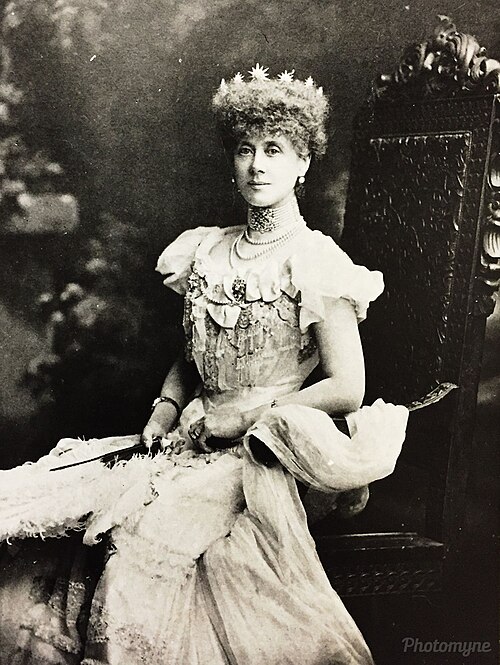
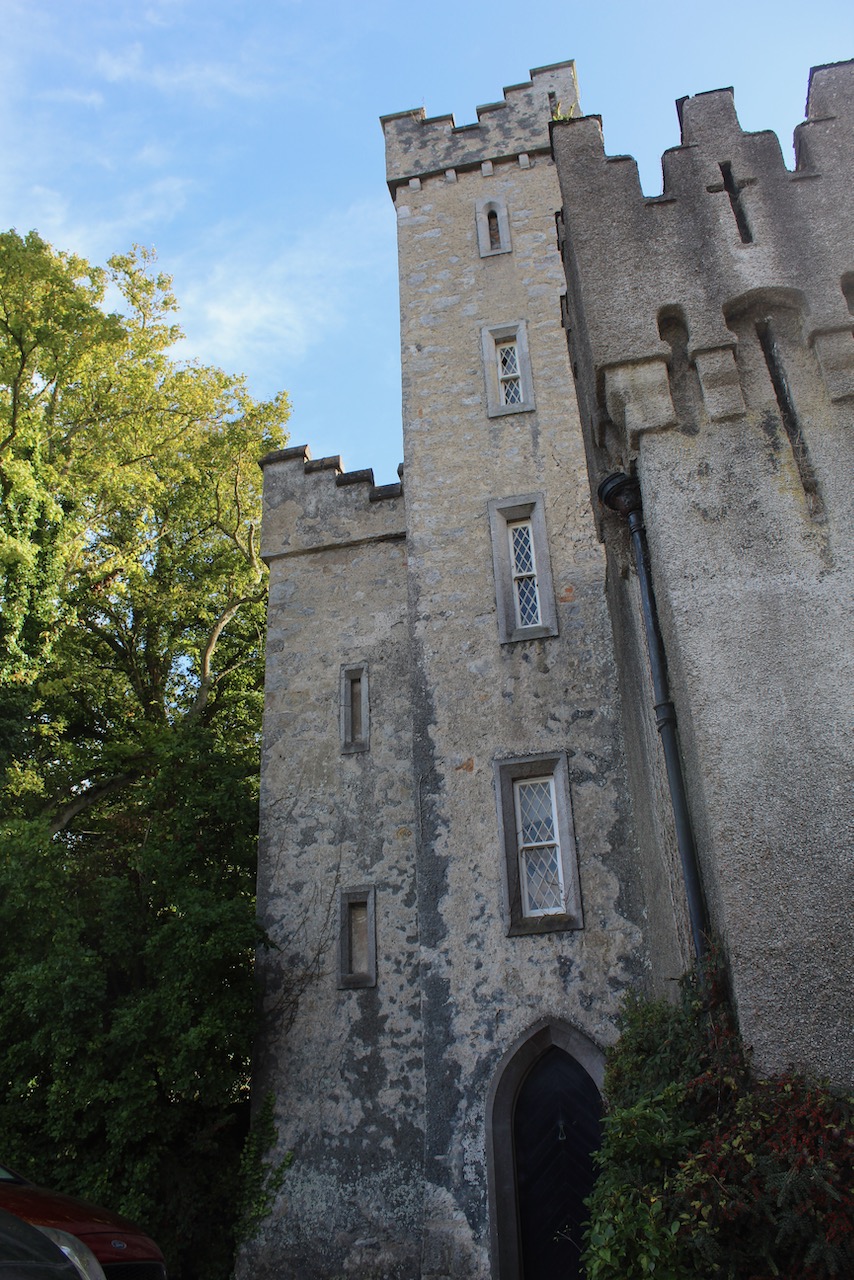

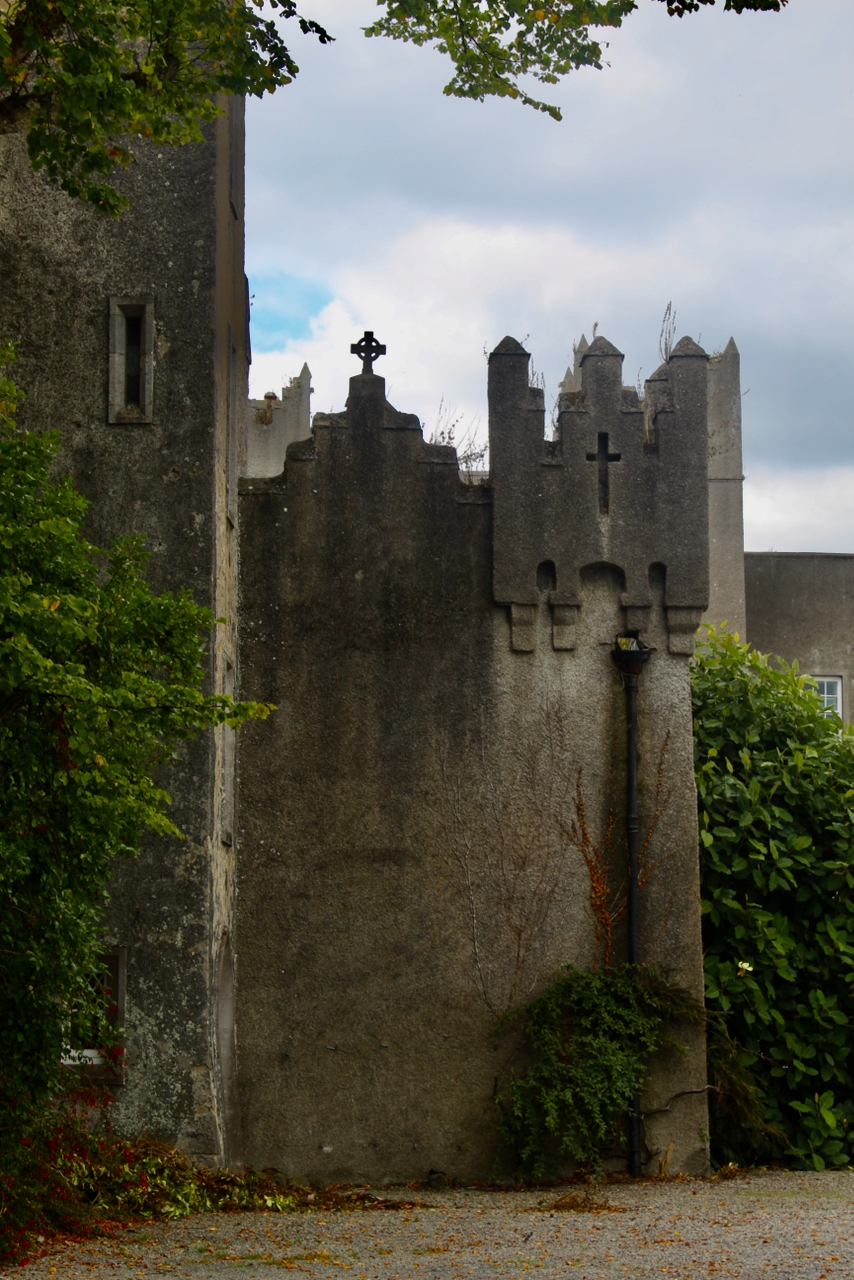
Thomas and Emily’s son William Ulick Tristram (1827-1909) succeeded as 4th Earl in 1874. He served as Captain in the 7th Hussars 1847-50. He was High Sheriff of County Dublin in 1854 and State Steward to the Lord Lieutenant of Ireland from 1855 until 1866. In the English House of Commons he served as Liberal MP for Galway Borough from 1868 until 1874.
He had no children and the titles died with him.
The property passed to his sister Emily’s family, and her son added St. Lawrence to his surname to become Julian Charles Gaisford-St. Lawrence (d. 1932). In 1911 he hired Edwin Lutyens to renovate and enlarge the castle.
The most substantial addition was the three bay two storey Gaisford Tower, with basement and dormer attic, at the end of the west wing, which he built to house his library. This tower picked up many of the motifs distinguishing the earlier fabric, from its irregular massing to the use of stepped battlements with pyramidal pinnacles, all moulding it into the meandering fabric of the earlier buildings. [see 11] Other work included the steps to the east of the new tower, a loggia with bathrooms above between the old hall and the west wing and a sunken garden. He also added square plan corner turrets to the south-west and north-east facades, incorporating fabric of earlier structures, 1738 and ca 1840. [see 2]
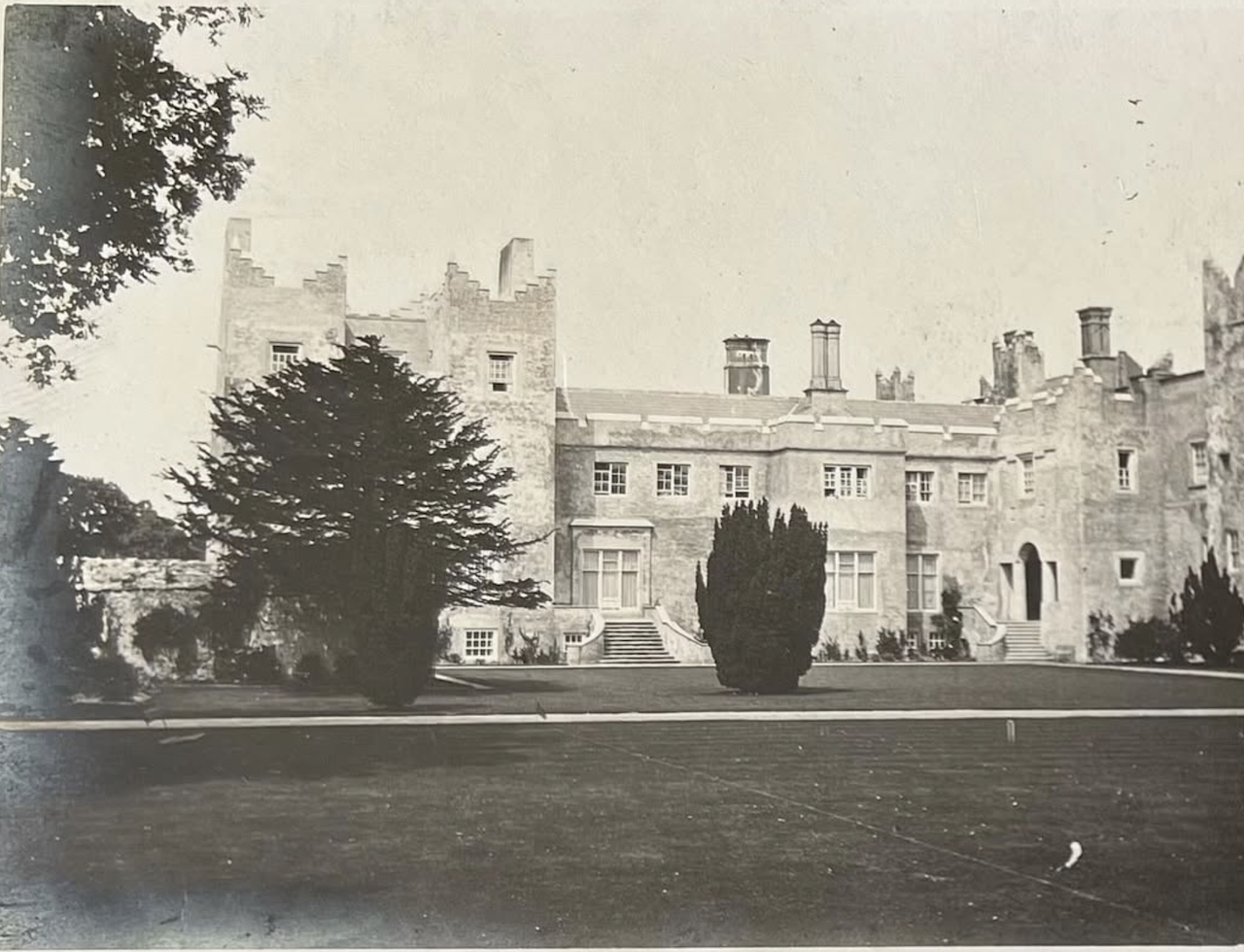
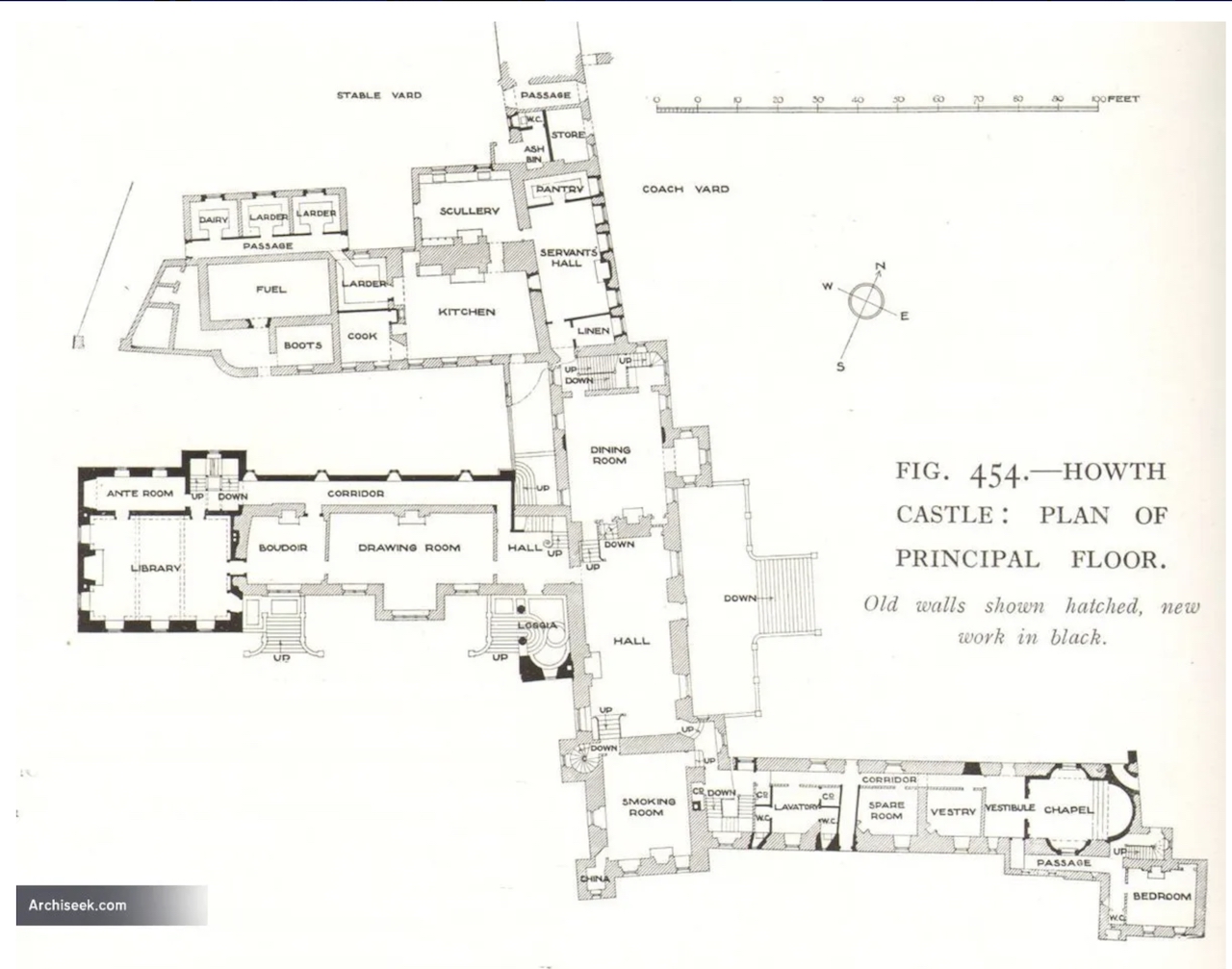
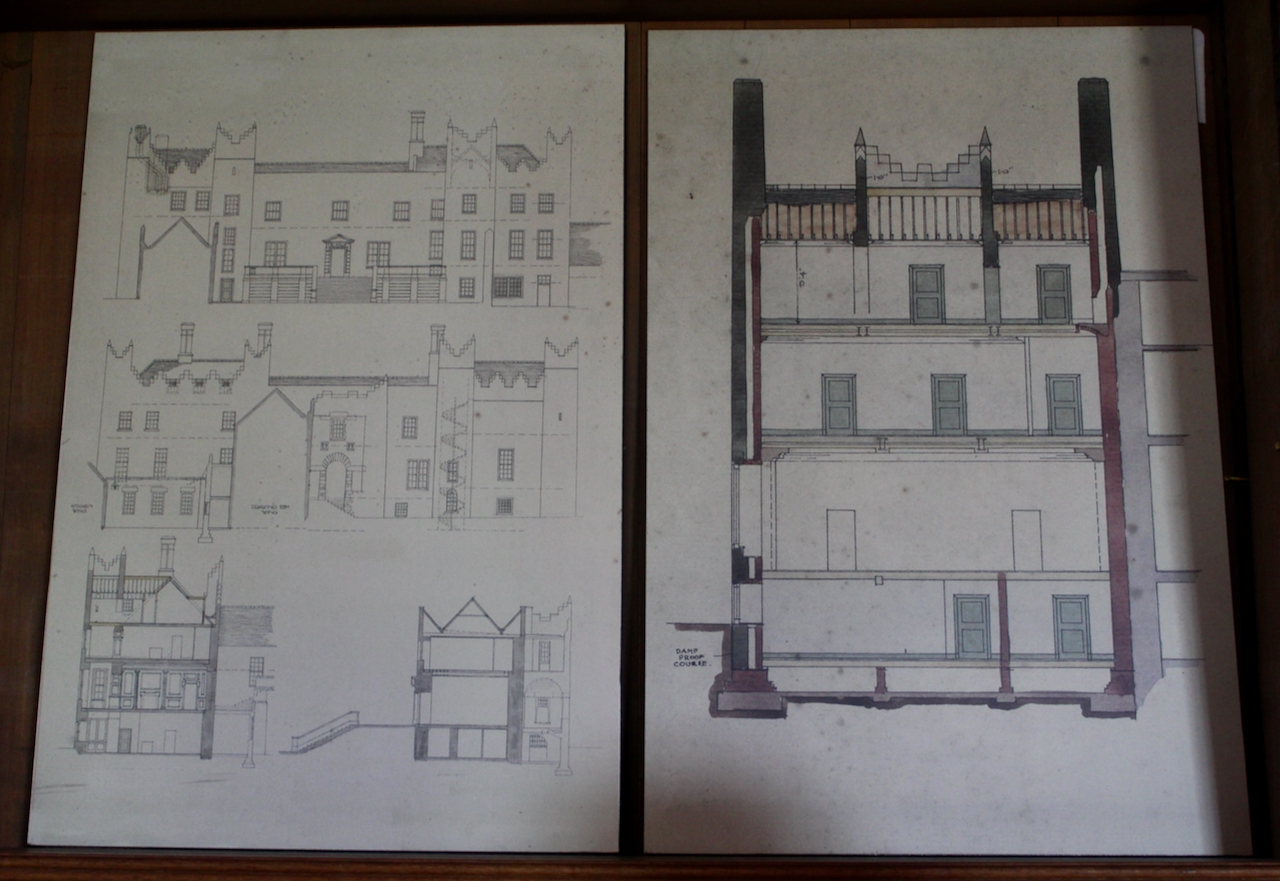
Mark Bence-Jones writes:
“On the other side of the hall range, a long two storey wing containing the drawing room extends at right angles to it, ending in another tower similar to the keep, with Irish battlemented corner turrets. This last tower was added 1910 for Cmdr Julian Gaisford-St. Lawrence, who inherited Howth from his maternal uncle, 4th and last Earl of Howth, and assumed the additional surname of St Lawrence; it was designed by Sir Edward Lutyens, who also added a corridor with corbelled oriels at the back of the drawing room wing and a loggia at the junction of the wing with the hall range; as well as carrying out some alterations to the interior.”
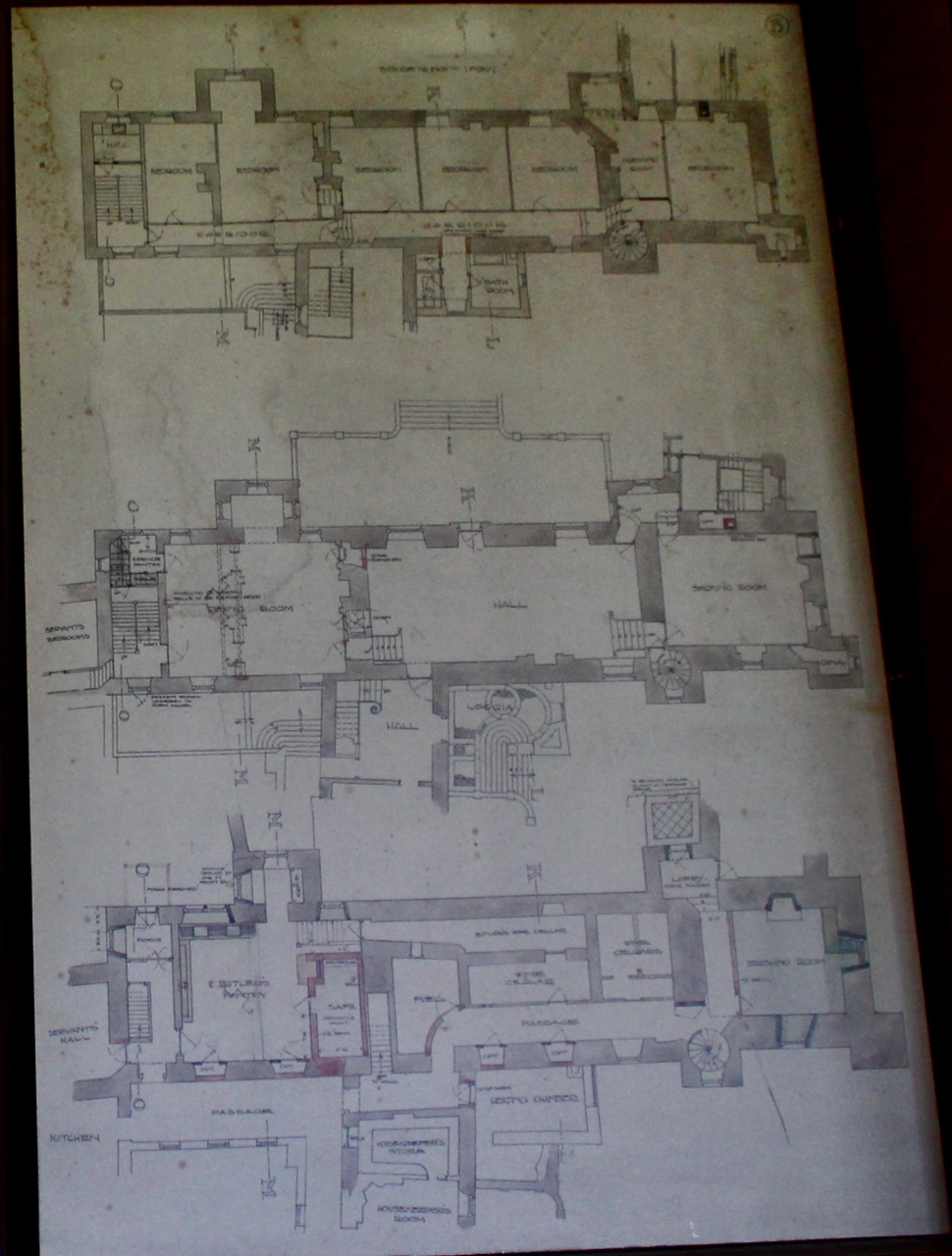
From the front hall, to the right, when facing the fireplace, is the dining room. It has surviving eighteeth century panelling.
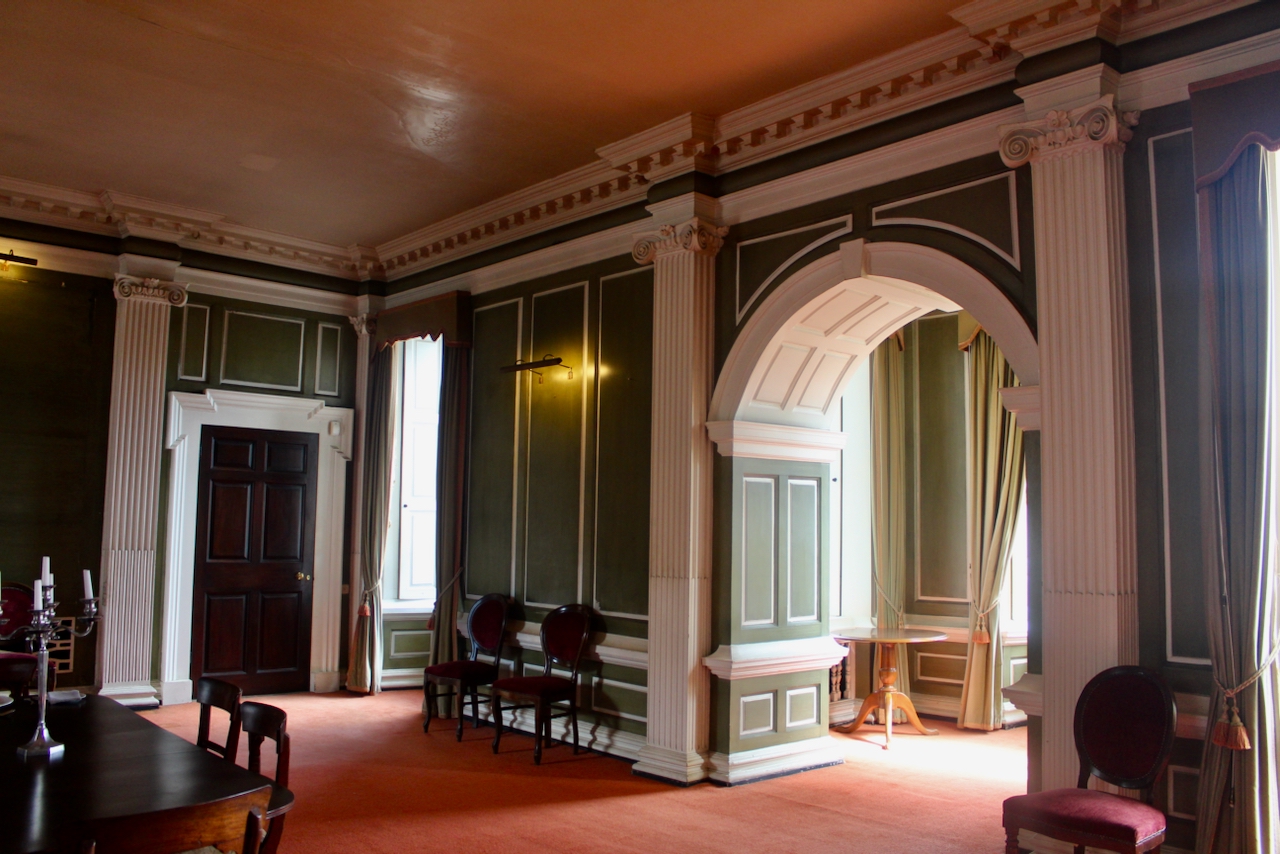
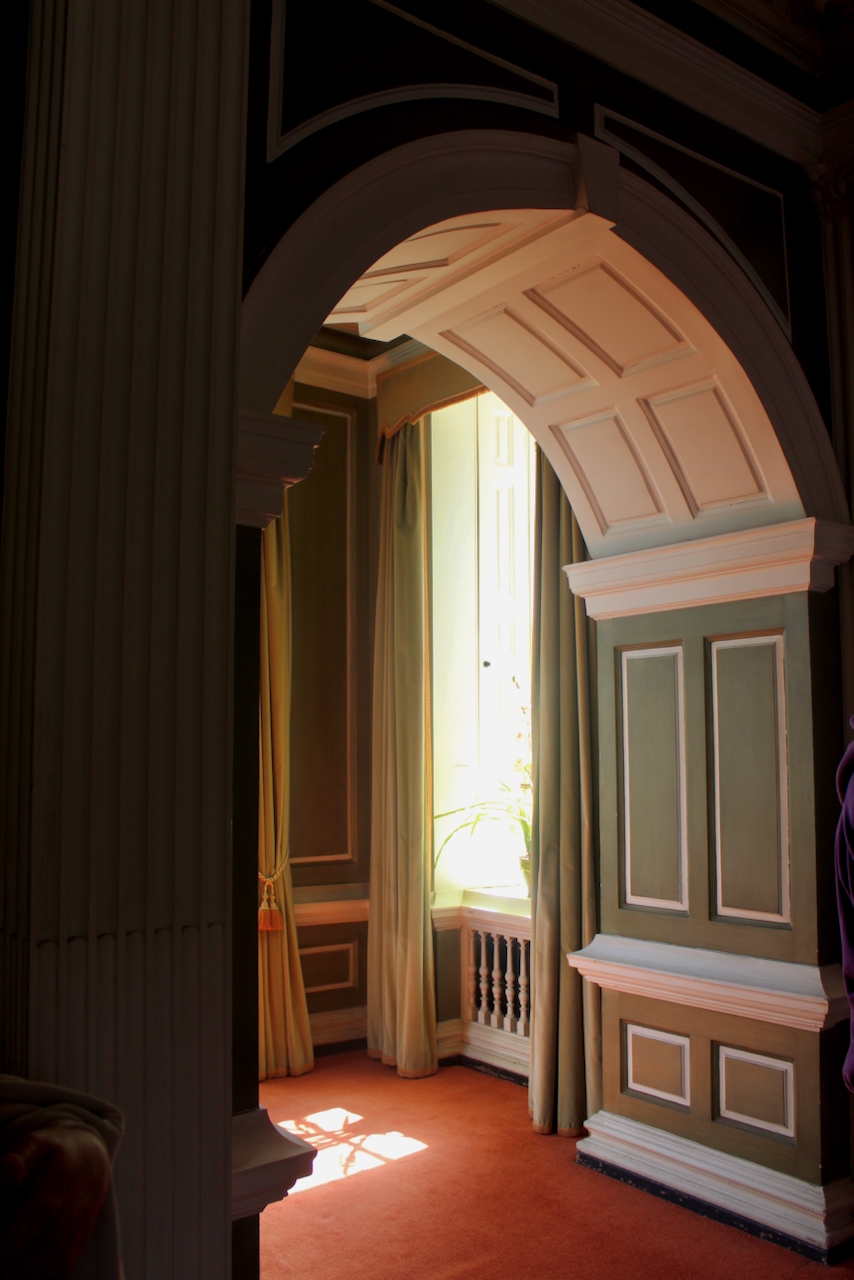
Bence-Jones writes that Lutyens restored the dining room to its original size after it had been partitioned off into several smaller rooms. It has a modillion cornice and eighteenth century style panelling with fluted Corinthian pilasters.
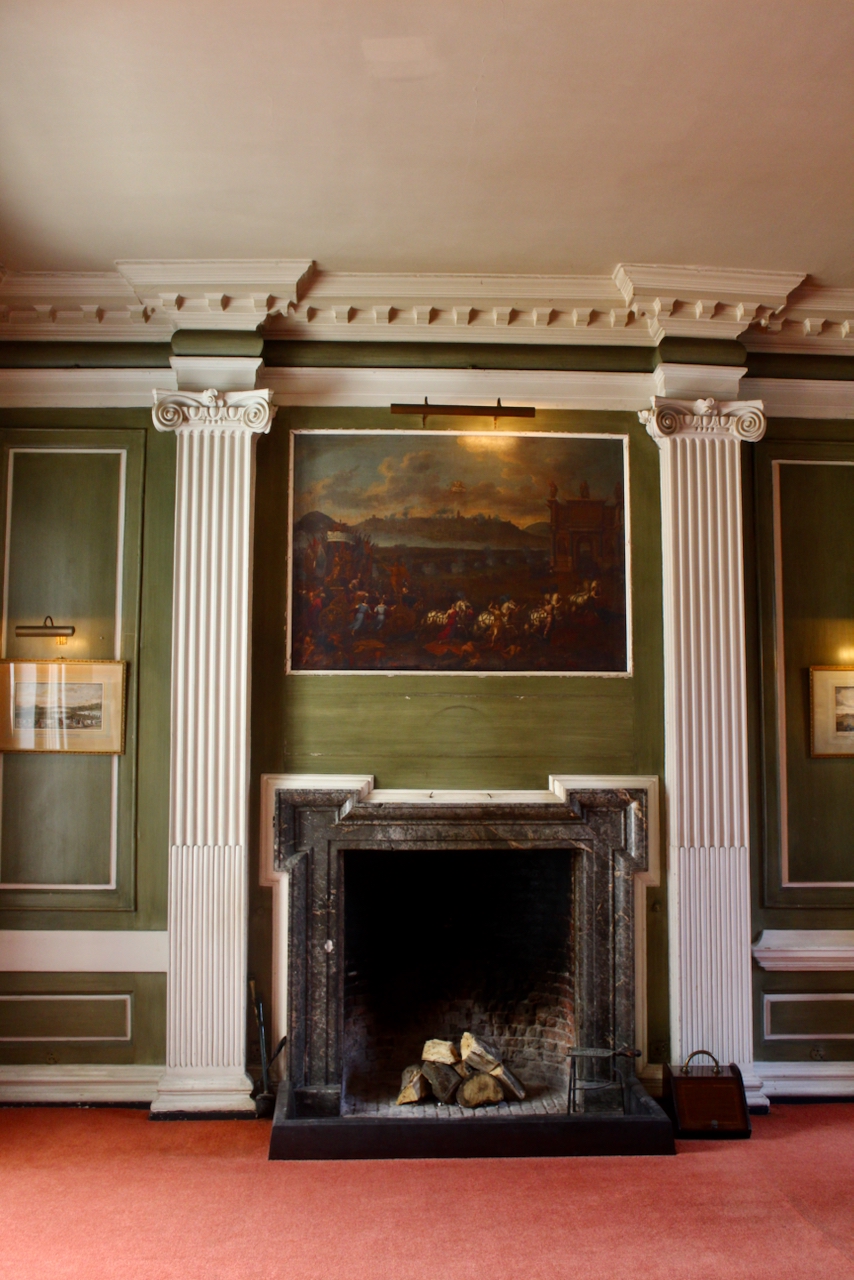
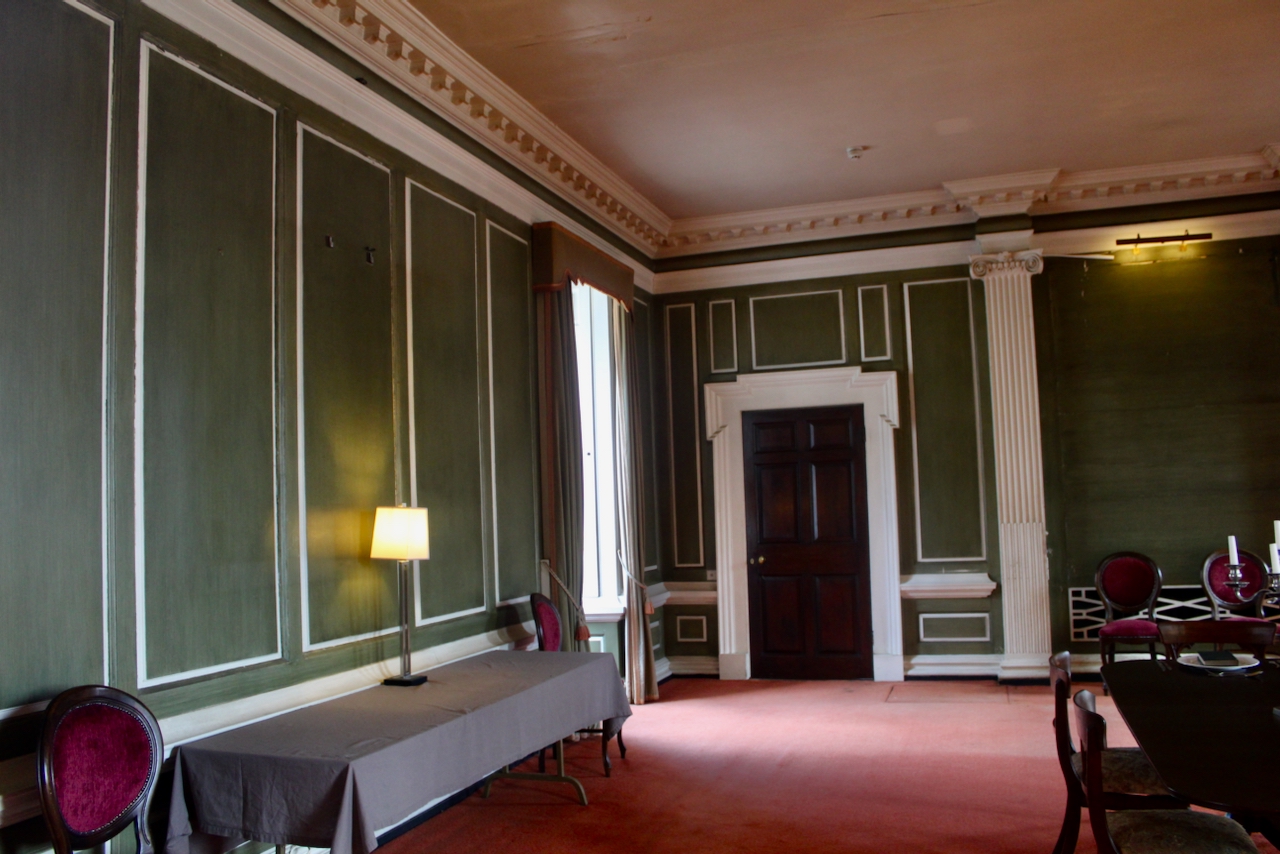
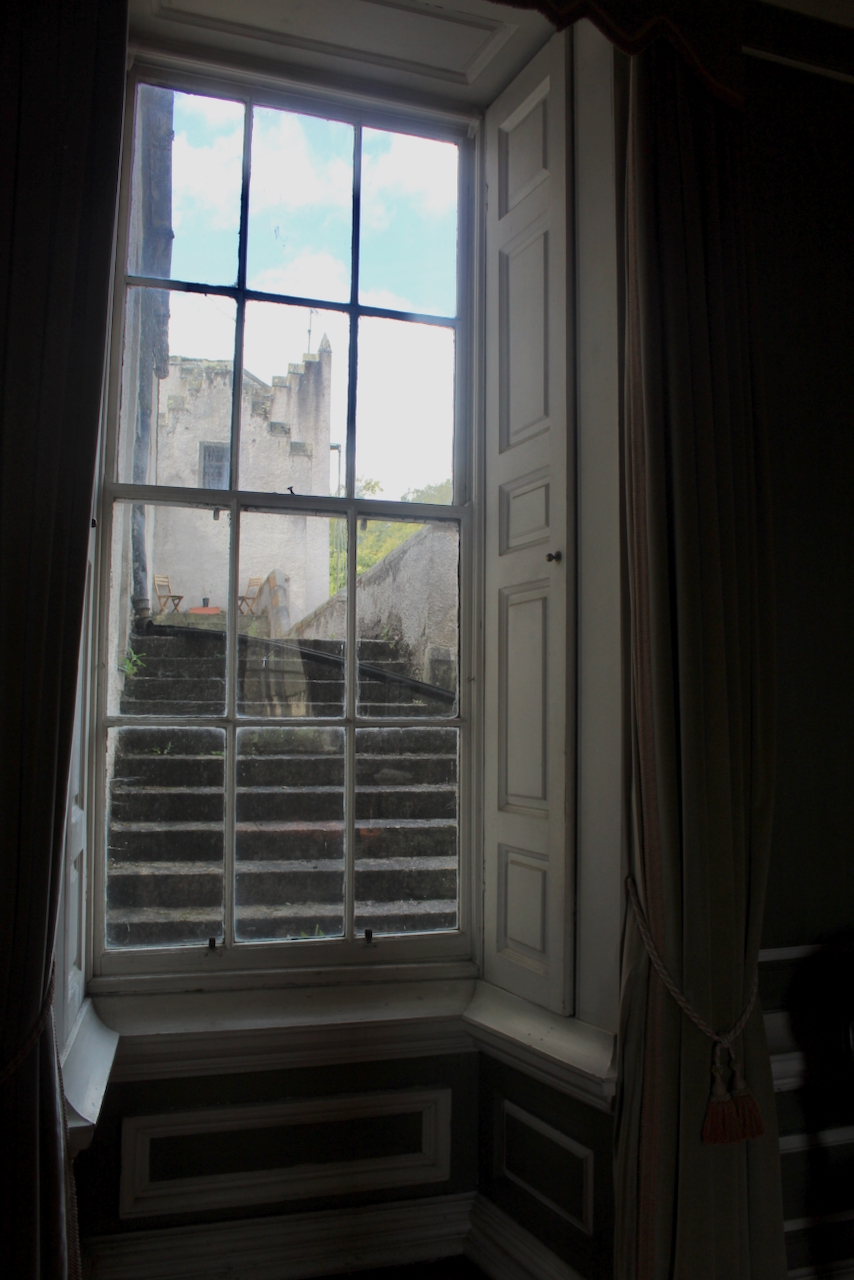
The drawing room was left largely untouched by Lutyens.
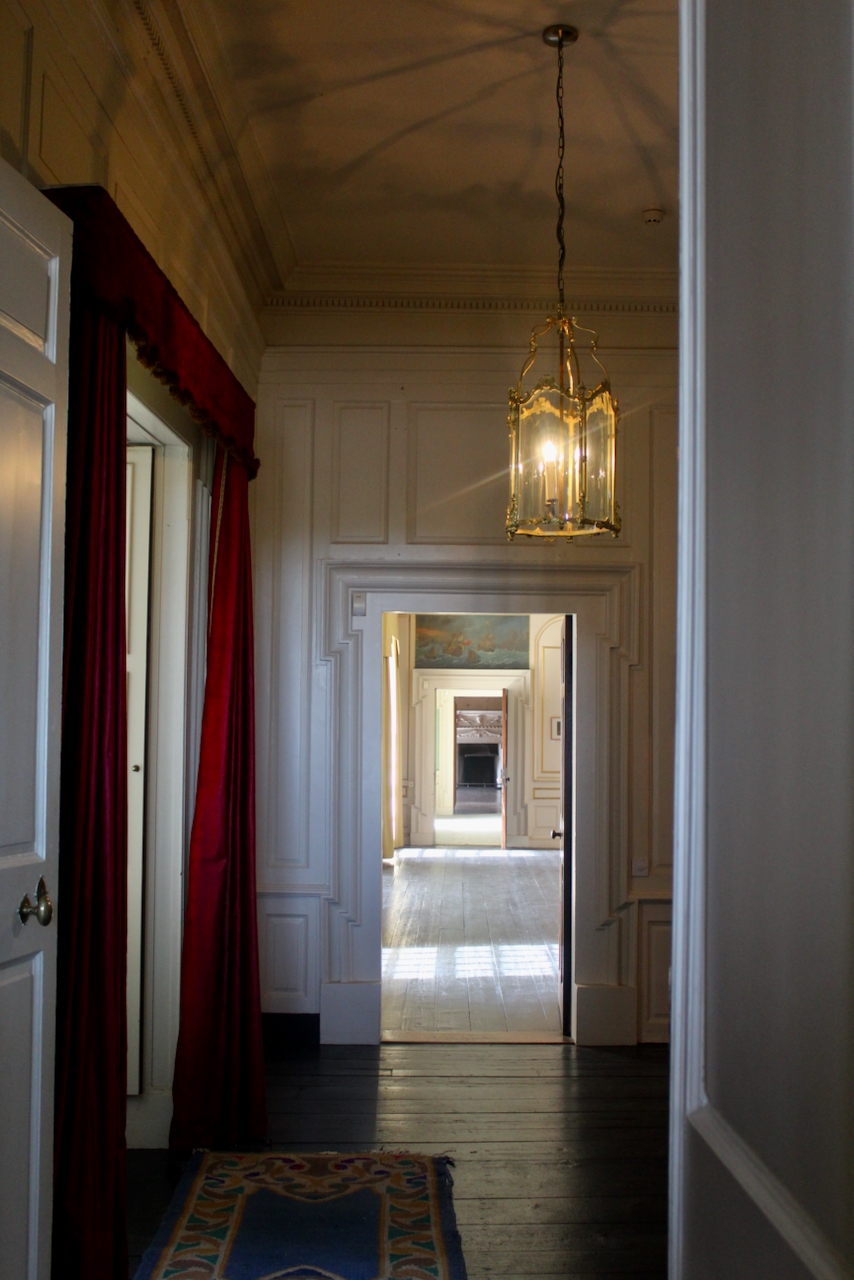
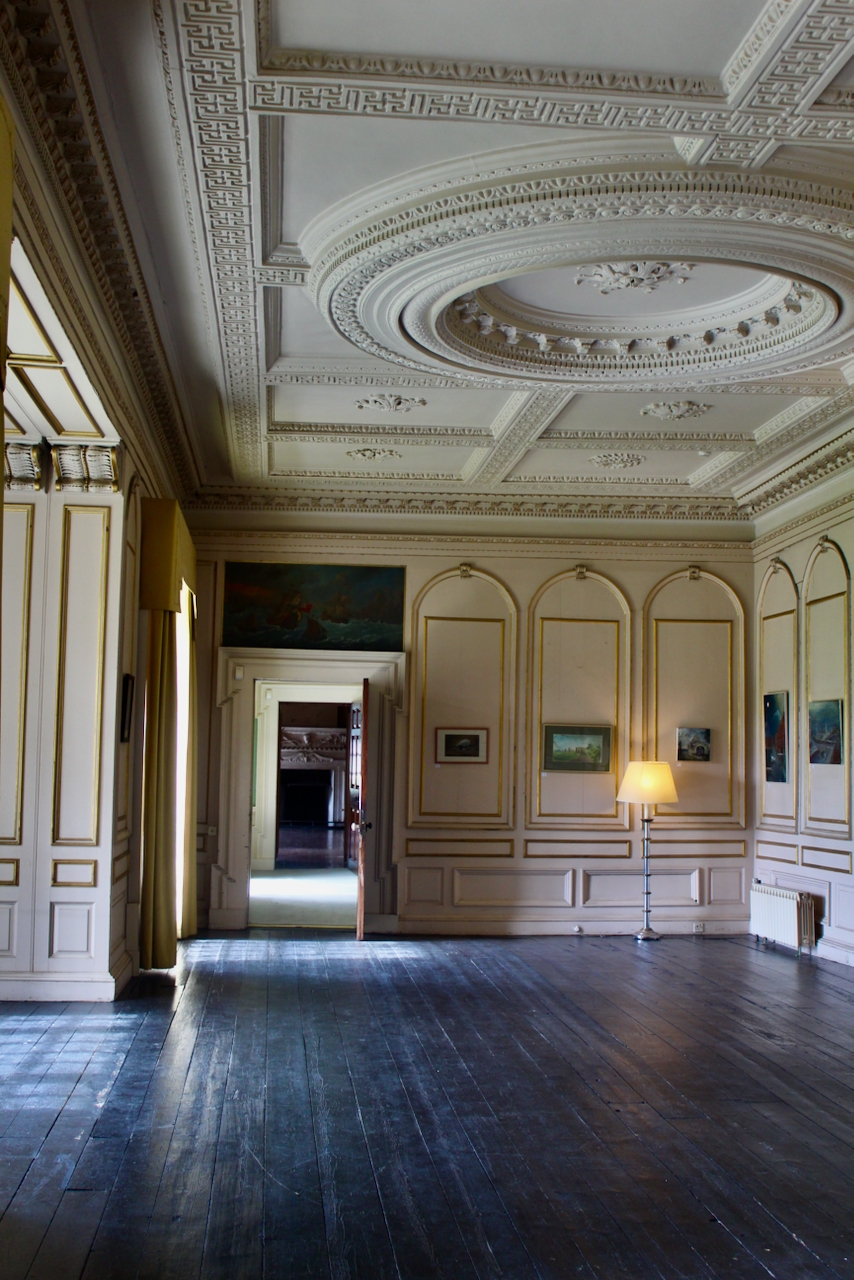
Mark Bence-Jones writes: “The drawing room has a heavily moulded mid-C18 ceiling, probably copied from William Kent’s Works of Inigo Jones; the walls are divided into panels with arched mouldings, a treatment which is repeated in one of the bedrooms.”
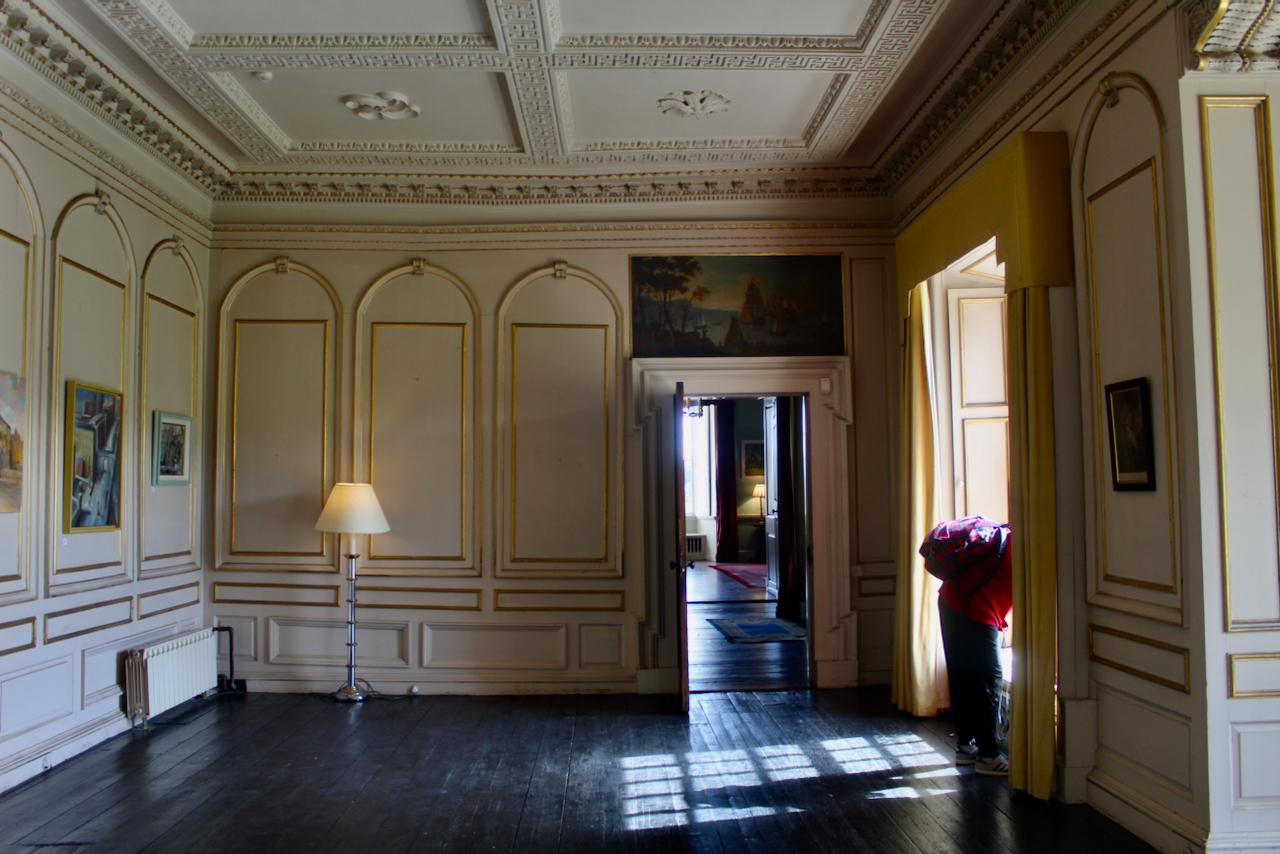
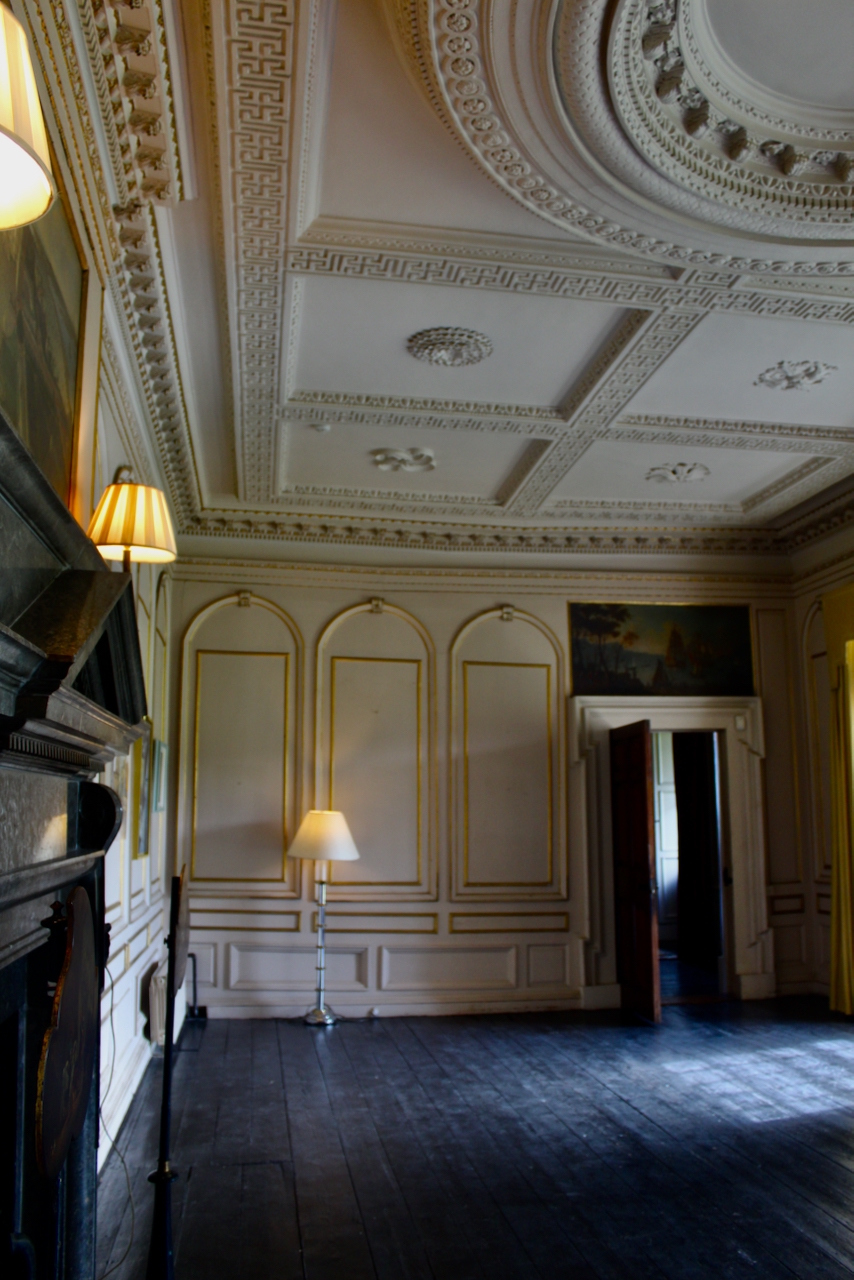
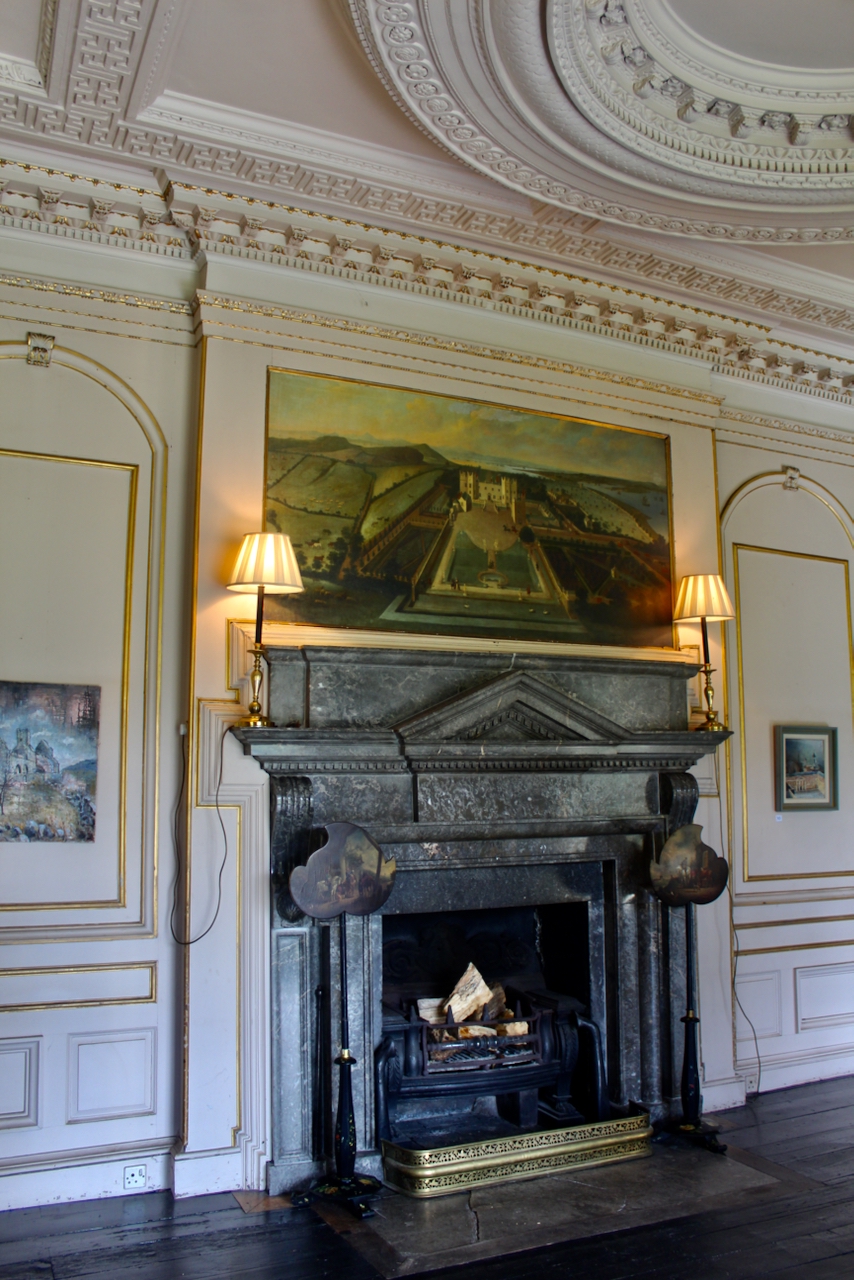
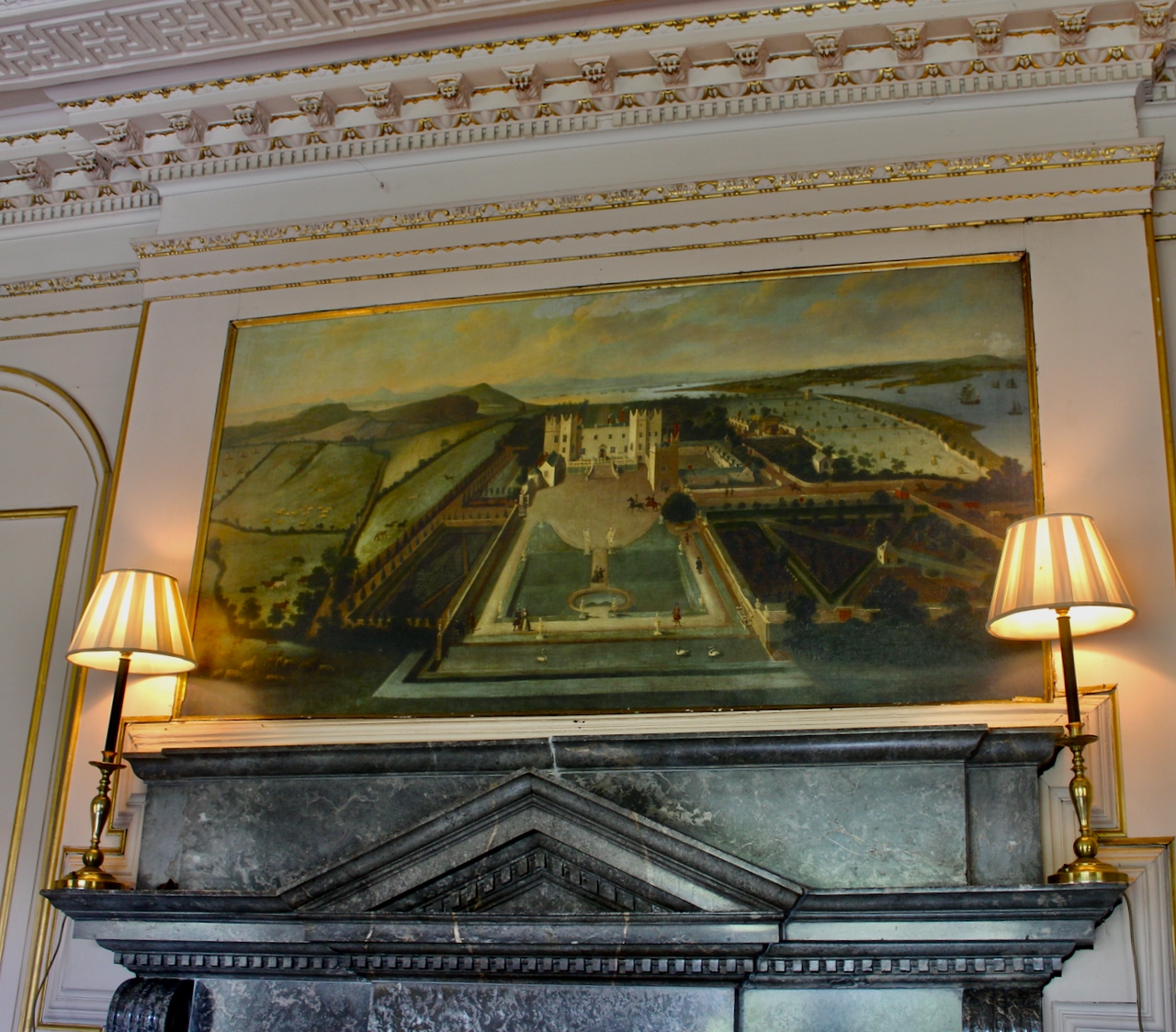
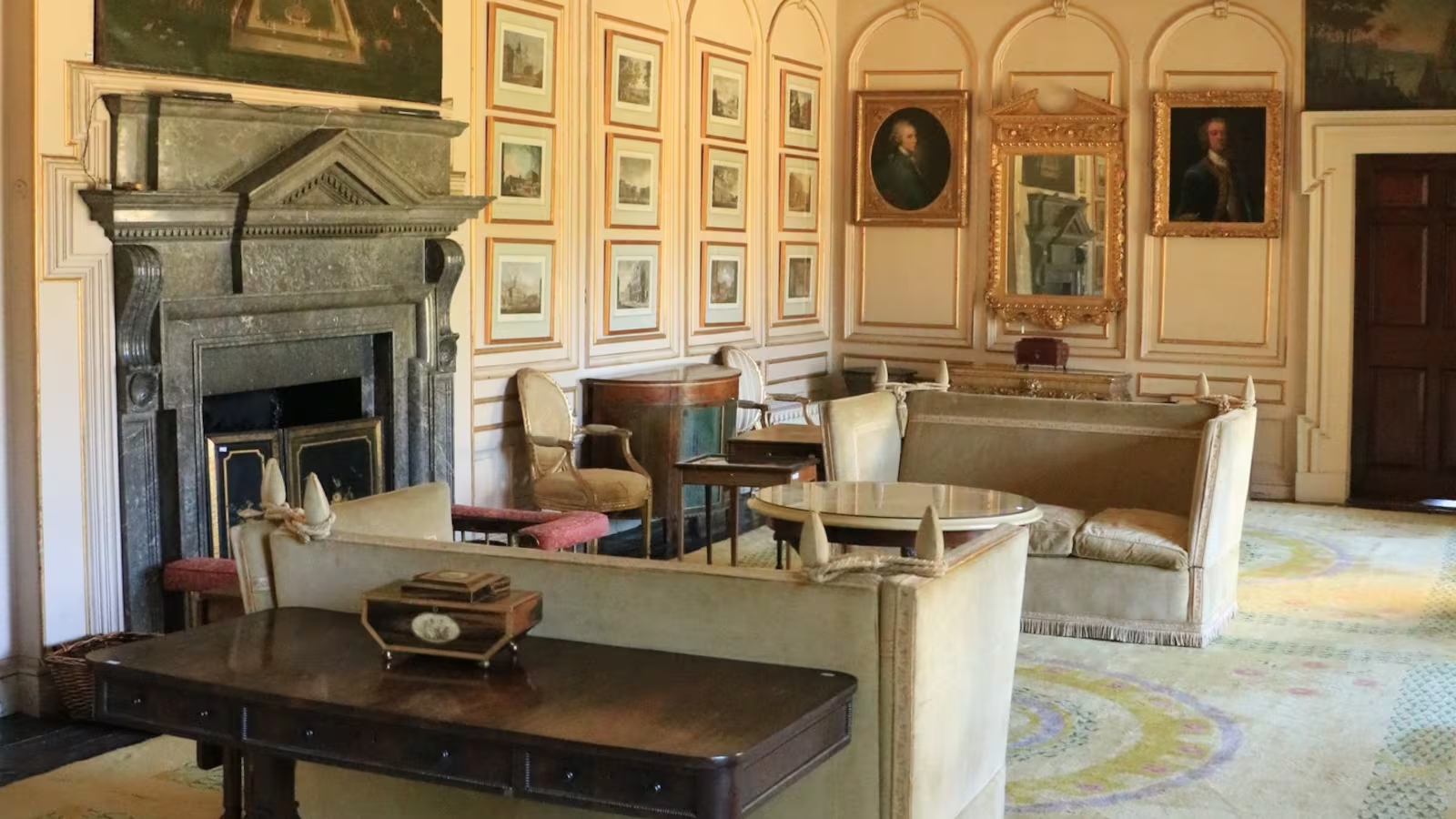
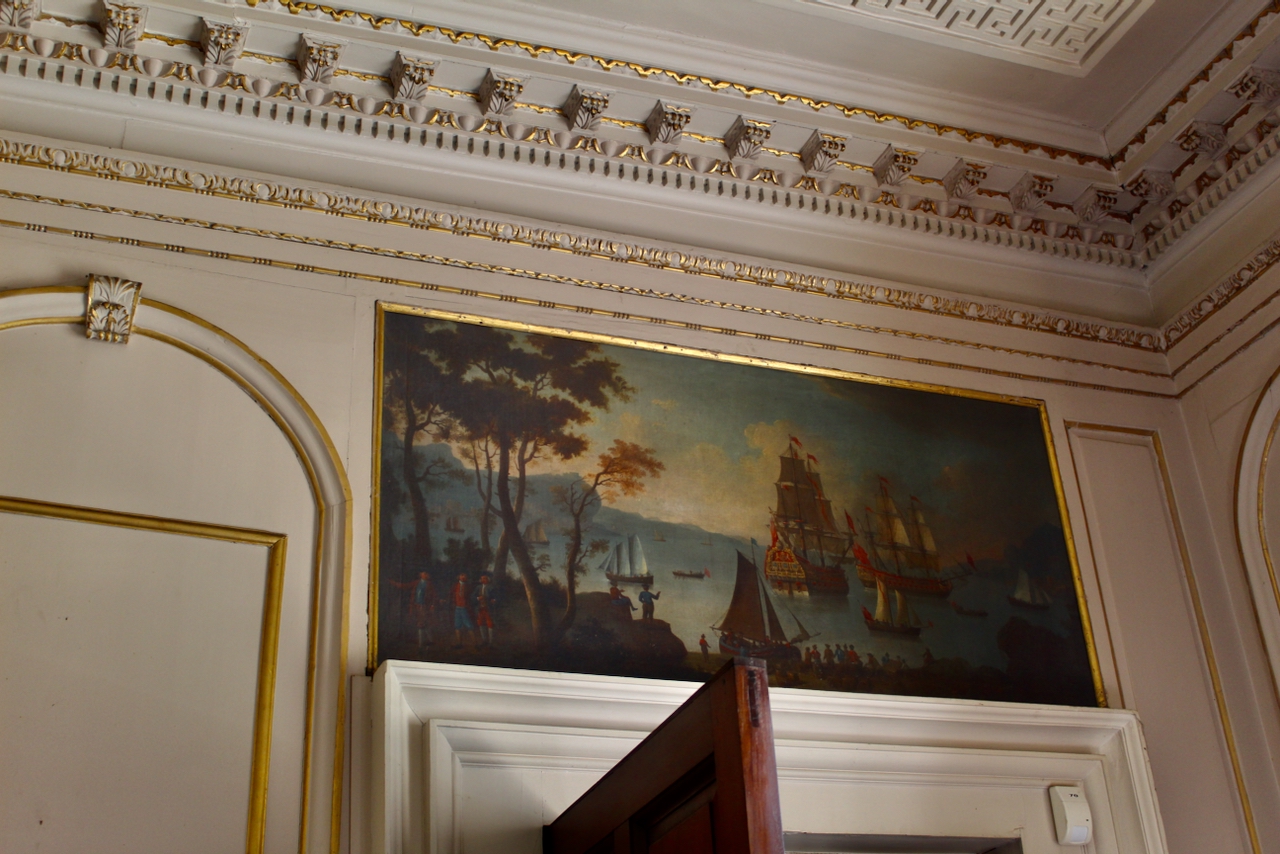
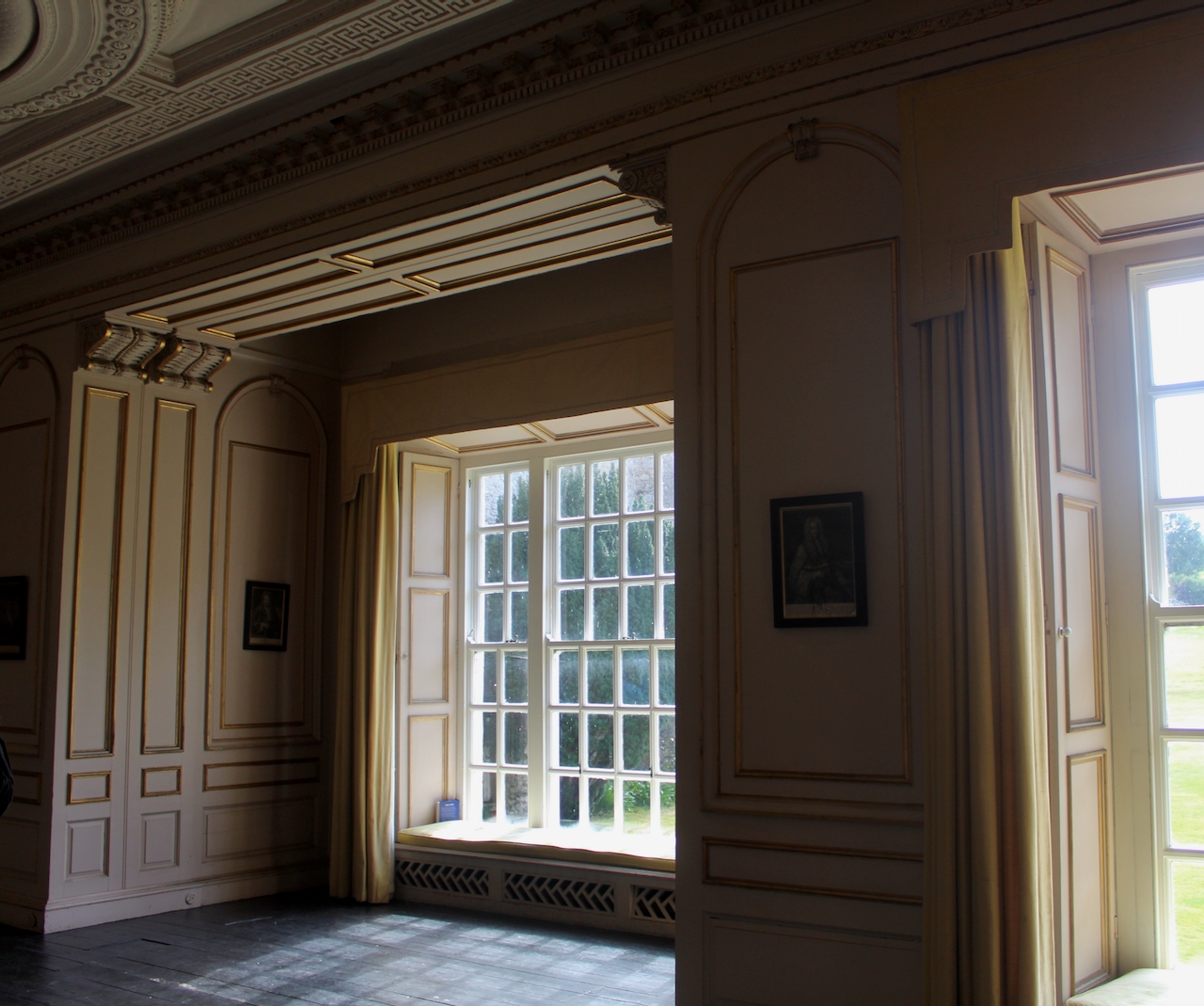
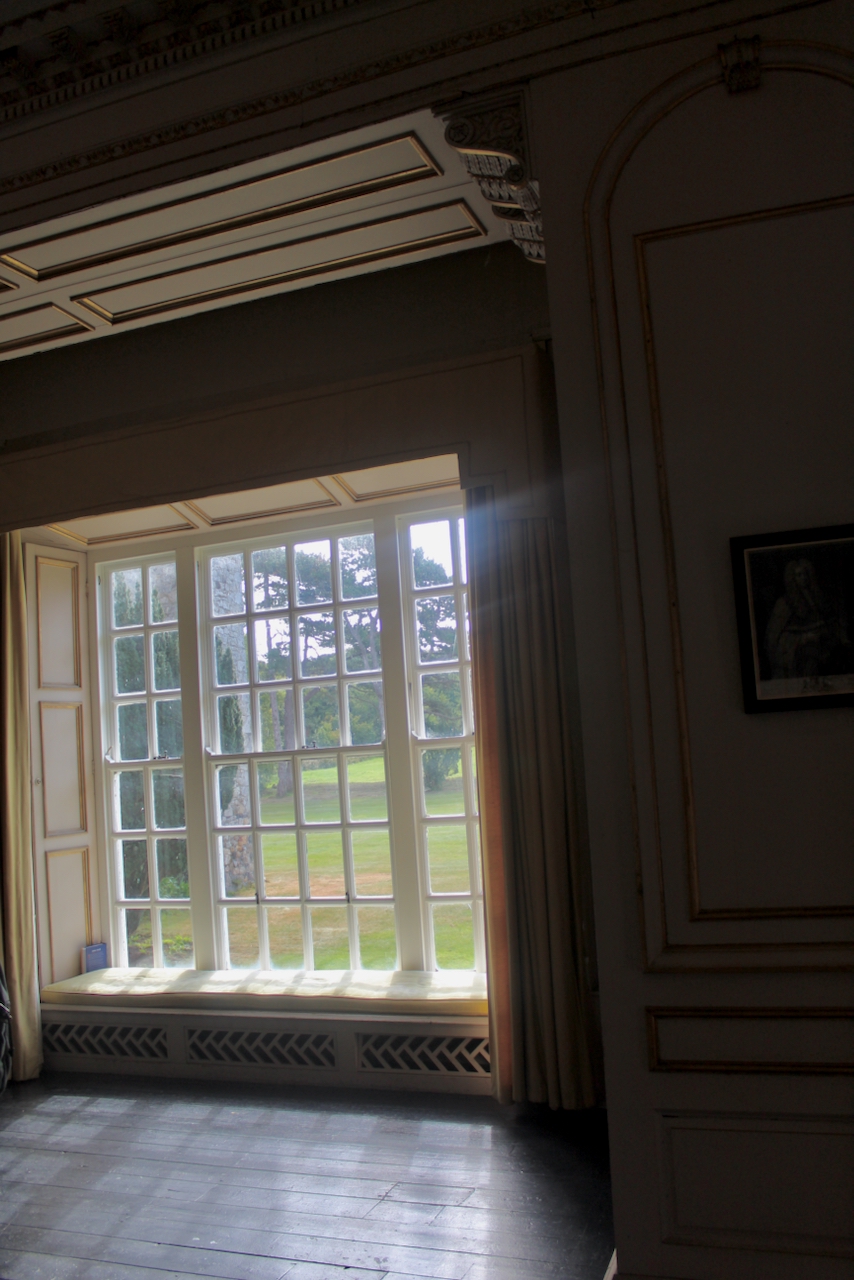
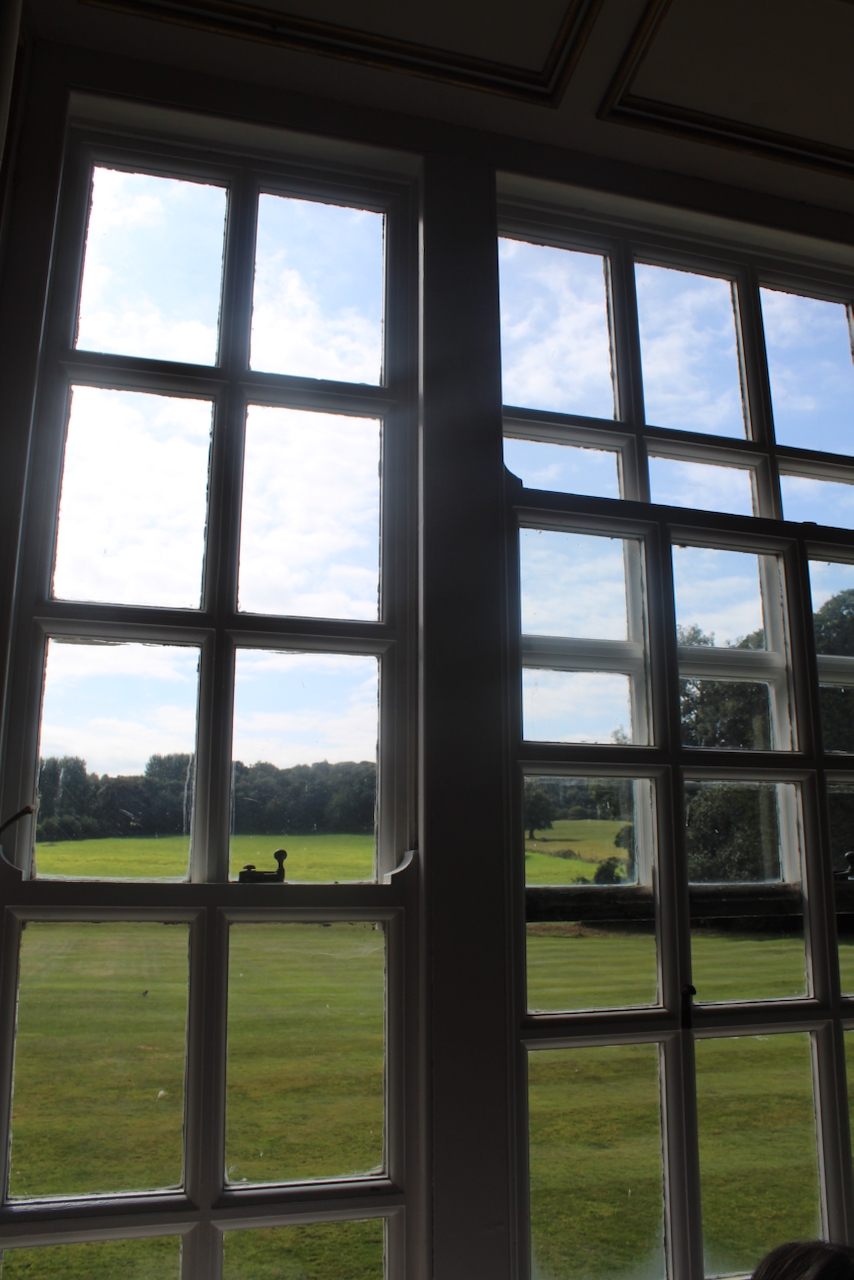
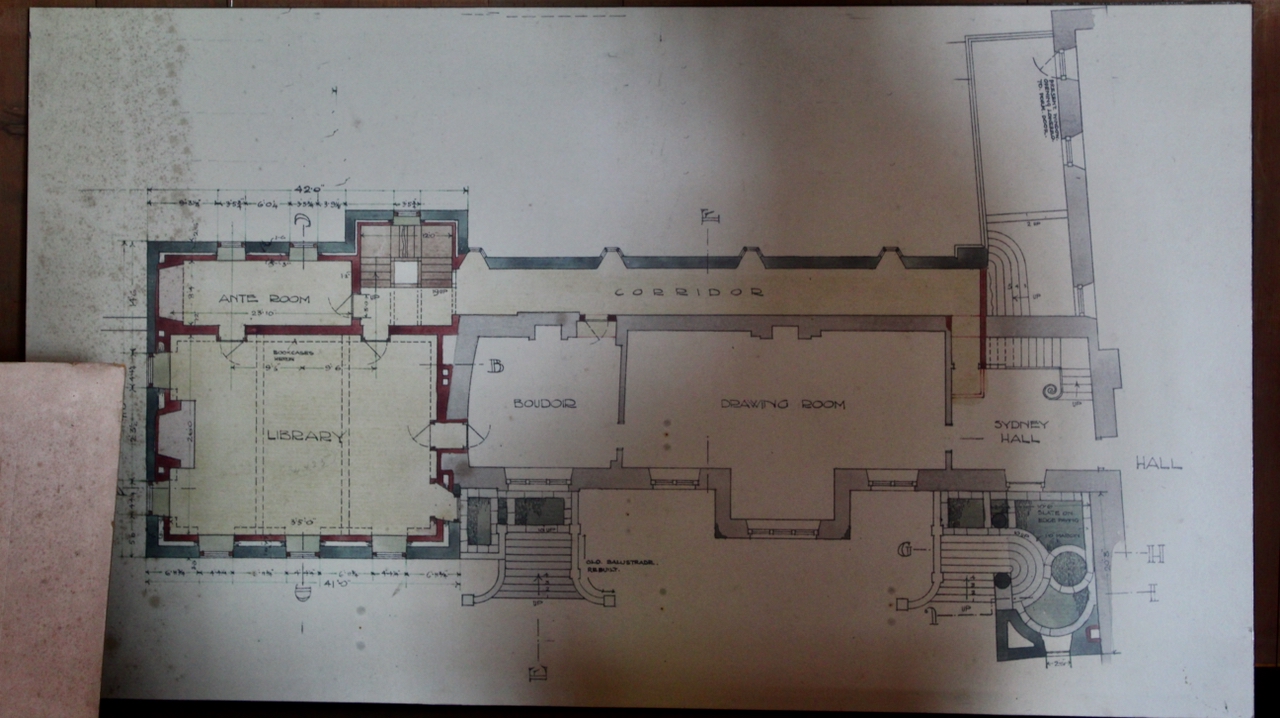
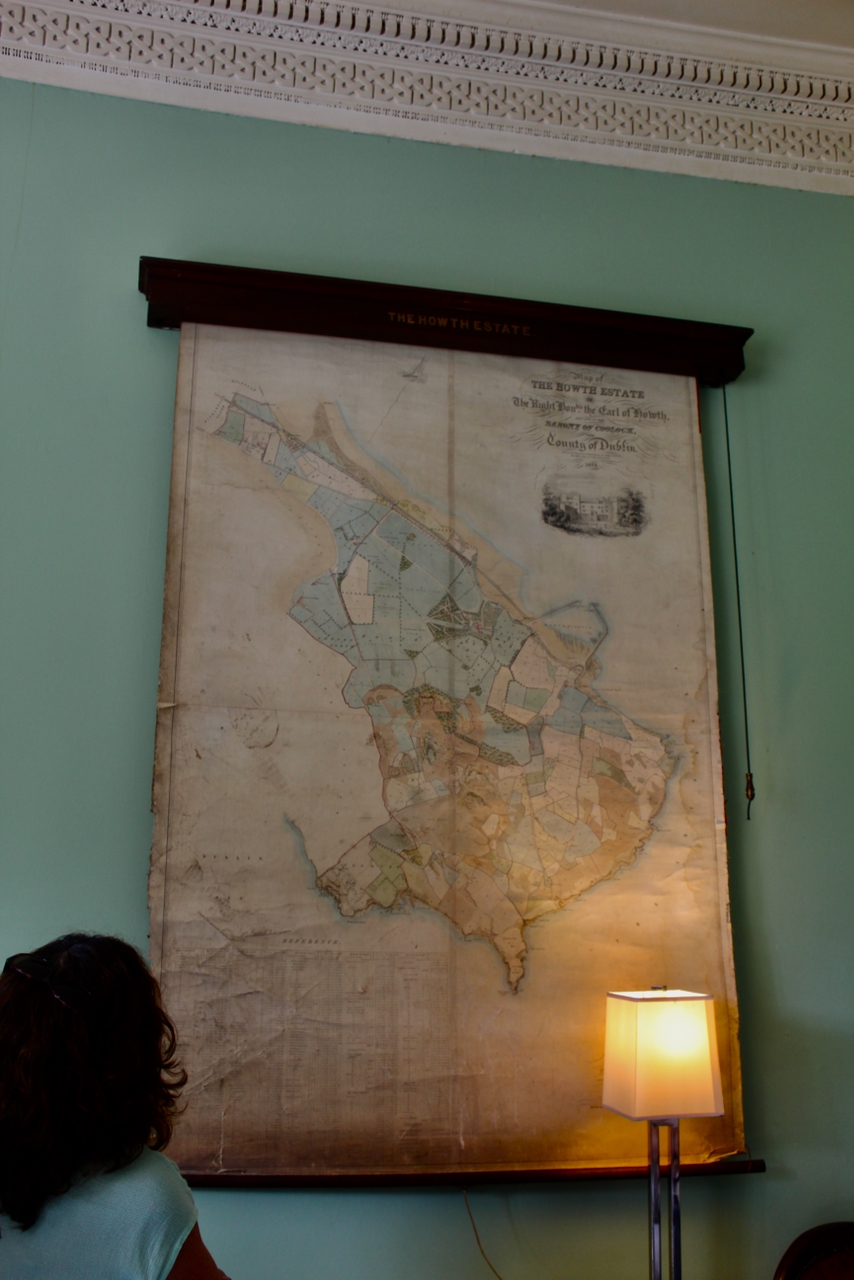
Before entering the library we entered another room, the Boudoir, which contains an old map of the estate. At its height, the Howth Estate covered about 15,000 acres. This estate stretched from Howth to Killester and partially through North County Dublin and Meath.
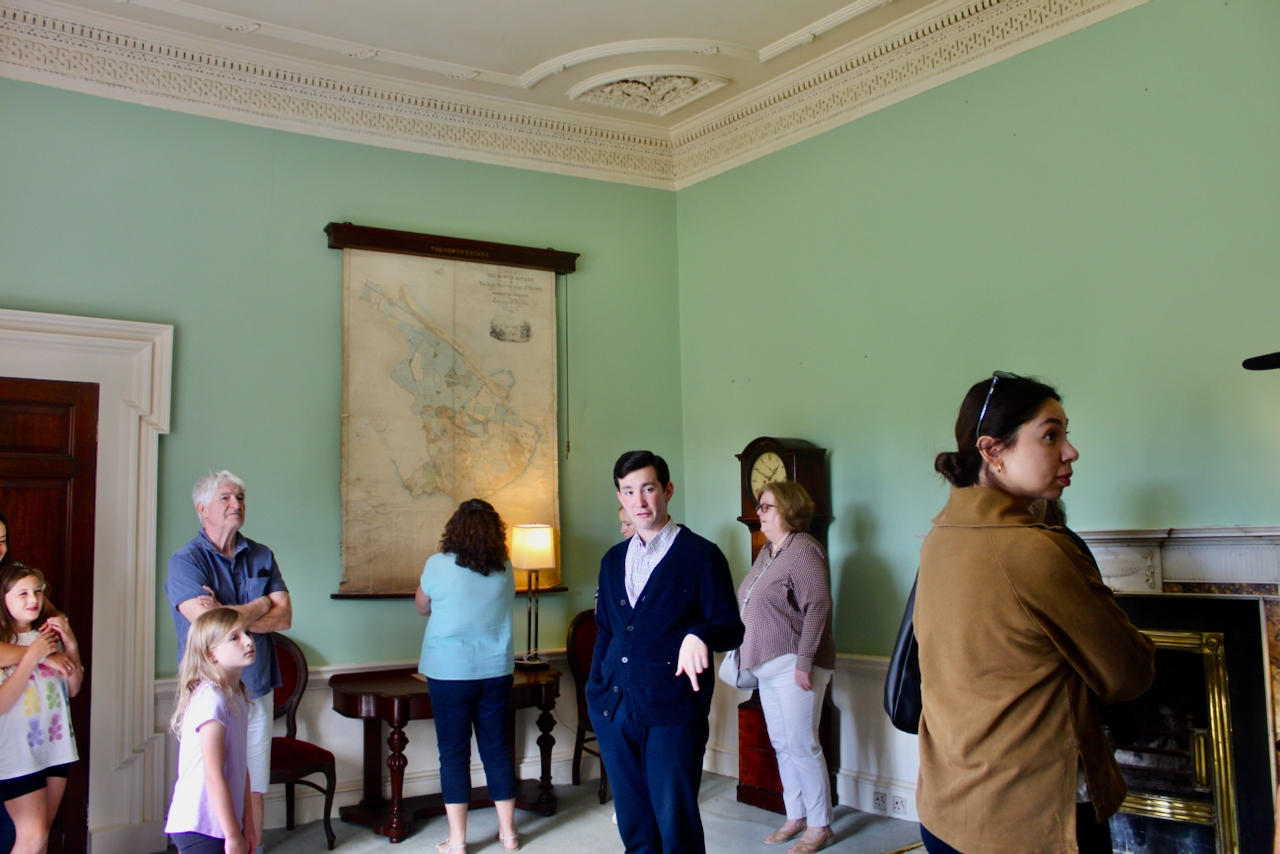
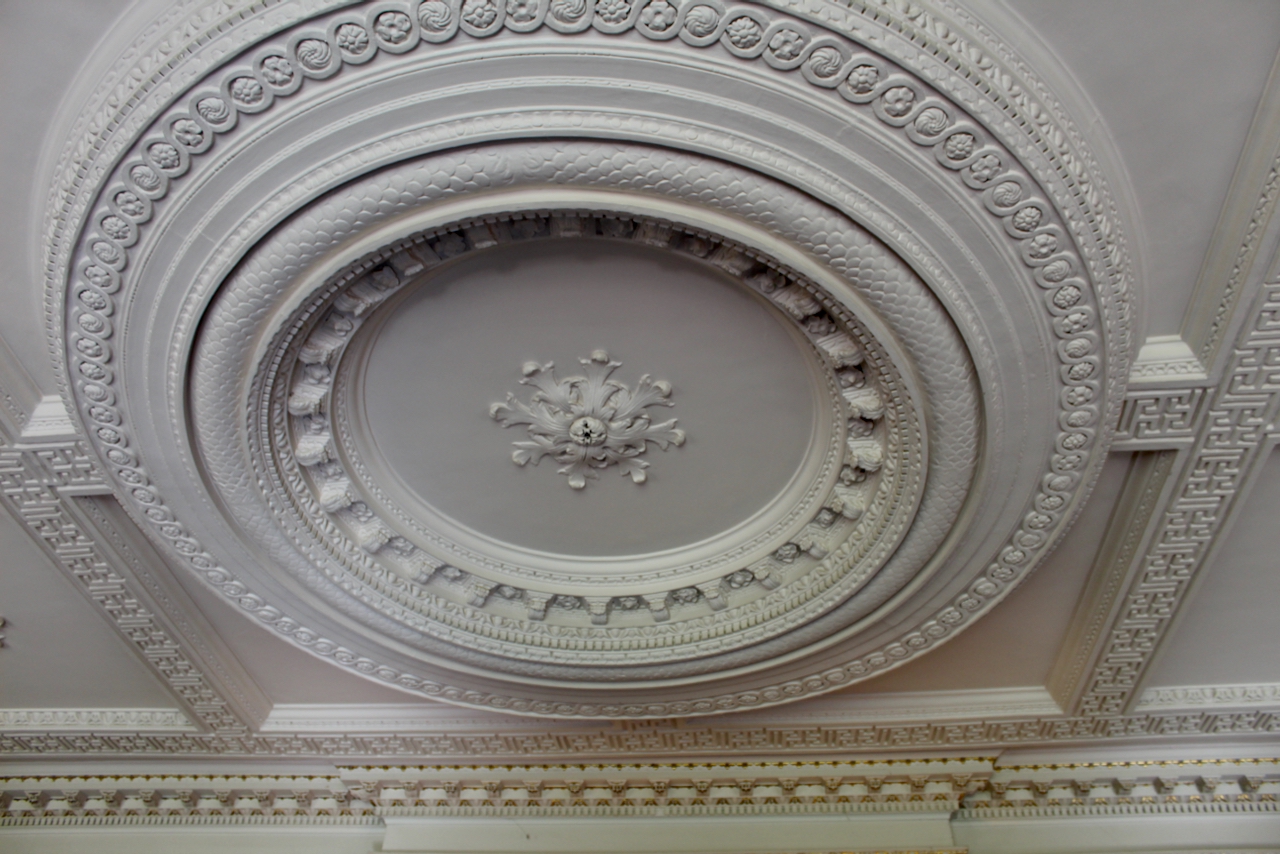
This room also has a beautiful decorative ceiling.
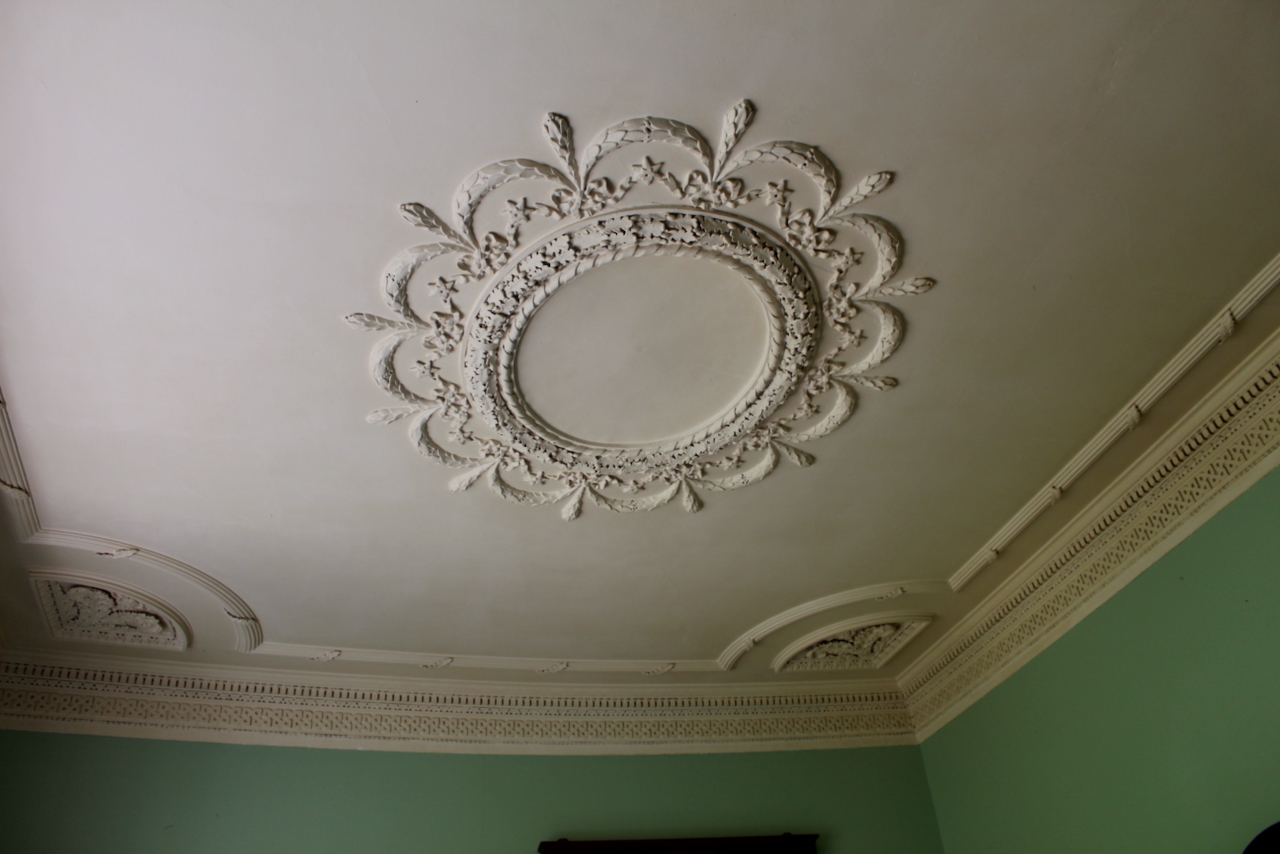
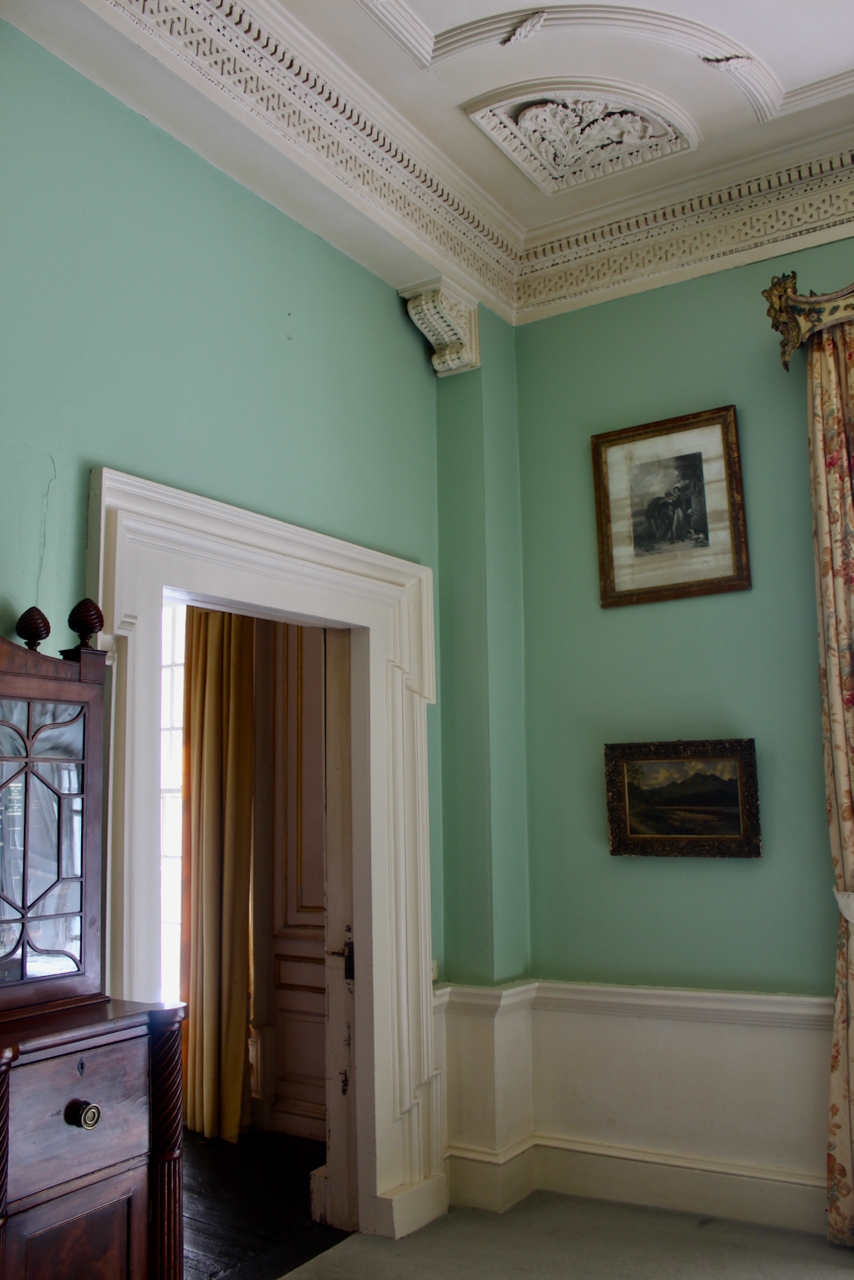
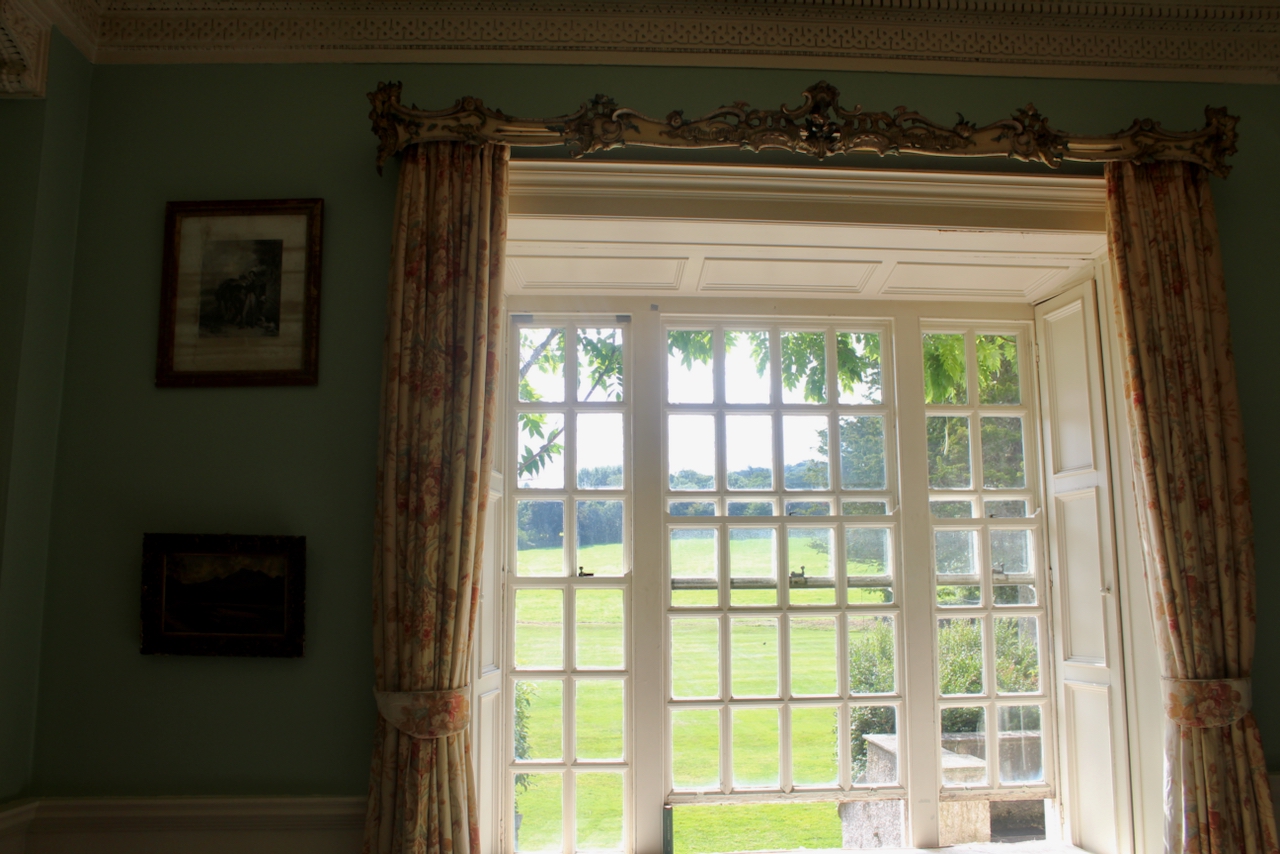
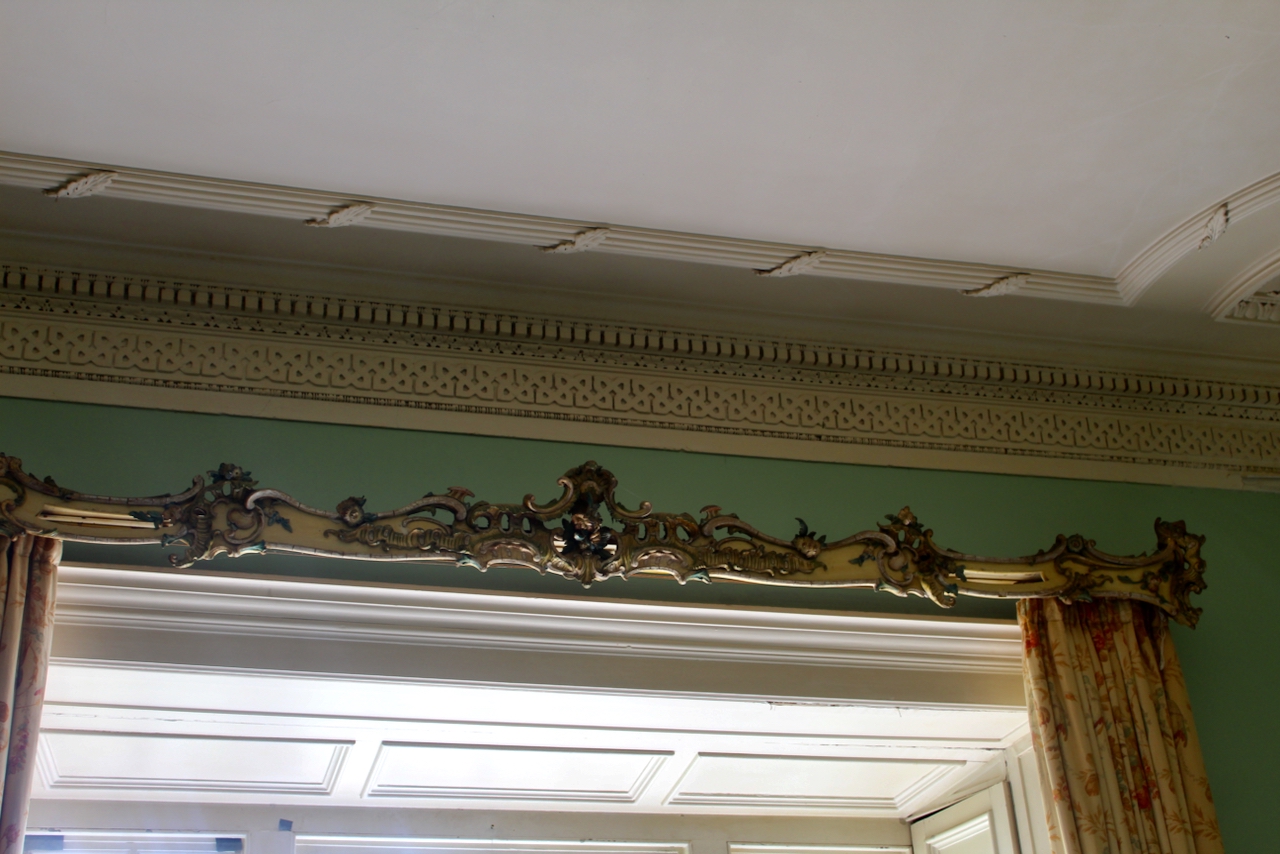
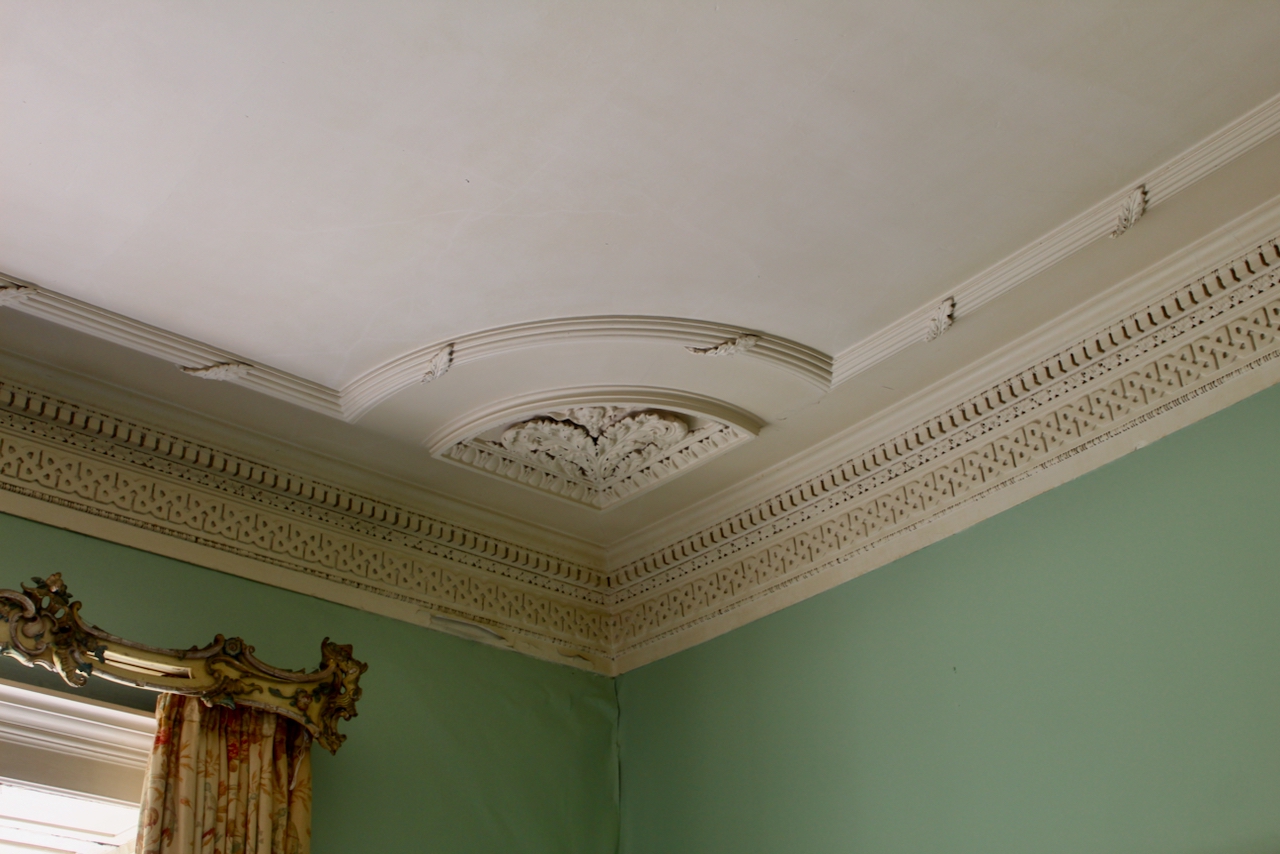
The library, by Lutyens, in his tower, has bookcases and panelling of oak and a ceiling of elm boarding.
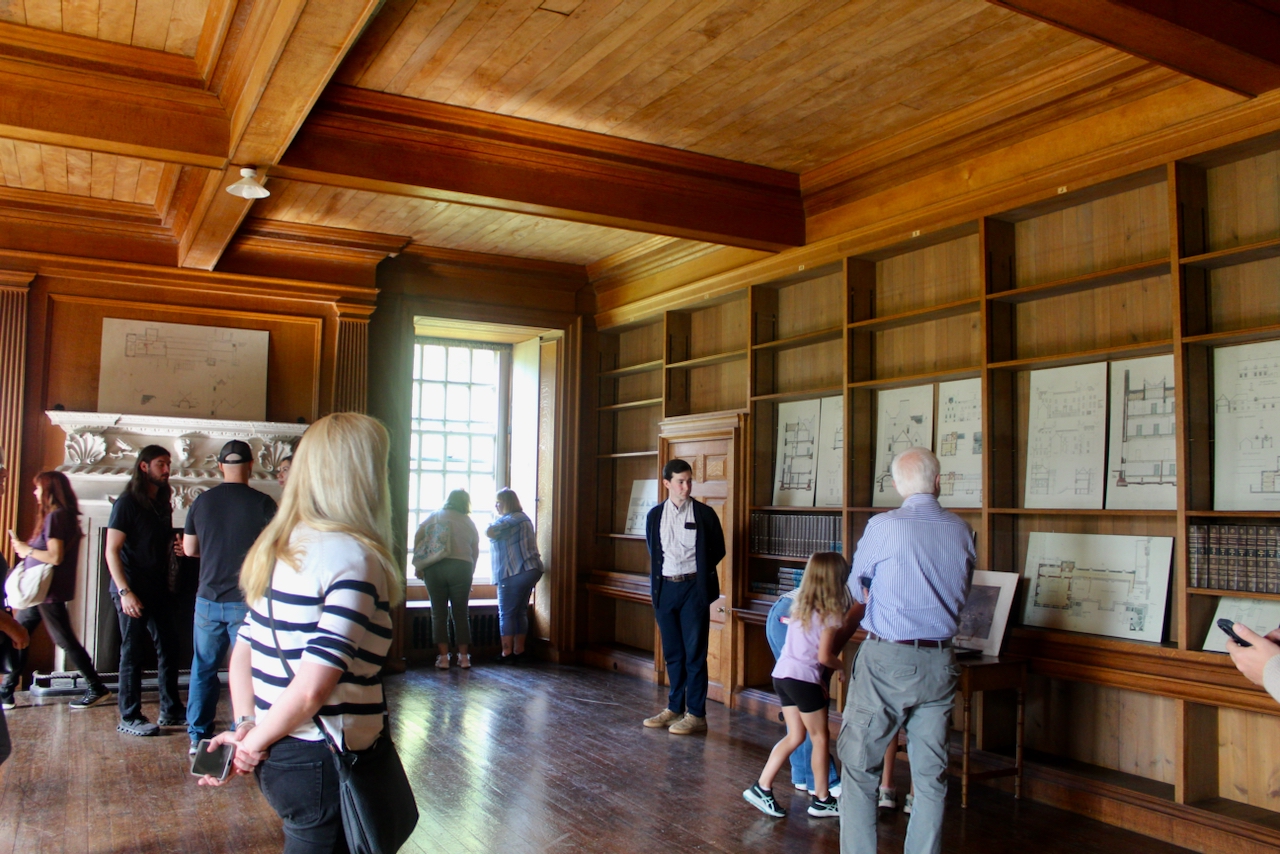
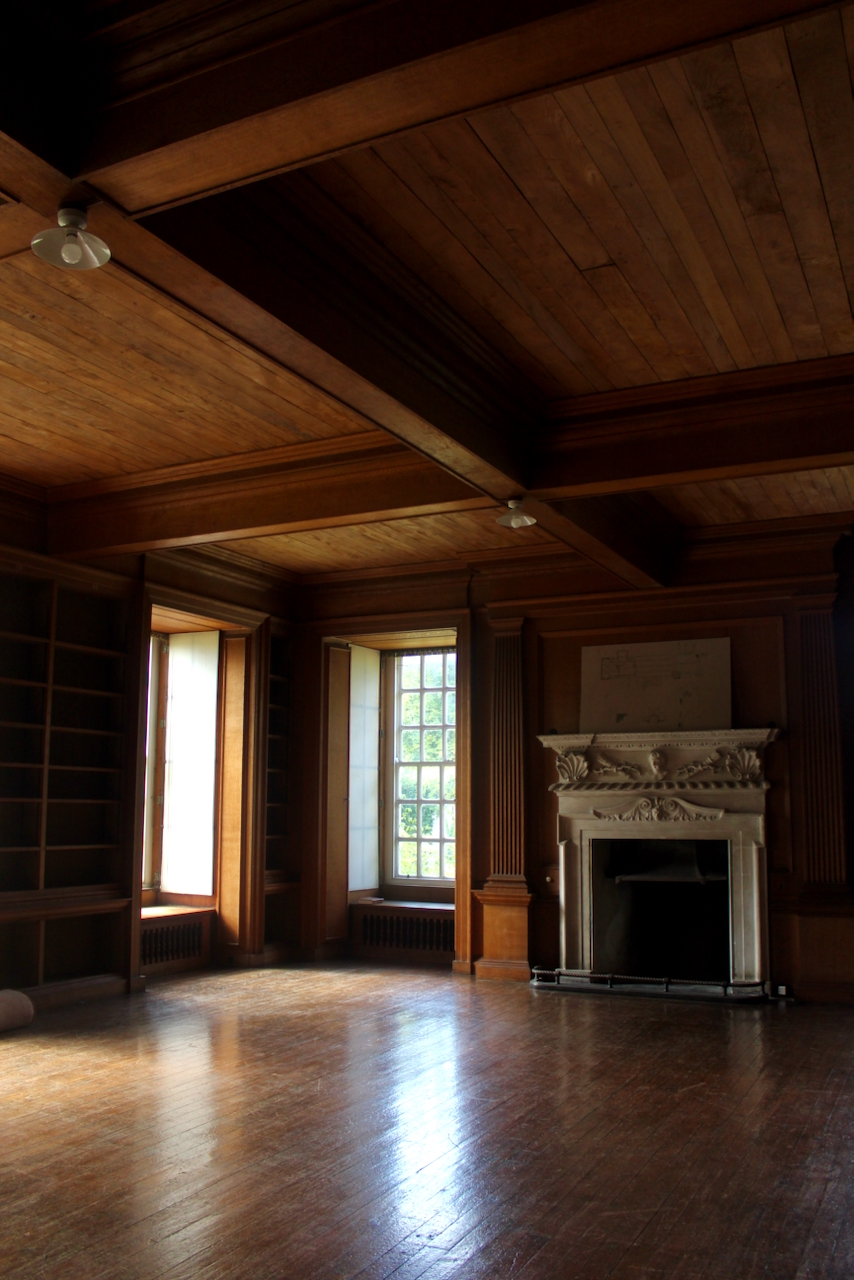
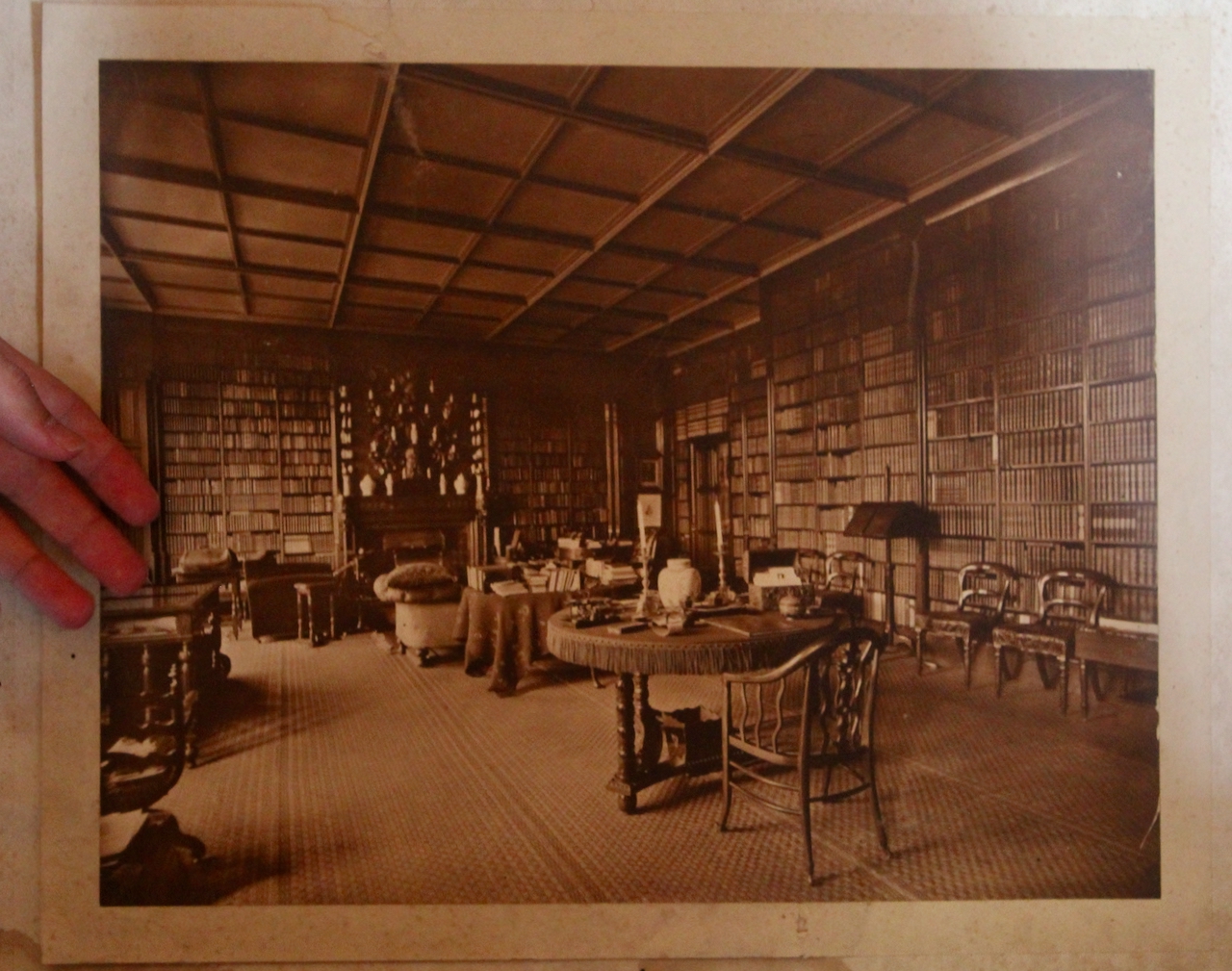
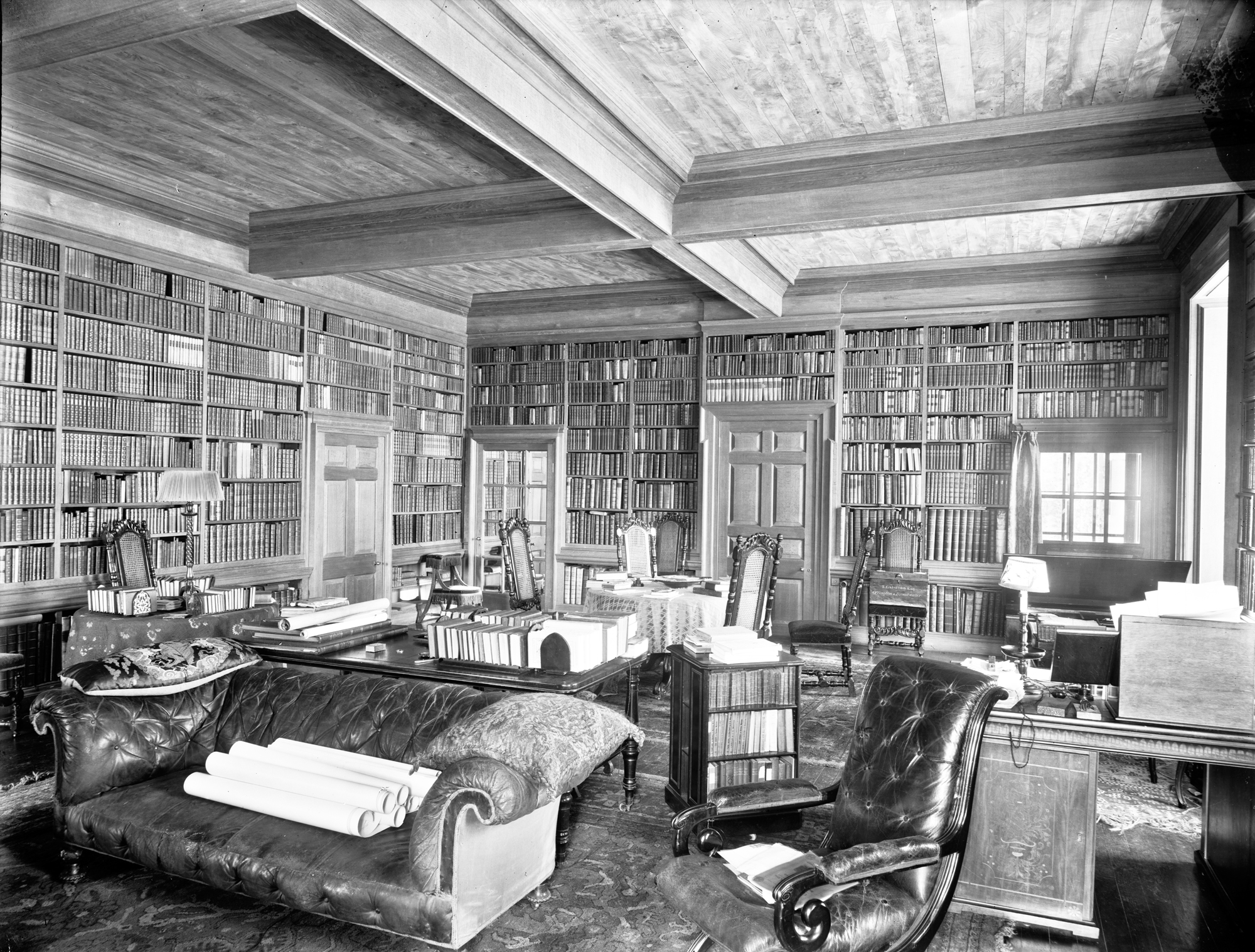
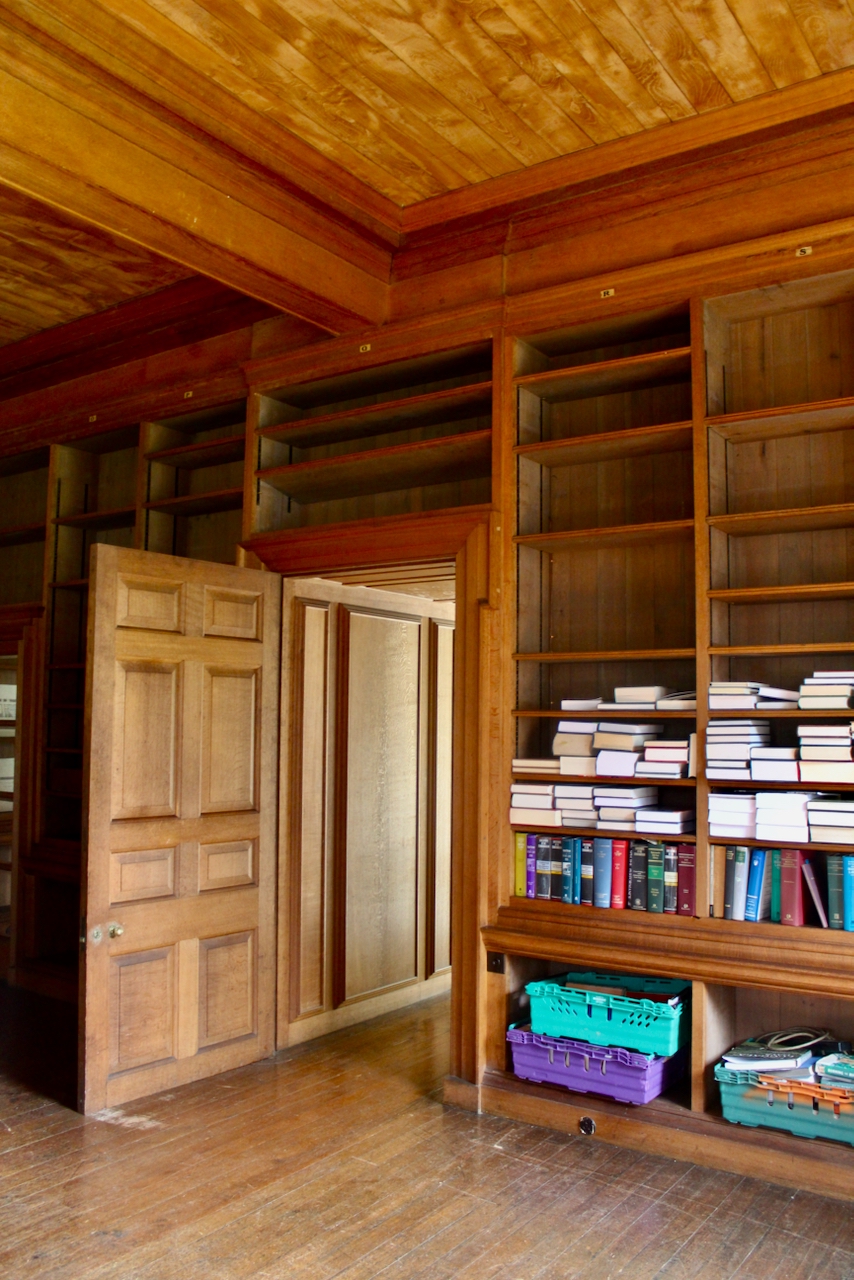
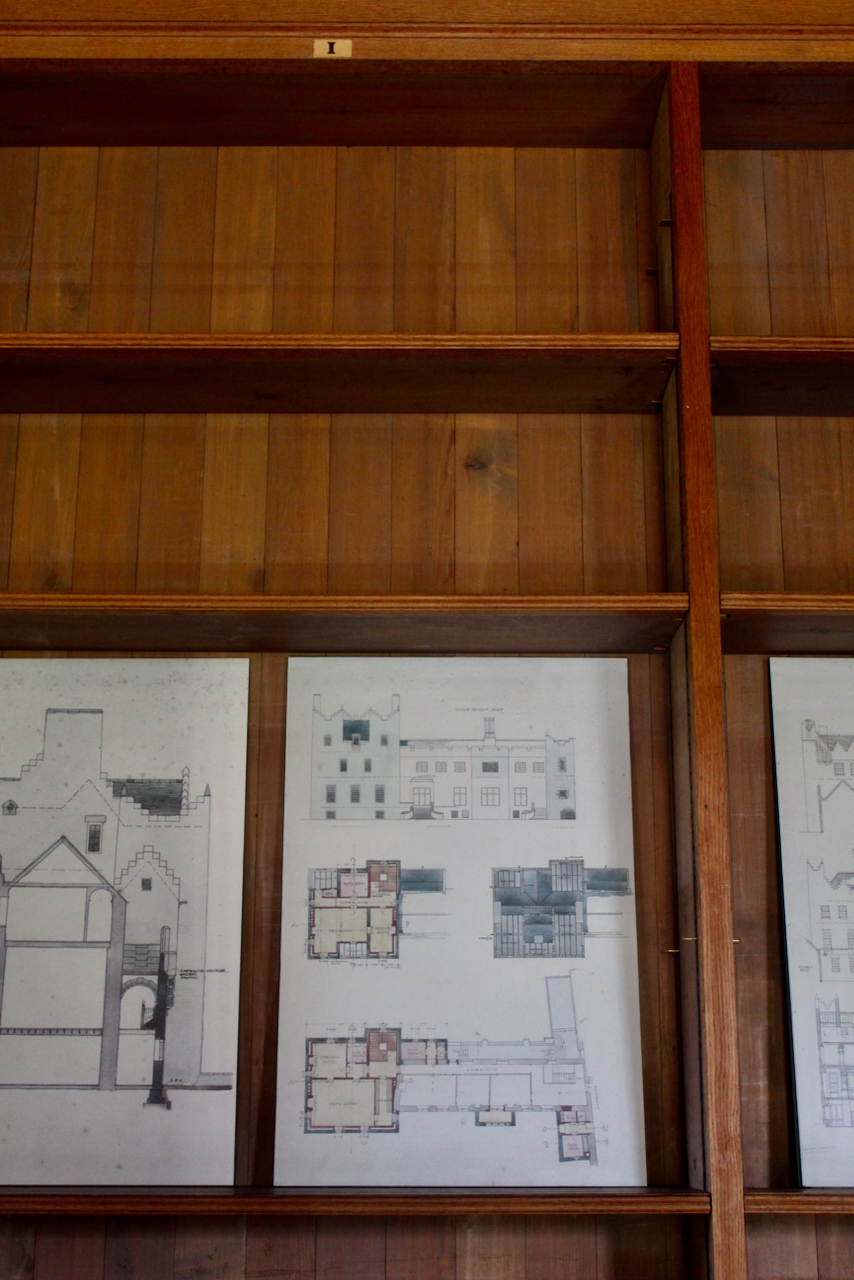
Lutyens added a long corridor to one side of the drawing room and boudoir.
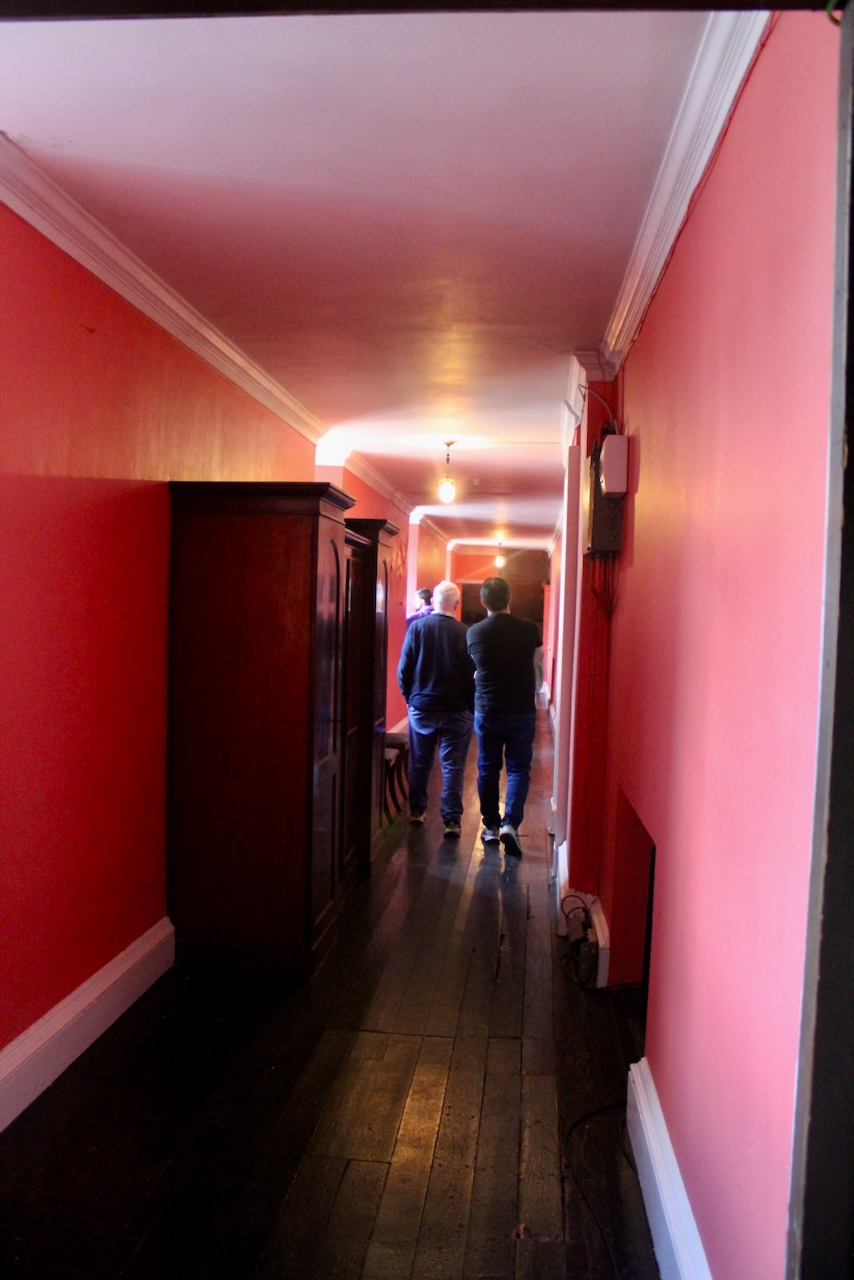
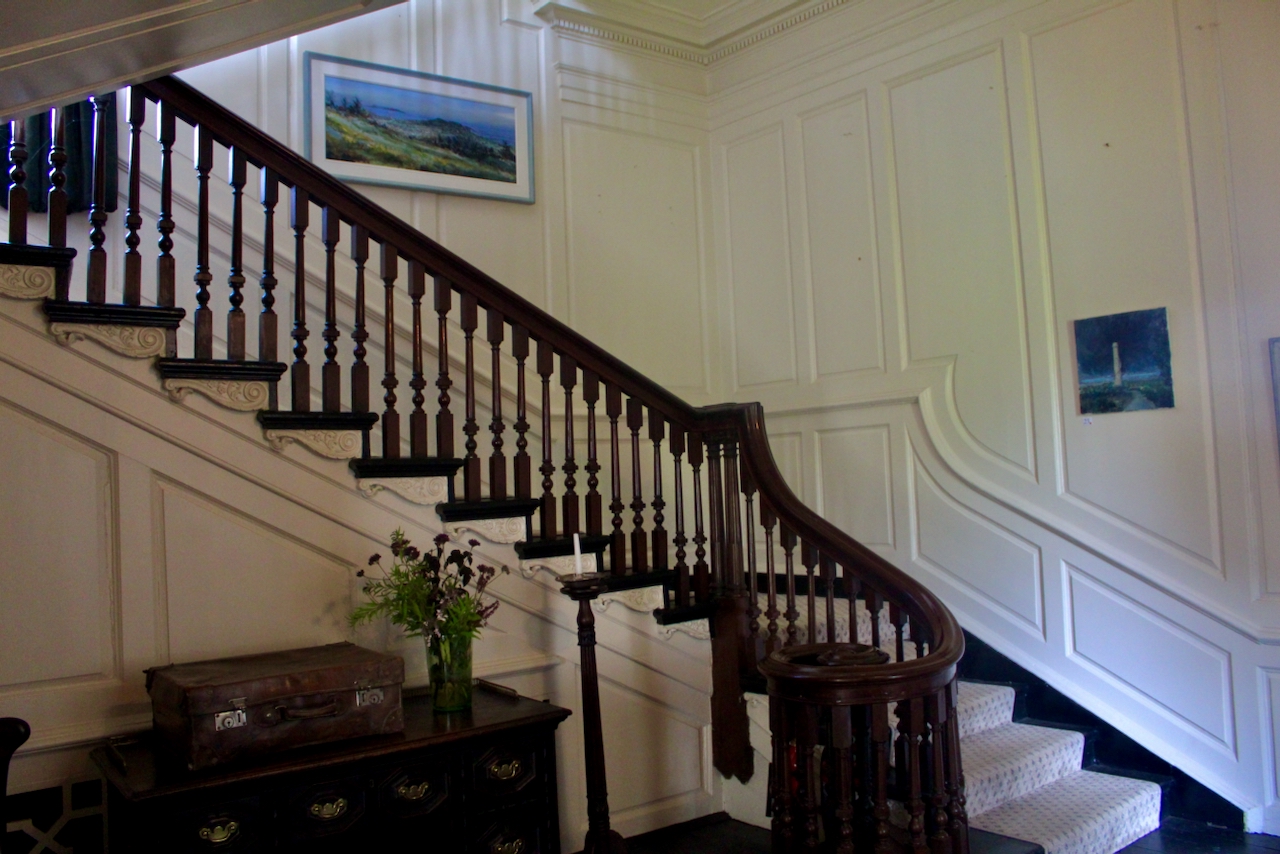
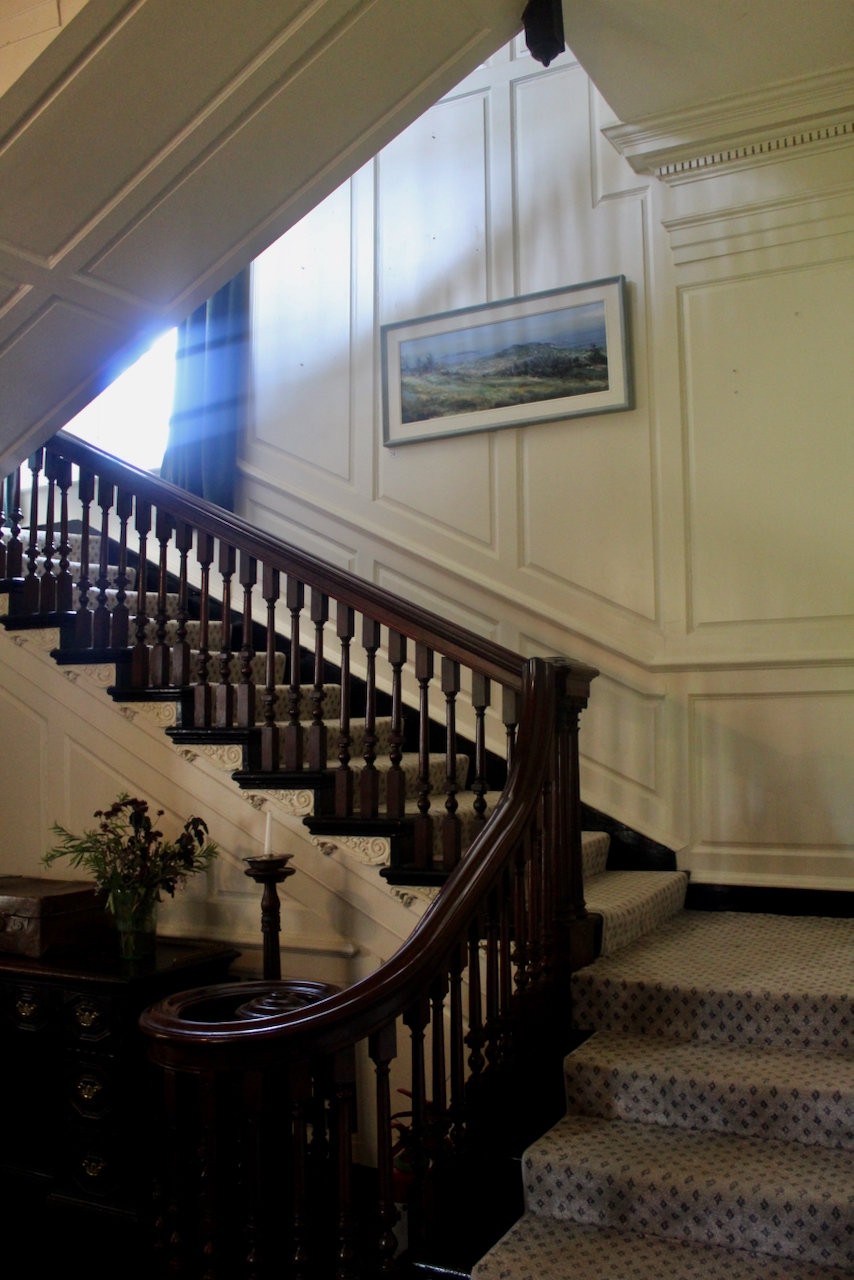
We also passed the staircase, but the tour did not include upstairs.
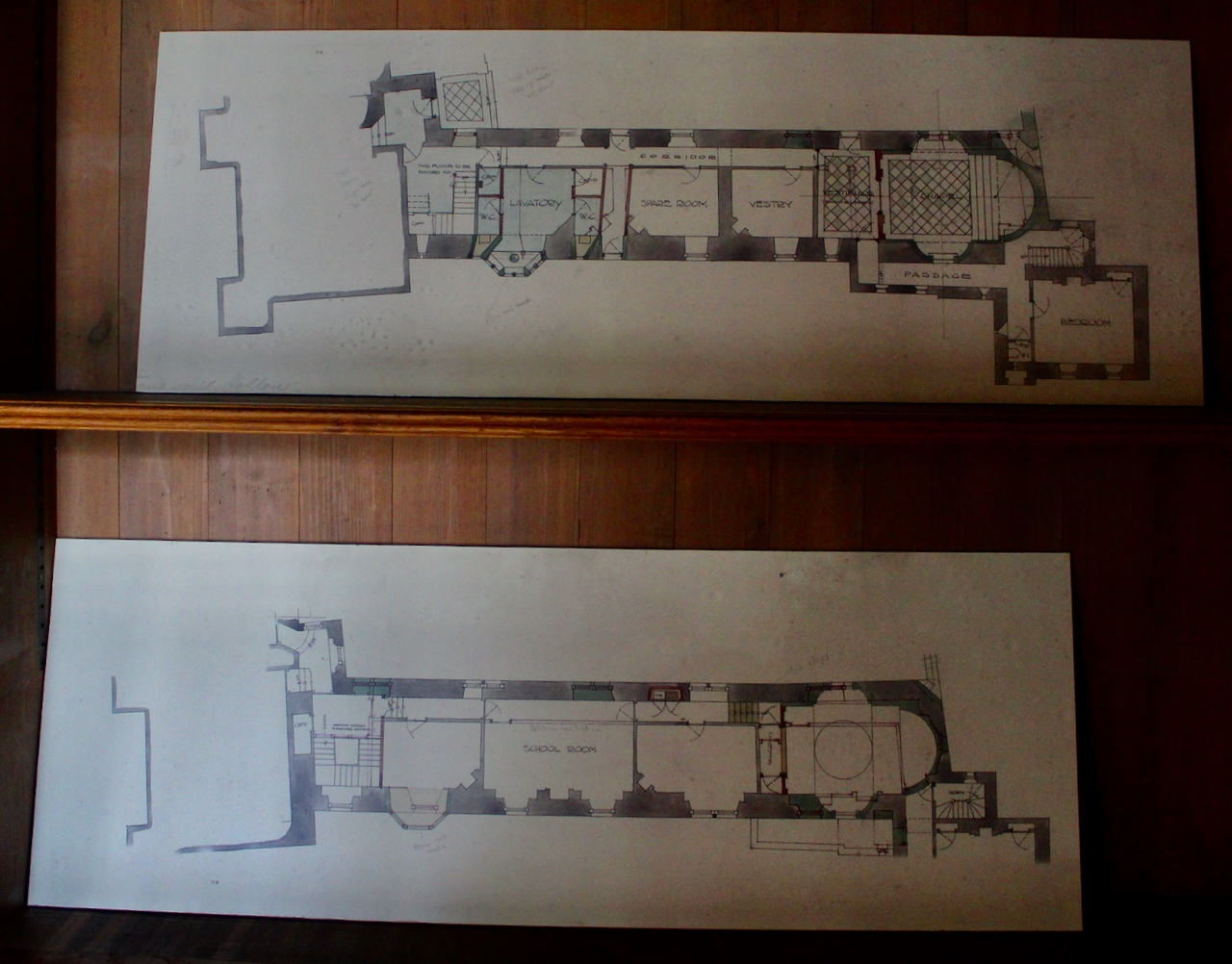
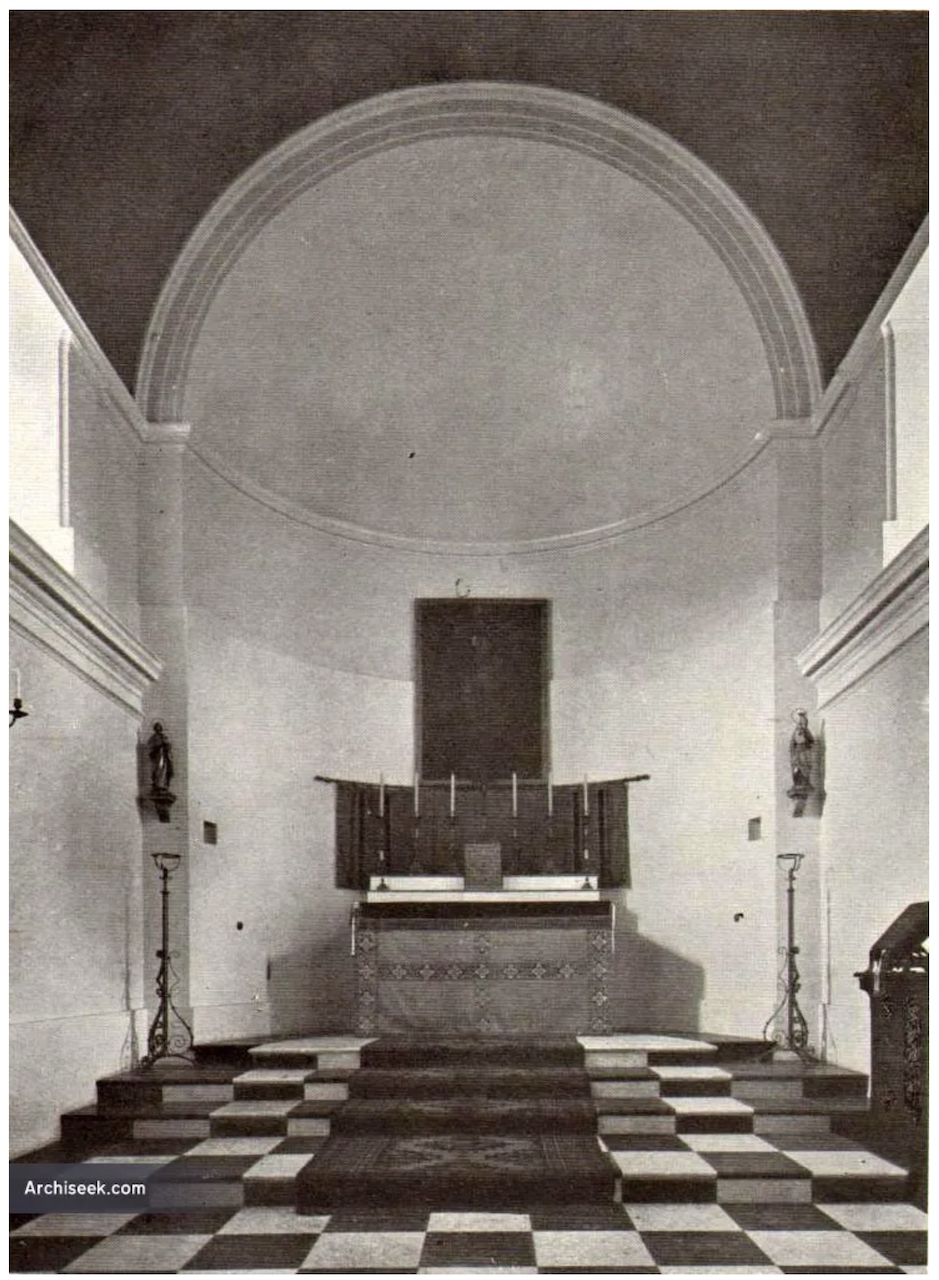
Mark Bence-Jones tells us: “Lutyens also made a simple and dignified Catholic chapel in early C19 range on one side of the entrance court; it has a barrel-vaulted ceiling and an apse behind the altar.”
The addition to the east wing by Lutyens in around 1911 contains the chapel. Unfortunately we did not get to see inside this wing.
Bence-Jones also tells us that the castle has famous gardens, with a formal garden laid out around 1720, gigantic beech hedges, an early eighteenth century canal, and plantings of rhododendrons. I will have to return to see the gardens!
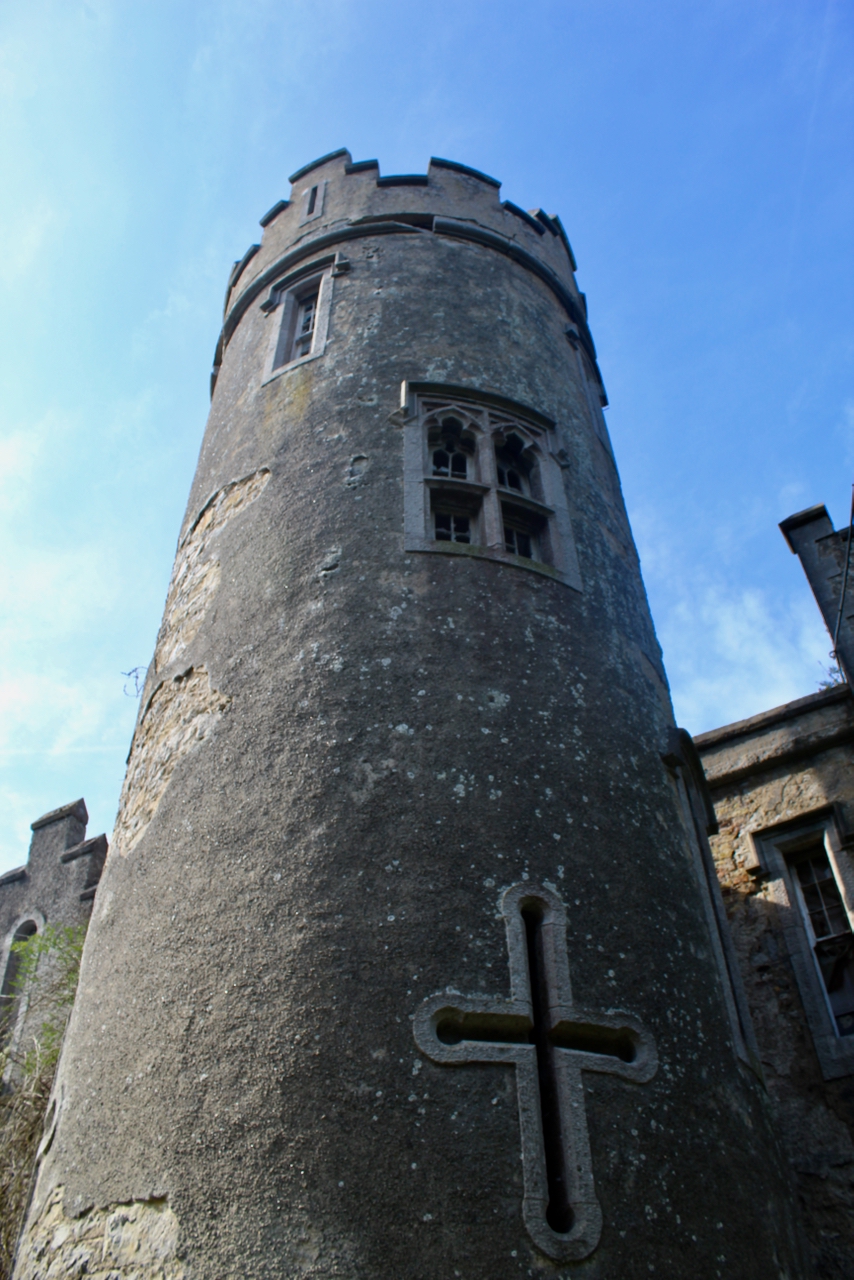
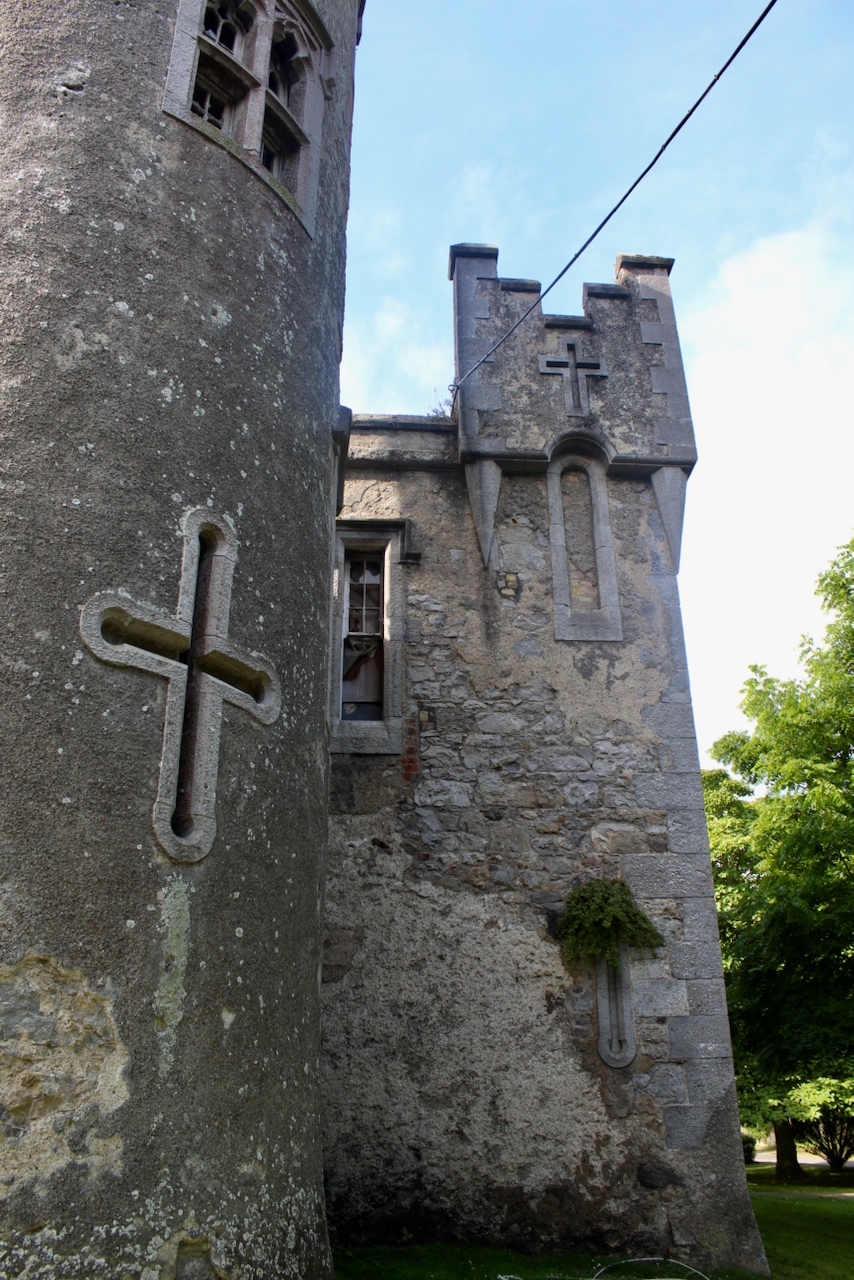
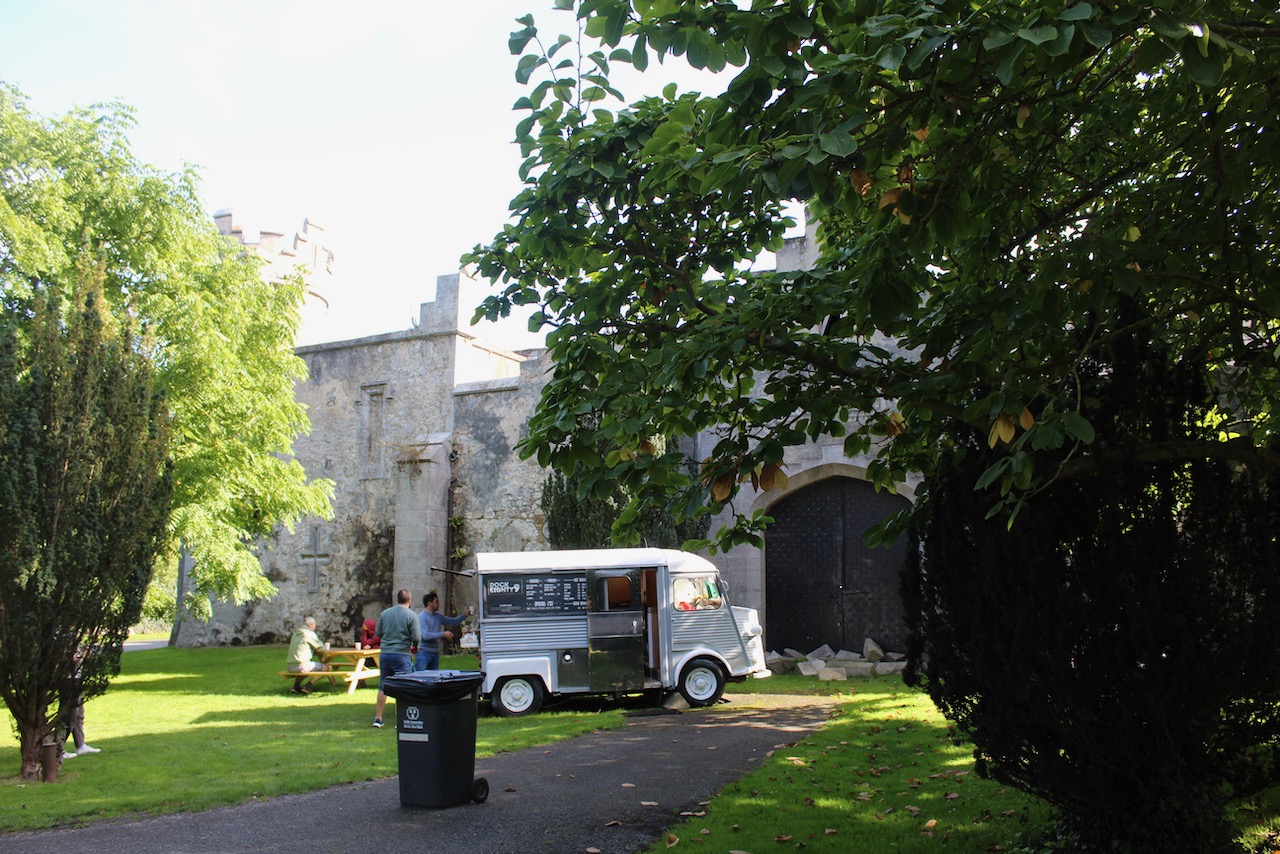
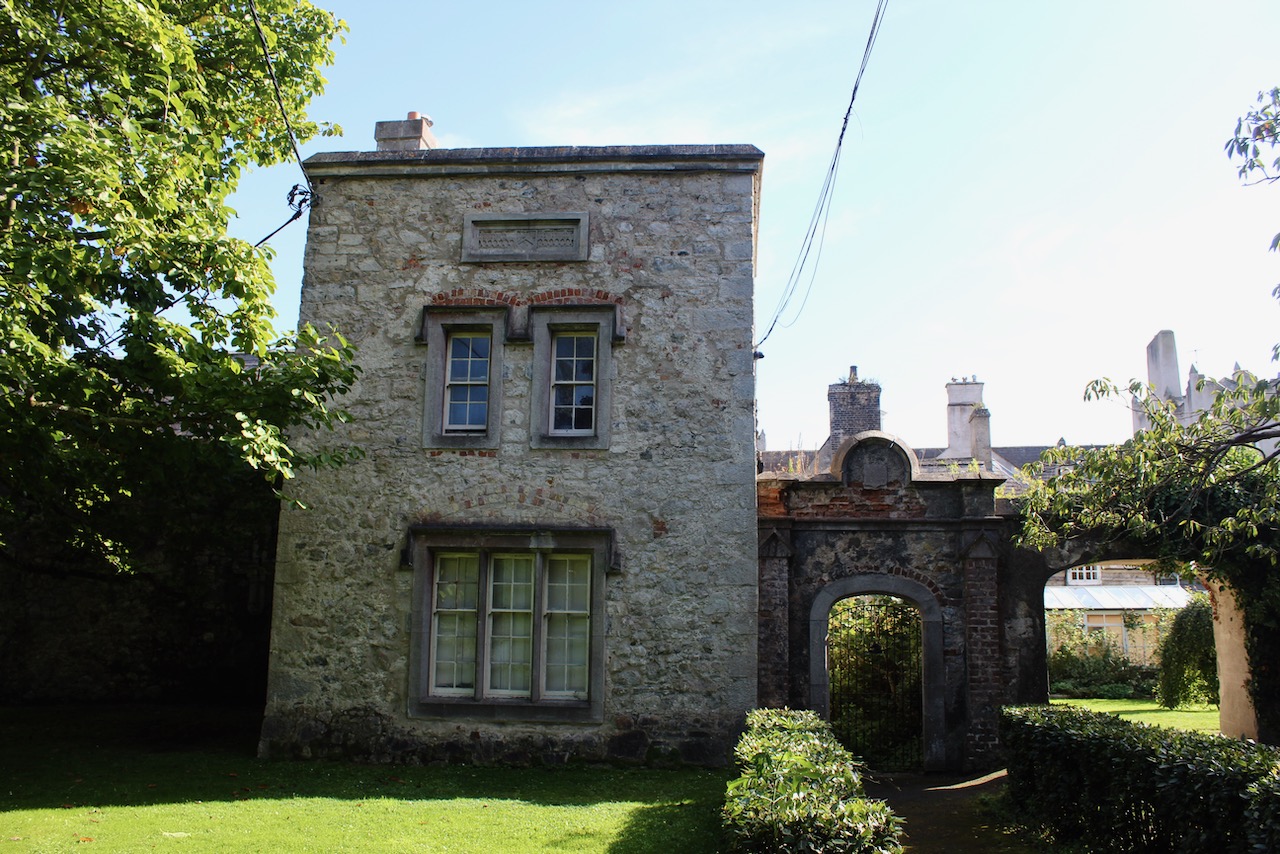
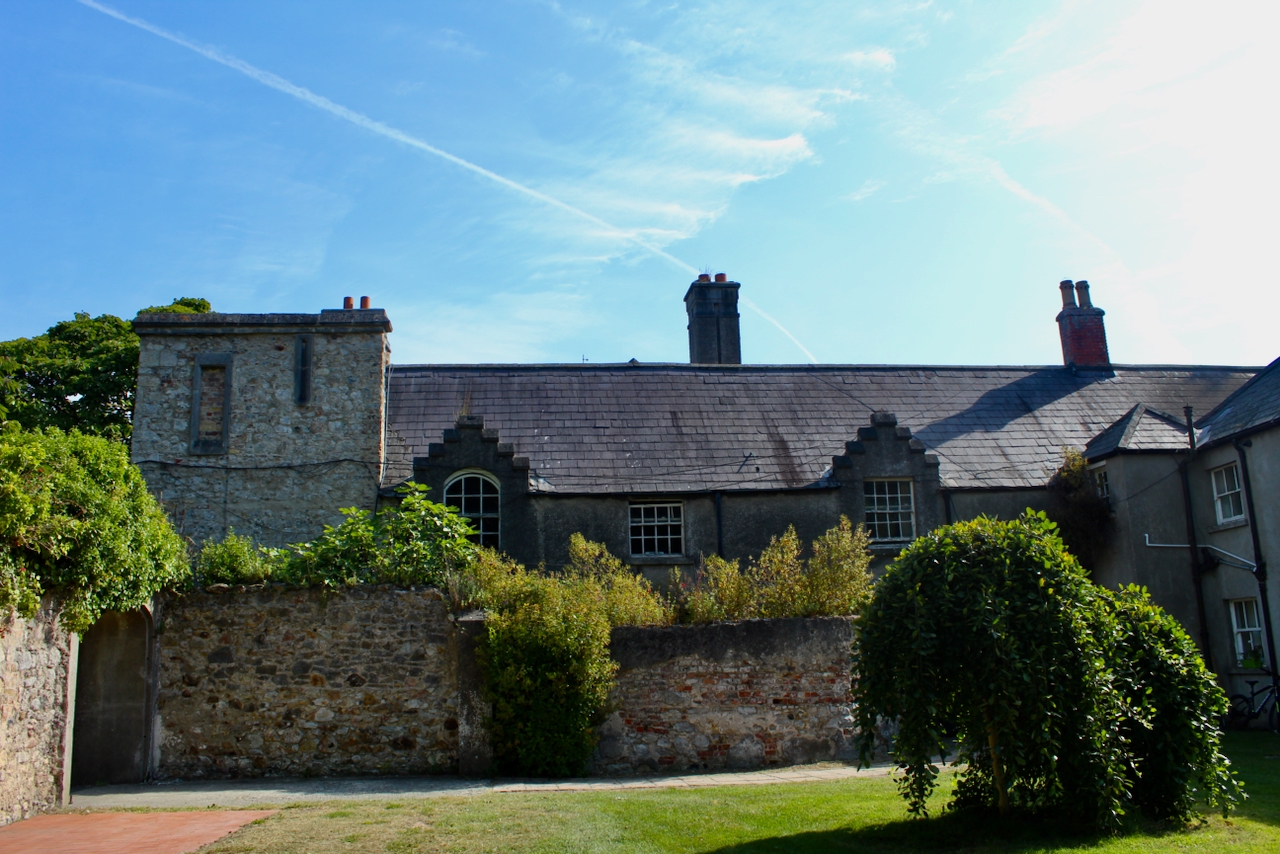
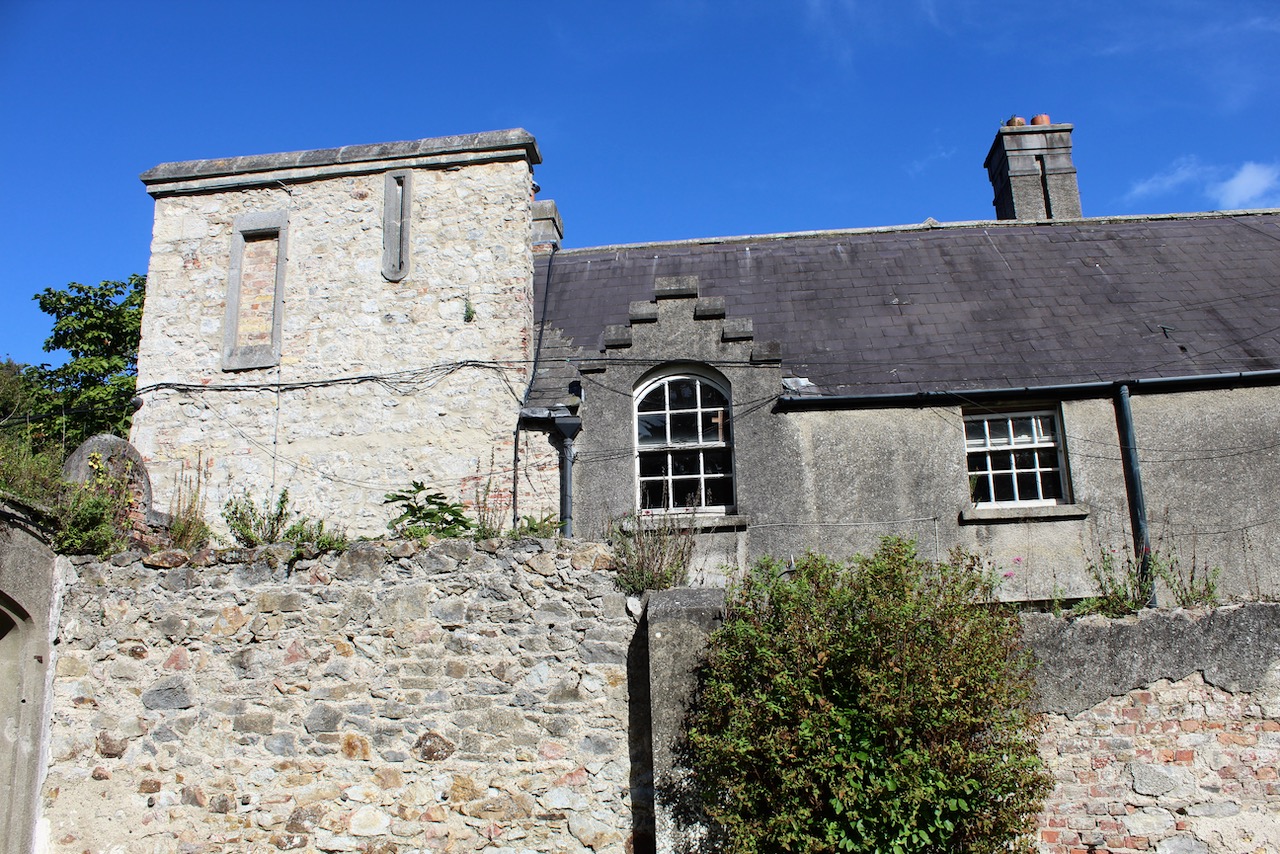
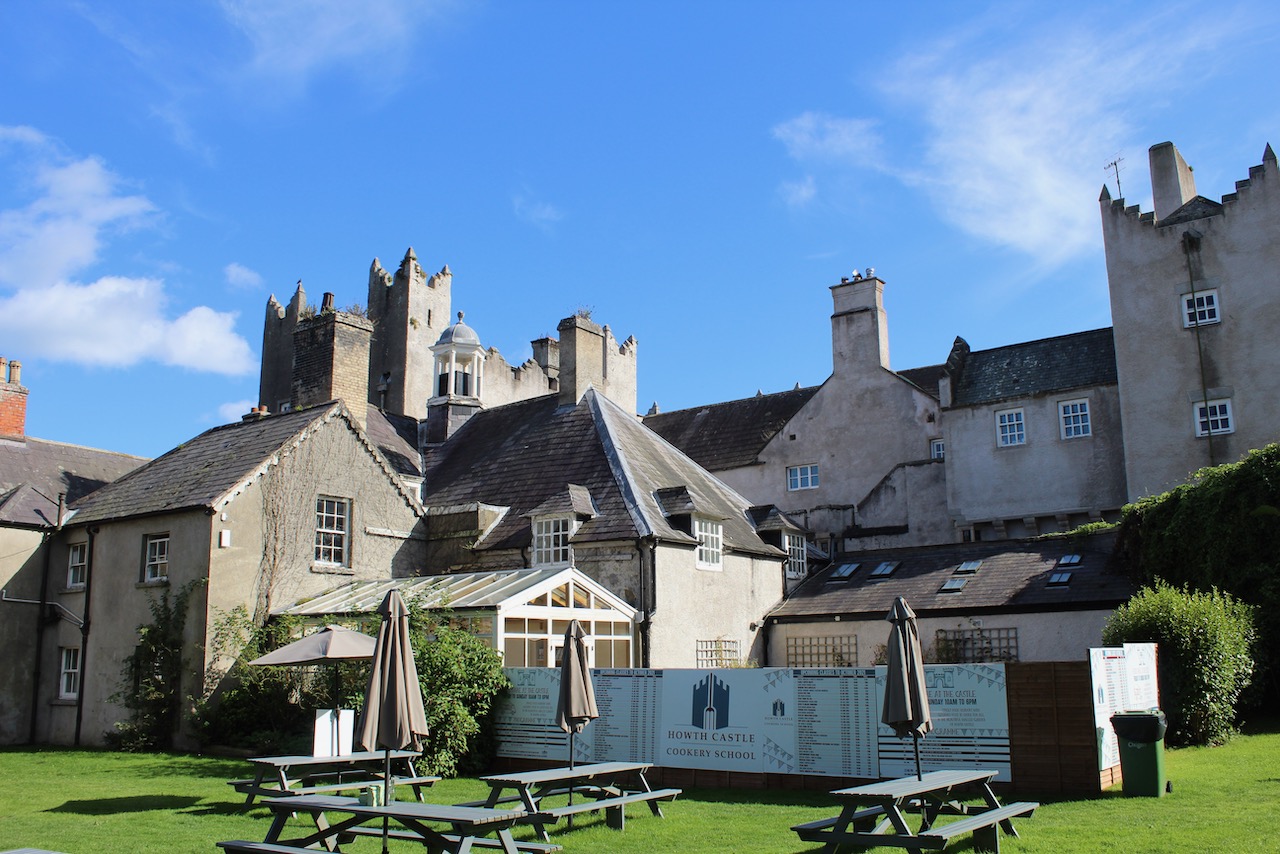
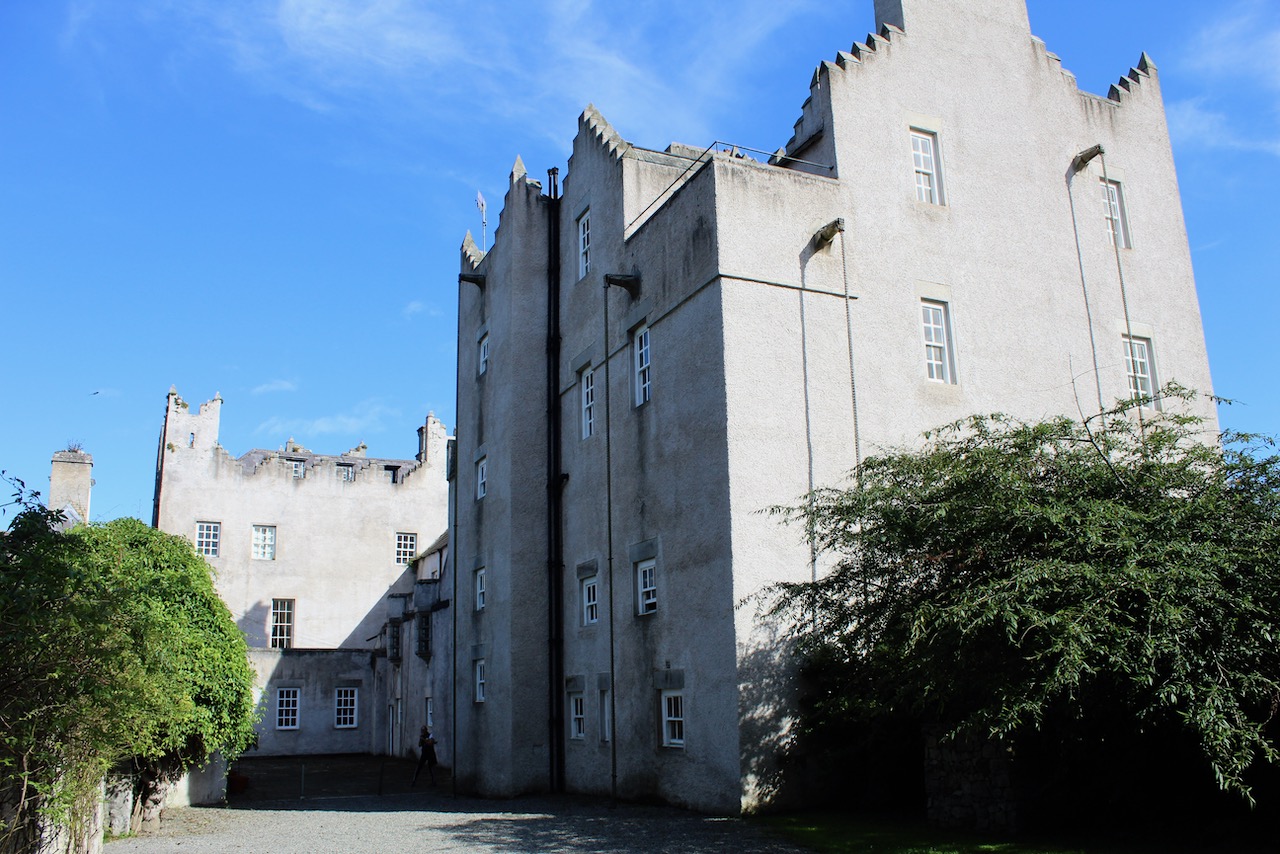
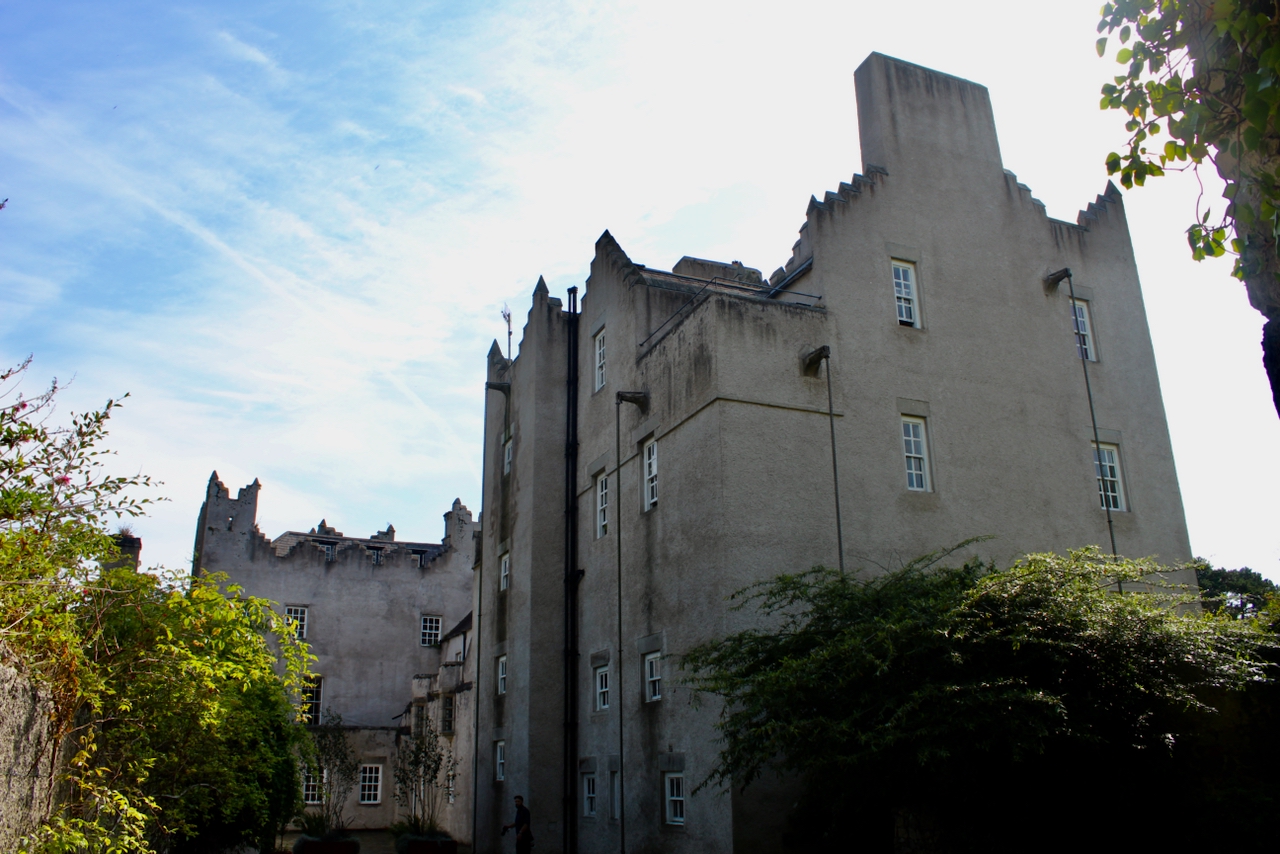
We walked around the side, around what I think is the stable block, past the Mermaid Tower.

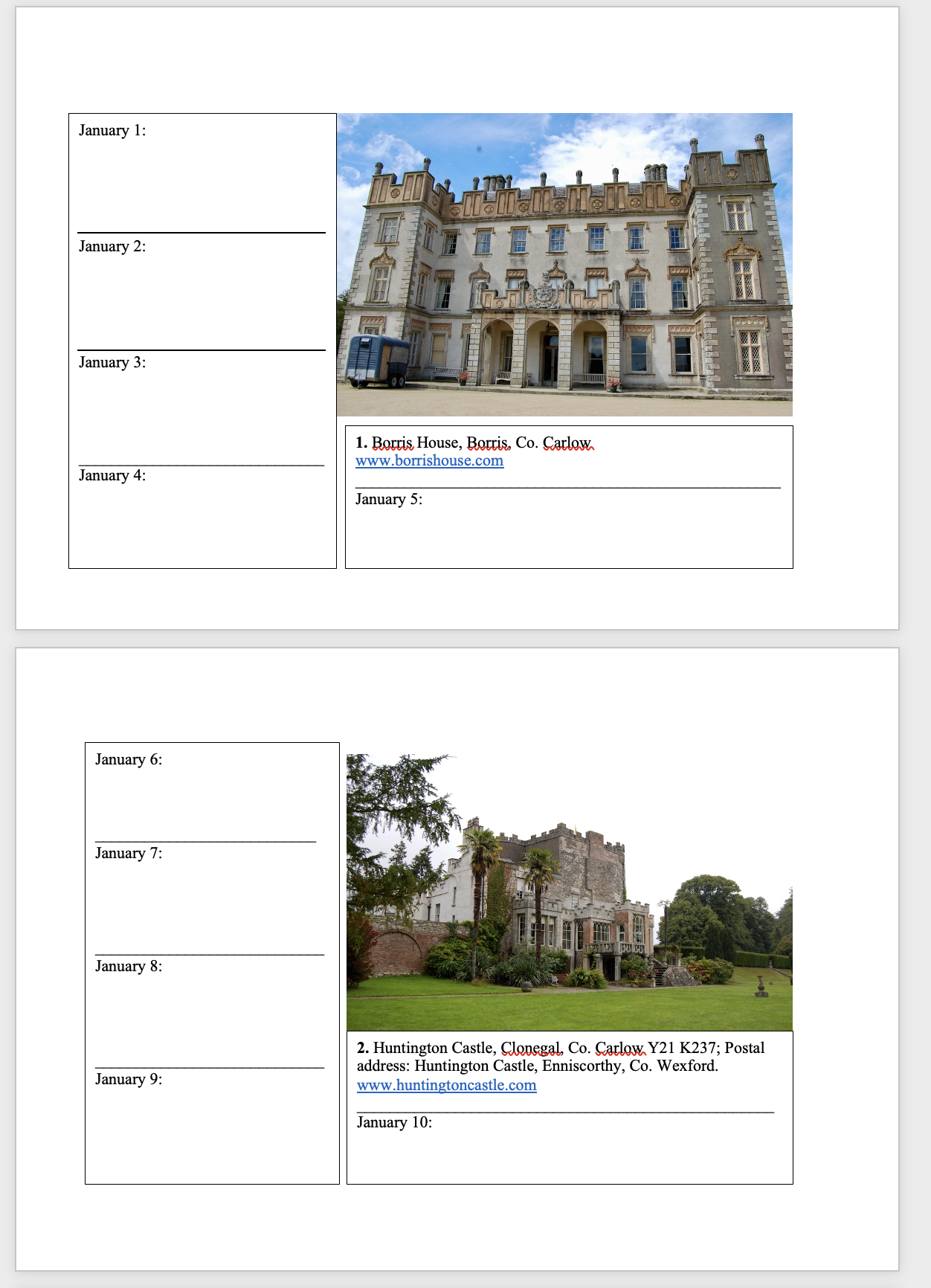
2026 Diary of Irish Historic Houses (section 482 properties)
To purchase an A5 size 2026 Diary of Historic Houses (opening times and days are not listed so the calendar is for use for recording appointments and not as a reference for opening times) send your postal address to jennifer.baggot@gmail.com along with €20 via this payment button. The calendar of 84 pages includes space for writing your appointments as well as photographs of the historic houses. The price includes postage within Ireland. Postage to U.S. is a further €10 for the A5 size calendar, so I would appreciate a donation toward the postage – you can click on the donation link.
€20.00

donation
Help me to pay the entrance fee to one of the houses on this website. This site is created purely out of love for the subject and I receive no payment so any donation is appreciated!
€15.00
Donation towards website.
I receive no funding nor aid to create and maintain this website, it is a labour of love. The website costs €300 annually on wordpress. Help to fund the website.
€150.00
[1] p. 155. Bence-Jones, Mark. A Guide to Irish Country Houses (originally published as Burke’s Guide to Country Houses volume 1 Ireland by Burke’s Peerage Ltd. 1978); Revised edition 1988 Constable and Company Ltd, London.
[2] http://lordbelmontinnorthernireland.blogspot.com/2013/07/howth-castle.html
[4] https://www.dib.ie/index.php/biography/st-lawrence-sir-nicholas-a8221
[5] https://www.dib.ie/index.php/biography/st-lawrence-christopher-a8219
[6] https://www.dib.ie/biography/omalley-grainne-grace-granuaile-a6886
[7] Ball, F. Elrington History of Dublin 6 Volumes Alexander Thoms and Co. Dublin 1902–1920.
[8] https://www.dib.ie/index.php/biography/st-lawrence-sir-christopher-a8220
[9] https://www.irelandscontentpool.com/en/media-assets/medp://tia/100792
[10] Dublin City Library and Archives. https://repository.dri.ie
[11] p. 38. Irish Houses and Gardens. From the Archives of Country Life. Sean O’Reilly. Aurum Press Ltd, London, 1998.
[12] Ball, F. Elrington History of Dublin Vol. 5 “Howth and its Owners” University Press Dublin 1917 pp. 135-40
[13] www.archiseek.com
A Guide to Irish Country Houses by Mark Bence-Jones contents and pictures, houses beginning with F
[1] Bence-Jones, Mark. A Guide to Irish Country Houses (originally published as Burke’s Guide to Country Houses volume 1 Ireland by Burke’s Peerage Ltd. 1978); Revised edition 1988 Constable and Company Ltd, London.
Factory Hill, Glanmire, Co Cork
p. 123. “(Hoare, Bt, of Annabella/PB; Dring/IFR) A small Georgian house in the Palladian manner, consisting of a centre block joined to tiny pavilions by curved sweeps; and with the farmyard at the back. A seat of the Hoare family; bought ca 1954 by Mr John Dring, who sold it some years later.” [1]
Fahagh Court, Beaufort, Co Kerry – Killarney Country Club
p. 122. (Morrogh-Bernard/IFR) An irregular two storey house with a shallow battlemented bow and a rusticated doorcase of sandstone on its front, and a gable at the back. Now an hotel.” [1]
Fairfield House, Co Galway (see Carrowmore)
Fairy Hill, Mallow, Co Cork
p. 123. “(Sarsfield/LGI1958) A later Georgian house of one story over a basement. Irregular façade with bow and Wyatt window.”
Fairy Hill, Borrisokane, Co Tipperary

p. 123. “A two storey three bay C18 house with a pediment and a fanlighted doorway with sidelights and blocking. In 1837 the seat of W.H. Cox.” [1]
Faithlegg House, Waterford, Co Waterford – a hotel

See my entry https://irishhistorichouses.com/2022/05/26/places-to-visit-and-stay-in-munster-county-waterford/
p. 123. (Power/IFR; Gallwey/IFR) A three storey seven bay block with a three bay pedimented breakfront, built 1783 by Cornelius Bolton, MP, whose arms, elaborately displayed, appear in the pediment. Bought 1819 by the Powers who ca 1870 added two storey two bay wings with a single-storey bow-fronted wings beyond them. At the same time the house was entirely refaced, with segmental hoods over the ground floor windows; a portico or porch with slightly rusticated square piers was added, as well as an orangery prolonging one of the single-storey wings. Good C19 neo-Classical ceilings in the principal rooms of the main block, and some C18 friezes upstairs. Sold 1936 by Mrs H.W.D. Gallwey (nee Power); now a college for boys run by the De La Salle Brothers.” [1]
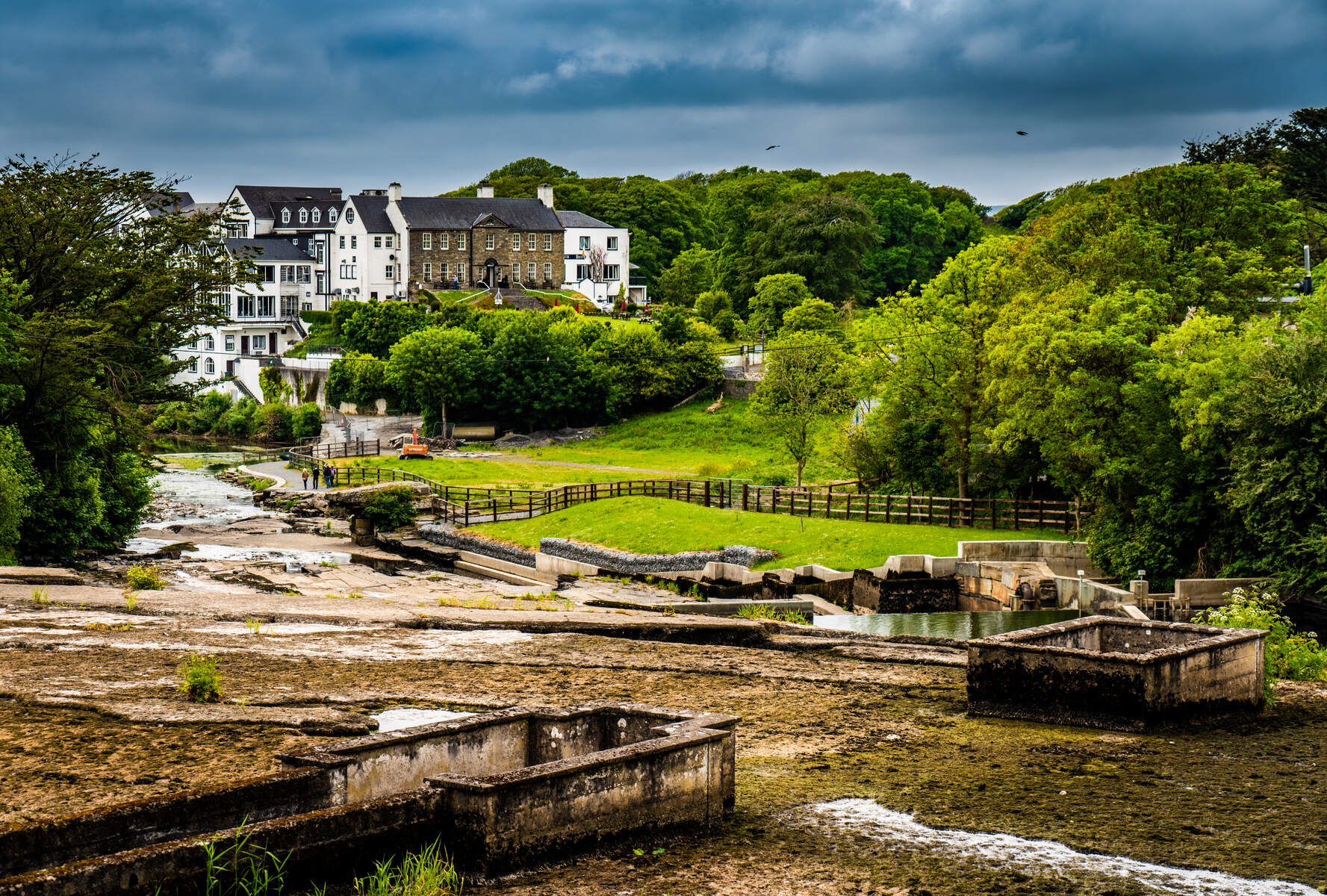
Falls Hotel (formerly Ennistymon House), County Clare
See my entry https://irishhistorichouses.com/2023/01/20/places-to-visit-and-stay-in-county-clare/
Falmore Hall, Dundalk, Co Louth

p. 123. “(Bigger, sub Hamilton/IFR; Windham-Dawson, sub Dartrey, E/PB1933) A two storey Georgian house of five bays, with an eaved roof and a bow on one front...” [1]

Fanningtown Castle, Croom, Co Limerick – whole house accommodation
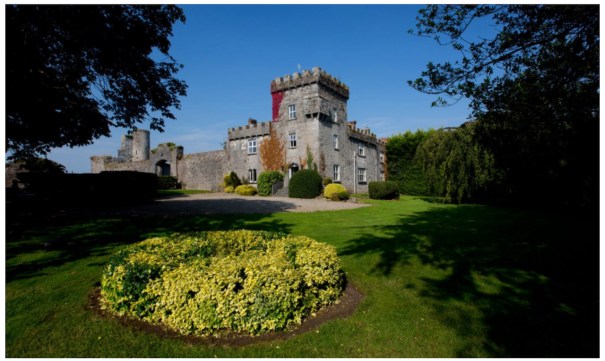
See my entry https://irishhistorichouses.com/2023/07/21/places-to-visit-and-stay-in-county-limerick/
Farmleigh, Castleknock, Co Dublin – open to the public

See my entry https://irishhistorichouses.com/2025/08/03/farmleigh-house-and-iveagh-house-phoenix-park-dublin/
Farney Castle, Thurles, Co Tipperary

See my entry https://irishhistorichouses.com/2022/10/19/places-to-visit-and-stay-in-county-tipperary-munster/
Farnham House, Farnham Estate, County Cavan – hotel

See my entry https://irishhistorichouses.com/2020/07/03/county-cavan-historic-houses-to-see-and-stay/
Farragh House (also known as Farraghroe), Longford, Co Longford – demolished

p. 124. “(Bond/LGI1958) A somewhat composite house, originally a shooting box but greatly enlarged by Willoughby Bond between 1811 and 1833, his architect being John Hargrave, of Cork. Subsequent additions were made in the Victorian period. Entrance front of three storeys and five baysm with Wyatt windows in centre above pillared porch. Side elevation of two storeys and three bays framed by giant plain pilasters; round-headed windows in arched recesses in upper storey of outer bays; two windows in middle above a single-storey Victorian bowed and balustraded projection. Other elevation of three storeys and four bays with a pediment extending over its whole length. Large two storey central hall with gallery and bifurcating staircase, too-lit through skylight with stained glass incorporating family motto, “Deus providebit,” which may have been set by mistake the wrong way round, so that from below the letters read back to front; people said that this had been done intentionally, so that the Almighty, looking down from above, would be able to read the motto and thus be reminded of his obligations. Farragh was sold ca 1960 by Mr B.W.Bond, it was subsequently demolished.” [1]
Farran, Coachford, Co Cork – Hidden Ireland whole house rental

See my entry https://irishhistorichouses.com/2022/05/17/places-to-visit-and-stay-munster-county-cork/
Faughart, Dundalk, Co Louth
p. 124. “(MacNeale.LGI1912; and sub McNeile/LG1972) A two storey gable-ended house of ca 1770. Five bay front, pedimented Doric doorcase.” [1]
Favour Royal, Aughnacloy, County Tyrone
p. 124. “(Moutray/LGI1912) A somewhat austere Tudor-Gothic house of 1825, said to be by an architect named William Warren; built for John Corry Moutray to replace a house of 1670 destroyed by fire 1823. Two storey with attic of rather low-pitched gables in front; three storey at the back. The front of the house has large rectangular windows with elaborate Gothic tracery and hood mouldings over them. Now owned by the Forestry Commisson.” [1]
Fellsfort, Co Cork (see Mitchellsfort)
Fellows Hall, Killylea, County Armagh
p. 124. “(Maxwell, sub Farnham, B/PB; Armstrong, IFR; Stronge, Bt/PB; McClintock/IFR) A Victorian Italianate rebuilding of a house of 1762, itself a rebuilding of a C17 house burnt 1752. Two storeys over basement; five bay front, round-headed windows with keystones in upper storey, rectangular windows with entablatures on console brackets above them in lower storey. Tripartite doorway with triple window above it. Roof on bracket cornice. Passed through marriage from the Maxwell family to the Armstrong and Stronge families, and then to the McClintock family.”
Fenagh House, Bagenalstown, County Carlow

p. 124. “(Pack-Beresford/IFR) A plain and austere C19 house of stone. Irregular in plan, and extensive; but with a symmetrical entrance front of three bays, the centre bay being recessed with a pillared porch.” [1]
Fenaghy House, Galgorm, County Antrim
p. 124. “A two storey, five bay gable-ended C18 house, refaced as a stucco Italianate villa in mid-C19. Entablatures on console brackets over ground floor windows; two storey projecting porch with a Corinthian column on either side of the entrance doorway; pierced roof balustrade. Conservatory at end of house, of pretty ironwork. Good interior plasterwork.” [1]
Fennypark, Co Kilkenny
p. 124. “A Georgian house consisting of a two storey three bay centre with Wyatt windows and a pedimented pillared porch, joined to one storey one bay pedimented wings by links with iron verandahs.” [1]
Fermoy House, Fermoy, Co Cork – ‘lost’

p. 125. “(Anderson, Bt of Fermoy/PB1861; Cooke-Collis/IFR) A house of ca 1790, consisting of a centre block and wings. The seat of John Anderson, the enterprising army contractor who laid out the town of Fermoy. Later a seat of the Cooke-Collis family. Now demolished.” [1]
Ferns Castle, Wexford – OPW

Ferrans, Co Meath
p. 125. “(Bomford/IFR) A two storey five bay late-Georgian house with an eaved roof. Sold ca 1970; burnt 1972, subsequently rebuilt for institutional use.” [1]
Ferry Quarter, Strangford, County Down
p. 125. (Cooke/IFR) “A large stucco early-Victorian house, overlooking the entrance to Strangford Lough.” [1]
ffrankfort Castle, Dunkerrin, Co Offaly – a ruin

p. 125. “Rolleston/IFR) A Georgian castellated house, with a battlemented parapet, pointed windows and a turret, incorporating part of a medieval castle and surrounded by the original fosse and a fortified wall of predominantly late C18 or early C19 appearance, with twin Gothic gateways opening into a forecourt in front of the house. Originally the seat of the ffranks; passed to the Rollestons through the marriage of the adopted daughter of Capt James ffrank to Francis Rolleston 1740. Now demolished except for some walls and moat.” [1]
Fields of Odin, Co Dublin (see St. Enda’s)
Finnebrogue House, Downpatrick, County Down

p. 125. “(Perceval-Maxwell/IFR) A fine late C17 house, built on an H plan: a central range with wings projecting at the front and back.
The house is of two storeys over a basement, with an attic storey in the side and rear elevations.
The entrance front is of five bays, with two additional bays at the end of each wing.
The upper storey of the central range is treated as a piano nobile, with higher windows than those below. The house was altered and brought up to date at end of C18 by Dorothea, Mrs Waring-Maxwell, sister and heiress of Edward Maxwell, of Finnebrogue, having stood empty for some 25 years.
The original high-pitched roof was replaced by a roof that was lower, though still high by late 18th century standards; late-Georgian sash windows were inserted, and some of the 1st floor rooms were given high coffered ceilings similar to those of the Down Hunt Rooms in Downpatrick, which date from the same period. Some of the internal partition walls are of peat or turf, as in certain other Irish houses.” [1]
Finnstown, Lucan, Co Dublin – hotel

See my entry https://irishhistorichouses.com/2023/05/26/places-to-visit-and-stay-in-dublin-city-and-county/
Finvoy Lodge, Ballymoney, County Antrim
p. 125. Two storey gable-ended Georgian house; three bay front; later projecting porch, three bay return.” [1]
Fisherwick Lodge, Ballyclare, County Antrim
p. 125. (Chichester, Donegall, M/PB) A hunting lodge of the Marquesses of Donegall; rebuilt ca 1805 as a hollow square with two single-storey fronts of nine bays each. Tall windows, reaching almost to the ground; pedimented wooden doorcase, with fluted columns.” [1]
Fishmoyne, near Templemore, Co Tipperary
p. 125. “(Carden/IFR) The seat of the junior branch of the Cardens; a three storey C19 block built to replace an earlier house destroyed by fire. Pedimented entrance door in three sided bow in middle of front, two bays on either side. Entablatures over ground floor and first floor windows; eaved roof. Octagonal hall.” [1]
Flesk Castle, Co Kerry (see Glenflesk Castle)
Flood Hall, Thomastown, Co Kilkenny – demolished
p. 125. (Solly-Flood/LGI1912; Hanford-Flood/LGI1912) A two storey Georgian house with C19 Gothic embellishments. Front with pediment flanked by small crockets; single-storey three sided bow below. Hood mouldings. Irregular C19 end. The home of Henry Flood, the great C18 statesman and Irish patriot. Demolished 1950.” [1]
Florence Court House, County Fermanagh – open to the public

See my entry https://irishhistorichouses.com/2024/05/16/florence-court-county-fermanagh-a-national-trust-property/
Forenaghts (used to be townland of Little Forenaghts), Naas, Co Kildare
p. 128. “Wolfe/IFR) A three storey early or mid- C18 house, probably originally of five bays but subsequently extended to form a three storey front of seven bays, with an addition of ca 1831 which is of two storeys on the entrance front and a single high storey on the garden front. Also in the C19 the house was given an eaved roof on a bracket cornice and a single storey Doric portico; and it was refaced in stucco. The garden front is of six bays, with a two bay projection at one end; C19 wing on this side has a curved bow. Low ceilinged rooms in the main block. Hall with slightly curving staircase at back, enlarged early C20 aby taking in the adjoining room to the left, which in turn has been opened, with arches on either side of its fireplace, into the library beyond, which has bookcases incorporated in its panelling. Beautiful early C19 drawing room in the garden fron ton the wing, with a curved bow and a high coved ceiling decorated with elaborate C19 plasterwork. This room was probably made – and the wing added – by Rev Richard Wolfe, for his fashionable wife, who was Lady Charlotte Hely-Hutchinson, sister of 2nd Earl of Donoughmore.” [1]
Fort Etna, Patrickswell, Co Limerick
p. 126. “(Peacocke/LGI1912; Reilly, sub Simonds-Gooding and Peart/LGI1958) A two storey five bay C18 house with a Venetian window and a pedimented and shouldered doorcase. Five bay side. Gable-ended farm buildings treated as wings. The seat of the Peacocke family; afterwards of the Reilly family.” [1]
Fort Frederic, Virginia, Co Cavan – a ruin
p. 126. “(Sankey/LGI1912) A two storey mid-C18 house with a central three sided bow and two bays on either side of it. Georgian Gothic doorcase. Single-storey wings, one of them with two bows in its end wall.” [1]
Fort Robert, Ballineen, Co Cork – ‘lost’

p. 126. “(Conner;IFR) A late C18 weather-slated house of two storeys over high basement, built by R.L.Conner 1788. Eight bay front, with wide fanlighted doorway. Three bay side. Empty and decayed by 1854; ruinous by end of C19.” [1]
Fort Stewart, Ramelton, Co Donegal
p. 126. “(Stewart, Bt, of Ramelton/PB) A three storey gable-ended C18 house. Seven bay entrance front, with single-storey, two bay wings. C19 pilastered porch with door at side. Entrance hall with four engaged Tuscan columns and shallow rib-vaulting rising from them. Early C19 decoration in reception rooms.” [1]
Fort William, Tivoli, Co Cork
p. 126. “Baker/IFR) A late-Georgian house consisting of a two storey five bay centre block with single-storey bow-ended wings. Now part of the Silver Springs Hotel.” [1]
Fort William, Doneraile, Co Cork (see Kilmacoom)
Fort William, Glencairn, Lismore, Waterford

See my entry https://irishhistorichouses.com/2022/05/26/places-to-visit-and-stay-in-munster-county-waterford/
Fortfergus (also known as Mountfergus), Killadysert, County Clare
p. 126. “(Ross-Lewin/LGI1912; Stacpoole/IFR) A long, irregular house of vaguely Georgian appearance, incorporating, or on the site of, a house built by Captain George Ross 1688. Passed by descent to Ross-Lewins; transferred by W.G. Ross-Lewin to his uncle, John Stacpoole, 1800. Sold under Encumbered Estates Act 1855 to Major William Hawkins Ball. Burnt 1922.” [1]
Fortfield, Terenure, Co Dublin
p. 126. “Yelverton, Avonmore, V/PB1910) A three storey house built ca 1785 for Chief Baron Yelverton, afterwards 1stViscount Avonmore. Seven bay front; central Venetian window above single-storey portico and with three oculi in the centre of top storey. Very wide staircase.” [1]
Fortgranite, Baltinglass, Co Wicklow

p. 126. “(Dennis.IFR) A house of ca 1730 built by George Pendred, of Saunders Grove – whose son assumed the name of Saunders – which came to T.S. Dennis through his marriage to Katherine Saunders 1810; he remodelled it 1810-15, so that it is now predominantly late-Georgian in character. Two storey; entrance front with recessed centre and single storey Doric portico. Adjoining front is five bay with two single-storey three sided bows. Parapeted roof. The house was modernized 1870-1 by M.C. Dennis. The grounds contain a notable arboretum, planted ca 1820.” [1]
Fortland, Easkey, Co Sligo
p. 126. “(Brinkley/LGI1912) A Georgian house. Tripartite doorway with rusticated piers and pediment extending over door and sidelights.” [1]
Fortwilliam, Milford, Co Cork

p. 297. “(Sheehy/IFR) A house of mid-C19 appearance in the cottage style, with gables and ornamented bargeboards.”
Fortwilliam, Ballinasloe, Co Galway
p. 126. “(D’Arcy/IFR) A small Georgian house with Victorian additions.” [1]
Fosterstown House, Trim, Co Meath

p. 127. “(Chambers. LGI1937 supp) A two storey three bay gable-ended late C18 house. The residence of the great Duke of Wellington (as Hon. Arthur Wellesley) when he was Member for Trim in the Irish Parliament.” [1]
Fota House, Arboretum and Garden, Carrigtwohill, County Cork – open to public

Fountainstown House, Crosshaven, Co Cork

p. 128. “(Hodder/IFR) A three storey double gable-ended early C18 house built by Samuel Hodder.” [1]
Fox Hall, Letterkenny, Co Donegal

p. 128. “(Chambers/LG1863) A stucco-faced house of mid-C19 appearance, but in a straightforward late-Georgian manner, with large rectangular windows and astragals. Of two storeys over basement. Projecting porch, with two ball fiials, not centrally placed; roof on plain cornice.” [1]

Foyle Park House, Eglington, County Derry
p. 128. “(Davidson/IFR) A plain two storey irregular late-Georgian house, built ca 1820 and opened 1827 as the North West of Ireland Society’s Literary and Agricultural Seminary and School of Classics. Come to the Davidson family by marriage later in C19. Sold 1920 by James Davidson to Mr H. Whiteside, who sold it back to Lt-Col K.B. L Davidson, of The Manor House, Eglington, 1968.” [1]
Frankville House, Athboy, Co Meath

p. 128. “A two storey house of late-Georgian appearance. Three bay front, with Wyatt windows and an enclosed porch with a die. Four bay side, with two Wyatt windows in the lower storey not related to the windows above.” [1]
Frascati (or Frescati), Blackrock, Co Dublin – ‘lost’

p. 128. “Fitzgerald, Leinster, D/PB) The seaside house of the Leinsters in C18, where Emily, Duchess of Leinster, lived during her widowhood and where her son, the United Irish leader, Lord Edward Fitzgerald, spent much of his youth. A long, plain two storey eighteenth century house, wiht a pedimented doorway between two three sided bows. Drawing room with ceiling by Thomas Riley, who decorated the gallery at Castletown, County Kildare for Emily Duchess’s sister Lady Louisa Conolly. Demolished 1981-3.” [1]
French Park, County Roscommon – lost

p. 128. “(De Freyne, B.PB) An early Palladian winged house of red brick; probably built ca 1729 by John French to the design of Richard Castle. Three storey seven bay centre block, three bay pedimented breakfront with lunette window in pediment; late-Georgian pillared porch, two storey wings five bays long and four deep joined to main block by curved sweeps as high as they are themselves; the curved sweeps having three windows in their upper storey and a door flanked by two windows below. Two storey panelled hall; stairs with slender turned banisters ascending round it to gallery; panelling with bolection mouldings; walnut graining. Dining room originally hung with embossed leather which was later replaced by wallpaper; nineteenth century plasterwork cornice and rosette and circle in centre of ceiling. Drawing room on 1st floor above dining room, with Bossi chimneypiece at one end and a late eighteenth century Ionic chimneypiece at the other; good compartmented plasterwork ceiling executed for Arthur French, 4th Lord De Freyne, late nineteenth century. Fine eighteenth century wrought iron entrance gates. Now a roofless ruin having been sold by 7th and present Lord de Freyne 1953 and afterwards demolished.”
supplement: “This house incorporated a mid-C17 house, built by Patrick French, a burgess of Galway who acquired the estate and other lands, and who died 1669.” [1]
Frybrook House, Boyle, Co. Roscommon

See my entry https://irishhistorichouses.com/2025/11/02/frybrook-house-county-roscommon/
Furness (townland of Great Forenaghts, or Phornauts), Naas, County Kildare

p. 129. “Nevill, sub Neville/IFR; Dering, Bt/PB; Beauman/LG1886; Synnott/IFR) A house built originally ca 1740 for Richard Nevill, and attributed by the Knight of Glin to Francis Bindon; consisting of a three storey centre block joined by single-storey links to a storey projecting wings of the same height as the links; the elevation being further prolonged by quadrants joining the wings to office ranges; so that it extends to a total length of 400 feet. The centre block has a three bay ashlar faced entrance front, with a lunette window above a window framed by an aedicule on console brackets consisting of two engaged Ionic columns and a pediment; above a frontispiece of coupled Doric columns and a Doric entablature framing the entrance doorway. There is an almost identical elevation in Clermont, Co Wicklow. The garden front of the centre block is five bays, with blocking round the ground floor windows. From ca 1780 onwards, Richard Nevill, MP, great-nephew of the builder of the house, carried out various additions and alterations; chief of which was the raising of the left-hand link, so that it became a two storey wing with a curved bow on the garden front. The whole of the centre block, on the entrance front, is taken up with a hall, consisting of two sections opening into each other with an arch; they were originally separate, but the Doric frieze is probably contemporary with the building of the house, as is the handsome staircase of Spanish chestnut, which rises on one side of the arch; though there are indications that it has been remodelled. On the frieze of the staircase and gallery is a Vitruvian scroll decoration. The drawing room has a ceiling, probably by Michael Stapleton, of delicate late C28 plasterwork with a medallion of Minerva attended by a kneeling hero. The dining room, in the wing, is. Large simple room with a curved bow. Richard Nevill, MP, also landscaped the grounds. At his deat 1822, Furness passed to his daughter and heiress, the wife of Edward Dering. Later it was sold to the Beauman family. In 1897, by which time it had become very dilapidated, it was bought by N.J. Synnott, who carried out a thorough – and for those days, remarkably sympathetic – restoration. The vista from the entrance front of the house is now terminated by a column formerly at Dangan, Co Meath, the boyhood home of the great Duke of Wellington. It was brought here and erected 1962, as a 21st birthday present to Mr David Synnott from his father. The house features in the film of the Somerville and Ross Irish RM stories. Mr David Synnott sold Furness 1987.” [1]
[1] Bence-Jones, Mark. A Guide to Irish Country Houses (originally published as Burke’s Guide to Country Houses volume 1 Ireland by Burke’s Peerage Ltd. 1978); Revised edition 1988 Constable and Company Ltd, London.
Places still to visit
Happy new year!
2026 Diary of Irish Historic Houses (section 482 properties)
To purchase an A5 size 2026 Diary of Historic Houses (opening times and days are not listed so the calendar is for use for recording appointments and not as a reference for opening times) send your postal address to jennifer.baggot@gmail.com along with €20 via this payment button. The calendar of 84 pages includes space for writing your appointments as well as photographs of the historic houses. The price includes postage within Ireland. Postage to U.S. is a further €10 for the A5 size calendar, so I would appreciate a donation toward the postage – you can click on the donation link.
€20.00
donation
Help me to pay the entrance fee to one of the houses on this website. This site is created purely out of love for the subject and I receive no payment so any donation is appreciated!
€15.00
Donation towards website.
I receive no funding nor aid to create and maintain this website, it is a labour of love. The website costs €300 annually on wordpress. Help to fund the website.
€150.00
I hope your year has started well. Here is a list of the Section 482 houses I have yet to visit – provided they are on future Section 482 lists. I am separating out tourist accommodation. The list unfortunately is usually published in late February, so we have a while to wait to see what properties will be on it this year.
As you can see, although I have visited more than 100 Section 482 properties, I still have over fifty to go! So, lots of travel for myself and Stephen. Below my places yet to visit, I have chosen twelve sites, to visit one per month, if we can manage that.
Happy visiting!
February
Griesemount House , Ballitore, Co. Kildare, R14 WF64
Open dates in 2026: Feb 9-28, May 5-19, June 5-14, July 6-10, Aug 15-24, 2pm-6pm
Fee: adult €8, OAP/student €5, child free
March
Tibradden House, Mutton Lane, Rathfarnham, Dublin 16, D16 XV97
Open dates in 2026: Feb 6, 9, 13, 16, 20, 23, 27 Mar 9, 13, 20, 23, 27, 30, Apr 10, 13, 17, 20, 24, 27, May 5, 6, 8, 9, 11-16, 19-23, 26-28, June 2, 3, 4, 9, 10, 13, 17, 18, 20, 21, Aug 15-23, Sept 11, 18, 25, 26, 11am-3pm
Fee: adult €8, student/OAP €5, child free
Concession – members of An Taisce & Irish Georgian Society €5 with membership card
April
Steam Museum & Lodge Park Walled Garden, Lodge Park, Straffan, Co. Kildare, W23 X8N4
Open dates in 2026: Apr 5-6, 12, 19, 26, May 3-4, 9-10, 16-17, 23-24, 30-31, June 1, 6-7, 12, 14,20-21, 27-28, July 4-5,11-12,18,19, 25-26, Aug 1-3, 8-9,15-23, 29-30, Sept 5-6,12-13,19-20, 26-27, Oct 4,10,18, 25-26, 1pm-5pm
Fee: Garden and Museum With steam adult €20, OAP €15, (Sun and Bank Holidays),No steam (Sat) adult €15, OAP €10, Museum only -with steam, adult €15, OAP €10 (Sun and Bank Holidays), No steam (Sat) adult €10, OAP €7, Garden only –adult/OAP €7, student/child free
May
Kiltimon House, Newcastle, Co. Wicklow
Open dates in 2026: Feb 10, 13, 17, 20, 24, 27, Mar 3, 6, 10, 13, 20, 24, 27, 31, Apr 10, 14, 17, 21,24, 28, May 5, 8-10, 12-13, 15-16, 19, 22, 26, June 9-10, 12-13, 16, 19, 23, 26, Aug 15-23, Sept 1, 4, 8, 11-12, 15, 18-19, 22, 25-26, 29, 9am-1pm
Fee: adult €10, OAP/student/child €5
Griesemount House , Ballitore, Co. Kildare, R14 WF64
Open dates in 2026: Feb 9-28, May 5-19, June 5-14, July 6-10, Aug 15-24, 2pm-6pm
Fee: adult €8, OAP/student €5, child free
June
Burtown House and Garden, Athy, Co. Kildare, R14 AE67
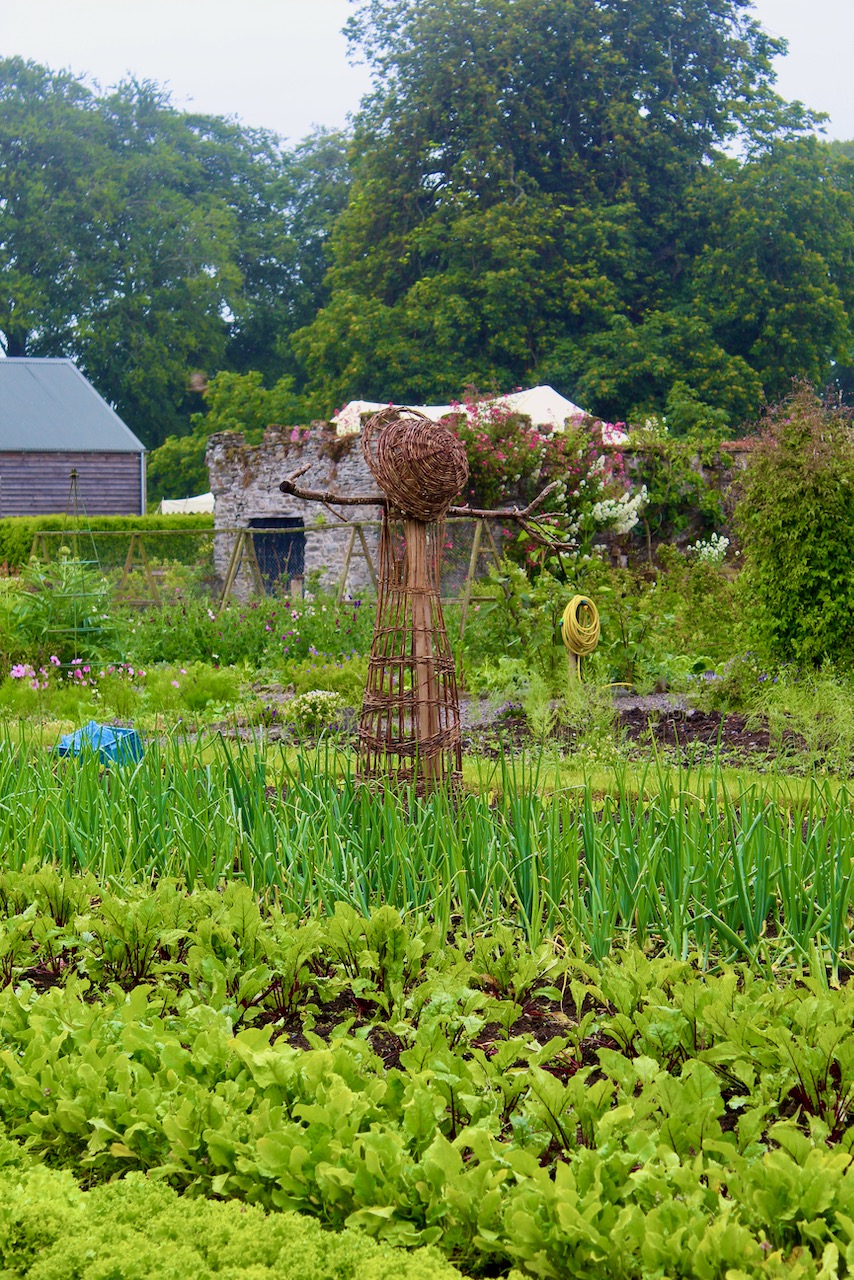
Open dates in 2026: May 1-31, June 1-30, July 1-2, 8-9, 15-16, 22-23, August 15-23, 10am-1pm
Fee: adult €10, OAP/student/child €6
July
Knocknagin House – JULY, Coney Hill, Ballbriggan, Co Dublin, K32 YE00
Open dates in 2026: June 2 – 27, July 1 – 31, Aug 1-14, Tues – Sat, National Heritage Week, Aug 15-23, 9.30am-1.30pm
Fee: adult €15, students/OAP/child €10
August
15
Newtown Castle, Newtown, Ballyvaughan, Co. Clare, H91 H299
Open dates in 2026: Jan 5-30, Feb 3-27, March 2-31, April 1-30, May 1-29, June 2-30, July 1-31, August 1-31, Sept 1-30, Oct 1-30, Nov 2-30, Dec 1-19 Mon-Fri, National Heritage Week, Aug 15-23, 10am-5pm
Fee: Free
16
Brookhill House, Brookhill, Claremorris, Co. Mayo
Open dates in 2026: Mar 13-26, Apr 17-25, June 12-26, July 8-24, Aug 15-23, 2pm-6pm
Fee: adult €8, OAP/child/student €3, National Heritage Week free
17
Rockfield Ecological Estate, Rathaspic, Rathowen, Mullingar, Co. Westmeath
Open dates in 2026: July 15-31, Aug 15-31, Sept 15-30, Oct 15-30, 2pm-6pm
Fee: Free
18
Lough Park House, Castlepollard, Co. Westmeath
Open dates in 2026: Mar 13-18, Apr 2-8, May 1-7, 28-31, June 1-3, July 18-26, Aug 1-10, 15-24, Oct 23-27, 2pm-6pm
Fee: adult €6
19
Moorhill House, Castlenugent, Lisryan, Co. Longford
Open dates in 2026: Aug 1-31, Sept 1-29, 9.30am-1.30pm
Fee: adult/OAP/student/child €8
20
Meander, Westminister Road, Foxrock, Dublin 18, D18 E2T9
Open dates in 2026: Jan 12-16, 19-23, 26-30, Feb 3-6, 9, May 1-2, 5-9, 25-30, June 2-6, 8-13, 15-20, 22, Aug 15-23, 9am-1pm
Fee: adult €5, OAP/child/student €2
21
Kingston House, Kingston, Rathdrum, Co. Wicklow, A67 DV25
Open dates in 2026: Aug 1-31, Sept 1-30, 10am-2pm
Fee: adult €3, OAP/student/child €2
22
Clougheast Cottage, Carne, Co. Wexford, Y35 A9T1
Open dates in 2026: Jan 11-31, May 1-31, August 15-23, 9am-1pm
Fee: €5
23
Aylwardstown House, Glenmore, Co. Kilkenny, Y34 WW60
Open dates in 2026: Aug 1-31, Sept 1-30, 10am-5pm
Fee: adult €5, OAP €3, student/child free
September
Redwood Castle, Redwood, Lorrha, Nenagh, Co. Tipperary, E45 HT38
Redwood is off the Birr/Portumna Rd
Open dates in 2026: May 20-26, June 11-17, 22-30, July 1-16, 23-31, Aug 5-23, Sept 1-8, 2.30pm-6.30pm,
Fee: adult €15, OAP/student €10, child €5
October
Ballyvolane House, Castlelyons, Co. Cork, P61 FP70
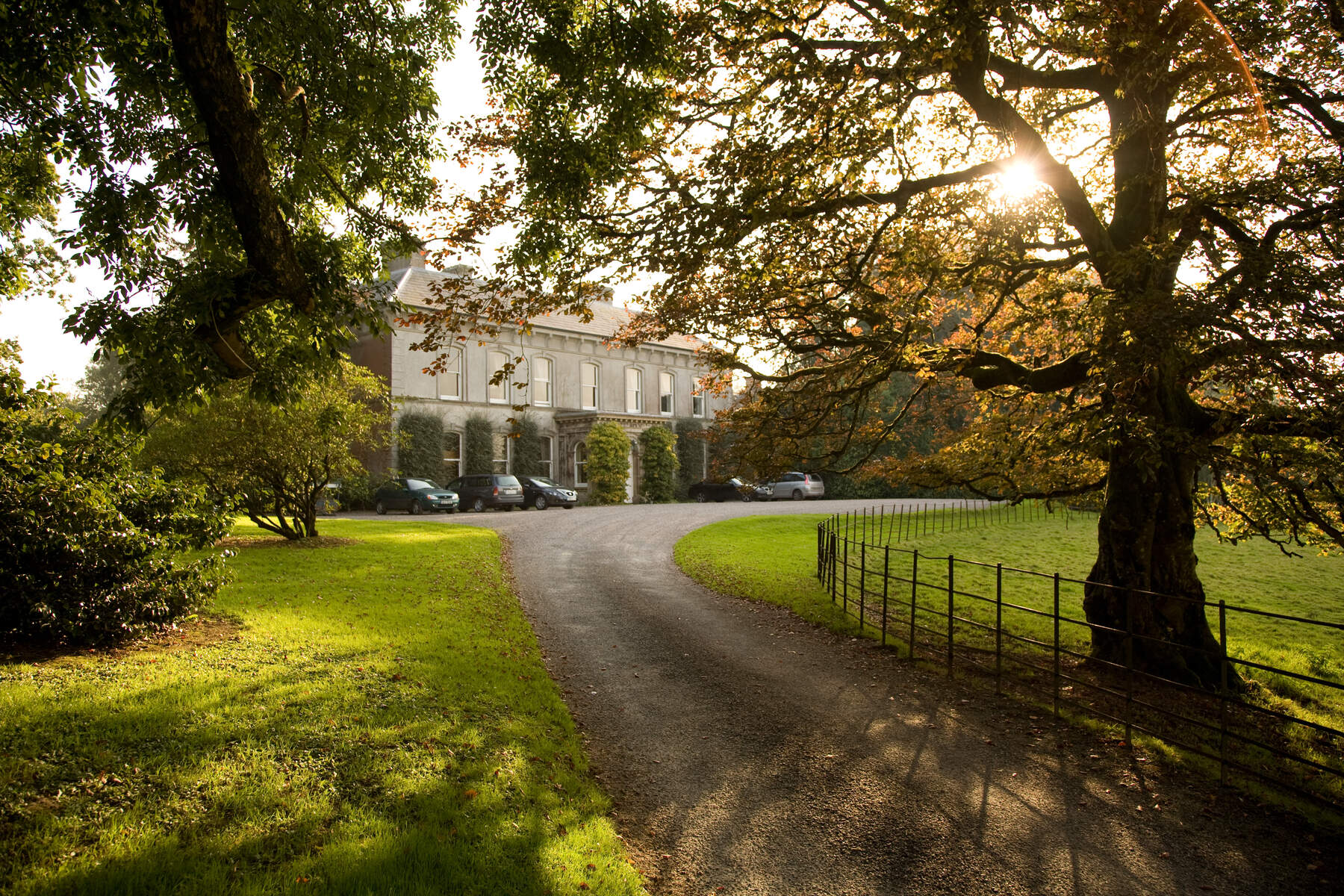
(Tourist Accommodation Facility)
Open dates in 2026: Jan 7 -31, Feb 4-28, Mar 4-31. Nov 4-30, Dec 2-20, Wed-Sat, Apr 2-30. May1-31, Sept 1-30, Oct 1-31, Tues-Sun, June 2-30, July 1-31, Aug 1-31, Mon-Sun All Day
Fee: adult €7.50, family €18- up to 2 adults and 3 children
November
The Old Rectory, Rathkeale, Co. Limerick
Open dates in 2026: May 2-Nov 29, Saturday and Sundays, National Heritage Week, Aug 15-23,
10am-2pm
Fee: adult €8, child/OAP/student €3
December
Kilcarbry Mill Engine House, Sweetfarm, Enniscorthy, Co Wexford, Y21 F7YD
Open dates in 2026: Feb 4-5, 8-11, Mar 11-12, 16-19, May 10-11, 22-31, July 4-5, 13-14, Aug 3-30, Dec 19-22 12 noon-4pm
Fee: adult €10, student/OAP €5, child free
Houses still to visit:
Newtown Castle – MAY
Newtown, Ballyvaughan, Co. Clare, H91 H299
Open dates in 2026: Jan 5-30, Feb 3-27, March 2-31, April 1-30, May 1-29, June 2-30, July 1-31, August 1-31, Sept 1-30, Oct 1-30, Nov 2-30, Dec 1-19 Mon-Fri, National Heritage Week, Aug 15-23, 10am-5pm
Fee: Free

Cork
Ashton Grove, Ballingohig, Knockraha, Co. Cork, T56 V220
https://irishhistorichouses.com/2022/11/04/ashton-grove-ballingohig-knockraha-co-cork/
Open dates in 2026: Jan 6, 9-11, 13, 16, 20, 23, 27, 30-31, Feb 1-3, 6, 10, 13, 17, 20, 24, May 5, 8-10, 12, 15-17, 19, 22-24, 26, June 2, 5, 8-12, 15, 19-22, 26, Aug 15-23, Sept 8,11,15, 18-20, 8am-12 noon
Fee: adult €6, child €3, student/OAP free
Ballyvolane House – OCT
Castlelyons, Co. Cork, P61 FP70
(Tourist Accommodation Facility)
Open dates in 2026: Jan 7-31, Feb 4-28, Mar 4-31. Nov 4-30, Dec 2-20, Wed-Sat, Apr 2-30. May1-31, Sept 1-30, Oct 1-31, Tues-Sun, June 2-30, July 1-31, Aug 1-31, Mon-Sun All Day
Fee: adult €7.50, family €18- up to 2 adults and 3 children
Brideweir House, Aghern, Conna, Co. Cork, P51 FD36
Open dates in 2026: May 4-5, 11-12, Aug 1-31, Sept 1-30, Nov 2-10, 9am-1pm
Fee: adult €15, child/student €10, OAP free
Garrettstown House, Garrettstown, Kinsale, Co. Cork, P17 NP66
Open dates in 2026: May 8-Sept 12, 12 noon-5pm
Fee: adult €7, OAP/student/child €5, groups (10 or more) €5 per person
Woodford Bourne Warehouse, Sheares Street, Cork
www.woodfordbournewarehouse.com
Open dates in 2026: all year, except Christmas Eve, Christmas Day, 12 noon-10pm
Fee: Free
Cavanacor House, Ballindrait, Lifford, Co. Donegal, F93 F573
Open dates in 2026: Feb 1-20, Aug 14-31, Sept 1-3, 12-30, 1pm-5pm
Fee: adult €10, OAP/student/child €8
10 South Frederick Street, Dublin 2, DO2 YT54
Open dates in 2026: Jan 1-9, 12-16, 19-21, Apr 27-30, May 1-22, 25-29, June 1-4, Aug 15-23, 2pm-6pm
Fee: Free
Corke Lodge Garden, Woodbrook, Bray, Co. Dublin, A98 X264
Open dates in 2026: June 2-30, Tues-Fri, July 1-31, Tue-Sat, Aug 4-23, 10am-2pm
Fee: adult €10, entrance fee is a voluntary donation in honesty box at door
Farm Complex, Killeek, St Margaret’s, Co. Dublin
Open dates in 2026: Jan 9-12, 16-19, 23-26, 30-31, Mon-Fri, 9.30pm-1.30pm, Sat-Sun, 1pm-5pm, May 11, 15-18, 29-31, June 5-8, 12-15, 19-22, Aug 14-23, Sept 11-12, 18-21, 25-28, Oct 16-19, 23-24, Mon- Fri 9.30am-1.30pm, Sat-Sun 2pm-6pm
Fee: adult €6, student/OAP/child €5
Knocknagin House, Coney Hill, Ballbriggan, Co Dublin, K32 YE00
Open dates in 2026: June 2 – 27, July 1 – 31, Aug 1-14, Tues – Sat, National Heritage Week, Aug 15-23, 9.30am-1.30pm
Fee: adult €15, students/OAP/child €10
Meander, Westminister Road, Foxrock, Dublin 18, D18 E2T9
Open dates in 2026: Jan 12-16, 19-23, 26-30, Feb 3-6, 9, May 1-2, 5-9, 25-30, June 2-6, 8-13, 15-20, 22, Aug 15-23, 9am-1pm
Fee: adult €5, OAP/child/student €2
Tibradden House, Mutton Lane, Rathfarnham, Dublin 16, D16 XV97
Open dates in 2026: Feb 6, 9, 13, 16, 20, 23, 27 Mar 9, 13, 20, 23, 27, 30, Apr 10, 13, 17, 20, 24, 27, May 5, 6, 8, 9, 11-16, 19-23, 26-28, June 2, 3, 4, 9, 10, 13, 17, 18, 20, 21, Aug 15-23, Sept 11, 18, 25, 26, 11am-3pm
Fee: adult €8, student/OAP €5, child free
Concession – members of An Taisce & Irish Georgian Society €5 with membership card
Galway
The Grammer School, College Road, Galway
Open dates in 2026: May 2-3, 9-10, 16-17, 23-24, June 6-7, July 1-31, Aug 1-12, 15-23, 9am-5pm
Fee: adult/OAP/student €5, child under 12 free
Signal Tower & Lighthouse, Oughill, Inis Mór, Aran Islands, Co. Galway
Open dates in 2026: April 1-October 31, 9am-5pm
Fee: adult €2.50, child €1.50, OAP/student free, family €5, group rates depending on numbers
Woodville House Dovecote & Walls of Walled Garden, Craughwell, Co. Galway
Open dates in 2026: Jan 30-31, Feb 1-28, June 1, 5-8, 12-15, 19-22, 26-29, July 3-6, 10-13, 17-20, 24-27, 31 Aug 1-3, 7-10, 14-23, 12 noon -4pm,
Fee: adult €10, OAP €8, student, €7, child 4-16 years €5
Burtown House and Garden, Athy, Co. Kildare, R14 AE67
Open dates in 2026: May 1-31, June 1-30, July 1-2, 8-9, 15-16, 22-23, August 15-23, 10am-1pm
Fee: adult €10, OAP/student/child €6
Farmersvale House, Badgerhill, Kill, Co. Kildare, W91 PP99
Open dates in 2026: Jan 1-17, Feb 18-20, June 1-20, Aug 4-23, 9.30am-1.30pm
Fee: adult €5, student/child/OAP €3, (Irish Georgian Society members free)
Griesemount House, Ballitore, Co. Kildare, R14 WF64
Open dates in 2026: Feb 9-28, May 5-19, June 5-14, July 6-10, Aug 15-24, 2pm-6pm
Fee: adult €8, OAP/student €5, child free
Moyglare Glebe, Moyglare, Maynooth, Co. Kildare, W23K285
Open dates in 2026: Jan 12-16, 19-23, 26-27, 29-31, Feb 3, 5-8, May 1-5, 7-13, 21, 23-34, 26-27, June 25-29, July 2, 20-21, 23-28, Aug 15-23, 8.30am -12.30pm
Fee: adult €6, OAP/student/child €3
Steam Museum & Lodge Park Walled Garden – APRIL
Lodge Park, Straffan, Co. Kildare, W23 X8N4
Open dates in 2026: Apr 5-6, 12, 19, 26, May 3-4, 9-10, 16-17, 23-24, 30-31, June 1, 6-7, 12, 14, 20-21, 27-28, July 4-5,11 12, 18, 19, 25-26, Aug 1-3, 8-9, 15-23, 29-30, Sept 5-6, 12-13,19-20, 26-27, Oct 4,10,18, 25-26, 1pm-5pm
Fee: Garden and Museum With steam adult €20, OAP €15, (Sun and Bank Holidays),
No steam (Sat) adult €15, OAP €10, Museum only -with steam, adult €15, OAP €10 (Sun and Bank Holidays), No steam (Sat) adult €10, OAP €7, Garden only – adult/OAP €7, student/child free
Templemills House, Newtown Road, Celbridge, Co. Kildare, W23 YK26
Open dates in 2026: Feb 2-24, May 1-31, Aug 16-24, 9am-1pm
Fee: adult €12, child/student/OAP €8
Kilkenny
Aylwardstown House, Glenmore, Co. Kilkenny, Y34 WW60
Open dates in 2026: Aug 1-31, Sept 1-30, 10am-5pm
Fee: adult €5, OAP €3, student/child free
Tybroughney Castle, Piltown, Co. Kilkenny E32 NV 32
https://www.tybroughneycastle.com/
Open dates in 2026: Mar 1-20, May 1-31, Aug 15-23,11am-3pm
Fee: adult €5, student €3, child/OAP free
Leitrim
Manorhamilton Castle (Ruin), Castle St, Manorhamilton, Co. Leitrim, F91 PX00
Open dates in 2026: Mar 16-29, Apr 13-26, May 4-31, June 2-12, Aug 15-23, 9am-1pm
Fee: adult €5, child/OAP/student free
Limerick
Glebe House, Holycross, Bruff, Co. Limerick, V35 DW96
Open dates in 2026: Jan 5-30 Mon-Fri 2.30pm-6.30pm, June 8-22 Mon-Fri 2.30-6.30pm, Aug 15-23 Mon-Sun 9am-1pm, Sept 7-22, Mon-Fri, 2.30pm-6.30pm, Sat-Sun, 9am-1pm
Fee: Free
Kilpeacon House, Crecora, Co. Limerick
Open dates in 2026: May 2-30, June 1-30, Mon-Sat, Aug 15-23, 10am-2pm
Fee: adult/child/OAP/student €8
Odellville House, Ballingarry, Co. Limerick
Open dates in 2026: May 1-31, June 1-30, Aug 15-23, 10am-2pm
Fee: adult €8, student/OAP/child €4
The Old Rectory – NOV
Rathkeale, Co. Limerick
Open dates in 2026: May 2-Nov 29, Saturday and Sundays, National Heritage Week, Aug 15-23,
10am-2pm
Fee: adult €8, child/OAP/student €3
Longford
Moorhill House – AUG
Castlenugent, Lisryan, Co. Longford
Open dates in 2026: Aug 1-31, Sept 1-29, 9.30am-1.30pm
Fee: adult/OAP/student/child €8
Mayo
Brookhill House – AUG
Brookhill, Claremorris, Co. Mayo
Open dates in 2026: Mar 13-26, Apr 17-25, June 12-26, July 8-24, Aug 15-23, 2pm-6pm
Fee: adult €8, OAP/child/student €3, National Heritage Week free
Old Coastguard Station, Rosmoney, Westport, Co. Mayo
Open dates in 2026: June 29-30, July 1-31, Aug 1-30, Sept 1-8, 11am-4pm
Fee: adult €1, child/OAP/student free
Mullan Village and Mill, Mullan, Emyvale, Co. Monaghan
Open dates in 2026: Aug 1-31, Sept 1-30, 2pm-6.30pm
Fee: €6
High Street House, 6 High Street, Tullamore, Co. Offaly R35 T189
Open dates in 2026: Jan 6-31, Mon -Fri, May 2-19, Aug 15-23, Sept 1-24, 9.30am-1.30pm
Fee: adult/student/OAP €10, child under 12 years free
Shannonbridge Fortifications, Raghrabeg,Shannonbridge, Co. Roscommon
www.shannonbridgefortifications.ie
Open dates in 2026: May 1-Sept 30, 12 noon- 4pm
Fee: Free
Strokestown Park House, Strokestown Park House, Strokestown, Co. Roscommon
www.strokestownpark.ie www.irishheritagetrust.ie
Open dates in 2026: Jan 12-Dec 22, Jan-Feb, Nov-Dec 10.30am-4pm, Mar-Apr, Sept-Oct, 10am-
5pm, May-Aug, 10am-6pm
Fee: adult house €15, tour of house €19, child €7.50, tour of house €10.50,
OAP/student €12.50, tour of house €15, family €31.50, tour of house €39.50
Rathcarrick House, Rathcarrick, Strandhill Road, Co. Sligo, F91 PK58
Open dates in 2026: June, July, Aug, Tue-Sat, National Heritage Week, Aug 15-23, 2pm-6pm
Fee: adult €5, child/OAP/student free
Killenure Castle, Dundrum, Co Tipperary
Open dates in 2026: Feb 1-20, May 1-31, Aug 15-23, 10.30am-2.30pm
Fee: adult €10, child /OAP €8
Redwood Castle – SEPT
Redwood, Lorrha, Nenagh, Co. Tipperary, E45 HT38
Redwood is off the Birr/Portumna Rd
Open dates in 2026: May 20-26, June 11-17, 22-30, July 1-16, 23-31, Aug 5-23, Sept 1-8, 2.30pm-6.30pm,
Fee: adult €15, OAP/student €10, child €5
Silversprings House, St. Patrick’s Road, Clonmel, Co. Tipperary, E91 NT32
Open dates in 2026: May 1-31, June 1-30, Aug 15-23, 12 noon-4pm
Fee: adult €5, OAP/student €3, child free
Waterford
The Presentation Convent, Waterford Healthpark, Slievekeale Road, Waterford, X91 X3HY
Open dates in 2026: Jan 1- Dec 23, 27, 29,30, Mon-Fri, National Heritage Week Aug 15-23, closed
Bank Holidays, 8.30am-5.30pm
Fee: Free
Westmeath
Lough Park House – AUG
Castlepollard, Co. Westmeath
Open dates in 2026: Mar 13-18, Apr 2-8, May 1-7, 28-31, June 1-3, July 18-26, Aug 1-10, 15-24,
Oct 23-27, 2pm-6pm
Fee: adult €6
Rockfield Ecological Estate – AUG
Rathaspic, Rathowen, Mullingar, Co. Westmeath
Open dates in 2026: July 15-31, Aug 15-31, Sept 15-30, Oct 15-30, 2pm-6pm
Fee: Free
Wexford
Clougheast Cottage – AUG
Carne, Co. Wexford, Y35 A9T1
Fee: €5
Open dates in 2026: Jan 11-31, May 1-31, August 15-23, 9am-1pm
Kilcarbry Mill Engine House – DEC
Sweetfarm, Enniscorthy, Co Wexford, Y21 F7YD
Open dates in 2026: Feb 4-5, 8-11, Mar 11-12, 16-19, May 10-11, 22-31, July 4-5, 13-14, Aug 3-30, Dec 19-22 12 noon-4pm
Fee: adult €10, student/OAP €5, child free
Greenanmore, Ballintombay Lower, Rathdrum, Co Wicklow, A67 R896
Open dates in 2026: June 27-30, July 1-31, Aug 1-25, 10am-3pm
Fee: adult/OAP €6, child/student €3
Kiltimon House – FEBRUARY
Newcastle, Co. Wicklow
Open dates in 2026: Feb 10, 13, 17, 20, 24, 27, Mar 3, 6, 10, 13, 20, 24, 27, 31, Apr 10, 14, 17, 21, 24, 28, May 5, 8-10, 12-13, 15-16, 19, 22, 26, June 9-10, 12-13, 16, 19, 23, 26, Aug 15-23, Sept 1, 4, 8, 11-12, 15, 18-19, 22, 25-26, 29, 9am-1pm
Fee: adult €10, OAP/student/child €5
Kingston House – AUG
Kingston, Rathdrum, Co. Wicklow, A67 DV25
Open dates in 2026: Aug 1-31, Sept 1-30, 10am-2pm
Fee: adult €3, OAP/student/child €2
Knockanree Garden, Avoca, Co. Wicklow, Y14 DY89
https://knockanree-gardens.business.site/?m=true
Fee: Free
Open dates in 2026: Apr 12-30, June 7-25, July 5-23 Sun -Thurs, Aug 9-23, 9.30am-1.30pm
Lucan House, Lucan, County Dublin – South Dublin City Council
Stephen and I visited Lucan House during Open House Dublin in 2025. I am delighted that the house and thirty acres of parkland and woodland on the River Liffey have been purchased by South Dublin City Council in 2024, and they are being prepared for use as a public amenity.


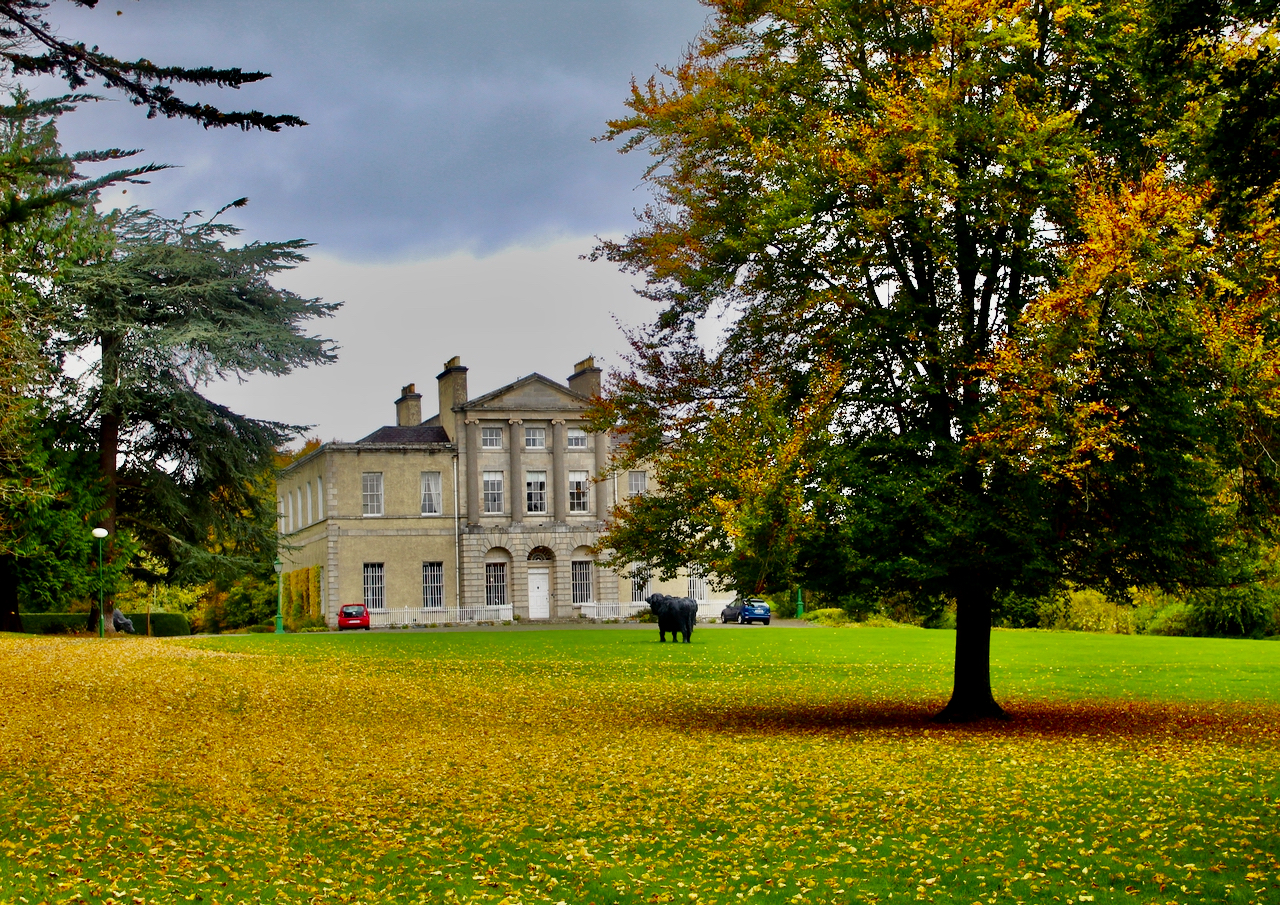
Volunteer guide Colin took us around the outside of the house first, and to the stables, then back to the house where we were allowed to wander around on the ground floor, marvelling at the plasterwork by Michael Stapleton and the joinery detail.
The house we see today replaced an earlier medieval house. A painting by Thomas Roberts produced shortly before its demolition shows what appears to be a late-medieval tower house with a manor house with castellated roofline to one side. [1] It was demolished by Agmondisham Vesey (1708–85) to make way for the current house.

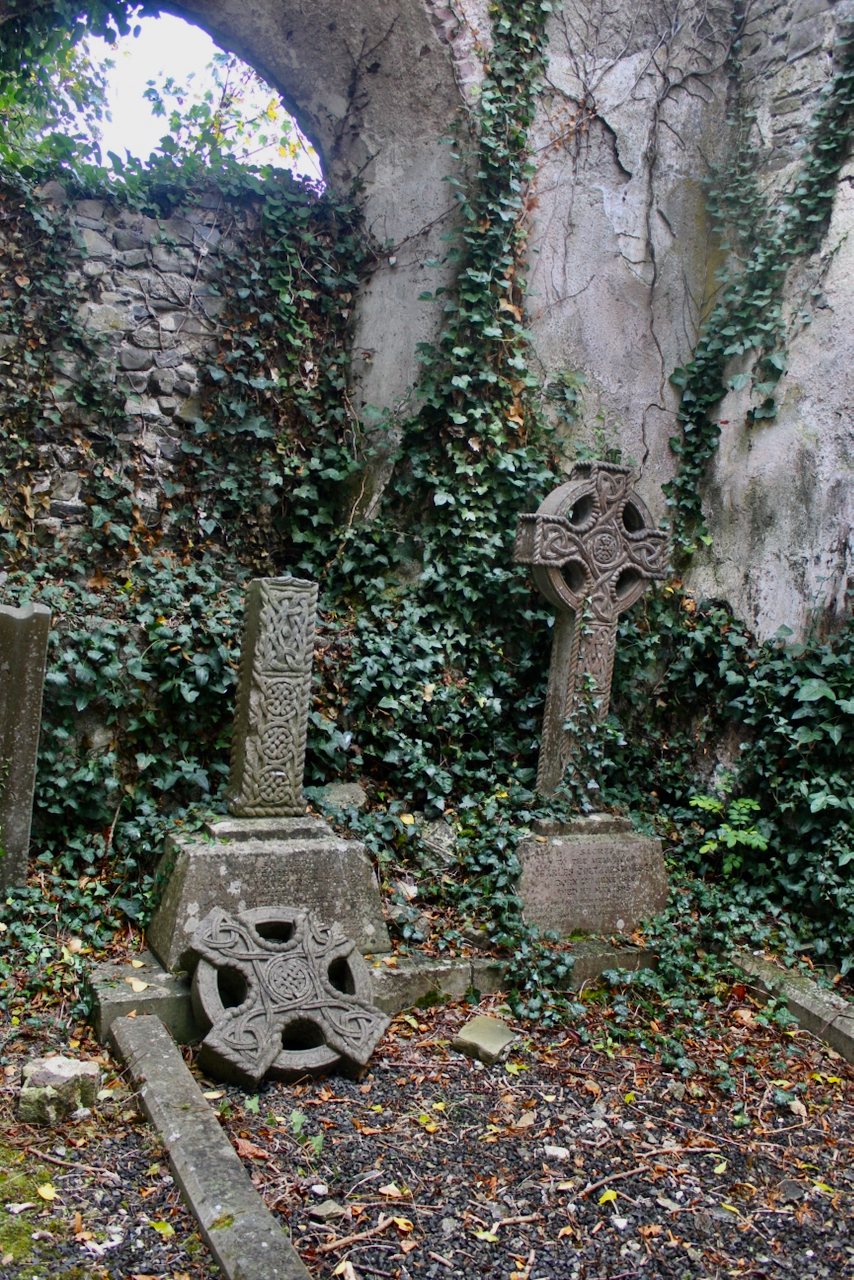
We passed the ruin of a medieval period church, the Church of the Blessed Virgin Mary, on the way along the driveway to the house – I am not sure if the original house was attached to this ruin.
Robert O’Byrne tells us that Vesey’s wife Elizabeth lamented the destruction of the older building, ‘with its niches and thousand other Gothic beauties,’ but her husband was determined to build the new house.
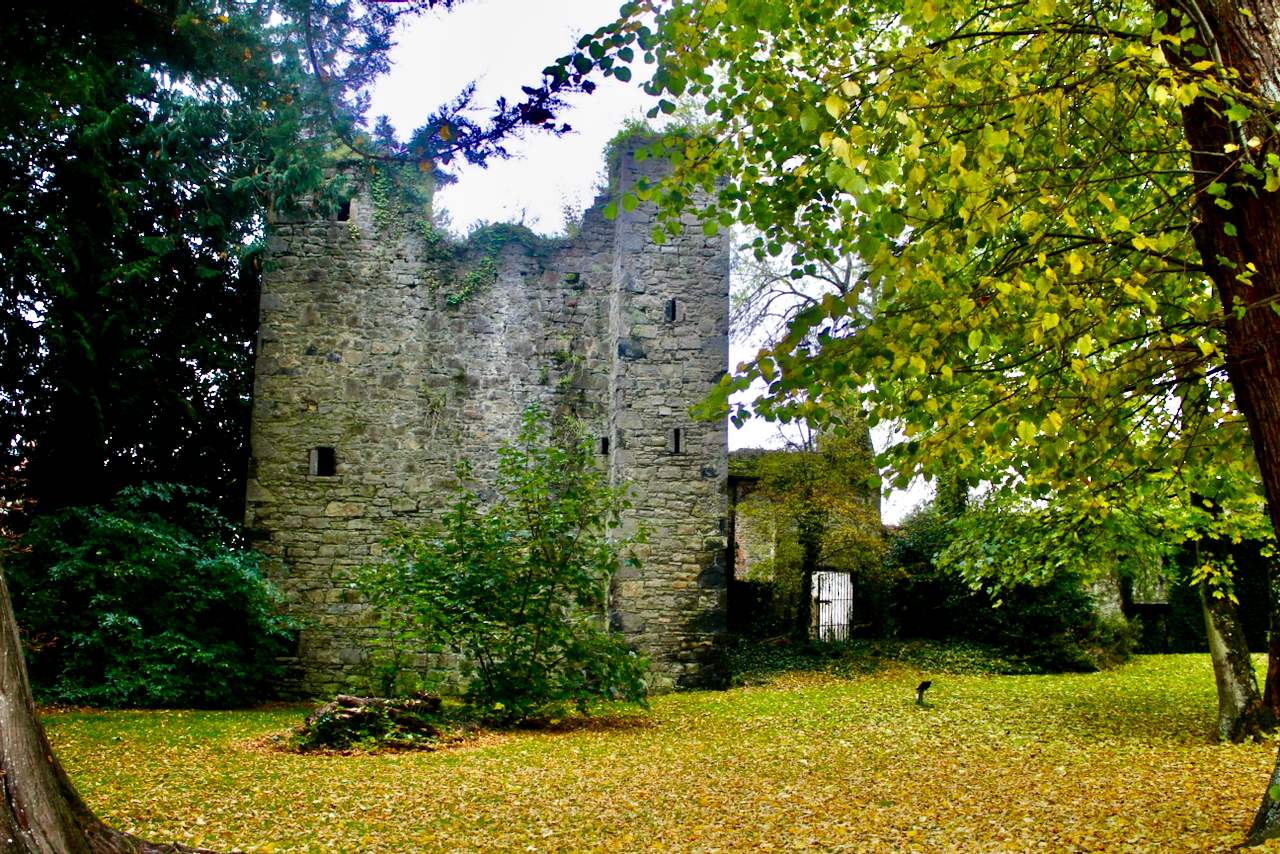

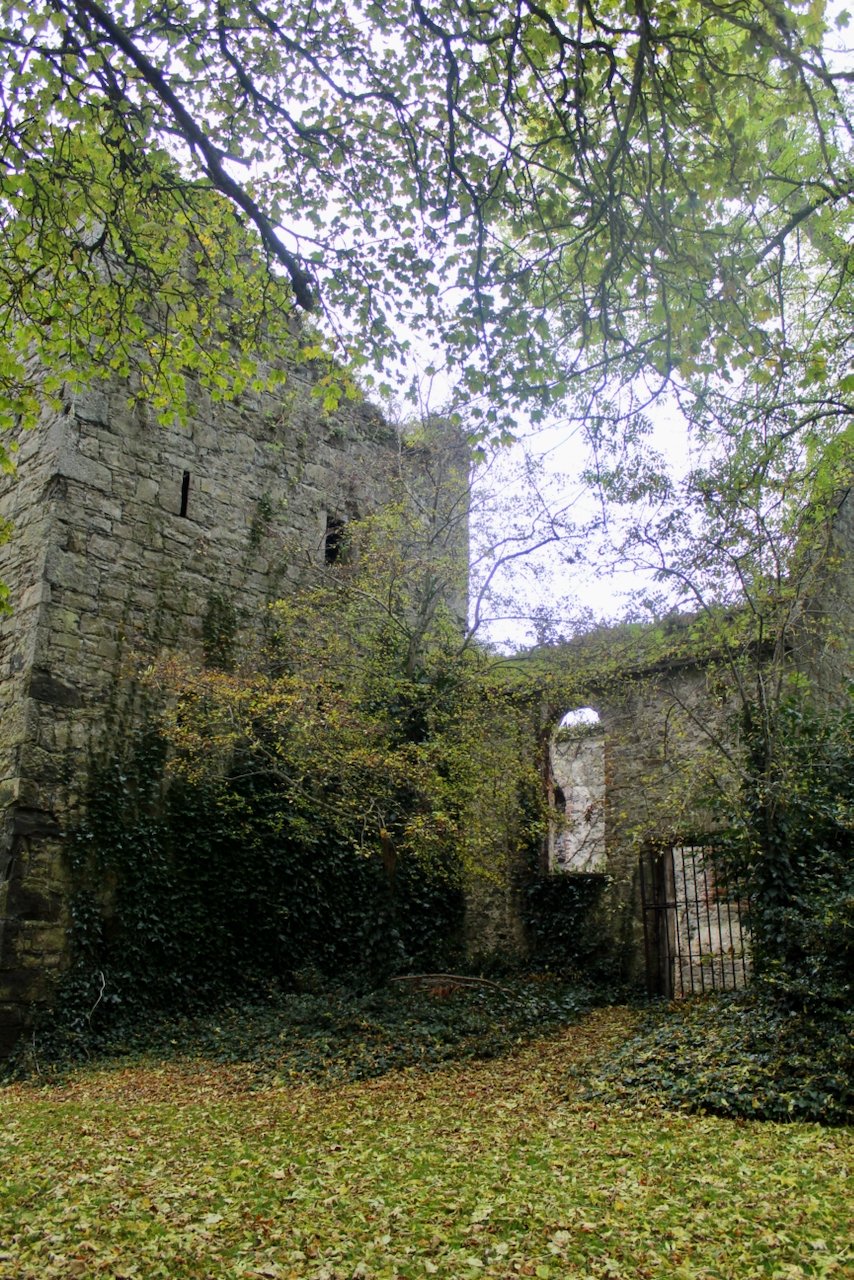


Our guide told us that William Sarsfield acquired the site in 1566. A later William Sarsfield (d. 1675) who lived at the Lucan House property married a woman said to be an illegitimate daughter of King Charles II, Mary Crofts (c. 1651-1693) (also called Mary Walters). Mary Crofts’ mother Lucy née Walter (d. 1658) was also mother of James Scott (1649-1685) Duke of Monmouth, who was recognised by Charles II as his offspring. Both Mary and James took the name Crofts as she and her brother were placed with with William Crofts, 1st Baron Crofts, a close friend of the King, to be raised. James changed his name to Scott, taking his wife’s name when he married. Lucy Walters was also a lover of Theobald Taaffe, 1st Earl of Carlingford (c. 1603 – 1677), who may have been Mary Crofts’s father.
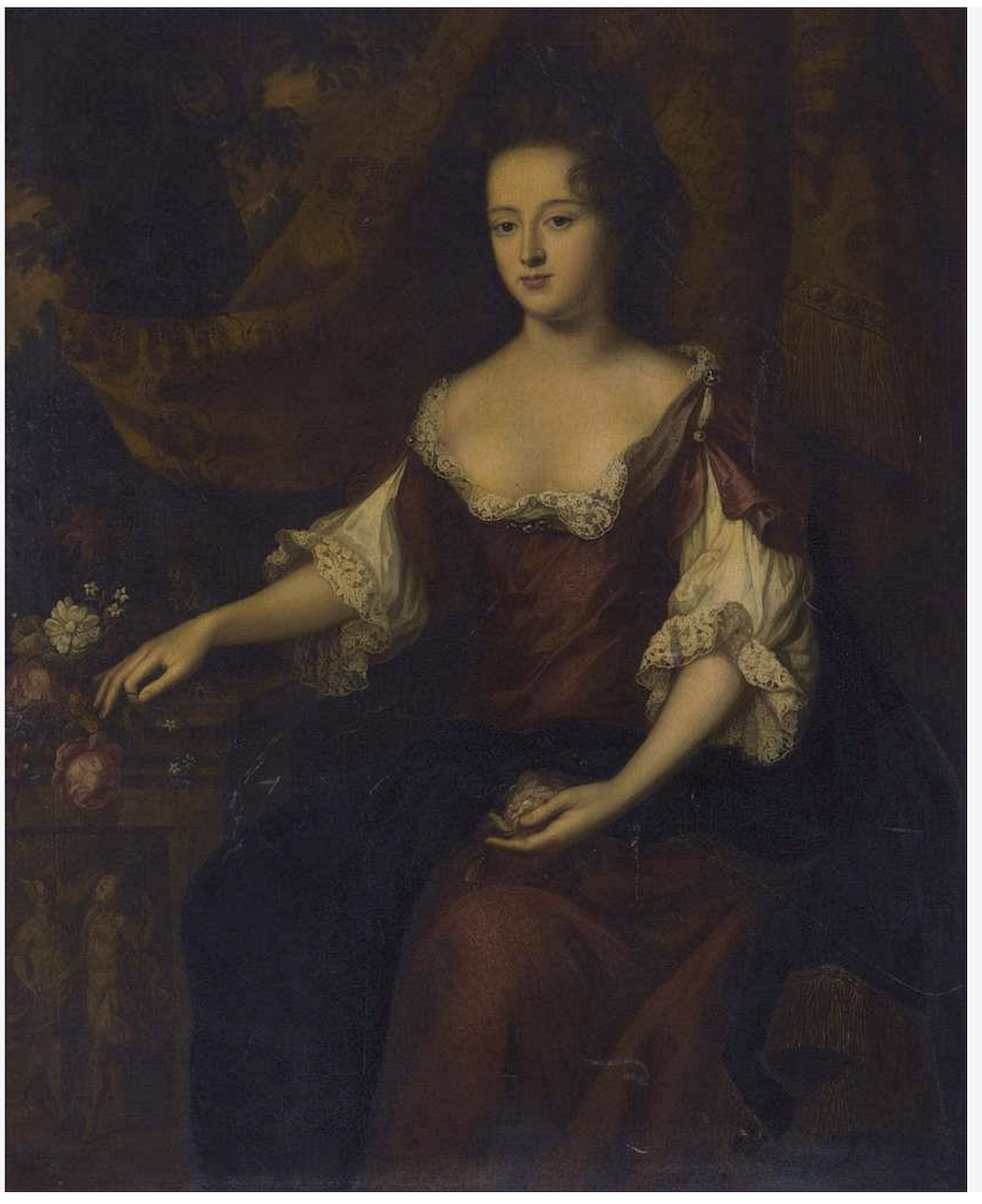
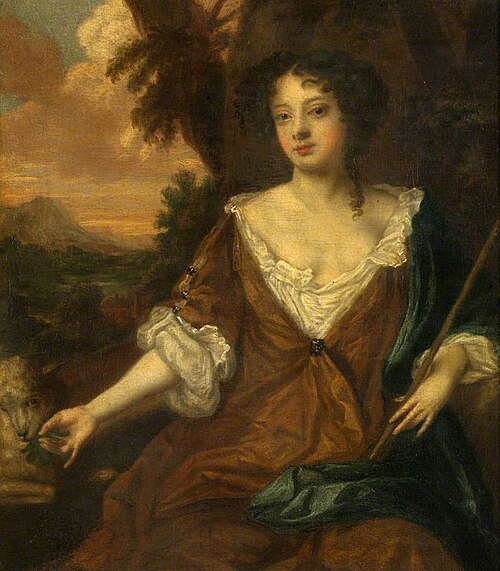
William Sarsfield (d. 1675) and Mary Crofts had a daughter, Charlotte (d. 1699), who married Agmondisham Vesey (d. 1738). It was his son, Agmondisham Vesey (1708–85), who built the current Lucan House, with the help of William Chambers.

William’s brother was Patrick Sarsfield (d. 1693) 1st Earl of Lucan. They grew up at another property, Tully in County Kildare, but they moved to Lucan when their father inherited the property in the early 1650s. Their mother Anne was the daughter of Rory O’More, a leader of the 1641 rebellion.
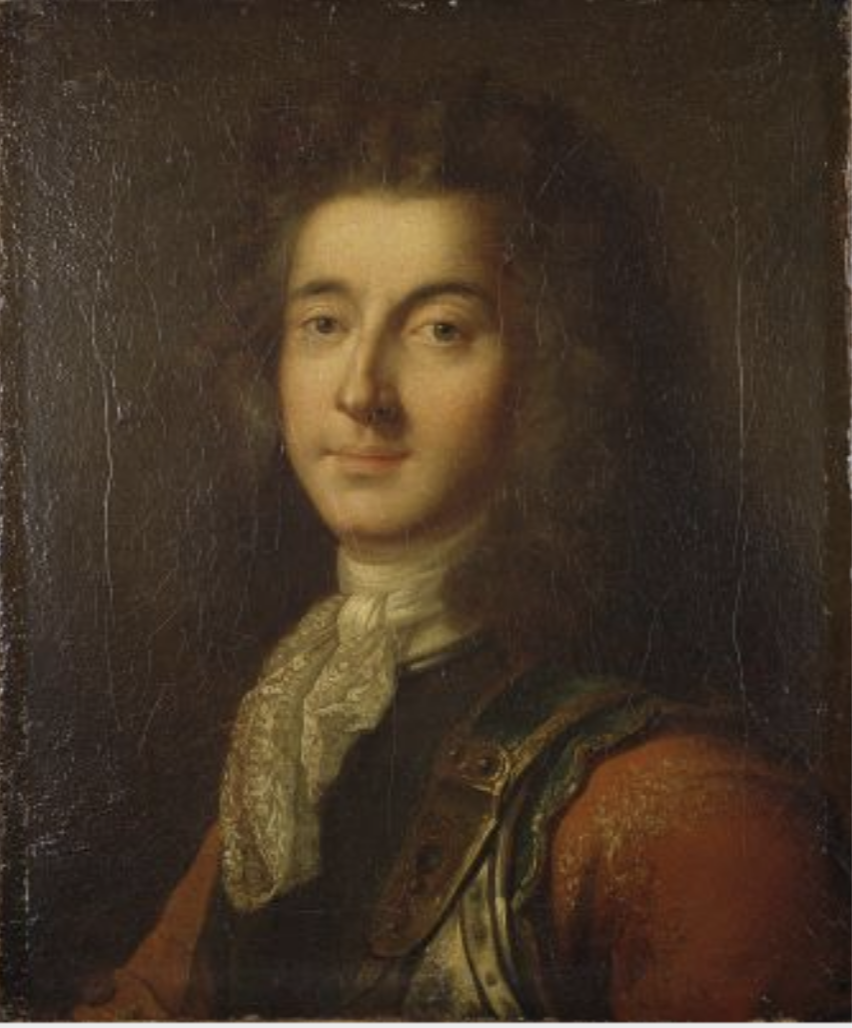
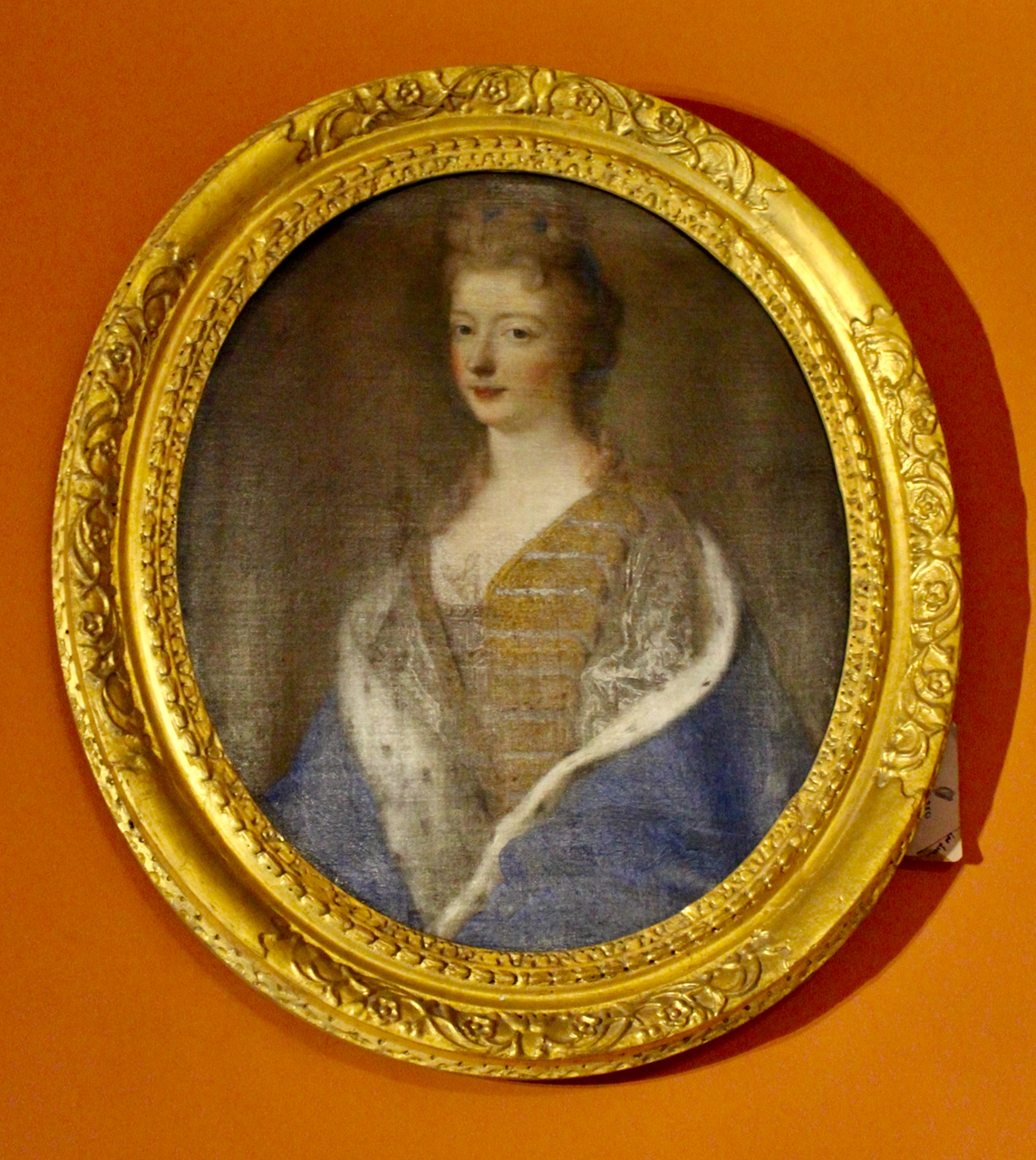
Both Sarsfield estates were confiscated by the Cromwellian regime and the family was transplanted to Connacht in 1657. Their father was restored to the Tully lands in 1661 by order of Charles II. In 1654 Lucan house was given to Cromwellian soldier Theophilus Jones (d. 1685) who later turned against the Cromwellians and helped to restore King Charles II to the throne.
The Sarsfields were Catholic. Patrick Sarsfield joined the military – the Dictionary of Irish Biography tells us that he served in one of the English regiments in the French army. These had been formed as a result of the secret treaty of Dover and allowed Catholics to avoid the test act and serve as officers. However, Sarsfield was implicated in the Popish Plot, and was dismissed from the army.
During a brief visit to Ireland he tried unsuccessfully to regain the family estate at Lucan to which he was then the heir presumptive. [2]
His military reputation soared as a consequence of his significant role in the defeat of Monmouth’s rebellion (1685) – who was his brother-in-law! James II promoted Patrick Sarsfield to the rank of lieutenant-colonel. He fought in Ireland with the Jacobites against William III, and James created him earl of Lucan in January 1691. He was involved in negotiations for the Treaty of Limerick. He went on to fight in the French army and died of battle wounds in 1693. The Dictionary of Irish Biography continues:
“He married Lady Honora Burke, the 15-year-old youngest daughter of the 7th earl of Clanricarde, sometime during the winter of 1689–90. Their only child was born (April 1693) at the court in exile of James II in Saint-Germain-en-Laye and was named (in honour of the prince of Wales) James Francis Edward. He served in both the French and Spanish armies and died without issue in St Omer in 1719.“
Patrick Sarsfield is memorialised by a memorial in the garden designed by James Wyatt.
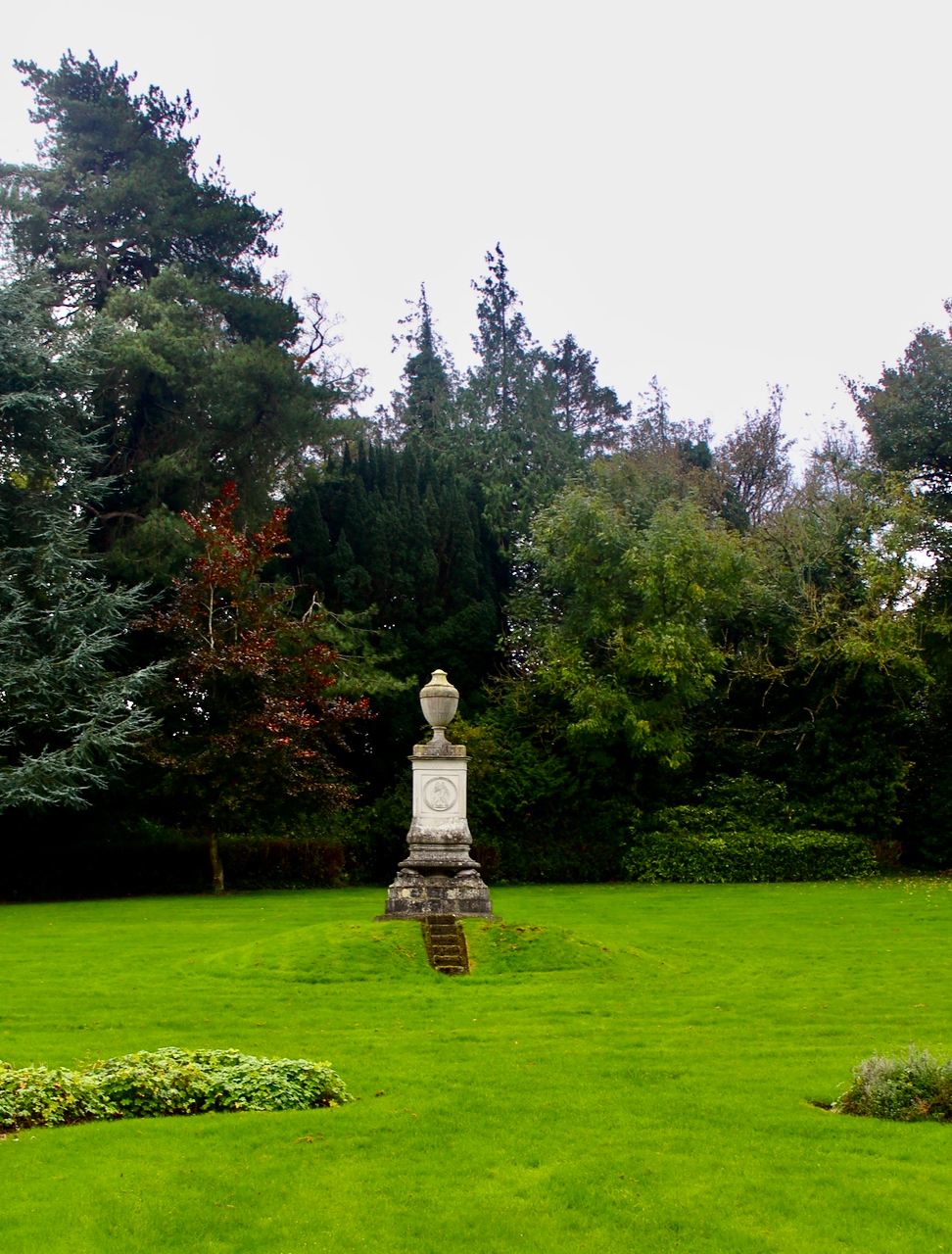
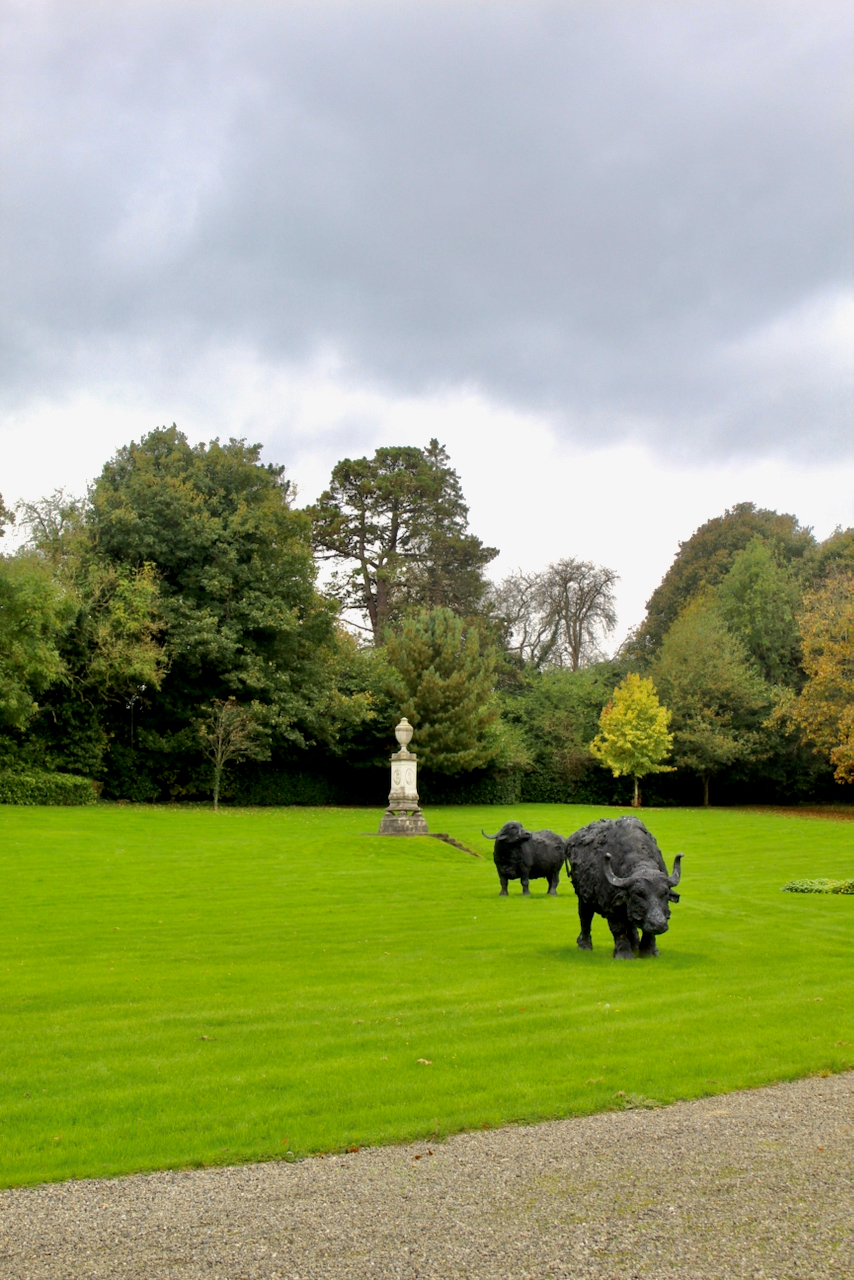
Agmondisham Vesey was the son of John Vesey (1638-1716) Archbishop of Tuam, who also served as Lord Justice of Ireland and Privy Counsellor. He claimed the Lucan estate on behalf of his wife and by 1674 and was able to purchase the estate at a low price. [3] Theophilus Jones was compensated by lands elsewhere.
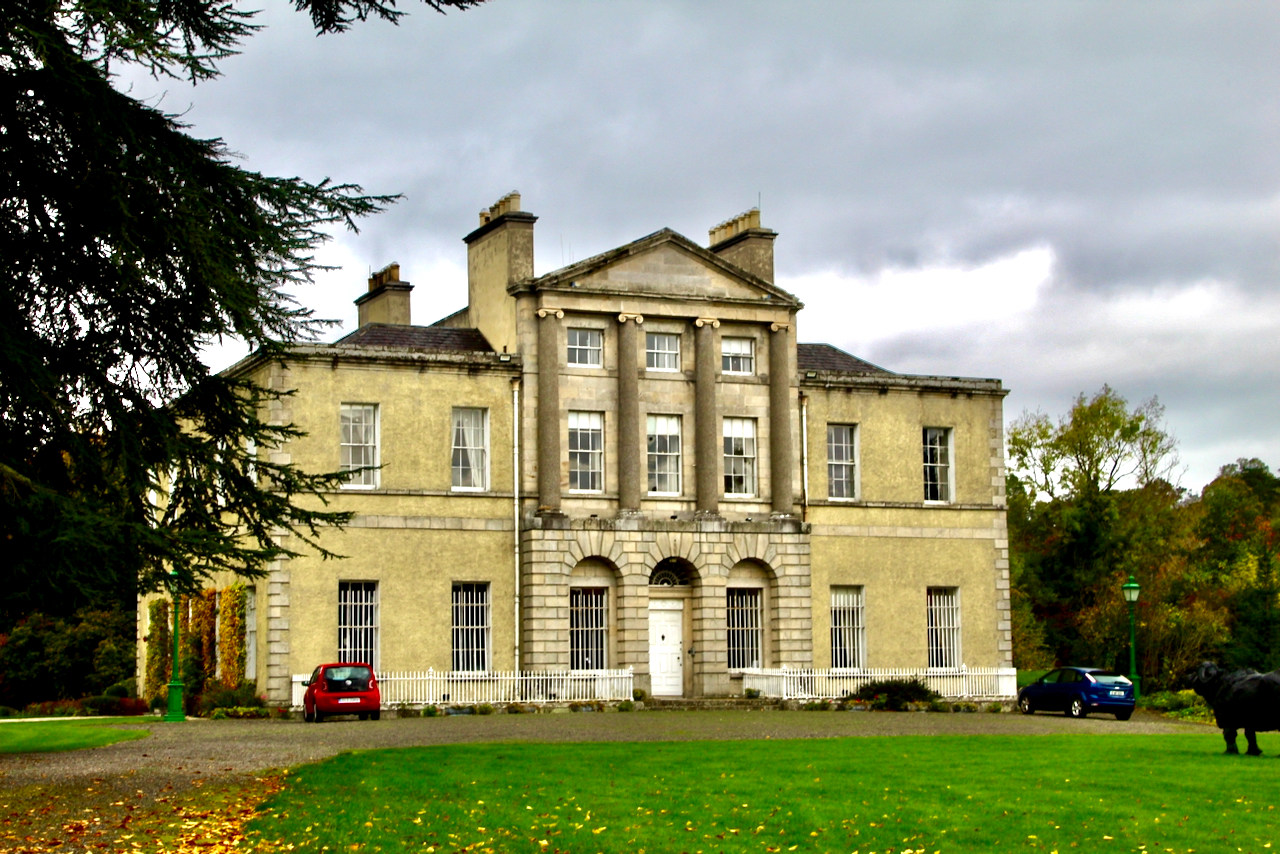
Charlotte Sarsfield died only three years after her marriage to Agmondisham Vesey. They had two daughters: Henrietta, who married Caesar Colclough (1696-1766) of Tintern Abbey in County Wexford; and Anne Vesey, who married John Bingham (d. 1749), 5th Baronet of Castlebar, County Mayo. Their son Charles Bingham (1735-1799) 7th Baronet was created 1st Earl of Lucan in 1795, but these Earls of Lucan did not inherit Lucan House.
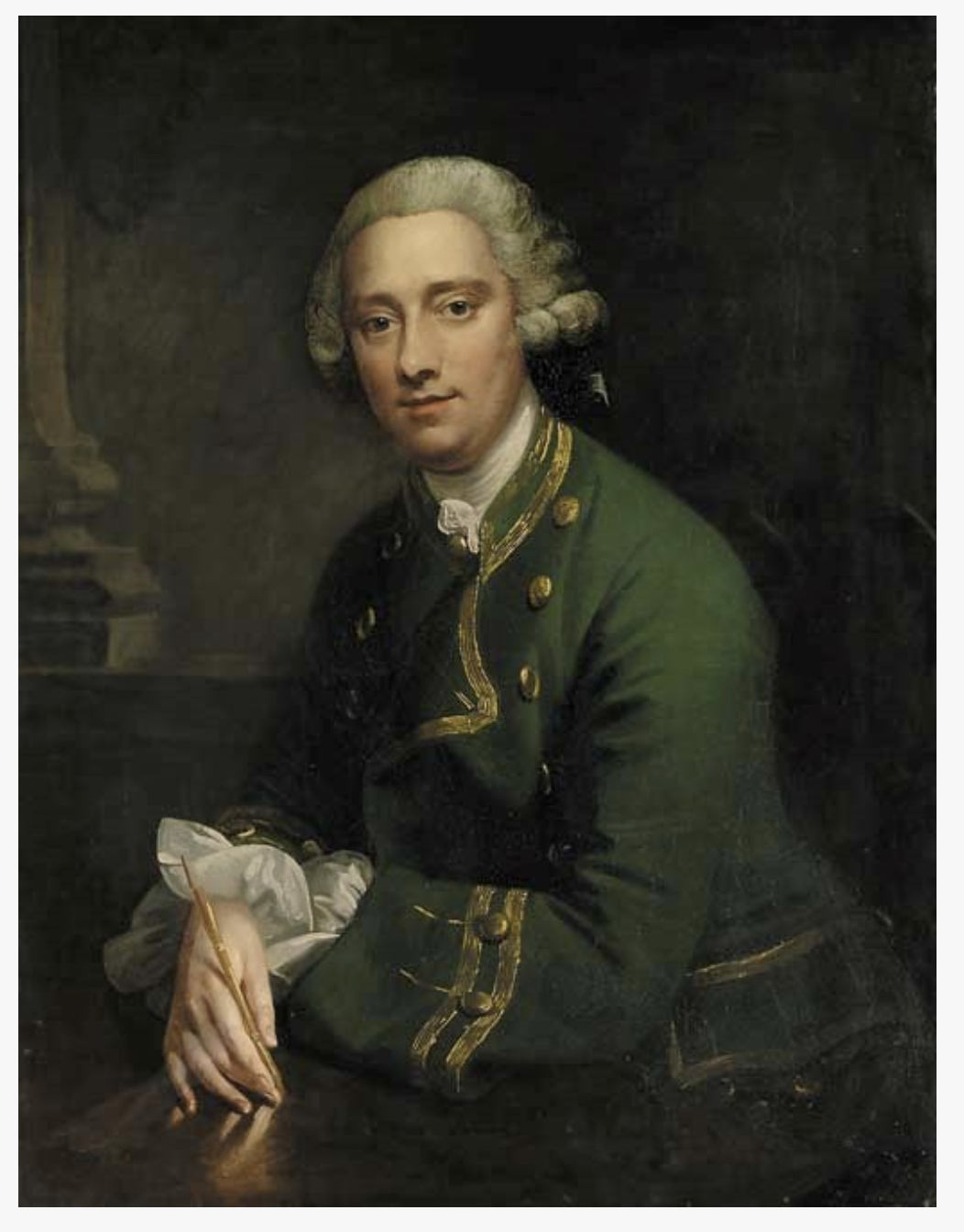
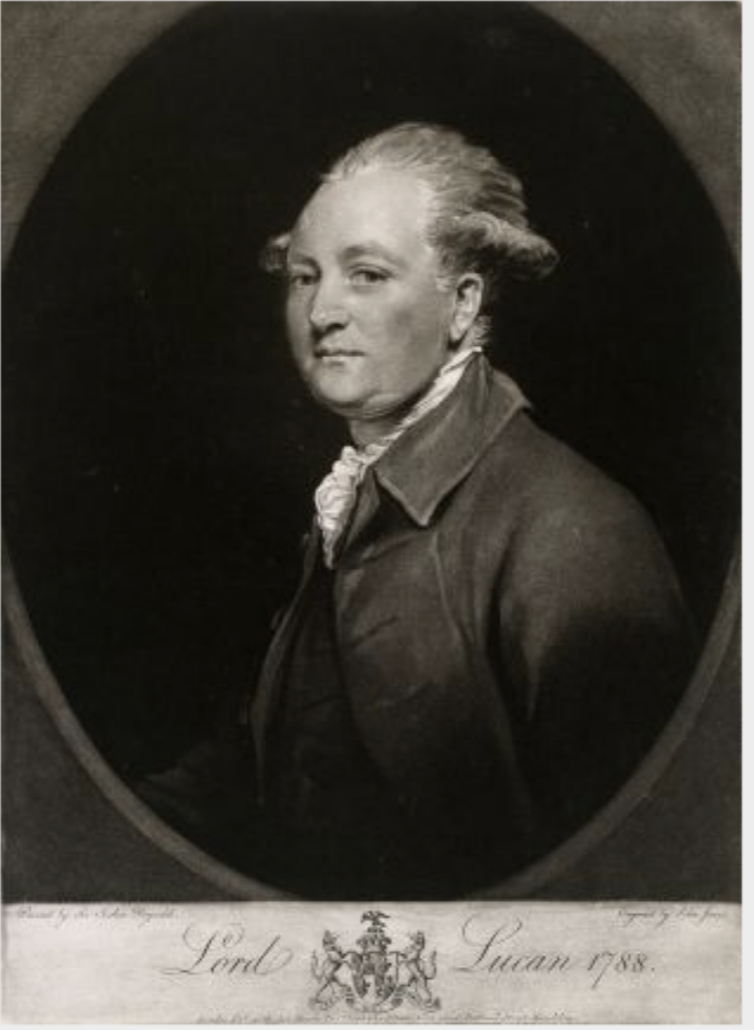
Instead, Lucan House passed down to a son of Agmondisham Vesey’s second wife, Jane Pottinger. She was the widow of Thomas Butler (d. 1703) 3rd Baronet of Cloughgrenan, County Carlow, with whom she had no children. She and Agmondisham went on to have several children, the eldest of whom was Agmondisham Vesey (1708–85).
Agmondisham Vesey (1708–85) was a politician: a member of the house of commons for Harristown, Co. Kildare, 1740–60, and Kinsale, 1765–83. He was accountant and controller general from 1734 to his death, and a member of the privy council from 1776 to his death. He was also an amateur architect, and he designed his residence, Lucan House, built in 1772, with the help of William Chambers, who also designed the Casino in Marino in Dublin, built over the years 1758-76 (see my entry https://irishhistorichouses.com/2023/11/09/office-of-public-works-dublin-the-casino-at-marino/ ).
The fine stable block was designed earlier, in 1750s. Chambers may have been involved in the design of the stable block.

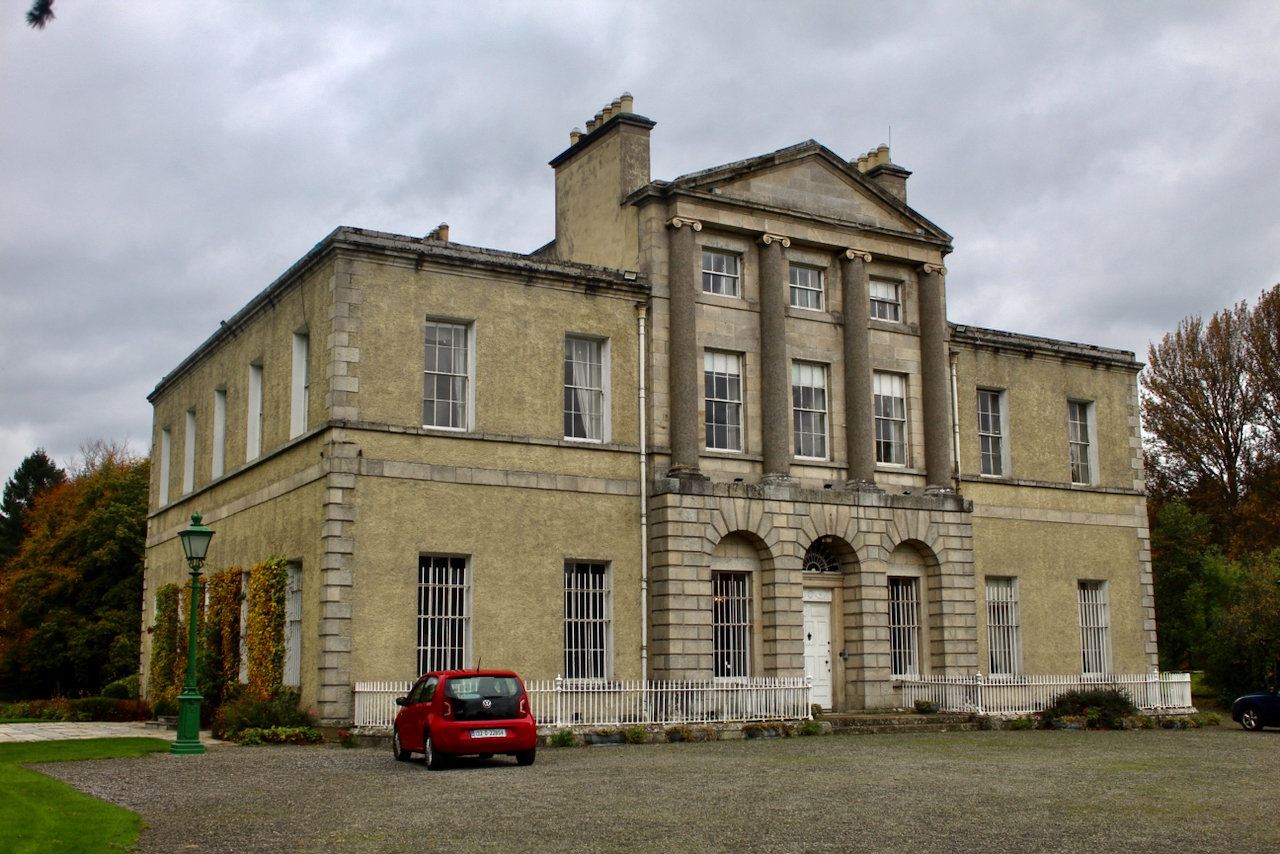
Bence-Jones describes the house as two storey over basement with a central feature of a pediment raised on a three bay attic, carried on four engaged Ionic columns. The ground floor is rusticated on the projecting three bays. The outer bays on the ground floor were also rusticated but the rustication was removed.

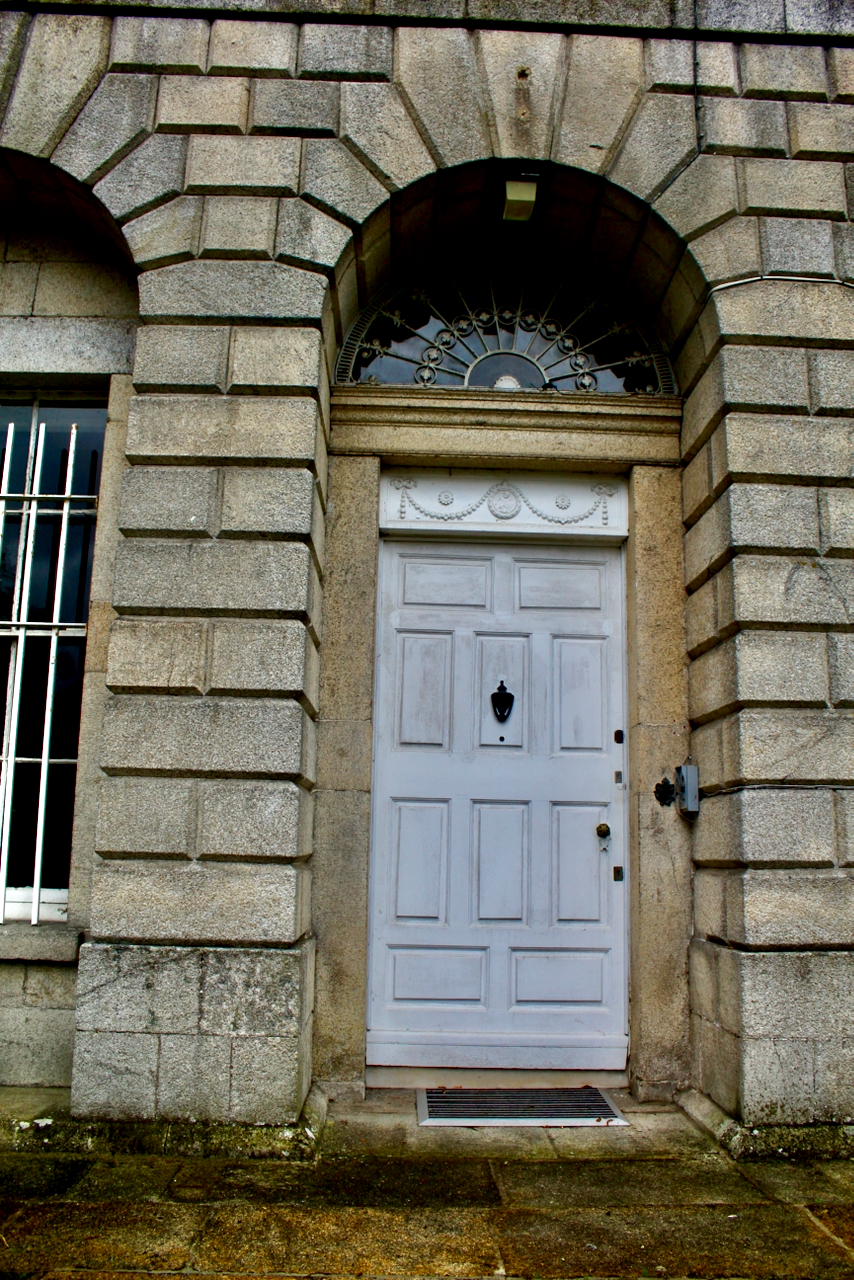
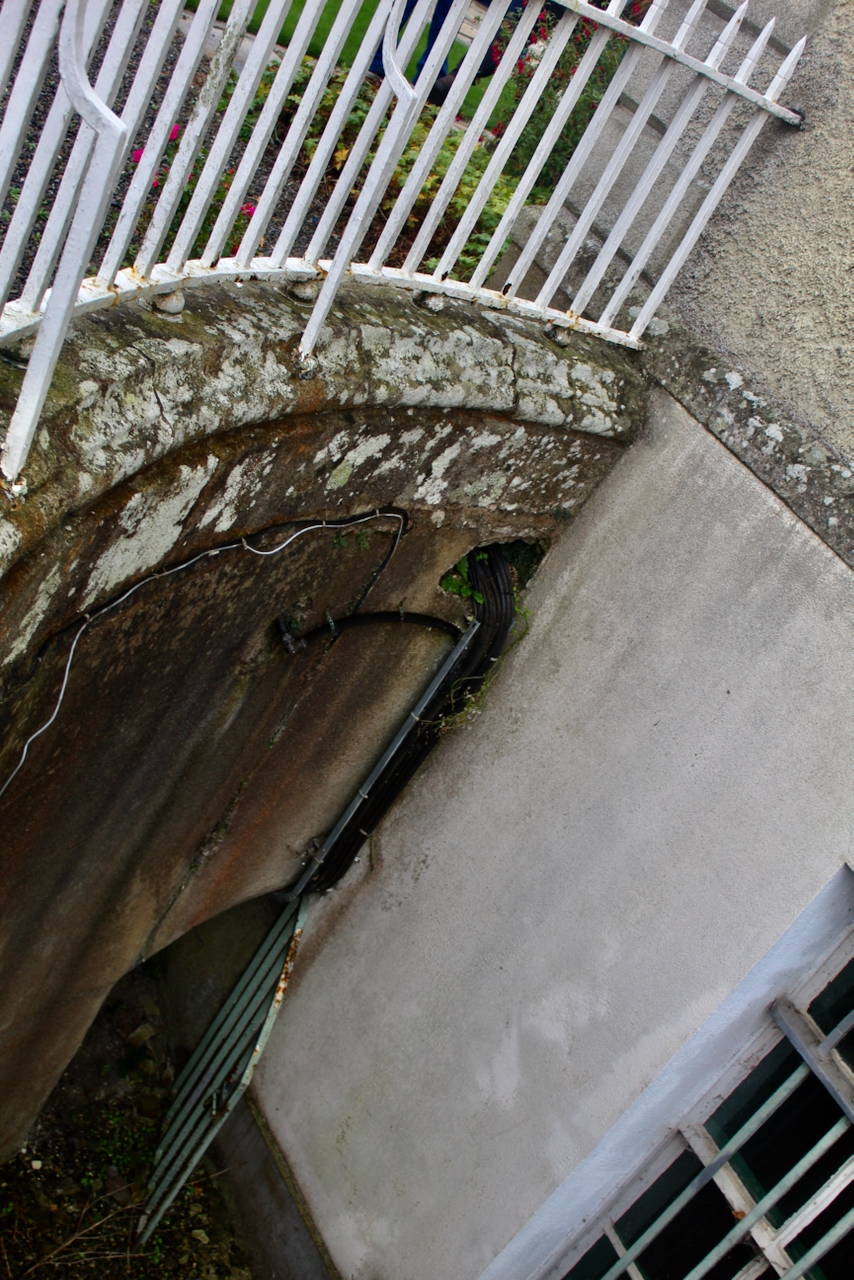
The house has five bay side elevation and a garden front with central curved bow containing an oval room which may have influenced James Hoban, designer of the White House in Washington DC (also said to be inspired by Leinster House).

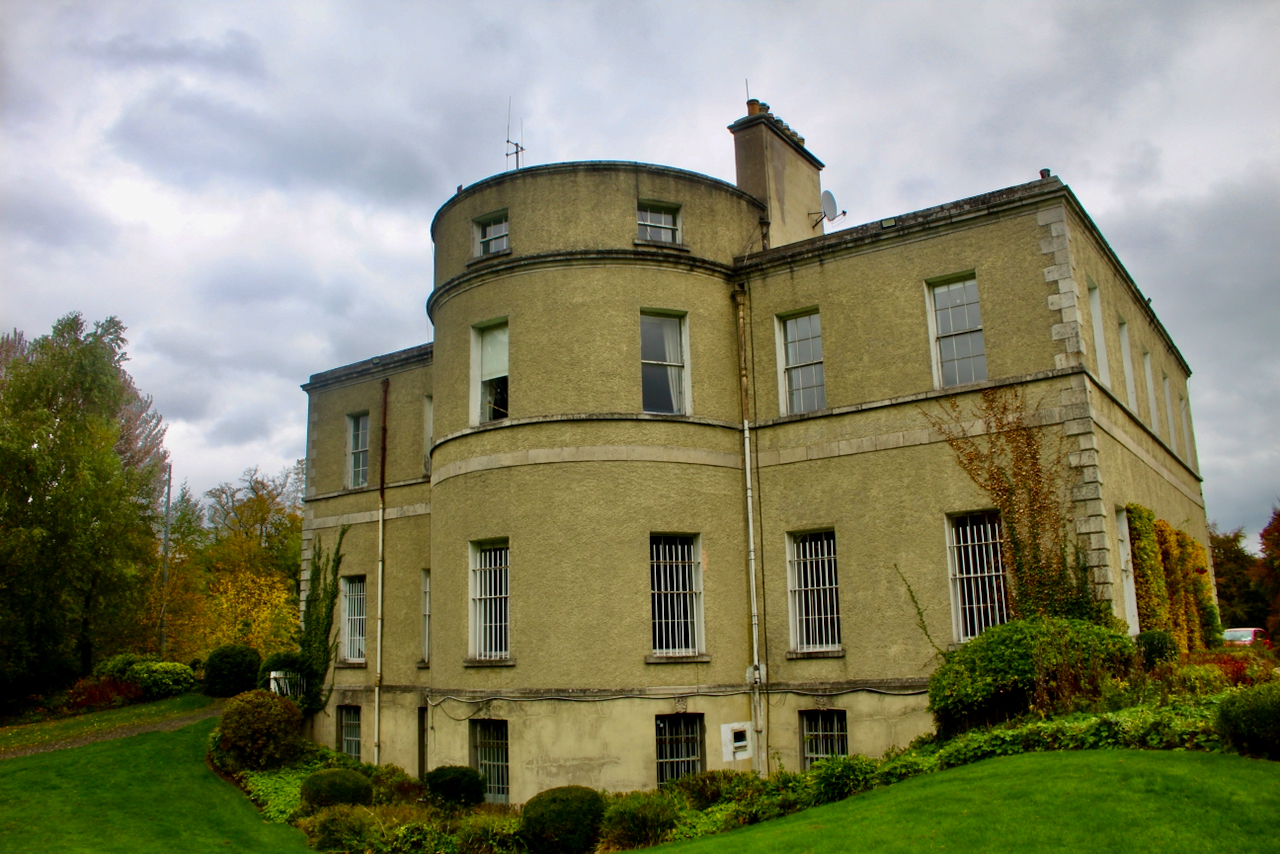
Mark Bence-Jones tells us that Agmondisham Vesey consulted with James Wyatt (1746-1813) of London and Michael Stapleton for the interiors of the house. Robert O’Byrne adds he was aided by Wyatt’s Irish representative Thomas Penrose. James Wyatt had a flourishing country house practice in Ireland from the early 1770s until his appointment as Surveyor General of the King’s Works in England in 1796. [4]
The front hall has a screen of columns marbled to resemble yellow Siena, with squared pilasters to match on the back wall of the hall.


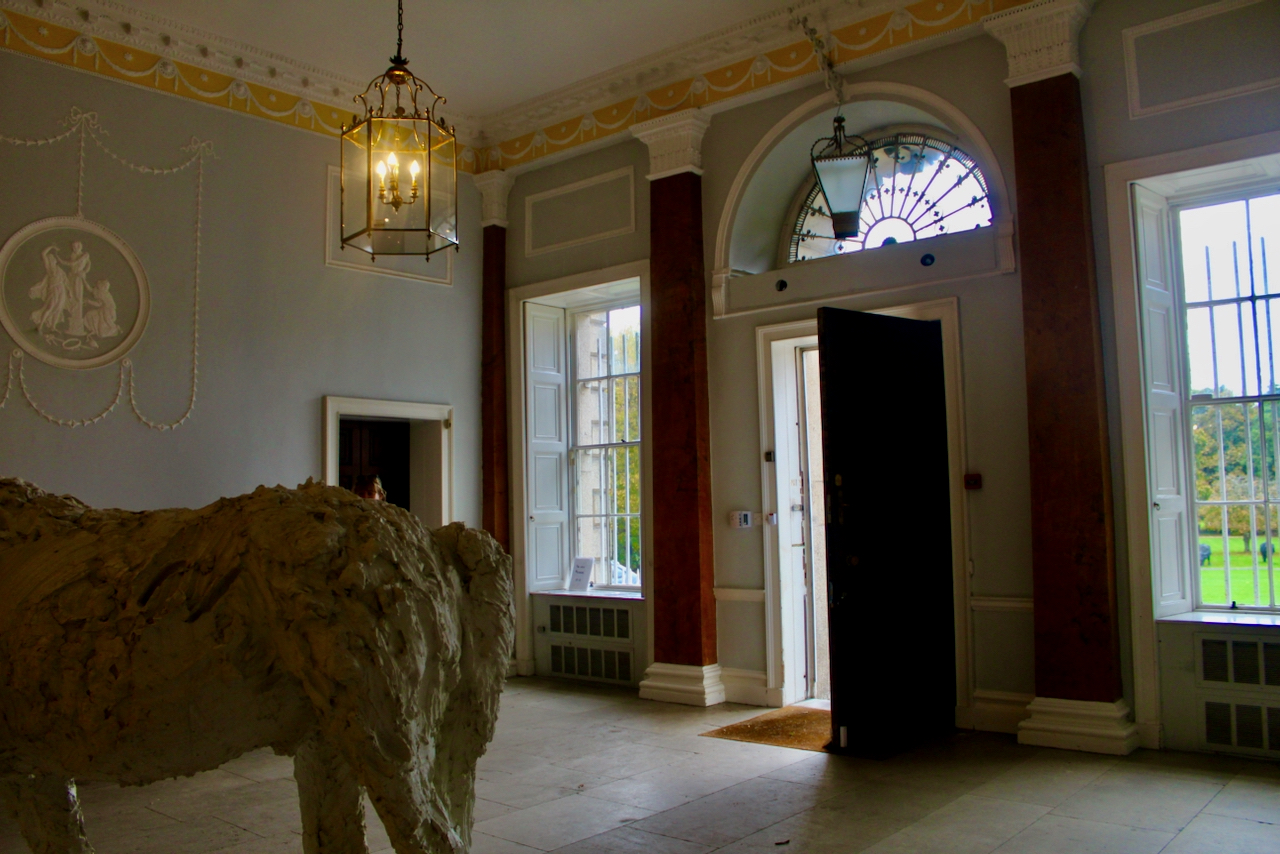
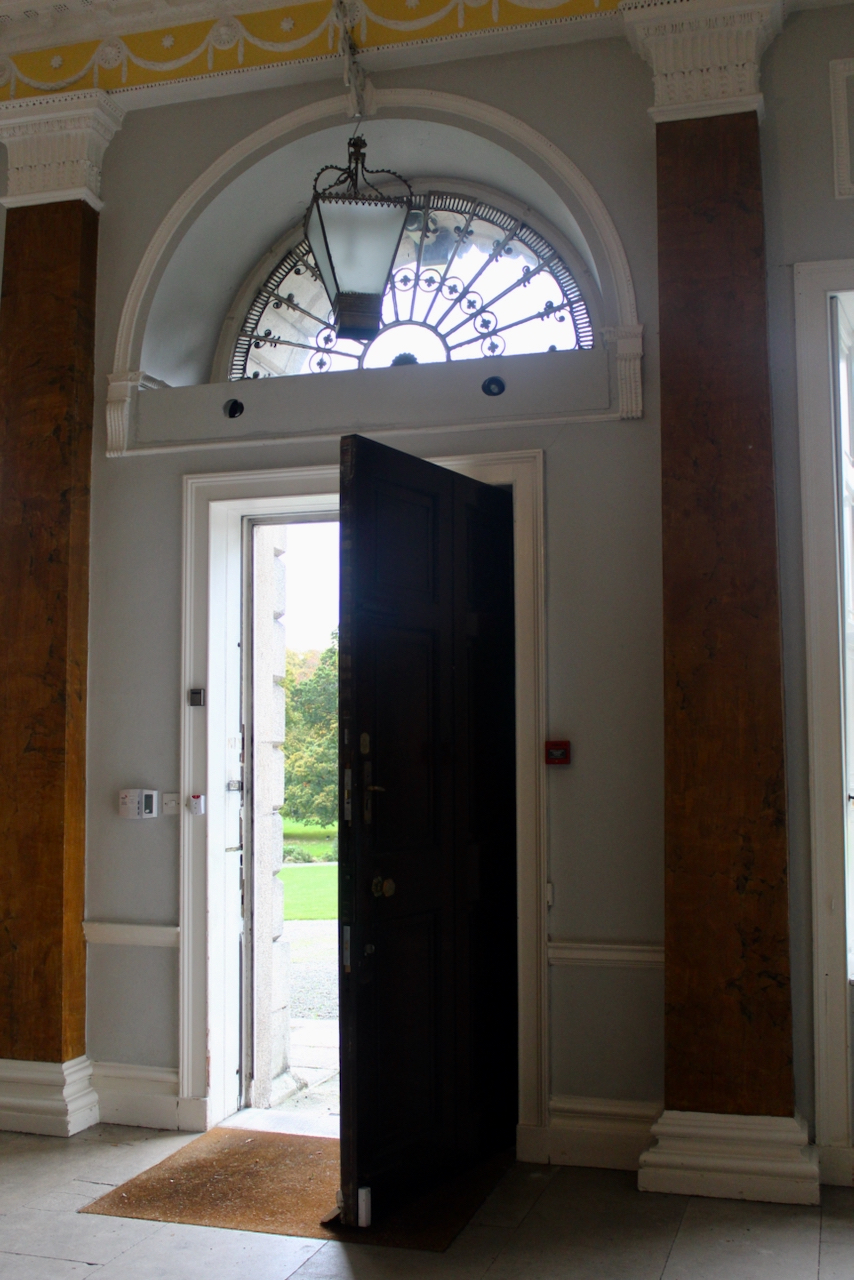
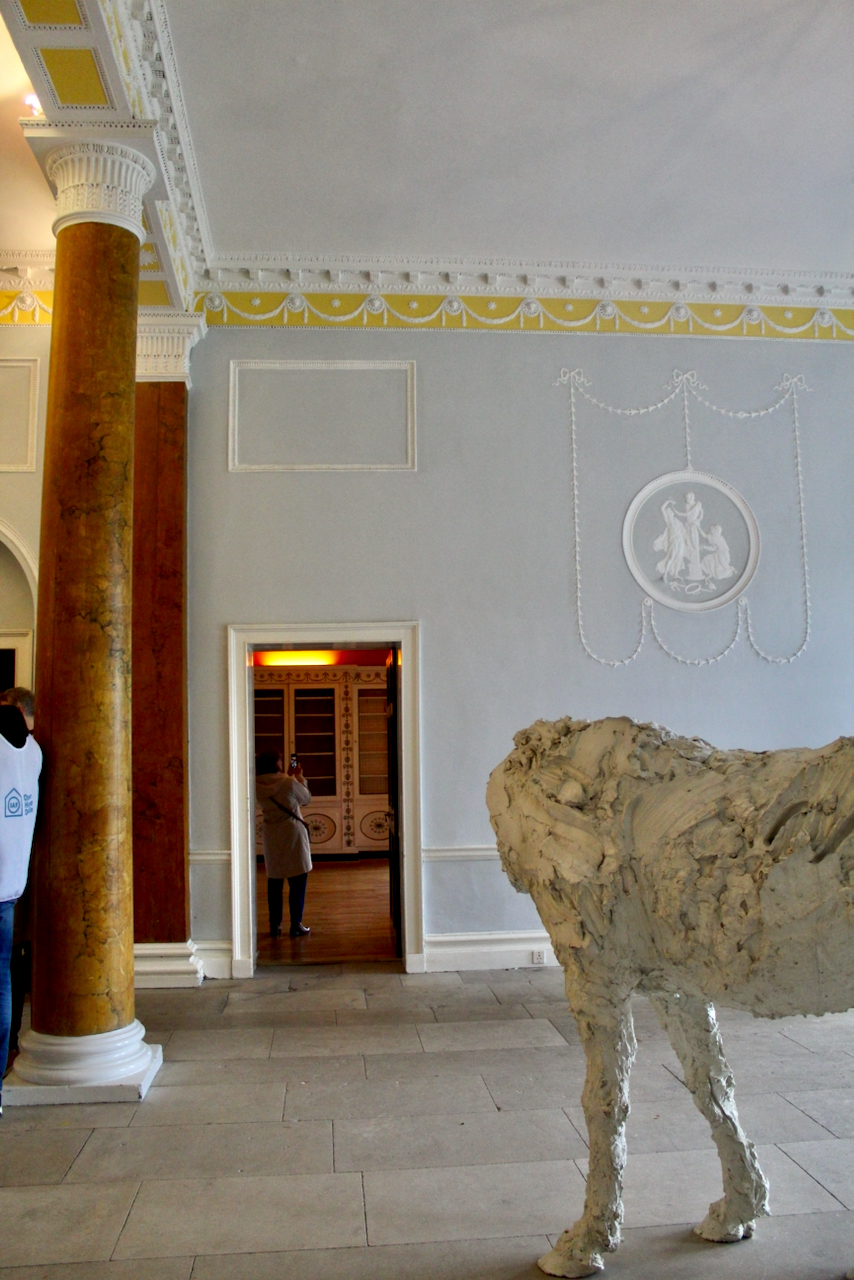
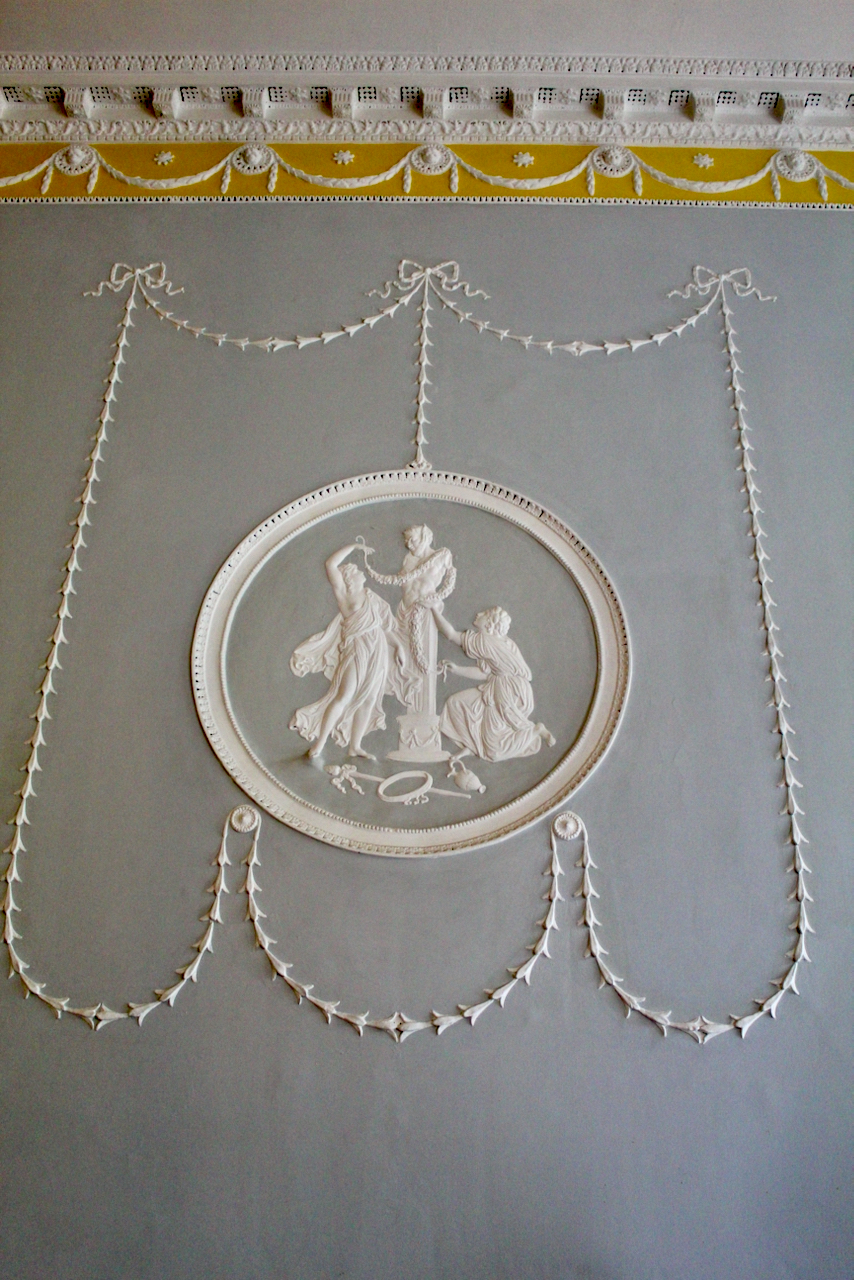

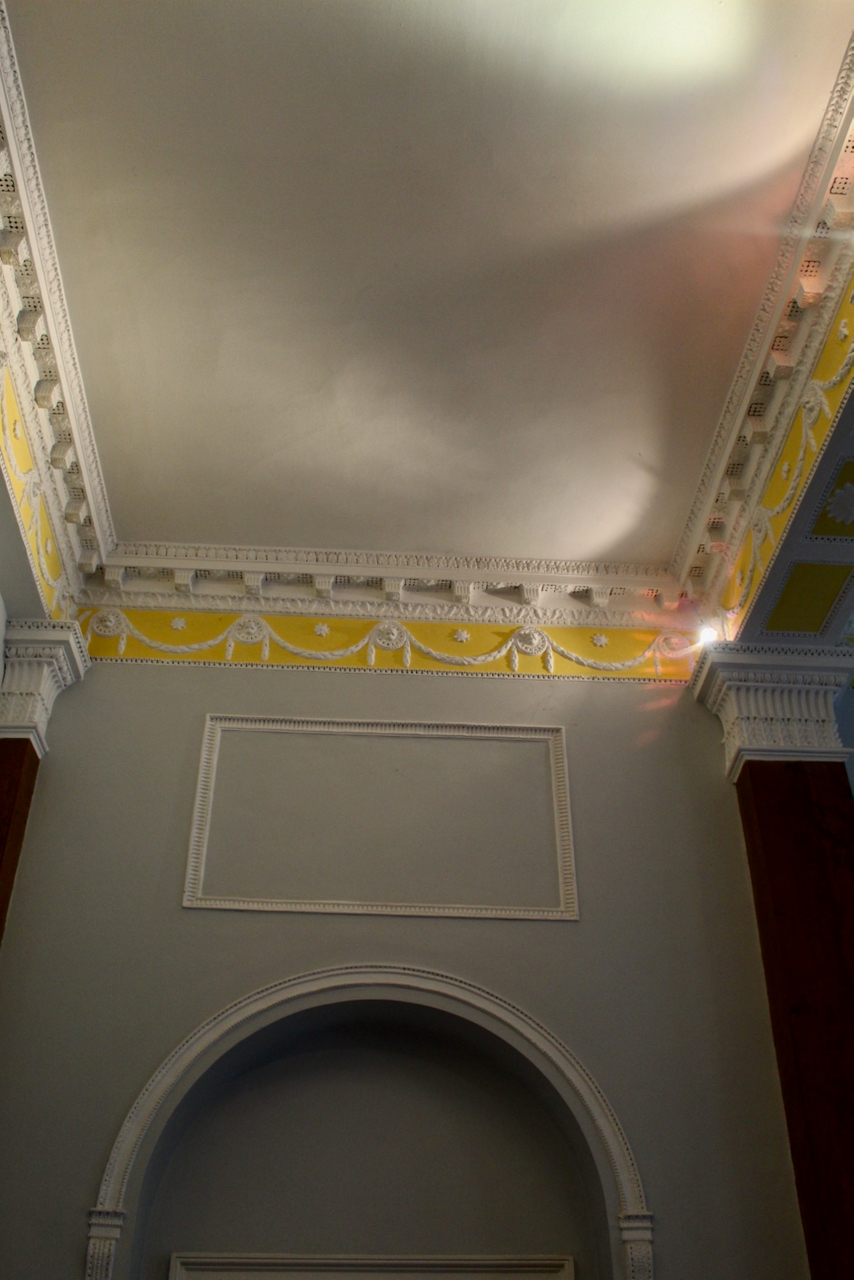
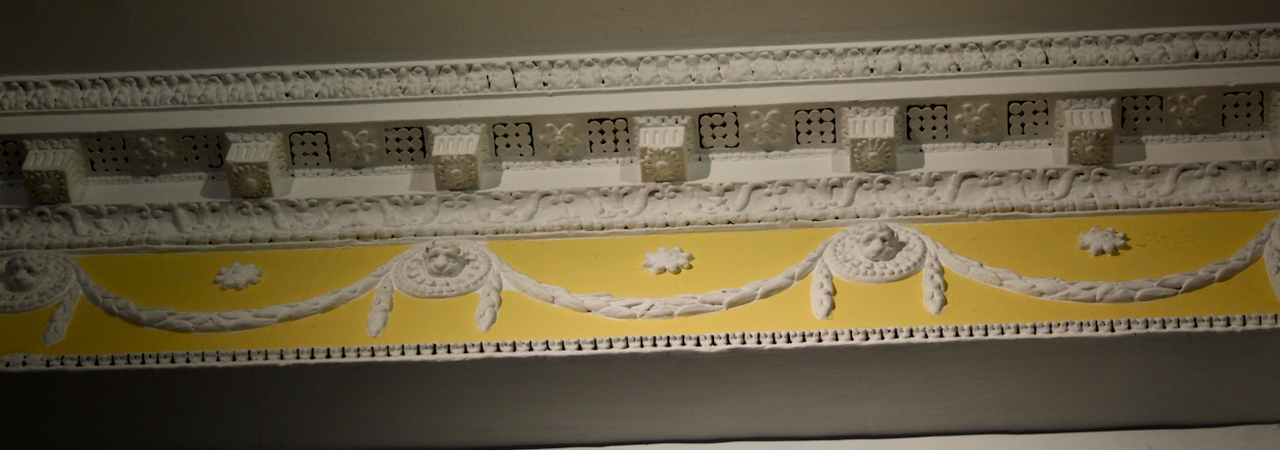
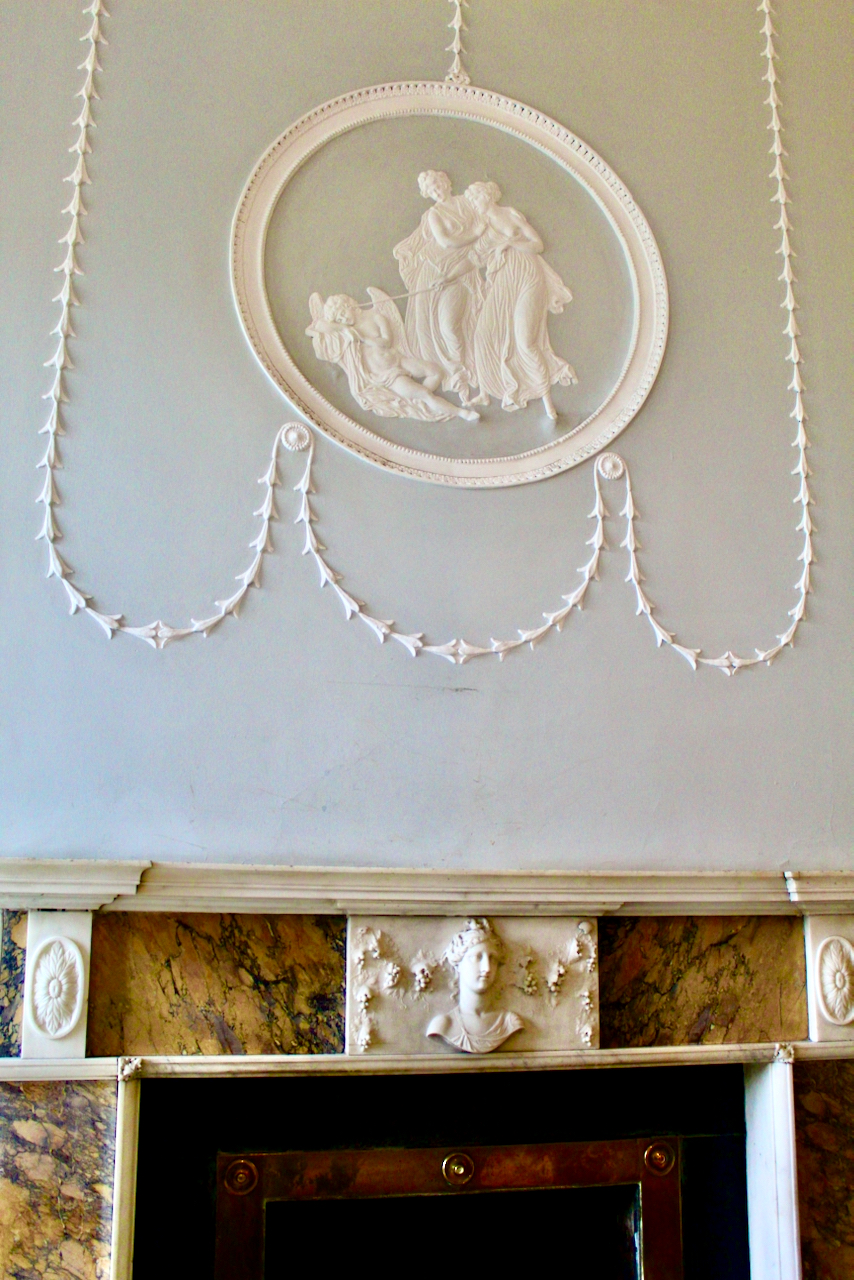
All the rooms on the ground floor at Lucan House are as they were when the house was completed in 1780, with the exception of a new floor in the library and bathrooms, which the Italian embassy added in the 1950s. [5] There is a large kitchen in the basement which we did not see.
In the Wedgwood Room, to the left of the hall, has a splendid ceiling. After much research an exact match for the original paint in the Wedgwood Room was found when the house was restored. The powder blue emphasises the marvellous stucco work by Michael Stapleton, and trompe l’oeil rondels said to be by Peter de Gree. However, Robert O’Byrne tells us that these are in fact prints that have been painted over. The ceiling curves downwards at the corners giving the effect of a shallow dome. At the centre of the gently domed ceiling is a medallion depicting a warrior kneeling before Minerva and by her maidens.
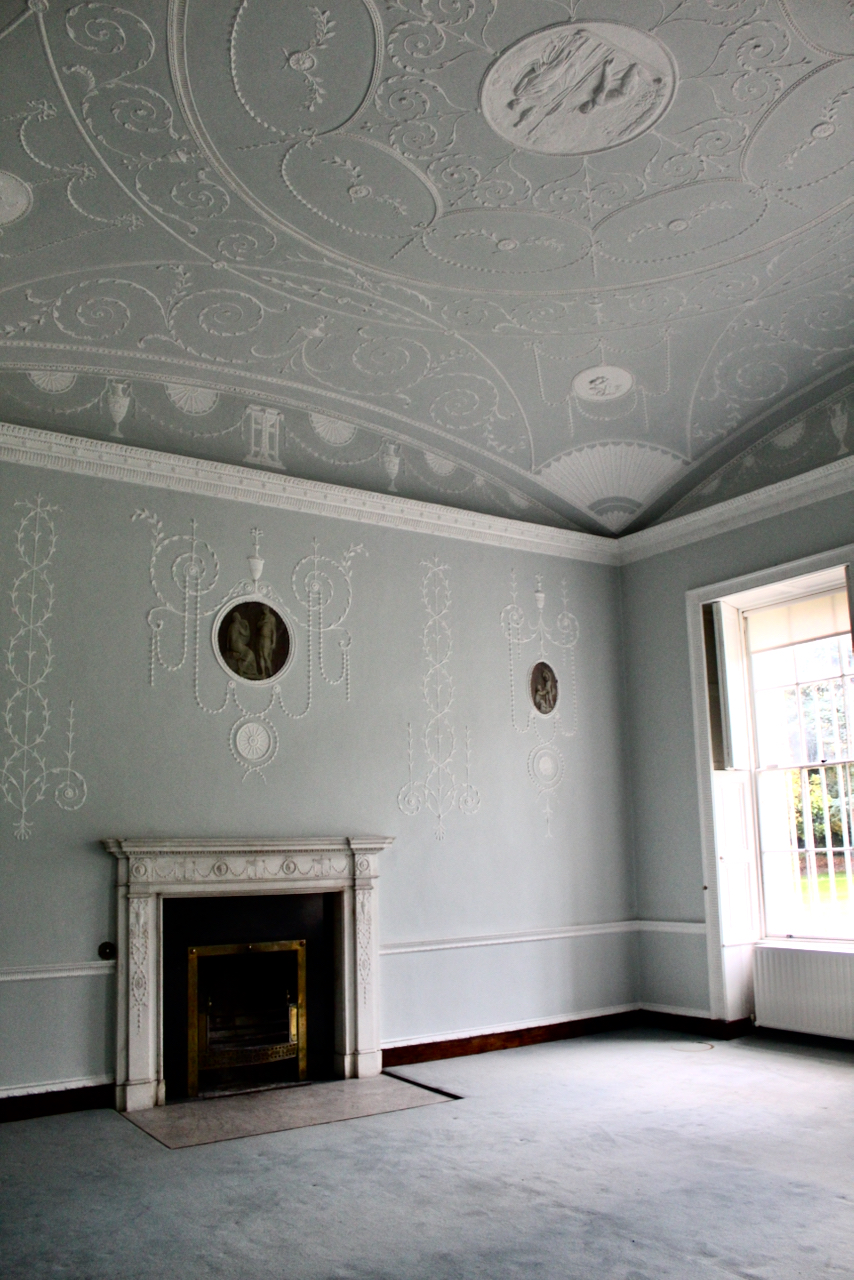
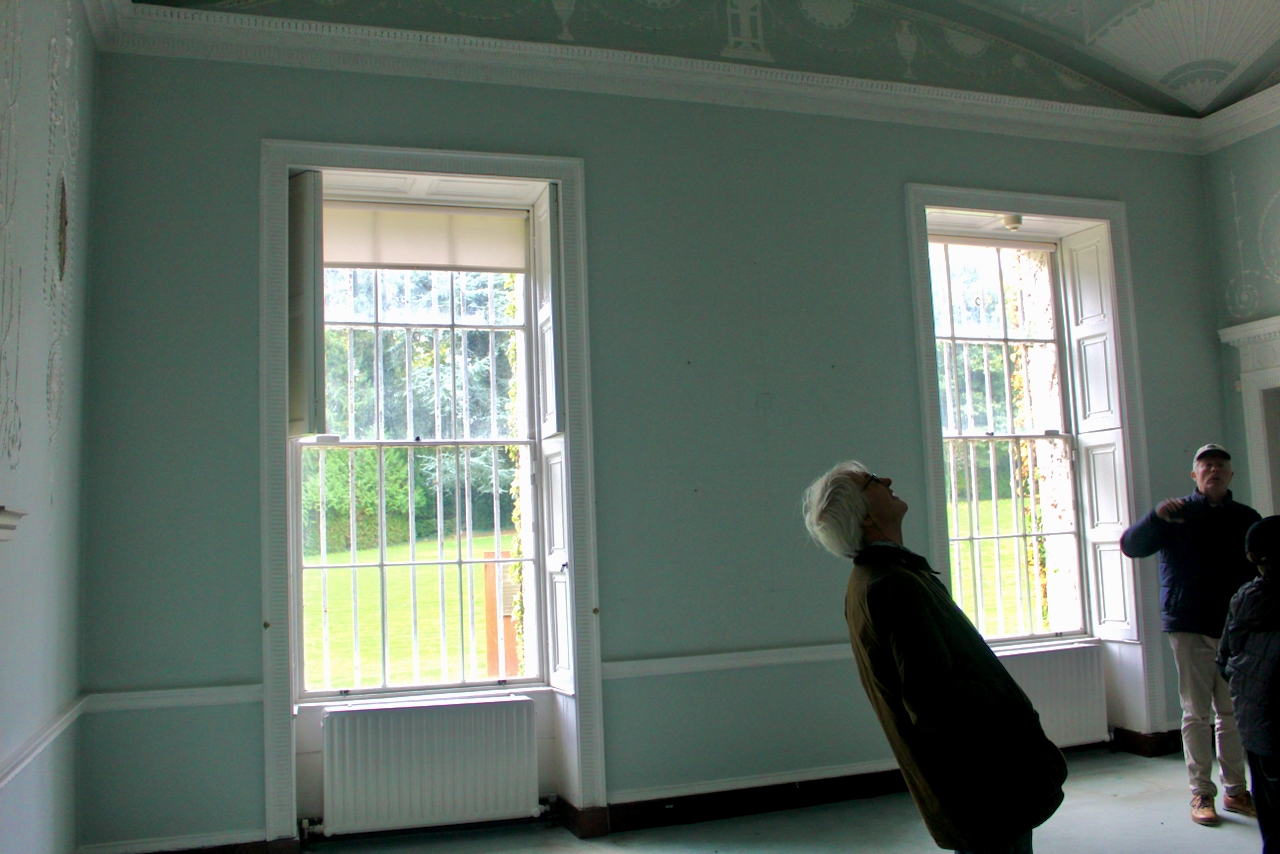
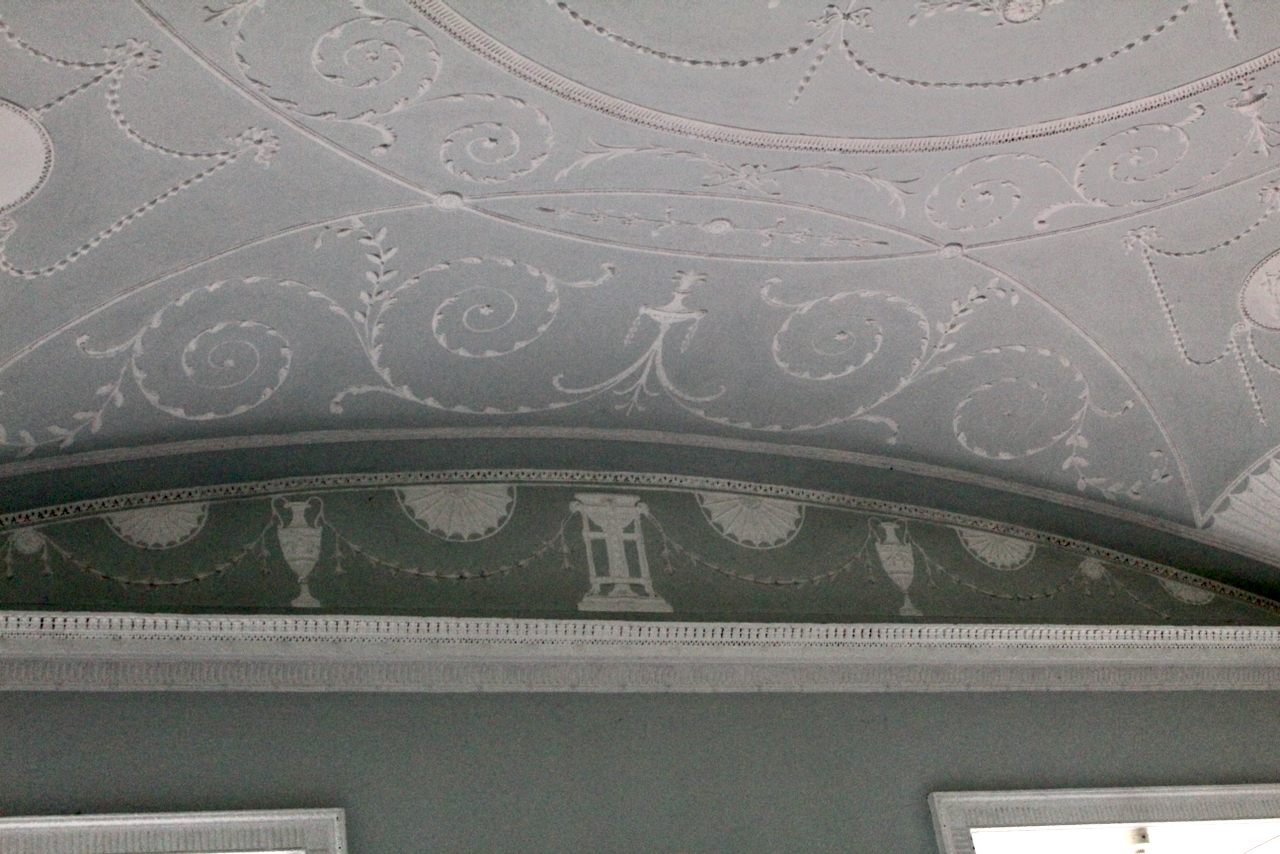

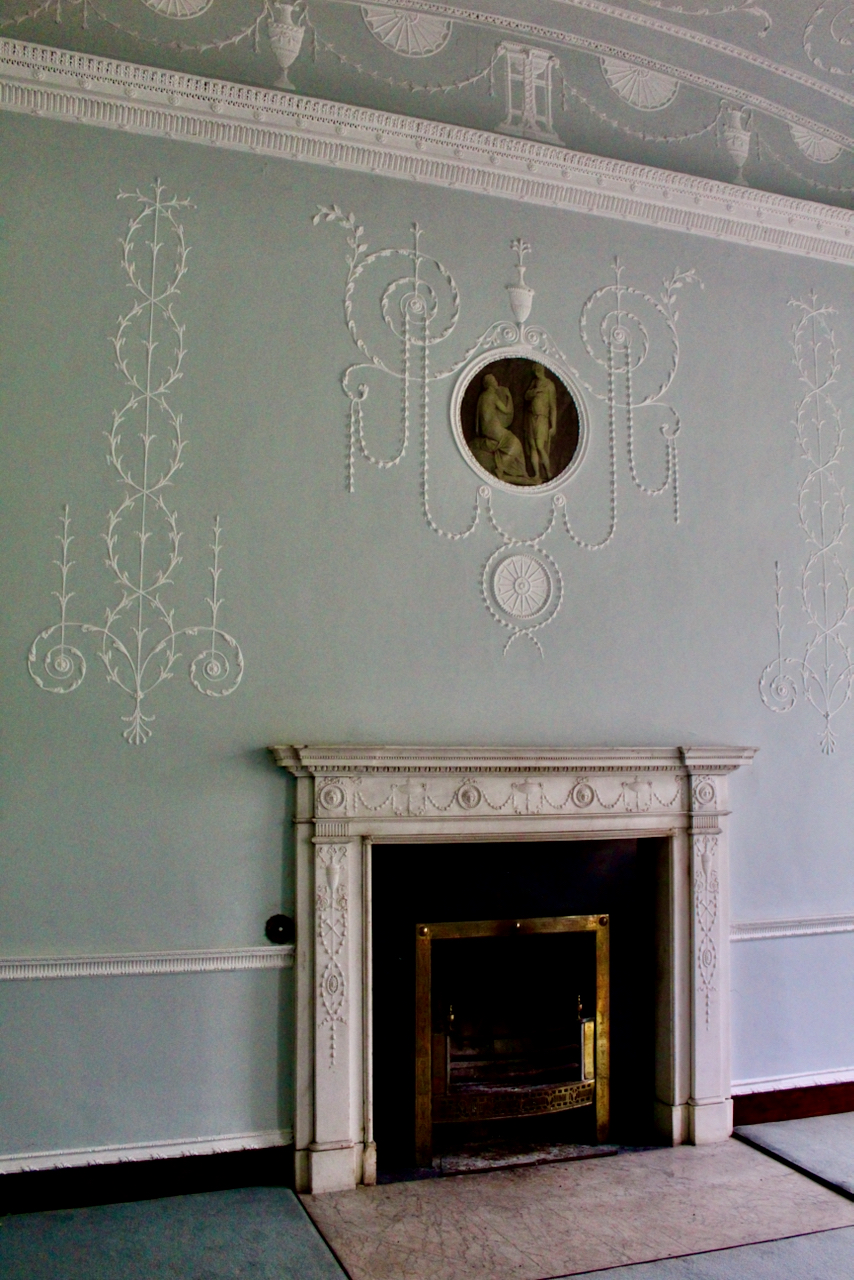

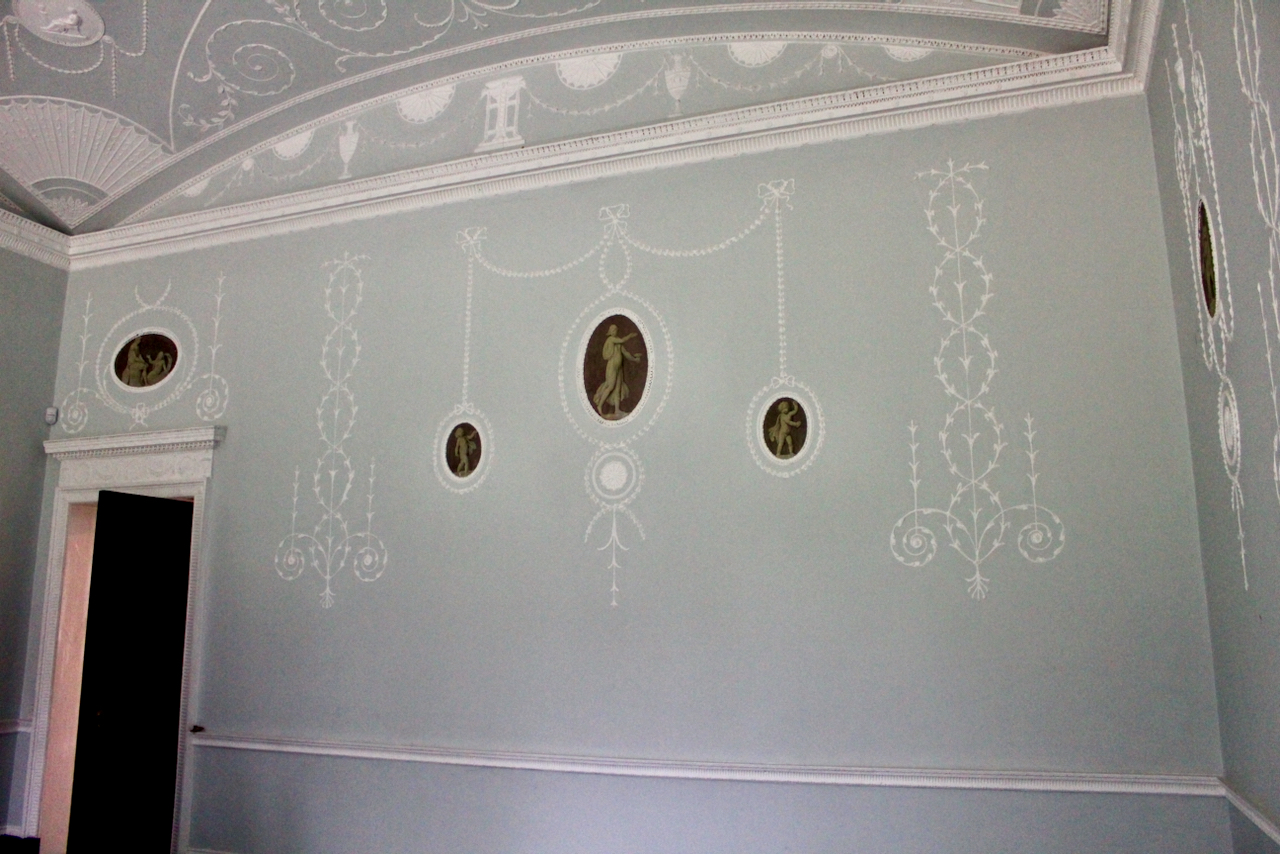

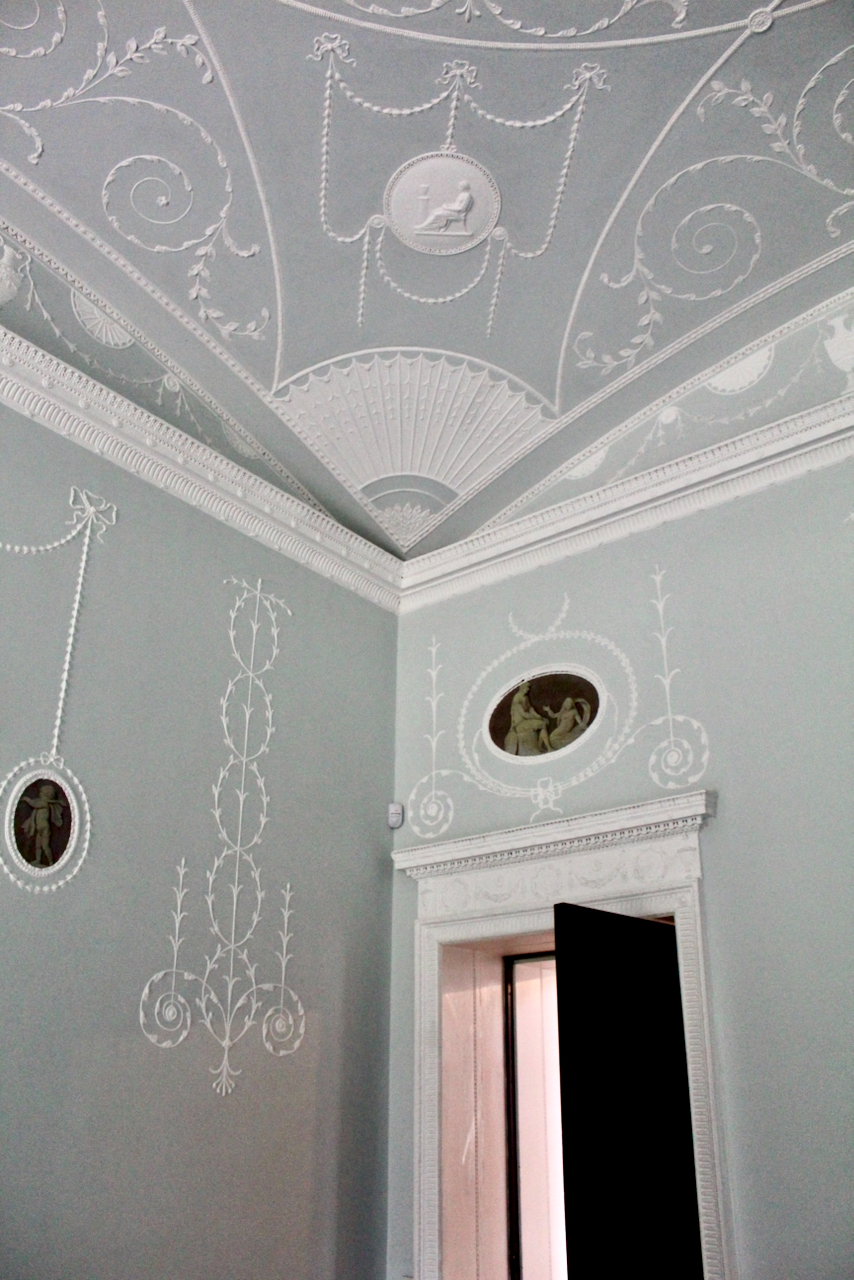
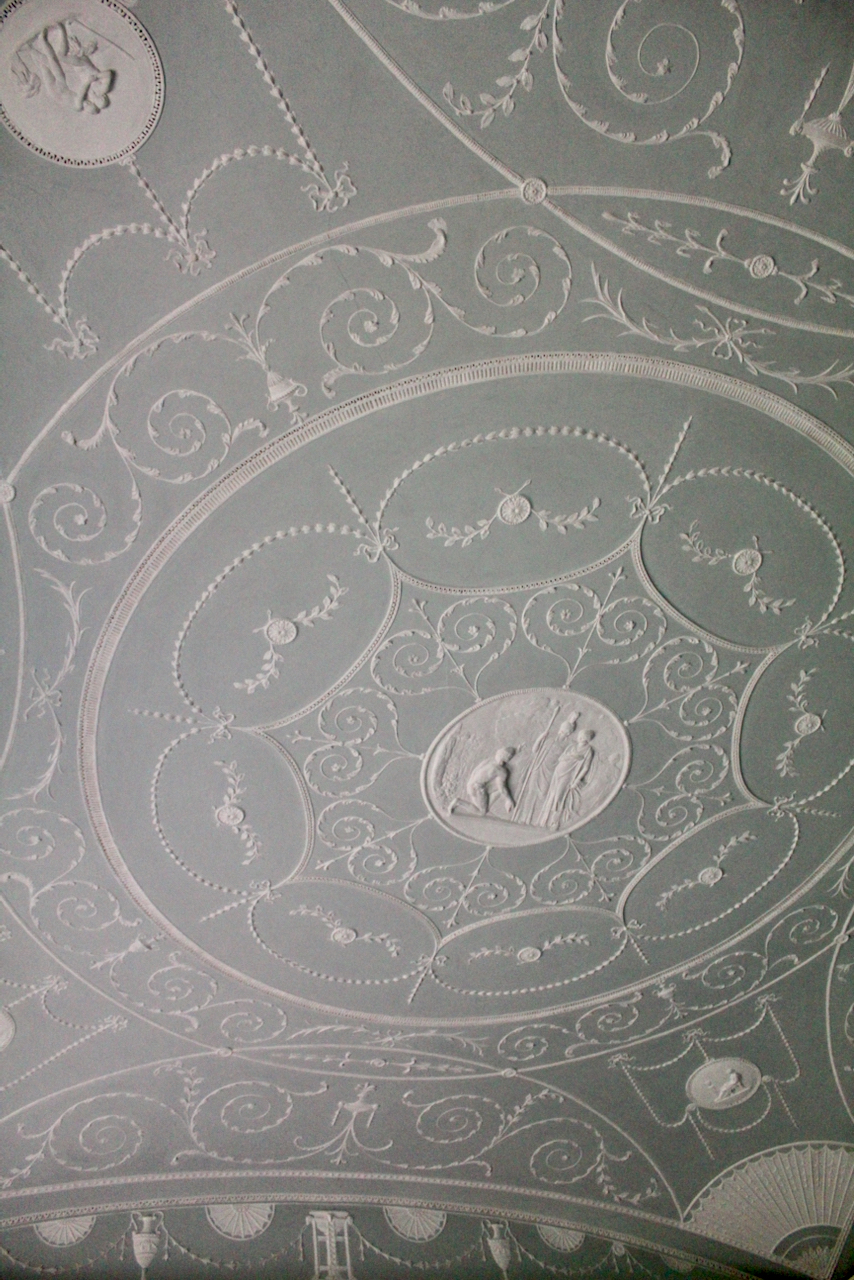

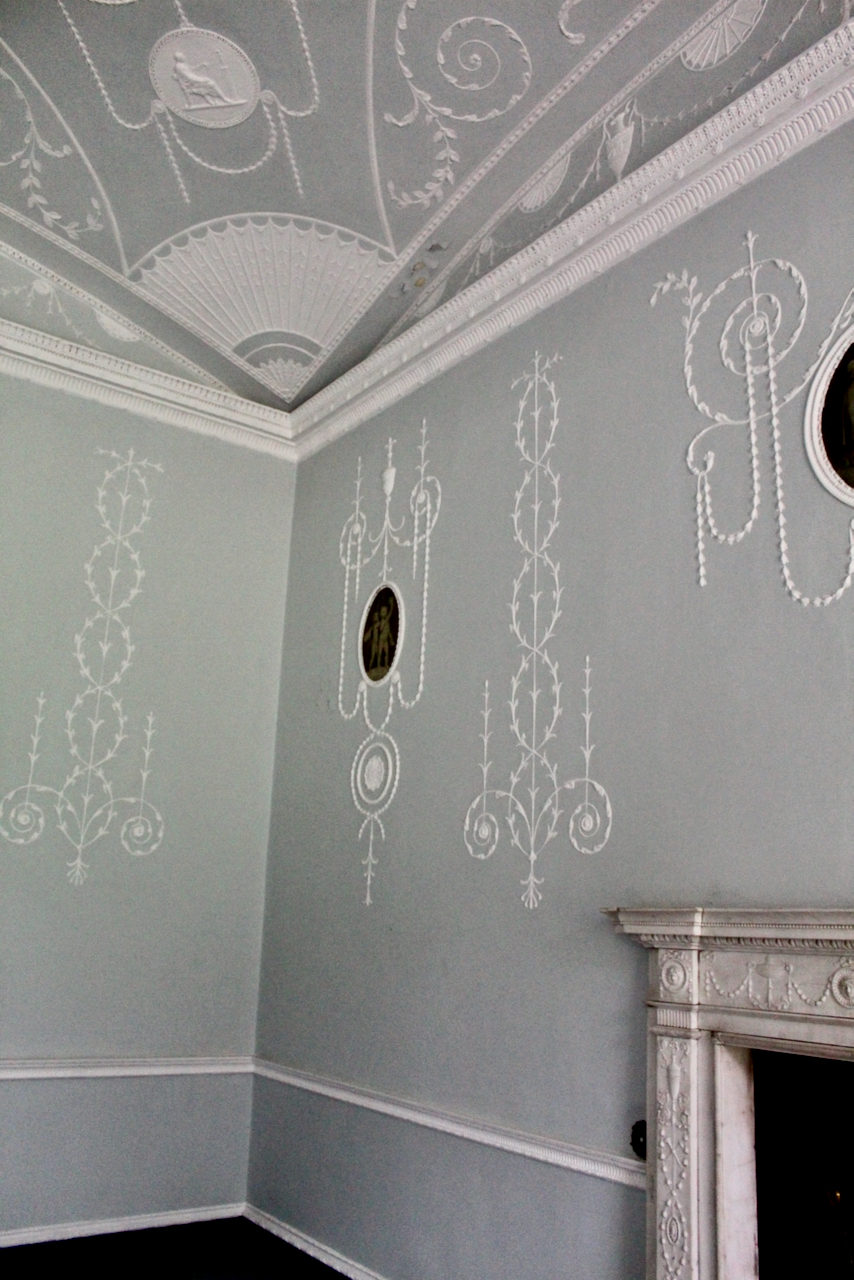


The room off the front hall to the back of the house is the Oval Room. The curve of the bow window is reflected in a facing curved wall, creating the oval shape. The bow has three windows placed in arches with decorative semicircles over the windows, which reflect the round decoration in the centre of the ceilng.

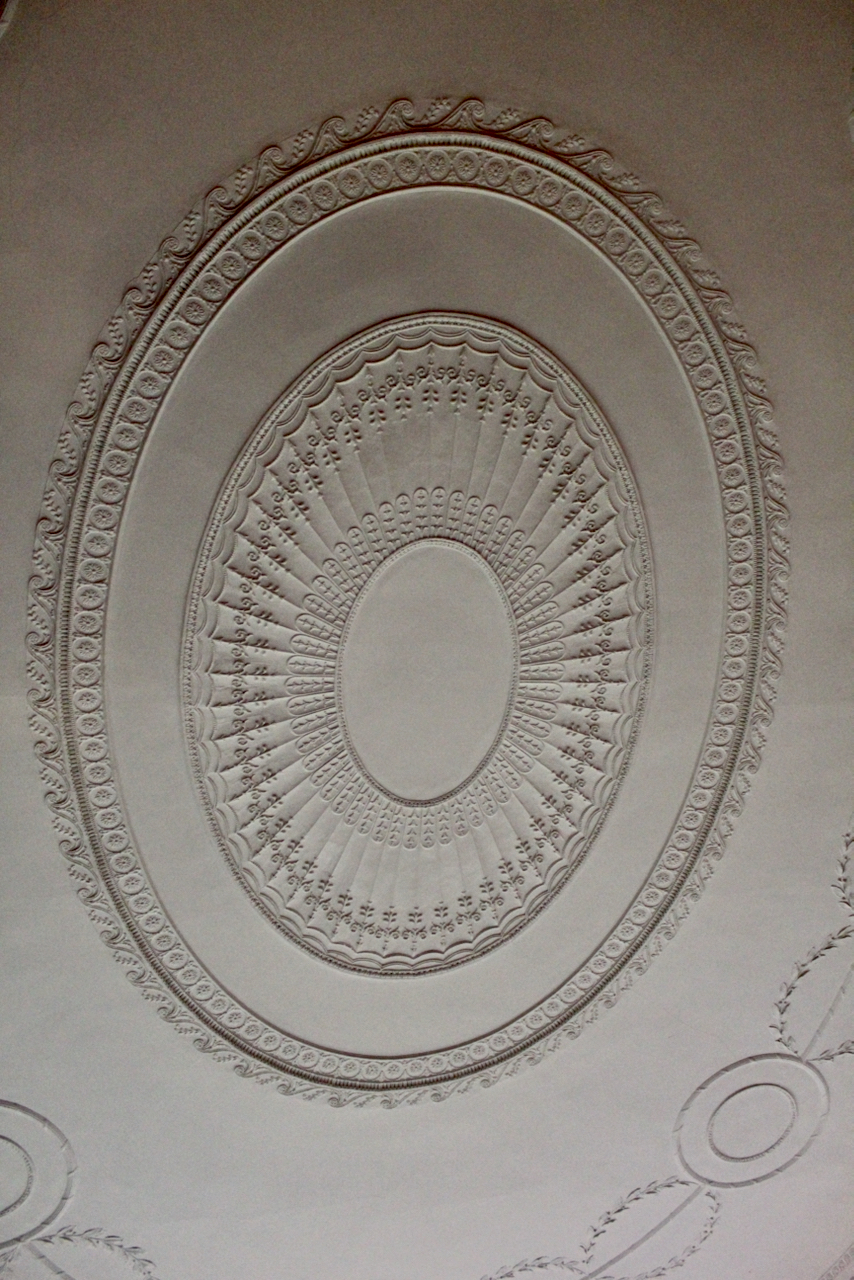
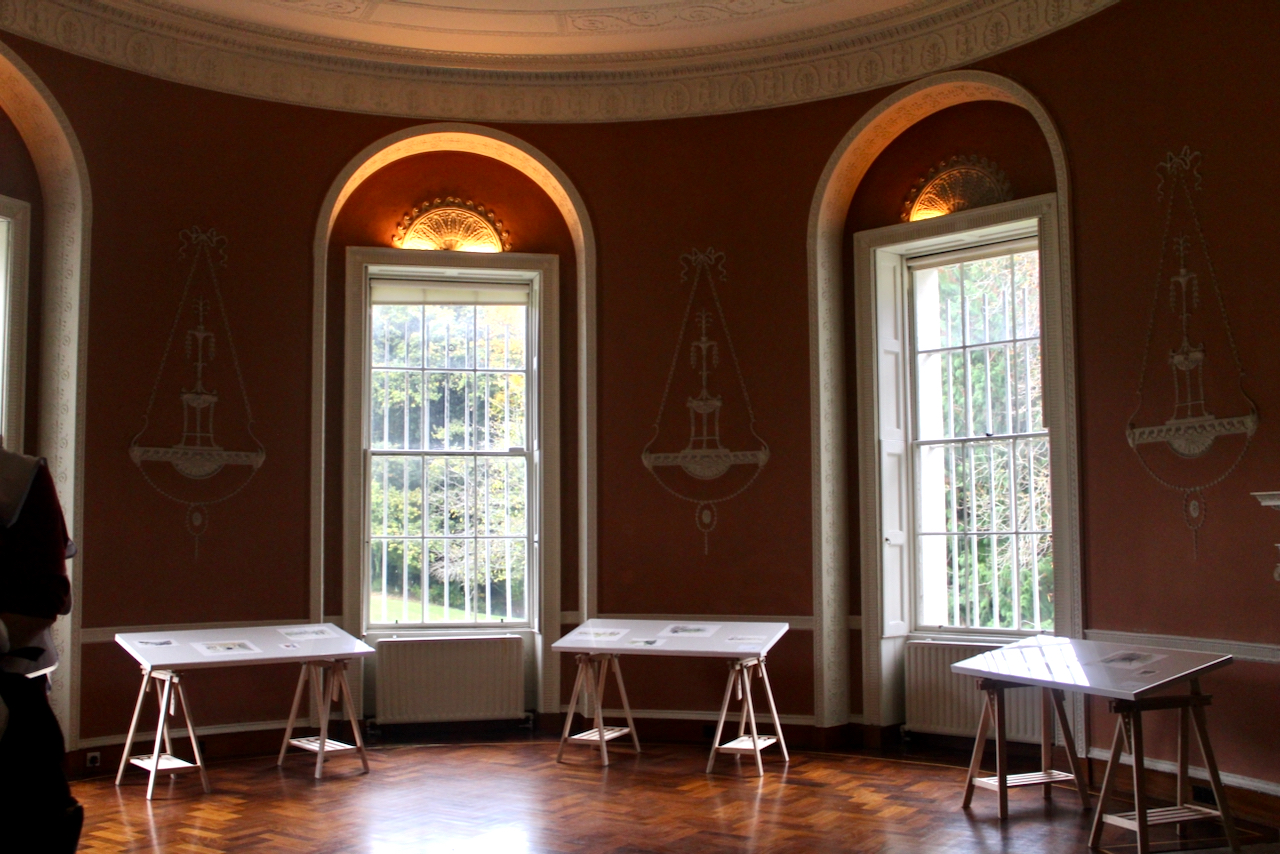

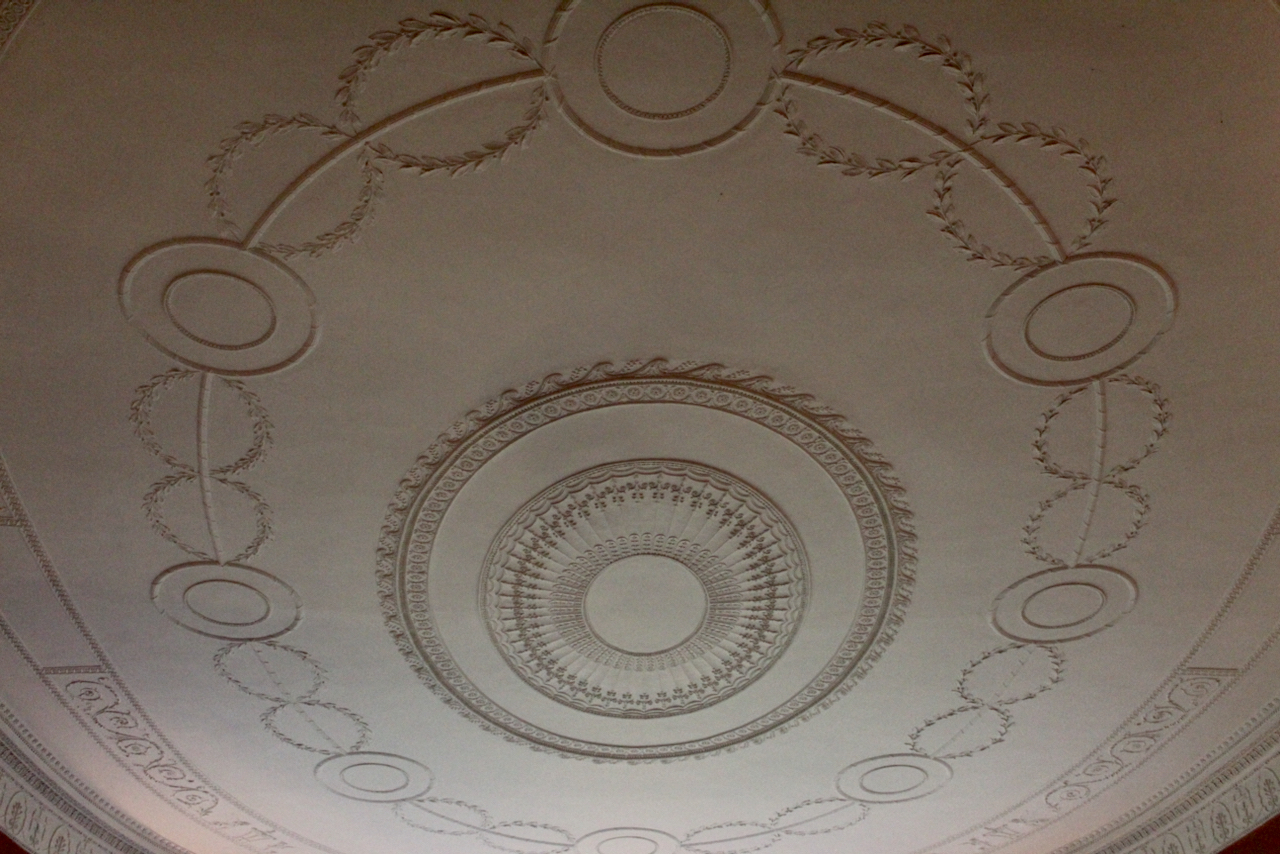
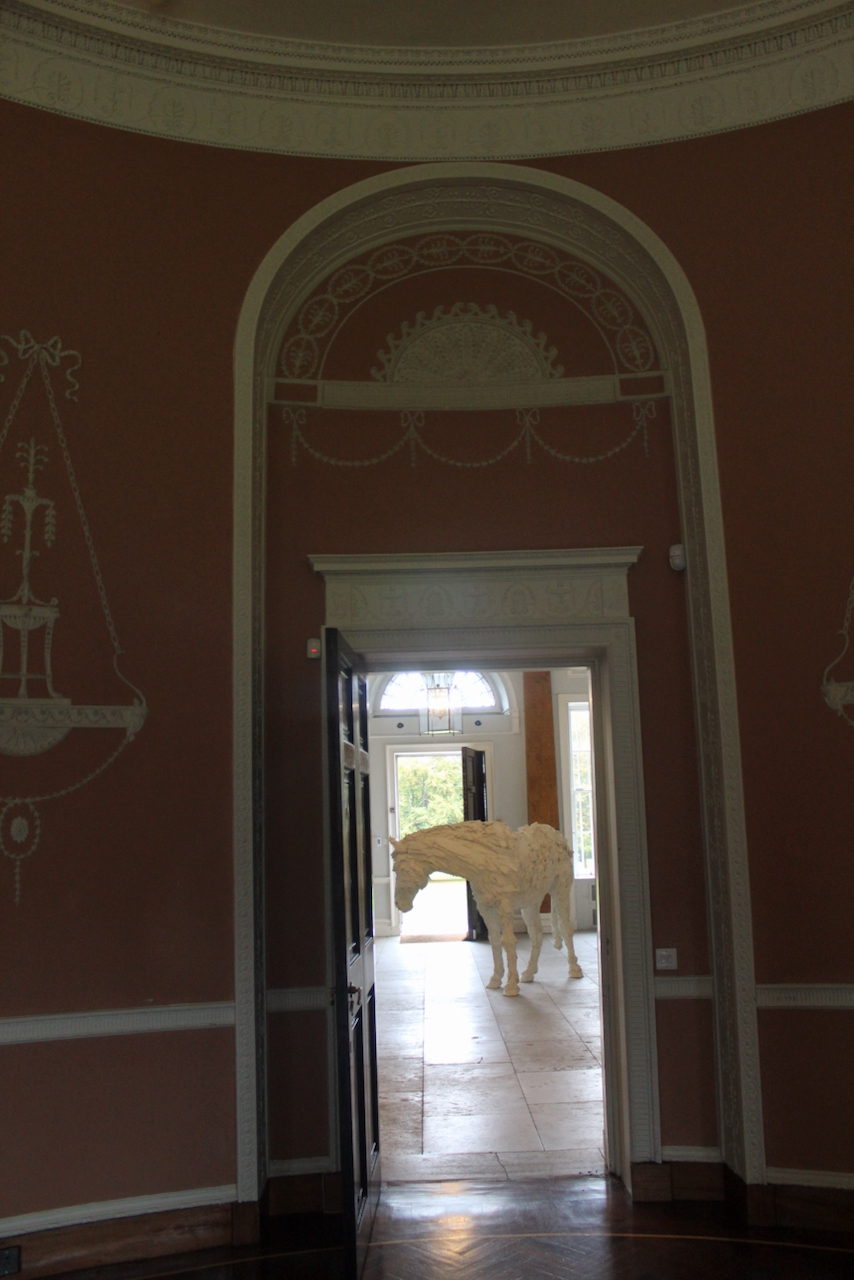
Robert O’Byrne points out that the arrangement of the front hall with the screen of columns to the rear with a central door opening into an oval room is also found in Castle Coole, County Fermanagh, which was designed in the early 1790s by James Wyatt – which is probably than the arrangement laid out in Lucan House (see my entry about Castle Coole https://irishhistorichouses.com/2024/03/21/castle-coole-county-fermanagh-a-national-trust-property/ ).
The large arch over the door entering from the front hall is repeated in the walls, which hold mirrors that look like doors. This room, Robert O’Byrne tells us, was designed as the Drawing Room but in later years served as a dining room. On the walls plaster “girandoles”, ornamental candle holders that are normally mounted on walls. O’Byrne tells us that Michael Stapleton created the design of these plaster girandoles. [see 1].
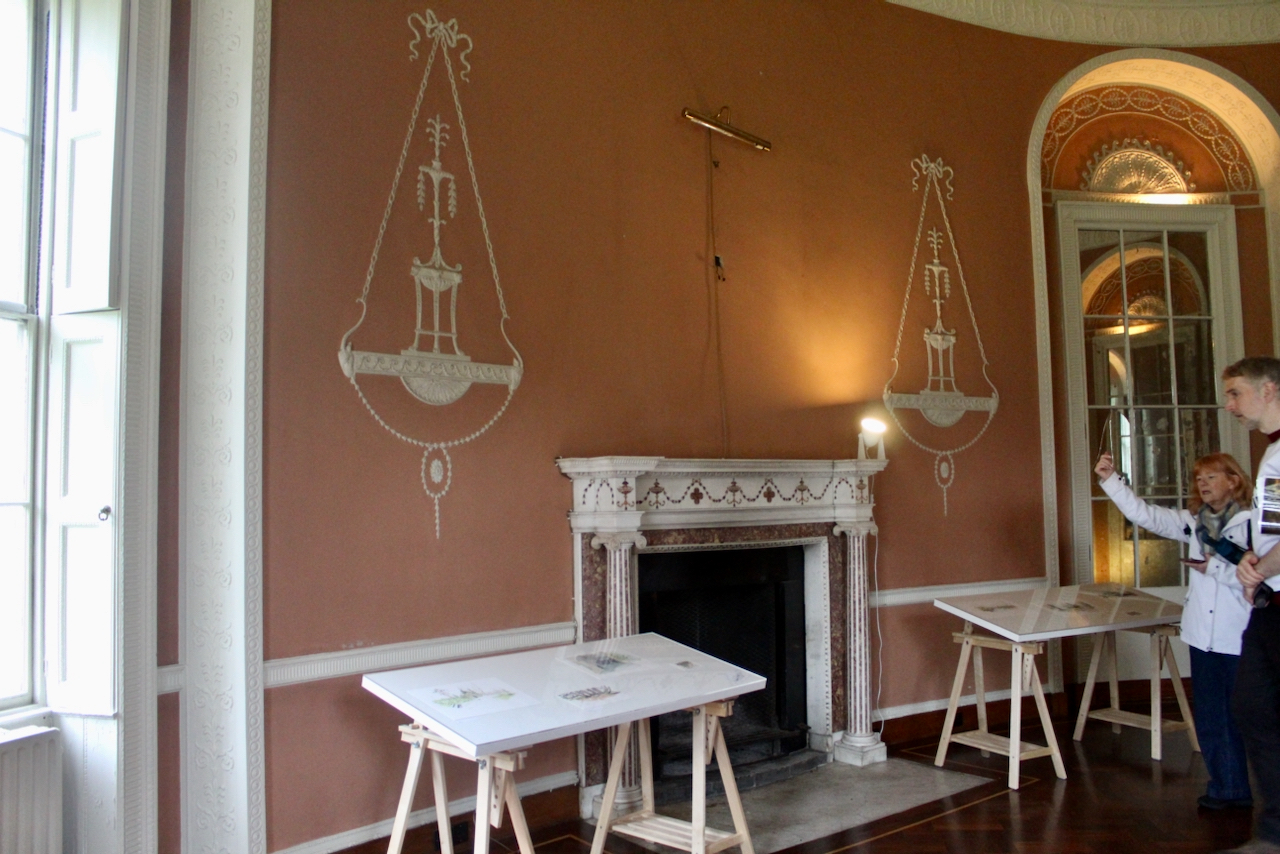

The room held an exhibition by Foley Architects, who prepared plans for South Dublin City Council for their transformation of Lucan House and its demesne for public use, including delicate watercolour paintings by Jérémy Cheval (his name is apt due to the prominent presence of the horse in the front hall!). Foley architects examine the entire site, with its Church Tower House ruin, main residence, boathouse, bathhouse (which we did not see as it is further from the house) and stables, its watercourse and vegetation.
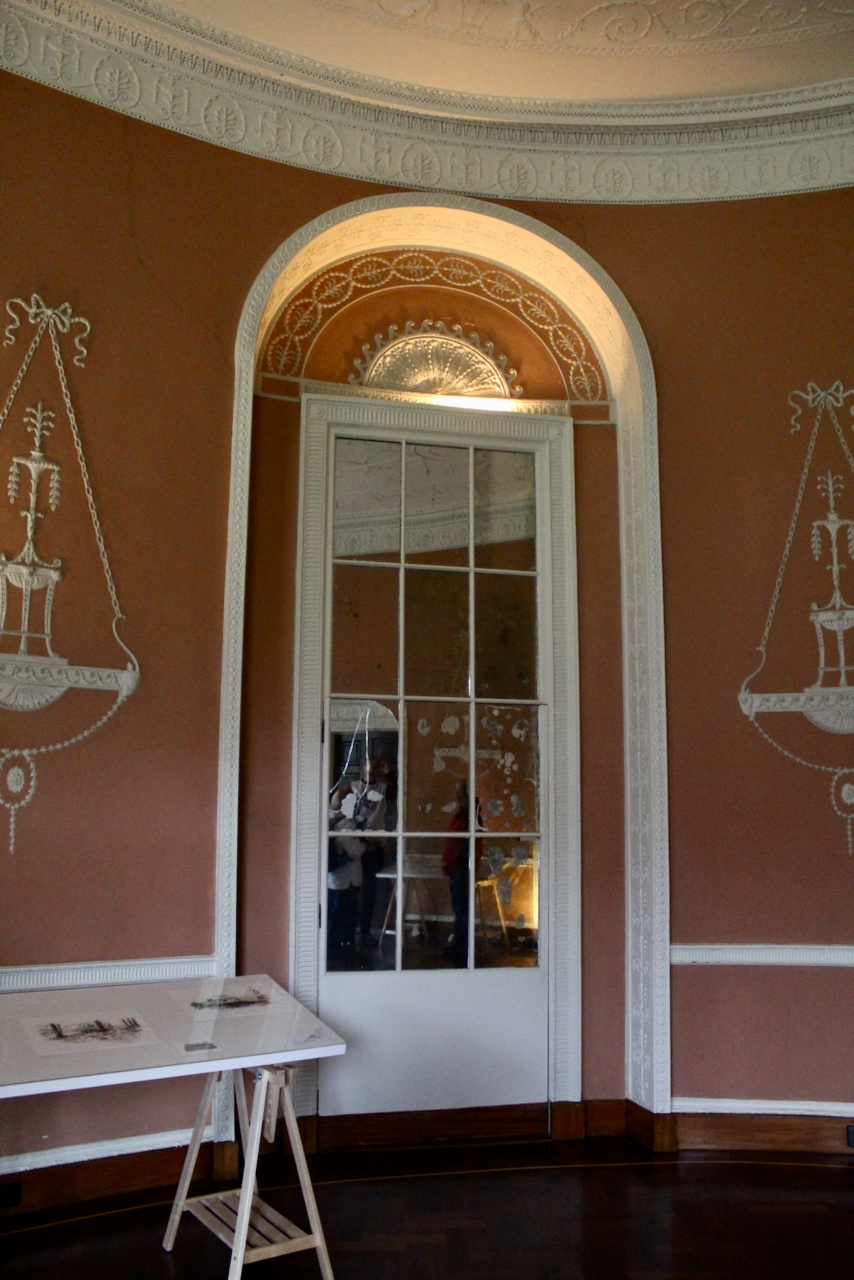

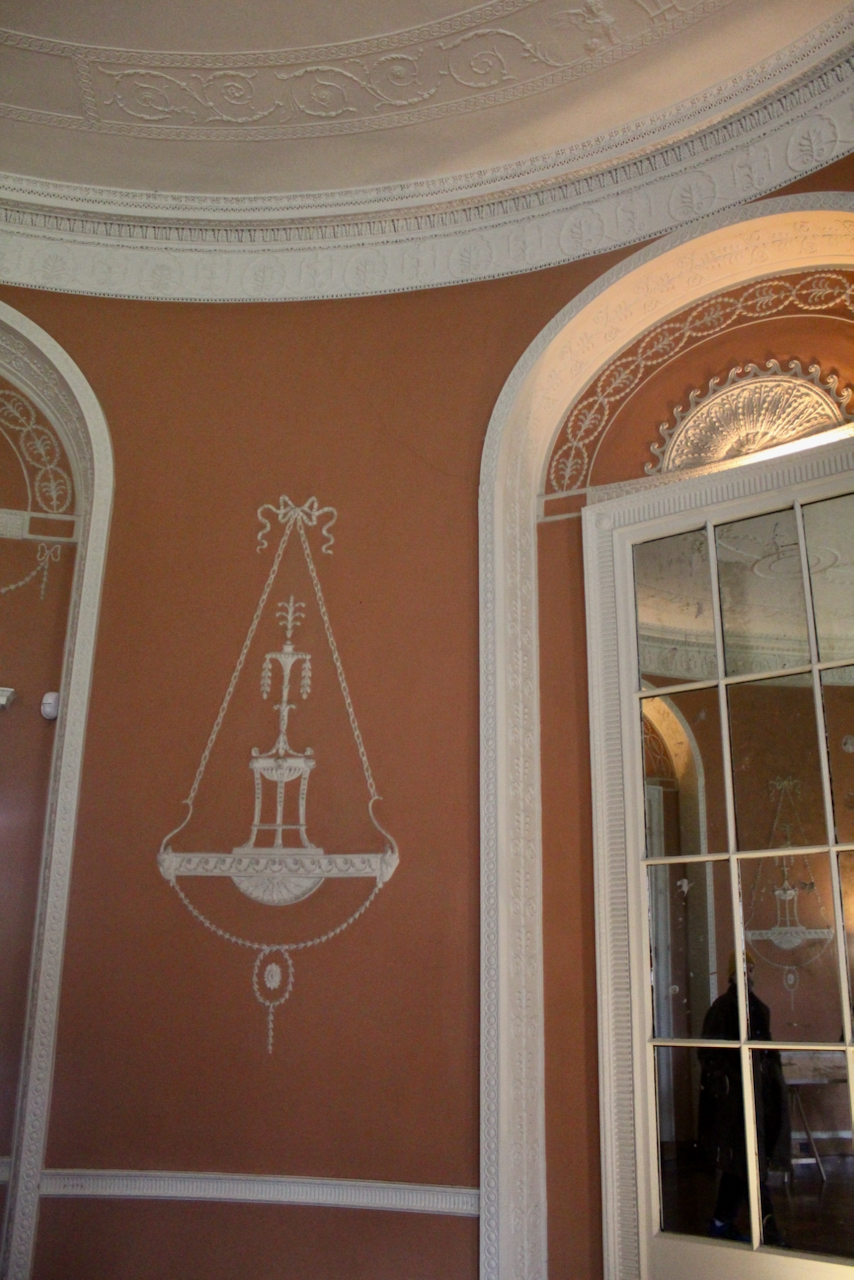

The other room on the ground floor is a library with shelving units. I don’t know whether these units were in the house originally, or whether they are a later addition.
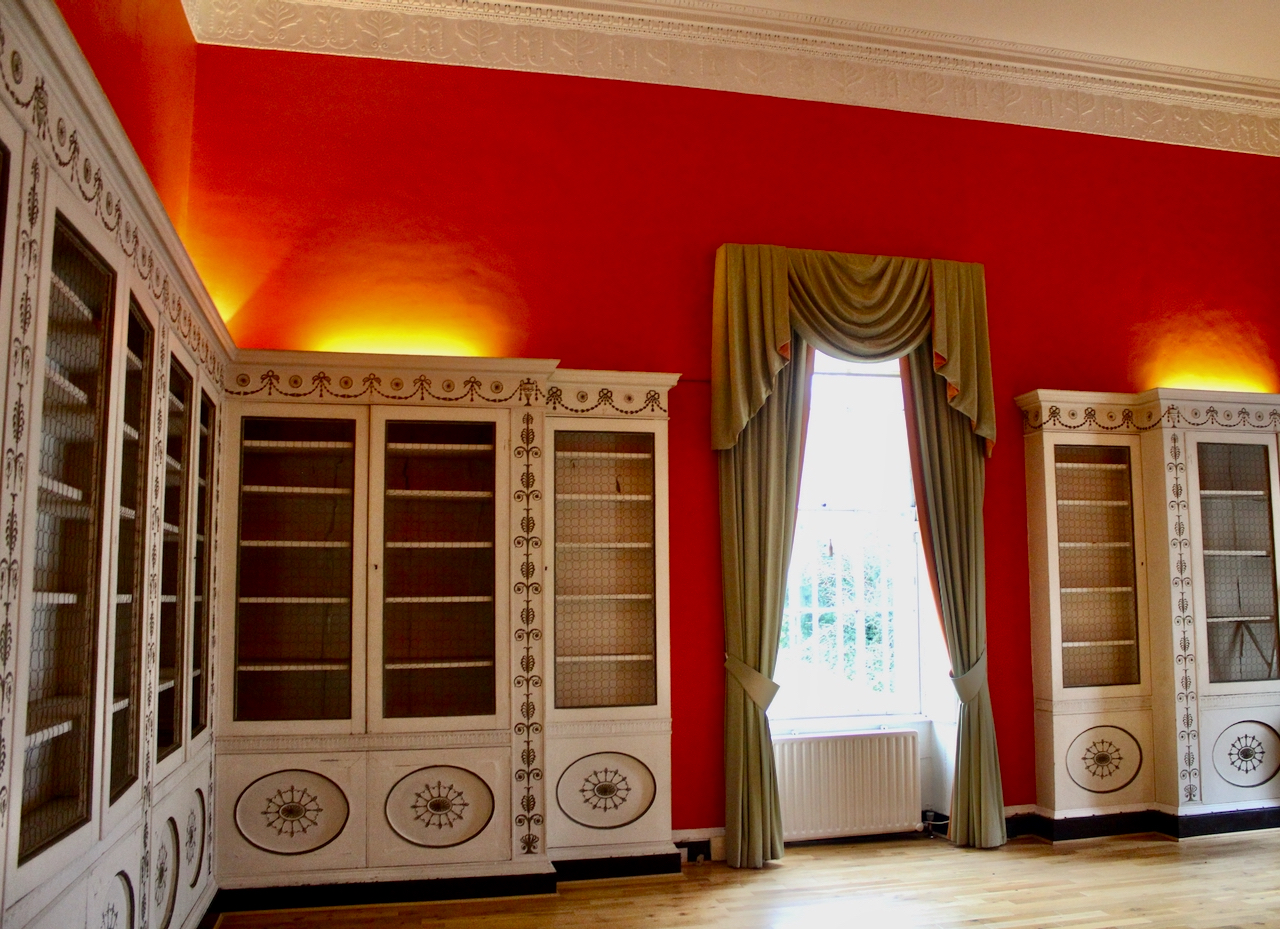
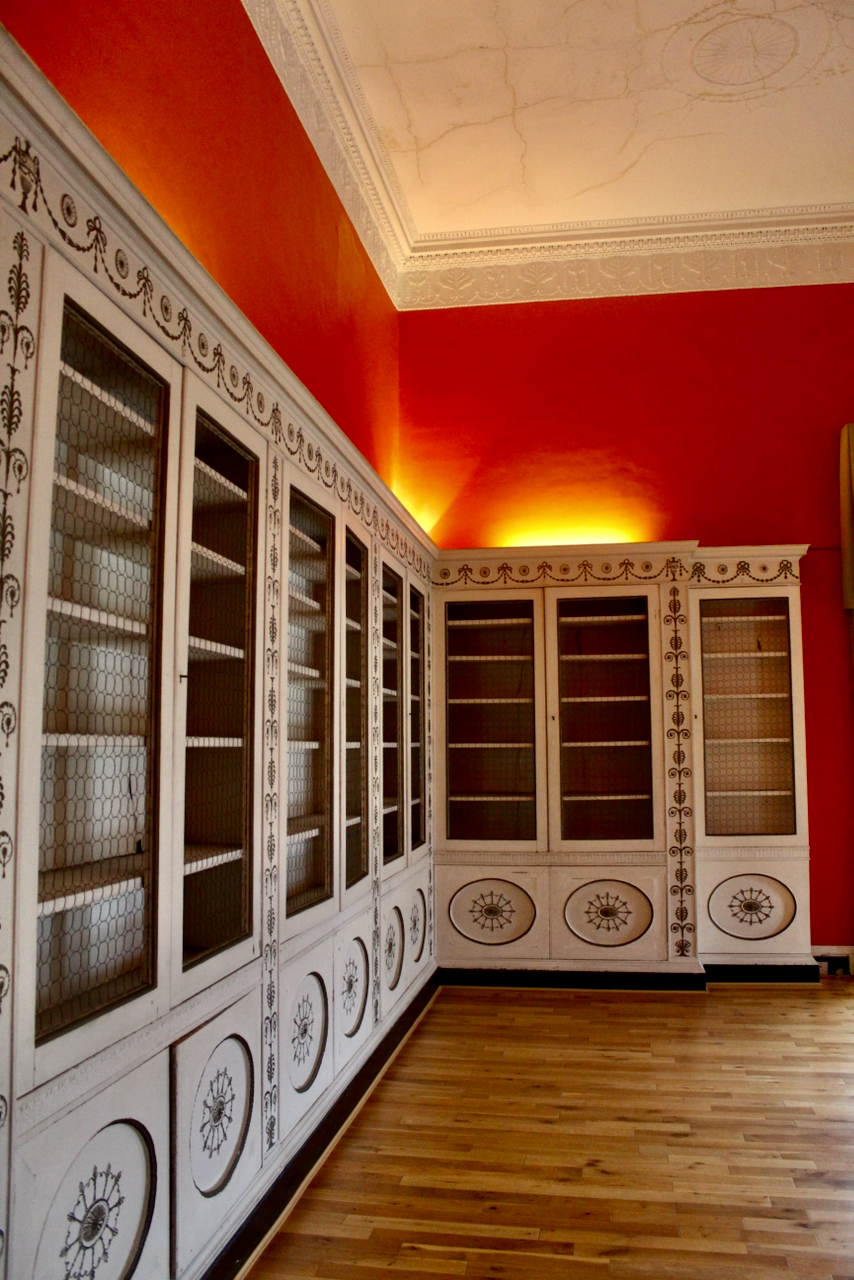
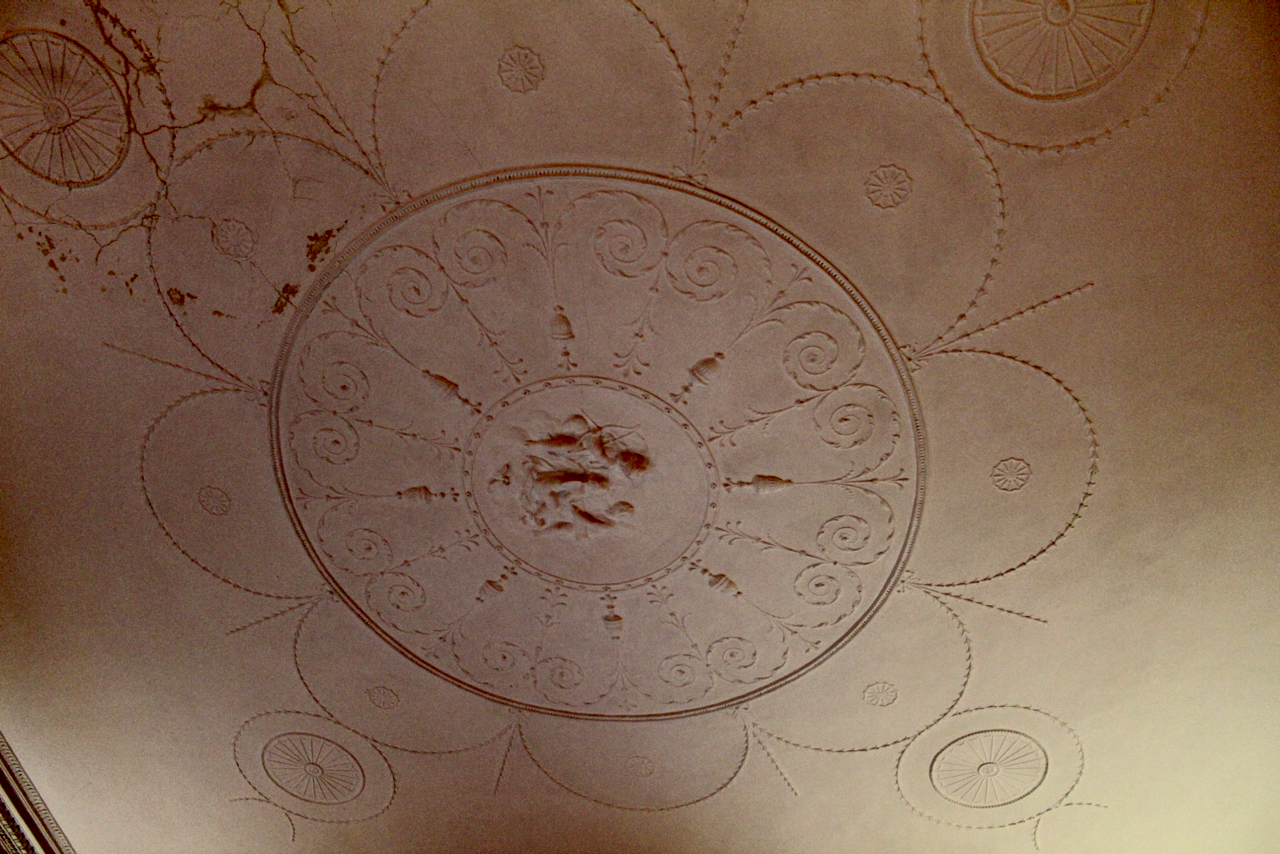
Robert O’Byrne tells us that the ceiling has been covered in plasterwork centred on another medallion, featuring, unusually, he points out, the Christ child and infant John the Baptist together with a lamb.

The original stone staircase has been removed and replaced by one of timber.


Vesey married his cousin Elizabeth, daughter of Right Reverend Sir Thomas Vesey, 1st Baronet, Bishop of Killaloe and of Ossory. Elizabeth Vesey was one of the founders of the Blue Stockings Society! This was an informal women’s social and educational movement in England in the mid-18th century that emphasised education and mutual cooperation. They liked to discuss literature, and invited men also to their gatherings. Elizabeth and Agmondesham did not have children, and they lived much of their time in London, where Elizabeth held her intellectual literary salons.
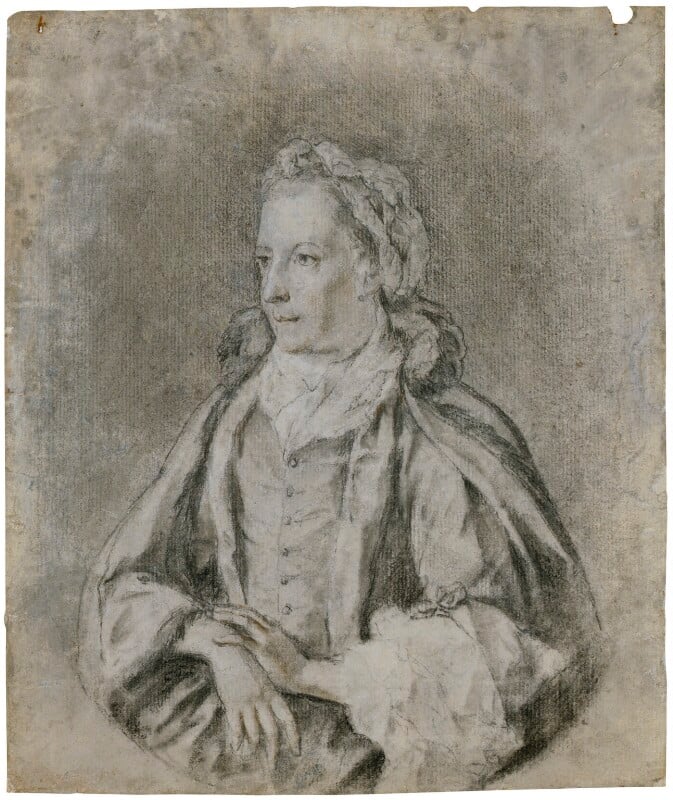
Robert O’Byrne tells us that like his wife Elizabeth, Vesey also took part in a conversational club. In 1773, during the period that work was underway on the new house, he was elected to the ‘Club’, the informal dining and conversational group established ten years earlier by Samuel Johnson and Joshua Reynolds. Johnson and James Boswell granted him the notional title of ‘Professor of Architecture,’ and the latter wrote that Vesey had ‘left a good specimen of his knowledge and taste in that art by an elegant house built on a plan of his own at Lucan.’ [see 1]
Behind the house is a boat house, on the River Liffey.
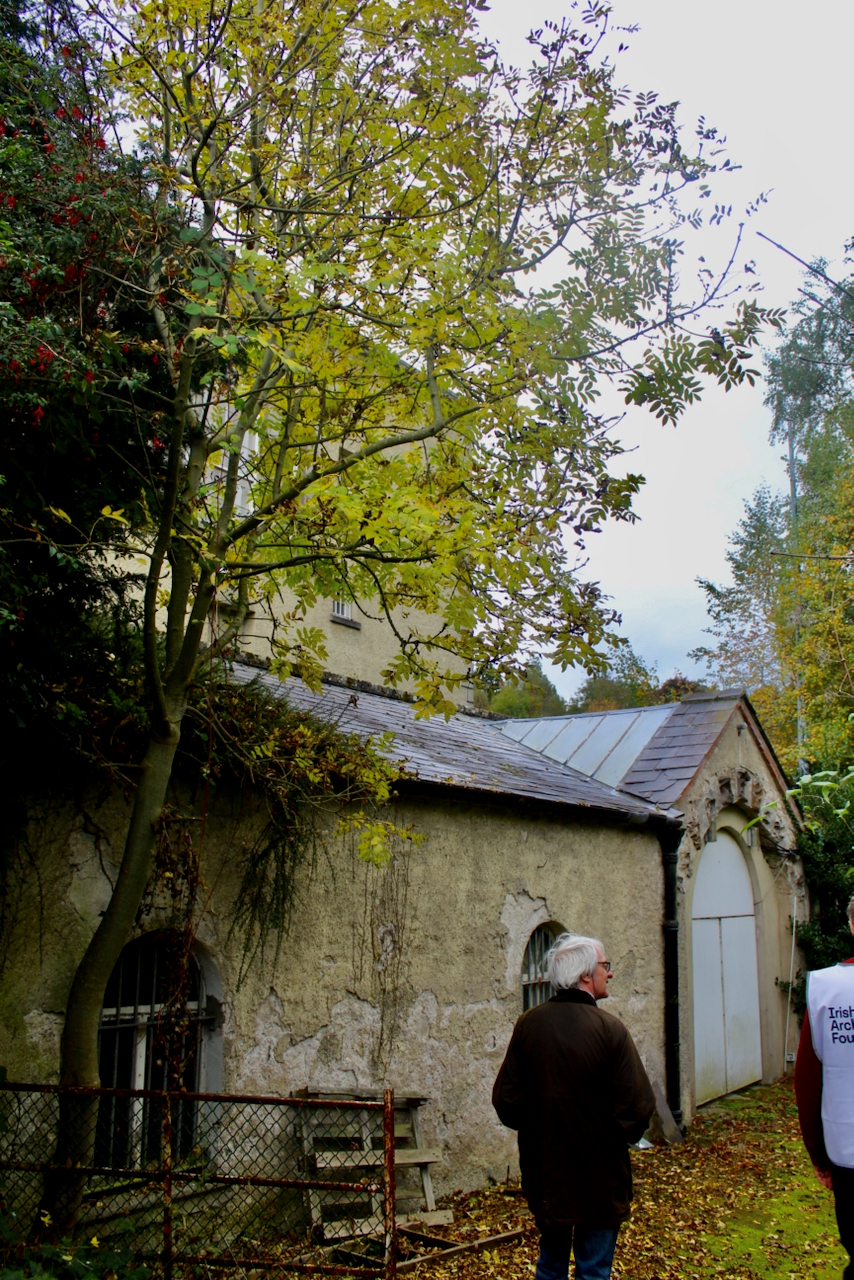
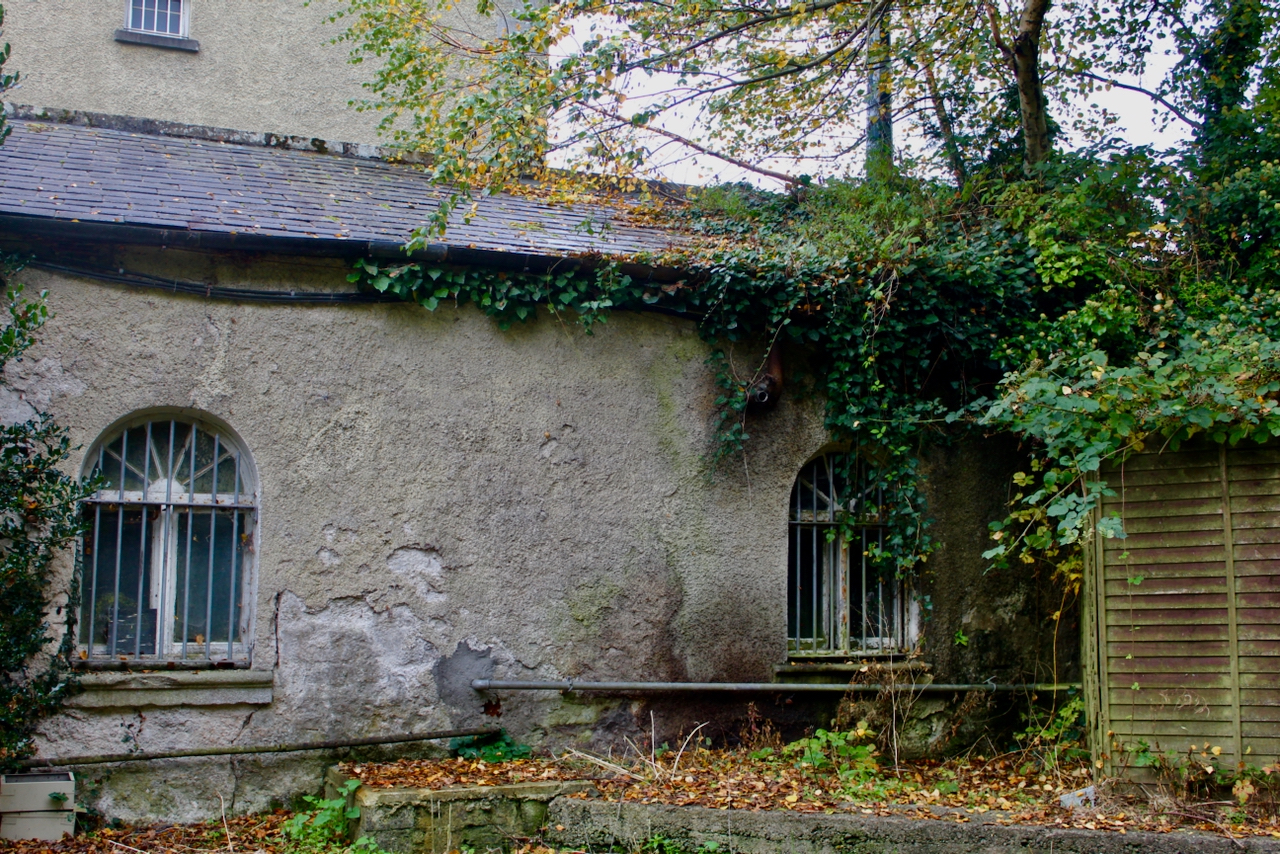
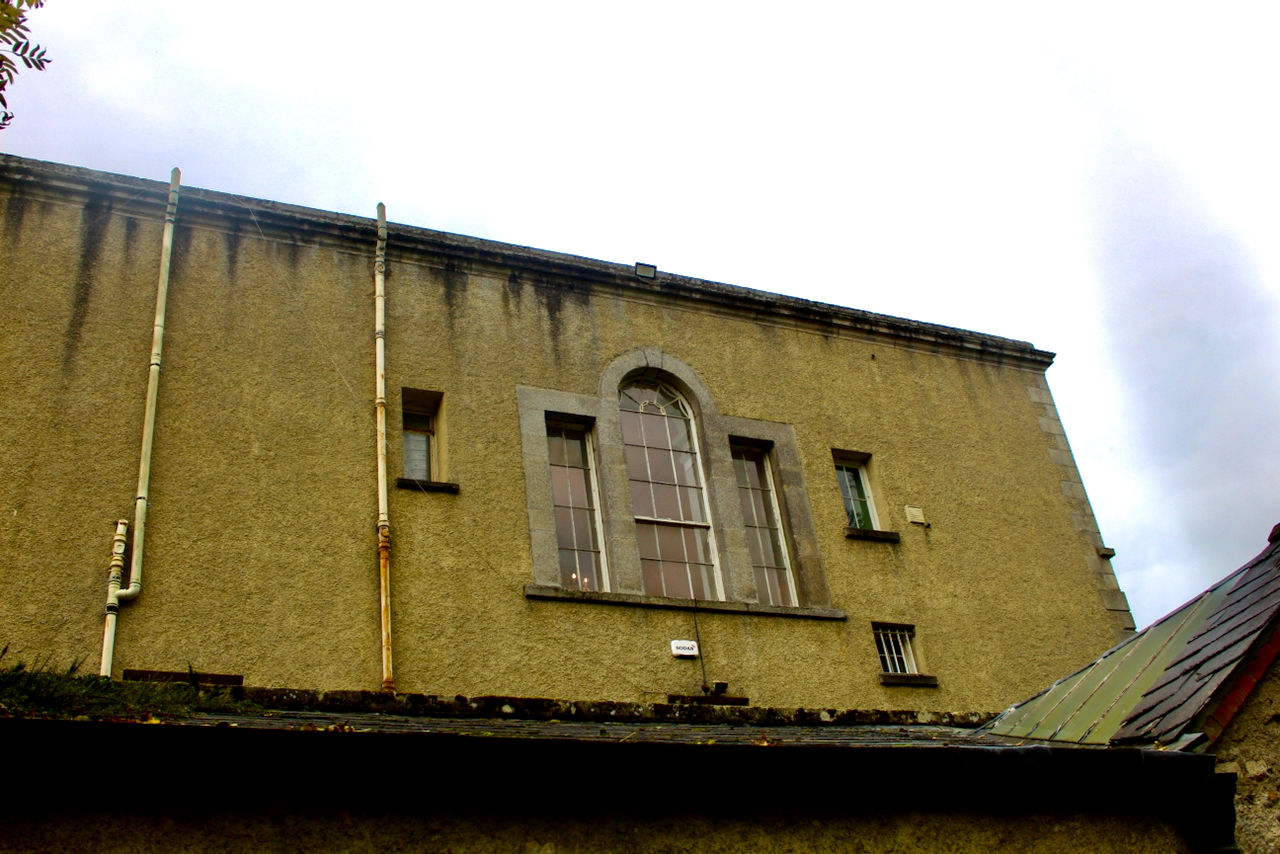
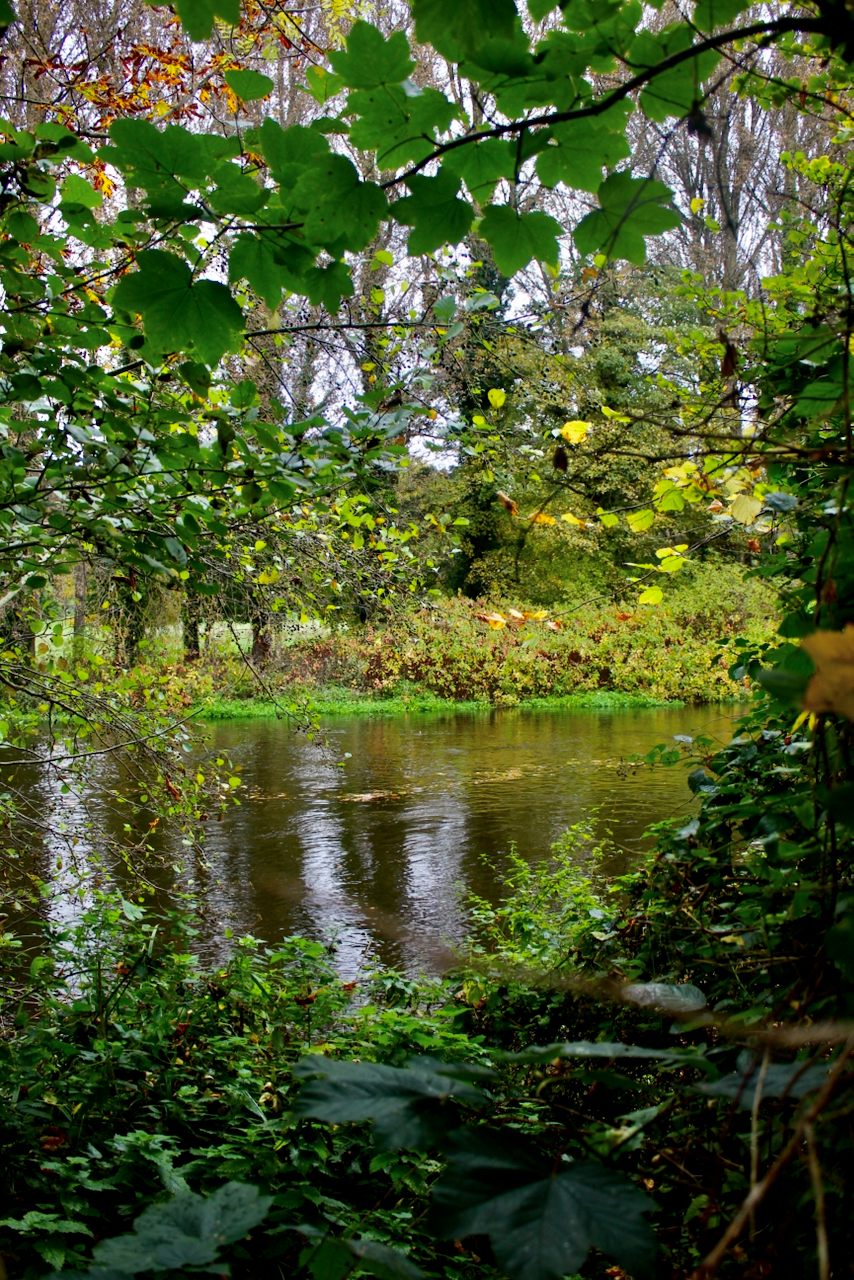

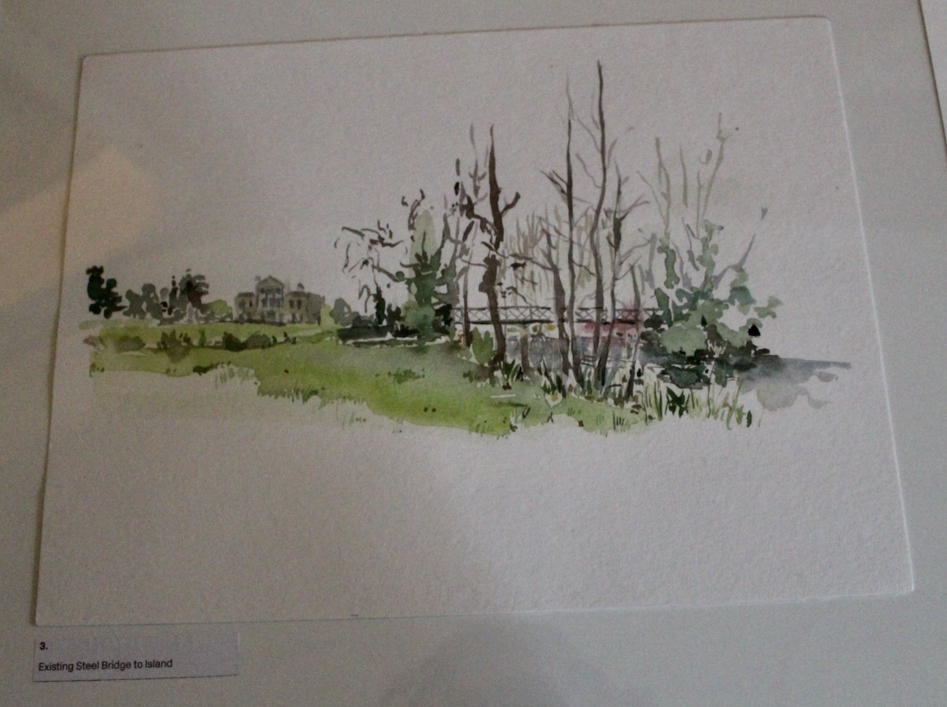


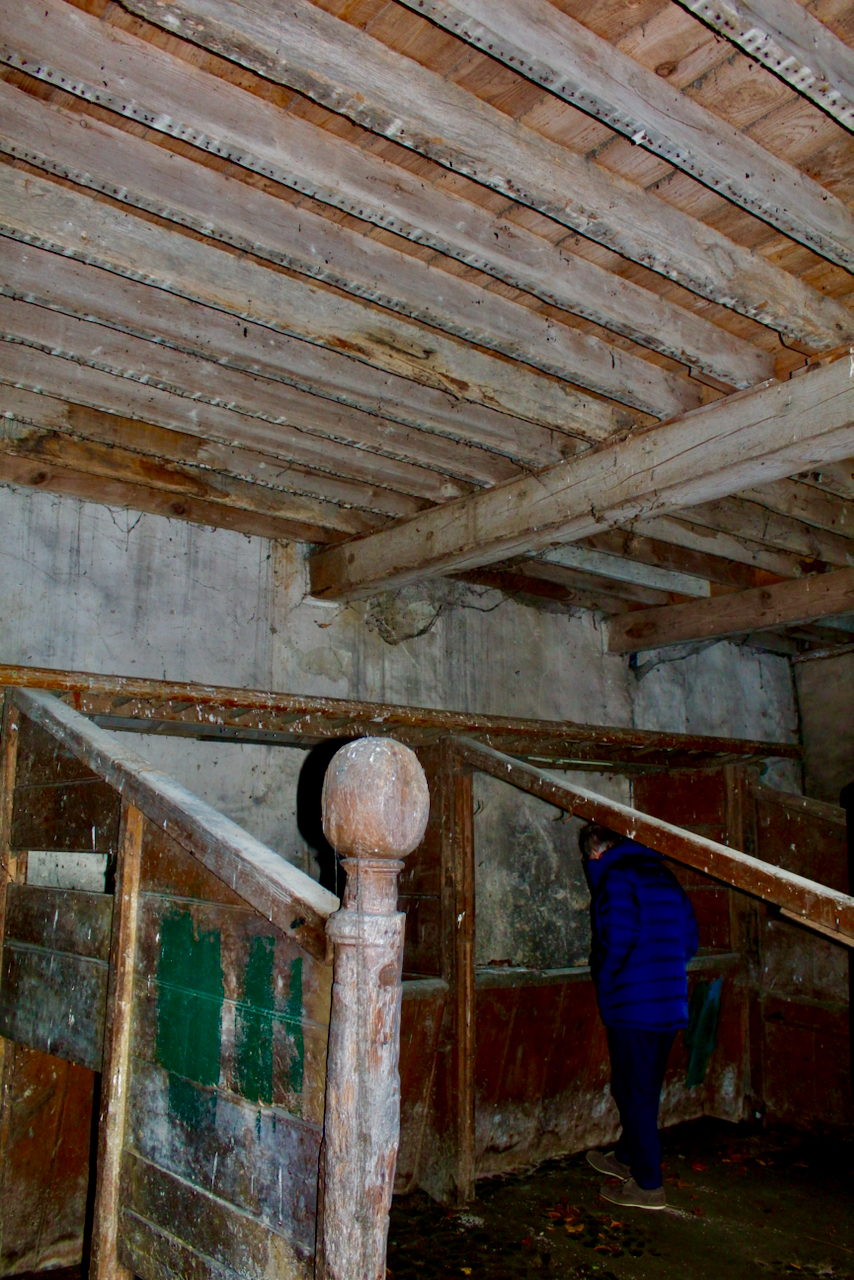


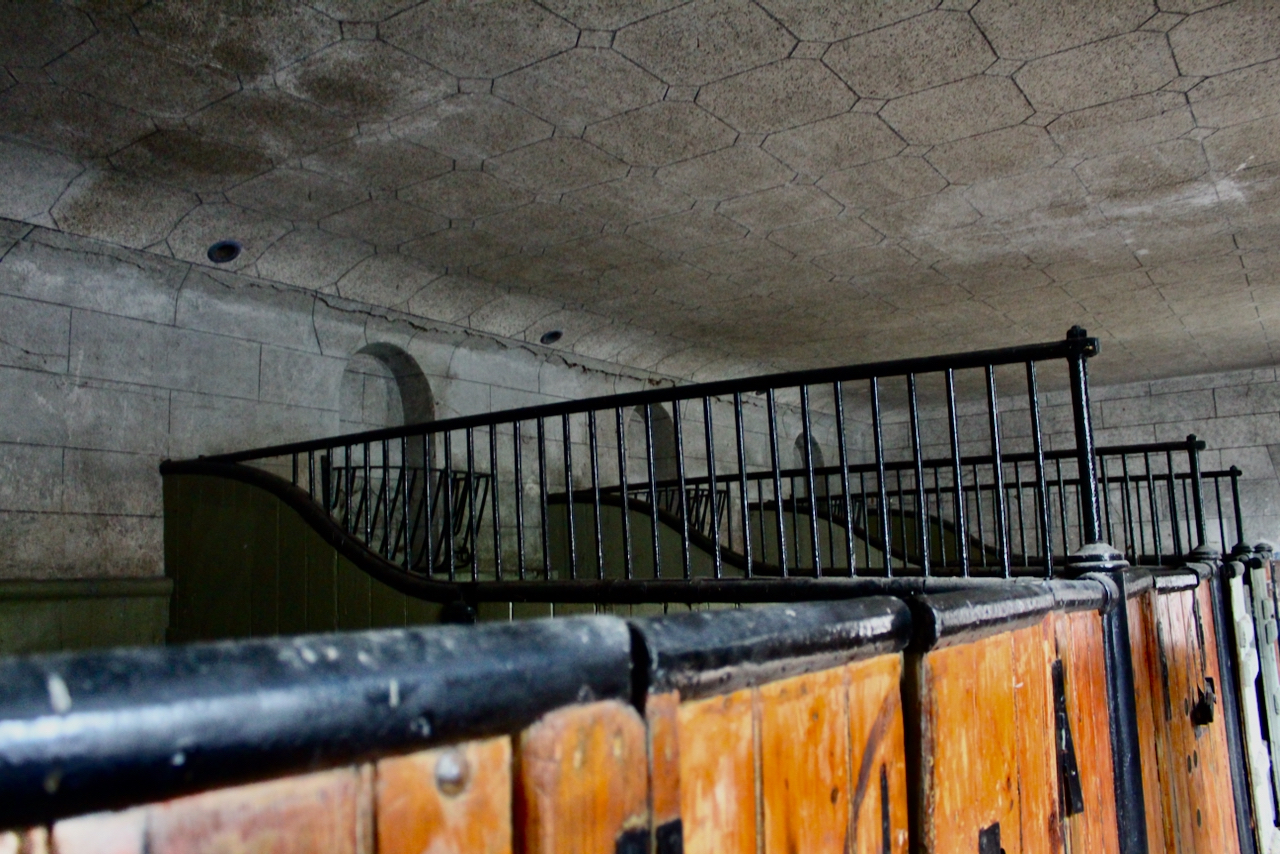
The tack room is beautiful with its original wooden fixtures.


Behind the stables is a little row of houses, lived in until recently. These too are part of redevelopment plans.
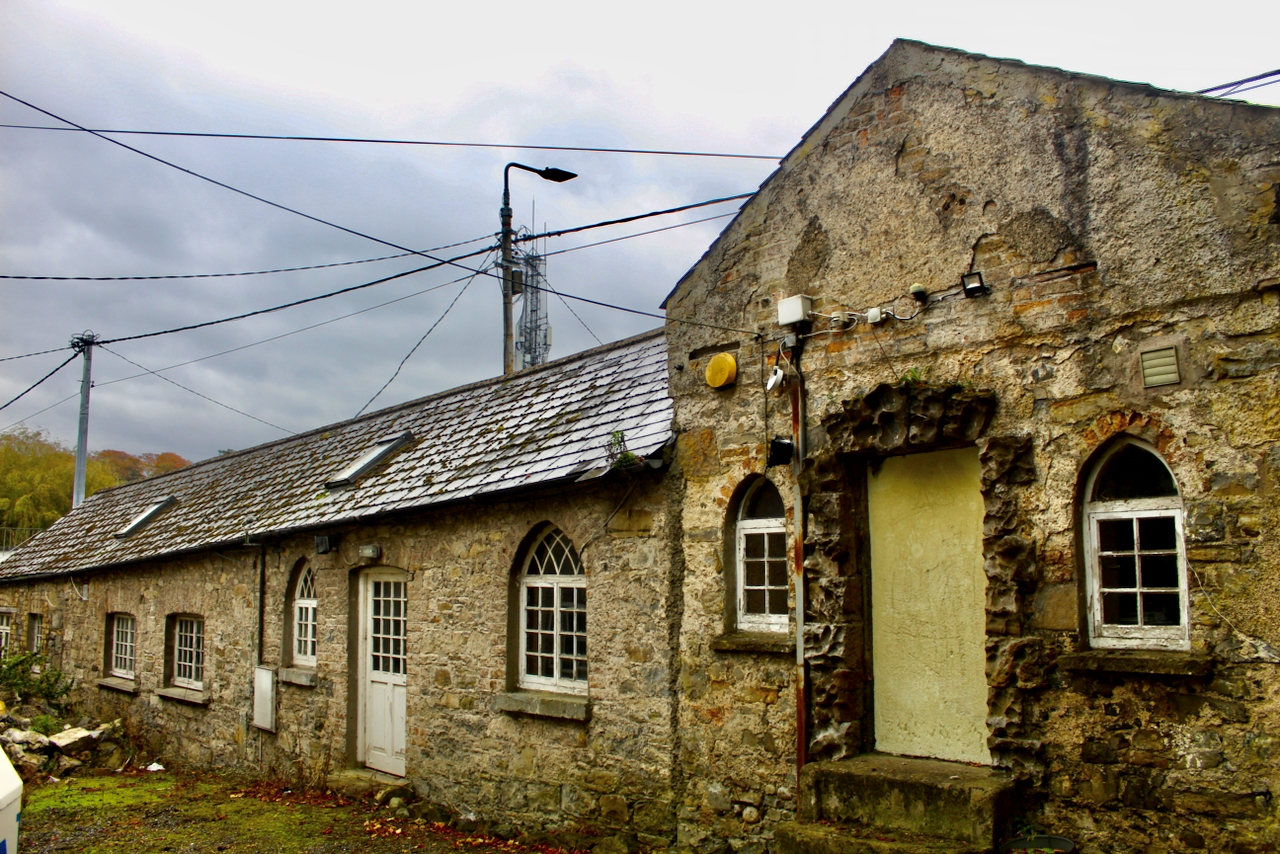
A sulphur spring was discovered in 1758, and a health spa opened that year in the area.

The house passed to the son of a younger brother of Agmondisham. The younger brother, George, married a second cousin, Letitia Vesey. Their son George (1761-1836) inherited Lucan House. He married Emily La Touche (1767-1854), daughter of David La Touche (1729-1817) of Marley House in Dublin.
George and Emily’s daughter Elizabeth married Nicholas Conway Colthurst (1789-1829) 4th Baronet of Ardrum, County Cork. We came across the Colthurst family when we visited Blarney Castle in Cork. Their second son, Charles Vesey Colthurst, changed his name to Charles Vesey Colthurst-Vesey in 1860. He served as Justice of the Peace for Kildare and for Dublin, and High Sheriff of Dublin, and he lived at Lucan House. The house passed through their family until 1921, when it was sold.
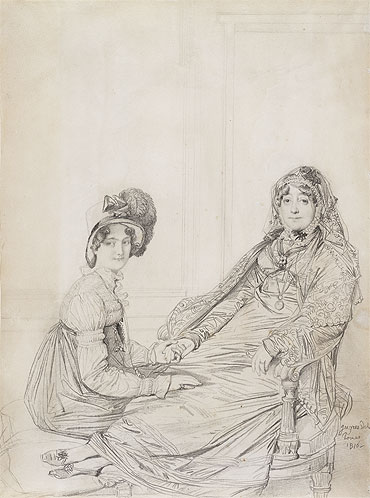
Capt Richard Colthurst (afterwards 8th Bt) sold it 1932 to Charles Hugh O’Conor, President of Irish Association of the Order of Malta and brother of the O’Conor Don of Clonalis House in County Roscommon. Charles Hugh O’Conor and his wife Ellen Letitia More O’Ferrall were parents of the next O’Conor Don, Father Charles O’Conor (see my entry about Clonalis https://irishhistorichouses.com/2020/10/16/clonalis-castlerea-county-roscommon/ ).
A daughter, Mary Ellen O’Conor, married Luke William Teeling, Conservative MP for Brighton in the UK, who sold Lucan House after WWII to the Italian government, for use as their embassy. First it was leased by the Italian ambassador as a residence in 1942, and then bought by the the Italian government in 1954.

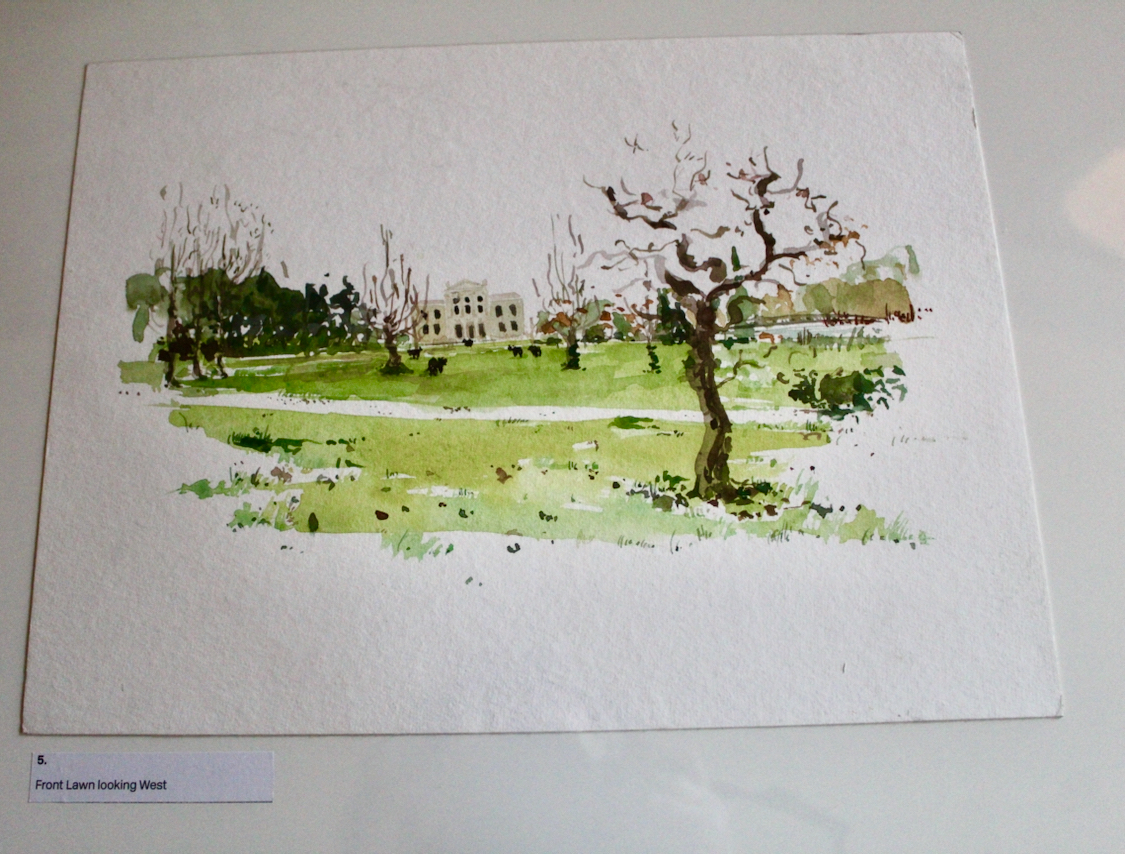
I look forward to seeing how progress develops by the City Council and to when the estate is open to the public!
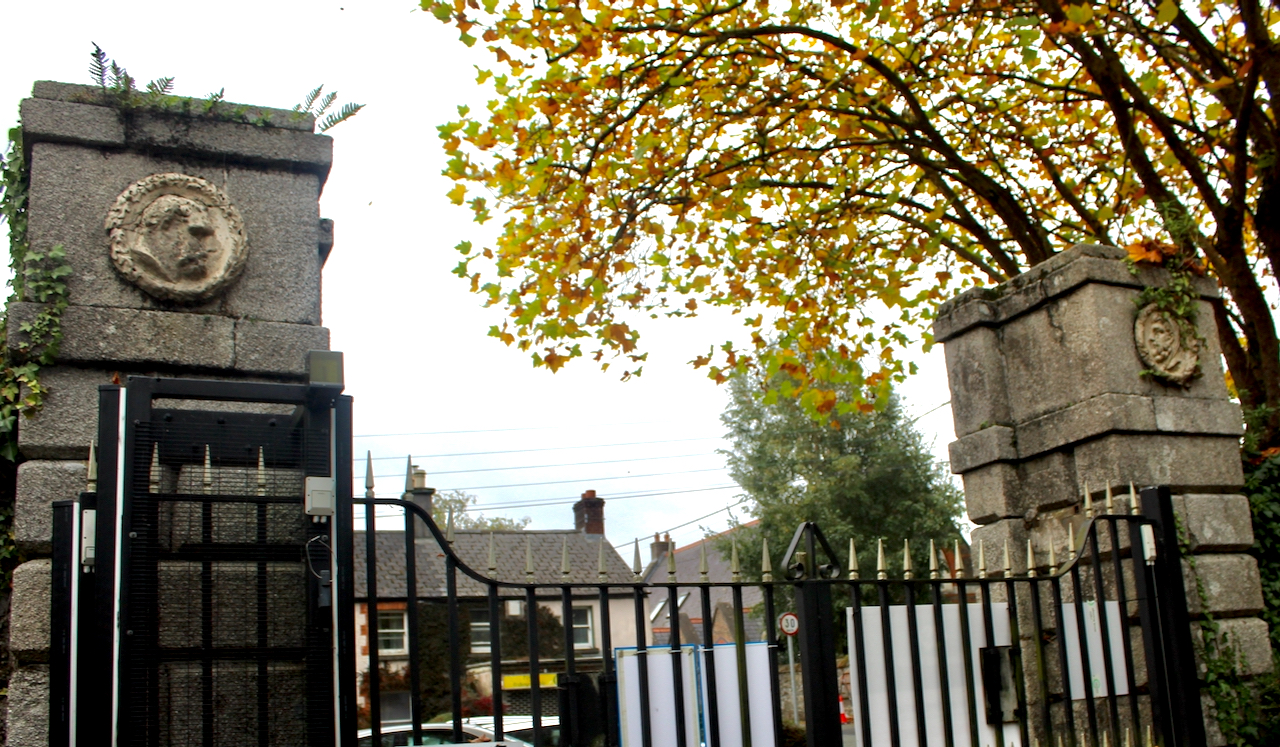
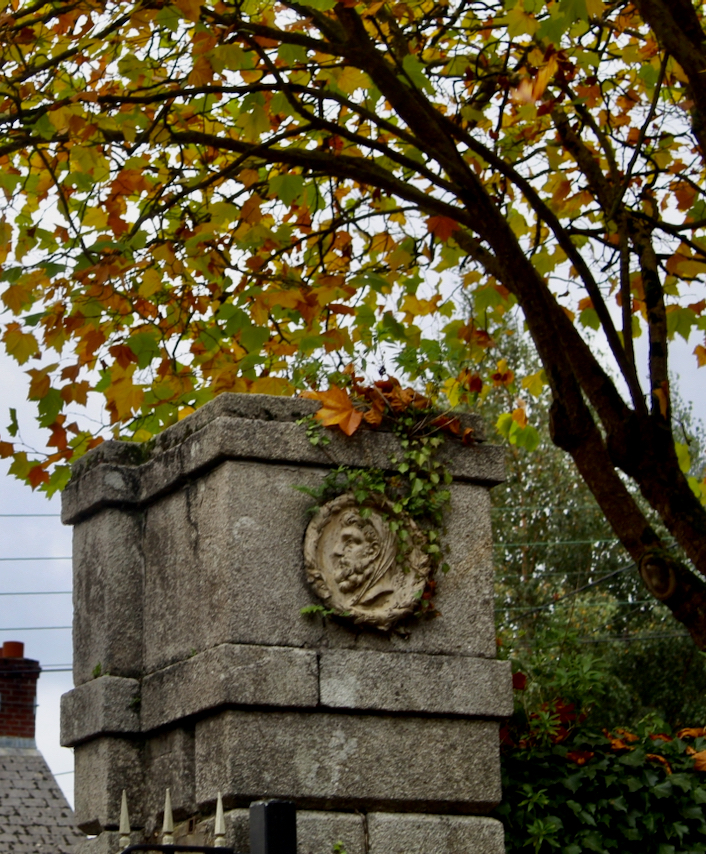


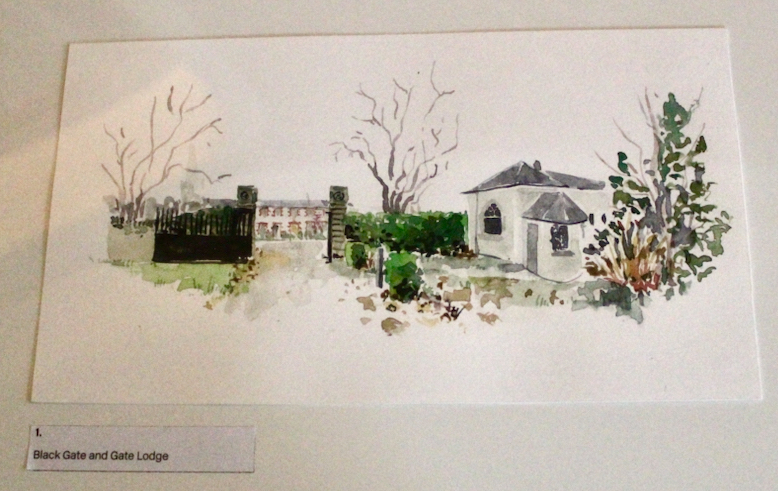

2026 Diary of Irish Historic Houses (section 482 properties)
To purchase an A5 size 2026 Diary of Historic Houses (opening times and days are not listed so the calendar is for use for recording appointments and not as a reference for opening times) send your postal address to jennifer.baggot@gmail.com along with €20 via this payment button. The calendar of 84 pages includes space for writing your appointments as well as photographs of the historic houses. The price includes postage within Ireland. Postage to U.S. is a further €10 for the A5 size calendar, so I would appreciate a donation toward the postage – you can click on the donation link.
€20.00
donation
Help me to pay the entrance fee to one of the houses on this website. This site is created purely out of love for the subject and I receive no payment so any donation is appreciated!
€15.00
Donation towards website.
I receive no funding nor aid to create and maintain this website, it is a labour of love. The website costs €300 annually on wordpress. Help to fund the website.
€150.00
[1] http://lordbelmontinnorthernireland.blogspot.com/2012/05/marlay-grange.html
[1] https://theirishaesthete.com/2024/05/27/lucan-house/
[2] https://www.dib.ie/biography/sarsfield-patrick-a7924
[3] https://www.dib.ie/biography/vesey-john-a8812#co-subject-B
[4] Dictionary of Irish Architects, https://www.dia.ie/architects/view/5104/WYATT%2C+JAMES+%23
[5] Elizabeth Birthistle, “Palladio preserved in Lucan House and demesne,” Irish Times, 27 February 2016.
Oldbridge Hall, County Meath, site of the Battle of the Boyne Visitor centre
Battle of the Boyne site and visitor centre, Oldbridge Hall, County Meath.
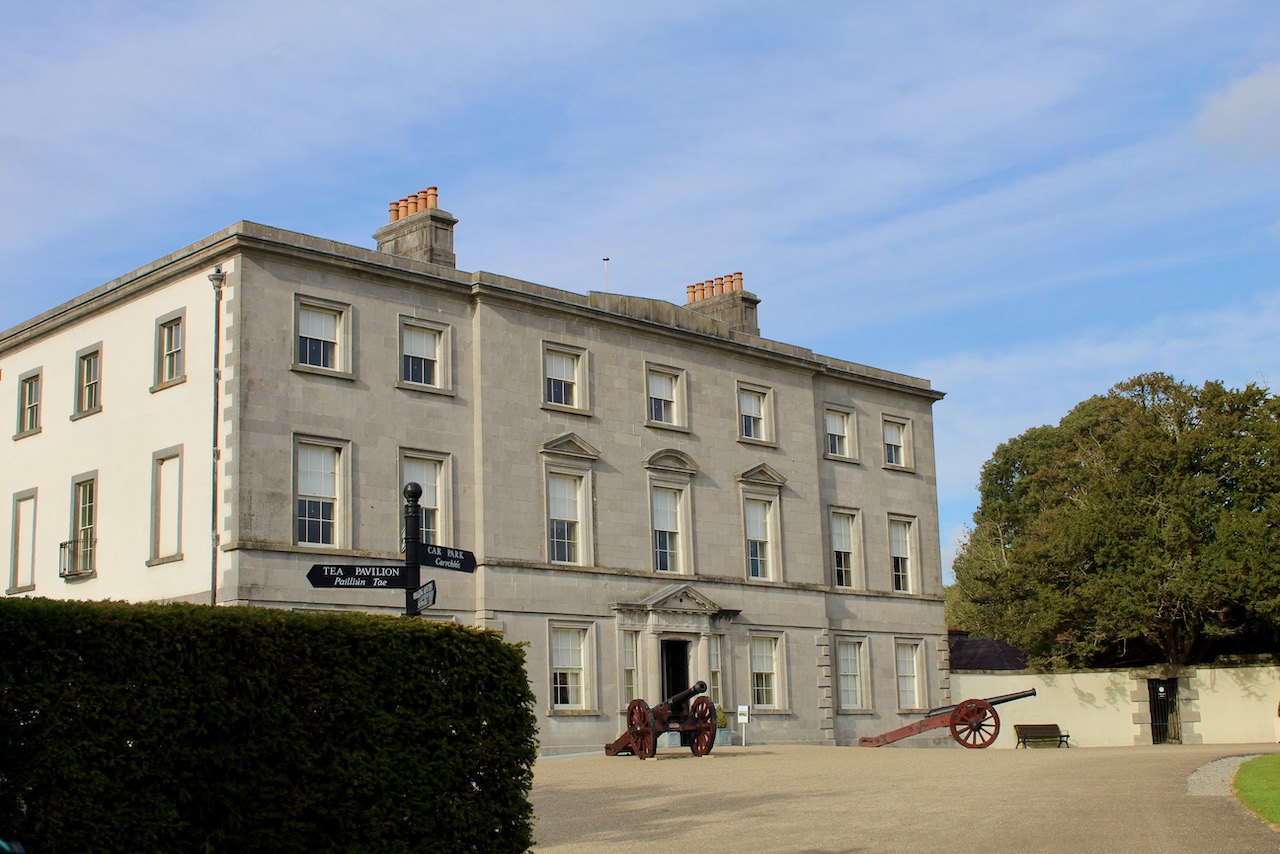
The Battle of the Boyne museum is housed in Oldbridge Hall, which is built on the site where the battle of the took place. The house is maintained by the Office of Public Works.
https://heritageireland.ie/places-to-visit/battle-of-the-boyne-visitor-centre-oldbridge-estate/
Stephen and I have a personal connection, as Oldbridge was built by the Coddington family, and a daughter from the house, Elizabeth Coddington (1774-1857), married Stephen’s great great grandfather Edward Winder (1775-1829).

The Battle of the Boyne, 1st July 1690, was just one of several battles that took place in Ireland when the rule of King James II was challenged by his son-in-law, a Dutch Protestant Prince, William of Orange. James II was Catholic, and he attempted to introduce freedom of religion, but this threatened families who had made gains under the reformed Protestant church. When James’s wife gave birth to a male heir in 1688, many feared a permanent return to Catholic monarchy and government. In November 1688, seven English lords invited William of Orange to challenge the monarchy of James II. William landed in England at the head of an army and King James feld to France and then to Ireland. William followed him over to Ireland in June 1690.
There were 36,000 men on the Williamite side and 25,000 on the side of King James, the Jacobites. William’s army included English, Scottish, Dutch, Danes and Huguenots (French Protestants). Jacobites were mainly Irish Catholics, reinforced by 6,500 French troops sent by King Louis XIV. Approximately 1,500 soldiers were killed at the battle.
After winning the battle, William gained control of Dublin and the east of Ireland. However, the war continued until the Battle of Aughrim in July 1691, which led to the surrender at Limerick the following autumn. The surrender terms promised limited guarantees to Irish Catholics and allowed the soldiers to return home or to go to France. The Irish Parliament however then enacted the Penal Laws, which ran contrary to the treaty of Limerick and which William first resisted, as he had no wish to offend his European Catholic allies.
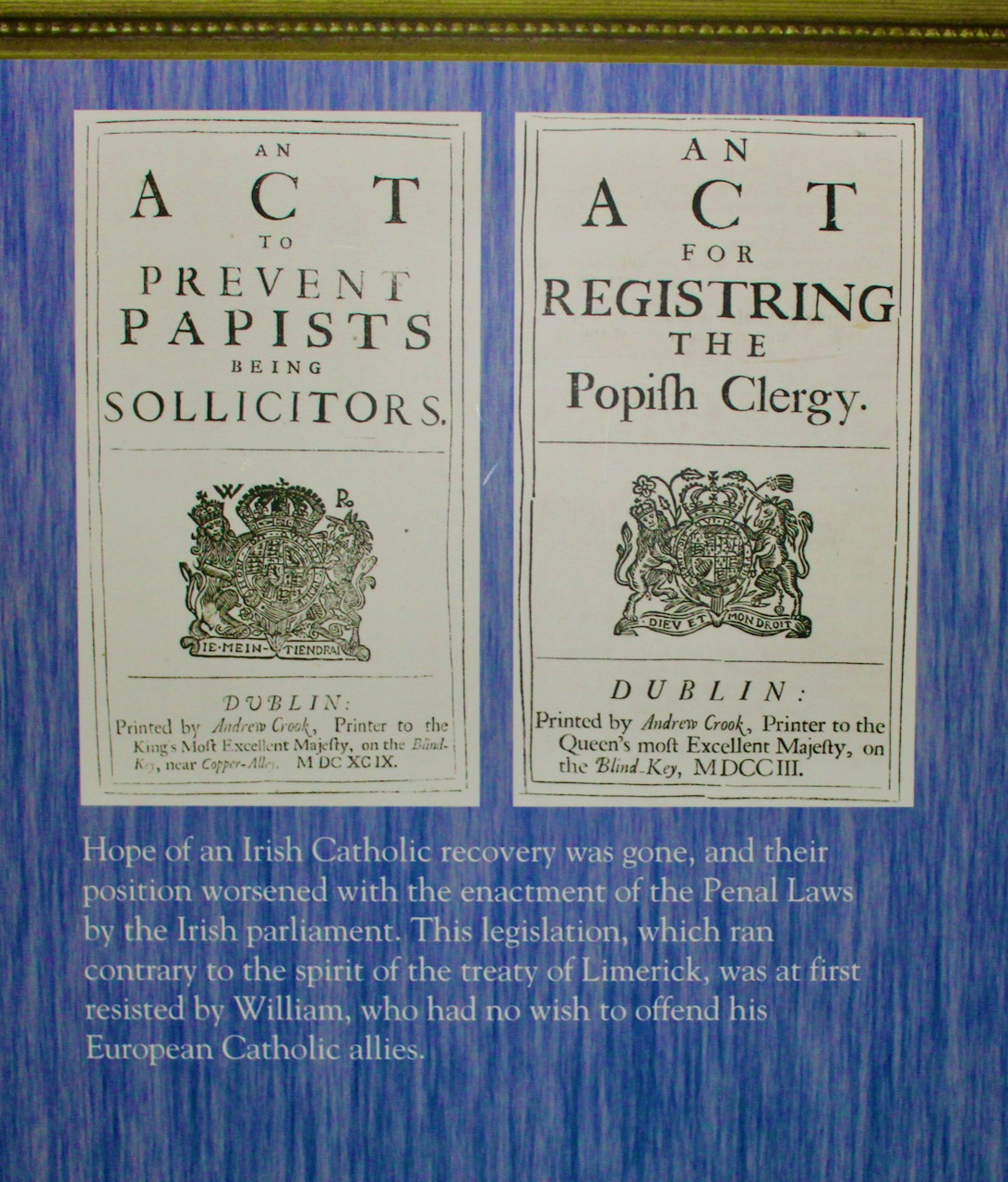
John Coddington (1691-1740) purchased the land in 1729 from Henry Moore the 4th Earl of Drogheda. John’s father Dixie (1665-1728) fought in the Battle of the Boyne in 1690 on the side of King William III. The unusual name “Dixie” comes from the maternal side, as Dixie’s father Captain Nicholas Coddington of Holm Patrick (now Skerries) in Dublin married as his second wife Anne Dixie, possibly a daughter of Sir Wolstan Dixie, 1st Baronet (1602-1682).
John married Frances Osbourne in 1710, and with the marriage came property in County Meath including Tankardstown. Tankardstown House is a boutique hotel and a section 482 property (see my entry https://irishhistorichouses.com/2020/07/11/tankardstown-estate-demesne-rathkenny-slane-co-meath/ ). John Coddington served as High Sheriff of County Meath in 1725, before he acquired the property at Oldbridge.
John’s son, also named John, predeceased him, tragically drowning in the Boyne. In the Meath History Hub Noel French recounts a story about how a young woman refused to marry John because she dreamed that he would die, as he did, before the age of twentyone. [1] I have obtained most of my information in today’s entry from the wonderfully informative Meath History Hub website.
Noel French tells us that the office of High Sheriff had judicial, electoral, ceremonial and administrative functions and executed high court writs. The usual procedure for appointing the sheriff from 1660 onwards was that three persons were nominated at the beginning of each year from the county and the Lord Lieutenant then appointed his choice as High Sheriff for the remainder of the year. Often the other nominees were appointed as under-sheriffs. Members of the Coddington family held the position in 1725, 1754, 1785, 1798, 1843, 1848 and 1922. [see 1]
After John’s death in 1740 the house at Oldbridge was advertised for lease, described as the house, gardens and demesne, so the house must have been built by this time. [see 1] The property passed to John’s brother Nicholas’s son, Dixie Coddington (1725-1794).
I am confused about the date of construction. According to the notice for lease, a house stood at the site in 1740. Evidence that the current house was built around 1750 however was found in an inscription on piece of baseboard of a stair removed during repairs carried out in 1960s that reads: ‘ December 1836 Patrick Kelly of the City of Dublin / Put up these Staircases. / I worked at this building from April / till now. / 86 years from the first / Building of this house/ till now as we see by a stick like this found.’
In The Buildings of Ireland: North Leinster, The Counties of Longford, Louth, Meath and Westmeath (published in 1993), Casey and Rowan accept that the house was built around 1750. They suggest that it may have been designed by George Darley (1730-1817), due to affinities with Dowth Hall nearby and to Dunboyne Castle.
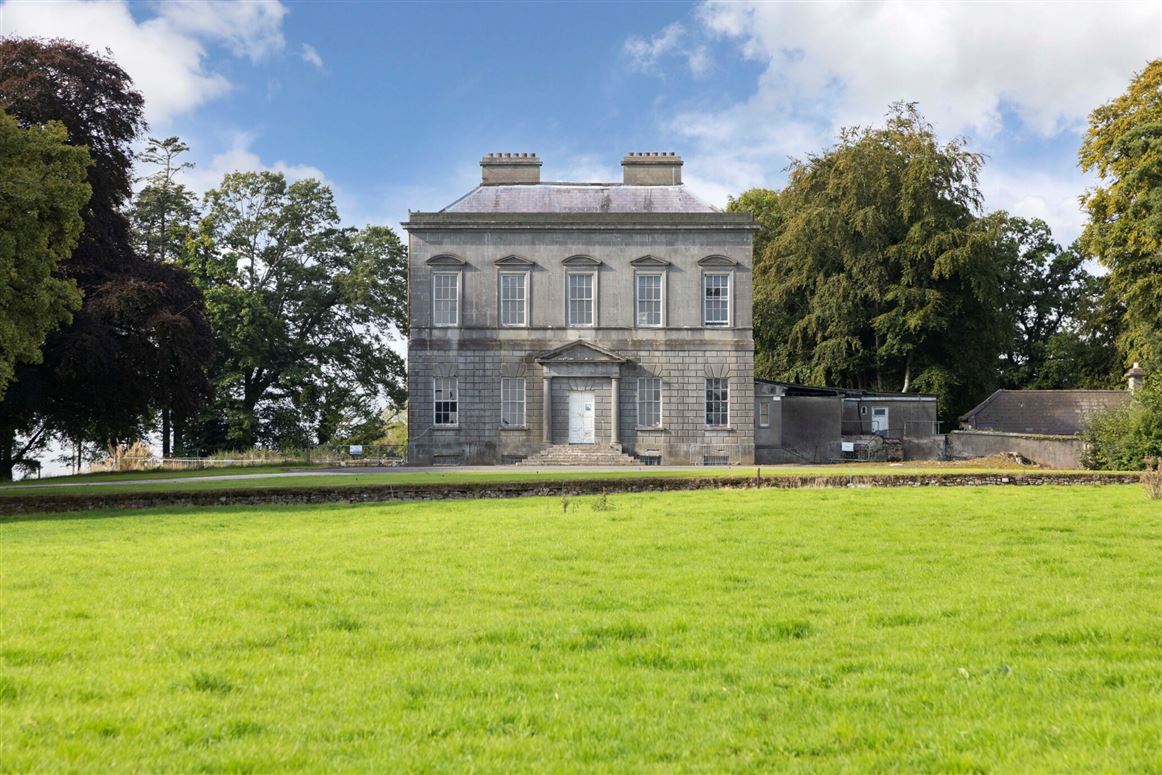
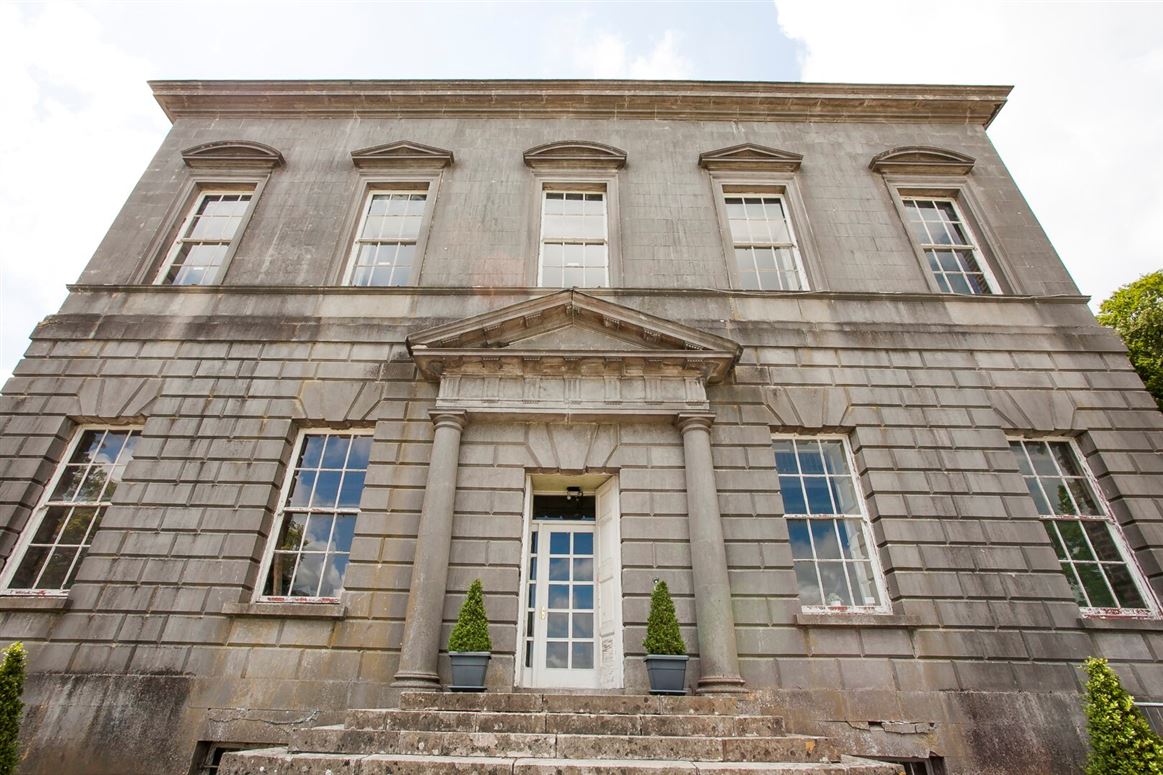
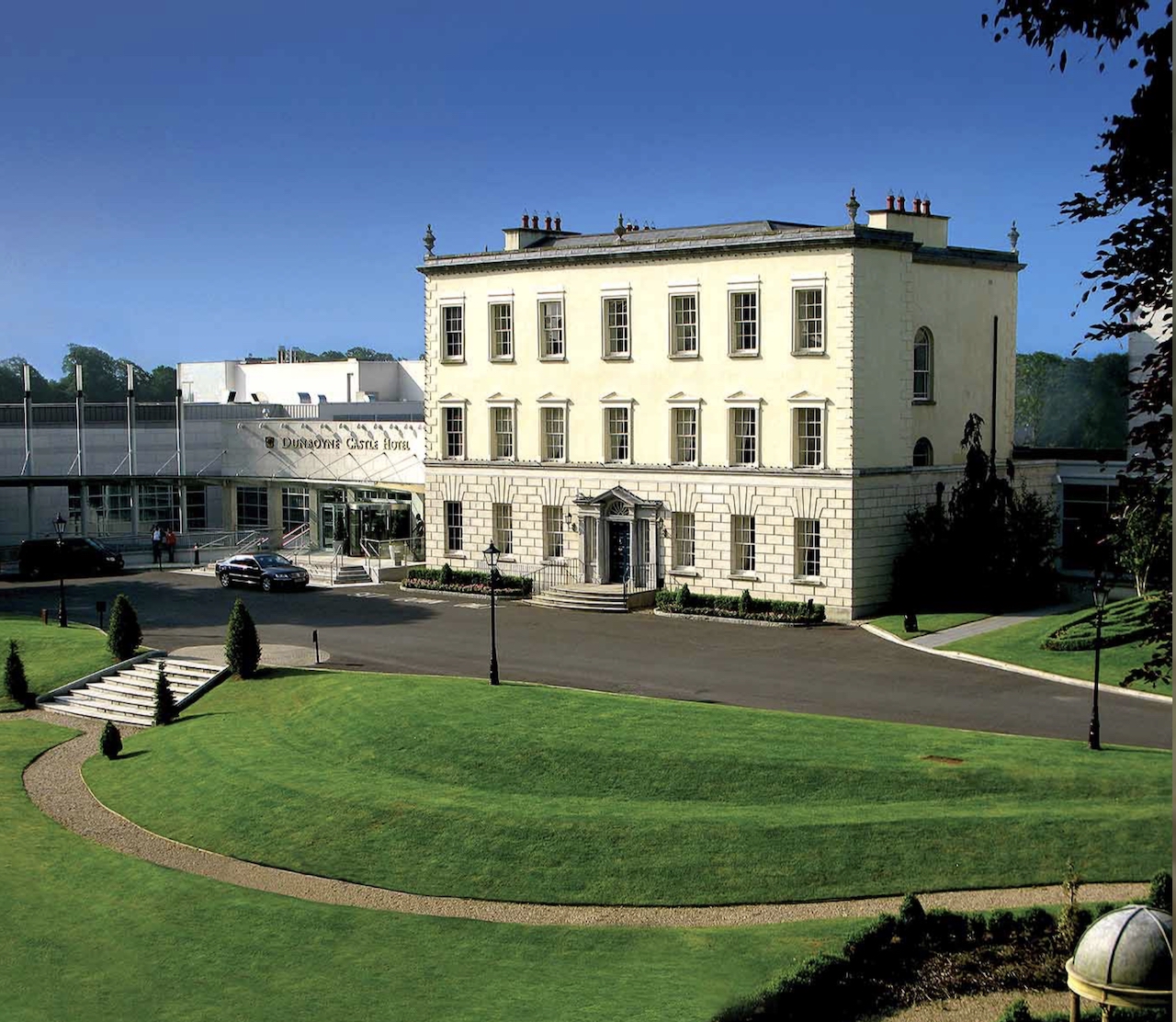
The house is three storey with a plain ashlar frontage of seven bays, with the centre three slightly advanced. Christine Casey and Alistair Rowan tell us in The Buildings of Ireland: North Leinster, The Counties of Longford, Louth, Meath and Westmeath (published in 1993) that the house was originally designed as a three bay three storey block with low single-storey wings, and the upper stories of the wings were added later. [2]
In the early nineteenth century two floors were added to each wing. Casey and Rowan tell us that this was apparently carried out by Frederick Darley (1798-1872).
Quadrant walls link the house to its park, with rusticated doors.
It has a centrally located tripartite doorcase with pilasters surmounted by a closed pediment, which holds a canonball from the fields of the Battle of the Boyne. It has a string course between ground and first floors and sill course to first floor, and three central windows on first floor with stone architraves. [3]
Dixie Coddington (1725-1794) married Catherine Burgh, daughter of Thomas Burgh (1696-1754) of Burgh (or Bert) house in County Kildare. Burgh Quay in Dublin is named after a sister of Thomas Burgh’s, Elizabeth, who was the wife of the Speaker of the House in Ireland, Anthony Foster. Thomas Burgh’s uncle, another Thomas Burgh (1670-1730), was Surveyor General and architect.
On 13 April 1757 Dixie Coddington of Oldbridge sold Tankardstown. [see 1]
Dixie Coddington served as MP for Dunleer, County Louth. He and his wife had several daughters who all died in infancy, and no son, so Oldbridge passed to his brother, Henry Coddington (1728-1816). Dixie had previously leased Oldbridge to his brother, and has spent most of his life living in Dublin on Raglan Road. [see 1]
Henry Coddington (1728-1816) was father to Stephen’s ancestor Elizabeth. Henry was a barrister, and served as MP for Dunleer, County Louth, and he married Elizabeth Blacker from Ratheskar, County Louth. He served as High Sheriff for County Louth, then for County Meath, and was Deputy Serjeant-at-Arms between 1791 and 1800. He served as Justice of the Peace also for Counties Louth and Meath.
Henry and Elizabeth’s son Nicholas (1765-1837) followed in his father’s footsteps, and served as MP for Dunleer before the Act of Union in 1800, and also served as high sheriff for counties Louth and Meath. Nicholas and his son, Henry Barry, carried out a number of improvements on the estate. The house was re-modelled in the 1830s to the drawing of Frederick Darley. [see 1]
The Oldbridge Estate then passed to Henry-Barry Coddington, son of Nicholas. Henry-Barry Coddington was born on May 22nd in the year 1802; he was the eldest surviving son of Nicholas Coddington and Laetitia Barry. Henry Barry took a Grand Tour of Europe and kept a diary. He married Maria Crawford, eldest daughter of William Crawford of Bangor Co. Down in 1827.
Noel French tells us of Maria Crawford’s father and his role in tenant land rights:
“William Sharman Crawford, was the owner of 5,748 acres in County Down … as well as 754 acres at Stalleen in County Meath. William Sharman Crawford took an active interest in politics. He is best known for his advocacy of Tenant Right – the Ulster Custom which gave a tenant greater security through the three “f”s: fair rent, fixity of tenure and free sale of goodwill. Crawford called this “The darling object of my heart”. This idea was not popular with other landlords, but Crawford remained a strong advocate of it for the rest of his life. In 1843 Crawford managed to persuade Sir Robert Peel, the Conservative prime minister, to establish the Devon Commission to investigate the Irish land question. Tenant right, the subject of eight successive bills drafted by Sharman Crawford, was eventually conceded in the Land Acts of 1870 and 1881.”
Despite the admirable work of his father-in-law, Henry-Barry Coddington was a slave owner. He inherited an estate in Jamaica from his great uncle, Fitzherbert Richards. The estate, Creighton Hall in the parish of St. Davids in Jamaica, had previously belonged to Fitzherbert’s brother Robert Richards. The estate was 1165 acres. 399 acres was planted with sugar cane in 1790. The plantation produced sugar, rum, molasses, cotton, ginger, coffee, cocoa and pimento. [see 1]
In A Parliamentary Return of 1837-38, which listed names of those who claimed a loss of “property” after slavery was abolished in 1834, Henry-Barry Coddington was recorded as the `Master` to 235 enslaved individuals. It seems, however, that Coddington was unsuccessful in his claim for compensation.
The property at Oldbridge passed to a son, John Nicholas Coddington (1828-1917) and then to his son Arthur Francis by his first wife, Lelia Jane Naper (d. 1879) of nearby Loughcrew House, a Section 482 property (see my entry https://irishhistorichouses.com/2023/09/21/loughcrew-house-loughcrew-old-castle-co-meath/ ).
Oldbridge House was occupied by the National Army in July 1922. In 1923 Arthur F. Coddington of Oldbridge brought a claim against the government for damages done by the National Army forces when they occupied Oldbridge House. The repairs included slates, plumbing, painting and six trees felled.[see 1]
Arthur’s son Dixie fought in World War II then returned to live in Oldbridge, where he began a commercial market gardening business, and where he trained young people in horticulture.
The Meath History hub tells us that in 1982 a gang broke into Oldbridge House and stole £600,00 in antiques. Two years later, Dixie’s son Nicholas and his wife were held at gunpoint for eleven terrifying hours in their house. Among the items stolen was an eight-foot picture of King William III, dating back to 1700, a number of landscape paintings and a number of family portraits. The haul included items that had been recovered from the robbery two years previously. In 1984 Nicholas Coddington put the house and contents up for sale.
Oldbridge House was purchased by the state in 2000 as part of the Good Friday Peace Agreement, and renovation began.
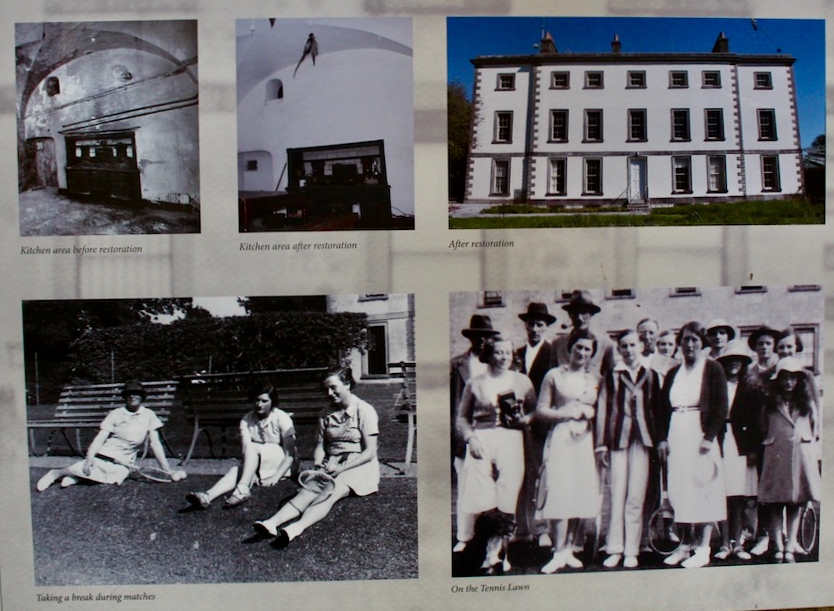
To the left of the house there is a cobble stone stable yard with fine cut stable block. This originally contained coach houses, stables, tack and feed rooms.
To the right of the house is a small enclosed courtyard which contains the former butler’s house.
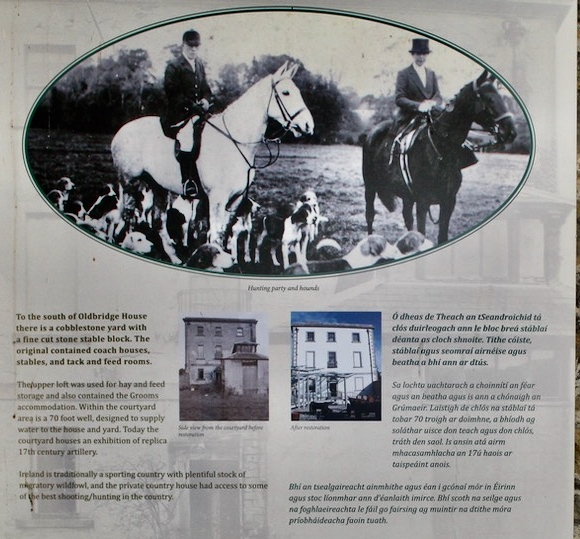

The gardens of Oldbridge House have been restored, with an unusual sunken octagonal garden, peach house, orchard and herbaceous borders, with a tearoom in the old stable block. Throughout the year outdoor theatre, workshops and events such a cavalry displays and musket demonstrations help to recreate a sense of what it might have been like on that day in July 1690.

[1] https://meathhistoryhub.ie/coddingtons-of-old-bridge/
[2] p. 446. Casey, Christine and Alistair Rowan, The Buildings of Ireland: North Leinster, The Counties of Longford, Louth, Meath and Westmeath. Penguin Books, UK, 1993.
A Guide to Irish Country Houses by Mark Bence-Jones contents and pictures, houses beginning with E
As you can see as I work my way though the contents of Mark Bence-Jones’s A Guide to Irish Country Houses [1], there are thousands of “big houses” in Ireland – though many are “houses of middle size.”
Note that the majority of these are private houses, not open to the public. I discovered “my bible” of big houses by Mark Bence-Jones only after I began this project of visiting historic houses that have days that they are open to the public (Section 482 properties).
This is a project I have been working on for a while, collecting pictures of houses. Enjoy! Feel free to contact me to send me better photographs if you have them! I’ll be adding letters as I go…
[1] Mark Bence-Jones. A Guide to Irish Country Houses (originally published as Burke’s Guide to Country Houses volume 1 Ireland by Burke’s Peerage Ltd. 1978); Revised edition 1988 Constable and Company Ltd, London.

Donation
Help me to fund my creation and update of this website. It is created purely out of love for the subject and I receive no payment so any donation is appreciated! My website costs €300 per year on WordPress.
€15.00
Eastgrove, Cobh, Co Cork

p. 118. “(Bagwell/IFR; Jenkinson, B/PB) An early C19 house in the “Cottage Gothic” style overlooking East Ferry, a heavily-wooded backwater of Cork Harbour; built by Dorcas (nee Bagwell), wife of Benjamin Bousfield, on land which had belonged to her mother’s family, the Harpers of Belgrove. Shallow gables with bargeboards; trellised iron verandah on front overlooking Ferry. A polygonal tower, with an eaved roof, was subsequently added at one end of the house and known as Wellington Tower. It contains a large and impressive dining room with curved walls. There is also a large and handsome drawing room. At one side of the house is a range of castellated outbuildings, with a slender tower like a folly; there is another tower in the woods...” [1]
Ecclesville, Fintona, County Tyrone
p. 118. “(Eccles, sub McClintock/LGI1912; Lecky-Browne-Lecky, sub Browne, IFR) A plain late-Georgian house… Now a home for the elderly.” [1]
Echlinville House (afterwards Rubane House), Kircubbin, County Down
p. 118. “(Echlin/LGI1912) An early to mid-C18 house, largely rebuilt 1850; but the library, a four bay pavilion with Ionic pilasters and Gothic astragals in its windows, survives from the earlier house; inside is a vaulted ceiling with two floating domes. In the grounds there is a small Classical bridge and a pebble house with pinnacles. Subsequently the seat of a branch of the Cleland family, its name being changed to Rubane House.” [1]
Eden Vale, Ennis, Co Clare

p. 118. “[Stacpoole/IFR] A C18 house, enlarged and embellished during 2nd half of C19 by Richard Stacpoole. Irregular entrance front with three bays on one side of tower-like central feature, and four bays on the other. Porch with pilasters and pierced parapet. At the end of the house are two Venetian windows, one on top of the other. Sold ca. 1930; now an old peoples’ home.” [1] It is no longer an old peoples’ home.
Edenfel, Omagh, County Tyrone
p. 118. “(Buchanan, sub Hammond-Smith/IFR) A Victorian house with gables and bargeboards…” [1]
Edenmore, Stranorlar, Co Donegal

p. 118. “(Cochrane/IFR) A two storey gable-ended late C18 house. Front with three sided central bow and one bay on either side of it. The house is flanked by detached office wings running back, one much longer than the other; the front ends of these wings have three sided bows, matching the bow in the centre of the house; they are linked to the house by walls, forming one long elevation...” [1]
Edermine House, Enniscorthy, County Wexford


p. 118. “(Power, sub O’Reilly/IFR) A two storey Italianate villa by John B. Keane, built ca 1839 for the Powers, owners of the firm of John Power & Son, Distillers, of Dublin. Eaved roof on bracket cornice; three bay front with pillared porch, and triangular pediments over downstairs windows. Five bay side elevation, with a central Venetian window recessed in a giant blind arch. Grecian interior, fluted Doric columns in hall, paired Ionic columns and pilasters on staircase landing. A Gothic chapel was subseqnetnly built at one side of the house to the design of A.W. Pugin, a family friend; it was originally free-standing, but was afterwards joined to the house by an addition at the bck which includes a small Italianate campanile. At right angles to the chapel, a magnificent early Victorian iron conservatory, gracefully curving in the Crystal Palace manner, was built; probably by the Malcolmson Works in Waterford, or the Hammersmith Iron Works in Dublin; it is joined to the corner of the chapel by a cast iron verandah.” [1]
Edgeworthstown House, Edgeworthstown, County Longford – nursing home
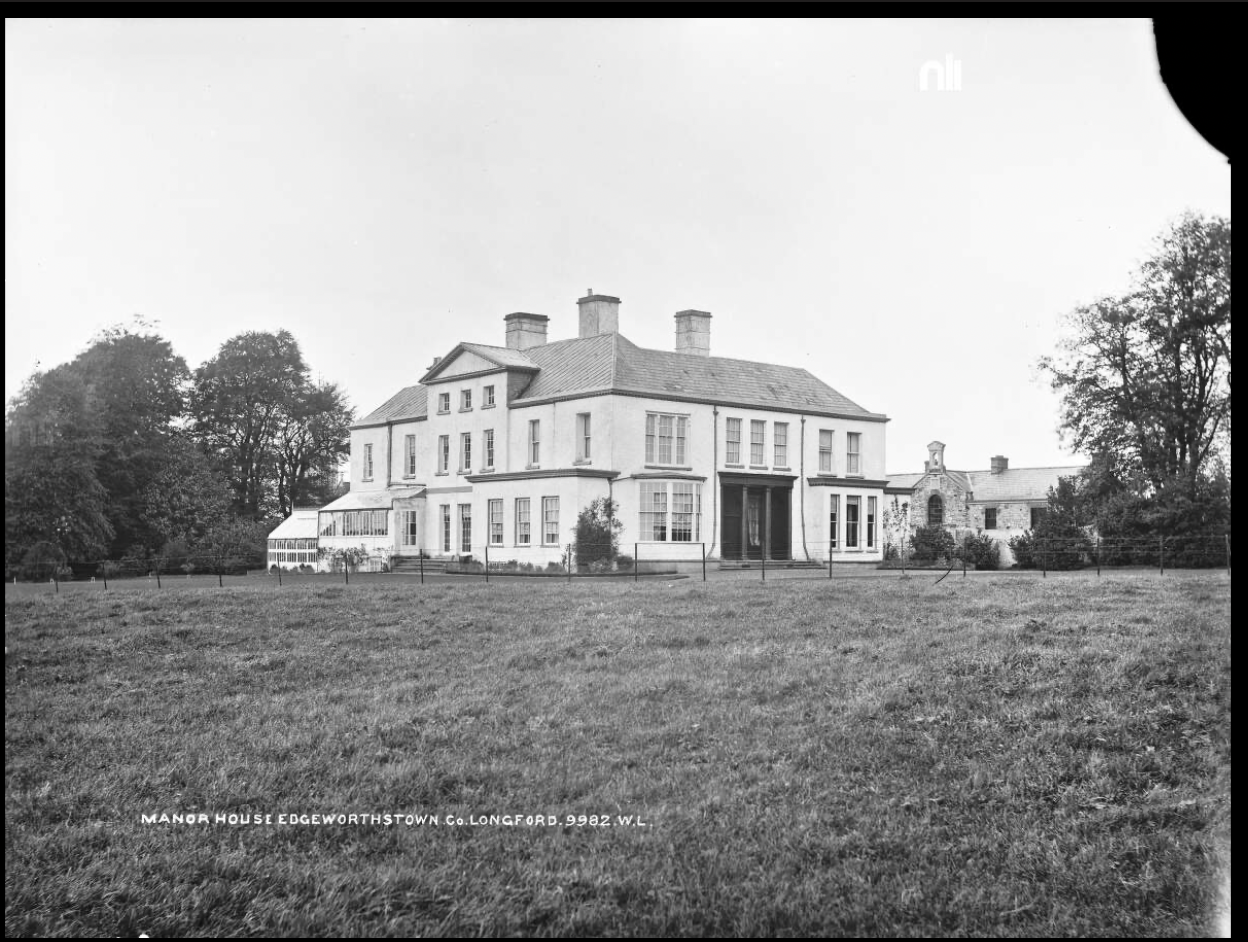
p. 118. “(Edgeworth/LGI1912; Montagu, sub Manchester, D/PB) An early 18th century house built by Richard Edgeworth MP, with small windows, low, wainscoted rooms and heavy cornices; much enlarged and modernized after 1770 by Richard Lovell Edgeworth, the inventor, writer on education and improving landlord, father of Maria Edgeworth, the novelist.
It comprises two storeys over a basement, with two adjoining fronts; prominent roof and dentil cornice. The entrance front has three bays between two triple windows in the upper storey, with doorway in a pillared recess between two shallow single-storey curved bows below; in the Victorian period, the right-hand triple window was replaced by two windos and the right hand bow by a rectangular single-storey projection. Adjoining front has a three-bay breakfront which rises above the roofline as a pedimented attic, and two bays either side. On the ground floor, Richard Lovell edgworth enlarged the rooms by throwing them into single-storey three bay rectangular projections, linked in the centre by an arcaded loggia; in the Victorian period one of the projections was replaced by a glass lean-to conservatory, and the loggia was removed. Curved top-lit staircase in centre of house.
In Richard Lovell Edgeworth’s time, the house was full of labour-saving devices: sideboards with wheels, pegs for footwear in hall, leather straps to prevent doors banging, a water pump which automatically dispensed 1/2d to beggars for each half-hour that they worked it. Inherited 1926 by Mrs. C.F. Montagu (nee Sanderson) whose mother was an Edgeworth; sold by her to Mr Bernard Noonan, who bequeathed it to an order of nuns, by whom it is used as a nursing home; the exterior of the house being much altered, and the interior gutted and rebuilt.” [1]
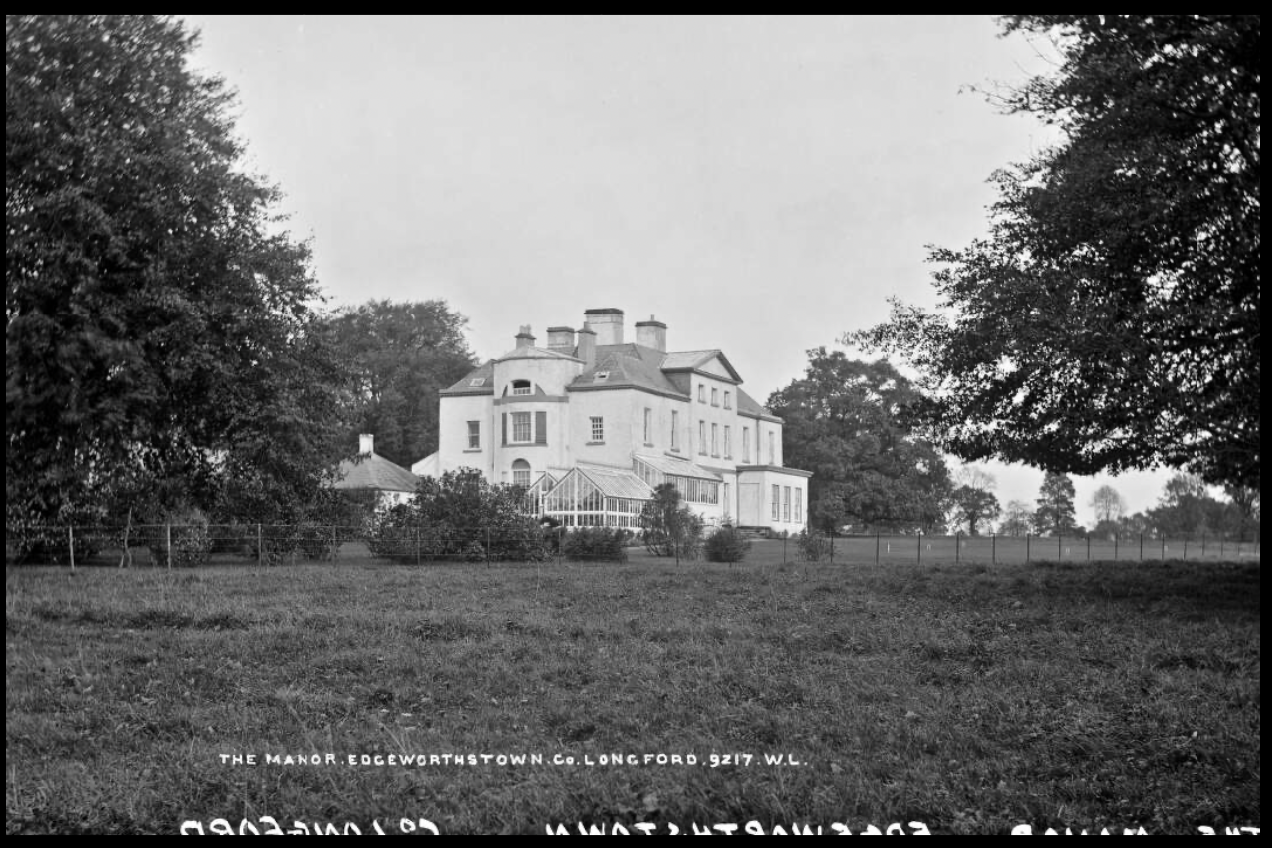

Edgeworthstown Rectory, Edgeworthstown, County Longford

p. 119. P. 119. “(Edgeworth/LGI1958) A two storey three bay gable-ended early C18 house. The birthplace of Henry Essex Edgeworth, better known as Abbe Edgeworth de Fermont, who attended Louis XVI to the scaffold.” [1]
Edmondsbury, (formerly Newtown), Co Laois

p. 119. “(Butler, now Butler-Bloss/IFR) A house probably built by Edmond Butler soon after 1734. Good chimneypiece in hall. Sold 1910.” [1]
Edmondstown (Bishop’s Palace), Ballaghaderreen, Co Roscommon

p. 119. “A high Victorian house of stone with brick polychromy; pointed windows, pyramidal roofed turret.” [1]
Eglantine, Hillsborough, County Down
“(Mulholland, sub Dunleath, B/PB) A nineteenth century house with a remarkable double-ramped staircase.” [1]
Eglington Manor House, County Derry

p. 119. Eglinton, Manor House, County Derry: “(Davidson/IFR) A two storey late-Georgian house with an eaved roof and a fanlighted doorway, built by the London Company of Grocers, who owned and developed the village of Eglinton. Bought by James Davidson ca. 1840, and subsequently enlarged by the addition of a battlemented wing, with a snall battlemented turret at the junction of the wing and the original house. The wing and turret have large vemiculated quoins; and the original house has similar quoins.” [1]
Eglish Castle, Birr, County Offaly – a ruin

p. 119. “A two storey house with a pediment.” [1]
Elm Hill, Ardagh, Co Limerick

p. 119. “(Studdert/IFR) A weather slated C18 house of two storeys over a high basement. Six bay front; pedimented doorway with sidelights. Archway of curving Baroque shape, the main arch being surmounted by a round-headed opening, at side of house, leading to yard.” [1]
Elm Park, Farran, Co Cork
p. 119. “(Ashe, sub Woodley/IFR) A two storey five bay early C19 house, the two left-hand bays of the front projecting forwards, with a glazed pilastered porch in the angle thus formed. The other end of the house is slightly curved. Eaved roof...” [1]
Elm Park, Clarina, Co Cork – demolished
p. 119. “(Massy, Clarina, B/PB1949) An irregular early C19 cut-stone castellated house, mostly of two storeys over a basement; with round and square towers… Now demolished, except for the gate arch.” [1]
The Elms, Portarlington, Co Laois

p. 119. “(Stannus/IFR) A Georgian house consisting of a gable-ended centre of three storeys over a basement, with lower symmetrical wings. The centre with a three bay front and large fanlighted staircase window not centrally placed in its rear elevation. The home of Lt-Col T.R.A. Stannus, father of Dame Ninette de Valois, the ballerina and choreographer.” [1]
Ely Lodge, Castle Hume, County Fermanagh

p. 119. “(on the same estate as Castle Hume) (Hume, Bt/EDB; Loftus, Ely, M/PB; Grosvenor, Westminster, D/PB) Richard Castle built his first Irish Palladian house here for Sir Gustavus Hume, Bt, MP 1729; it was named Castle Hume. Fine stable-court, with rusticated openings, some of them surmounted by oculi, and an interior of vaults supported by Doric columns, as at Strokestown. The estate subsequently passed to the Ely family though the marriage of the Hume heiress to Nicholas Loftus, afterwards 1st Earl of Ely. In 1830s a new house was built a couple of miles away, on a promontory in Lough Erne, by [John Loftus (1770-1845)] 2nd Marquess of Ely, and named Ely Lodge; to provide stone for it, the main block of Castle Hume was demolished, so that only the stable-court remains. Ely Lodge, which was to the design of William Farrell, consisted of a two storey five bay gable-ended block with Doric pilasters along its whole front and a Doric porch, the gable-ends being treated as pediments; at one end was a single-storey wing set back, with corner-pilasters and a curved pilastered bow in its side elevation. In 1870, Ely Lodge was blow up as part of 21st birthday celebrations of the 4th Marquess, who intended to build a new house; it is also said that he blew the house up in order to avoid having Queen Victoria stay. In the event, the new house was never built, doubtless for the reason that the young Lord Ely spent too much money on rebuilding his other seat, Loftus Hall, County Wexford. The former stables at Ely Lodge have since been extended to form a house, which is the Irish seat of the Duke of Westminster; it contains a number of interior features of the now demolished Eaton Hall, Cheshire.” [1]
Emell Castle, Moneygall, County Offaly

p. 119. “(Stoney/IFR) A large C16 tower-house of the O’Carrolls, with a gable-ended C18 house of two storeys over a basement and five bays built onto the front of it. Fanlighted doorway. The C18 addition was almost certainly built by Captain Robert Johnstone, who bought the property 1782 and left it at his death 1803 to his nephew, Thomas Stoney. Some work was carried out on both the tower and the house during C19, without altering the original character of either.” [1]
Emo Court, (also known as Emo Park), Portarlington, County Laois – OPW

See my entry https://irishhistorichouses.com/2024/10/22/emo-court-county-laois-office-of-public-works/
Emsworth, Malahide, County Dublin

p. 121. “The only one of James Gandon’s villas to survive intact; built ca. 1790 for J. Woodmason, a Dublin wholesale stationer. A pediment extends over the whole length of the two storey three bay centre, which is flanked by single storey one bay overlapping wings. Fanlighted doorway under porch of engaged Doric columns and engablature; ground floor windows of centre, and windows of wings, set in arched recesses. Chimney urns on wings.…” [1]
Enniscoe House, Co Mayo – section 482 plus accommodation

See my entry https://irishhistorichouses.com/2021/11/25/enniscoe-house-gardens-castlehill-ballina-co-mayo/
Enniscorthy Castle, Wexford – open to visitors

See my entry https://irishhistorichouses.com/2023/11/15/places-to-visit-and-stay-in-county-wexford/
Enniskillen Castle, County Fermanagh

See my entry https://irishhistorichouses.com/2022/04/03/places-to-visit-and-stay-in-ulster-counties-fermanagh-monaghan-and-tyrone/
Ennismore, Cork, Co Cork – owned by religious order
“(Leycester/LG1952) An early C19 single-storey “villa in the cottage style” with wrought iron verandahs, facing down the Lee estuary. Long and wide hall, running through the middle of the house; large and lofty reception rooms, which formerly contained a notable collection of pictures. Sold ca 1952, now owned by a religious order.” [1]
Ennistymon House, Ennistymon, Co. Clare, now part of the Falls Hotel


See my entry https://irishhistorichouses.com/2023/01/20/places-to-visit-and-stay-in-county-clare/
Erindale, Carlow, Co Carlow

p. 121. “(Vigors/LGI1912; Alexander/IFR) A remarkable two storey red-brick house of ca 1800, with a Gothic flavour and an ingenious plan made up of curved bows; so that one of the two bows on the entrance front serves as one of the end-bows of the adjoining elevation, which itself has a single centre bow. The windows in the entrance front are pointed; first floor centre window, and also two cntre ground-floor windows of the bows, being Venetian windows made Gothic. There is a very large semi-circular fanlight extending over the door and side-lights, with elaborate fancy glazing whith Dr Craig considers to be original. Wide eaved roof.” [1]
Errew Grange, Crossmolina, Co Mayo

p. 122. “(Knox) A large plain Victorian Gothic house on a peninsula jutting out into Lough Conn; rather similar to Mount Falcon, and, like it, probably by James Franklin Fuller; built ca 1870s. Became a hotel and gutted by fire 1930s, recently half rebuilt, also as an hotel.” [1]
Esker House, Lucan, Co Dublin – gone
p. 122. “A two storey Georgian house with a five bay centre and two sided bow at either side, the bows being of the same height as the centre, but with their upper storey windows close to the cornice so as to make the ground floor look higher. Small porch….” [1]
Eureka House, Townparks, Co Meath
Everton House, Crockaun, Co Laois

p. 122. “ A two storey C18 house with front consisting of two deep curved bows separated by one bay with a fanlighted doorway; with an additional bay to the left of the left-hand bow and a curved end-bow. Later two storey wing prolonging the front to the right of the right-handed bow...” [1]
Evington House, Carlow, Co Carlow

p. 122. “A two storey three bay late-Georgian house with an eaved roof. Doorway with large fanlights extending over door and sidelights.” [1]
Eyrecourt, Co Galway – ‘lost’

p. 122. “Eyre/IFR) One of the only two important mid-C17 Irish country houses to survive intact into the present century, the other being Beaulieu, Co Louth. Built 1660s; of brick faced with rendered rubble. Of two storeys, with a dormered attic in the high, wide-eaved sprocketed roof; seven bay entrance front, with three bay pedimented breakfront centre; six bay side. Massive wooden modillion cornice. Splendid if somewhat bucolic doorcase of wood, with Corinthian pilasters, an over-wide entablature, carved scrolls, a mask and an elliptical light over the door surrounded by a frame of foliage. Windows with C18 Gothic glazing. Richly decorated interior. Hall divided by screen of arches and primitive wooden Corinthian columns from vast and magnificent carved oak staircase with two lower ramps adn a single central return leading up to a landing with elaborately moulded panelling and a plasterwork ceiling… staircase went to Detroit Institute of Arts, having been removed there after the house was left to decay from 1920 onwards, since when it has fallen into ruin.” [1]
[1] Mark Bence-Jones. A Guide to Irish Country Houses (originally published as Burke’s Guide to Country Houses volume 1 Ireland by Burke’s Peerage Ltd. 1978); Revised edition 1988 Constable and Company Ltd, London.
Leinster House, Dublin
We visited Leinster House, the seat of Irish Government, during Open House Dublin 2025. We were lucky to get tickets! Open House Dublin events book out almost immediately.
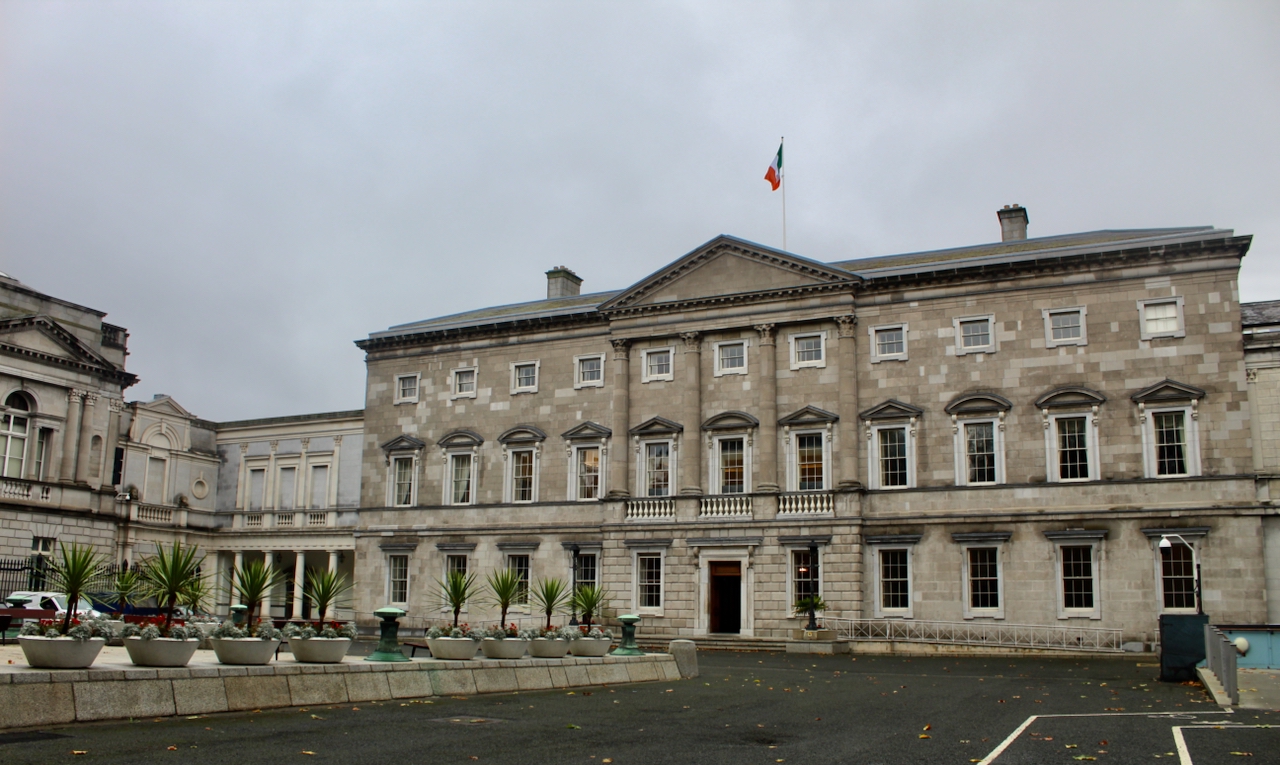
Leinster House was built from 1745-1752 for James Fitzgerald (1722-1773) 20th Earl of Kildare and first Duke of Leinster.
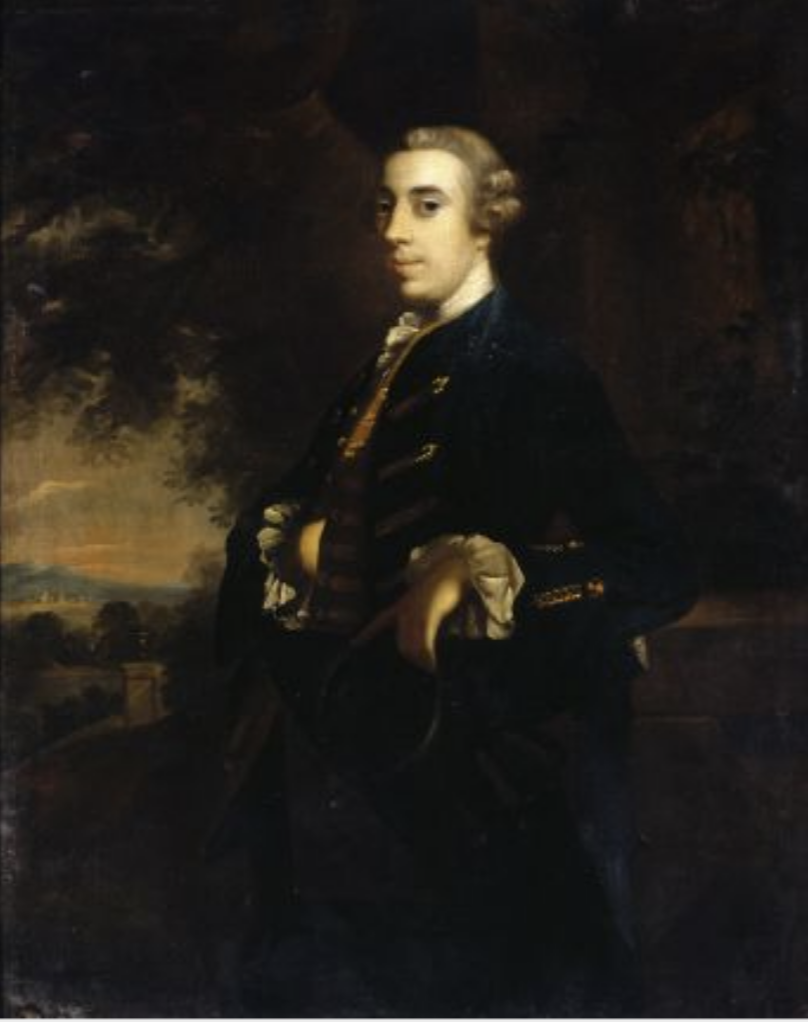
James’s father, Robert FitzGerald (1675-1744) 19th Earl of Kildare, made Carton in County Kildare his principal seat and employed Richard Castle (1690-1751) from 1739 to enlarge and improve the house (see my entry https://irishhistorichouses.com/2024/06/04/carton-house-county-kildare-a-hotel/ ). Before that, the Earl of Kildare had lived in Kilkea Castle in County Kildare.
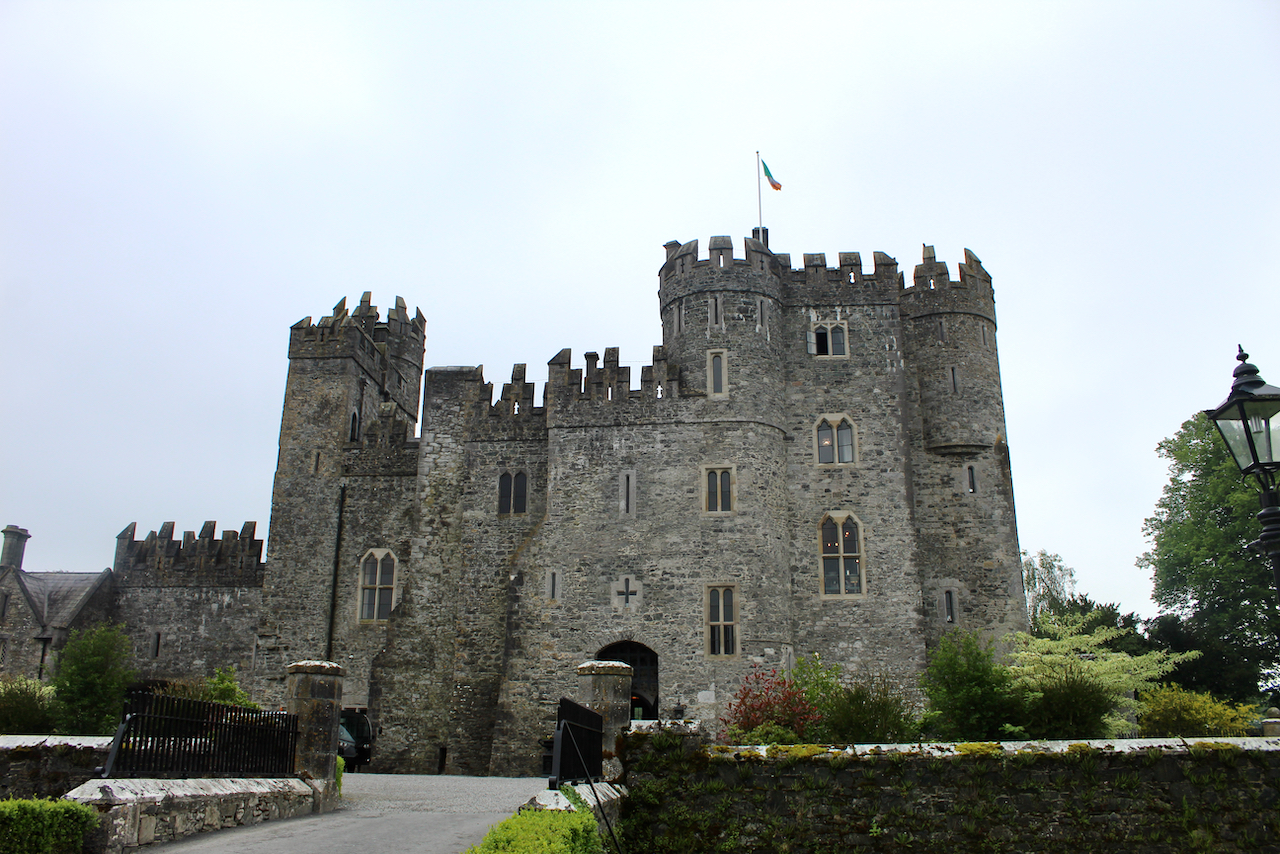
After the destruction of Maynooth Castle, occupied by Earls of Kildare, in 1641, George, 14th Earl of Kildare, resided at Kilkea Castle from 1647-1660, and it continued as the family’s principal seat until Robert, the 19th Earl, built Carton House. [1]

The 20th Earl, James, employed Richard Castle from 1745 to build him a new house in the city, which is now called Leinster House, and began to be so called around 1766 when James Fitzgerald was created Duke of Leinster. He was told that this was not a fashionable area to build, as at that time most of the upper classes lived on the north side of the Liffey around Mountjoy Square and Henrietta Street. He was confident that where he led, fashion would follow, and indeed he was correct.
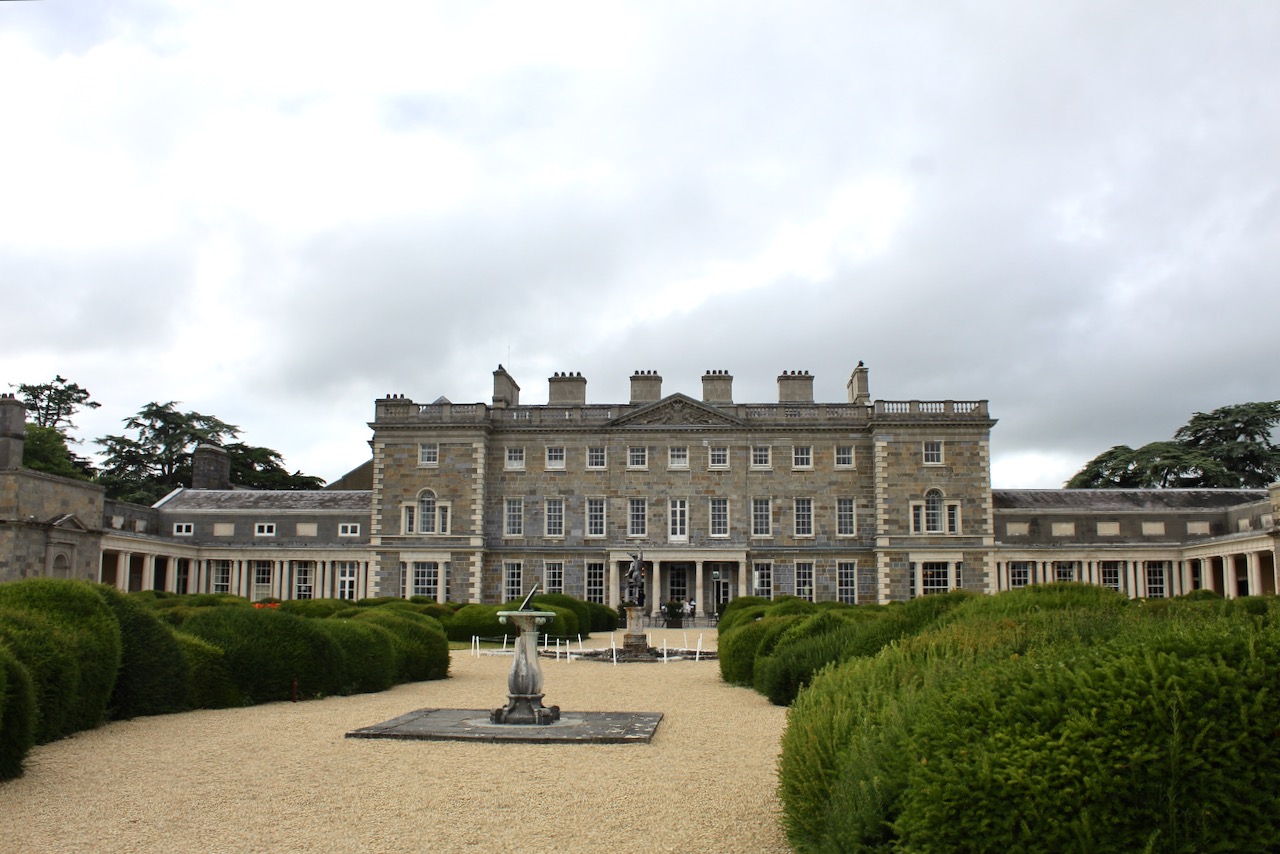

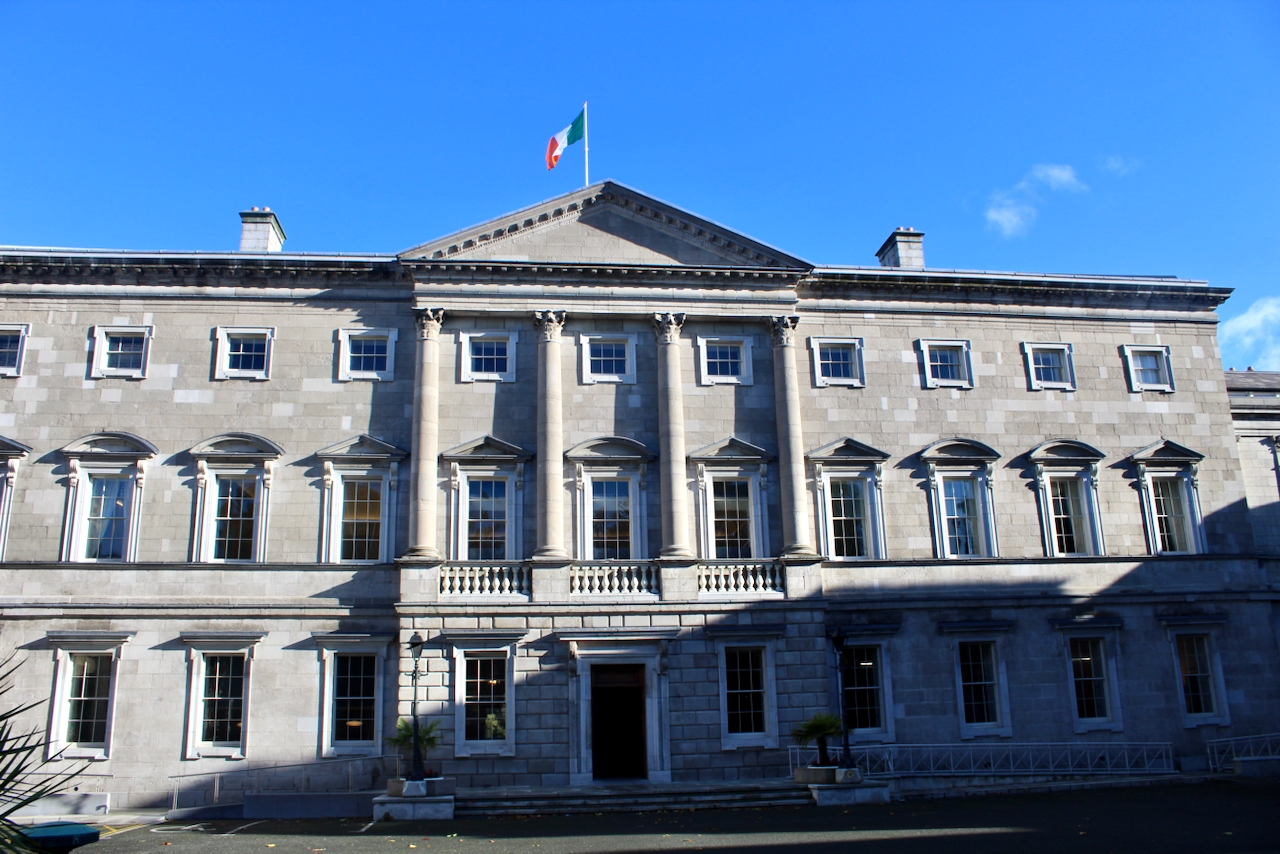
The building as it was originally constructed is a double cube of granite on the east and north fronts and Ardbraccan limestone on the west entrance front. It has a forecourt on the Kildare Street side, which Christine Casey tells us in her Dublin volume of the Pevsner series The Buildings of Ireland is in the French seventeenth century manner, which probably derived via Burlington House in London, a house which would have influenced Richard Castle. The form is Palladian, an eleven bay block of three storeys over basement with a “tetrastyle” (i.e. supported by four columns) Corinthian portico over advanced and rusticated central bays. “Rustication” in masonry is a decorative feature achieved by cutting back the edges of stones to a plane surface while leaving the central portion of the face either rough or projecting markedly, emphasising the blocks. [2]
Casey points to the unusual arrangement of pediments on the windows of the first floor, as an alternating pattern would be the norm, rather than the pairs of segmental (i.e. rounded) pediments flanked by single triangular pediments in the bays to either side of the central three windows. [see 2]
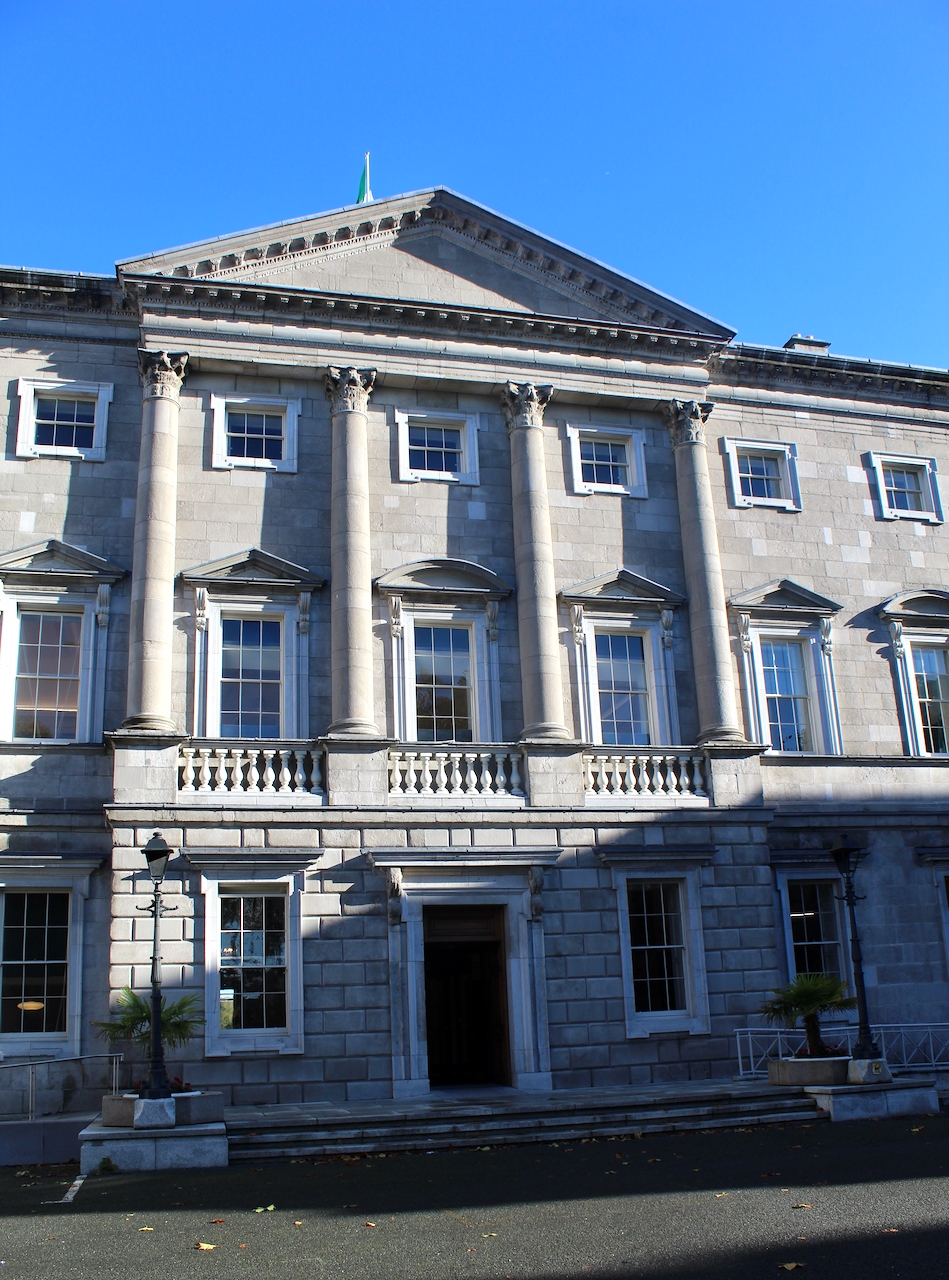
The centre block has a balustraded balcony, and the attic and ground floor windows have lugged architraves: the architrave is the classical moulding around the window and “lug” means ear, so the windows have “ears,” otherwise called shoulders. The term “Lugs” was made famous as a nickname for a policeman in the Dublin Liberties, “Lugs” Branigan, a man known for his sticking-out ears. A heavyweight boxing champion, he had a reputation as the country’s toughest and bravest garda. The ground floor windows have are topped with a further cornice – a horizontal decorative moulding.
Originally, Casey writes, the house was linked to the side walls of the forecourt by low five-bay screen walls with Doric colonneads and central doorcases flanked by paired niches. The colonnade was given a pilastered upper storey in the nineteenth century, and was rebuilt in the 1950s when the colonnade was filled in, Casey explains. The lower storey on the left side when facing the building (north side) still has the colonnade: you can compare the stages of building the colonnades in the pictures below. In fact this colonnade was reinstated after being filled in. It was recently (when written before 2005) reinstated, Casey tells us, by Paul Arnold Architects, and topped with the nineteenthy century screen wall above which we see today.

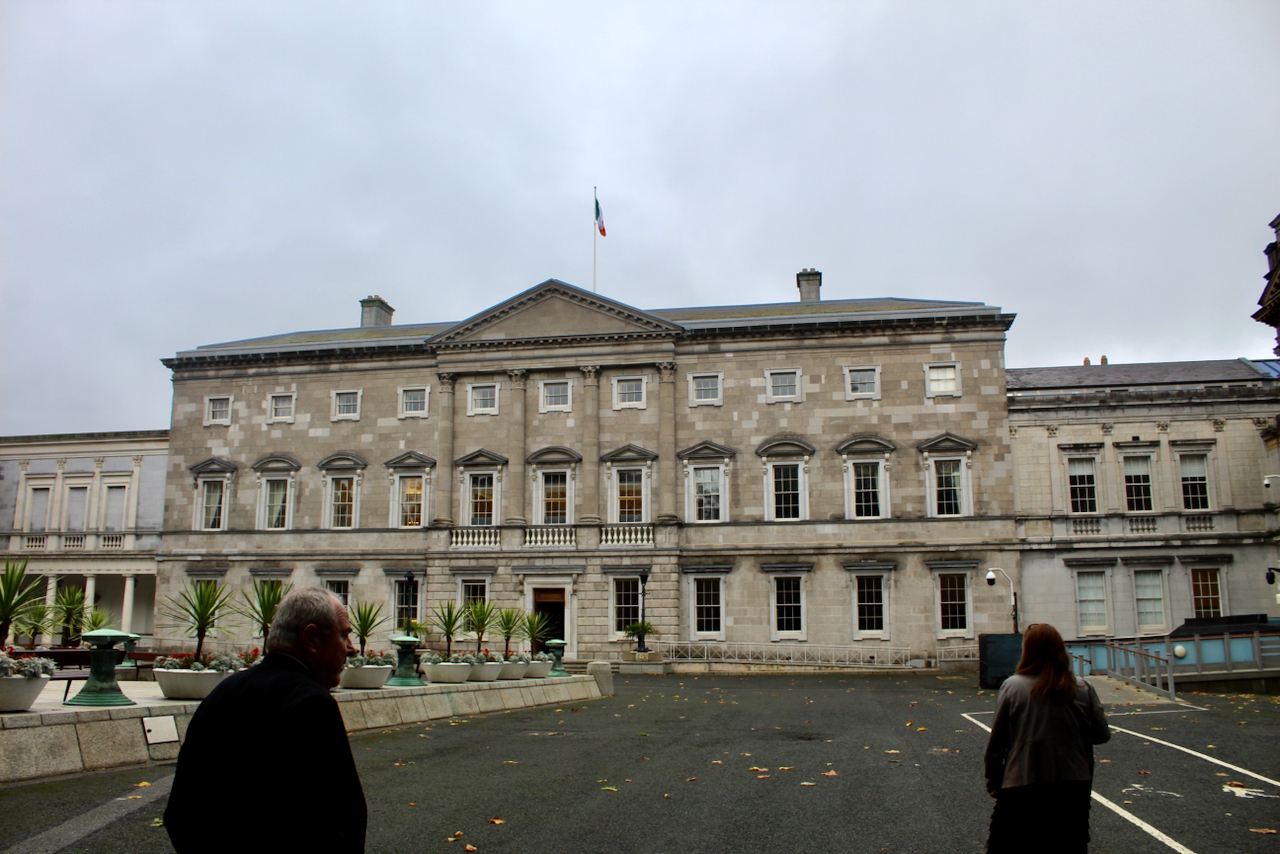
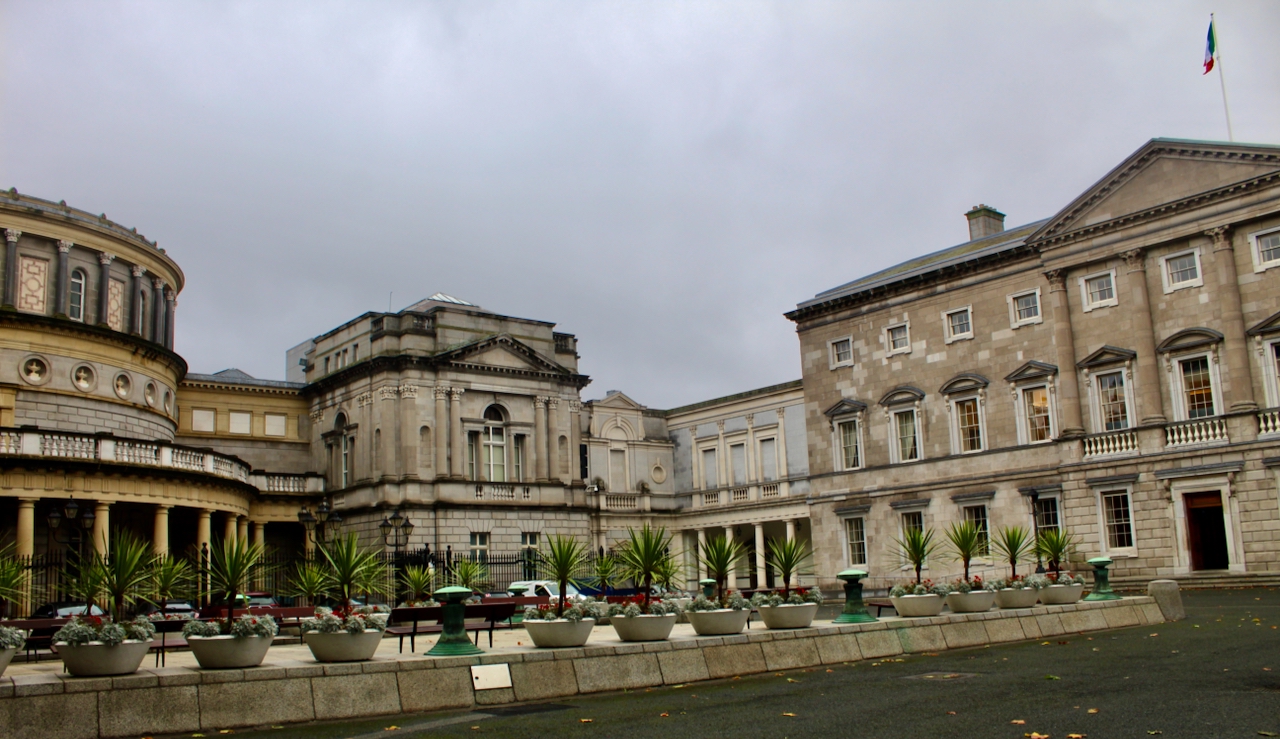
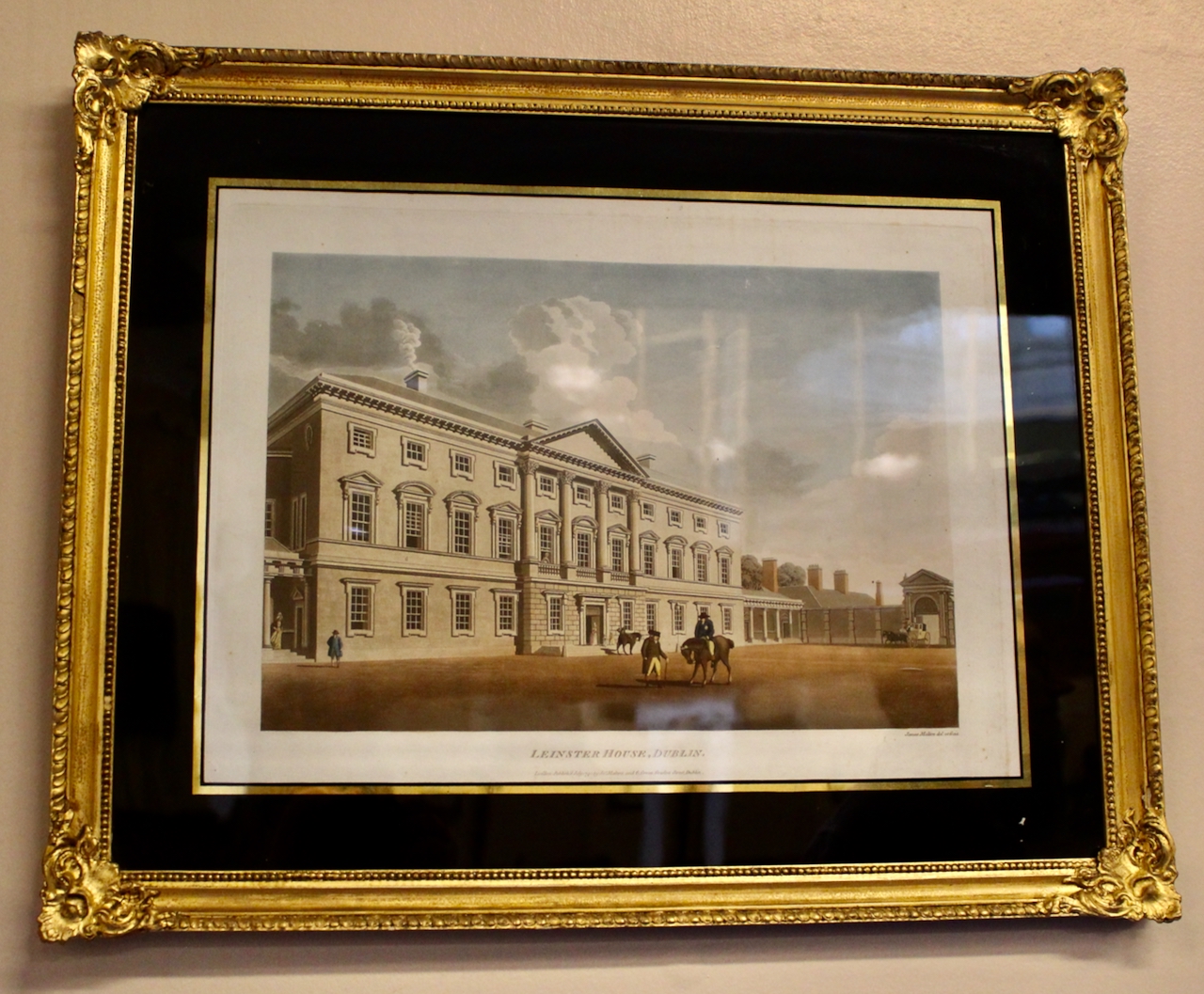

In the Malton drawing of Leinster house we can see that the side walls of the forecourt had pedimented arches. The present piers, wrought iron gates and railings were added in the 1880s, built by T.N. & T.M. Deane.
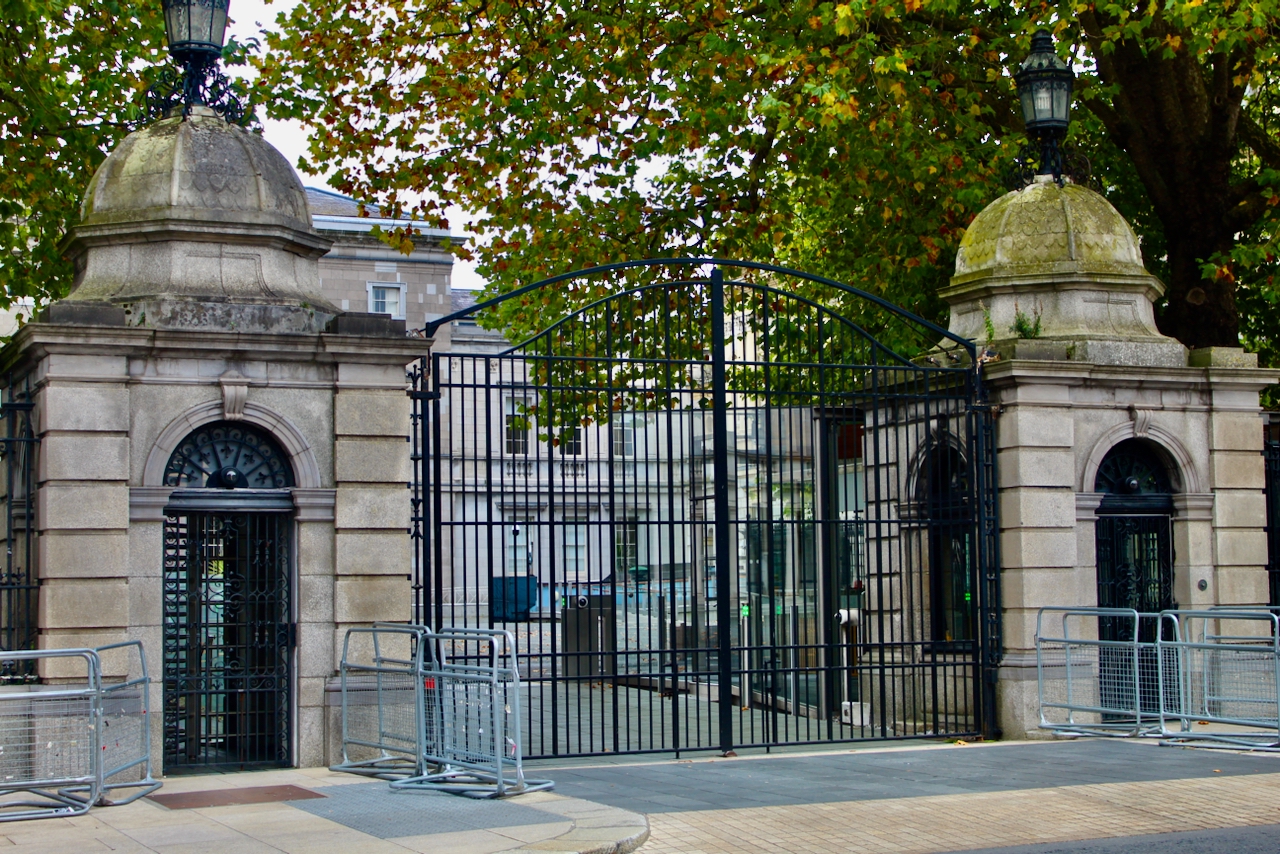

To the south of the forecourt lay a stable court, with a stable and coach house block and a kitchen block which was linked to the house by a small yard, which must have been very inconvenient when dinner was served!
The garden front is fully rusticated on the ground floor, with advanced two-bay ends.


The central first floor window has a triangular pediment. The door porch was added in the nineteenth century. The lawn lay on property leased from Viscount Fitzwilliam.

James’s father died in 1744 before his house at Carton was complete, so it was finished for James the 20th Earl. James was the second son of his parents the 19th Earl and his wife Mary (d. 1780), eldest daughter of William O’Brien, 3rd Earl of Inchiquin. His elder brother died in 1740.
The Dictionary of Irish Biography tells us that James’s political career began on 17 October 1741, when (then known as Lord Offaly) he entered the Irish house of commons as member for Athy. In 1744 he moved to the House of Lords after he inherited the earldom. [3] It was then that he embarked on his town house in Dublin. Now the houses of parliament are located next to Leinster house, but at the time, they were located in what is now the Bank of Ireland on College Green in Dublin.
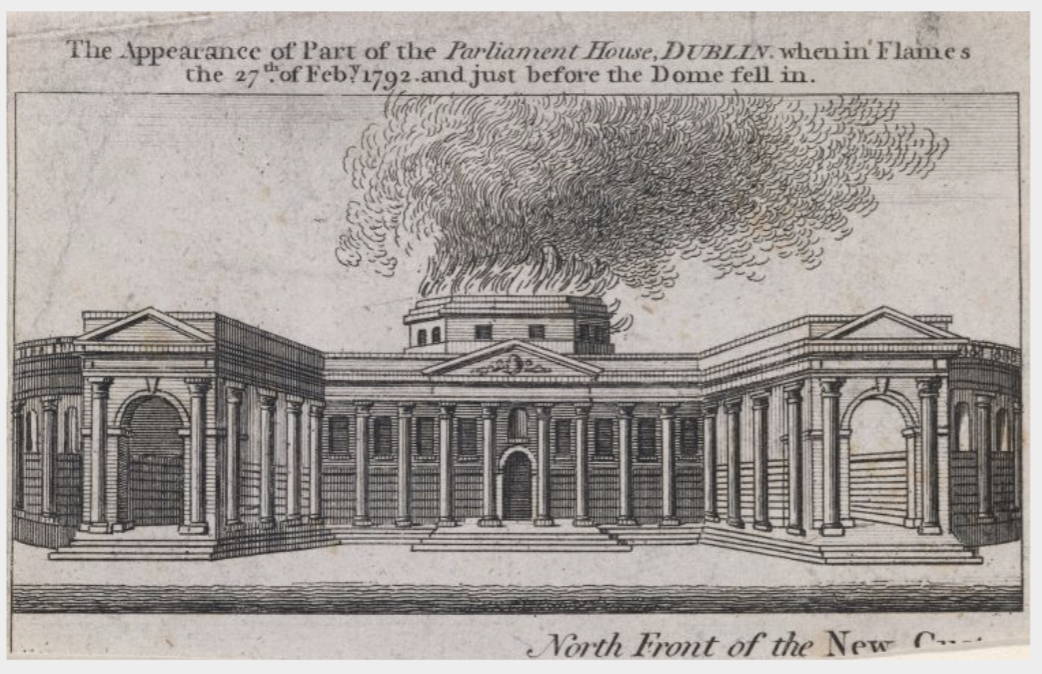
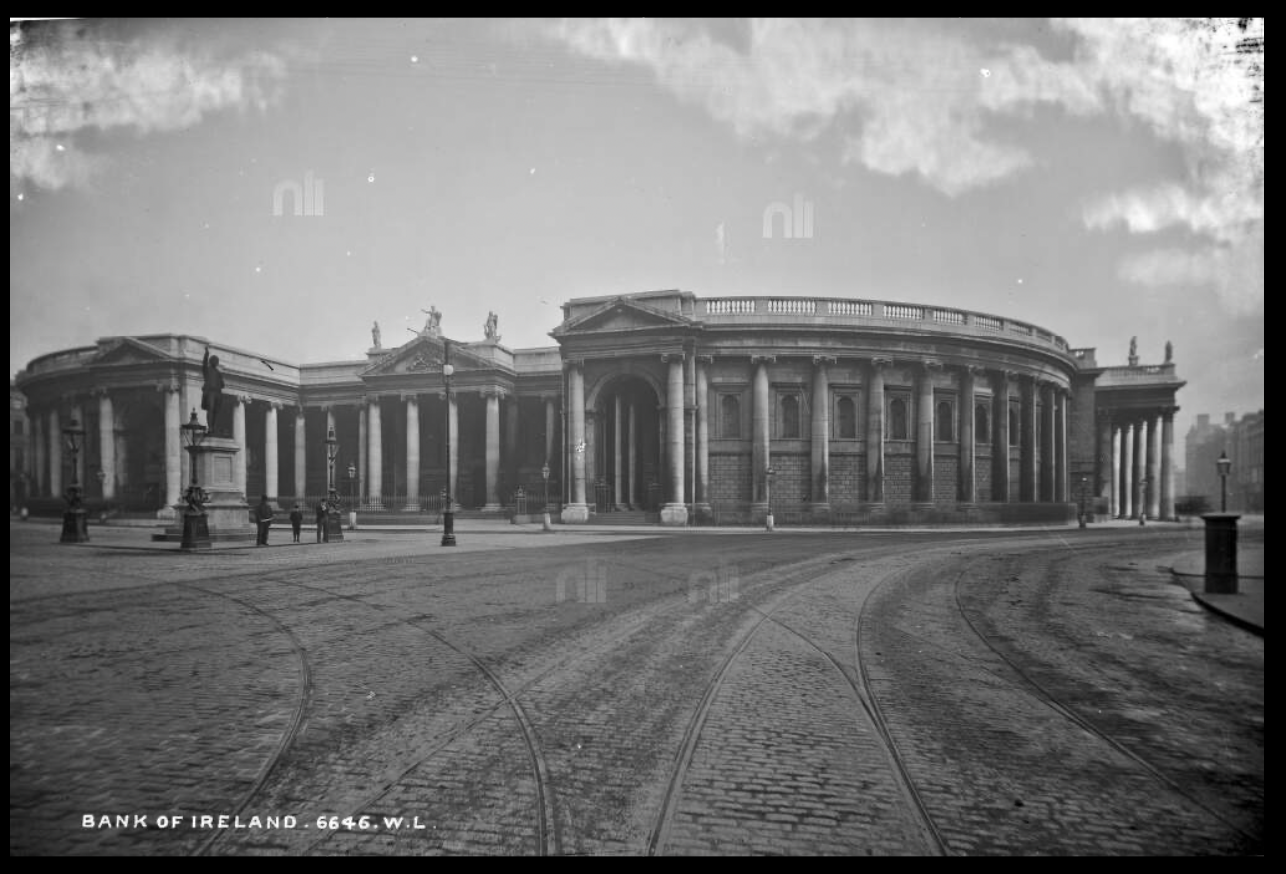
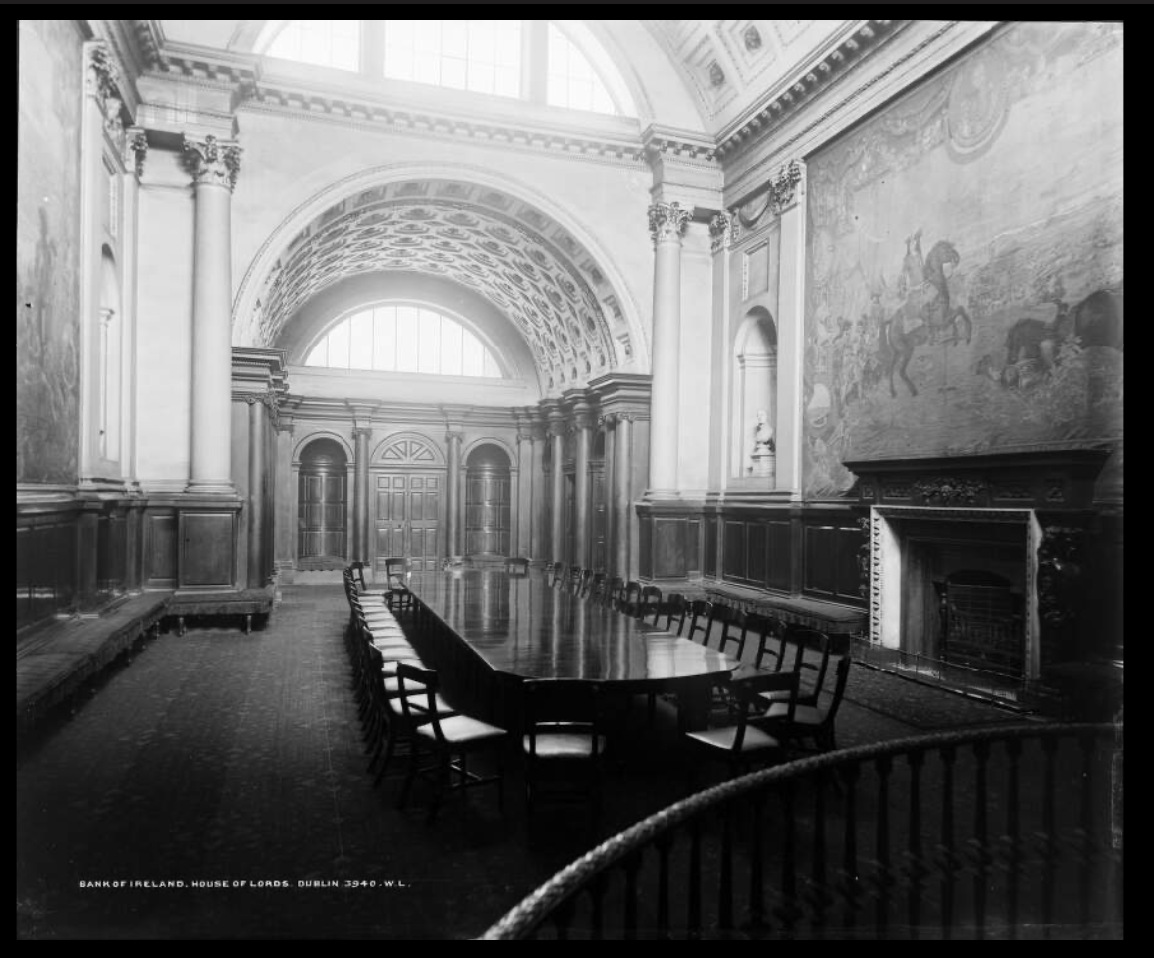
The Dictionary of Irish Biography continues:
“His seniority in the peerage, popularity, and electoral interests ensured his appointment to the privy council (12 May 1746). He was made an English peer, Viscount Leinster of Taplow, Bucks. (1 February 1747), and appointed lord justice (11 May 1756). Master general of the ordnance (1758–66), he became major-general (11 November 1761) and lieutenant-general (30 March 1770). He was also promoted through the Irish peerage, becoming marquis of Kildare (19 March 1761) and duke of Leinster (26 November 1766).” [see 3]
James married Emilia Mary Lennox (1731-1814) in 1747, two years after Richard Castle began work on James’s townhouse. She was the daughter of General Charles Lennox, 2nd Duke of Richmond. Her grandfather the 1st Duke of Richmond was an illegitimate son of King Charles II of England. Emilia’s sister Louisa (1743-1821) married Thomas Conolly (d. 1803) and lived next to her sister in Carton, at Castletown in County Kildare (see my entry https://irishhistorichouses.com/2024/03/15/castletown-house-and-parklands-celbridge-county-kildare-an-office-of-public-works-property/

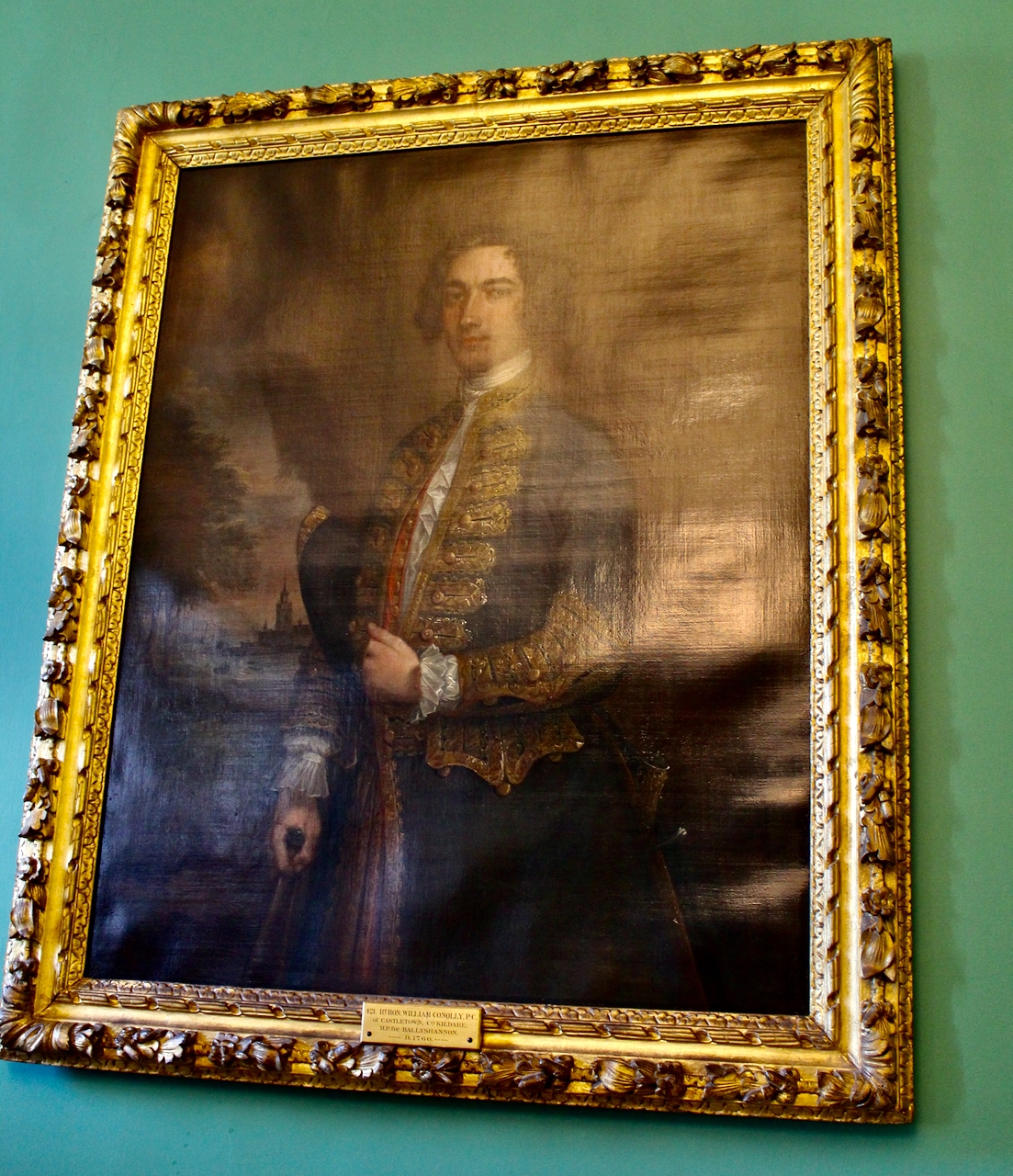
Richard Castle died in 1751 before the town house was complete. He died at Carton, the Earl of Kildare’s country seat, while writing a letter with instructions to a carpenter at Leinster house. Isaac Ware stepped in to finish the house. An exhibition about Leinster House in the Irish Archictural Archive explains that following the death of Richard Castle in 1751, little further about the building is recorded until 1759. By this time, English architect Isaac Ware, famous for his A Complete Body of Architecture published in 1756, had become involved with the project. The Fitzgeralds began to use the house in 1753 while work on the interior continued.
Inside, the house has a double height entrance hall with an arcaded screen of Doric pillars toward the back which opens onto a transverse corridor that divides the front and rear ranges. I found the hall hard to capture in a photograph, especially as we were part of a tour group. The hall reminded me of the double height entrance hall of Castletown, and indeed Christine Casey notes in her Buildings of Ireland: Dublin that the plan and dimensions of Leinster House relate directly to those of Castletown house in County Kildare, which was built in 1720s for William Conolly, and which was probably, she writes, built under the direction of Edward Lovett Pearce, possibly with the assistance of Richard Castle. [2]
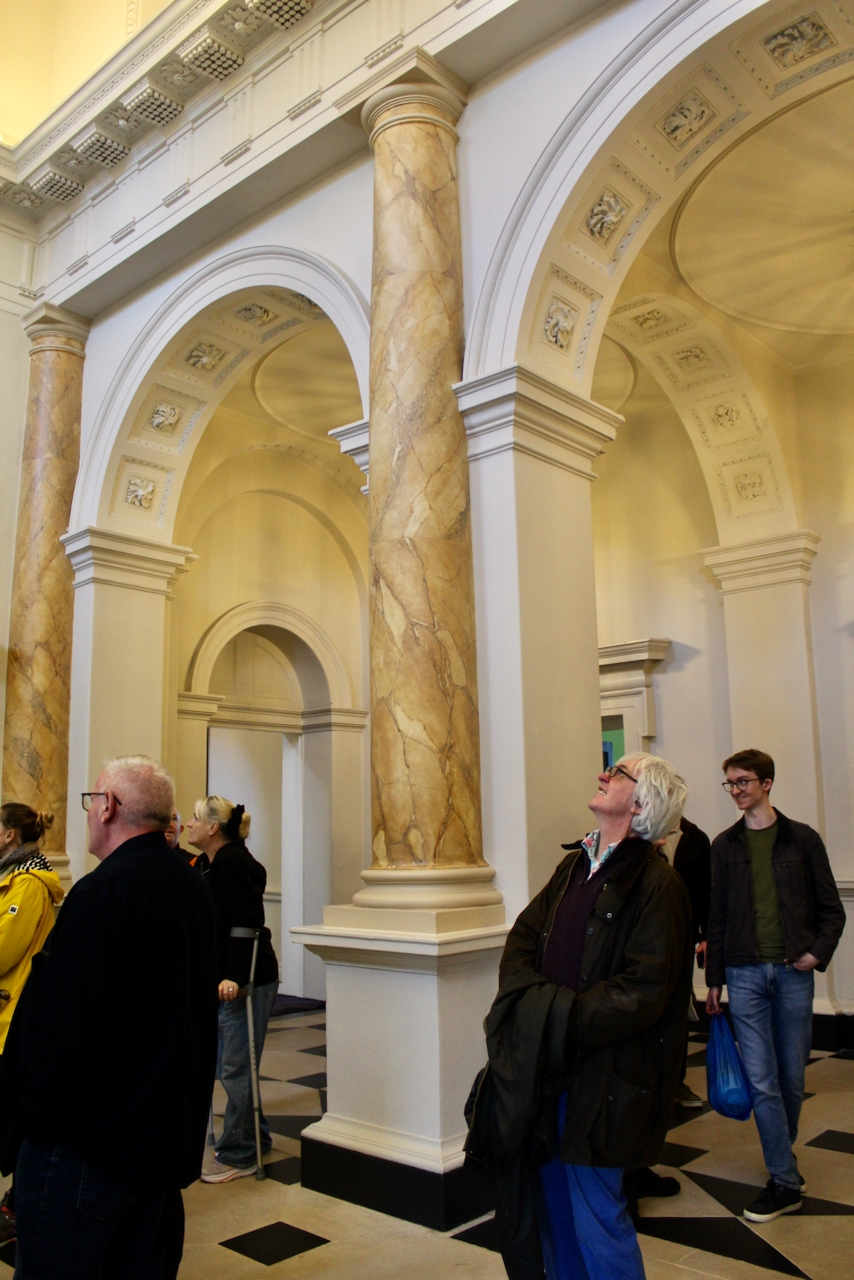
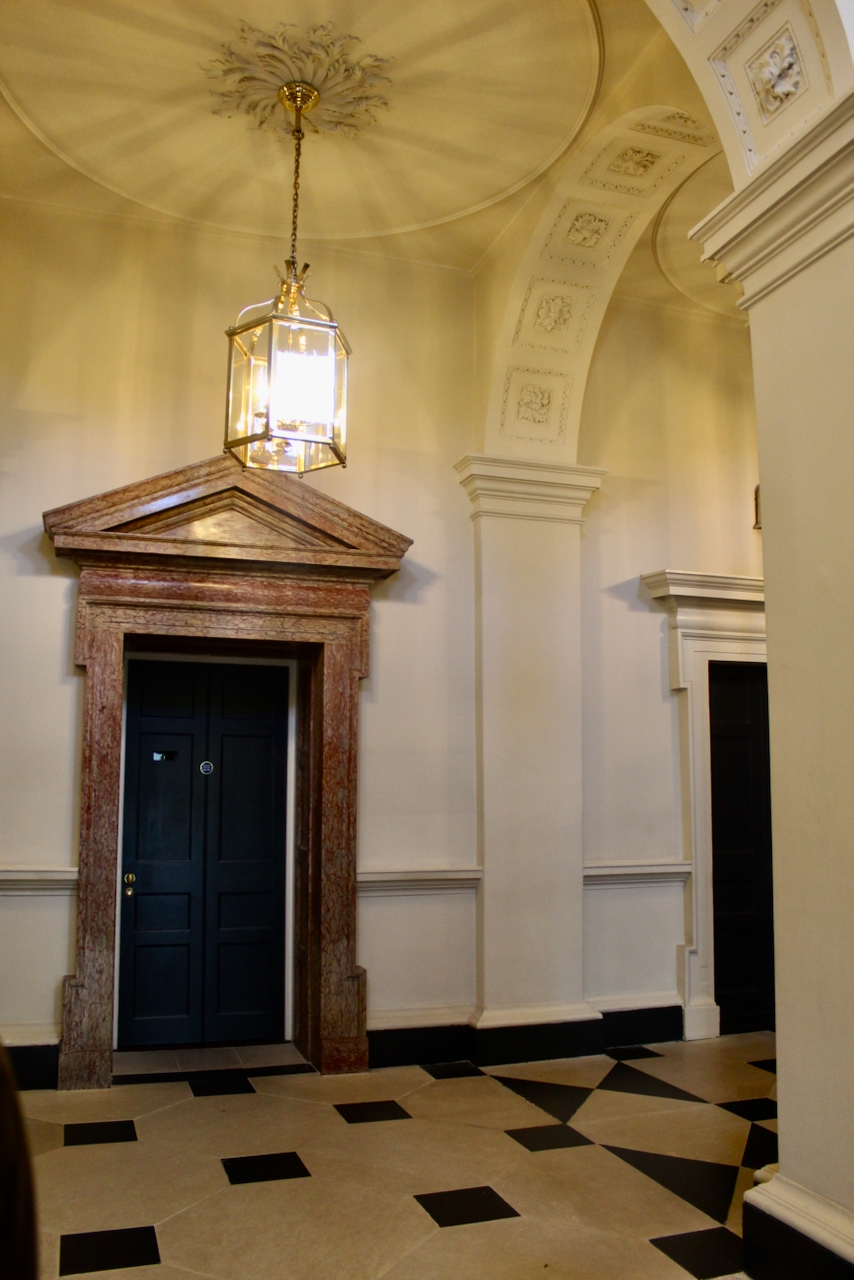
It is the double height that reminds me of the great hall in Castletown, although Castletown has a gallery and Leinster house does not. The niches remind me of the similar front hall in Gloster house in County Offaly, which although a private family home, in 2025 is a Section 482 property which you can visit on particular days.
The black and white flooring is original to the house. [see 2] The red marble doorframe was added later.
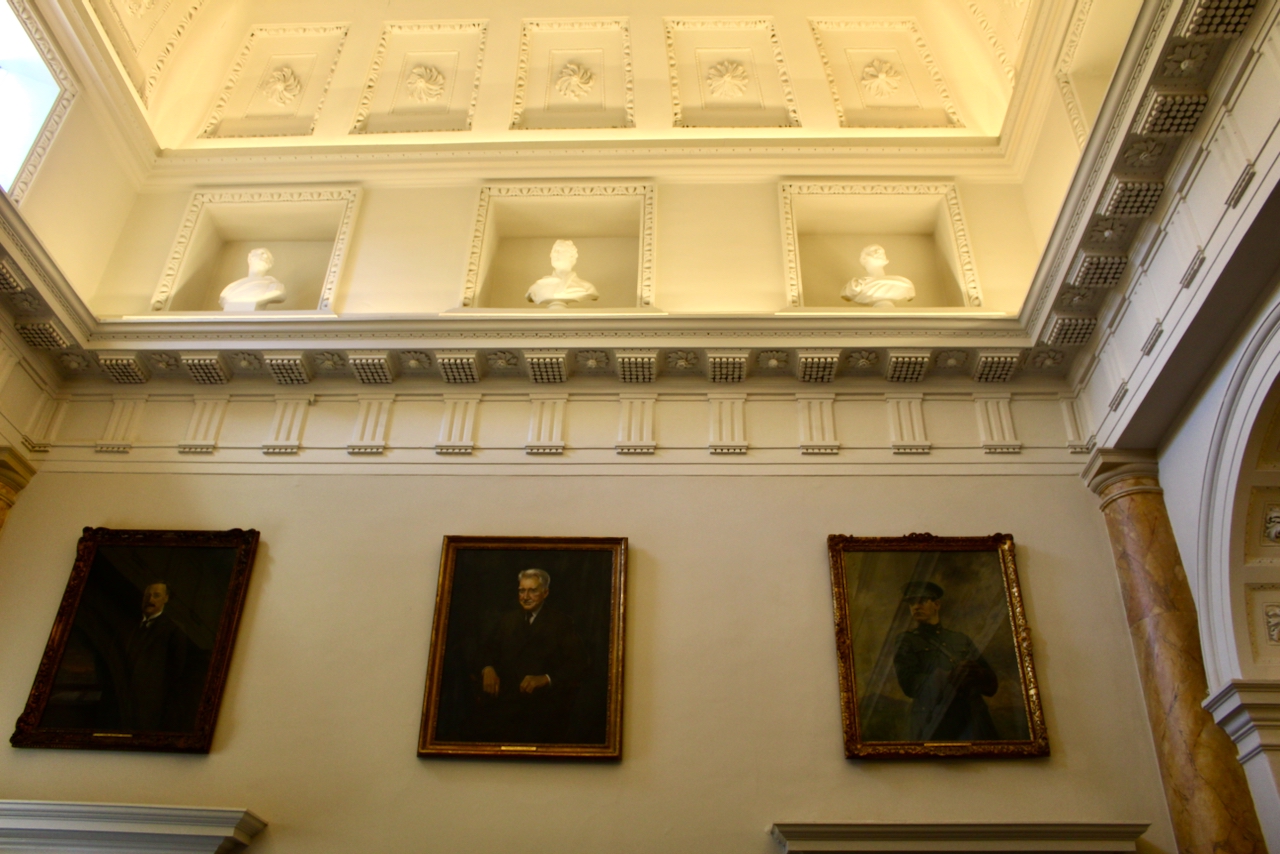
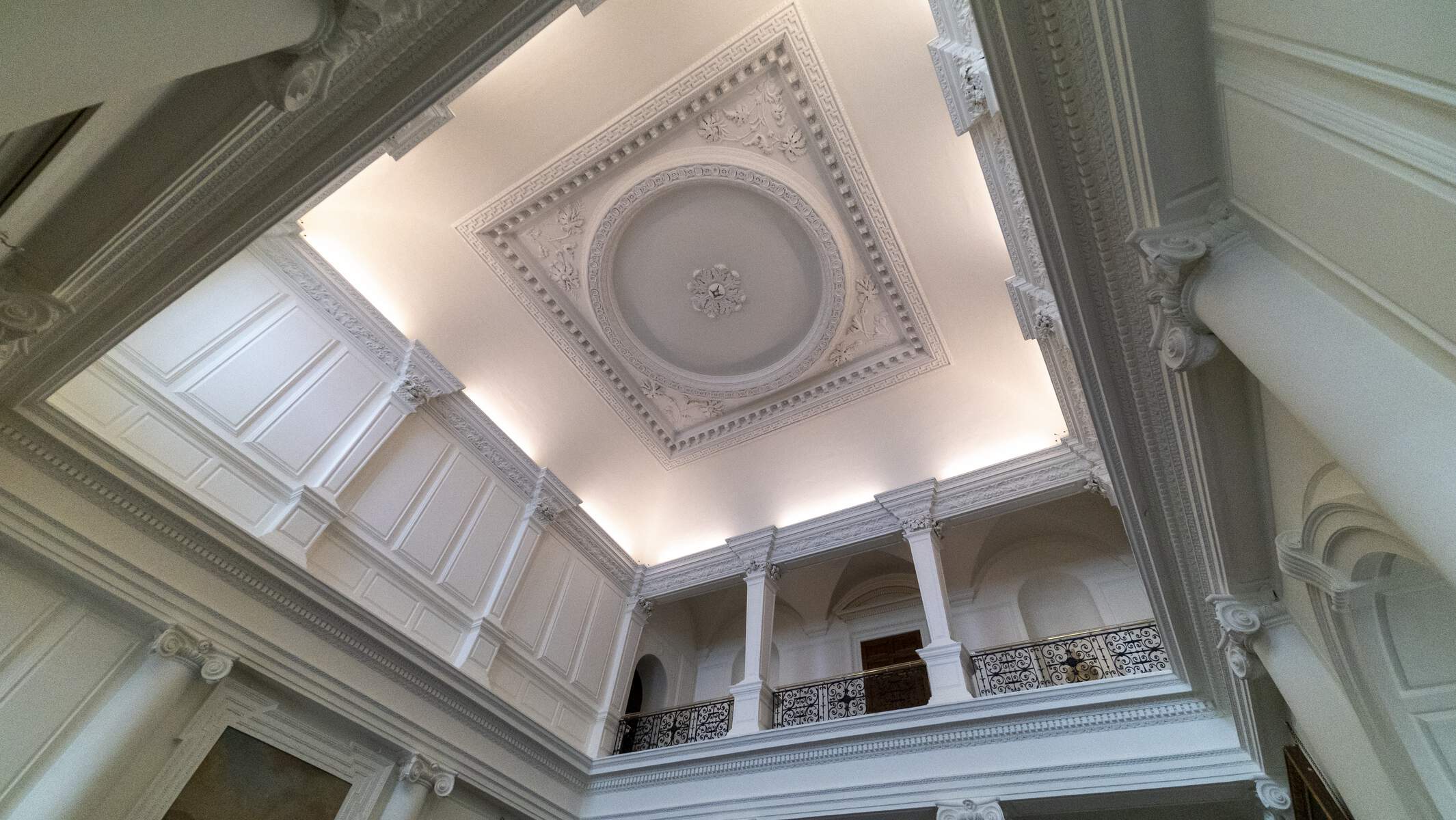
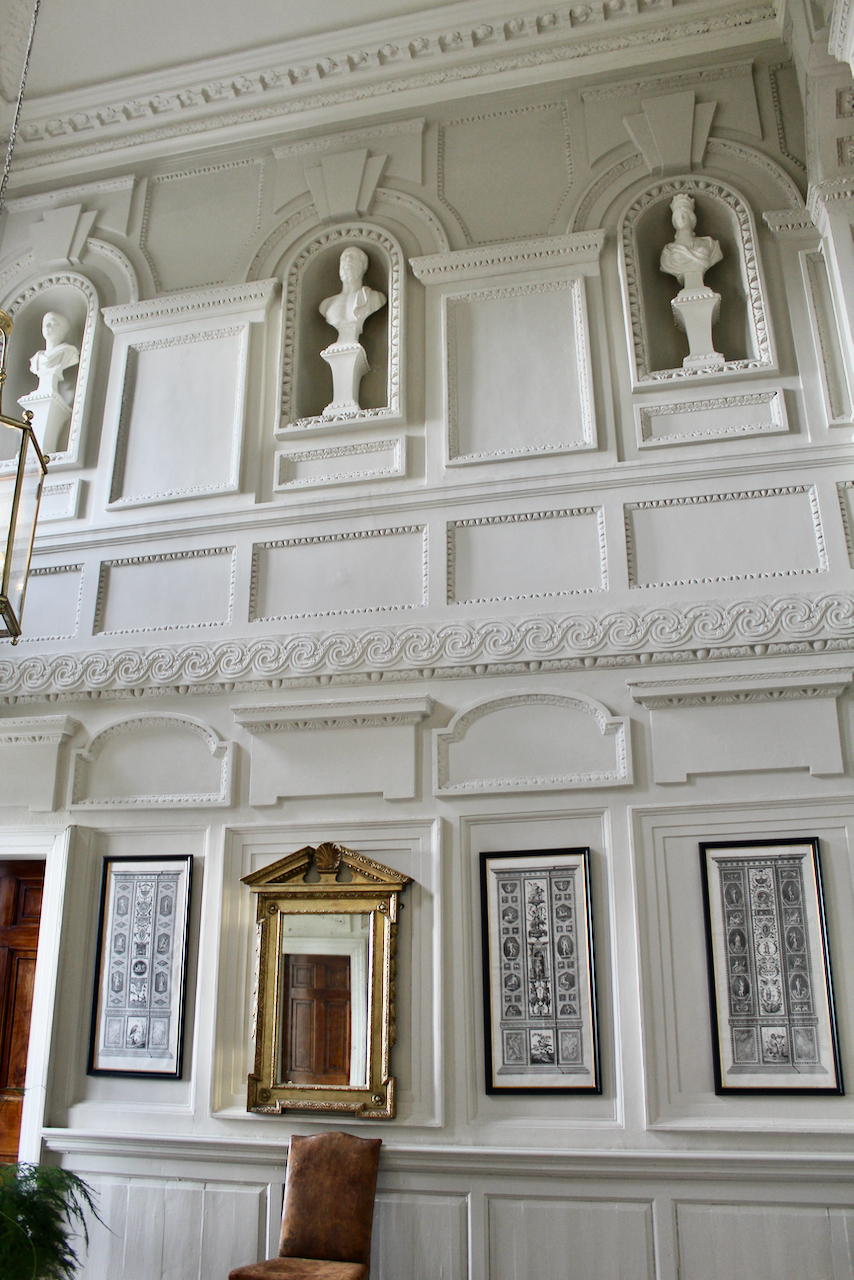
The coffered ceiling in the Hall in Leinster house is different from the ceilings in the front hall in Castletown or Gloster. The deep coffered cove rises to a plain framed flat panel with central foliated boss. There is an entablature above the Doric columns around the four sides of the hall. The square ovolo framed niches above have statues and above the main door the niches have windows.
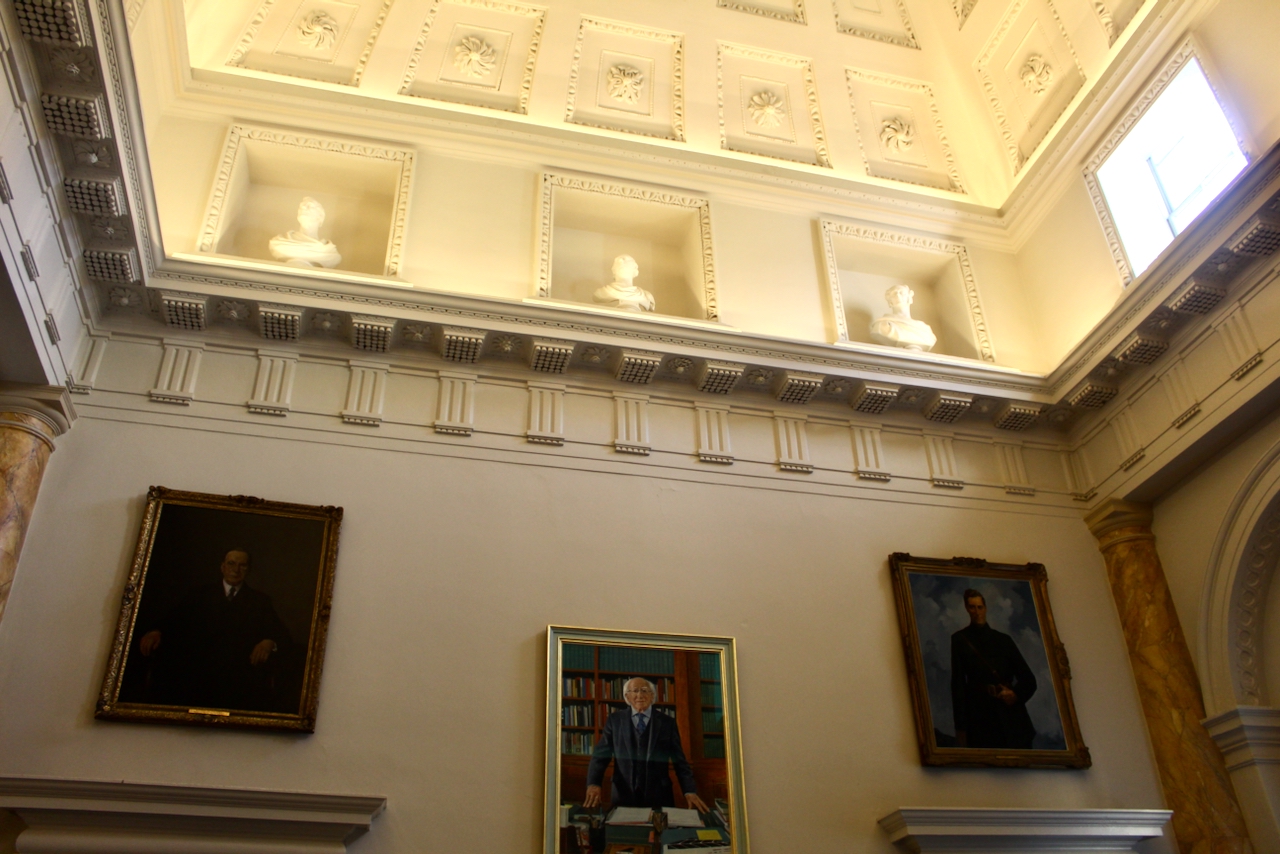
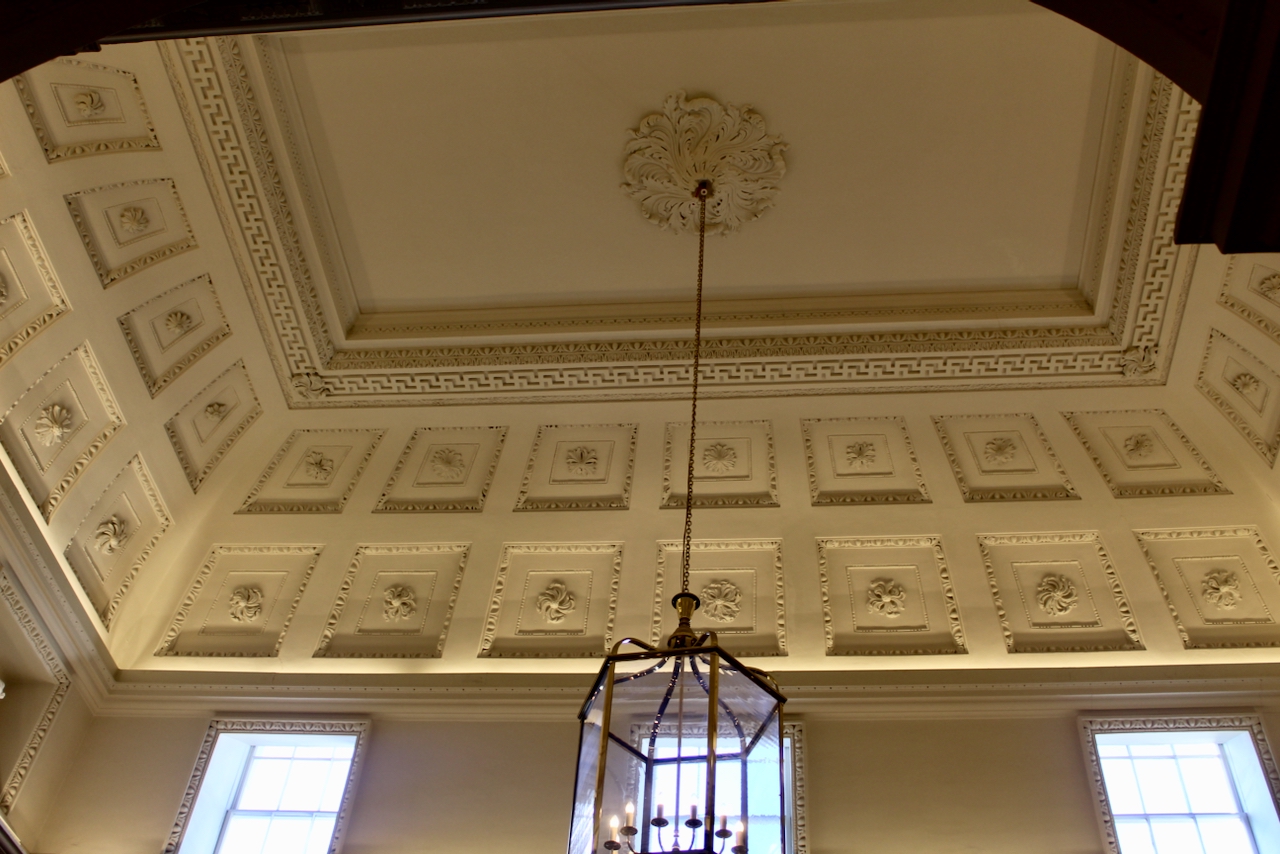
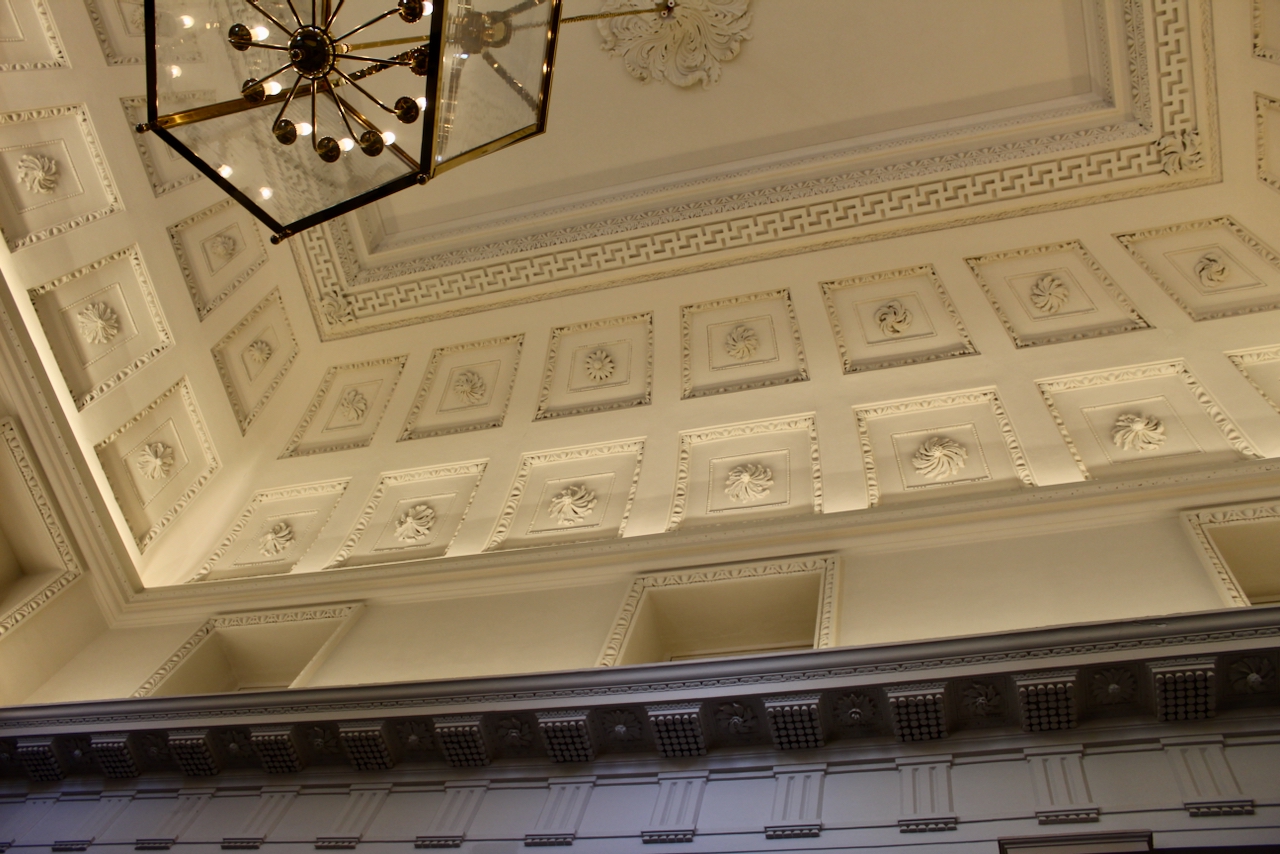
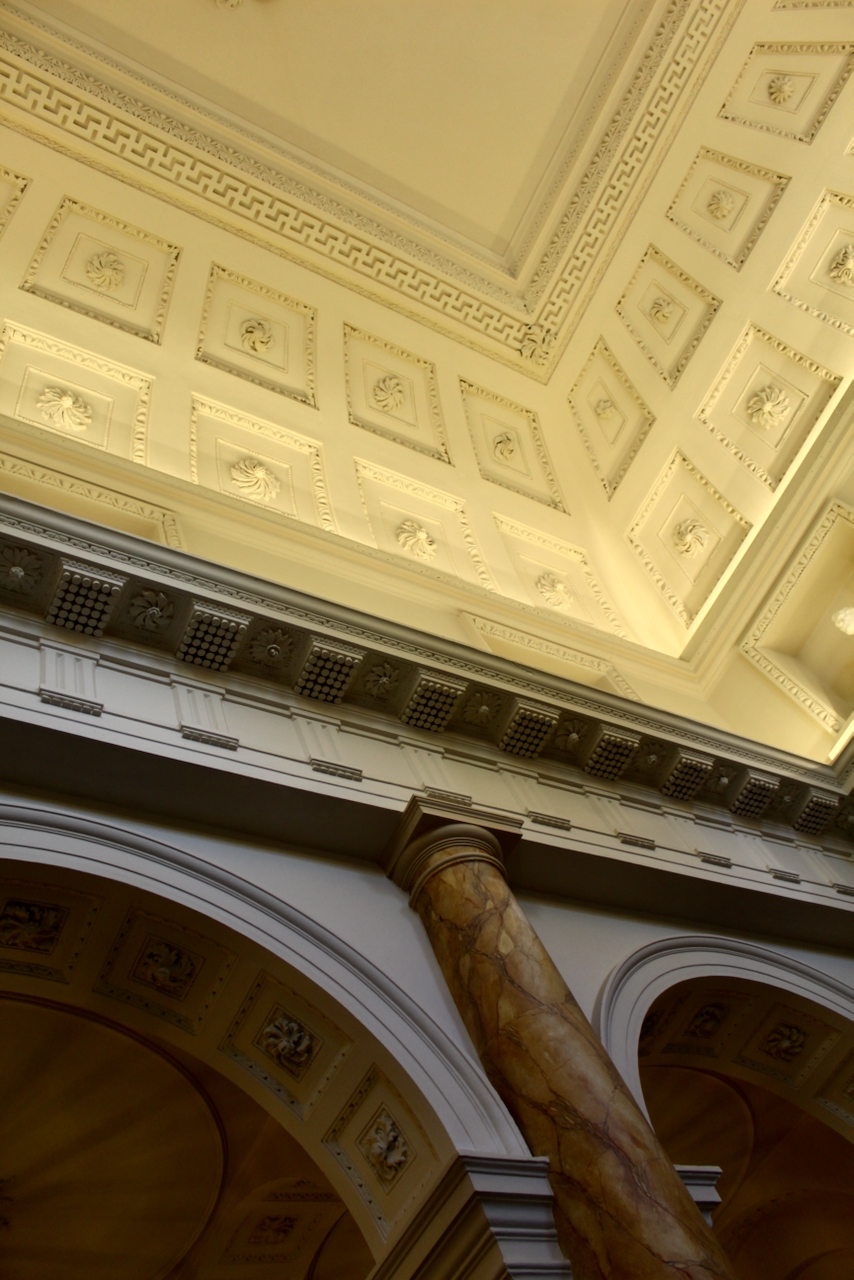
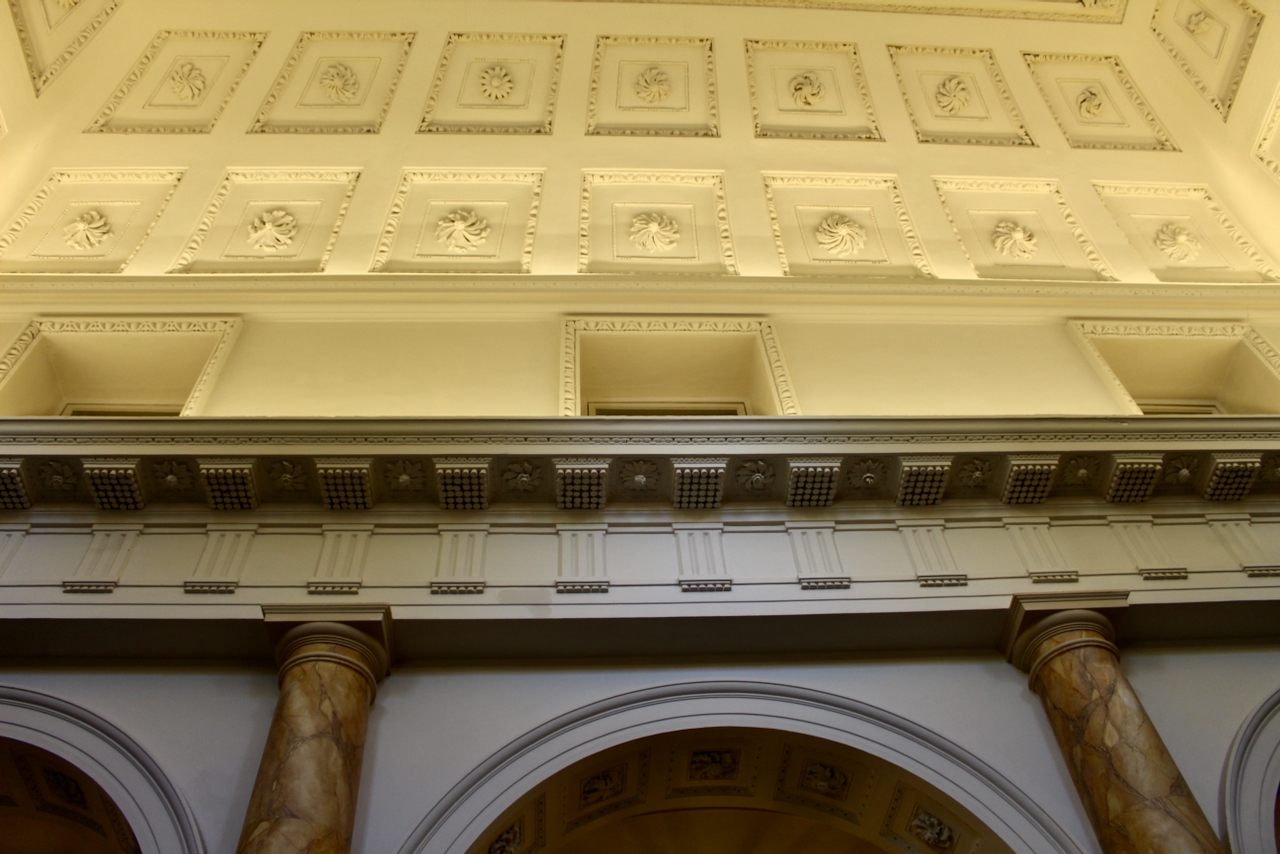
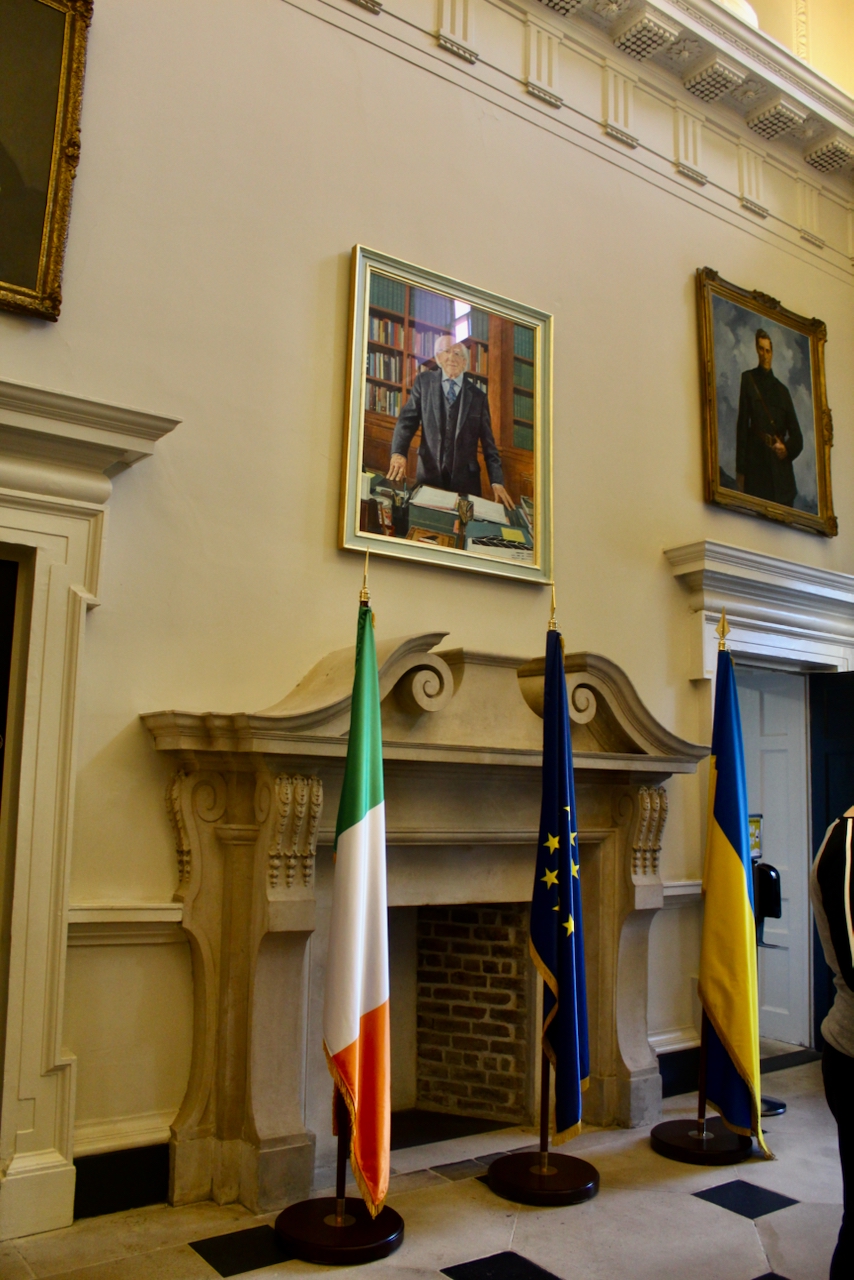
The chimneypiece in the front hall, Casey tells us, was originally faced with a pedimented niche on the north wall opposite, flanked by the doorcases. The chimneypiece is of Portland stone, she describes, with ornamental consoles and above the lintel, enormous scrolls flanking a bust pedestal.
The principal stair hall is a two bay compartment north of the front hall. Casey tells us that Isaac Ware inserted an imperial staircase – one in which a central staircase rises to a landing then splits into two symmetrical flights up to the next floor – into a hall compartment which was meant for a three flight open well staircase. The staircase is further marred, Casey tells us, by a later utilitarian metal balustrade. Casey does not mention the plasterwork here, which is very pretty. The wooden staircase is a later addition.
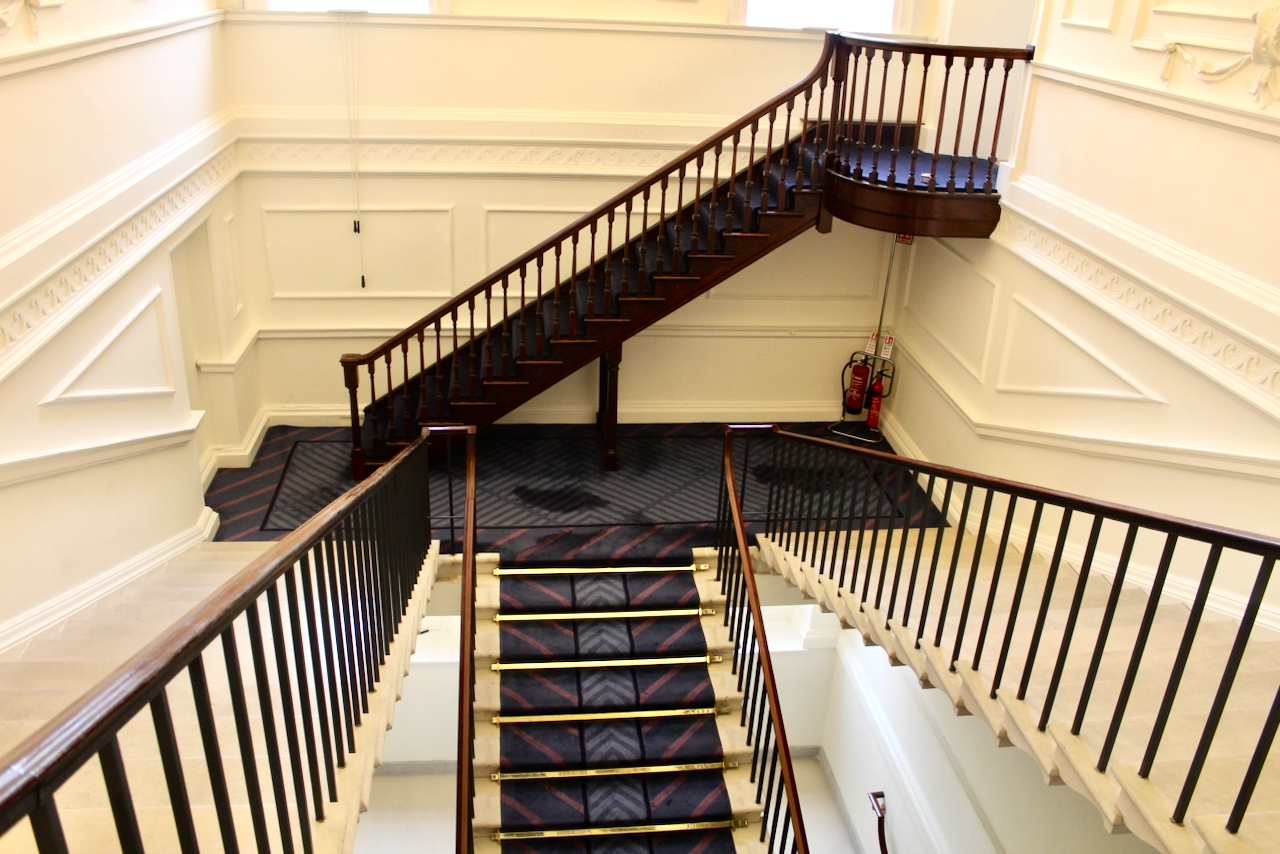
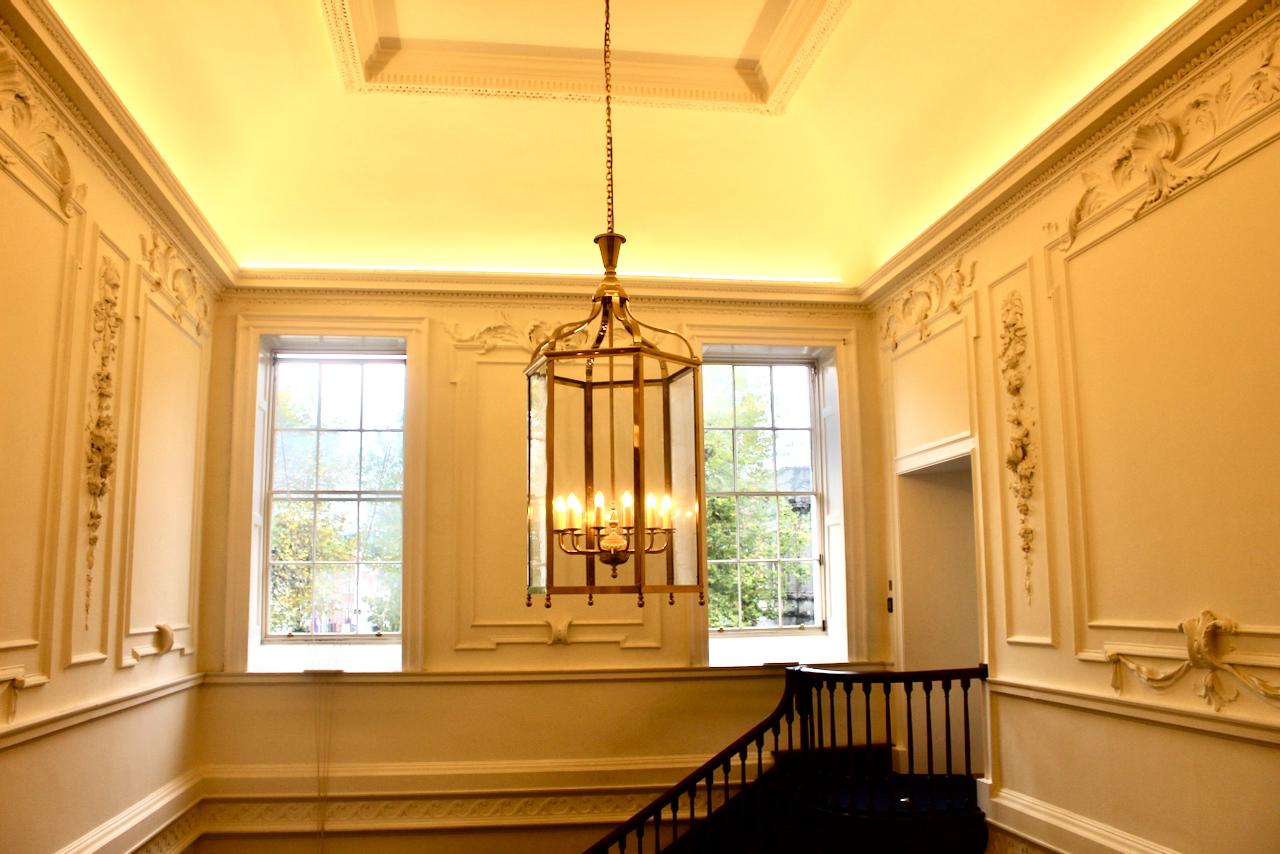
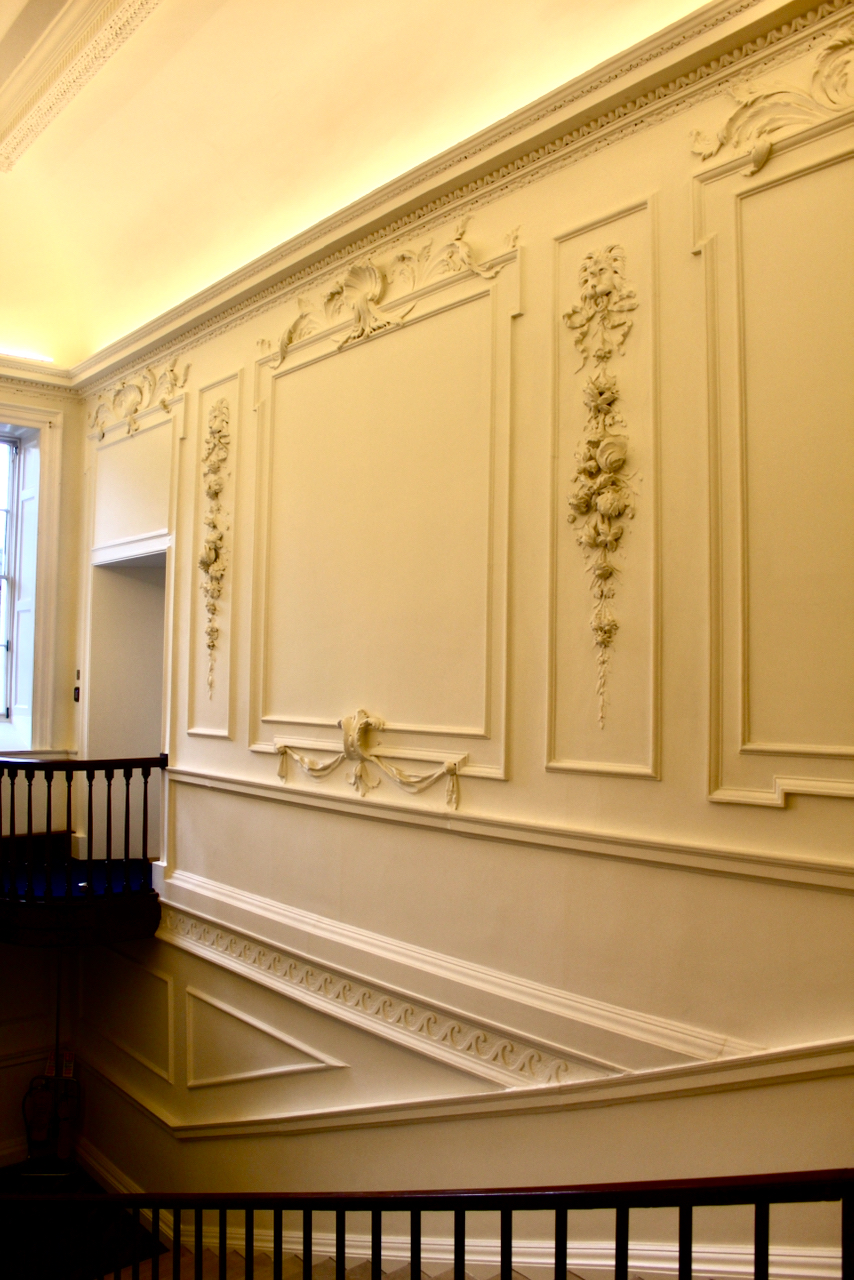
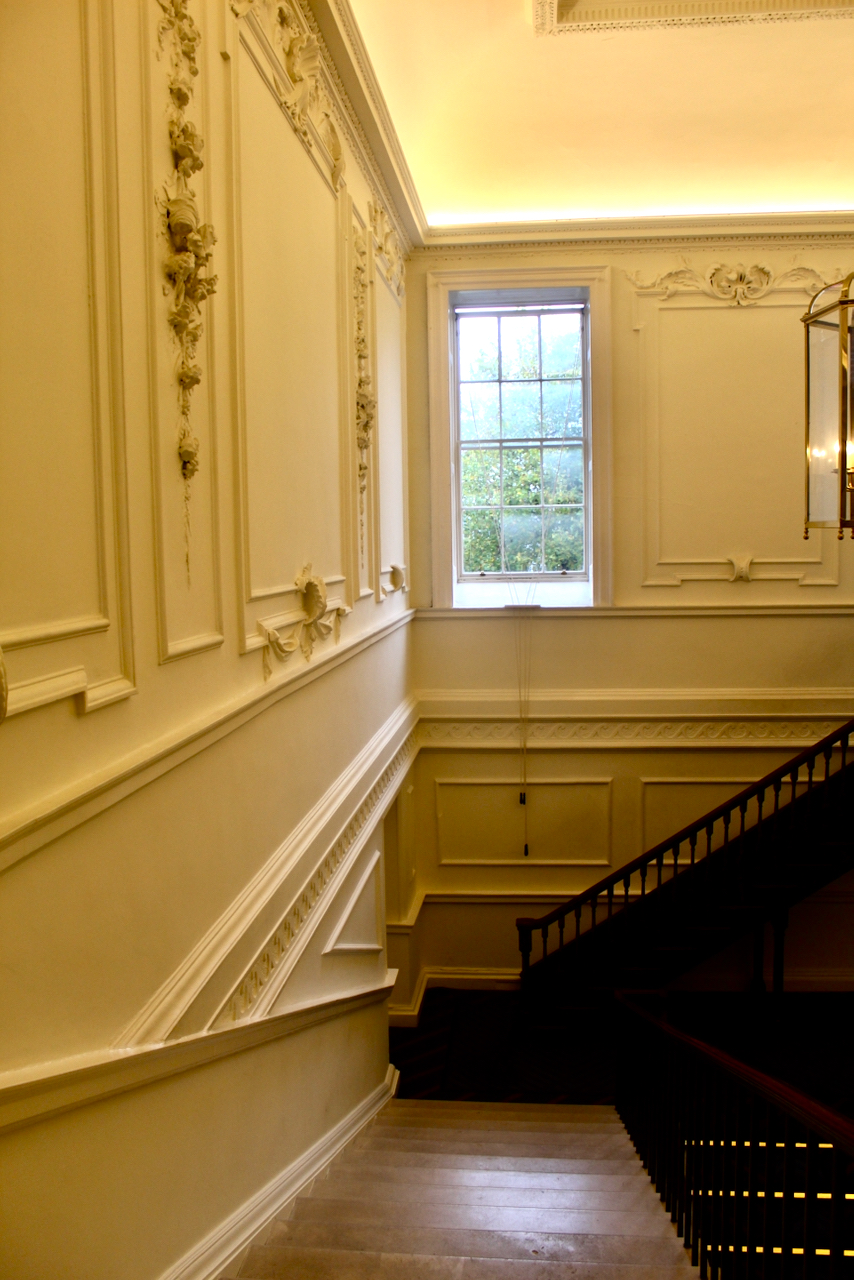
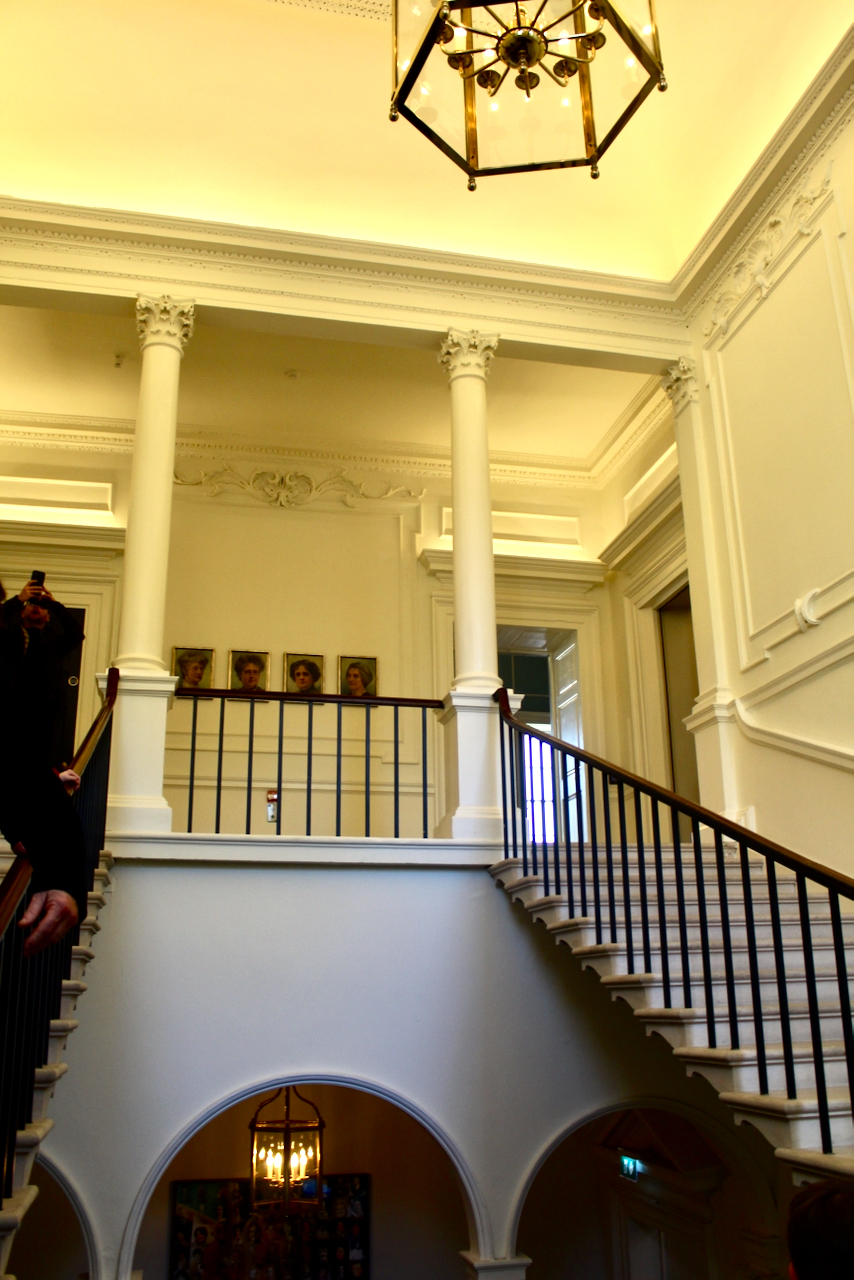
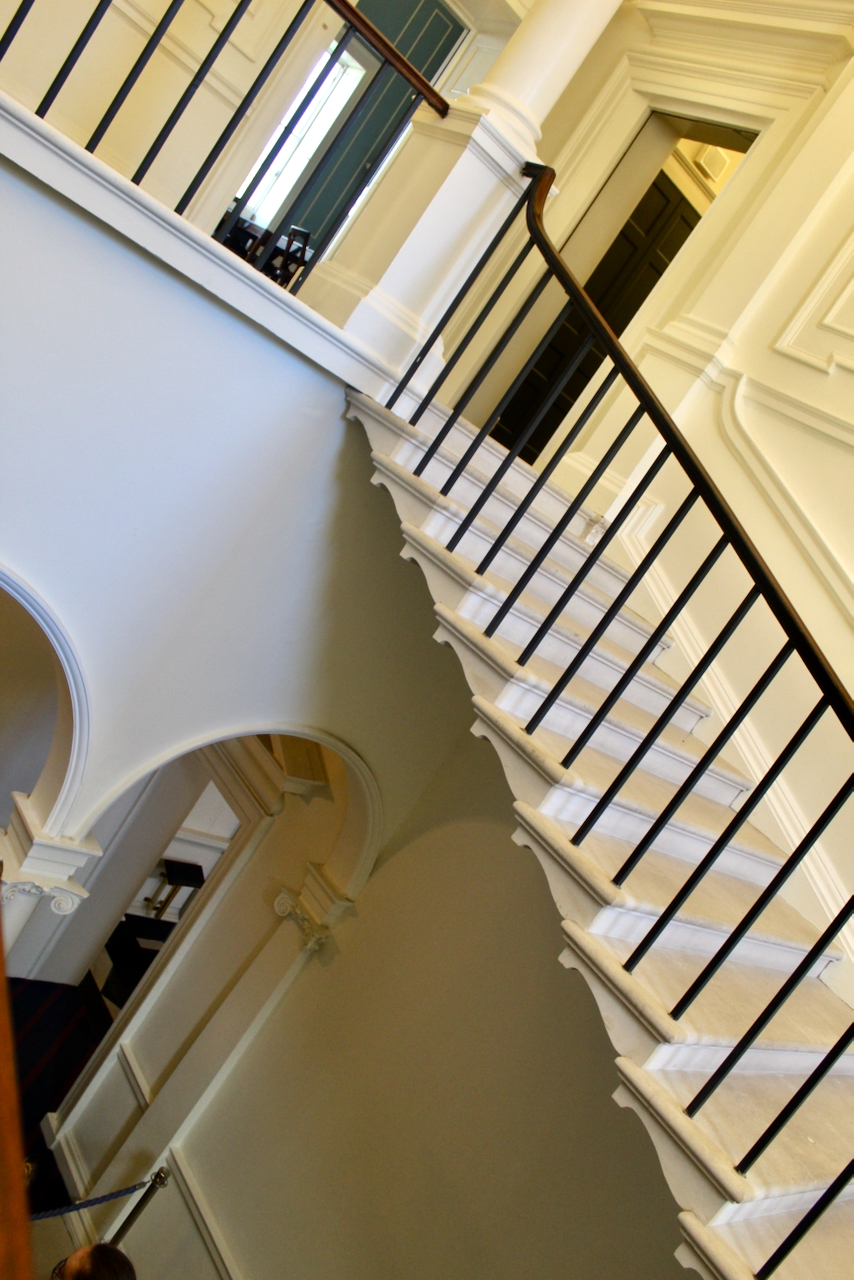
Beyond the stair hall is the former Supper Room, which is now the Library of the Oireachtais, which fills the entire depth of the house. I found the lights rather offputting and think they ruin the intended effect of the room and the ceiling, which Casey tells us derives from Sebastiano Serlio (1475-1554), an Italian architect who was part of an Italian team who built the Palace of Fontainbleau, and Tutte l’opere d’architettura et prospetiva (All the Works of Architecture and Perspective) is Serlio’s practical treatise on architecture.
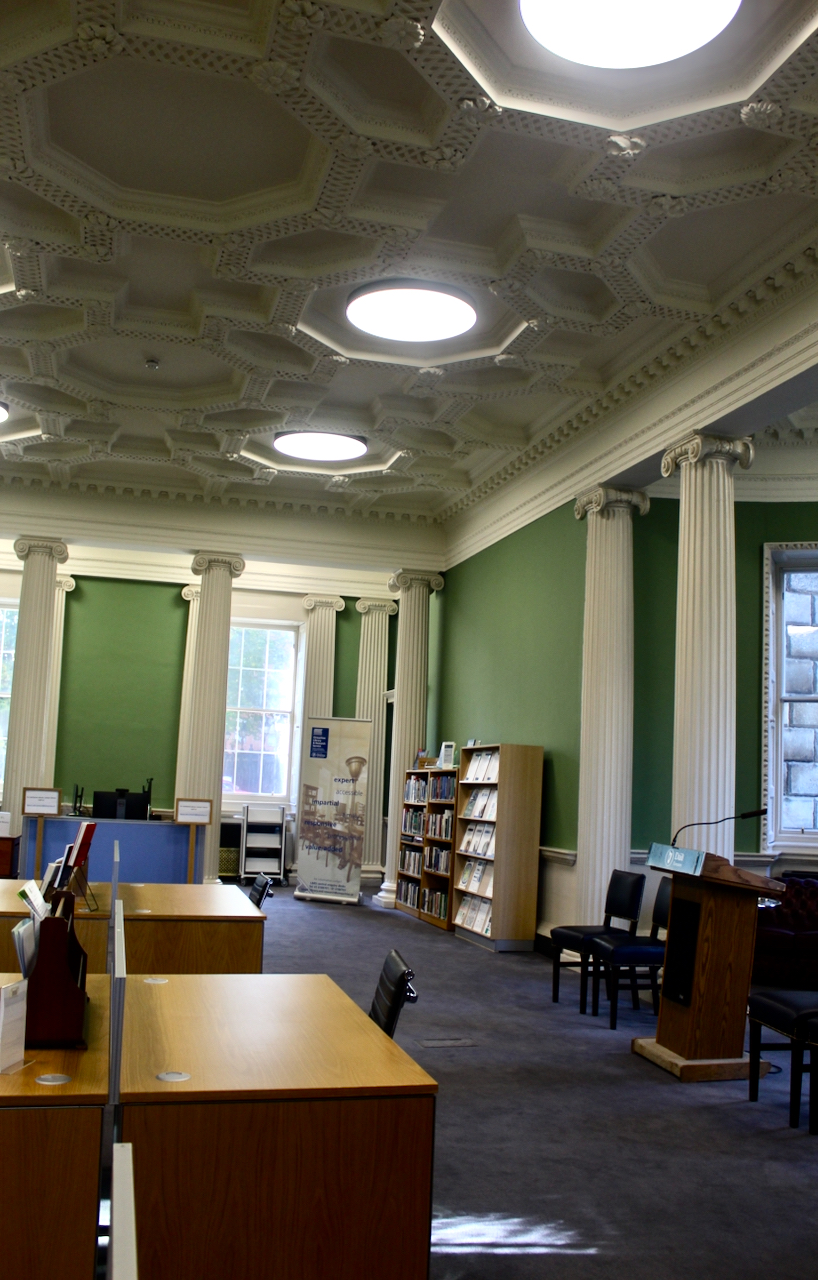
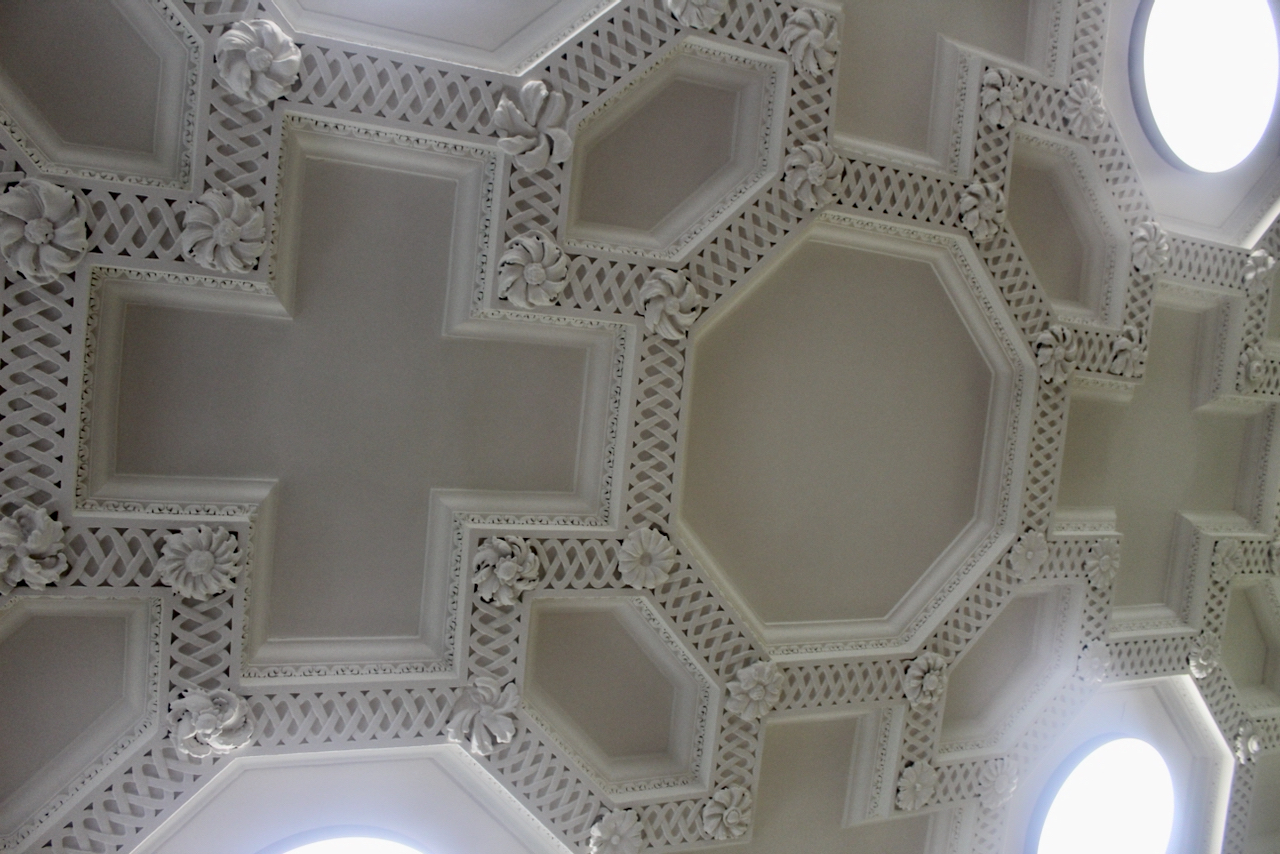

The room has three screens of fluted Ionic columns – one at either end and one in front of the bow at one side of the room. Originally, Casey informs us, there were six fluted columns to each screen, paired at the ends of the room and in the centre of the north bow, but in the 19th century one column was removed from each pair. On the walls the corresponding pilasters would have matched the six columns.
The bow is considered to be the first bow in Dublin, and the design of the house is said to have inspired the design of the White House in Washington DC, designed by a man from Kilkenny, James Hoban.
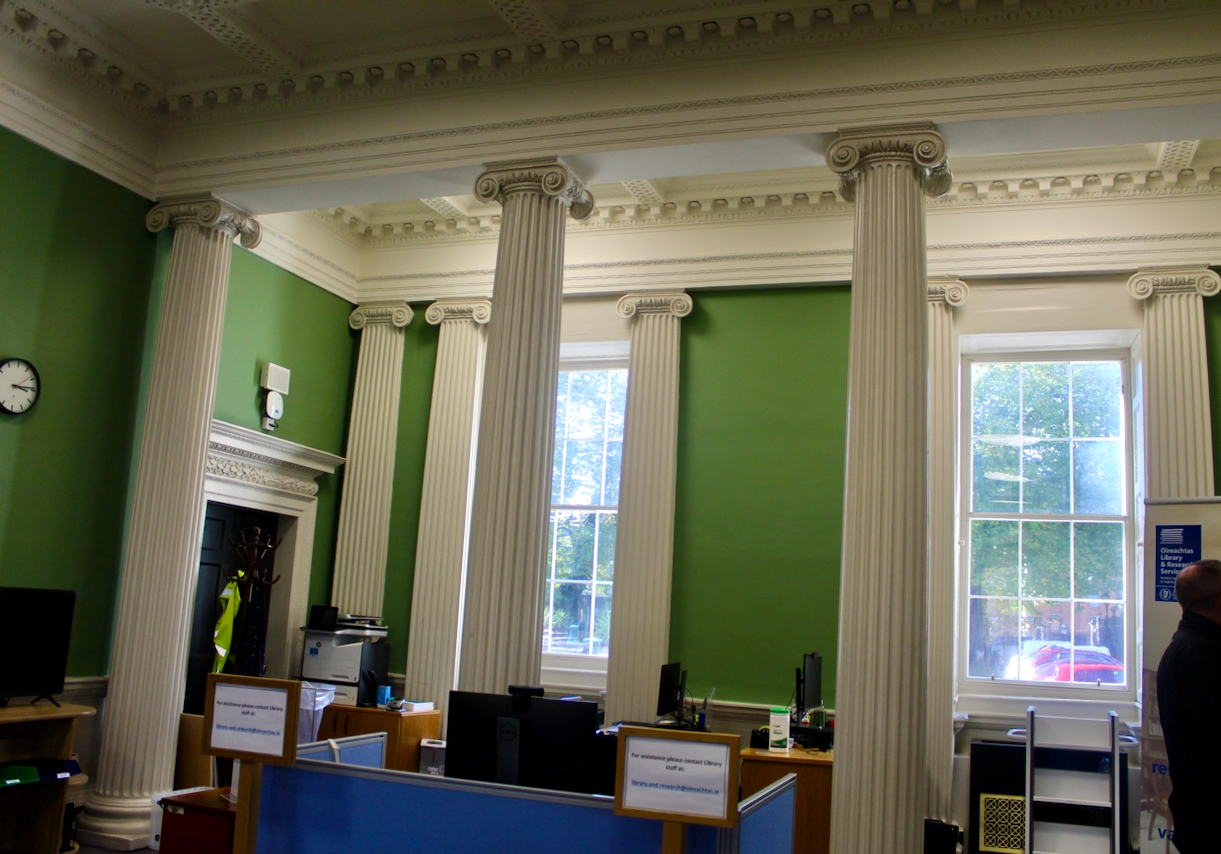
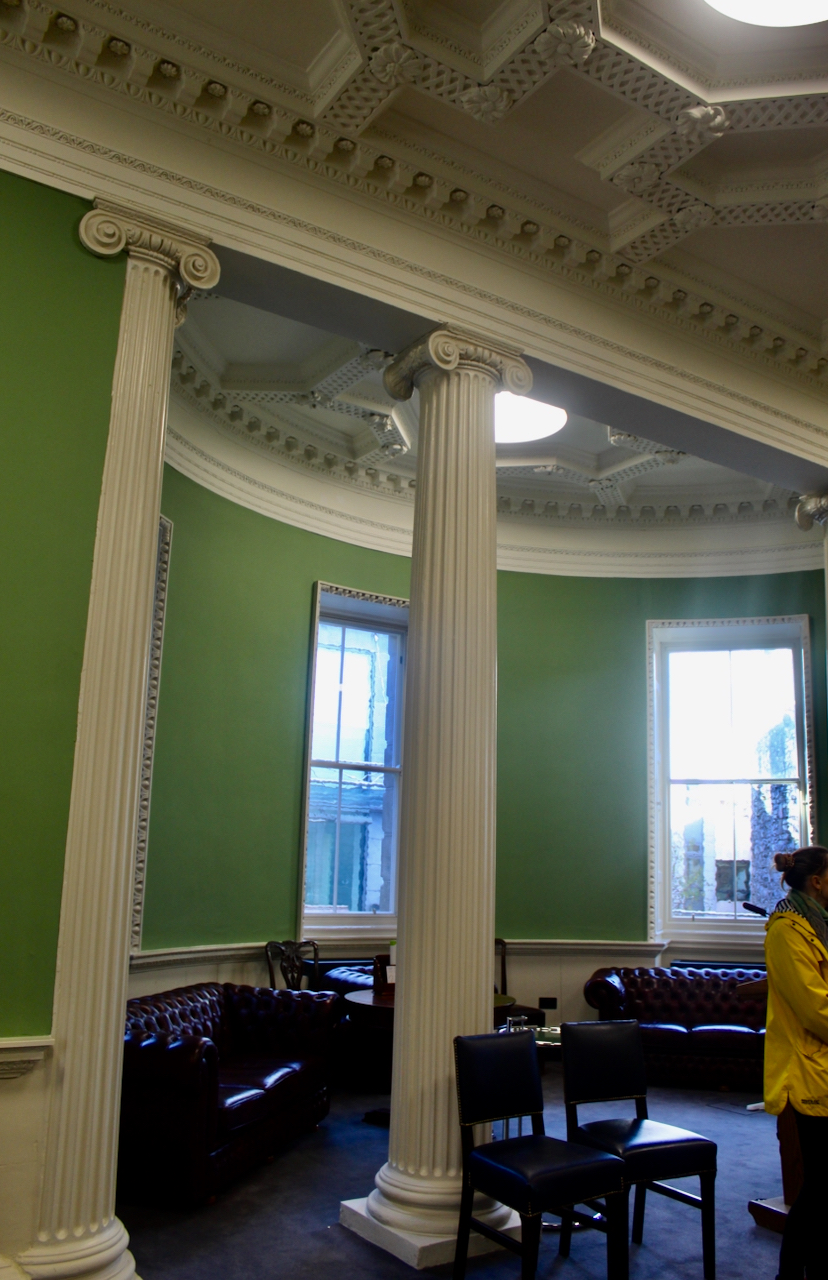
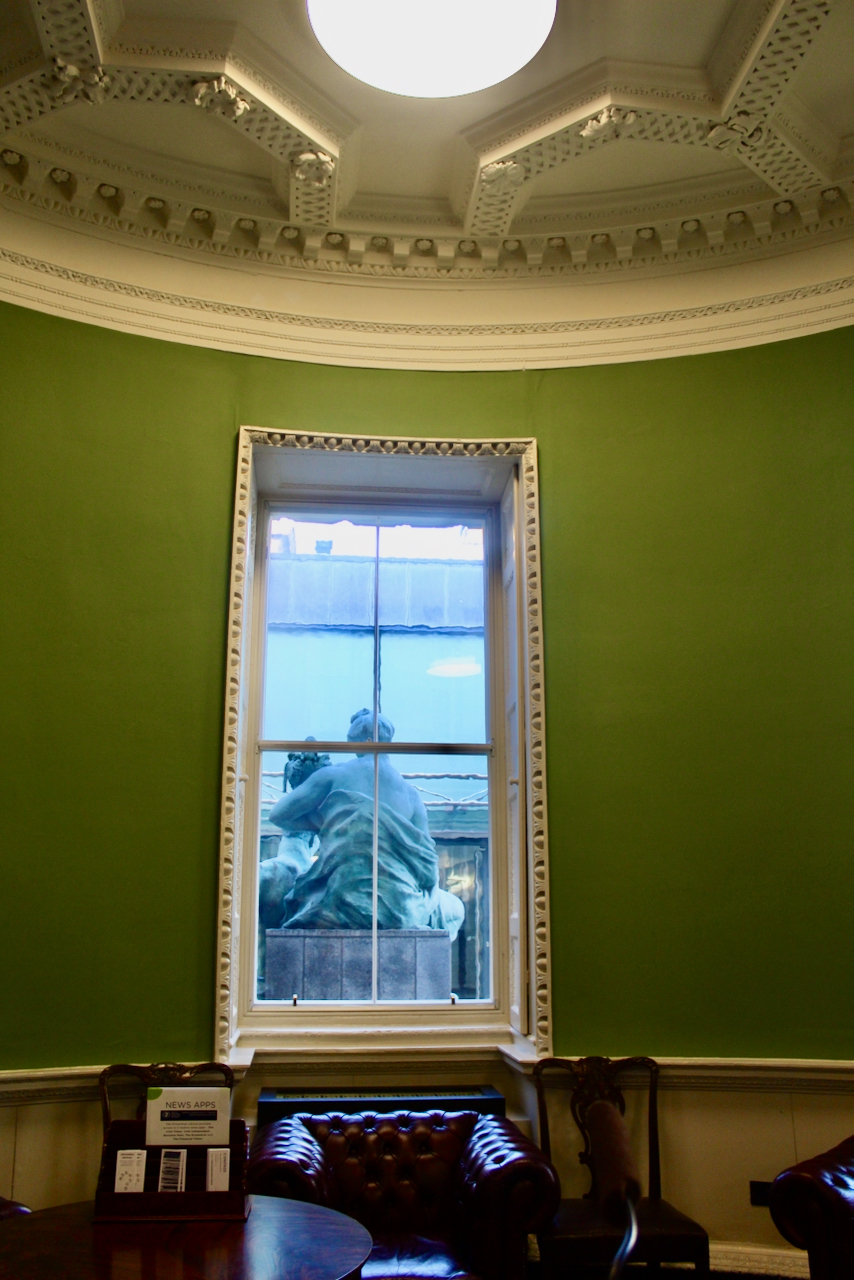

A pedimented doorcase is flanked by ornate chimneypieces based on a design by William Kent. These are surmounted by Corinthian overmantels after a design by Inigo Jones, possibly made to frame portraits, Casey suggests, of the Earl and Countess of Kildare painted by Reynolds in 1753-54. [see 2]
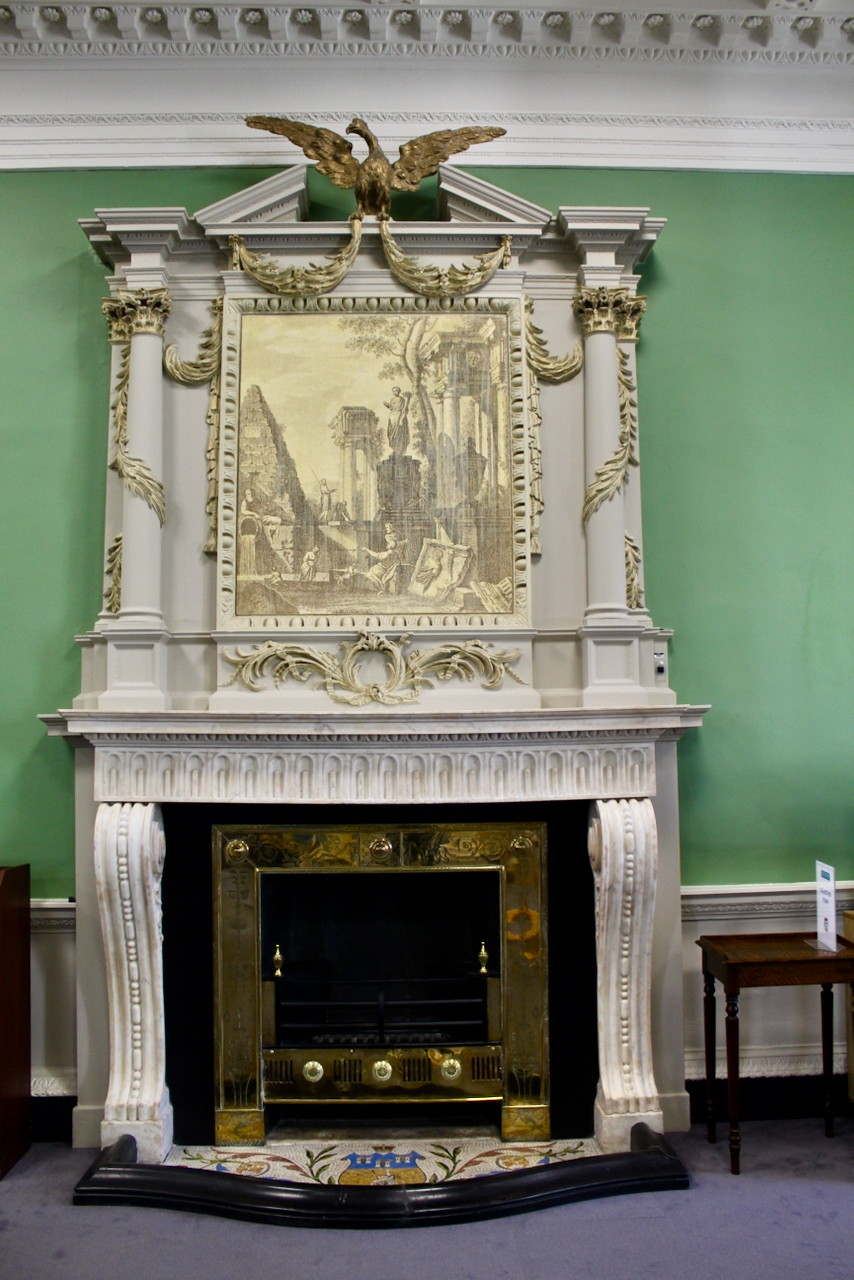
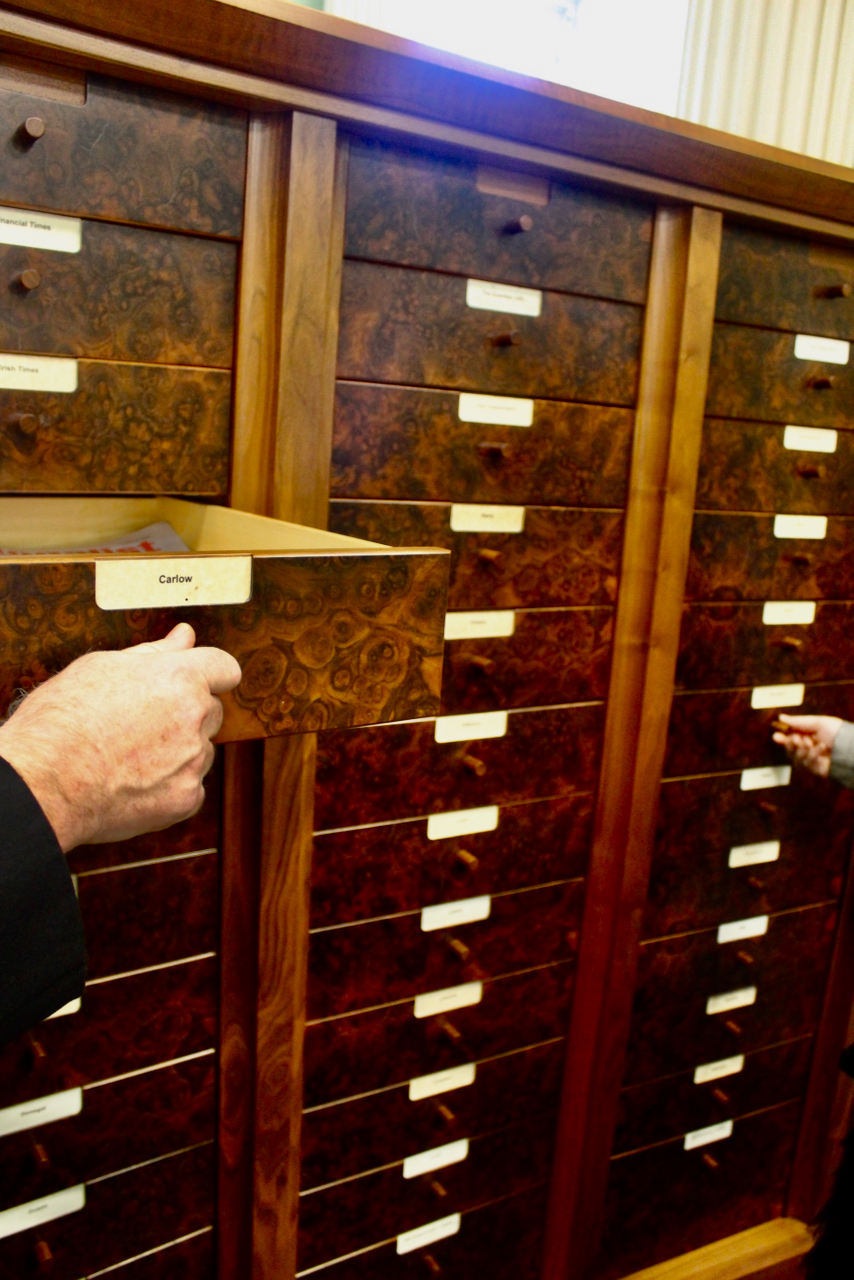
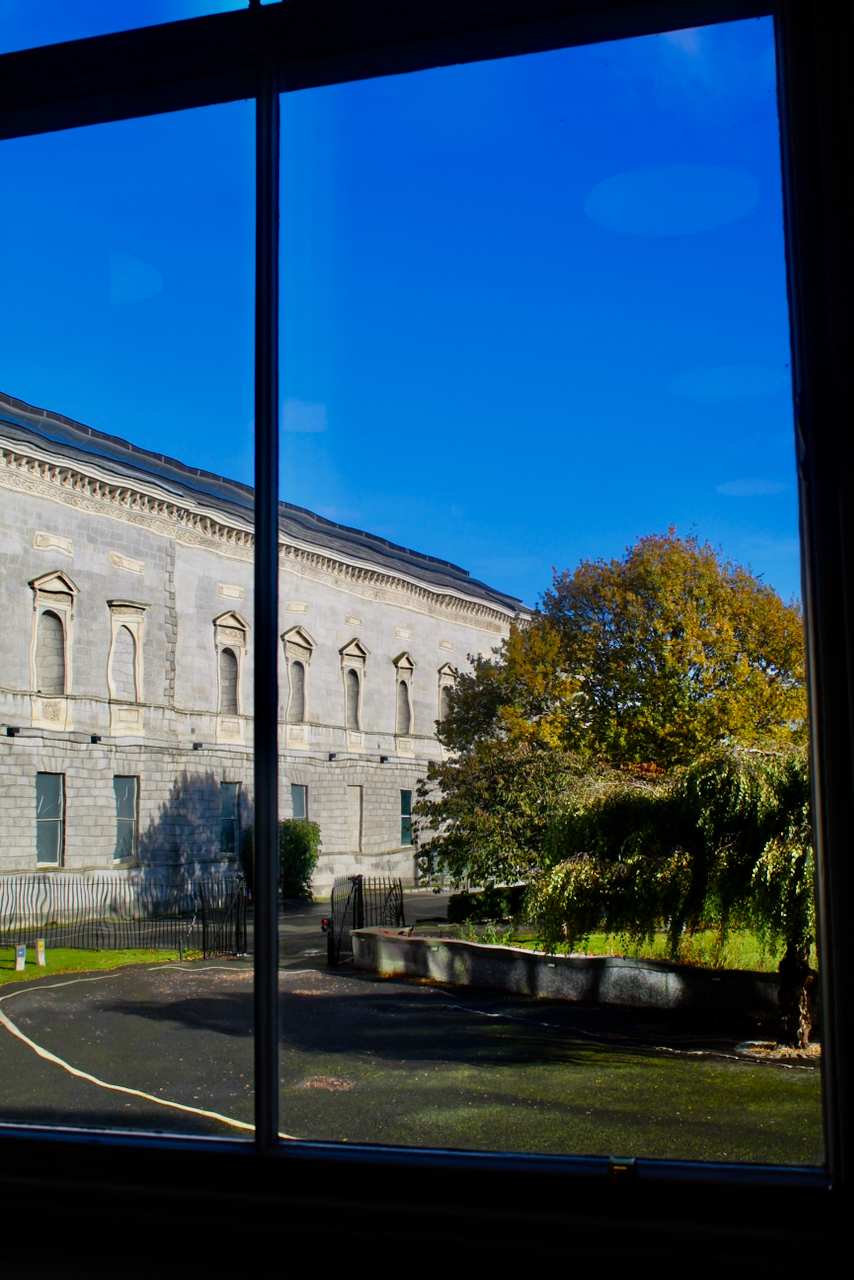
Next to the Supper Room on the garden front is the large dining room, also designed by Isaac Ware. It is of three bays, and has decorative doorcases and a beautiful ceiling attributed to Filippo Lafranchini.
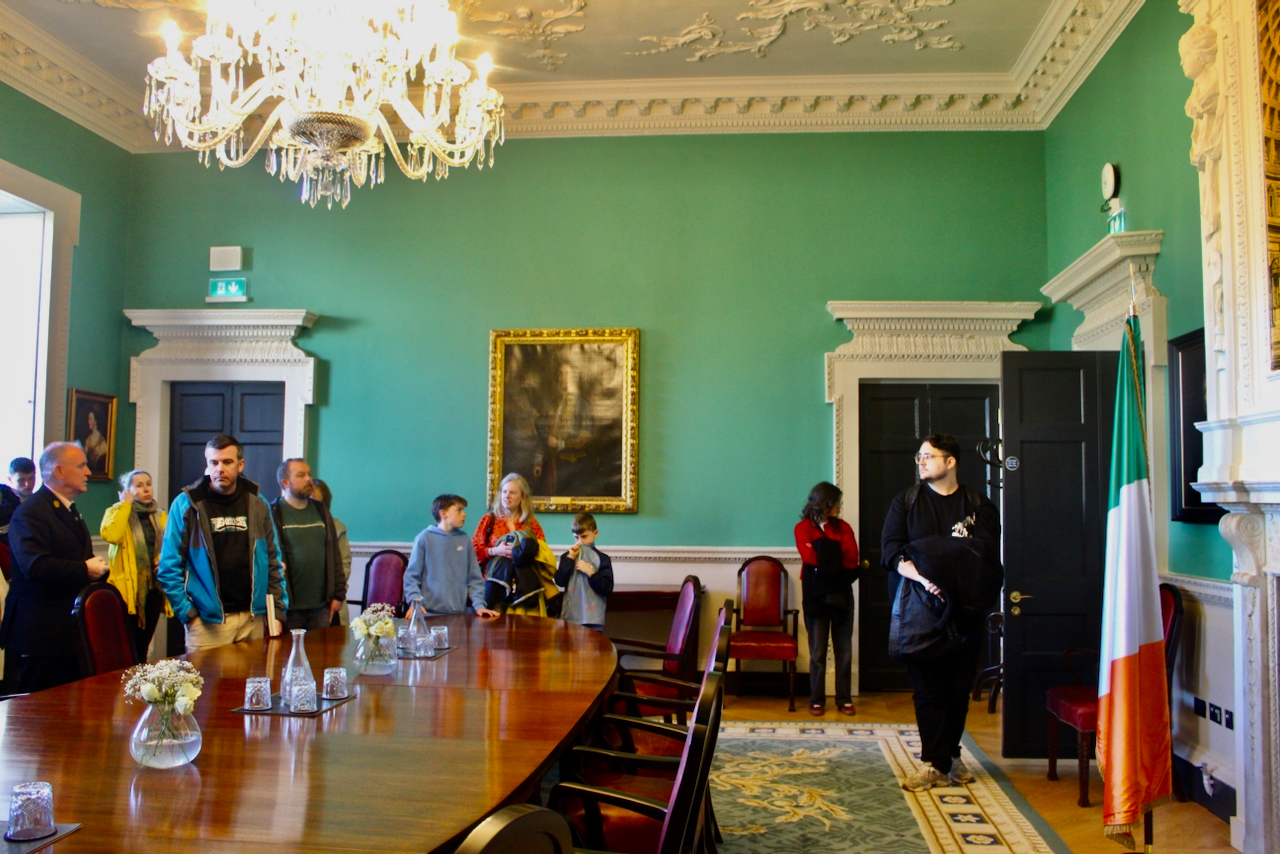


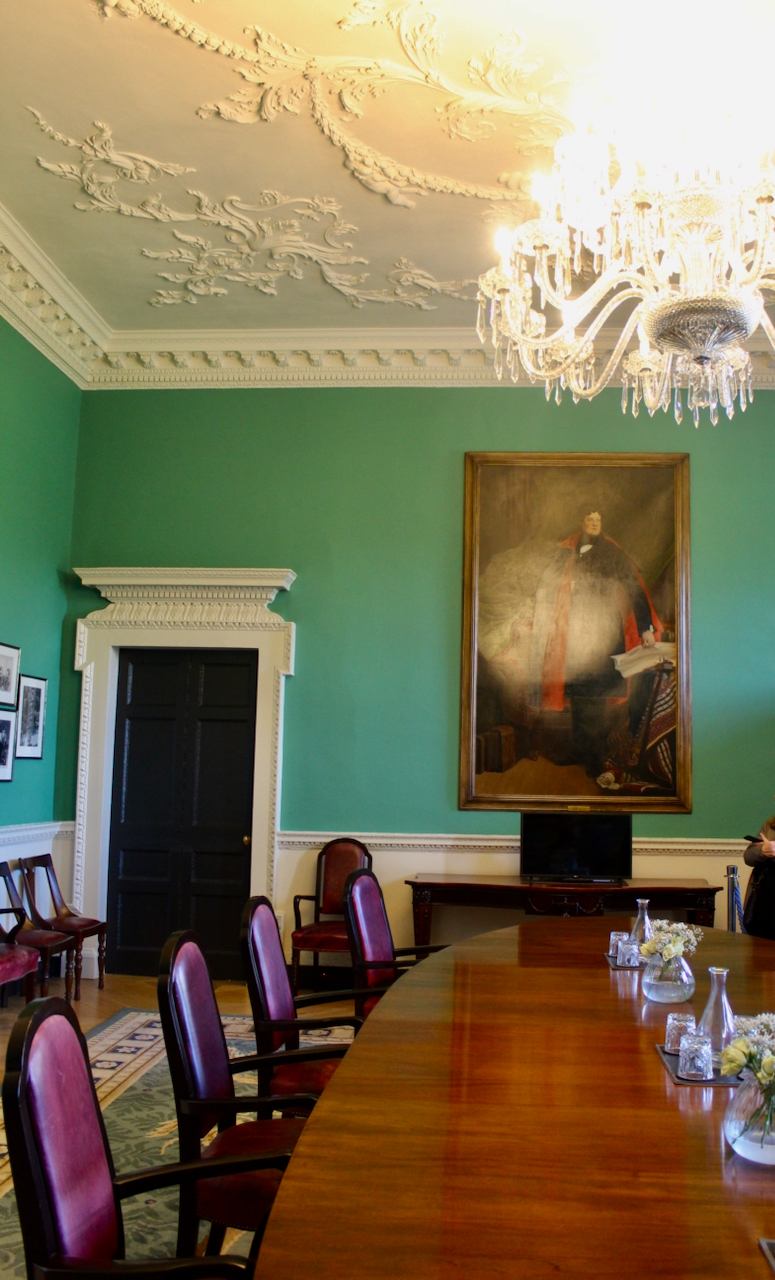
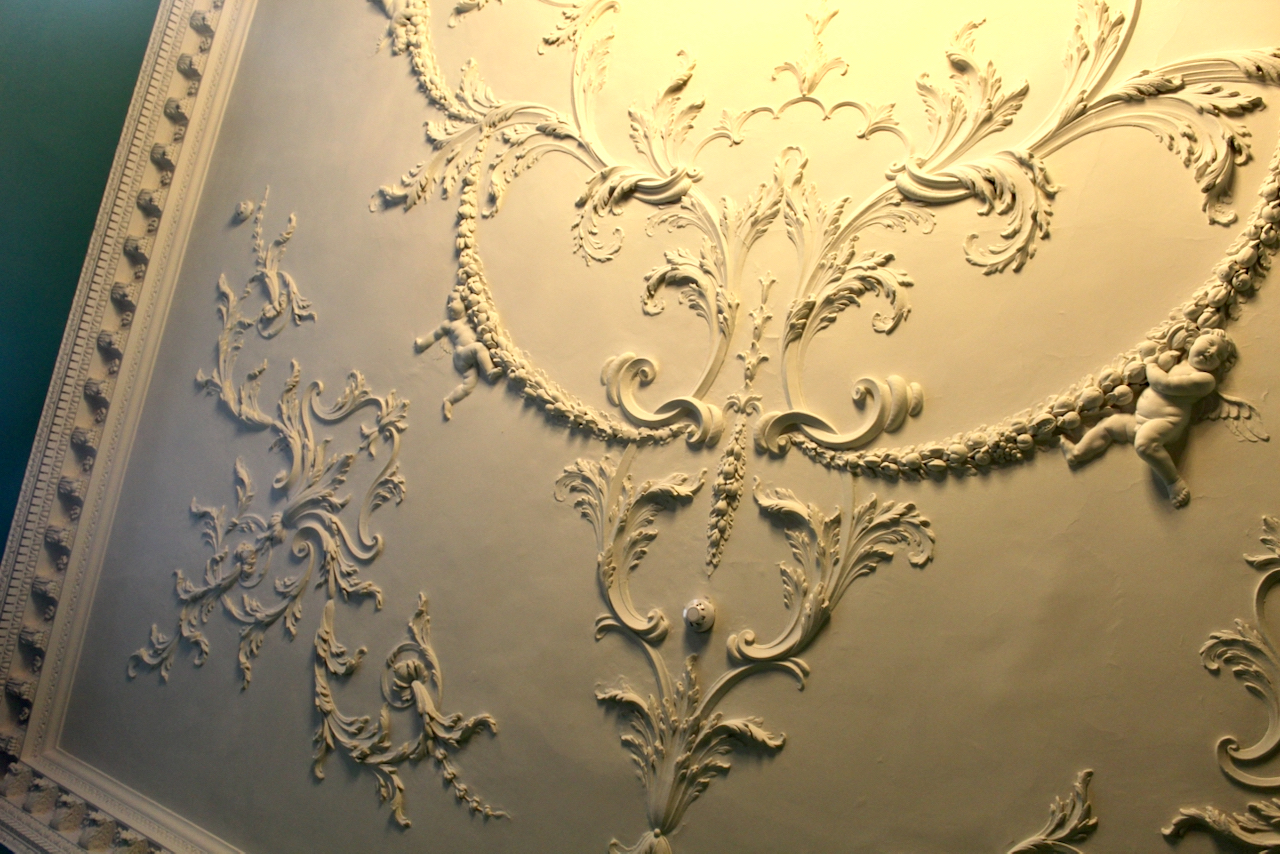
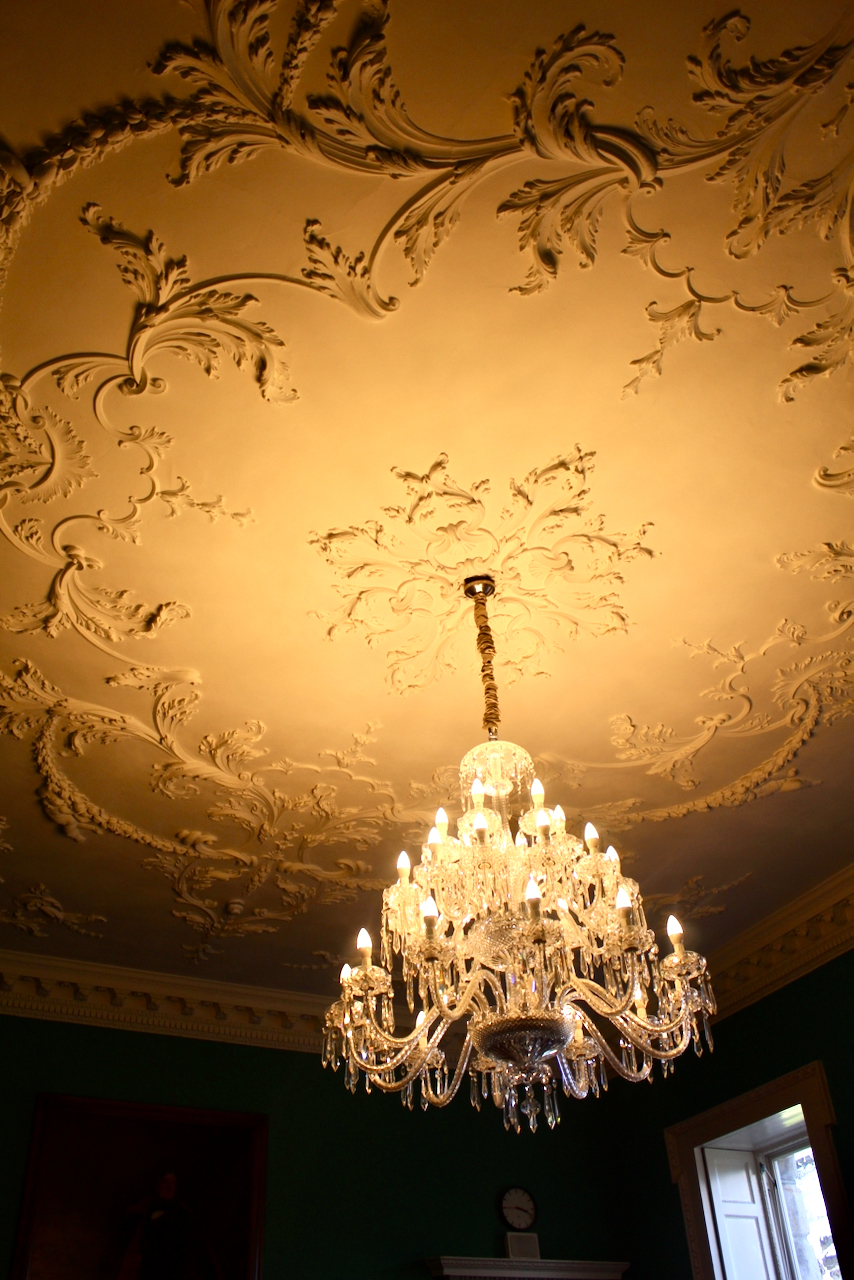
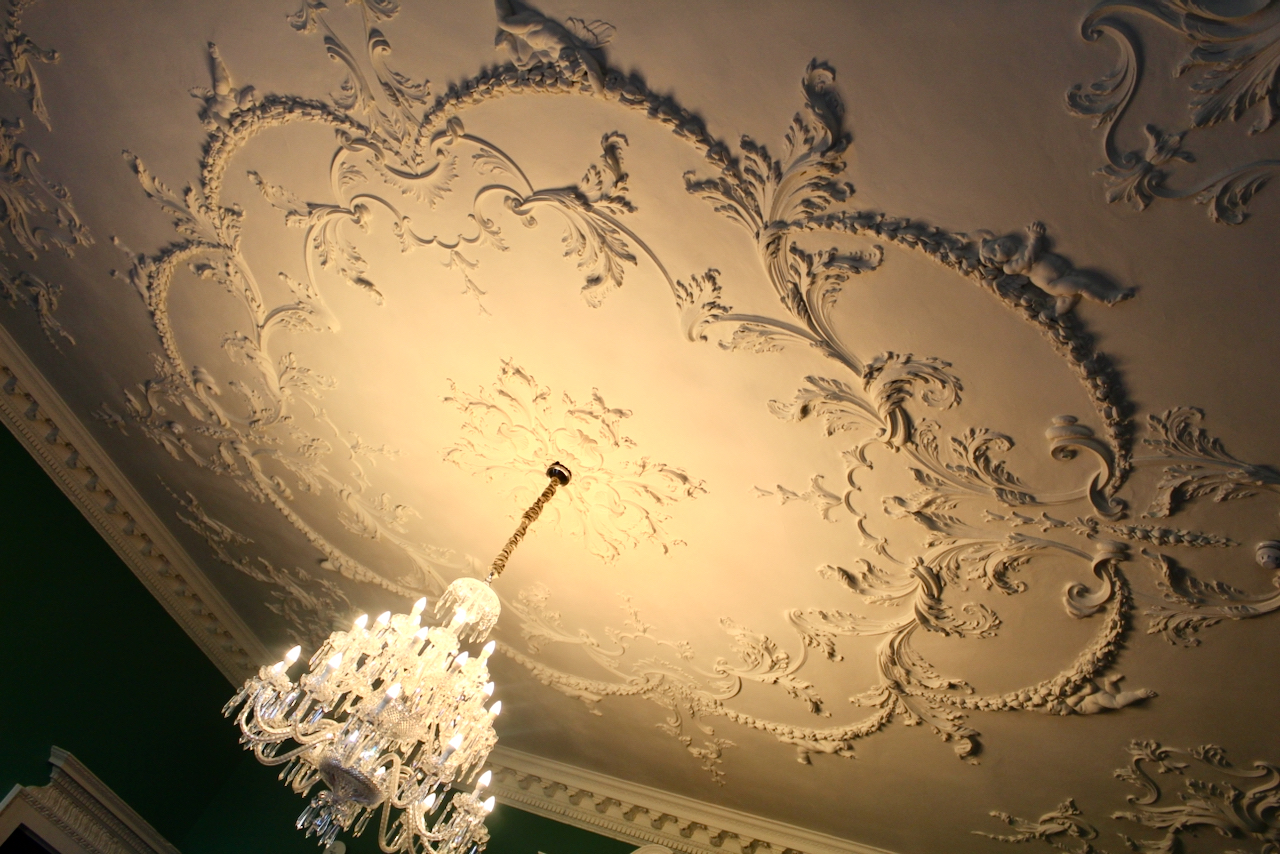
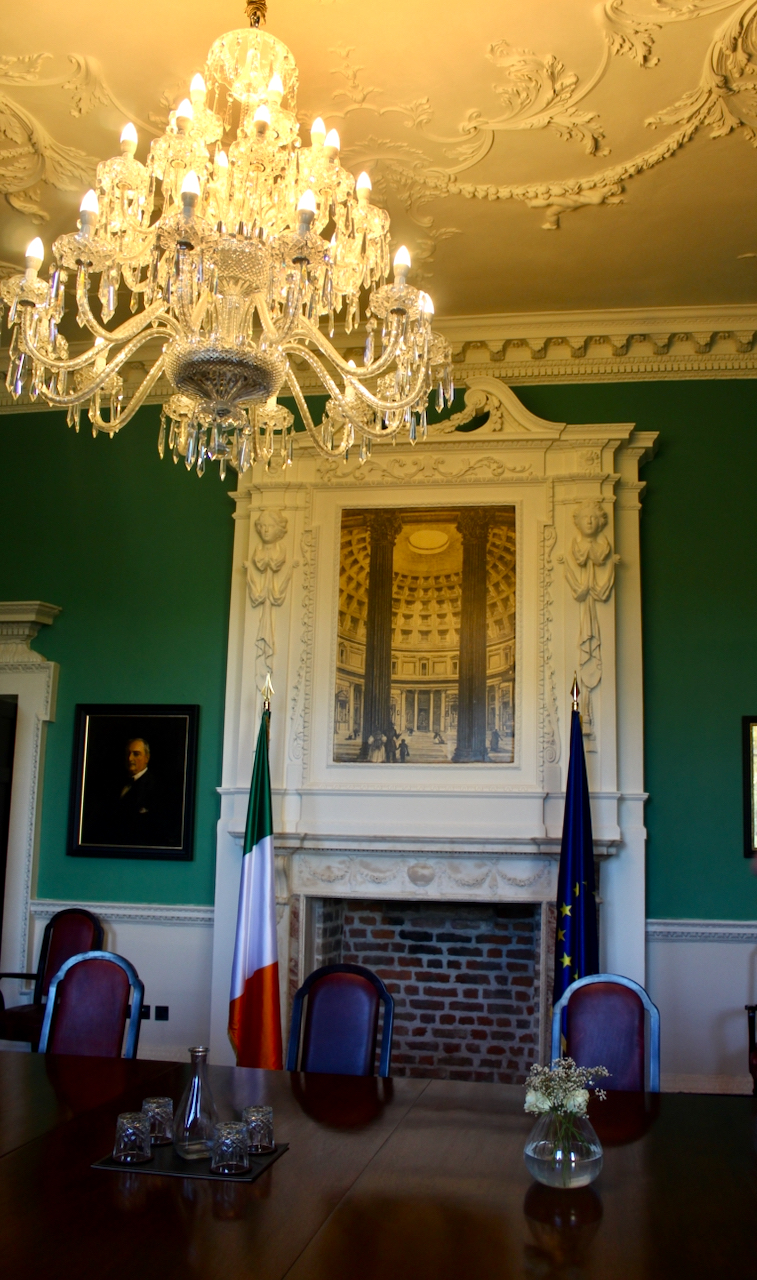
Christine Casey next describes the Garden Hall, with a more modest shell and acanthus ceiling and a chimneypiece with claw feet. Next is the former Private Dining Room, she tells us, a room from 1760, which has a ceiling with acanthus, rocaille shells and floral festoon forming a deep border to a plain chamfered central panel.
Casey tells us that the Earl of Kildare’s Library is at the southeast corner of the house, and that it has pedimented bookcases. It too was designed by Isaac Ware.

Before we go into the separate building that holds the current Dáil chamber, let us go up to the first floor. The former gallery now holds the Senate Chamber, and it fills the north end of the eighteenth century house. Both Richard Castle and Isaac Ware prepared plans for this room, but the room was unfinished when the Duke of Leinster died in 1773.
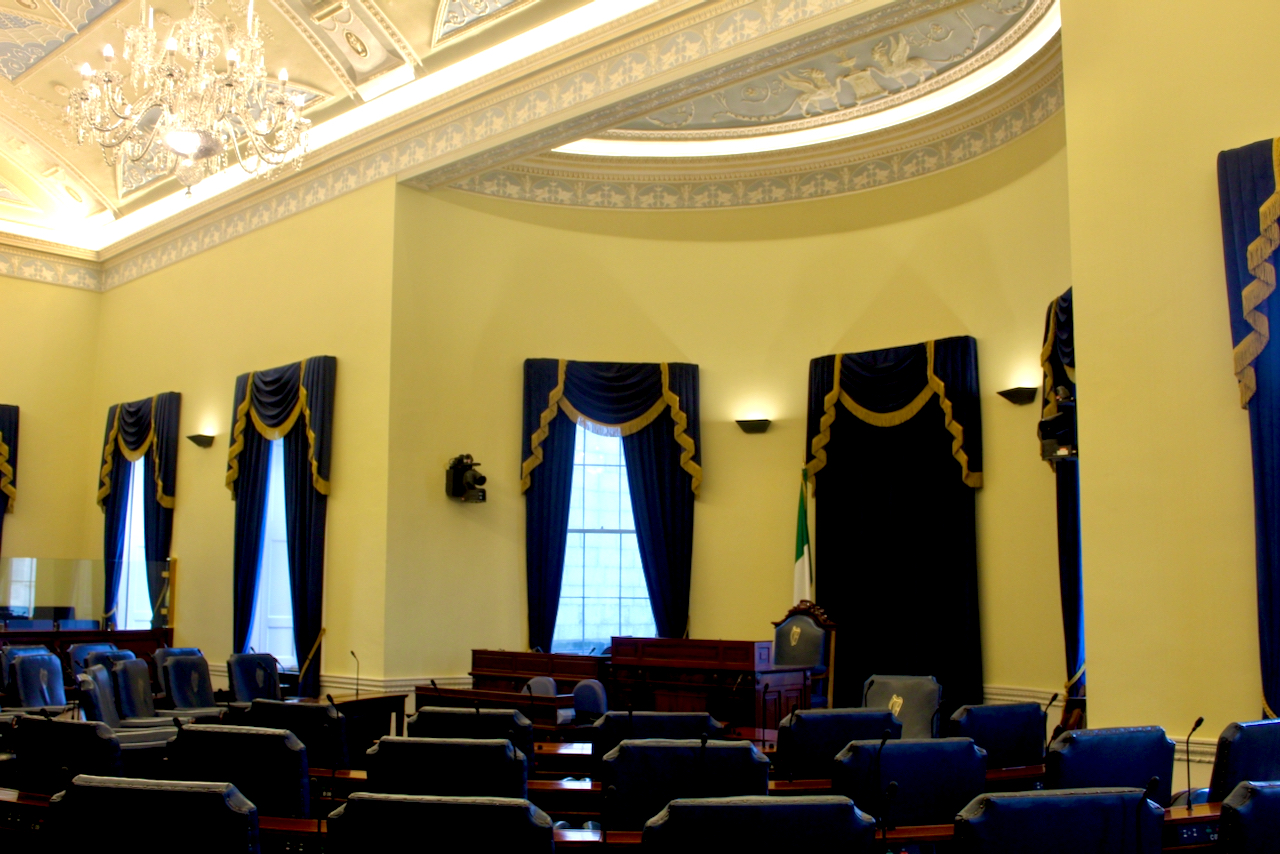
James died on 19 November 1773 at Leinster House and was buried in Christ Church cathedral four days later. His eldest son George predeceased him, so the Dukedom passed to his second son, William Robert Fitzgerald (1748/49-1804). The 2nd Duke completed the picture gallery in 1775 to designs by James Wyatt (1746-1813).
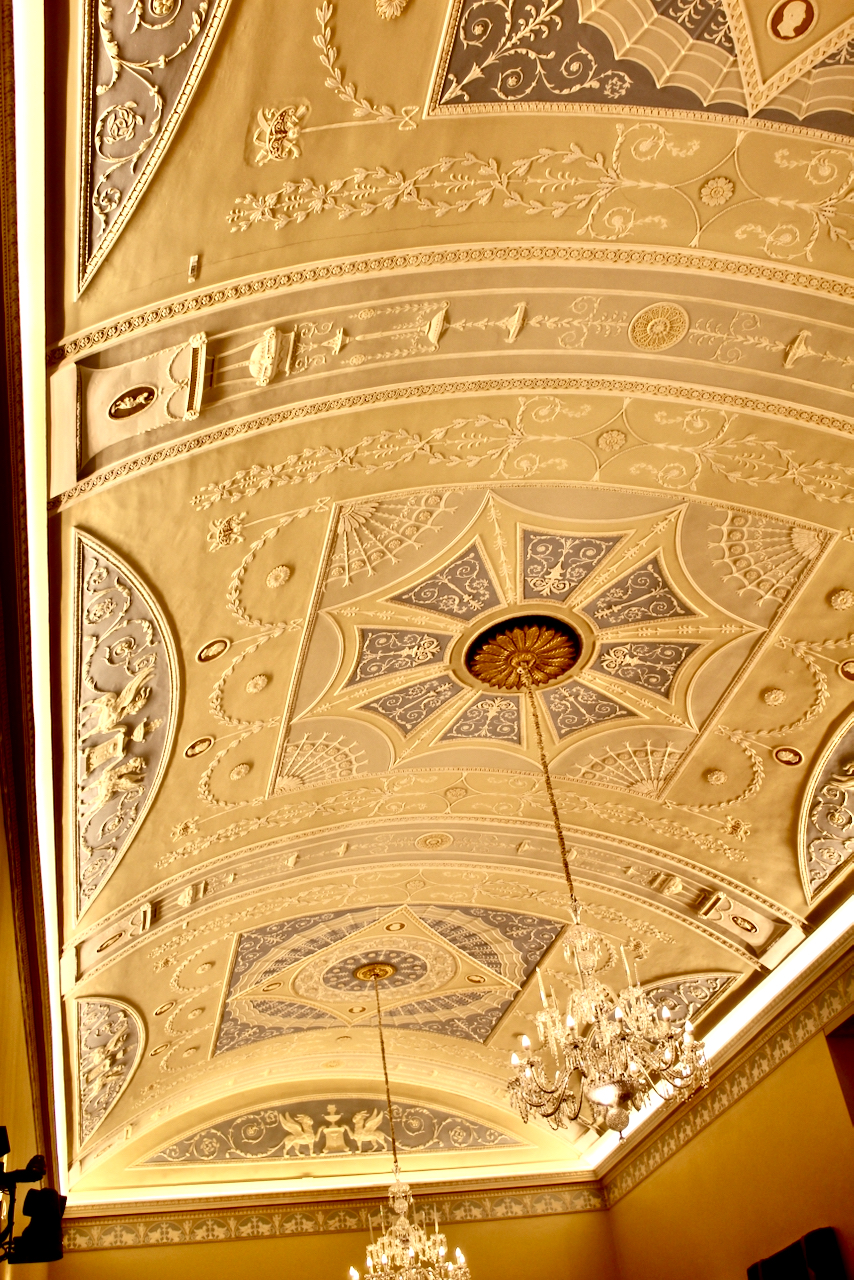
The ceiling as designed by James Wyatt is tripartite. I defer to Christine Casey for a description:
“at its centre a chamfered octagon within a square and at each end a diaper within a square, each flanked by broad figurative lunette panels at the base of the coving and bracketed by attenuated tripods, urns and arabesque finials… It remains among the finest examples of Neoclassical stuccowork in Dublin.“

Wyatt created an elliptical vault over the principal volume of the room and a half-dome above the bow.
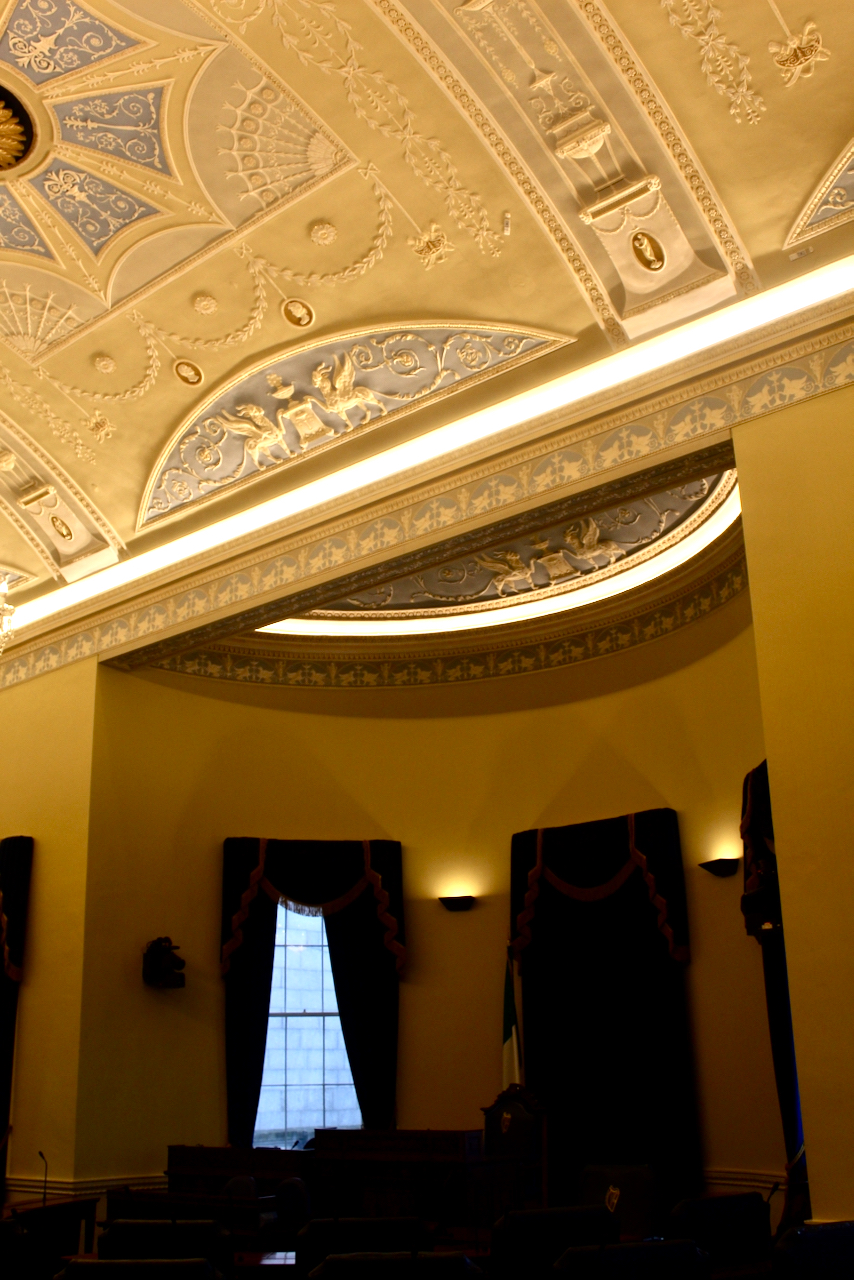

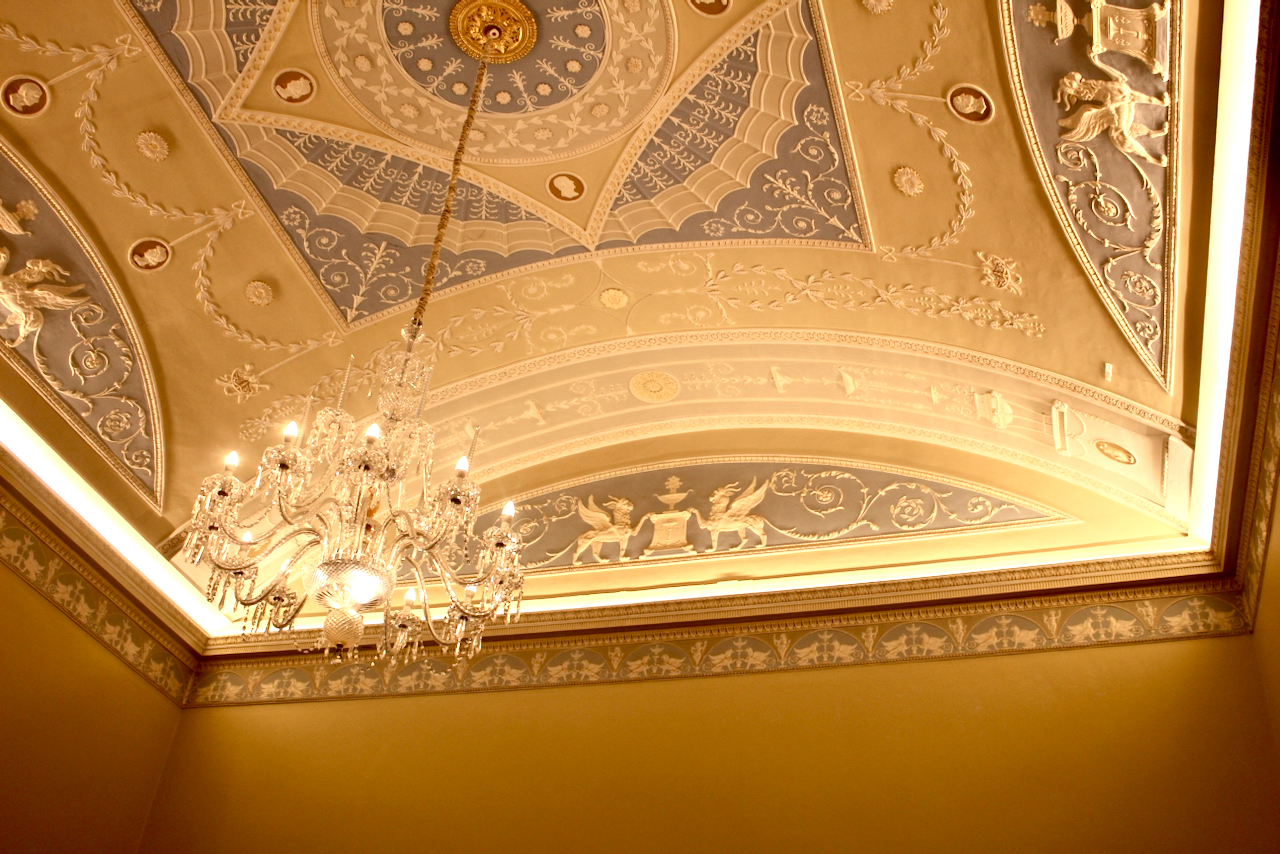
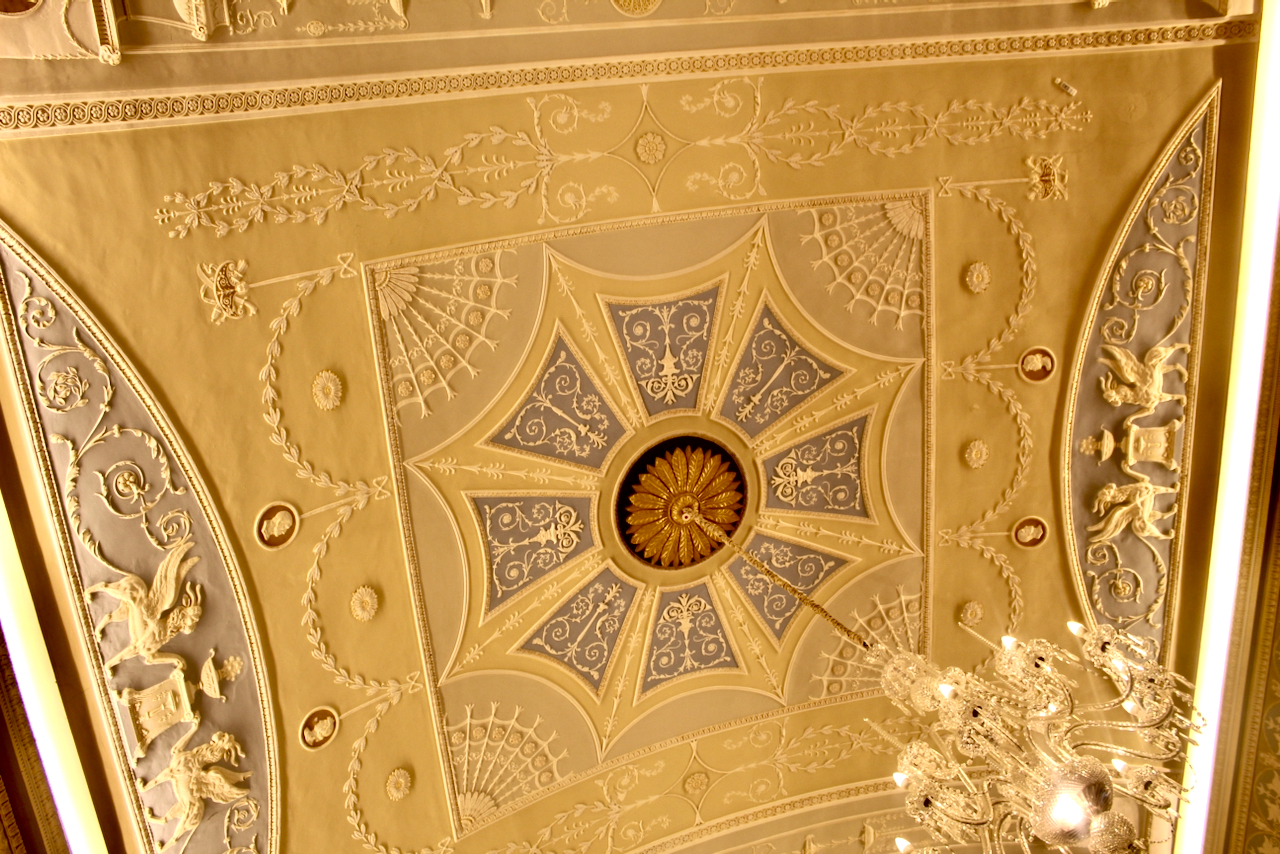
On the inner wall of the room Wyatt places three ornate double-leaf doorcases and between them two large white marble chimneypieces. The chimneypieces have high-relief female figures to the uprights and on the lintel, putti sit “between headed spandrels enclosing urns and confronted griffins.”
Unfortunately with the tour group I was unable to get good photographs of the room, the chimneypieces or the carved doorframes.
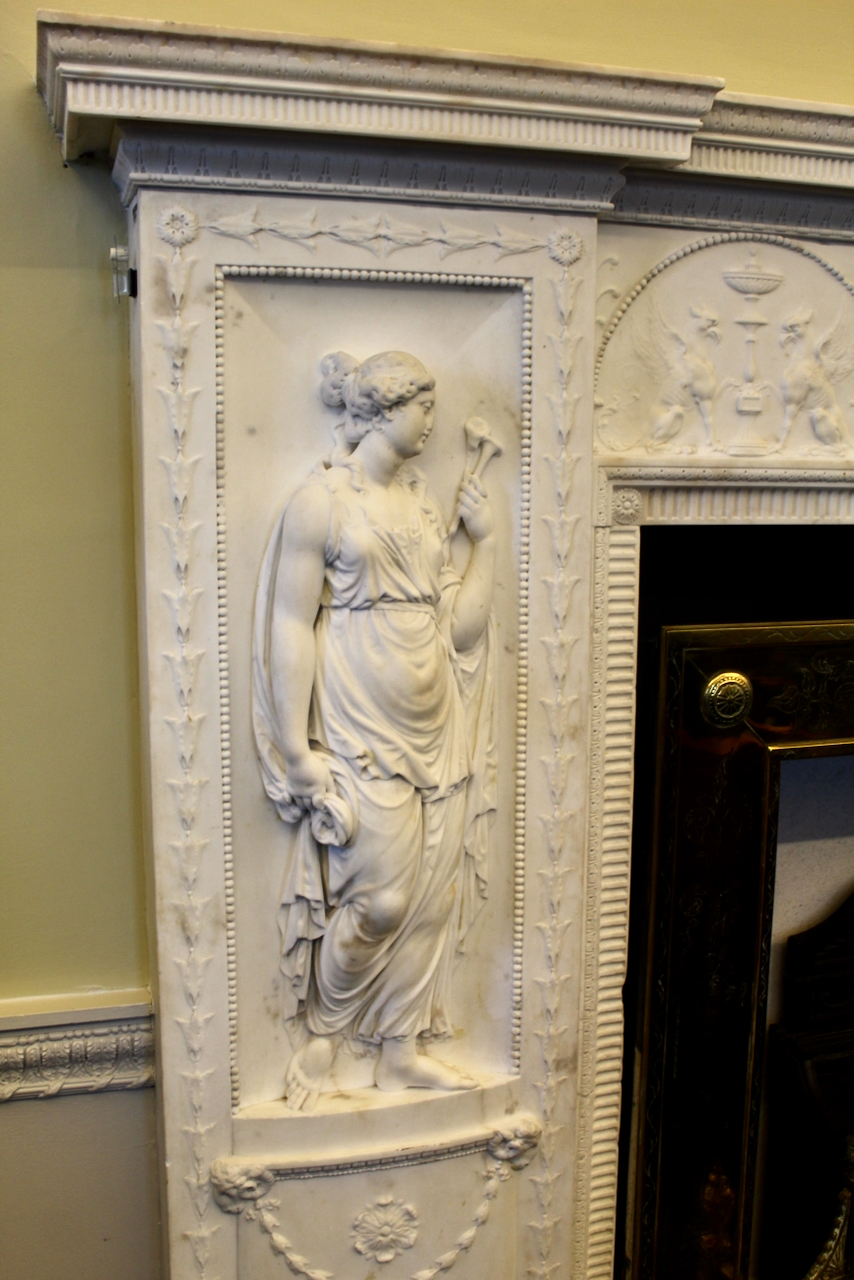
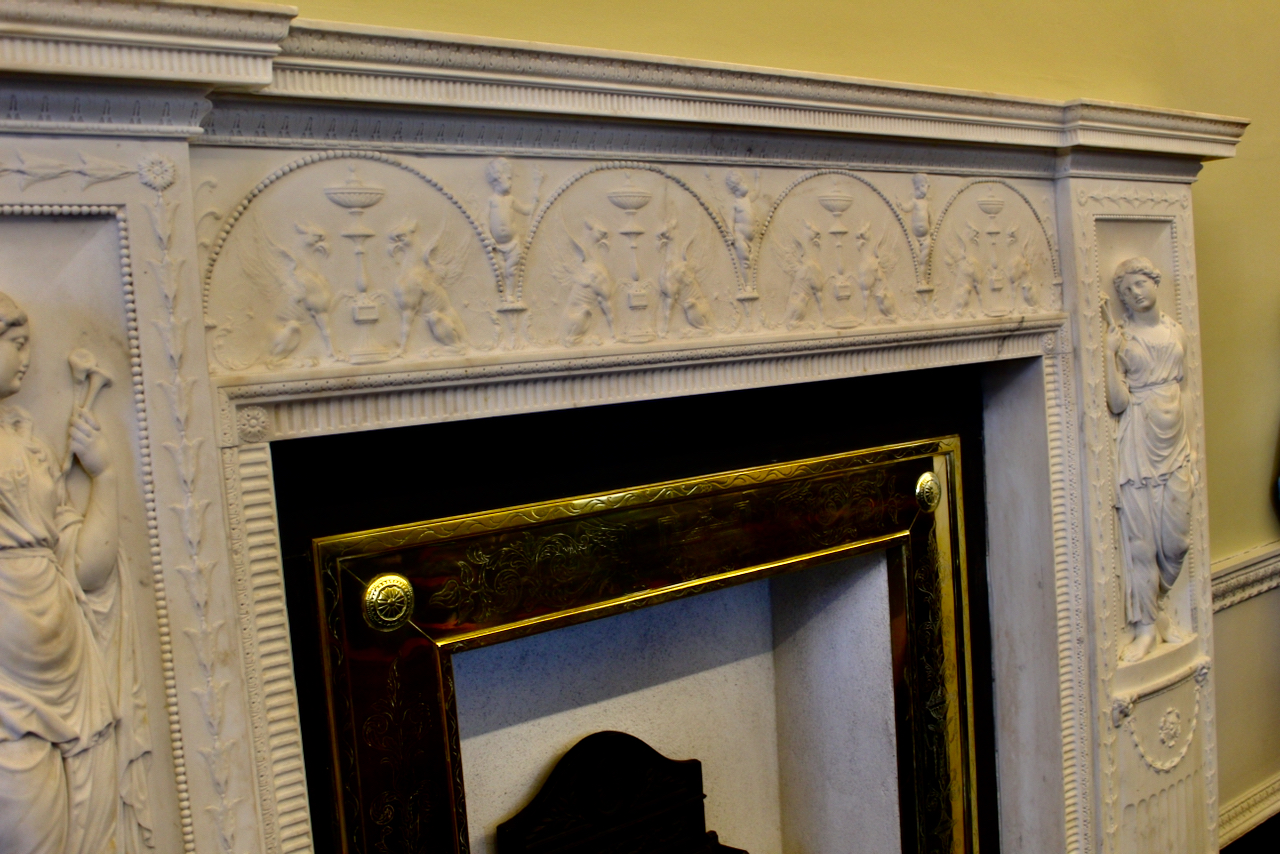
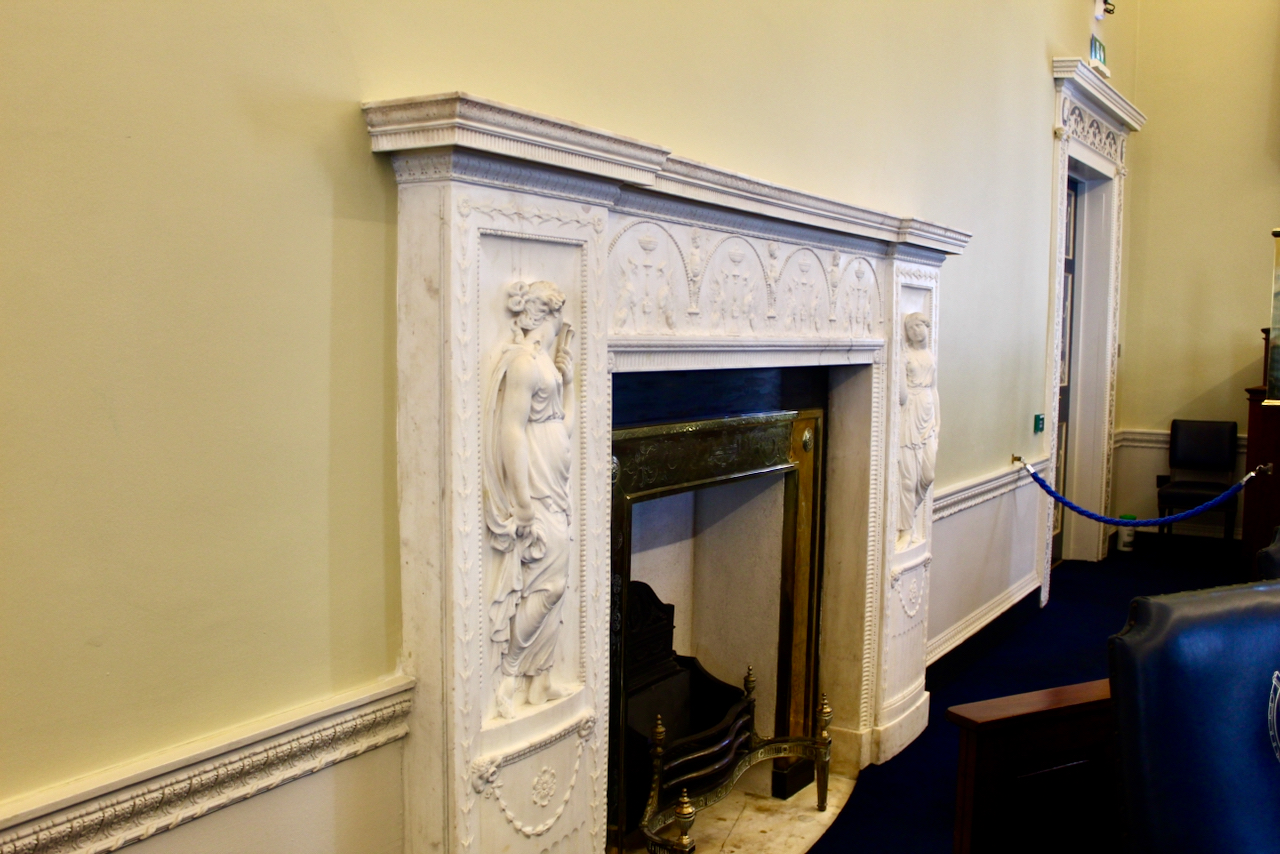
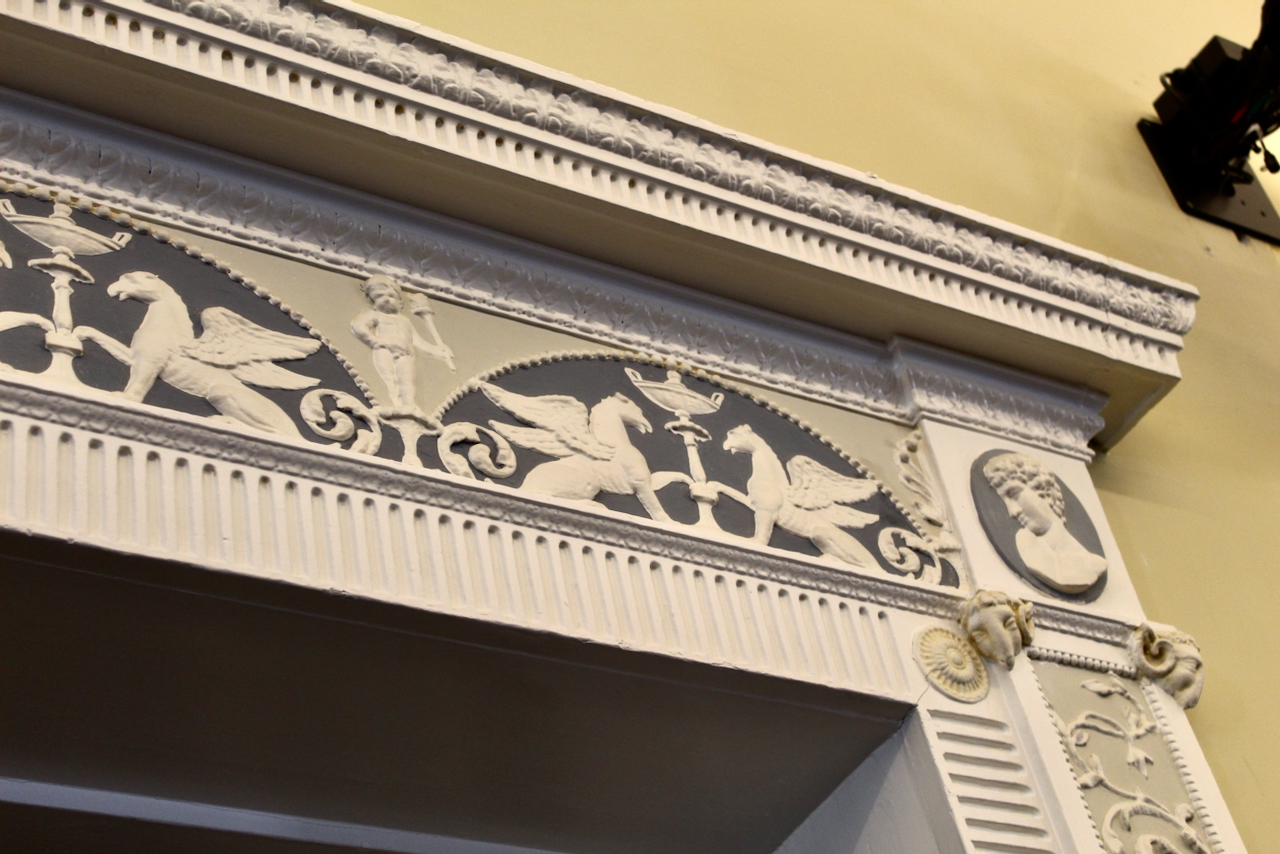
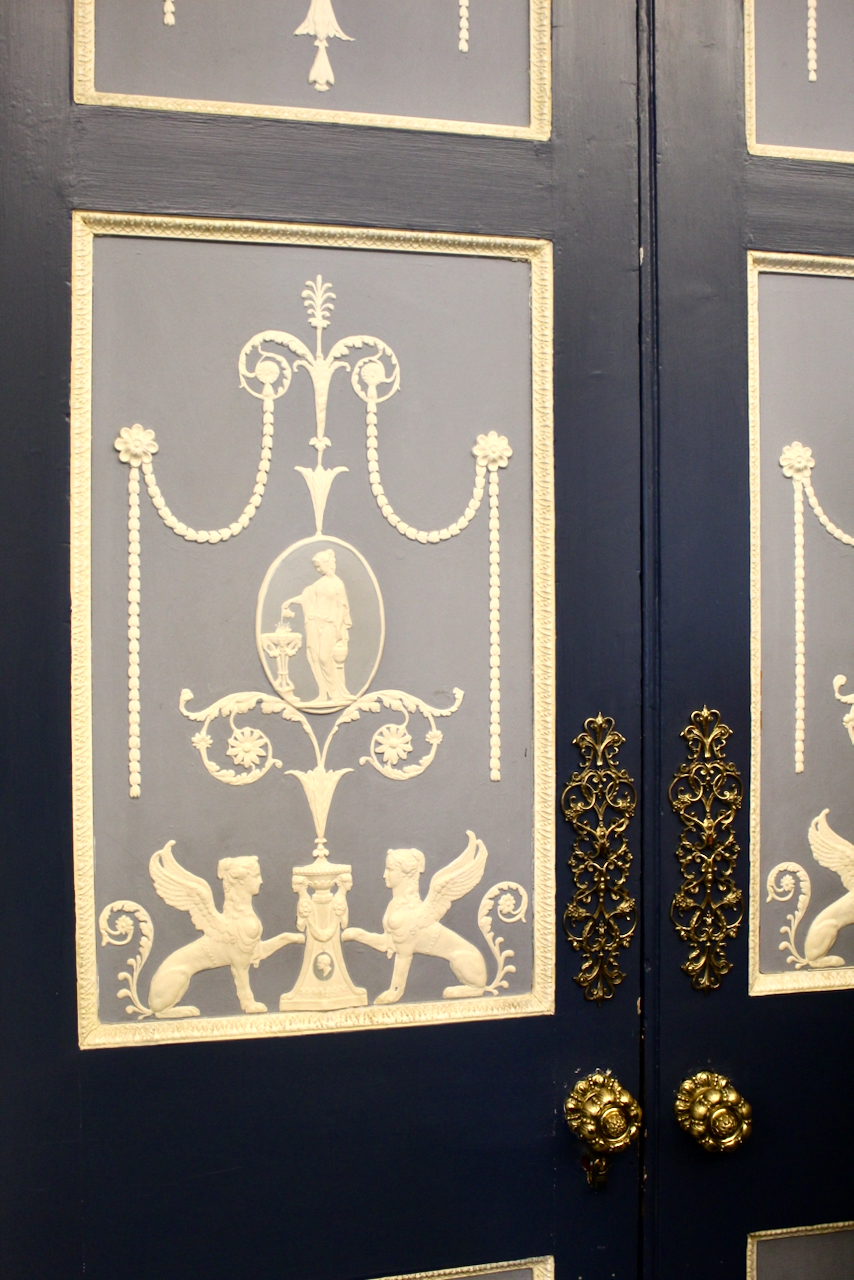
Next to the Seanad Chamber is the Seanad Anteroom. It was originally the upstairs dining room.
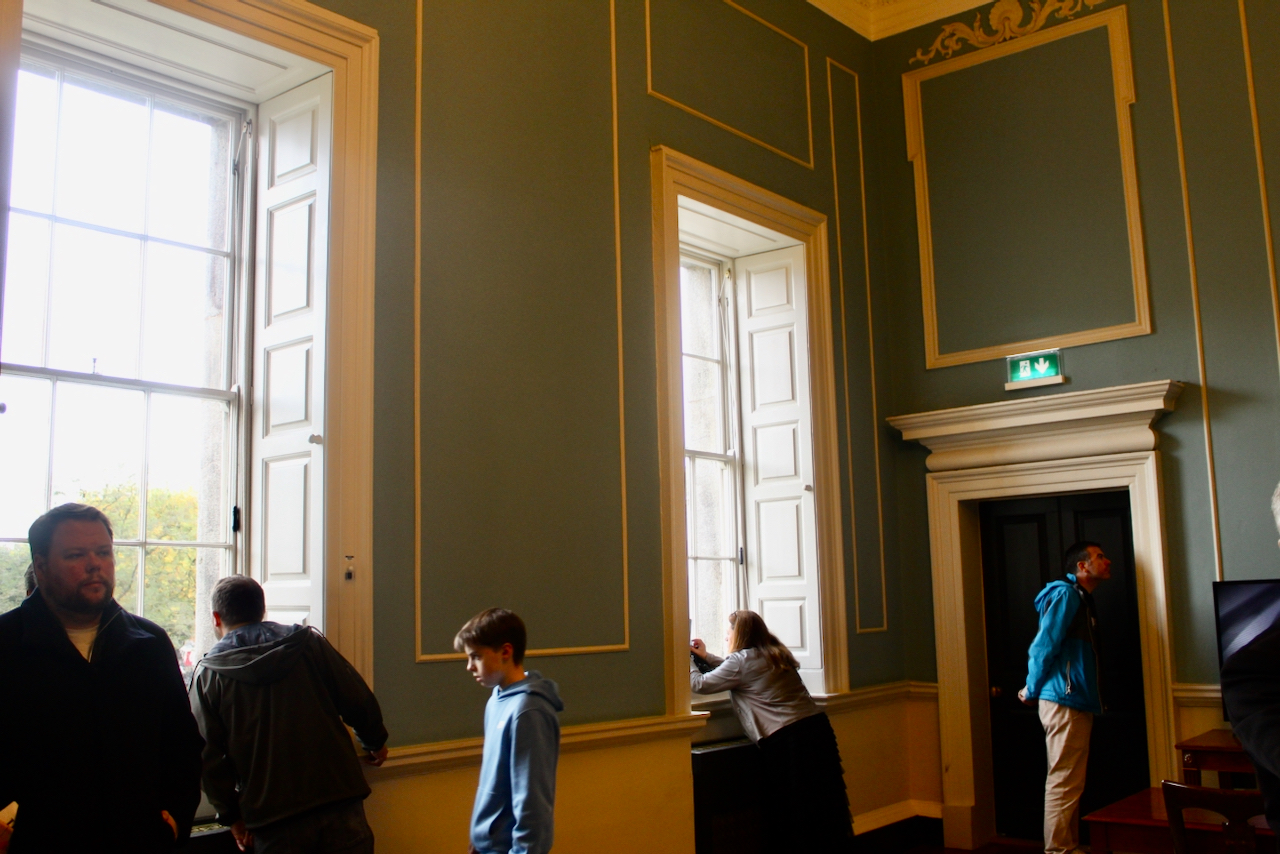
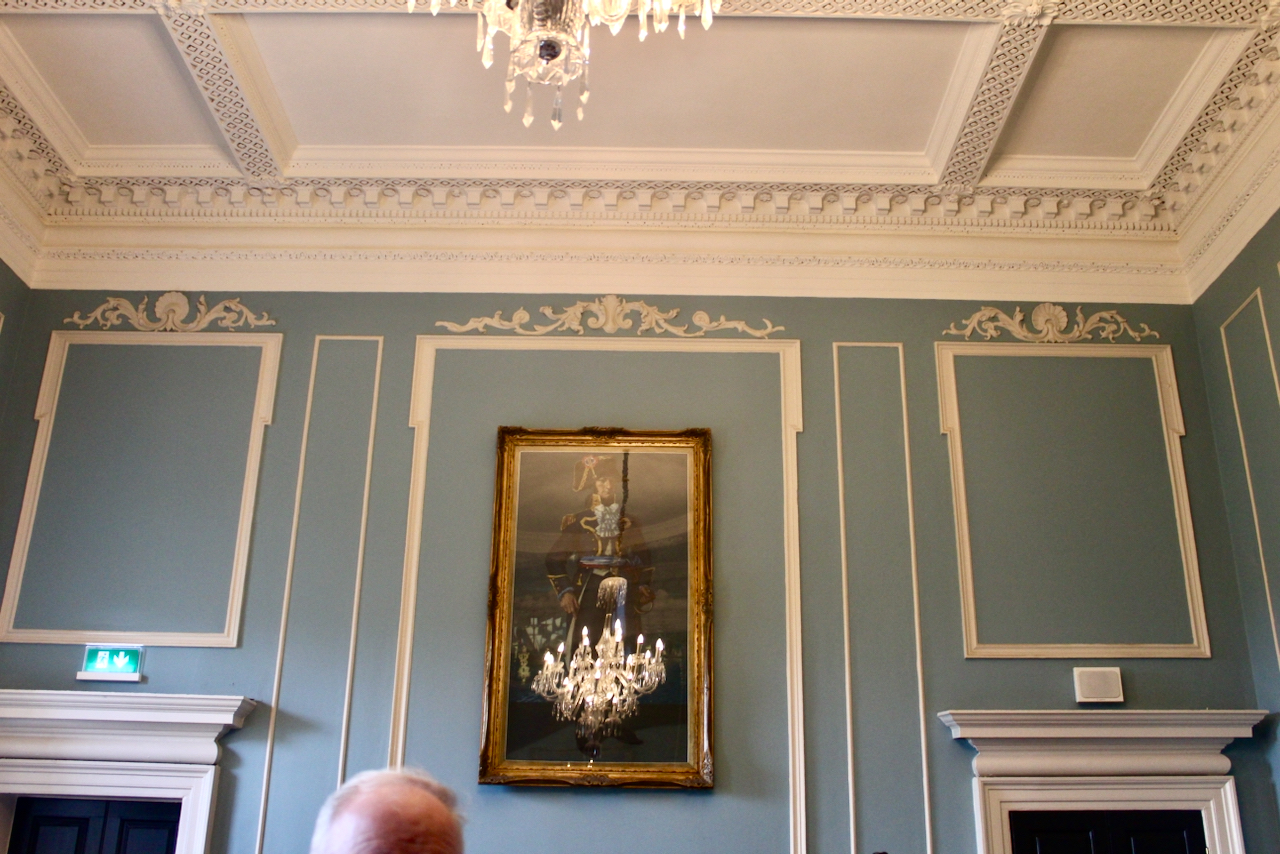
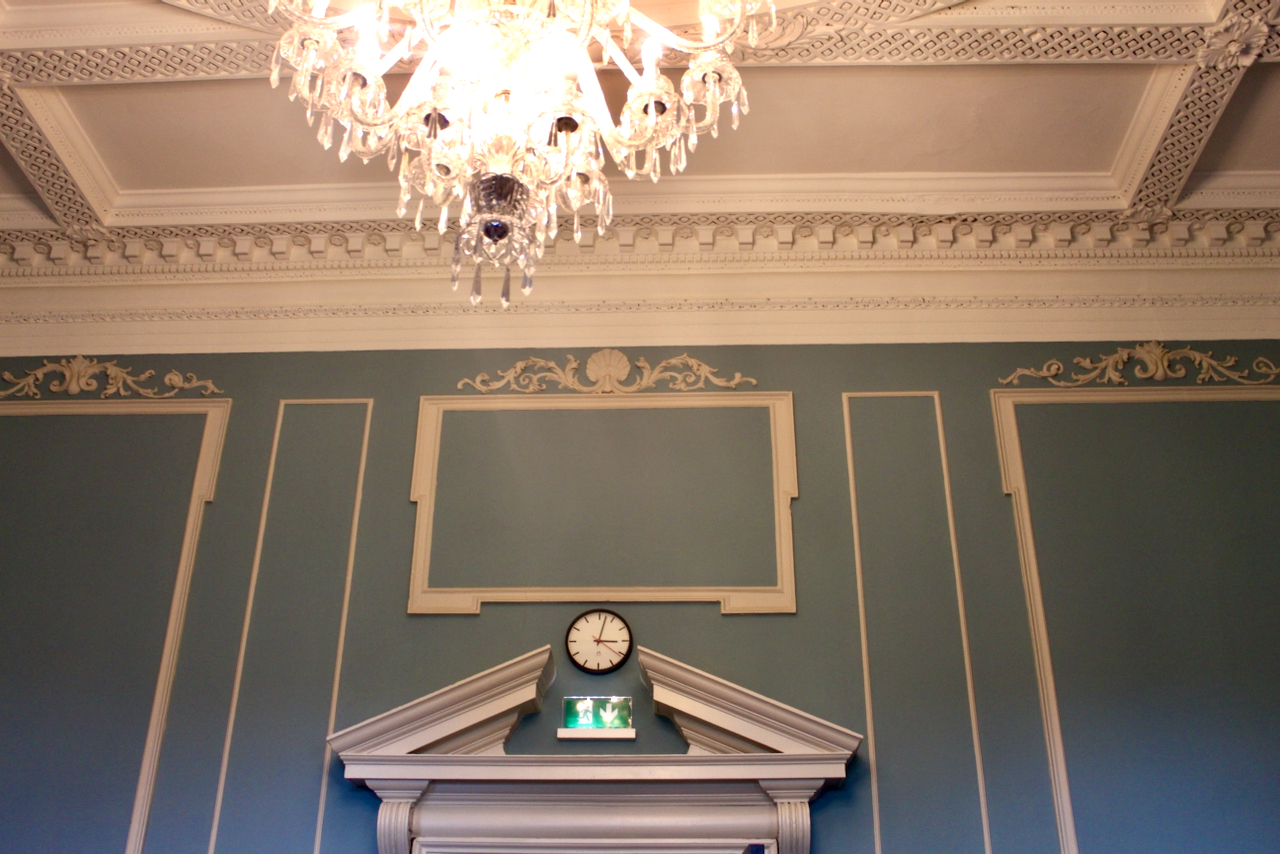
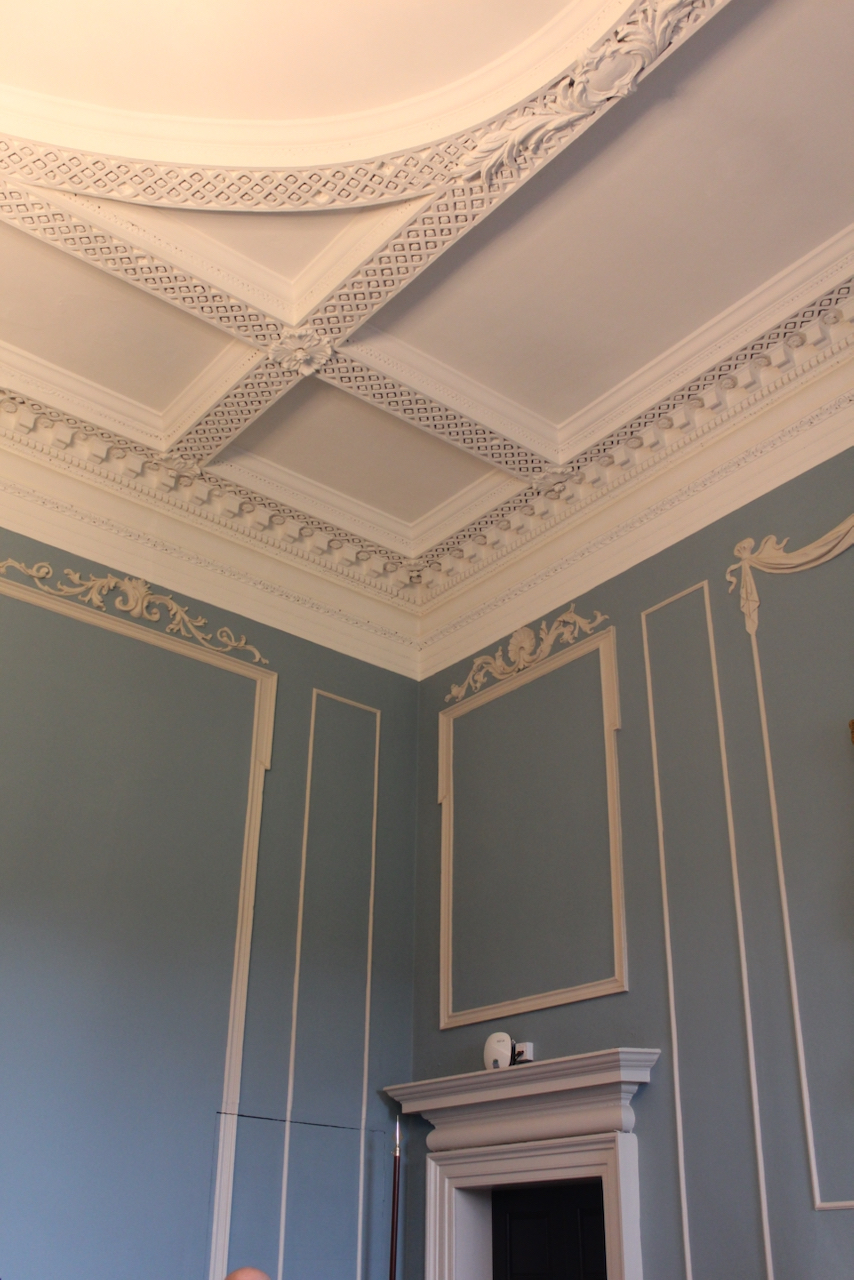
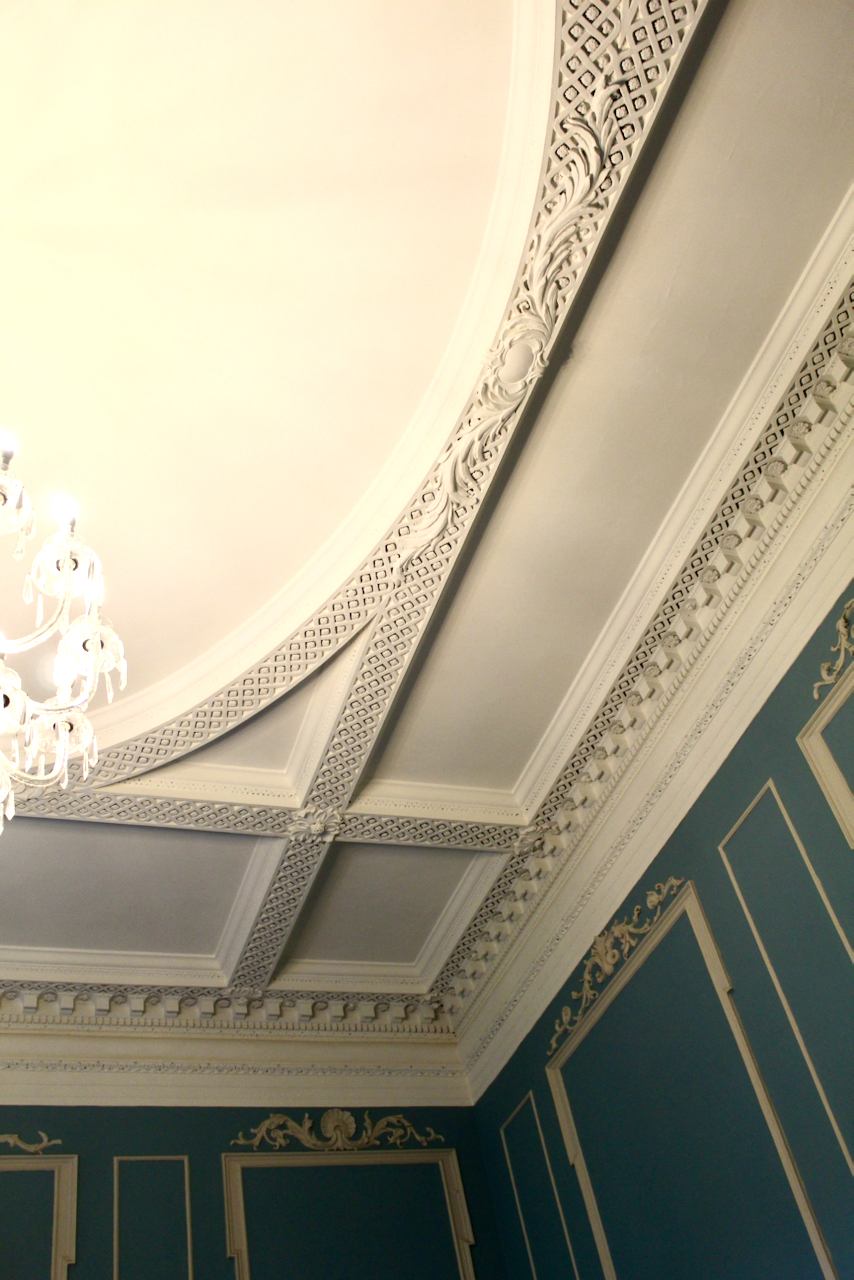
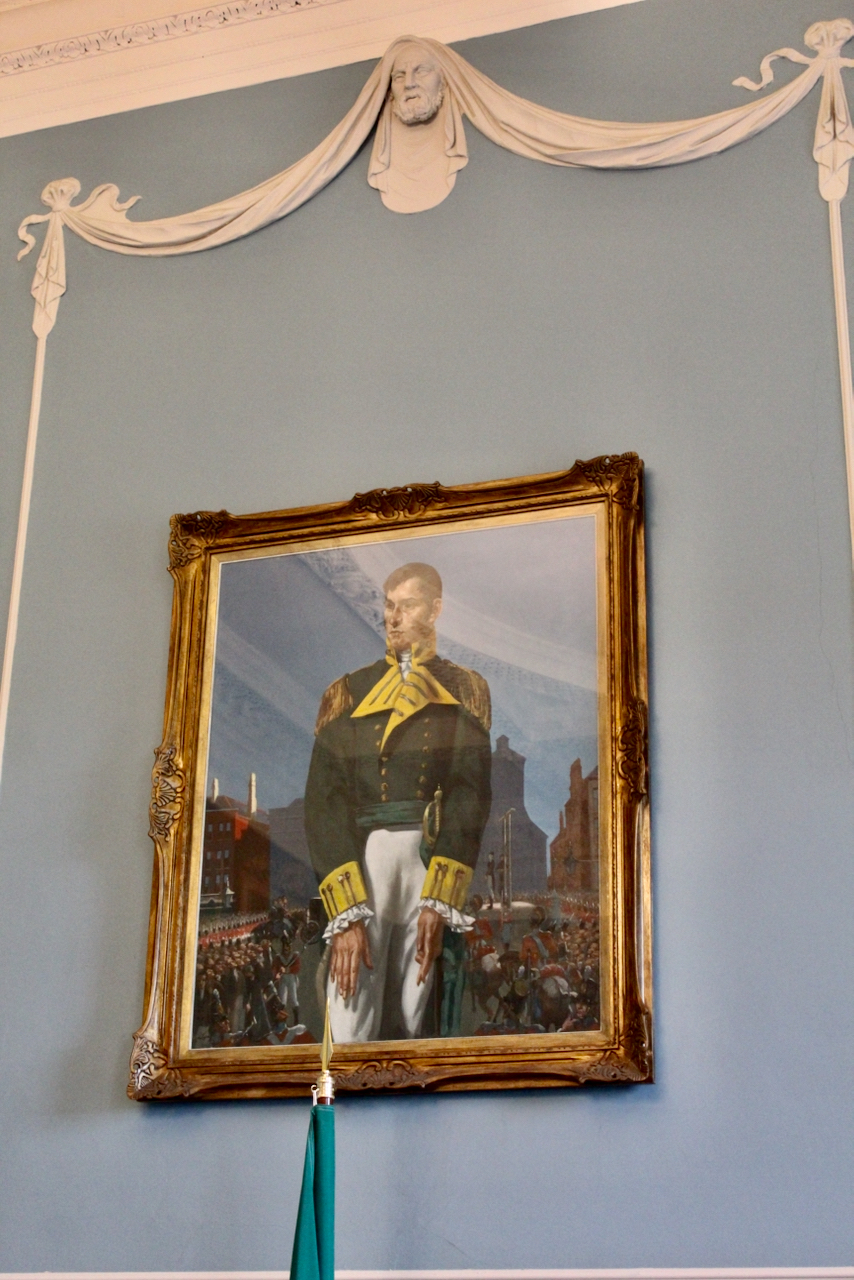
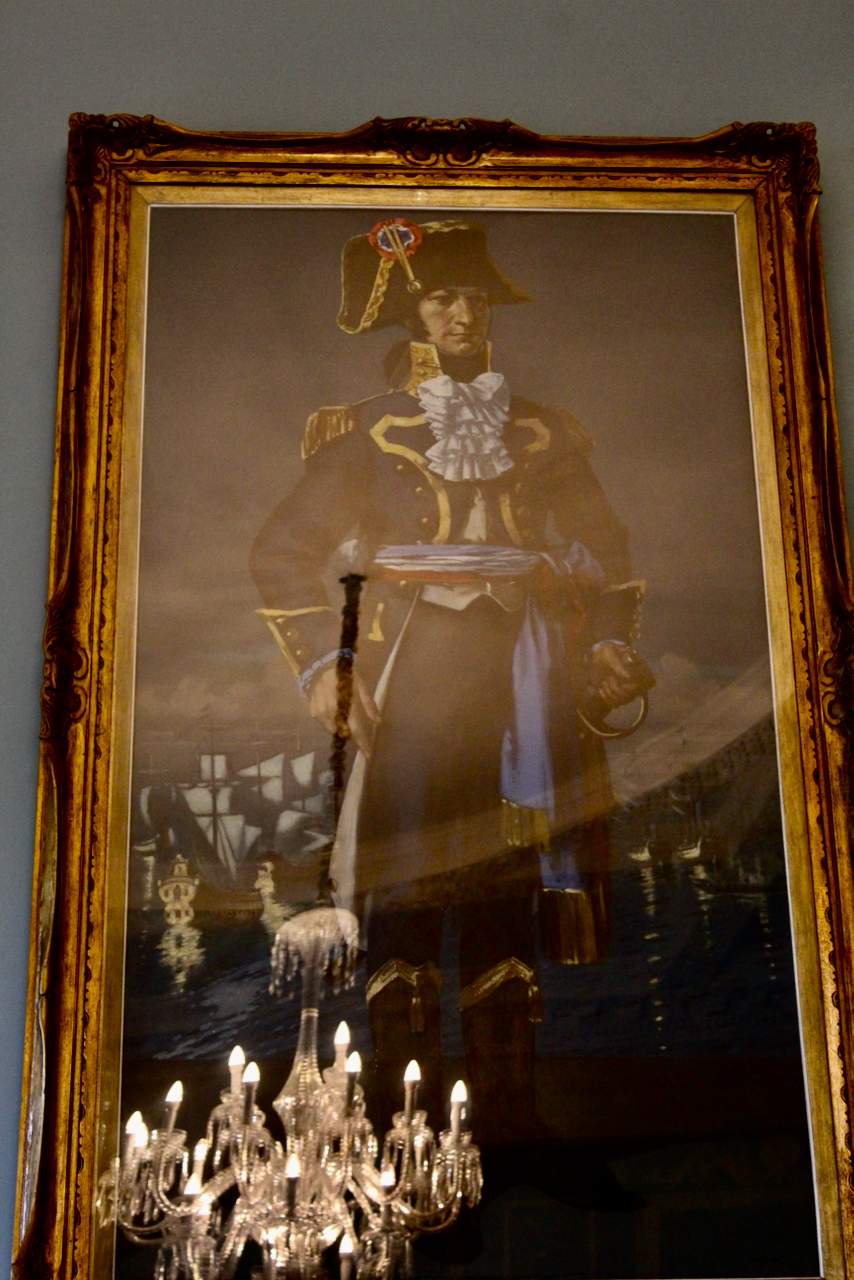
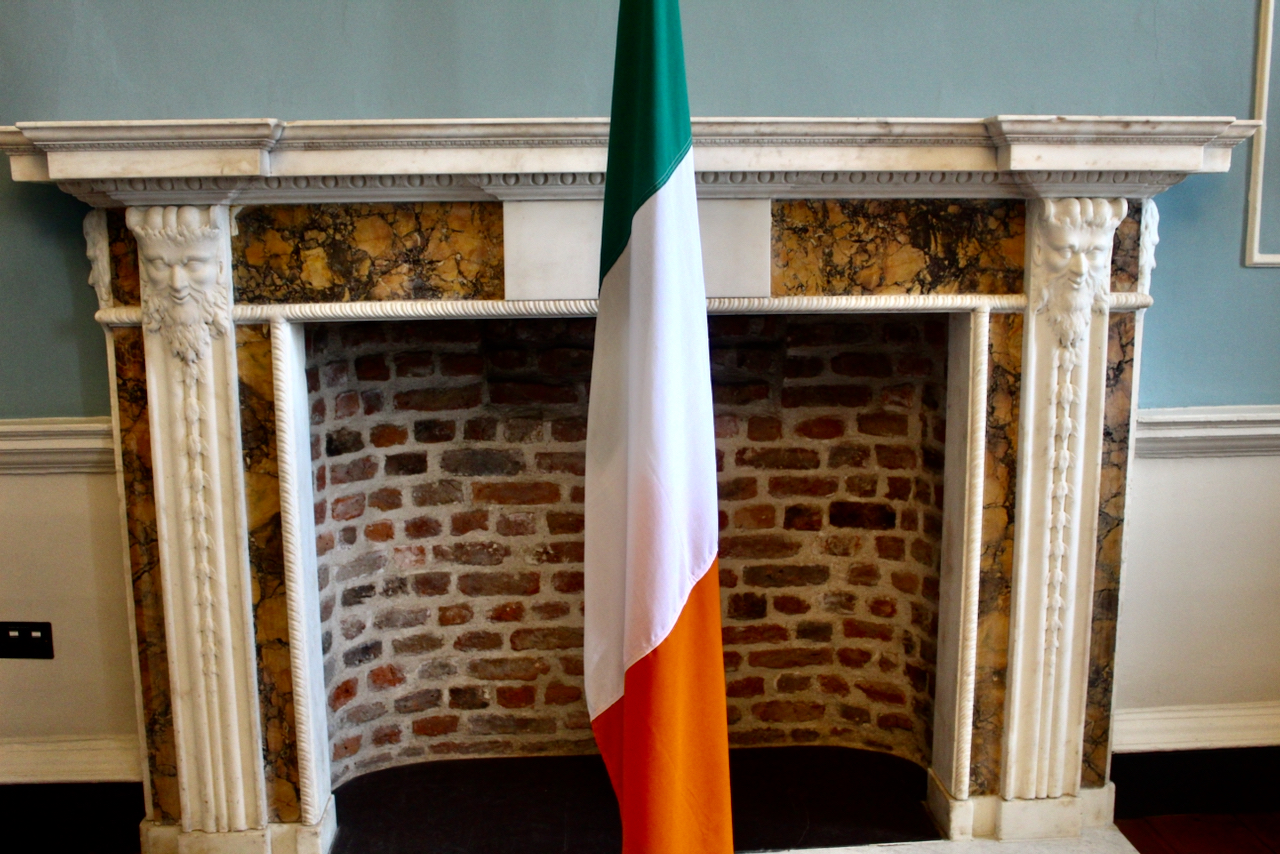
At the south end of the ground floor corridor is a top-lit stair hall which leads to the Dáil chamber. This separate building originally housed a lecture theatre, built in 1893 by Thomas Newenham and Thomas Manly Deane. Before this was built, let us look at the rest of the history briefly of the Dukes of Leinster who continued to use the house as their Dublin residence.
You can take a virtual tour of Leinster house, https://www.oireachtas.ie/en/visit-and-learn/visit-the-oireachtas/virtual-tour/
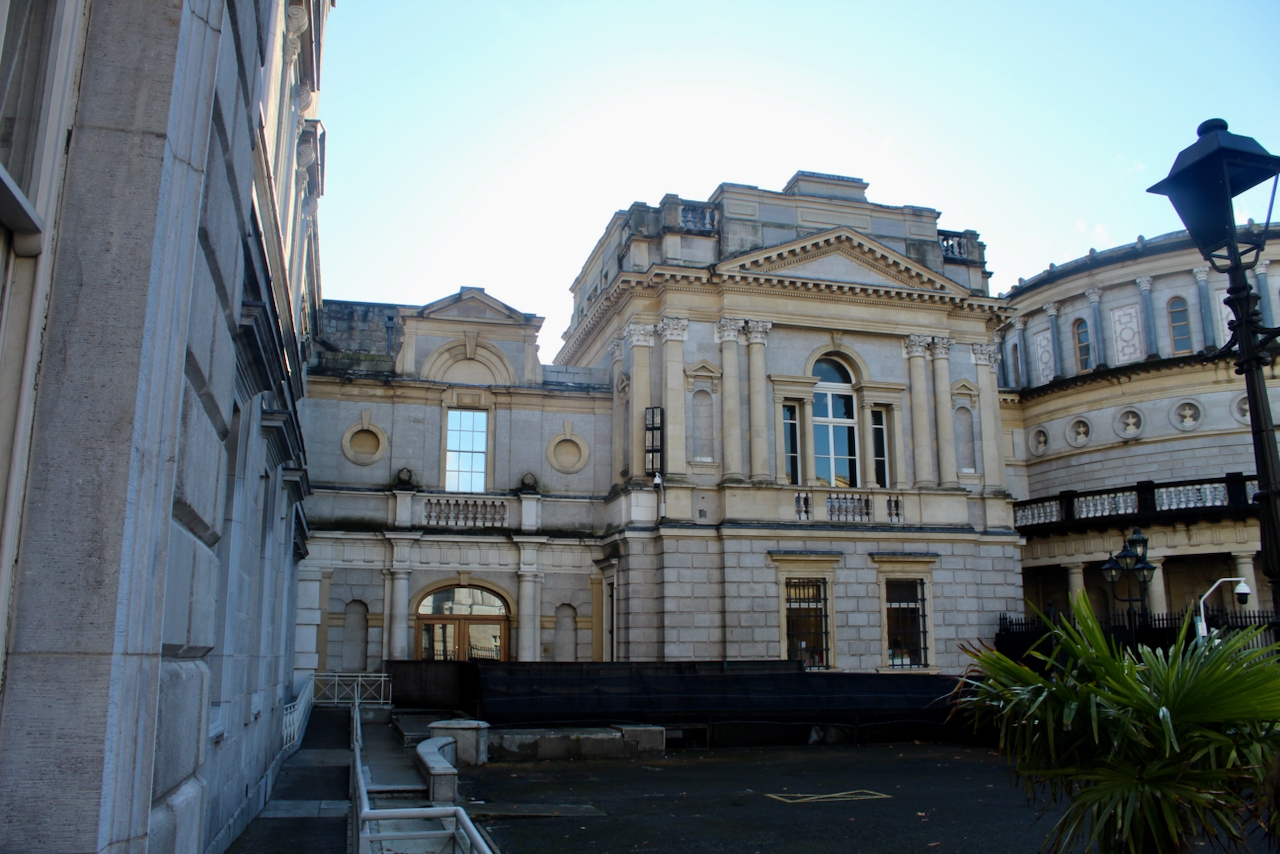
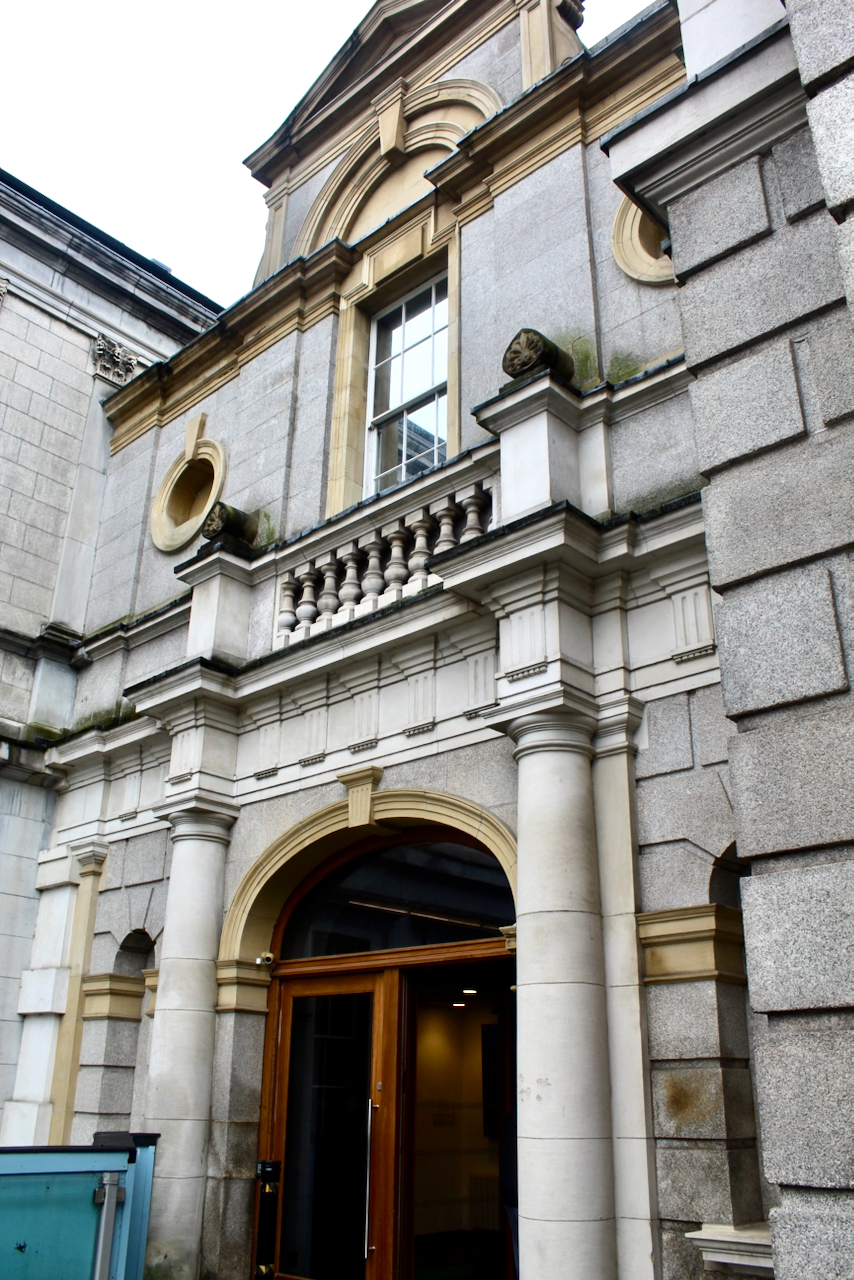
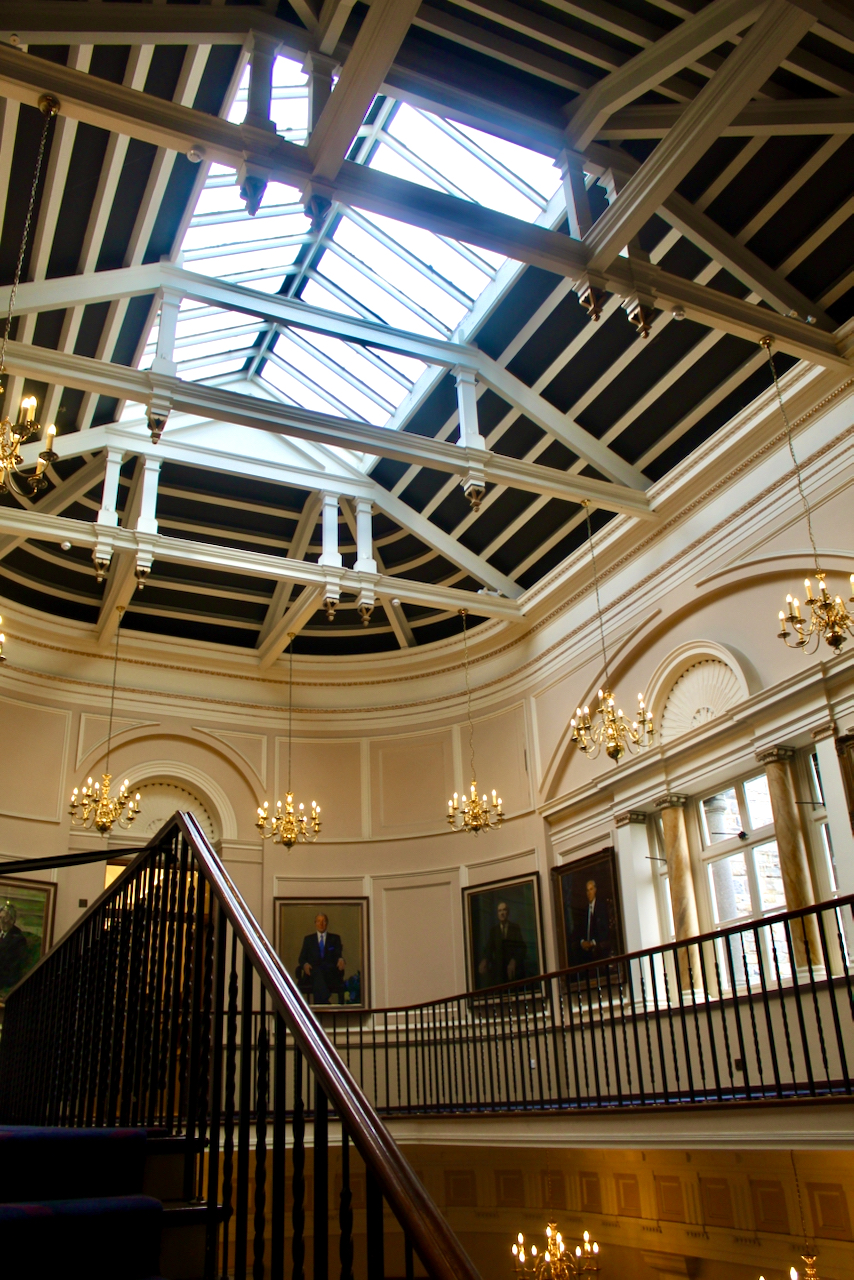
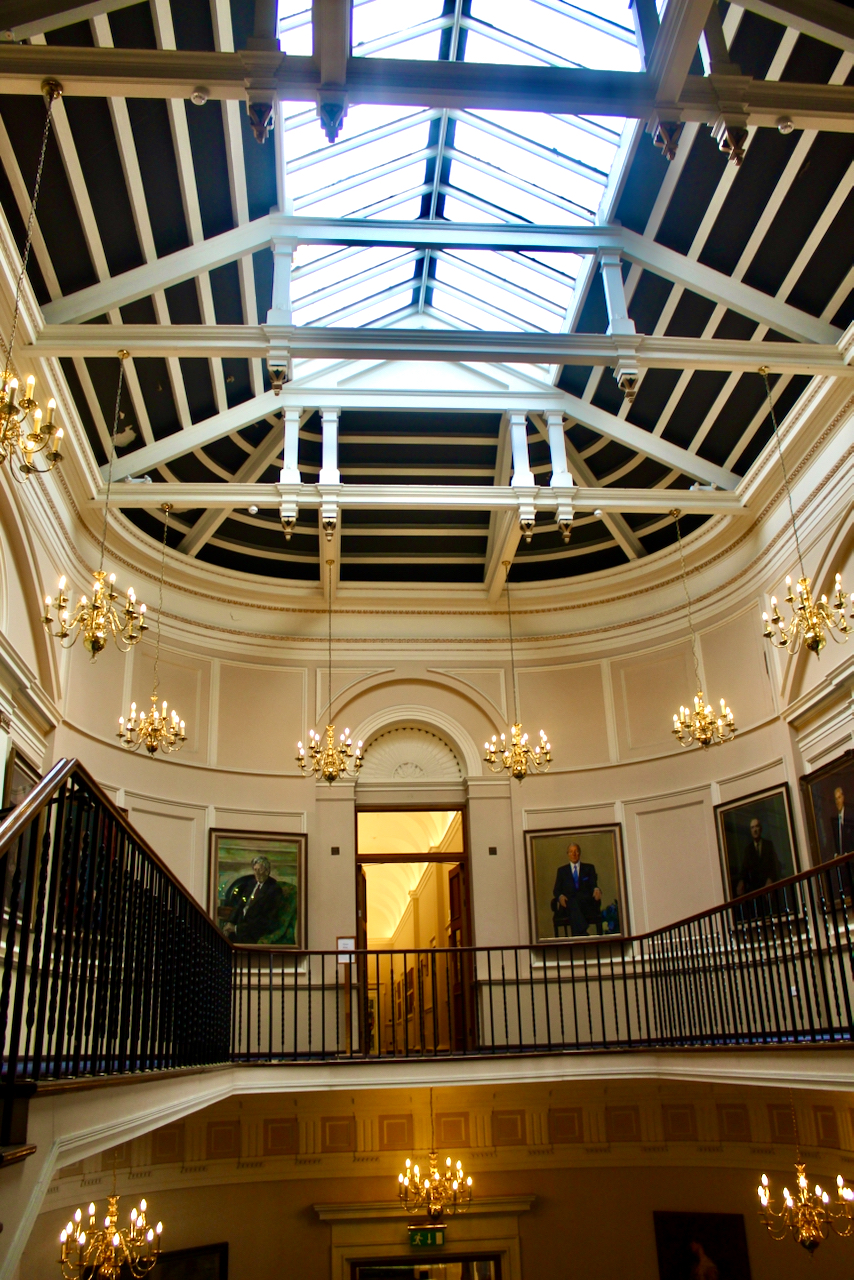
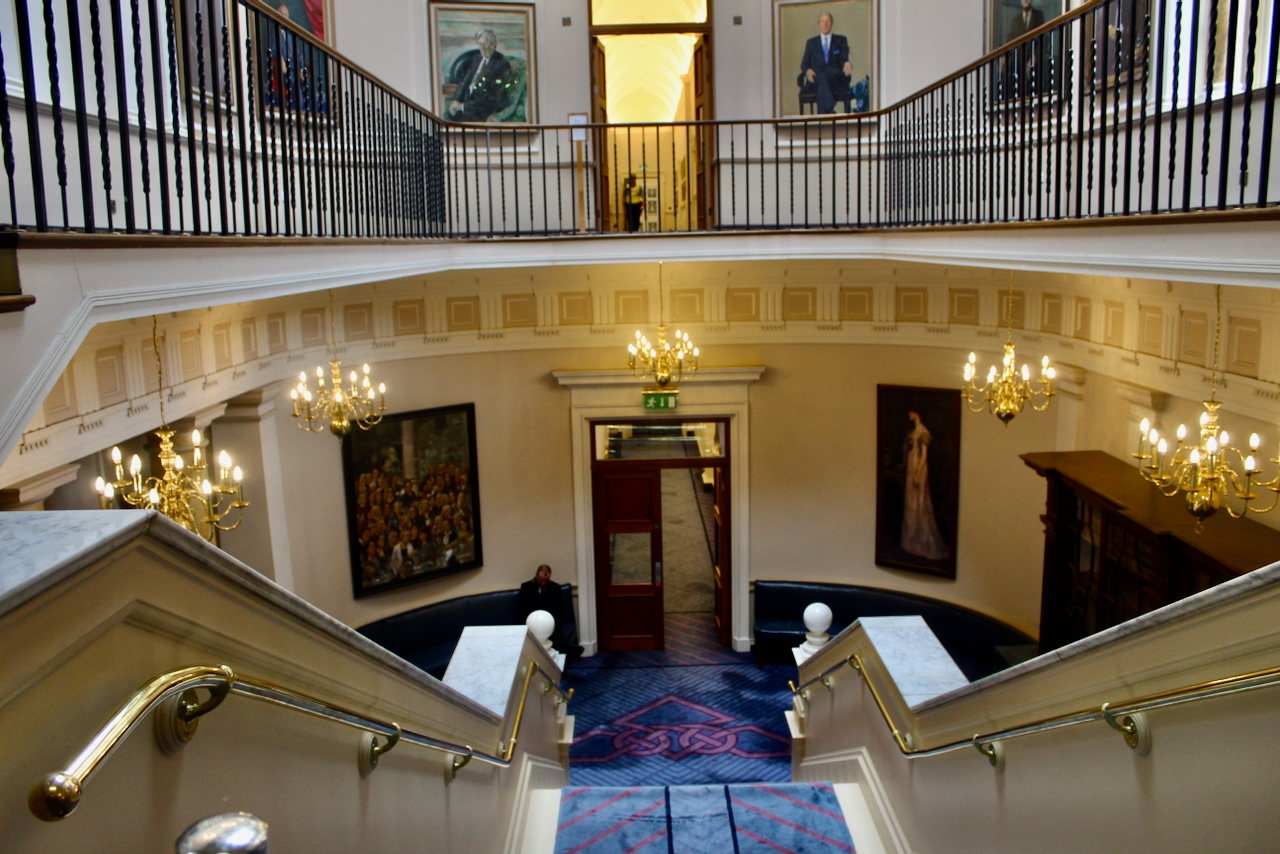
The first duke’s wife Emilia went on to marry her children’s tutor, William Ogilvie. This would have caused quite a scandal, and she and her husband lived quietly in Blackrock in Dublin at their house called Frascati (or Frescati), which no longer exists. She and the Duke of Leinster had had nineteen children! She had happy times when the children were young and their tutor would take them bathing in the sea near Frescati house. She and her second husband went on to have two daughters.
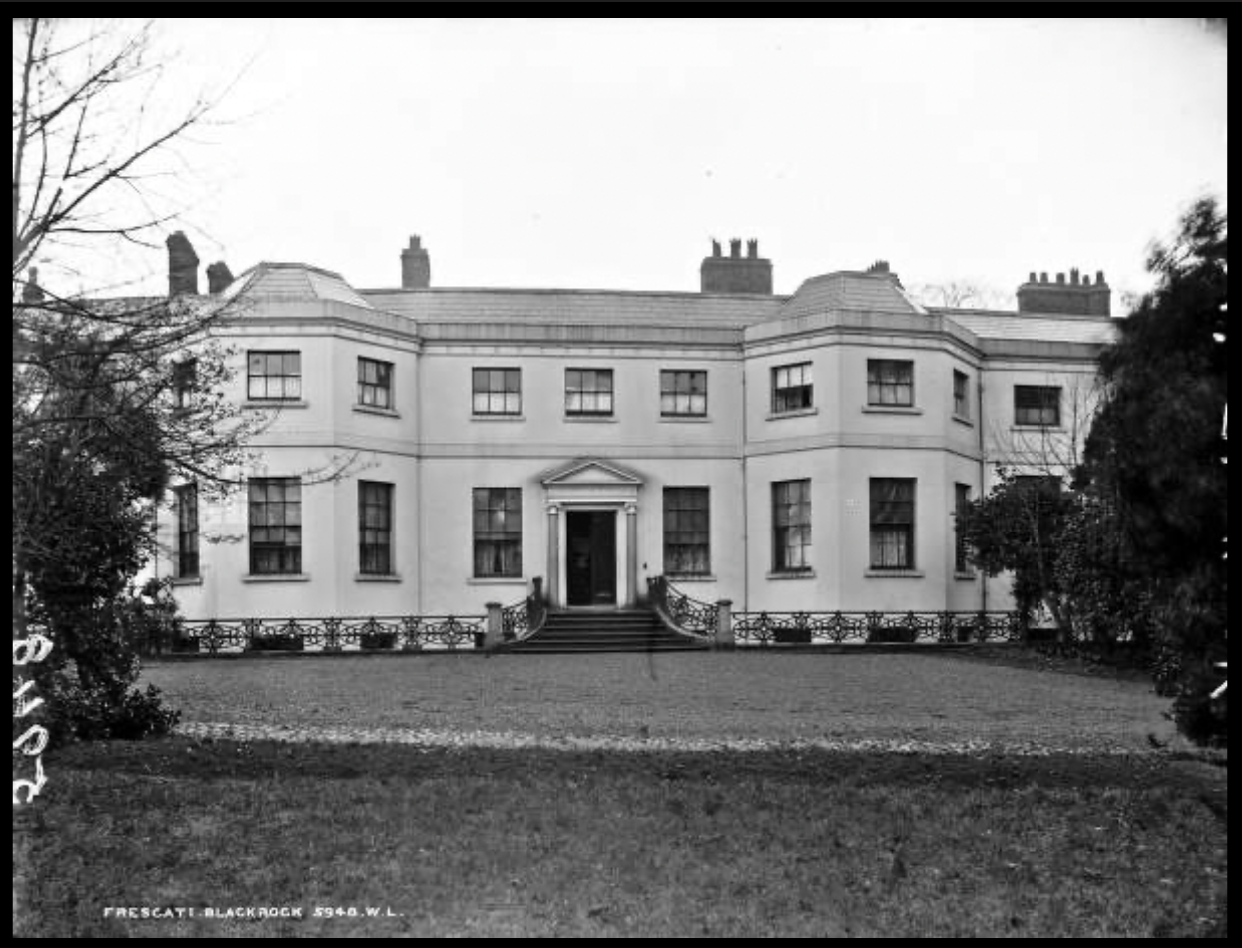
A younger son of Emilia and the Duke of Leinster, Edward (1763-1798) became involved in an uprising in Dublin, inspired by the French Revolution, and he was put in prison as a traitor and where he died of wounds he’d received while resisting arrest.
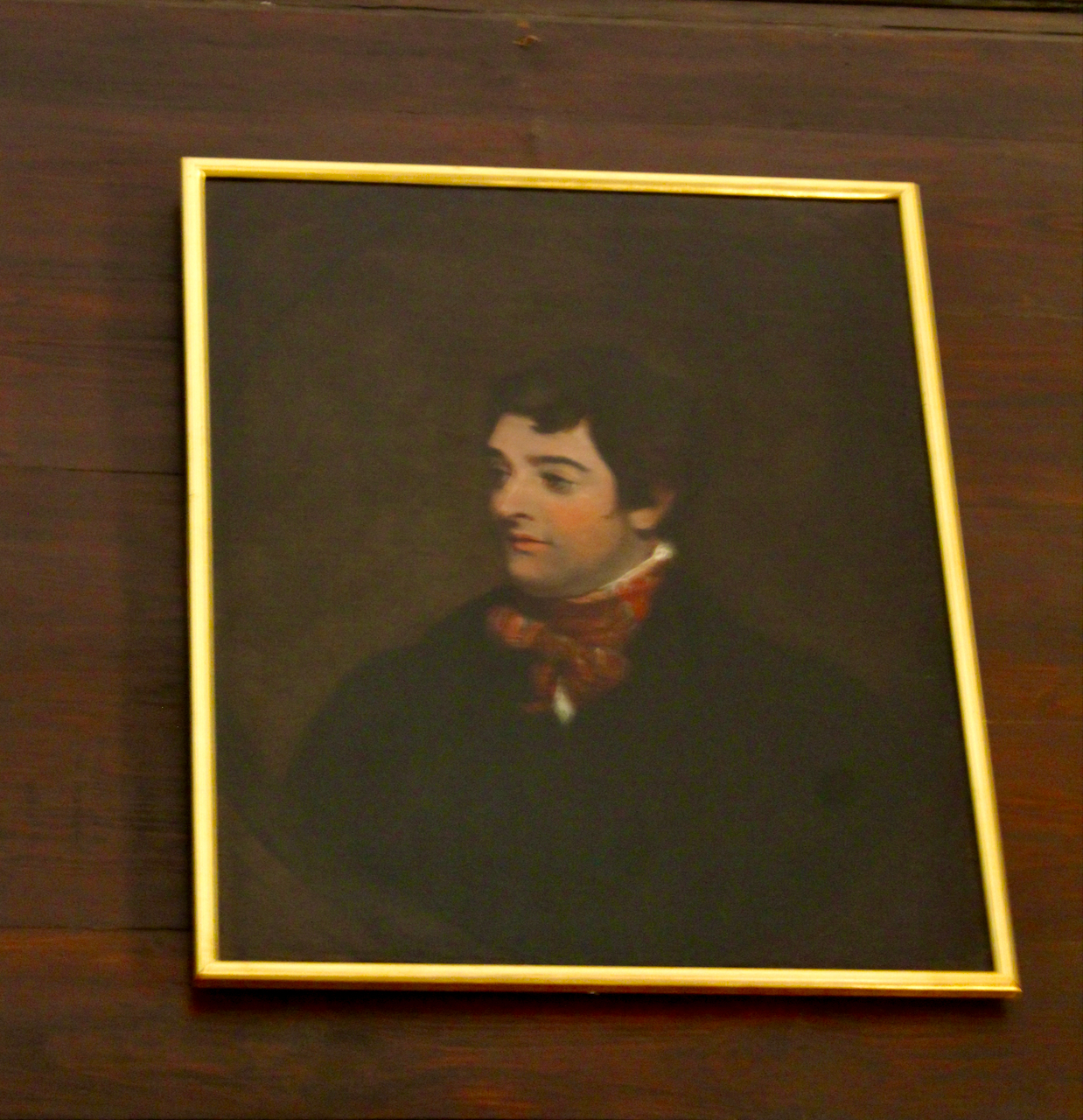
Another son, Charles James (1756-1810) served in the Royal Navy. He also acted as M.P. for County Kildare between 1776 and 1790, Commissioner of Customs between 1789 and 1792 and M.P. for County Cavan between 1790 and 1797. He held the office of Muster Master-General of Ireland between 1792 and 1806 and Sheriff of County Down in 1798. He was M.P. for Ardfert between 1798 and 1800 and was created 1st Baron Lecale of Ardglass, Co. Down [Ireland] in 1800. He held the office of Member of Parliament (M.P.) for Arundel in England between January 1807 and April 1807.
A sister of Edward Fitzgerald (1763-1798), Emily Maria Margaret (1751-1818) married Charles Coote 1st Earl of Bellomont, County Cavan.
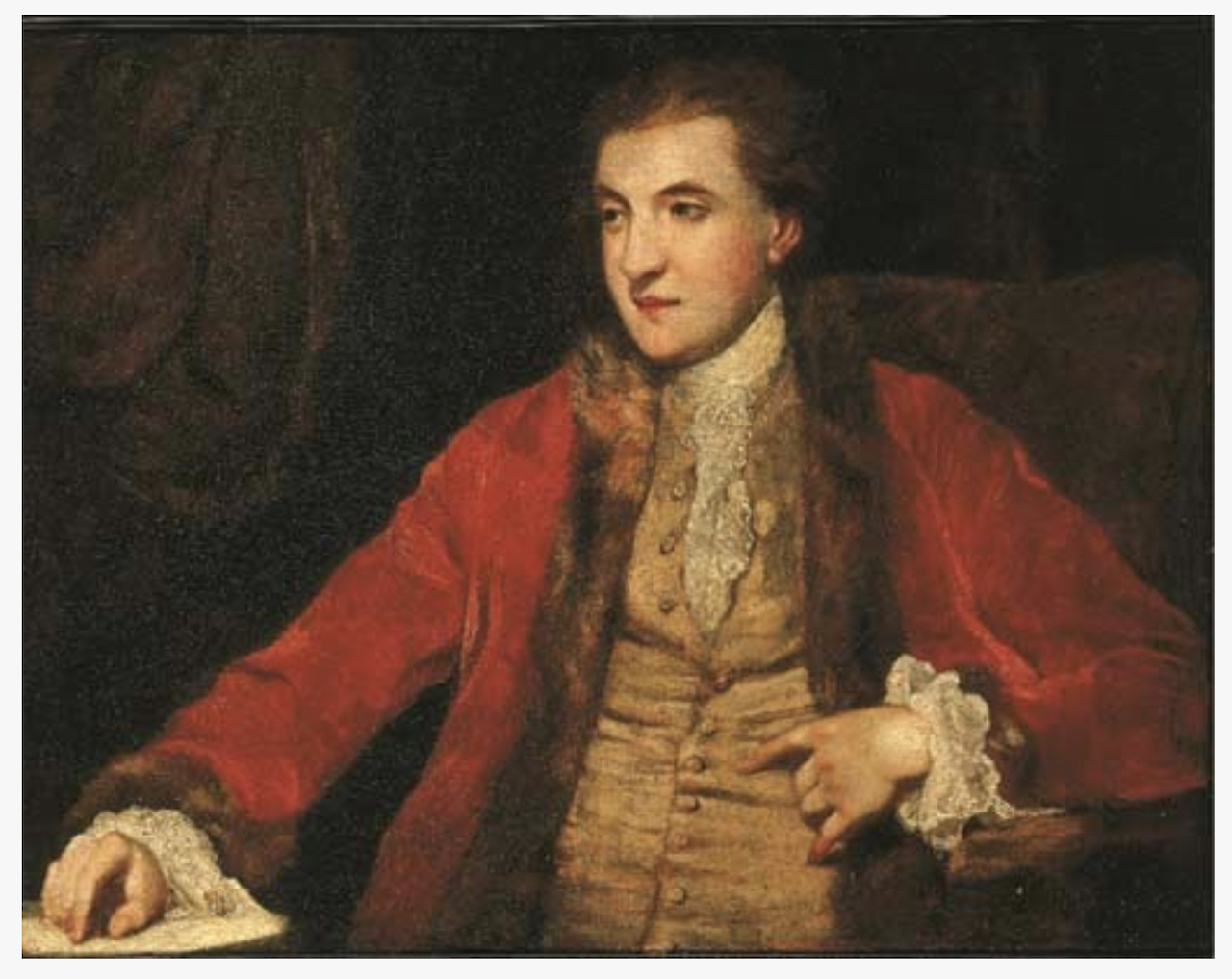
The Dictionary of Irish Biography tells us about the second duke:
“He was returned as MP for Dublin city in 1767, though he was too young to take his seat, and it was only in October 1769 that he returned to Ireland to sit in parliament. He represented the constituency until 1773, supporting the government for most of this period. On learning that he was a freemason, the grand lodge of Irish freemasons rushed to make him their grand master and he served two terms (1770–72 and 1777–8). On 19 November 1773 he succeeded his father as 2nd duke of Leinster. The family home of Carton in Co. Kildare had been left to his mother but he, somewhat vainly, was determined to own it and purchased her life interest, a transaction that was the major source of his future indebtedness. His aunt, Lady Louisa Conolly, believed that he was ‘mighty queer about money’ and that his ‘distress’ about it was ‘the foundation of all that he does’ (HIP, iv, 160). In November 1775 he married Emilia Olivia Usher, only daughter and heir of St George Usher, Lord St George, a union that helped to ease some of his financial problems.“
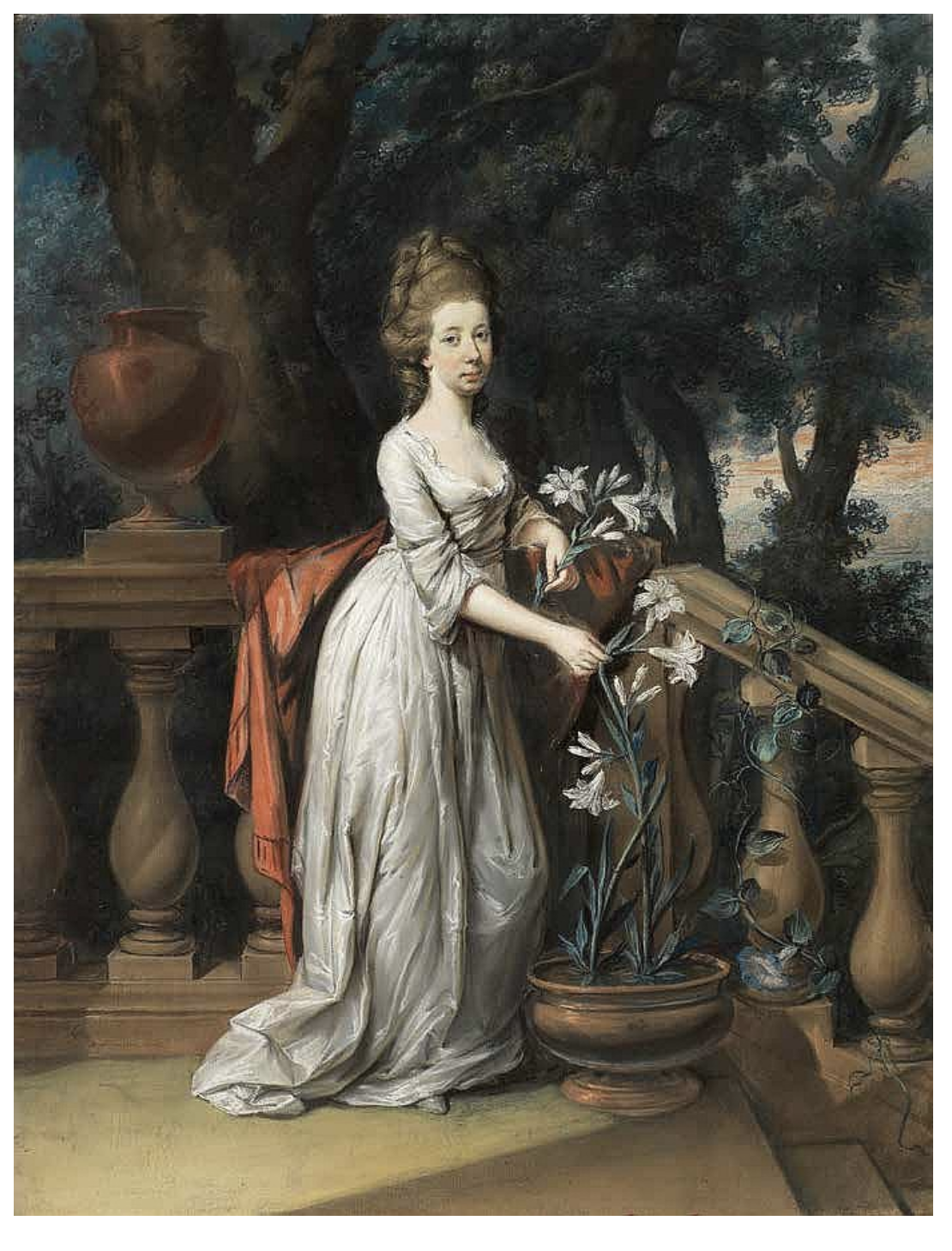
The 2nd Duke was active in politics. He died in 1804 and is buried in Kildare Abbey.
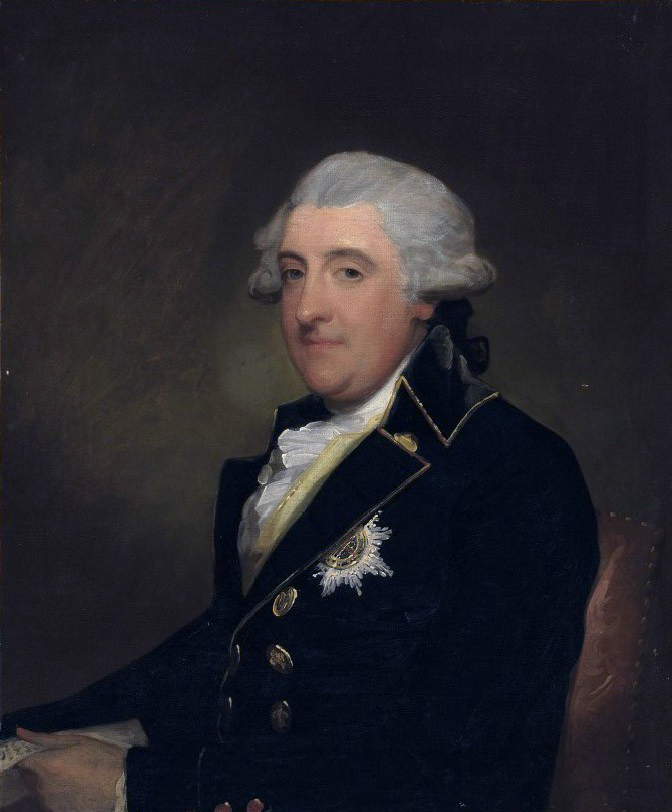
One of William Robert Fitzgerald’s daughters, Emily Elizabeth (1778-1856) married John Joseph Henry of Straffan house in County Kildare, now the K Club. A son, Augustus Frederick (1791-1874) became the 3rd Duke of Leinster. He sold the town house in 1814. Since the Union in 1801 when there was no longer an Irish Parliament, a townhouse in Dublin was no longer essential. It was purchased by the Dublin Society, a group founded for “improving Husbandry, Manufactures and other useful arts and sciences.”
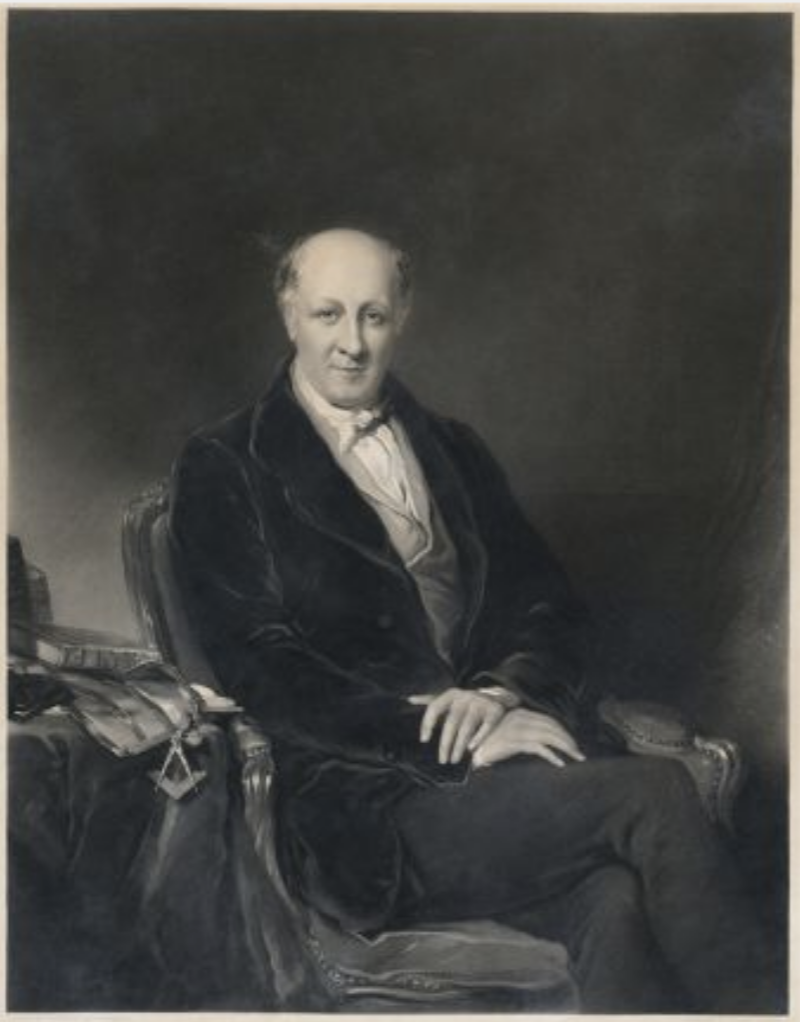
From 1815-1922 Leinster House was the Headquarters of the Royal Dublin Society – the “Royal” was added to the Society’s name in 1820. Rooms in the house were used to accommodate the Society’s library and museum as well as offices and meeting spaces. The original kitchen wing of the house was converted to laboratories and a lecture theatre. Gradually more buildings were added around the house, including sheds and halls for the Society’s events, namely the Spring Show and the Horse Show.


Leinster Lawn was the site of industrial and agricultural exhibitions. In 1853, the Great Industrial Exhibition ran on the RDS grounds at Leinster House, just two years after Prince Albert’s Exhibition in the Crystal Palace in London. Constructed of iron, wood and glass, the Irish Industrial Exhibition building was paid for by William Dargan and installed by Richard Turner on Leinster Lawn in a matter of months. Its architect was John Benson, who was knighted for his efforts.
Spring Shows and Industries Fairs (1831-1880) and early Horse Shows (1864-1881) were also held on Leinster Lawn.

The National Museum and National Library were built in 1890, and were designed by Thomas Newenham Deane and his son Thomas Manly Deane.

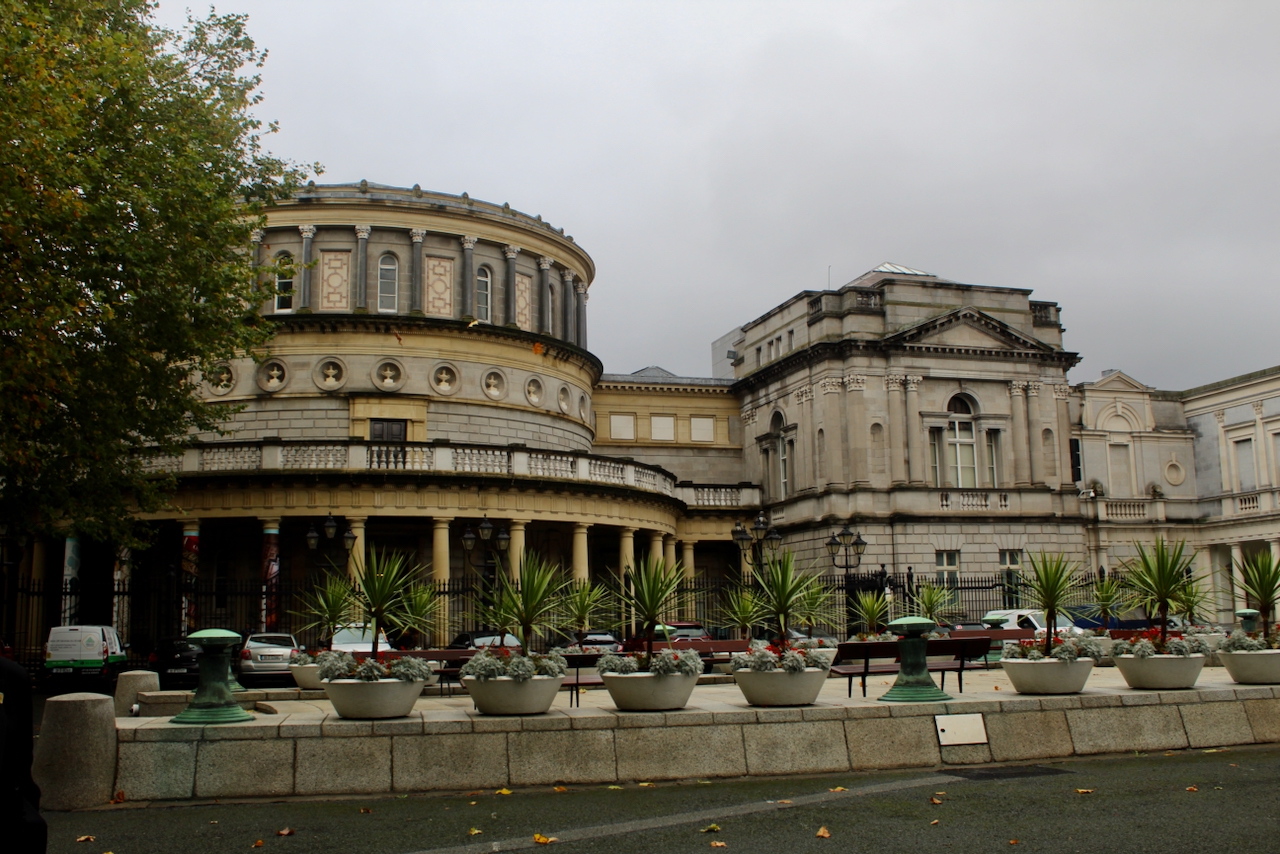
The museum and library were designed as a pair of Early Renaissance rotundas facing each other. The rotundas have a single storey yellow sandstone Roman Doric colonnade surrounding them. Above is a row of circular niches. Above that are columns framing round headed windows and panels of red and white marble. The pavillions next to the rotundas have a rusticated ground floor, with Venetian windows on first floor level and Corinthian pilasters.
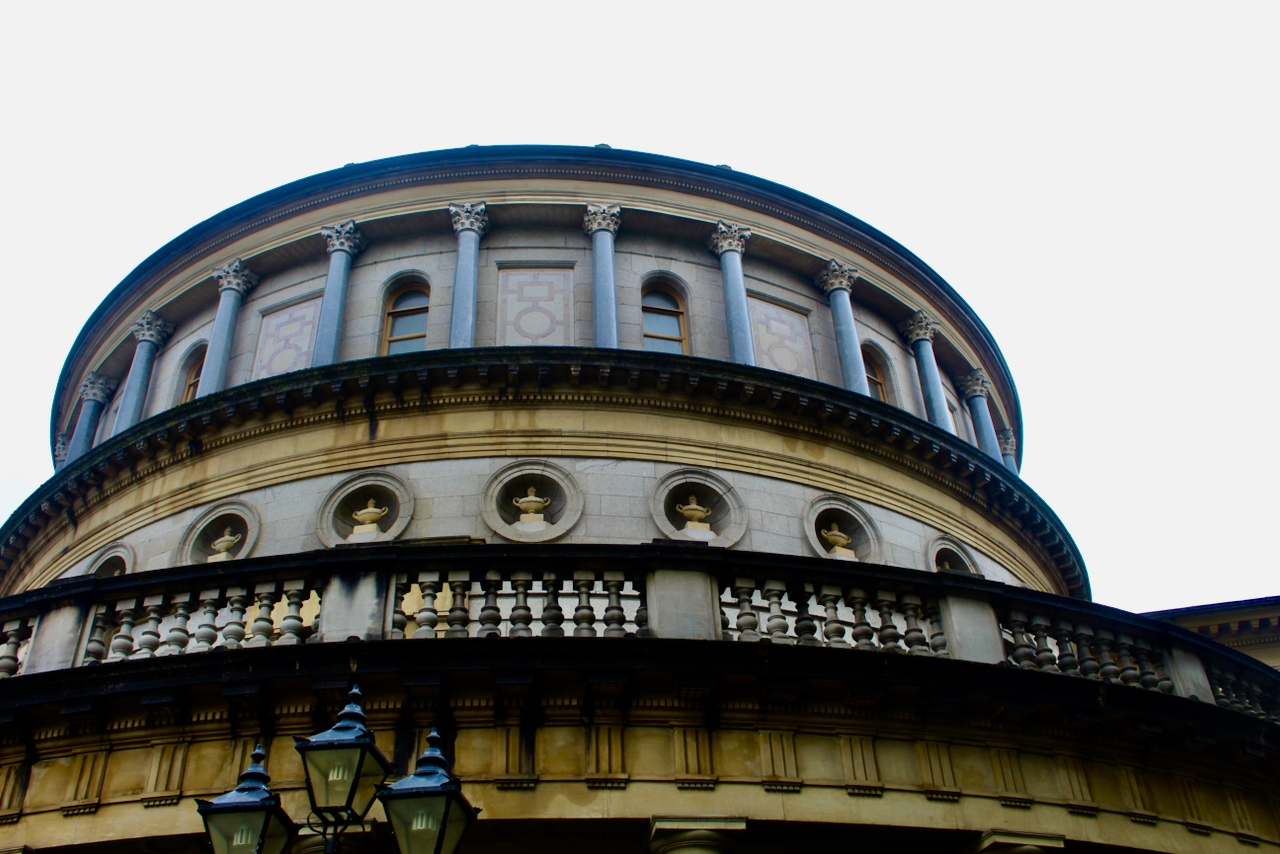
The Lecture Theatre was built in 1893, and was also designed by Thomas Newenham Deane. The lecture theatre is a horseshoe shaped top-lit galleried auditorium with a flat west end that originally accommodated a stage and lecture preparation rooms.

Single and paired cast iron Corinthian columns support the gallery in the former theatre. The building was appropriated as a temporary Dáil chamber in 1922 on Michael Collins’s recommendation, and in 1924 the government acquired Leinster House to be the seat of the Oireachtais. The theatre was remodelled: a new floor was inserted over the central block of seats to make a platform for the Ceann Comhairle, the clerk of the Dail, and the official reporters. The lower tier of seating was replaced with rows of mahogany and leather covered seats designed either by Hugh O’Flynn of the OPW, as the exhibition in the Irish Architectural Archive tells us, or by James Hicks & Sons according to Christine Casey, and the upper tiers became the press and public galleries. The stage was closed in and replaced by a press gallery and adjoining press rooms. The gallery was remodelled around 1930.
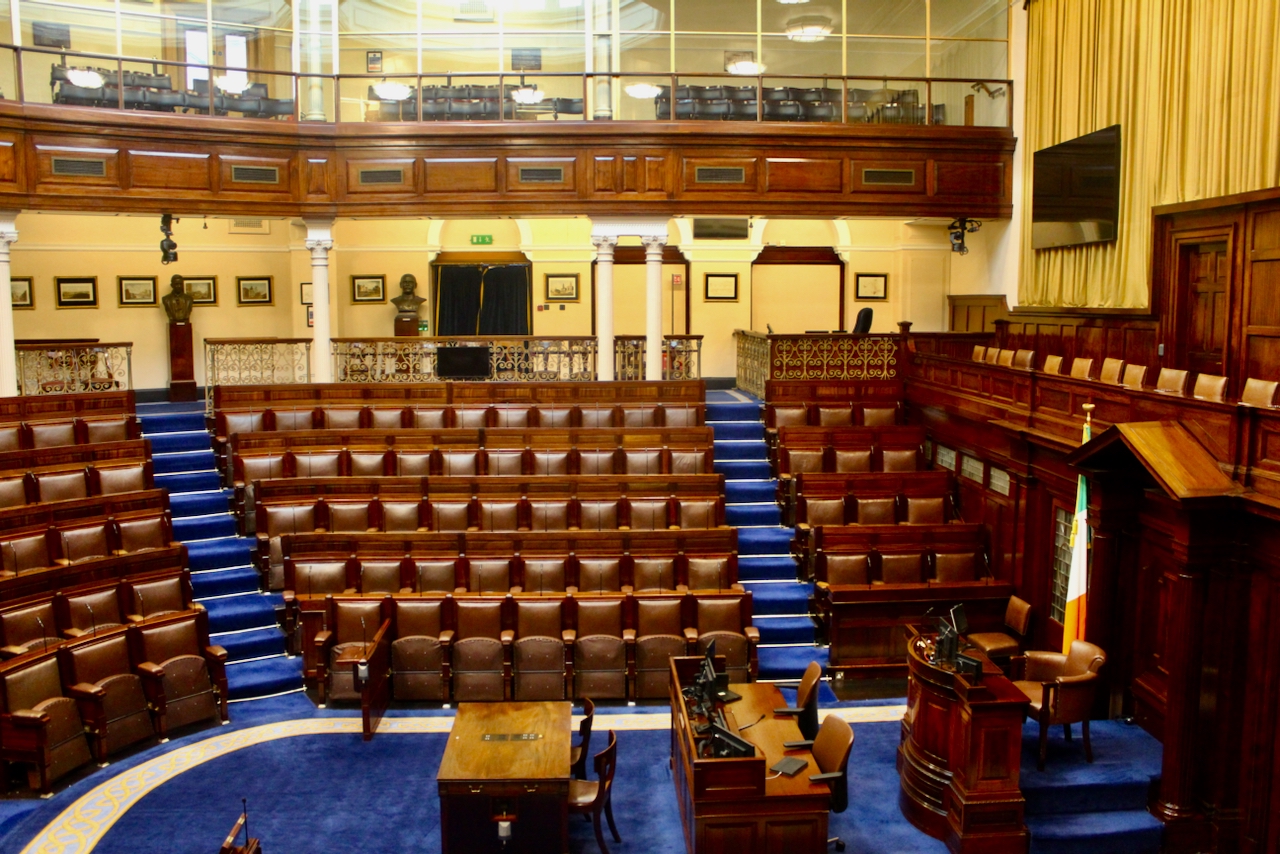
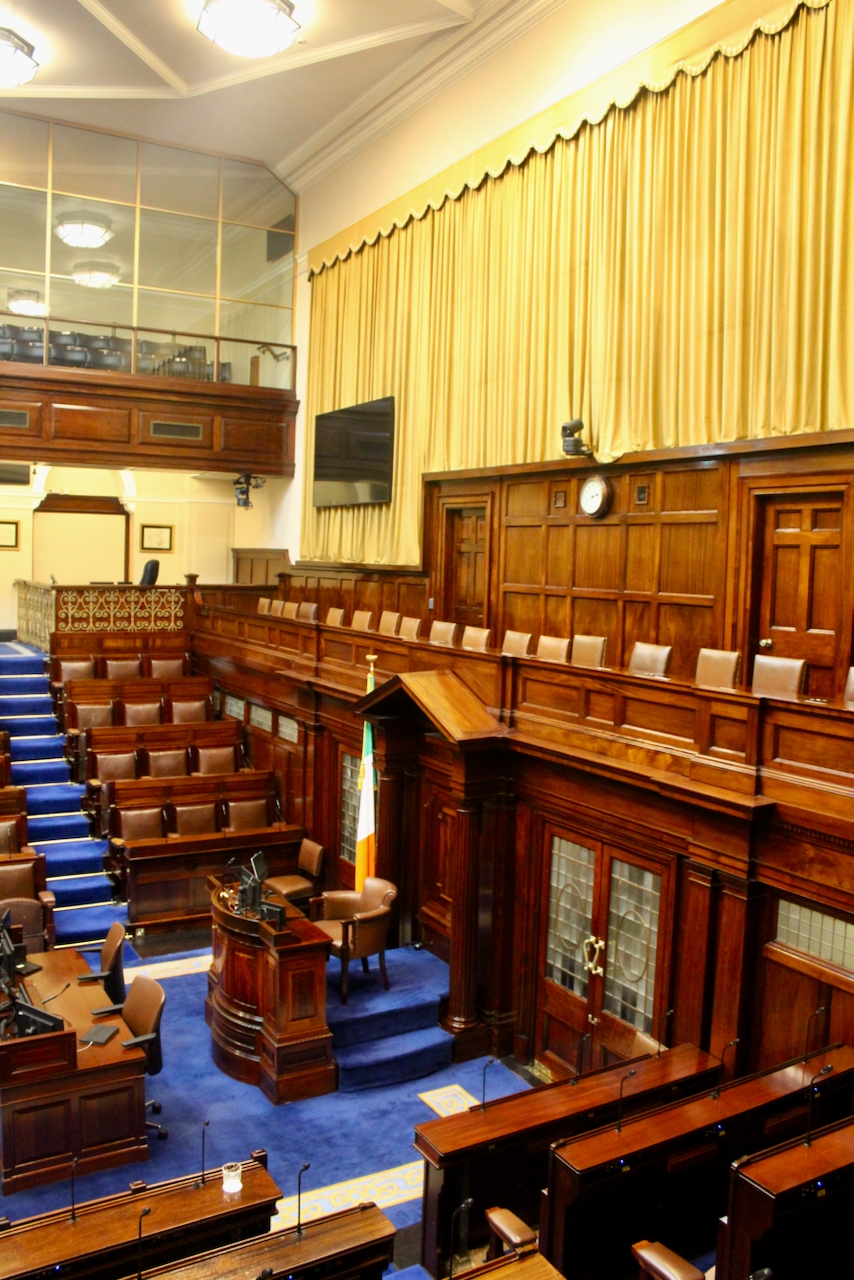
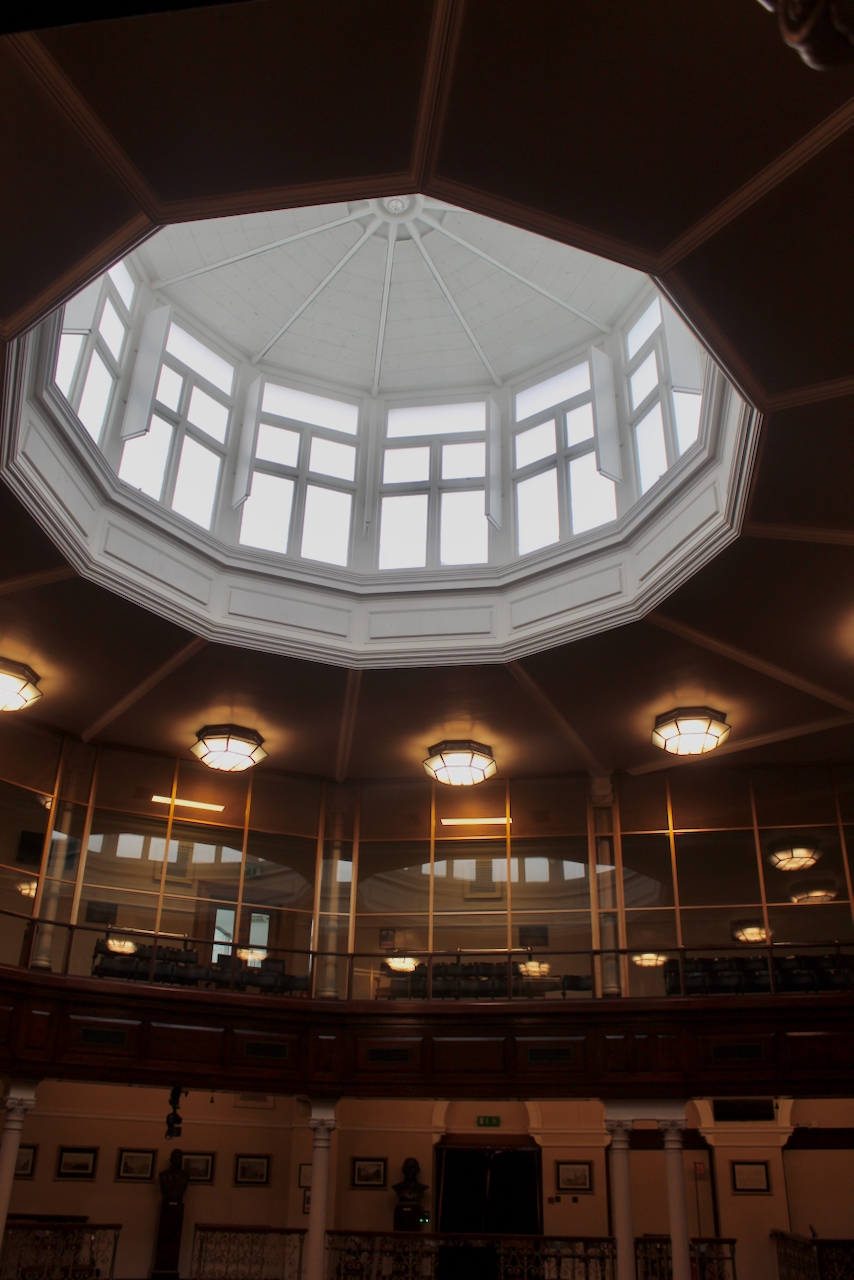
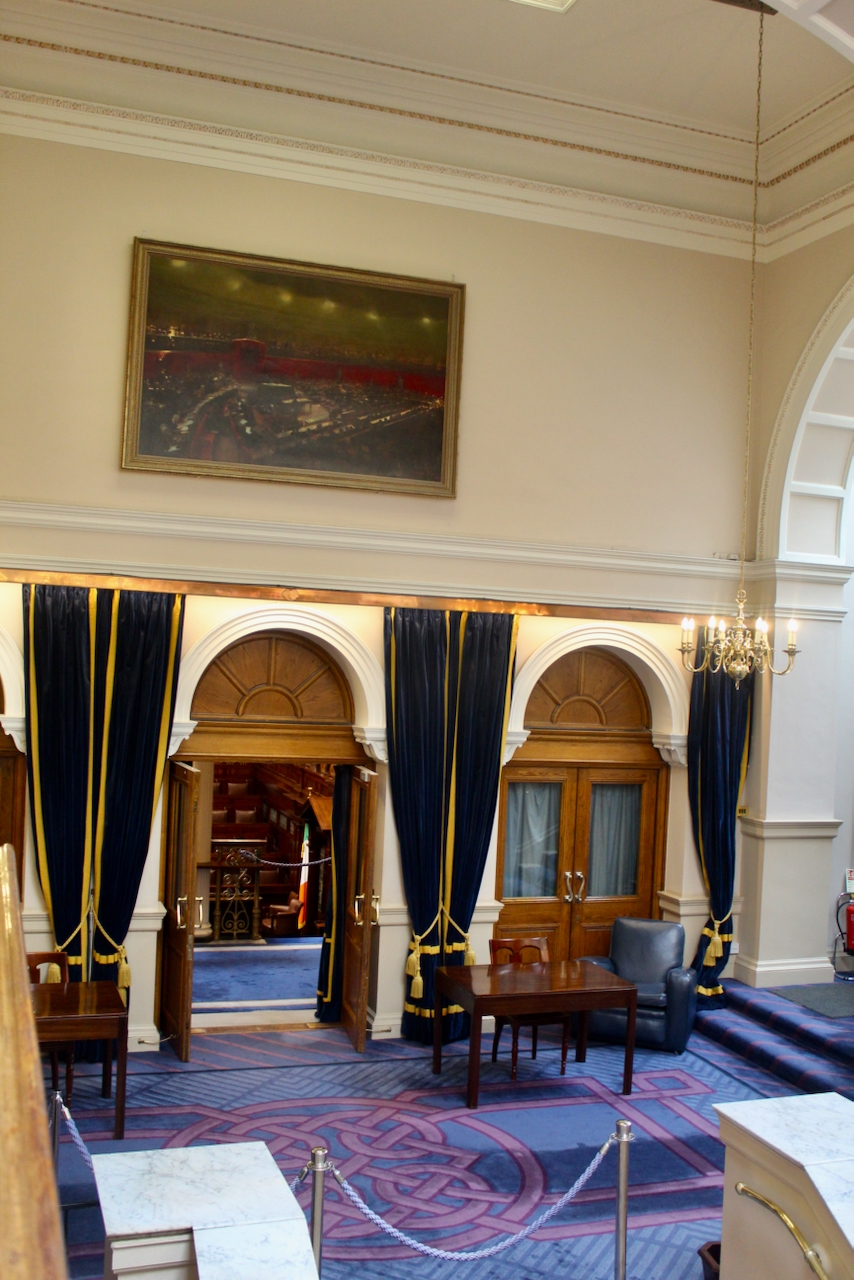


To enter Leinster house, you go through a security hut upon which a controversial sum was spent by the Office of Public Works. I love the way the hut goes around a large tree. I assume a large part of the cost of the hut was the beautiful marble countertops!
[1] MacDonnell, Randal. The Lost Houses of Ireland. A chronicle of great houses and the families who lived in them. Weidenfeld and Nicolson. London, 2002.
[2] Casey, Christine. The Buildings of Ireland: Dublin. The City within the Grand and Royal Canals and the Circular Road with the Phoenix Park. Yale University Press, New Haven and London, 2005.
[3] Dictionary of Irish Biography, https://www.dib.ie/biography/fitzgerald-james-a3157
Temple House, Ballymote, County Sligo – section 482 group accommodation and wedding venue
Tourist Accommodation Facility – not open to the public
Open for accommodation in 2026: Apr 1 – Nov 15
donation
Help me to pay the entrance fee to one of the houses on this website. This site is created purely out of love for the subject and I receive no payment so any donation is appreciated!
€15.00
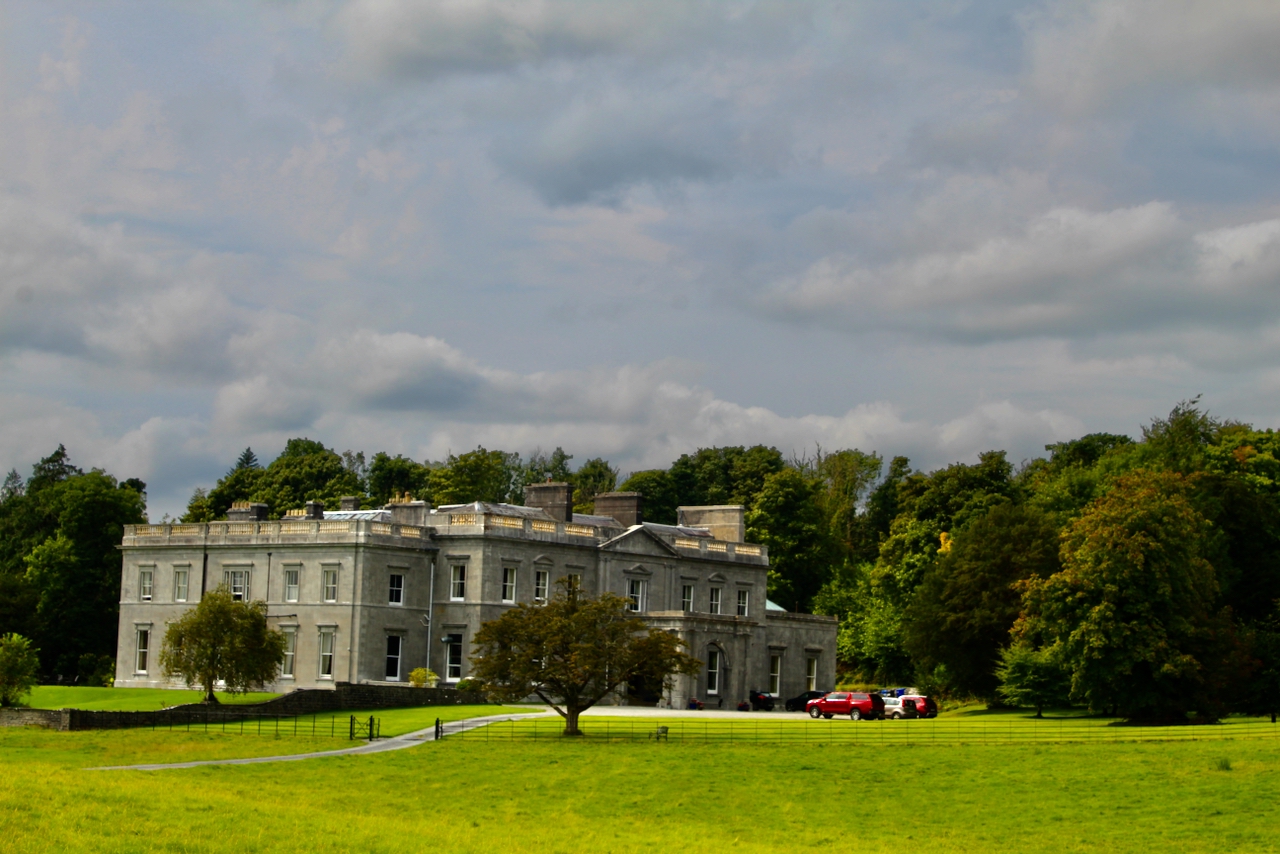
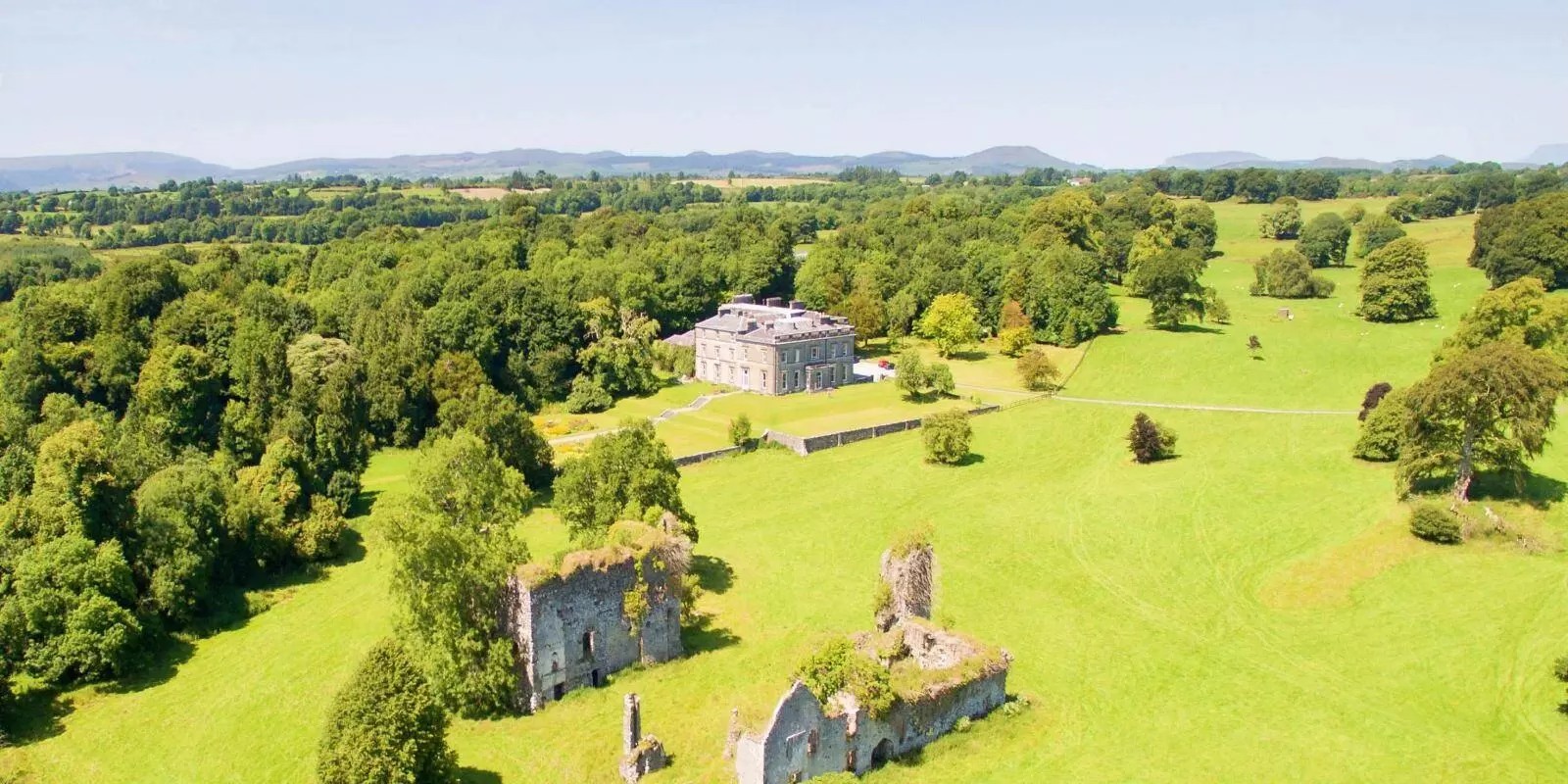
When I saw that Roderick Perceval was giving a tour of his home, Temple House in County Sligo, during Heritage Week 2025, I jumped at the chance to see it and booked straight away. I had booked to stay there in the past but had to cancel, and before this tour, the only way to see this section 482 property was to stay, as it was listed as tourist accommodation. And before you get your hopes up, unfortunately it no longer is providing individual bed and breakfast (with dinner optional) accommodation, as Roderick and his family have decided to focus instead on larger group accommodation and weddings. The website now gives the option to book three or more double rooms for your stay. There is also a self-catering cottage available, which has 4 bedrooms: 1 King, 1 Double, 2 Twin.
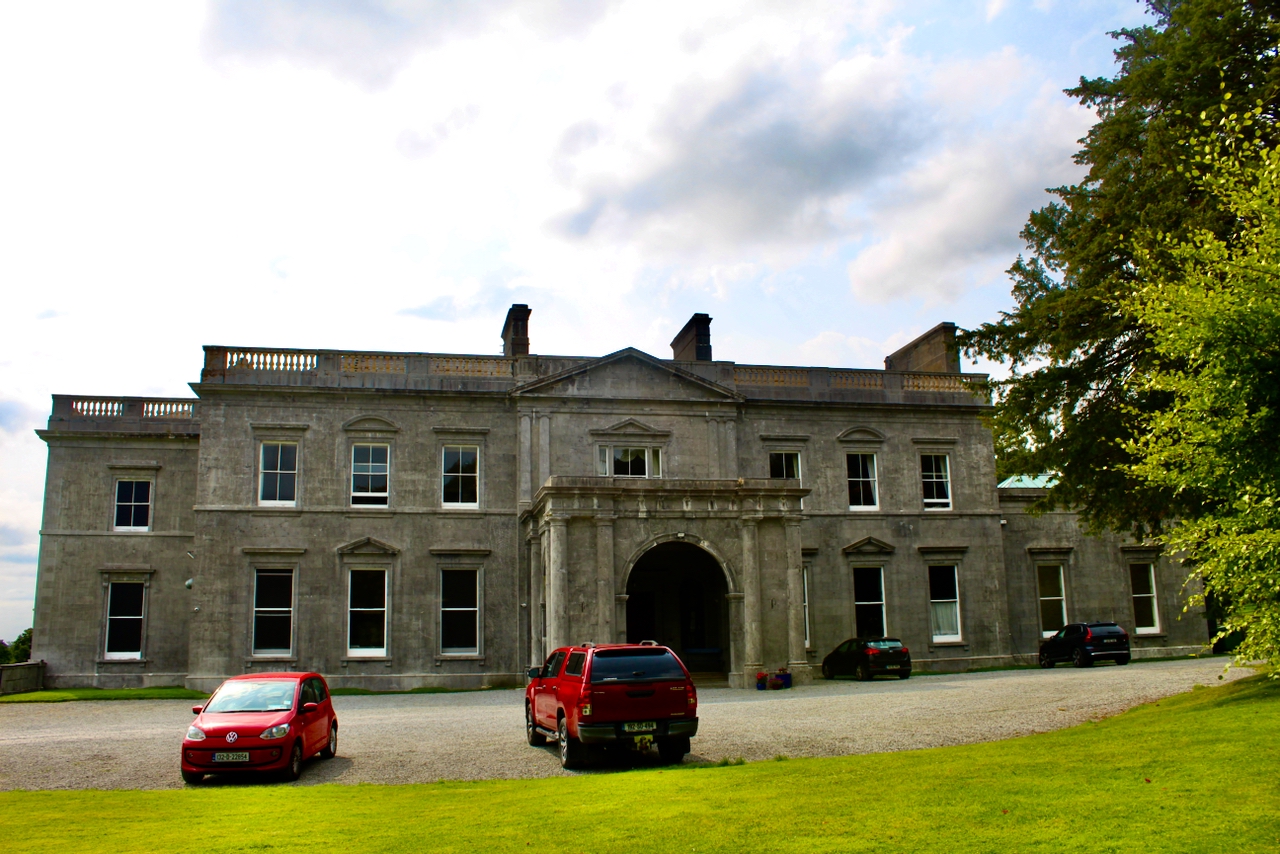
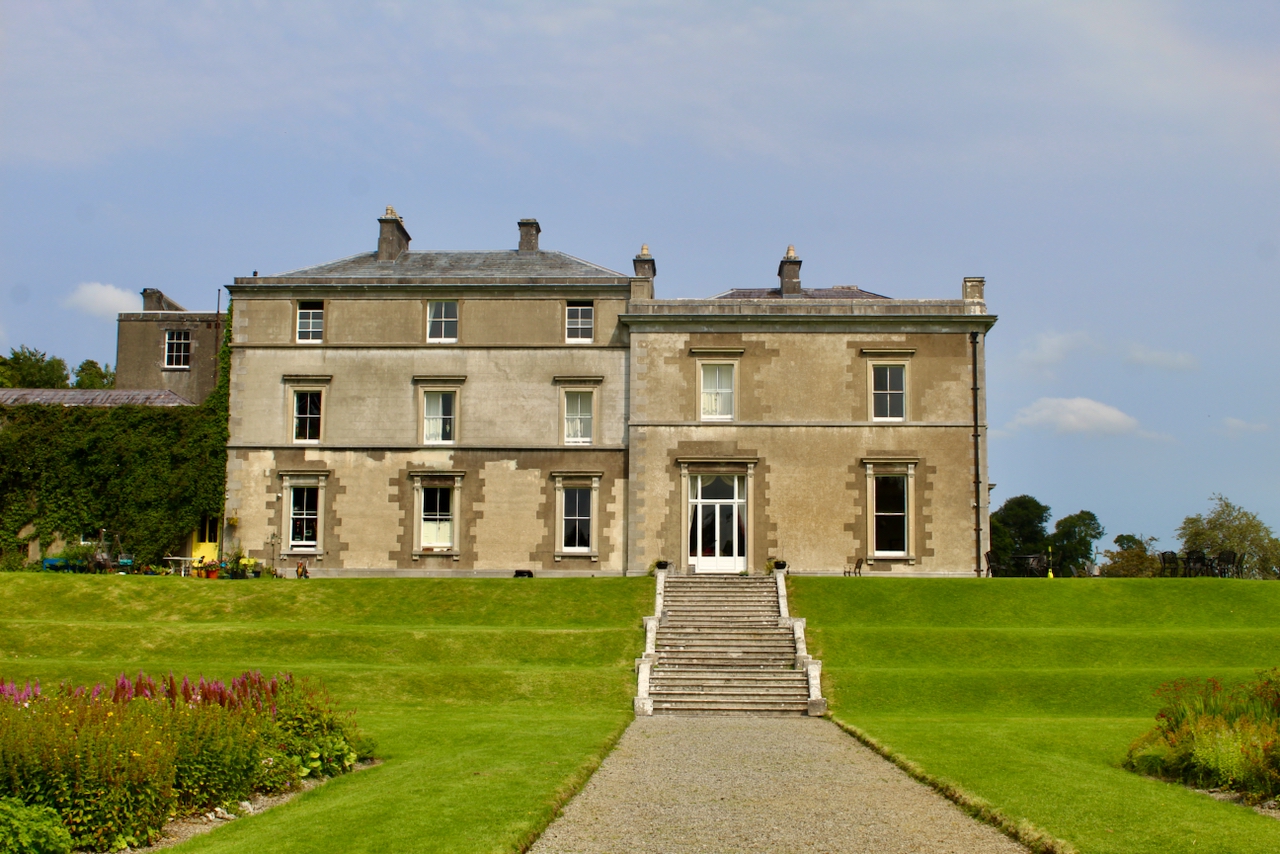
The Percevals have lived at this location since 1665. Before the current house was built, around 1820 according to Mark Bence-Jones, they lived in another property closer to Templehouse Lake, part of the Owenmore River. [1] The remnants of the earlier house sit adjacent to the ruins of a Knights Templar castle from around 1181, after which the property takes its name. [2]
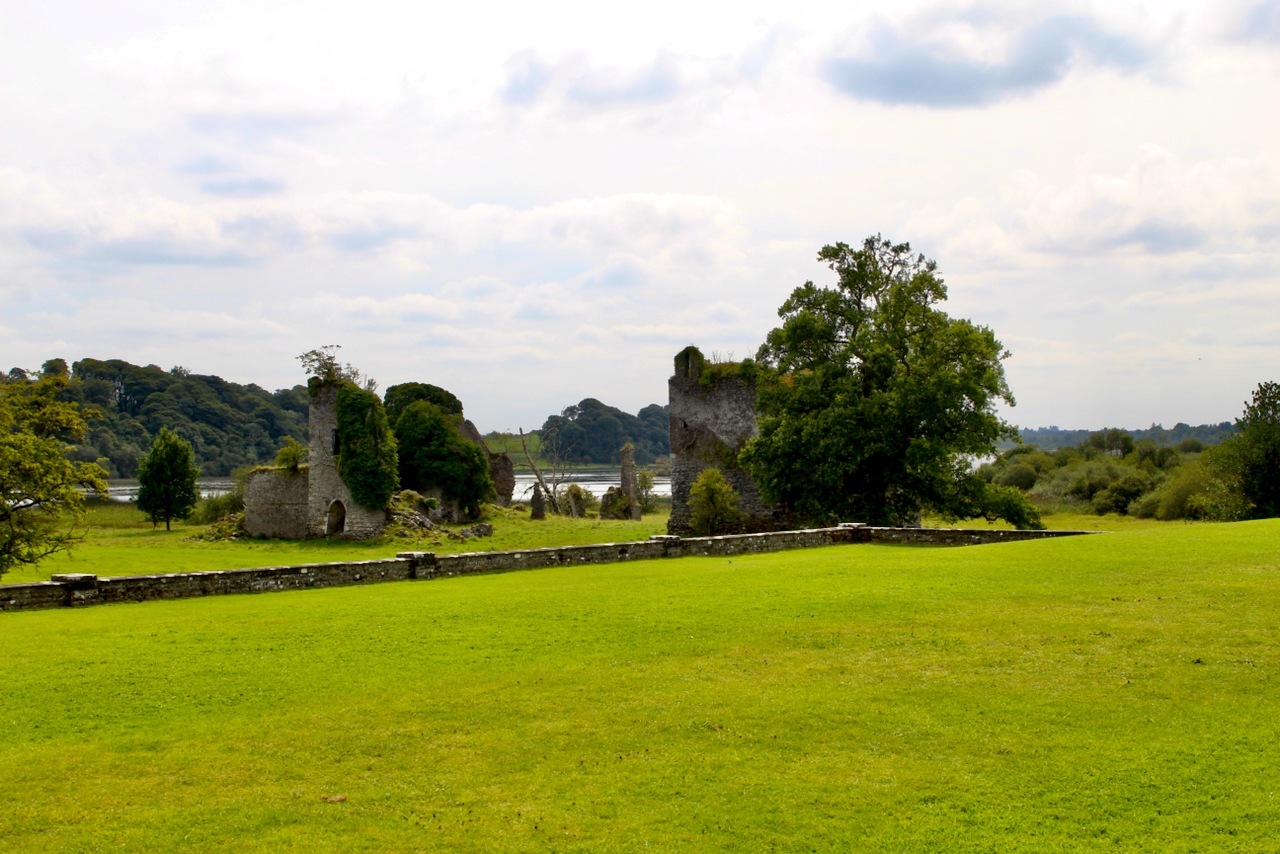
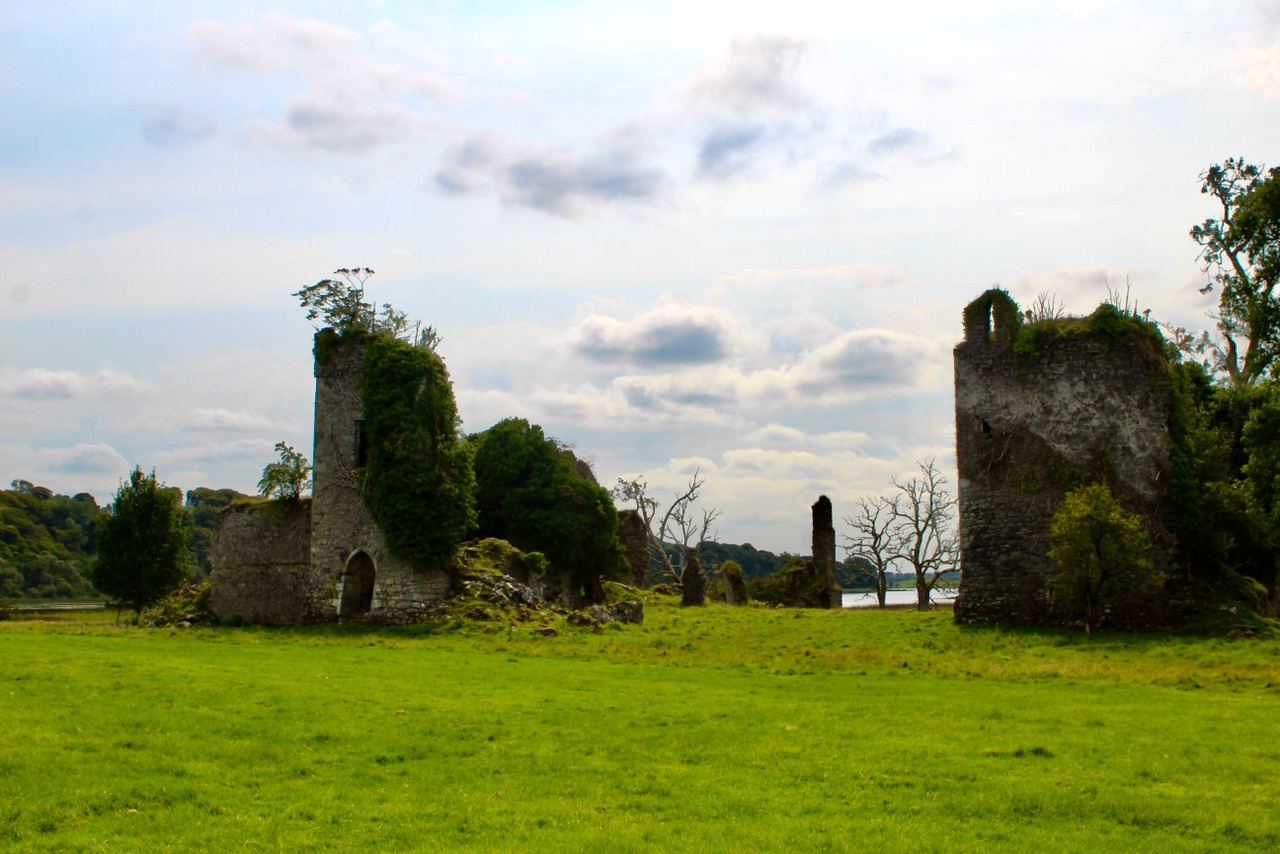
We came across the medieval order of knights when we visited The Turret in County Limerick during Heritage Week in 2022, a house which was built on the foundations of a construction by the Knights Hospitaller, a different branch of religious warriors. The Knights Templar were a religious order established in the eleventh century to protect Jerusalem for Christianity, and were named after Solomon’s Temple in Jerusalem. Like other religious orders, the members took vows of poverty, chastity and obedience.
A book review by Peter Harbison of Soldiers of Christ: the Knights Templar and the Knights Hospitaller in medieval Ireland edited by Martin Brown OSB and Colmán Ó Clabaigh OSB tells us that Templars came into Ireland under the protection of the English crown and acted on behalf of the king against the native Irish. Templar Knights helped govern Ireland and often gained high office. [3]
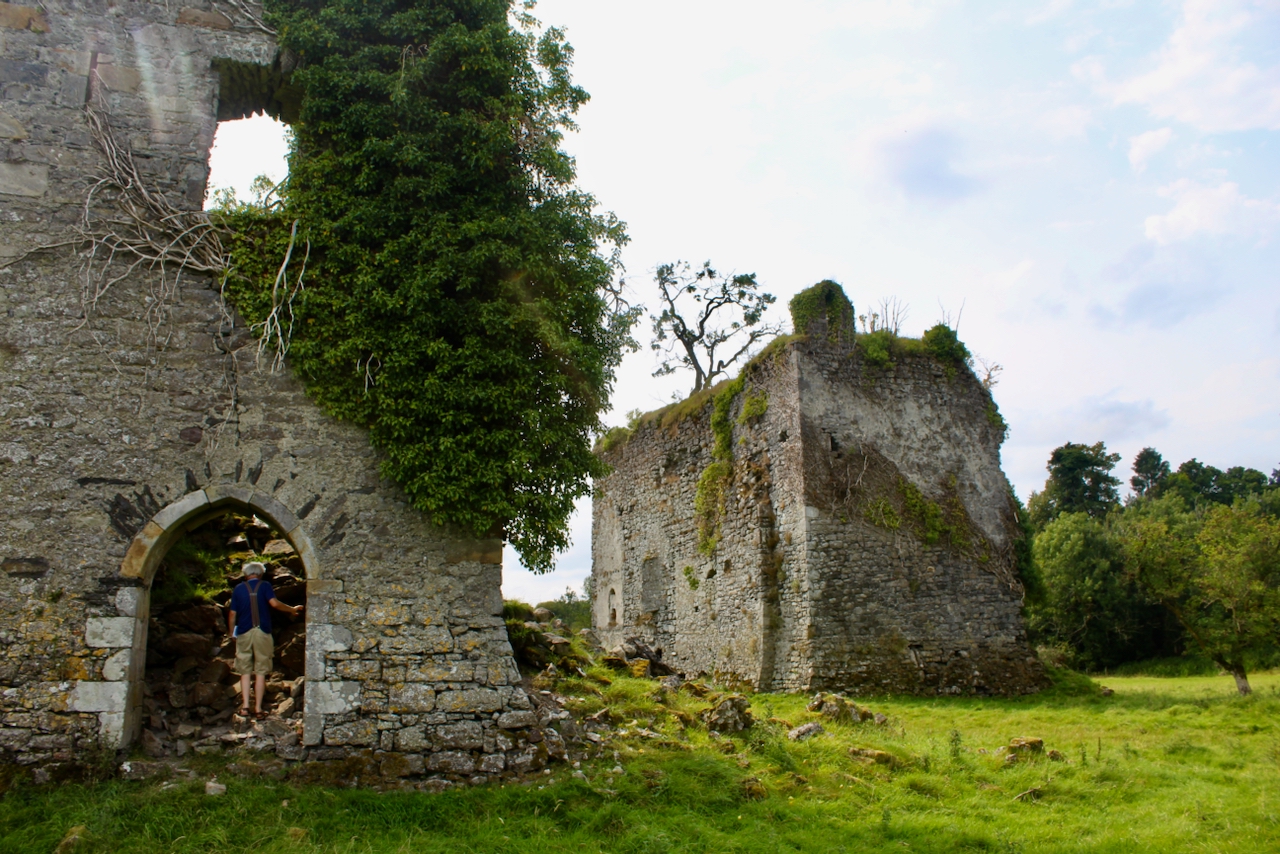
When Stephen and I stayed at nearby Annaghmore house with Durcan O’Hara, he told me that he is related to the Percevals of Temple House. An O’Hara, it is believed, may have joined the Knights Templar and donated the land near Temple House. [see 2]
The Templar castle passed to the Knights of St. John the Hospitallers when the Knights Templar were disbanded in the 1300s. In France, Templars were burnt at the stake and their land seized by the crown but in other countries their property was transferred to the Knights Hospitallers, known today as the Knights of Malta.
Robert O’Byrne tells us in his blog that the land formerly owned by the Knights Templar came into the hands of the O’Haras, and that they built a new castle here around 1360. He adds that in the 16th century the same lands, along with much more beside, were acquired by John Crofton, who had come here in 1565 with Sir Henry Sidney following the latter’s appointment as Lord Deputy of Ireland. [4]
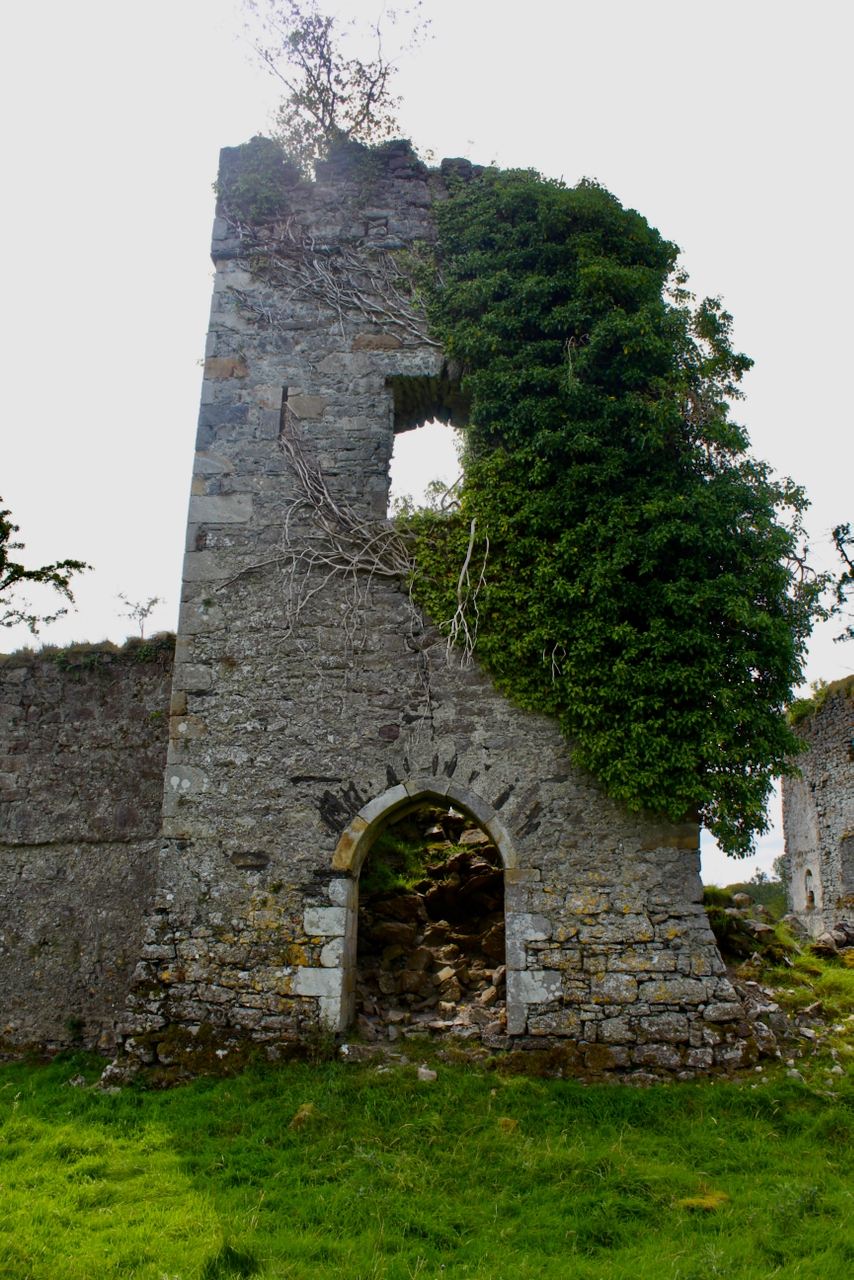
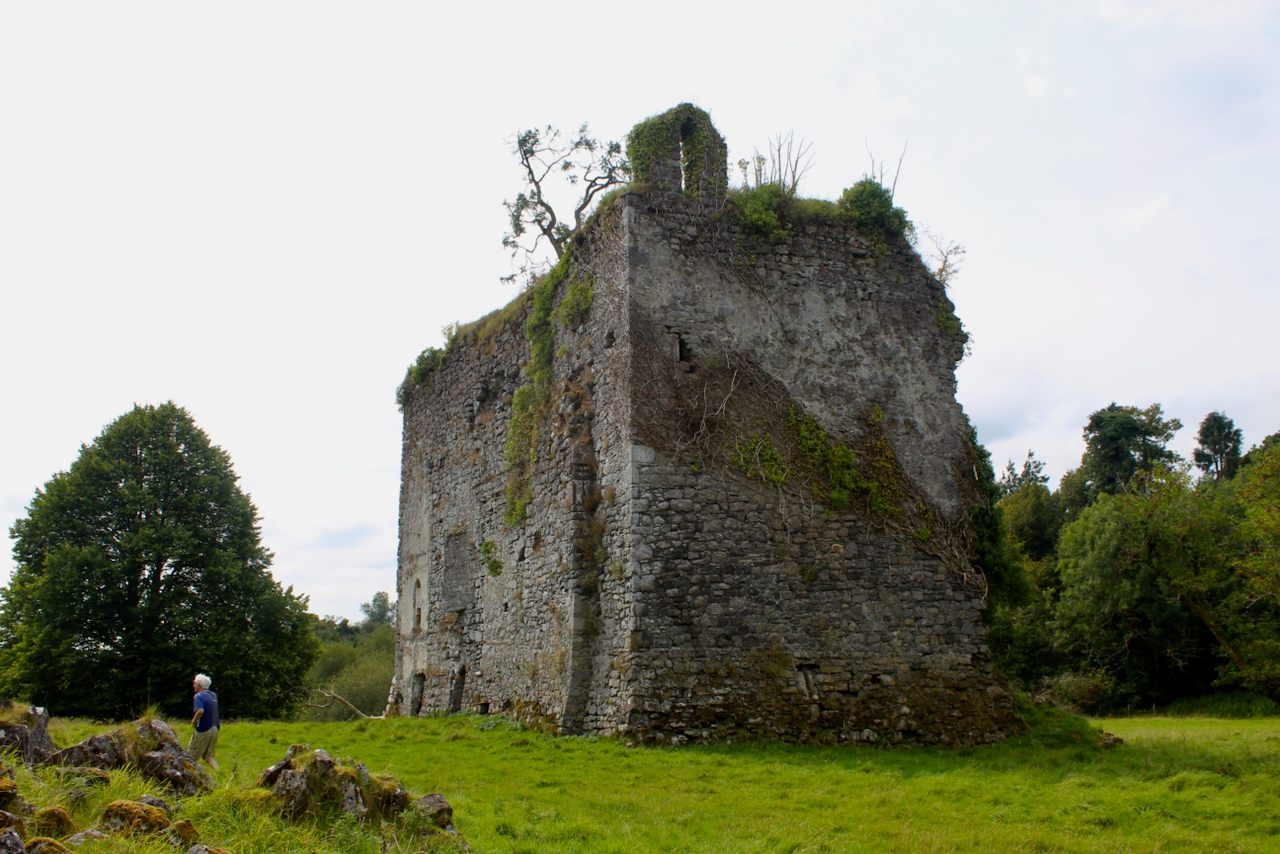
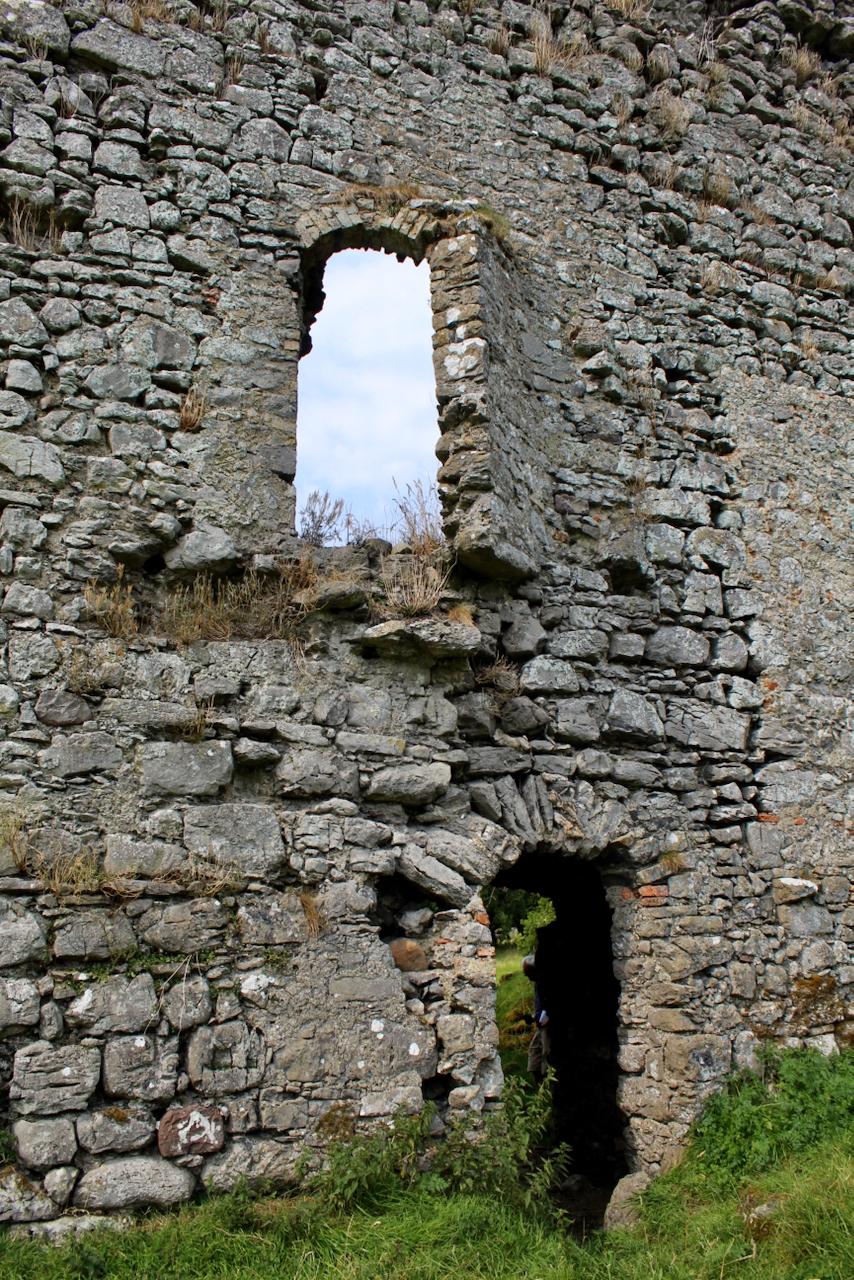
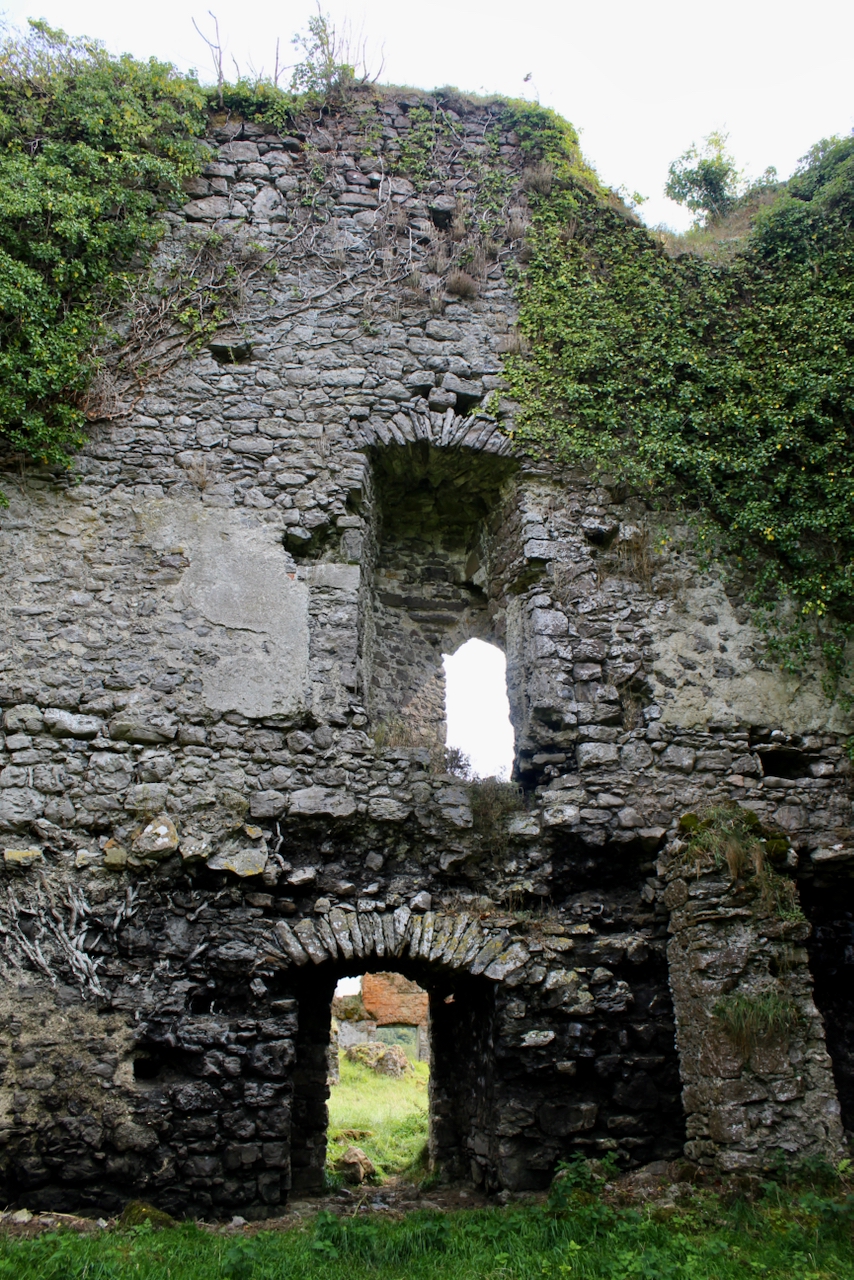
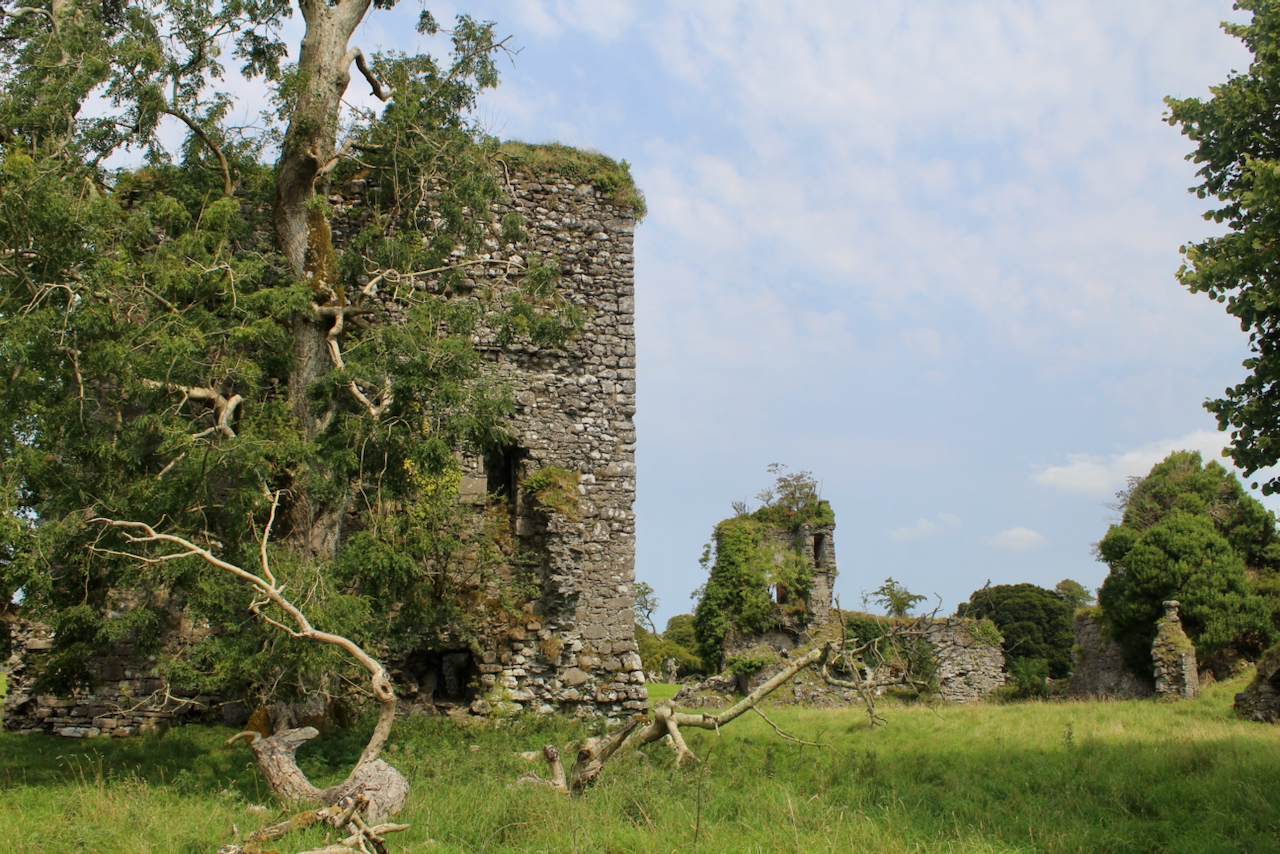
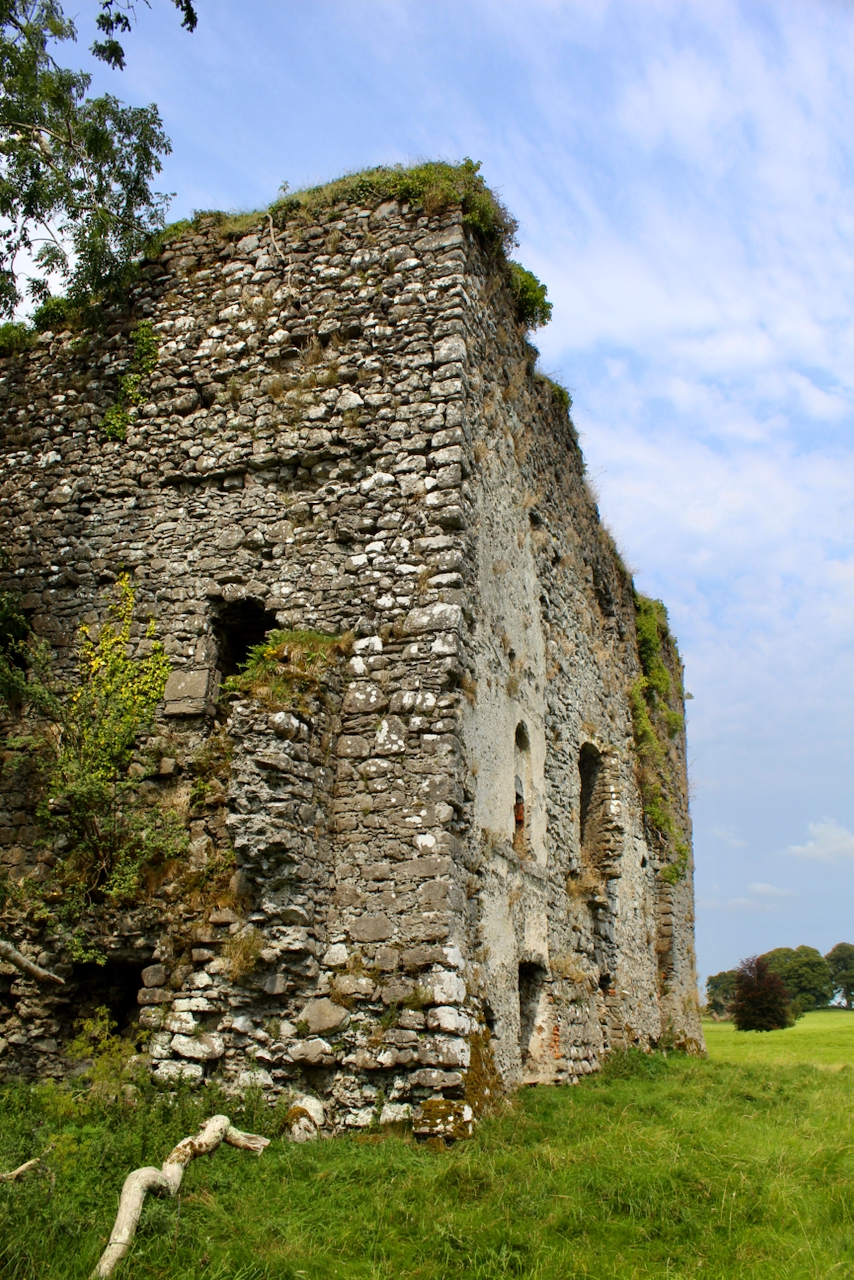
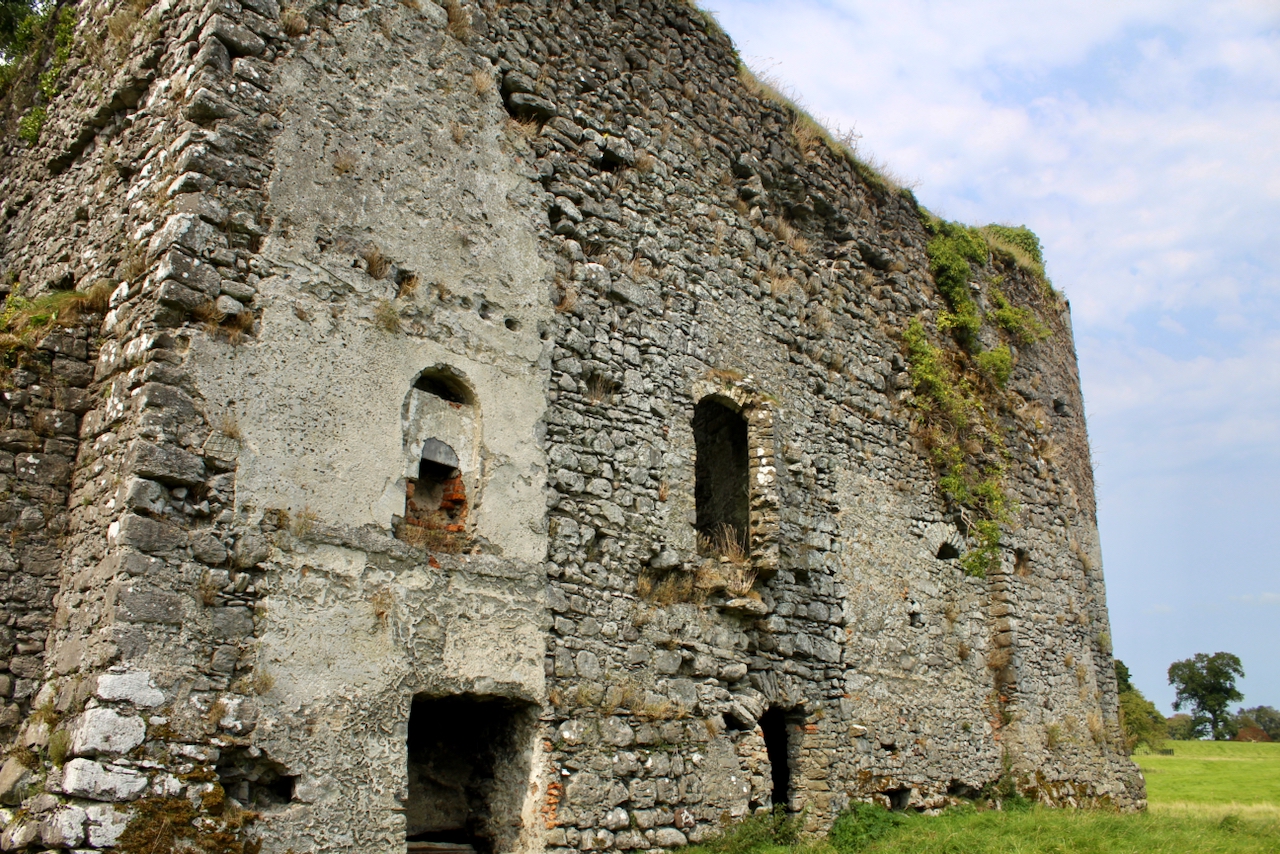
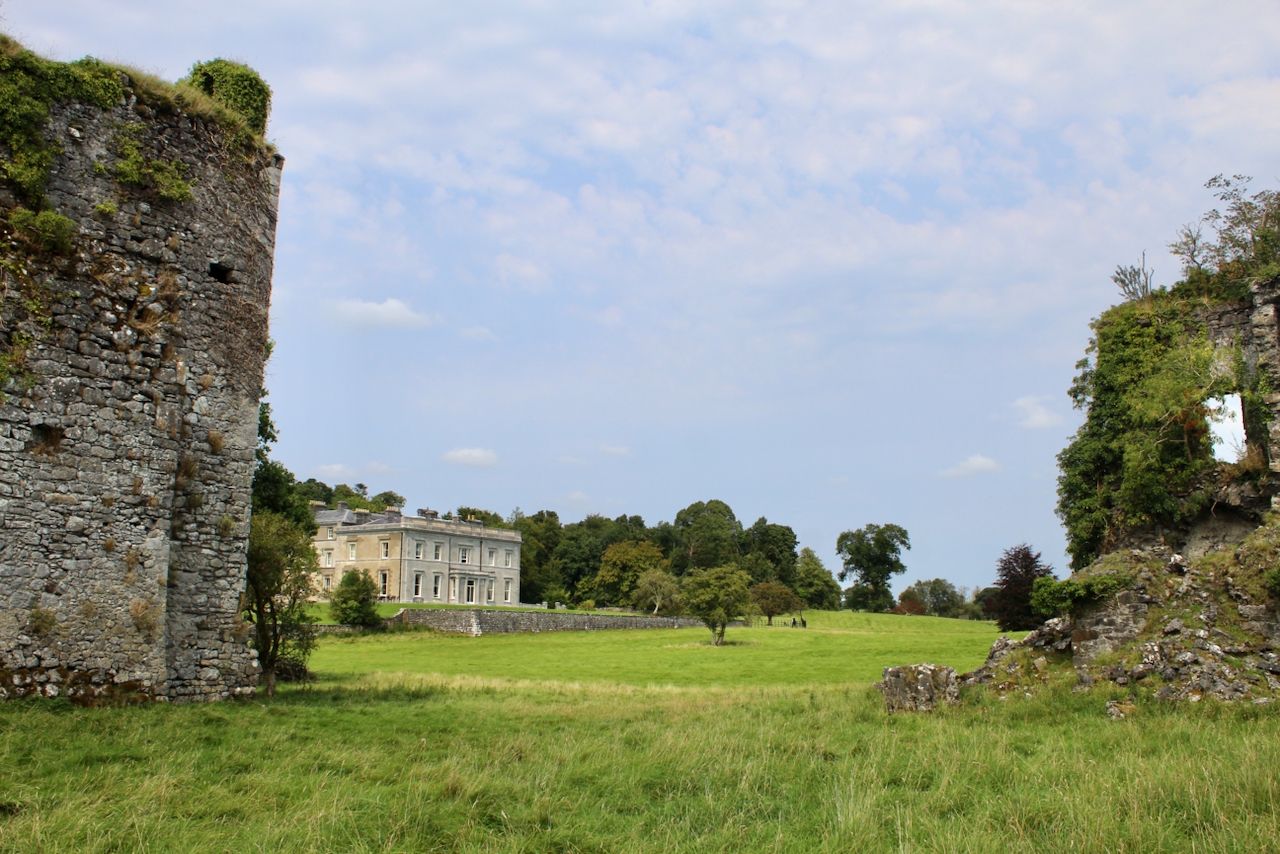
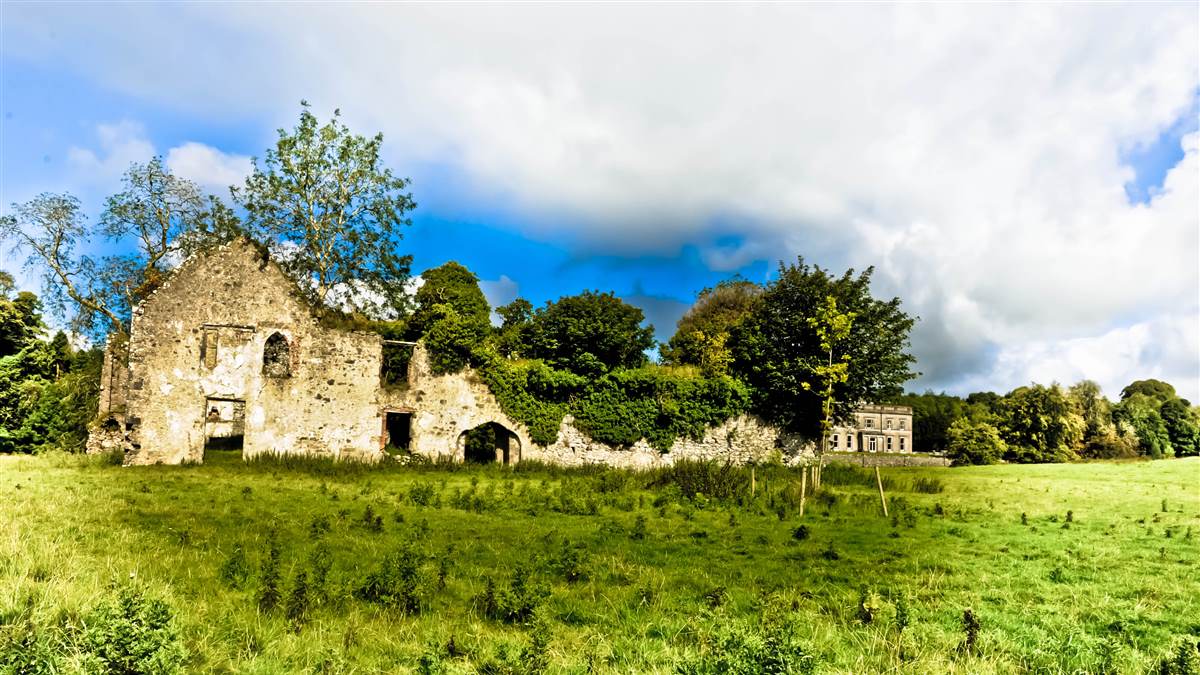
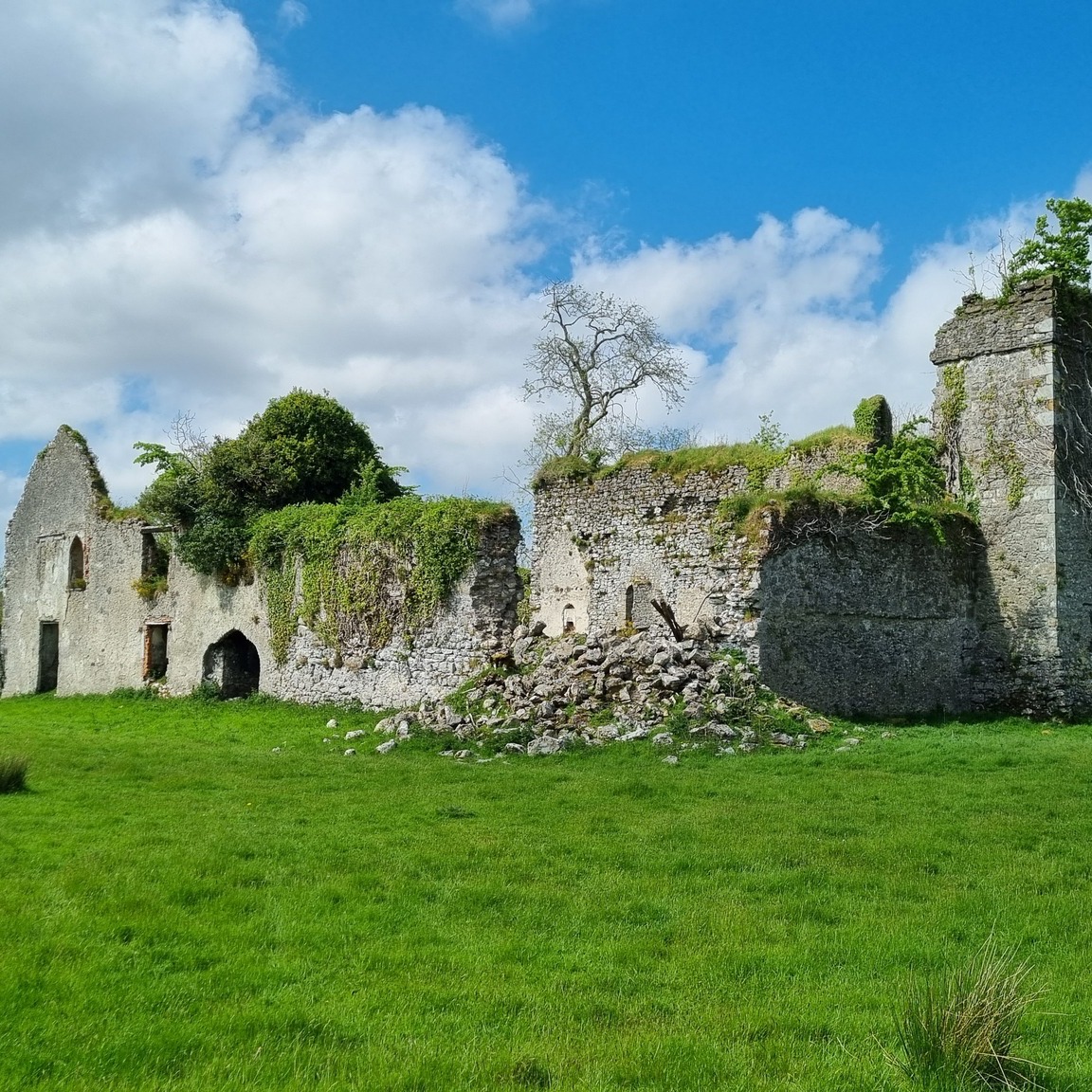
Roderick told us that the Croftons acquired the property around 1609, and that Henry Crofton built a thatched Tudor house around 1627. The National Inventory tells us that the remains of the house near the Templar ruins are of a two-bay two-storey stone house, built c.1650. [5]
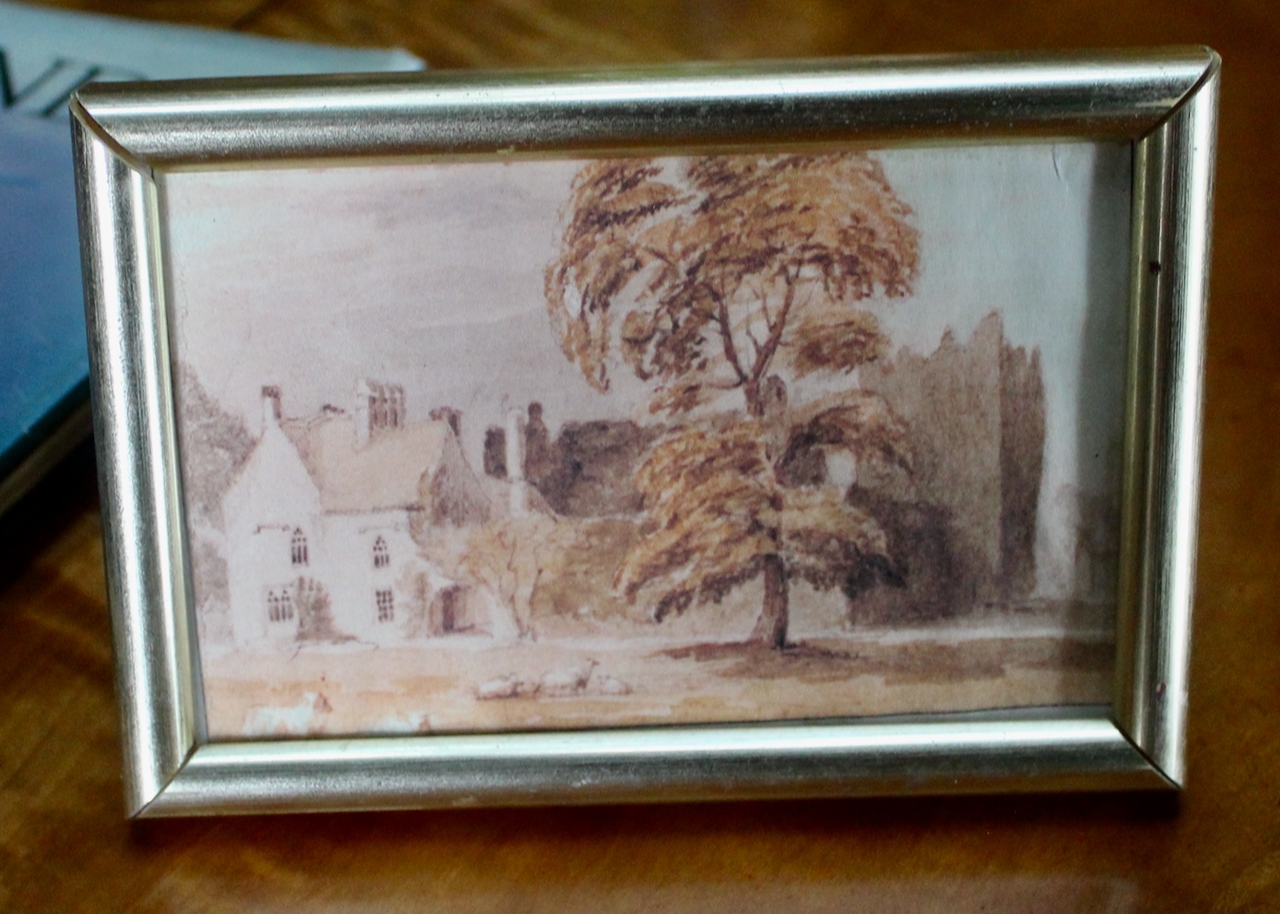
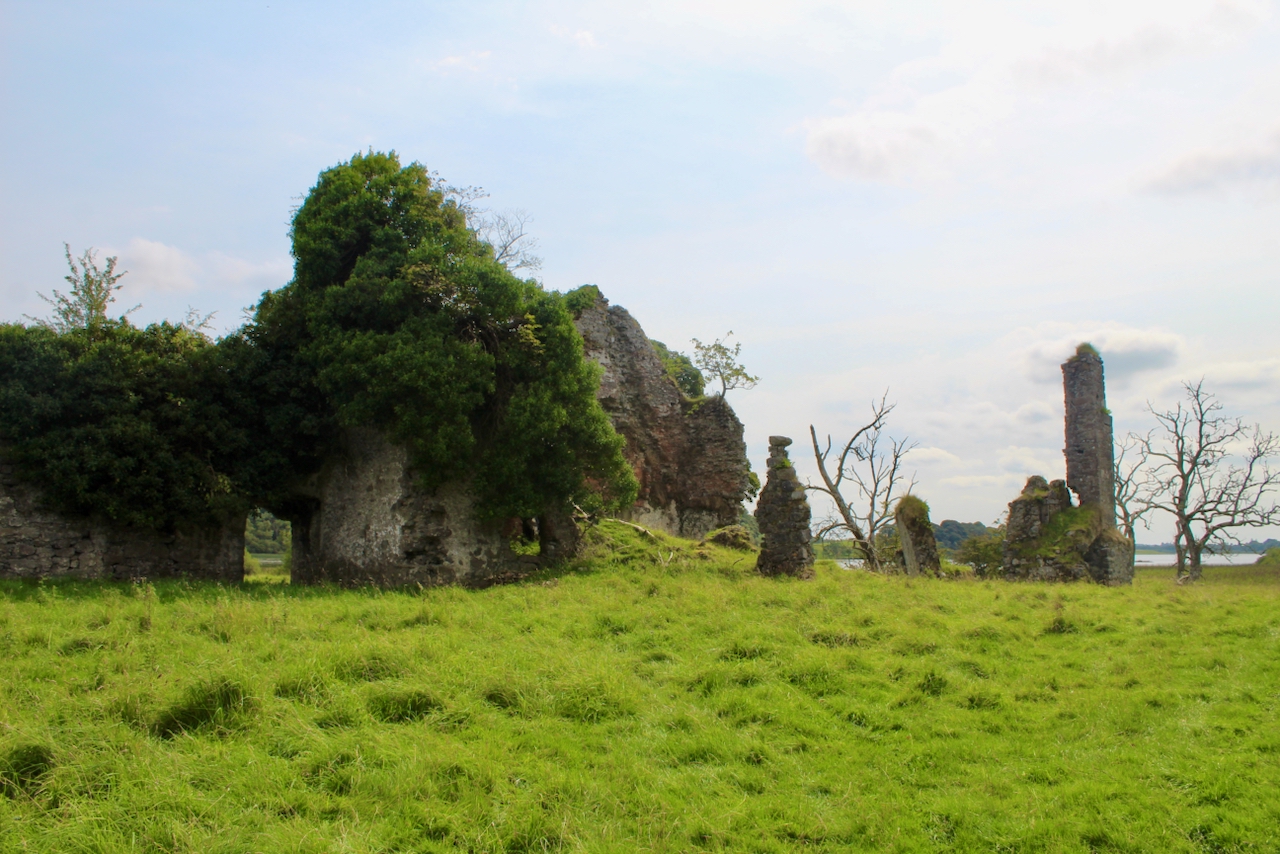
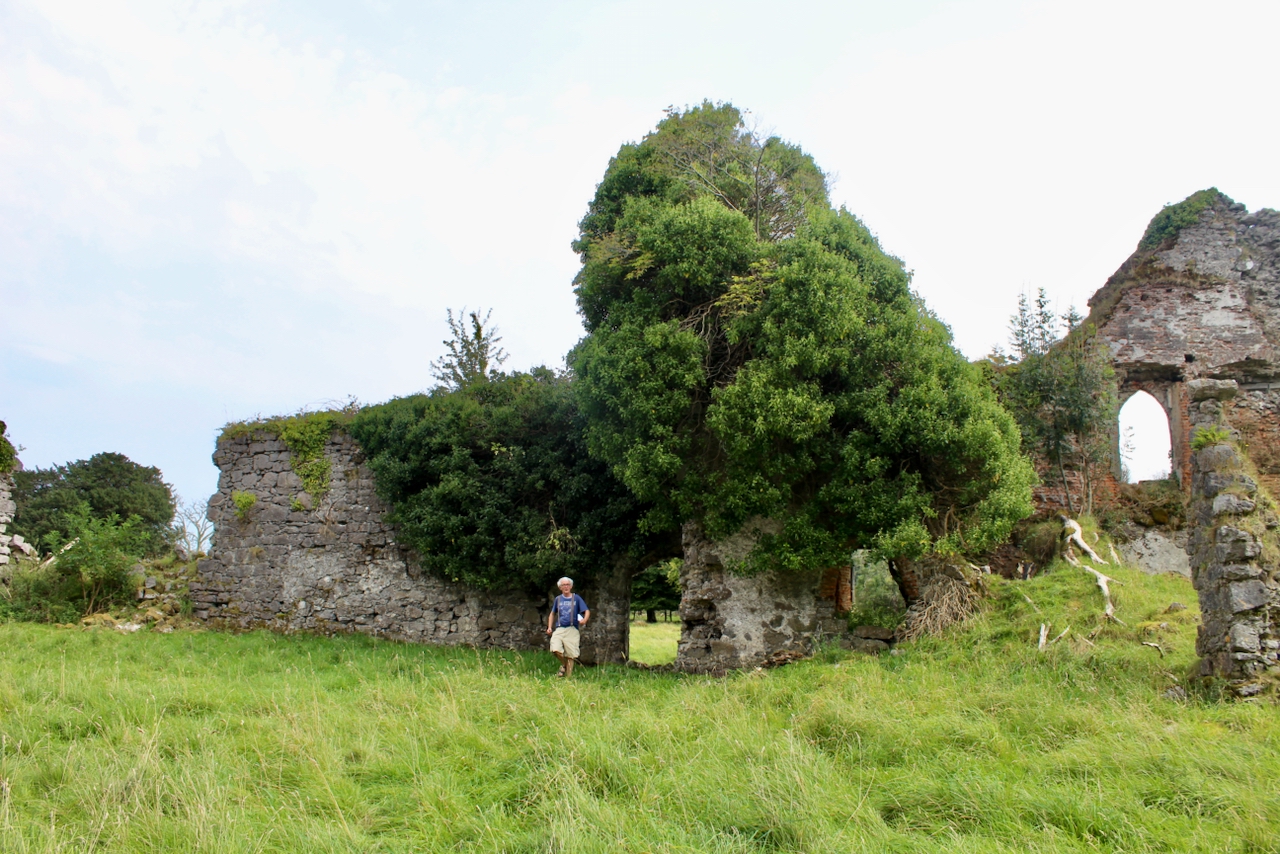
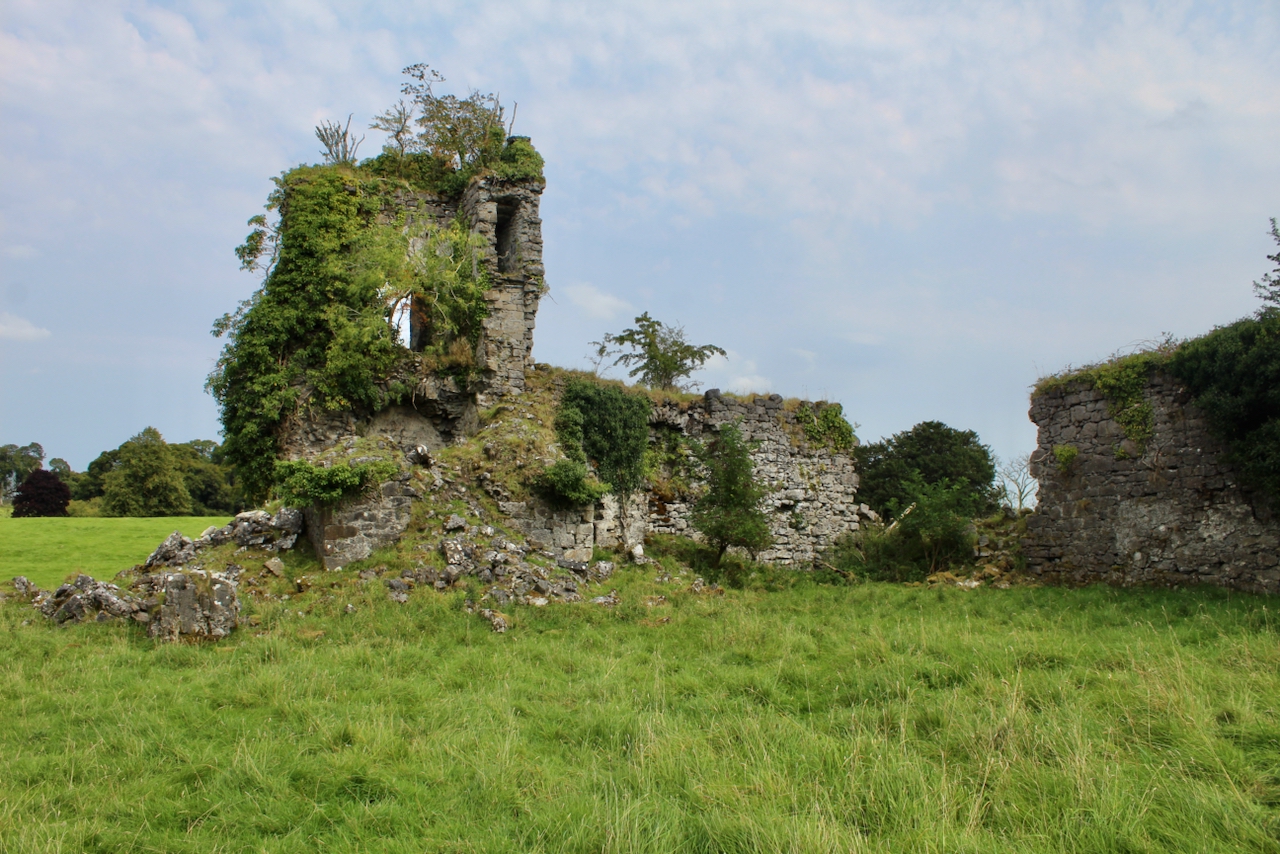
It came into the Perceval family in 1665 when George Perceval (1635-1675) married Mary Crofton.
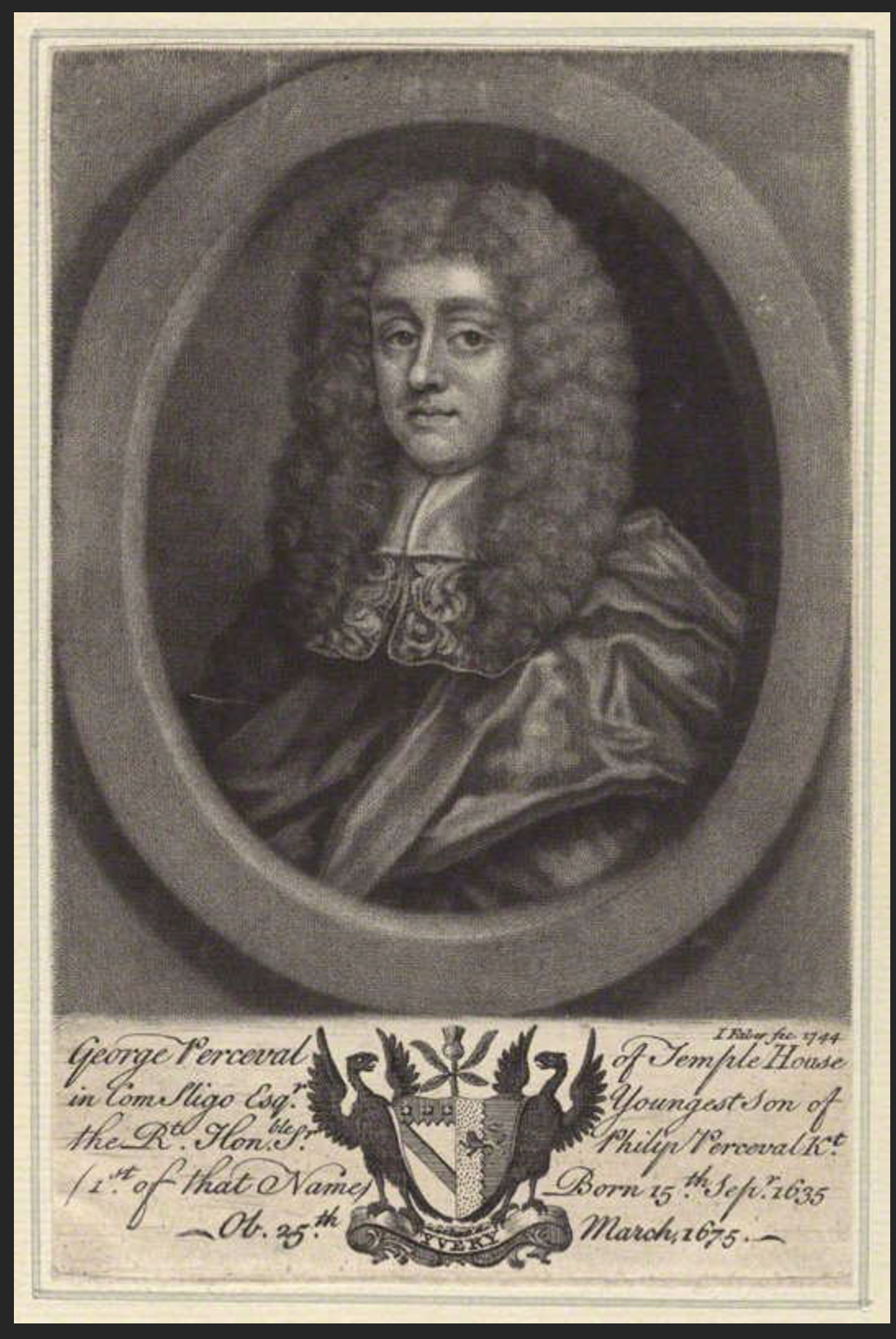
We came across the Percevals when we visited Burton Park in County Cork, another section 482 property in 2025 (see my entry https://irishhistorichouses.com/2024/02/08/burton-park-churchtown-mallow-county-cork-p51-vn8h/ ).
George’s father Philip (1605-1647) came from England to Ireland to serve as registrar of the Irish court of wards, along with his brother Walter. This position would have given him an insight to property ownership in Ireland. When a son inherited property before he came of age, he was made a Ward of the state, and the someone would be chosen to act on the child’s behalf.
When Walter died in 1624, Philip inherited the family estates in England and Ireland. The land at Burton Park was named after his estate in Somerset, Burton.
Philip’s grandfather Richard Perceval was ‘confidential agent’ to Queen Elizabeth’s Minister Lord Burleigh. He had correctly identified Spanish preparations for the Armada and this vitally important information was rewarded with Irish estates. [6]
Philip settled in Ireland, and by means of his interest at court he gradually obtained a large number of additional offices. In 1625 he was made keeper of the records in the Birmingham Tower at Dublin Castle.
Perceval was close to the Lord Deputy of Ireland, Thomas Wentworth, 1st Earl of Strafford. With the fall and execution of Wentworth in May 1641, Perceval lost his major patron and protector. In September 1641 Perceval narrowly avoided prosecution in England when his part in a shady land transaction was revealed. By that time, Perceval owned over 100,000 acres in Ireland, which he obtained partly through forfeited lands.
Philip Perceval married Catherine Ussher, daughter of Arthur Ussher and Judith Newcomen. She gave birth to their heir, John (1629–1665), who was created 1st Baronet of Kanturk, County Cork in 1661. George (1635-1675) was the younger son. He held the position of Registrar of the Prerogative Court in Dublin.
George Perceval’s wife Mary’s father William Crofton was High Sheriff of County Sligo in 1613 and Member of Parliament for Donegal in 1634, so George and Mary might have met in Dublin. Mary, as heiress, was a good match, and since George was a younger son, marrying into property would have suited him well.
Robert O’Byrne tells us that they lived in the old castle which had been converted by the Croftons into a domestic residence in 1627. [see 4] It is not clear to me whether George and Mary lived in a house next to the Templar castle or in some version of the castle itself. O’Byrne tells us that the castle had been besieged and badly damaged in 1641, but was repaired. [see 4].
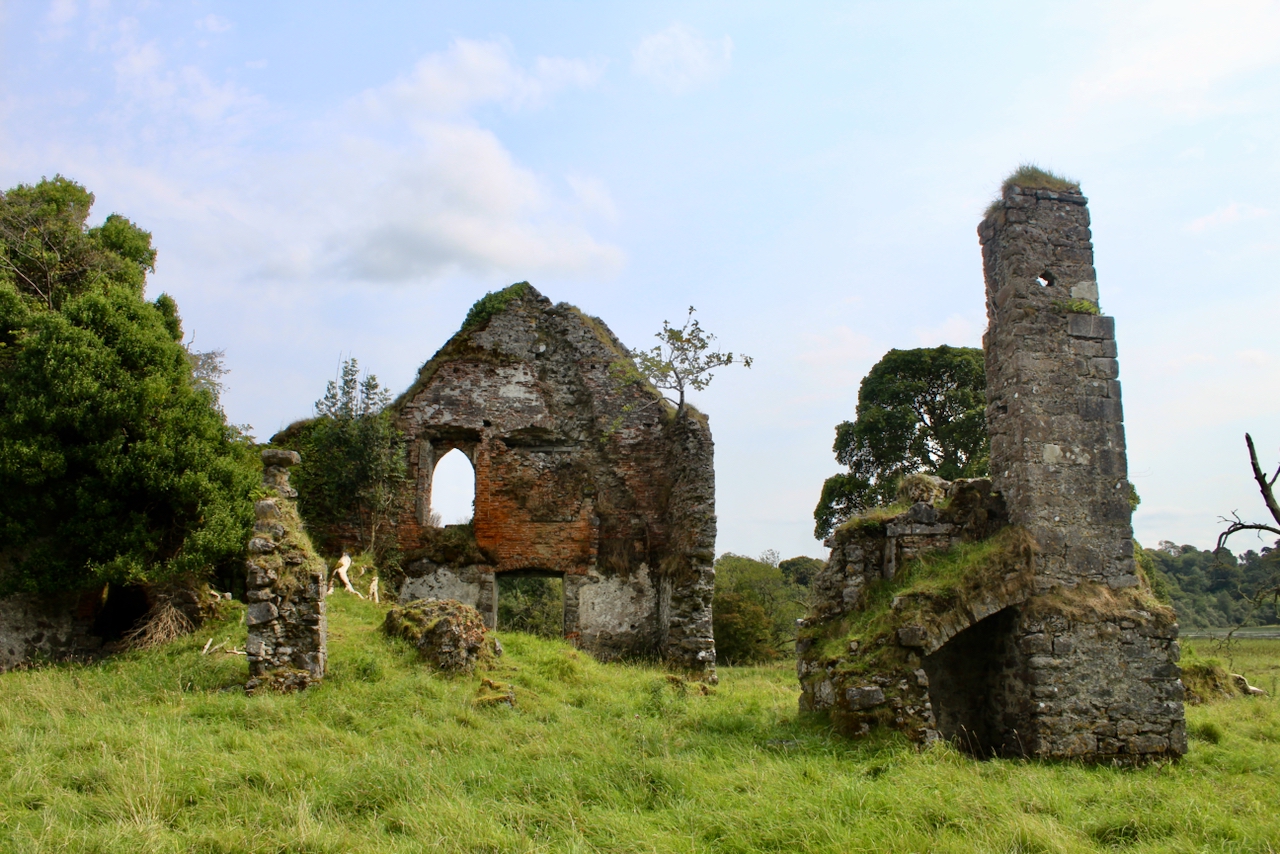
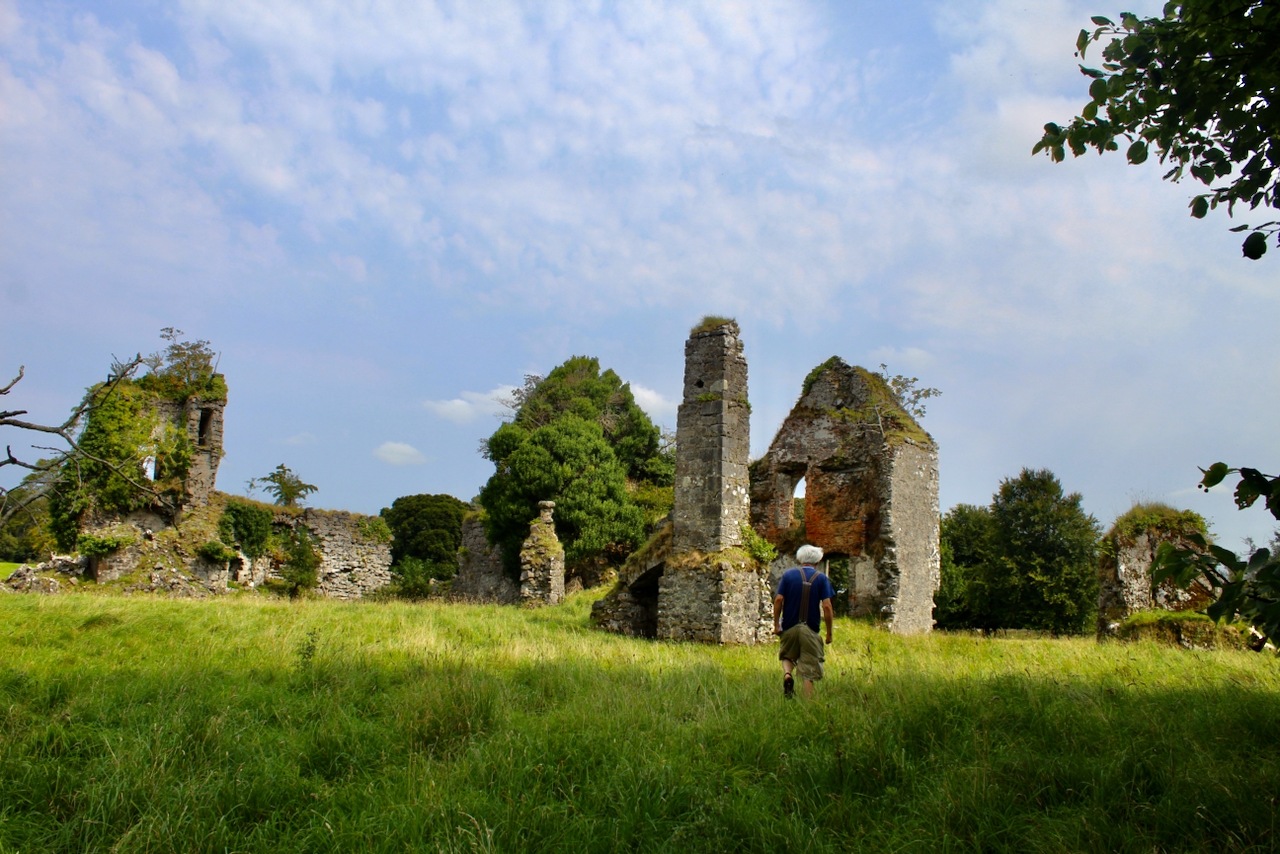
George died at the young age of forty when on a ship crossing to Holyhead, when his son and heir Philip (1670-1704) was only five years old. [7] Philip’s mother remarried, this time to Richard Aldworth, who was Chief Secretary of Ireland. Philip also died young, after marrying and having several children, and the property passed to his son John (1700-1754), who was also minor when his father died.
John (1700-1754) married the daughter of a neighbour, Anne Cooper of Markree Castle, another Section 482 property in 2025 (see my entry https://irishhistorichouses.com/2021/11/06/markree-castle-collooney-co-sligo/). Anne gave birth to their son and heir Philip (1723-87).
Philip Perceval (1723-87) married Mary Carlton of Rossfad, County Fermanagh. Their son and heir Guy died soon after his father so the property passed in 1792 to Guy’s brother Reverend Philip Perceval.
The house is featured in a chapter of Great Irish Houses by Desmond Fitzgerald the Knight of Glin and Desmond Guinness. They tell us that in 1825 Reverend Philip’s son Colonel Alexander Perceval (1787-1858) built a neo-classical two story house up the hill from the castle on the present site.
What is the now the side of the house was once the front.
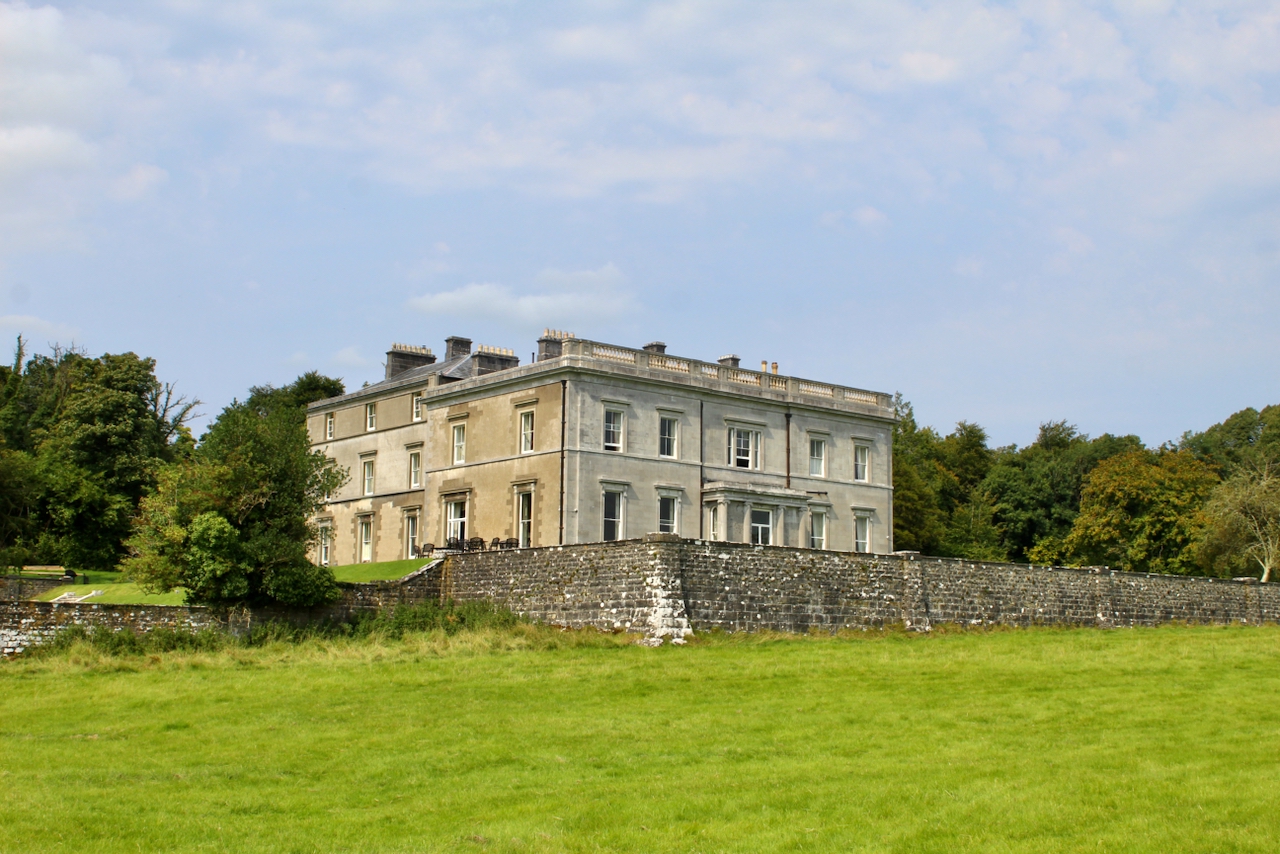
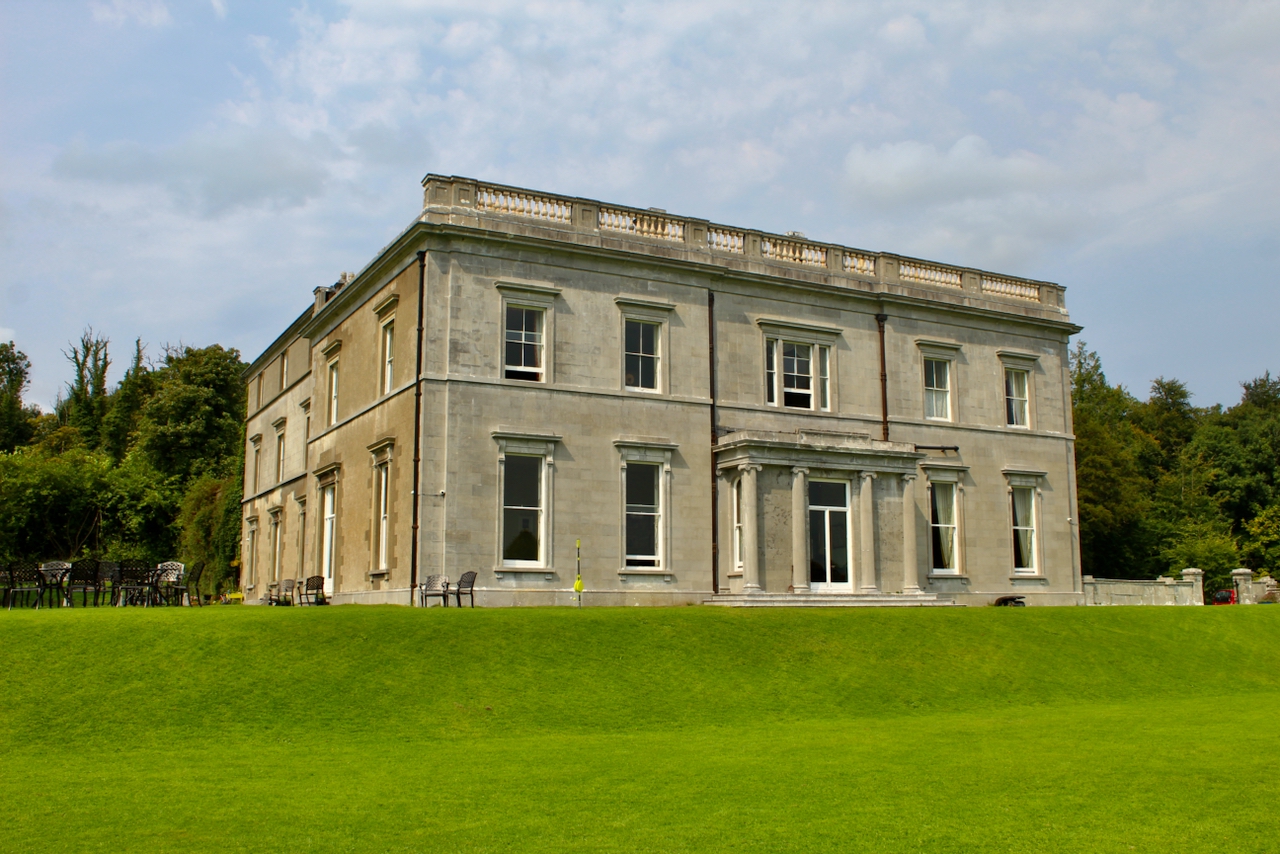
The house at this time was of two storeys and had five bays on the front, with the centre bay slightly recessed, with an enclosed single storey Ionic porch, and a Wyatt window over the porch.
Before building the house, Alexander Perceval (1787-1858), in 1808, married Jane Anne, eldest daughter of Colonel Henry Peisley L’Estrange, of Moystown, King’s County.
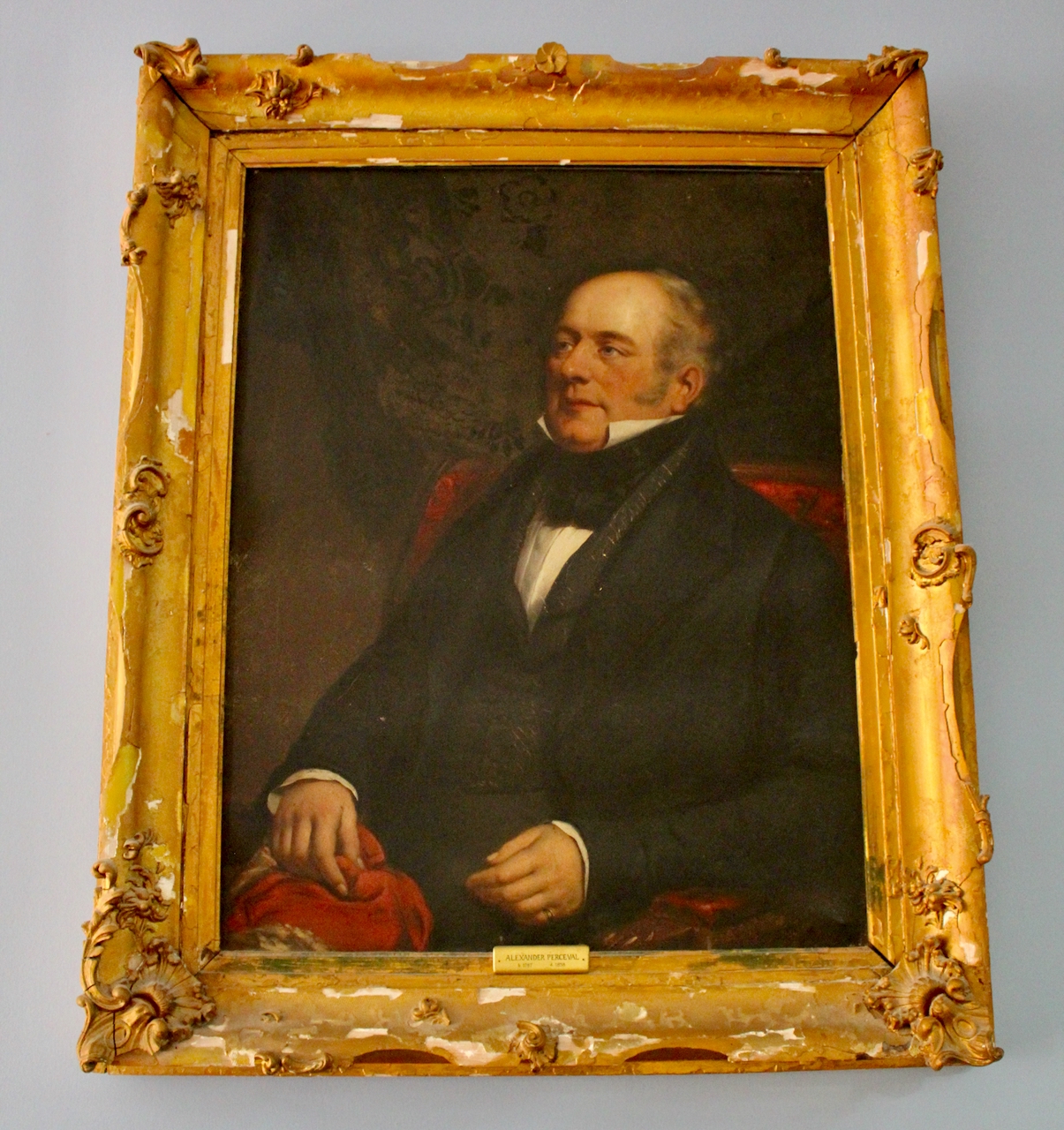
After building the house, Alexander served as MP for Sligo between 1831 and 1841, and from 1841-1858 was sergeant-at-arms to the House of Lords in England.
During the Famine, Alexander’s wife Jane sought to alleviate the suffering of the poor and she died of cholera or typhus in 1847.
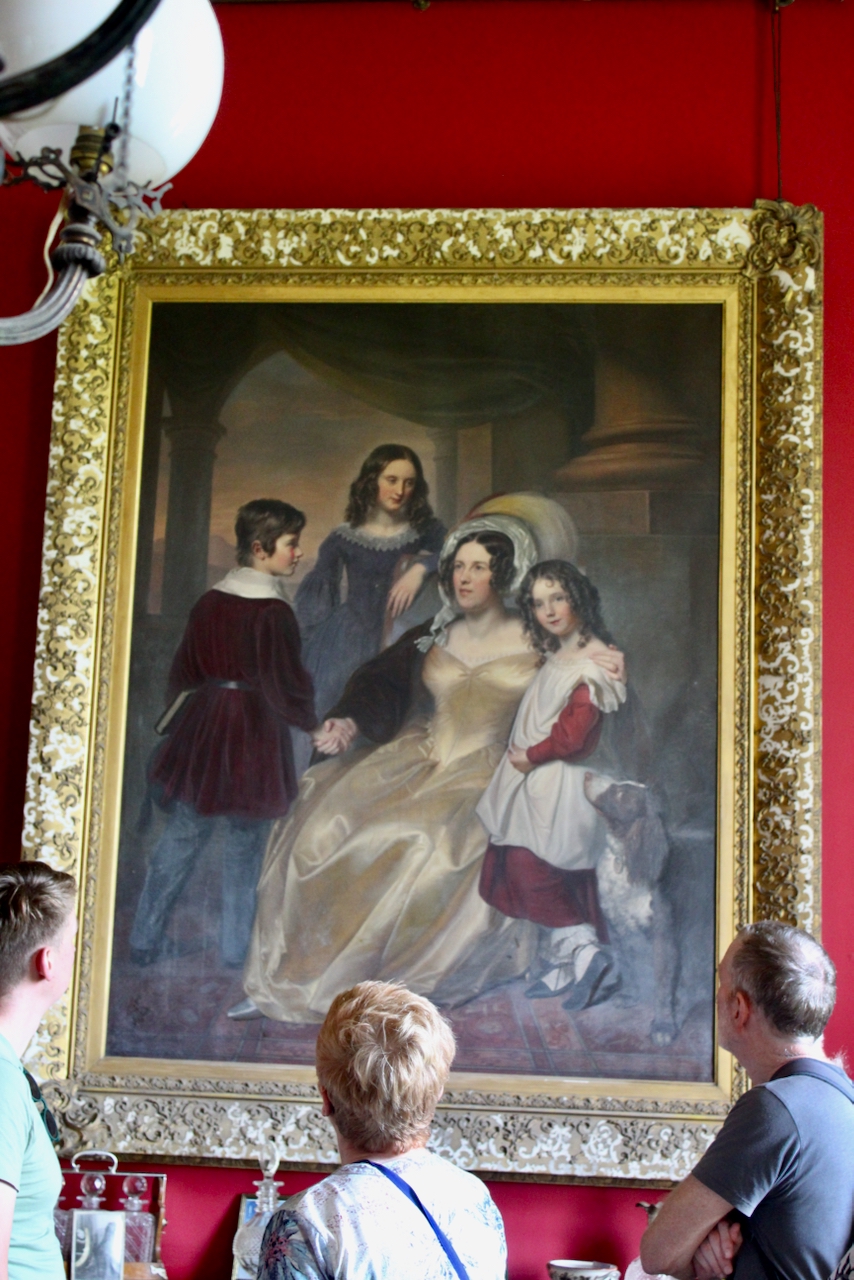
When Alexander died in 1858, his son Philip was unable to afford the death duty tax and he had to sell the property. The house was bought by the Hall-Dares of Newtownbarry, County Wexford.
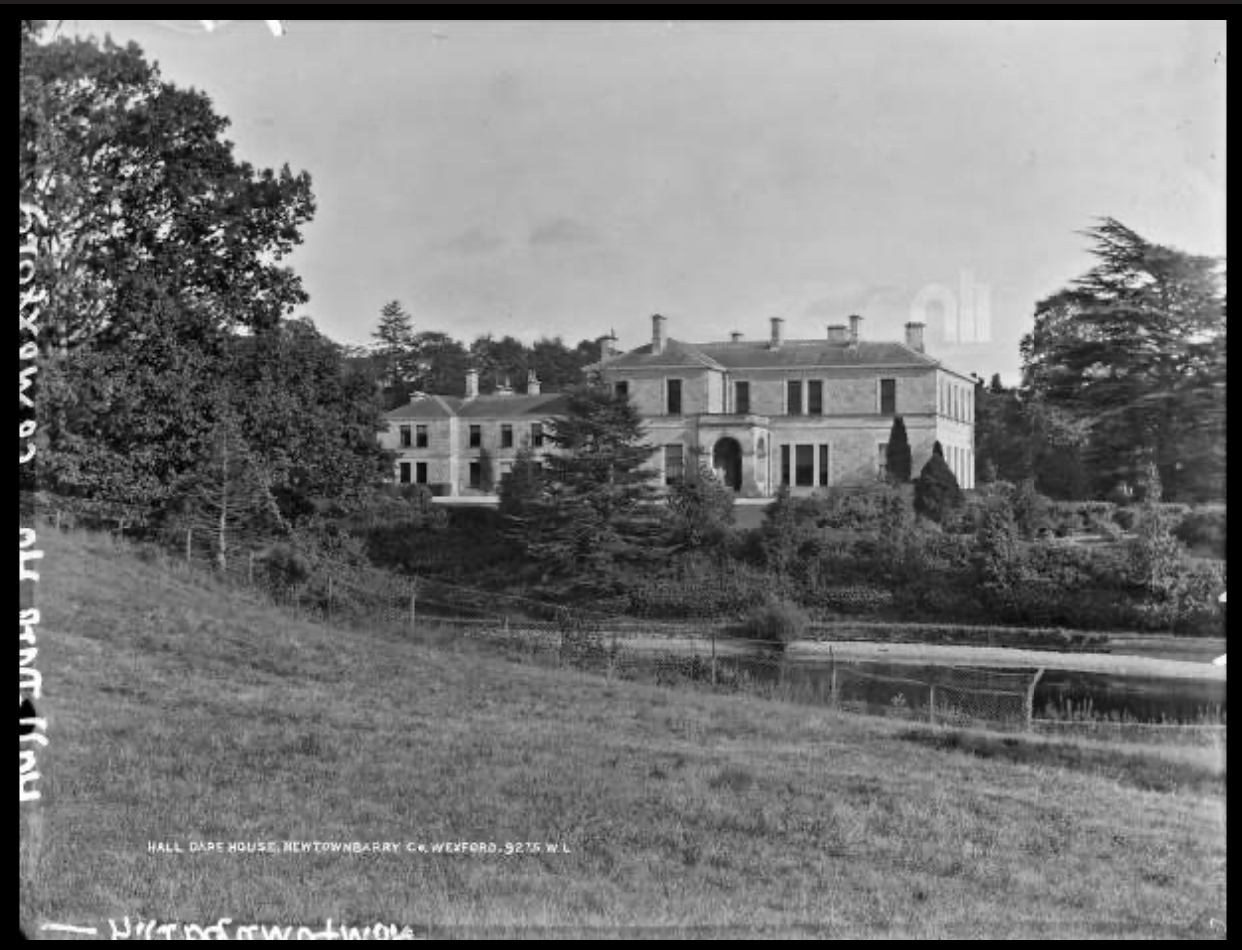
The Hall-Dares did not remain owners for long. After they evicted some tenants, these tenants actively sought the return of the Perceval family. Four years after Philip Perceval’s sale of the house, his brother Alexander, who had made a fortune in business in Hong Kong, re-acquired the property. Philip had married and moved to Scotland. Alexander brought back many of the dispossessed families from America and Britain, gave them back their land and re-roofed their homes. [see 2]
In the 1860s Alexander Perceval enlarged and embellished the house, hiring Johnstone and Jeane of London. He added a higher two storey seven bay block of limestone ashlar on the right (north) side of the house, which formed a new entrance front, knocking down a north wing in the process. [see 2]
Fitzgerald and Guinness tell us that Alexander also commissioned the company to design and build the furniture for the entire house.
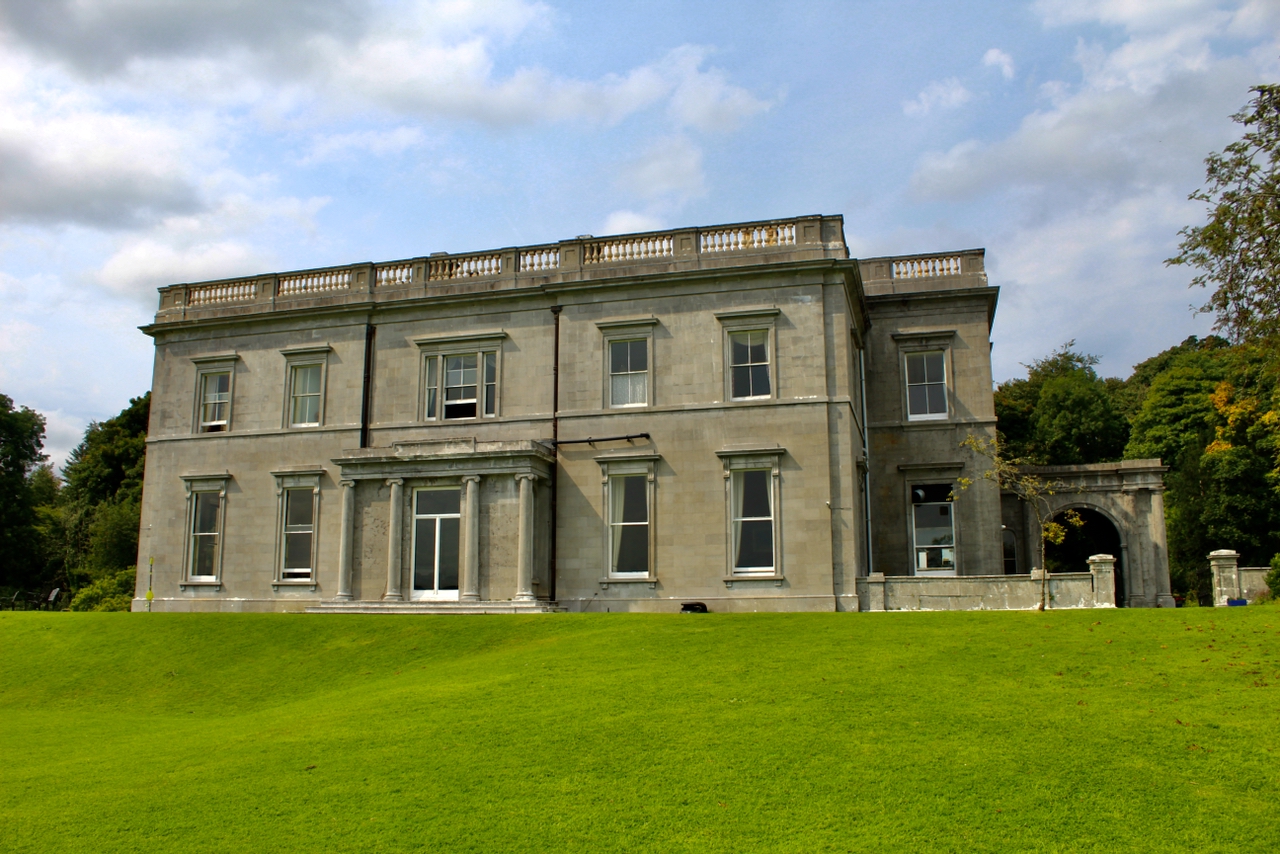
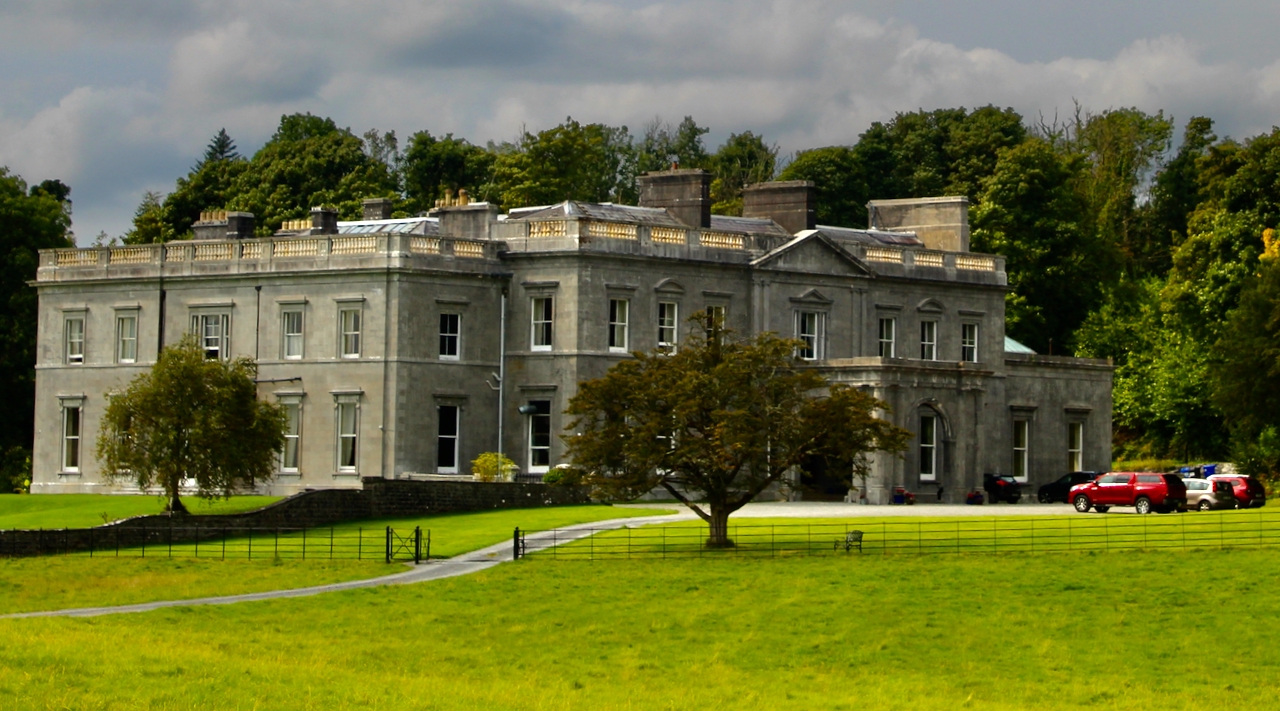
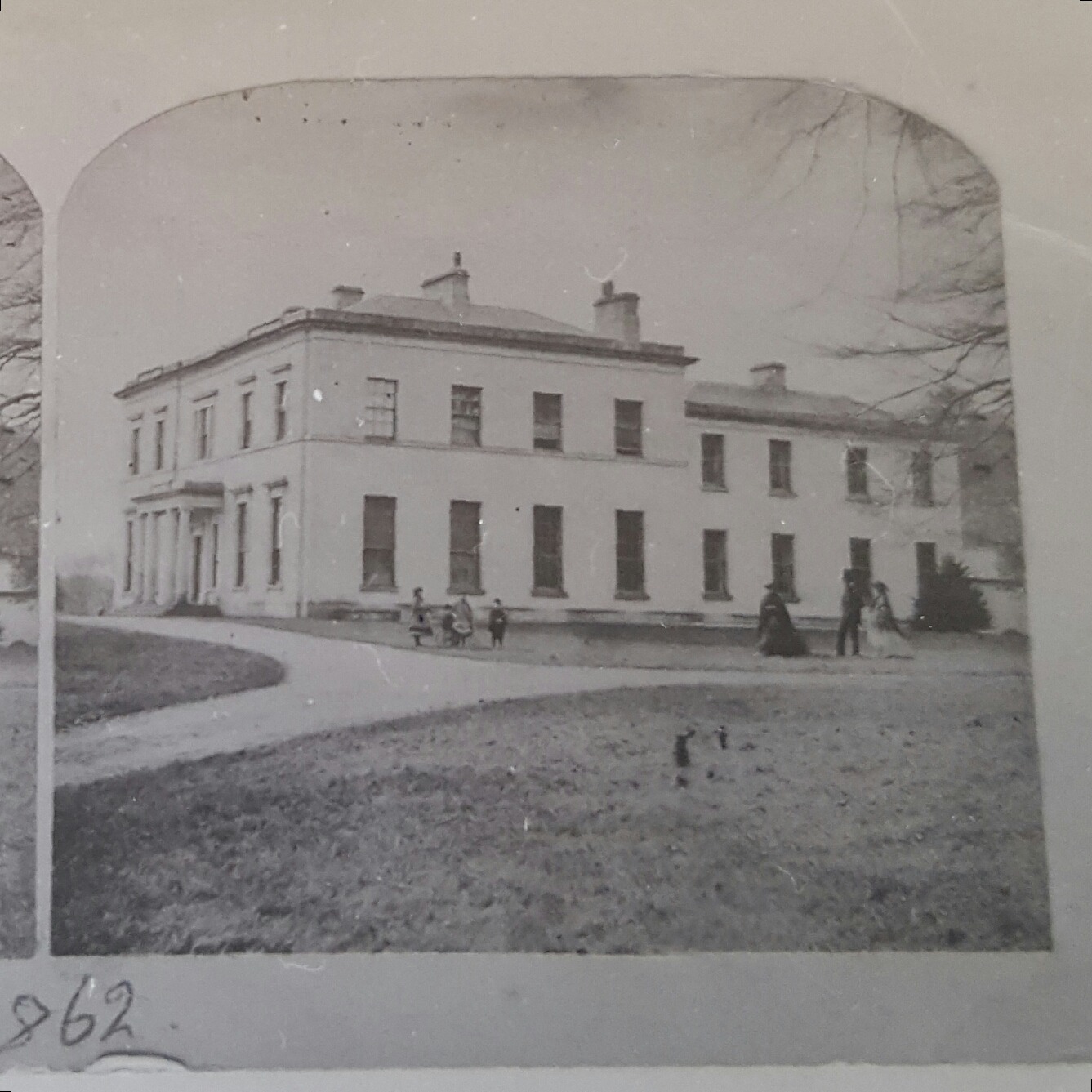
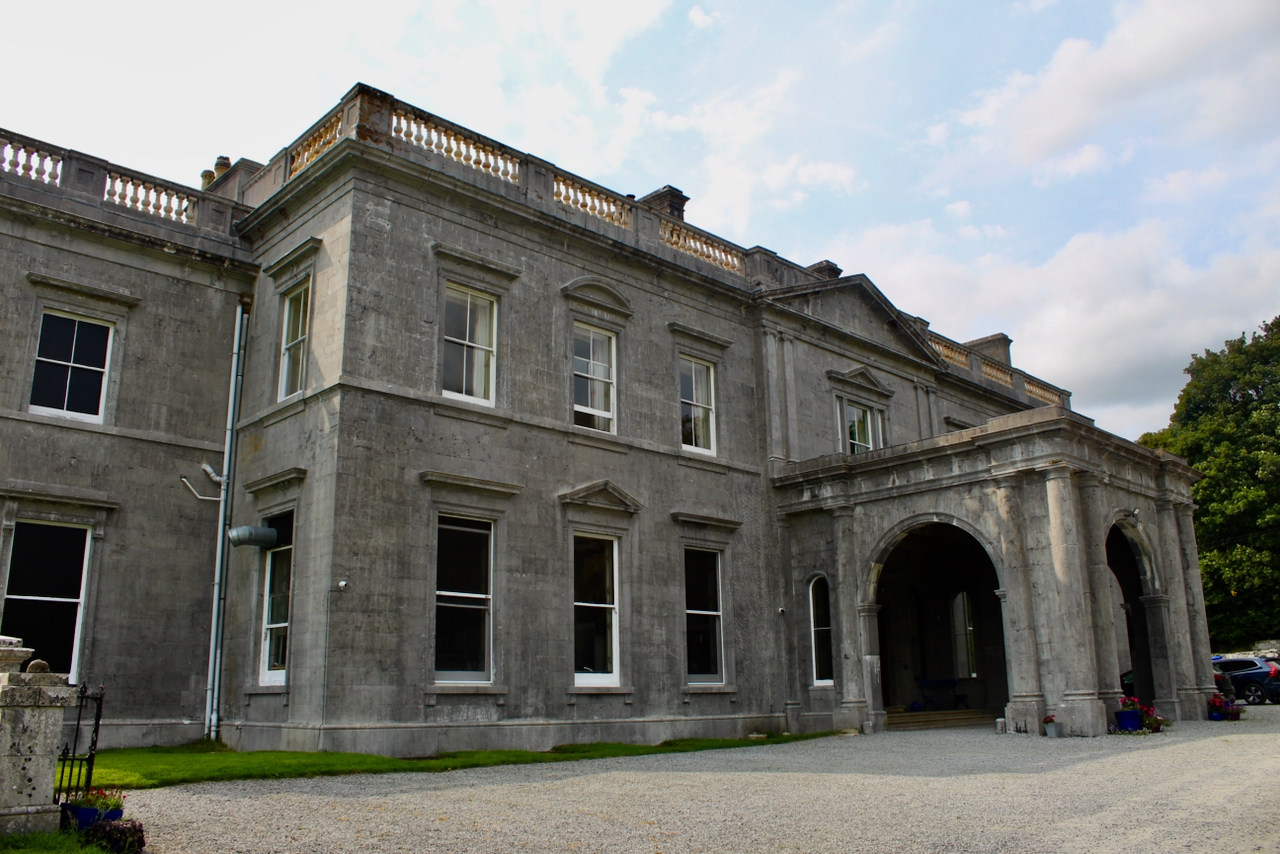
The newer entrance has a large arched single-storey porte-cochére with coupled engaged Doric columns at its corners and two small arched side windows. Above is another pedimented Wyatt window in a larger pediment over two pairs of Ionic pilasters. The centre windows on either side of the porte-cochére on the ground floor are pedimented and on the upper storey the centre windows have curved arch pediments. The other windows have flat entablatures.
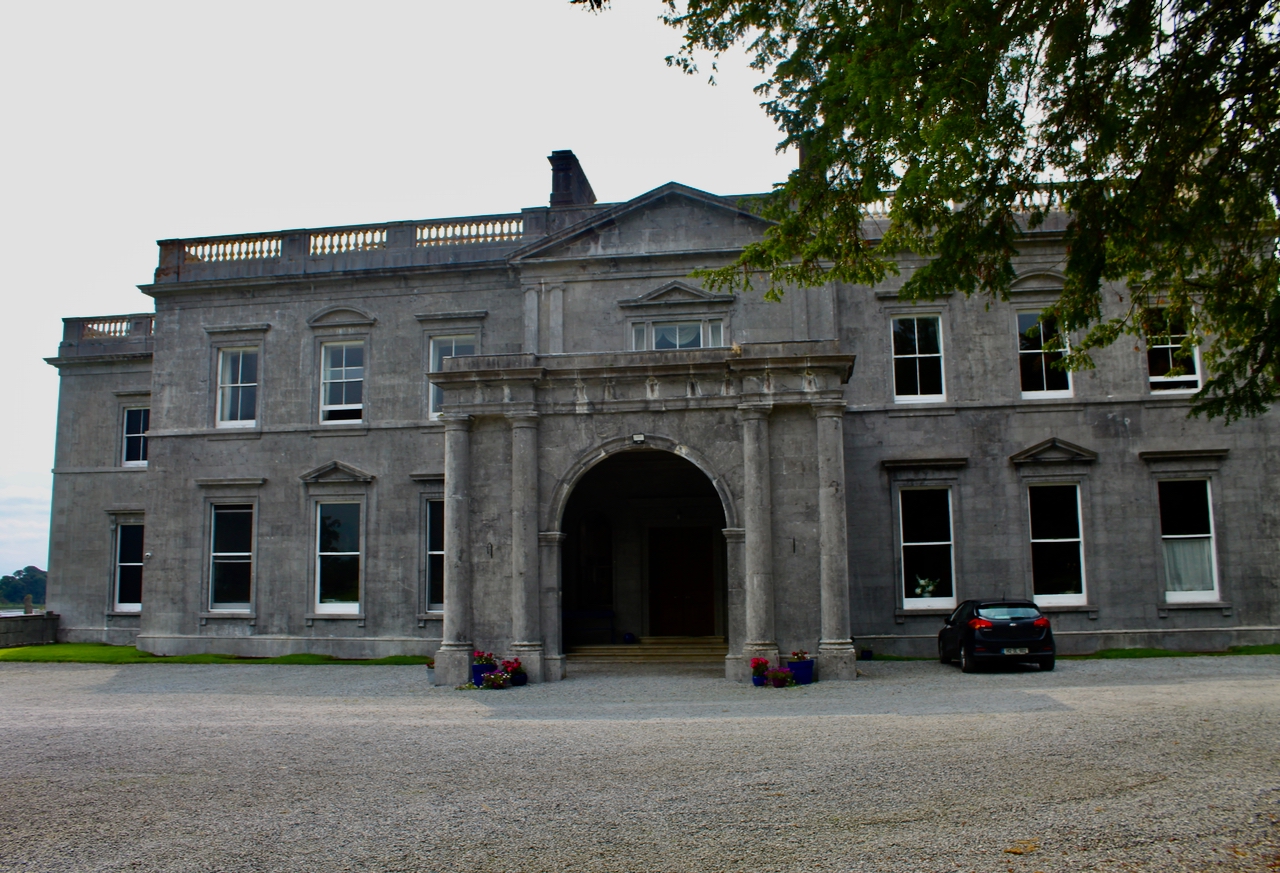
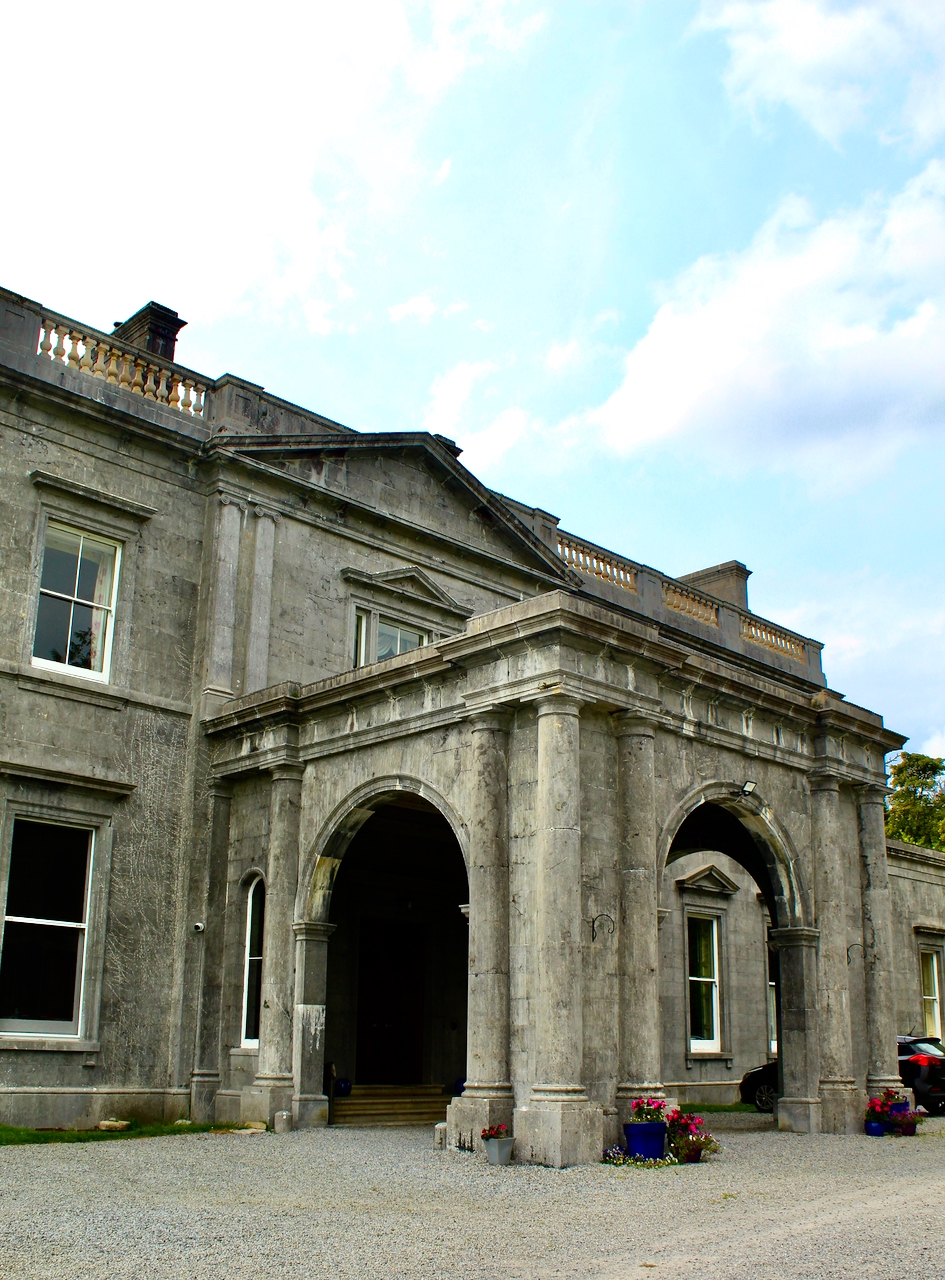
To the right of the newer front is a single storey two bay wing slightly recessed. The house is topped with a balustraded roof parapet.
Looking toward the south facade, we see a three-bay three storey section of the house, as well as more beyond to the west. The windows on the ground floor of the east and south elevations have corbelled pilasters.
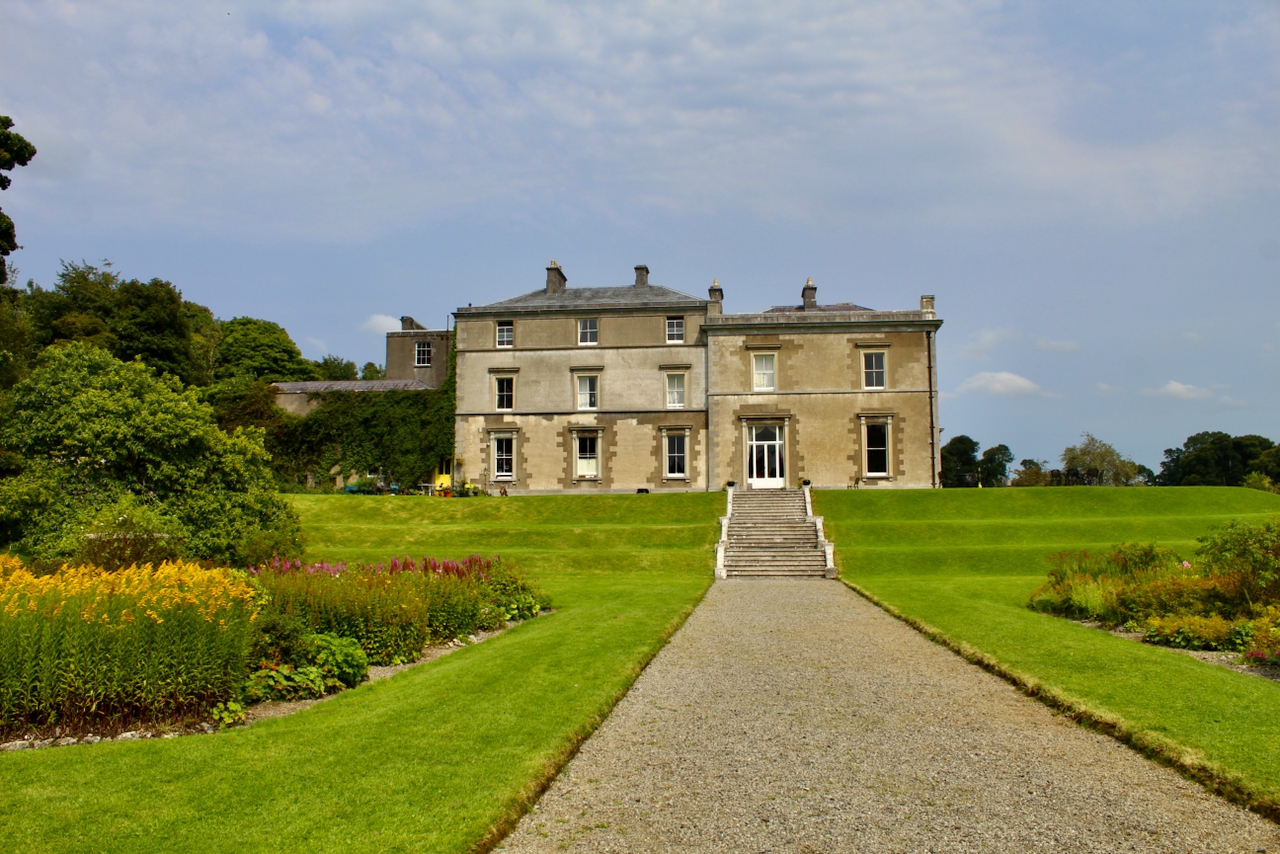
The house is said to have over ninety rooms!
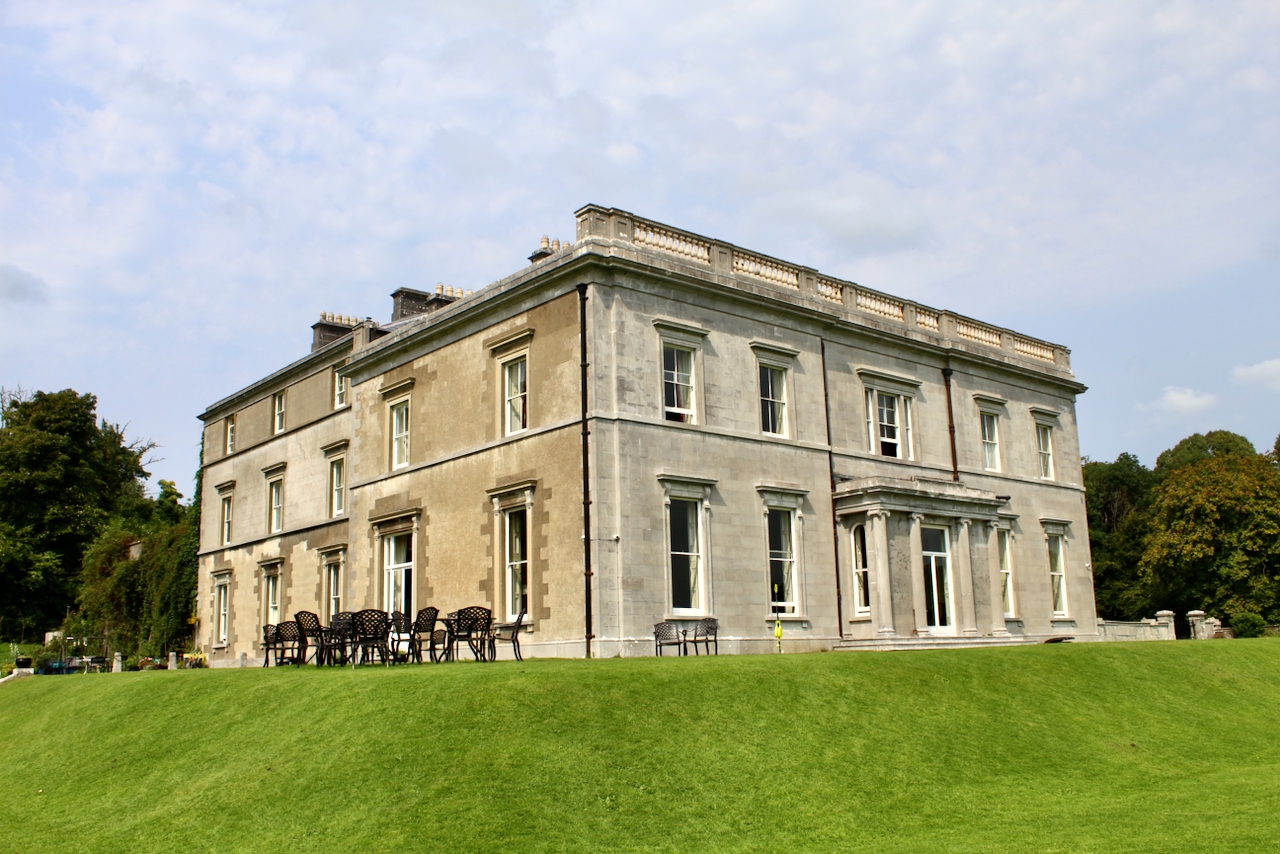
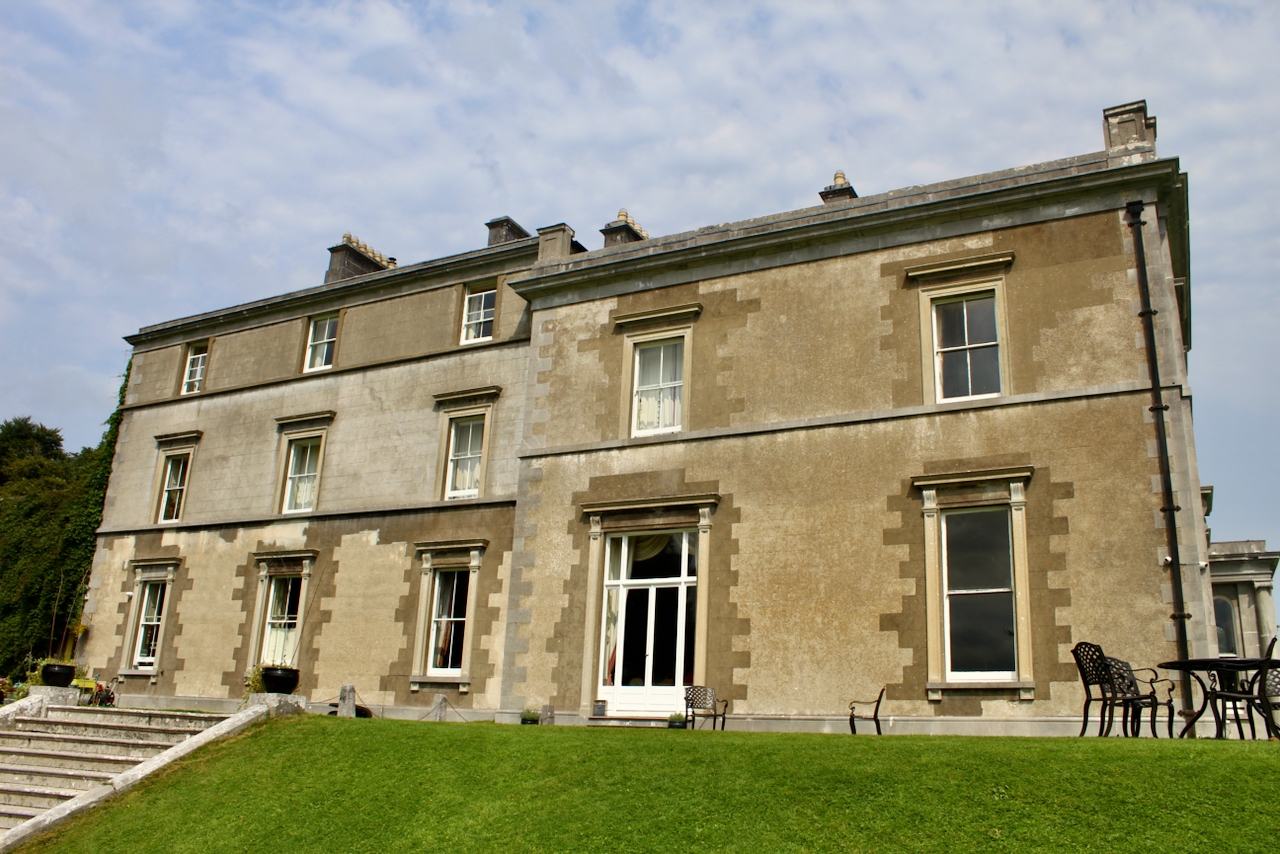
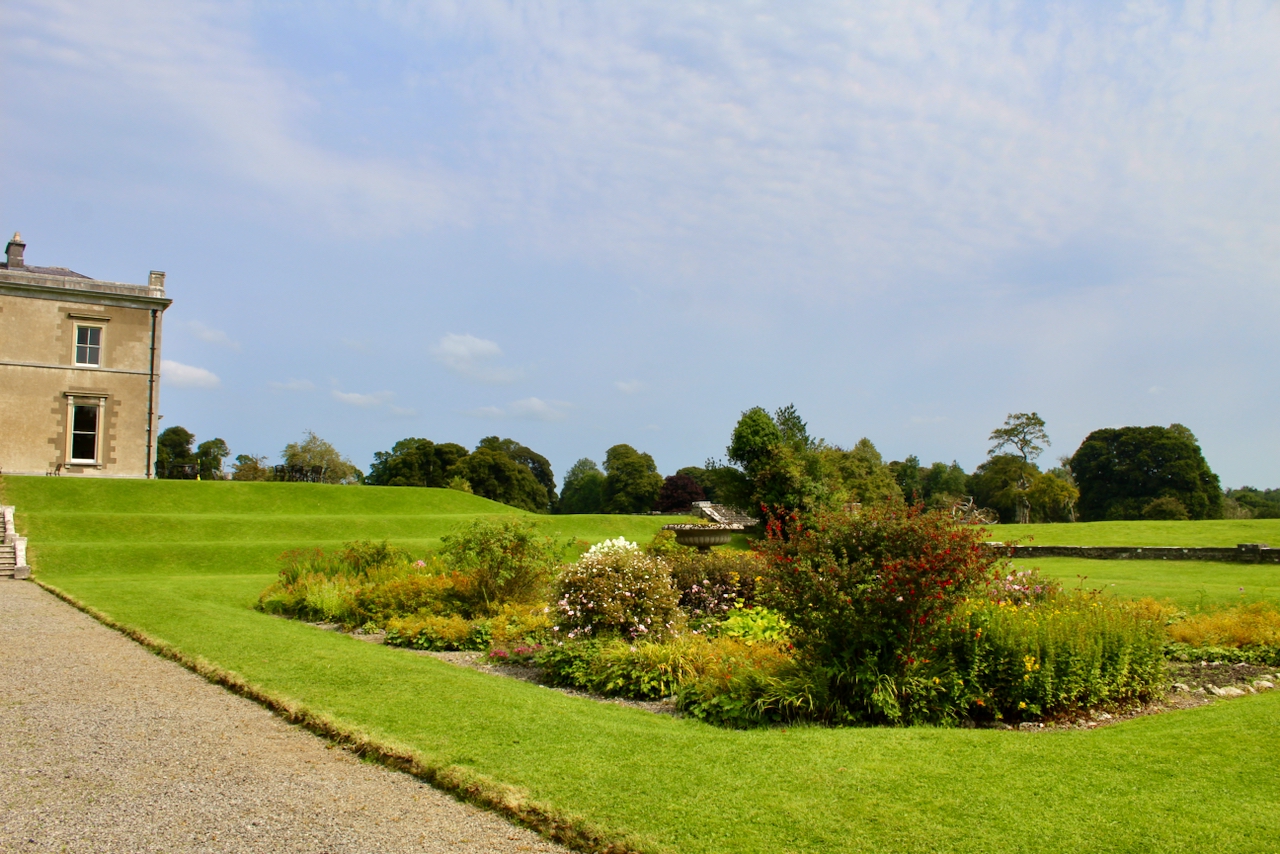
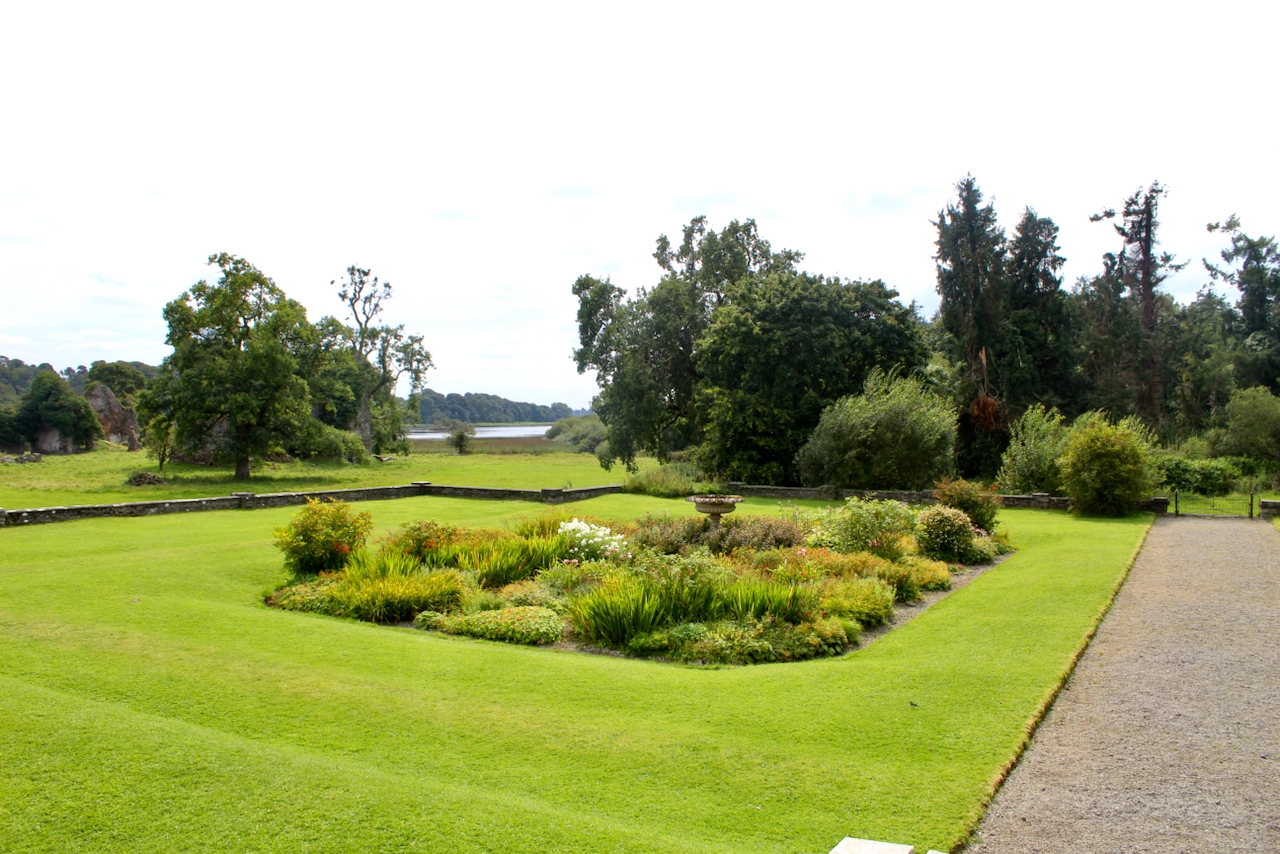
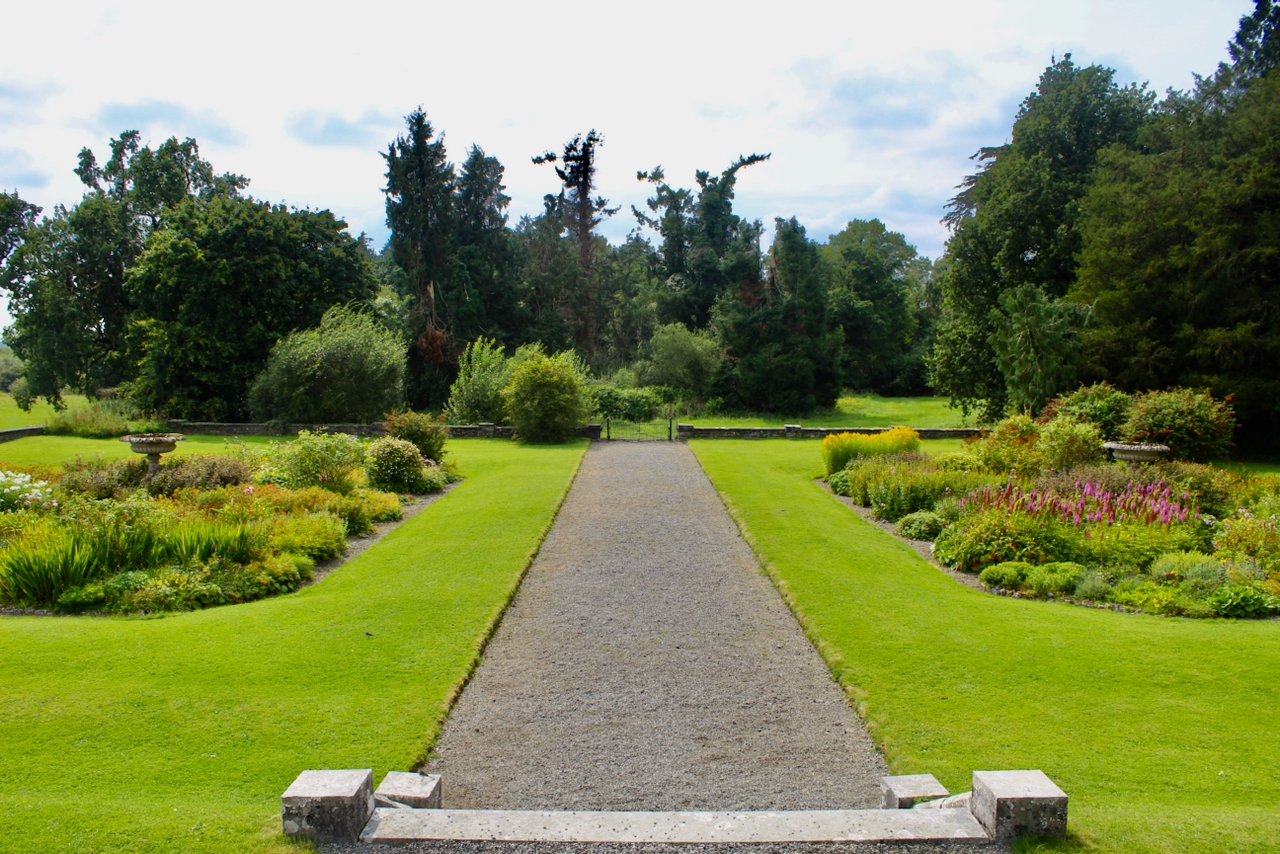
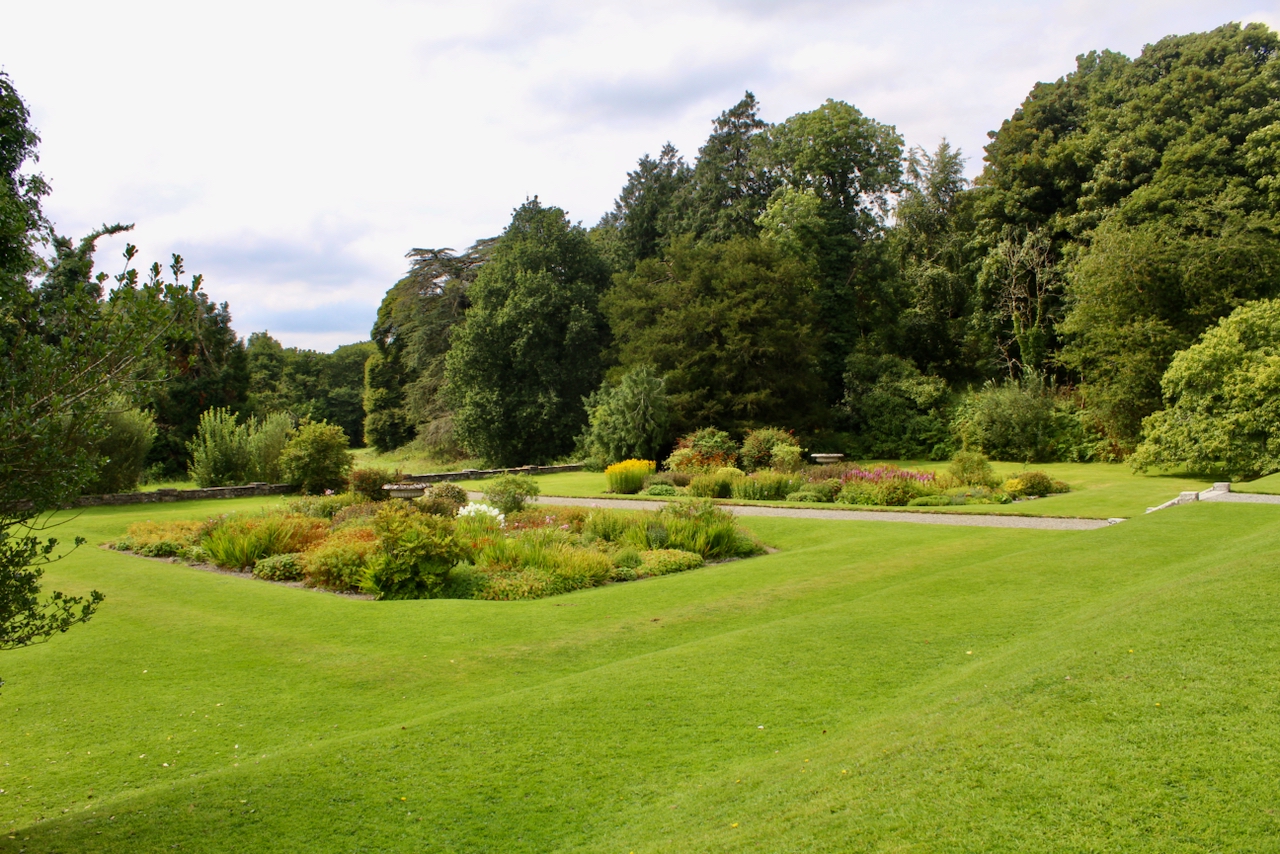
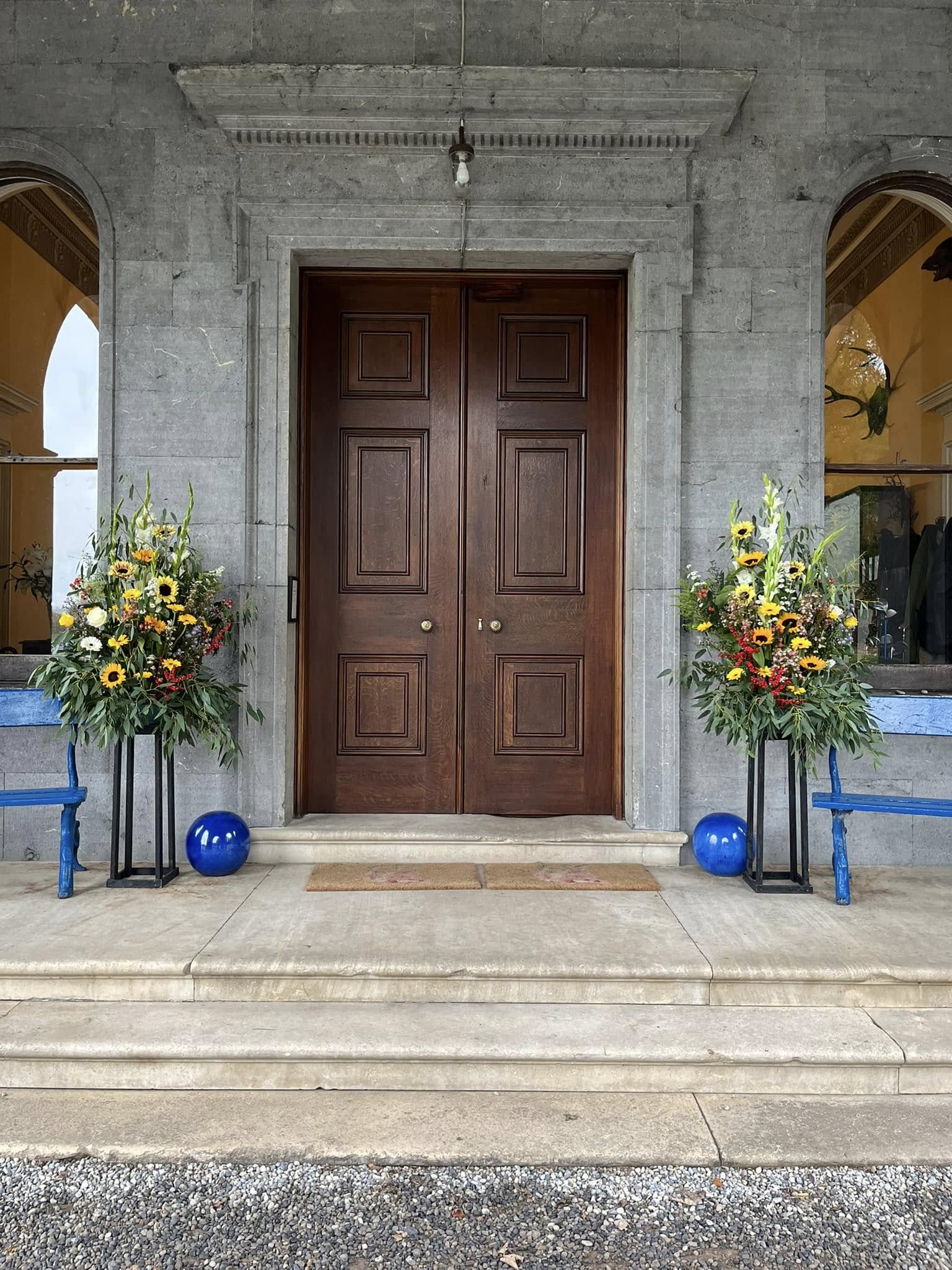
We gathered inside the front hall for the tour, with its impressive tiled floor and geometrically patterned ceiling. It has carved decorative doorcases and arched carved and shuttered side lights by the front door, and a large window facing the front door lights the room.
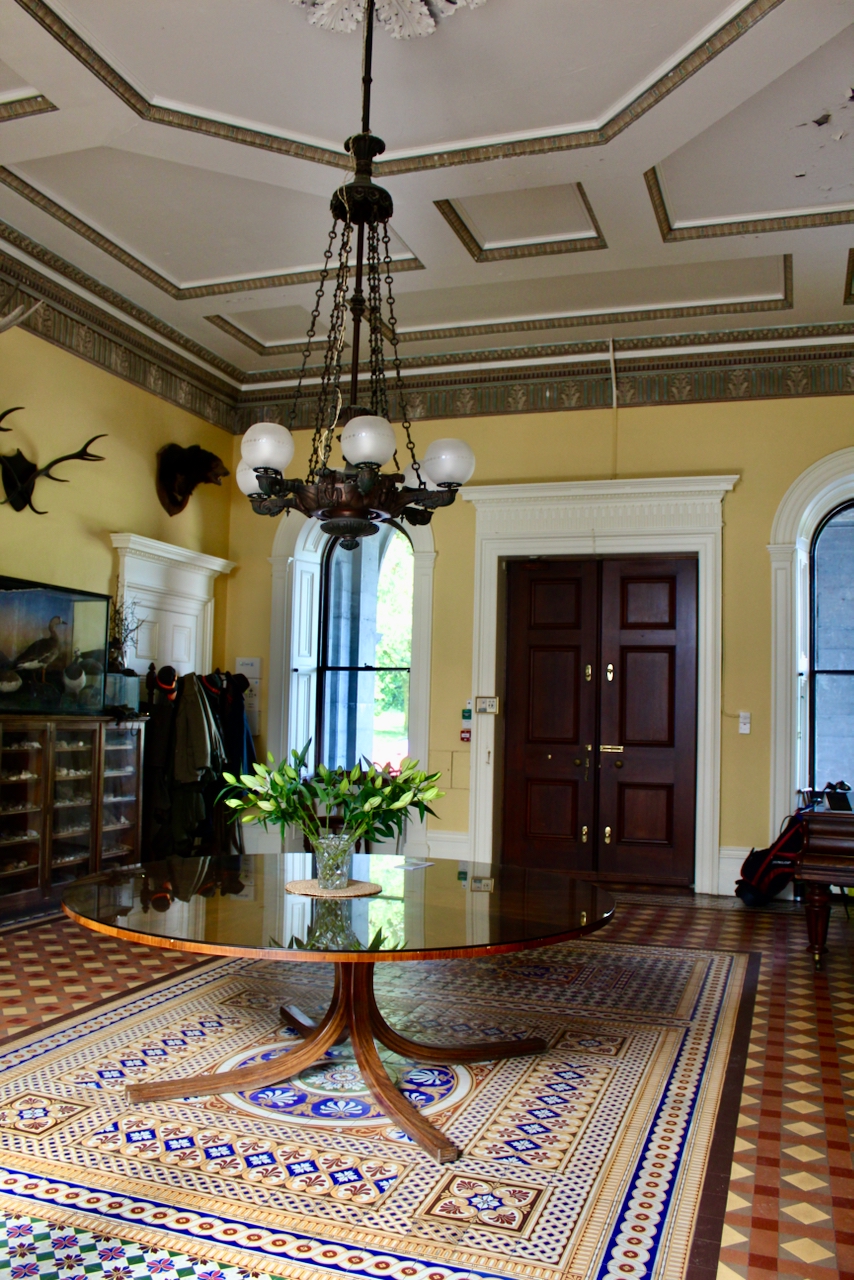
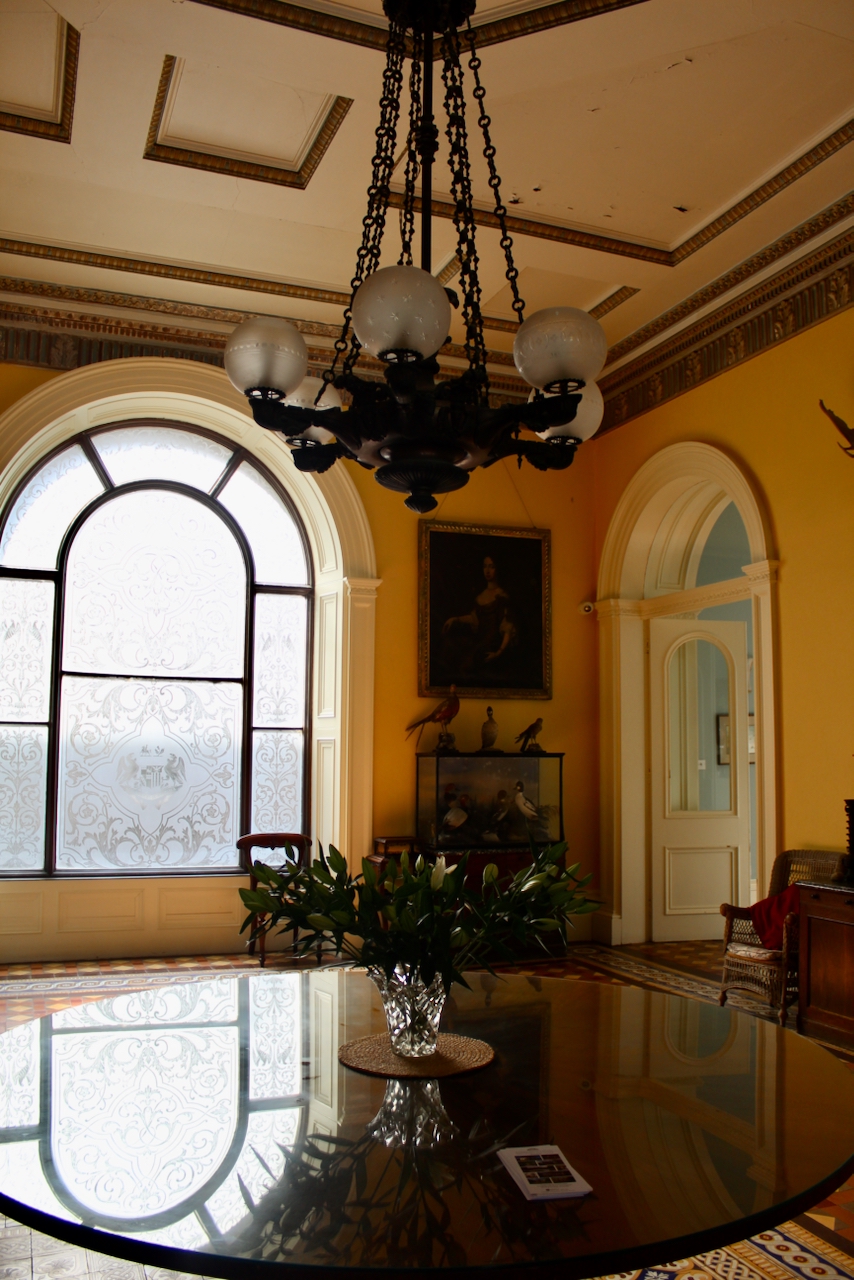
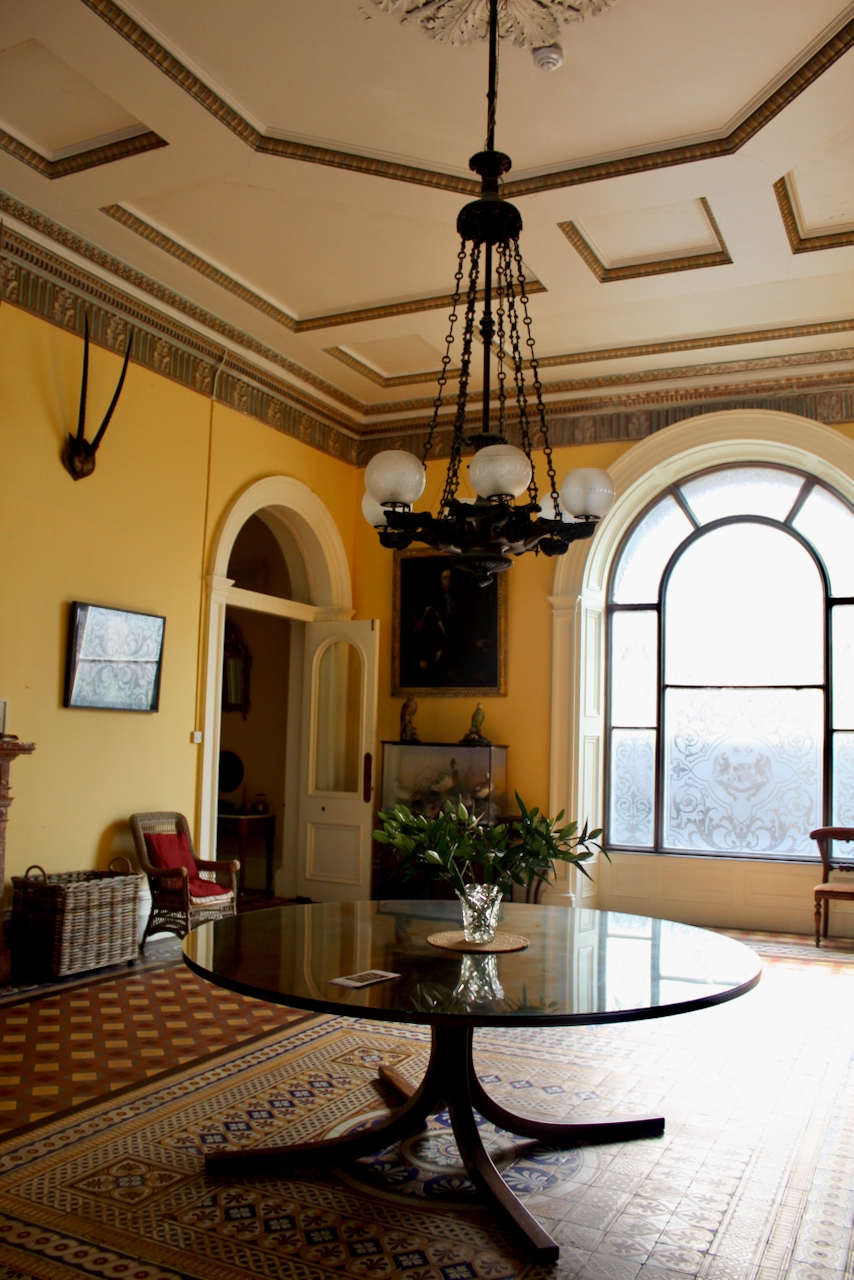
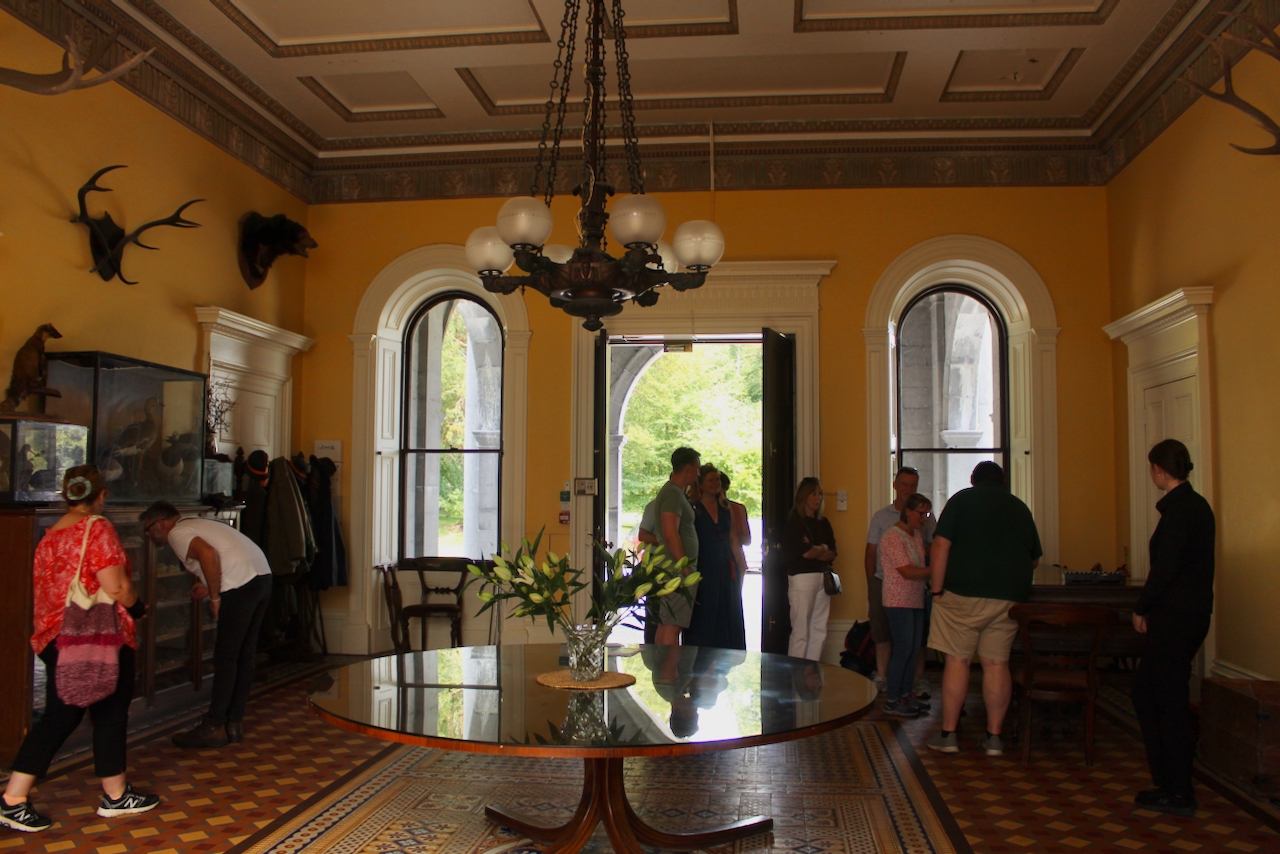
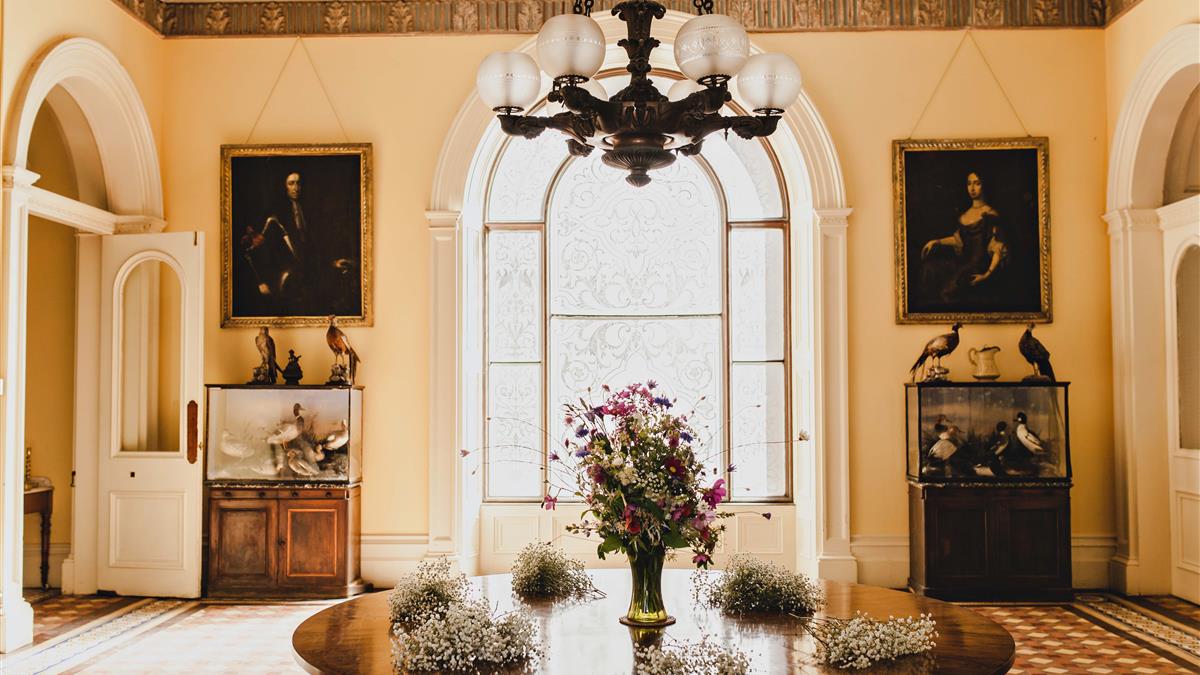
The ceiling has a Doric freize and a rose of acanthus leaves. A collection of stuffed birds and trophies line the wall, and a fine chimneypiece original to the house. [see 2]
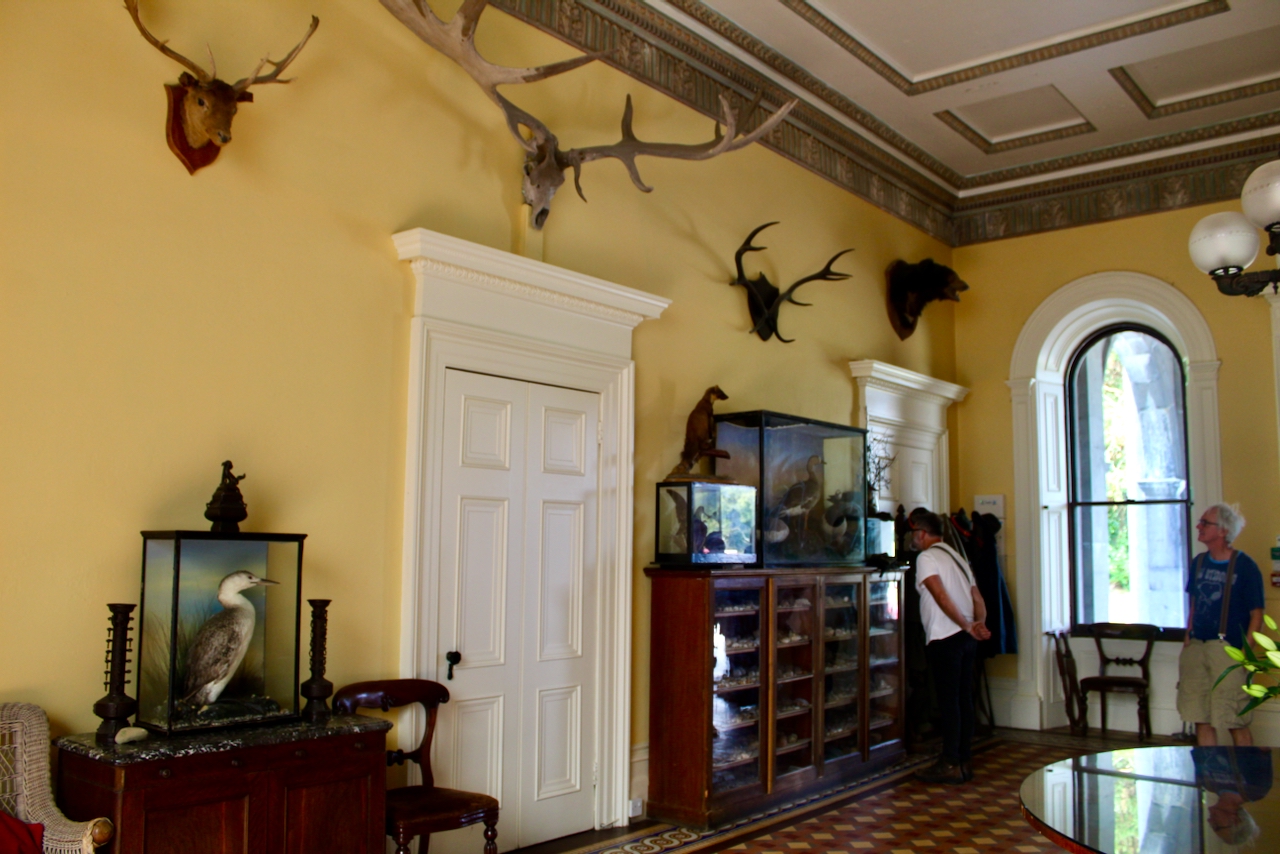
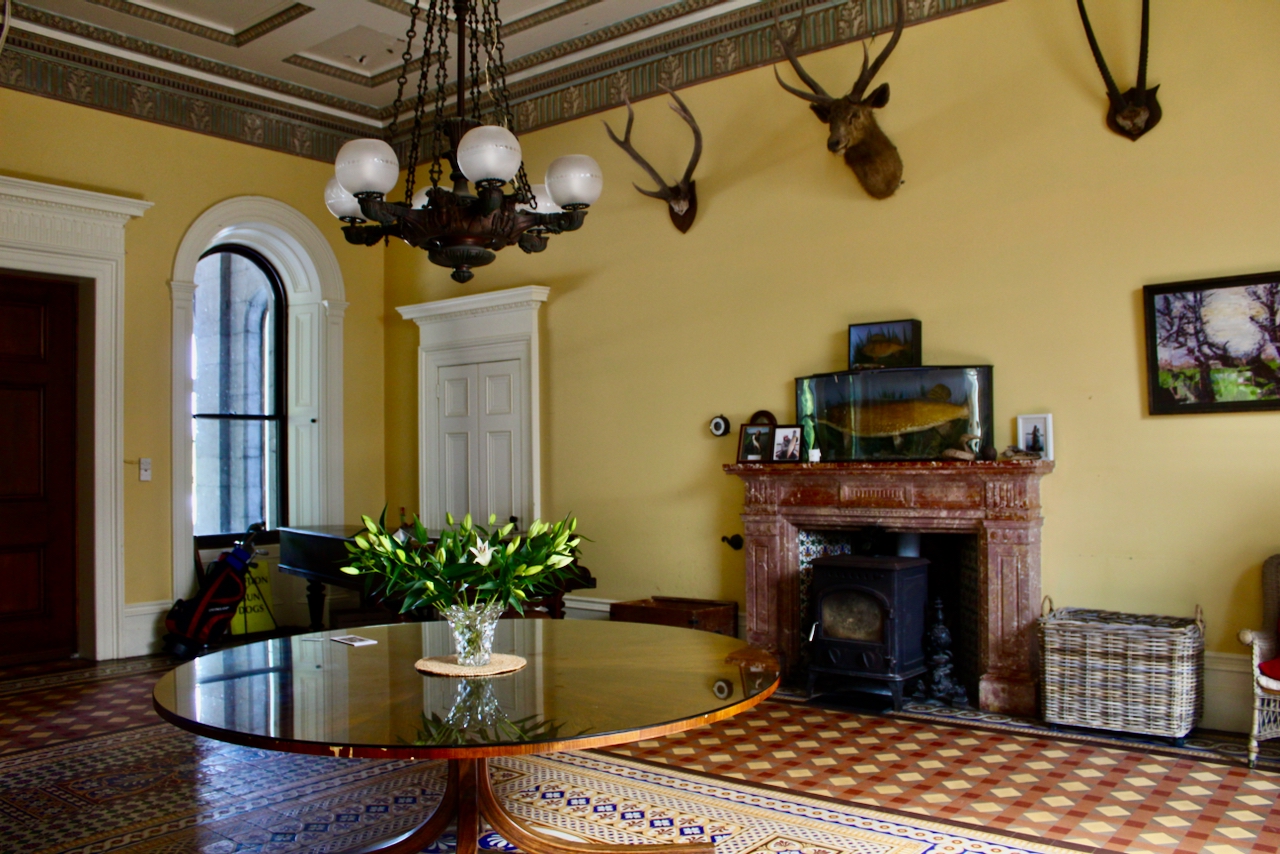
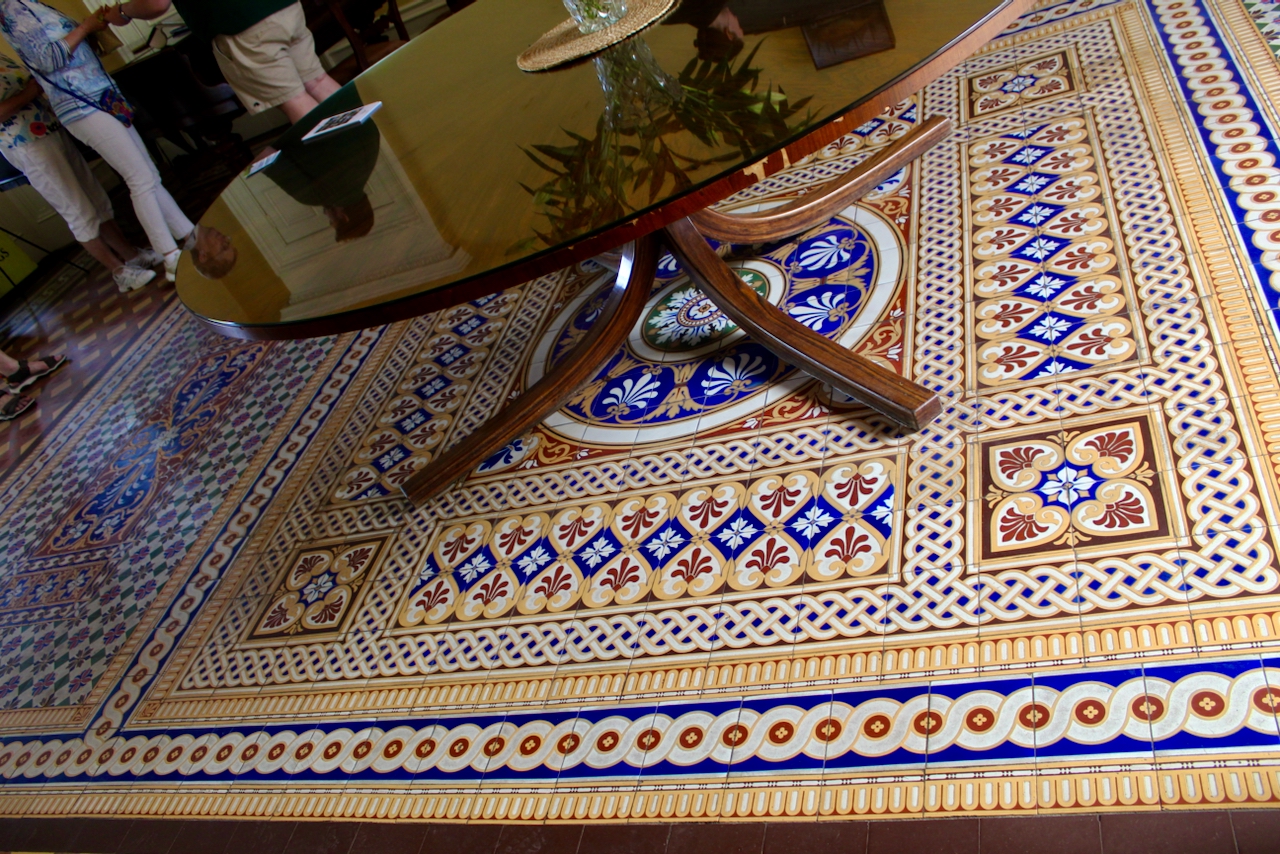
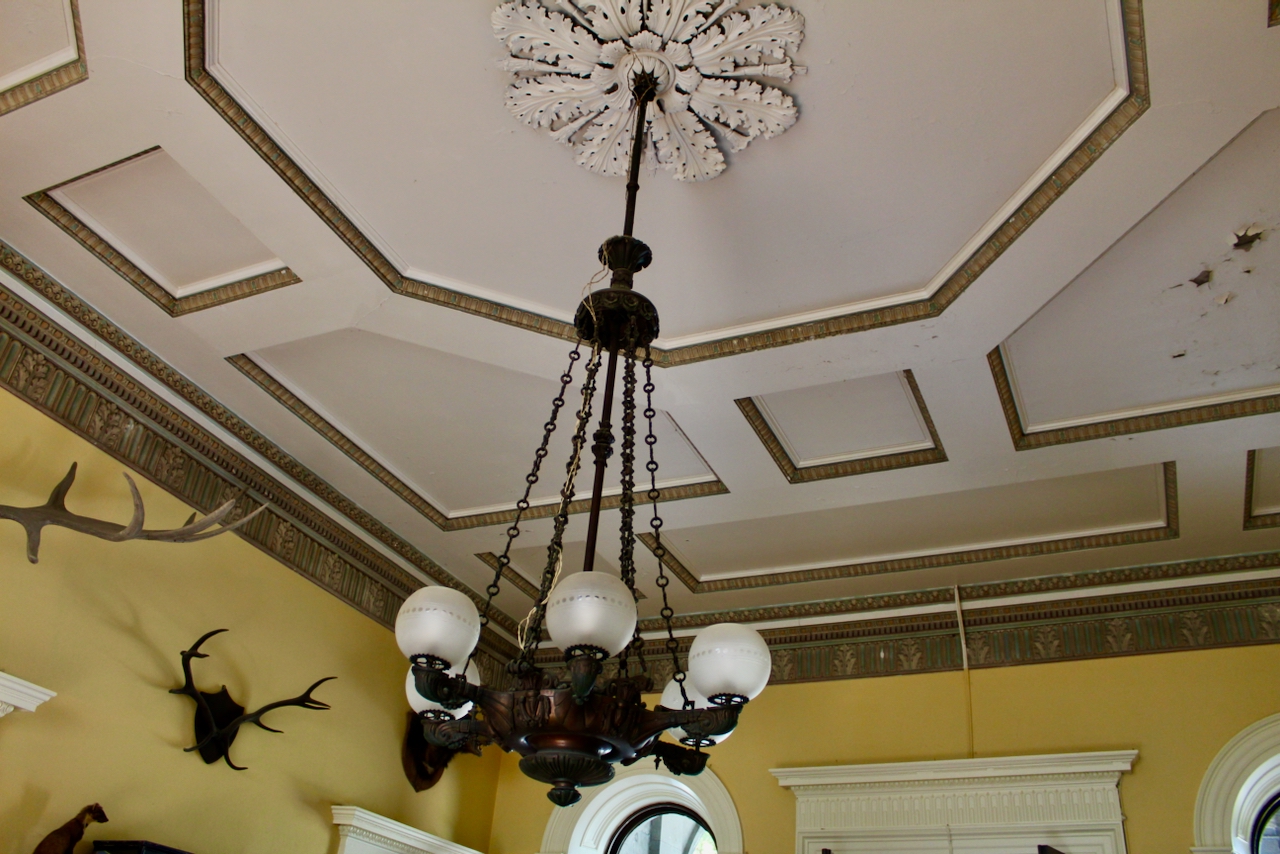
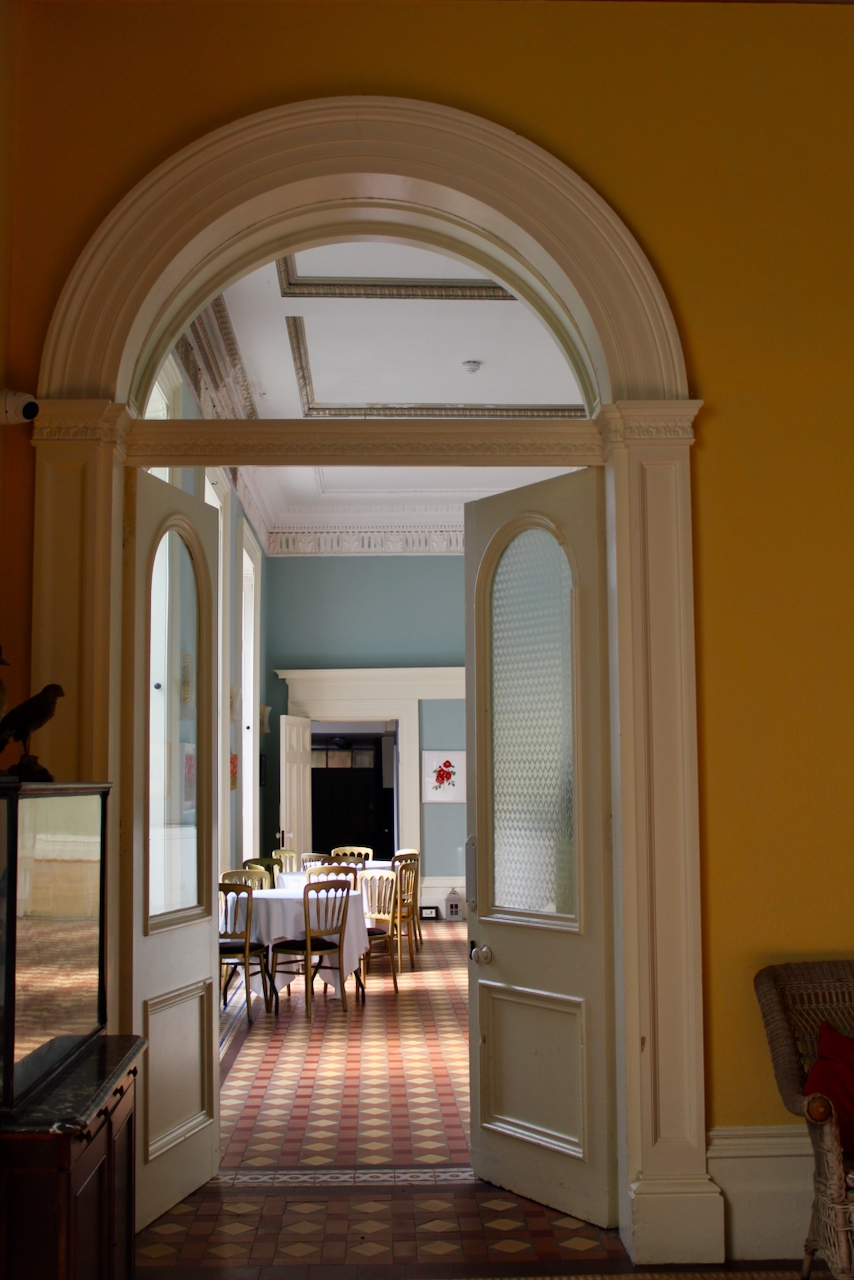
Alexander did not get to enjoy his renovated home for long, as he died in 1866 of sunstroke, which occurred while fishing in the lake by the house. His wife lived a further twenty years. His son Alec (1859-1887) married a neighbour, Charlotte Jane O’Hara from Annaghmore.
From the front hall we entered the top-lit double-height vestibule with a grand sweeping staircase and gallery lined with paintings of ancestors.
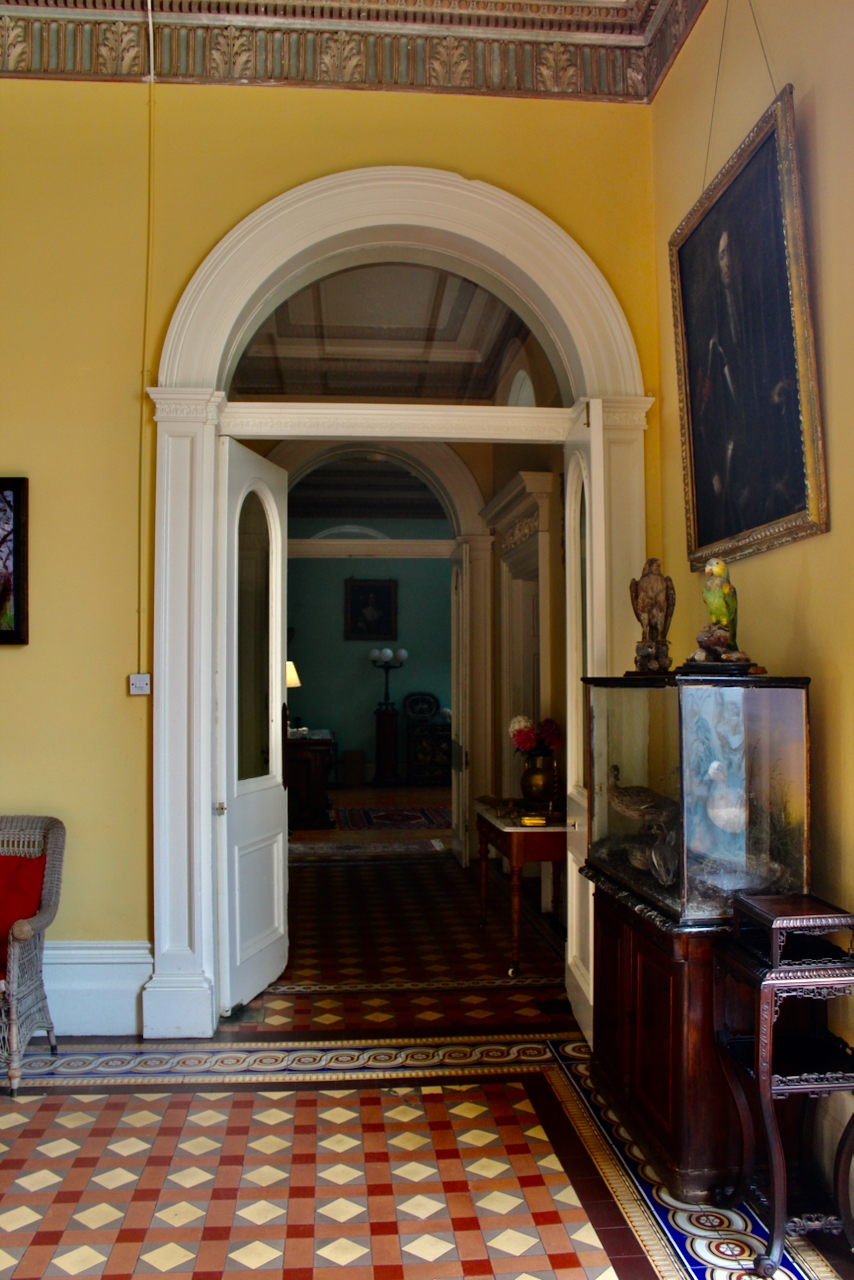
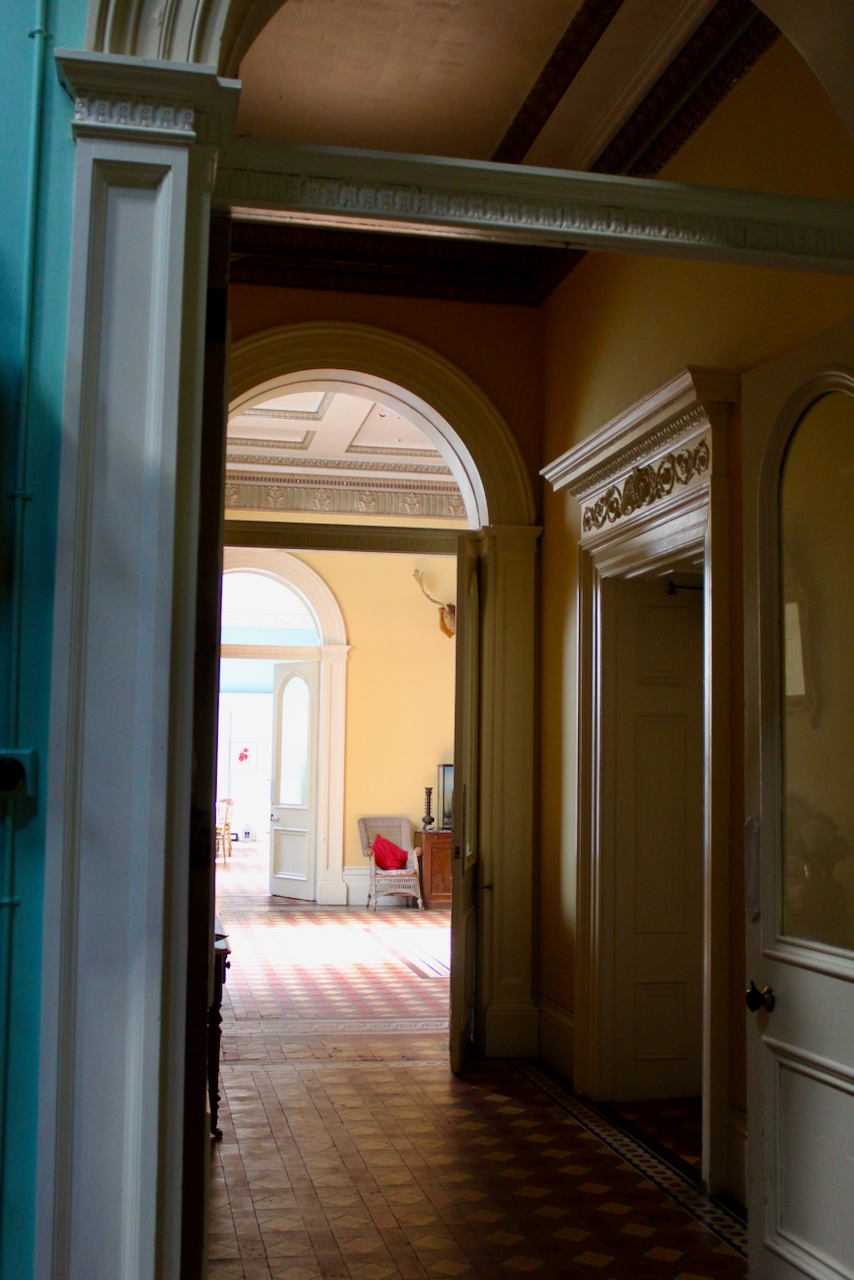
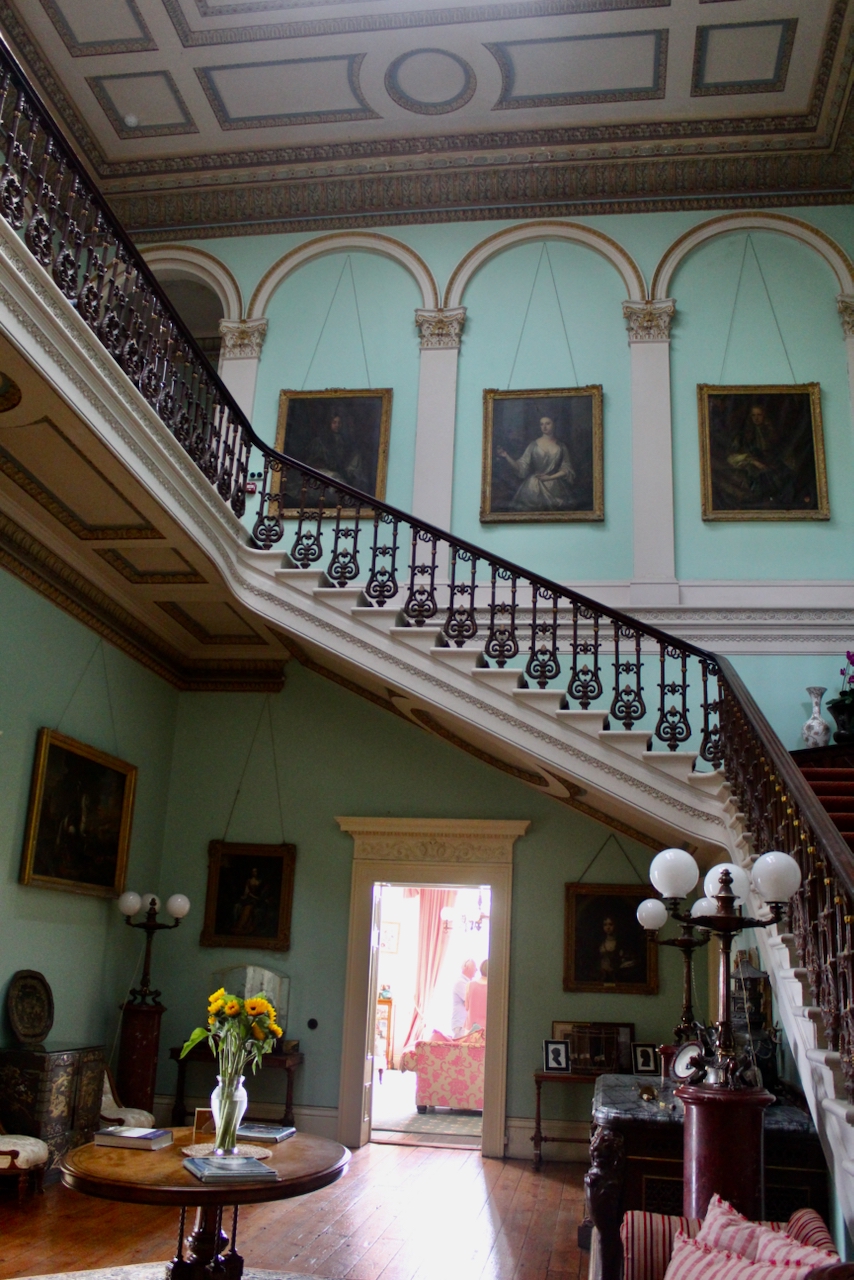
I’m dying to know who features in the wonderful portraits. The vestibule is so impressive, it is hard to know where to look! The ceiling has intricate detail.
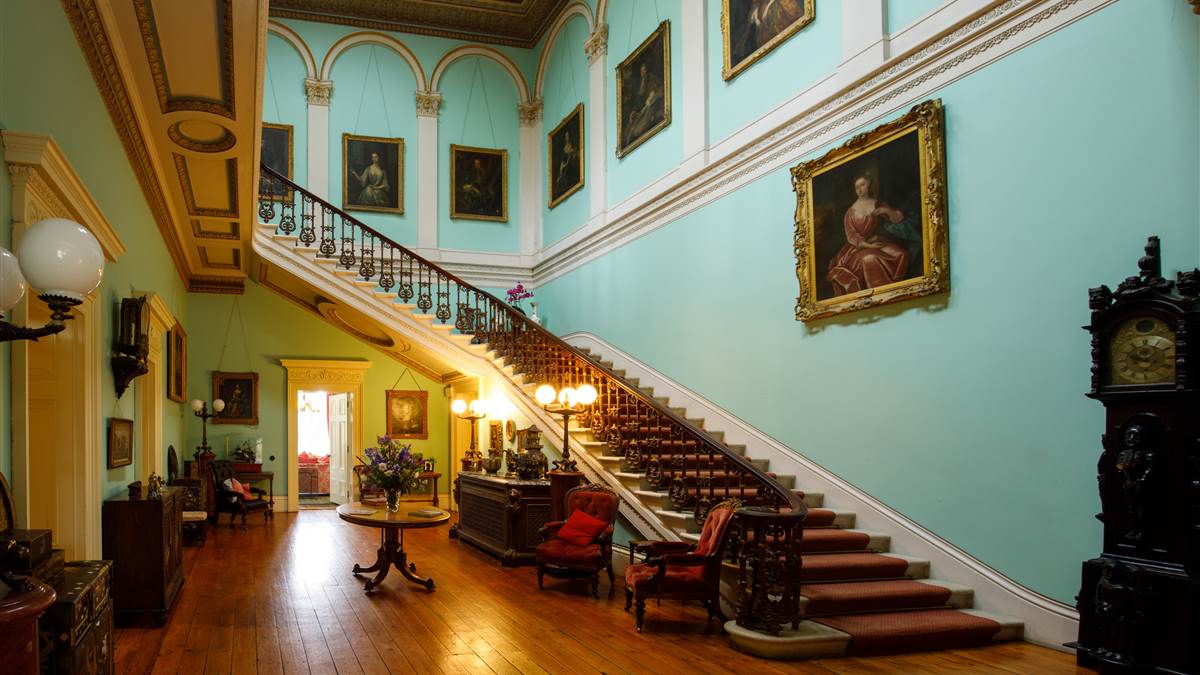
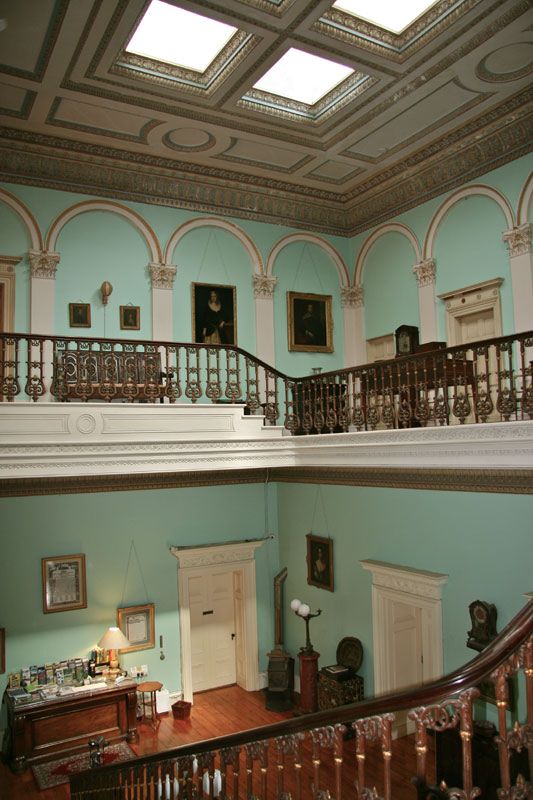
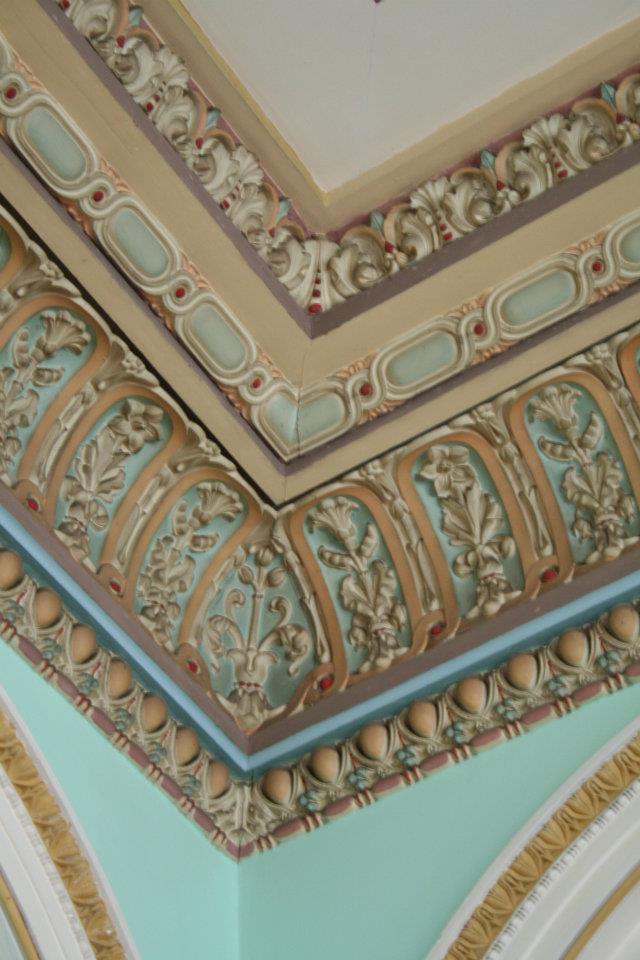
The upper level of the stair hall is lined with arches and Corinthian pilasters.
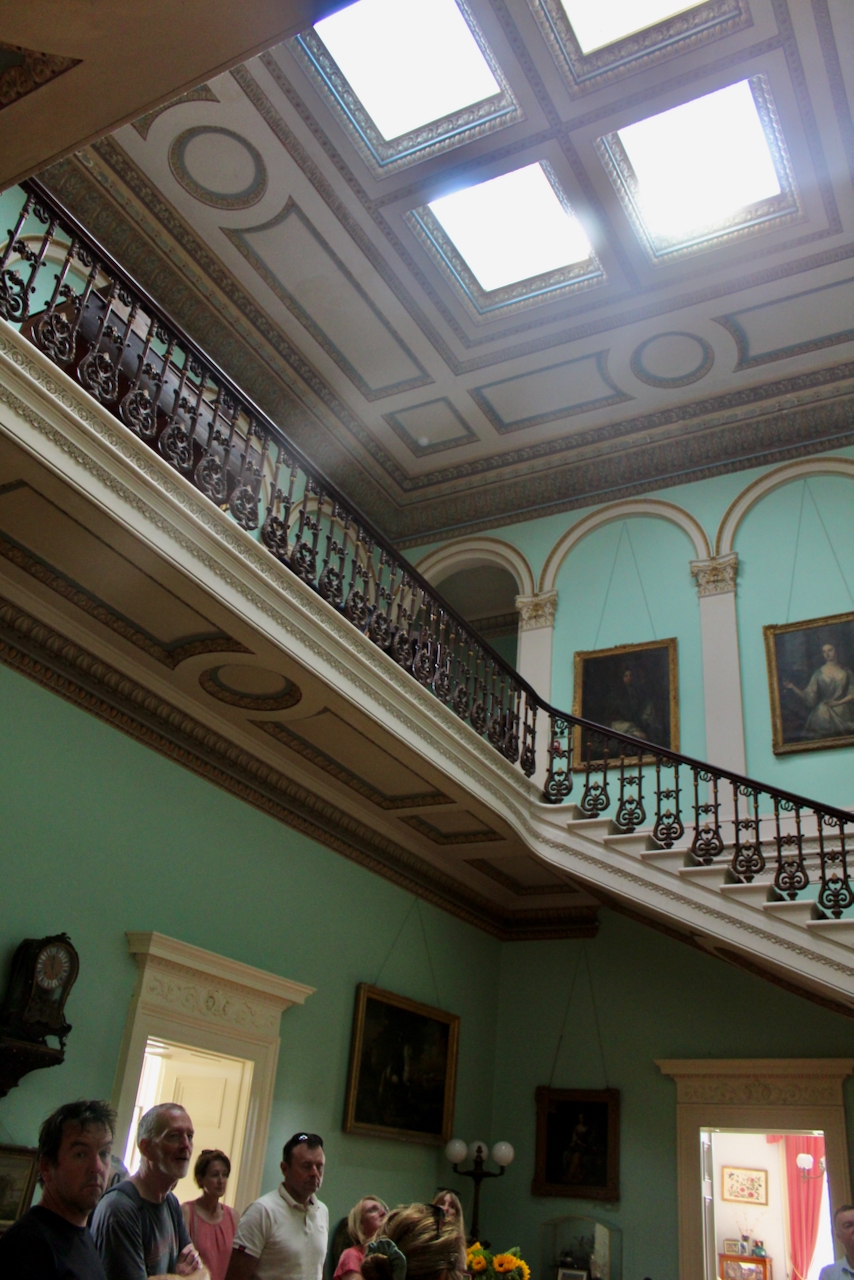
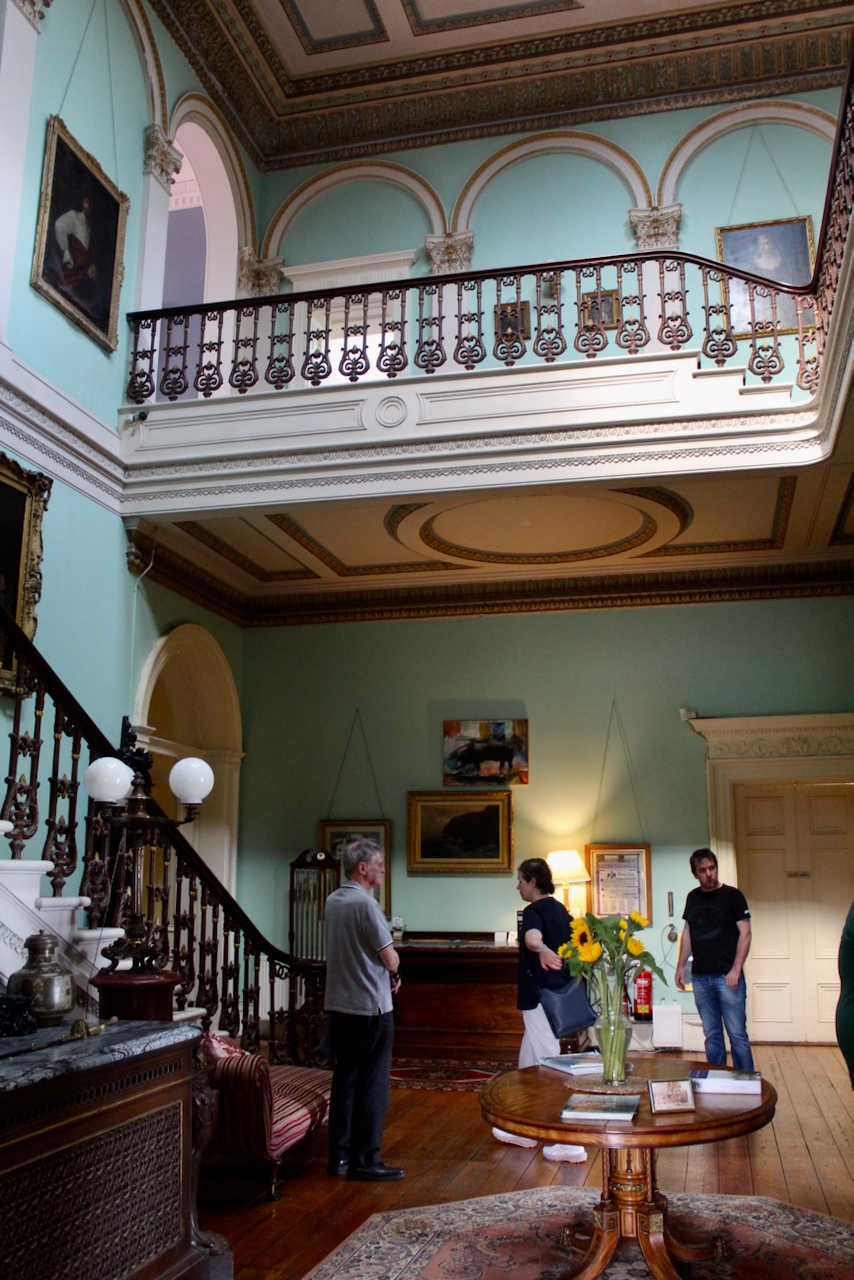
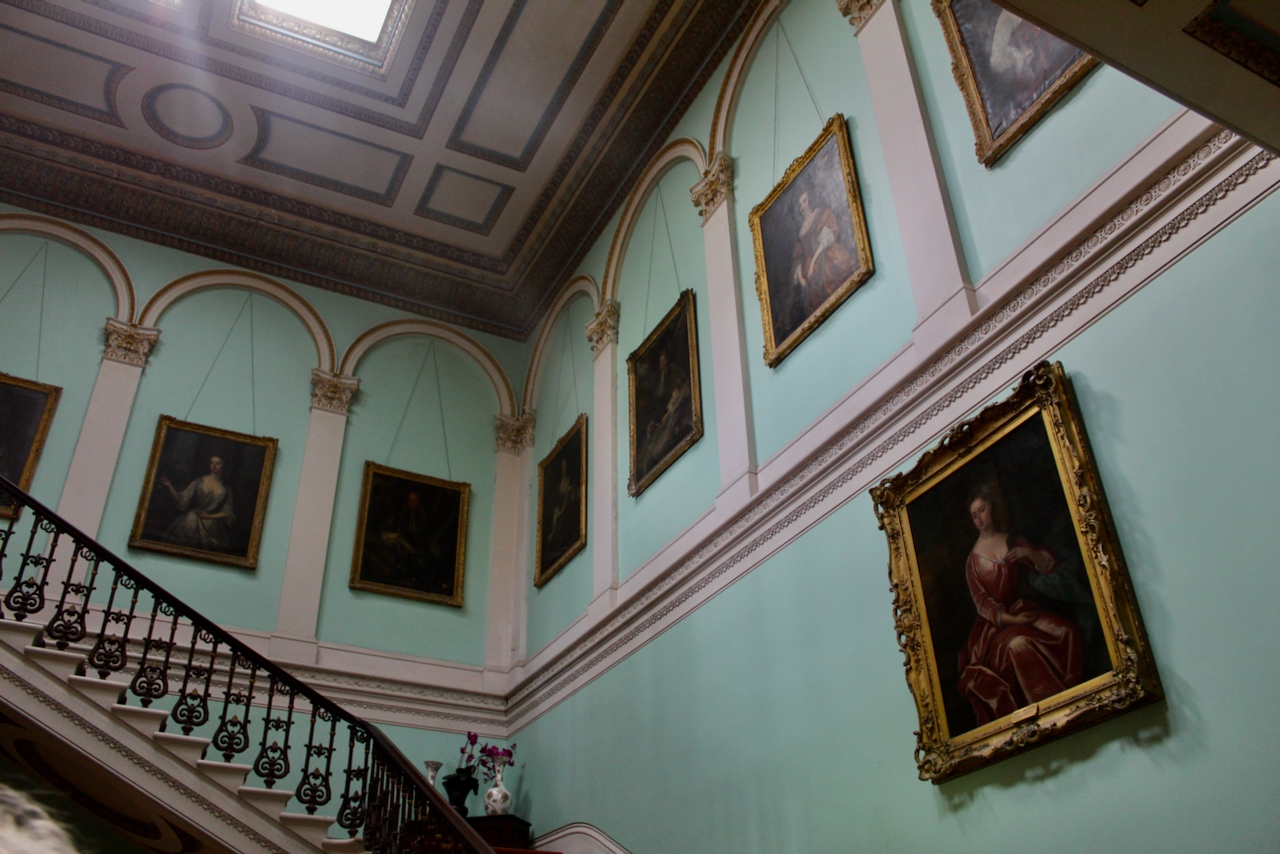
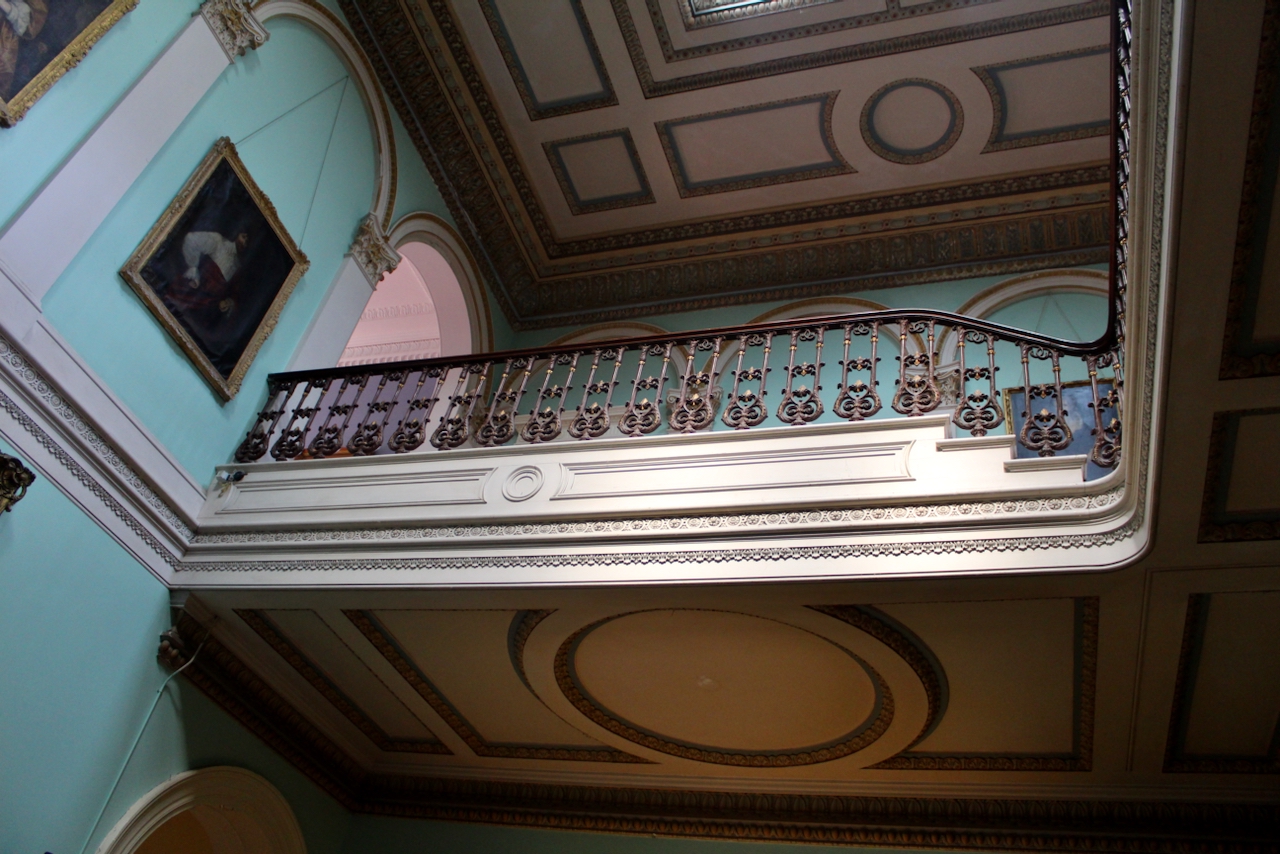
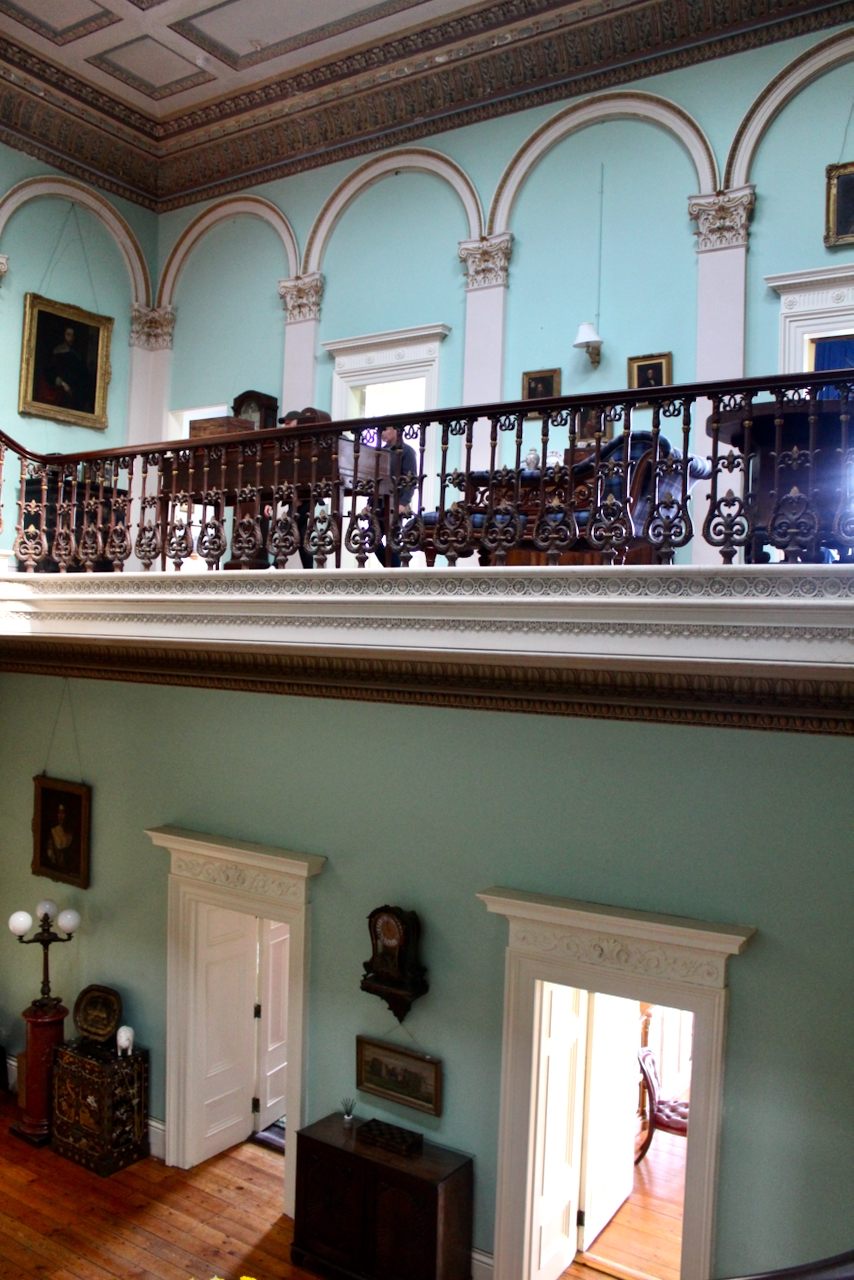
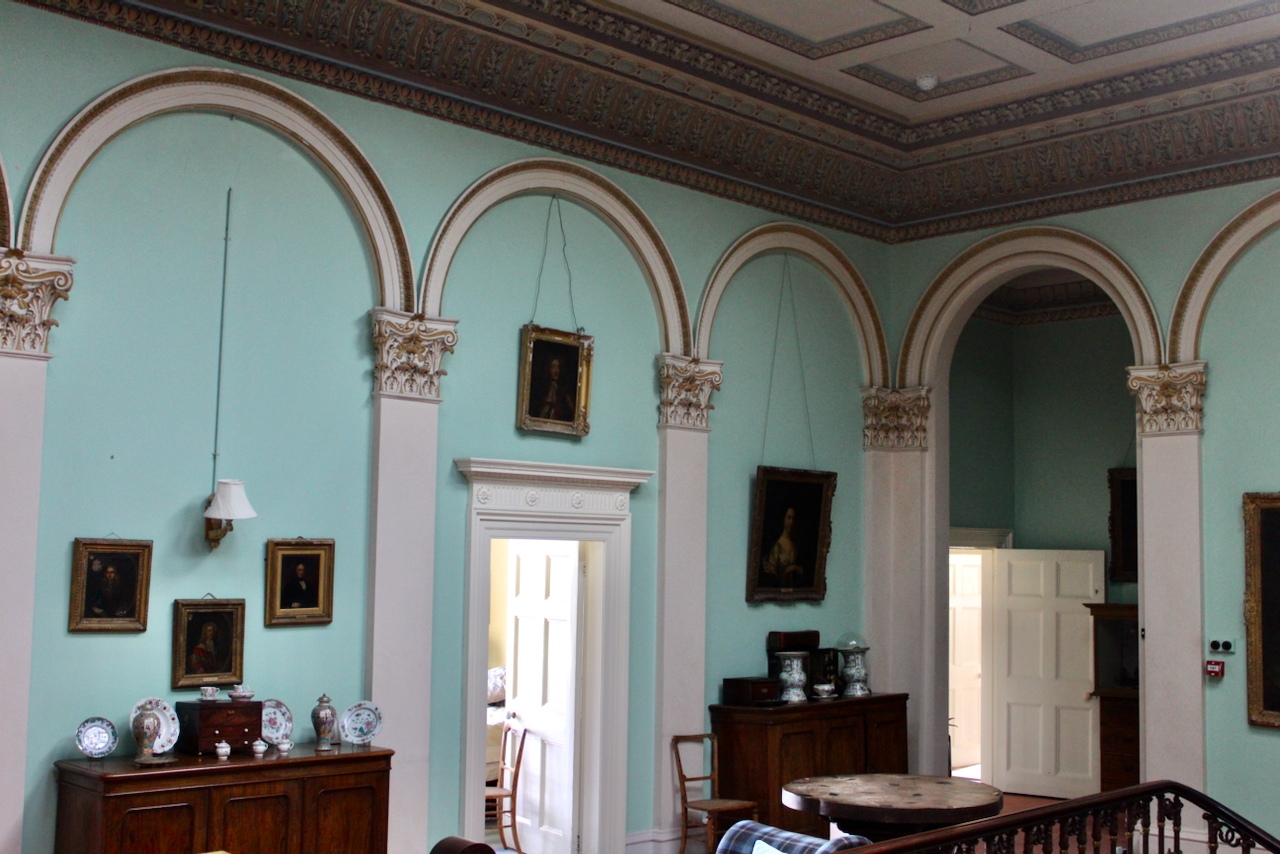

When Alec died of meningitis in 1887, Charlotte took over the running of the estate for 30 years. Alec’s son Alexander Ascelin was injured in the first world war. He married the doctor’s daughter, Nora MacDowell. In financial difficulty, he had to sell some of the land. His wife predeceased him and toward the end of his life, he lived alone in this house of about ninety seven rooms, living in only three rooms. The rest of the house was closed up, dustsheets over the furniture.
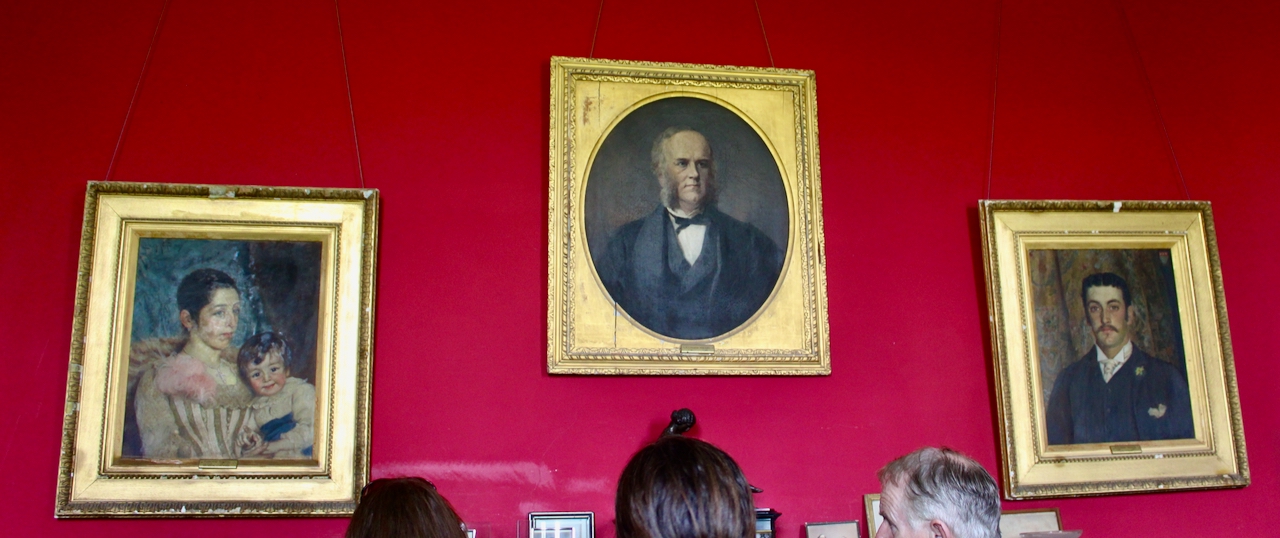
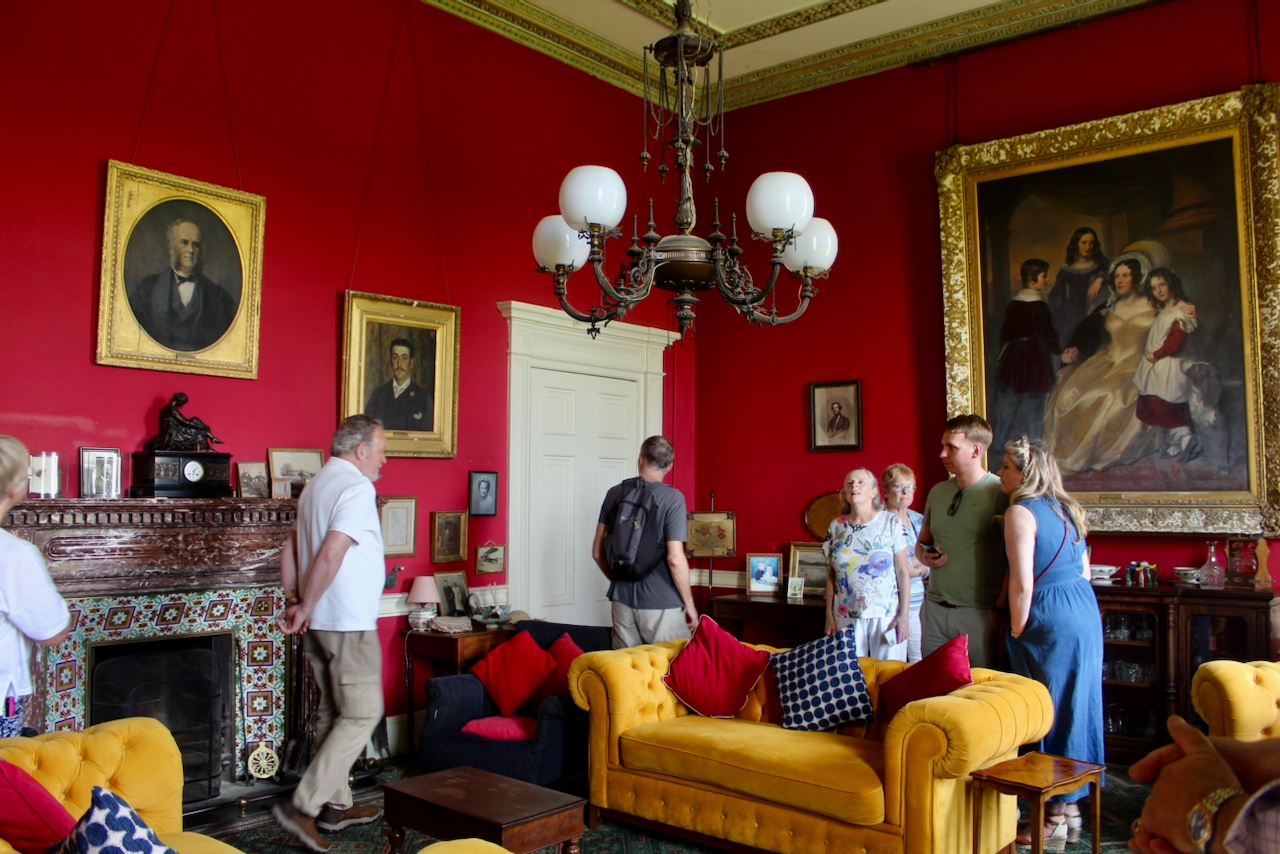
The gasolier lamps remind us that the property generated its own gas at one time.
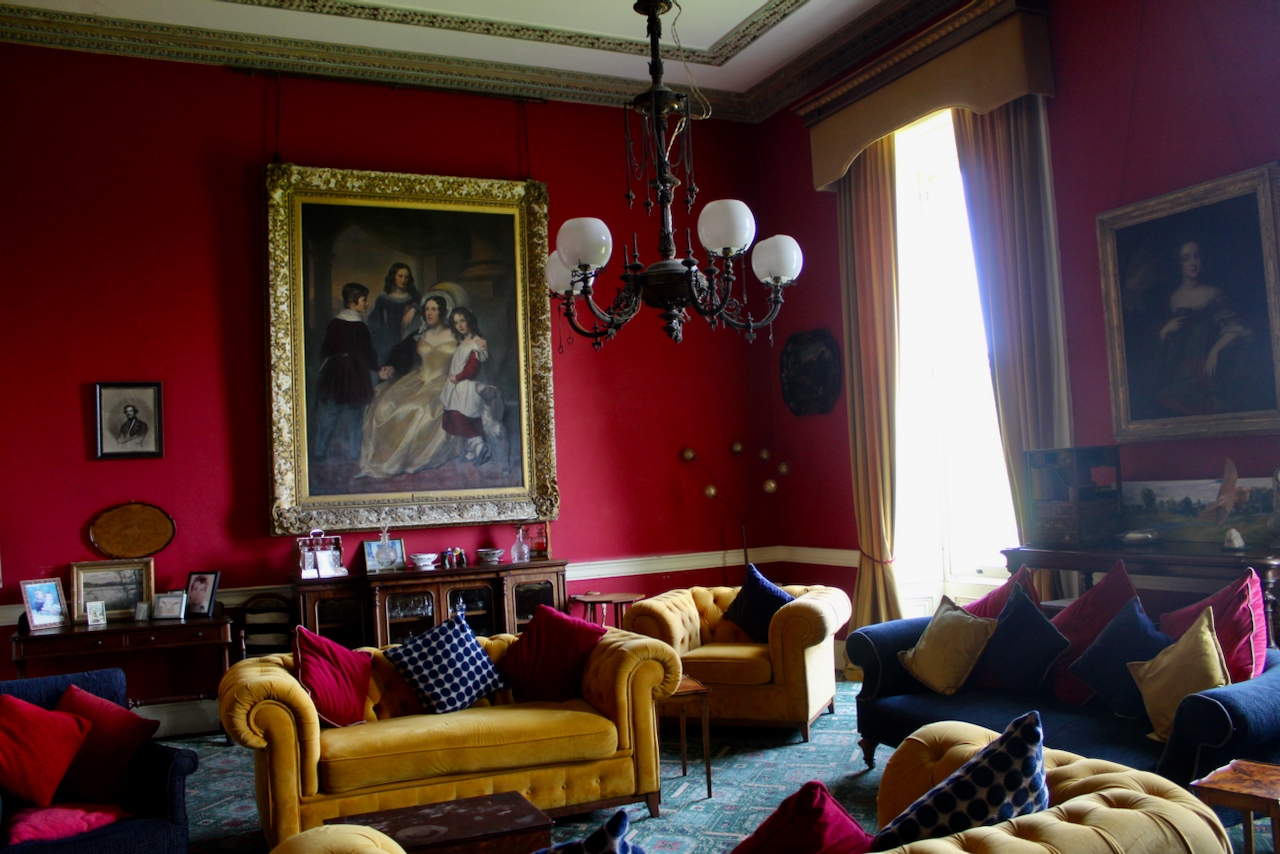

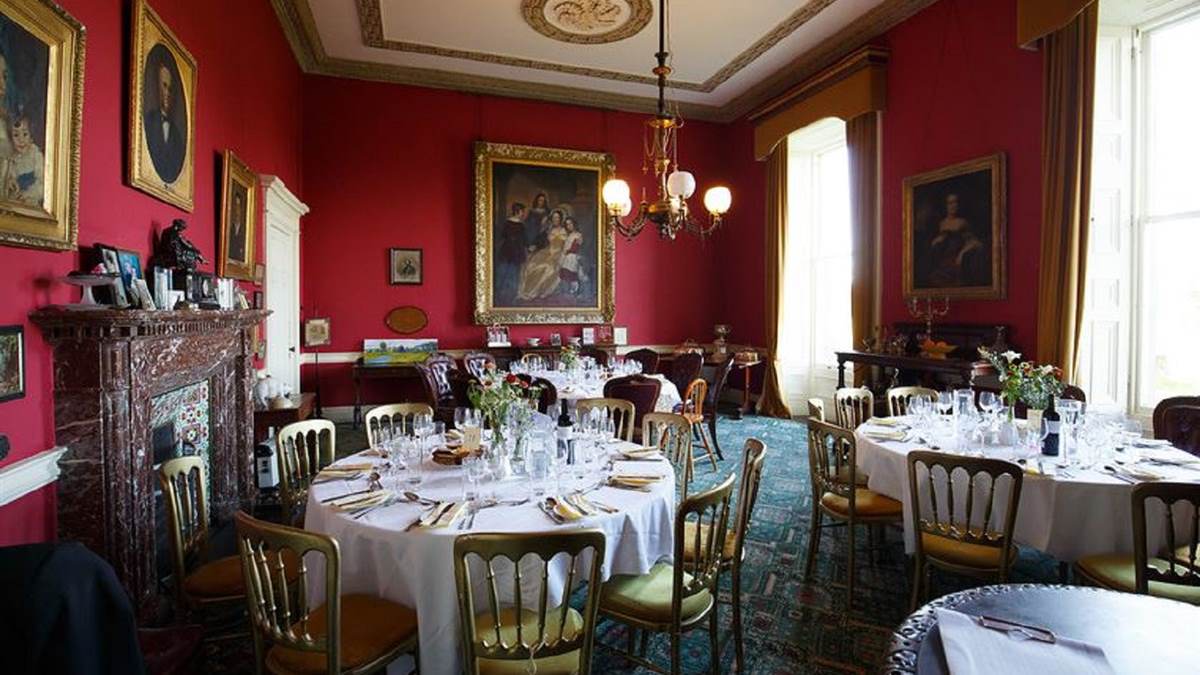
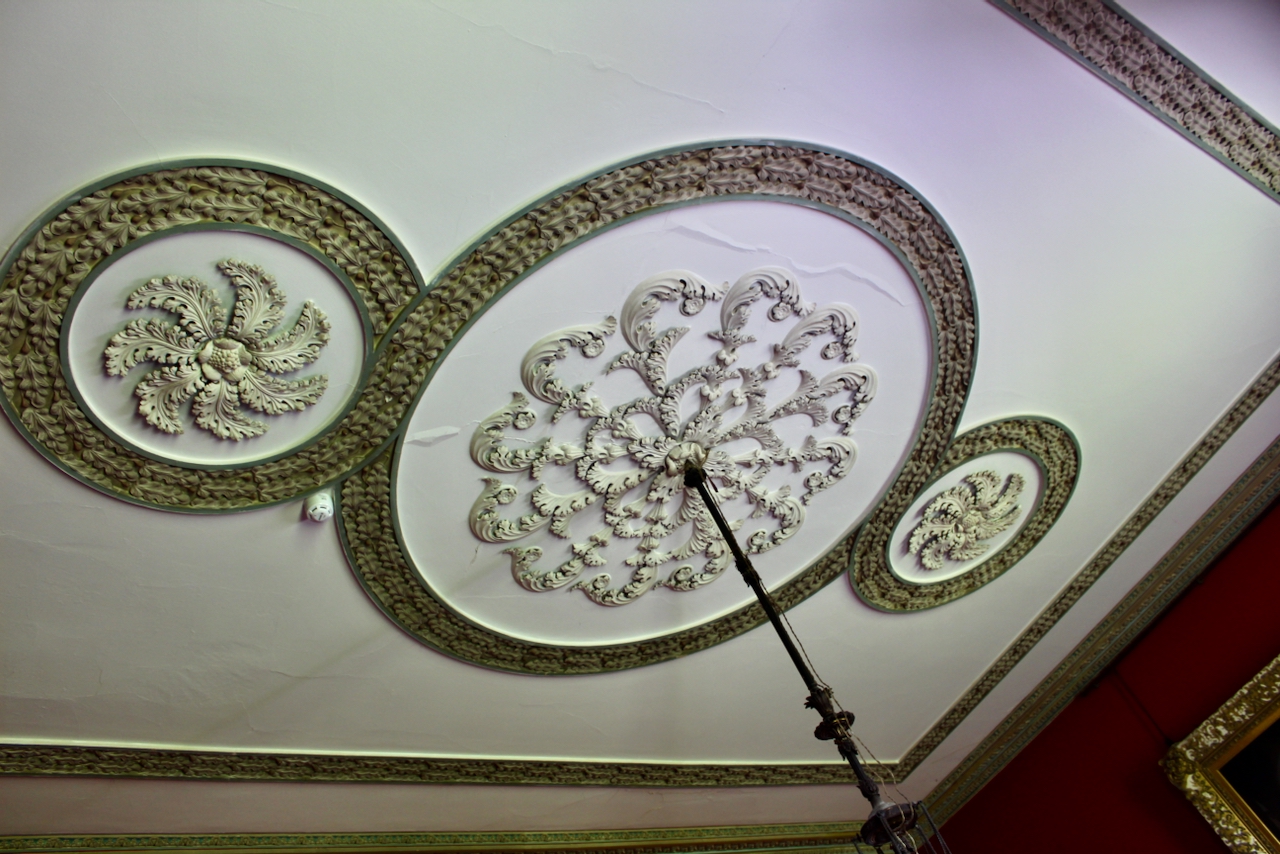
Five years after being closed up, in 1953, Ascelin’s son Alex, who had been a tea planter in what was then known as Burma, returned with his wife Yvonne to run the estate. They renovated the house, patched up the roof and installed a new kitchen. Alex modernised the farm.
It was their son Sandy and his wife who decided to take advantage of the size of the house to run a bed and breakfast, which opened in 1980. In 2004 their son Roderick returned to Temple House with his wife and children and took over running the business and the farm.
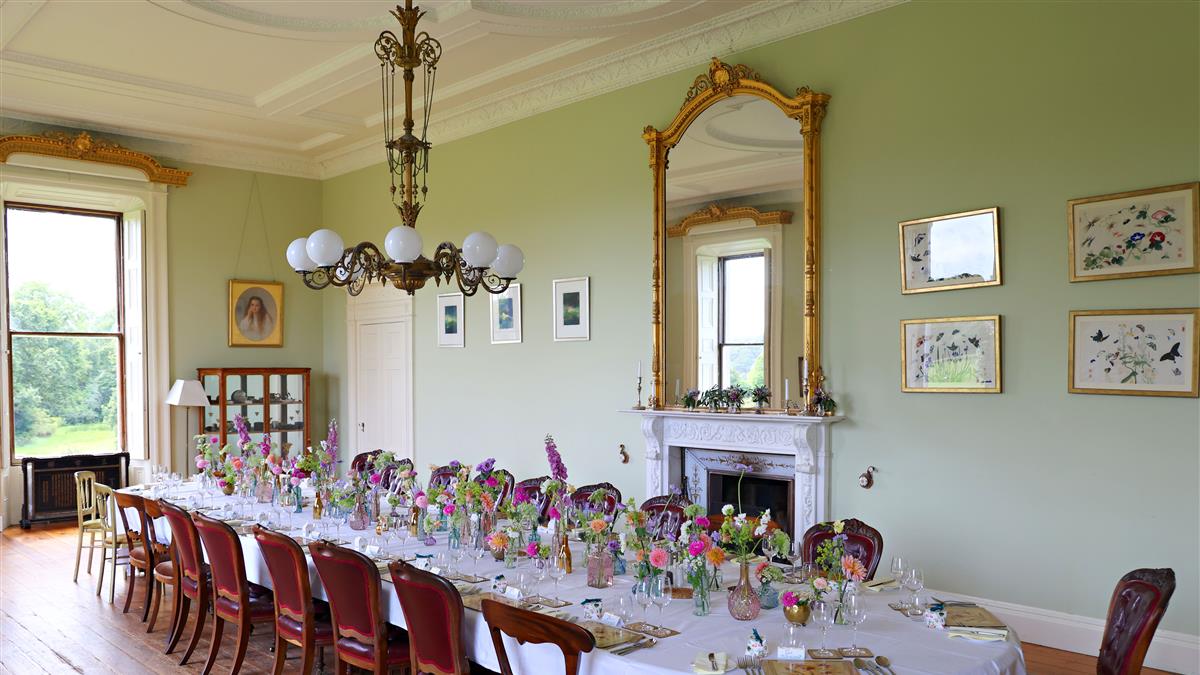
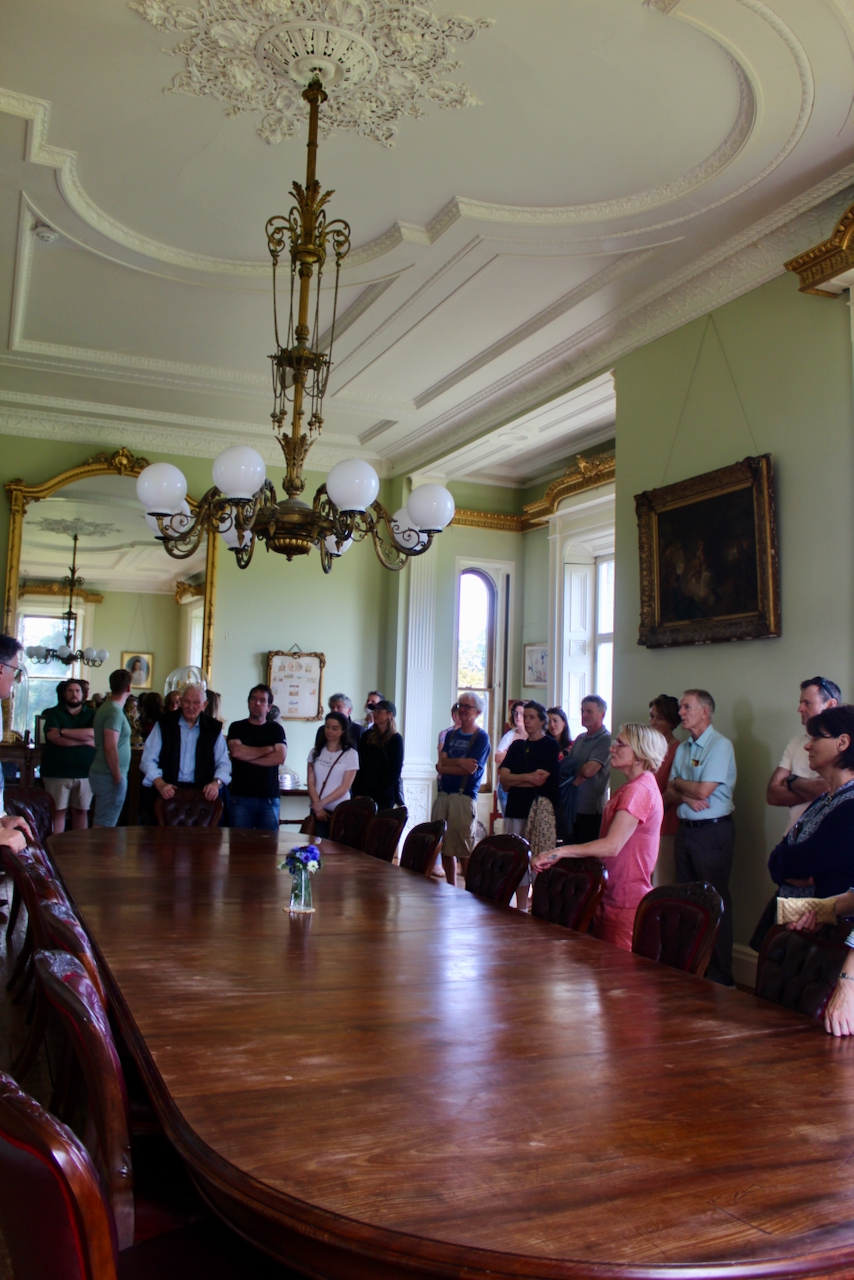
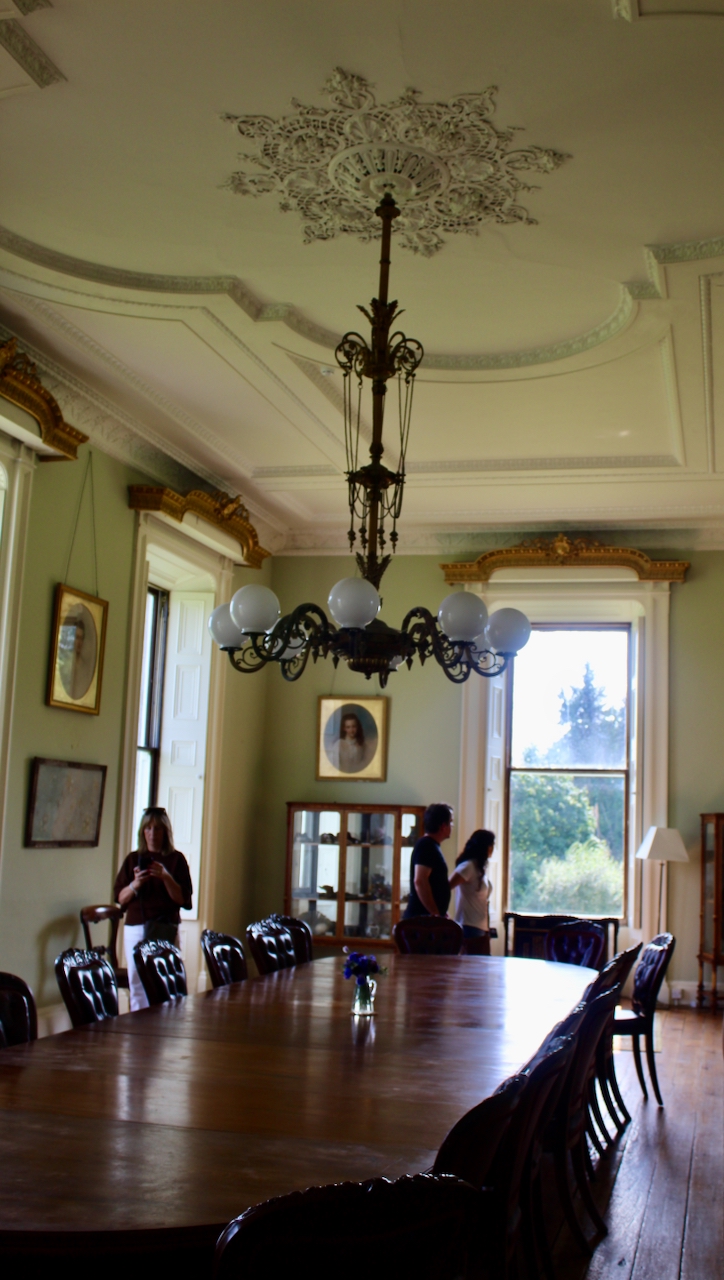
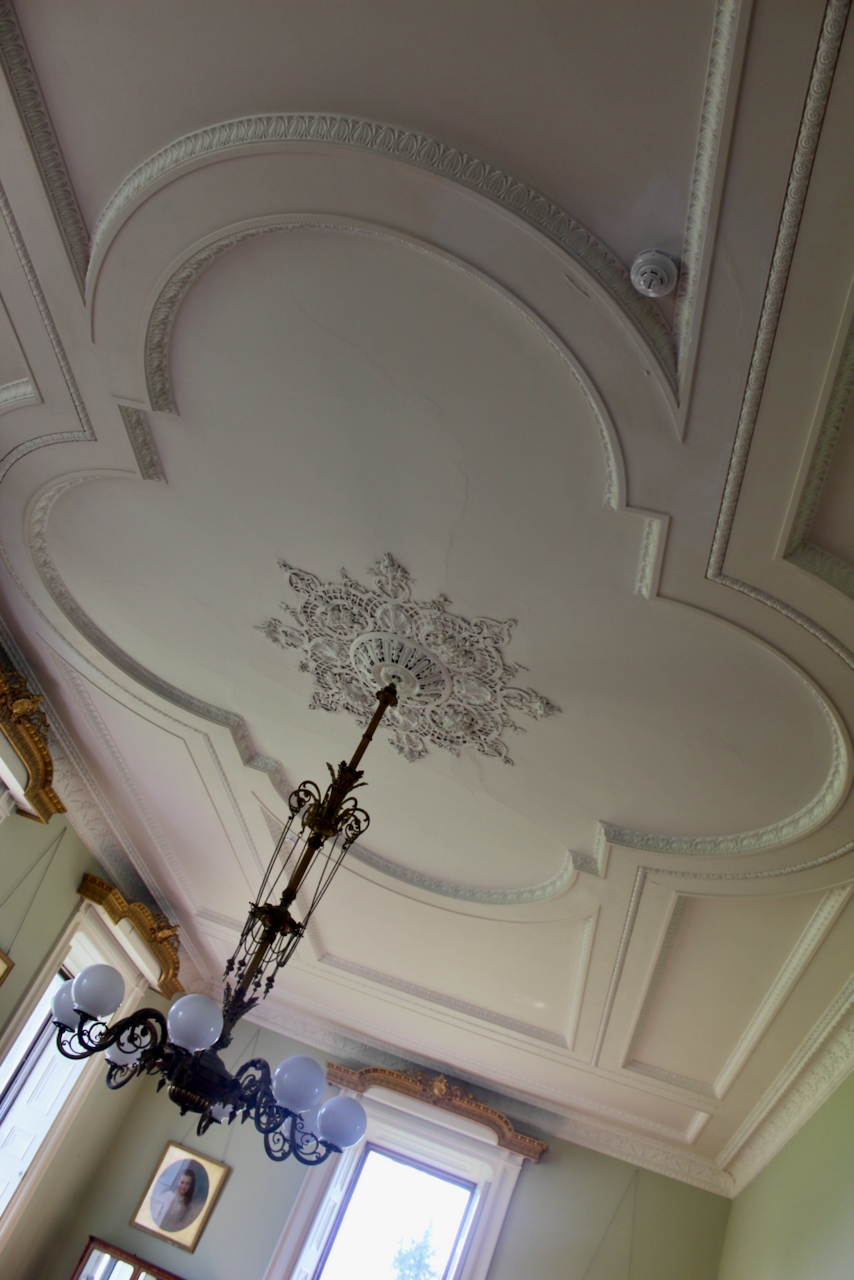
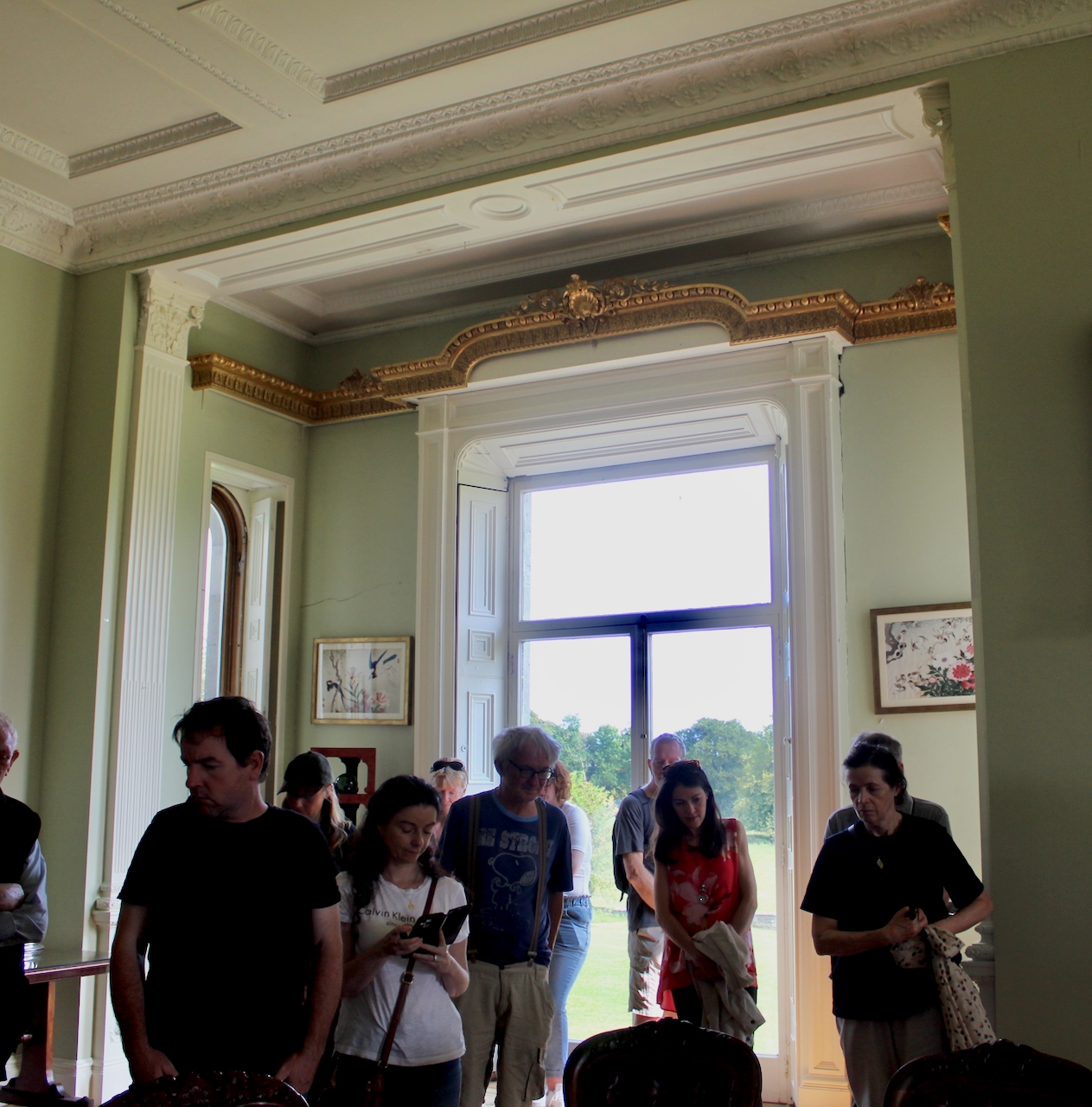
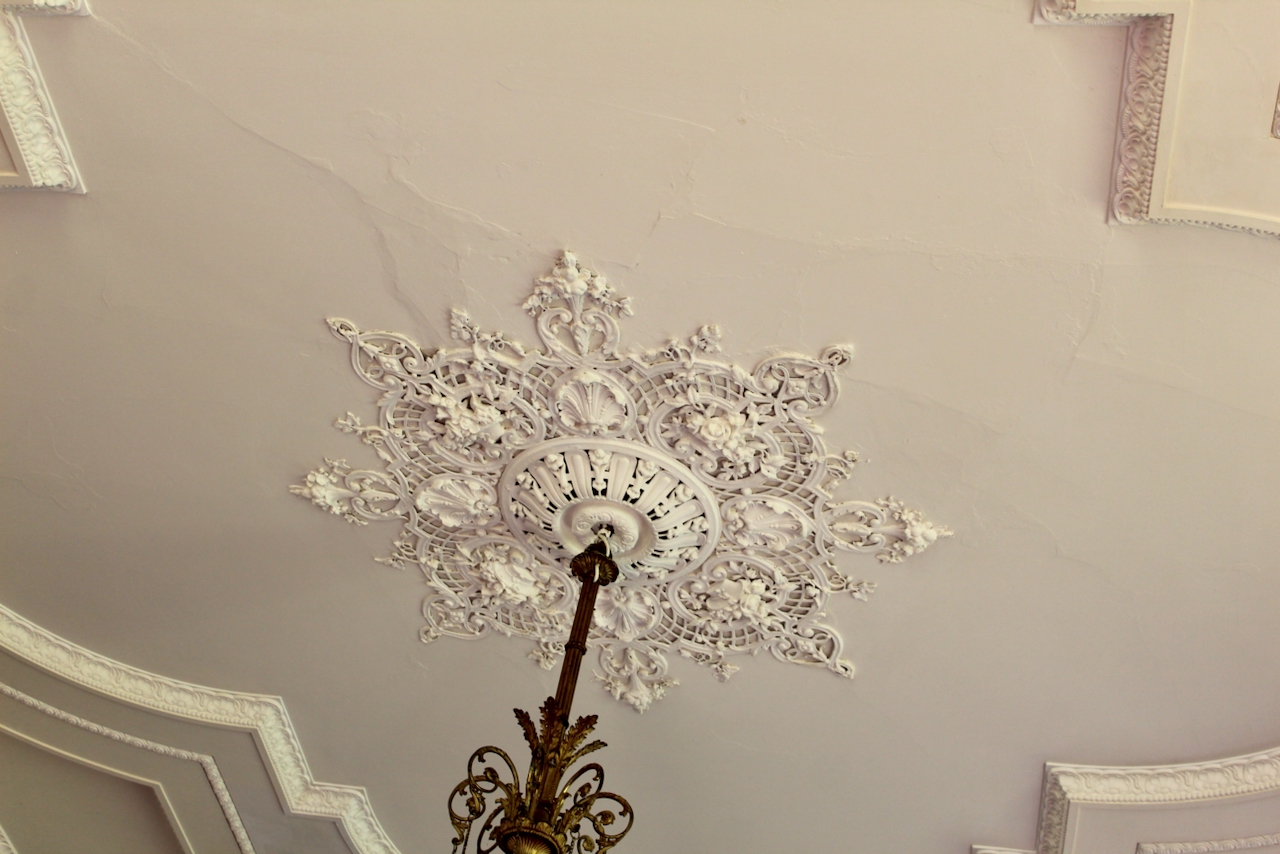
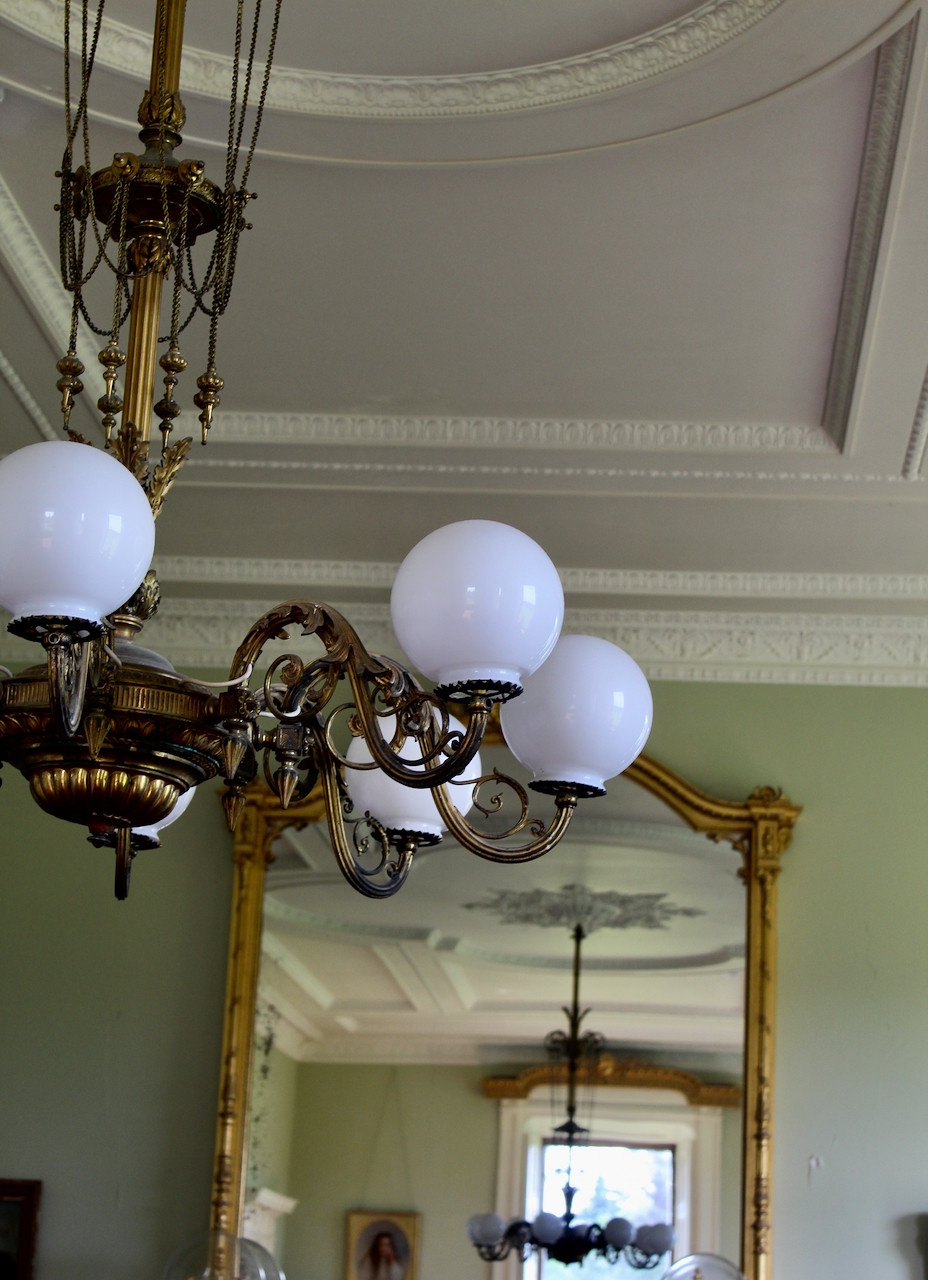
Roderick told us about the family as we toured the stair hall vestibule, drawing room and dining room, then brought us across the front hall to the newly renovated part of the house, which includes a former gun room passage. He managed to find craftsmen to do repairs, including the windows, moulding and plasterwork. After the tour, he kindly let us wander around the house, including up to the bedrooms.
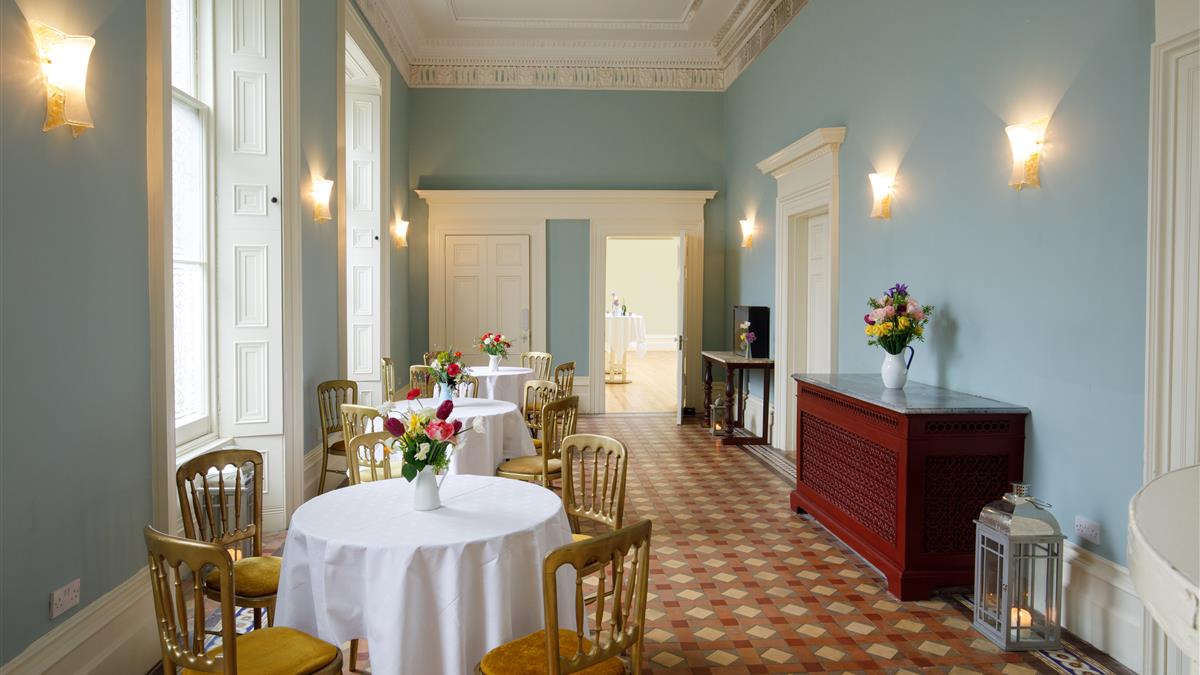
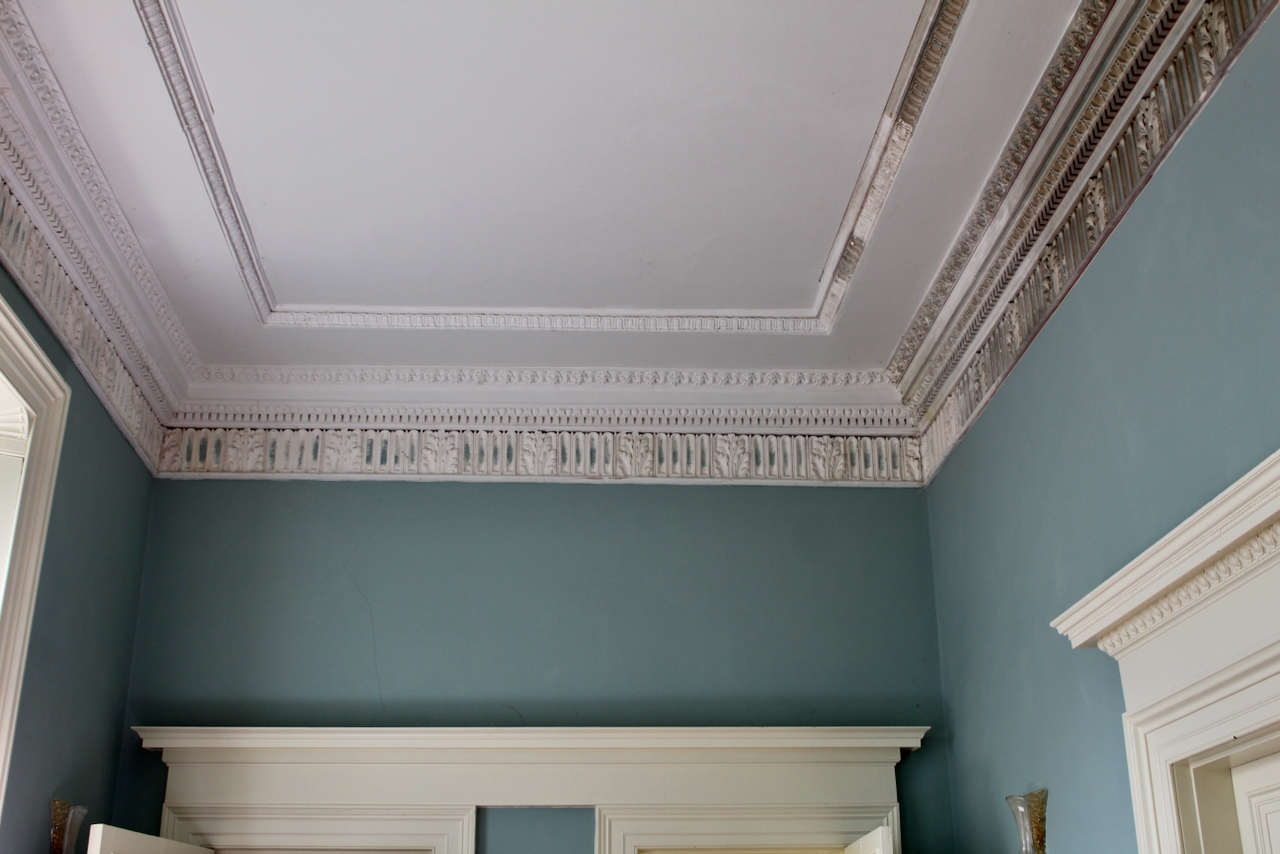
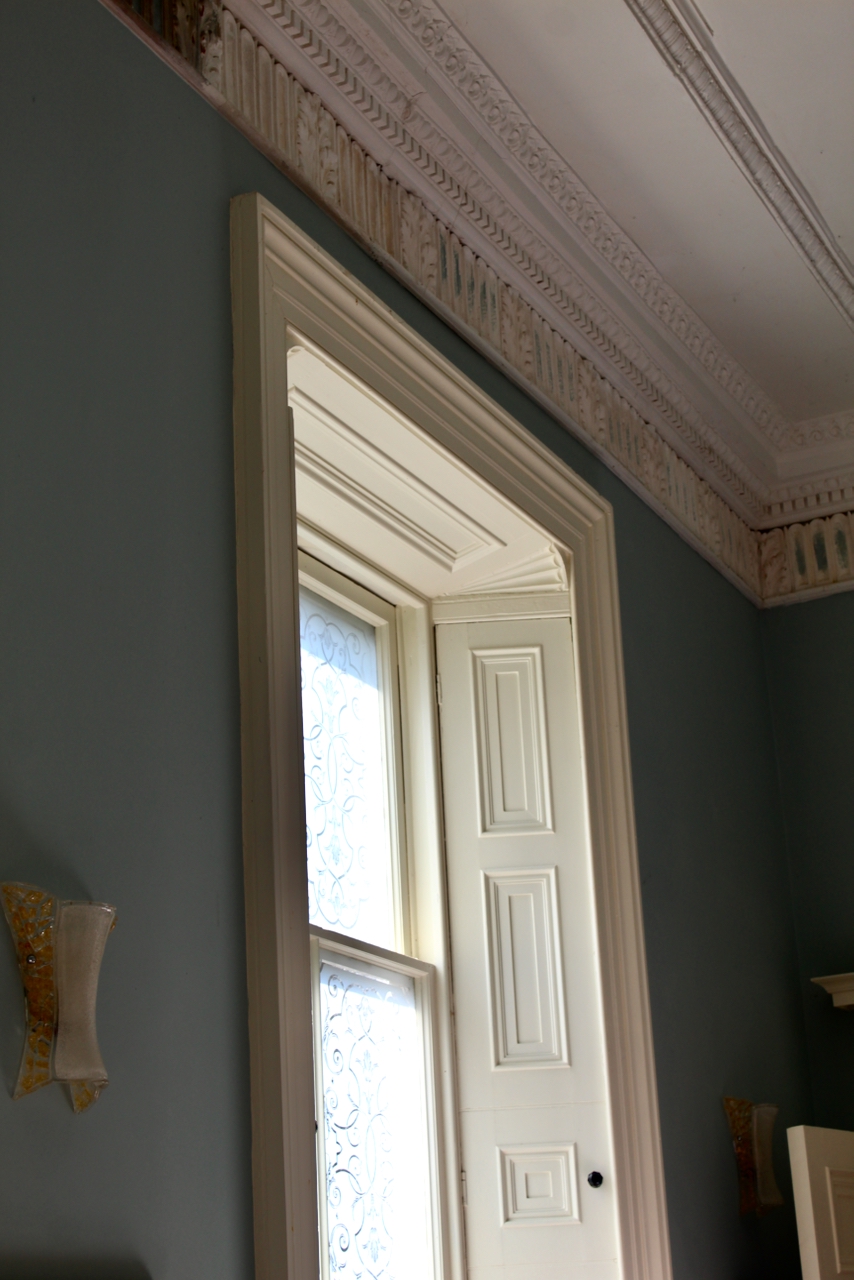
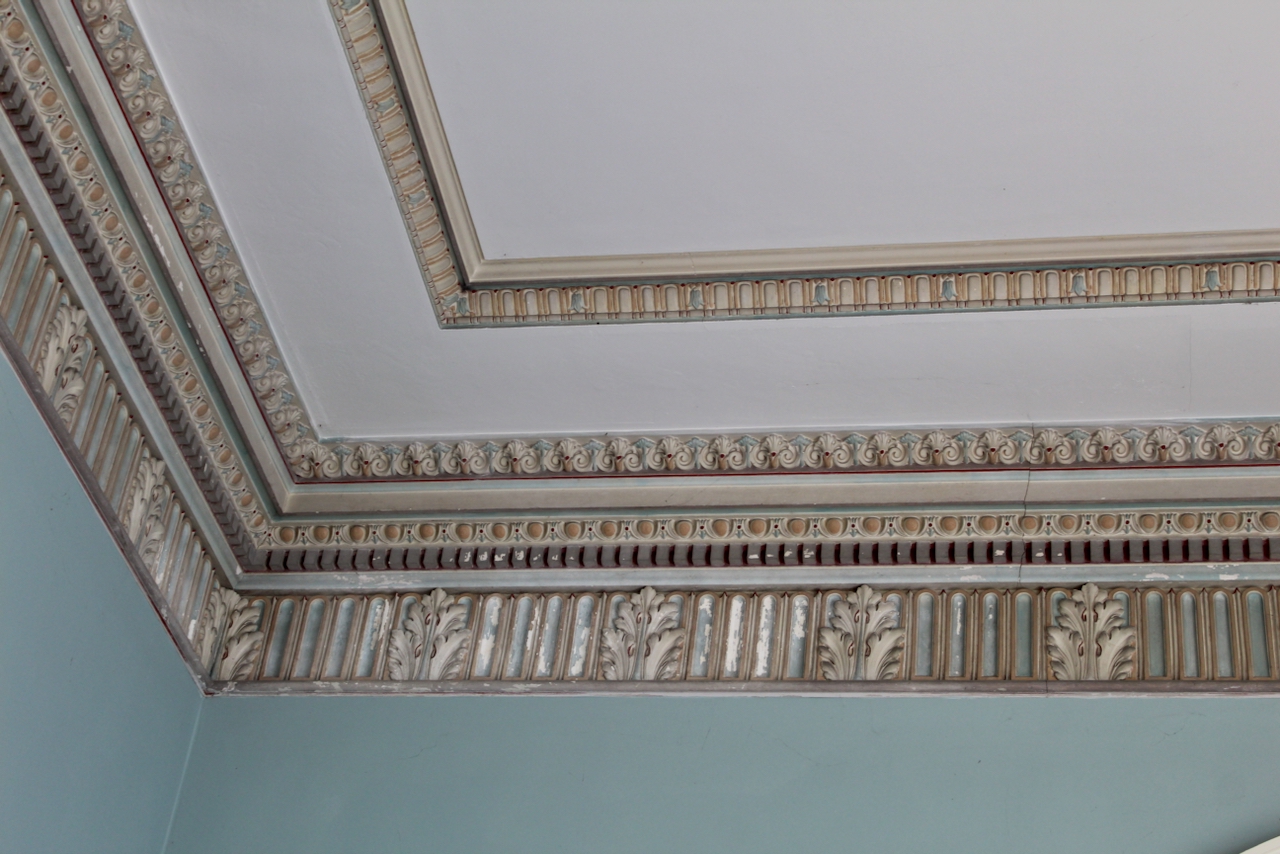
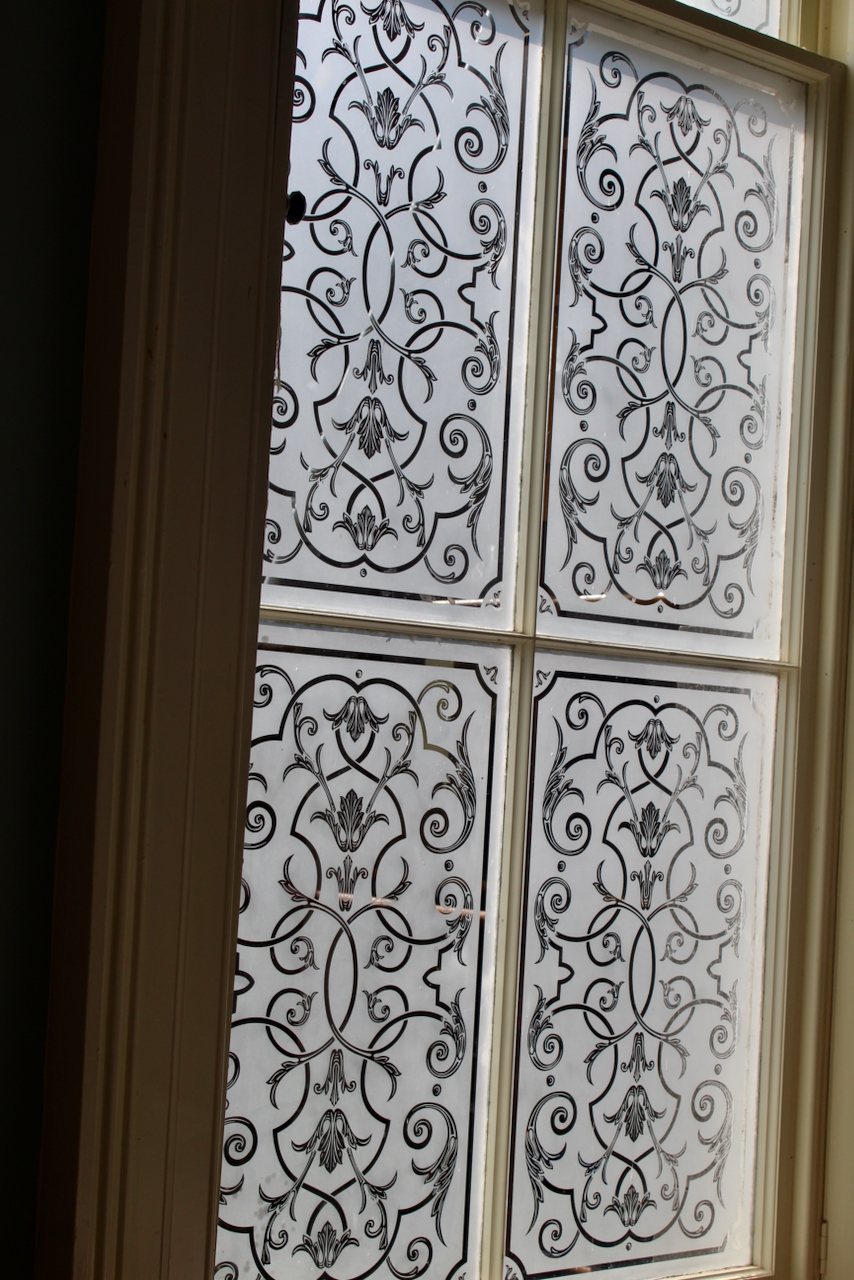
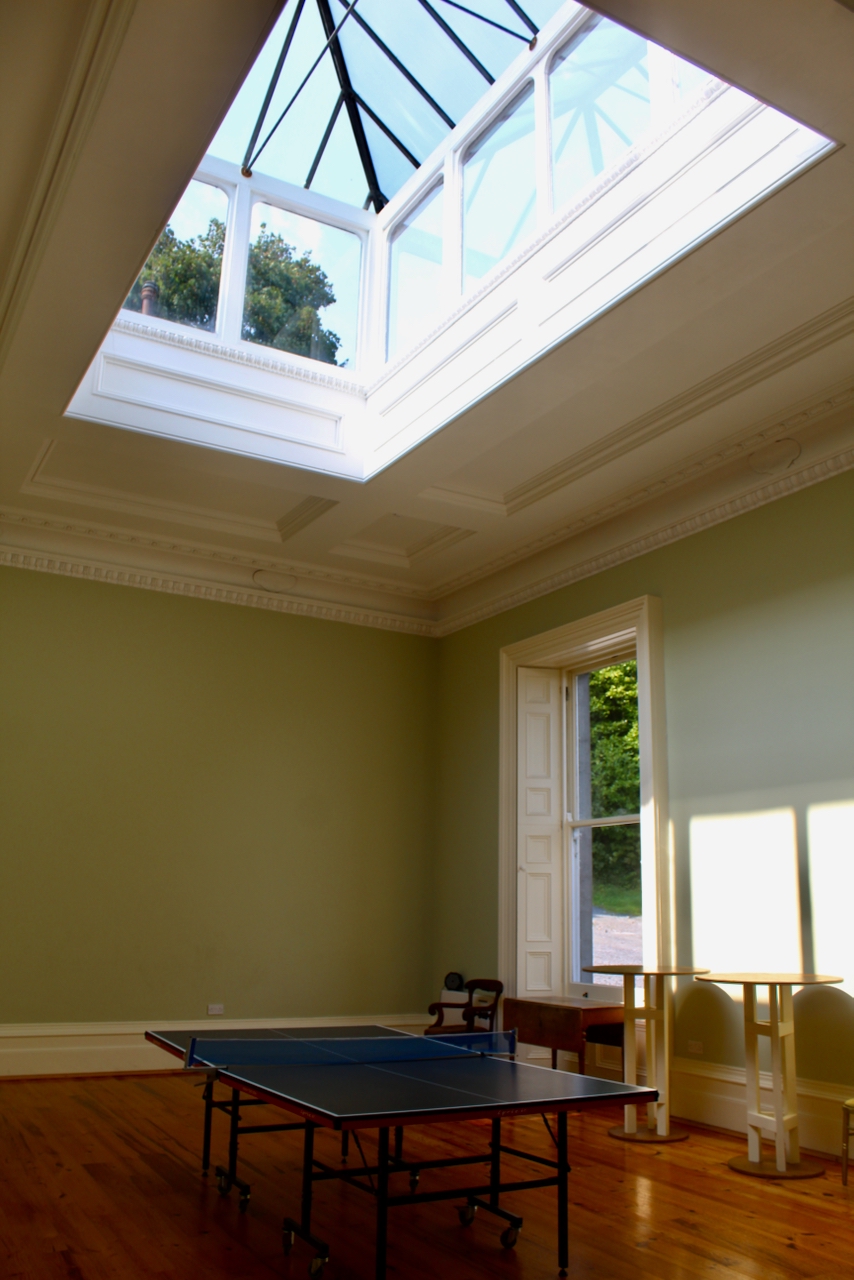
Guinness and Fitzgerald tell us about the bedrooms:
“The bedrooms are immense. They all have their own bathrooms and a wonderful collection of matching furniture; in each of them a different wood has been used. The individual character of oak and beech and mahogany and others are evident as you stroll from one bedroom to the next. There are magnificent wardrobes – in one room it is 22 ft long – beds, sideboards, dressing tables, chairs. The largest of the bedrooms is so impressive it is called the “Half Acre.”” [see 2]
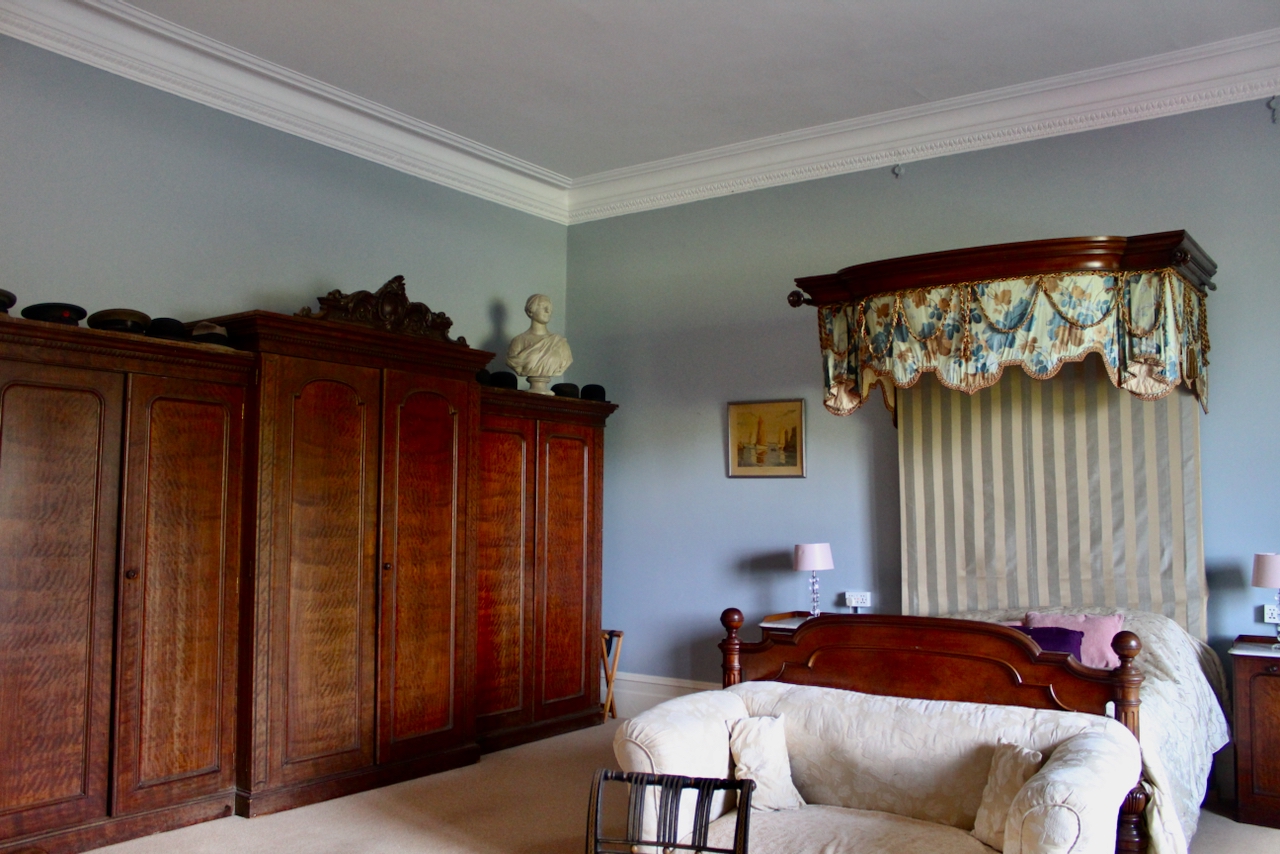
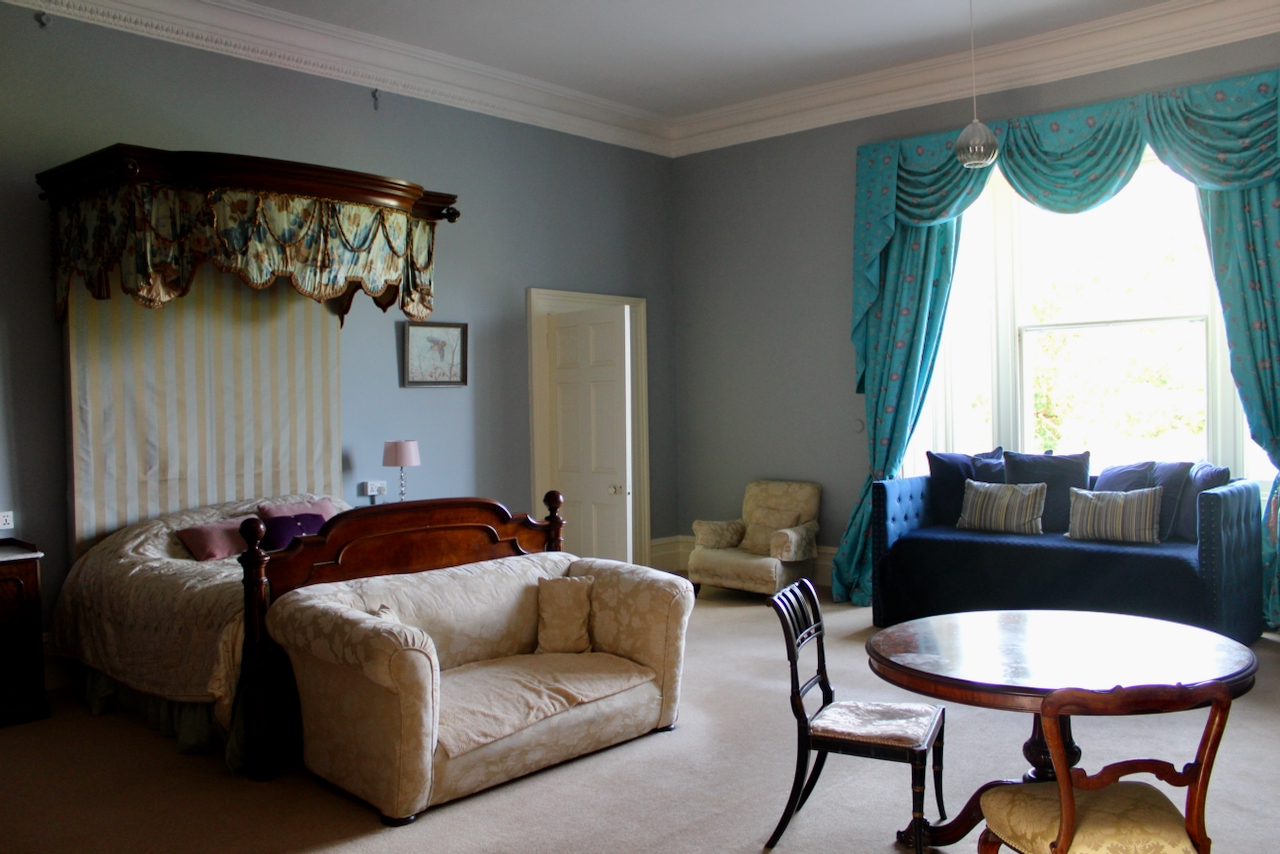
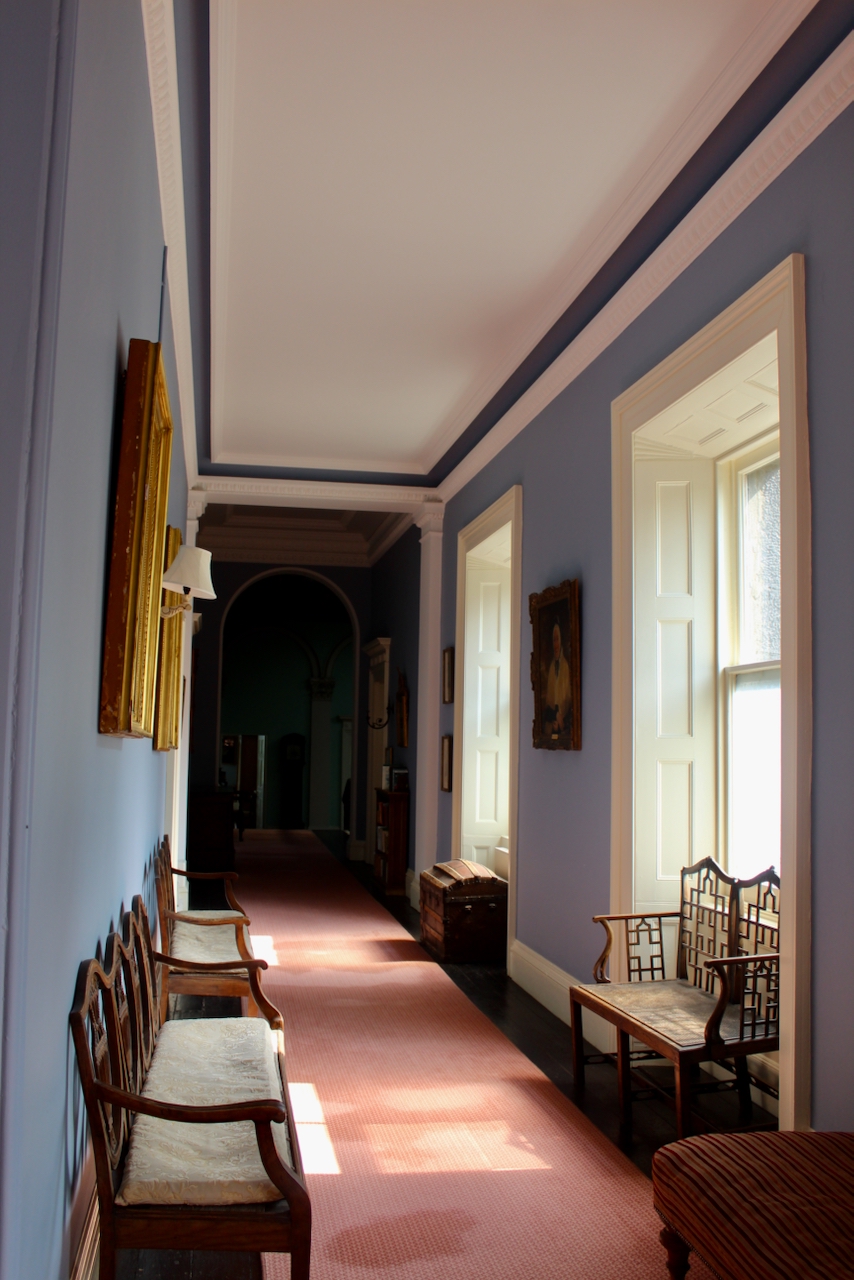
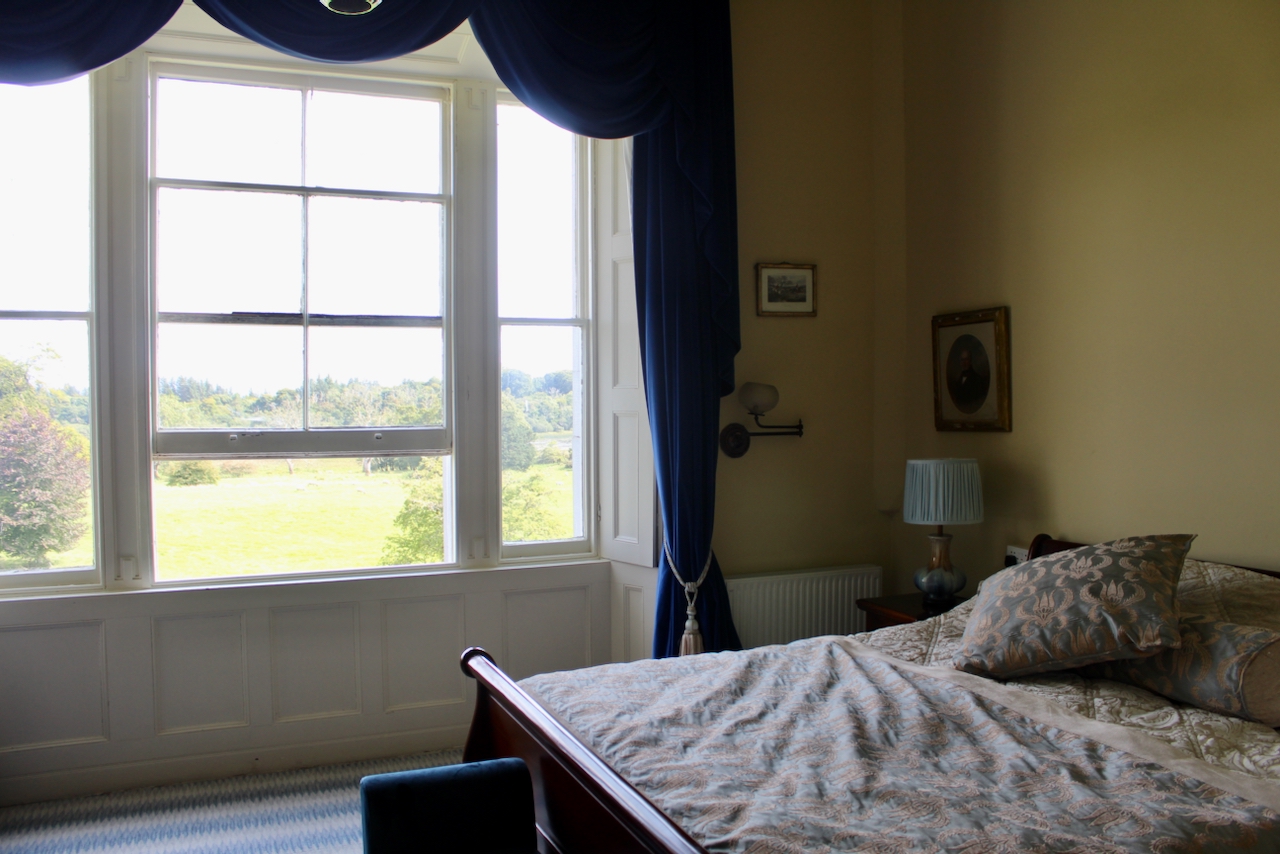
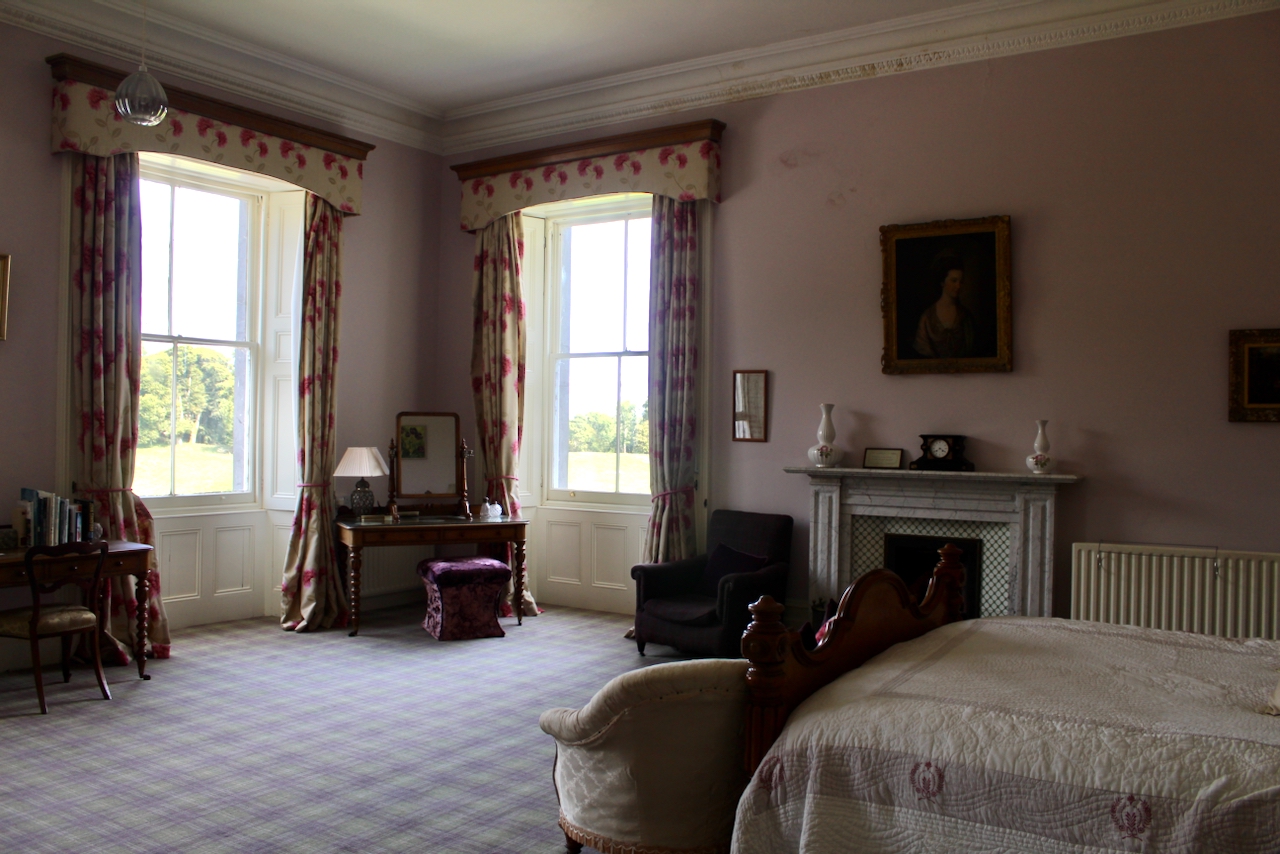
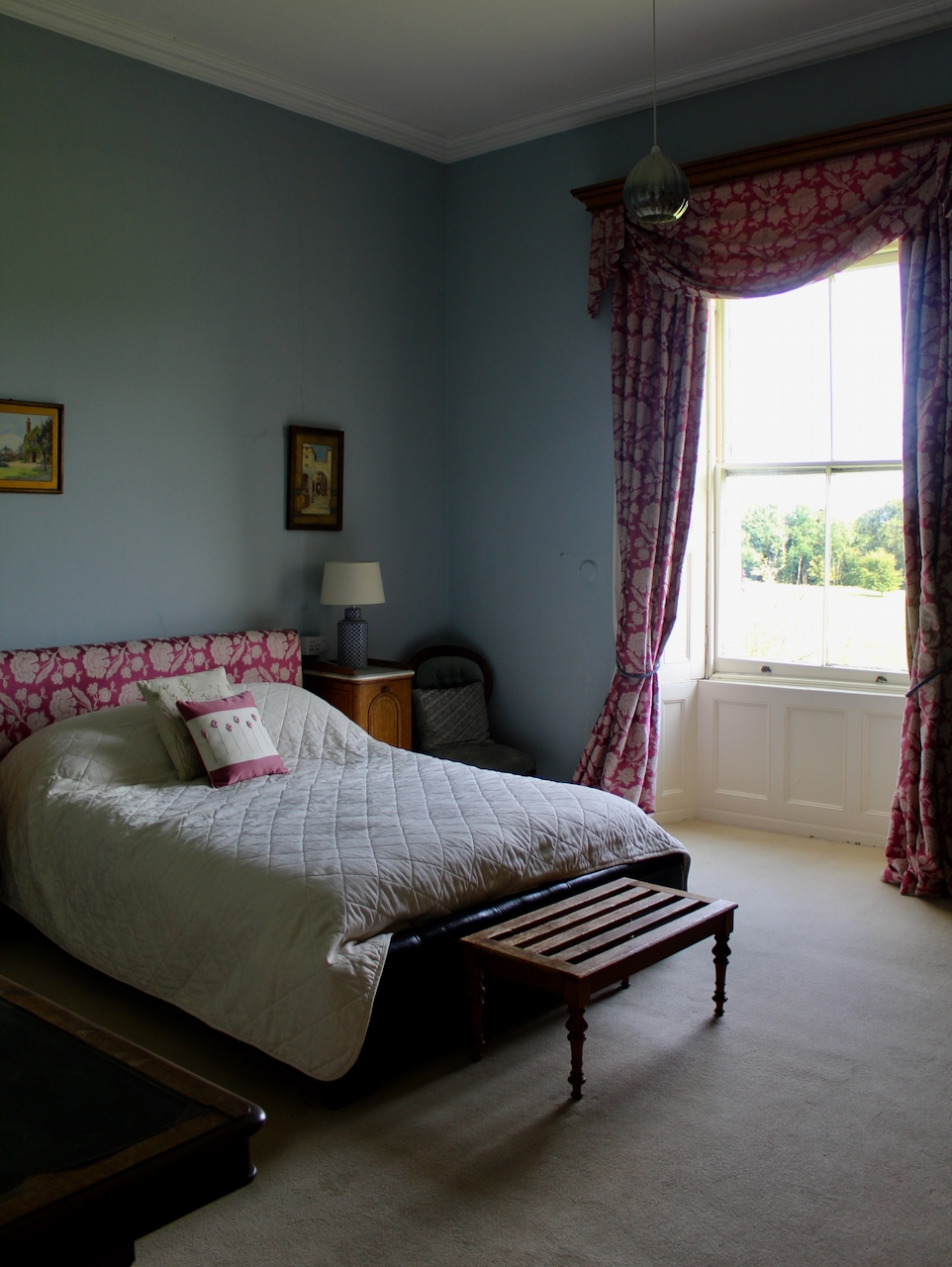
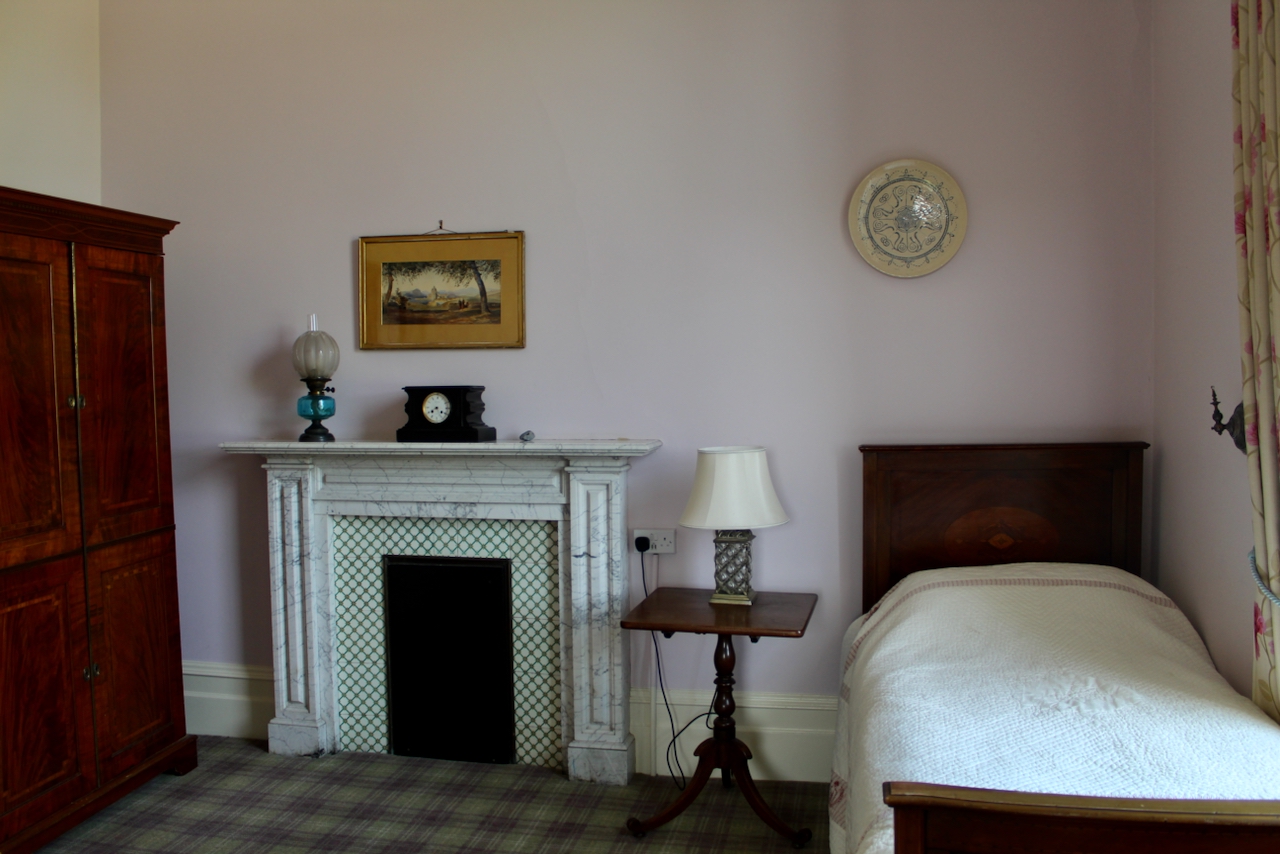
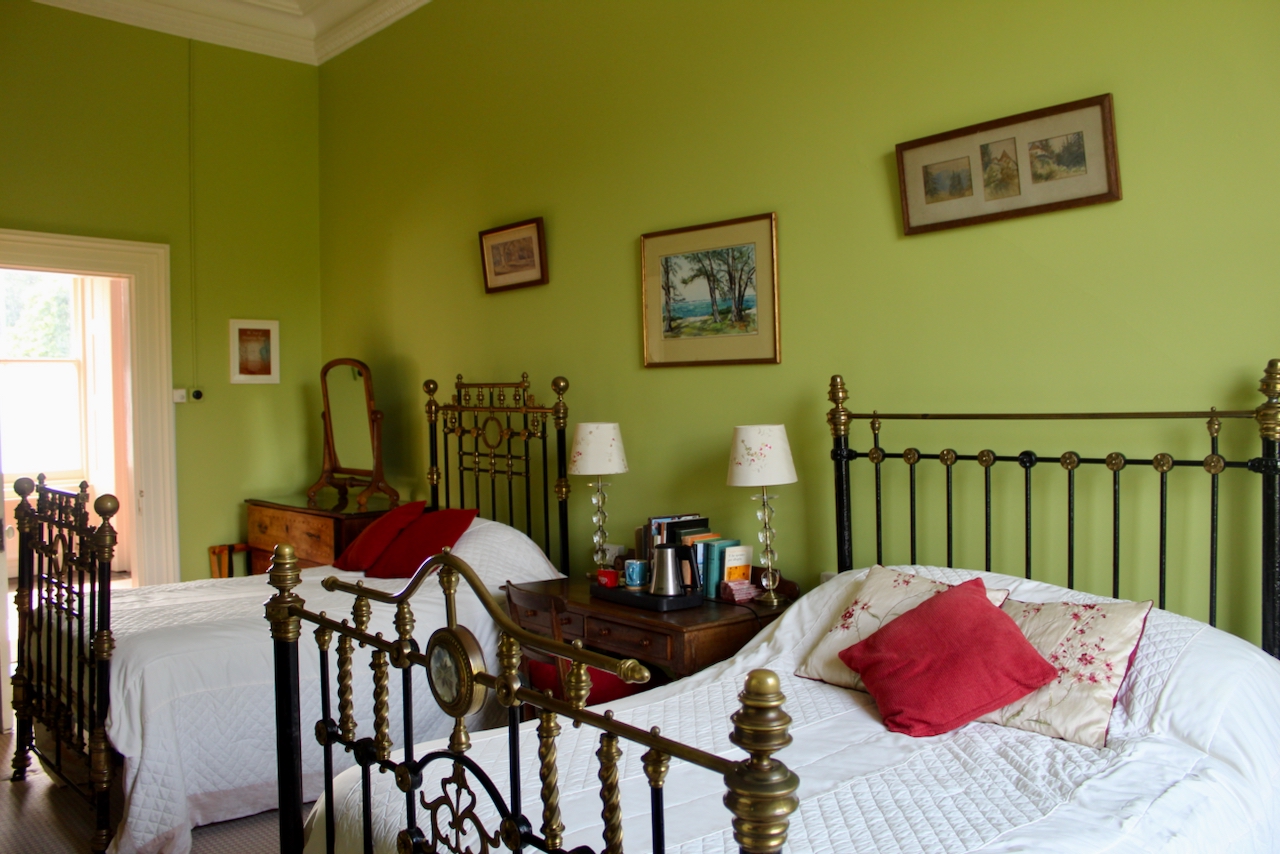
We exited through the morning room, which has a tall glass door, the original marble chimneypiece and impressive acanthus leaf ceiling rose.
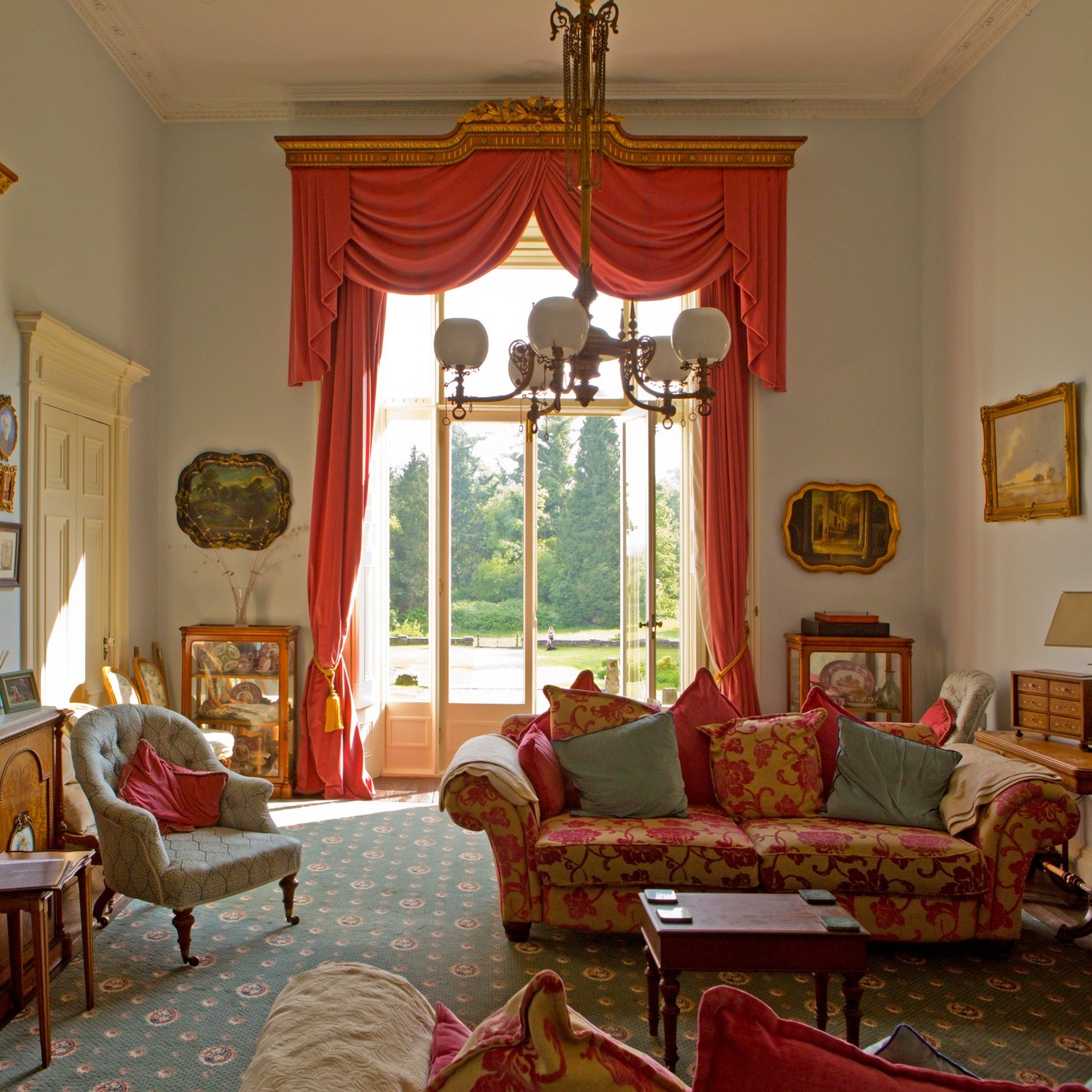
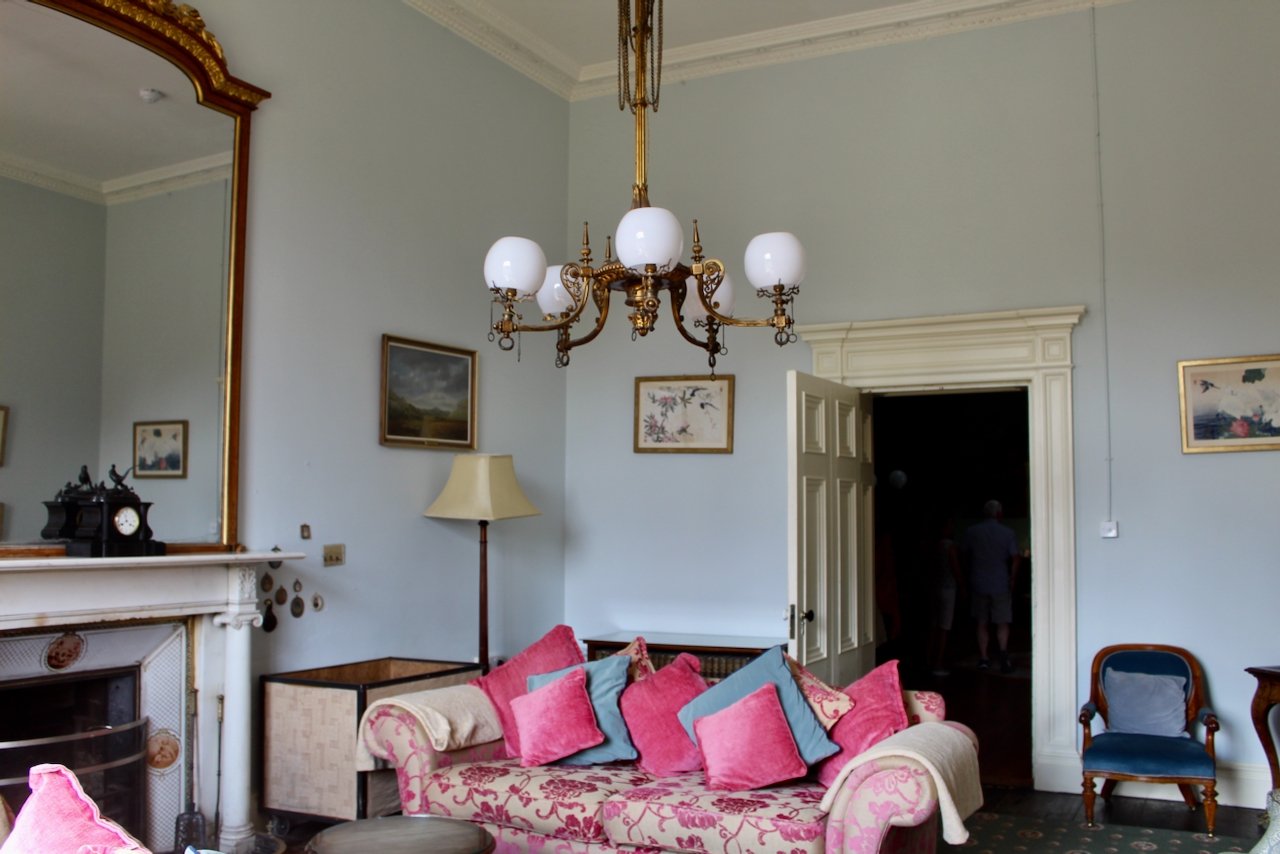
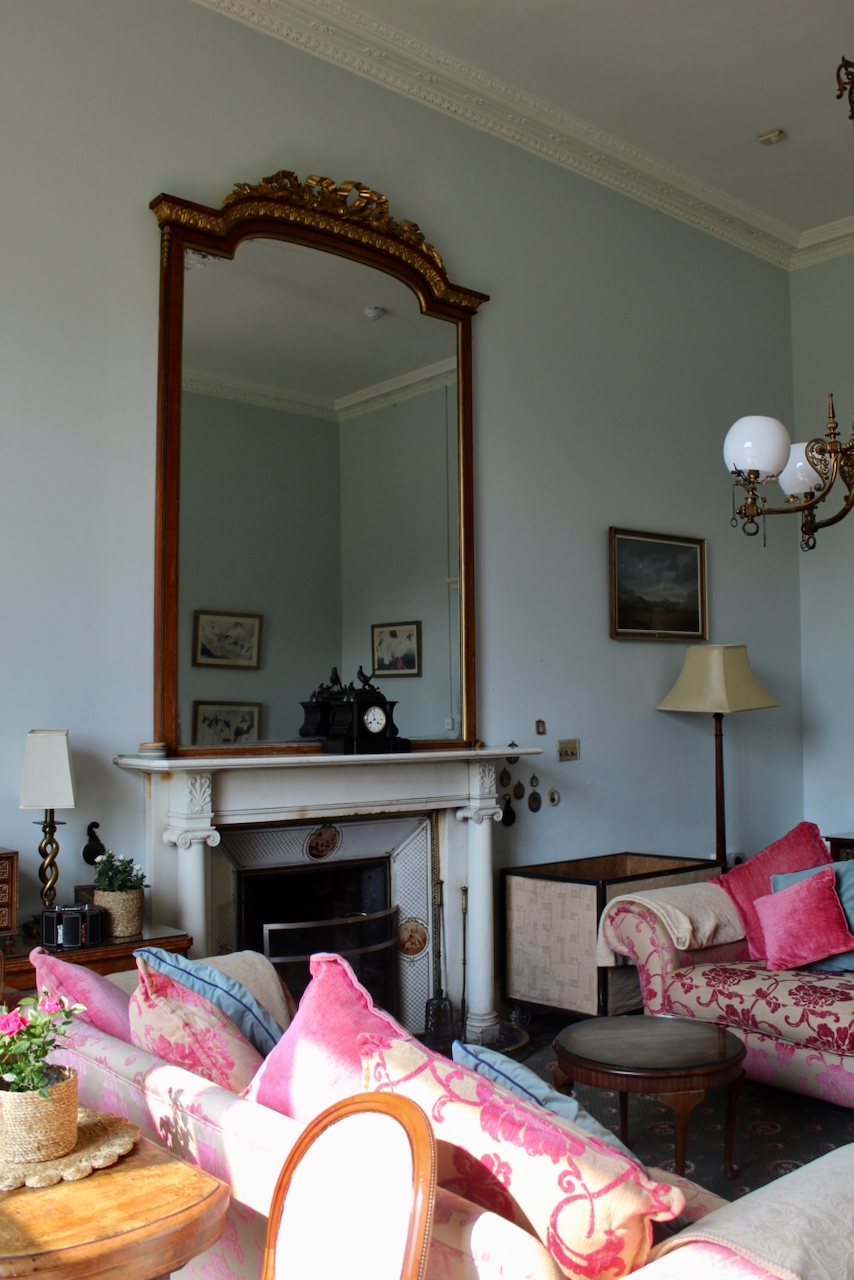
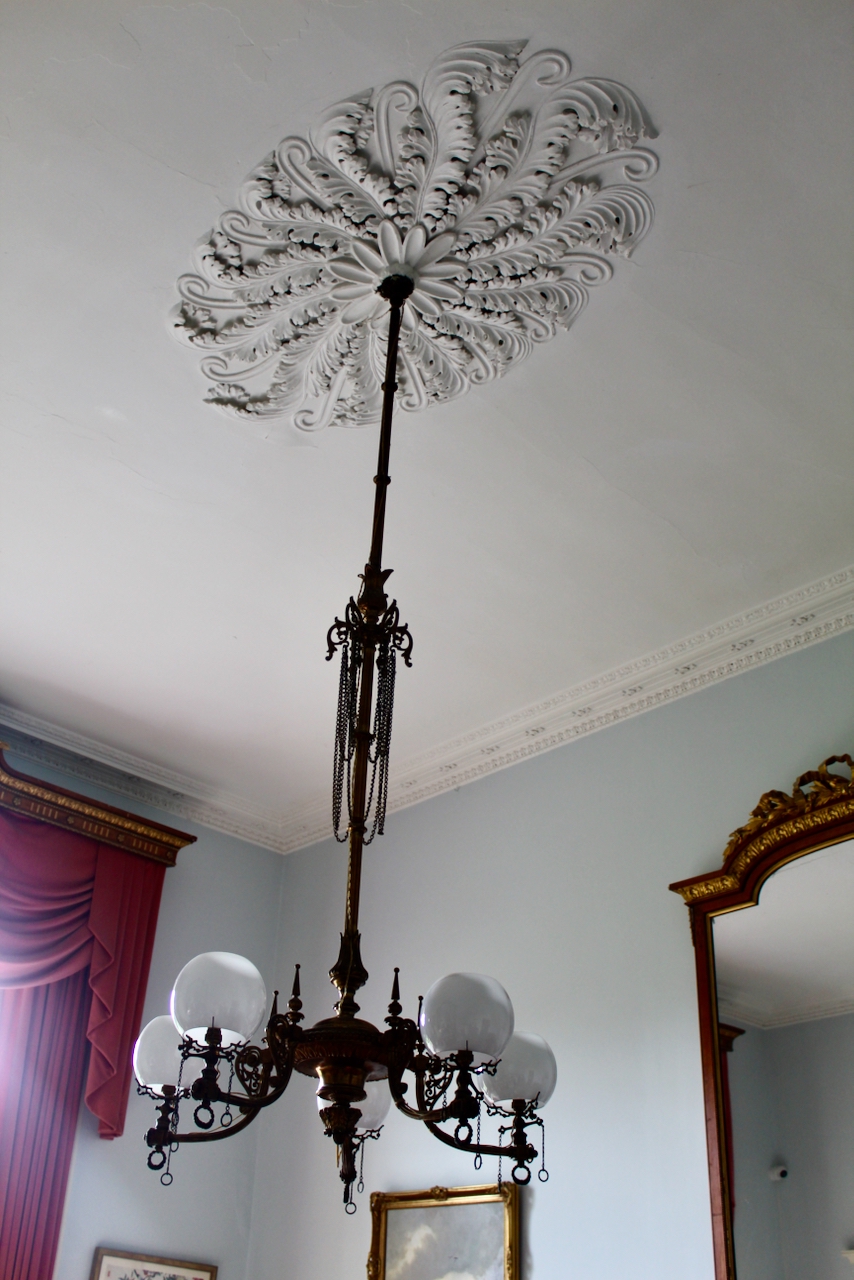
There is a walled kitchen garden which unfortunately we did not get to visit, where food is grown, including old varieties of apple, plum, pear and fig, and a stable yard. The Percevals preserve most of the 600 acres of old woods and the bogs in their natural state, and they also farm a further 600 acres.
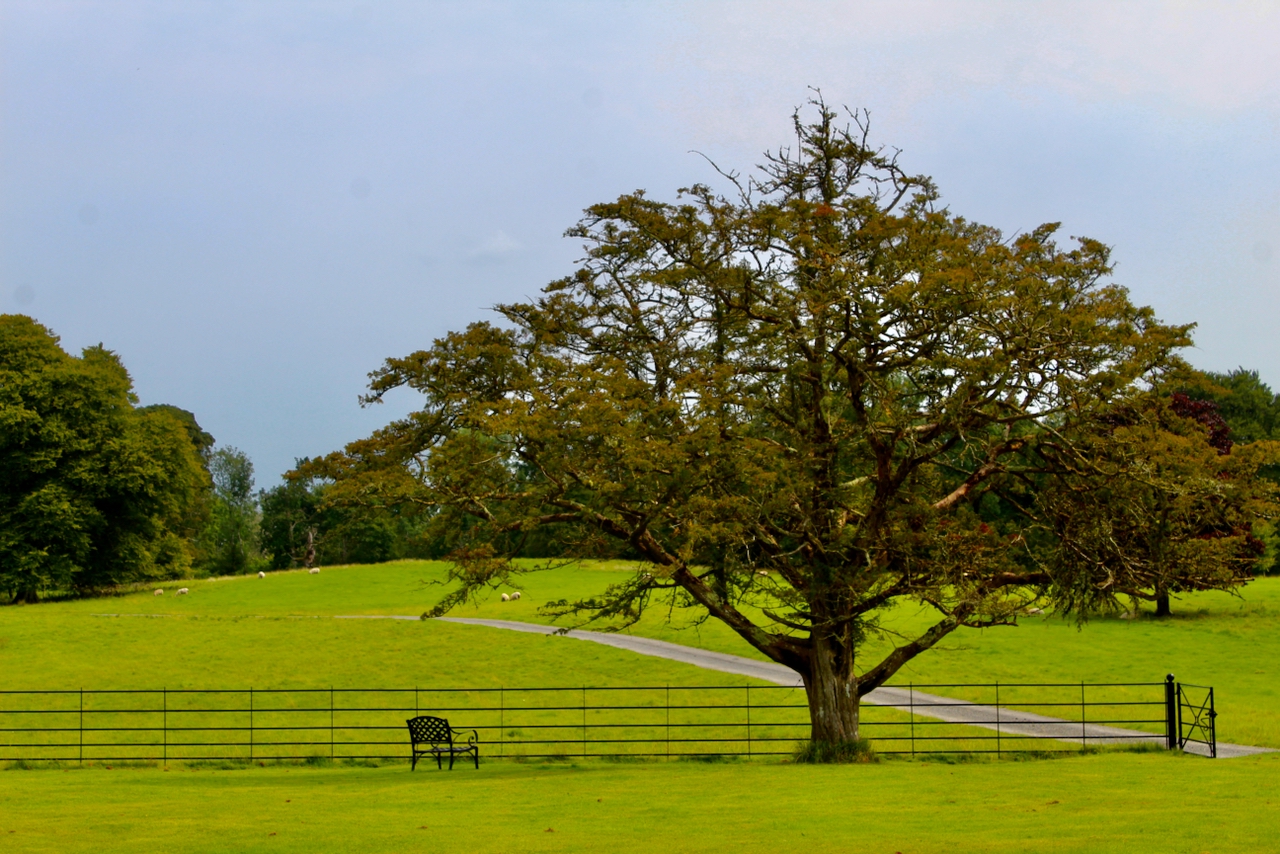
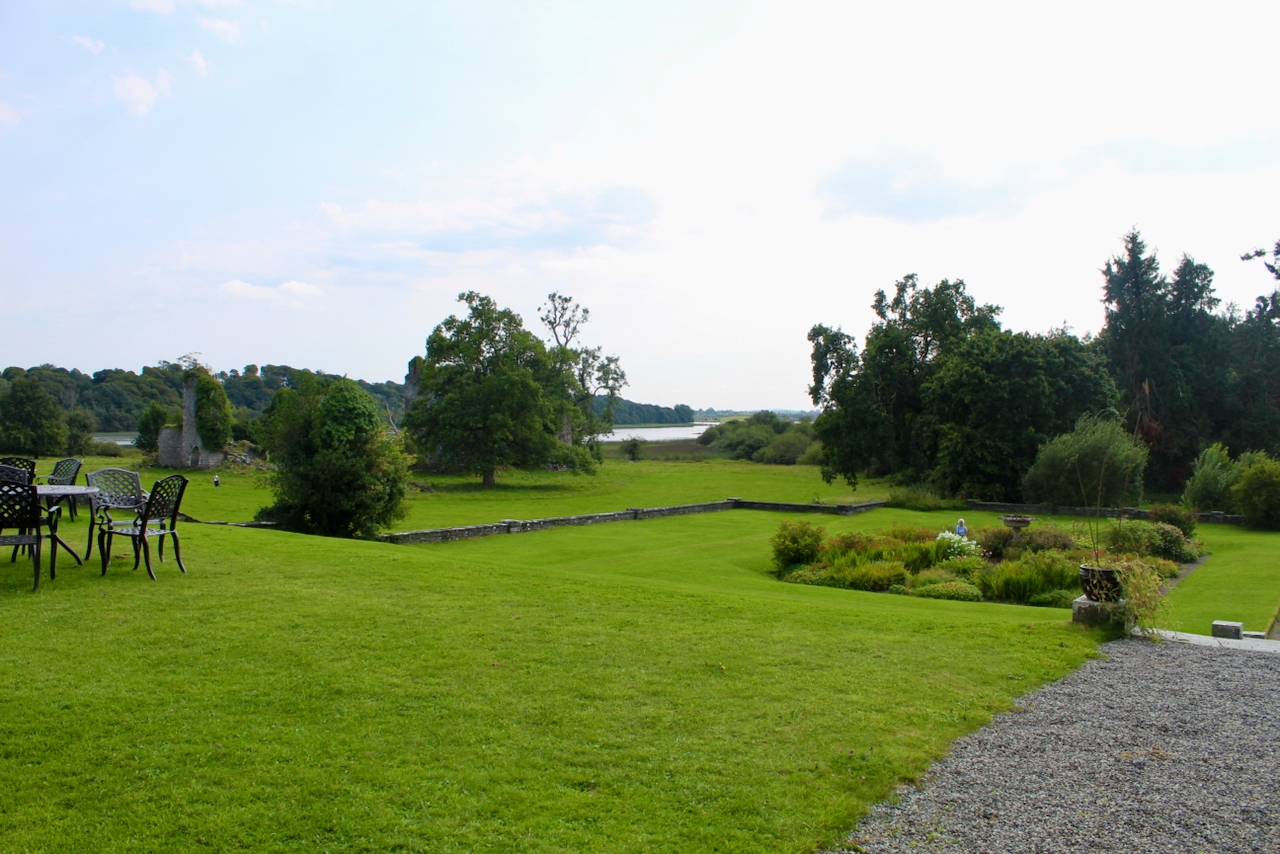
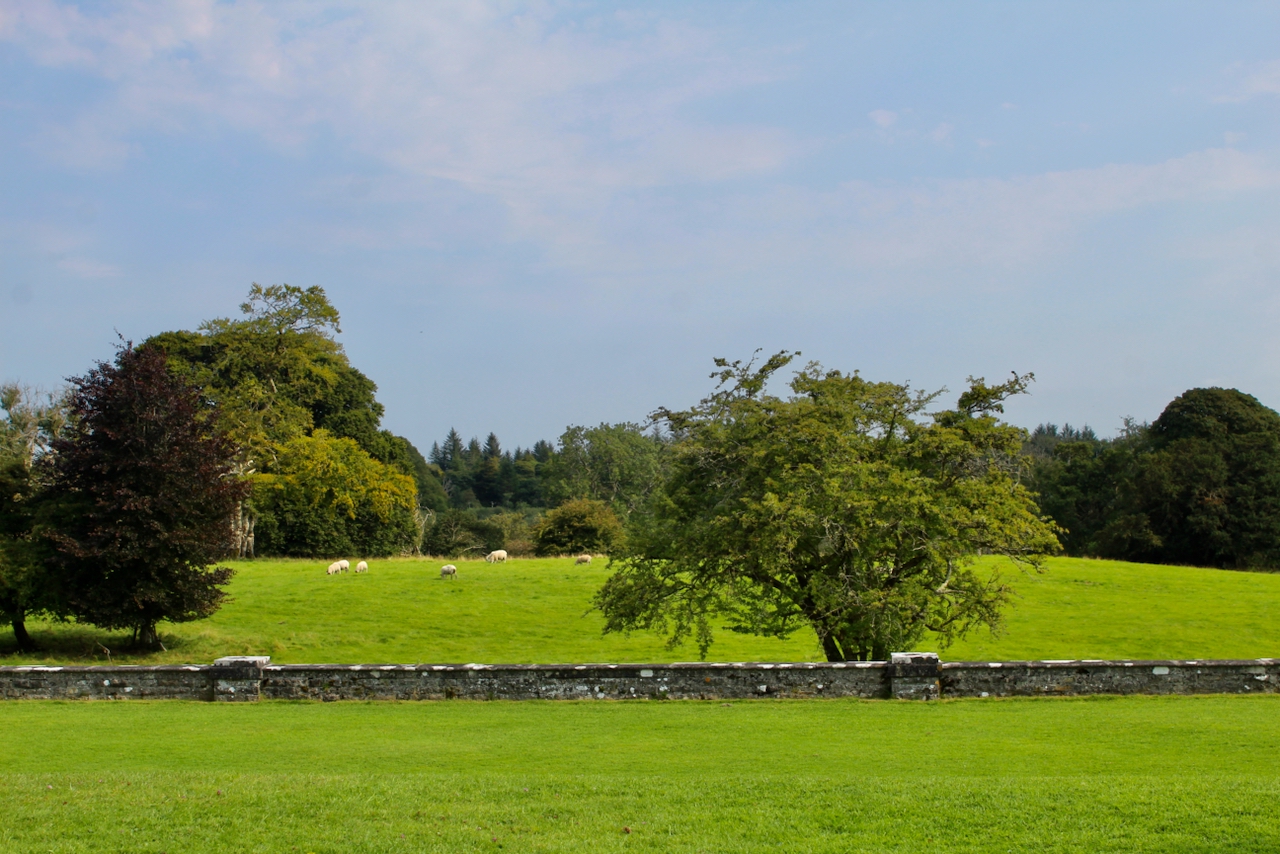
[1] Bence-Jones, Mark. A Guide to Irish Country Houses (originally published as Burke’s Guide to Country Houses volume 1 Ireland by Burke’s Peerage Ltd. 1978); Revised edition 1988 Constable and Company Ltd, London.
[2] Great Irish Houses. Forewards by Desmond FitzGerald, the Knight of Glin, and Desmond Guinness. Photographs by Trevor Hart. IMAGE Publications, 2008.
[3] Book Review by Peter Harbison, History Ireland issue 5 (Sept Oct 2016), volume 24.
[4] https://theirishaesthete.com/2018/05/14/thinking-big/
[6] http://www.ihh.ie/index.cfm/houses/house/name/Temple%20House
[7] http://lordbelmontinnorthernireland.blogspot.com/2018/01/temple-house.html
Frybrook House, County Roscommon – accommodation
Frybrook House, County Roscommon
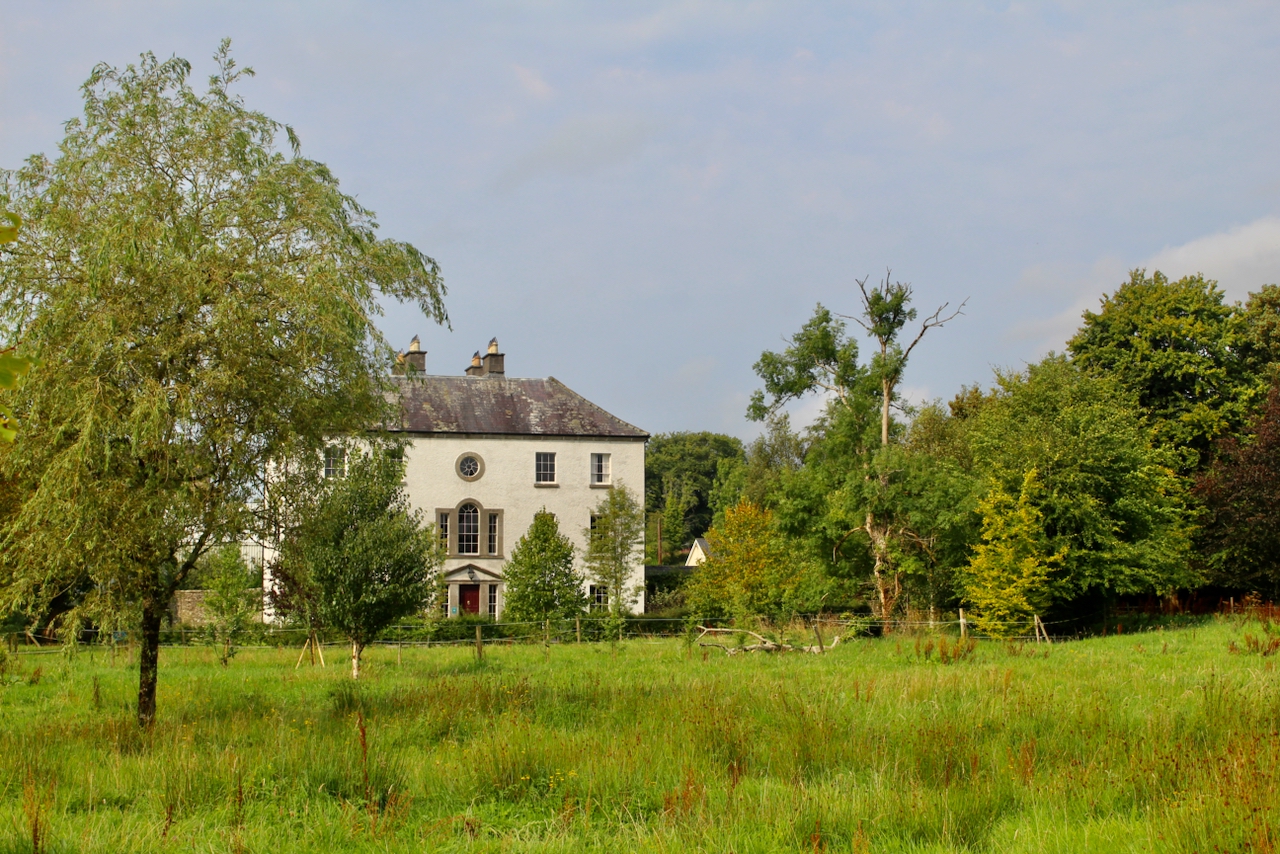
I am sad to see that Frybrook House in Boyle, County Roscommon, is once again advertised for sale, with Savills Estate Agent. We visited it recently during Heritage Week this year, 2025, and the owner, Joan, who showed us around gave no indication that she was planning to sell. It was previously sold in 2017, and since then, the owners spent time, effort, money and love renovating and decorating, preparing it for bed and breakfast accommodation. The thirty three windows took a year for a joiner to renovate, and the total renovation took about six years.
They decorated with flair, filling the house with cheeky art and historical elements, researching the history of the house.
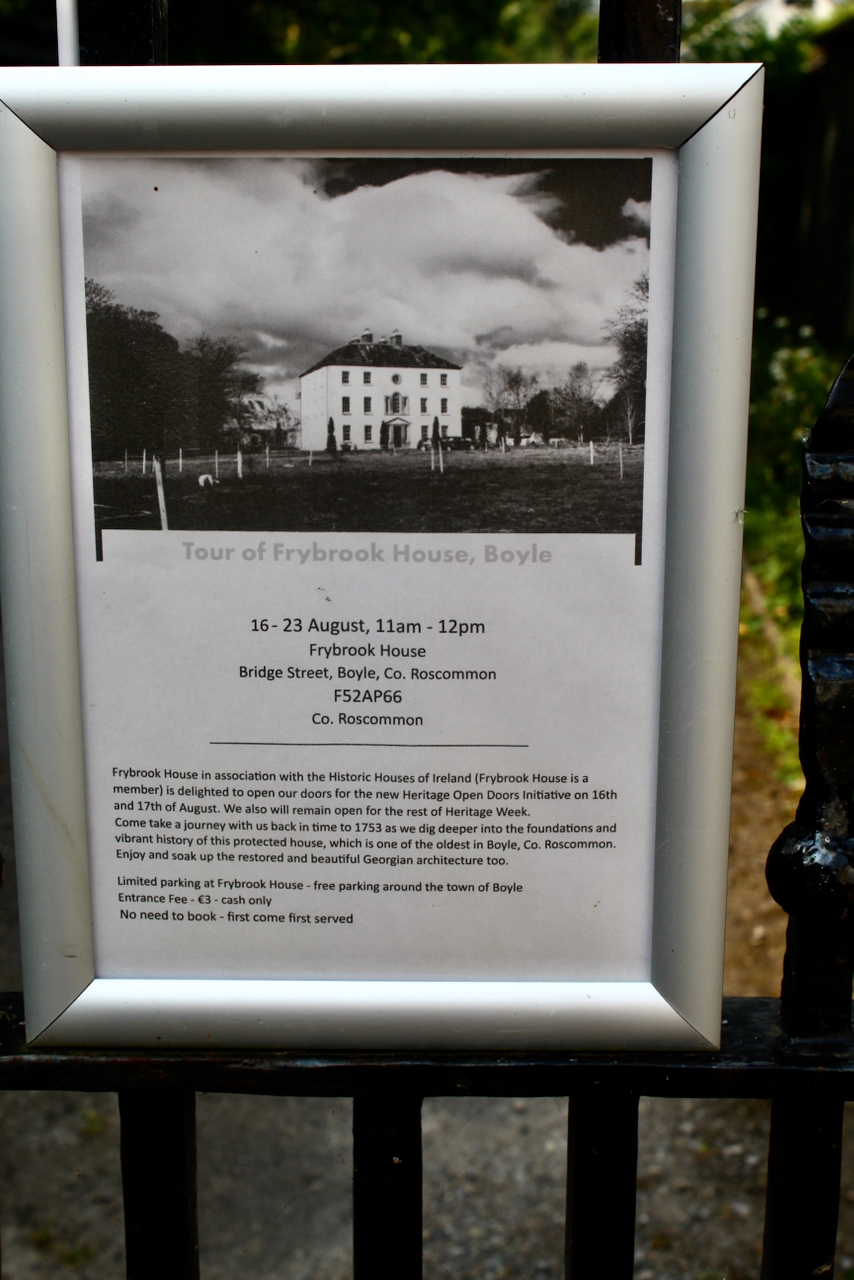
Frybrook is a three storey five bay house built around 1753. [1] A pretty oculus in the centre of top storey sits above a Venetian window, above a tripartite doorcase with a pediment extending over the door and flanking windows. [2] Due to the proximity to the river the house is unusual for a Georgian house in not having a basement.
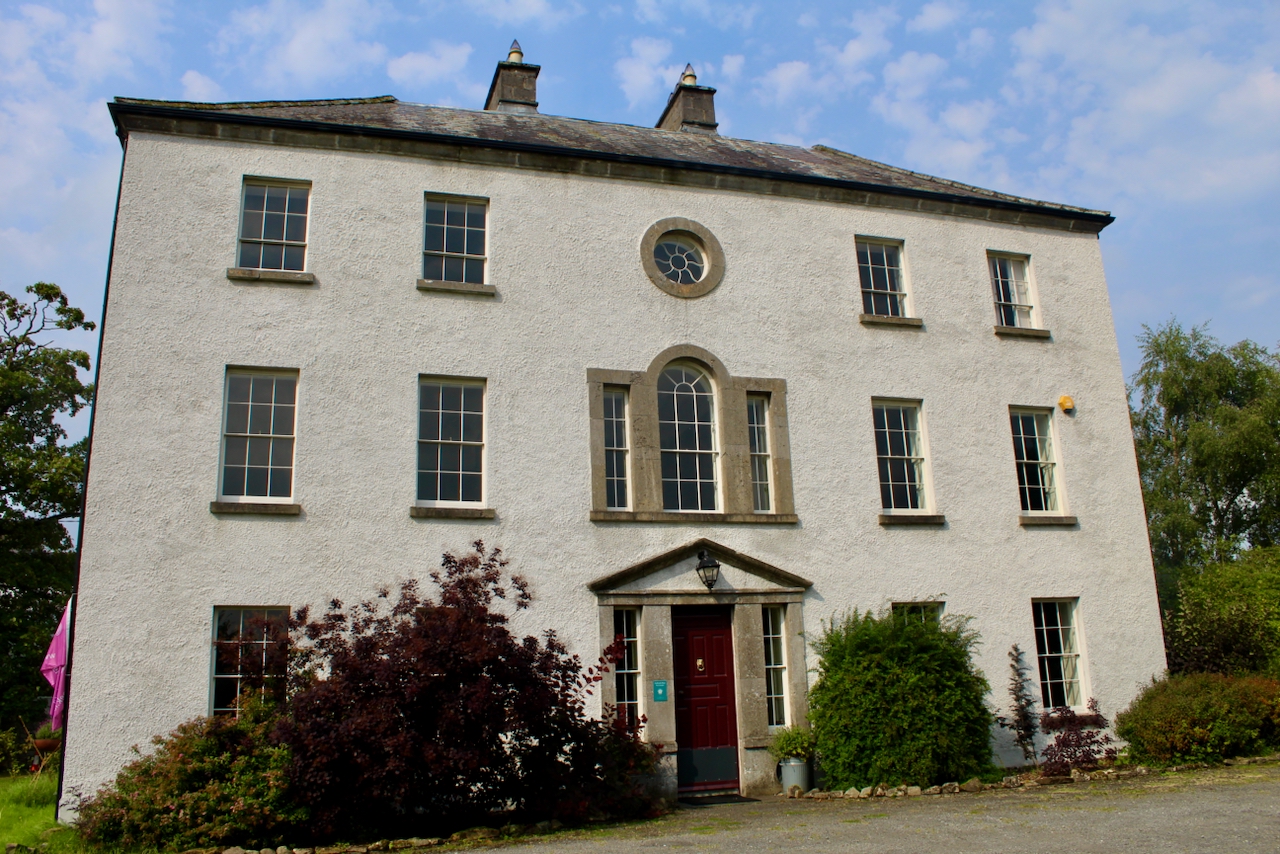
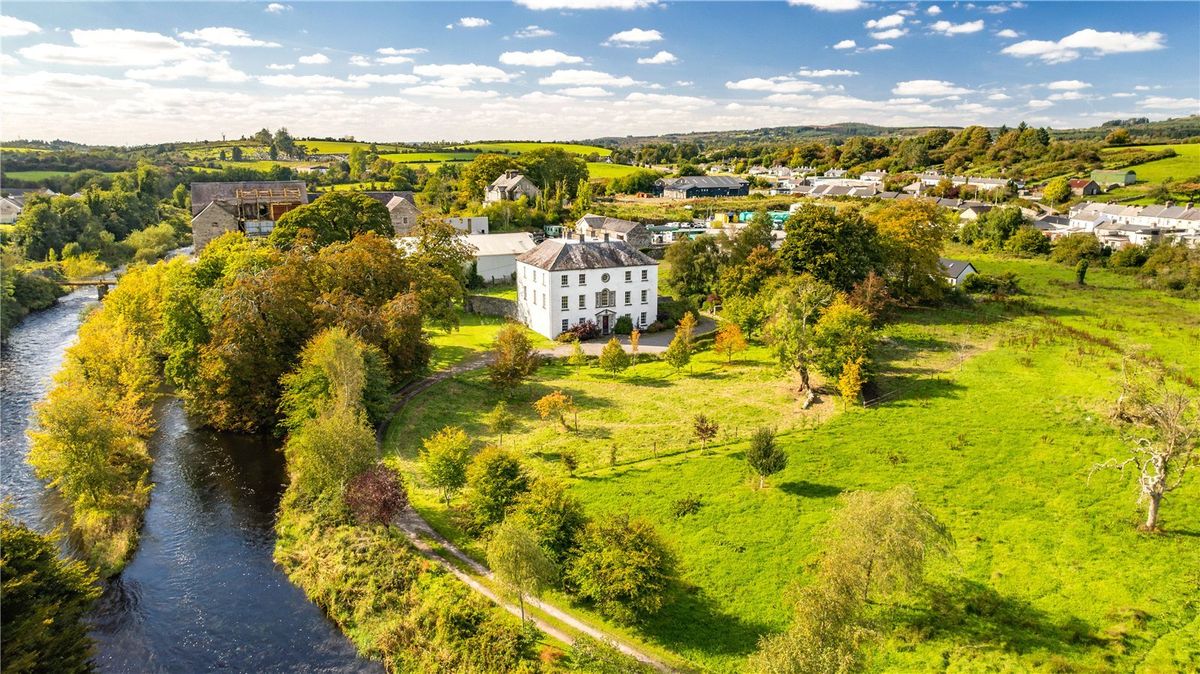
Henry Fry (1701-1786) built the house for his family and established a weaving industry. The website for the house tells us that in 1743 Lord Kingston, who at that time was James King (1693 – 1761), 4th Baron Kingston, invited Henry Fry, a merchant from Edenderry in County Antrim, to establish the business in Boyle. [3] The Barons Kingston lived in the wonderful Mitchelstown Castle in County Cork and were related to the Kings of King House in Boyle and of Rockingham House, the Baronets of Boyle Abbey (see my entry about King House, https://irishhistorichouses.com/2023/02/02/king-house-main-street-boyle-co-roscommon/.
Henry Fry’s grandfather was from the Netherlands. Henry’s brother Thomas (1710–62) was an artist, recently featured in an exhibition at Dublin Castle.
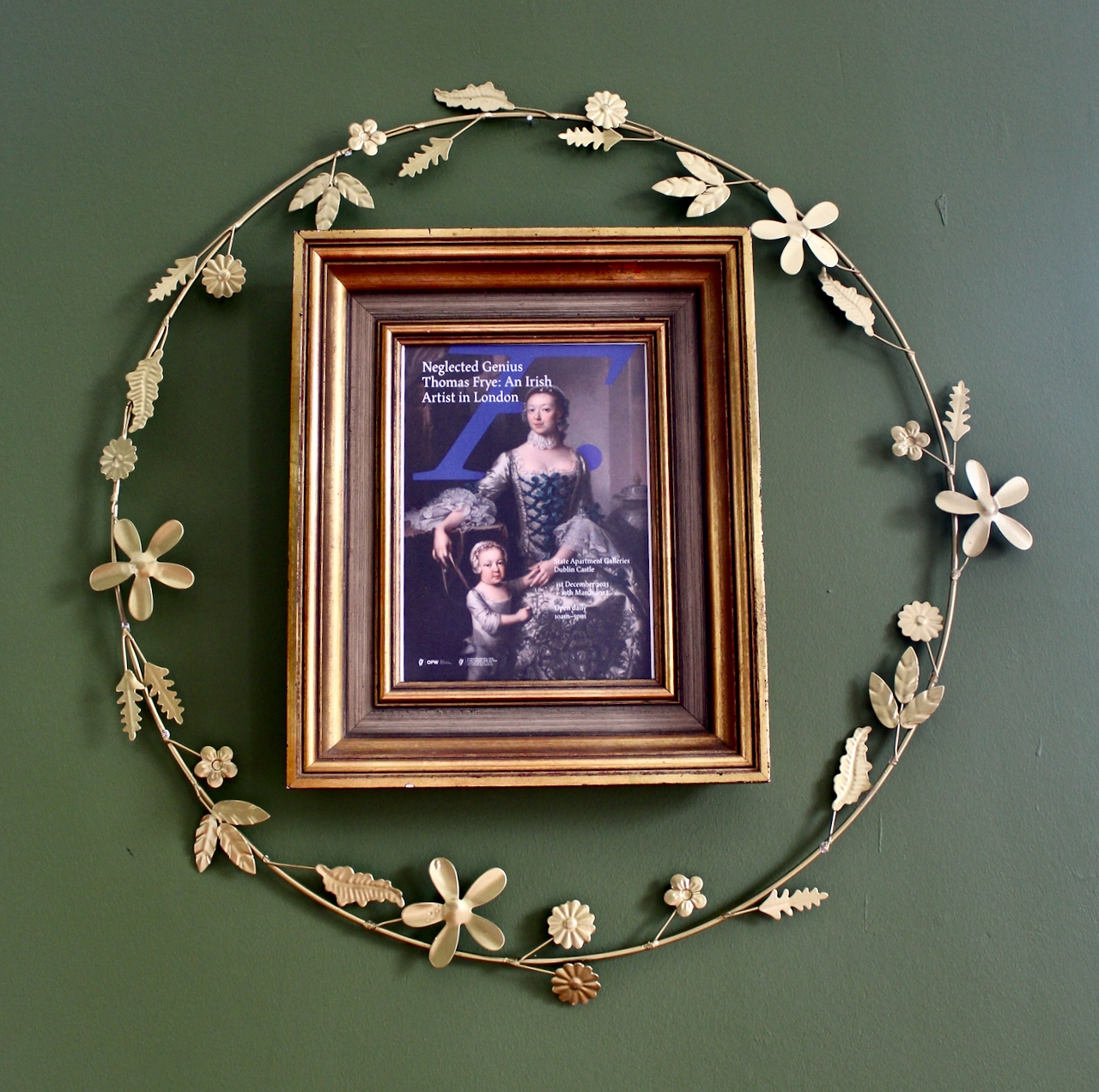
The Dictionary of Irish Biography tells us that by 1736 Thomas Frye was in London and had become sufficiently established to be commissioned to paint the portrait of Frederick, Prince of Wales, on the occasion of his becoming “the perpetual master of the Company of Saddlers.” Thomas also co-founded a porcelain factory, one of the earliest in England, and he experimented with formulas and techniques for making porcelain, obtaining a patent for his work.
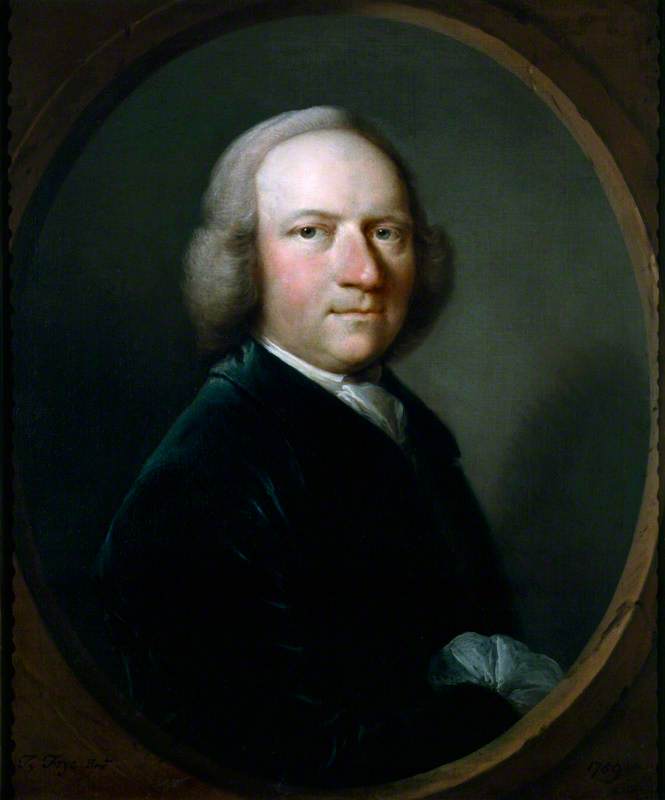
Thomas’s brother Henry Fry (1701-1786) married twice; first to Mary Fuller, with whom he had several children, then after her death in childbirth, to Catherine Mills, with whom he had more children.
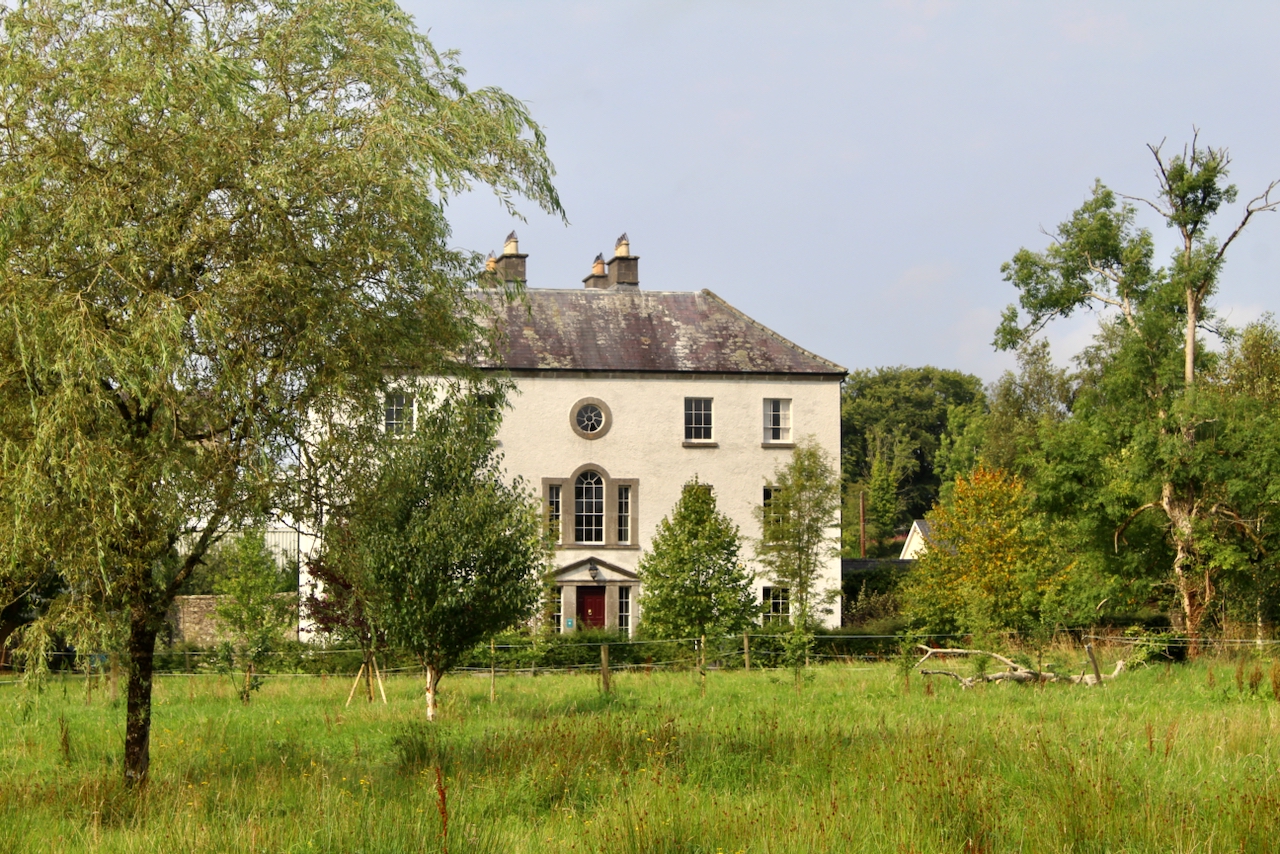
Joan brought us inside. The house has its original beautiful plasterwork and joinery, and the tiles in the hall too and staircase are probably original to the house.
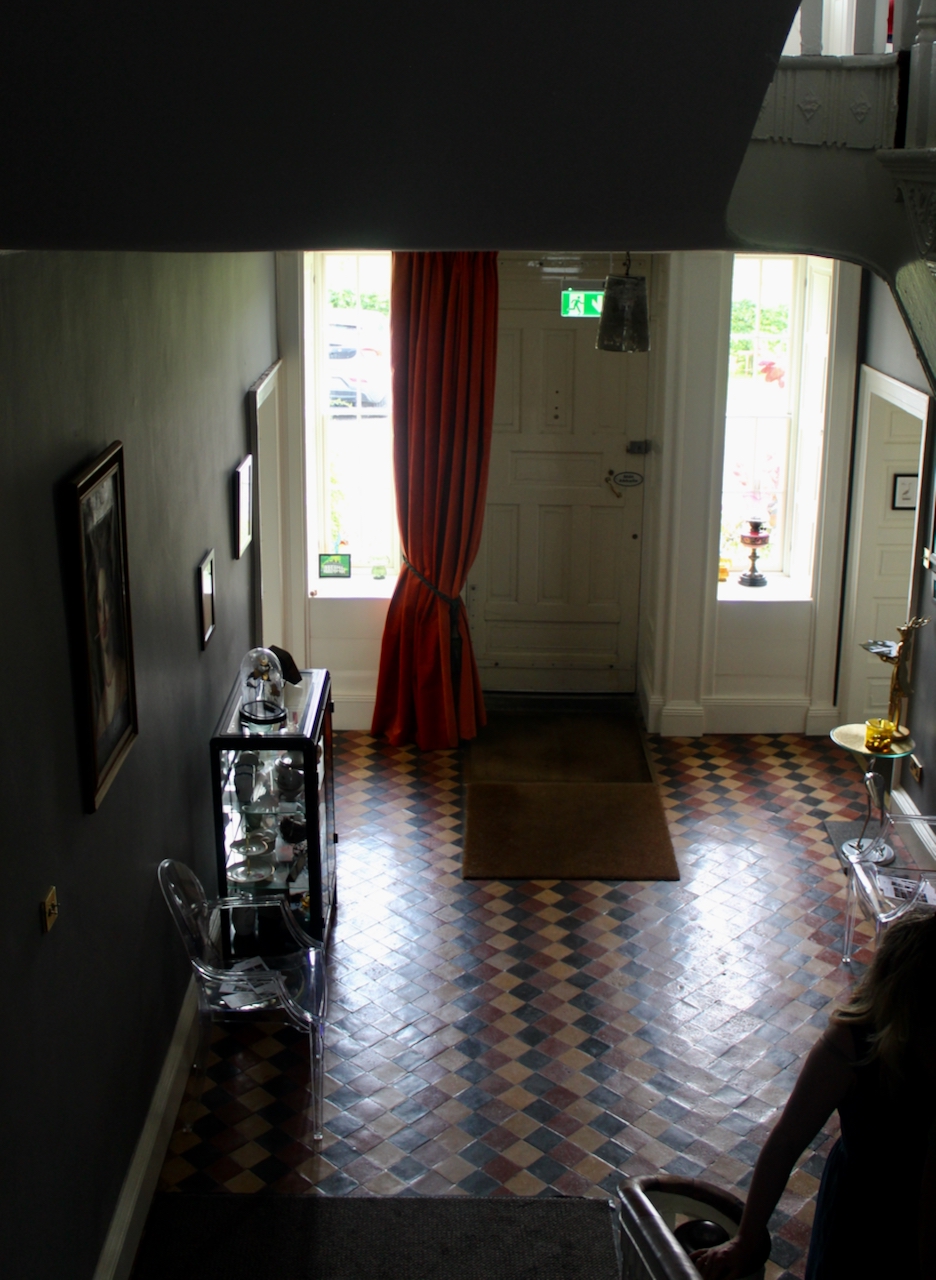
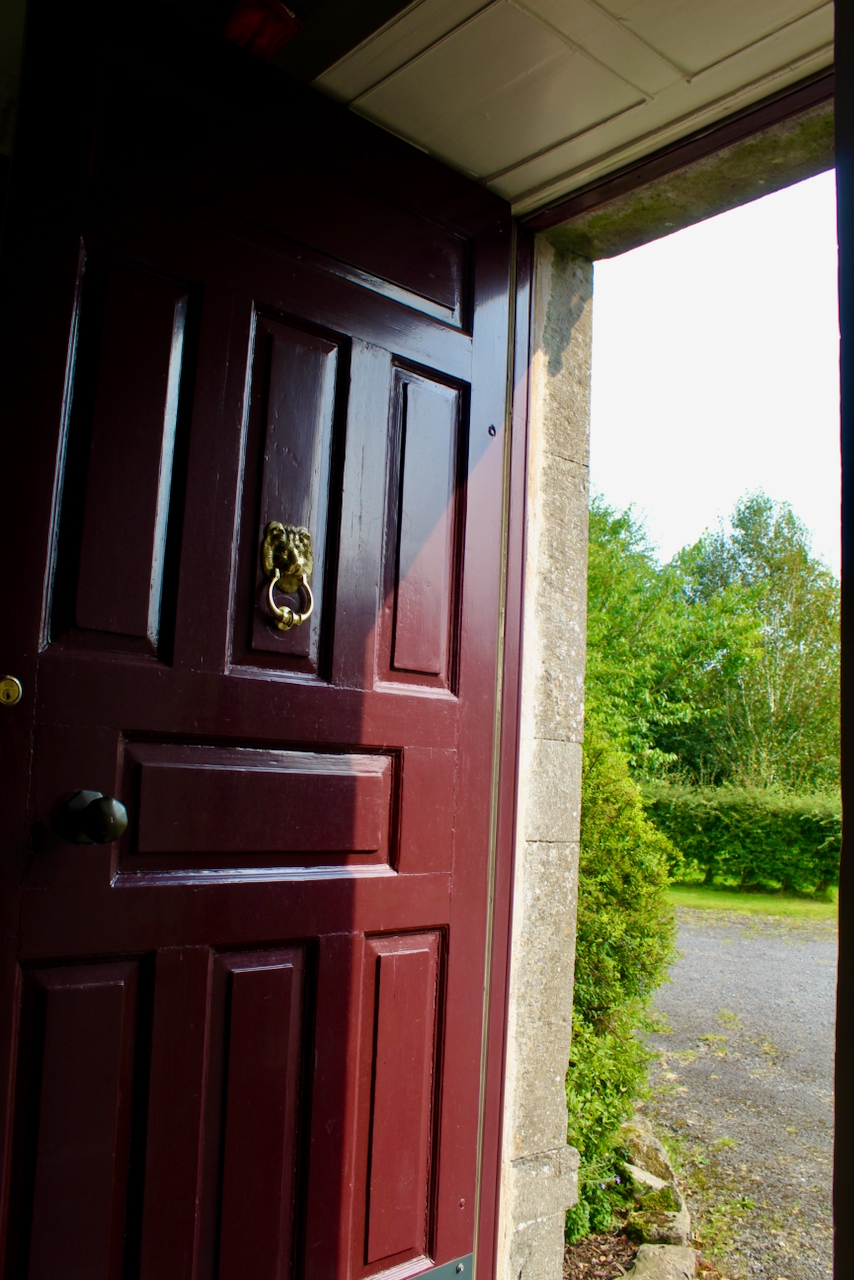
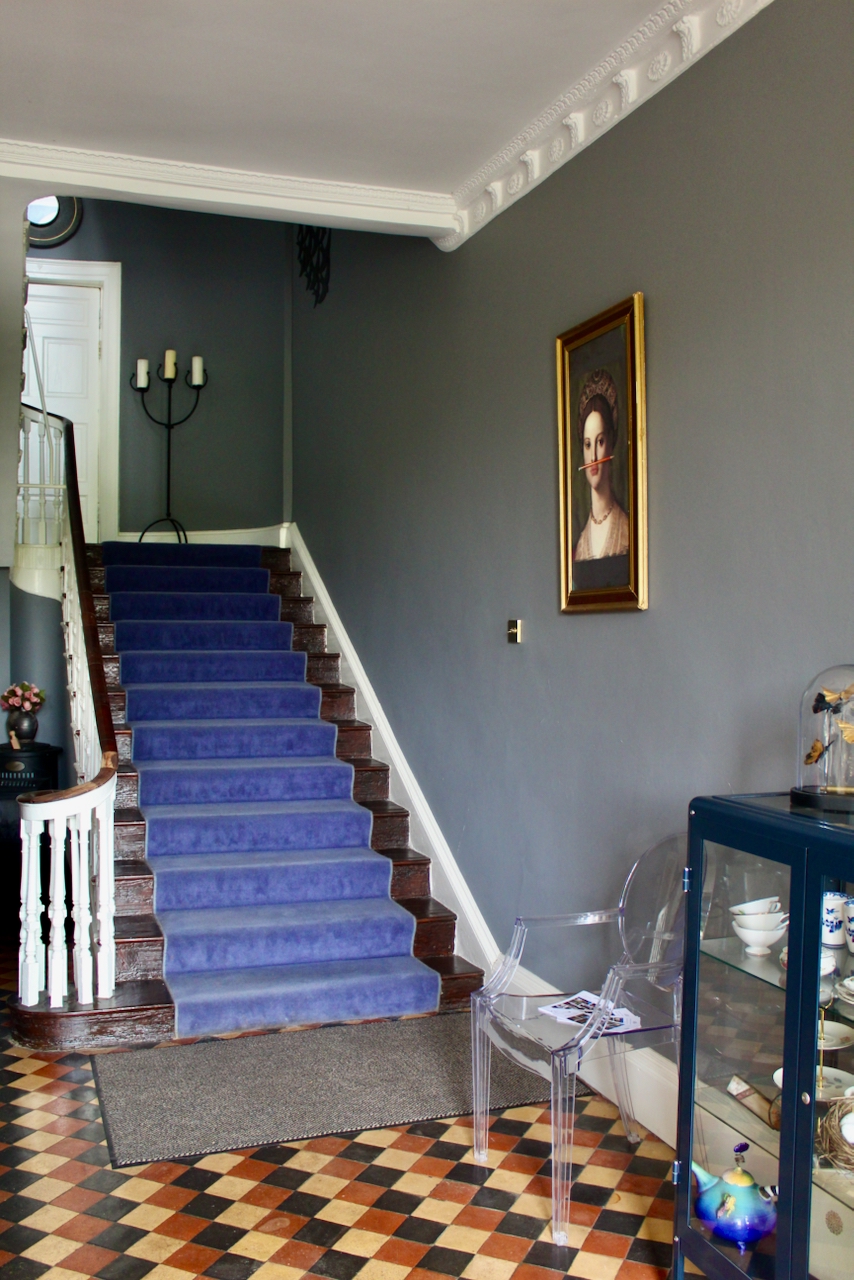
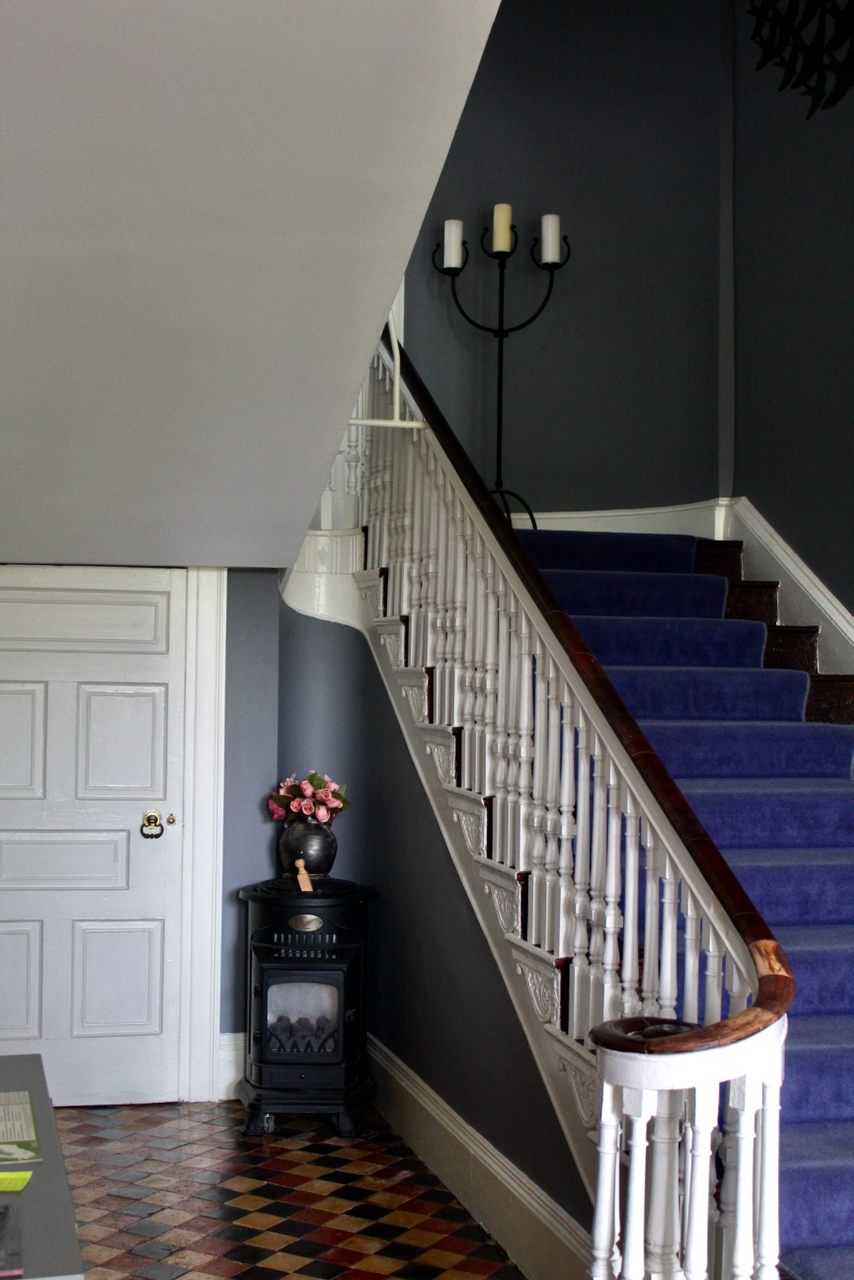
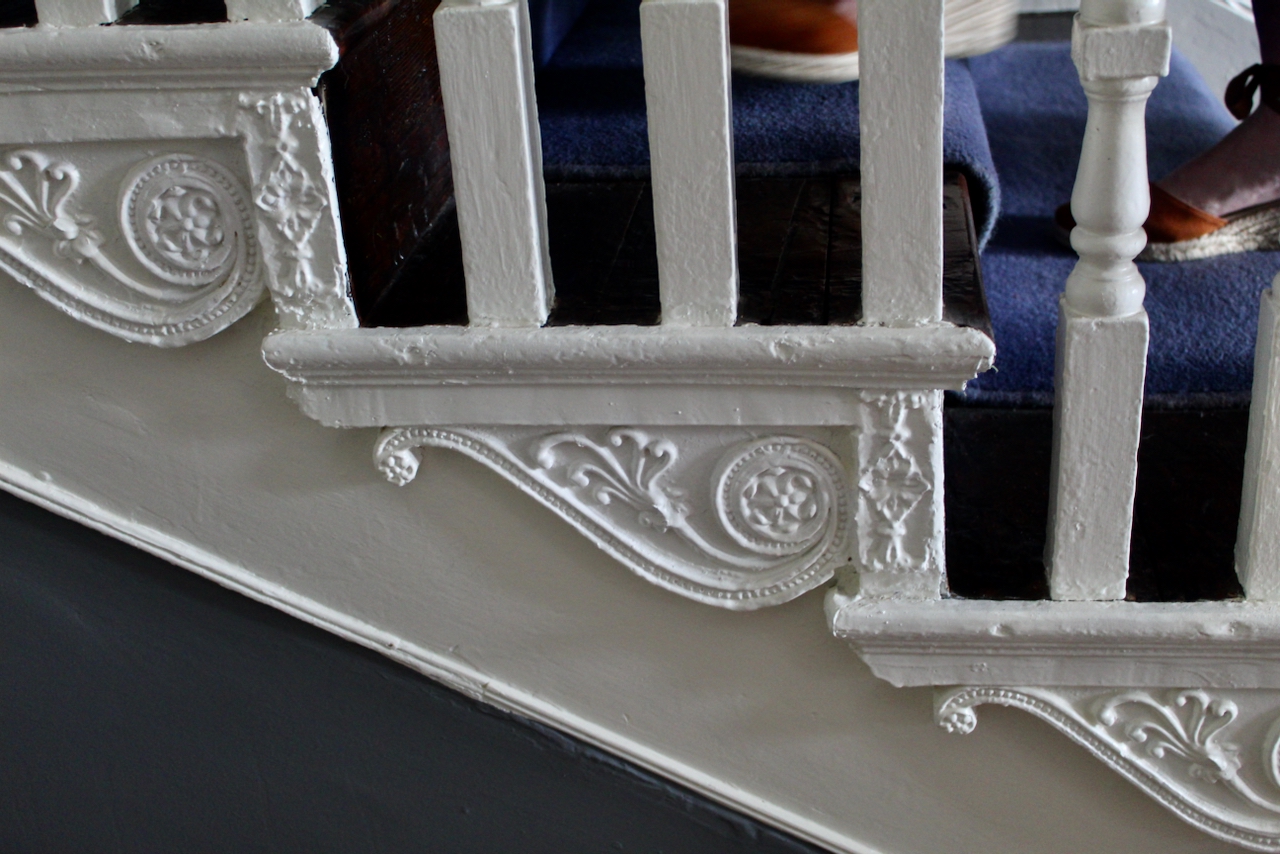
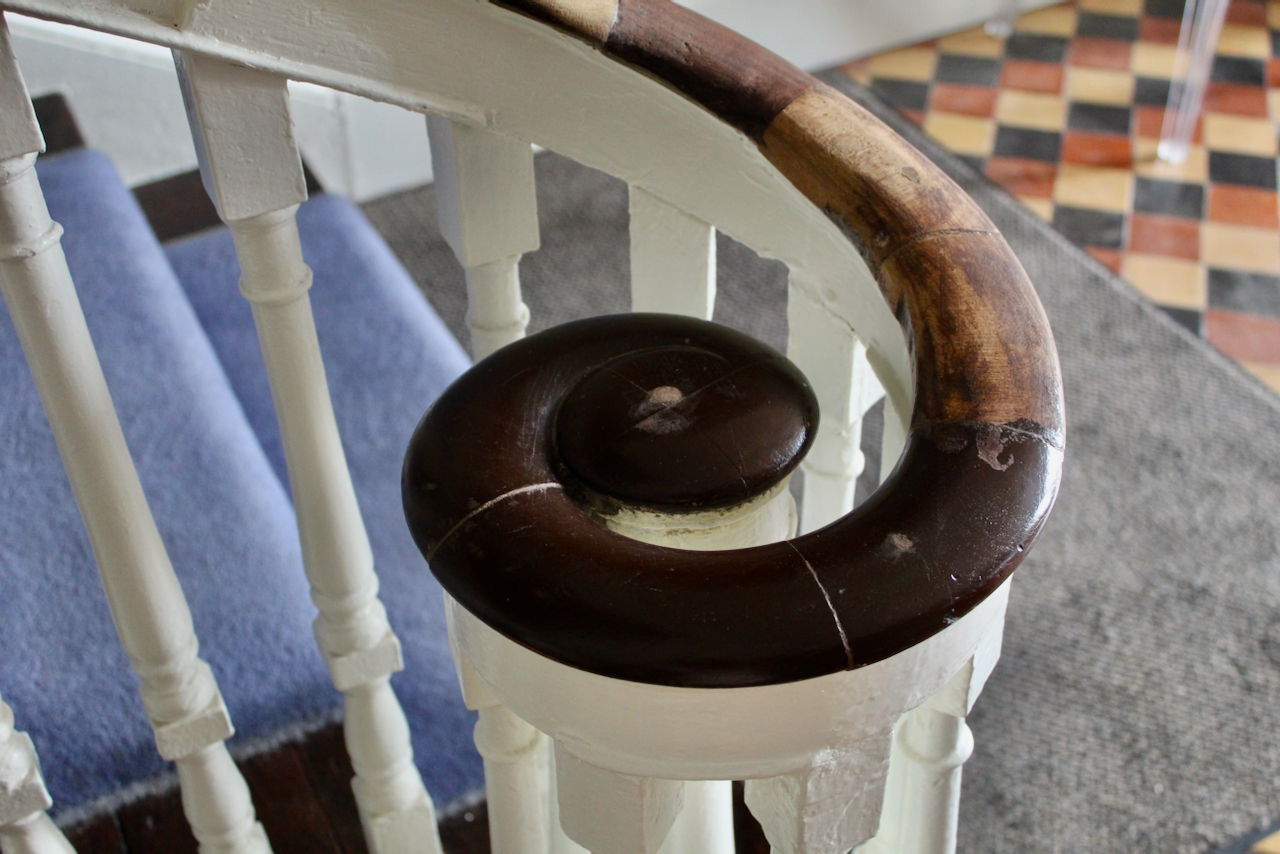
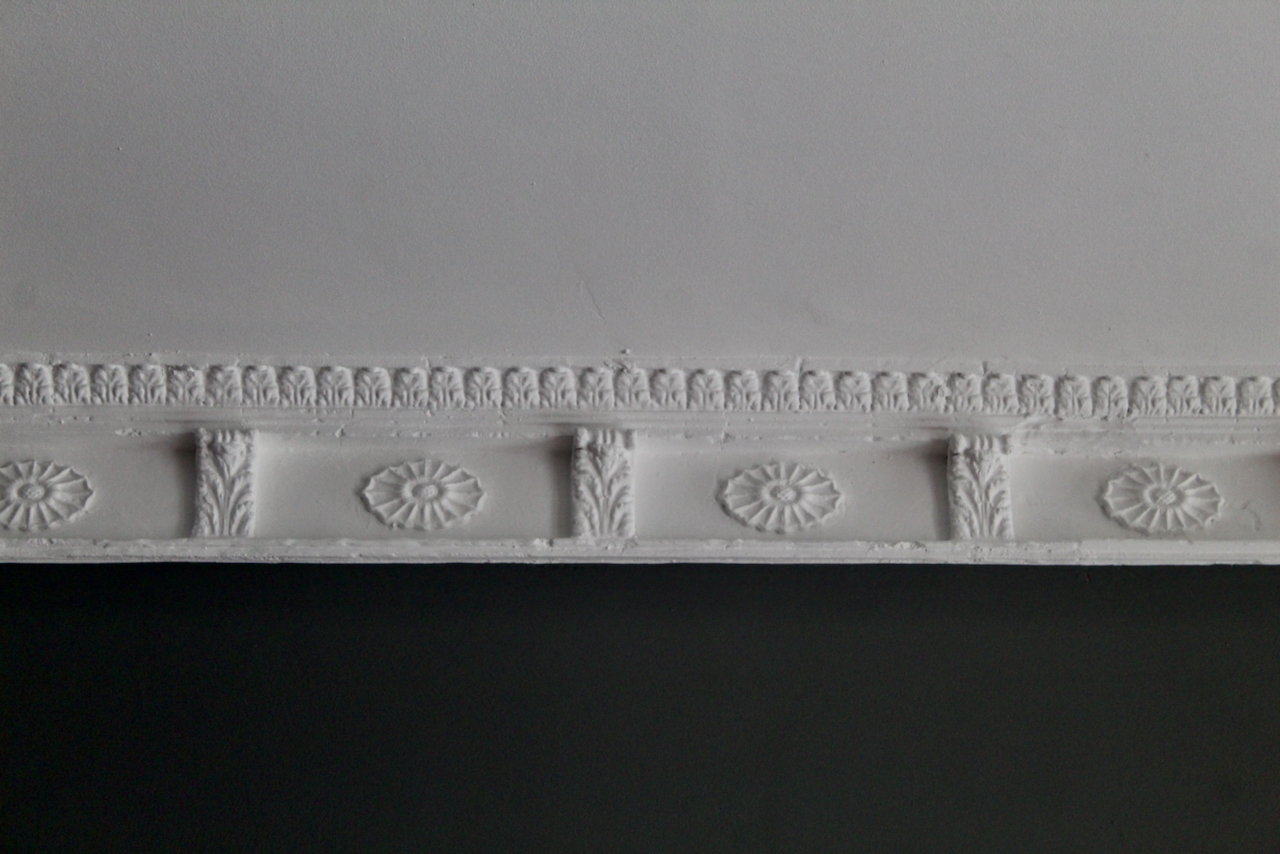
There are formal rooms on both the ground floor and the first floor. They have more beautiful decorative plasterwork.
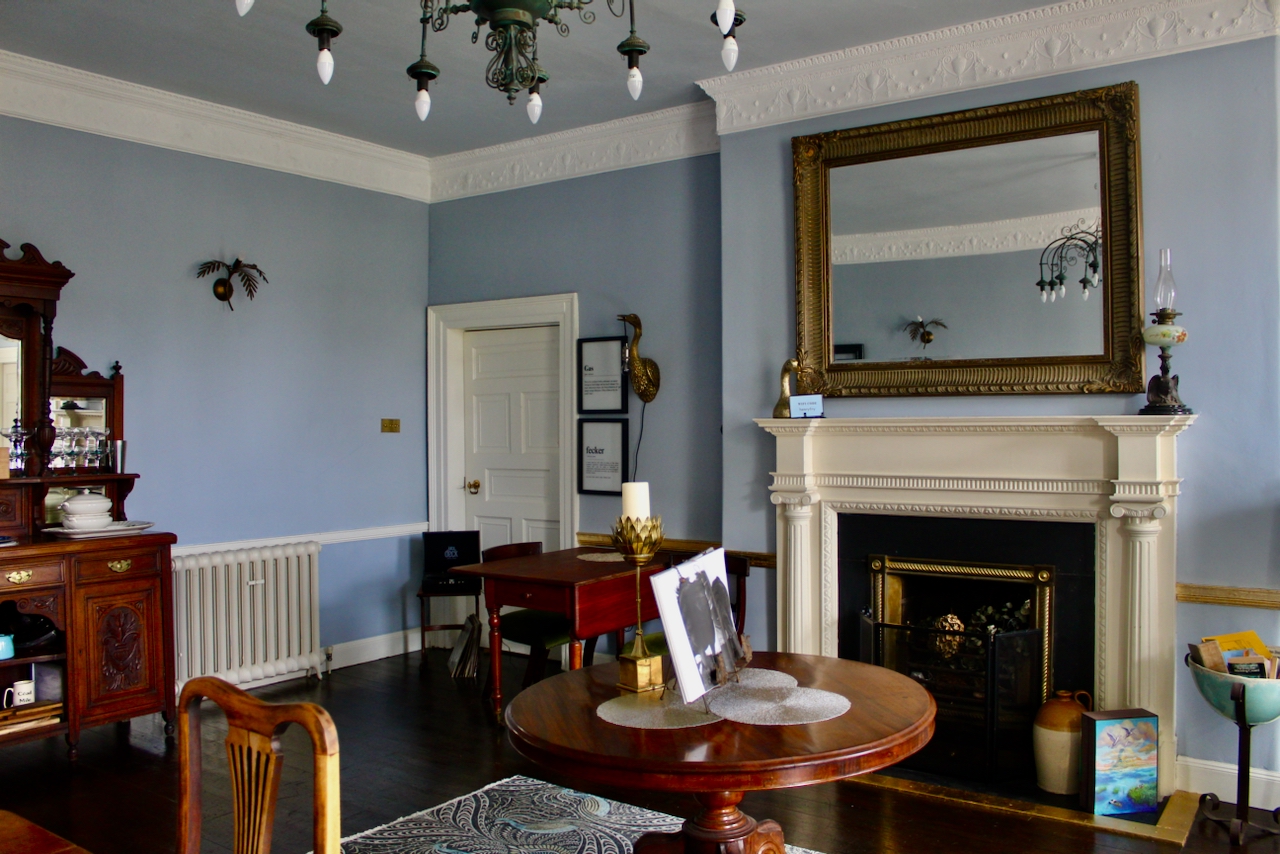
The house had been empty for about ten years before the owners bought it in 2018. Most of the fireplaces had disappeared and had to be replaced. There would have been a fine Adam chimneypiece at one time, which was sold by Richard Fry to a member of the Guinness family, our guide told us.
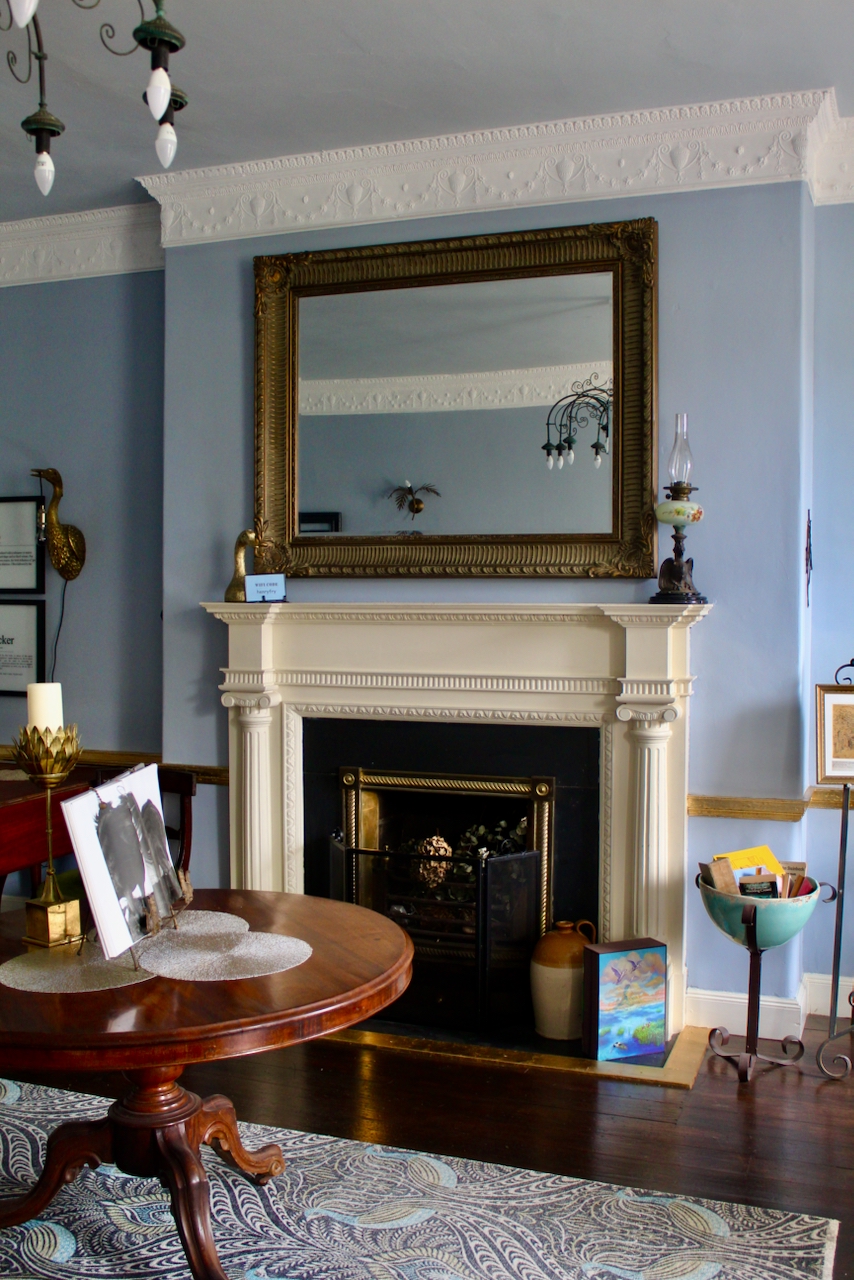
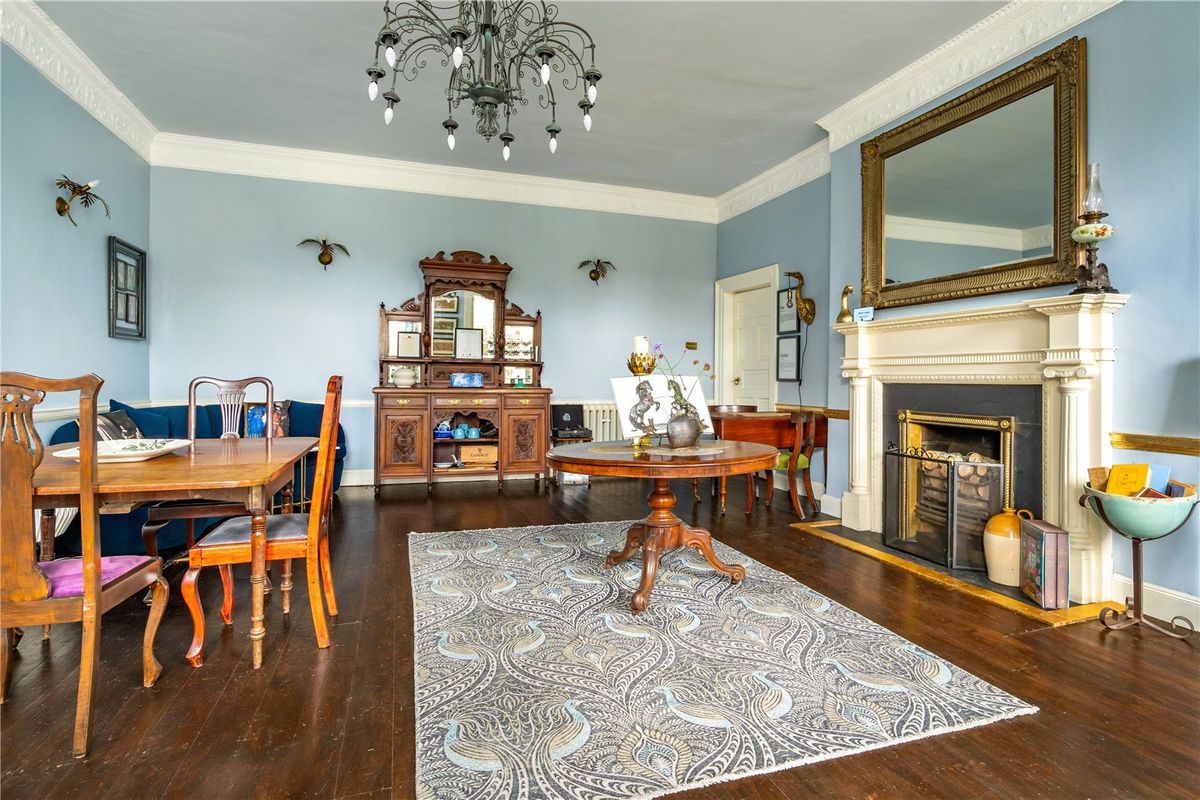
The half-landing features the Venetian window.
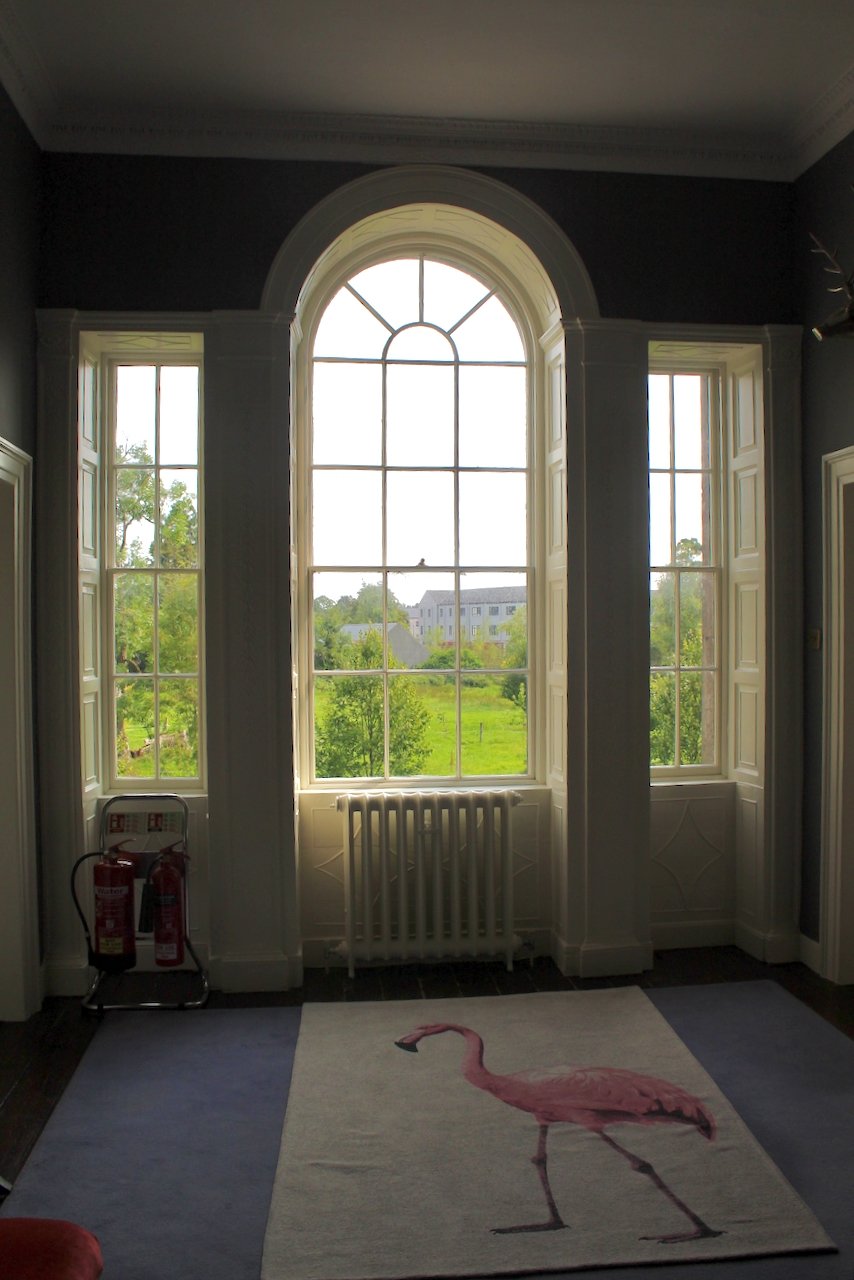
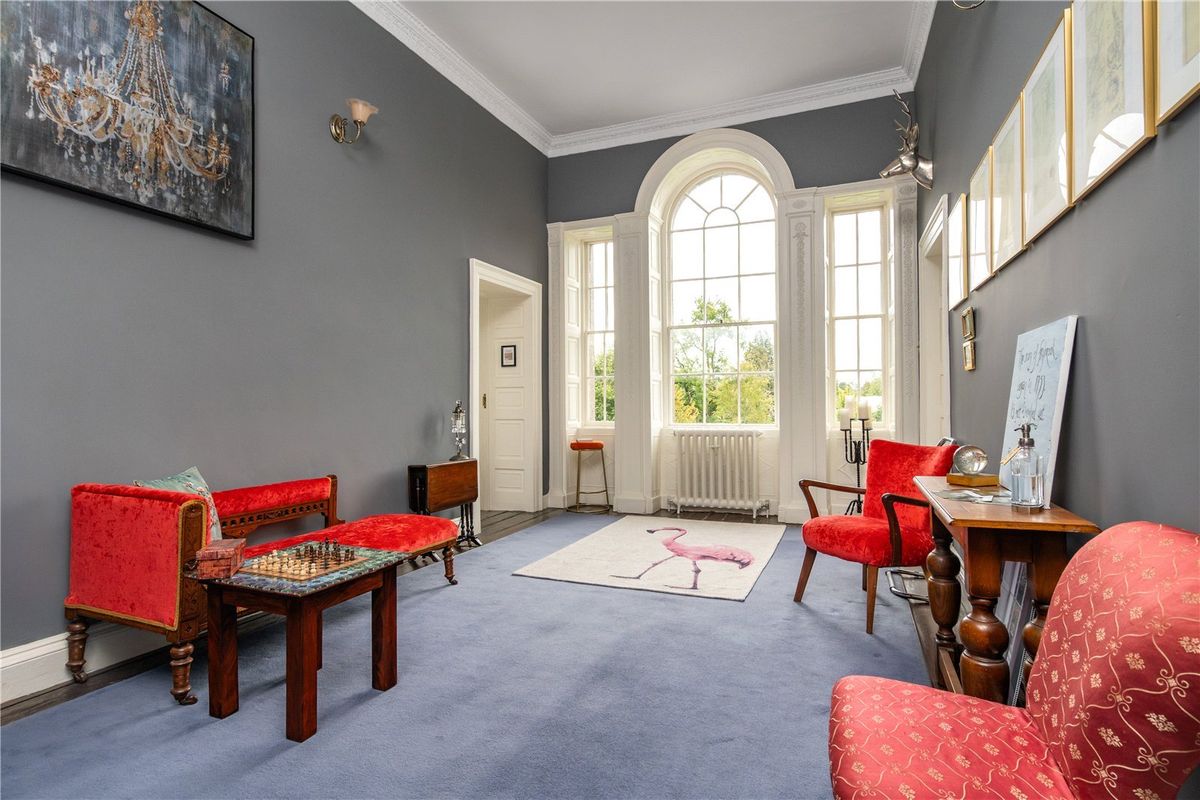
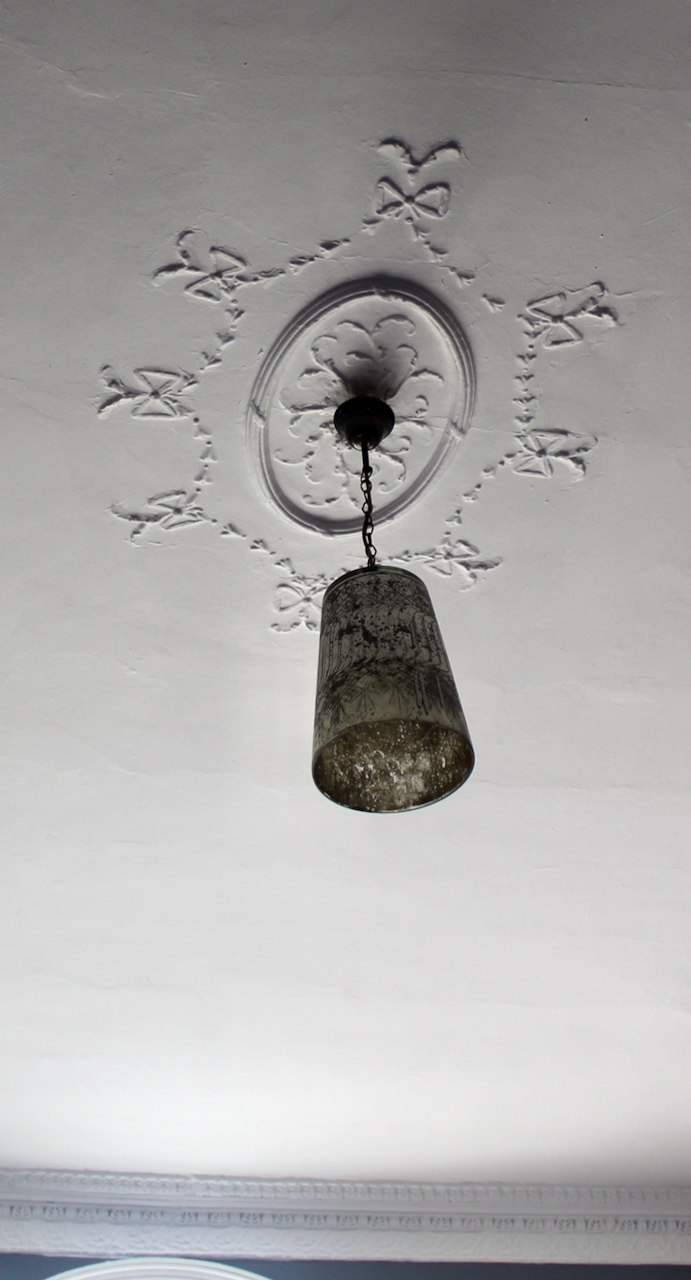
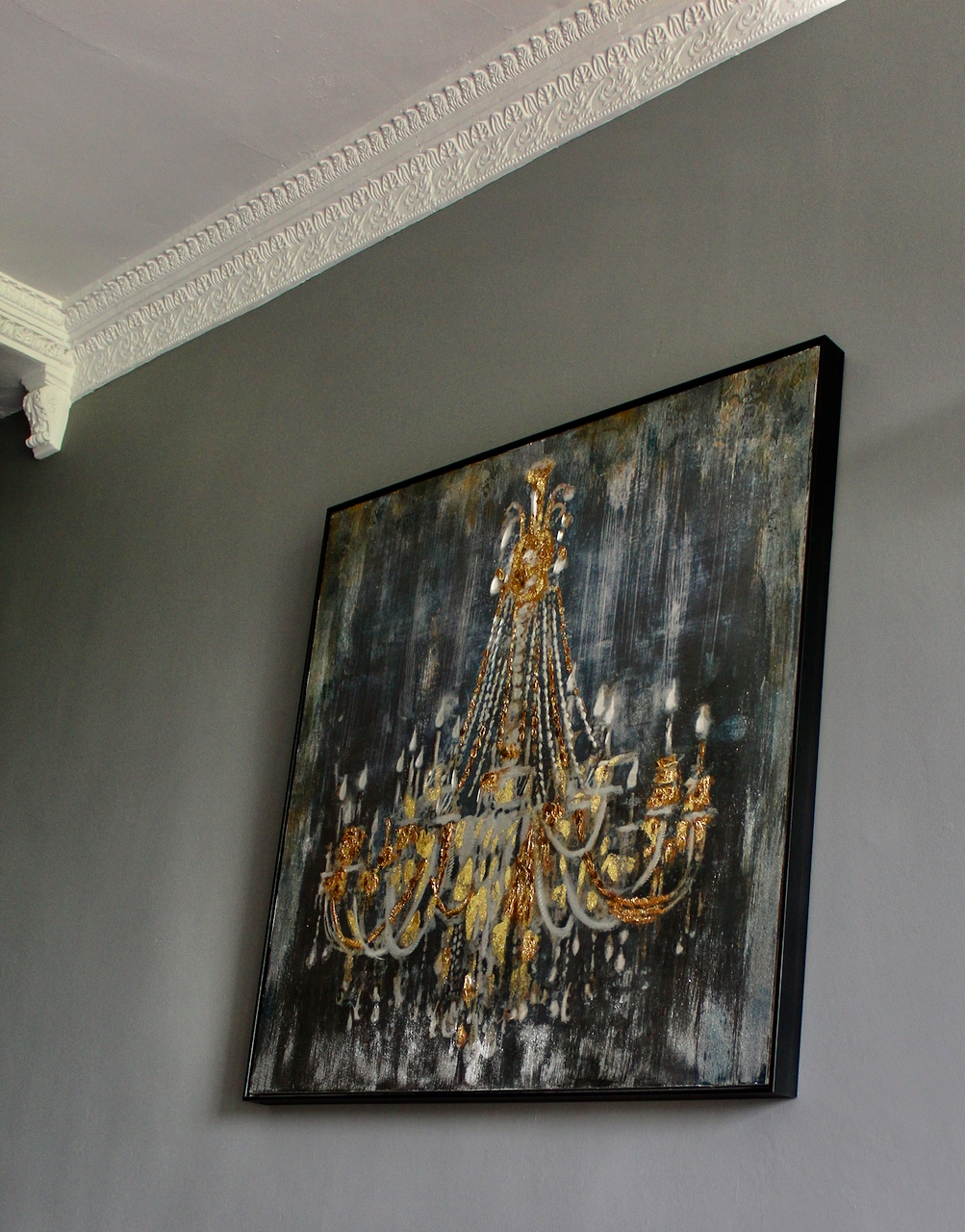
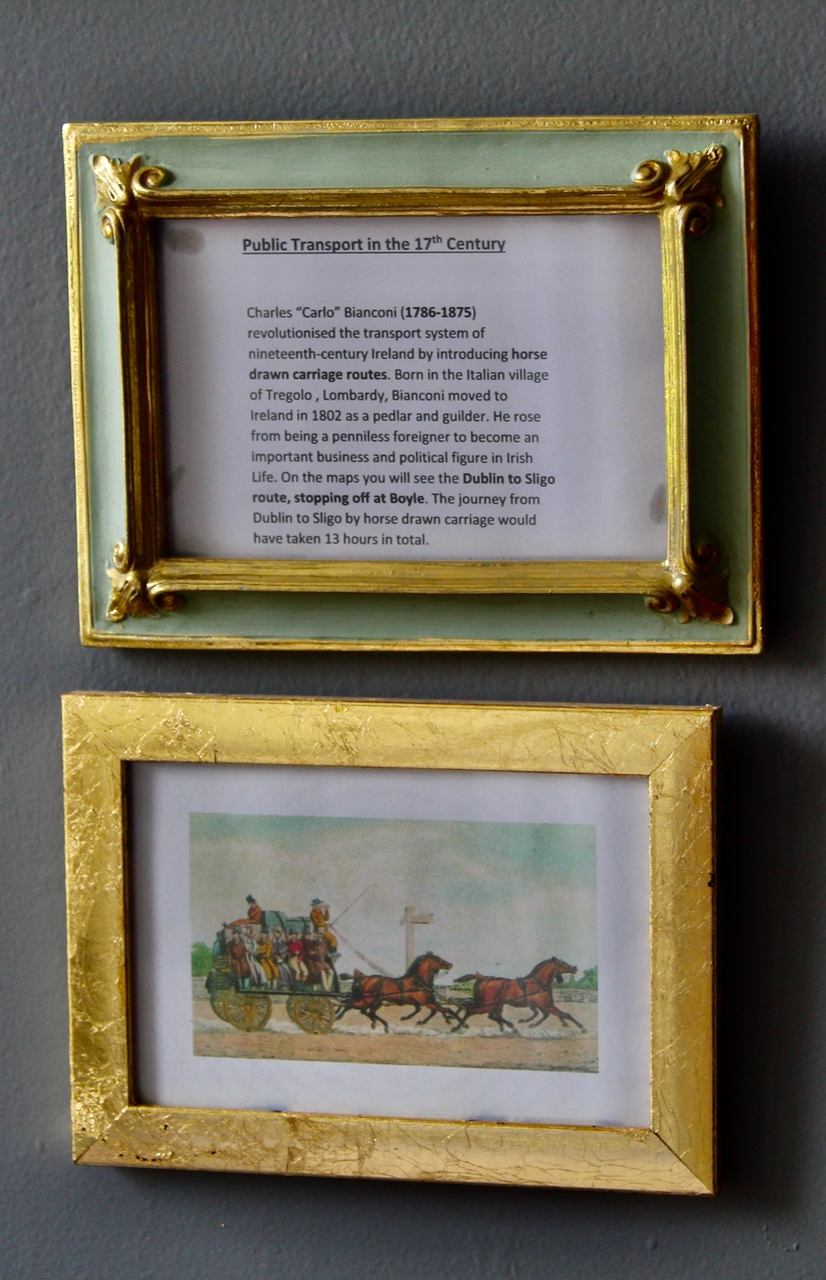
Upstairs there is another formal room with fine plasterwork and also timber carving in the window embrasures.
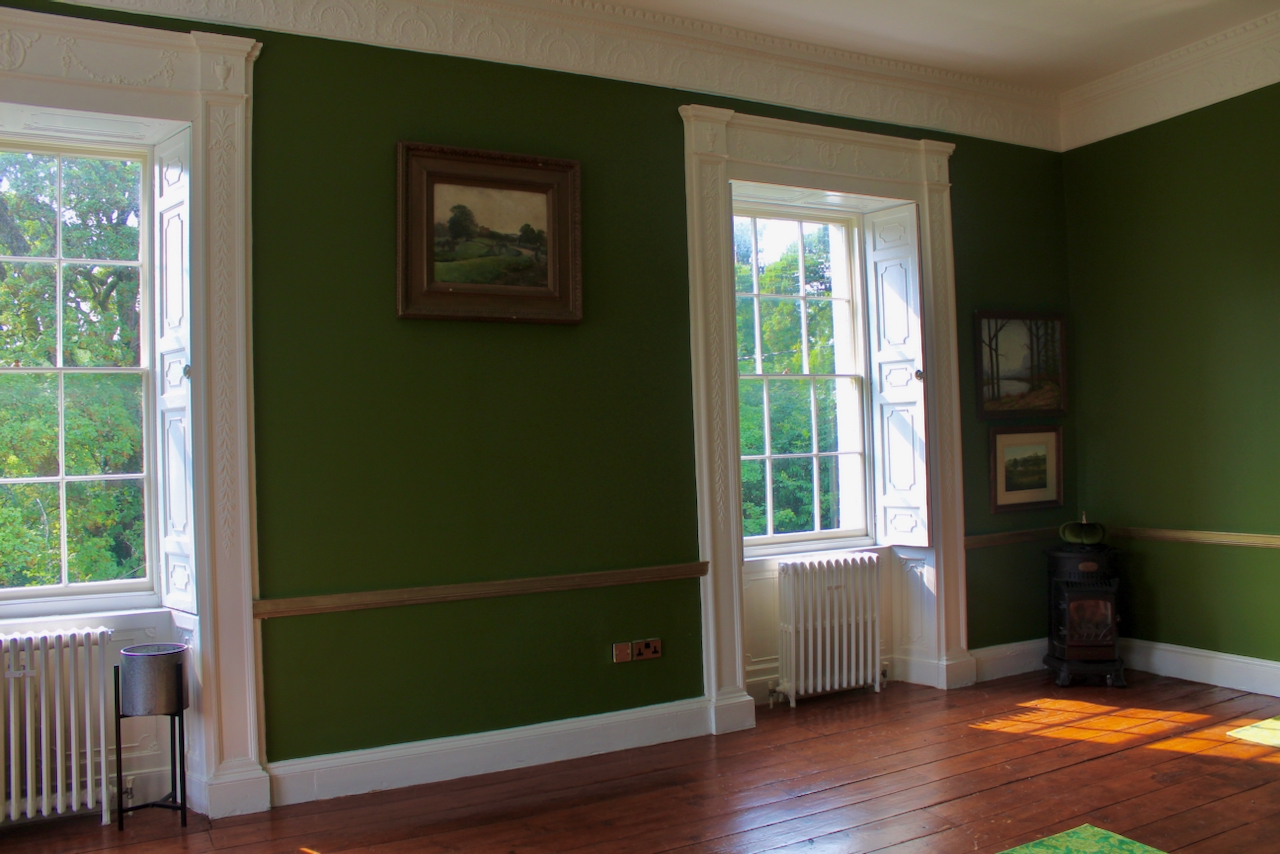
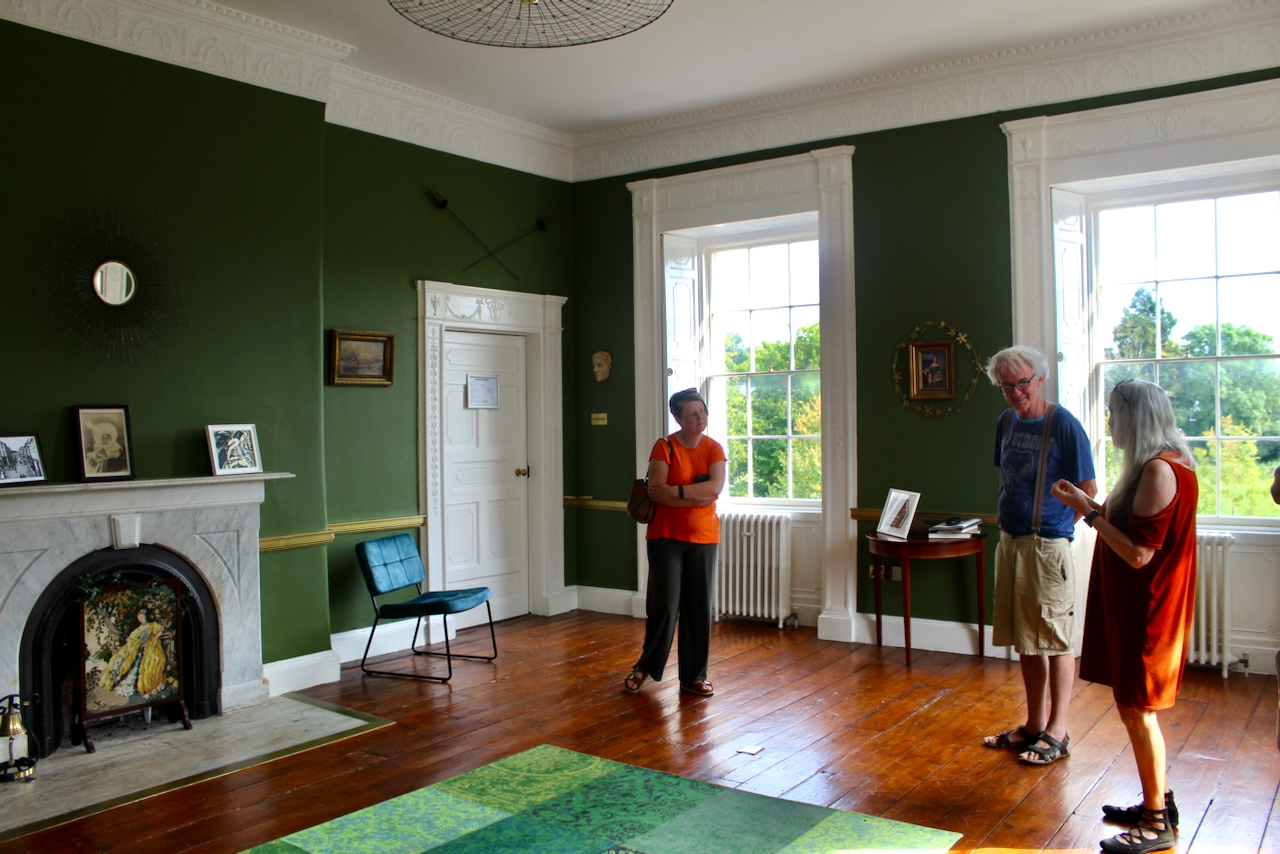
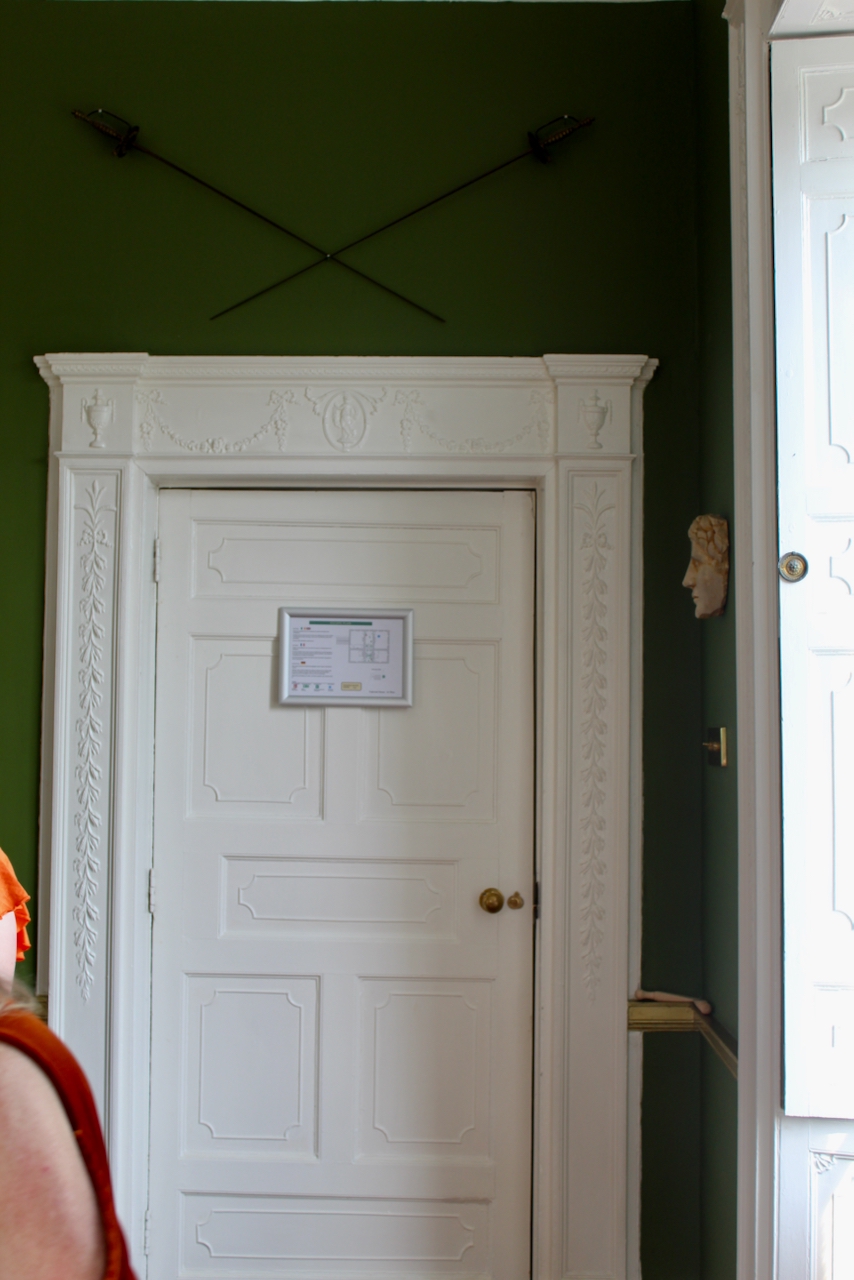
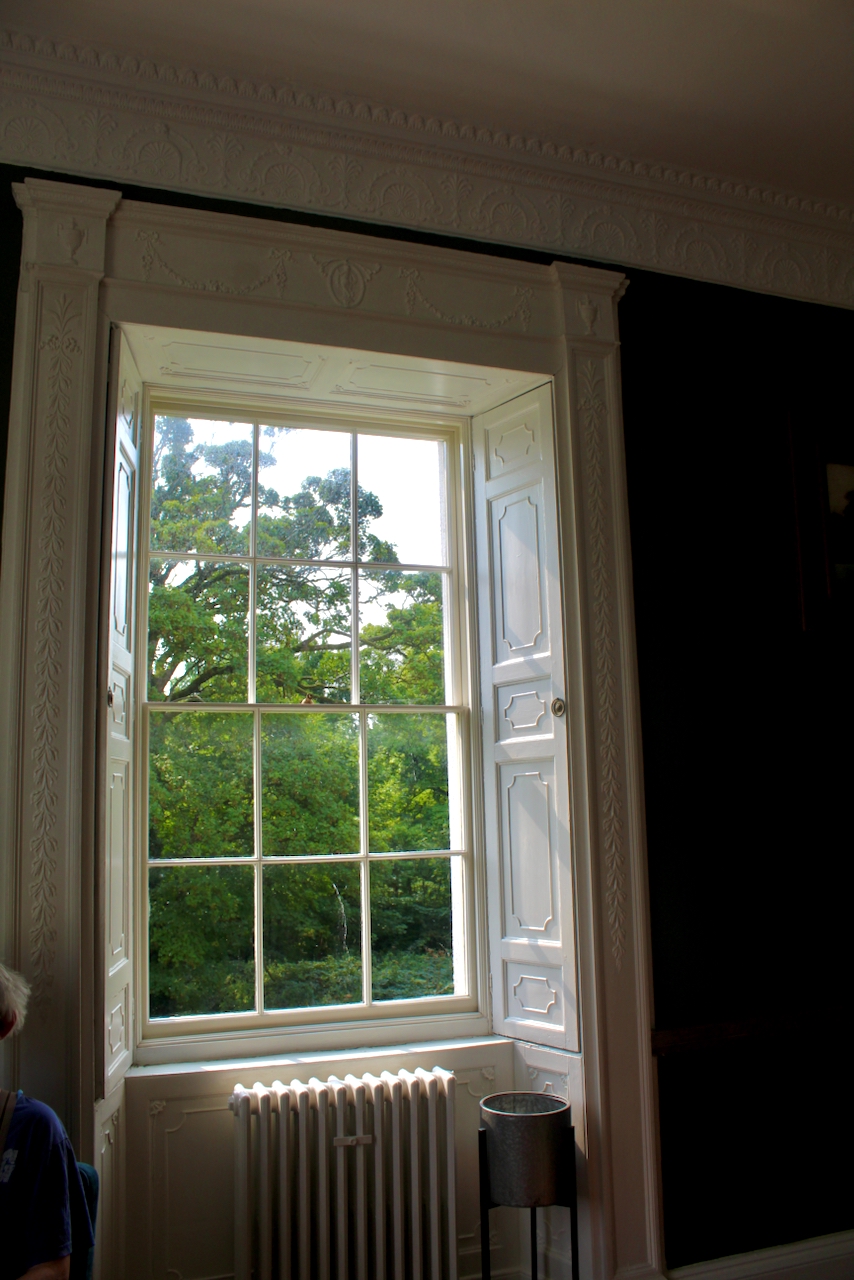
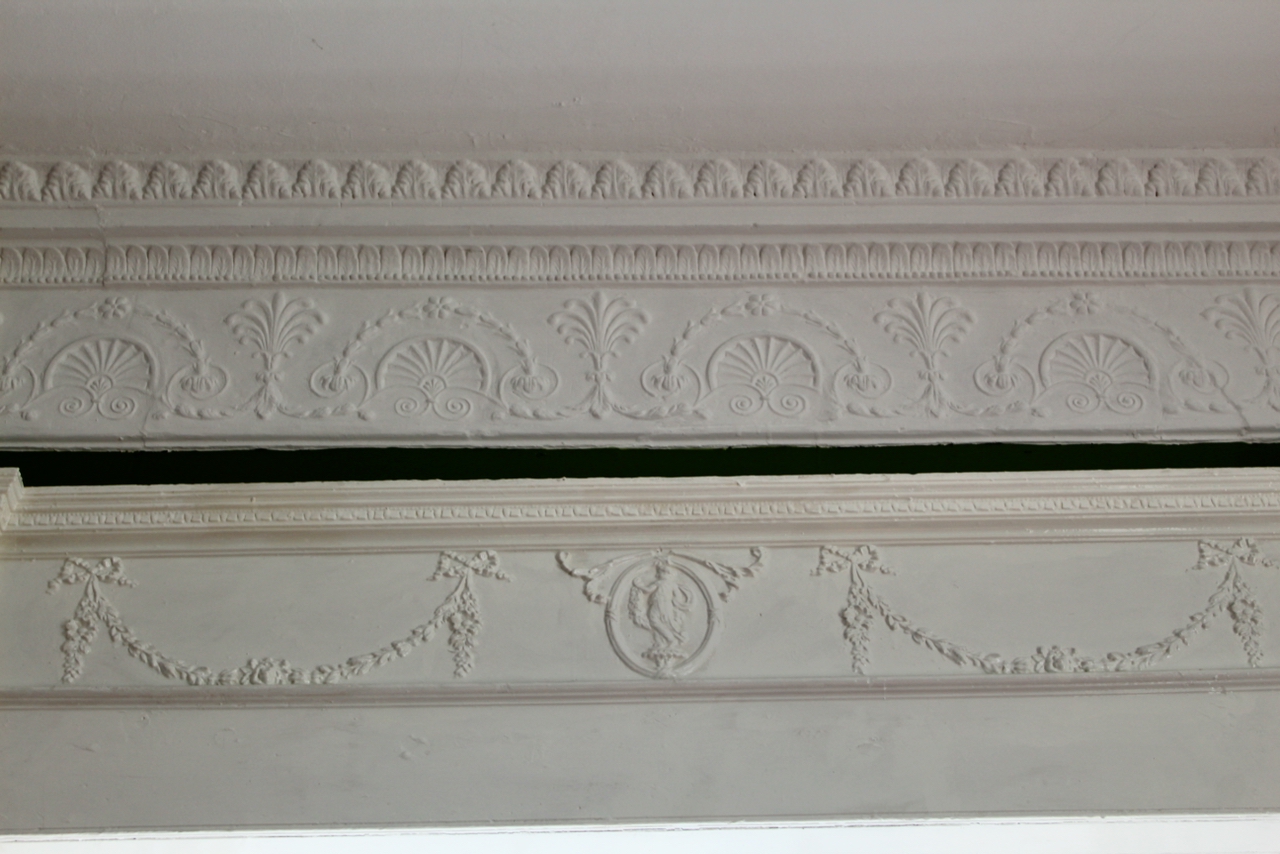
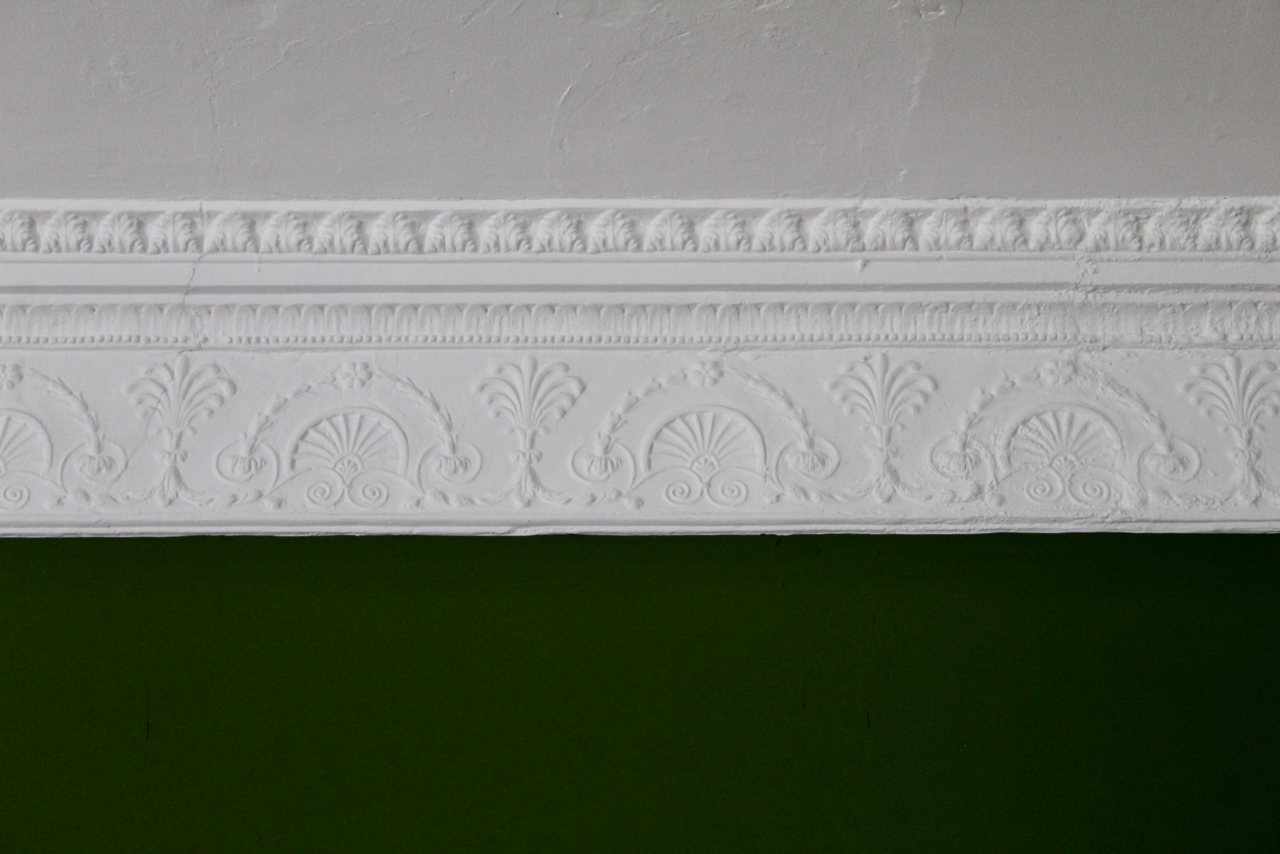
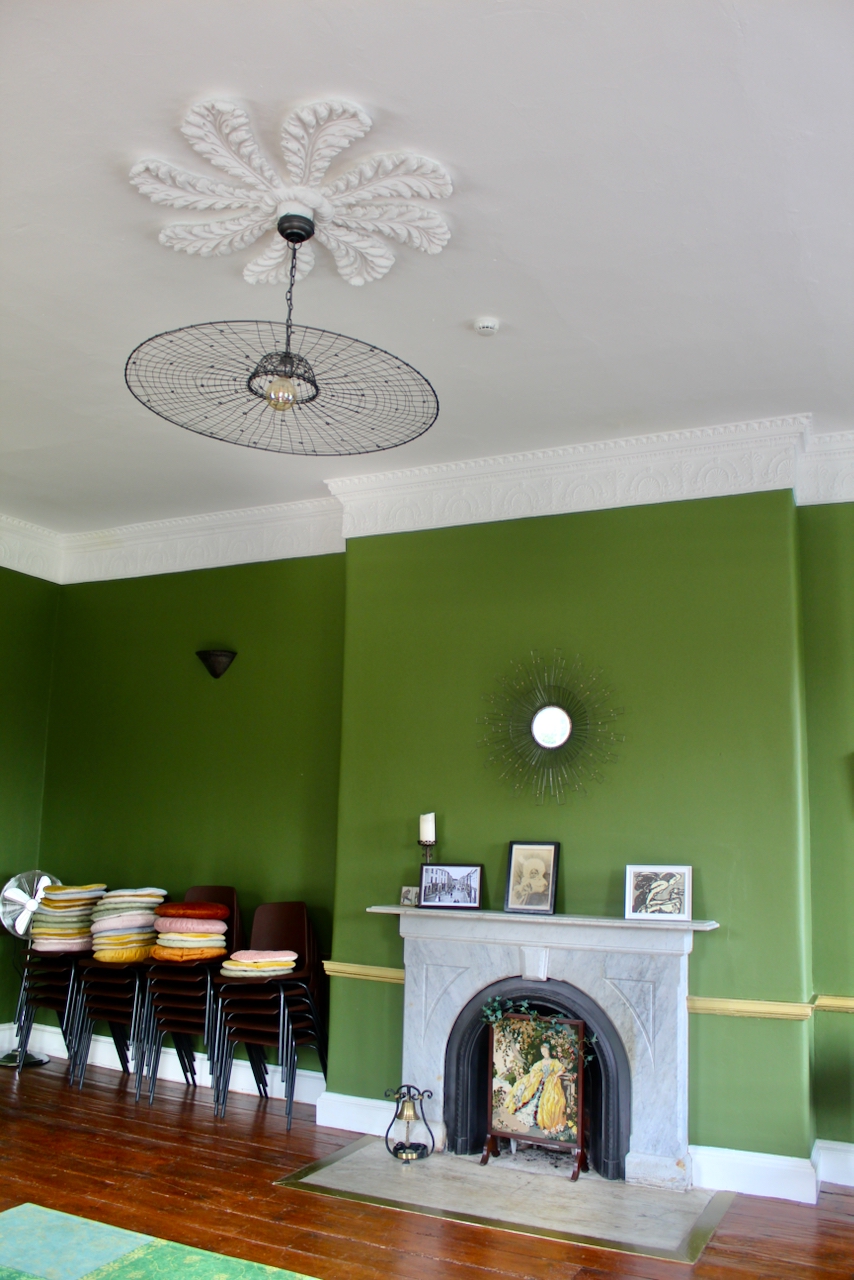
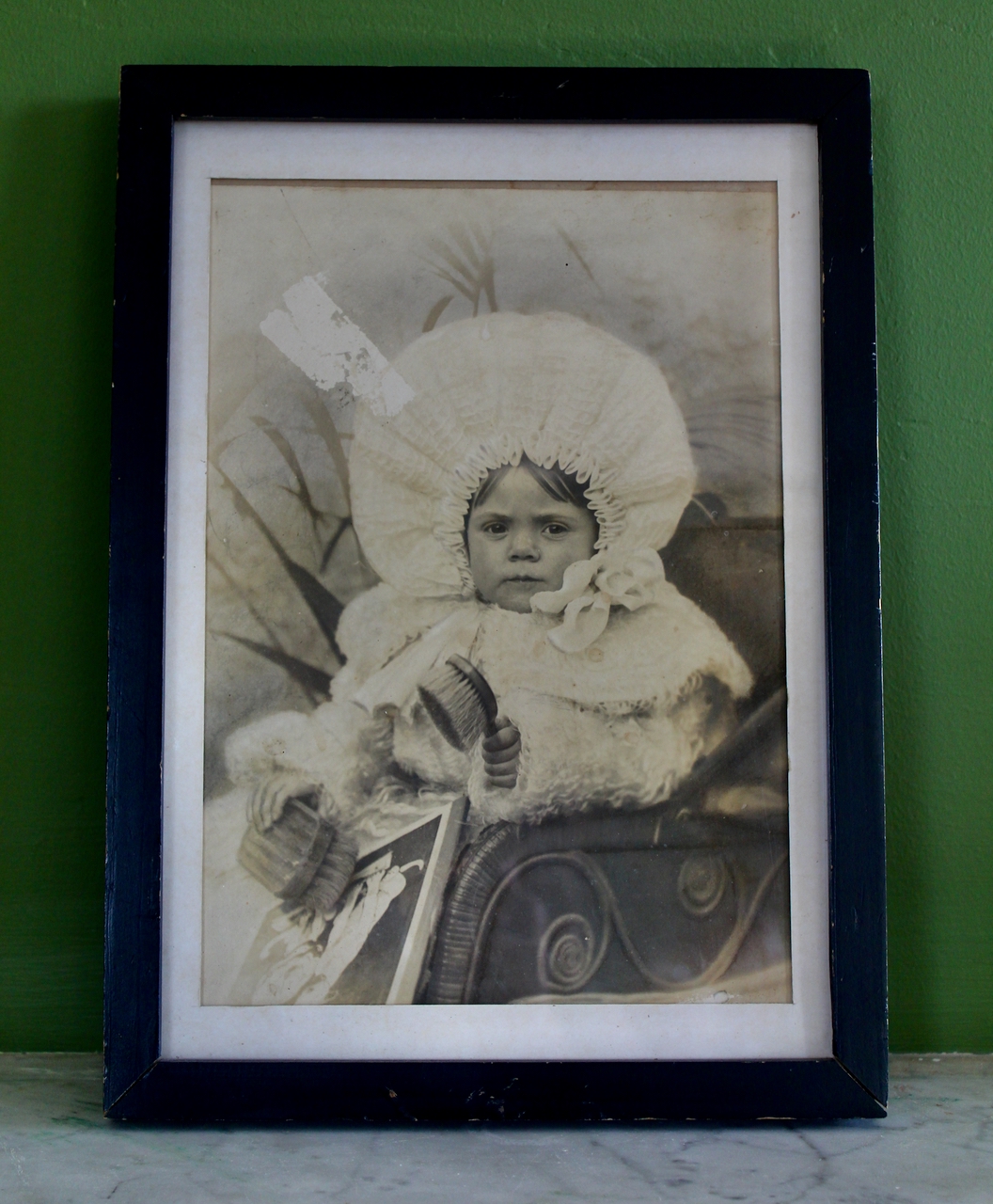
Further up the staircase is another beautiful piece of ceiling detail, a curved ceiling with weblike plasterwork detail, above a curved door frame.
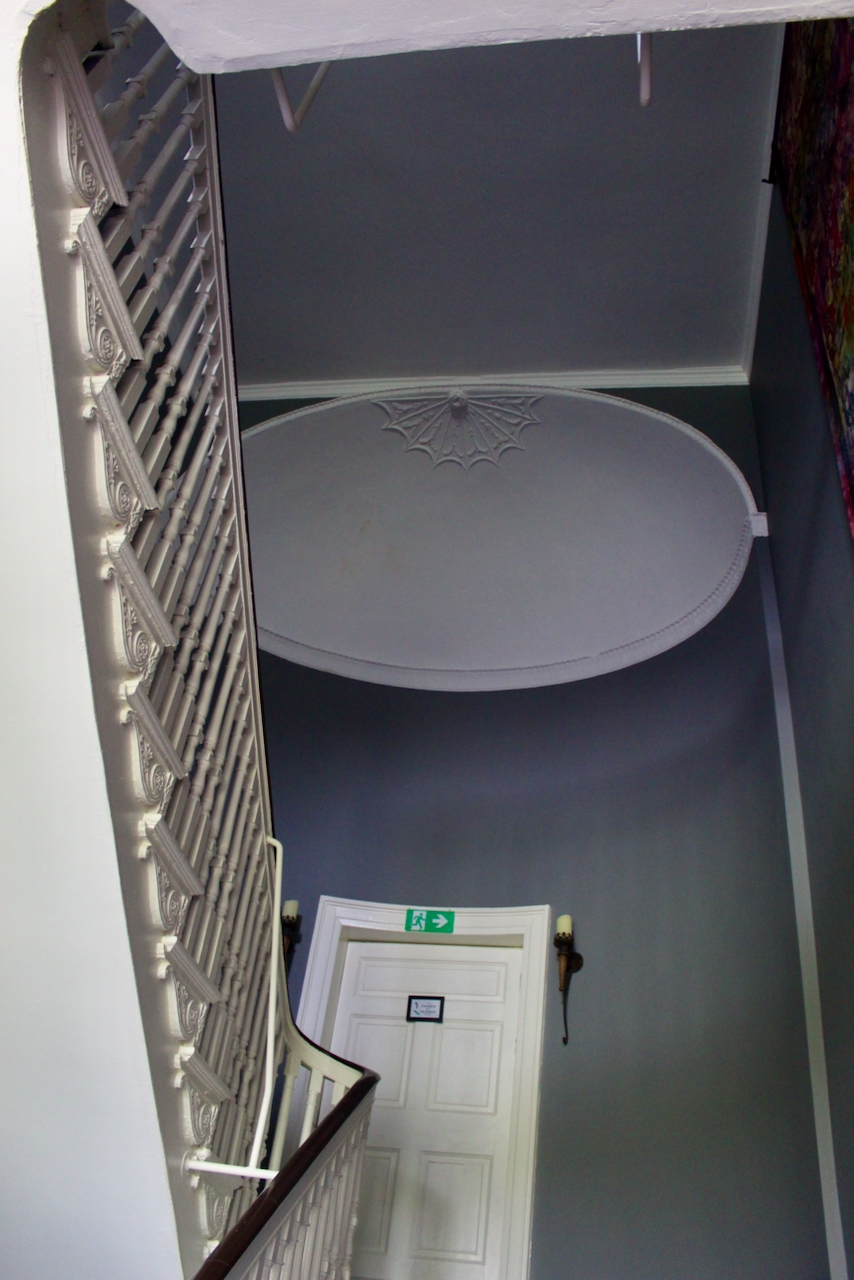
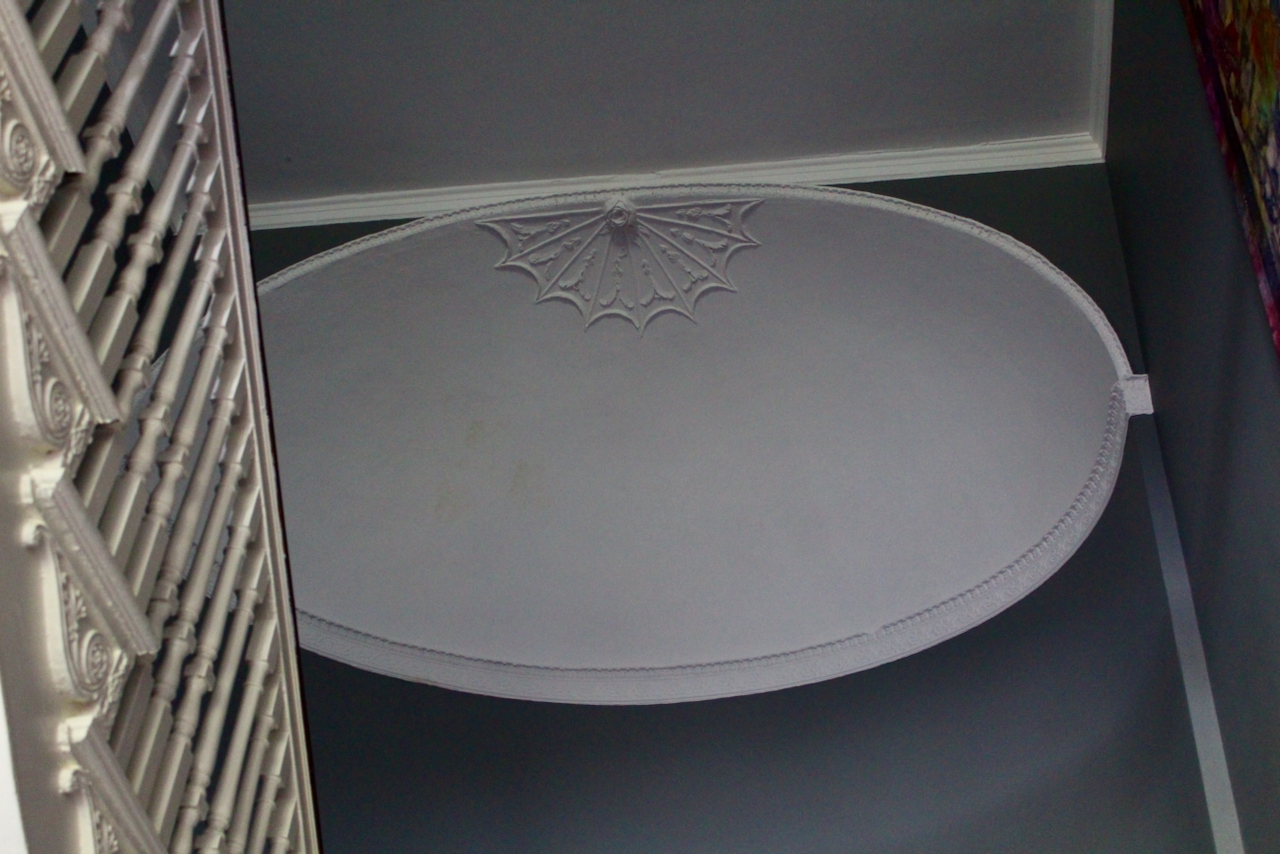
Upstairs are the bedrooms. One in particular is gorgeously decorated with sumptuous colours and fittings and has a carved chimneypiece and jewel-like en suite. The owner asked us not to post photographs as it is the guesthouse piéce de resistance. I do hope the new owners, if it is sold, will maintain it as a guest house as it would be a lovely place to stay! Although it would also make a fabulous home for some lucky family. It has seven en-suite bedrooms.
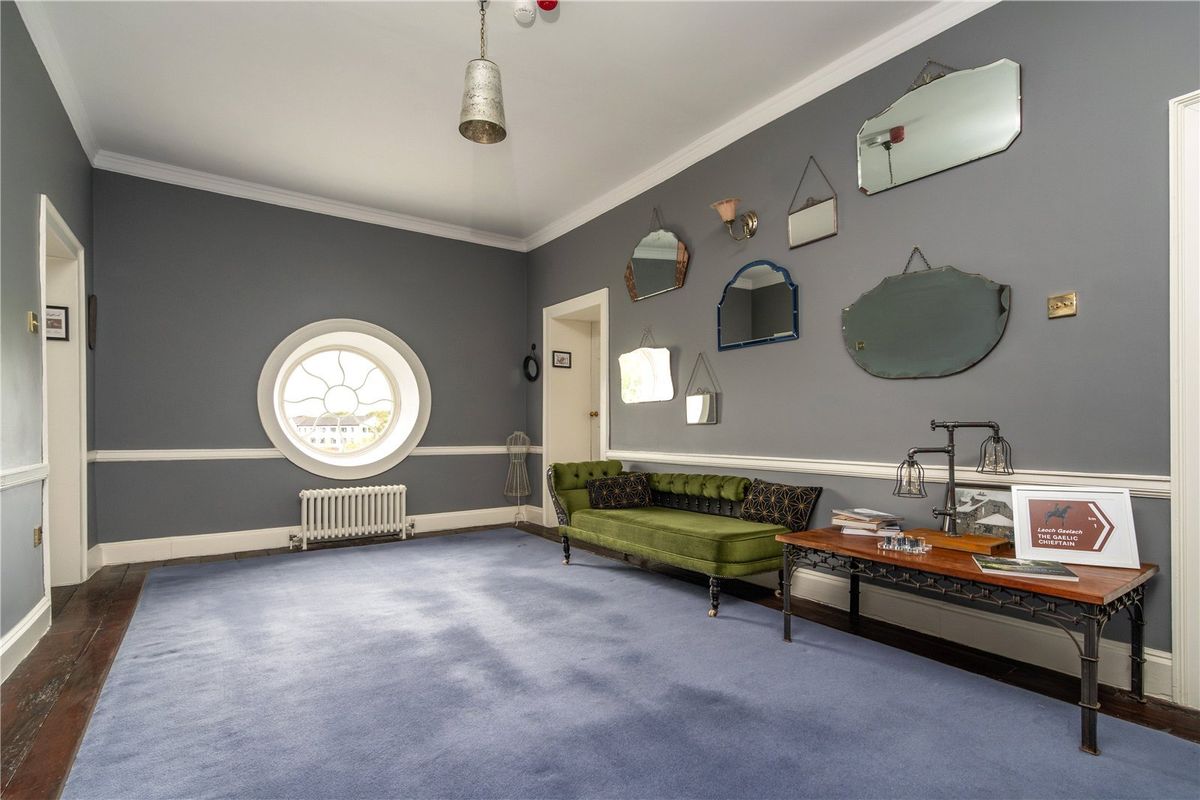
Frybrook passed to Henry’s son, another Henry (1757-1847). He married Elizabeth Baker, daughter of William Baker of Lismacue, County Tipperary, a Section 482 property (see my entry https://irishhistorichouses.com/2025/02/10/lismacue-house-bansha-co-tipperary-section-482-accommodation/ ).
Robert O’Byrne tells us that “in 1835, Henry Fry of Frybrook and his relative, also called Henry Fry, of another house in the vicinity, Fairyhill, were founding members of the Boyle branch of the Agricultural and Commercial Bank (although this venture failed nationally after only a couple of years). Successive generations of Frys continued to live in the family home until the 1980s when, for the first time, it was offered for sale.” [4]
Another son of Henry Fry, Magistrate, (1701-1786) was Oliver (1773-1868), major of Royal Artillery, Freemason, Orangeman, and diarist. Our guide on the tour of the house read us an excerpt of his diary. The Dictionary of Irish Biography tells us that in 1793 Oliver had to leave Trinity college to go home to help his brother Henry defend his house from the “Defenders.” The Defenders were a Catholic Agrarian secret society that originated in County Armagh in response to the Protestant “Peep o’ Day Boys.” The Defenders formed Lodges, and in 1798 fought alongside the United Irishmen. In later years they formed the “Ribbonmen.” The Peep o’ Day Boys carried out raids on Catholic homes during the night, ostensibly to confiscate weapons which Catholics under the Penal Laws were not allowed to own. [5] The Defenders formed in response, and oddly, grew to follow the structure of the Freemasons, with Lodges, secrecy and an oath swearing obedience to King George III. The Peep o’ Day Boys became the Orange Order.
The Defenders carried out raids of Protestant homes to obtain weapons. When Britain went to war with France in 1793, small Irish farmers objected to a partial conscription as they needed their young men for labour, which increased membership in the Defenders.
The Dictionary tells us about Oliver Fry:
“He was a member of the force of Boyle Volunteers that defeated a large group of Defenders at Crossna and subsequently defended the residence of Lord Kingston (1726–97) at Rockingham. During this latter skirmish he captured the leader of the Defenders, and was later presented with a commission in the Roscommon militia by Lord Kingston.”

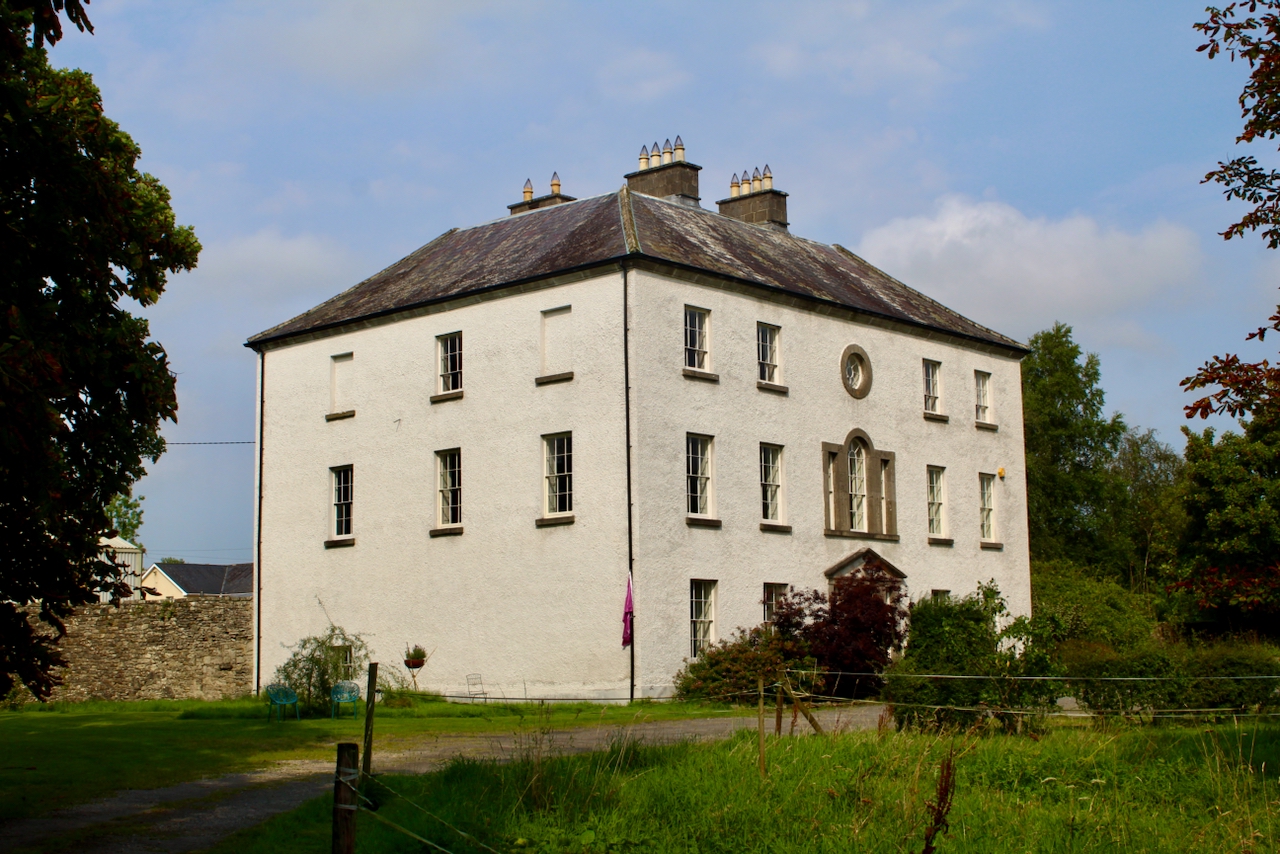
Oliver served in the Royal Irish Artillery. The Dictionary of Irish Biography entry about him tells us more:
“In 1822 Fry wrote a retrospective account of his early life, and thereafter kept a very detailed diary. While some of the accounts of his military service were somewhat exaggerated, his diary remains an invaluable source of information on the major events of the late eighteenth and early nineteenth centuries, including the agrarian disturbances of the 1820s–40s, the repeal movement, the cholera epidemic of 1831, and the Great Famine. Other more colourful events were also described, such as the visits of Queen Victoria, the Crystal Palace exhibition of 1851, and the Dublin earthquake of 1852. He died 28 April 1868 at his Dublin home, Pembroke House, Blackrock, Co. Dublin, and was buried at Mount Jerome cemetery.“
Despite the oppositional stance with Catholics, our guide told us that the family were generous in famine times, as evidenced by the Bakehouse, the remains of which are next to the driveway to the house. However, a bakehouse isn’t evidence that the family gave out the bread for free!
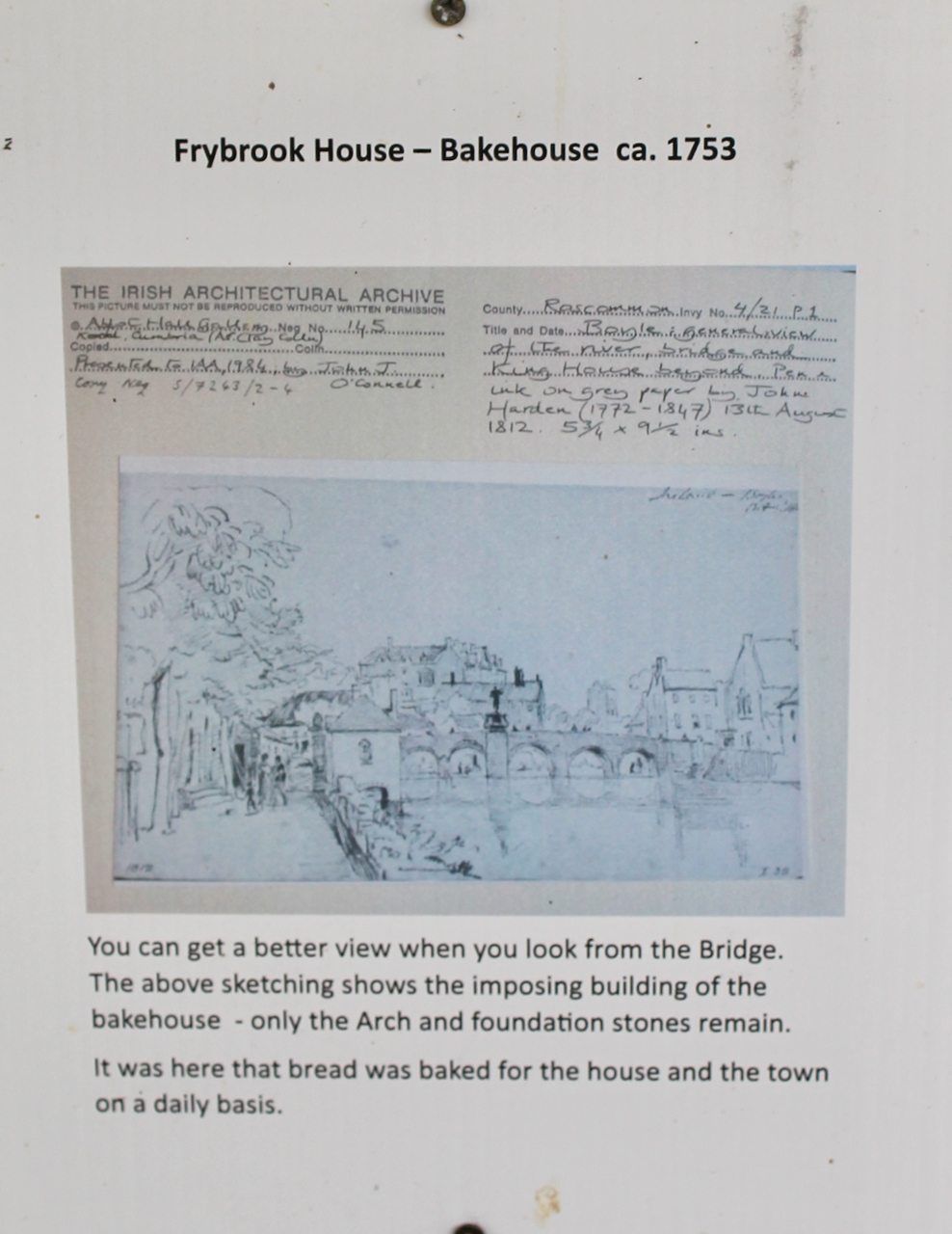
Further evidence of the Fry’s hospitality, Joan told us, are the “hospitality” stones on the piers at the entrance to the house.
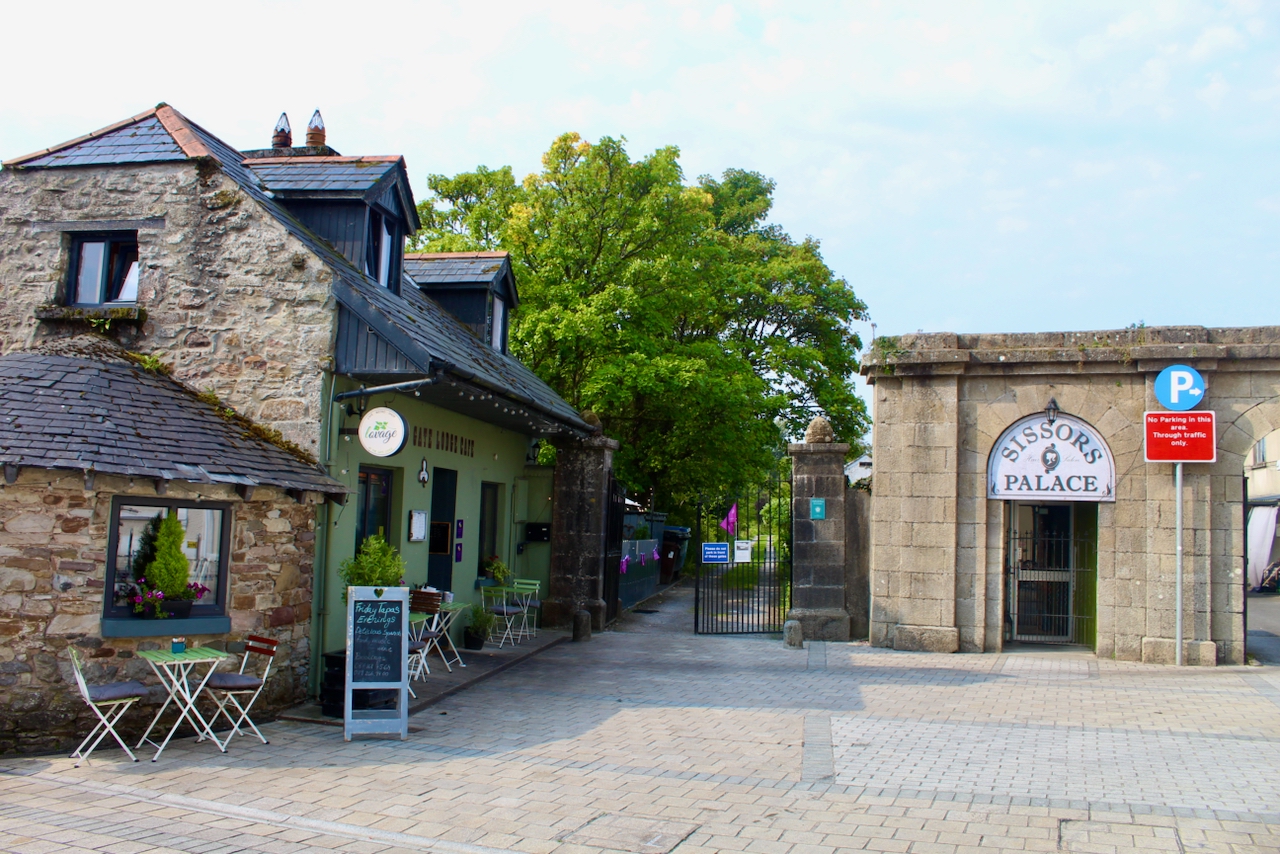
The pier stones resemble worn pineapples. The only reference I can find to “hospitality stones” in a quick google search is that hospitality stones were like ancient admission tickets: stones with some marking on them given by someone to indicate that the bearer could produce the stone and receive hospitality in return. The stones on the entrance piers resemble worn pineapples. In the eighteenth century pineapples became a symbol of luxury, wealth and hospitality. A blog of the Smithsonian Museum tells us:
“The pineapple, indigenous to South America and domesticated and harvested there for centuries, was a late comer to Europe. The fruit followed in its cultivation behind the tomato, corn, potato, and other New World imports. Delicious but challenging and expensive to nurture in chilly climes and irresistible to artists and travelers for its curious structure, the pineapple came to represent many things. For Europeans, it was first a symbol of exoticism, power, and wealth, but it was also an emblem of colonialism, weighted with connections to plantation slavery...
“…the intriguing tropical fruit was able to be grown in cold climates with the development, at huge costs, of glass houses and their reliable heating systems to warm the air and soil continuously. The fruit needed a controlled environment, run by complex mechanisms and skilled care, to thrive in Europe. Pineapples, thus, became a class or status symbol, a luxury available only to royalty and aristocrats. The fruit appeared as a centerpiece on lavish tables, not to be eaten but admired, and was sometimes even rented for an evening.
“…The pineapple became fashionable in England after the arrival in 1688 of the Dutch King, William III and Queen Mary, daughter of James II, who were keen horticulturalists and, not incidentally, accompanied by skilled gardeners from the Netherlands. Pineapples were soon grown at Hampton Court. The hothouses in Great Britain became known as pineries. With its distinctive form, the cult of the pineapple extended to architecture and art. Carved representations sit atop the towers of St. Paul’s Cathedral in London and other prominent buildings, perhaps an adaptation or reference to the pinecones used on ancient Roman buildings.“
“…During the 18th century, the pineapple was established as a symbol of hospitality, with its prickly, tufted shape incorporated in gateposts, door entryways and finials and in silverware and ceramics.” [6]

The lovely cafe in the gate lodge is situated on the river, next to the triple arch stone bridge over the River Boyle which was built in 1846 (or 1864, according to the National Inventory). [7]
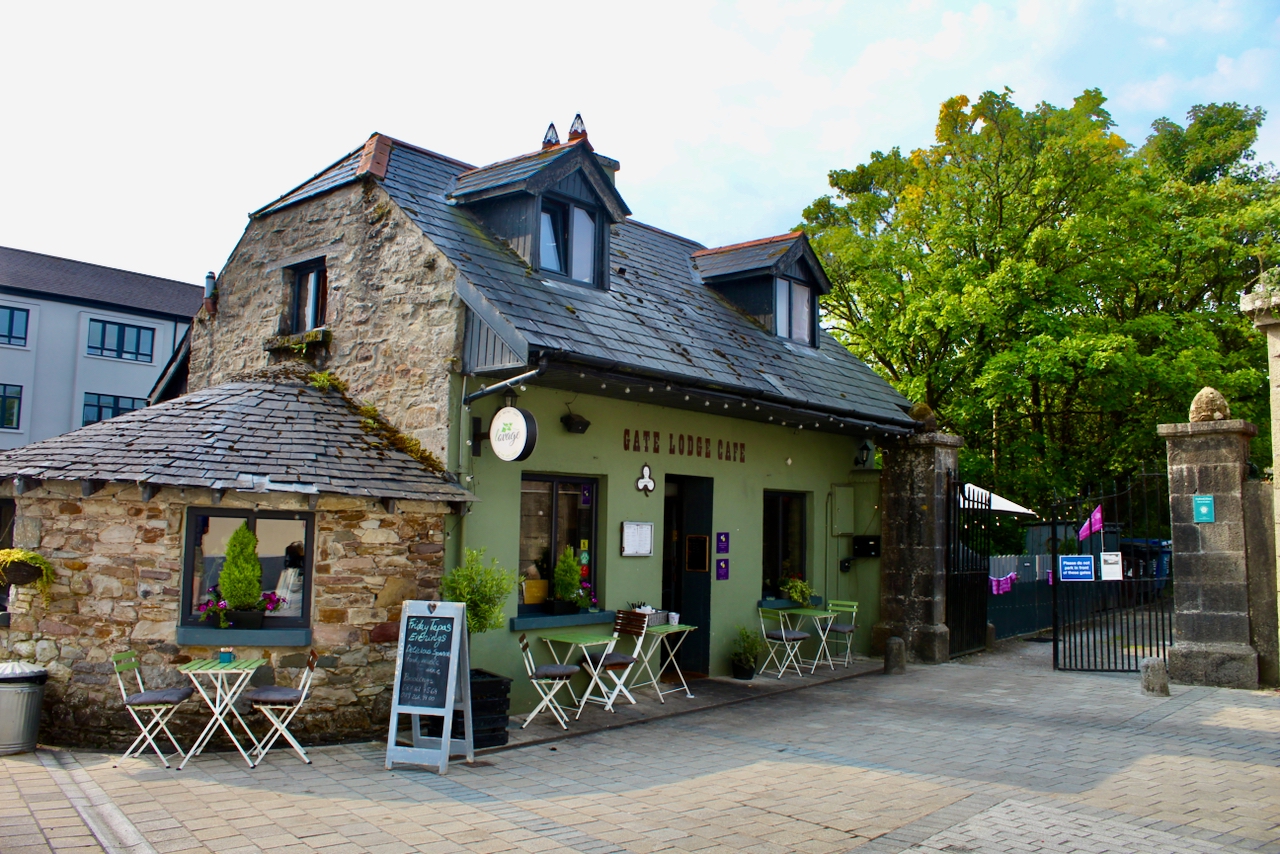
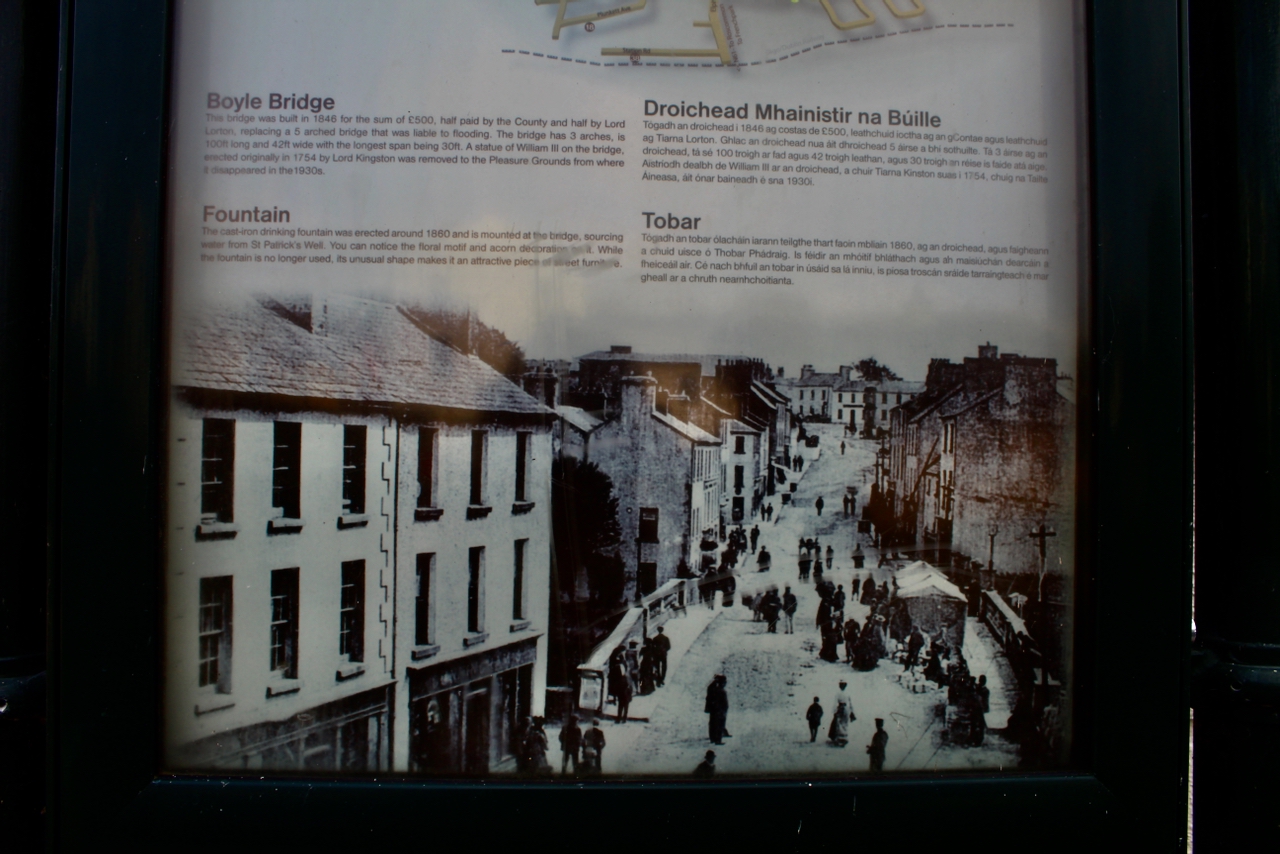
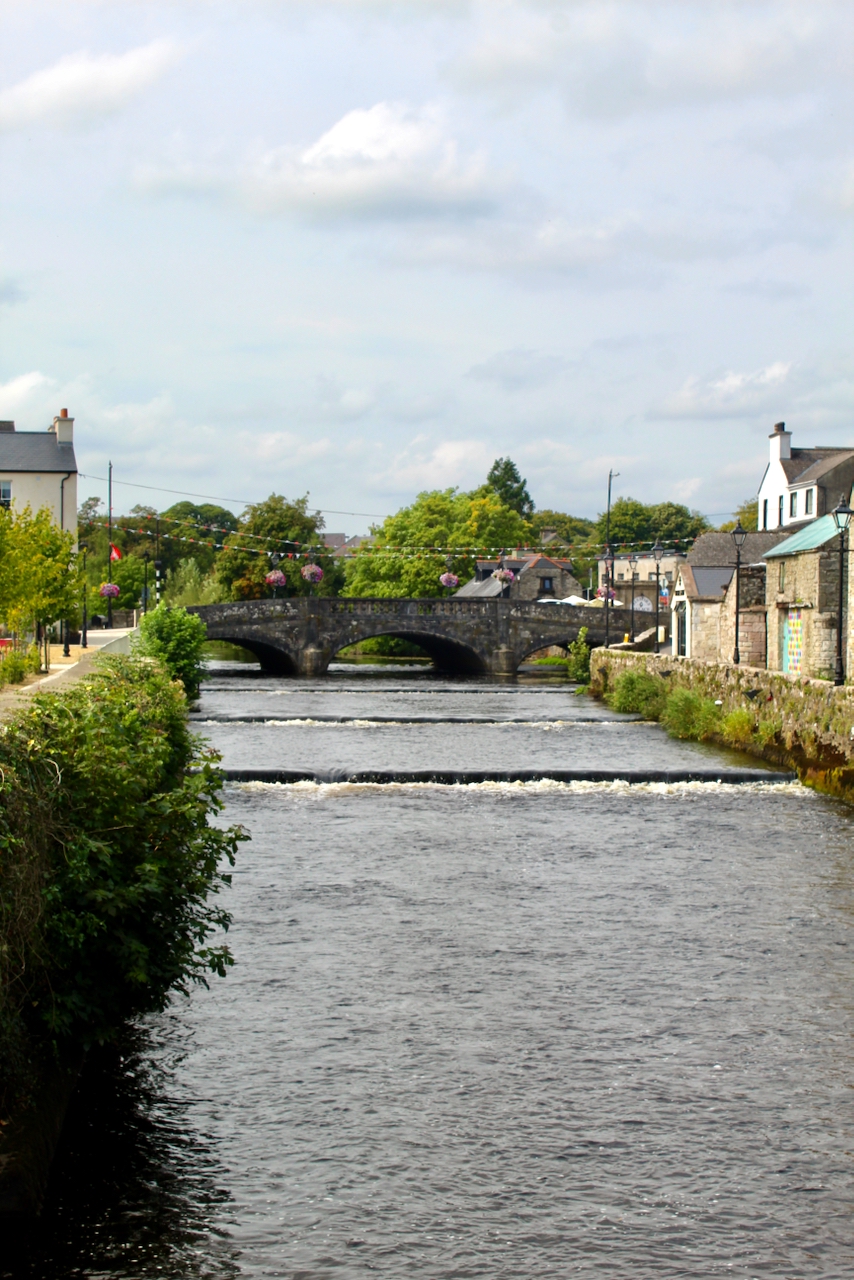
The house’s website tells us:
“A bell was positioned on the roof of Frybrook house and it rang every day to invite the locals to dine in Frybrook, and when there was no room inside the house, tents were erected on the lawn.
“During the 1798 rising (‘Year of the French’) even the officers of the opposing French army were dining in the house.
“Frybrook House also supplied soup to the locals during the Great Famine (1845 to 1852), evidenced by a very large Famine Cauldron in the kitchen.“
I don’t know how it was that the Frys would host the French when Oliver was serving in the army fighting against the French! Perhaps this information is in Oliver’s diary. It would be a fascinating read. The Dictionary of Irish Biography gives a reference for his diary: William H. Phibbs Fry, Annals of the late Major Oliver Fry, R.A. (1909).
The bell may have been used to serve to tell the time for the weaving employees. The rope ran from the top of the house to the ground floor.
The weaving industry had 22 looms, our guide told us. Frybrook wasn’t a landed estate, and the owners did not make their money from having a large amount of land and tenants. The house had six acres. In later years the Fry family sold vegetables, and Lord Lorton established a market shambles for meat and vegetables.
Not all cauldrons were used to feed the public during the Famine. In the kitchen of the house there is a large cauldron that would have been used for washing clothes. The kitchen of Frybrook has many original features.
It has a Ben Franklin designed stove, which was invented to be a stove that was safe for children to be around.
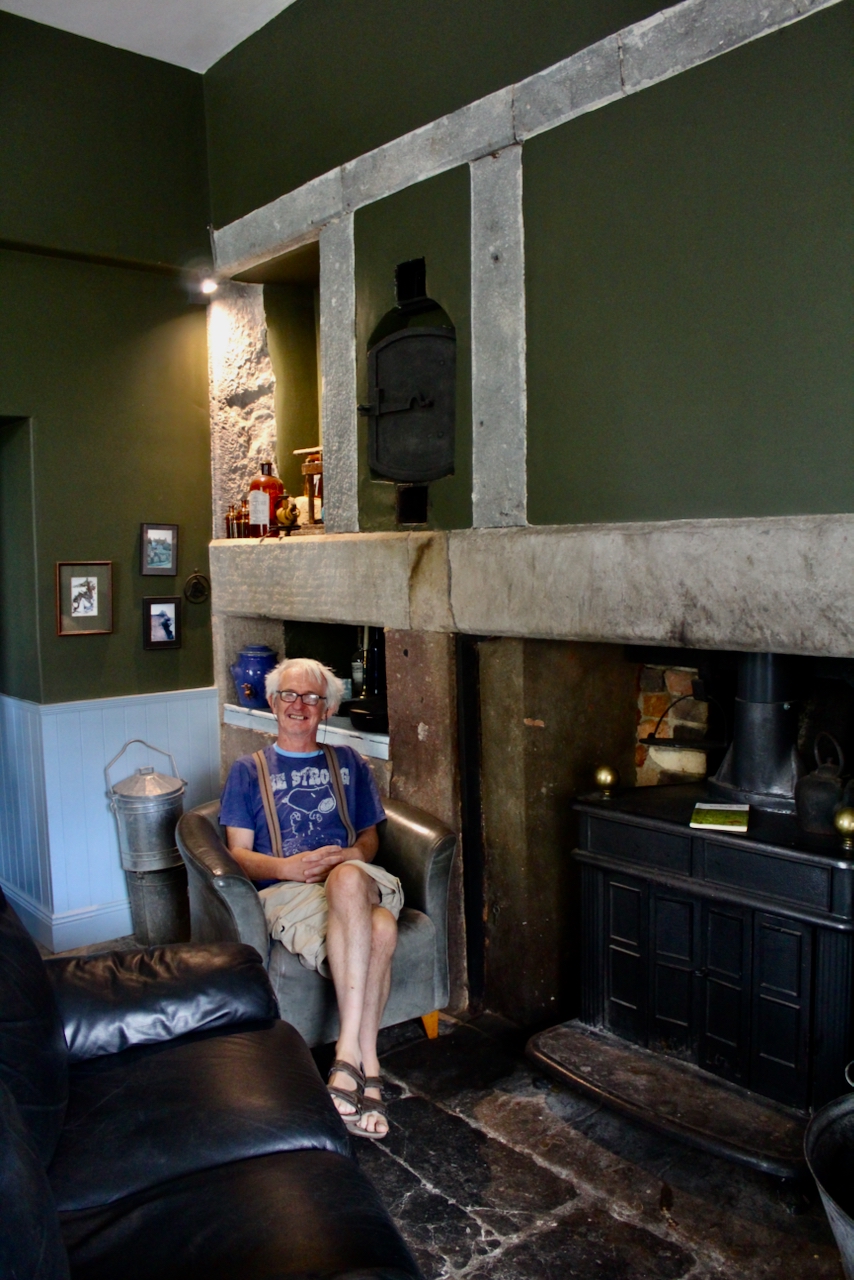
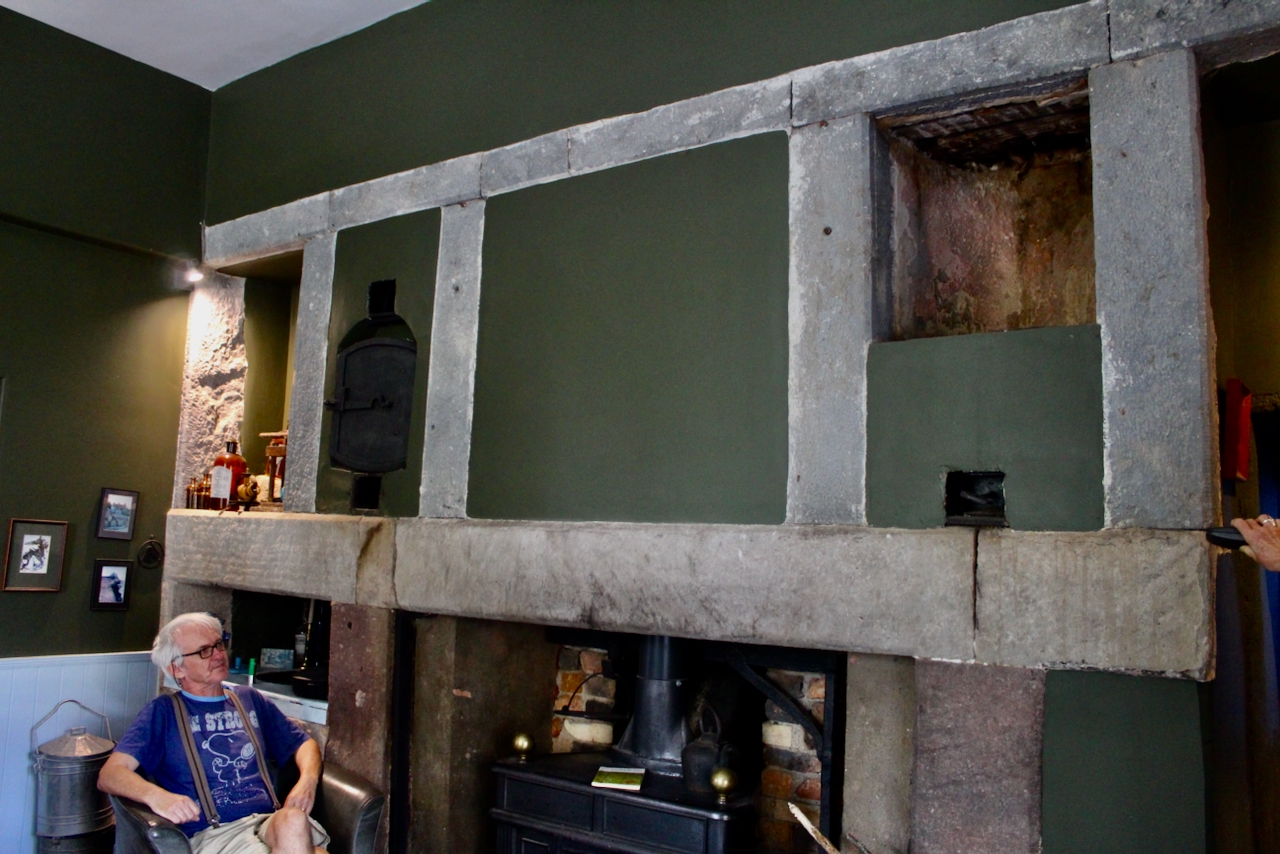
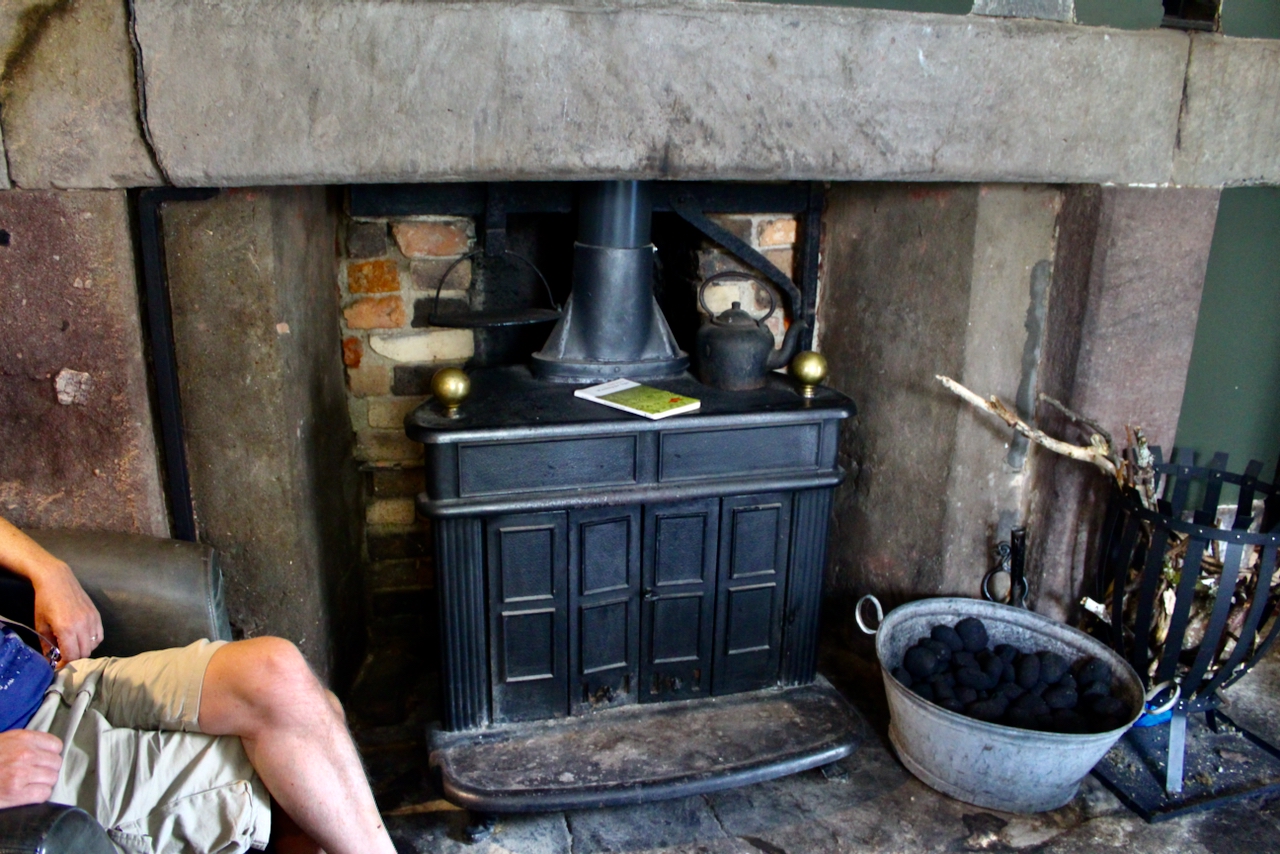
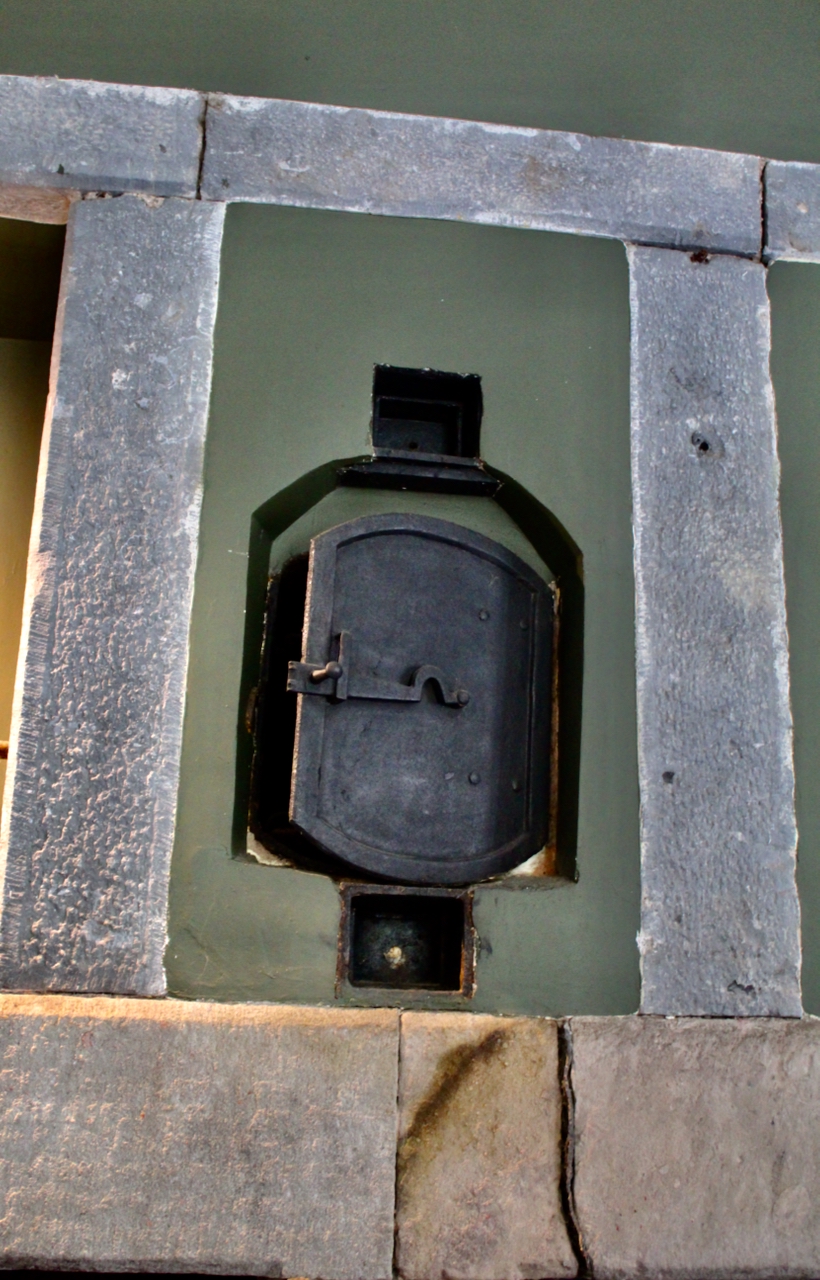
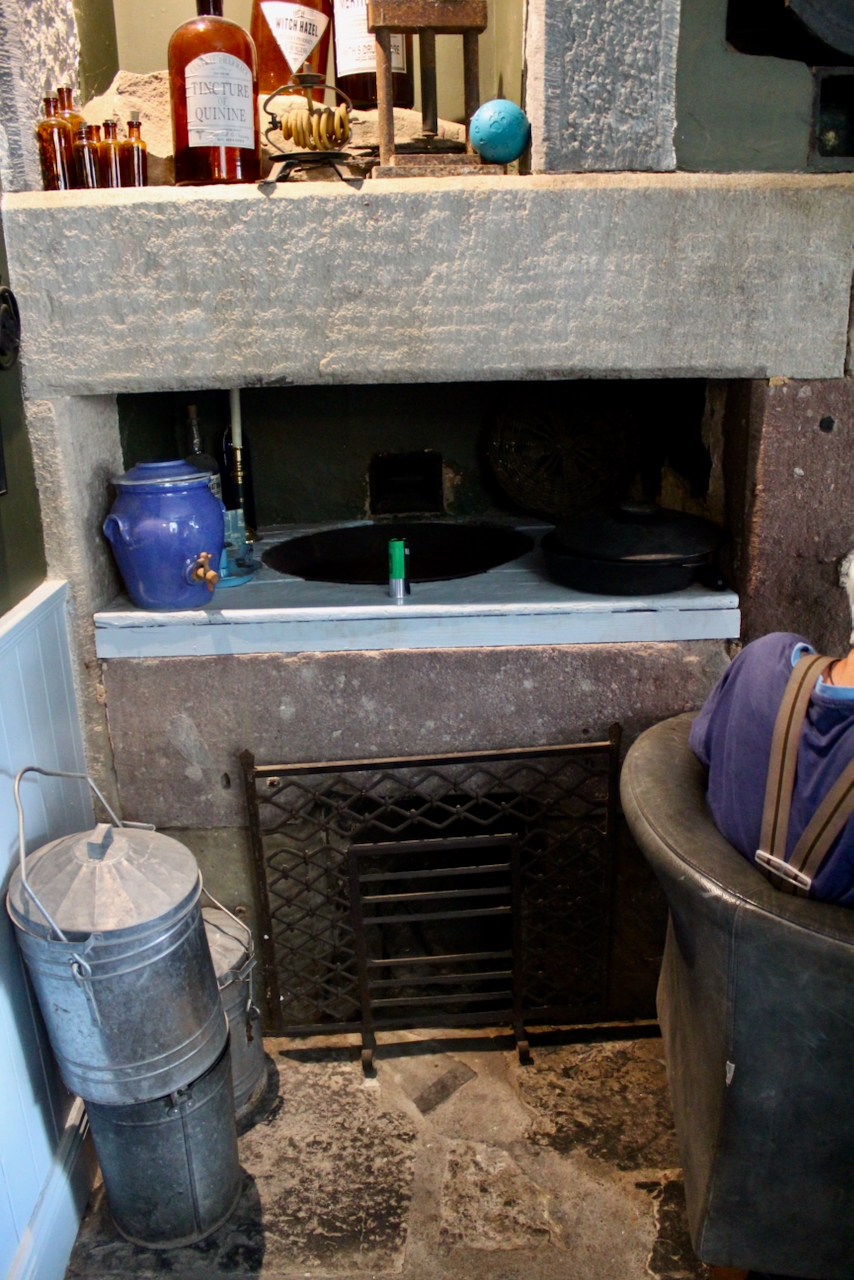
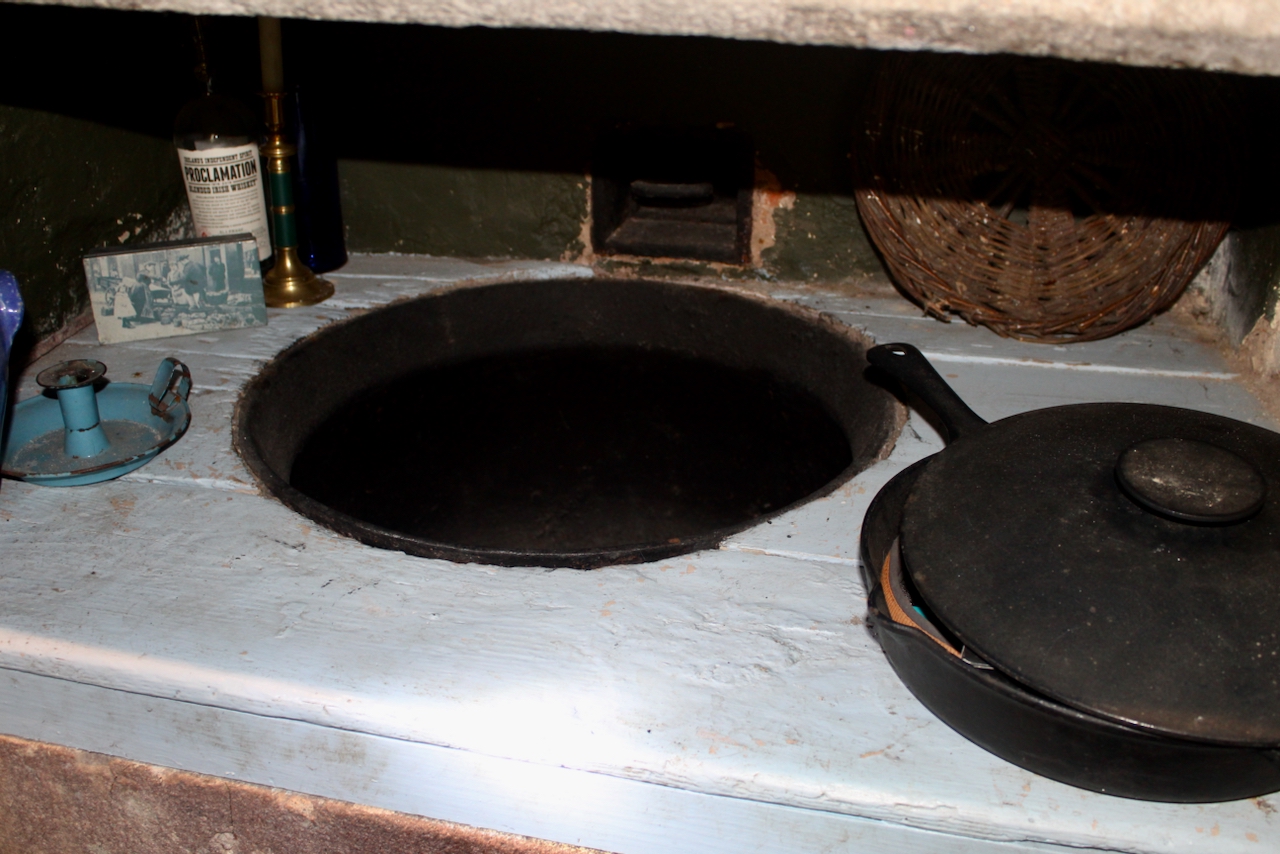
The Famine in the 1840s hit Boyle hard. Information boards in King House tell us about Boyle in famine times. For the King family of Boyle, it was a time of trouble with tenants, as outlined in The Kings of King House by Anthony Lawrence King-Harmon.

Robert Edward King (1773-1854) joined the military and distinguished himself in the Caribbean. When he inherited Kingston Hall at Rockingham, Boyle, in 1797, he returned to Ireland and joined the Roscommon Militia and worked his way up to become a General. With Rockingham, however, came debt. In 1799 he married his first cousin, Frances Parsons Harman, daughter of his aunt Jane who had married Lawrence Parsons Harman (1749-1807), who owned the Newcastle Estate in County Longford. Robert worked hard to reduce the debt, and was a tough landlord, evicting many tenants.
In famine years, however, he lowered rents and provided work. The information boards in King House tell us that in the 1800s, Boyle residents suffered with poverty. One third of the population died of hunger and hundreds went to the workhouse. In the 1830s about 500 men, women and children were evicted from Lord Lorton’s estates around Boyle. Many were paid to emigrate to North America.
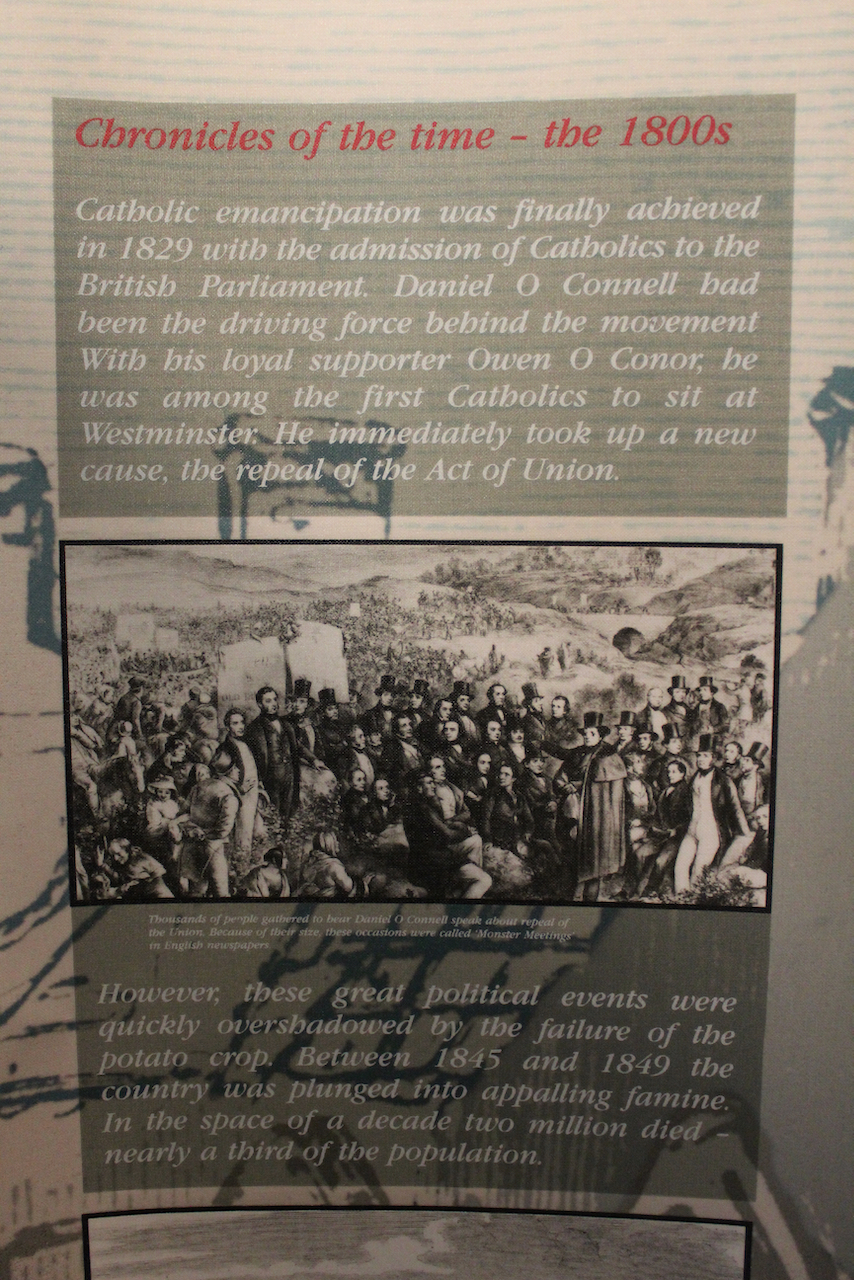


The Fry family would have been in the centre of such poverty and hardship, and it must have been a dreadful time. They remained in the town and survived.
Joan told us that the Frys owned a mill, but the information board for the nearby mill does not mention Fry ownership. The current mill seems to have been built around 1810, according to the National Inventory, and the information board tells us that it was originally established by the Mulhall family and has been run by the Stewart family since 1885.
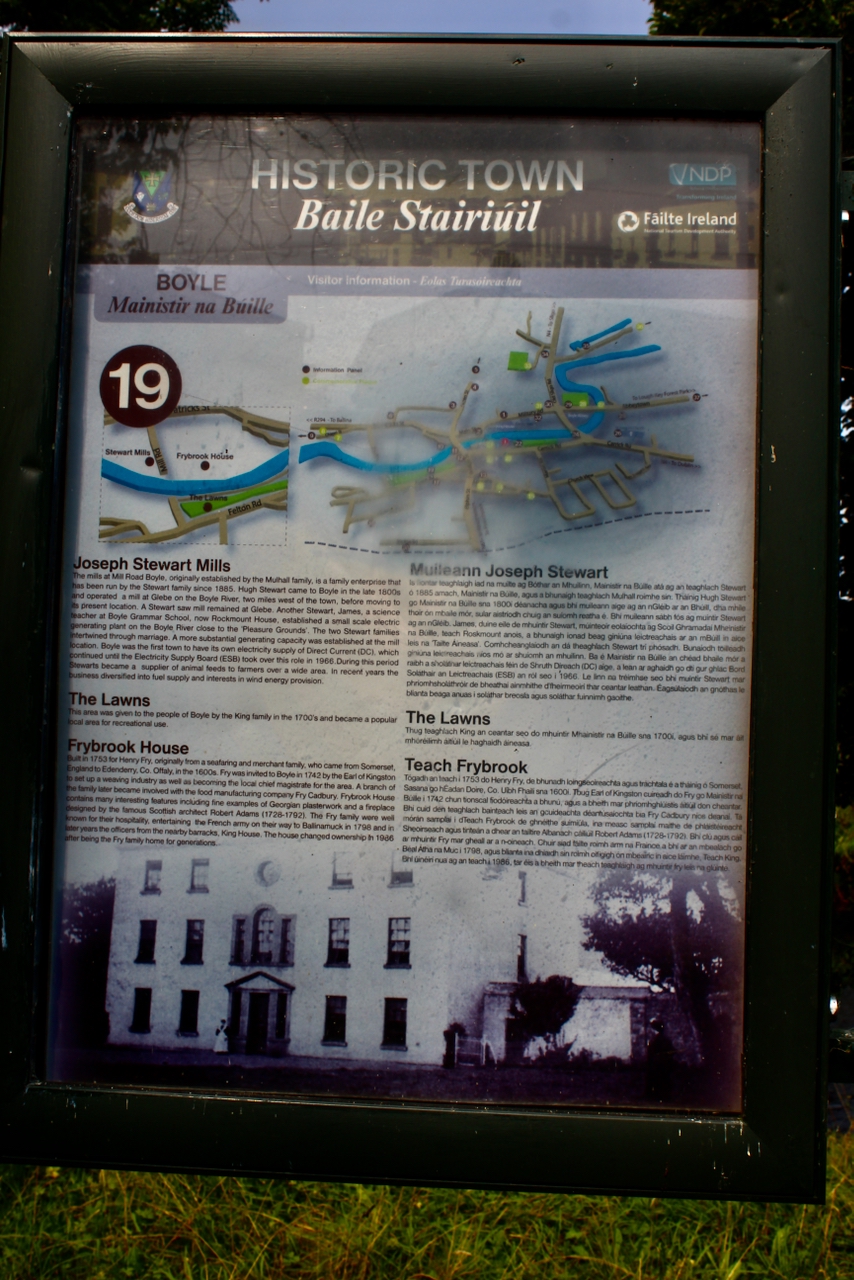
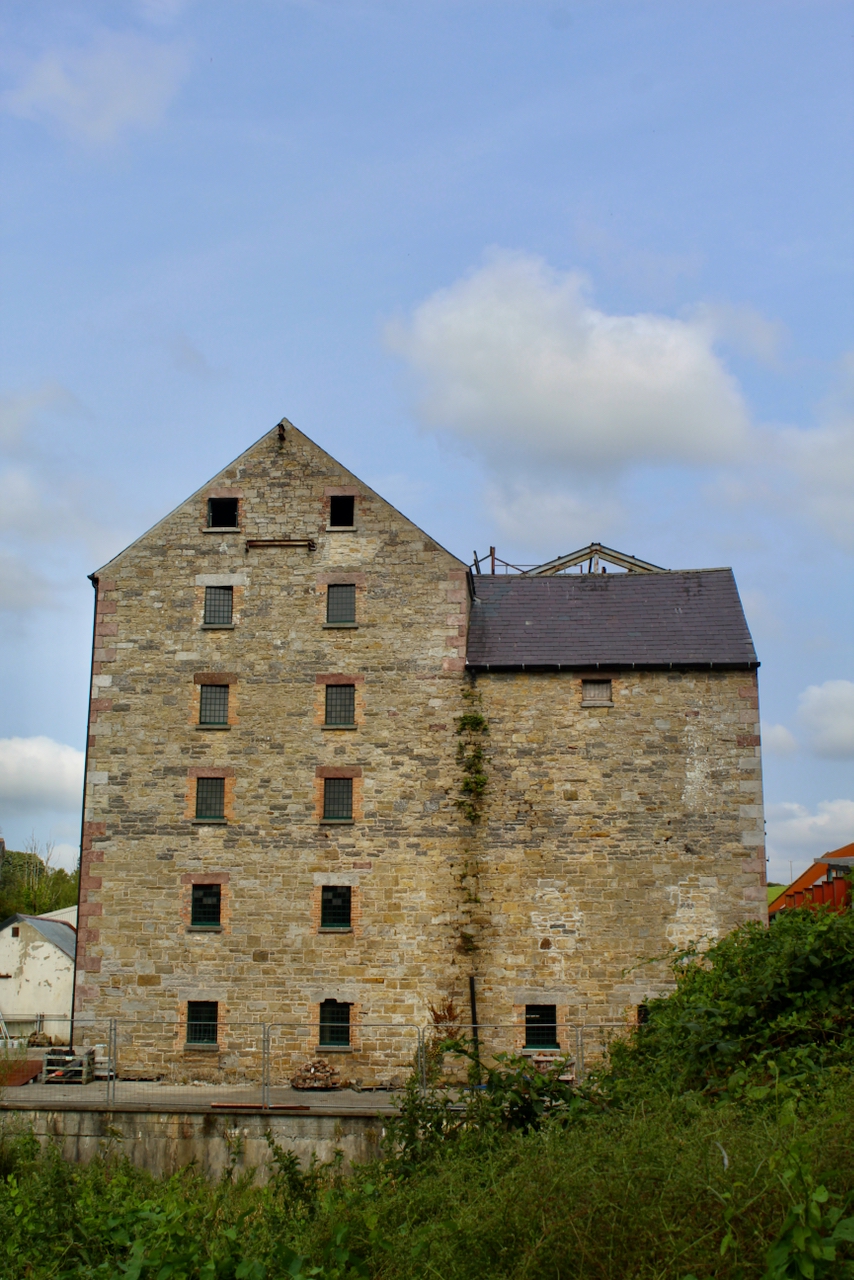
Thank you to Joan for the wonderful tour and for being so generous with her time. She and the owners deserve thanks for bringing Frybrook back so vibrantly to life.
[2] Bence-Jones, Mark. A Guide to Irish Country Houses (originally published as Burke’s Guide to Country Houses volume 1 Ireland by Burke’s Peerage Ltd. 1978) Revised edition 1988 Constable and Company Ltd, London.
[3] https://frybrook.ie/frybrooks-history/
[4] https://theirishaesthete.com/2023/10/23/frybrook/
[5] Brendan McEvoy (1986). The Peep of Day Boys and Defenders in the County Armagh. Seanchas Ardmhacha: Journal of the Armagh Diocesan Historical Society.
[6] https://blog.library.si.edu/blog/2021/01/28/the-prickly-meanings-of-the-pineapple/
[7] The Inventory says the bridge was built in 1864. https://www.buildingsofireland.ie/buildings-search/building/31804042/bridge-street-mocmoyne-boyle-co-roscommon
 Irish Historic Houses
