Ballyseede Castle, Ballyseede, Tralee, Co. Kerry – section 482 Accommodation

www.ballyseedecastle.com

Open dates in 2025: Mar 14-Dec 31, 8am-12 midnight

Ballyseede Castle, March 2023. © Jennifer Winder-Baggot, www.irishhistorichouses.com

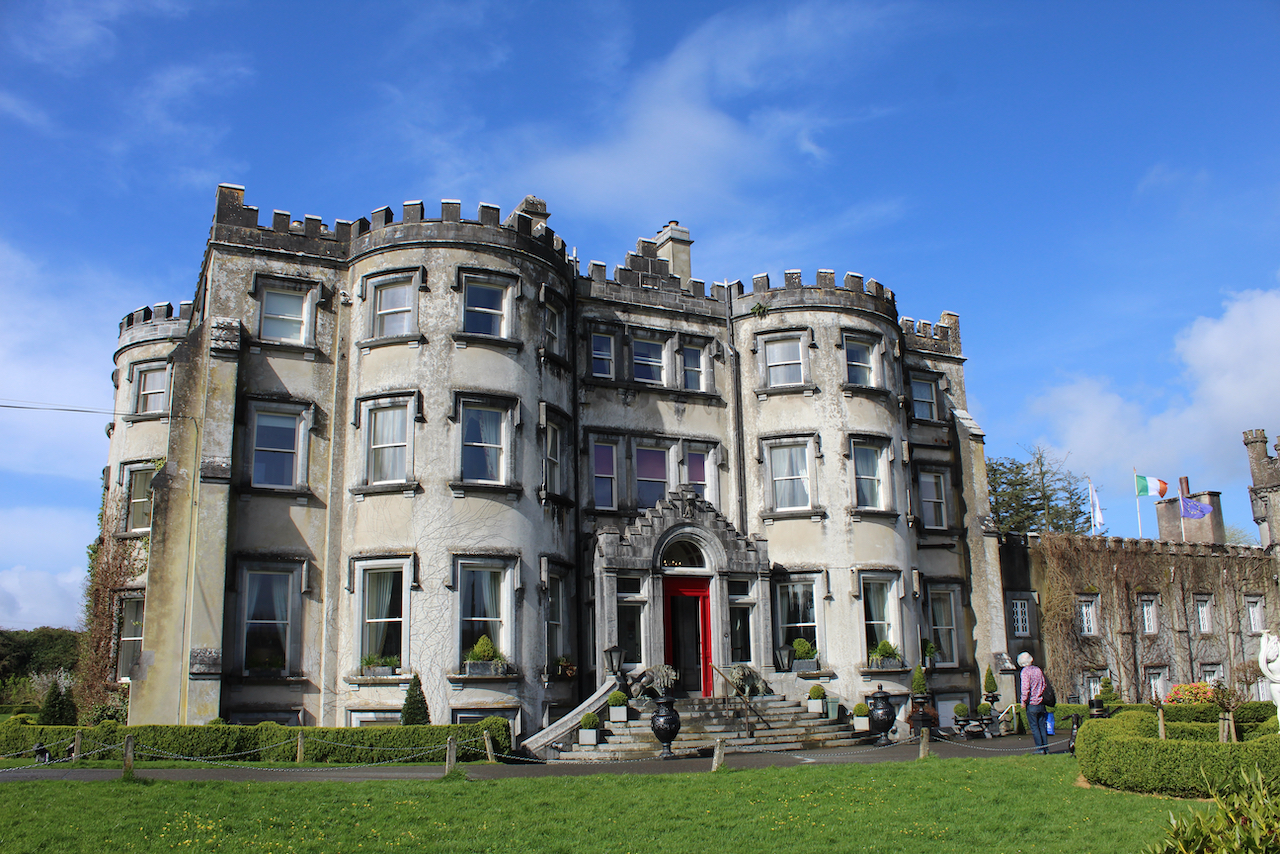
Ballyseede castle (pronounced Ballyseedy) is now a hotel, and Stephen and I treated ourselves to a stay in March 2023. The house was built in around 1760 for the Blennerhassett family, and parts were added and gothicized over time. Gothic revival additions may have been designed by William and Richard Morrison. Later renovations were carried out by James Franklin Fuller.

The castle is now one of four owned by the Corscadden family. We have visited the other properties: Cabra Castle in County Cavan and Markree in County Sligo, both of which are also section 482 properties (see my entries). We also visited the fourth, Castle Bellingham in County Louth, kindly welcomed by Patrick, who showed us around and I told him of my website. I am in the process of writing about that in my “Places to visit and stay in County Louth” page, still a work in progress.
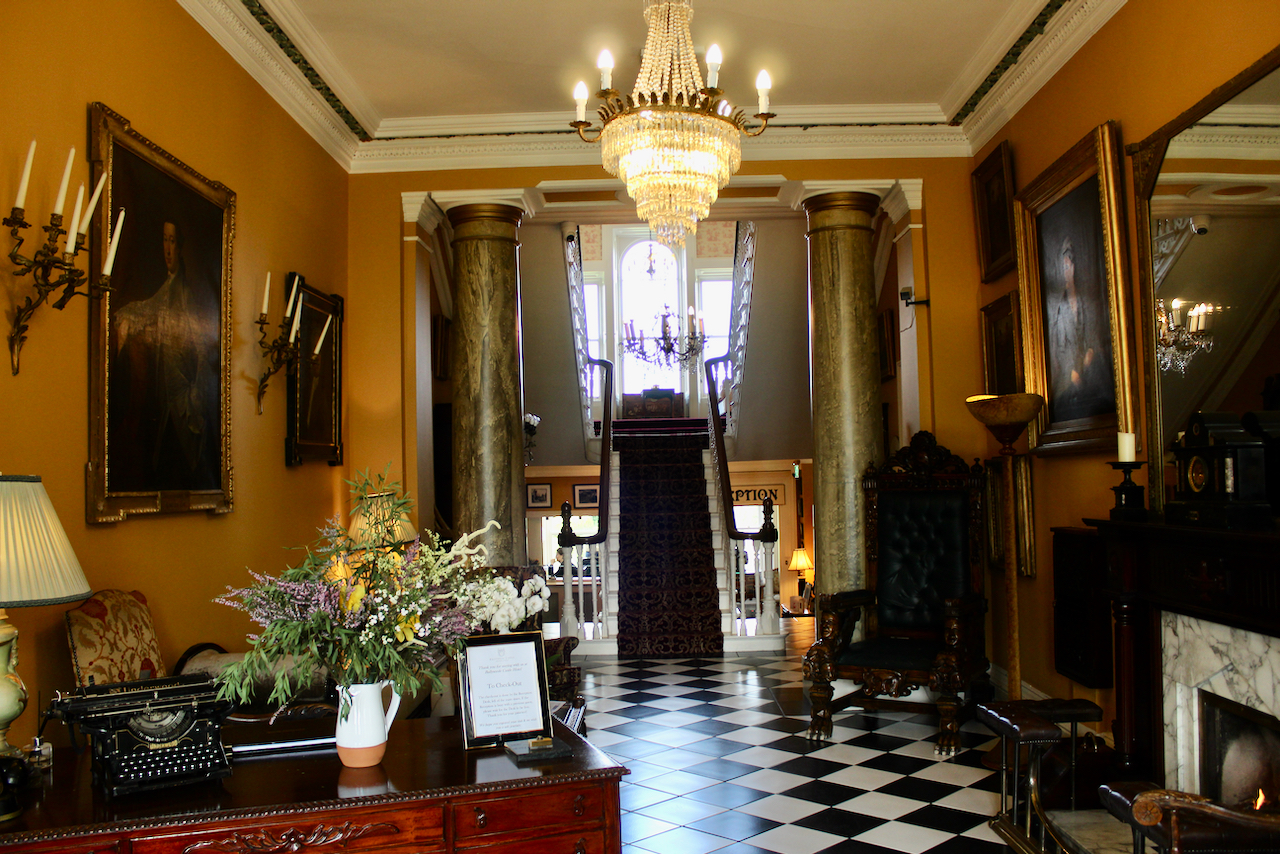
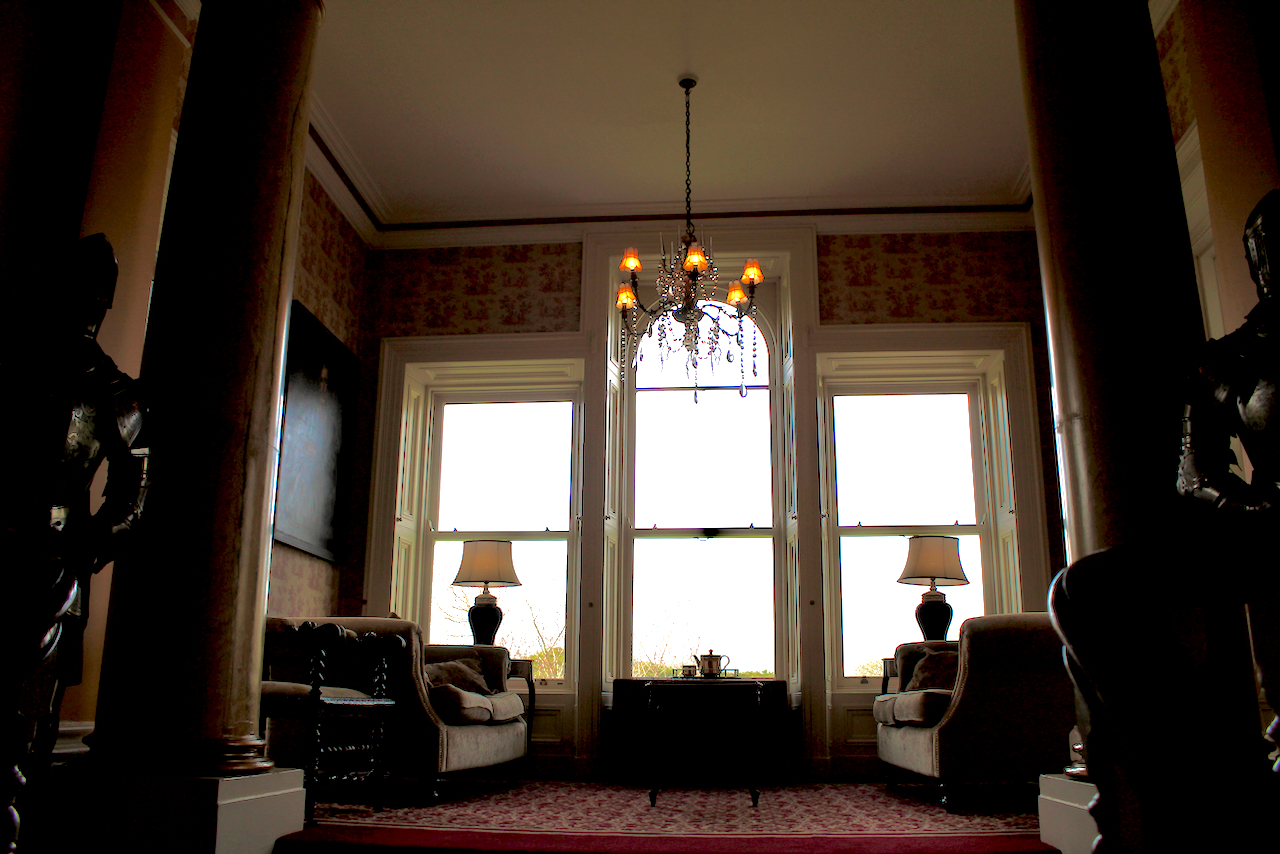
Ballyseede Castle, March 2023: bifurcating staircase rising behind a screen of Doric columns at one end of the hall. © Jennifer Winder-Baggot, www.irishhistorichouses.com

The website tells us:

Take a step back in time with a hotel steeped in history that offers luxurious surroundings within 30 acres of private gardens and woodland.

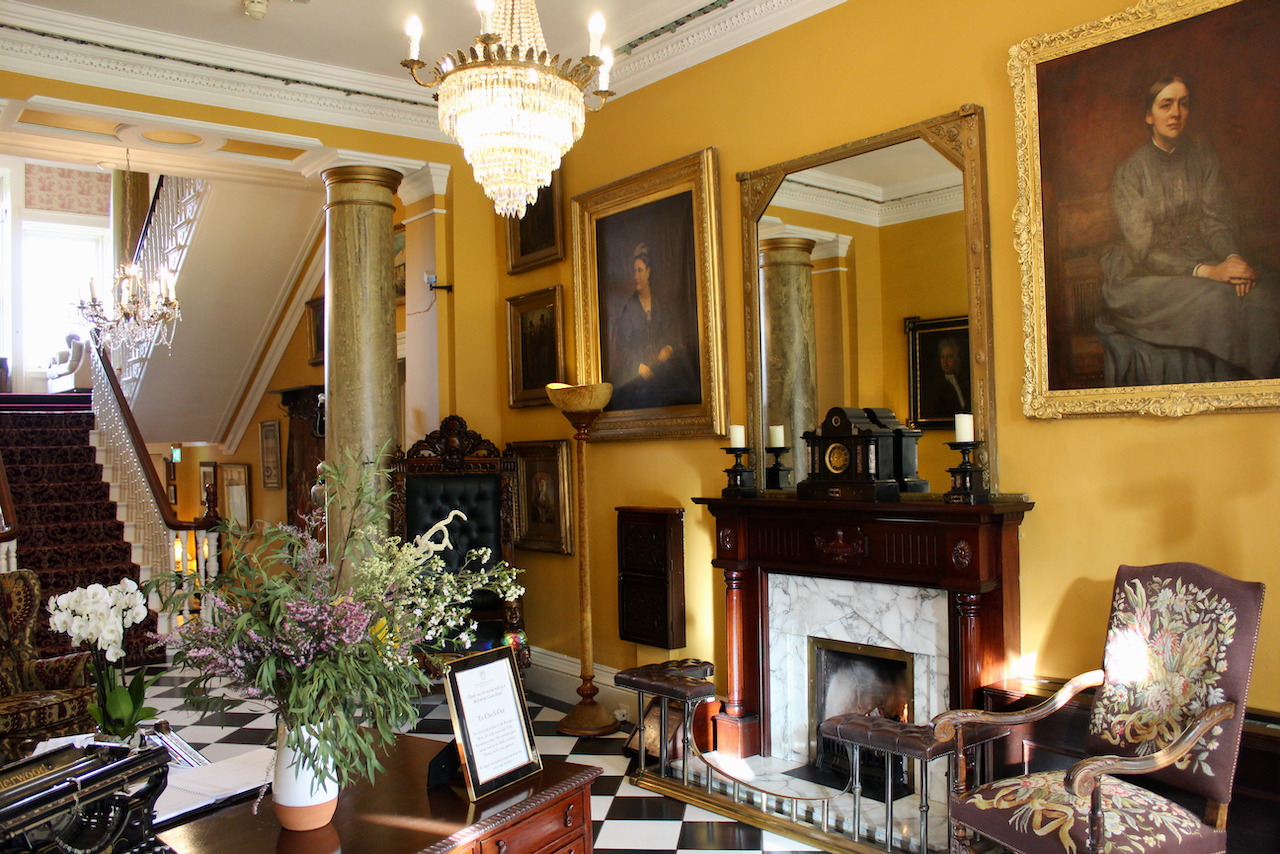
The Doric columns that lead to an elegant oak staircase in the lobby are indicative of the grand decoration throughout the hotel. Impressive drawing rooms with ornate cornices, adorned with marble fireplaces provide an ideal setting for afternoon tea or morning coffee.

Elegant accommodation, fine dining with traditional Irish cuisine, rooms that tell a story and the picturesque natural setting, will all comprise to make your stay at Ballyseede Castle an unforgettable one.”
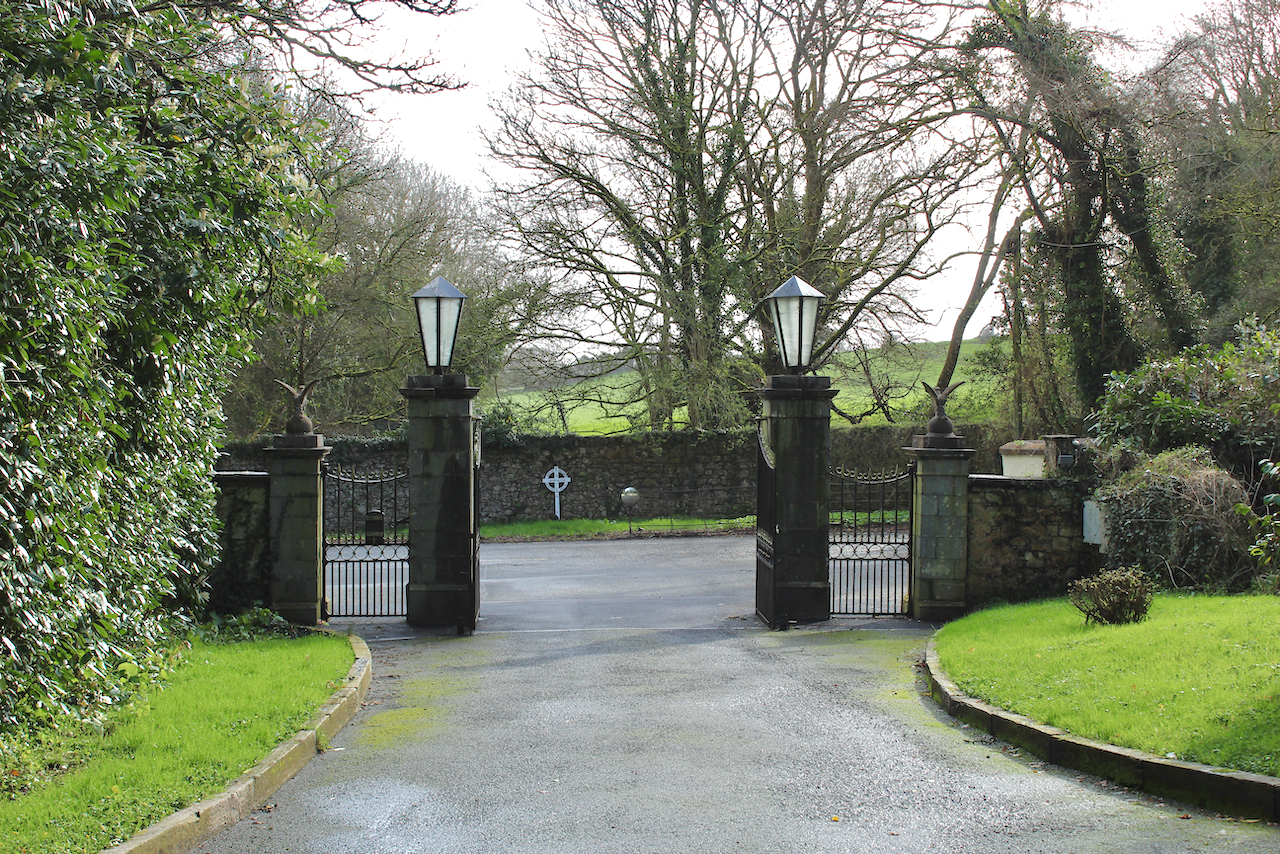
The entrance gates are described in the National Inventory: “Gateway, built c. 1825, comprising four limestone ashlar piers with wrought-iron double gates, flanking pedestrian gates and curved quadrant walls with half-round projecting bays having blind pointed arches. Painted and rendered walls with stone copings and having arched blind openings with painted sills.” © Jennifer Winder-Baggot, www.irishhistorichouses.com
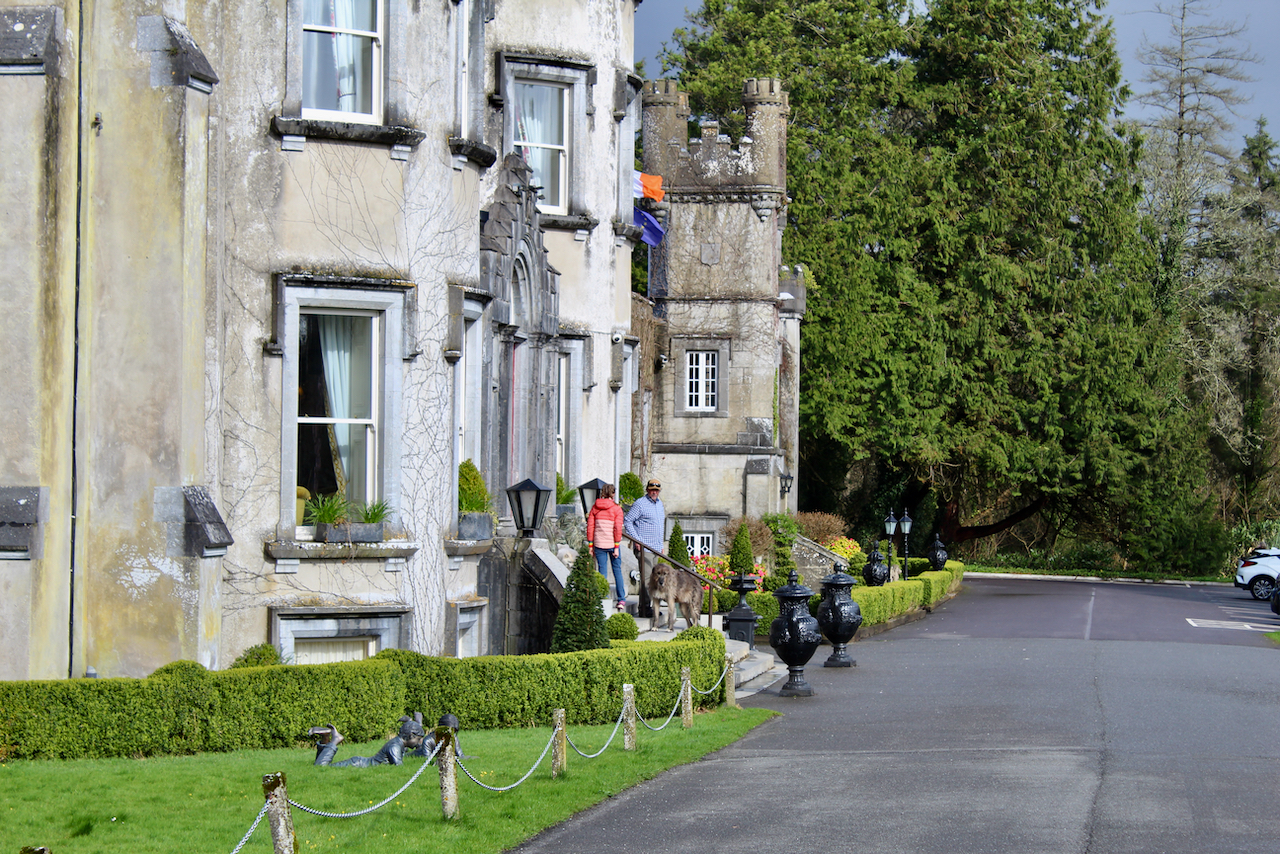
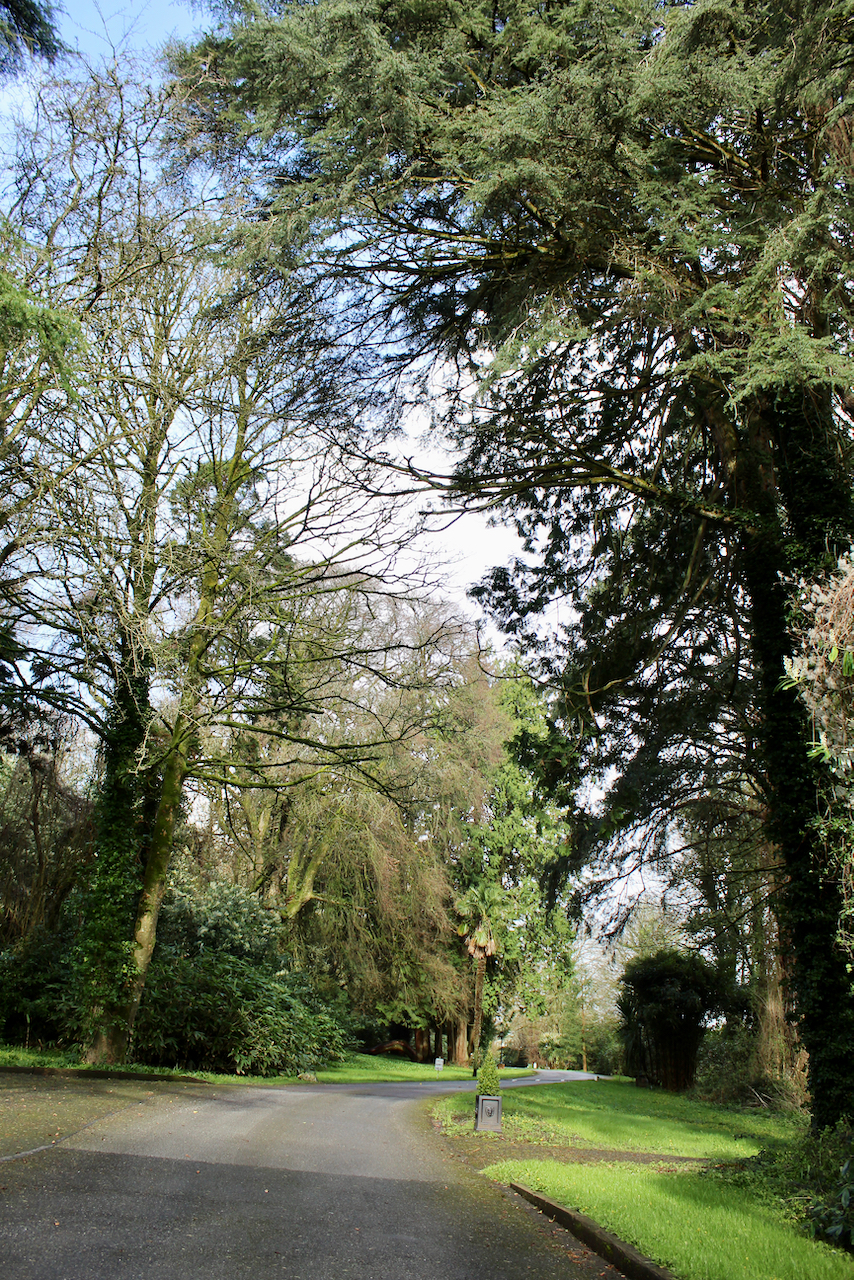
The lovely drive up to the castle. © Jennifer Winder-Baggot, www.irishhistorichouses.com
Ballyseede, March 2023. © Jennifer Winder-Baggot, www.irishhistorichouses.com
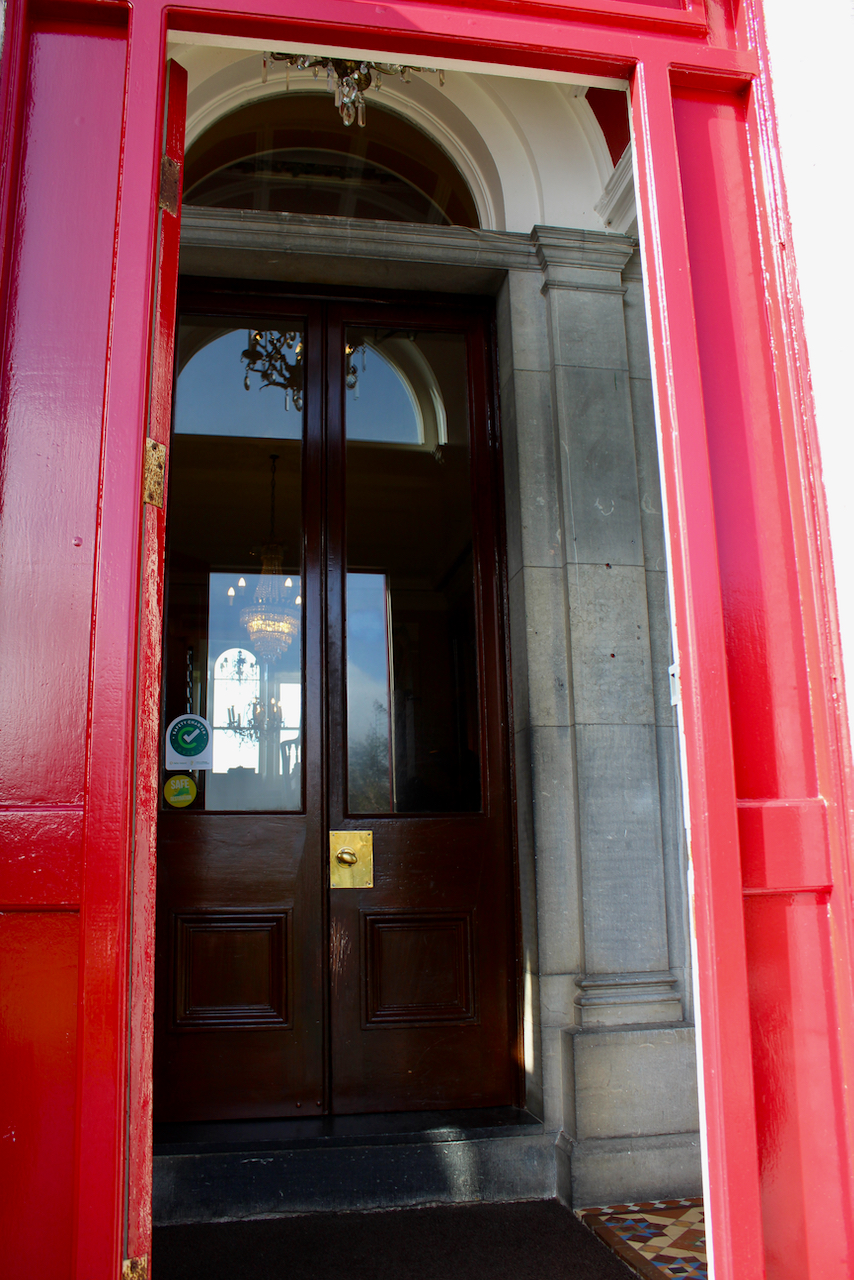
Ballyseede Castle, March 2023: Limestone ashlar porch with crow-step gable and arched doorway with double-leaf panelled door. This porch was added in around 1880. © Jennifer Winder-Baggot, www.irishhistorichouses.com
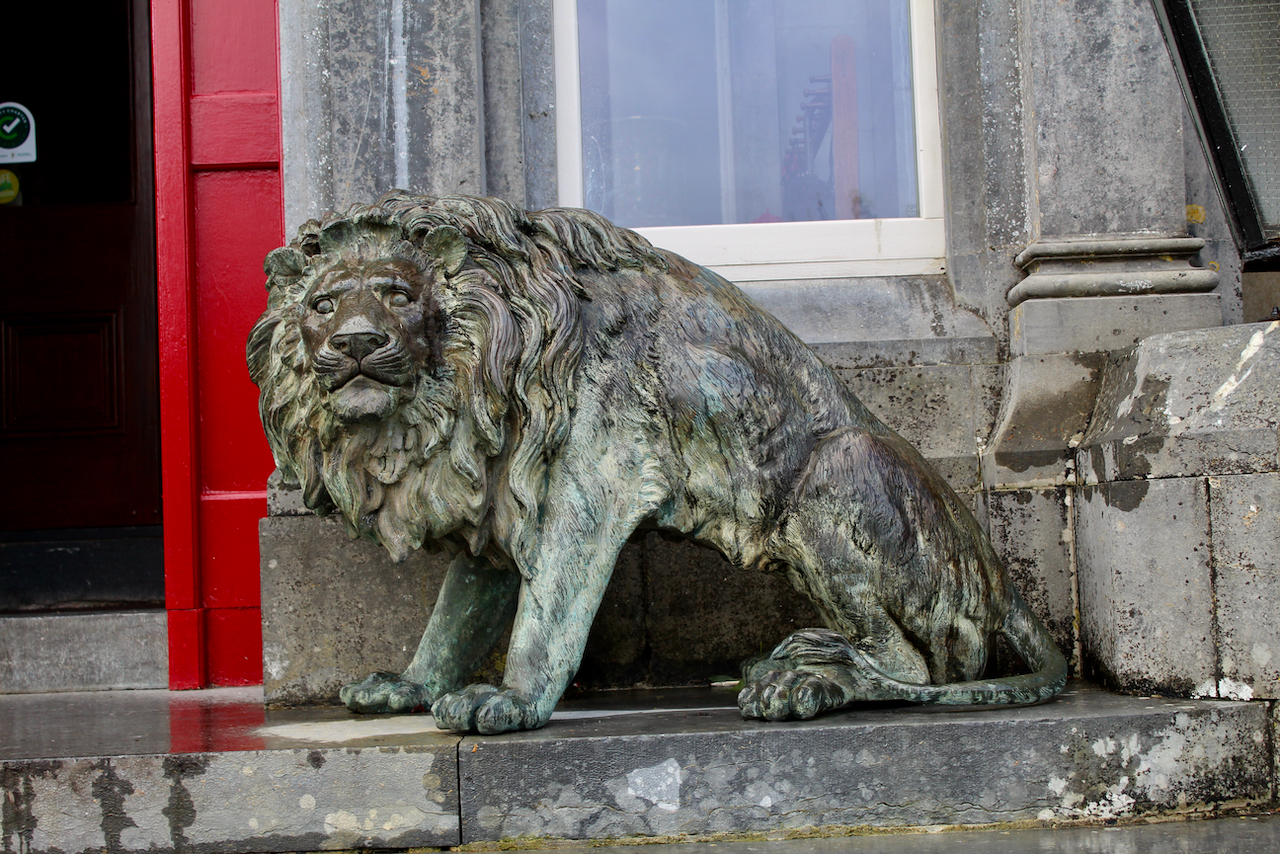
Ballyseede Castle, County Kerry. Impressive lions flank the door. © Jennifer Winder-Baggot, www.irishhistorichouses.com
Ballyseede Castle, March 2023. © Jennifer Winder-Baggot, www.irishhistorichouses.com

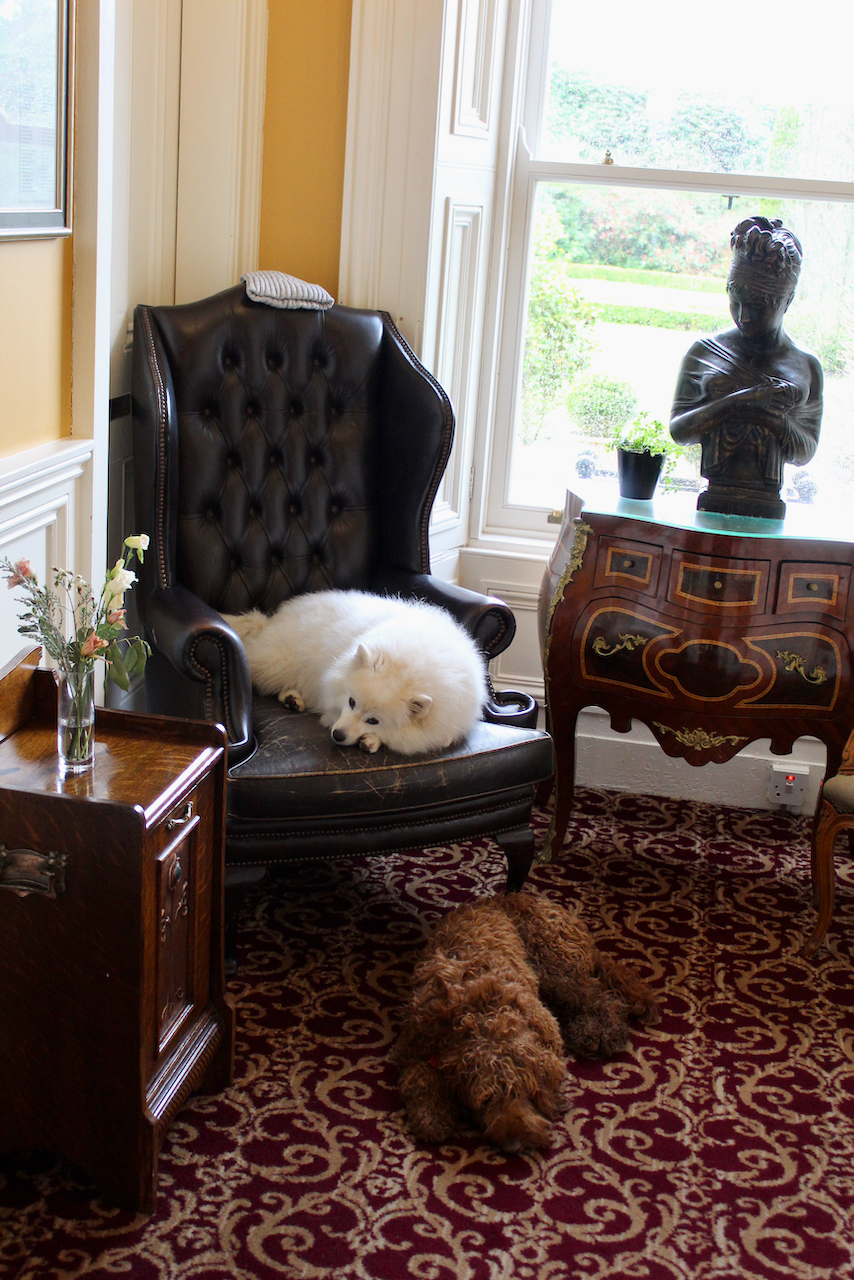
The castle comes complete with dogs, a trademark of the Corscadden hotels. The Irish wolfhounds add elegance to wedding photographs.
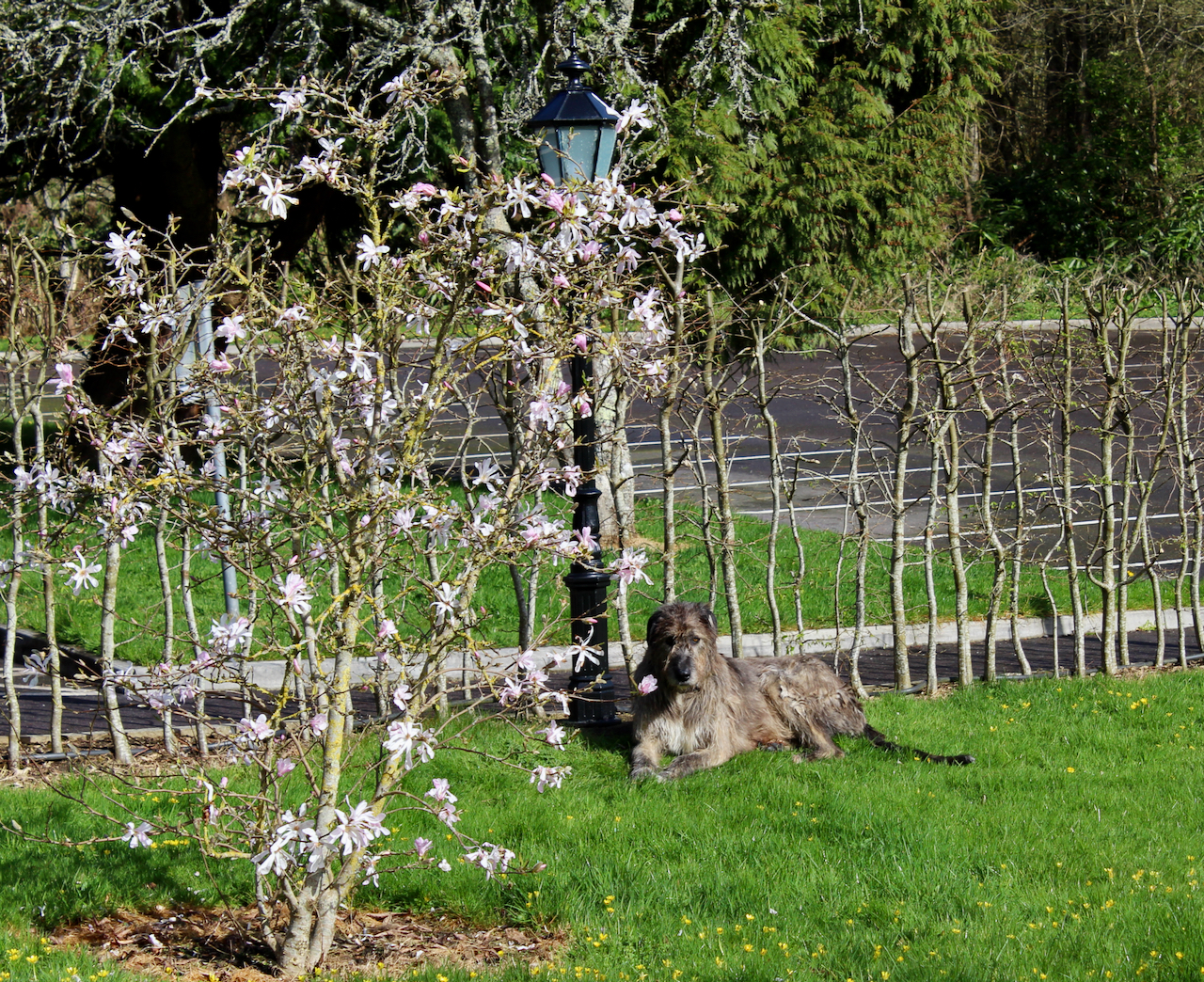
The castle comes complete with dogs, a trademark of the Corscadden hotels. © Jennifer Winder-Baggot, www.irishhistorichouses.com
I fell in love with this affectionate little doggie, who had a particularly thick soft coat. © Jennifer Winder-Baggot, www.irishhistorichouses.com
Her brown shaggy friend was adorable too and they vied for attention, full of excitement every time I stopped to pet them. © Jennifer Winder-Baggot, www.irishhistorichouses.com

The Landed Estates database tells us that the Blennerhassett family was originally from Cumbria in the north of England. Robert Blennerhassett was the first to settle in Kerry. He married Elizabeth, daughter of Captain Jenkin Conway of Castle Conway, Killorglin, County Kerry, formerly known as Killorglin Castle (now a ruin). He was originally from Pembrokeshire in Wales.

Between 1611 and 1618 Robert acquired lands in Ireland. He held the office of Member of Parliament (M.P.) for Tralee in 1613 and between 1635 and 1639. He lived in an old castle named Ballycarty Castle and also owned the old Ballyseedy Castle. The current Ballyseede Castle is different from the original Ballyseedy Castle, a castle that had belonged to the Fitzgeralds, located at the west end of Ballyseedy Wood.

The Landed Estates database tells us that a John Blennerhassett was granted an estate of 2,787 acres in the barony of Trughanacmy, County Kerry (where Ballyseede Castle and Ballyseedy woods are located) and 2,039 acres in the barony of Fermoy, County Cork under the Acts of Settlement in 1666. [1] This John is probably son of Robert.
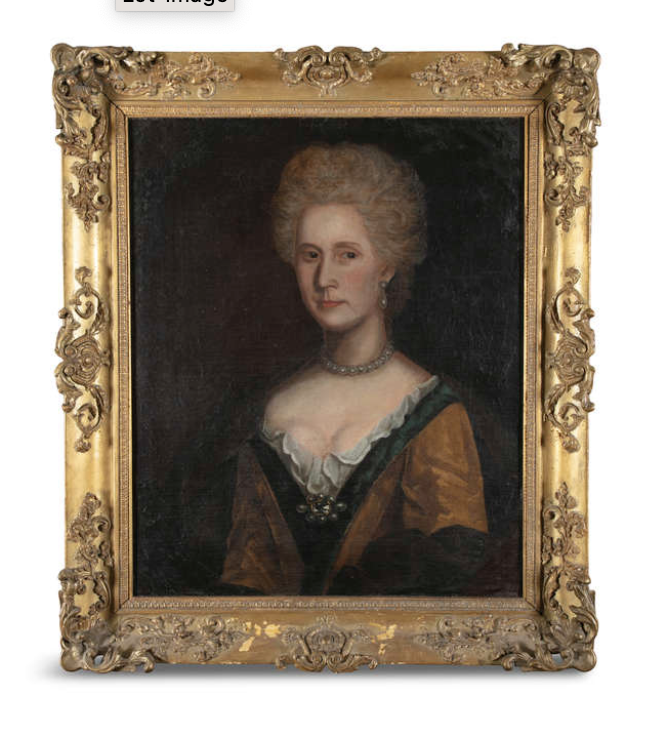
Lady Blennerhassett (I’m not sure which one), Ballyseedy Castle, Tralee, Co. Kerry, Irish school 18th century, Adams auction 19 Oct 2021

John Blennerhassett, son of Robert and Elizabeth, was, following his father’s footsteps, MP for Tralee [2]. He too lived in Ballycarty Castle, now a ruin. He married Martha Lynn, daughter of George from Southwick Hall, Northamptonshire, England. They had several children and he died in 1676.

His younger brothers Edward and Arthur married and lived nearby.

The lawn in front of the castle. © Jennifer Winder-Baggot, www.irishhistorichouses.com

John and Martha’s son John was also MP for Tralee and high sheriff, but died only a year after his father, in 1677. He had married Elizabeth Denny in 1654, whose family lived in Tralee Castle (it no longer exists). She was the daughter of Edward Denny (1605-1646) who was also an MP and High Sheriff for County Kerry. [see 2] The Denny and Blennerhassett families intermarried over generations.

Edward Denny (1547-1600), who was granted land in Tralee County Kerry after the Desmond Rebellions photograph courtesy of the Roaringwaterjournal website.

In her Voices from the Great Houses: Cork and Kerry (2013) Jane O’Hea O’Keeffe tells us about the grandfather of Edward Denny (1605-1646), Edward Denny (1547-1599/1600), who moved to Kerry:

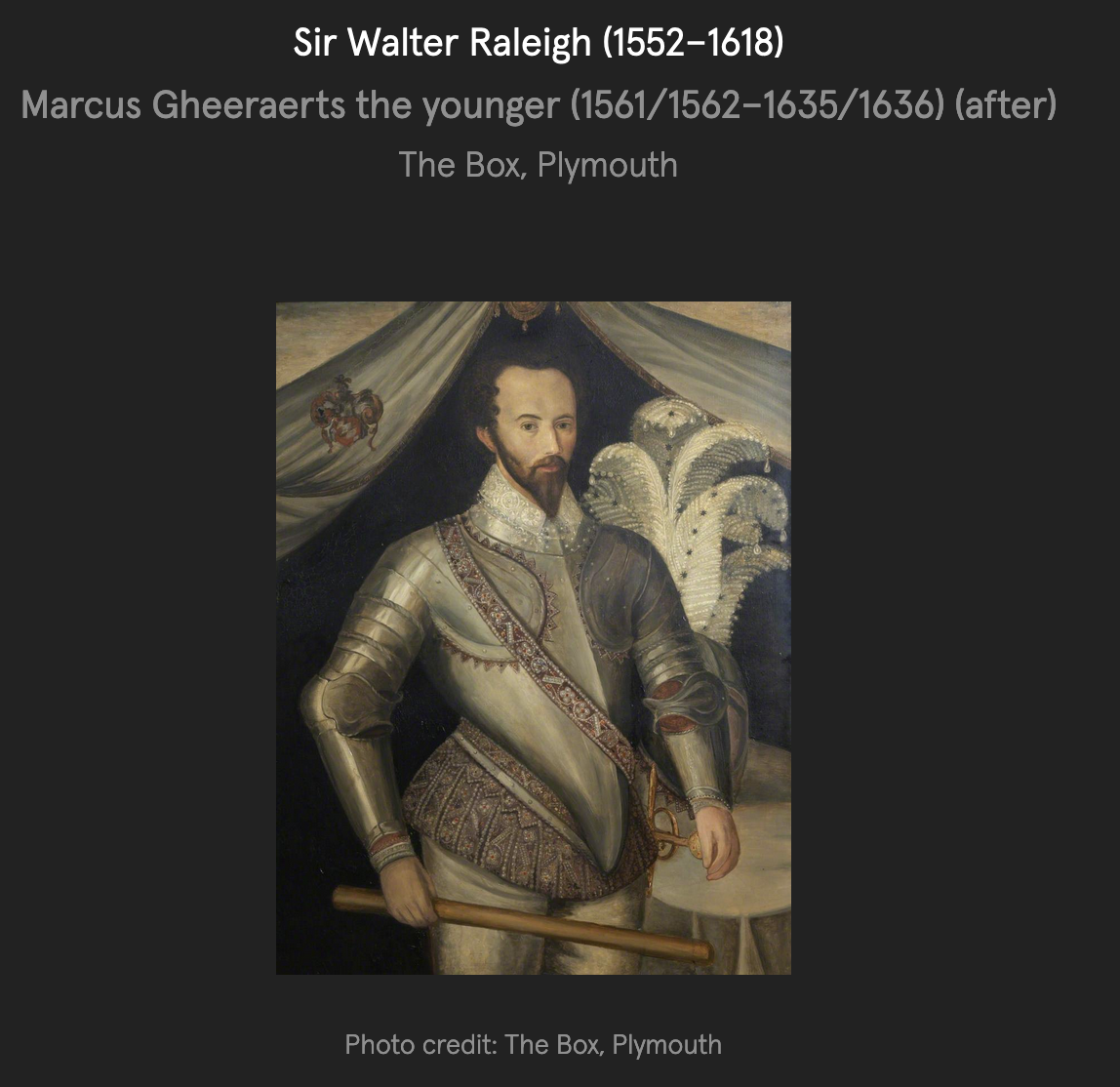
Following the Desmond rebellions of 1569-73 and 1579-83, Sir Edward Denny of Waltham Abbey, Herefordshire, who was born in 1547, was granted 6,000 acres of land around Tralee, County Kerry. The ruined thirteenth century Tralee Castle, formerly a Desmond property, was included in the grant. Sir Edward Denny was a relative of Sir Walter Raleigh, who was also granted 42,000 acres in Cork and Waterford at this time.” [3]
John Blennserhassett and Martha had other children beside John who died in 1677. Their son Robert also held the office of MP for Tralee and High Sheriff of County Kerry in 1682. He married Avice Conway (d. 1663), a daughter of Edward Conway of Castle Conway, County Kerry. Their son John (d. circa 1738) inherited Castle Conway from his mother.

John (d. 1677) and Elizabeth née Denny’s son John (d. 1709) was MP for Tralee, Dingle and County Kerry at various times. He married Margaret Crosbie (1670-1759) of Tubrid, County Kerry (Tubrid House no longer exists, and should not be confused with Tubbrid Castle in County Kilkenny). Her father Patrick held the office of High Sheriff of County Kerry in 1660.

Margaret née Crosbie and John Blennerhassett had several children. After John’s death in 1709 Margaret married David John Barry in the same year, son of Richard Barry (1630-1694) 2nd Earl of Barrymore but they had no children together.

Margaret and John’s heir was Colonel John (1691-1775), who was called “Great Colonel John” thanks to his hospitality. He followed in his forebears’ footsteps, becoming an MP. In 1727 he signed a family compact with Maurice Crosbie of Ardfert and Arthur Denny of Tralee, partitioning the county representation among the three families [see 2].

Colonel John married Jane Denny, daughter of Colonel Edward Denny (1652-1709) of Tralee Castle.

A website about the Blennerhassett family tells us that in 1721 the first “Ballyseedy House” was built among ruins of the Geraldine Ballyseedy Castle at the west end of Ballyseedy Wood. Colonel John lived here with his family. [4]

The foundation stone dated 1721 over the seventeenth century fireplace. The foundation stone is from the earlier Blennerhassett home called “Ballyseedy Castle,” built in 1721, and the fireplace may be from the earlier Ballycarty Castle or the Desmond Ballyseedy Castle. This fireplace is now in Ballyseede Castle (built c. 1780). © Jennifer Winder-Baggot, www.irishhistorichouses.com

It was Margaret and John Blennerhassett’s younger son William (1705-1785) who built the house which has become the hotel Ballyseede Castle. It was built around 1780 (the National Inventory says c. 1760) and named “Elm Grove.” [4] William died during its construction and the work was completed around 1788 by his son William Blennerhassett Jr. (c. 1735-1797).

We will return to William and his family later. First, let’s look at the older son Colonel John and his offspring.

Colonel John’s son John Blennerhassett (1715-1763) would have succeeded his father and lived in the original Ballyseedy House, if he had not predeceased him in 1763. This John was admitted to the Middle Temple in London to train for the legal profession, and he also held the office of High Sheriff of County Kerry, in 1740, and M.P. for County Kerry between 1751 and 1760. He married Anne Crosbie, daughter of William Crosbie of Tubrid, County Kerry, who was MP for Ardfert between 1713 and 1743. Her mother was Isabella Smyth from Ballynatray, County Waterford, another Section 482 property – gardens only – that I’ll be writing about soon. Anne Crosbie had been previously married to John Leslie of Tarbert, County Kerry (another section 482 property which I hope to visit soon), but he died in 1736.

Anne died and John Blennerhassett remarried in 1753, this time wedding Frances Herbert, daughter of Edward Herbert (1693-1770) of Muckross, County Kerry. For more on Muckross House, see my entry on places to visit and stay in County Kerry.

Muckross House Killarney Co. Kerry, photograph by Chris Hill 2014 for Tourism Ireland, Ireland’s Content Pool.

Neither of John’s sons married and one died young. His house, Ballyseedy House, fell into disuse.

John’s daughter Frances married Reverend Jemmett Browne (d. 1797) of Riverstown, County Cork, another Section 482 property (see my entry).

Colonel John and Jane née Denny had a younger son, Arthur (1719-1799), who served as MP for Tralee between 1743 and 1760. He married Jane Giradot and had two daughters but no sons. His daughter Jane married George Allanson-Winn, 1st Lord Headley, Baron Allanson and Winn of Aghadoe, County Kerry. She was heiress of her father’s unentailed Ballyseedy estates – this would have been land that did not include what is now Ballyseede Castle. She died in 1825.

Colonel John and Jane née Denny also had several daughters. Agnes, born in 1722, married neighbour Thomas Denny (d. 1761) of Tralee Castle, son of Colonel Edward Denny (1728). Another daughter, Arabella (1725-1795), married Richard Ponsonby of Crotto, County Kerry (now demolished), MP for Kinsale, County Kerry, and then secondly Colonel Arthur Blennerhassett (1731-1810), a grandson of John who died in 1709 and Margaret née Crosbie. A third daughter of Jane and John Blennerhassett, Mary, married Lancelot Crosbie, who lived at Tubrid, County Kerry. Lancelot was MP for County Kerry between 1759 and 1760 and for Ardfert in County Kerry between 1762 and 1768 [see 2].
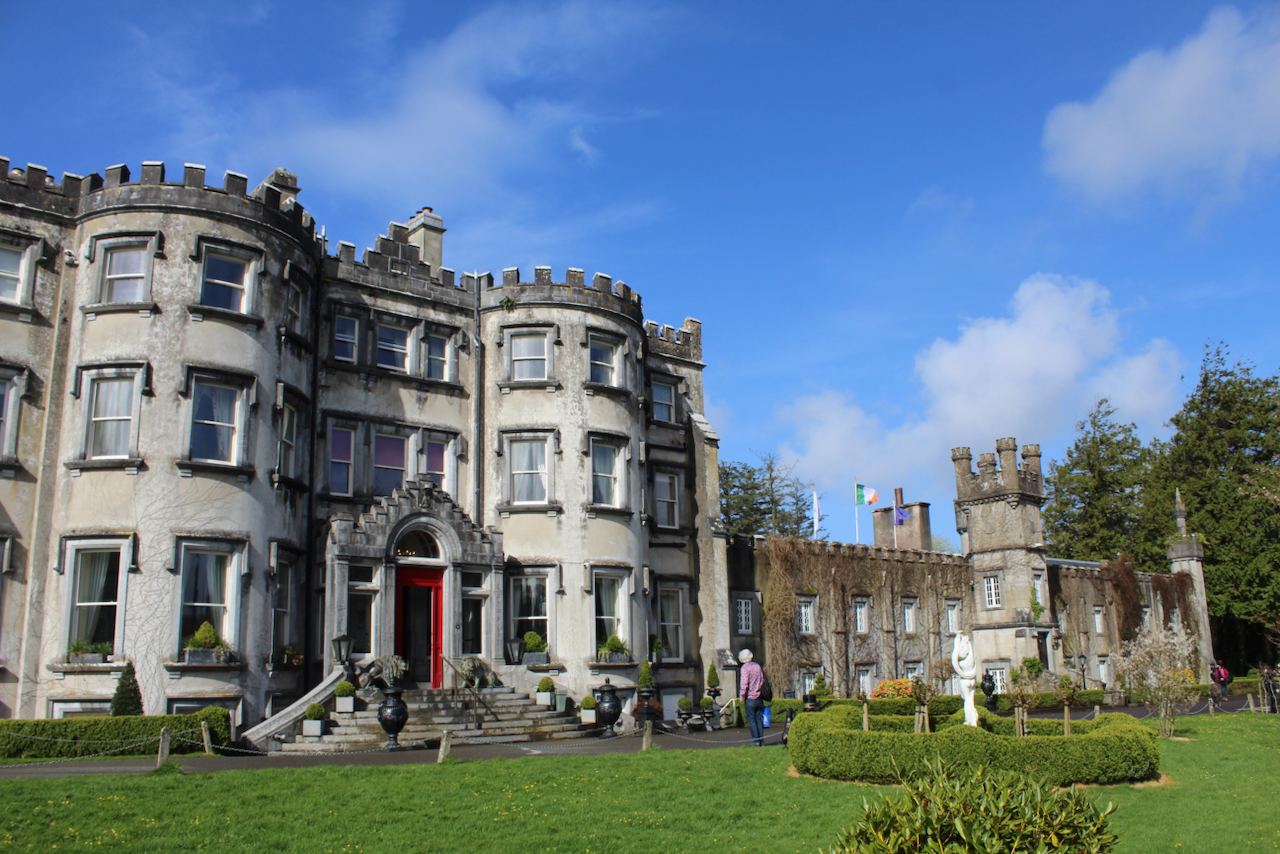
Ballyseede Castle, March 2023. © Jennifer Winder-Baggot, www.irishhistorichouses.com

Let us return now to Elm Grove, now called Ballyseede castle. It is an eleven-bay three-storey over part-raised basement house, comprising a three-bay entrance bay to the centre with door opening approached by flight of steps, and a pair of three-bay full-height flanking bow bay windows and single-bay end bays. It has five-bay side elevations with three-bay full-height bow bay window to south elevation and eight-bay west elevation with two-bay breakfront. [5]
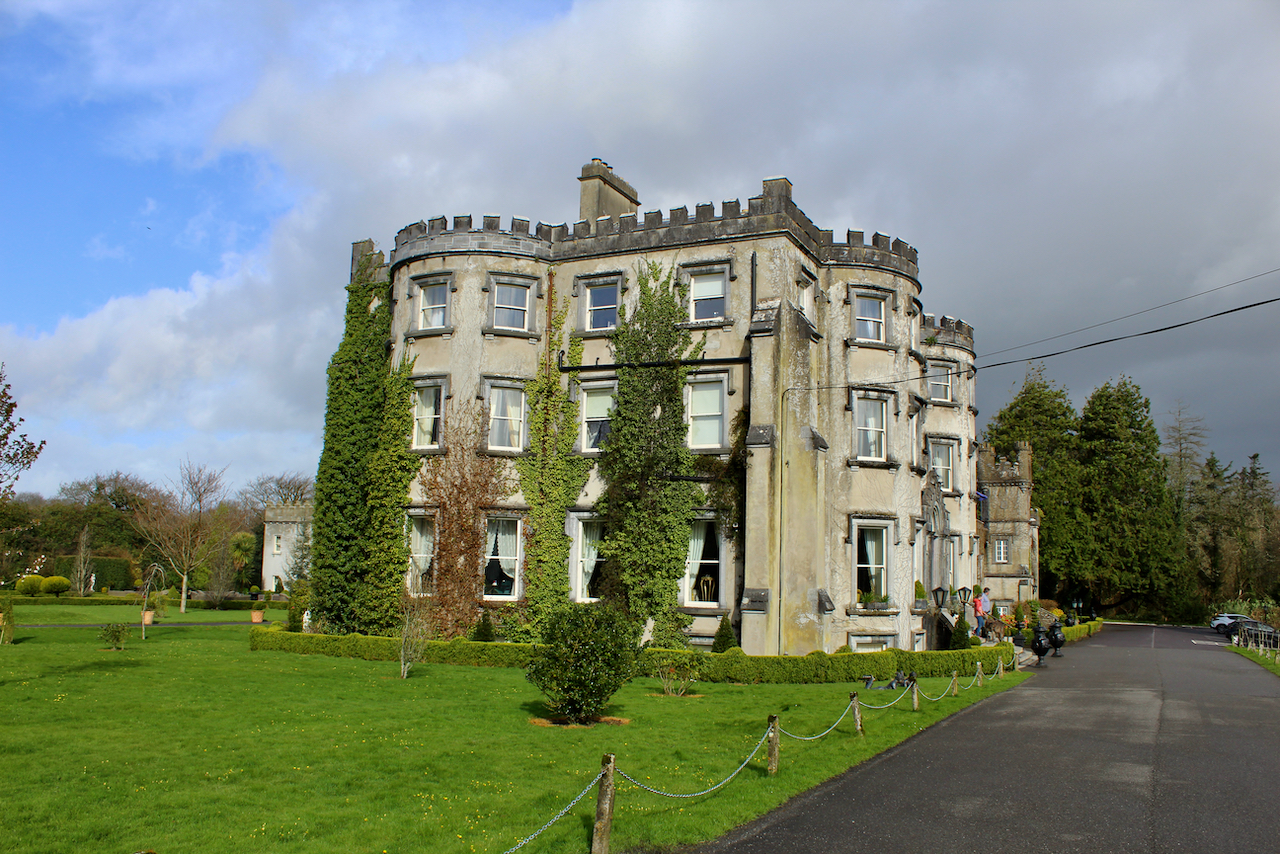
Ballyseede Castle, March 2023: Five-bay side elevations with three-bay full-height bow bay window to south elevation. © Jennifer Winder-Baggot, www.irishhistorichouses.com

William Blennerhassett Senior (1705-1785), son of John Blennerhassett (d. 1709) of Ballyseedy and Margaret Crosbie married Mary, daughter of John Morley, Mayor of Cork. Their son William (c.1735-1797) inherited Elm Grove.

Their daughter Agnes, born in 1740, married William Godfrey (c. 1738-1817) 1st Baronet of Bushfield, County Kerry, later called Kilcolman Abbey (renovated by William Vitruvius Morrison in 1818, demolished in 1977).

William (c.1735-1797) held the office of High Sheriff of County Kerry in 1761 and was the Collector of Customs at Tralee, which could have been a lucrative post.

William married Catherine daughter of the interestingly named Noble Johnson of County Cork. William and Catherine’s son Arthur (1779-1815) lived in Elm Grove with his wife Dorcas (1775/7-1822) daughter of George Twiss from Cordell House, County Kerry. Arthur died in 1815, but it seems that before he died he began plans to renovate the house. As was the case with his father and grandfather, Arthur’s son, another Arthur (1800-1843), continued the renovations.
Ballyseede Castle, March 2023. © Jennifer Winder-Baggot, www.irishhistorichouses.com

William and Catherine’s daughter Catherine (b. 1777) married Colonel John Gustavus Crosbie (d. 1797), a son of Lancelot Crosbie and Mary née Blennerhassett. He was M.P. for County Kerry between 1795 and 1797. In 1794 he killed Barry Denny, 2nd Bt. in an election duel at Oak Park (now Collis-Sandes House) and was subsequently poisoned, it is said, by the Denny family, which resulted in him falling from his horse as he was riding home from Churchill to his home in Tubrid. Catherine then married George Rowan of Rathanny, County Kerry (a beautiful Georgian house, still occupied). Rowan ordered the militia to fire into the crowd at an election rally killing five people. He was tried for murder but not convicted. [6]

Another daughter, Mary, married another cousin, Captain Nevinson Blennerhassett de Courcy (1789-1845). He was the son of Anne Blennerhassett of the Castle Conway branch of the family.

A younger son of William and Catherine née Johnson, John (circa 1769-1794), served as MP for Kerry between 1790 and 1794. He died unmarried.

Mark Bence-Jones tells us that the Gothic Revival renovation dates from 1816 and may be designed by Richard Morrison (1767– 1849). [7] The work was completed in 1821, and the house renamed “Ballyseedy House” because the original old “Ballyseedy” of Colonel John Blennerhassett at the west end of Ballyseedy Wood had by then fallen into disrepair and disuse.

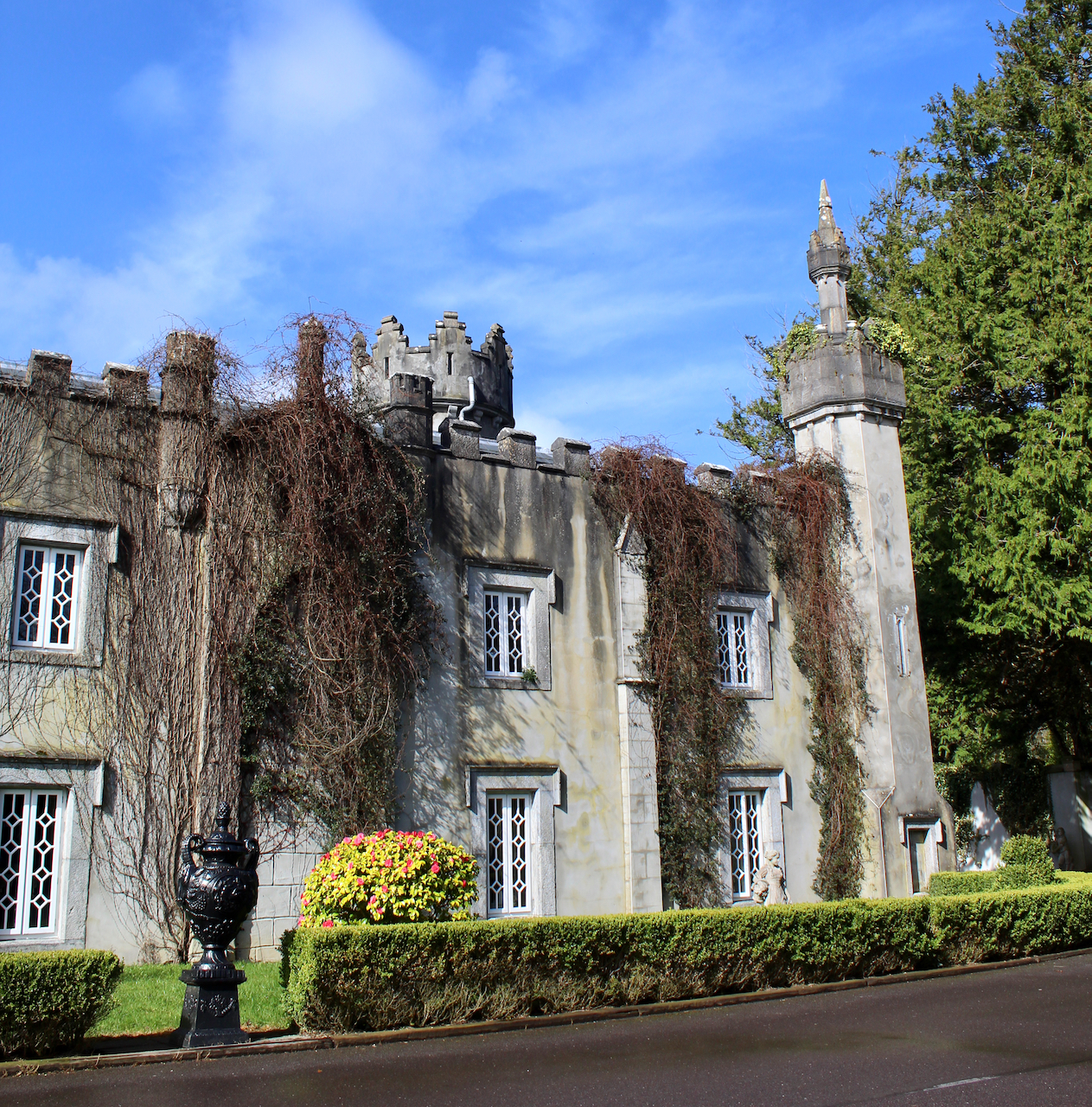
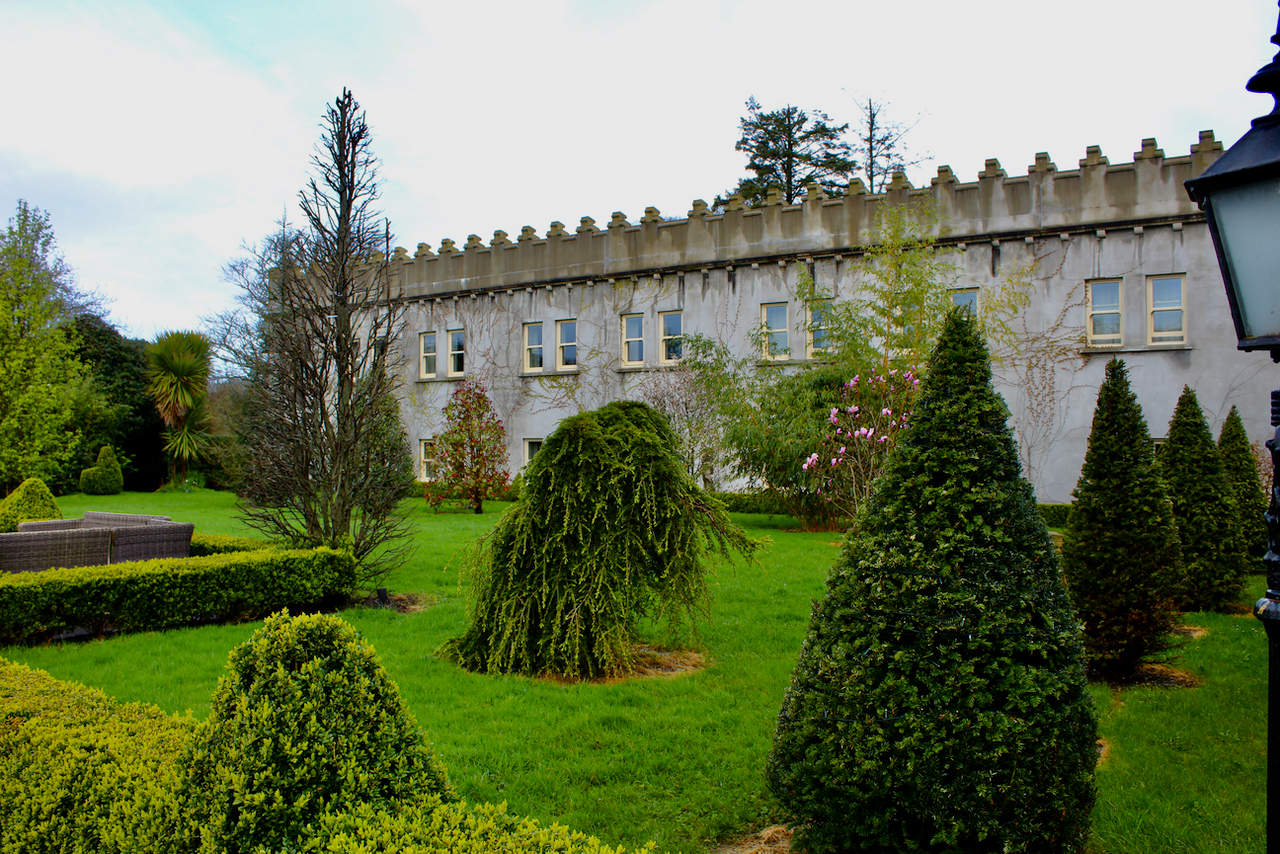
The house was extended, adding a seven-bay two-storey wing to the north. This wing has a pair of single-bay three-storey turrets to the east elevation. These turrets have battlemented roof parapets and pinnacles. The ten-bay rear elevation to the west has hood mouldings to the openings and a single-bay three-storey corner turret on a circular plan to north-west. [see 5]
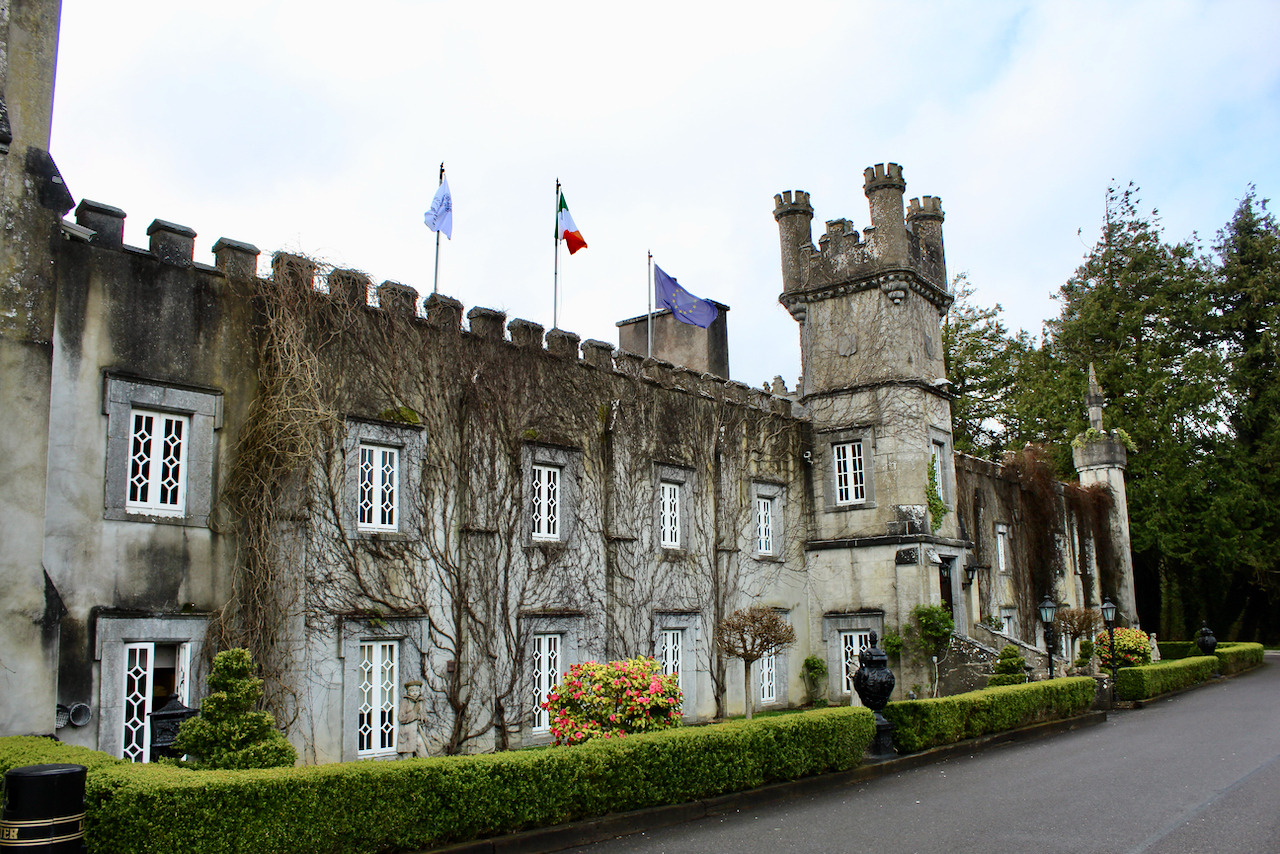
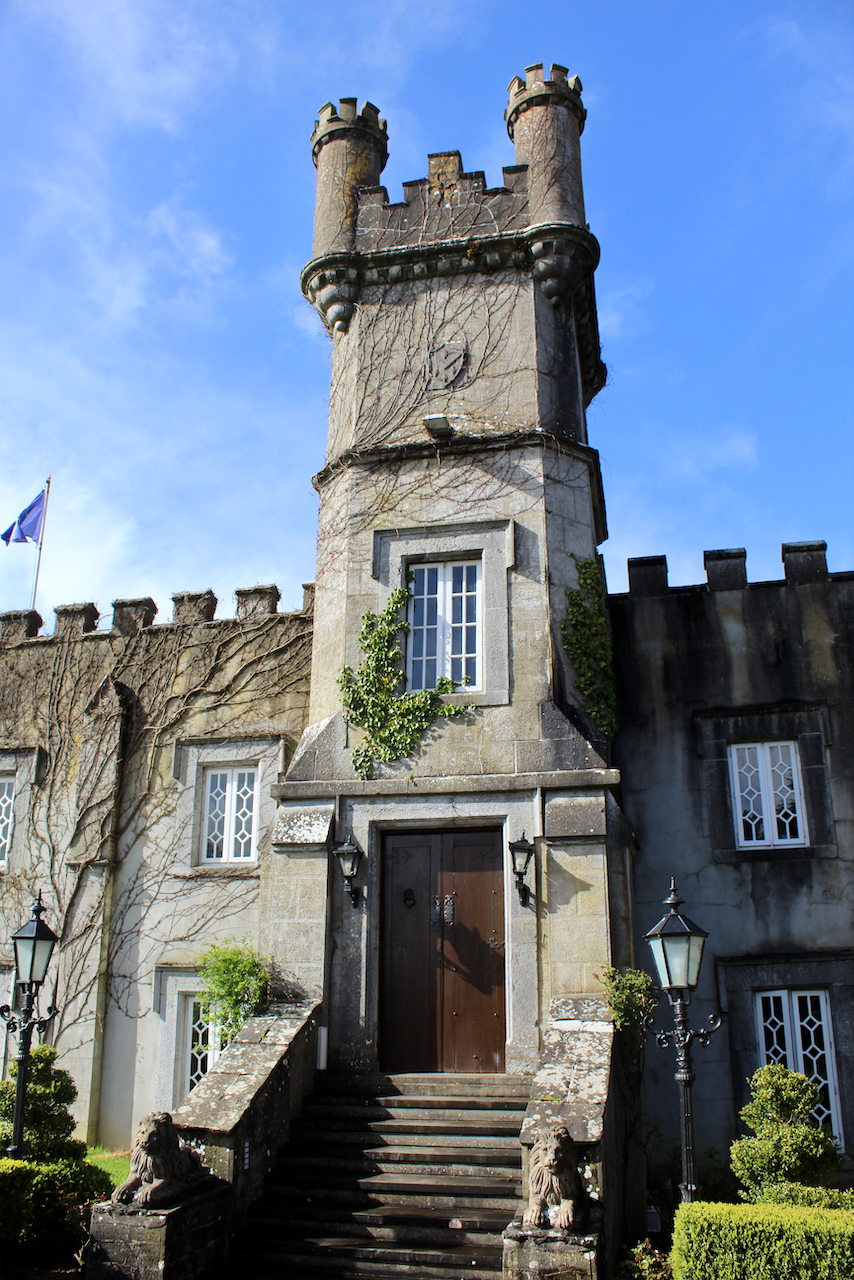
The seven bay two-storey Gothic-Revival addition, perhaps designed by Richard Morrison. © Jennifer Winder-Baggot, www.irishhistorichouses.com
This wing has two single bay three storey turrets. © Jennifer Winder-Baggot, www.irishhistorichouses.com
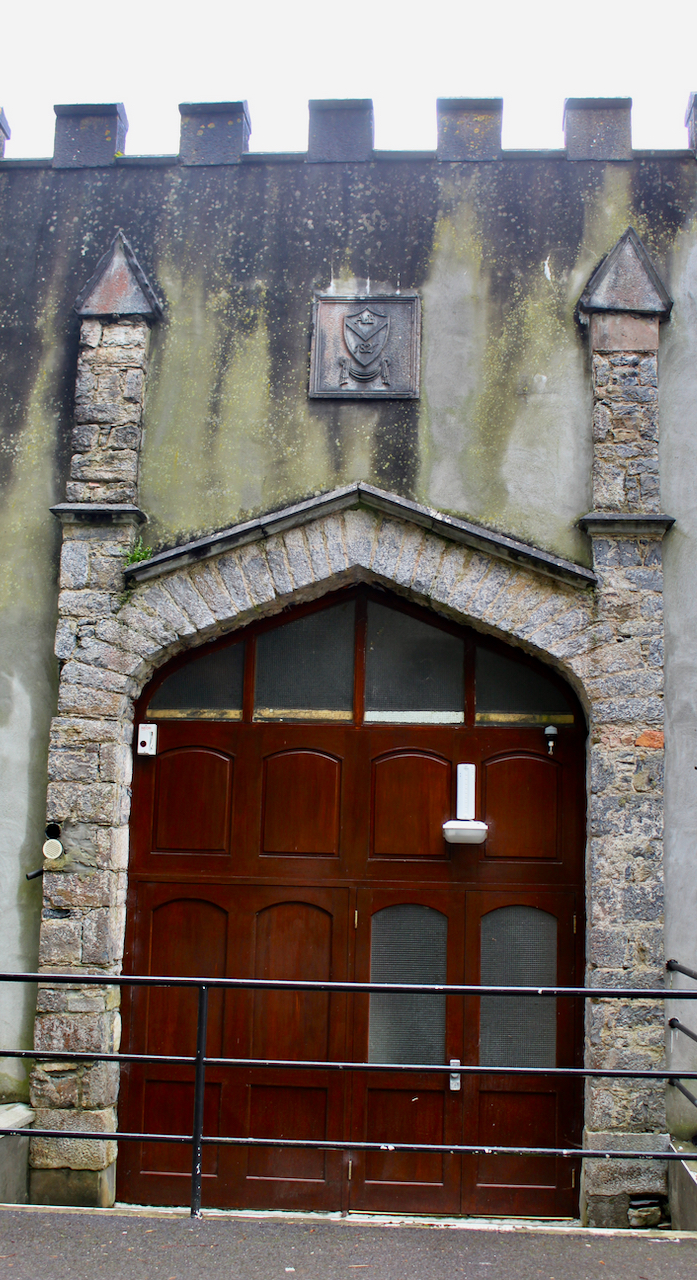
The Gothic addition has battlemented parapet and hood mouldings over the windows. © Jennifer Winder-Baggot, www.irishhistorichouses.com

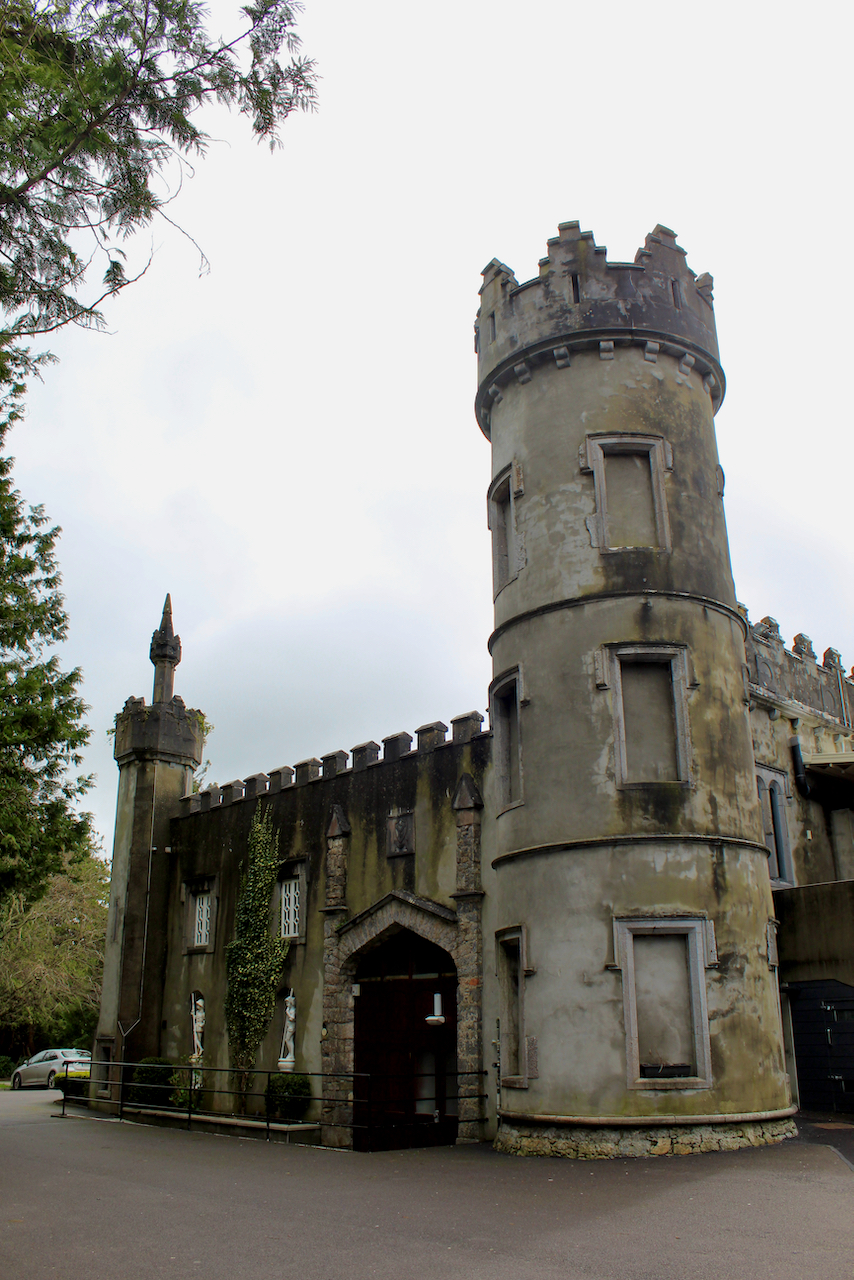
The Blennerhassett site tells us: “It was William Blennerhassett Jr’s son Arthur (1779-1815) and his wife Dorcas Twiss (1775/7-1822) who commenced addition of the long north wing, something of a “folly” with the stable yard surrounded by a great wall of false windows, with two carriage entrances and a round tower of medieval appearance at the north-west corner. The work of architect Sir William Morrison [From 1809 onward Richard Morrison collaborated increasingly with his second son, William Vitruvius Morrison (1794–1838)], this remodelling was completed in 1821, exactly 100 years after the older “Ballyseedy House” house had been built, by his son Arthur Blennerhassett (b. 1799 d.1843) then only 22 years of age.” [8]

Mark Bence-Jones describes: “At one side of the front is a long and low castellated service wing, with round and square turrets, the other side of which has a sham wall, consisting of a long range of false windows.”

I couldn’t work out where this sham wall of false windows was – perhaps later renovations changed this folly.

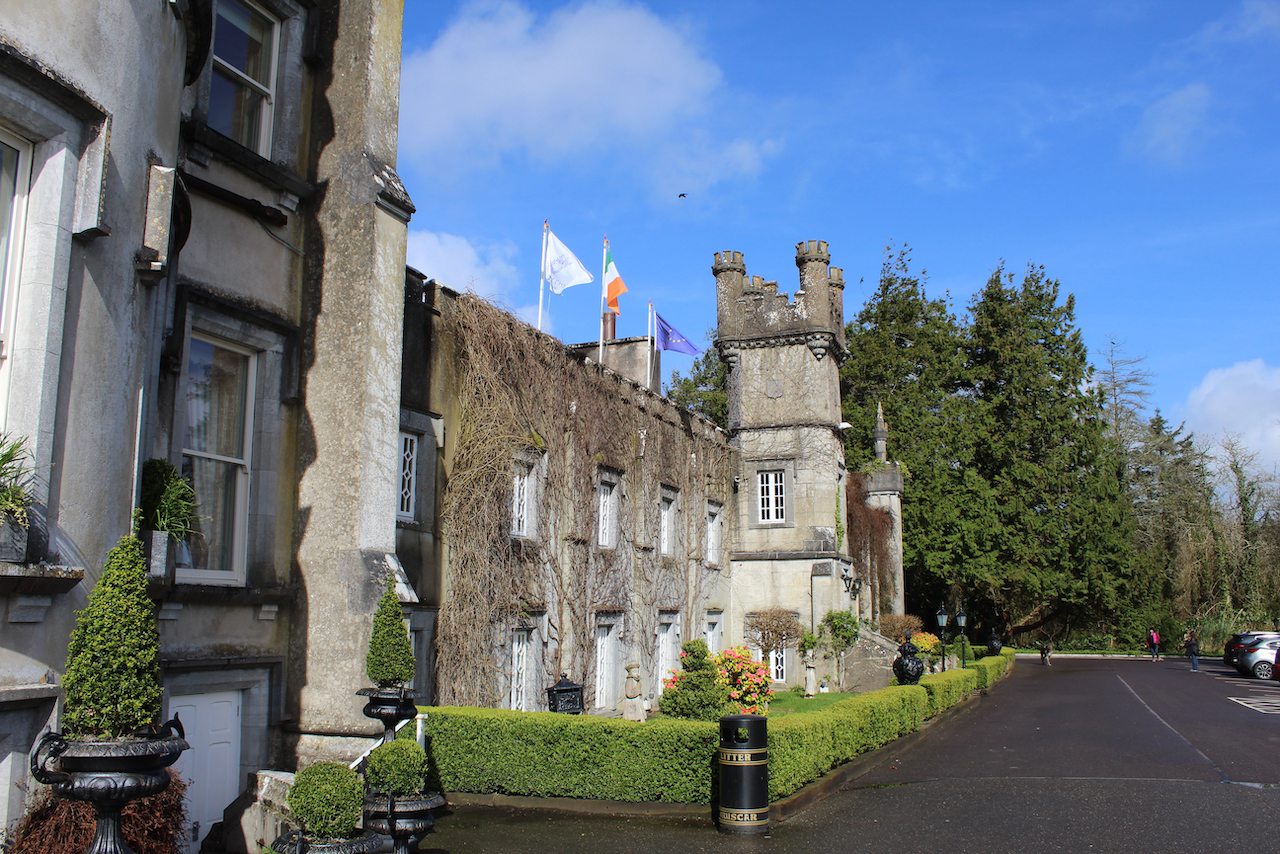
Ballyseede Castle, March 2023. © Jennifer Winder-Baggot, www.irishhistorichouses.com
This is the far end of the wing, with what must be the round tower mentioned in the description on the Blennerhassett website: “addition of the long north wing, something of a “folly” with the stable yard surrounded by a great wall of false windows, with two carriage entrances and a round tower of medieval appearance at the north-west corner.” © Jennifer Winder-Baggot, www.irishhistorichouses.com
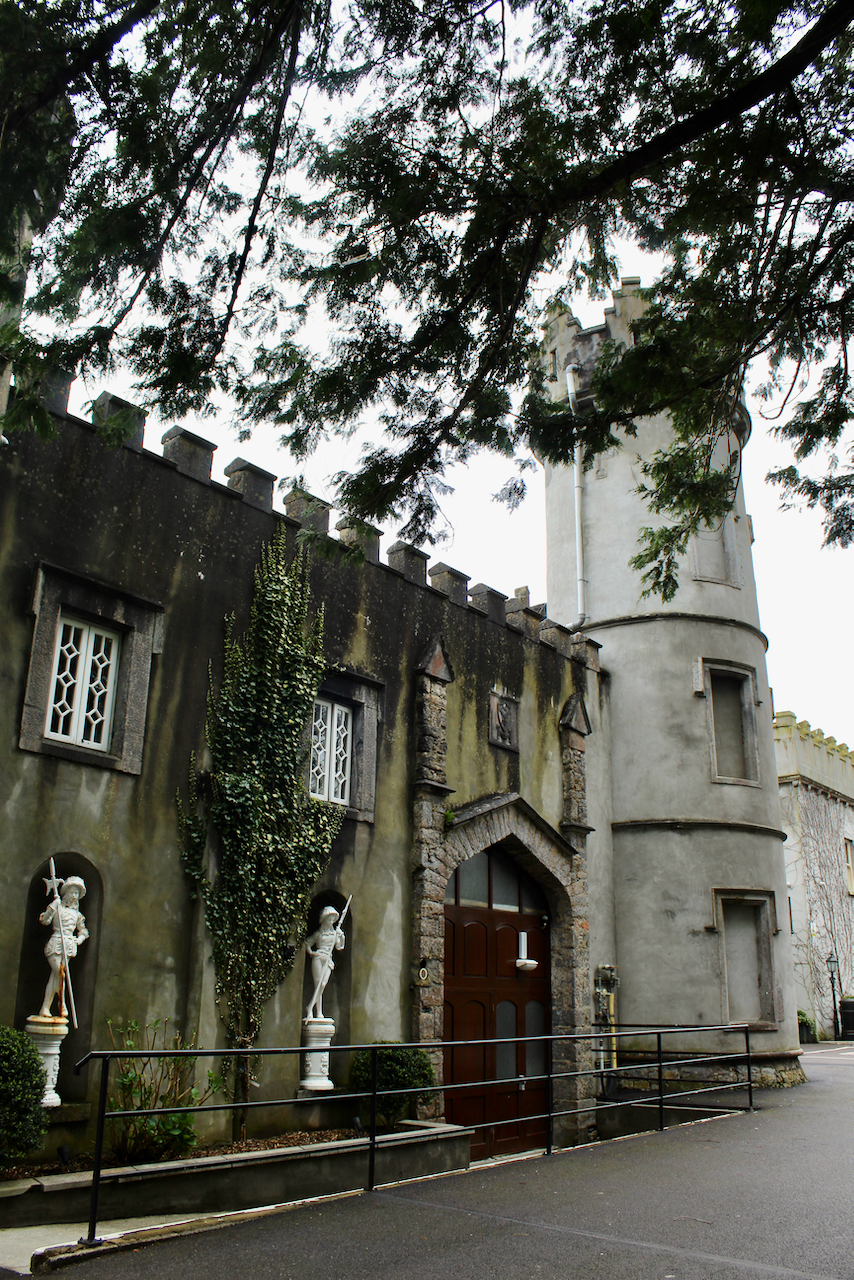
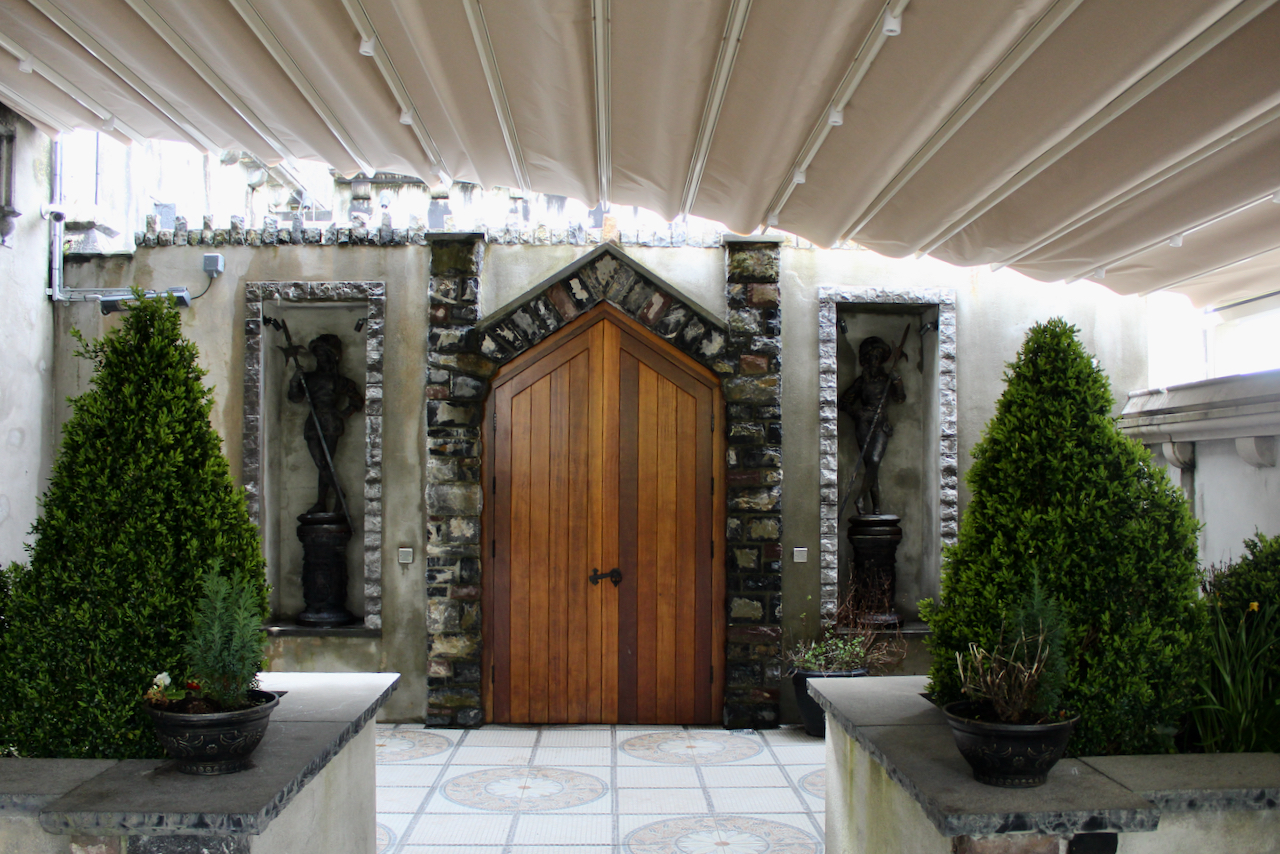
Stephen liked the pike-wielding statues. © Jennifer Winder-Baggot, www.irishhistorichouses.com
This must be one of the carriage entrances. © Jennifer Winder-Baggot, www.irishhistorichouses.com
You can see in this photograph that the carriage entrance is open.

At the time of renovations, the son of Arthur and Dorcas, Arthur (1800-1843), was High Sheriff for County Kerry.

The Blennerhassett website tells us:

In the north wing is a “Banqueting Hall” which features a foundation stone dated 1721, set into the wall over primitive 17th century black oak fireplace surround.

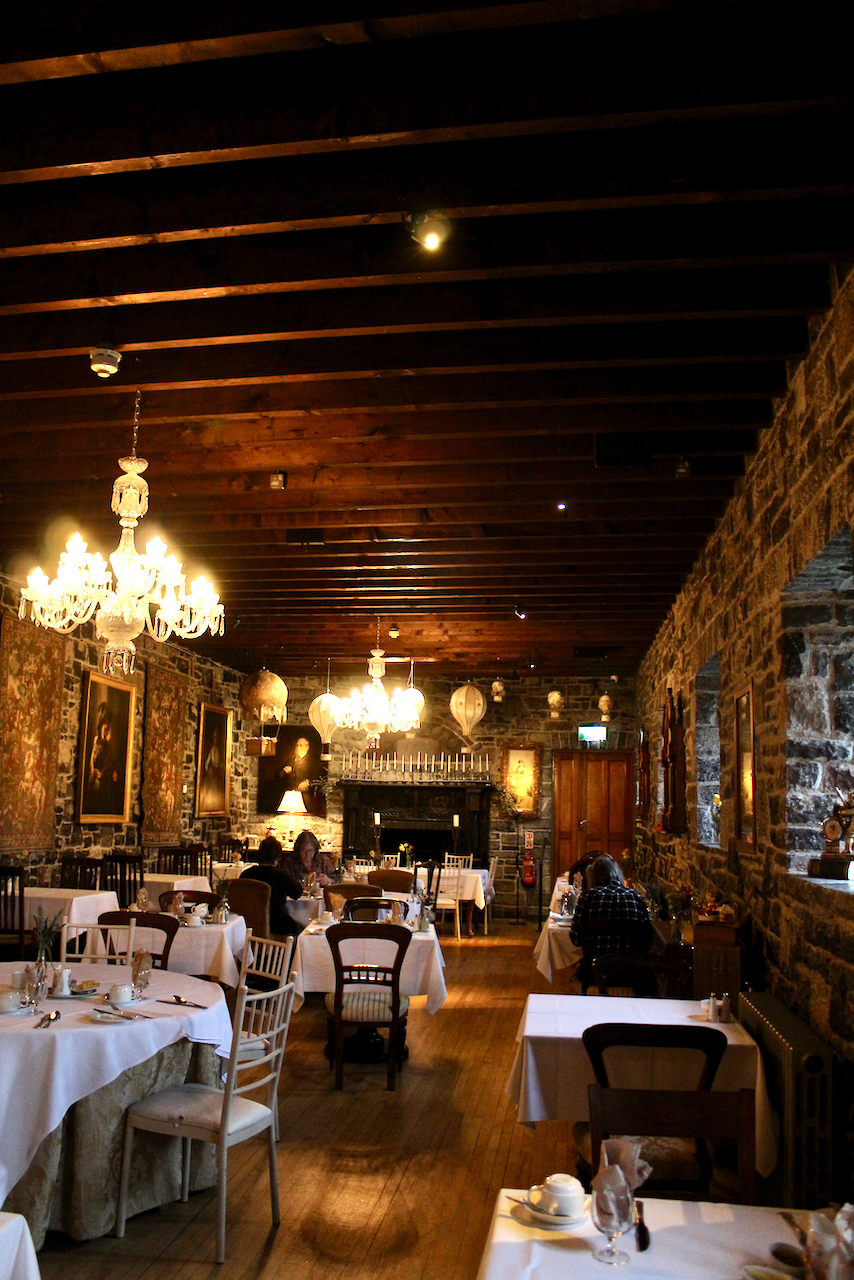
In the north wing is a “Banqueting Hall.” © Jennifer Winder-Baggot, www.irishhistorichouses.com
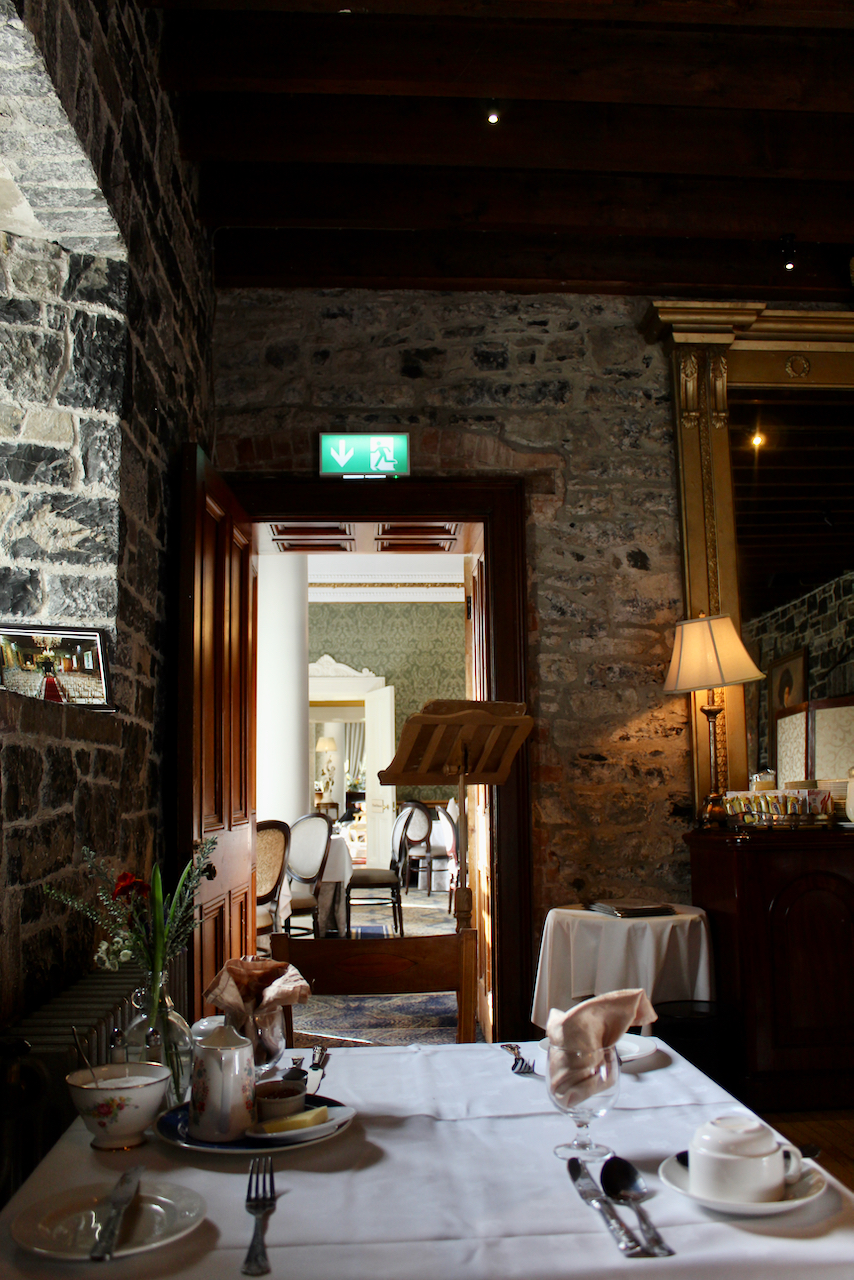
We ate our breakfast here every day. © Jennifer Winder-Baggot, www.irishhistorichouses.com
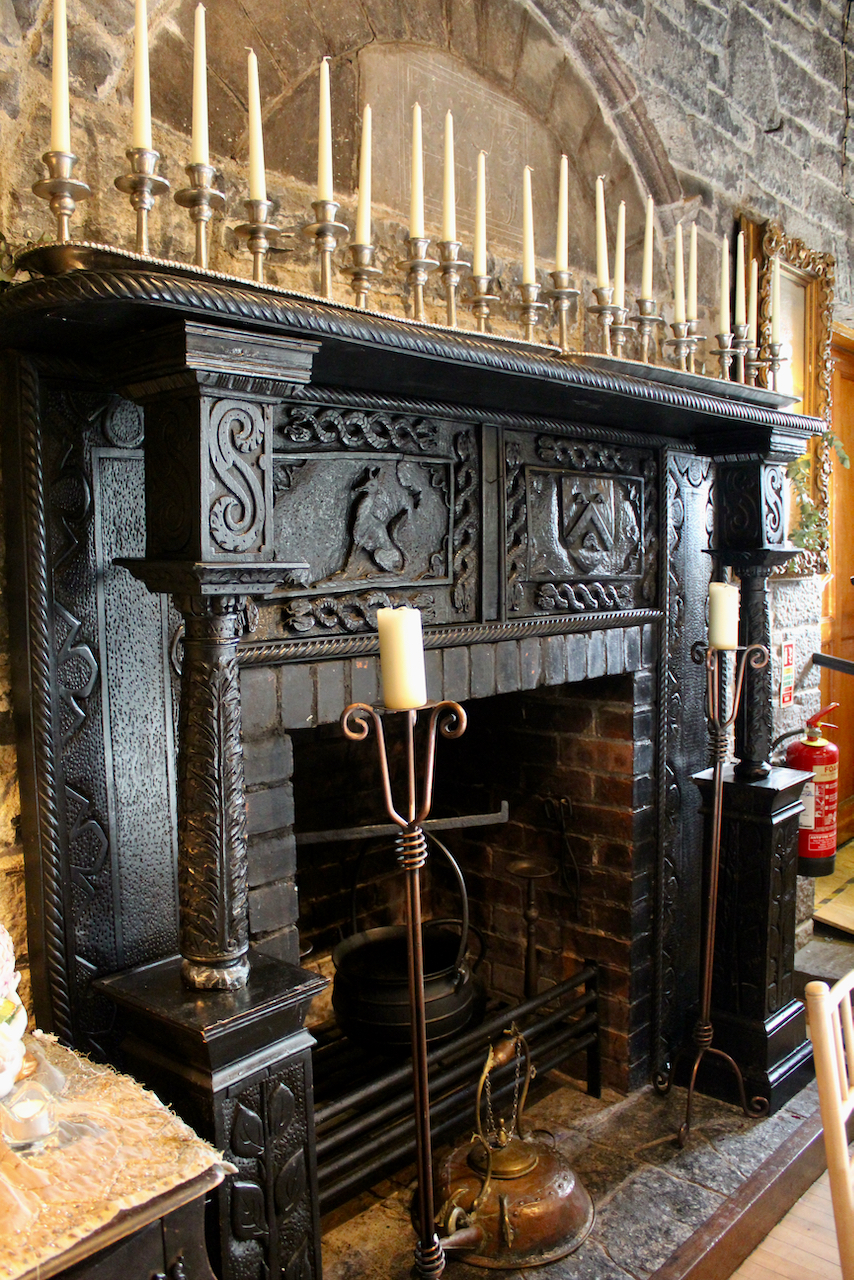
The 17th century oak fireplace in the banqueting hall. © Jennifer Winder-Baggot, www.irishhistorichouses.com
Detail of the seventeenth century fireplace in Ballyseede. © Jennifer Winder-Baggot, www.irishhistorichouses.com
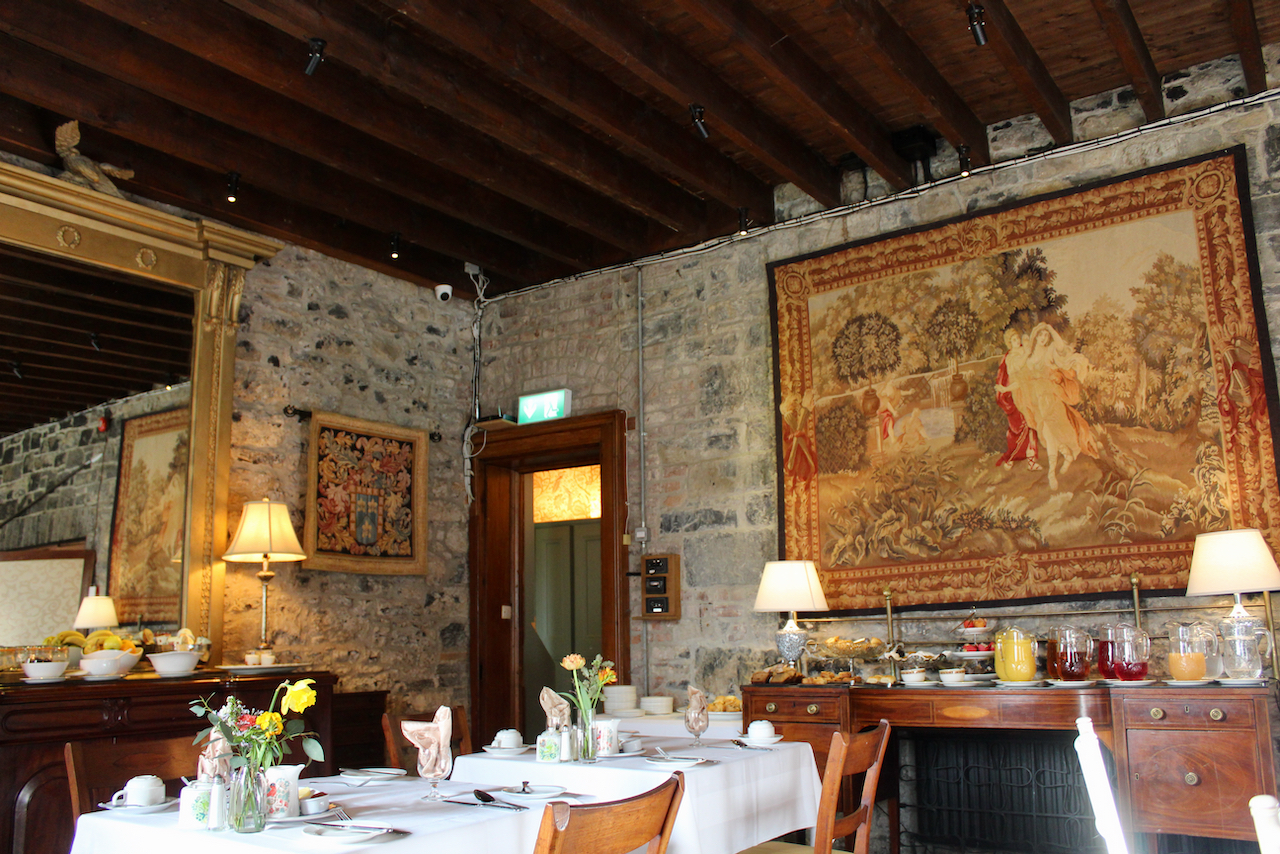
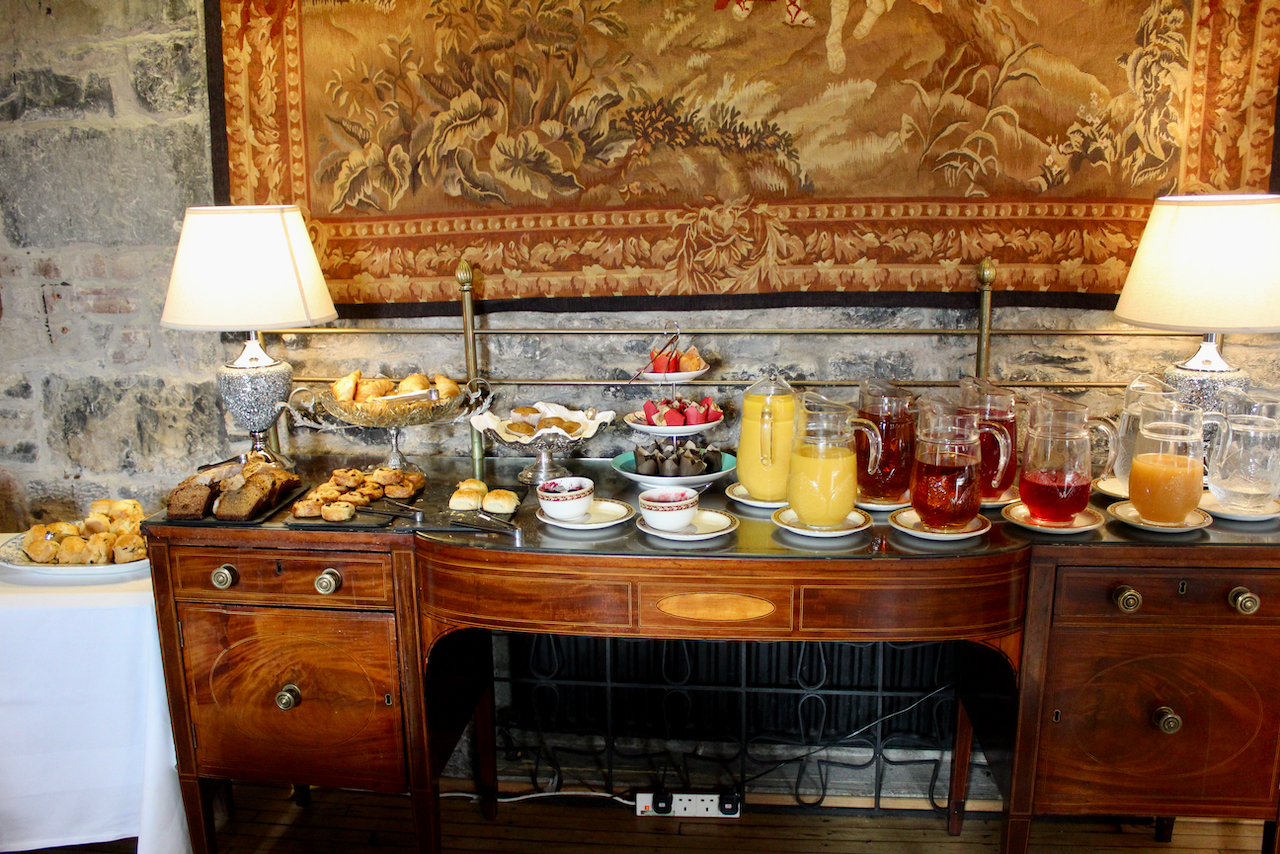
We were treated to a delicious breakfast every day. © Jennifer Winder-Baggot, www.irishhistorichouses.com
Breakfast includes lovely pastries and I confess Stephen and I sneaked a couple into our bag for lunch! © Jennifer Winder-Baggot, www.irishhistorichouses.com
Ballyseede Castle, March 2023. © Jennifer Winder-Baggot, www.irishhistorichouses.com

The Blennerhassett website tells us that another 17th century wooden fireplace surround of finer workmanship was installed in what was the library of the main house (now the hotel bar). The two fireplaces are believed to have been moved with other free-standing oak furniture from “Old” Ballyseedy” as it fell into ruin.

This is the fireplace in the bar believed to have been moved with other free-standing oak furniture from “Old” Ballyseedy” as it fell into ruin. My apologies for the quality of the photographs – the bar is used as a restaurant and I found it impossible to get a good photograph when people were eating in the room! © Jennifer Winder-Baggot, www.irishhistorichouses.com
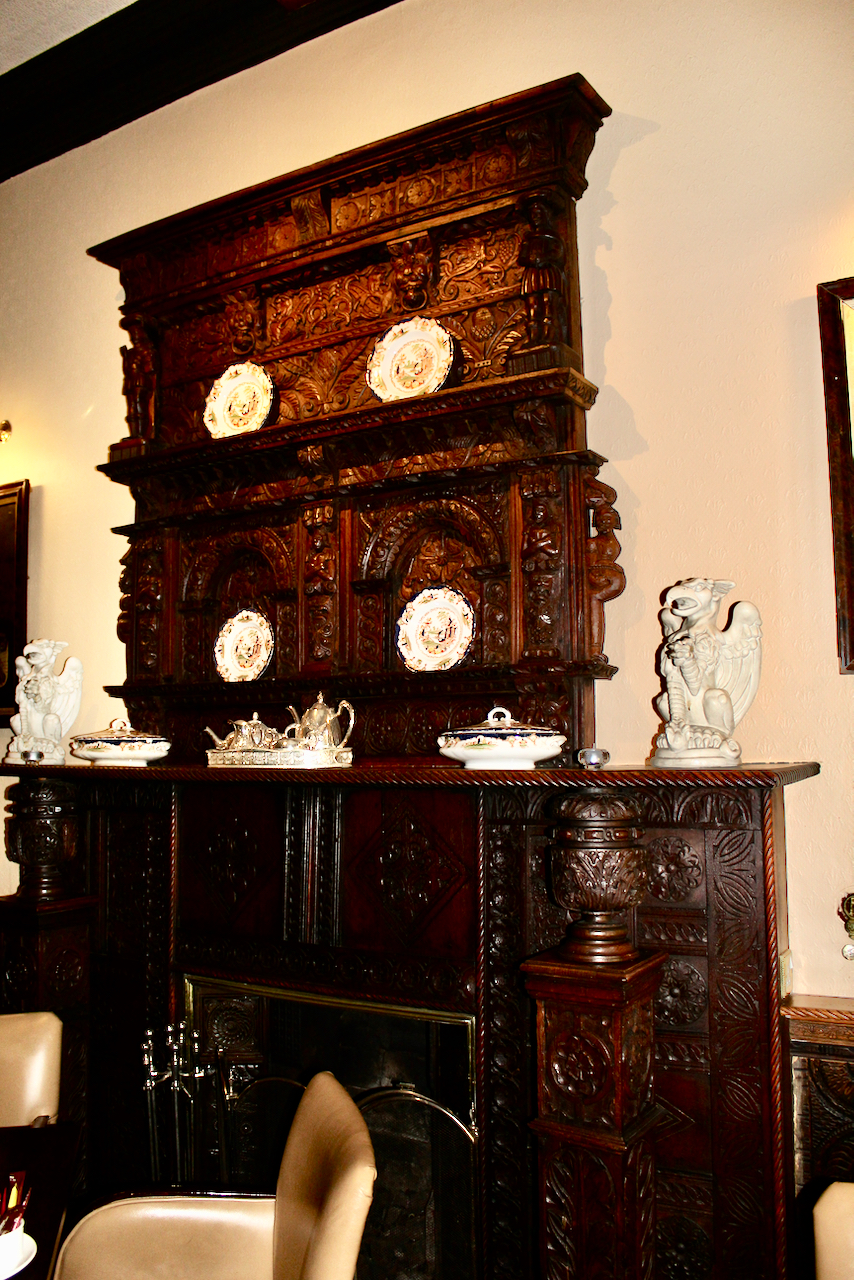
17th century wooden fireplace in the former library of Ballyseede Castle. © Jennifer Winder-Baggot, www.irishhistorichouses.com
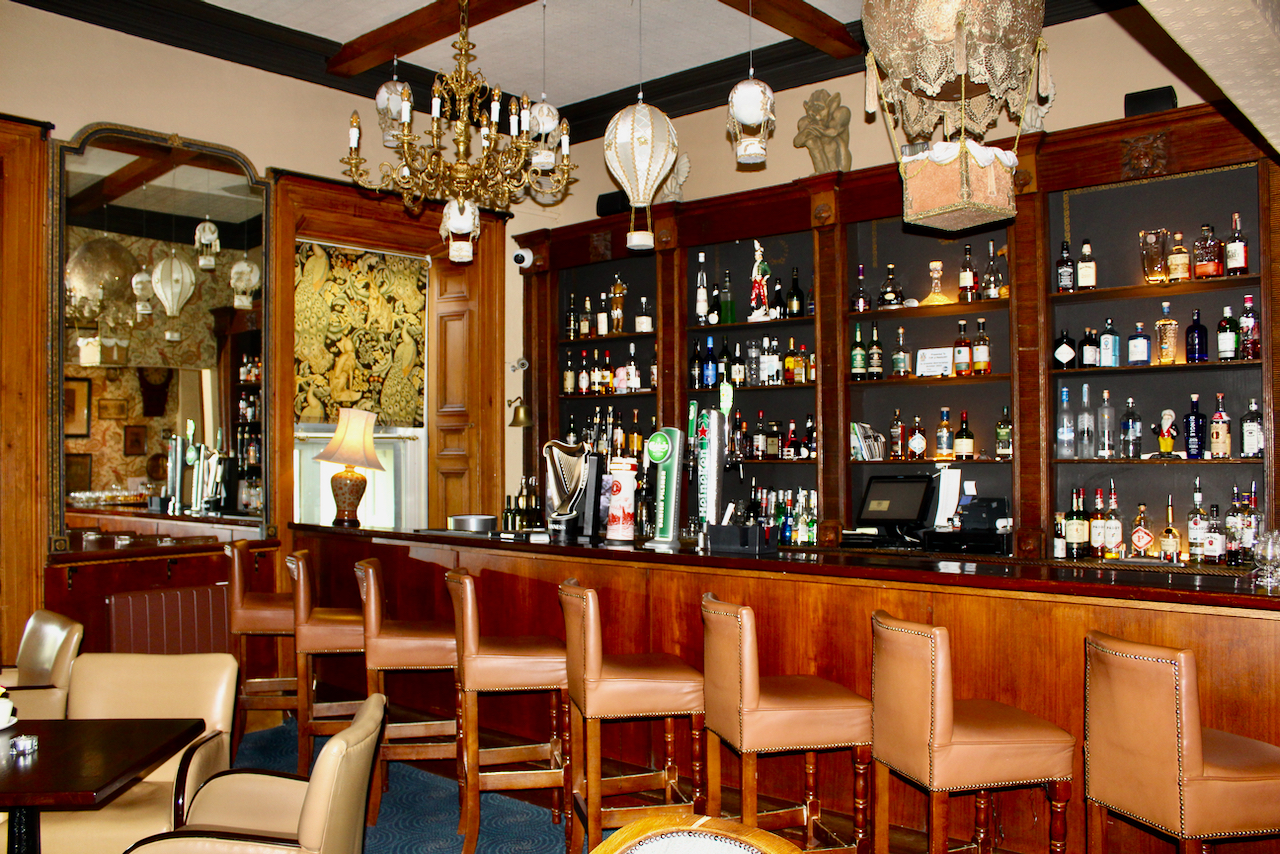
The former library of Ballyseede Castle is now the bar, where casual meals are also served. Stephen and I ate here every evening of our stay. © Jennifer Winder-Baggot, www.irishhistorichouses.com

Arthur Jr. (1800-1843) married Frances Deane O’Grady (1800-1834), daughter of Henry Deane O’Grady (1765-1847). This would have been a prestigious marriage. Her sisters married, respectively, Edward Chichester, 4th Marquess of Donegal (Amelia); David Roche (1791-1865), 1st Baronet of Carass, Co. Limerick (Cecilia); John Skeffington (1812-1863), 10th Viscount Massereene (Olivia); and Matthew Fitzmaurice Deane (1795-1868), 3rd Baron Muskerry (Louisa). Thus Arthur would have been very well connected. He served as M.P. for County Kerry between 1837 and 1841.
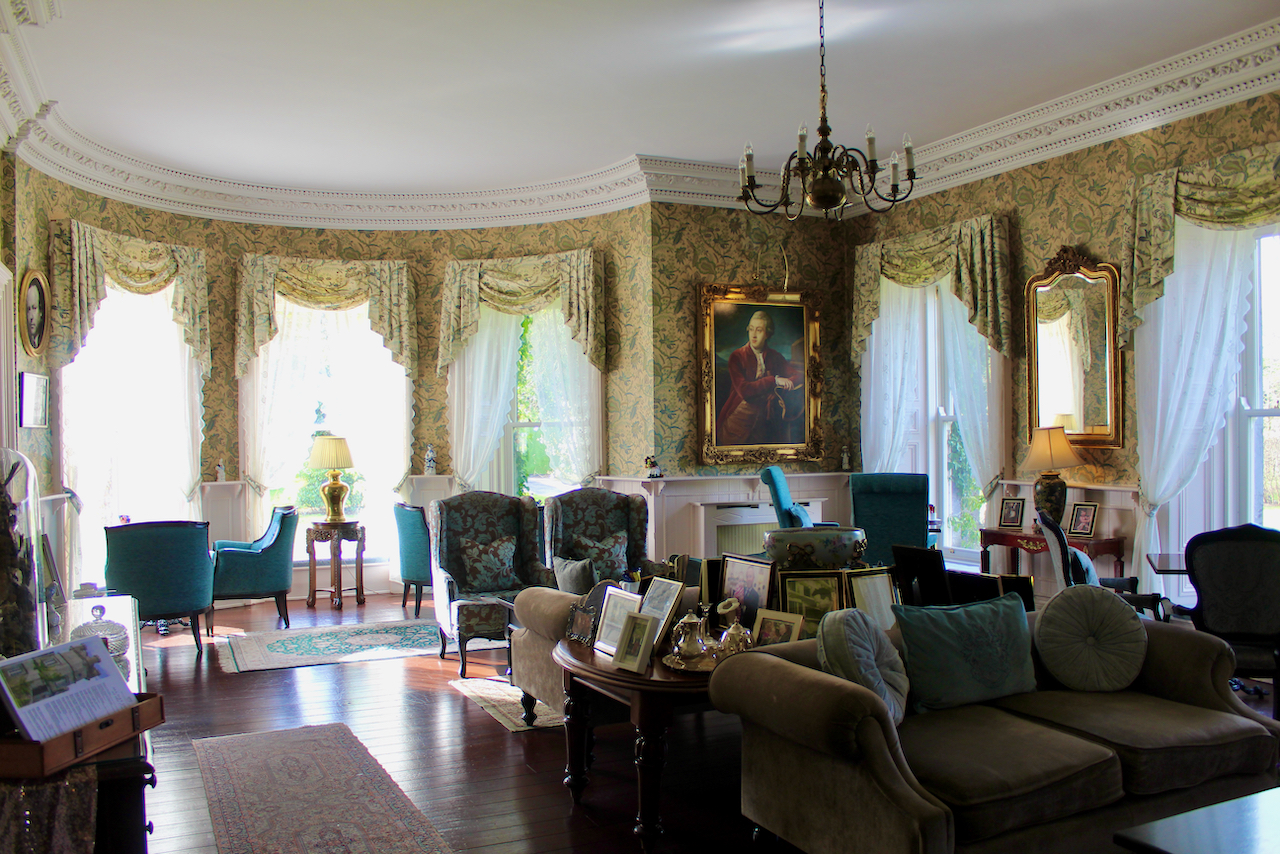
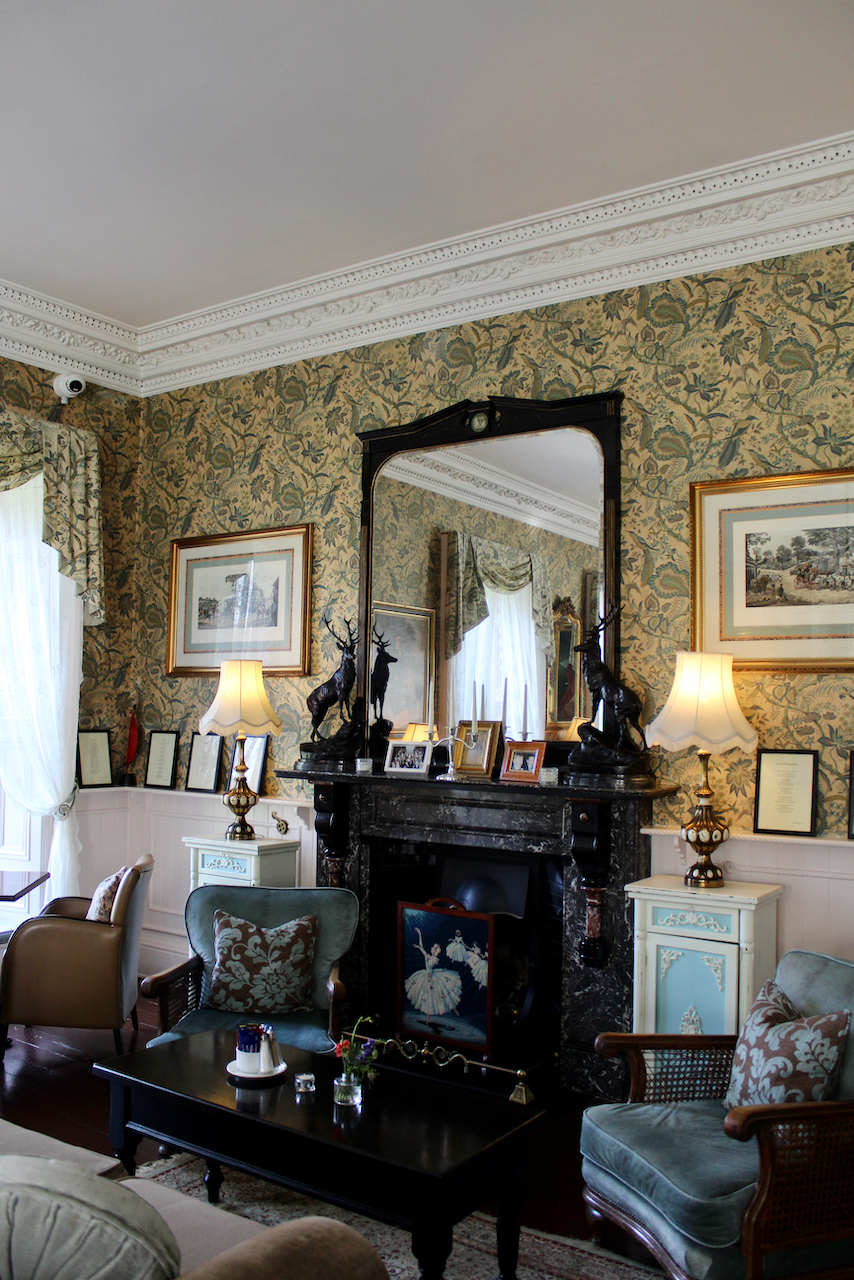
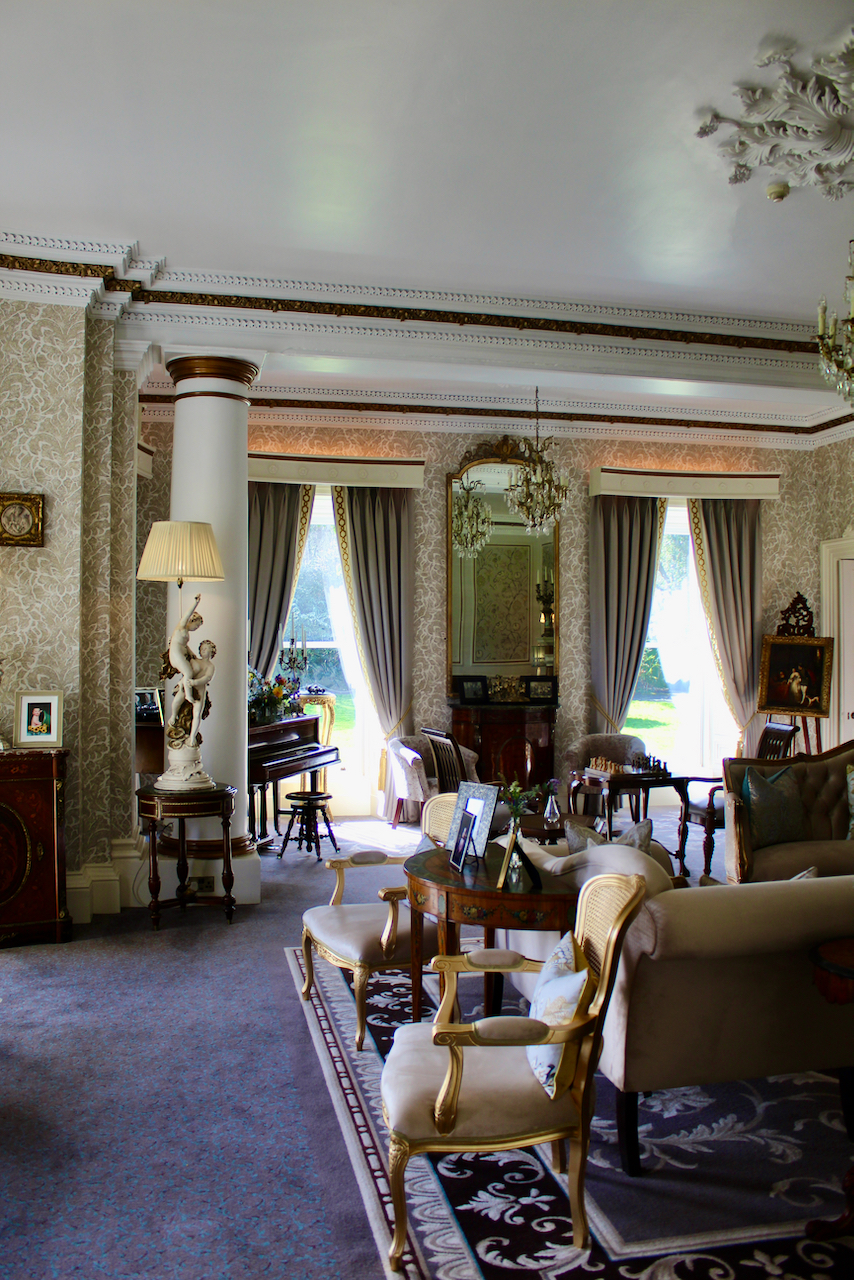
One of the formal rooms of Ballyseede Castle. © Jennifer Winder-Baggot, www.irishhistorichouses.com
The room has a lovely marble fireplace. © Jennifer Winder-Baggot, www.irishhistorichouses.com
Another of the formal rooms of Ballyseede Castle. © Jennifer Winder-Baggot, www.irishhistorichouses.com
Stephen and I particularly enjoyed the chess set and availed of it on two evenings, imagining ourselves in a drawing room in the eighteenth century. © Jennifer Winder-Baggot, www.irishhistorichouses.com
Ballyseede Castle. © Jennifer Winder-Baggot, www.irishhistorichouses.com
One of the bay windows of Ballyseede. © Jennifer Winder-Baggot, www.irishhistorichouses.com

It must have been during this Arthur’s time in the 1830s that Ballyseede was leased to Edward Denny (1796-1889), 4th Baronet.
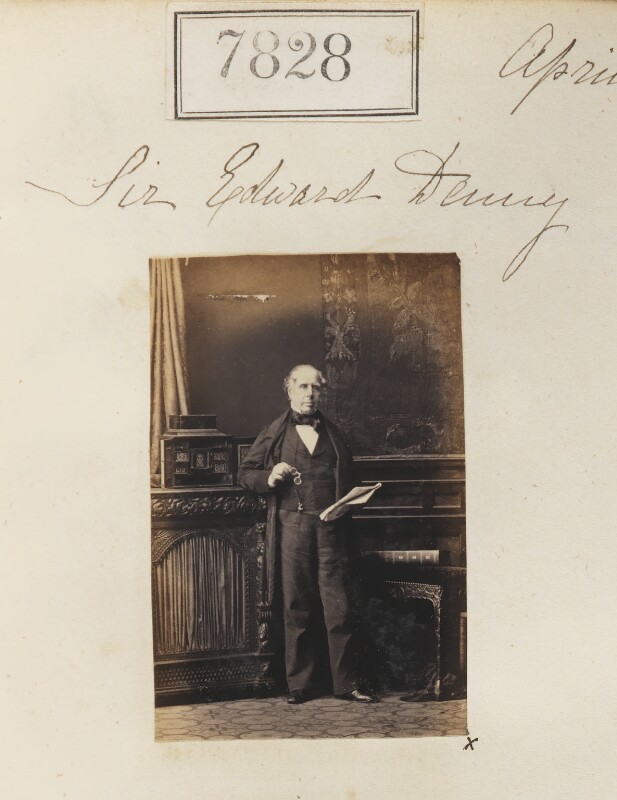
Edward Denny (1796-1889) 4th Bt , Poet and hymn writer, by Camille Silvy, 1862, National Portrait Gallery of London, Ax57667.

In Voices from the Great Houses: Cork and Kerry (2013) Jane O’Hea O’Keeffe tells us:

p. 160. “Several generations of the Denny family occupied the ancient castle in Tralee. They ran the estate through both peaceful and turbulent times until 1826, when Sir Edward Denny, 3rd Baronet [1773-1831, of Castle Moyle, Co. Kerry], decided to demolish the castle. Tom Denny ruefully remarks, “The demolition of Tralee Castle by Sir Edward Denny was a crime, and much resented in Tralee at that time. People felt angry that part of the town’s history was being destroyed. Sir Edward was really quite a muddled character. As a younger man, when he inherited the estate, he promptly set about enlarging the castle, something which is powerful father-in-law Judge Day found very irritating, and which created enormous problems for Sir Edward’s finances. He subsequently went to live in Worcester. He remained fascinated by genealogy and artefacts from the family’s past and continued to acquire Tudor portraits long after he had pulled down the Tudor remains of the Denny house. 

In the 1830s the Worcestershire Dennys came back to Tralee, and Sir Edward Denny, 4th Baronet, rented Ballyseedy Castle outside the town for a number of years. His younger brother William [1811-1871] became his agent, and he lived at Princes Quay in Tralee in a house when the Dominican church now stands. Sir Edward Denny planned to rebuild the [Tralee] castle, and he replanted the park and also built lodges on the estate. His plans came to an end in 1840 when he joined the conservative Plymouth Brethren movement and he lived thereafter in poverty in London, leaving the management of the estate to his family. 

The indebted Denny estate in Tralee was run by members of the family, or their agents, until 1892, when it was taken over by an insurance company; this severed a family link to the area which had remained strong for over 300 years. 

The Denny estates at one time, stretched to around 29,000 acres, extending from Fenit to Tralee and around the other side of the bay to Derrymore,” explains Tom Denny. “Sir Arthur Denny, 5th Baronet (1838-1921), was a notorious gambler who managed to lose the entire estate by around 1892.” 
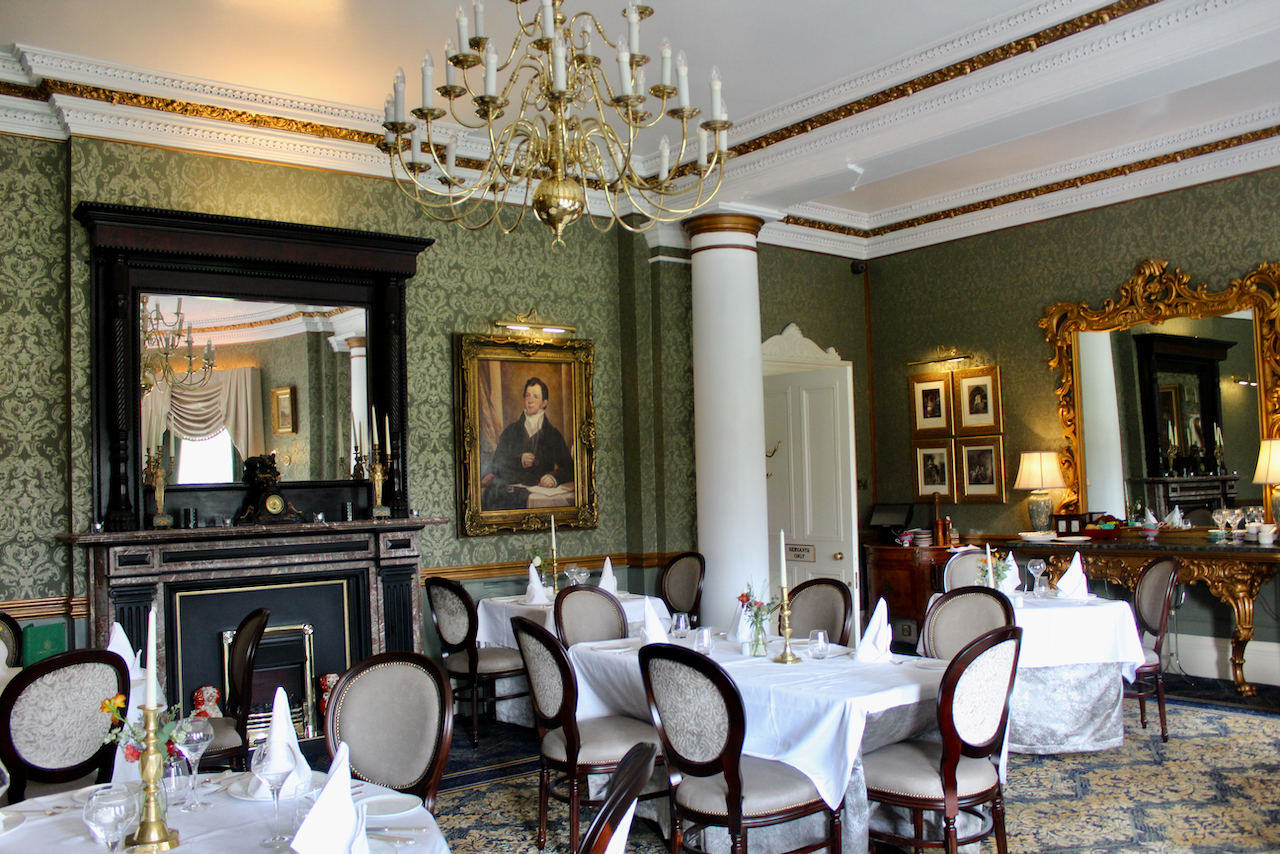
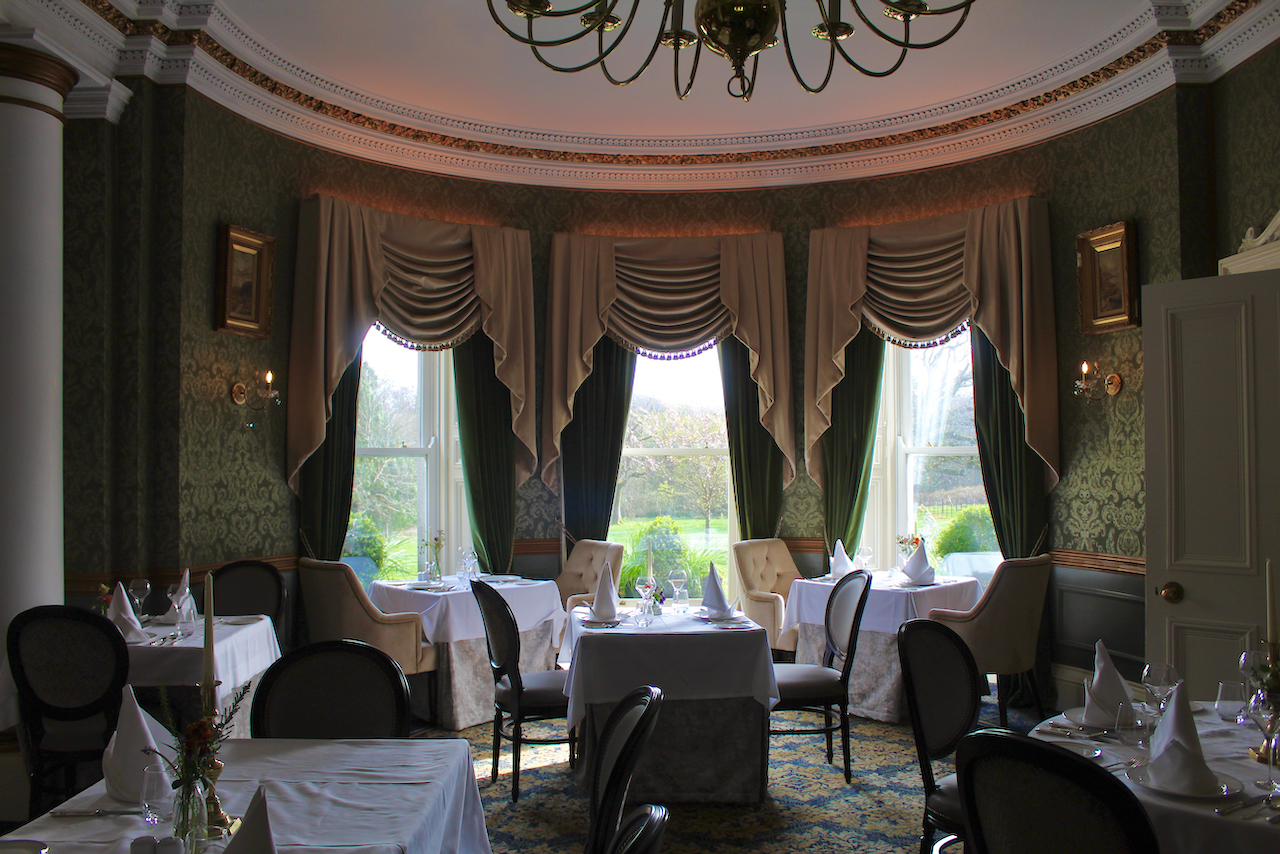
The dining room of Ballyseede Castle. © Jennifer Winder-Baggot, www.irishhistorichouses.com
Ballyseede Castle, March 2023. © Jennifer Winder-Baggot, www.irishhistorichouses.com

Arthur Blennerhassett died in 1843 when his son, Charles John Allanson Winn Blennerhassett (1830-1859) was only thirteen years old. By this time, Ballyseedy was probably back in the hands of the Blennerhassetts. Charles’s mother has died when he was only four. I am not sure who raised him. A few of his uncles still lived in County Kerry: His uncle Thomas (1806-1878) remained unmarried and lived in Kerry, and uncle Lt.-Col. Francis Barry Blennerhassett (1815-1877) lived in Blennerville, County Kerry, also unmarried.

Charles John Allanson Winn married Marianne Hickson of Dingle, County Kerry, in 1855. He held the office of High Sheriff in 1858 and was a Justice of the Peace. He died at the young age of 29 and his wife remarried, this time to Captain William Walker. Before Charles died, his wife had two children: Barbara, who died at the age of ten, and Arthur (1856-1939). Young Arthur was only three years old when his father died. He was sent away to school in Harrow in England.

Charles John Allanson Winn Blennerhassett (1830-1859) had several siblings. His sister Adelaide married Standish O’Grady (1832-1860) 3rd Viscount Guillamore, County Limerick. His sister Dorcas married Robert Conway Hurly of Glenduffe, County Kerry. His sister Amelia married Chichester Thomas Skeffington, son of Thomas Henry Skeffington, 2nd Viscount Ferrard, County Louth. Frances Annabella married John Richard Wolseley, 6th Bt of Mount Wolseley, County Carlow. His only brother, Henry Deane, died unmarried in 1850.

Young Arthur Blennerhassett (1856-1939) was the owner of 12,621 acres in 1876 [see 2]. He held the office of High Sheriff in 1878. In 1882 he married Clara Nesta Richarda FitzGerald, daughter of Desmond John Edmund FitzGerald, 26th Knight of Glin.

The house was further remodelled during the 1880s for the Blennerhassett family by James Franklin Fuller (1835–1924), after which it was then known as “Ballyseedy Castle.” Fuller added a battlemented parapet, hood mouldings and other mildly baronial touches. The three-bay single-storey flat-roofed limestone ashlar projecting porch was added to the entrance bay. The Blennerhassett website tells us that the back of the castle became the front at this time.
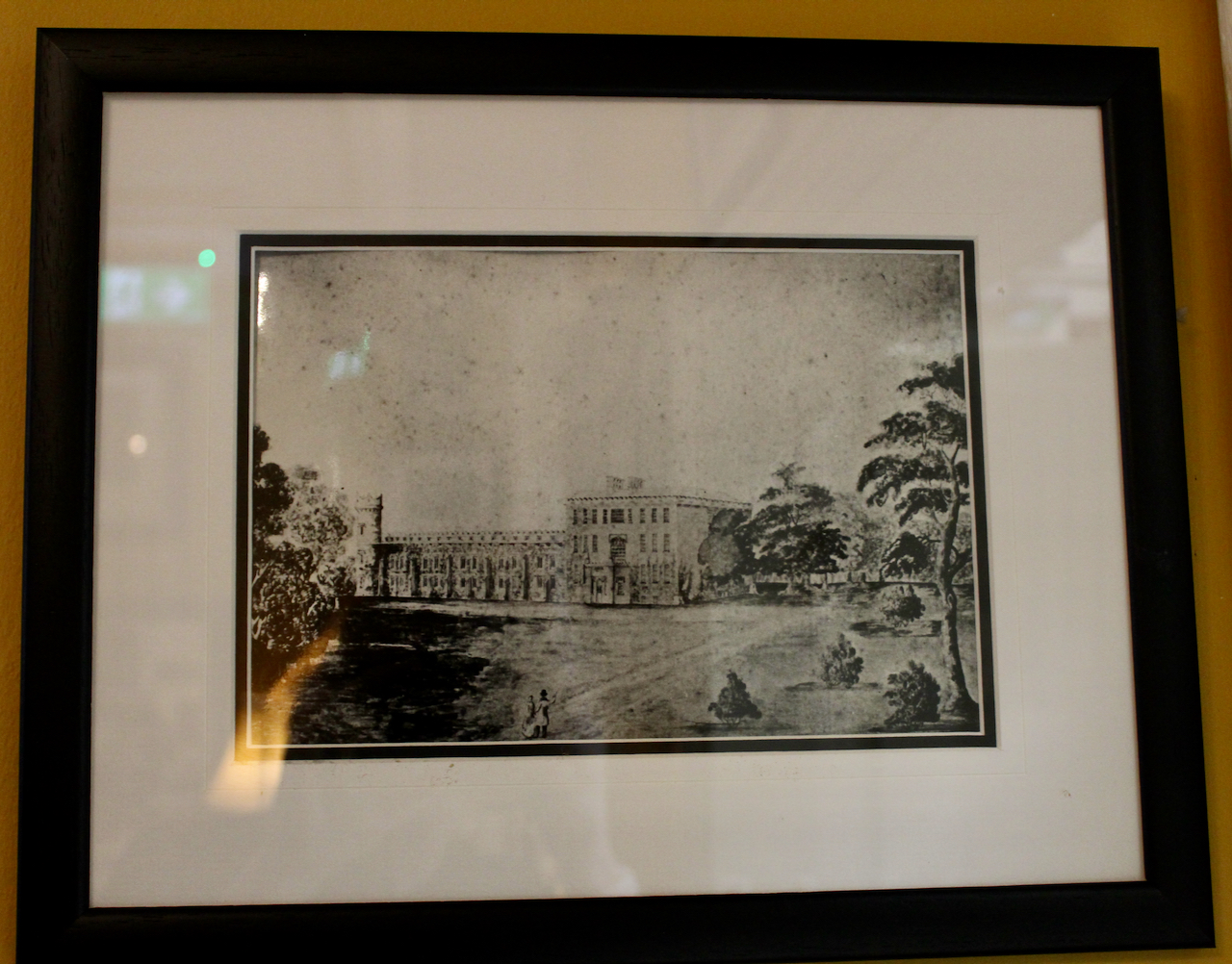
Older pictures of Ballyseedy. It looks like this could be the original front of the castle. It is identified on the Blennerhassett family website as Ballyseedy c.1837-1841 and their version is titled “The Seat of Arthur Blennerhassett Esq MP, Co Kerry.”

The Blennerhassett family website [8] tells us more about the history:

During the 1880s Arthur’s grandson, Maj. Arthur Blennerhassett (b.1856 d.1939), commissioned a “mock castle” refacing of the house, as was popular during the late Victorian period, these changes causing what had previously been the front elevation and west facing main entrance to become the rear of the house. This work, executed by Kerry architect, historian and Blennerhassett descendant James Franklin Fuller, caused the house to lose its Georgian elegance and simplicity but resulted in the more impressive building we see today. Following these changes the house began to be referred to as “Ballyseedy Castle” and is named as such on the family headed writing paper of the time.” [8]

Unfortunately not having read this fully in advance of our visit, I didn’t take a proper picture of the back of the hotel, not knowing that it had originally been the front!

The back of the hotel. © Jennifer Winder-Baggot, www.irishhistorichouses.com
An early aerial shot of Ballyseede.

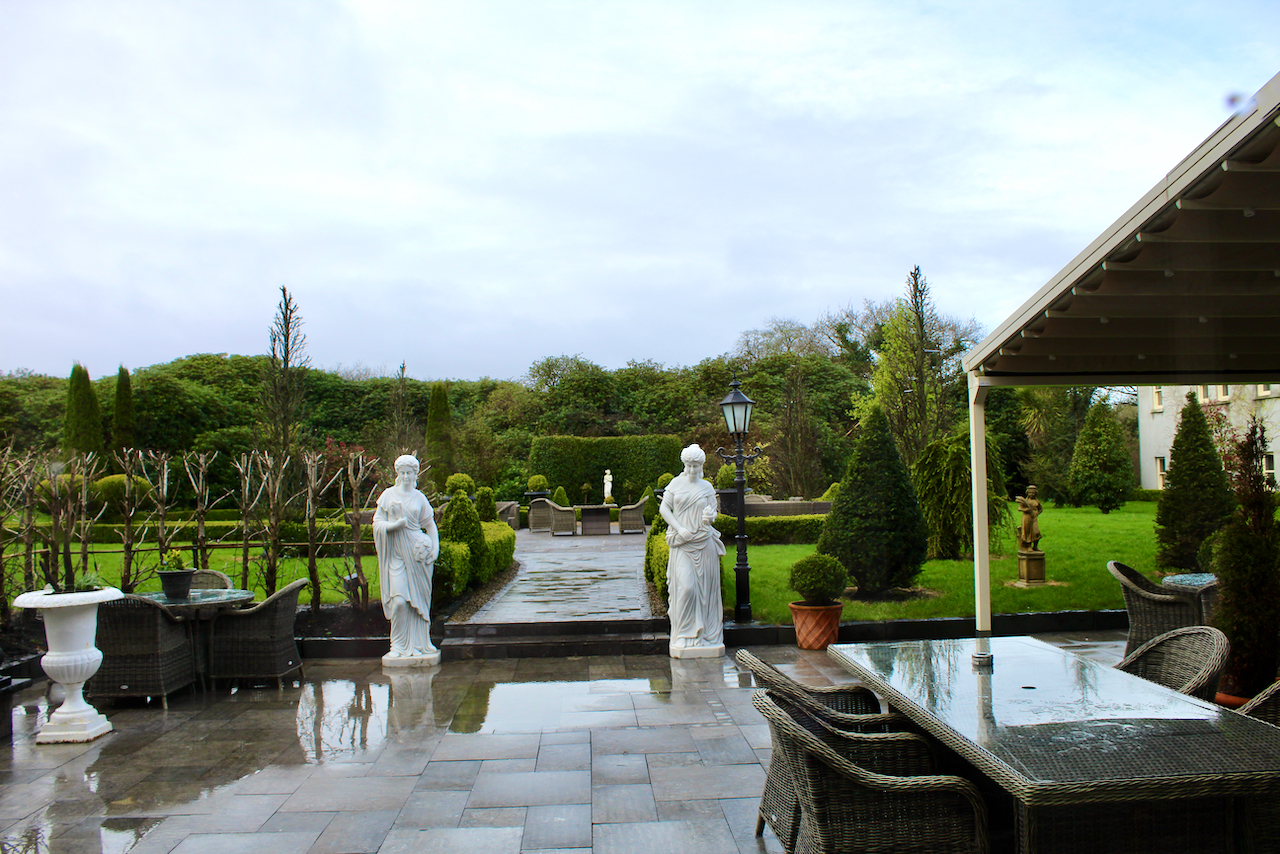
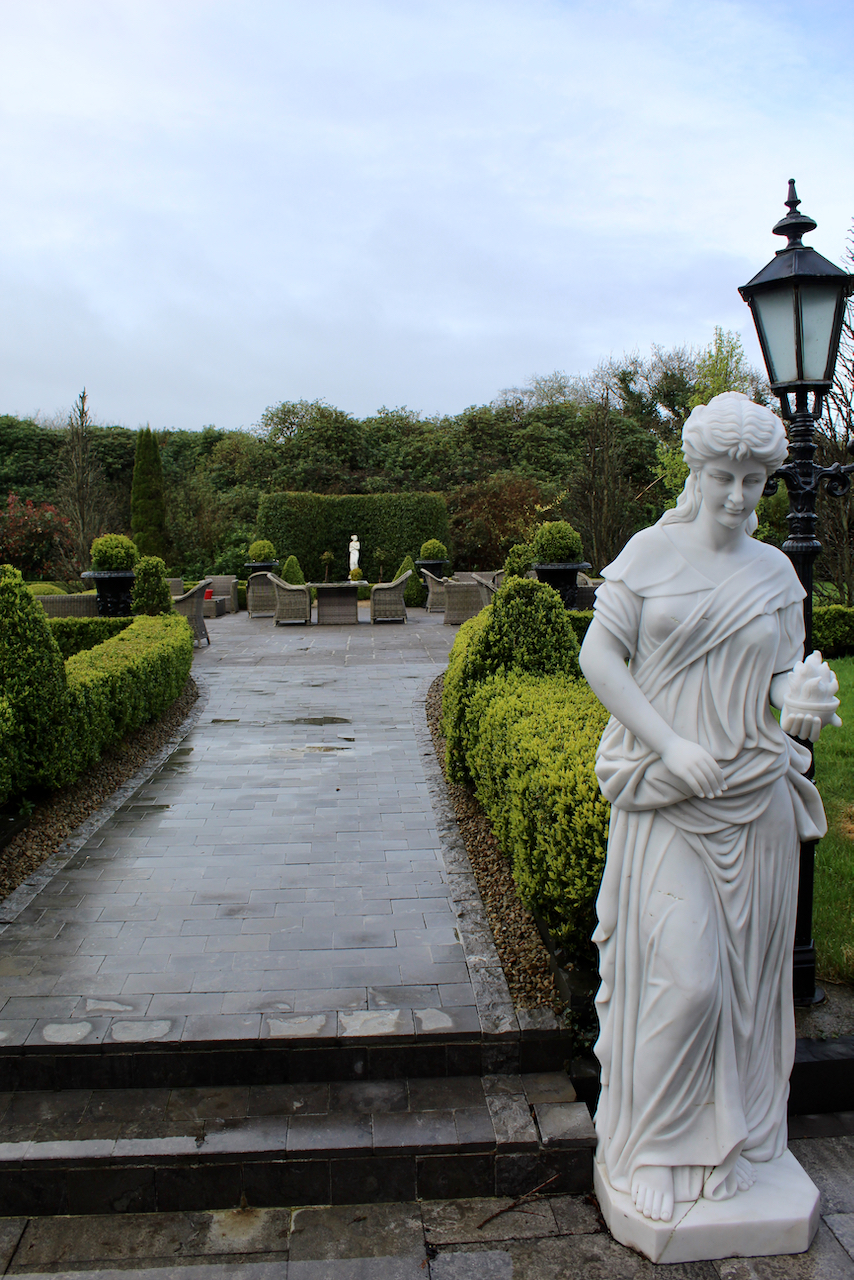
Out the back there is a lovely garden with statues, small hedges, trees and a gazebo perfect for wedding photographs. Unfortunately it rained during most of our visit, so we didn’t get to explore much outside.
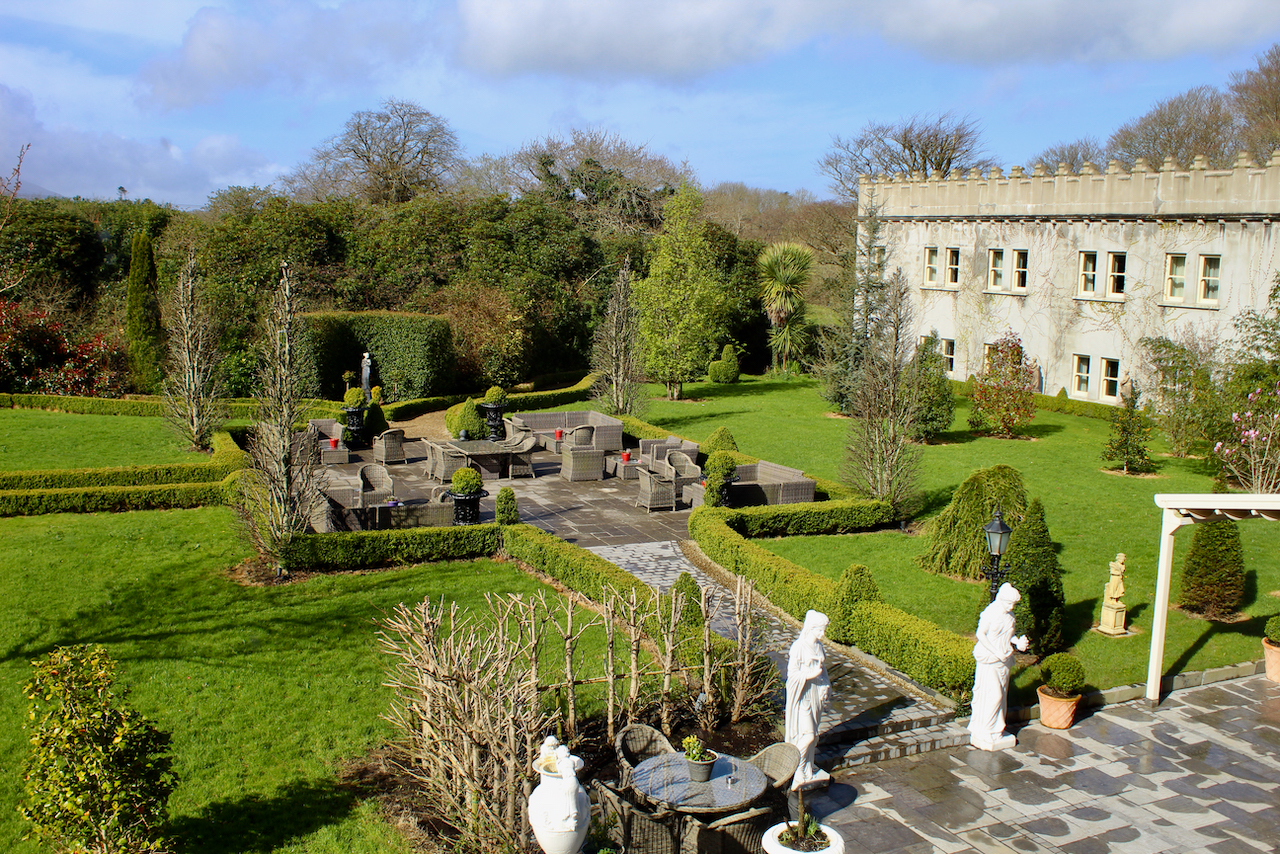
The gardens at Ballyseede Castle. © Jennifer Winder-Baggot, www.irishhistorichouses.com
A later addition to the castle, a sixteen bedroom extension. © Jennifer Winder-Baggot, www.irishhistorichouses.com

Arthur served as Deputy Lieutenant and Justice of the Peace. He fought in the first World War and gained the rank of Major in the 4th Battalion, Munster Fusiliers. In 1918, both he and Clara Nesta (known as Nesta) were appointed as Members of the Order of the British Empire (M.B.E.) for their services: Nesta because during WWI she and her younger daughters Hilda and Vera served as Voluntary Aid Detachment nurses caring for the wounded, first behind the battlefields of France, and later on Lord Dunraven’s hospital ship “Grianaig” in the Mediterranean. 

Arthur and Nesta had three daughters. Hilda and Vera lived at Ballyseedy. Hilda bequeathed the estate in 1965 to her kinsman Sir (Marmaduke) Adrian Francis William Blennerhassett, 7th Bt of Blennerville, County Kerry, who sold it 1967. [see 5] This branch of Blennerhassetts are descendants of Robert Blennerhassett of Ballycarty Castle and his wife Elizabeth Conway also, from their grandson Robert, younger brother of John from whom the Ballyseedy Blennerhassetts descended.

The Blennerhassett website has a copy of the auction of the contents of the house, held by Hamilton and Hamilton in 1967.
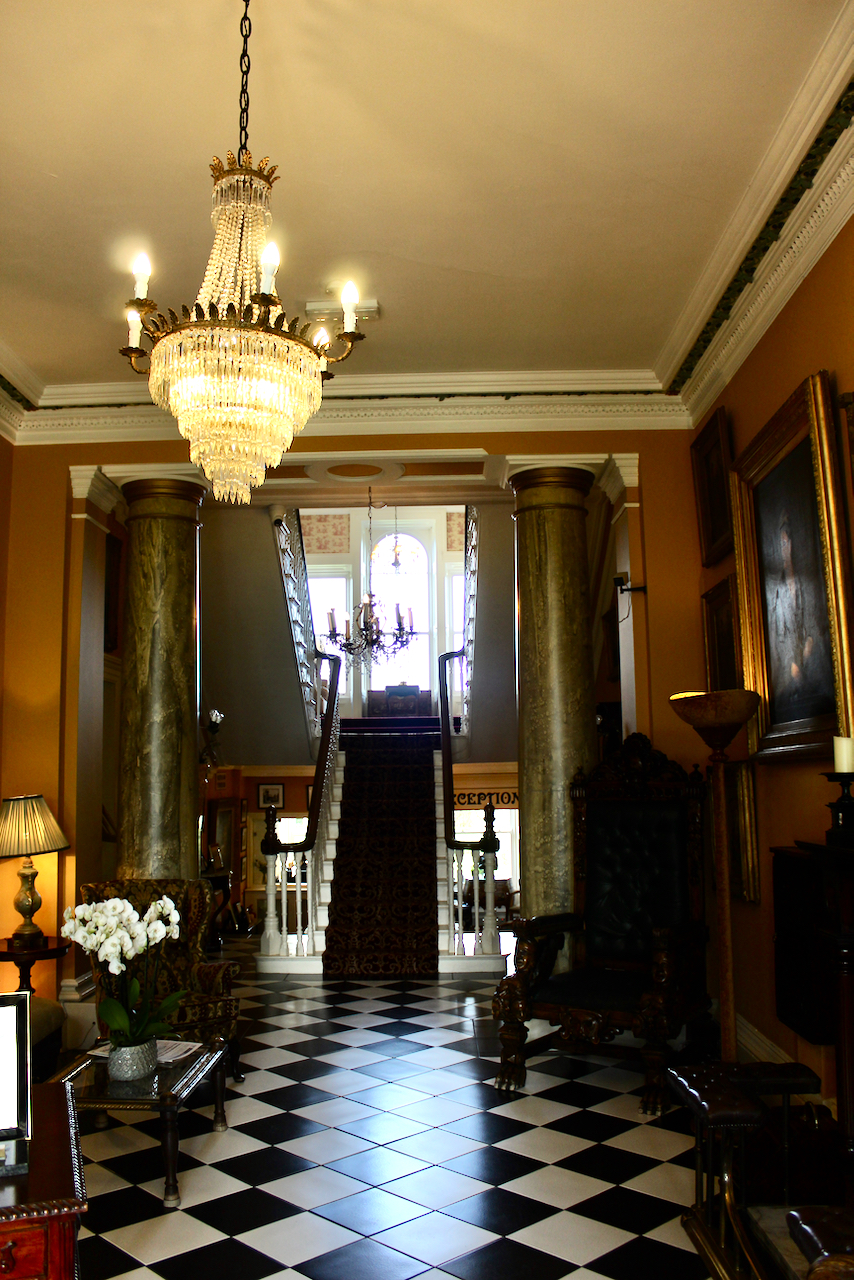
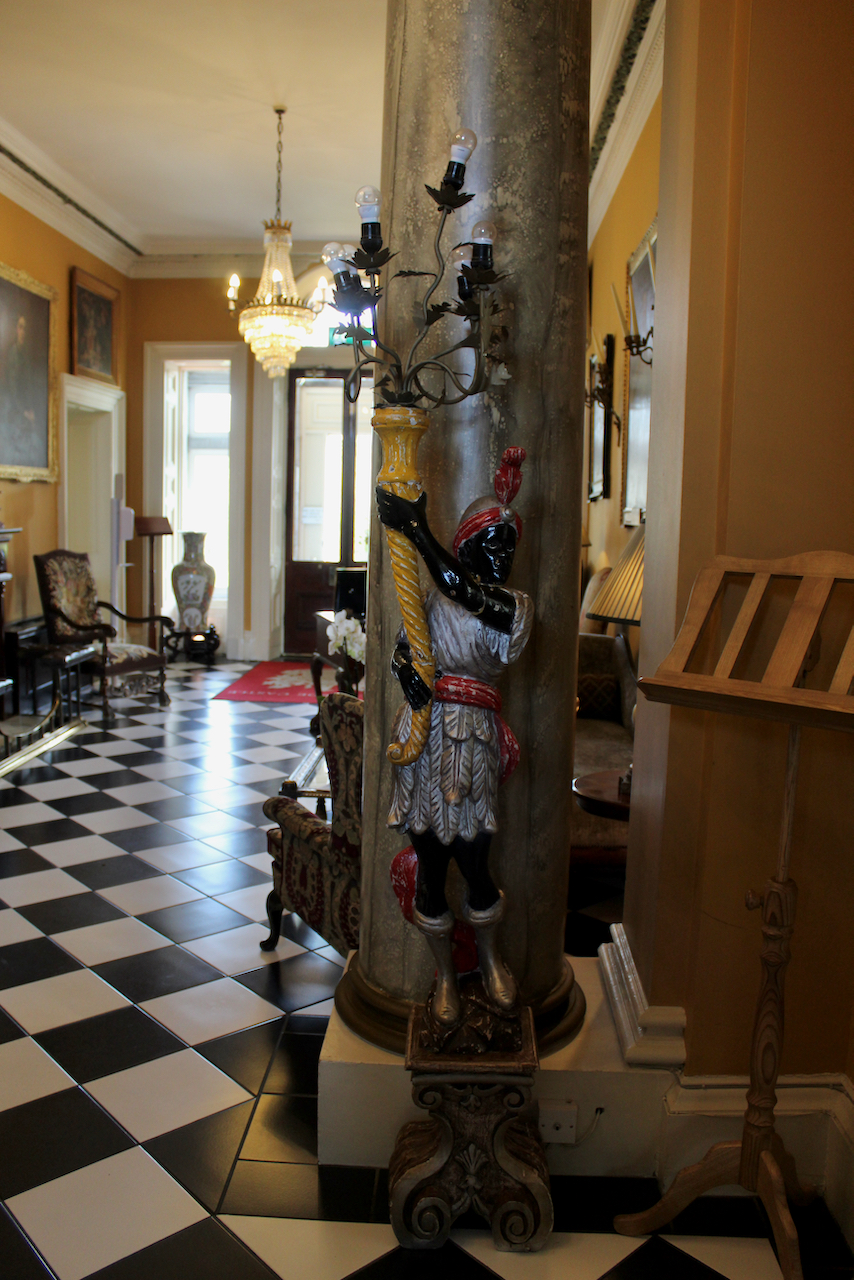
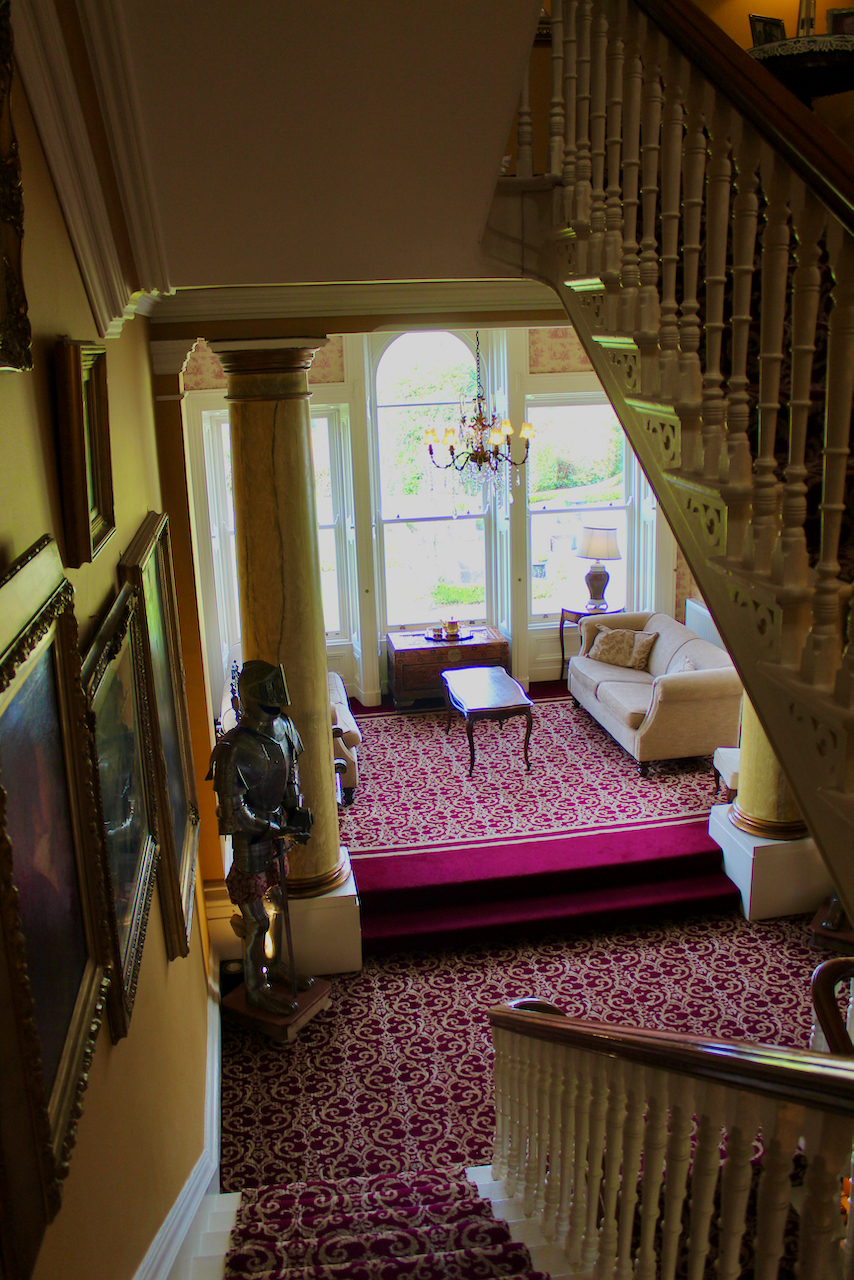
The stair hall of Ballyseede Castle. © Jennifer Winder-Baggot, www.irishhistorichouses.com
Everywhere there are little touches and treasures. © Jennifer Winder-Baggot, www.irishhistorichouses.com
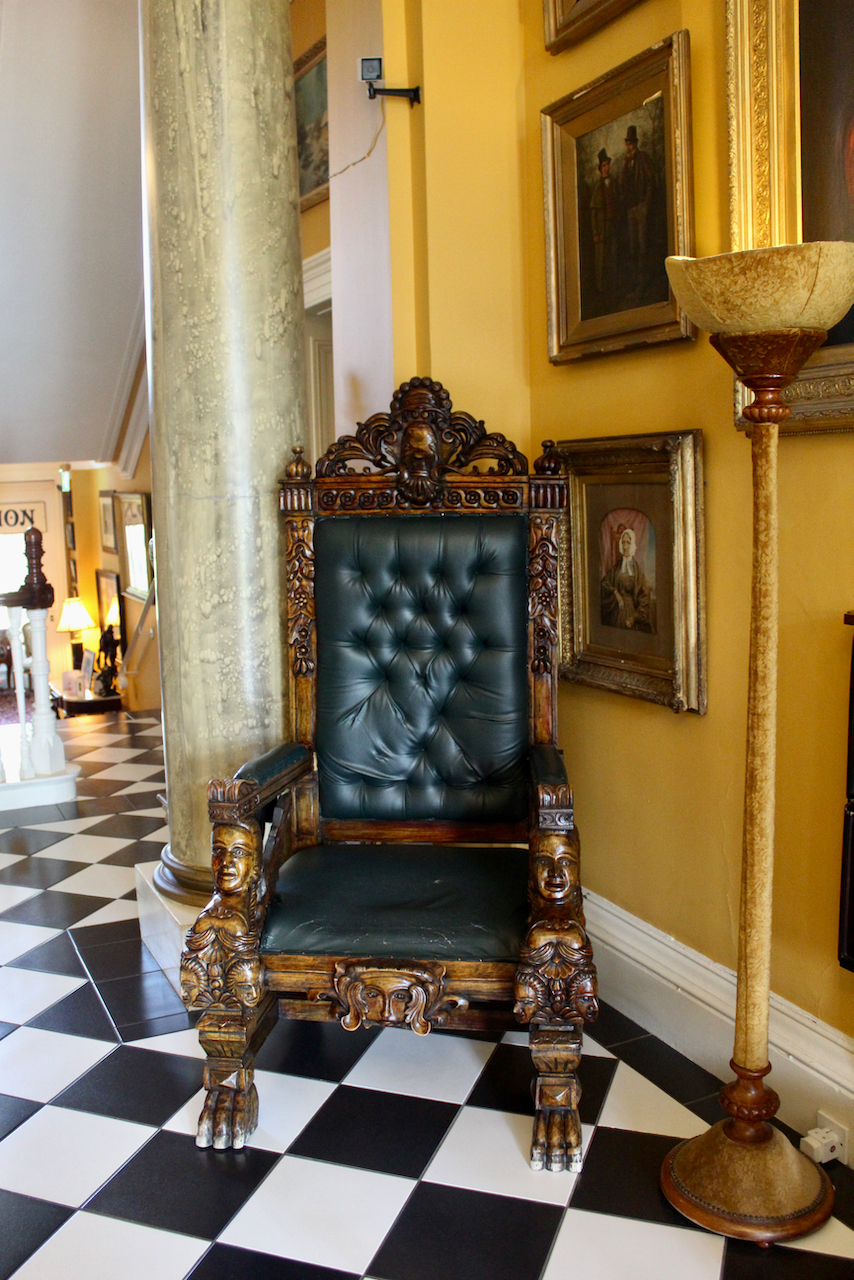
Stephen and I loved this carved chair in the front hall. © Jennifer Winder-Baggot, www.irishhistorichouses.com
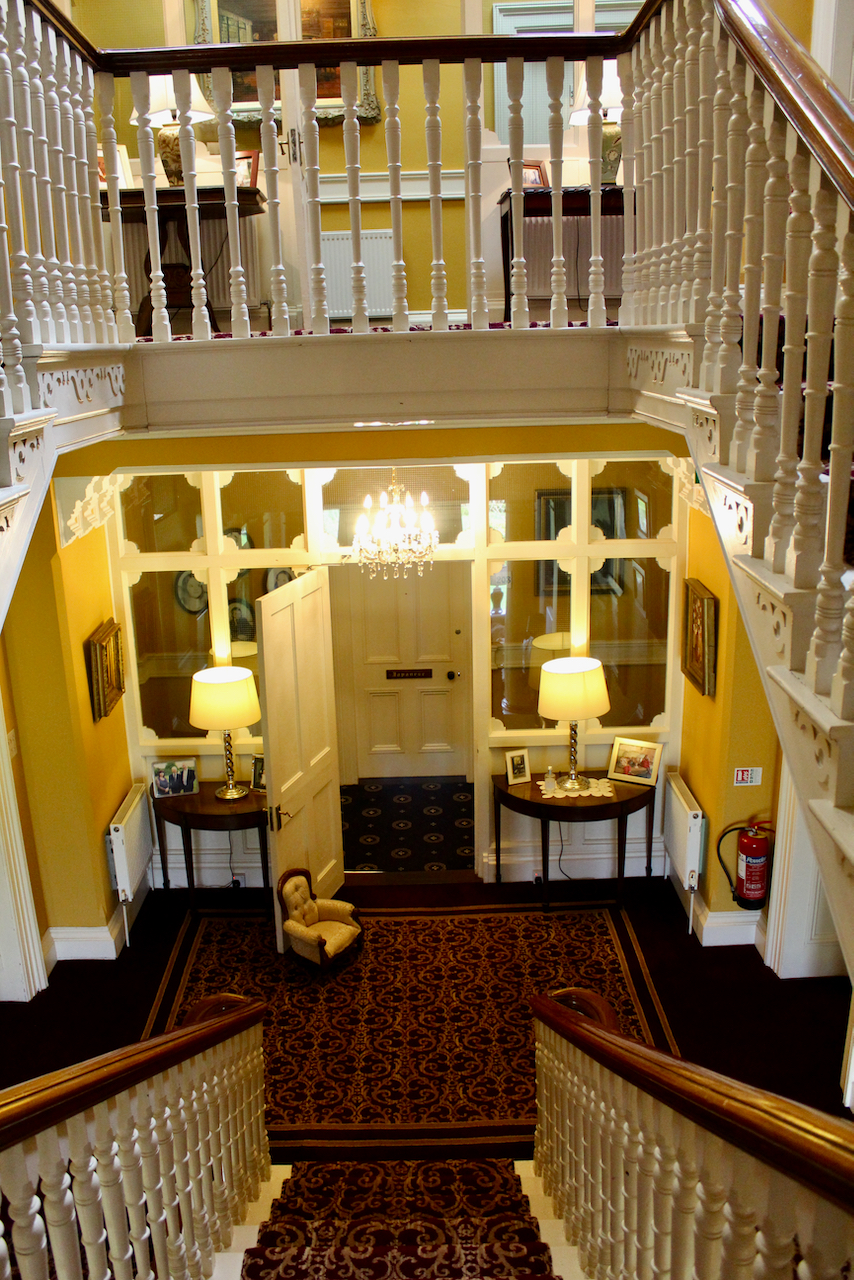
The halfway landing at Ballyseede Castle, March 2023. © Jennifer Winder-Baggot, www.irishhistorichouses.com
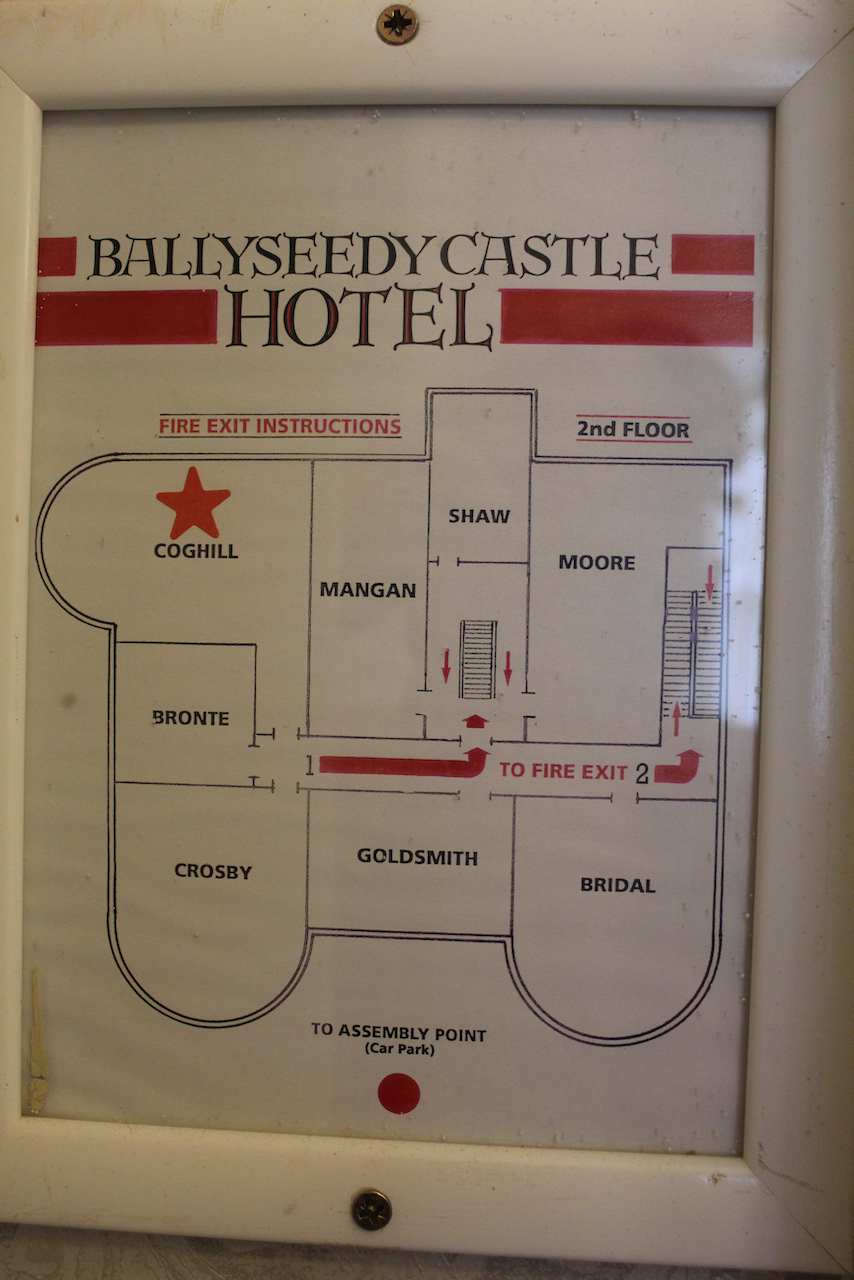
The first and second floors of Ballyseede Castle, March 2023. © Jennifer Winder-Baggot, www.irishhistorichouses.com

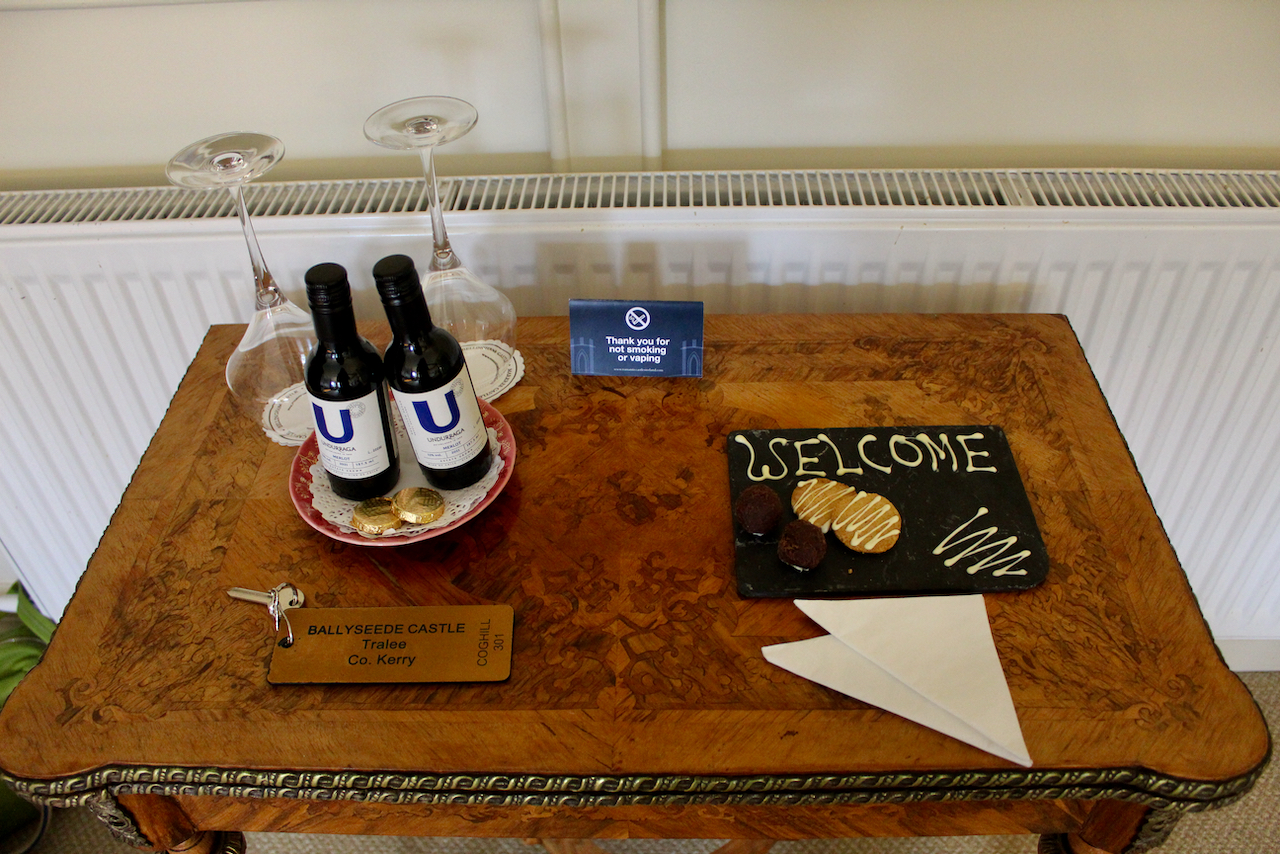
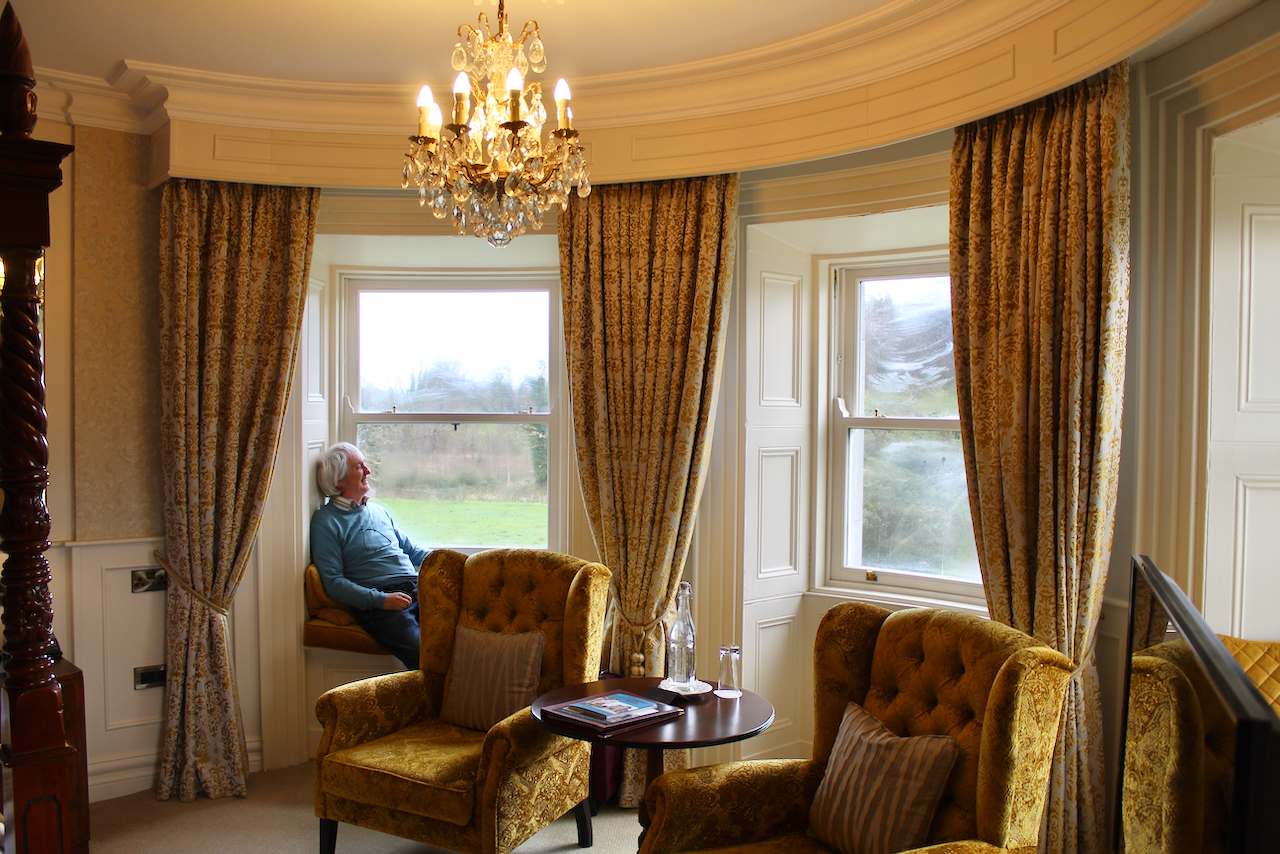
Marnie Corscadden was kind enough to upgrade us to a beautiful suite, complete with stand alone clawfoot bath! We had a wonderful stay.
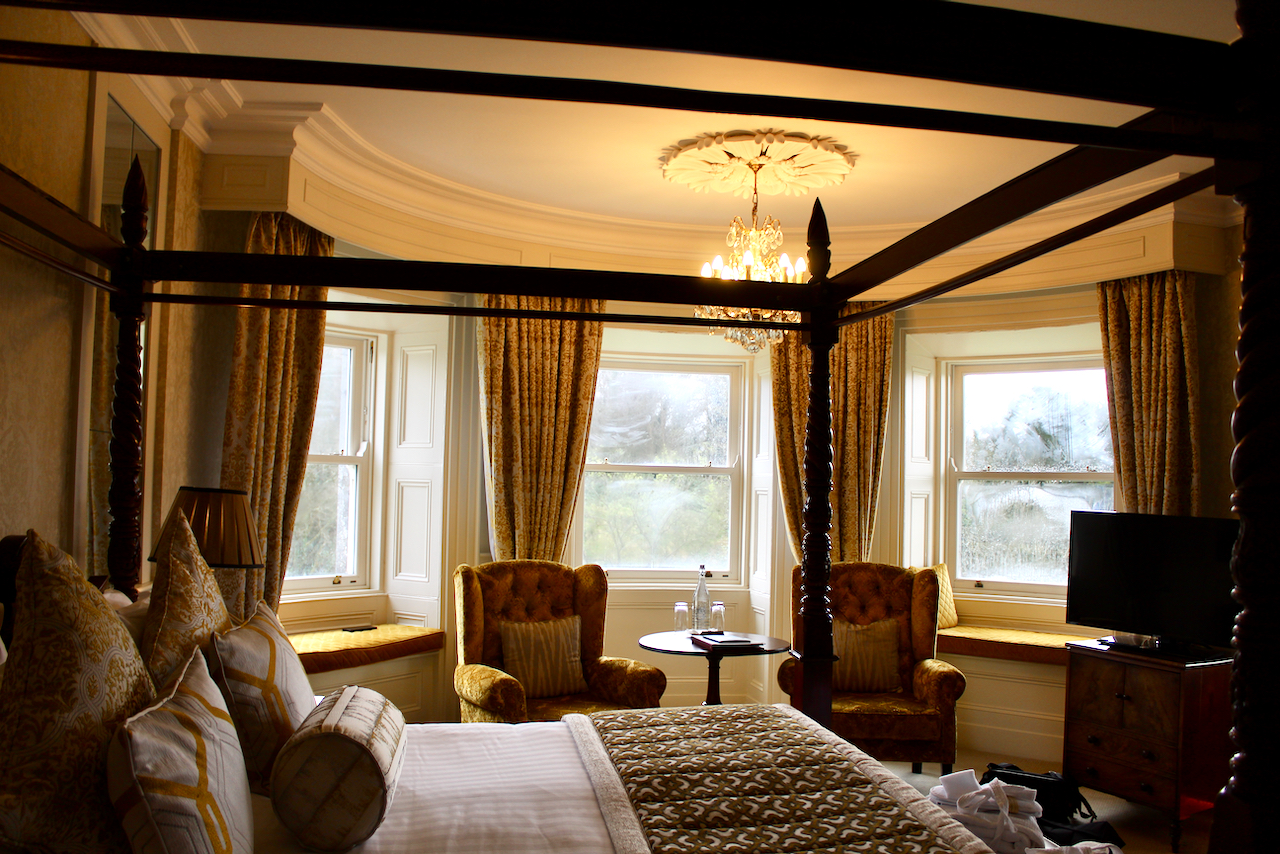
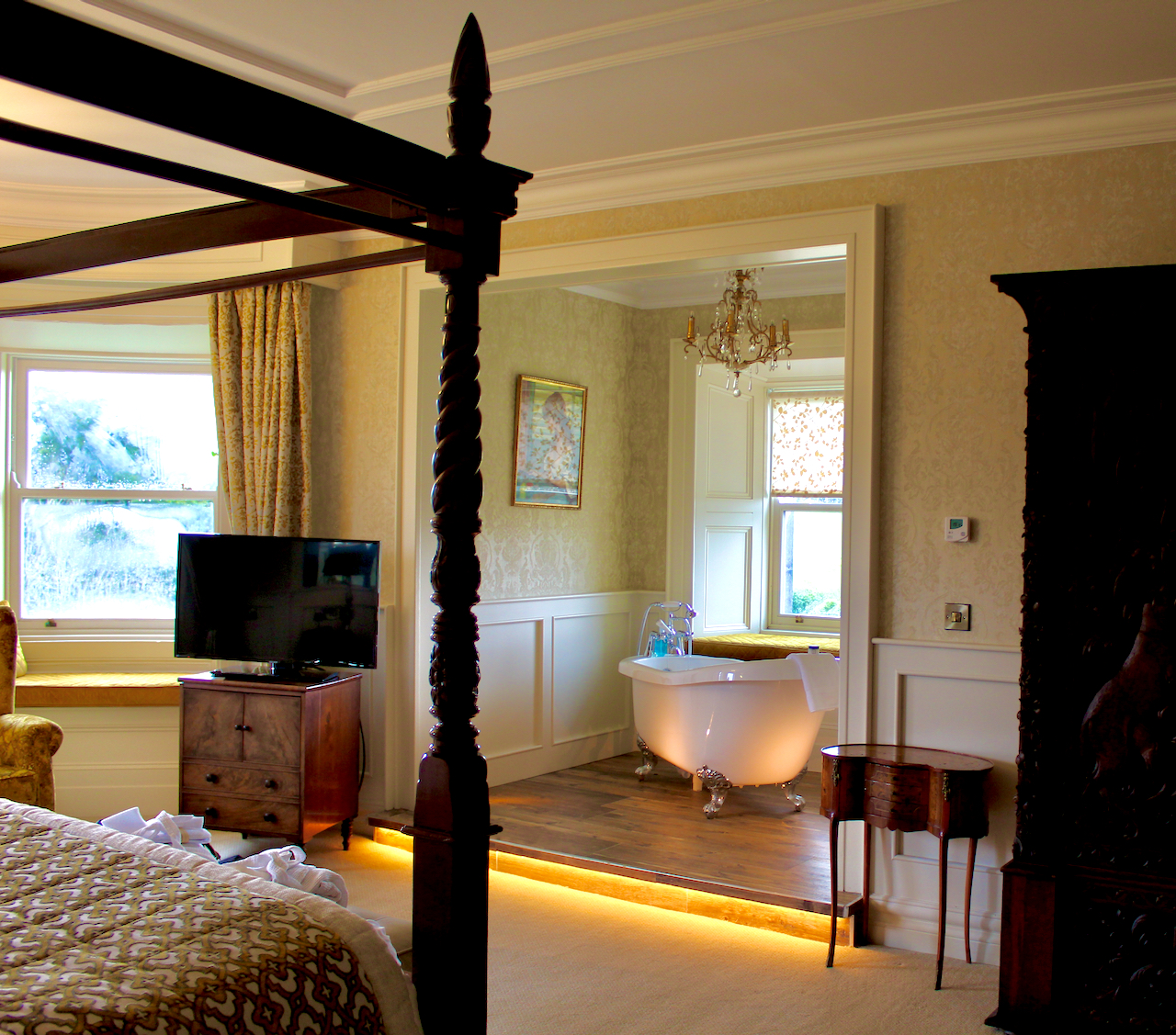
Our impressive bedroom, the Coghill suite. © Jennifer Winder-Baggot, www.irishhistorichouses.com
Our room in Ballyseede Castle, County Kerry, with a stand alone clawfoot bath. © Jennifer Winder-Baggot, www.irishhistorichouses.com
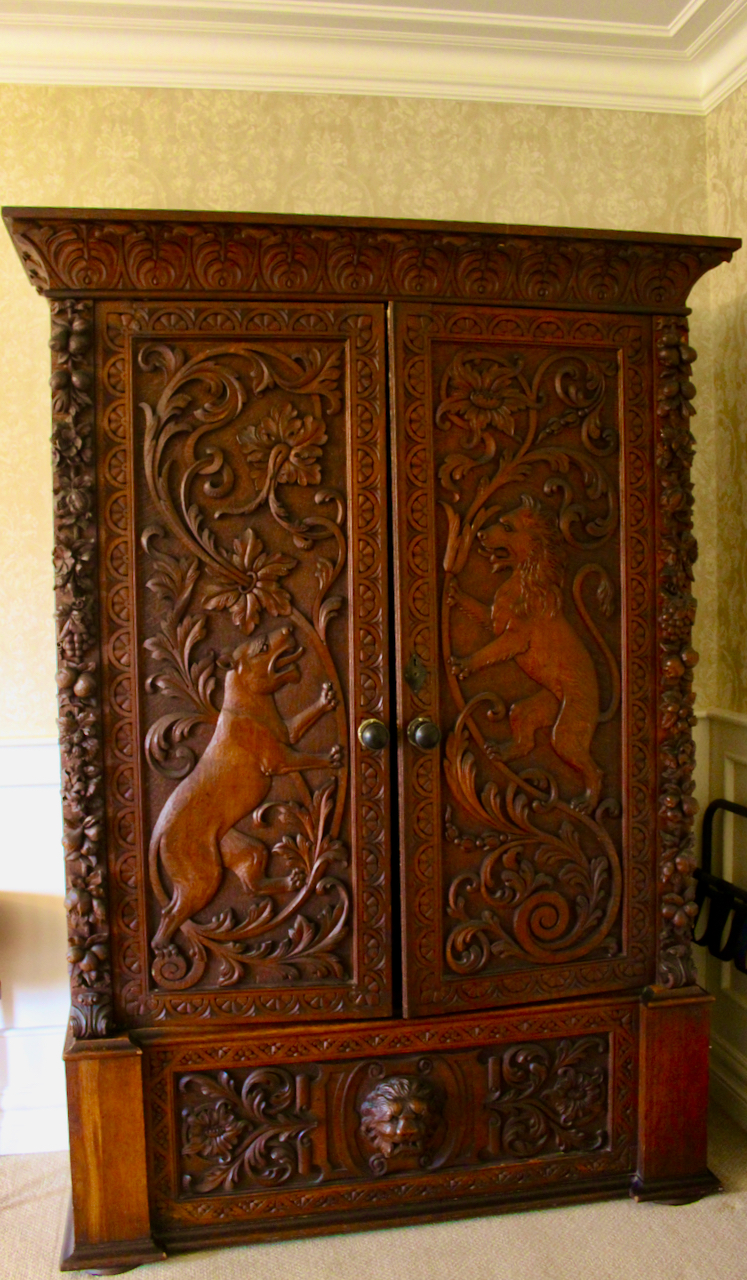
Our bedroom had an amazing carved wooden wardrobe. © Jennifer Winder-Baggot, www.irishhistorichouses.com
The carved wardrobe in our room. © Jennifer Winder-Baggot, www.irishhistorichouses.com
The rooms are named after various families associated with the Blennerhassetts. We stayed in the Coghill Room.
Busy at “work.” © Jennifer Winder-Baggot, www.irishhistorichouses.com
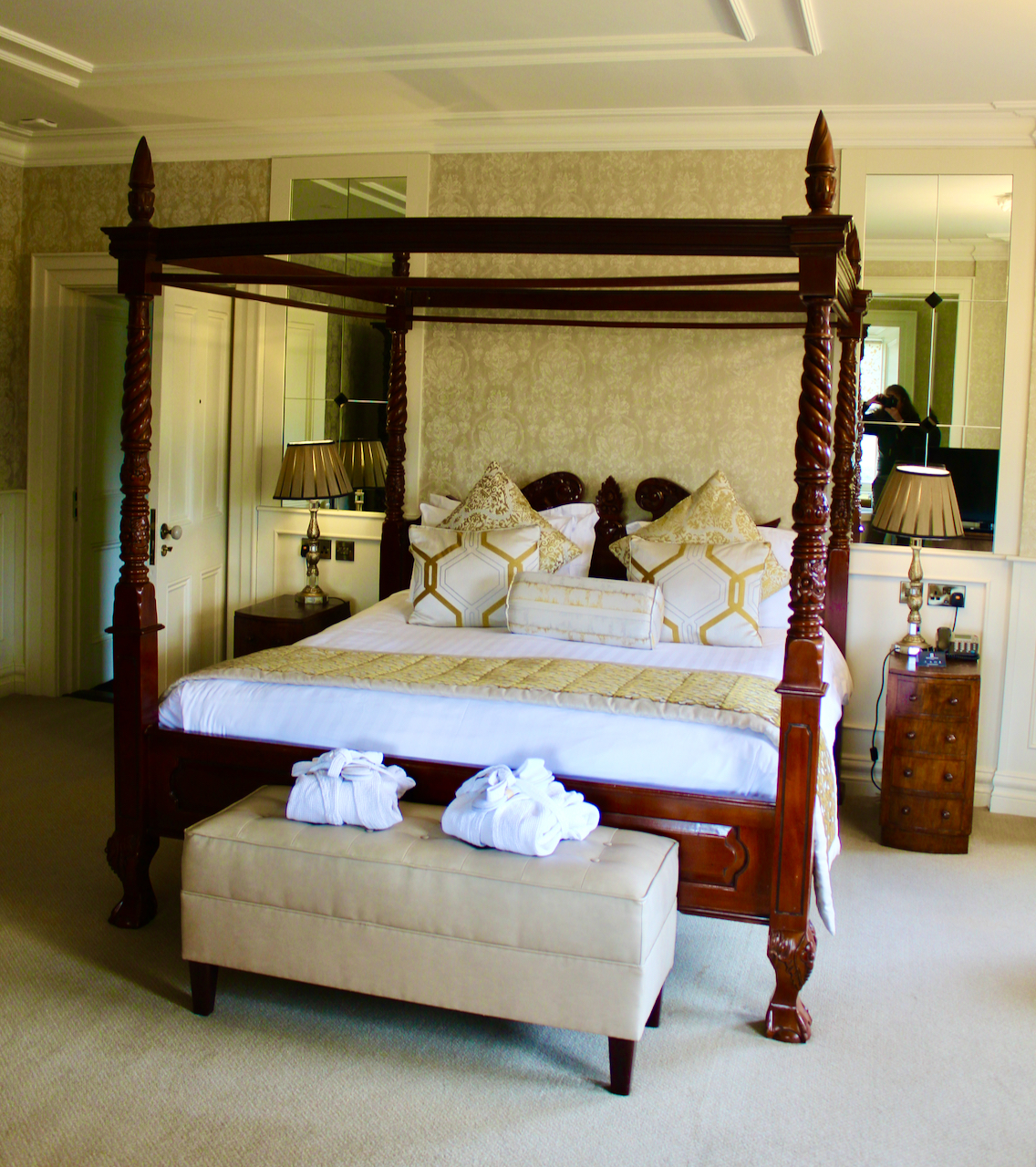
The bed was a work of art also. © Jennifer Winder-Baggot, www.irishhistorichouses.com
I can’t wait to go back sometime! © Jennifer Winder-Baggot, www.irishhistorichouses.com
Stephen admiring the view. © Jennifer Winder-Baggot, www.irishhistorichouses.com

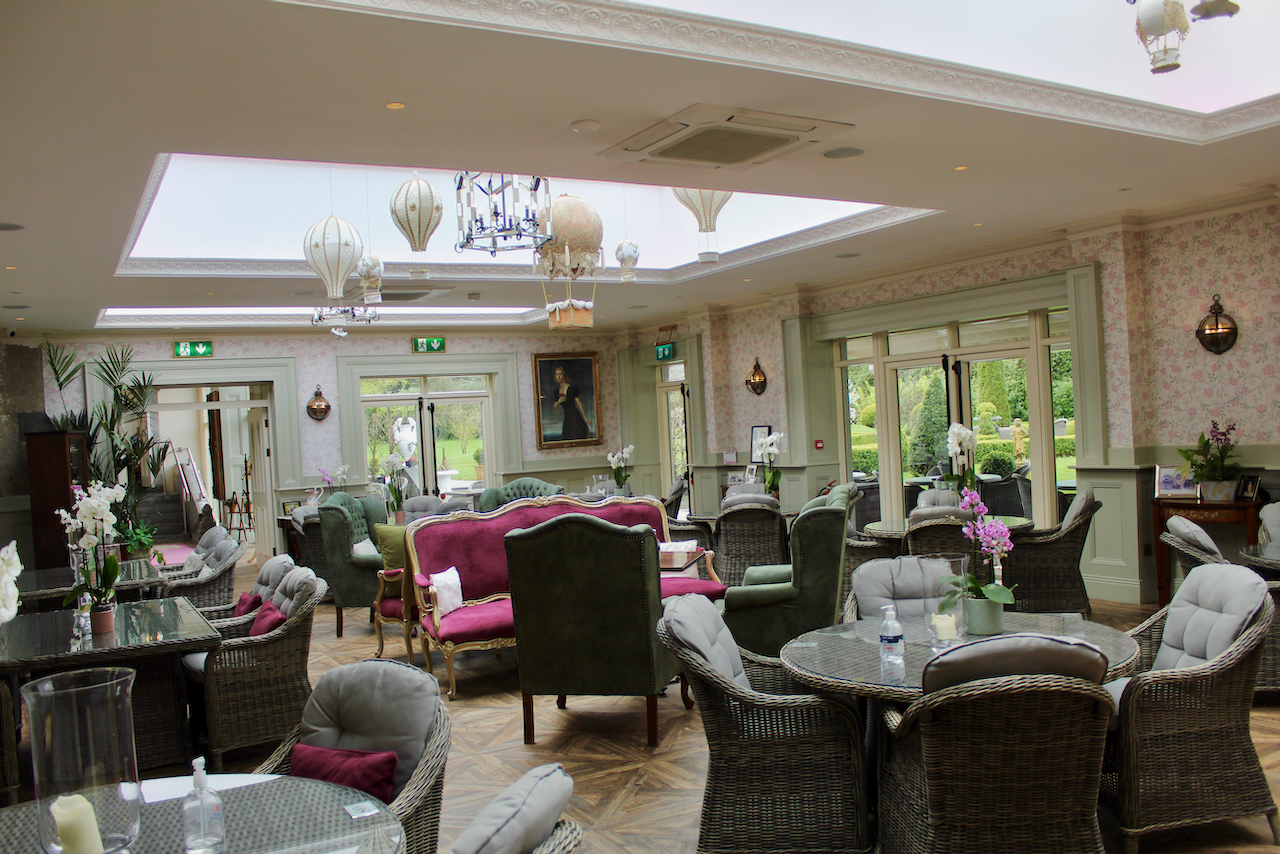
We explored the other rooms of the castle. The back gardens open into another function room, the Orangerie, which was built in 2017.
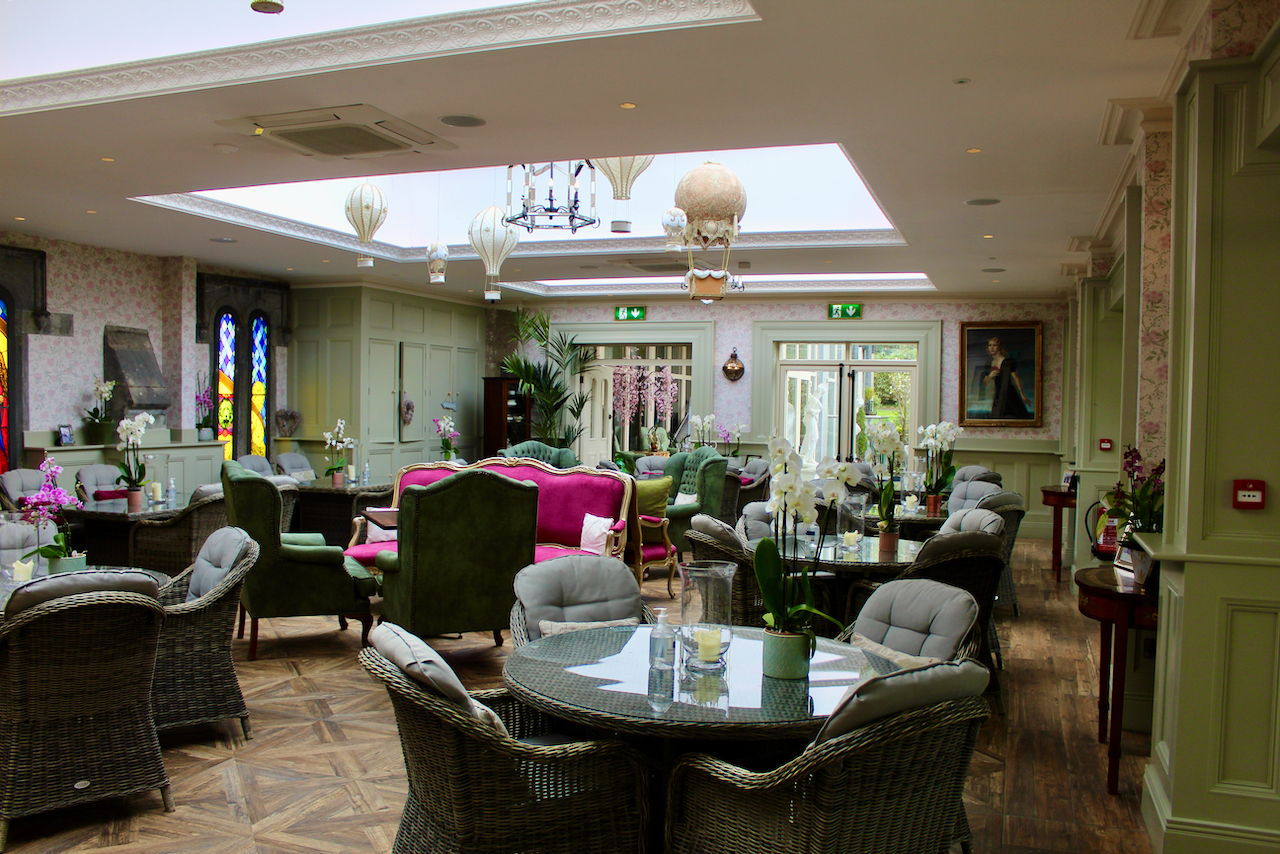
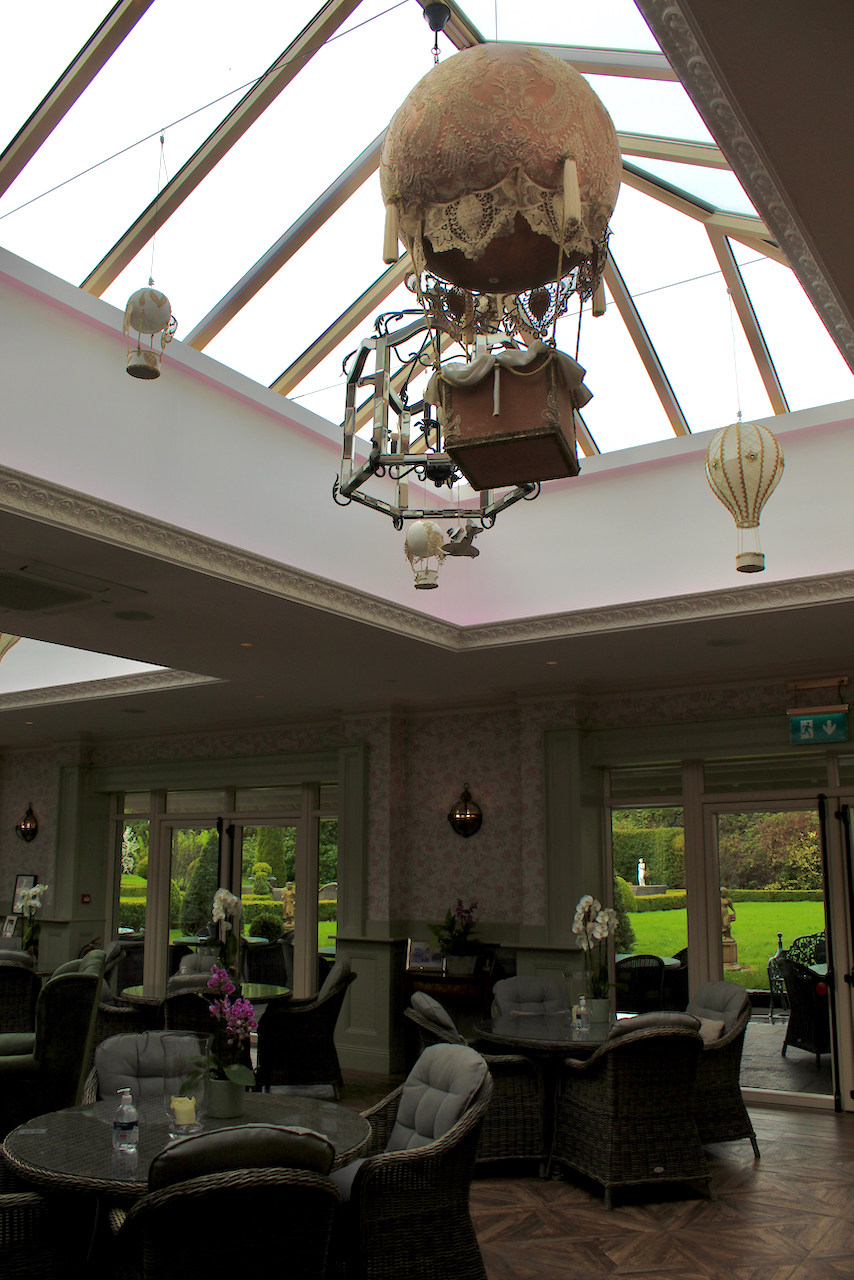
The Orangerie, built in 2017. © Jennifer Winder-Baggot, www.irishhistorichouses.com
I love the balloons! © Jennifer Winder-Baggot, www.irishhistorichouses.com
This rooms is very bright and comfortable. © Jennifer Winder-Baggot, www.irishhistorichouses.com
The Orangerie has some stained glass windows. © Jennifer Winder-Baggot, www.irishhistorichouses.com
A hallway along the back garden leads back to the reception area. © Jennifer Winder-Baggot, www.irishhistorichouses.com

There’s also a large reception room.
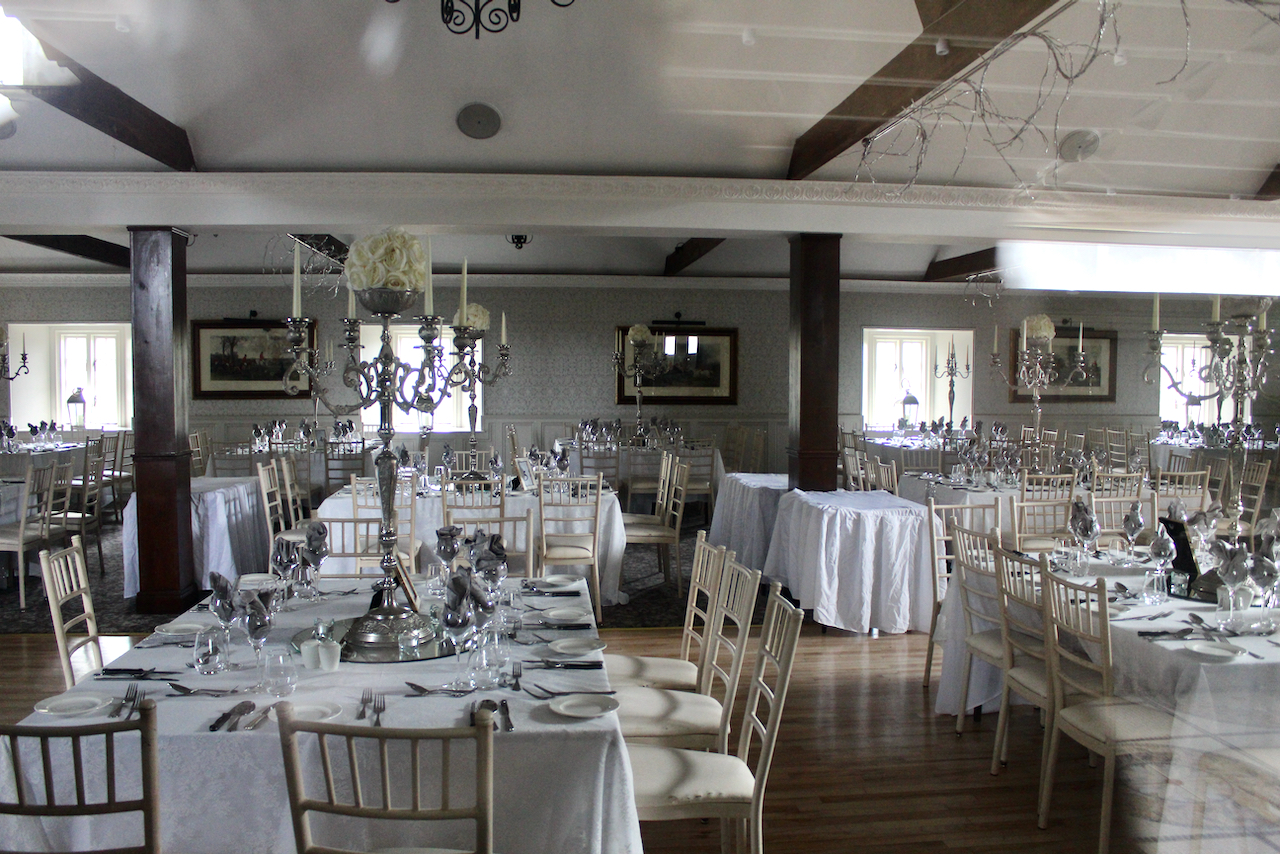
The banqueting hall in the north wing. We didn’t get to go into this room but I peered through the window to take a photograph. © Jennifer Winder-Baggot, www.irishhistorichouses.com
Ballyseede Castle, County Kerry. This leads to the large reception rooms. © Jennifer Winder-Baggot, www.irishhistorichouses.com
I noticed an old service bell in the hallway. © Jennifer Winder-Baggot, www.irishhistorichouses.com
We sneaked into another room to see it while it was open for cleaning – I love the Oriental decor. © Jennifer Winder-Baggot, www.irishhistorichouses.com

[1] https://landedestates.ie/family/1834

[2] Montgomery-Massingberd, Hugh. Burke’s Irish Family Records. London, U.K.: Burkes Peerage Ltd, 1976.

List of M.P.s for County Kerry:

1692: Edward Denny (1652-1709 or 1712) of Tralee Castle; Thomas Fitzmaurice (1668-1741) 1st Earl of Kerry

1697: Edward Denny (1652-1709 or 1712) of Tralee Castle; William Sandes

1703: Edward Denny (d. 1727/8, son of Edward Denny (1652-1709 or 1712) of Tralee Castle); John Blennerhassett (d. 1709)

1709: Edward Denny (1676–1727/8); John Blennerhassett (1691-1775)

1715: John Blennerhassett (1691-1775); Maurice Crosbie (c. 1689 –1762) 1st Baron Brandon, of Ardfert, County Kerry

1727: Maurice Crosbie (c. 1689 –1762) 1st Baron Brandon; Arthur Denny (1704-1742), son of Edward Denny (1676–1727/8)

1743: Maurice Crosbie (c. 1689 –1762) 1st Baron Brandon; John Petty-Fitzmaurice (1706-1761) 1st Earl of Shelburne, son of Thomas Fitzmaurice (1668-1741) 1st Earl of Kerry

1751: Maurice Crosbie (c. 1689 –1762) 1st Baron Brandon; John Blennerhassett (1715-1763), son of John Blennerhassett (1691-1775)

1759: John Blennerhassett (1715-1753); Lancelot Crosbie (1723-1780)

1761: William Petty-Fitzmaurice (1737-1805) 1st Marquess of Lansdowne; Lancelot Crosbie (1723-1780)

1762: John Blennerhassett (1715-1763)

1763: John Blennerhassett (1691-1775); Thomas Fitzmaurice

1768: John Blennerhassett (1691-1775); Barry Denny (c. 1744-1794), 1st Baronet

1775: Barry Denny (c. 1744-1794), 1st Baronet; Arthur Blennerhassett (1719-1799) son of John Blennerhassett (1691-1775)

1776: Arthur Blennerhassett (1719-1799); Rowland Bateman (c. 1737-1803)

1783: Barry Denny (c. 1744-1794) 1st Bt; Richard Townsend Herbert (1755-1832)

1790: Barry Denny (c. 1744-1794) 1st Bt; John Blennerhassett (1769-1794)

1794: Barry Denny (d. 1794 in in dual with John Gustavus Crosbie) 2nd Bt; John Gustavus Crosbie (c. 1749-1797) son of Lancelot Crosbie (1723-1780)

1795: Maurice Fitzgerald (1774-1849) 18th Knight of Kerry; John Gustavus Crosbie (c. 1749-1797)

1798: Maurice Fitzgerald (1774-1849) 18th Knight of Kerry; James Crosbie (c. 1760-1836)

[3] p. 157. O’Hea O’Keeffe, Jane. Voices from the Great Houses: Cork and Kerry. Mercier Press, Cork, 2013.

[4] http://www.blennerhassettfamilytree.com/Ballyseedy-Castle.php

[5] National Inventory: https://www.buildingsofireland.ie/buildings-search/building/21302913/ballyseede-castle-ballyseedy-co-kerry

[6] http://www.thepeerage.com/p27968.htm#i279679

[7] p. 28. Bence-Jones, Mark. A Guide to Irish Country Houses (1988)

[8] http://www.blennerhassettfamilytree.com/Ballyseedy-Castle.php

Places to visit and stay in County Kerry, Munster

On the map above:

blue: places to visit that are not section 482

purple: section 482 properties

red: accommodation

yellow: less expensive accommodation for two

orange: “whole house rental” i.e. those properties that are only for large group accommodations or weddings, e.g. 10 or more people.

green: gardens to visit

grey: ruins

Munster’s counties are Clare, Cork, Kerry, Limerick, Tipperary and Waterford.

For places to stay, I have made a rough estimate of prices at time of publication:

€ = up to approximately €150 per night for two people sharing (in yellow on map);

€€ – up to approx €250 per night for two;

€€€ – over €250 per night for two.

For a full listing of accommodation in big houses in Ireland, see my accommodation page: https://irishhistorichouses.com/accommodation/

donation

Help me to pay the entrance fee to one of the houses on this website. This site is created purely out of love for the subject and I receive no payment so any donation is appreciated!

€15.00

Kerry:

1. Derrynane House, Caherdaniel, County KerryOPW

2. Derreen Gardens, Lauragh, Tuosist, Kenmare, Co. Kerry – section 482, garden only

3. Dhu Varren garden, Knockreigh, Milltown, Kerry, V93 VX27

4. Kells Bay House & Garden, Kells, Caherciveen, County Kerry section 482, garden only

5. Killarney House, County Kerry

6. Knockreer House and Gardens, County Kerry

7. Listowel Castle, County KerryOPW

8. Muckross House,  Killarney, County Kerryopen to visitors 

9. Ross’s Castle, Killarney, County Kerry

10. Staigue Fort, County Kerry

11. Tarbert House, Tarbert, Co. Kerry – section 482

Places to Stay, County Kerry:

1. Ard na Sidhe Country House, Killarney, County Kerry

2. Ballyseede Castle/ Ballyseedy (Tralee Castle), Tralee, County Kerry hotel, €€

4. Cahernane (or Cahirnane) House, Killarney, County Kerry – hotel 

5. Carrig Country House, County Kerry €€€

6. Castlemorris House, Tralee, County Kerry

7. Dromquinna Estate, County Kerry€€

8. Fahagh Court, Beaufort, County Kerry – now Killarney Country Club and accommodation €

9. Glanleam, Valentia Island, County Kerry – accommodation

11. Kells Bay House & Garden, Kells, Caherciveen, County Kerry € 

12. Muxnaw Lodge, Kenmare, County Kerry € 

13. Parknasilla Resort and Spa, Kenmare, County Kerry 

Whole House Rental County Kerry:

1. Ballywilliam House, Kinsale, County Kerry – whole house rental, up to 16

3. Churchtown House, Killarney, County Kerry – whole house rental (sleeps 12)

4.  Coolclogher House, Killarney, County Kerry – whole house rental (up to 16 people)

Places to visit in County Kerry:

1. Derrynane House, Caherdaniel, KerryOPW

Derrynane House, County Kerry, photograph by George Munday, 2014, for Tourism Ireland, Ireland’s Content Pool. [1]

See my OPW write-up: https://irishhistorichouses.com/2022/11/07/office-of-public-works-properties-in-munster-counties-kerry-and-waterford/

Daniel O’Connell, who lived at Derrynane. Portrait in Mansion House, Dublin, Photograph © Jennifer Winder-Baggot, www.irishhistorichouses.com

2. Derreen Gardens, Lauragh, Tuosist, Kenmare, Co. Kerrysection 482, garden only

https://www.derreengarden.com/
Open dates in 2025: all year, 10am-6pm

Fee: adult/OAP/student €10, child €5, family ticket €30 (2 adults & all accompanying children under18) 20% discount for groups over 10 people

See my entry https://irishhistorichouses.com/2023/09/07/derreen-gardens-lauragh-tuosist-kenmare-co-kerry/

The website tells us: “A beautiful 19th century woodland garden with paths winding through rare tropical plants and opening onto sea views.

Derreen, County Kerry. Photograph © Jennifer Winder-Baggot, www.irishhistorichouses.com

Set on a peninsula at the head of Kilmackillogue Harbour and surrounded by the Caha Mountains, the garden at Derreen covers 60 acres.

A network of winding paths passes through a mature woodland garden laid out 150 years ago with subtropical plants from around the world and incomparable views of the sea and mountains.

3. Dhu Varren garden, Knockreigh, Milltown, Kerry, V93 VX27

www.dhuvarrengarden.com 

The website tells us:

Dhu Varren Garden, owned by Mark and Laura Collins, began its development in 2001. Since then it has grown to contain one of the largest and most diverse plant collections of any private garden in Ireland. This continues to grow as new and exciting plants are sourced from around the world. It has been described by visitors as ‘Kerry’s Botanical Garden’.

4. Kells Bay House & Garden, Kells, Caherciveen, Co Kerry, V23 EP48 – section 482, garden only

www.kellsbay.ie 

Kells Bay House and Gardens, Co Kerry. Photo: Valerie O’Sullivan, 2015 for Tourism Ireland, Ireland’s Content Pool (see [1])

Open in 2025: Jan 1-4, Feb 1-Dec 21, 27-31, Jan-Apr, Oct-Dec 9am-5pm, May-Sept 9am-6pm

Fee: adult €9.50, child €7.50, family €30 (2 adults and up to 3 children 17 years or under) concessions 10% on groups up to 20 persons

See my entry https://irishhistorichouses.com/2023/09/13/kells-bay-house-garden-kells-caherciveen-county-kerry/

The website tells us: “Kells Bay Gardens is one of Europe’s premier horticultural experiences, containing a renowned collection of Tree-ferns and other exotic plants growing in its unique microclimate created by the Gulf Stream. It is the home of ‘The SkyWalk’ Ireland’s longest rope-bridge.

The rope bridge crosses the river. Kells Bay, March 2023. Photograph © Jennifer Winder-Baggot, www.irishhistorichouses.com

5. Killarney House, County Kerry

https://killarney.ie/listing/killarney-house-gardens/

Originally called Kenmare House. The stable block of Kenmare House was converted in 1830 into this house. The original Kenmare House was built in 1726 and was demolished in 1872 by Valentine Augustus Browne, 4th Earl of Kenmare. The succeeding house, called Killarney House, and was accidentally destroyed by fire in 1913 and never rebuilt; instead, in 1915 the stable block of the original Kenmare House was converted into the present Killarney House, although the Brownes called it Kenmare House.

Kenmare House Kerry Photograph taken between 1880 and 1914 Lawrence Collection, National Library of Ireland NLI Ref L_CAB_01020
Killarney House and Gardens, photograph ©Fáilte Ireland by Finola White, 2020, Ireland’s Content Pool.

John McShain, renowned architect and building contractor, acquired Killarney House, the former home of the Earls of Kenmare, in 1956. After the death of McShain’s wife, Mary, in 1998, the stately house, and its lavish gardens were sold to the State with the proviso that the property would be incorporated into the neighbouring Killarney National Park. The McShains were allowed to live in the house for the remainder of their lives, and they remodelled extensively. When Mrs. McShain died in 1998 the house reverted to the state. It sat empty and became derelict, but in 2011 restoration was begun. The gardens are open to the public and at some stage, the house also will be opened up.

6. Knockreer House and Gardens, County Kerry

https://www.discoverireland.ie/kerry/knockreer-house-and-gardens

The website tells us:

Found in County Kerry’s Killarney National Park, Knockreer House and Gardens are within walking distance of Killarney Town. The area includes a circular walk with excellent views of the Lower Lake.

The Knockreer section of Killarney National Park is within walking distance of Killarney Town, County Kerry. This area was formerly part of the Kenmare Estate, which was laid out by Valentine Brown, the third Viscount of Kenmare. Deenagh Lodge Tearoom dates back to 1834 and was the gate lodge of the Kenmare Estate. The tearoom is a popular haunt with locals and visitors after a stroll in the park. It is located just inside Kings Bridge across from St Mary’s Cathedral.

Knockreer House, a short walk up the hill, is the Killarney National Park Education Centre and is built on the site of the original Killarney House, which was destroyed by fire in 1913. The circular walk is signposted and offers excellent views of the Lower Lake. On the circular walk there is a pathway off to the right that leads up to the viewing point on top of the hill, which provides a wonderful panorama of the surrounding countryside.

7. Listowel Castle, County Kerry – OPW

See my OPW write-up: https://irishhistorichouses.com/2022/11/07/office-of-public-works-properties-in-munster-counties-kerry-and-waterford/

8. Muckross House (or Muckruss),  Killarney, County Kerry

Muckross House Killarney Co. Kerry, photograph by Chris Hill 2014 for Tourism Ireland, Ireland’s Content Pool. (see [1])

www.muckross-house.ie 

This nineteenth century Victorian mansion is set against the stunning beauty of Killarney National Park. The house stands close to the shores of Muckross Lake, one of Killarney’s three lakes, famed world wide for their splendour and beauty. As a focal point within Killarney National Park, Muckross House is the ideal base from which to explore this landscape. 

Muckross House was built for Henry Arthur Herbert and his wife, the water-colourist Mary Balfour Herbert. This was actually the fourth house that successive generations of the Herbert family had occupied at Muckross over a period of almost two hundred years. William Burn, the well-known Scottish architect, was responsible for its design. Building commenced in 1839 and was completed in 1843. 

Originally it was intended that Muckross House should be a larger, more ornate, structure. The plans for a bigger servants’ wing, stable block, orangery and summer-house, are believed to have been altered at Mary’s request. Today the principal rooms are furnished in period style and portray the elegant lifestyle of the nineteenth century landowning class. In the basement, one can imagine the busy bustle of the servants as they went about their daily chores. 

Muckross House and Gardens, Killarney National Park, Co Kerry ©Trustees of Muckross House 2019.
Muckross House and Gardens, Killarney National Park, Co Kerry Muckross House and Gardens, Killarney National Park, Co Kerry ©Trustees of Muckross House 2017.

During the 1850s, the Herberts undertook extensive garden works in preparation for Queen Victoria’s visit in 1861. Later, the Bourn Vincent family continued this gardening tradition. They purchased the estate from Lord and Lady Ardilaun early in the twentieth century. It was at this time that the Sunken Garden, Rock Garden and the Stream Garden were developed.

Muckross House, County Kerry, October 2012. Photograph © Jennifer Winder-Baggot, www.irishhistorichouses.com
Muckross House 1970, photograph from Dublin City Library and Archive. [2]
Muckross House Killarney Co. Kerry, photograph by Chris Hill 2014 for Tourism Ireland, Ireland’s Content Pool. (see [1])

9. Ross’s Castle, Killarney, County Kerry

See my OPW write-up: https://irishhistorichouses.com/2022/11/07/office-of-public-works-properties-in-munster-counties-kerry-and-waterford/

Ross Castle, Killarney, County Kerry, August 2007.

10. Staigue Fort, County Kerry

Staigue Fort, County Kerry, October 2012. Photograph © Jennifer Winder-Baggot, www.irishhistorichouses.com

The following website gives us information about this ancient impressive fort: https://voicesfromthedawn.com/staigue-fort/

It tells us:

Constructed entirely without mortar, Staigue cashel encloses an area of 27.4 m (90 ft) in diameter, with walls as tall as 5.5 m (18 ft) and a sturdy 4 m (13 ft) in thickness. It has one double-linteled entrance, a passageway 1.8 m (6 ft) long. In the virtual-reality environment (above) click the hotspots to proceed to the fort’s interior. It is similar in construction to the Grianan of Aileach in Co. Donegal, and was possibly constructed in the same period of the Early Medieval period (approximately fifth to eleventh century CE). The fort is surrounded by a large bank and ditch, most evident on its northern side. This may have been a part of Staigue’s defenses, or it may be a prehistoric feature that pre-dates the construction of the stone fort.

Staigue Fort, October 2012 Photograph © Jennifer Winder-Baggot, www.irishhistorichouses.com

The website continues: “In 1897 T.J. Westropp reported that the local peasantry called the building Staig an air, which he translated as “Windy House, or “Temple of the Father,” or “The Staired Place of Slaughter.” These different translations may inspire distinctly different conjectures about the builders of Staigue. It has been described as both a temple or an observatory, and has been attributed to many different cultures in the past, such as Druids, Phoenicians, Cyclopeans, and Danes. But it was, of course, built by the “Kerrymen of old.”

Staigue Fort, October 2012. Photograph © Jennifer Winder-Baggot, www.irishhistorichouses.com

The sign at the site explains that Staigue “was the home of the chieftain’s family, guards and servants, and would have been full of houses, out-buildings, and possibly tents or other temporary structures.” The illustration from this sign is in the gallery below. Cashels, of which Staigue is an impressive and probably high-status example, were enclosed and defendable farmsteads of the Irish Early Medieval period. They housed an extended family and, in high-status examples, their retinue. However archaeologist Peter Harbison was unable to explain why the ancient architects would have created so many (10) sets of X-shaped stairs climbing up the inner face of the wall to its ramparts.

11. Tarbert House, Tarbert, Co. Kerry – section 482

Open dates in 2025: Jan 1-4, 6-11, 13-18, 20-25, 27-31, May 1-3, 5-10, 12-17, 19-24, 26-31, July 1-5, 7-12, 14-19, 21-26, 28-30, Aug 1-2, 4-9, 11-31, 10am-12 noon, 2pm-4pm

Fee: adult/OAP/student €5, child free

Tarbert House, County Kerry, photograph from National Inventory of Architectural Heritage.

Tarbert House, near the town of that name in County Kerry, stands in wooded parkland beside the River Shannon, a few miles downstream from Glin and just across the county bounds. The plain, square, seven-bay seat of James Leslie, erstwhile Bishop of Limerick, was built precisely in the middle of his diocese for convenience, and dates from the 1750s. The house, which is still owned by the bishop’s descendants, was given an additional storey in the mid-19th century but retains its mid-Georgian character and plan, with robust joinery and chimneypieces, and a fine collection of family portraits, furniture, papers and objects.” [3]

Places to Stay, County Kerry: 

1. Ard Na Sidhe, Killarney, County Kerry

https://www.ardnasidhe.com

2. Ballyseede Castle, Tralee, Co. Kerry – section 482, also a hotel for accommodation €€

www.ballyseedecastle.com
Open dates in 2025: Mar 14-Dec 31, 8am-12 midnight
Fee: Free to visit.

We treated ourselves to a stay in 2023. See my entry: https://irishhistorichouses.com/2023/09/02/ballyseede-castle-ballyseede-tralee-co-kerry/

Ballyseede Castle, County Kerry. Photograph © Jennifer Winder-Baggot, www.irishhistorichouses.com

The website https://www.barrowhouse.ie/ tells us the House and Gardens are available for bed & breakfast guests or as an exclusive venue for corporate functions, private group rentals and intimate, small scale weddings. They are members of the Historic Houses of Ireland association, which tells us of the history of the house:

Nestling on the shore of stunning Barrow Harbour with views of the glorious Slieve Mish Mountains, Barrow House in Co. Kerry has a rich history of ownership from knights to noblemen and smugglers.

Built in around 1715, it possibly incorporates the fabric of an earlier house from during or after the Cromwellian period (1649-57). The sublime Georgian front elevation of Barrow House was added as part of the structural rebuild and enlargement work carried out at some point before 1760, while a second sympathetic addition was made at the rear towards the end of the 1800s. The house has changed little over the years. In fact, its still-visible four-feet thick internal walls, two gable end chimney stacks, original interior features, handcrafted ceiling mouldings and sash windows with antique glass exude the restrained, rational elegance typical of a noble dwelling. 

Alongside is a detached seven-bay single- and two-storey former boathouse, c. 1800, on a U-shaped plan. Barrow’s lands were originally part of the 6,000 acres granted by Elizabeth 1 in 1587 to Sir Edward Denny for his loyalty following the Desmond Rebellion. Nearby are the ruins of an ancient church referred to in Papal documents 1302-07 as “Ecclesia of Barun” or the Church of Barun (Barrow). 

Over the centuries, the house and the estate were passed on through marriage or by sale to different owners, including the notorious smuggler, John Collis. The smuggling of wines and tobacco was prevalent in Kerry during the 17th and 18th centuries in particular and Barrow Harbour was a natural rendezvous with its caves and narrow inlets. In the first half of the 20th century, the Knights of Kerry, the Fitzgerald family, affectionately referred to Barrow House as their summerhouse.  In more recent years, it was purchased by an American, Maureen Erde, who published a popular account of running it as a golfers’ guesthouse entitled “Help me, I’m an Irish Inn Keeper”. After she sold it in 1999, the house was restored as a resort estate, flourishing for some years before enduring a period of neglect and abandonment. Barrow House’s current owner, Daragh McDonagh, purchased it in 2016 and has lovingly restored it to welcome guests.

4. Cahernane (or Cahirnane) House, Killarney, Co Kerry – hotel

 https://www.cahernane.com

Cahernane House, County Kerry, photograph from National Inventory of Architectural Heritage, which tells us it is a seven-bay two-storey over part-raised basement Ruskinesque Gothic Revival style country house with dormer attic, dated 1877, possibly incorporating fabric of earlier house. Designed by James Franklin Fuller.

The website tells us:

Beautifully situated on a private estate on the edge of Killarney National Park, our luxury four-star hotel is located just twenty minutes’ walk from Killarney town centre. The entrance to the hotel is framed by a tunnel of greenery which unfurls to reveal the beauty of this imposing manor house, constructed in 1877 and formerly home to the Herbert Family.

Cahernane House Hotel exudes a sense of relaxation and peacefulness where you can retreat from the hectic pace of life into a cocoon of calmness and serenity. The only sounds you may hear are the lambs bleating or the birds singing.

Cahernane House was built as the family residence of Henry Herbert in 1877 at a cost of £5,992. The work was carried out by Collen Brothers Contractors. The original plans by architect James Franklin Fuller, whose portfolio included Ballyseedy Castle, Dromquinna Manor and the Parknasilla Hotel, was for a mansion three times the present size.

5. Carrig Country House, County Kerry €€€

https://carrighouse.com

The website tells us: “If you are looking for the perfect hideaway which offers peace, tranquility, plus a wonderful restaurant on the lake, Carrig House on the Ring of Kerry and Wild Atlantic Way is the place for you. The beautifully appointed bedrooms, drawing rooms and The Lakeside Restaurant, overlooking Caragh Lake and surrounded by Kerry’s Reeks District mountains, rivers and lakes create the perfect getaway.

Carrig House was built originally circa 1850 as a hunting lodge, it was part of the Blennerhassett Estate. It has been mainly owned and used by British Aristocracy who came here to hunt and fish during the different seasons.

The house was purchased by Senator Arthur Rose Vincent in the early 20th. Century. Vincent moved here after he and his wealthy Californian father in law Mr. Bowers Bourne gave Muckross House & Estate in Killarney to the Irish Government for a wonderful National Park.

Bourne had originally purchased Muckross House from the Guinness family and gave it to his daughter Maud as a present on her marriage to Arthur Rose Vincent. However, Maud died at a young age prompting Bourne and Vincent to donate the estate to the Irish State.

Vincent remarried a French lady and lived at Carrig for about 6 years, they then moved to the France. The country house history doesn’t end there, Carrig has had many other illustrious owners, such as Lady Cuffe , Sir Aubrey Metcalfe, who retired as the British Viceroy in India and Lord Brocket Snr, whose main residence was Brocket Hall in England.

Frank & Mary Slattery, the current owners purchased the house in 1996. They are the first Irish owners of Carrig since it was originally built and have renovated and meticulously restored the Victorian residence to its former glory.

For over two decades Frank & Mary have operated a very successful Country House & Restaurant and have won many rewards for their hospitality and their Lakeside Restaurant. They are members of Ireland’s prestigious Blue Book.

Carrig House has 17 bedrooms, each individually decorated in period style with antique furniture. Each room enjoys spectacular views of Caragh Lake and the surrounding mountains. All rooms are en suite with bath and shower. Those who like to indulge can enjoy the sumptuous comfort of the Presidential Suite with its own separate panoramic sitting room, male and female dressing rooms and bathroom with Jacuzzi bath.

The restaurant is wonderfully situated overlooking the lake. The atmosphere is friendly, warm and one of total relaxation. The menu covers a wide range of the freshest Irish cuisine.

Irish trout and salmon from the lake and succulent Kerry lamb feature alongside organic vegetables. Interesting selections of old and new world wines are offered to compliment dinner whilst aperitifs and after-dinner drinks are served in the airy drawing room beside open peat fires.

Within the house, chess, cards and board games are available in the games room.

6. Castlemorris House, Tralee, County Kerry

Castlemorris House, Tralee, County Kerry, photograph from National Inventory of Architectural Heritage.

https://www.bandbireland.com/accommodation/28161/castlemorris-house

Castlemorris is now a bed and breakfast. The National Inventory tells us it is a detached five-bay three-storey over basement house, built c. 1830, with single- and two-storey extensions to rear. Formerly residence of army officer in neighbouring barracks.

7. Dromquinna Estate, Co Kerry €€

 https://www.dromquinnamanor.com

Drumquinna Manor, photograph from the National Inventory of Architectural Heritage, which tells us that the house is an eleven-bay two-storey Jacobean Revival style country house with dormer attic, built c. 1890, designed by James Franklin Fuller.

It was constructed for Sir John Columb around 1889-90. The website tells us:

There are many elements to Dromquinna Manor. Firstly it is a stunning waterside estate unlike anything else. Set on 40 acres of parkland planted in the 1800s, the Estate offers an abundance of activities and facilities.

The Manor, dating from the 1890s, is dedicated to catering for Weddings and events. The Oak Room is the heart of the Manor and is classical in every sense. Stylish beyond words with views of Kenmare Bay celebrations here are truly memorable. The Drawing Rooms and Terrace all make for a very special and memorable occassion for all. It is a real family and friends party as opposed to a hotel ballroom function.”

8. Killarney Country Club cottage (formerly Fahagh Court) Beaufort, Co Kerry € 

Mark Bence-Jones tells us about the main house (1988): p. 122. (Morrogh-Bernard/IFR) An irregular two storey house with a shallow battlemented bow and a rusticated doorcase of sandstone on its front, and a gable at the back. Now an hotel.” [4]

On airbnb https://www.airbnb.ie/rooms/18733691?source_impression_id=p3_1652716587_lWafOPgeB9uWaPDl

The website tells us:

A fantastic mid-terrace property in the grounds of Killarney Country Club just outside Faha near Beaufort in County Kerry, eight miles from Killarney.

Stone built but with a modern feel and fantastic mountain views, this is an excellent base for a family or friends to come to County Kerry and do some sightseeing.

There are two bedrooms upstairs, a double and a twin, along with a shower room, while on the ground floor there is an open plan living area with kitchen, dining area and living area, keeping everyone together while breakfast is being rustled up ahead of a day of exploring.

French doors in the living area take you out to the rear garden, with spectacular views of Macgillycuddy’s Reeks mountain range, home to Carrauntoohil, the highest peak in Ireland.

With a bar on site there will be no arguments about who the designated driver will be.

With great scenery in the surrounding area, be sure to do a bit of sightseeing while out for a walk or a cycle in the fresh Irish air.

Only a short drive down the road, Beaufort will tend to your basic needs while Killarney is only eight miles away, where you can sample a range of shops, restaurants and pubs with some good local Irish music being played.

9. Glanleam, Valentia Island, Co Kerry

 https://hiddenireland.com/house-pages/glanleam-house/

Glanleam, County Kerry, photograph from National Inventory.

The website tells us:

Glanleam was built as a linen mill in 1775 and later converted into a house by the Knight of Kerry, who planted the magnificent sub-tropical gardens. In 1975 Meta Kreissig bought the estate which had declined for 50 years. She rescued the house, restored and enlarged the garden and, with her daughter Jessica, made it a delightful place to stay, with a mixture of antique and contemporary furniture and an extensive library. The setting looking out over the harbour is magical. There are green fields, a beach and a lighthouse, and Valentia Island is connected to the Kerry mainland by a car ferry and a bridge.

Glanleam was converted into a country house by the 19th Knight of Kerry (1808-1889). His father had developed the famous Valentia slate quarry (the slates were especially in demand for billiard tables, then very much in vogue). The Knight, an enthusiastic botanist, recognised the unique potential of the island’s microclimate for sub-tropical plants and laid out a fifty acre garden, using species just introduced from South America. His efforts won him great acclaim at the time and today his gardens have matured into dense woodlands.

Together Meta Kreissig and her daughter Jessica have refurbished the house, furnishing it with an amalgam of antique and modern pieces, and opened it to guests. There is an extensive library, several of the rooms have their original Valentia slate chimneypieces, and the bedrooms have luxurious Bonasck designer bathrooms. The gardens have also benefited from their attention. One recent visitor described the ‘radial planting of vegetables’ in the centre of the walled kitchen garden as ‘a jewel’.

10. Keel House, Keel, Castlemaine, Co. Kerry V93 A6 Y3

(Tourist Accommodation Facility)

Open for accommodation in 2025: April 1- Sept 30 

https://www.airbnb.ie/rooms/763099850152850482?source_impression_id=p3_1741194866_P3bysbQjjoOVpVMf

11. Kells Bay House & Garden, Kells, Caherciveen, Co Kerry € see above

https://www.kellsbay.ie/accommodation/

12. Muxnaw Lodge, Kenmare, Co Kerry €

https://www.muxnawlodgekenmare.com/

The website tells us that Muxnaw Lodge in Kenmare is an attractive Victorian house, with spectacular views of the Kenmare River and Suspension Bridge.

Muxnaw Lodge features in Jane O’Hea O’Keeffe’s Voices from the Great Houses: Cork and Kerry. Mercier Press, Cork, 2013:

p. 242. “John Desmond Calverley Oulton (konwn as Desmond), who was born at Clontarf Castle in 1921, is the son of John George Oulton and Sybil Mona Calverley. He has long and loving memories of his childhood home at Clontarf Castle, where he played with his siblings in truly magical surroundings…”

p. 245. “During his childhood days, Desmond and his family would travel to Kerry each summer to stay at Muxnaw Lodge at Kenmare, which had been owned for generations by his mother’s people, the Calverleys. A lovely gabled building, the Lodge was built in 1801 as a hunting and fishing lodge by the Calverley family. It is situated on a spectacular site overlooking the Kenmare River and is now run as an up-market guesthouse. 

The name Muxnaw comes from the Irish Mucsnamh (the swimming place of the pigs). Joyce’s Irish Place Names gives this explanation: 

The natural explanation seems to be that wild pigs were formerly in the habit of crossing… at this narrow point. The Kenmare River narrowed at this point by a spit of land projecting from the northern shore, and here in past ages, wild pigs used to swim across so frequently, and in such numbers, that the place was called Muscnamh or Mucksna.” 

p. 245. “Desmond explains the complexities of his family history: “Colonel Vernon, owner of Clontarf Castle, had several daughters and a son. One daughter, Edith Vernon, married Walter Calverley who owned Muxnaw Lodge. They had two children, my mother, Sybil Mona Calverley, and Walter Calverley. Walter was killed during the first world war, and following the death of Walter Calverley Sr, Muxnaw Lodge went to his brother, Charles, who left it to his niece, my mother.” “

13. Parknasilla Resort and Spa, Kenmare, Co Kerry 

Parknasilla, photograph from National Inventory.

https://parknasillaresort.com

The website tells us:

Parknasilla Hotel, nestled in the shadows of the Kerry mountains amidst islands, inlets and hidden beaches.

Come stay with us and feel the restorative power of nature and marvel in the splendour of the seascape and landscape that surrounds you here.

The word  Parknasilla ,(means the field of Sallys) [perhaps “salix” meaning Willow], for so many is evocative of so many things, tucked away in the corner of a subtropical paradise on the Kenmare river , it’s a place of beauty, of rare plants, islands linked by timber bridges and coral inlets.

Where the sea, the light and clouds  put on a continual show to delight the senses. A place where people come as guests and leave as friends, with its tradition of hospitality stretching back over 125 years. It has hosted royalty, dignitaries, family gatherings and romantic get aways.

It has provided people with that peaceful haven for them to recalibrate and recharge their batteries but it has also been that place of quite inspiration for writers and artist from George Bernard Shaw to Ceclia Ahern .

With its winding walks, this 200 acre estate walled gardens, golf course, island dotted bay and spa coupled with a world class resort with a 4 star hotel houses and apartments  it provides one with that perfect retreat to suit all tastes.

It is a place of many layers constantly evolving, seen through the prism of history it’s a place where people create their own be it in the friends formed or memories laid down to last a life time, a place to return to again.”

The website tells us about the history of Parknasilla:

The origins of the rise of the Great Southern Hotels and Parknasilla arised from the middle of the 19th century. Despite the ravages of the famine, Ireland was seen as an exotic tourism destination and this was particularly true after Queen Victoria’s trip to Ireland and Kerry in 1861, that saw an explosion of tourism from overseas. Railway lines were developed in the mid 1850’s from Dubin to remote towns of Killarney, Dingle, Galway and Sligo and later new lines were developed from Killarney for instance to Kenmare.

In the South of Ireland, the most import railway was the Great Southern and Western Dublin-Cork Link that opened in 1849. Excursions were promoted and resort hotels that were built were to supplied with customers by new railway line. New doors opened for Parknasilla around the start of the 1890’s, when in 1893 Kenmare became the terminuis of the branch line. Subsequently two years earlier, the Derryquin Estate was in 1891 by the Bland family in various lots. Bishop Graves of Limerick who had leased the part of the property for a long period off the Blands, purchased in one lot, and only a short time after sold the property to the Great Southern Hotel Group.

On the 1st of May 1895, The Southern Hotel Parknasilla opened, the name Parknasilla which means “The field of the willows” began to appear on the maps. It was also refered to as the “Bishops House Hotel, Parknasilla”. The story of the construction of architecture is also an interesting one. Eminent architect James Franklin Fuller was chosen by the Great South and Western Railway, prior 1895. Fuller himself left an incredible legacy behind, he was responsible for the designs of some of Ireland’s most iconic buildings such as Kylemore Abbey, Ashford Castle, Kenmare Park (formely the Great Southern Kenmare) and Farmleigh House.

Born in 1835 in Kerry, he was the only son of Thomas Harnett Fuller of Glashnacree by his first wife, Frances Diana, a daugther of the Francis Christopher Bland of Parknasilla dn Derryquin Castle. The Blands were indeed synomous with Parknasilla for over two centuries, and new chapter for Parknasilla future now had an incredible link with its past.

The hotel originally started out in what was known as “The Bishops House”, however a better position was chosen in 1897 for a new purpose buillt hotel. The new Parknasilla Hotel faced down the Kenmare Bay an offered its guests uparelled views of the Atantic Ocean. The facilties of the new hotel included Turkish Hot and Cold Seawater Baths, reading and games rooms and bathrooms on every floor. This decision came after unprecedented demand that well exceed supply.

The website also tells us about the early owners of the property:

The Blands of Derryquin Castle Demense were a Yorkshire family, the first of whom Rev. James Bland came to Ireland in 1692 and from 1693 was vicar of Killarney. His son Nathaniel, a judge and vicar general of Ardfert and Aghadoe obtained a grant of land in 1732 which would later become the Derryquin Estate. Derryquin Castle was the third house of the Blands on this land but it is not known when it was first constructed, its earliest written mention being in 1837, however it was indicated some decades earlier by Nimmo in his 1812 map.

Nathaniel Bland (1695-1760), Vicar General of Diocese of Ardfert and Aghadoe, Picture from The Story of Dorothy Jordan by Clare Jerrold, 1914, courtesy of Teresa Stokes, flickr

The estate is said to have reached its zenith under the guidance of James Franklin Bland (1799-1863). His nephew the well known architect James Franklin Fuller described the castle estate in his
autobiography as a largely self-supporting community busy with sawmill, carpenter’s shop, forge as well as farming and gardening. A fish pond existed on the water’s edge just below the castle, alternatively described as being self-replenishing with the tide or restocked from a trawler.

The castle itself consisted of a three-storey main block with a four-storey octagonal tower rising through the centre and a two storey partly curved wing branching off in a western direction. Major renovations were carried out and a significant additional wing running southwest, overlooking the coastline was added sometime between 1895 and 1904.

James Franklin Bland’s death in 1863 the estate passed to his son Francis Christopher, the estate slipped into decline during the time that he was absent while travelling and preaching on Christian ministry, this being during the years of land agitation in Ireland. Part of the estate was sold in the landed estates court in 1873 but ultimately the decline continued with the remainder being sold in 1891.

It was bought in 1891 for £30,000 by Colonel Charles Wallace Warden. He had retired in 1895 as Colonel of the Middlesex Regiment (previously known as the 57th) He had seen action in the Zulu War of 1879 and on his death on 9th March 1953 in his 98th year was its oldest survivor. He also fought with the Imperial Yeomanry in the Boer War. As landlord of Derryquin he was highly unpopular with tenants and neighbours alike, his behaviour regularly mentioned in Parliament. After the burning of Derryquin Castle he retired to Buckland-tout-Saints in Devon and acquired an estate there with his payment from the burning of Derryquin.

However in 2014 Derryquin castle rose again out of the ashes to feature in a novel by Christopher Bland chairman of the BBC who having discovered a photo of his ancestors decided to write the novel Ashes in the Wind. it interweaves the destinies of two families: the Anglo-Irish Burkes and the Catholic Irish Sullivans, beginning in 1919 with a shocking murder and the burning of the Burkes’ ancestral castle in Kerry. Childhood friends John Burke and Tomas Sullivan will find themselves on opposite sides of an armed struggle that engulfs Ireland. Only 60 years later will the triumphant and redemptive finale of this enthralling story be played out.

Whole House Rental County Kerry:

1. Ballywilliam House, Kinsale, County Kerry – whole house rental, up to 16

https://www.airbnb.ie/rooms/45838390?guests=1&adults=1&s=67&unique_share_id=db6b1a4c-0b7e-47c0-8005-a126984fd520&source_impression_id=p3_1662206216_56bfjuaKrGTdi%2Buf

8 bedrooms. Minimum 14 nights stay.

2. Barrow House, Barrow West, Ardfert, Tralee, Kerry, V92 Y270

See above, https://www.barrowhouse.ie/ and “We invite you to celebrate, reconnect and escape with your friends and family to the idyllic West Coast of Ireland. Enjoy the benefits of exclusivity, privacy and tranquillity and make Barrow House your home. Unwind and relax as you enjoy a smouldering fire, or explore the lakes and mountains of our great outdoors. Our aim is to provide a beautiful backdrop steeped in rich history for you and your  companions to create lingering memories. Your stay will be uniquely tailored to your preferences, choose your own pace of life, making it as restful or as active as you please.

3. Churchtown House, Killarney, County Kerry (sleeps 12)

www.churchtownhousekerry.com

Mark Bence-Jones tells us (1988):

p. 83. “(Magill/IFR) A three storey 5 bay C18 house. Doorcase with entablature on console brackets flanked by narrow windows. Fine gate piers with pineapples.” [4]

The Hidden Ireland website tells us:

“Churchtown Estate incorporates both Churchtown House and Beaufort Golf Club. The centre piece is the Georgian Churchtown House built in 1740 by Sir Rowland Blennerhassett. In 1860 James MacGillycuddy Magill bought the estate and turned it into one of the largest dairy farms of its time in the south west region.

James’s grandson and great grandson’s closed the farm in the early nineties and with the help of golf architect Arthur Spring, developed Beaufort Golf Course which was officially opened in 1995. The golf course went through further development in 2007 when it was re-designed by Tom Mackenzie of Mackenzie Ebert – Leading International Golf Architects.

Churchtown House mixes traditional elegance with country house charm and modern facilities. 2 large elegant reception rooms, roaring fires and quiet reading rooms add to the atmosphere. There is also a home entertainment room and games room in the basement of the house for guests to enjoy.

The House comfortably sleeps 12 in 6 spacious bedrooms, with a selection of King or twin rooms, with 2 additional ‘pull out’ beds if needed to accommodate 14 guests. All bedrooms have private bathrooms with modern facilities. The kitchen is fully equipped with an Aga and halogen hob, modern appliances and beautiful breakfast table looking out onto the courtyard and Ireland’s highest mountain Carrauntoohil.

The ruins of 15th century Castle Corr standing on the 15th green was designed as a square tower house. Castle Corr (Castle of the round hill) was built circa 1480 by the MacGillycuddy’s, a branch of the O’Sullivan Mór Clan. Fearing that it would have been taken by the English forces Donagh MacGillycuddy burnt the castle in 1641 but restored it in 1660. Donagh went on to become High Sheriff of Kerry in 1687.

The castle was abandoned by Donagh’s son Denis in 1696 when he married into the Blennerhassett family in nearby Killorglin Castle. The stone of Castle Corr was taken to build the Georgian manor Churchtown House.

4. Coolclogher House, Killarney, County Kerry – whole house rental accommodation, up to 16 people

https://coolclogherhouse.com/

Coolclogher House, County Kerry, photograph from National Inventory of Architectural Heritage.

Coolclogher House built in 1746 is a historic manor house set on a 68 acre walled estate near Killarney on the Ring of Kerry. The house has been restored to an exceptional standard by Mary and Maurice Harnett and has spacious reception rooms, a large conservatory containing a 170 year-old specimen camellia and seven large luxurious bedrooms, each with their own bathroom and with magnificent views over the gardens and pasture to the dramatic mountains of the Killarney National Park.

This is an excellent base for exploring this ruggedly beautiful county and Coolclogher House specialises in vacation rental for groups of up to 16 people. It is right on the Ring of Kerry and Ross Castle and Killarney town are within walking distance while the Gap of Dunloe and Muckross House are in easy reach. It is the ideal special holiday destination for extended family groups, golfing groups or celebrating that special occasion.

The famous Lakes of Killarney, the Killarney National Park, Muckross House and Abbey and Ross Castle are all within easy reach. Killarney is an ideal starting point on the famous Ring of Kerry, going by way of Kenmare, Parknasilla and Waterville, and returning via Cahirciveen, Glenbeigh and Killorglin, but there are also wonderful drives through Beaufort and the Gap of Dunloe, along Caragh Lake to Glencar or, for the more ambitious, a day trip to the Dingle Peninsula or the wonderful Ring of Beara. There are world famous golf courses at Waterville, Tralee and Ballybunion while boat trips on the famous Lakes of Killarney, fishing and horse riding can all be arranged.

Situated 5 minutes from the historic town of Killarney, which boasts a number of excellent dining options and a wide variety of entertainment, this mansion house is the perfect base for a longer stay and a wonderful location for a family reunion or for celebrating a special occasion.

[1] https://www.irelandscontentpool.com/en

[2] https://repository.dri.ie/catalog?f%5Broot_collection_id_ssi%5D%5B%5D=pk02rr951&mode=objects&search_field=all_fields&view=grid

[3] https://www.ihh.ie/index.cfm/houses/house/name/Tarbet%20House

[4] Bence-Jones, Mark. A Guide to Irish Country Houses (originally published as Burke’s Guide to Country Houses volume 1 Ireland by Burke’s Peerage Ltd. 1978); Revised edition 1988 Constable and Company Ltd, London.

Text © Jennifer Winder-Baggot, www.irishhistorichouses.com