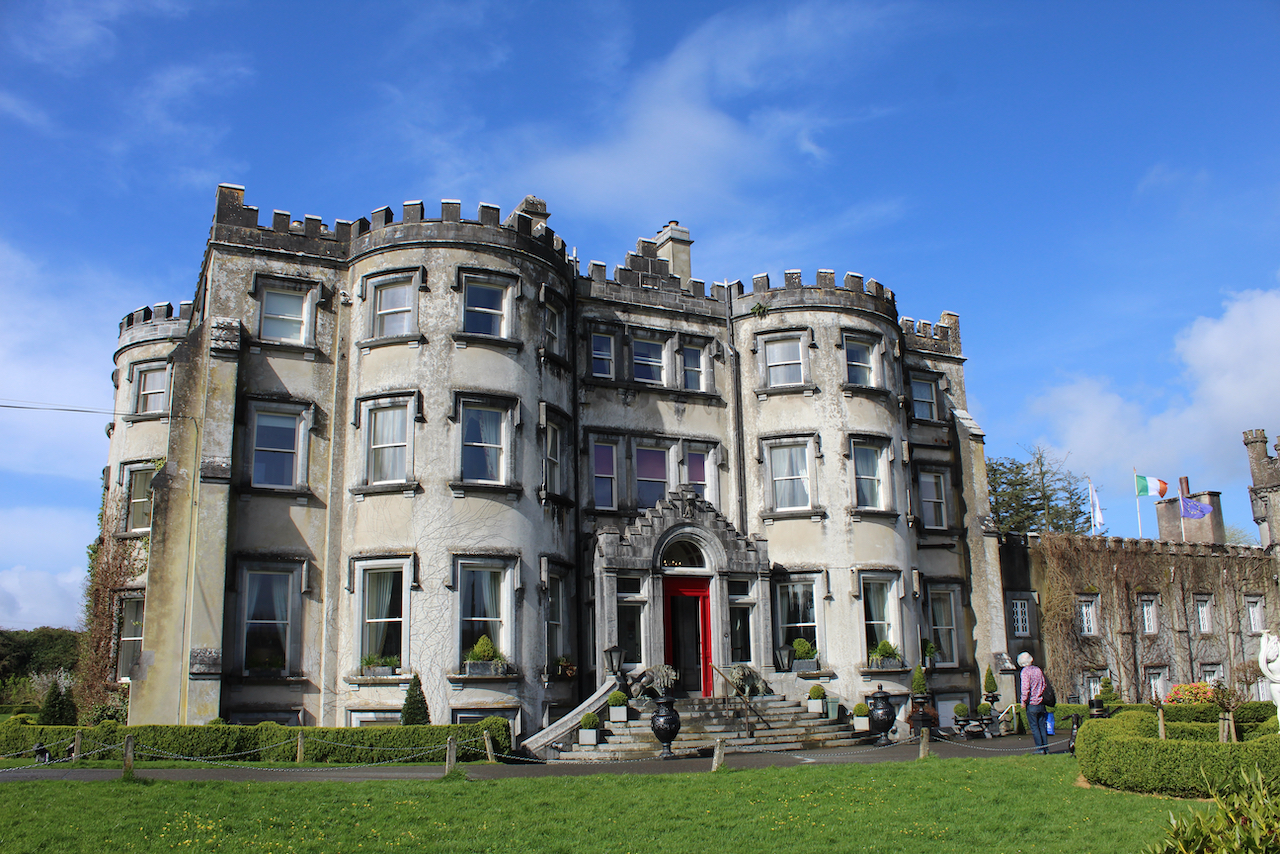
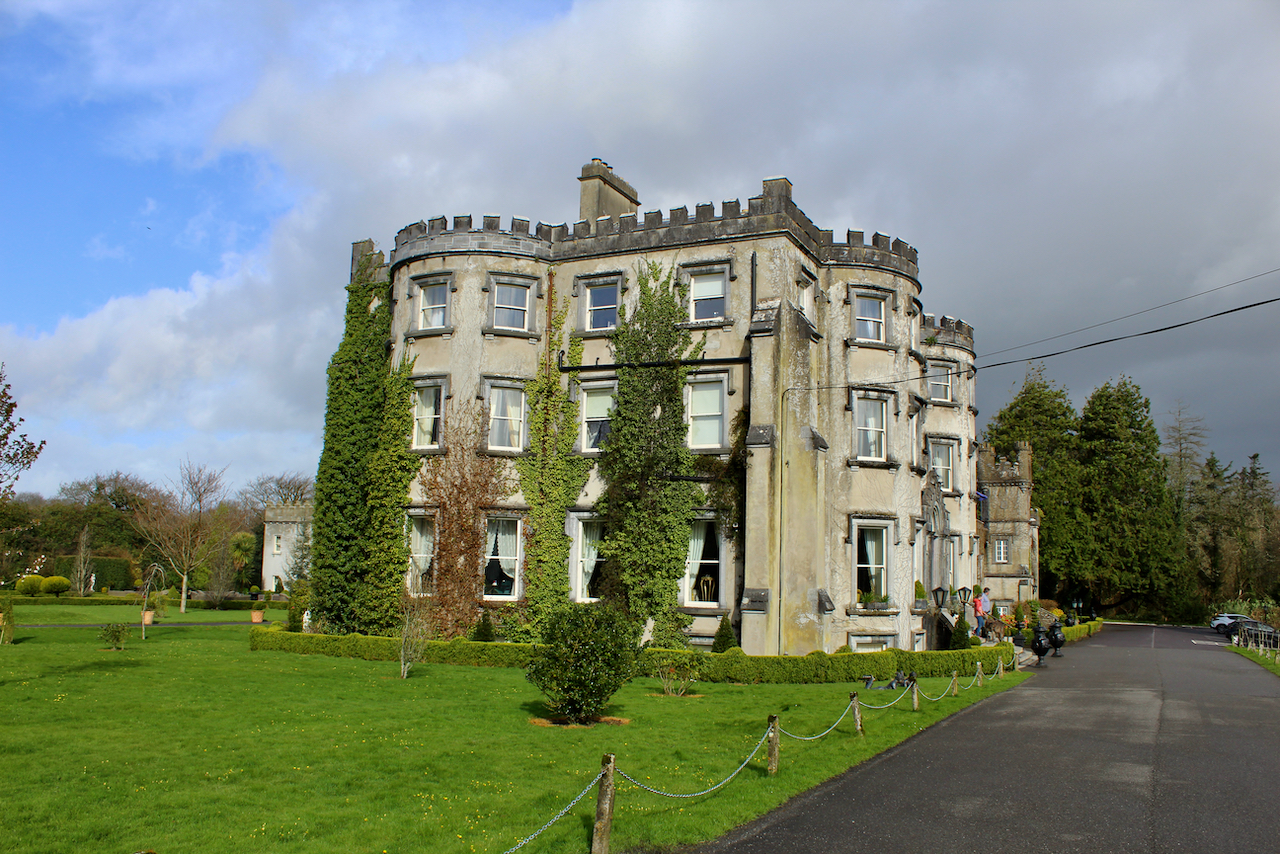
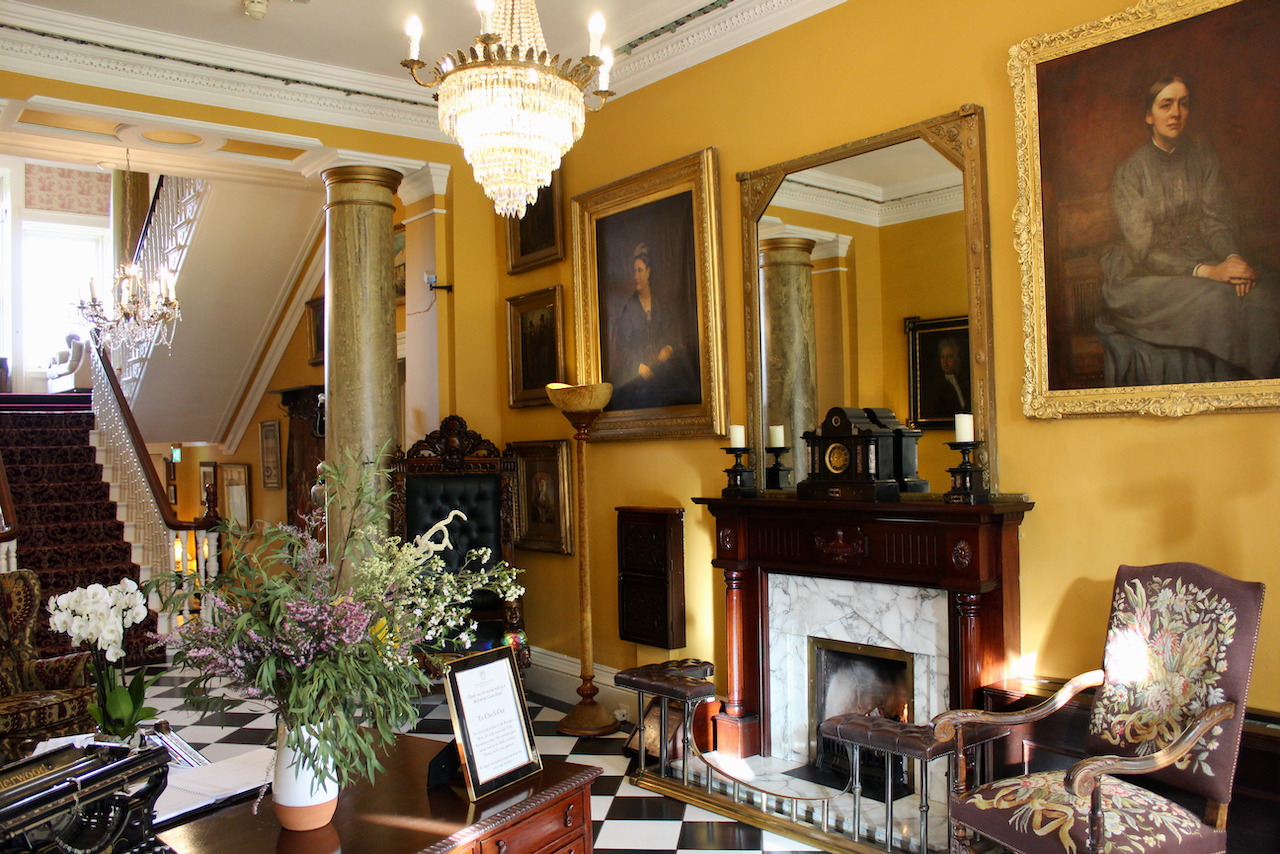
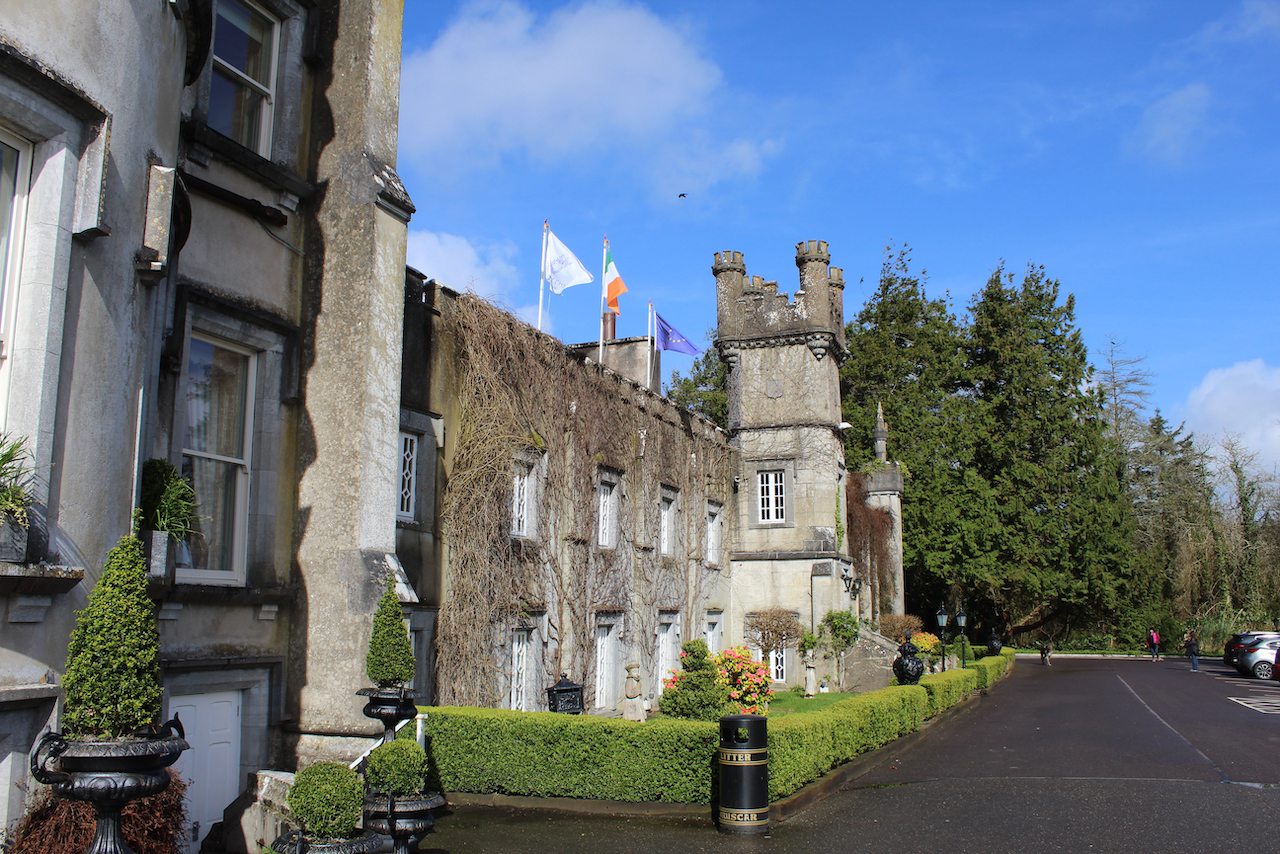
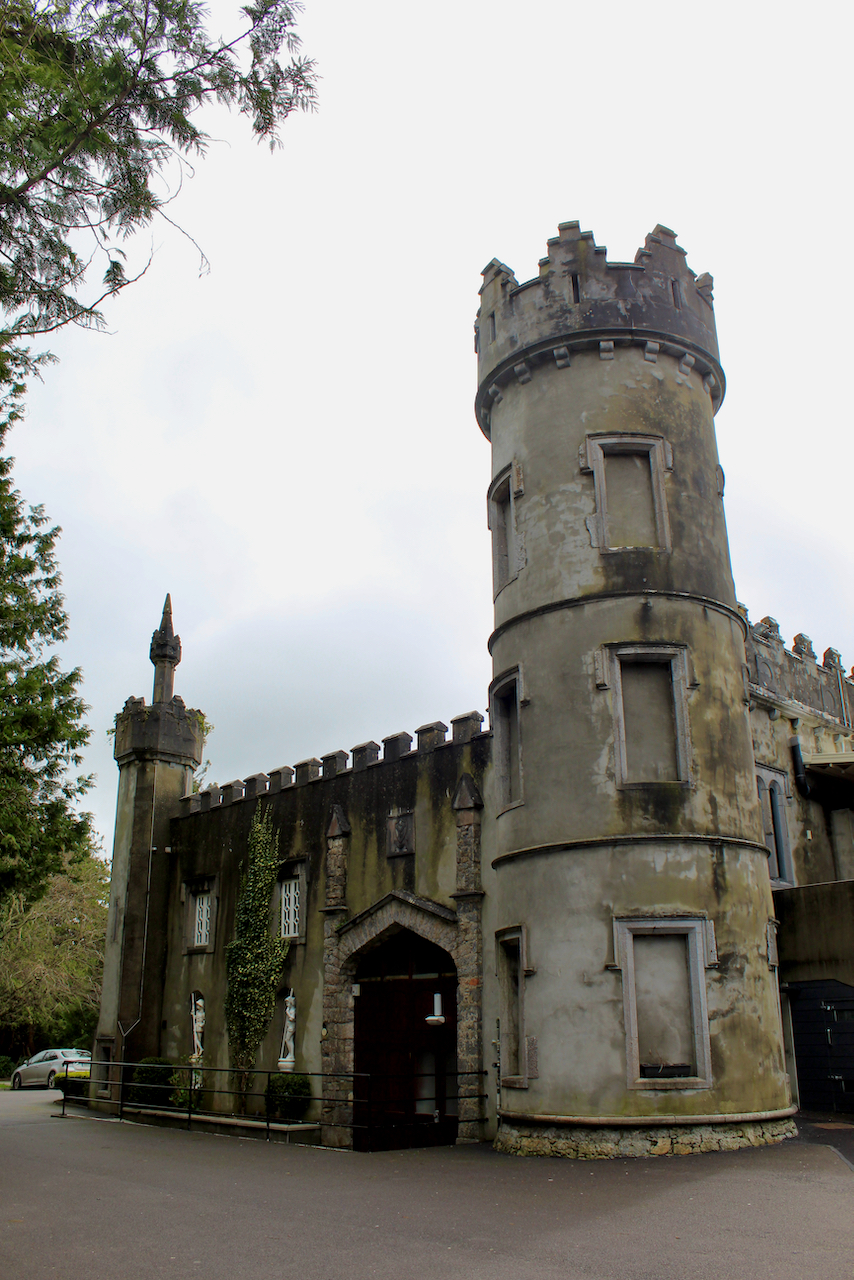
Castle Lyons, Fermoy, Co Cork – ‘lost’  

Castle Lyons, Fermoy, Co Cork – ‘lost’  

Bence-Jones, Mark. A Guide to Irish Country Houses (originally published as Burke’s Guide to Country Houses volume 1 Ireland by Burke’s Peerage Ltd. 1978); Revised edition 1988 Constable and Company Ltd, London.  

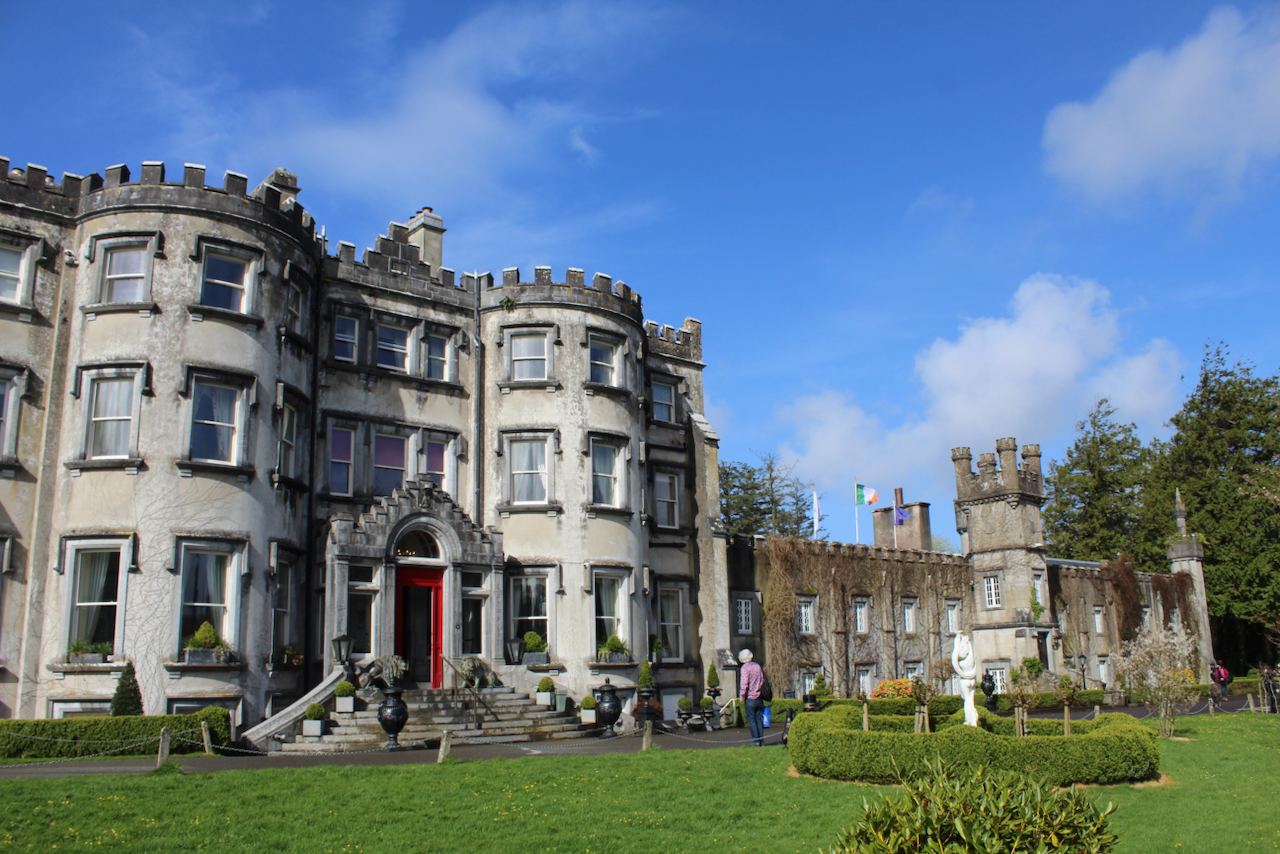
p. 72. “(Barry/IFR; Anderson, Bt, of Fermoy/PB1861) A C16 fortified mansion, built on the foundations of the castle of the O’Lenans, from whom the place too its name; principal seat of the Earls of Barrymore. …The house was burnt 1771, through the carelessness of a workman, and never rebuilt. The then Earl fo Barrymore died at an early age two years after the fire; his eldest son, 7th and penultimate  Earl, was the notorious rake “Hellgate”, who squandered the family fortunes and sold Caslte Lyons and his other Cork estates to the enterprising army contractor John Anderson, of Buttevant Castle. The ruin of Castle Lyons now forms a prominent object in the surrounding countryside, with its numerous tall chimneys.” 

David Barry (1605-1642) 6th Viscount Buttevant and 1st Earl of Barrymore. Photograph © Jennifer Winder-Baggot, http://www.irishhistorichouses.com.
Richard Barry, 2nd Earl of Barrymore c.1656.
Lt. Gen. James Barry, 4th Earl of Barrymore, (1667-1747) attributed to John Riley, courtesy of Christie’s The Sunday Sale, property of Smith-Barry estates removed from Old Priory Gloucestershire.
James Barry (1667-1747) Lieutenant Colonel and 4th Earl of Barrymore, National Trust, Public domain, via Wikimedia Commons.
James Barry, 4th Earl of Barrymore (1667-1748) (Lieutenant-General), Studio of Sir Godfrey Kneller courtesy of Sothebys 2013 collection l13304 lot 95.
James Barry, 4th Earl of Barrymore, (1667-1747). Photograph © Jennifer Winder-Baggot, http://www.irishhistorichouses.com.
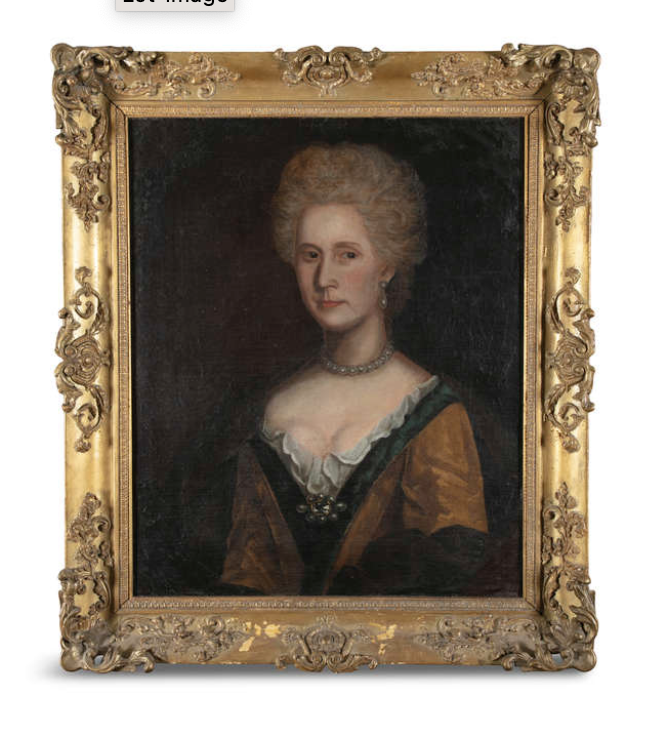
Lady Anne Chichester, Countess of Barrymore (d. 1753) Attributed to Philip Hussey, she was daughter of Major-General Arthur Chichester, 3rd Earl of Donegall (1666-1706) and his wife Lady Catherine Forbes (d. 1743), and she married James Barry 4th Earl of Barrymore, and was the mother of James Smith-Barry.
Anne Barry née Chichester, (1697-1753) Countess of Barrymore, 3rd wife of the 4th Earl of Barrymore. Photograph © Jennifer Winder-Baggot, http://www.irishhistorichouses.com.
Elizabeth Barry née Savage (d. 1714) wife of James Barry 4th Earl of Barrymore, daughter and heir of Richard Savage 4th Earl Rivers and Penelope Downes, seated with her daughter Penelope. This painting is attributed by Sotheby’s to Thomas Worldige.
Elizabeth Barry née Savage (d. 1714), 2nd wife of James 4th Earl of Barrymore. She and the 4th Earl had three daughters, and a son who died in his first year. She was the daughter of Richard Savage, 4th Earl Rivers. Photograph © Jennifer Winder-Baggot, http://www.irishhistorichouses.com.

The Buildings of Ireland. Cork City and County. Frank Keohane. Yale University Press: New Haven and London. 2020. 

The fortified houses of the late C16 and early C17 constitute a bridge between the medieval tower house and the modern mansion. They were built by old Norman families, at Castle Lyons and Ightermurragh (Ladysbridge); by city merchants, such as the Archdeacons at Monkstown; by English settlers, at Baltimore, Coppinger’s Court (Rosscarbery) and Mallow; and by Gaelic chiefs, at Coolnalong (Durrus), Mount Long (Oysterhaven), Kanturk, Dromaneen (Mallow) and Reendiseart (Ballylickey). Twenty-two such houses survive in Cork. 

In comparison to tower houses, these houses are better lit, have thinner walls, lack vaults, and feature timber floors and staircases as well as integral fireplaces. They are also notably symmetrical in plan and elevation, and some, such as Kanturk, incorporate proto-classical features. They generally retain some defensive features, such as door yetts, gunloops, bartizans and crenellated parapets, [p. 18] although their wall-walks were not all continuous, and in cases such as Mount Long and Monkstown were barely accessible. The other notable feature is the use of towers or turrets, influenced no doubt by the Elizabethan fashion for a quasi-military appearance derived from an earlier chivalric age. The arrangement of the towers gives rise to distinctive plan-forms: U plan (Coolnalong), Y-plan (Mallow and Coppinger’s court), L-plan (Dromaneen (Mallow) and Mossgrove (Templemartin), cross-plan (Kilmaclenine, Ightermurragh), X-plan (Kanturk, Monkstown, Mount Long, Aghadown), Z-plan (Ballyannan (Midleton), and T-Plan (Reendiseart). Baltimore, Carrigrohane, Castle Lyons, Myrtle Grove (Youghal) and Castlemartyr aer simple rectangular blocks. A number of Jacobean bawns with circular corner towers also survive, at Ballinterry (Rathcormac), Dromiscane (Millstreet), Dromagh, Clonmeen (Banteer) and Mossgrove.” 

https://www.castles.nl/castlelyons-castle

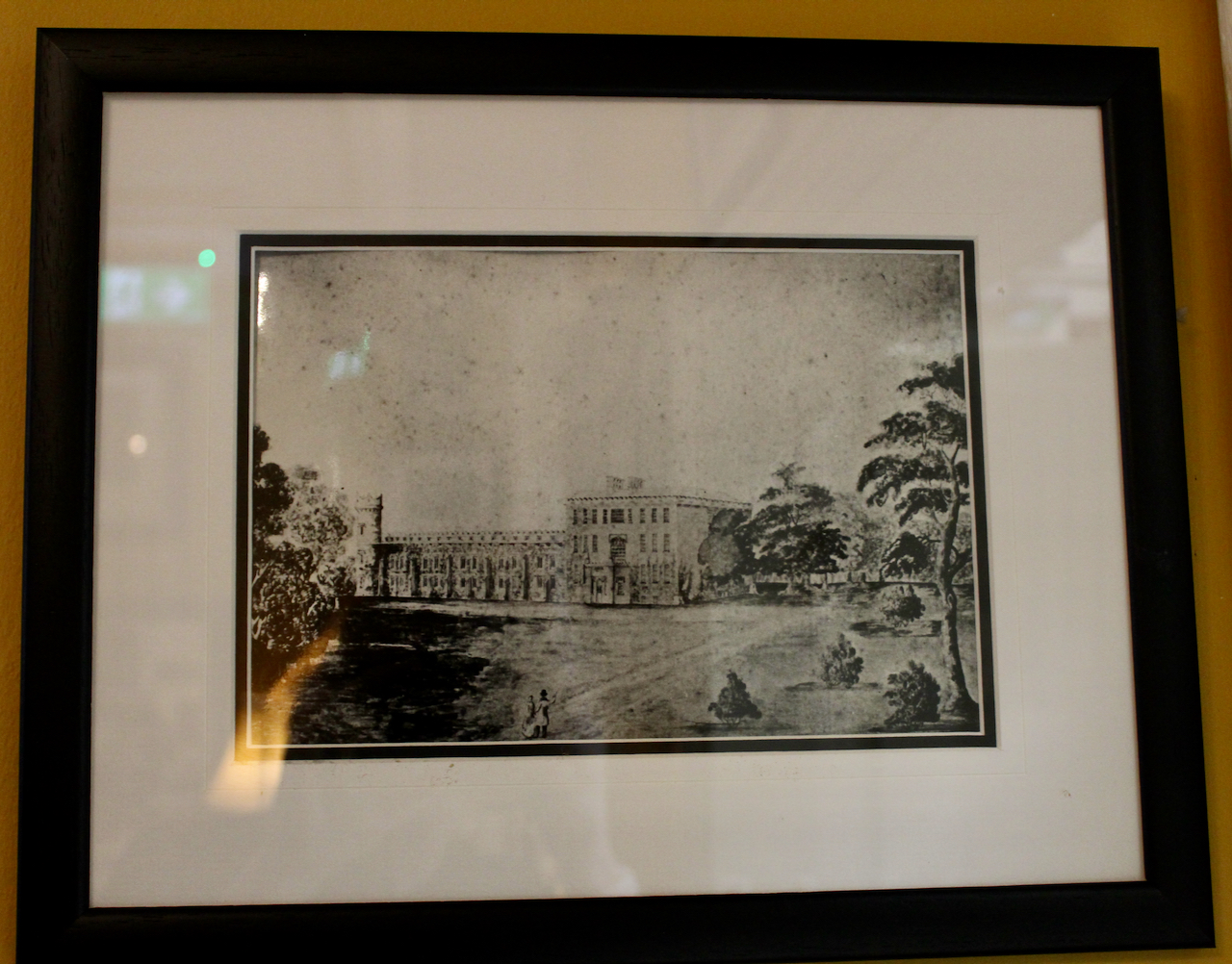
Castlelyons Castle, also known as Barrymore, lies in a field next to the village of Castlelyons, in County Cork in Ireland. 

The first fortification at this site may have been a royal seat of the petty kingdom of Uí Liatháin until the 12th century. Then the Anglo-Normans invaded Ireland and the Cambro-Norman knight Philip de Barry became lord of the Uí Liatháin lands. Later Barrys became Earls of Barrymore and in the early 13th century built Castlelyons Castle on this site. 

By the early 17th century the Barrys resided in their medieval castle at Barryscourt. In 1631 the Earl of Barrymore; David Barry, married Alice Boyle, daughter of the Earl of Cork. He then commenced to built a new mansion on this site, incorporating remains of the old castle. After it was finished Barry moved in and Castlelyons Castle became his main seat. 

In the 1640’s, during the Confederate’s War, the castle became an important English stronghold against the rebel Irish and the headquarters of Sir Charles Vavasour, 1st Baronet of Killingthorpe. After Vavasour had been defeated at Manning Ford Castlelyons Castle was captured by Lord Castlehaven. 

In the late 18th century the Earls of Barrymore rarely used the castle as a residence anymore and in 1771 it was accidently destroyed by a fire caused by careless workmen. It was never rebuilt. Castlelyons Castle seems to be on private land, so it is not accessible. The remains are quite overgrown, so it is hard to get a good overview of the entire castle. I found a recent sleeping place of a vagabond in an old oven in the castle, so be careful when you do visit. An intriguing ruin. 

https://theirishaesthete.com/2022/07/25/castlelyons/

Decline and Fall 

Jul25 by theirishaesthete 

A picture containing outdoor, sky, cloud, building

Description automatically generated 
When writing here last month about Fota, County Cork (see Saved for the Nation « The Irish Aesthete), mention was made of the Barrys, Earls of Barrymore. For many centuries, their main residence lay much further north, in Castlelyons. Although subject to dispute, this village’s name (Caisleán Ó Liatháin) is said to derive from having been an important centre in the ancient kingdom of Uí Liatháin. However, in the last quarter of the 12th century, the land in this part of the country came into the hands of the Anglo-Norman knight Philip de Barry; his son William’s ownership of this property was confirmed by King John in 1207. Some time thereafter, the family constructed a castle on a limestone outcrop at Castlelyons and this became one of their most important bases. A settlement grew up around the base of the castle, with a Carmelite priory established to the immediate north in the early 14th century.  

https://theirishaesthete.com/2022/07/27/castlelyons-tombs/avid de Barry is thought to have become first Lord Barry in 1261, beginning the family’s ascent through the ranks of the peerage and indicating its increasing importance. In 1541 his descendant John fitz John Barry was created first Viscount Buttevant, and then in 1628 David Barry became the first Earl of Barrymore [6th Viscount Buttevant]. He was indirectly responsible for the construction of what can now be seen of the former castle at Castlelyons. The earl had been born in 1605, some months after the death of his father, so that he was raised by his grandfather, the fifth viscount who died in 1617. Young David then became a ward of the powerful Richard Boyle, the Great Earl of Cork. Seeing an opportunity to ally himself with a long-established dynasty in the region, the latter duly arranged a marriage in 1621 between his young charge and his eldest daughter Alice: the bride was aged 14, the groom 16. In the mid-1630s Boyle also decided to rebuild his son-in-law’s residence at Castlelyons, since the Barrys were already heavily in debt (the canny Great Earl had earlier taken on the Barry wardship in exchange for the redemption of substantial mortgages left by the fifth Viscount). A vast new house was erected on the site of the old one, but the Earl of Barrymore had little opportunity to enjoy it, since he died in September 1642, probably as a result of wounds received at the Battle of Liscarroll a couple of weeks’ earlier. His heir, once again a minor, became the second earl. Successive generations then followed, but increasingly the family spent their time in England and it appears that by the mid-18th century the great castle at Castlelyons was falling into disrepair. This probably explains why, in 1771, repair work was undertaken on the building’s roof. Unfortunately, careless workmen left a soldering iron against wooden beams and the place caught fire. The sixth earl – who would die two years later – was as debt-ridden as his forebears and so made no effort to repair the damage. Instead, the castle was abandoned, along with its surrounding gardens, and left to fall into the state of ruin that can be seen today.  
Understanding the original layout of Castlelyons Castle can be challenging today, since what would have been the building’s central courtyard has long since been quarried away. In addition (and perhaps as a result of the quarrying), both the west and east ranges have disappeared, leaving just exposed sections of those to the south and north. What still stands on the south-west corner is considered to be the oldest part of the property, perhaps part of the original 13th century construction, with walls in some places 3.4 metres thick. Across what is today a deep ravine rises the north range, dating from the 17th century and dominated by three rectangular chimney stacks that rise above the three-storey block (with a basement at the east end). Beyond the exposed rubble walls, nothing survives of the interior and one must imagine what the house looked like when first built as it then included a great gallery, some 90 feet long and two storeys high, although it appears this may never have been finished (presumably due to the death of the first Earl of Barrymore and the chaos of the Confederate War). The castle was once surrounded by equally splendid grounds, with a large terrace to the immediate north and a series of enclosed gardens to the west and south, of which scant traces remain, serving as witness to the decline and fall of the once-might Barry family.  

https://theirishaesthete.com/2022/07/27/castlelyons-tombs/

A Burst of Baroque 

Jul27 by theirishaesthete 


After Monday’s post about the remains of the once-splendid Barry residence in Castlelyons, County Cork, readers might be interested to see this: a mausoleum erected not far away in the graveyard of Kill St Anne Church. Dating from c.1753, it commemorates James Barry, fourth Earl of Barrymore who had died five years earlier. Born in 1667, the earl had enjoyed a distinguished military career, supporting William of Orange and then participating in the War of the Spanish Succession during which he rose to the rank of Lieutenant-General. However, late in life, he became a supporter of the Jacobite cause and in 1744 was arrested and imprisoned; following the failure of Prince Charles Edward Stuart’s attempted rebellion the following year, the elderly earl was released. He died in January 1748.  
His mausoleum in the old village graveyard is constructed of rubble limestone, the eastern facade having an advanced and pedimented centre of red brick, the Serlian opening surrounded by red marble-limestone, its wrought-iron gates topped with an earl’s coronet. To the rear of the groin-vaulted interior is the deceased’s monument composed of different coloured marbles. Completed in 1753, it was the work of David Sheehan and John Houghton, the latter responsible for the angels and presumably the half-length figure of the earl inside a central medallion. Wonderfully unexpected, it is a little bit of Roman baroque in the middle of the Irish countryside.  

https://landedfamilies.blogspot.com/search/label/Ireland

Barry family of Castle Lyons etc., Viscounts Buttevant and Earls of Barrymore 

 
Barry, James. Eldest son of Richard Barry, feudal baron of Ibawne and 3rd Barry Roe (Red Barry) and his wife, [forename unknown] O’Driscoll. He succeeded his father as the 4th Barry Roe. He married 1st, Ellen [surname unknown], whom he repudiated and had the marriage annulled by the church, and 2nd, Eileen (to whom he had been betrothed prior to his first marriage), daughter of Finn MacDermot MacCarthy Reagh, Lord of Carberry (and sister of his first wife’s second husband!) and had issue: 
(1.1) Richard Barry (q.v.
(2.1) James Barry (d. 1507), feudal baron of Ibawne and 5th Barry Roe; died without issue at sea while returning from a pilgrimage to Rome, 1507; 
(2.2) David Downe Barry; feudal baron of Ibawne and 6th Barry Roe; murdered his uncle Redmond Barry and his nephew Richard Barry; married Ellis, daughter of William Barry Oge, and had issue four sons (all of whom were killed by their cousin, James Barry (d. 1581), 4th Viscount Buttevant (q.v.), and two daughters; as well as an illegitimate son and daughter; 
(2.3) A daughter; married as his first wife, Donal MacCarthy. 
His date of death is unknown. His first wife married 2nd, Donal MacCarthy Reagh, daughter of Cormac McTeigh McCarthy, Lord of Muskerry; her date of death is unknown. His second wife’s date of death is unknown. 
 
Barry, Richard. Only child of James Barry, 4th Barry Roe, and his first wife Ellen, whom he repudiated; following the annulment of their marriage, Richard was declared illegitimate, and therefore, although he claimed the feudal barony of Ibawne, the family estates descended to his half-brother. He married 1st, Isabel, daughter of Sir James Fitzgerald, a younger son of the 8th Earl of Kildare KG, and 2nd, Moryda, daughter of [forename unknown] McMahon of Corkabaskin in Thomond, and had issue: 
(1.1) James Barry, 4th Viscount Buttevant (q.v.); 
(2.1) Richard Barry; murdered by his half-uncle, David Downe Barry, 6th Barry Roe. 
He was known as ‘of the Rath’. 
His date of death is unknown. His first wife’s date of death is unknown. His second wife’s date of death is unknown. 
 
Barry, James (d. 1581), 4th Viscount Buttevant. Only son of Richard Barry and his first wife, Isabel, daughter of Sir James Fitzgerald. He is said to have murdered the four sons of his half-uncle David Downe Barry, and seized the feudal barony of Ibawne to which his father had been entitled de jure as the eldest son of the 4th Barry Roe. On 28 April 1558 he was granted a pardon for these crimes as ‘James Barry of Barrescourt, Viscount Barrymore, otherwise James called Barrymore and Barryroe’, and he was summoned to Parliament on 12 January 1559/60 as ‘James le Barry D[omi]n[u]s de Buttevant’, and placed next after the earls in order of precedence. By a deed of 18 March 1560/1 he obtained from Edmond Barry of Rathgobbane (who was the rightful heir to the Barry peerages, to which he should have succeeded in 1558), a surrender of the family estates to him and his heirs for ever’, and he had livery of these estates from the Crown on the 27 April 1561 in a deed addressed to him as ‘James Barry, Viscount Buttevant, kinsman and heir of James late Lord’, which marks the Crown’s acquiescence in his succession to the estates as well as the title. He was knighted at Limerick, 30 March 1567, and on 5 April that year he had a commission to execute martial law which recognised him as Lord Barrymore as well as Viscount Buttevant. He married, by 1548, Eileen alias Ellen, illegitimate daughter of Cormac MacCarthy Reagh, and had issue: 
(1) Richard Barry (d. 1622), de jure Viscount Buttevant; born deaf and dumb, and on that account (although not mentally impaired) was omitted from the succession to the peerage; he seems to have held a part of the family estates which passed on his death to his great-nephew, the 6th Viscount; he died unmarried and without issue at Liscarroll, 24 April 1622; 
(2) David Barry (1550-1617), 5th Viscount Buttevant (q.v.); 
(3) Hon. William Barry (d. 1584), of Timoleague; married Sheelagh (alias Julia) (fl. 1594), daughter of Sir Finn MacCarthy Reagh and had issue two sons; died about August 1584; inquisition post mortem held 4 November 1584; 
(4) Hon. Edmund Barry (d. by 1602); died without issue before 1602; 
(5) Hon. John Barry (d. 1627), of Liscarroll; high sheriff of Co. Cork, 1602-03; married 1st, Joan, daughter of Edmund Fitzgerald, The White Knight, but had no issue; married 2nd, Ellen, daughter of Sir Dermot McTeige McCarthy and had issue five sons and one daughter; died 31 January 1627; 
(6) Hon. Joan Barry; married David Roche, 7th Viscount Roche of Fermoy (d. 1635) and had issue five sons and four daughters; 
(7) Hon. Honora Barry; married Patrick Condon of Ballymacpatrick (Co. Cork); 
(8) Hon. Eleanor Barry; married Sir Owen O’Sullivan; 
(9) Hon. Ilane Barry; married Callaghan McTeige McCarthy of Muskerry. 
He seized the barony of Ibawne on the south coast of County Cork from the cousins he murdered, and presumably extorted the Barrymore estates from his kinsman Edmond Barry by the implied threat of similar violence. 
He died 10 April 1581; an inquisition post mortem was apparently not held until 31 March 1624. His wife’s date of death is unknown. 

Barry, David (1550-1617), 5th Viscount Buttevant. Second son of James Barry (d. 1581), 4th Viscount Buttevant, and his wife Eileen alias Ellen, illegitimate daughter of Cormac MacCarthy Reagh, born 1550. He succeeded his father in at least some of the family estates and assumed the title of 5th Viscount Buttevant, 10 April 1581, as his elder brother was deaf and dumb; this was apparently accepted by the Crown as he was summoned to Parliament in 1585 as the ‘Viscount of Barry, alias Buttevant’, and placed next in precedence to the Earls. He joined the Earl of Desmond’s rebellion in 1593 but abandoned the rebel cause in 1599 and made his peace with the Crown by paying a fine of £500 in 1602. He thereafter remained faithful to the Crown and was granted 31-year leases by King James I on a great part of the McCarthy lands which had been forfeited to the Crown. By 1615 he was one of the Council of the province of Munster. He married 1st, Ellen (fl. 1599), younger daughter of David Roche, 5th Viscount Roche of Fermoy, and 2nd, Sheelagh (alias Julia), daughter of Cormac McCarthy of Muskerry, and had issue, perhaps with others*: 
(1.1) Hon. David Barry (d. 1604/5) (q.v.); 
(1.2) Hon. Honora Barry; married 1st, as his second wife, Gerald FitzGerald, of the Decies, and 2nd, Patrick Browne (d. 1637) of Mulrankin (Co. Wexford), and had issue two sons and several daughters; 
(1.3) Hon. Helena Barry (d. 1642); married 1st, John Oge Le Poer (aka Power) (killed by Edmund Fitzgerald, the White Knight, before 1606), eldest son and heir of Richard Power, 4th Baron Power of Curraghmore, and had issue one son (the 5th Baron Power); married 2nd, by December 1606, as his third wife, Thomas Butler KG (d. 1614), 10th Earl of Ormonde, but had no issue; married 3rd, 15 August 1616, Sir Thomas Somerset KB (c.1579-c.1651), 1st and only Viscount Somerset of Cashel (Co. Tipp.) of Badminton House (Glos), third son of Edward Somerset, 4th Earl of Worcester, and had further issue one daughter; died in 1642 and was buried at Raglan (Monmouths.); 
(1.4) Hon. Mary [name uncertain] Barry; married James Tobin of Kumpshinagh (otherwise Compsy, near Clonmel) (Co. Tipp.); 
(1.5) Hon. Ellen Barry; married Sir Edmund (aka John) FitzGerald (d. 1640) of Ballymaloe (Co. Cork), and had issue one daughter (who died young); 
(1.6) Hon. Catherine Barry; married Richard Burke of Derry Maclaghny (Co. Galway); 
(1.7) Hon. Margaret Barry (d. c.1609?); married, c.1603, Rt. Hon. Robert Dillon, 2nd Earl of Roscommon (d. 1642) (who m2, Lady Dorothy (b. 1579), youngest daughter of George Hastings, 4th Earl of Huntingdon and widow of Sir James Stewart, and m3, c.1625, Anne, daughter of Sir William Stroud and widow of Lord Folliott, and had further issue by both of them), and had issue three sons; perhaps died about 1609; 
(2.1) Hon. Joan (alias Margaret) Barry; married Sir Dermot O’Shaughnessy (d. 1673) of Gartinshegory (Co. Galway) and had issue two sons and three daughters. 
He inherited Barryscourt Castle from his father in 1581. 
He died at Barryscourt, 10 April 1617. His first wife’s date of death is unknown. His widow married 2nd, as his second wife, Sir Roger O’Shaughnessy (d. c.1650), but her date of death is unknown. 
* The Oxford Dictionary of National Biography says that the 5th Viscount and his second wife had three sons and four daughters. 
 
Barry, Hon. David (d. 1604/5). Eldest son of David Barry (1550-1617), 5th Viscount Buttevant, and his first wife, Ellen, younger daughter of 5th Viscount Roche of Fermoy. He married Elizabeth, daughter of Richard Power, 4th Lord Power, of Curraghmore (Co. Waterford), and had issue: 
(1) James Barry (fl. 1600); elder son; died before 1605; 
(2) David Barry (1605-42), 6th Viscount Buttevant and 1st Earl of Barrymore (q.v.). 
He died in the lifetime of his father in 1604/5. His widow’s date of death is unknown. 
 
Barry, David (1605-42), 6th Viscount Buttevant and 1st Earl of Barrymore. Only surviving child of the Hon. David Barry (d. 1604/5) and his wife Elizabeth, daughter of Richard le Poer, 4th Lord le Power and Curraghmore, born after his father’s death, 10 March 1604/5, probably at Buttevant (Co. Cork). He was a ward of John Chichester, 1610-12 and then of Richard Boyle, 1st Earl of Cork, and was brought up a Protestant. He succeeded his grandfather as 6th Viscount Buttevant, 10 April 1617. His guardian paid £3,000 for him to be created, 28 February 1627/8, 1st Earl of Barrymore, and he took his seat in the Irish parliament as such, 14 July 1634. He was commissioned in 1639 to raise a regiment of 1,000 men in Ireland for service in the first bishops’ war in Scotland, but he was only able to raise a small force because of lack of funds. He commanded a regiment again in 1640, and served as its Colonel. In 1641, with the start of the Irish rising, he garrisoned his castle at Shandon near Cork for the king, and in 1641-42 he led successful military operations against the Irish confederates which secured Co. Cork for the king. He was then joined with Lord Inchiquin in a commission for the civil government of Munster, but he was, however, wounded at the Battle of Liscarroll in July 1642, and died a couple of months later. A portrait at Fota House, normally described as being of the 1st Earl, is evidently of an unidentified man who was aged 66 in 1636, and no likeness of him seems to have survived. He married, 29 July 1621*, Lady Alice (1607-66), eldest daughter of his guardian, Richard Boyle, 1st Earl of Cork, and had issue: 
(1) Richard Barry (1630-94), 2nd Earl of Barrymore (q.v.); 
(2) Lady Ellen Barry (1631-55), said to have been born 9 September 1631; married, before 1652, as his first wife, Sir Arthur Denny (1629-73) of Tralee Castle (Co. Kerry), and had issue one son; died 1655; 
(3) Lady Catherine Barry (b. 1632?), said to have been born in 1632; married Edward Denny (1630-95) of Castle Lyons, son of Sir Edward Denny of Tralee Castle (Co. Kerry) and had issue three sons; 
(4) Hon. James Barry (c.1635-64), born about 1635; an officer in the army; died without issue, 1664. 
He inherited Barryscourt Castle and Castle Lyons from his grandfather in 1617 and the estates of his deaf-and-dumb great-uncle in 1622. He had livery of his lands, 13 May 1625; his guardian (who continued to exert much influence after Barry came of age, as he held mortgages on most of the Barry lands) paid for the remodelling of Castle Lyons from 1636. 
He died 29 September 1642 and was buried in the Boyle vault at Youghal (Co. Cork). His widow married 2nd, by 1645, Col. John Barry of Liscarrol, who was a Roman Catholic, and died 23 March 1666, being buried at St. Patrick, Dublin (as ‘Mrs Barry’) on 25 March 1666. 
* He was 16 and she was 14 at the time of this marriage. 
 
Barry, Rt. Hon. Richard (1630-94), 2nd Earl of Barrymore. Elder son of David Barry (1605-42), 6th Viscount Buttevant and 1st Earl of Barrymore, and his wife Lady Alice, eldest daughter of Richard Boyle, 1st Earl of Cork, born in Dublin, 16 October and baptised at St Werburgh, Dublin, 4 November 1630. He succeeded his father as 2nd Earl, 29 September 1642, at the age of 12, and was made a ward of his mother at the king’s command. He was educated privately, including a period in 1645-47 when he was in London and his tutor was the famous poet, John Milton: not an obvious choice for a young man with an ardently Royalist mother and a Catholic stepfather. In or before 1649 he went to France, where he married, against the wishes of his mother, one of Queen Henrietta Maria’s ladies in waiting and lived until after her death. His second marriage aligned him, by contrast, with the Commonwealth administration, and may be a reflection of his political astuteness in seeking advantageous alliances. At the Restoration he was included in a special pardon issued by Charles II to the family and friends of the Earl of Orrery (who was his uncle), and he became an officer in the army (Col., 1661). He sat in the Irish Parliament from 1661-94, including during King James II’s parliament of 1689, and was sworn of the Irish Privy Council, 1661 and again, 1687. He married 1st, before December 1649 in France, Susan (1629?-c.1655), daughter of Sir William Killigrew, 2nd, November 1656, Martha (d. 1664), daughter of Henry Lawrence of London, President of Cromwell’s Council, and 3rd, February 1666, Dorothy, daughter of John Ferrer of Dromore (Co. Down), and had issue: 
(1.1) Lady Mary Barry (c.1650-1711); married 1st, Rev. Garrett Barry (d. 1685), Chancellor of Armagh Cathedral, and 2nd, Rev. Christopher Sheares (c.1662-1704), rector of Ballymore and Tandragee (Co. Armagh), and had issue ‘a numerous family’; died at Dun Laoghaire (Co. Dublin), 1711; 
(1.2) Lady Catherine Barry (b. c.1651; fl. 1699); married 1st, 1666 (settlement), John Townsend (b. c.1646; fl. 1675), son of Col. Richard Townsend of Castletown (later Castle Townshend, Co. Cork), and had issue one son and two daughters; married 2nd, 1679 (licence), Capt. Charles Barclay of London, and had further issue one daughter; living at Skibbereen (Co. Cork) in 1699; 
(1.3) Lady Susan Barry (b. c.1653); died unmarried; 
(2.1) Lady Martha Barry (d. 1657); died young, 1657; 
(2.2) Lawrence Barry (c.1657-99), 3rd Earl of Barrymore (q.v.); 
(2.3) Hon. Richard Barry; died young; 
(2.4) Hon. David Barry; died young; 
(2.5) Lady Theodora Barry; married Charles May (d. 1724); 
(3.1) James Barry (1667-1747), 4th Earl of Barrymore (q.v.); 
(3.2) Hon. Richard Barry (c.1668-1754); educated at Trinity College, Dublin (admitted 1681; BA 1685; MA 1688); appointed joint second remembrancer of the Court of Exchequer (a sinecure), 1683; an officer in the army (Ensign, 1697; Lt-Col., 1706; retired about 1715), who was captured at the Battle of Almansa, 1707; burgess of Carlingford, c.1713; MP for Enniscorthy, 1692-93, 1695-99 and for Baltimore, 1713-14; died 1754; 
(3.3) Lady Dorothy Barry (c.1670-1749); married Col. Sir John Jacob (c.1665-1740), 3rd bt. of West Wratting Park (Cambs), who sold his colonelcy of a regiment of foot to his brother-in-law, the 4th Earl, and had issue one son and three daughters; died 27 January 1748/9; 
(3.4) Lady Anne Barry (d. by 1720); married, c.1700, Rt. Rev. Dr. Henry Maule (1676-1758), rector of Mourneabbey, Shandon etc. and later bishop of Cloyne, 1726-31, Dromore, 1731-44 and Meath, 1744-58 (who m2, c.1720, Catherine, daughter of Sir Richard Rooth or Ruth and widow of William Stawell (d. 1701) of Kinsale, and m3, 1725, Dorothy (d. 1743), daughter of Capt. Thomas Gookin of Bandon and widow of Rev. R. Roffen, without further issue), and had issue two sons and two daughters; died before 1720; 
(3.5) Lady Margaret Barry; married, 1711, Thomas Crosbie (d. 1731) of Ballyheigue (Co. Kerry), MP for Dingle, 1713-14, 1715-31, and had issue one son and two daughters; 
(3.6) Lady Elizabeth Barry; died young; 
(3.7) Hon. David John Barry (c.1688-1744), of Mahon (Co. Cork); educated at Cork and Trinity College, Dublin (matriculated 1705); an officer in the army (Lt., 1708; Capt., 1712; retired 1716); sheriff of Cork, 1728; MP for Belfast, 1727-44; married Margaret, daughter of Frederick Crosbie and widow of John Blennerhassett of Ballyseedy; died October 1744; 
(3.8) Hon. Ferdinando William Barry; died young. 
He inherited Castle Lyons from his father in 1642. 
He died November 1694. His first wife died before 1656. His second wife died in 1664 and was buried at St. Margarets (Herts). His widow married 2nd, as his third wife, Sir Matthew Deane (c.1626-1711), 1st bt., of Dromore; her date of death is unknown. 
 
Barry, Lawrence (c.1657-99), 3rd Earl of Barrymore. Eldest son of Richard Barry (1630-94), 2nd Earl of Barrymore, and his second wife Martha, daughter of Henry Lawrence of London, born c.1657. He was attainted by the Parliament of King James II in 1689 for remaining in England, but restored soon afterwards. He succeeded his father as 3rd Earl of Barrymore, November 1694, and took his seat in the Irish parliament, 27 August 1695. He married, 1682, Hon. Catherine Barry (1663-1737), eldest daughter of Richard Barry, 2nd Baron Barry of Santry, but had no issue. 
He inherited Castle Lyons from his father in 1694. 
He died 17 April 1699. His widow married 2nd, 1699, Francis Gash, revenue collector, and 3rd, 8 December 1729, Sir Henry Piers (1678-1734), 3rd bt., of Tristernagh; she died 8 June and was buried at St Mary, Dublin, 10 June 1737; her will was proved 1744. 
 

A person wearing a costume

Description automatically generated 
James Barry, 4th Earl of Barrymore 

Barry, Rt. Hon. James (1667-1748), 4th Earl of Barrymore. Eldest son of Richard Barry (1630-94), 2nd Earl of Barrymore, by his third wife, Dorothy, daughter of John Ferrer of Dromore (Co. Down), born 1667. He succeeded his half-brother as 4th Earl, 17 April 1699, but did not take his seat in the Irish parliament until 14 February 1703/4. He was an officer in the army, 1688-98 and 1702-15 (Capt., 1689-93, 1694-98; half-pay 1698-1702; Col., 1702; Brig-Gen. 1707; Maj-Gen. 1709; Lt-Gen. 1711), and was pardoned for an unspecified ‘crime or misdemeanour’ in 1700. He served under Lord Galway in Spain and was taken prisoner at Caya, 1709, being freed and returning to London in 1710; he was again in Spain in 1712 and 1713, where he was for a time second-in-command to the Duke of Argyll, but he was relieved of his command in 1715 at the time of the Jacobite uprising, presumably because of concerns about his loyalty. As an Irish peer he was allowed to sit in the British House of Commons, and he was Tory MP for Stockbridge, 1710-13, 1714-15 and for Wigan, 1715-27 and 1734-47 and was appointed to the Privy Council for Ireland, 1714; his adherence to the Tories was somewhat capricious, and he occasionally voted with the Whigs. He was made a freeman of Cork, 1700, Salisbury, 1712 and a burgess of Wigan, 1712 and served as Mayor of Wigan in 1725 and 1734, where he built a new Town Hall in 1720. He was awarded an honorary degree by the University of Oxford (DCL), 1735/6 at the time of his son’s graduation. He embraced the Jacobite cause in his later years, conspiring from about 1740 with English Tories for a Stuart restoration aided by a French invasion. In 1740, he visited Cardinal Fleury to persuade him to support it, and in 1743 Louis XV’s master of horse, the 2nd Duke of Ormonde, travelled to London to meet Barrymore and other Tory peers to conspire to French invasion. Barrymore was to be part of the Young Pretender’s council of regency should the invasion be successful. In February 1744 the British government discovered from a spy in their service in France the English members of the conspiracy and Barrymore was arrested. After the collapse of the Jacobite rising of 1745 the government decided not to prosecute Barrymore, perhaps partly on the grounds of his age. He married 1st (with £10,000), perhaps c.1693, Hon. Elizabeth Boyle (1662-1703), daughter of Charles Boyle, Lord Clifford of Londesborough and sister of the 3rd Earl of Cork, 2nd, June 1706 (without her father’s consent or knowledge), Lady Elizabeth (d. 1714), daughter and heiress of Richard Savage, 4th Earl Rivers, and 3rd, 12 July 1716 at St Anne, Soho, London, Lady Anne (d. 1753), youngest daughter of Arthur Chichester, 3rd Earl of Donegall, and had issue: 
(1.1) A son (d. 1707), born before 1703; died 30 May 1707; 
(1.2) Lady Charlotte Barry (d. 1708), born before 1703; died unmarried and was buried at St Michan, Dublin, 1 June 1708; 
(1.3) Lady Anne Barry; married James Maule (d. 1749), son of Rt. Rev. Henry Maule, bishop of Cloyne and later of Dromore and of Meath, but died soon afterwards; 
(2.1) Lady Penelope Barry (1708-86), born 18 April 1708; inherited Wardley (Lancs) from her father but sold it to the Duke of Bridgewater, 1760; married, 1730*, (div. for adultery, 1736) Maj-Gen. the Hon. James Cholmondeley (1708-75), youngest son of George Cholmondeley, 2nd Earl of Cholmondeley, but had no issue; died 1786; 
(3.1) James Barry (1717-51), 5th Earl of Barrymore (q.v.); 
(3.2) Lady Catherine Barry (1718-38), born 9 November and baptised at St James, Piccadilly, Westminster (Middx), 4 December 1718; died unmarried, 1738; 
(3.3) Hon. Richard Barry (1721-87), born 4 September and baptised at St James Piccadilly, Westminster (Middx), 29 September 1721; an officer in the Royal Navy, 1733-46 (Lt., 1740; Cdr., 1745), but this did not stop him acting as his father’s secretary in negotiations between the English Jacobites and the French, and he was employed rallying Jacobite supporters ‘in London and Westminster’; in June 1744 he was sent by his father to join the French expedition against England which was being prepared at Dunkirk, with a view to using his experience as a naval officer to assist the French in effecting a landing on the English coast; at Dunkirk he formed a close friendship with the Young Pretender, with whom he remained in contact on his own behalf until at least 1750; his treasonable behaviour did not stop his promotion in 1745 but did terminate his active naval career, although he remained on half-pay for the rest of his life; he succeeded his father as MP for Wigan, 1747-61, but was an inactive member; he married, 4 May 1749, Jane (d. 1751), daughter and heiress of Arthur Hyde of Castle Hyde (Co. Cork) and had issue one son (who died young, of smallpox); died at Marbury (Ches.), 23 November 1787; 
(3.4) Lady Anne Barry (c.1722-58); married, c.1750, Walter Taylor of Castle Taylor, Ardrahan (Co. Galway) (who m2, October 1766, Hester, daughter of Richard Trench MP of Garbally (Co. Galway), and had issue one son and four daughters); died without issue, 21 March 1758; 
(3.5) Hon. Arthur Barry (1724-70), born 1724; educated at Westminster School, 1733-40, Brasenose College, Oxford (matriculated 1742) and Lincolns Inn (admitted 1742); admitted a burgess of Belfast, 1753; MP for Belfast in the Irish Parliament, 1757-60; portrait painted by Francis Cotes is now at Tabley House (Ches.); lived at Ruloe, Weaverham (Ches.); died unmarried in Dublin, 23 October 1770 and was buried at Great Budworth (Ches.); will proved in the PCC, 8 January 1771; 

Arthur Barry (1723-1770) by Francis Cotes courtesy of Sotheby’s L11304. This portrait belonged to the Smith-Barry family and was sold in an auction at Sotheby’s in 2013. Arthur was another son of James Barry, 4th Earl of Barrymore, he died unmarried and his property went to the Smith-Barry family.


(3.6) Hon. John Barry (later Smith-Barry) (1725-84) of Marbury Hall (Ches.) [from whom descend the Smith-Barry family of Marbury Hall and Fota Island, who will be the subject of a future post]. 
He inherited Castle Lyons from his half-brother in 1699, and purchased Anngrove alias Ballinsperrig, where he lived when in Ireland. In 1712 he successfully challenged the will of Lord Rivers (which had left nothing to his second wife), and subsequently inherited the Brignall (Yorks NR), Rocksavage (Ches.) and Wardley (Lancs) estates, the latter giving him control of the Rivers family’s political interest at Wigan. He made some additions to the house at Rocksavage. 
He died 5 January 1747/8 and was buried at Castlelyons, where he was commemorated by a monument. His first wife died in 1703; administration of her goods was granted to her husband, 10 October 1703. His second wife died in childbirth, 19 March 1714. His widow died in December 1753 and was buried at Castlelyons. 
* By this marriage the Rocksavage estate passed to the Cholmondeleys, but it was abandoned soon afterwards. 
 Barry, James (1717-51), 5th Earl of Barrymore. Eldest son of James Barry (1667-1748), 4th Earl of Barrymore, and his third wife, Lady Anne, youngest daughter of Arthur Chichester, 3rd Earl of Donegall, born 25 April 1717. Educated at Brasenose College, Oxford (matriculated 1733; MA 1735/6). He succeeded his father as 5th Earl, 5 January 1747/8. He married, 8 June 1738 (with £30,000), Hon. Margaret (c.1710-88), younger daughter of Paul Davys, 1st Viscount Mount Cashell and sister and heiress of the 3rd Viscount (d. 1736), and had issue: 
(1) James Barry (1739-40), born 27 January 1738/9; died in infancy, February 1739/40; 
(2) Anne Barry (1740-42); died young, 12 July 1742; 
(3) Lady Catherine Barry (b. 1741), baptised 23 December 1741; died young; 
(4) Lady Margaret Barry (b. c.1743), born about 1743; died young; 
(5) A son; died in infancy; 
(6) Richard Barry (1745-73), 6th Earl of Barrymore (q.v.). 
He inherited Anngrove and Castle Lyons from his father in 1747, but lived in Boulogne from 1748 until shortly before his death. 
He died in Dublin, 19 December 1751*; his will was proved in 1752. His widow died in Dublin, 2 December 1788; her will was proved in March 1791. 
*An earlier report, that he had died in Boulogne in August 1751, was later retracted. 
 
Barry, Richard (1745-73), 6th Earl of Barrymore. Only surviving child of James Barry (1717-51), 5th Earl of Barrymorre, and his wife Hon. Margaret, daughter of Paul Davys, 1st Viscount Mount Cashell, born October 1745. Educated at Westminster and Eton, and is said to have been at Oxford, although he apparently never matriculated. He succeeded his father as 6th Earl, 19 December 1751, at the age of six. An officer in the 9th Dragoons (Capt., 1767). He was very fond of practical jokes and of gambling on horses and wagers, sometimes combining the two to ensure he was betting on a predetermined outcome. He married, 16 April 1767 at St Martin-in-the-Fields, Westminster (Middx), Lady Amelia (aka Emily) (1749-80), third daughter of William Stanhope, 2nd Earl of Harrington, and had issue: 
(1) Lady Carolina Barry (b. 1768), born 17 May 1768; known, from her language, as ‘Billingsgate’ by George, Prince of Wales; married, 23 July 1788 (annulled), Louis Pierre Francois Malcolm Drummond (d. c.1833), Comte de Melfort (who m2, Lady Caroline (d. 1846), daughter of Kenneth Mackenzie, 1st Earl of Seaforth, and had issue three sons and one daughter), and had issue one daughter (who died young in 1811); although she was assumed to be still living in press reports of the 8th Earl’s death in 1823, she may have died some years earlier; 
(2) Richard Barry (1769-93), 7th Earl of Barrymore (q.v.); 
(3) Henry Barry (1770-1823), 8th Earl of Barrymore (q.v.); 
(4) Rev. the Hon. Augustus Barry (1773-1818), born 16 July and baptised at St. Marylebone, 14 August 1773; educated at Exeter College, Oxford (matriculated 1798; BA 1801); ordained deacon, 1803; like his brothers, a member of the Prince Regent’s circle, to whom he was known as ‘Newgate’ on account of being perennially at risk of arrest for debt; died unmarried at Molesey (Surrey), 27 November 1818. 
He inherited Anngrove and Castle Lyons from his father in 1751, but let Anngrove. Castle Lyons was destroyed by fire in 1771. He probably lived chiefly in London, where he had a house in Portman Square. 
He died at Dromana of a fever (or according to some reports, by his own hand, after losing heavily at cards), 1 August 1773, and was buried at Castlelyons. His widow died  in France, 5 September 1780; her will was proved in April 1781. 


Richard Barry, 7th Earl of Barrymore 
Barry, Richard (1769-93), 7th Earl of Barrymore. Elder son of Richard Barry (1745-73), 6th Earl of Barrymore, and his wife Lady Amelia, third daughter of William Stanhope, 2nd Earl of Harrington, born 14 August and baptised at St Marylebone (Middx), 10 September 1769. Educated privately at Wargrave (Berks) and then at Eton, 1784-86. An officer in the Berkshire militia (Ensign, 1789; Lt., 1790; Capt., 1793); Whig MP for Heytesbury, 1791-93. He succeeded his father as 7th Earl, 1 August 1773 and came into possession of his estates, which were worth £10,000 a year, in 1788, although by then he had borrowed extensively on his expectations to enable him to gratify a taste for racing, gambling and amateur theatricals. Indeed, he is reputed to have squandered £300,000 during his short lifetime on these amusements and lavish entertainments for his friends. He maintained two private theatres (the one at his house in Berkshire is said to have cost £60,000 to build and equip in 1788 but the fittings were sold off to help meet his debts in 1792 and the building was then pulled down and replaced by a new stable and coach house; the other, which was a converted auction room in Savile Row, London, and had been a marionette theatre previously, required only £1,500 to make it ‘one of the prettiest theatres we have seen’). By 1791 he had to come to an arrangement with his bankers by which he was paid an allowance of £2,500 a year while the remainder of his income was put towards satisfying his debts; he entered parliament chiefly for the protection it offered him for arrest for debt. On account of his wild spirits and behaviour he was known as ‘Hellgate’ to his friend the Prince of Wales, to whom the Duke of York wrote after his death ‘Though he was a great rogue, yet to be sure it must be confessed that when he pleased he could be exceedingly good company’. He was a friend and patron of several of the greatest figures in theatre and the arts of his day, including David Garrick and Johann Zoffany. His life and death excited such public interest that a Life of the late Earl of Barrymore was rushed into print by his friend J.M. Williams (“Anthony Pasquin”) and reached a third and enlarged edition before the end of 1793*. In his person he was a tall, thin man over six feet in height, and he is said to have been personally abstemious despite his lavish entertainment of others. He married, 20 June 1792 at Gretna Green, Charlotte Goulding (c.1776-1866), ‘a lady of much personal beauty and adequately accomplish’d’, who was however the daughter of a sedan chairman; they had no issue. For some years before his marriage, he had a mistress, Mary Ann Pierce (d. 1832)**, who, after he abandoned her, took to drink and ”passed…to the lowest grade of prostitution”; she was handy with her fists and appeared more than 150 times at Bow St. magistrates court charged with affray or being drunk and disorderly. She is said to have spent seven of her last ten years in the Tothill Fields Bridewell, where once she had sobered up she was a model prisoner and was indeed employed as a matron for the other female prisoners.  
He inherited 140,000 acres in Co. Cork from his father in 1773 but sold seven estates before his death. He lived at Barrymore, Wargrave (Berks) and in London, where he began building a house at 105 Piccadilly to the designs of Michael Novosielski (c.1747-95), which was unfinished at his death and later became an hotel. Since Novosielski was a specialist in the design of theatres, he may also have designed the theatre which Barrymore built his house in Wargrave.  
He died as the result of the accidental discharge of a musket being jolted around in a curricle while he was escorting French prisoners of war from Rye (Sussex) to Deal (Kent), 6 March 1793. He was buried in the chancel at Wargrave, 17 March 1793; administration of his goods was granted 26 March 1794 (effects under £5,000)***. His widow married 2nd, 22 September 1794 at St George, Hanover Sq., London, Capt. John Matthew Williams of the 3rd Foot Guards, and had issue one daughter; her will was proved 18 October 1866. His former mistress was buried at St. Giles in the Fields, 23 October 1832. 
* A further biography of the Earl and his brothers was written a century later by John Robert Robinson as The Last Earls of Barrymore (1894). 
** She sometimes called herself ‘Lady Barrymore’ and on that account has sometimes been confused with the 7th Earl’s widow. She was also popularly known as ‘the Boxing baroness’.  
*** A dispute between his widow and his brother about the right to administer his estate was adjusted by his widow giving up this right in return for payment of an annuity of £300 a year out of the estate. 
 
Barry, Henry (1770-1823), 8th Earl of Barrymore. Younger son of Richard Barry (1745-73), 6th Earl of Barrymore, and his wife Lady Emily, third daughter of William Stanhope, 2nd Earl of Harrington, born 16 August and baptised at St Marylebone, 21 October 1770. Educated at Exeter College, Oxford (matriculated 1788). An officer in the First Barrymore Cavalry Volunteers (Capt., 1796) and the South Cork Militia (Lt-Col.). He was born with a club foot, which led to his being dubbed ‘Cripplegate’ by his friend George, Prince of Wales. In 1806 he fought a duel with a Mr Howarth near Brighton following a dispute at cards, in which neither party, fortunately, was injured. He married, 24 January 1795 at Cork, Anne (d. 1832), eldest daughter of Jeremiah Coghlan of Ardo (Co. Waterford) and sister of the 9th Duchess de Castries, but had no legitimate issue*.  
He lived in Sackville St., Westminster (Middx). He sold his brother’s Wargrave house in 1795 and the remaining Irish estates in 1799 to John Anderson of Cork. 
He died of a stroke at the house of the Duc de Castries in Paris, 20 December 1823, when the earldom became extinct and the viscountcy of Buttevant and barony of Barrymore became extinct or dormant*; administration of his goods was granted 1 December 1826. His widow died in Paris, 6 May 1832; her will was proved in July 1832.  
* Near-contemporary sources all reiterate the statement that he had no legitimate issue, which implies that there were illegitimatechildren, but I have found no evidence of them. 
** The Viscountcy of Buttevant was assumed by James Redmond Barry of Donoughmore (Co. Cork) as heir male of the body of the 4th Viscount. His claim to vote in the election of Irish representative peers was considered by the House of Lords in 1825, but not all the descent was capable of proof and the claim was not renewed. 
 
 
Principal sources 
 
Burke’s Irish Family Records, 1976, pp. 66-75; E. Barry, Barrymore : records of the Barrys of County Cork from the earliest to the present time, with pedigrees, 1902; G.E. C[okayne], The complete peerage, vol. 1, 1910, pp. 435-49; J.G. Taaffe, ‘John Milton’s student, Richard Barry: a biographical note’, Huntington Library Quarterly, August 1962, pp. 325-36; M. Bence-Jones, A guide to Irish country houses, 2nd edn., 1990, pp. 6, 34, 72; P. Little, ‘The Geraldine ambitions of the First Earl of Cork’, Irish Historical Studies, Nov. 2002, pp. 151-68; V. Costello, Irish demesne landscapes, 1660-1740, 2015, p. 160; ODNB entries on 3rd [sic] Viscount Buttevant, 1st Earl of Barrymore and 4th Earl of Barrymore. 
 
Location of archives 
 
Some records are included among the papers of the Smith-Barry family (who will be the subject of a future post) but no substantial archive is known. 
 
Coat of arms 
Argent, three bars genelle gules 


Ballyheigue Castle, Co Kerry – ruin

Ballyheigue Castle, Co Kerry – ruin

https://www.ballyheiguecastlegolfclub.com

Bence-Jones, Mark. A Guide to Irish Country Houses (originally published as Burke’s Guide to Country Houses volume 1 Ireland by Burke’s Peerage Ltd. 1978); Revised edition 1988, Constable and Company Ltd, London.

p. 22. “(Crosbie/IFR) The original house of the Crosbies here was long, low and thatched, facing onto an enclosed bawn or countyard, in the corner of which was a strong stone tower, part of an old castle of the De Cantillons. It was in this tower that, in 1730, Thomas Crosbie placed the chests of silver which he had rescued from the Danish East Indian Golden Lyon when that vessel was lured into Ballyheigue Bay by wreckers and wrecked; his exertions in saving the treasure and the crew of the ship proved too much for him, and he died from exposure and fatigue. Some months later the castle was attacked by rapparees and the treasure carried off; it was alleged that the attack was organised by Thomas Crosbie’s widow, who subsequently obtained the bulk of the treasure. A new house appears to have been built ca 1758, which Col James Crobie turned into a romantic castle ca 1809. His architects were Richard and William Vitruvius Morrison, the design being produced by the latter though he was only 15 at the time. Like other Gothic and Tudor-Revival houses by the Morrisons, it was intended to represent a building dating from two different periods: the entrance front, in the words of Neale, “exhibiting the rich and ornamental style of teh early part of the reign of Henry VIII”; whereas the elevation towards the sea had “the character and appearance of the castellated mansions of King Henry VI.” In fact, the seaward elevation betrays itself very much as a two storey Georgian house which has been battlemented and had round and square towers and other pseudo-medieval features added to it; while the adjoining entrance front is a not very inspired gabled affair. And whereas Neale’s well-known view shows the castle dramatically situated at the edge of a sheer cliff above the sea, it stands less spectacularly at teh top of a gently sloping lawn, quite some way from the water’s edge. A castellated outbuilding is joined to the castle by a long wall. Peirce Crosbie, the son of Co James Crosbie, had trouble with his wife, who eloped to the Continent with a groom – having previously bestowed her favours on stable-lads – and was never heard of again. The castle was burnt 1921 and is now a ruin.” 

Listed in Vanishing Country Houses of Ireland by The Knight of Glin, David J. Griffin and Nicholas K. Robinson, published by The Irish Architectural Archive and The Irish Georgian Society, 1988.

p. 81. “A large Tudor Revival house designed by Richard and William Vitruvius Morrison for James Crosbie c. 1809, incorporating an earlier house. The house was burnt in 1921 and one wing was recently restored.”

https://www.buildingsofireland.ie/buildings-search/building/21301401/ballyheigue-castle-ballyheige-co-kerry

Remains of detached two- and three-storey Tudor Gothic Revival style country house, built 1809, incorporating fabric of earlier house, 1758. Comprising six-bay two-storey side (south) elevation of entrance block with battlemented parapet, single-bay three-storey battlemented corner turrets on circular plans and nine-bay two-storey lower wing (originally return) to west having battlemented parapet and corner machicolation. Burnt, in 1840, later used as prison, burnt, in 1921 and now mostly collapsed. Wing reconstructed and remodelled, c. 1975, to accommodate use as apartments with remainder of building now ruinous. Castellated parapets with one cast-iron hopper having floral motif. Snecked sandstone walls with grey limestone string courses and plinth, castellated machicolations, blind arrow loops and having render to parts of side wall with imitation ashlar. Square-headed openings with limestone sills, surrounds, hood mouldings and having sandstone relieving arches. Timber window frames in side openings. Four-centred arch to doorway in double-height arch having window above with carved spandrels. Detached nine-bay two-storey Tudor Gothic Revival style former stable complex, built c. 1810, to east on an L-shaped plan about a courtyard with battlemented parapet, with single-bay two-storey corner turret on a circular plan and three-bay side elevations. Extensively renovated in latter part of twentieth century with pair of single-bay single-storey gabled projecting porches added to accommodate use as apartments. Detached six-bay single-storey rubble stone-built outbuilding, built c. 1810, to east on an L-shaped plan with series of elliptical-headed integral carriage arches, now disused. Section of rubble stone boundary wall to east with series of arrow loops possibly originally part of walled garden. 

https://www.buildingsofireland.ie/buildings-search/building/21301402/ballyheige-castle-ballyheige-co-kerry

Gateway to Ballyheige Castle, built c. 1830, comprising pair of single-bay two-storey lodge towers with cross apertures and battlemented parapets having elliptical-headed carriage arch to centre and single-bay single-storey flat-roofed end bay to south with battlemented parapet. Lodge to north now disused. Castellated parapet walls with sandstone copings. Sandstone ashlar facing to front and rear facades with rubble stone side walls and blind arrow loops. Pointed sandstone arches with limestone profiled sills and replacement windows. Three-centred recessed carriage arch. 

https://archiseek.com/2012/1812-ballyheigue-castle-co-kerry/

1812 – Ballyheigue Castle, Co. Kerry 

Architect: Richard Morrison & William Vitruvius Morrison 

Long rambling castle sited across a hillside. Burnt during 1921, a wing was recently restored. The grounds are now a golf course. Interestingly while both illustrations are a reasonable representation of the castle, both exaggerate the landscape. In reality the castle is sited on top of a rolling hillside. 

http://lordbelmontinnorthernireland.blogspot.com/2018/08/ballyheigue-castle.html

THE CROSBIES WERE MAJOR LANDOWNERS IN COUNTY KERRY, WITH13,422 ACRES 

This is a branch of the CROSBIES OF ARDFERT, extinct Earls of Glandore, themselves scions of a family long settled in the Queen’s County and in County Kerry, and latterly represented by the Crosbie Baronets, of Maryborough. 
 
The common ancestor of the Baronet’s family and the two branches of Ardfert and Ballyheigue was 
 
THE RT REV JOHN CROSBIE, Lord Bishop of Ardfert, appointed to that See in 1601. 
 
The Queen’s letter to the Lord Deputy of Ireland, Lord Mountjoy, dated from the manor of Oatland, in 1600, directing his appointment, describes him as “a graduate in schools, of English race, skilled in the English tongue, and well disposed in religion.” 
 
The Bishop was previously Prebendary of Disert, in the Diocese of Limerick. 
 
He married Winifred O’Lalor, of the Queen’s County, and had, with four daughters, six sons, 
 

Walter (Sir), 1st Baronet, of Maryborough; 
DAVID, of whom presently
John (Sir), of Tullyglass, County Down; 
Patrick; 
William; 
Richard. 

The Lord Bishop of Ardfert died in 1621. 
 
His second son, 
 
DAVID CROSBIE, of Ardfert, Colonel in the army, Governor of Kerry, 1641, stood a siege in Ballingarry Castle for more than twelve months. 
 
He was afterwards Governor of Kinsale for CHARLES I; and in 1646 he inherited a portion of the estate of his cousin, Sir Pierce Crosbie Bt, son of Patrick Crosbie, who had been granted a large portion of The O’More’s estate in Leix. 
 
Mr Crosbie wedded a daughter of the Rt Rev John Steere, Lord Bishop of Ardfert, and had, with four daughters, two sons, 
 

THOMAS, his heir
Patrick. 

Colonel Crosbie died in 1658, and was succeeded by his elder son, 
 
SIR THOMAS CROSBIE, Knight, of Ardfert, High Sheriff of County Kerry, 1668, knighted by His Grace the Duke of Ormonde, in consideration of the loyalty of his family during Oliver Cromwell’s rebellion. 
 
He was MP for County Kerry in the parliament held in Dublin by JAMES II in 1688, and refused to take the oath of allegiance to WILLIAM III. 
 
Sir Thomas married firstly, Bridget, daughter of Robert Tynte, of County Cork, and had issue, 
 

DAVID, ancestor of THE EARLS OF GLANDORE
William; 
Patrick (Rev); 
Walter; 
Sarah; Bridget. 

He wedded secondly, Elizabeth, daughter of Garrett FitzGerald, of Ballynard, County Limerick, by whom he had no issue; and thirdly, in 1680, Elizabeth, daughter of William Hamilton, of Liscloony, King’s County, and had issue, 
 

THOMAS, of whom hereafter
John; 
Charles; 
Pierce; 
Ann. 

By a very peculiar, probably unique, settlement, executed on the marriages of Sir Thomas Crosbie and his eldest son respectively, to the two sisters, on the same day (1680), a new settlement and redistribution of all the family estates was made, by which those of Ballyheigue were appointed to the issue of the last marriage. 
 
Under this settlement Ballyheigue passed to the eldest son of his third marriage, 
 
THOMAS CROSBIE, of Ballyheigue, MP for County Kerry, 1709, High Sheriff of County Kerry, 1712 and 1714, who espoused, in 1711, the Lady Margaret Barry, daughter of Richard, 2nd Earl of Barrymore, and had issue, 
 

JAMES, his heir
Anne Dorothy; Harriet Jane. 

Mr Crosbie died in 1731, and was succeeded by his son and heir, 
 
JAMES CROSBIE, of Ballyheigue, High Sheriff of County Kerry, 1751, who married Mary, daughter of Pierce Crosbie, of Rusheen, and had issue, 
 

PIERCE, his heir
James; 
Catherine; Henrietta. 

Mr Crosbie died in 1761, and was succeeded by his eldest son, 
 
PIERCE CROSBIE, of Ballyheigue, High Sheriff of County Kerry, 1797, who wedded Frances, daughter of Rowland Bateman, of Oak Park, and had issue, 
 

JAMES, his heir
Pierse; 
Elizabeth; Frances Anne. 

The elder son, 
 
JAMES CROSBIE (c1760-1836) of Ballyheigue, High Sheriff of County Kerry, 1792, MP for County Kerry, 1797-1800, espoused, in 1785, his cousin Elizabeth, daughter of Rowland Bateman, of Oak Park, and had issue, 
 

PIERCE, his heir
James; 
Francis; 
Thomas; 
Letitia; Frances. 

Colonel Crosbie died in 1836, and was succeeded by his eldest son, 
 
PIERCE CROSBIE (1792-1849), of Ballyheigue, High Sheriff of County Kerry, 1815, who espoused firstly, Elizabeth, daughter of General John Mitchell. She dsp
 
He married secondly, in 1831, Elizabeth, daughter of Thomas William Sandes DL, of Sallow Glen, County Kerry, and had issue, 
 

JAMES, his heir
Margaret Catherine. 

Mr Crosbie wedded thirdly, Margaret, daughter of Leslie Wren, and had further issue, 
 

William Wren; 
Pierce; 
Leslie Wren; 
George Wren; 
Francis; 
Elizabeth Margaret; Alice Julia. 

Mr Crosbie was succeeded by his eldest son, 
 
JAMES CROSBIE JP DL (1832-79), of Ballyheigue, High Sheriff of County Kerry, 1862, Colonel, Kerry Militia, who espoused, in 1860, Rosa, daughter of Sir John Lister Lister-Kaye Bt, of Denby Grange, Yorkshire, and had issue, 
 

Piers Lister (1860-78), died at Harrow
JAMES DAYROLLES, of whom hereafter
Kathleen Matilda; Rosa Marguerite; Marcia Ellen. 

Mr Crosbie was succeeded by his eldest surviving son, 
 
BRIGADIER-GENERAL JAMES DAYROLLES CROSBIE CMG DSO JP DL (1865-1947), of Ballyheigue, High Sheriff of County Kerry, 1894, who married, in 1894, Maria Caroline, daughter of Major James Leith VC, Scots Greys, and granddaughter of Sir Alexander Leith, of Glenkindie, and had issue, an only child, OONAGH MARY. 


BALLYHEIGUE CASTLE, near Tralee, County Kerry, was originally low, long and thatched, facing on to an enclosed courtyard, where there was a stone tower, part of an ancient castle. 
 
The original house on this site was constructed about 1758, but was renovated and enlarged to the design of Richard Morrison ca 1809. 


The last member of the family, Brigadier Crosbie, sold Ballyheigue Castle in 1912. 
 
The building was used as a prison at the time of the Irish civil war in 1920. 
 
It was burnt in 1921. 

 
Very little of the original remains, but some renovation has taken place and there is holiday accommodation at the site, now surrounded by the Golf Course. 
 
A wing was reconstructed and remodelled about 1975, to accommodate use as apartments, with the remainder of the building now ruinous. 

https://theirishaesthete.com/2022/10/24/ballyheigue/
 

Particularly Commodious October 24th

In 1680 two sisters from County Offaly, Elizabeth and Jane Hamilton, were married on the same day. While Elizabeth married Sir Thomas Crosbie, Jane married Sir Thomas’s eldest son (from an earlier marriage), David. Thus the latter’s heir Maurice, future first Baron Branden, was both nephew and cousin of Sir Thomas and Elizabeth Crosbie’s eldest son, also called Thomas. While David inherited the family’s main estate at Ardfert, County Kerry (see An Incomplete Story « The Irish Aesthete), Thomas Crosbie was left another estate further north in the same county at Ballyheigue. The ancient family formerly in occupation here were the Cantillons who supposedly occupied some kind of fortified building; they were displaced in the 17th century by the Crosbies (who, in turn, had been moved by the English government from their own traditional lands in Offaly). The younger Thomas died in late 1730, supposedly after he suffered from exposure and fatigue involved in rescuing the crew and cargo of a Danish vessel, the Golden Lion, which had become stranded on the local coast: the cargo happened to include 12 chests of silver valued at £20,000. A complex drama involving the disappearance of at least some of this silver, and the possible involvement of Thomas’s widow, Lady Margaret Barry (a daughter of the second Earl of Barrymore) then followed; what exactly happened and who benefitted from the theft has never been clearly established. In any case, a new residence was built at Ballyheigue c.1758 by Colonel James Crosbie, heir to the younger Thomas. Seemingly this was a long, low thatched property, by then somewhat old-fashioned in style, and surrounded by an orchard, gardens and bowling green. It was his grandson, another colonel also called James and an MP, first of the Irish Parliament and then, after the 1800 Act of Union, of the Westminster Parliament, who gave the house, renamed Ballyheigue Castle, its present – albeit now semi-ruinous – appearance.  …[see website]
 

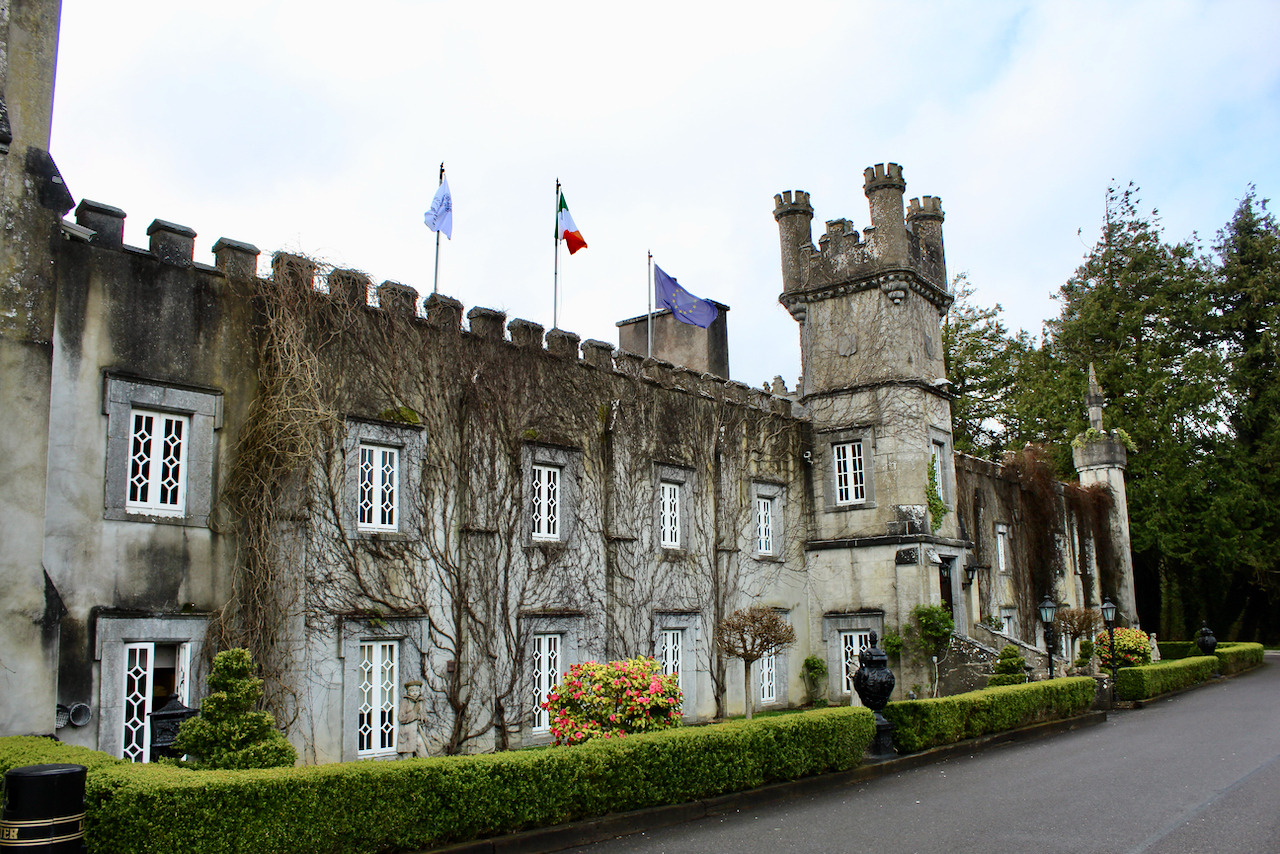
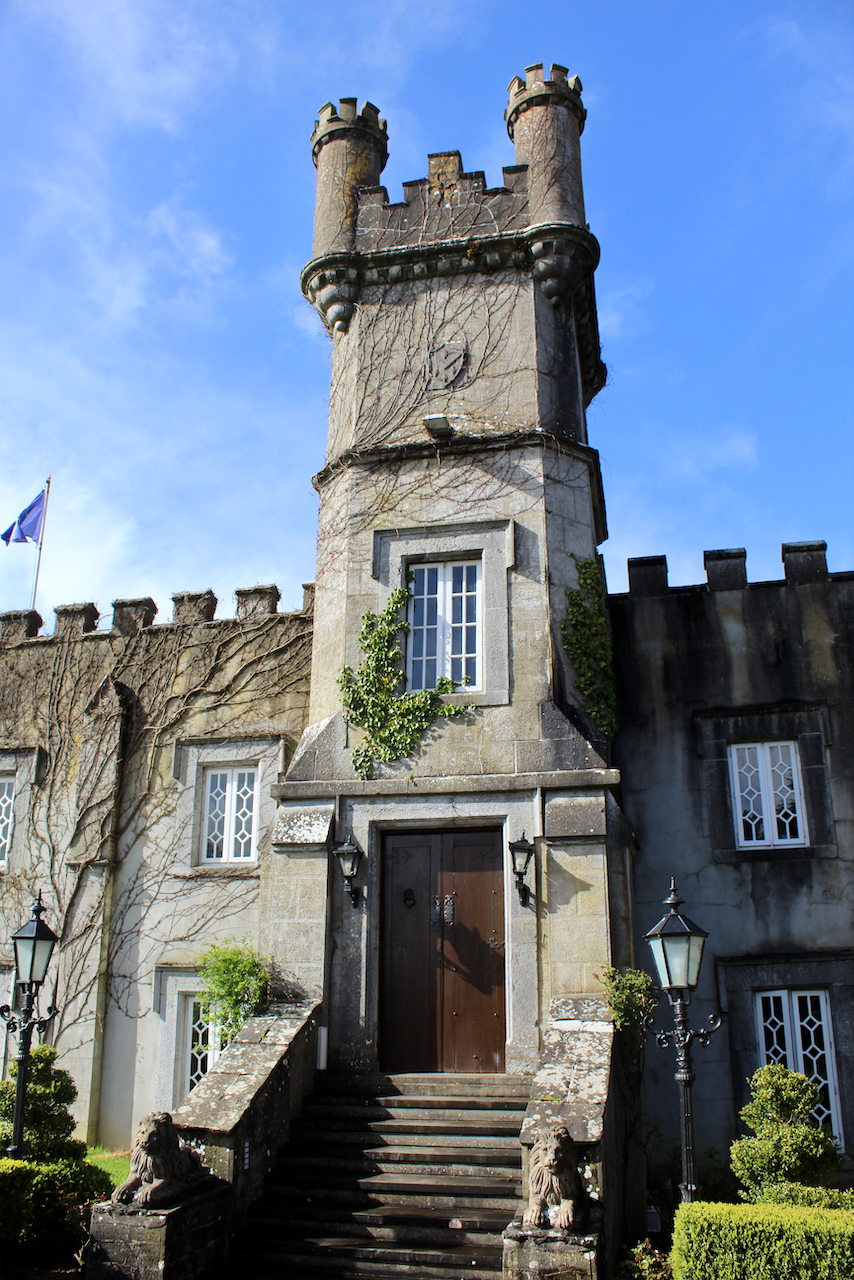
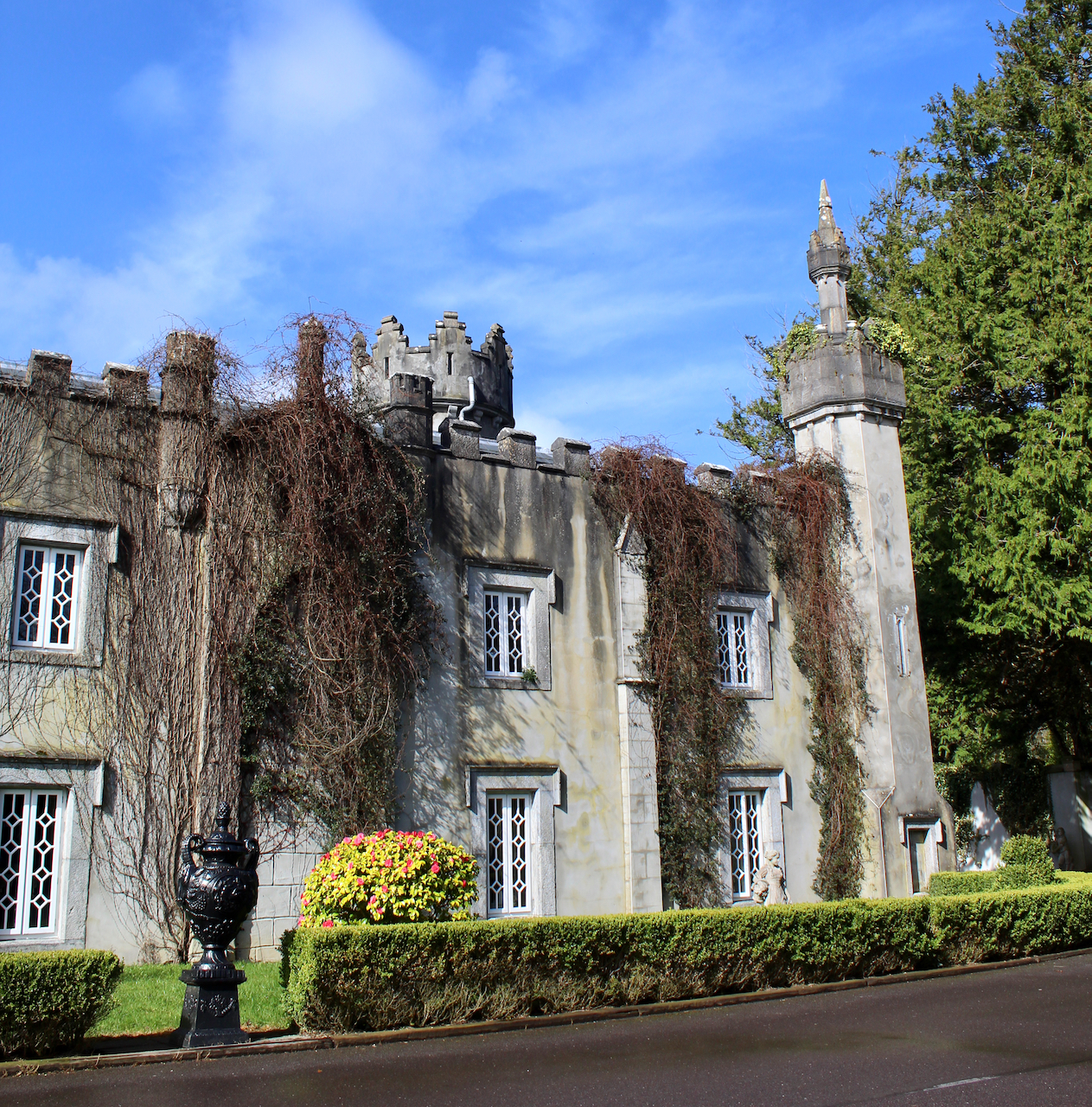
Anngrove (formerly Ballinsperrig), Carrigtwohill, Co Cork – demolished by ca. 1965

Anngrove (formerly Ballinsperrig), Carrigtwohill, Co Cork – demolished by ca. 1965 

Mark Bence-Jones. A Guide to Irish Country Houses (originally published as Burke’s Guide to Country Houses volume 1 Ireland by Burke’s Peerage Ltd. 1978); Revised edition 1988 Constable and Company Ltd, London.
p. 6. “(Cotter, Bt/PB; Barry/IFR; Gubbins/LG1937 supp) A remarkable late C17 house built by Sir James Cotter, MP, a staunch adherent of Charles II who, in 1664, went to Switzerland with two companions and shot the fugitive Regicide, John Lisle. ..One of the rooms originally contained a velvet bed with hangings and gold brocade which was said to have belonged to Charles I and to have been given to Sir James Cotter by Queen Henrietta Maria “as a mark of her royal favour and thanks” for having led the successful action against Lisle. James II is traditionally supposed to have stayed a night in the house and to have slept in this bed. The lands on which the house was built were leased from the Barrys, Earls of Barrymore; some time post 1720, the widow of sir James Cotter’s son sold the reversion of the lease to the 4th Earl and the Cotter family seat was henceforth Rockforest. The 5th Earl of Barrymore, as Viscount Buttevant, lived for a period in Anngrove; but it was afterwards let. Charles I’s bed, which the Cotters left behind, was removed to Castle Lyons, the principal Barrymore seat, where it was burnt in the fire of 1771. Towards the end of the C18, or in early C19, Anngrove passed to the Wise family, from whom it was inherited, later in C19, by the Gubbins family. The house was still standing in 1950s but was demolished by ca. 1965.” 
Listed in Vanishing Country Houses of Ireland by The Knight of Glin, David J. Griffin and Nicholas K. Robinson, published by The Irish Architectural Archive and The Irish Georgian Society, 1988.

A very important late 17C and early 18C two storey house for James Cotter MP. Five bay with projecting square corner towers which had high-pitched pyramidal roofs. Demolished.”

https://landedfamilies.blogspot.com/search/label/Ireland

Barry of Castle Lyons and Anngrove, Earls of Barrymore 

The Barrys are one of the most ancient landed families in the British Isles, and can be traced back to Odo de Barri, a knight who assisted with the Norman conquest of Pembrokeshire at the end of the 11th century and was granted large estates including Manorbier Castle and Barry Island, from which the family took its name. His grandsons included the historian, Giraldus Cambrensis [Gerald of Wales] (c.1146-1223), and also Gerald’s elder brothers, Robert and Philip, who accompanied their half-uncle Richard FitzStephen to Ireland on his expedition of 1169 to help Dermot, King of Leinster, recover his throne. Robert was killed in Ireland in about 1185, but Philip de Barry (d. c.1200) was granted the cantreds of Olethan, Muskerry and Killyde in County Cork, parts of which large estate remained the property of his descendants until the end of the 18th century. Although Manorbier Castle in Pembrokeshire remained a principal seat of the family until the 15th century, their focus was increasingly on Ireland. Philip’s grandson, Sir David Barry (d. 1261) was the first to attract the soubriquet ‘Barry More’ [i.e., Barry the Great], and his son, David Oge Barry (d. 1278), who was Lord Justiciar of Ireland in 1267 and founded Buttevant Abbey, was probably the first of the family to be summoned to the Irish parliament as a baron, although (as the Complete Peerage expresses it), ‘any date given for the origin of early prescriptive Irish titles such as this must be in the nature of guesswork’. It is not even clear whether David Oge Barry and his descendants were properly styled Lord Barry, Lord Barrymore, or Lord Buttevant, since in later centuries the titles were used interchangeably. 
 
William Barry, the 11th Lord Barry, was one of the fifteen peers summoned to Greenwich (Kent) by King Henry VII in 1489, when he ranked as the premier baron of Ireland, and was styled ‘Lord Barry of Buttevant’. He was presumably aligned with the Yorkist faction in the Wars of the Roses, since he supported Perkin Warbeck’s claim to the throne in the 1490s, but although he seems to have made his peace with King Henry VII, he was murdered by his brother, the Archdeacon of Cork and Cloyne, in 1500. The archdeacon was himself killed and burned in reprisal, and another brother, Edmund, had his eyes put out by William’s widow. This was evidently all part of a bitter blood-feud by which the family was riven in the late 15th and 16th centuries. William’s son, John Barry, the 12th Lord Barry, was killed by the Earl of Desmond in 1530, whereupon the title and estates passed to William’s surviving brother John Barry (d. 1534), who seems to have been the only one of his generation to die in his bed, unmaimed. 
 
John’s eldest son, John Barry (c.1517-53), 14th Baron Barry, sat in the Irish parliament of 1541 as a Viscount, and although there is no record of the creation of a peerage of this degree, which may simply have been assumed, the peerage was henceforward regarded as a viscountcy by the Crown (again variously called Viscount Barry, Viscount Barrymore and Viscount Buttevant). John Barry sat in the 1541 Parliament, indeed, as the premier viscount, implying a precedence of creation over the Gormanston viscountcy (of 1478). This led earlier writers to try and characterise the family’s peerage as a viscountcy in earlier centuries, but there is no evidence for this, and it may simply be that Barry’s peers were not willing or able to resist the claims of the belligerent Barrys when forcefully asserted. John was succeeded in turn in the viscountcy and estates by his brothers Edmond (d. 1556) and James (d. 1558), both of whom made settlements of their property in default of male heirs on their kinsman, James Barry (d. 1581) and his descendants. These settlements seem to have been made under coercion, and on the death of James Barry, the 3rd Viscount, in 1558 the viscountcy should have become extinct and the barony and estates should have passed to Edmond More Barry of Rathcoban, but this did not happen, for the estates were seized by James Barry (d. 1581), who also assumed both the barony and the viscountcy. James was clearly a man of exceptional violence (he had already murdered the four sons of his half-uncle, David Downe Barry (who had himself murdered his uncle and James’ half-brother), and it would seem no one – not even the Lord Deputy or Queen Elizabeth – was willing to stand up him. In 1558 he was pardoned for the four murders; in 1560 he was summoned to parliament as a viscount; and in 1561 he secured an assignment of the family estates from the rightful heir, Edmond More Barry, no doubt by his usual unscrupulous methods, and had livery of them from the Crown. In a few short years, by sheer thuggery, James had not only secured the family estates and titles but secured recognition of his right to them from the Crown. 
 
James, 4th Viscount Buttevant, is the blackest character in this family, although others were far from estimable. His eldest son, Richard Barry (d. 1622), was born deaf and dumb, and was on that account (though not mentally impaired) passed over in the succession to the peerages and a major part of the estates, which descended to David Barry (1550-1617), 5th Viscount Buttevant. He joined the Earl of Desmond’s revolt against the Crown in 1593 but abandoned the rebel cause in 1599 and secured a pardon in 1602 on payment of a fine of £500. He thereafter remained loyal to the Crown and was indeed trusted and encouraged by King James I. His eldest son died in 1604/5, and it was therefore a posthumous grandson, David Barry (1605-42), who inherited the title and estates in 1617. The Crown granted his wardship to Richard Boyle, 1st Earl of Cork, and he was brought up a Protestant in a civilised household. The relationship with Lord Cork went well beyond guardianship, however, for Cork took mortgages on the Barry estates in order to pay off the inherited debts, and in 1621, arranged David’s marriage to his eldest but barely teenage daughter, Alice (1607-66). Finally, in 1628, he paid £3,000 for the young man, who had recently come of age, to be raised to the next rank of the peerage, as Earl of Barrymore, and a few years later built him a comfortable if still fortified new house, Castle Lyons, on the Barry estate.  
 
The new-minted Earl had all the loyalty to the Crown which his grandfather had exhibited in his later years, and as the country moved towards Civil War he was strongly royalist. He raised men at his own expense to fight in the First Bishops’ War in Scotland in 1639-40 and then worked in harness with Lord Inchiquin to fight the Confederacy in Ireland in 1641-42, but he was mortally wounded at the Battle of Liscarroll in July 1642 and died a few weeks later. Once again, the heir was a minor: his son, Richard Barry (1630-94), 2nd Earl of Barrymore, who was sent to London (where he studied under John Milton for at least a year) and then to France, where he married a Catholic, against his mother’s wishes. He stayed in France until his first wife’s death but then returned to London, where he married the daughter of the president of Cromwell’s council. These connections made him acceptable to both the Royalist and Parliamentarian factions, and at the Restoration he was able to become a colonel in the army and join the Irish privy council. 
 
The 2nd Earl had fifteen children by his three wives and was succeeded first by his eldest son, Laurence Barry (c.1657-99), 3rd Earl of Barrymore, who died without issue, and then by Laurence’s half-brother, Lt-Gen. James Barry (1667-1748), 4th Earl of Barrymore, who was a career soldier until relieved of his command at the time of the Jacobite uprising in 1715 on the grounds that his loyalty to the Hanoverians was doubtful.  

A picture containing outdoor, grass, grazing, building

Description automatically generated 
 
Rocksavage Hall: the Tudor house inherited by the 4th Earl passed to his 
daughter and thence to the Cholmondeley family, under whom it fell into ruins. 

 
By his second marriage, the 4th Earl acquired estates in Cheshire, Lancashire and Yorkshire centered on Rocksavage Hall (Ches.) that brought with them political control of the parliamentary borough of Wigan. As an Irish peer he was eligible to sit in the British House of Commons, and he did so, first as MP for Stockbridge, 1710-13 and 1714-15, and then for Wigan, which he represented 1715-27 and 1734-47. As an old man, his sympathy for the Jacobite cause strengthened, and from 1740 onwards he was actively involved in planning for a second Jacobite rebellion, with the assistance of one of his younger sons, who was a naval officer. He was arrested on suspicion of treason in 1744, and had his papers seized, but after the rebellion failed the Government decided not to prosecute him, perhaps partly because of his age; he died at the beginning of 1748. His Cheshire estate had been settled on his daughter by his second wife at the time of her marriage to Maj-Gen. James Cholmondeley in 1730, and when he divorced her for adultery in 1736 passed permanently into the hands of that family. His other English property was bequeathed to the same daughter, who later sold it in 1760. His extensive property in Ireland, augmented by his purchase of Anngrove, passed to his eldest son, James Barry (1717-51), 5th Earl of Barrymore, who probably had substantial debts since he was living in Boulogne from 1748 until his death three years later. The 5th Earl’s son, Richard Barrymore (1745-73), 6th Earl of Barrymore, was just six years old when he inherited and was brought up by his mother. On reaching maturity, he joined the army, but he is chiefly remembered for his fondness for gambling and practical jokes. The jokes were sometimes very practical: for example, on one occasion he invited two friends to dine in a private room at an inn and, apparently on a whim, suggested a wager on how many playing cards it would take to entirely cover the floor of the room; what they did not know was that he had dined in the same room a few days previously and that after eating he had piled up all the furniture in the corridor outside and had conducted an experiment to determine the answer. 
 
The 6th Earl married in 1767 and over the next six years had three sons and one daughter. He had leased Anngrove out, and in 1771 Castle Lyons was destroyed by fire, but he lived chiefly in London, where he had a house in Portman Square. In 1773 he died suddenly, probably of a fever (although dark tales circulated later to the effect that he had killed himself after losing heavily at cards), and once again the earldom passed to a minor, in this case Richard Barry (1769-93), 7th Earl of Barrymore. As adolescents lodged with a tutor at Wargrave (Berks), he and his brothers were known for their practical joking (on moonlit nights, they would occupy themselves with switching around the hanging innsigns of local Berkshire inns, so that puzzled landlords might go to bed in the Five Bells and wake up in the Rose & Crown). He had the misfortune to lose his mother in 1780, and the only restraining influence on his crucial formative years was his grandmother, who seems to have been indulgent to a fault.  

A picture containing text, book, photo, indoor

Description automatically generated 
Satirical print of the 7th Earl and his brothers by 
James Gillray, 1791. 

She sent him up to Eton with £1,000 in pocket money, which can only have encouraged profligacy and enabled him to explore all the vices which London had to offer at a tender age. He was intelligent, good-looking, charming, rash, and given to sudden enthusiasms on which a great deal of money might be spent before he tired of the occupation and moved on to something else, such as hunting (he bought his own pack of hounds) and boxing. His hedonistic lifetime brought him to the attention of George, Prince of Wales, to whose circle the 7th Earl and his siblings became known as the four Gates: the rash young earl was Hellgate; his next brother, who had a club foot, was Cripplegate; the youngest brother, always in scrapes, was Newgate; and the sister, known for her colourful language, was Billingsgate, which was witty, if not kind.  
 

An old house with trees in the background

Description automatically generated 
Barrymore, Wargave: the house rented by the 7th Earl but much altered since his time. Image: Historic England. 
A vintage photo of a building

Description automatically generated 
Barrymore, Wargrave: the interior of the private theatre built by the 7th Earl c.1789 and demolished in 1792. 

 
The Earl’s only constant passion was for the theatre and amateur theatricals and when he rented a house at Wargrave (Berks) he built a theatre in the garden (reputedly at a cost of £60,000), in which full-scale performances were given to invited audiences by the Earl, his friends, and some professional actors. He also maintained a smaller theatre in London. Alongside unrestrained gambling and womanising, it begins to be credible that in less than five years he ran through a fortune of £300,000 (perhaps £20m today), leaving the Irish estates mortgaged to the hilt and having to be sold. As early as 1791 he had to come to an arrangement with his creditors whereby his income was reduced to an allowance of £2,500, while the remaining income from the estate was applied to reducing his debts, and it comes as something of a surprise to find that he managed to keep out of the bankruptcy courts and was even nominally solvent when he died in 1793. His death, like his life, was dramatic. He had become an officer in the militia and was being driven in a curricle as escort to a detachment of French prisoners of war being taken from Rye to Dover Castle. He was holding his musket between his knees when a particularly violent jolt caused it to be discharged and the ball went through his head: he died shortly afterwards. Although this sounds remarkably like a disguised suicide, the possibility does not seem to have been suggested at the time, and it may have been, as reported, a tragic accident. 
 
The 7th Earl had married shortly before his death a great beauty who happened to be the daughter of a sedan chairman in London. Although the girl, who was a minor, married with her father’s blessing, he had the romantic fantasy of eloping with her to Gretna Green for the marriage with all the speed he could command. She later married an army officer and survived, as plain Mrs Williams, until 1866.  

A picture containing photo, text, old, window

Description automatically generated 
“Lady Barrymore”, the boxing baroness, was actually Mary Ann Pierce, 
the former mistress of the 7th Earl of Barrymore. 

The name ‘Lady Barrymore’ remained prominent in the London press throughout the early 19th century, however, because one of the 7th Earl’s cast-off mistresses, Mary Ann Pierce (d. 1832) took to calling herself by that name. She became ‘the lowest form of prostitute’ and took to drink. When she was in liquor she became violent, and if a publican refused to serve her she thought nothing of breaking up his premises. She was a more than capable boxer (she had learned alongside the 7th Earl and the press dubbed her ‘The Boxing Baroness’), and would beat up watchmen who came to arrest her. She appeared at Bow St. magistrates court more than 150 times charged with affray and similar offences, and is said to have spent seven of her last ten years in gaol, but once there, and dried out, she became a different person and was so useful in keeping order among the female prisoners that she was routinely employed by the prison authorities for that purpose. 
 
The 7th Earl’s club-footed younger brother, Henry Barry (1770-1823), succeeded him as 8th Earl of Barrymore, and completed the process of selling the family’s Irish estates. He lived in London, and was also part of the Prince of Wales’ set, but although he once fought a duel (something his elder brother is not recorded to have done), he had neither the income nor the personality to be a rake on the same scale. He married a daughter of Joseph Coghlan of the magical Ardo in Co. Waterford, but had no children, and on his death the earldom of Barrymore became extinct (it was the subject of a new creation for a descendant of the 4th Earl in 1902). The 8th Earl was also the 13th Viscount Buttevant and 26th Baron Barry, and a claim was made in the 1820s to these lesser titles, but could not be proved, and they too are now regarded as extinct. 
 

Castle Lyons, Co. Cork 

 
An early 17th century fortified mansion, built on the foundations of the castle of the O’Lehans, from whom the place took its name. It became the principal seat of the Barry family from the 1620s, when it superseded Barryscourt Castle. The house was apparently remodelled from 1636 onwards at the cost of the Earl of Cork for his son-in-law, David Barry (1605-42), 1st Earl of Barrymore. The new house was laid out around a central courtyard, with, on one side, the great hall, hung with weapons, on another the kitchen, and on a third side a two-storey gallery ninety feet long, which was, however, called unfinished in 1750 (work probably stopped with the start of war in 1640 and never resumed). One front of the house overlooked gardens with a large canal, supplied with water from the river by an aqueduct which also supplied the kitchens, which a visitor in 1797 said was contrived by a local miller ‘after the exertions of a celebrated artist from England had failed in bringing the water by another course’; one wonders who the ‘celebrated artist’ was? The demesne included a deer park. 
 

A castle on top of a grass covered field

Description automatically generated 
Castle Lyons: the ruins of the house today. 

By the 18th century, the Earls of Barrymore were probably spending as much time in London and Dublin as in County Cork, but the 4th Earl (1667-1748) acquired Anngrove as a new seat, and Castle Lyons evidently fell into disrepair. The 6th Earl (1745-73), who lived chiefly in Dublin and London, let Anngrove, but in 1771 he was carrying out repairs at Castle Lyons when the carelessness of a tinker employed to make repairs to the lead roof caused the house to be burned down. It was never rebuilt, for the 6th Earl died two years after the fire and was succeeded by the infant 7th Earl (1769-93), who grew up to be a notorious rake, one of the boon companions of George, Prince of Wales, who gambled away the family fortune. He sold Castle Lyons and his other estates in Co. Cork and the ruins of the house, with numerous tall chimneys, remain a prominent object in the landscape.. 
 
Descent: James Barry (d. 1581), 4th Viscount Buttevant; to son, David Barry (1550-1617), 5th Viscount Buttevant; to grandson, David Barry (1605-42), 6th Viscount Buttevant and 1st Earl of Barrymore; to son, Richard Barry (1630-94), 2nd Earl of Barrymore; to son, Lawrence Barry (c.1657-99), 3rd Earl of Barrymore; to half-brother, James Barry (1667-1748), 4th Earl of Barrymore; to son, James Barry (1717-51), 5th Earl of Barrymore; to son, Richard Barry (1745-73), 6th Earl of Barrymore; to son, Richard Barry (1769-93), 7th Earl of Barrymore; to brother, Henry Barry (1770-1823), 8th Earl of Barrymore, who sold 1799 to John Anderson. 
 

Anngrove alias Ballinsperrig, Carrigtwohill, Co. Cork 

A vintage photo of an old building

Description automatically generated 
Anngrove: the entrance front 

Anngrove was a remarkable and important late 17th century house, built about 1685 for Sir James Cotter MP, a staunch Royalist who in 1664 went to Switzerland with two companions and shot the fugitive regicide, John Lisle, for which he was rewarded with a large pension and the Governorship of the Leeward Islands. Anngrove was built on his return from this posting, and consisted of a two storey five bay centre with a high hipped roof, and boldly projecting corner towers, capped with pyramidal roofs that were slightly lower than the high pitched roof of the central block. A moulded cornice and a prominent string course ran around the house and towers, uniting them into a single composition. Inside, one room originally contained a ‘velvet bed with hangings and gold brocade’ which was said to have belonged to Charles I and to have been a gift from Queen Henrietta Maria as a thank-you present to Cotter for his despatch of John Lisle. James II is supposed to have stayed a night in the house and to have slept in this bed, during his operations in Ireland in 1689-91. 
 
The lands on which Anngrove was built were leased by Sir James Cotter from the Earls of Barrymore, and sometime after 1720 the 4th Earl bought back the lease. After the death of the 5th Earl, Anngrove was let again. Charles I’s bed was taken to Castle Lyons, where it was destroyed in the fire of 1771. The Barrys then used the house again for a few years, but towards the end of the 18th century, Anngrove was sold by the profligate 7th Earl to the Wise family, from whom it was inherited in the 19th century by the Gubbins family. The estate was sold to the Land Commission in 1909, and by the 1950s the house was attached to a small farm. It began to suffer from subsidence and was progressively abandoned as it became dangerous. In the early 1960s a new bungalow was built behind the old house to replace it, and some fittings from the old house were relocated there before the shell of the building was blown up with the help of an explosives expert from a nearby quarry; demolition had taken place by 1965. 
 
Descent: built for Sir James Cotter (c.1630-1705); to son, James Cotter (1689-1720); to widow Margaret, who sold to James Barry (1667-1748), 4th Earl of Barrymore; to son, James Barry (1717-51), 5th Earl of Barrymore; to son, Richard Barry (1745-73), 6th Earl of Barrymore; to son, Richard Barry (1769-93), 7th Earl of Barrymore; who sold to Francis Wise (1766-1842); to nephew, Francis Wise (1797-1881); to nephew?, Thomas Wise Gubbins (d. 1904); estate sold to Irish Land Commission, 1909… Joe Fenton (fl. 1950-2000), who demolished the house c.1965. 

Ballyseede Castle, Ballyseede, Tralee, Co. Kerry – section 482 Accommodation

www.ballyseedecastle.com

Open dates in 2026: Mar 14-Dec 31, 9am-11pm
Fee: Free to visit

Ballyseede Castle, March 2023. © Jennifer Winder-Baggot, www.irishhistorichouses.com

Ballyseede castle (pronounced Ballyseedy) is now a hotel, and Stephen and I treated ourselves to a stay in March 2023. The house was built in around 1760 for the Blennerhassett family, and parts were added and gothicized over time. Gothic revival additions may have been designed by William and Richard Morrison. Later renovations were carried out by James Franklin Fuller.

The castle is now one of four owned by the Corscadden family. We have visited the other properties: Cabra Castle in County Cavan and Markree in County Sligo, both of which are also section 482 properties (see my entries). We also visited the fourth, Castle Bellingham in County Louth, kindly welcomed by Patrick, who showed us around and I told him of my website. I am in the process of writing about that in my “Places to visit and stay in County Louth” page, still a work in progress.

Ballyseede Castle, March 2023: bifurcating staircase rising behind a screen of Doric columns at one end of the hall. © Jennifer Winder-Baggot, www.irishhistorichouses.com

The website tells us:

Take a step back in time with a hotel steeped in history that offers luxurious surroundings within 30 acres of private gardens and woodland.

The Doric columns that lead to an elegant oak staircase in the lobby are indicative of the grand decoration throughout the hotel. Impressive drawing rooms with ornate cornices, adorned with marble fireplaces provide an ideal setting for afternoon tea or morning coffee.

Elegant accommodation, fine dining with traditional Irish cuisine, rooms that tell a story and the picturesque natural setting, will all comprise to make your stay at Ballyseede Castle an unforgettable one.”

The entrance gates are described in the National Inventory: “Gateway, built c. 1825, comprising four limestone ashlar piers with wrought-iron double gates, flanking pedestrian gates and curved quadrant walls with half-round projecting bays having blind pointed arches. Painted and rendered walls with stone copings and having arched blind openings with painted sills.” © Jennifer Winder-Baggot, www.irishhistorichouses.com
The lovely drive up to the castle. © Jennifer Winder-Baggot, www.irishhistorichouses.com
Ballyseede, March 2023. © Jennifer Winder-Baggot, www.irishhistorichouses.com
Ballyseede Castle, March 2023: Limestone ashlar porch with crow-step gable and arched doorway with double-leaf panelled door. This porch was added in around 1880. © Jennifer Winder-Baggot, www.irishhistorichouses.com
Ballyseede Castle, County Kerry. Impressive lions flank the door. © Jennifer Winder-Baggot, www.irishhistorichouses.com
Ballyseede Castle, March 2023. © Jennifer Winder-Baggot, www.irishhistorichouses.com

The castle comes complete with dogs, a trademark of the Corscadden hotels. The Irish wolfhounds add elegance to wedding photographs.

The castle comes complete with dogs, a trademark of the Corscadden hotels. © Jennifer Winder-Baggot, www.irishhistorichouses.com
I fell in love with this affectionate little doggie, who had a particularly thick soft coat. © Jennifer Winder-Baggot, www.irishhistorichouses.com
Her brown shaggy friend was adorable too and they vied for attention, full of excitement every time I stopped to pet them. © Jennifer Winder-Baggot, www.irishhistorichouses.com

The Landed Estates database tells us that the Blennerhassett family was originally from Cumbria in the north of England. Robert Blennerhassett was the first to settle in Kerry. He married Elizabeth, daughter of Captain Jenkin Conway of Castle Conway, Killorglin, County Kerry, formerly known as Killorglin Castle (now a ruin). He was originally from Pembrokeshire in Wales.

Between 1611 and 1618 Robert acquired lands in Ireland. He held the office of Member of Parliament (M.P.) for Tralee in 1613 and between 1635 and 1639. He lived in an old castle named Ballycarty Castle and also owned the old Ballyseedy Castle. The current Ballyseede Castle is different from the original Ballyseedy Castle, a castle that had belonged to the Fitzgeralds, located at the west end of Ballyseedy Wood.

The Landed Estates database tells us that a John Blennerhassett was granted an estate of 2,787 acres in the barony of Trughanacmy, County Kerry (where Ballyseede Castle and Ballyseedy woods are located) and 2,039 acres in the barony of Fermoy, County Cork under the Acts of Settlement in 1666. [1] This John is probably son of Robert.

Lady Blennerhassett (I’m not sure which one), Ballyseedy Castle, Tralee, Co. Kerry, Irish school 18th century, Adams auction 19 Oct 2021

John Blennerhassett, son of Robert and Elizabeth, was, following his father’s footsteps, MP for Tralee [2]. He too lived in Ballycarty Castle, now a ruin. He married Martha Lynn, daughter of George from Southwick Hall, Northamptonshire, England. They had several children and he died in 1676.

His younger brothers Edward and Arthur married and lived nearby.

The lawn in front of the castle. © Jennifer Winder-Baggot, www.irishhistorichouses.com

John and Martha’s son John was also MP for Tralee and high sheriff, but died only a year after his father, in 1677. He had married Elizabeth Denny in 1654, whose family lived in Tralee Castle (it no longer exists). She was the daughter of Edward Denny (1605-1646) who was also an MP and High Sheriff for County Kerry. [see 2] The Denny and Blennerhassett families intermarried over generations.

Edward Denny (1547-1600), who was granted land in Tralee County Kerry after the Desmond Rebellions photograph courtesy of the Roaringwaterjournal website.

In her Voices from the Great Houses: Cork and Kerry (2013) Jane O’Hea O’Keeffe tells us about the grandfather of Edward Denny (1605-1646), Edward Denny (1547-1599/1600), who moved to Kerry:

Following the Desmond rebellions of 1569-73 and 1579-83, Sir Edward Denny of Waltham Abbey, Herefordshire, who was born in 1547, was granted 6,000 acres of land around Tralee, County Kerry. The ruined thirteenth century Tralee Castle, formerly a Desmond property, was included in the grant. Sir Edward Denny was a relative of Sir Walter Raleigh, who was also granted 42,000 acres in Cork and Waterford at this time.” [3]

John Blennserhassett and Martha had other children beside John who died in 1677. Their son Robert also held the office of MP for Tralee and High Sheriff of County Kerry in 1682. He married Avice Conway (d. 1663), a daughter of Edward Conway of Castle Conway, County Kerry. Their son John (d. circa 1738) inherited Castle Conway from his mother.

John (d. 1677) and Elizabeth née Denny’s son John (d. 1709) was MP for Tralee, Dingle and County Kerry at various times. He married Margaret Crosbie (1670-1759) of Tubrid, County Kerry (Tubrid House no longer exists, and should not be confused with Tubbrid Castle in County Kilkenny). Her father Patrick held the office of High Sheriff of County Kerry in 1660.

Margaret née Crosbie and John Blennerhassett had several children. After John’s death in 1709 Margaret married David John Barry in the same year, son of Richard Barry (1630-1694) 2nd Earl of Barrymore but they had no children together.

Margaret and John’s heir was Colonel John (1691-1775), who was called “Great Colonel John” thanks to his hospitality. He followed in his forebears’ footsteps, becoming an MP. In 1727 he signed a family compact with Maurice Crosbie of Ardfert and Arthur Denny of Tralee, partitioning the county representation among the three families [see 2].

Colonel John married Jane Denny, daughter of Colonel Edward Denny (1652-1709) of Tralee Castle.

A website about the Blennerhassett family tells us that in 1721 the first “Ballyseedy House” was built among ruins of the Geraldine Ballyseedy Castle at the west end of Ballyseedy Wood. Colonel John lived here with his family. [4]

The foundation stone dated 1721 over the seventeenth century fireplace. The foundation stone is from the earlier Blennerhassett home called “Ballyseedy Castle,” built in 1721, and the fireplace may be from the earlier Ballycarty Castle or the Desmond Ballyseedy Castle. This fireplace is now in Ballyseede Castle (built c. 1780). © Jennifer Winder-Baggot, www.irishhistorichouses.com

It was Margaret and John Blennerhassett’s younger son William (1705-1785) who built the house which has become the hotel Ballyseede Castle. It was built around 1780 (the National Inventory says c. 1760) and named “Elm Grove.” [4] William died during its construction and the work was completed around 1788 by his son William Blennerhassett Jr. (c. 1735-1797).

We will return to William and his family later. First, let’s look at the older son Colonel John and his offspring.

Colonel John’s son John Blennerhassett (1715-1763) would have succeeded his father and lived in the original Ballyseedy House, if he had not predeceased him in 1763. This John was admitted to the Middle Temple in London to train for the legal profession, and he also held the office of High Sheriff of County Kerry, in 1740, and M.P. for County Kerry between 1751 and 1760. He married Anne Crosbie, daughter of William Crosbie of Tubrid, County Kerry, who was MP for Ardfert between 1713 and 1743. Her mother was Isabella Smyth from Ballynatray, County Waterford, another Section 482 property – gardens only – that I’ll be writing about soon. Anne Crosbie had been previously married to John Leslie of Tarbert, County Kerry (another section 482 property which I hope to visit soon), but he died in 1736.

Anne died and John Blennerhassett remarried in 1753, this time wedding Frances Herbert, daughter of Edward Herbert (1693-1770) of Muckross, County Kerry. For more on Muckross House, see my entry on places to visit and stay in County Kerry.

Muckross House Killarney Co. Kerry, photograph by Chris Hill 2014 for Tourism Ireland, Ireland’s Content Pool.

Neither of John’s sons married and one died young. His house, Ballyseedy House, fell into disuse.

John’s daughter Frances married Reverend Jemmett Browne (d. 1797) of Riverstown, County Cork, another Section 482 property (see my entry).

Colonel John and Jane née Denny had a younger son, Arthur (1719-1799), who served as MP for Tralee between 1743 and 1760. He married Jane Giradot and had two daughters but no sons. His daughter Jane married George Allanson-Winn, 1st Lord Headley, Baron Allanson and Winn of Aghadoe, County Kerry. She was heiress of her father’s unentailed Ballyseedy estates – this would have been land that did not include what is now Ballyseede Castle. She died in 1825.

Colonel John and Jane née Denny also had several daughters. Agnes, born in 1722, married neighbour Thomas Denny (d. 1761) of Tralee Castle, son of Colonel Edward Denny (1728). Another daughter, Arabella (1725-1795), married Richard Ponsonby of Crotto, County Kerry (now demolished), MP for Kinsale, County Kerry, and then secondly Colonel Arthur Blennerhassett (1731-1810), a grandson of John who died in 1709 and Margaret née Crosbie. A third daughter of Jane and John Blennerhassett, Mary, married Lancelot Crosbie, who lived at Tubrid, County Kerry. Lancelot was MP for County Kerry between 1759 and 1760 and for Ardfert in County Kerry between 1762 and 1768 [see 2].

Ballyseede Castle, March 2023. © Jennifer Winder-Baggot, www.irishhistorichouses.com

Let us return now to Elm Grove, now called Ballyseede castle. It is an eleven-bay three-storey over part-raised basement house, comprising a three-bay entrance bay to the centre with door opening approached by flight of steps, and a pair of three-bay full-height flanking bow bay windows and single-bay end bays. It has five-bay side elevations with three-bay full-height bow bay window to south elevation and eight-bay west elevation with two-bay breakfront. [5]

Ballyseede Castle, March 2023: Five-bay side elevations with three-bay full-height bow bay window to south elevation. © Jennifer Winder-Baggot, www.irishhistorichouses.com

William Blennerhassett Senior (1705-1785), son of John Blennerhassett (d. 1709) of Ballyseedy and Margaret Crosbie married Mary, daughter of John Morley, Mayor of Cork. Their son William (c.1735-1797) inherited Elm Grove.

Their daughter Agnes, born in 1740, married William Godfrey (c. 1738-1817) 1st Baronet of Bushfield, County Kerry, later called Kilcolman Abbey (renovated by William Vitruvius Morrison in 1818, demolished in 1977).

William (c.1735-1797) held the office of High Sheriff of County Kerry in 1761 and was the Collector of Customs at Tralee, which could have been a lucrative post.

William married Catherine daughter of the interestingly named Noble Johnson of County Cork. William and Catherine’s son Arthur (1779-1815) lived in Elm Grove with his wife Dorcas (1775/7-1822) daughter of George Twiss from Cordell House, County Kerry. Arthur died in 1815, but it seems that before he died he began plans to renovate the house. As was the case with his father and grandfather, Arthur’s son, another Arthur (1800-1843), continued the renovations.

Ballyseede Castle, March 2023. © Jennifer Winder-Baggot, www.irishhistorichouses.com

William and Catherine’s daughter Catherine (b. 1777) married Colonel John Gustavus Crosbie (d. 1797), a son of Lancelot Crosbie and Mary née Blennerhassett. He was M.P. for County Kerry between 1795 and 1797. In 1794 he killed Barry Denny, 2nd Bt. in an election duel at Oak Park (now Collis-Sandes House) and was subsequently poisoned, it is said, by the Denny family, which resulted in him falling from his horse as he was riding home from Churchill to his home in Tubrid. Catherine then married George Rowan of Rathanny, County Kerry (a beautiful Georgian house, still occupied). Rowan ordered the militia to fire into the crowd at an election rally killing five people. He was tried for murder but not convicted. [6]

Another daughter, Mary, married another cousin, Captain Nevinson Blennerhassett de Courcy (1789-1845). He was the son of Anne Blennerhassett of the Castle Conway branch of the family.

A younger son of William and Catherine née Johnson, John (circa 1769-1794), served as MP for Kerry between 1790 and 1794. He died unmarried.

Mark Bence-Jones tells us that the Gothic Revival renovation dates from 1816 and may be designed by Richard Morrison (1767– 1849). [7] The work was completed in 1821, and the house renamed “Ballyseedy House” because the original old “Ballyseedy” of Colonel John Blennerhassett at the west end of Ballyseedy Wood had by then fallen into disrepair and disuse.

The house was extended, adding a seven-bay two-storey wing to the north. This wing has a pair of single-bay three-storey turrets to the east elevation. These turrets have battlemented roof parapets and pinnacles. The ten-bay rear elevation to the west has hood mouldings to the openings and a single-bay three-storey corner turret on a circular plan to north-west. [see 5]

The seven bay two-storey Gothic-Revival addition, perhaps designed by Richard Morrison. © Jennifer Winder-Baggot, www.irishhistorichouses.com
This wing has two single bay three storey turrets. © Jennifer Winder-Baggot, www.irishhistorichouses.com
The Gothic addition has battlemented parapet and hood mouldings over the windows. © Jennifer Winder-Baggot, www.irishhistorichouses.com

The Blennerhassett site tells us: “It was William Blennerhassett Jr’s son Arthur (1779-1815) and his wife Dorcas Twiss (1775/7-1822) who commenced addition of the long north wing, something of a “folly” with the stable yard surrounded by a great wall of false windows, with two carriage entrances and a round tower of medieval appearance at the north-west corner. The work of architect Sir William Morrison [From 1809 onward Richard Morrison collaborated increasingly with his second son, William Vitruvius Morrison (1794–1838)], this remodelling was completed in 1821, exactly 100 years after the older “Ballyseedy House” house had been built, by his son Arthur Blennerhassett (b. 1799 d.1843) then only 22 years of age.” [8]

Mark Bence-Jones describes: “At one side of the front is a long and low castellated service wing, with round and square turrets, the other side of which has a sham wall, consisting of a long range of false windows.”

I couldn’t work out where this sham wall of false windows was – perhaps later renovations changed this folly.

Ballyseede Castle, March 2023. © Jennifer Winder-Baggot, www.irishhistorichouses.com
This is the far end of the wing, with what must be the round tower mentioned in the description on the Blennerhassett website: “addition of the long north wing, something of a “folly” with the stable yard surrounded by a great wall of false windows, with two carriage entrances and a round tower of medieval appearance at the north-west corner.” © Jennifer Winder-Baggot, www.irishhistorichouses.com
Stephen liked the pike-wielding statues. © Jennifer Winder-Baggot, www.irishhistorichouses.com
This must be one of the carriage entrances. © Jennifer Winder-Baggot, www.irishhistorichouses.com
You can see in this photograph that the carriage entrance is open.

At the time of renovations, the son of Arthur and Dorcas, Arthur (1800-1843), was High Sheriff for County Kerry.

The Blennerhassett website tells us:

In the north wing is a “Banqueting Hall” which features a foundation stone dated 1721, set into the wall over primitive 17th century black oak fireplace surround.

In the north wing is a “Banqueting Hall.” © Jennifer Winder-Baggot, www.irishhistorichouses.com
We ate our breakfast here every day. © Jennifer Winder-Baggot, www.irishhistorichouses.com
The 17th century oak fireplace in the banqueting hall. © Jennifer Winder-Baggot, www.irishhistorichouses.com
Detail of the seventeenth century fireplace in Ballyseede. © Jennifer Winder-Baggot, www.irishhistorichouses.com
We were treated to a delicious breakfast every day. © Jennifer Winder-Baggot, www.irishhistorichouses.com
Breakfast includes lovely pastries and I confess Stephen and I sneaked a couple into our bag for lunch! © Jennifer Winder-Baggot, www.irishhistorichouses.com
Ballyseede Castle, March 2023. © Jennifer Winder-Baggot, www.irishhistorichouses.com

The Blennerhassett website tells us that another 17th century wooden fireplace surround of finer workmanship was installed in what was the library of the main house (now the hotel bar). The two fireplaces are believed to have been moved with other free-standing oak furniture from “Old” Ballyseedy” as it fell into ruin.

This is the fireplace in the bar believed to have been moved with other free-standing oak furniture from “Old” Ballyseedy” as it fell into ruin. My apologies for the quality of the photographs – the bar is used as a restaurant and I found it impossible to get a good photograph when people were eating in the room! © Jennifer Winder-Baggot, www.irishhistorichouses.com
17th century wooden fireplace in the former library of Ballyseede Castle. © Jennifer Winder-Baggot, www.irishhistorichouses.com
The former library of Ballyseede Castle is now the bar, where casual meals are also served. Stephen and I ate here every evening of our stay. © Jennifer Winder-Baggot, www.irishhistorichouses.com

Arthur Jr. (1800-1843) married Frances Deane O’Grady (1800-1834), daughter of Henry Deane O’Grady (1765-1847). This would have been a prestigious marriage. Her sisters married, respectively, Edward Chichester, 4th Marquess of Donegal (Amelia); David Roche (1791-1865), 1st Baronet of Carass, Co. Limerick (Cecilia); John Skeffington (1812-1863), 10th Viscount Massereene (Olivia); and Matthew Fitzmaurice Deane (1795-1868), 3rd Baron Muskerry (Louisa). Thus Arthur would have been very well connected. He served as M.P. for County Kerry between 1837 and 1841.

One of the formal rooms of Ballyseede Castle. © Jennifer Winder-Baggot, www.irishhistorichouses.com
The room has a lovely marble fireplace. © Jennifer Winder-Baggot, www.irishhistorichouses.com
Another of the formal rooms of Ballyseede Castle. © Jennifer Winder-Baggot, www.irishhistorichouses.com
Stephen and I particularly enjoyed the chess set and availed of it on two evenings, imagining ourselves in a drawing room in the eighteenth century. © Jennifer Winder-Baggot, www.irishhistorichouses.com
Ballyseede Castle. © Jennifer Winder-Baggot, www.irishhistorichouses.com
One of the bay windows of Ballyseede. © Jennifer Winder-Baggot, www.irishhistorichouses.com

It must have been during this Arthur’s time in the 1830s that Ballyseede was leased to Edward Denny (1796-1889), 4th Baronet.

Edward Denny (1796-1889) 4th Bt , Poet and hymn writer, by Camille Silvy, 1862, National Portrait Gallery of London, Ax57667.

In Voices from the Great Houses: Cork and Kerry (2013) Jane O’Hea O’Keeffe tells us:

p. 160. “Several generations of the Denny family occupied the ancient castle in Tralee. They ran the estate through both peaceful and turbulent times until 1826, when Sir Edward Denny, 3rd Baronet [1773-1831, of Castle Moyle, Co. Kerry], decided to demolish the castle. Tom Denny ruefully remarks, “The demolition of Tralee Castle by Sir Edward Denny was a crime, and much resented in Tralee at that time. People felt angry that part of the town’s history was being destroyed. Sir Edward was really quite a muddled character. As a younger man, when he inherited the estate, he promptly set about enlarging the castle, something which is powerful father-in-law Judge Day found very irritating, and which created enormous problems for Sir Edward’s finances. He subsequently went to live in Worcester. He remained fascinated by genealogy and artefacts from the family’s past and continued to acquire Tudor portraits long after he had pulled down the Tudor remains of the Denny house. 

In the 1830s the Worcestershire Dennys came back to Tralee, and Sir Edward Denny, 4th Baronet, rented Ballyseedy Castle outside the town for a number of years. His younger brother William [1811-1871] became his agent, and he lived at Princes Quay in Tralee in a house when the Dominican church now stands. Sir Edward Denny planned to rebuild the [Tralee] castle, and he replanted the park and also built lodges on the estate. His plans came to an end in 1840 when he joined the conservative Plymouth Brethren movement and he lived thereafter in poverty in London, leaving the management of the estate to his family. 

The indebted Denny estate in Tralee was run by members of the family, or their agents, until 1892, when it was taken over by an insurance company; this severed a family link to the area which had remained strong for over 300 years. 

The Denny estates at one time, stretched to around 29,000 acres, extending from Fenit to Tralee and around the other side of the bay to Derrymore,” explains Tom Denny. “Sir Arthur Denny, 5th Baronet (1838-1921), was a notorious gambler who managed to lose the entire estate by around 1892.” 

The dining room of Ballyseede Castle. © Jennifer Winder-Baggot, www.irishhistorichouses.com
Ballyseede Castle, March 2023. © Jennifer Winder-Baggot, www.irishhistorichouses.com

Arthur Blennerhassett died in 1843 when his son, Charles John Allanson Winn Blennerhassett (1830-1859) was only thirteen years old. By this time, Ballyseedy was probably back in the hands of the Blennerhassetts. Charles’s mother has died when he was only four. I am not sure who raised him. A few of his uncles still lived in County Kerry: His uncle Thomas (1806-1878) remained unmarried and lived in Kerry, and uncle Lt.-Col. Francis Barry Blennerhassett (1815-1877) lived in Blennerville, County Kerry, also unmarried.

Charles John Allanson Winn married Marianne Hickson of Dingle, County Kerry, in 1855. He held the office of High Sheriff in 1858 and was a Justice of the Peace. He died at the young age of 29 and his wife remarried, this time to Captain William Walker. Before Charles died, his wife had two children: Barbara, who died at the age of ten, and Arthur (1856-1939). Young Arthur was only three years old when his father died. He was sent away to school in Harrow in England.

Charles John Allanson Winn Blennerhassett (1830-1859) had several siblings. His sister Adelaide married Standish O’Grady (1832-1860) 3rd Viscount Guillamore, County Limerick. His sister Dorcas married Robert Conway Hurly of Glenduffe, County Kerry. His sister Amelia married Chichester Thomas Skeffington, son of Thomas Henry Skeffington, 2nd Viscount Ferrard, County Louth. Frances Annabella married John Richard Wolseley, 6th Bt of Mount Wolseley, County Carlow. His only brother, Henry Deane, died unmarried in 1850.

Young Arthur Blennerhassett (1856-1939) was the owner of 12,621 acres in 1876 [see 2]. He held the office of High Sheriff in 1878. In 1882 he married Clara Nesta Richarda FitzGerald, daughter of Desmond John Edmund FitzGerald, 26th Knight of Glin.

The house was further remodelled during the 1880s for the Blennerhassett family by James Franklin Fuller (1835–1924), after which it was then known as “Ballyseedy Castle.” Fuller added a battlemented parapet, hood mouldings and other mildly baronial touches. The three-bay single-storey flat-roofed limestone ashlar projecting porch was added to the entrance bay. The Blennerhassett website tells us that the back of the castle became the front at this time.

Older pictures of Ballyseedy. It looks like this could be the original front of the castle. It is identified on the Blennerhassett family website as Ballyseedy c.1837-1841 and their version is titled “The Seat of Arthur Blennerhassett Esq MP, Co Kerry.”

The Blennerhassett family website [8] tells us more about the history:

During the 1880s Arthur’s grandson, Maj. Arthur Blennerhassett (b.1856 d.1939), commissioned a “mock castle” refacing of the house, as was popular during the late Victorian period, these changes causing what had previously been the front elevation and west facing main entrance to become the rear of the house. This work, executed by Kerry architect, historian and Blennerhassett descendant James Franklin Fuller, caused the house to lose its Georgian elegance and simplicity but resulted in the more impressive building we see today. Following these changes the house began to be referred to as “Ballyseedy Castle” and is named as such on the family headed writing paper of the time.” [8]

Unfortunately not having read this fully in advance of our visit, I didn’t take a proper picture of the back of the hotel, not knowing that it had originally been the front!

The back of the hotel. © Jennifer Winder-Baggot, www.irishhistorichouses.com
An early aerial shot of Ballyseede.

Out the back there is a lovely garden with statues, small hedges, trees and a gazebo perfect for wedding photographs. Unfortunately it rained during most of our visit, so we didn’t get to explore much outside.

The gardens at Ballyseede Castle. © Jennifer Winder-Baggot, www.irishhistorichouses.com
A later addition to the castle, a sixteen bedroom extension. © Jennifer Winder-Baggot, www.irishhistorichouses.com

Arthur served as Deputy Lieutenant and Justice of the Peace. He fought in the first World War and gained the rank of Major in the 4th Battalion, Munster Fusiliers. In 1918, both he and Clara Nesta (known as Nesta) were appointed as Members of the Order of the British Empire (M.B.E.) for their services: Nesta because during WWI she and her younger daughters Hilda and Vera served as Voluntary Aid Detachment nurses caring for the wounded, first behind the battlefields of France, and later on Lord Dunraven’s hospital ship “Grianaig” in the Mediterranean. 

Arthur and Nesta had three daughters. Hilda and Vera lived at Ballyseedy. Hilda bequeathed the estate in 1965 to her kinsman Sir (Marmaduke) Adrian Francis William Blennerhassett, 7th Bt of Blennerville, County Kerry, who sold it 1967. [see 5] This branch of Blennerhassetts are descendants of Robert Blennerhassett of Ballycarty Castle and his wife Elizabeth Conway also, from their grandson Robert, younger brother of John from whom the Ballyseedy Blennerhassetts descended.

The Blennerhassett website has a copy of the auction of the contents of the house, held by Hamilton and Hamilton in 1967.

The stair hall of Ballyseede Castle. © Jennifer Winder-Baggot, www.irishhistorichouses.com
Everywhere there are little touches and treasures. © Jennifer Winder-Baggot, www.irishhistorichouses.com
Stephen and I loved this carved chair in the front hall. © Jennifer Winder-Baggot, www.irishhistorichouses.com
The halfway landing at Ballyseede Castle, March 2023. © Jennifer Winder-Baggot, www.irishhistorichouses.com
The first and second floors of Ballyseede Castle, March 2023. © Jennifer Winder-Baggot, www.irishhistorichouses.com

Marnie Corscadden was kind enough to upgrade us to a beautiful suite, complete with stand alone clawfoot bath! We had a wonderful stay.

Our impressive bedroom, the Coghill suite. © Jennifer Winder-Baggot, www.irishhistorichouses.com
Our room in Ballyseede Castle, County Kerry, with a stand alone clawfoot bath. © Jennifer Winder-Baggot, www.irishhistorichouses.com
Our bedroom had an amazing carved wooden wardrobe. © Jennifer Winder-Baggot, www.irishhistorichouses.com
The carved wardrobe in our room. © Jennifer Winder-Baggot, www.irishhistorichouses.com
The rooms are named after various families associated with the Blennerhassetts. We stayed in the Coghill Room.
Busy at “work.” © Jennifer Winder-Baggot, www.irishhistorichouses.com
The bed was a work of art also. © Jennifer Winder-Baggot, www.irishhistorichouses.com
I can’t wait to go back sometime! © Jennifer Winder-Baggot, www.irishhistorichouses.com
Stephen admiring the view. © Jennifer Winder-Baggot, www.irishhistorichouses.com

We explored the other rooms of the castle. The back gardens open into another function room, the Orangerie, which was built in 2017.

The Orangerie, built in 2017. © Jennifer Winder-Baggot, www.irishhistorichouses.com
I love the balloons! © Jennifer Winder-Baggot, www.irishhistorichouses.com
This rooms is very bright and comfortable. © Jennifer Winder-Baggot, www.irishhistorichouses.com
The Orangerie has some stained glass windows. © Jennifer Winder-Baggot, www.irishhistorichouses.com
A hallway along the back garden leads back to the reception area. © Jennifer Winder-Baggot, www.irishhistorichouses.com

There’s also a large reception room.

The banqueting hall in the north wing. We didn’t get to go into this room but I peered through the window to take a photograph. © Jennifer Winder-Baggot, www.irishhistorichouses.com
Ballyseede Castle, County Kerry. This leads to the large reception rooms. © Jennifer Winder-Baggot, www.irishhistorichouses.com
I noticed an old service bell in the hallway. © Jennifer Winder-Baggot, www.irishhistorichouses.com
We sneaked into another room to see it while it was open for cleaning – I love the Oriental decor. © Jennifer Winder-Baggot, www.irishhistorichouses.com

[1] https://landedestates.ie/family/1834

[2] Montgomery-Massingberd, Hugh. Burke’s Irish Family Records. London, U.K.: Burkes Peerage Ltd, 1976.

List of M.P.s for County Kerry:

1692: Edward Denny (1652-1709 or 1712) of Tralee Castle; Thomas Fitzmaurice (1668-1741) 1st Earl of Kerry

1697: Edward Denny (1652-1709 or 1712) of Tralee Castle; William Sandes

1703: Edward Denny (d. 1727/8, son of Edward Denny (1652-1709 or 1712) of Tralee Castle); John Blennerhassett (d. 1709)

1709: Edward Denny (1676–1727/8); John Blennerhassett (1691-1775)

1715: John Blennerhassett (1691-1775); Maurice Crosbie (c. 1689 –1762) 1st Baron Brandon, of Ardfert, County Kerry

1727: Maurice Crosbie (c. 1689 –1762) 1st Baron Brandon; Arthur Denny (1704-1742), son of Edward Denny (1676–1727/8)

1743: Maurice Crosbie (c. 1689 –1762) 1st Baron Brandon; John Petty-Fitzmaurice (1706-1761) 1st Earl of Shelburne, son of Thomas Fitzmaurice (1668-1741) 1st Earl of Kerry

1751: Maurice Crosbie (c. 1689 –1762) 1st Baron Brandon; John Blennerhassett (1715-1763), son of John Blennerhassett (1691-1775)

1759: John Blennerhassett (1715-1753); Lancelot Crosbie (1723-1780)

1761: William Petty-Fitzmaurice (1737-1805) 1st Marquess of Lansdowne; Lancelot Crosbie (1723-1780)

1762: John Blennerhassett (1715-1763)

1763: John Blennerhassett (1691-1775); Thomas Fitzmaurice

1768: John Blennerhassett (1691-1775); Barry Denny (c. 1744-1794), 1st Baronet

1775: Barry Denny (c. 1744-1794), 1st Baronet; Arthur Blennerhassett (1719-1799) son of John Blennerhassett (1691-1775)

1776: Arthur Blennerhassett (1719-1799); Rowland Bateman (c. 1737-1803)

1783: Barry Denny (c. 1744-1794) 1st Bt; Richard Townsend Herbert (1755-1832)

1790: Barry Denny (c. 1744-1794) 1st Bt; John Blennerhassett (1769-1794)

1794: Barry Denny (d. 1794 in in dual with John Gustavus Crosbie) 2nd Bt; John Gustavus Crosbie (c. 1749-1797) son of Lancelot Crosbie (1723-1780)

1795: Maurice Fitzgerald (1774-1849) 18th Knight of Kerry; John Gustavus Crosbie (c. 1749-1797)

1798: Maurice Fitzgerald (1774-1849) 18th Knight of Kerry; James Crosbie (c. 1760-1836)

[3] p. 157. O’Hea O’Keeffe, Jane. Voices from the Great Houses: Cork and Kerry. Mercier Press, Cork, 2013.

[4] http://www.blennerhassettfamilytree.com/Ballyseedy-Castle.php

[5] National Inventory: https://www.buildingsofireland.ie/buildings-search/building/21302913/ballyseede-castle-ballyseedy-co-kerry

[6] http://www.thepeerage.com/p27968.htm#i279679

[7] p. 28. Bence-Jones, Mark. A Guide to Irish Country Houses (1988)

[8] http://www.blennerhassettfamilytree.com/Ballyseedy-Castle.php